Feeds:
Posts
Comments

Archive for the ‘collections’ Category

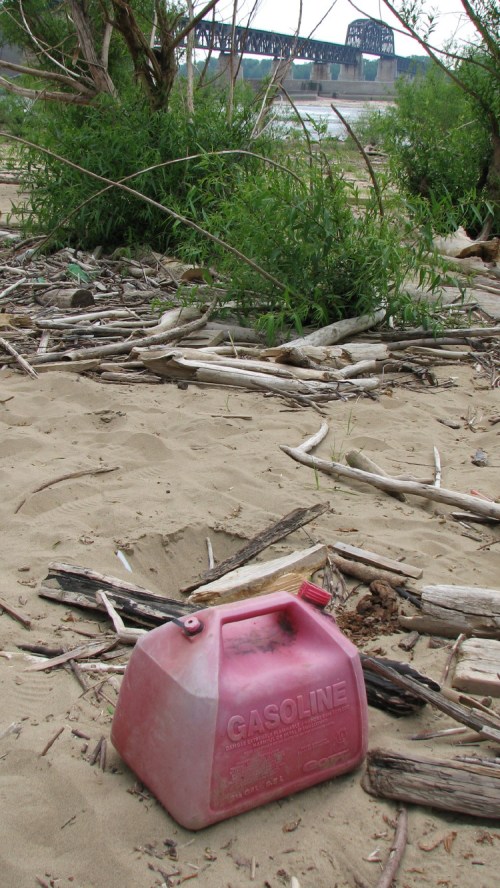
gasoline container at the Falls

I have just posted a new collection of images that can be found in my Pages section.  This selection is of gasoline containers found in context at the Falls of the Ohio State Park.  All theses containers reached here by floating down or with the Ohio River.  I find there is a certain level of irony represented in these images since they underscore how important fossil fuels are to us and that a container used to specifically hold this precious liquid should happen to wash up at a site that is famous for its fossils.  Civilizations rise and fall with their ability to harness energy and we have decided to hang our star on fossil fuels.  For now, I’ll leave it at that and let it join my other eccentric collections that are gifts and lessons from the river.

Read Full Post »

Perhaps you heard that we had an unusual flash flooding incident in Louisville on Tuesday, August 4?  It made the national news.  It’s not everyday that parts of the city receive 6 1/2 inches of rain in an hour!  This storm just hung over the city and wouldn’t budge.  The dark clouds poured it on and we experienced serious flooding damage.  I haven’t been to the Falls this week, but I’m really curious to see what’s different.  Is my studio under the willows still there?  Are there new materials washed up?  I had water come into my house via the basement and roof and so I have been busy with that.  My problems have been minor compared to some and so for that I’m thankful.  It’s just another meteorological moment in what continues to be the oddest of years.  For now,  I’m treading water ” blog-ilogically” and rather than offer you a brief interlude of pre-recorded music will submit these images instead.  I always have more photos than I can post.  This occasion gives me the chance to show the ever changing landscape around the Falls of the Ohio.  These are images from July 2009.

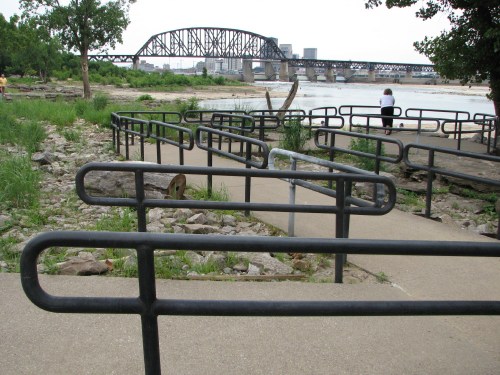
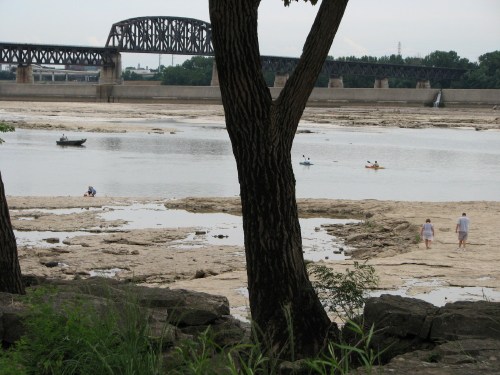
The Falls looking east, 7/09

Looking east, I like the way the railing on this handicap accessible ramp echos the hard lines in the bridge beyond.  A visitor contemplates the exposed fossil beds below the Interpretive Center.

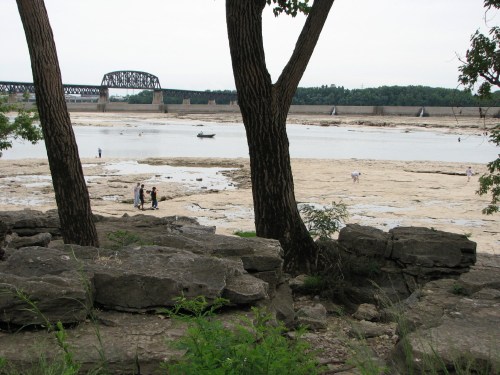
Activity on the fossil rocks, 7/09

Activity on the Fossil beds, 7/09

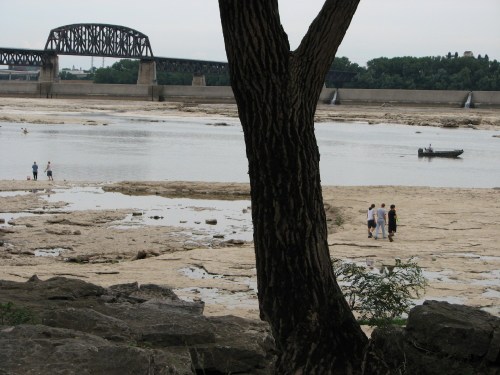
People on fossil beds, 7/09

Looking at this trio of images reminds me of the 19Th century painter Georges Seurat.  Perhaps it’s the frieze-like quality of the trees and the people absorbed in their own forms of river recreation?  So far this year, this was the most extensive exposure of the fossil beds.  I heard the other day that we have had a ridiculous 20 inches of rain over the past couple of months.  I wonder if our annual precipitation record is at risk this year?

Logs, view west, 7/09

These logs have been rolled against other downed trees in the water.  It’s the grinding action of water and wave that peels the bark and knocks off the branches.  In this way, trees are reduced to being straight logs.  I’ll end with another view of the Ohio River flowing westward.  Several hundred miles to go before entering the Mississippi River.

River flowing westward, 7/09

Read Full Post »

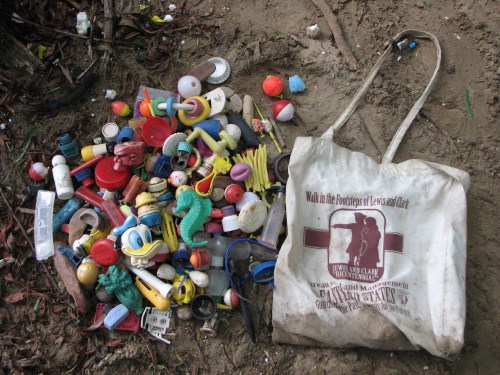
Collecting Bag contents, 7/09

I have been carrying this Lewis and Clark Bicentennial light canvas bag to the Falls since the beginning of this project.  Considering the years of use, its held up pretty well.  For me, this is one of the key artifacts from this experience.  Since 2003, I have filled and them emptied this bag several times with my river finds.  This is what’s currently in the bag.  Laid out… I was surprised how much plastic I gravitated towards in this batch.  The Donald Duck image was found last week.  The Rock-em Sock-em Robot head is from this year.  This is one of two seahorses I’ve found and this one is green.  Much of the rest is potential eyeballs, noses, or whatever part needed to embellish the foam and driftwood sculptures.  I’m about to make a major purge to lighten the bag.  I don’t want to carry anymore with me than I need to and besides…I will just keep finding more river treasure.

Lewis and Clark Collecting bag and contents, 7/09

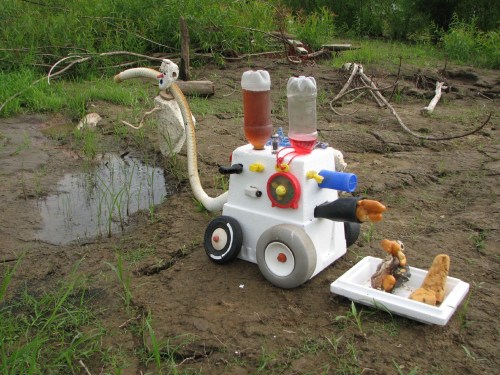
Machine and Operator, 7/09

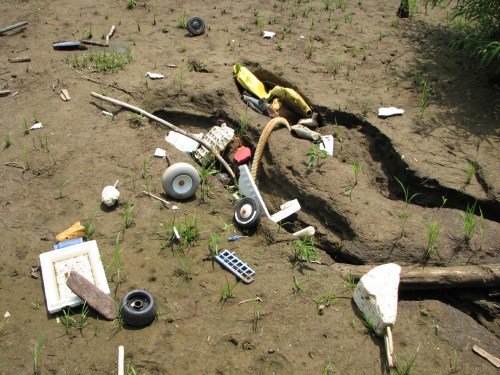
Here’s a good contrast in before and after pictures for you.  The machine and operator was made just a couple posts ago.  This is what it looks like now.  It exploded back into the parts from which it came…sort of.  The wreckage extended over a wide area.

Destroyed machine and operator, 7/09

Read Full Post »

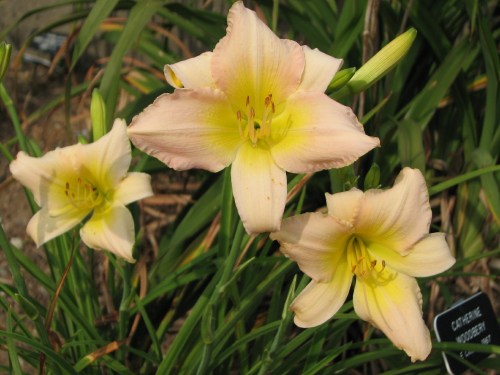
Day Lilies blooming,7/09

For many years I have admired the gardening efforts by the staff and park volunteers to beautify the area around the Interpretive Center.  I don’t know if these fine folks get the credit they deserve, but I thought I could devote a post to sing their praises and say thank you.  I would be remiss if I didn’t also notice the man-made loveliness to go with all the man-made rubbish deposited by the river and frequently cited by me in my art.

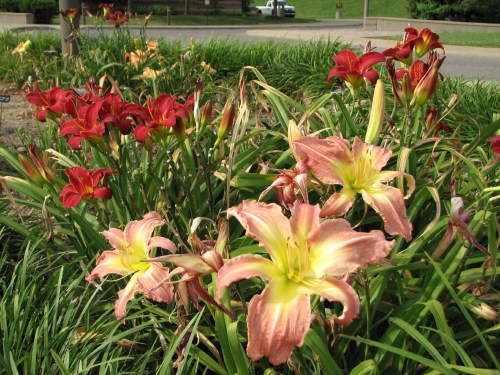
Day lilies, 7/09

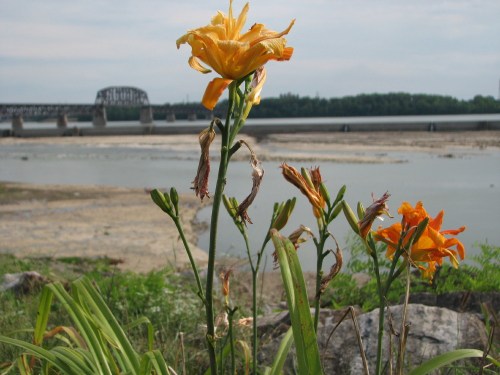
The Day Lily Collection at the Interpretive Center is particularly nice and I have been enjoying the blooms for the past couple of weeks.  Dozens of varieties are represented and each is labelled.  Our area has a very active day lily society and their plant sales are avidly attended.  I have heard people refer to gardening as an “art”, but what about the flowers themselves.  Can a real flower be a work of art?

Yellow spider-lilies, 7/09

Many years ago, (the early 1990’s) I organized an art exhibition entitled “Green” for the Louisville Visual Art Association.  I chose the show’s title before the whole “green” consciousness became so prevalent.  In that show, I had a selective representation of artists  that expressed a concern for the environment.  By far, the artist whose work and ideas I found the most interesting belonged to George Gessert of Eugene, Oregon. 

Day lily, 7/09

red and yellow daylilies, 7/09

pink and yellow, daylilies, 7/09

Gessert considers himself to be a “genetic artist” and his medium are the wild iris varieties he finds in the Pacific northwest.  His basic idea is that the plants and animals we surround ourselves with would not exist in nature without our selectively choosing which characteristics of a given species we find attractive or useful.  He believes what we find attractive in flower blooms is a kind of cultural preference and conditioning and in his own iris works, likes to show what other forms are possible.

deep red daylilies, 7/09

Gessert’s ideas and work raises many possibilities which he has made clear in several articles in the Science/Art journal “Leonardo”.  If we think artists are people who create beauty by manipulating inert materials what do you call it when living materials are used?  Could a dog or horse be considered a living sculpture because they wouldn’t exist in their present forms without our intervention?  Just as interesting is the observation that we are surrounding ourselves with plants and animals that are hybrids or cultivars.  Look around you, how many of the plants do you see in your yard that are wild and native?  It’s fewer than you think.

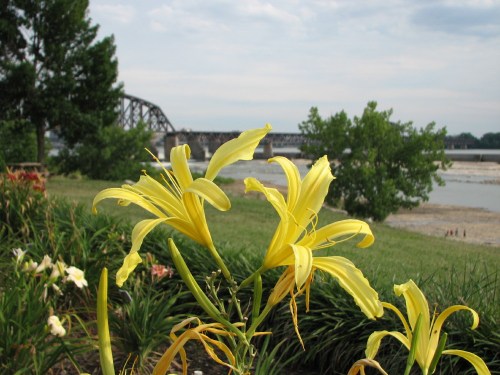
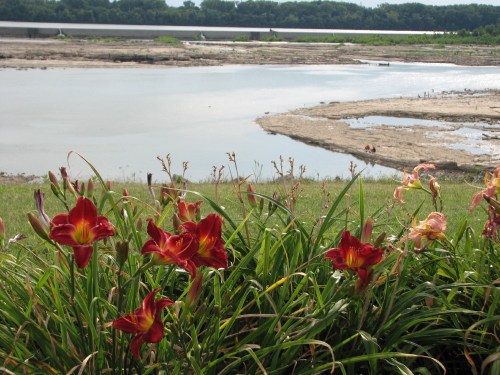
Falls view with daylilies, 7/09

With genetics, the intersection of art and life is about to get really blurry.  As we learn more about the molecular codes that program life, the more tempted we are to experiment.  There is always the specter of eugenics as well and the quest to make people not just better, but superior.  Another possibility is that we may make new varieties of food plants that could feed an overcrowded and starving planet.  As for the question about the flower being a work of art in itself…I’m going to say yes.  I like that art can push the boundaries of what is considered the norm and in the process alert us to  and prepare us for the future.  After Gessert, I can’t look at a typical garden in the same way as I once did without thinking about the issues he raises.

daylilies at the Falls, 7/09

Read Full Post »

mutant toy, 7/09

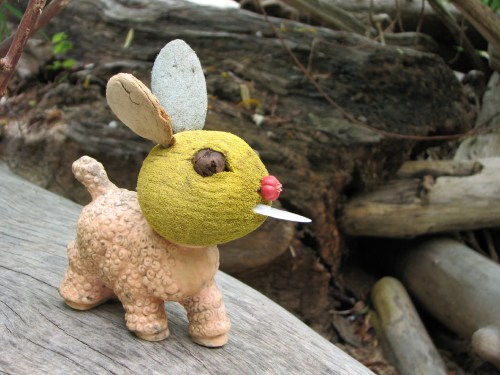
I tried something different the other day at the Falls.  I found the headless body of a plastic toy sheep and decided to improvise a new head for it.  The results are not much different from some of the imagery coming out of Japan.  I found a collapsing, materially fatigued yellow rubber ball and added a few acorns, polystyrene ears, and other bits of plastic and then photographed it in the riverine landscape.  My kids think it’s cute!  Here is another image of it showing the other side.

mutant toy, 7/09

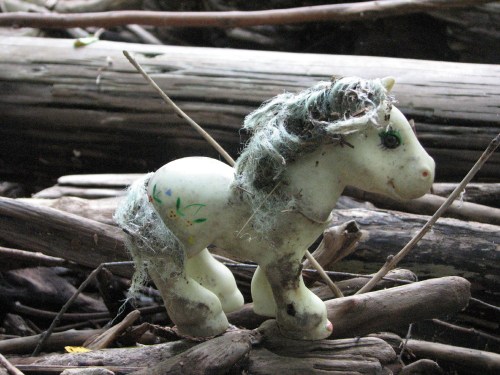
I’m always finding different toys.  Some of which you can see in my Pages collections.  I recently came across two other plastic animals and here are their portraits as the river gave them to me.  I think they work with the mutant bunny as a kind of genre since they depend on non-naturalism for their effectiveness.

plastic pony, 6/09

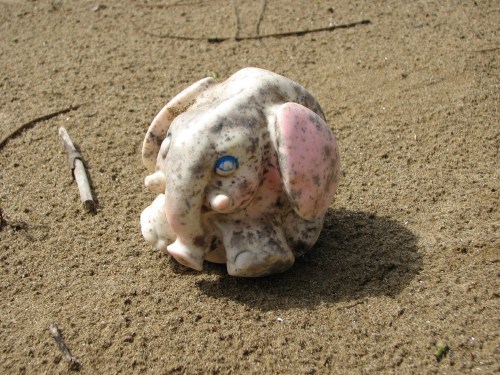
I like that it is difficult to judge scale from these images.  They could be very large or very small.  That ambiguity has been a part of my project from the beginning.  With my other Styrofoam pieces you need to look at what else is in the picture to find clues to judge scale.  To my mind, they are all the size of life.  It’s interesting to see how the internet treats these images since that can be variable as well.  The objects get tumbled by the river, while a similar thing occurs with the images electronically.  Here is a recent plastic pony I found and a blue-eyed pink elephant too!

pink elephant toy, 5/09

Okay, you talked me into it…here is a bonus image!  This was taken during my last outing.  If the Pink Panther were one of those bog bodies found in the peat moss of northern Europe…it might look like this.  I think this was originally a large, plush toy, but the stuffing is gone now.

pink panther?, 7/09

Read Full Post »

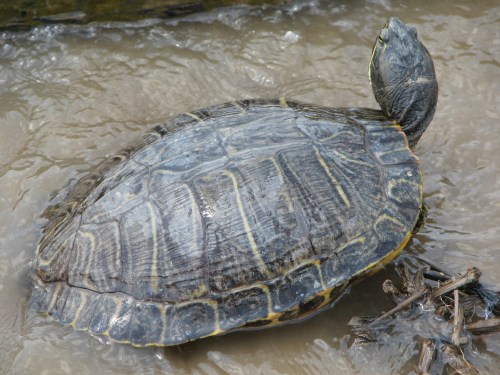
Red-eared Turtle, 6/08

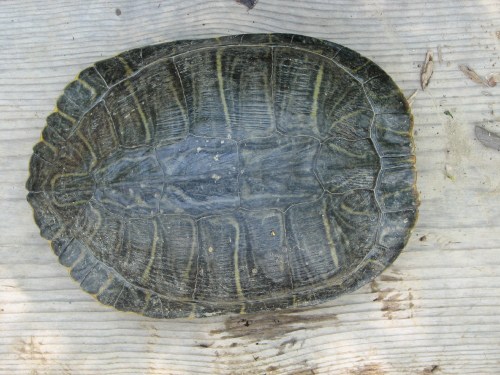
This is a very lucky Red-eared Turtle.  I first came across this old guy more than a week before this picture was taken.  Far from the river I found it stranded among the driftwood.  I thought that was unusual at the time, but dismissed it by saying to myself that the turtle got there without my help and could get away whenever it wanted to.  I turned and left it alone.
Red-eared Turtle, dorsal view, 6/08

Red-eared Turtle, ventral view, 6/08

When I returned to the site much later, I saw the turtle was still there.  It was then I realized that the last bit of flooding had in fact stranded it.  Looking to be in good shape, I picked it up and made these photos.
Russel Athletic Turtle, 6/08

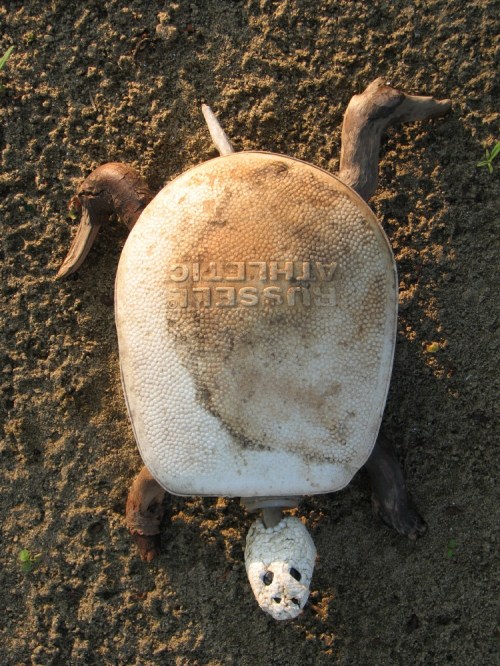
Every now and then I come across some truly one of a kind turtles.  This is the Russell Athletic Turtle.  It’s carapace (the name of the top shell) in this case mimics the padding found in protective pads of football gear.  It’s usually found nearer the trees than the water, although it’s reputed to be a good swimmer when pressed.Russell Athletic Turtle, 6/08


The Russell Athletic Turtle is fond of grazing on the newest tufts of river grass found at the Falls.  It’s geographically limited and so is considered a threatened species worth conserving.
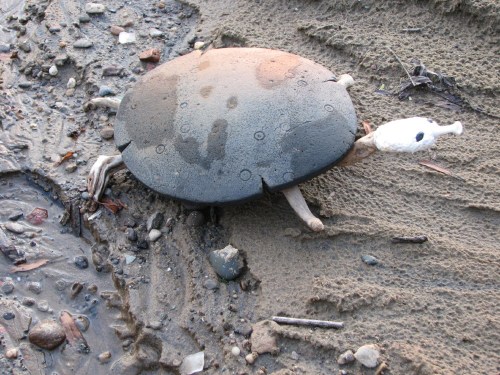
Black Softshell Turtle, 6/08

Black Softshell Turtle, 6/08

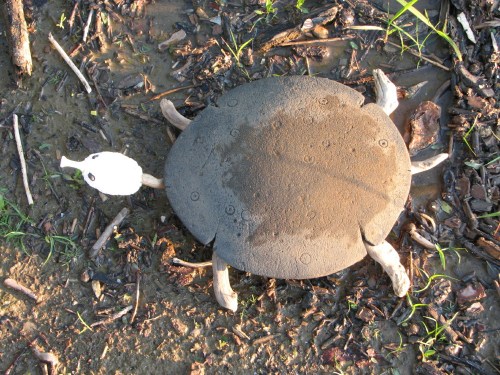
No where else on the planet can you find the spectacular Black Softshell Turtle, except for this park.  The above images are groundbreaking because this exceedingly rare turtle hasn’t been recorded in many years.  These are also in all probability the only known color images.  At the Interpretive Center a few, old grainy images of this softshell turtle are preserved in the library and the museum boasts a partial skeleton in its collection.

Black Softshell Turtle, 6/08

Like other members of the genus Trionyx, the Black Softshell Turtle lays it’s eggs in a sandy nest excavated by the female in a suitable riverbank.  I watched this specimen for several minutes before it returned to the river and hoped that I wasn’t watching the last of its kind slipping beneath the waters.  At least these images will help keep its memory alive. 

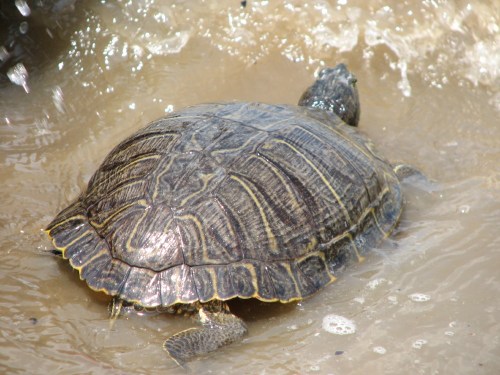
Wondering what happened with the Red-eared Turtle I started this post with?  I carefully picked up the turtle by the edges of its shell, being sure not to get my fingers in harm’s way, and placed it at the river’s edge.  At first, the water washed over the top of his shell and the turtle’s head and legs remained tight within.  Slowly, the water revived this turtle and I watched it disappear into the Ohio River.
Red-eared Turtle, 6/08

Read Full Post »

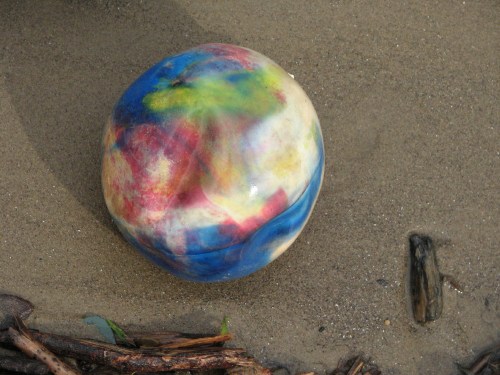
plastic ball, 6/09

Another collection of images has been added to my Pages section.  Check out some of the balls I have come across at the Falls of the Ohio.  This is another in a series of unusual collections of images and objects courtesy of man and the Ohio River.

Read Full Post »

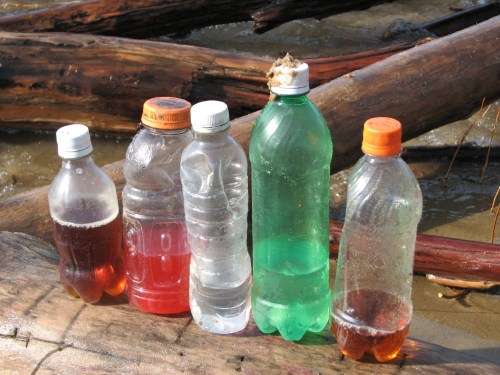
Bottle Collection

I posted a new collection in my pages section.  Comprised of images instead of objects, this “portfolio” features plastic bottles, some with contents, that have washed ashore at the Falls of the Ohio State Park.  This collection documents a family of objects we rarely pay attention to and yet comprises a noticeable addition to the river’s flotsam.

Read Full Post »

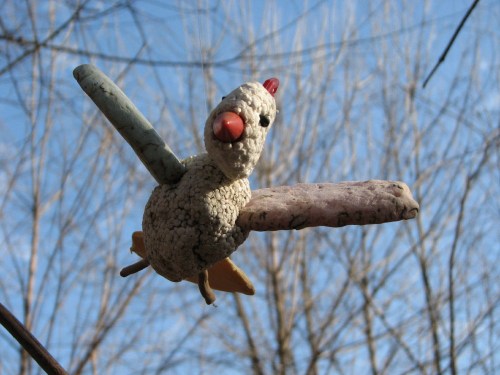
Styro-kingfisher

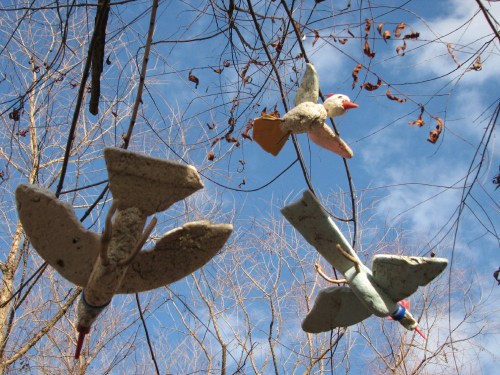
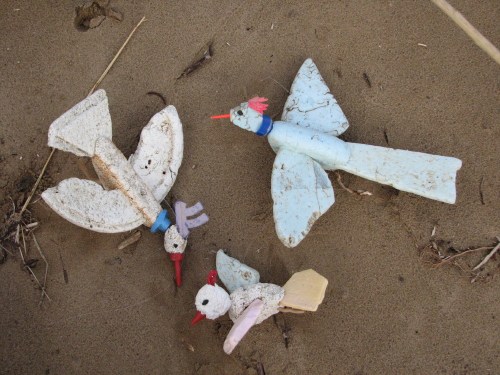
From the archives come these images of faux-birds made at the Falls of the Ohio.  In an earlier post, I had mentioned suspending my birds from waste fishing line to try to create the illusion of a flying bird.  Here are images from one day’s experiment when the wind was blowing a bit more than usual.  I also used a piece of aluminum wire and fashioned eyehooks and s-hooks to do the hanging.  In most of them, the fishing line is really obvious and to my mind…kind of funny in a no-tech sort of way.

Flying Kingfisher

I call this one the “Flying Kingfisher”.  It’s made from Styrofoam, driftwood, coal, and plastic.  The wings are fragments from the lids of minnow buckets used to carry live bait.  The next bird is a Chickadee or something!

Head-on Styro-chickadee

Flying Styro-chickadee

This “Flying Styro-chickadee” was made with my son, Adam’s help.  It now flies from the dining room’s chandelier in a small flock of other birds.

Three Flying Styro-birds

As a boy, I made many plastic model airplanes that are out of fashion now.  You know…the ones where you had to read the instructions and carefully glue the pieces together.  The Styro-birds have the same feel to me as when I made those plastic models.  I bet I made at least one kit representing just about every type of aircraft flown in both the world wars.  I also remember painting them to look as authentic as possible.   These birds, however, are as is and made from junk I collected along the Ohio River.

Styro-birds on the sand

Read Full Post »
Floating tire

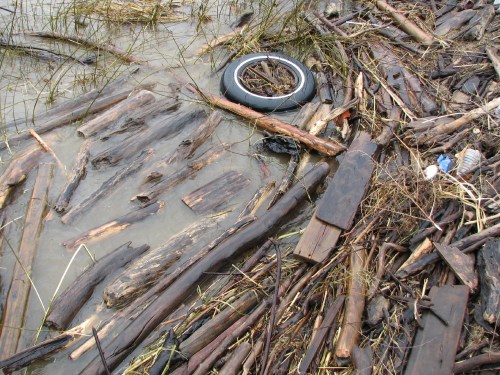
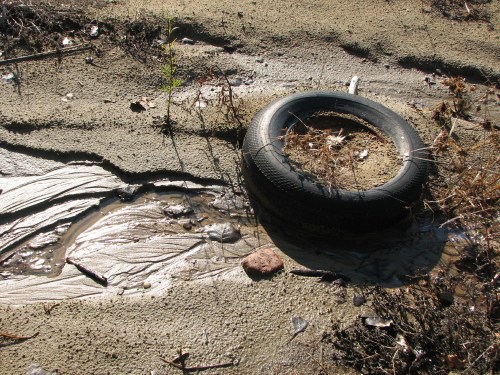
What would a river clean-up be without discarded automotive tires?  They seem as ubiquitous as the driftwood in the water.  You get so used to seeing them that in effect…you don’t see them anymore. 

Tire and driftwood

That’s where having a camera can be of assistance…it breaks that circuit that prevents us from remembering that these objects should never find a home here. 

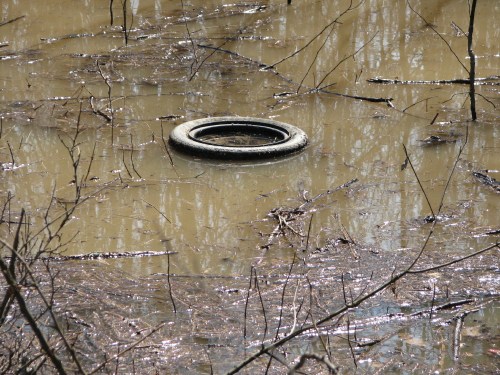
Circle in the water

Finding a floating circle in the water always grabs my attention.  It’s no longer just a tire, but the pattern of perfection, the symbol of civilization.

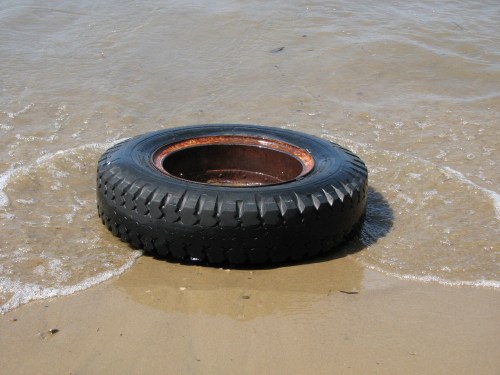
Beached tire

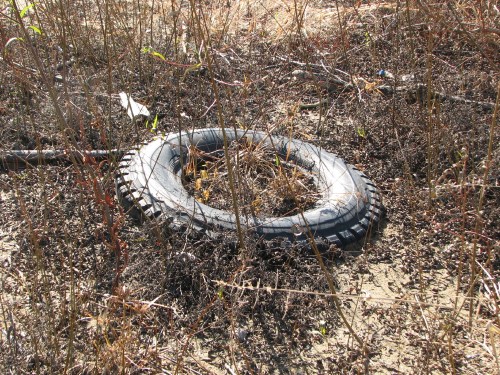
How did we become so indifferent towards them?  Isn’t the wheel the same great device it was when it was first invented?  It was once a big deal…is it no less marvelous and worthy of being disposed of properly?

Discarded tire

One of the nice things about being a parent of young children is that you can remember some of the wonder of the world through their experiences.

Sinking tire

I guess that’s also what makes photography so effective a medium…it gives the viewer an opportunity in a split second, to experience vicariously, what the photographer saw.

Sunken tire in the sand

I worry as a parent that we won’t leave this place in as good a shape as we found it.  It’s become a vicious cycle that needs fixing.

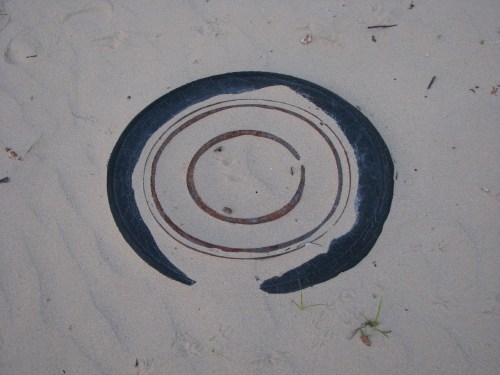
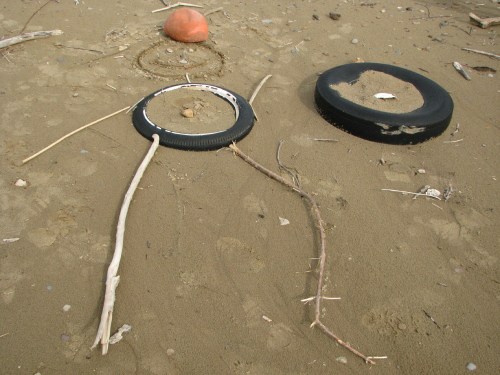
Tire Drawing

I don’t know if “art” can be the tool to make the repair?  But if we can turn the ordinary into the extraordinary, which art can do, we might just recapture some of the lost wonder in the world.

Read Full Post »
« Newer Posts