Feeds:
Posts
Comments

Posts Tagged ‘creativity’

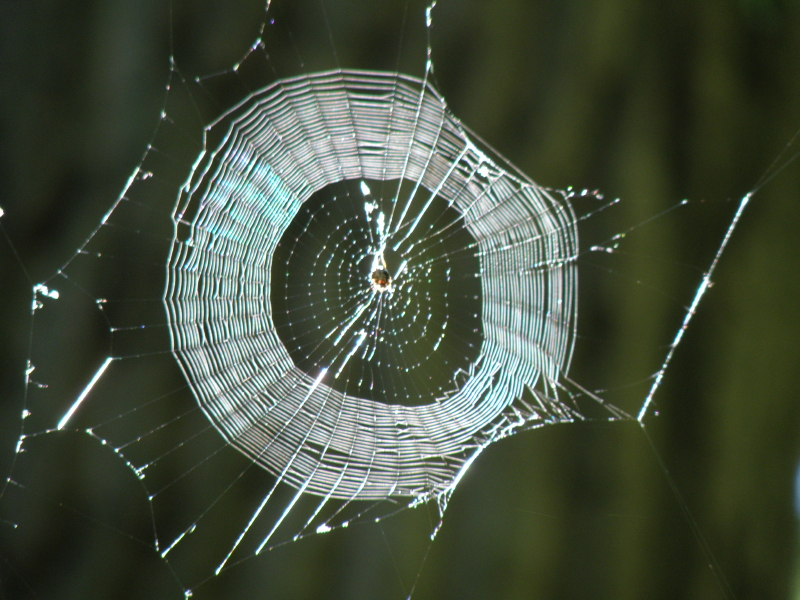
spider's web in the morning light, Falls of the Ohio, Aug. 2013The Falls of the Ohio is a special place in the history of life.  From the ancient marine creatures whose remains are preserved in limestone dating back more than 370 million years a go to the contemporary creatures that inhabit the park today…it is my goal to celebrate life here in all its diversity.  I’m going to use this post to present images of recent finds.  I was exploring the western side of this state park recently and saw this spider’s web high off the ground catching the early morning light.  I’m sure its architect would prefer a buggy meal over the photons it has snared instead!  Looking at this web image, I’m struck by how similar this  looks to the cross-section of a tree.  Can you see that too with the outermost silk rings resembling a tree’s growth rings?  In the Purple Loosestrife stands, butterflies were having a nectar feast and I presented many images of them in a previous post.  Here’s one more to add to that portfolio.  I have seen this butterfly species wind up on the spider’s menu before.
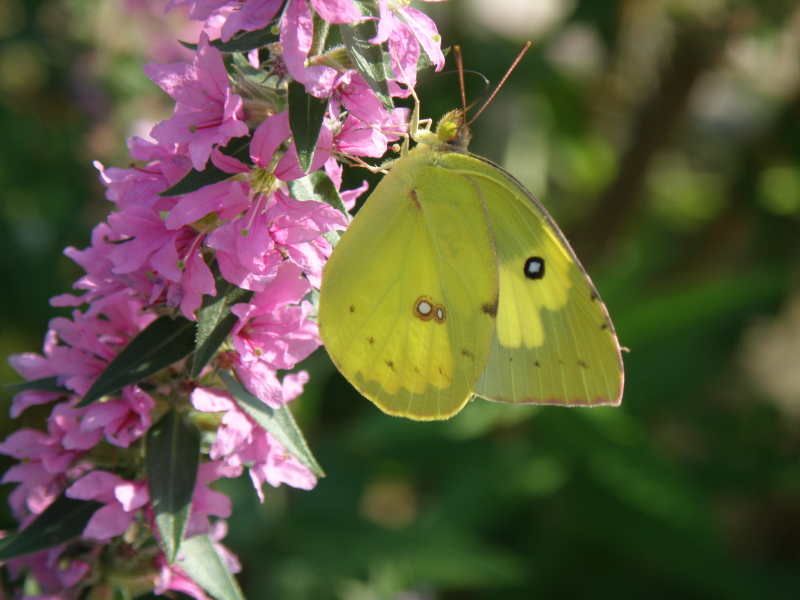
Dog Face Butterfly on Purple Loosestrife, Falls of the Ohio, late Aug. 2013

This is the Dog Face Butterfly (Colias cestonia ).  It is often difficult to photograph this butterfly in the wild with its wings open because this species prefers to feed with its wings held together.  Through the strong light passing through the forewings, you can get the suggestion of a dog’s head in profile.  Imagine the black rimmed spot as the “dog’s eye” with its muzzle pointing down.  When open, the dark interior margins of the wings are a warm black color.  I was exploring the interstitial sandy zone between the river and the willow woods…when I came across this interesting amphibian.
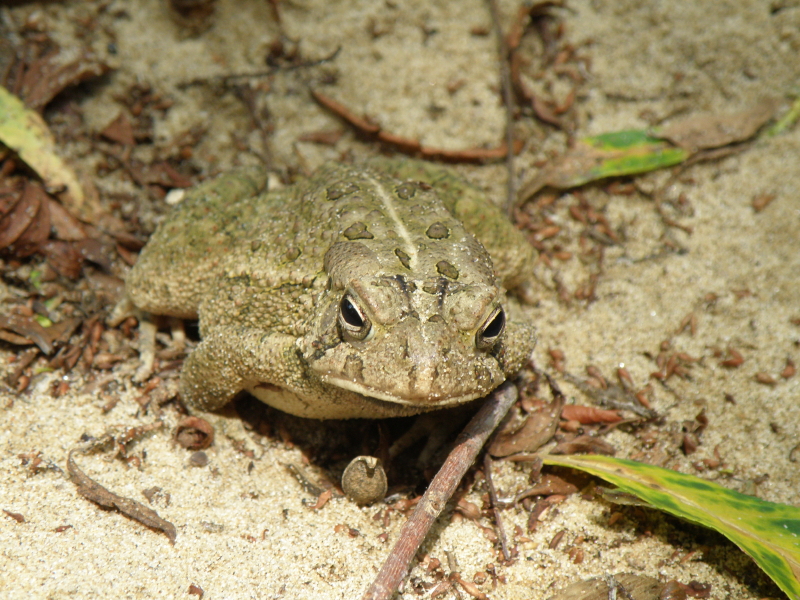
The American Toad at the Falls of the Ohio, August 2013

American Toad, dorsal view, Falls of the Ohio, Aug. 2013

If this American Toad ( Bufo americanus ) had not moved…I doubt I would have seen it.  It’s coloration is wonderfully cryptic easily blending into the sand.  The toad was busy hunting among the debris and driftwood for any insects and invertebrates it could find.  I don’t encounter many amphibians out here…so finding a common toad is a noteworthy event.  Let’s move up the evolutionary ladder a bit.  I was busy working on one of my Styrofoam sculptures at my outdoor studio when I felt I was being watched.  When I lifted my eyes up from my artwork…I found myself looking eye to eye with this critter.

Woodchuck or groundhog at the Falls of the Ohio, Aug. 2013

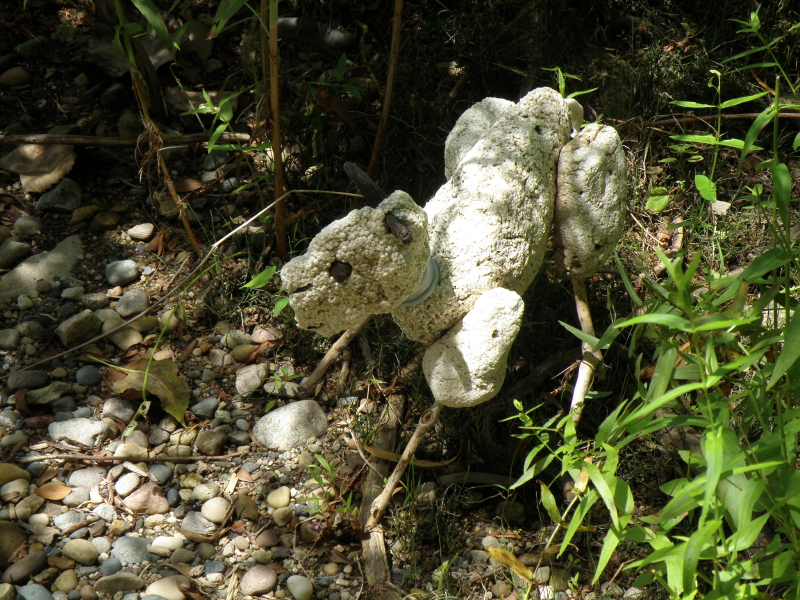
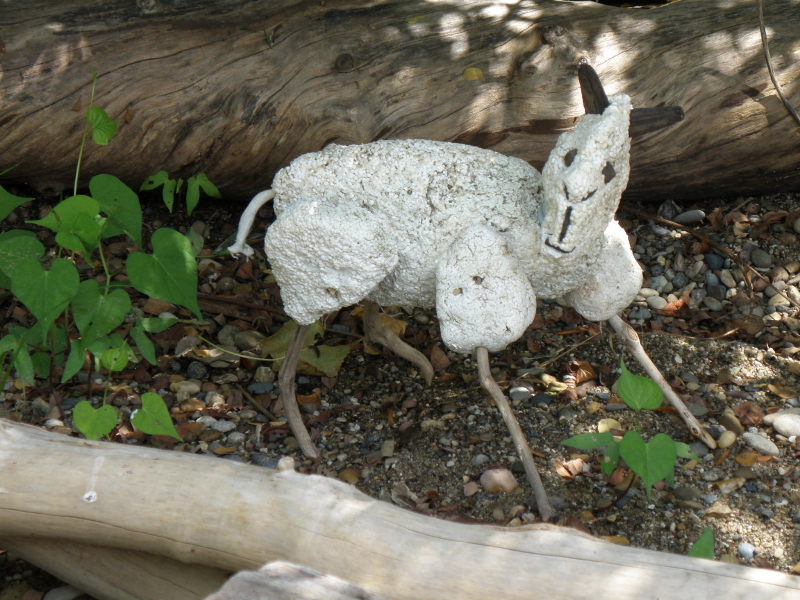
This is the common Groundhog or Woodchuck ( Marmota monax ).  As its scientific name suggests, this large rodent is a member of the marmot family.  Woodchucks are successfully established at the Falls and I encounter them often.  They are fast diggers and live in an extensive system of burrows.  Woodchucks usually don’t stray too far away from the entrances to their burrows.  Succulent greens are the preferred foods.  This particular woodchuck regarding me is a young individual and may be seeking territory of its own?  Usually, I don’t see them this close to the river.  I did have an interesting recent encounter with a very different animal in the western section of the Falls of the Ohio State Park.  Have you ever heard of an animal called the Camelope, (Antilocapra fallsei )?  It is very rarely seen.  The flora and fauna at the Falls can be roughly divided between forms that are “natural” and “unnatural”.  The spider, butterfly, toad, and woodchuck fit in the natural fauna category, while the Camelope is definitely on the unnatural fauna side of life and may represent evolution at an accelerated pace?  The many stresses to the environment and its myriad ecosystems have required a dramatic response and creatures like the Camelope may be nature’s way of responding to these changes?  I’m not a trained scientist, but that is my educated guess.  Discovering and documenting these recent life forms has become a passion of mine.  Anyway, let’s look at a Camelope.  Let’s start with an image of its head.
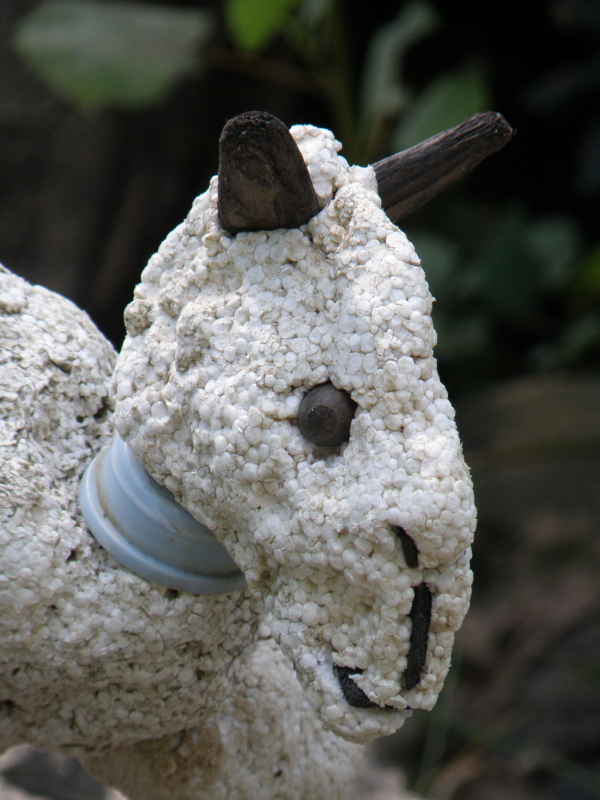
Camelope, detail of head, August 2013

It’s called a Camelope because its head generally resembles that of a camel’s.  This is a browsing animal and accepts a wide range of vegetation growing along the river.  It has dark eyes that are always nervously looking around for potential predators.  This park is also home to Feralocitors that prey upon Camelopes.  This particular species also has an acute sense of smell.
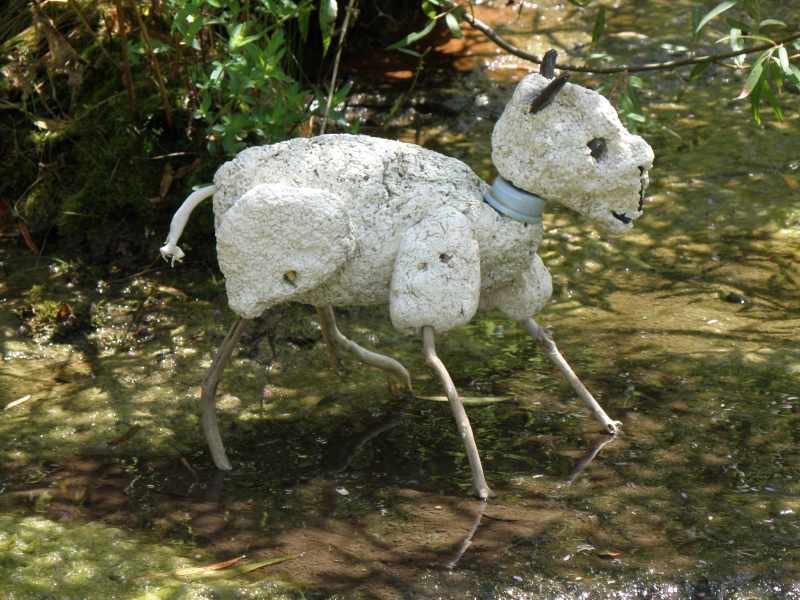
Camelope at the Falls of the Ohio, Aug. 2013

Camelope at the Falls of the Ohio, Aug. 2013

I came across this Camelope in a more isolated section of the park.  It was hiding among the stands of loosestrife and drinking water from the springs that flow downhill and into the river.  It is ever alert and very nimble with quick feet and seemingly at home climbing on rocks or navigating through dense vegetation.  Their bodies resemble that of deer or antelopes…hence Camelope.
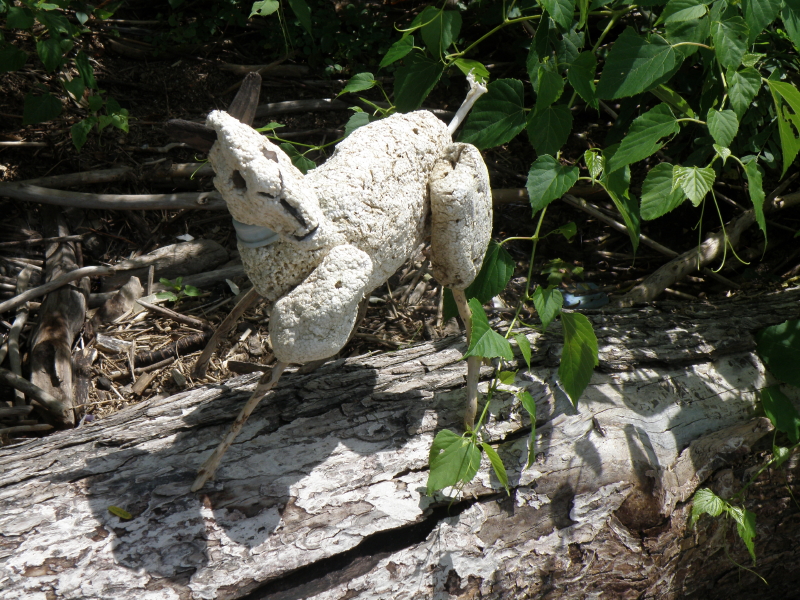
Camelope reacting to an unfamiliar sound, Aug. 2013

Camelope at the Falls of the Ohio, Aug. 2013

Since it is a relatively new animal…not very much is known about it.  I was able to conceal my presence long enough to manage these images.  I either moved or the wind shifted, but anyway my presence was detected and with a quick bound, the Camelope disappeared into the brush.  I hope I may come across it again and learn more about its secretive life.  Regardless, I will keep my eyes open and my camera at the ready for any new “unnatural” life forms I discover.  It occurred to me on my way home that my Falls of the Ohio Project is now officially ten years old!  I started exploring this fascinating park as the Artist at Exit 0 in August 2003 when the bicentennial of the Lewis and Clark Expedition was being celebrated.  Reading early 19th century accounts of the natural abundance of our country and this place in particular made me wistful for a world that no longer exists.  Two hundred years later…that process continues and no doubt will two hundred years from now.  I have often thought of this riverblog as a historical document as relevant today as Lewis and Clark’s notebooks and journals were back when this country was first being described.  I hope this park and its remarkable history will continue to inspire people for a very long time.  In closing, I would like to present an image of Canada Geese on the water near the fossil beds.  Their coloration gives them in my mind’s eye a formal quality and lends dignity to the landscape.  Until next time…from the Falls of the Ohio.
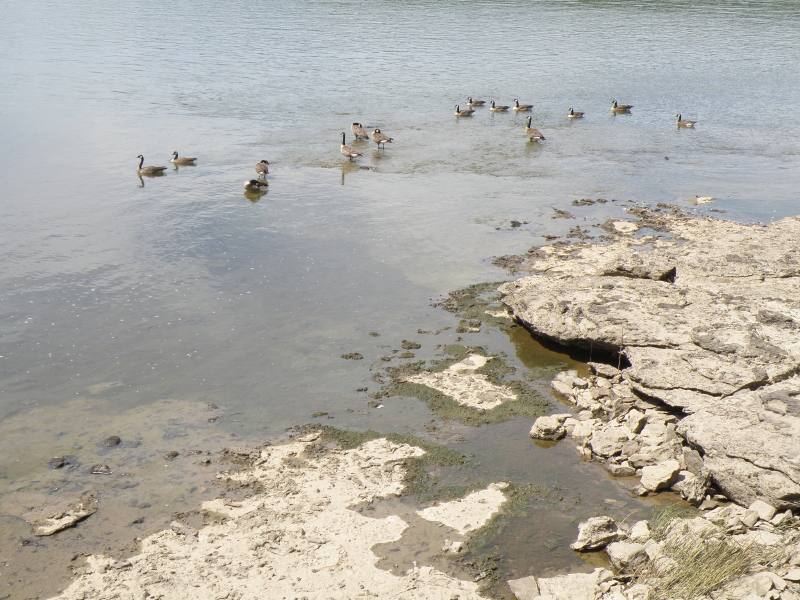
Canada Geese and fossil rock at the Falls of the Ohio, Aug. 2013

Read Full Post »

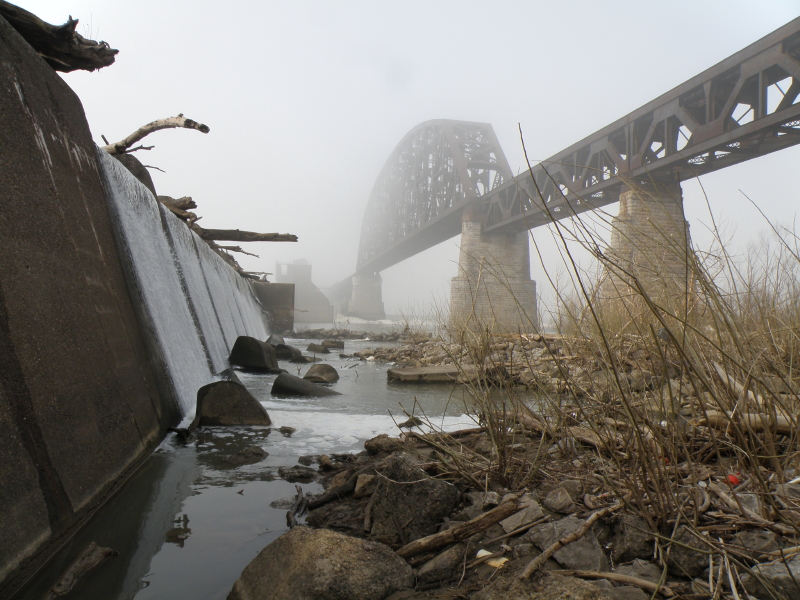
Fog at the Falls of the Ohio, April 2013

Fog is actually common on the Ohio River, but looking through my images, I’m surprised by how few fog pictures I have taken here.  On my last foray to the Falls, the day began extremely foggy like moving within a cloud.  Visibility was limited.  The railroad bridge was completely obscured, but as the sun rose and the temperature became warmer the fog dissipated quickly.  It was another magical moment of transformation as the receding water-cloud revealed the driftwood bones of the park.

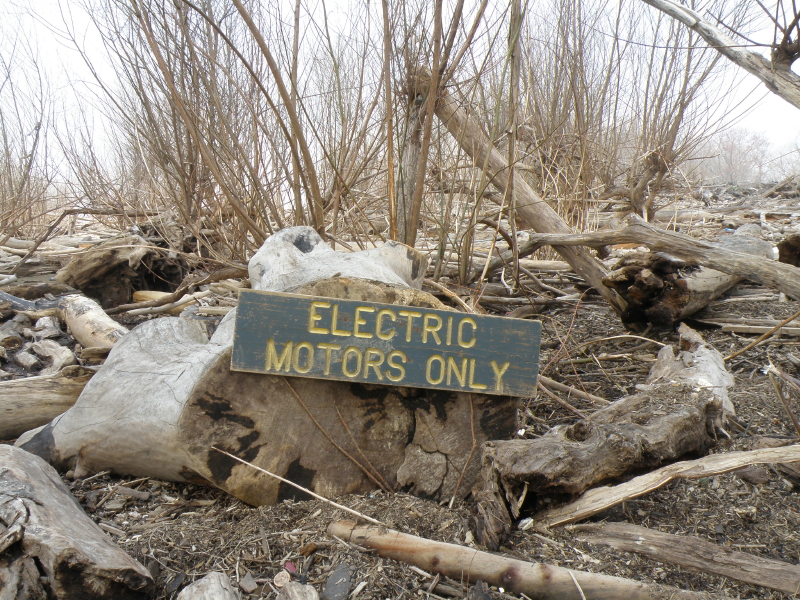
Electric Motors Only sign at the Falls, April 2013

Walking to my outdoor atelier, I passed by this unusual sight.  At first, I thought the large tree stump was a part of this sign, but upon inspection, saw that a single rusty nail attached this sign to the wood.  There is no way this sign could survive the river secured so loosely.  Someone before me found this sign and stuck it on the stump up for grabs in true river junk fashion.  Since I collect signs from the river…this was perfect and I welcomed the new addition to my collection!  After removing the sign from the stump I understood why its original discoverer left it behind.  The sign was on a heavy, thick board that had been routed and painted green with yellow letters.  I stashed the sign under some debris and picked it back up on my way home.  As you can imagine, my wife was thrilled to see it like she is with all the other junk I haul out of here.  I liked the sign’s message which is ecological in its own way.  I wonder where it came from and what kind of electric motors is it referring to…perhaps electric golf carts?  Navigating through the dense driftwood, I made my way to the river’s edge.  Waves were lapping the shoreline and there were other surprises to come.

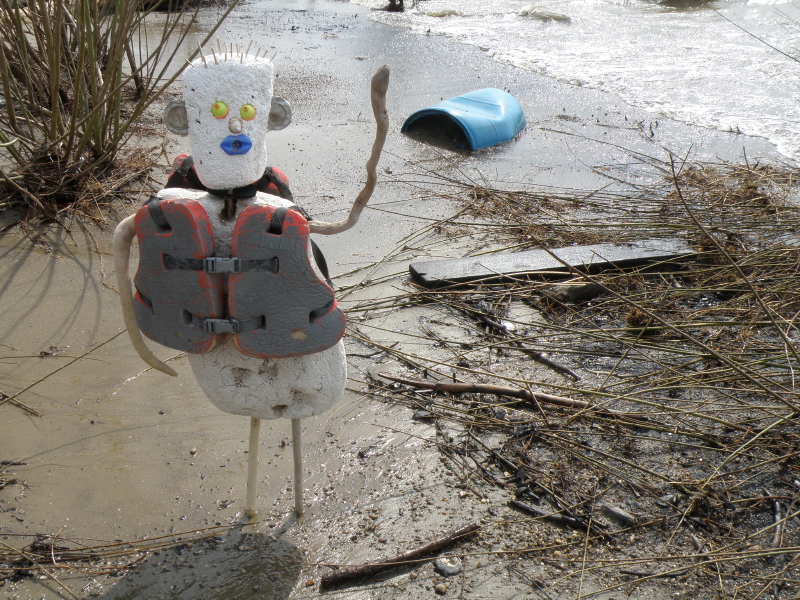
Blue-lipped figure with life preserver on, April 2013

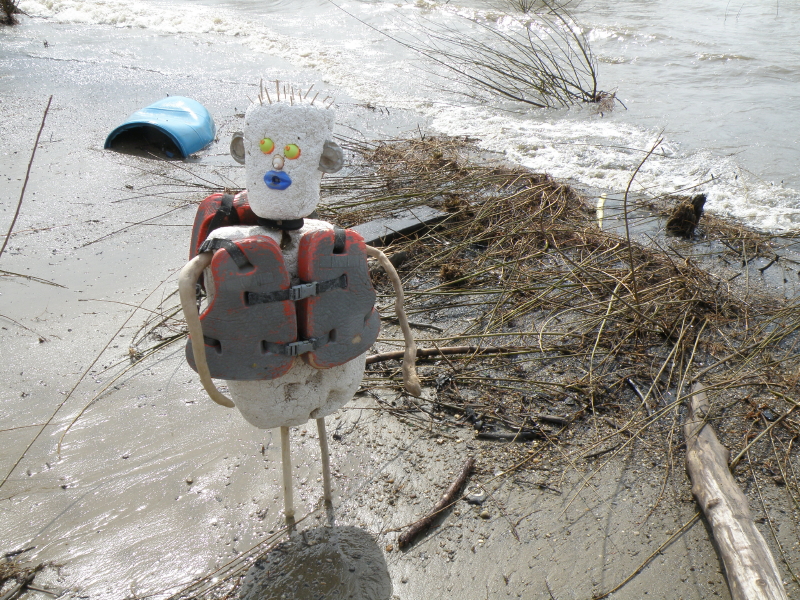
Blue-lipped figure with flotation device, April 2013

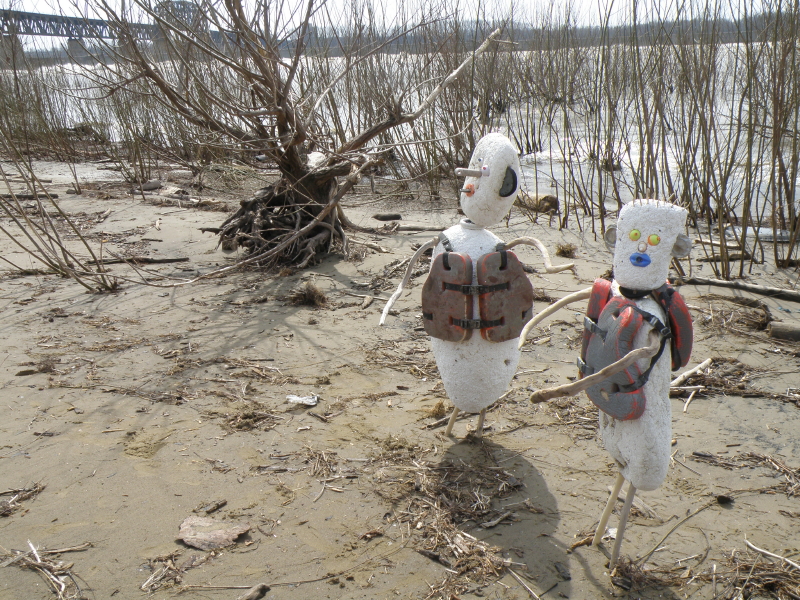
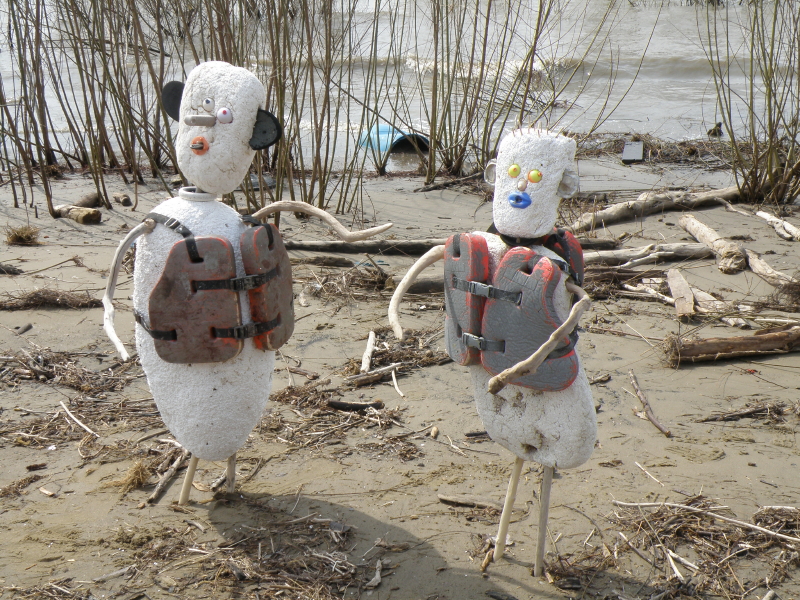
This is the moment I met the first of the Flood Brothers.  I had heard of them before and I was pleased to finally get to meet one.  They are called the Flood Brothers because in their own “Chicken Little” way instead of the sky falling…they are rumored to believe the world is in imminent danger of being inundated.  For this reason they wear life jackets and flotation devices everywhere they venture particularly along the river.  They are living legends in this part of the world.

Portrait of F.B. 1, April 2013

This is a close-up portrait of Flood Brother #1…henceforth identified as F.B.1.  He has blue lips like he has been out in the cold too long.  His eyes have this jaundiced quality to them and they are slightly asymmetrical as well.  The ears stick out some and he has spiked hair.  Aside from looking goofy…he is a friendly enough guy and hailed me upon sighting me.  I told him it was a pleasure to meet him and was his brother around too?  As it turns out…Flood Brother #2 was not far away and after walking a short distance along the shoreline, we ran into him as well.

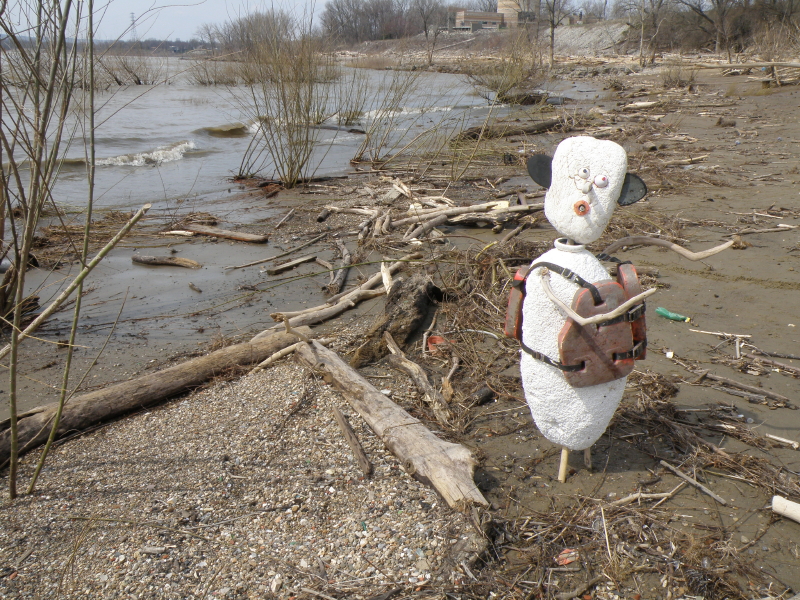
Flood Brother # 2, April 2013

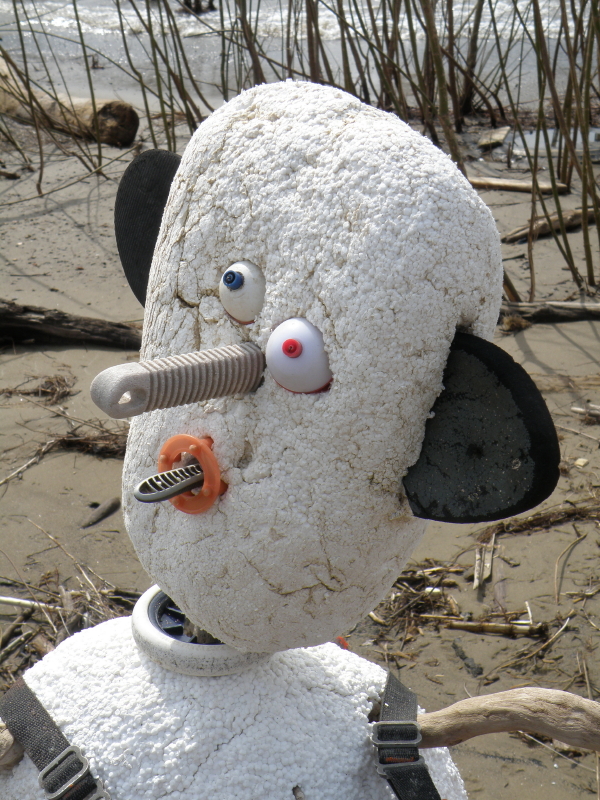
Portrait of Flood Brother #2, April 2013

Flood Brother #2 or F.B.2 is the larger and older of the two.  Like his smaller brother he wears a flotation device every where he travels along the river.  You can tell they are brothers because they share some physical characteristics such as large ears and mismatched eyes which are more pronounced in the older brother.  As it turns out, he is also the more nervous of the pair.

The Flood Brothers at the Falls of the Ohio, April 2013

The Flood Brothers, April 2013

I asked them if it was true that they believe the world would be destroyed in a great cataclysmic flood?  For argument’s sake F.B.2 qualified things by saying that more unusual events had happened during the Earth’s long history.  As it turned out, they were more concerned about the quality and quantity of fresh water.  Climate change is rewriting things and there is just so much more “free” water in the system that formerly was locked up as ice.  That energy is changing the weather patterns and redistributing water across the globe.  Some places were now getting too much and other places not enough.  And yes the potential to redraw the world’s coastlines also existed.  Whether all this would happen overnight or over the course of many years seemed irrelevant to the pair.  The life jackets were just a necessary precaution to them because they were conducting their research along the river in all its many moods and it just seemed a logical safety thing to do.  The pair was visiting the Falls of the Ohio and inspecting the park for water-born plastic of which there was plenty to see. As the brothers told me…this plastic has a very good chance of making it into the oceans where it has effects of its own.  I didn’t have the heart to tell them that they were already preaching to the converted.  Instead, I invited them to my studio under the willow trees to rest and talk further and they accepted my invitation.  My site was just a short distance away.

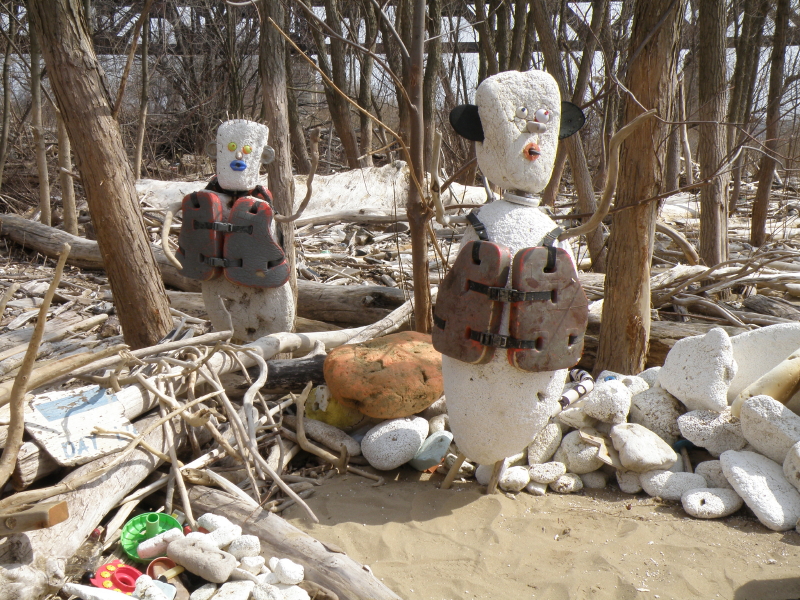
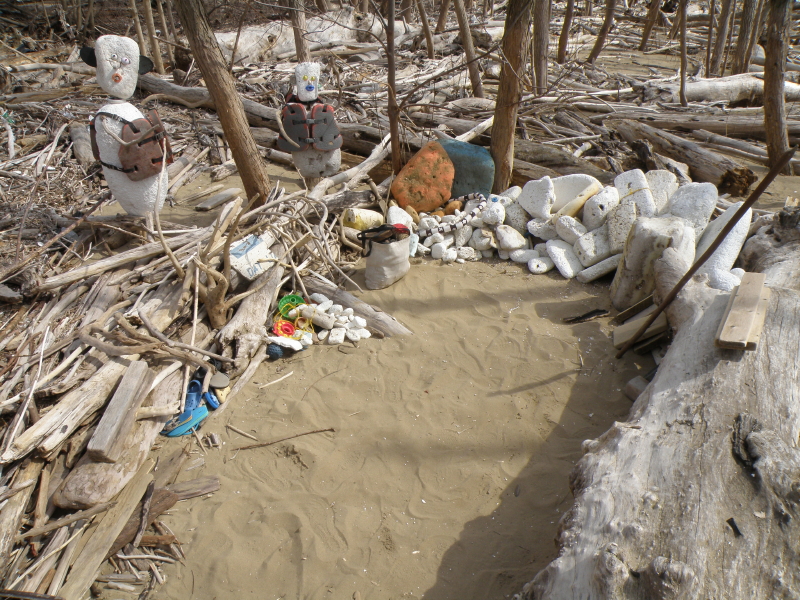
The Flood Brothers at my outdoor studio, April 2013

The Flood Brothers at my outdoor studio, April 2013

Looking around the Flood Brothers could see that I was interested in many of the same concerns that they had and wasn’t it all so absurd after all?  I told them my story and that all the stuff they saw in my little area came from the immediate river.  I mentioned that I try to find creative ways to use this junk and to tell the story about a place I find to be very special.  They asked me if I happened to see along the way a nice sign they had attached to a stump?  I confessed that I had and wanted to repurpose it as part of my sign collection.  The Flood Brothers just smiled and said I could have it.  After visiting for a while, it was time for me to go home.  I told the brothers they were welcome to hang out in my site and perhaps I will see them here again?  I liked them as characters.  With one last look back I saw F.B. 1 waving good-bye to me.  I always have an interesting day at the Falls of the Ohio.
F.B.1 at my studio, April 2013

This story marks my four-year anniversary on WordPress .  Hard to believe the time has flown by so quickly.  Thanks for tagging along!!

Read Full Post »

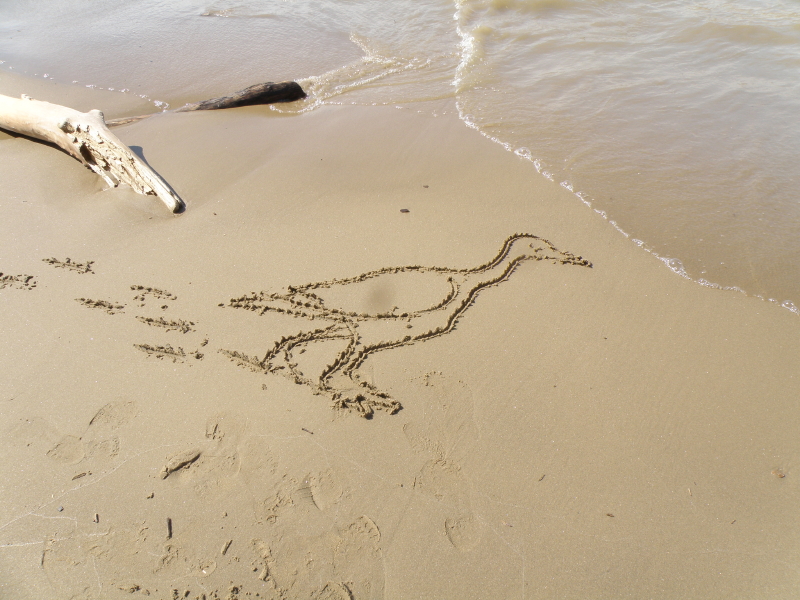
walking goose drawing in sand, March 2013

I come to the river because I like the sound of the water.  It does more than act upon the sand and driftwood here.  After hanging out at the Falls of the Ohio I feel relaxed because the rhythm of the water is also the rhythm of nature.  The waves that move back and forth slow my own internal sense of timing and puts me in sync with the universe.  The work-a-day life begins to lift away and a calm seeps in.  I don’t even need to be aware of the sound.  I know it is there and I trust it.  This restorative quality of water is not to be underestimated in this fast-paced, multitasking world and it is free if you are open to accepting its magic.

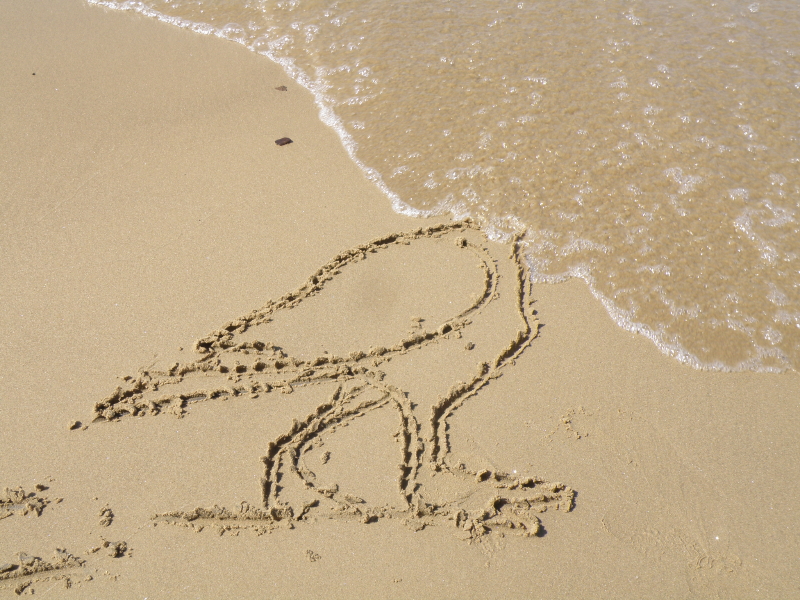
river erasing sand drawing, March 2013

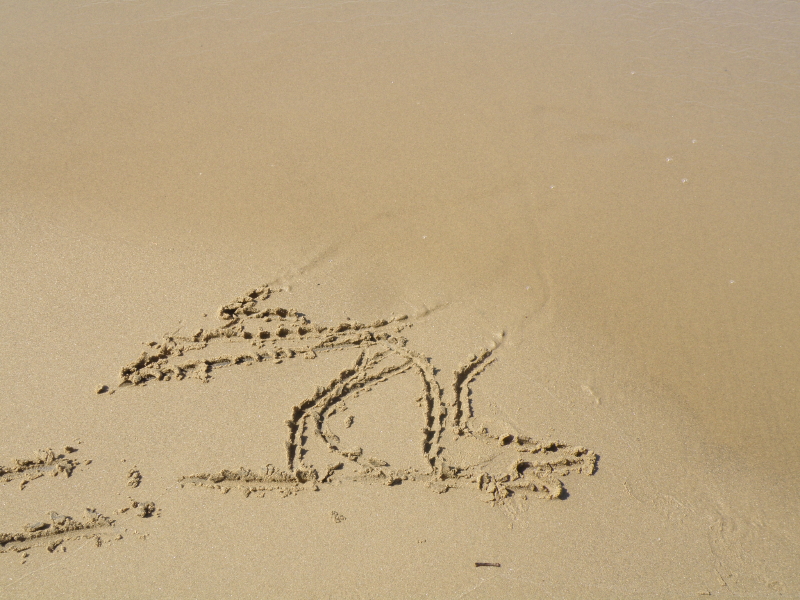
partly erased sand drawing, March 2013

Spring is late in arriving this year.  It’s been an up and down cycle of mostly cool to cold temperatures.  Also, it seems that the river has been a little higher for a bit longer than I remember over the past several years.  2012 was positively balmy compared to this one.  It’s amazing how much difference a year can make .  Today is nice and the sun is shining and I get an early start on the day.

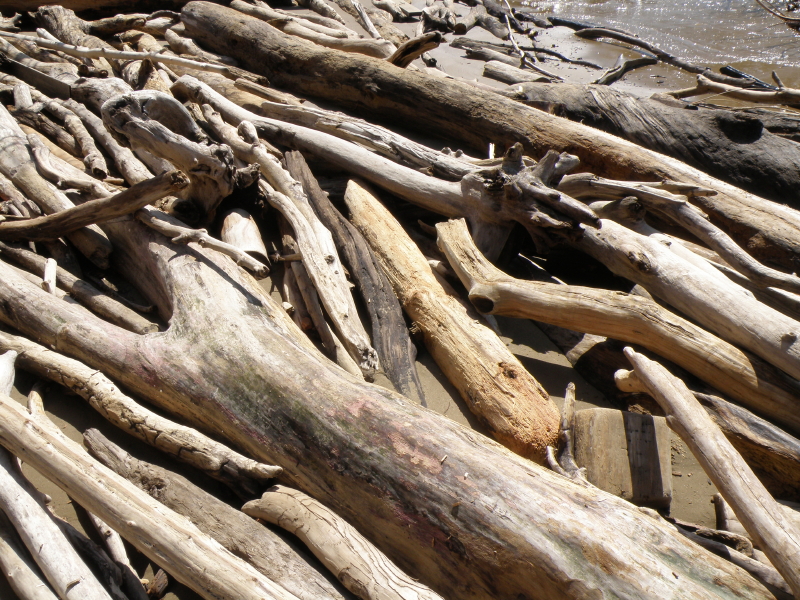
detail of driftwood, March 2013

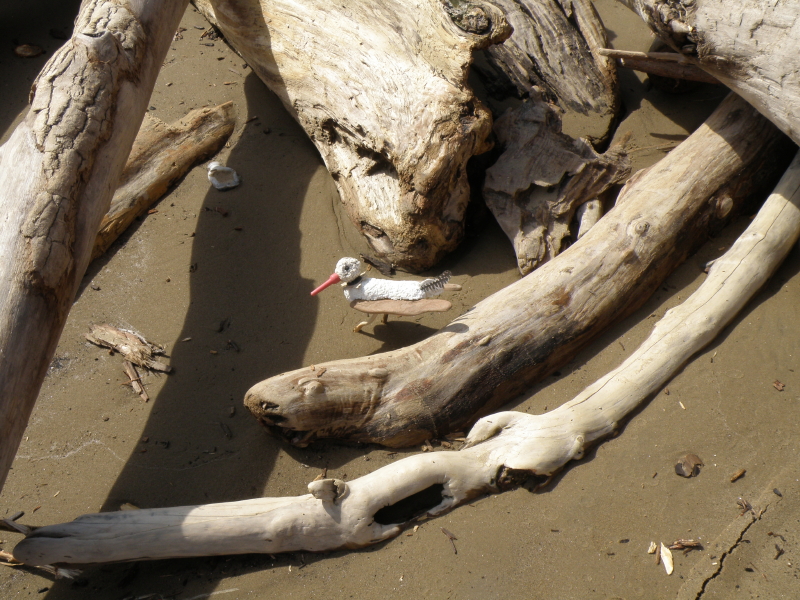
Currently, there is plenty of driftwood lining the riverbank.  By studying how the driftwood was deposited, I get a sense for the water and how high it rose over the land.  Since this is Spring…I’m also on the lookout for seldom seen birds that are traveling through our area.  On my last outing, I was walking over the lines of driftwood when I spotted an unusual shorebird.  I managed a few images of it and I would like to share those with you now.  It was right in the middle of the driftwood and if it hadn’t moved…I might have gone in a different direction and missed it.  I live for these moments.

Great Lakes Oystercatcher, March 2013

head of Great Lakes Oystercatcher, March 2013

This is the increasingly rare Great Lakes Oystercatcher, (Haematopus polystyrenus) as seen at the Falls of the Ohio State Park.  It has a large red bill like the two other oystercatcher species that live along our country’s marine coastlines.  Unlike them, this bird is strictly Midwestern and prefers fresh water wetlands, creeks, streams, and rivers.  The large bill is used to pry open the shells of fresh water clams and mollusks…although it is known to take crustaceans and other invertebrates upon opportunity.

Great Lakes Oystercatcher, March 2013

Great Lakes Oystercatcher, March 2013

The reason this bird is becoming scarce has everything to do with it losing its main food source.  The Tennessee and Ohio River Valleys are the world’s epicenter for fresh water mollusk diversity which is a little known fact.  Unfortunately, because of the many changes that have occurred with our rivers, these clams have become our most endangered animals with many species having become extinct already.  These clams are fascinating in their own right and have complex life cycles.  Wherever you find them is usually a good indicator of the quality of the water.  The Great Lakes Oystercatcher won’t find much in the way of its preferred food at the Falls.  The original clam diversity is missing and these days you are more likely to encounter Zebra Mussels or Asiatic Clams and both are well-established, invasive, nonnative species.

Great Lakes Oystercatcher, March 2013

Great Lakes Oystercatcher looking over its shoulder, March 2013

I was delighted by this almost comical bird which is rarely observed in this park.  It went about its business examining the driftwood and probing the sand for morsels of food.  I also watched it fly to the water’s edge and it was intent on checking out what the river was washing ashore.  The whole encounter lasted about 20 minutes before the bird flew off for parts unknown.  Satisfied with the day, I gathered my collecting bag and headed home.

The city of Louisville as seen from the Falls of the Ohio, March 2013

Read Full Post »

Duct tape ball in situ at the Falls of the Ohio

At first it looked like any other ball among the wood chips and I almost passed it by.  After all, balls are the most common toy that I find at the Falls of the Ohio State Park.  But something told me to look more closely at this one and that’s when I noticed the network of filaments that were eroding away on the surface of this silvery sphere.  Picking it up, I then realized I was holding something different and to my mind and eye a bit more fascinating too.  Yes, it is a ball, but one made from duct tape!

handmade ball collection

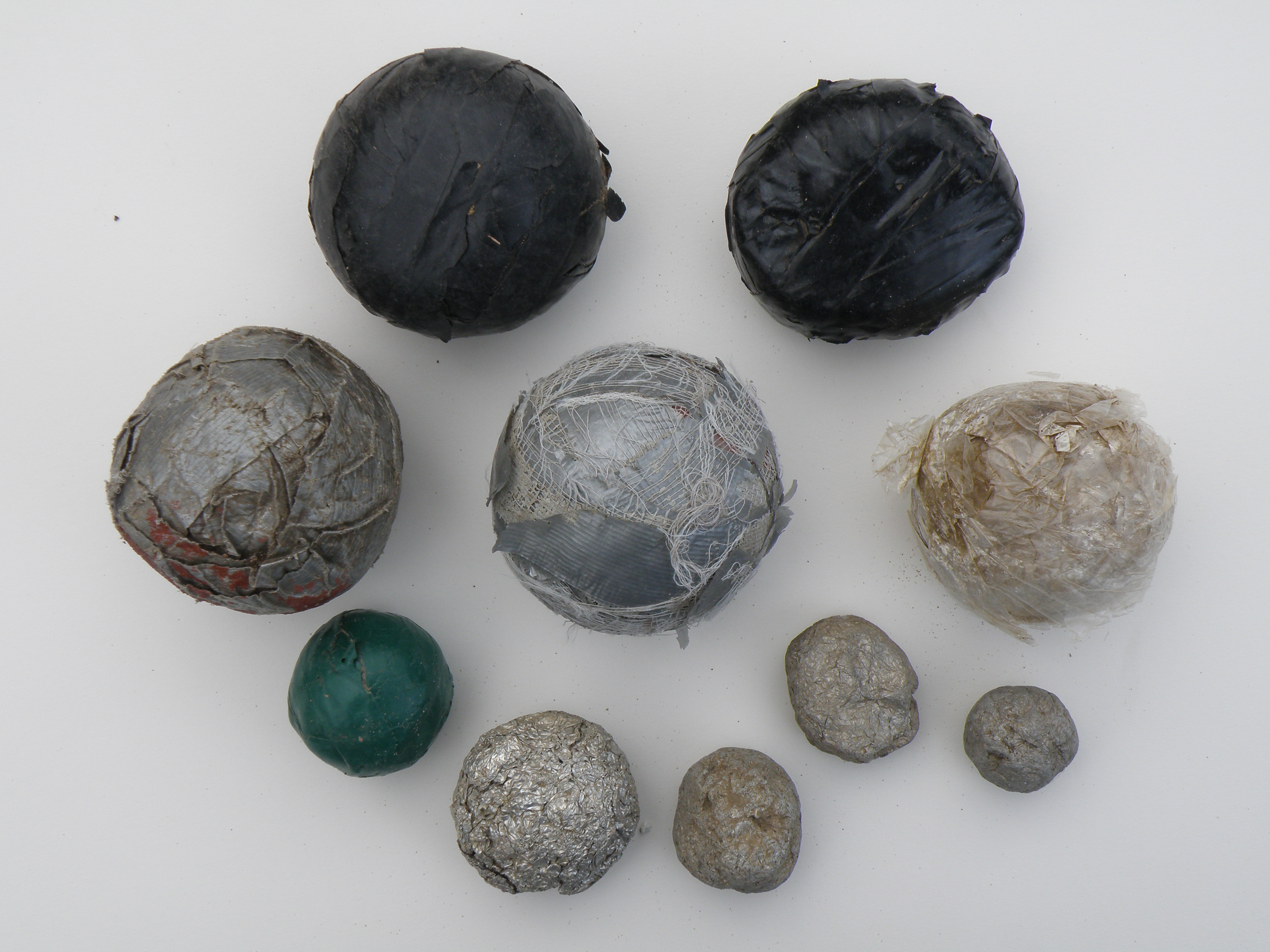
Over the years I have found several other handmade balls made from different materials and they always elicit wonder in me as artifacts.  There is something in the human need to create form from formlessness that is at the root of creativity and can be seen in this eccentric collection.  I think this can happen reflexively too without deep thought being involved. The largest of these balls would fit comfortably in the palm of your hand and is slightly smaller than an American baseball.  Since most of them are made from various tapes…I’m guessing they are the waste products of work.  What began as something relatively flat gets transformed by the mind and hand into a fully satisfying three-dimensional object that you can grasp, throw, or roll.  For me, there is something appealing art-like in these objects which began life as one thing and by shifting its original purpose and function becomes something entirely different.

two found duct tape balls

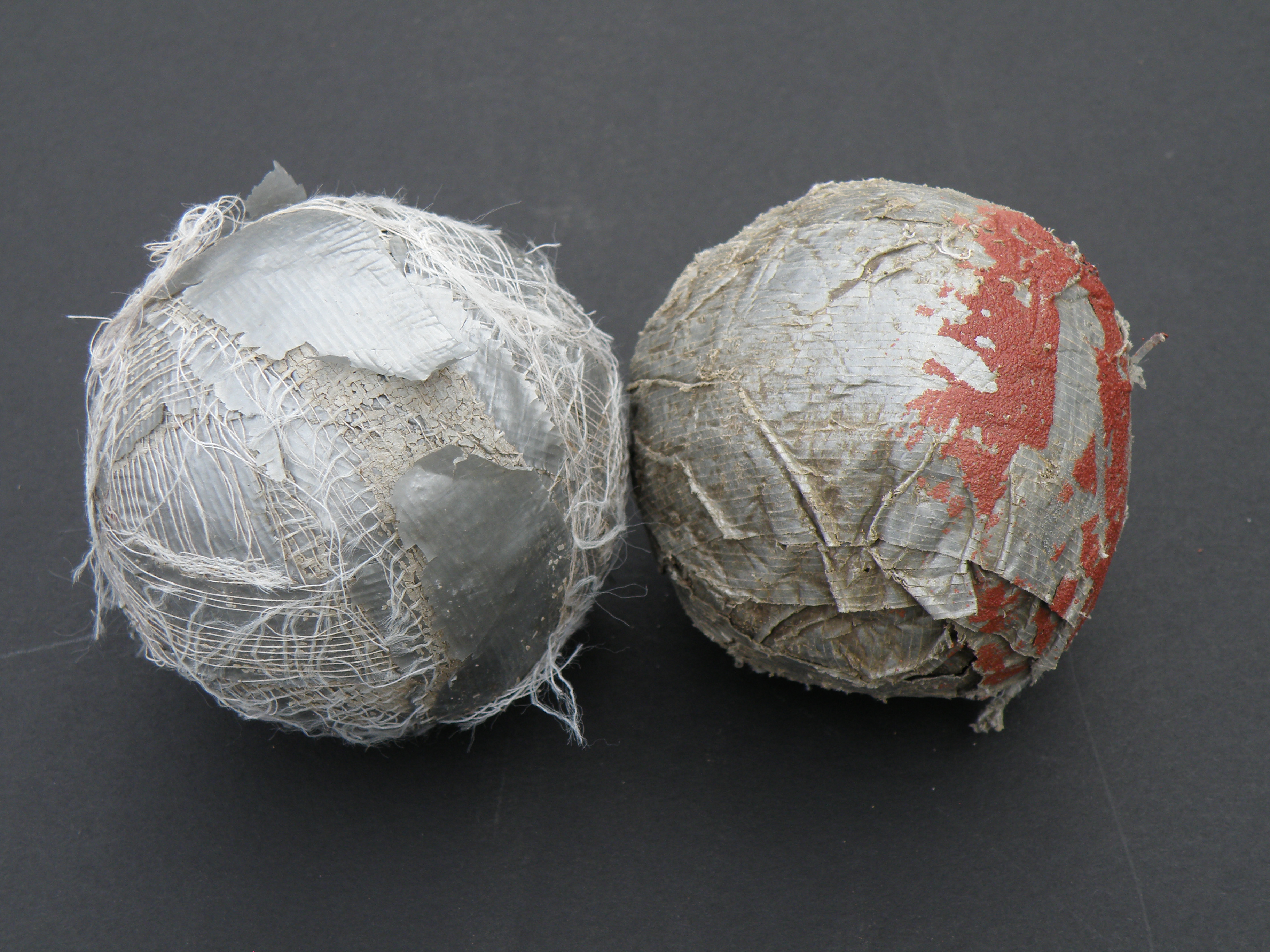
Here are two duct tape balls I have found by the river.  The one on the left is pictured on the wood chips and its partner has vestiges of dried paint or primer on its surface.  The spheres are created by layering one flat piece of tape over another until a ball is formed.  It is not necessary to create a ball to dispose of this waste tape, but this is what their makers did…and then it wound up in the river which is yet again another story to ponder.

two balls made from electrical tape

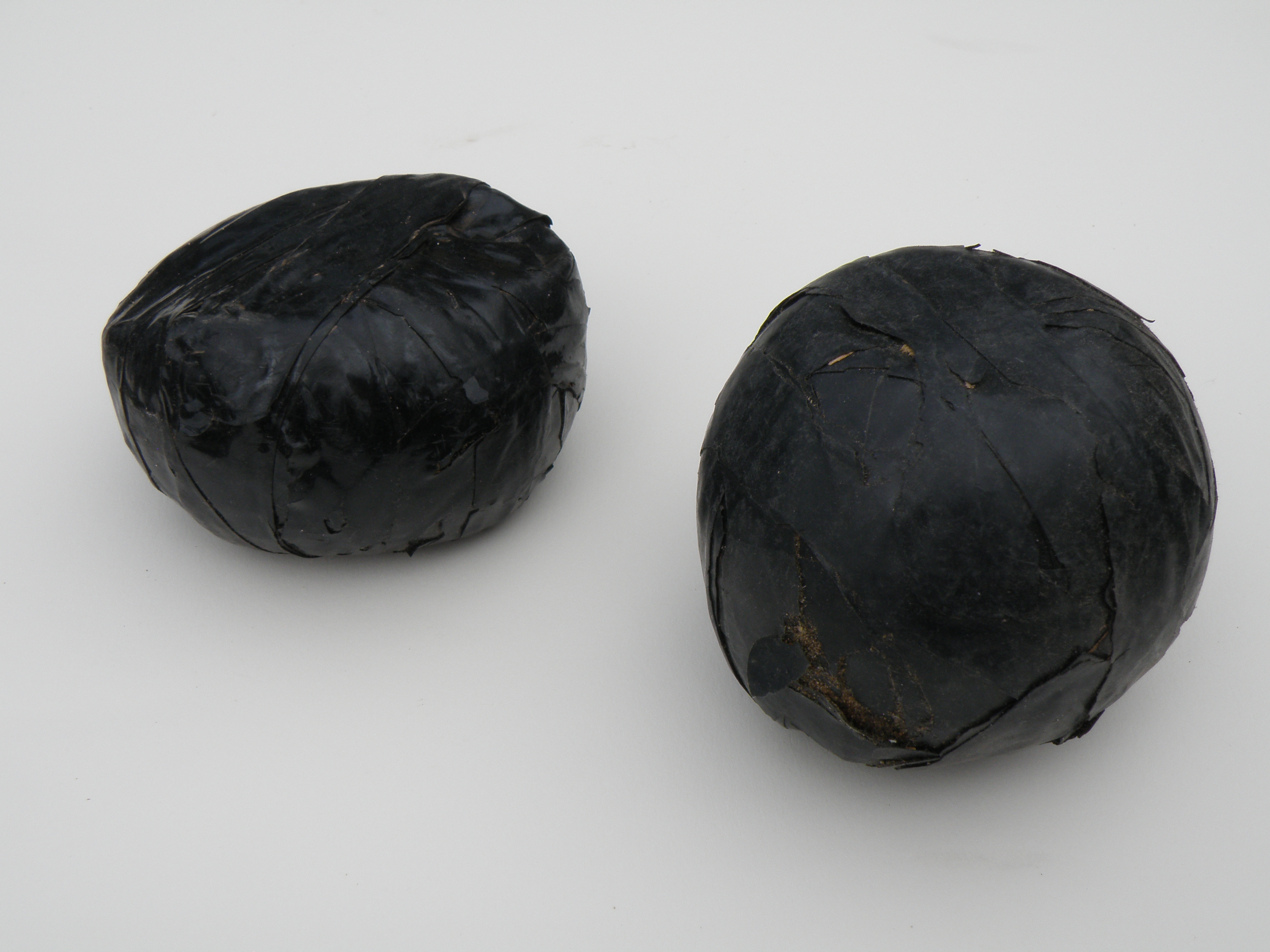
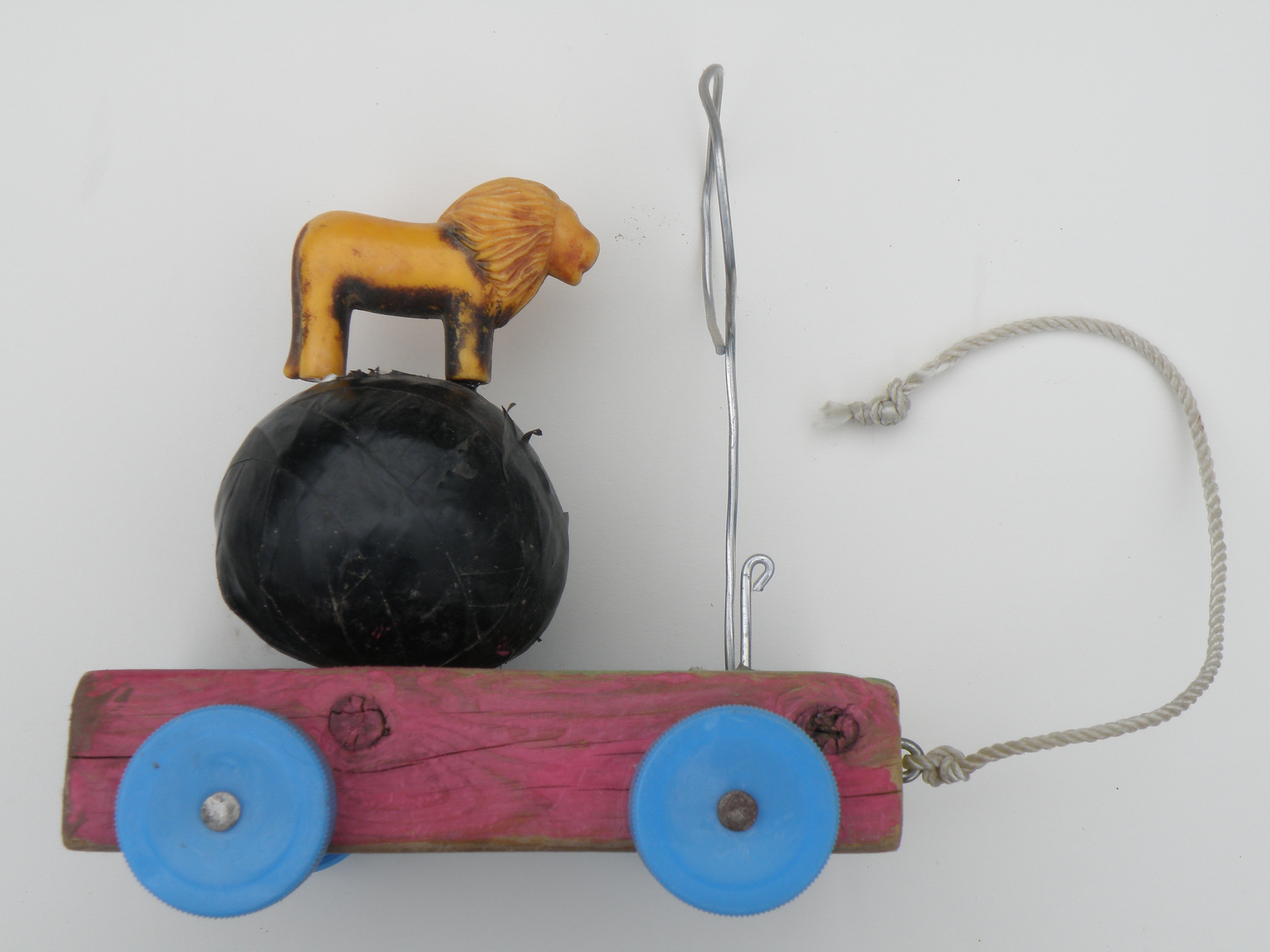
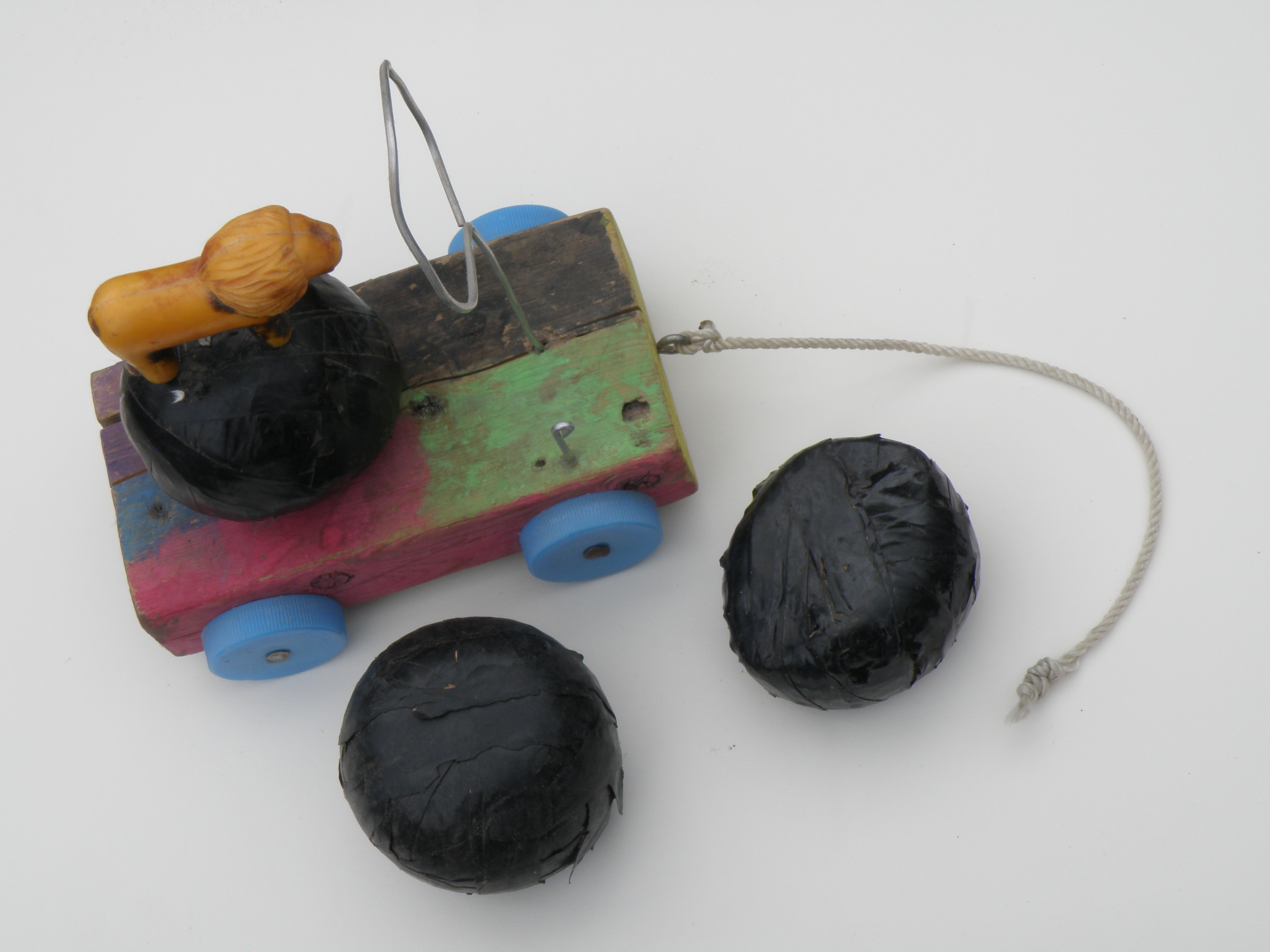
These two balls are made from stretchy electrical tape and are tight and dense.  I remember that the very first handmade ball I found was also made from this smooth black tape.  When my eldest son was a small boy and needed a project to do involving recycled materials… I helped him construct this circus pull toy from materials found at the river.

recycled materials circus toy with handmade tape ball

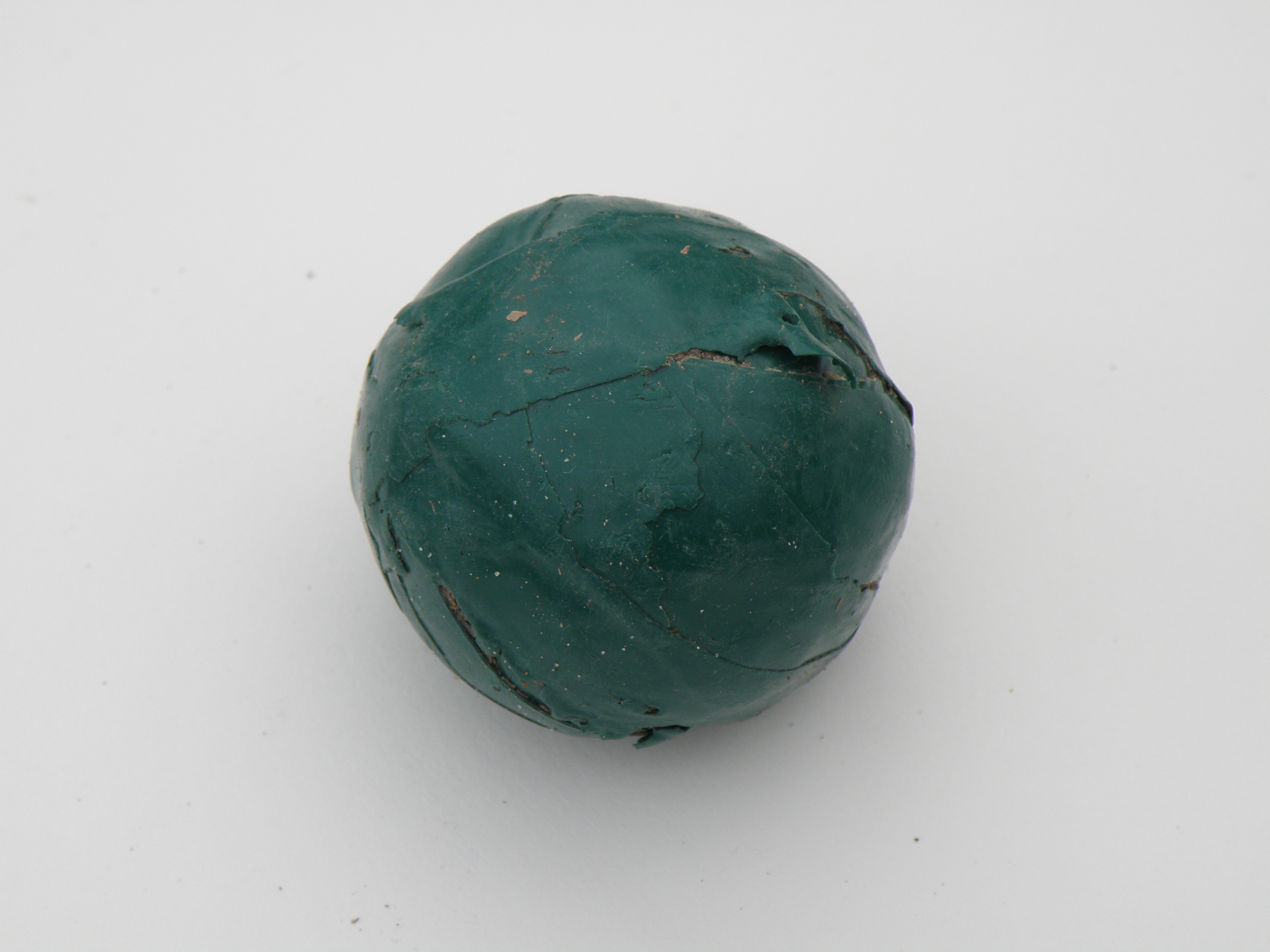
At the heart of this toy is a handmade ball made from electrical tape.  My son thought this would make a great prop for a circus lion to stand on while it jumped through a flaming hoop!  Of course, the only fire we actually used came from our imaginations.  The yellow plastic lion was also found at the river and has a nice oily patina on it that comes from being in the river for a while.  Here’s a smaller ball made from green tape.

ball made from green plastic tape  I’m sure people are making balls from paper-based tapes too, but these don’t survive being exposed to the elements for very long.

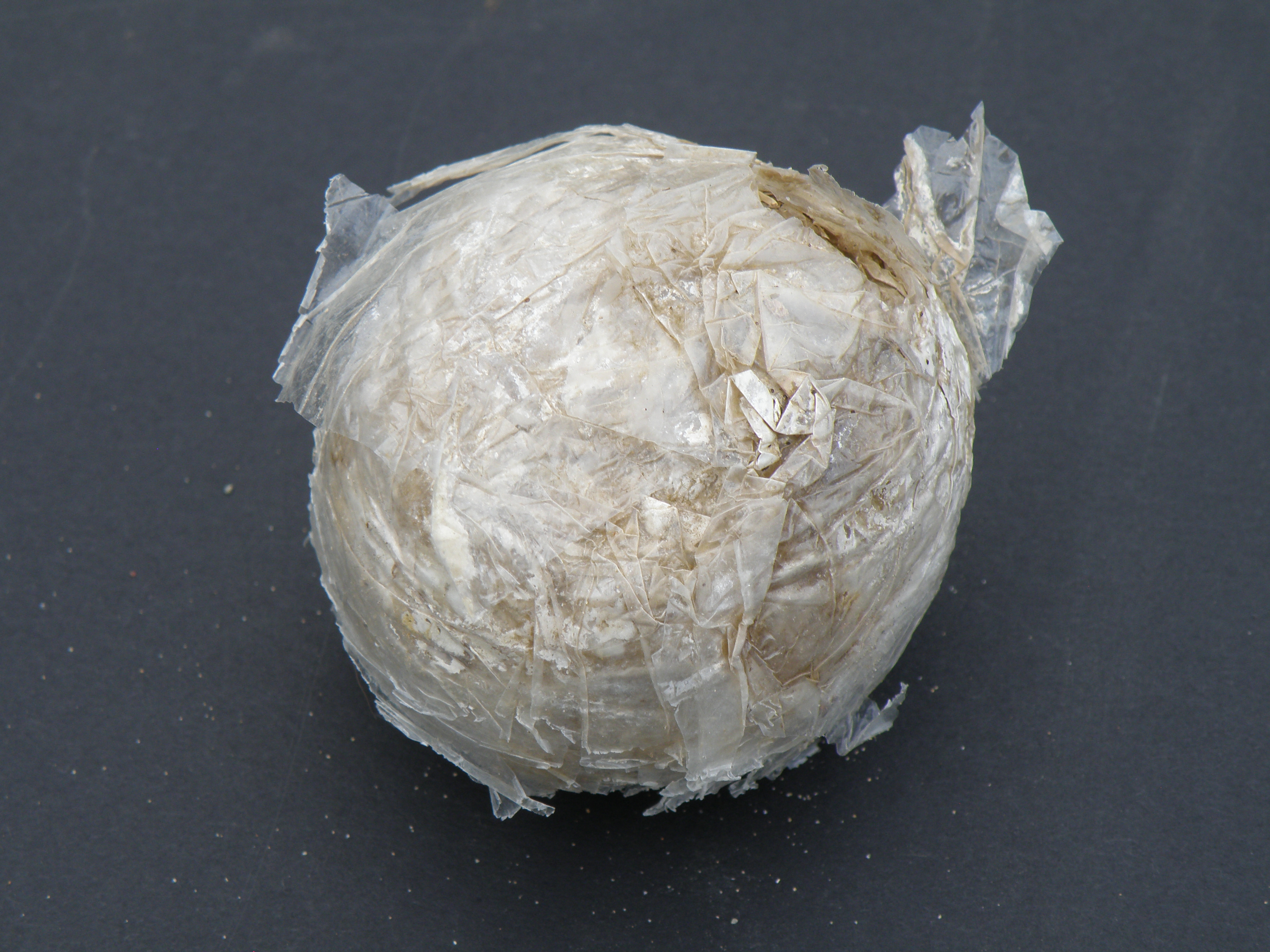
peeling cellophane tape ball

This ball made with cellophane tape is barely holding together.  It’s surface is fragile and the adhesive is losing its bond.  As it starts to peel apart, sand caught between the layers is released.

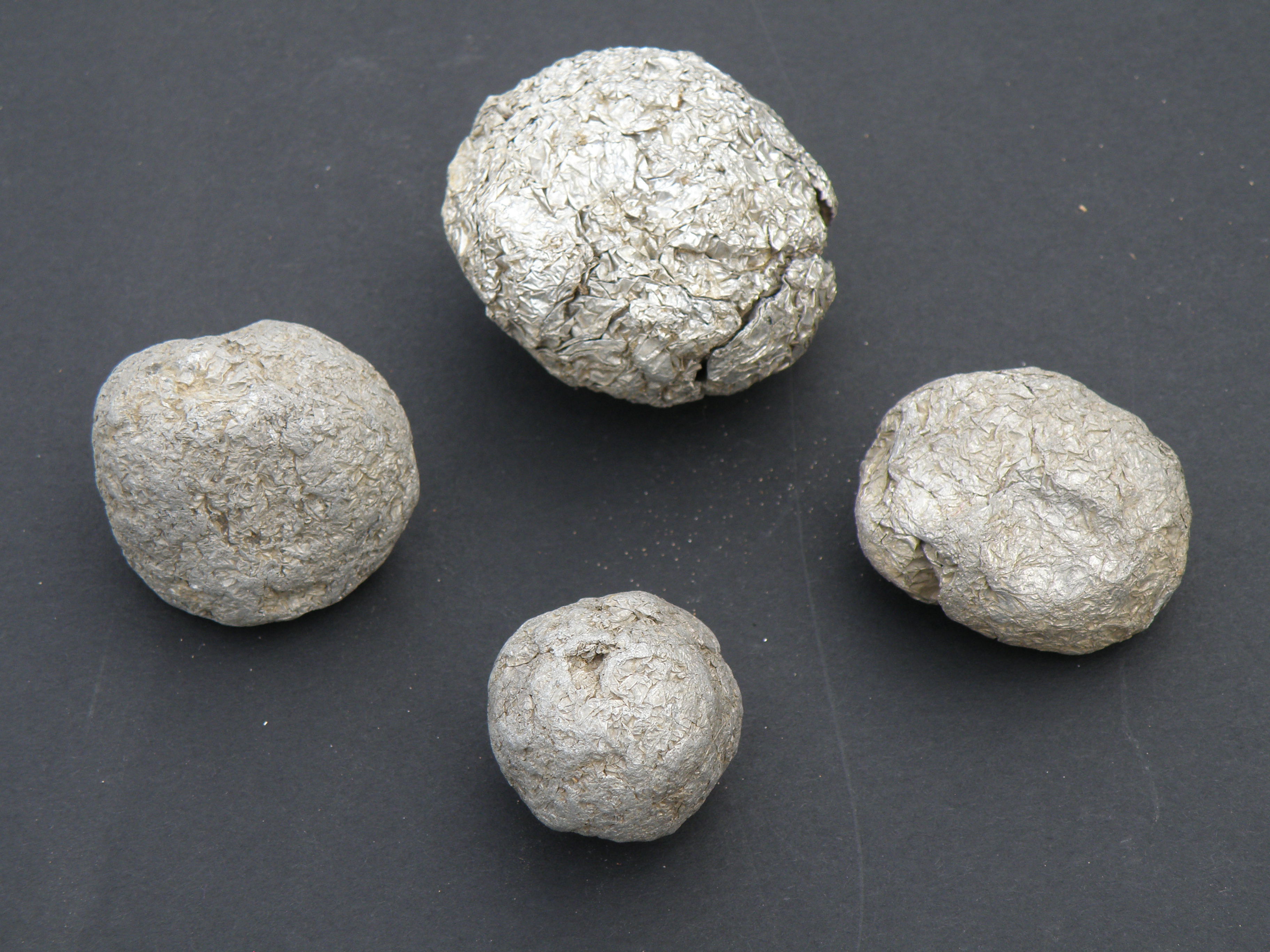
compressed aluminum foil balls


The four balls pictured here are made from compressed aluminum foil.  Perhaps they were used for cooking and once their original purpose was over, the owners rolled the foil around the palms of their hands like one would do to form a ball from either clay or snow.  The funny thing about aluminum foil and the river is that the water somehow squeezes it even more and the ball becomes denser and more solid.  Anyway, I hope you enjoyed looking at this rare and somewhat tongue in cheek odd ball collection where the sum is definitely greater than the parts!  Spring will be arriving soon and the Ohio River is calling…until next time.

electrical tape balls

Read Full Post »

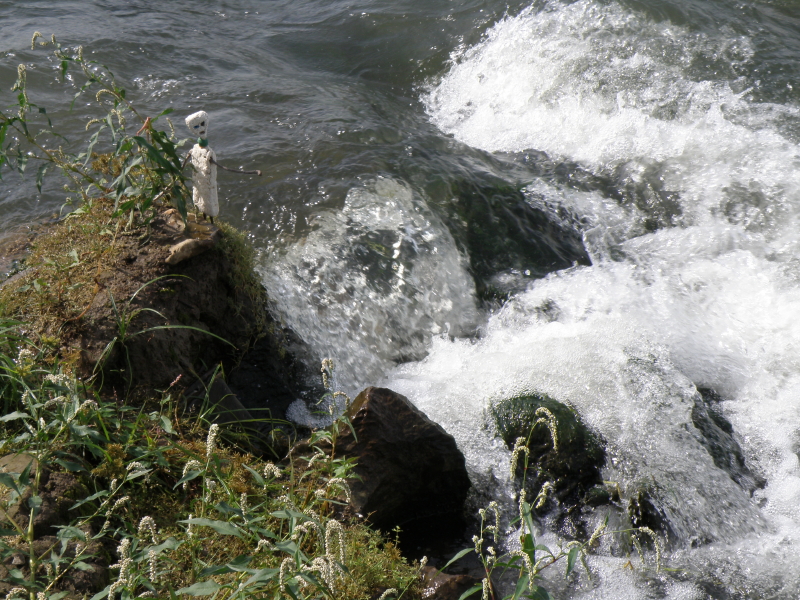
My beloved…I still live!  I hope my repair to my communication transmitter has been successful and that you and our fellow Styrosians so far away across the universe will receive this message and know that I still exist.  While exploring a little known solar system my ship was damaged in a collision with undetected fragments of space debris in orbit surrounding a smallish, blue-green planet.  This planet is the third nearest to its star. This solar system is comprised of eight other planets of varying dimensions and densities.  Damage to my guidance system made controlling my craft difficult and I entered the atmosphere of this planet like a meteor across the sky.  Fortunately, I arrived without attracting attention and I was able to affect a safe landing.  My craft, however, will need much maintenance. Hopefully, the coordinates of my position reached you before I entered this planet’s dense gaseous atmosphere? Here is an image of my vehicle which I call home and its contents are a dear reminder of the world from which I originated.  So often I have thought of you and wondered if we will ever see each other again?

I have so much to tell my fellow Styrosians that I hardly know where to begin.  Duty compels me to start with a report concerning my original mission.  I have crashed on a beautiful planet where the majority of its surface is covered by that most precious combination of hydrogen and oxygen.  I am so excited to have found water in abundance!  I have detected water in all three of its known states including gas, liquid, and yes…I have even seen ice!  It was the chemical signature for water that compelled me to take a closer look when the accident occurred.

Most of the water I have been able to analyze locally is of the fresh variety which contains many other chemical additions some of which are naturally occurring.  I have, however, been able to learn that the vast majority of the water on this planet is heavily influenced by the compounded interactions of sodium and chlorine.  I have not only discovered water…but water in different flavors!  After surviving the shock of my sudden and unexpected arrival, I couldn’t wait to explore this new environment which offers such a stark contrast to our own dry home world.  There is so much water here that it actually falls from the sky!  Please excuse me while I transmit additional self images made while engaging in water joy!  They at least offer further visual evidence of the importance of my unexpected discovery.

How I wish you were here so we could experience this together.  I have been able to further confirm that our hypothesis about the connection between water and life is correct!  The abundance of water is equaled by the sheer amount and variety of life forms that inhabit this world.  Where there is water I have found life even in the precious fluid itself! There are sessile, terrestrial life forms that process sunlight through green, cellular solar panels.  They anchor themselves and obtain moisture through a system of filaments interwoven into its supporting substrate. And there are also many animate life forms that move through space and have evolved into hierarchies where every environmental niche is occupied by a specialized life form.  Interestingly, there are even species that dominate and consume other life forms. Our scientists will have much to study in this new world! I would like to expand on one of those species which seems to occupy a very prominent position on this planet.  It is an interesting life form and is bilaterally symmetrical like us and appears to be sentient to a degree.  Monitoring their communication patterns I have been able to translate and understand something of its language and culture.  I have heard self references to being a” bipedal humanoid”, but I’m not certain if I fully understand what is meant by that.  This animal while claiming intelligence and rationality is actually characterized by numerous contradictions.  The most observable of these traits is a predisposition towards delusion and self-deception.  It does much harm under the guise of doing good. This animal (which I believe as some members of its own kind acknowledge have evolved from what are known as “primates”) is constantly engaging in selfish behaviors that are having a deleterious effect on this planet.  Ironically, they are harming not only the other life forms here, but ultimately themselves as well.

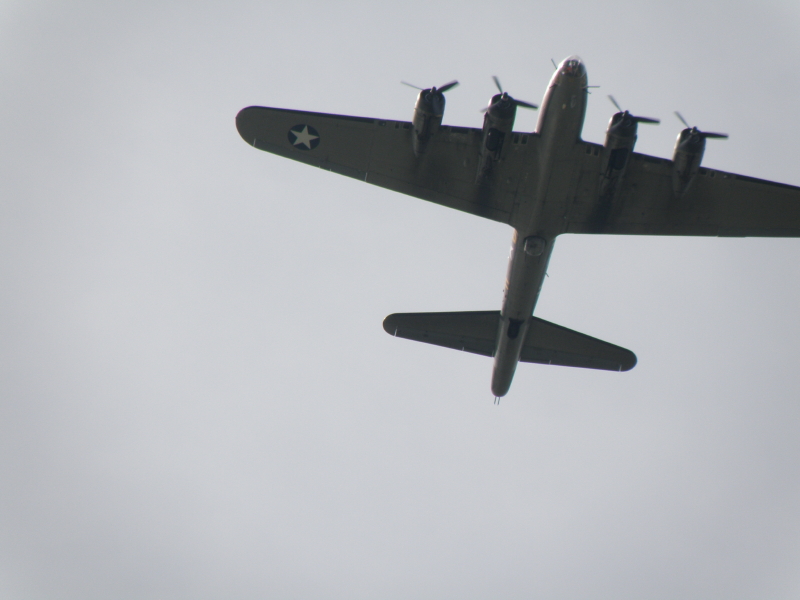
Recently, I was exploring a water channel when I saw a shape flying towards me from some distance away.  It appears to be an antique flying craft bristling with armaments.  The dominant species here is addicted to using hydrocarbons extracted from the ground which are then  further refined to produce fuel and energy.  I quickly captured this image over my head and placed it in the catalog I am compiling for future reference.  I have observed other technologically superior war-like aircraft in the vicinity before, but this one was unusual.  These so-called “bipedal humanoids” are constantly engaged in warfare somewhere on their planet.  This is one of their most primitive characteristics.  Monitoring their telecommunications I have ascertained that violence is an integral part of their conflict resolution process.  The “bipedal humanoids” are capable of rationalizing and justifying any act they commit. When they are not fighting among themselves…they are consuming or damaging resources often with other primitive machines that require hydrocarbons to function.  For instance, observe this case that I recently experienced and documented.

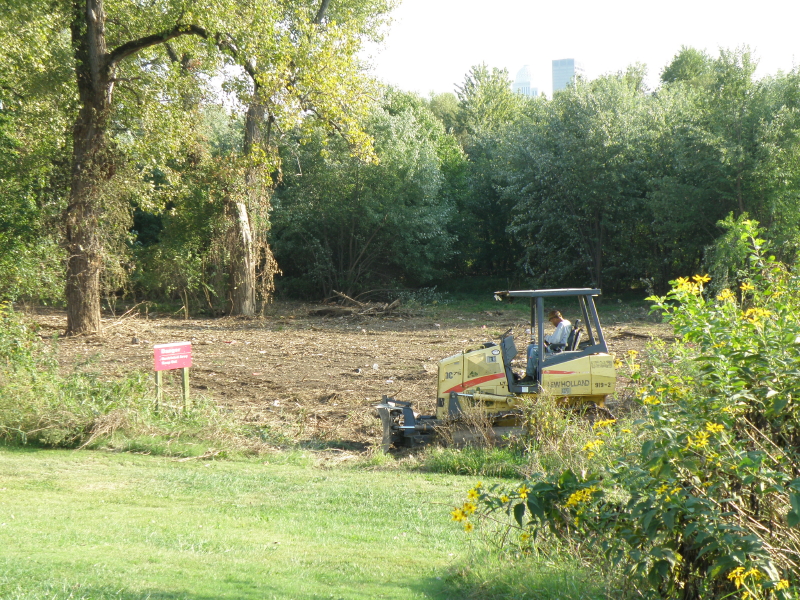
In a nearby field that was once occupied by photosensitive sessile life forms, I observed a humanoid operating a large machine.  This machine did violence to all that was alive in this area.  The remains of many different kinds of sessile life forms were stacked into random piles, but what is the purpose of this activity?

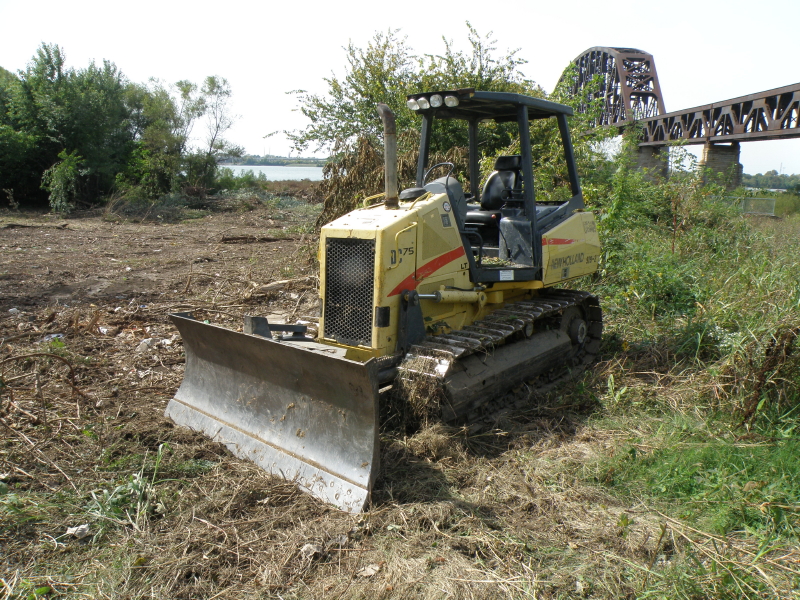
This area was once home to a large variety of life forms and now they have been displaced.  I have observed this before and very recently.  The “bipedal humanoids” created an area that they call the Ohio River Greenway and ironically they removed many of the larger photosensitive life forms to accommodate easy access to the river for their other hydrocarbon burning vehicles.  This seemed strange for many reasons, but perhaps our biopsychologists can figure that one out!  I was able to get a closer picture of the large machine that was utilized to sterilize this particular area and it is frightening to stand next to.  I waited for its operator to leave the area before doing my reconnaissance.

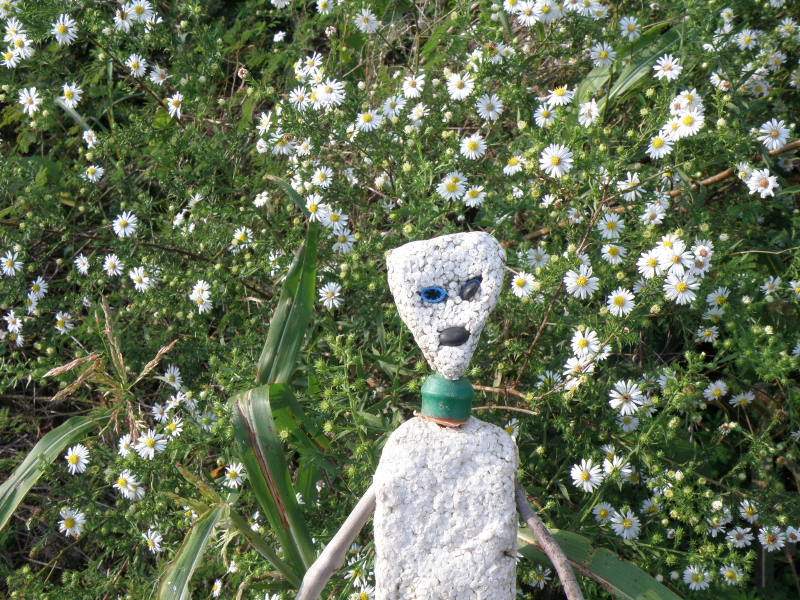
Alas my beloved, it is time for me to regenerate back at my space craft.  I will leave you for now, but I promise more from this fascinating planet.  In my next transmission I will show you more images of the life forms I have observed and maybe something of the history of life on this planet.  For now, accept this self-image made next to the many sessile life forms that lend this land beauty and interest.

Read Full Post »

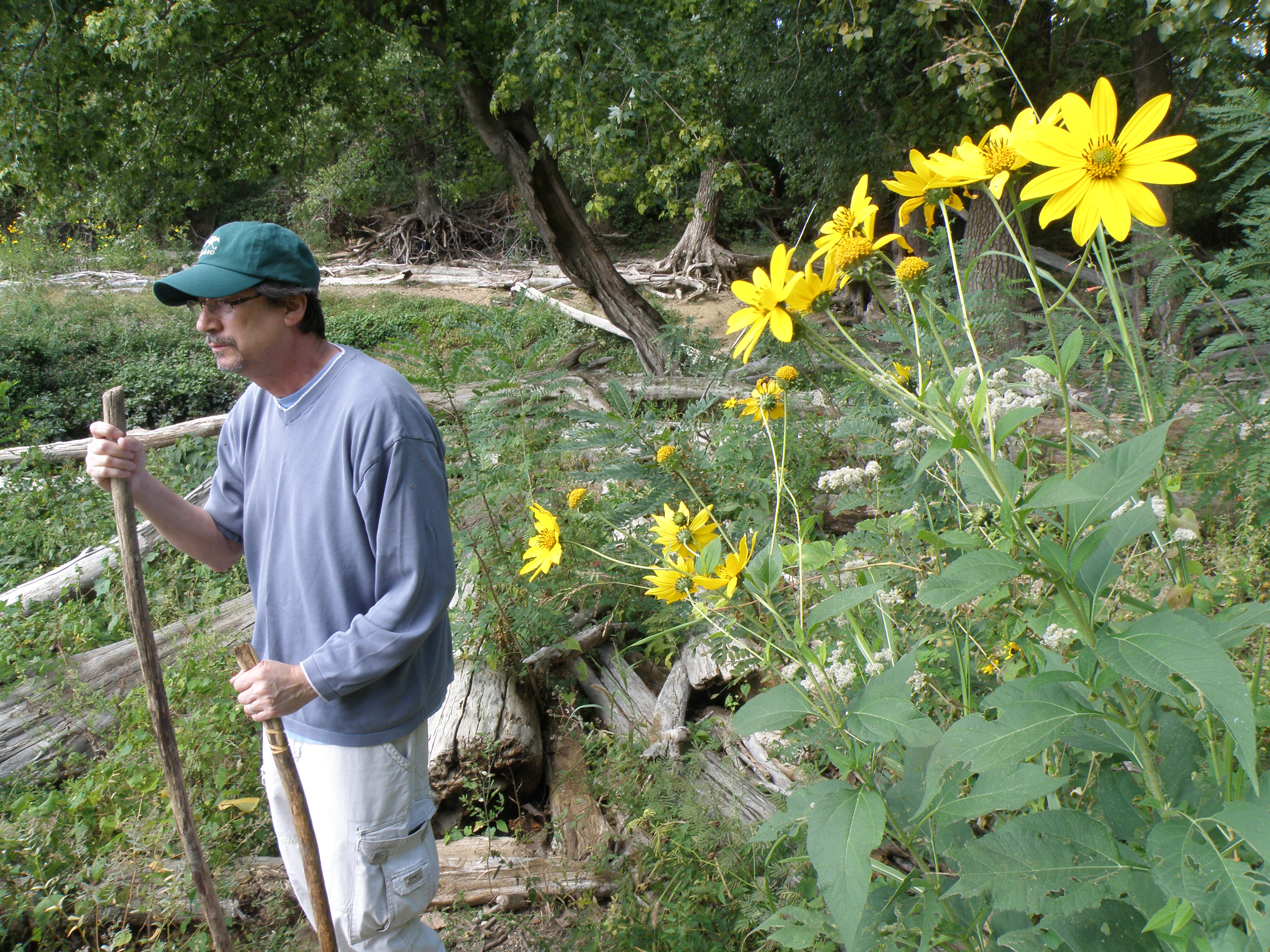
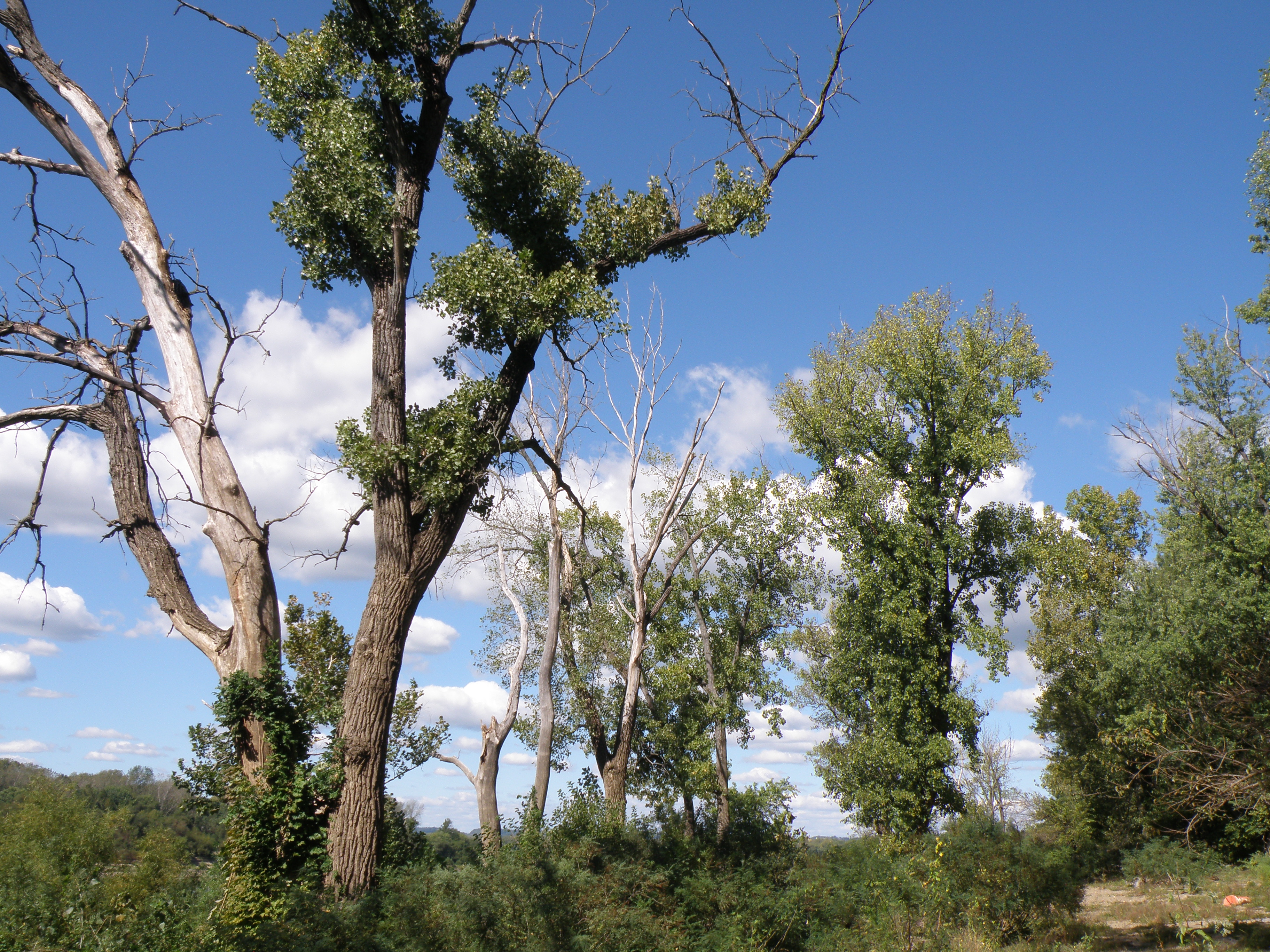
Jeff and I have been great friends for over thirty years now.  It’s a strange feeling when you realize that much time has flown by.  We met at Murray State University in far western Kentucky and attended art school together and have kept in touch ever since.  Now we both live with our families in Louisville.  I’m proud to say that we still self identify as being artists.  This has not been an easy thing to do.  I’ve read that most people who attend art school eventually stop thinking of themselves as artists once the work-a-day world takes its toll after graduation.  Jeff and I have been lucky and can say that most of our professional lives have not strayed too far from art making or being in the art world.  We have never shaken our need to make ideas and materials connect.  These days, Jeff enjoys making some very involved and often witty ceramic sculptures and through this blog you know something about me.  This is not the first time Jeff has accompanied me on one of my “epic adventures” to the Falls of the Ohio and I always enjoy his company and conversation.  Today is a beautiful late September day and we are hiking in the western section of the park and enjoying the sunshine.

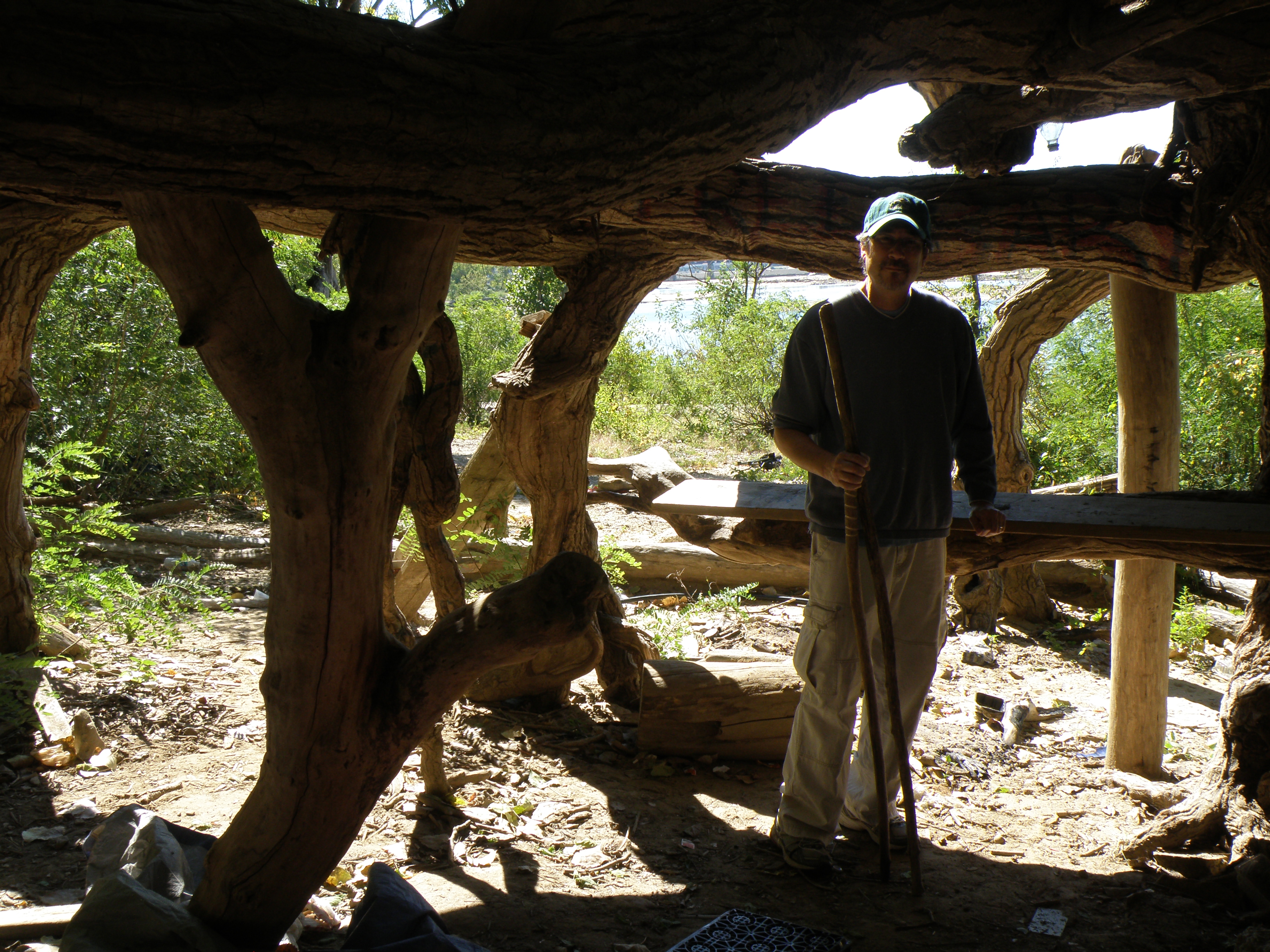
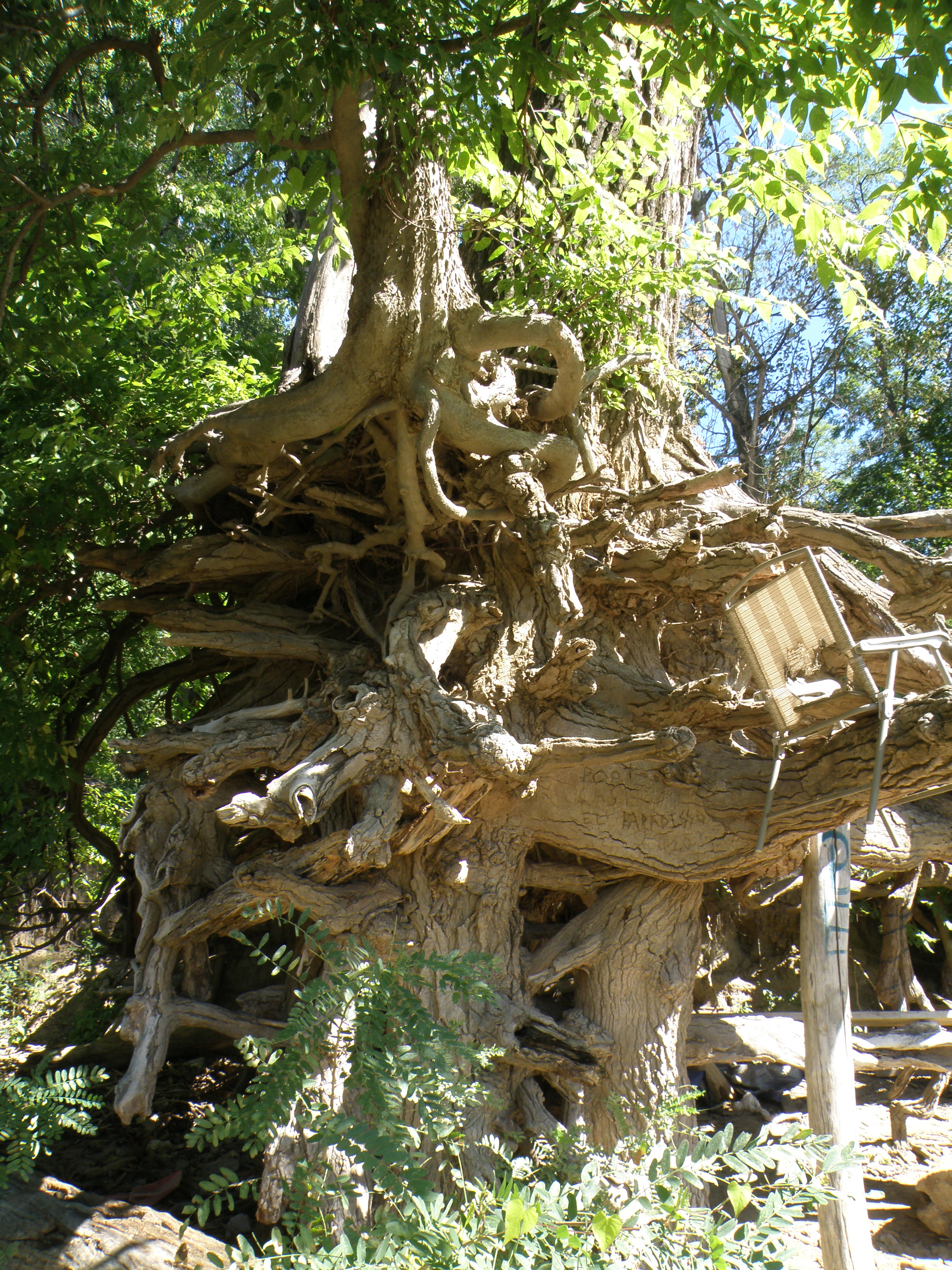
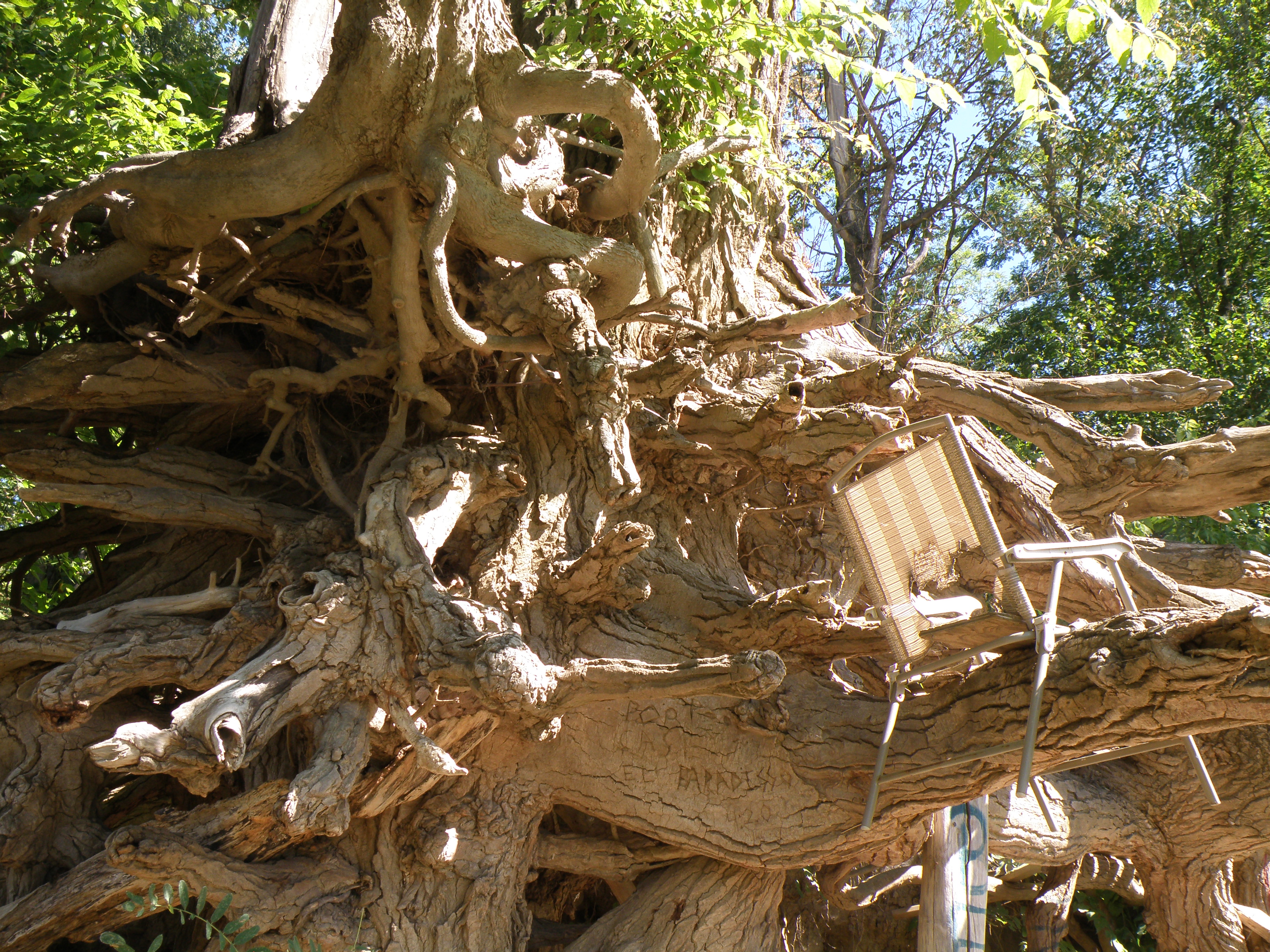
This is a less traveled path, but often worthwhile.  Today there are many late summer/early fall wildflowers to see.  We stopped by one of my favorite trees in the park.  It’s an old cottonwood tree whose roots have continued to grow with the tree even while the riverbank has eroded and exposed these roots to the elements.  This has not kept this tree from thriving.  Over time, a space beneath the tree large enough for a person to stand has been created.  This image of Jeff under the tree will give you a better idea of what I mean.  I have used this space on many occasions to wait out rain showers or take a break from my walks.

Over the past two years this tree has attracted a lot of attention and unfortunately for any other visitors…you can see evidence of their “footprints” all around this cottonwood. There is more litter around and several fire pits contain partially burned trash.  The tree trunk itself has become a target for graffiti as people with pen knives and spray cans have left their marks.

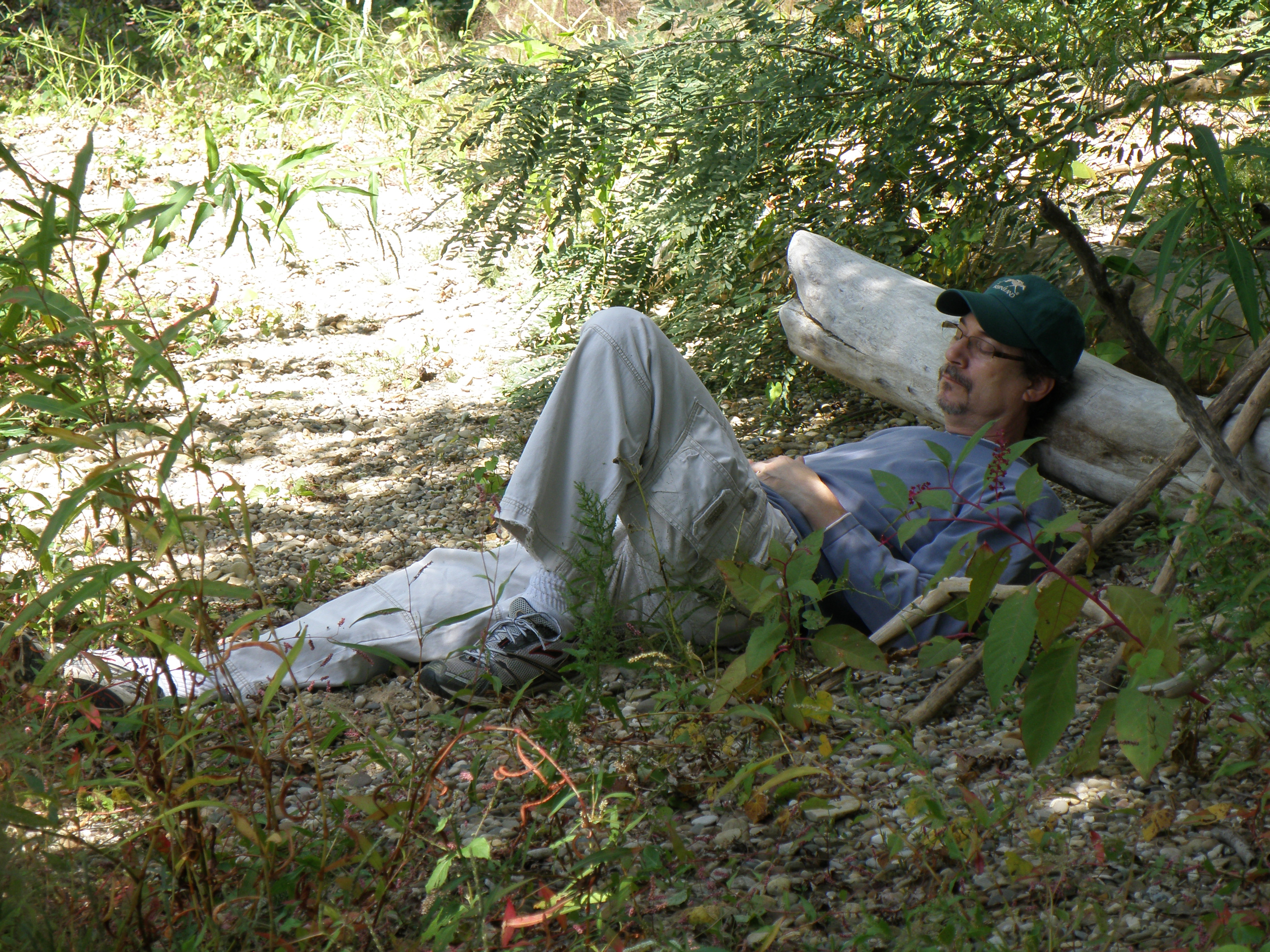
The sun was shining full-bore and warmed the day up nicely.  While I spotted some birds I wanted to check out…Jeff decided to hang out by the tree and take a nap.

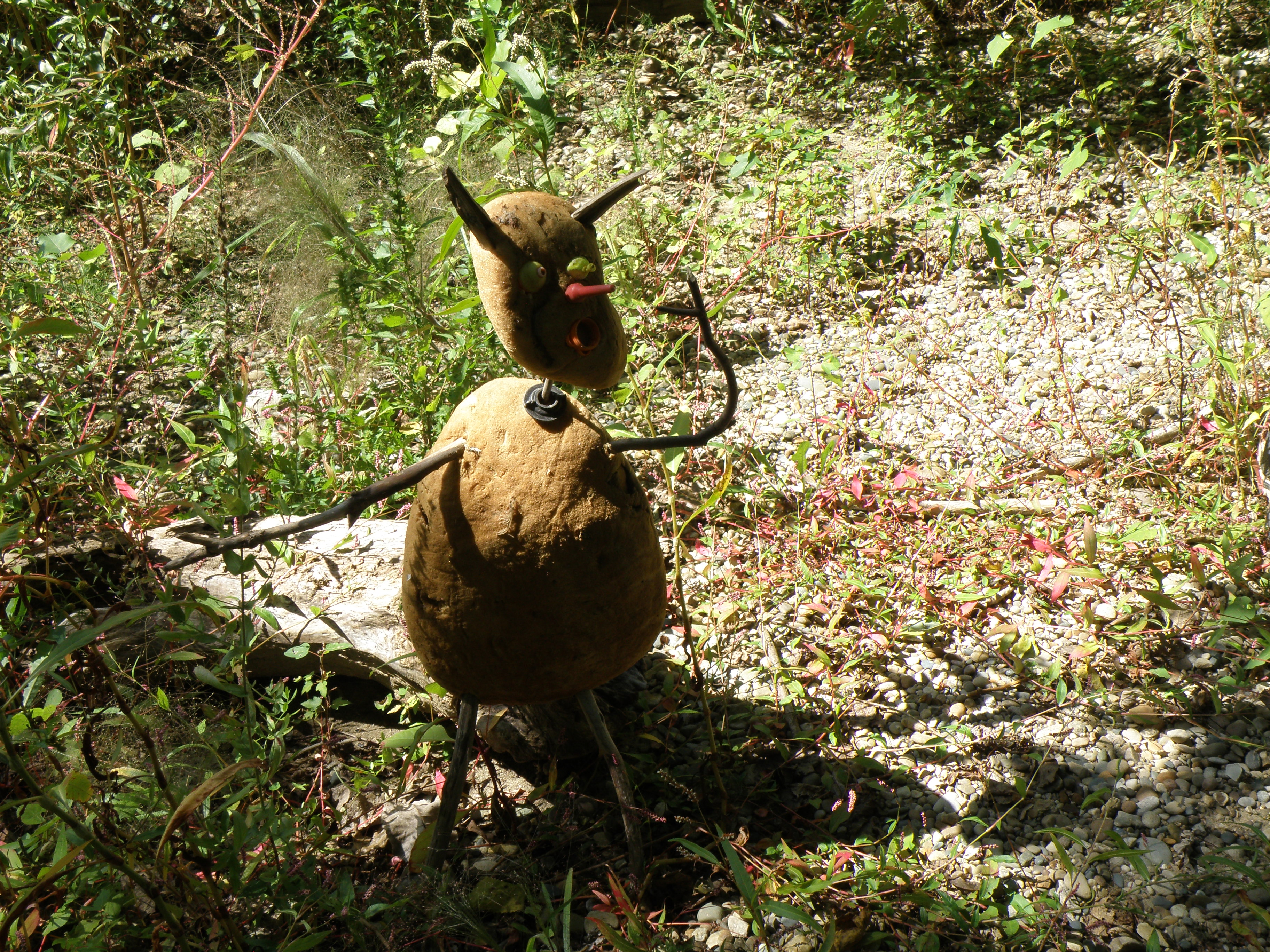
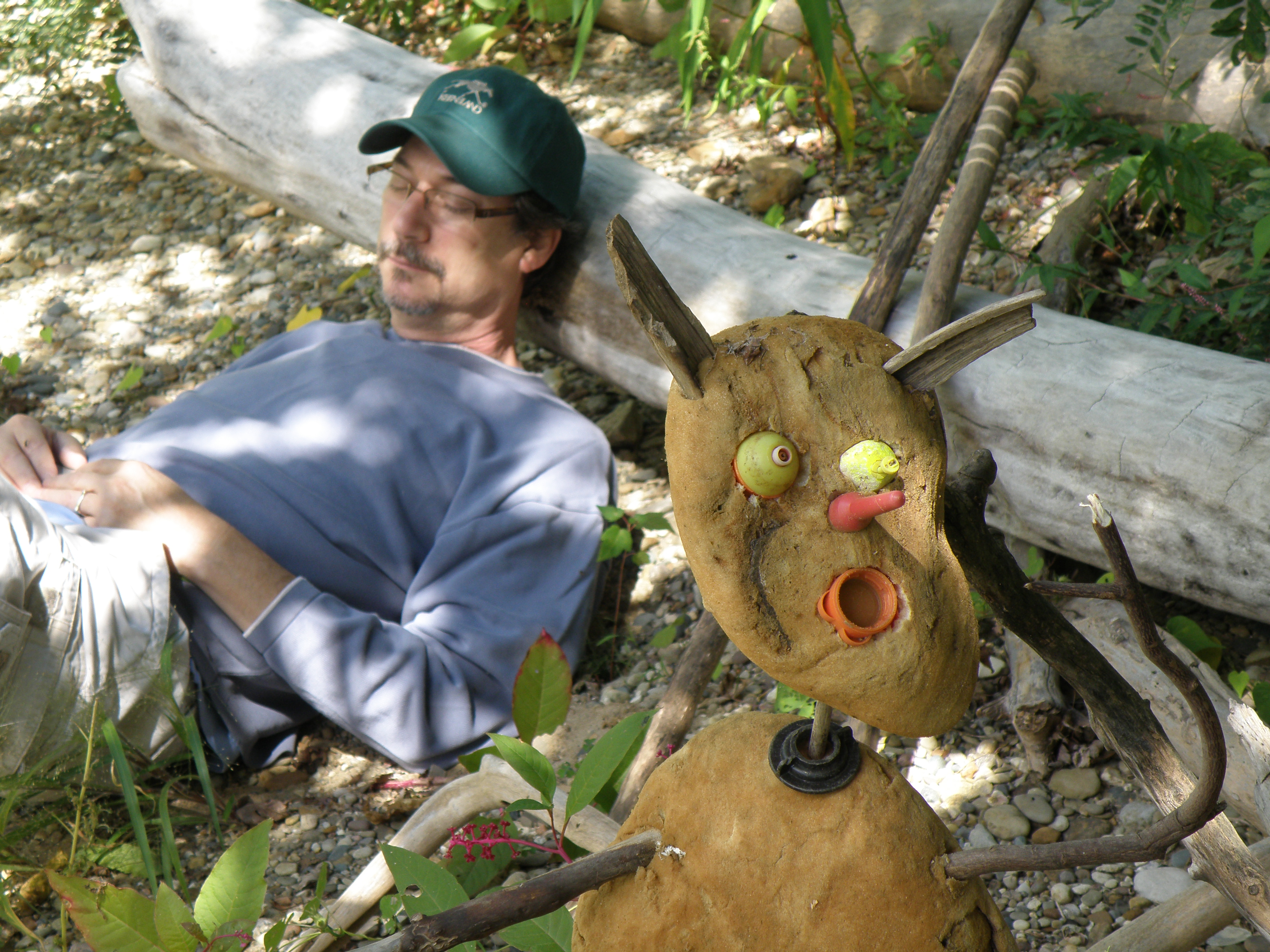
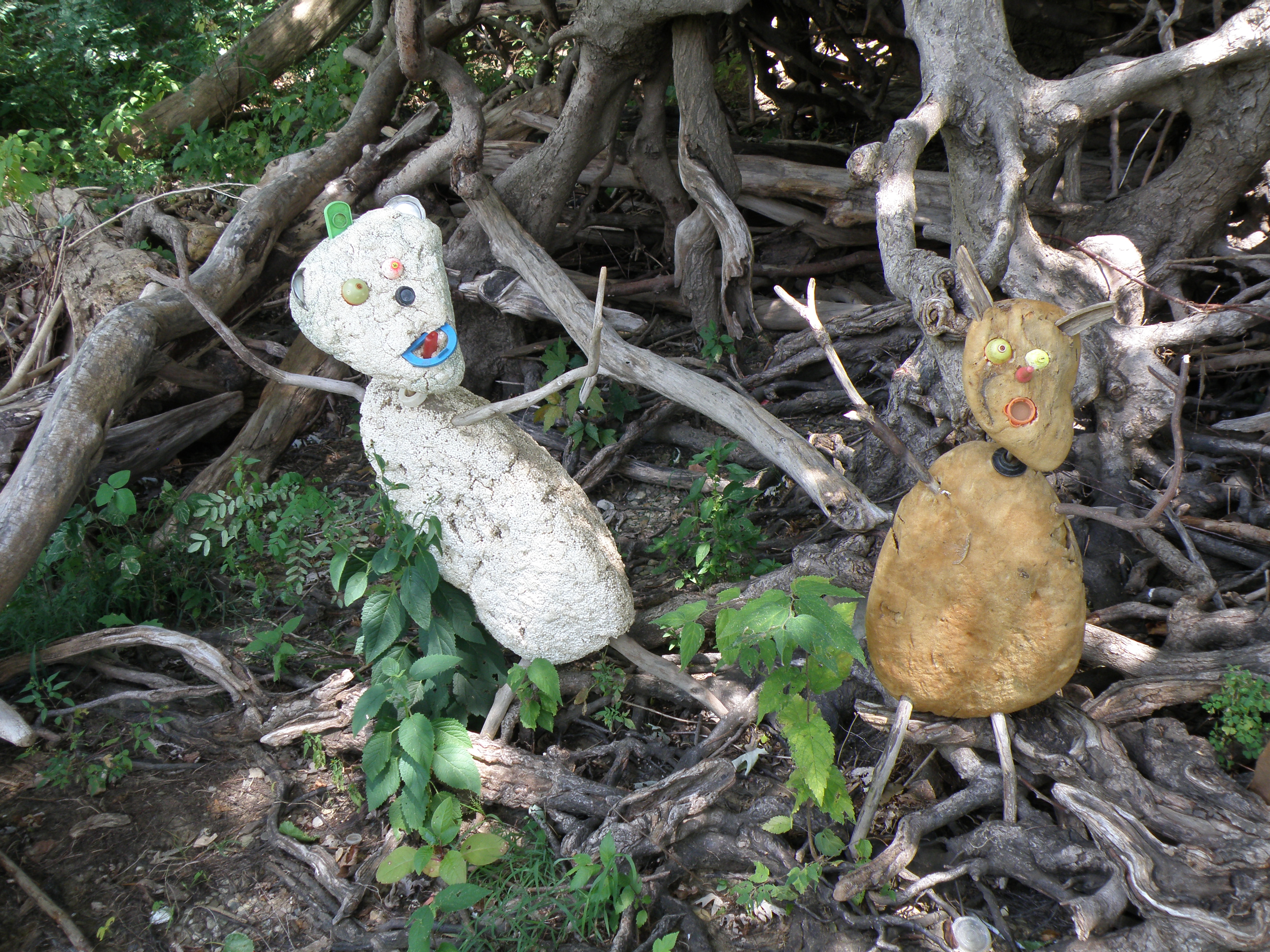
When I returned from bird watching, Jeff was waiting for me and recalled an odd fragment from a dream he just had.  Even in his resting state he felt as though something was checking him out.  First he heard the sound of movement in the dried leaves and then caught sight of an odd small figure in brown with long ears skulking about the shadows.

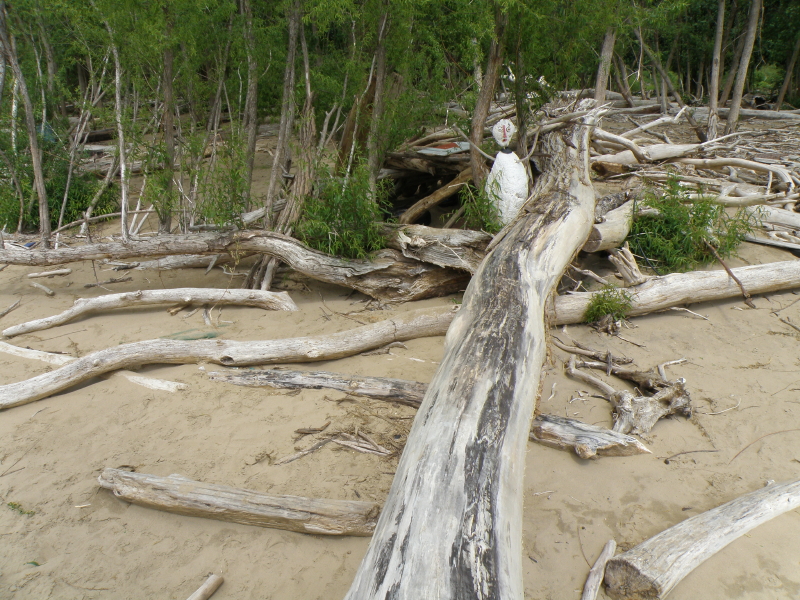
Jeff remembers trying to wake himself up, but the dream continued.  The small brown figure then called out and was soon joined by a second figure that was larger and all in white.

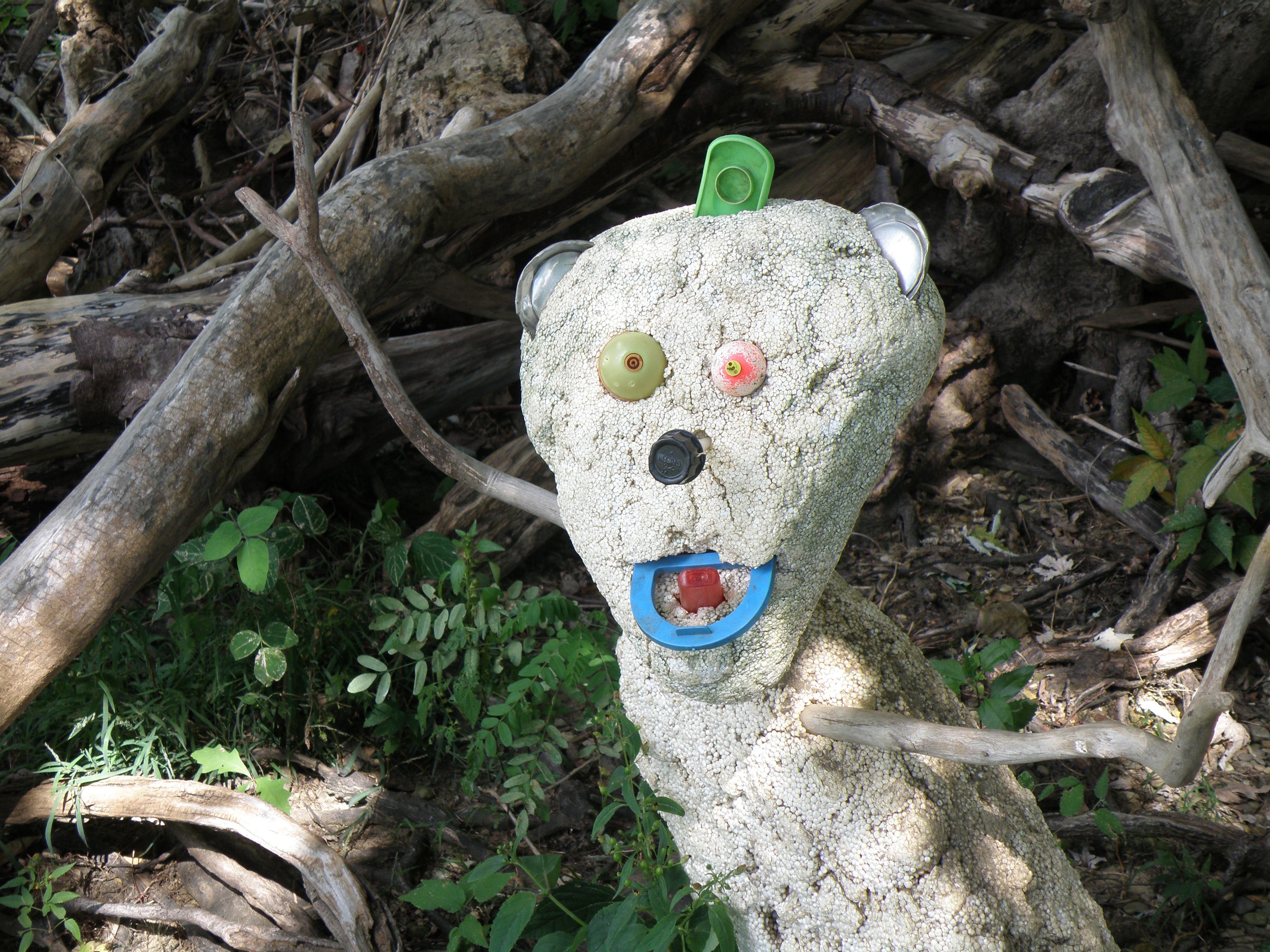
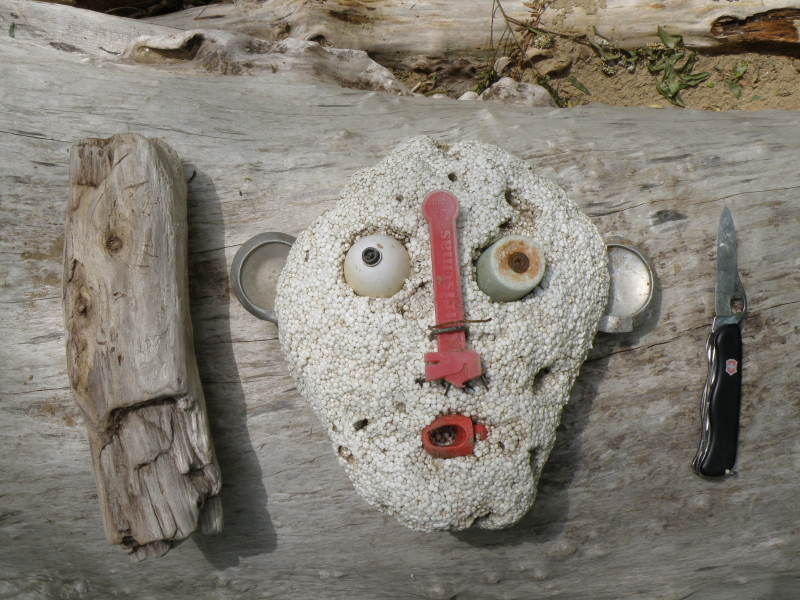
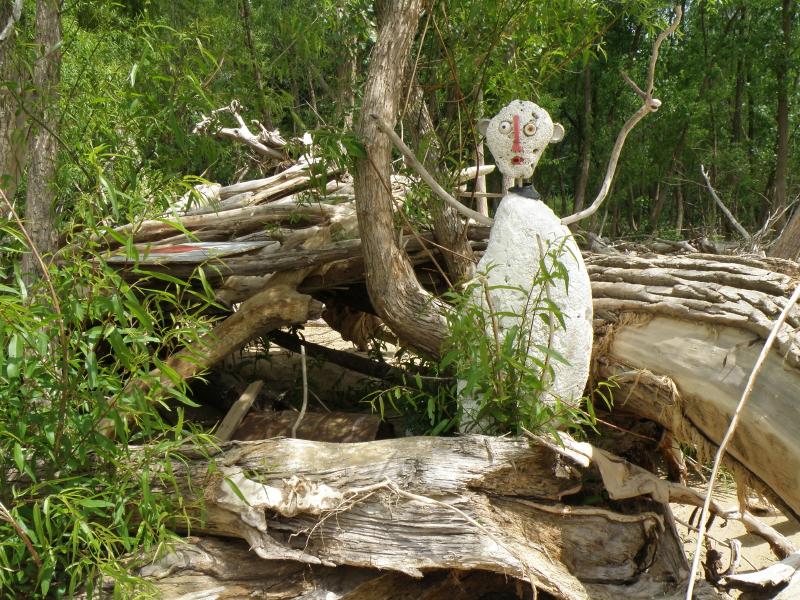
This newest figure was even more bizarre than the first and more frightening for sure.  It sported a large misshapen head, wild eyes, and a mouth trimmed in blue.  Within his dream, Jeff heard a narrator saying that these figures were called “tree spirits” and all trees have them.  These characters may have been up to no good.  It’s hard to say, but fortunately they are easily frightened away.  Jeff thinks they may have belonged to the cottonwood tree and were paying a visit in case we were thinking of doing some damage to this beloved tree.  There were two spirits because there were two of us.  Anyway, Jeff doesn’t know how or if it all played out because he woke up.

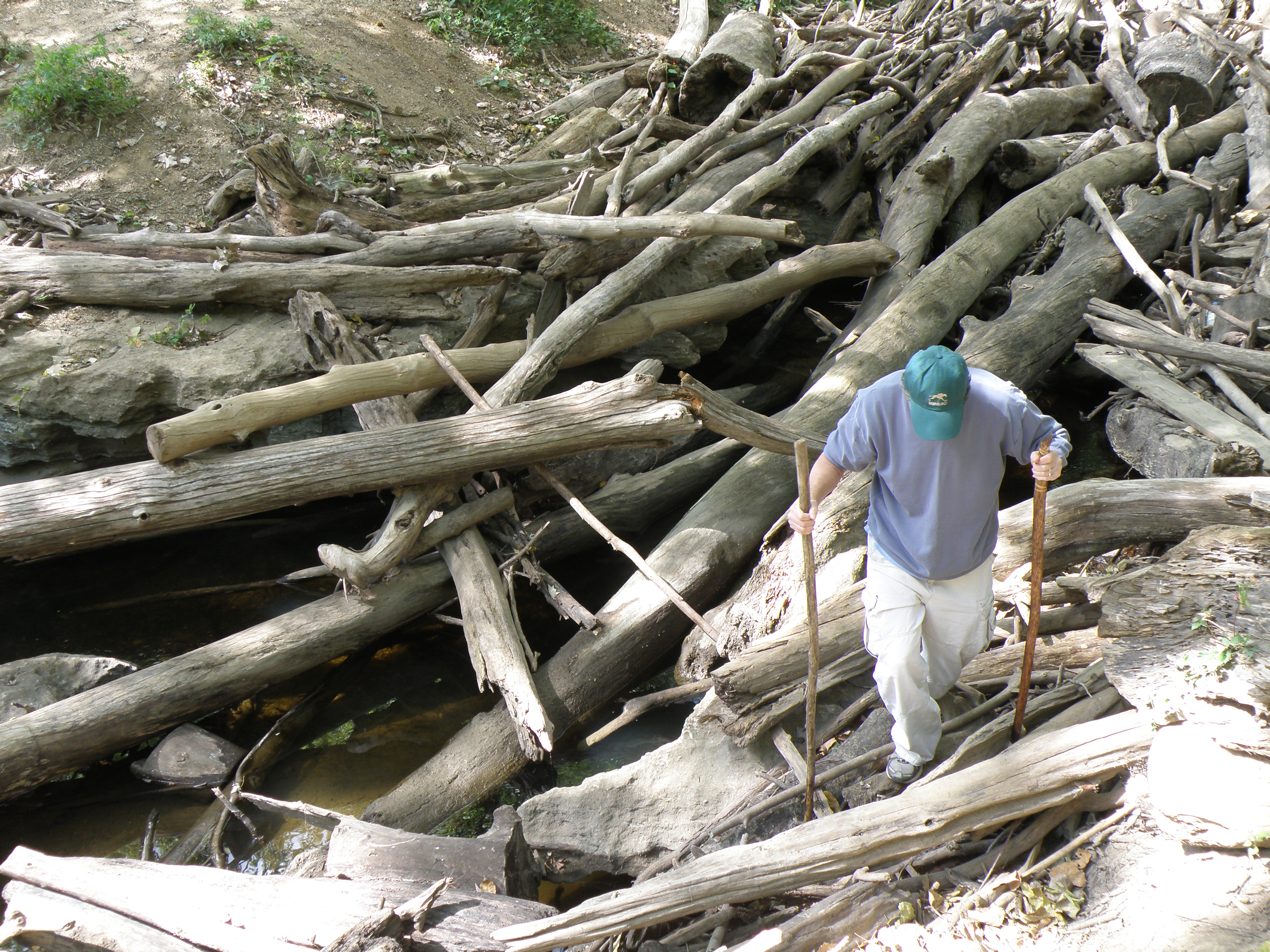
It had already been a full day and we decided to head for home.  Although Jeff was partially refreshed from his nap, I was beginning to feel tired.  The car was about an hour’s walk away and we still needed to cross over the small creek that divides the western section of the park from the Woodland Loop Trail.  We gingerly walked over the logs left over from the last flood balancing ourselves with our walking sticks.  We were in no hurry here.

It was great having another adventure with an old friend!  I’m sure that we will do this again. Jeff found an extra walking stick to take home and that became his souvenir of the day.  For me, I walked out of the park with my images and this story I’m about to post.  Thanks for stopping by…until next time from the Falls of the Ohio!

Read Full Post »

At long last I’ve made it back out to the river!  It’s been about eight weeks now since my last visit.  Today I have a double purpose…the first is to drop off one of my Styrofoam and recycled material sculptures for an annual fund-raiser that the Falls of the Ohio State Park Foundation hosts every year.  I’m glad to do this and hope my donation does well in their auction.  Despite the years I’ve been making stuff out here it still strikes me that most of my materials are literally trash.  I suppose I will never get over that. It seems to me that it takes a certain kind of person who would want to own one of these creations!  The other more fun purpose is to check out what’s different along the river and maybe make something new.  Immediately, I can see that the hot summer continues to take its toll.  At first, it was the relentless heat, but now that is coupled with a serious lack of rain.  The river is low and everything looks dry.

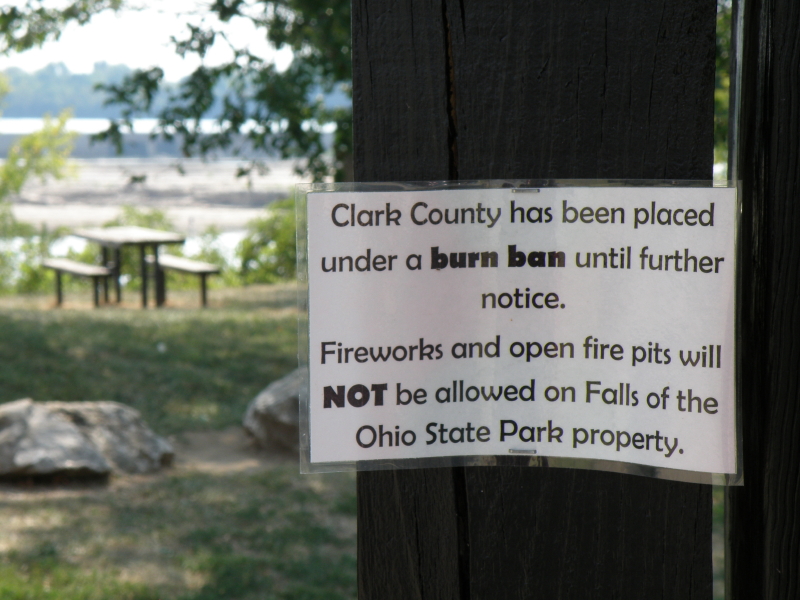
Over the course of this summer we have had just enough rain not to be considered a disaster area.  This is hardly a ringing endorsement and I find a small laminated notice tacked on to a bulletin board that reinforces how dry it is.  I think to myself that some of the people I’ve encountered out here over the years who do shoot off fireworks or build fire pits are not likely to read or heed this warning.  When I’m in the park, my preference is to move away from the most public areas and so with my walking stick in hand I head down the Woodland Loop Trail.  I’m still not confident enough to want to test my repaired knee too vigorously, but this trail is fairly easy.

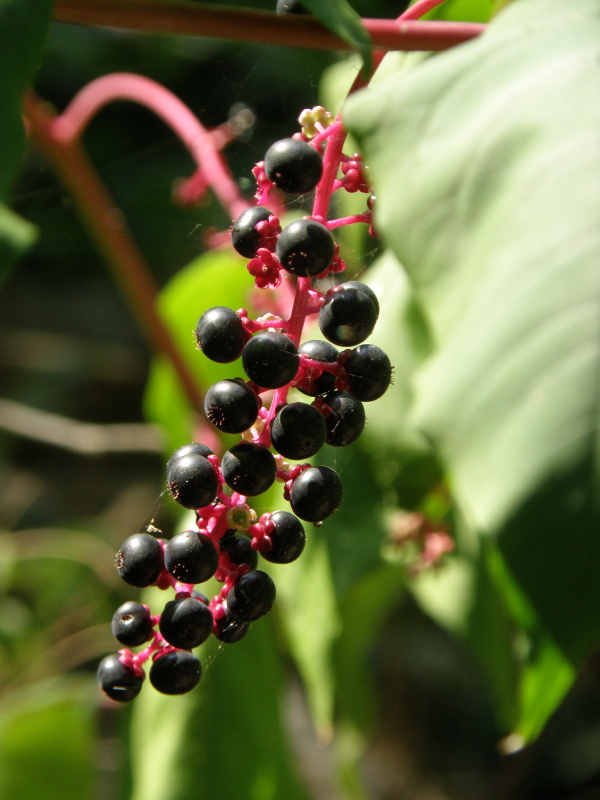
The trail is shaded which I welcome since it’s still over 90 degrees out here.  I pass many what I would consider late summer blooming plants that have flowered earlier than usual.  I did see several stands of tall Pokeweed plants with their black berries, but even these weeds have wilted leaves.  I guess what moisture these plants could muster up went into the production of their fruit?  These berries are a favorite food of several bird species.  In the past, I have used the intensely dark purple juice from Pokeweed berries as a pigment in some drawings I have made.  This color, however, is fugitive and ultimately fades in the light.  As I walk, one distinctive sound I keep hearing is the tell-tale sound of gray squirrels gnawing on the rock-hard walnuts that are  clustered around the few walnut trees along the trail.  There’s not much meat inside one of these nuts and it seems like a lot of work for little reward.

Out on the exposed fossil beds the sun is baking, but under the shade of the trees it is still fairly green.  Since my last visit,  however, I noticed a lot of dropped tree limbs and a few whole trees that have keeled over and appear to be the result of wind damage.  I have seen a few birds including two Hairy Woodpeckers and as I walk along the trail I keep getting scolded by Carolina Wrens who resent my intrusion.  In the distance I recognize the calls from the Killdeer plovers that are looking for food along the water’s edge.  The rarest and most unusual bird, however, is  just up ahead.

I’ve only seen a couple of the more common and native Ruby-Throated Hummingbirds this year…and so I was taken aback and delighted to come across what I later identified as Isaac’s Hummingbird (Archilochus isaaci ).  To my knowledge, this is the only recorded instance of this Cuban species reaching this park.  I’m guessing that Tropical Storm Isaac (purely coincidental, but also appropriate) which is threatening the GOP conference in Tampa Bay at this moment may have blown this rarity our way?  Hummingbirds of which there are over 300 hundred recorded species have been known to wander thousands of miles away from their more familiar haunts.

I came across this hummingbird dozing on a fallen branch.  It would open its eyes every once in a while and regard me.  I kept my movements to a minimum and completely forgot about my aching knee in the process of creating a few images of it.  I was able to snap off six pictures before it took off.  As you can see, this bird (also known as the Yellow Saberbill) has a bright yellow bill it uses to extract nectar from flowers.  Its light blue body, brown wings, silver tail, and whitish-head are diagnostic of this species.  I don’t know what it is about the Falls of the Ohio, but I have seen other unique hummers out here before.  Digging through the archives…I present two of them again.

This is the ultra rare Arctic Hummingbird appearing at the Falls of the Ohio to sip nectar from the equally scarce Ice Blossoms.

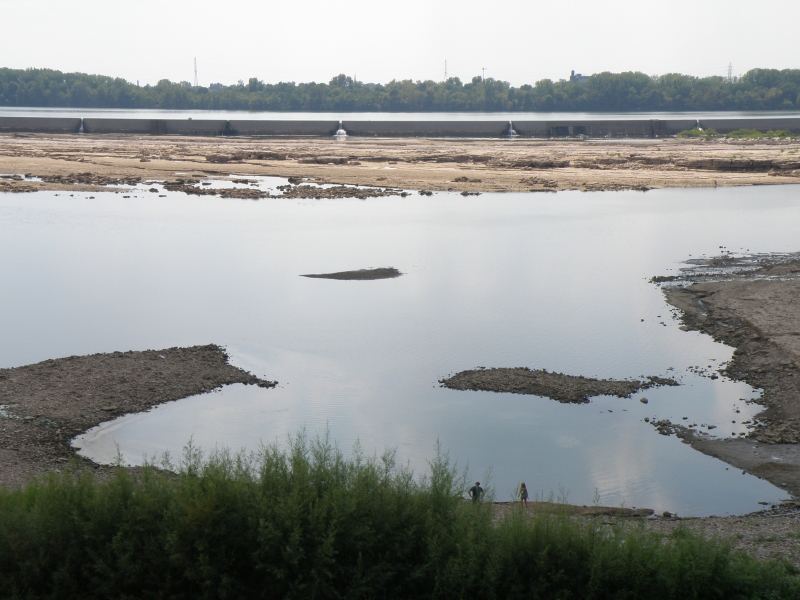
I encountered this Cumberland Greencrest back in 2010 not far from the place that I saw the Isaac’s Hummingbird.  Both of these rare hummingbirds stayed in our area for a couple of days before moving on.  This is what keeps me coming out here…I just never know what I’ll find or discover! This was a short, but eventful trip and I thank you for tagging along.  Here’s another view of the river with the exposed Devonian fossil beds.

POSTSCRIPT:  The inspiration for this particular post comes from another WordPress blog I enjoy entitled “Ekostories”.  Isaac Yuen is its creator and he’s an aspiring environmental writer.  Issac has a talent for weaving stories and making connections about responsible stewardship of our planet.  At the time of this writing, Isaac has a wonderful post about a book entitled the “Flight of the Hummingbird” that I think you may enjoy…so please check it out.  Here is his link:  http://ekostories.com/ Finally, one last peek at this elusive hummingbird checking out a flower blossom.

Read Full Post »

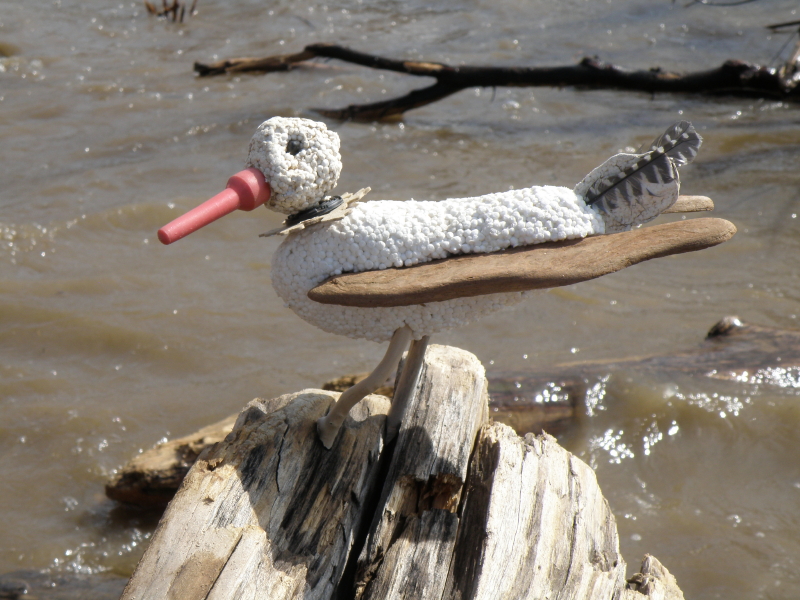
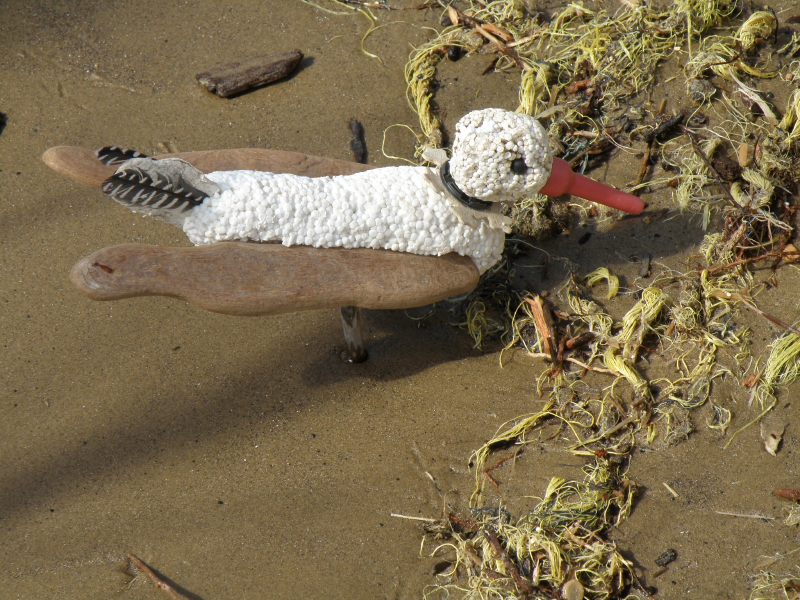
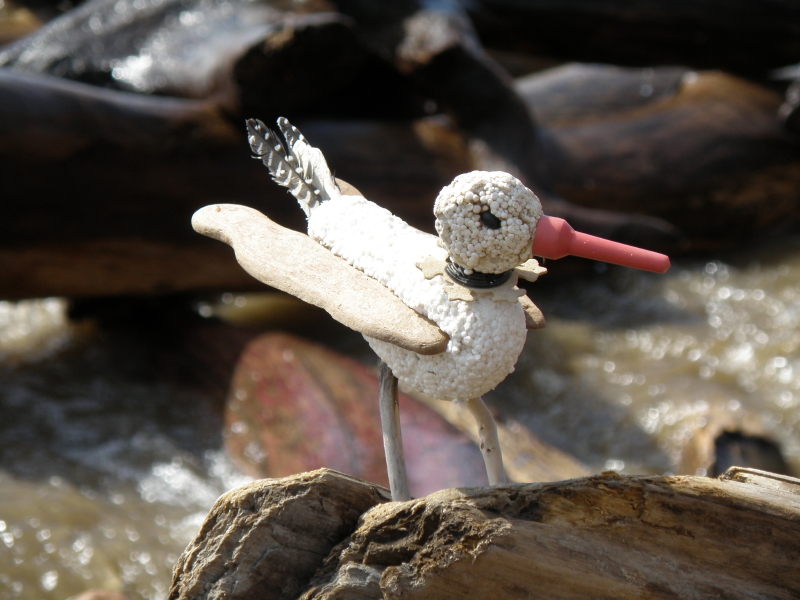
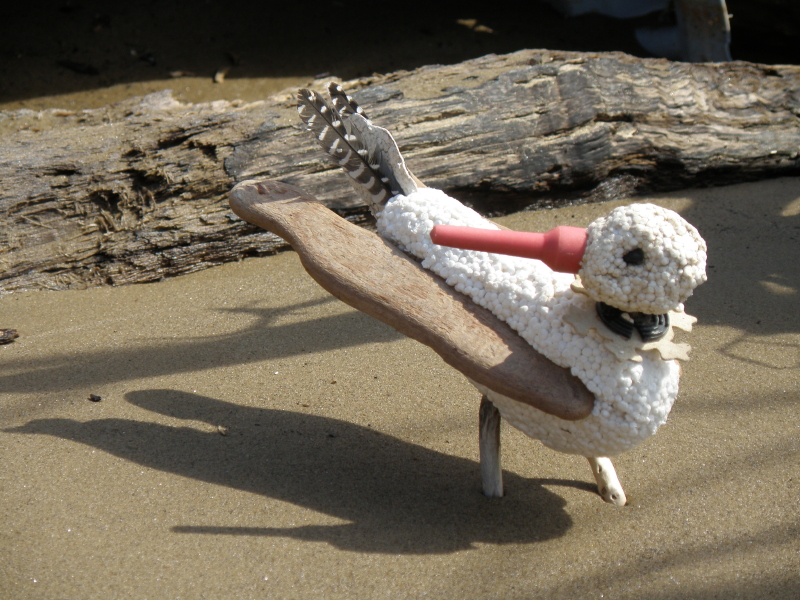
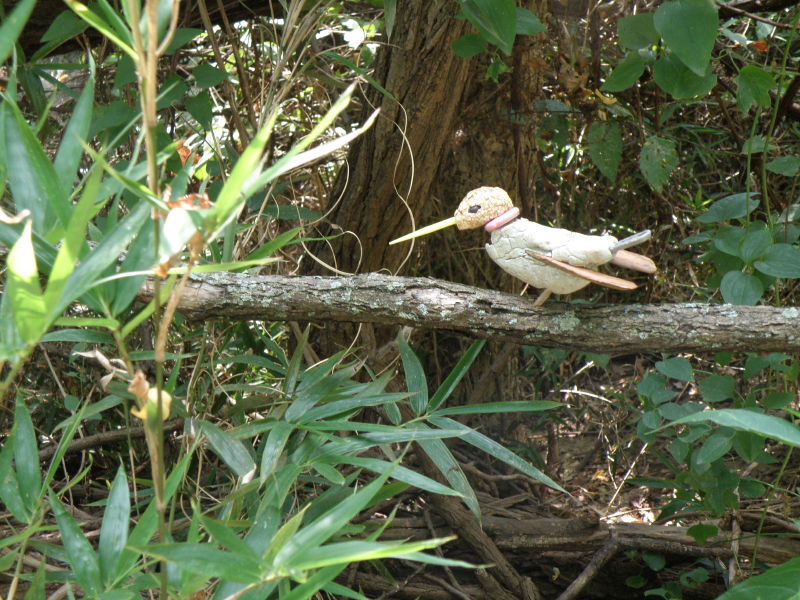
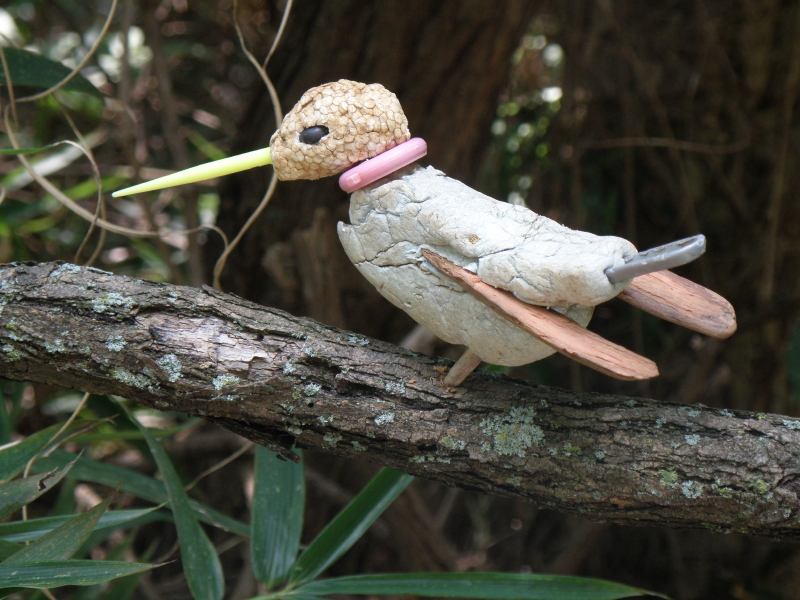
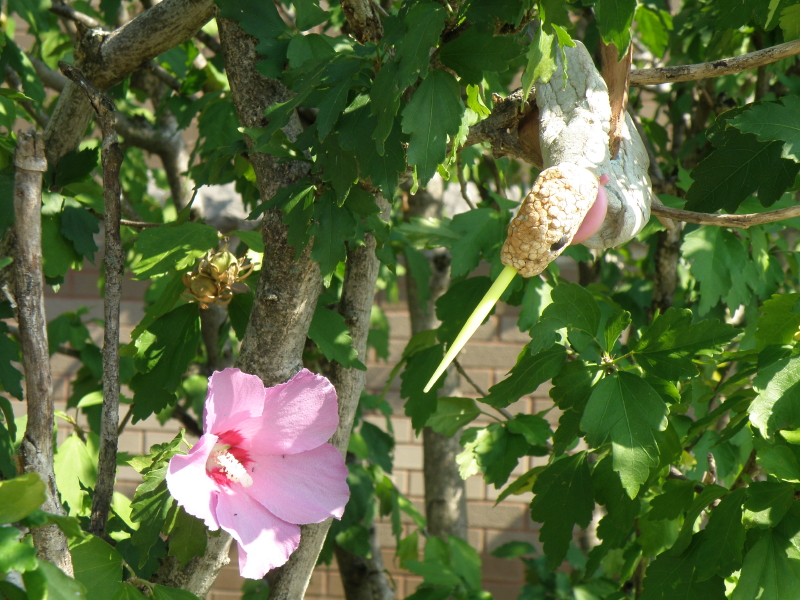
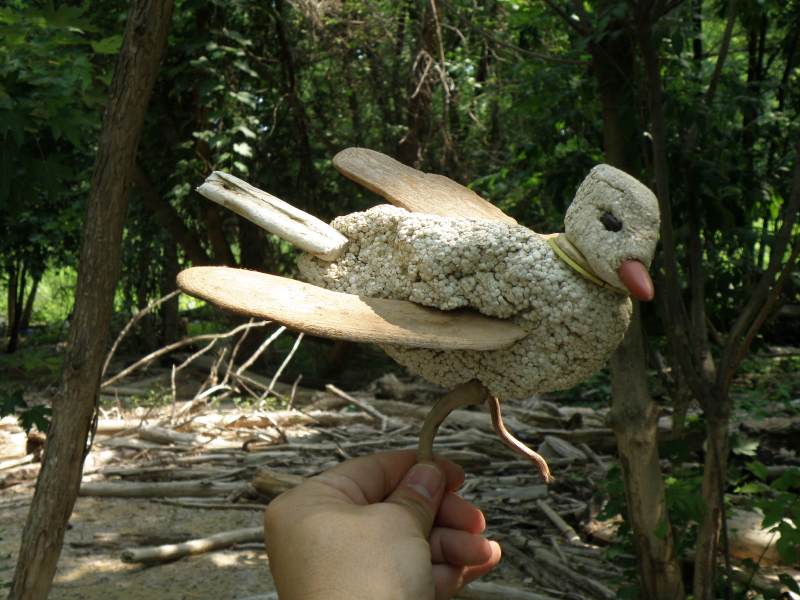
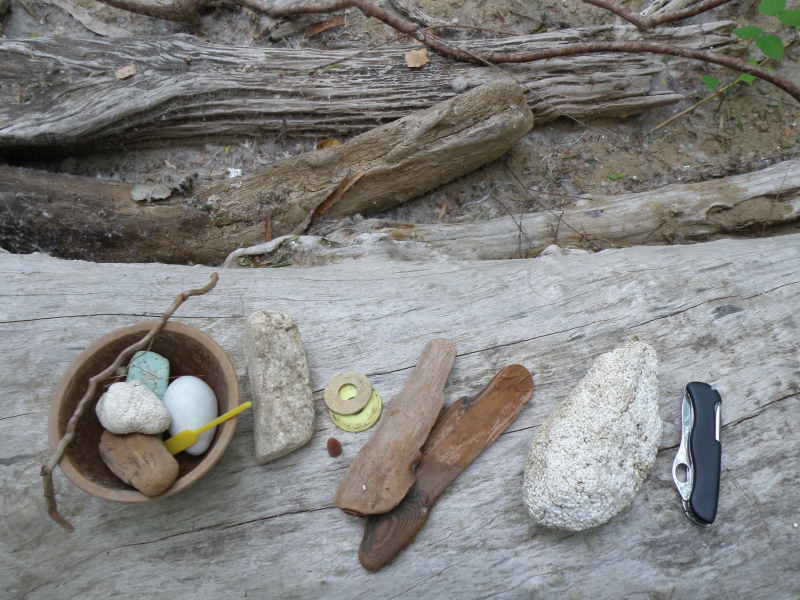
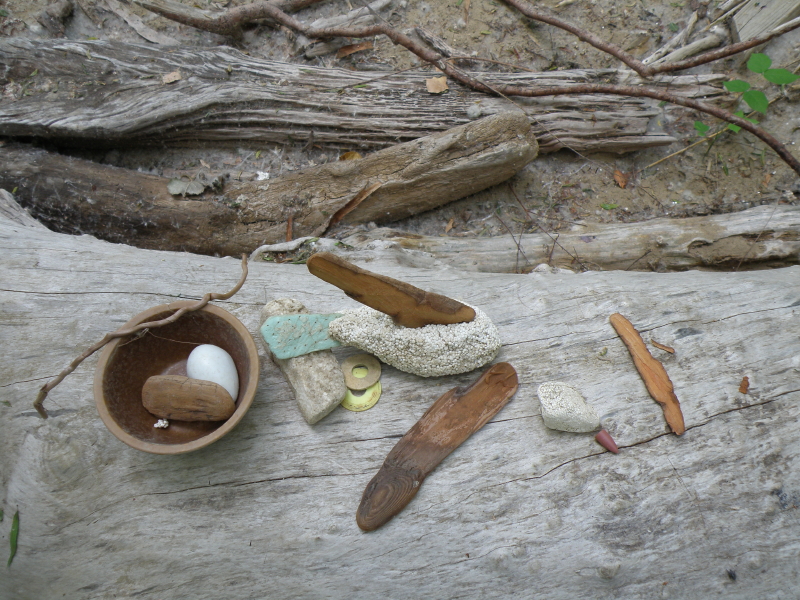
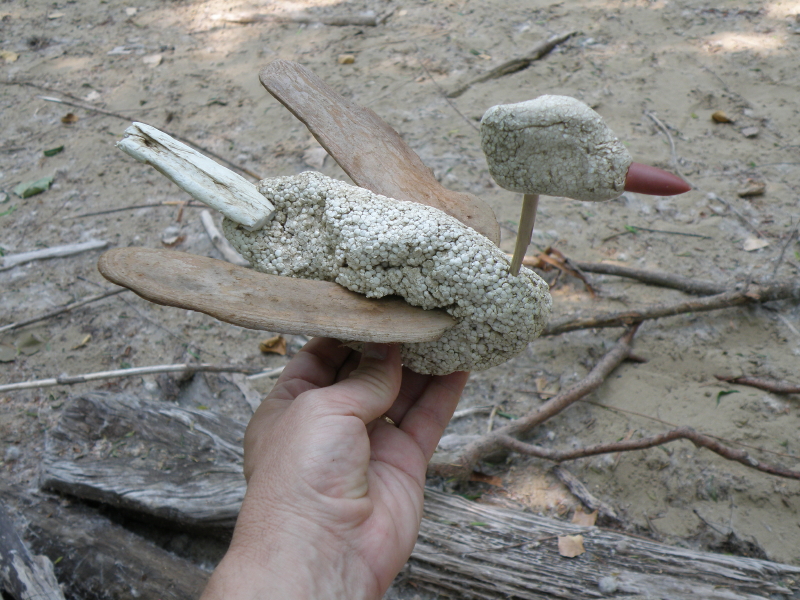
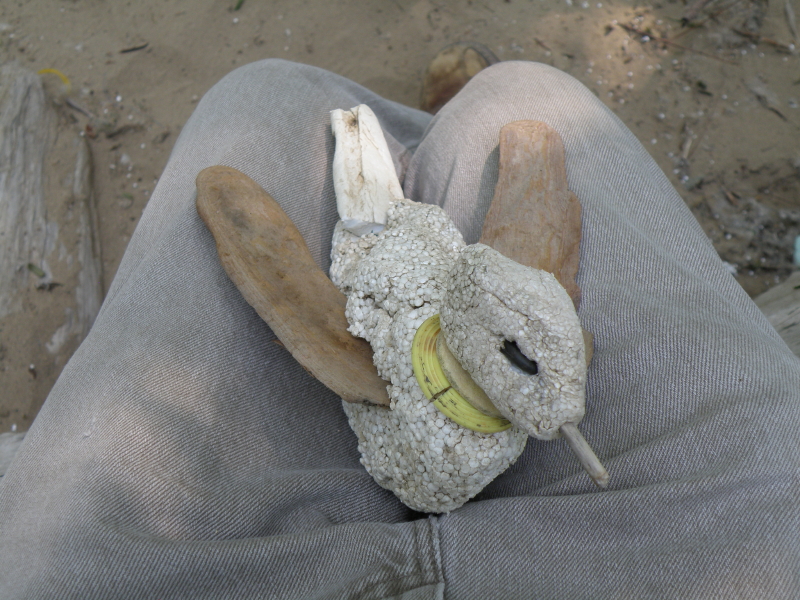
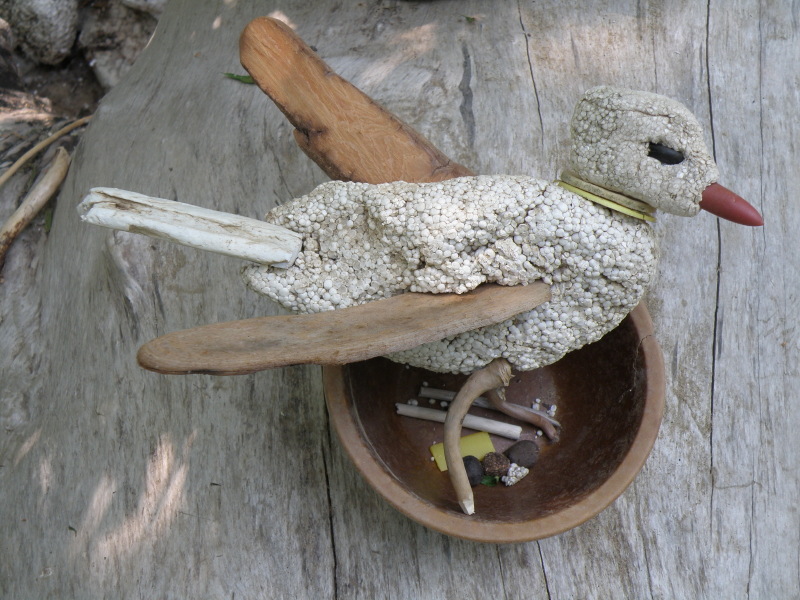
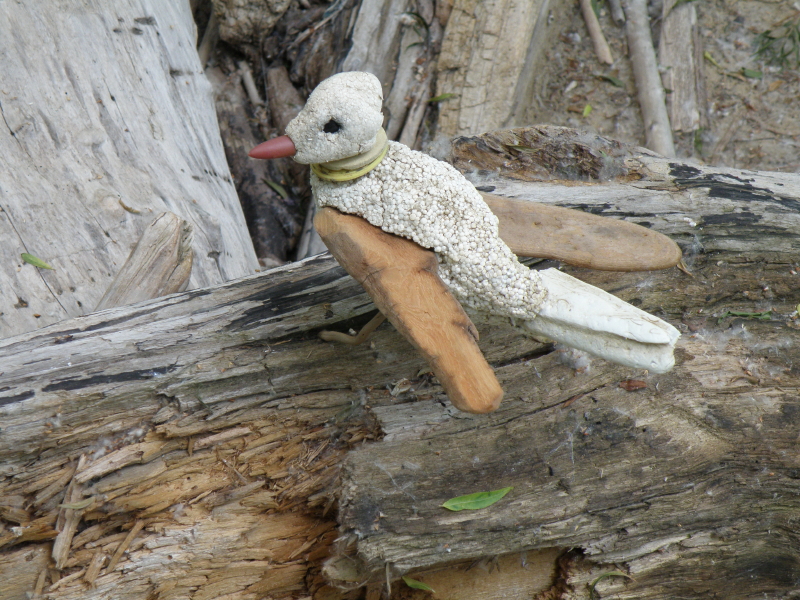
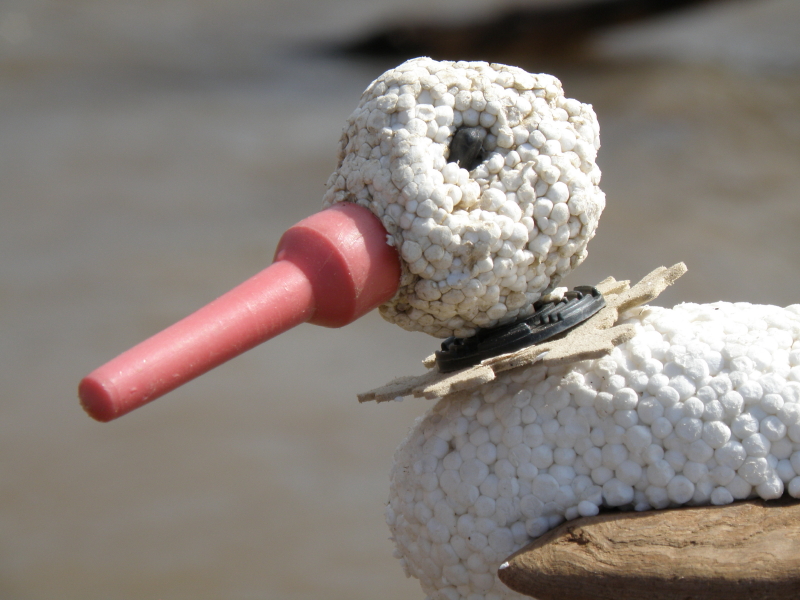
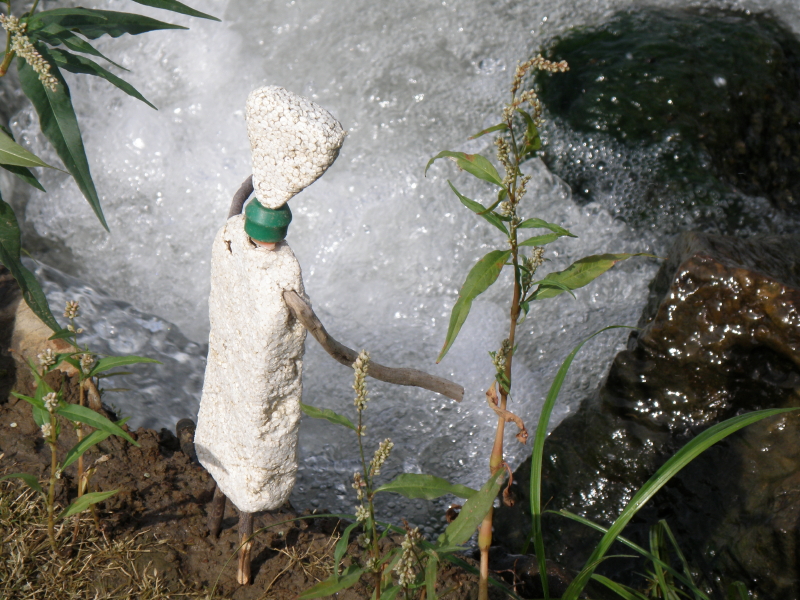
I enjoy processes and since I had additional images relating to my last post…I thought I would throw them in for fun.  I also harbor this very idealistic idea that everyone is born creative…it’s just that most people don’t view themselves in this way which I believe is at the heart of our environmental dysfunction and a great shame.  Somehow we have replaced creating with consuming. The following images hopefully show that you can create magic out of nothing.  There isn’t anything technical happening here.  If you can do Mr. Potato Head than you have the basic idea behind creating this bird.  The materials are not manipulated greatly.  I like nature to form the shapes I use. The only carving involved is in cutting slots into the body to hold the wings.  I did shave away one wing to make it thinner. I did poke holes in the head for the eyes.  I shortened the willow roots for the legs and the beak is held in place with a wooden peg just as the head attaches with its own little stick which also helps the head to swivel. Now I know this sounds a bit flip, but the hard part is seeing the possibility behind something that’s intrinsically worthless and imagining what else this could be?  Looking at the following series of images at home, I’m struck by the altar quality of the log I have spread out my materials on at my temporary outdoor studio.  I do feel that being an artist is a reverential activity.  I like to think my “art” is somehow in the service of life.  I believe you will recognize most of the components of this bird, but they include Styrofoam, wood bark, dried willow rootlets, the plastic nose cone of a small bottle rocket, plastic and foam “gaskets”, and charcoal for the eyes.  All materials were found on site at the river.  I found the little bowl that morning and it’s great to hold the little pieces I use.  I’m not a great photographer in the classic sense in that I don’t concern myself greatly with exposures and settings.  My camera is set on automatic.  I do, however, try to create an interesting image or composition that “says” something to me about that day and this place.  Give it a try…it’s fun to do!

Read Full Post »

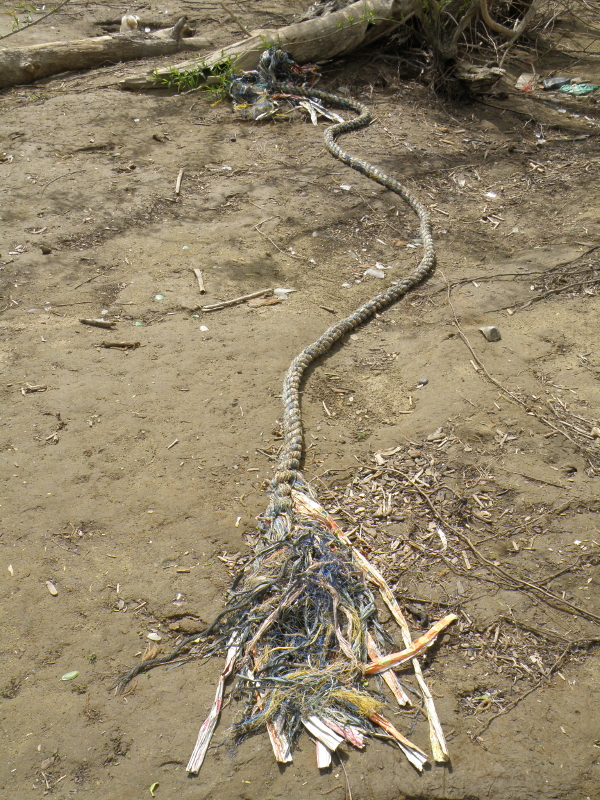
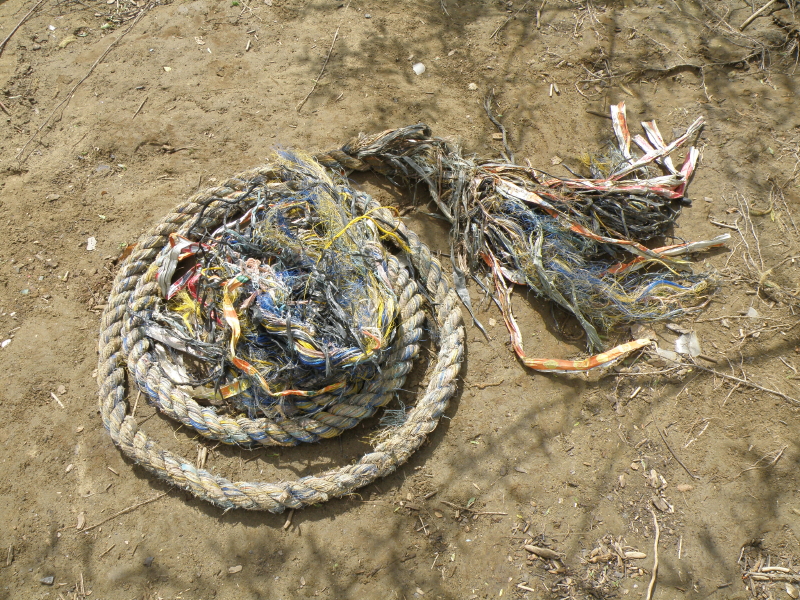
The stars were in alignment and I got to spend a nice Earth Day at the Falls of the Ohio.  It was a little cold and windy…nothing layering in sweat shirts couldn’t handle!  I found so many interesting objects and spaces that I filled up my camera’s memory card.  I now find myself with a richness of images I couldn’t post in one go…and so I will try to keep it focused in some way.  As proof that everyday should be Earth Day…the official celebration in the park has been moved to May after the Kentucky Derby.  Supplanted by a horse race!  Last night was Thunder Over Louisville which year after year is usually the largest fireworks display in North America and kicks off the two weeks long Kentucky Derby Festival.  Thousands of people were out here partying on both banks of the Ohio River.  They left their trash after the event, but fortunately it looks like the clean up crews are doing a good job and keeping this stuff out of the park.  After all, it already has enough detritus of its own.  Of late, I’ve been really fascinated by how these big barge cables and ropes that wash into here weather over time. They are made of tough stuff, but the river wins in the end.  Sometimes they unravel and drift beautifully from willow root to branch like mutant Spanish moss.  Some of their colors can even be shocking compared to the neutral earth tones of their surroundings.  Here’s one such scene I’ve been trying to describe.  This is one of my Earth Day photographs.
I later came across a nice length of barge cable stretched out across the sand. For fun, I started coiling it and taking pictures of the different configurations I came up with.  Here’s the way it looked stretched out.

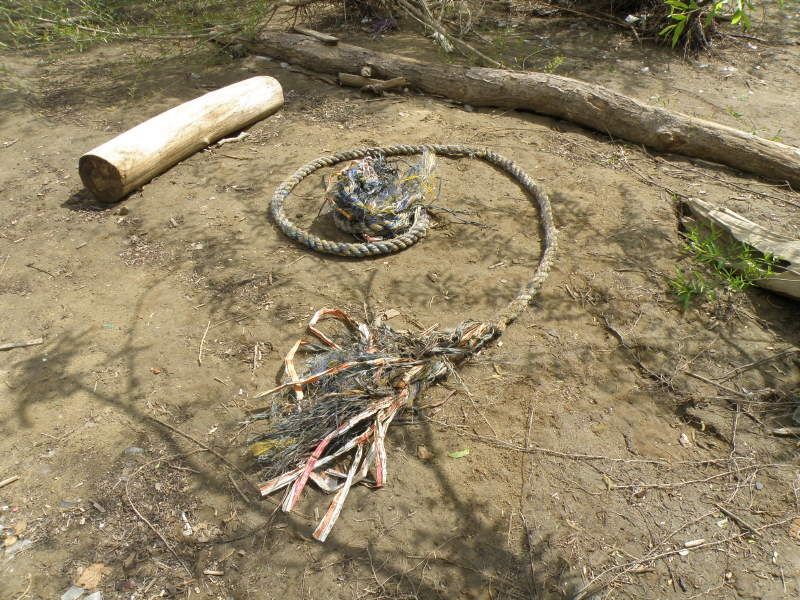
When I look at my pictures at home, many of these cable fragments reference fossils.  I get a strong feeling of ancient sea lily crinoids and nautilus-like ammonites preserved in the rock that was silt millions of years a go.  I also played with the spiral form and activated an intimate space with its spring-like energy.

Creating a tighter spiral evoked ammonite shells and wavy tentacles.  Ammonites were coiled cephalopods with some resemblances to our squids and octopi. The ammonites were so successful for so long.  Beginning somewhere in the Devonian they prospered and radiated out to fill all the world’s oceans until the Cretaceous Period crashed.  Their run lasted more than 330 million years and now they are all gone.  We have a way to go to match that record.

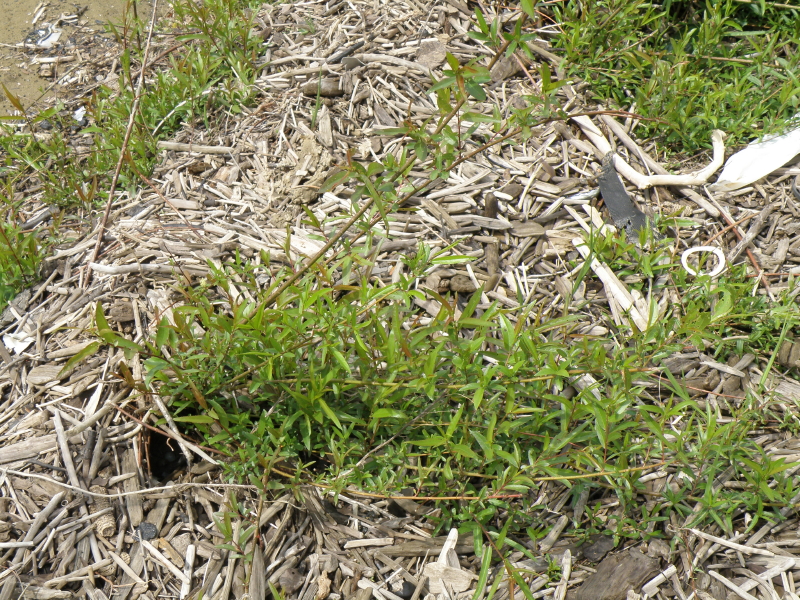
In most of the places I walked today I could hear the Northern Orioles singing.  I tried imitating their call notes and once in a while I could get a bird to reply.  I saw various warblers, vireos, woodpeckers, wrens, and more…however, the most memorable bird event happened at my feet.  I stepped too near the nest of a Song Sparrow and flushed the bird that was hiding with its clutch of eggs.  Here’s a photo of the scene.  Can you find the bird’s nest?  Look closely at the dark spot on the left side of the young willow greenery.

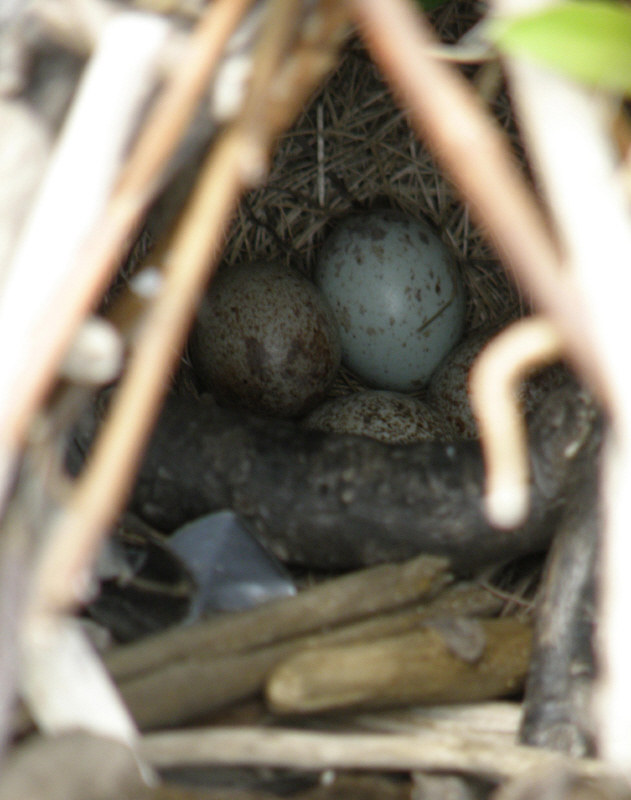
And now…lets look a little deeper and closer at this spot.

Inside were four tiny eggs tinged in green and speckled with brown spots.  I’ve read that the Song Sparrow is heavily parasitized by the Brown-headed Cowbird which opportunistically lays an egg of its own among the sparrow’s clutch.  The unsuspecting parents raise the cowbird as their own.  As far as I could tell, this nest was in good shape.  Perhaps having a really obscure nest site has so far protected it from the cowbirds which are common in our area?  Walking further, I came to another nesting site of a different kind near my outdoor studio.  Like the Song Sparrow…this spot was also well hidden.

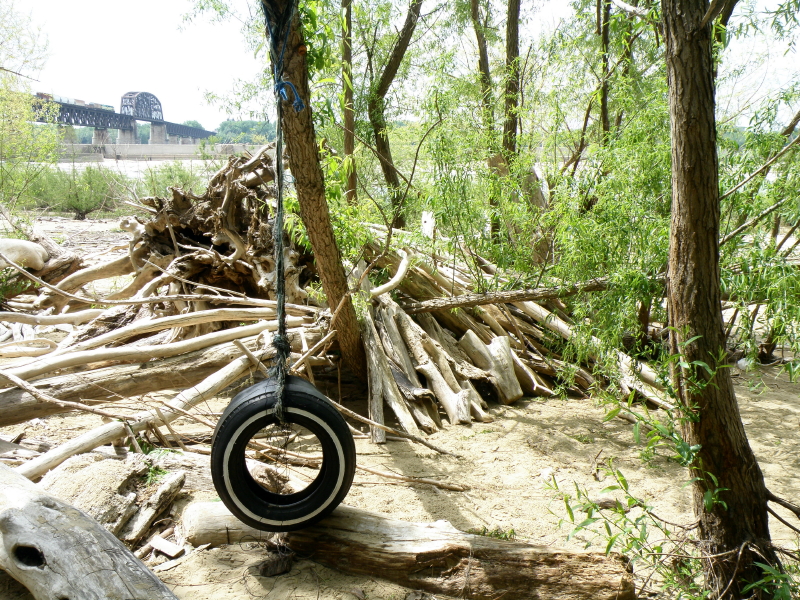
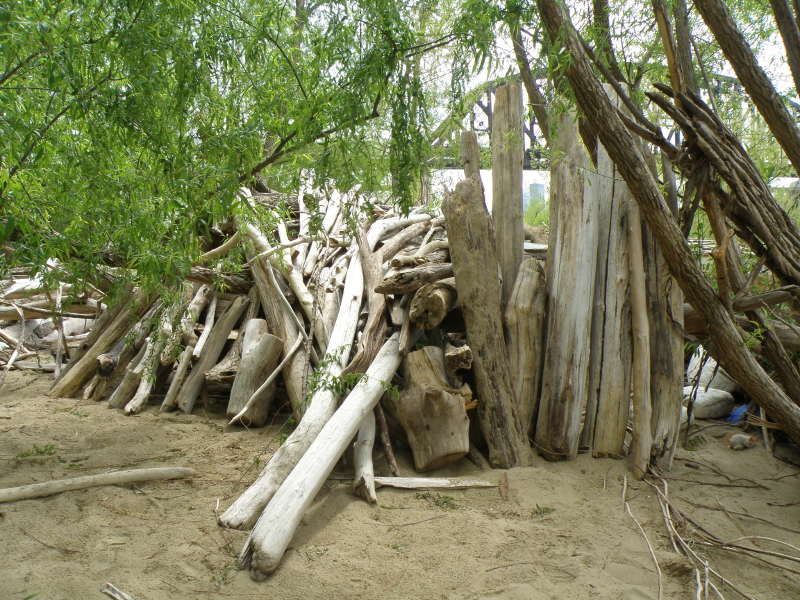
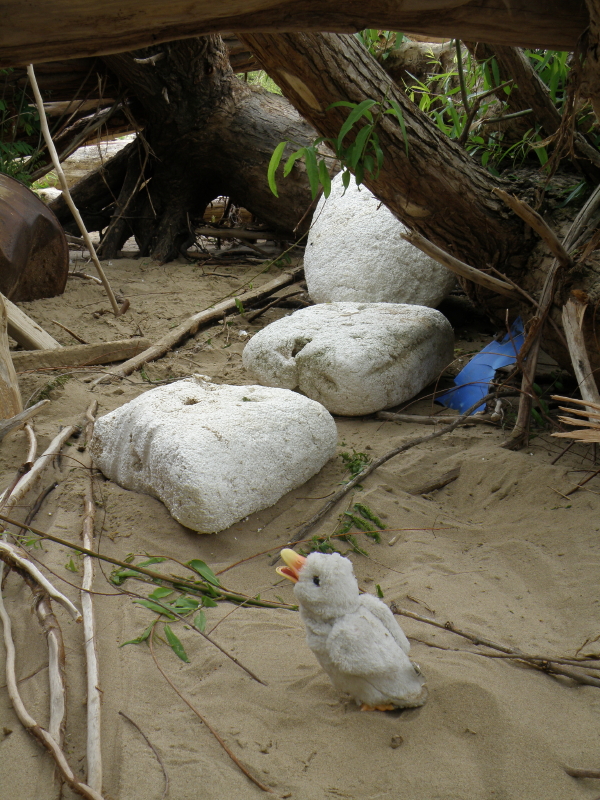
The tire swing helps give it away otherwise it easily blends into the natural driftwood environment.  I imagine a family coming to play here because there is evidence of children… including a misplaced fuzzy duck toy.  The kids keep raiding my Styrofoam cache, but haven’t made anything back at their fort!  Walking around the structure, I find the door is closed.

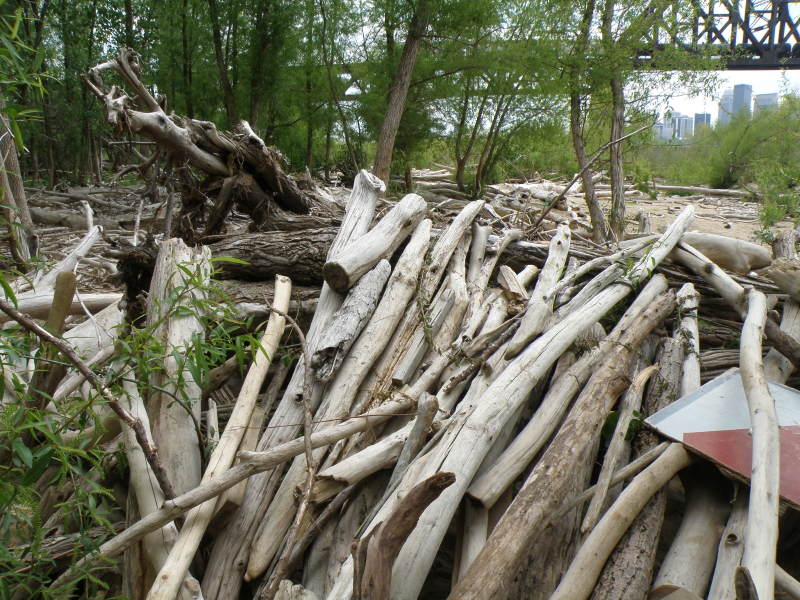
I even crawled up on the “roof”  for a look.  The builders have taken a natural space created by interlocking logs and enclosed and defined the space by leaning and propping up other found wood.  It all blends in perfectly.

I moved a few planks and logs aside and could see the interior.  I set the duck back up and snapped this shot.

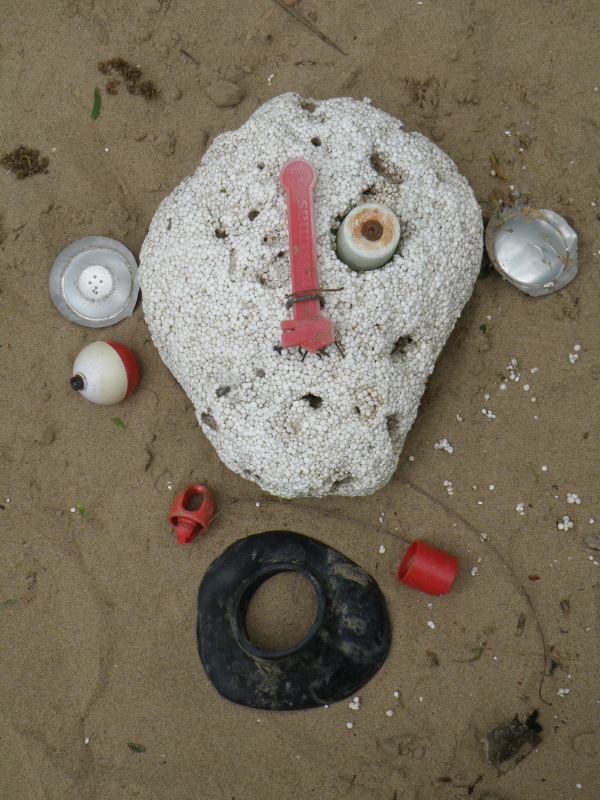
Because my driftwood structure neighbors like to borrow the Styrofoam I’ve collected…I decided to leave them a present using the biggest polystyrene chunk they dragged over here.  First, I need to improvise a head.

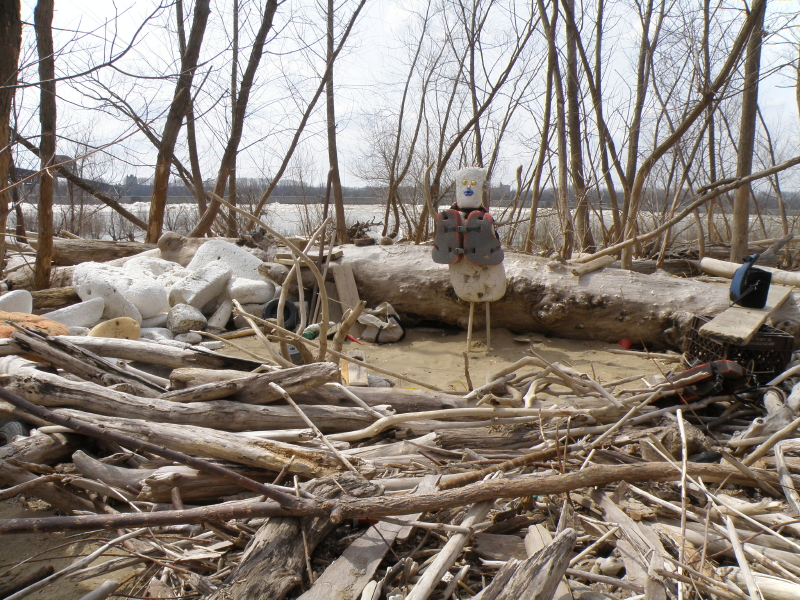
After finding some appropriate limbs…I set the figure up in the corner of the log fort.  I thought it looked pretty good against the new green leaves of the willows.  In my head I heard this little bit of imagined dialogue…”Wait, wait…it’s not yet Earth Day!  That’s been postponed until May 12.  Come back then and bring the family.”…as he waved all wild-eyed and everything.

I’m not sure how long this guy will last?  It would be nice to think that the kids who play here could see this figure as a part of their creative environment.

The root mass from this great log makes up one “wall” of the driftwood fort.  Here’s another view looking back before I moved on to the rest of my day.

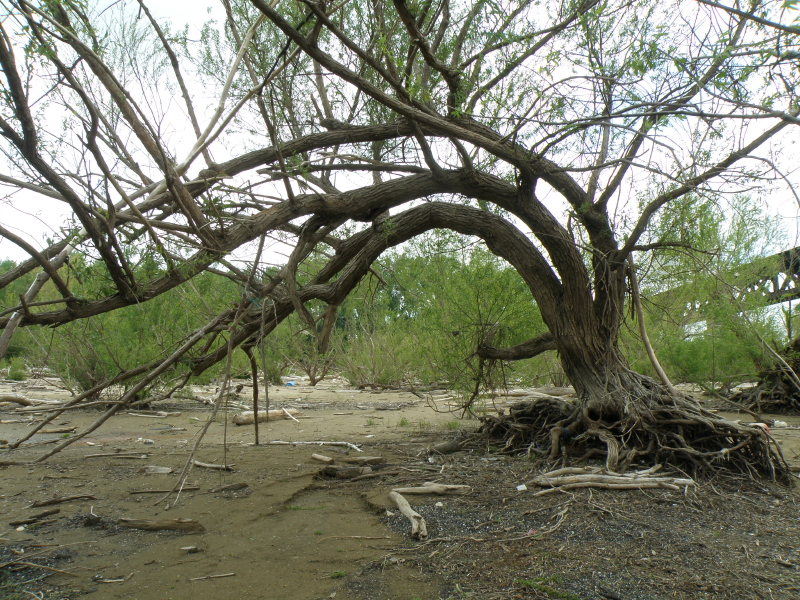
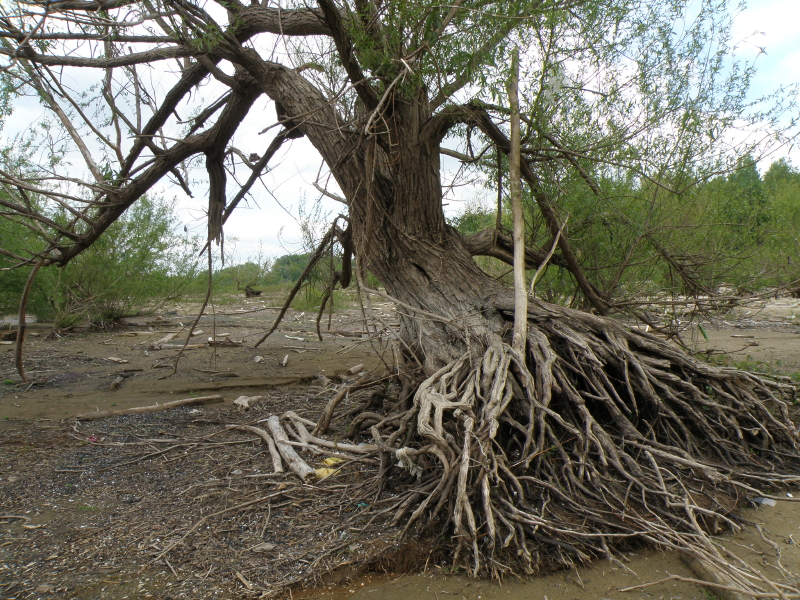
I’m going to bring this post to a close with two photos of a willow tree I saw the other day.  These trees are buffeted by the elements and begin to take on character and personality as their will to survive kicks in.  With their branches reaching for the sun…their incredible roots hang on to the mud and are sculpted by the Ohio River.  It’s good to think of trees during Earth Day.

Read Full Post »

It’s Spring and I’m walking the eastern section of the Falls of the Ohio State Park looking for birds.  I have done this religiously for years and have seen most of the species that have been recorded in this park.  I love birds because they are such beautiful expressions of life.  I envy their extreme mobility with so many species able to call greater parts of the globe home than I will ever experience.  This is the time of year when many different types of birds that have been wintering in South and Central America undergo remarkable journeys.  Some will pass through this area on their way to locations as far north as the Arctic Circle. This is my chance to see them… if I’m lucky. The Falls of the Ohio also has another significant bird connection through the life and work of John James Audubon.  He essentially started his life’s work that would eventually become The Birds of America, one of the great achievements in publishing and the most expensive book in the world, by first drawing many of the birds he encountered at the Falls of the Ohio.  Audubon’s example and his journal descriptions of the world he inhabited are frequent touchstones for me and this project.  Two hundred years later…very little remains of the original landscape he was familiar with.  That process and transformation of the landscape is continuing and unfortunately not always in a positive direction.  Birds are such great indicators of the quality of the environment because they are sensitive to changes…the canary in the coal mine was a real thing.  To enjoy birds and birding is an activity that takes you out of yourself for a little while and causes you to engage life on its own terms.  On this day (which also happened to be April Fool’s Day)  I did experience many of the usual year round resident bird species, but did not see any of the neotropical migrants that make the Spring migration so special.  So, when this happens, I’m not above creating my own bird species.  This post is devoted to a new bird I discovered out here and I’ve named it the Variegated Oriole.
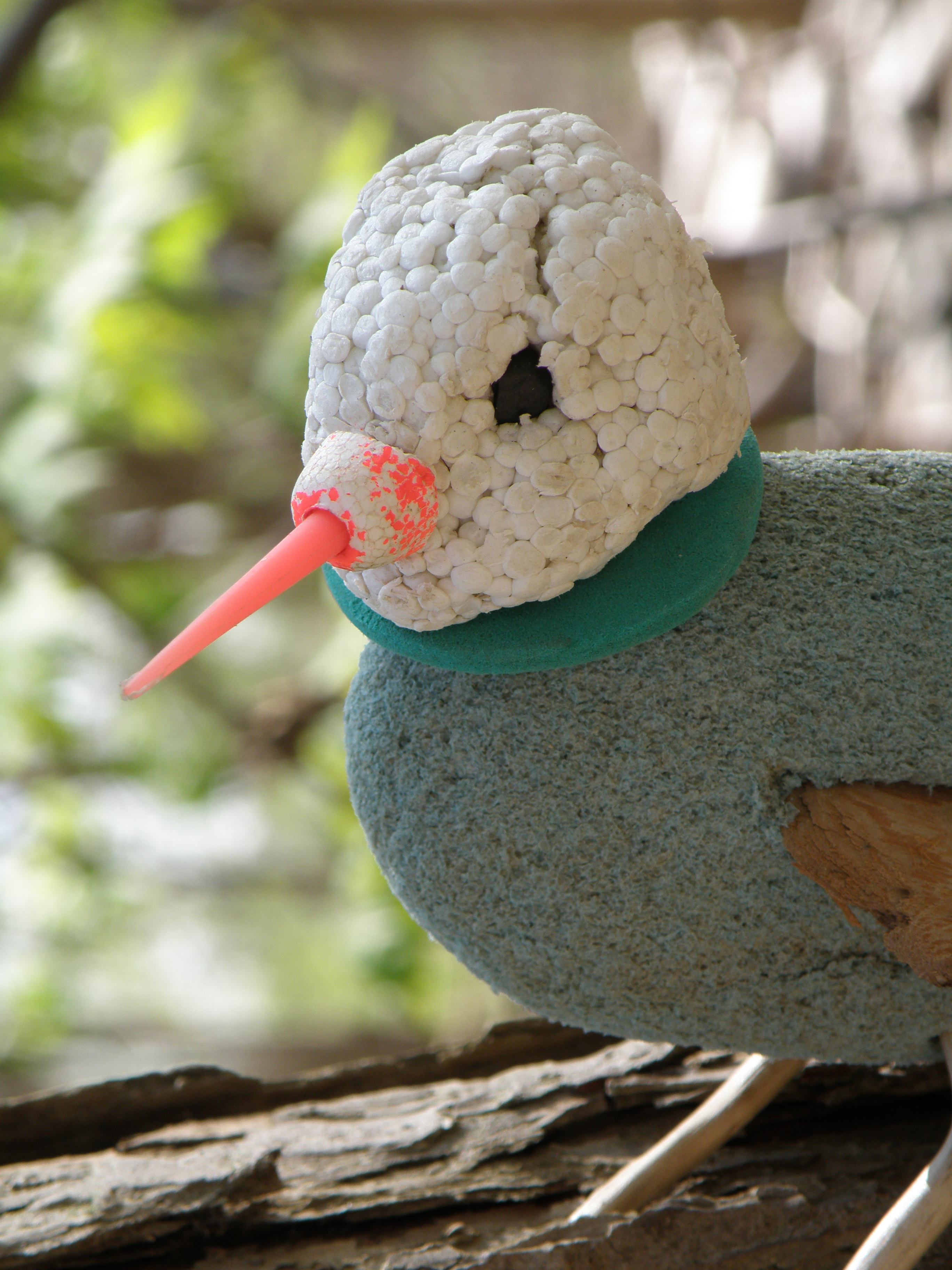
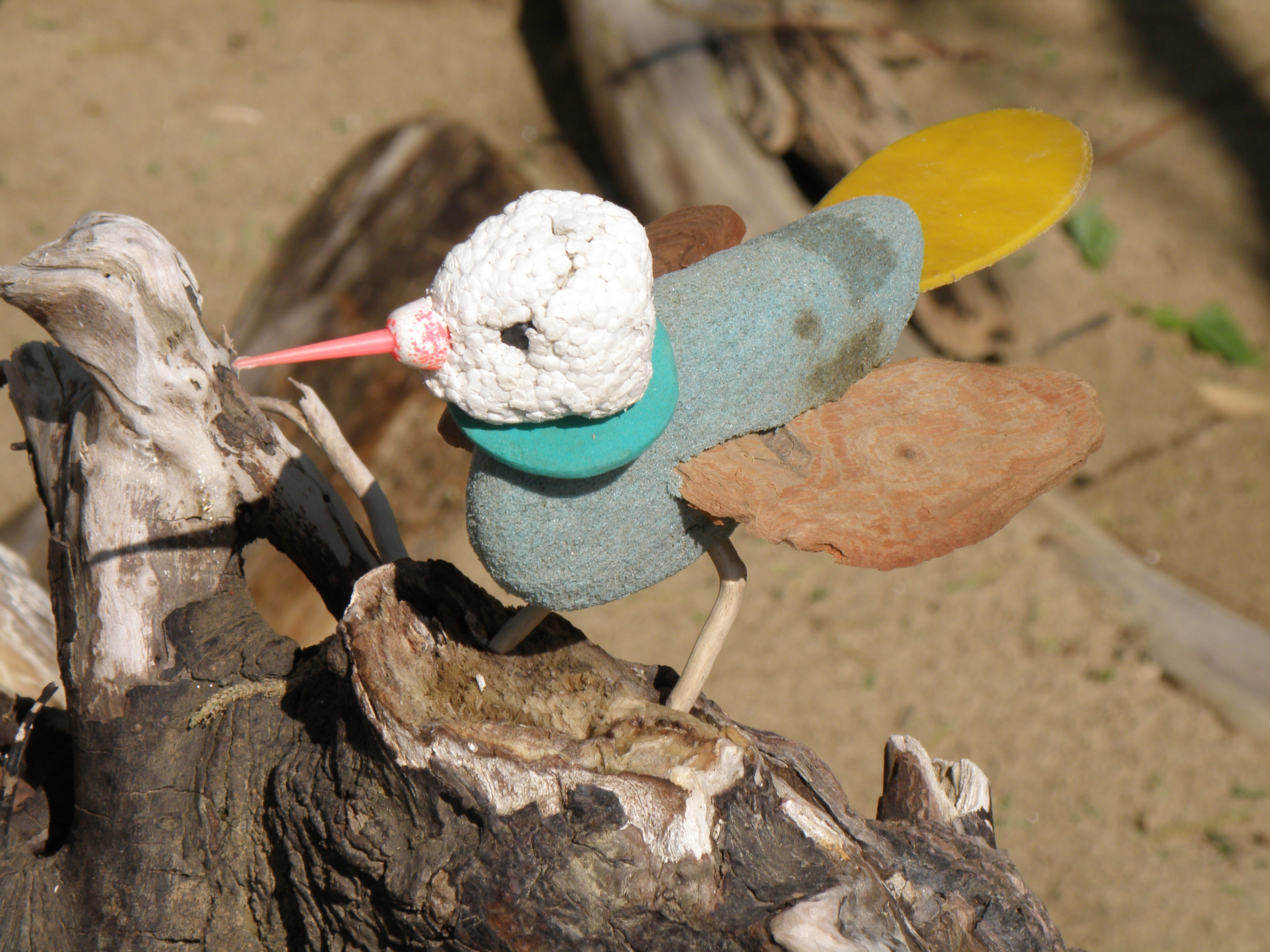
The Variegated Oriole receives its name for being multicolored. I first encountered this bird as various bits of detritus that I came across walking the shoreline of the Ohio River.  For the head, I used a small piece of river-polished Styrofoam.  Its brightly colored beak is part of a plastic and polystyrene fishing float that I cut with my pocket knife.  The eyes are small bits of coal.  I used a green foam gasket or washer to act as a transitional element between the head and the body.  It’s a trademark of mine that I seem to do with almost every piece I make out here. For the body, I found a blue piece of river-polished high density foam? that I cut a few slits into the sides to hold the wings which are made from pine bark.  I took one piece of bark that the river peeled off of a tree and I split that in half to form matching wings.  The tail is a piece of yellow plastic I found that reminded me of a bird tail!  I cut another groove into the blue body to insert and hold the tail in place.  The feet, are just rootlets that I sharpened and pegged into the body.  That’s it in terms of materials which I tried to alter as little as possible as not to trump what nature and the river had already shaped.  It’s important to me that this be a true collaboration.  If “we” are successful, then something of the spirit of a bird will take hold and inhabit this small sculpture.

After finishing the bird…I seek out environments that will help put this avian creation into some kind of context.  Everything matters and I hope my pictures convey something of the time of day, the season, the quality of light, the condition of the environment, etc…all those elements help create a sense of place.  I move through the willow trees posing the bird on various stumps and branches.  I usually take a lot of pictures.

Sometimes, I will imagine what kind of habits my new birds might possess.  In the case of the Variegated Oriole…it is not too different from the Northern or Baltimore Orioles that live and nest in the park.  They are among the migrants I look for. I heard one the other day calling, but didn’t see it.  The real orioles that live here are adapting to local conditions by using artificial materials (fishing line and barge cable fibers) in the construction of their hanging basket nests.  I’ve posted on this before in this blog a few years a go.  I think Audubon would have been interested in this.  Anyway, I left my bird sitting on a branch for anyone to discover.  It might still be there and I will find out today when I once again venture out to the Falls of the Ohio State Park.  Perhaps new birds will present themselves to me? I will let you know what I find…next time.
One week later…I returned to the spot where I left my faux-feathered friend and he was no longer perched upon the branch where I left him.  I was able to locate most of him scattered on the sand except for one wing.  My guess was that he was felled by a well-aimed and thrown rock.  The head was shattered and will need to be replaced provided  I recyle these pieces back into a bird again.

Read Full Post »

« Newer Posts - Older Posts »