Feeds:
Posts
Comments

Archive for the ‘Ohio River’ Category

Just a mini adventure this time.  During my last expedition to the Falls of the Ohio, I paid a visit to one of my favorite trees.  I love the root system on this Eastern cottonwood because it forms a “room” you can sit under.  I decided to take some refreshment there and rest awhile.  Scavenging  Styrofoam can be thirsty work on a hot day.  Here’s the cottonwood I’m talking about.  Looking around, I can see I’m not the only person who knows about this tree.  A couple of fire pits are in the vicinity.

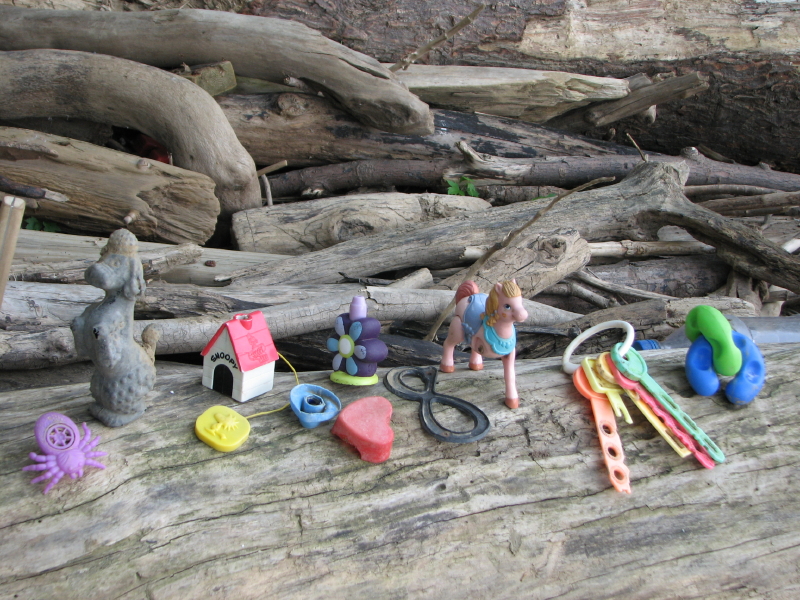
While I was sitting in the shade, my eye was drawn to some definitely non-natural color inside a cavity at the base of this tree.  When I investigated the hole,  I was astonished to find this little treasure trove hidden inside.  I withdrew the contents and set them up on a log for this photograph.  I think you will be as surprised as I was!

A variety of plastic toys including a poodle, Snoopy’s doghouse, various baby items, a numeral “8”, and a horse with three legs were in the hole.  How or why was this stuff here?  When I checked out the area around the larder more carefully I found very small tracks and the picture started to become clearer.  When I saw this little guy…I had my answer!

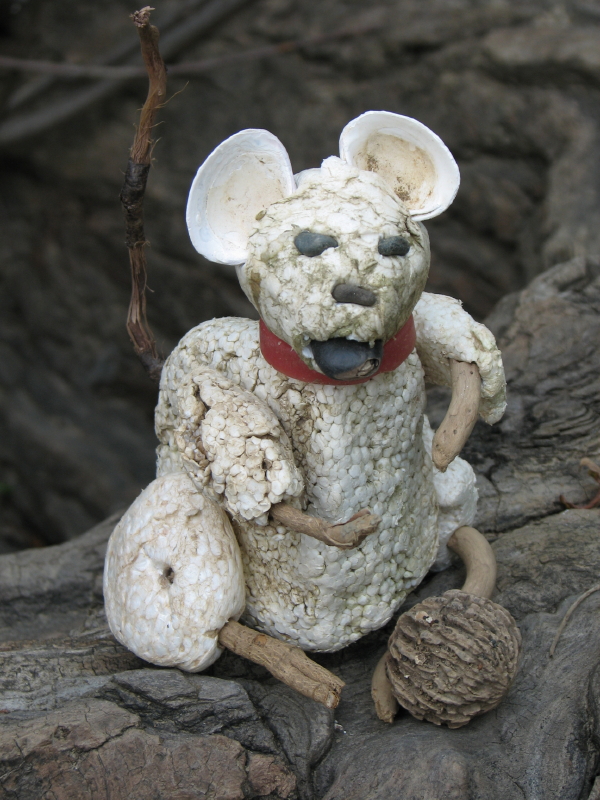
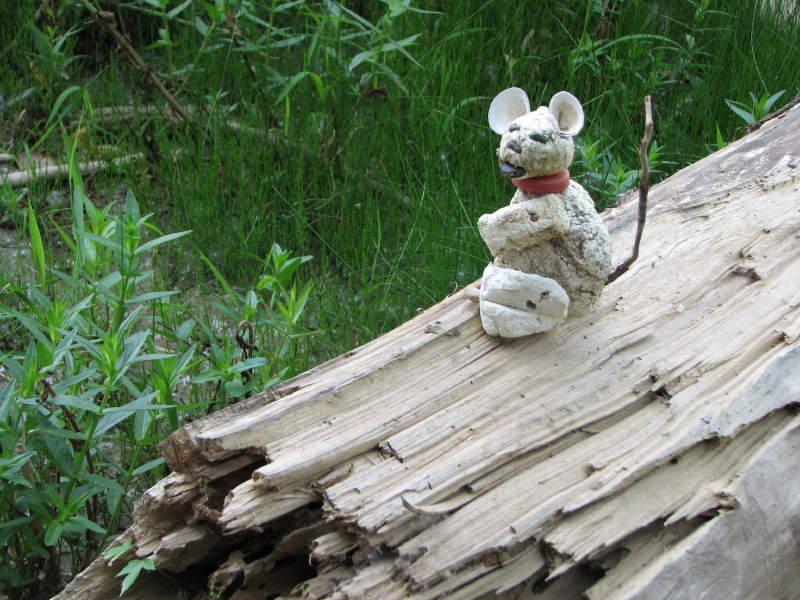
This is Meriwether’s Mouse and he’s named after the famous explorer Meriwether Lewis who was the first to describe this appealing rodent.  This species is known to cache colorful objects and is not above pilfering items from unwary hikers and campers.  In this mouse’s case, he doesn’t need to take anything because the river will provide plenty.  No doubt these toys were found along the riverbank.  I do the same thing myself!

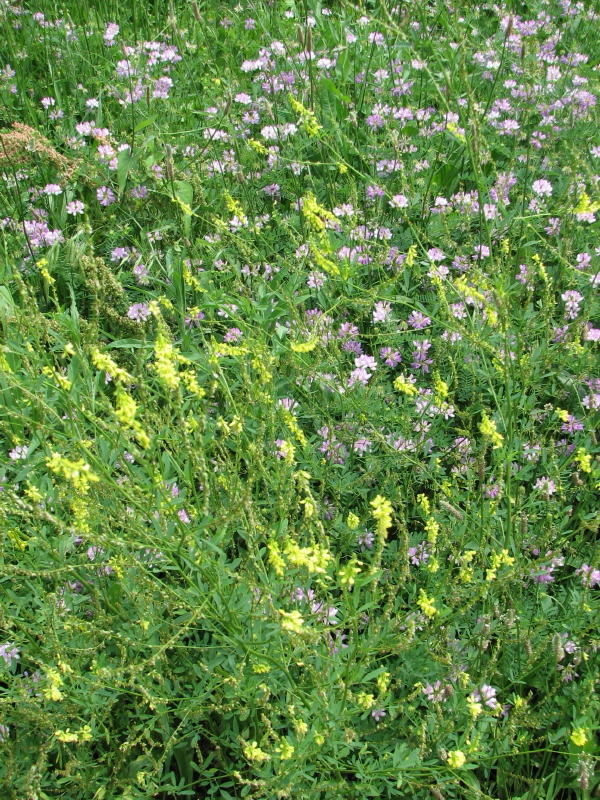
Because there are a formidable number of predators out here, Meriwether’s Mouse is not as common as it once was.  They do possess very acute hearing and this specimen heard me shift my position and off it went!  Recently, I was looking through a copy of Audubon’s Quadrupeds and was amazed at the mostly small varmints that populate the mammalian natural history of our great country.  I guess most animals aren’t going to be as magnificent as a grizzly bear or bison in size.  In fact, most are about the size of our mouse!  I appreciate all the more Audubon’s challenge in making this seem interesting to the average person sitting at home.  Great or small, all animals are glorious to me!  In closing I offer this abstract expressionist, all over composition… rendered in wildflowers.  Thanks!!

Read Full Post »

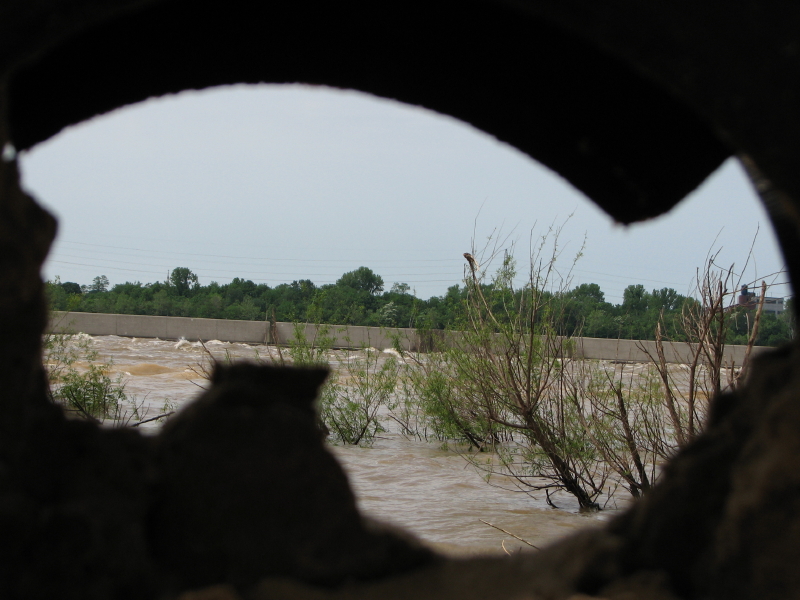
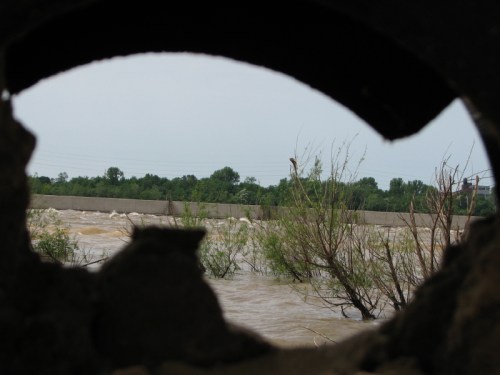
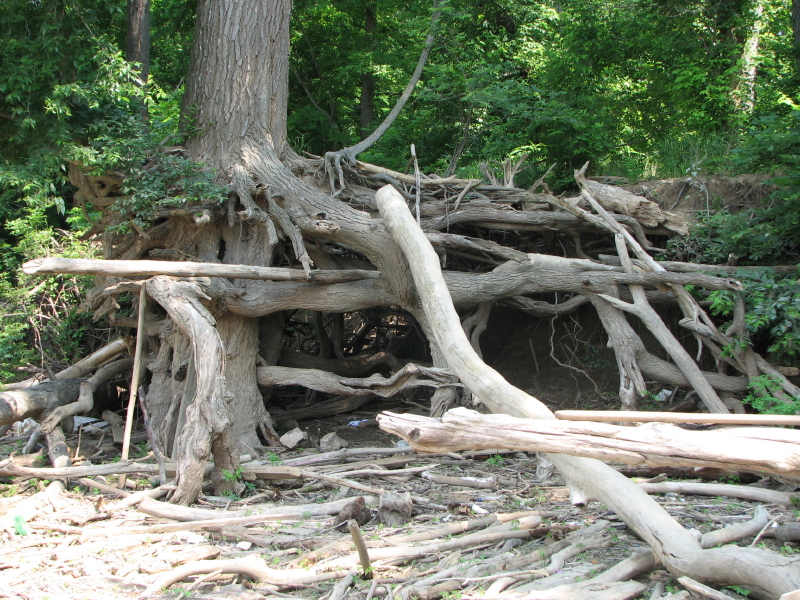
Recently came across this view of the river through a magic portal.  Since it is double-sided, it allows me to look both forward and backwards from a fixed position.  I thought I would use this opportunity to go through some of the many photographs I have taken at the Falls and not previously used on this blog.  Many times I come across scenes that are visually interesting to me, but they don’t fit the post I have going at the time.  Consider this an attempt to cobble something together through a tangled theme.

I’m sitting here thinking whether I have chosen the correct words to entitle today’s post? My immediate thoughts are that this is a more complicated situation than I first considered.  Just thinking about things that are tangled up is ensnaring and hard to tease apart!  When I look at the root ball of a big tree I can see that the roots themselves seem tangled up not only with themselves but with the earth that helps it grow.  There the relationship is more obvious and seems purposeful in its interconnectivity.  The tree roots help stabilize the tree while providing the nutrients it needs from the soil.  The soil in effect is held together by the roots that run through it. 
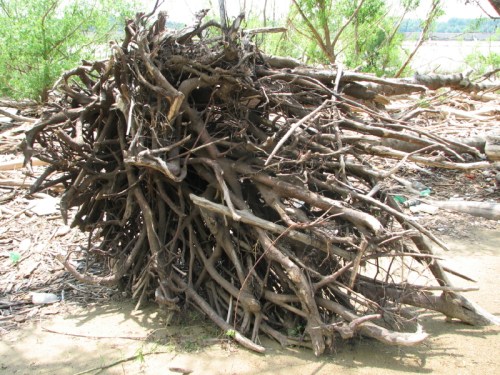
String enough trees with their root masses holding things together and you have the beginnings of an ecosystem.  The relationship is one of symbiosis.  When I see trees that have been uprooted like this I imagine that the riverbank it once helped to support has been weakened and degraded in some way.  We see a lot of erosion around here and it isn’t just the river’s fault.

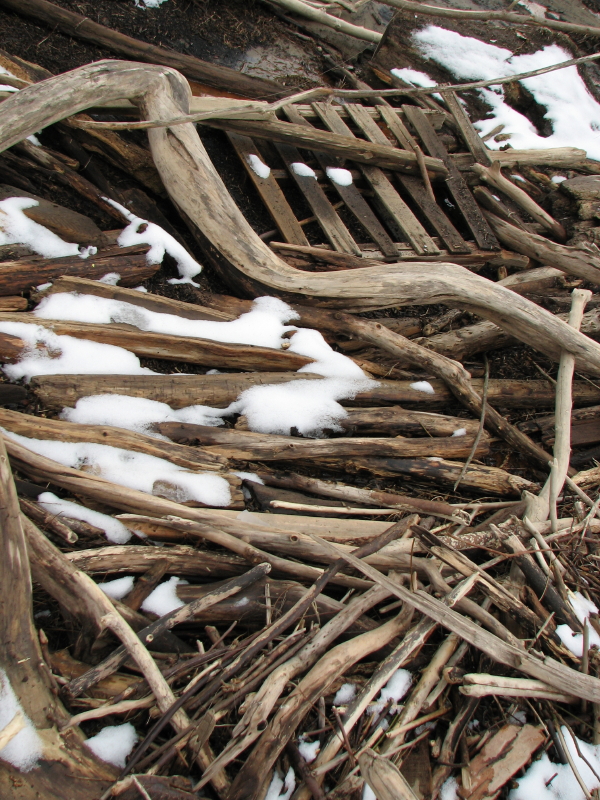
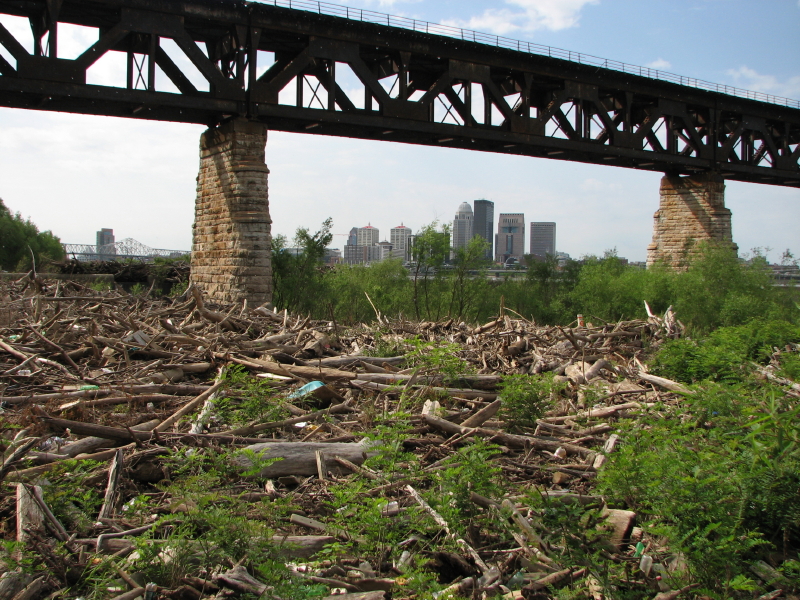
At the Falls, there is a lot of wood that gets deposited by periodic flooding.  That is how it has been since there has been a river here.  What has changed since the days of Lewis and Clark  is how much man-made stuff is now interwoven into the mix.  When it’s something like this old wooden palette, then it isn’t as bad.  Eventually, the palette will break down and be absorbed by nature.  But at the Falls, I also see many things that will not go away easily if at all.
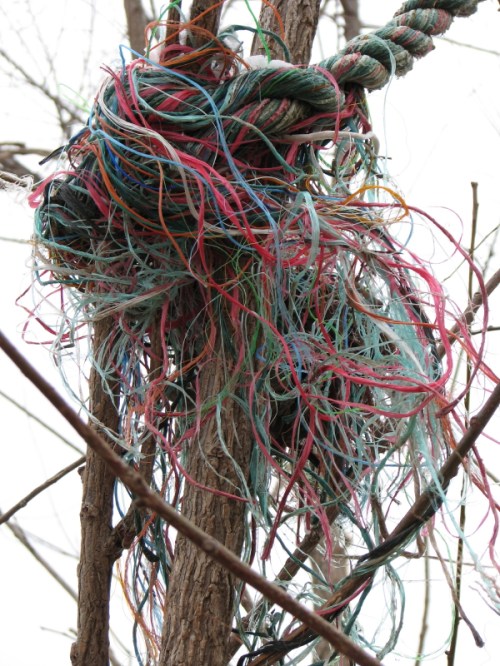
Here’s a barge cable that has been snared by a tree during high water.  These large ropes I’m guessing are made from nylon and are very heavy.  They are used to secure along the shoreline, long strings of barges along the intercoastal waterway.  A lot of coal is moved on these barges and is burned to produce electricity.  On occasion, I find a lot of washed up coal too.  Water is powerful and does its best to reduce these ropes to something that is more manageable.  Interestingly, I have come across several bird nests made almost entirely from these untangled cable fibers.  In their own instinctual way, even the birds are trying to utilize these cables.  Many of the resident willow trees are “decorated” with these snags.
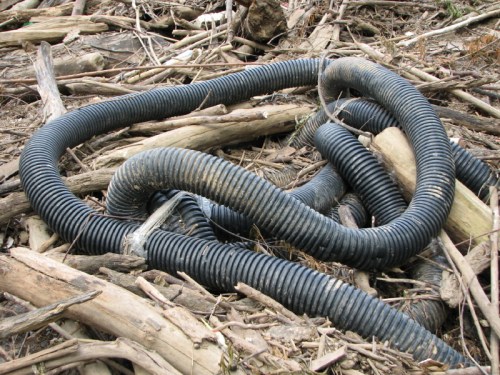
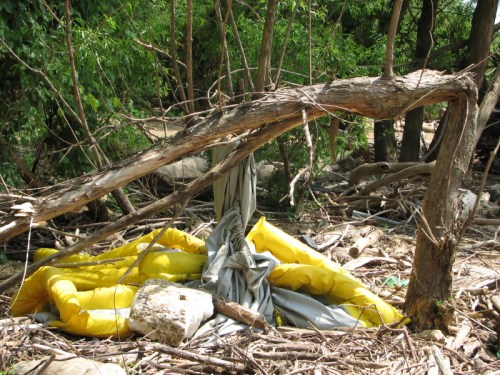
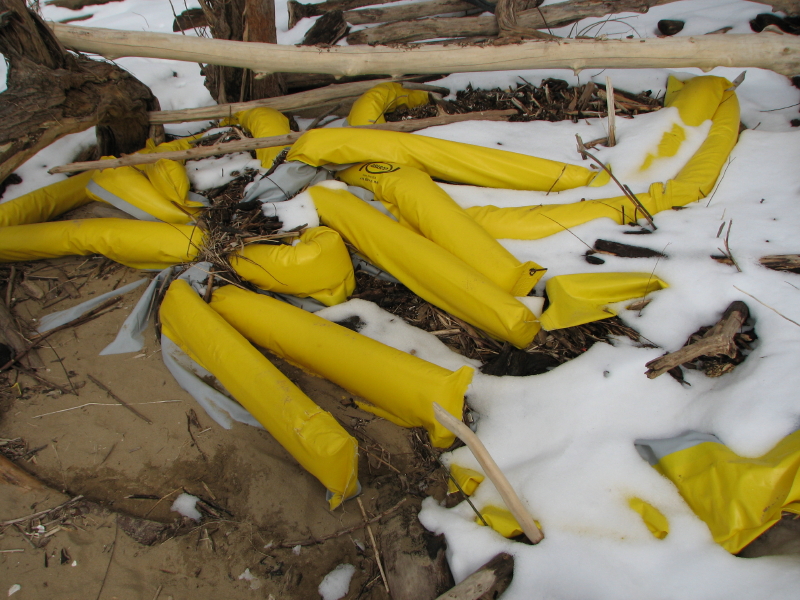
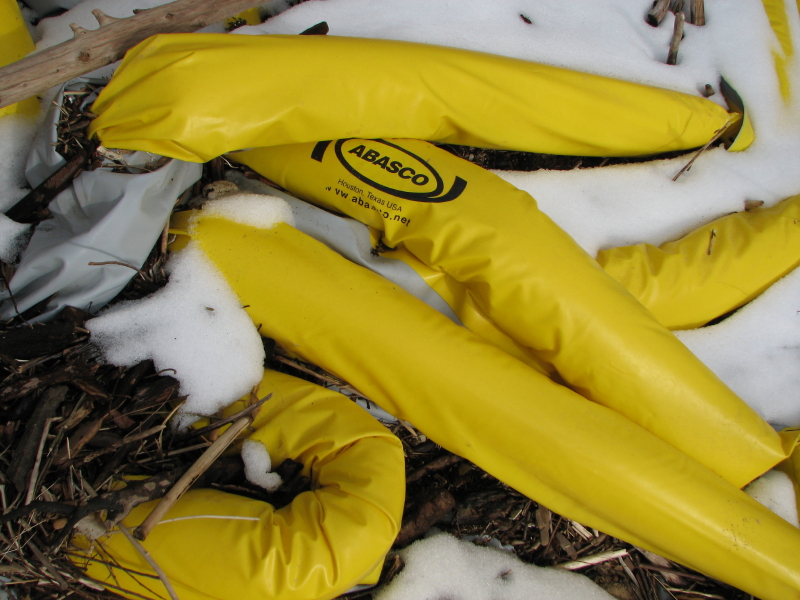
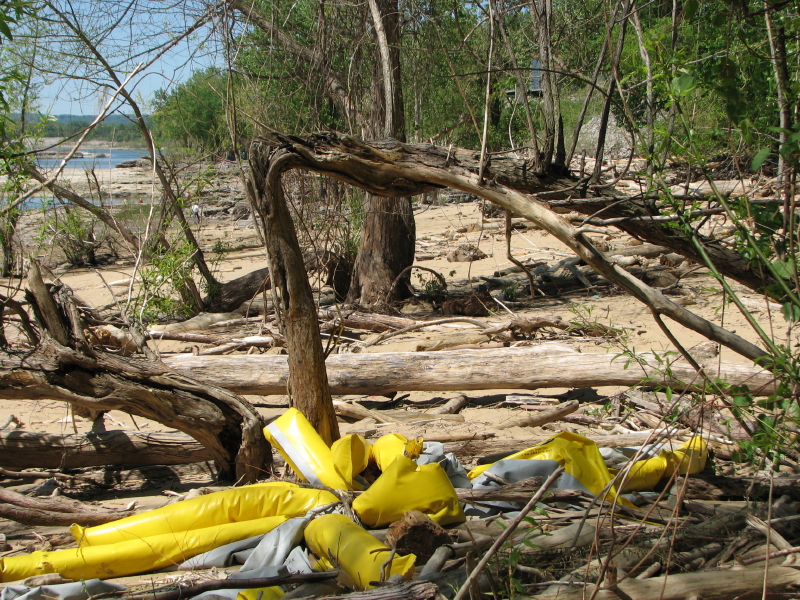
This large black hose washed up here during the last flooding incident.  It’s all tangled up into a much larger driftwood pile.  Even something like this isn’t going to get reabsorbed into the natural system easily.  It’s just tangled up and will lay there until the river moves it again or until one of the periodic river clean-ups where it might eventually get covered up in a landfill somewhere else.  It probably won’t get recycled, so burying it is more a matter of out of sight, out of mind.  This solution takes no inspiration from nature.  Since late winter, I have been watching and photographing this boom that just showed up here in all its yellowness.

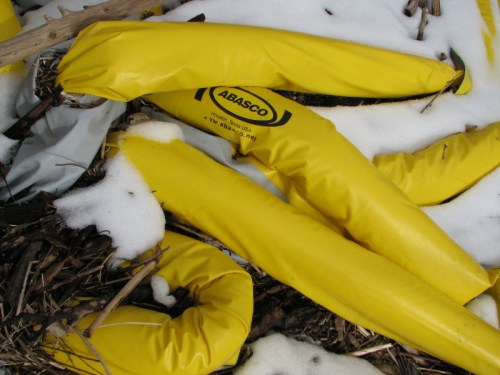
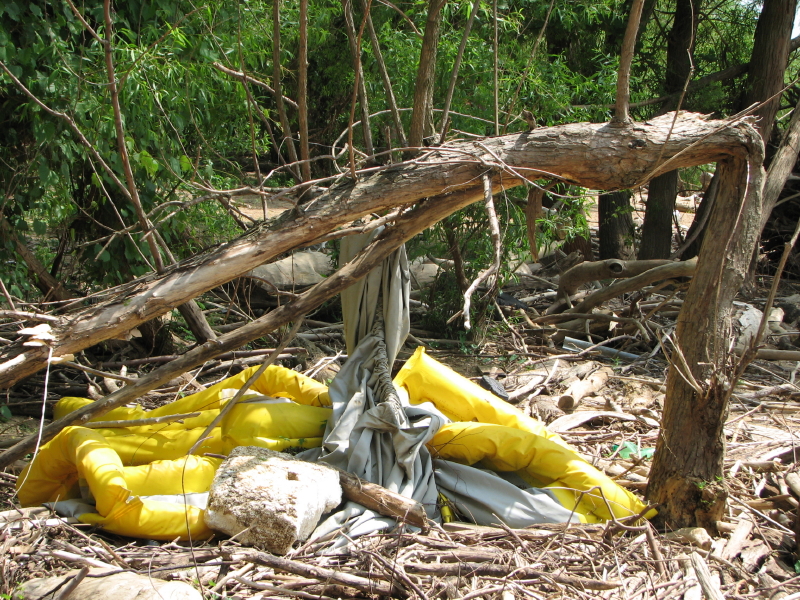
I did look up the company name on this object because I wasn’t entirely sure as to what this is or why it’s here.? I suspected that this is a boom used to contain or protect something from contamination.  Like many people, the immense oil spill in the Gulf of Mexico has been on my mind.  What a colossal failure of imagination this has been all the way around.  I imagine that the company that made this yellow boom and is based in Houston , Texas is probably having a great year.  Here are some recent images.  The longer this boom stays here, the more it seems to catch things around it.
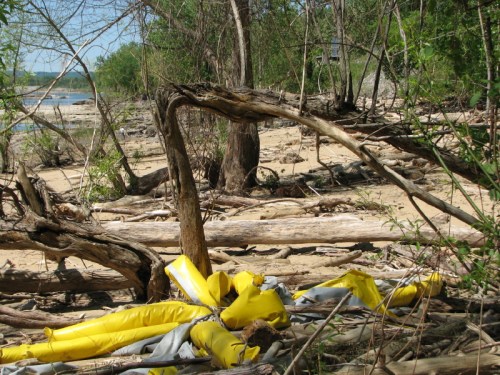
It is ironic that something that is supposed to be a tool to “protect” the river, winds up becoming another discarded piece of junk.  What is one supposed to do with this boom now?  I’m assuming that this was used somewhere along the Ohio River or its tributaries which eventually flows into the Gulf of Mexico.  This boom’s appearance here suggests that the Gulf and the river were already in trouble long before the latest oil spill.
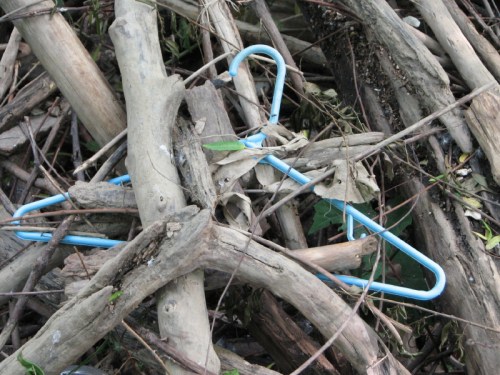
I know many people who feel as I do…that they are tired of feeling hypocritical about our relationship to the natural world.  Trying to untangle good answers to this dilemma while living lifestyles that promote and accept such waste has to be psychologically damaging too?  At the moment, we seem unable to act in our own ultimate best interests and it will probably take some even greater calamity to befall before we are forced to have the courage and imagination to go in another direction. 
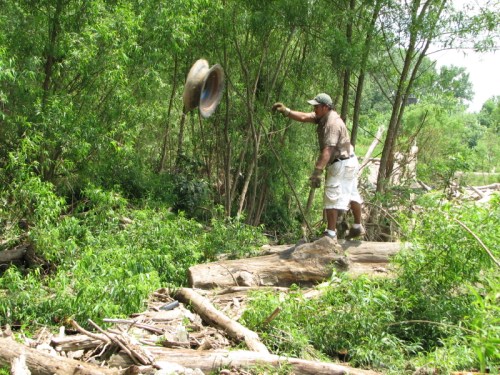
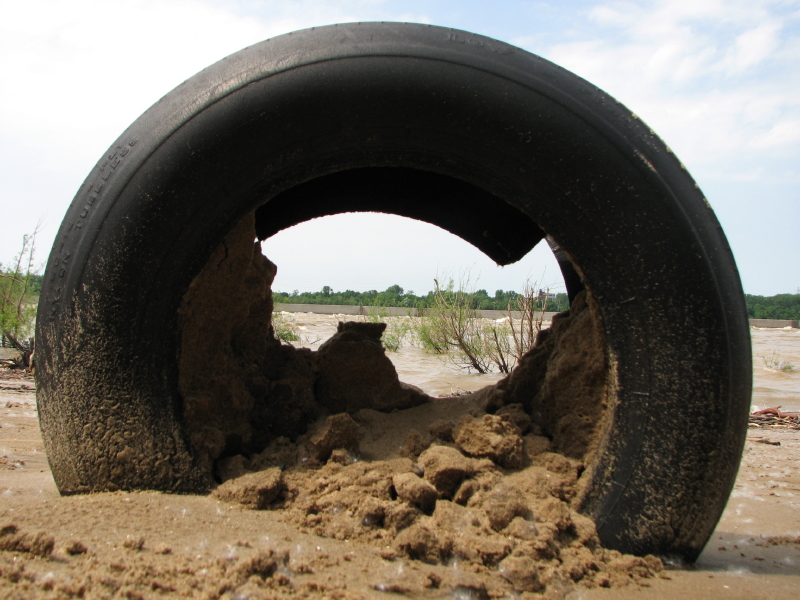
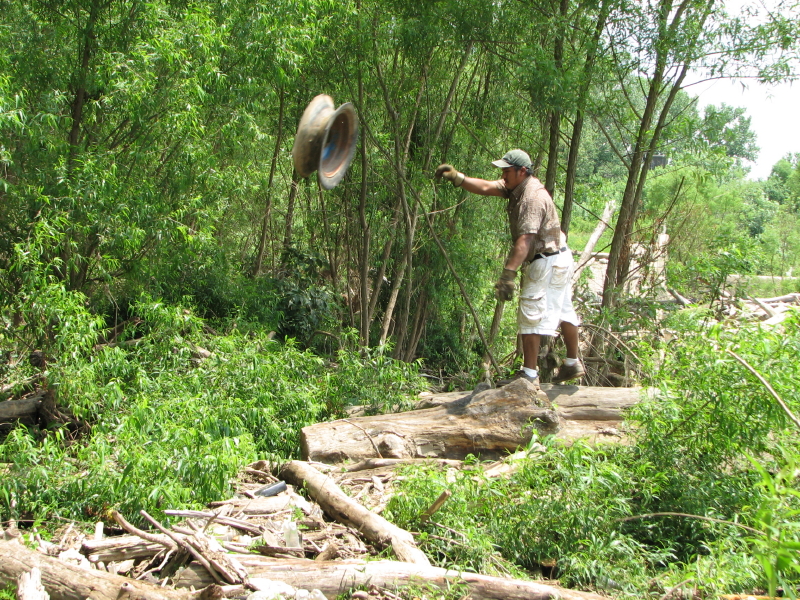
The last couple times I have come to the Falls, I have run into this man.  We have talked a little bit, but there are some language barriers.  Anyway, he’s delighted to have discovered a source of materials he can take to the salvage yard.  I watched him nimbly moving from one log to another yanking out these old metal wheels.  I have a lot of admiration for him and it made me think of how people from less developed countries have much that we can learn about living on this increasingly global scrap heap.

Read Full Post »
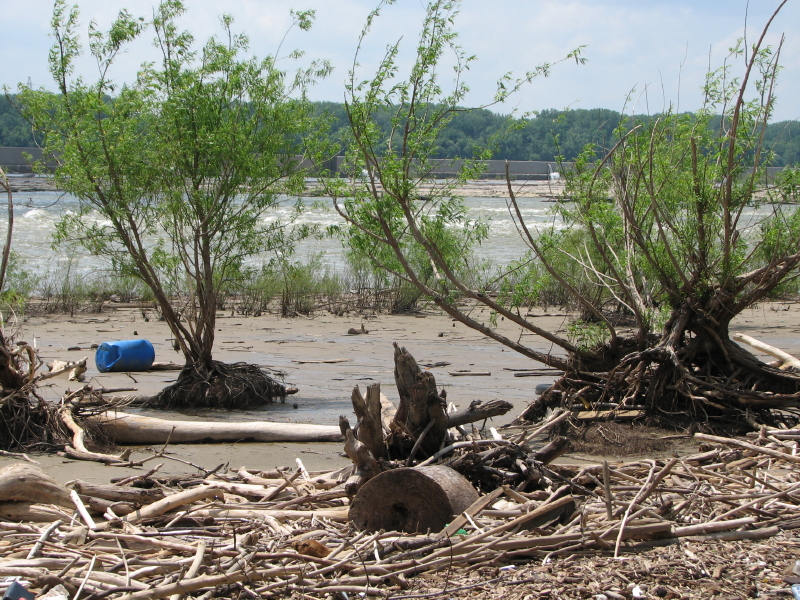
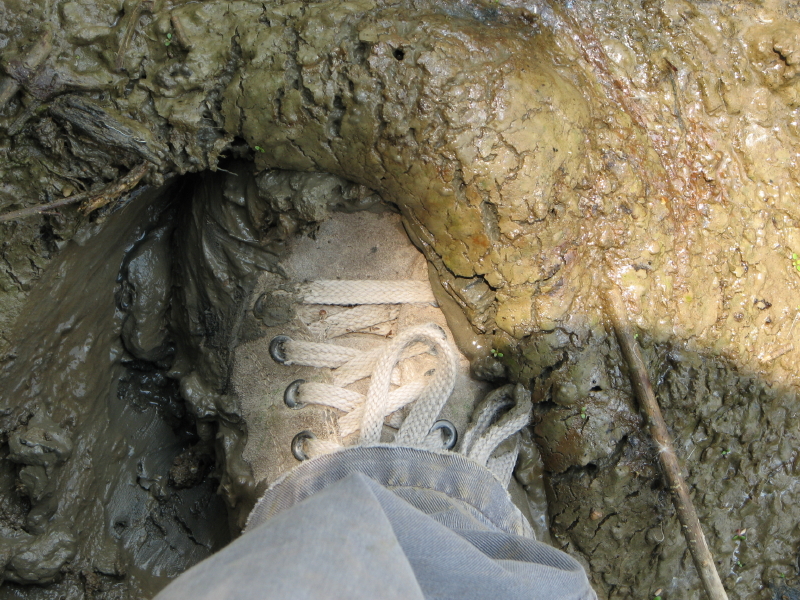
Before the month of May slid into history, I did a little sliding of my own.  The day after Julia and I visited Nerinx, I did a solo expedition to the western section of the Falls of the Ohio State Park.  Now the sliding part has to do with mud!  In places the earth was high and dry, but in key areas  the mud remained slippery and sticky.  Here’s a picture of what I mean.

It’s creamy and in places you could sink in over your ankles.  To get things over with so I don’t have to obsess about this, well I just find some mud and step into it.  After that there are no worries about remaining clean!  The deed is done.  I have a similar philosophy about the rain.  Once I’m as wet as I can get…I can relax and do my thing as long as I don’t get too cold.  The mud is more treacherous closer to the river’s edge and I decide not to flirt with it too much.  There is afterall, much to see around here.

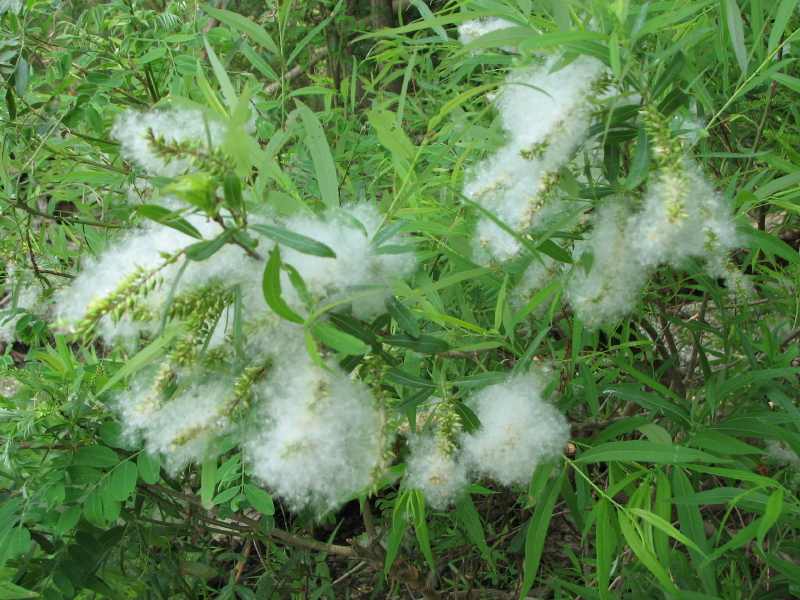
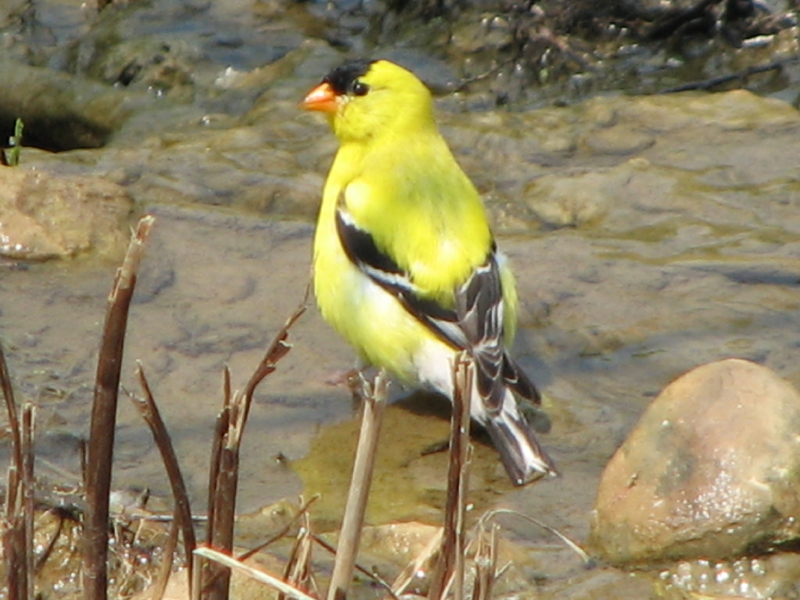
The willows are in maximum fluff production and there are drifts of the stuff on the ground.  When the wind stirs then the willow seeds become air born and are carried away.  With so much fluff, you would think willows would be even more common than they are.  I have to say that so far, I haven’t seen any birds that have made my year.  Last year’s signature bird was the Summer Tanager.  This year hasn’t been the warbler fest that I experienced just two years a go.  Still, I take what I can get and I always love American Goldfinches.  Here’s a male taking a dip in some water.  Small flocks cruise along the trees nearest the river.

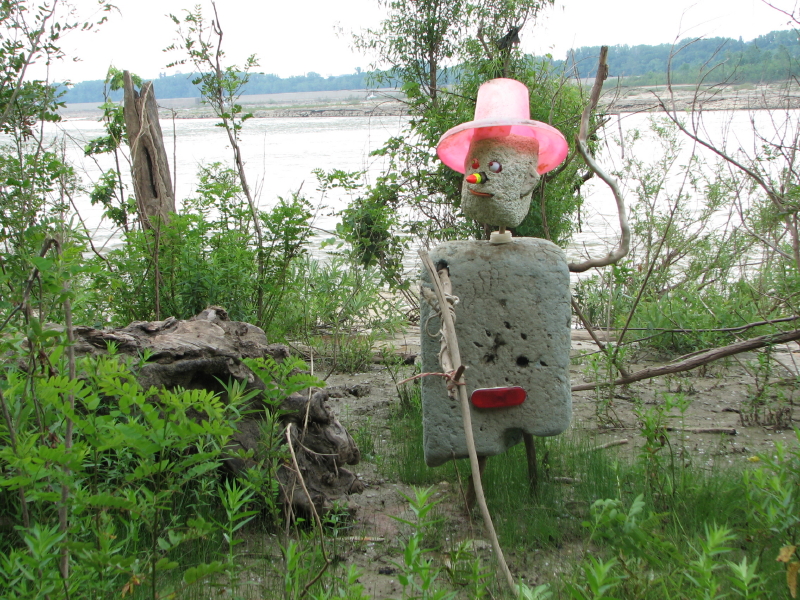
I’m walking west along the river and I came across the only persona that I saw all day.  We eye-balled each other, decided that neither was a threat and so we had a short conversation.  Mostly, it was an opportunity to compare nature notes.  I guess the feature that most stood out about my acquaintance is the bright pink hat she? is wearing.  I said I was looking for birds and junk and “she” said that she was a Lepidopterist.  Oddly, we didn’t introduce ourselves, but she let me take her picture for my blog.  I guess she’s about five feet tall or so and walked with a cane.

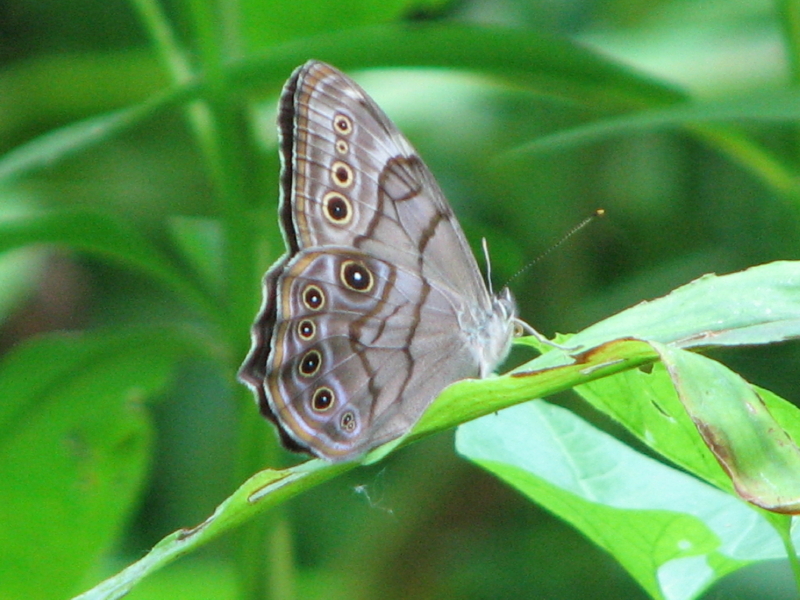
After I asked if she had seen any interesting birds…she hadn’t.  I was asked about what butterflies I had come across.  Fortunately, I also like butterflies and try to take their pictures when both insect and camera cooperate.  I really don’t like these autofocus cameras.  Anyway, I noticed many species out on this day including Commas, Mourning Cloaks, Cabbage Whites and then I showed her images of the two butterflies that I did get decent pictures of and she seemed happy to identify them for me.  Here is the more unusual of the two that I came across at the forest’s edge.

Quickly my new friend identified this as being Enodia anthedon or more commonly, the Northern Pearly Eye.  It is a forest butterfly that does not come to flowers preferring instead the fermenting juices of fruits and tree saps.  I reply that I had noticed that there were many butterflies around the fallen mulberries and on the sides of the willow trees. 

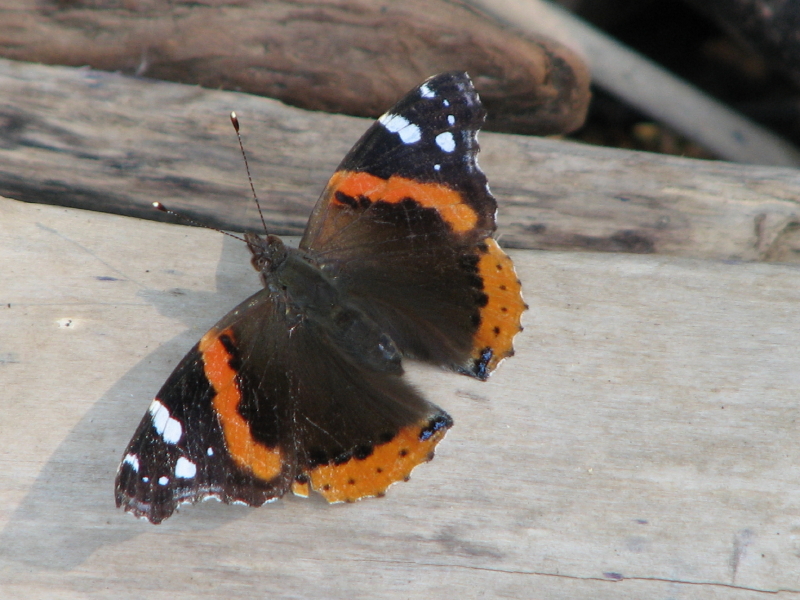
I wonder if science has determined if a butterfly can get drunk off the fermented juice and if this is possible…do they experience hangovers?  I know this does happen with birds like Cedar Waxwings that literally get tipsy.  The second butterfly is one that many people know and it’s the pretty Red Admiral or Vanessa atalanta . Even its scientific name is charming.  This is a people friendly butterfly and will often alight upon a person.  I came across dozens of these today.

With the rising heat the promised threat of a late afternoon thunderstorm began to materialize.  First there was the distant sound of thunder and since I had a hike to still make to reach my car…I said farewell to my butterfly friend whom I hope to see again.  I asked before parting if she collected butterflies and she answered that once she had, but was now over that part of her interest in them.  She no longer needed to possess them and instead grew flowers and plants to attract them.

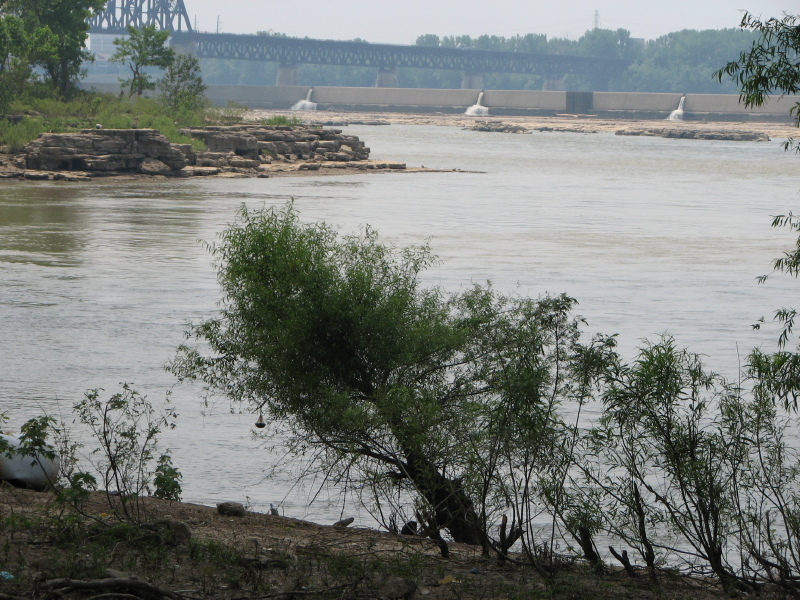
I hope I run into the lady with the pink hat again.  She seemed to share a reverence for the life that is out here in the park.  I would welcome learning more about the butterflies that call this place their home.  One last shot showing willows, the riverbank, fossil cliffs, and the dam in the far distance that keeps the river at bay…most of the time.

Read Full Post »
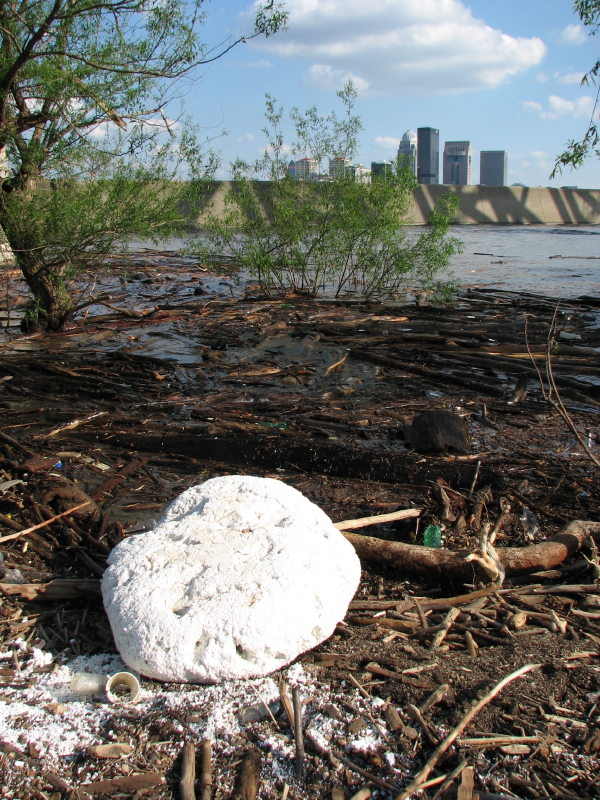
I never have a dull visit to the Falls of the Ohio.  Each time I come out here I can expect an adventure of one type or another.  On this day the river had noticeably receded and this large boulder of Styrofoam that I had been watching for days as it floated out here was finally on the shore.  I tried to move it, but it was so waterlogged and heavy that I gave up…for now.  All around it were Styro-bits that were ground off by abrading against logs and the sandy bottom.

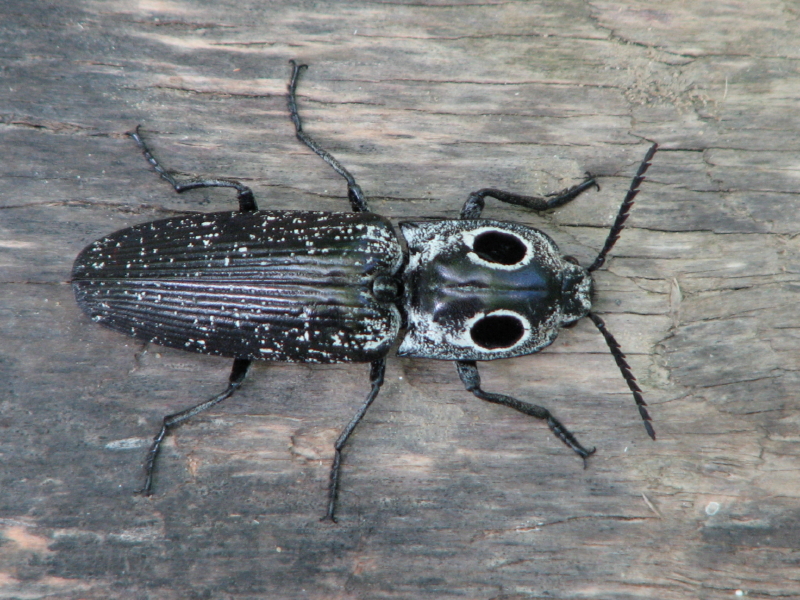
Near my polystyrene giant was this section of the riverbank.  It’s the aftermath of a tug of war we are engaging in with the planet.  In this type of struggle there are no winners.  Recent images from the oil spill in the Gulf of Mexico come to mind which incredibly still flows unabated weeks later.  Since much of the garbage in this photo is derived from petrochemicals, I wonder if this also could qualify as an oil spill?  If I scooped up a handful of sand around here…I would see tiny bits of plastic and the ever-present polystyrene bead.  This stuff is likely to never go away.  But life does try to keep carrying on as it always has.  I also came across this interesting beetle and a smile returned to my face.

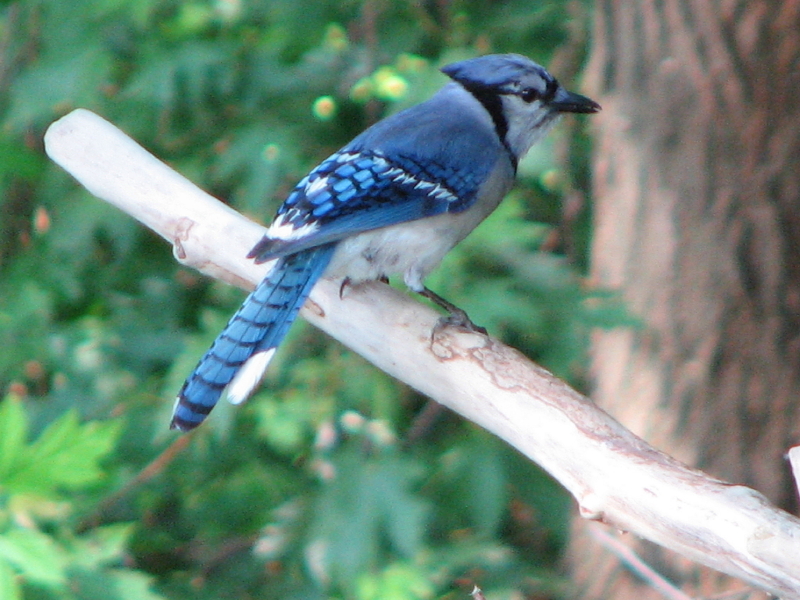
I have seen these out here before.  It’s an Eastern Eyed Click Beetle and I think I read somewhere that this is our largest click beetle.  If you placed this beetle on its back, it would flip right side up with an audible “click”.  Hence click beetle.  There are other species, but they are all smaller.  This one is just under two inches (about five centimeters).  It’s coloration is similar to a bird dropping, but it also has these dramatic eyes on its pronotum.  These guys do fly, but most of their lives are spent as larvae living in decayed wood.  I passed by the mulberry tree with its ripening berries and there are birds who just can’t resist this plentiful food source.

Among the bird species eating fruit from this tree included this Blue Jay…

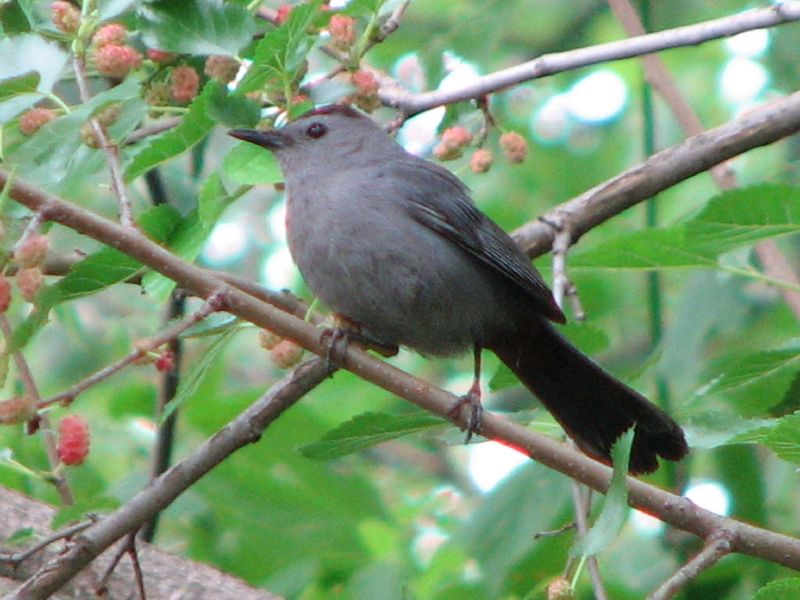
…and this Catbird which does make odd sounds which sometimes sound like the mewing of a cat (hence catbird!).  They can be quite territorial to their own and other species too.

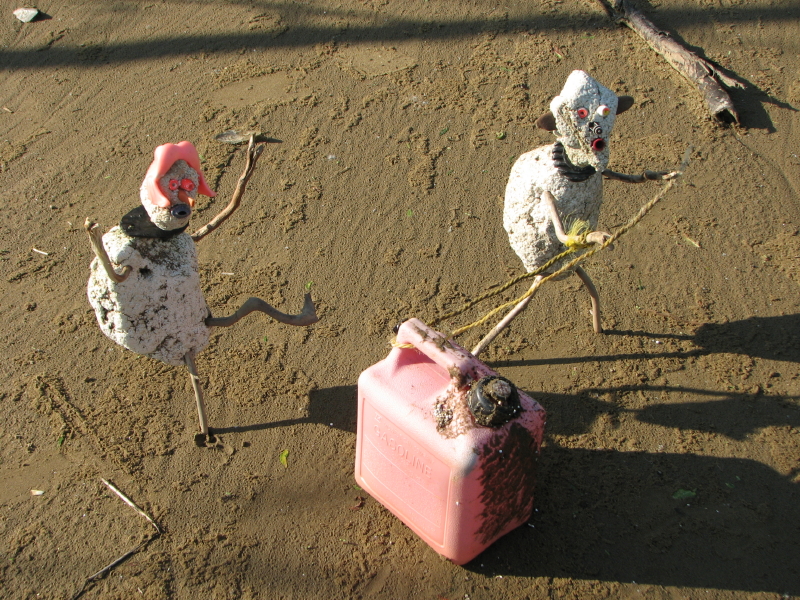
Not too far from this tree, I could hear some squabbling going on and I moved towards the sound.  You can imagine my surprise when I came upon this scene!  I stayed hidden behind a large willow and just observed.

There were these two little figures and one of them was tugging on a rope attached to a plastic gasoline container and his “friend” with the wierd hairdo was jumping up and down on one leg trying to get him to stop!

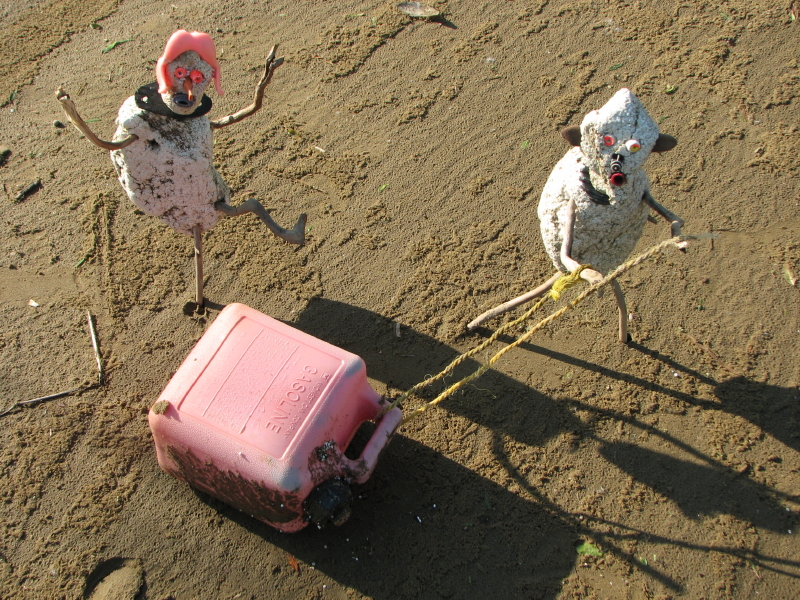
The figure with the rope eventually succeeded in knocking the container over while his friend continued hopping!  What he thought he was going to do with this gas can is a mystery?  He soon grew frustrated with his efforts and a shouting match between the two began.  That deteriorated into another contest where each tried to take the rope from the other.

All this effort must have been exhausting because after a little while they gave up and abandoned the rope and the gas can leaving them lying on the sand.  They reconciled and walked away from here hand in hand. 

Perhaps they realized the futility of their struggle and came to their senses?  Perhaps they recognized that it was better to conserve their energies for more constructive pursuits?  Who knows, but while I pondered these questions I came across another image of futility and I will leave you with that until next time.

Read Full Post »
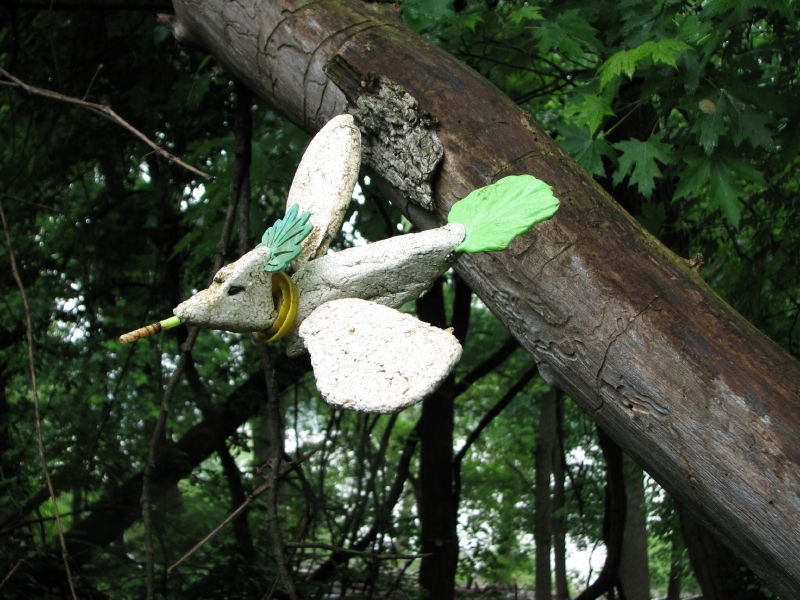
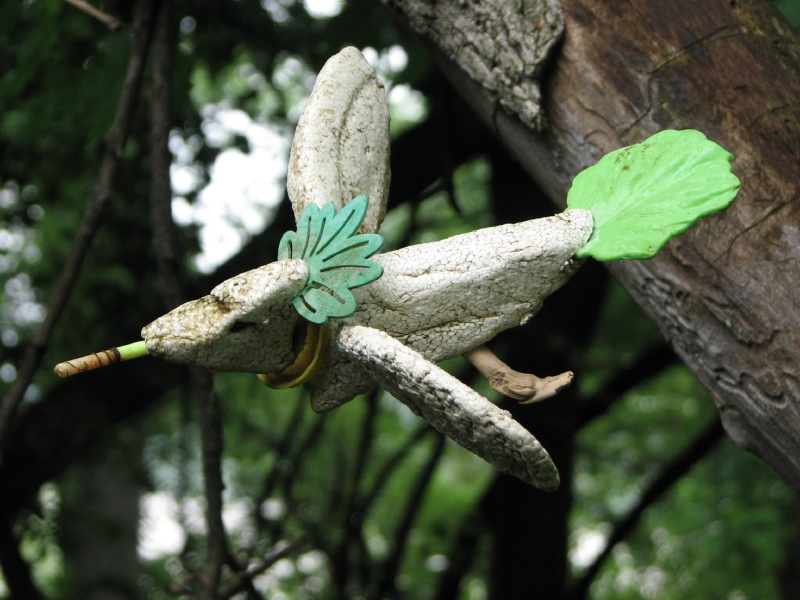
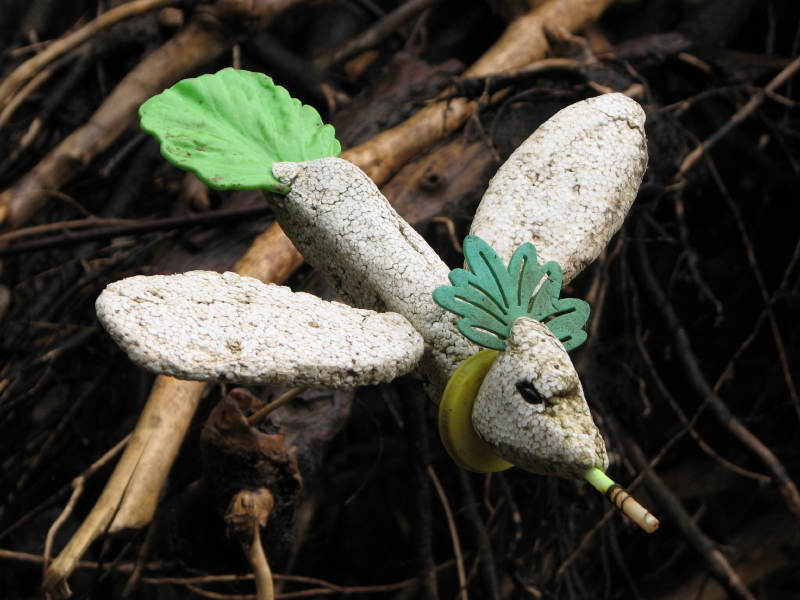
While wandering the Woodland Trail in an area best described as temperate semi-rainforest, I made another unusual bird discovery.  I believe that I have these privileged sightings because of two principal reasons.  The first has to do with frequency.  I am at the Falls of the Ohio as much as I can get away from my other responsibilities and so I have more chances for encounters.  The other has to do with motive.  Being knowledgeable about our avian friends, I simply am out here looking for birds and therefore open to their discovery.  On this particular day I was actually anticipating members of the wood warbler tribe when I came across what must be a first for this park…the rare Cumberland Greencrest!

This is one species missed by both Lesson and Gould in their individual monographs on hummingbirds of which the Cumberland Greencrest is an atypical member.  The Cumberland Greencrest was first discovered on the Guatemalan Highlands in 1910.  It is larger and slower on the wing than the average hummingbird.  It’s flight can best be described as being Swift-like where the individual wing beats alternate between extreme activity and gliding.  In its main haunts, this bird constructs a small nest from lichens and spider webs on a suitable tree branch and a single jelly bean-sized egg is produced.  The adults take both small insects on the wing and feed from the nectar of rare orchids found only in certain protected valleys. 

I was exploring the trees lining both banks of Parfume Creek (so named because on certain days, the scents of various laundry detergents are detectable emanating from the water using one’s  open nose) when the Cumberland Greencrest made its appearance.  I immediately recognized I was in the presence of something special and limited my movements so I wouldn’t frighten it away.  As this single individual coursed along the creek bank, I slowly brought my camera up to my eye and recorded these images in quick succession.  I think they show this bird in its glory very well and are worthy of sharing with a larger audience if I say so myself!  But please, don’t just take my word on this…judge for yourself!

I recorded these images using my high-speed camera as the bird made its passes back and forth along the creek.  In these images one can see why this bird is appropriately named with its lacy green crest atop its head.  The encounter was brief, but memorable!  What was this bird doing in our area to begin with?  The answer may lie in the very powerful thunderstorms that are becoming a staple of the Western Hemisphere.  I speculate that this bird was simple blown way off course as is known to happen with other species of hummingbirds.  I returned to this area the following three days, but never again encountered this specimen.  I did, however, see the duckling of a species of which I am currently unfamiliar and recorded its image among the driftwood and I hereby also present this to you my very dear reader in the hopes it will fuel your curiosity!

The Cumberland Greencrest was made from materials found entirely within the park and include:  Styrofoam (body and wings), wood (its tiny feet), coal (the eyes), plastic ( the bill which was part of a fishing bobber and the tail which is a plastic lettuce leaf!, the yellow collar is from a soft drink bottle) and lastly the green crest is some foam-like material.  It is held together in places with small, sharpened wood pegs.

Read Full Post »
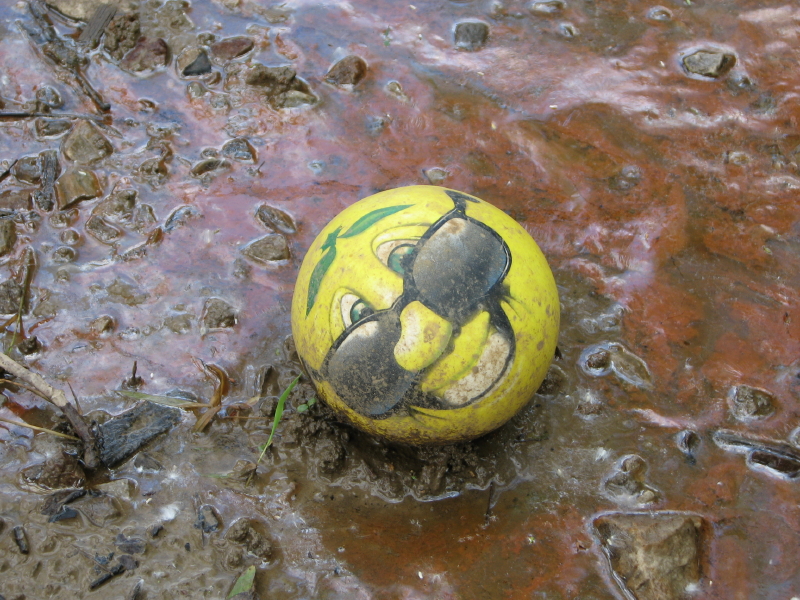
I thought I would post a recent collection of photographs of some of the stuff I’ve come across since mid April.  The river has been very up and down during this time and accessing the shoreline hasn’t always been possible.  Whenever I come out to the Falls, I’m also interested in what else I can find in addition to what I can make from some of this stuff.  I’ll start with this “Sunny Ball” I found lying in a pool of water with a sheen on it!  I see this frequently as it surfaces through the sands.  Here’s another.

The iridescence isn’t just motor oil (although there has to be some of that here) but also includes decaying organic matter in the form of old leaves.  In this case, there is also fluff from cottonwood trees.

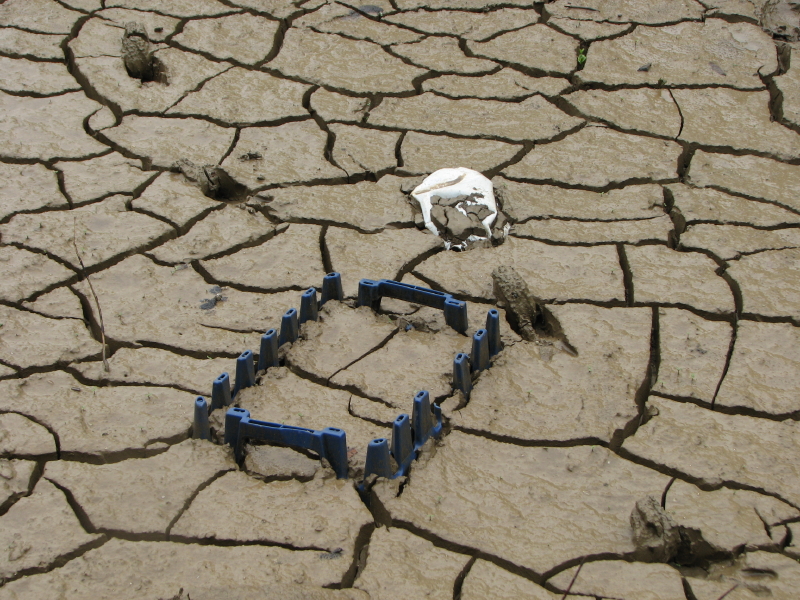
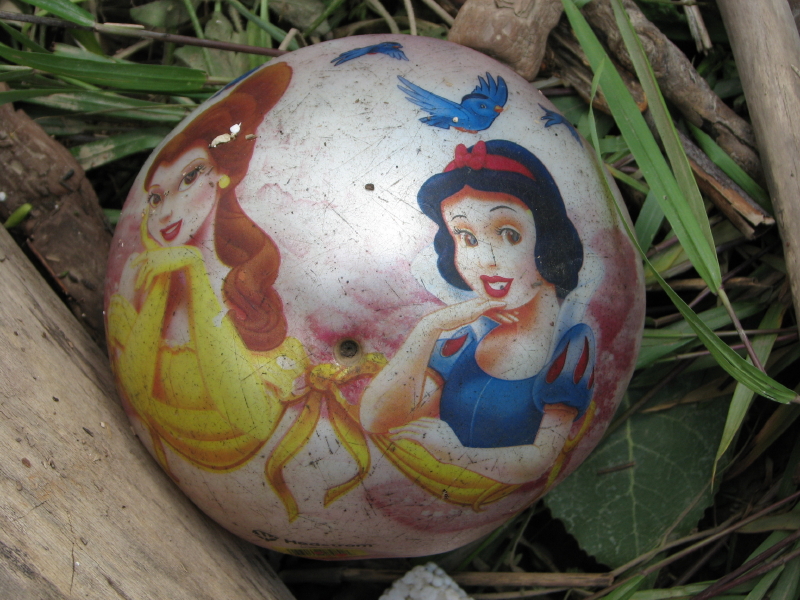
Nice recent cracks in the mud.  I’m not sure what the blue plastic object is, but the tracks going through this scene are from a white-tail deer.  How about some more found faces?  Here’s another lost ball with images.

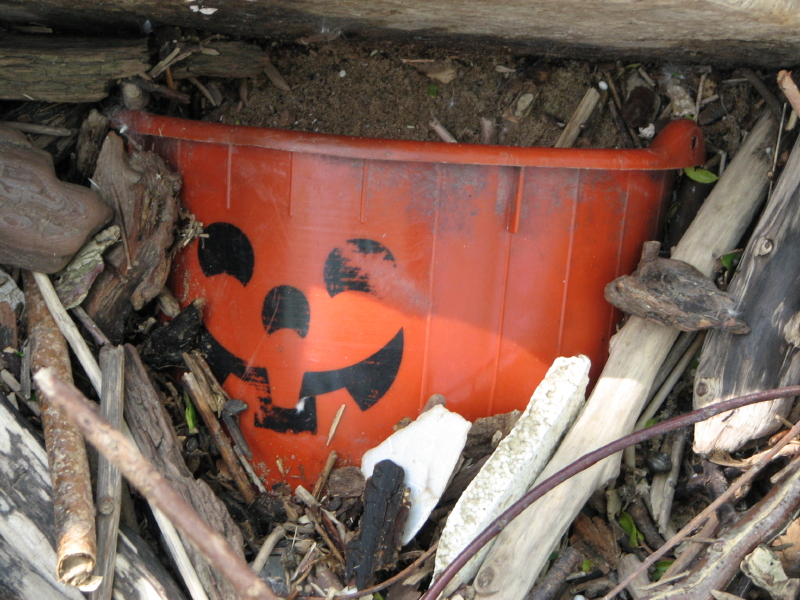
I found this ball when Julia accompanied me.  Here’s another image from that adventure with a Halloween theme.

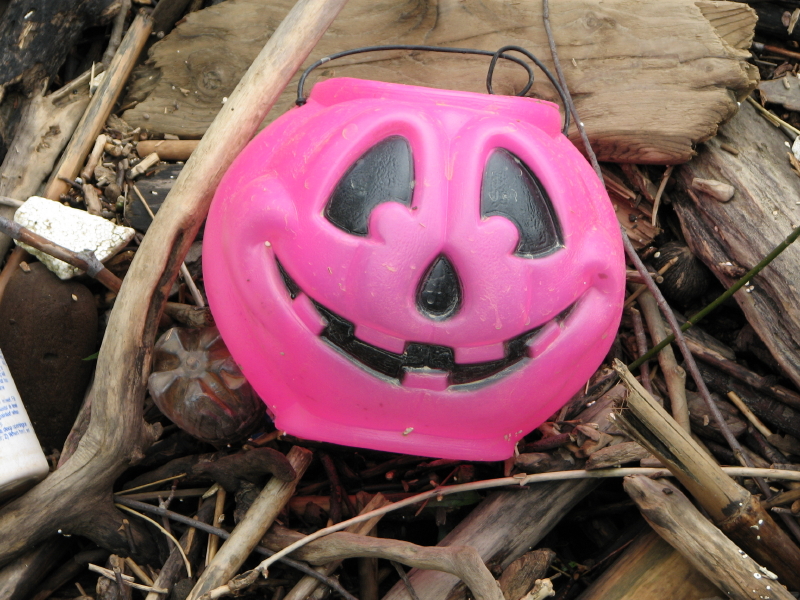
For those of you unfamiliar with this American custom, on October 31, children go door to door in their neighborhoods in costume and collect candy.  These plastic jack-o-lanterns are popular for storing the candy.  Here’s another I recently came across peeking out among the debris.

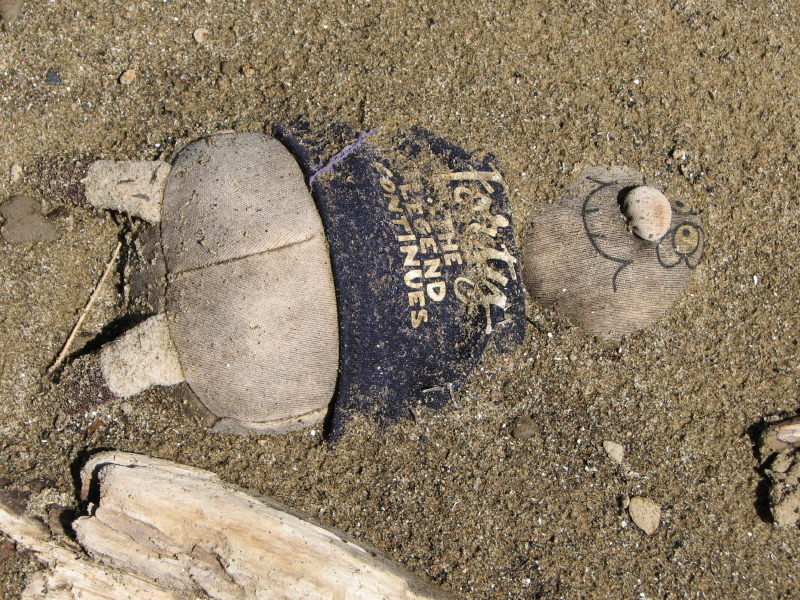
I also find many other figurative toys.  The more traditional dolls I come across frequently make disturbing images.  I’ll save those for another time but I think these are interesting as well.

His shirt says “Forty the Legend Continues”.  I wonder if this is a novelty item from a barbeque establishment along the river?

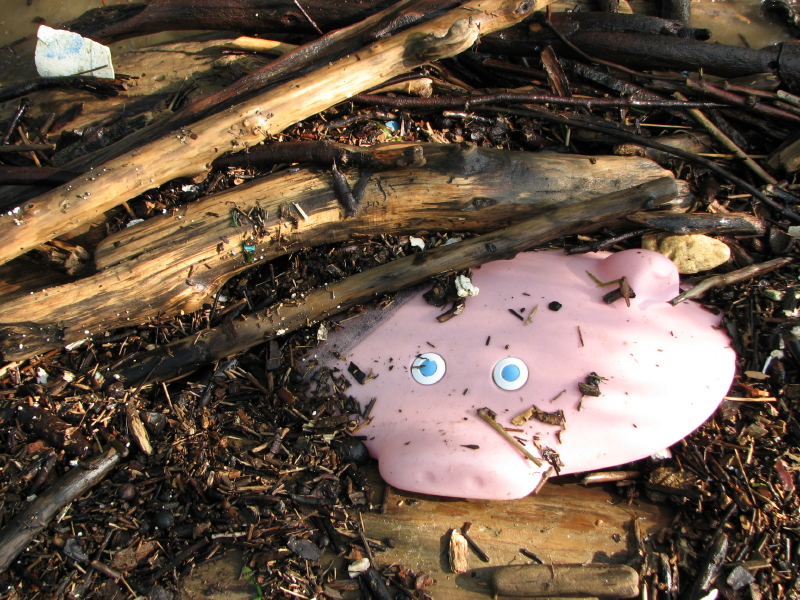
Another pig-themed…not certain what this is?  It could be the lid from something and was about two feet across and heavy.  His eyes caught me as I walked across the sand.

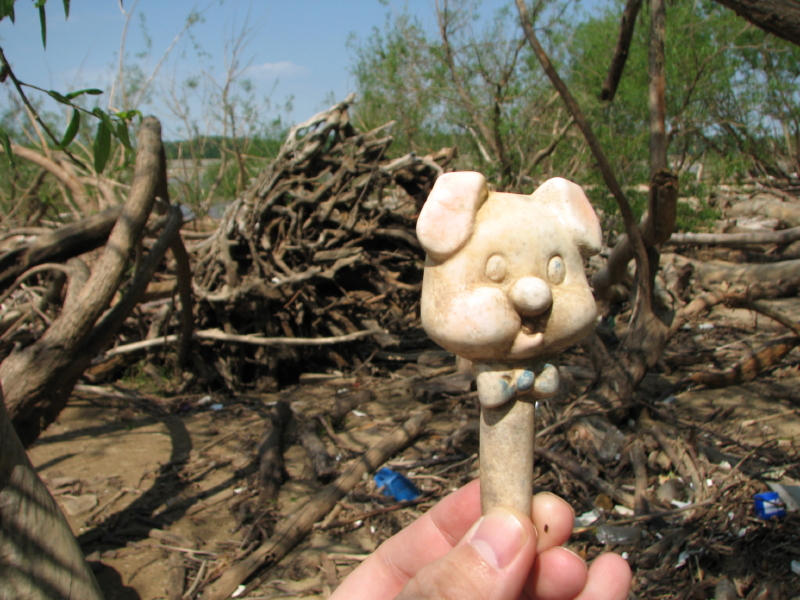
Continuing with pigs…here’s a plastic stopper? I found recently.  Maybe this belongs with a bottle of pig perfume?  Nice bow tie.

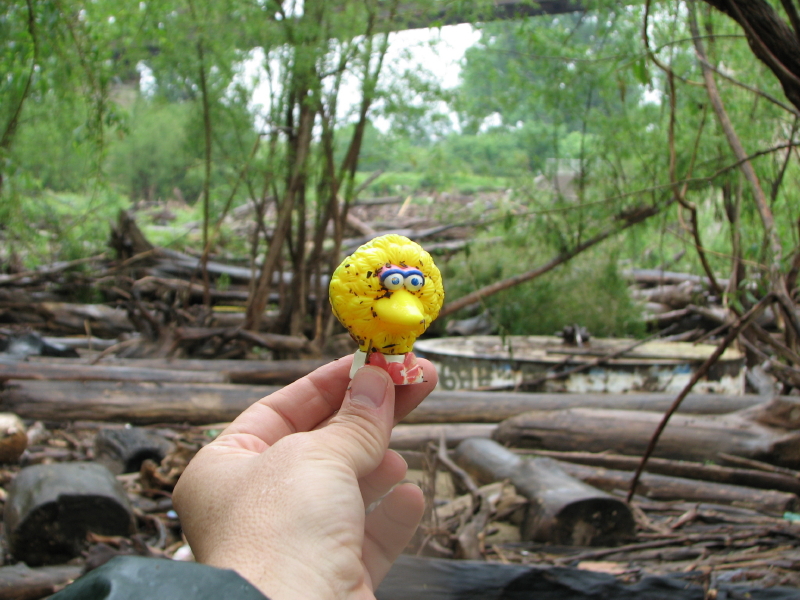
I’m walking along looking and listening for birds when my eyes are drawn downward and I see a “Big Bird” I wasn’t expecting!  I lifted it off the ground and a quick photo is taken at the place of discovery.

I came across this lying on the sand and maybe because of the orange color, may be a Halloween novelty too?  It was flat and lightweight and the white spinner-thing spins.  Perhaps off a glider toy?  Anyway, it has personality as does my next image.

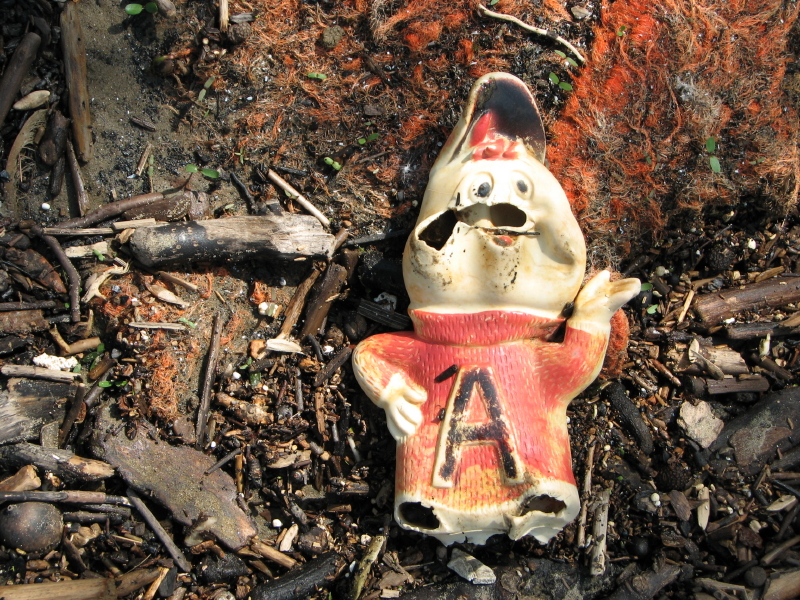
The “A” is for Alvin of the Chimpmunks’ fame.  He is a little worse for wear.  The river is very tough on everything.  He is posed by some carpeting that washed ashore near this object.

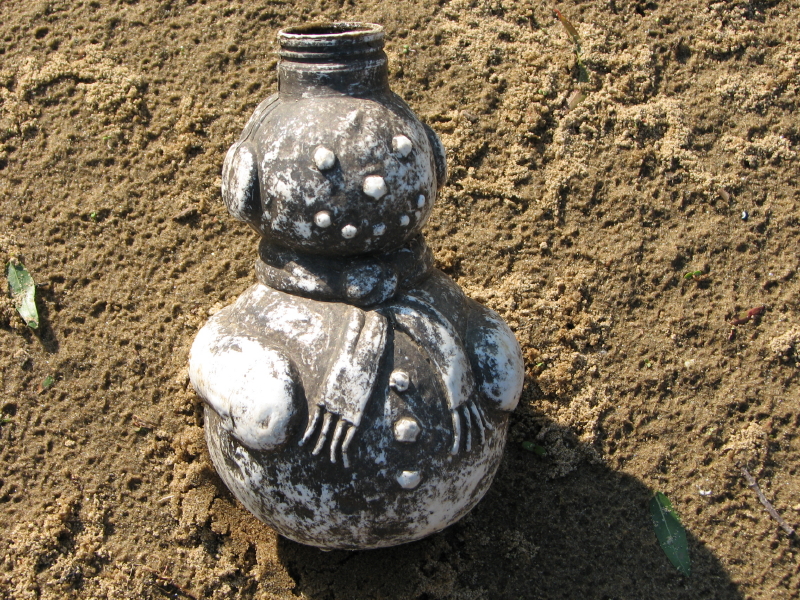
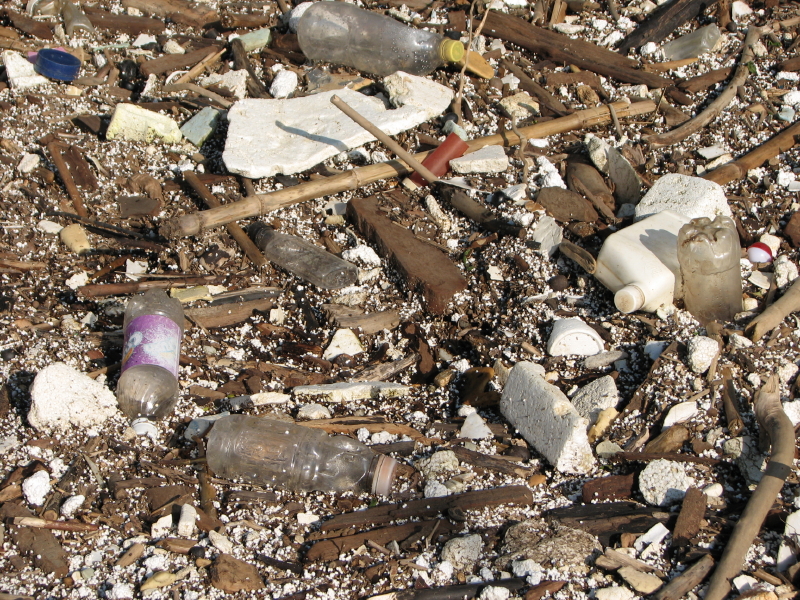
Came across this just yesterday and I “love” (almost hate to say this) the patina on this plastic snowman bottle.  I popped this into my collecting bag.  I imagine this must have been floating out on the river for a while to acquire this surface color.  Not sure what I will eventually do with it.  I think that’s about it for now.  I have one more image, also from yesterday.  I came across a really large expanse of beach left high and dry and this was its surface.  This is what’s created when a really large piece of Styrofoam gets chewed on by the river and floating logs…a Styro-aggragate.

Read Full Post »
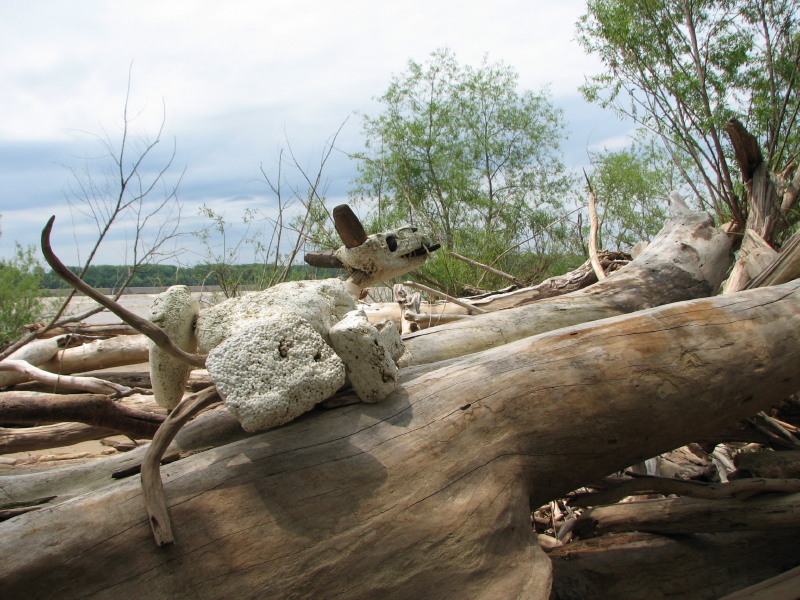
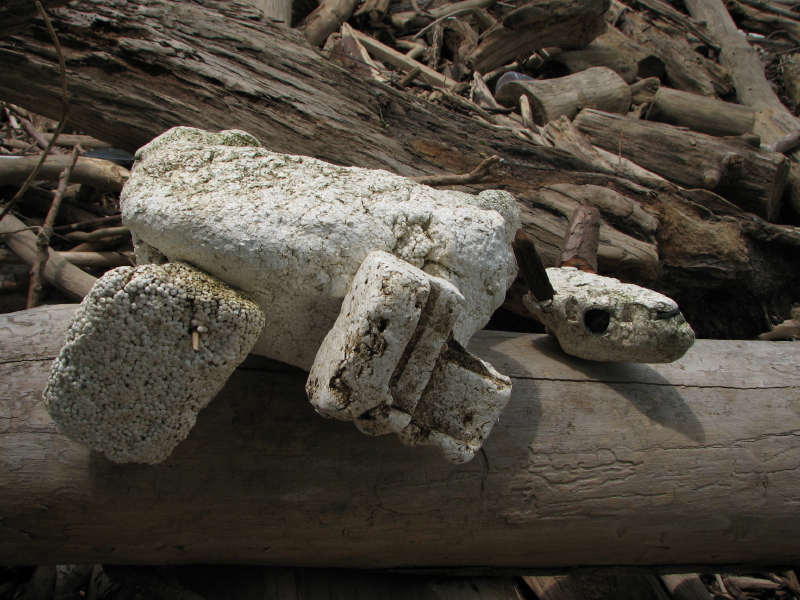
Extraordinary images from a remotely placed camera-trap yield glimpses of a rare mammal.  Long thought to be gone from the Falls of the Ohio, it appears the Feralocitor is recovering parts of its former range.  The Feralocitor is a carnivorous animal about the size of a very large house cat.  Genetically, a Feralocitor’s closest living relative is the Fossa from Madagascar which is that island’s largest and rarest native predator.  Both share a relentless drive to pursue prey and are especially adept at catching birds and small mammals in trees.  Like the Fossa, the Feralocitor has a long tail which it uses to balance itself as it runs and jumps from branch to branch in its arboreal home.  Pictures of the Feralocitor at the Falls of the Ohio came as a shock to the park’s naturalists who remain mute about its existence here although there have been long-standing rumors.

The image above shows what the Feralocitor is especially good at which is stalking its prey.  Noiselessly, this predator can get low to the ground (or log in this case) and approach within striking distance of its formidable claws and teeth.  Once a Feralocitor has a hold of its intended victim, there is no escape.  In addition to stalking, some Feralocitors (especially older or injured individuals) are excellent at hunting by ambush.  The original inhabitants of this land have an almost supernatural reverence for this animal and their name for it roughly translates to “…ghost-spirit of the trees”.  This reverence, however, wasn’t shared by the farmers who settled this area and saw the Feralocitor as another predator who killed and ate their smaller livestock.  It was shot on sight, poisoned, and trapped until it became so scarce that it was rarely seen and believed gone from these parts.  Today, the role of random predator is played by domestic dogs that have gone feral and occasionally run in packs causing fear and damage.  Such dogs exist at the Falls of the Ohio and here are a few images of them.

The feral dogs in this area are a motley crew of mixed breed dogs.  I recently came across two of them while bird watching and I was so intent on looking up, that I didn’t notice that these dogs had walked quite close to me.  In far western Kentucky, I recall an experience of being out in the woods and being surrounded by five wild dogs!  It was a tense moment because dogs in this situation can be dangerous.  I remember yelling at them and throwing rocks in their direction to chase them away.  Once there was a thriving sheep industry in the western part of the state that was decimated by feral dogs.  An old biology professor at Murray State University told me that one.  The dog in this second picture doesn’t seem particularly glad to have run into me and I’m probably interrupting his attempt at a meal from a nearby dumpster.  They seem always hungry and will take nearly anything that crosses their path.  There is a shortage of ground nesting birds in the park because there are just too many predators on the prowl and not enough cover.  World-wide, feral dogs are a resilient and growing problem and rabies is also on the rise.

I decided to camp out in an area where a Feralocitor was last seen.  After several days of nothing, I was rewarded with two separate  images of a hunting Feralocitor.  In this case, the prey animal (the Ohio Valley Rail) is also rare and endangered.  The first hunt I observed was successful, however, the Feralocitor was so efficient and quick at the kill that it was over and gone before I could get obtain another picture.  It waited until the bird’s head was down before launching its fatal attack.

In this second photo, the Feralocitor was unsuccessful when the bird sensed something was wrong and flew away.  By listening to its instincts, this rail lived to experience another day.  It is great seeing an animal that once existed in this area recovering some of its former range.  Similar stories exist from the recent past.  Once black bears were rumored in the eastern section of  Kentucky.  This was proven, they became studied, protected,  and  now there is a limited hunting season on them.  The same could be true of the mountain lion.  Persistent claims that they too are re-entering  their former territories will probably pan out as young lions move eastward pursuing the ever burgeoning deer population.  As for the Feralocitor, time will tell.  It isn’t an animal likely to be prized by hunters.

The last image is of the Feralocitor in progress.  It’s made of found Styrofoam, wood, nuts (for eyes), rubber, and plastic and was constructed on location during a light rain.  The sculpture was held together with sharpened wooden stakes and pins.  With the exception of the Feralocitor and the Ohio Valley Rail, other mentions in this post are factual.

Read Full Post »

Guess what everybody!  An interview I did with one of my favorite blogs was recently published and I’m honored to be placed in the spotlight.  If you get the chance check out the interview and scroll through some of Lynda’s stories.  If you like art, poetry, popular culture and more…than you will find her blog worth the visit!

Here’s the link to the Echostains blog, http://echostains.wordpress.com/

Read Full Post »
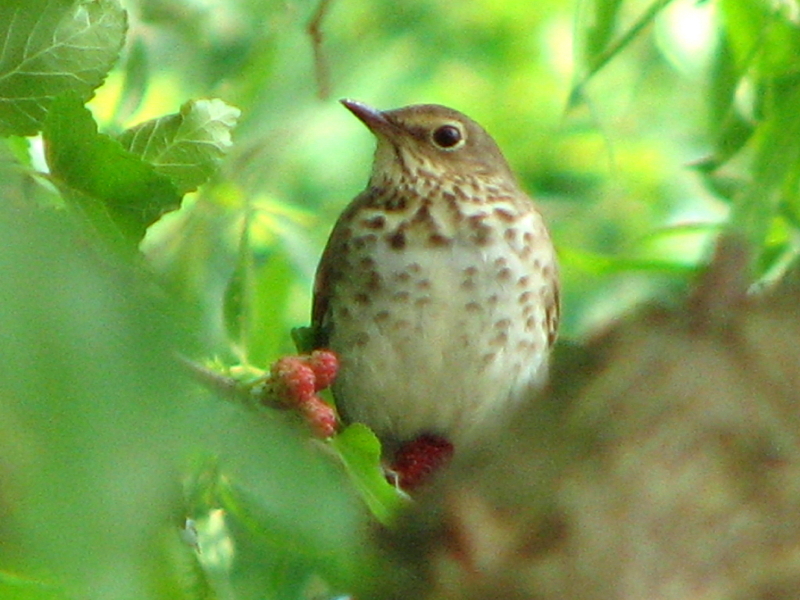
I love this photo!  This Swainson’s Thrush seems so happy sitting on its berries.  At the Falls the migrant birds are around and our trees are flowering or fruiting.  I have been doing my best to come up with some nice bird photos in between other river activities like making art.  Most of the warblers are proving to be tough subjects.  The difference between getting a nice image and nothing is a thousandth of a second.  Warblers are very small and constantly moving.  There is a lot of thrush and catbird activity around the sweet mulberries and squabbles are frequent.

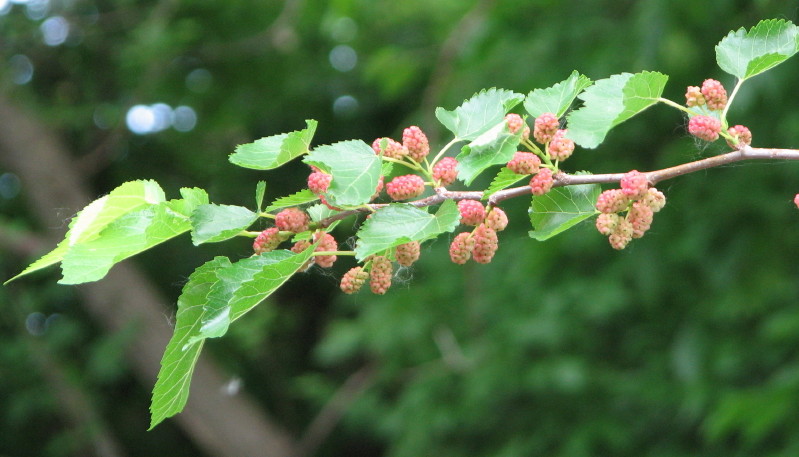
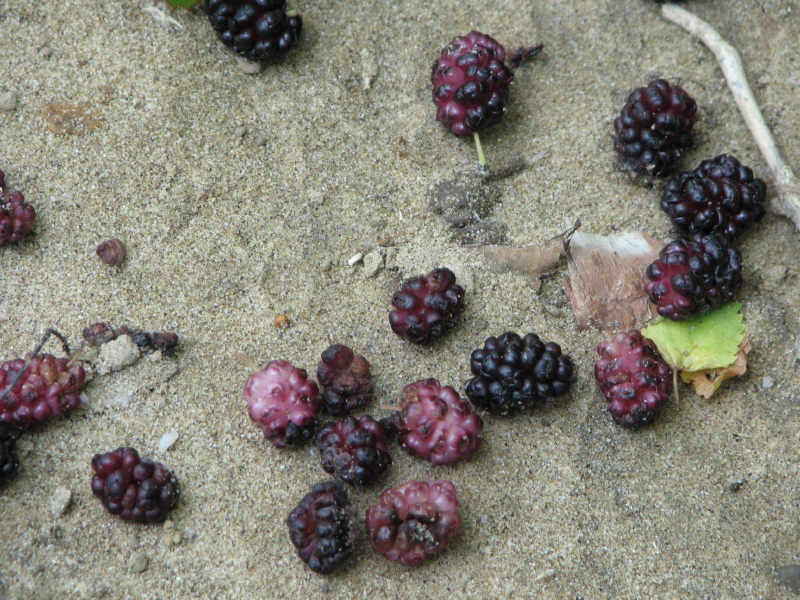
These pink and red mulberries will be ripe when they turn dark and black.  That’s when the wildlife particularly go for them.  This is a prolific tree and seems to be on the rise.

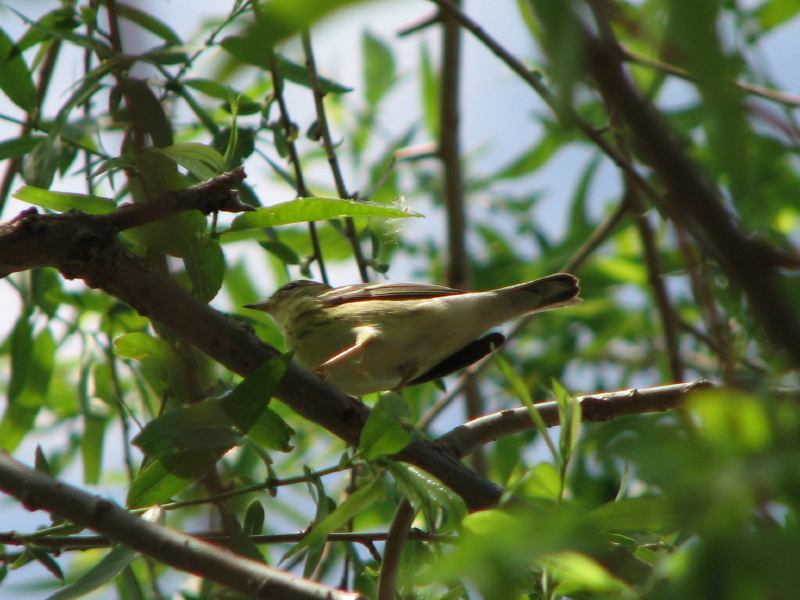
This bird atop a willow tree is a bit of a head scratcher for me.  I like that I was able to get such a relatively clear shot among the foliage, but what species of bird is this?  When I first took the photo, I thought I was photographing one of the seasonal vireos.  However, there is a suggestion of light-colored wing bars and perhaps a slightly streaked breast too which is an unusual combination.  That’s what I like about bird watching…it can be challenging even when you think you have a good image.

Wafting through the air were the tiny, cottony seeds of these black willow trees.  Many of these will land upon the sand and germinate.  Only the fittest can thrive in this tortured soil and manage the periodic flooding that helps define this place.

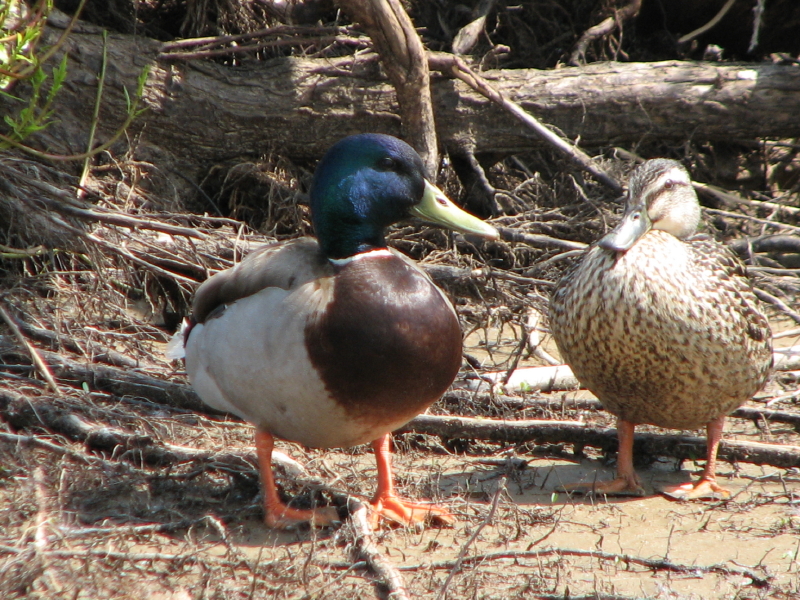
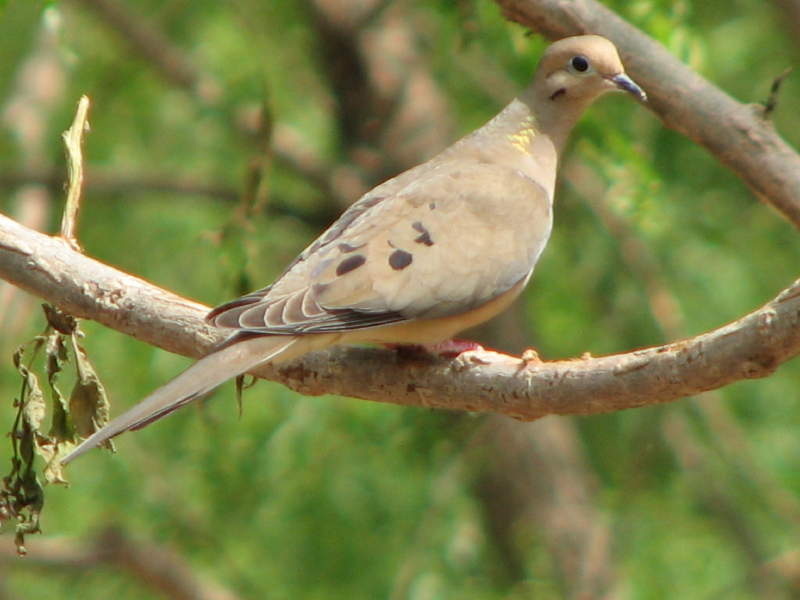
There were birds that I was able to photograph and identify like this pair of Mallard Ducks.  They were away from the river and more than likely have a nest nearby.  This Mourning Dove is showing a little of the iridescence on its neck that comes with the breeding season.  It’s hard to believe now that Audubon’s first drawing of the extinct Passenger Pigeon was made at the Falls of the Ohio.  That is certainly a bird I would have loved to add to my list of living species in the park.

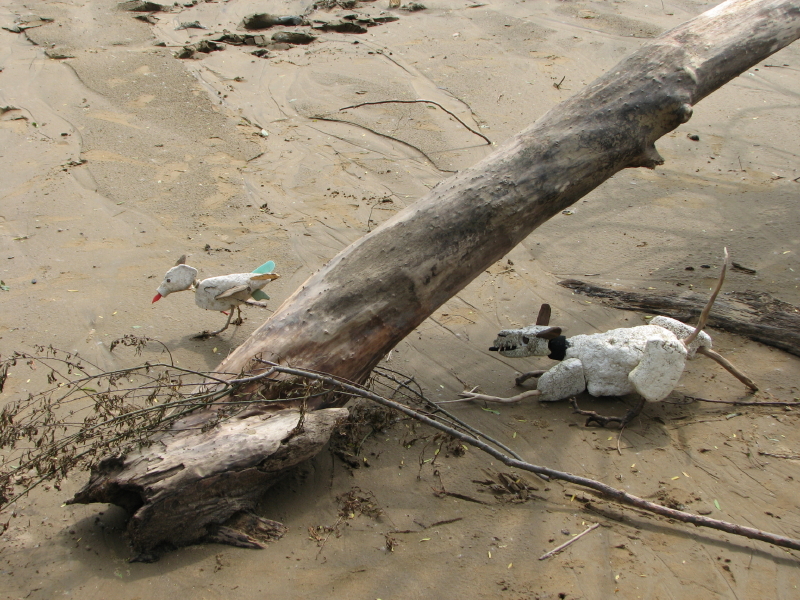
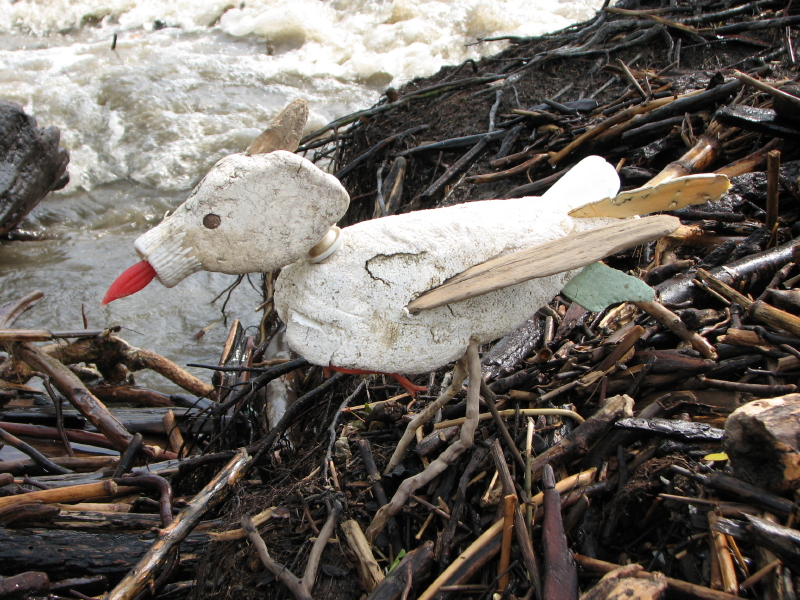
I was able to add a new bird to my list on this trip and it’s an unusual one!  It’s called the Ohio Valley Rail and is usually heard more than it is seen.  It is not typical to run into one during the daylight hours.  So, when I came across this female near the river…I got real excited!

This bird is in transit to the marsh habitats that exist around the lakes in the Upper Peninsula of Michigan.  Since the Ohio Valley Rail is believed to travel at night…it is a mystery why this one isn’t sleeping in a secluded spot.  Originally discovered and named within the river valley by early 19th Century naturalists, it would be many years before it’s true northern haunts would be known to science.  The males are slightly smaller but have more developed plumage which they use to their fullest glory when they leap and dance into the air trying to win the favors of a female.  Successful dancers will pair up producing a clutch of two eggs usually in a nest located on the ground and made from cane leaves.  One last image of this rarely seen oddity with the big head and bright red bill.  Bon voyage!

Read Full Post »

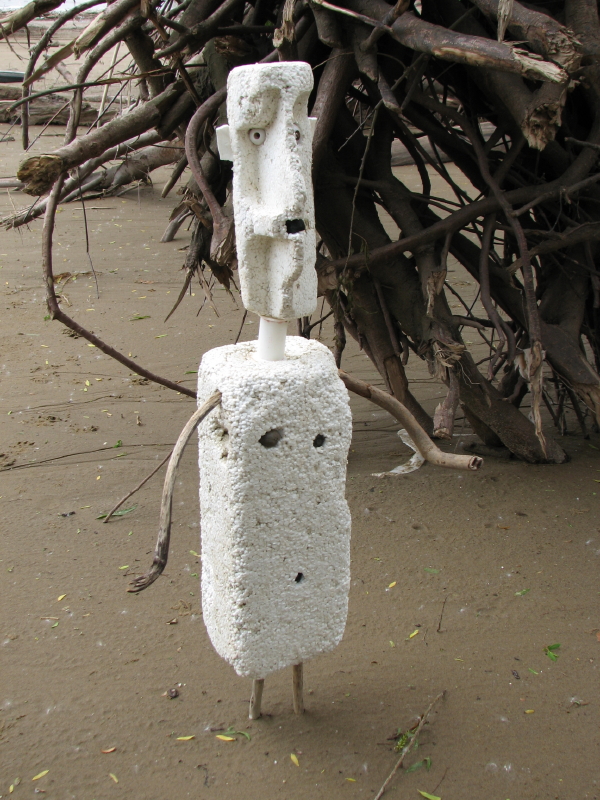
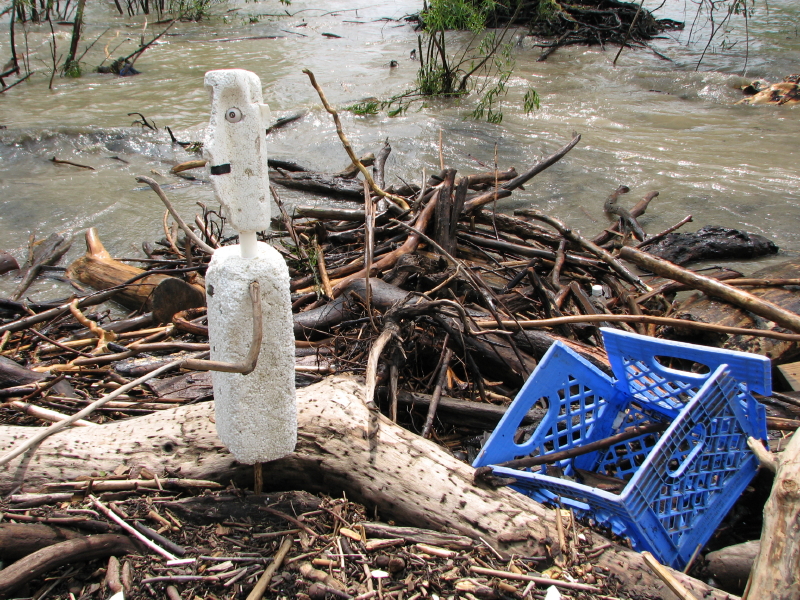
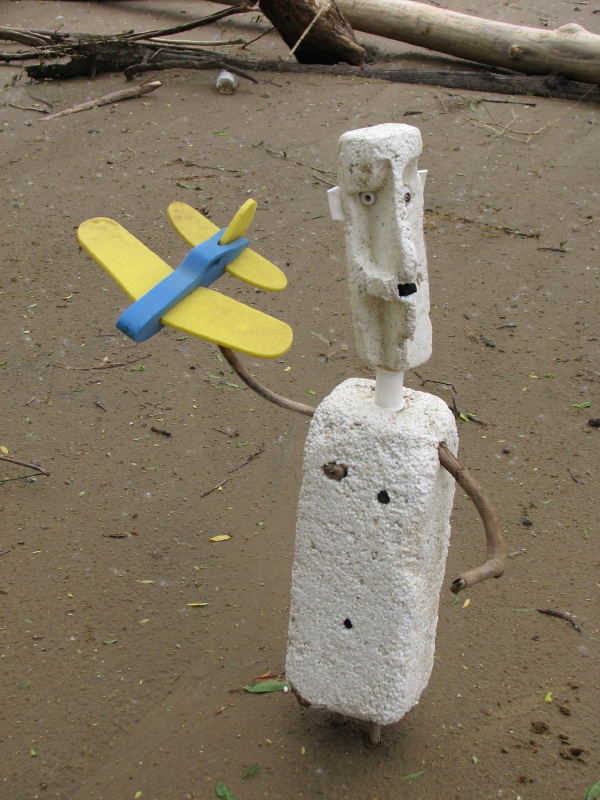
Wow, what an incredible day yesterday was!  The weather was just perfect and I had the park to myself and I took full advantage of it.  The river is still a little higher than usual, but not as high as when Julia and I visited here last trip.  I made four Styrofoam figures and took a ton of pictures that I will show you over the course of the week.  Let’s start by me introducing Mr. Easter Island Man who has graciously agreed to share his day with us.  He was in town taking a break from being a tourist attraction and was himself on vacation in the river city.  Here’s something to help set the context.

Two recent events have shaped the environment at the park.  The first is all the rain we had that led to flooding and depositing massive amounts of driftwood and junk at the Falls.  The other is that Spring has more than taken a hold and you can feel Summer coming around the corner.  Everything is green, growing, and starting to feel jungle-like in places.

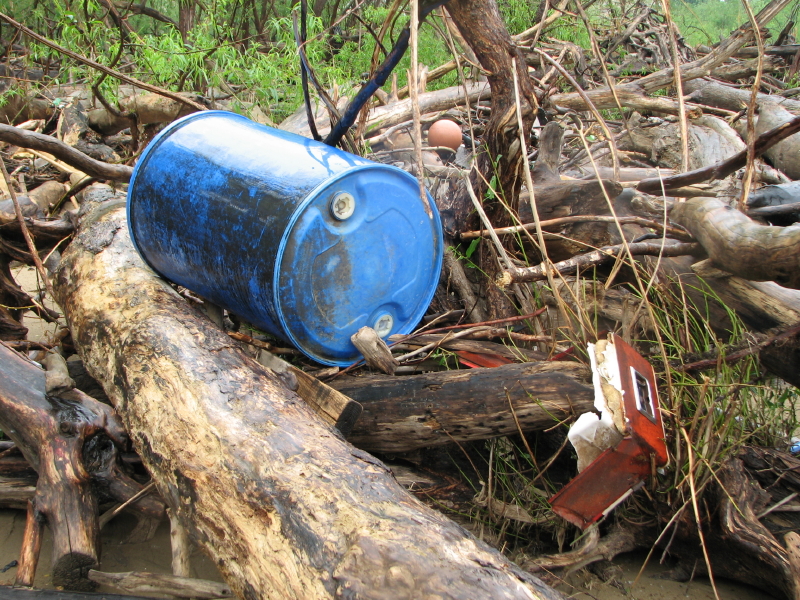
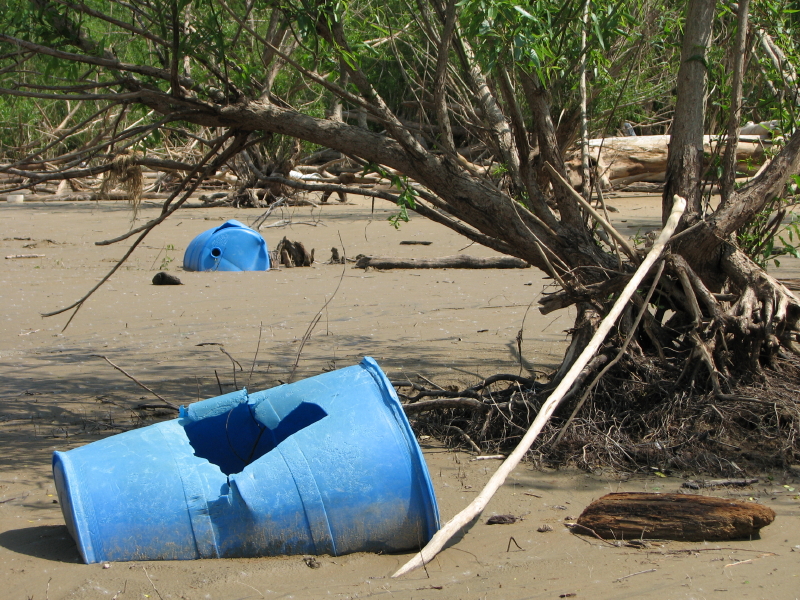
Skirting the driftwood mounds, I moved down to the river by the willow habitat.   Wisps of willow fuzz gently wafted on the air currents and small drifts were forming in the nooks and crannies of the driftwood.  Butterflies were on the wing. The trees were home to several warbler species and I was challenged to create a few good photos of them.  Punctuating the landscape were the occasional blue plastic barrels.  It seemed  a particularly strong color note in amongst the natural organic hues and tones.

We also see barrels and drums that are all white or all black every once in a while.  Ran into a guy not too long a go that collected a few of these plastic drums and he said he was going to make a raft from them.  I wonder if he was successful?  Hopefully, he didn’t try to take a float trip with the river as high as it was.  It’s dangerous to get caught in the wake from a massive coal barge cruising down river in a craft you can’t manuever very well.

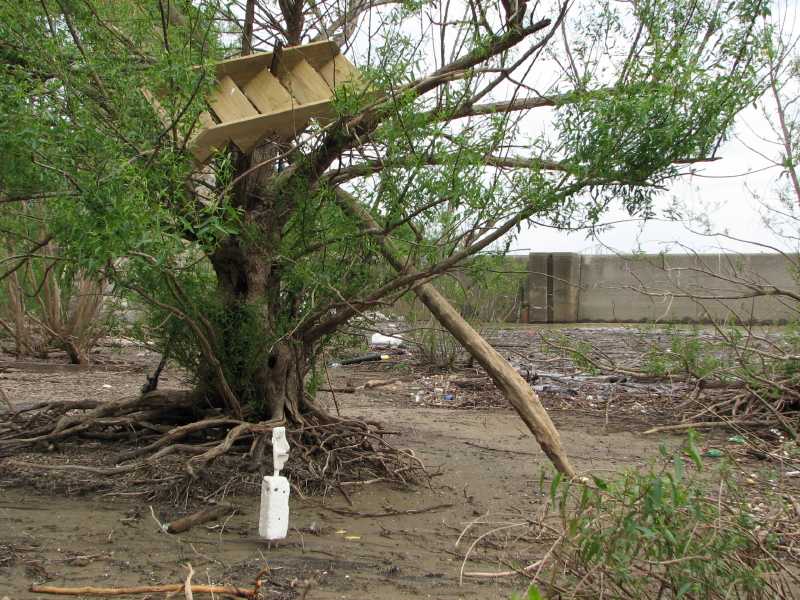
Every wonder what those Easter Island sculptures look like below their giant heads?  Buried beneath the sand is an equally blocky body.  We walked around some more to see what had changed since our last visit?


Near the dam, you could find examples of how high the river got this time around.  Mr. Easter Island Man came across this staircase that became lodged in a willow.  In surrounding trees, plastic trash bags, and loose tree limbs were stranded in other branches.  The mud in this area was very soft and it was easy to sink down to your ankles in it.  You needed to plot your course in advance and take advantage of walking on the tops of the beached  logs.  This way, you also left fewer tracks behind.

Small waves were still slapping the shoreline and fresh junk was arriving by the second.  In a few days, the Ohio River will go down some more and another layer will have been deposited.  Mr. Easter Island Man was collecting beat-up fishing lures and bobbers.  He spotted a blue plastic crate in the surf zone, but when he checked it out, it was already broken. 

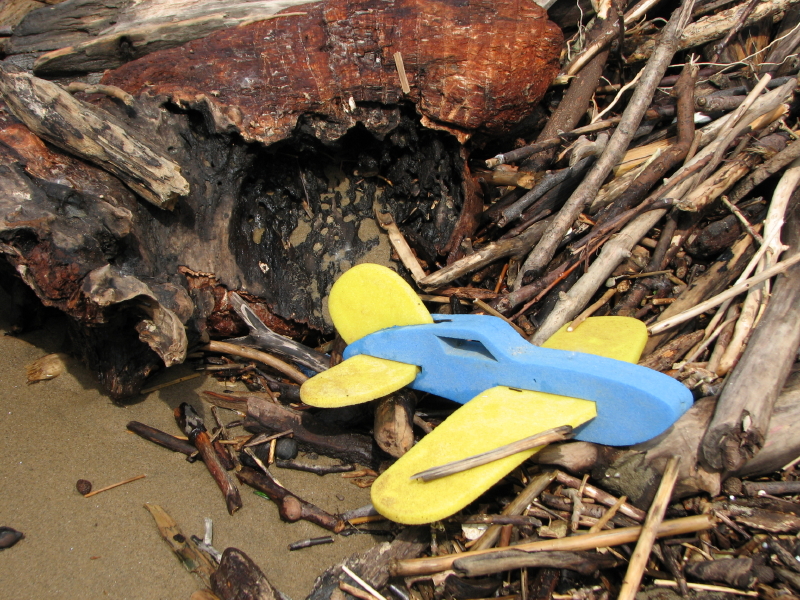
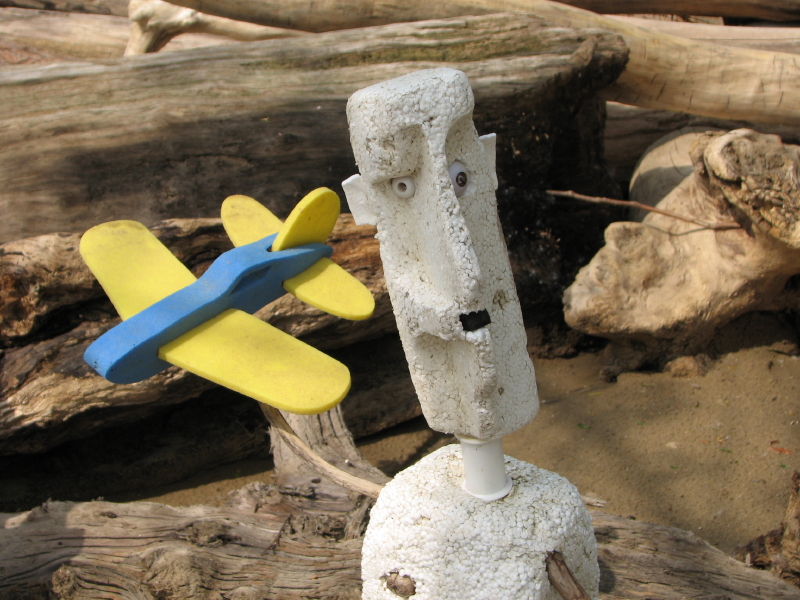
Not to far ahead, something else colorful had caught his eye.  It was a yellow and blue foam glider that rode in on the waves and was now drying out with the driftwood.  Something like this is too cool to just leave lying around and Mr. Easter Island Man collected it and made it his own.

Examining the soft airplane, it appeared to be undamaged.  Lifting the toy he cocked his arm and said before he threw it…now let’s see what this baby can do!  More from the Falls later this week including a rare sighting of the enigmatic riverine predator…the Feralocitor.

Read Full Post »
« Newer Posts - Older Posts »