Feeds:
Posts
Comments

Archive for the ‘collections’ Category

Duct tape ball in situ at the Falls of the Ohio

At first it looked like any other ball among the wood chips and I almost passed it by.  After all, balls are the most common toy that I find at the Falls of the Ohio State Park.  But something told me to look more closely at this one and that’s when I noticed the network of filaments that were eroding away on the surface of this silvery sphere.  Picking it up, I then realized I was holding something different and to my mind and eye a bit more fascinating too.  Yes, it is a ball, but one made from duct tape!
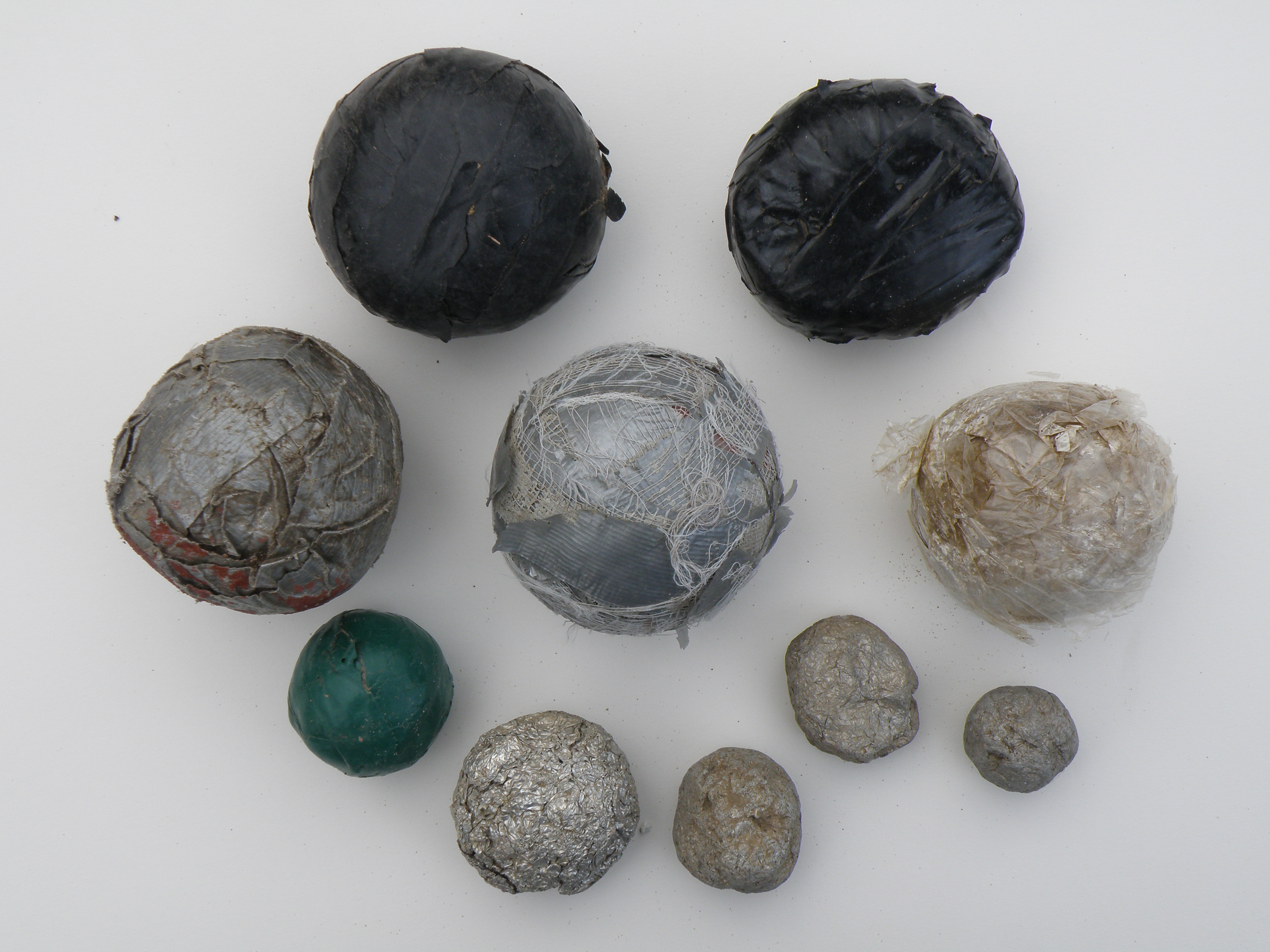
handmade ball collection

Over the years I have found several other handmade balls made from different materials and they always elicit wonder in me as artifacts.  There is something in the human need to create form from formlessness that is at the root of creativity and can be seen in this eccentric collection.  I think this can happen reflexively too without deep thought being involved. The largest of these balls would fit comfortably in the palm of your hand and is slightly smaller than an American baseball.  Since most of them are made from various tapes…I’m guessing they are the waste products of work.  What began as something relatively flat gets transformed by the mind and hand into a fully satisfying three-dimensional object that you can grasp, throw, or roll.  For me, there is something appealing art-like in these objects which began life as one thing and by shifting its original purpose and function becomes something entirely different.
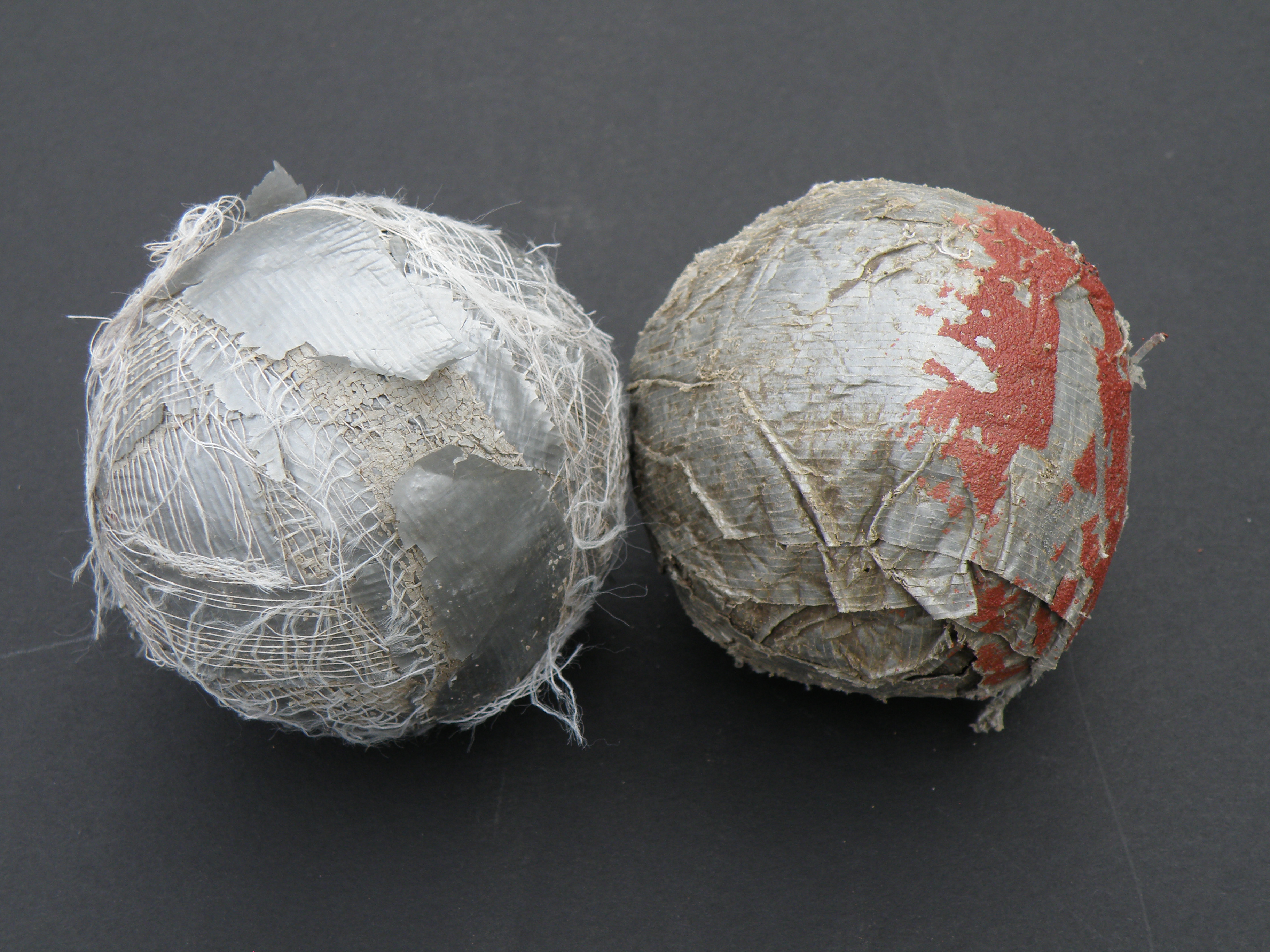
two found duct tape balls

Here are two duct tape balls I have found by the river.  The one on the left is pictured on the wood chips and its partner has vestiges of dried paint or primer on its surface.  The spheres are created by layering one flat piece of tape over another until a ball is formed.  It is not necessary to create a ball to dispose of this waste tape, but this is what their makers did…and then it wound up in the river which is yet again another story to ponder.
two balls made from electrical tape

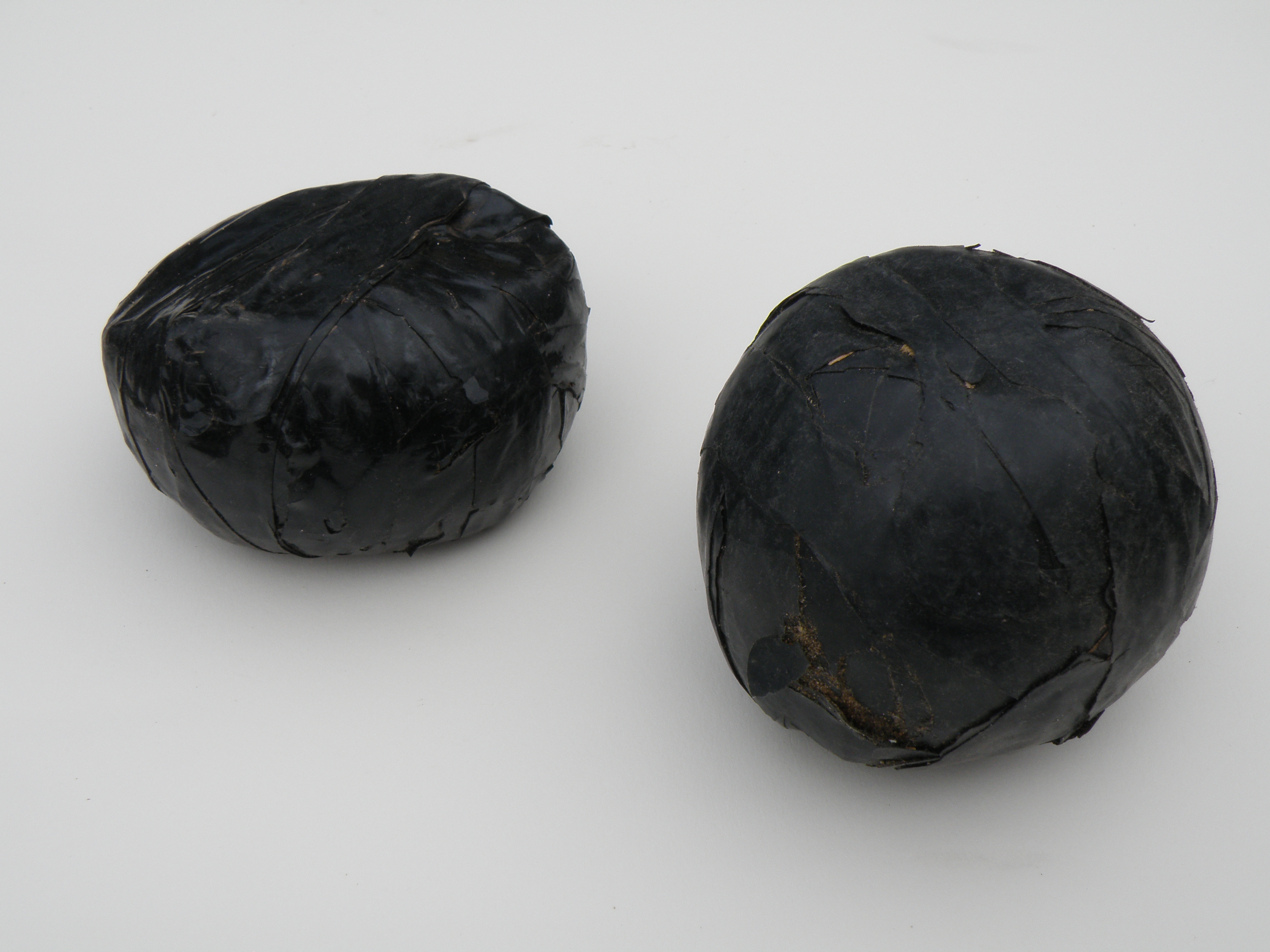
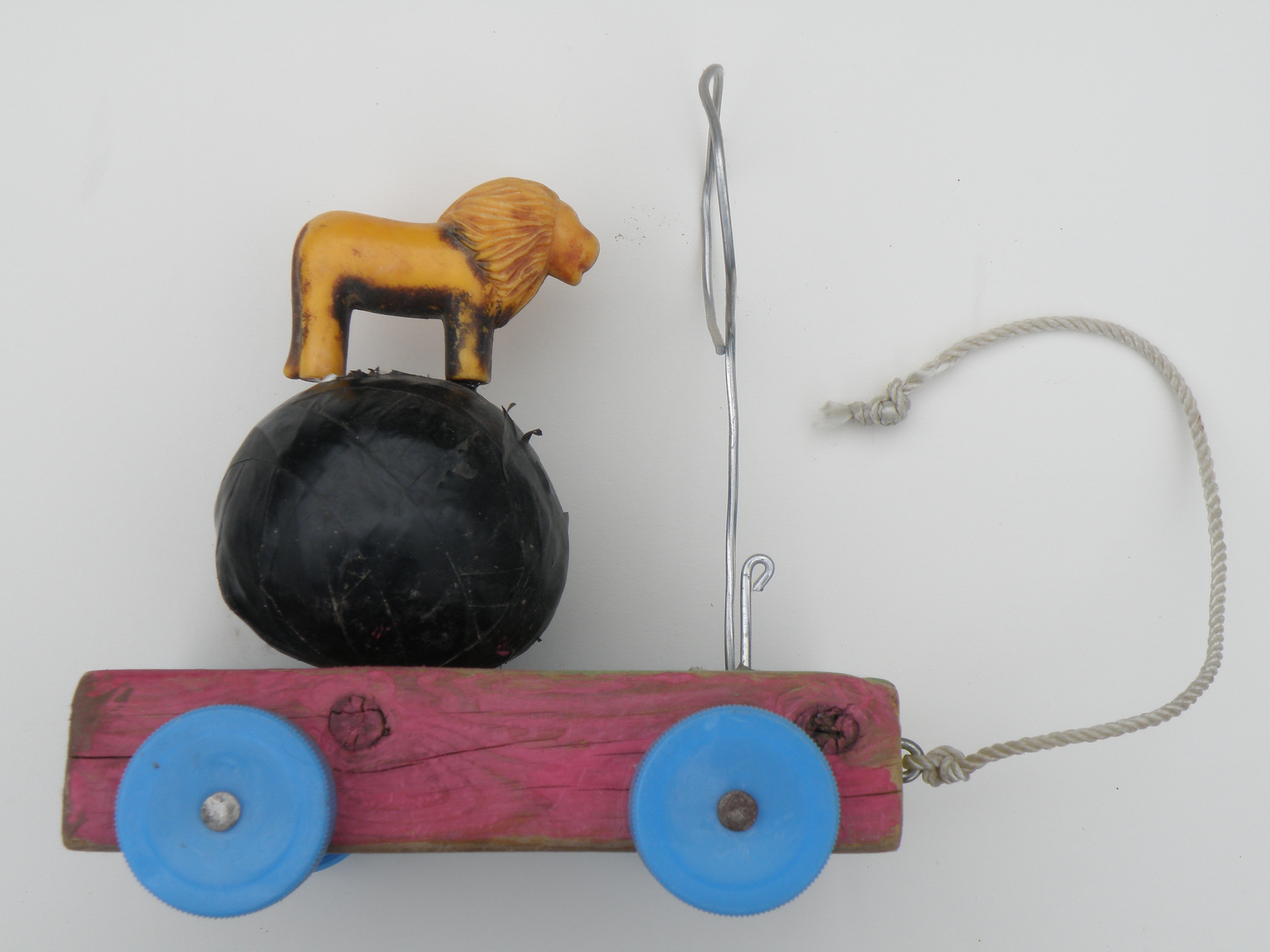
These two balls are made from stretchy electrical tape and are tight and dense.  I remember that the very first handmade ball I found was also made from this smooth black tape.  When my eldest son was a small boy and needed a project to do involving recycled materials… I helped him construct this circus pull toy from materials found at the river.
recycled materials circus toy with handmade tape ball

At the heart of this toy is a handmade ball made from electrical tape.  My son thought this would make a great prop for a circus lion to stand on while it jumped through a flaming hoop!  Of course, the only fire we actually used came from our imaginations.  The yellow plastic lion was also found at the river and has a nice oily patina on it that comes from being in the river for a while.  Here’s a smaller ball made from green tape.
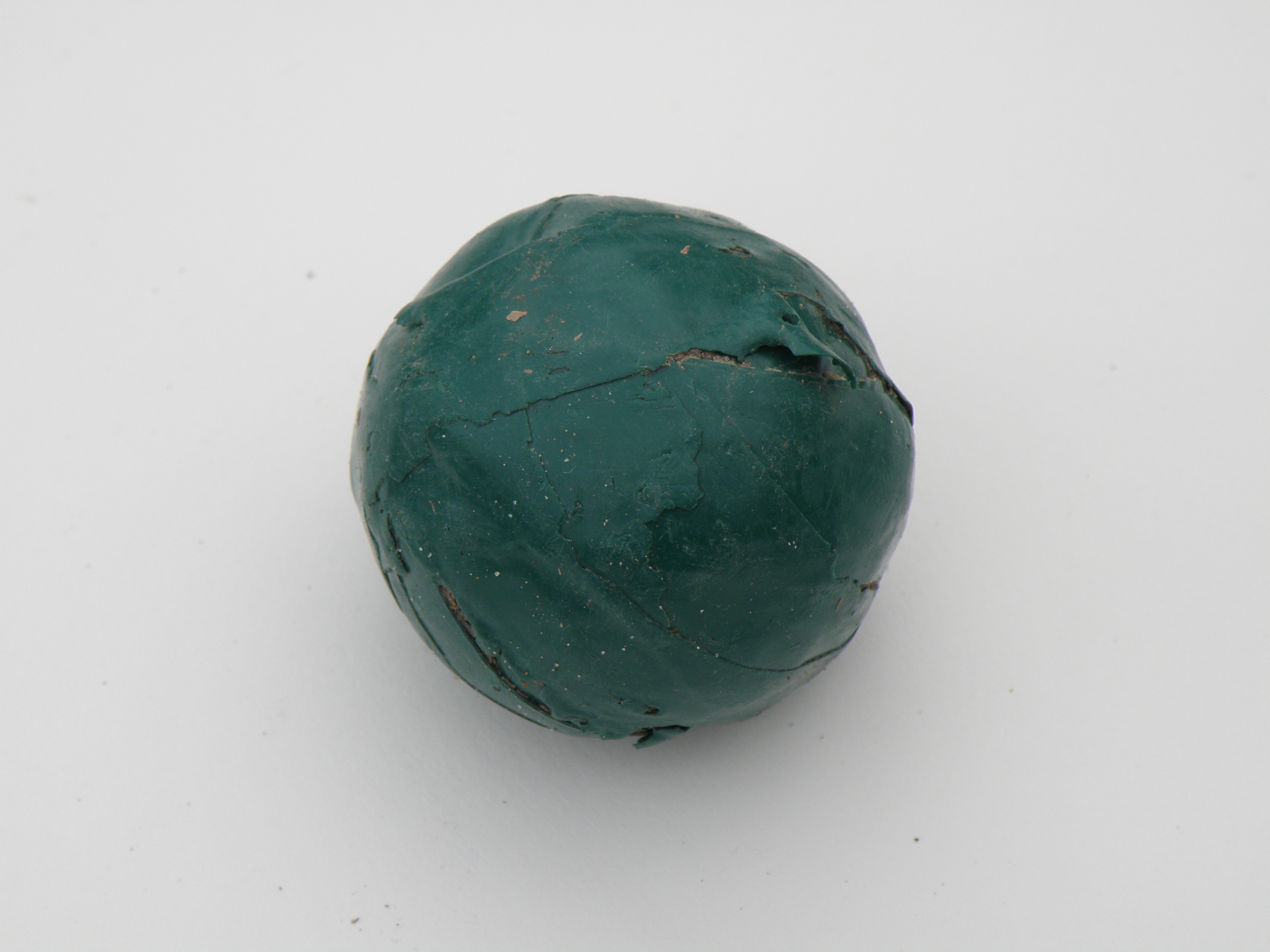
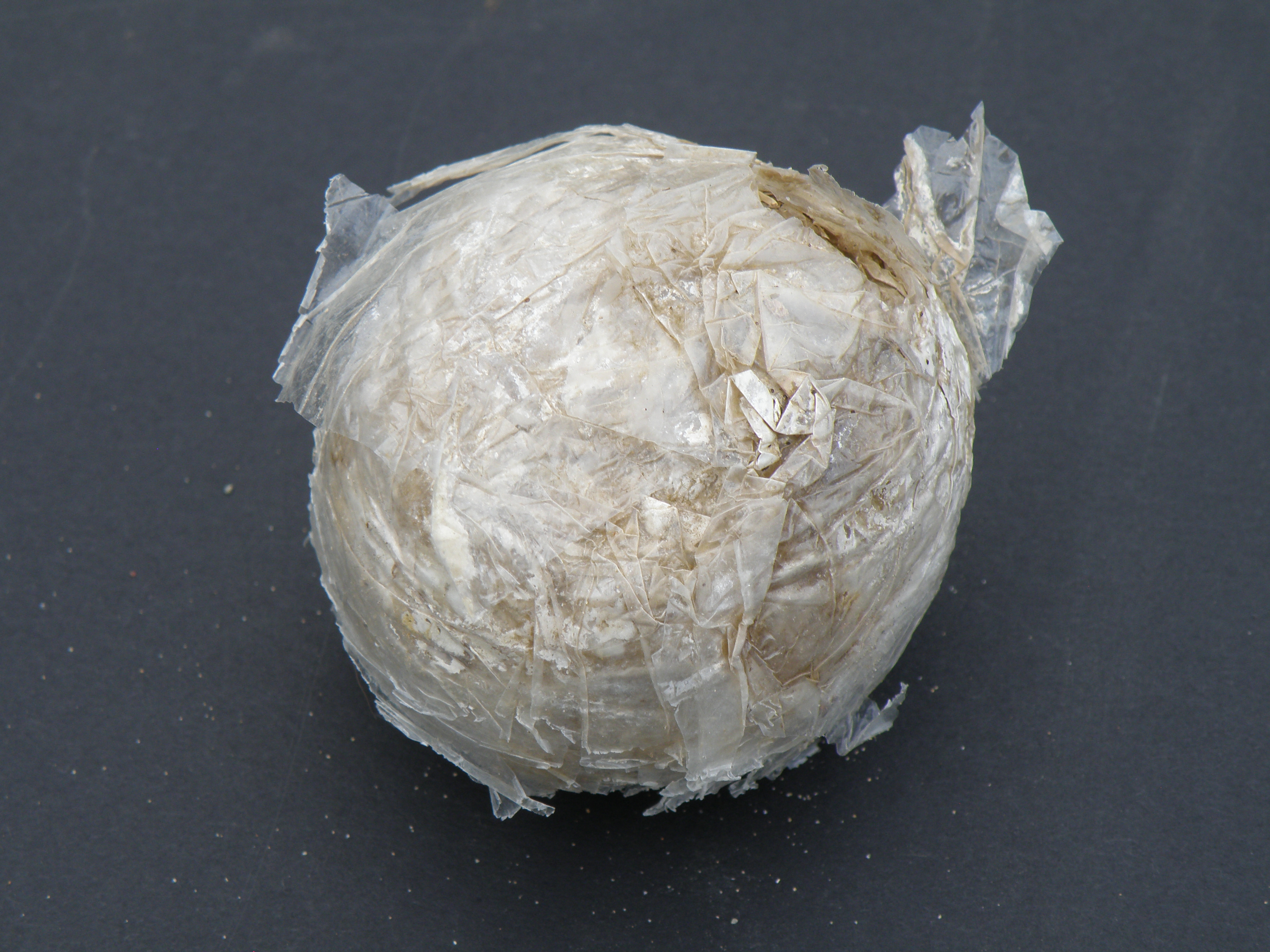
ball made from green plastic tape  I’m sure people are making balls from paper-based tapes too, but these don’t survive being exposed to the elements for very long.
peeling cellophane tape ball

This ball made with cellophane tape is barely holding together.  It’s surface is fragile and the adhesive is losing its bond.  As it starts to peel apart, sand caught between the layers is released.
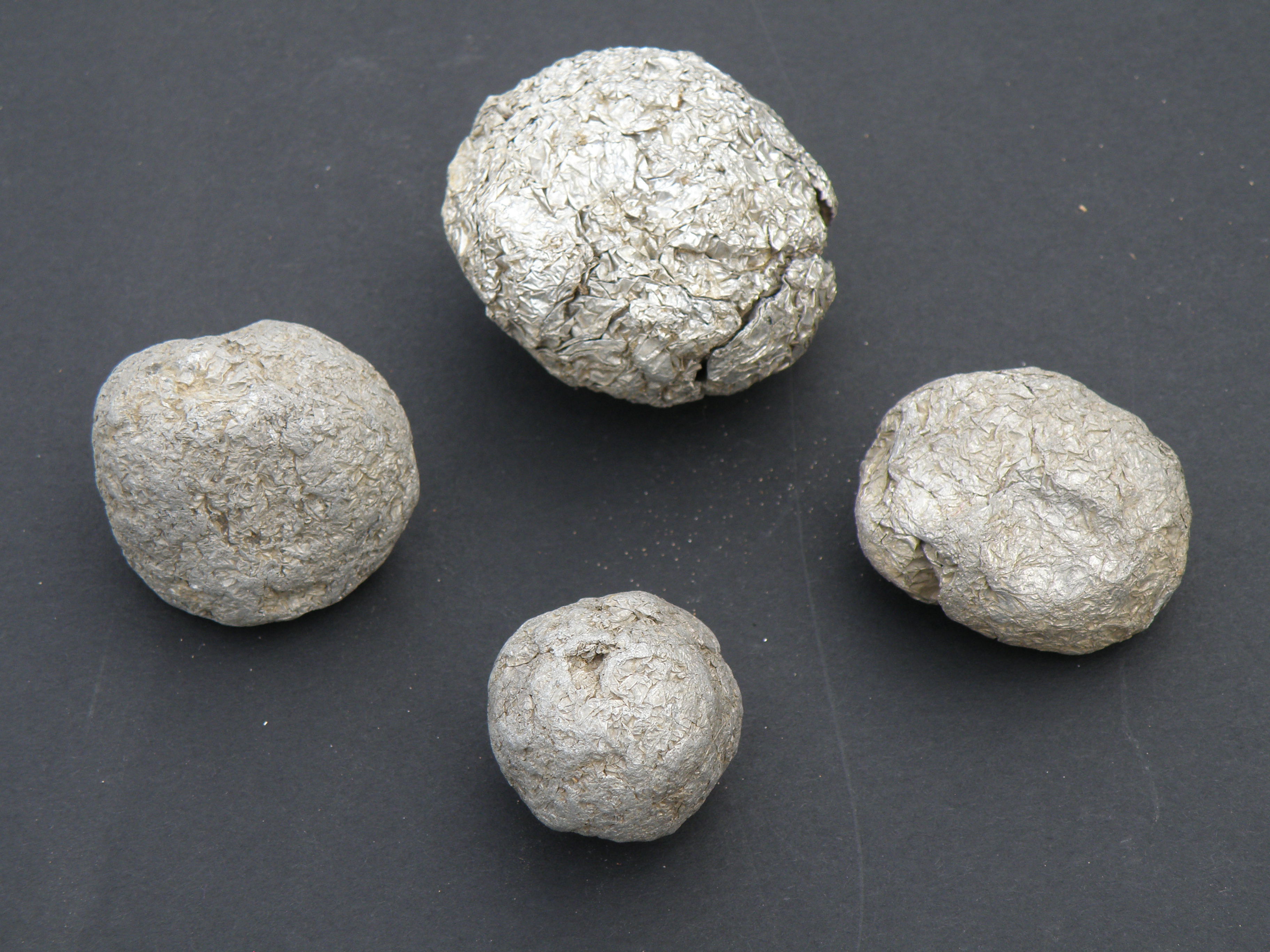
compressed aluminum foil balls


The four balls pictured here are made from compressed aluminum foil.  Perhaps they were used for cooking and once their original purpose was over, the owners rolled the foil around the palms of their hands like one would do to form a ball from either clay or snow.  The funny thing about aluminum foil and the river is that the water somehow squeezes it even more and the ball becomes denser and more solid.  Anyway, I hope you enjoyed looking at this rare and somewhat tongue in cheek odd ball collection where the sum is definitely greater than the parts!  Spring will be arriving soon and the Ohio River is calling…until next time.
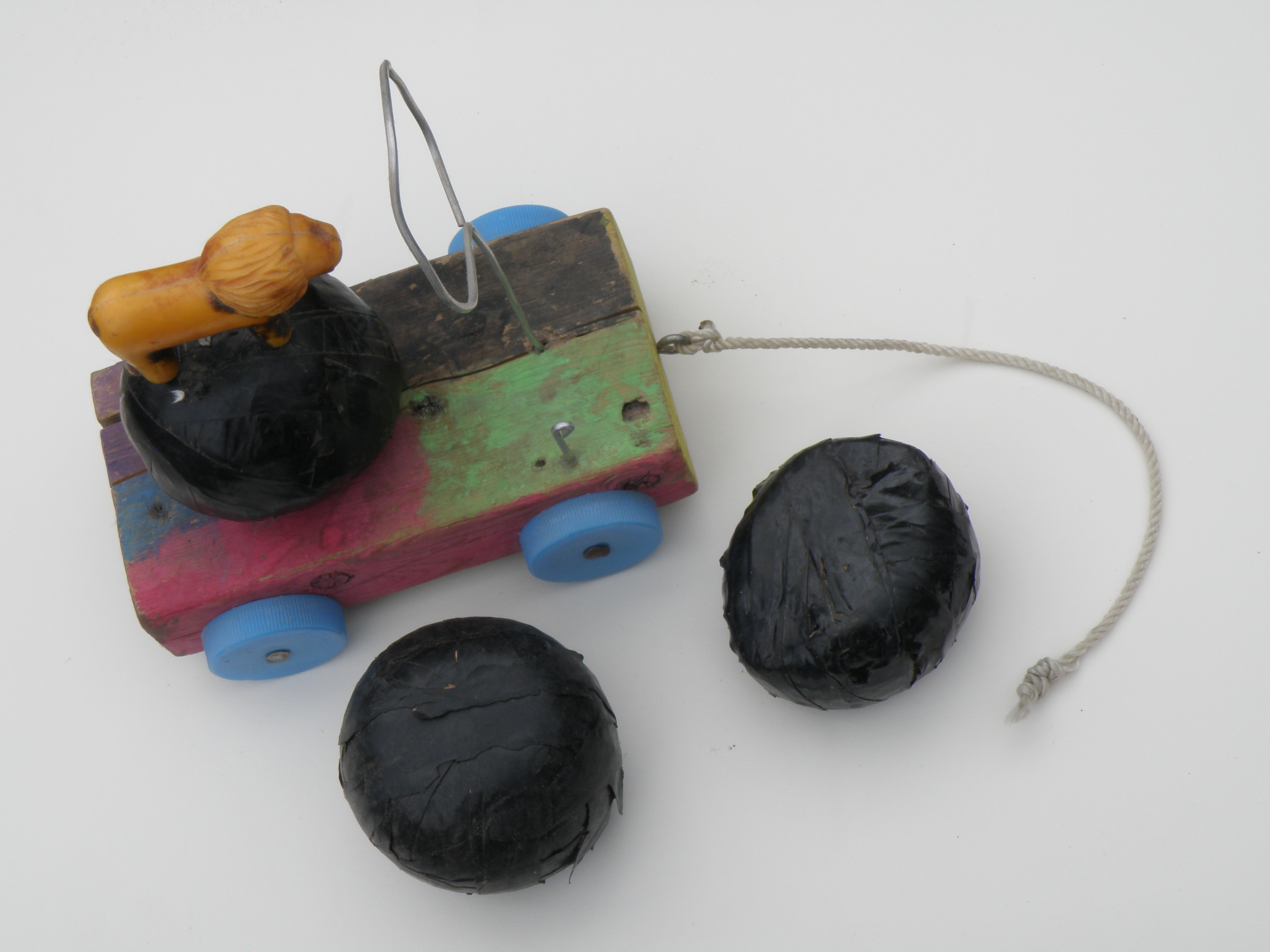
electrical tape balls

Read Full Post »

Spray bottle trigger assembly, March 2013

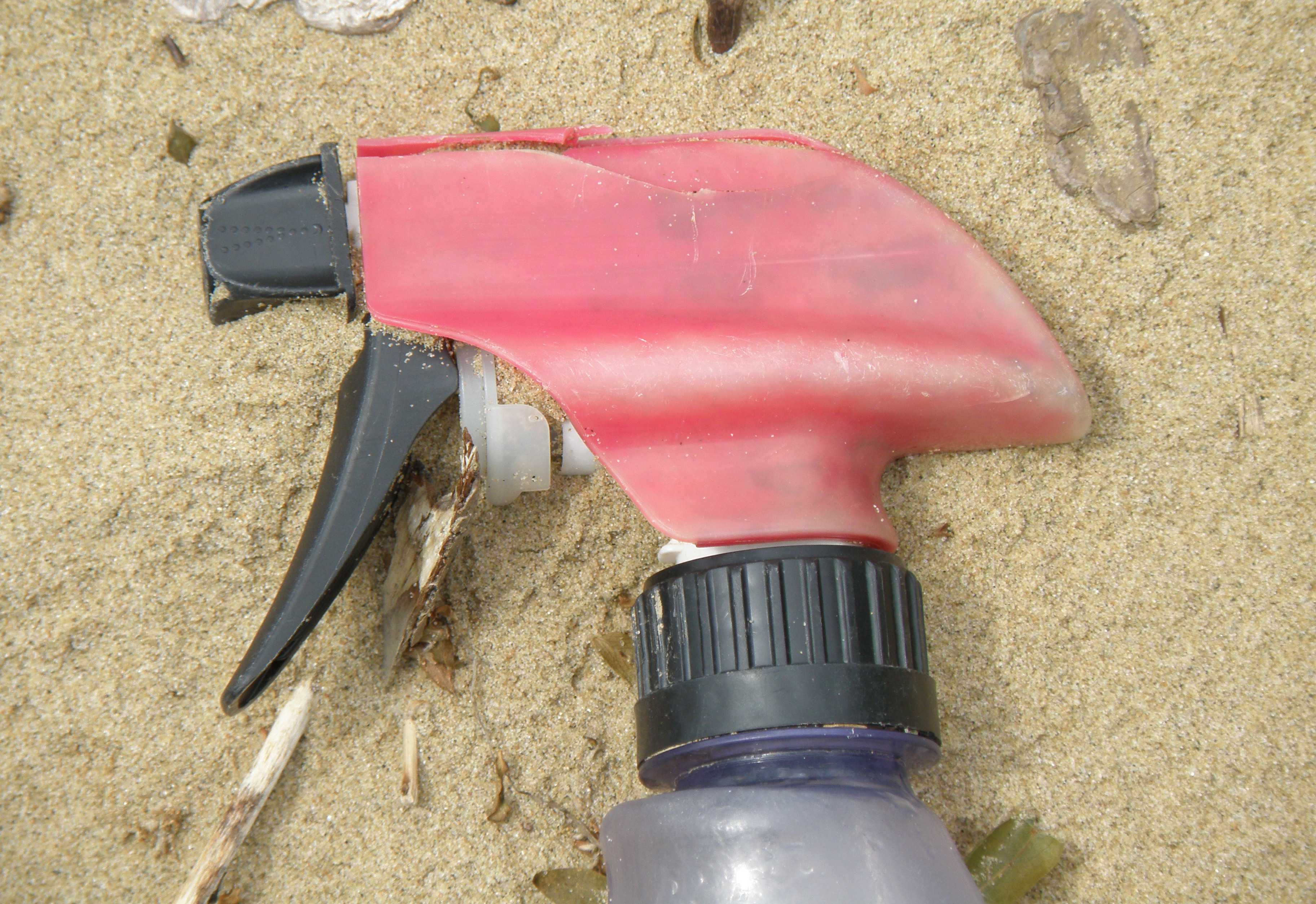
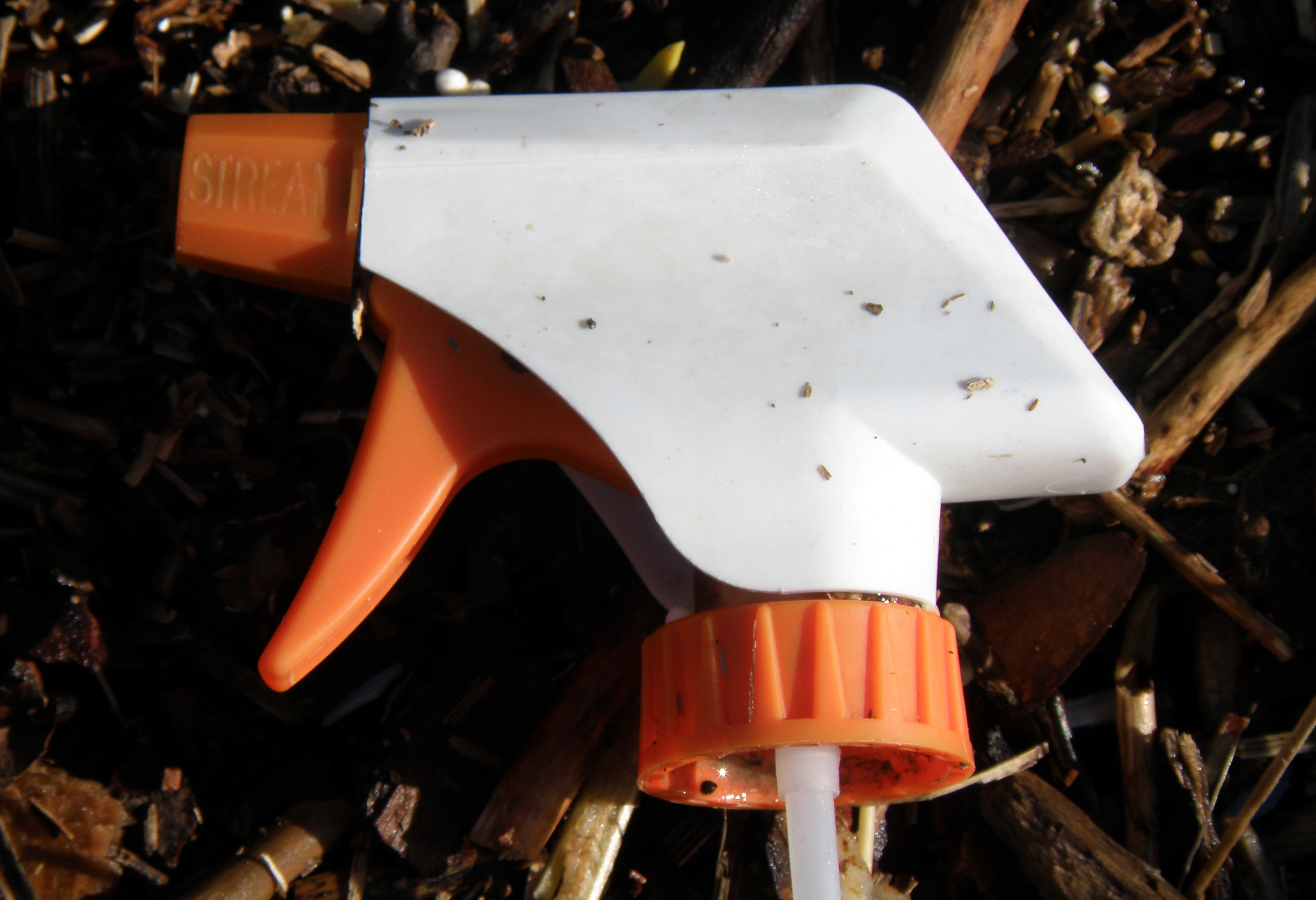
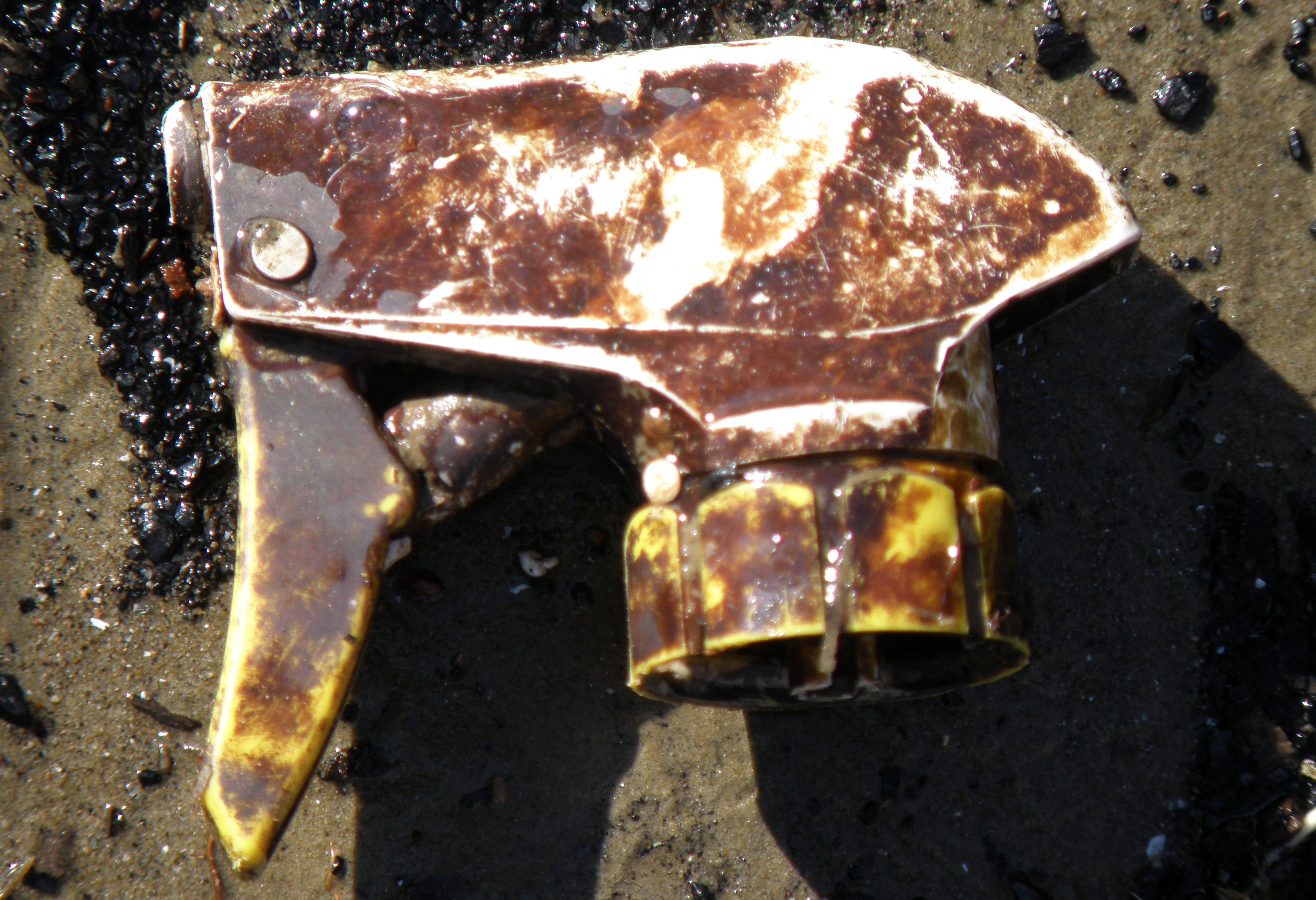
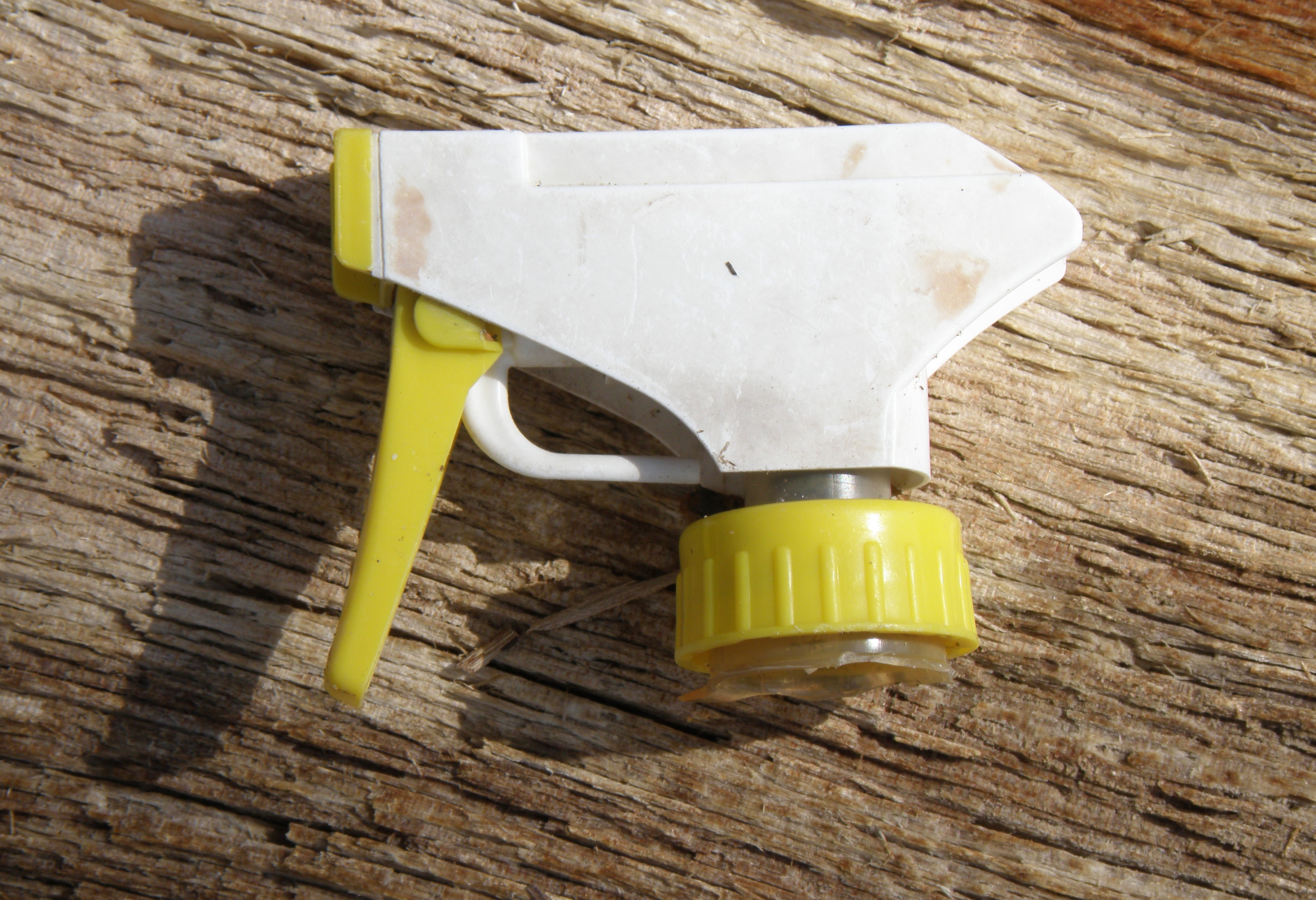
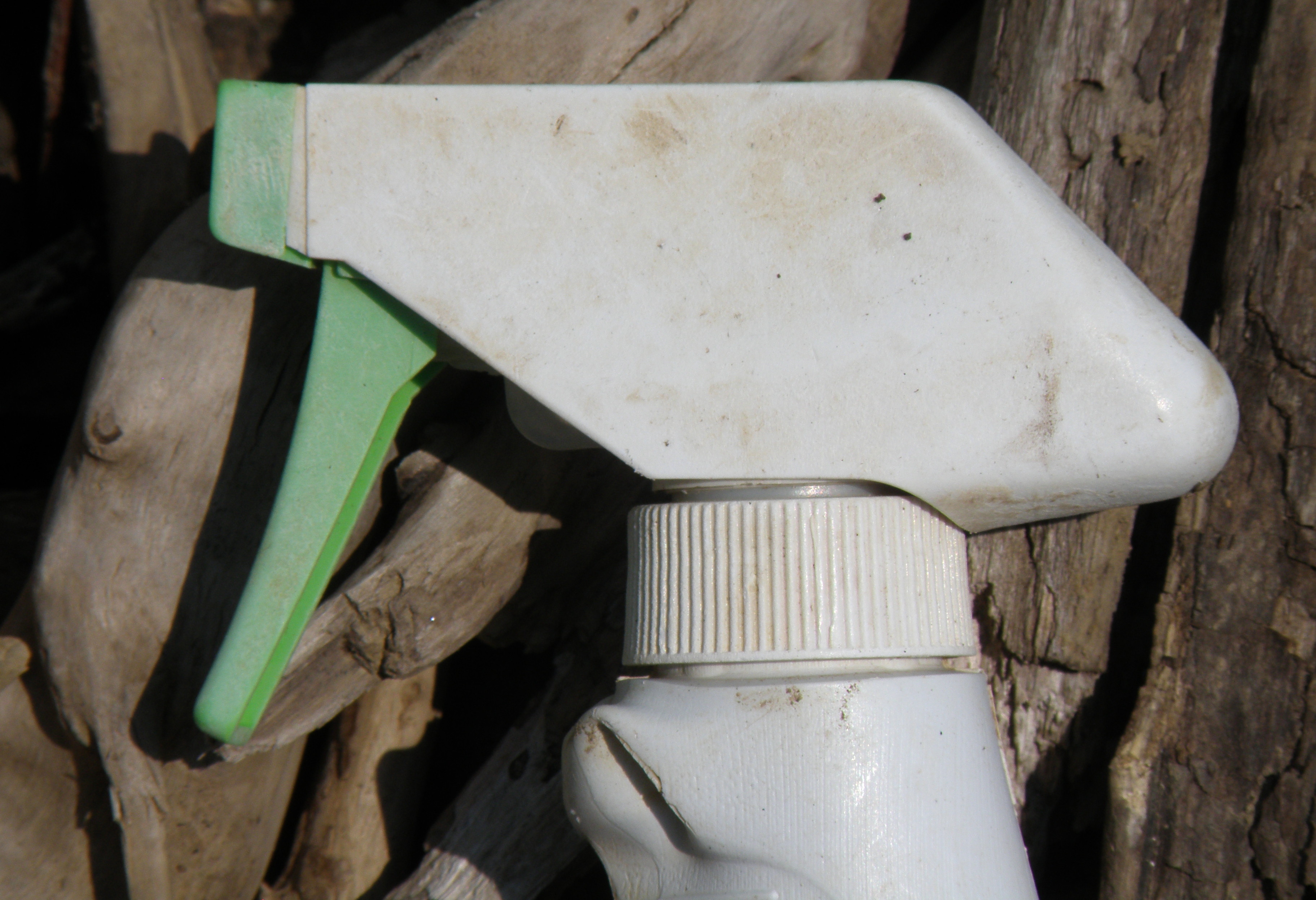
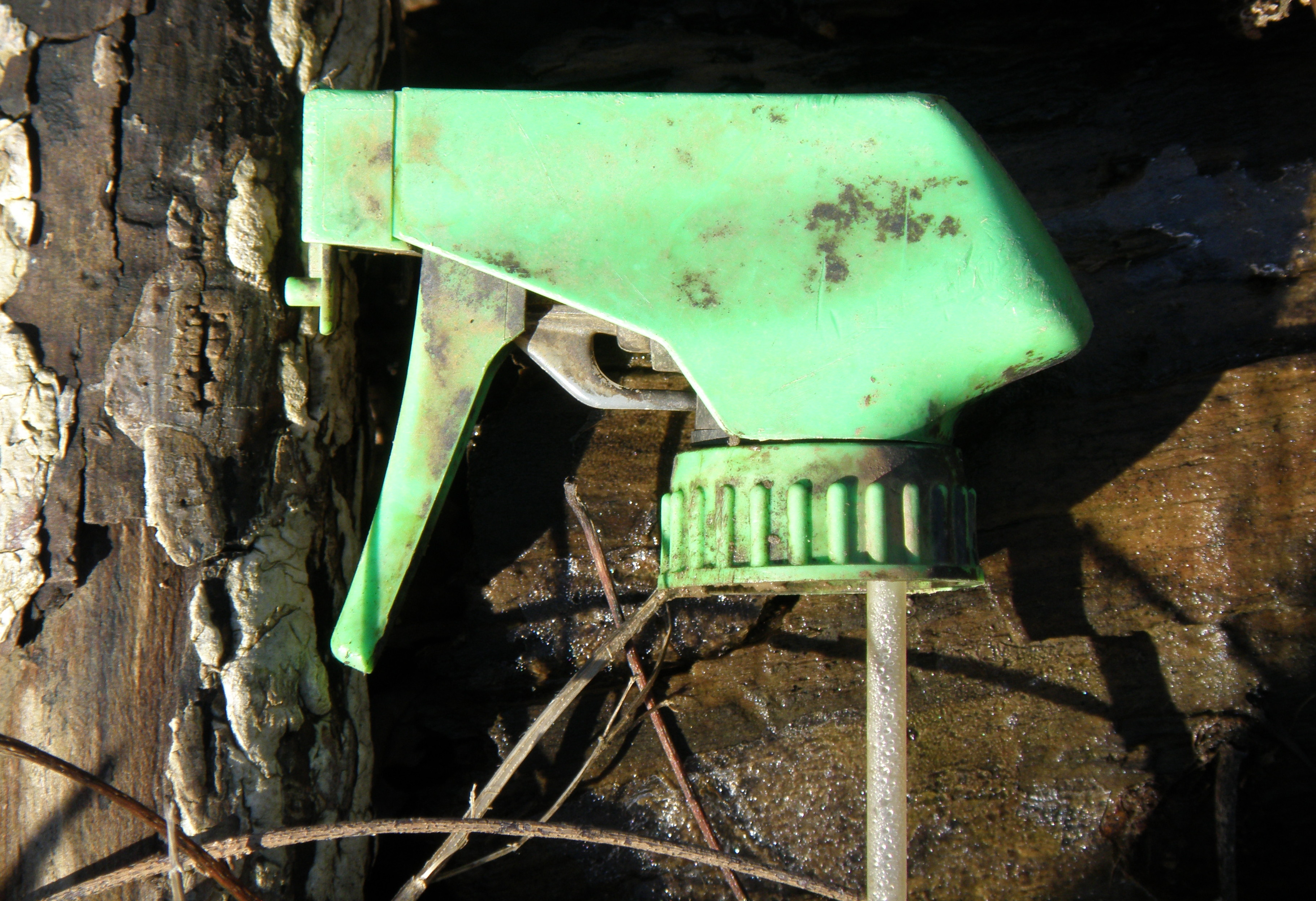
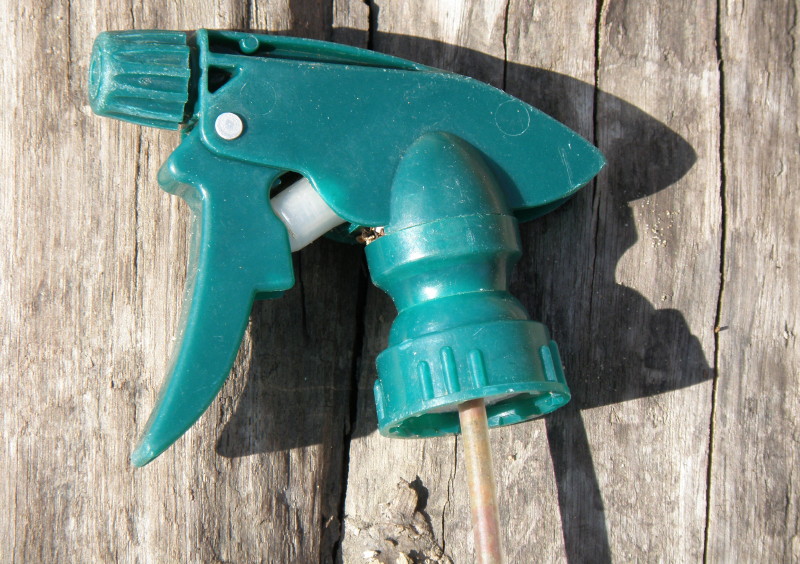
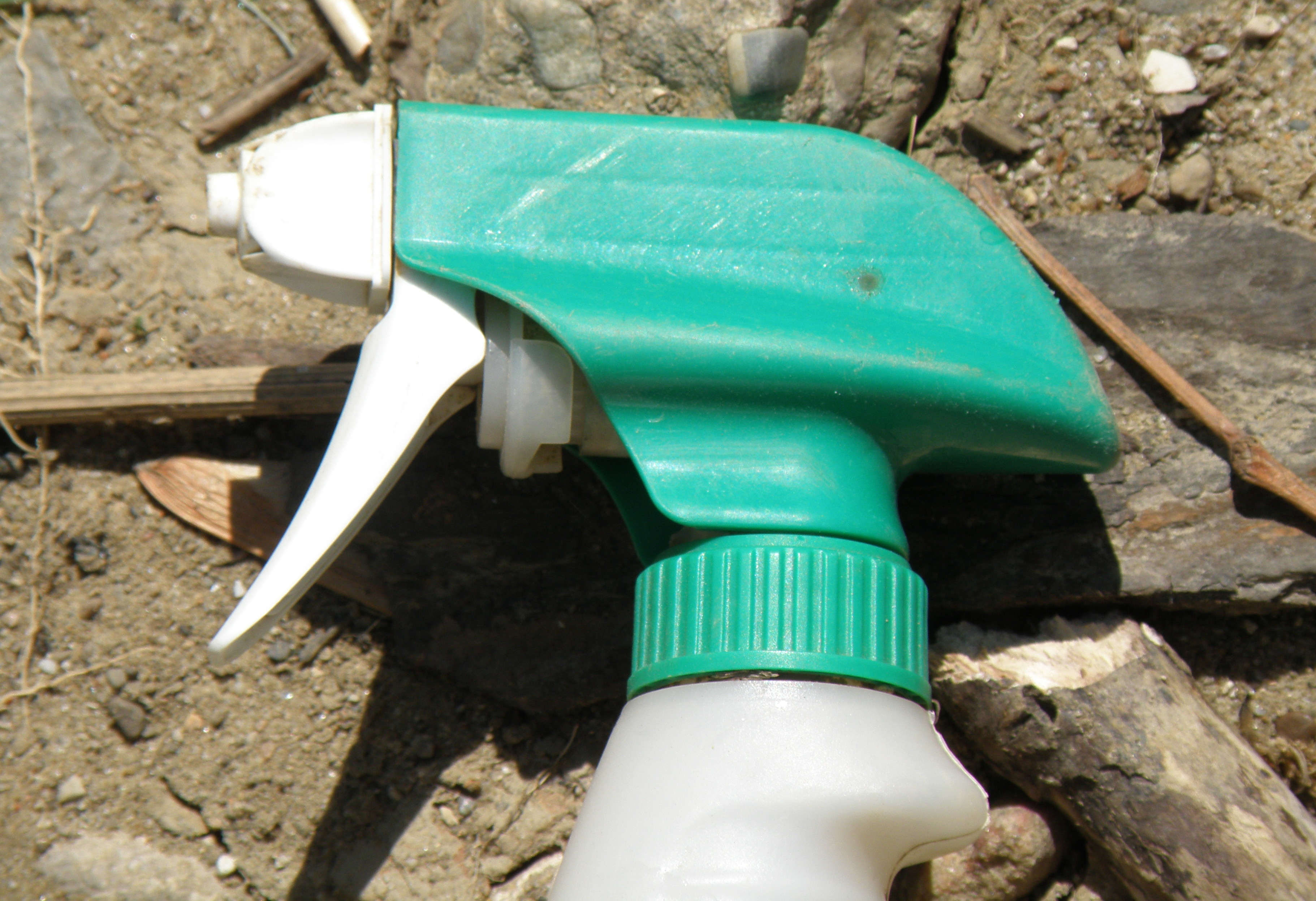
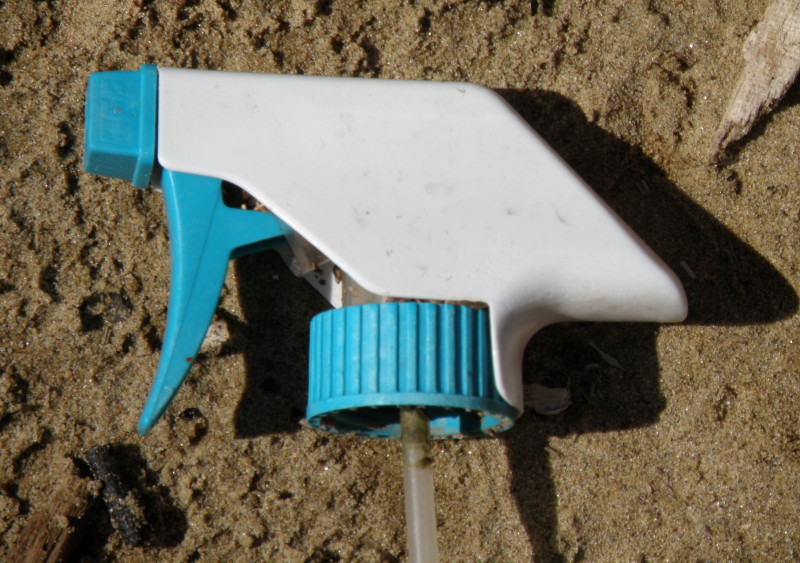
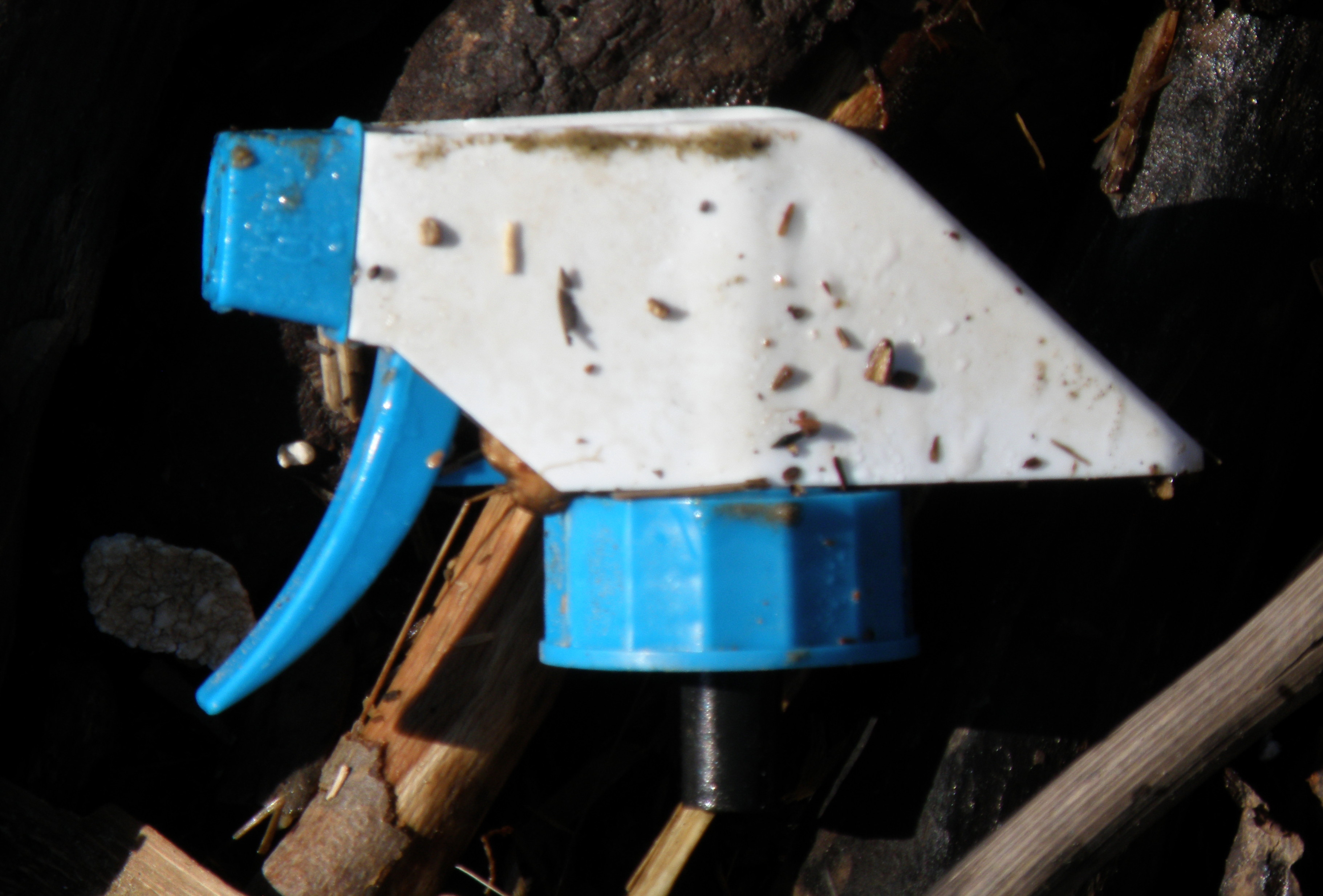
The range of plastic refuse one encounters at the Falls of the Ohio State Park is both numbing (it’s obviously trash and shouldn’t be here) and morbidly fascinating (the design sensibility and colors ) catches one’s eye and occupies the mind.  Consider the variations in something as mundane as “spray bottle triggers” if indeed this is what you call these things?  I’m not sure when I started noticing these objects and photographing them…but here they are.  Each adventure to the river is sure to garner multiple images and story lines that I sift through at my leisure.  Consider this a personal cleansing of the spray bottle trigger palette.  Ironically, much thought went into designing each of these beauties to facilitate dispersal of their contents from plastic bottles.  I like the rotating tips that give me options such as “spray” or “stream” and so forth.  These triggers are ingenious and they do their jobs well.  Without further adieu and fanfare…here are more images from an admittedly odd collection.

red and black spray bottle trigger, March 2013

orange and white trigger, March 2013

dirty yellow and white trigger, March 2013

yellow and white trigger, March 2013

another yellow and white trigger, March 2013

white and green trigger, March 2013

yellow/green spray bottle trigger, March 2013

dark green trigger, March 2013

green and white trigger, March 2013

green and clear plastic trigger, March 2013

blue and white trigger, March 2013

another blue and white trigger, March 2013

white and purple trigger, March 2013


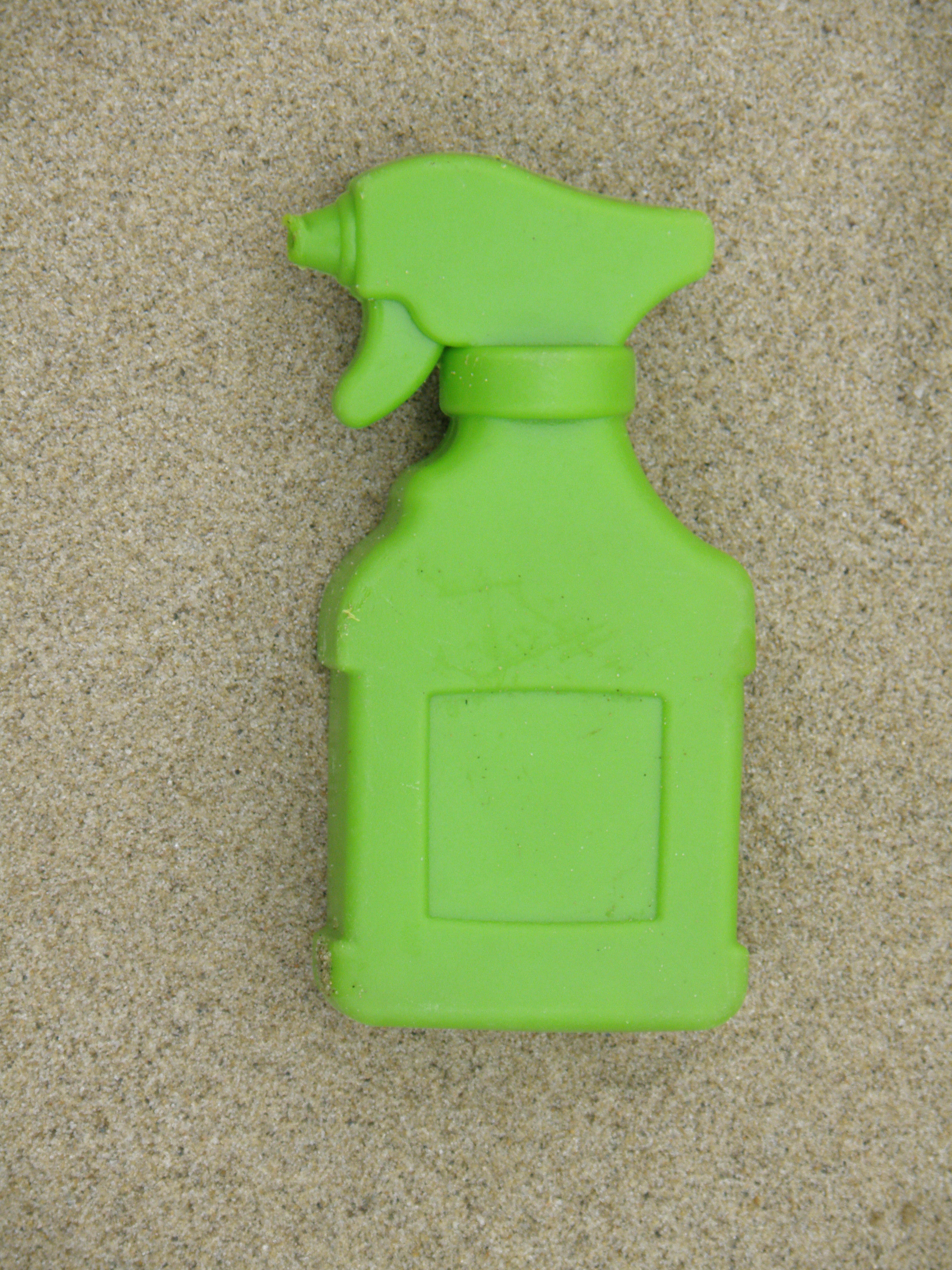
One final image in closing.  You know you have “arrived” when a cute miniature is produced.  Here’s a recent find from a sandy bank of the Ohio River at the Falls of the Ohio State Park.

miniature green plastic spray bottle, March 2013

Read Full Post »

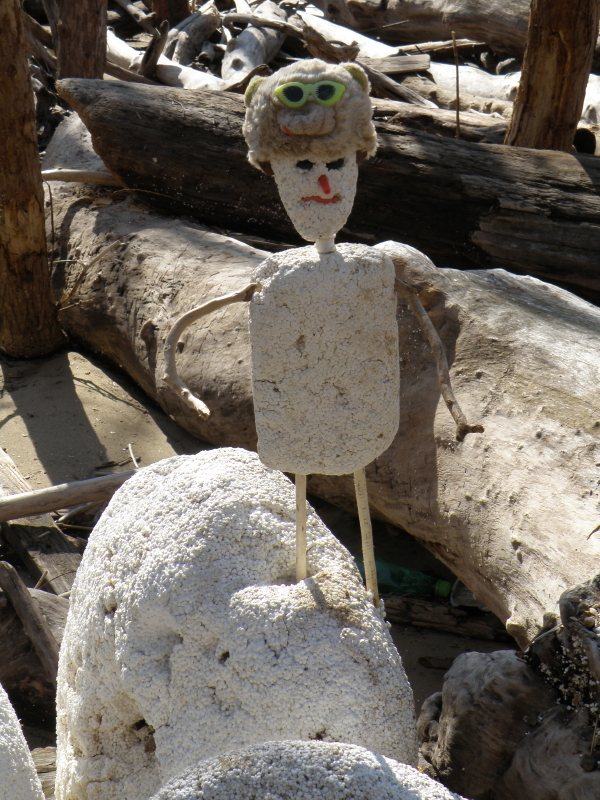
Figure with Bear Hat, Feb. 2013

As promised here is the second part of the previous post.  I did fill an empty cloth bag with river finds and here are some of today’s choice tidbits.  Once I straightened up my outdoor studio, I dumped the bag out onto the sand and started the sorting process.  I guess I also do a similar thing with my camera except it’s a memory card that gets filled and downloaded into the home computer.  Let’s begin with a few pictures of my newly discovered river treasures in situ.

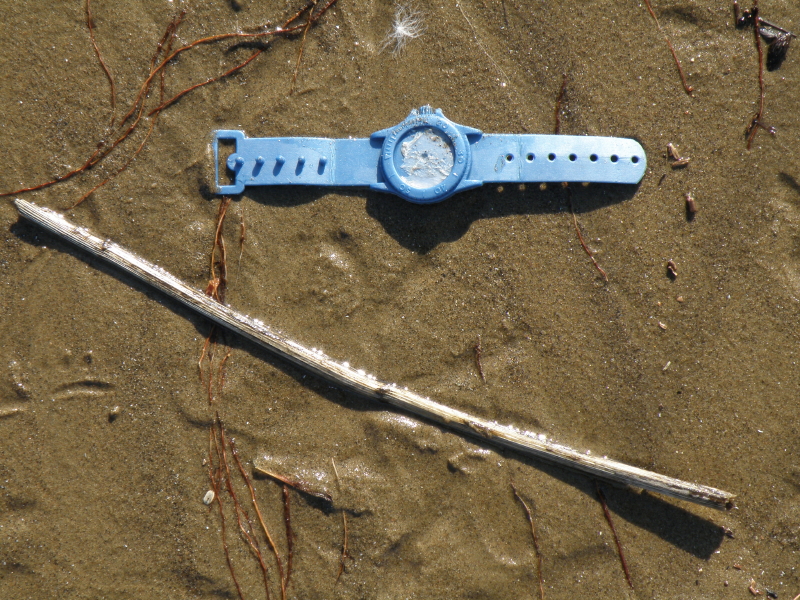
blue plastic watch, Feb. 2013

I like all kinds of references to time.  I have a few other toy clocks and watches I’ve found courtesy of the river through the years.  Interestingly, I haven’t owned a watch personally in over thirty years and don’t want one now.  It seems I can find the time most anywhere I go and at the Falls of the Ohio…I pass by one of the largest clocks in the world.  Let’s see if I have a picture of that I can pull up for you.
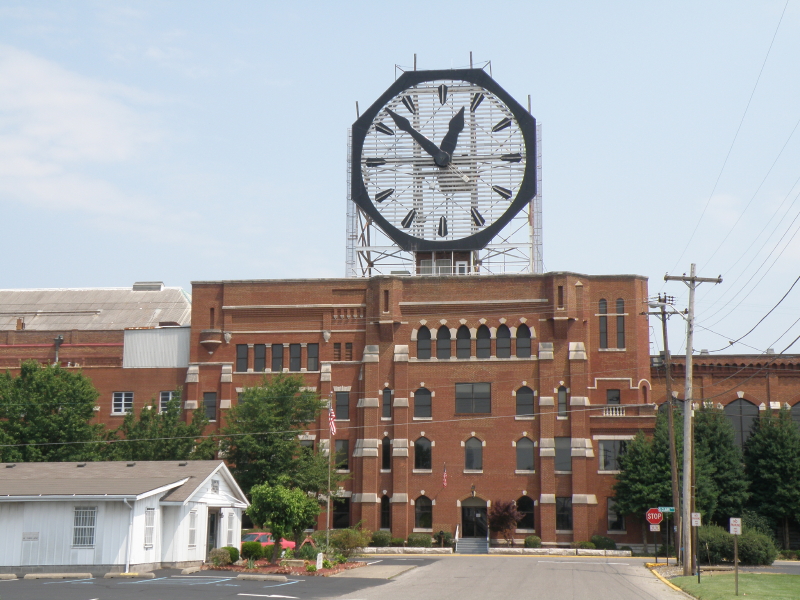
former Colgate Clock, 2012

Although this is a bit off topic, I thought you might enjoy seeing this mechanical wonder.  This is less than a mile away from my river spot.  It was once a part of a toothpaste factory that moved away a couple of years a go.  The building is a former prison…which is another way to mark time.  My reluctance to wear a watch has more to do with not liking to wear much in the way of jewelry.  Besides who needs the constant reminder?  Meanwhile, back at the river.
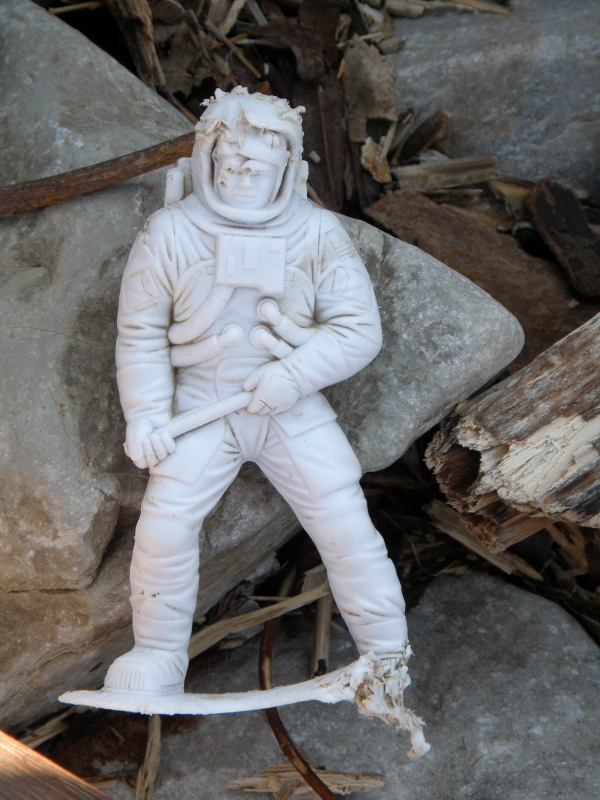
white plastic astronaut, Feb. 2013

Houston…we have a problem.  I’m a plastic astronaut and it looks like the family dog has chewed one foot off!  Having some issues with my helmet too…don’t think I can last long in this alien environment.  This is an American astronaut so designated by the flag patch on his left arm.

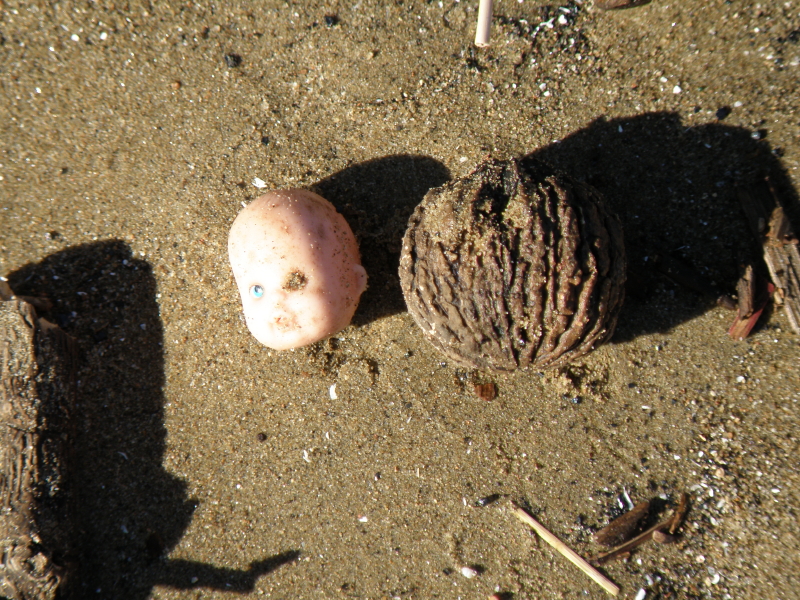
very small plastic doll head and walnut, Feb. 2013

I believe this is the smallest doll’s head I’ve ever found.  Here having a potential brain the size of a walnut could be a good thing!  I think I have found enough doll heads over the years to make a totem pole several feet tall and they would graduate from largest to smallest with no two alike.  This guy could be the cherry on top of it all.


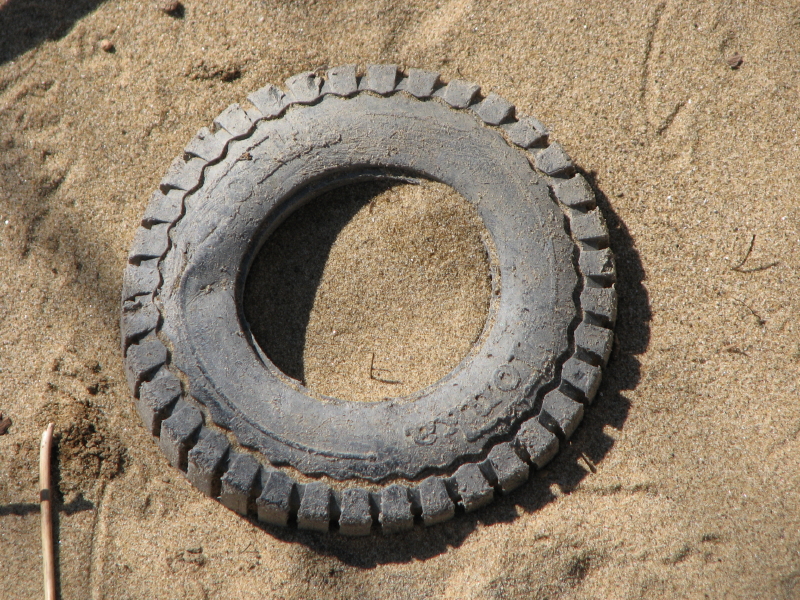
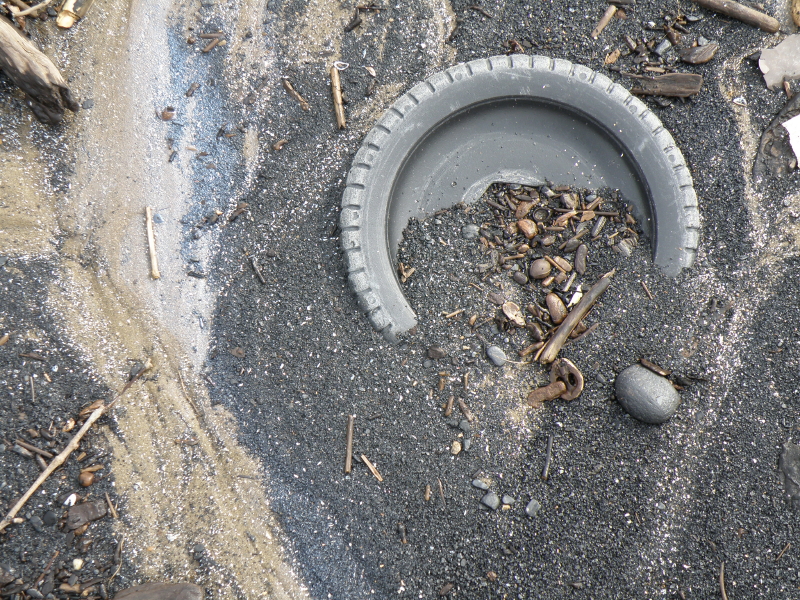
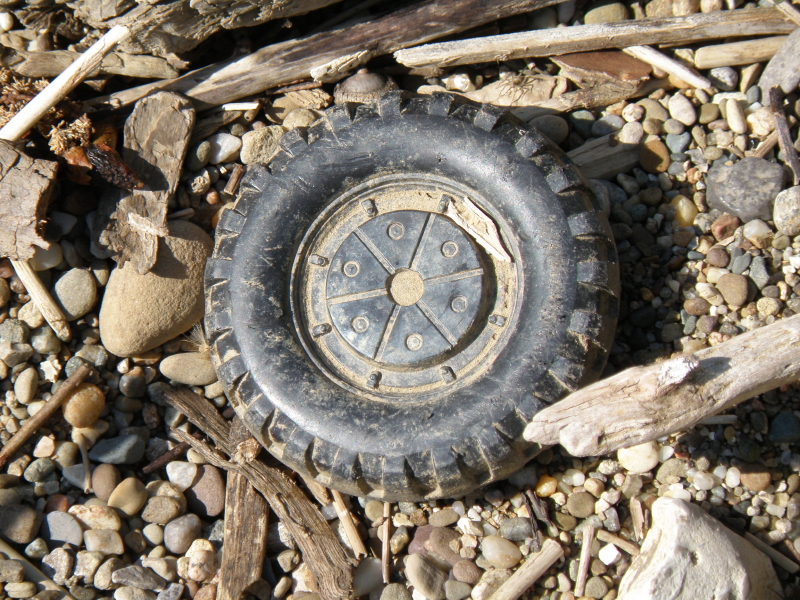
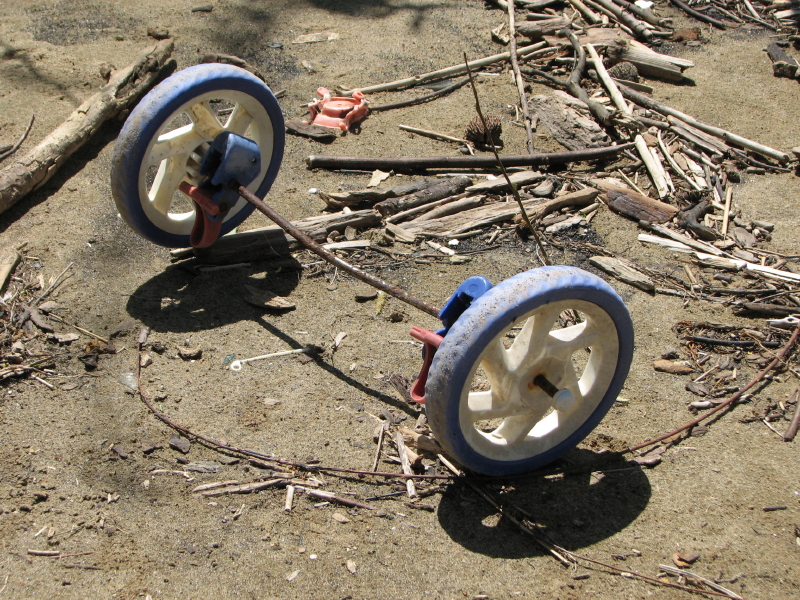
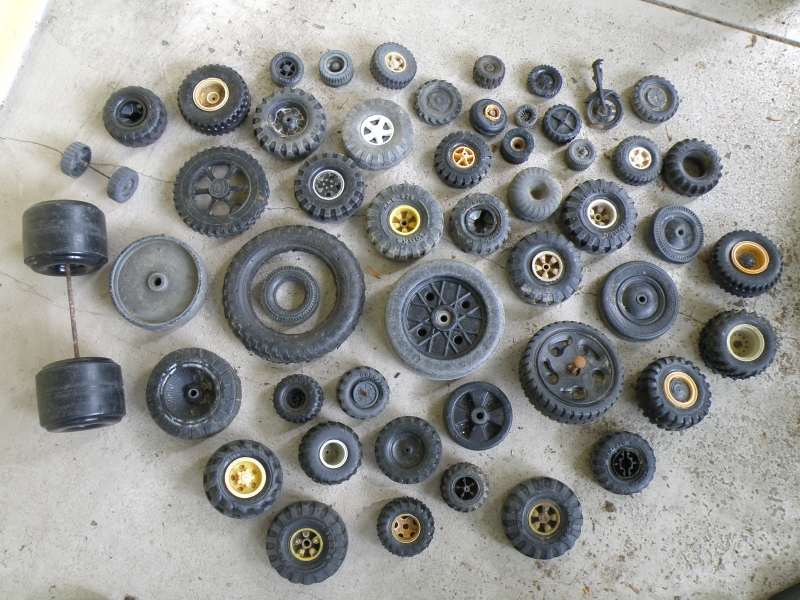
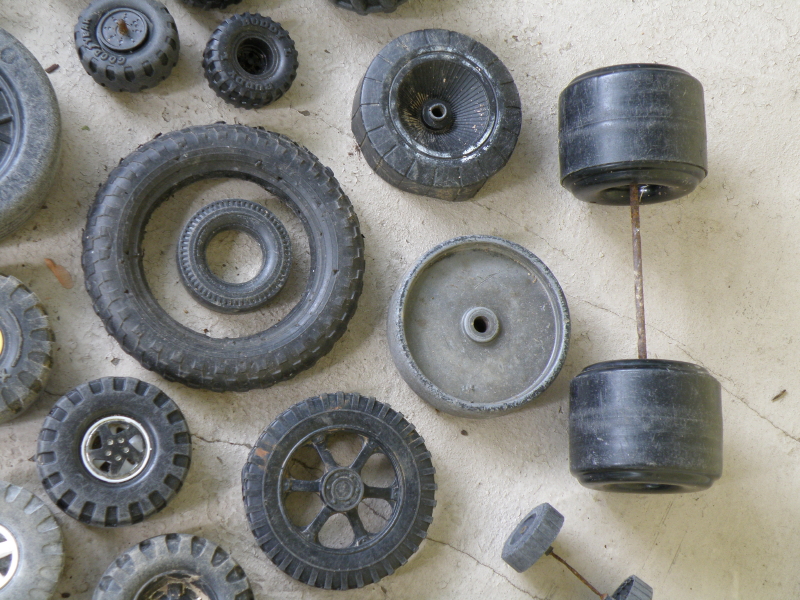
Toy wheels found today. Feb. 9, 2013

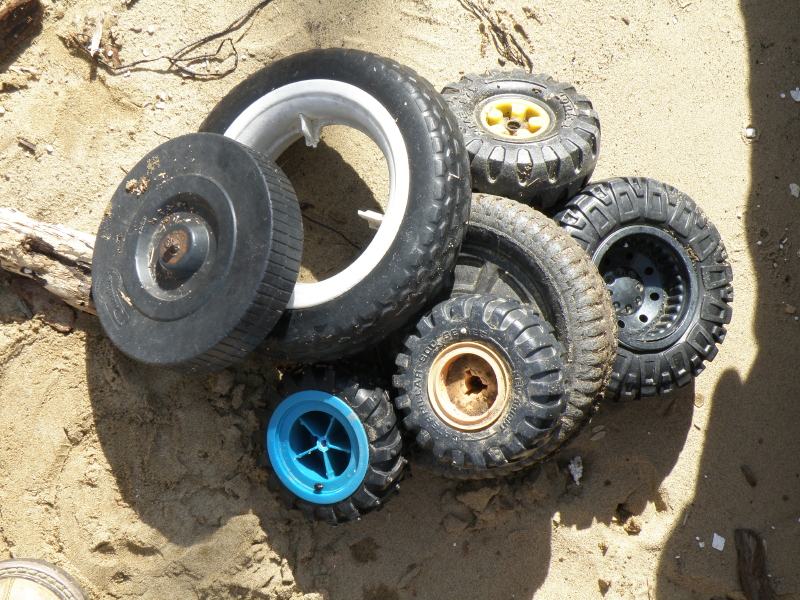
As regular readers know…I have a thing for wheels too.  These are just the toy wheels I came across today.  I’m surprised by how many of these I have found in just the past two years.  I like them as a collection, but I may use them all in a single artwork.  I watched a depressing documentary today that included such nuggets of information like the average automotive tire takes seven gallons of oil to make.  And you may be thinking that all this petroleum is needed for gasoline?    I see too many real tires in the river as well.

3 plastic toy hammers found on 2/9/13

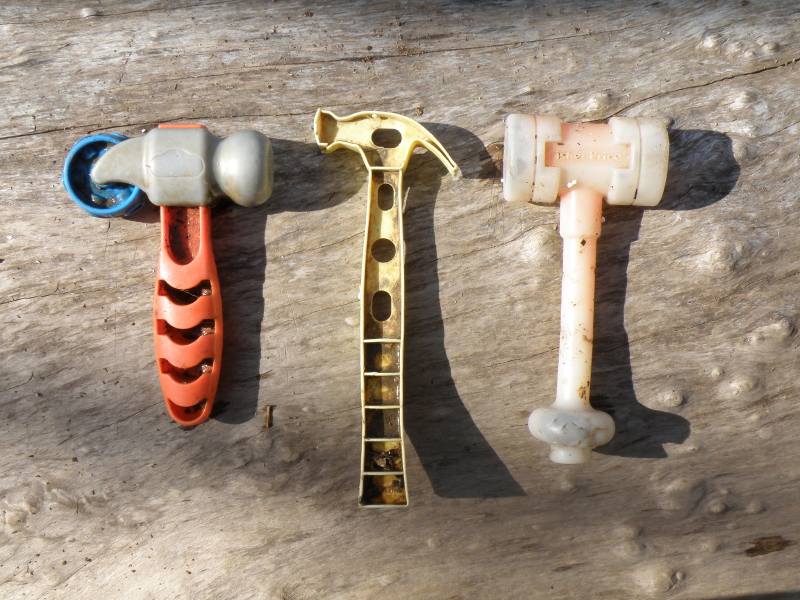
Now how odd is this?  I found three toy hammers within a few hours of each other.  This is the most common toy tool that I find…not screwdrivers or pliers, etc…  At the river, it’s always hammer time, well the one on the far right is technically more of a mallet.  I’m not sure what the blue wheel on the far left hammer is supposed to do?

more found plastic toys, Feb. 2013

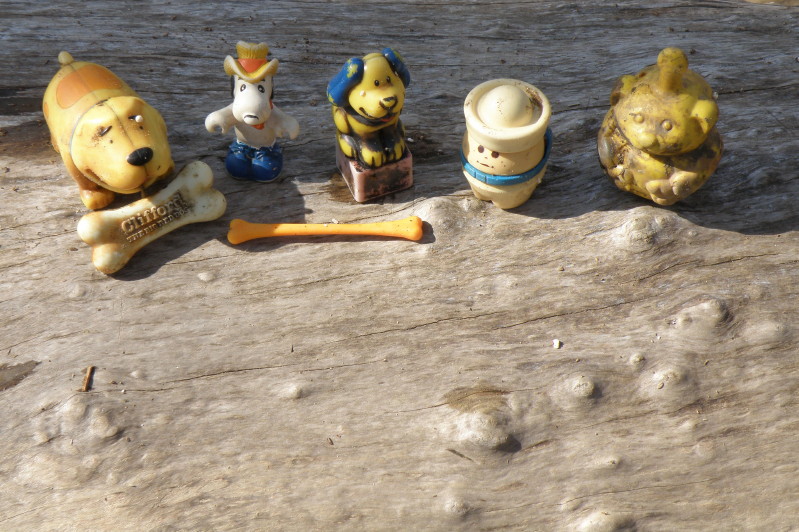
This is an interesting grouping of character toys.  It includes three dogs, two bones, a Weeble, and a Teletubby(?).  There’s a dog friend from Clifford the Big Red Dog and quick draw Snoopy from the Peanuts cartoon.  The dog sitting on the block has a nice oily river patina that takes years to develop.  The yellow character on the right is still full of mud.

four fishing lures, Feb. 2013

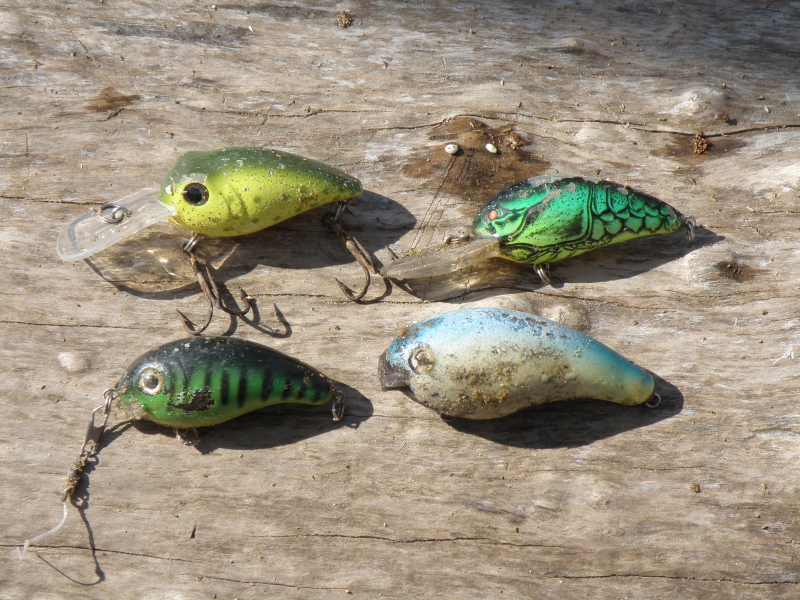
Not everything I find is a toy.  Here are four fishing lures.  These get tangled up in the rocks or snagged on old fishing line.  Notice only the top left lure still has its treble hooks.  In the others, the hooks rusted or dissolved away.  I found a fifth lure after taking this photo.  I need to rephotograph my fishing lure collection because it has become seriously larger over the past couple of years.  You can see an older image in my Pages section.

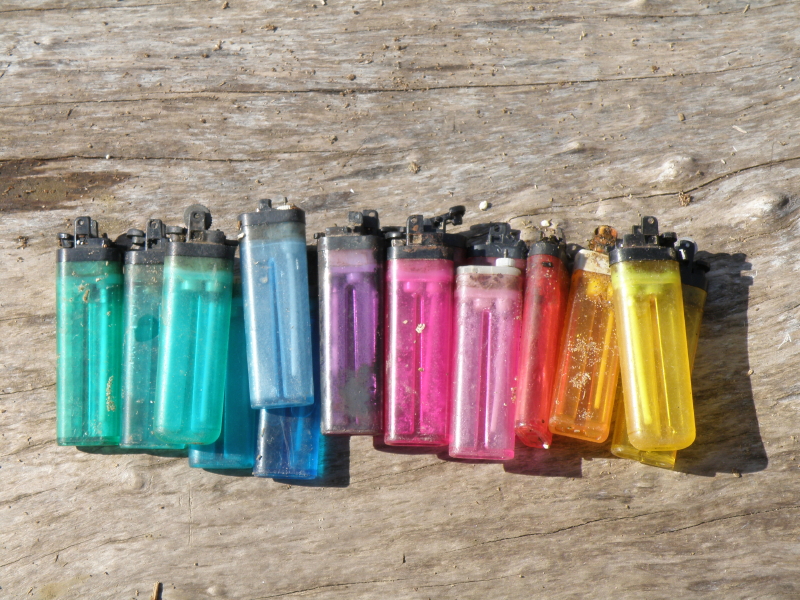
colorful, disposable cigarette lighters, Feb. 2013

I picked up all these disposable cigarette lighters today.  I have more at my studio at the church and intend to put them to use one day as well.  This was more of a photo opportunity.  I wanted to see some of the color range this particular make of lighter comes in.  No doubt the color is not light fast and over time would all probably come to resemble each other until the plastic broke down into ever smaller bits.  I also picked up other items such as interesting rootlets and sticks and heavier still…nice potential bases for the sculptures I decide to hang onto.  Well, this wraps up my finds from one particular adventure.  There is always stuff to pick up after the river rises and recedes again.  I wonder what I’ll come across next?

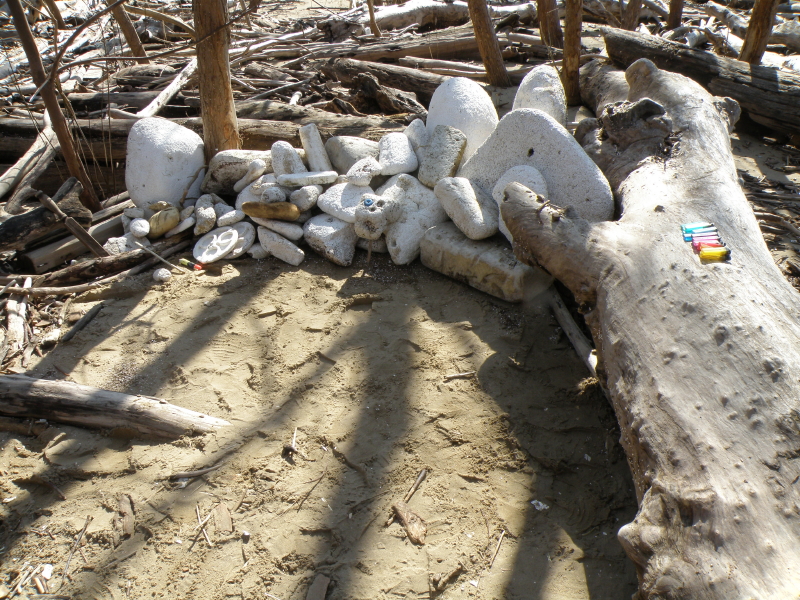
My outdoor studio, Feb. 2013

Read Full Post »

nature's template, Falls of the Ohio

It’s been raining off and on for the past three days and so I’ve decided to give the actual Falls of the Ohio a pass this weekend.  That, however, does not mean that my heart and thoughts are ever far from the park.  Looking through my Falls image archive, I have put together a post on a topic that has been concerning me of late.  Increasingly, we feel we can manipulate nature and bend it to our desires without consequences.  Man has this vision that we can force nature into our template and that “she” will obey in predictable, obedient ways.  Ever see a square tomato grown in a cube?  Nature, however, is much more dynamic than we give her credit for and frequently presents ideas of her own.  As regular followers of the riverblog may have noticed new fauna often show up here and the consensus is that their appearance is a result of our altering the environment in myriad ways.  Over the last few years, I have also noticed some previously unknown plants.  Allow me to present a photo-bouquet of highly questionable, potentially toxic, exotic flora.

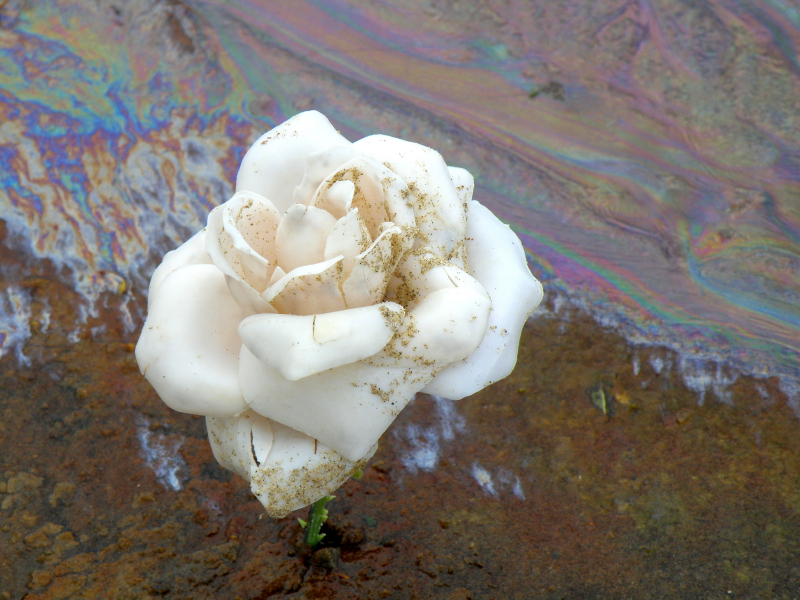
The Chemical Rose, Falls of the Ohio, 2012

Meet the Chemical Rose which is a new species I discovered at the Falls last year.  It was found growing by an area where an unknown iridescent sheen was percolating up through the sand.  It has no leaves and aside from its thorny stem, has no photosynthetic ability.  This is a fairly consistent trait of these new plants.  They may be parasitic or fungal-like, but I’m sure there is considerable variation on how they live.  The petals on the Chemical Rose are hard and seem very much like plastic.  More on this later.

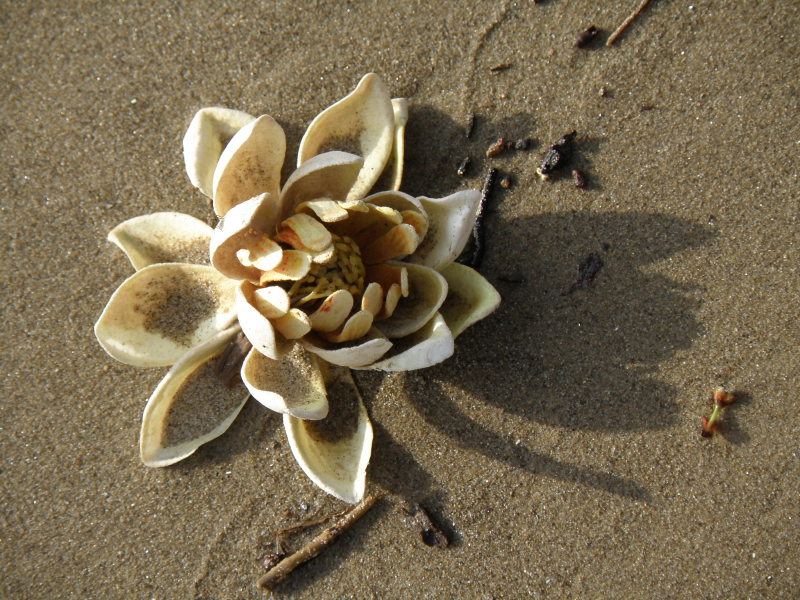
The Sand Lotus, 2012

It’s beautiful in its own way, but what is it?  For lack of a better name, I call this a Sand Lotus.  It shares some characteristics with the Chemical Rose.  Notice no leaves…doesn’t need them.  It’s roots go down deep in the sand.  Like the previous rose, its petals are hard to withstand the rigors of the river.

Petrochemical Coleus

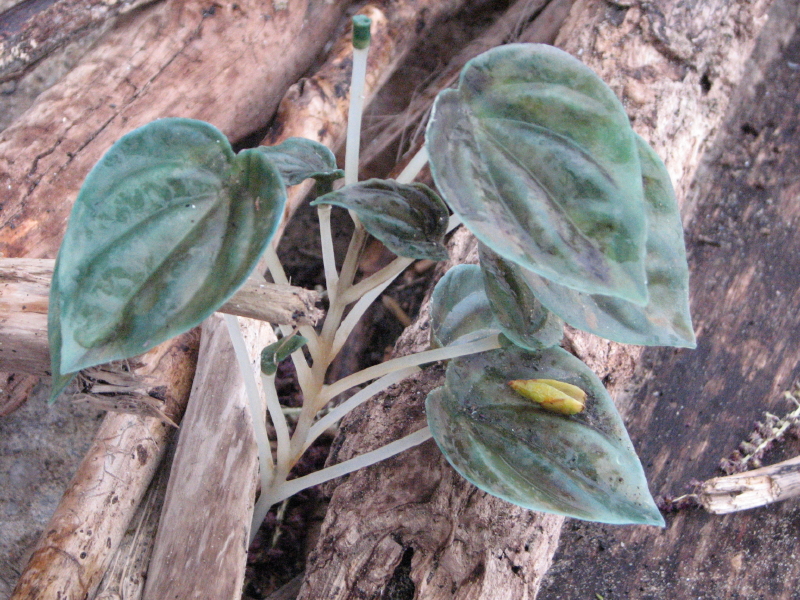
I bet I walked by this strange plant many times before something told me to look again.  I call this one the Petrochemical Coleus.  Although it has green leaves, it does not possess chlorophyll.  This specimen was growing up through the driftwood.  It’s small size also makes this one hard to see and find.

Flame Nut with seeds

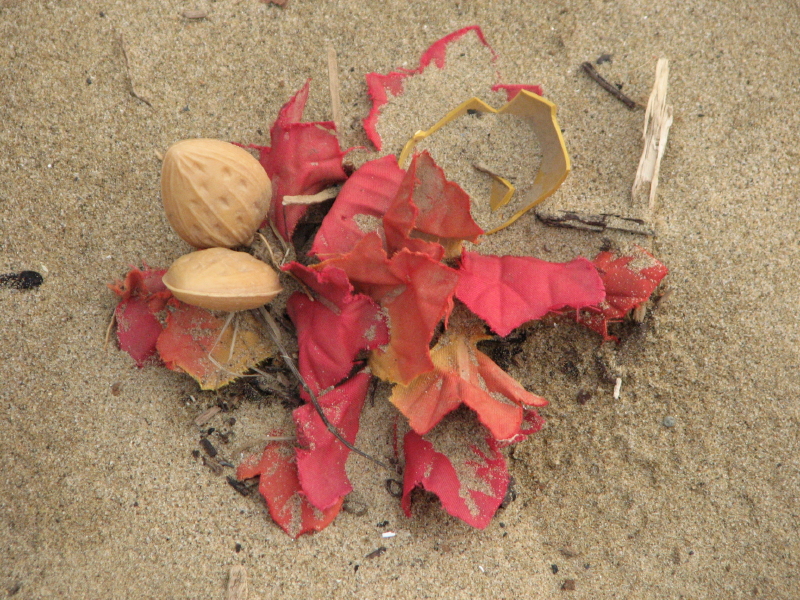
Here’s the Flame Nut so-named because what passes for its foliage turns bright red when its seeds mature.  Its leaves feel very much like coarse fabric and it seems to prefer sandy environments as well.

False Pink Bell in bloom

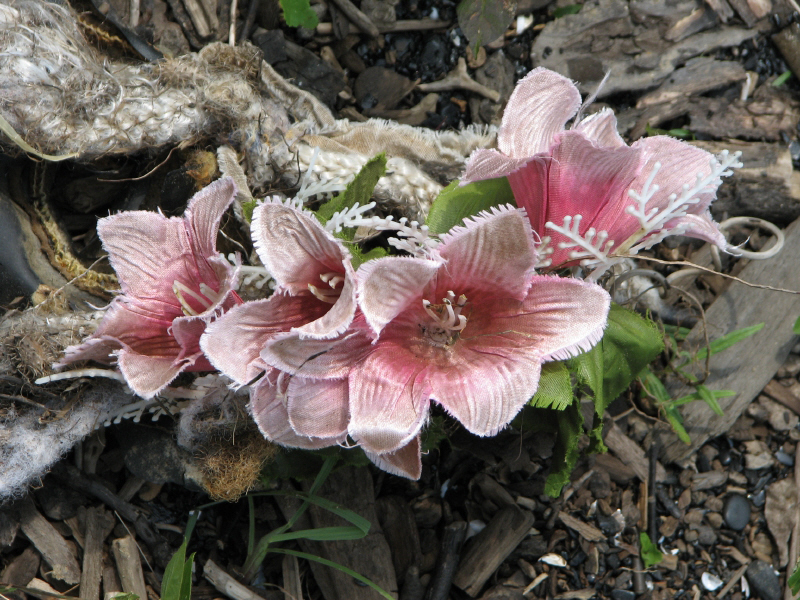
This interesting and dare I say “lovely” flower is the Faux Pink Bell.  It combines characteristics of several of the mutant plants I’ve uncovered.  It possesses hard plastic parts as well as the softer, synthetic petals that are fabric-like.  It grows in highly disturbed, contaminated soils.  Which brings me to a theory I’ve been formulating ever since I first discovered these strange plants.  Although I’ve not done a chemical analysis on them, their resemblance to plastic can not be coincidental?  Plastic is after all organic by definition.  Plastic is derived from petroleum which is an extract from ancient life and I think there is something in the long memory of life that is presenting itself here?  We know that our traditional plastics keep breaking down to the micro level.  These really small particles are absorbed by living tissues.  Is it possible that this plastic pollution is altering life in reaction to the many changes brought about through man’s activities?  Can the long polymer chains connect with DNA?  In effect, Nature is demonstrating that it is even more plastic by molding and forming new species to harmonize with the changed environment.

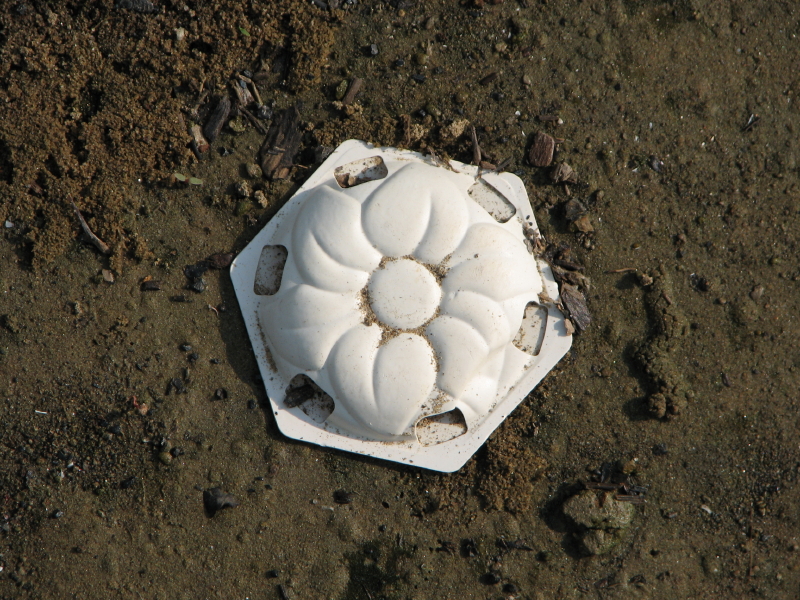
Polymer Posey

I came across the Polymer Posy growing in the mud.  I believe this is as much fungus as anything else or a new theory has been presented.  Perhaps this is a carnivorous plant that traps and eats insects?  Upon inspection, there are small entry ways along its base that invite small insects like ants to go inside.

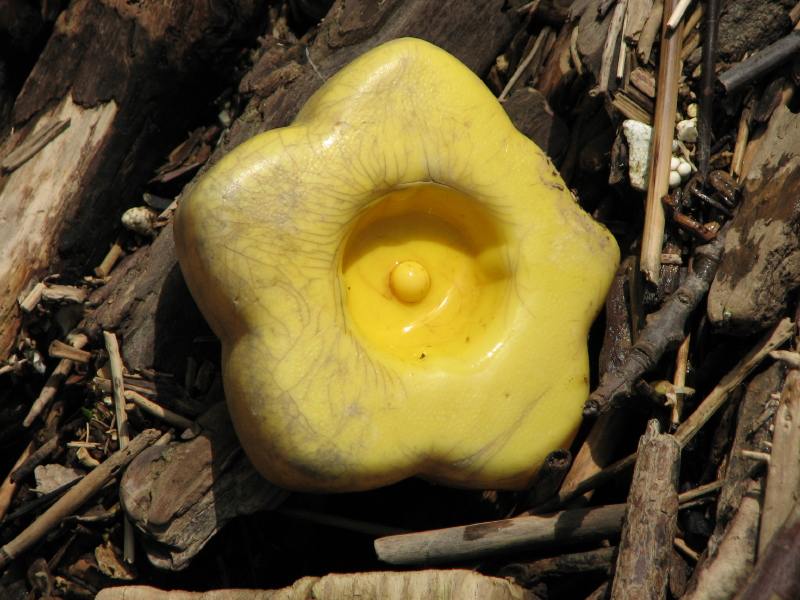
Yellow Bittercup

Growing out of the wood chips is this botanical novelty I’ve designated the Yellow Bittercup.  Again, no leaves required.  This flower can appear anytime of the year.  I came across this one last summer.

Orange Forget-me-not

The Orange Forget-me-not is indeed memorable.  It is encountered among the driftwood and may in effect break down cellulose to create its own plastic structure.  The holes in the flower trap, strain, and direct moisture and nutrients to its shallow root system.  And now for something really spectacular in a twisted way.

Polyvinyl Palm, 2012

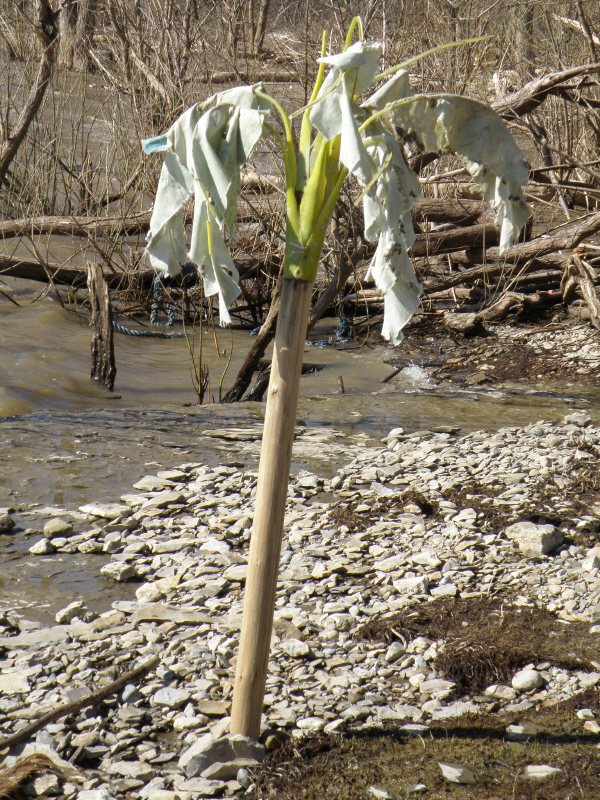
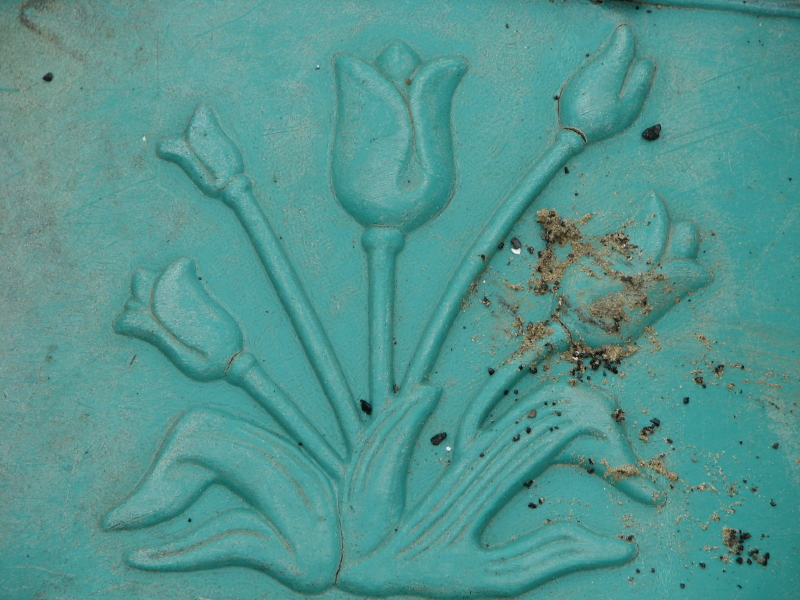
I did a massive double take upon encountering the Polyvinyl Palm growing from the poor rocky soil in the western section of the park.  This is easily the largest of the new plants I’ve stumbled upon in my wanderings.  I had hoped to study it more, but another visitor to the park collected it.  We have discovered that it is possible to change the chemical composition of the atmosphere through our combined activities.  I believe we are simultaneously altering through chemistry the very organisms that inhabit this world with us with unintended consequences.  How long will it take before we change ourselves into something different as well?plastic tulip image

Read Full Post »

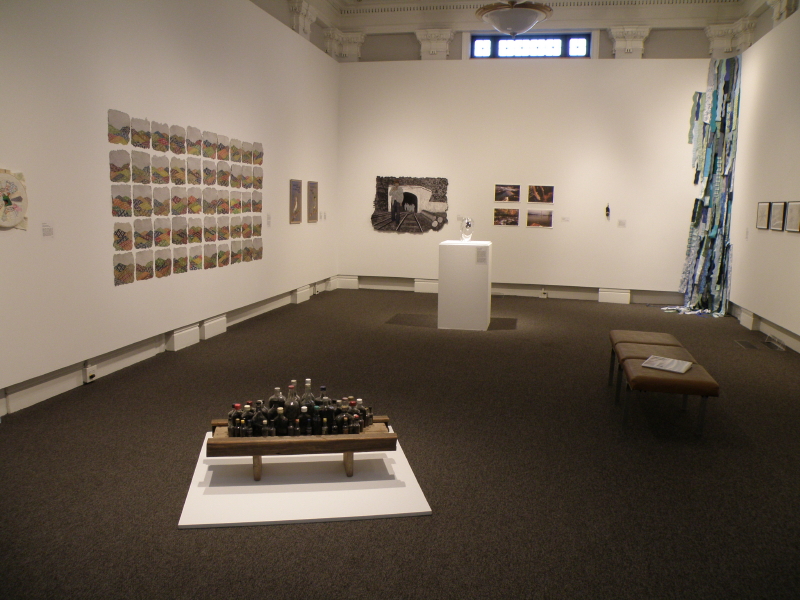
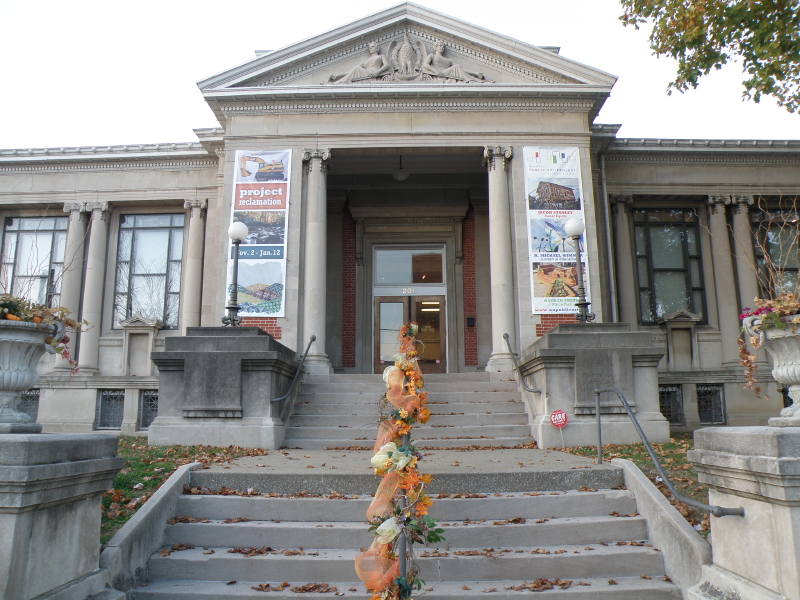
I have had a few folks ask about the Project Reclamation exhibit I’m participating in and I thought this post would be a good place to feature this.  The exhibit opened a couple of weeks a go on November 2, 2012 and will run through January 12, 2013.  About a year and a half have passed since curator and artist Mary Margaret Sparks asked me to participate in this invitational exhibit.  There are thirteen artists represented in this group show with a nice cross-section of projects in various media addressing the complex topic of coal its use and extraction.  The Carnegie Center for Art and History located across the Ohio River from Louisville in nearby New Albany, Indiana has done a fine job of installing and interpreting the works and has planned many activities that the public can engage in to learn more about the controversial topic of coal mining through the practice of Mountaintop Removal or MTR.  This is a highly destructive way to extract coal from southern Appalachia’s mountains which also endangers  some of the greatest biodiversity in our part of the world in pursuit of cheap and reliable energy.  To further spur the artists along, the not for profit organization Kentuckians For the Commonwealth invited the participants to Whitesburg in Letcher County, Kentucky to tour Appalshop and watch a few coal-themed documentaries.  A guided tour into coal country provided additional impressions of the mountains and the folks who call this place home.
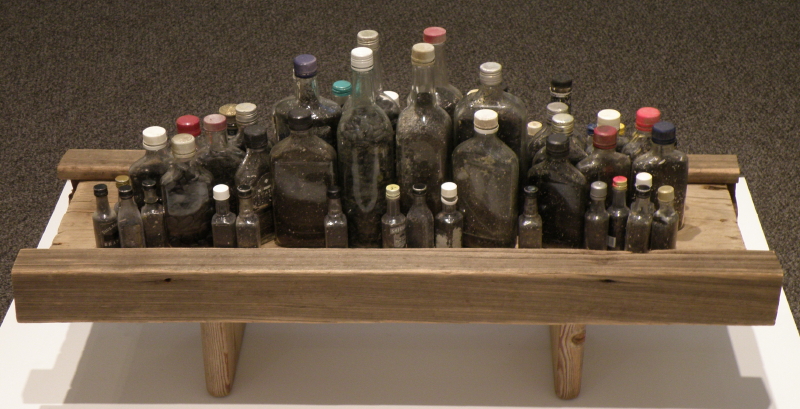
All of the participating artists had some prior interest either working with coal as a social issue or material substance before accepting the invitation to show.  There is a unity in the belief that the more we degrade the environment, the more we change ourselves and not for the best. For me, my entry came through the related issue of clean fresh water  which is also our number one vanishing resource.  I frequently find river-altered coal at the Falls of the Ohio State Park.  Combining this coal gravel with discarded and river found booze bottles gave me an opportunity to work with ideas about consumption and addiction.  The result was my “Mountaintop Mini-bar” sculpture, but I also have six photographs from my “Coal Flake Series” on view as well. My impression of our guided trip to coal country reinforced what I’ve previously seen and experienced.  It seems to me that the people who were sacrificing their land and culture were not receiving much in the way of compensation for our quest for coal.  Regrettably, this is an old tale seen time after time across the globe.  People might think that this is something that only happens in distant poor countries, but we have our own share of material poverty in our own backyard.
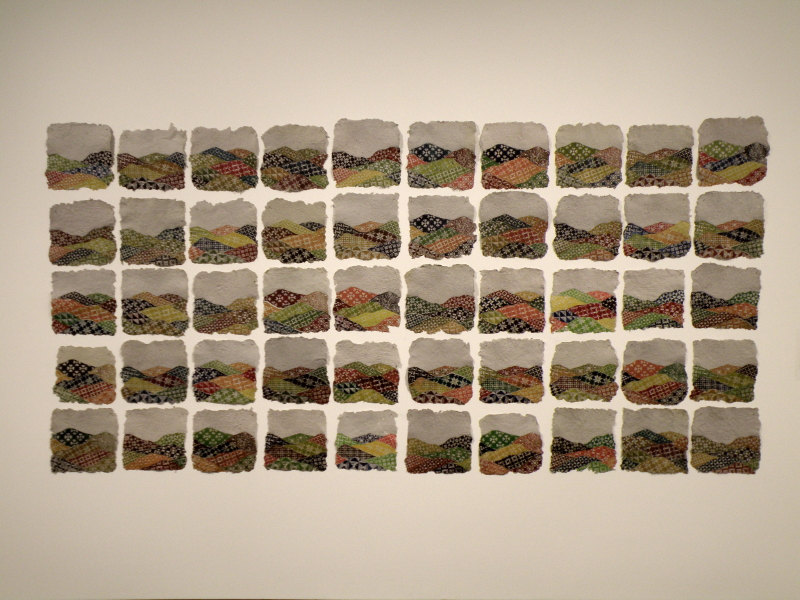
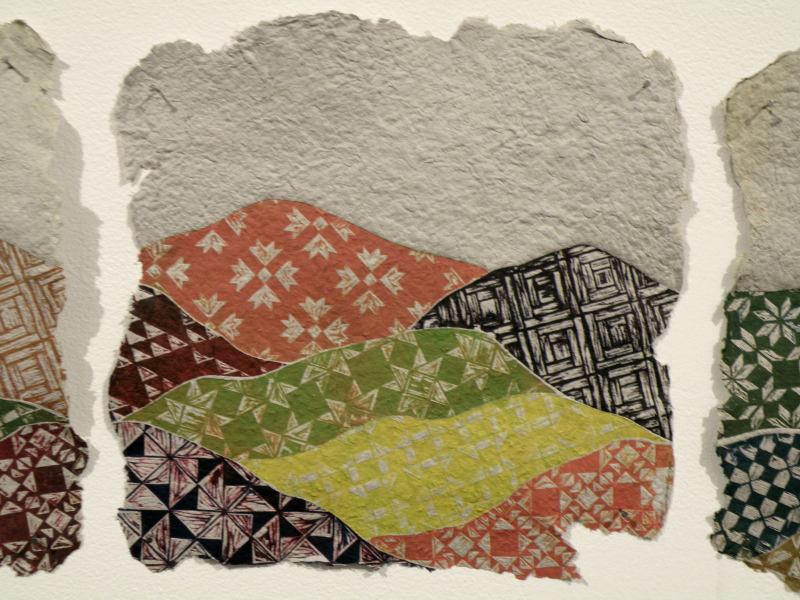
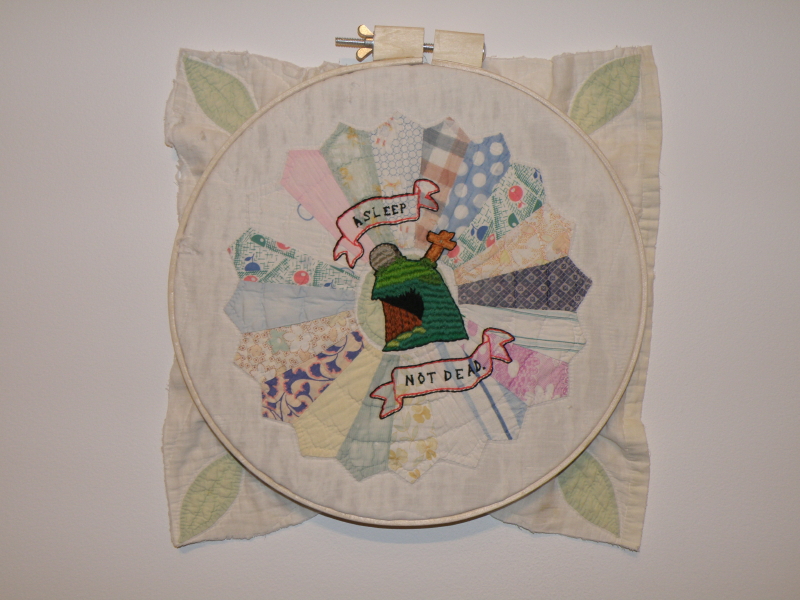
Most of the participating artists took considered approaches that referenced and respected the uniquely rich culture of coal country.  Several artists worked with traditional fiber and or needle and thread to produce their statements.  Julie Yoder created a large wall installation, “Appalachian Patchwork”,  assembled with woodcuts on handmade paper.  Patchwork quilting is an important Appalachian art form and Yoder’s piece represents the landscape and local culture as being a composite of unique designs that have come together over time to form a whole.  Mountaintop removal has a way of fragmenting this landscape and disrupting the continuity that life here depends upon for survival.

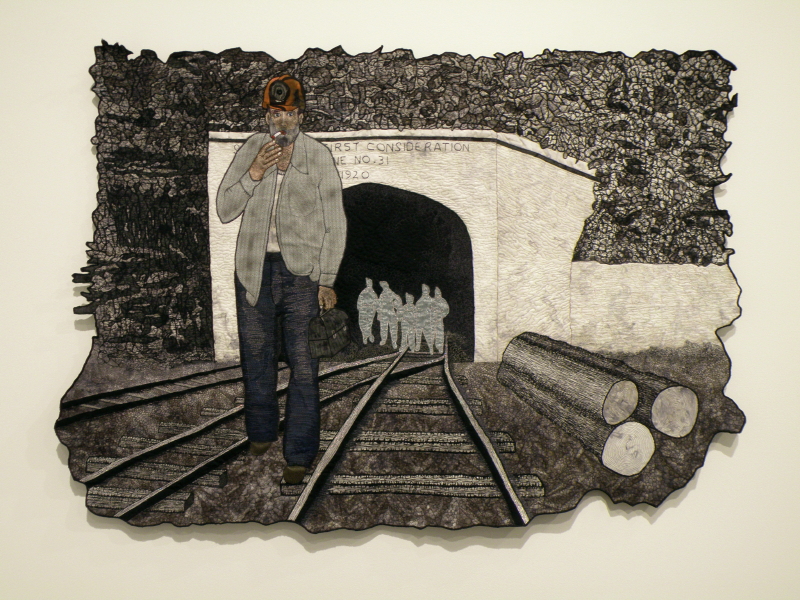
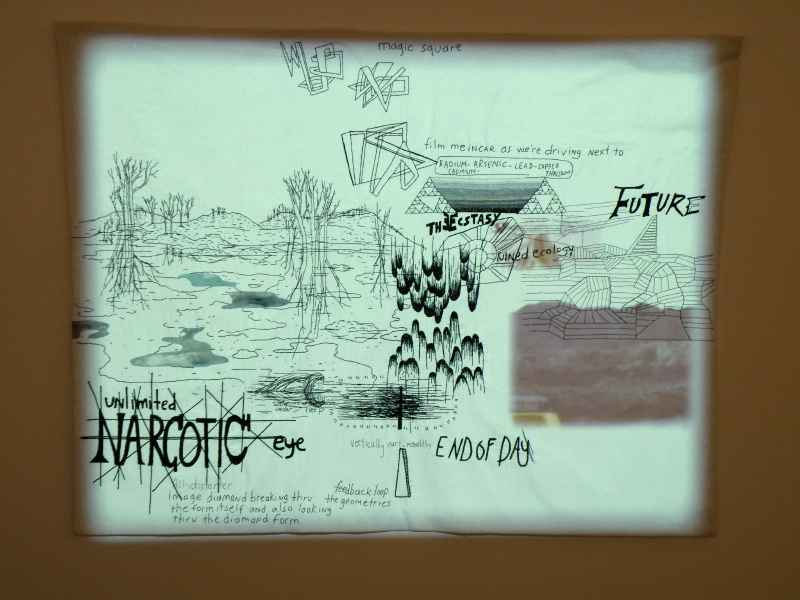
Other artists utilizing fabric, needle, and thread include Jo Ann Grimes with her sympathetic portrayals of miners.  Joel Darland and his marvelous hand-embroidered quilt squares.  Rachel Brewer’s two embroideries of song birds on dirty furnace filters.  Mary Margaret Sparks’ imposing “Lest We Forget” hand-embroidered and sewn re-purposed fabric waterfall that is a memorial to lost mountain streams and creeks that were damaged by coal mining.  Also in this group is a fascinating video entitled “Harriman” which is the work of Denise Burge and incorporates video, fabric, and thread.  Burge’s video is a statement made in the aftermath of a disaster.  A broken coal slurry dam in Tennessee had poisoned the surrounding watershed and imperiled the health of a community living in the area.  Burge’s video documents some of the clean-up involved and how protective the coal industry is in guarding its own image.

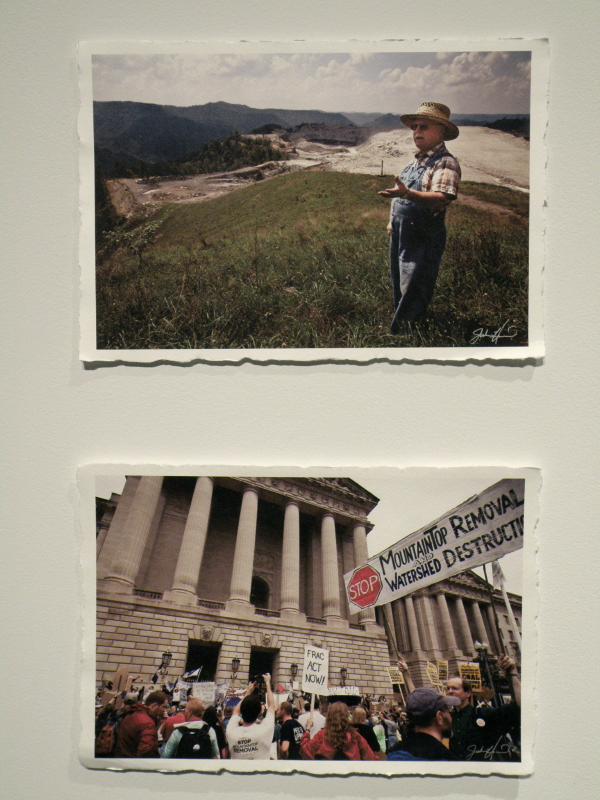
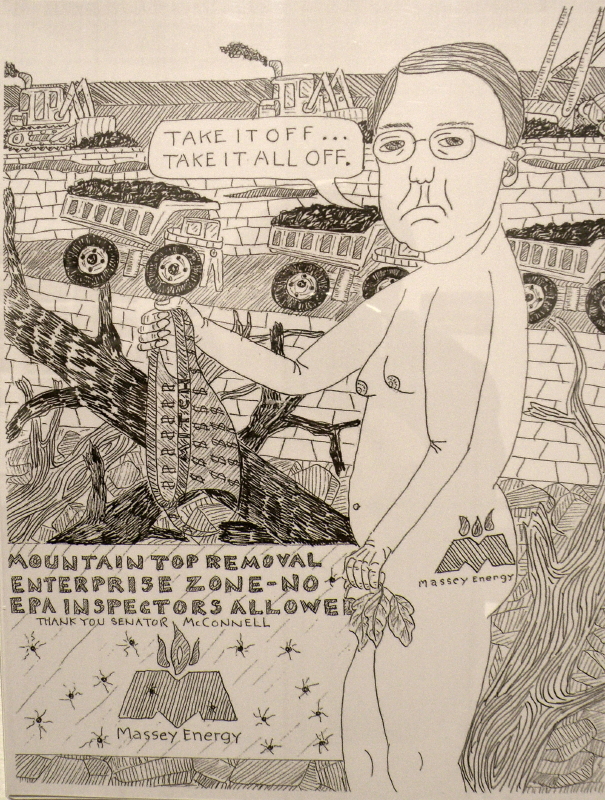
Photographs by Joshua Howard contrast the natural beauty of coal country with the grim realities of the industry.  A more overt political statement comes from Wayne Ferguson who sees Kentucky’s senior senator as being in cahoots with the industry that helps bankroll his re-election campaigns.  Ferguson’s drawings chart the corrupting influences of money and power at the expense of the land and the best interests of the people.

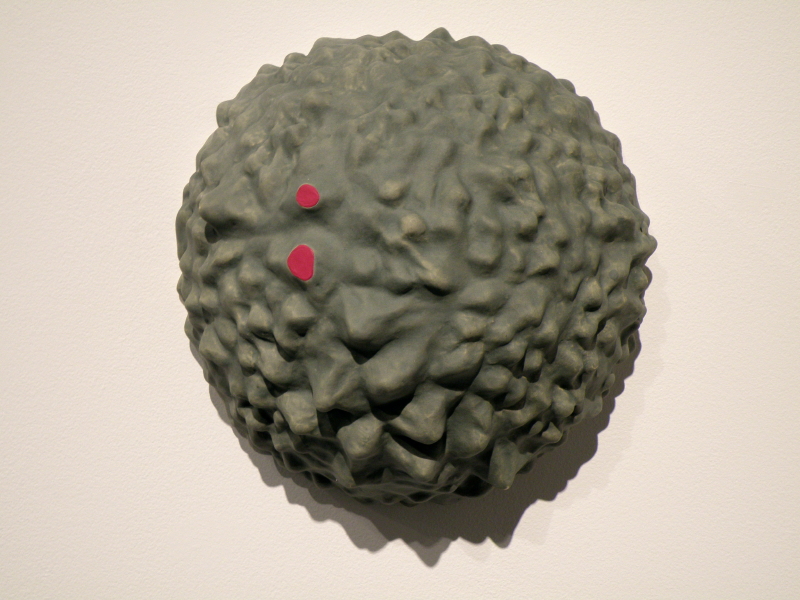
The sense that mountaintop removal is a great calamity for nature at large comes through the works of two artists.  Ceramic sculptor Alex Adams’ piece entitled “Wounded” suggests that MTR mining disrupts the very living tissue of the mountain range. He does this by representing two mountains that have had their peaks literally removed revealing  raw, open wounds.

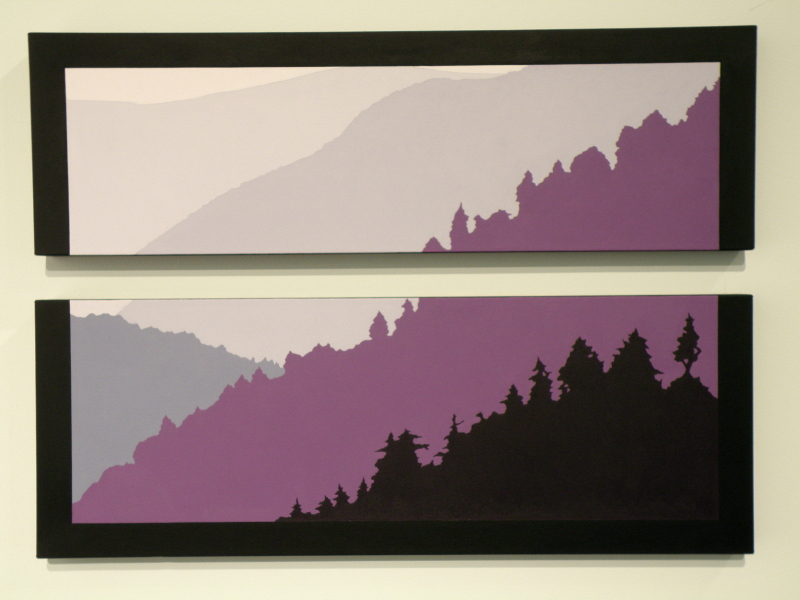
Painter Michael Koerner’s approach is equally reductive and he comes to a similar conclusion about the fate of the mountains.  His diptych entitled “After the Canaries Left the Coal Mines, the Mountains Began to Leave Appalachia” is an argument reduced to its essential points.  For example, in Koerner’s landscape, the painting is physically divided into two parts suggesting man’s indifference towards nature.  The bare slopes past the forested mountains are a warning of what could occur with unchecked mountain top removal.

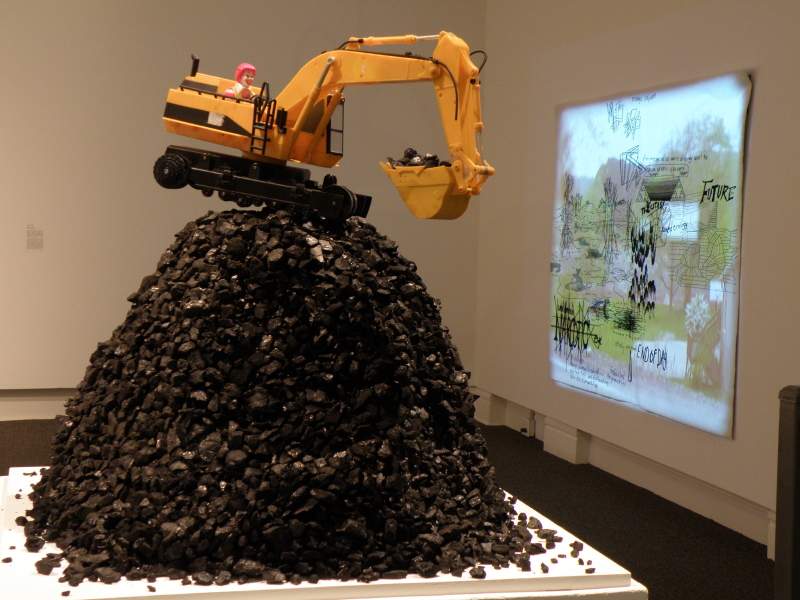
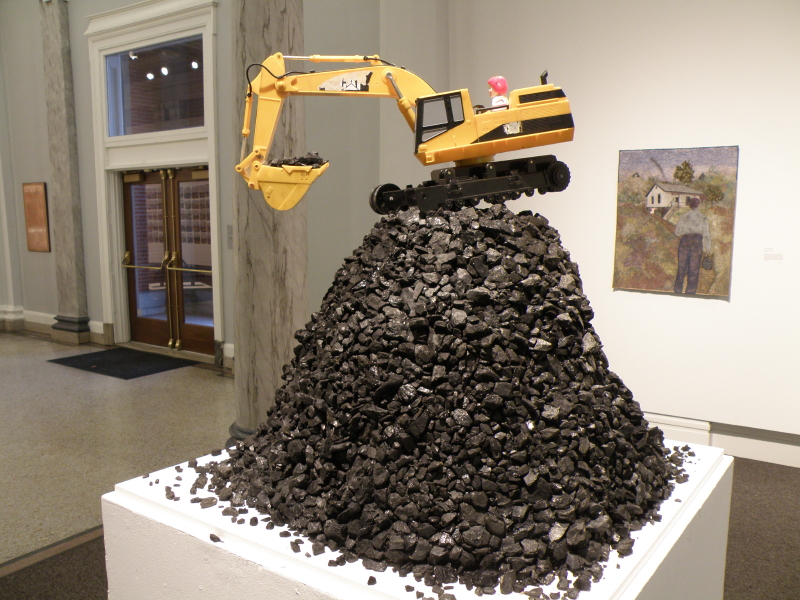
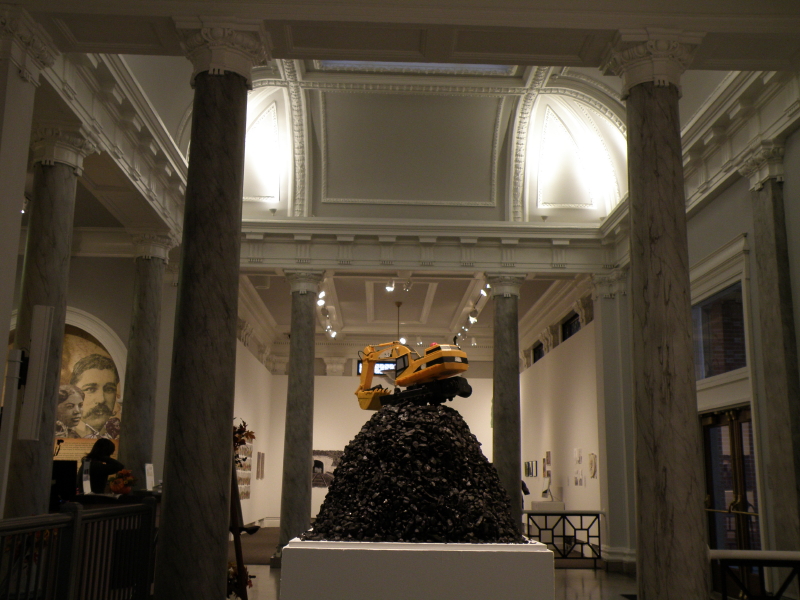
One last artist before closing.  Aron Conaway’s work lies at the heart of our culture of consumption.  His work entitled “Billions and Billions Served” features a Ronald McDonald clown driving a toy front loader on top of a large pile of coal.  In his work, Conaway makes it obvious that we are all implicated in the big issues of our day.  The demand for coal exists because we demand the energy to stay warm in the winter and cool in the summer time heat.  If we don’t like the side effects of coal mining, perhaps we should speed up our search for alternative energy sources, find ways to curtail our addiction to electricity or both?  The demand for cheap coal and energy is what drives the supply.

The Carnegie Center for Art and History has a nice program of upcoming events that expands the breath of this exhibition.  I have already participated in one gallery talk that drew an interested crowd.  Film screenings, art making opportunities, and a panel discussion on mountaintop removal and renewable energy sources will also be held during Project Reclamation’s run.  There is the hope that this show will travel which will be an added bonus.  Thanks to Mary Margaret Sparks, Karen Gillenwater, and the staff at the Carnegie Center for their hard work.  I hope you have enjoyed this glimpse into an exhibition from our area.  My next post will be from the Falls of the Ohio!

Read Full Post »

Welcome to my second look at wood as expressed at the Falls of the Ohio.  The first post concentrated more on the river and water as an agent of change moving material through the landscape.  This post looks more closely at the driftwood that gets stranded in this southern Indiana park.  I once curated an exhibition at the Louisville Visual Art Association entitled “River Sticks” where all the artworks were made from locally procured driftwood.  The majority of these works of art utilized raw, natural sources, but there is also wood in the mix of a slightly different character.

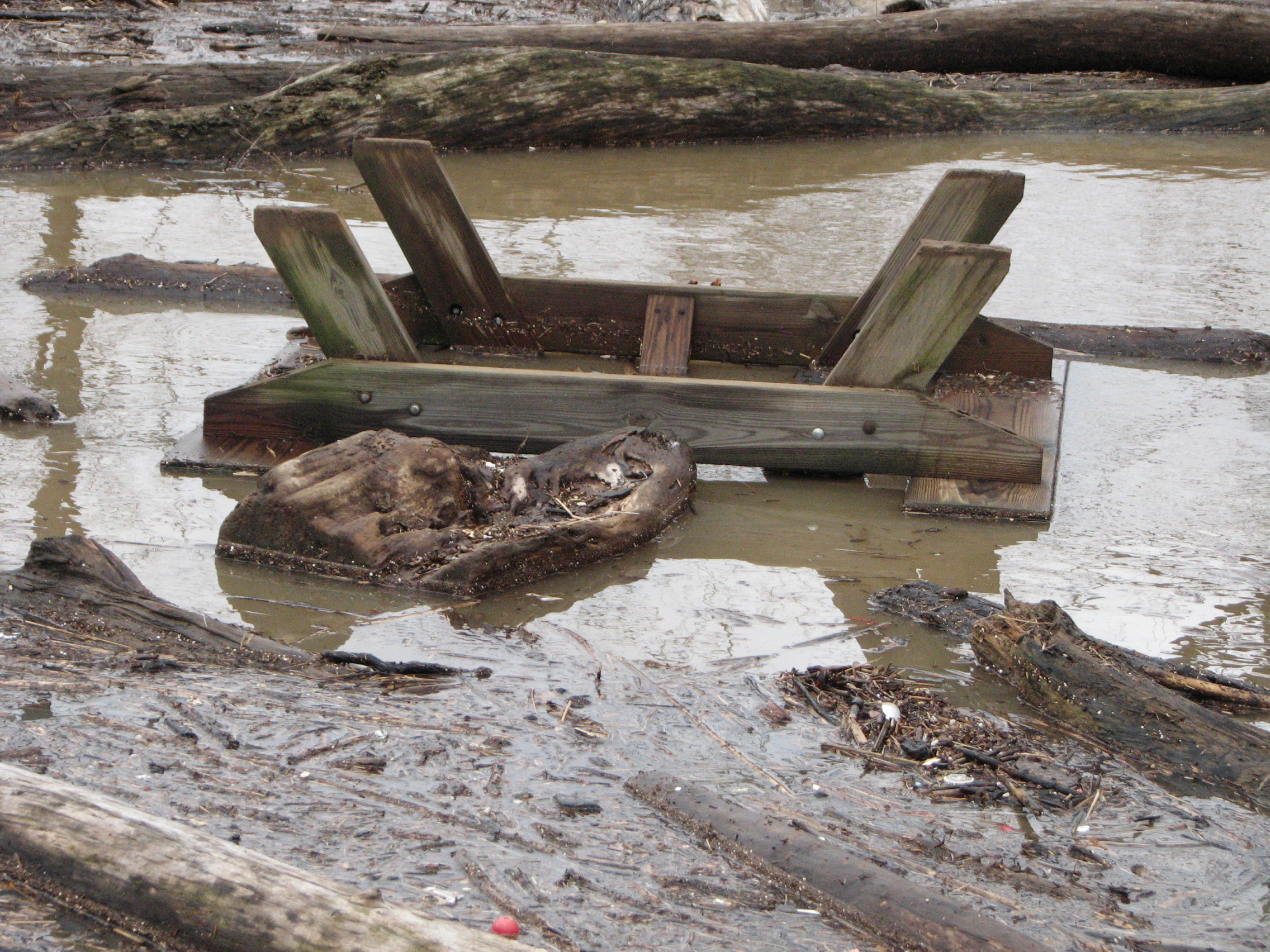
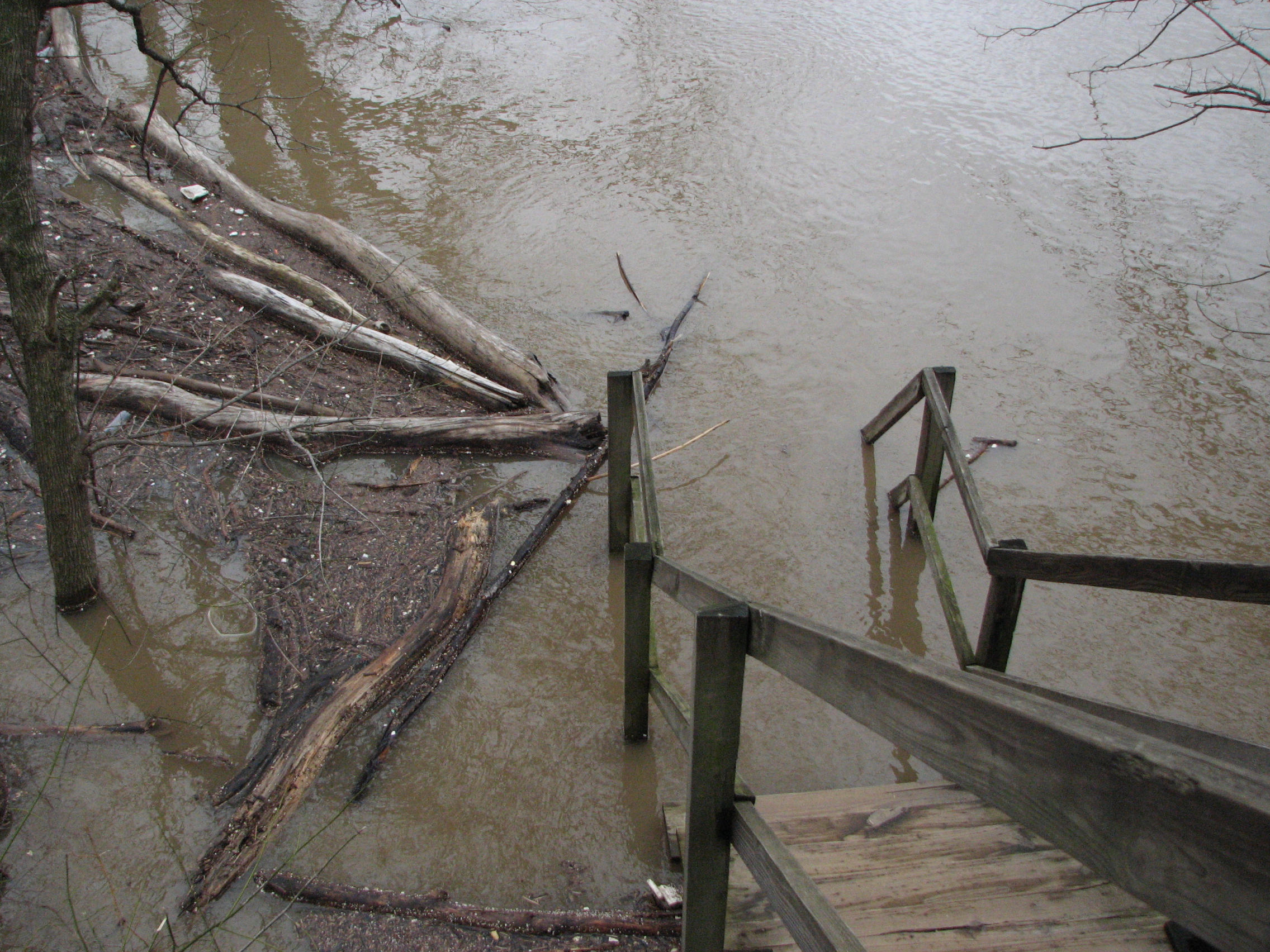
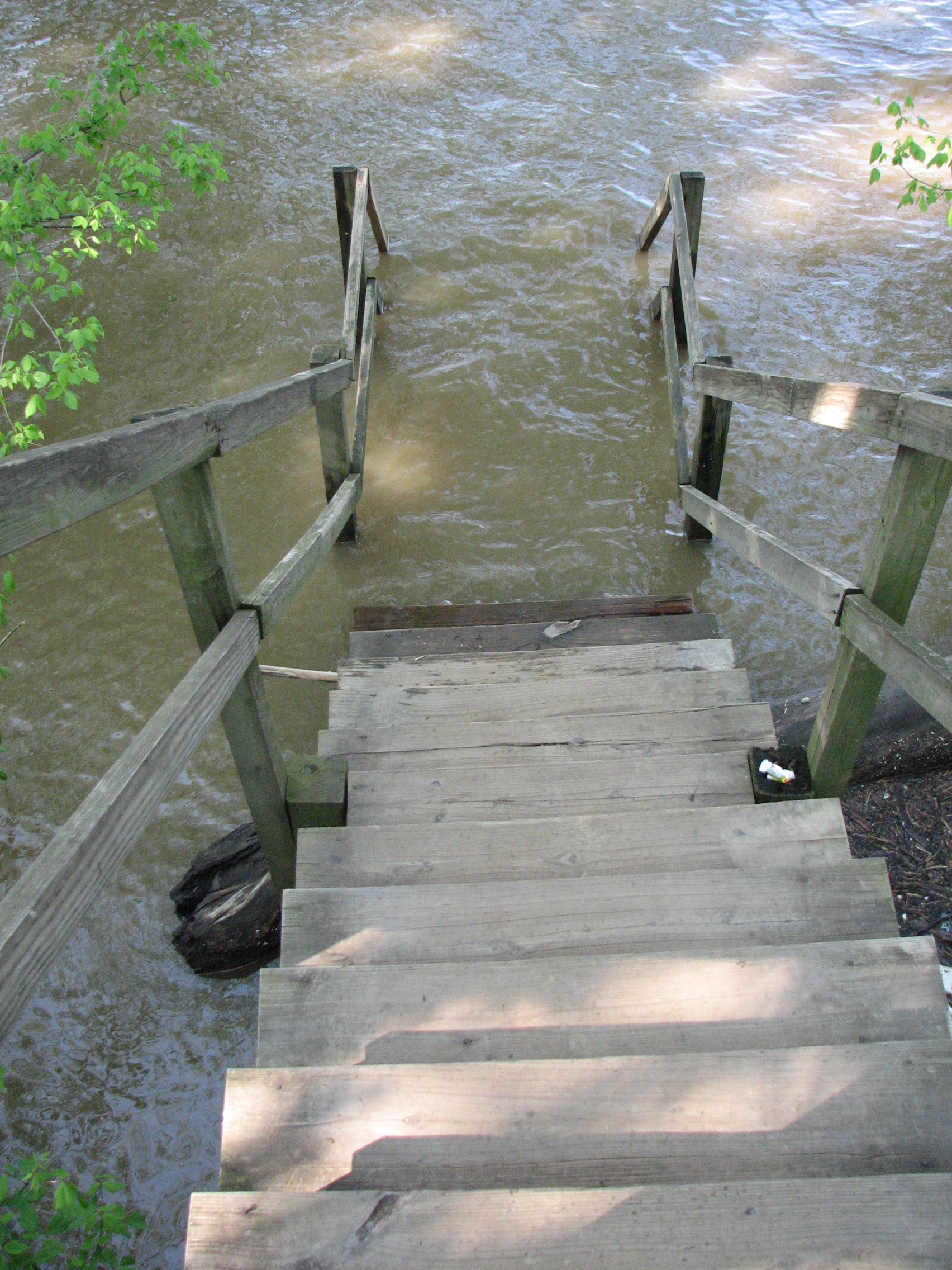
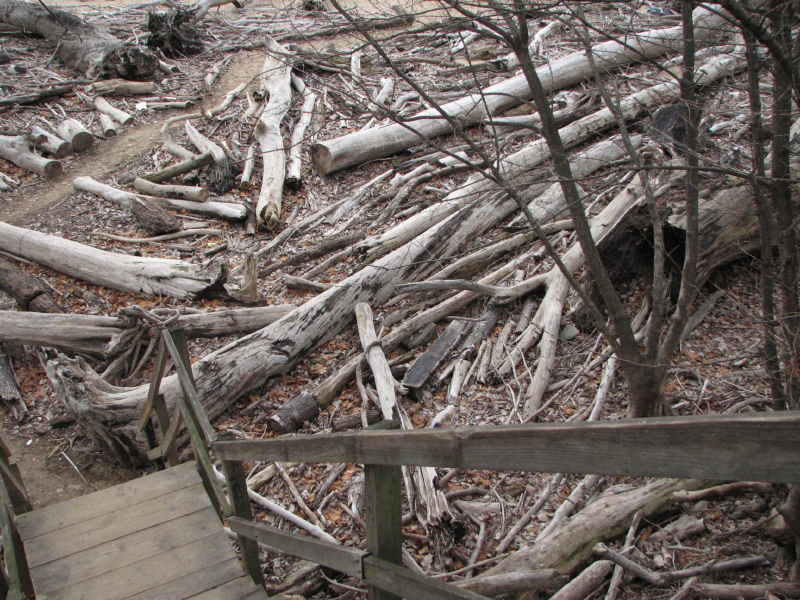
There is a wooden staircase placed here by the Department of Natural Resources (which maintains this state park) that is a popular access way onto the riverbank and fossil rocks.  It is not unusual during bouts of flooding to see part of this staircase submerged by the Ohio River.  During those moments, all you can do is look from a distance or visit the Interpretive Center.

Over time this staircase has needed frequent repairs as it gets battered by floating logs and tree trunks.  Only after the water has drained away can you walk among the driftwood and see what else made from wood has been left high and dry.

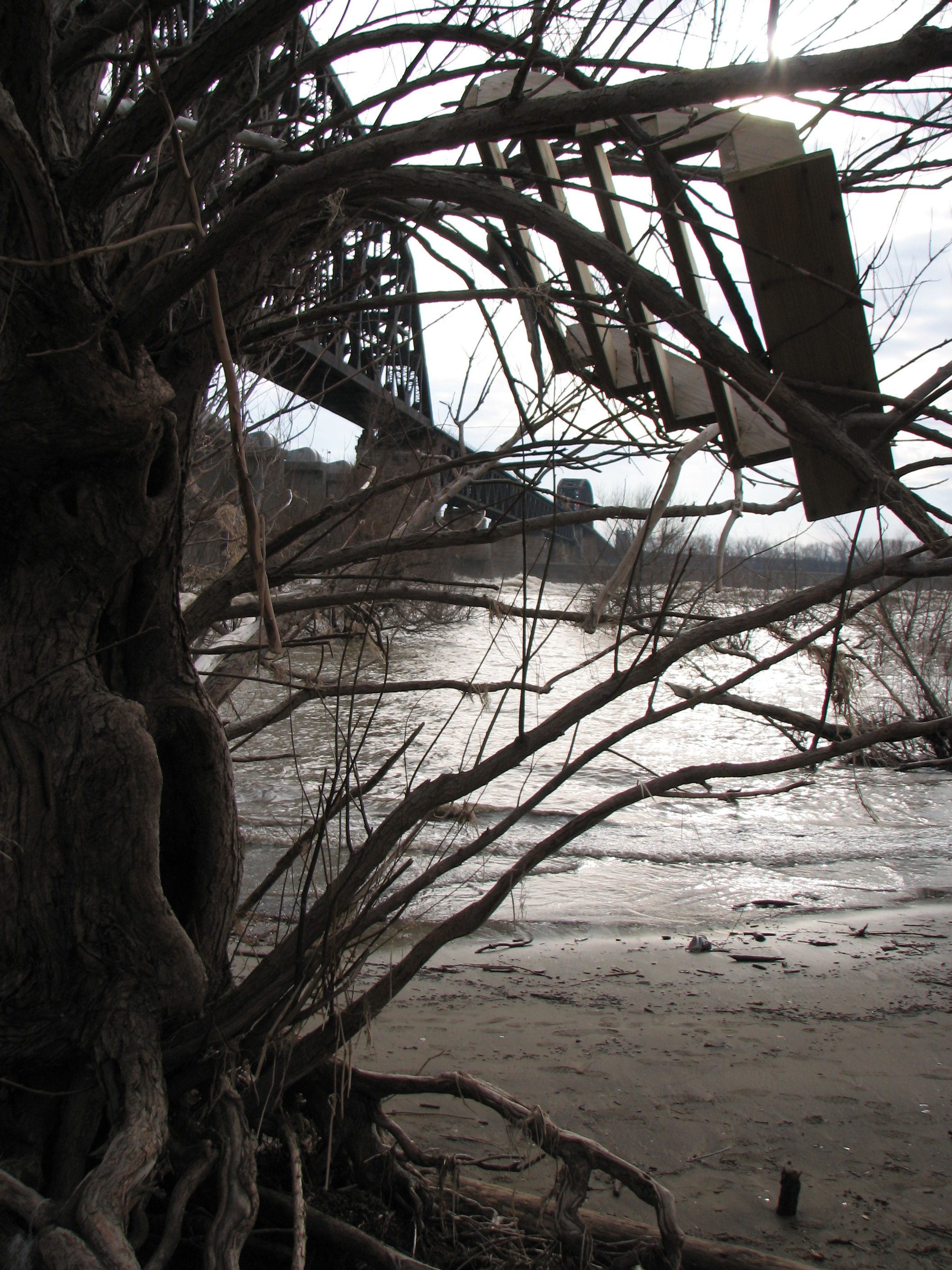
Here’s a dramatic shot of a different staircase that has floated down the river and has been snagged by a willow tree.  Objects stranded in trees bear witness to how high the river rose.

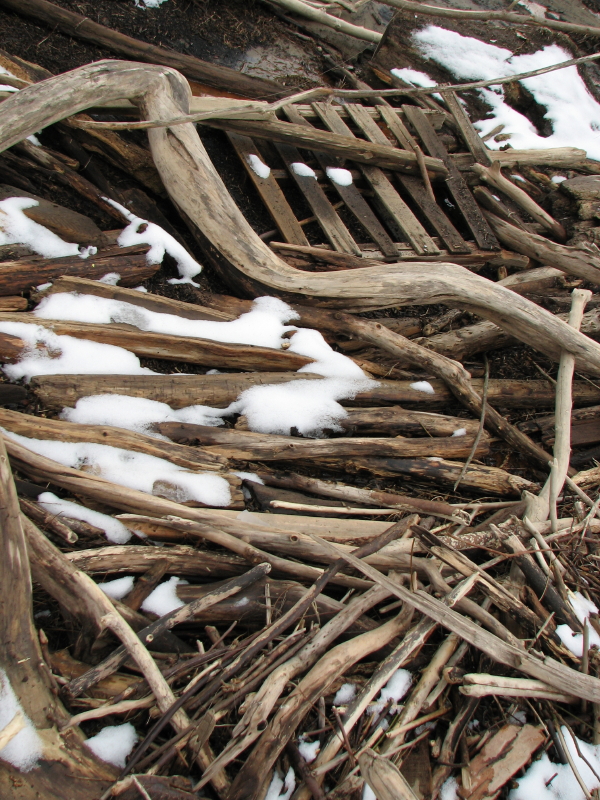
I frequently find wooden pallets and they get snagged in the trees too.  This one is a little different in that it appears the tree is growing through and around this artificial form. Over time, the pallet will fall apart. Perhaps wood is wood, but one can’t help noticing how much milled and processed wood is a part of the mix.  Here are a few other images showing this contrast between natural and man-shaped wood.

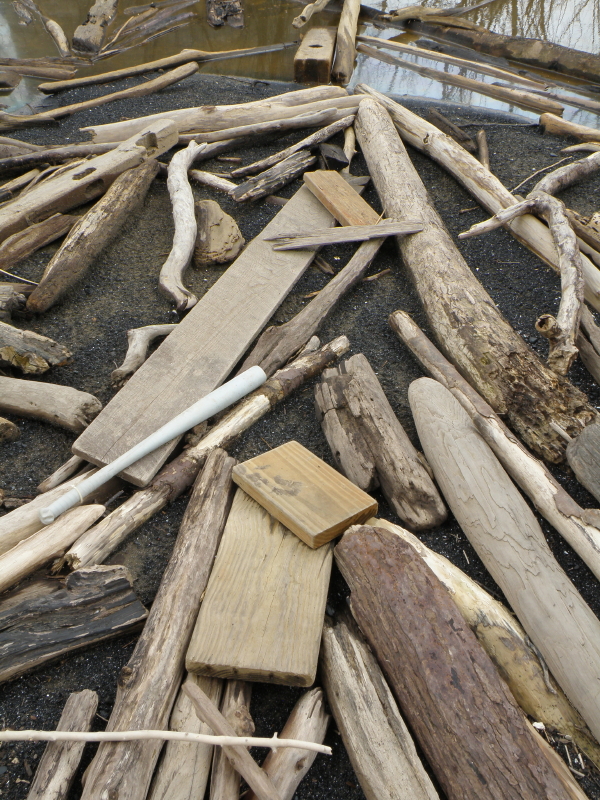
Sometimes it seems like there are enough planed boards at the Falls to build a small house. Fishermen and visitors use these planks to span muddy areas and puddles to keep their shoes clean and dry.  All this wood is a disposable resource?  I’ve seen visitors taking lumber out and I’ve done the same.  I like using river-worn cut boards as bases for the Styrofoam sculptures I choose to keep.  To me, even the smallest board tells a story of our relationship to trees and nature.  I tell myself that someday I’ll make some rustic piece of furniture from this wood.  The same processes that break a tree down in the river…do a similar “service” to disposed of wooden furniture.
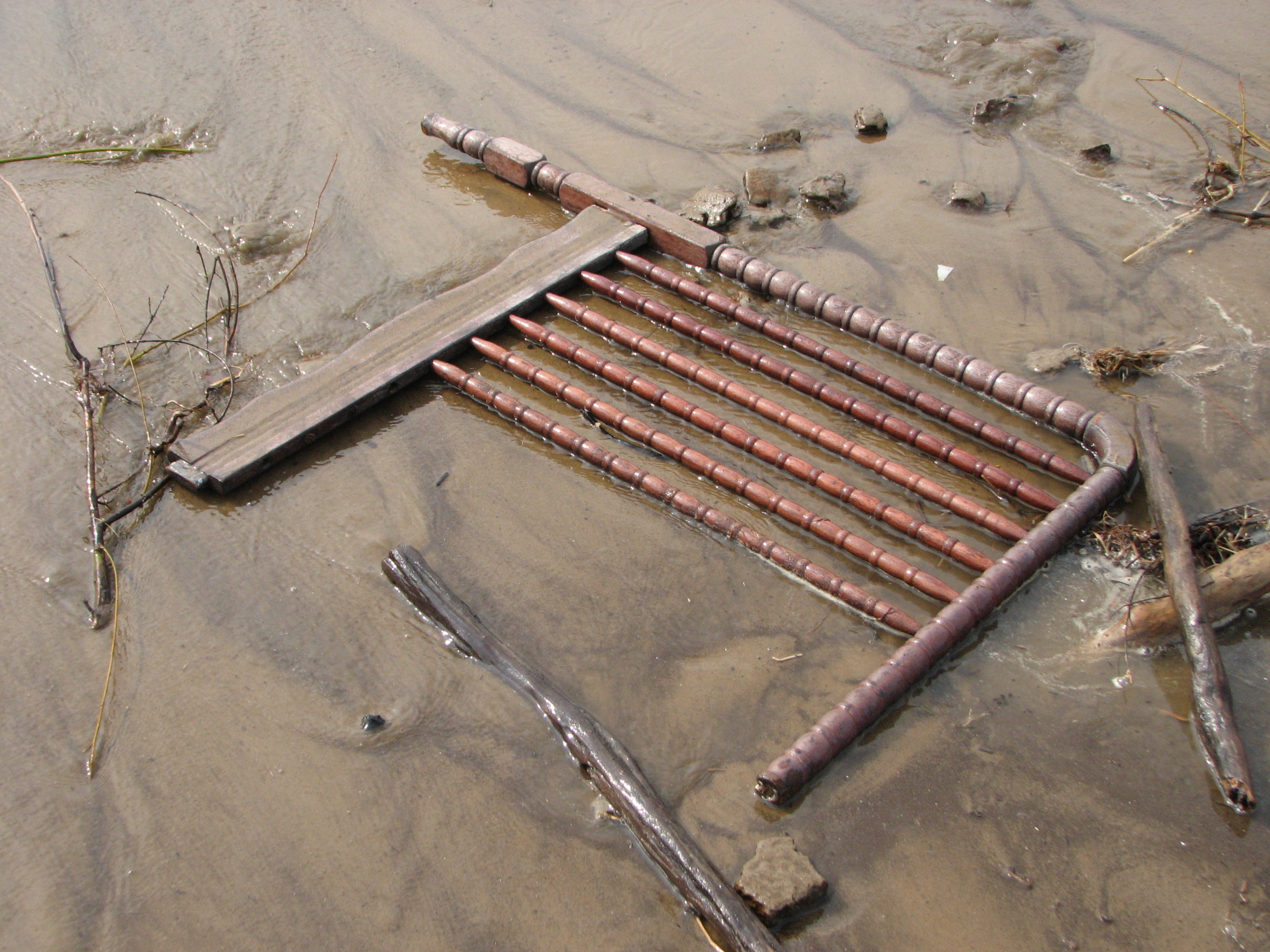
Here’s a piece of a child’s crib or bed that I found at the river’s edge.

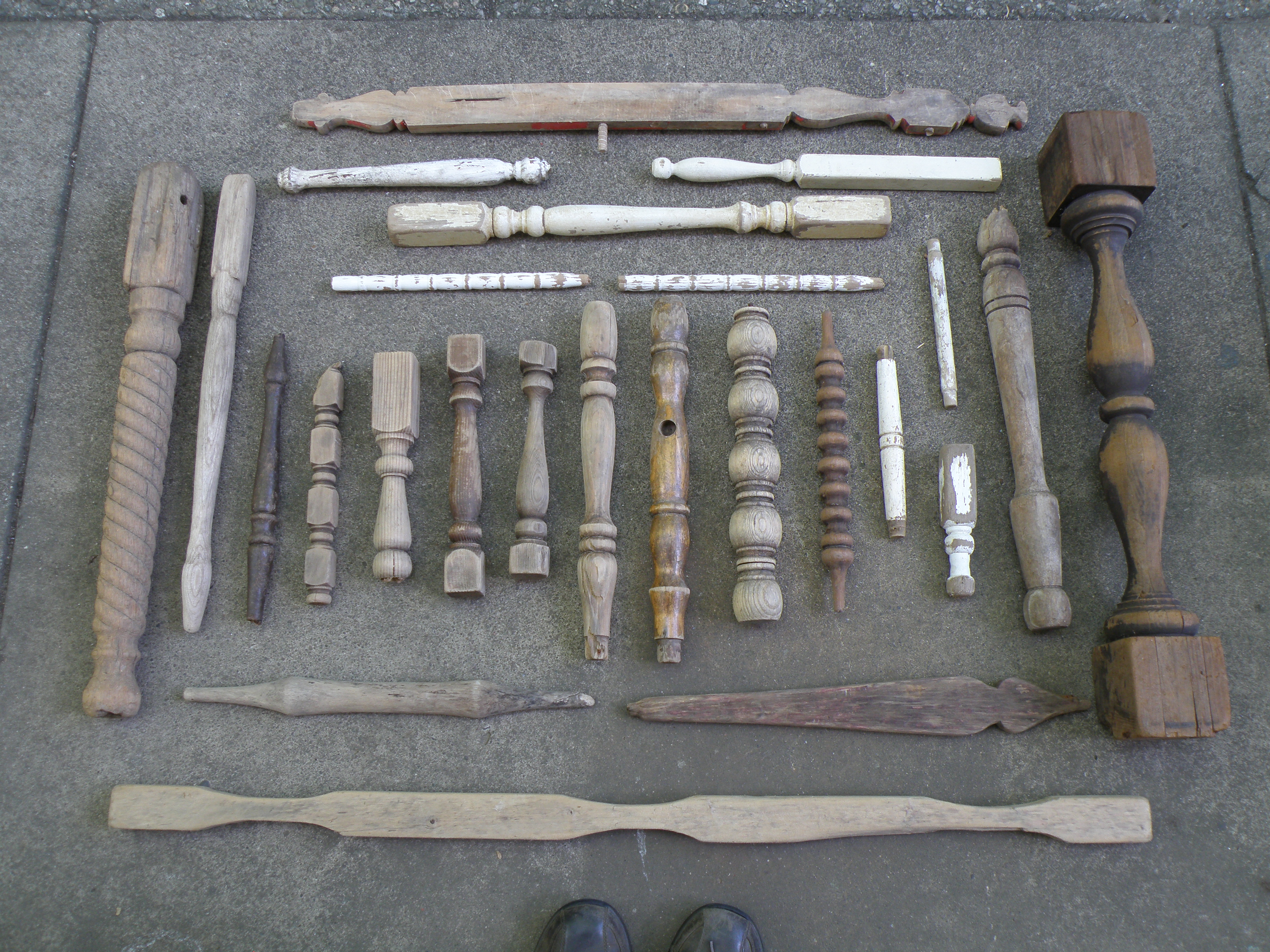
This is one of many table legs and turned pieces I’ve come across.  Sometimes I pick them up and take them home.  I’ve used them on rare occasions in my art, but I have also given many pieces to artist friends to see what they could make of them.  I suppose I could make an homage to  Louise Nevelson’s sculptures, but would prefer to create something more personal.  Nevertheless, I have picked up a few wooden artifacts from the river and here’s how they look collectively.

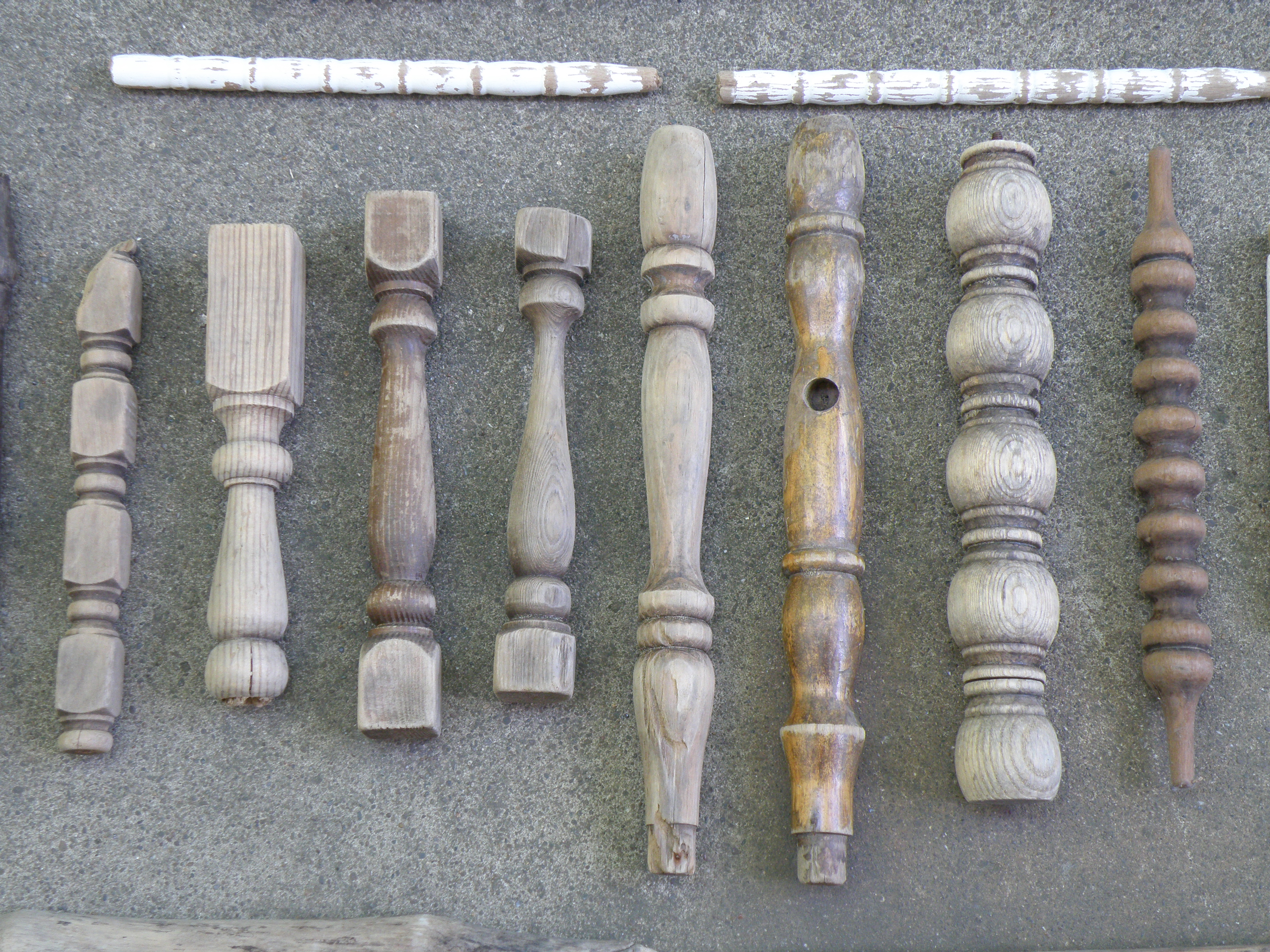
I left the toes of my shoes sneaking a peak for scale!  Here’s some of the hand-turned and machine-made table legs, chair staves, and spindles I’ve saved.  These artifacts do break down over time and eventually revert back to nature.  Now for a detail.

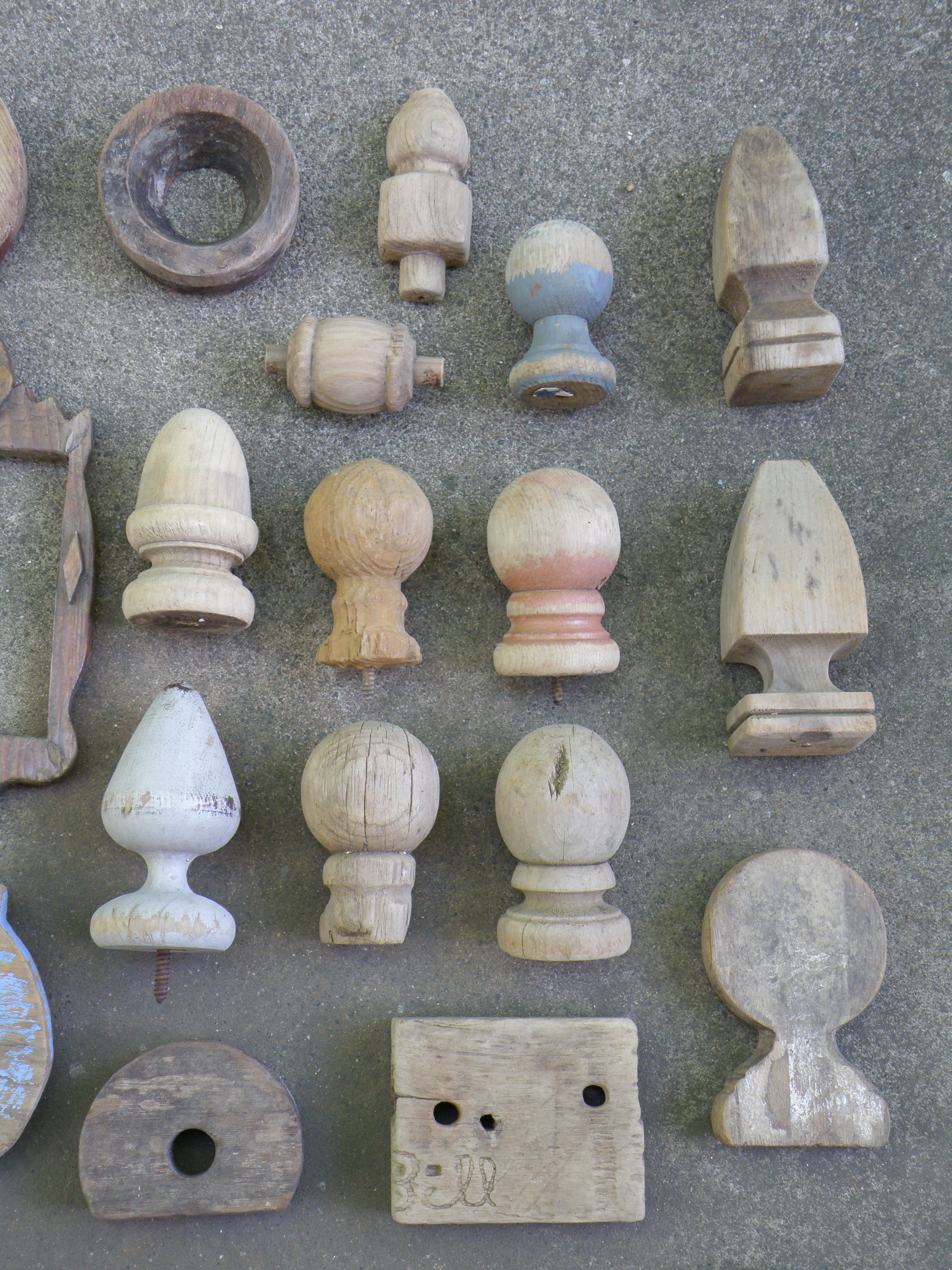
Here’s a slightly different collection of wooden artifacts I’ve saved over the years.  Some things I recognize and others require pondering to figure them out.

The objects on the right are mostly finials from fence posts.  The circular objects with the holes in them…I’m not sure how those were originally used?  Could they be part of a float system for barge ropes or are they wooden wheels for toys…could they be lids for some kinds of containers?  In this grouping I have also included a small rustic picture frame I found as well as a whittled stick I could tell someone cut and scored and is perhaps the most minimal artifact in my altered wood collection.  I find many board fragments, but I kept one small piece because someone named “Bill” tried routing his name in the wood and drilled a few holes that became bigger as the wood softened and aged from exposure to water.  This piece of wood exhibits several ways we leave our mark on nature.

I also have a sign collection that can be seen in my Pages section.  Most all of them are also made from wood and were once part of this unusual driftwood mix that came from the Ohio River.  I’m thinking of putting my found “Bill” board in that collection because it too is a sign of the times as we lose our ability and desire to write in cursive.  Very few schools in my area even bother to teach this skill anymore.

Not all the driftwood in the river consists of logs, branches, and roots.  Much of my riverblog bears witness to the extent our handiwork pervades the larger environment.  What I see happening in my part of the world I assume is transitioning  simultaneously across the surface of the planet.  We have added our own distinctiveness to the overall material aggregate which challenges our now quaint notions of what is “purely natural”.  I was right when I mentioned in an earlier post that the month of July would find a way to be memorable.  It’s official now, July was our hottest month ever in what is shaping up to be our hottest year ever.  Much of our country is experiencing an intense drought and so I end with a picture of what it looks like when there is too much water.

Read Full Post »

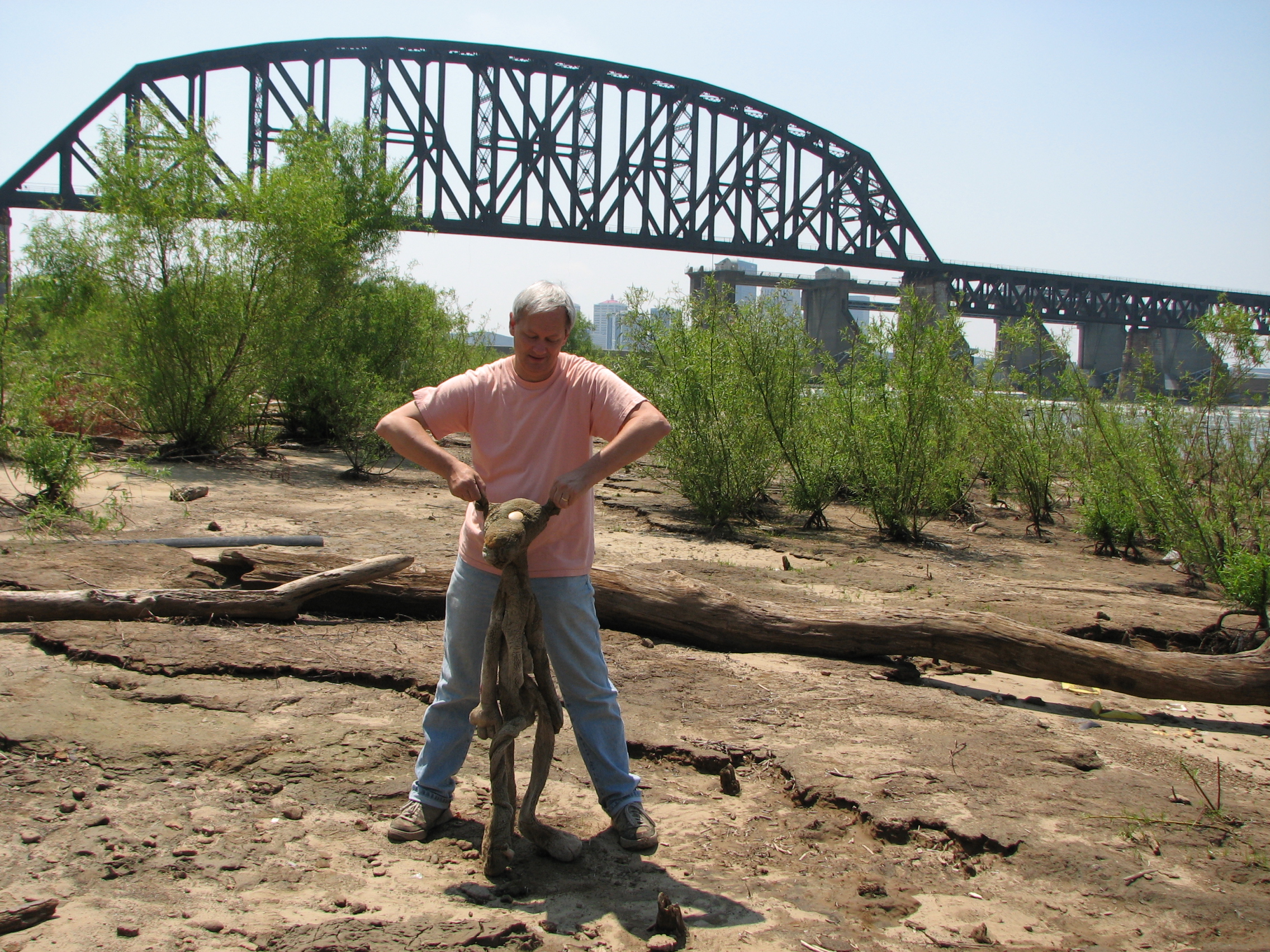
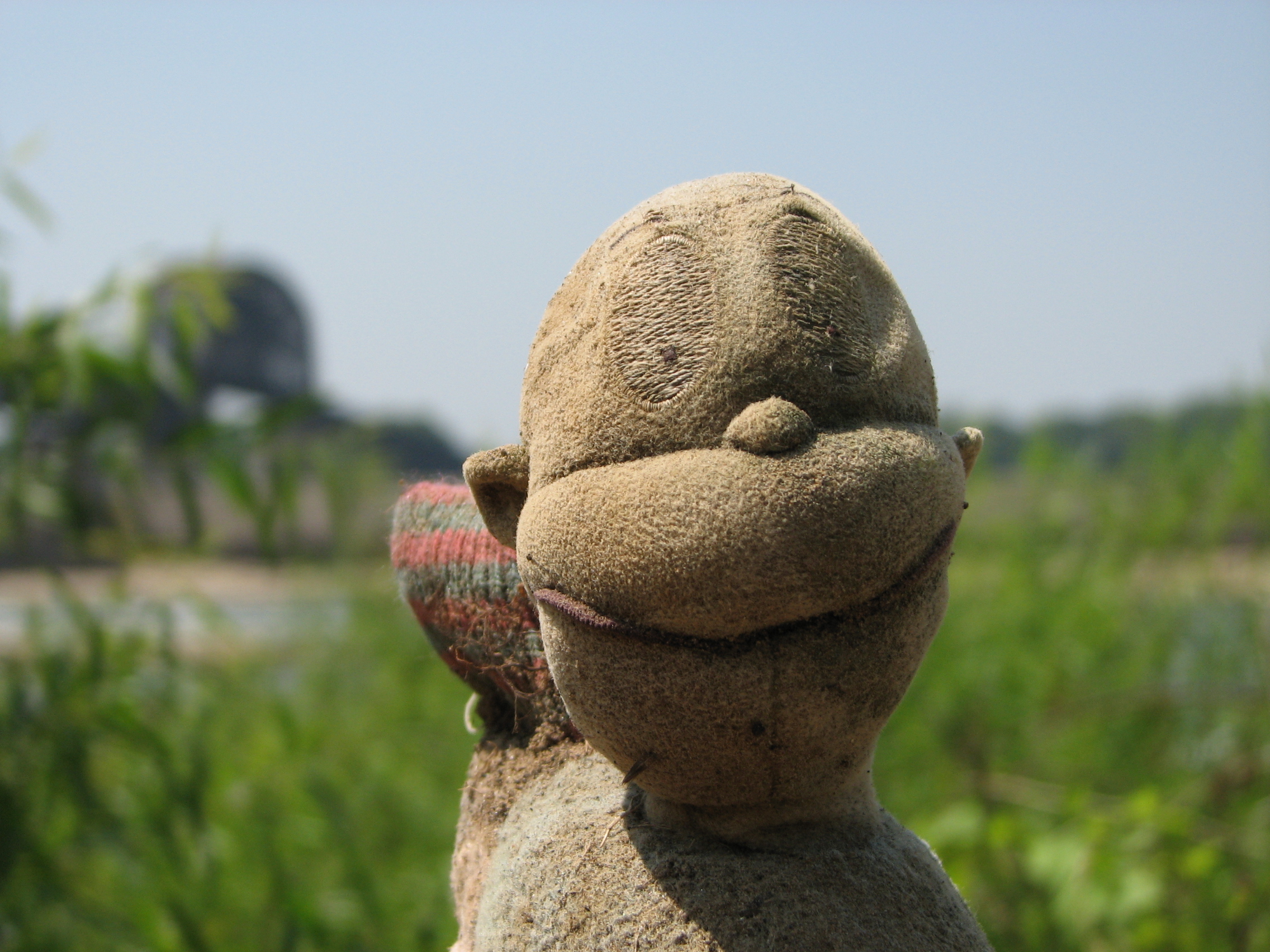
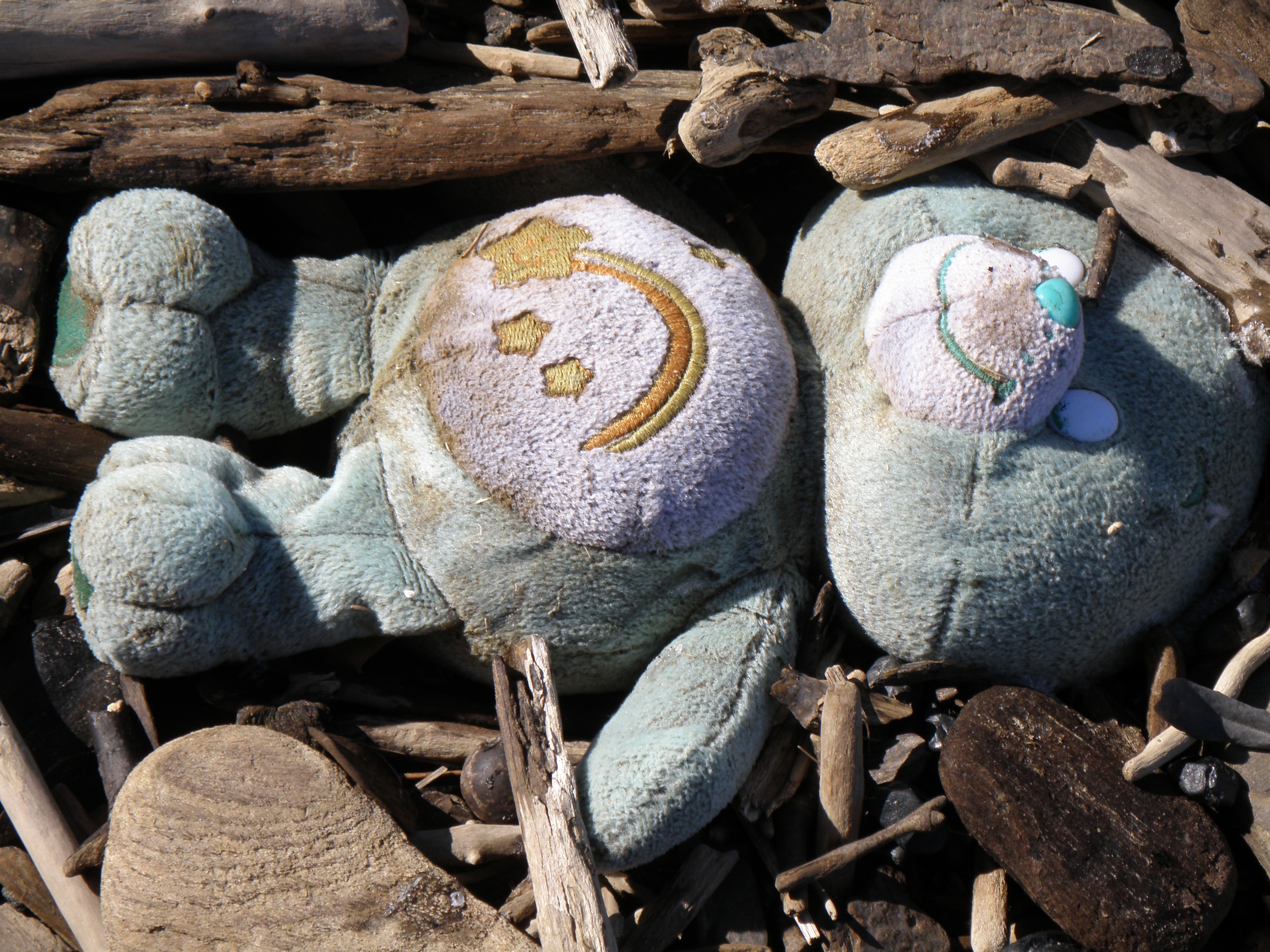
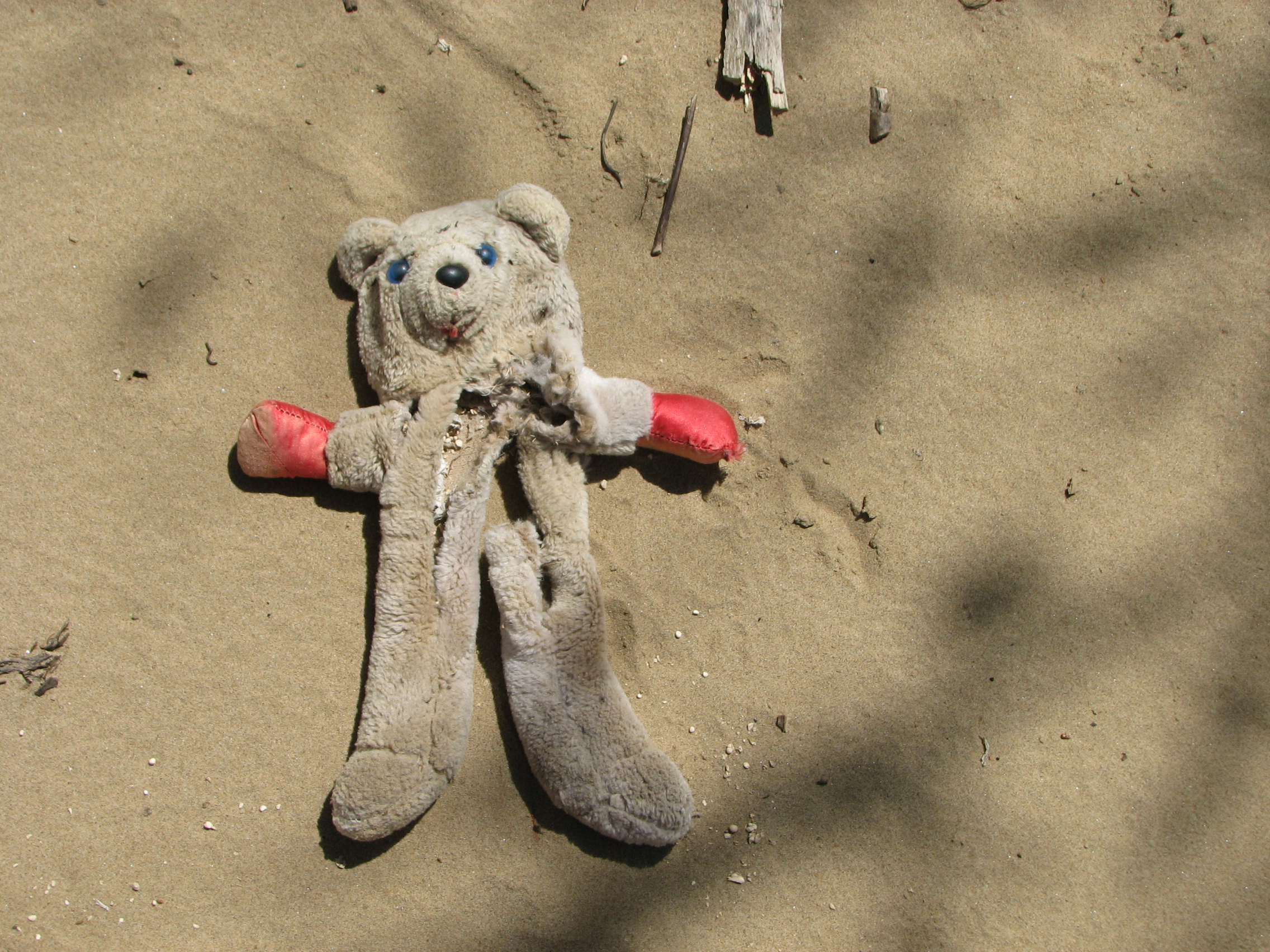
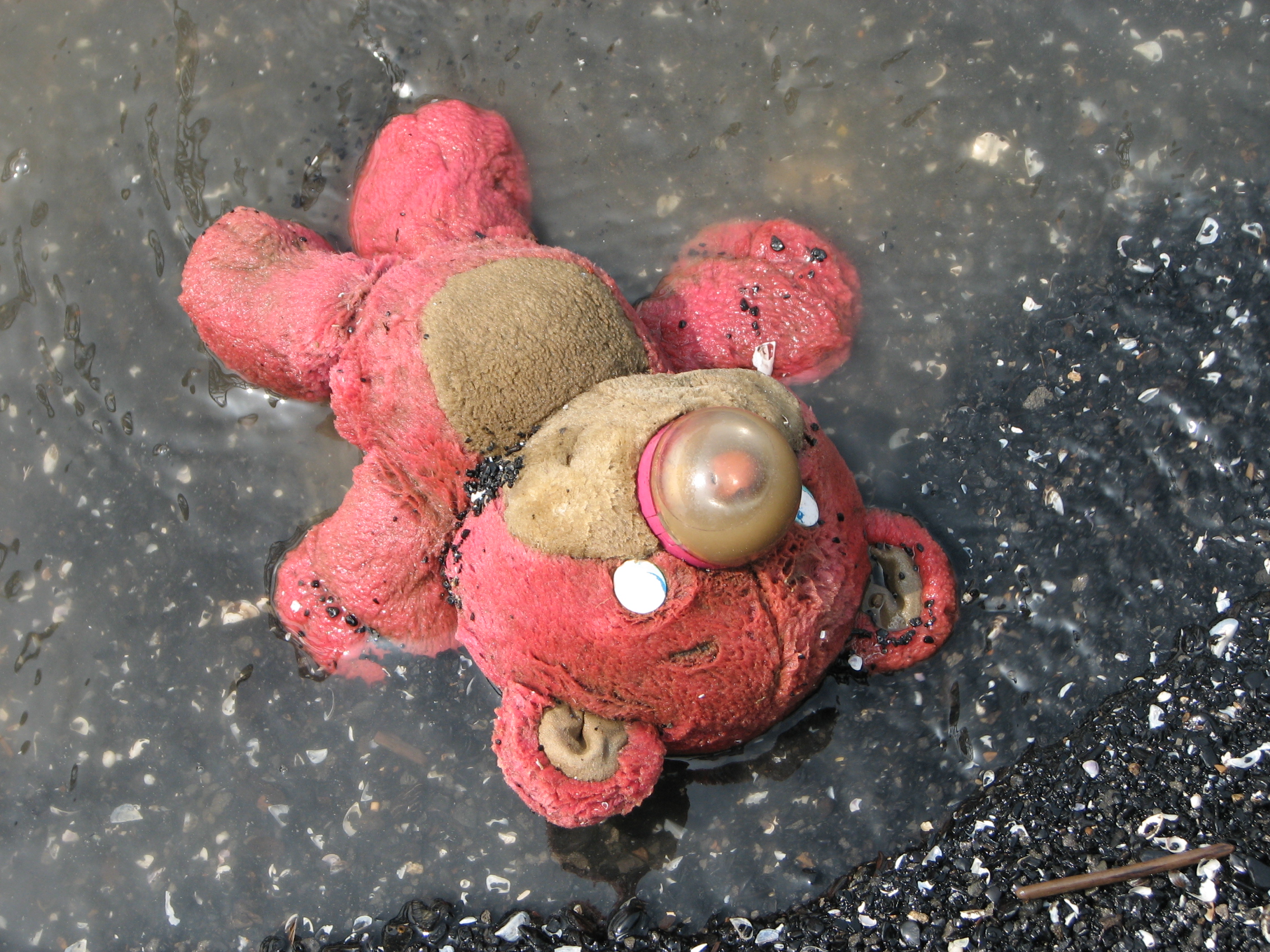
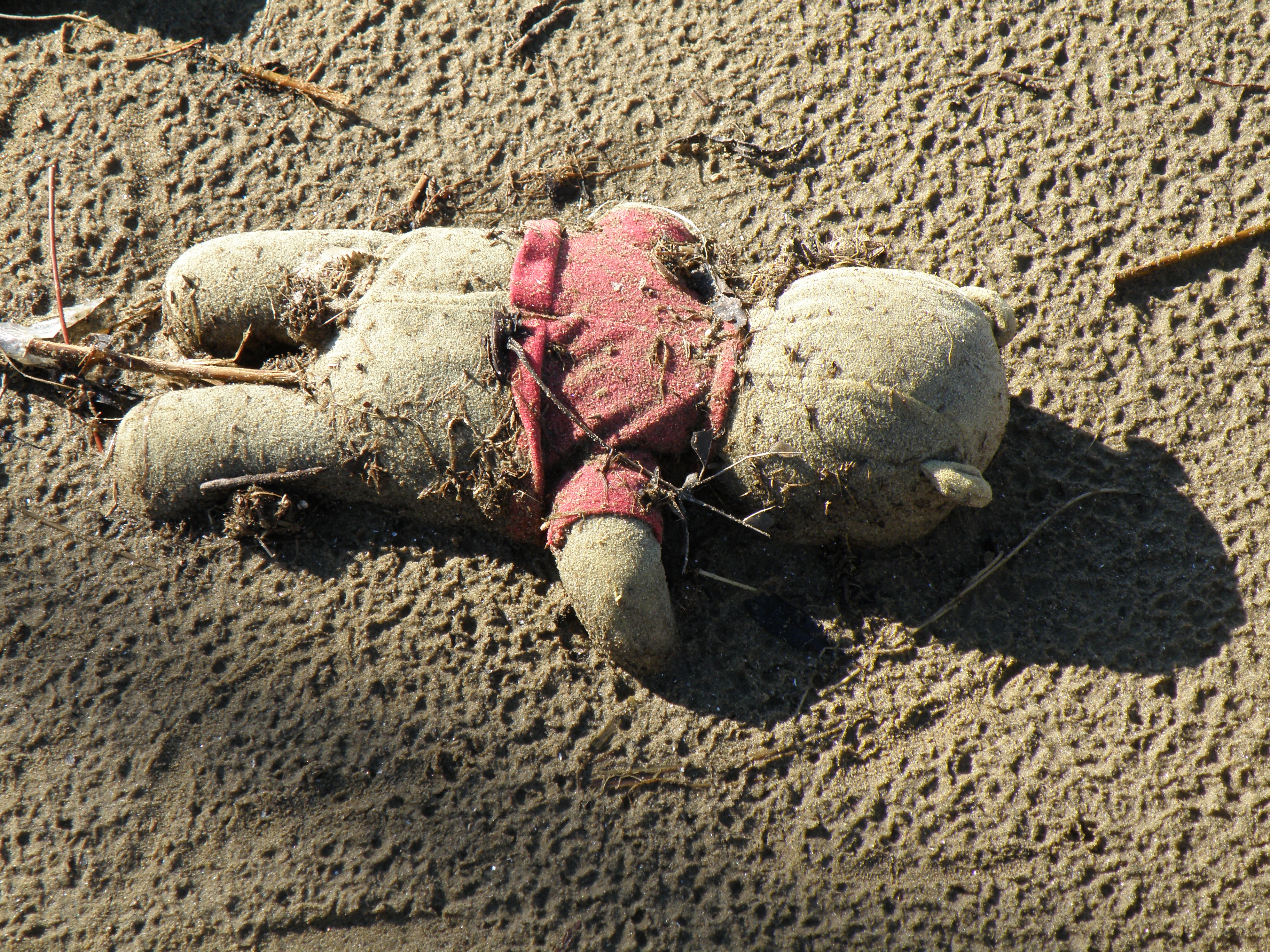
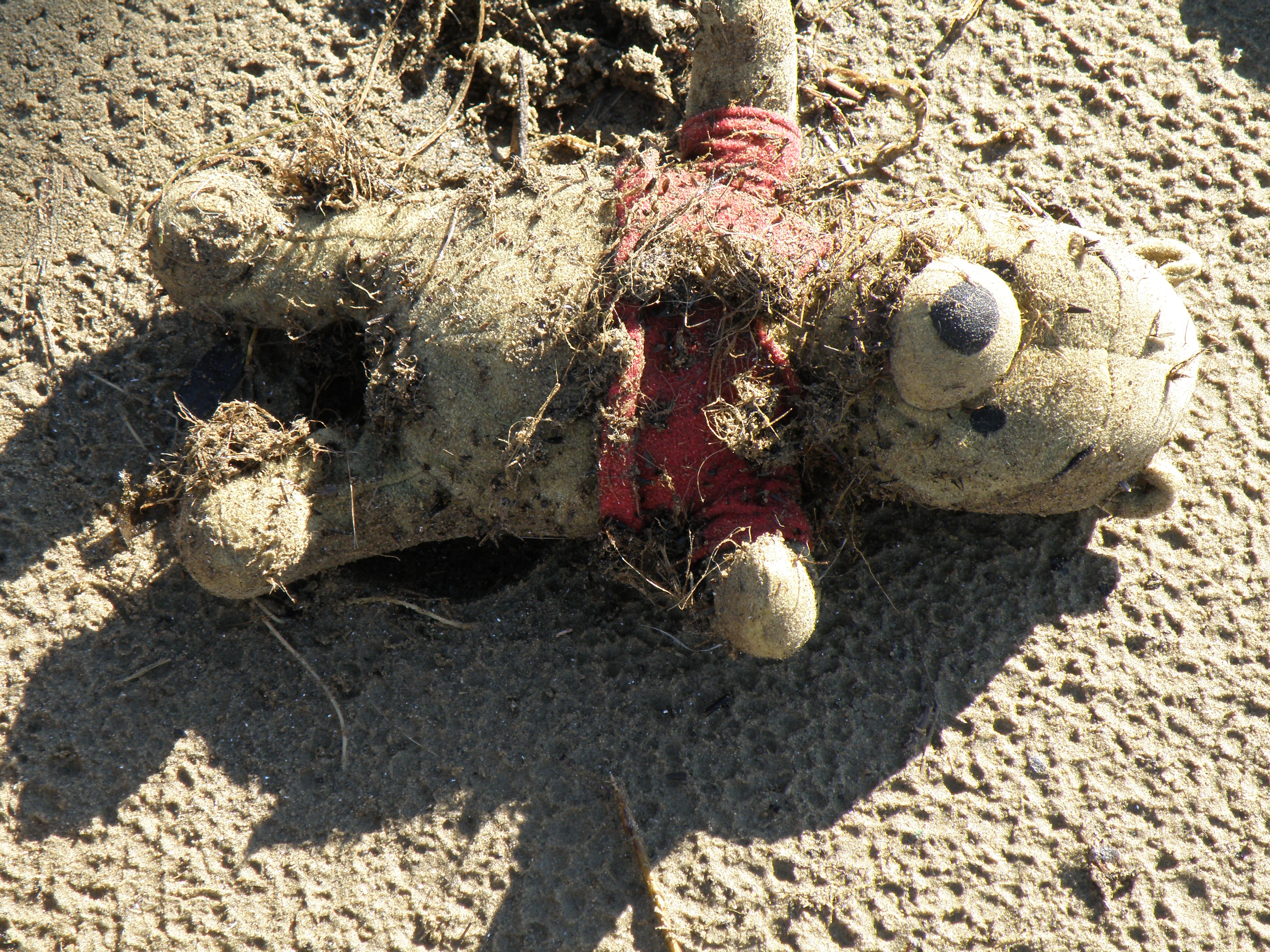
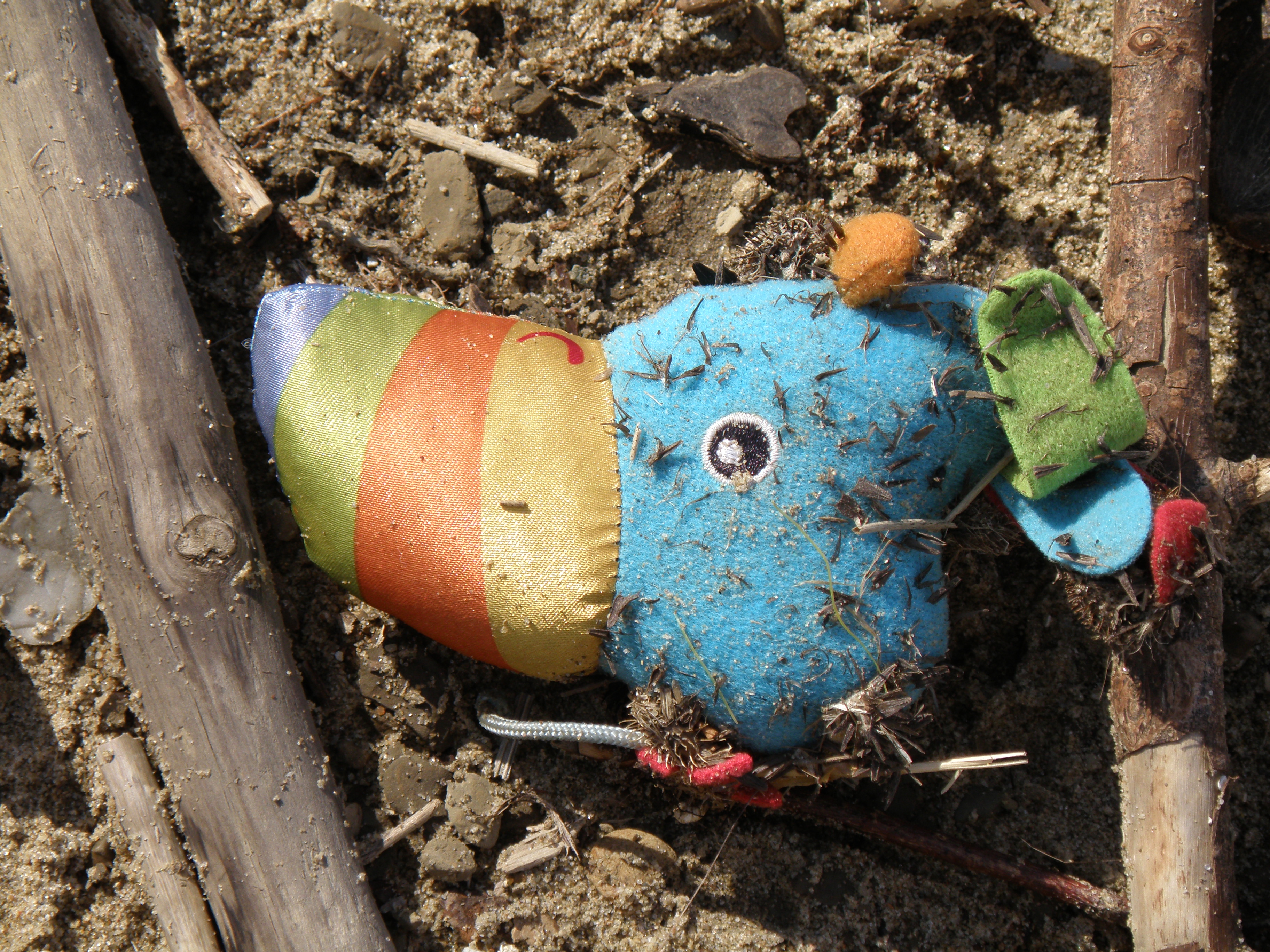
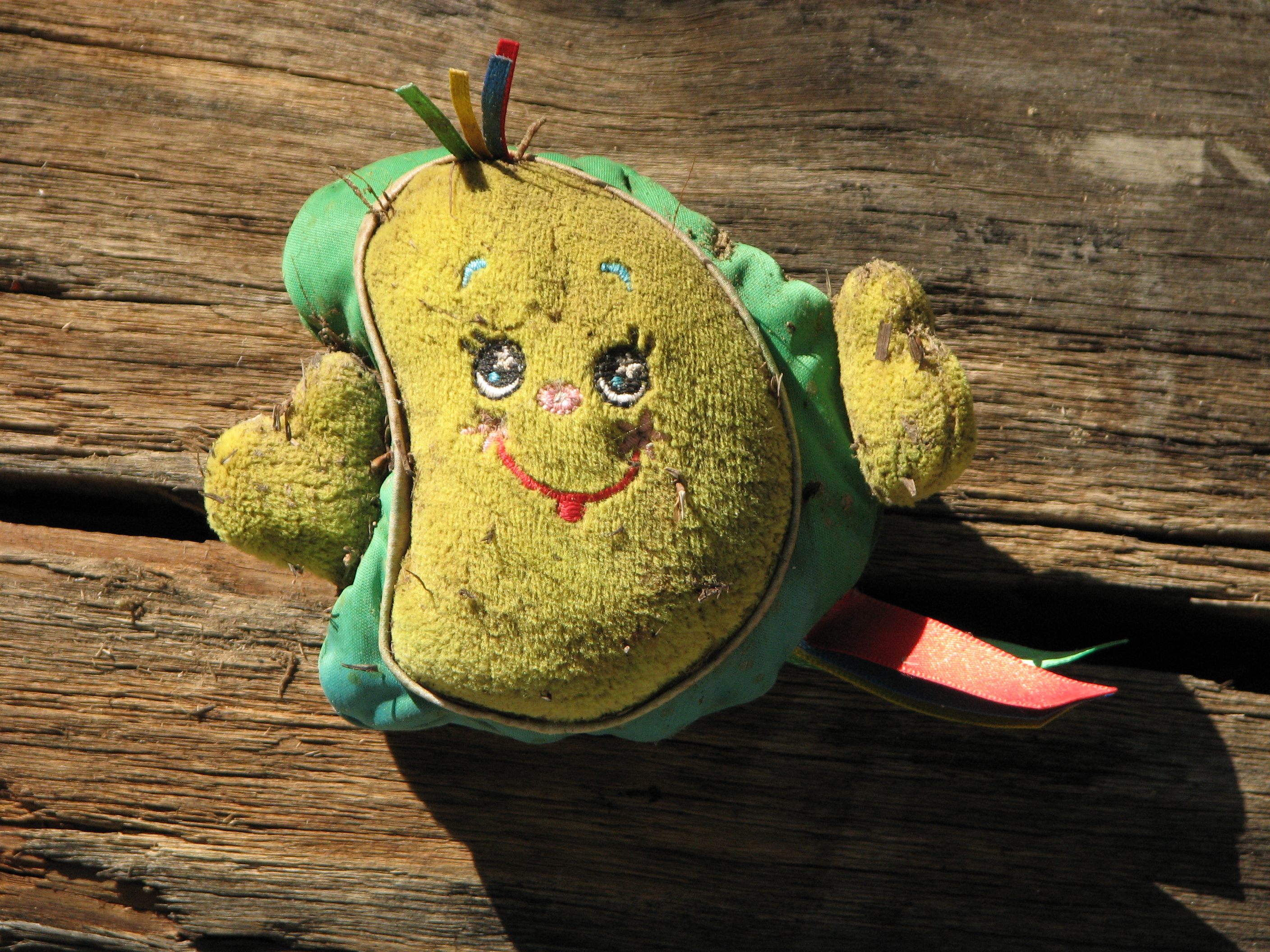
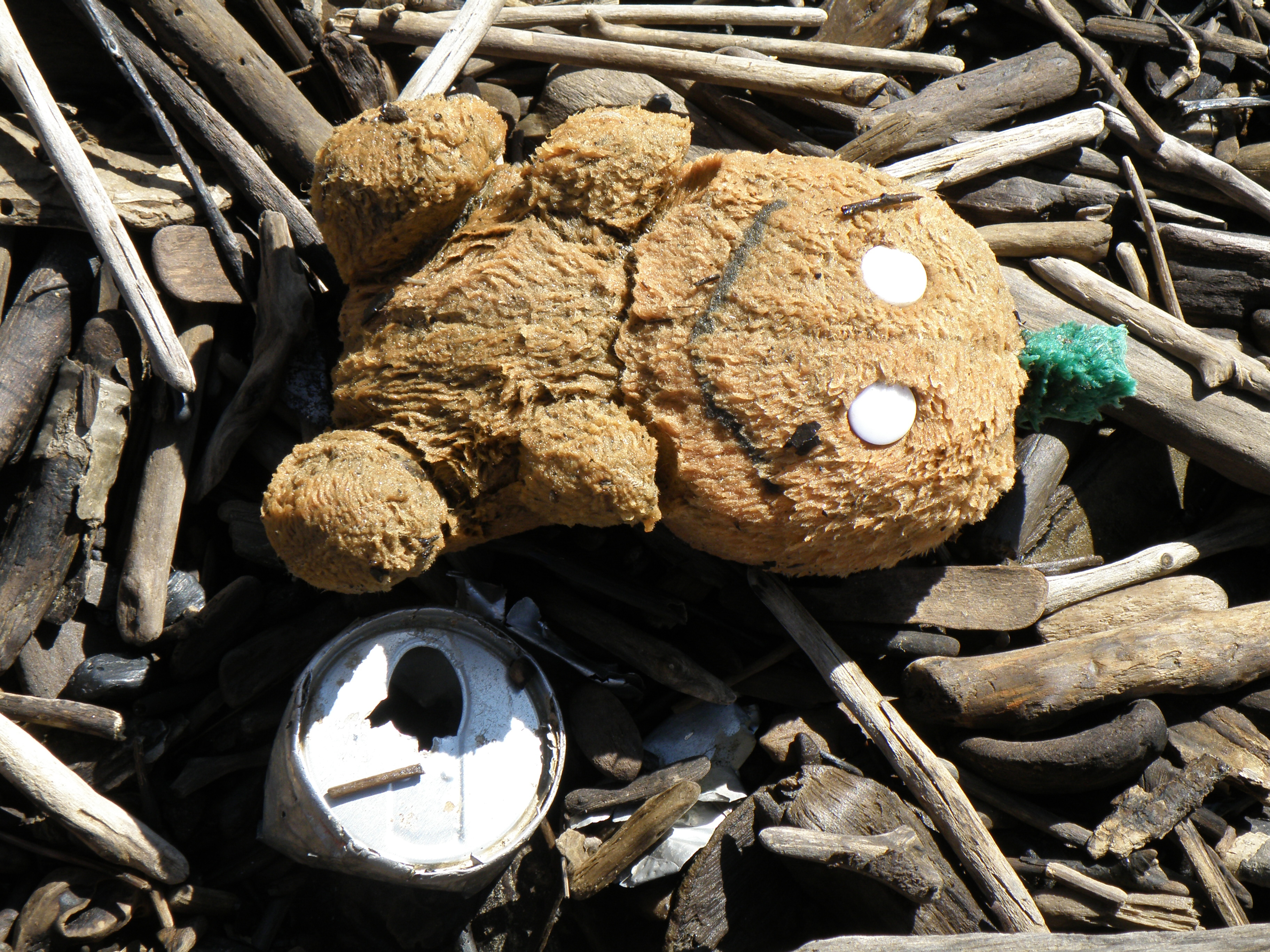
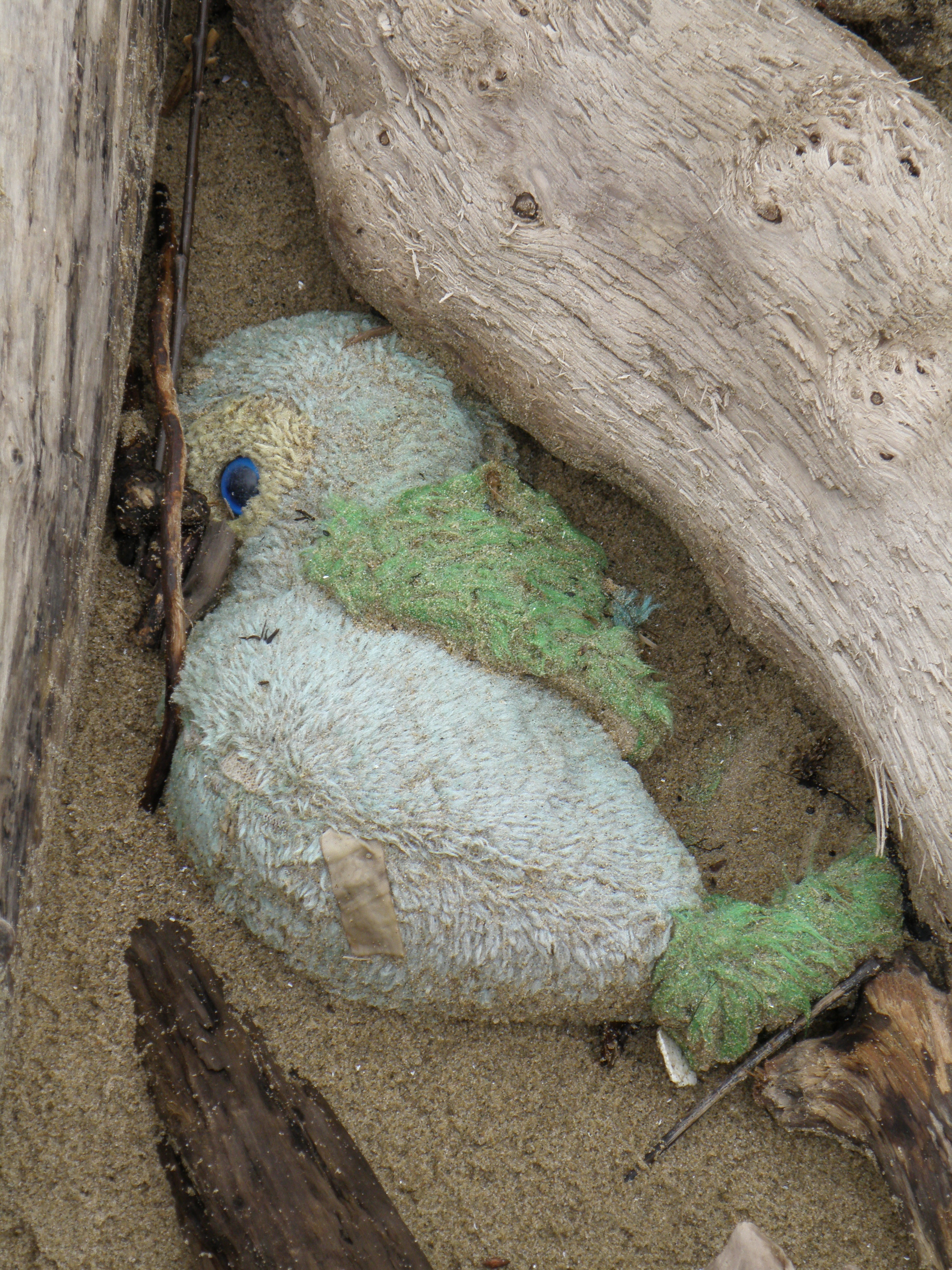
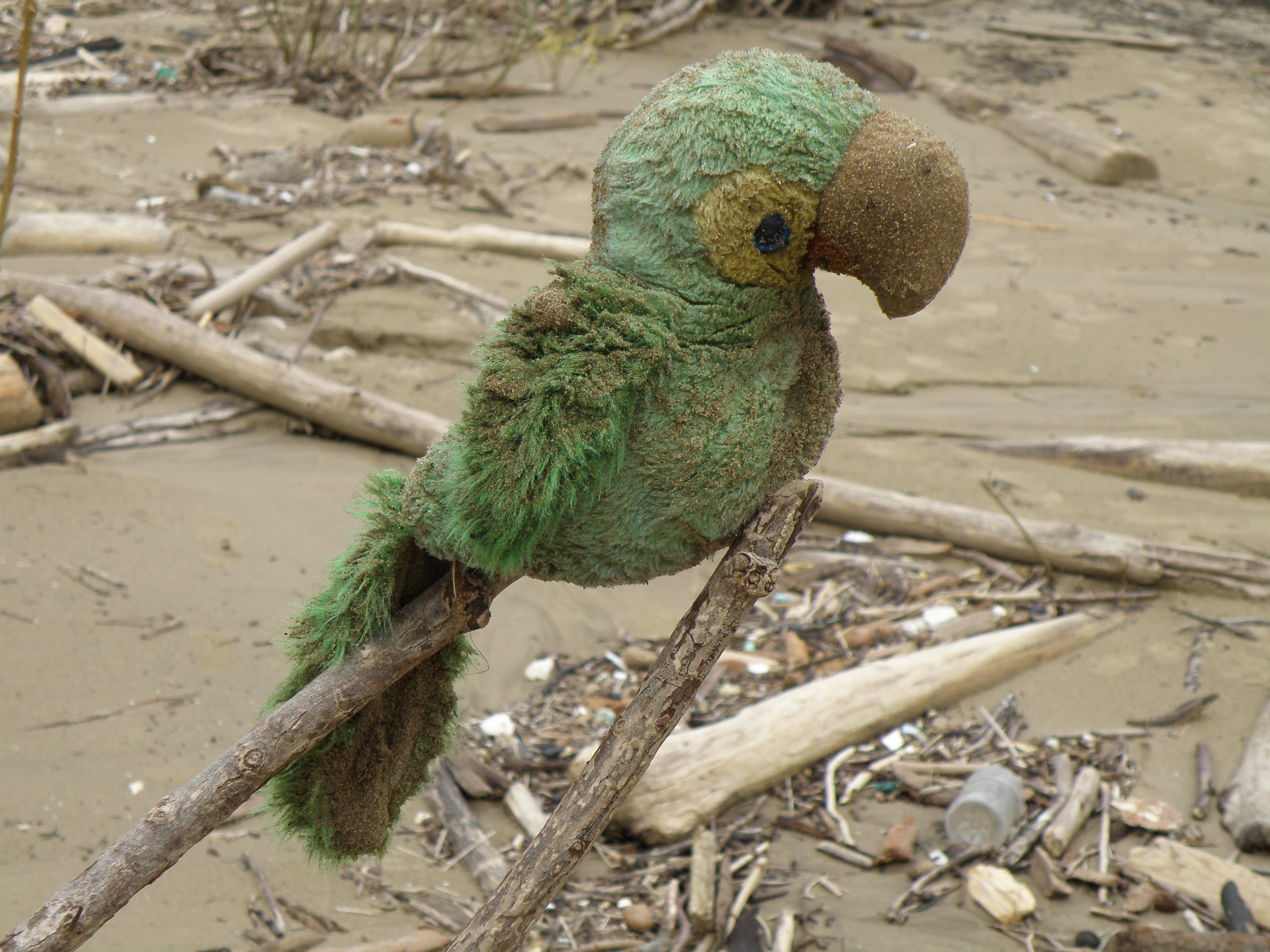
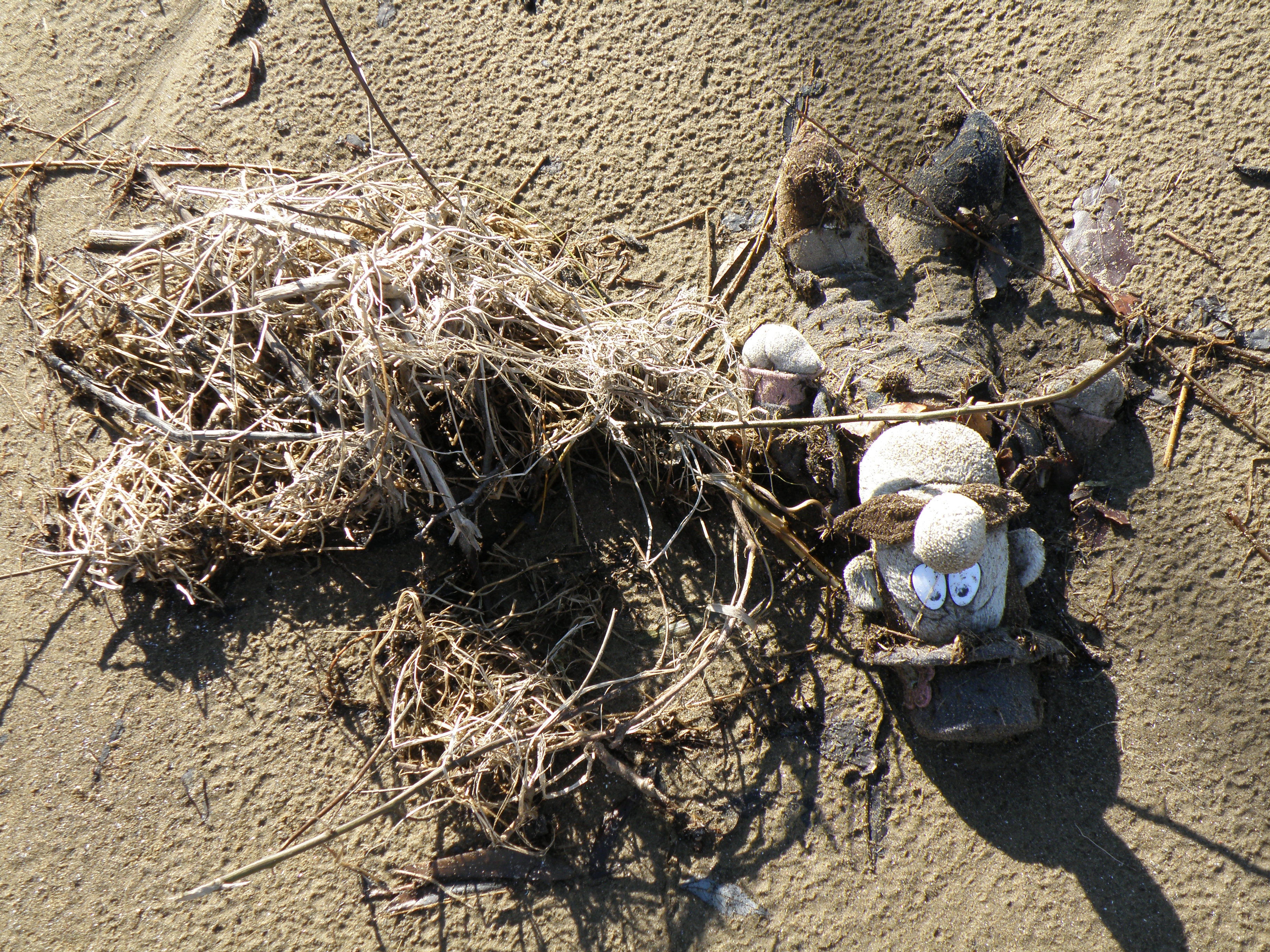
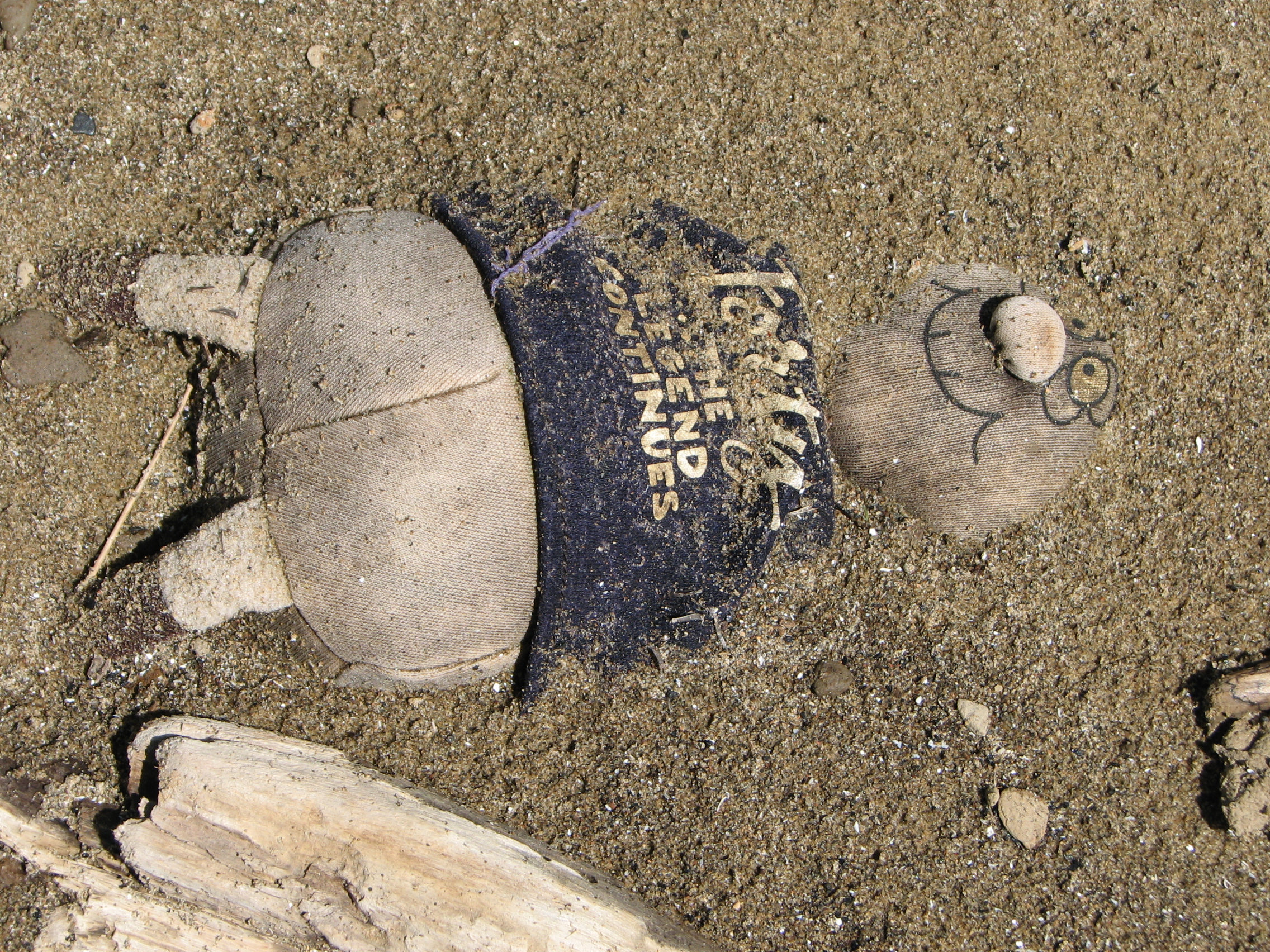
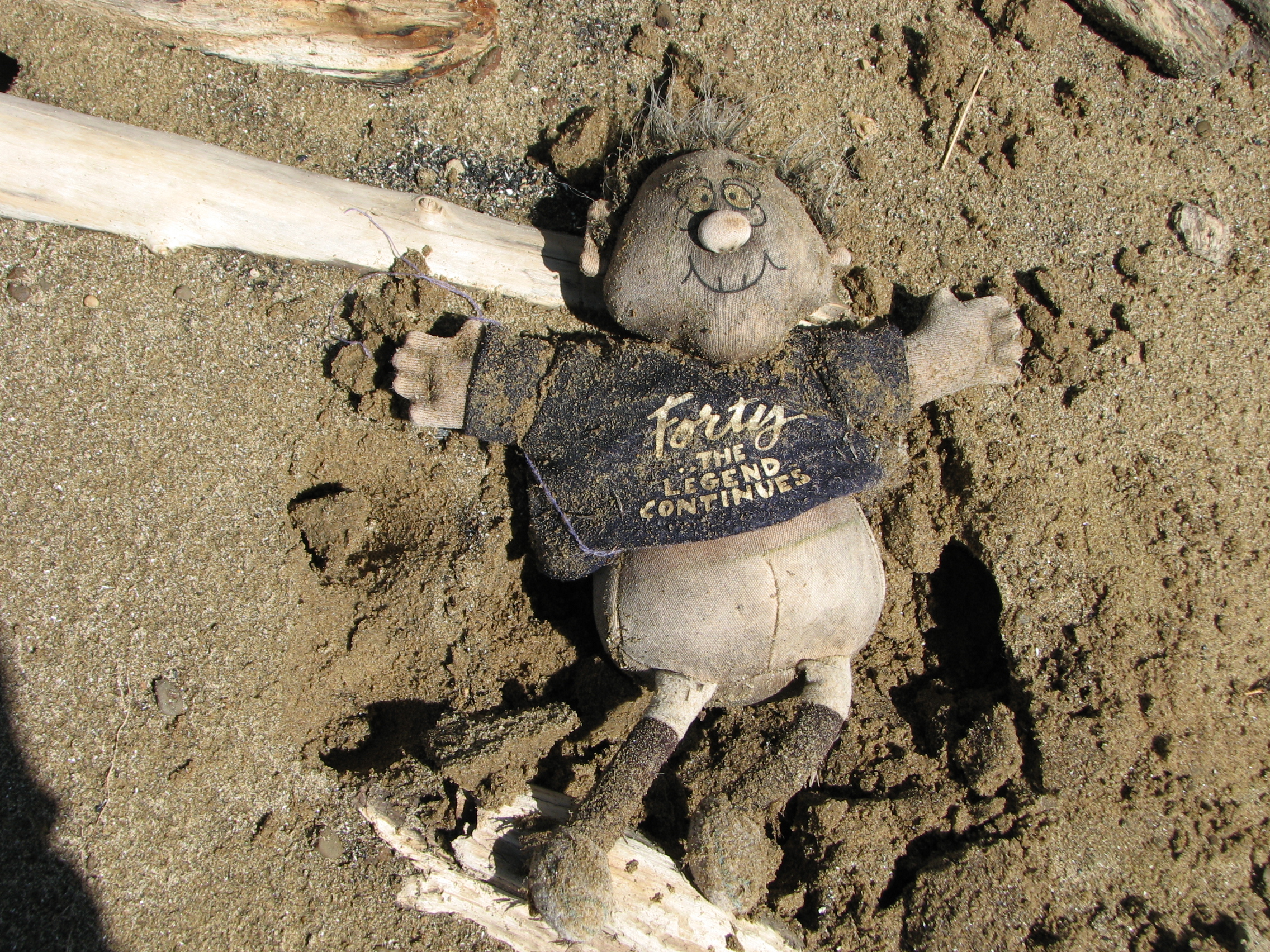
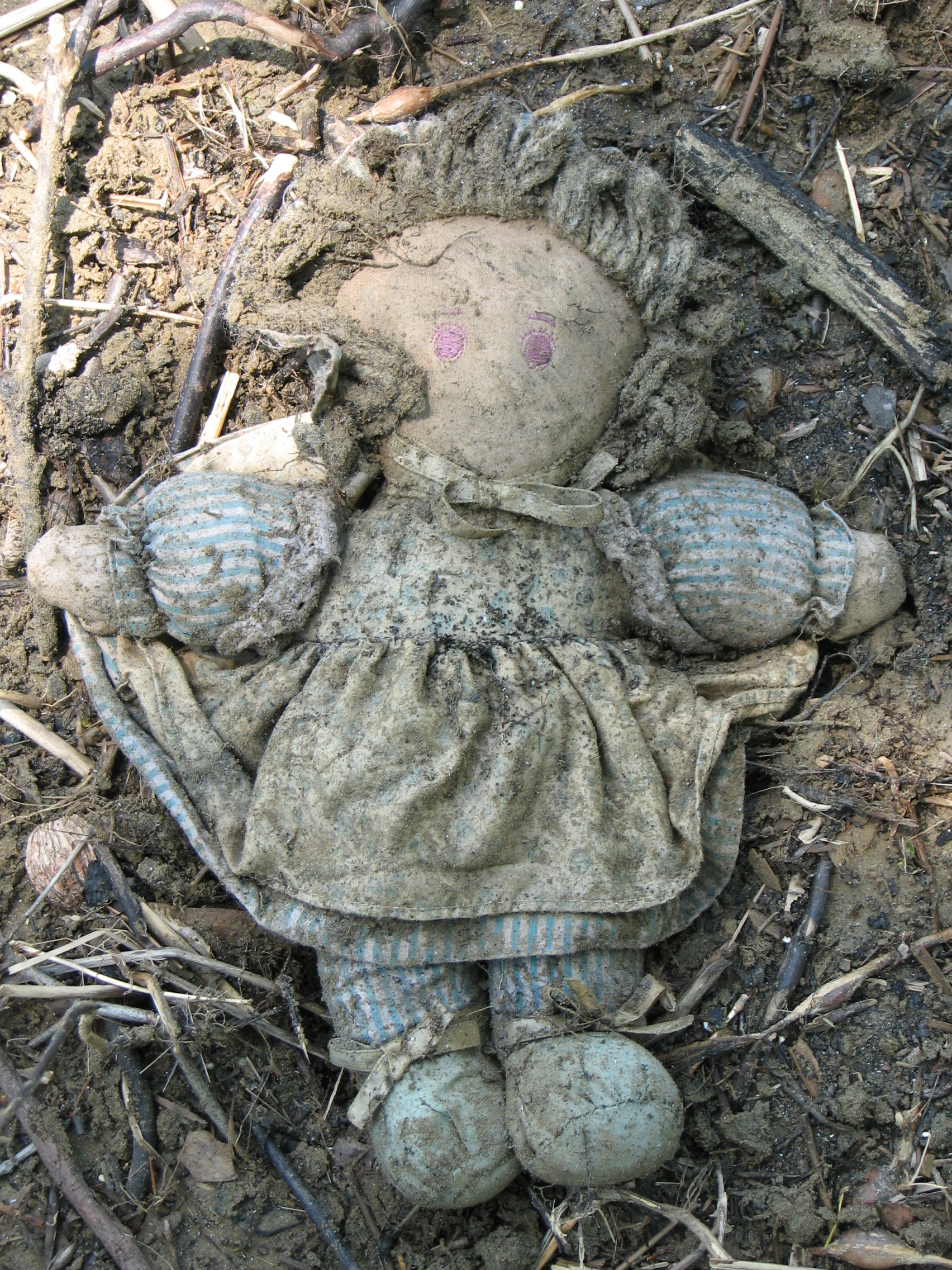
I confess that I like the word “plush”.  In my mind it evokes a sense of luxury and well-being.  I roll the word around my mouth like a fine wine and I also get overtones of comfort, safety, warmth, softness, and abundance.  I feel similarly about the word “verdant”, but that’s the subject of another post.  Returning to “plush”…it is also a word used to describe a variety of soft, sewn toys usually made with polyester fibers.  This includes most of the teddy bears and stuffed animals that one is likely to come across today.  In my own family, plush toys are and were among our most beloved and trusted playthings and misplacing or losing one was like losing a member of the family itself.  Which brings me to this portfolio of images taken with found plush toys in situ that I stumbled upon at the Falls of the Ohio State Park.  Each toy was probably loved by some child and if these images hold any power it probably derives from feelings of separation and loss.  I’m also interested in them as aspects of our material culture that manifest themselves as more junk for the environment to try to absorb.  All these plush toys were deposited by the Ohio River and it wouldn’t surprise me to learn that some of these objects probably floated hundreds of miles to reach my camera’s lens.  Here are some of my “favorite” images in this “genre” and I’ll start with the object I’m holding in the first picture.

Once upon a time this was an impressive toy.  I think this is “Pink” from the famous Pink Panther cartoon series.  Lifting it from the mud took some effort because its stuffing has been replaced with impacted mud.  This toy had effectively merged with its muddy matrix.

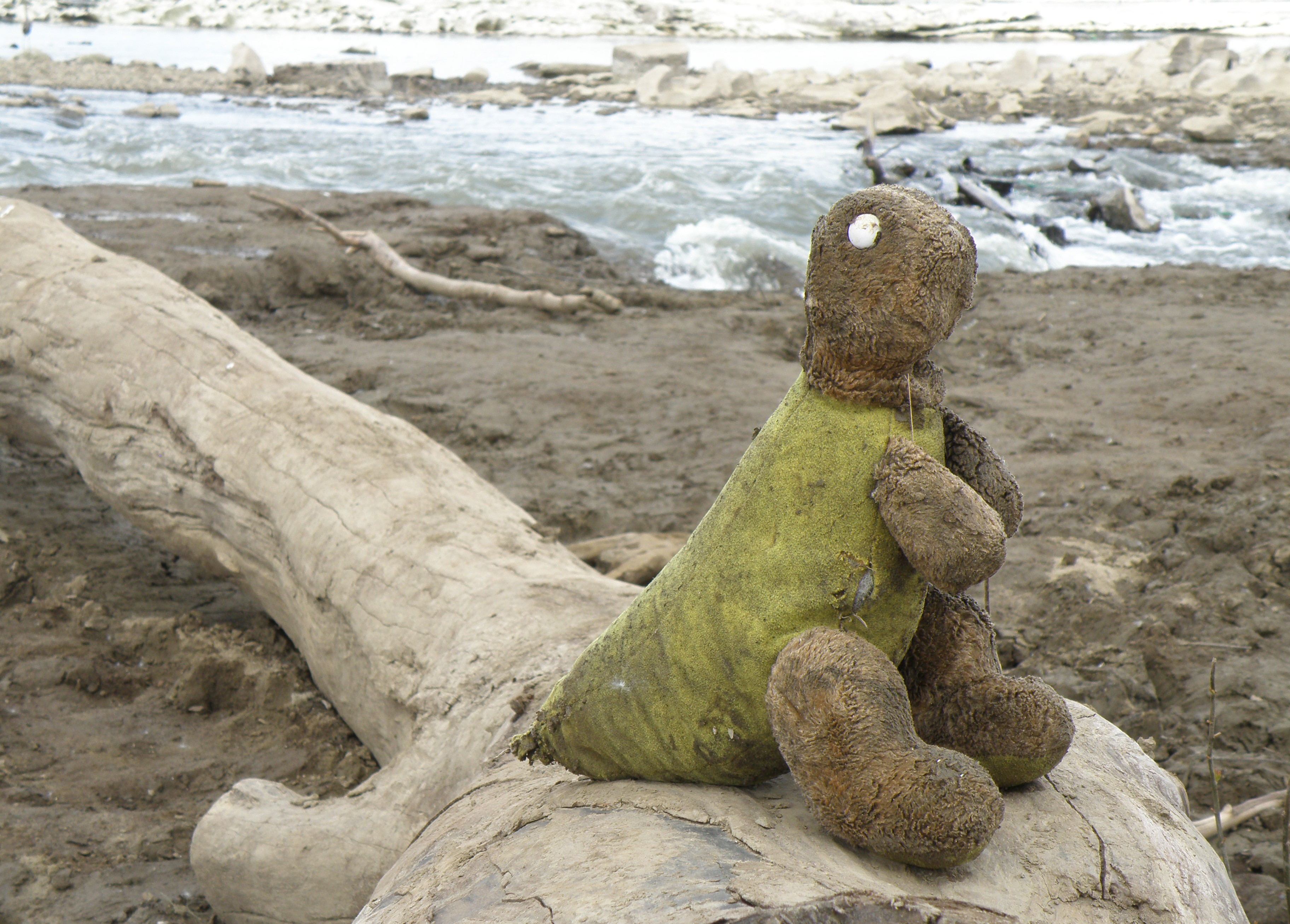
I also found this cute plush dinosaur embedded in the mud.  Later I set him up on a log and took his portrait in the context of where he was found.  He’s a friendly tyrannosaur photographed against a fossil landscape that predates the real dinosaurs by millions of years.

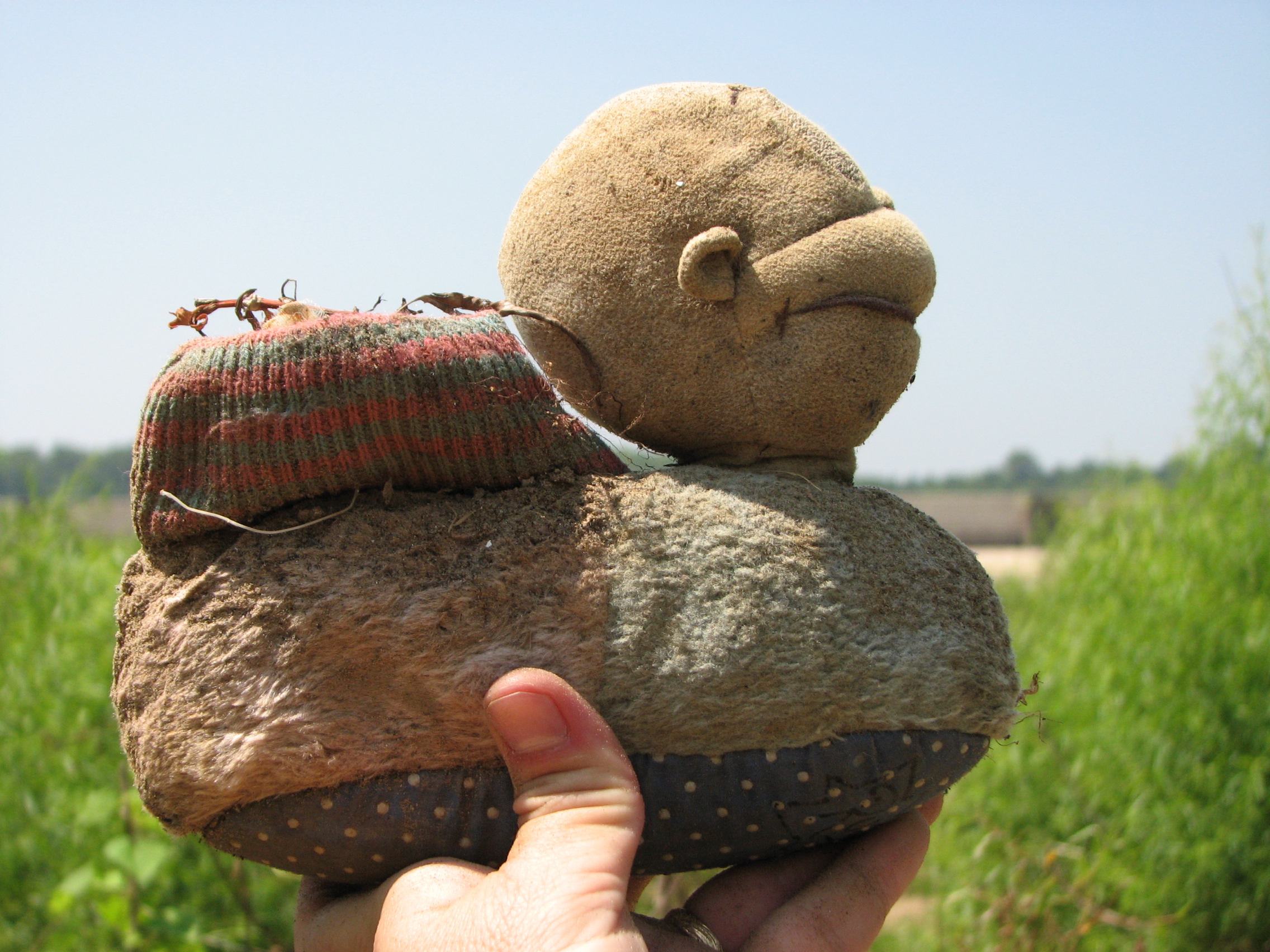
This was an unusual find.  Later I identified this as a  child’s slipper featuring a Rug-rats character, but it fits my plush category nevertheless!  Now let’s look at some teddy bears.

This was once a member of the Care Bear clan.  Here’s a different kind of bear minus his stuffing.

I came across this unfortunate bear in the sand.  Somehow he lost all his stuffing and was essentially just a hollow skin which I salvaged and used as a costume for one of my Styrofoam figures I later entitled “Cubby”.

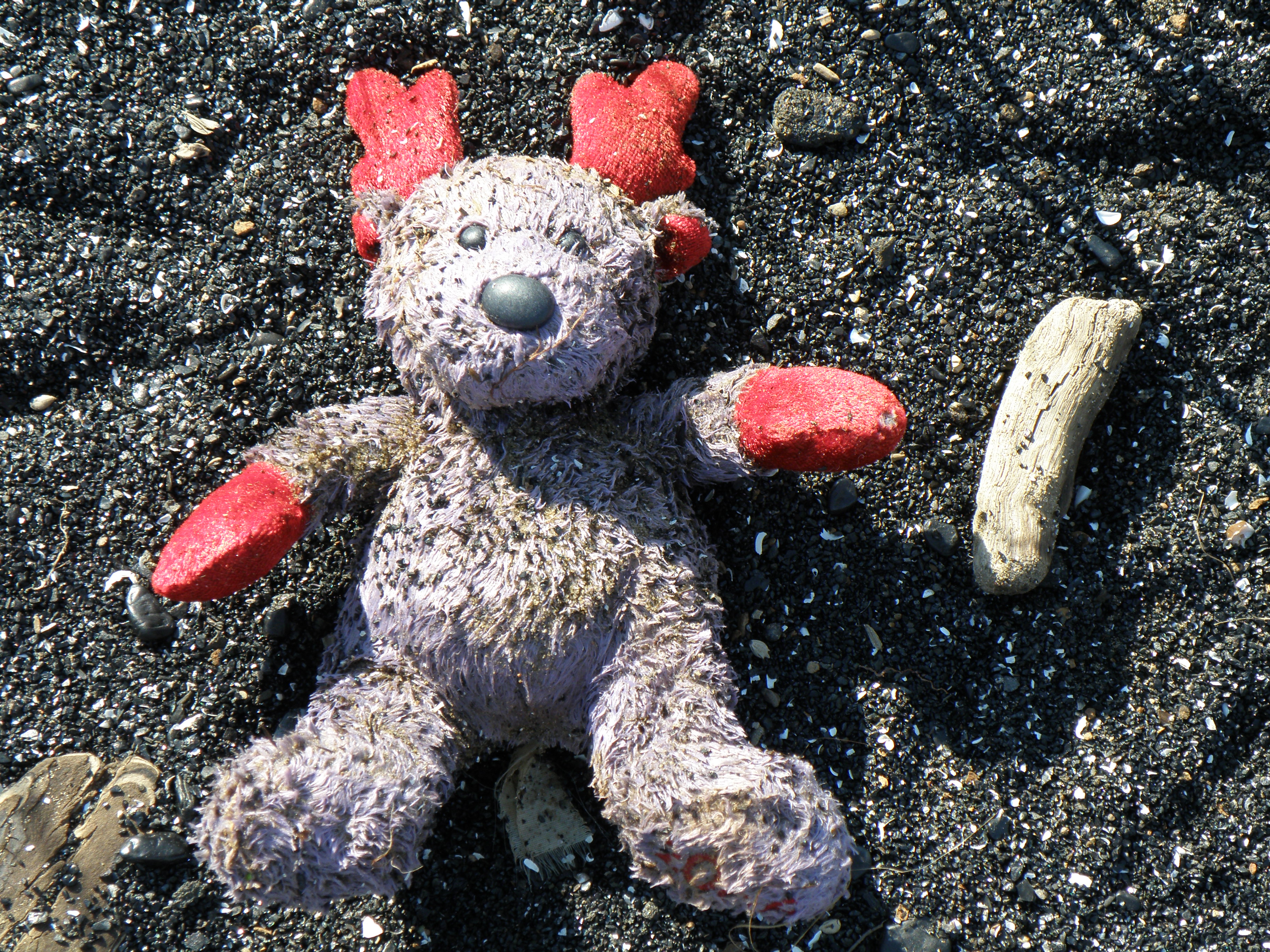
This bear was still in the process of arriving by water when I came across him.  The black background is coal gravel and dust while the white dots are the remains of broken clam shells.  I’m sure you will recognize my next find.

My eldest son has the exact sized Pooh bear that he has treasured all his life.  Even though he’s now a teenager, I noticed that Pooh still occupies a prominent place in his room.  Here’s one last bear and its a little different and may not “technically” qualify as a plush toy.  Nevertheless, I found it appealing and I include it with the others.

Let’s try a change of pace and include a few rather small stuffed toy objects I’ve found over the last couple of years.

This looks to be some kind of flamingo head.

I’m not really sure what this might represent…it could be a moon or a vegetable?

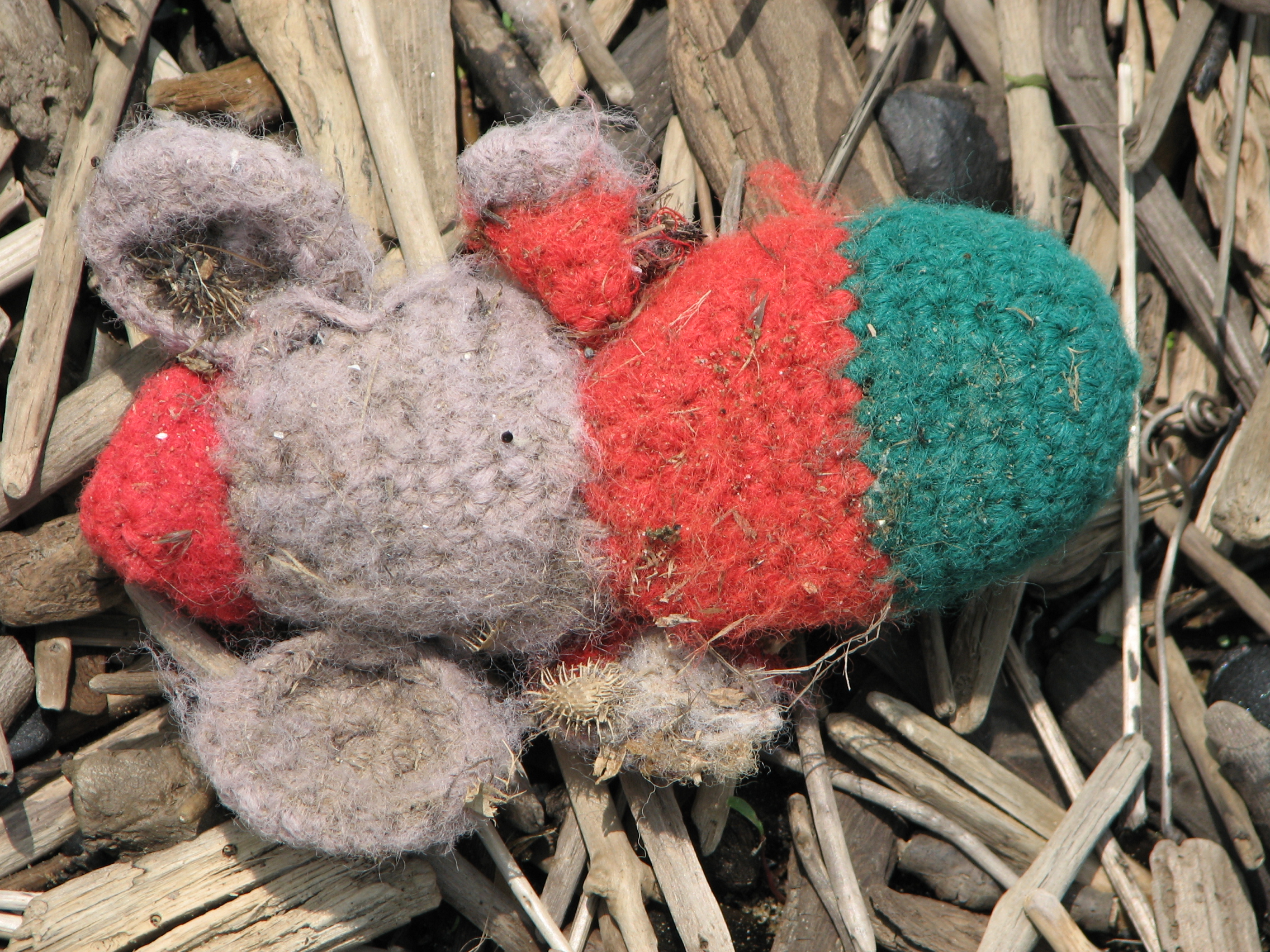
Here’s another object I had trouble identifying.  I like how the cockle burrs are hitching a ride on its knitted surface.  Here are few toys that either are or were inspired by Beanie Babies.

The purple reindeer was photographed against the blackness of coal dust and gravel.

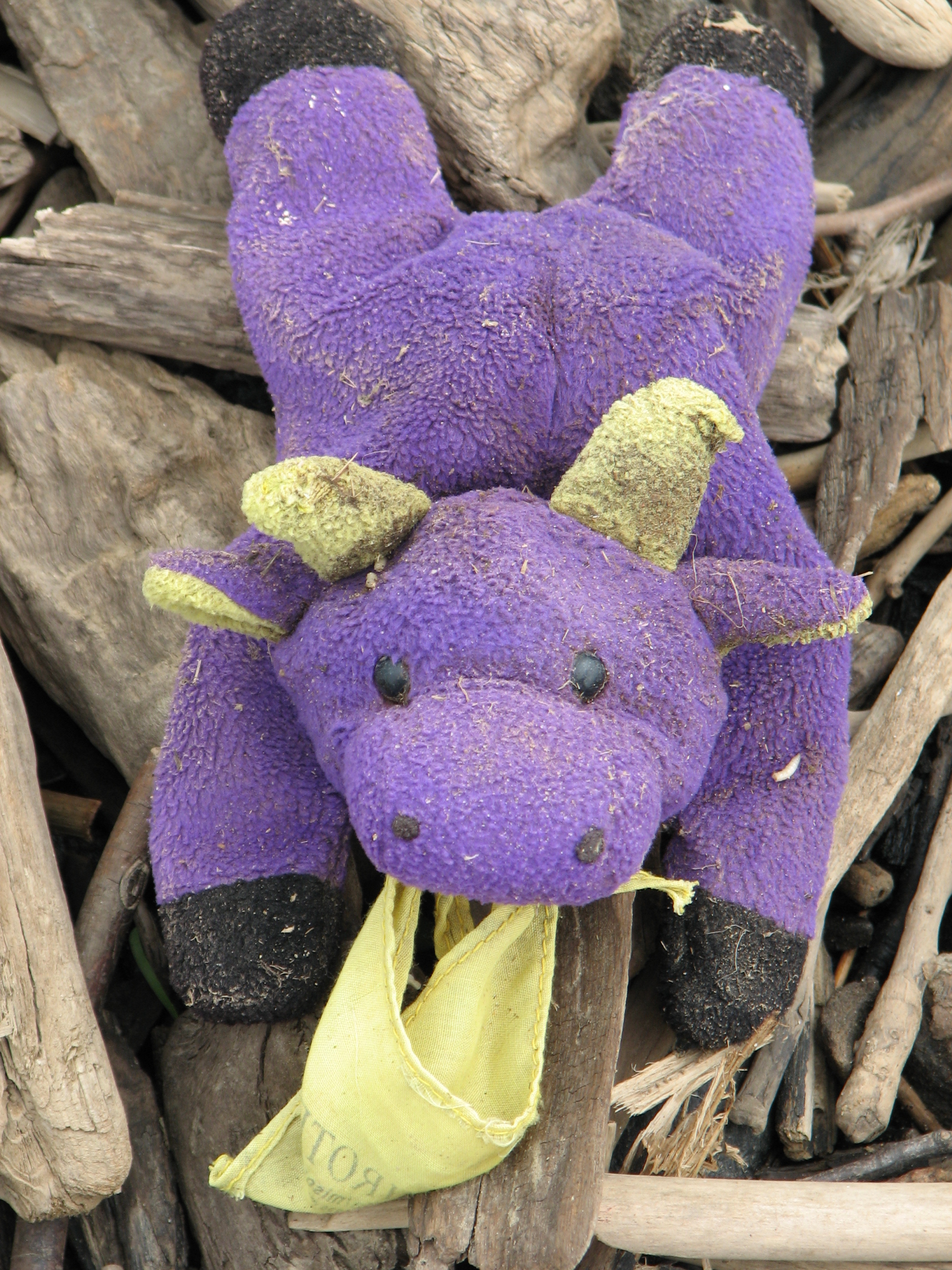
I believe this is another beanie baby-styled toy in the form of a purple cow?

I believe this tiny plush toy is meant to represent a killer whale.  Here’s an image that came out of the floods from two years a go.

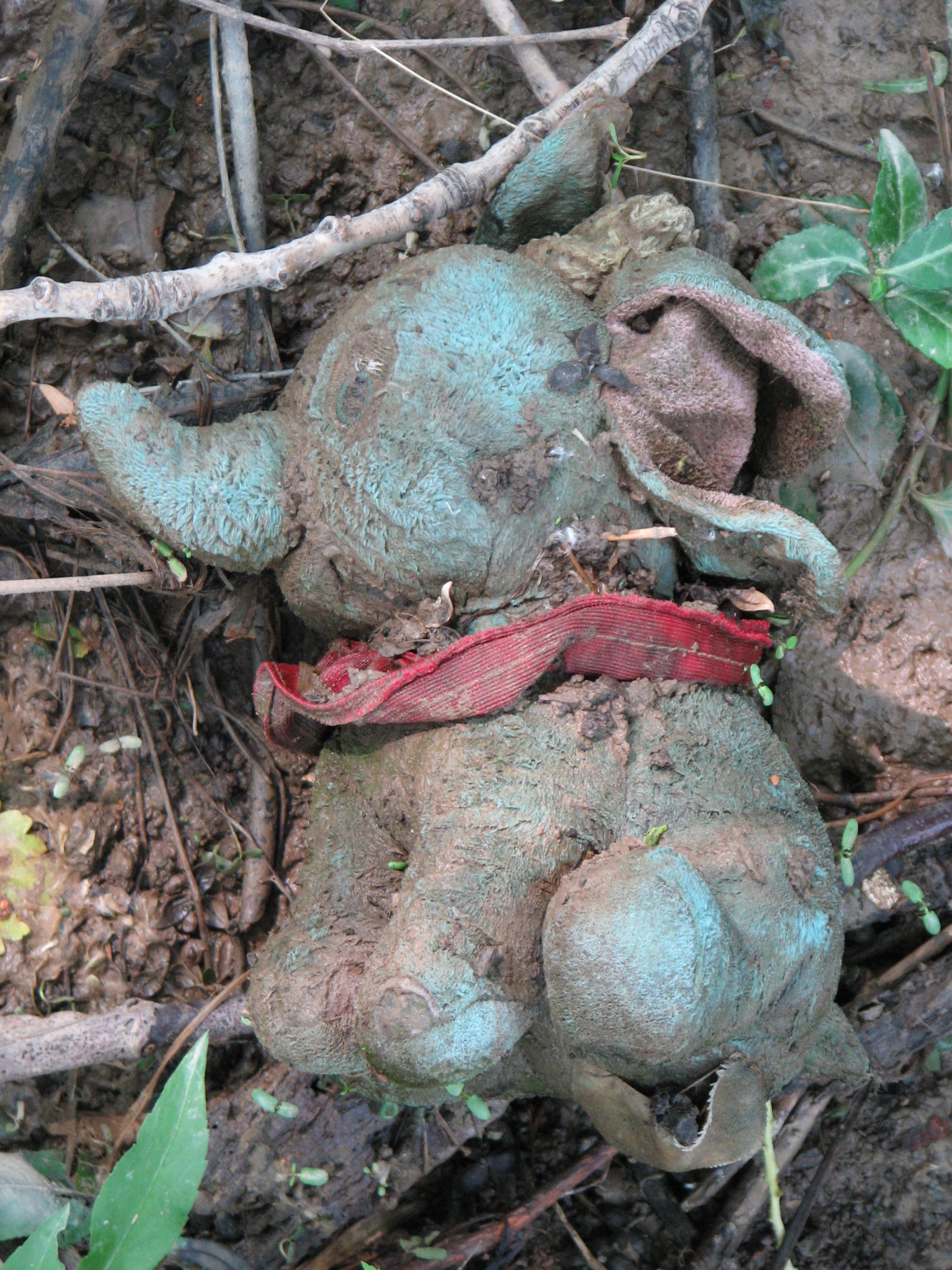
This guy is clearly an elephant.  When I was a child I had a Dumbo character soft animal toy.

Another hard for me to identify figure, but the destroyed aluminum can help give you a sense of how large this plush toy is.  Could this be some type of Halloween toy?

Over the years I have found many surprises buried in the sand.  When I spotted the above object…I had no idea what it was until I lifted it up.  This is what I found.  I remember staring at the blue eye!

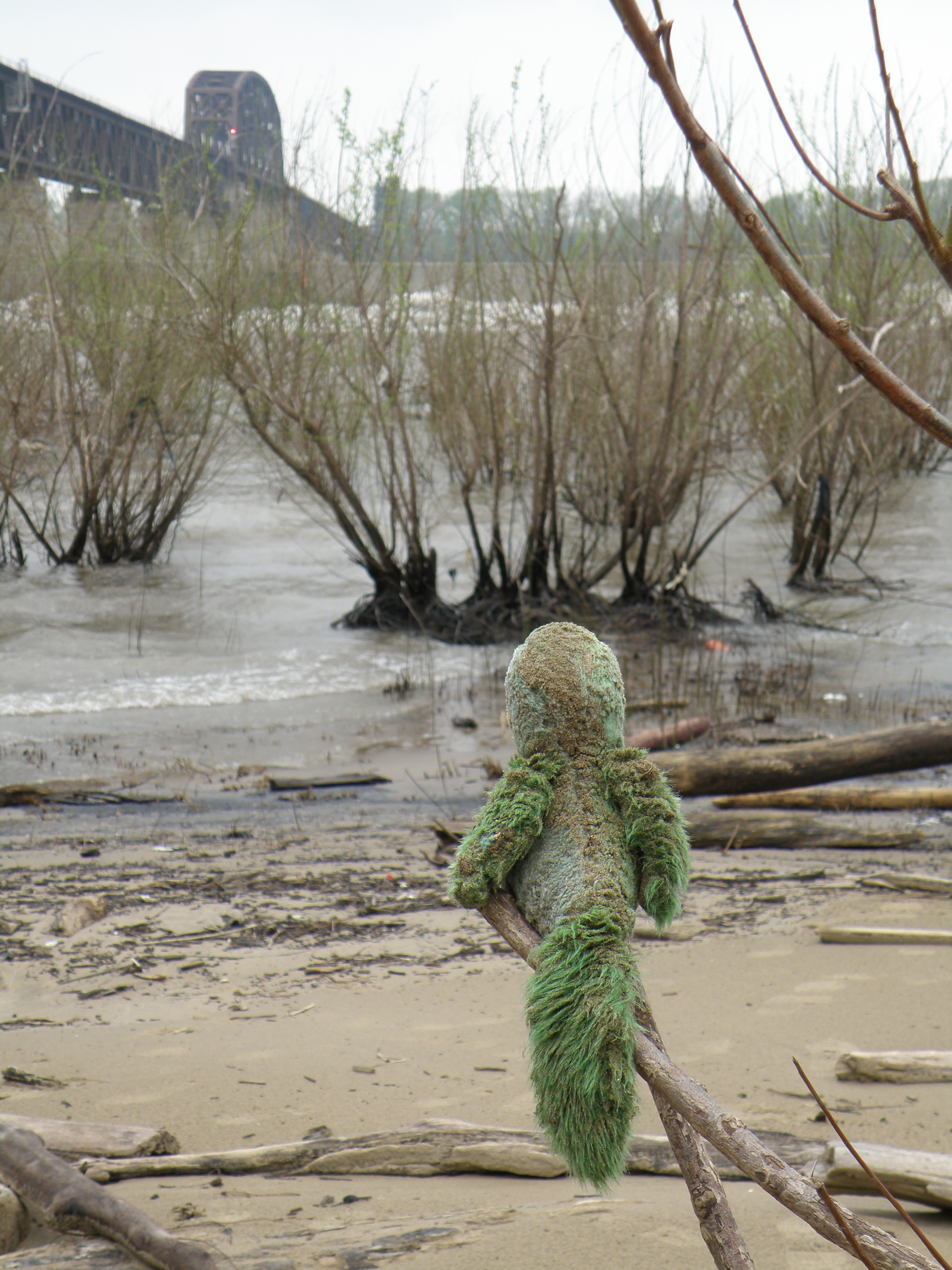
To my surprise emerged the form of this friendly and shaggy green parrot.  I placed him upon a branch for others to find and moved on.  We are getting close to being done!  Here are a few more found figures.

A sharp-eyed observer identified this as the Magician character from the Frosty the Snowman cartoon.  Makes sense to me because I found him right after Christmas of that year.  Could have been some child’s gift that wasn’t properly appreciated and in to the river you go?

I don’t know why I remember this now, but I believe this figure was once used to advertise a barbecue restaurant?  Could have had additional info on the back of the shirt, but I also could be completely wrong about this.  It might simply be a birthday wish novelty.  I think you will recognize this next one.

This isn’t the original Raggedy Ann doll, but a similar conception.  I found it face down in the sand and flipped it over for this photo.

I live in a basketball crazy region, but this is the first time I’ve encountered this object.  I know it references basketball, but what else is it intended to do?  What purpose do the white cords serve?   It definitely has plush elements.

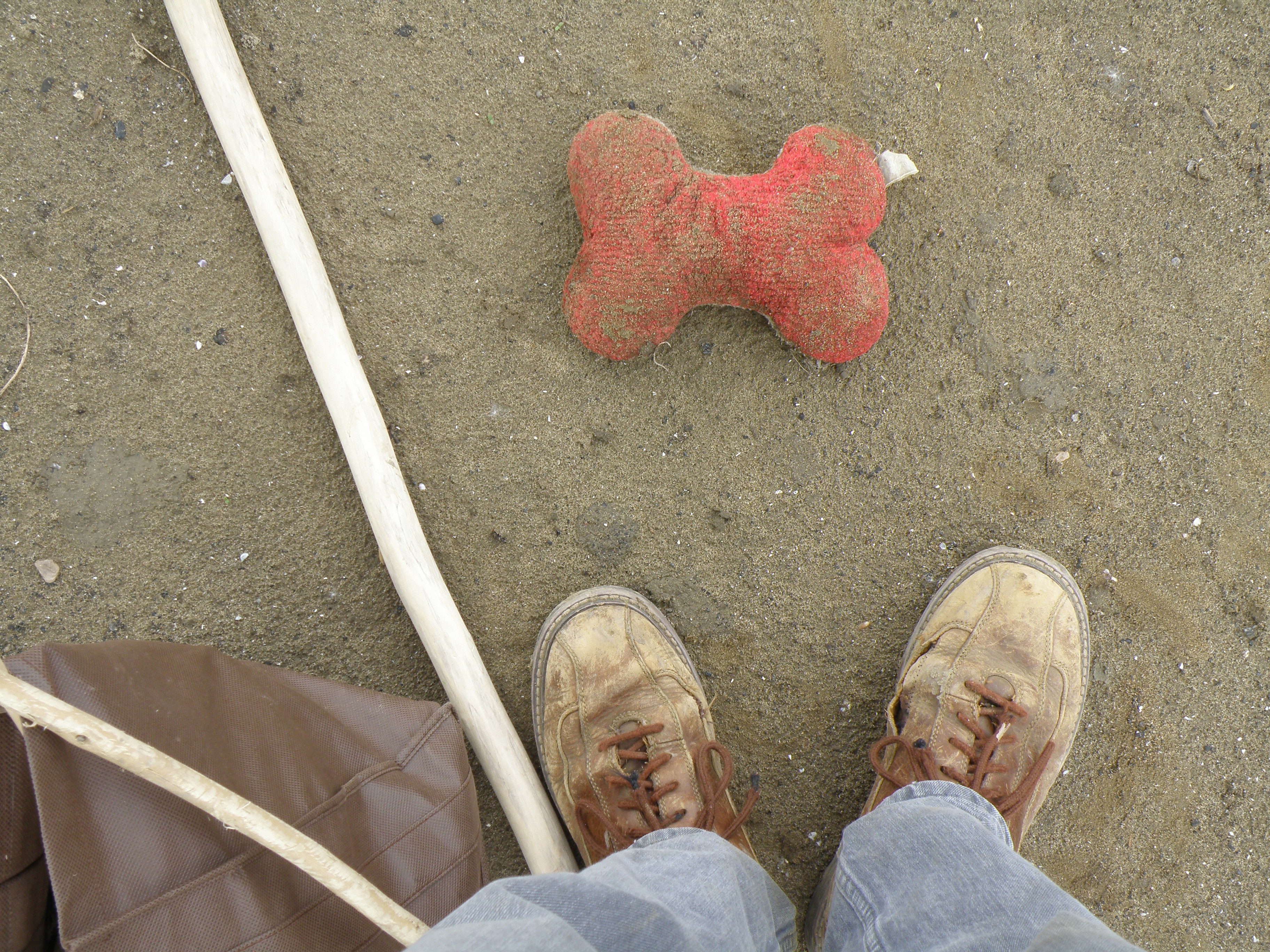
This is me standing in my beat up Falls shoes next to a found plush “dog bone”.    My dog makes short work of any plush toys she comes across.  She knows how to get her teeth around their seams and split their contents open.  This makes me wary to think that this orange bone might be a dog’s toy…but what else could it be?  The Ohio River is always presenting me with such conundrums, however, I enjoy putting on my thinking cap and trying to puzzle them out.  I hope you liked some of the images and I will leave you with this final one of the parrot in the place where I left him for others to find.

Read Full Post »

The heat and the relentless light of the sun makes it official.  It’s summer at the Falls of the Ohio.  Now I need to plan my forays a bit more carefully if I want to get the most from each trip out here.  Earlier in the day is better.  You miss most of the heat, there are fewer people (except for the die-hard fishermen) and the chances are better you might see some wildlife…especially birds.  Luckily, if you don’t make it out here early enough…the trees are all in full leaf and the shade provides needed relief.  I wonder what kind of summer is boding for this year?  So far we have had the warmest spring ever being nearly a full seven degrees above normal temperatures.  Yikes!!  No doubt, summer will find a way to be memorable.  Anyway, when I’m out here I try to take some precautions in the form of drinking water and sun block.  Once my mind engages on something…I tend to forget my body.  This post is about another “personality” that I ran into on this day and the following is his story.

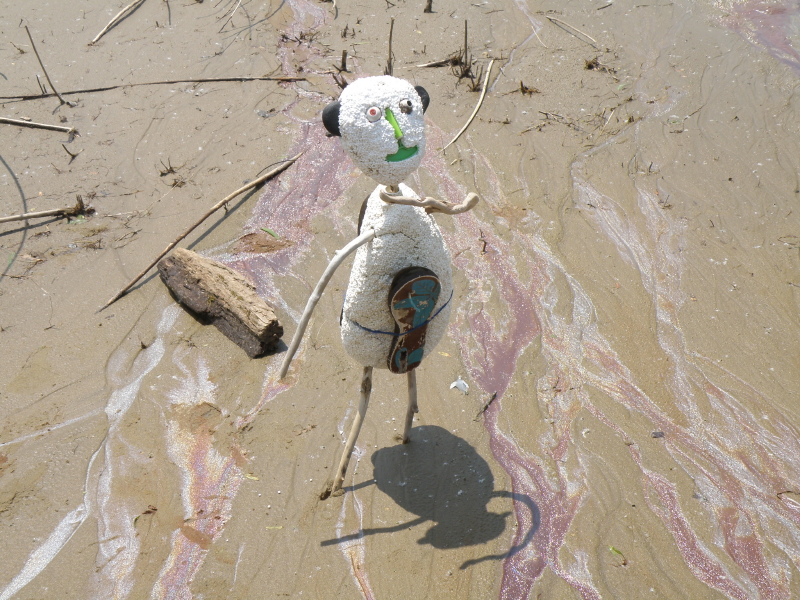
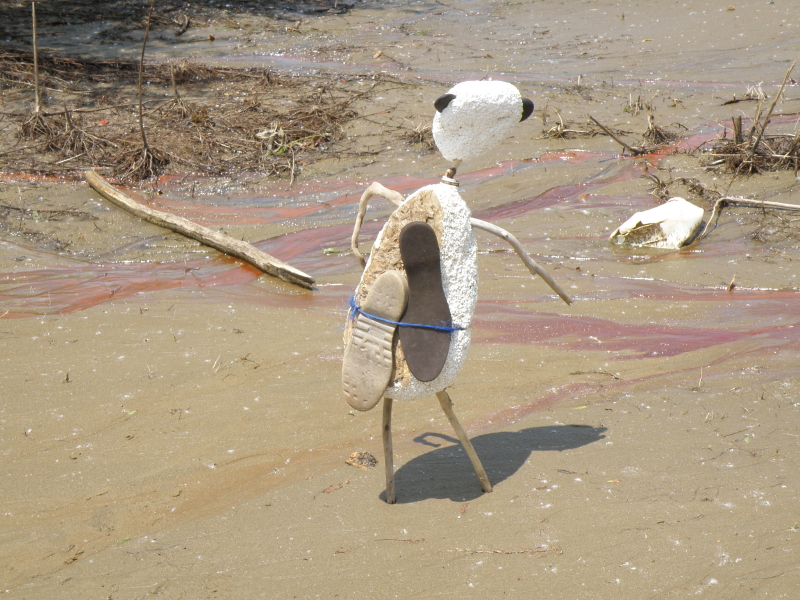
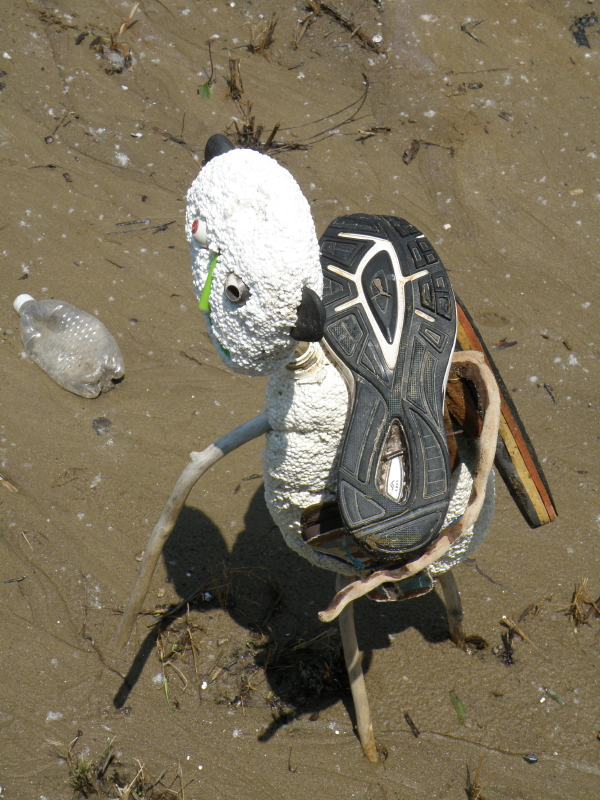
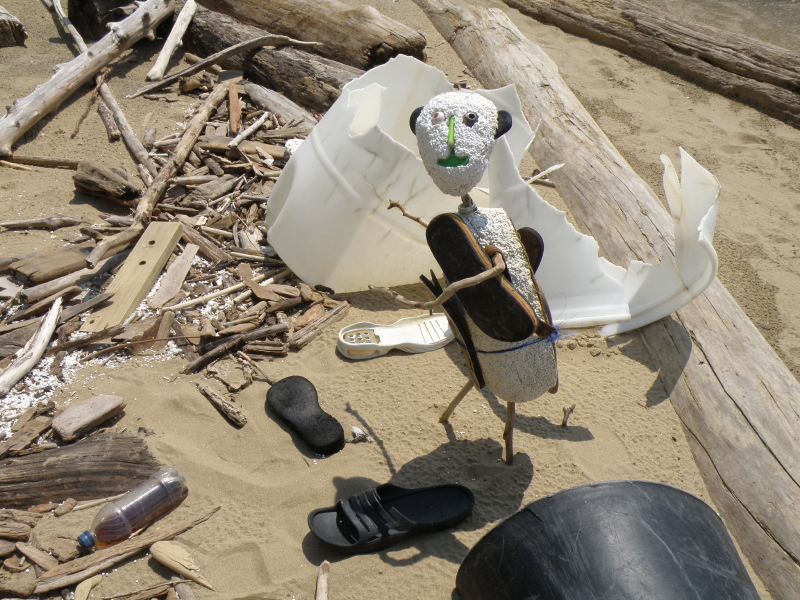
I came across this fellow several times during this day.  The usual protocol when encountering a stranger is maybe a quick nod of the head and each party then goes their own way.  I would have been happy to stick with this, but I kept bumping into this guy seemingly everywhere I walked.  One very curious thing about him (or her and how do you tell?) was that “he” was picking up old shoe soles and sticking them under his belt.  Here’s another view showing this.

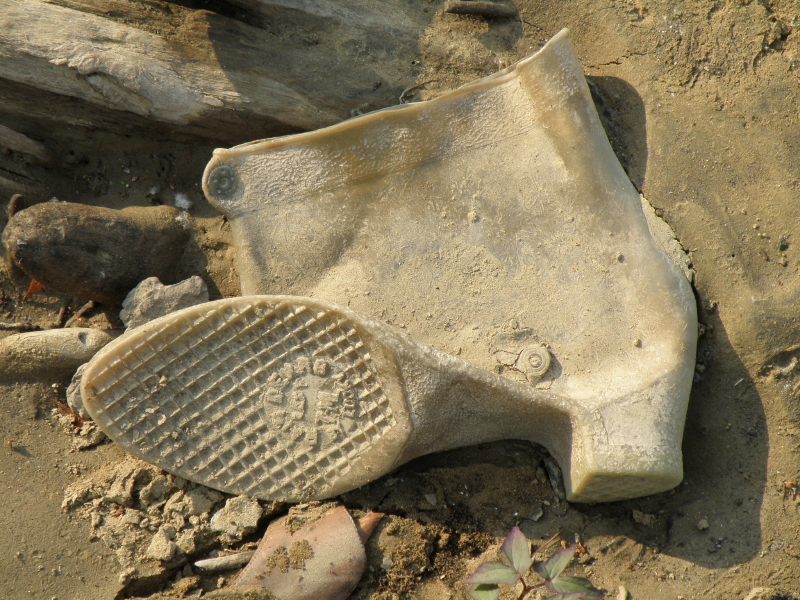
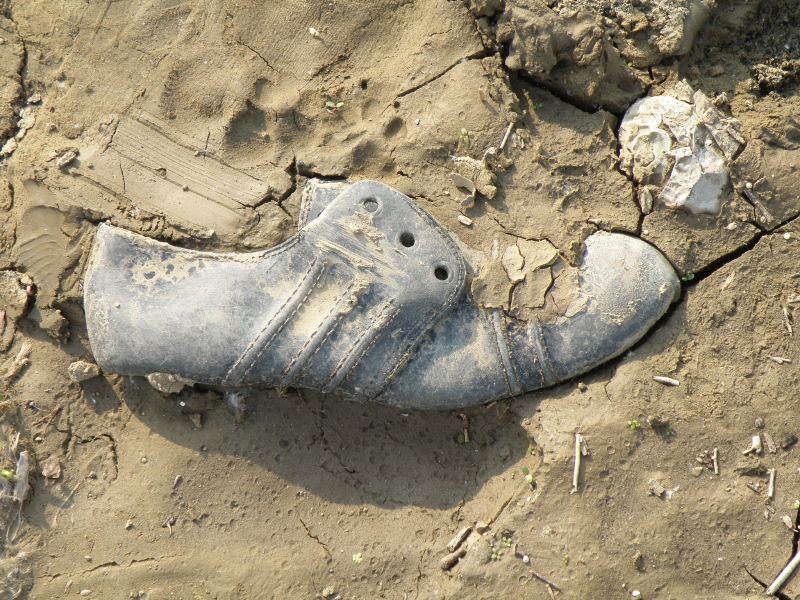
Truthfully, I was at a loss to explain this to myself and the best I could come up with for this strange behavior was that this guy forgot his collecting bag and had some type of project that required shoe soles?  I’ve already noticed that a lot of wayward shoes wind up here courtesy of the Ohio River.  If you don’t believe me, check out my special collections area under “The Shoes You Lose” and you will doubt no more!  I haven’t added images to either collection in a while, nevertheless the lost shoes keep on coming.  Just for kicks, here are a couple additional shoes I saw on this trip that piqued my camera’s interest.

Here’s another shoe found near the previous one.  See what I mean?  I could go on and on about the shoes alone.

After my first encounter with this odd character I ran into him near a willow tree by the river’s edge and he was doing the same activity as before.

This time I abandoned my typical reserve and engaged the guy in conversation.  I think I said something like,…”Hey mister, I can’t help noticing that you are collecting shoes and shoe soles and although I know it is none of my business…what are you going to do with the footwear?”  I further added, ” I see you have tucked a few more soles into your belt since I saw you earlier.”   The Sole Man (my mental designation for him) smiled easily from his green mouth and put me at ease.  I had nothing to fear from him.  We walked together for a while and he told me what his angle is and why he does what he does.  Spotting another lost sole in the sand, my new friend bent over and lifted it up.

Upon picking the sole up, the “Sole Man” flung it over his shoulder and said follow me.

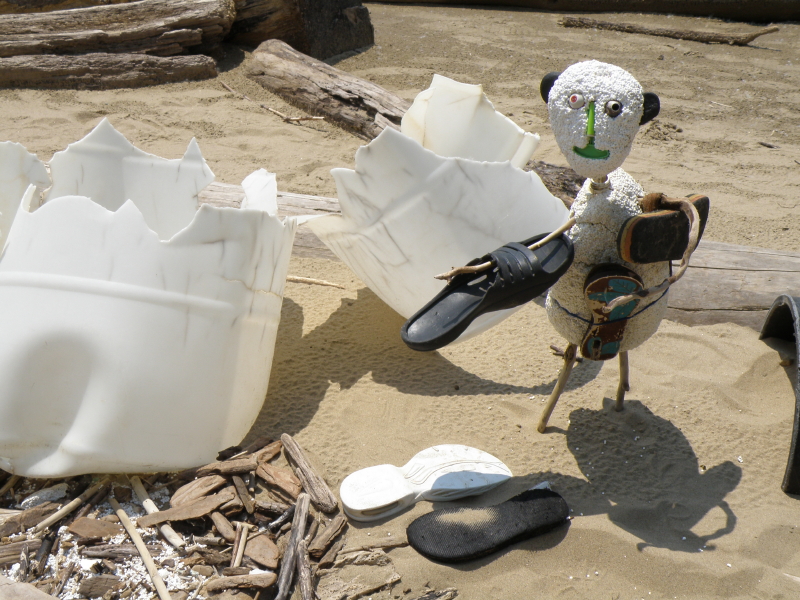
We didn’t need to walk far.  The Sole Man had a spot in mind where he told me he was going to deposit his shoes.  In the full light of the sun he selected an area marked by two shattered plastic drums, driftwood, plastic junk, and the tell-tale white beads from Styrofoam that had been deposited here by the Ohio River.

One by one my new acquaintance dropped his shoe soles in his selected spot.

He told me that he does this as a form of meditation.  Seeing all the junk from our material culture wash up here at the Falls of the Ohio has bothered him for years.  He couldn’t understand why anybody would do this to the Earth?  Fixating on all the debris was just making him madder and angrier which has  its own consequences.  He carried these shoe soles here because he wanted it to be visible so that others might see and reflect as he had.

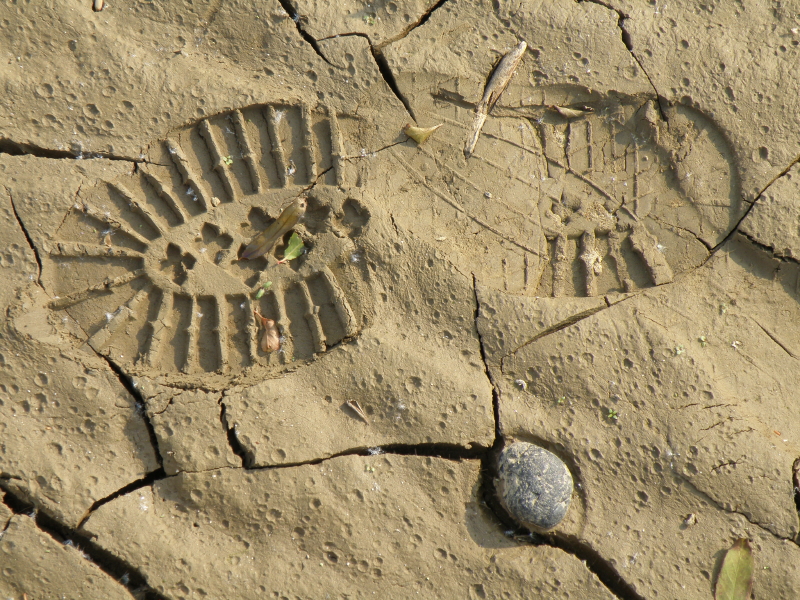
He hit upon the idea that collecting and carrying these soles might provide him some peace of mind or insight into his fellow beings?  Each sole was a record of a lived life with their scuff marks and pressure points compressed into the very sole itself.  The sole was a record of an individual’s life experience and no two souls were bound to be alike. The old adage about not knowing a person until you walked in their shoes hit home like never before.  I asked him was it working…making him less angry?  He said that it did.  His negative feelings were replaced with something akin to empathy for he understood that he was not much different from the former owners of these shoes.  It made him feel less “high and mighty” and more of an equal stakeholder for the many conversations to come.  After a few more photographs, I bid my new friend good luck.  Leaving him, I placed one foot in front of the other and headed for home on this hot day.

Read Full Post »

Frequent visitors to the old Riverblog may have noticed my penchant for posting images of wheels and tires that I find at the Falls of the Ohio.  Far too many automotive tires find their way into the river and many of them wash up here where they comprise omnipresent elements on the shoreline.  In addition to being more physical junk…they have also insinuated themselves into my imagination much as Styrofoam has.

When I see a wheel…I see an abstract portrait of our kind.  Through the cleverness of our minds we have invented such a simple device for first harnessing the power of nature to eventually “mastering” it.  It doesn’t surprise me to read that many experts consider the wheel to be our most important mechanical invention.  If you dispute this think beyond the ox cart and potter’s wheels…try imagining our world without gears, cogs, time pieces, jet engines, and the hard drive of your computer and more.

From what I’ve been able to find out, the wheel has been around for about five thousand years.  The oldest depictions come from Mesopotamia, but other cultures seem to have “simultaneously” invented the wheel too.  A lot depended upon domesticating draft animals to provide the power necessary to move a load.  In the New World…the ancient Olmecs knew of the wheel and used it on pull toys, but since they lacked draft animals their use of this invention was limited.  In more recent times, Industrialization and the harnessing of other energy sources has greatly and forever expanded the role that wheels play in our lives.  We have come a long way since the Neolithic.

Apart from objects, wheels also have other rich associations.  In many cultural contexts…wheels are also potent spiritual metaphors.  The Yin and Yang symbol can be thought of as a wheel.  The flag of India features a wheel which represents Dharma or the law.

The cyclical nature of things has me thinking about the changing of the seasons.  Spring is giving way to summer and it looks like our Memorial Day weekend is shaping up to be a beastly hot one.  Time is flying by.  Although I’m not a fan of auto racing, the annual tradition of the Indianapolis 500 is also set for this weekend.  I couldn’t help noticing that one of the symbols associated with this race track is a tire with wings!

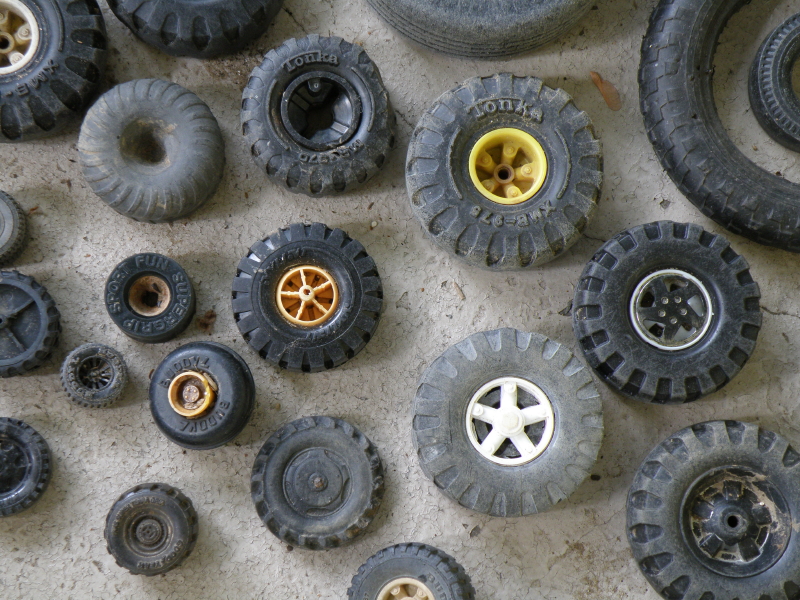
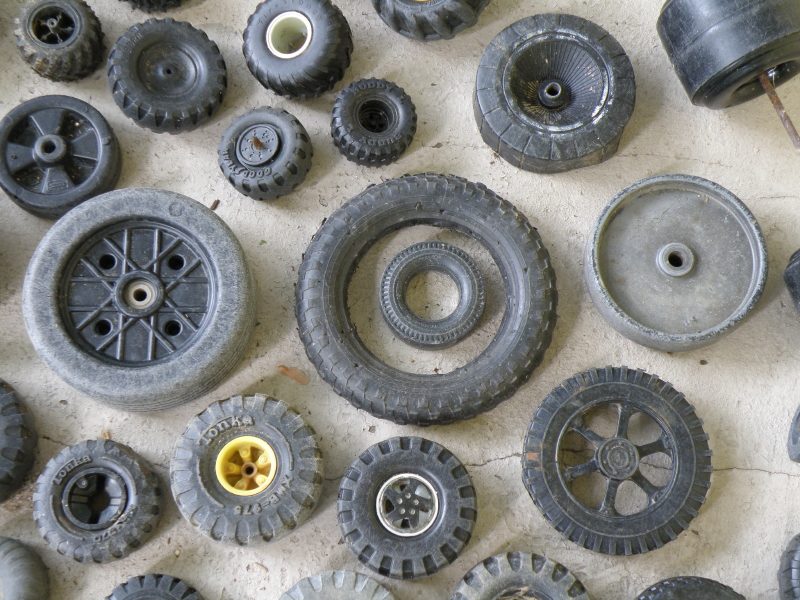
When I go to the river, I bring a canvas collecting bag to store my finds.  I have more than one bag which I usually store on the front porch of my house to await later sorting.  As I have mentioned before…I have a very patient wife who with usual good humor, puts up with my obsessions!  It is this cycle of sorting through the junk that is the inspiration for this post and I had three full bags that had among other objects, toy wheels that have caught my eye.  I knew I had been picking them up of late, but hadn’t realized the collection I had formed until I laid them out.  With the exception of the odd skateboard wheel…my collection comes from toy trucks and vehicles where the heaviest load they have borne has come from the imaginations of children.  I like how they look visually and apart from that…I’m not sure what I will eventually do with them all!  Perhaps I will make some other metaphorical vehicle some day?


Read Full Post »

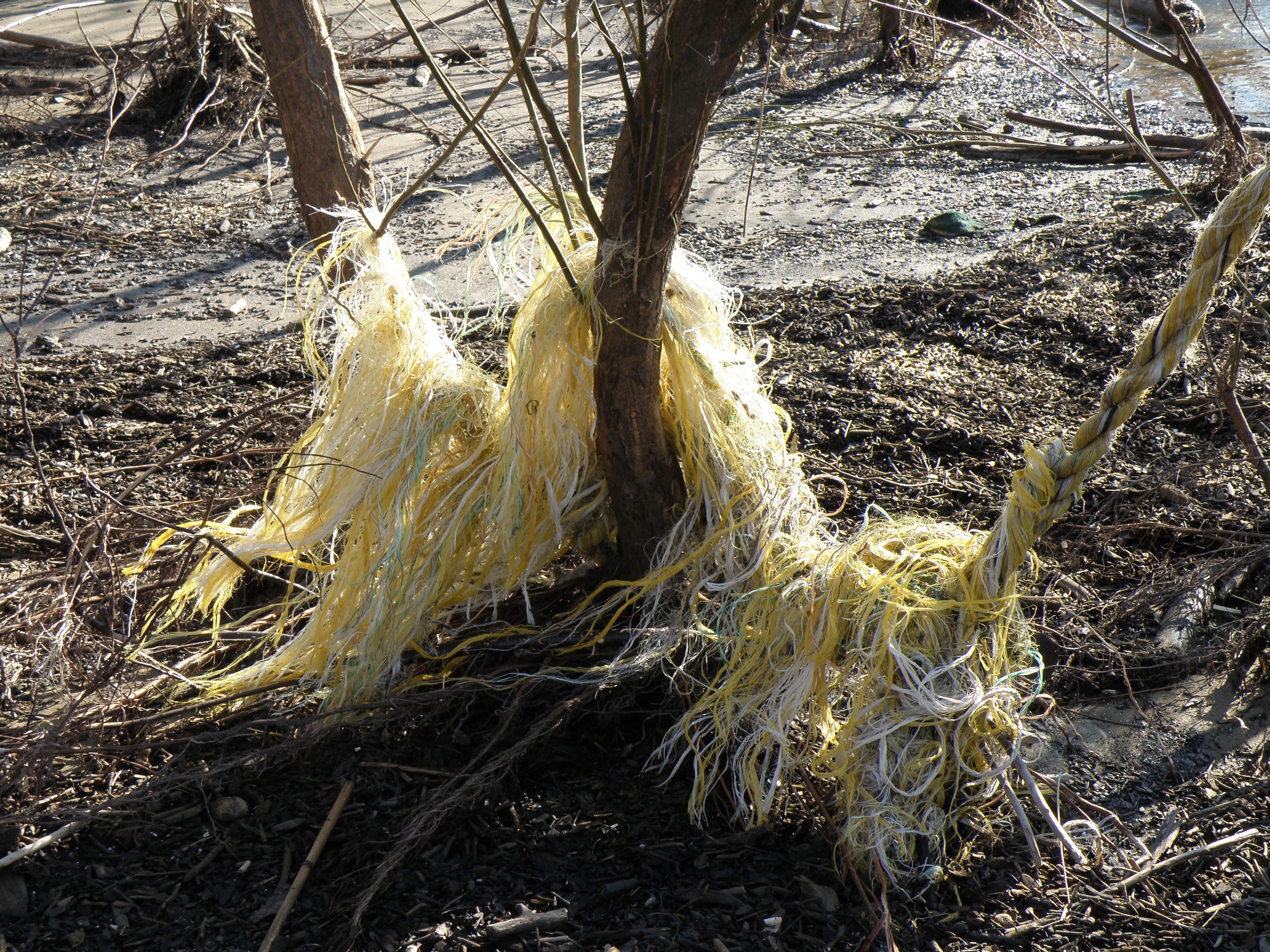
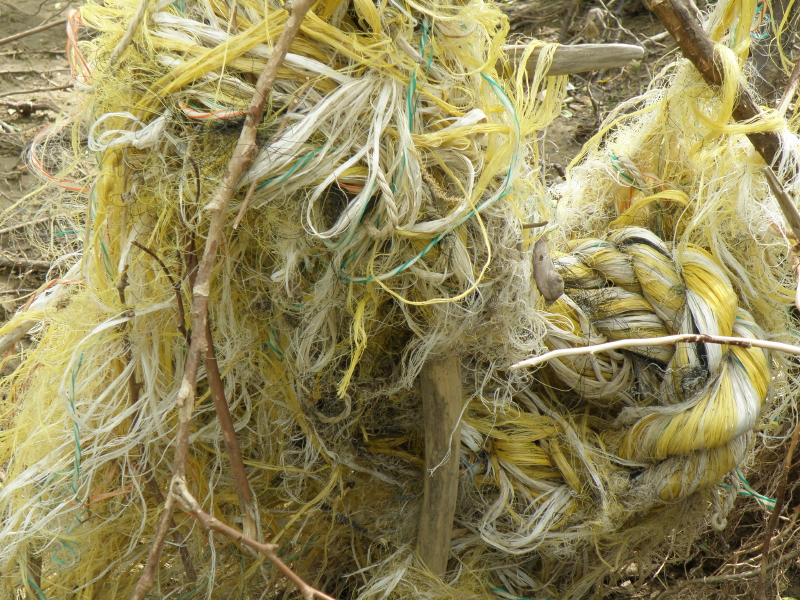
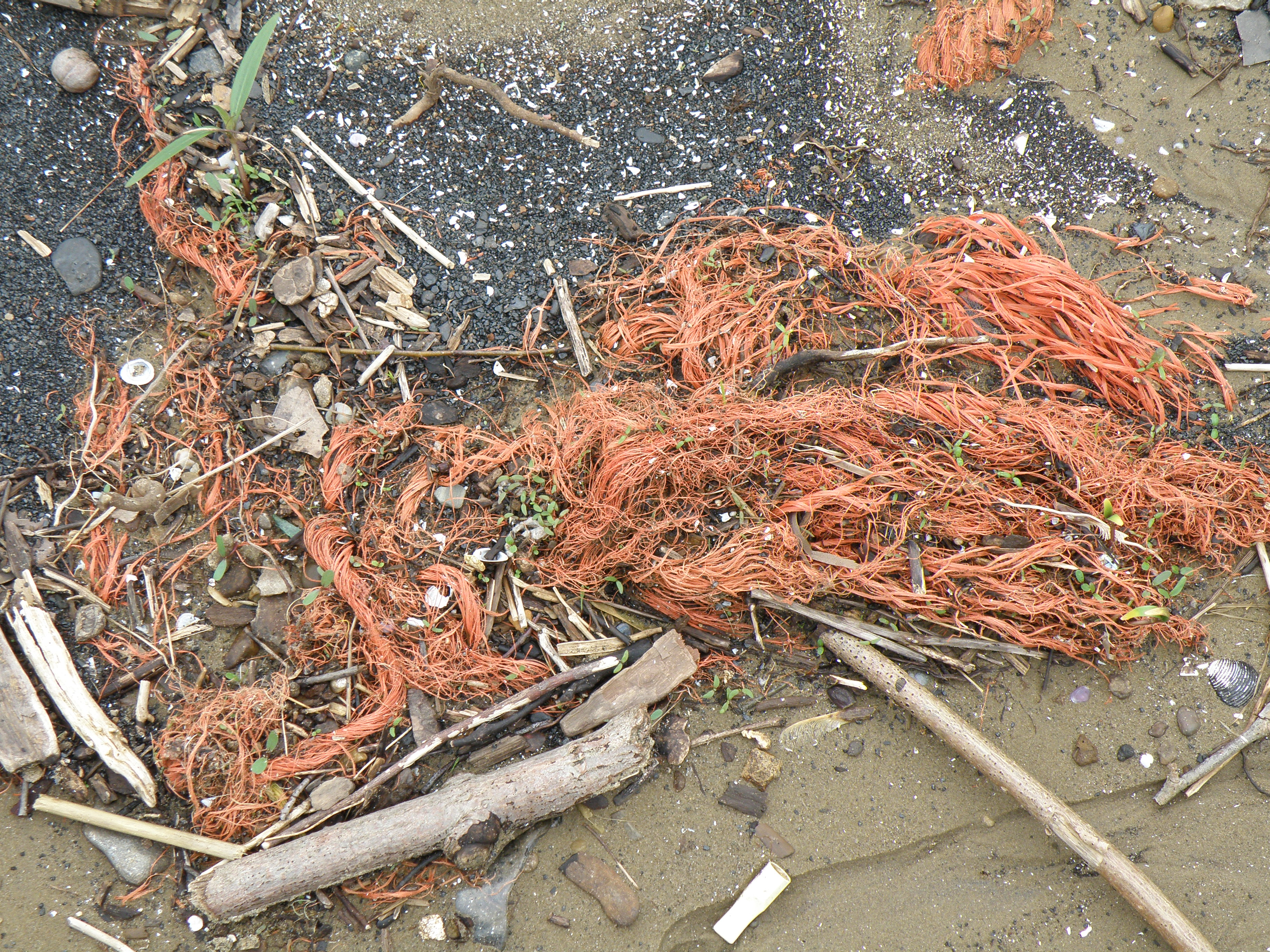
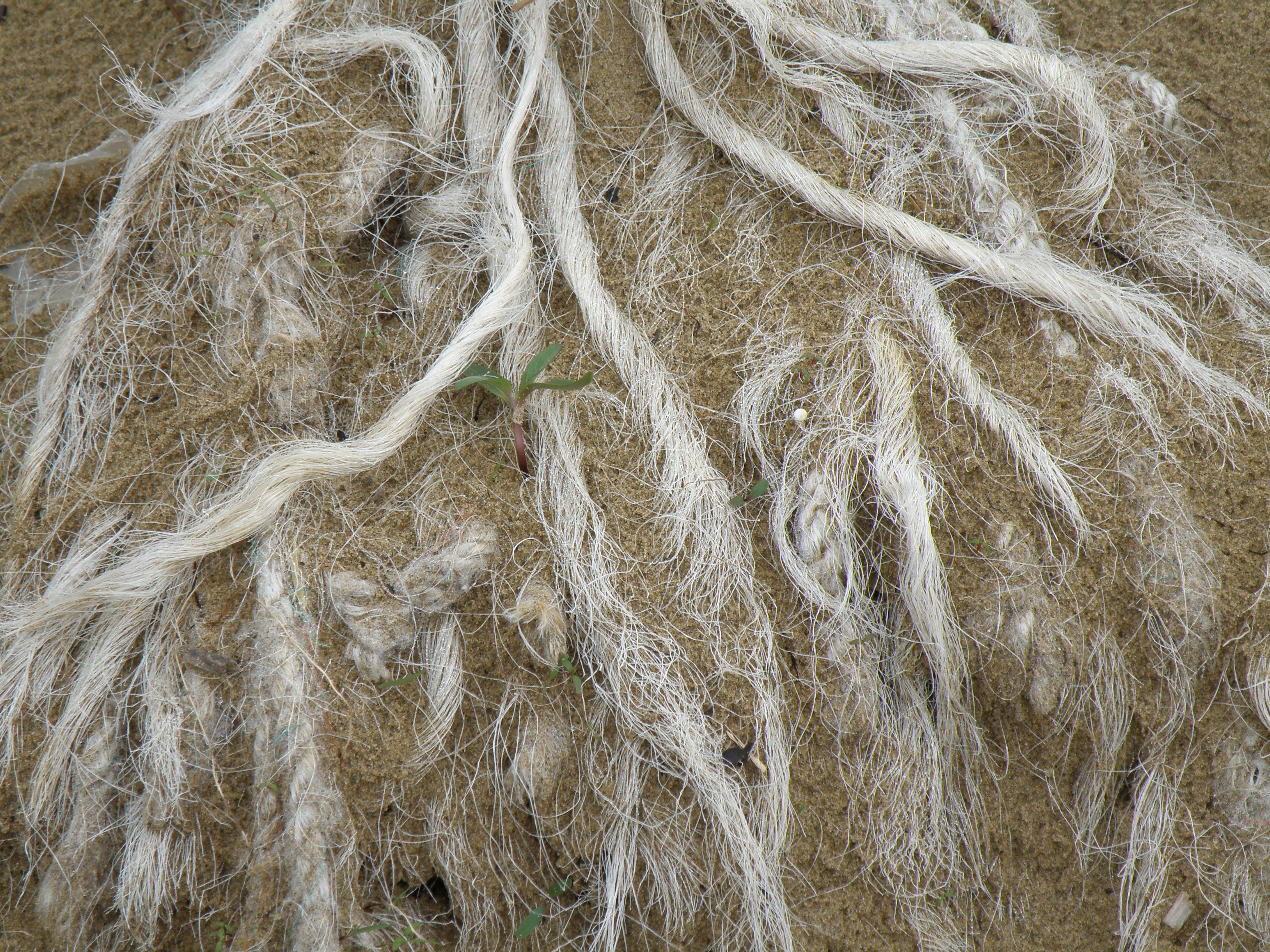
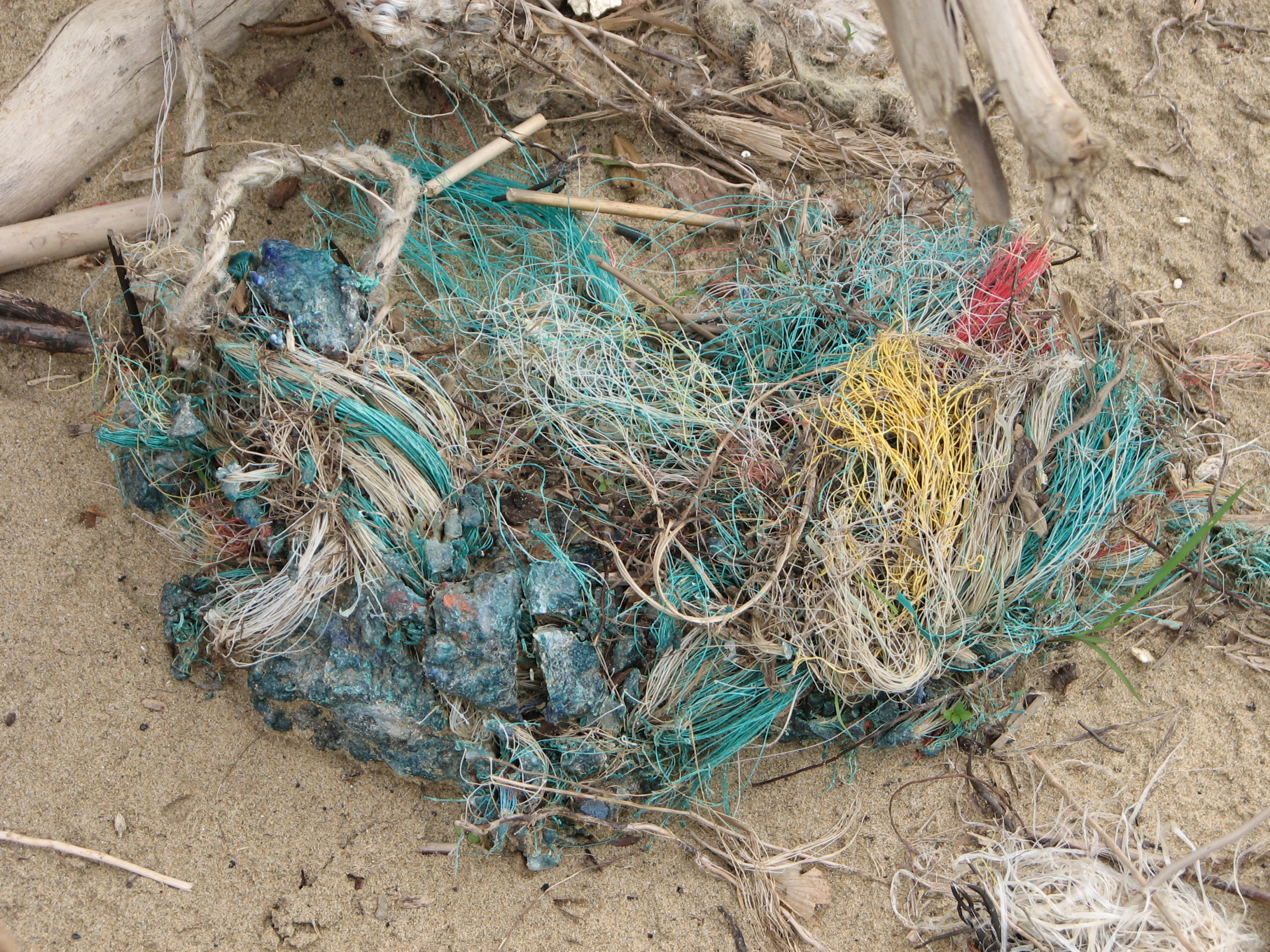
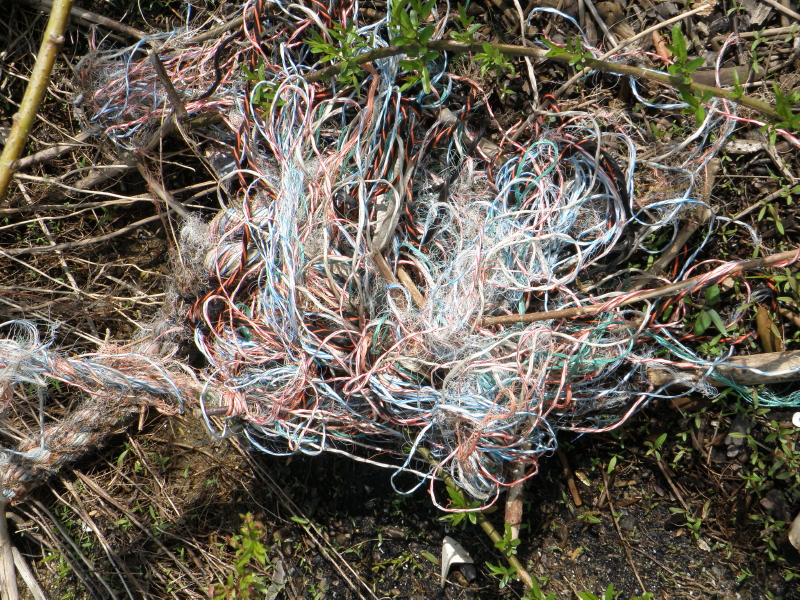
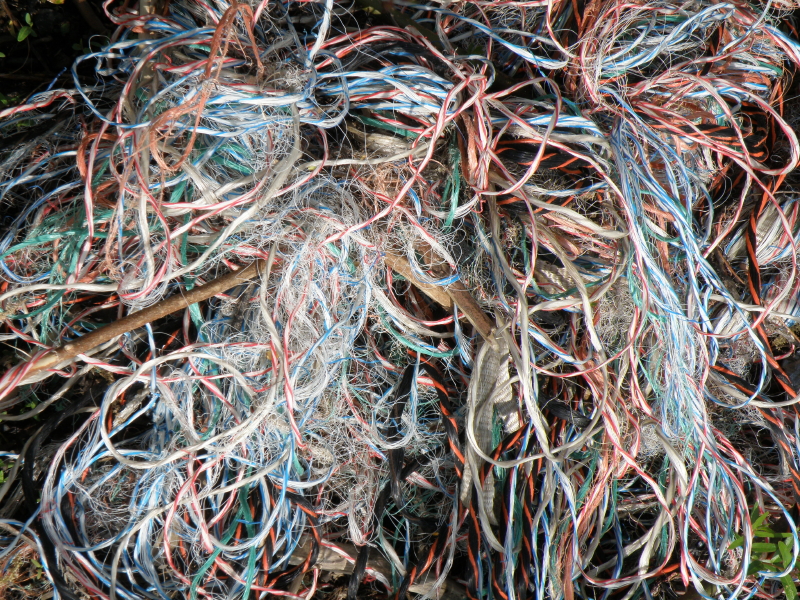
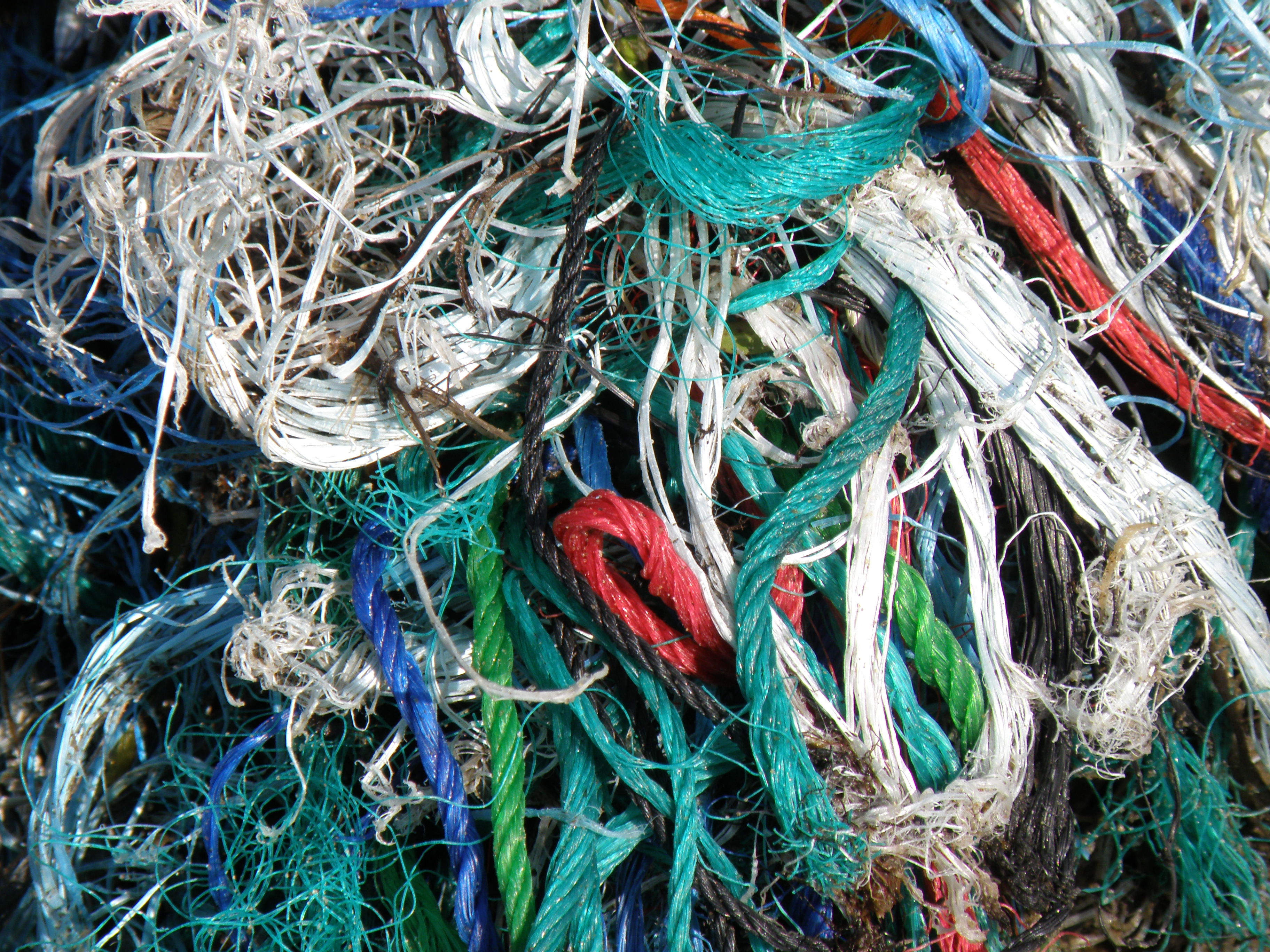
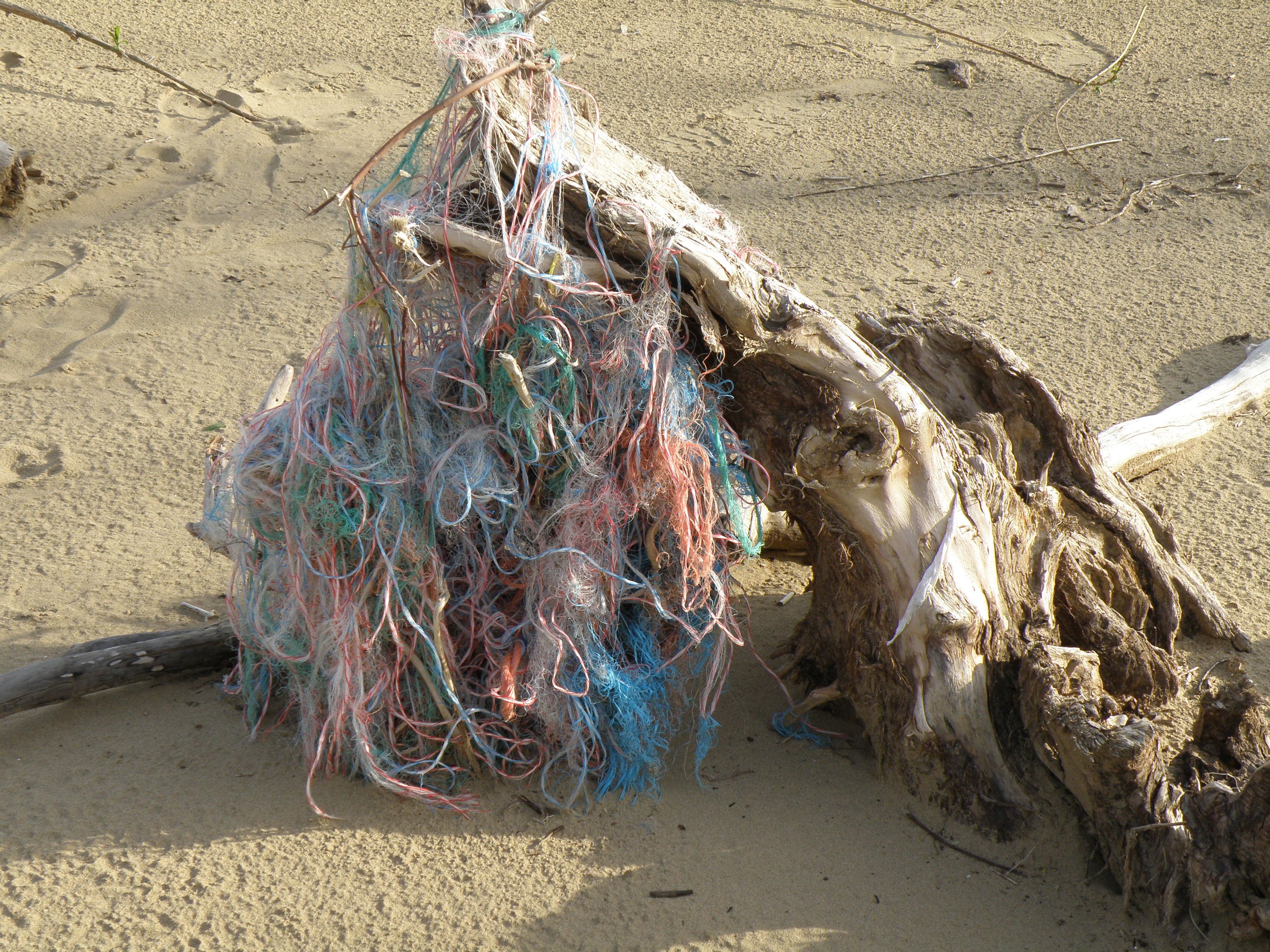
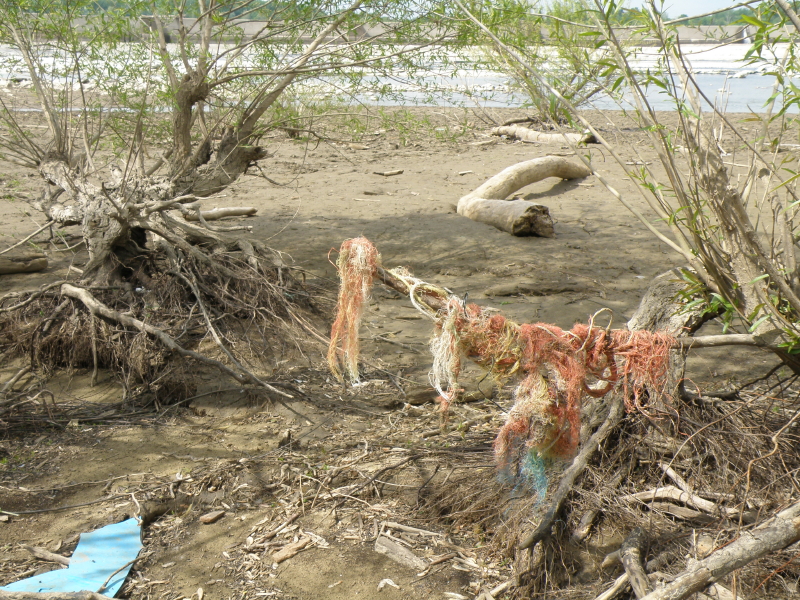
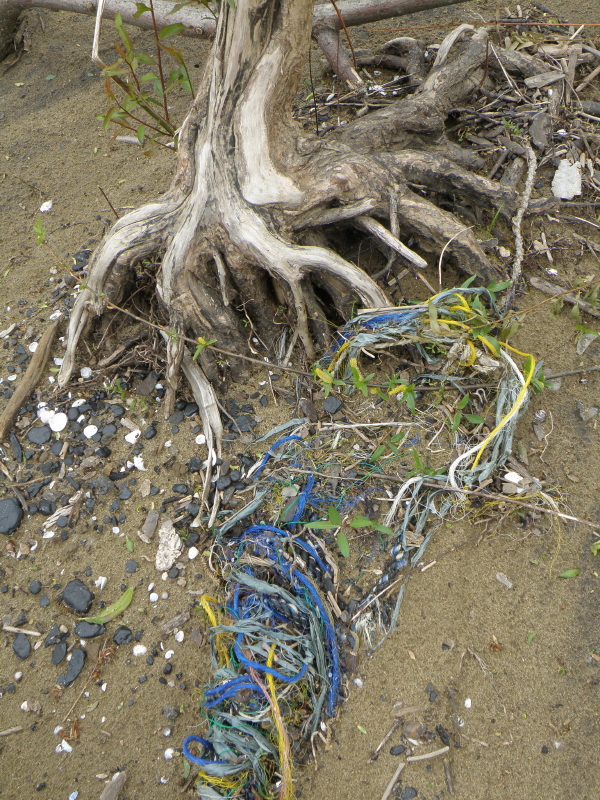
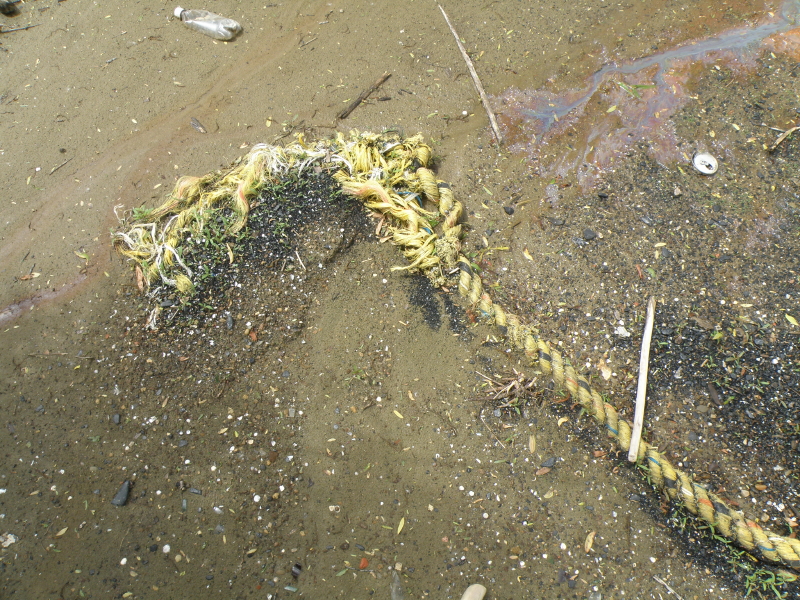
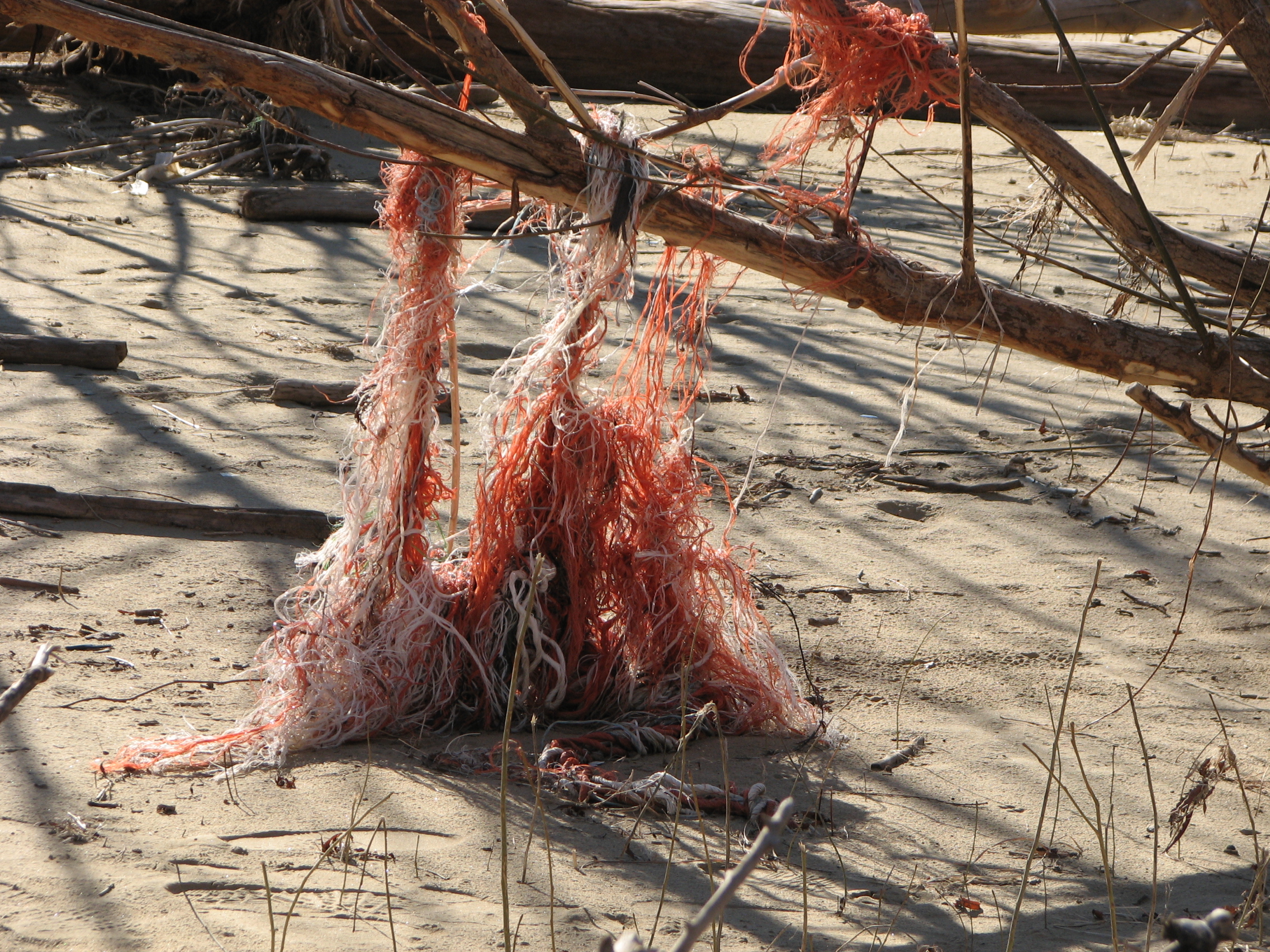
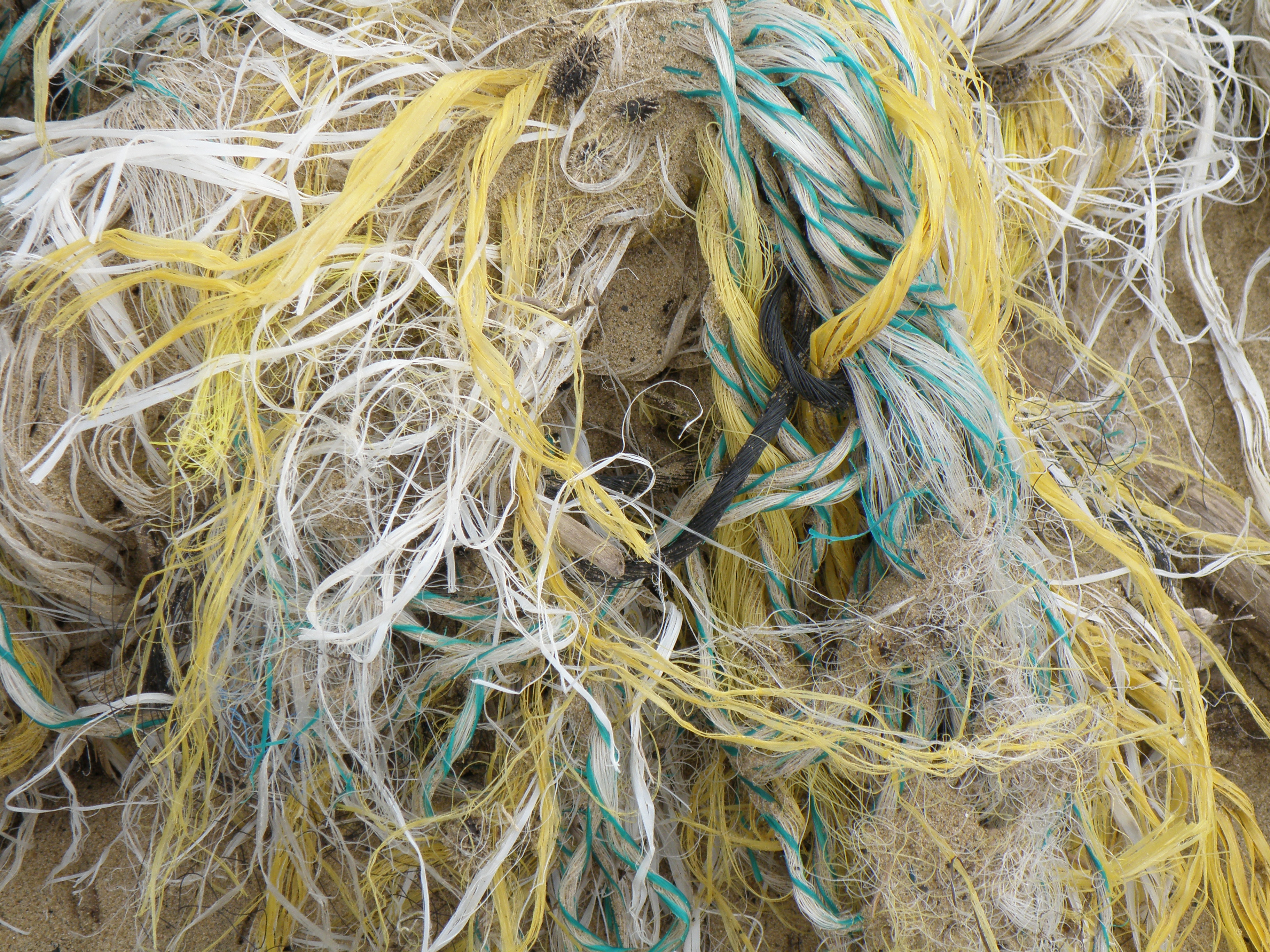
Previously,  I mentioned how interested I had become by the frayed barge cables I was finding tangled up with the willow trees at the Falls of the Ohio.  I really liked watching the process of change as these big synthetic ropes broke down through river power and dissolved back into nature as artificial raw materials.  I have also used these ropes to broach the subject of quantum mechanics (something I profess to really know very little about except that I like the idea of the universe being composed of nearly invisible vibrating strings ).  It’s also about all the interconnectedness of the world and the literal fibers that hold it all together. At the Falls of the Ohio, our material culture engages the natural physical materials and forces of the planet in a way that can be photographed.  Here is a portfolio of some of my favorite rope and string images.

Read Full Post »

« Newer Posts - Older Posts »