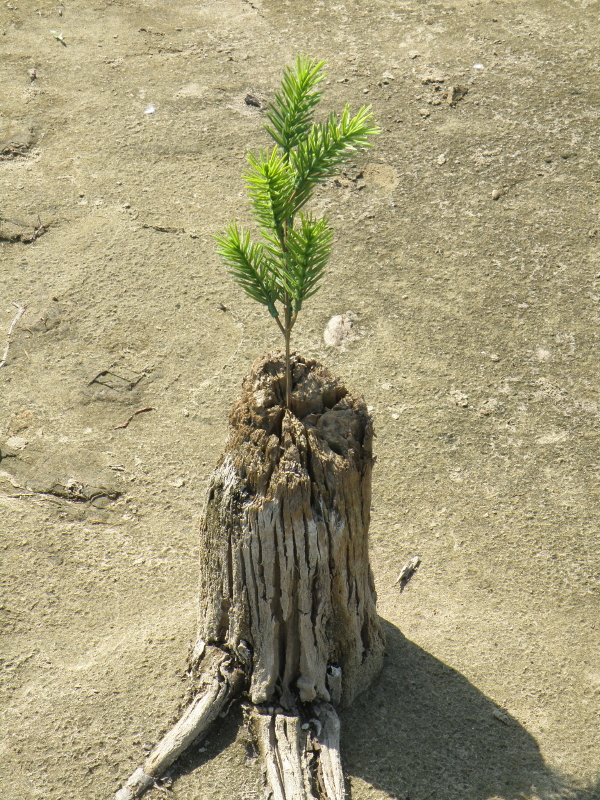
 I consider this a great honor that fellow blogger Isaac Yuen focused one of his posts around my art projects from the past year and the tales I’ve created around them. For several years now, I have enjoyed Isaac’s award winning blog Ecostories. He has made me a believer in the power of the spoken and written word to convey universal truths particularly when they speak about our evolving relationship with nature. Stories are important and everyone has a story to tell. Isaac has a great way of taking on complex narratives and making them understandable. I encourage you to check out his thoughtful, positive, and beautifully written blog.
Archive for the ‘collections’ Category
Into the New Year, 2014
Posted in Absurd, Art, art and environment, birds and birding, collections, creativity, ecosytem, environmental art, Falls of the Ohio, fresh water, nature, Ohio River, recycled art, Styrofoam, tagged Art, artist at exit 0, duck decoy, Falls of the Ohio, flotsam and jetsam, found objects, fresh water, Mr. Potato Head, nature, photography, plastic, Styrofoam, the river on January 5, 2014| 12 Comments »
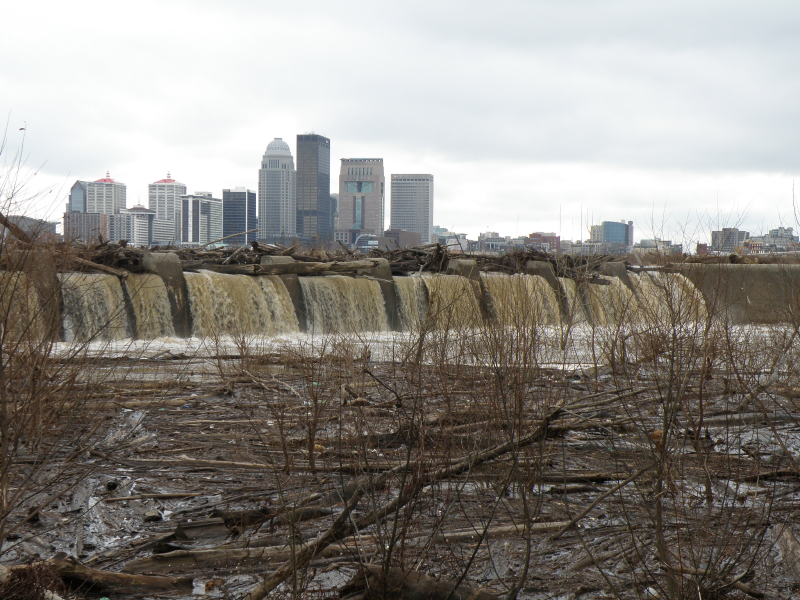 Happy New Year everybody out there in blog land! I want to thank everyone over the past year who have dropped by to check out the latest from the Artist at Exit 0 at the Falls of the Ohio State Park. This year is shaping up to be much like the previous one. Which means both man and nature are predictably unpredictable with a sense of timing not easily plotted. Since the holidays, the Ohio River has been up and much of the park that I access has been underwater. That in itself is not news, but the length of time the water has been high has been. It all points to heavy rains and snows in the northern part of the Ohio River Valley and water flowing downriver. The forecast at the time of this writing is not encouraging with showers turning to snow today followed by a precipitous drop to sub-zero degree temperatures. This cold could be historic for us and so far we have received more snow than in recent winters. I think I will stay indoors today! Since my last post, I have been to the river twice (including New Years Day itself) to see what there is to see and experience. Here’s a synopsis so far.
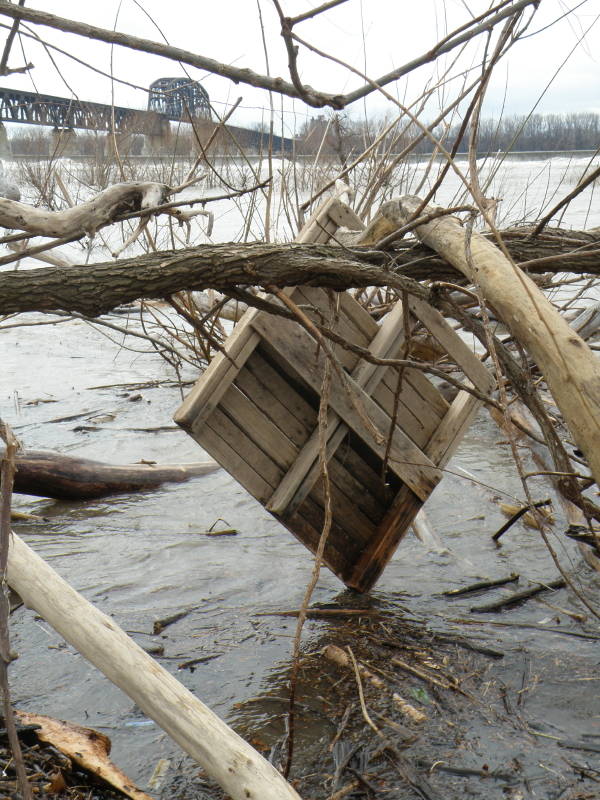 Between rising and falling waters I have been able to skirt around the edges. One thing that unfortunately hasn’t changed is the junk in the river. I’m always interested in what gets stranded in the trees like this wooden pallet that has a corner delicately balanced on the surface of the river. It’s cold out here and despite being warmly dressed, my eyes and nose water from the bit of wind that is also present.
 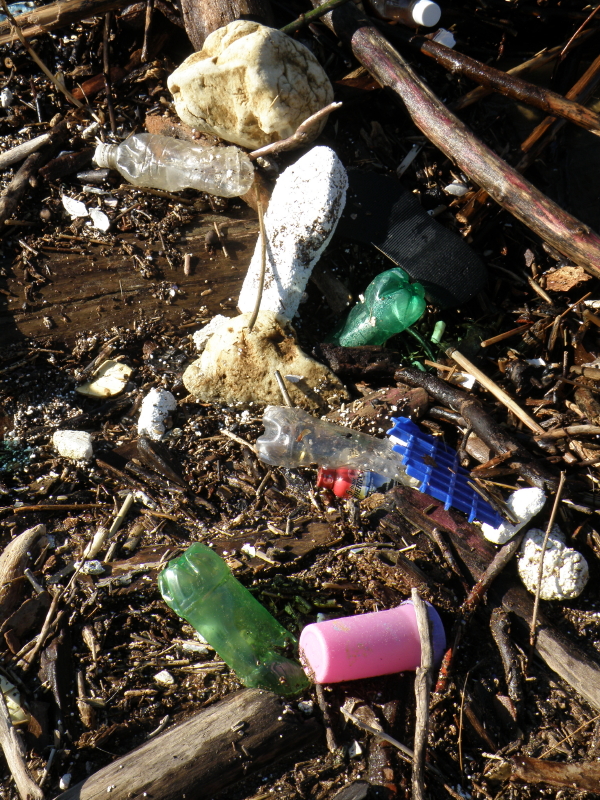 At the water’s edge is a mix of debris. Most of it is natural with driftwood, wood bark and bits being the most prominent. Trees that have surrendered to the river are rolled against other logs by the waves and the grinding (which can be very audible as well) knocks the limbs off with a loud crack and chews the bark away from the trunks. Intermixed is various man-made and colorful junk that is mostly plastic in composition which also gets masticated by the river. The above photo is fairly typical with lots of polystyrene fragments which also make up the core of my art materials. Most artists have positive feelings for their materials, but I have a love /hate relationship with mine. Let’s move on and see what other sights are along the river in this new year.
 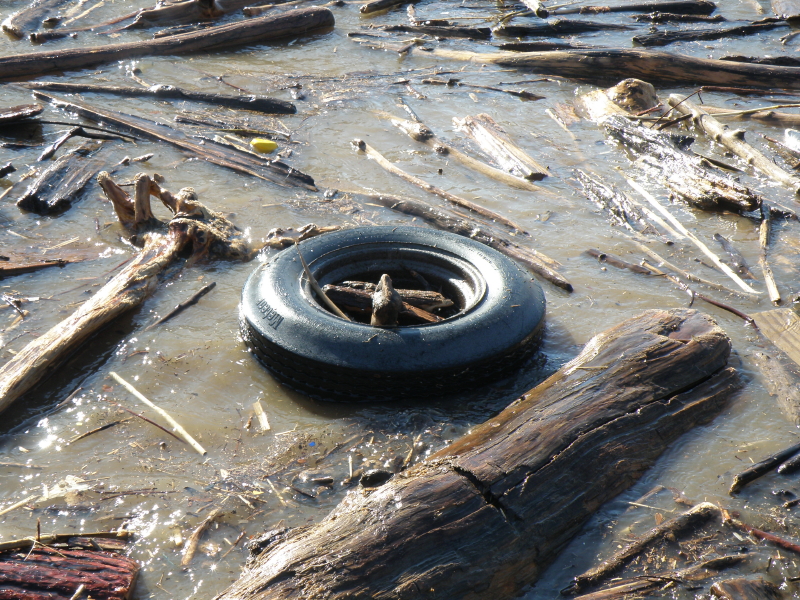 Floating tires always catch my eye. Their blackness and circular perfection contrasts sharply with the rest of the objects on the river’s surface. A short distance away from this wheel I find a dead steer at the water’s edge.
 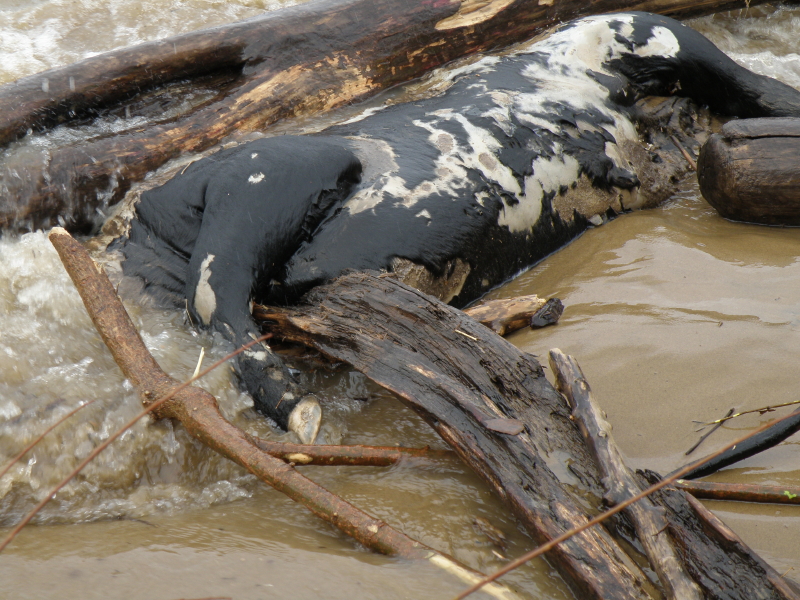 I debated with myself whether to include this distasteful image in this post, but decided to do it since it represents some of the truth that is in the river. Pictures of man-made trash are one thing and have an almost benign aura to them by now, but something that was once alive registers in a different way. The gravity is far heavier. This poor cow is the largest dead animal I have encountered in the park. Dead deer and other smaller animals are not too unusual in the river. No telling how far this unfortunate animal has floated to arrive here? Rising high waters could once again carry it away. I take this picture and walk on.
 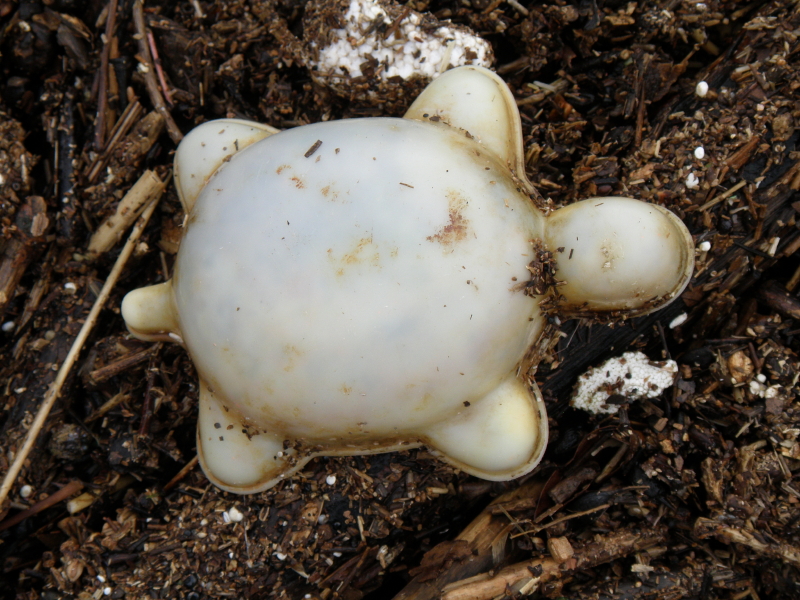 There are other objects that the river has delivered to the park like this plastic turtle sand mold. Having gone through my river collections recently I discovered that turtles are among the most common subjects for sand molds. Who knew? I have found six or seven of them and they are all different like the plastic hamburgers from a recent post of mine. Here’s something else to add to a growing collection.
 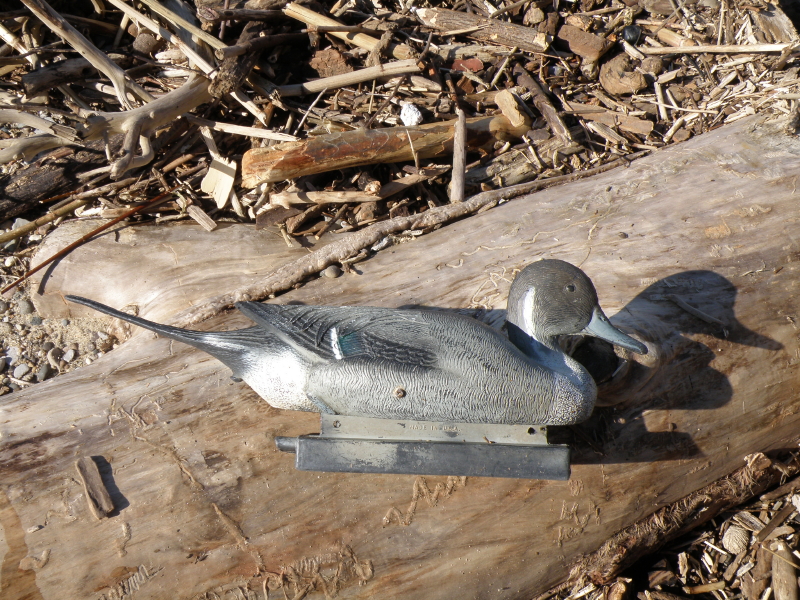 I have a Rubber Duck Collection as well and all found within the park. Truthfully, none of them are actually made from rubber and are of course composed from plastic. This is a hunter’s decoy of a pintail duck and would have been cooler had it been made out of wood…alas. I haven’t seen much of actual bird life in the park except for a few hardy species that are around all year round. I noticed that the ring-billed gulls that come here for the winter are not present. I wonder if the cold has them migrating further south this year? To mark how exceptional this winter has been, our area has seen a rare migration of snowy owls from the far north. The snowy owl is listed on the official Falls of the Ohio bird checklist as extremely rare and accidental. For me, this would be a good enough reason to journey here and this just might be the year to see one, but I haven’t heard if any were actually seen in the park? A short distance away from here, a snowy owl in a weakened condition was rescued by our local raptor rehab folks and is being nursed back to health.
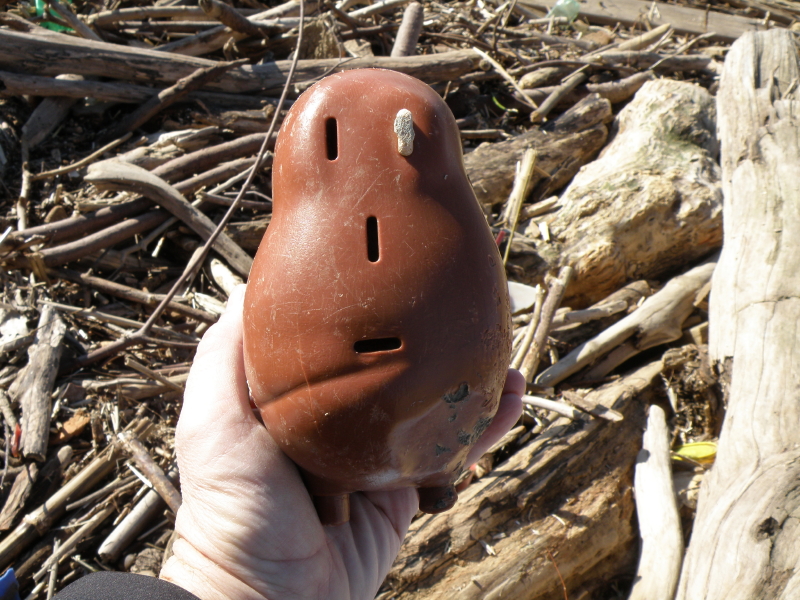
Here’s a test for you. Do you know what this is? Time’s up…this is the plastic body of a Mr. Potato Head toy! I count Mr. Potato Head as one of my artistic influences for my Falls of the Ohio Styrofoam projects and this is the first one of these that I have found out here. According to Wikipedia, Mr. Potato Head has been in continuous production since 1952 (that’s a lot of plastic) and was the first toy advertised on television. I can remember as a kid…using actual potatoes to make funny faces and now I use Styrofoam.

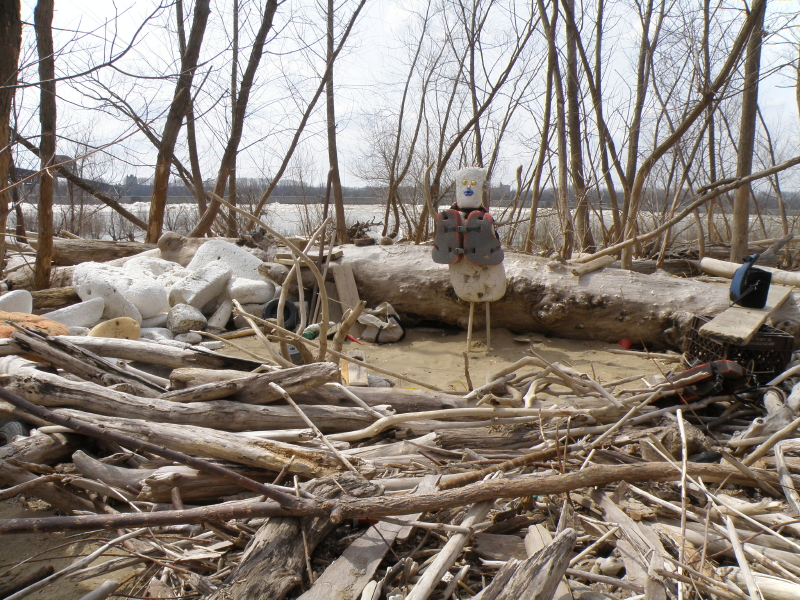
I walked up the riverbank to access my outdoor atelier and discovered that the river has swept over it. All the materials that I had cached here over the last couple of years have floated away and the large logs that defined my space are rearranged. I will need to create a new studio if I continue here. I suspect, however, that the river is far from being done and would wager we will experience more flooding in the near future. I picked up a few small pieces of Styrofoam and willow sticks and made my first figure of the new year and posed him at the river’s edge as waves lapped the shoreline.
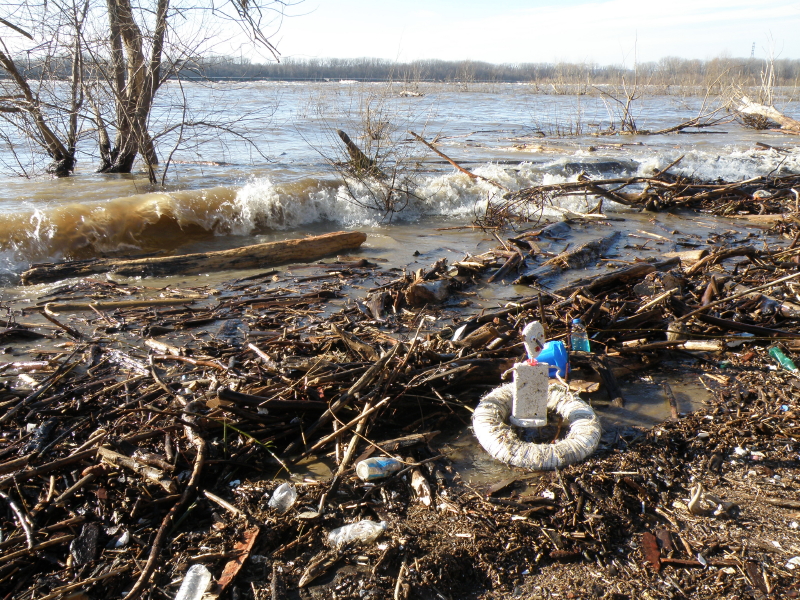
He is not a large figure and the expression on his face is one of amazement. I first posed him near the river in an old life-preserver that washed up. In addition to being expedient on a cold day it also seemed symbolic. For me, it always comes back to the river and its waters. The quality of our fresh water remains our number one vanishing resource and the river’s course is the journey we all take through life. I will continue to use my creativity at this one small spot on a large river and publish my results on this riverblog. Thanks for checking it out every now and then. As the year progresses, I hope to be like the river by being predictably unpredictable. May we all have a wonderful 2014!
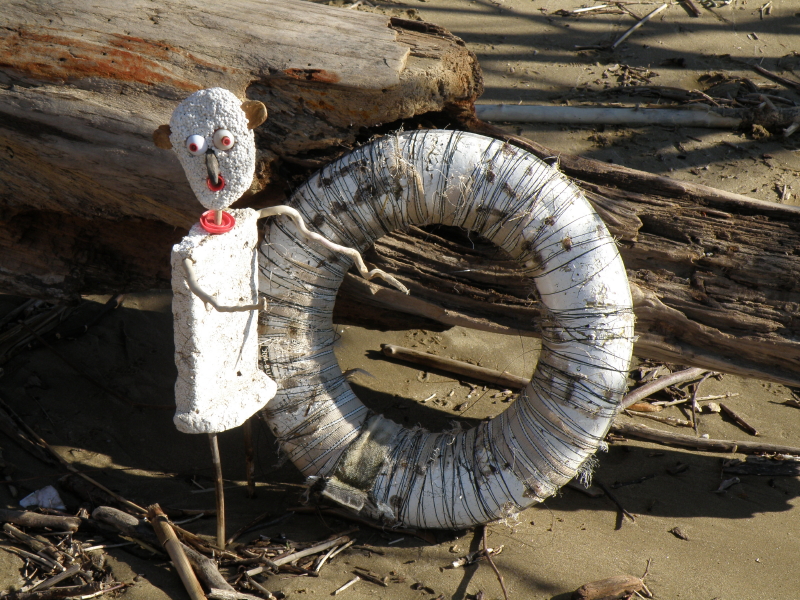
Plastic Meat
Posted in Absurd, Art, collections, creativity, Falls of the Ohio, recycled art, unusual collection, tagged absurdity, Art, artificial food, artist at exit 0, Collections, fake food, Falls of the Ohio, flotsam and jetsam, found objects, photography, plastic, plastic hamburgers, toy food on November 28, 2013| 20 Comments »
I have so much to be thankful for that I don’t need one particular day set aside to remind me of this. Nevertheless, I happily will take the next two days off from my day job, hang out with my family, eat, and of course… fiddle with my art projects! I have an exhibition coming up soon (late January 2014 at the Carnegie Museum of Art and History in New Albany, Indiana) and I have been going through my Falls of the Ohio river junk and thinking about what this show might feature of my work? It’s going to be a two-person show and so there will be a great space to fill.
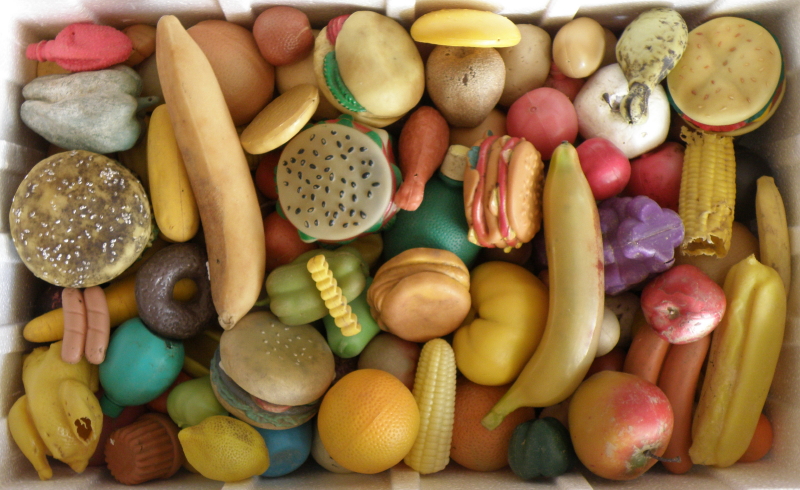
I recently went through my various river collections including my Fake Food Collection which is ongoing and I have added many new pieces over the past year. The Ohio River has been bountiful in fact over a ten-year period, it has been a regular liquid cornucopia. Although I haven’t counted each item, I’ll wager my Fake Food Collection has about a couple hundred pieces now… all of it collected one piece at a time, off of the riverbank. It’s interesting to think of this stuff as being a part of the fake food tradition. I’ve seen examples of fake Japanese sushi that look amazingly like the real thing…but not at the Falls.
After all these years, I’m still blown away…perplexed…morbidly fascinated and repulsed…insert other adjectives here…that so much of this stuff exits and that most of it is made from plastic. I’m just one person living near a river in the interior of a big country and this is what I’ve found at this single location. Do other American rivers flow with plastic produce and is it all floating towards the oceans? It’s so curious that we use a natural resource like petroleum to produce artificial food even if it is intended to be playthings. It personally strikes me as an affront to nature especially once it materially starts breaking down and merging with the substrates we depend on. Perhaps some of you wordsmiths out there will put your finger on exactly why this stuff is so provoking?
Okay…enough of that, now where’s the beef? Where’s the plastic meat the title of this post promised? I was curious about that myself and so I went through my collection and this is what shook out. Bon appetite!

Since Thanksgiving here traditionally means roast fowl of some sort…I thought I would start with a couple of roasted birds and drumsticks. Of course these items are miniature and I realize that a coin for scale would help. Okay, I’ve found my ruler and if you must know…the biggest object in the above photo is 3.5 inches or 9 centimeters long. The middle drumstick on the bottom row has a dark patina acquired from spending much time in the river.

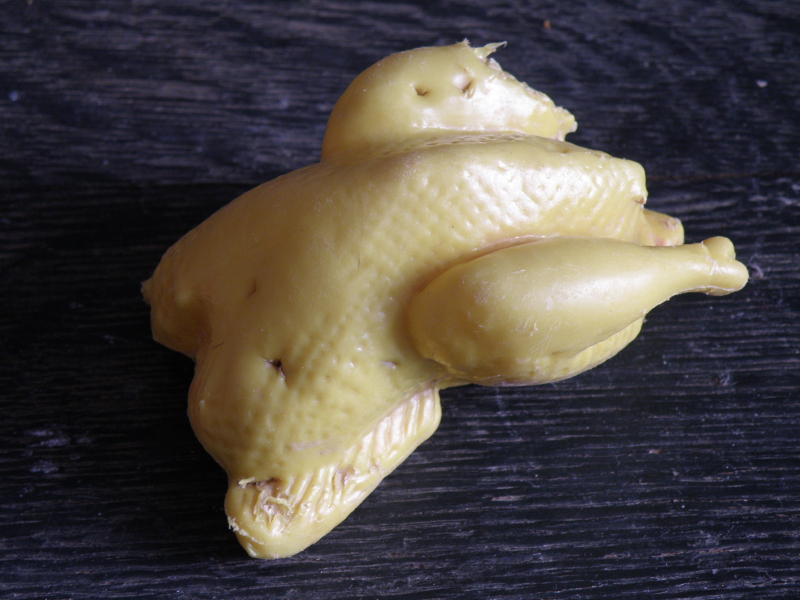
This last image of roast fowl looks like something (probably the family dog) tried to eat! Notice the teeth marks on the carcass. Now that we are done with the appetizer… let’s move on to the fake hamburgers and cheeseburgers. I know the old salivary glands are probably kicking in now!

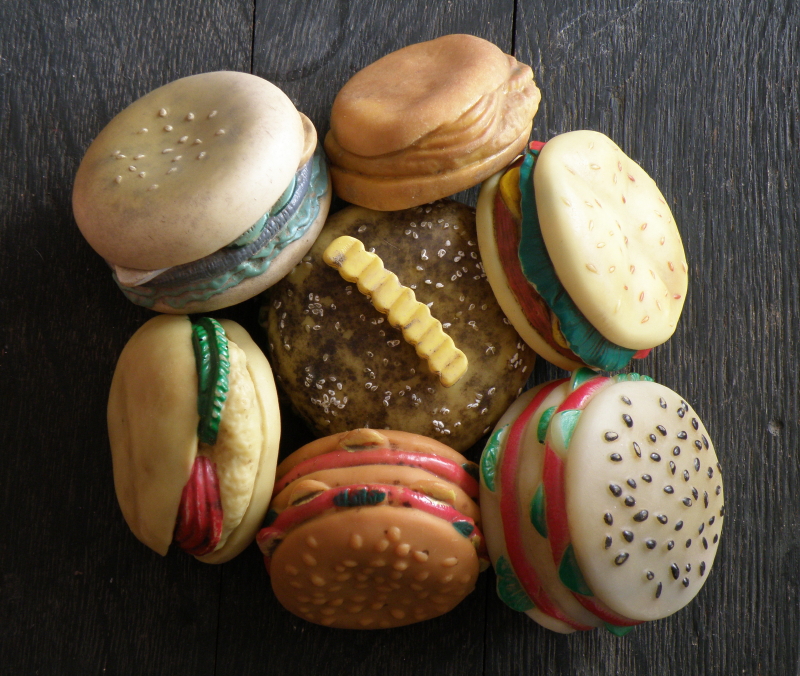
Here’s a couple of shots of the items in question. In ten years time, the river has washed up and I have found seven cheeseburgers and hamburgers, three loose bun tops, and yes…two crinkle cut french fries (only one is shown) all are made of various plastic recipes. Several of the burger toys I’m pretty sure were intended as dog toys. Some of the them still have the little squeaker in the bottom bun. The others probably came from children’s play sets. As you can see…they are variously dressed with condiments and the buns go from plain to featuring sesame seeds in white, brown, and black colors. I have some individual burger portraits too. Here’s several examples of how you can have it your way. The larger burgers are roughly life-size to slightly smaller than the real deals.

Ahhh…a black poppy-seed bun heavy on the lettuce and tomatoes.

Here’s a plain bun, segregate the tomato on one side and the lettuce on the other option. The meat here is more of a textural suggestion.
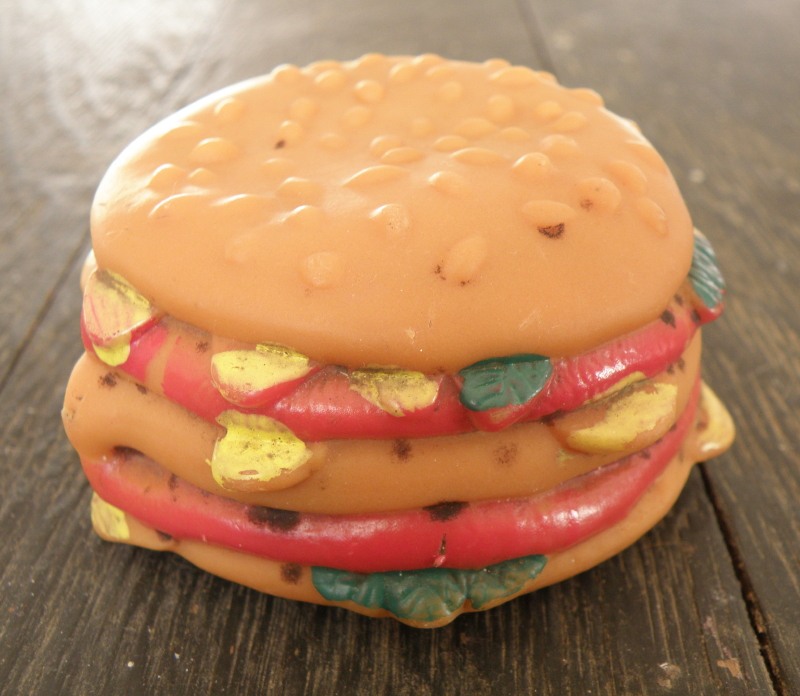
This is a gaudy burger with hints of mustard and two layers of tomatoes!

Not sure if that’s melted yellow cheese or more mustard squeezing over the edge? Looks de-lish nevertheless! If you are wondering what artificial food looks like in a natural environment…here are a two images of plastic meat as I found them in place.
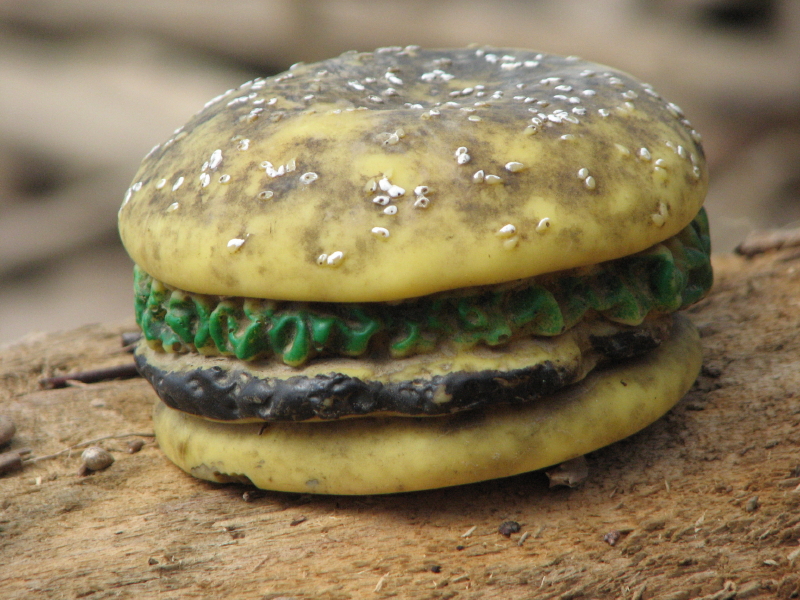
This one has white poppy seeds on the bun, frilly lettuce, and a nice grimy river patina. Let’s leave the burgers and head into new territory. First an image of our next plastic meat subset.
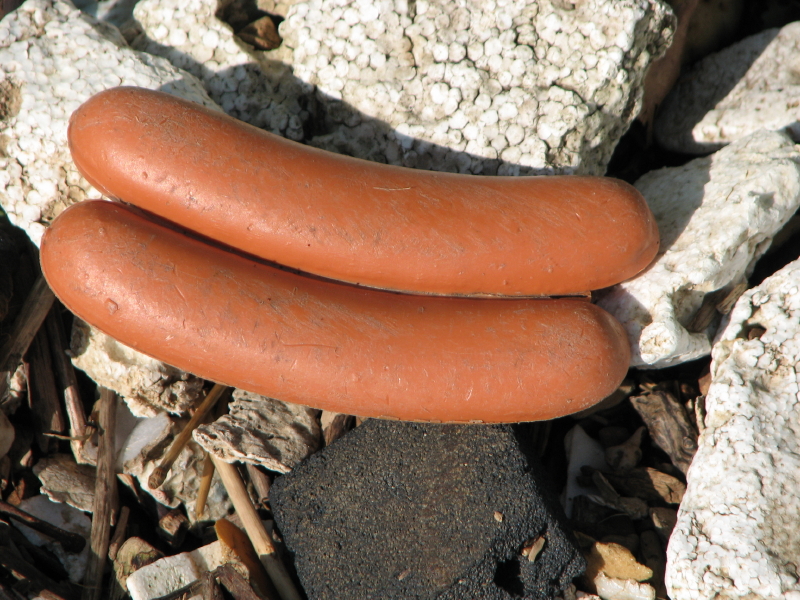
I can remember the joyful moment of finding this rare double score. Two conjoined, Siamese twin plastic hot dogs resting on a bed of Styrofoam and river sticks. Of course, I had to take a picture! Now, for a snapshot of my hot dog collection.

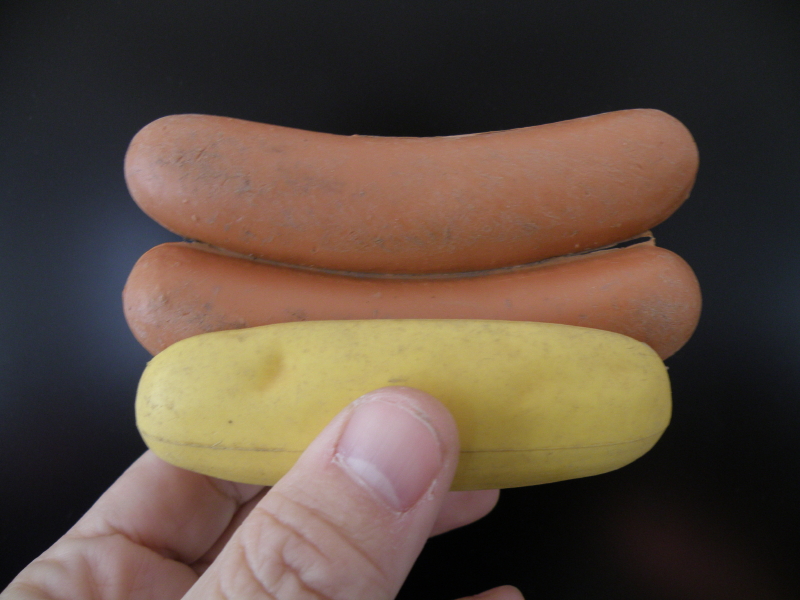
As you can see…these tube steaks and buns vary in size. The largest example at the very top has all of its paint gone, but you can see where a fake mustard squiggle would be. Perhaps some of them are actually intended to be Vienna sausages, but who knows? One particularly prized find is the Oscar Mayer Wiener Mobile whistle in the bottom right hand corner. I’ve propped it up on a plastic french fry to get a better side view. There are plastic meats that I know are out there (like fake steaks or even slices of plastic pizza with f aux pepperoni), but I have yet to find examples by the river. I do have a code I go by…unless I find it at the Falls of the Ohio…I won’t compromise my collection with non-Falls items. It’s a part of the quest and fun of what scrumptious simulacra will turn up next. Is Rack of Lamb or Pot Roast on the menu…only time will tell? For now, I will content myself with this Double Decker Dog…Happy Thanksgiving from the Falls of the Ohio.
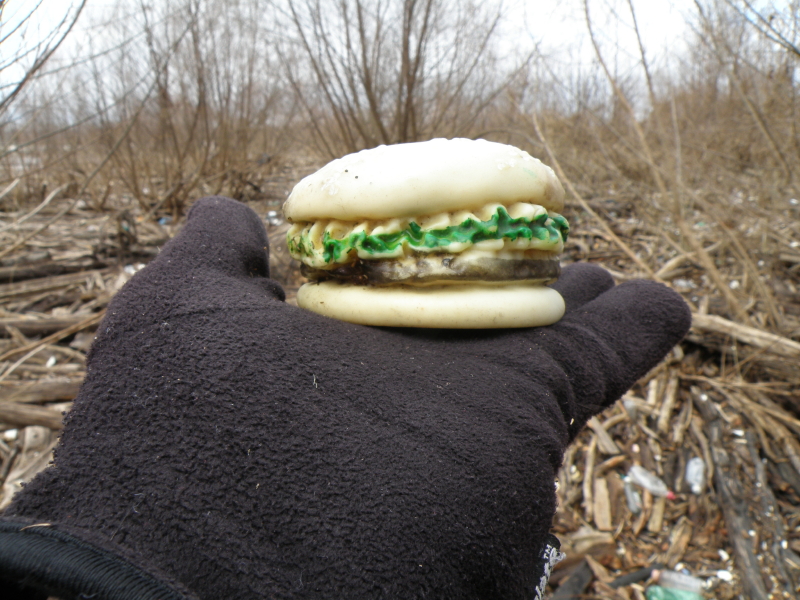
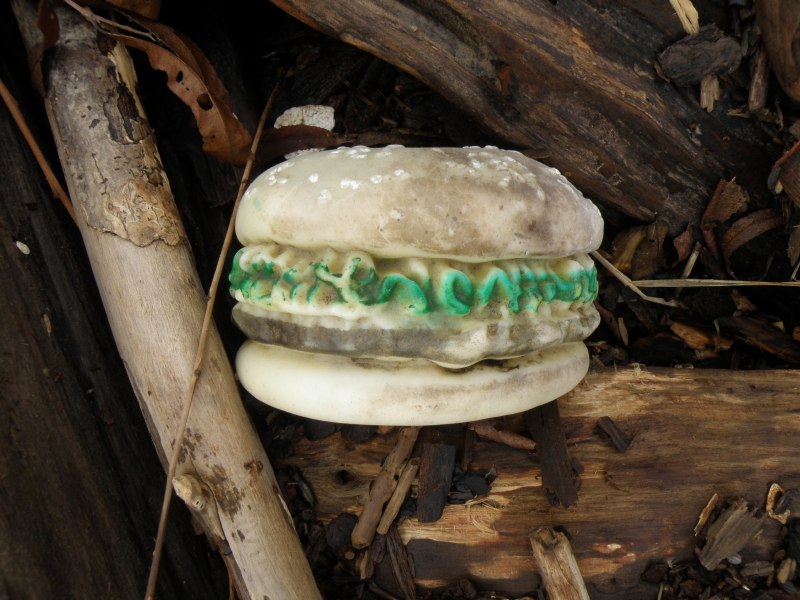
Postscript: Less than a month after publishing this post…I found plastic hamburger combination #8 in the late December driftwood. Here’s a couple of images made in the field.
La Belle Riviere
Posted in Absurd, Art, art and environment, collections, creativity, environmental art, Falls of the Ohio, Ohio River, public art, recycled art, tagged Art, artist at exit 0, Falls of the Ohio, fossil rocks, found materials, giant necklace, La Belle Riviere, nature, photography, recycled art, repurposed art, sense of place, site specific artwork, softball core, willow trees on October 23, 2013| 30 Comments »

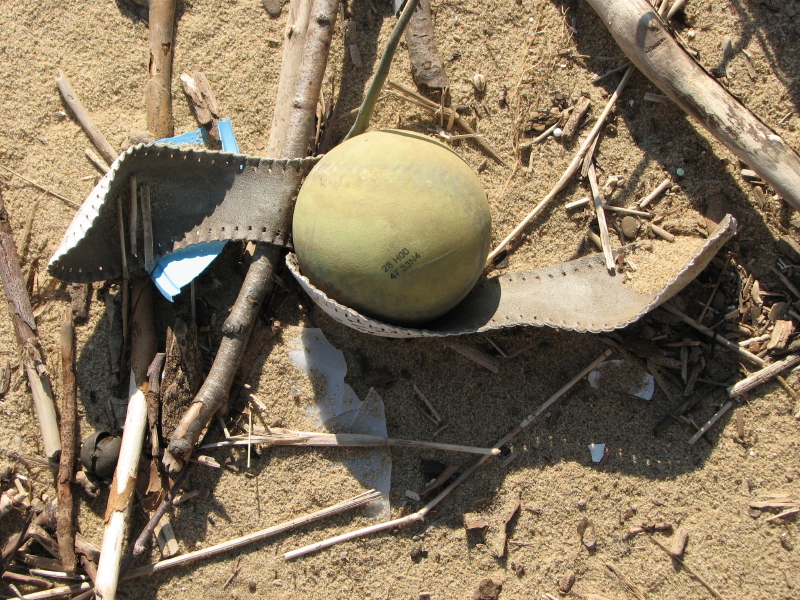
It started with one. I had been picking them up for years…odd, yellow ocher orbs that the river marooned in various sections of the Falls of the Ohio State Park. Initially, I was intrigued by them because I knew they had to be something, but what? Early on I formed this association in my mind that these balls were giant pearls and they were gifts to me from the beautiful river. Made from a lightweight yet solid, hard foam, these balls weathered in very individualistic ways. Many of them had acquired a nice patina from their river journey perhaps floating long distances for many years. For a while, each time I would go on one of my excursions to the Falls of the Ohio, the river made sure that I would stumble upon one or more of these balls. Into the collecting bag they would go. Eventually, I found out what kind of balls they are and in case you haven’t guessed yet…here are a couple more images that will reveal what they originally looked like. I’ll start with one of these balls in the process of transforming, followed by one that is more intact.
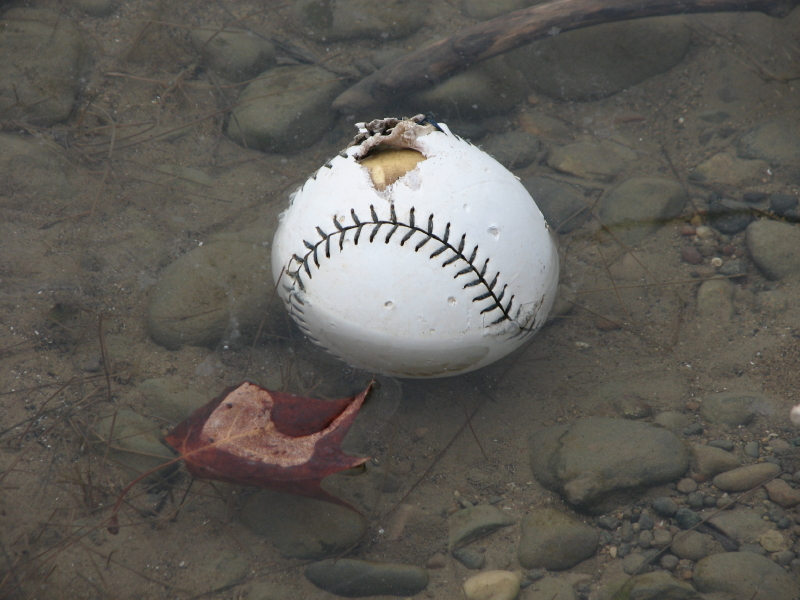
My river pearls are the cores of contemporary softballs. How did all these softballs end up in the river? When I was a kid, a softball had a hard rubber ball in the interior which was surrounded by what seemed like miles of string wrapped tightly around the rubber ball. A two piece leather cover was then sewn over this “string ball” which completed the softball and was now ready to be played with. For those who might be unfamiliar with softball…it’s a game similar to baseball, but the ball is about twice as large as a standard baseball. I collected these softball cores for years, but especially during the early phase of my Artist at Exit 0 Project. After each river trip I would dutifully fill up boxes in my home’s basement with my found balls and then forget about them. Over time, I started picking up lots of different objects and using them in various ways as materials for my sculptures or as offbeat collections of odd items I was creating. I guess I always knew that I would return to these balls and make something interesting with them someday. That day arrived last week.

I had no idea how many of these balls I had collected or passed up over the years? This recent photo taken in my Louisville backyard shows about 110 out of the 160 balls I did save. I decided to act on my river pearls idea by making an impractically large pearl necklace. I carried all the balls I had to my friend Tom’s sculpture studio and used his drill press to drill a hole through each ball. That was a bit more of a technical challenge than I had first conceptualized. Most of these spheres are not perfectly round. In fact their imperfections (which I really like as evidence of wear by the river and elements) made each drilling a unique experience. Eventually, I got the job done and laid out many of the balls on the concrete pad in my backyard. Just as I was beginning to thread and knot braided nylon cord through the balls…the sky let loose a monstrous rain storm. By day’s end, nearly seven inches or 17.5 centimeters of rain fell and flooded parts of my backyard and basement! It was like being visited by the river in an interesting way. I had initially “graded” each ball by condition and color to form transitions in this giant strand, but the water and now mud from my backyard changed the color of each ball. I decided to make my first piece one hundred balls long. There is a knot tied with the cord that keeps each ball from touching. At my local hardware store I found a brass hook that I could use for a clasp to close my giant necklace. All that was left to do was to return to the river…to the place that I found all of these balls and inspiration and find a way to give thanks for these many gifts.
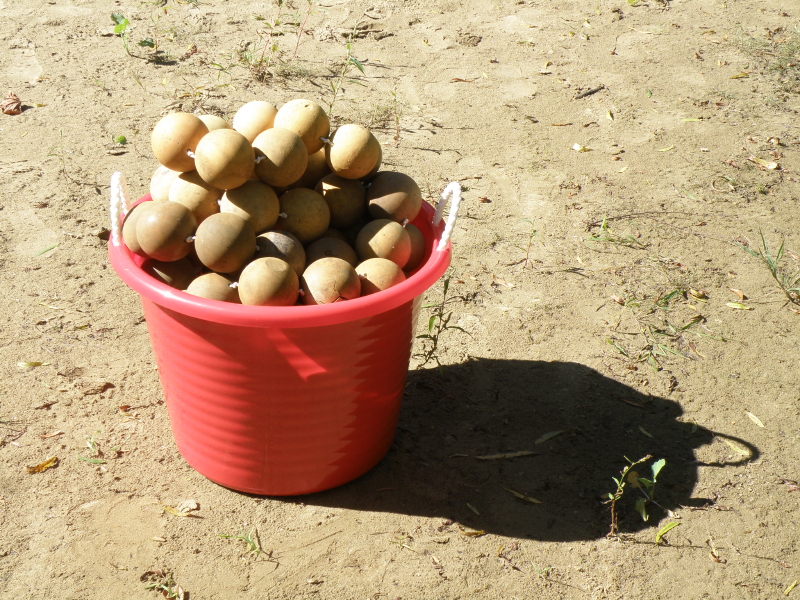
Loading the necklace into a large red plastic tub I carried my artwork down to the Ohio River. One hundred balls became surprisingly heavy and I was concerned about twisting an ankle or tweaking my knee as I walked over the driftwood. I came to a sunny place under the railroad bridge and laid the necklace out upon the sand for the first time.

Here’s a look as some of the weathering that occurred with a few of the balls. And here is one of the first images of the necklace joined together.
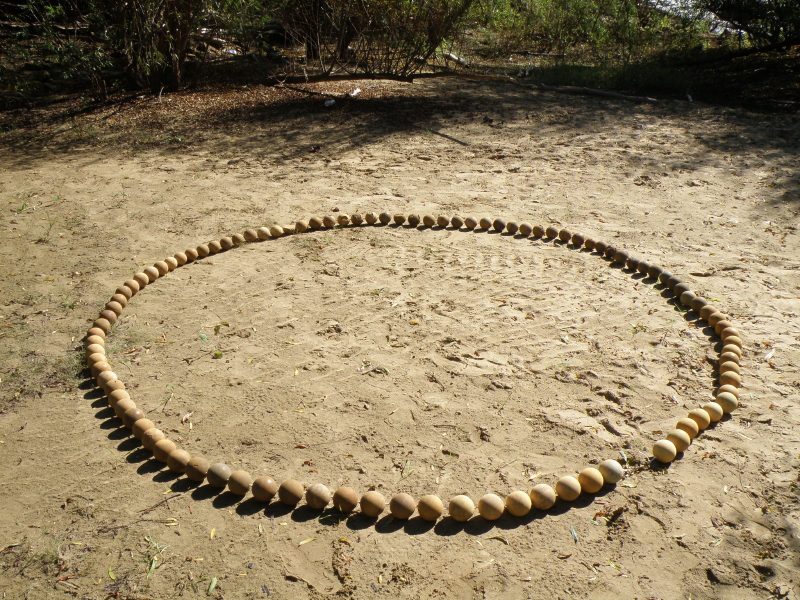
This was okay for a trial run, but I had other images in mind. I have always loved the willow trees in the park and I chose one of my favorite ones to “wear” my river pearl necklace. Yes, it’s a hopelessly romantic gesture, but I felt like “celebrating” this tree in a special way. Here are a few more images.
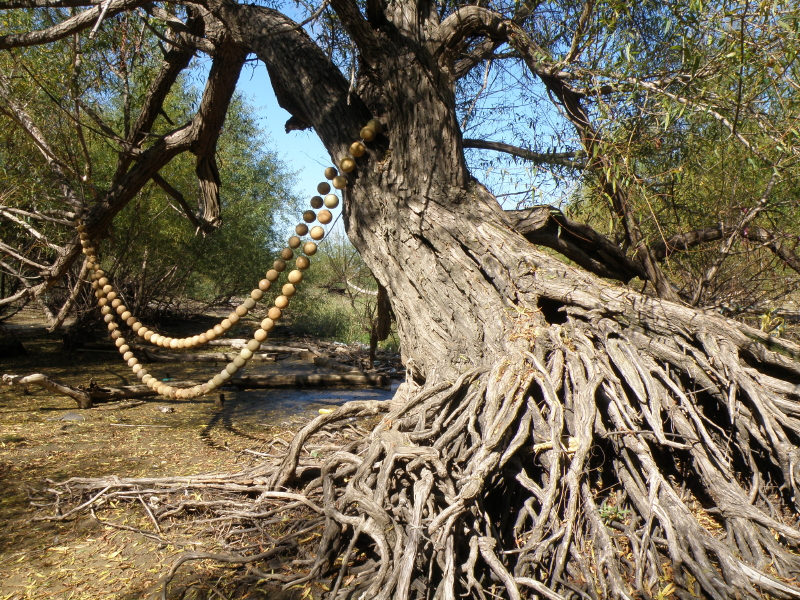
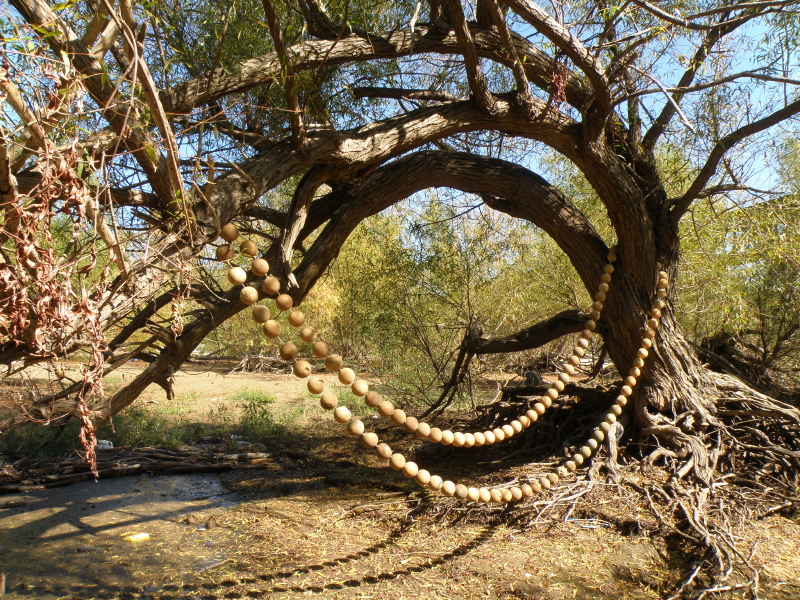
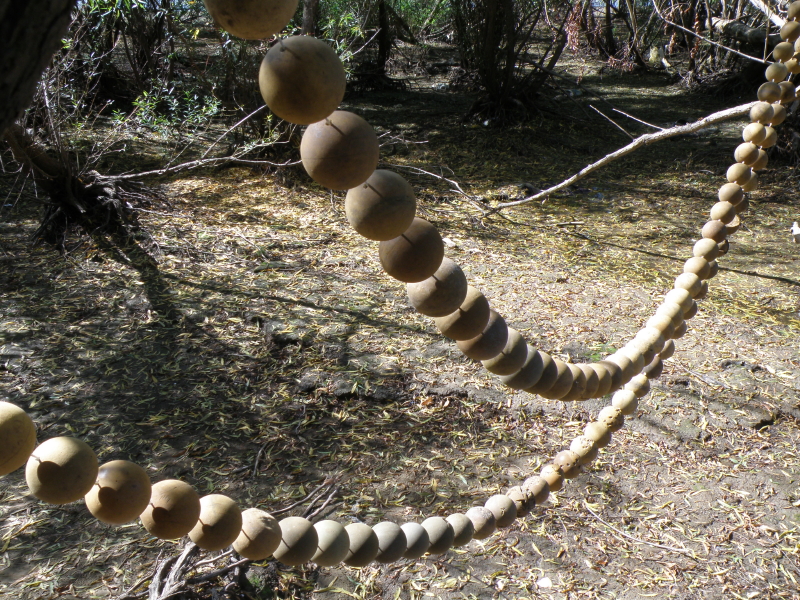
Moving closer to the river, I stopped by an old willow that was barely alive. I draped my necklace over its old exposed roots and created a few more images.
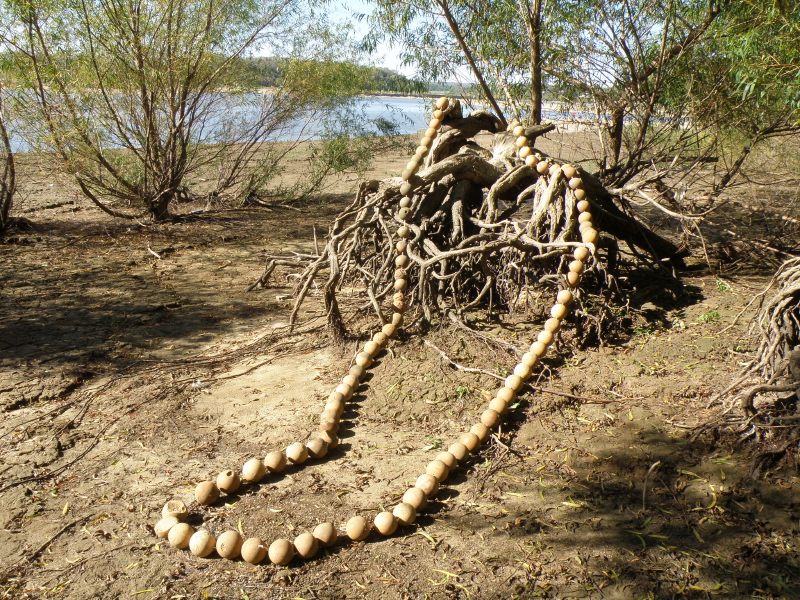
Once in a while, a park visitor would walk by and look in my direction and continue on as though I was engaged in a most ordinary activity! If I had stumbled across this scene…I think curiosity would compel me to say something. Next is another detail from my eccentric strand of pearls.

With the river within sight, I lifted my bucket of balls and headed towards the fossil rocks. It was a sunny, but windy day and my next idea was to put the necklace into the water.
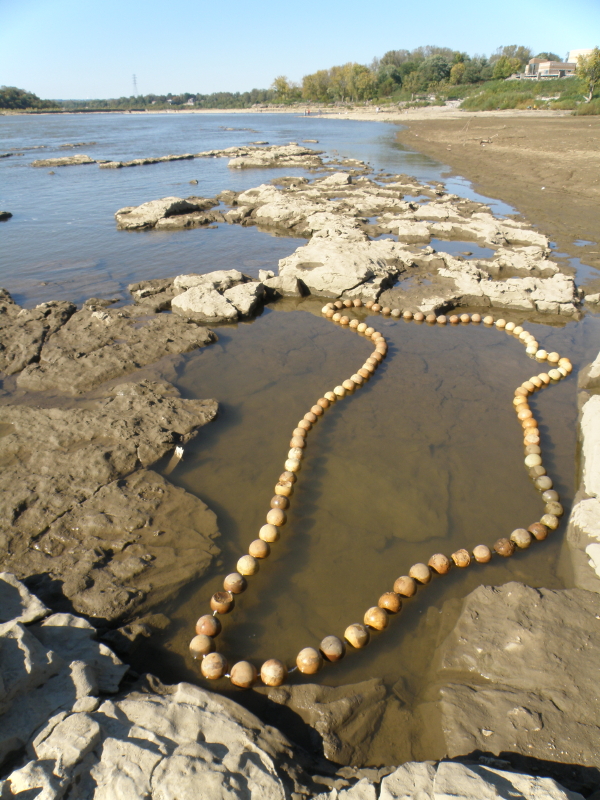
I found a pool of water surrounded by Devonian inspired limestone that would prevent my necklace from being carried away by the current’s flow. Still, the wind kept changing the configuration and blowing the balls against the rocks.
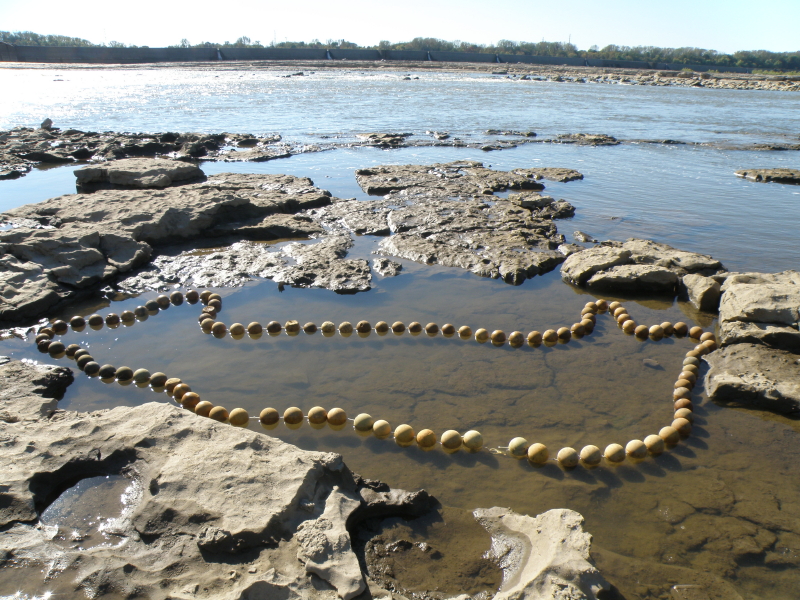
I used a beaver-chewed willow stick I found on the bank to guide my necklace into shape between photos. The necklace which I now had named “La Belle Riviere” was the name originally given by French missionaries upon encountering the Ohio River for the first time.
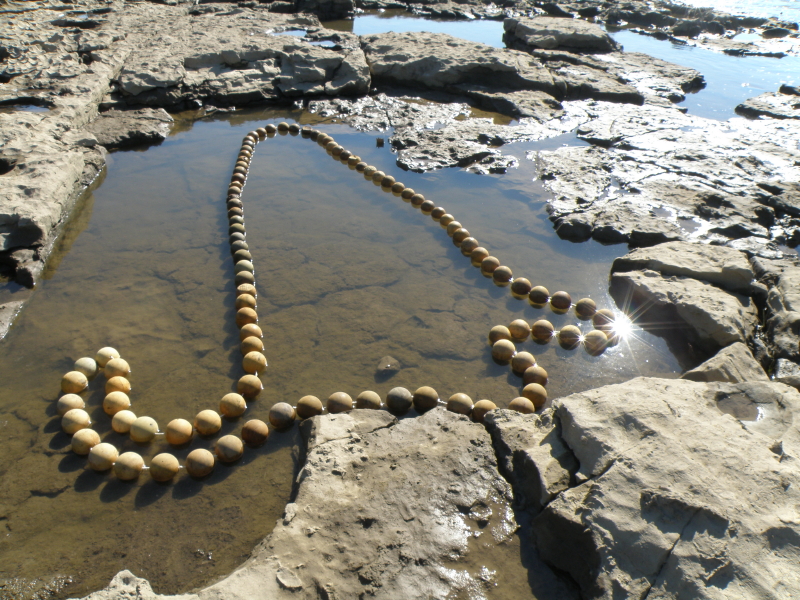
It seems appropriate that the river which played a large part in bringing these balls to this shore…would continue to influence how this piece would be perceived.
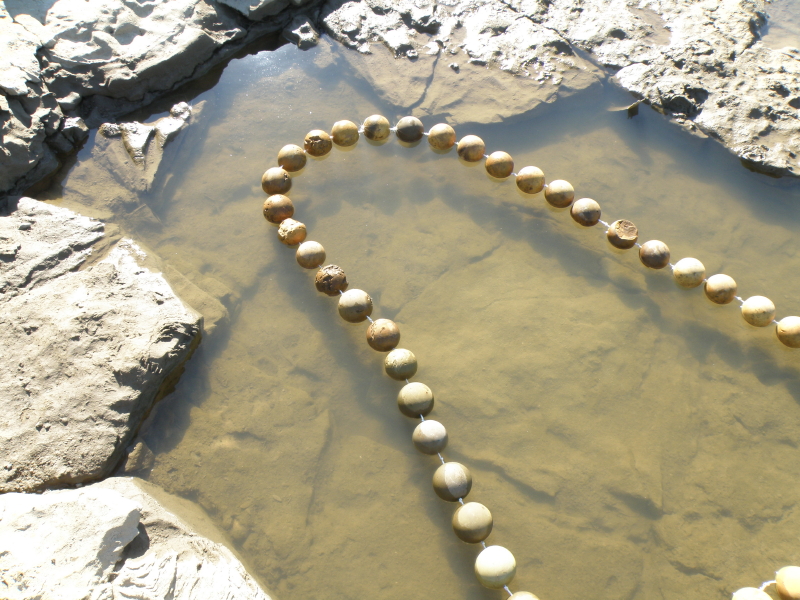
I enjoyed how the gourd-colored balls harmonized with the surrounding riverine landscape. I felt some sense of accomplishment in creating this piece and being able to return it to the Falls environment to create this site specific work. It was also a fitting ten-year anniversary artwork since “La Belle Riviere” began with that first found ball a decade a go. I will see how well it holds its own in a gallery environment since I want to include this piece in a two person show I’m participating in this January. After these river photos…I loaded the necklace back into its container and began the slow walk back to my car. While making this work, I did have one admirer that found the work irresistible and I will end this post with its image. So long…from the Falls of the Ohio.

Bottleneck Portfolio
Posted in Absurd, art and environment, collections, creativity, environmental art, Originality, public art, recycled art, sculpture, tagged Art, art and the environment, artist at exit 0, bottleneck, bottleneck effect, environmental art, ephemeral art, extinction cycles, Falls of the Ohio, found objects, glass, nature, Permian period, photography, recycled art, site specific art on October 8, 2013| 13 Comments »
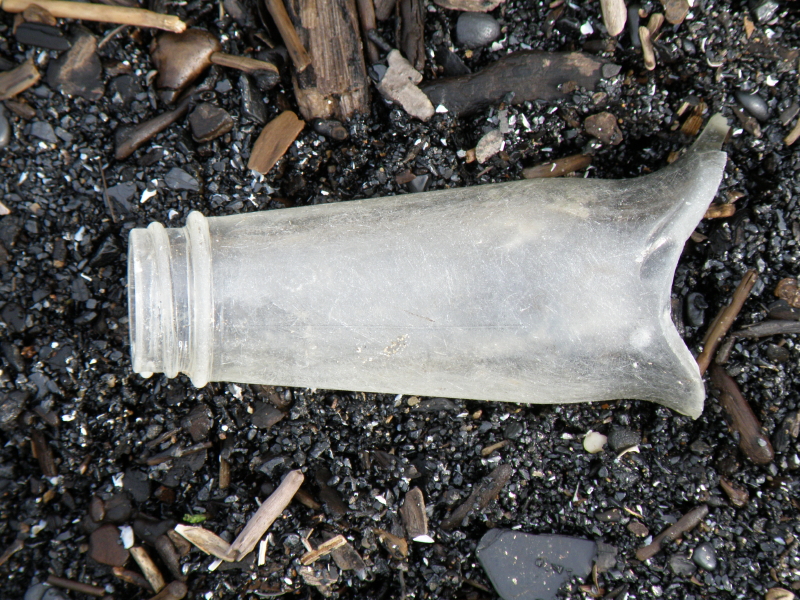
I wish I could remember the exact written passage where the image of a bottleneck captured my imagination. Back tracking through my books has not revealed the exact source, however, I do remember that the context came from biology and more specifically the history of life. Of the five great extinction cycles, the one that closed out the Permian period (roughly 245 million years a go) was the most brutal and efficient. All those trilobites that had been so successful for so long hit the wall. At this time the super continent Pangaea existed. Millions of years of continental drift and the resulting global climate change are the leading hypothetical causes for this extinction. Regardless, the effect was that the majority of life’s diversity as it existed then and which filled up that particular metaphoric bottle…did not make it through the bottleneck. Fortunately, some life did survive, but it would take subsequent millions of years for life to evolve and radiate out to regain its former glory.
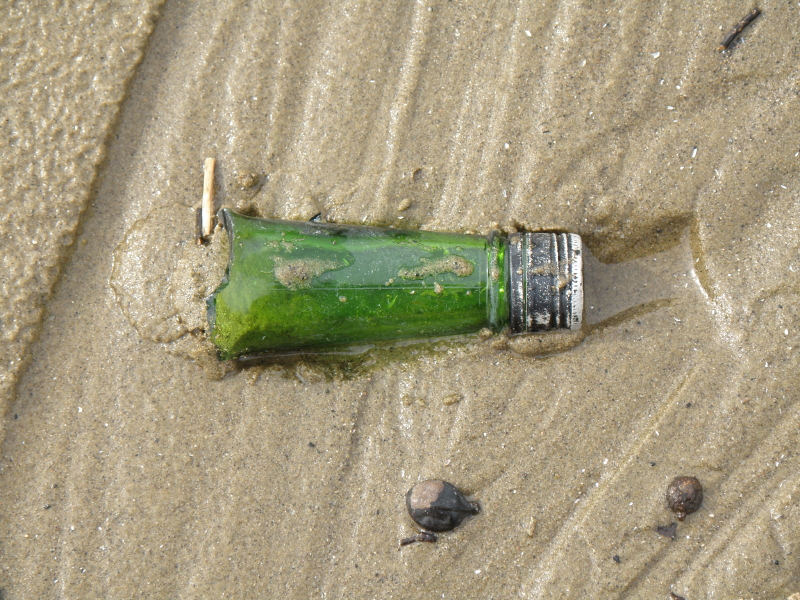
We like to think that we stand atop life as its ultimate achievement. We frequently miss the bigger picture of which we are small part and are even oblivious to the effects we have on everything else around us. The bottleneck effect has been adapted by other systems to illustrate that which is a hindrance or impediment to progress. The basic idea, however, remains the same. Whatever is in the bottle is going to get squeezed on its way out that is if the contents do in fact make it out. In my own blog, I don’t mention U.S. politics much, but lately it is in the news and it’s troublesome. Our seeming inability to govern ourselves…to in effect allow small selfish groups to manufacture bottlenecks strikes me as self-defeating and doesn’t bode well for the future.

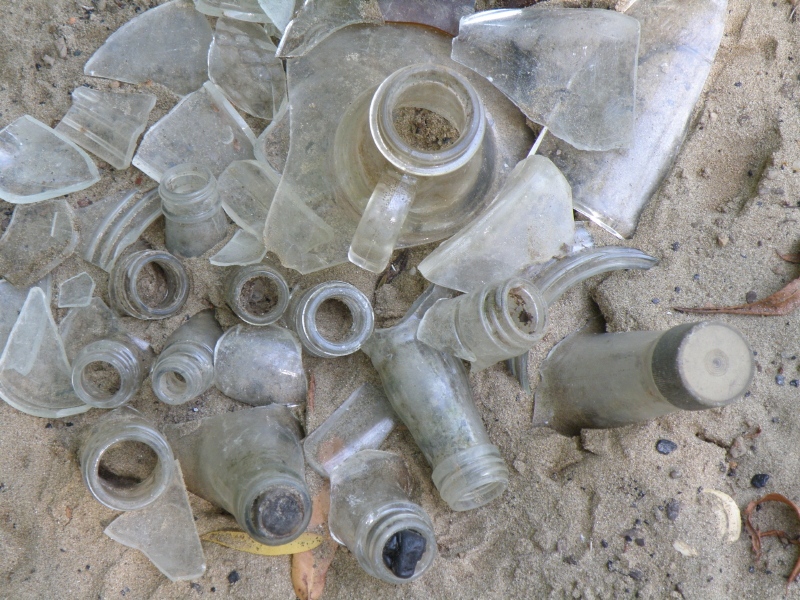
At the Falls of the Ohio State Park, I literally find bottlenecks all the time. Unlike their plastic counterpoint, the glass ones don’t break down as much. There must be something about the material strength of glass that is increased when it is forced into a tube that makes it extra resilient. Over time, their sharp edges do get worn down and their surfaces become frosted through tumbling in the sand. Personally, I find glass to be a far more attractive material than plastic. I’ve come to look at our artifacts in much the same way I might regard a fossil as examples of objects that have been touched by and affected by life.
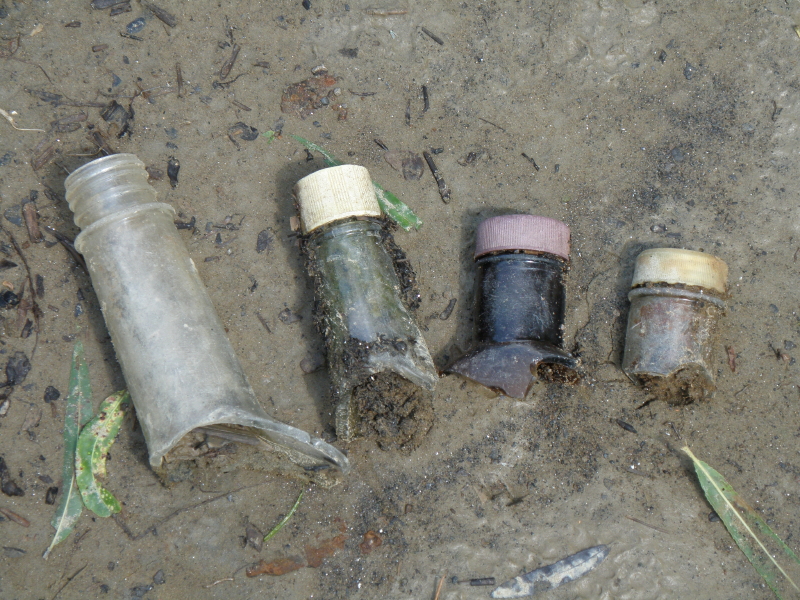
There’s something about the process of “finding” that is compelling if not compulsive for me. I try to stay watchful for opportunities, particularly if I come across an image or material that I can apply through my art. The process of collecting, examining, and comparing is also personally meditative and relaxing. I started photographing bottlenecks years a go with no goal in mind. Just more documented stuff among all the other stuff along the riverbank that I come across each time I visit the park. Looking over my photographs, forgotten images of bottlenecks would catch my eye again.
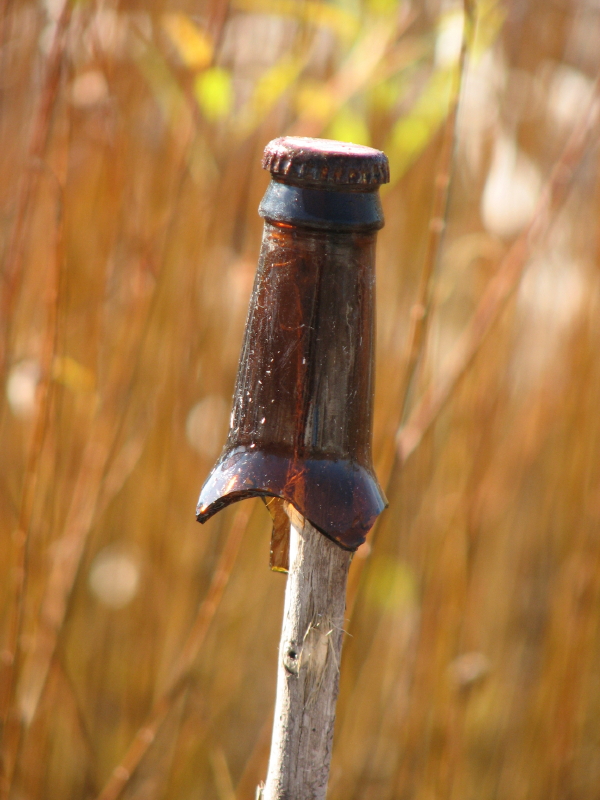

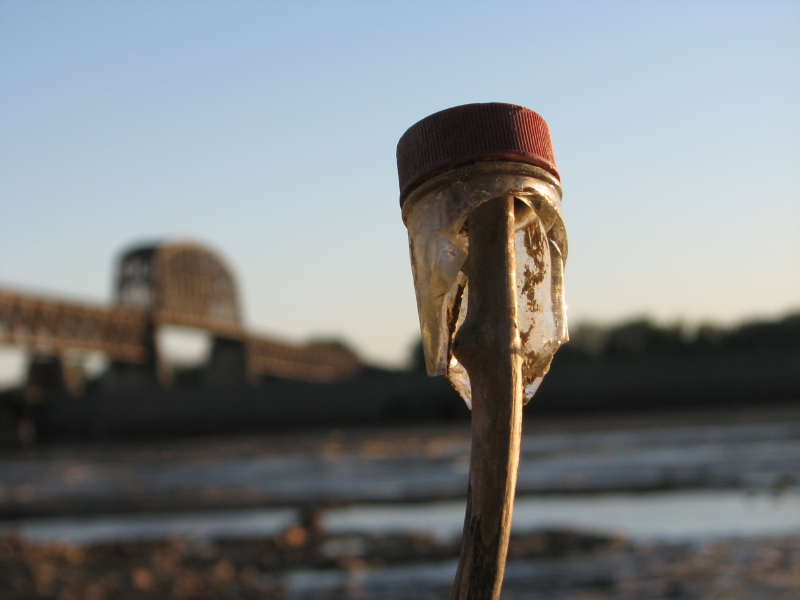
Other than take contextual images, I guess the next thing I did with bottlenecks was to stick them on the ends of branches and sticks. This allows the light to play through the glass revealing its jewel-like attractiveness. It might also cause someone else to notice that there is a lot of smashed glass in the park. Granted, the river floats a lot of bottles in here from upriver, but there is also a lot of drinking that goes on here via the local folks. Why pack your empties out when you can just throw them on the ground? One bottleneck on a branch led to more…in fact the whole arc of these now bottleneck projects has trended in the “more” direction.
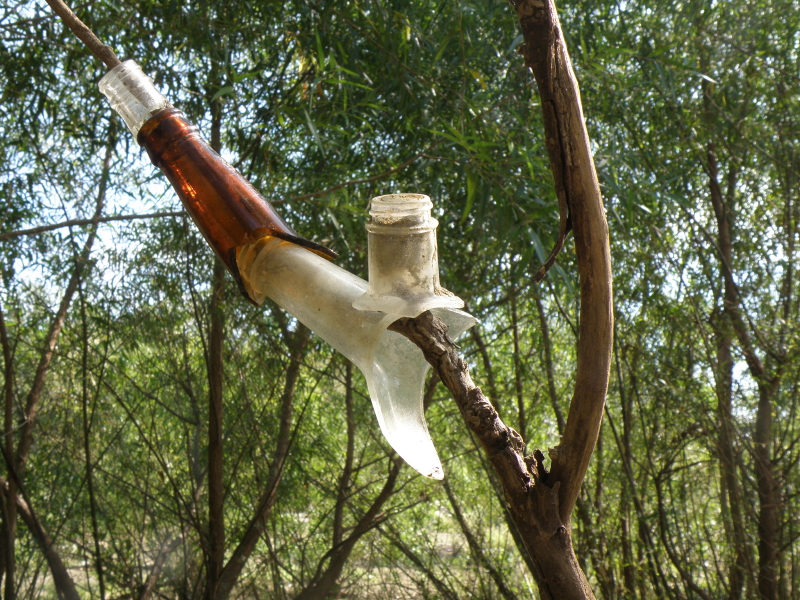
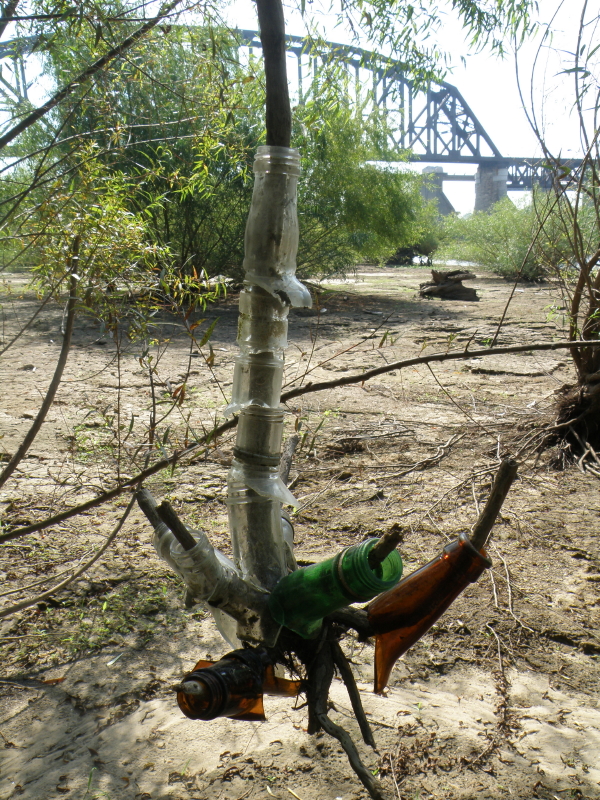
I guess this last image is a bottleneck candelabra? I find many of the bottlenecks I’ve used near stands of willow trees by the water’s edge. I suppose bottles that float in are snagged in the tree’s exposed root system eventually breaking through contact with floating logs and leaving the shards in place? People also throw bottles against the trees which has the same effect. Rarely, do I need to walk very far to find enough glass to create a small project and image.
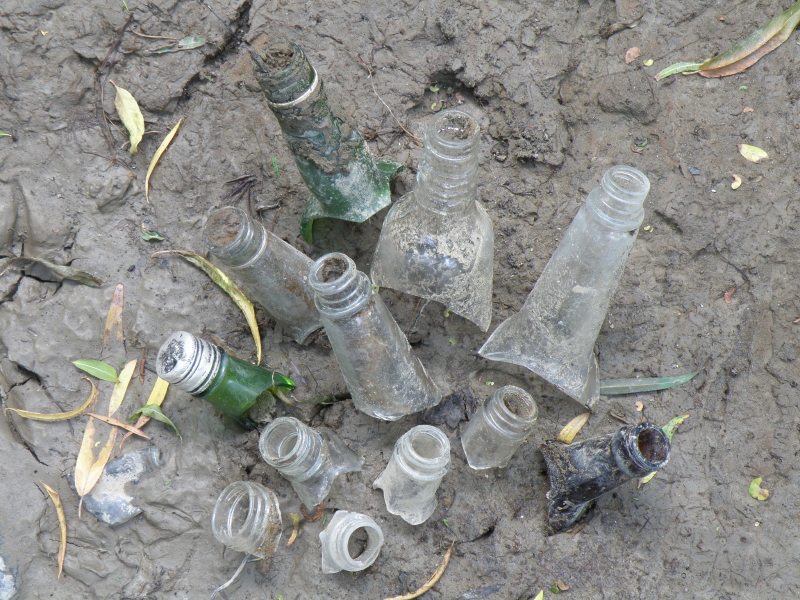
Here’s one project made from bottlenecks collected around one particular willow tree. I liked the way they looked collectively stuck in the mud and their tubular arrangement reminded me of fossil corals which also references the Falls of the Ohio. Here’s a few other similar site specific groupings of bottlenecks.
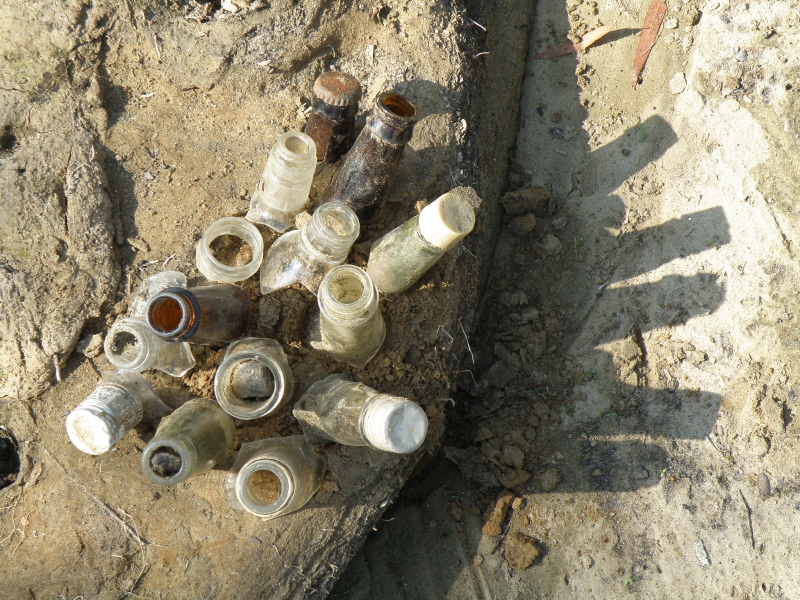


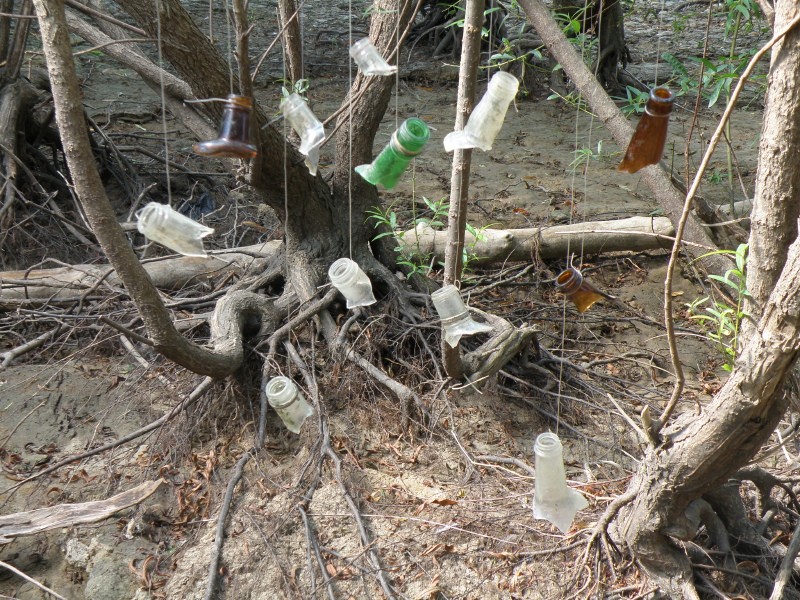
The next couple of images are from my last bottleneck piece. In addition to lots of waste glass…I also find discarded fishing line, often in the same places. I brought these two materials together for this ephemeral work. Recently, I was talking with a good friend of mine and we were remarking about how much of our lives seem mediated by and require reading various kinds of screens. This last glass project may have something to do with that because the bottlenecks are arranged in a flat, parallel screen hanging from a horizontally growing willow branch. I wonder if anyone else ever saw this and what they may have thought about it?
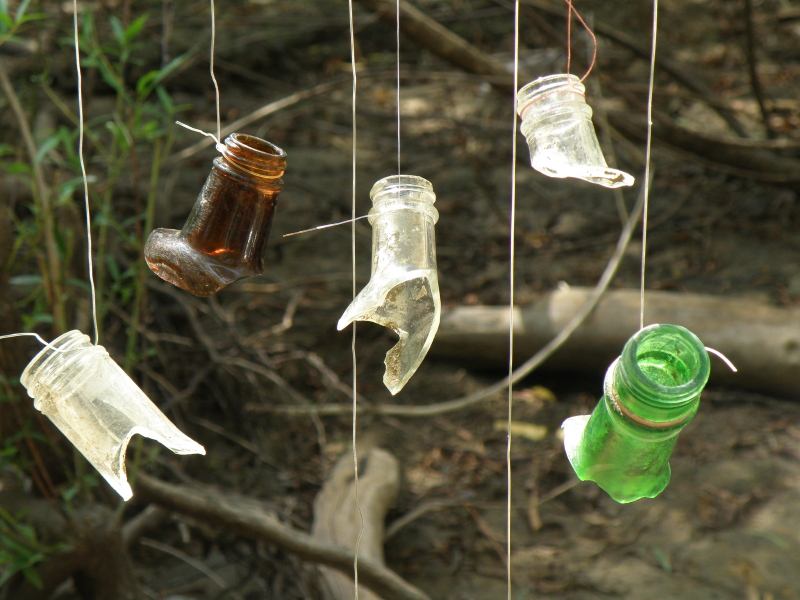
Well there you have it! I suppose these bottleneck projects will now crop up on occasion like my found coal pieces do as intimate site specific expressions. For now, it’s enough to present them as images without trying too hard to extract every bit of meaning from them. Bottlenecks in the broader sense are challenges. May we always remain open to meeting them. So long from the Falls of the Ohio.
Unnatural Flowers from the Falls of the Ohio
Posted in Absurd, Art, art and environment, collections, creativity, ecosytem, environmental art, Falls of the Ohio, recycled art, unusual collection, tagged Art, artificial flowers, artistatexit0, earth, effects of plastic breakdown on flora, Falls of the Ohio, nature, photography, plants of Kentuckiana, plastic, pseudo botany, recycled art, the environment, unnatural flowers, unnatural story on June 18, 2013| 7 Comments »
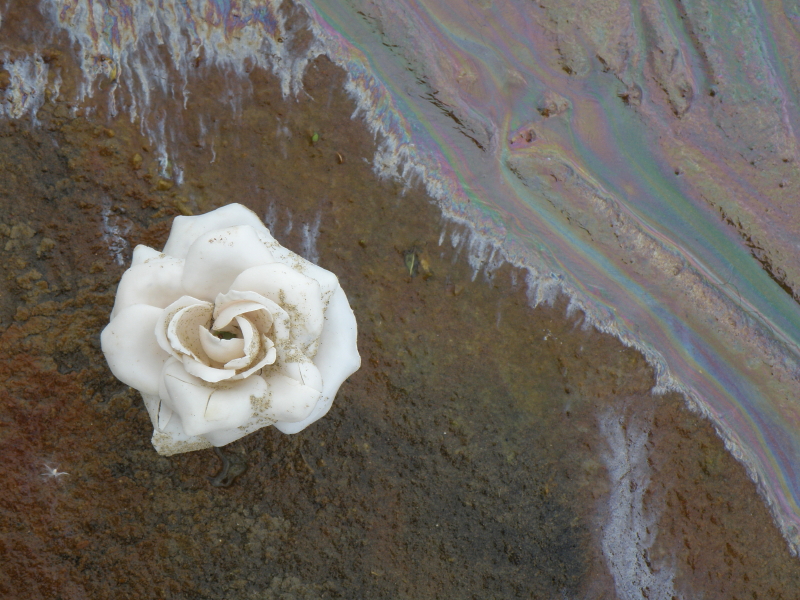
Following is a unique portfolio of never before published images of the latest Unnatural Flowers that have bloomed at the Falls of the Ohio. This follows a previous article on this riverblog (see…”Unusual Flora at the Falls of the Ohio”, Jan. 13, 2013) that first exposed the bizarre flora that have adapted to this highly disturbed site on the Ohio River. It is speculated that these new organisms are able to metabolize decaying plastic in novel and sometimes disturbing ways. Characteristic of these faux flowers is a lack of photosynthetic leaves. It is believed that the energy utilized by these plants is created from breaking plastic polymer bonds and forming new compounds or by elaborate parasitism. Examples of both will be highlighted. Key also are the various petrochemical connections which rhyme historically to a more ancient world illustrated beautifully by the site’s Devonian Era fossils and our culture’s reliance upon oil and coal to power and pollute everything. It is my belief that these unique forms appearing here are no coincidence. Let us first acquaint ourselves with various members of the “Chemical Rose” family. An example of which leads off this post. Here are more recently found roses.

This variety appears to have rootlets growing between the plastic-hard rose petals. As with all “Chemical Roses”…there is no sweet perfume to inhale.
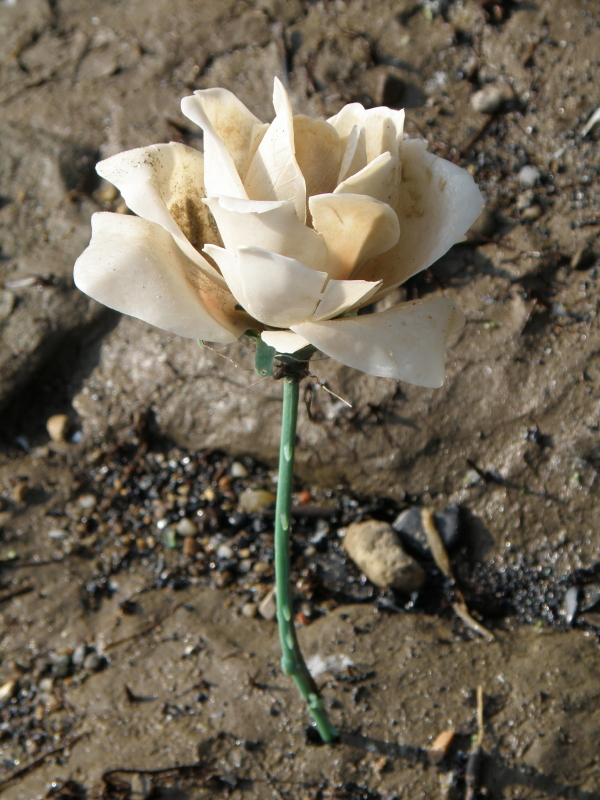
This “Chemical Rose” example is growing out of the mud on a leafless, thorny stem. No telling what chemical compositions are co-mingling in this ooze?
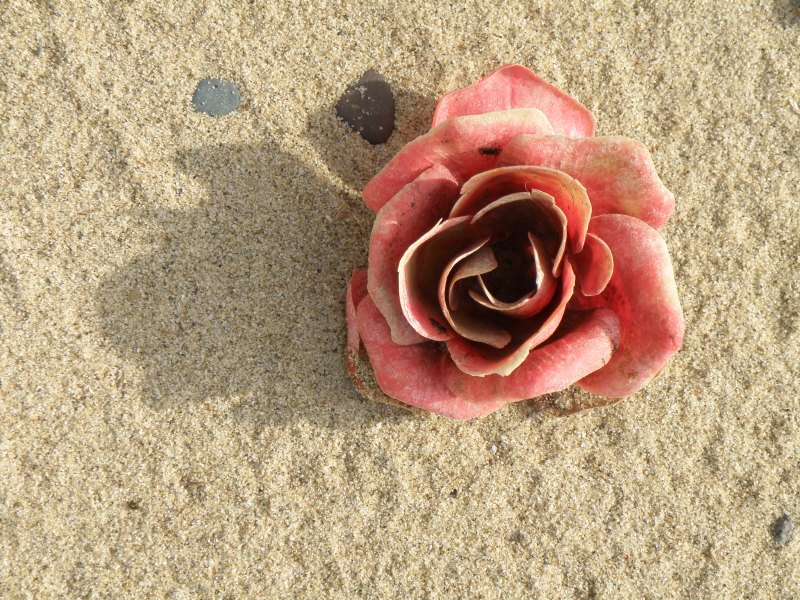
This ” Red Chemical Rose” has adapted to growing on sand. While the next example has synthetic, fabric-like petals. It does add a beautiful yet bittersweet presence to the landscape.
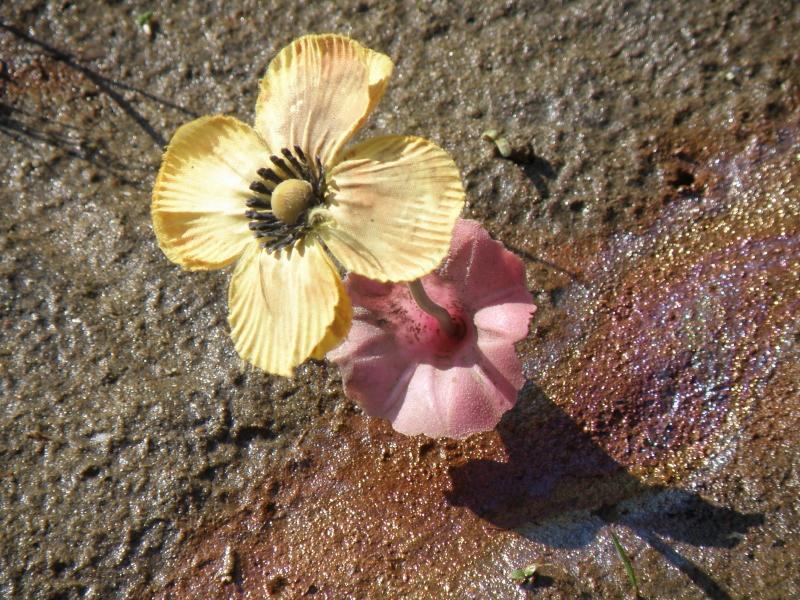
This “Petrochemical Petunia” is a late Spring oddity and prefers moist, iridescent sand and full sunlight. It presents as a completely synthetic, hybrid blossom. It is not clear at this time if some pollinating agent is necessary for its propagation.

Imagine my surprise upon discovering this “Little White Polymer Phlox” growing from the ruined wood on this stump. This specimen was found very close to the water and in an area that floods frequently. The phlox needs just the right temperature and water content to break down this former tree’s cellulose matrix to make the nutrients it needs to grow.
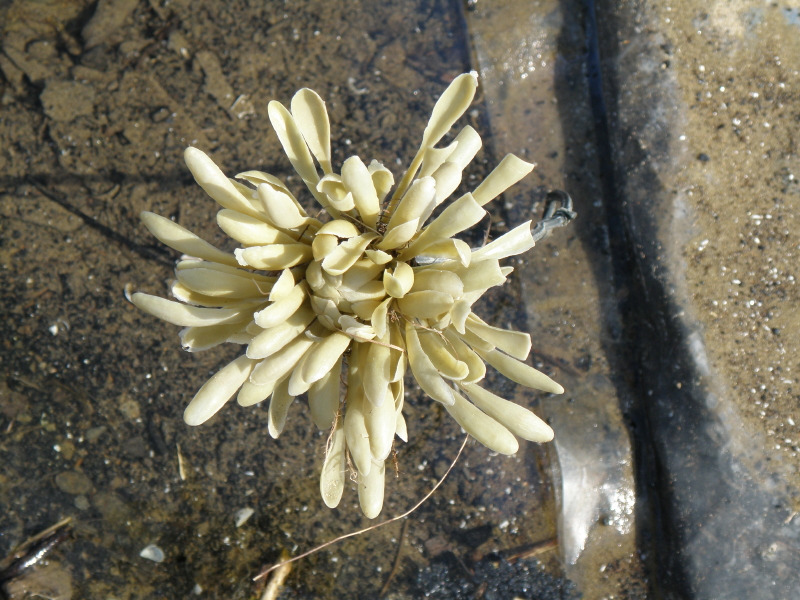
Also growing in poor wet soil is this florid “Chemical Chrysanthemum”. Among its requirements are a warm, CO2 rich atmosphere and coal which washes up within the Falls of the Ohio State Park from the frequent barge traffic that moves up and down the Ohio River.
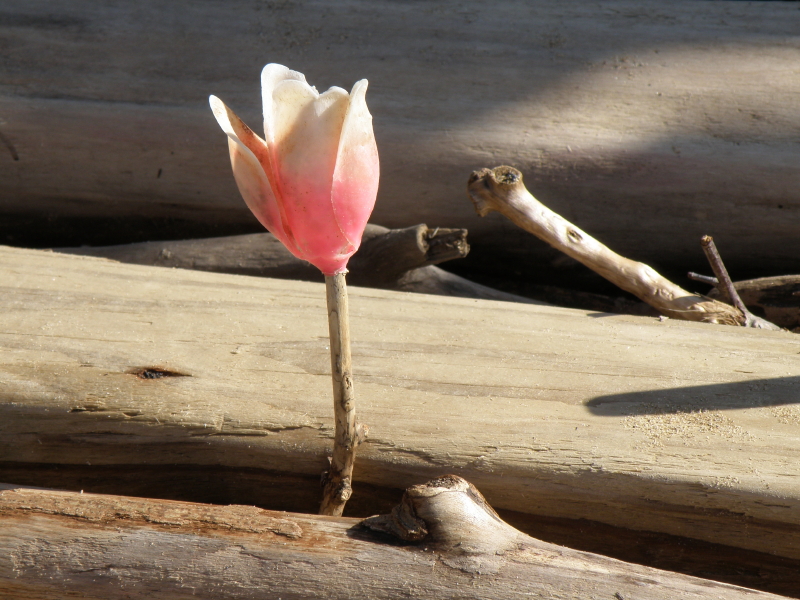
Growing between the beached and bleaching logs is this aptly named “Driftwood Tulip”. It can appear at any time and shows itself briefly upon its woody stem before sinking back into the riverbank from whence it came.

For a lack of a better description…this plant had temporarily been named the “Epiphytic Mimic” because it presents like some of our true orchids. This specimen may have flowered recently. Its green leaves do not perform photosynthesis. It hangs out and receives moisture and nutrients through a complex system of fine polymer rootlets. And now…for something a little different. The following unnatural flowers appear to be parasitic, but patient study may find them to be more complex and perhaps even symbiotic by nature?
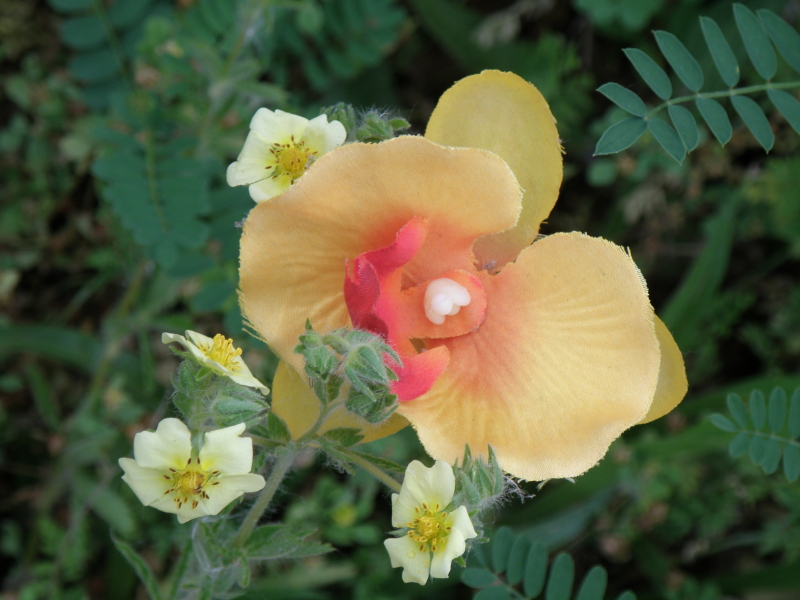
The “Yellow Fabric Pansy” in this photo appears to be hitching a free ride on a primrose flower. The same relationship can be found on this “Pink Blossoming Indigo Bush”.
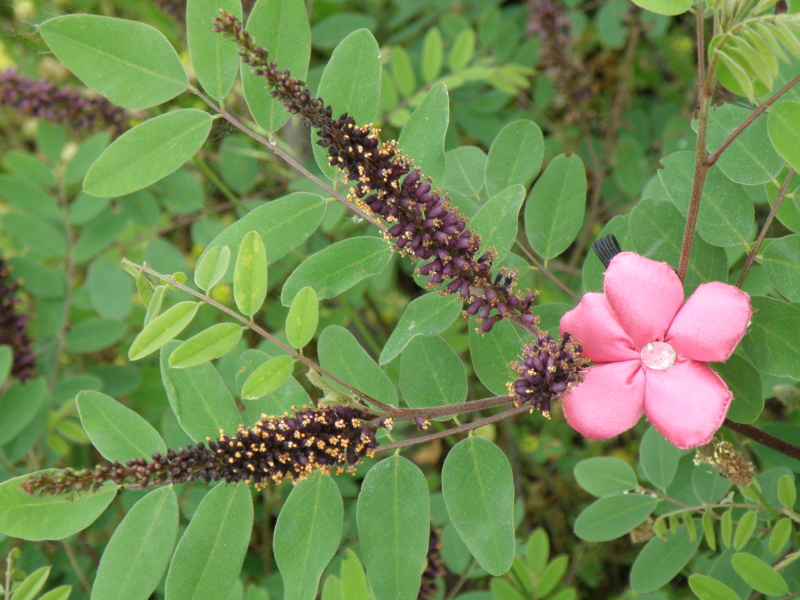
The pink flower with the rhinestone-like center is unlike the rest of this flowering and indigenous shrub. Next we come to the “Augmented Moth Mullein”.
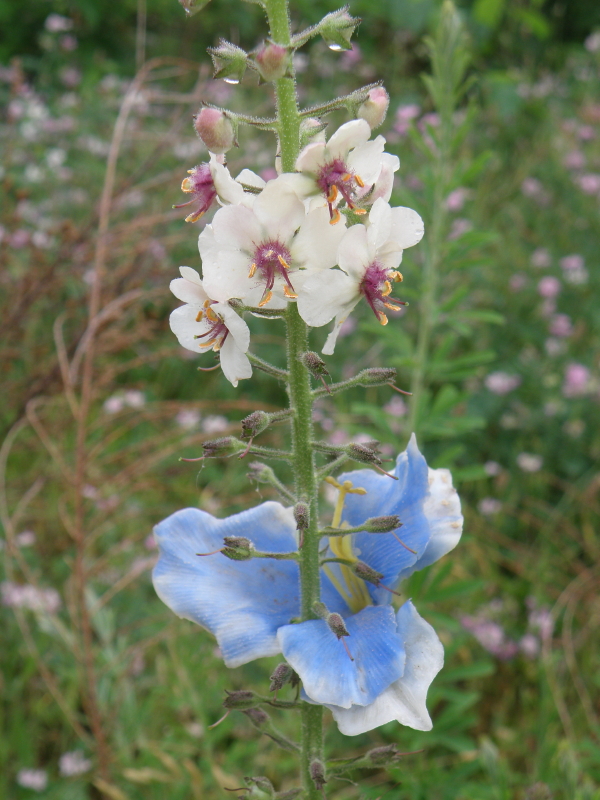
The prevailing thinking about how some these strange flowers acquire their petrochemicals is through ultraviolet decomposition of man-made plastics. On the microscopic if not molecular level…these tiny compounds recombine with the existing plants’ DNA. Here’s another fine example.

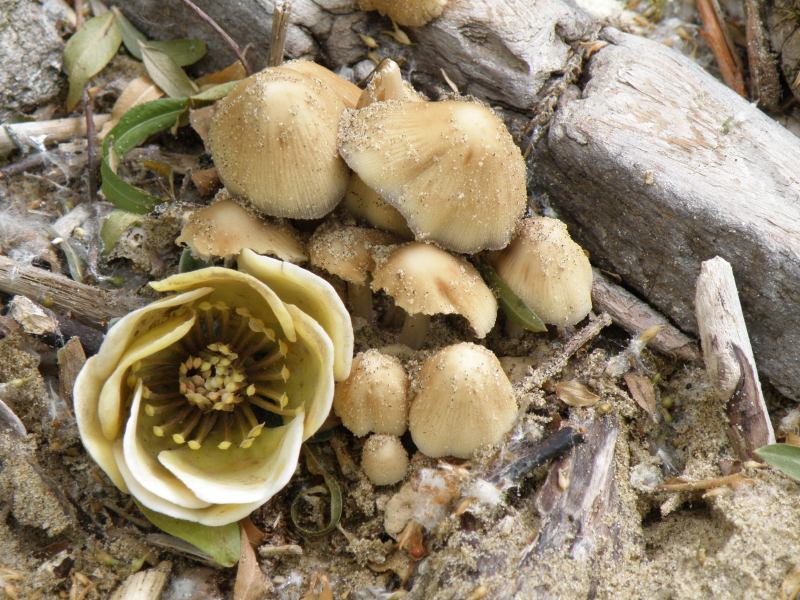
Like the previous plant, the “Yellow-flowering Pokeweed” is a recombined hybrid and favors appearing in the early summer. Traditional pokeweed plants produce weak looking white flowers that will transform into dark, pigment intense berries in the Fall. It is not certain how this plant will respond, but I have my eyes on it. In closing, I would like to present one more image that illustrates the tremendous crossover potential of plastic polymers and living tissue. Thus far, this is the only example of a “Mushroom Flower” that I have come across and the only unnatural fungus that I have discovered at the Falls of the Ohio State Park. No doubt other species are out there just waiting for a trained botanist to reveal to all. As the environment warms and the normal weather patterns change, the natural rhythm of life will be altered, however, life may prove to be the most plastic and resilient of all.
Junk from the Memory Card
Posted in Absurd, collections, Falls of the Ohio, unusual collection, tagged Art, artist at exit 0, doll head, earth, Falls of the Ohio, flotsam and jetsam, found objects, lost and found, photography, plastic character bottle, plastic novelty, plastic trash, rivers, the environment, toys on May 18, 2013| 4 Comments »

Every now and then it’s good to purge stuff that has been building up over time. With my river project, I do this by emptying out my collecting bag(s) to make way for new finds and by deleting images stored on my camera’s memory card. I have gotten into the habit of using the memory card as another form of digital storage just in case something bad happens to all the other places I store data. In this post, I will feature favorite images of plastic flotsam and jetsam I have gathered at the river’s edge the past two months. I will start with the image with the flip-flops and Croc-like shoes. These are tiny to small kids’ sizes. A few weeks a go, I picked up eight of them along a favorite walk and realized once I reached my outdoor studio that they were all meant for the right foot! I have since added a few extras, but the initial shock of realizing there were no left shoes remains. I wonder if subconsciously I selected for right-footedness? Anyway, here is a still life photo portfolio of other plastic river junk toys.
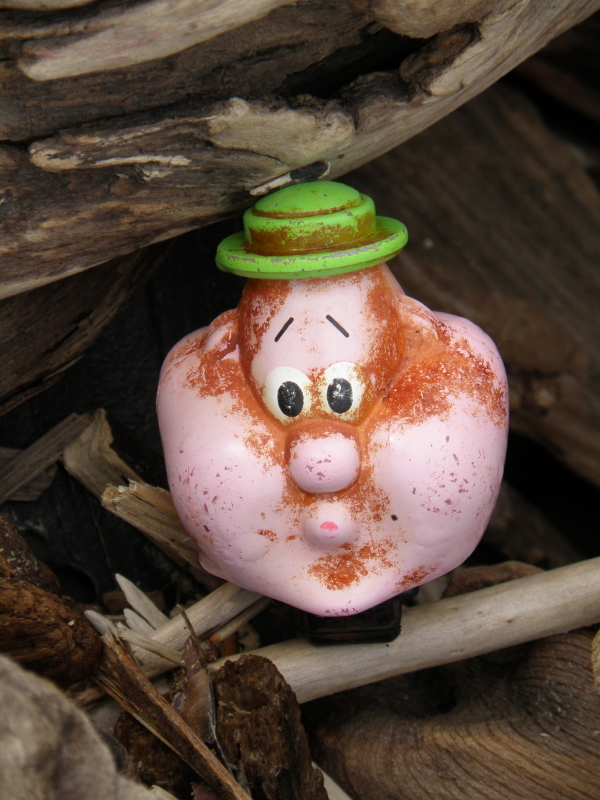

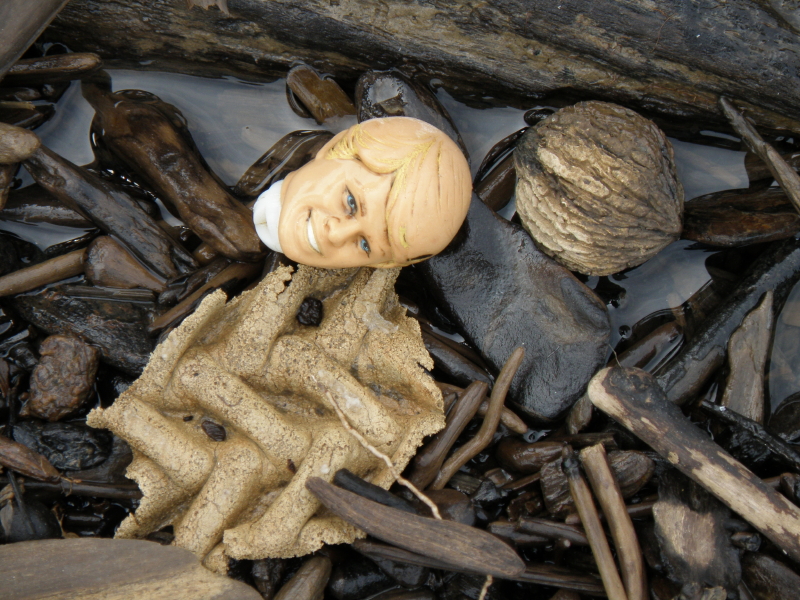
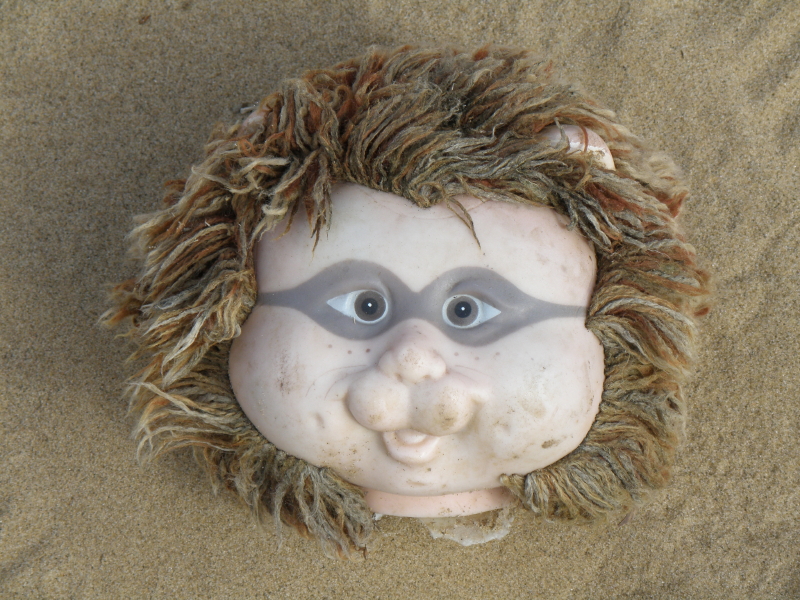
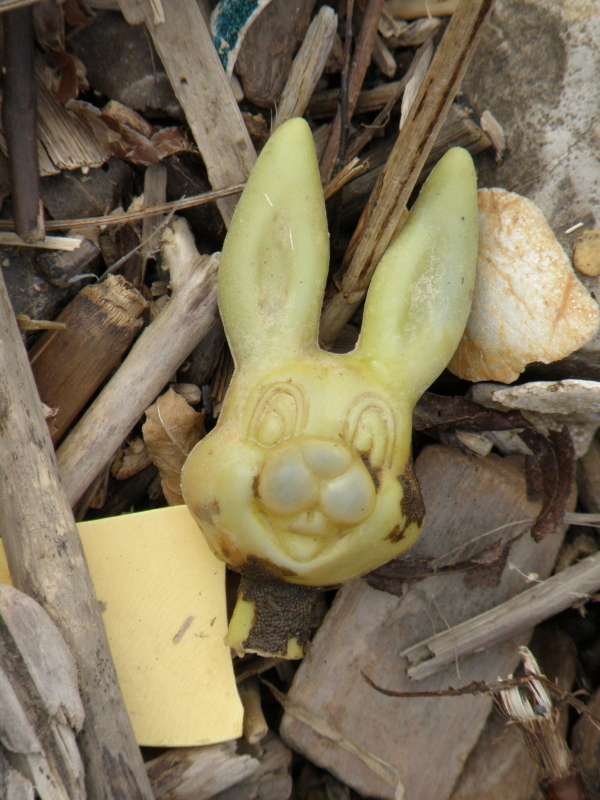
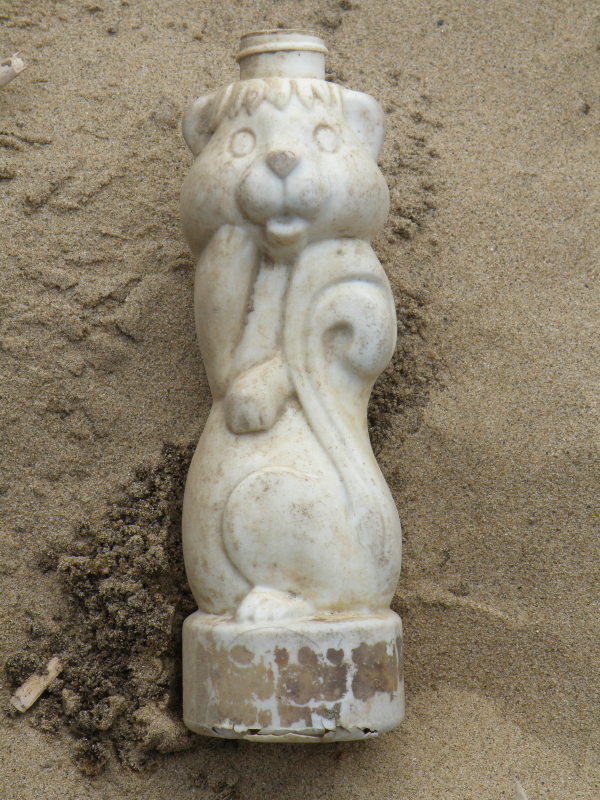
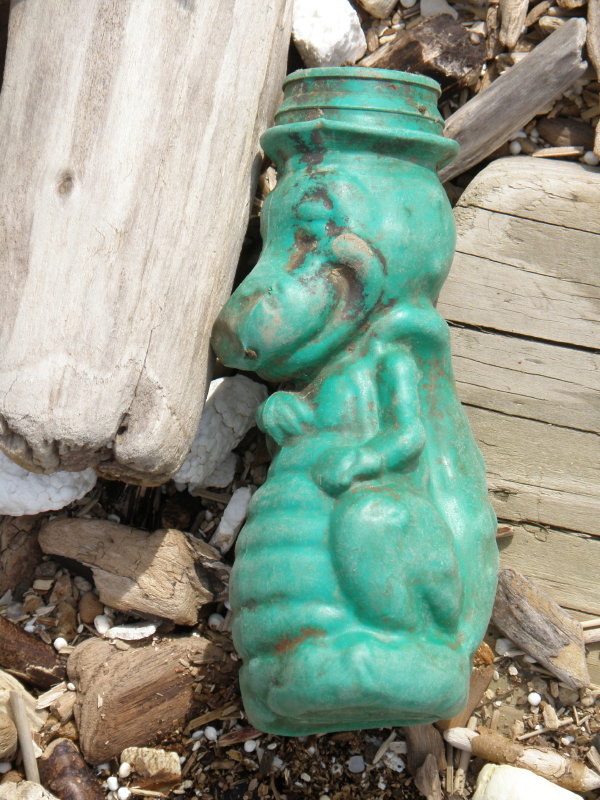
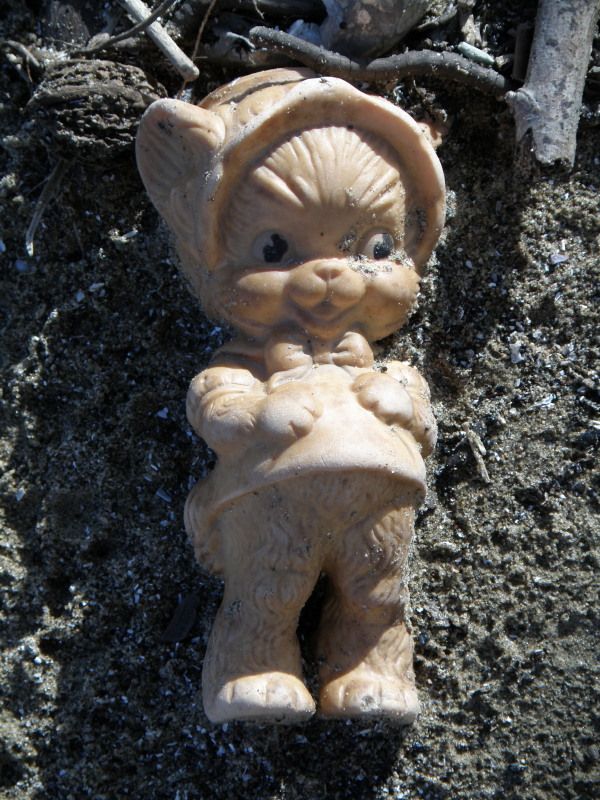

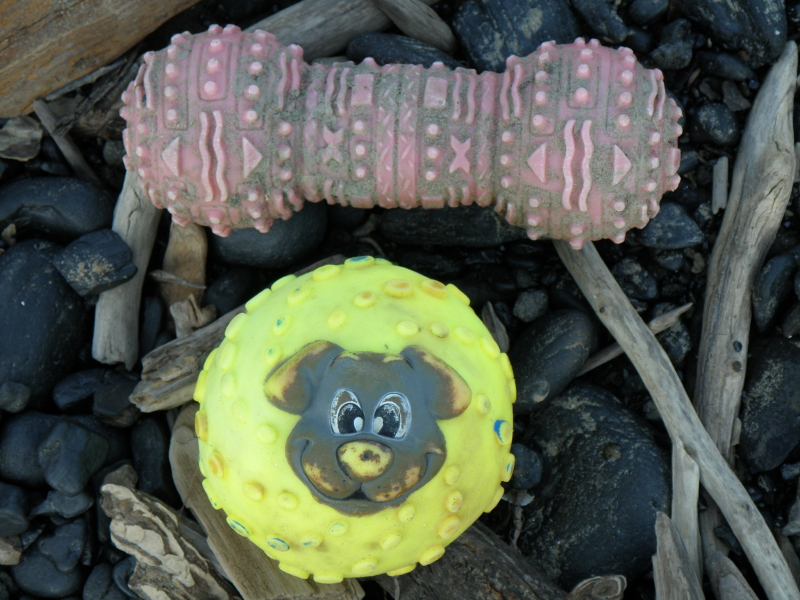
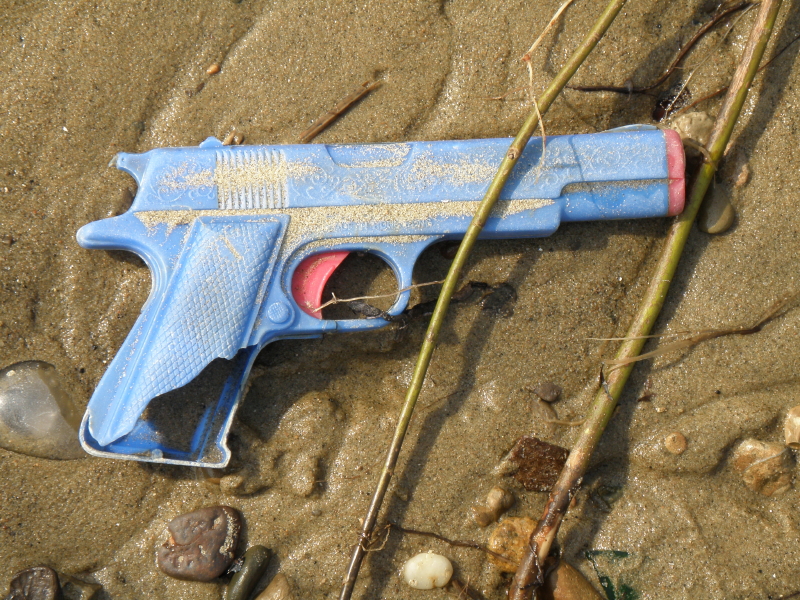
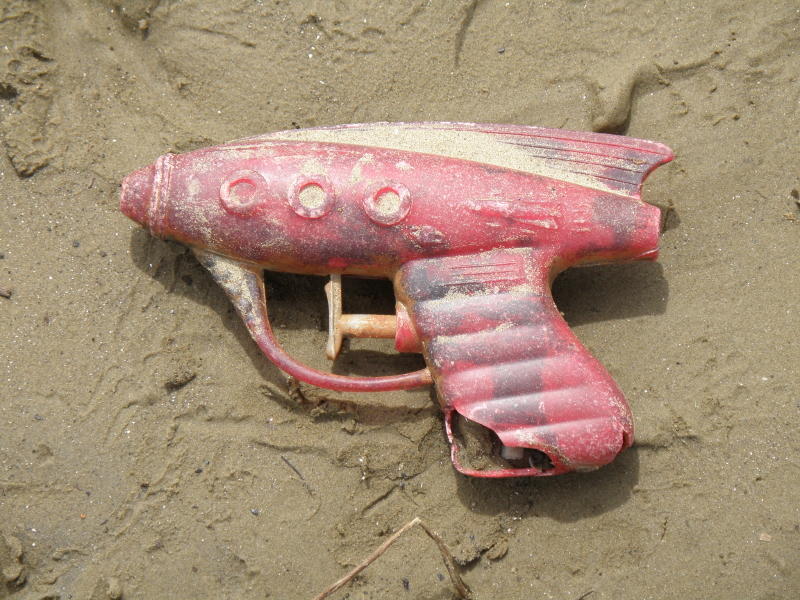
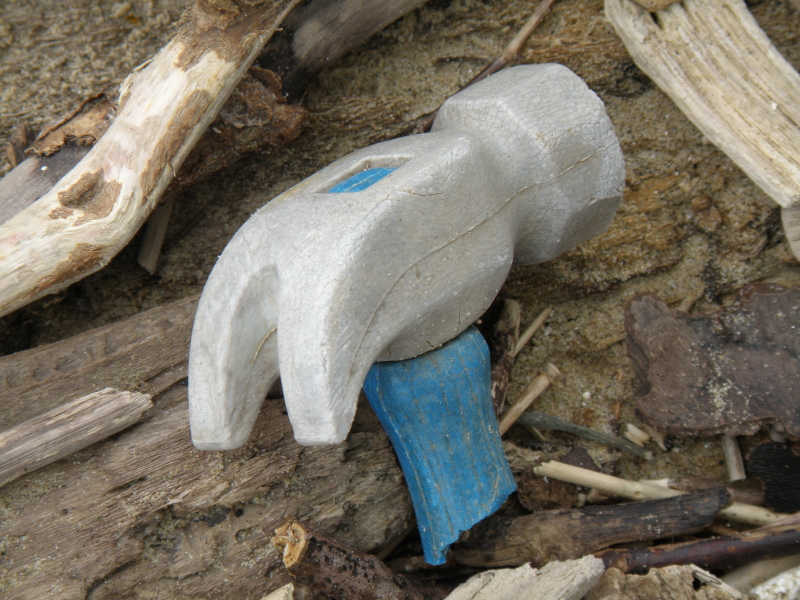
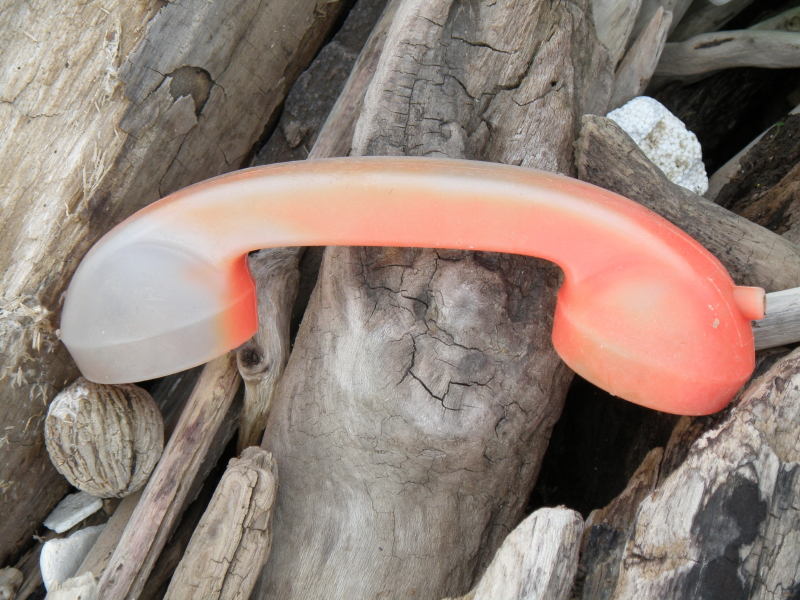
One last item and while it is not made of plastic…is nevertheless memorable.
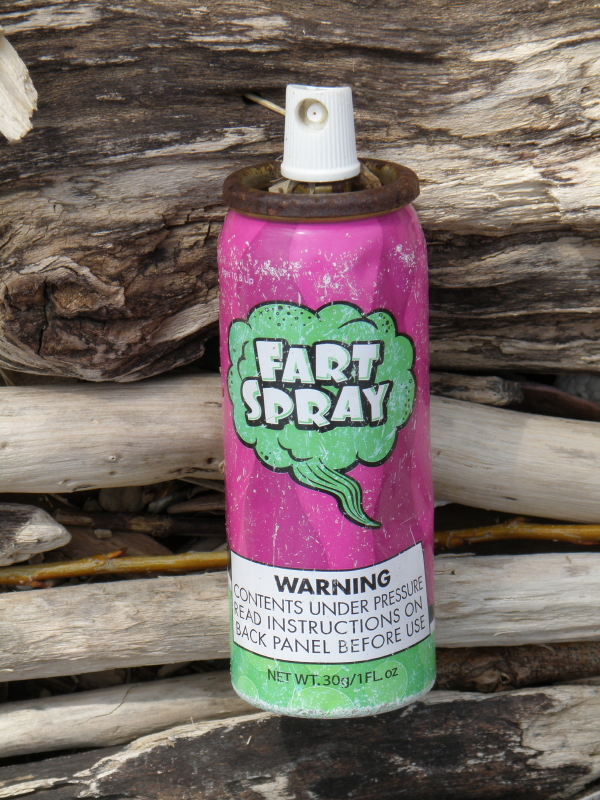
Into the Warmth of a New Spring
Posted in Absurd, animals, Art, collections, creativity, environmental art, Falls of the Ohio, nature, nature photography, recycled art, sculpture, Styrofoam, tagged absurdity, Art, artistatexit0, blue crayfish, driftwood, Falls of the Ohio, found objects, found toys, garter snake, nature, photography, recycled art, site specific art, special place, spring on April 13, 2013| 8 Comments »
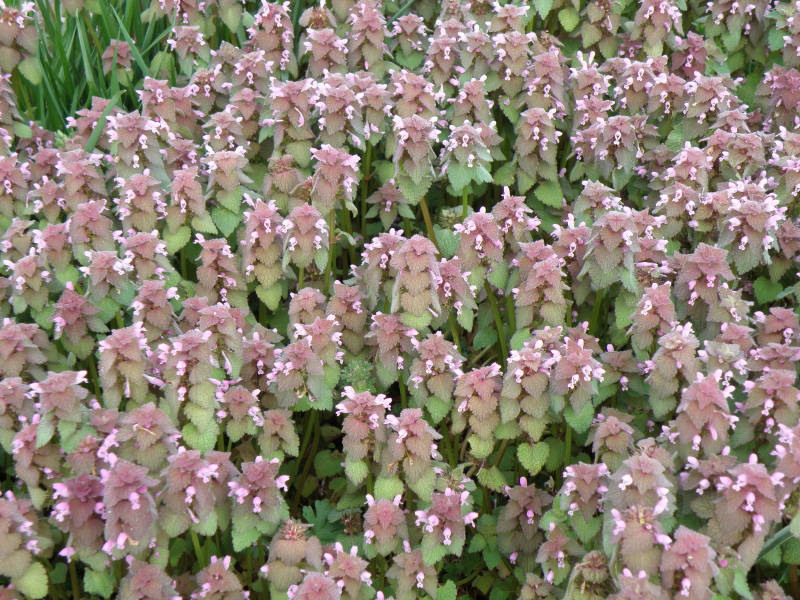
Spring has definitely arrived and the land is turning green. I love watching this verdant transformation as the Falls of the Ohio becomes a garden again. We had a weary winter and so seeing the sun more regularly warms the heart and imagination. These are images from my last visit to the park. I believe I downloaded about seventy or eighty pictures which is about normal for one of my excursions. I can find personal interest in most everything I come across which makes editing and creating some sort of post a fun challenge. I spend hours on site and then a good amount of time at home looking at the pictures and wondering how to put order to any of it? Usually, I try to give some representative sense of what the day was like. I believe I could create all sorts of permutations and stories from just a single trip…but, that would cut into my time to be outdoors and fill my lungs with fresh air.
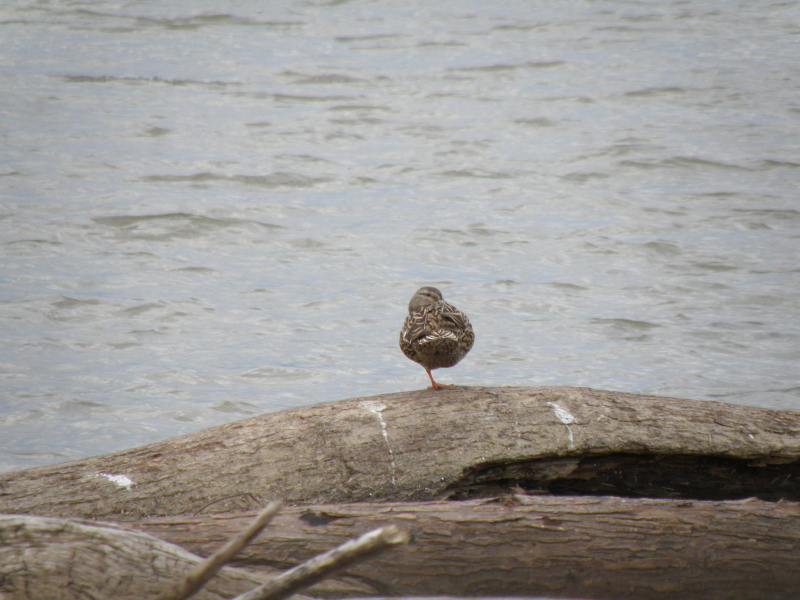
I began the morning in the western section of the park. Driftwood and junk have been driven against the Indiana bank of the Ohio River. Prevailing currents and high water have formed this log raft against the shoreline. Future high water will eventually send this material over the dam and under the railroad bridge and then throughout the park. Moving to the river’s edge I surprised more than one sleeping duck and see my first Great Egret of the year. I tried sneaking over the driftwood to take a picture of the egret which was feeding at the water’s edge. I must be losing my touch because the wary egret spotted me and took off. This duck standing on one leg, however, was more obliging.
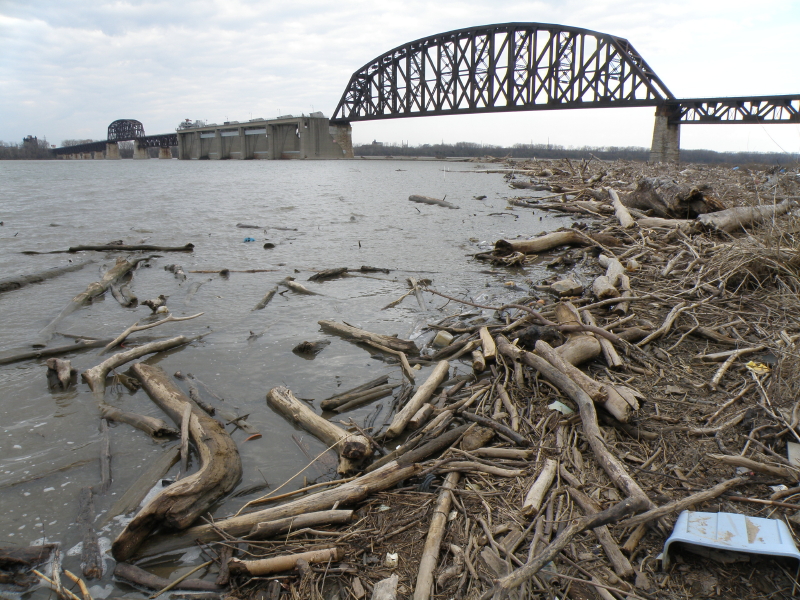
Here’s a view from the western section of the park. Walking along the water’s edge I came across all manner of bric-a-brac some of which made it into the collecting bag. Upon returning to my outdoor studio, I photographed a few of my newest “treasures” on the sand which included many toys. I have a compulsion to pick this stuff up and order it into various collections…but other than that I’m not sure what I will eventually do with much of this plastic. I am a believer, however, that someday I will have an idea or inspiration and I will follow that. I still feel there is something here to explore between the poles of what these items are intended to represent and what they are in reality.
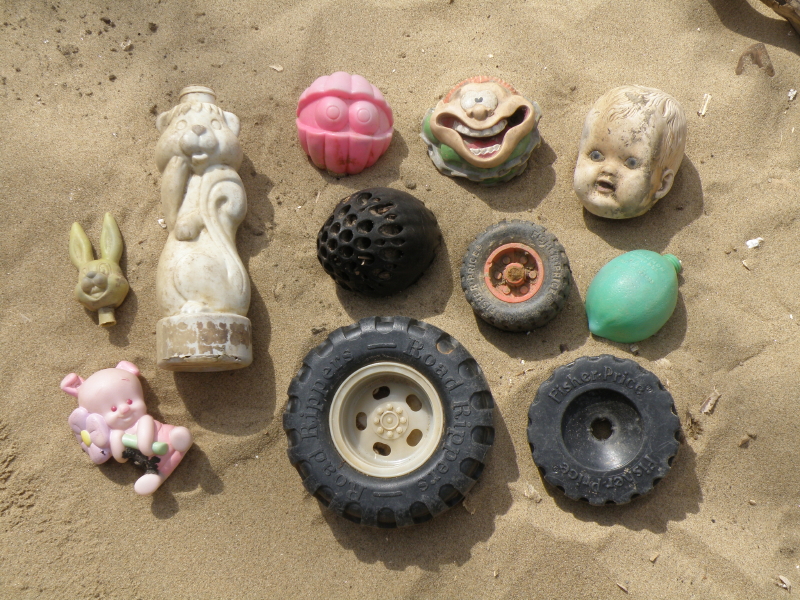
I keep finding toy wheels of all different sizes and slowly an idea for a wall installation is taking place in my mind. I have an offer to show work in a show during the 2014 season and so I set a goal to realize this “wheel piece”. Here are two views of one of my more interesting finds of this day.
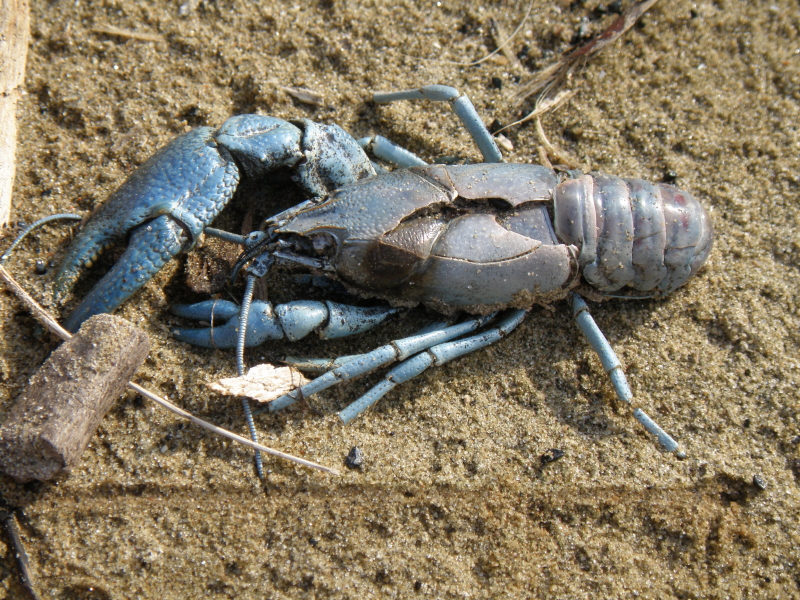
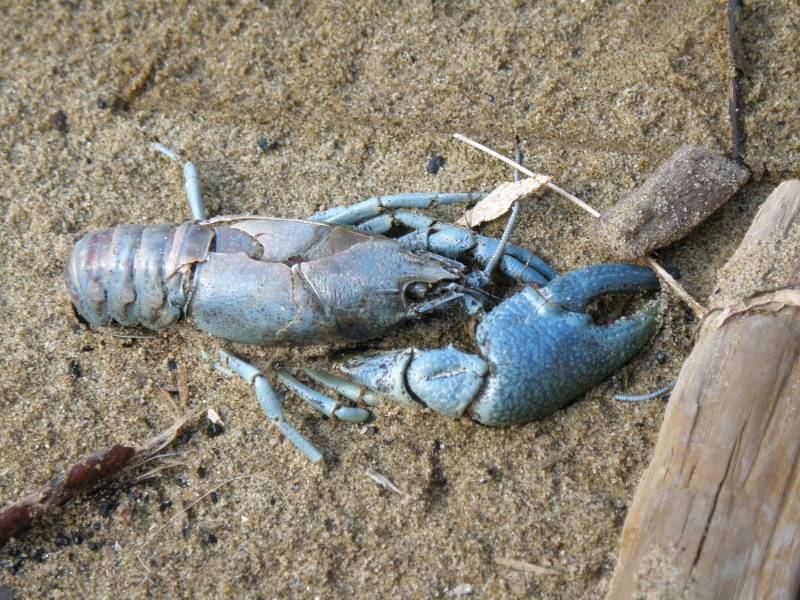
Unfortunately, I didn’t find this blue crayfish while it was alive. By far, most of the crayfish I have seen have been brown in color. I wonder if it was crushed by the logs rolling in the high water? I don’t know which species of crayfish this is, but apparently blue crayfish are a genetic color morph. There is one species that is now bred to be blue for the aquarium pet trade. The way the grains of sand fit around the exoskeleton gives a sense of how a fossil might be formed if given the right conditions and deep time. I picked it up and held it in my hand and just appreciated such a small, but spectacular animal. I was curious to see how the Flood Brothers from my previous post were holding up and soon I had my answer upon reaching my site.
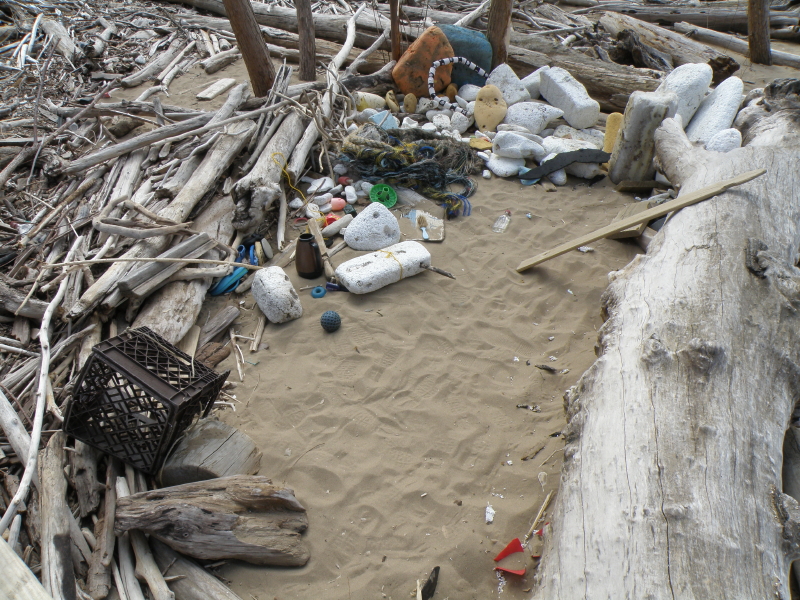
The Flood Brothers were gone as were several other pieces of Styrofoam! My small studio area had been rummaged through, but this is not unusual and I kind of expect this to happen. The stuff I gravitate towards is not the junk other folks look for, however, anybody is welcomed to whatever I’ve cached here. I have nothing of value here. There is more. Apparently, the discoverers of my studio were carrying bits of frayed barge cable when they stumbled over my spot. In order to take the Flood Brothers with them, they had to drop the cables. After straightening up my studio…I wrapped the three cables into loose coils and photographed them where the brothers once stood.

From experience, if folks are out to destroy something…they usually just get on with it. I was hoping that whomever took the Flood Brothers had just moved them to a different location to create a vignette of their own. I decided to scout around to see if I could find my wayward figures and I was partly successful. Here’s how I found the larger of the Flood Brothers.
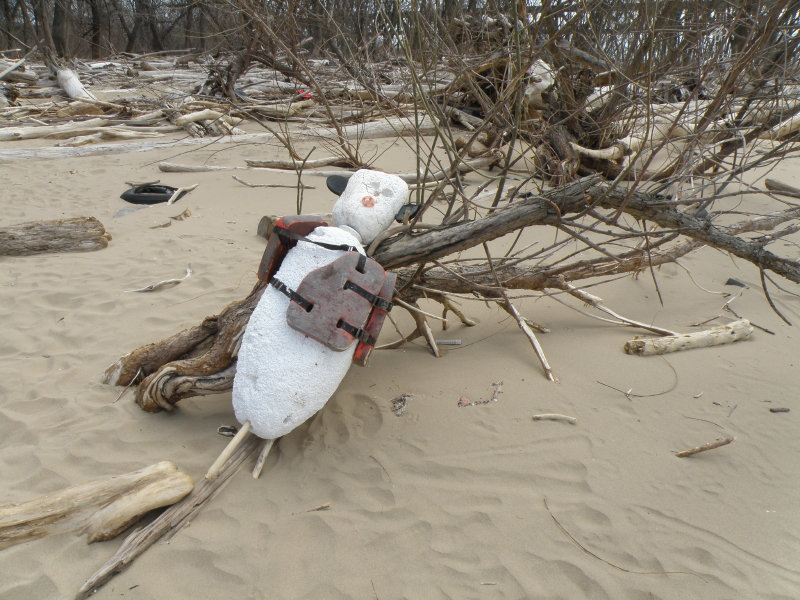
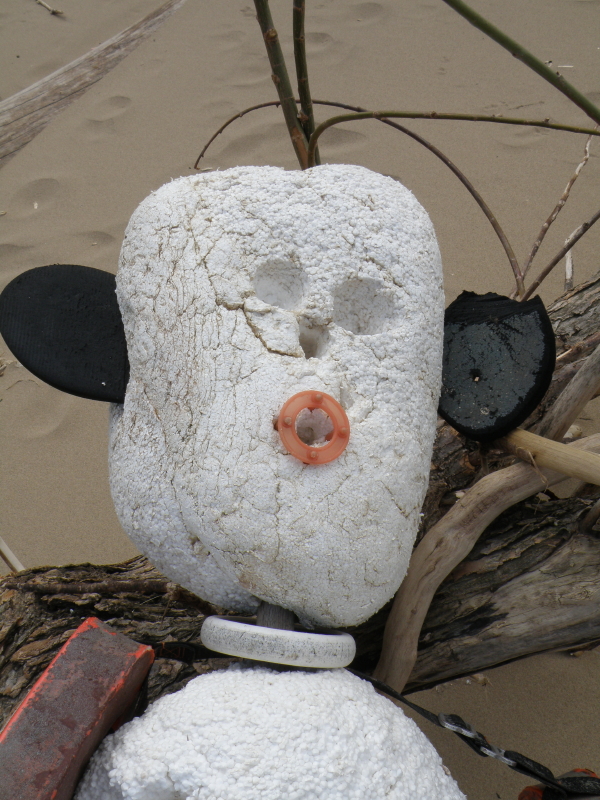
About a hundred meters or so from my spot, I came across Flood Brother #2 leaning against this tree. He was missing many of his features including his eyes and arms. After hunting around I was able to find a few of his parts. As for his shorter brother…there was no trace of him. I kept moving east in my search and discovered evidence that other creatives were in the area recently. Perhaps the people who made the following statements also played with my figures?
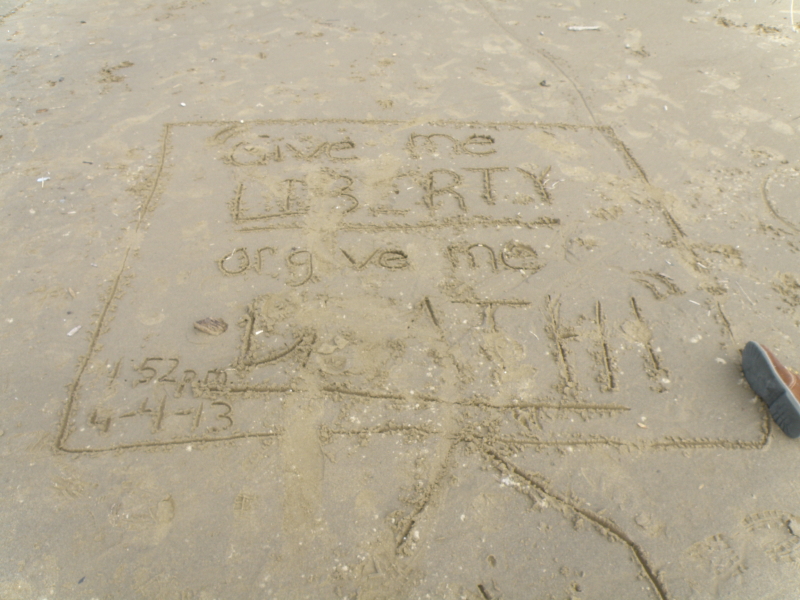
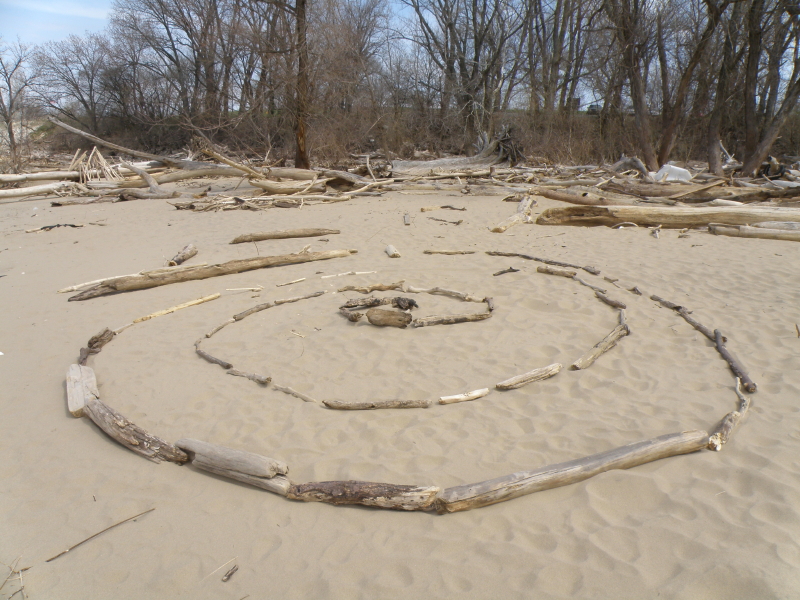
I found this and other sand drawings in the area. Most of the sand designs were statements of a libertarian frame of mind. I also found this large spiral made from driftwood that was in the immediate vicinity.
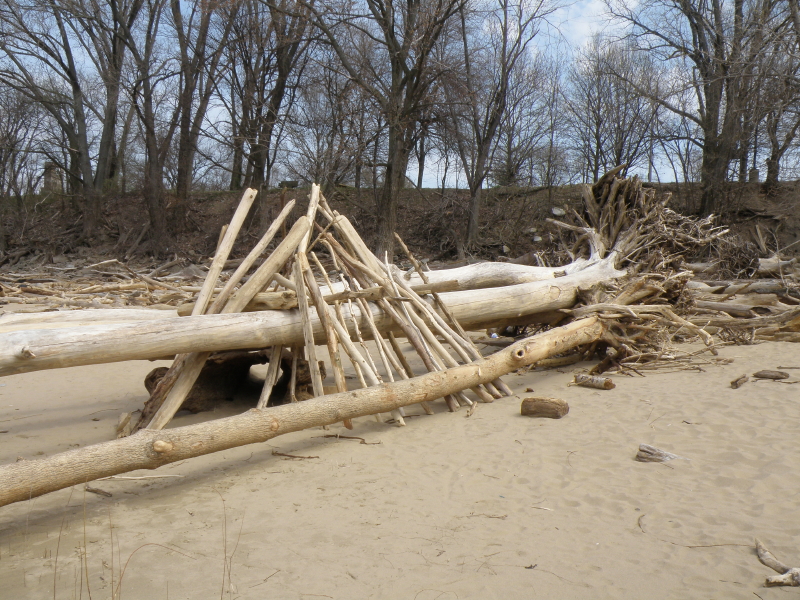
Further west from the spiral was this installation where driftwood was stood on end teepee-style and incorporated with two larger logs that had recently floated into the area. People seem to like arranging wood in this manner and I have also seen bonfires begun in this way.
I thoroughly checked the area for signs of my missing figure and imagined him riding home in the back seat of someone’s car. I picked up my remaining Flood Brother and headed back to my studio. I fixed him back up again. He’s repaired, but also slightly different now.
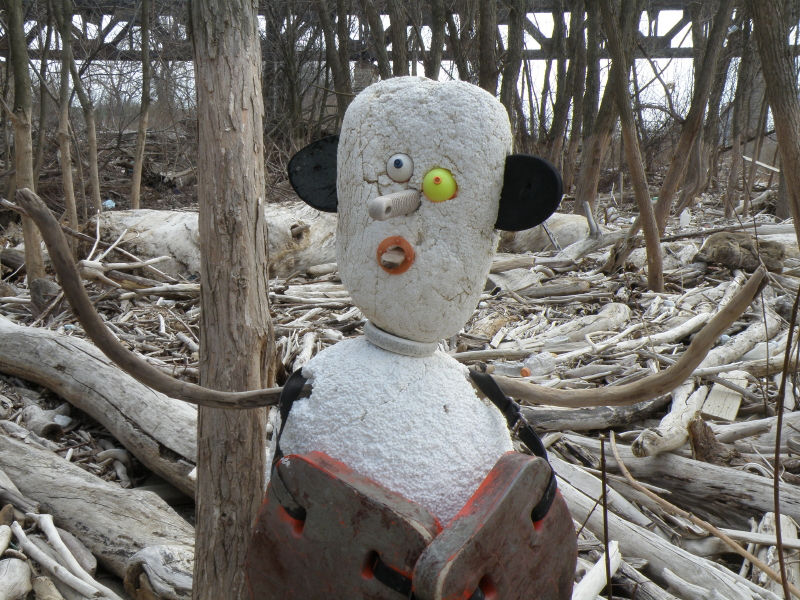
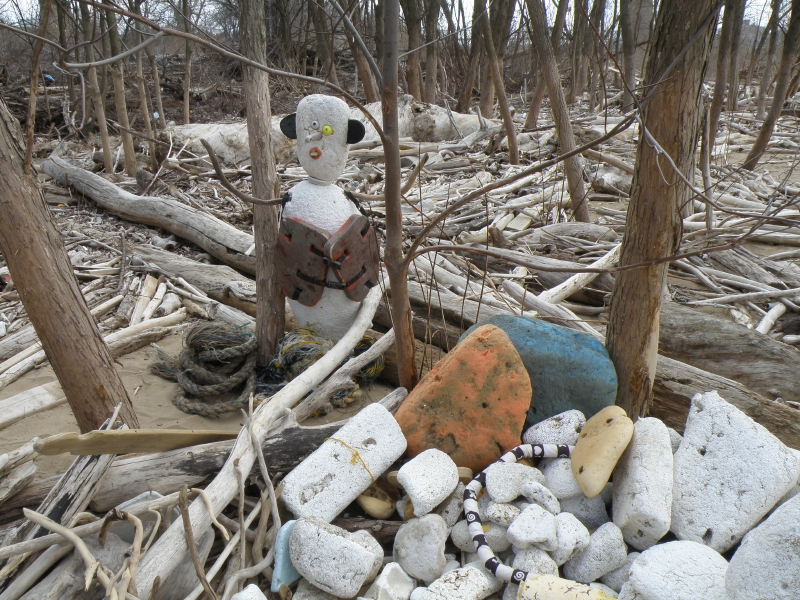
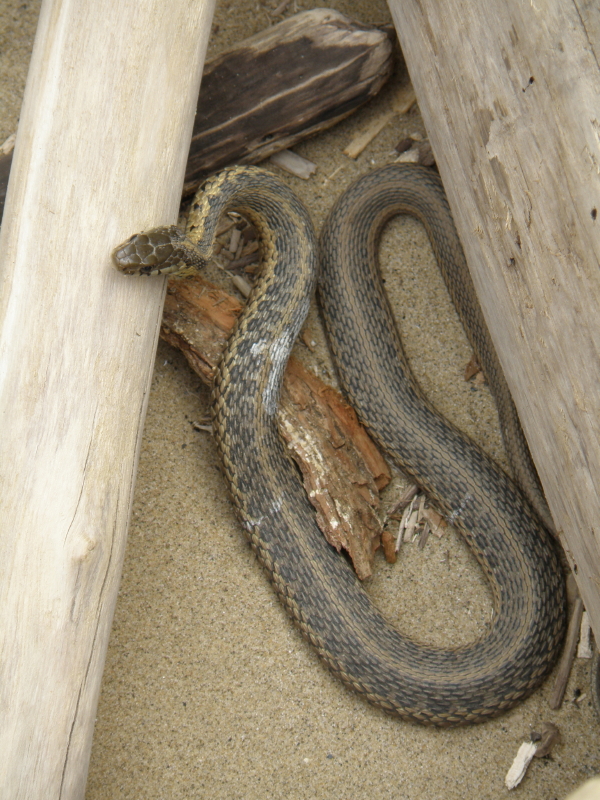
This is how I left things on my way back home. I’ll return in a week and we shall see what if anything happens? Returning to my car, there was still one more surprise left for the day. Emerging into the light of a new season, I came across this small Eastern Garter Snake warming itself (much as I had) among the driftwood at the Falls of the Ohio. See you next time!
The Flood Brothers
Posted in Absurd, Art, art and environment, collections, creativity, ecosytem, environmental art, Falls of the Ohio, fresh water, Ohio River, public art, recycled art, sculpture, Styrofoam, watershed, tagged absurdity, Art, art and the environment, artist at exit 0, creativity, driftwood, ecostory, Falls of the Ohio, found objects, nature, photography, plastic, sculpture, storytelling, Styrofoam on April 4, 2013| 10 Comments »
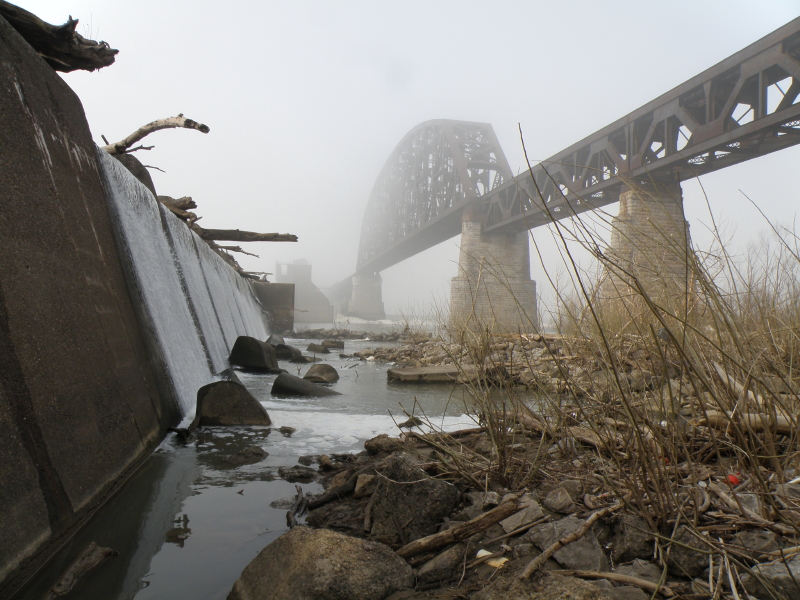
Fog is actually common on the Ohio River, but looking through my images, I’m surprised by how few fog pictures I have taken here. On my last foray to the Falls, the day began extremely foggy like moving within a cloud. Visibility was limited. The railroad bridge was completely obscured, but as the sun rose and the temperature became warmer the fog dissipated quickly. It was another magical moment of transformation as the receding water-cloud revealed the driftwood bones of the park.
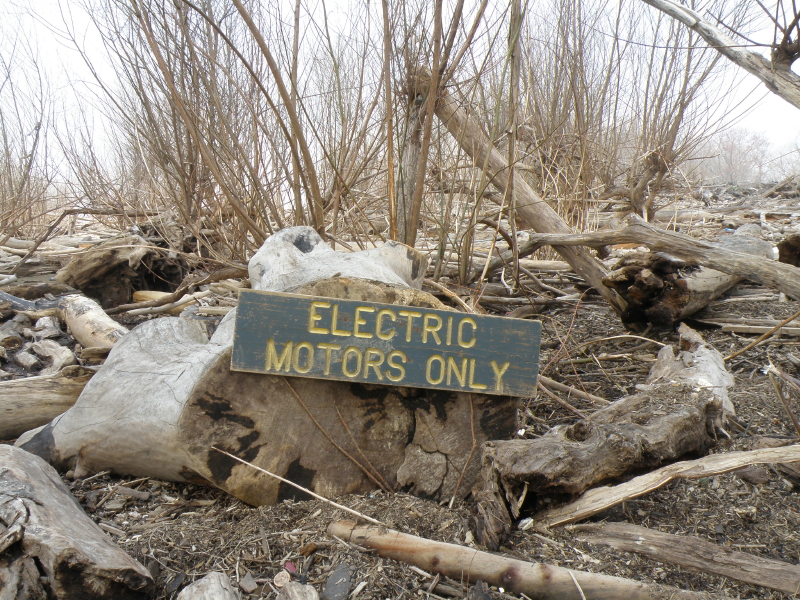
Walking to my outdoor atelier, I passed by this unusual sight. At first, I thought the large tree stump was a part of this sign, but upon inspection, saw that a single rusty nail attached this sign to the wood. There is no way this sign could survive the river secured so loosely. Someone before me found this sign and stuck it on the stump up for grabs in true river junk fashion. Since I collect signs from the river…this was perfect and I welcomed the new addition to my collection! After removing the sign from the stump I understood why its original discoverer left it behind. The sign was on a heavy, thick board that had been routed and painted green with yellow letters. I stashed the sign under some debris and picked it back up on my way home. As you can imagine, my wife was thrilled to see it like she is with all the other junk I haul out of here. I liked the sign’s message which is ecological in its own way. I wonder where it came from and what kind of electric motors is it referring to…perhaps electric golf carts? Navigating through the dense driftwood, I made my way to the river’s edge. Waves were lapping the shoreline and there were other surprises to come.
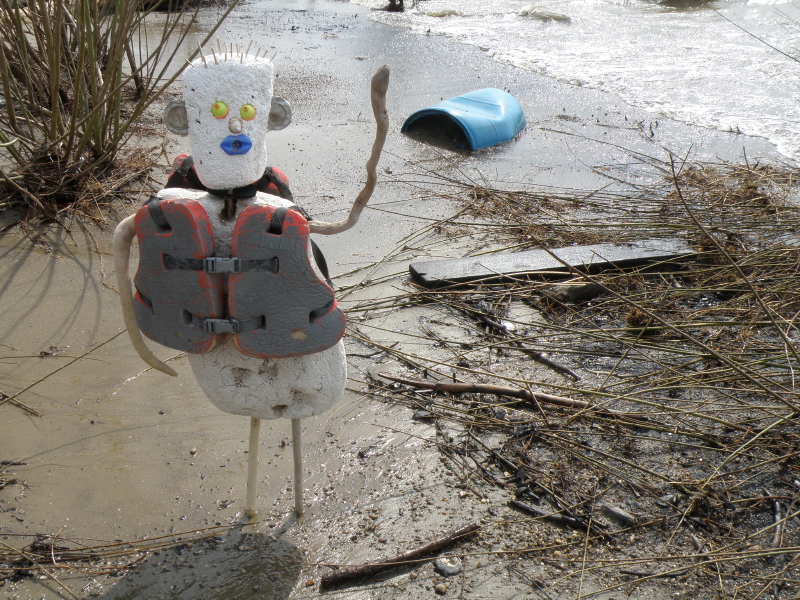
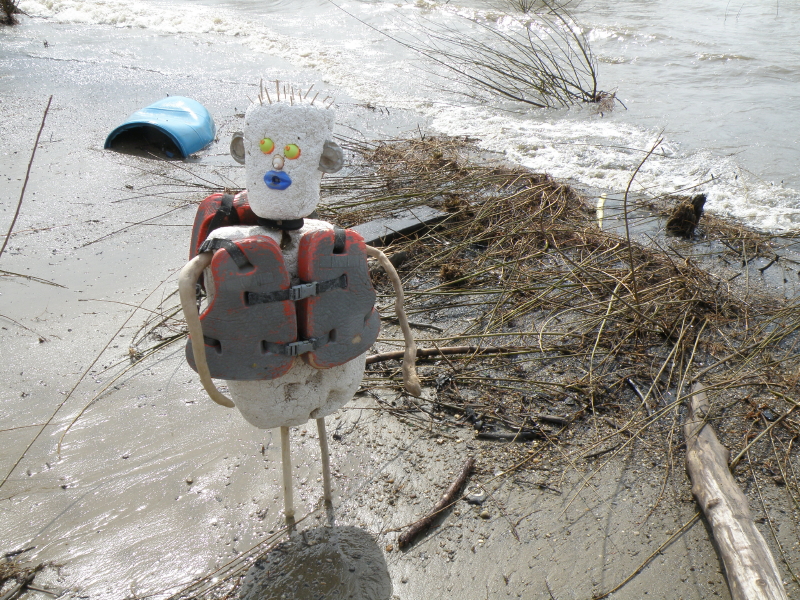
This is the moment I met the first of the Flood Brothers. I had heard of them before and I was pleased to finally get to meet one. They are called the Flood Brothers because in their own “Chicken Little” way instead of the sky falling…they are rumored to believe the world is in imminent danger of being inundated. For this reason they wear life jackets and flotation devices everywhere they venture particularly along the river. They are living legends in this part of the world.

This is a close-up portrait of Flood Brother #1…henceforth identified as F.B.1. He has blue lips like he has been out in the cold too long. His eyes have this jaundiced quality to them and they are slightly asymmetrical as well. The ears stick out some and he has spiked hair. Aside from looking goofy…he is a friendly enough guy and hailed me upon sighting me. I told him it was a pleasure to meet him and was his brother around too? As it turns out…Flood Brother #2 was not far away and after walking a short distance along the shoreline, we ran into him as well.
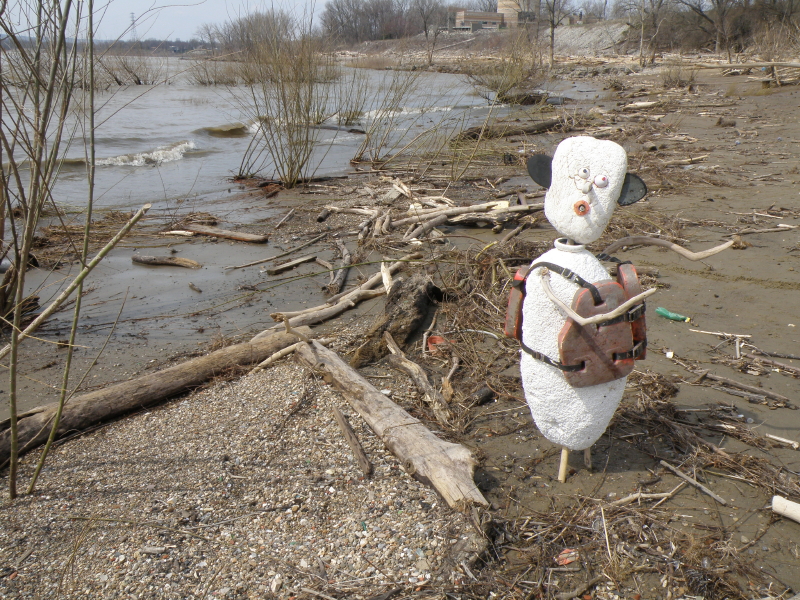
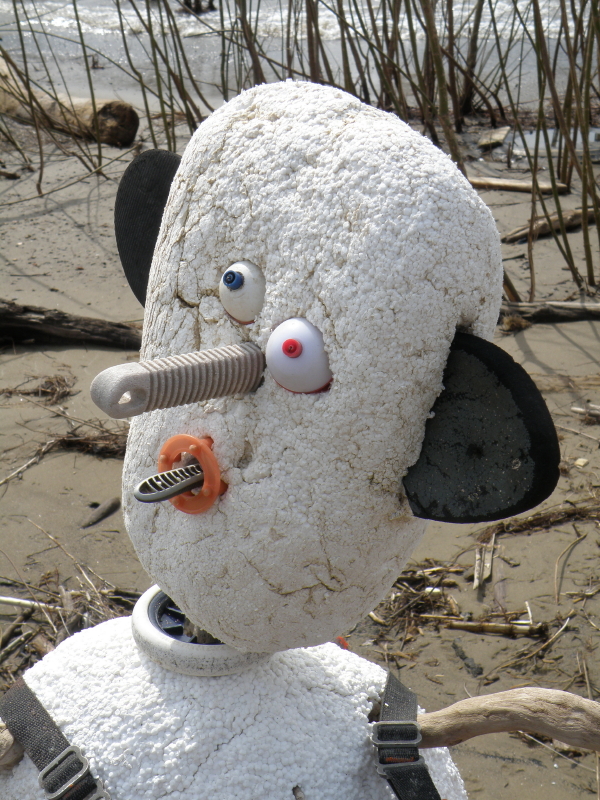
Flood Brother #2 or F.B.2 is the larger and older of the two. Like his smaller brother he wears a flotation device every where he travels along the river. You can tell they are brothers because they share some physical characteristics such as large ears and mismatched eyes which are more pronounced in the older brother. As it turns out, he is also the more nervous of the pair.
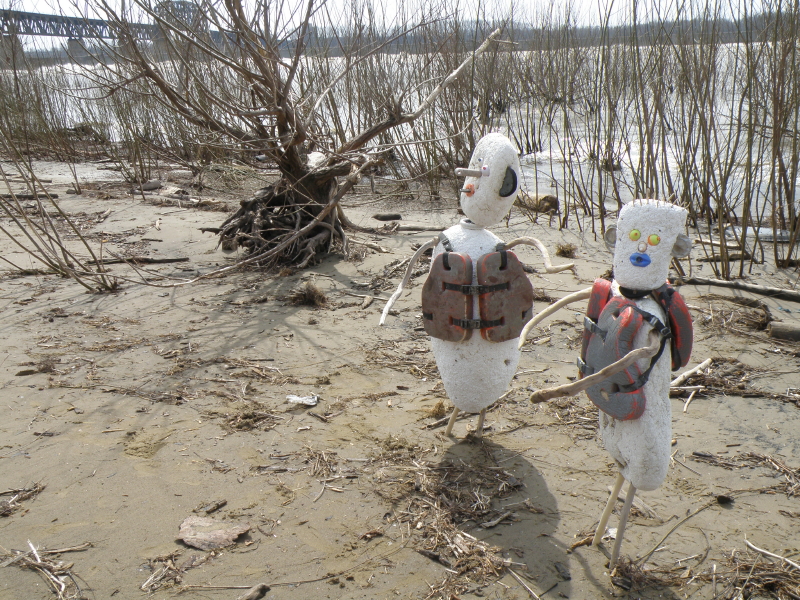
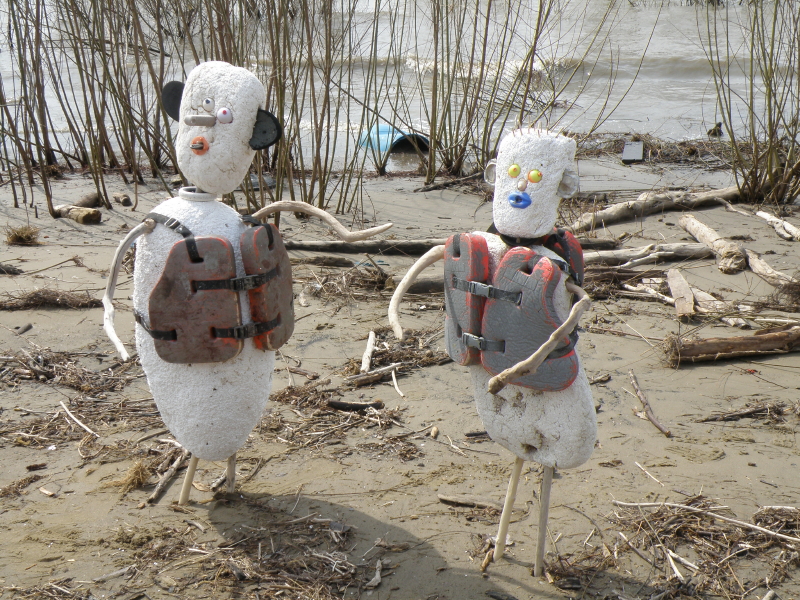
I asked them if it was true that they believe the world would be destroyed in a great cataclysmic flood? For argument’s sake F.B.2 qualified things by saying that more unusual events had happened during the Earth’s long history. As it turned out, they were more concerned about the quality and quantity of fresh water. Climate change is rewriting things and there is just so much more “free” water in the system that formerly was locked up as ice. That energy is changing the weather patterns and redistributing water across the globe. Some places were now getting too much and other places not enough. And yes the potential to redraw the world’s coastlines also existed. Whether all this would happen overnight or over the course of many years seemed irrelevant to the pair. The life jackets were just a necessary precaution to them because they were conducting their research along the river in all its many moods and it just seemed a logical safety thing to do. The pair was visiting the Falls of the Ohio and inspecting the park for water-born plastic of which there was plenty to see. As the brothers told me…this plastic has a very good chance of making it into the oceans where it has effects of its own. I didn’t have the heart to tell them that they were already preaching to the converted. Instead, I invited them to my studio under the willow trees to rest and talk further and they accepted my invitation. My site was just a short distance away.
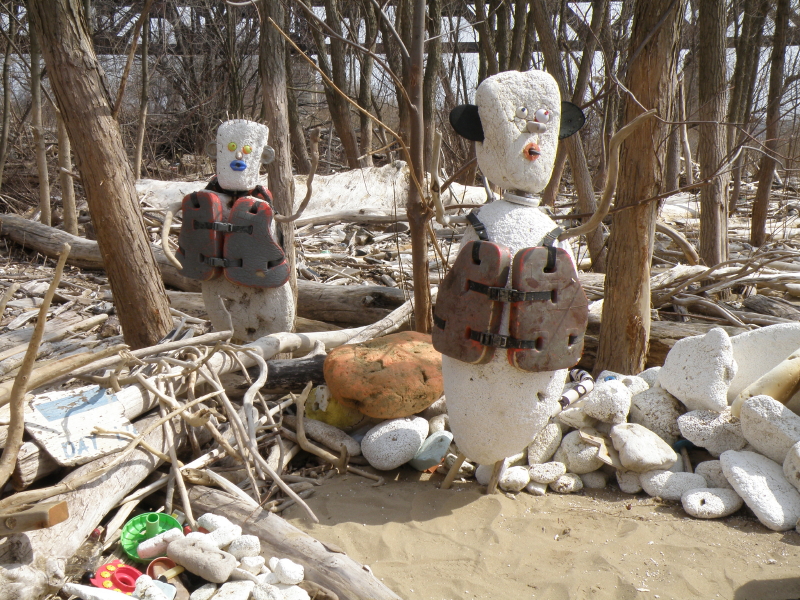
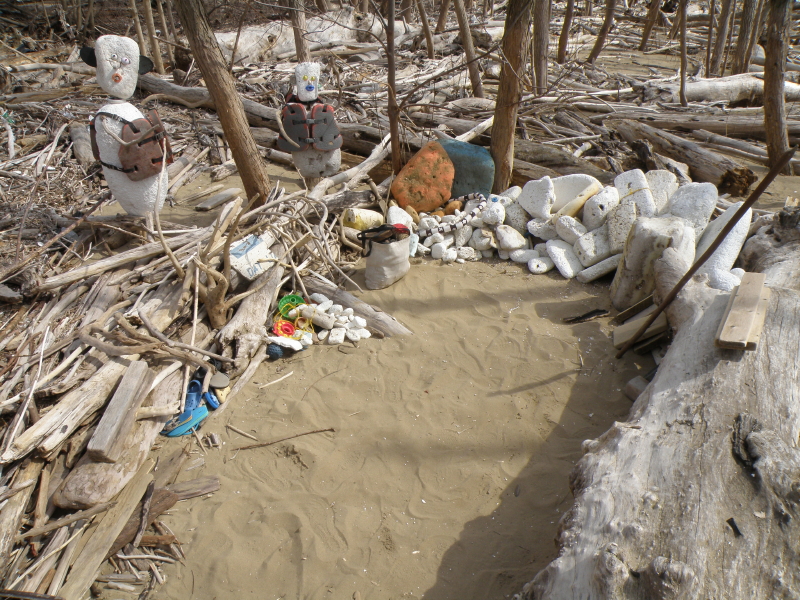
Looking around the Flood Brothers could see that I was interested in many of the same concerns that they had and wasn’t it all so absurd after all? I told them my story and that all the stuff they saw in my little area came from the immediate river. I mentioned that I try to find creative ways to use this junk and to tell the story about a place I find to be very special. They asked me if I happened to see along the way a nice sign they had attached to a stump? I confessed that I had and wanted to repurpose it as part of my sign collection. The Flood Brothers just smiled and said I could have it. After visiting for a while, it was time for me to go home. I told the brothers they were welcome to hang out in my site and perhaps I will see them here again? I liked them as characters. With one last look back I saw F.B. 1 waving good-bye to me. I always have an interesting day at the Falls of the Ohio.
This story marks my four-year anniversary on WordPress . Hard to believe the time has flown by so quickly. Thanks for tagging along!!
Big Fish
Posted in Absurd, animal art works, Art, art and environment, collections, creativity, environmental art, nature photography, Ohio River, recycled art, sculpture, Styrofoam, watershed, tagged Art, art and the environment, artificial food, artistatexit0, big fish, driftwood, Falls of the Ohio, flotsam and jetsam, found materials, nature, photography, plastic, Styrofoam on March 24, 2013| 10 Comments »
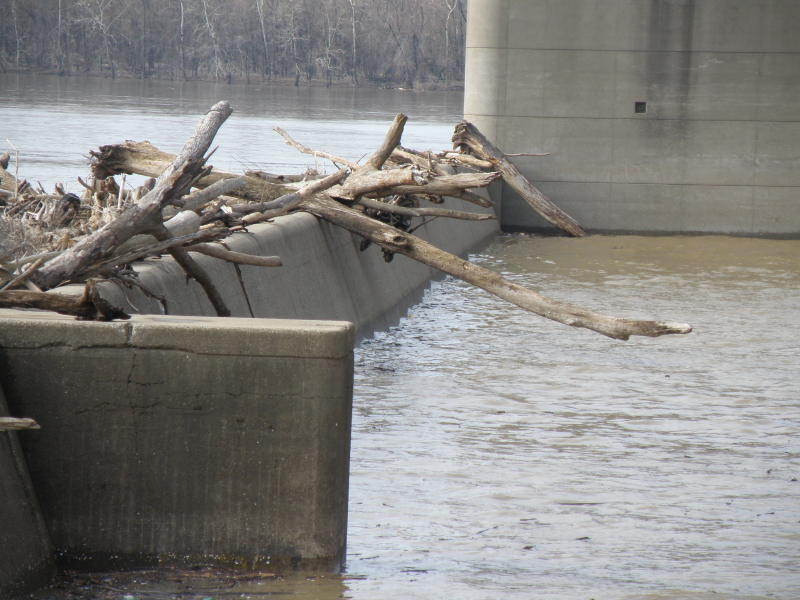
It’s an unbelievably gorgeous morning at the Falls of the Ohio and I have the park to myself. The Ohio River has been running high although we haven’t had a lot of rain pass through our area. Most of this water is probably coming from snow melt and precipitation in the northern section of the Ohio River Valley. The river is receding and one of the first sights I see are logs that have been stranded on the dam as the water level drops. These logs will remain balanced here until the river shifts them around again. As I begin my walk, I see driftwood and trash everywhere I look.
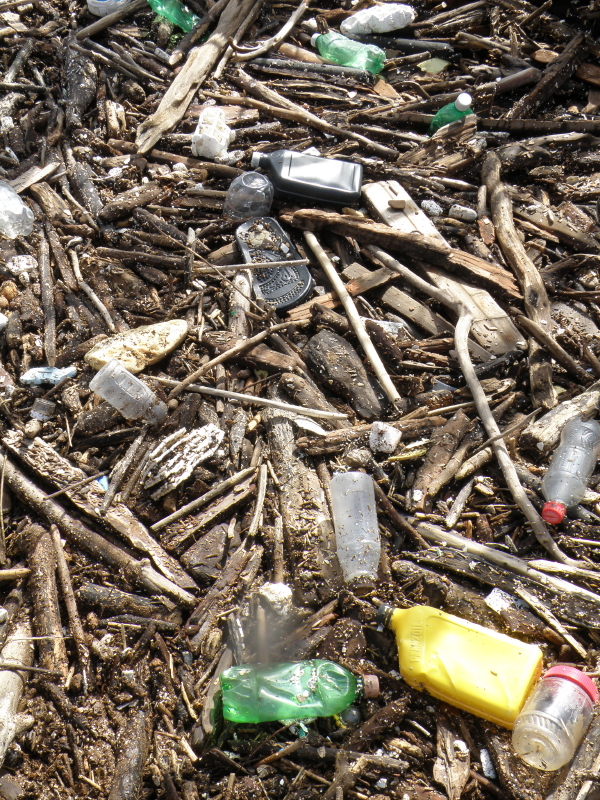
Accessing the bank is tricky and muddy. I maneuver by walking on the backs of logs and balancing myself with my walking stick. In areas where the river has dropped back… plastic trash, Styrofoam, and driftwood remain where this detritus floated in. I like studying the patterns I see in the deposited wood and imagine the swirl of the river in these areas. Of course, I find other treasures and oddities too. Here are just a few objects that made it into the collecting bag.
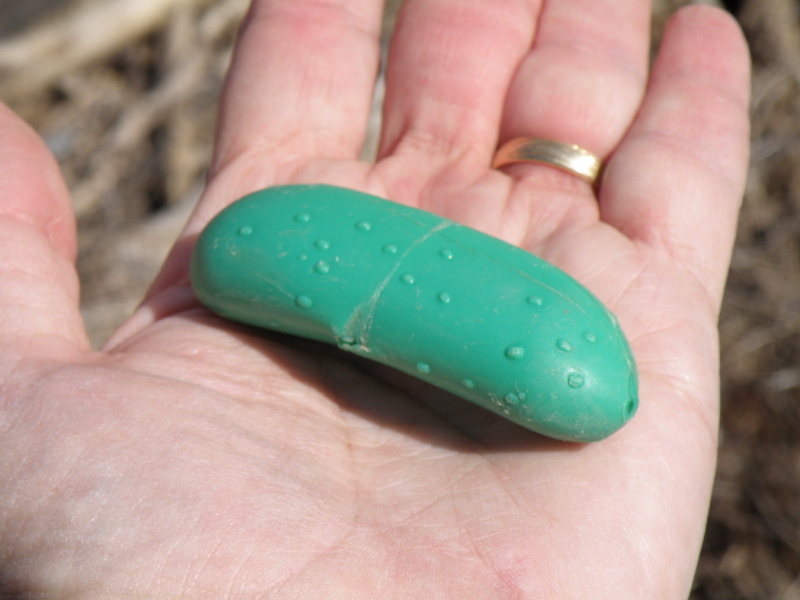
My fake food collection keeps getting bigger and bigger. Here’s a plastic pickle I found. On this day, I also picked up a plastic chicken drumstick, a plastic plum and in the bag already from my last visit are a plastic onion and a plastic cheeseburger! I find all this plastic food to be an interesting indicator of the times we live in.

This is kind of cool. It’s a pirate skull with movable eye-patch. The river has really colored this object. Here’s something more humorous.
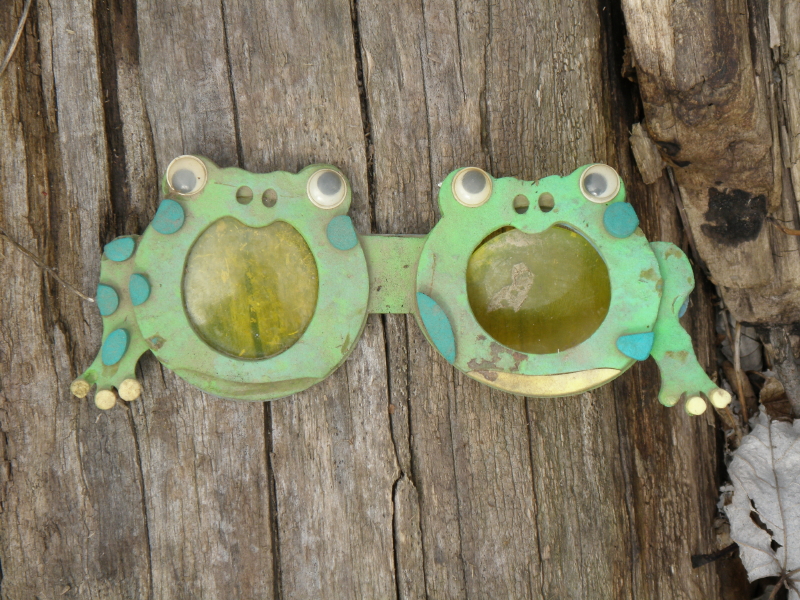
These silly frog sunglasses may be the only amphibian inspiration I receive all year. In all the years I’ve worked this project, I have come across one actual common toad and two small leopard frogs. Perhaps the river is just too big and wild here for the frogs?
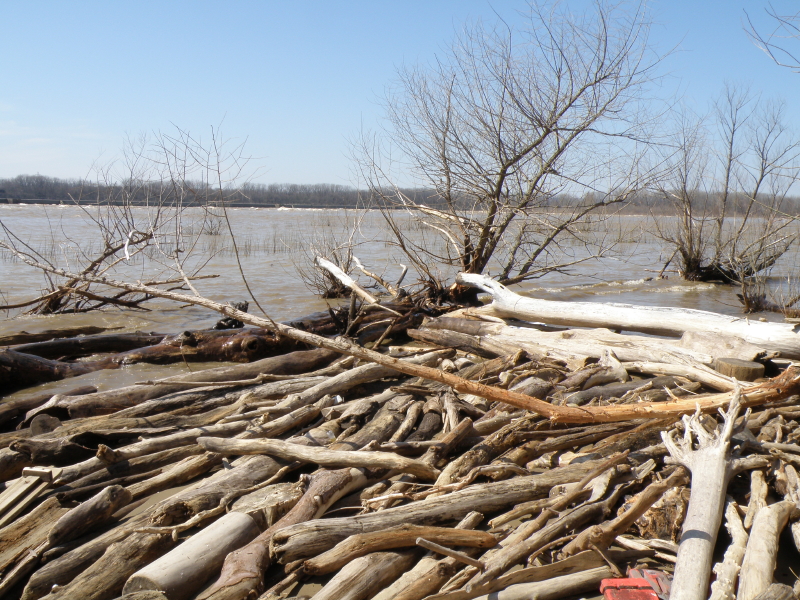
I decide to walk west along the riverbank and reach areas that are more driftwood than trash. I always marvel at how the river lays the wood in fairly parallel rows. That bright reddish-orange object in the foreground is the remains of a life preserver…it is one of two that I find on this day.
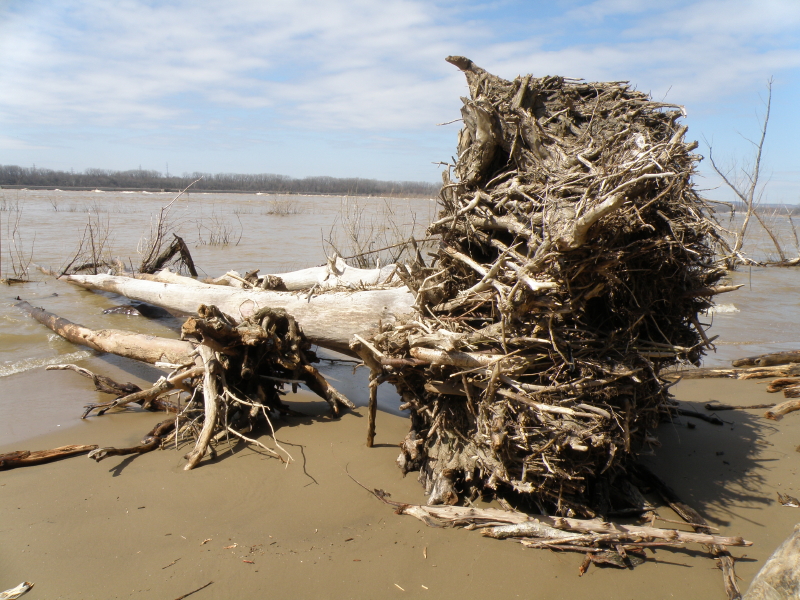
Another tree with an intact root mass has been beached by the river. Notice how all the branches have been knocked off. This is fairly typical. The river keeps subdividing these trees into smaller and smaller parts. Up ahead I notice something that a muddy wave has just returned to the land. I walk over and check it out and see something I’ve never seen here before.

It’s a big fish, but I don’t recognize the species. It’s not too bloated and so I examine it more closely. I think it may be one of those Asiatic carp species that have become so invasive to our bigger rivers? Recently, in western Kentucky in the Land Between the Lakes area, there was the first ever commercial fishing tournament to try to harvest as many of these large carp as possible. Strong nets are needed to catch them since they grow big and rarely if ever take a baited hook. The idea behind the tournament was to educate people that these fish are good to eat and to try to help create a commercial demand for them.

Here I am holding the fish at arm’s length. Notice that it has a relatively small mouth. This fish feeds on microscopic plankton and other tiny food items which is why they are hard to hook by traditional means. This is a thick-bodied fish with a large head and powerful tail. I have known that these fish are in the Ohio River, but I haven’t had the chance to inspect one this closely before. I’ve attached a couple more views of this fish.
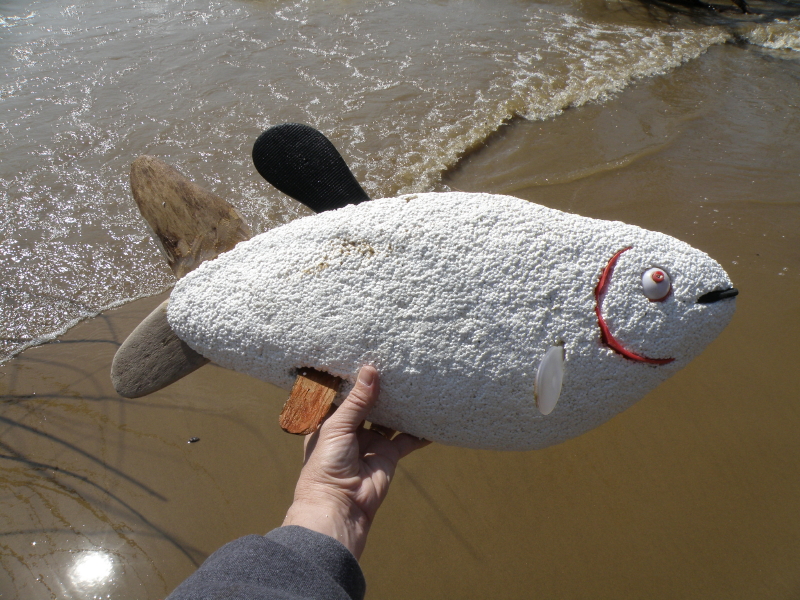
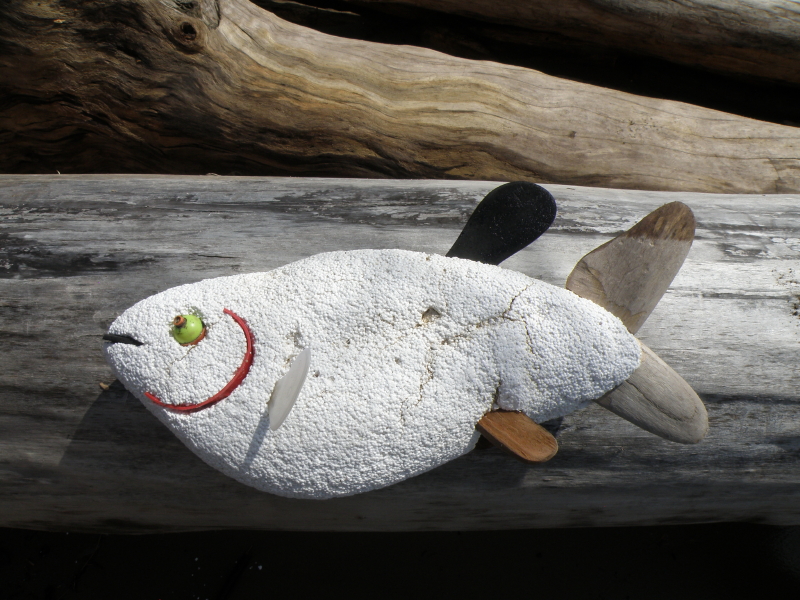
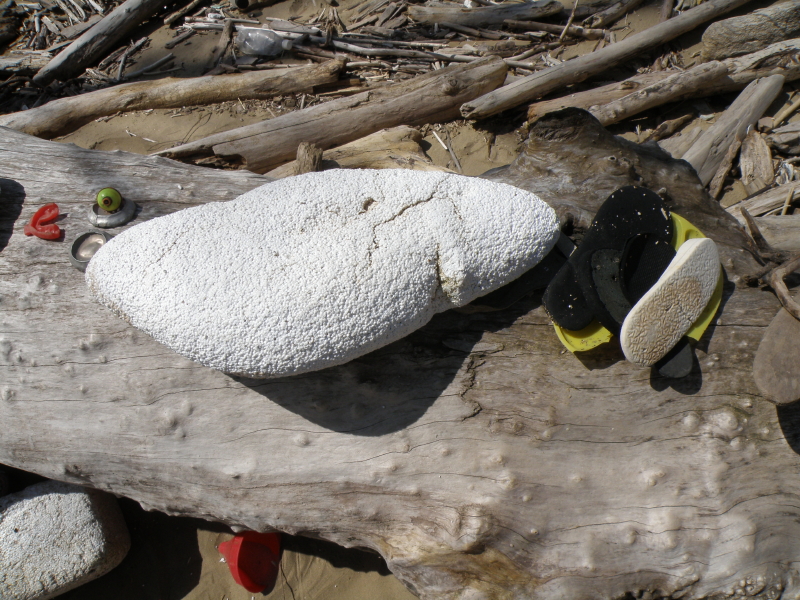
By now, you are probably used to my game! I made this fish from a hunk of Styrofoam I picked up on this day. The Styrofoam reminded me of a fish and so that’s the direction I took this sculpture. The other found elements include: fishing bobber eyes, red plastic gills, fins made from wood, shoe soles, and plastic junk. This is how it looked before I started.
I try to respect the basic shape the river gives me and feel that whatever results… is a collaboration between me and the river. I don’t cut too much into the polystyrene because I also try not to release many of those tiny white beads back into the environment. I try to work minimally and to clean up after myself. It’s not a perfect system, but is what has evolved after so many years of coming out here. I did find even more Styrofoam on my latest adventure and now just need the time to create something from it all. My parting shot is the latest image of my outdoor studio. See you next time from the banks of the Ohio River.

 Artist at Exit 0 Riverblog