Feeds:
Posts
Comments

Posts Tagged ‘Styrofoam’

After the briefest cold period, we have had a glorious week of perfect weather.  It’s been good to get back to the river after having the focus of the project shift away from the park and into a gallery.  Looking around, you can begin to detect those subtle shifts in color beginning to happen in the tree leaves.  Actually, there is quite a bit of color all around when you begin paying attention to it.  For instance, check out this morning-glory vine.
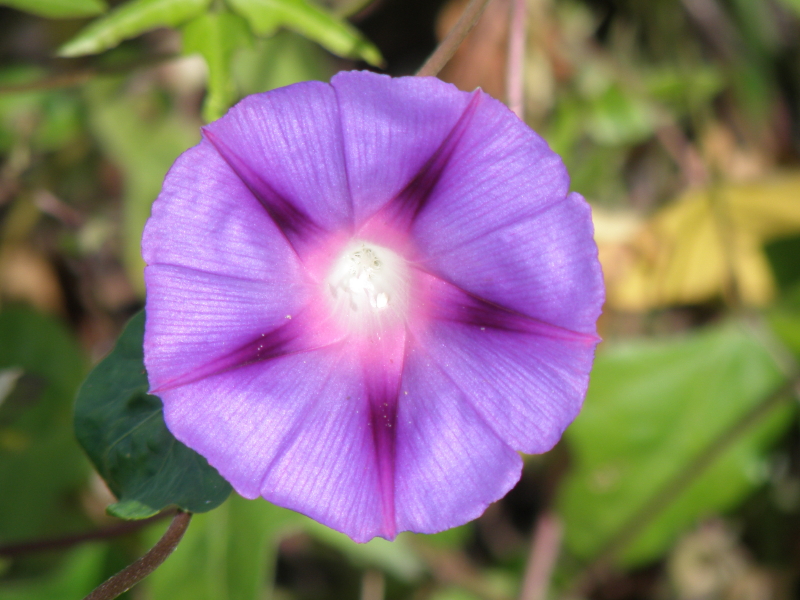
This purple flower is practically glowing.  And the Viceroy butterfly is all in burnt orange as it mimics the Monarchs that currently are migrating on their way south.  That large black vein crossing this butterfly’s hind wing is found only on the Viceroy.

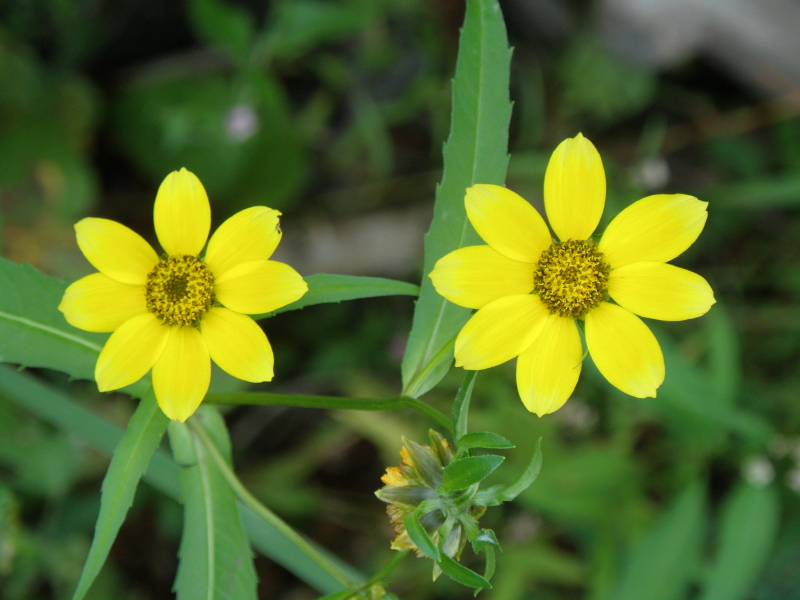
Now blooming at the Falls are several species of the Composite flower family that look so close to one another that you need to have a few on hand for direct comparisons.   Many are yellow in color like these twin blossoms.
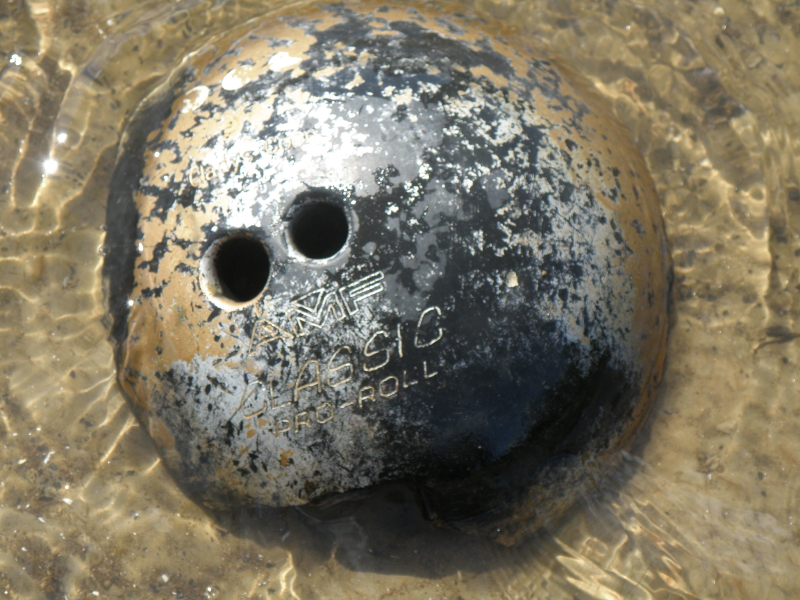
When I wasn’t noticing the local color, I was poking around for old booze bottles.  I found a few more to add to another piece I’m making at home.  I also came across the remains of another bowling ball and I added this one to my collection.  This is how I found it.

At first I thought I was going to dig this ball out of the dirt, but I didn’t need to.  What you see is essentially all there is!  It’s just a chip of the ball that happens to include a couple of finger holes, the ball’s brand name, and the name of its former owner…Gladys Coons inscribed on the surface.  I dropped the fragment into the water to clean it off and the metallic colors begin to shine.
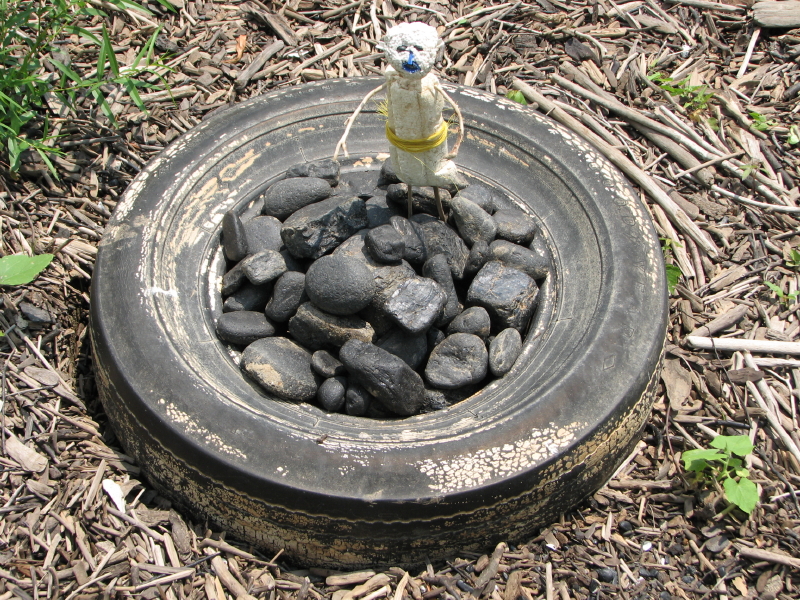
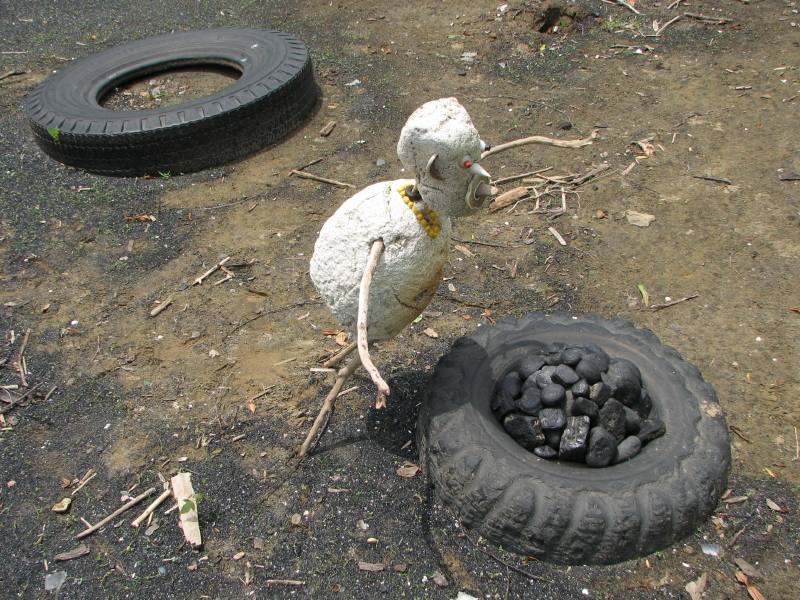
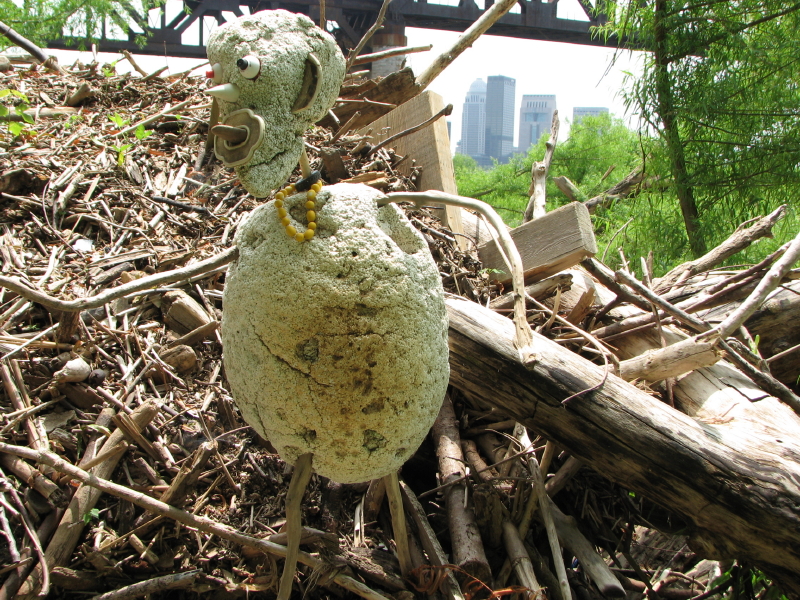
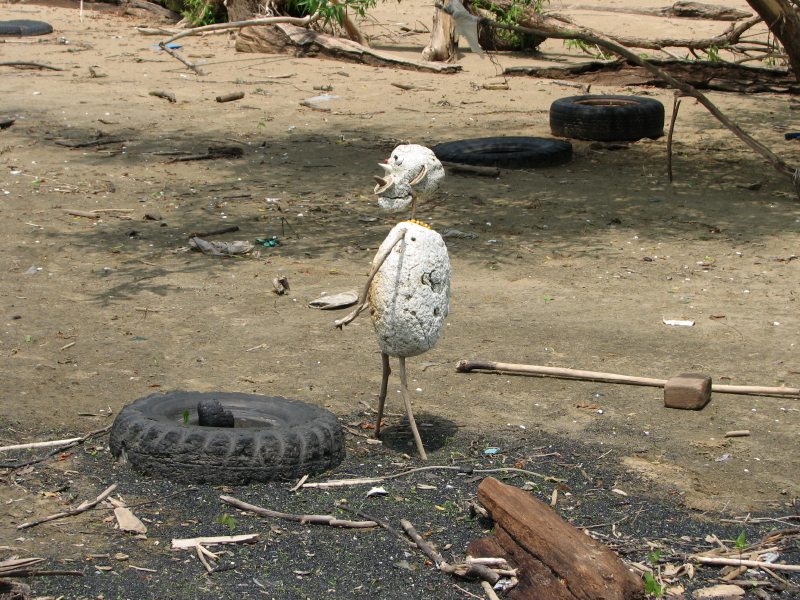
With the Styrofoam I also found out here I fashioned yet another figure and posed it next to an old tire that I had placed river found coal into.  First here’s the tire nearly overgrown with plants since my last visit.

Now for a more eccentric view with my Styro-figure posed above it followed by a shot that places things in better perspective.

It’s been a few years since I worked with coal as intensively as I have this year.  Our spring floods did a lot to redeposit this mineral in the form of rounded coal pebbles and gravel.

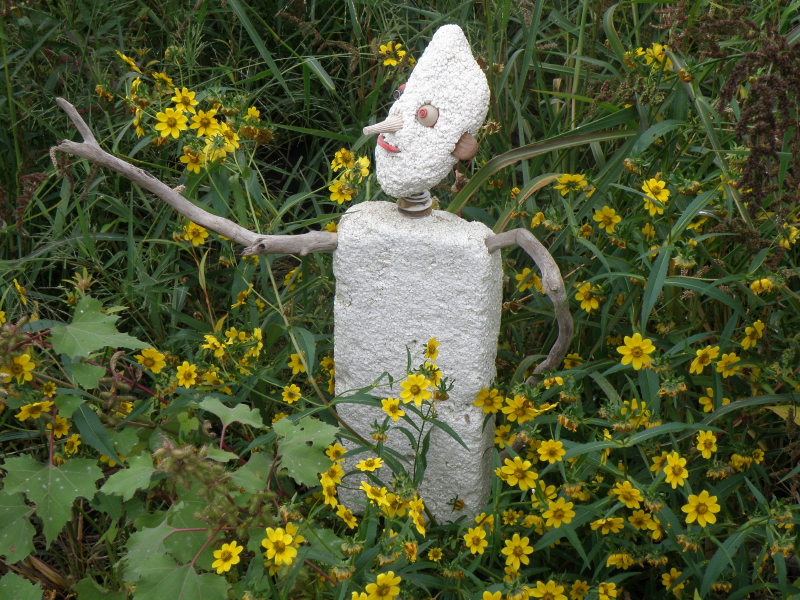
I reposed this simple figure several times mostly in the area that had the most coal deposits.  Much of the time I was filling empty bottles with coal for that other project I mentioned.  In places you can find “beaches” of coal gravel several inches deep.  Intermixed with the coal are white mussel shell fragments and a bit of brown tree bark.  I will post images of my bottle sculpture once it is finished.  For now, I will leave with a picture of where I left this particular figure in the park.  I found a different arm and placed this piece in the context of these beautiful flowers.
Read Full Post »

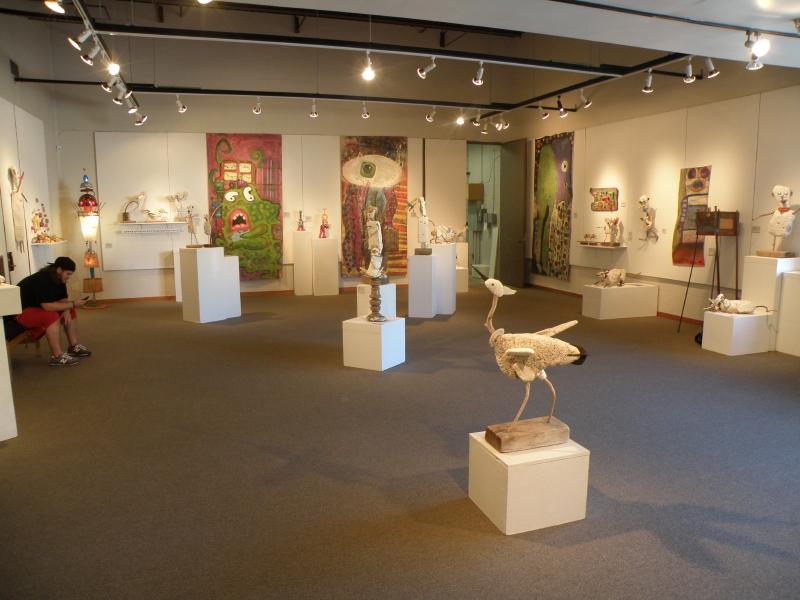
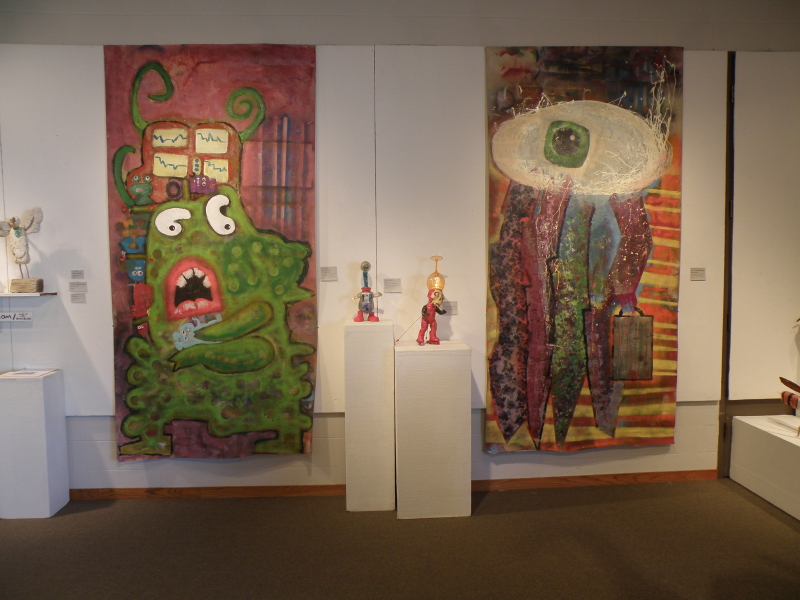
Hard to believe a week has passed since this exhibition opened and summer has made room for autumn as well.  Such is the passing of time.  As promised here are a few views of the show my work is in which opened at Bellarmine University’s McGrath Gallery on September 16.  The exhibit is entitled “Outcasts and Artifacts, artwork from a disposable world”, “Al Gorman and Scott Scarboro”.  I snapped a few installation views before people arrived for the opening.  Thanks to friends and family as well as a well-timed snippet in the local paper… a good mix of folks came out to see our work.

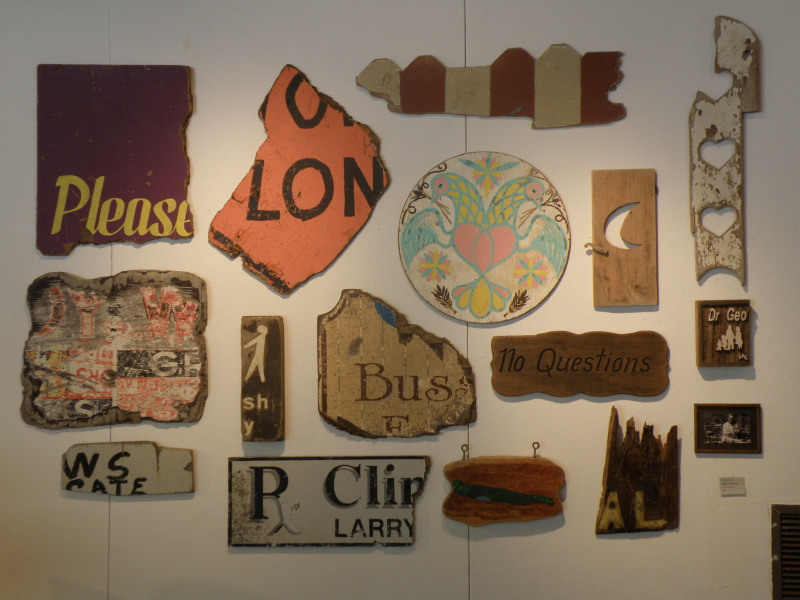
I have a lot of stuff I’ve gathered and made to select from over the years and I decided now was a good time to see my sign collection hanging on a wall.  I found that I still enjoy looking at these artifacts.  I like hand painted signs and one of my very first jobs was working in a sign shop.  I have this idea about history being interpreted from examining the existing fragments and this collection fits.  I also like finding the occasional sign where the universe is seemingly “speaking” to you by providing enigmatic clues.

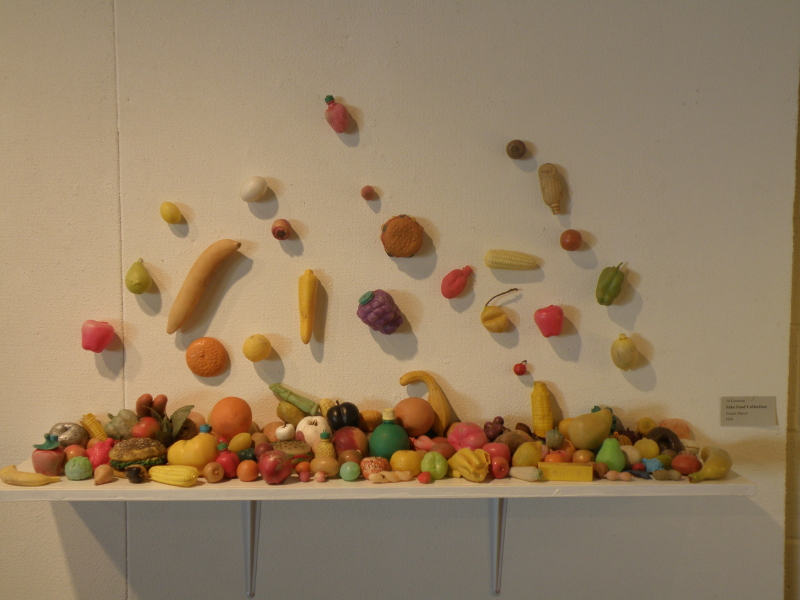
My “Fake Food Collection” was another one of my various collections I put on display.  I have shown this before, however, it seems each time I go to the river I find another piece or two for it.  As a result, this collection keeps getting bigger and bigger and no longer  fits in the Styrofoam box I use to store it.  I found every piece at the Falls of the Ohio courtesy of the Ohio River beginning eight years a go.  These are the pieces I did find and I often wonder about the ones that got away!  To me, all the predominantly plastic representations of food are another signal of our disconnect from nature.  The smell of the plastic is really noticeable.  I think this collection presents initially as something humorous until the reality of it sets in.  This seems to be a part of my art’s modus operandi.

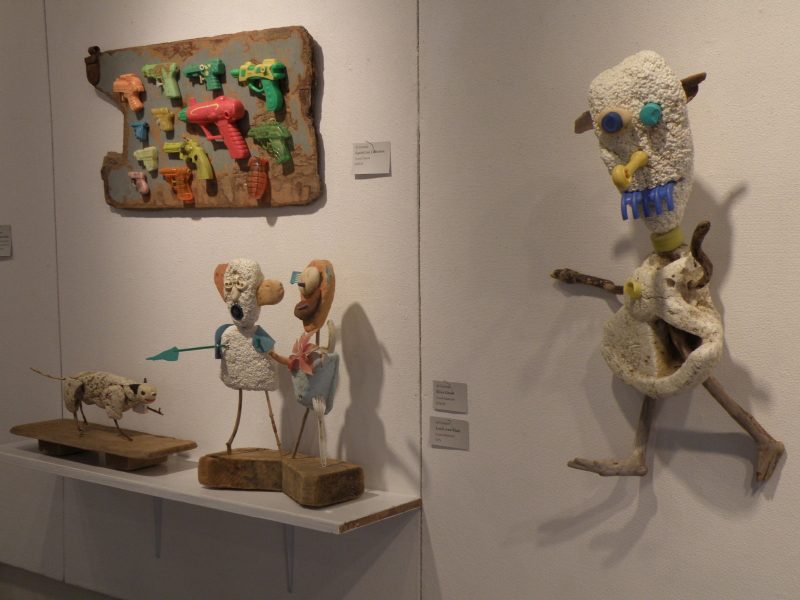
Among the sculptures I displayed are a couple of early pieces that I have never exhibited before.  Such is the case with “Fang” on the right and my version of the meeting of the explorers “Lewis and Clark”.  “Fang” still has its original dirt on it.  Also in this shot are my “Squirt Gun Collection” and a small predatory animal I called the “River Ghost” which I featured in a blog post last year.  Most of these Styrofoam sculptures I consider to be “relics” of a larger process I engage in and weren’t originally intended to be stand alone objects.  Although I have saved many works over time, the vast majority of them were left behind to await their fates in the park.

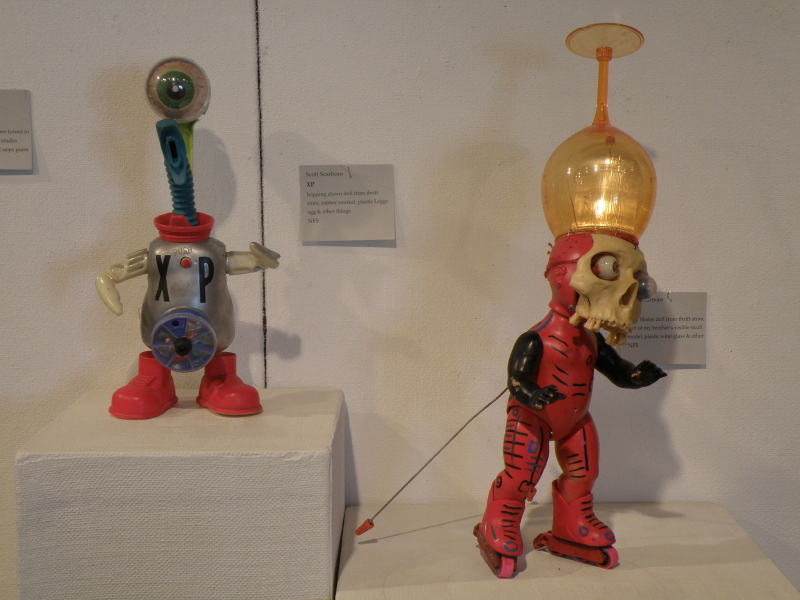
Scott Scarboro is an interesting artist who lives in New Albany, Indiana that also works with found objects and materials.  His stuff is more “urban” than mine and he makes use of old toys and yard sale and flea market finds.  He likes to tinker with the mechanical and electrical workings in these toys so they neither move nor sound as originally intended.  Of late, Scott has been exploring the uses of sound in sculpture in public art settings.  The paintings began life as wall paper remnants that then became drop cloths that Scott worked back into. Scott and I have been friends for many years and our artistic paths seem to intersect frequently.

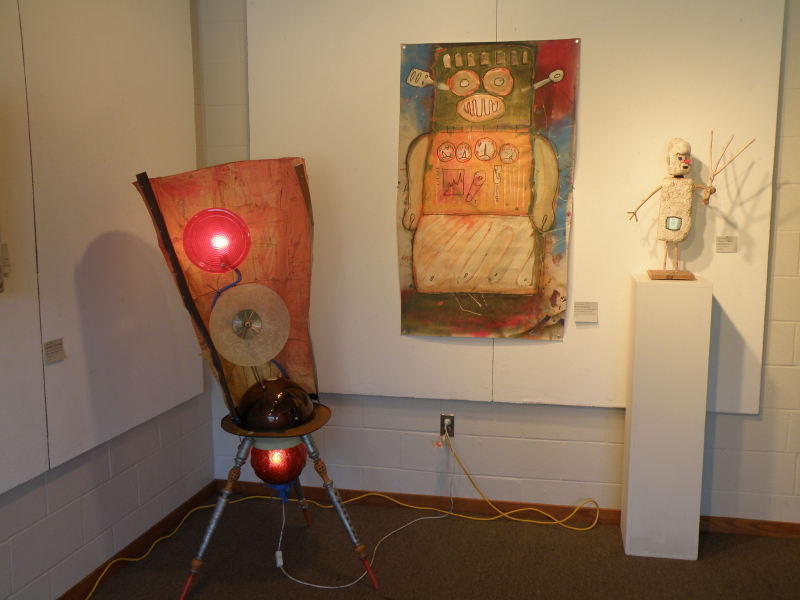
Another view from the gallery.  Scott made the robot painting as well as the lamp.  The two of us spoke to an evening art appreciation class at the university that went really well.  We were able to engage the class with our art and ideas and I believe most of the students were not art majors? As a result of our talk many of these students came out for the opening reception.

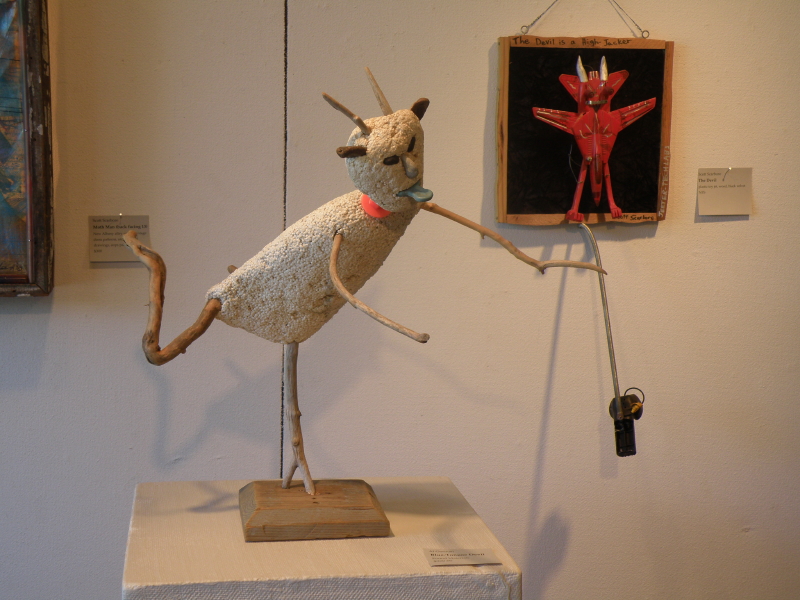
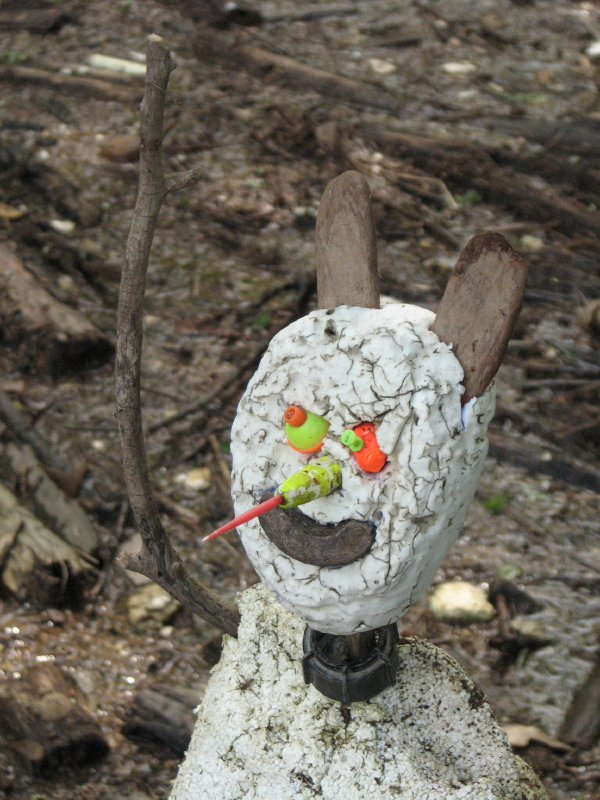
Two “devilish” works by me and Scott.  The Styrofoam sculpture I entitled “Faun or Blue-tongued Devil” and the wall piece  Scott made using a toy jet fighter plane.  One idea that both of us like working with is “repurposing”  existing objects and making new statements from them.  The world is after all already filled with a multitude of objects that can be reinterpreted without using freshly extracted resources from nature.

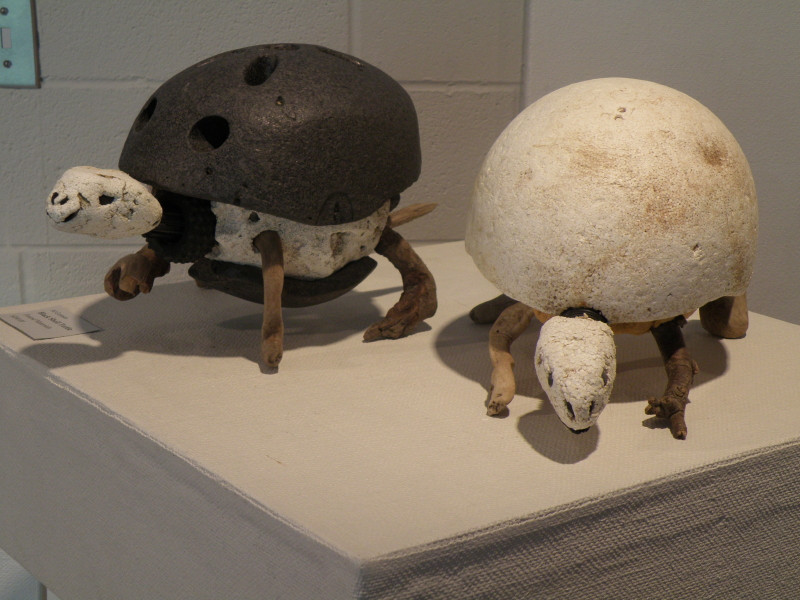
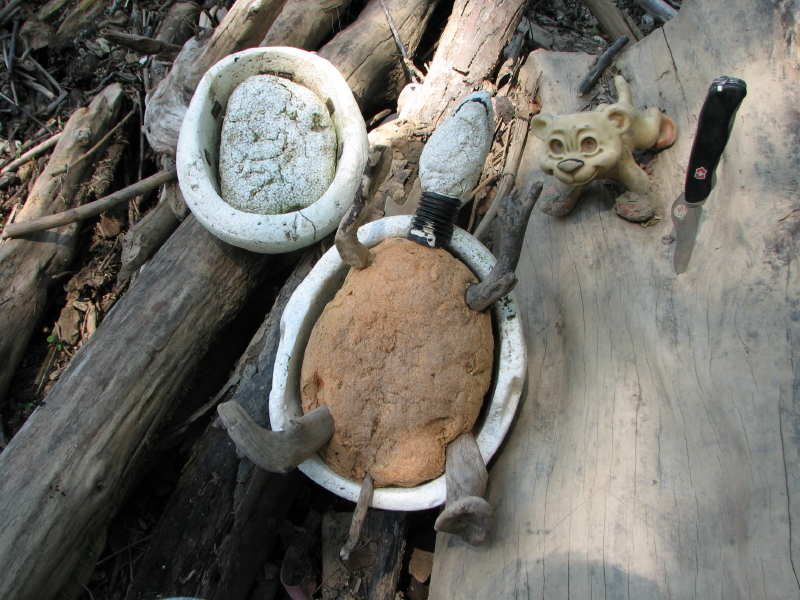
Also in the show were two Styro-turtles I’ve made.  The white one was featured in one of my recent posts as the “Cottonwood Turtle”.  I was pleased by how that story and images turned out.  Both turtles include old bicycle helmets in their making.  The black one’s body under the helmet is actually a foam wig stand in the shape of a human head.  For many of the works I presented, I also included laminated hard copies from my blog posts that showcase the sculpture on exhibit.  I have to say that I still prefer seeing my works in the contexts of where they were created and as a result I probably don’t pursue the exhibition opportunities available to me.  In closing, here is one final shot featuring three of my pieces and a shameless sign I painted to get gallery visitors to also visit my riverblog!  I still feel that this is the best place to get a fuller sense of what I’m doing at the Falls of the Ohio.  All the rest is fragmentary and tells a smaller part of the story.  My thanks go out to Bellarmine University and Caren Cunningham for the invitation to exhibit and Laura Hartford for all her hard work in preparing for this show.

Read Full Post »

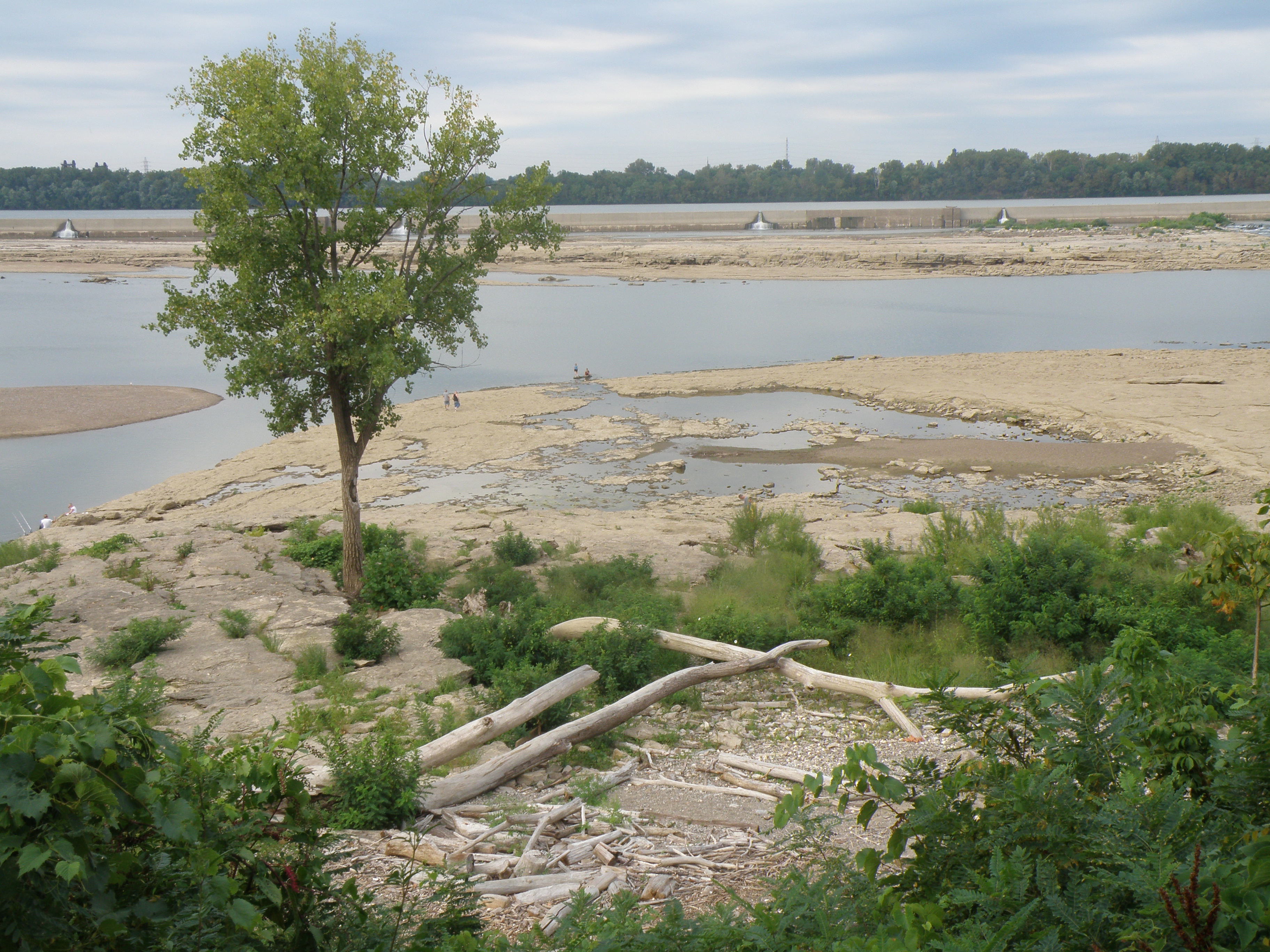
It’s the Falls of the Ohio State Park in late summer.  We haven’t had any significant rain in a few weeks and the fossil beds are exposed as the river has retreated away.  This isn’t a permanent condition…just the way it is during this season. Visitors are walking over the rocks and admiring the many ancient fossil corals that during the rest of the year are under water.

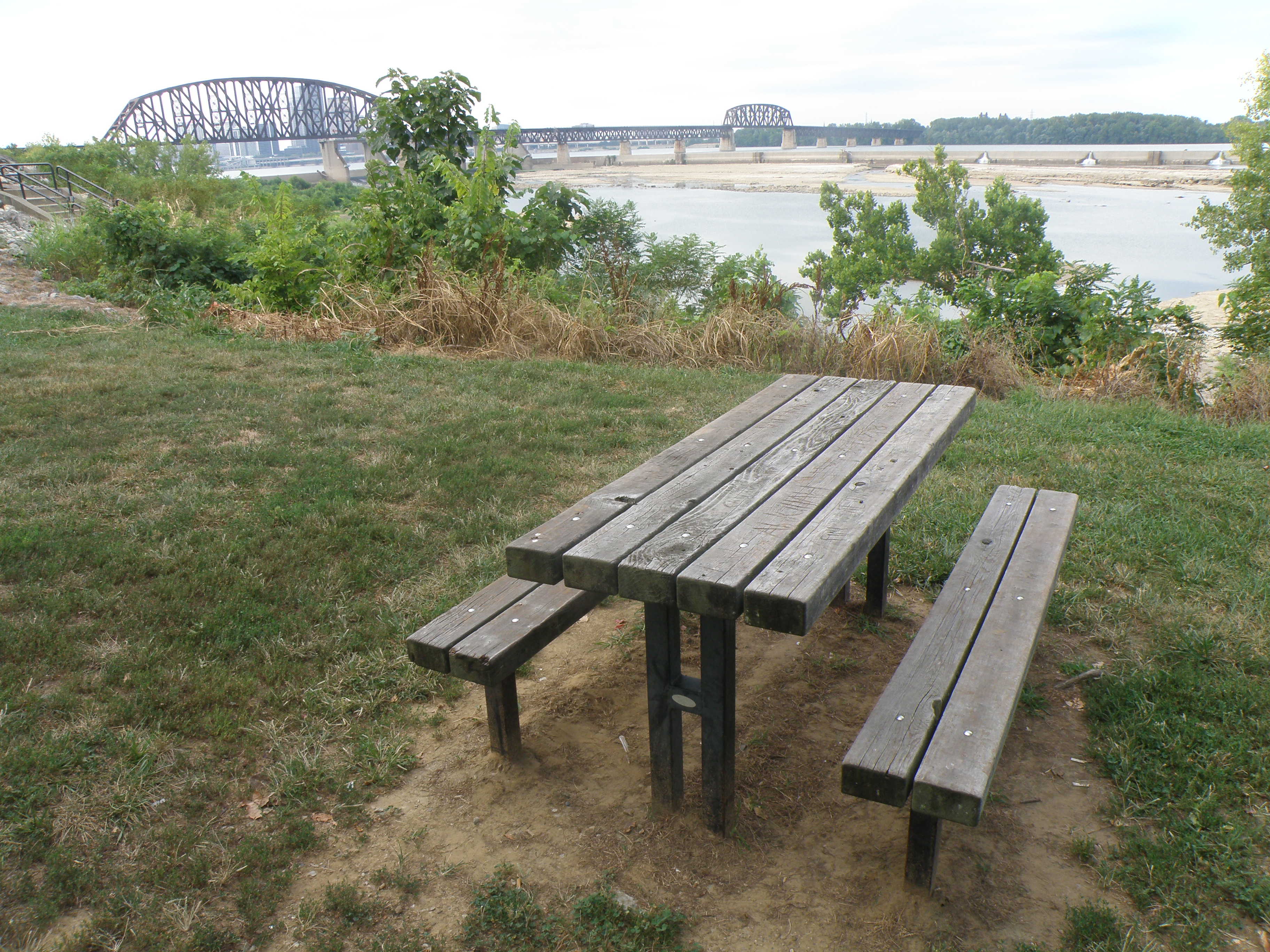
The best time to get a sense of the extent of the fossil beds is during summer.  From the top of the riverbank you can get a good overview of the area.  You can see across the fossil beds to the high wall that keeps the Ohio River at bay. Bird watchers are scoping the rocks and the top of that wall on the look out for seasonal birds or that once in a lifetime rarity.  Well today was their and my lucky day!  I was sitting by the picnic table when in the far distance I noticed something large and white winging its way across the ancient limestone terrain.  At first I thought it was a pelican, but it clearly wasn’t big enough.  That’s when I heard one of the bird watching flock who also spotted it say that he thought it was a heron or egret of some kind.  I grabbed my camera and hustled down to the river.

I watched the white bird circle the area by the lower tainter gates and I anticipated its possible landing spot.  As I approached the area my mental field guide was going through all the possible species.  Great Egrets are seasonally common here and while they are white…they do not possess a black bill.  One white wader that does have a black bill is the Snowy Egret, however, it is smaller and has black legs with yellow feet.  Snowy Egrets come to the Falls but they are less common.  It couldn’t be a Whooping Crane because I couldn’t see any black tips on the wings.  For a moment, I even thought this bird might even be an albino.  Nevertheless, it was shaping up to be a mystery which are among the most fun birds of all.

I saw the bird alight in the sedges and grasses near the river which is where I took these photographs.  This beautiful bird was distinctive with its black bill and white head crest.  It’s tail feathers were also tipped in black.  I watched it catch and eat grasshoppers that were numerous in the weeds.  For the moment, I would concentrate on taking pictures and being discreet.  I could always identify it later in the comfort of my home, but already I knew it wasn’t a bird normally found here or in our country.  This bird’s beauty was enough and knowing its name wouldn’t make it more beautiful.  Time stood still until the bird spooked or just decided to fly off.  Later that day I saw the heron return to the river and I hung around hoping for just this opportunity.

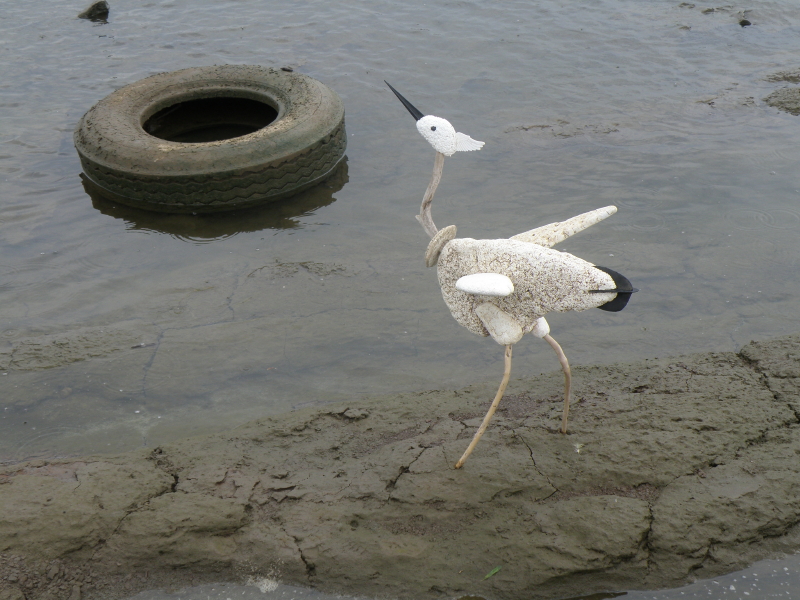
I was struck by the great contrast between the snow whiteness of the bird and the dingy black of the tire resting in the water.  I thought the heron was exhibiting signs of distress or anxiety, but I was surely projecting my own feelings onto this animal…or maybe not!

In one of the most curious bird behavior moments I have ever observed, the heron walked over to a group of discarded plastic bottles and started hitting them with its bill.  I guess it was just checking them out?  A passing fisherman came too close and the bird was gone for good.  I took a deep breath and hoped that I had a few good images and turned for home.  The bird turned out to be the Black-billed Heron which is more accustomed to being found around the heat of the equator.  Few confirmed records exist of this species being seen this far north. But since it’s been hot just about everywhere this year, the right conditions were present for it to make this appearance.  This same individual would create quite a bird watching stir wherever it was sighted in the United States and even made the cover of several bird watching magazines.  The Falls of the Ohio was as far north as this bird was seen and for me it was a happy privilege to see a bird that even John James Audubon never saw.

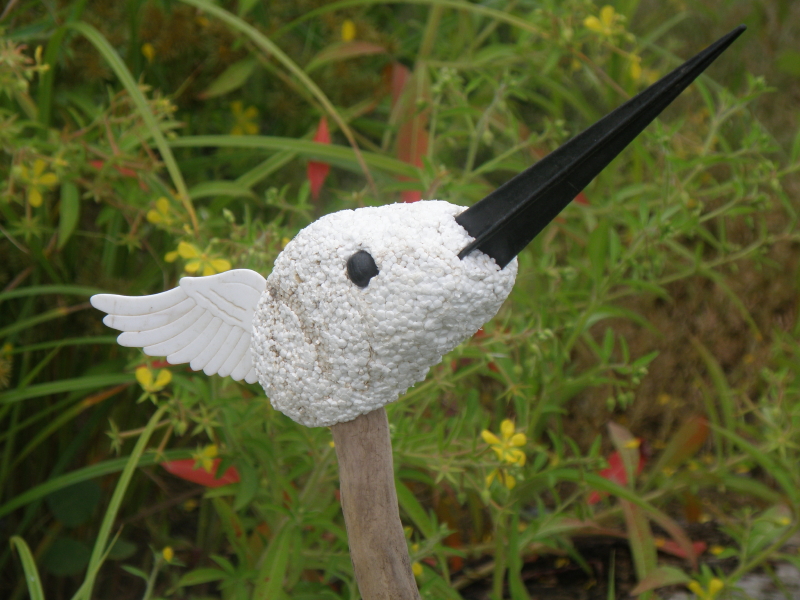
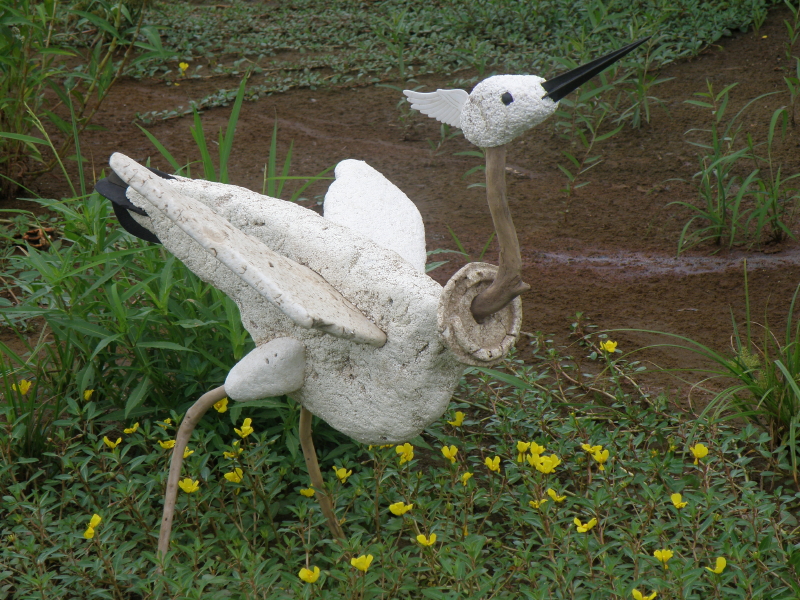
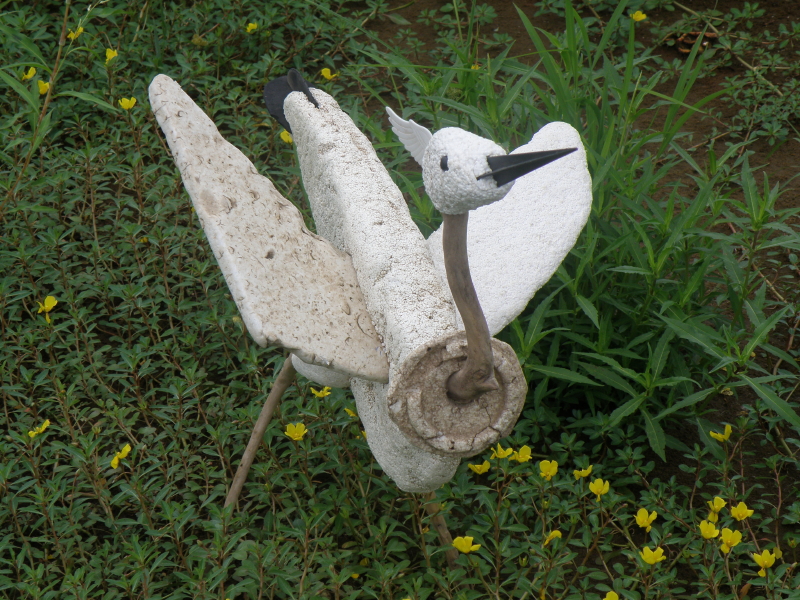
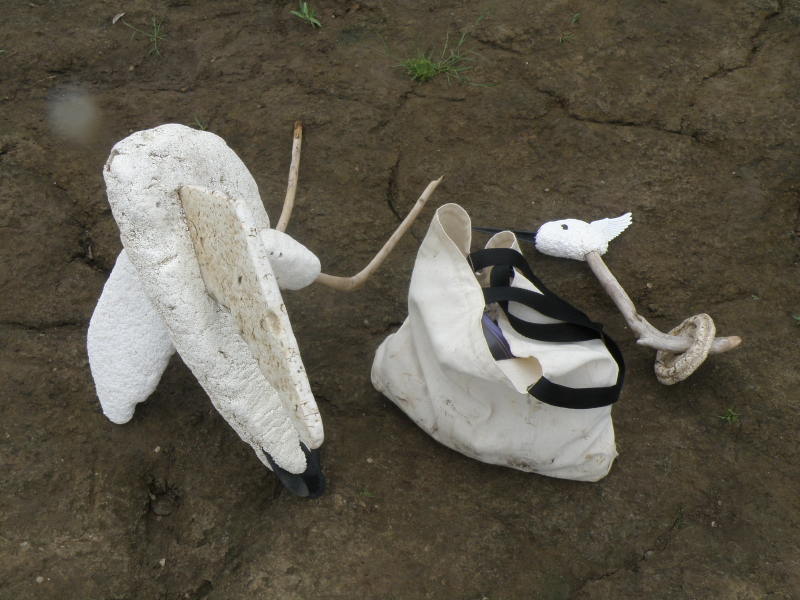
Postscript:  Readers familiar with the riverblog know that the Black-billed Heron was made with materials deposited at the Falls of the Ohio.  These found materials include:  River polished Styrofoam, plastic, sticks, river tumbled coal, the black tail feathers were cut from the soles of cast off shoes.  Thanks for tagging along on this avian adventure!

Read Full Post »

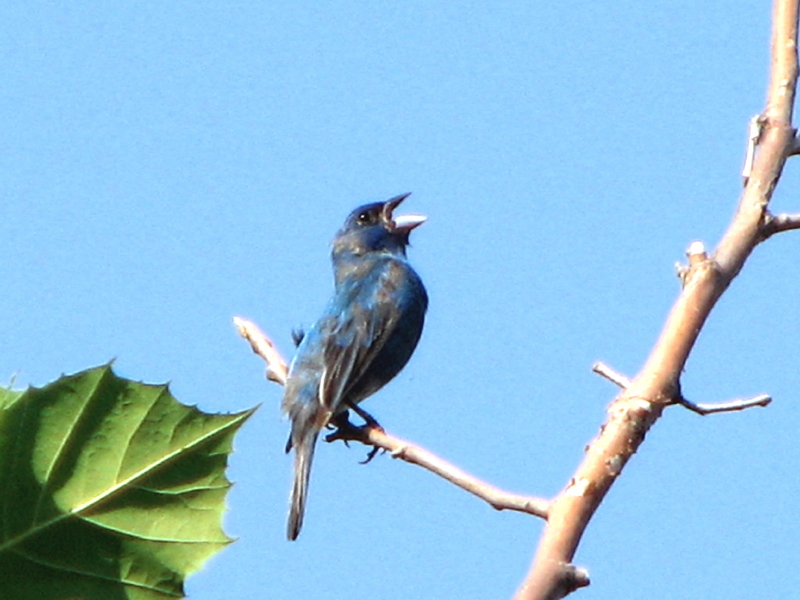
It’s been a hot, hot summer at the Falls of the Ohio.  For me, the best time to be out here is as early in the morning as possible.  One advantage in doing this is you are more likely to see birds and other wildlife.  I found this Indigo Bunting singing away from the topmost branch of this tree.  For as open and publicly trampled as this park is…witnessing such small and intimate moments where man and nature freely mix keeps me coming back for more.

This adventure occurred during my last visit to the park and early in the month.  As it turned out, it was a memorable visit.  I’ll go ahead and tell you that I twisted my right ankle which isn’t big news or a particularly rare occurrence.  But this time, I was sure it was broken and I limped out of the park with the aid of my trusty walking stick.  I was walking along in the sand and my ankle just collapsed.  That’s all it took.  All my early sports injuries have left me with a weak ankle.  The x-rays didn’t reveal a fracture, but I was surprised by the bone spurs and bone deterioration.  As I write this three weeks later, I’m still limping along but without the aid of crutches so I guess I’m on the mend.  Returning to that day and before the sprain,  I revisited the sand sunken tire from previous posts and replaced the coal that was removed from it and then moved on.

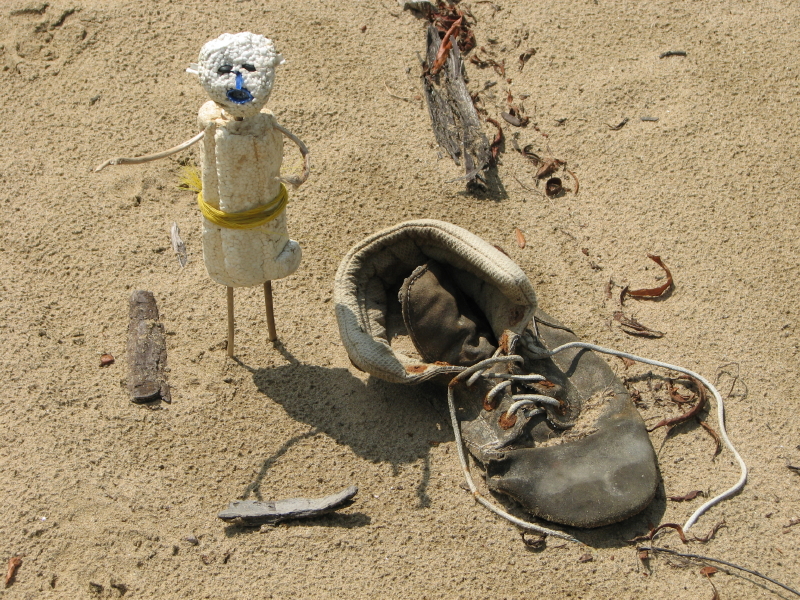
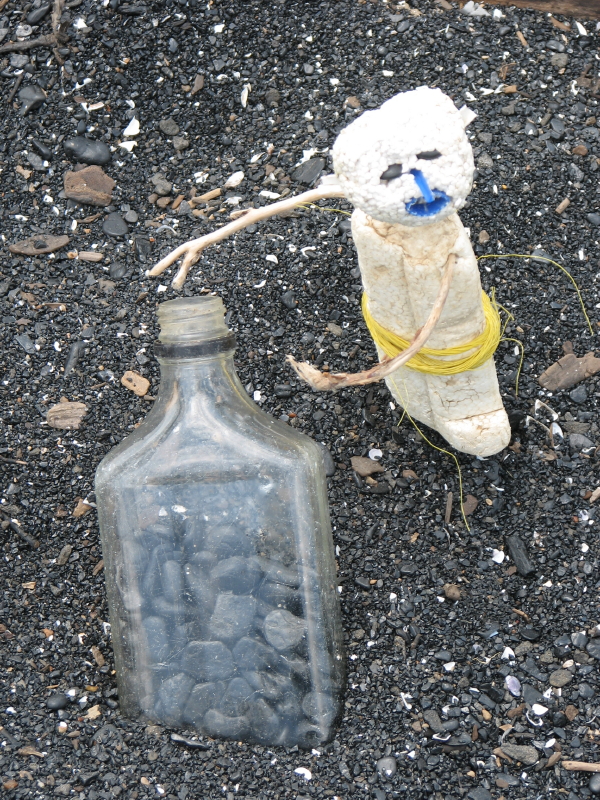
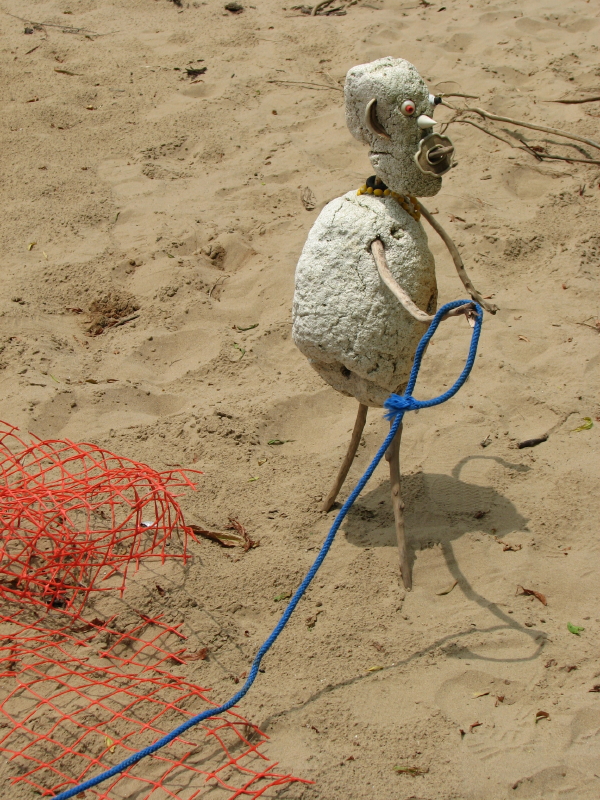
I created a little friend to keep me company and to help me with the day’s projects.  He’s made with Styrofoam, sticks, plastic, and a little bit of coal for his eyes.  I have used the coal that washes up here for as long as I have been doing this particular body of work which is approaching eight years now.  As a material, its relevance has always been appreciated by me.  Like the corals and brachiopods that have left their traces in the limestone at the Falls…these black rocks also speak of ancient life, but coal has a different and contemporary purpose that is won at great cost.  Walking along the eastern section of the park, I explored and gathered the coal I found interspersed among the sand and driftwood.  My little helper tagged along and soon we filled the hole in a second found tire.

I noticed after I selected this tire that it had once been painted white.  I have seen this before where people of thrift have used cast off tires for garden planters.  On this one, most of the paint has worn off and the river has given this tire a unique patina.  For the Little Man and myself, this would just be the beginning of our play with the found coal out here.

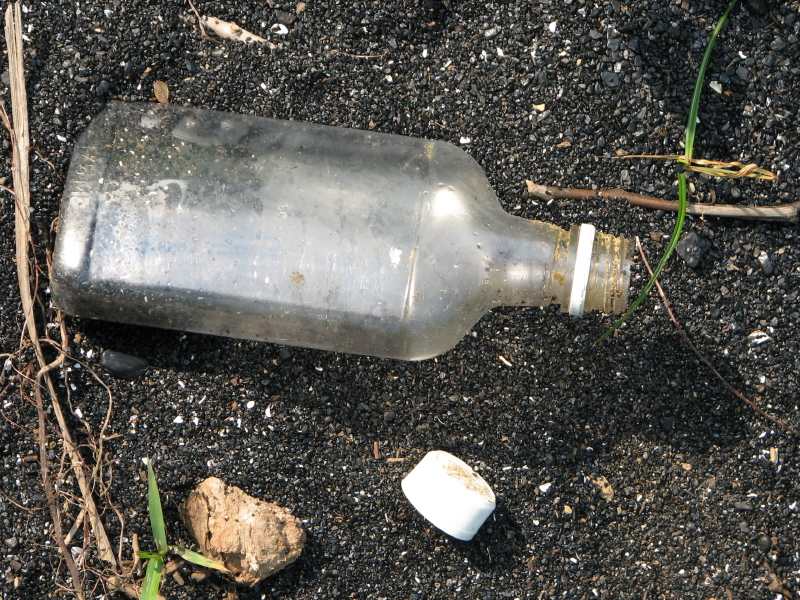
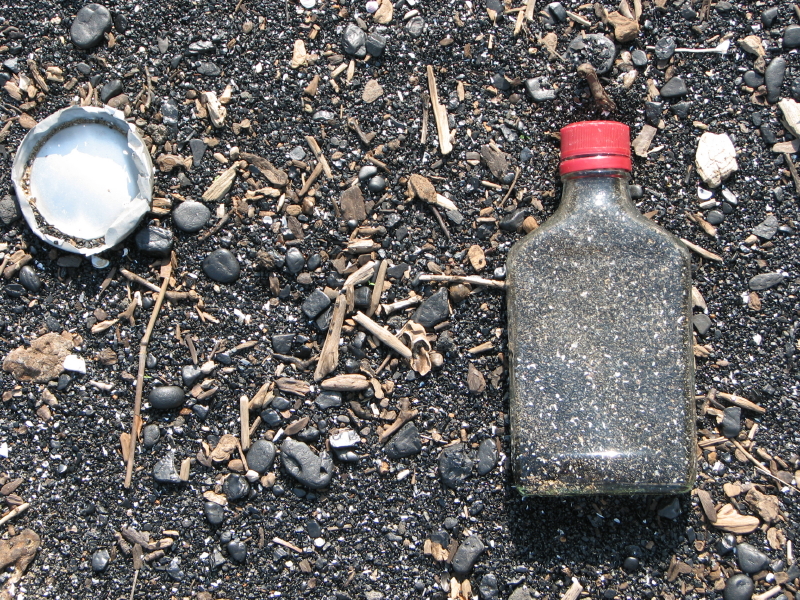
Among the other found objects I scavenge along the beach are empty pint bottles made from glass and plastic.  I like them when I find them with their labels soaked off by the river and their bottle caps in place.  A little more than a year a go I shared a river adventure with video artist Julia Oldham and we marked the day by putting notes and colorful fishing floats in other empty bottles.  I sometimes think of those bottles and wonder if anyone has ever found one of our notes?  In all my years here, I have never found a note in a bottle and by now I have looked at thousands of bottles.  Some of my friends at Living Lands and Waters report finding notes in bottles all the time and I’m guessing that this happens more along the Mississippi River than it does the Ohio River?  For me, finding a note in a bottle will happen when it’s supposed to…I just hope that it’s written content will be interesting!

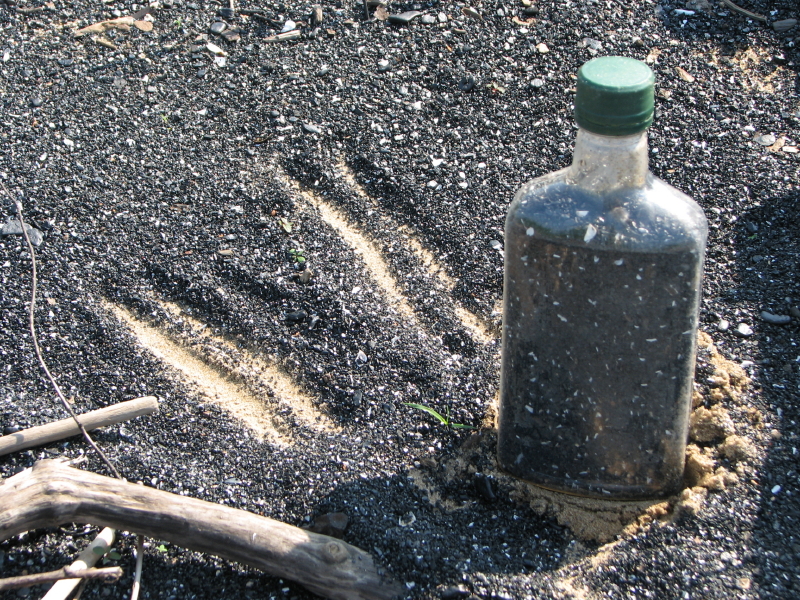
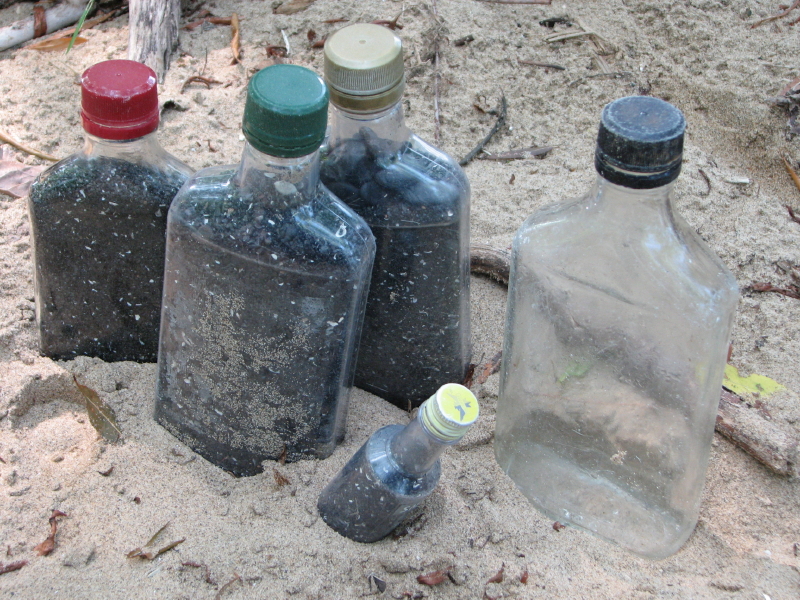
You have just seen a few of the bottles I have filled with coal.  The white flecks you see mixed into the coal are bits and pieces of mostly zebra mussel shells which is another unwanted element in this river.  Filling these bottles with coal is meditative for me.  Usually, there is still a little bit of whiskey or alcohol in the bottom of these bottles that scents the coal inside its container.  Coal is such a complex subject in our region that it is enough to drive one to drink.  On one side it is a common and available form of energy, but the costs to the land, people, and larger environment are extreme.  Having visited the coal fields in eastern Kentucky, it is certainly plain that the people whose land and mountains have been mined out from under them haven’t benefited to the extent that you would think since poverty and despair are far too common.

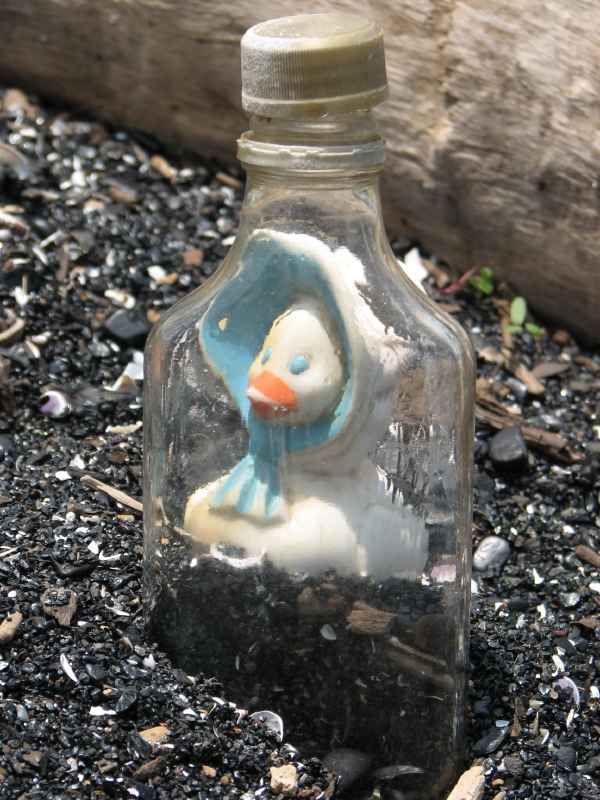
I’m going to continue to explore coal as a material and social issue with the help of some new friends.  I have been invited by a group of mostly younger Kentucky artists to participate in an exhibition to be held sometime in the near future.  A blog has been set up called Project Reclamation and if you would like to follow along…just click on the link on my Blog Roll on the right column. I will keep you posted.  To close, here is one other bottle or carbon storage image I photographed with a found rubber duck behind the transparent bottle.  I look forward to going back out to the Falls of the Ohio as soon as my ankle fully heals.

Read Full Post »

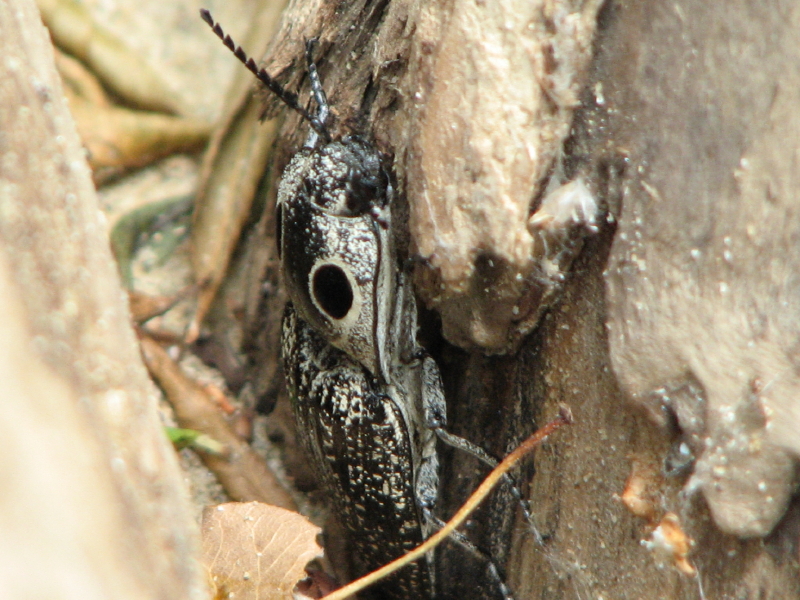
I threw my arms up into the air and said “WHAAAAA”!  I had been resting in the shade after a couple of hours of junk scavenging when I heard this low vibrating sound and the bump of something landing on my head.  Reflexively, I knocked off whatever was on my noggin and it fell to the ground…and this is what I saw.

This is the Eastern Eyed Click Beetle or Big Eyed Click Beetle, (Alaus oculatus).  It’s one of my favorite indigenous beetles and one I’ve seen at the Falls of the Ohio on numerous occasions.  As beetles go, this one is on the large side approaching two inches or about five centimeters in length.  Getting smacked in the head by one certainly surprised me, but it turned out to be a good one.  I love the cryptic bird dropping coloring and those two large eye spots get your attention!  After the beetle recovered its senses, it flew and landed on a dead tree trunk right behind where I was sitting.  It turned and started walking down the tree towards the ground.

I watched as the beetle lowered the tip of its abdomen at the base of this dead tree.  I’m hoping it might be laying an egg or two.  When it was done, it walked back up the tree trunk before flying off for the next tree or head that catches its fancy.

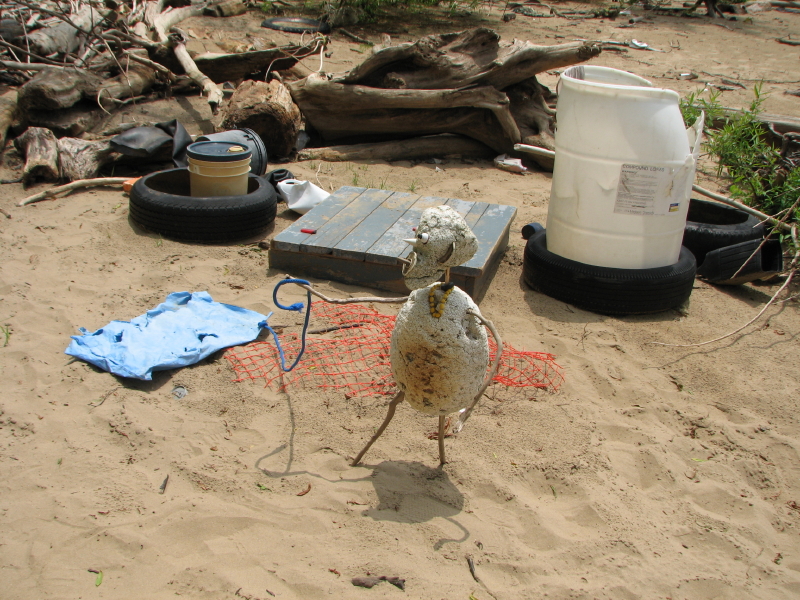
I was rummaging around one of the driftwood mounds for whatever secrets it was carrying and to separate out materials for the river sweep clean up.  Nearby, was the beginnings of another garbage pile that someone else had started.  I decided to throw my junk into this lot to consolidate it and make the removal just a bit easier.

It was the usual lot.  A few plastic 55 gallon drums, a bit of hurricane fencing, tires, and a palette or two were among the larger items that were deposited here by the last flood.

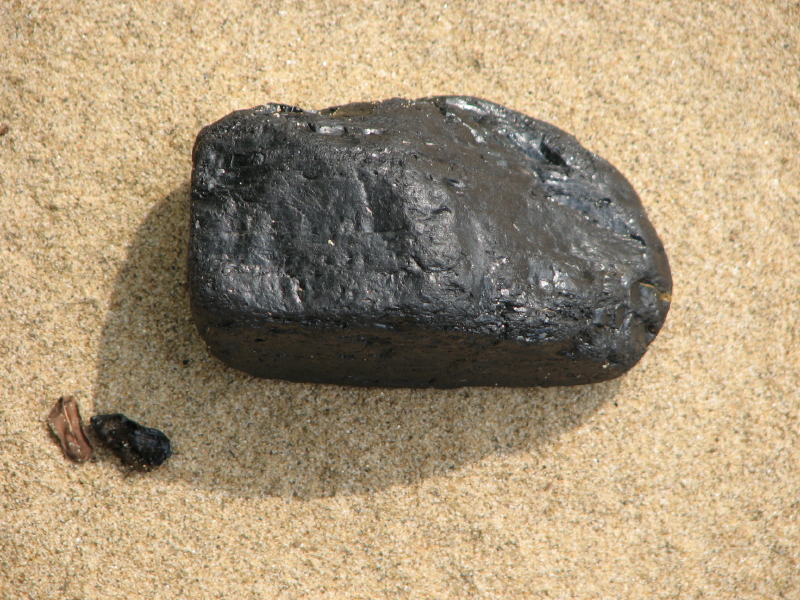
Of course how these things came to be in the river is another story.  It’s amazing what our kind can tolerate and consider acceptable.  I suppose this represents the collateral damage we are willing to endure to support our ultra consumptive way of life.  It makes me want to retch! I think this partly explains why so much of this trash is colorful.  If we have to look at it…it might as well be pretty.  When I finished up in this area I moved on like the click beetle did to new surroundings.  There is no shortage of trash out here.  After this Spring’s floods there is also an abundance of coal gravel and coal chunks in the eastern section of the park.  Here’s an example.

The Falls of the Ohio is famous for its fossils, but this black rock wasn’t originally a part of the geologic scene here.  More than likely, this piece of coal was removed from the top of a mountain in Eastern Kentucky and shipped by barge to this area to be burned in a plant to produce electricity.  For some reason, this and many other pieces of coal got into the river where they were tumbled and ground to bits.  In case you were wondering…coal does not float.

In places the coal gravel was several inches thick and reminded me of the black beaches made of volcanic sand.  Also interspersed on this river bank were many automotive tires.  I couldn’t help but associate the coal with the tires and I began to combine both of these elements in this landscape.  Here’s a picture of me in action.

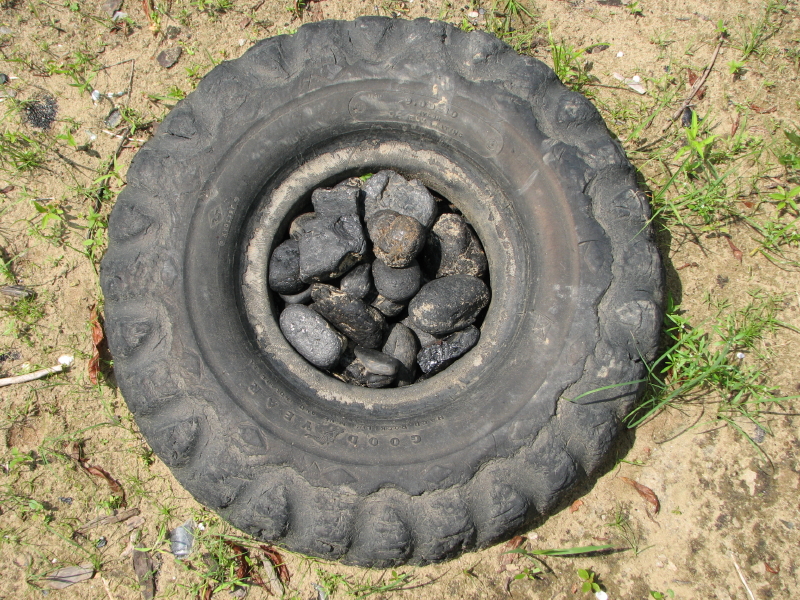
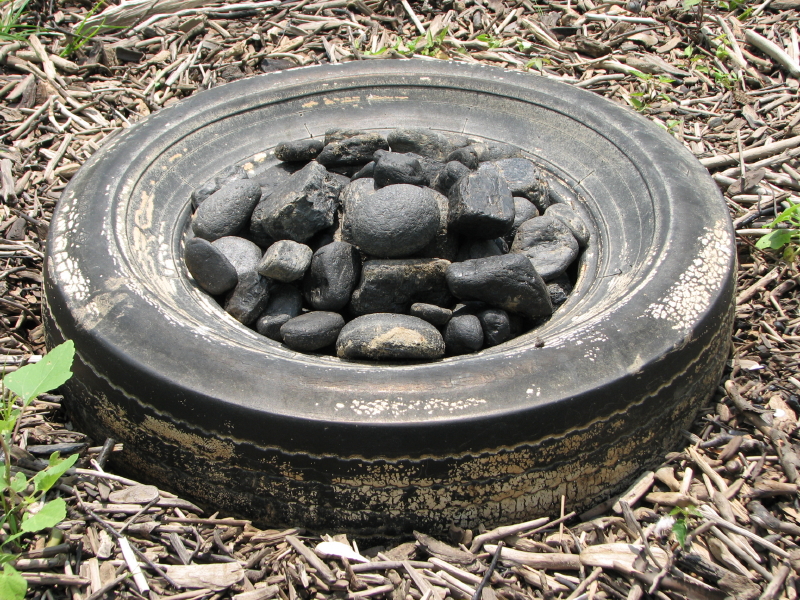
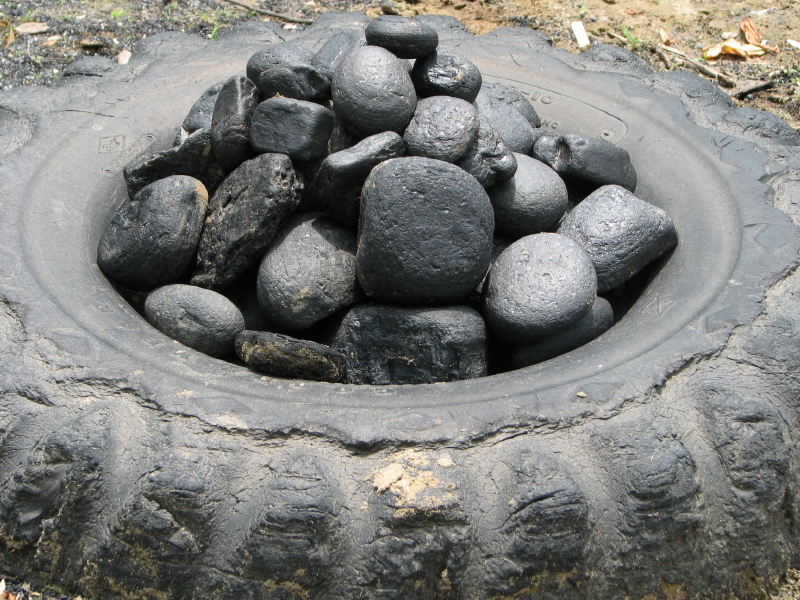
Walking around in this area, I found enough large coal pieces to fill a tire.  Doing this was highly addictive for me.  Here I was picking up real chunks of fossil fuel to place inside a circle that itself is made from fossil fuels in an area that’s well-known for its Devonian Age fossils.  How all these things affect or reference life made my head swim more than the actual heat and humidity.  When I finished filling one tire…this is how it looked.

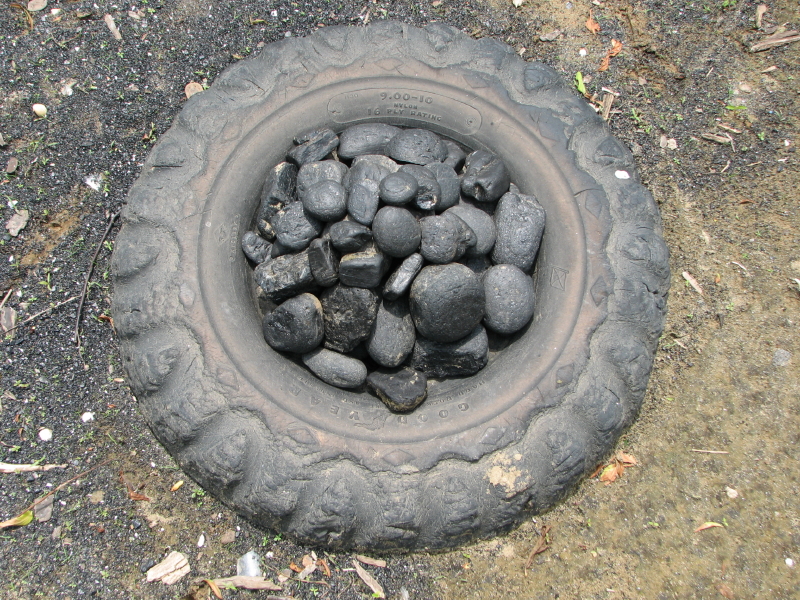
And now, for an aerial view.

To me, this looks like some kind of unusual and bizarre fire pit ready to go.  Scientists have already established that “burning rubber” and coal are contributing to the excess amounts of heat, energy, and toxins now found throughout many of the Earth’s systems.  In Kentucky, the coal debate is a complex one.  We have an abundance of coal, but it comes at a dear price to the land and the people who call the coal fields home.  The sun is getting hot and I have already had a busy day watching fishermen and making sand drawings!  For now, I will have to leave the coal debate where it is, but I’m sure to return to it since there is so much coal here at the Falls.  It will remain here until the forces that shape this planet decide otherwise.

Read Full Post »

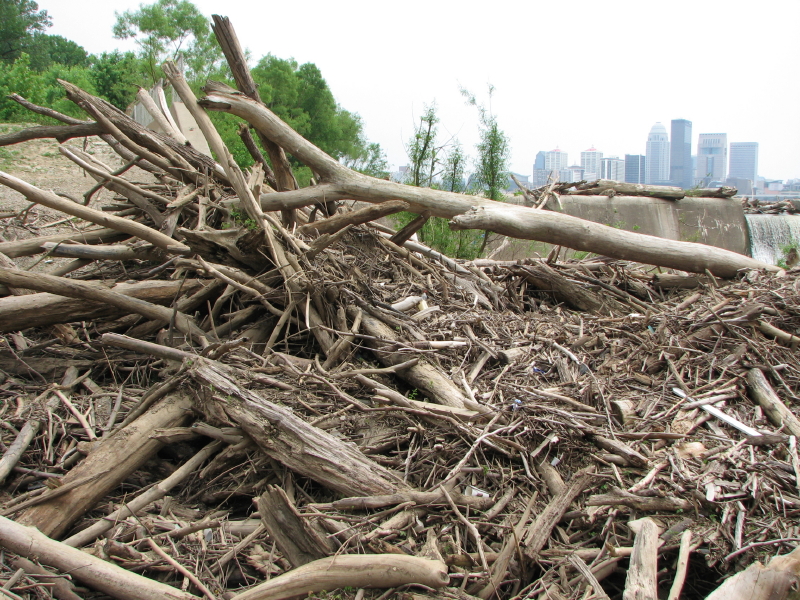
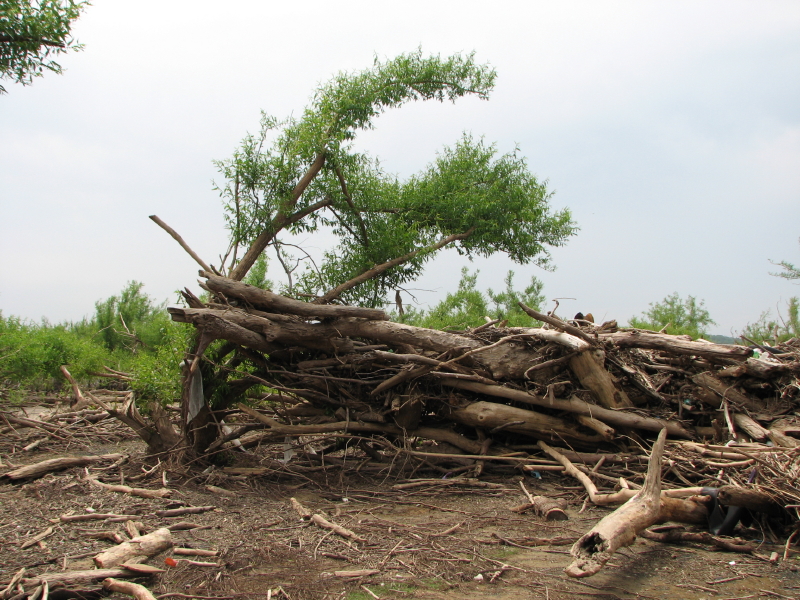
June began all bare bones in the aftermath of our minor flooding and now at month’s end it passes overgrown with vines.  Near the tainter gates, a massive raft of driftwood lies intertwined with the landscape.  We haven’t seen such a wooden mound in many years.  June had some odd and compelling images and here are a few more before we turn the page.

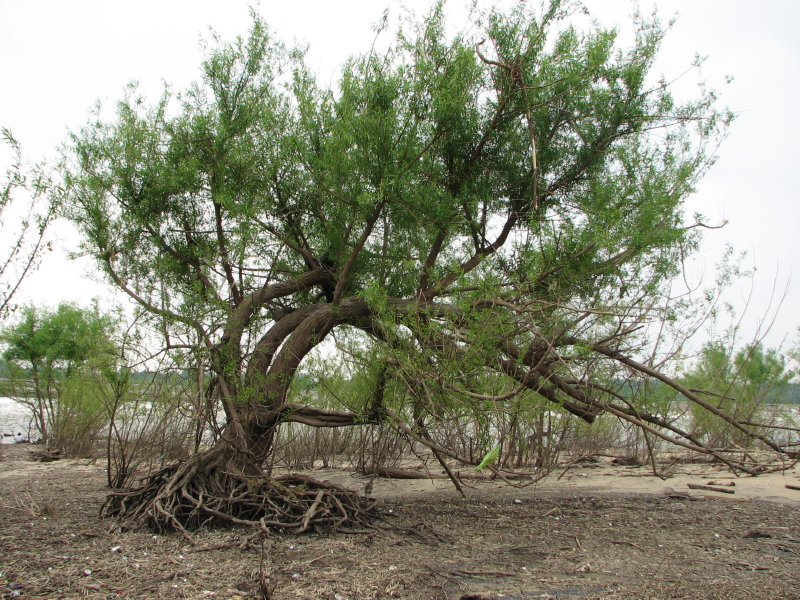
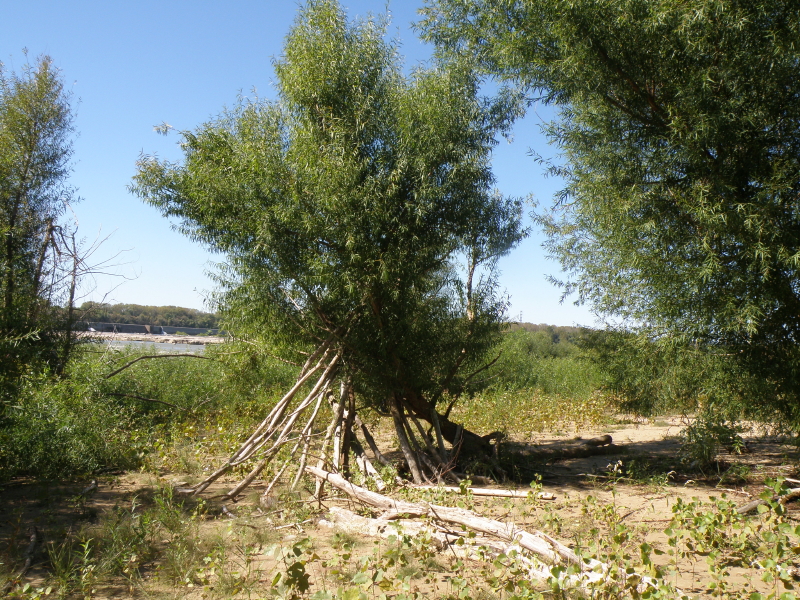
The willow trees are the heroes here tenaciously clinging to the sand and clay.  This taunts the Ohio River which sends high water and a battering ram of floating logs their way every once in a while.

Willow wood is flexible and the sustained high water’s flow is echoed in the shape of these trees.  I imagine the river as an artist shaping its garden at the Falls of the Ohio.  There’s a bit of that bonsai- look if you can get past the larger scale.

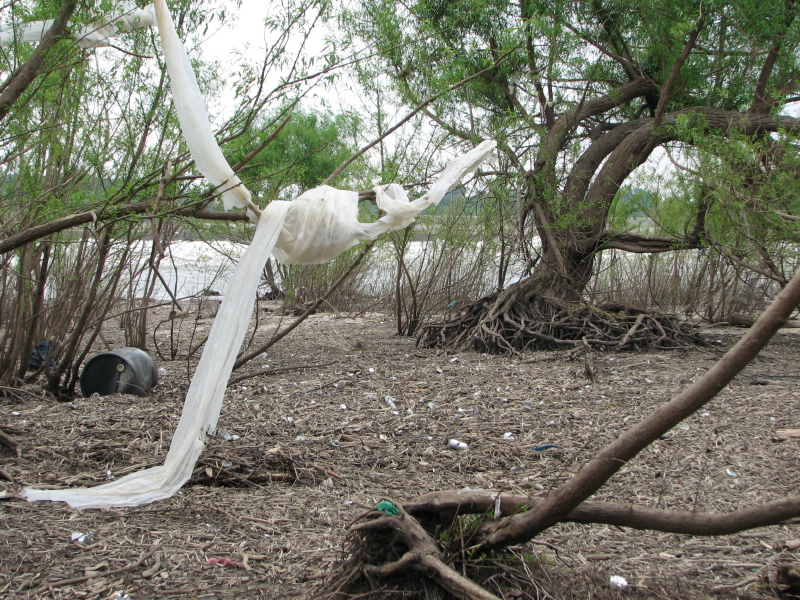
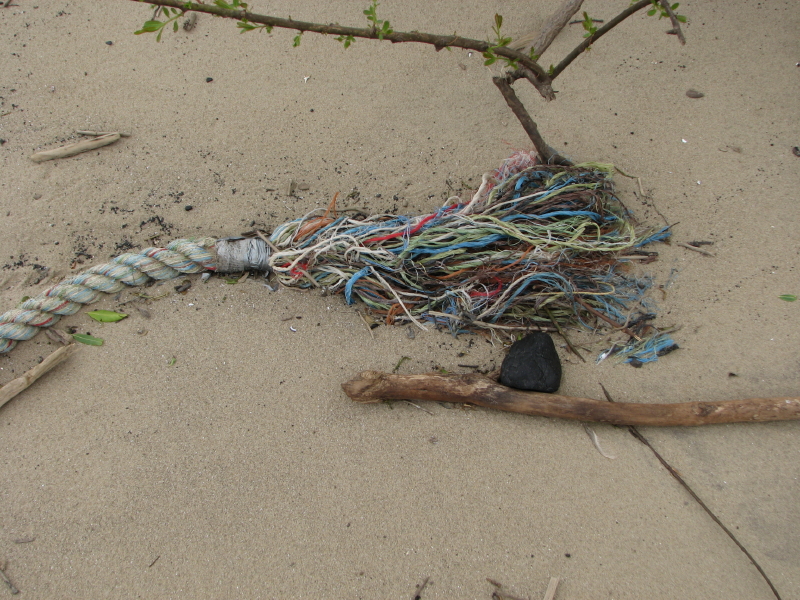
The willows’ branches do their part in snagging some of the flotsam and jetsam floating loosely in the retreating waters.  Branches become decorated with plastic bags, fraying barge cables, driftwood, the occasional dead deer, refrigerators, fishing line, and whatever is present in the Ohio River.

Here plastic sheeting has been caught and stretched some length across these trees.  It looked like something some installation artist might attempt.  I also came across a “nylon crinoid”…in actuality, an unraveling barge cable that made me think of the extinct sea lilies of ancient oceans and in fossils which are pages in the book of life.

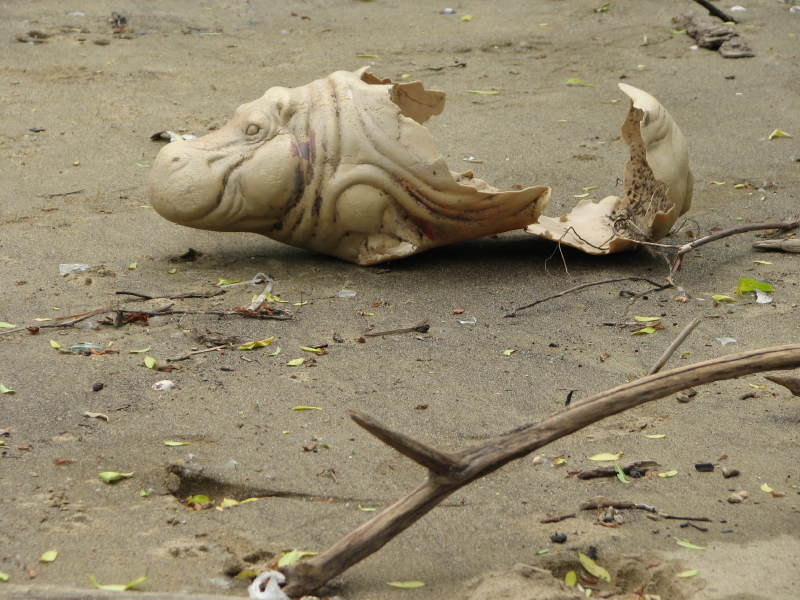
Walking across the sand I came across this unusual view which gave me the idea for the title of this post.  Very nonchalantly, this mostly destroyed hippopotamus was standing its ground.  I’ve read somewhere in a book that the name “hippopotamus” means “river horse” in some African language?

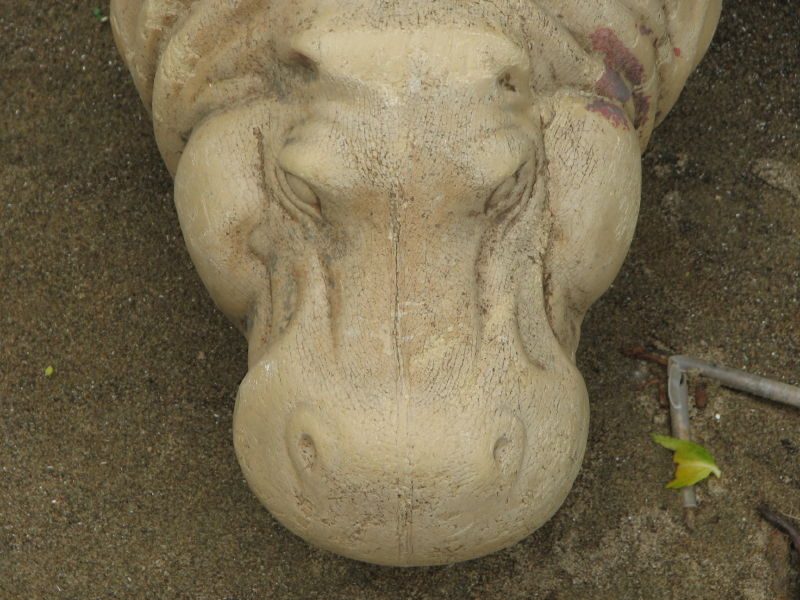
Another view, but this one from the top.

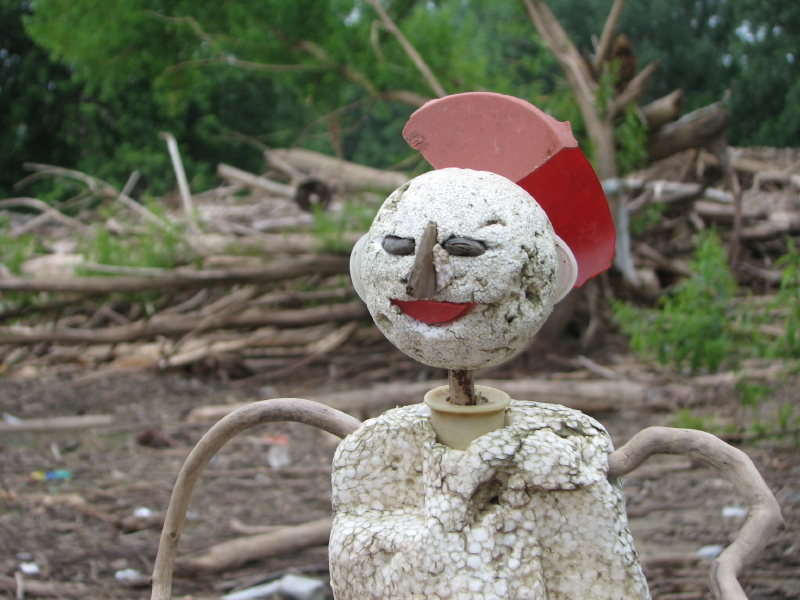
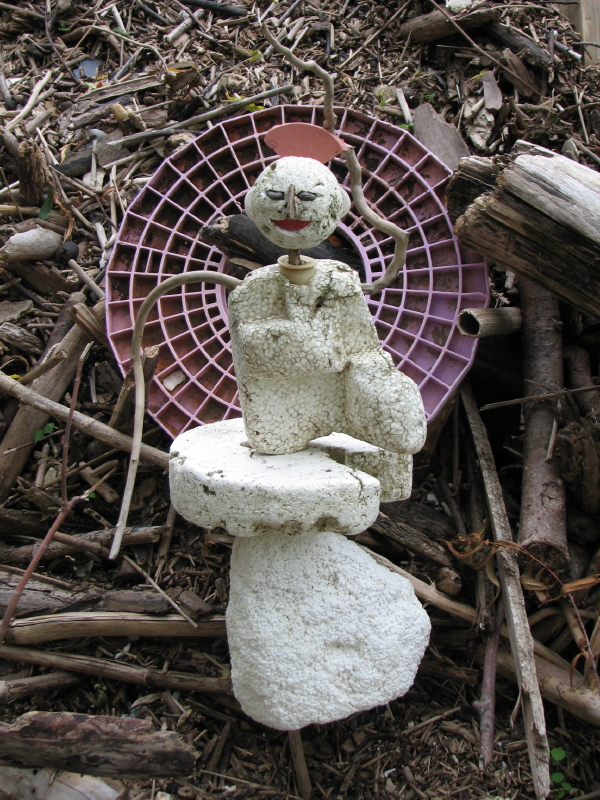
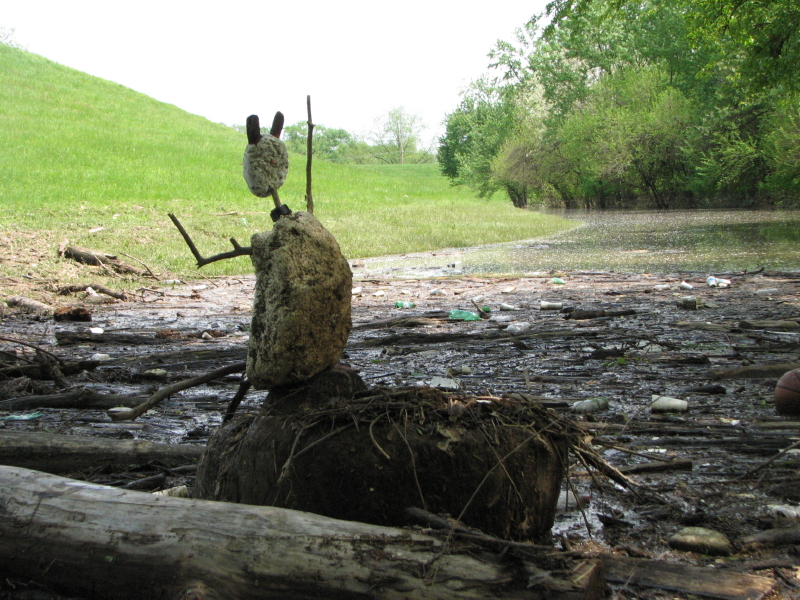
I made another Styrofoam figure on this day.  I imagine this as being a figure of some exotic Spanish dancer with fancy combs in her hair.  I won’t say this is the best figure I’ve ever made, but it’s also not the worst.  It just happens to be how things turned out when I picked this group of materials and objects to make something with at that particular moment.

Now for a full length view.  That pink radiating thing is made of plastic and helps to add other visual interest.

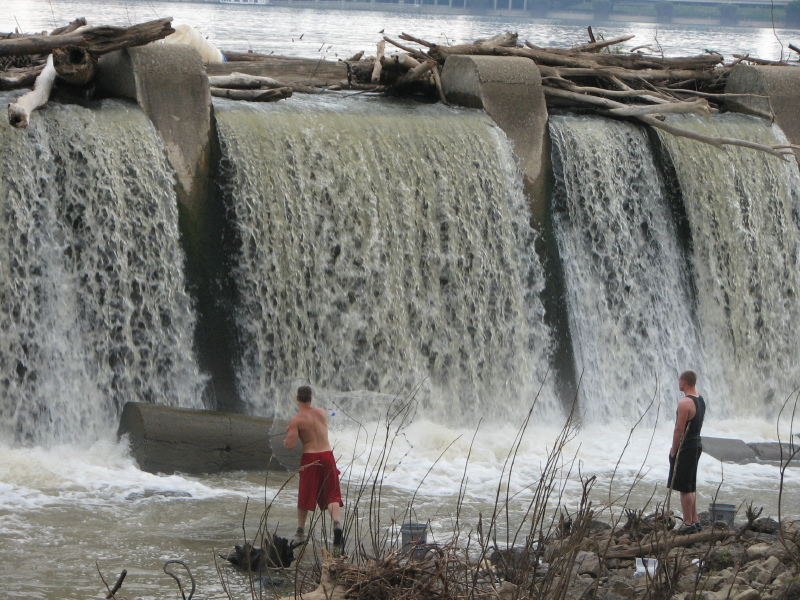
Before leaving for home on this day.  I watched a couple of guys using a throw net to catch shad to use for fishing bait.  I couldn’t help but see them in the context of the Ohio River which was so many more feet above their heads.  Here we are at the bottom of the valley.

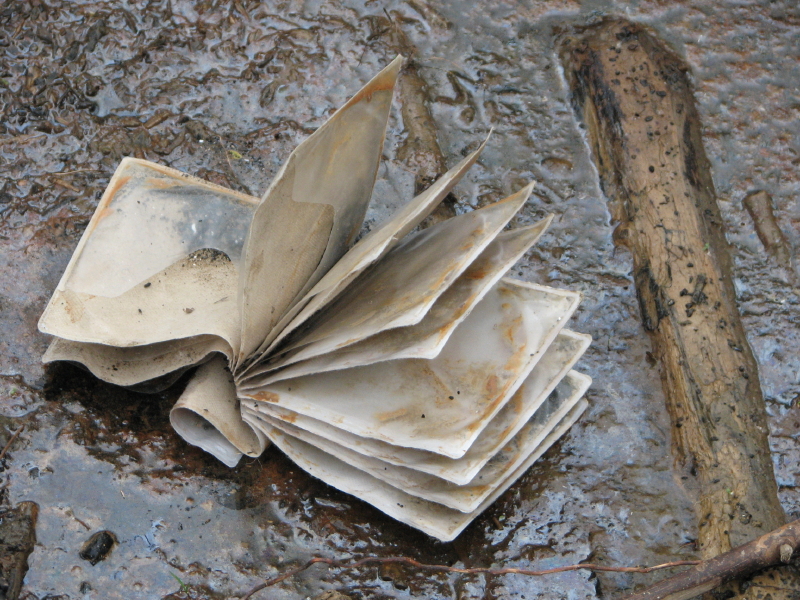
Since I’ve used the book metaphor a few times in this post…it’s fitting that I end with this picture taken on this day.  It’s really a small plastic photo album whose transparent sleeves were full of coal gravel and water.  Until next time…


Read Full Post »

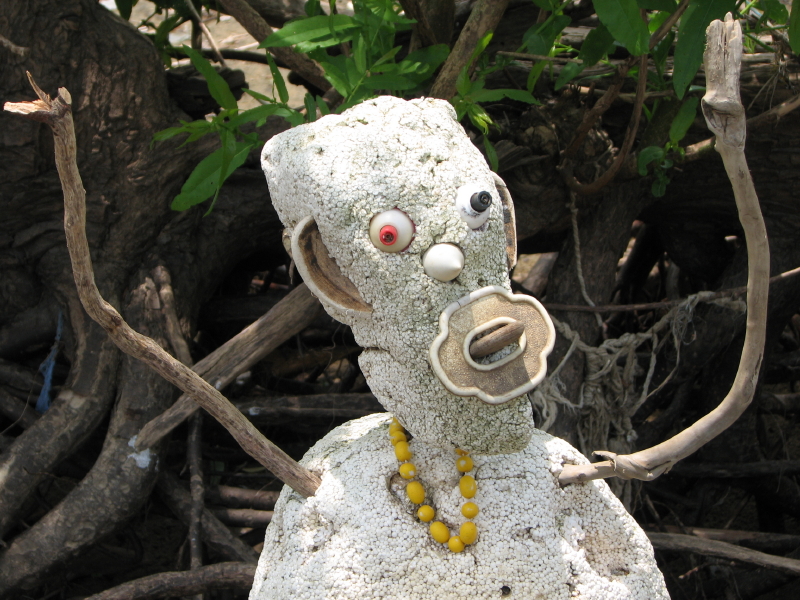
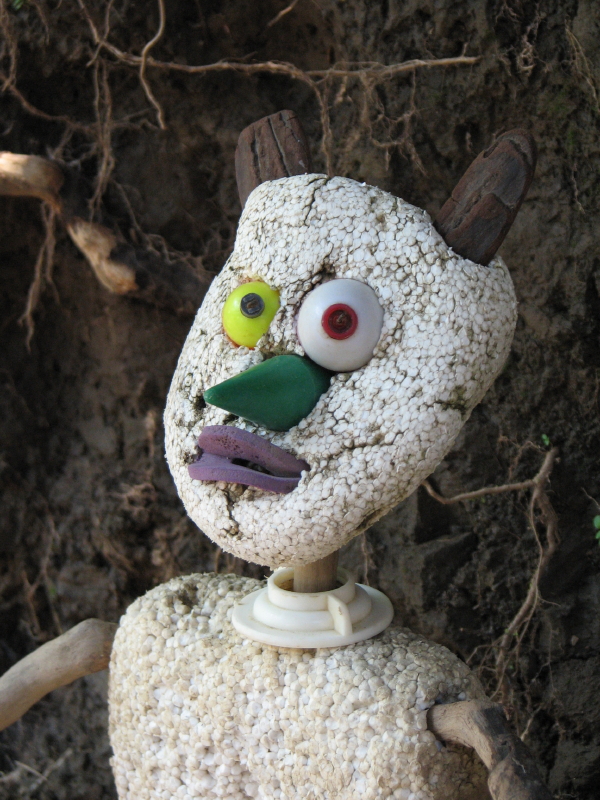
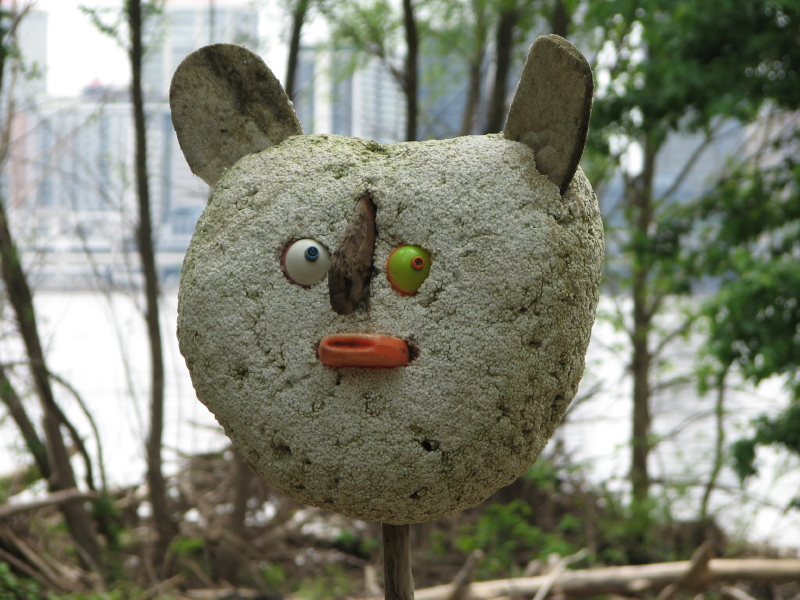
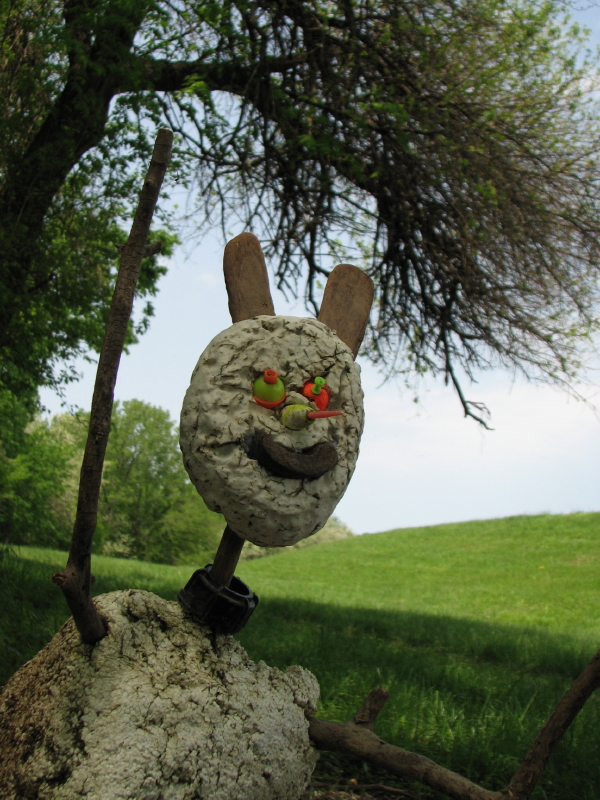
In my hands was the head of a small Styrofoam figure I made at the Falls of the Ohio State Park.  I found all the parts while walking along the northern shore of the river.  The eyes are fishing bobbers and the nose is the plastic cone from a moderate-sized bottle rocket.  I can’t remember what I used to make the purple lips!  I was on my way to see one of my favorite trees and wondered how it was doing after this year’s flooding?

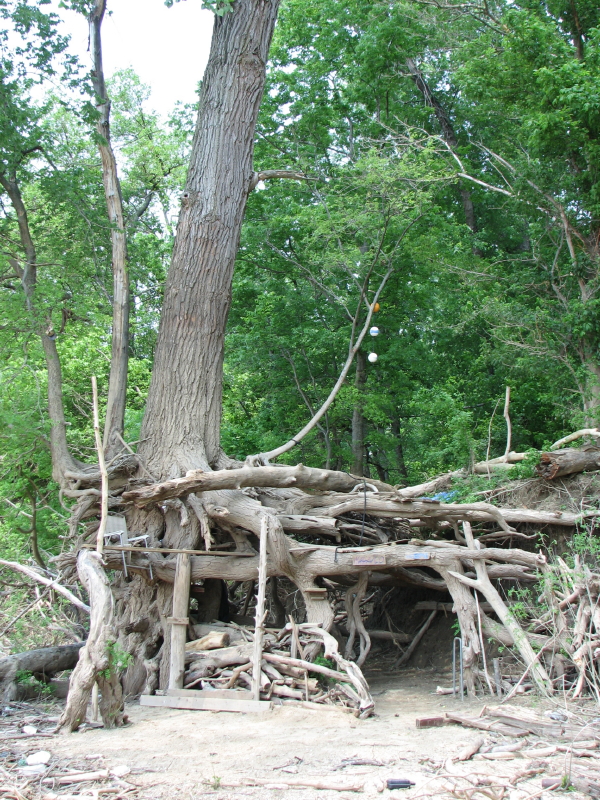
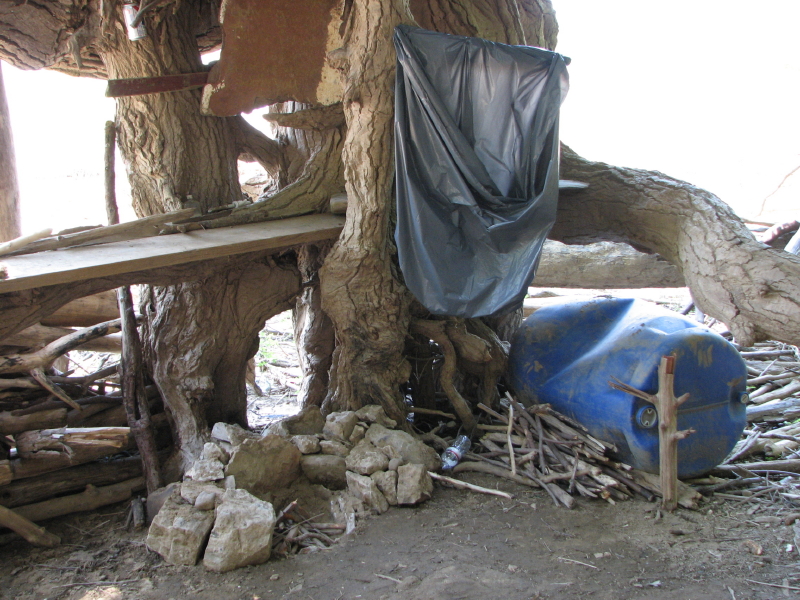
The great tree with its amazing roots had survived in fine shape.  Approaching I could see that recent visitors had added new amenities to enhance the natural room existing under the trunk of this tree.  Long a go the river washed away the river bank, but the tree’s roots held fast and kept growing.  Here’s a side view.

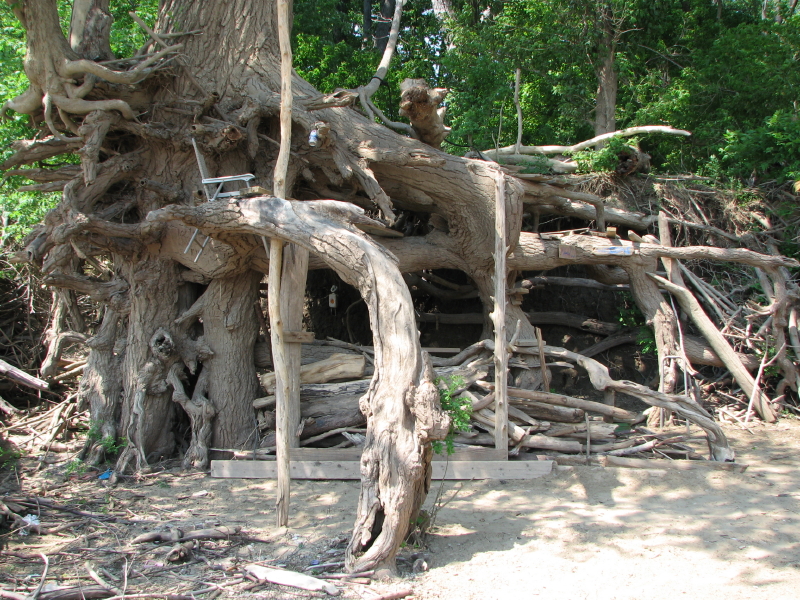
I ran into Steve the Arrowhead Man earlier in the week and he told me that teenagers had discovered this tree and turned it into a party hangout.  Nailed to the tree was a hand-drawn sign that read “Mahalo”.  Driftwood had been collected and neatly stacked near an improvised kitchen area that had counter space, a stone-lined fire pit, and a plastic trash bag to carry garbage out.

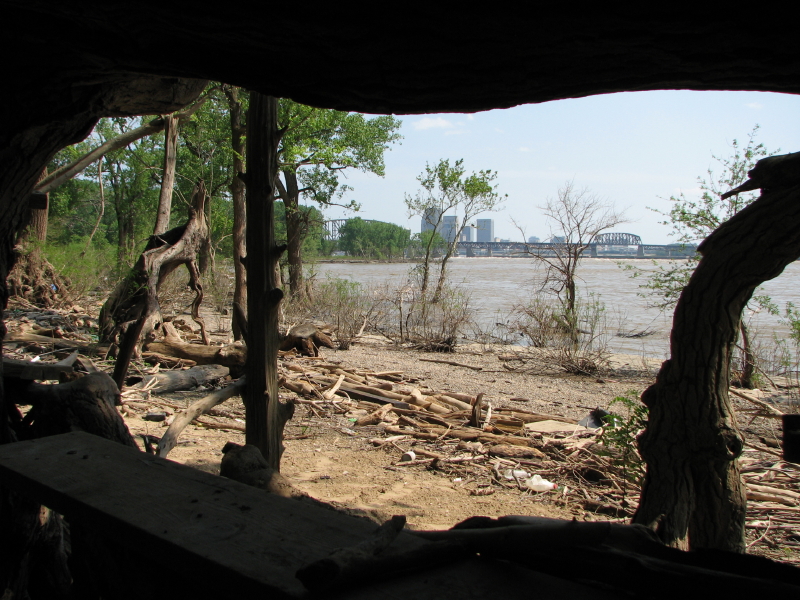
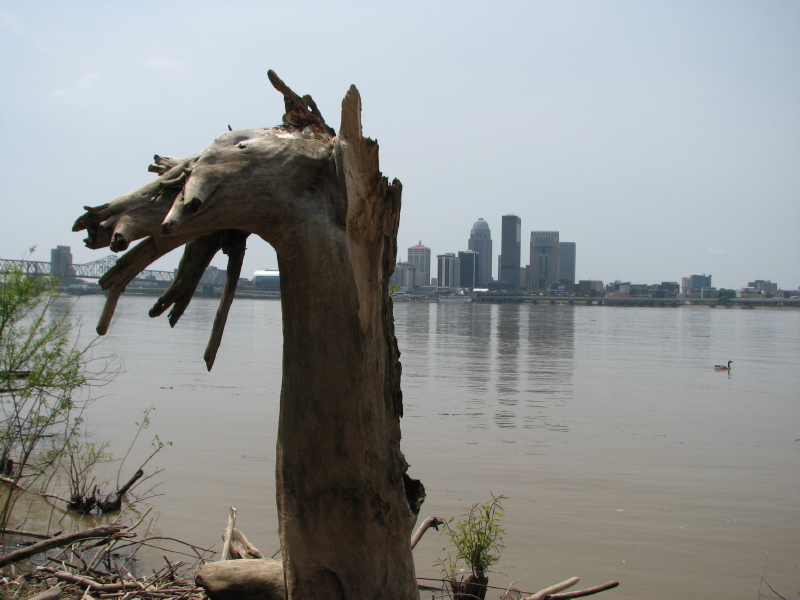
I like the counter-top plank that also helps frame this view out the window.  The skyline of Louisville can be seen on the farthest shore.

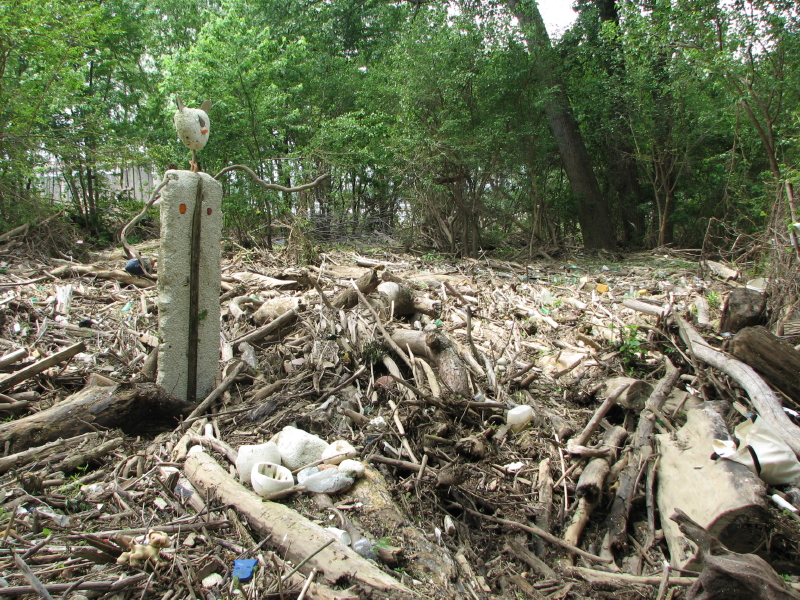
Sitting in the Mahalo Tree was more about fantasy than reality.  The fire pit was located too close to the tree!  Still I admired the sense of play and creativity and decided to leave the figure I was making now named “Mahalo Man” as a present for the next visitor to the tree house.  I finished my figure with materials I found around the tree.  Here’s a portrait of my latest creation.

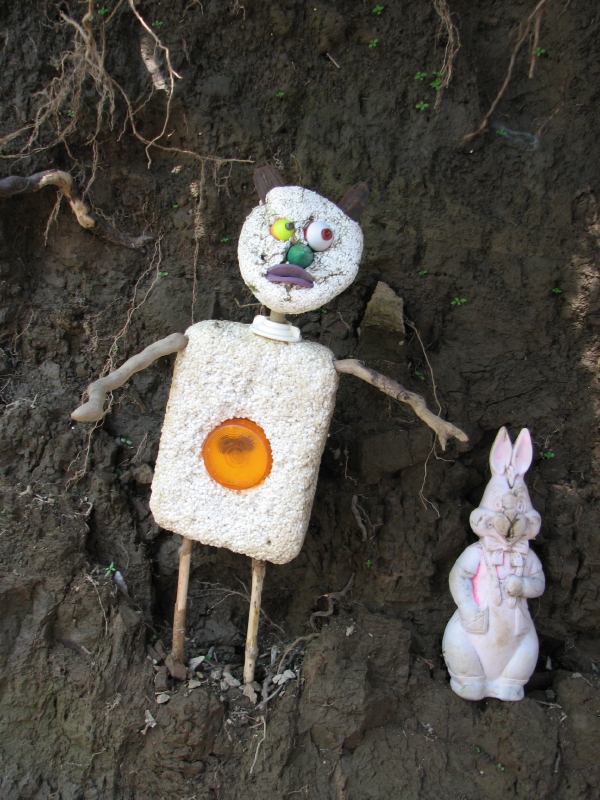
First, I moved Mahalo Man by the sign nailed into the tree…but I didn’t like it.  So, I reached into the old collecting bag and pulled out a plastic bunny rabbit I had found on the walk out here.  The rabbit had a coin slot in the back of its head.  I finally left Mahalo Man under the earth and rootlets beneath this great tree.  Here is another view of this figure with his rabbit companion.


The rabbit figure lent a certain Alice in Wonderland quality to the ambiance surrounding the Mahalo Tree.  I hope to check back here sometime during the summer and see what other changes have been made by man and nature.  I  will close with a final rabbit picture next to the hole in the bank our friend now calls home.

Read Full Post »

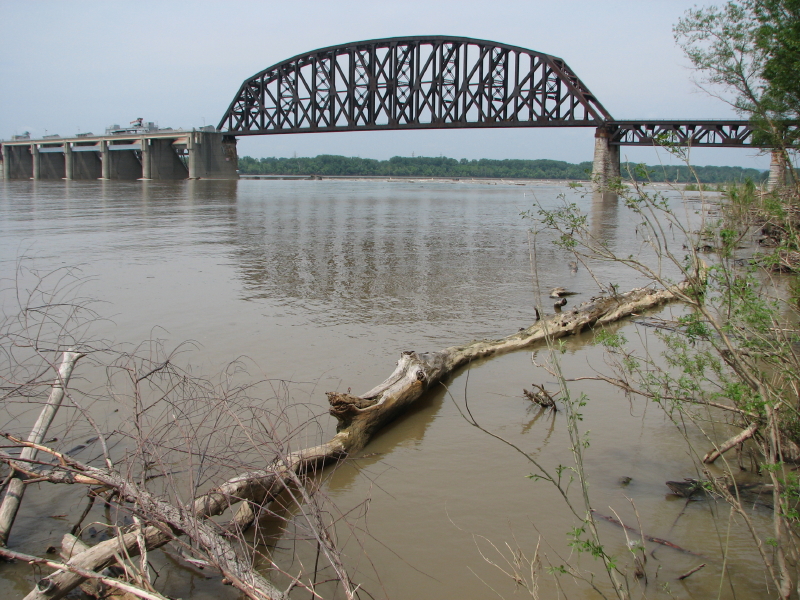
Just left or east of the railroad bridge at the Falls of the Ohio is where this adventure occurred.  The river was still high but dropping.  I was enjoying working in a section of the park that I don’t normally hang out at, but have discovered is both full of wildlife and potential art materials.  Evidence of our recent flooding was everywhere and I was exploring what there was to see and find.

While I was exploring this area I could hear Beatles’ music quite clearly drifting over the water.  It was the annual Abbey Road on the River Festival at the Waterfront Park in Louisville.  I guess the goal of each tribute band is to sound as closely to the original Fab Four as possible because I couldn’t detect much variation from one group’s rendition of a familiar song to another’s.  I did, however, notice that the Belle of Louisville’s steamboat calliope was in direct competition with the bands.  Like last year’s festival…snatches of 19th century tunes intermingled with pop hits from the 1960’s.  Baby, baby…Do dah day.

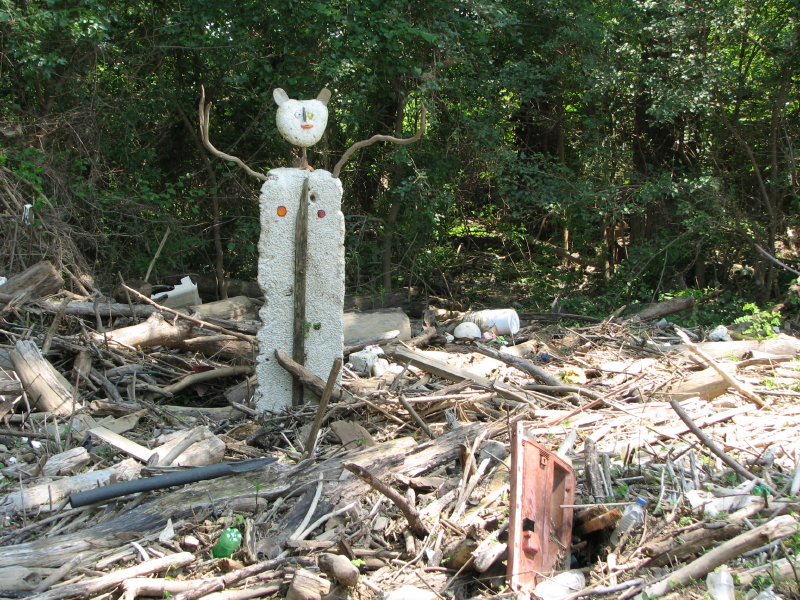
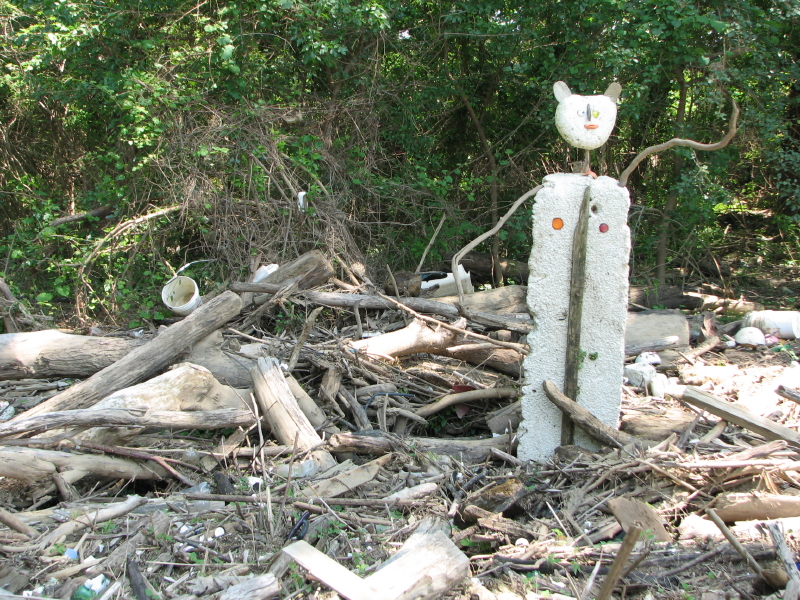
I was in this section of the park because I was searching for larger sections of Styrofoam.  This last bout of flooding pretty well wiped the slate clean as far as the materials that I had collected last year.  There is no shortage of smaller chunks throughout the park, but the larger pieces that are remnants of floating docks were in shorter supply.  I did find this piece that still had wood attached to both sides and set it upright, stelae-style.  Here’s what it looked like right after I assembled it.

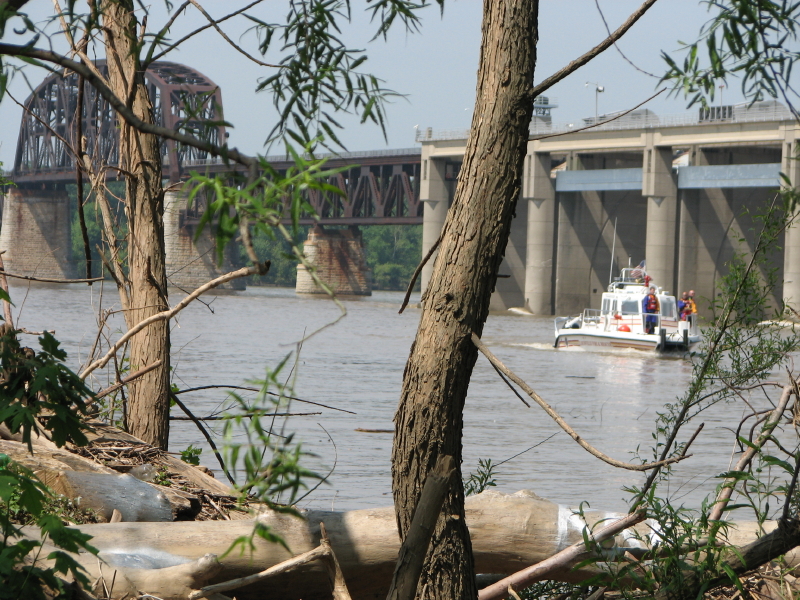
I had the turtle piece going too while this six-foot figure was under construction.  I also happily observed Northern Orioles chasing one another through the Cottonwood Trees.  I taught myself how to imitate the oriole’s song and on occasion can lure a curious bird closer by whistling to it.  I’m still trying to get a primo photograph of one of these birds, but they do tend to stay in the tops of the trees.  Out on the river, I observed a boat going back and forth along my side of the river and I’m speculating that they are looking for some poor lost soul that the river may have claimed?

I left my Styro-sentinal in place, but returned a couple of days later to discover it had fallen over.  This time I moved him to a different place facing the river and changed its arm positions a bit.  Originally, he held one of those soft nerf-type footballs.  I haven’t been back since and he may or may not be still guarding this section of the river bank.

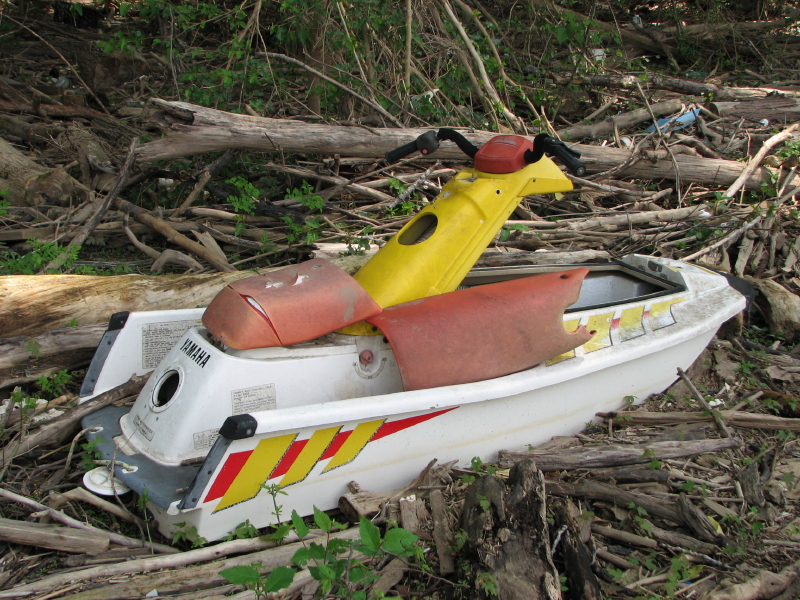
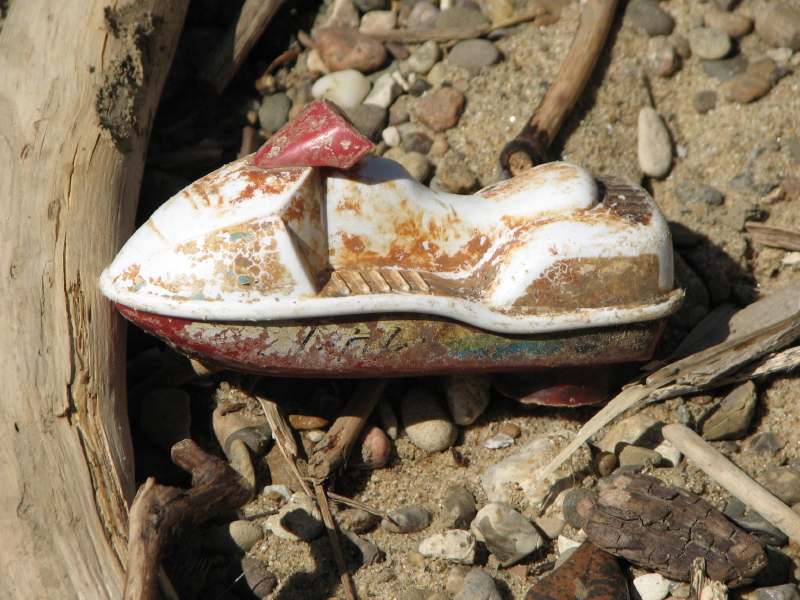
Among the items I “found” out here include this ruined Jet-ski.  Which…

…bookends nicely with the miniature version of it I found in the western section of the park also courtesy of the Ohio River and its recent flooding.

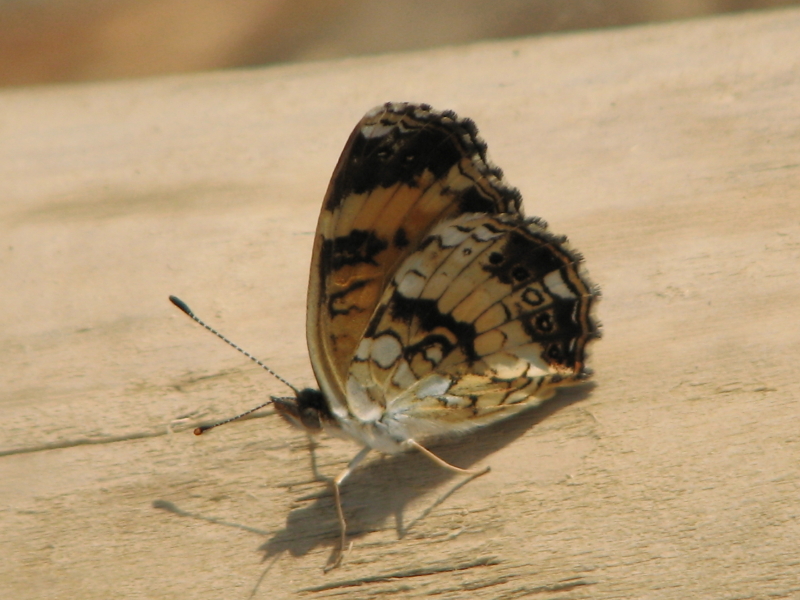
Butterflies and other insects are becoming more prevalent as the season progresses.  I saw what I thought was a familiar butterfly, but wasn’t totally convinced it was the species I thought I knew…so I photographed it and researched it a bit in the comfort of my home.  Here is my first image which shows two of these “different” butterflies.

Here’s a single, resting individual with its wings spread open.  This butterfly shows more black than the Pearly Crecents that are common out here. 

I cross referenced my butterfly guides at home and was glad that I was able to take a picture of this butterfly’s ventral surface because it helps to identify it.  I was leaning towards the Eastern or Harris Checkerspot but decided that this is the Streamside or Silvery Checkerspot (Chlosyne nycteis ). Here is the view that was most helpful.

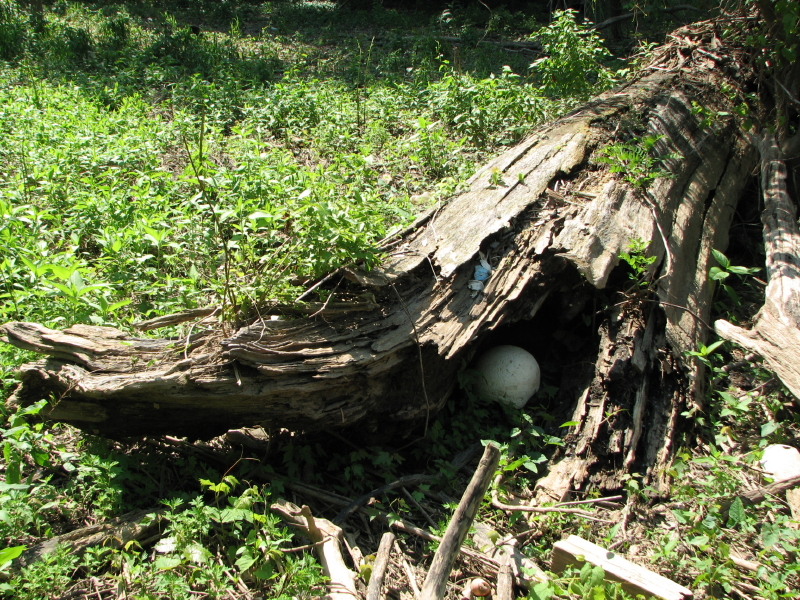
I’m looking forward to seeing many other butterfly species out here this year.  I will try to keep a checklist of what I see just as I do for the many bird species that visit or call the Falls of the Ohio State Park home.  On my way out of the woods, I “felt” something looking at me and after checking around…discoverd these eyes following me which is as good a way to end this post as any!


Read Full Post »

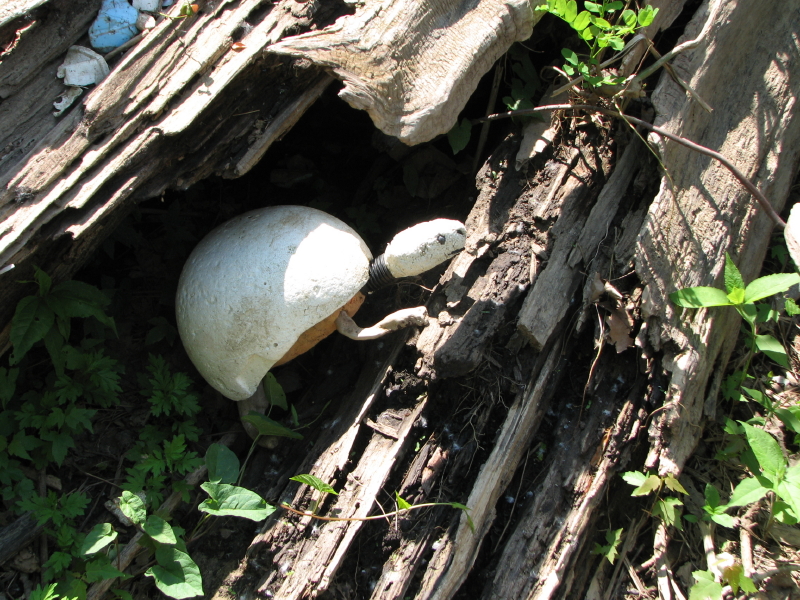
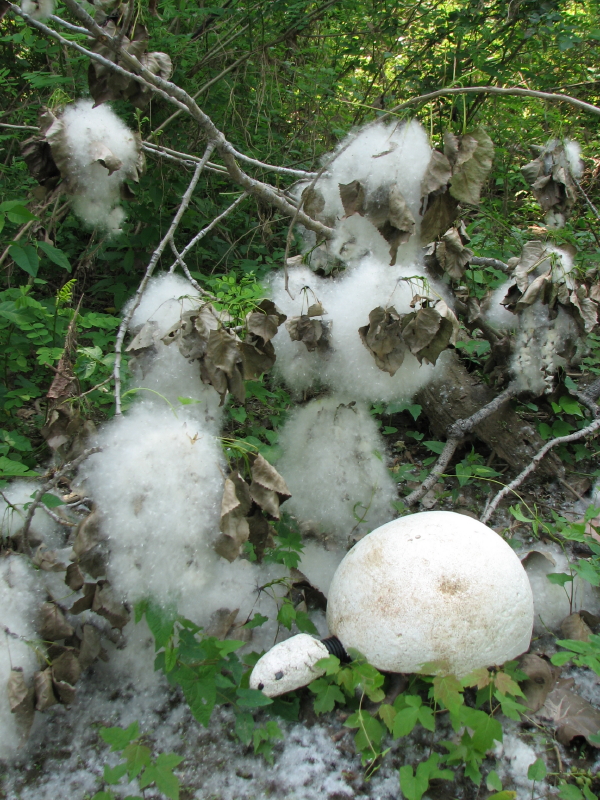
First, I would like to thank all the people who checked out my last post on the box turtles.  The response has been pretty overwhelming and I’ve enjoyed everybody’s comments.  The Eastern Box Turtle isn’t the only turtle to be found at the Falls of the Ohio State Park and this post is about that other mysterious and rare reptile. It’s called the Cottonwood Turtle (Terrapene populus) and its habitat overlaps that of the box turtle.  On a warm and humid morning I was exploring the eastern section of the park around the debris line formed by a retreating Ohio River.  Plastic bottles and containers and the ever-present polystyrene chunks helped define the high-water mark.  We have had so much rain here and it’s officially Kentuckiana’s wettest spring on record!  I was mesmerized watching and listening to the Cedar Waxwings pursuing each other from mulberry tree to mulberry tree and whose fruits are just now beginning to ripen to a glossy black.  The air was filled with the fine downy fluff produced by the catkins of our giant cottonwood trees and seemed like so much snow falling in ultra slow motion.  The chances of inhaling this fluff are real and white airy drifts were forming on the ground where the air currents pushed this gossamer material with its tiny secret of seeds within.  With so much going on, I was surprised to catch a slight bit of movement inside a nearby hollow log.  I remained still and this is what I saw.

Emerging into the light of a new day was this very ancient looking turtle.  Of course I recognized what it is and determined to follow it and make a record of my observations.  I kept a discreet distance away and tried not to make any sudden movements or loud noises so the turtle would act as naturally as possible.  I kept up with it for a several hours and then I had to pull myself away for home.

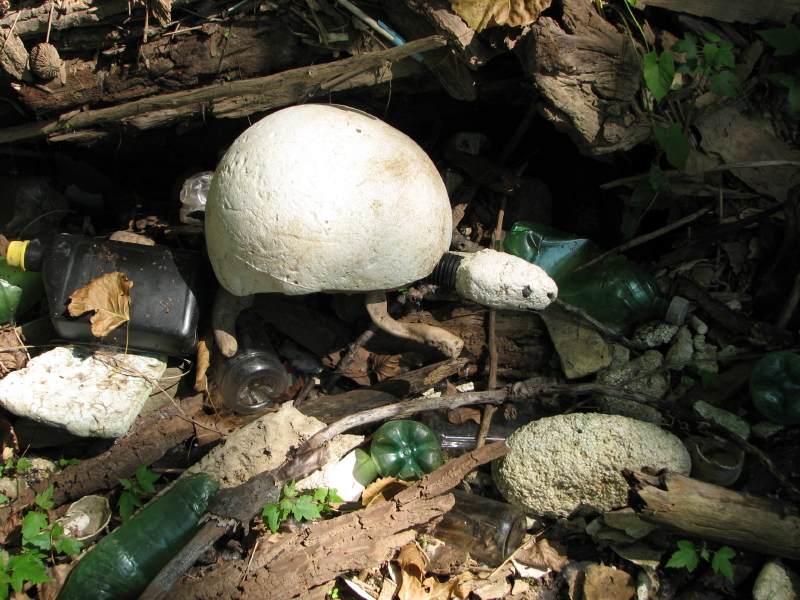
The Cottonwood Turtle is characterized by a high-domed carapace that the original inhabitants of the Ohio Valley used for war and ceremonial helmets.  Unlike the box turtles which it shares some affinities with…the Cottonwood Turtle cannot retract its head and limbs fully into its shell.  This makes it vulnerable to predators.  I watched my turtle crawling over the plastic and Styrofoam debris left by the last flood.  It seemed to be going somewhere with a purpose and I followed discreetly behind it.

The previous night we had another tremendous rain storm with high winds.  Mud, broken branches and leaf litter evidence can be found everywhere.  I followed my turtle to a large cottonwood branch and saw it engaging in the activity that gives this remarkable reptile its name.

Over the course of about an hour, I watched the turtle carrying mouthfuls of the Cottonwood fluff to a hole that it had previously prepared.  It made about a half a dozen trips back and forth from the downed branch to what looked to my eye to be an abandoned groundhog hole that the turtle retrofitted for its own purpose.  The fluff was carried  into the hole where a special chamber was being prepared for this turtle’s eggs!

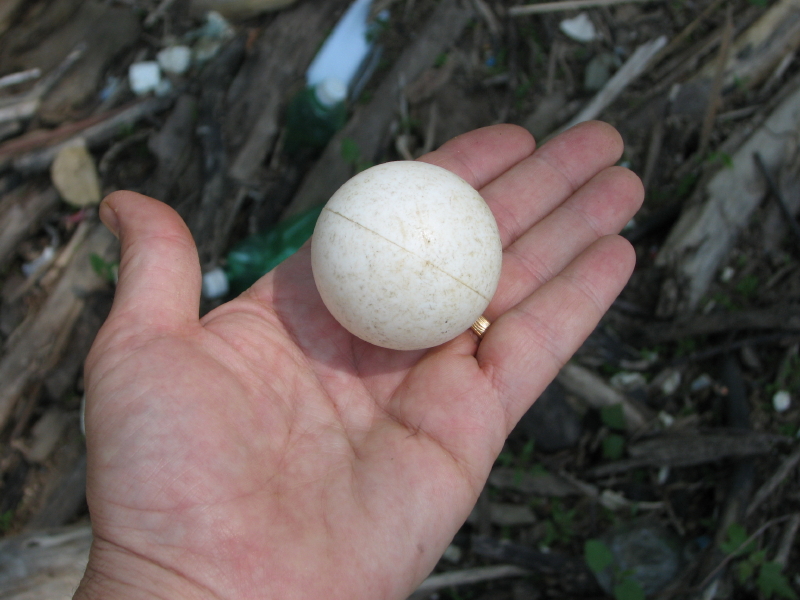
Here is the Cottonwood Turtle about to finish laying her eggs.  I observed about five ping pong ball-sized eggs being deposited upon their bed of cottonwood fiber.  I suppose the fluff cushions the eggs and perhaps as this material decays provides some modicum of warmth to assist in the incubation?  From what I have read, new turtles should be emerging from their subterranean nursery after sixty days.  After the turtle covered her nest with her back legs she moved on.  From this moment, the eggs and baby turtles to be are on their own.  I gently uncovered some of the soil and photographed this single egg.  Afterwards, I placed the egg back into the nest, re-covered it and went on my way happy to have witnessed this ancient rite of life.

It occurred to me on my walk back through the tangle of bottomland, that this turtle might be benefitting the tree as well?  I haven’t heard or read anything concerning a link, but what if?  The fluff contains minute seeds and the act of burying them might aid in propagating this tree.  The turtle places these seeds a little deeper than usual which might encourage stronger and deeper root growth.  Since this area is frequently altered by the river, it would make sense for the tree to have a deeper hold on the soil?  I came across another downed cottonwood branch and admired all the fluff it was producing.  It all looked so beautiful and magical in broad daylight.

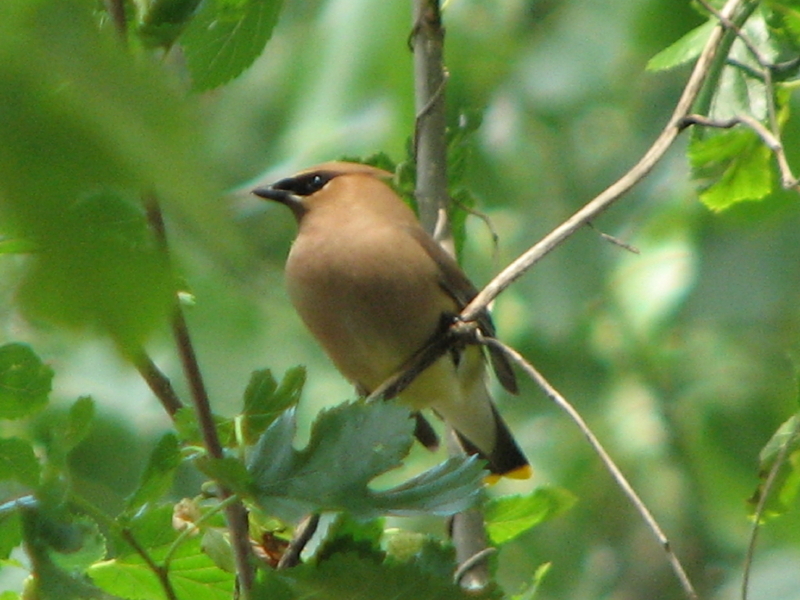
Overhead the orioles were collecting their own materials to build their amazing hanging basket nests.  And the Cedar Waxwings were fueling up on the mulberries in preparation for their long migration up into the north country.  One last image of one of these waxwings.  Such an interesting and beautiful bird so uniquely marked.

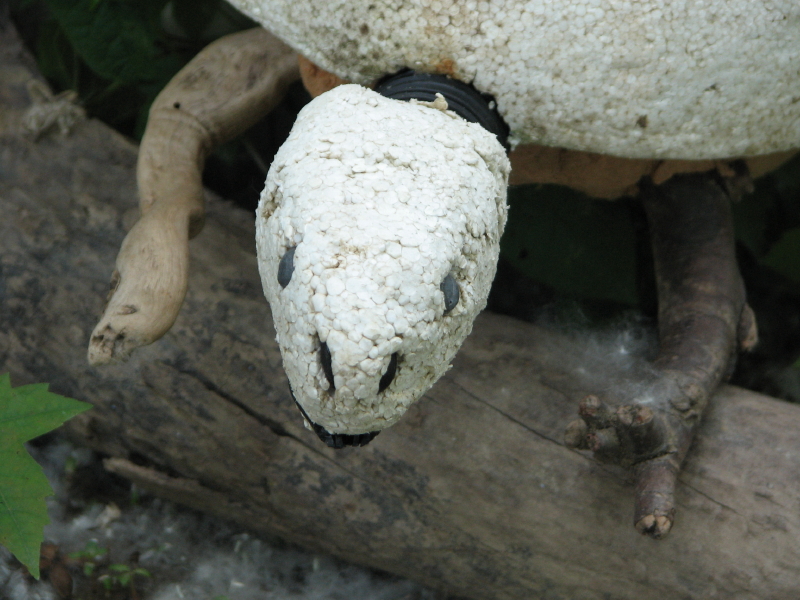
Although I may have fooled some people out there (wink, wink)…the Cottonwood Turtle doesn’t actually exist!  I made it from junk I found here in this very real environment at the Falls of the Ohio.  The shell or carapace is the cushioning from inside an old bicycle or motorcycle helmet and I have found several of these helmets after the last flood.

I used three pieces of Styrofoam…the shell, head, and one piece under a chunk of fiberglass-like material to fill the space inside the helmet.  Limbs are pieces of found wood attached to the lightweight fiberglass.  Everything is joined and pegged together with wood skewers.  I did use some found plastic for the actual neck and mouth of the turtle.  The eyes are round lead fishing weights and the nostrils are pieces of coal.  Thanks for tagging along!
Read Full Post »

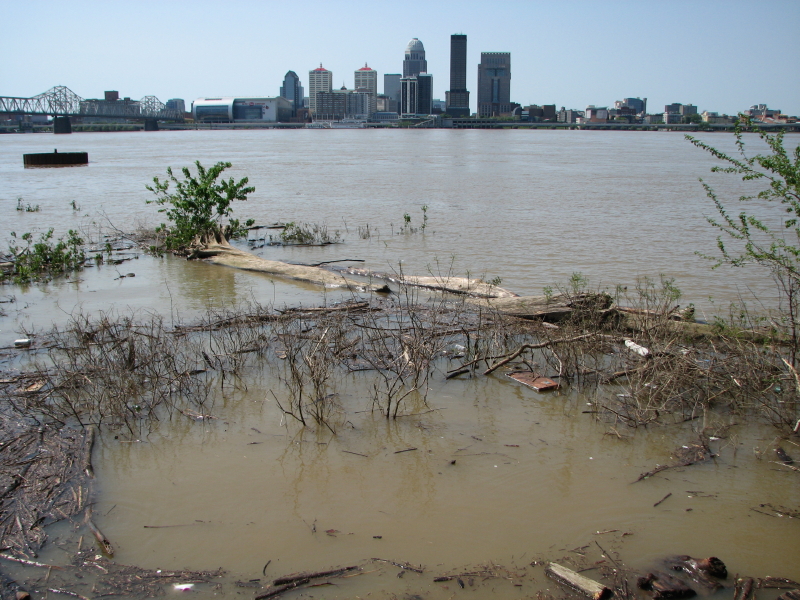
As usual I’m a bit behind in my river reports.  I calculate I could write at least several more posts about the flooding we have experienced with the Ohio River at the Falls of the Ohio.  As I write, the river is still high, but all the attention has shifted to the Mississippi River which is experiencing an epic flood.  I’m sure some of the same water molecules that flowed past our location are contributing to the woes down along the Mississippi.  For those unfamiliar with our geography, the Ohio River flows directly into the Mississippi River in far western Kentucky.  The confluence of these two great rivers is an awesome sight.
Here at Louisville, the water has been receding and the amount of water-borne junk this flood has brought hasn’t fully hit home yet.  There are signs, however, everywhere I look that this will be a great challenge for any river loving clean-up crew.  I will try to do my part, but even if I were to try to be out here every waking hour…I wouldn’t  begin to scratch the surface.

Gas is over $4.15 cents a gallon for regular unleaded here.  I listened to the great oil company executives trying to explain to Congress today why they need a sweetheart deal from the American taxpayers when they already receive every tax break in the books and are suffering with their record, obscene profits.  When discussion turns to what can be done to reduce the amount of crude oil used the usual answer has something to do with increased engine efficiency resulting in more miles to the gallon.  Looking at the high water line I see another solution that doesn’t get as much play.  Why don’t we try to cut as much plastic out of our way of life as possible?  There would be more oil available for fuel and you wouldn’t have all these various compounds despoiling our water ways from the smallest streams to the largest ocean.  You can throw Styrofoam in this mix too since it is has petroleum pedigree as well.  We could just change the packaging we use and I bet that would make a huge difference.
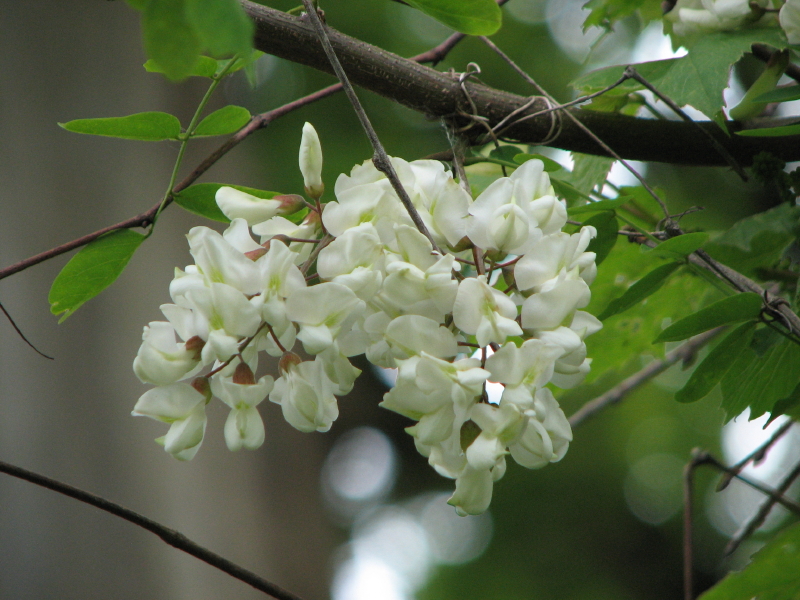
You can look at the whole Riverblog as one long rant against pollution, but there is also more out here that is sweet and worth noting and enjoying.  I decided to walk along the Woodland Loop Trail and the air was fragrant with the perfume from what we call Honey Locust trees.  Some of these trees also sport large spines growing on the bark.  Their pea-like white flowers have the most wonderful scent.  Here is what a flower cluster looks like.

Along the trail, you can hear a variety of bird species singing.  Vireos, woodland warblers, orioles, chickadees, indigo buntings, various thrushes fill the air with their acoustic signatures.  The birds are here to feast on the many cutworms that plague the forest canopy.  There are also other larvae present…here is a small nest of tent caterpillars that will soon become moths.  Very few birds like these hairy caterpillars, but two that do ( the Yellow-billed cuckoo and the Blue and gray gnatcatcher) can be found in the forest now.

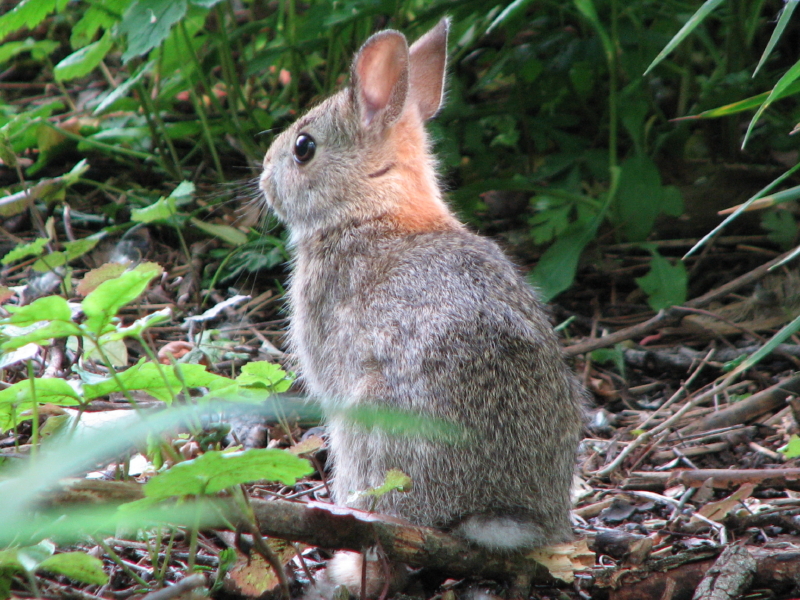
Ah, I also spot my namesake hopping along the trail!  This is a young Cottontail and he better be careful out here because there are so many predators both native and domesticated that would love to catch him!

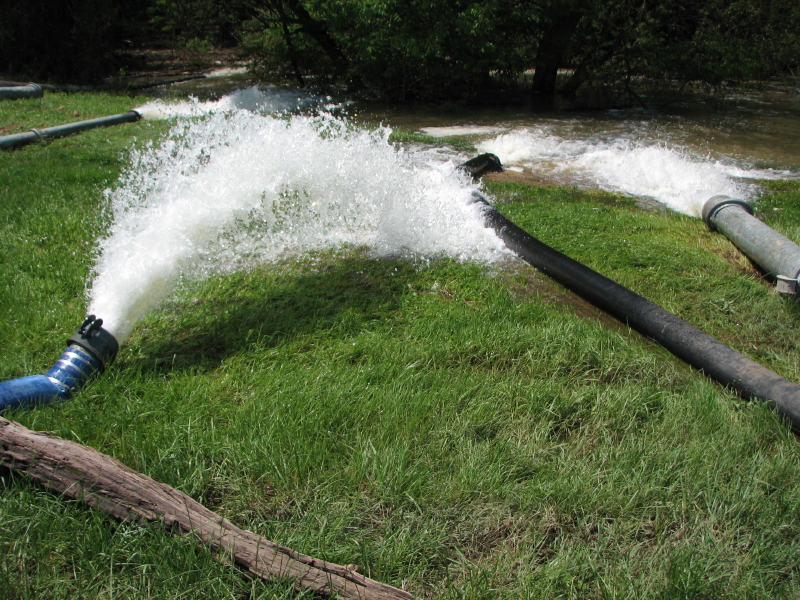
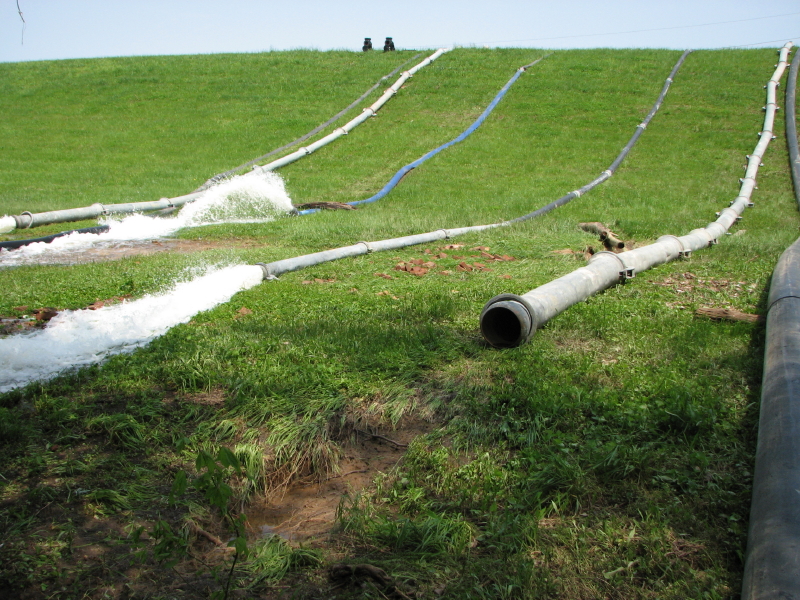
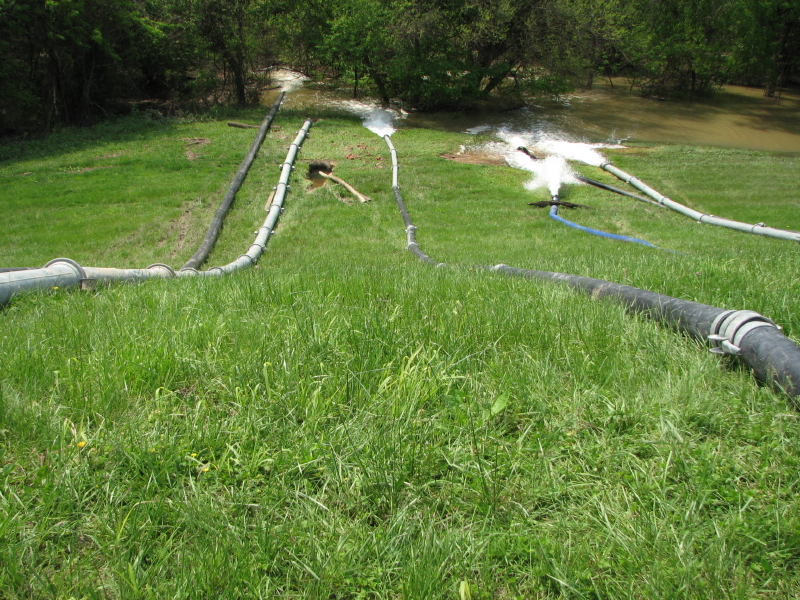
Walking westward along the trail, you can’t help but notice the large grassy berm that flanks your right side.  It is additional flood control put in place after the disastrous 1937 flood which was our high water event on the Ohio River.  Up a head, I can see a network of large hoses with water gushing out and I decided to investigate.

I can see these large hoses coming down the berm and I wanted to see what’s on the other side of this earthen flood wall.  Here are a series of pictures of what I saw.  First looking up hill…

…now the view looking down towards the river.  What are these hoses for?

I came across a sign at the crest of this large hill that explains it.

On the other side of the berm is the small town of Clarksville, Indiana.  Rain water has pooled up in the lower lying sections of the city and are being pumped out and over the top where the water then flows into the park eventually finding release into the river.

It’s strange how I rarely think about the town that occupies the other side of this large grass and earthen mound.  The Ohio River is really at its front door all the time.  The little bit of woods I like spending time in is just a narrow sliver of ecosystem that exists between Clarksville and the river.

Well, that’s the story for now.  I have much more to present about the dominant environmental event of our Spring.  Already the temperatures are rising and I can feel the transition to Summer won’t be long in coming.  Thanks for hanging with me…until next time…the Rabbit Man.

Read Full Post »

« Newer Posts - Older Posts »