Feeds:
Posts
Comments

Posts Tagged ‘site specific art’

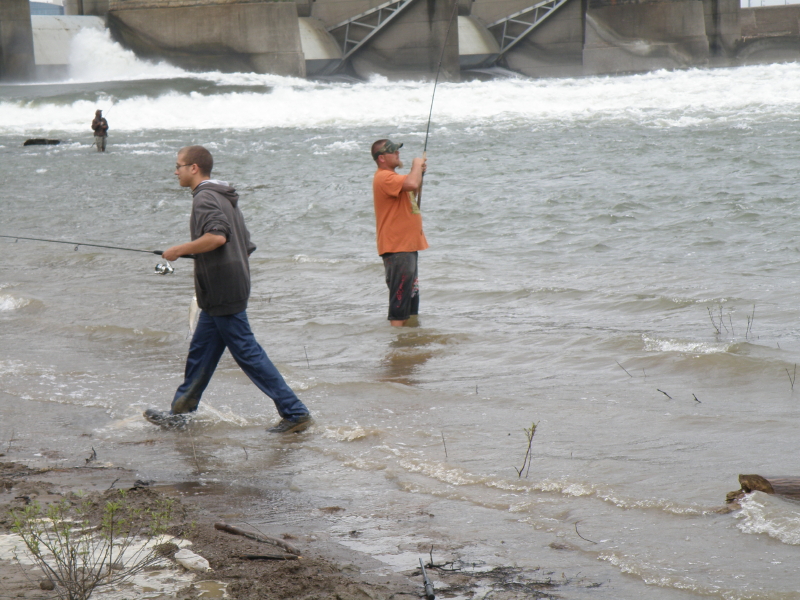
Fishermen, Falls of the Ohio, June 1, 2013

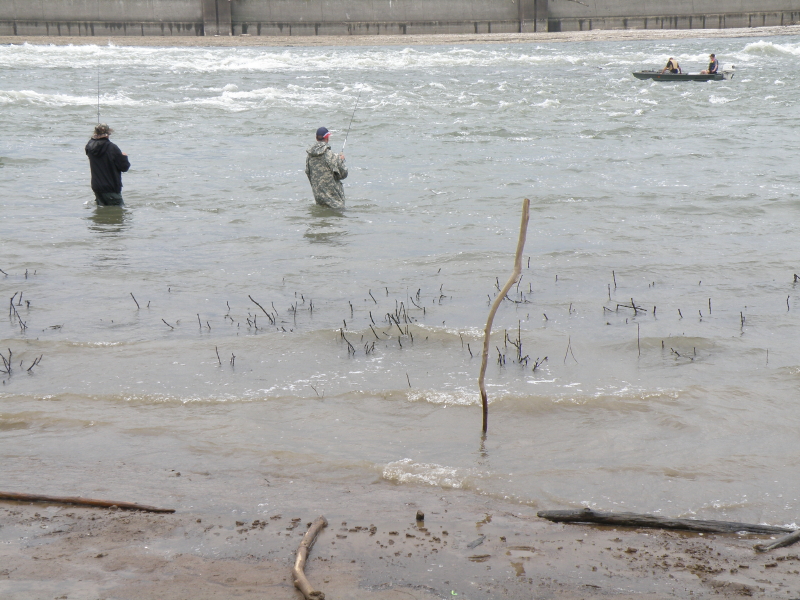
It’s the beginning of June at the Falls of the Ohio.  I arrived at the river to find a dozen or so fishermen that were up on this cool, grey morning before me.  There are both people and boats in and on the water.  Many fishermen are knee to thigh high in the river balancing themselves on the shallow, but rocky bottom.
Fishermen at the Falls, June 2013

The river attracts all kinds of fishermen.  I see people who have lots of fancy, expensive tackle and for the most part they are using light gear for smaller, sporty, quarry.  And then there are the guys that seem more local and blue-collar.  No fancy gear here that the anglers might prefer.  Rather this is a big pole, five gallon bucket, come as you are affair.  Word has probably been passed down the line that the “shad” are running and it’s a good time to catch a mess of fish.
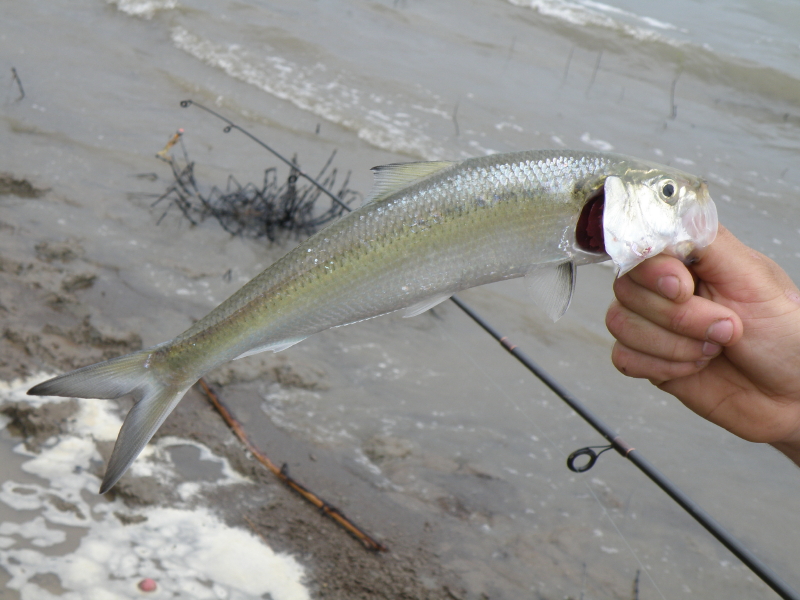
Skipjack herring at the Falls of the Ohio, June 2013

This is the fish of the day…the Skipjack Herring, (Alosa chrysochloris).  This fish was first described by the naturalist Rafinesque in the early part of the 19th century.  It’s an abundant and beautiful fish found in all of Kentucky’s major rivers and up into the Mississippi River too.  The Skipjack is anadromous which means it migrates up rivers from the sea to breed.  During the right time of year large schools of Skipjacks are congregating under the dams and waiting for the chance to move forward.  The Skipjack gets its name from jumping out of the water like a skimming stone in pursuit of the smaller fishes it eats.  At the Falls, the fishermen are catching Skipjacks to use as bait.  The fish is cut into quarters and set upon large treble hooks in the hopes of catching big catfish.  One fisherman told me he witnessed a 30 pound catfish being caught with this method the previous night.  I recently read that these waters were also once home to the Ohio Shad (Alosa ohiensis) which were first described from specimens caught in the Ohio River at Louisville in the late 19th century.  This fish is so rare now that it is on occasion listed as being extinct.  The Ohio Shad was probably not common to begin with.
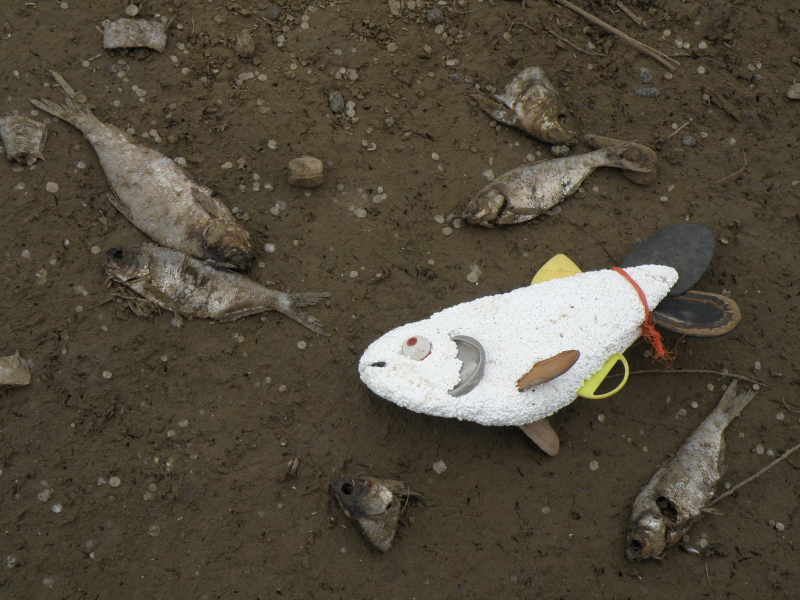
dead fish, June 2013

Along the water’s edge the smell of dead fish demarcates the air where water and land meet.  The riverbank is littered with the unlucky who through lost scales and exposed bone are returning to the world from which they came.  There was one unfamiliar fish that I came across and I did a series of photos of it.  Here are several views I made of this new fish.
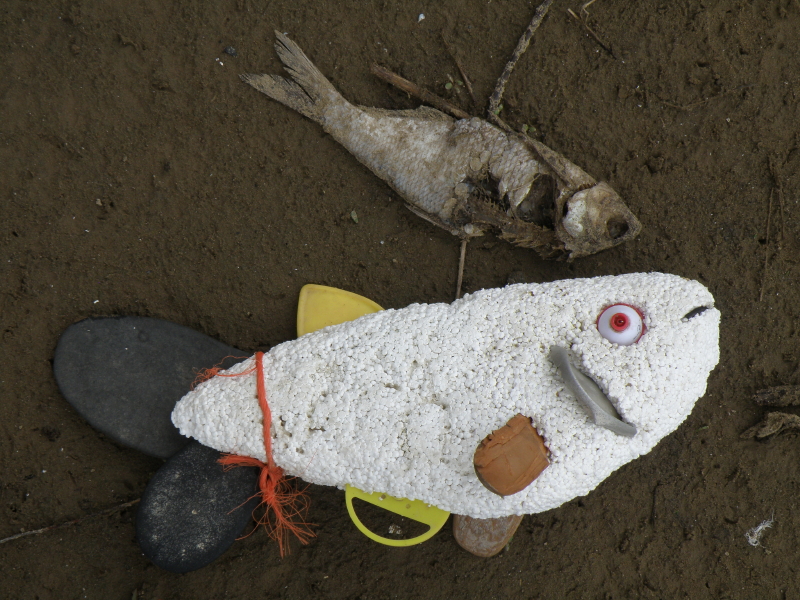
Yellow-fin Carp with skipjack, June 2013

Fish studies, June 2013

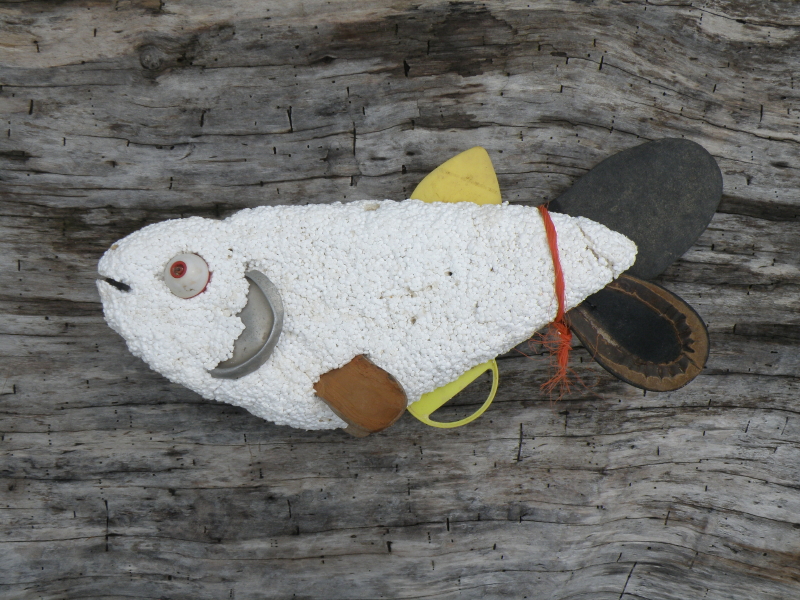
There isn’t anything in the literature about this fish and so I’m going to designate it the Yellow-fin Carp for obvious reasons.  In life, it probably was in the 3 to 5 pound range and I’m surprised it didn’t get cut up for bait as well? It has the tell-tale large eyes that suggest it is a deeper water fish.  It was probably caught by mistake, released, died, and washed up here with the other unfortunates.  Here’s a couple of images made along the riverbank.
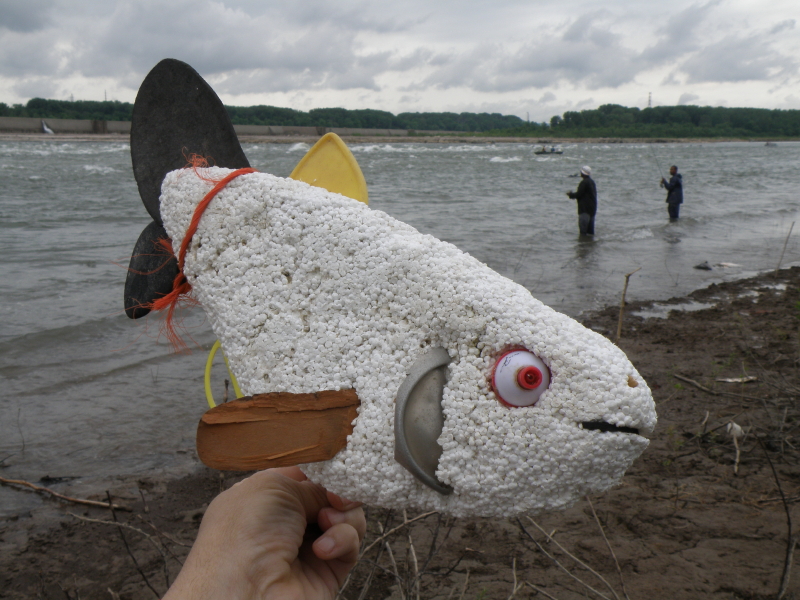
Yellow-fin Carp in hand, June 2013

Yellow-fin Carp in hand 2, June 2013

Since this is something you don’t run across out here very often, I thought I would post a few more images that provide a more formal portrait.
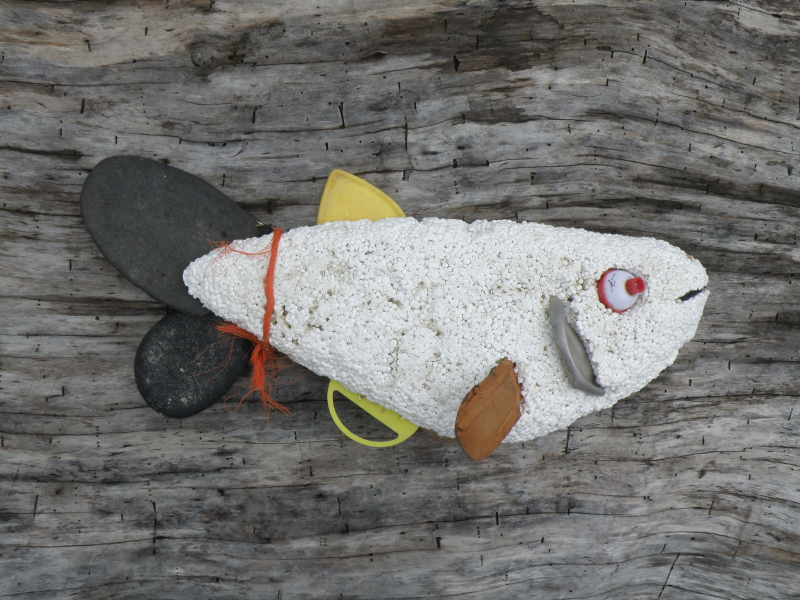
Yellow-fin Carp, facing right, June 2013

Yellow-fin Carp, facing left, June 2013

And now for a head-on view of this interesting fish.
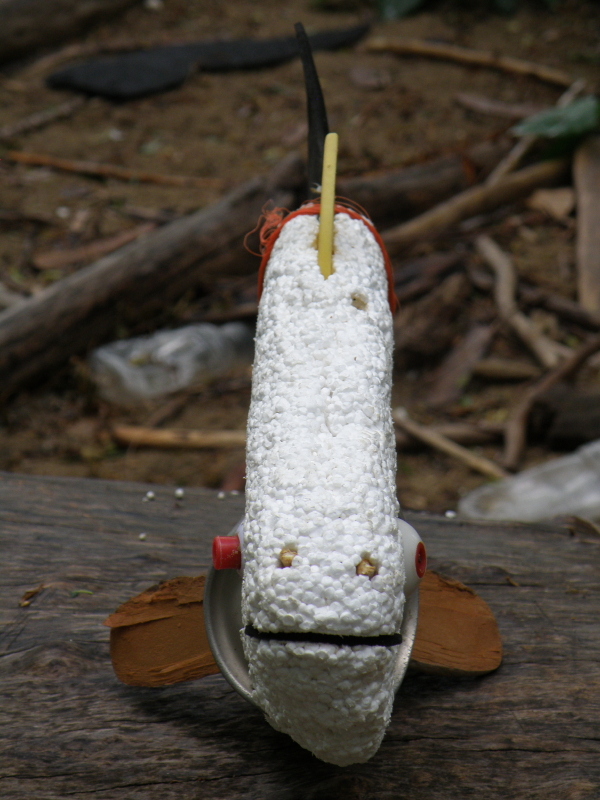
head-on view of Yellow-fin Carp, June 2013

People were not the only animals out here after the Skipjacks.  Several bird species including Ospreys, Double-crested Cormorants, Black-crowned Night Herons, and Great Blue Herons were taking their share.  Here is a heron couple that are set up by the tainter gates in the eastern section of the park.   Between catching fish they mirrored each other in a few courtship moves.
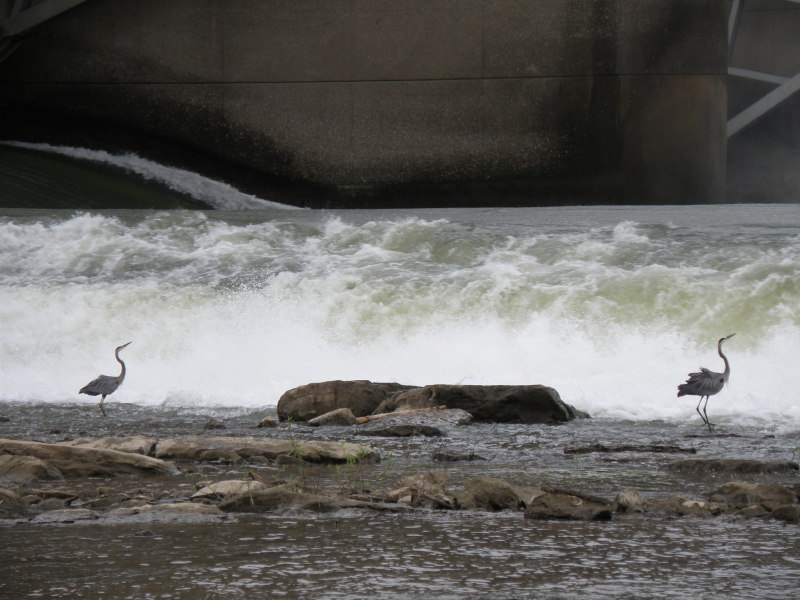
Great Blue Herons by the tainter gates at the Falls of the Ohio, June 2013


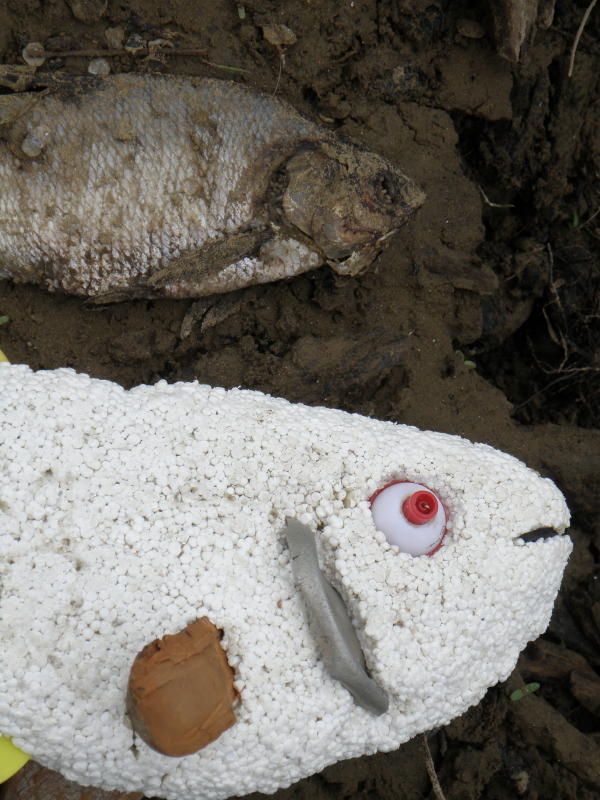
The fossil limestones at the Falls of the Ohio are famous for the diversity of Devonian Age life forms that are preserved within the rocks.  Ironically, the Devonian Age is also known as the age of fishes because they first appear in the fossil record over 350 million years a go.  At the Falls, however, fish are poorly represented in this rock record.  I imagined that if they had preserved as well as other creatures…their remains might look something like this.
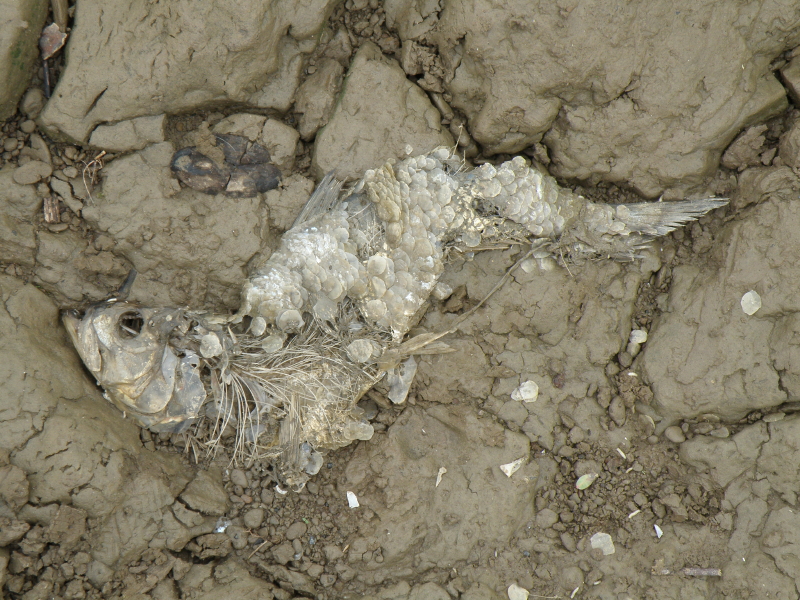
dead fish at the Falls, June 2013

Read Full Post »

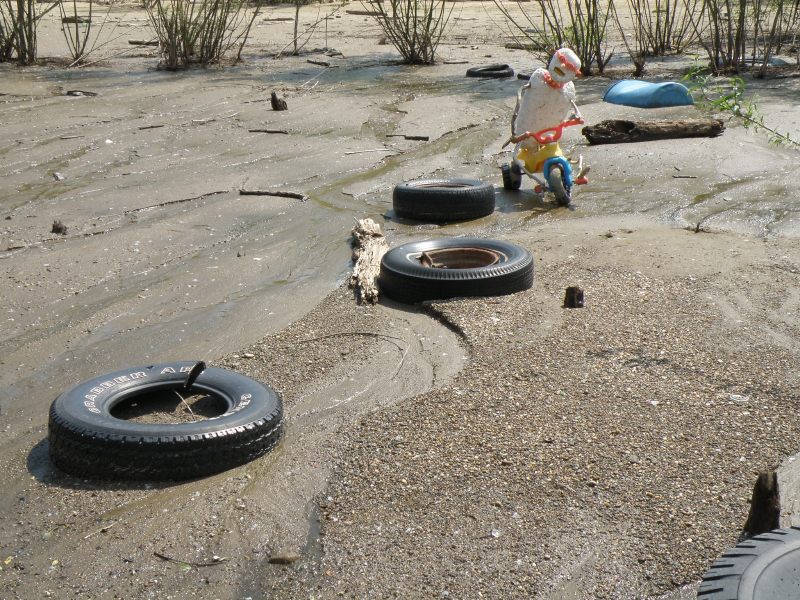
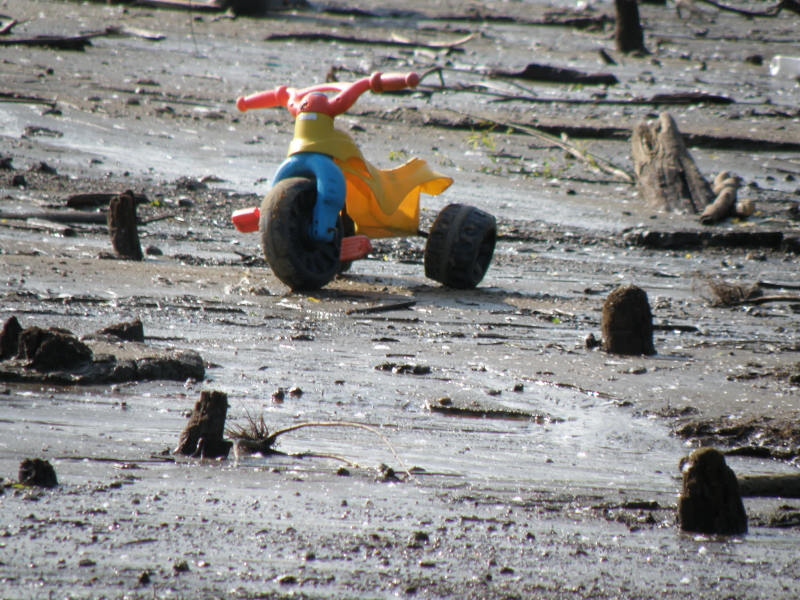
washed up plastic tricycle, Falls of the Ohio, May 2013

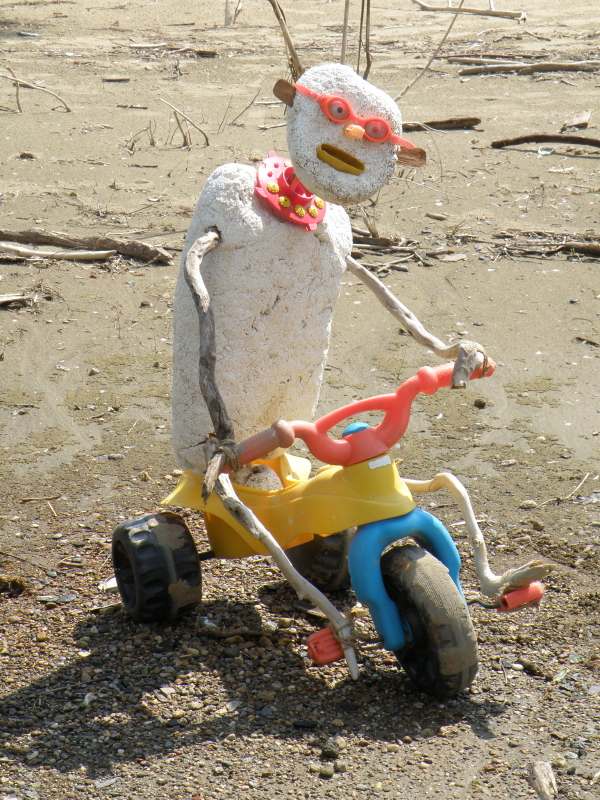
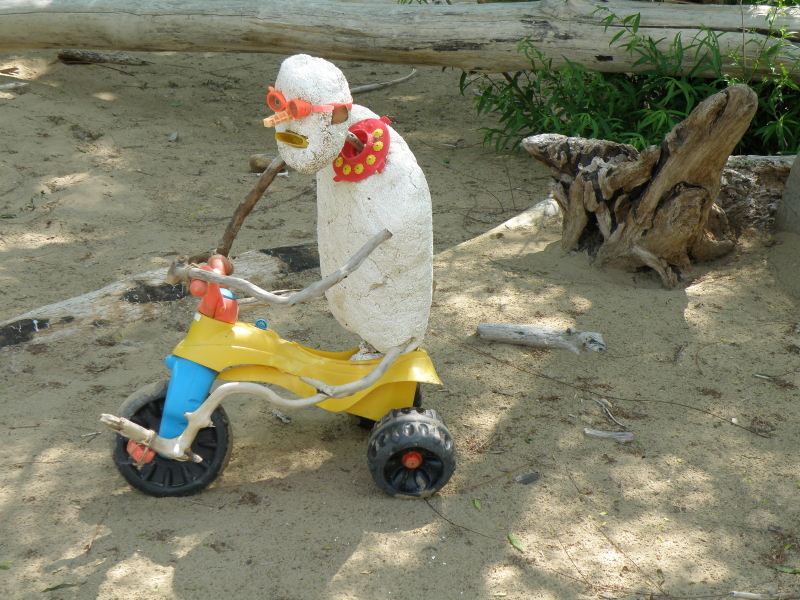
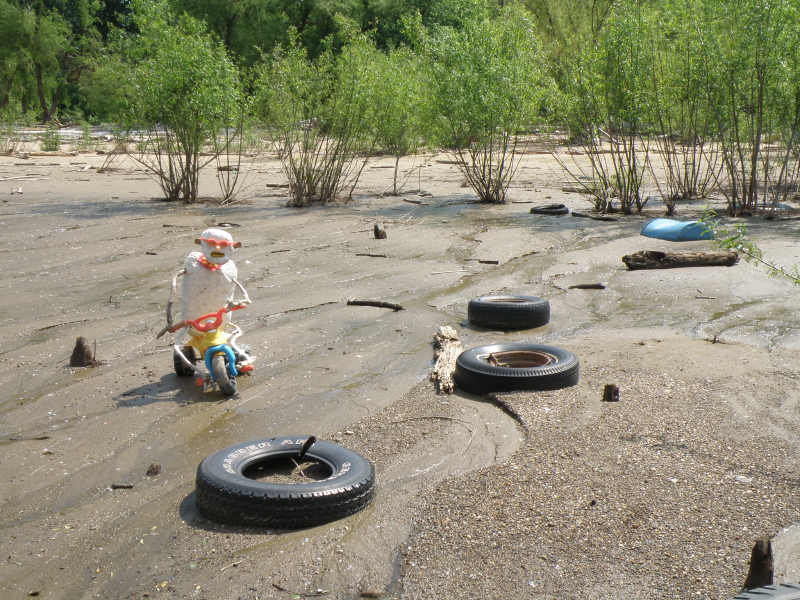
I was at the Falls of the Ohio last week when I spotted this plastic toy tricycle just sitting by itself near the river’s edge.  Although I didn’t see anyone around, I just assumed its owner must be nearby.  I took this picture and walked away.  After a time spent looking for driftwood and anything else, I was heading back to my studio under the trees when I was approached by this character I’ve come to know as the ” Off Road Triker”.  He was quickly peddling that tricycle I had seen earlier.

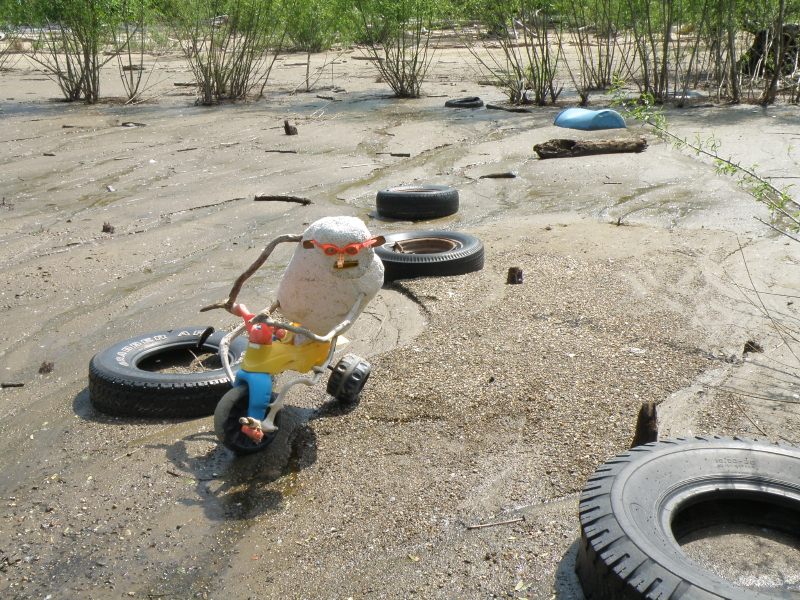
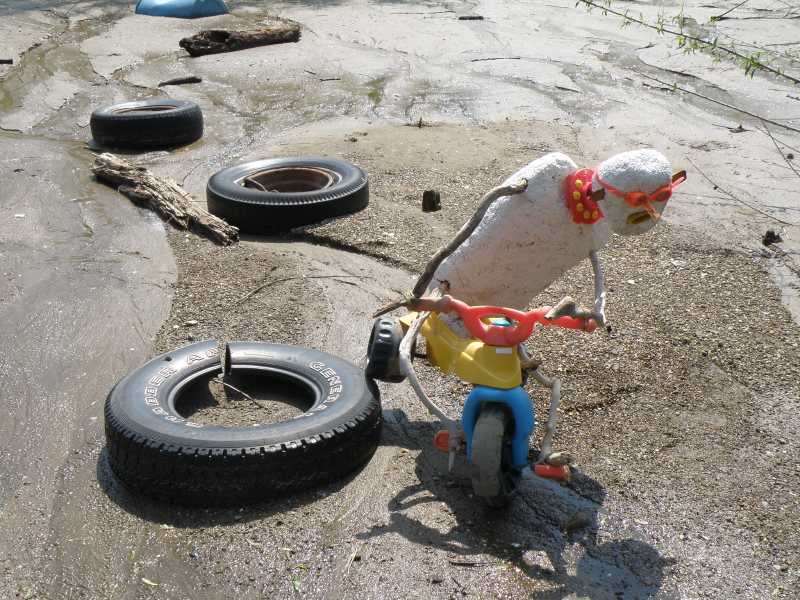
Off Road Triker, May 2013

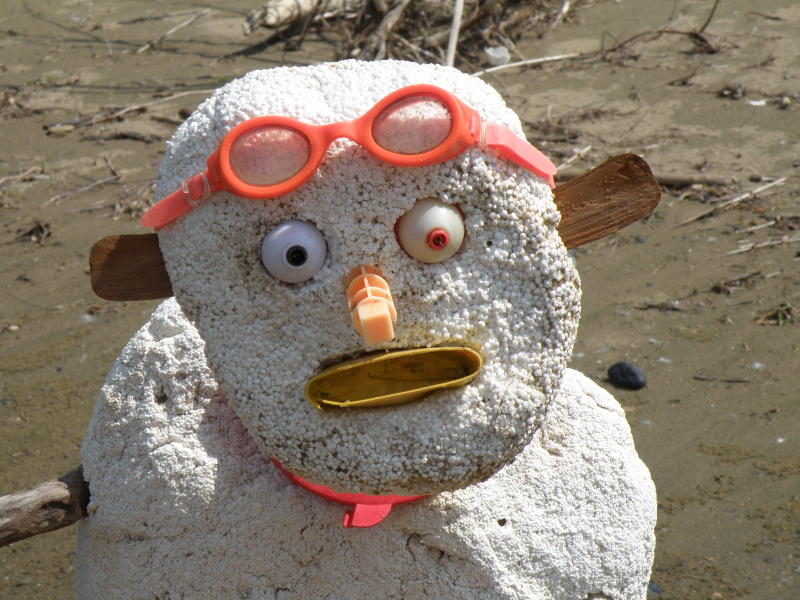
With his trademark orange goggles, the Triker likes to explore the world from the seat of his three-wheeler.  I recognized him as the  subject of a few human interest stories in the newspaper, but this was a first spotting him on the shores of the Ohio River.  I have heard that he used to own a car, but now he just peddles everywhere he wants to go.  As a side benefit, he’s in the best shape of his life.  His legs alone must be as hard as wood.  The Triker’s ride came to a smooth stop in the sand in front of where I was standing.

the head of the Triker, goggles off, May 2013

Removing his goggles from his eyes the Triker greeted me pleasantly on a picture perfect day.  We introduced ourselves and talked about our observations and connections to this landscape.  The Triker remarked that he had seen a lot of rubbish along the water’s edge and I nodded in agreement.  He wondered why nobody did anything about this, but I had to tell him that the Falls does see several clean-up attempts a year, but with each new flood or high water the new “largess” in the river just washes up again.  It’s like rolling that proverbial rock up the hill only to have it roll back again and again.

Off Road Triker in motion, May 2013

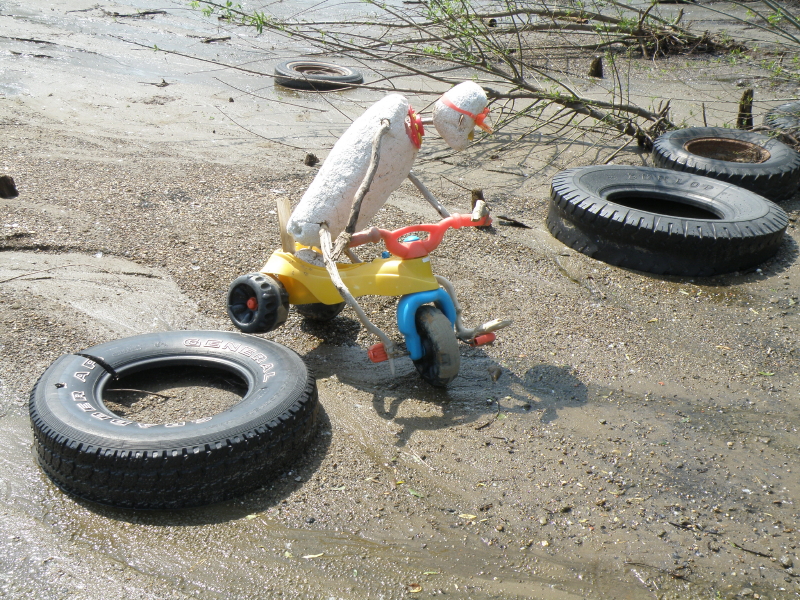
The Triker said that there was a place where several old automotive tires were laying half buried in the sand and that I should check it out.  He put his goggles back on and I walked beside him as he peddled to the spot.  I didn’t tell him this, but I was already familiar with these tires and have photographed this feature many times.  I found the Triker to be amusing and so I just played along to get a sense of who he is and what he might do next.  The reason all these tires are in this particular location is that once upon a time a river clean-up had occurred and these loose tires were gathered here for future disposal.  Ironically, the future never came which left these tires mired in the present.  Now these tires are so full of mud, sand, and water that it would take a herculean effort to dig some of them out of the riverbank.

The Triker begins his run, May 2013

The Triker thought these tires would make an appropriate obstacle course to maneuver through and he asked me to photograph him while he made his run.    Everything started off well enough, but that was not to last.

The Triker runs the obstacle course, May 2013

The Triker swings wide, May 2013

The Trike over corrects, May 2013

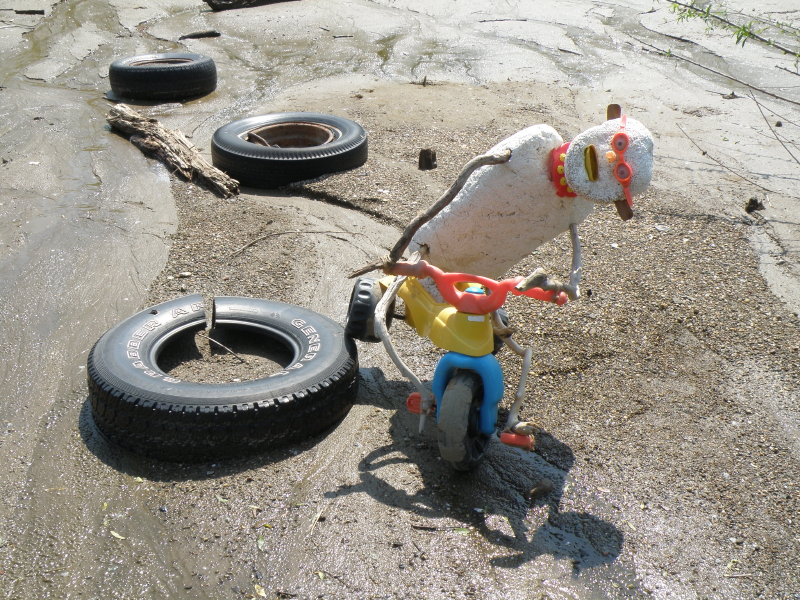
The Triker clips the tire, May 2013

It’s at this point that the Triker hits a snag or rather a tire.  The slalom at the course’s start went fine, but midway through the Triker swung wide and he had to over correct to get around the next obstacle.  Here are some different close up views of the action.

View of Triker hitting the tire, May 2013

The Triker up on two wheels, May 2013

The Triker nearly falls off, May 2013

As you can see…hitting the tire caused the tricycle to go up on two wheels.  The speed and forward momentum nearly caused the Triker to completely lose his balance!

The Triker recovers his balance, May 2013

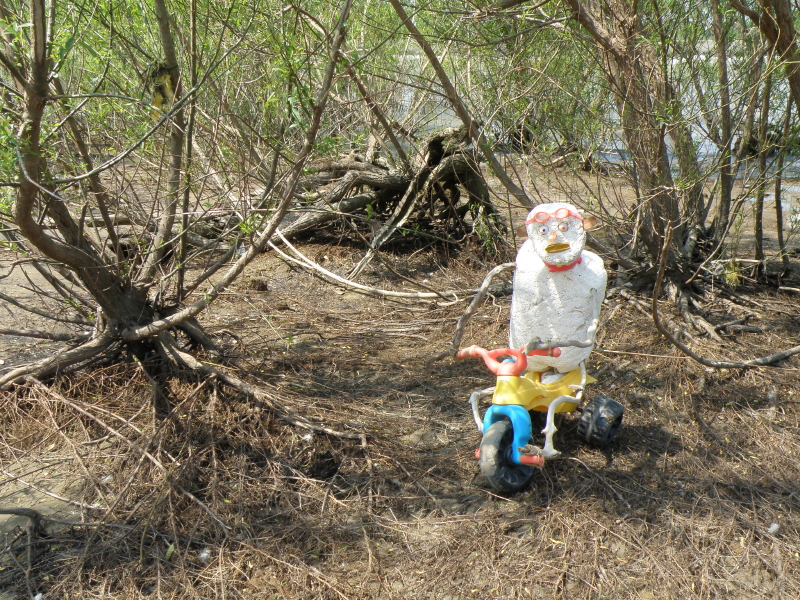
Fortunately as an experienced rider…the Triker held it together and was able to regain his composure and balance to complete this impromptu course.  He pulled off to the side near some willow trees and exhaled deeply.

The Triker recovers his breath, May 2013

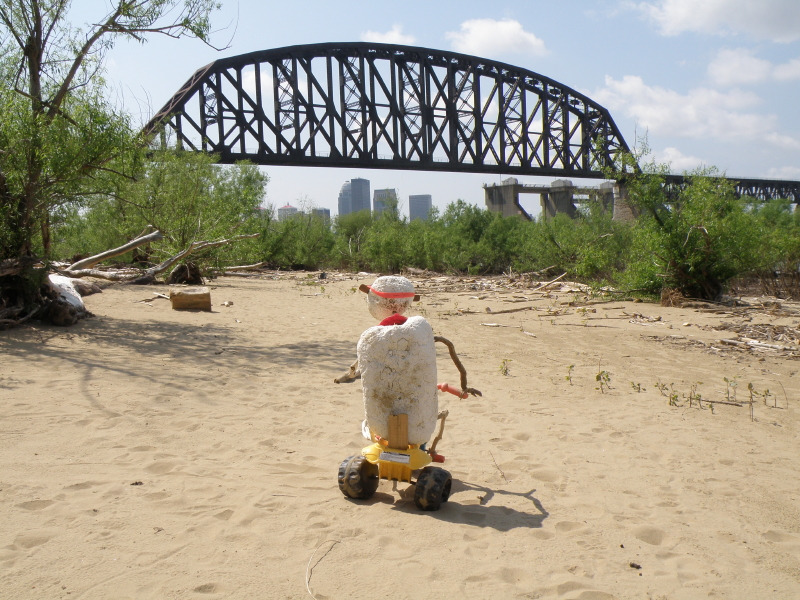
“That was a close one my friend.  I thought for a micro second I was going to eat sand and rubber in a hard way!”  I praised him for his skill on the tricycle and told him I would post the images on the internet which seemed to please the Triker.  Recovering his breath, the Triker said he enjoyed his visit to the Falls of the Ohio, but it was now time to return to the city.  With his goggles back on, my last view of the Triker was of his back as he peddled his wobbly ride with a newly bent axle towards the skyline of the nearby city.

The Off Road Triker departs, May 2013

Read Full Post »

pollinating tree, April 2013

It’s Thunder Over Louisville weekend which means the largest fireworks extravaganza in North America will happen tonight.  This is the kickoff event for the Kentucky Derby Festival which culminates in the horse race itself on the first Saturday in May.  The festival is a two-week event and while fun for residents and visitors…can also be an obstacle course if you are trying to get around town.  I like using the bridge on 2nd Street to get to the Falls of the Ohio State Park, but it is shut down and being used for the fireworks display.  At its height, Thunder Over Louisville (which also includes an air show) has drawn 800,000 people to the banks of the Ohio River on a single day.  I’m hoping to access the river and the park tomorrow.  For the moment, I have images to post from my last visit.  Looking through the pictures, it occurred to me that I had captured moments in the lives of individual trees that I would like to share.  The area continues to green up and many trees are producing their pollen.  For allergy sufferers, this is an especially difficult time.  If I was affected by seasonal allergies…I doubt I could do this project.  There is something about being in the bottom of the Ohio Valley that seems to bring out the worst for those allergic to various molds and pollen.

driftwood at the creek, April 2013

driftwood at the creek, April 2013

driftwood lining the banks of the creek, April 2013

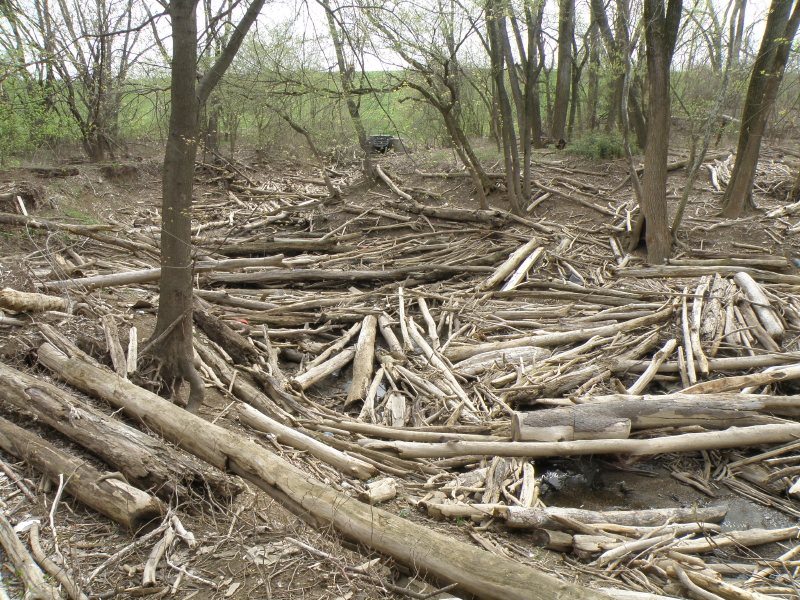
I started this adventure on the Woodland Loop Trial near the Interpretive Center.  The path eventually leads to a small creek that at the moment has a tremendous amount of driftwood lining the contours of its banks.  All this wood was deposited here by the Ohio River swollen from winter rain and snow melt all along the length and breath of the river valley.  More high water could eventually carry all this wood back out into the river for parts unknown.  Still, this represents a lot of trees.  I have this idea in my head that as a result of climate change, we have all this extra water and energy in our weather systems?  Where does the water from retreating glaciers and Arctic melting go?  I’m guessing that some of it is evaporated out of the oceans and into a warming atmosphere where it influences the global weather patterns?  This excess water eventually precipitates out causing more severe weather events including flooding.  This increases riverbank erosion and tree loss.  Is there a limit on how much water the atmosphere can absorb?    Of course development along the rivers takes its share of trees too.  The cumulative effect of many actions continues to shape the environment.

tree too close to the river, April 2013

tree roots and river mud, April 2013

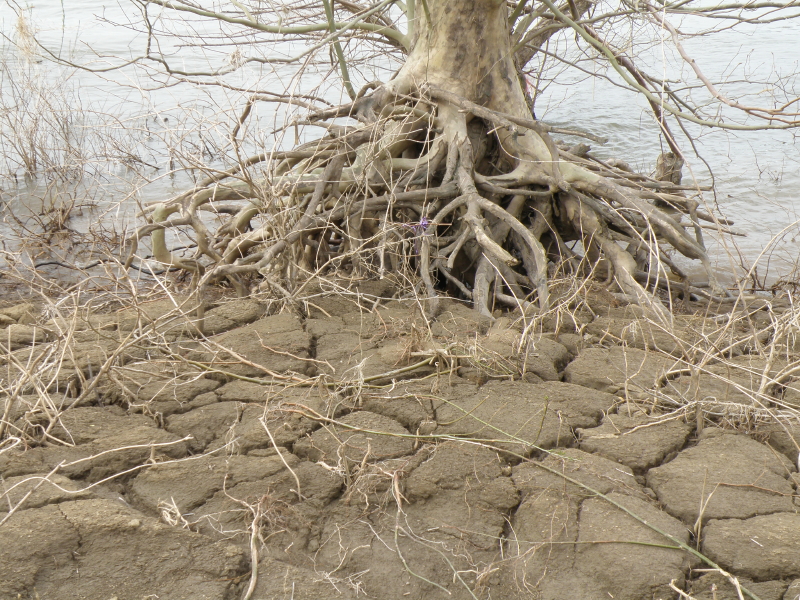
These exposed tree roots are something that I’m noticing more of at the Falls of the Ohio.  I’m assuming that frequent high water causes this?  This isn’t necessarily fatal and these trees can survive as long as the riverbank stays in place.  In addition to more water…an increase in storm related wind velocity has also been noticeable over the years.  We have had a lot of trees simply blow over and be lost in this manner.  Continuing to walk westward in the park, I can see that my favorite cottonwood tree continues to be developed as a party hang-out.

cottonwood tree party hangout, Falls of the Ohio, April 2013

fire pit outside the tree fort, April 2013

distant view of downtown Louisville from inside tree fort, April 2013

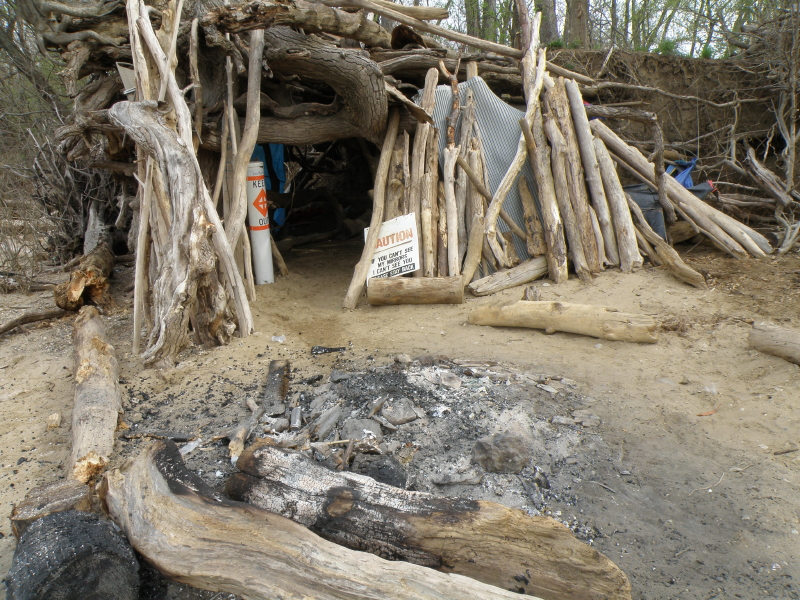
I posted on this wonderful cottonwood tree not too long a go and remarked on how it was once again becoming a focal point for parties.  The fire pits are larger and there are more beer bottles and cans around this tree than before.  I’ll bet this place is especially magical illuminated by camp fires.  Plus, more found wood has been used to hide a large silvery sheet of corrugated plastic to impart a more naturalistic appearance.  From inside and under the tree, you can see in the distance part of the downtown skyline of Louisville which will be filled with fireworks tonight.  Over the years, this tree has been discovered by different generations of folks and continues to hang in there.  I hope this will always be the case.  The next big flood will eventually wash all the additions away as it has done before.

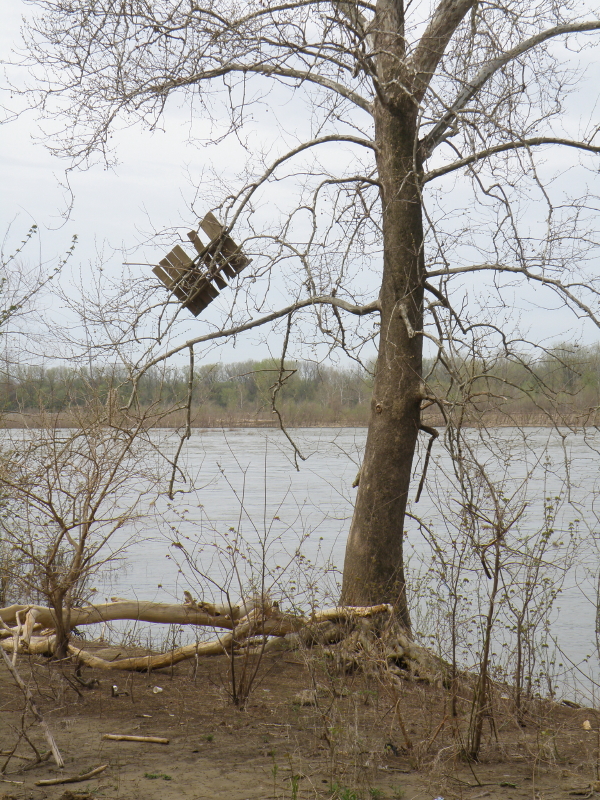
tree with snagged wooden pallet, April 2013

Here’s an image that demonstrates how high the river can rise.  This snagged pallet has been hanging out on this tree branch for a couple of years now.  Trees can demonstrate some resilience in the face of adversity.  I know of a couple of trees at the Falls that have made use of improvised “planters”.

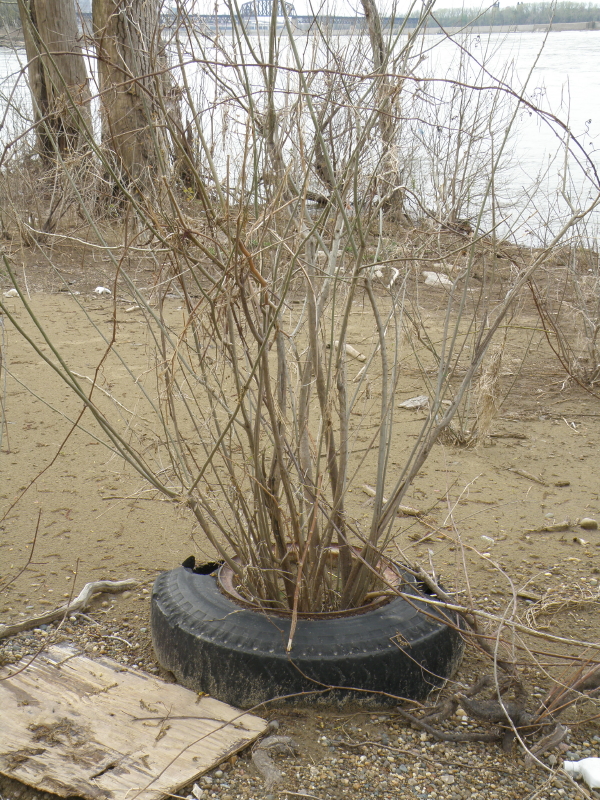
Willow growing within a tire, April 2013

Cast off tires are a ubiquitous element of river-born trash.  Somehow this willow tree has found a sheltering toehold in this wheel.  I’m curious to learn whether this tree can continue to grow and survive in what is ultimately a restrictive space?  On this walk, I also came across this unusual juxtaposition and thought it might fit in this post too.

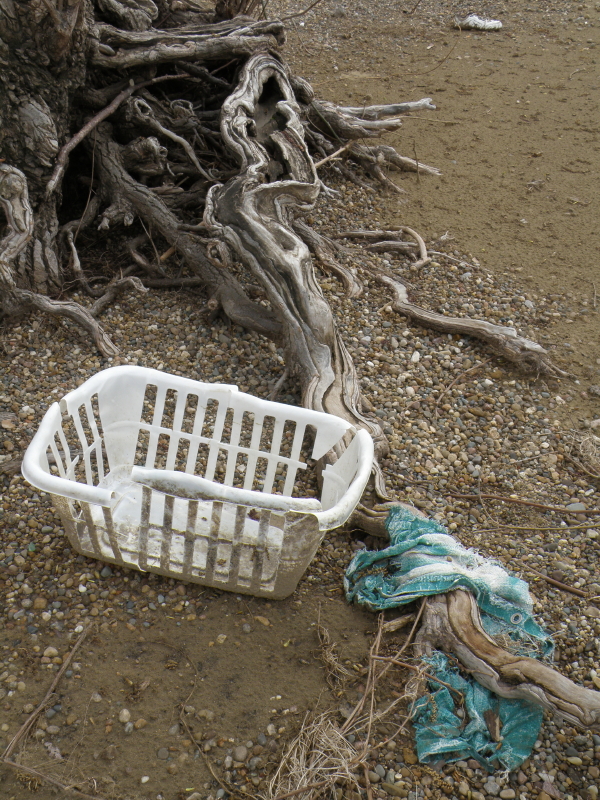
willow roots, plastic laundry basket, and clothing item, April 2013

This may be as near as I come to having a tree suggest that it could do laundry too!  The surface root of an old willow tree has caught this old jacket.  The last high water floated this plastic laundry basket into this area and it settled next to the root.  This is not your average still life.  The gravel in the photo was deposited here by the last of the retreating ice age glaciers.

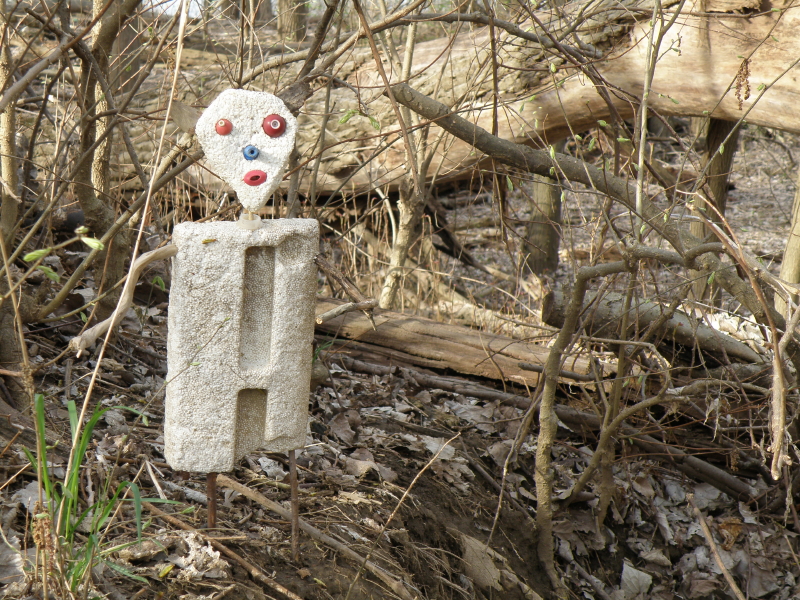
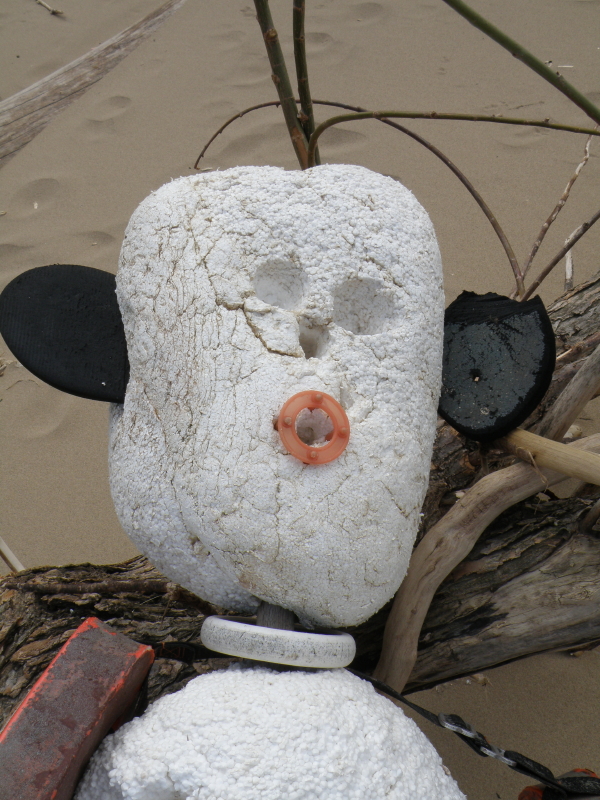
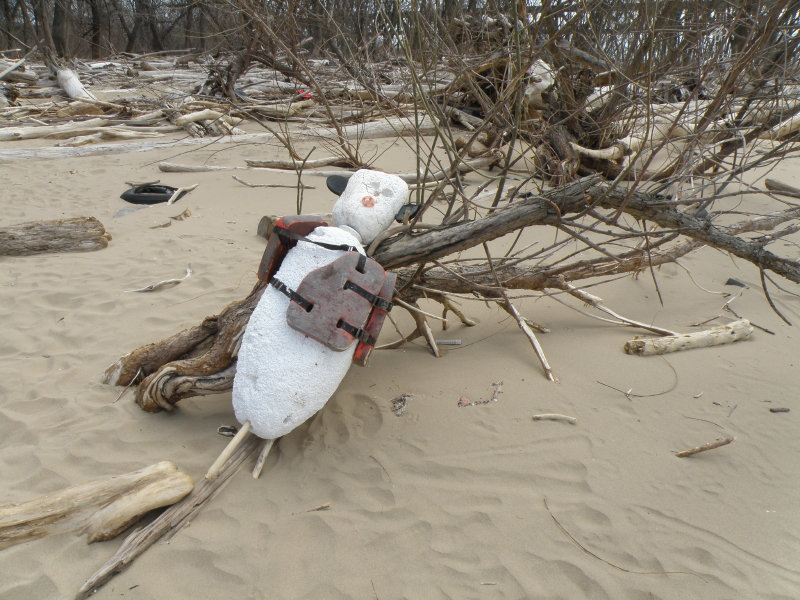
Sauger Man, April 2013


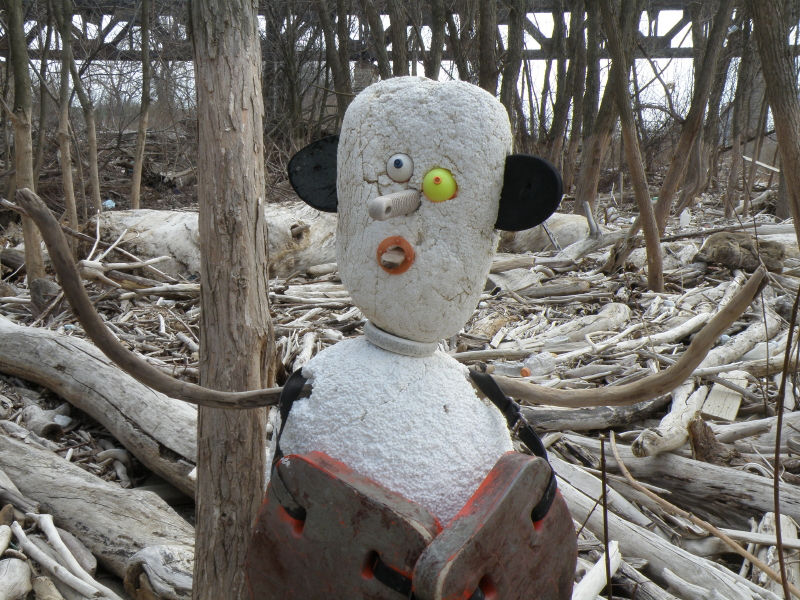
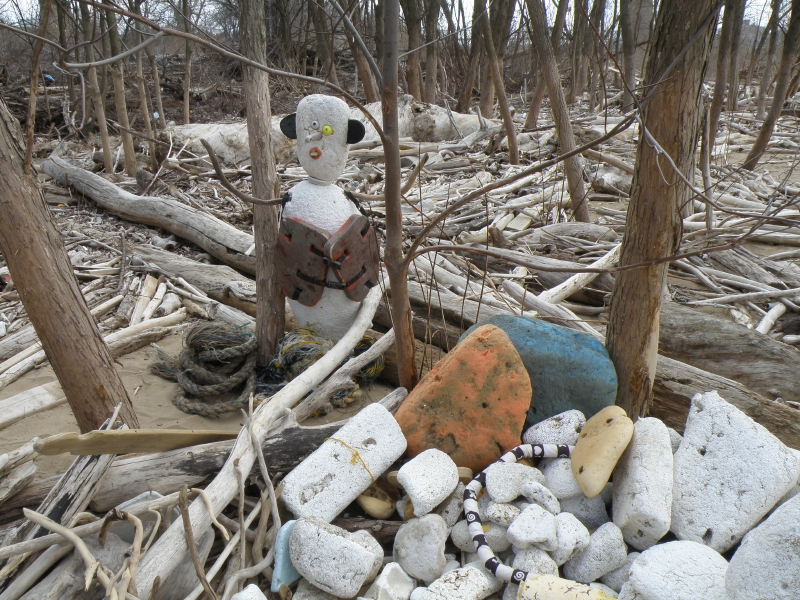
To conclude this post…as I was walking along the loop side of the trail, I spotted  a piece of Styrofoam in a ditch.  Retrieving it I discovered one of my previous sculptures from several months a go.  I originally included him in a story that featured sauger fishermen.  Except for a missing nose, the sculpture was complete.  I was surprised that it survived intact going on several months now.  Looking through my collecting bag…I replaced the lost nose with another piece of found plastic and set him up to greet visitors along the trail.  Here’s a final picture showing him next to a tree that the wind blew down last year.  Thanks for hanging out with me for the past thousand words.  Have a great weekend!

Sauger Man, under a tree trunk, Falls of the Ohio, April 2013

Read Full Post »

wildflowers, April 2013

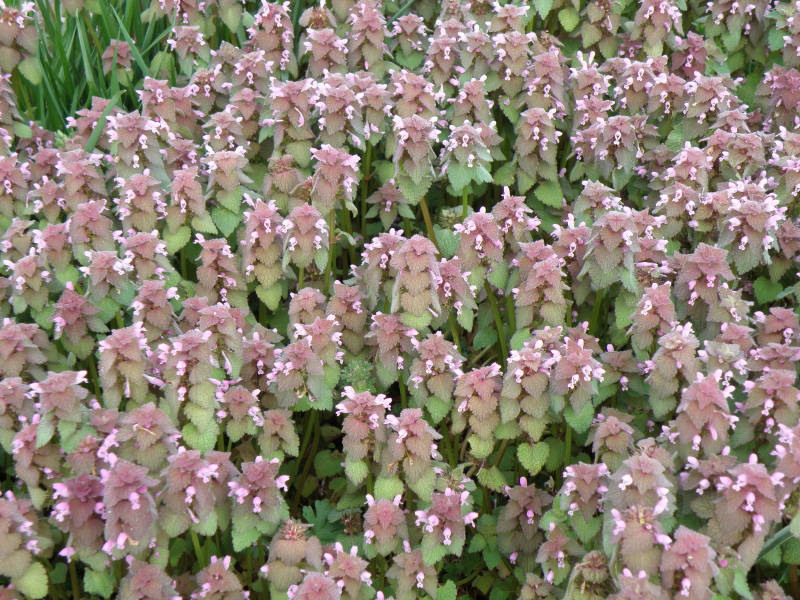
Spring has definitely arrived and the land is turning green.  I love watching this verdant transformation as the Falls of the Ohio becomes a garden again.  We had a weary winter and so seeing the sun more regularly warms the heart and imagination.  These are images from my last visit to the park.  I believe I downloaded about seventy or eighty pictures which is about normal for one of my excursions.  I can find personal interest in most everything I come across which makes editing and creating some sort of post a fun challenge.  I spend hours on site and then a good amount of time at home looking at the pictures and wondering how to put order to any of it?  Usually, I try to give some representative sense of what the day was like.  I believe I could create all sorts of permutations and stories from just a single trip…but, that would cut into my time to be outdoors and fill my lungs with fresh air.

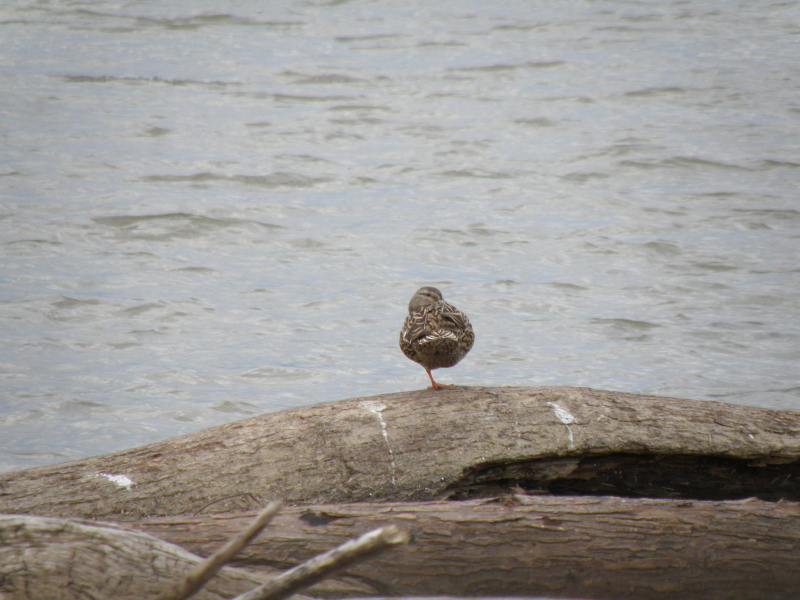
female mallard resting on one leg, April 2013

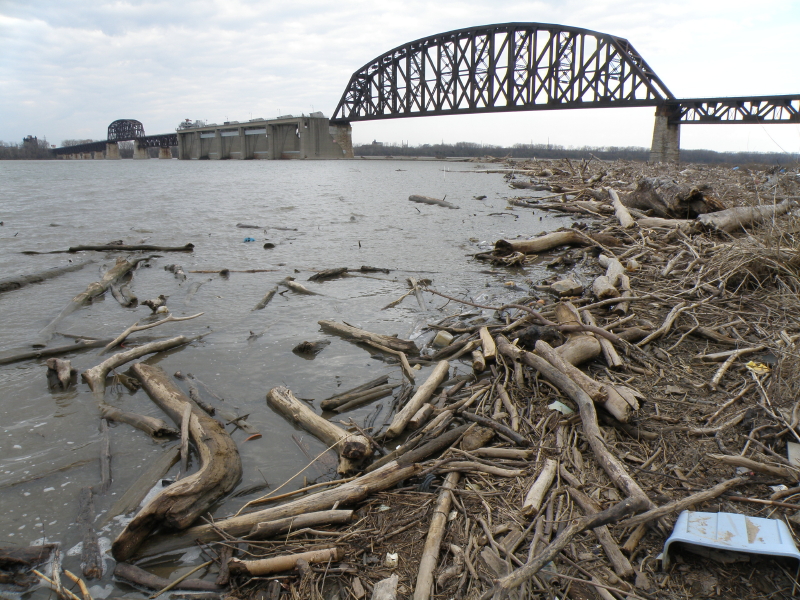
I began the morning in the western section of the park.  Driftwood and junk have been driven against the Indiana bank of the Ohio River.  Prevailing currents and high water have formed this log raft against the shoreline.  Future high water will eventually send this material over the dam and under the railroad bridge and then throughout the park.  Moving to the river’s edge I surprised more than one sleeping duck and see my first Great Egret of the year.  I tried sneaking over the driftwood to take a picture of the egret which was feeding at the water’s edge.  I must be losing my touch because the wary egret spotted me and took off.  This duck standing on one leg, however,  was more obliging.

view from the western section at the Falls of the Ohio, April 2013

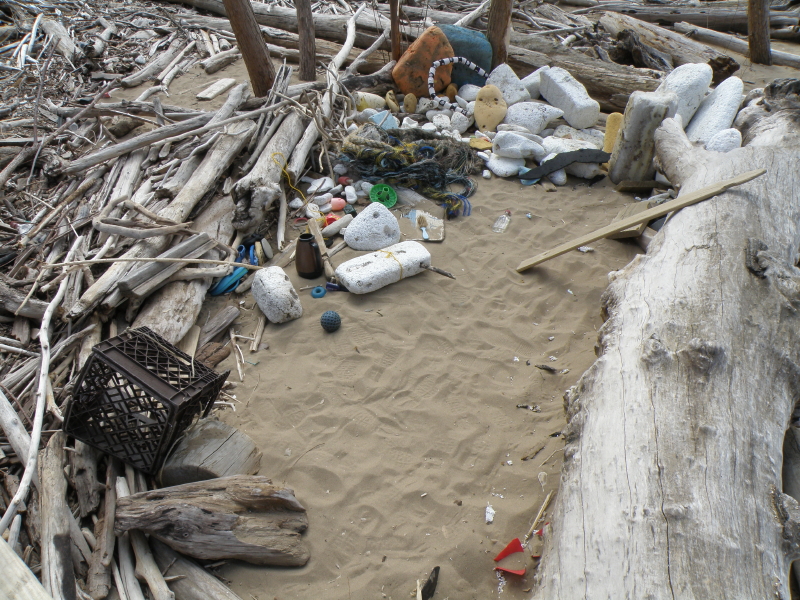
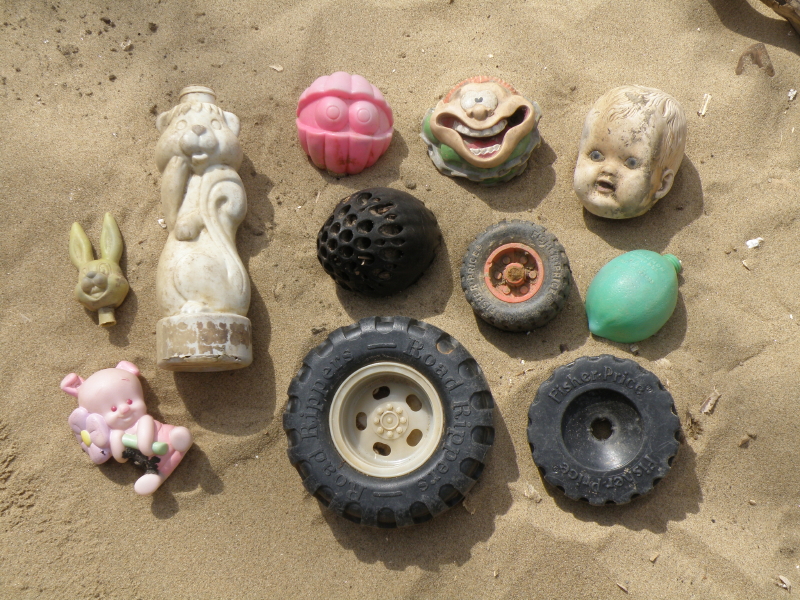
Here’s a view from the western section of the park.  Walking along the water’s edge I came across all manner of bric-a-brac some of which made it into the collecting bag.  Upon returning to my outdoor studio, I photographed a few of my newest “treasures” on the sand which included many toys.  I have a compulsion to pick this stuff up and order it into various collections…but other than that I’m not sure what I will eventually do with much of this plastic.  I am a believer, however, that someday I will have an idea or inspiration and I will follow that.  I still feel there is something here to explore between the poles of what these items are intended to represent and what they are in reality.

a selection of found toys and novelties from the Falls, April 2013

I keep finding toy wheels of all different sizes and slowly an idea for a wall installation is taking place in my mind.  I have an offer to show work in a show during the 2014 season and so I set a goal to realize this “wheel piece”.  Here are two views of one of my more interesting finds of this day.

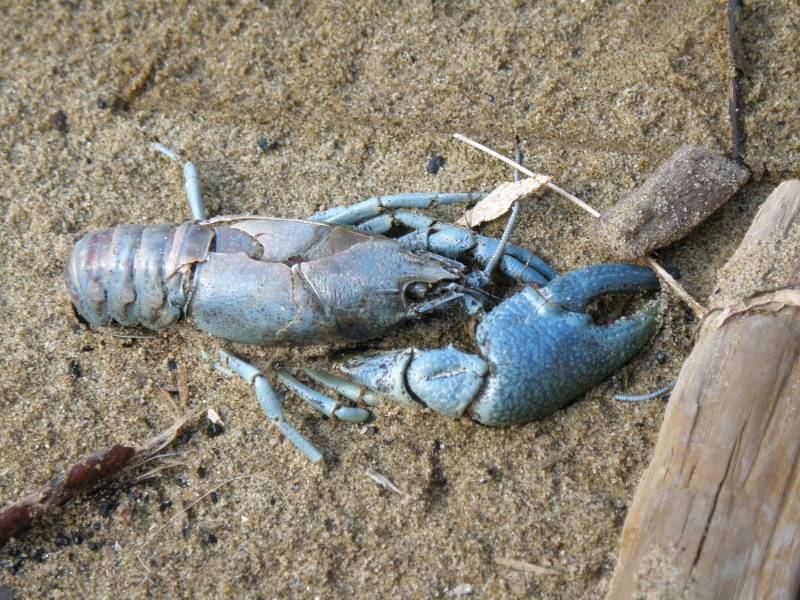
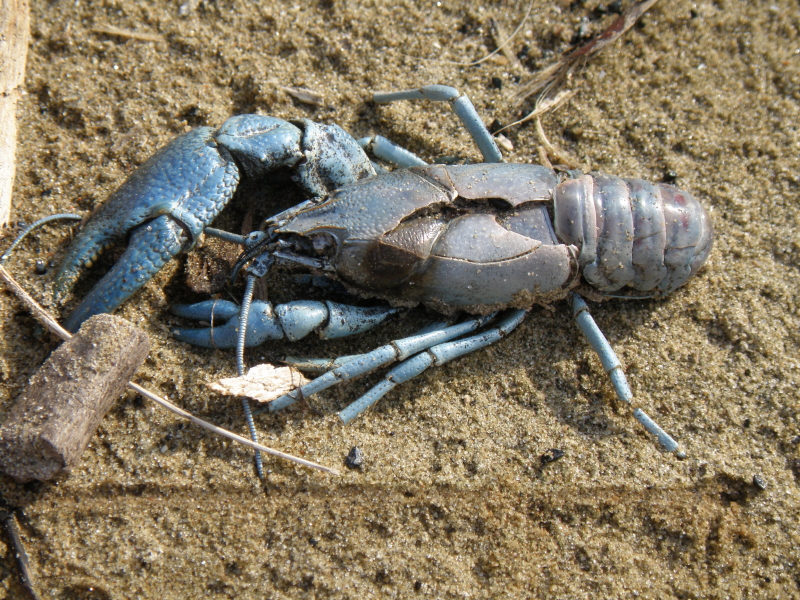
deceased blue crayfish found at the Falls of the Ohio, April 2013

dead blue crayfish found at the Falls of the Ohio, April 2013

Unfortunately, I didn’t find this blue crayfish while it was alive.  By far, most of the crayfish I have seen have been brown in color.  I wonder if it was crushed by the logs rolling in the high water?  I don’t know which species of crayfish this is, but apparently blue crayfish are a genetic color morph.  There is one species that is now bred to be blue for the aquarium pet trade.  The way the grains of sand fit around the exoskeleton gives a sense of how a fossil might be formed if given the right conditions and deep time.  I picked it up and held it in my hand and just appreciated such a small, but spectacular animal.  I was curious to see how the Flood Brothers from my previous post were holding up and soon I had my answer upon reaching my site.

my outdoor studio spot at the Falls, April 2013

The Flood Brothers were gone as were several other pieces of Styrofoam!  My small studio area had been rummaged through, but this is not unusual and I kind of expect this to happen.  The stuff I gravitate towards is not the junk other folks look for, however, anybody is welcomed to whatever I’ve cached here.  I have nothing of value here.  There is more.  Apparently, the discoverers of my studio were carrying bits of frayed barge cable when they stumbled over my spot.  In order to take the Flood Brothers with them, they had to drop the cables.  After straightening up my studio…I wrapped the three cables into loose coils and photographed them where the brothers once stood.

three coils of frayed barge cable, April 2013

From experience, if folks are out to destroy something…they usually just get on with it.  I was hoping that whomever took the Flood Brothers had just moved them to a different location to create a vignette of their own.  I decided to scout around to see if I could find my wayward figures and I was partly successful.  Here’s how I found the larger of the Flood Brothers.

Flood Brother #2 as I found him, April 2013

detail, head of Flood Brother #2, April 2013

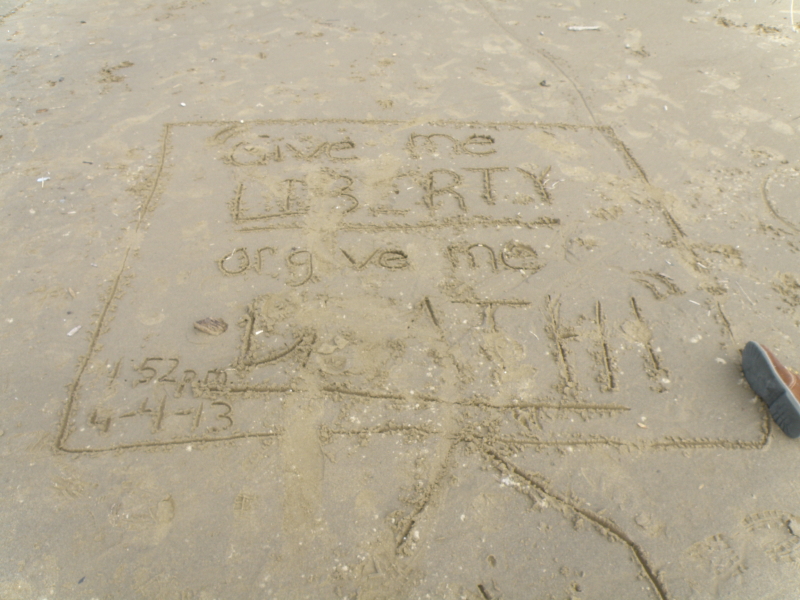
About a hundred meters or so from my spot, I came across Flood Brother #2 leaning against this tree.  He was missing many of his features including his eyes and arms.  After hunting around I was able to find a few of his parts.  As for his shorter brother…there was no trace of him.  I kept moving east in my search and discovered evidence that other creatives were in the area recently.  Perhaps the people who made the following statements also played with my figures?

message in the sand, April 2013

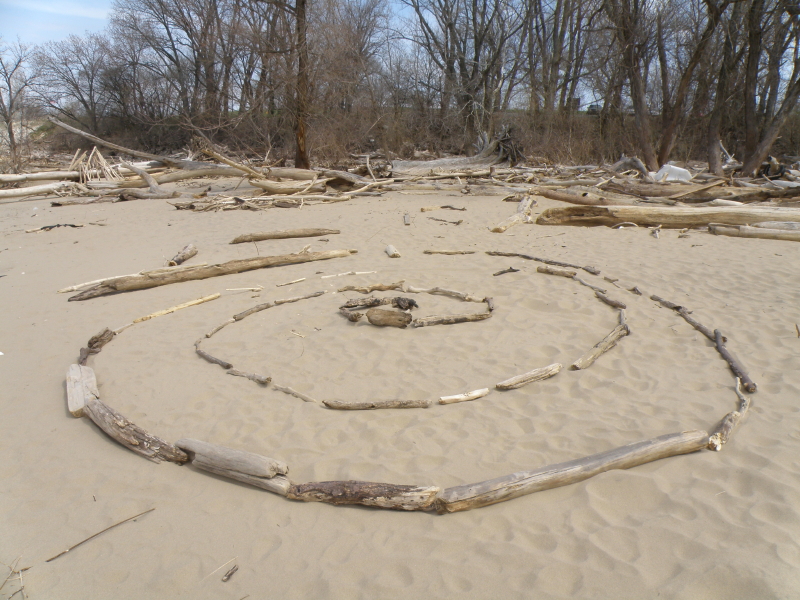
I found this and other sand drawings in the area.  Most of the sand designs were statements of a libertarian frame of mind.  I also found this large spiral made from driftwood that was in the immediate vicinity.

large, anonymous driftwood spiral, April 2013

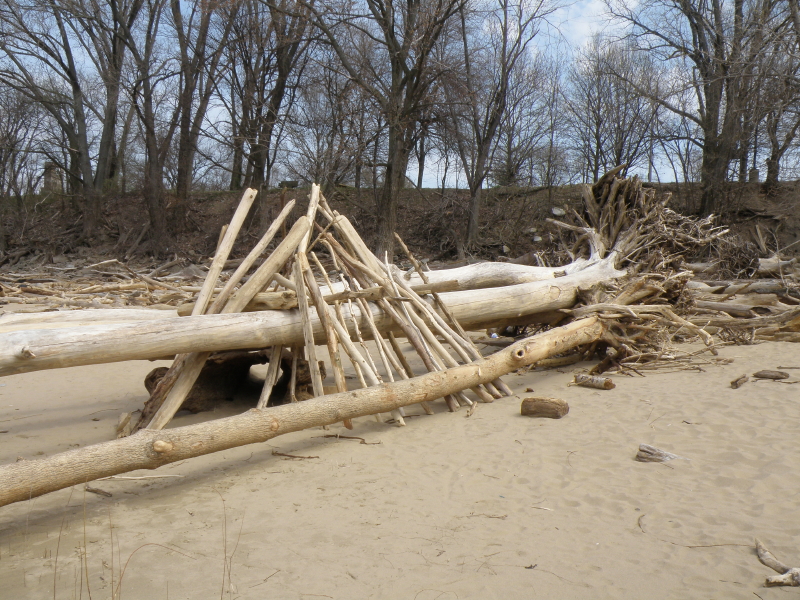
Further west from the spiral was this installation where driftwood was stood on end teepee-style and incorporated with two larger logs that had recently floated into the area.  People seem to like arranging wood in this manner and I have also seen bonfires begun in this way.

site specific wood installation at the Falls of the Ohio, April 2013

I thoroughly checked the area for signs of my missing figure and imagined him riding home in the back seat of someone’s car.  I picked up my remaining Flood Brother and headed back to my studio.  I fixed him back up again.  He’s repaired, but also slightly different now.

repaired Flood Brother #2, April 2013

spruced up studio site with repaired Flood Brother, April 2013

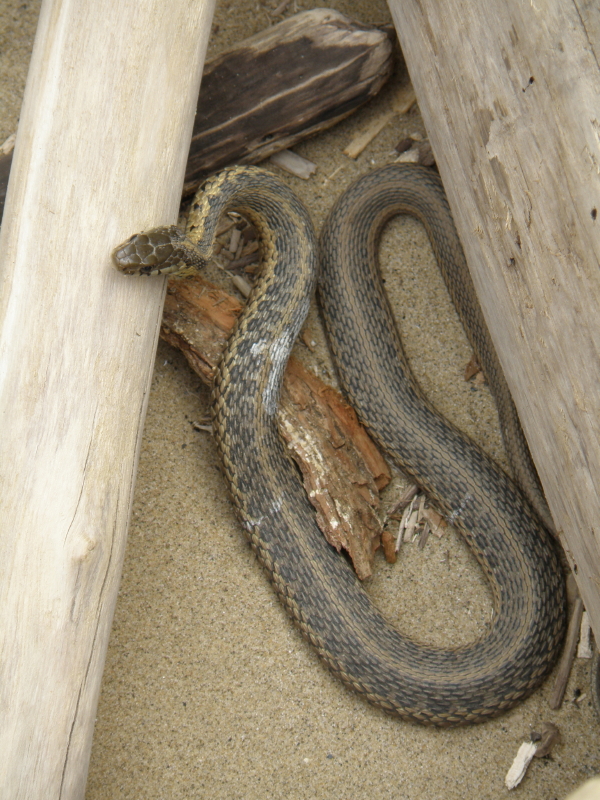
This is how I left things on my way back home.  I’ll return in a week and we shall see what if anything happens?  Returning to my car, there was still one more surprise left for the day.  Emerging into the light of a new season, I came across this small Eastern Garter Snake warming itself (much as I had) among the driftwood at the Falls of the Ohio.  See you next time!

Eastern Garter Snake, Falls of the Ohio, April 2013

Read Full Post »

snow covered driftwood, Dec.29, 2012

The last month of the year which began so warmly has finally delivered some cold and snow to the Falls of the Ohio.  The newspaper says that somewhere between two to four inches fell overnight.  I’m sitting in the comfort and security of my home and all is well except for that small voice in my head telling me I need to go check out the river.  The voice is persistent and annoying and makes little sense on such a bitterly cold day.  Naturally, I caved in simply because snow events are uncommon here of late and as a chronicler of the Falls, I have a self-appointed mission to document what happens.  I also know from past experiences that these snow and ice events can be beautiful and have a way of revealing a different side of this environment.  Who knows, maybe I will come across something I’ve not seen before?

Blanche in the snow, Dec. 2012

Upon arriving I discovered that my way of accessing the riverbank was gone!  The trusty wooden staircase that led from the parking lot to the river is completely missing and I think that some of the maintainance issues it had finally caught up with it?  To compound events further I discovered that my right boot has a hole in the sole and the cold water I just stepped in has made my sock and foot a soggy, frozen distraction.  I’m about ready to get back in my car when I hear that familiar voice again.

Blanche's face, detail, Dec. 2012

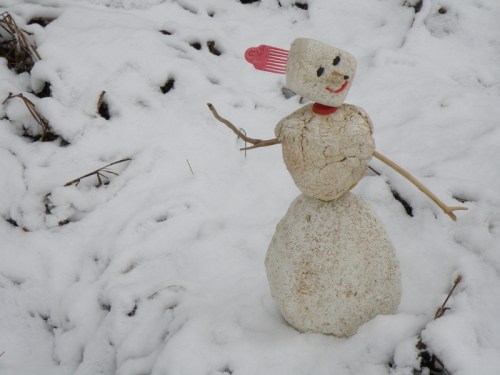
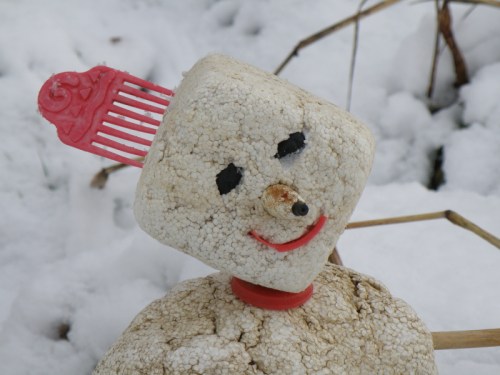
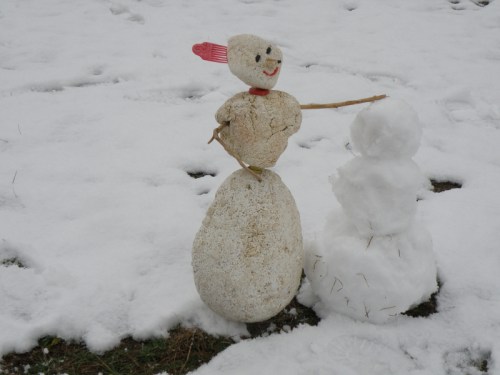
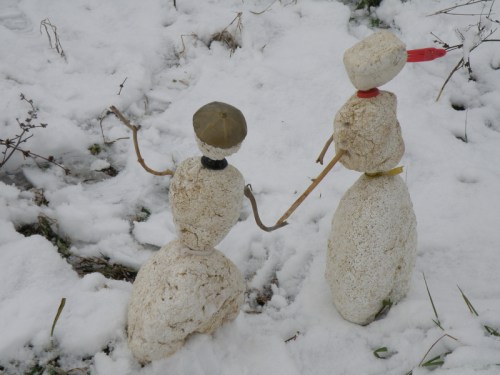
This time that voice wasn’t coming from within me, but rather just a short distance a head of me.  The voice reassured me I wasn’t suffering a relapse of the flu I recently overcame!  Seemingly materializing in thin air was this small, but classic version of a snowman who asked to be called “Blanche”.  I suppose that makes her a snowwoman or snowperson and it’s weird the things you think about in certain moments.  I would guess that the figure was about two feet tall or so.  She had a fishing float for a nose, coal eyes, and bits of red plastic around her neck and mouth.  Attached to her head was a rather interesting hair comb.  Blanche thanked me for showing up and apologized for “getting into my head”.  It was she who had called me to the river to tell me something important.  As she spoke, I forgot all about the hole in my boot.

Blanche rolls a snowball, Dec. 2012

Blanche rolls several snow balls, Dec. 2013

I hope I’m getting all this right because several things were happening at once.  While Blanche spoke to me she was also rolling snow into three balls of graduating sizes.  What she in essence told me was that while life did originate in the water…the relationship was deeper and richer than that.  Water was in fact “life” and the medium where its collective unconscious resides.  It is water existing from the North Pole to South Pole in all its forms like snow, rain, ice, salty, fresh, steamy, cubed, etc…that holds the memory, wisdom, and promise of life.  As it turns out water also unifies life.

As I was trying to absorb what was being told to me…I snapped a few photos and hoped that the cold wouldn’t affect my digital camera.  Blanche took the three balls she created and stacked them one on top of the other.

Blanche creates a friend, Dec. 2012

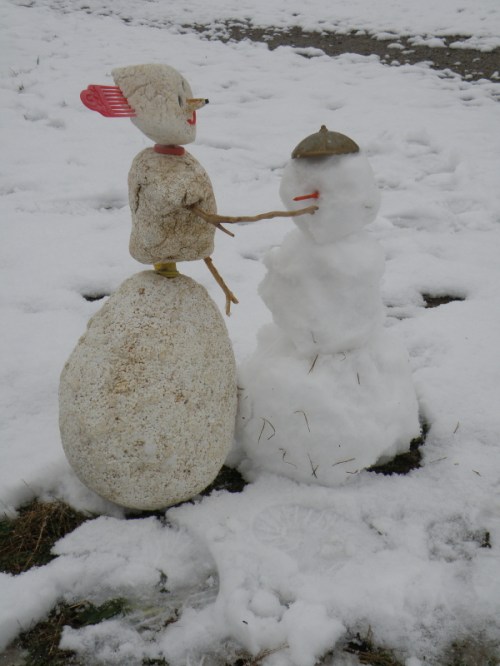
As I watched, Blanche added a gold plastic hat she found as well as an orange golf tee for a nose.  As she worked Blanche hummed a song and I watched in astonishment as a second snowperson appeared before me!  Blanche said his name is “Frio”.

Blanche and Frio, Dec. 2012

Frio and Blanche, alternate view, Dec. 2012

It was the most incredible display I had ever seen!  Right before my eyes the seemingly inert snow took on another form that came to life and reinforced some of Blanche’s message to me.  There would be more.  Frio then asked me to continue to tell the water’s story through my blog because the fate of water and life was more important than ever.  It was vital that water remained as pure and clean as possible or the normal rhythm of the planet would be disturbed. He told me that the internet was something similar to the collective unconscious and the best way to send out a message to the billions of people now living on the planet.  Water and life need all the friends that can be mustered to act on its behalf.

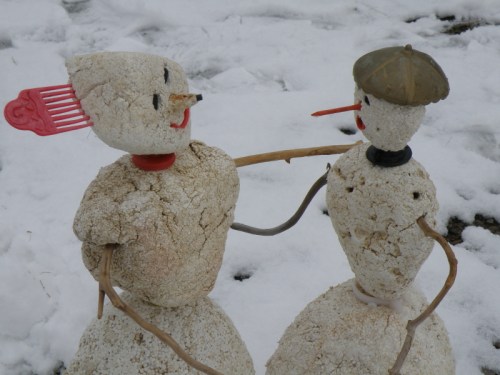
Blanche and Frio singing, Dec. 2012

My encounter with the Snow Folk ended in song.  Before Blanche and Frio headed out they sang a song to the Falls celebrating how this is a unique place on the planet where time and space intersect in interesting ways.  There was a verse dedicated to me and the continued success of my project now entering its tenth year.

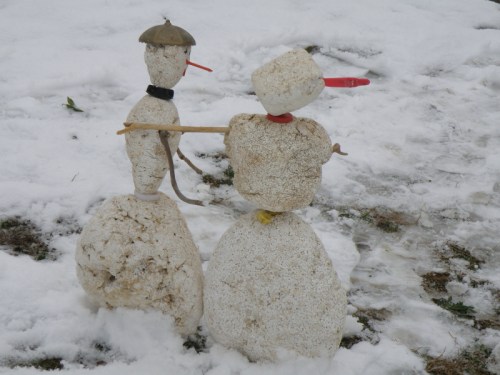
Blanche and Frio depart, Dec. 2012

I was completely charmed and captivated and thanked the Snow Folk for the song.  I watched them turn and walk into the river where they completely disappeared.  I’m still trying to digest this experience.  It’s not everyday that water speaks to you in your own language.  Thankfully, I have these photographs to show you and to add weight to Blanche and Frio’s message to us.  After a while, I felt the cold again and decided this time that a mug of hot chocolate or coffee would help me feel my fingers and toes again.  Happy New Year to you all from the Falls of the Ohio.  See you in 2013.

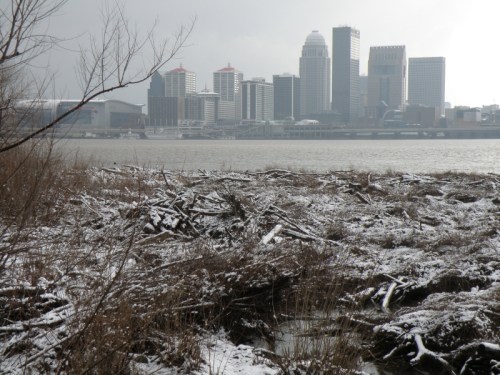
skyline of Louisville, KY at year's end, Dec. 2012

Read Full Post »

river-polished coal, Falls of the Ohio

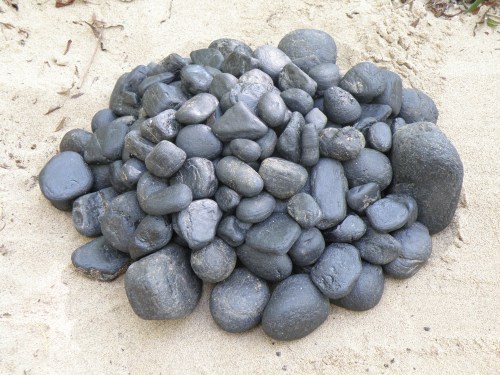
The coal that I find at the Falls of the Ohio looks like the image above.  What I mostly come across in the park are pebble-sized stones and coarse gravel that have been polished smooth by the Ohio River.  The same river processes that shapes Styrofoam and wood also alters coal.  Over the last two years I have been collecting this coal off of the riverbank and creating site specific art installations and images using this fossil material.  Although coal is organic and natural, what I’m finding does not belong in the Ohio River.  I believe this coal comes from the commercial barge traffic delivering fuel to hydroelectric plants throughout the Ohio River Valley.  During times when the river is running high, materials carried into the water seem to eventually find their way to the Falls of the Ohio.

coal flake in situ, 2012

Before getting to the heart of this post, I would like to share a few other associations I have with coal and Christmas.  My Dutch mother told me stories of her childhood and St. Nicholas Eve which is celebrated earlier in the month than our Christmas.  Good children might expect small toys, fruit, or candy to be placed in their shoes as gifts from the white bearded saint.  If, however, you were badly behaved over the year…you ran the risk of getting coal in your shoe as punishment.  St. Nicholas has a chimney sweep friend named Black Pete and he usually does the dirty work. Fortunately, my mom doesn’t recall anyone she knew who this happened to!  There are times, however, when getting coal in your shoe isn’t a completely bad outcome.

radiating coal flake at the Falls of the Ohio, 2012

My mother also recalls how important and scarce coal was one particularly bitter winter and Christmas.  It also happened to be during World War II and the city of Amsterdam was occupied by foreign soldiers.  I believe she said the particular year in question was 1942?  When resources  became scarce, people would walk the railroad tracks at night looking for chunks of coal that fell off the railroad cars.  People risked their lives doing this.  Found coal would be burned in home stoves to keep everyone warm.  When coal wasn’t available wood was burned next.  My mom remembers that by war’s end, every wooden piece of furniture in the entire apartment was cut up and burned for heating and cooking purposes.  Back then, a bag of coal would have been as fine a gift as receiving an orange or piece of chocolate.  The times have really changed since then.
coal flake in water, 2012

It’s becoming more difficult for me to believe that the events of 1942 occurred seventy years a go!  Since then, the peace was won (for a short time) and the western economies thrived and grew on cheap and abundant fossil fuels.  If populations had stayed relatively the same size, perhaps we wouldn’t be noticing the effects burning those fossil fuels have had on the environment?  But the world’s population grew and then grew a lot more which puts pressure on all our resources.  Today we live on a planet where billions of people want to live at the same standard of living that the west has squandered away.  With China and India experiencing their own industrial growth moments being fueled by coal…the environment at large will surely see further damages.

found coal and aluminum can bottoms in red mud, Falls of the Ohio, 2912

Since beginning this Falls of the Ohio Project nearly ten years a go…I have created my own unique holiday cards.  Every year I send something different out into the world.  This helps me get into some kind of holiday spirit. Friends and family tell me that they enjoy receiving these admittedly odd cards.  The last several years I have waited for the weather to get more seasonal perhaps with snow or ice present before rushing out to document the moment.  As it so happens, it’s been getting warmer and warmer over the past several winters.  As a whole, 2012 was our warmest year ever and the calendar page hasn’t yet turned to the new year!  Our December began with temperatures in the low 70 degrees mark.  Finally, the day after Christmas it has become cold enough and we may see a dusting of snow over the ground.

coal and clam shell designs, Falls of the Ohio, 2012

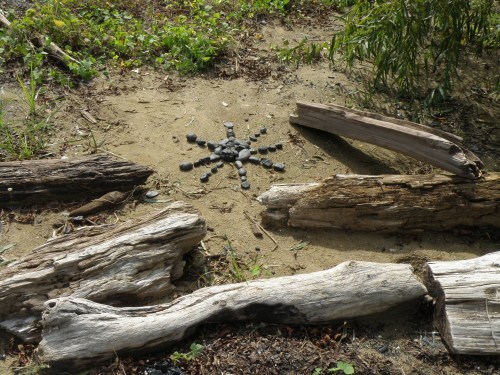
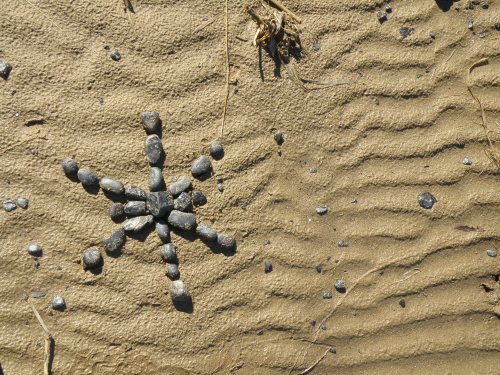
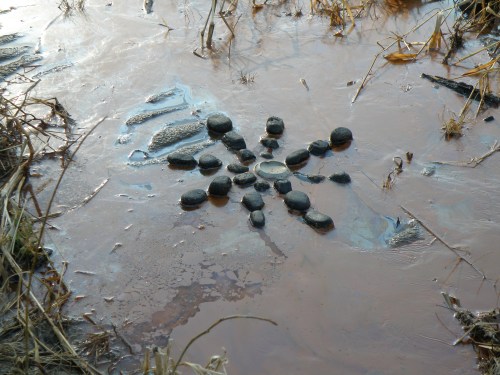
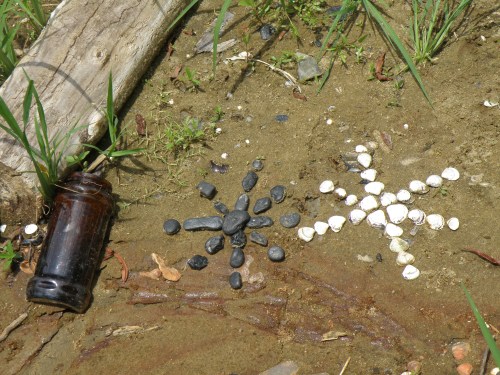
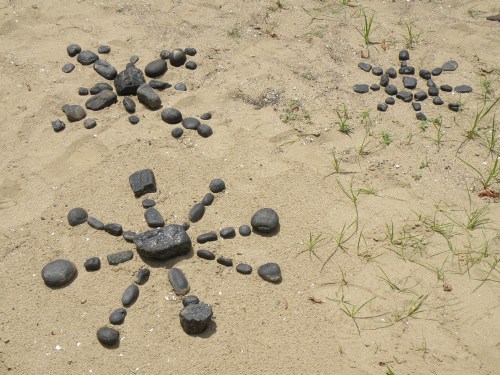
Currently, I have artworks (a sculpture and photo series) on display in a coal-themed exhibit at the Carnegie Center for Art and History in New Albany, Indiana.  While working on my projects, I had a conversation with a sculptor friend of mine who grew up in a steel making town in Pennsylvania.  He recalled from his childhood that it snowed a lot during their winters, however, it didn’t take the snow long to turn from white to dull black because of all the coal soot in the air.  This inspired me to envision black “snowflakes” or “coal flakes” and I began to create small site specific designs on the ground based on this idea.  No two coal flakes I’ve made has been exactly the same as another.

three coal flakes at the Falls of the Ohio, 2012

I have located these coal flake designs in fairly public places along side walking trails mostly used by fishermen.  A photograph documents each one I have made.  To me, this is a form of public art and it’s interesting to see how people will react to these modest designs.  Some coal flakes don’t make it because there is something else in the human spirit that needs to disturb or destroy what it doesn’t understand.  Many of these designs were rubbed out nearly as quickly as I made them!  By now, I’ve created enough coal flakes that it occurred to me that I had my newest holiday card theme already completed in sixteen different designs!  The images in this post are just a few of the ones I sent out this year.

coal flake on red mud, 2012

And so I ask myself, what am I hoping might occur by sending out these unfamiliar images?  Hopefully, people will register that there is a connection between burning fossil fuels and the changing climate we are currently experiencing.  The environment isn’t just something that’s out there, but is a big part of the context of our lives that we contribute something to.  I also continue to hope, that people will see personal creativity as an advantage our species has over others and that we honor and use this creativity to figure out how to live harmoniously with ourselves and the planet.  I feel a lot of our hyper consumption is based on low self-esteem where creativity is replaced with consumption.  Here’s hoping in the new year that more people learn how to tap into their own internal resources to help aid the earth!  Happy Holidays to all from the Falls of the Ohio!

coal flake made from coal and small clam shells, Falls of the Ohio, 2012

Read Full Post »

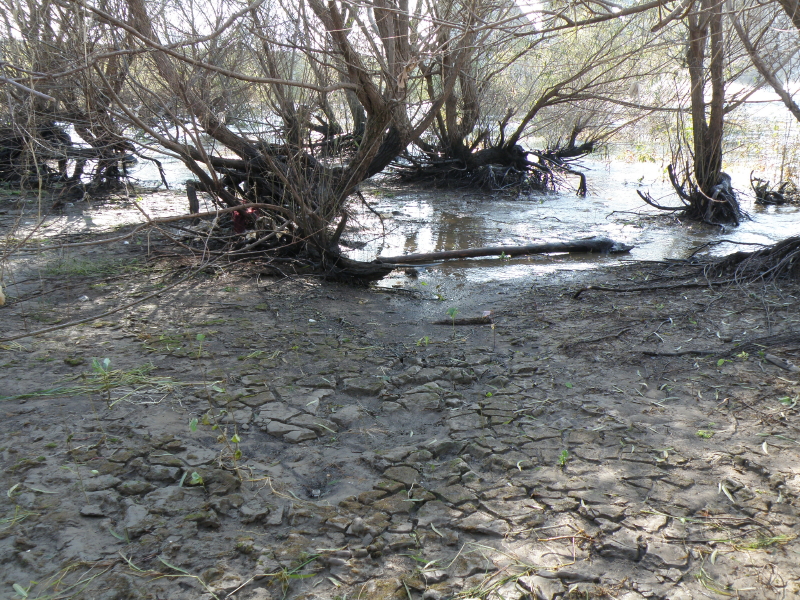
Hello all and welcome to another adventure set at the Falls of the Ohio.  Since my last visit, the Ohio River has risen in response to all the rain that fell in the northern portion of the Ohio Valley and has flowed down river in a southwestern direction.  The fossil beds normally exposed during the summer and early autumn months are now submerged by swiftly flowing water.  Walking this ever shifting shoreline I’m open for whatever presents itself as novel and different.  Turning the corner around a  stand of willow trees I was caught by this unusual sight.

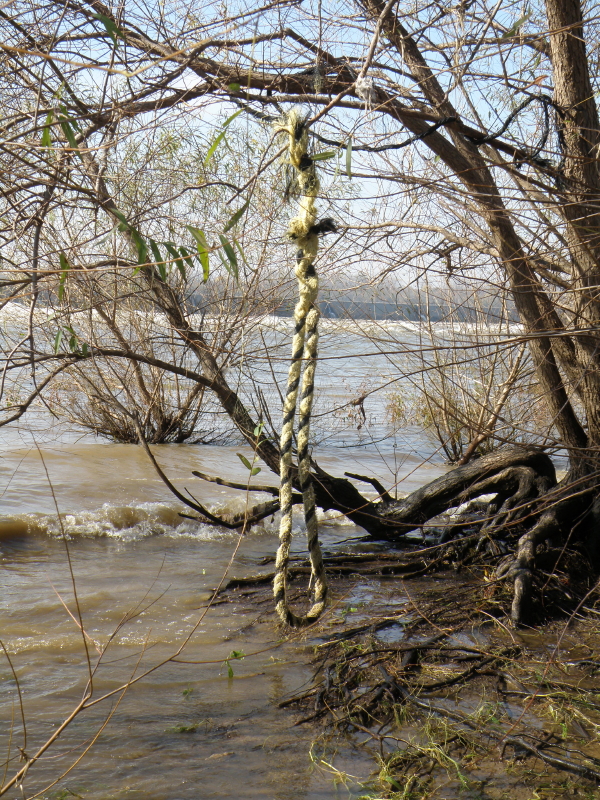
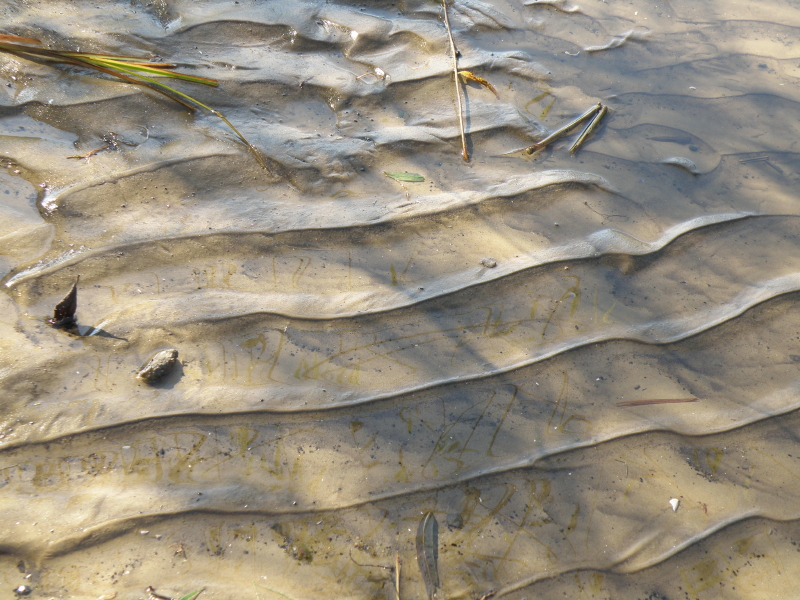
A tree captured barge cable or rope was in a different position from the last time I had noticed it (see this year’s Halloween post).  It is possible that the river rose high enough to dislodge it from its previous resting spot.  I was struck by the way it seemingly is suspended in mid-air with its regular yellow and black intervals contrasting with the unruly roots and branches around it.  Around here, water can both rise and fall quickly.  In the fine silt and mud you can often find interesting patterns that were created by the movement of wind and water.  Here is such an example.

The back and forth rhythm of the river caressing the land are recorded as peaks and valleys in this very fine mud.  I can be “hypnotized” at times by concentrating on this movement which I find soothing.  I’m always interested in the various subtle patterns that water can create on the mud of the riverbank.  It’s akin to trying to “track” water and recognize its footprint as it moves onto the land. I also noticed about a two foot tall, low “wall” of material (mostly wood and dried grasses) along the shoreline that marks this latest high water moment.  And of course, there is always the ever-present mostly plastic junk that also gets swept away and mixes with the natural debris.  I found lots of plastic detergent bottles, bits and pieces from toys including another doll’s head.  Here are images of other finds including an interesting toy ball.

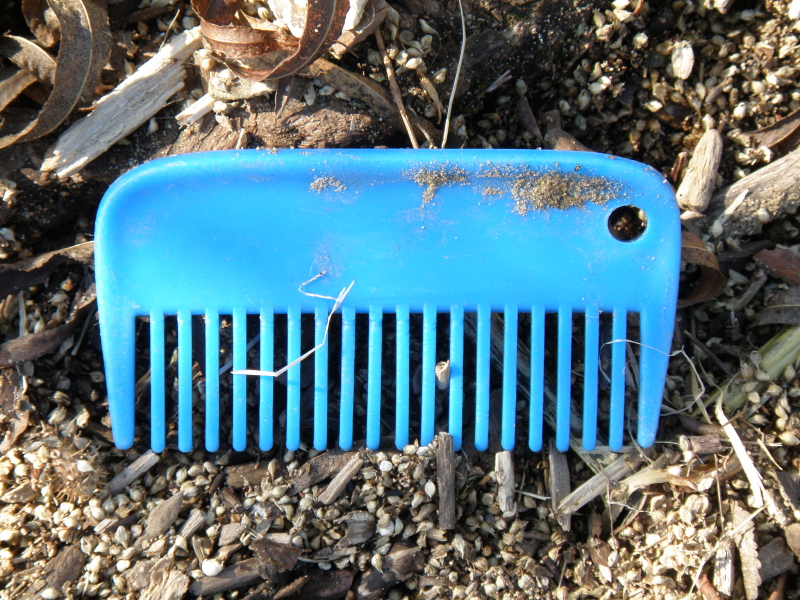
I’m assuming this is a dog toy based on the image of the dog on the ball?  The small knobs are different from the usual balls I find out here.  Now, for a bright blue comb in a design that’s also new to me.  The tiny grains around the comb are seeds from various river grasses.

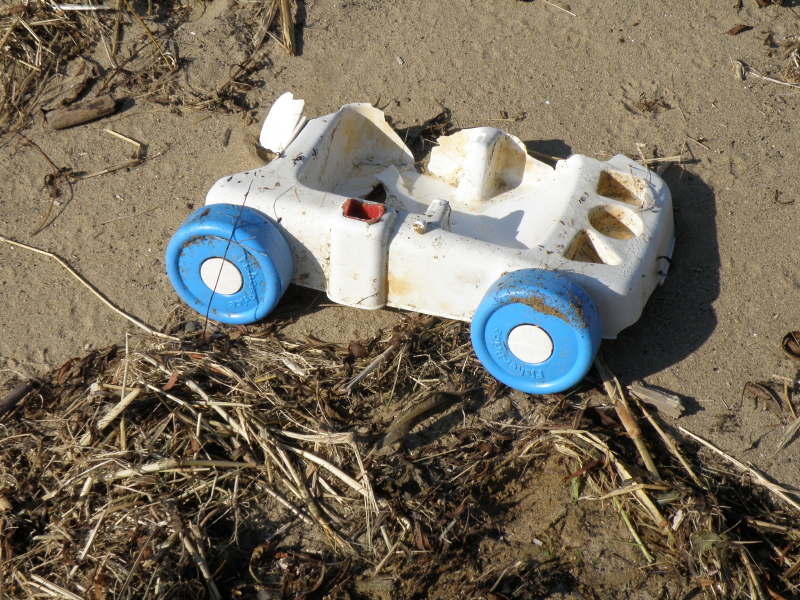
More ” blueness”  in the form of plastic wheels on a wrecked pull toy.

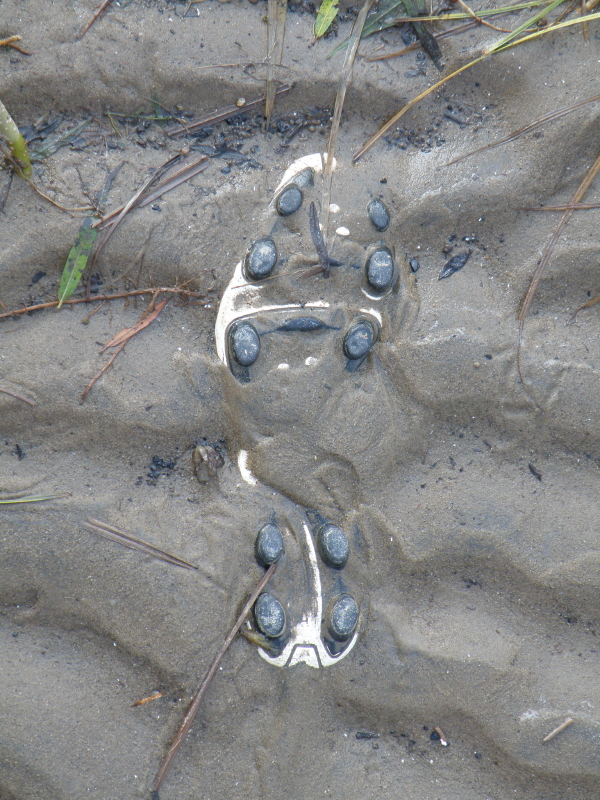
In the mud, I came across this other type of footprint that I thought was a bit unusual from the norm.  Of course, it’s a sports shoe with cleats on the bottom sticking up from the mud.

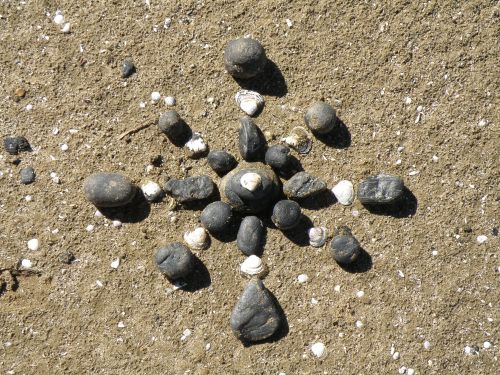
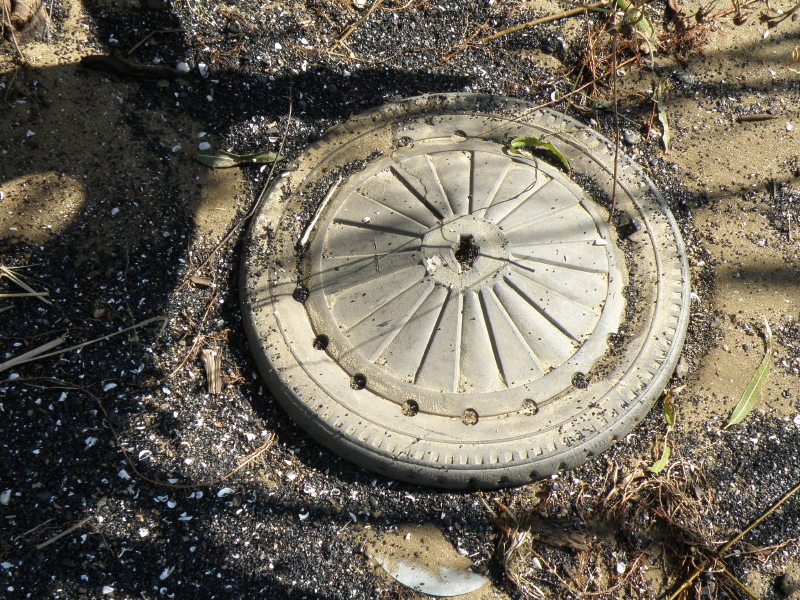
And one last found wheel whose radial pattern inspired another image in my ever-growing “Coal Flake” series.

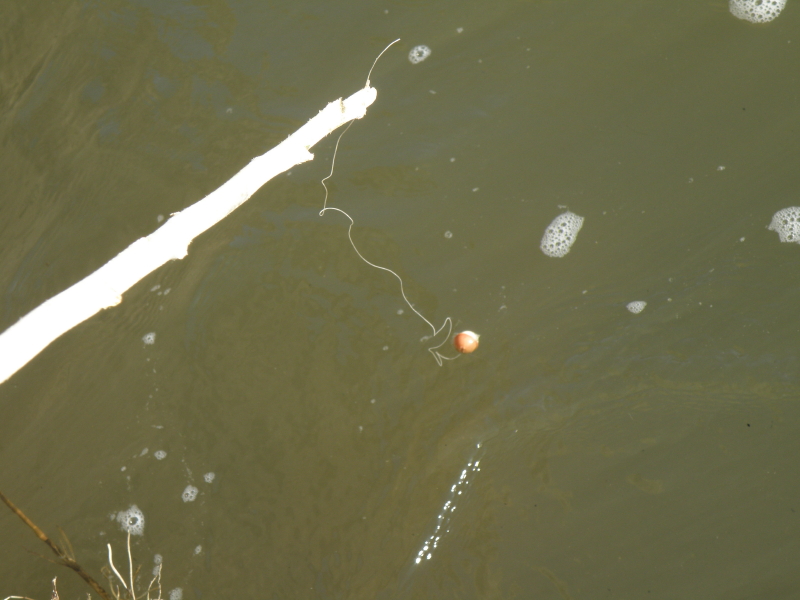
I’ve come to really like making these designs from river-altered coal that I find at the Falls.  I’m under the impression that this coal has fallen or been swept off the immense barges that transport this fuel up and down the river.  I suppose it’s possible that somewhere along the river’s journey the water has cut down through the rock to expose a coal seam somewhere, but I haven’t ever heard of this happening.  The barges seem the likeliest answer.  This particular example has more Asiatic Clam shells used in the design.  These clams are the most common of their kind that I find at the Falls.  Once upon a very recent time a go, the Ohio and Tennessee Valleys were the world’s epicenter for fresh water clams.  By altering the rivers and the water quality in them, many of these amazing creatures have either gone extinct or have become so very rare.  The Asiatic Clam is a non-native animal imported here in the 19th century as a good luck charm and has thrived as has the Zebra Mussel that you may have heard about?  The day was moving on and except for a few Mallard ducks and Canada geese I hadn’t seen much in the way of wildlife.  I decided to end my day by doing a little fishing.  I found a short, recently beaver-chewed willow branch and attached some waste fishing line I found.  I attached a hook and found bobber and into the water it went.

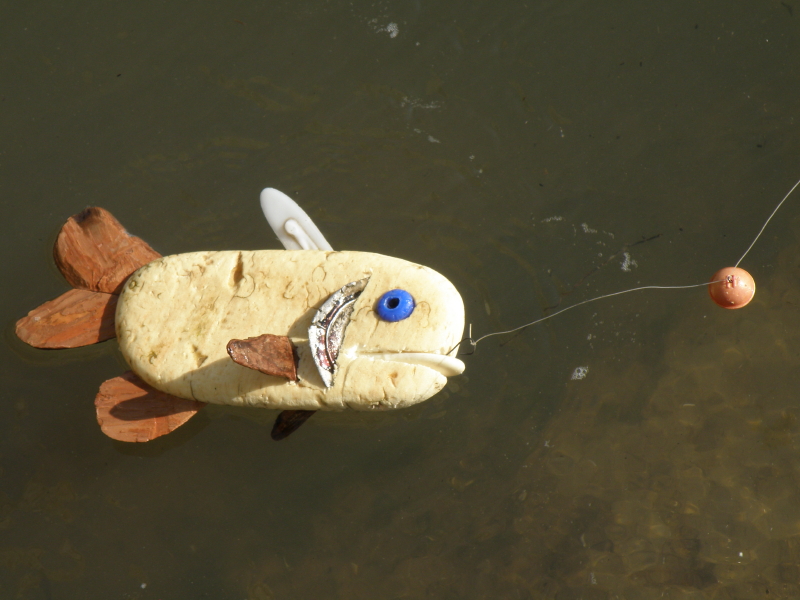
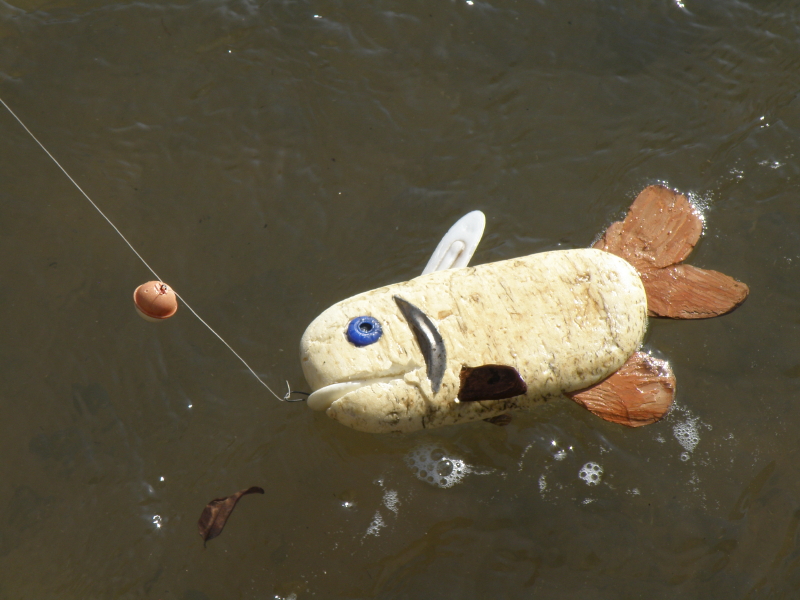
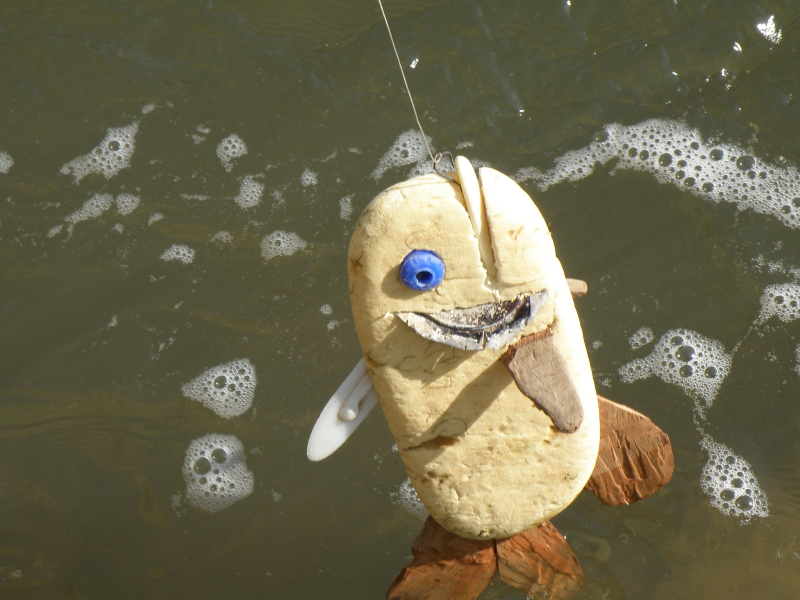
Oh, for bait I caught a small grasshopper and attached it to the hook.  A small found lead weight kept the bait below the water.  Every once in a while I would raise my short pole up and down in a “jigging” motion.  To my immense surprise I caught this very unusual fish!

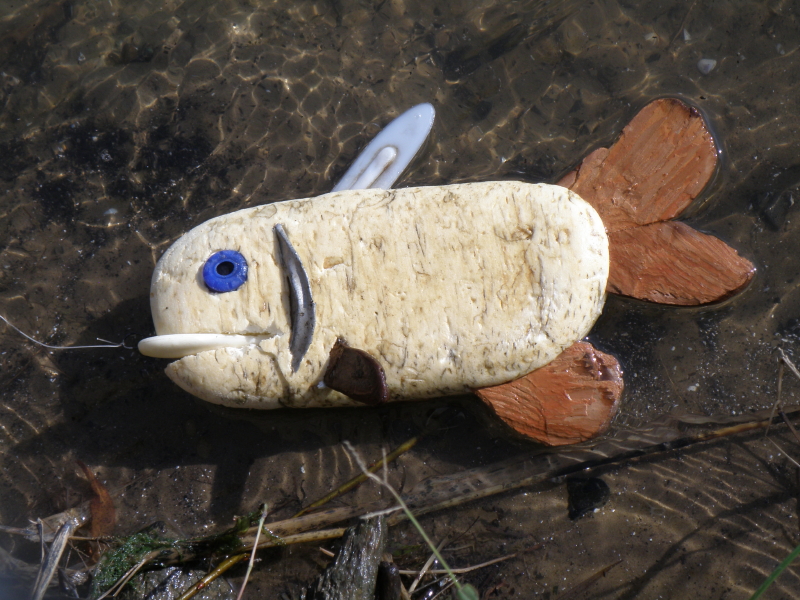
This fish is called the Iron Gill based on the metallic covers it sports around its gills.  Other distinctive features include bright blue eyes and a small white dorsal fin.  It’s body shape is unique and lends itself to easy filleting…although I wouldn’t normally recommend eating the fish from this part of the river.  Catching this fish here was a surprise because normally this is a deep water fish found in large flowing rivers.

This species was first described to science by Constantine Rafinesque back in 1811.  Rafinesque was a controversial figure and brilliant naturalist.  He had a gift for collecting and recognizing new species, however, in his zest to publish and receive credit for his discoveries he was very sloppy in his methods.  As a result, many of the animals and plants he introduced to science are poorly described and classified which led to much confusion and consternation among the other “scientifics” of the time.  In the end, Rafinesque usually won out because science gives priority to the person who first (no matter how poorly) brings the new creature to the world’s attention.

After this last image, I released the Iron Gill back into the water and rebaited my hook.  Alas, this was the only fish I caught on this day, but it reassured me that my skills in this area were still intact.  For my next post, I want to show you images of a coal-themed exhibition I’m participating in the nearby town of  New Albany, Indiana.  It’s a good show and worth a post.  For now, I would like to close with another image of a found toy I came across on this day.  Have a great weekend out there in the wider world!


Read Full Post »

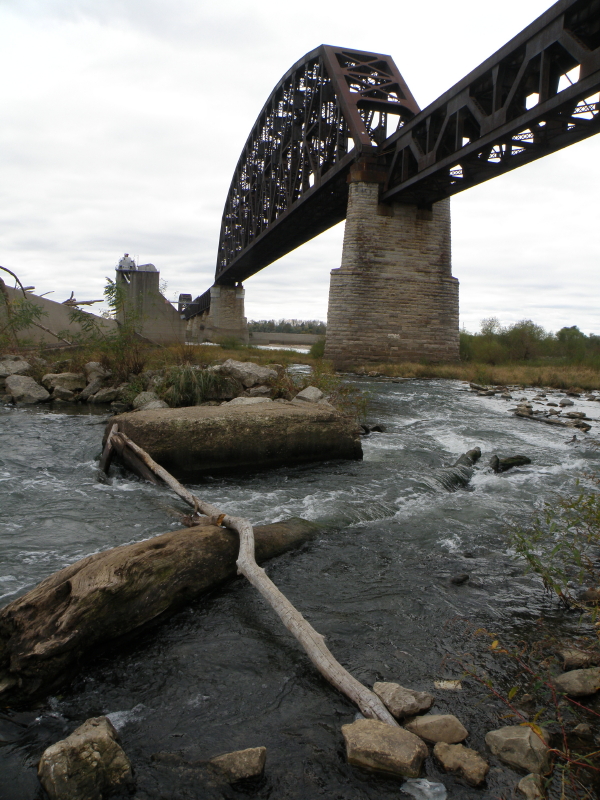
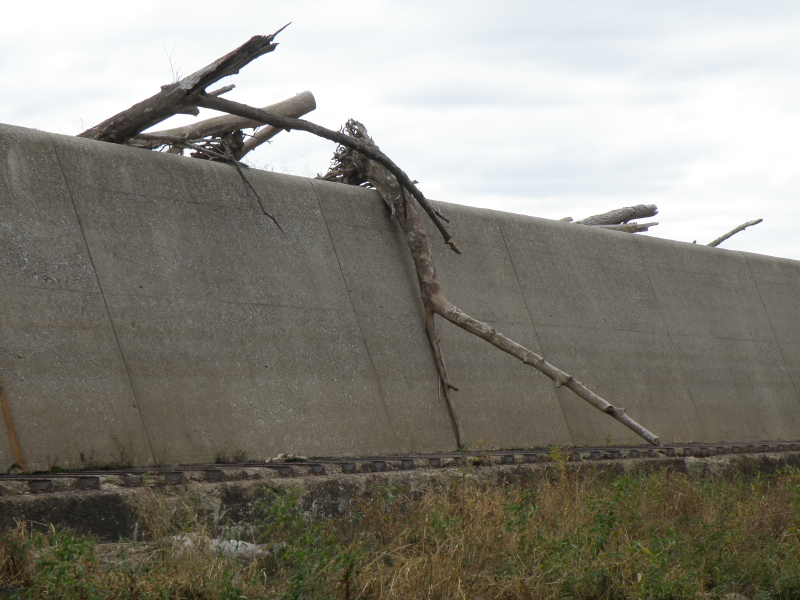
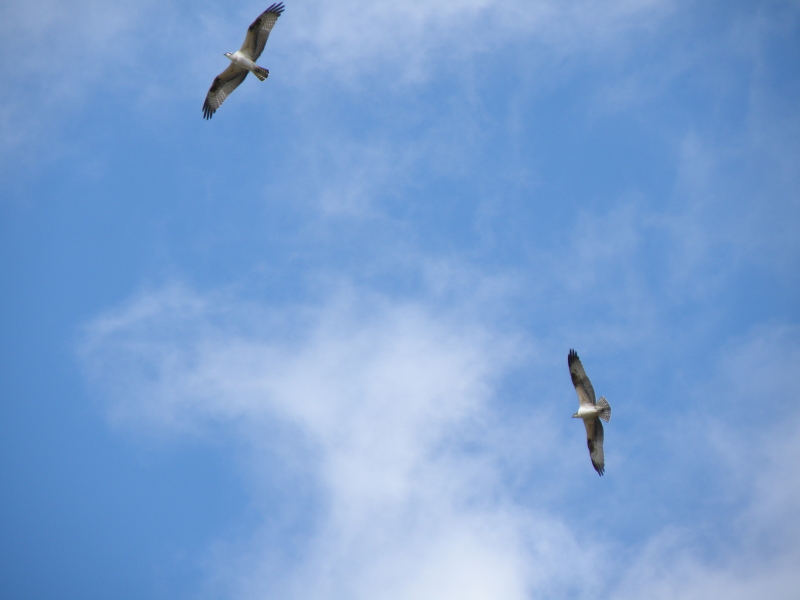
It’s hard for me to believe that October has come and gone.  There isn’t much sand left in 2012’s hourglass.  I’m virtually alone (if you are only counting people) at the Falls of the Ohio today and it’s understandable.  The weather is cool, gray, and an occasional spit of rain falls against my face.  I like it out here when it feels a bit lonelier because my chances of seeing wildlife increases.  Such was the case today when I explored the area next to the tainter gates and under the old railroad bridge.  This area is sheltered a bit from the wind and many times I have found birds in the high grass and low trees near the sloping riverbank.  Today I observed Song Sparrows, White-crowned Sparrows, Mourning Doves, and Hairy Woodpeckers in immediate proximity to each other.  In the sky, the first of the Ring-billed Gulls has arrived and a pair of Osprey with their broad wings searches for unwary fish too close to the surface of the water.  Many of the tree leaves have dropped and it looks like we will have a bumper crop of cockle burrs as I pull dozens of them off my shoe laces and socks.  Their prickly hooks irritate my skin as they work through the fabric of my clothing.  On days like this I’m just trying to attune myself to the subtleties of this landscape and I’m amazed at how often my patience gets rewarded here.  As I was walking to photograph uprooted trees against the flood wall…

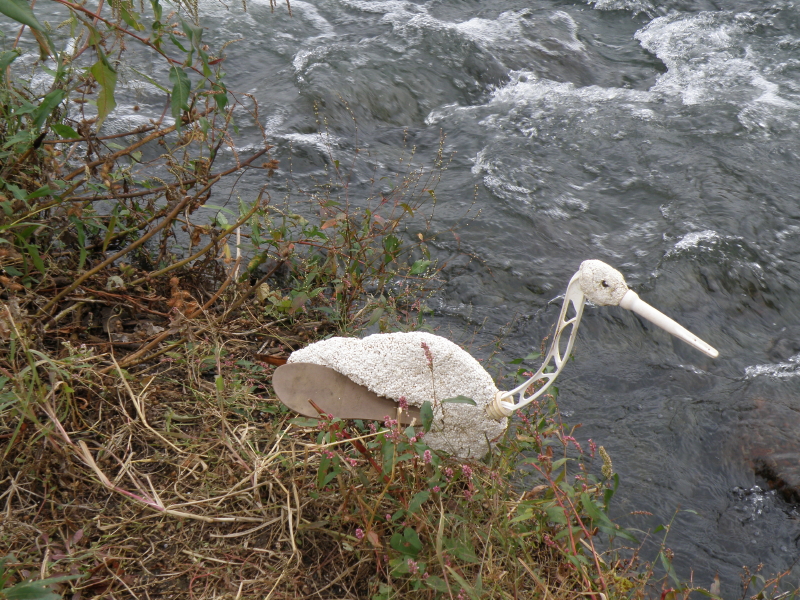
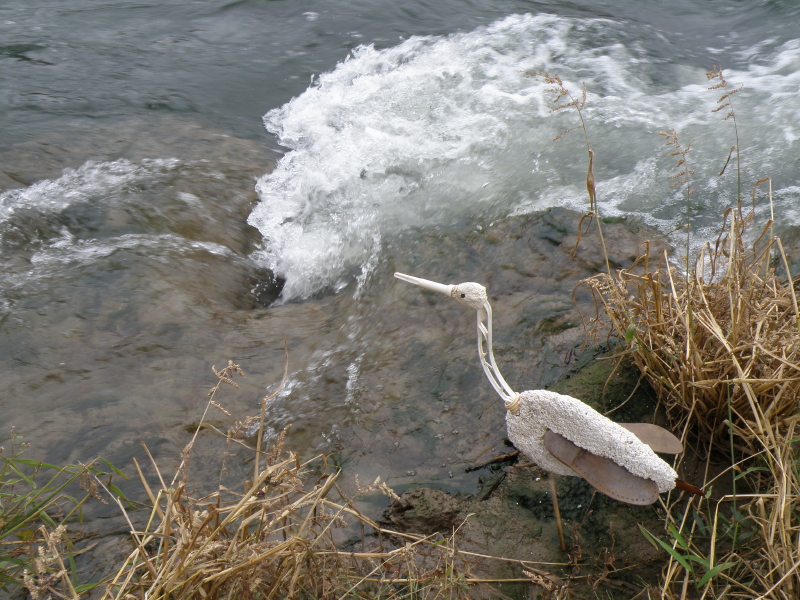
…I spotted something shockingly white moving near the water’s edge.  Carefully moving as close as I could…I recorded this image of another rare bird seldom seen at the Falls of the Ohio.

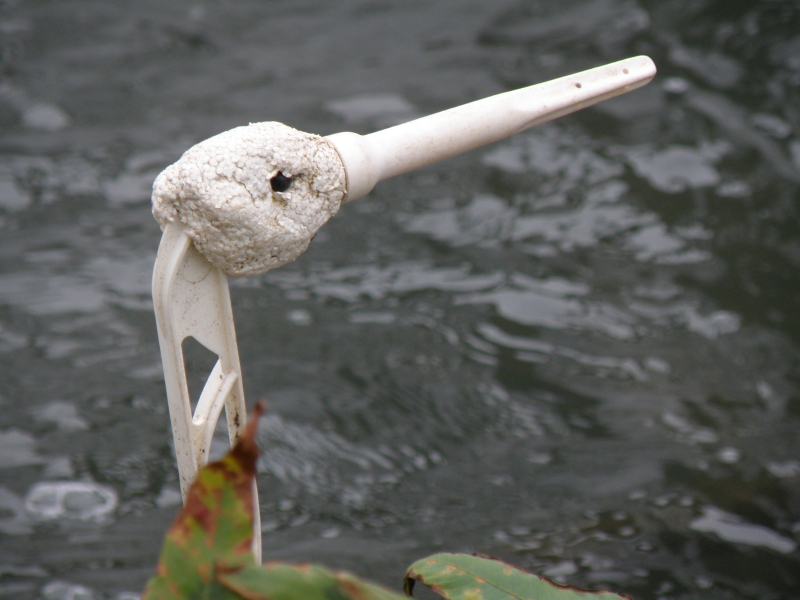
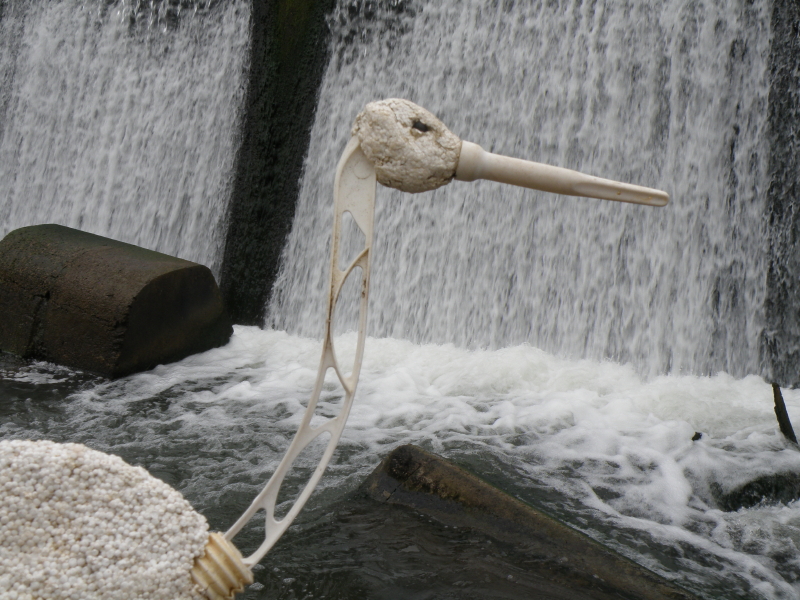
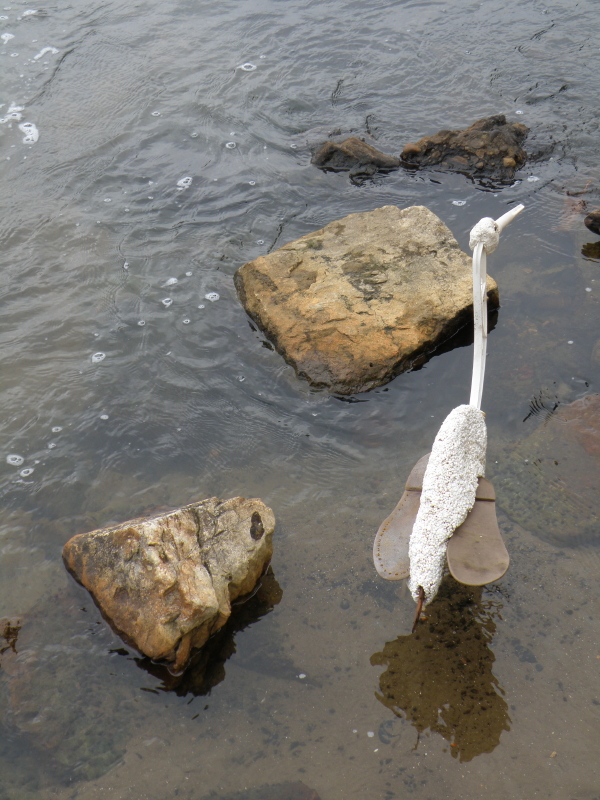
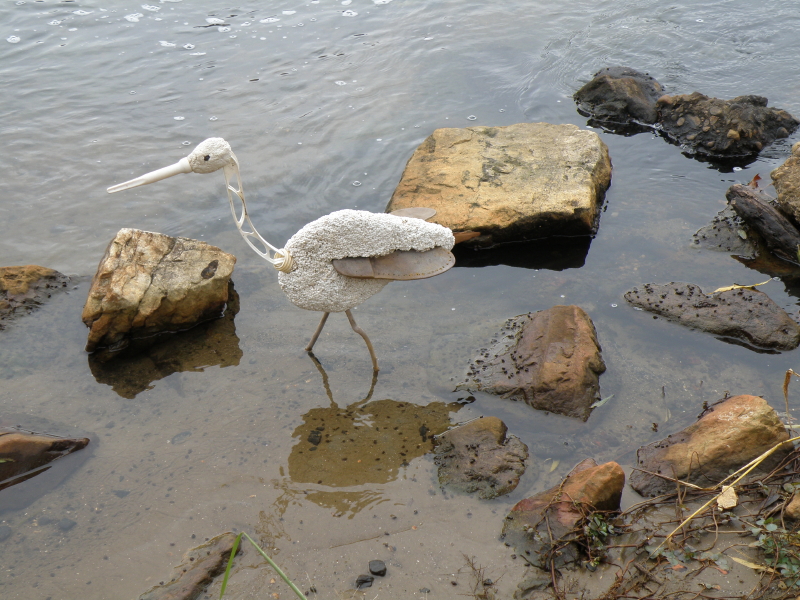
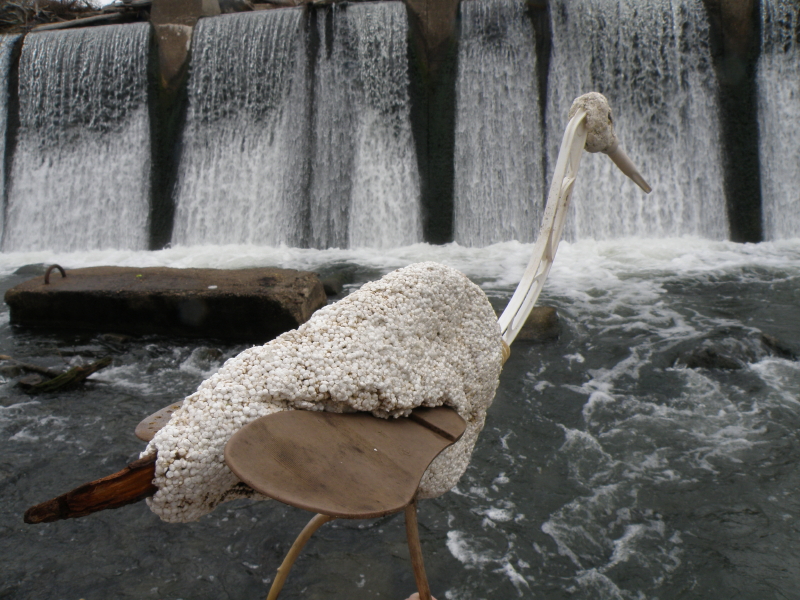
A few more pictures in relatively close succession and I was able to identify this beauty as the Lattice-necked or Brown-winged Ibis.  I prefer using the Lattice-necked moniker because the long neck with its unusual patterning is distinctive to this bird alone.  I happened across an individual that was hunting for food and stalking the margins of the water.  I did observe it feeding on black snails that were common on the rocks. I recall from my old art history days that the ibis was a sacred bird to the ancient Egyptians and often was mummified to accompany dignitaries on their journeys to the afterlife.  In my mind I made the association that this ibis species in front of me was sacred to the life of this river.  Enough gabbing, here are a few more pictures.

This ibis species is more commonly seen around the Gulf coast and points south of here.  Every once in a while, a storm or hurricane will blow a few individuals into the heartland where they are a welcome treat to the hardcore birders.  The Lattice-necked Ibis has always been less common than the other larger shorebirds.  It is less aggressive than the herons and egrets which out-compete the ibis for prime nesting and feeding sites.  This bird did spy me and flew away, but only a short distance away.  I was able to catch back up with it and captured these final images of this graceful and dignified bird.

Here is the same ibis that found a nice fishing spot next to a small whirlpool. Every now and then a little fish would get caught by the rotating water only to find itself food for the lightning quick ibis.

I felt refreshed and energized by my encounter with the ibis.  I left the river  with a song in my heart which I whistled all the way back home.  Above me, two osprey I had seen earlier were circling in the clear, cool blue sky…another blessing of this day.

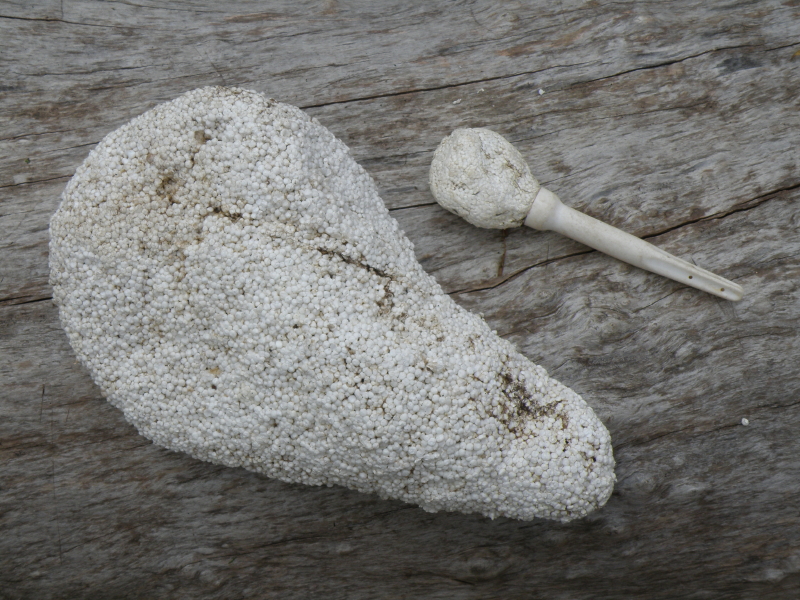
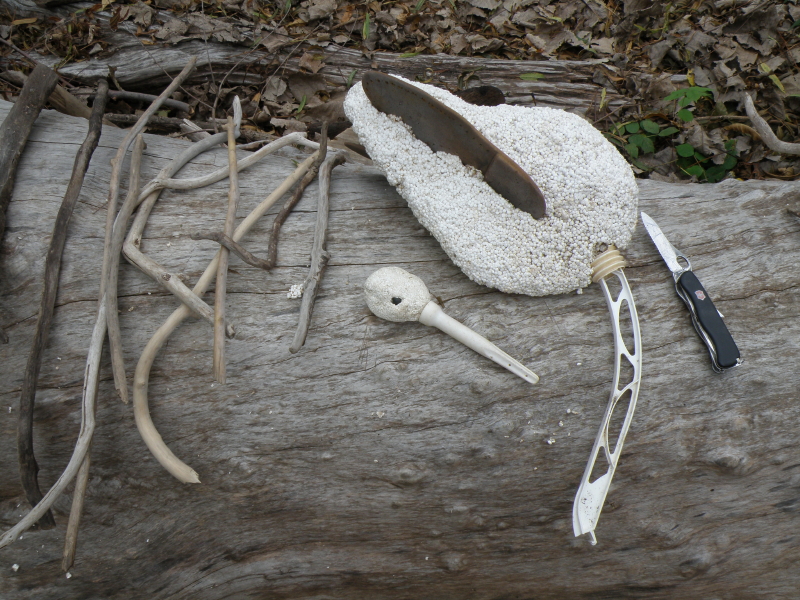
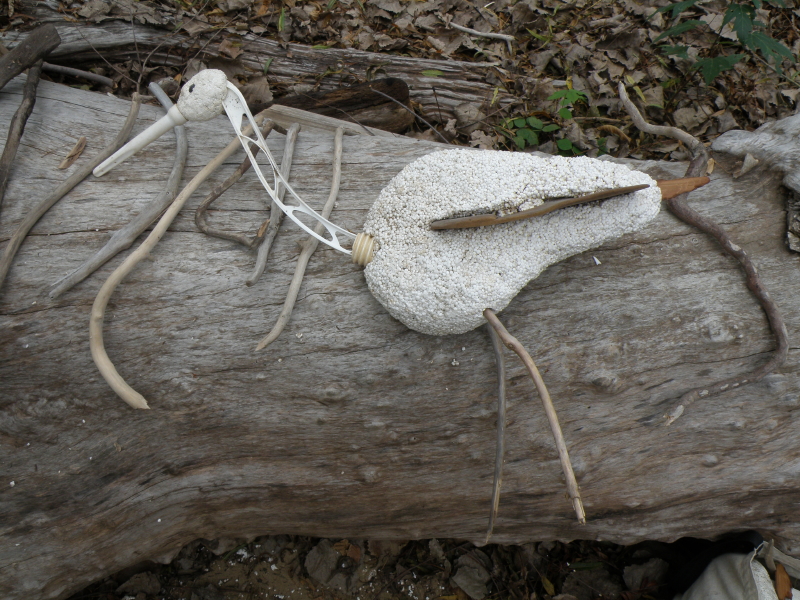
BONUS FEATURE…in process shots of how the ibis was made.  The head and body are pieces of Styrofoam I found out at the Falls of the Ohio.  The bill of the bird is a plastic handle from something…perhaps a feather duster?  The bird’s eyes are two small pieces of coal.  The neck I’m guessing is the plastic arm of a hanging flower planter?  At the base of the neck, I attached a small bit of white plastic hose I came across. The brown wings are the soles of two mismatched shoes I found.  The tiny tail and legs are found wood.  These are all the materials that make up this sculpture which owes something to the tradition of decoy making.  Thanks for tagging along with me on another adventure by the Ohio River.

Read Full Post »

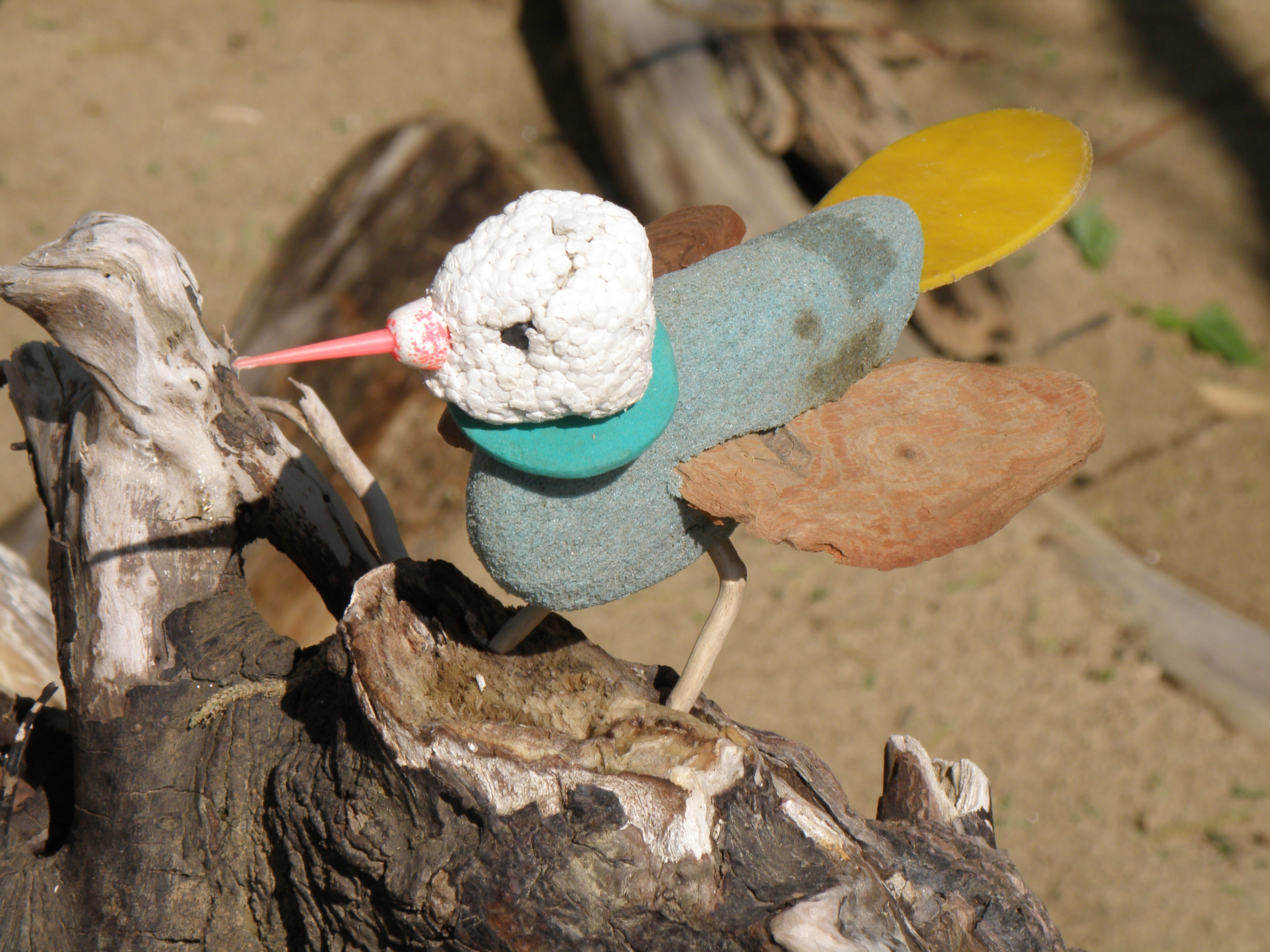
It’s Spring and I’m walking the eastern section of the Falls of the Ohio State Park looking for birds.  I have done this religiously for years and have seen most of the species that have been recorded in this park.  I love birds because they are such beautiful expressions of life.  I envy their extreme mobility with so many species able to call greater parts of the globe home than I will ever experience.  This is the time of year when many different types of birds that have been wintering in South and Central America undergo remarkable journeys.  Some will pass through this area on their way to locations as far north as the Arctic Circle. This is my chance to see them… if I’m lucky. The Falls of the Ohio also has another significant bird connection through the life and work of John James Audubon.  He essentially started his life’s work that would eventually become The Birds of America, one of the great achievements in publishing and the most expensive book in the world, by first drawing many of the birds he encountered at the Falls of the Ohio.  Audubon’s example and his journal descriptions of the world he inhabited are frequent touchstones for me and this project.  Two hundred years later…very little remains of the original landscape he was familiar with.  That process and transformation of the landscape is continuing and unfortunately not always in a positive direction.  Birds are such great indicators of the quality of the environment because they are sensitive to changes…the canary in the coal mine was a real thing.  To enjoy birds and birding is an activity that takes you out of yourself for a little while and causes you to engage life on its own terms.  On this day (which also happened to be April Fool’s Day)  I did experience many of the usual year round resident bird species, but did not see any of the neotropical migrants that make the Spring migration so special.  So, when this happens, I’m not above creating my own bird species.  This post is devoted to a new bird I discovered out here and I’ve named it the Variegated Oriole.

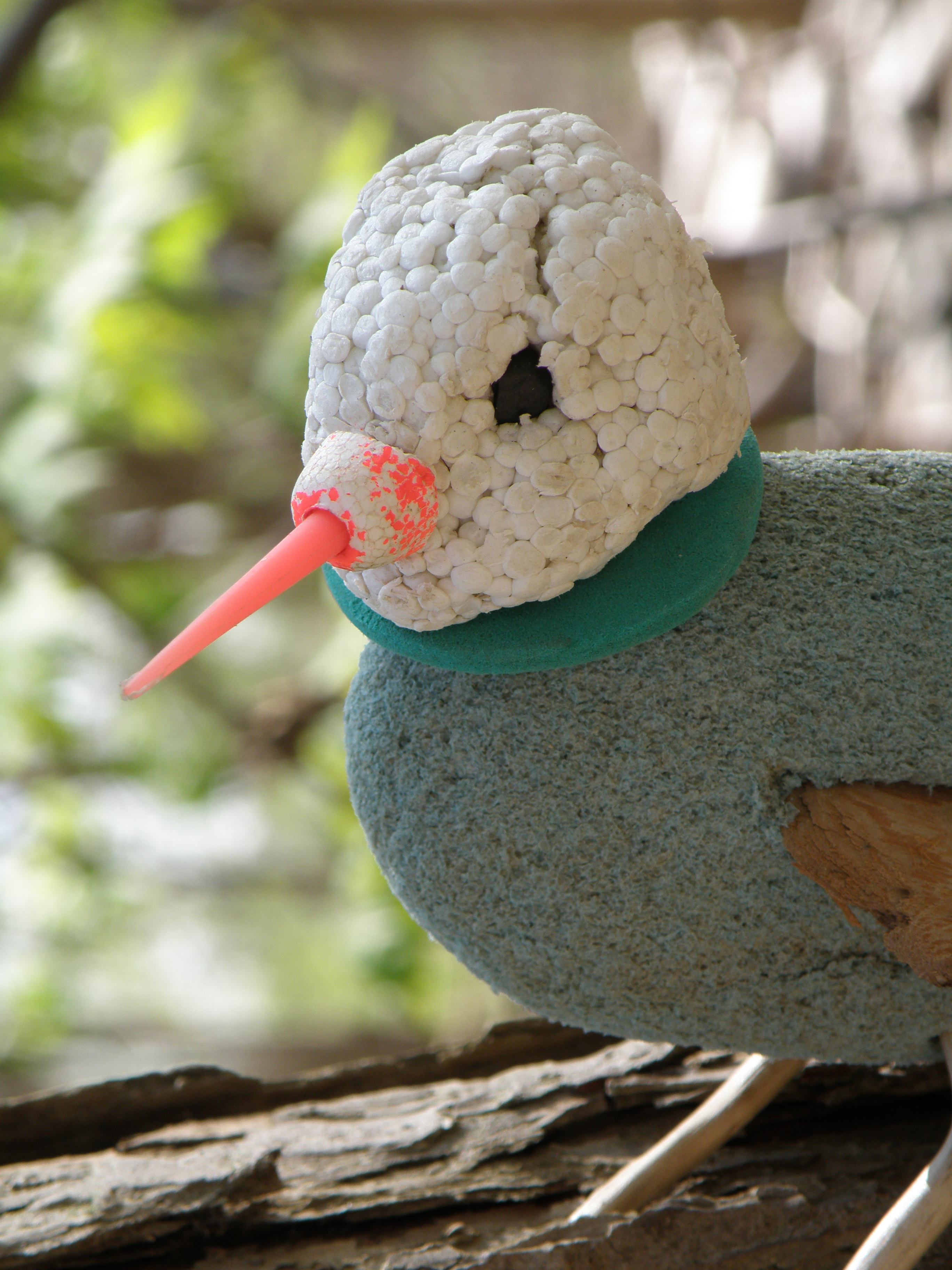
The Variegated Oriole receives its name for being multicolored. I first encountered this bird as various bits of detritus that I came across walking the shoreline of the Ohio River.  For the head, I used a small piece of river-polished Styrofoam.  Its brightly colored beak is part of a plastic and polystyrene fishing float that I cut with my pocket knife.  The eyes are small bits of coal.  I used a green foam gasket or washer to act as a transitional element between the head and the body.  It’s a trademark of mine that I seem to do with almost every piece I make out here. For the body, I found a blue piece of river-polished high density foam? that I cut a few slits into the sides to hold the wings which are made from pine bark.  I took one piece of bark that the river peeled off of a tree and I split that in half to form matching wings.  The tail is a piece of yellow plastic I found that reminded me of a bird tail!  I cut another groove into the blue body to insert and hold the tail in place.  The feet, are just rootlets that I sharpened and pegged into the body.  That’s it in terms of materials which I tried to alter as little as possible as not to trump what nature and the river had already shaped.  It’s important to me that this be a true collaboration.  If “we” are successful, then something of the spirit of a bird will take hold and inhabit this small sculpture.

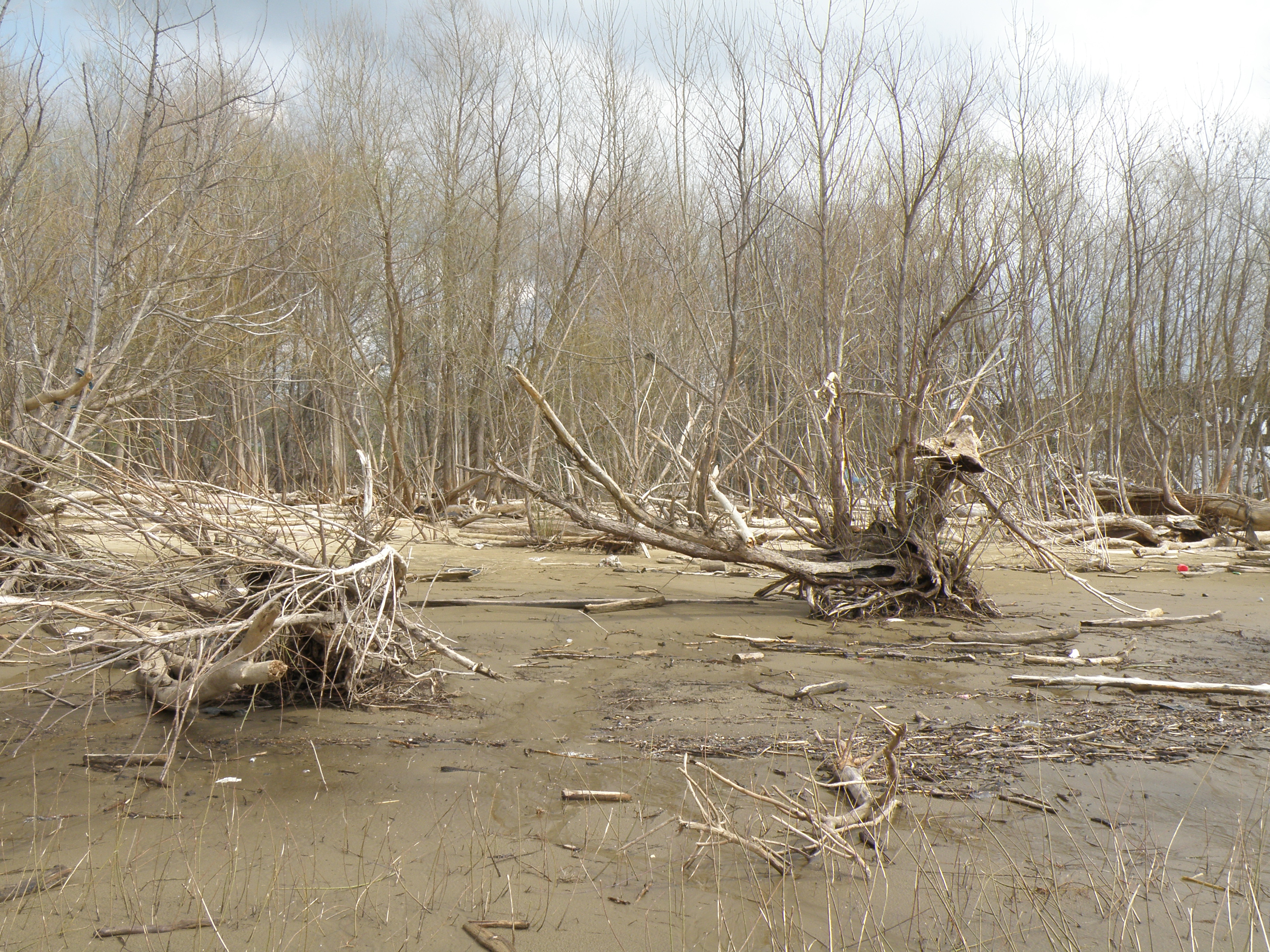
After finishing the bird…I seek out environments that will help put this avian creation into some kind of context.  Everything matters and I hope my pictures convey something of the time of day, the season, the quality of light, the condition of the environment, etc…all those elements help create a sense of place.  I move through the willow trees posing the bird on various stumps and branches.  I usually take a lot of pictures.

Sometimes, I will imagine what kind of habits my new birds might possess.  In the case of the Variegated Oriole…it is not too different from the Northern or Baltimore Orioles that live and nest in the park.  They are among the migrants I look for. I heard one the other day calling, but didn’t see it.  The real orioles that live here are adapting to local conditions by using artificial materials (fishing line and barge cable fibers) in the construction of their hanging basket nests.  I’ve posted on this before in this blog a few years a go.  I think Audubon would have been interested in this.  Anyway, I left my bird sitting on a branch for anyone to discover.  It might still be there and I will find out today when I once again venture out to the Falls of the Ohio State Park.  Perhaps new birds will present themselves to me? I will let you know what I find…next time.
One week later…I returned to the spot where I left my faux-feathered friend and he was no longer perched upon the branch where I left him.  I was able to locate most of him scattered on the sand except for one wing.  My guess was that he was felled by a well-aimed and thrown rock.  The head was shattered and will need to be replaced provided  I recyle these pieces back into a bird again.

Read Full Post »

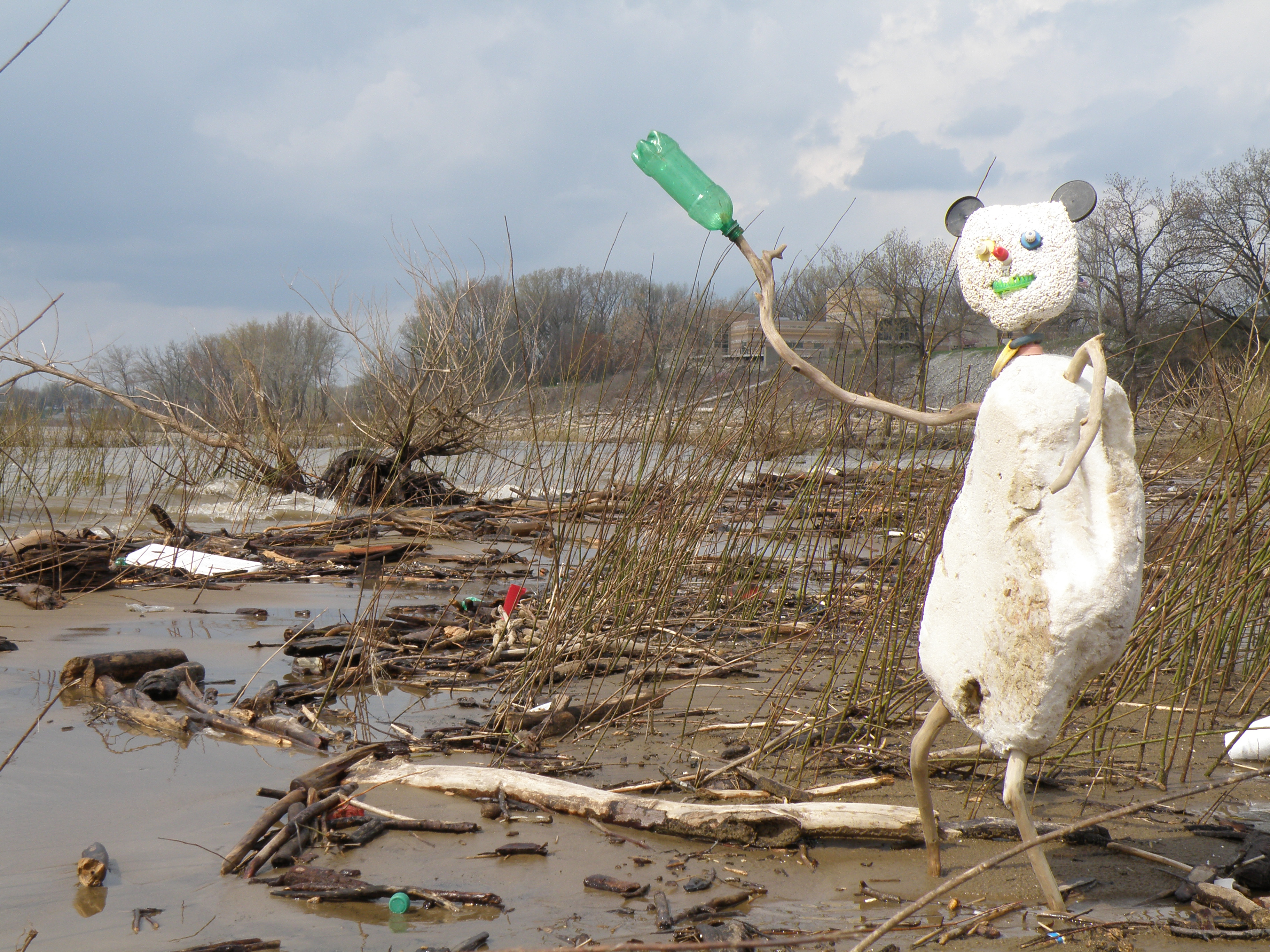
On a variable day where the sun played hide and seek among the clouds,  I visited the Falls of the Ohio to see what there was to see and experience.  Thus far, Spring is shaping up to be much warmer than normal and many different  plants in the city where I live have flowered early.  I was curious to see if this pattern was holding true with the trees out by the river? Upon arrival, I could see that the trees hadn’t “leafed-out” and so I directed my attentions to a slightly high and wild river.  I began looking for river treasures when I met this strange fellow.

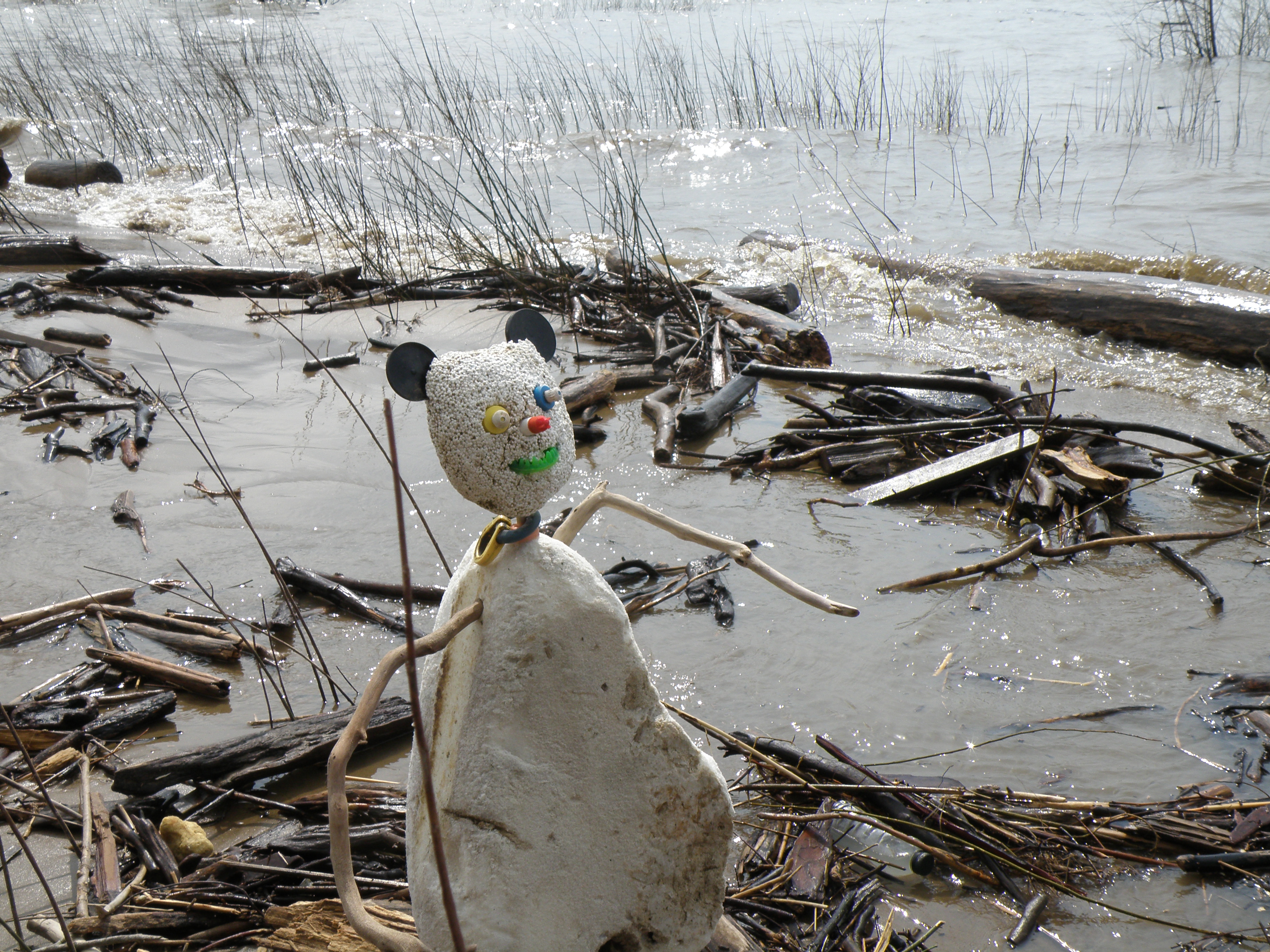
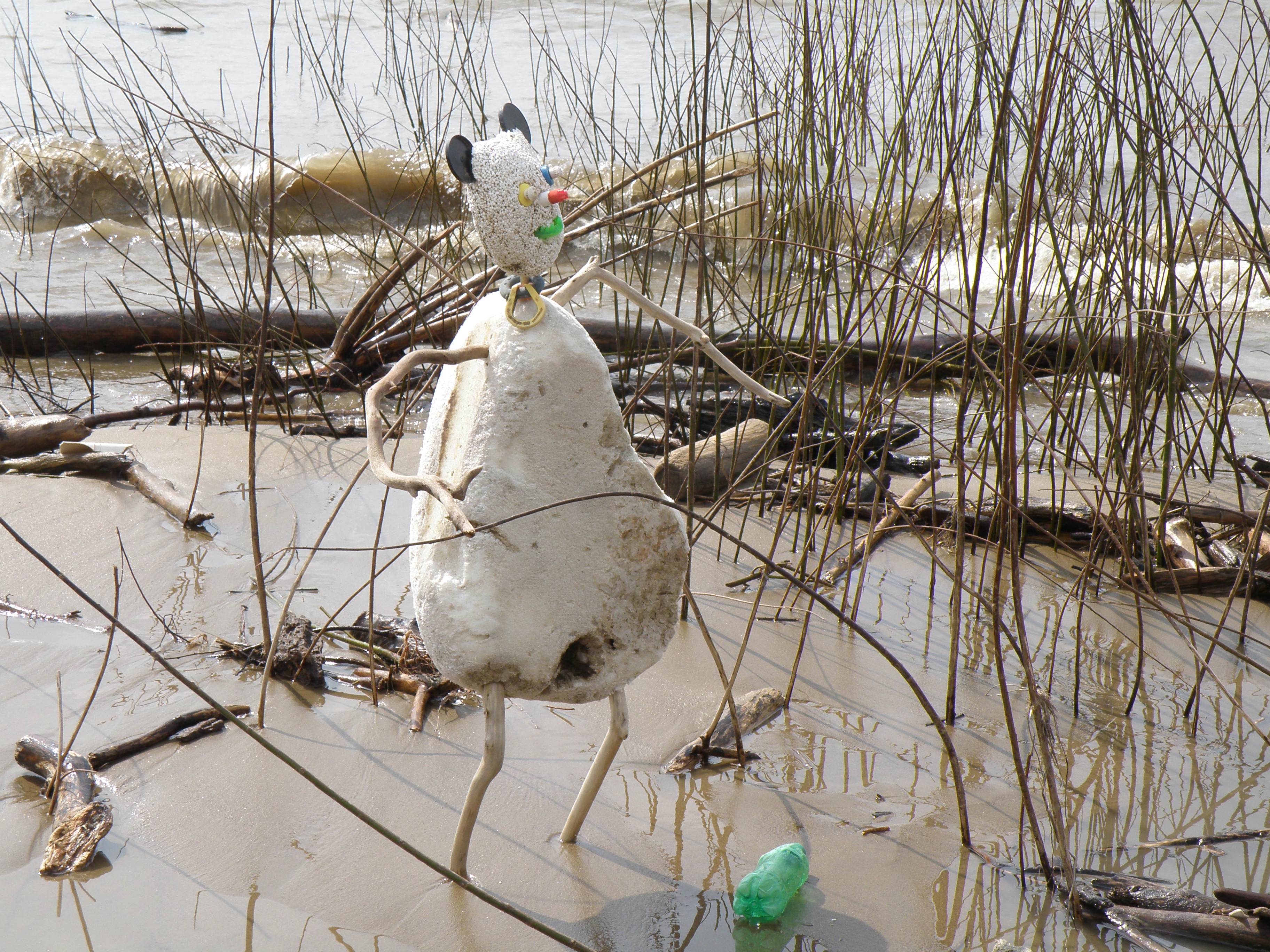
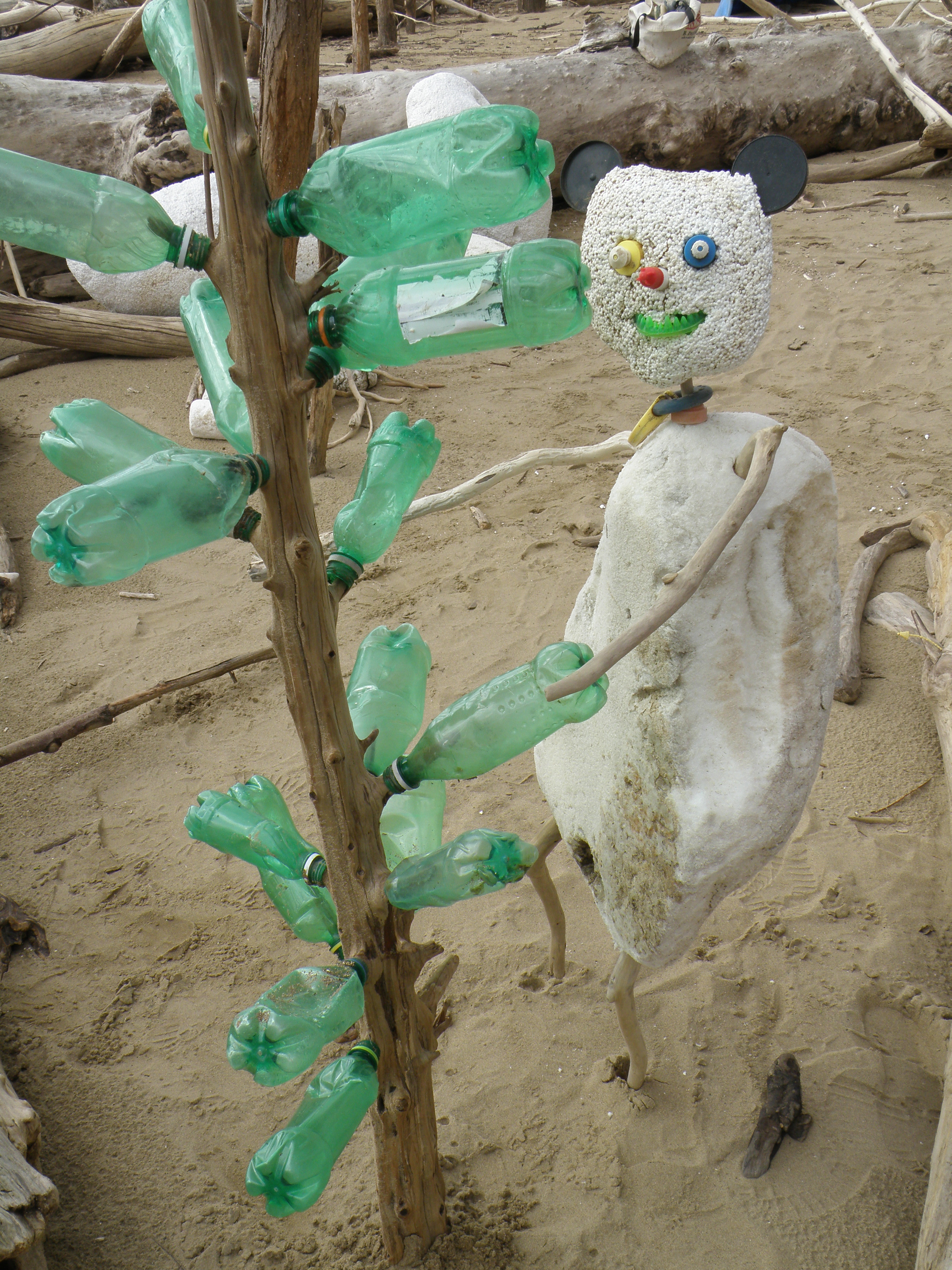
He called himself the “Guardian” and he was doing the same thing as me.  Namely walking along the edge of the river and picking up objects that were washing ashore.  The water level has been high and many of the youngest willow trees were poking out of the sand like large hairs on the back of some big animal you can’t totally see because it’s that huge.  I tagged along with the Guardian and we conversed freely.  It’s funny how no two beings react in the same way to the “treasures” the river offers up.  For example, people are always trying to give me driftwood that they think I will like.  Rarely, am I attracted to their finds.  Driftwood aesthetics is a matter of personal taste as is the attraction for all the other stuff that washes up here.  I didn’t think anything at all as the Guardian started collecting plastic bottles.  While those bottles held little interest for me…the polystyrene chunks I was stuffing into my collecting bag held no interest to the Guardian whatsoever.
The Guardian was keying on green plastic bottles in particular.  I had to know why these bottles and what was he going to do with them?  And then there was the added mystery of his name.  If he’s the Guardian…what is he guarding?  My new friend said he would be glad to tell me, but it would in fact, be easier to show me.  Together we walked up the shore to the tree line where my new friend had a project he was working on.

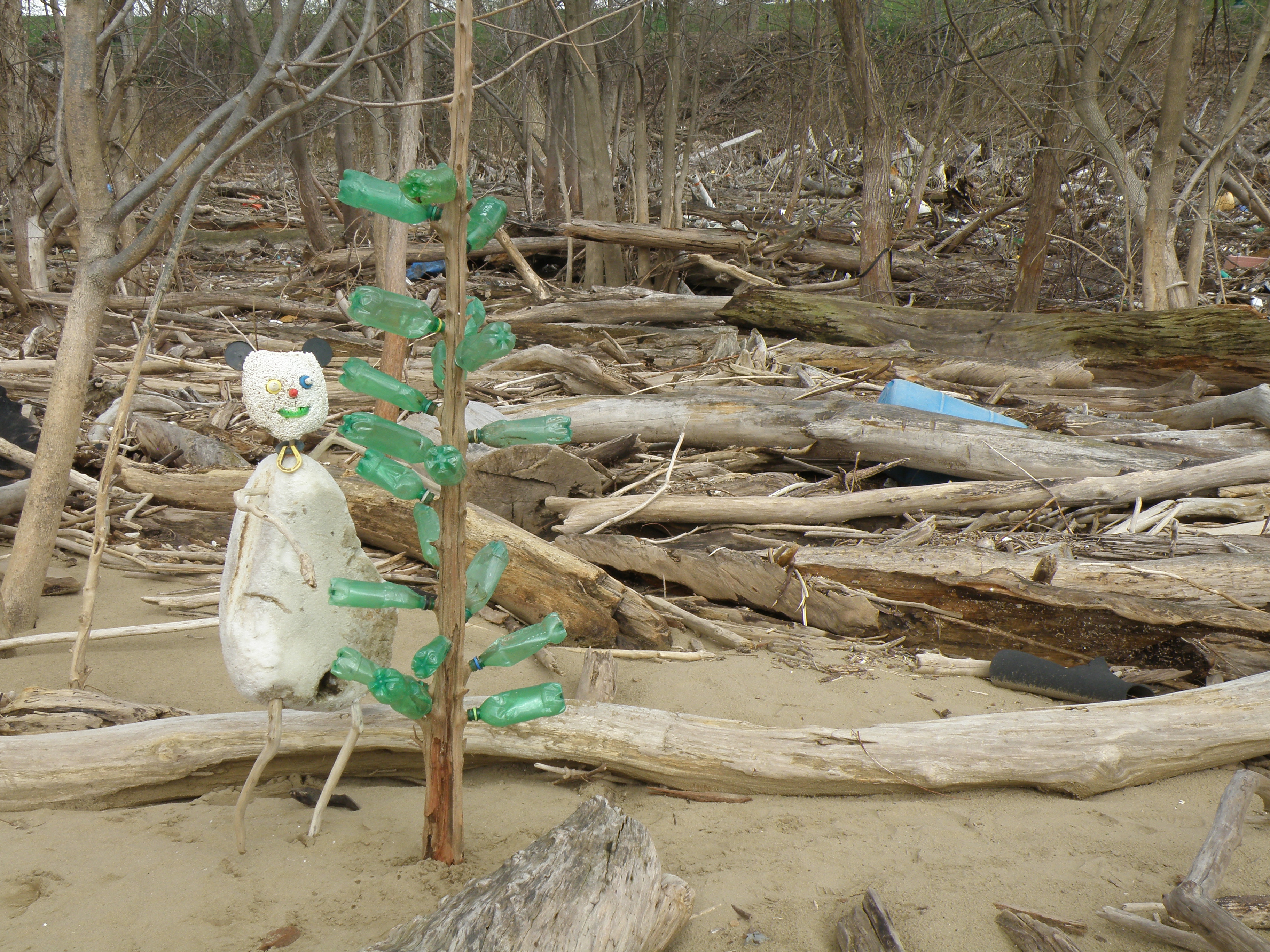
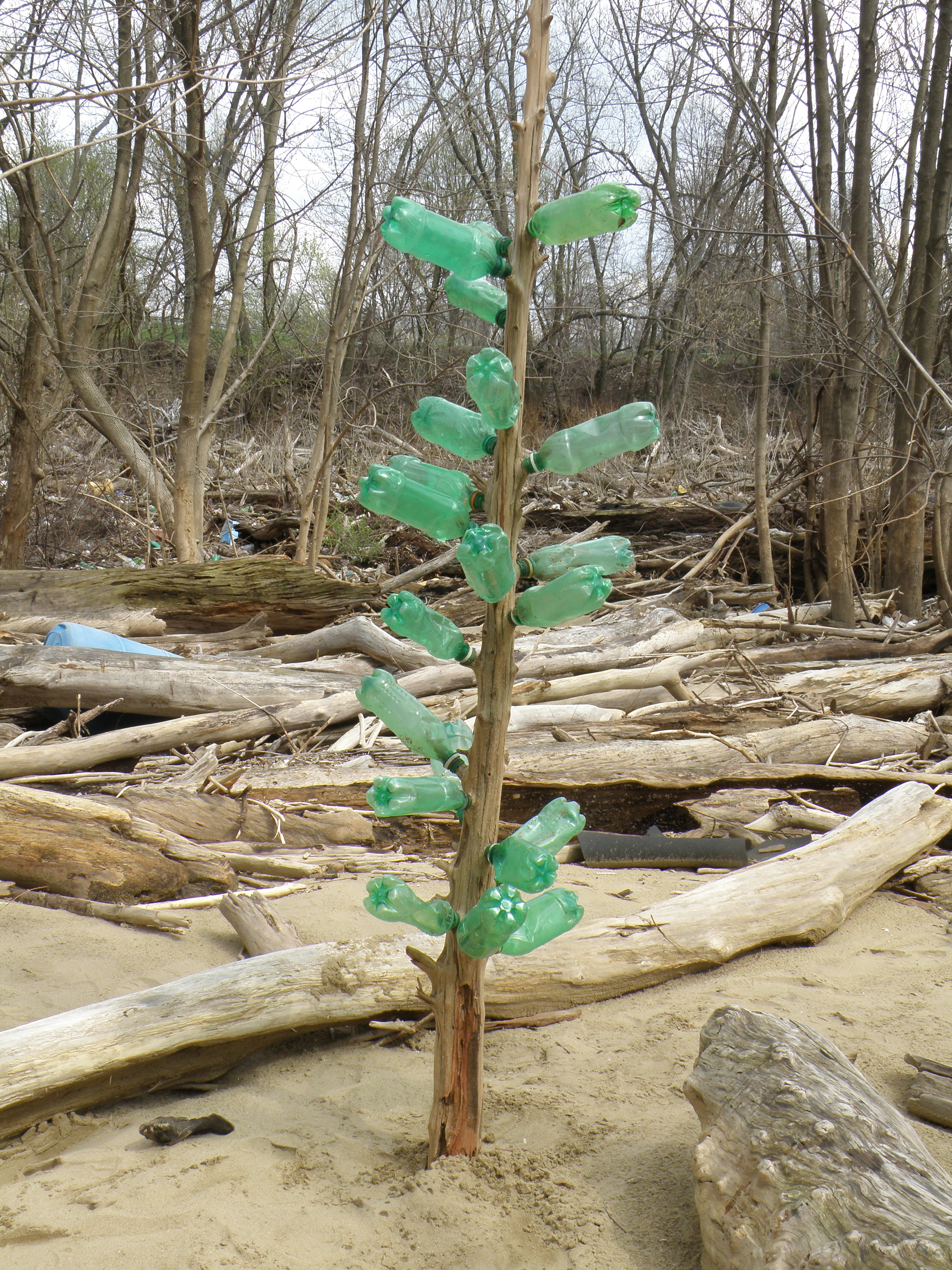
I was amazed to see that he had planted a river-polished cedar trunk into the sand and had attached his green plastic bottles to the nubs that were once branches of this tree.  Judging by his project’s progress…he had been hard at work before I ran into him.  Here’s another view that shows where he positioned his bottle tree.

He told me he had been doing this activity once a year for many years and that he is called the Guardian because he is the protector of this particular ritual.  It’s purpose is to awaken the coming of Spring after a period of dormancy.  There are other beings like himself that are scattered across the planet and serve the same or similar functions through their various rituals.  As he added new bottles to his tree, the Guardian chided me in a friendly way saying did I think the seasons just transitioned on their own? The Earth in fact needs the help of all who love her to keep her from falling into neglect.  The Earth needs to know that folks do care because that extra bit of genuine concern is important and provides the extra energy needed to sustain everything that lives.  Otherwise, this huge task is simply not worth it and the world slips into apathy and falls back asleep.

As the Guardian spoke to me, large dark clouds started gathering overhead.  The first large drops of rain began falling in the sand around us.  It was time to go and I parted company with my new friend.  I thought about what he told me.  I guess I hadn’t considered that the very planet might also be alive and would respond positively knowing that others simply cared.  As I walked home I said a little prayer of my own inside my head and awaited the further greening of the world.

Read Full Post »

« Newer Posts - Older Posts »