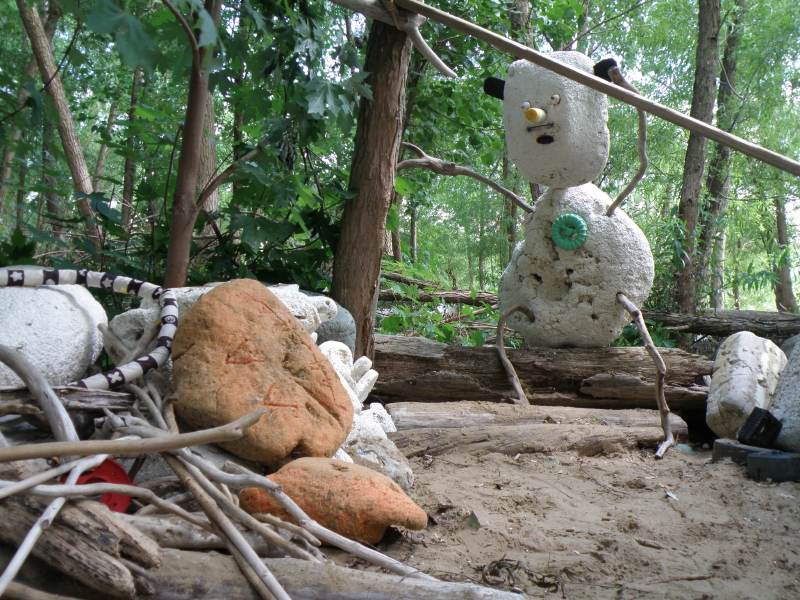
Feeds:
Posts
Comments

Posts Tagged ‘site specific art’

First snow at the park, Jan. 12, 2016

The new year is off to an auspicious start.  First we had a bit of minor flooding that rearranged the park and the new and improved Interpretive Center has successfully opened.  I was curious to see what the river had left behind and make my first foray upon the riverbank and fossil beds.  On the day I had prepared to venture forth, well, it snowed the night before and covered many areas with a light dusting of what looks like confectioner’s sugar upon the landscape.

Artist at Exit 0 in winter gear, Jan. 12, 2016, Falls of the Ohio

I come prepared…mostly.  Even covered up, I could feel the wind and the cold which was blowing hard enough that it made my eyes water.  Reaching into my trusty Dutch field jacket, I pull out my vintage “Wind-Dodger” goggles and put them on.  I came across these goggles still new in their 1950’s box at a favorite junk store that is now gone.  They were manufactured by the Kono Manufacturing Co., of Woodside, N.Y.  I think the graphics on the side of the box sold me as to their value.  Printed in red ink it read:

“The scientific construction of the Wind-Dodger fits the natural contours of the features-providing maximum exclusion of wind and rain and all foreign particles in the air.  The elastic tape holds the Wind-Dodger firmly in place under every condition of work and play in all kinds of weather.”  I am a big believer in the value of science.

Further more, printed on the side of the box, was added they were suitable “For Work” and “For Play” and would be useful to railroad men, farmers, mechanics, construction workers, as they engage in sailing, hunting, fishing, flying, skiing, and driving.  It was a natural leap for me to assume that they would also be perfect for a river junk artist like yours truly.  One thing that the Kono Manufacturing Co. forgot to say is that they also steam up inside the goggles and require frequent drying.  Still, they prove to be better than nothing.

The scarf I’m wearing is the oldest piece of clothing I own.  It was given to me by a friend and artistic mentor back in the mid 1970’s and somehow I have held on to it over the years.  I realize that with a lot of the clothing I own…I can be ridiculously sentimental.

Snow on driftwood, Falls of the Ohio, Jan. 12, 2016

The biting wind and cold are a concern, but so is the footing.  The snow covers up a multitude of sins that cannot be seen.  It is still slippery out here and in places the mud hasn’t completely frozen.  Much of what I think I can find out here will remain hidden until warmer weather returns.  But, I’m out here anyway and so I make a quick walk around some familiar places and record what I can with my camera phone.
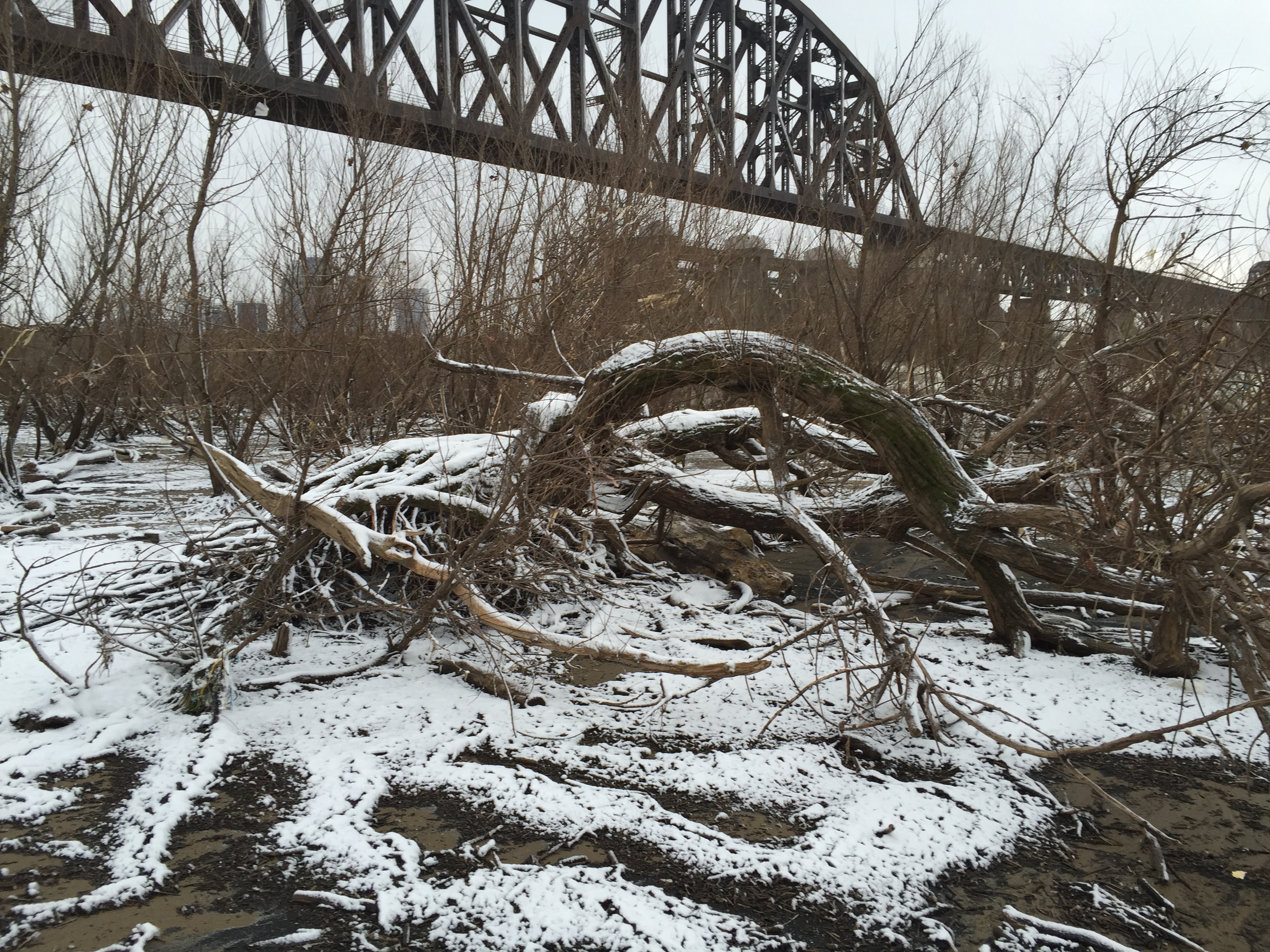
Bent over willow tree, Falls of the Ohio, Jan. 12, 2016

I discover that a favorite willow tree is now almost completely bent over and resting on the ground.  A huge log that the river deposited on top of this tree has shattered one of its main branches.  I suspect that it is not long for the world.  Spring flooding will repeat this battering process and I assume the tree’s prognosis is not good.  Of course, there are other things that present themselves in this frigid landscape that rode in with the high waters.
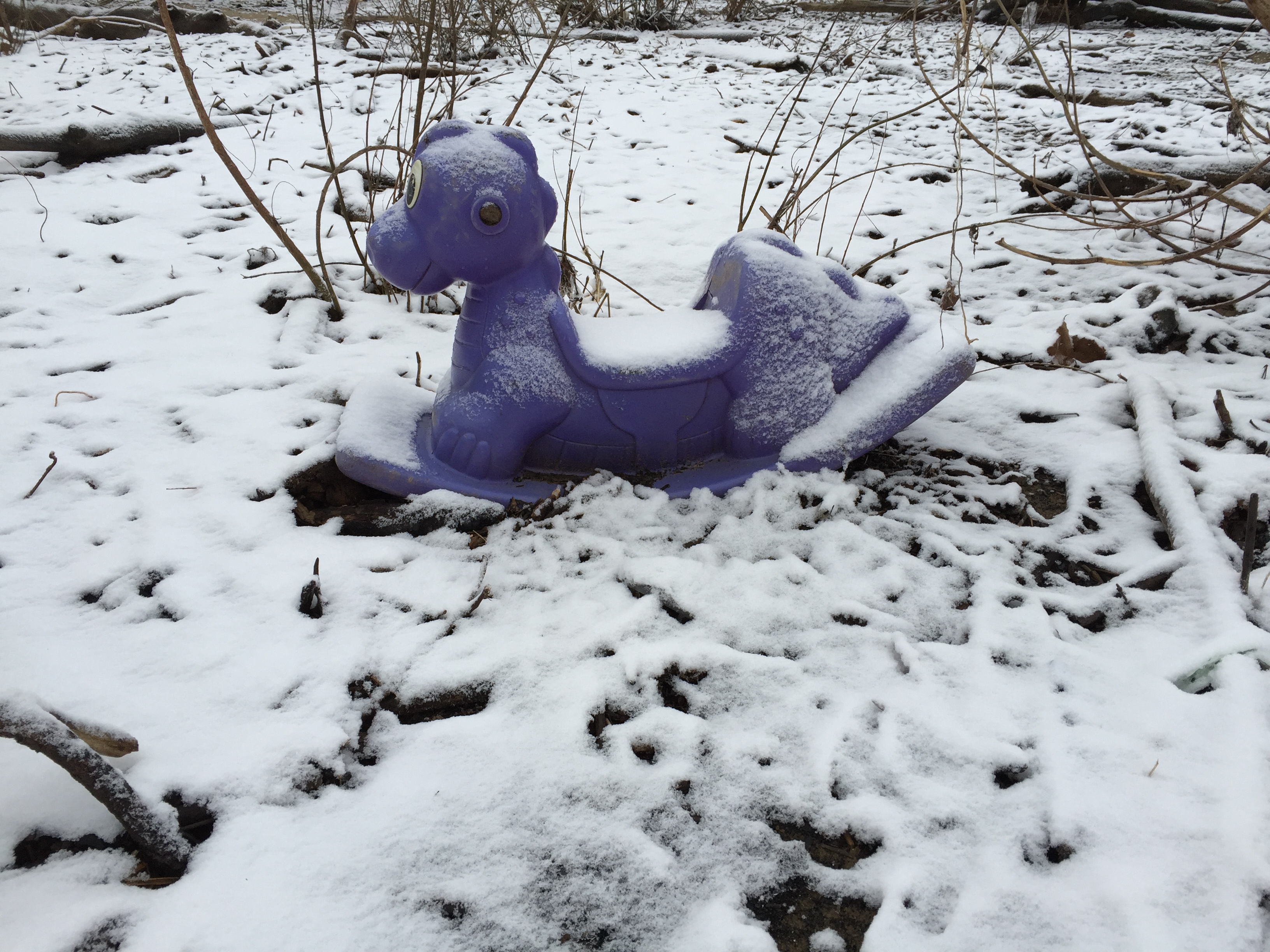
Purple plastic rocking toy, Falls of the Ohio, Jan. 12, 2016

My eye is immediately drawn to this purple plastic “dragon” rocking toy.  I find another giant reptile reference on the rocks nearest the river and here it is.
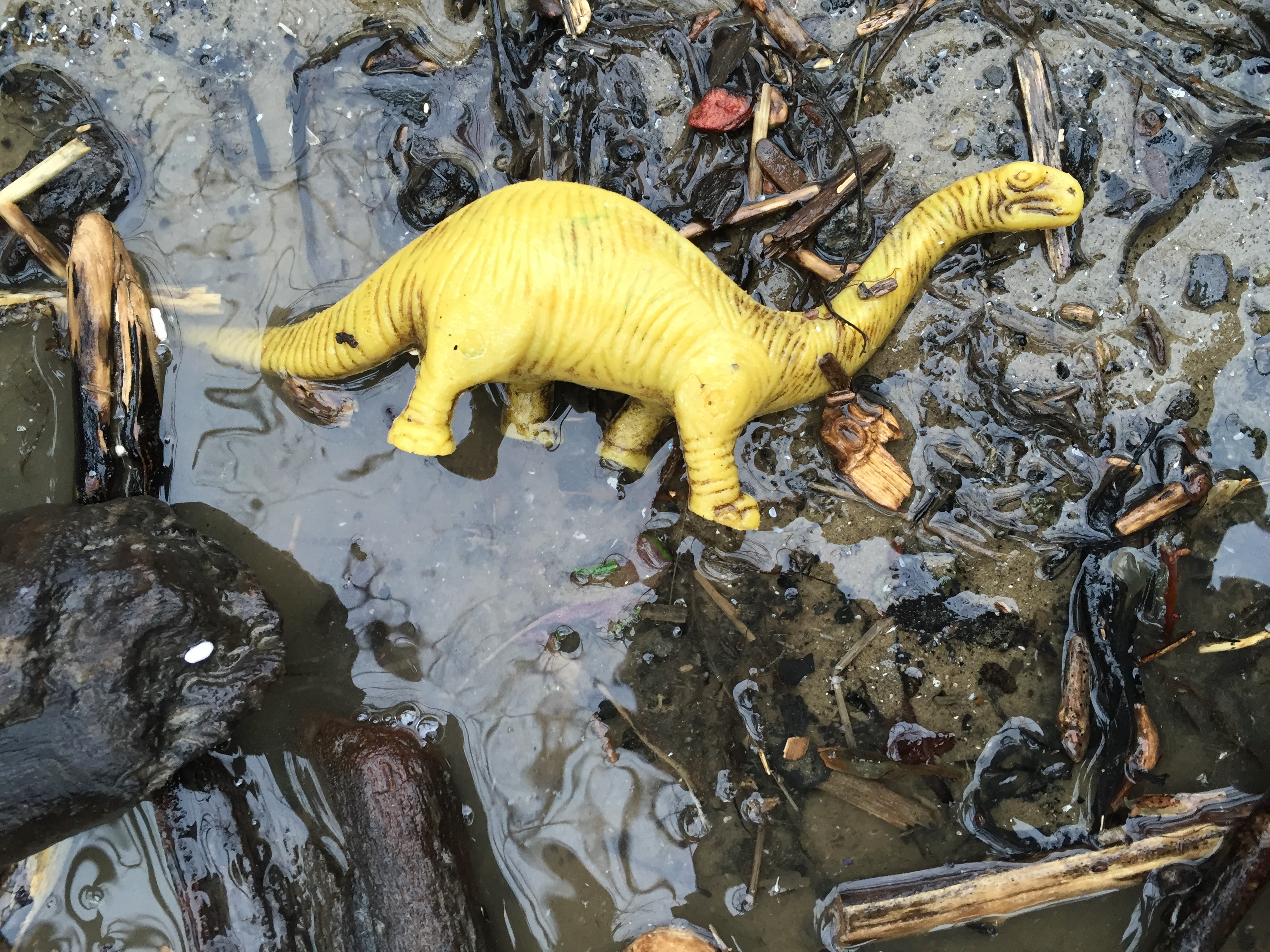
Plastic dinosaur, Falls of the Ohio, Jan. 12, 2016

This plastic sauropod arrived in a fresh water wave.  I believe this species was formerly called “Brontosaurus”, but has been renamed “Apatosaurus” since it was discovered that an earlier scientific find gave the new name priority over the older, more familiar name.  I briefly allow myself to soak in the irony of finding an object made from ancient petroleum that washed up on these even older fossil beds that references this prehistoric animal.  Heady stuff indeed!  Nearby, was my next find that continued this line of thinking.
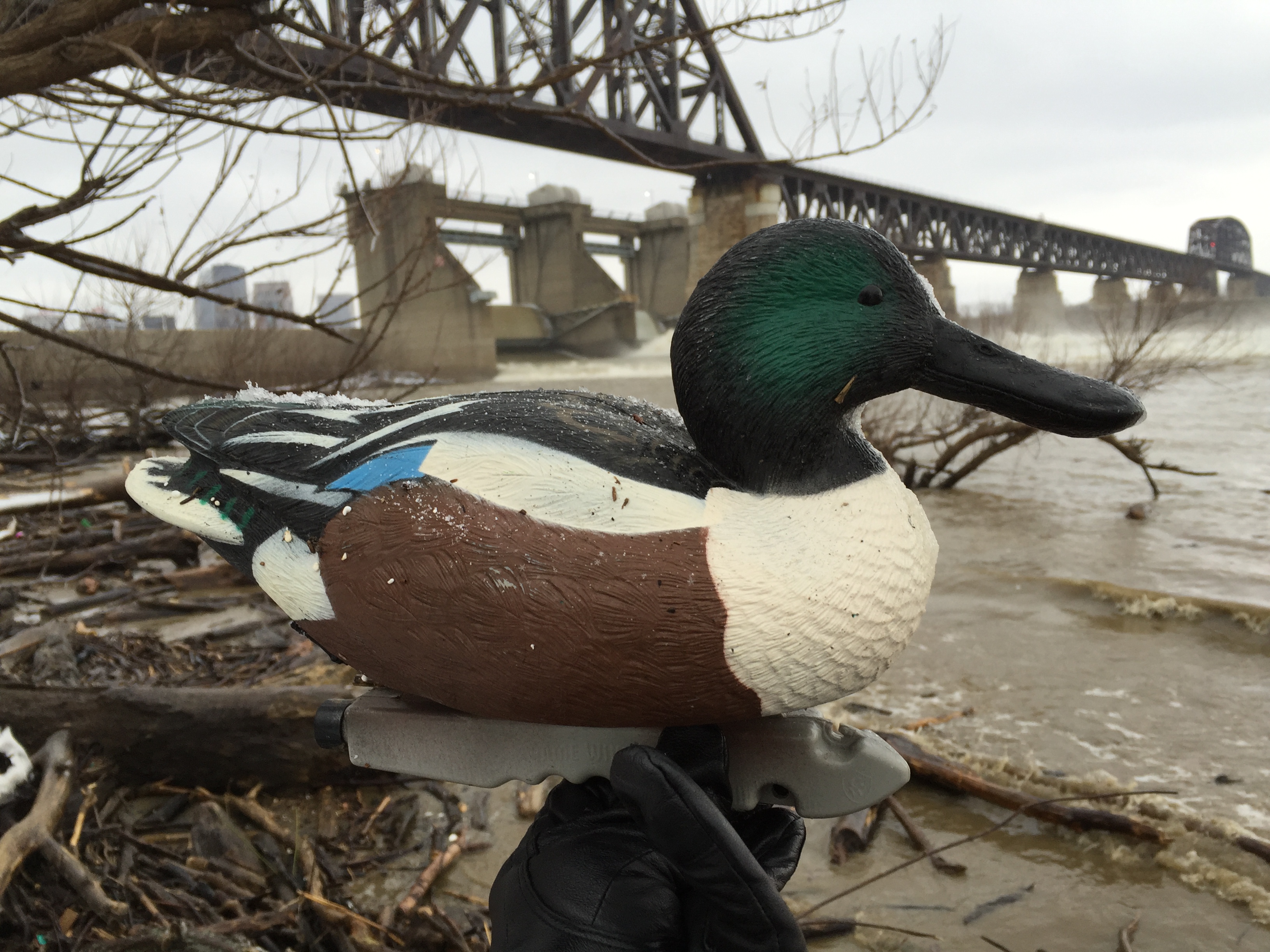
Plastic, Shoveler duck decoy, Falls of the Ohio, Jan. 12, 2016

And, what happened to some of the dinosaurs?  It is believed that they evolved into birds.  Right on cue, I find this plastic duck decoy!  It represents the male Northern Shoveler, (Anas clypeata).  I have found many other plastic duck decoys out here, but this is the first for this pretty species.  The winter river at the Falls of the Ohio is a good place to see different duck species.  In fact, winter may be the only time of year to see many of them.  The river is steaming because the actual water temperature is warmer that the surrounding air, but the wind is a little fiercer too.  I decide to keep walking and soon come across an old project I did from last year.
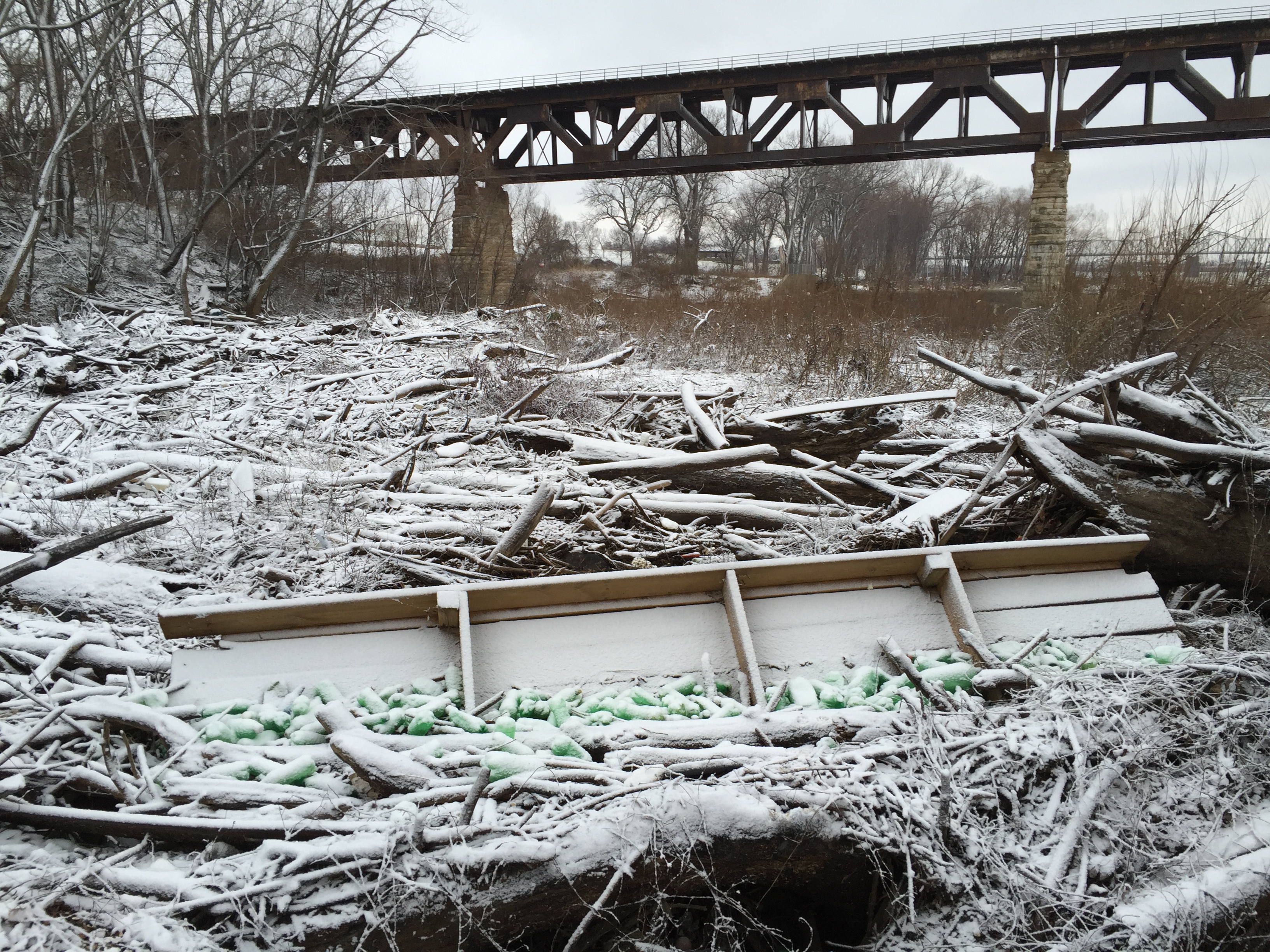
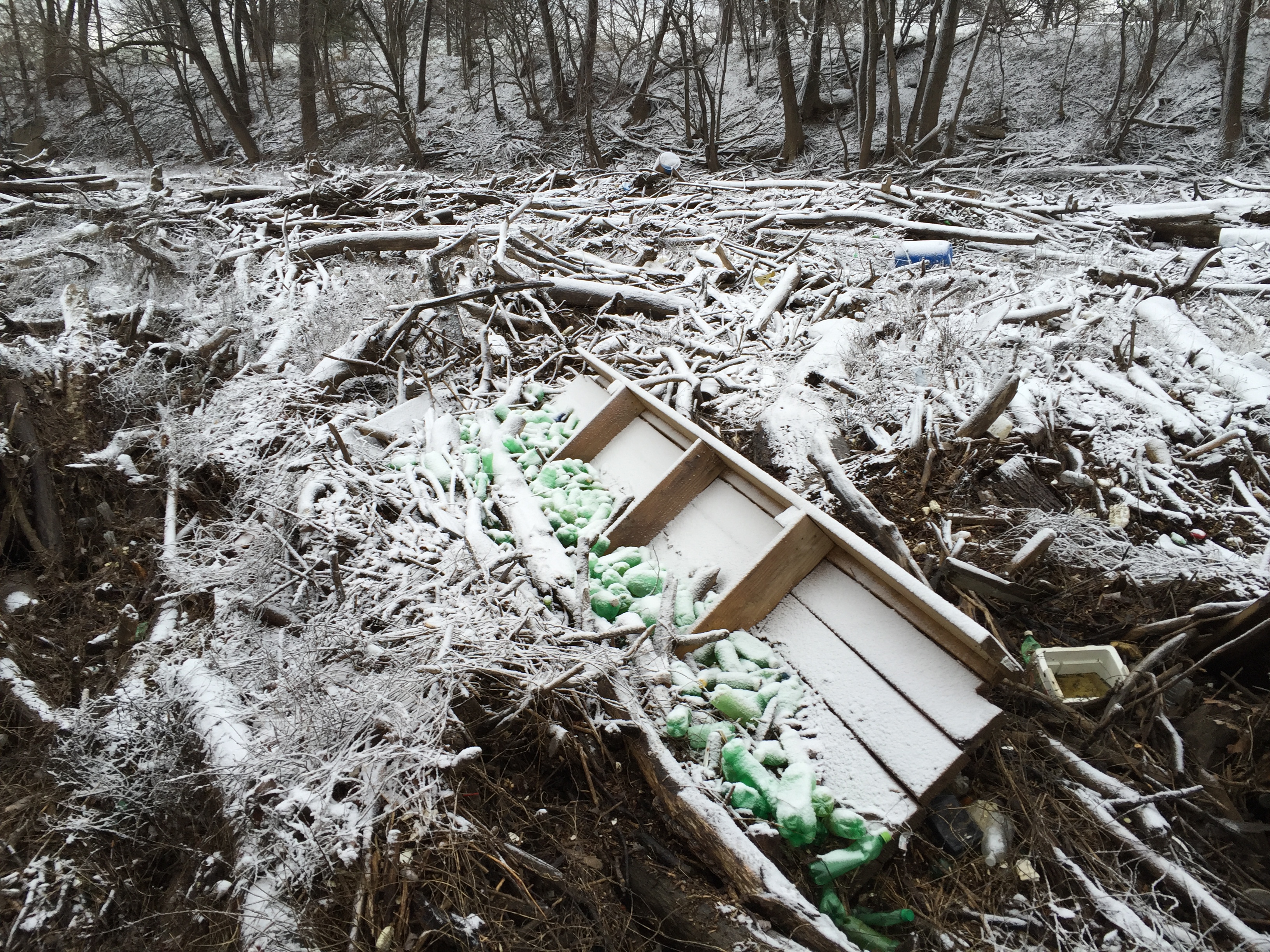
Site specific, green plastic bottle assemblage, Falls of the Ohio, Jan. 12, 2016

Site specific, green plastic bottle project, Jan. 12, 2016

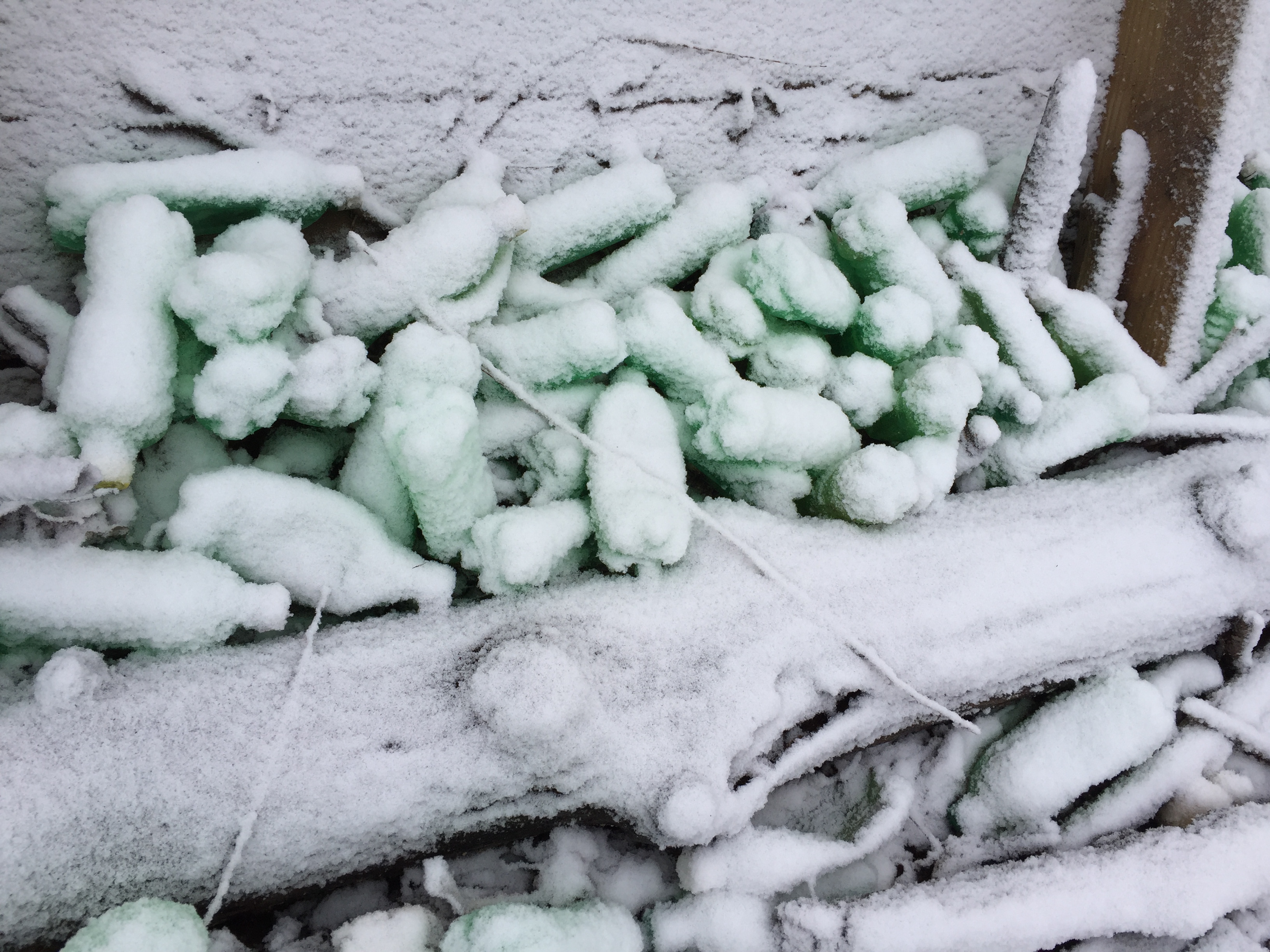
snow-covered, green plastic bottles, Jan. 12, 2016

I created this site specific piece using green plastic bottles after last year’s flooding.  It was sited high upon a big mound of driftwood that was too big for this recent minor flooding to affect much.  Originally, I had filled the underside of what I think is the remains of a boat dock with the green bottles.  Time has shifted the bottles to the bottom of the wood form.

snow-covered vines, Falls of the Ohio, Jan. 12, 2016

While the snow is beautiful and transforming as these snow-covered vines can attest to….it is also getting ridiculously cold!  The fingers on my right hand hurt and sting from the cold because I have to take my glove off to operate my camera.  Soon images of a hot cup of coffee began to intrude upon my winter reverie.  It’s time to go home, but there was yet one more very pleasant surprise waiting in store for me.
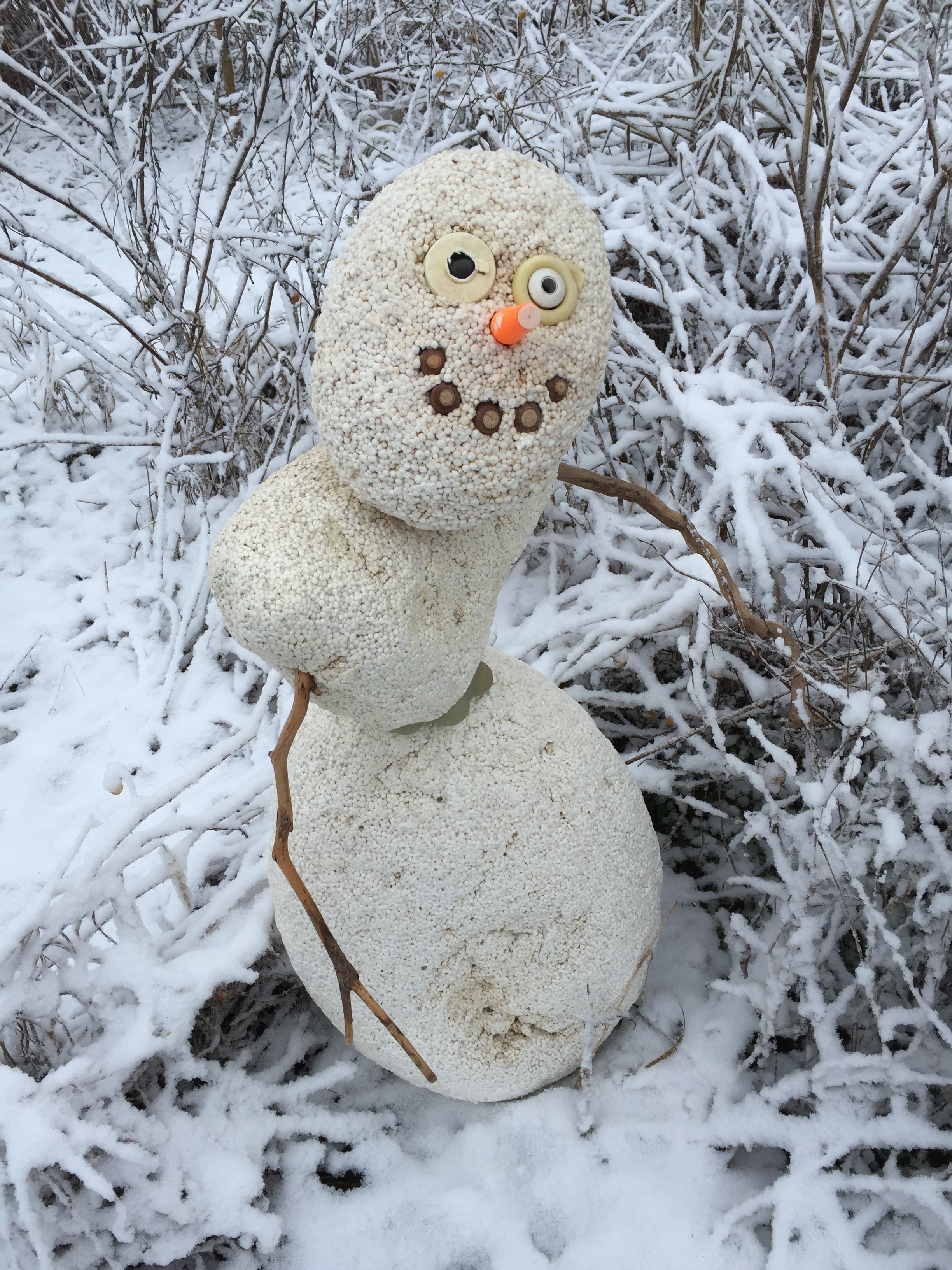
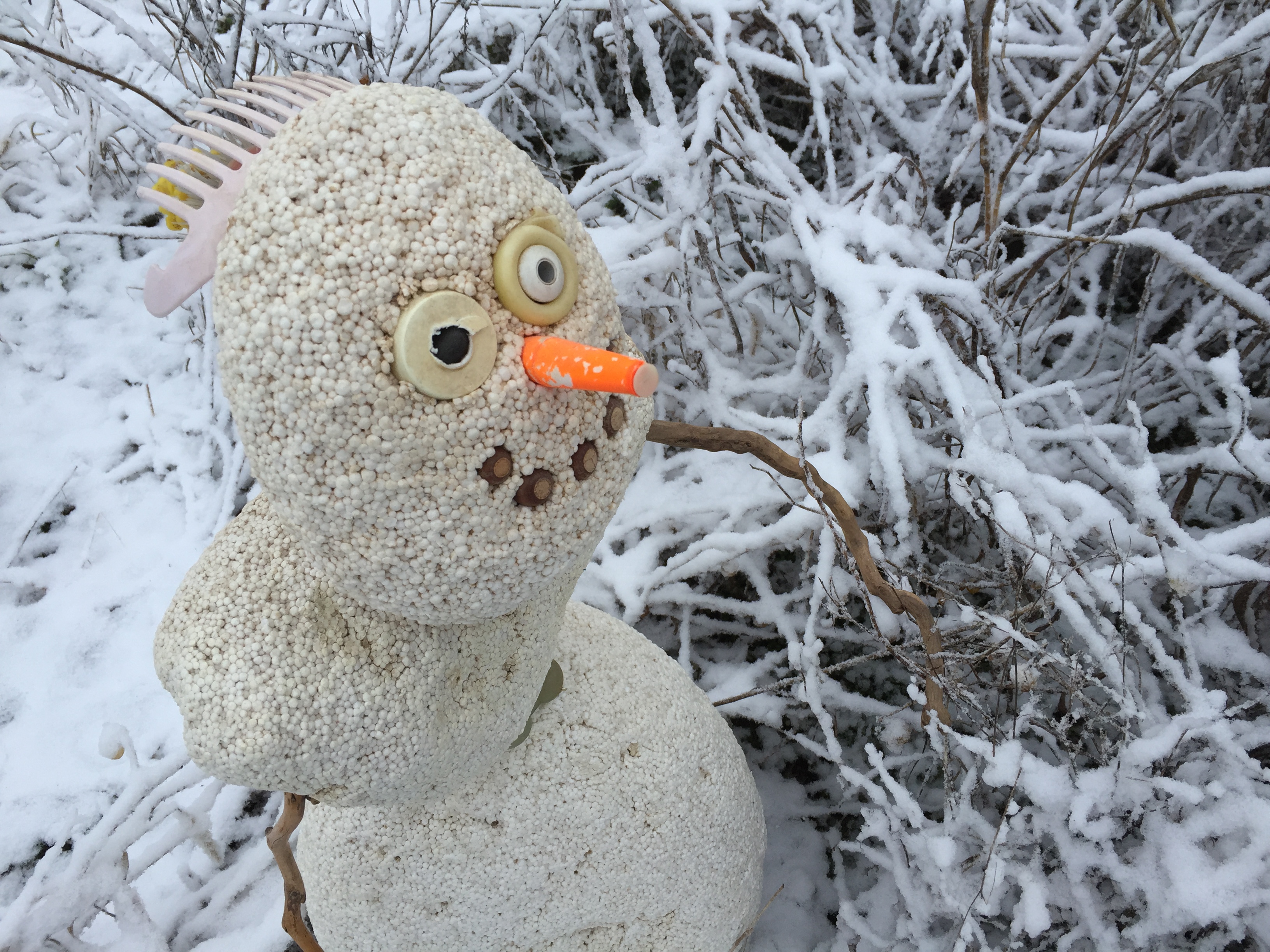
Styro-Snowman in snow, Falls of the Ohio, jan. 2016

Styro-Snowman, Falls of the Ohio, Jan. 12, 2016

As I was heading back to the parking lot…I came across an old friend whom I was happy to see!  We first met at the Falls on an absurdly warm day in December when the temperatures were in the low 70 degree range!  I had photographed him as he was decorating river trees in advance of the holiday season.  My old Styro-Snowman buddy was just beaming!  At last, he was in his element and I’m so happy that his patience was rewarded.  Not wanting to intrude too much in his special moment, I bid farewell and took this parting shot as I left the river.  Stay warm everybody…from the Falls of the Ohio.

Styro-Snowman in his element, Falls of the Ohio, Jan. 12, 2016


Read Full Post »

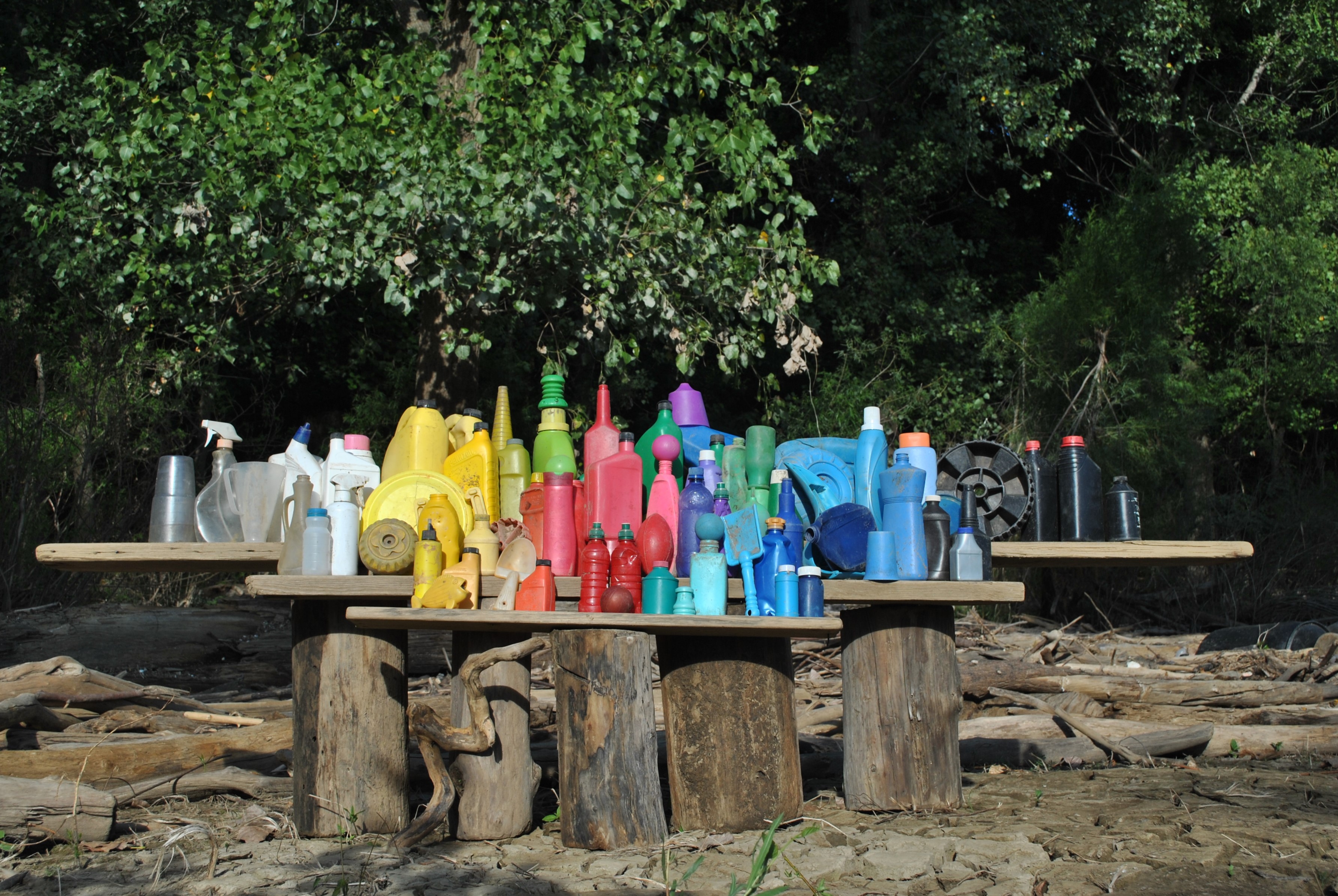
Detail, Western Petroleum Rainbow, Falls of the Ohio, early August 2015

Hot, sticky, and the humidity had me sweating the moment I entered the park.  Today’s outing seemed more like an extreme sport than an attempt at art making.  I decided to focus my efforts in the western section of the Falls of the Ohio State Park.  I knew the recent flooding we had experienced would more than likely deposit a lot of junk and debris along the driftwood cluttered shoreline.  I was right about that, but first I had to “earn it”.  To access the shoreline in this area of the park required going over, under, and around large trees that had either blown over by high winds or were undermined by the soil being washed away from the riverbank.

Driftwood on the riverbank, Falls of the Ohio, early August 2015

One thing I noticed being in this section of the park…was that all the purple loosestrife seemed to be gone.  Normally, one can expect to find a whole host of butterfly and other insect species sipping nectar from the colorful flowers.  On this expedition, I did not see one bloom from this admittedly invasive species.  I think the Ohio River’s recent bouts of high water must have affected them?  I find this somewhat unusual since I associate them with growing in very damp areas.  Perhaps in their case, too much of a good thing is actually a bad thing?  I will do some research to see if my hunch is true.  Regardless of no purple loosestrife, there were plenty of vines to snag and trip over making the footing tricky…as if the soft mud and irregular surfaces of the driftwood weren’t enough of a challenge!

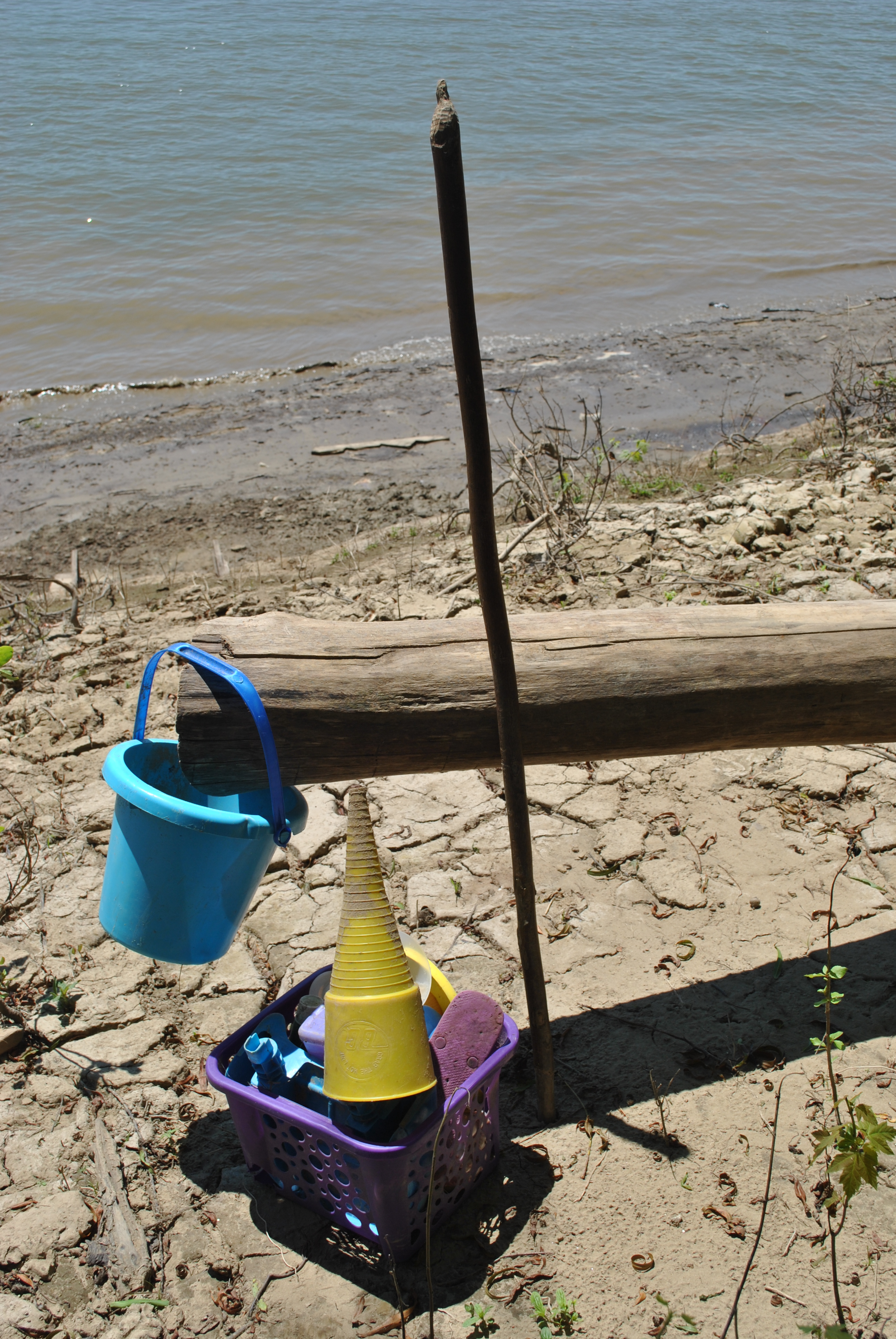
My walking stick and found plastic items, early August, 2015, Falls of the Ohio

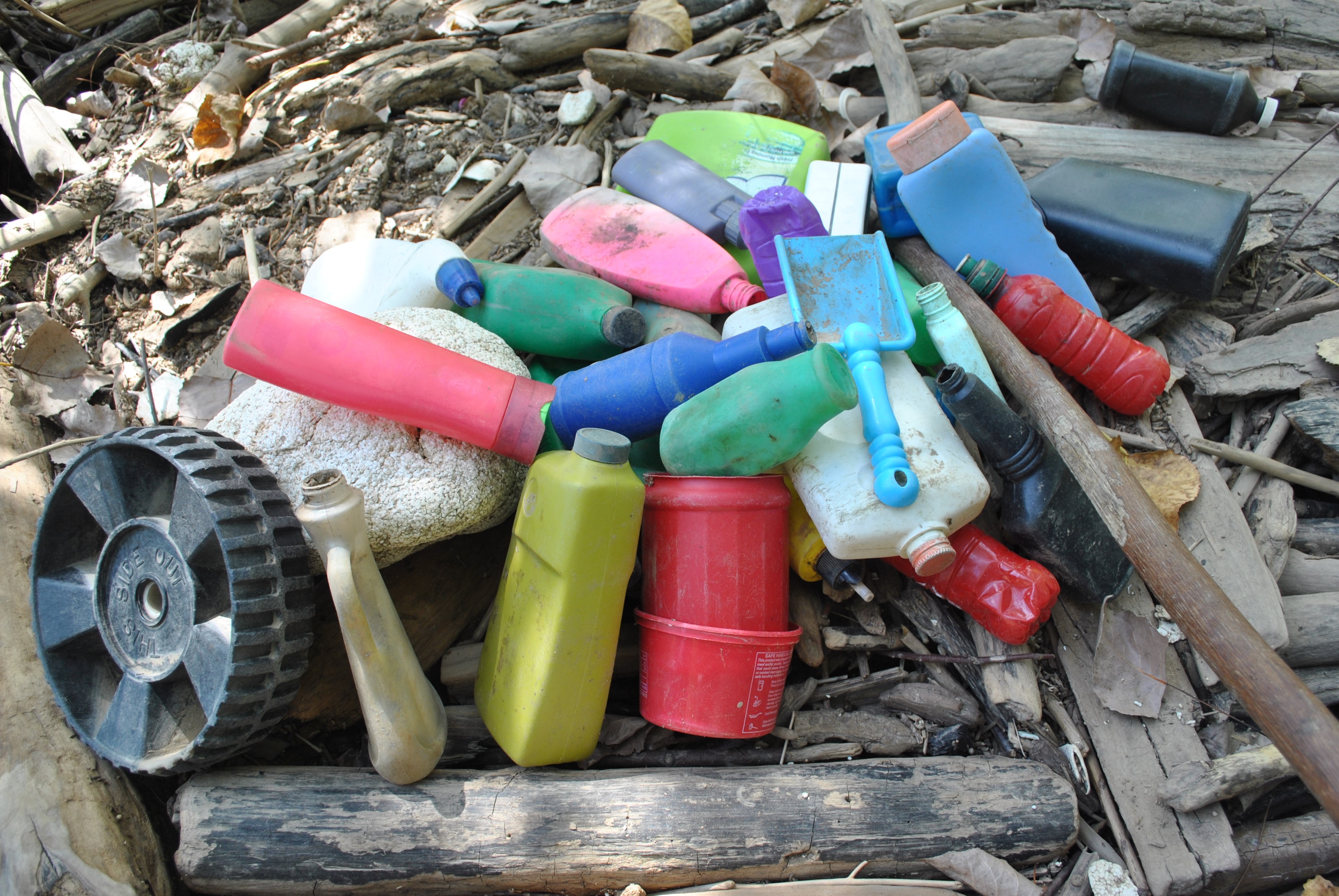
With the hot sun beating on me, I faithfully search the riverbank and collected the colorful discarded items that were first “gifted” to the river and then to me.  Walking from one promising area to another…I found enough plastic junk to make my next site specific piece.  Here’s another look at some of the objects that I found on this day.

River junk, Falls of the Ohio, early August 2015

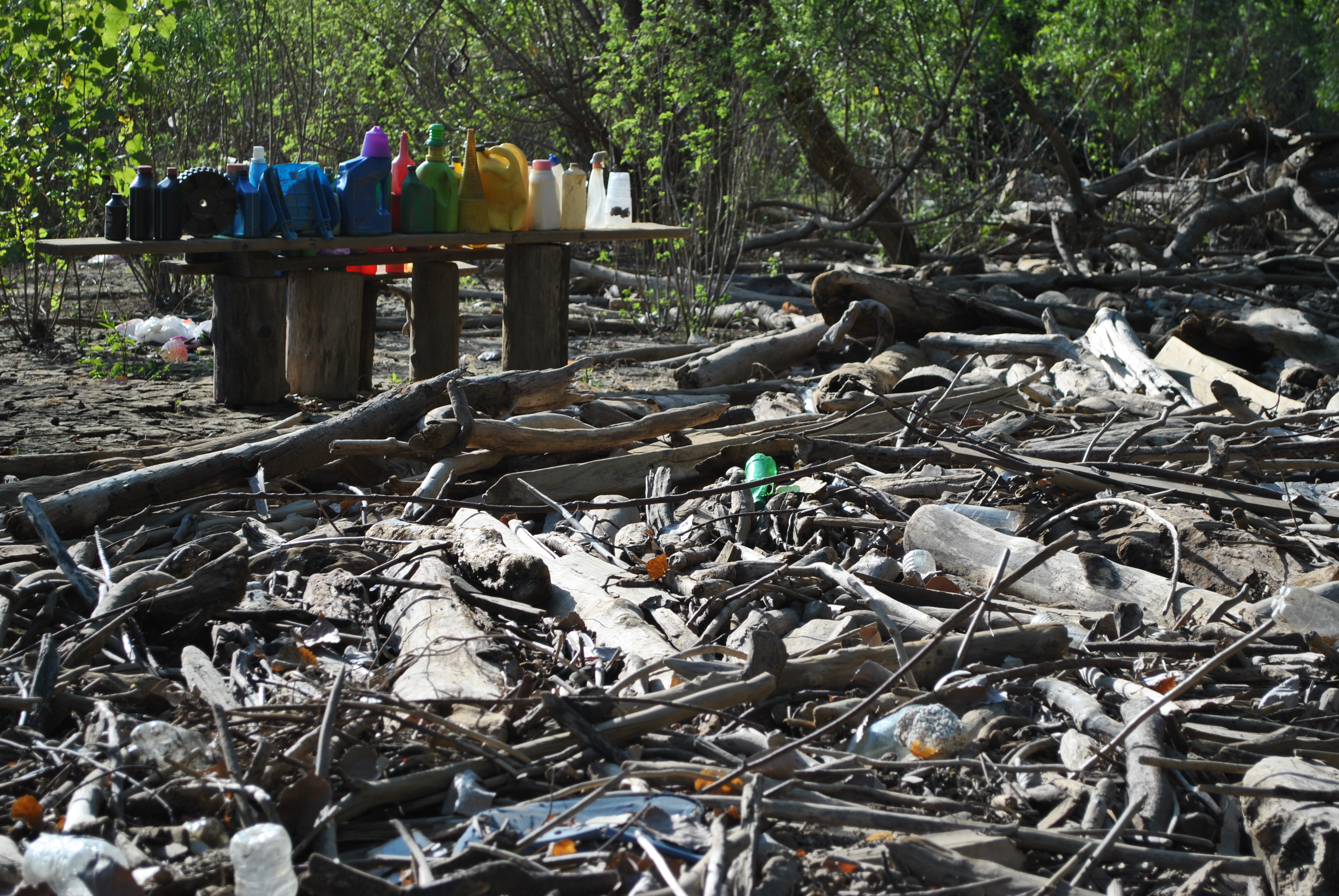
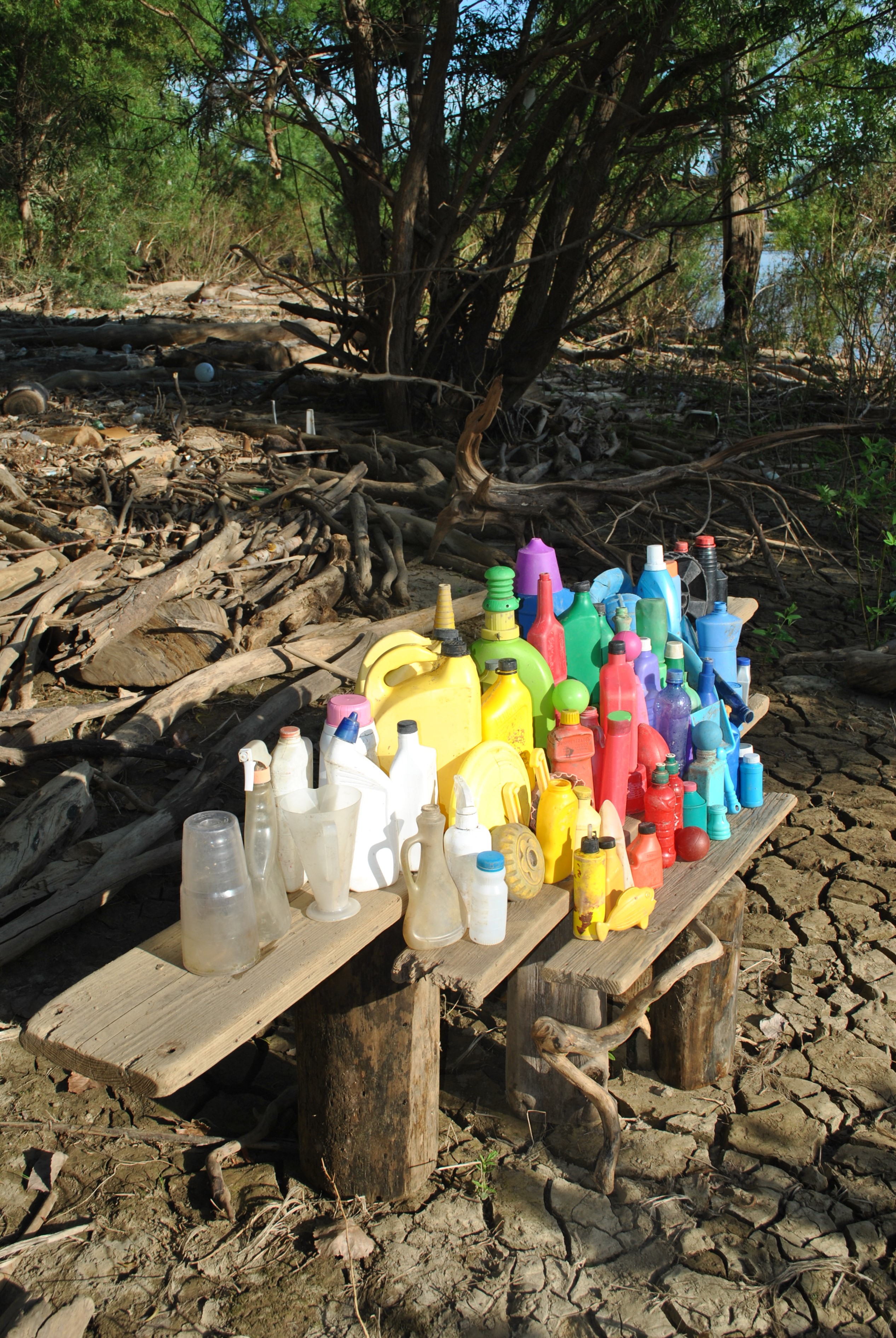
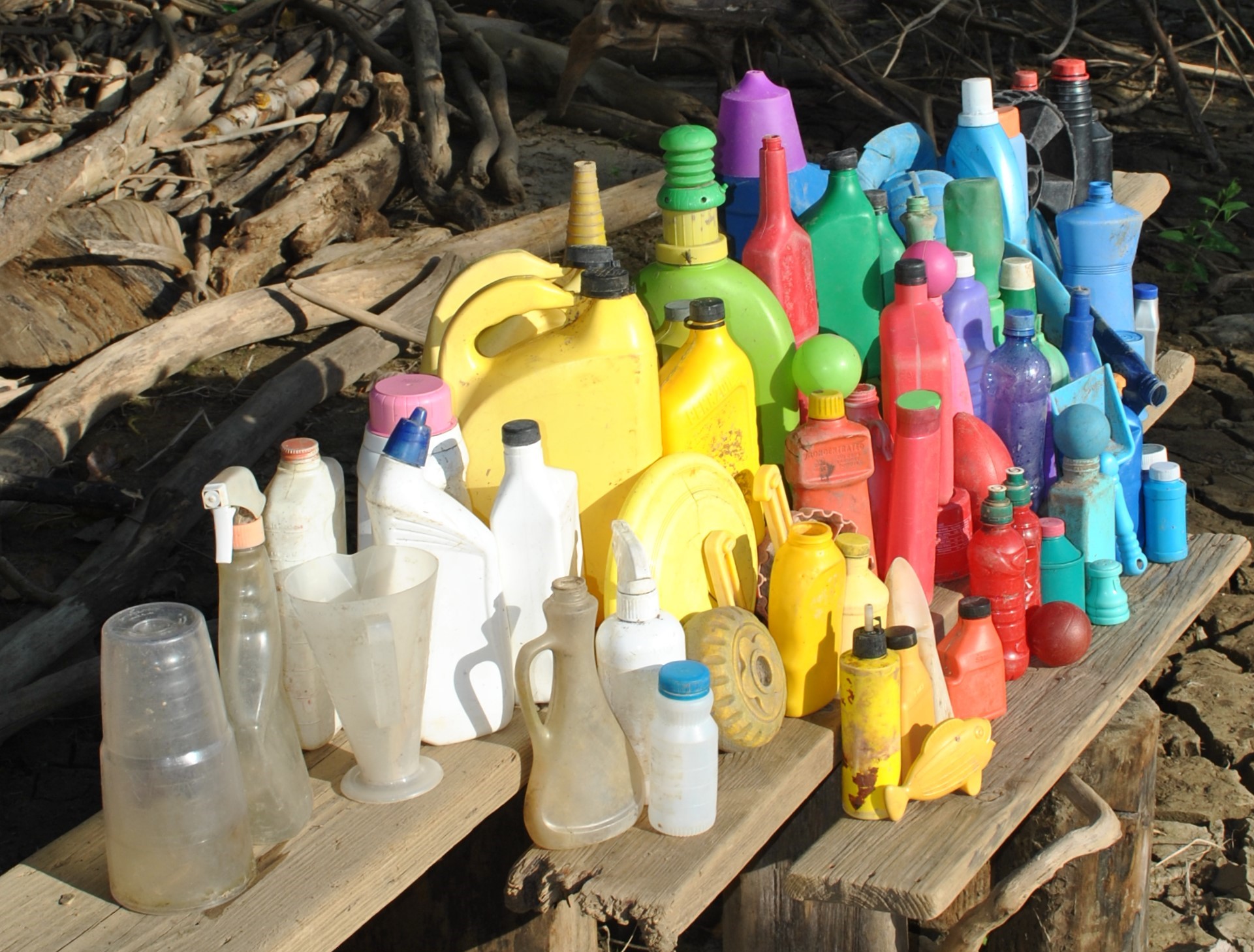
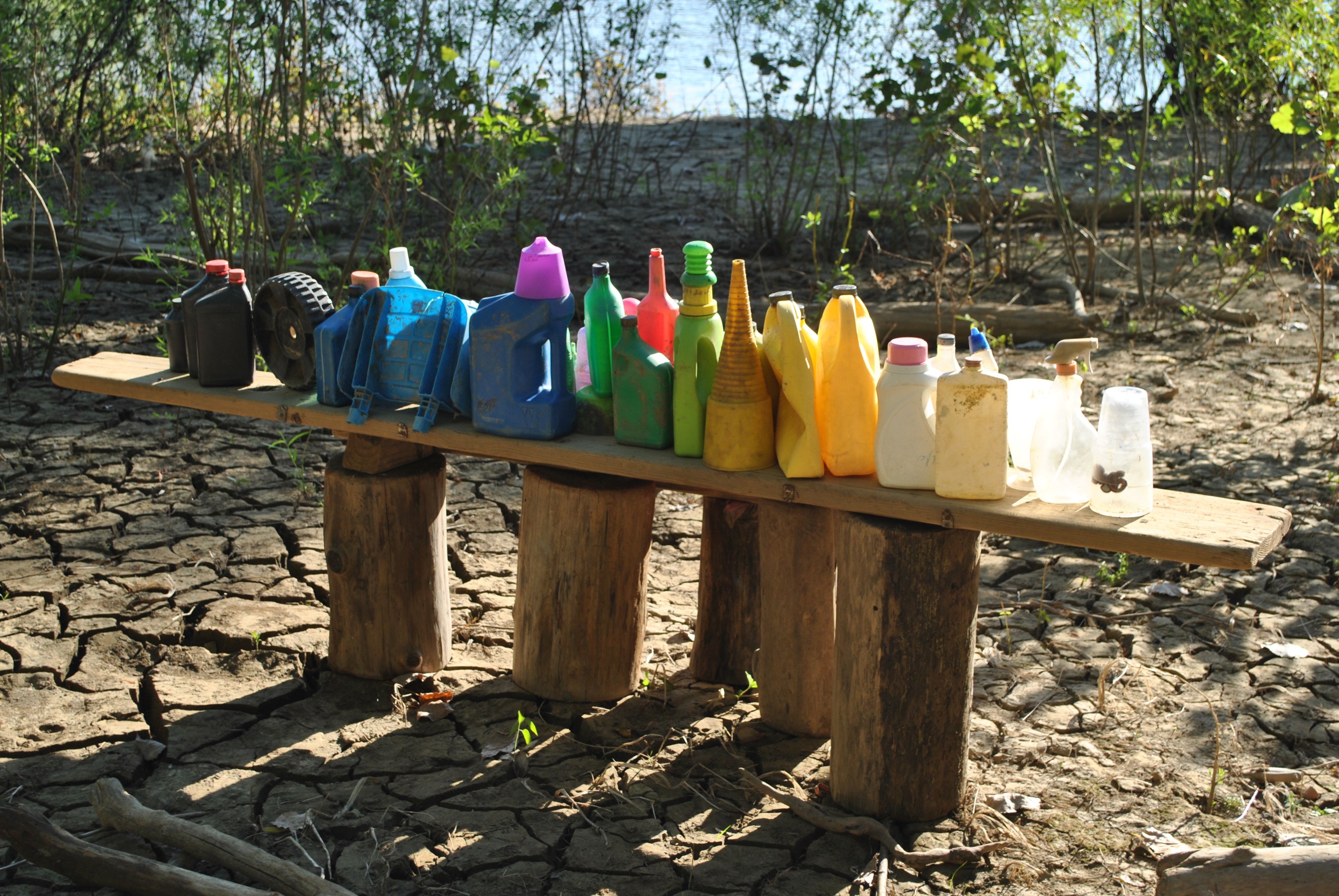
The really bright and colorful plastic objects virtually scream at you when you bother to pay attention.  Otherwise, it’s all just part of the material crap we create and dispose of indiscriminately.  Maybe because I’m looking for this kind of thing…I see it more easily.  I’ve trained my eye to spot the unnatural colors mixed among the gray and brown tones of the driftwood.  I decided to set up a display in a particularly promising area between two debris fields that was also close to the river.  I looked around and gathered some old milled boards and set them up on short, cut logs and before long had a table-like altar to lay my plastic treasures upon.  Following are several looks at the completed work.

The Western Petroleum Rainbow assemblage, Falls of the Ohio, early August 2015

Here’s a view from behind the piece.  You can see other bottles and junk mixed into the driftwood in the foreground.  I set this piece up on an area of cracked and drying river mud.

Western Petroleum Rainbow, early August 2015, Falls of the Ohio

Now a view from the front.  I placed this work here to take advantage of the sunlight which was beginning to set in the late afternoon.  I also wanted the verdant darkness behind all the colors to help create greater contrast.  There are three tiers of boards that I used for this display.  As is usual, I found less of some colors and more of others.  In this instance, I could have used a few more orange plastic objects, but just one small plastic bottle was all I found this time.

Angled view, Western Petrochemical Rainbow, early August, 2015, Falls of the Ohio

Detail view, Park West Petrochemical Rainbow, Falls of the Ohio, early August 2015

In the late afternoon, all the various colors in this plastic are energized by the sun’s electromagnetic spectrum which causes this junk to glow.  It’s the “golden hour” and one of my favorite times of day for its ability to infuse and unify the everyday with magic.  I have stayed out on the river far longer than I first anticipated.  The gnats and mosquitoes have had their way with me.  Plus all my granola bars for energy have been consumed and my water ran out a couple of hours a go.

Back view, Park West Petrochemical Rainbow

I’m fading fast and still have a long hike to make.  All the obstacles that were there on the way in will also be there on the way out of the park.  I took one last look back at my most recent project and decide that it is the best I can do at this particular moment.  I’m calling this one, the “Park West Petrochemical Rainbow” so I can remember what section of the park I visited when I assembled this piece.  I picked up my collecting bag and walking stick and made sure I wasn’t leaving something I might need behind me.  The rest is one foot in front of the other.  I let the fading beauty of the light distract me from my discomforts.  Food, water, and a nice shower are waiting for me at the end of the line.  See you later from the Falls of the Ohio State Park.

Sunset at the Falls of the Ohio, early August 2015

Read Full Post »

Wooden boat dock on debris pile, Falls of the Ohio, May 2015

So easy to get behind on creating new posts!  As it often happens out here at the Falls of the Ohio…more stuff goes on than most people care to read in a single post.  This will be a relatively short, but hopefully sweet story.  A few weeks a go on a lovely sunny and warm weekend morning I decided to visit the Falls and see how my green bottle piece was surviving.  I had positioned it on the other side of a washed out boat dock that was peaking out of a huge pile of driftwood and debris that had washed into here a few months a go.  The above photo is how it would first appear to anyone venturing onto this driftwood mound.  And, this is how it would appear from the other side looking towards the parking lot and fixed wier dam.

Green plastic bottle assemblage, Falls of the Ohio, May 2015

My segregating all the green glass and plastic bottles into the exposed structure of the boat dock was holding up fairly well.  I just had a little bit of straightening up to do.  The fact I went back to something I had made before was somewhat unusual since I prefer moving forward by making something new.  I guess this piece was holding up a little better than some of my other projects by virtue of it being somewhat hidden and few folks want to venture onto this shifting mound of materiality.  You can get hurt here if you are not careful and it’s easy to have a foot go through a weak spot on the mound.  This has happened to me many times, but knock on wood, I have never been injured by my carelessness.  I was admiring my handiwork and whistling to the Baltimore Orioles that were in the nearby cottonwood trees when I saw two people approaching my position.

Marjie and Anika make a Styrofoam sculpture, Falls of the Ohio, May 2015

Marjie and Anika and their Styrofoam creation, Falls of the Ohio, May 2015

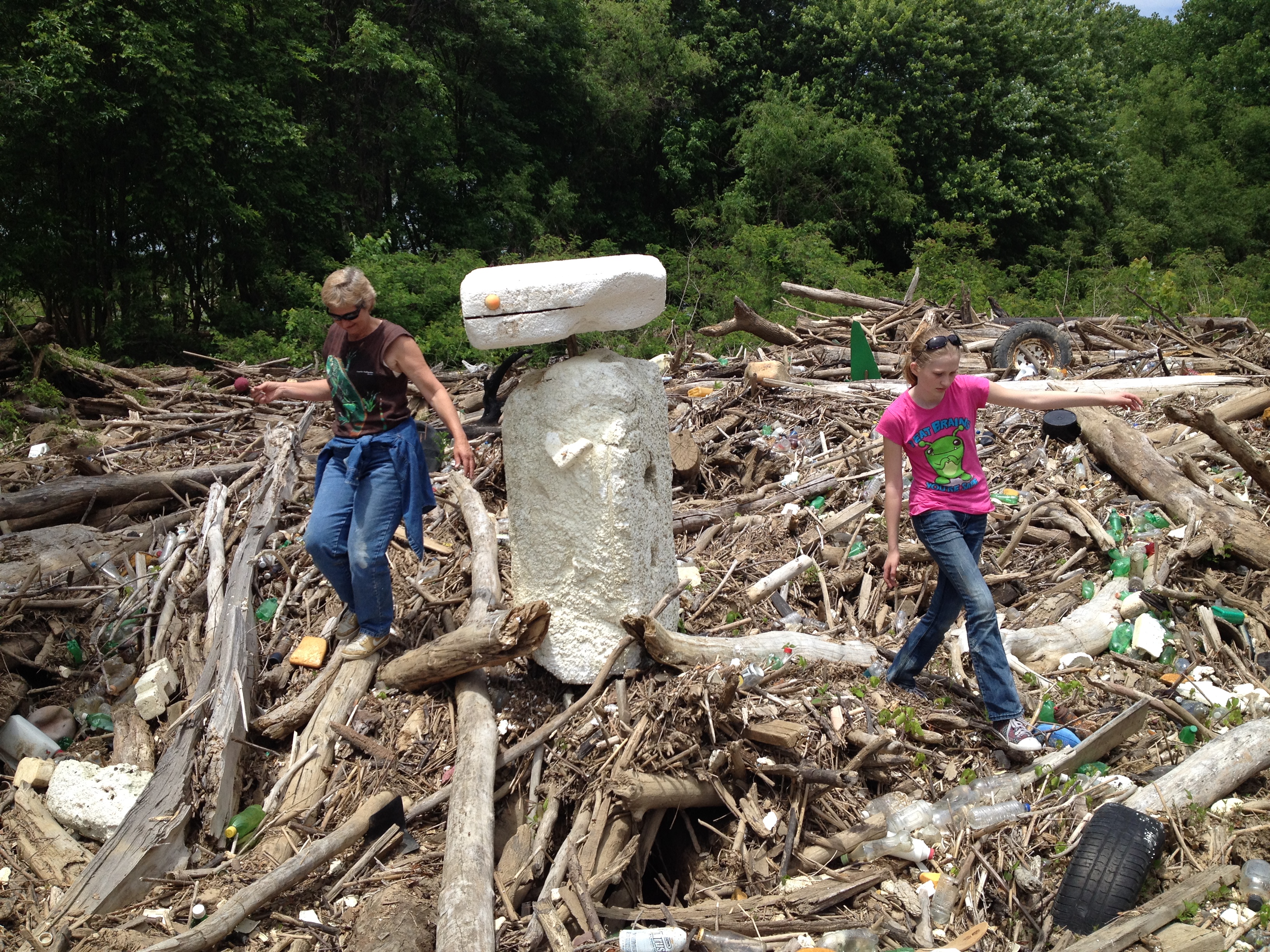
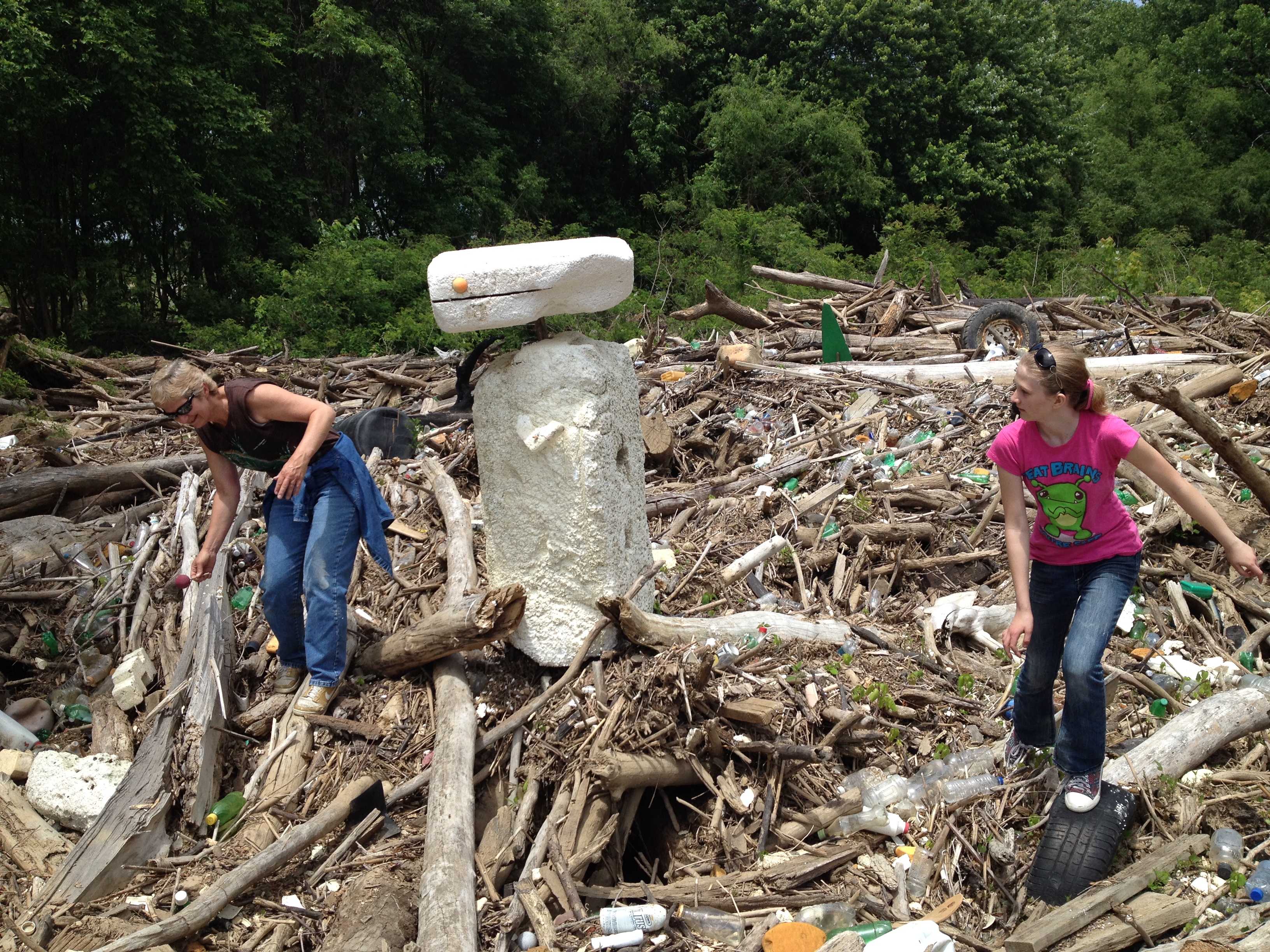
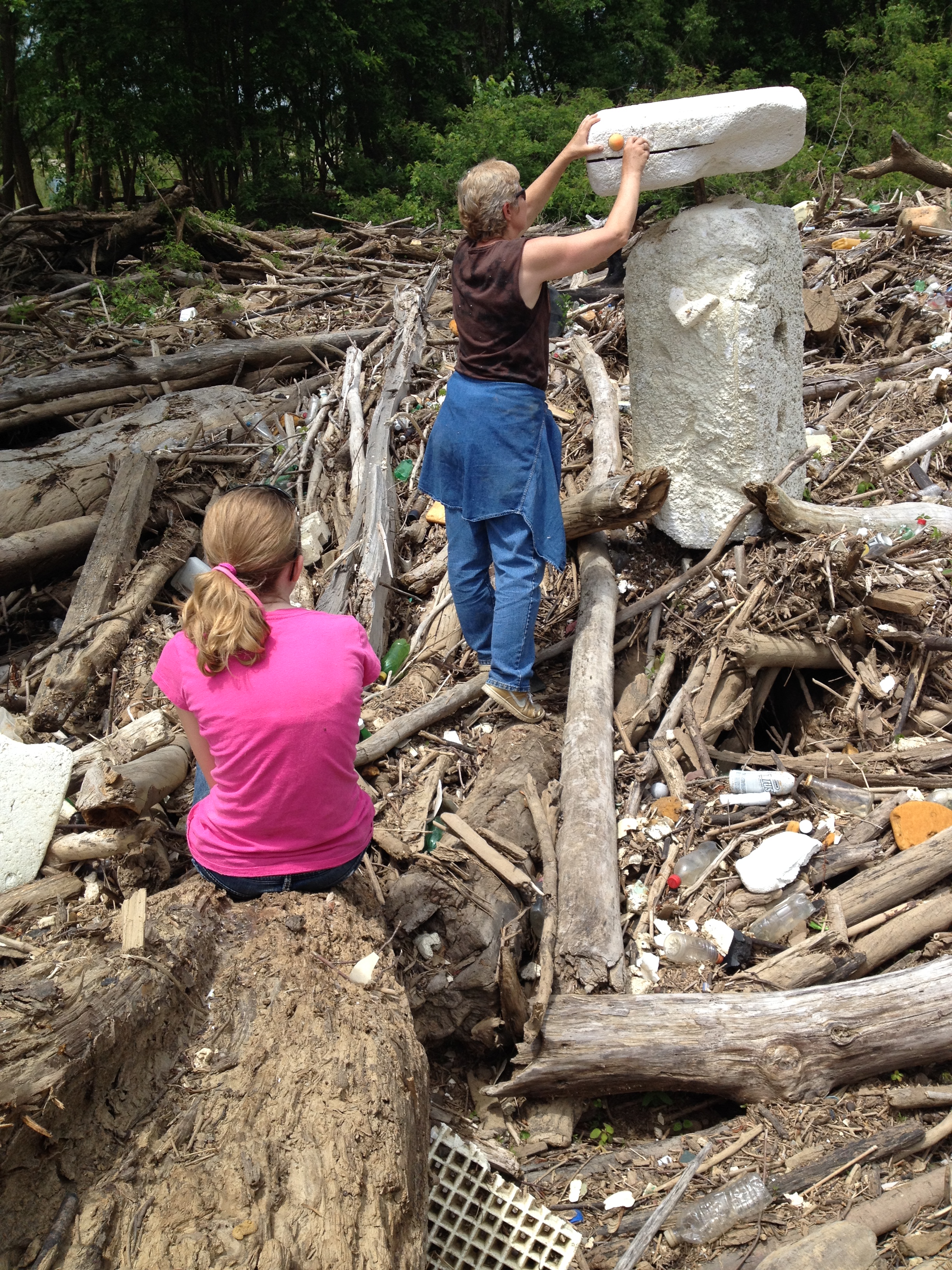
Here are a couple of pictures of my new friends in action.  It’s the mother and daughter team of Marjie and Anika and they were here at the Falls collecting flat, weathered boards for a shed they were making back at their home.  When they saw me they came right over to see what I was doing and they saw the bottle piece which they enjoyed.  Of course, one thing led to another and we had a great conversation about conservation, recycling, and the value of being outdoors.  We even discovered that we have a good friend in common in Claude Stephens who works at Bernheim Arboretum and Research Forest.  They were once neighbors.  Marjie is a very practical and inventive person and I was particularly struck by how she has been able to eliminate all the soap products from her home save one.  I don’t want to mention that product by name, but you are familiar with it.  It’s a dishwashing liquid that is especially good at cleaning oil soaked sea mammals and birds.  Apparently, by adjusting the strength of the soap by diluting it with water you can have an all-purpose cleanser that’s good for the laundry and can be used for shampoo too!  Standing on this debris mound, it would be very easy to show you examples of all the many plastic containers that are used by all the myriad kinds of soap products.  Cutting them out of our waste chain would be a dream come true!  I showed them images of other projects I had made and stored on my cell phone and they became inspired by some of the figurative pieces I’ve made from Styrofoam.  That got this dynamic duo going and they were off to make a Styrofoam sculpture of their very own!

Anika and Marjie make a figure, Falls of the Ohio, May 2015

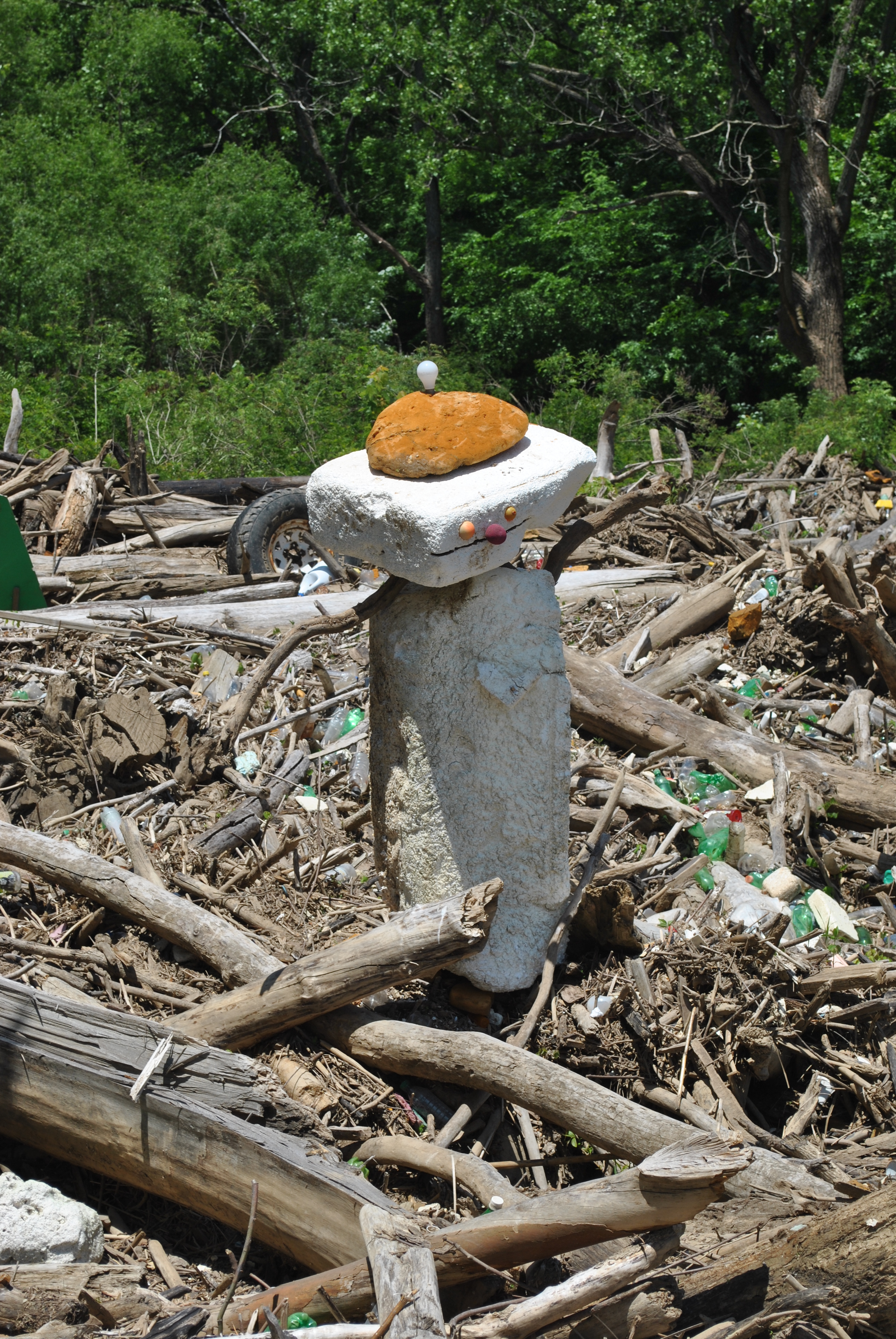
They are an ambitious pair and decided to use the biggest polystyrene chunks they could find on this mound.  I helped them set the body upright since it was still a bit heavy with retained water.  The figure soon became a robot with found toy balls for eyes and a light bulb stuck on top of its head like a cherry on a sundae!  It was a bit tricky keeping one’s balance standing on the driftwood.  I find it helps to stand on the bigger logs which are less likely to shift or break.  After sticking on a pair of arms, Marjie and Anika left their creation in place.  We said our goodbyes and they collected the boards they had chosen for their shed and went home.  I stuck around a little longer and took a few more images.

Marjie and Anika's Robot Man, Falls of the Ohio, May 2015

Robot Man at the Falls of the Ohio, May 2015

It’s rare when I meet folks out here who not only “get” what I do, but want to participate too.  Creativity is a human birthright and can be expressed in so many ways.  I especially enjoy it when I meet people who use their creativity to benefit the planet even in the smallest way.  Those individuals inspire me.  I exchanged email addresses with Marjie and she later sent me pictures of the shed she built at home.  As it turns out, this was not the last time I would meet mother and daughter.  They came out in support of a Public Art Walk event that was produced by the organization I now work for…the Carnegie Center for Art and History in historic New Albany, Indiana.  Work there has been keeping me busy, but I manage to come and visit my beloved Falls and Ohio River whenever opportunity allows.  I’ve made other projects lately and look forward to sharing them with you soon.  Here’s to everyone having a great summer this year!

Diesel engines crossing the Falls of the Ohio, May 2015

Read Full Post »

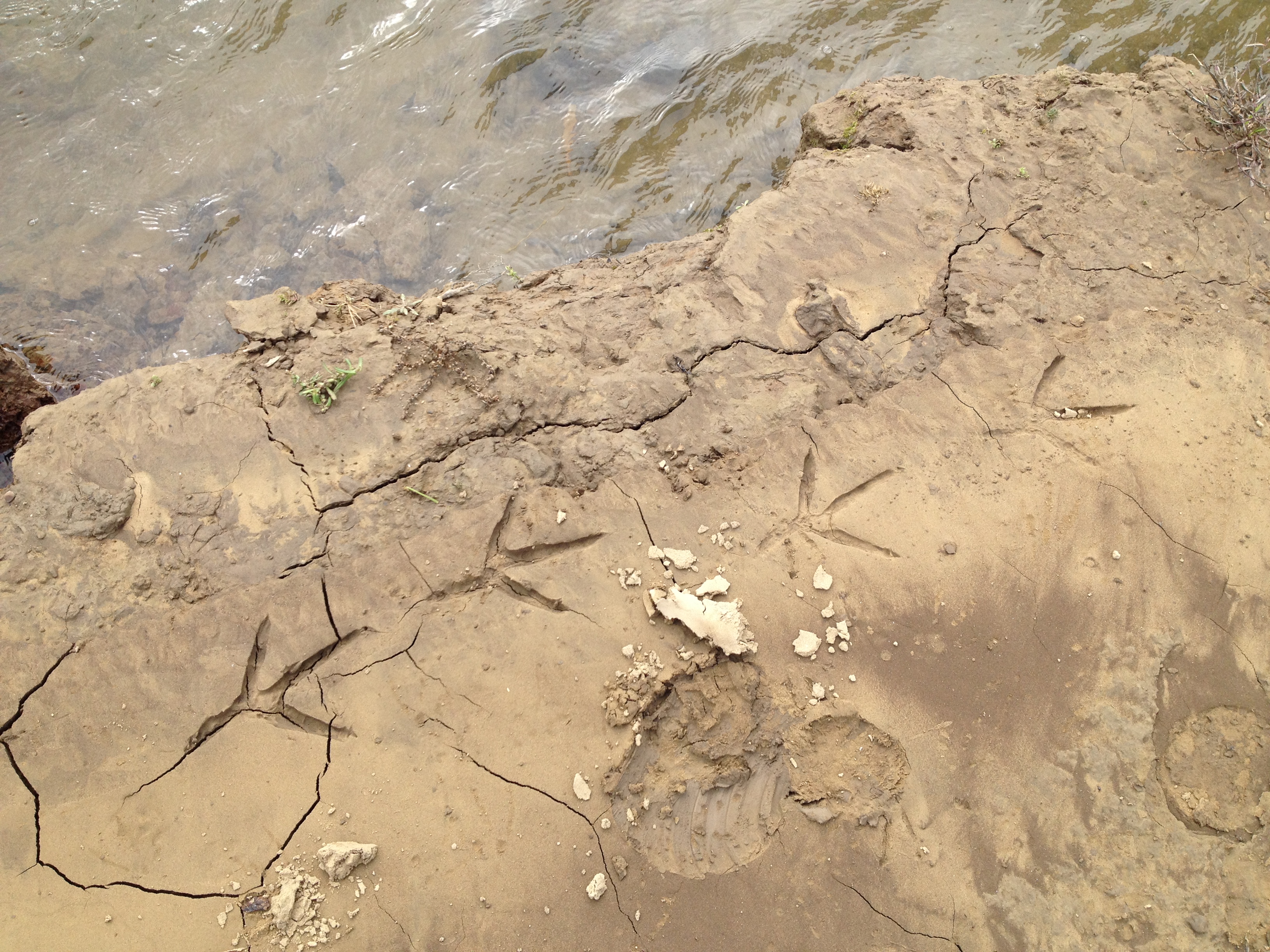
Great Blue Heron tracks in the mud, Falls of the Ohio, Oct. 2014

What began overcast and dreary blossomed into a gorgeous, sun-filled autumn day.  The exposed fossil beds by the Upper Tainter Gates are now covered by water rushing at break neck speed.  The Ohio River has once again reclaimed its ancient limestone bed with man’s help.  The Falls of the Ohio are like Niagara Falls which can also be regulated with the flip of a switch.  There’s a good chance that I won’t be visiting that side of the park again until next summer’s heat returns.  Today I concentrated my attention and energy along the riverbank under the Conrail Railroad Bridge.  This is an area where I have had good luck finding materials to work with and many of my best bird sightings have also occurred here.  The autumnal migration is under way.  Many of the birds that had passed this way going north in the spring are now moving south towards wintering grounds in exotic locations in Central and South America.  I ducked under the Black willow trees whose leaves are turning bright yellow and was soon rewarded by a bird species new to me.

Fan-tailed Gnatcatcher, Falls of the Ohio, Oct. 2014

This is the Fan-tailed Gnatcatcher and this is the first time this species has been recorded in the park.  I had the greatest luck hiding behind the trunk of this willow and was able to observe this bird at extremely close range.  If it spotted me…it demonstrated no concern at all and continued its search for small insects and spiders hiding among the furrows in the tree’s bark.

Fan-tailed Gnatcatcher, Falls of the Ohio, Oct. 2014

The Fan-tailed Gnatcatcher is a diminutive bird.  I watched as it dutifully searched the tree for food.  It had no problems going down the tree head-first in nuthatch fashion.  In this species, both the male and the females are similarly marked.  This young bird (identified by its lack of a feathered crest on it head) was just an egg a couple of months a go and has flown here from northern Canada.

Fan-tailed Gnatcatcher, Falls of the Ohio, Oct. 2014

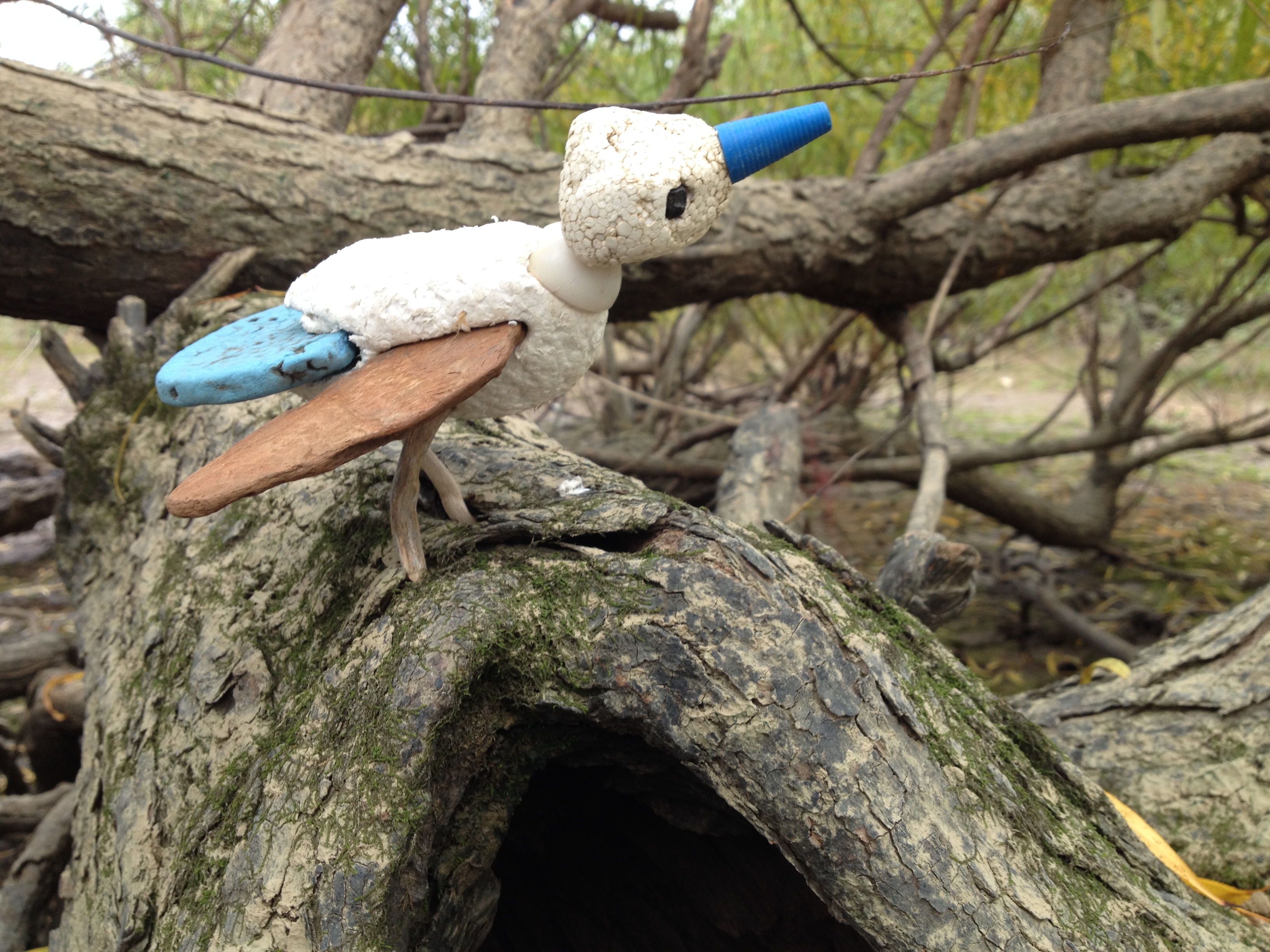
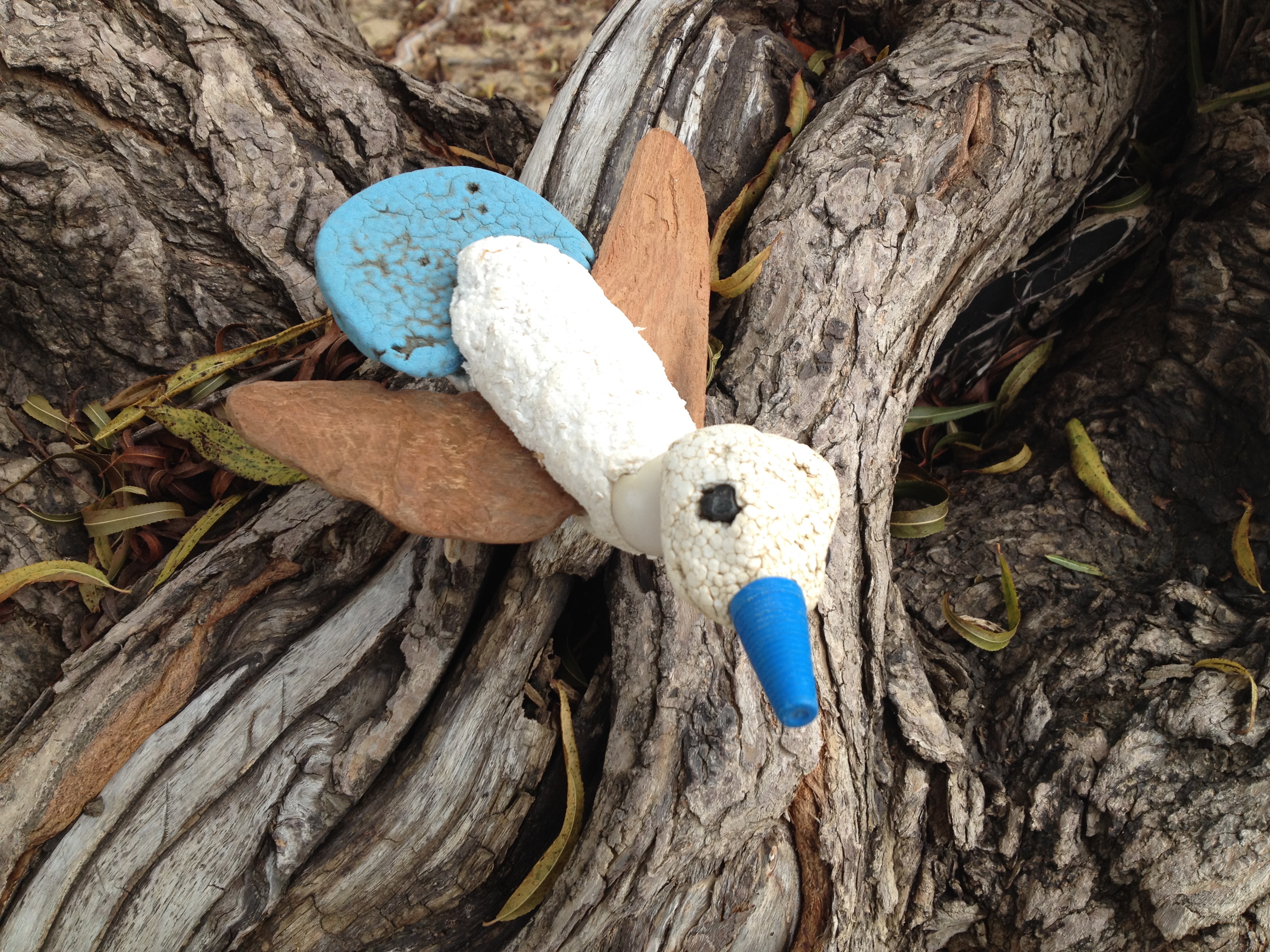
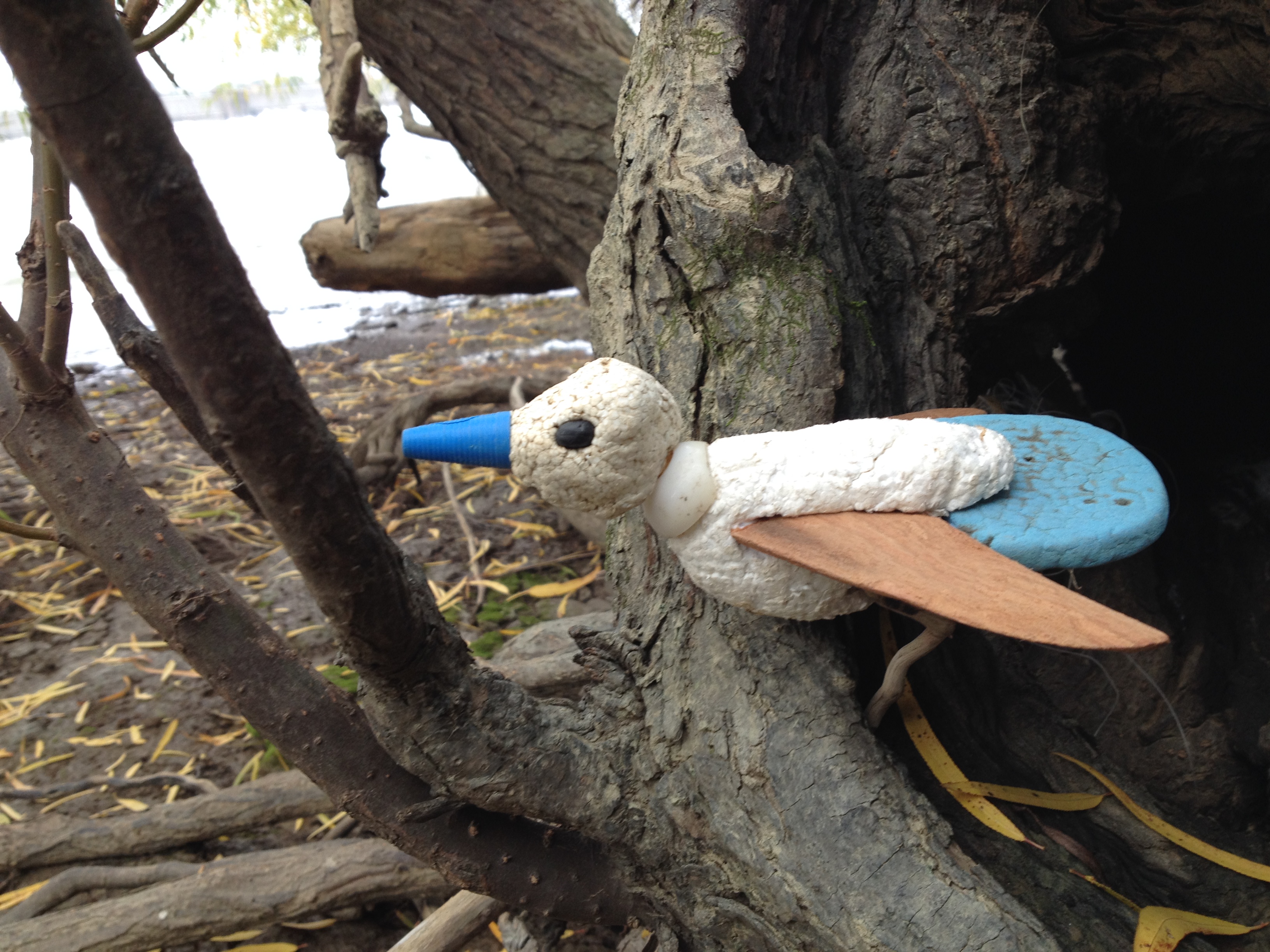
I was literally at arm’s length to this bird and it was a such a treat to observe something new and at close range.  I loved the coloration on this bird.  The tail feather’s blue fan is balanced by the bird’s bright blue beak.  Rusty-colored wings are set off by the arctic-white hues along the head and body.  Like many bird encounters, I was only able to observe this bird for a minute or two at the most, but it was an experience that will last a lifetime.  As it flew off…I wished the bird well on its long journey and I hoped I could count its kind again among the park’s willow trees.

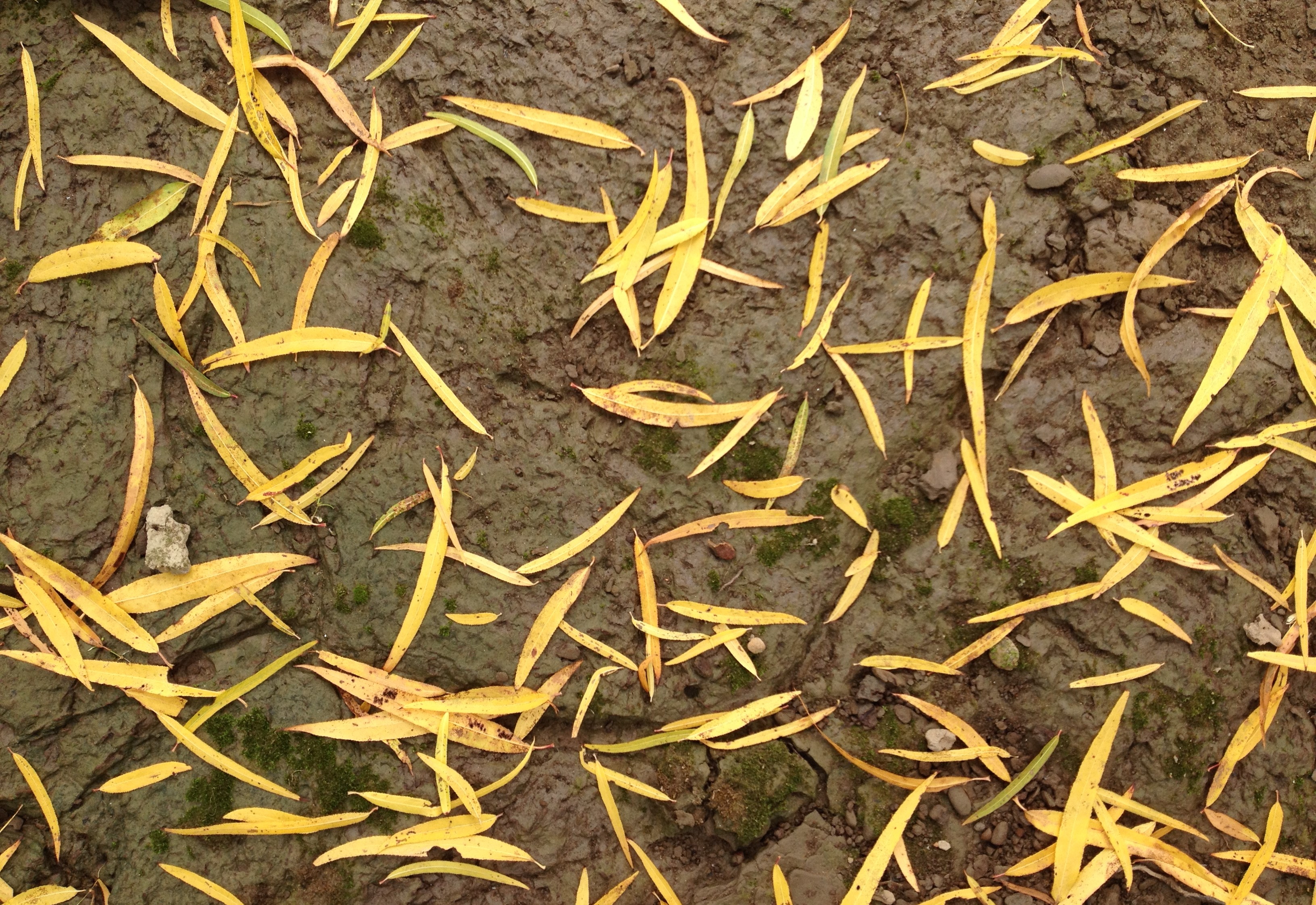
fallen willow leave on mud, Falls of the Ohio, Oct. 2014

I lingered in the moment for a while.  No sense in rushing things.  When I was confident that no other birds were in the area, I moved back to a spot where the Fixed Wier Dam joins the Lower Tainter Gates.  This would be the site for my next project.

stone and concrete ring by the dam, Falls of the Ohio, Oct. 2014

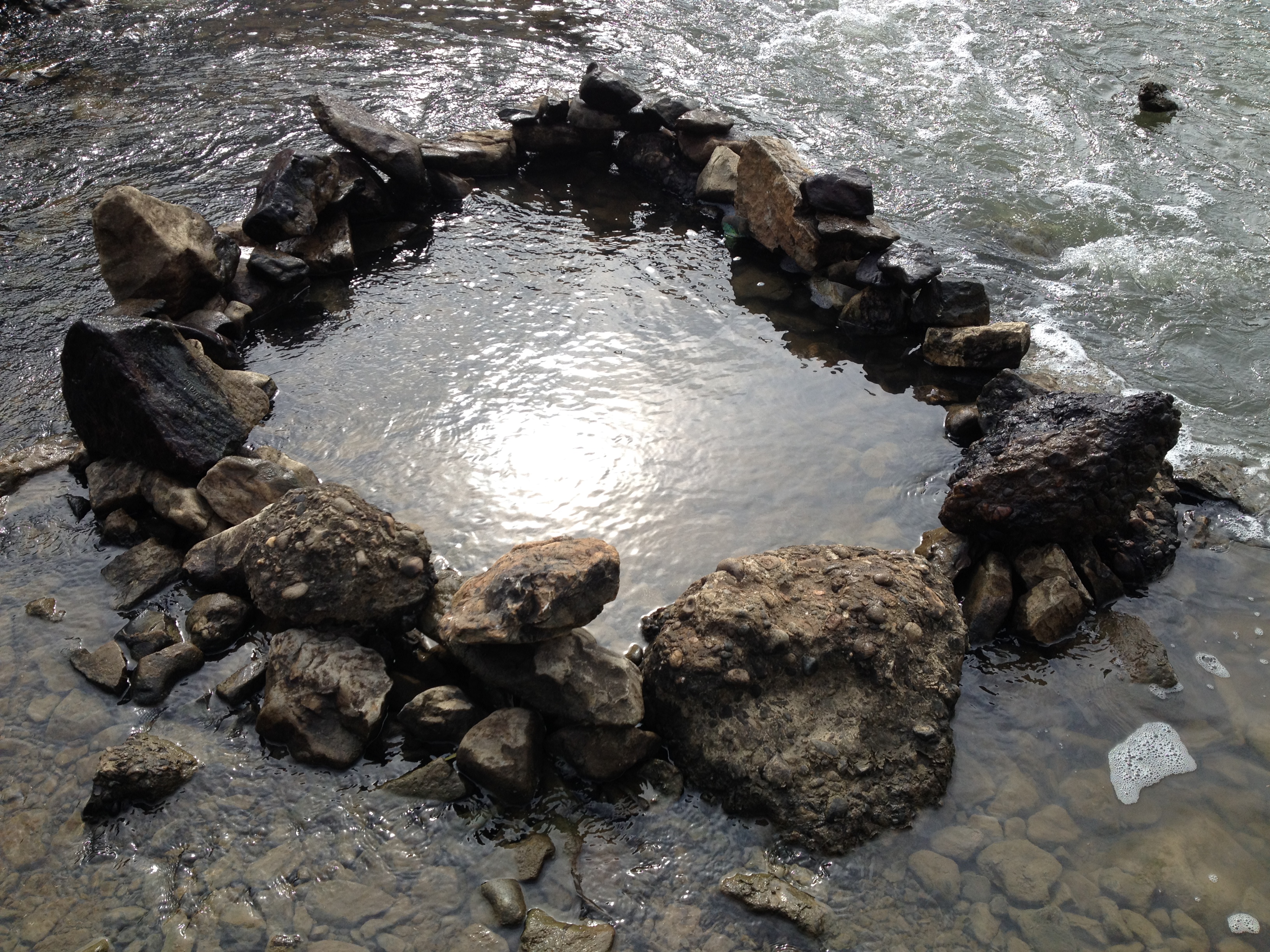
The dam at this location has curtains of water flowing through openings that are lower than the top of the wall and represents the true water level of the river.  This flow feeds a small channel that leads back to the river and is a favorite place for fishermen.  I had earlier noticed among the large broken sections of concrete and loose rock that some other creative soul(s) had started what looked like a stacked stone ring in the water.  There was the remnants of a foundation and I decided to build it back up for a look-see and to elaborate on it if possible.  I guess this in effect is a collaboration with an anonymous individual.  The image above was taken after I began reconstructing the ring.

Sun light reflecting with the stone ring, Falls of the Ohio, Oct. 2014

As I kept building up the ring, I would document my progress.  This is one of my favorite shots from the series.  Here I was able to center the sun’s reflection within the ring’s interior.  In my mind it became a portal to some other place far beyond the river.  The image of a passage way or tunnel is one that recurs in my Falls projects.

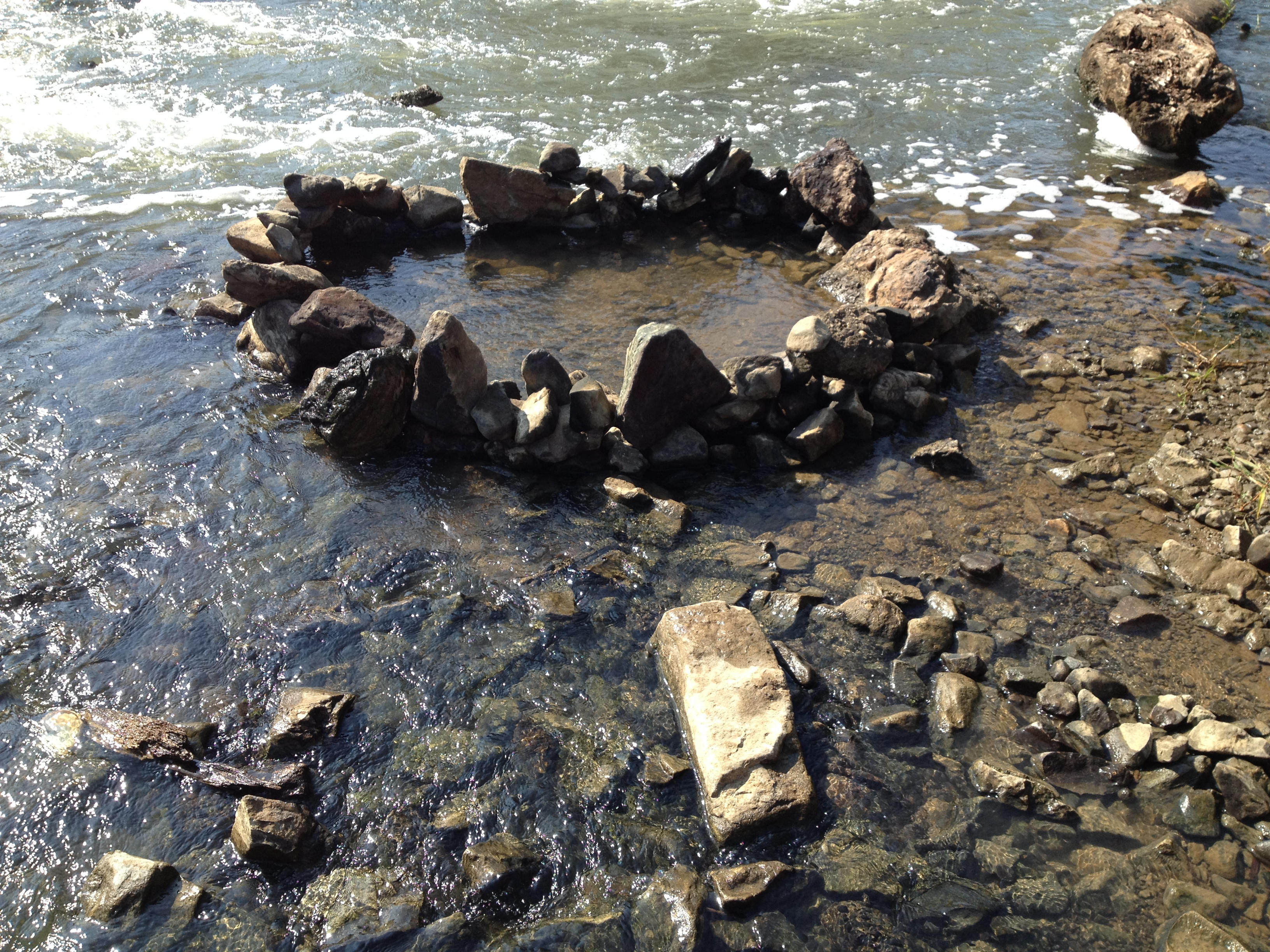
rock and concrete ring, Falls of the Ohio, Oct. 2014

I would have added the rectangular rock in the foreground, but it proved heavy and sunk into the mud.  Interestingly, the water within the ring was much calmer and created a safe harbor which contrasted with the swiftly flowing water around it.

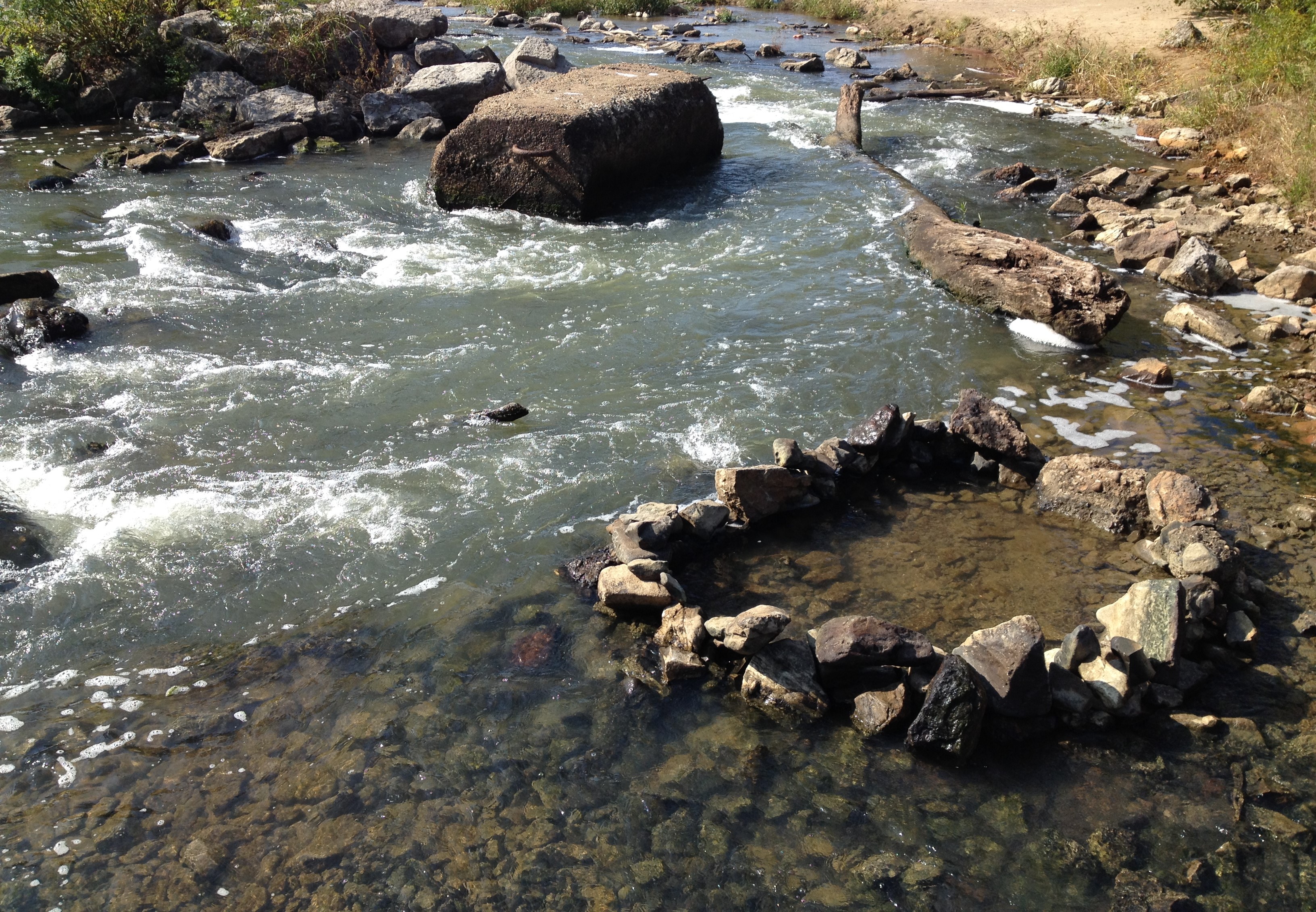
rock and concrete ring, Falls of the Ohio, Oct. 2014

The ring’s slightly irregular shape was determined by its placement.  The ring is situated on the edge of where the water cascading off the dam’s wall has worn a deeper channel in the shallow bottom.  Since it was such a beautiful day I decided to spend more time at the Falls.  I made one other site-specific work where the center is a point of focus.

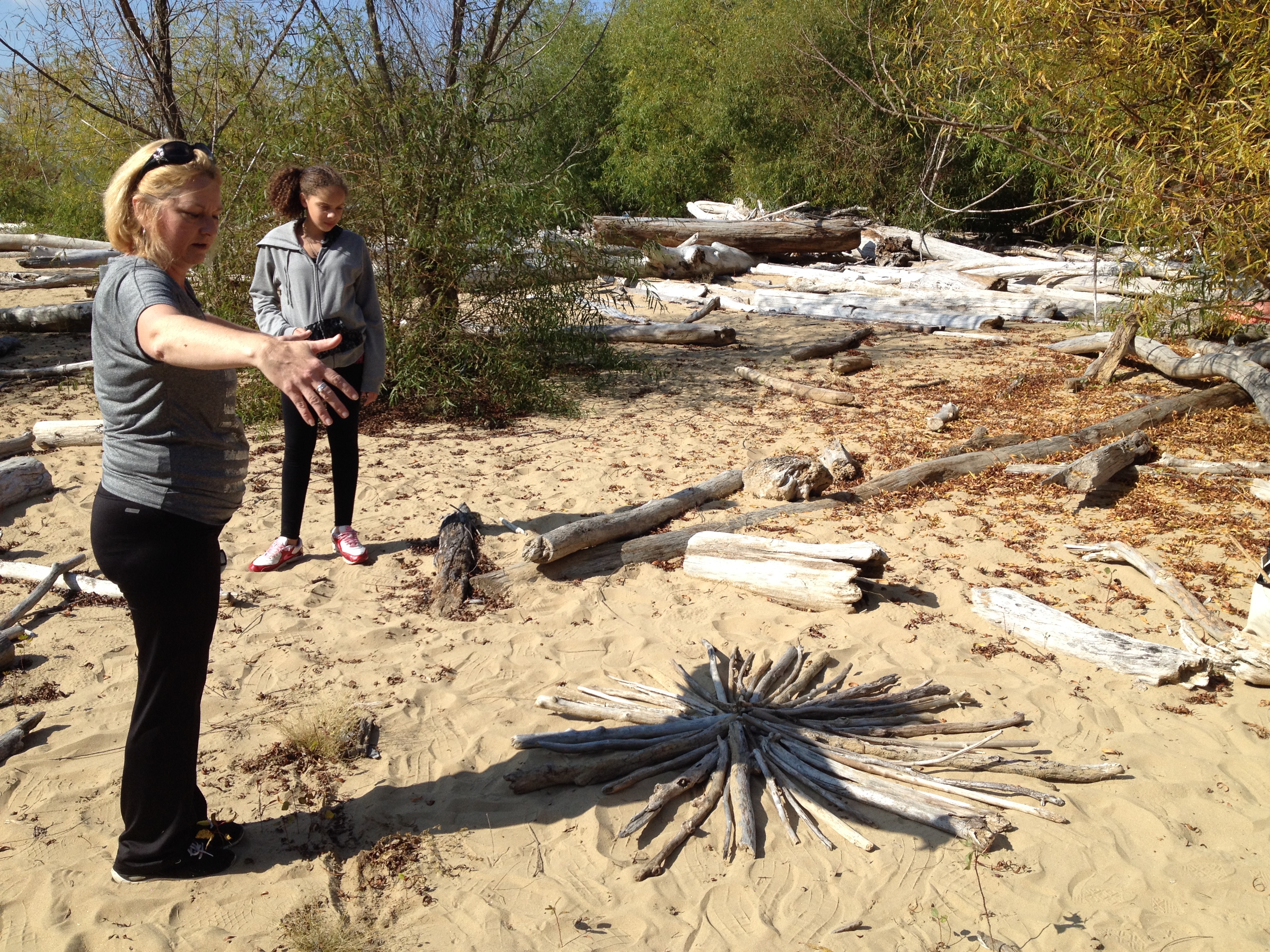
silver driftwood star, Falls of the Ohio, Oct. 2014

Detail of silver driftwood star, Falls of the Ohio, Oct. 2014


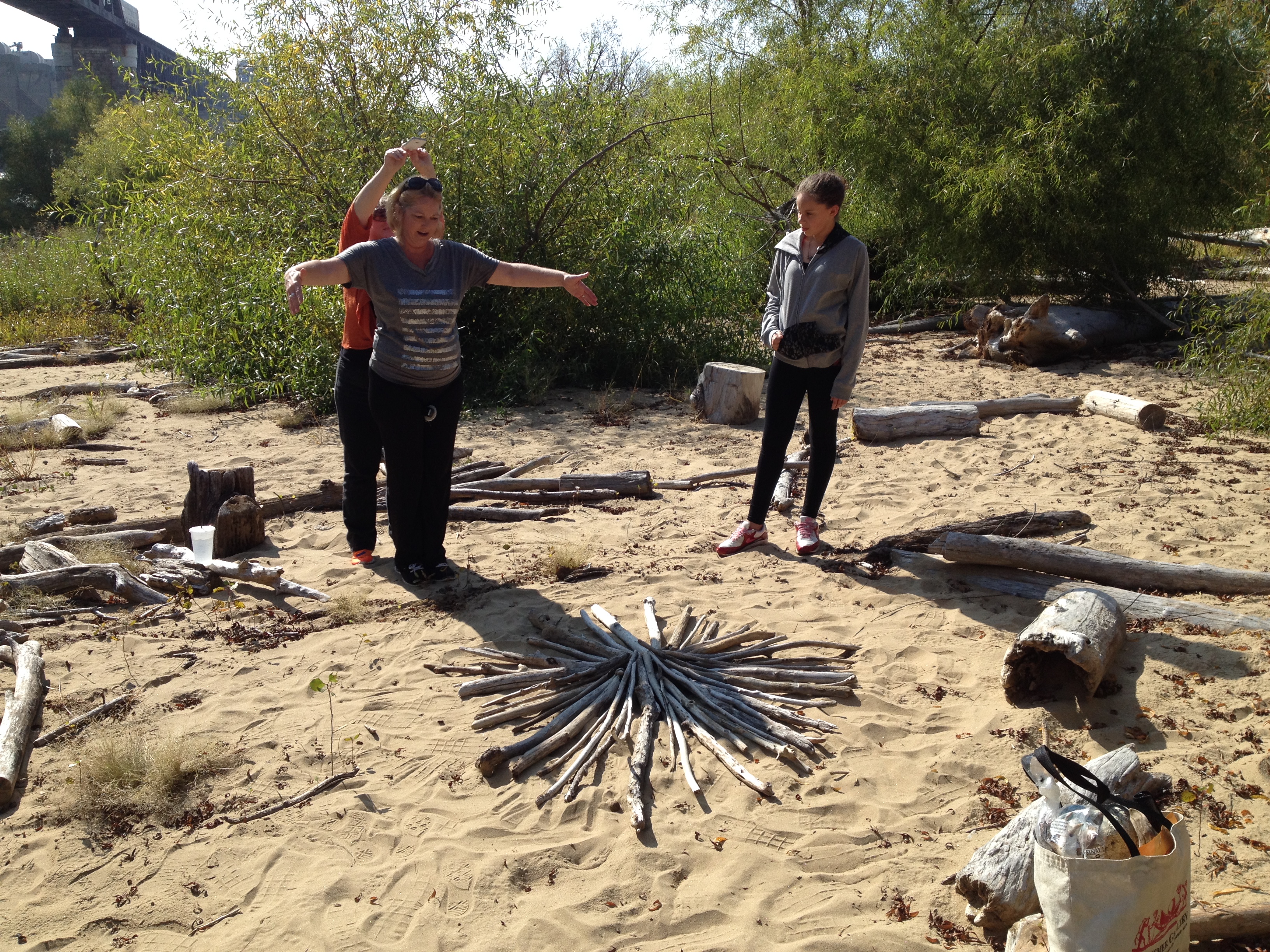
What I love about the driftwood at the Falls of the Ohio is the way it changes color as it ages.  After a summer’s worth of sunlight, the wood here takes on a silvery-gray color.  I collected lengths of wood from the immediate area and laid them in the sand.  The silver driftwood radiates away from a central point.  While I was engaged with my “Silver Star” four very nice people stopped by and asked directions to the fossil beds.  These park visitors became interested in what I was doing.  I appreciated that they wanted to participate and play along in their own way.  Here are a few additional images.  I’m assuming they are two mothers with their daughters enjoying an outing to the river?  Here one person is photographing the cast shadow on my wood piece.

Visitors interacting with my art, Falls of the Ohio, Oct. 2014

Park visitors interacting with my driftwood star, Falls of the Ohio, Oct. 2014

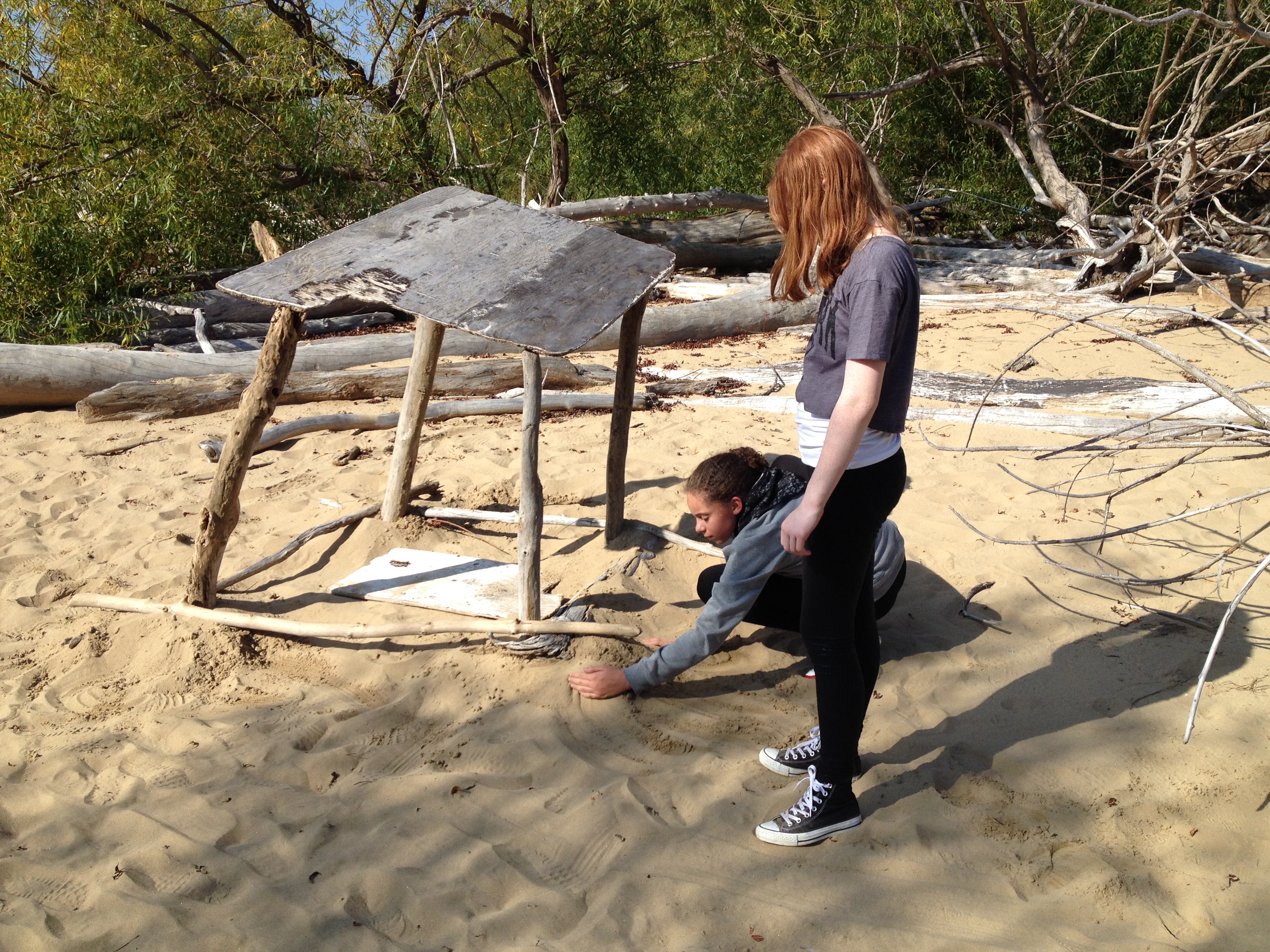
I think I may have inspired the daughters to attempt their own project?  Before too long they were picking up pieces of driftwood and making a make-shift shelter of their own design.

Girls making a driftwood shelter, Falls of the Ohio, Oct. 2014

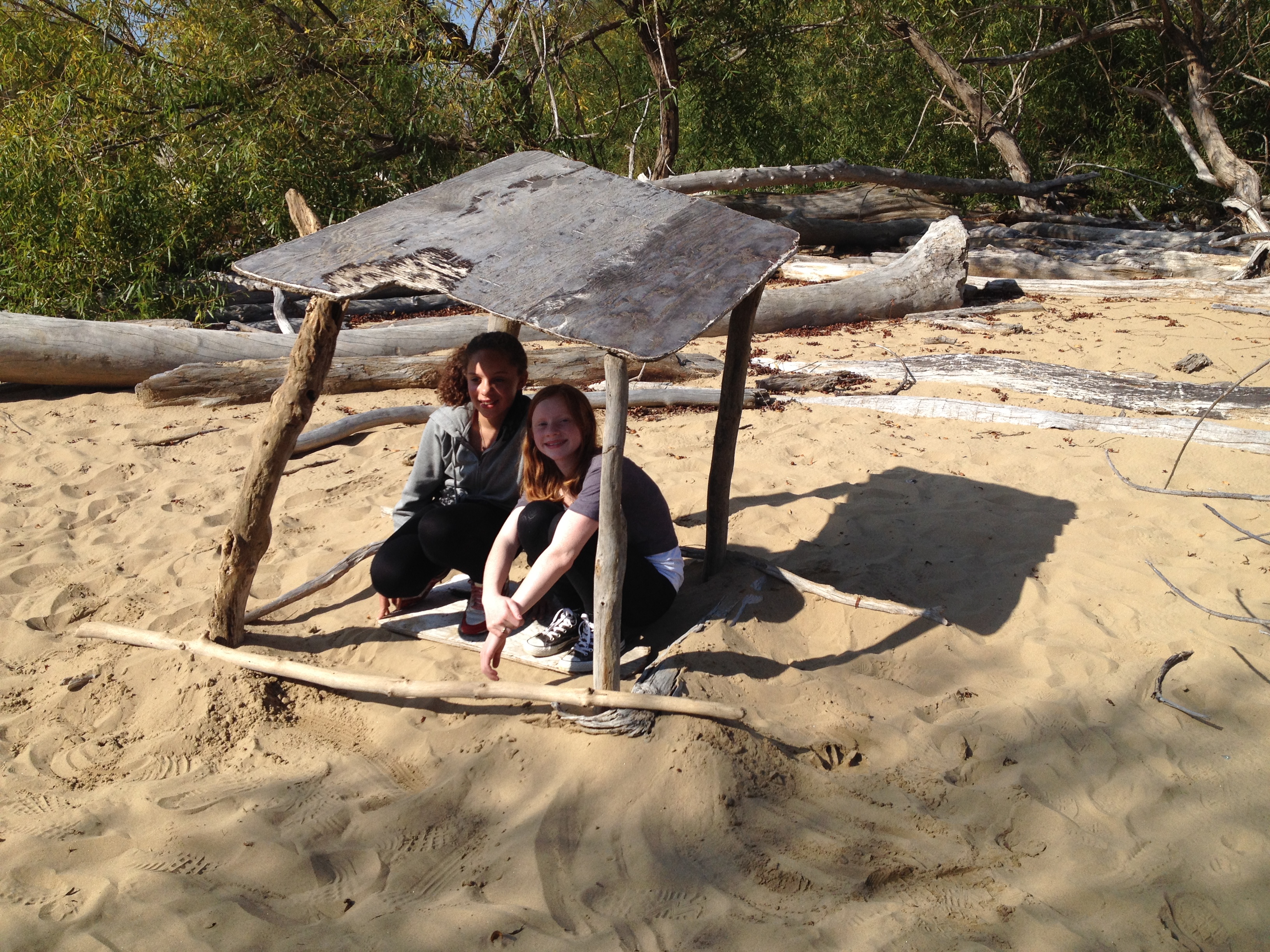
Girls posed under their improvised shelter, Falls of the Ohio, Oct. 2014

The girls looked very happy under their driftwood shelter!  When my sons were younger, this was a favorite activity of theirs and this day brought back those good memories.  This park is such a great playground and allows one to exercise both your body and imagination.  I wonder if these ladies ever found the fossil beds?  It probably doesn’t matter since it looked like a good time was had by all.  Soon enough it was time to go home and I gathered up my collecting bag and walking stick and admired the late season flowers as I walked back to my vehicle.  Thanks for tagging along and I hope to see you next time from the Falls of the Ohio State Park.

tiny composite flowers with bee, Falls of the Ohio, Oct. 2014

Read Full Post »

Under the railroad bridge, Tainter Gates, Sept. 2014

Two years have passed since I last set foot on the fossil beds on the Kentucky side of the river.  I had to wait until I fully trusted a bum knee to be well enough to walk upon the hard, irregular limestone surface that for most of the year is underwater.

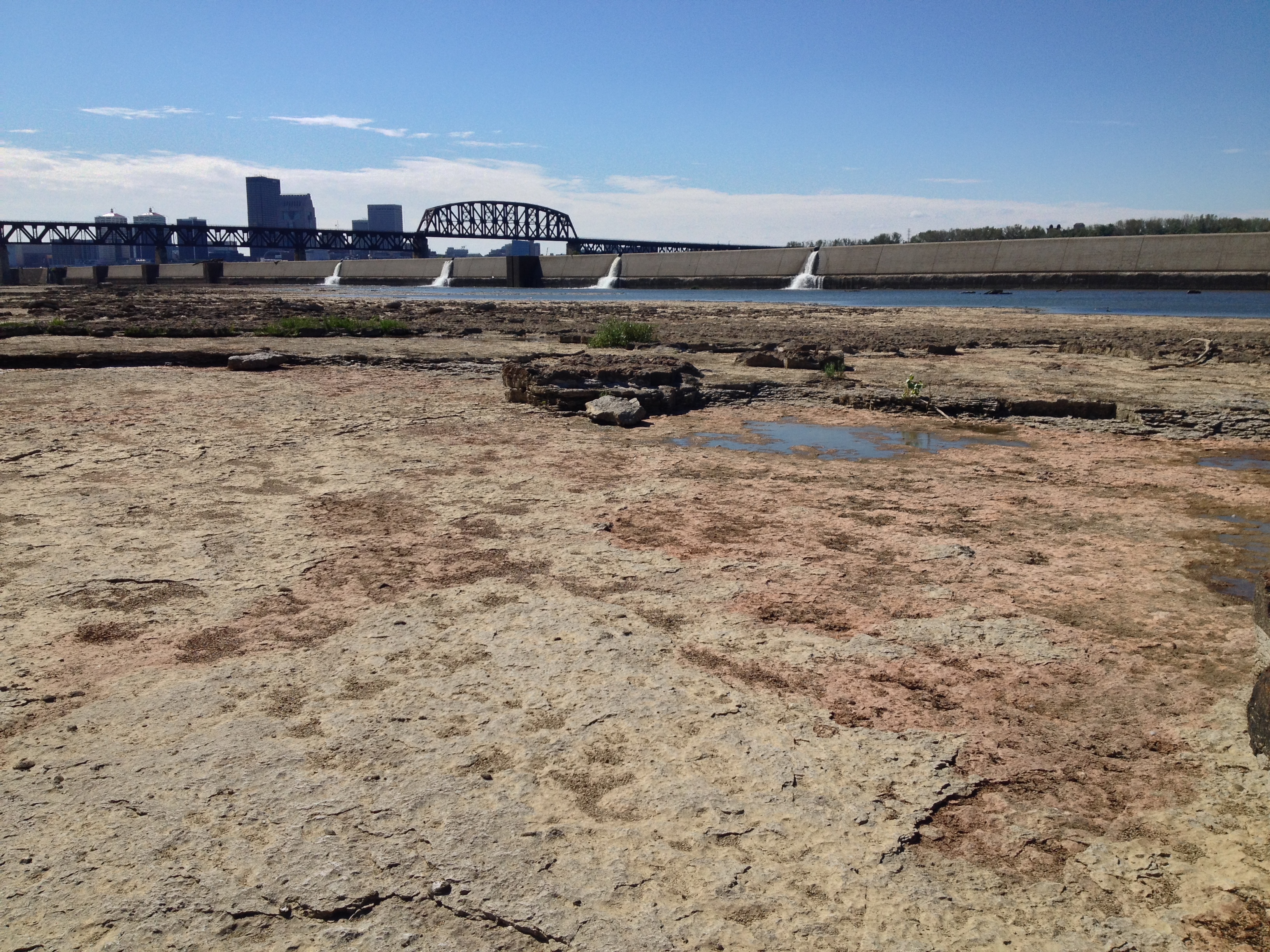
This is after all, the bottom of the Ohio River and accessible most summers when water is diverted to fill water levels at the McAlpin Locks and Dams.  The Ohio River is a managed river for much of its length.  Closing the snow plow shaped tainter gates helps regulate water levels for commercial navigation and flood control, but it also exposes the majority of the fossil beds to inspection at the Falls of the Ohio State Park.

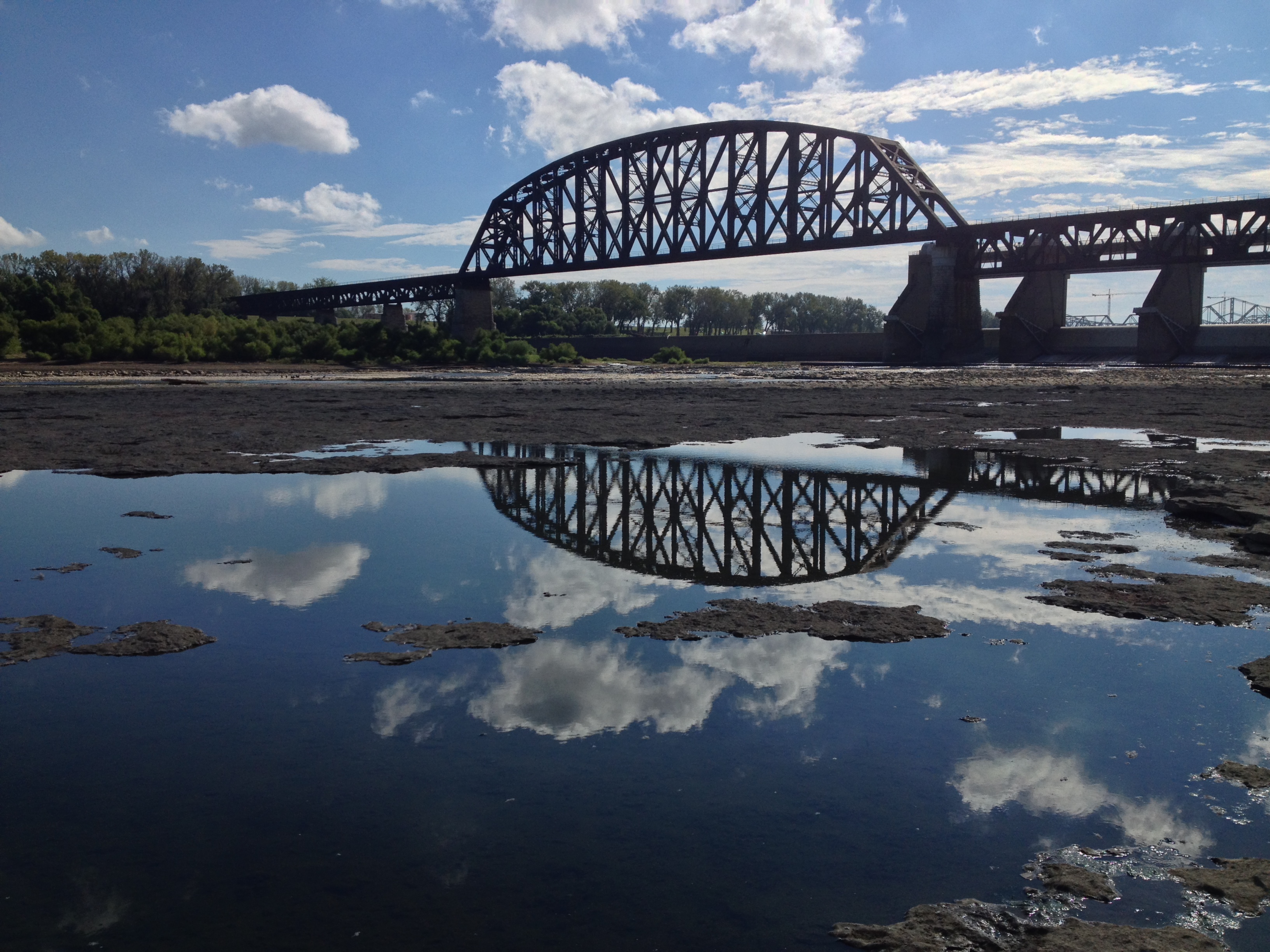
I have rolled my ragged jeans up and I’m wearing a pair of shoes for sloshing through knee-high deep water at best.  As I move under the old iron railroad bridge, I walk past the gigantic concrete and metal gates holding the river back.  Something in their hieratic designs reminds me of ancient Egyptian art.  Here on a massive, civic-project scale, abstracted silhouettes of seated pharaohs serve the gods of engineering.  My goal today is to reacquaint myself with this unique environment and mark the day in some way.

The railroad bridge looking back to the Indiana side.  Sept. 2014

From experience, I know that there are far fewer materials to access on this side of the fossil beds.  Most of the Styrofoam, plastic, and driftwood I frequently use is driven by wind and river currents to the Indiana bank where I’ve preformed  most of my projects.

Being out in this environment with its varied materials often inspires me to want to make something, but what will I do today?  I take advantage of the river polished coal I found around the railroad bridge and envision an image I can work with site specifically.

I have come to like working with coal as a material because it is timely and is also invested with so much meaning.  In Kentucky, coal is currently a big political issue and many good people truly believe there is a war on coal and climate change is a not supported by the facts.

Anthracite is a deeply, shiny-black crystalline material out of the mine… but the river can tumble it into dull, but smooth feeling, egg-like forms.  I prefer the more river polished pieces of coal.

I’m guessing I’ve picked up about 10 or 12 pounds of coal which I carry in a canvas collecting bag.  Okay, I have my material and my feet are already wet.  With walking stick in hand, I walk along side the high walls that separate the Ohio River from the now exposed Devonian Age fossil beds.

Wall seperating Ohio River from fossil beds, Falls of the Ohio, Sept. 2014


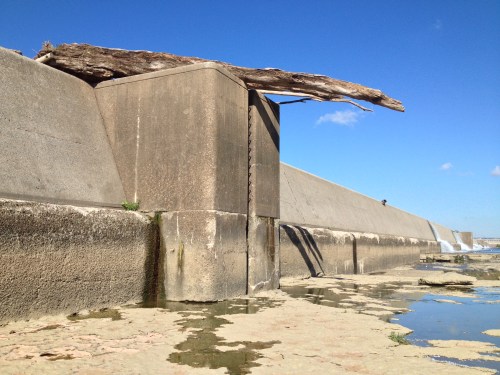
The dam’s concrete wall that separates the river from where you are standing on the fossil beds is maybe 18 to 20 feet tall?  It’s up there and sobering as well because the Ohio River’s waterline is just below the top of the wall which is just on the other side!  A series of pre-formed notches along the top of the wall allows water to flow over a section of the fossil beds.

A small wetlands area has been encouraged here that draws many water-loving birds.  Among the species I observed on this day included:  the Belted Kingfisher, Caspian Terns, Great Egrets, Osprey, Great Blue Heron, Double-crested Cormorants, Canada Geese, Killdeer plovers, Blue-winged Teal, Mallard Ducks, Black Vultures, and an American Coot.

Although it’s not hot today, there is little to shade you from the intense light out on the open fossil beds.  Most of these beds are high and dry, but the surface is pockmarked in places with potholes that hold water.  Most of the shallow pools that caught fish when the river level dropped have been cleaned out by the water birds.

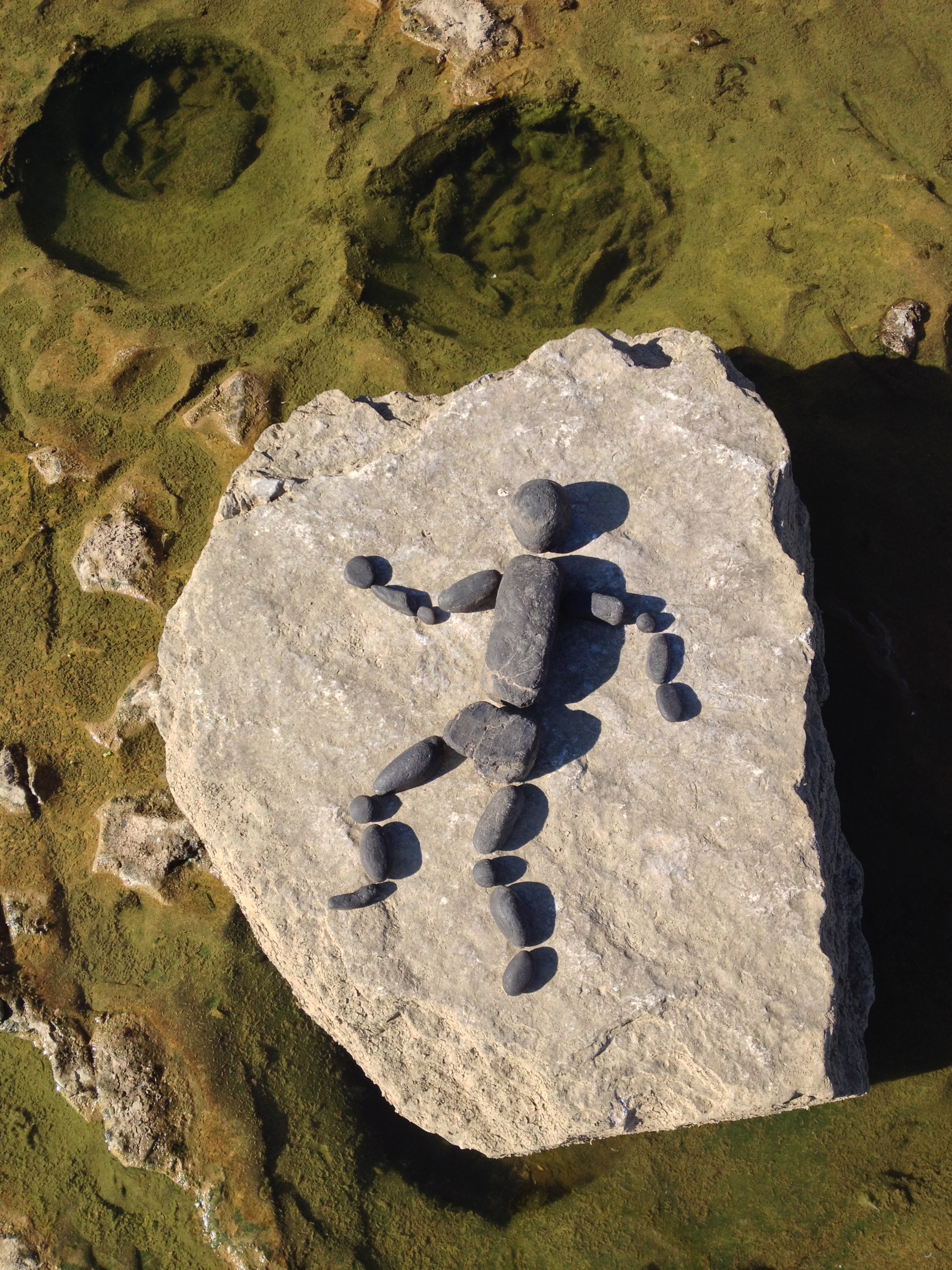
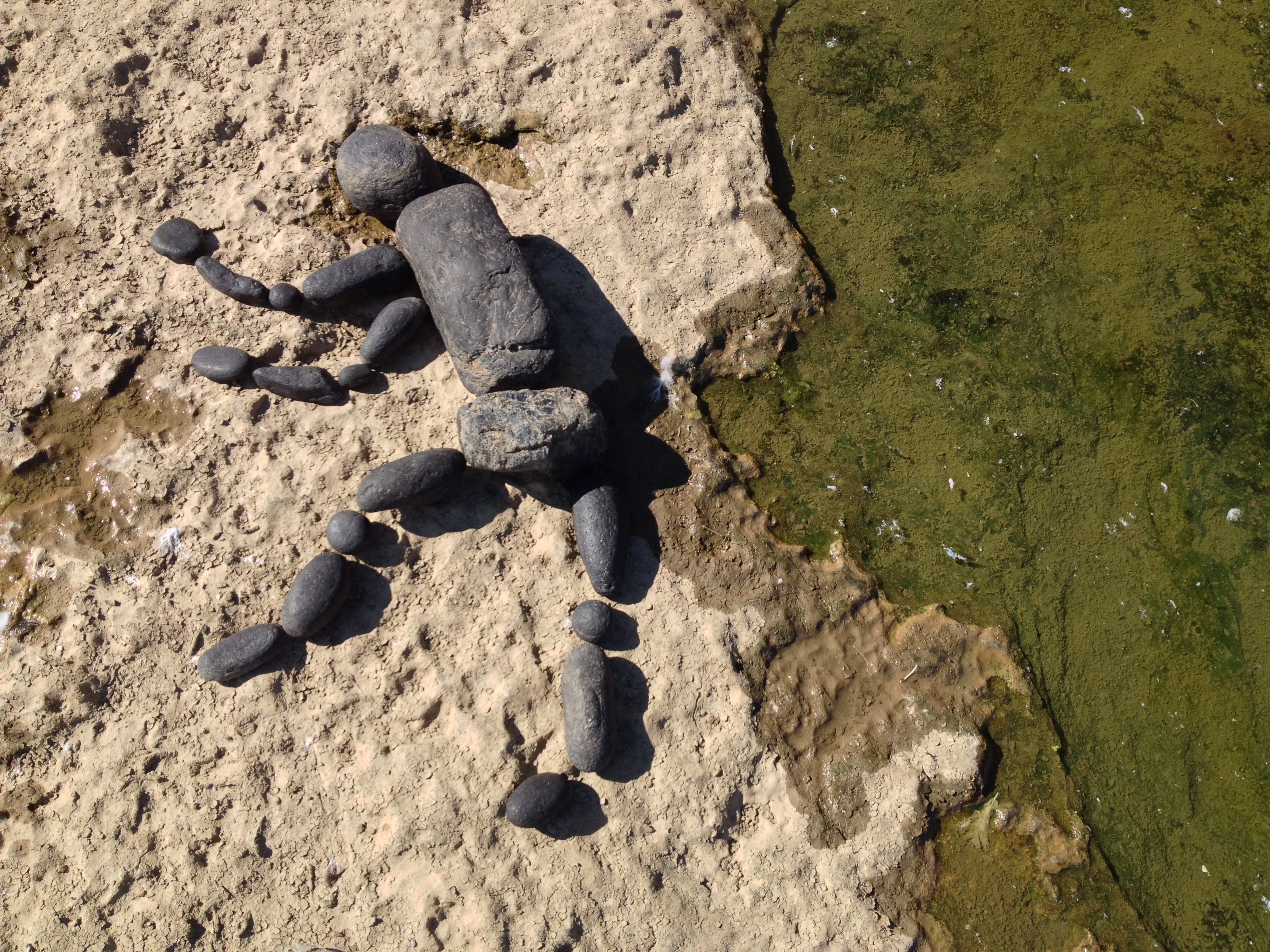
In the above photo, a large log has become stranded on the top of the wall placed there when the Ohio River was receding from flood stage.  It was in this area that I set down my heavy collecting bag and laid out my first Coal Man design on the fossil surface.

Coal Man variation, Falls of the Ohio, Sept. 2014

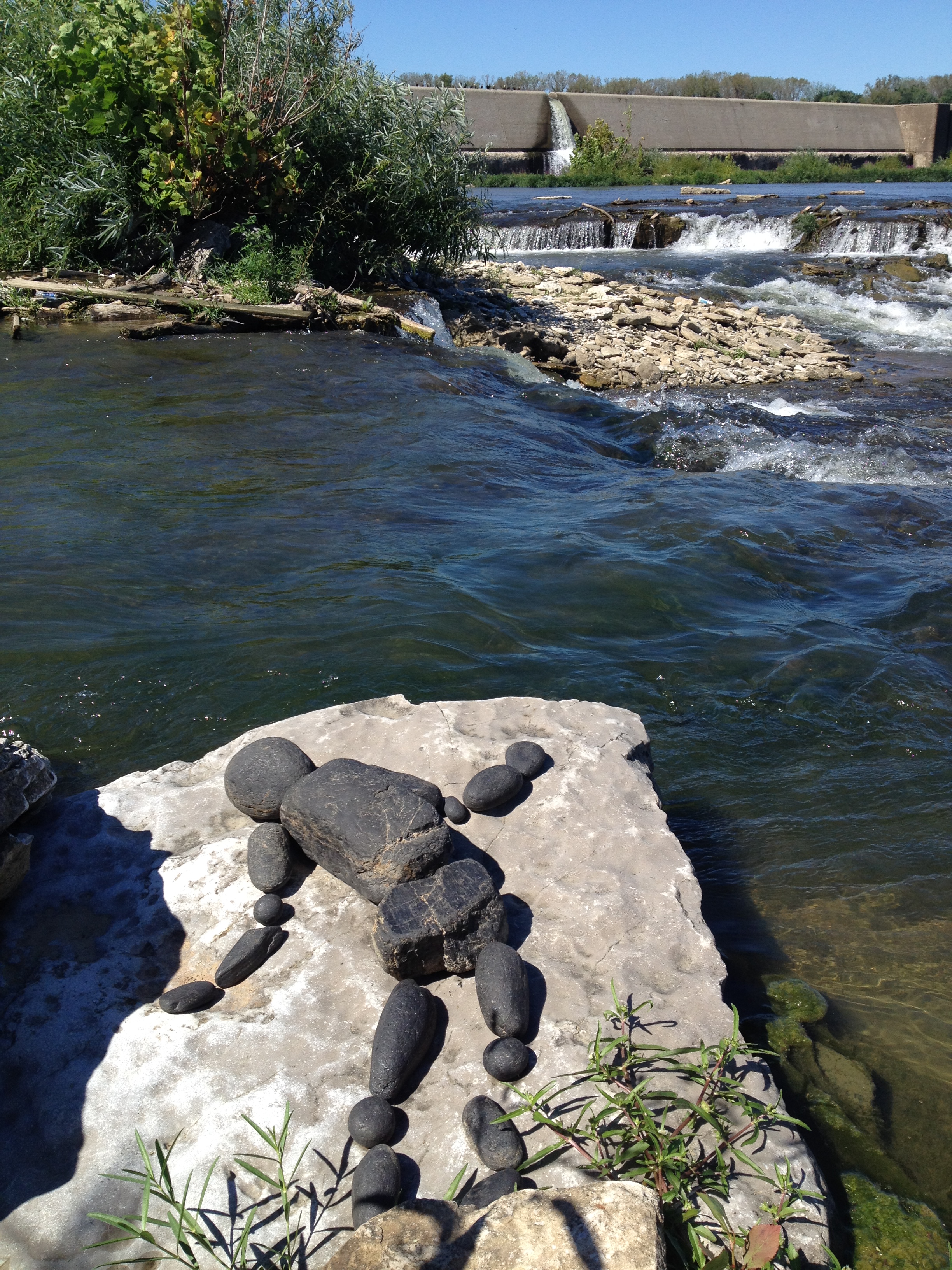
The figure has a marionette-like presence, but I relate more to it as a simple sign for figure.  In my head I’m seeing an ancient landscape marked here and there with this contemporary pictographic/petroglyph.  The Falls of the Ohio have been occupied by man for thousands of years and I like relating to this history.  The water is shallow and green from algae.  Molted bird feathers define the circumferences of many of these water holes.  Annoying small flies and gnats fly around the potholes and around your head seeking salt or other moisture.

Coal Man Series, Falls of the Ohio, Sept. 2014

This figure has been laid out on a table-like boulder surrounded by very shallow water.  It’s a very temporary site-specific expression on a very tiny island.  I have heard people describe the exposed fossil beds as being a “moonscape” and it does feel like this landscape could be from another planet.

Seated Coal Man on Fossil Beds, Falls of the Ohio, Sept. 2014

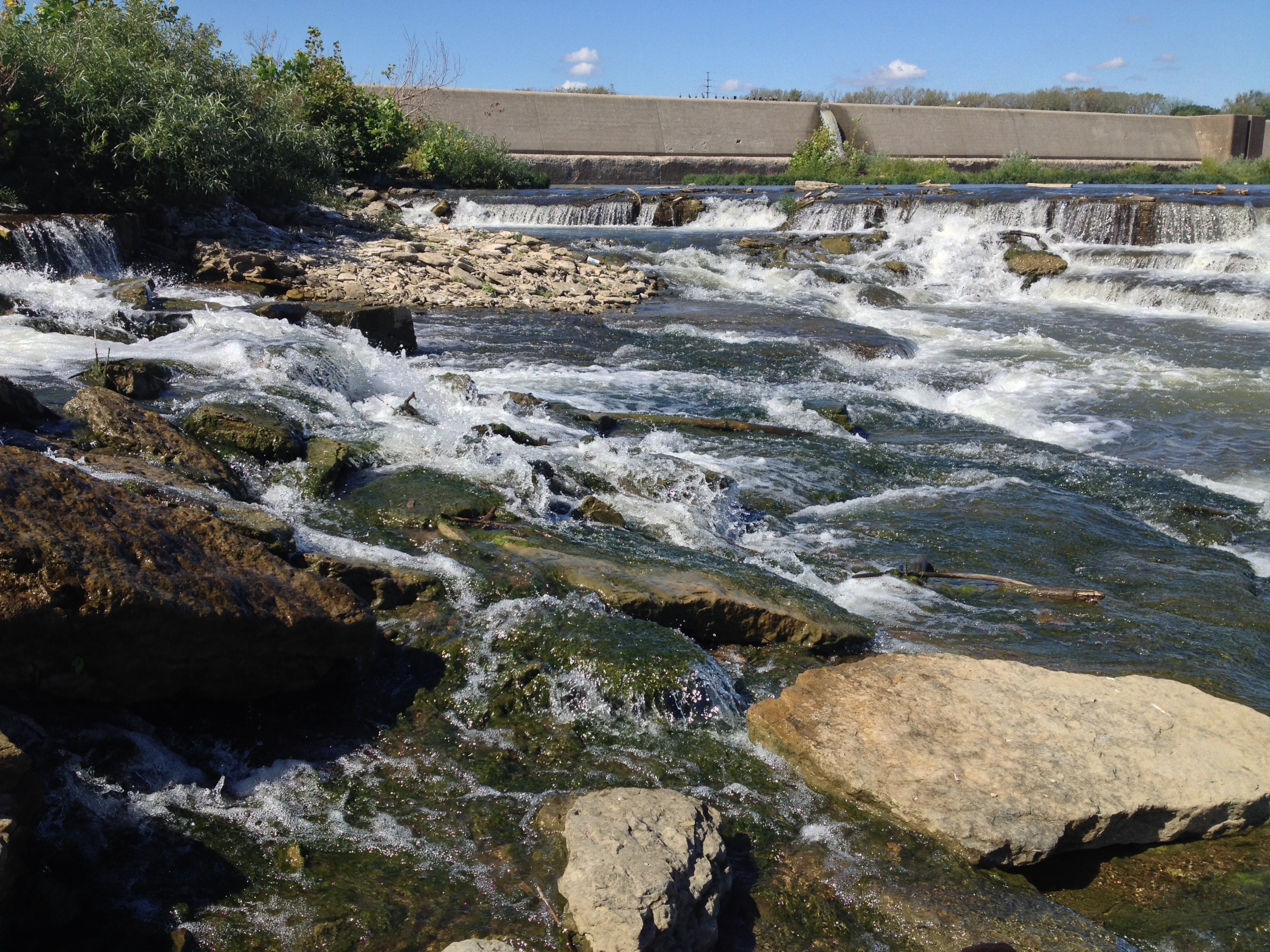
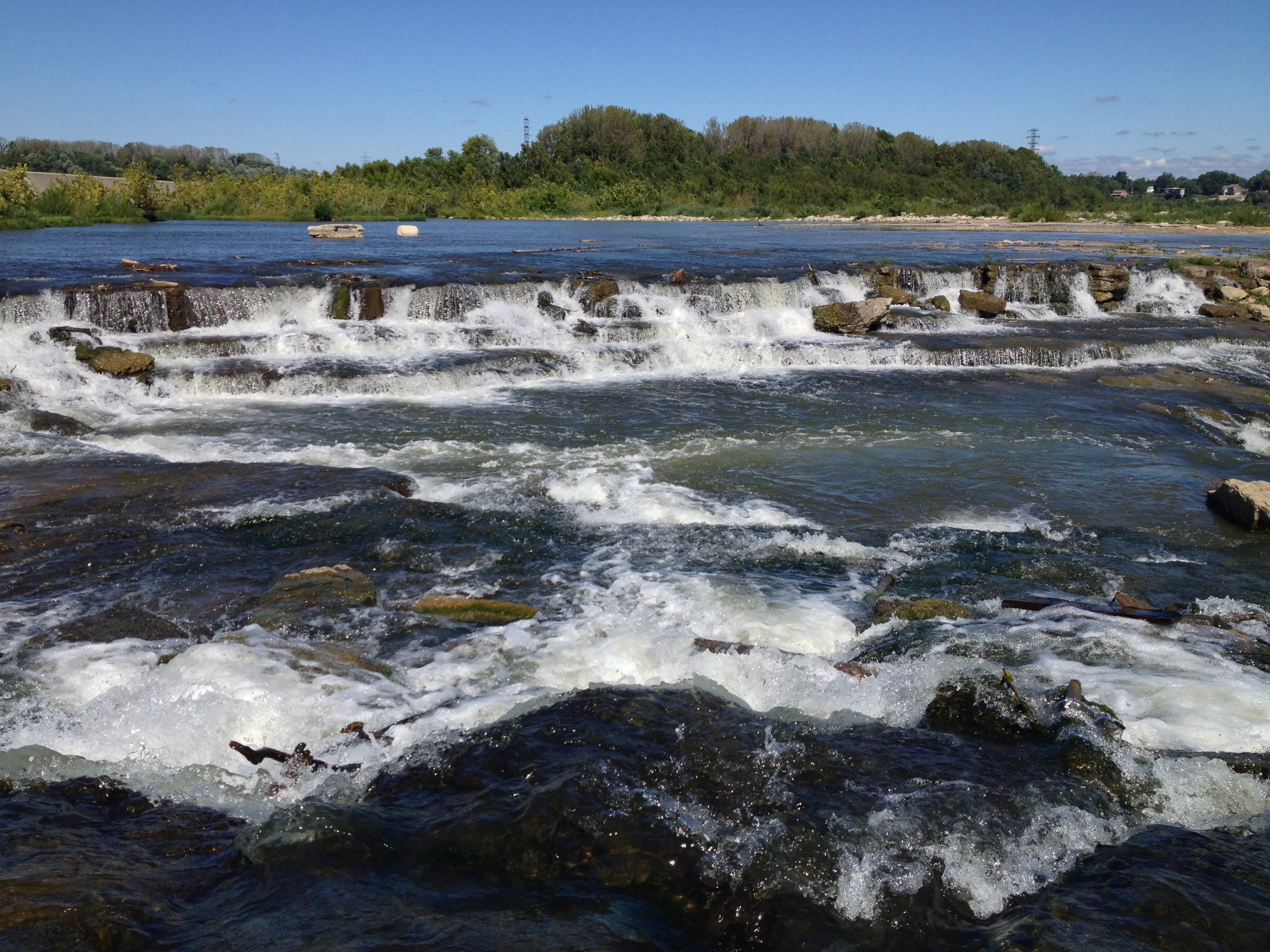
Many of the fossil beds are in layers or courses and here I am trying out some of the pictorial possibilities using my now seated Coal Man.  The Interpretive Center is the structure in the far distance.  After a while,  it’s time to cool off a little and have a good sit.  There’s a series of small cascades up ahead that are the nearest to imagining what the Falls may have originally looked like and I head that way.

Coal Man by the Cascades, Falls of the Ohio, Sept. 2014

I see in my mind’s eye, each different Coal Man design introducing a different feature on this side of the park.  I have been wading in shin-high to knee-high water to reach this place.  It’s like an oasis on the exposed and fossilized ancient coral reef.  I like resting here and having a water and snack break.  If you remain inconspicuous you can often spot many different bird species here.  The shallow but swiftly flowing water has small schools of baby fish seeking places of safe harbor.  I’ll bet the oxygen levels in this water is very high?

Cascades, Falls of the Ohio, Sept. 2014

Cascades, Falls of the Ohio, Sept. 2014

I cool off wading and exploring this area before moving on.  This space has a bit of the amphitheater feeling about it.  The cascades take on a larger horseshoe formation connected by many small waterfalls.  In the recent past, much larger cascades existed and put on a water show that I wish I could have seen.

Cascade at the Falls of the Ohio, Sept. 2014

Time to move on and dry off.  Today, I’m only planning on walking to the beginnings of Goose Island where I will make my final images with this Coal Man.  I definitely see returning out here again soon while the river level remains low.  It won’t be too much longer before autumn rains and winter snows replenish the Ohio River and re-submerges these fossil beds until next year.

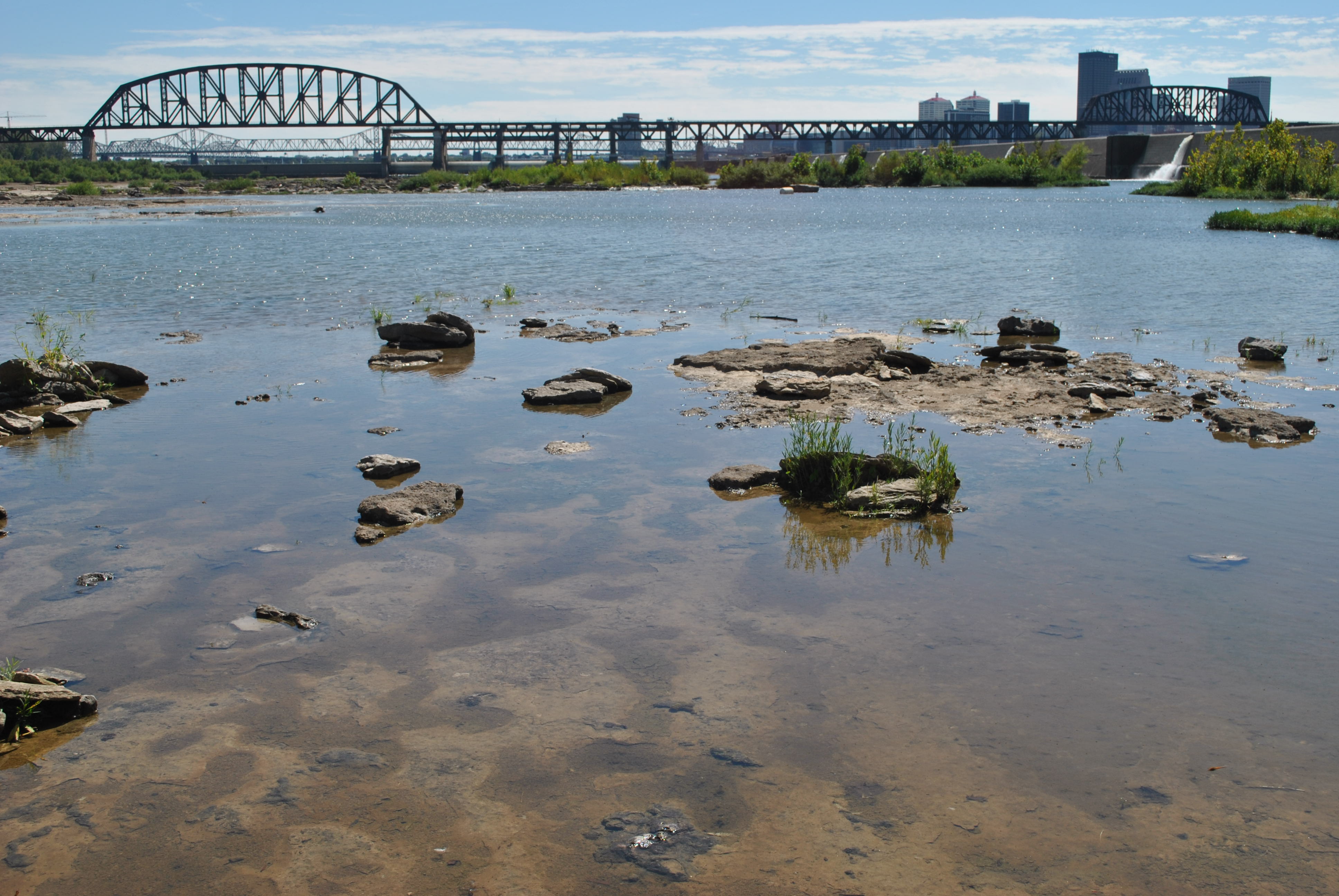
Skyline of Louisville as seen from the Falls of the Ohio, Sept. 2014

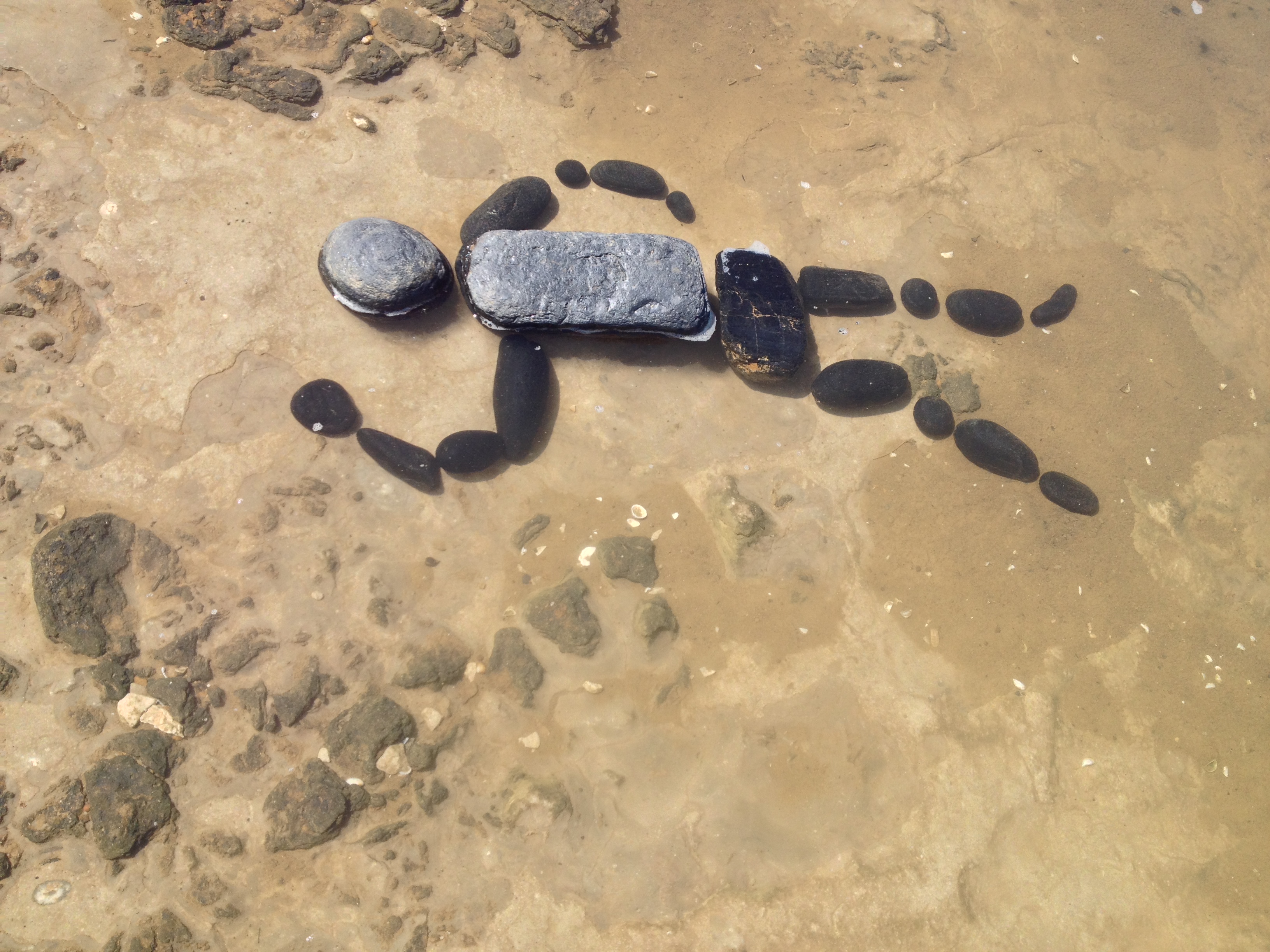
So far, I had kept the Coal Man dry.  At this location which was the extent of today’s visit…I took advantage of clear, shallow water to create these pictures.

Coal Man Series, Falls of the Ohio, Sept. 2014

Coal Man Swimming, Falls of the Ohio, Sept. 2014

The wet coal turned deep black and I liked how many of the images graphically benefited from that.  I guess this is Carboniferous Man swimming above the Devonian Age?  From here I bagged the coal and started the walk home over the fossil beds.

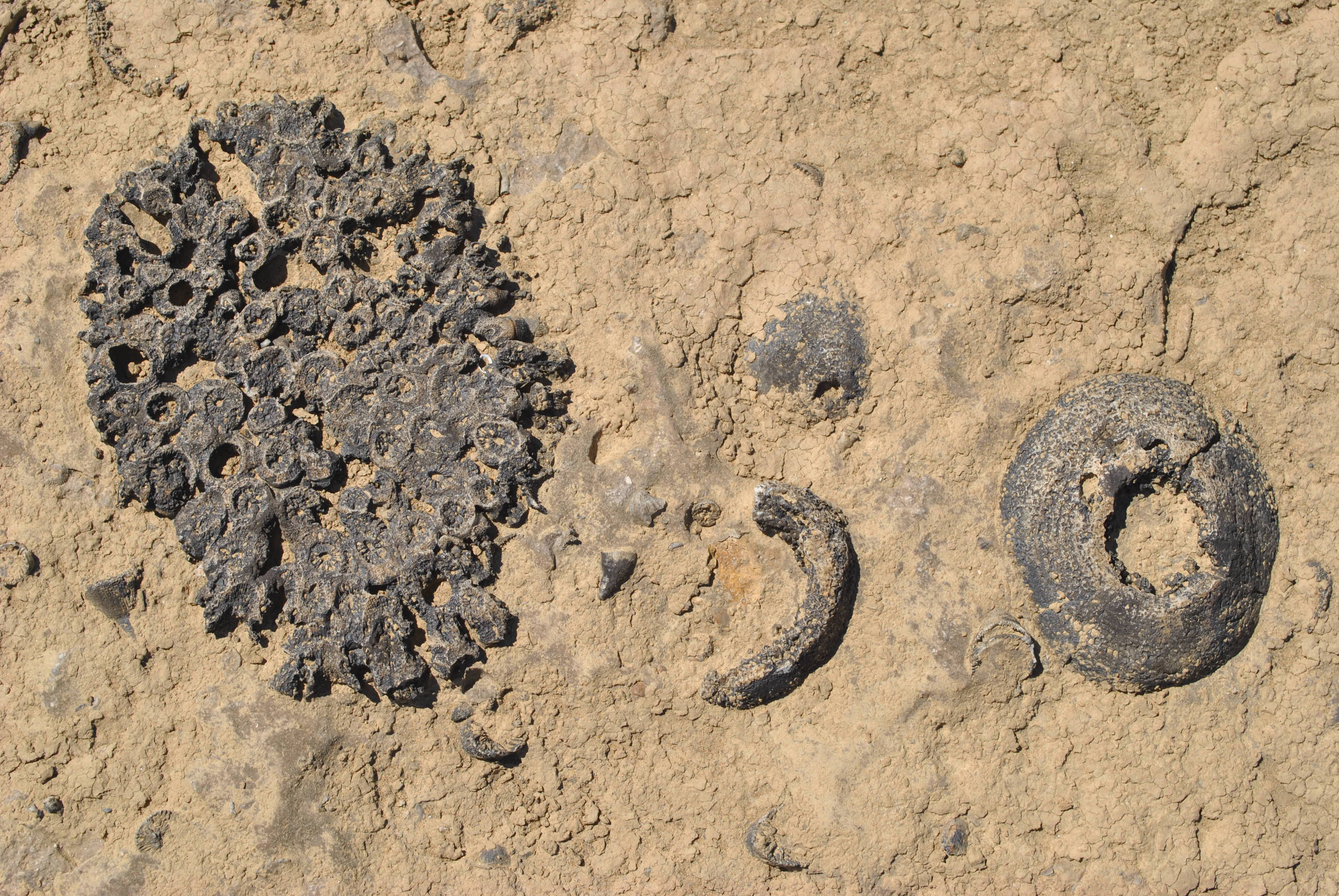
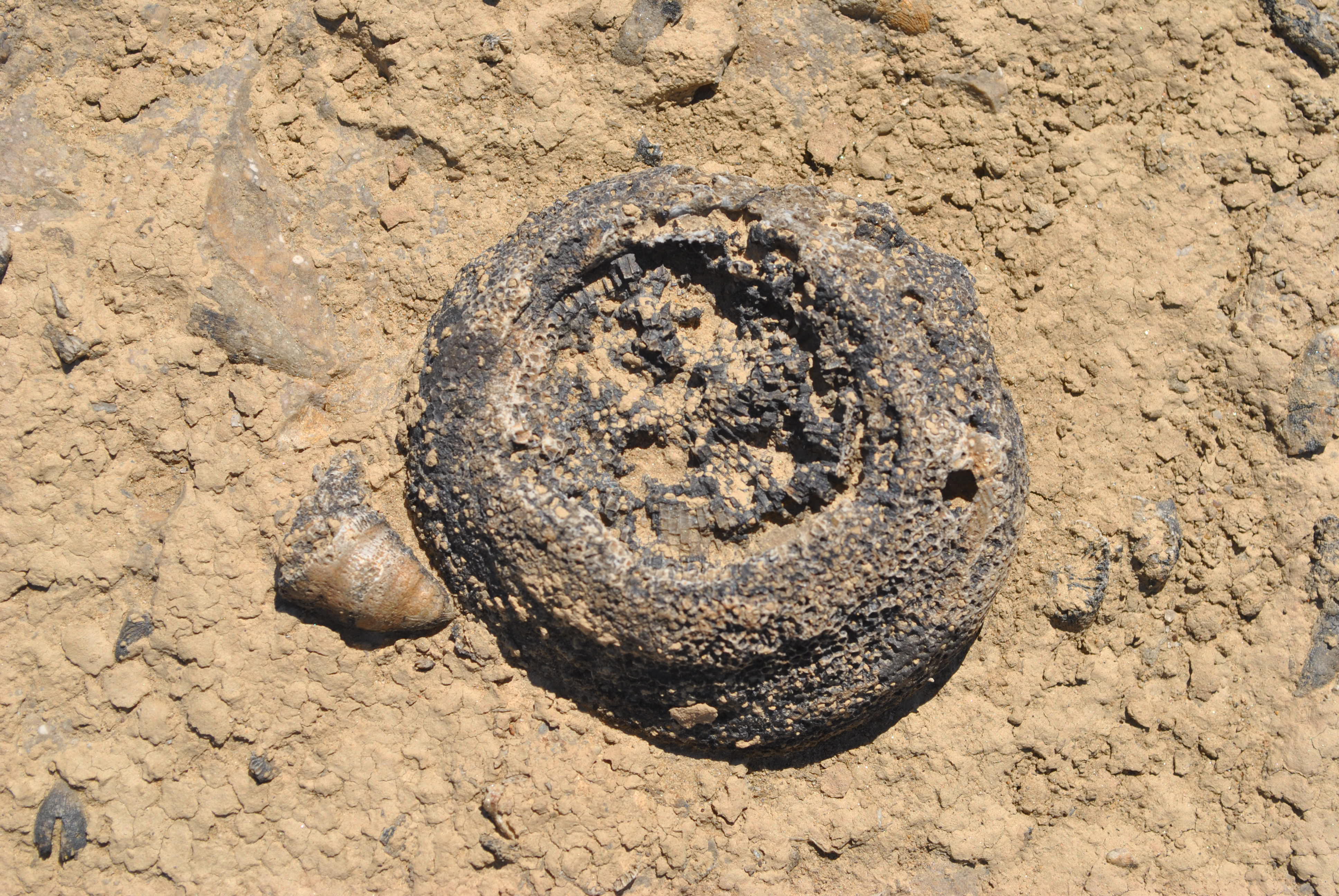
Before closing, here are a few actual fossils I photographed along the way.  This was once an active coral reef over 300 million years a go.  Life was in the oceans.  The species first discovered here have greatly expanded our knowledge of life at this time.  This was the high point for corals and sponges and also gave rise to the first fishes.

Fossils from the Falls of the Ohio State Park, Sept. 2014

Fossils from the Falls of the Ohio State Park, Sept. 2014

This was my last river excursion of the summer.  It is amazing how quickly this year is flying by!  I was really happy that my left knee did not give me any problems.  I am feeling encouraged and I still have this bag of coal I can keep playing with on a future visit.  Thanks again for coming along…from the fossil beds at the Falls of the Ohio State Park…so long for now.

Fossil Beds at the Falls of the Ohio State Park, Sept. 2014

Read Full Post »

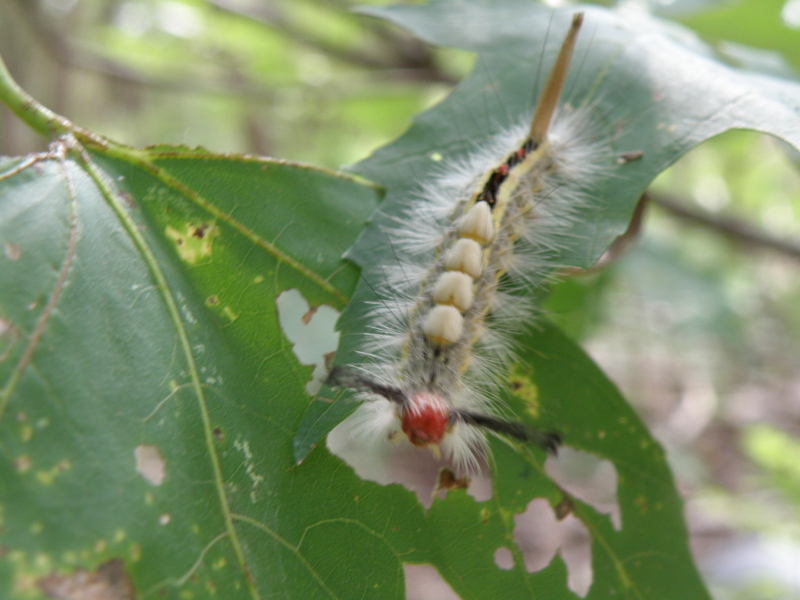
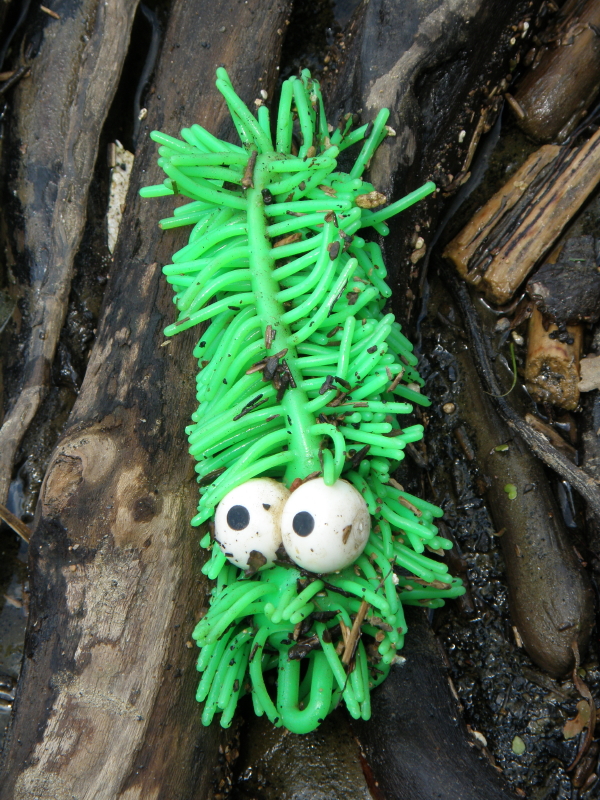
Tussock moth caterpillar, Oct. 2013   Red-faced and bizarrely hairy, the unique caterpillar of the Tussock moth was munching its way through a maple leaf.  Everything about its appearance says I’m not tasty and leave me alone.  It’s now October and it won’t be much longer before the first frost and freezes arrive and with it the colder temperatures which will quiet insect life at the Falls of the Ohio until next year.  The caterpillar inspired me to post a few other entomological images taken in the park.  I confess that I have always liked insects as examples of how diverse life can be.  I’m amazed at the incredible variety and forms that our six-legged friends can assume. Here’s another really weird caterpillar that I found at the Falls that I just haven’t been able to identify through any of my field guides.  Does anybody out there in blog land recognize this?

strange caterpillar from the Falls, late June 2013

This fluorescent green caterpillar has dramatic eye spots on its posterior that would incite a predator to strike there first.  Its anterior is located on the opposite end and I would have fallen for this trick too, but noticed that it was walking backwards.  I wondered once it completed its metamorphosis…would the adult be a moth or butterfly?  Maybe some day I will stumble upon and collect a large cocoon I don’t recognize and I’ll take it home and watch a miracle as it emerges from its silken home.

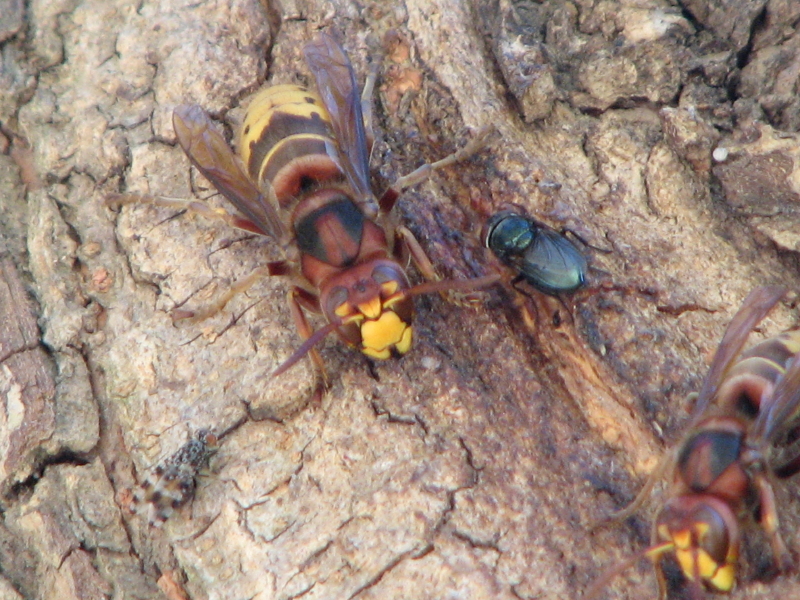
hornets and flies on willow bark, 9/2010

During this time of year, certain willow trees at the Falls are exuding sap which draws a variety of insect life including various flies, hornets, and butterflies to these sweet “licks”.  Whether the flowing sap is due to disease or injury is unknown to me? The large bullet-like hornets are so preoccupied with sipping the sap that they ignore me.  To test this, I’ve carefully touched them with my finger while they were feeding and they remained docile.  I was walking through the tall grass when I noticed a large flying insect land on the bush next to me.  Despite its wonderful camouflage I was able to locate our next insect after a short search.

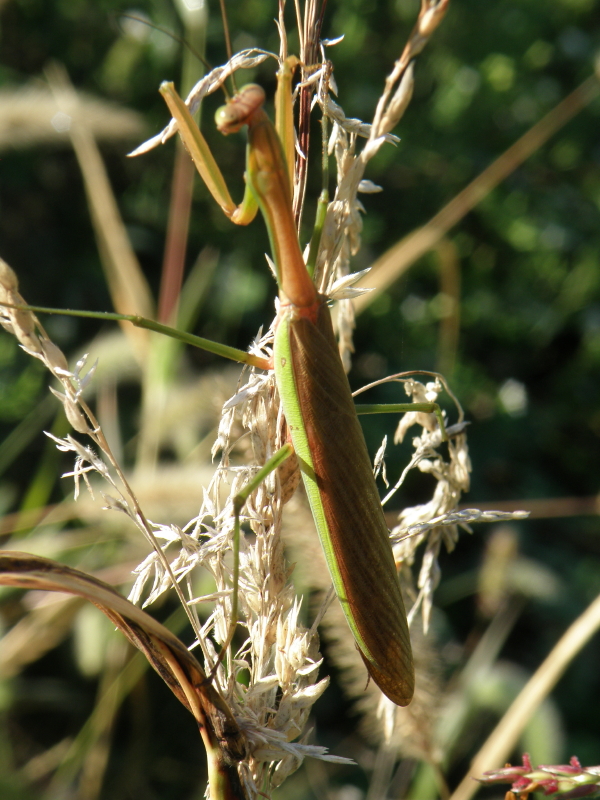
Chinese Mantid, Falls of the Ohio, late Sept. 2013

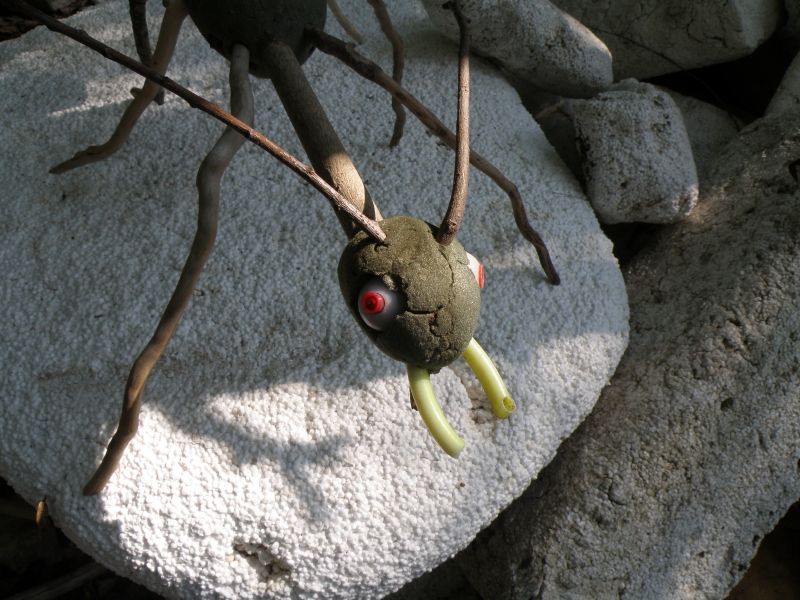
This is the Chinese Mantid which I read was introduced into this country in 1896.  It is the largest praying mantis you are likely to come across in the United States and this specimen was about four inches or ten centimeters long.  I’ve seen them grow larger, but not in this park.  In fact, this is only the second mantid I’ve seen out here.  There are several native species, but they are smaller and more obscure.   And now, it’s time to reveal my most spectacular discovery which is a near but harmless relative of the praying mantis.  Here is a picture of its head.

detail, head of the Falls Phasmid Stick Insect, October 2013

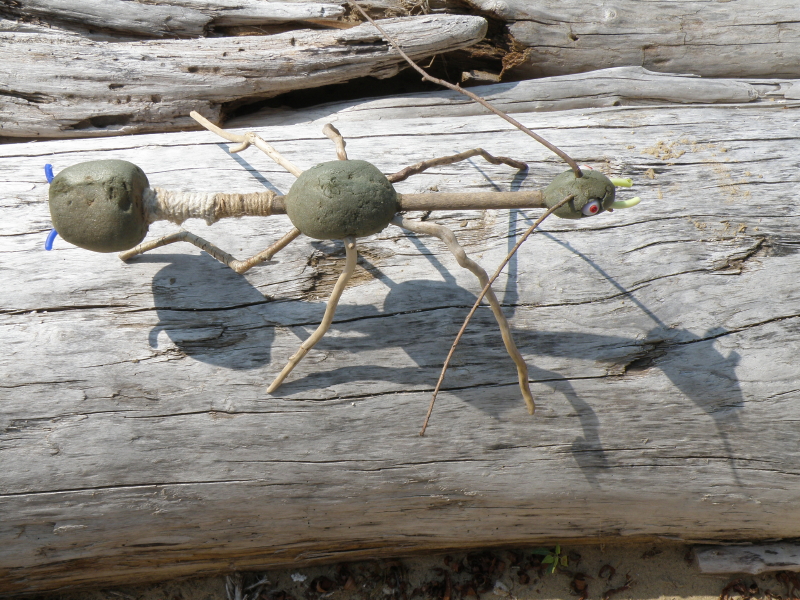
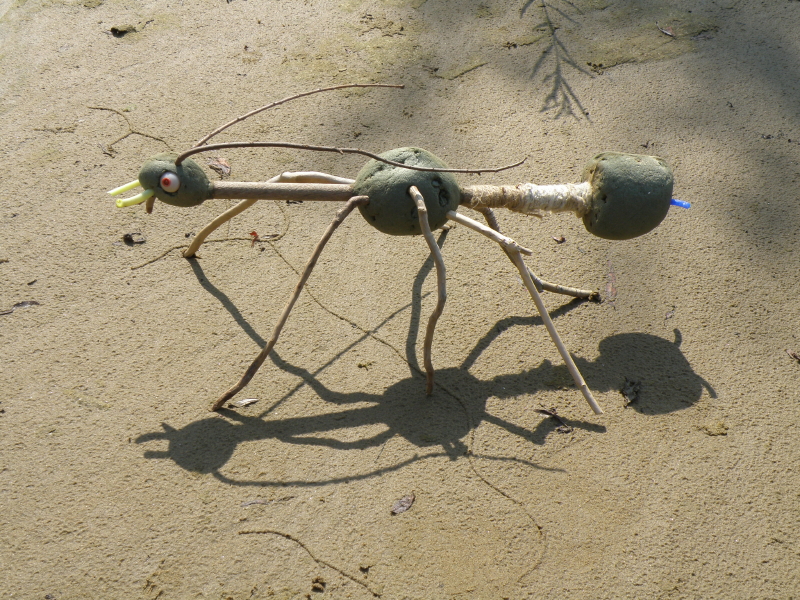
And now, for the rest of its body which is about two feet long or roughly sixty centimeters.  I came upon this unique life form casually walking across the driftwood on its way to somewhere else.

full view of Falls Phasmid, Falls of the Ohio, Oct. 2013

Although as insects go this is a giant…it is also an extremely fragile creature.  It is a member of the walking stick family.  It relies on slow movements and its cryptic forms to merge with its surroundings.  The Falls Phasmid is strictly a vegetarian and eats the foliage from a variety of different trees.

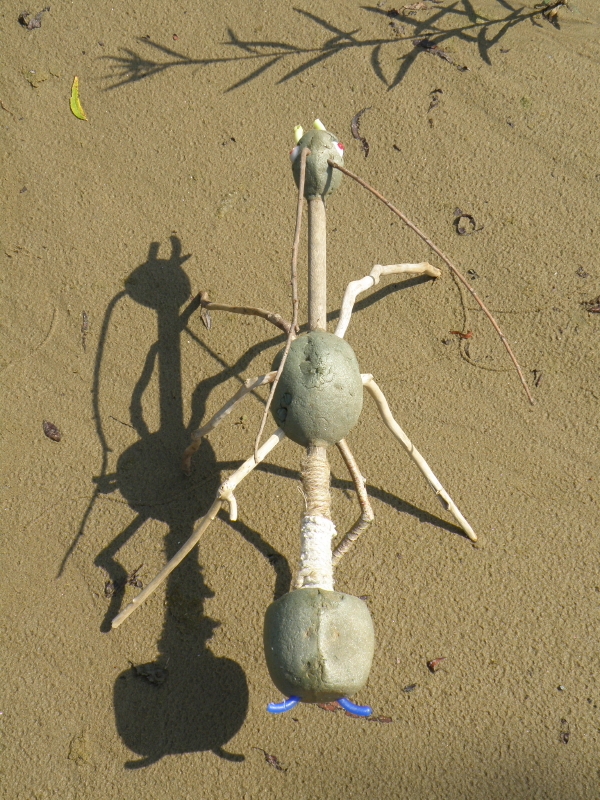
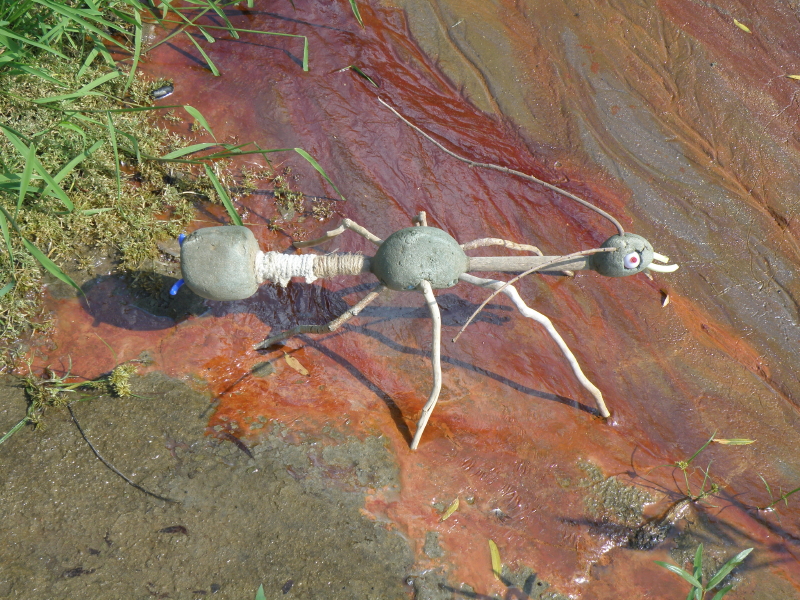
aerial view of Falls Phasmid, Oct. 2013

I came across this specimen in broad daylight.  I had always heard that they were nocturnal and chose to restrict their movements during the day to avoid detection.  Walking stick insects are among the largest insects we have.  This species is additionally strange in that its head, thorax, and abdomen are so clearly differentiated.  Some scientists have gone so far as to suggest a bit of mimicry at work here.  On the surface it does seem to possess a superficial resemblance to a giant ant which might be enough to dissuade predators from attacking it.

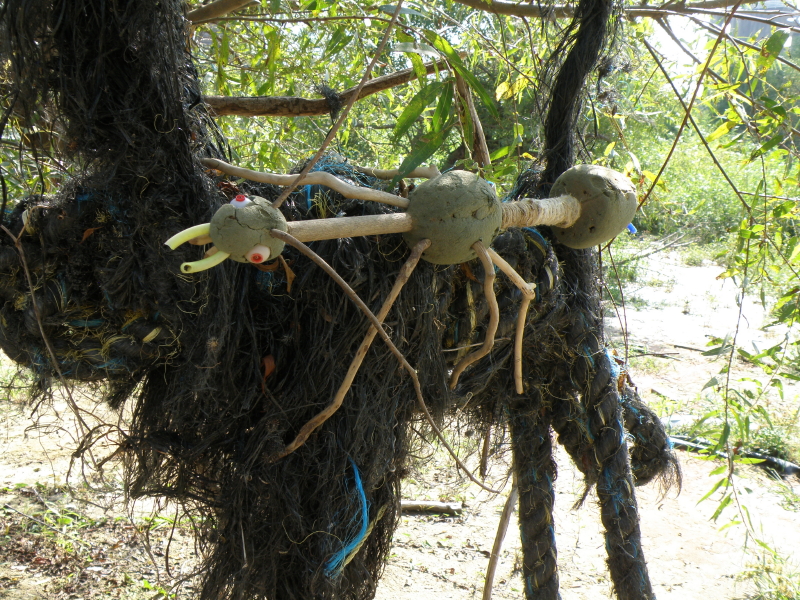
Falls Phasmid hanging in a tree, Oct. 2013

I did observe this particular Phasmid making return trips to a particular willow tree where it clung to a nest-like structure that was hanging down from a branch.  The meaning of this structure was not immediately apparent.  Perhaps the Falls Phasmid uses this form to help it overwinter?  Keeping a respectful distance away, I did see the stick insect walking slowly over the riverbank, but I couldn’t tell if it was searching for something in particular and I did not witness it feeding.

Falls Phasmid Stick Insect, Oct. 2013, facing left

Falls Phasmid in the wetlands area, Oct. 2013

Originally, the Falls Phasmid may have had the ability to fly.  Other walking stick insects from around the world have vestigial wings that suggest a different past.  Our specimen lacks even the most superficial suggestion of wings which hints at an ancient lineage.  Perhaps all stick insects evolved here first and spread around the world much later?

Falls of the Ohio Phasmid Stick Insect, October 2013

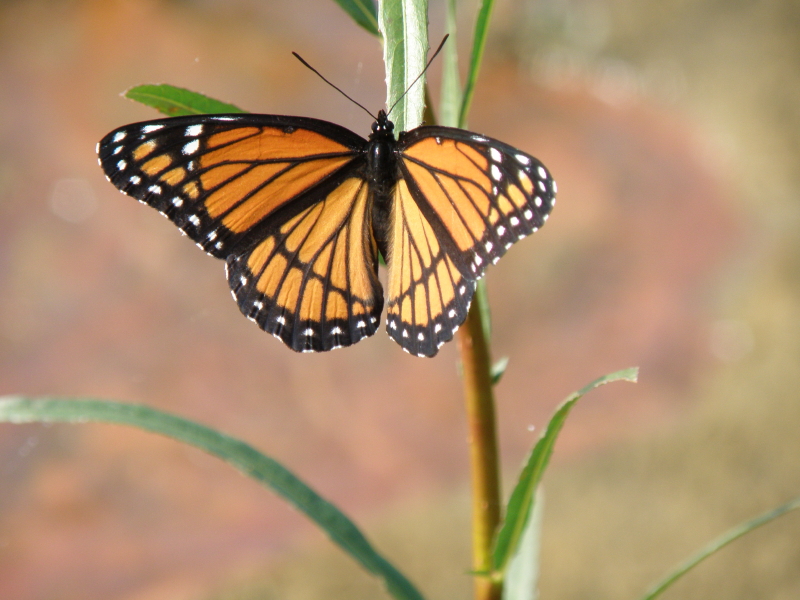
I watched the Falls Phasmid for a while and took a bunch of photographs of it before leaving the park.  I’m curious about that tree that it likes to hang out on and so will check it the next time I’m here.  On my way out of the park, I also came around this wonderful Viceroy butterfly and thought that this would make a fitting image to end this post.  When I think of the butterflies that inhabit the park…this is the species that comes to mind first for me.

Viceroy butterfly, Falls of the Ohio, October 2013

Read Full Post »

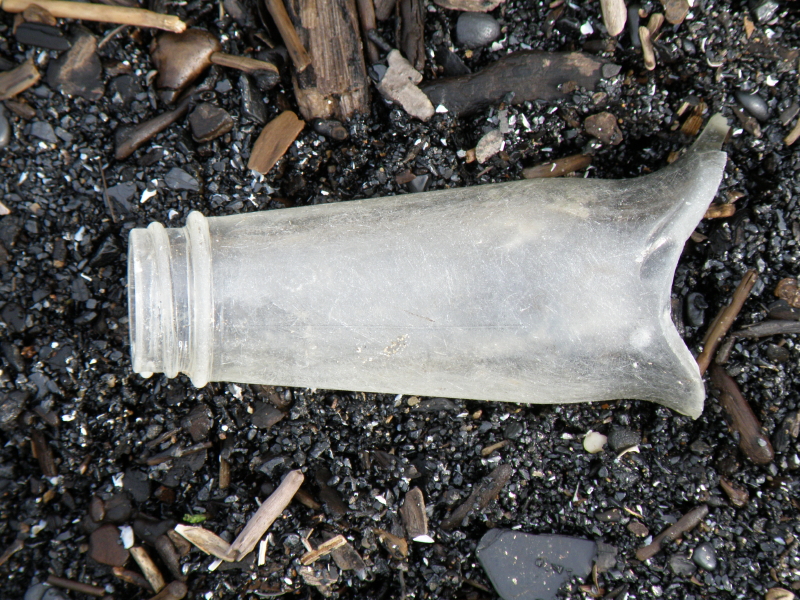
glass bottleneck against coal gravel, 2013

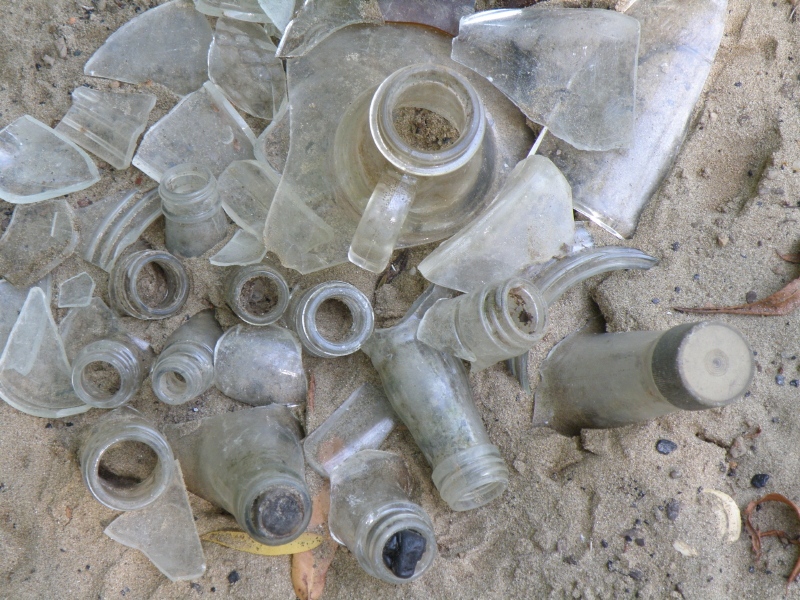
I wish I could remember the exact written passage where the image of a bottleneck captured my imagination.  Back tracking through my books has not revealed the exact source, however, I do remember that the context came from biology and more specifically the history of life.  Of the five great extinction cycles, the one that closed out the Permian period (roughly 245 million years a go) was the most brutal and efficient.  All those trilobites that had been so successful for so long hit the wall.  At this time the super continent Pangaea existed.  Millions of years of continental drift and the resulting global climate change are the leading hypothetical causes for this extinction.  Regardless, the effect was that the majority of life’s diversity as it existed then and which filled up that particular metaphoric bottle…did not make it through the bottleneck.  Fortunately, some life did survive, but it would take subsequent millions of years for life to evolve and radiate out to regain its former glory.

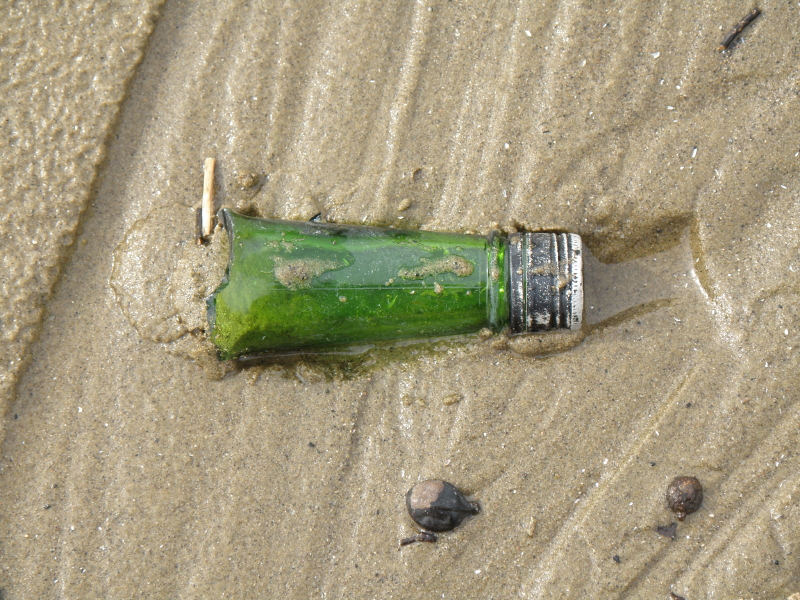
green glass bottleneck with cap against sand and water, 2013

We like to think that we stand atop life as its ultimate achievement.  We frequently miss the bigger picture of which we are small part and are even oblivious to the effects we have on everything else around us.  The bottleneck effect has been adapted by other systems to illustrate that which is a hindrance or impediment to progress.  The basic idea, however, remains the same.  Whatever is in the bottle is going to get squeezed on its way out that is if the contents do in fact make it out.  In my own blog, I don’t mention U.S. politics much, but lately it is in the news and it’s troublesome. Our seeming inability to govern ourselves…to in effect allow small selfish groups to manufacture bottlenecks strikes me as self-defeating and doesn’t bode well for the future.

two glass bottlenecks on sand, 2013

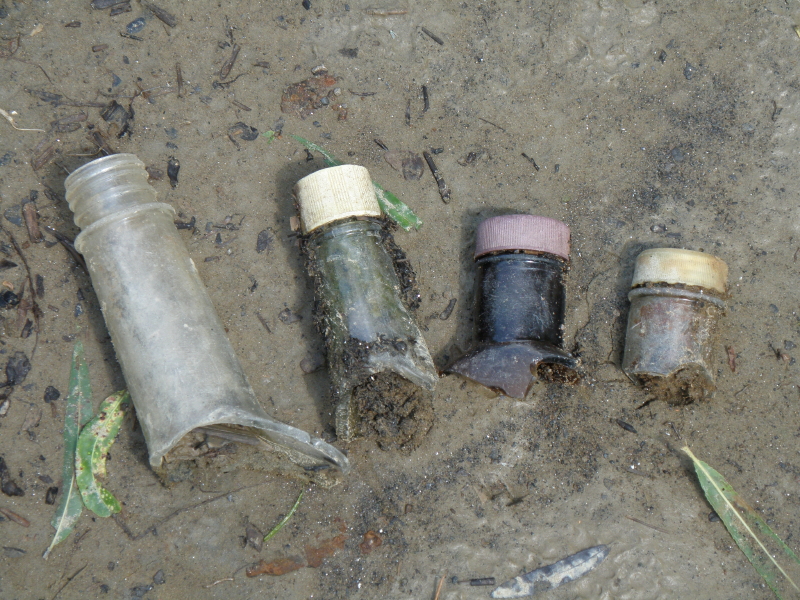
At the Falls of the Ohio State Park, I literally find bottlenecks all the time.  Unlike their plastic counterpoint, the glass ones don’t break down as much.  There must be something about the material strength of glass that is increased when it is forced into a tube that makes it extra resilient.  Over time, their sharp edges do get worn down and their surfaces become frosted through tumbling in the sand.  Personally, I find glass to be a far more attractive material than plastic.  I’ve come to look at our artifacts in much the same way I might regard a fossil as examples of objects that have been touched by and affected by life.

four different glass bottlenecks, 2013

There’s something about the process of “finding” that is compelling if not compulsive for me.  I try to stay watchful for opportunities, particularly if I come across an image or material that I can apply through my art.  The process of collecting, examining, and comparing is also personally meditative and relaxing.  I started photographing bottlenecks years a go with no goal in mind.  Just more documented stuff among all the other stuff along the riverbank that I come across each time I visit the park.  Looking over my photographs, forgotten images of bottlenecks would catch my eye again.

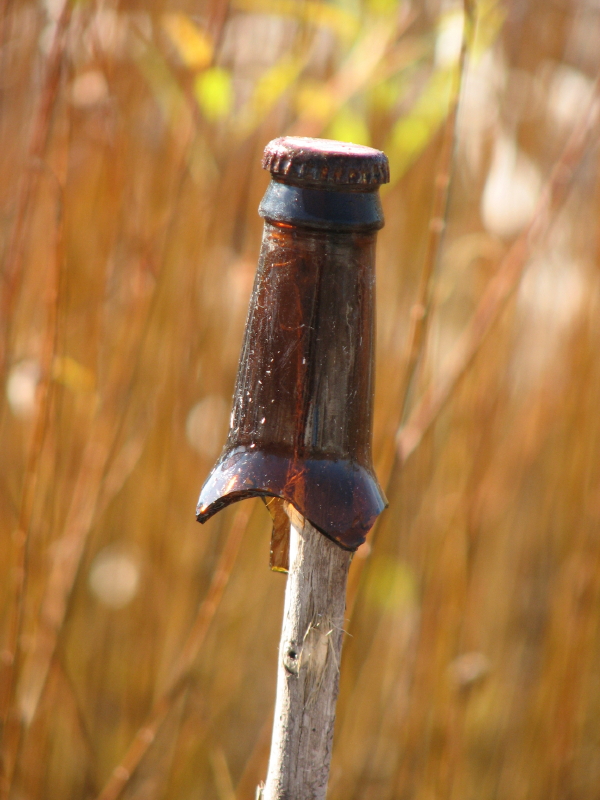
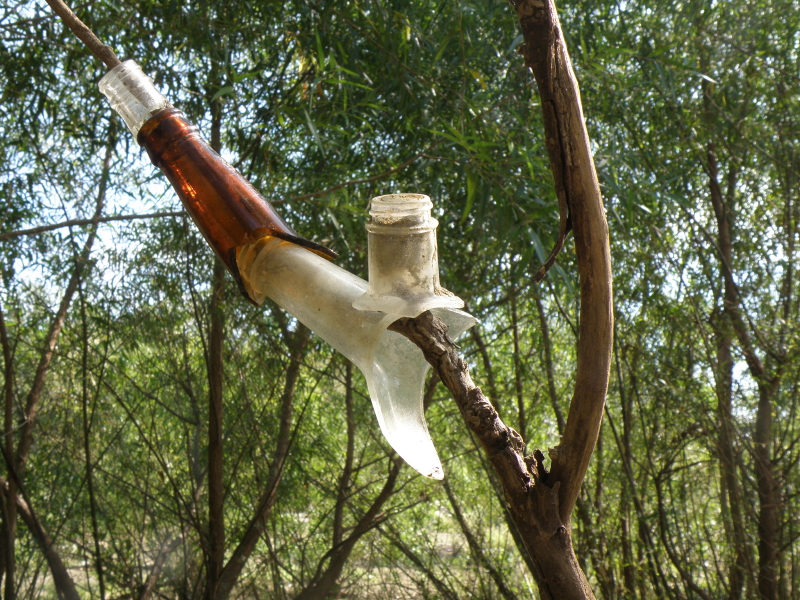
beer bottleneck with cap on stick, 2013

bottleneck with red cap on stick, 2013

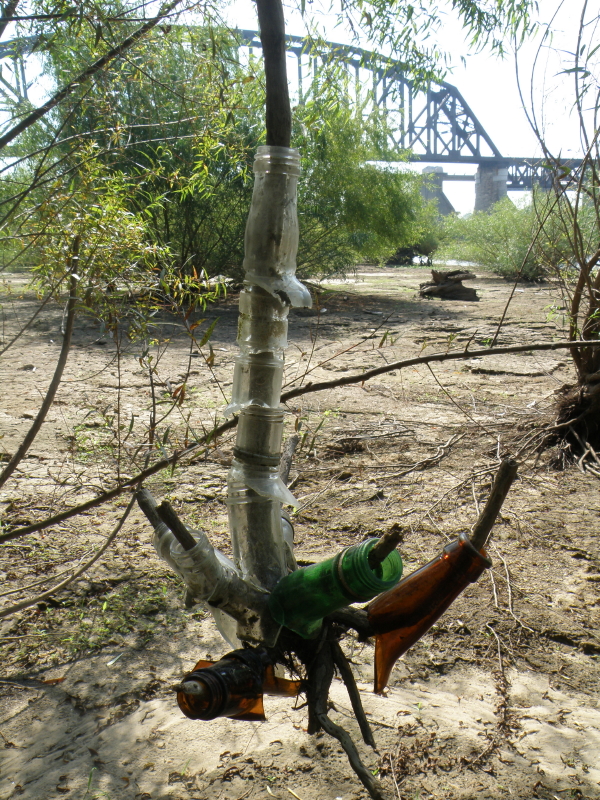
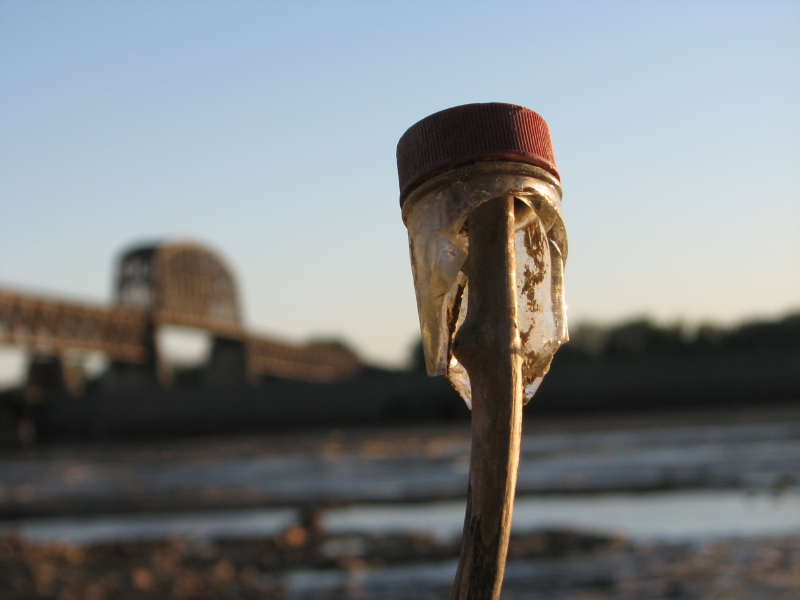
Other than take contextual images, I guess the next thing I did with bottlenecks was to stick them on the ends of branches and sticks.  This allows the light to play through the glass revealing its jewel-like attractiveness.  It might also cause someone else to notice that there is a lot of smashed glass in the park.  Granted, the river floats a lot of bottles in here from upriver, but there is also a lot of drinking that goes on here via the local folks.  Why pack your empties out when you can just throw them on the ground?  One bottleneck on a branch led to more…in fact the whole arc of these now bottleneck projects has trended in the “more” direction.

glass bottlenecks on a willow branch, 2013

glass bottlenecks on driftwood tied to a branch, 2013

I guess this last image is a bottleneck candelabra?  I find many of the bottlenecks I’ve used near stands of willow trees by the water’s edge.  I suppose bottles that float in are snagged in the tree’s exposed root system eventually breaking through contact with floating logs and leaving the shards in place?  People also throw bottles against the trees which has the same effect.  Rarely, do I need to walk very far to find enough glass to create a small project and image.

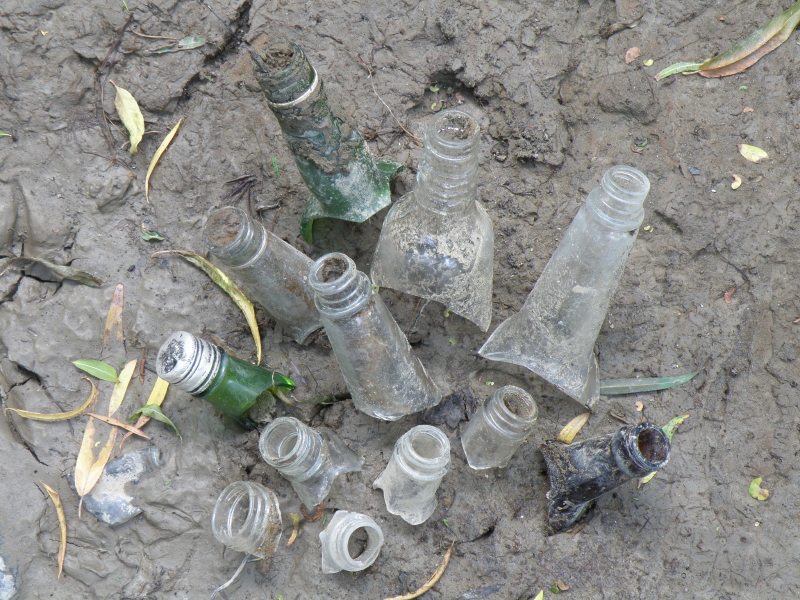
glass bottlenecks stuck in the mud, 2013

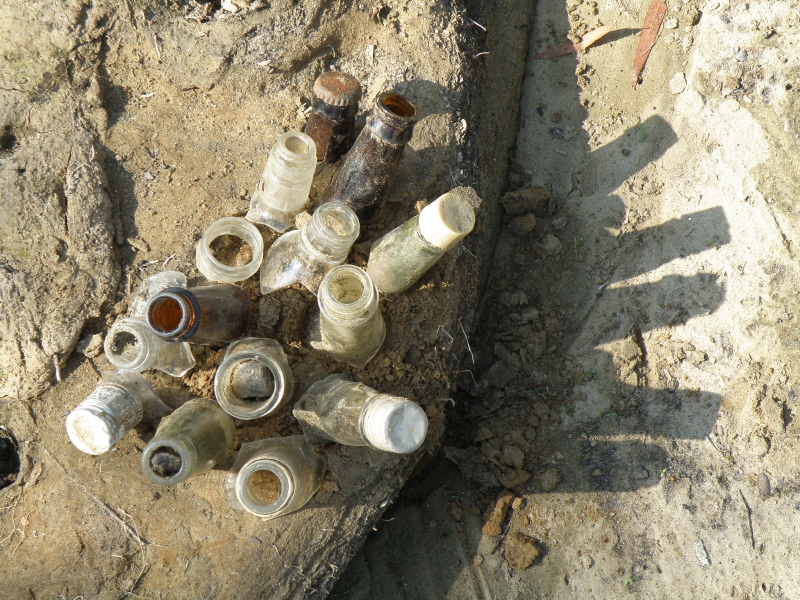
Here’s one project made from bottlenecks collected around one particular willow tree.  I liked the way they looked collectively stuck in the mud and their tubular arrangement reminded me of fossil corals which also references the Falls of the Ohio.  Here’s a few other similar site specific groupings of bottlenecks.

upright glass bottlenecks in dirt with shadows, 2013

glass bottlenecks stuck in the mud at the water's edge, 2013

diverse collection of glass bottlenecks, 2013

detail of arrangement of various glass bottlenecks, 2013

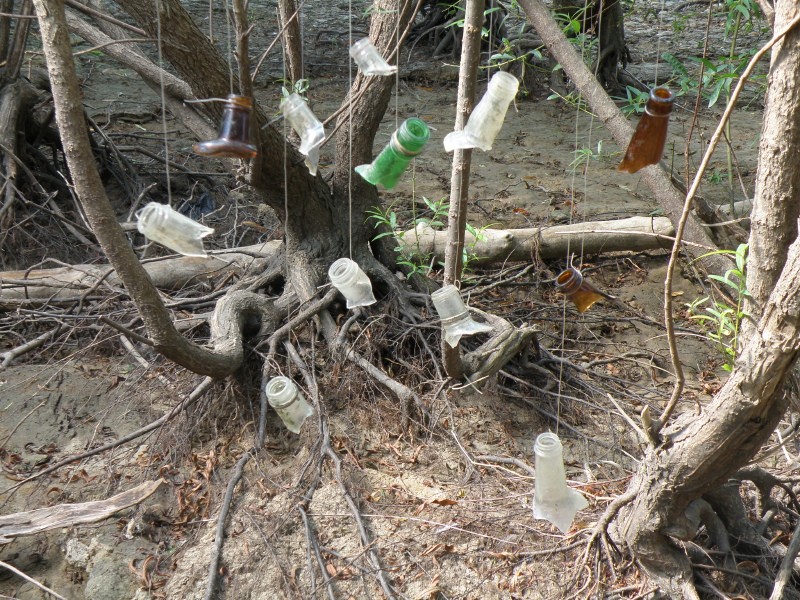
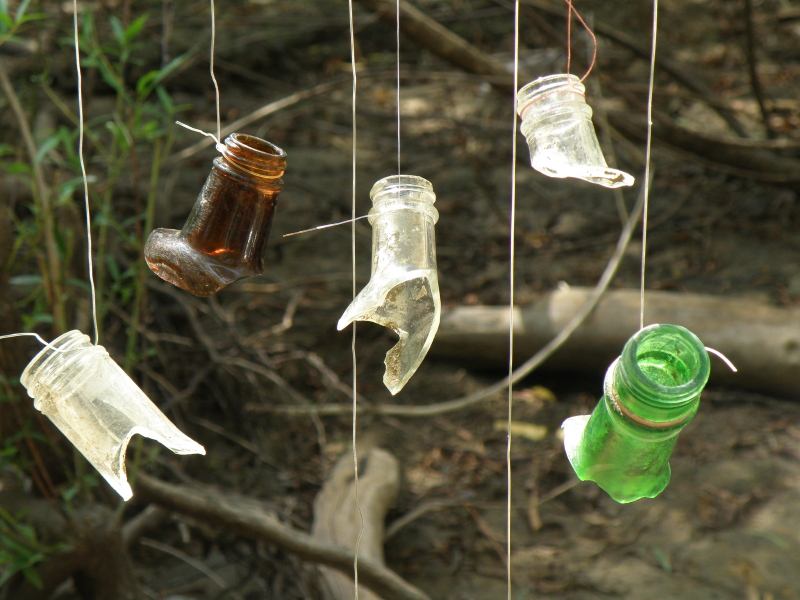
The next couple of images are from my last bottleneck piece.  In addition to lots of waste glass…I also find discarded fishing line, often in the same places.  I brought these two materials together for this ephemeral work.  Recently, I was talking with a good friend of mine and we were remarking about how much of our lives seem mediated by and require reading various kinds of screens.  This last glass project may have something to do with that because the bottlenecks are arranged in a flat, parallel screen hanging from a horizontally growing willow branch.  I wonder if anyone else ever saw this and what they may have thought about it?

various glass bottlenecks suspended on fishing line, 2013

detail, various glass bottlenecks suspended by waste fishing line, 2013

Well there you have it!  I suppose these bottleneck projects will now crop up on occasion like my found coal pieces do as intimate site specific expressions.  For now, it’s enough to present them as images without trying too hard to extract every bit of meaning from them.  Bottlenecks in the broader sense are challenges.  May we always remain open to meeting them.  So long from the Falls of the Ohio.

bottleneck on a stick at sundown, Falls of the Ohio, 2013

Read Full Post »

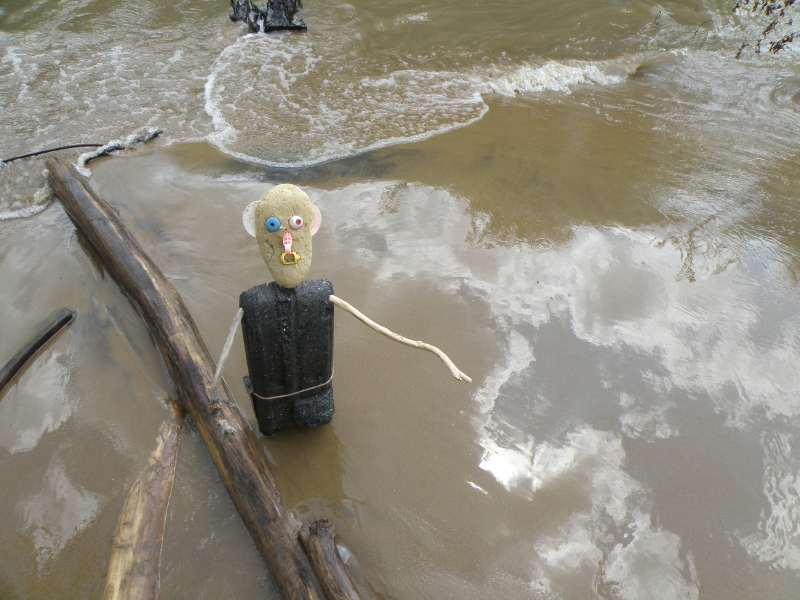
Falls black styrofigure, July 2013

With the sun spotlighting this little patch of sand…my newest Styro-figure proudly stood upright.  He’s the first persona created in the reconfigured studio.  I found a rare piece of “black Styrofoam” on today’s walk.  It’s part of what passes for car bumpers these days.  This material has a rubberized compound mixed throughout the foam which makes it harder to cut or pierce.

Leaving home, July 2013

After making new friends it’s time to venture out into the world.  The leafy green complete with bird song is complimented by the creaky willows that sway with the occasional breeze.  There is another sound, however, that your feet are hearing and you walk in the direction of its source.

Black Styro-figure by the river, July 2013

The mighty Ohio River has been running muddy for more that a week now.  Although it’s hot and humid today, thus far, this summer has been wetter and cooler than average.  As a result of all the rain, the river has been higher than usual.  What I like about the Falls of the Ohio is that in such a relatively intimate space the park can take on all kinds of different looks depending on the weather and season.  Small waves break upon the heightened shoreline and there is a family nearby fishing and playing by the river.

Family fishing for catfish, Falls of the Ohio, July 2013

Seeing that they were having some luck catching fish, I gestured if it was all right to take their pictures.  The family didn’t speak English and I’m guessing that they are recent immigrants from Southeast Asia?  Regardless, both adults and children were having a ball in the river.  I wondered if they came from someplace like this since they seemed so comfortable and natural by the water? After receiving the okay signal I recorded these images of people interacting with the river.

little boy, Falls of the Ohio, July 2013

This little guy was cute and really determined that I should take his picture in what I’m assuming is a martial arts pose?  I obliged him several times and this was my personal favorite snapshot of the group.  Looking through my riverblog…I’m struck by how often children appear and interact with my artistic process.  First, my own two sons would accompany me and now it’s the kids in the park on any given day.

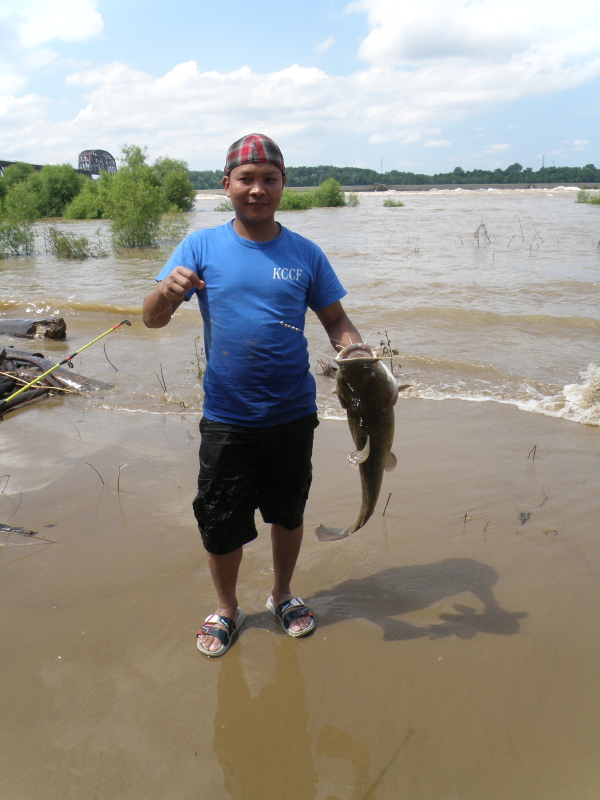
Man with Flathead Catfish, Falls of the Ohio, July 2013

Flathead catfish, Falls of the Ohio, July 2013

I watched this fish being landed and it’s a decent sized Flathead catfish, (Pylodictus olivaris).  This fish probably weighed in the ten to twelve pound range, but this catfish can get as large as a hundred pounds.  It is a fish of big rivers.  A very simple rig was used to catch this fish.  Four slipshot lead weights were clamped onto the line about eight inches away from the hook.  A single nightcrawler worm was used for bait which was cast about 25 yards from the riverbank.  The fishermen would wade in about knee-high to waist deep to increase casting length.  I was amazed that with the current and all the potential underwater obstructions that their lines didn’t get snagged more often than they did.

Catfish stringer, Falls of the Ohio, July 2013

This was the stringer of catfish they were working on.  In addition to the Flatheads…another big river fish the Blue catfish (Ictalurus furcatus) was also being caught.

catfish stringer, Falls of the Ohio, July 2013

The Blue catfish is a slatey-gray color and has a forked tail.  The two fish on the lower right in the above image are blues.  The flatheads are more of a mottled olive color and have very different fins.  Both are omnivorous and will eat most anything that they can catch.

Man and catfish, Falls of the Ohio, July 2013

All the fish on the stringer will be used to feed this family.  It is still not recommended that people eat the larger fish (especially bottom dwelling species) from the Ohio River. The river is much cleaner than it used to be, however, toxins do build up in the fat tissues of the fish that live the longest and grow to be big.  Every once in a while, making a meal of some of the smaller fish should be okay.  Because I was needed elsewhere today…I let my day at the river draw to an end.  Good thing too…because if you stand too long in the same spot at the water’s edge…you chance sinking down too far!  See you soon.

Styro-figure in black, waist deep in wet sand, July 2013

Read Full Post »

Joe Arbor at the river's edge, Falls of the Ohio, July 2013

Everybody has a different tipping point where enough is finally enough and action is called for.  This was the case with Joe Arbor.  For many years, Joe Arbor walked the river’s edge paying attention to what the Earth was telling him from the signals that washed ashore.  Yes, this is a nonverbal language, but the Earth is eloquent in this way.  On this particular day, Joe Arbor noticed that there was a lot of wood everywhere and while it was picturesque…it was also disturbing.  Joe Arbor realized that all the wood he was seeing represented trees in the past tense.

driftwood at the Falls, June 2013

Joe Arbor knew of other places where the Earth via the river had left a record of lost trees particularly at the Falls of the Ohio.  In the hot bleaching sun the various logs and limbs piled on top of one another reminded him of bones.  Joe Arbor would walk among these elephant’s graveyards of trees and felt ill at ease.  These trees represented a huge loss in terms of the free services they provided.  Here was food and shelter for a multitude of other life forms.  Here was the air we breathe and the cooling shade of summer and potential warmth in winter.  Here was lost inspiration!  Since Joe Arbor also made his home next to the river, he also knew that tree roots also held the riverbank in place.  Over the past several years it had not escaped Joe Arbor’s notice that at this location,  it rained more and harder and trees were being swept away.  Joe Arbor was no scientist or genius, but could recognize that life seemed out of balance and it worried him.  What could be done?  Joe Arbor went home and decided to sleep on the question.
Joe Arbor and Pip hatch up a plan, Falls of the Ohio, July 2013

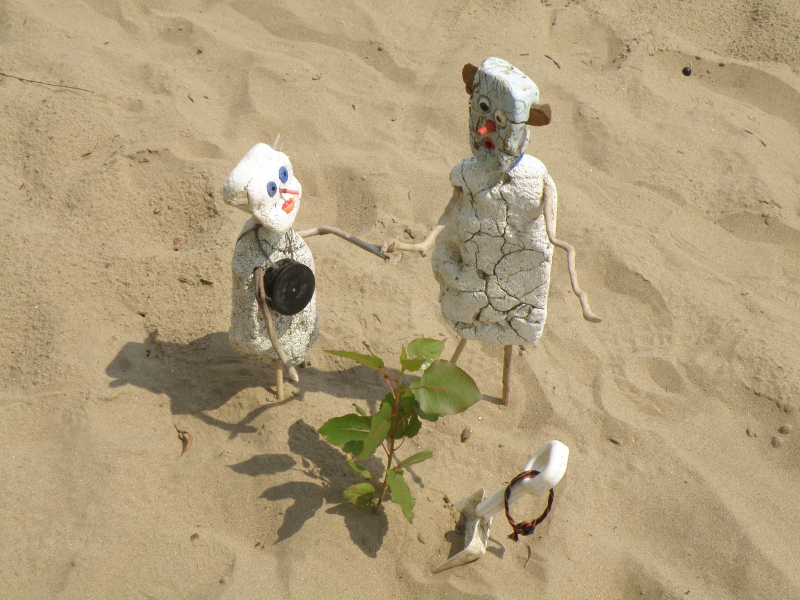
Joe Arbor makes his home at the base of an old willow tree.  It took several nights of sleeping on the question before the beginnings of an answer started to form in his mind.  When the solution came to him, Joe Arbor decided that he needed some help or company and he called his good friend Pip.  Pip is short for Pipistrel which is a name given to several species of bats.  One fine morning, the pair got up early and gathered some tools and provisions together and ventured forth to the river’s edge.  If the Earth was losing her balance due to tree loss…it made sense to Joe Arbor that getting involved with planting and saving more trees could be a good thing to do.

eastern cottonwood tree leaves and capsules, June 2013

eastern cottonwood leaves and seeds, July 2013

Joe Arbor decided he wanted to try to do something to help the Eastern Cottonwoods that grew along the Falls of the Ohio.  These cottonwoods are magnificent, fast growing trees and reach great heights.  They produce unusual capsule-shaped fruits and when conditions are right, these capsules burst open releasing tiny, fluffy seeds that drift through the air like dry snow and move with the slightest breeze.  Joe Arbor also knew from experience that many more of these seeds germinate than reach maturity.  At the Falls, those seeds that sprout nearest the river eventually are destroyed by the river during flooding.  They simply get washed away or crushed by logs rolling in the waves.  Joe Arbor decided to perform an experiment to see if he could successfully transplant a cottonwood tree to a safer location?

selecting a cottonwood seedling, July 2013

First Joe Arbor and Pip selected a little cottonwood growing in the sand.  They next held hands and said a few kind words and explained to the tree what they were about to do and why.  In this way, they hoped to obtain the tree’s blessing.  Together, they carefully dug around the sand to uncover as much of the tree’s roots as they could.  Bagging up the little tree roots and all the paired moved on to a different location.

Canada geese at the Falls, July 2013

All the while Joe Arbor and Pip were working, a small flock of Canada Geese were standing nearby and acted as guards and witnesses.  Because the geese also live near the river they are also privy to the Earth’s nonverbal language and understood what was at stake here.  Their presence added a bit of solemnity to the event.

Joe Arbor and Pip with cottonwood tree, July 2013

Joe Arbor and Pip with cottonwood tree and tools, July 2013

With their valuable charge in a bag, the pair moved on to a pre-selected location they hoped would be favorable to the cottonwood tree.  Cottonwood trees do best when they are close (but not too close) to the water.  As they walked, Joe Arbor whistled an improvised melody partly out of nervousness and the excitement of the moment.  As is his norm…Pip remained quiet.

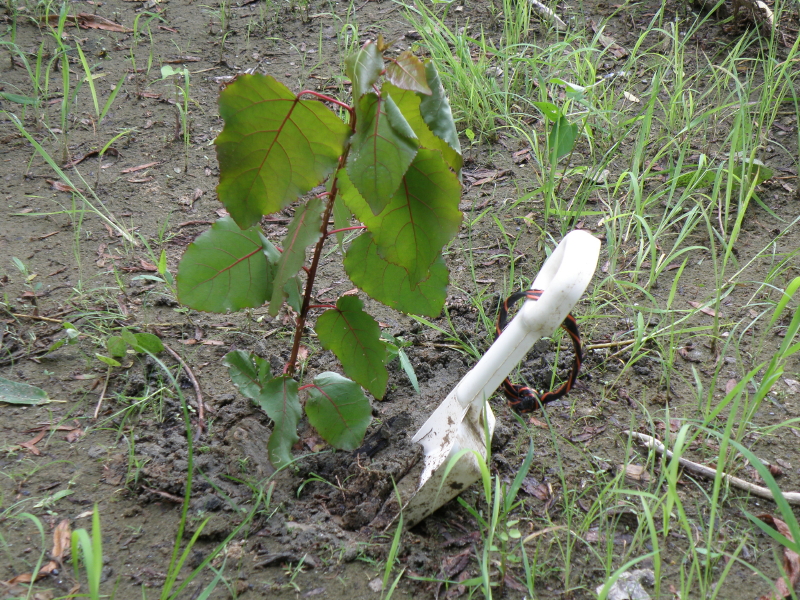
Young cottonwood in the ground, July 2013

A large enough hole was dug in the new location to accommodate all the young cottonwood’s roots.  Sand and soil were shoveled lovingly around the tree.

Joe Arbor and Pip plant the tree, July 2013

After the tree was safely in the hole, Joe Arbor said a few words while Pip watered the transplant.  It was hoped that the chosen location was the right distance from the river and that the young tree would grab a toe-hold here and prosper.  Time will tell.  The day still had one more nice surprise and it came from Pip.  Joe Arbor didn’t know why he didn’t pay attention to this before, but Pip was wearing a circular, black, plastic box on a cord hung around his neck.  This circular box was the container that smokeless tobacco is sold in.  Many of these boxes routinely wash up at the Falls of the Ohio.  Anyway, Pip opened up the container revealing its contents and this is what Joe Arbor saw.

snuff box with mulberries, July 2013

Wrapped in mulberry leaves were four ripening mulberries.  This is another tree that grows at the Falls of the Ohio and provides food for many birds and animals.  The berries are sweet and juicy when ripe and some people find them tasty too.  The leaves are interesting and come in different shapes with serrated edges.
Pip holding a mulberry, July 2013

Pip (who says very little) had his own tree planting experiment in mind and Joe Arbor got the idea.  Moving to a different location, a new hole was dug in the rich soil and a berry was placed in that hole.

Pip and Joe Arbor plant mulberries, Falls of the Ohio, July 2013

The process was repeated until all the berries were planted.  Pip was curious to see if he could start a mulberry tree in this way or whether the seeds needed to travel through the gut of a bird or some other animal first?  Again, time will tell.  Satisfied that at least for today, the duo had done some good for the Earth, the pair picked up their gear and headed home together.

Pip and Joe Arbor go home, July 2013

This little story is dedicated to an artist friend of mine I have never met.  She has a vision of creating a tree art project around the world and if you are interested in learning more about it and perhaps participating…here is a link  to a post she wrote about it:  http://rooszwart.wordpress.com/2013/05/29/the-bridge-land-art-forest/

Pip and Joe Arbor after planting trees together, July 2013

Read Full Post »

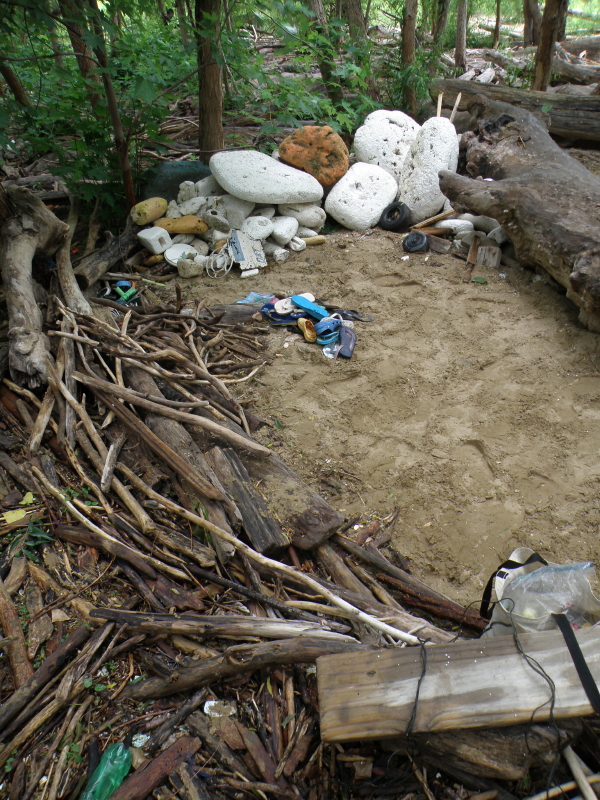
Wet studio under the willows, Falls of the Ohio, early June 2013

If you are reading this post between June 28 through September 1, 2013 then you are also participating in an art exhibition.  You may ask…how is that possible?  Well, sitting on a white table within a gallery of the Kentucky Museum of Art and Craft in Louisville is a desktop computer.  On that computer, my “Artist at Exit o Riverblog” is on display in a group show entitled “The Seven Borders” which is curated by Joey Yates.  The exhibition features contemporary artists who either live in Kentucky or in the seven contiguous states that border the commonwealth. I will try to post more about this exhibit over the show’s run.  I’m delighted by this invitation because this is the first time my blog has been featured as art in an art context.  I’ve always thought this was a possibility for this blog because my art comes together here in terms of the objects I make, the pictures I take, and the words I string together to tell stories or just describe the beauty of nature.

 Of course, the dialogue created by people’s comments is a part of that too.  With hope, people will additionally feel they can participate by leaving a comment, however, online you will need to be a WordPress member or a blogger with an Open ID credential.  This is easy and free to do.  If, however, you would prefer to write a note on paper while in the museum and give it to the front desk attendant…I would be glad to include those comments in this project as well. 

 It’s been a busy and engaging June with projects at the river, a family trip to Washington D.C. etc… I had planned a different post for today, but after yesterday’s experiences at the river…I thought I would go out of sequence.   Besides, with art, it is quite often the case that progress or forward movement is not linear, but jumps all over the place.  Let’s begin again with the first image of this post…this was my outdoor studio under the willow trees at the Falls of the  Ohio in early June.  

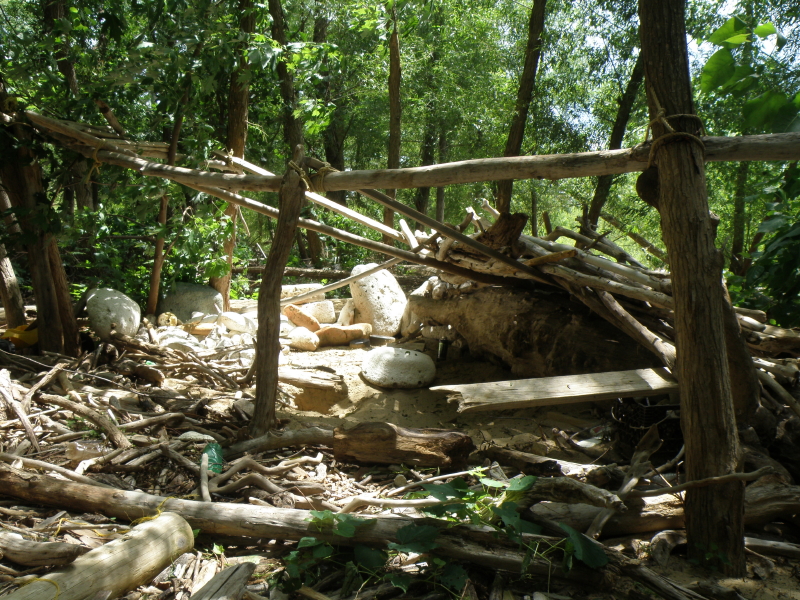
I have used this spot to cache river found materials and to make my sculptures and this has been a handy base of operations for a couple of years now.  This spot has weathered a few near miss floods that could have washed everything away again, but has stayed remarkably intact.  Well…there were a few recent changes which form the true subject of this post and here are the pictures.

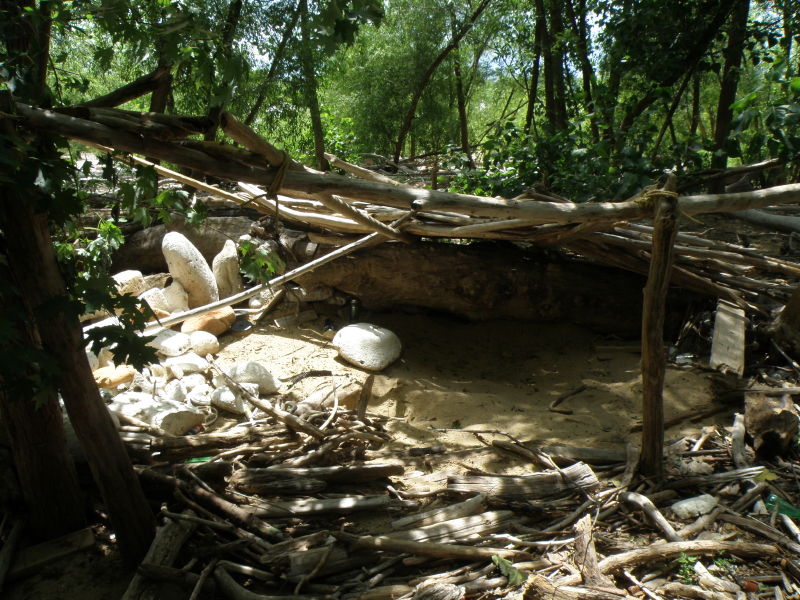
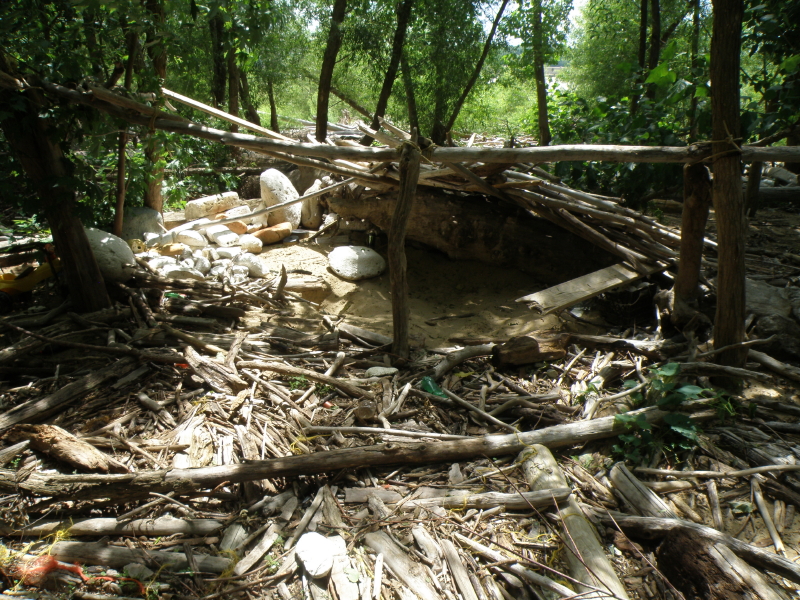
Improved outdoor studio space, June 2013

Improved outdoor studio space, Falls, June 2013

Improved studio area, Falls, June 2013

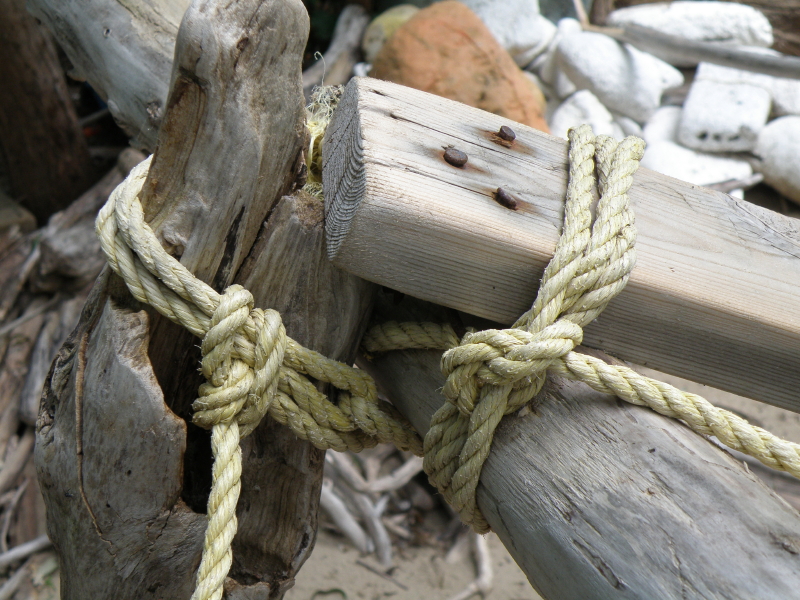
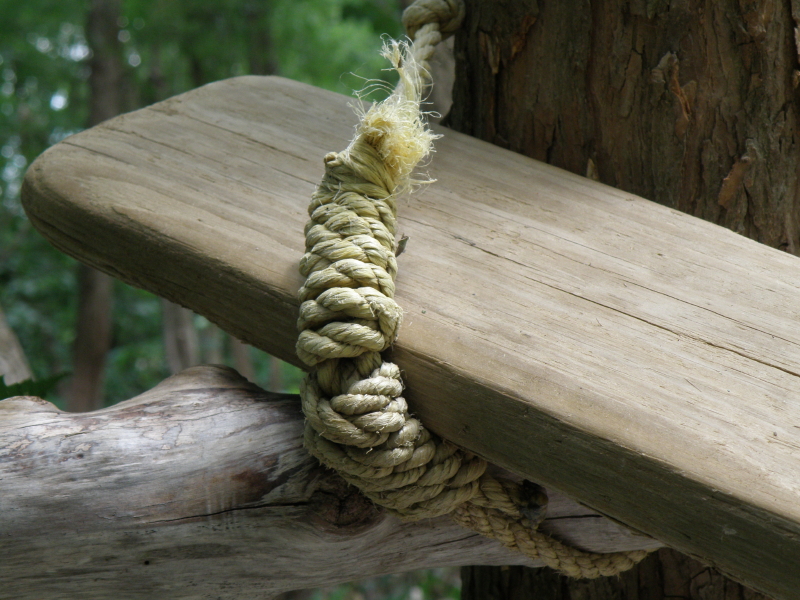
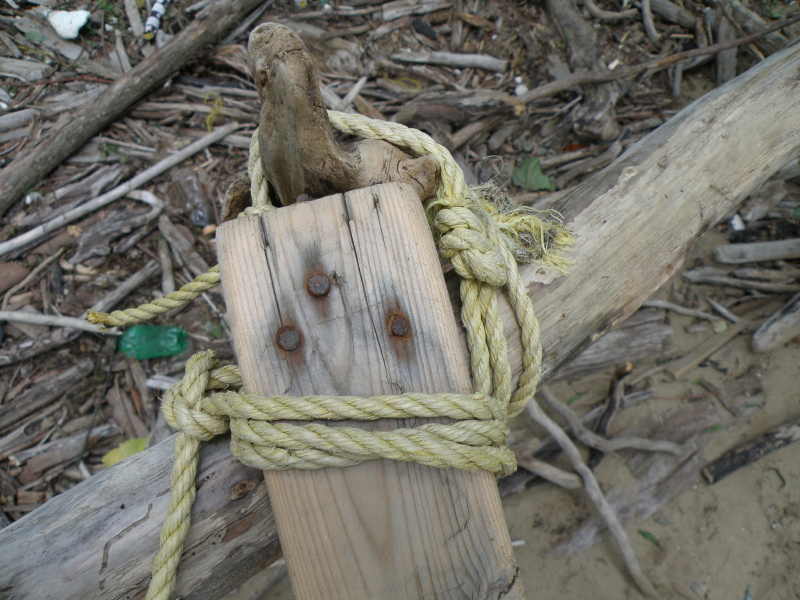
It was an already dramatic day in terms of the weather.  Bright sunshine alternated between heavy, dark clouds dumping rain showers along the way.  The clarity of the air and the mosquitoes were noteworthy.  I did get soaked on this adventure, but as long as the camera stays dry…I’m alright with it all.  Imagine my surprise upon arriving at my site to find that someone anonymously had built a structure around it!  I’m used to folks going through the junk I’ve scavenged and taking or destroying whatever creations I may have left behind, but this is a first!  A great deal of care was used in working with the existing site by utilizing the surrounding trees and logs as posts and beams.  I wonder if this is also the work of more than one person?  This is more than a flimsy lean-to where the wood is simply stacked.  Some craftsmanship is evident from the knots used to hold the structure together.  It might take more than one person to steady things as another does the tying?  Again, more pictures to illustrate the story.

knots used to hold structure together, June 2013

knots used on wood structure, June 2013

knots and wood, June 2013

The yellow nylon line is something I had found previously and used to create the giant spider’s web featured in an earlier post.  This structure has a chance to stay up for awhile…at least until someone else messes with it or the river rises again.  I was absorbed with the changes and reflecting on how often I have looked at this site from an archeological perspective.  It might even be fun to draw all this stuff in a scientific sort of way.  Because it had rained while I was looking around, the damp ground muffled the approaching sounds of my second big surprise of the day!

Figure with large head, June 2013

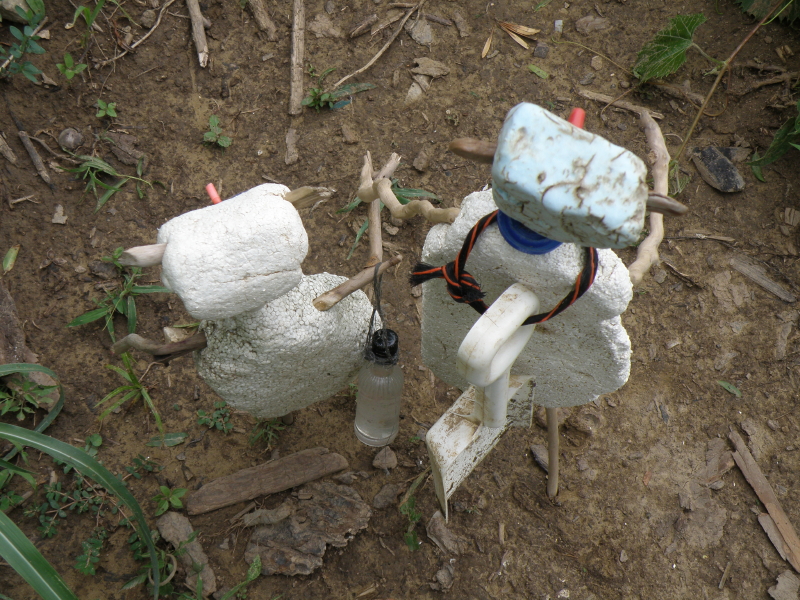
I turned and looked over my shoulder as this large presence stepped over the logs and entered the studio area.  He sat right down and asked, “Are you the guy that makes the Styrofoam sculptures?”

Big Figure with Pencil-thin mustache, Falls, June 2013

Big figure with pencil-thin mustache, June 2013

Whoa!…(I said to myself),…check out this dude with the huge head, miss-matched eyes, and pencil-thin mustache.  No doubt about it…I was a bit taken aback!  Regaining my composure, I replied that indeed I was that person and added that many of those creations were made in this very spot.  Without every telling me his name, he replied “I thought so…I’ve been an admirer of your work for a long time now.”  Knowing he was a fan set me at ease and we had a nice visit together.

Big Figure with pencil thin mustache, Falls, June 2013

Portrait of the Figure with the Big Head and Pencil-thin Mustache, Falls, June 2013

“So, how do you like it?”  Spreading his spindly arms around my studio,  I gathered that he was the architect of these recent improvements.  I told my mustachioed friend that I just love it when people play along and contribute to my Falls of the Ohio project!  I could see this clearly delighted him.  He asked if there were any suggestions for improvements and I replied that I had a few ideas.  To begin with, it is now much more difficult to move within the space.  I whacked my head a few times on wooden supports.  If the structure were higher…that wouldn’t be an issue and I also wouldn’t turn into a hunchback any sooner than I have to.  I also added that I missed having the big log to use as an impromptu work surface.  When I stood, it was just the right height.  Now, it is covered up with stacked wood.  I could see from his expression that this was probably enough in suggestions for this time.  I didn’t tell him that I needed to create new seating because the plank I liked using had been damaged.  That’s no big deal.  With the clouds ahead promising more rain, I gathered my camera, collecting bag, and walking stick and bid my new friend so long…for now.  Perhaps we’ll meet again?  Looking back, I saw the big guy sitting in my customary spot.  As I walked over the driftwood and sand, I wondered if my next visit to this site would harbor any more surprises?

The Big Guy with Pencil-thin Mustache at the studio, Falls of the Ohio, June 2013


Read Full Post »

« Newer Posts - Older Posts »