Feeds:
Posts
Comments

Posts Tagged ‘recycled art’

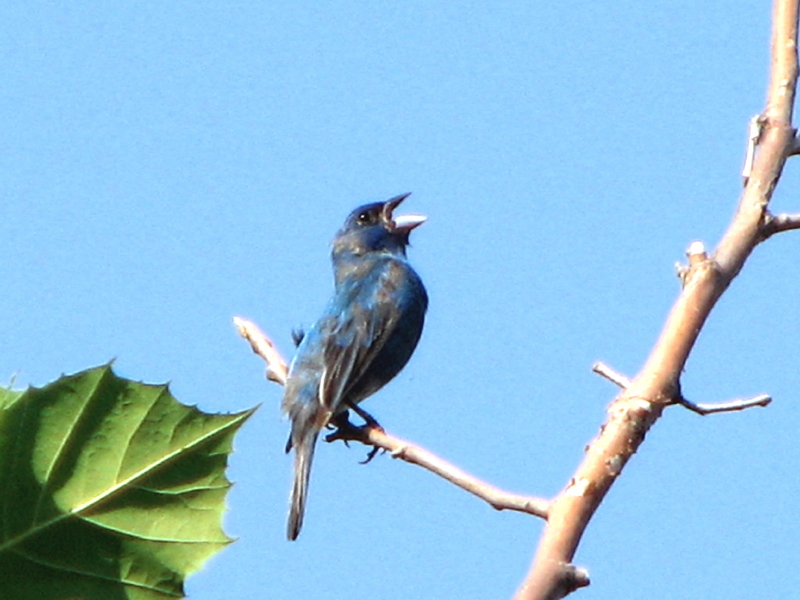
It’s been a hot, hot summer at the Falls of the Ohio.  For me, the best time to be out here is as early in the morning as possible.  One advantage in doing this is you are more likely to see birds and other wildlife.  I found this Indigo Bunting singing away from the topmost branch of this tree.  For as open and publicly trampled as this park is…witnessing such small and intimate moments where man and nature freely mix keeps me coming back for more.
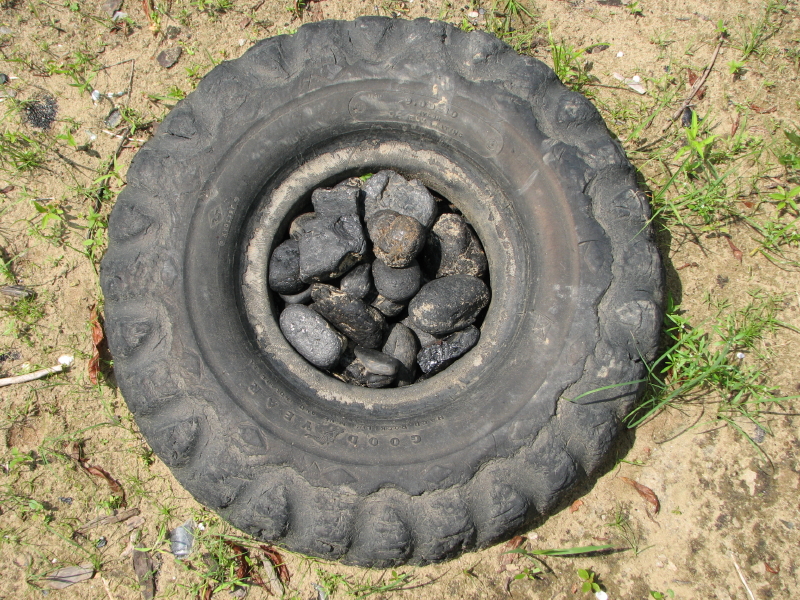
This adventure occurred during my last visit to the park and early in the month.  As it turned out, it was a memorable visit.  I’ll go ahead and tell you that I twisted my right ankle which isn’t big news or a particularly rare occurrence.  But this time, I was sure it was broken and I limped out of the park with the aid of my trusty walking stick.  I was walking along in the sand and my ankle just collapsed.  That’s all it took.  All my early sports injuries have left me with a weak ankle.  The x-rays didn’t reveal a fracture, but I was surprised by the bone spurs and bone deterioration.  As I write this three weeks later, I’m still limping along but without the aid of crutches so I guess I’m on the mend.  Returning to that day and before the sprain,  I revisited the sand sunken tire from previous posts and replaced the coal that was removed from it and then moved on.
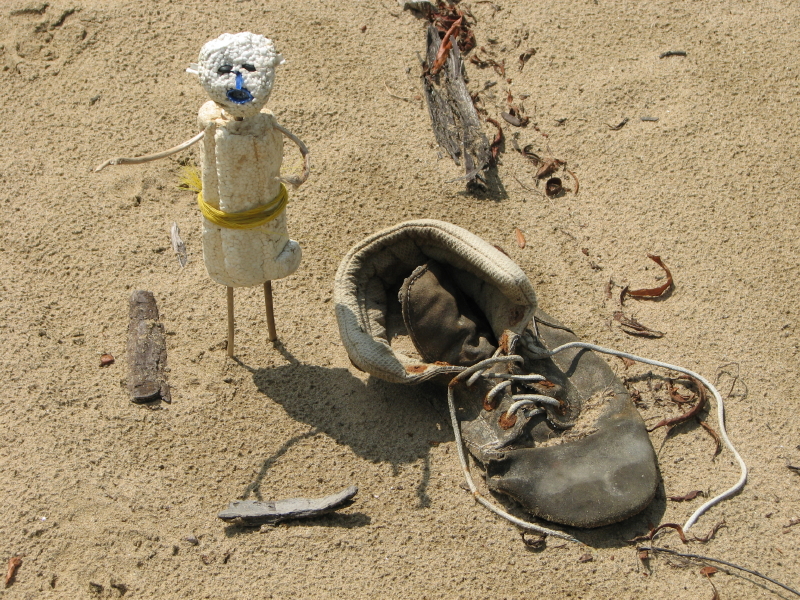
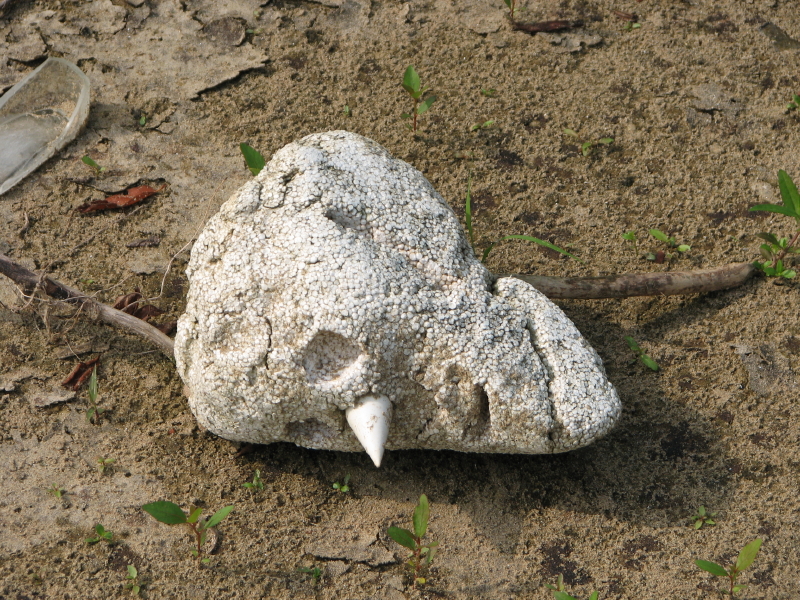
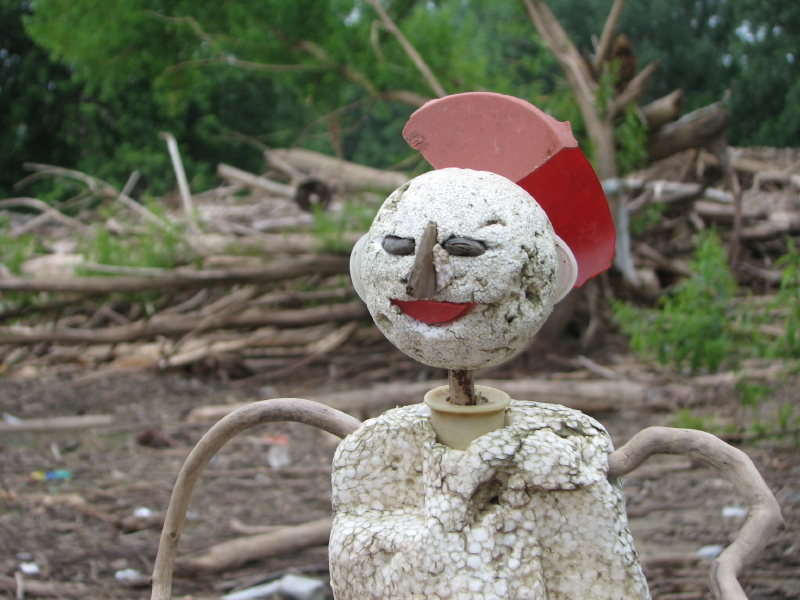
I created a little friend to keep me company and to help me with the day’s projects.  He’s made with Styrofoam, sticks, plastic, and a little bit of coal for his eyes.  I have used the coal that washes up here for as long as I have been doing this particular body of work which is approaching eight years now.  As a material, its relevance has always been appreciated by me.  Like the corals and brachiopods that have left their traces in the limestone at the Falls…these black rocks also speak of ancient life, but coal has a different and contemporary purpose that is won at great cost.  Walking along the eastern section of the park, I explored and gathered the coal I found interspersed among the sand and driftwood.  My little helper tagged along and soon we filled the hole in a second found tire.
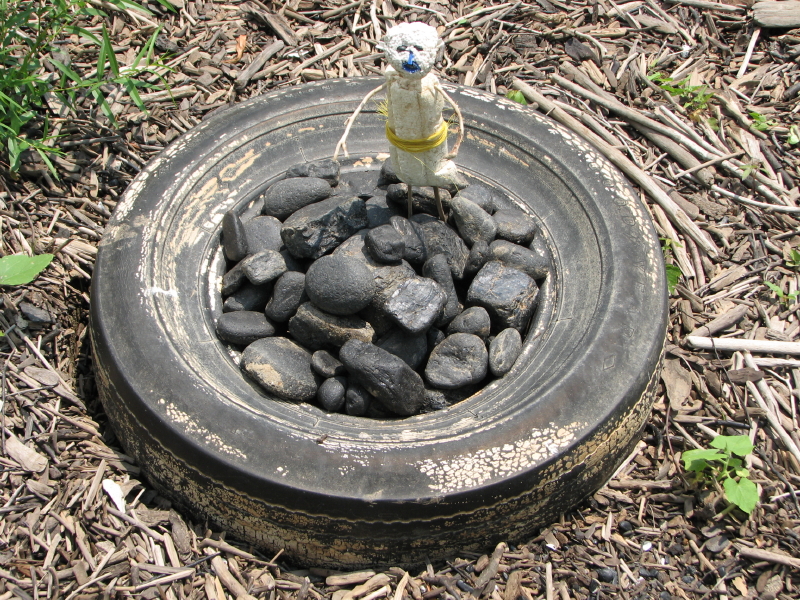
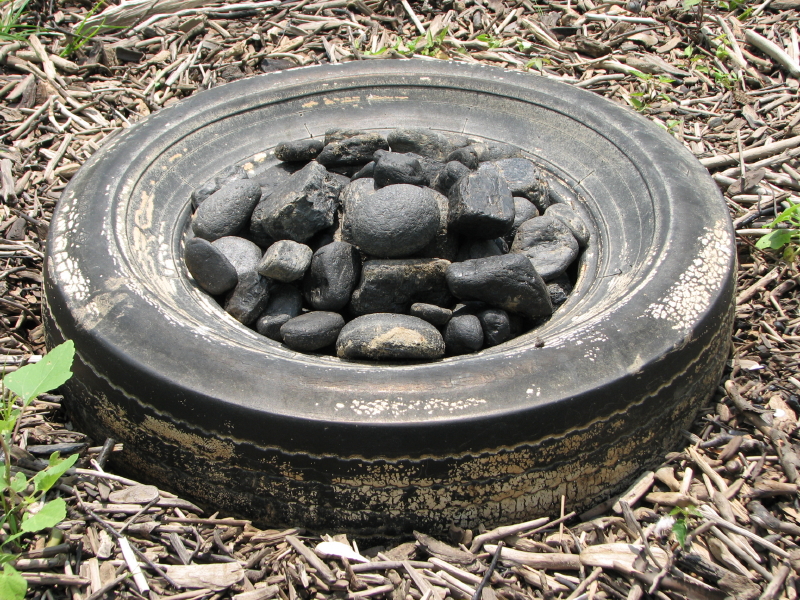
I noticed after I selected this tire that it had once been painted white.  I have seen this before where people of thrift have used cast off tires for garden planters.  On this one, most of the paint has worn off and the river has given this tire a unique patina.  For the Little Man and myself, this would just be the beginning of our play with the found coal out here.
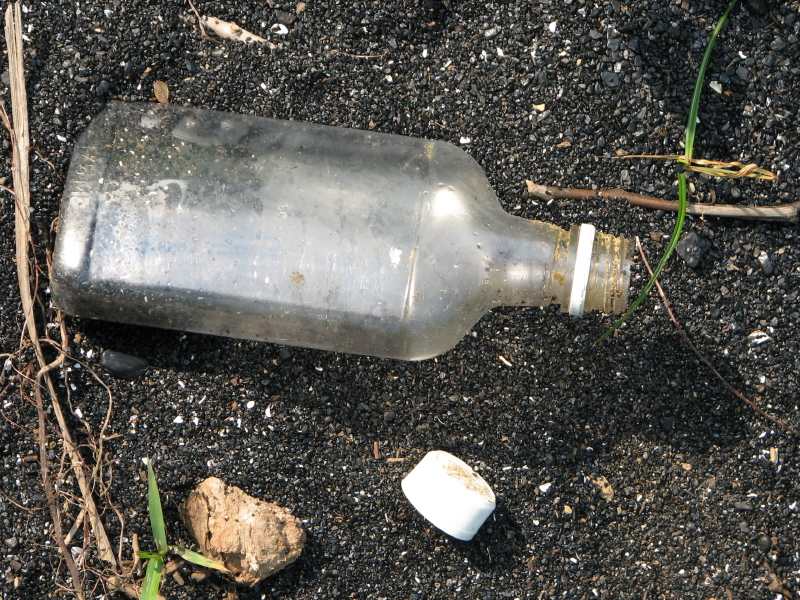
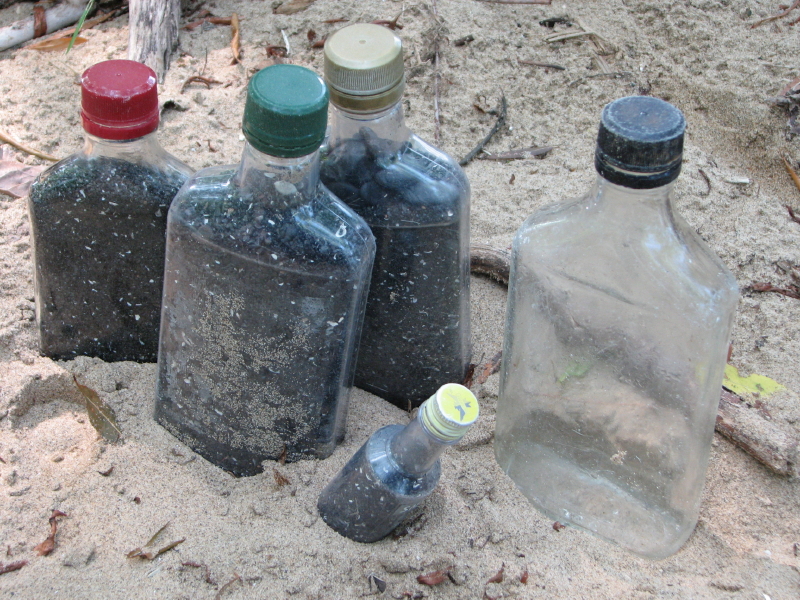
Among the other found objects I scavenge along the beach are empty pint bottles made from glass and plastic.  I like them when I find them with their labels soaked off by the river and their bottle caps in place.  A little more than a year a go I shared a river adventure with video artist Julia Oldham and we marked the day by putting notes and colorful fishing floats in other empty bottles.  I sometimes think of those bottles and wonder if anyone has ever found one of our notes?  In all my years here, I have never found a note in a bottle and by now I have looked at thousands of bottles.  Some of my friends at Living Lands and Waters report finding notes in bottles all the time and I’m guessing that this happens more along the Mississippi River than it does the Ohio River?  For me, finding a note in a bottle will happen when it’s supposed to…I just hope that it’s written content will be interesting!
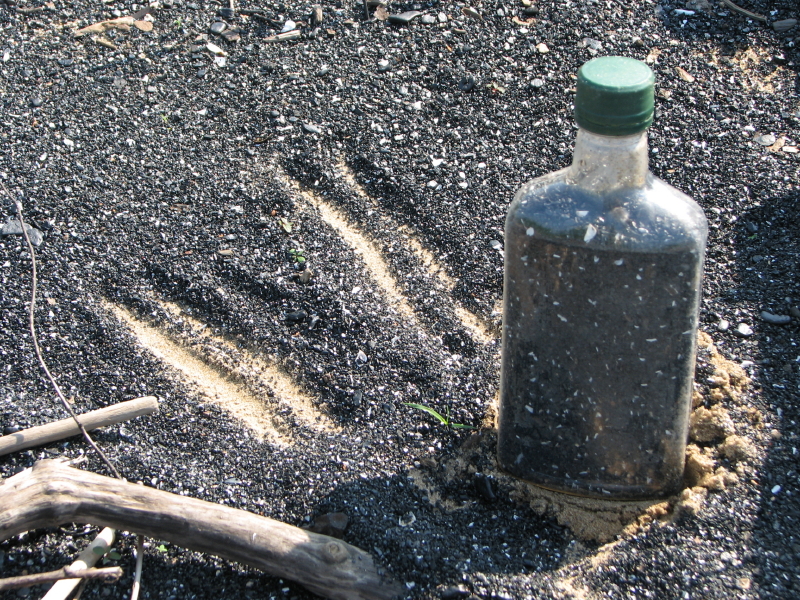
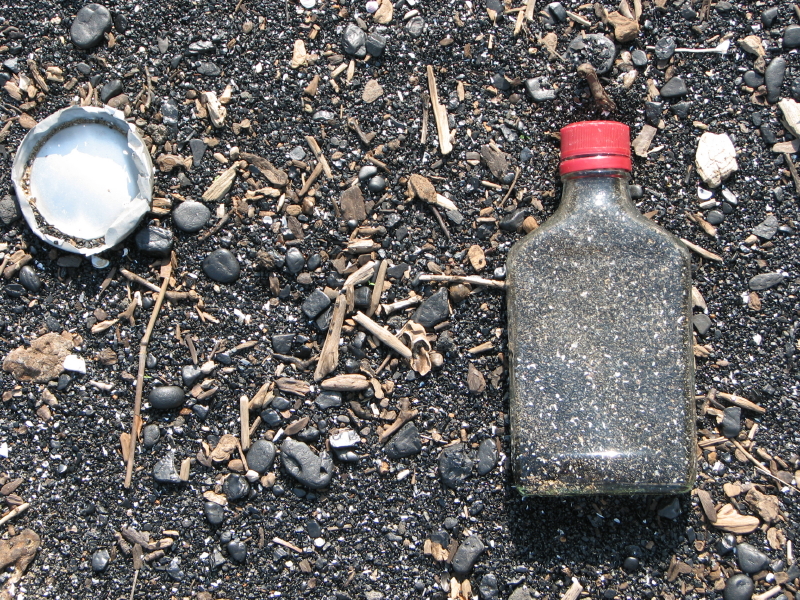
You have just seen a few of the bottles I have filled with coal.  The white flecks you see mixed into the coal are bits and pieces of mostly zebra mussel shells which is another unwanted element in this river.  Filling these bottles with coal is meditative for me.  Usually, there is still a little bit of whiskey or alcohol in the bottom of these bottles that scents the coal inside its container.  Coal is such a complex subject in our region that it is enough to drive one to drink.  On one side it is a common and available form of energy, but the costs to the land, people, and larger environment are extreme.  Having visited the coal fields in eastern Kentucky, it is certainly plain that the people whose land and mountains have been mined out from under them haven’t benefited to the extent that you would think since poverty and despair are far too common.
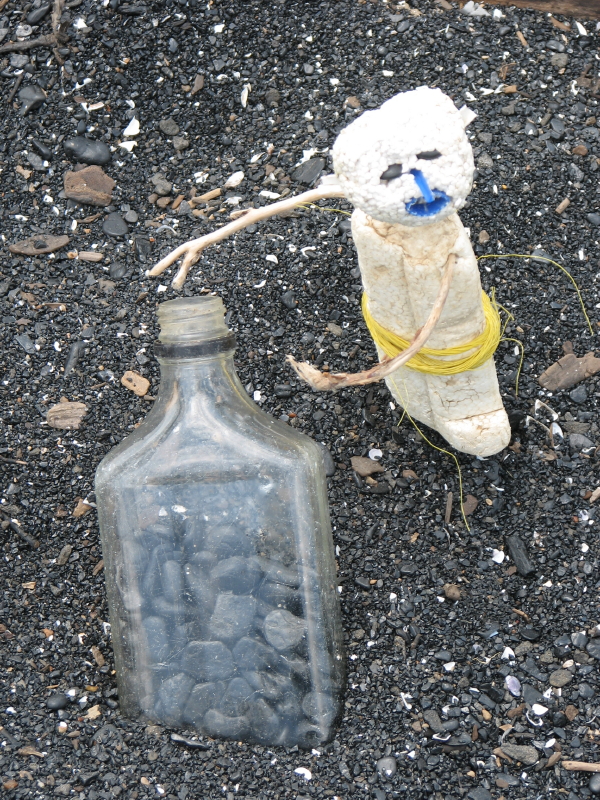
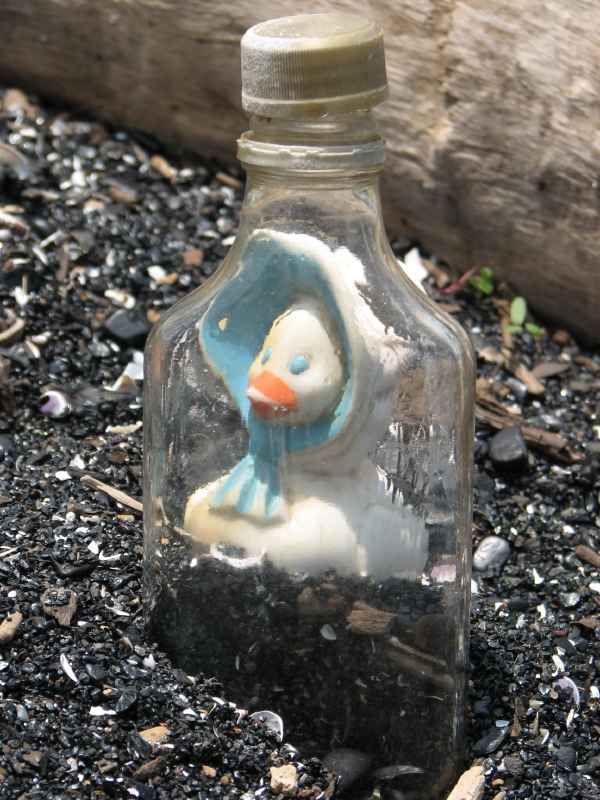
I’m going to continue to explore coal as a material and social issue with the help of some new friends.  I have been invited by a group of mostly younger Kentucky artists to participate in an exhibition to be held sometime in the near future.  A blog has been set up called Project Reclamation and if you would like to follow along…just click on the link on my Blog Roll on the right column. I will keep you posted.  To close, here is one other bottle or carbon storage image I photographed with a found rubber duck behind the transparent bottle.  I look forward to going back out to the Falls of the Ohio as soon as my ankle fully heals.
Read Full Post »

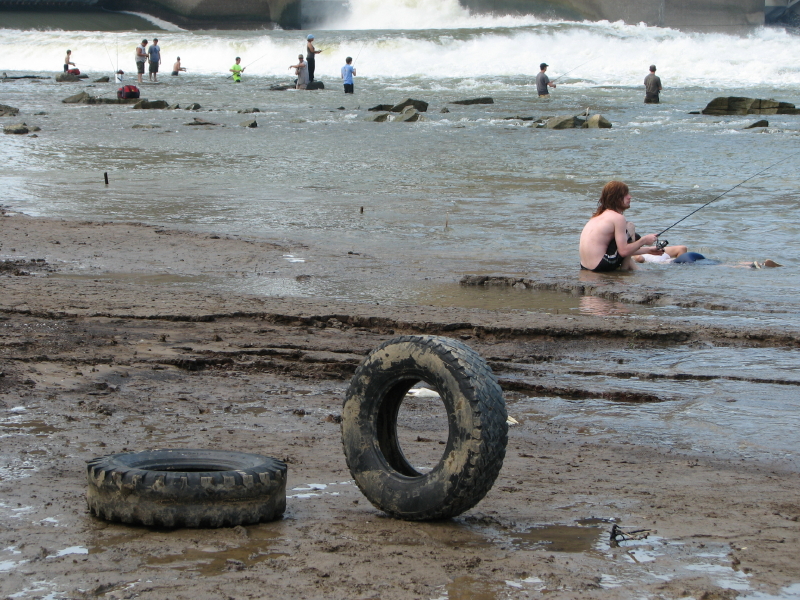
The fishing had been good and attracted both experienced and novice fisherman.  People were catching some of the smaller striped bass and the occasional catfish.  Summer has descended full-bore with its twins…heat and humidity and so a visit to the river is a welcome diversion for many.  The parking lots around the park are full.  To me, this is a mixed blessing.  You want those who can appreciate nature and the surrounding area to enjoy themselves, however, there is always that element present that can’t resist despoiling for their own selfish reasons.  Sometimes it seems that visitors leave as much trash here as the river does in its wildest moods.  Please pack your garbage out.  After checking out the fishermen, I head up the bank to locate my last project with its polystyrene figure.

I’m not shocked at all to come across Joe Coalman’s eyeless skull resting in the hot sand.  To be honest, I would be more amazed to find him still intact.  My postmortem revealed that he had the stuffing knocked out of him.  I found his body about thirty yards from his head.  I take some photographs and gather the remains.  I’ll probably recycle him into another project in the future.  As for the tire with the coal in it…

…well, it too has been altered.  I can see how a standing Styrofoam figure would make a tempting target, but what about a tire filled with coal?  It must have provoked someone because the coal had been knocked out.  The black rocks were scattered all around.  I regathered them, but I could not find all the coal that was originally in the tire.  Curiously, if you look at the rim of the tire you will see something I had not originally placed there.  It’s a tiny white clam shell left perhaps by another visitor?  I appreciated this simple gesture and moved on.  Soon I reached my outdoor atelier with its latest cache of Styrofoam.  I laid Joe Coalman, skull and all back into the pile and wondered what to do next?

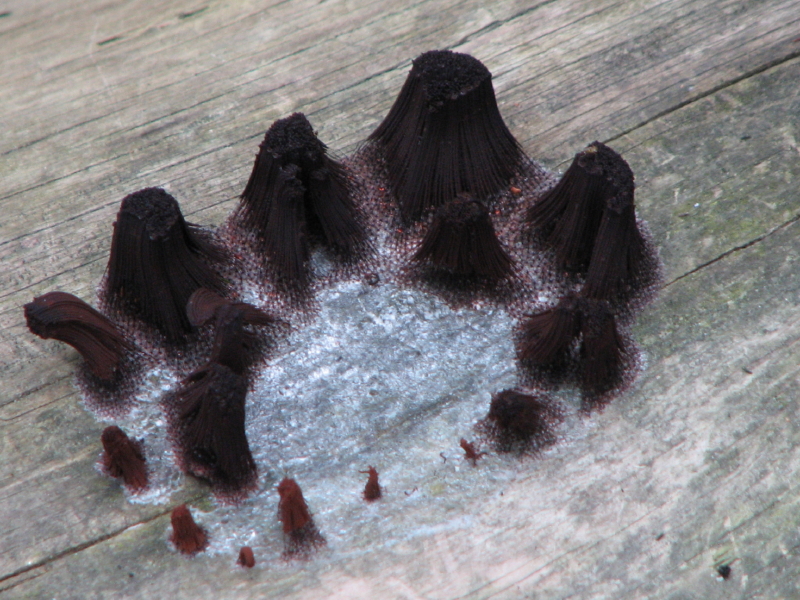
While sitting on the enormous wooden beam that defines one side of my outdoor studio, I spied something interesting on an equally impressive log.  Growing along the margins of an old bird dropping was this wonderful fungus.  At the Falls of the Ohio, there are many different types of fungi that help break down the organic bonanza that washes into here.  I wish I knew more about them, but realize that this is another entire field of study.  Nevertheless, fungi are of immense importance and help recycle nutrients among the many other useful services they perform.  With this particular fungus, it looked like it was on the downward cycle having already released its spores from the fruiting bodies that were now arranged like some organic version of Stonehenge.  After studying this curiosity for a few minutes, I settled into the familiar activity of creating a figure that would be the benchmark for the day.  Before revealing it to you…here are a couple of other things that I want to show you that I happened across during my walk.

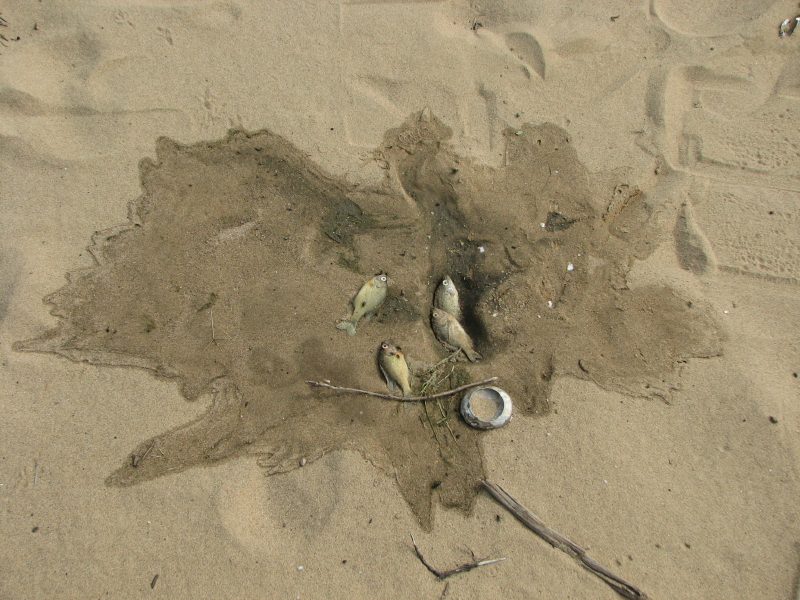
I’m always looking at the evidence and trying to figure out what occurred at a particular place?  Here a fisherman on his way back to the rest of his life has dumped out his bait bucket and left the four tiny bluegills in the sand.  Perhaps they were dead already since fish in a bucket die of oxygen loss without an aerator to cycle air back into the water?  I wondered if the use of these bluegills broke any laws since using other sport fish for bait is generally frowned upon?  I could imagine the size of the bucket from the wet area in the sand.  The silver circular object is the bottom of an aluminum can.  Near this scene, I also came across this discovery.

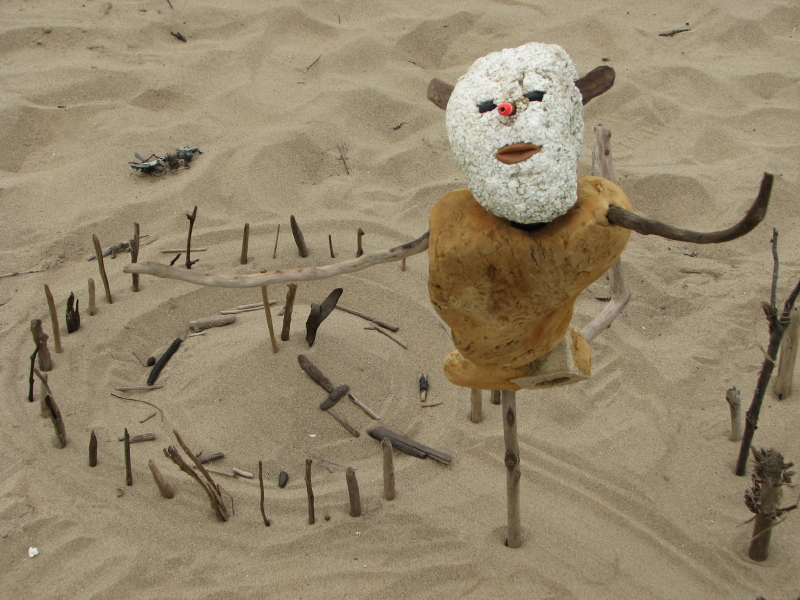
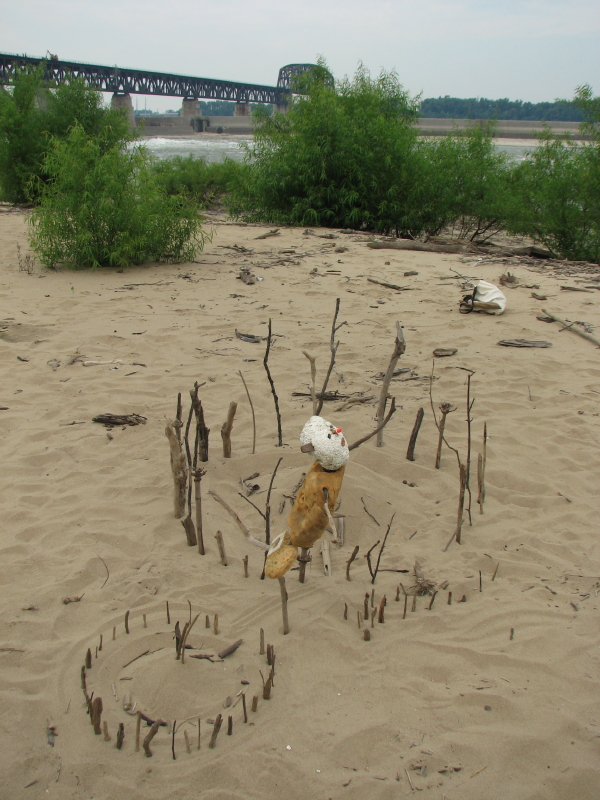
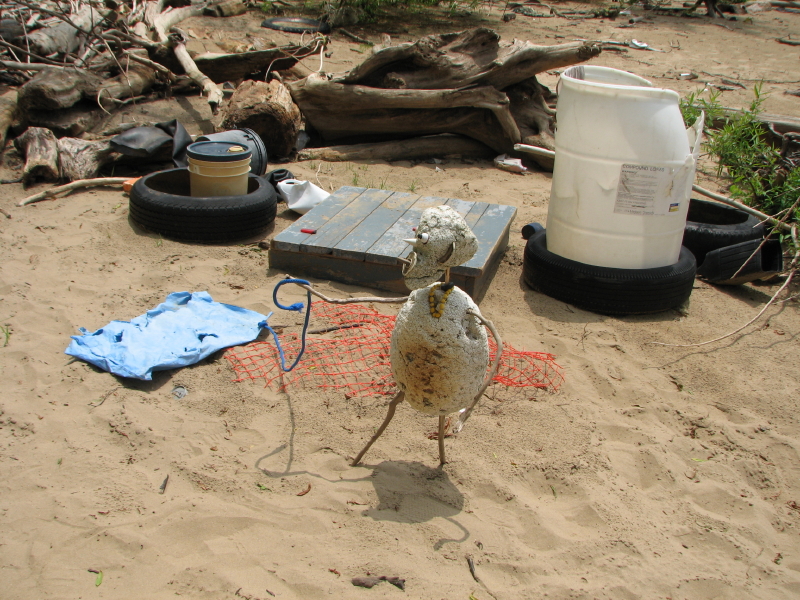
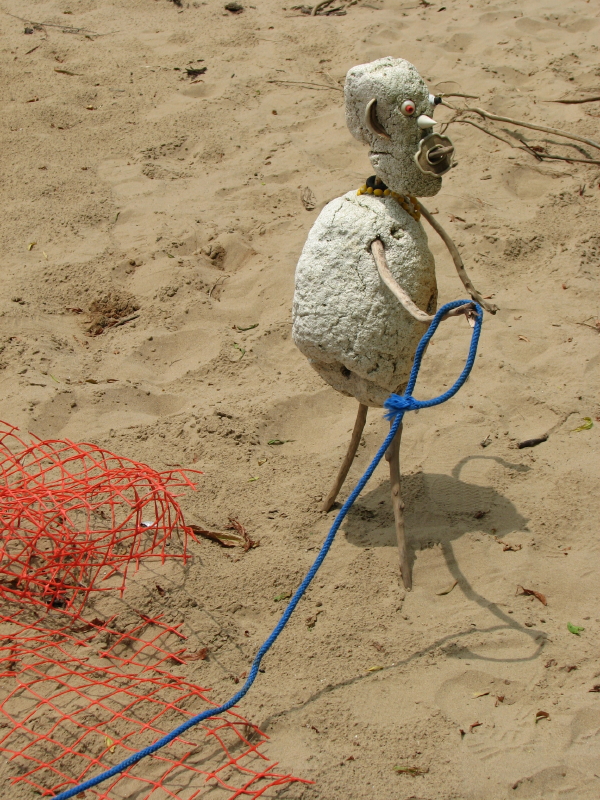
Less than a stone’s throw from the dead fish I found this arrangement in the sand.  I love it when people opt to leave their mark on the land in this fashion.  Present were two complete circles in the sand defined by upright sticks with mounded sand in their centers.  In my mind, I imagined two gears or cogs moving in response to each other.  The movement of the sun provided some of the energy needed to activate this metaphorical machine.  I decided that this place was a good site to unveil my latest figure which implies movement too.  I let it dance throughout this arrangement in the sand.

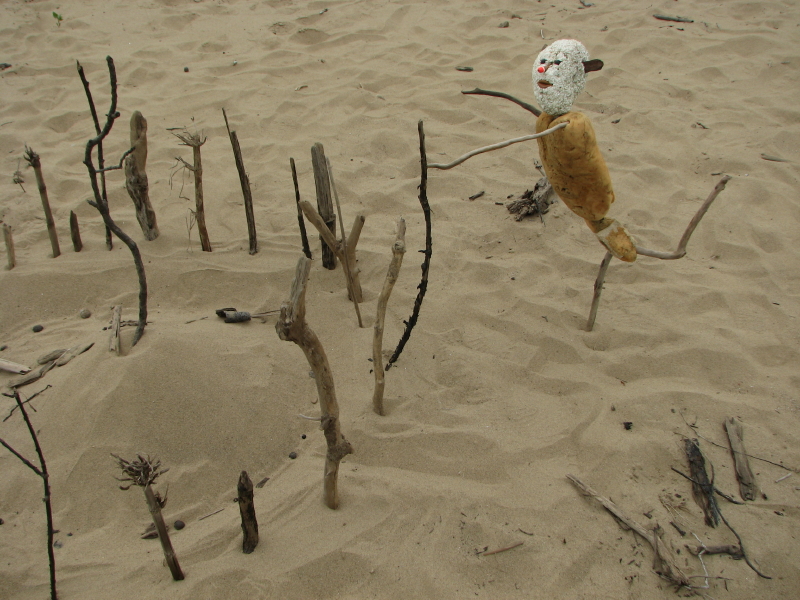
Maybe this was originally made by a child while his family fished?  It doesn’t matter because it gave me something positive to react with and made my day.  Feeling satisfied, I started back to my own vehicle, but there would be one more surprise on this day.  Perhaps this was also made by the same folks who did the circles in the sand?  Again, sticks were employed albeit much longer in length.  See for yourselves.

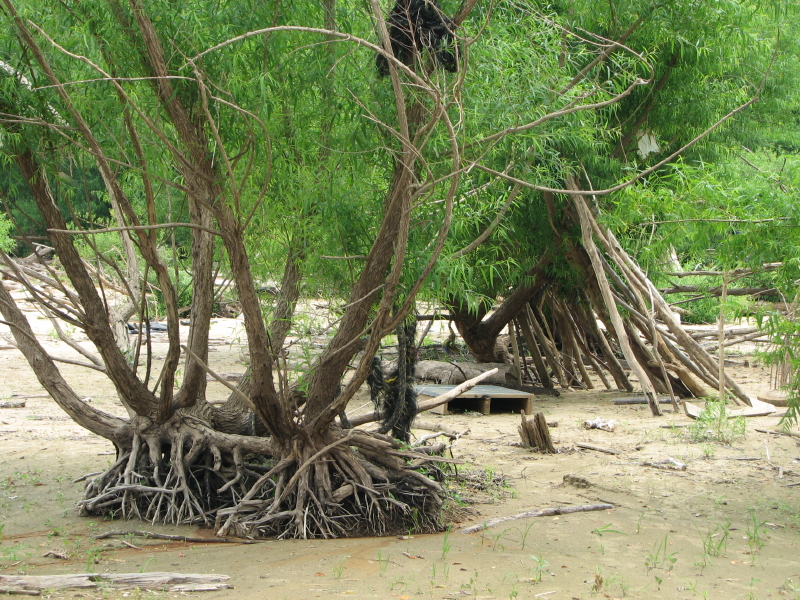
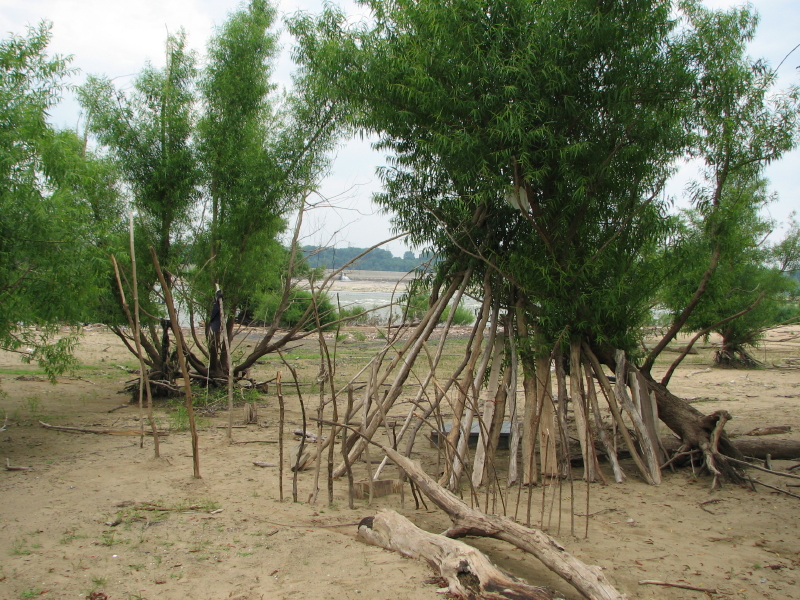
Logs and long branches were leaned against a willow tree and the effect implied shelter to me.  Other long sticks were placed upright into the sand and helped define the area.  A wooden palette was dragged to this location and left to provide seating.  Because the materials used are all local, it would be very easy to walk by this if you weren’t paying attention.  That’s one of the things my Styrofoam figures have working against them…their stark whiteness usually gives them away even at some distance.  But then again, for me that’s part of what I do which is to call attention to the stuff that doesn’t belong out here and through a little creativity, show what can be done.  I appreciate the stick pieces because they only use the natural materials that are out here.  I wish I could do this more often myself, but this isn’t the reality I usually discover out here.  Leaving the area, I came by this wonderful flower and in its center…was this tiny bee carrying on as her kind has for as long as there have been flowers in need of pollination.  Until next time.

Read Full Post »

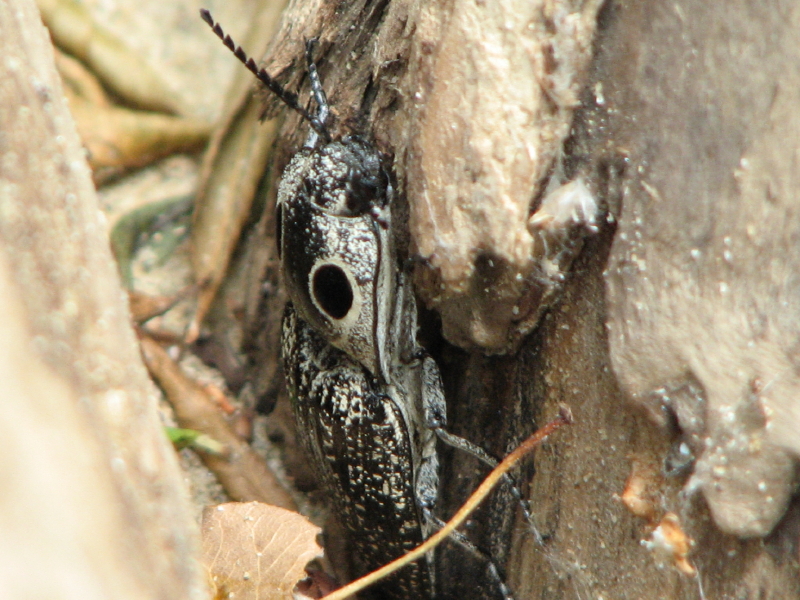
I threw my arms up into the air and said “WHAAAAA”!  I had been resting in the shade after a couple of hours of junk scavenging when I heard this low vibrating sound and the bump of something landing on my head.  Reflexively, I knocked off whatever was on my noggin and it fell to the ground…and this is what I saw.

This is the Eastern Eyed Click Beetle or Big Eyed Click Beetle, (Alaus oculatus).  It’s one of my favorite indigenous beetles and one I’ve seen at the Falls of the Ohio on numerous occasions.  As beetles go, this one is on the large side approaching two inches or about five centimeters in length.  Getting smacked in the head by one certainly surprised me, but it turned out to be a good one.  I love the cryptic bird dropping coloring and those two large eye spots get your attention!  After the beetle recovered its senses, it flew and landed on a dead tree trunk right behind where I was sitting.  It turned and started walking down the tree towards the ground.

I watched as the beetle lowered the tip of its abdomen at the base of this dead tree.  I’m hoping it might be laying an egg or two.  When it was done, it walked back up the tree trunk before flying off for the next tree or head that catches its fancy.

I was rummaging around one of the driftwood mounds for whatever secrets it was carrying and to separate out materials for the river sweep clean up.  Nearby, was the beginnings of another garbage pile that someone else had started.  I decided to throw my junk into this lot to consolidate it and make the removal just a bit easier.

It was the usual lot.  A few plastic 55 gallon drums, a bit of hurricane fencing, tires, and a palette or two were among the larger items that were deposited here by the last flood.

Of course how these things came to be in the river is another story.  It’s amazing what our kind can tolerate and consider acceptable.  I suppose this represents the collateral damage we are willing to endure to support our ultra consumptive way of life.  It makes me want to retch! I think this partly explains why so much of this trash is colorful.  If we have to look at it…it might as well be pretty.  When I finished up in this area I moved on like the click beetle did to new surroundings.  There is no shortage of trash out here.  After this Spring’s floods there is also an abundance of coal gravel and coal chunks in the eastern section of the park.  Here’s an example.

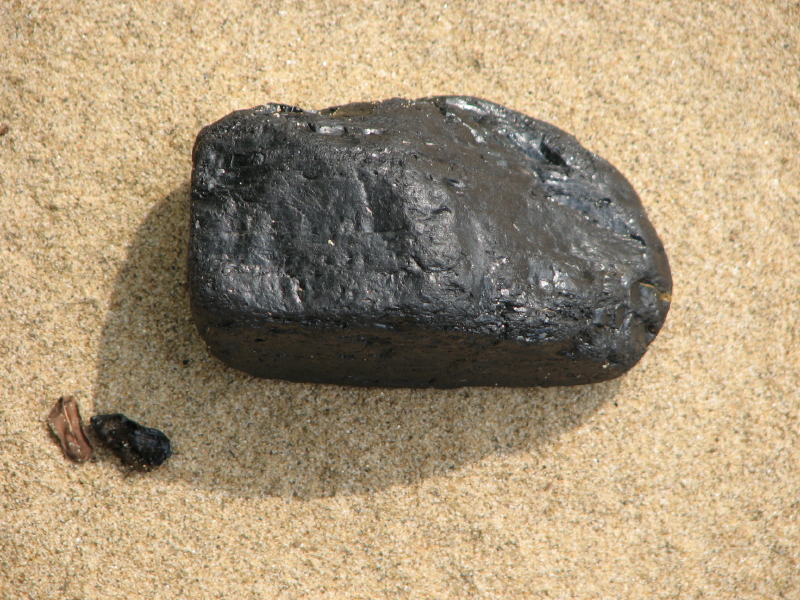
The Falls of the Ohio is famous for its fossils, but this black rock wasn’t originally a part of the geologic scene here.  More than likely, this piece of coal was removed from the top of a mountain in Eastern Kentucky and shipped by barge to this area to be burned in a plant to produce electricity.  For some reason, this and many other pieces of coal got into the river where they were tumbled and ground to bits.  In case you were wondering…coal does not float.

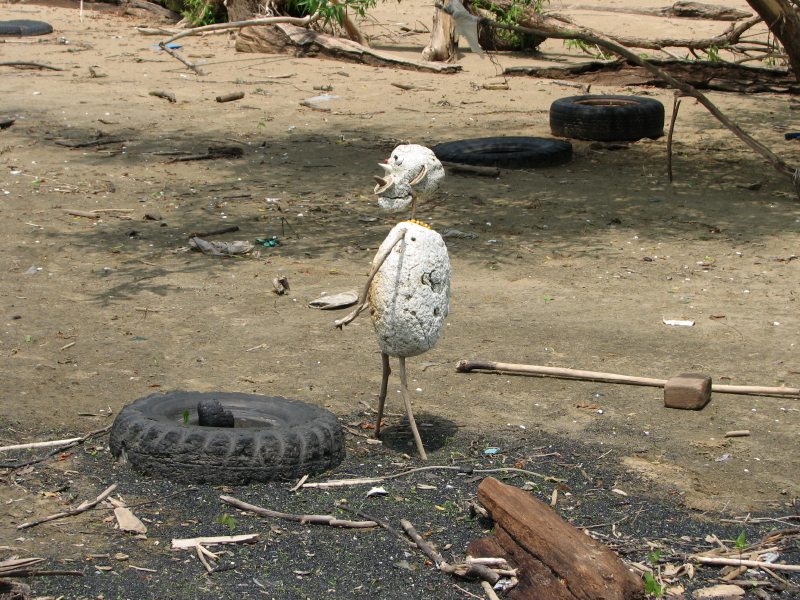
In places the coal gravel was several inches thick and reminded me of the black beaches made of volcanic sand.  Also interspersed on this river bank were many automotive tires.  I couldn’t help but associate the coal with the tires and I began to combine both of these elements in this landscape.  Here’s a picture of me in action.

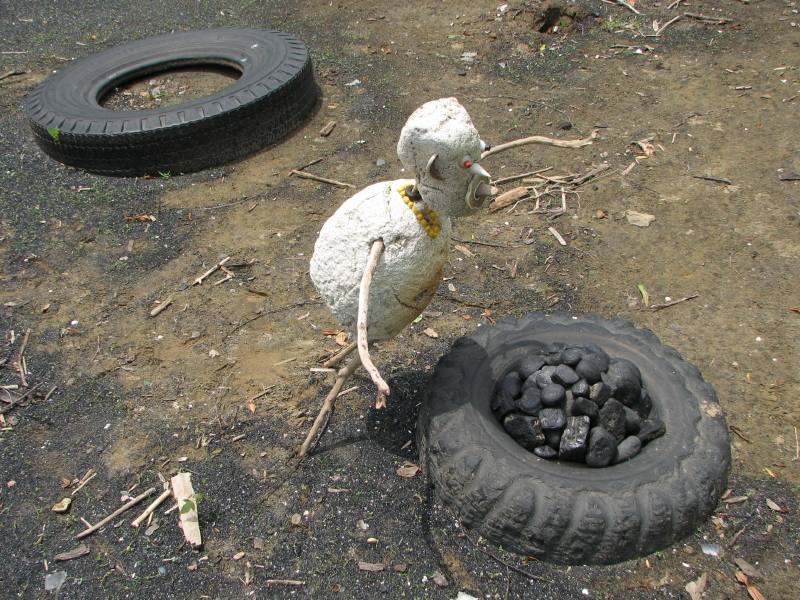
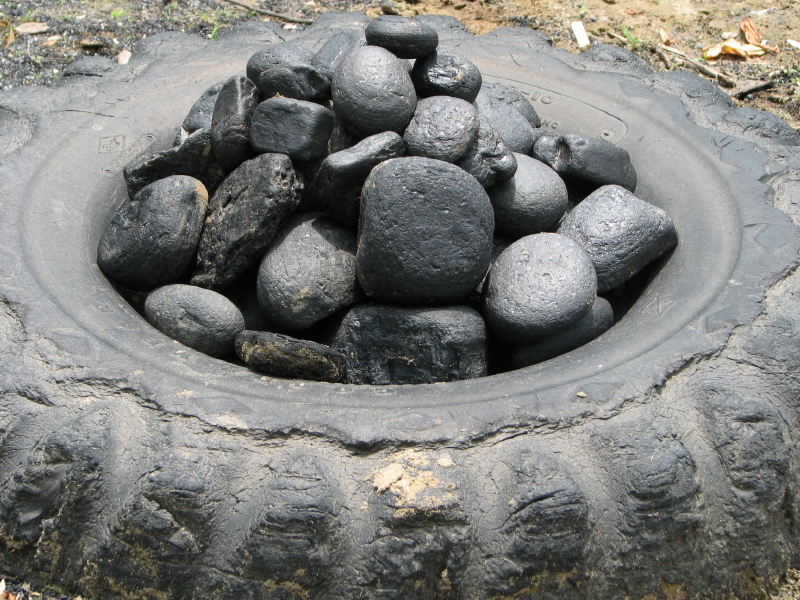
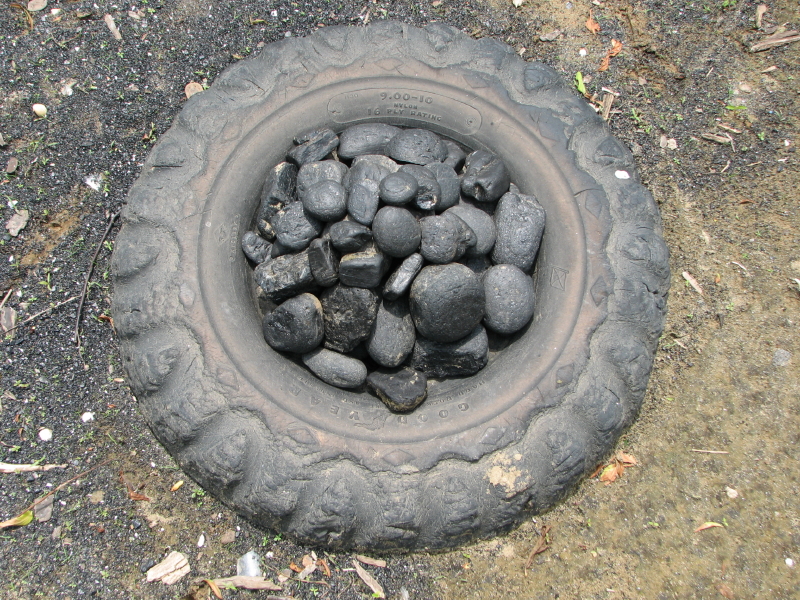
Walking around in this area, I found enough large coal pieces to fill a tire.  Doing this was highly addictive for me.  Here I was picking up real chunks of fossil fuel to place inside a circle that itself is made from fossil fuels in an area that’s well-known for its Devonian Age fossils.  How all these things affect or reference life made my head swim more than the actual heat and humidity.  When I finished filling one tire…this is how it looked.

And now, for an aerial view.

To me, this looks like some kind of unusual and bizarre fire pit ready to go.  Scientists have already established that “burning rubber” and coal are contributing to the excess amounts of heat, energy, and toxins now found throughout many of the Earth’s systems.  In Kentucky, the coal debate is a complex one.  We have an abundance of coal, but it comes at a dear price to the land and the people who call the coal fields home.  The sun is getting hot and I have already had a busy day watching fishermen and making sand drawings!  For now, I will have to leave the coal debate where it is, but I’m sure to return to it since there is so much coal here at the Falls.  It will remain here until the forces that shape this planet decide otherwise.

Read Full Post »

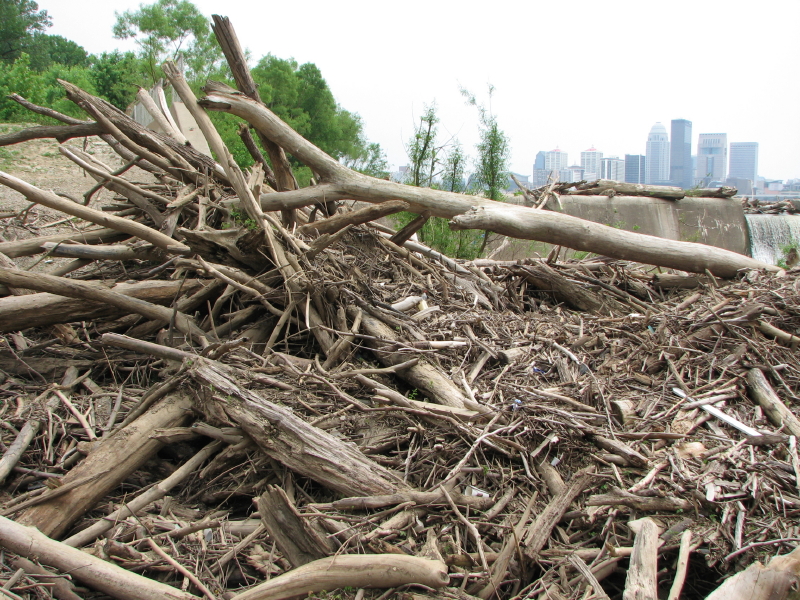
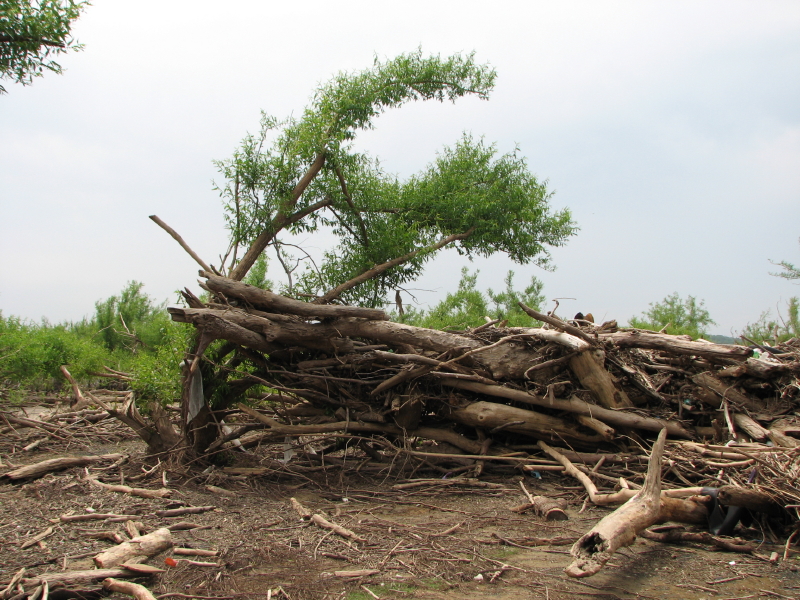
June began all bare bones in the aftermath of our minor flooding and now at month’s end it passes overgrown with vines.  Near the tainter gates, a massive raft of driftwood lies intertwined with the landscape.  We haven’t seen such a wooden mound in many years.  June had some odd and compelling images and here are a few more before we turn the page.

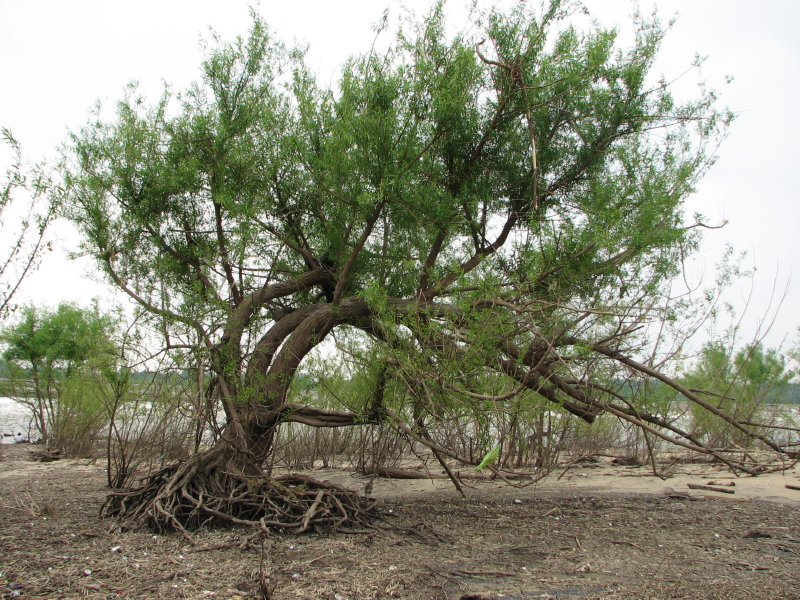
The willow trees are the heroes here tenaciously clinging to the sand and clay.  This taunts the Ohio River which sends high water and a battering ram of floating logs their way every once in a while.

Willow wood is flexible and the sustained high water’s flow is echoed in the shape of these trees.  I imagine the river as an artist shaping its garden at the Falls of the Ohio.  There’s a bit of that bonsai- look if you can get past the larger scale.

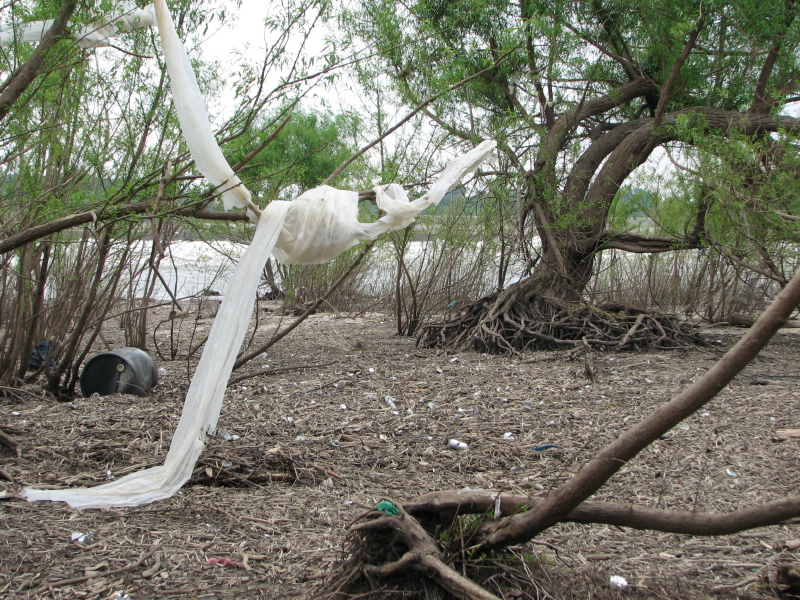
The willows’ branches do their part in snagging some of the flotsam and jetsam floating loosely in the retreating waters.  Branches become decorated with plastic bags, fraying barge cables, driftwood, the occasional dead deer, refrigerators, fishing line, and whatever is present in the Ohio River.

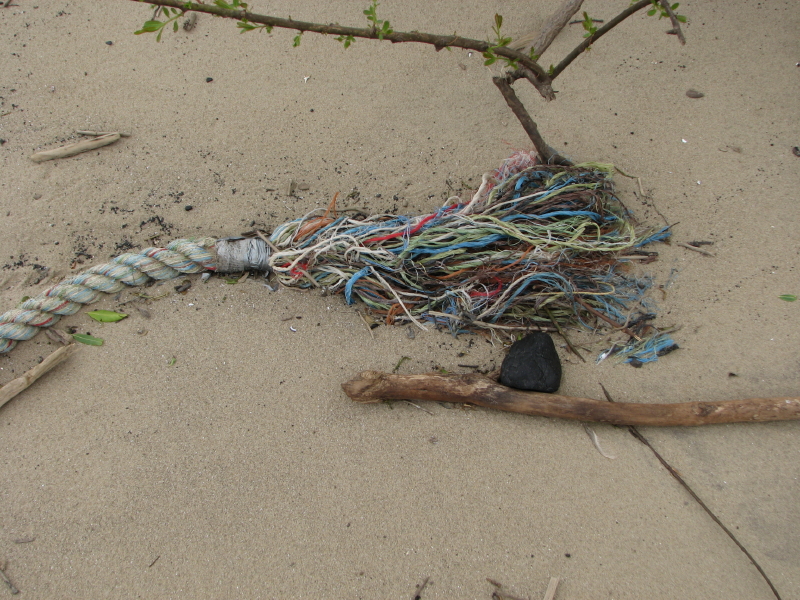
Here plastic sheeting has been caught and stretched some length across these trees.  It looked like something some installation artist might attempt.  I also came across a “nylon crinoid”…in actuality, an unraveling barge cable that made me think of the extinct sea lilies of ancient oceans and in fossils which are pages in the book of life.

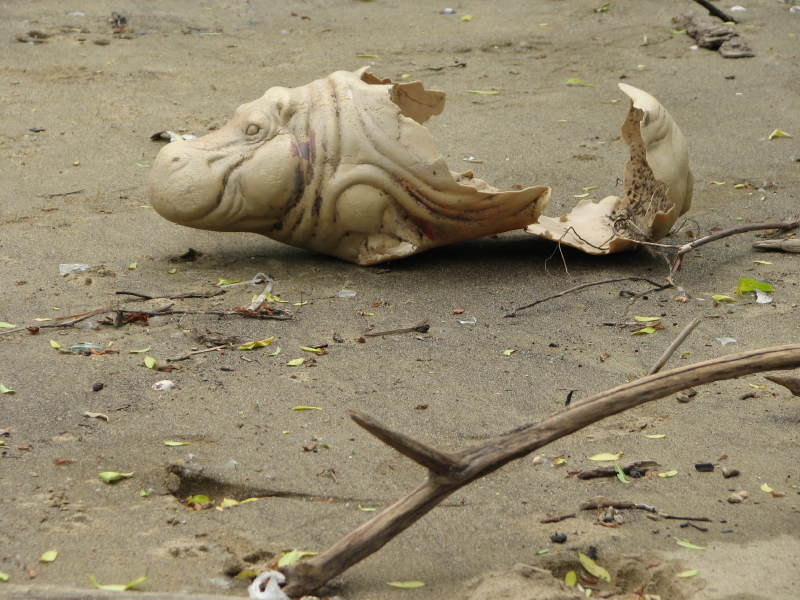
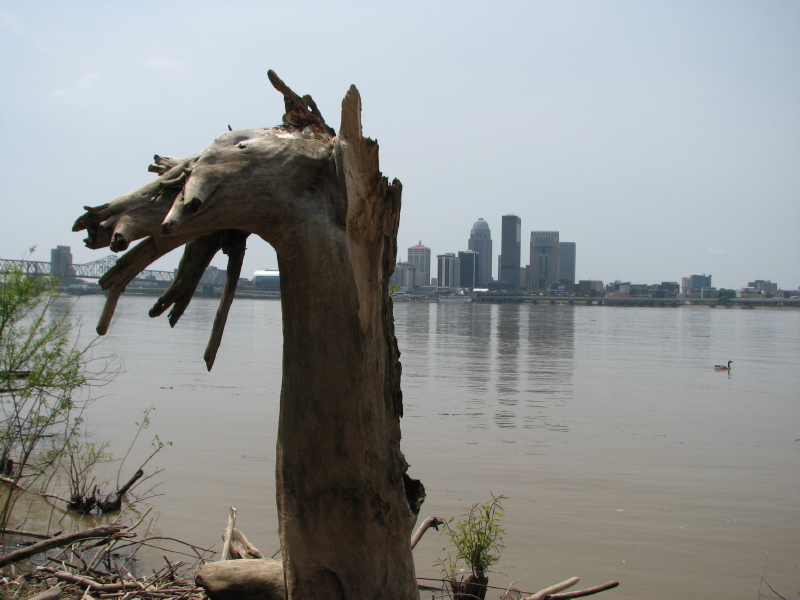
Walking across the sand I came across this unusual view which gave me the idea for the title of this post.  Very nonchalantly, this mostly destroyed hippopotamus was standing its ground.  I’ve read somewhere in a book that the name “hippopotamus” means “river horse” in some African language?

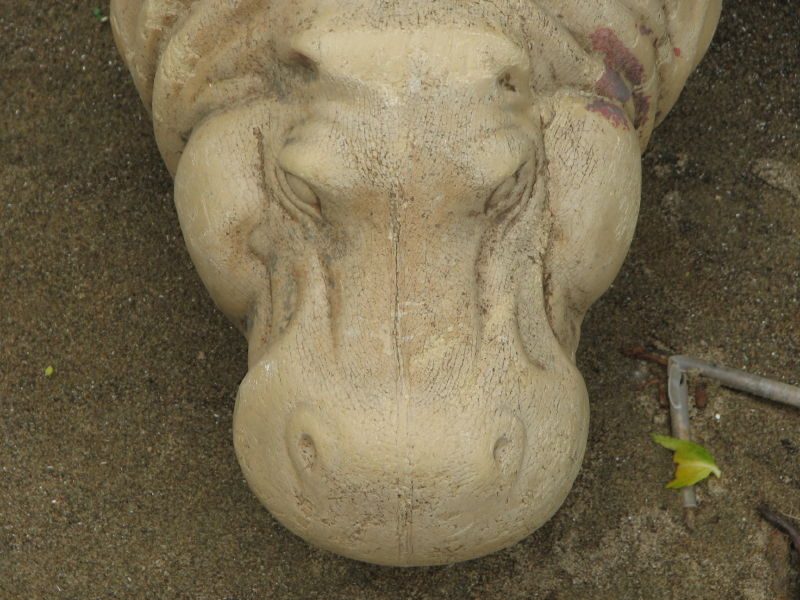
Another view, but this one from the top.

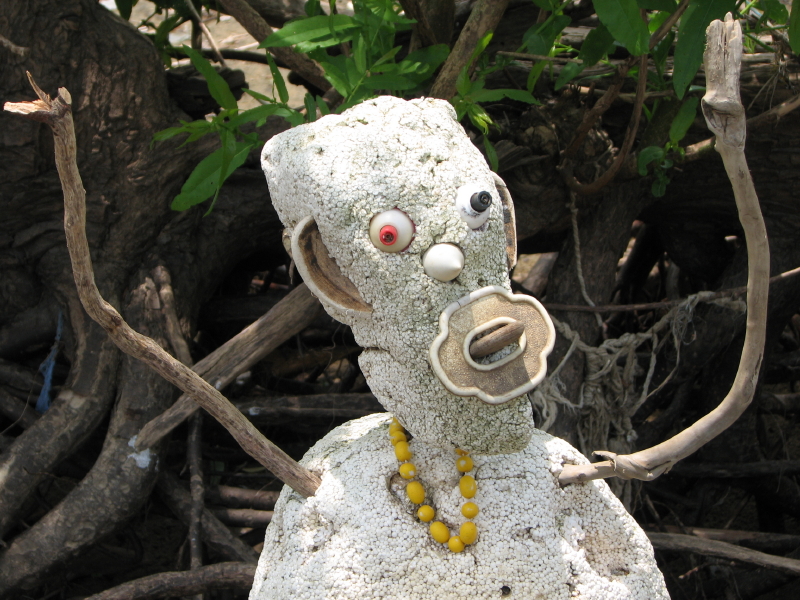
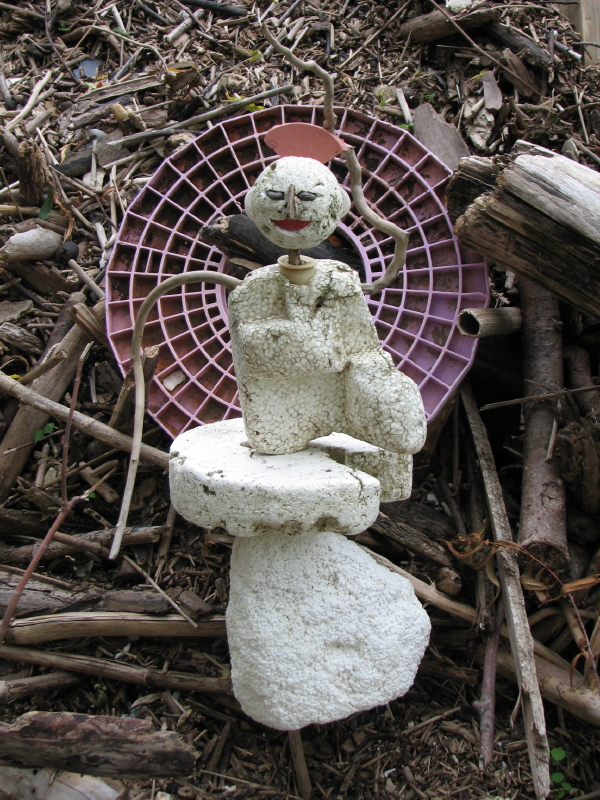
I made another Styrofoam figure on this day.  I imagine this as being a figure of some exotic Spanish dancer with fancy combs in her hair.  I won’t say this is the best figure I’ve ever made, but it’s also not the worst.  It just happens to be how things turned out when I picked this group of materials and objects to make something with at that particular moment.

Now for a full length view.  That pink radiating thing is made of plastic and helps to add other visual interest.

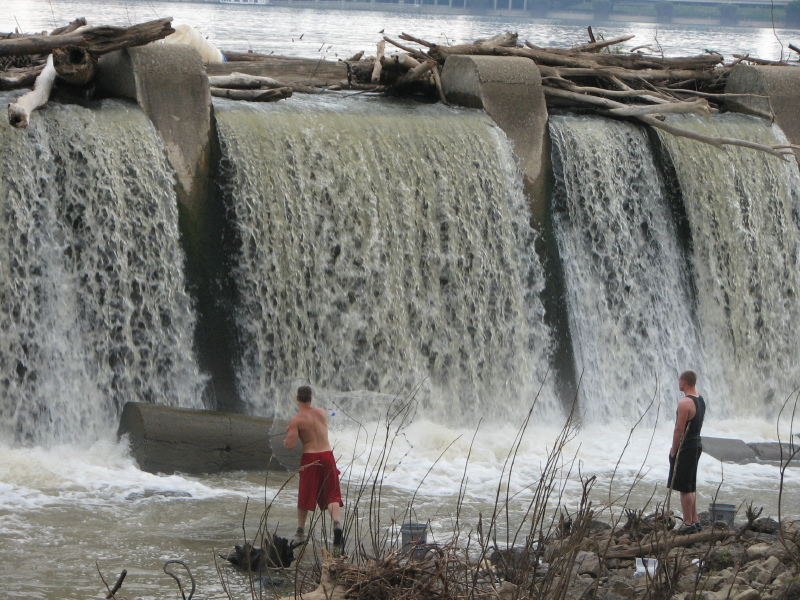
Before leaving for home on this day.  I watched a couple of guys using a throw net to catch shad to use for fishing bait.  I couldn’t help but see them in the context of the Ohio River which was so many more feet above their heads.  Here we are at the bottom of the valley.

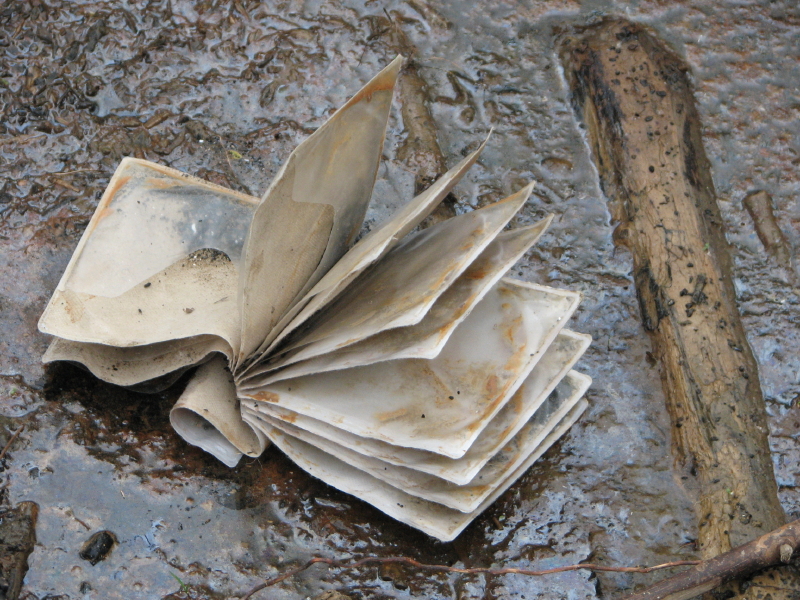
Since I’ve used the book metaphor a few times in this post…it’s fitting that I end with this picture taken on this day.  It’s really a small plastic photo album whose transparent sleeves were full of coal gravel and water.  Until next time…


Read Full Post »

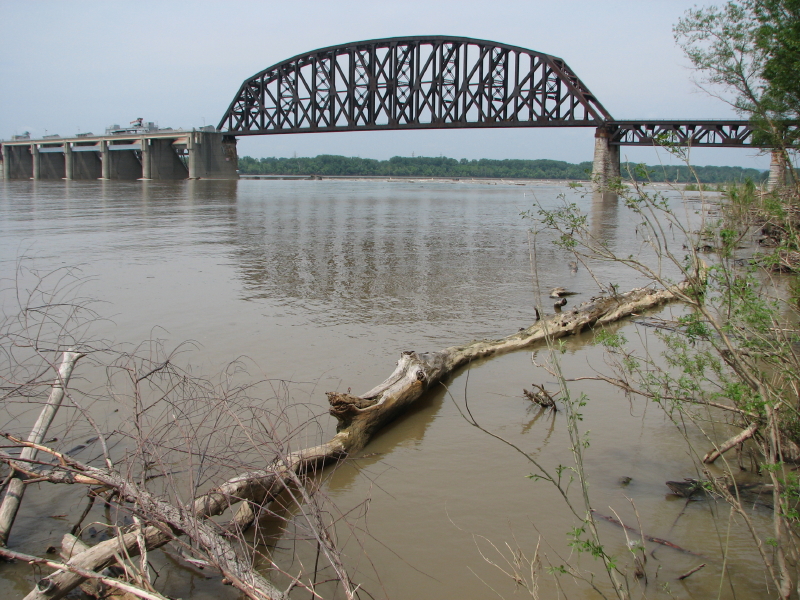
Just left or east of the railroad bridge at the Falls of the Ohio is where this adventure occurred.  The river was still high but dropping.  I was enjoying working in a section of the park that I don’t normally hang out at, but have discovered is both full of wildlife and potential art materials.  Evidence of our recent flooding was everywhere and I was exploring what there was to see and find.
While I was exploring this area I could hear Beatles’ music quite clearly drifting over the water.  It was the annual Abbey Road on the River Festival at the Waterfront Park in Louisville.  I guess the goal of each tribute band is to sound as closely to the original Fab Four as possible because I couldn’t detect much variation from one group’s rendition of a familiar song to another’s.  I did, however, notice that the Belle of Louisville’s steamboat calliope was in direct competition with the bands.  Like last year’s festival…snatches of 19th century tunes intermingled with pop hits from the 1960’s.  Baby, baby…Do dah day.

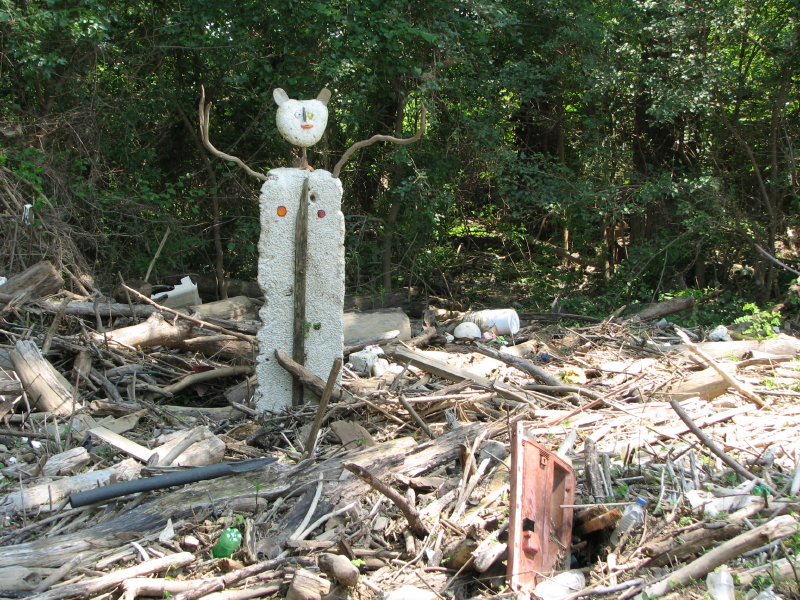
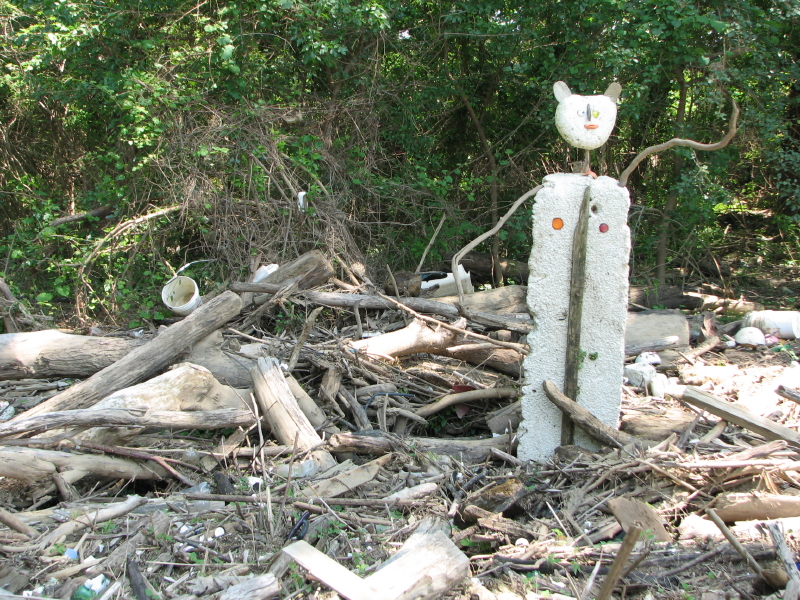
I was in this section of the park because I was searching for larger sections of Styrofoam.  This last bout of flooding pretty well wiped the slate clean as far as the materials that I had collected last year.  There is no shortage of smaller chunks throughout the park, but the larger pieces that are remnants of floating docks were in shorter supply.  I did find this piece that still had wood attached to both sides and set it upright, stelae-style.  Here’s what it looked like right after I assembled it.

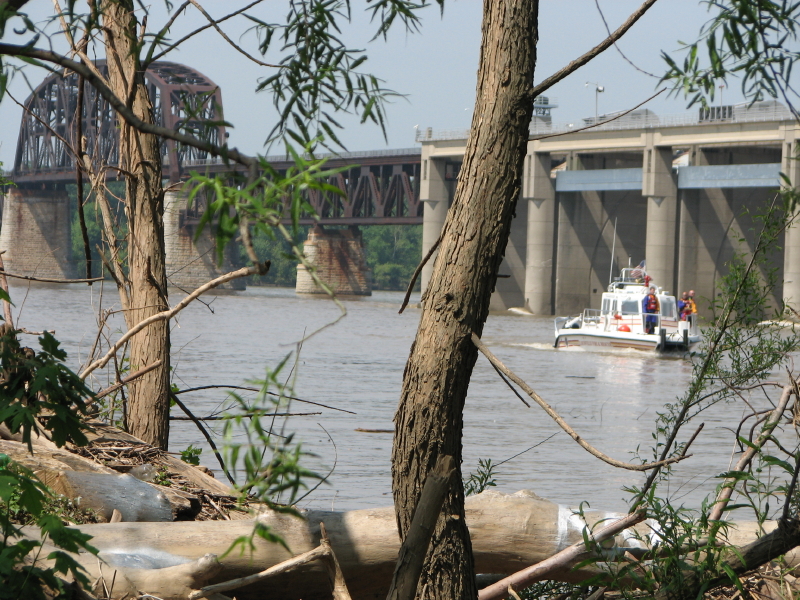
I had the turtle piece going too while this six-foot figure was under construction.  I also happily observed Northern Orioles chasing one another through the Cottonwood Trees.  I taught myself how to imitate the oriole’s song and on occasion can lure a curious bird closer by whistling to it.  I’m still trying to get a primo photograph of one of these birds, but they do tend to stay in the tops of the trees.  Out on the river, I observed a boat going back and forth along my side of the river and I’m speculating that they are looking for some poor lost soul that the river may have claimed?

I left my Styro-sentinal in place, but returned a couple of days later to discover it had fallen over.  This time I moved him to a different place facing the river and changed its arm positions a bit.  Originally, he held one of those soft nerf-type footballs.  I haven’t been back since and he may or may not be still guarding this section of the river bank.
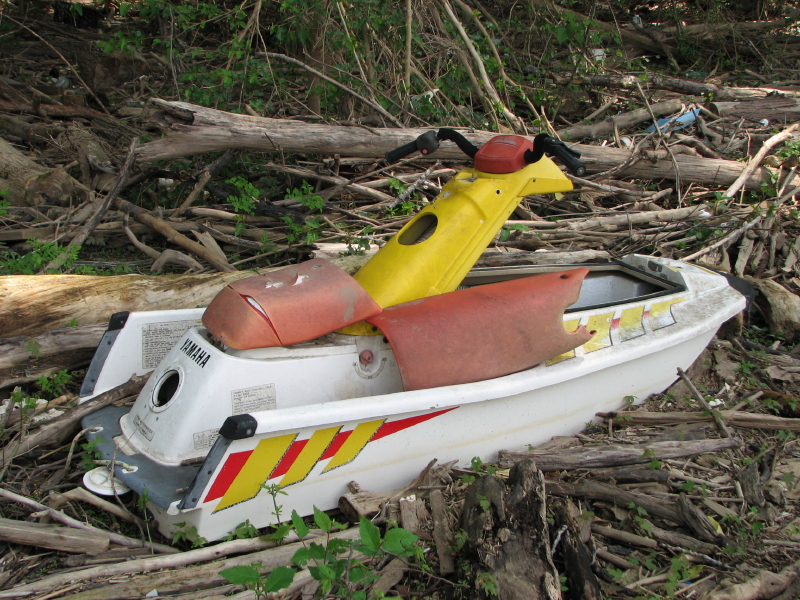
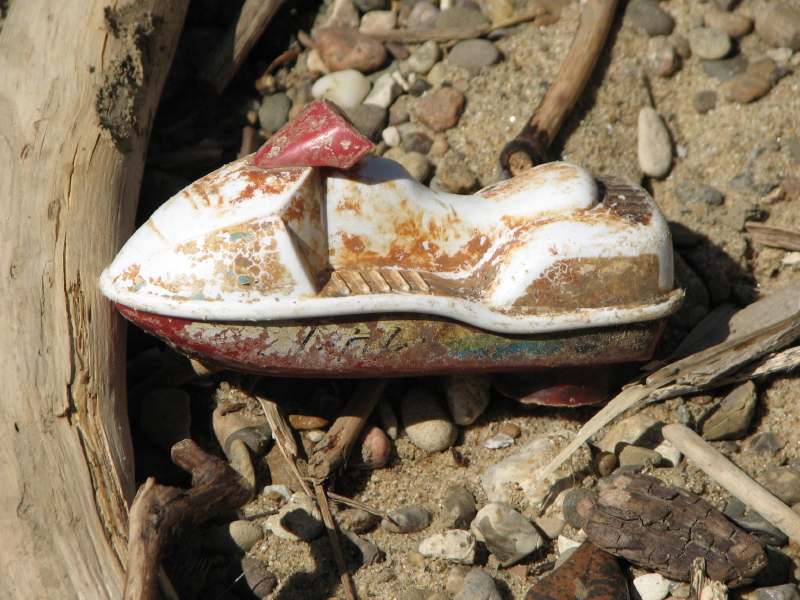
Among the items I “found” out here include this ruined Jet-ski.  Which…

…bookends nicely with the miniature version of it I found in the western section of the park also courtesy of the Ohio River and its recent flooding.

Butterflies and other insects are becoming more prevalent as the season progresses.  I saw what I thought was a familiar butterfly, but wasn’t totally convinced it was the species I thought I knew…so I photographed it and researched it a bit in the comfort of my home.  Here is my first image which shows two of these “different” butterflies.
Here’s a single, resting individual with its wings spread open.  This butterfly shows more black than the Pearly Crecents that are common out here. 

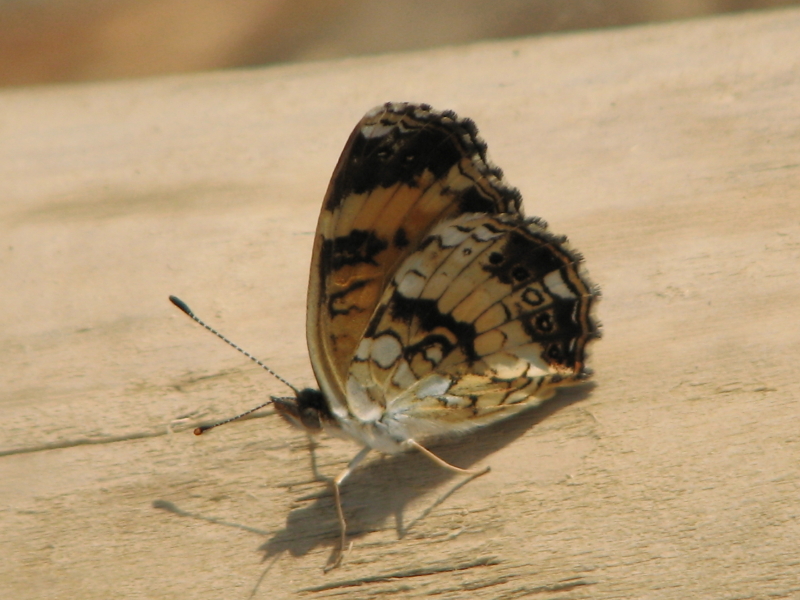
I cross referenced my butterfly guides at home and was glad that I was able to take a picture of this butterfly’s ventral surface because it helps to identify it.  I was leaning towards the Eastern or Harris Checkerspot but decided that this is the Streamside or Silvery Checkerspot (Chlosyne nycteis ). Here is the view that was most helpful.

I’m looking forward to seeing many other butterfly species out here this year.  I will try to keep a checklist of what I see just as I do for the many bird species that visit or call the Falls of the Ohio State Park home.  On my way out of the woods, I “felt” something looking at me and after checking around…discoverd these eyes following me which is as good a way to end this post as any!


Read Full Post »

The Ohio River has receded by the Falls of the Ohio.  For many weeks the river was loath to relinquish the territory it had recently flooded.  I ventured down the river bank and explored the more eastern section of the park.  The following post is some thoughts and images made during this expedition into a very moist and muddy area filled with debris and wildlife.

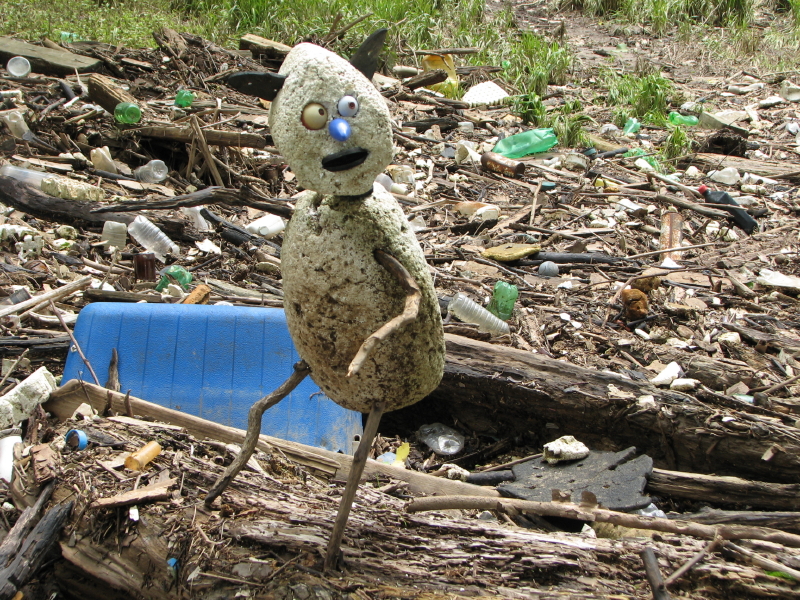
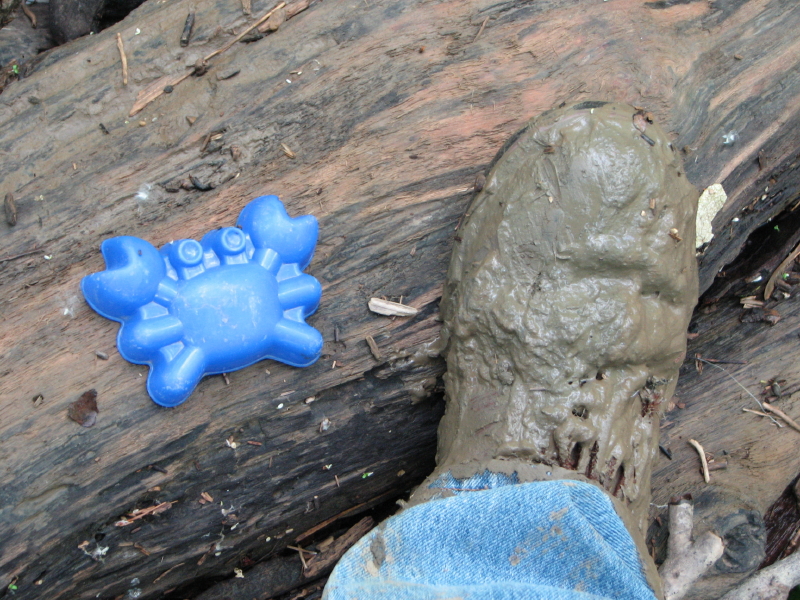
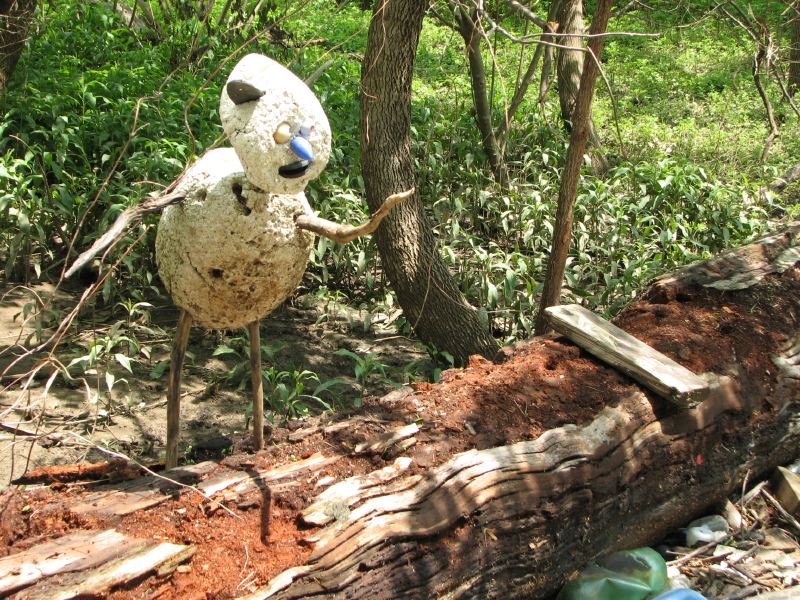
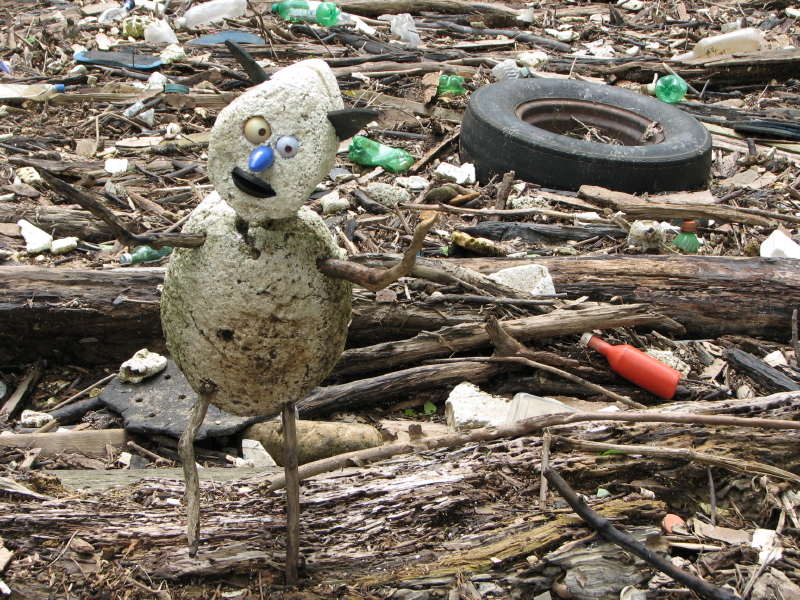
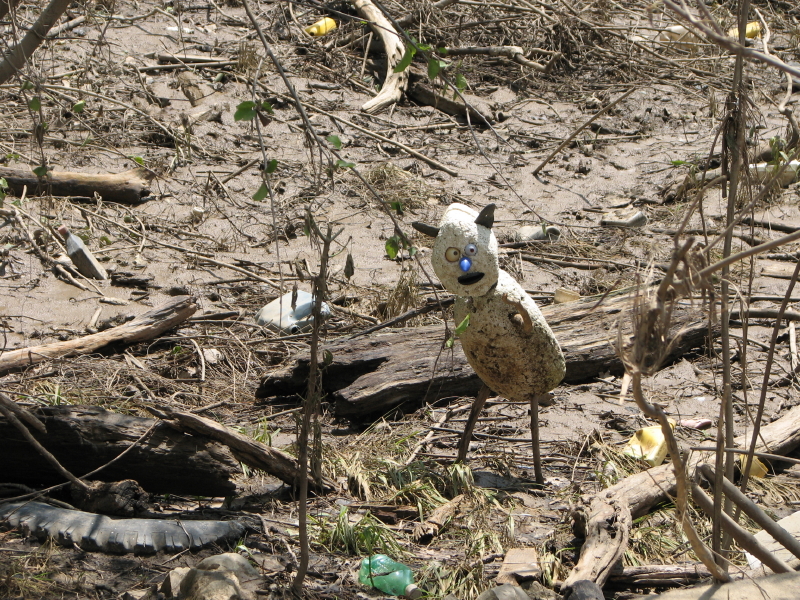
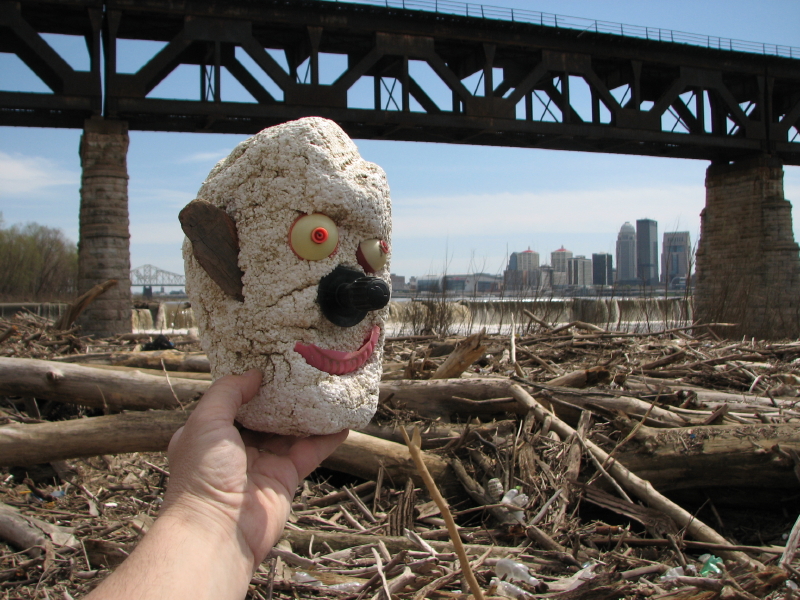
While exploring the park it is not unusual to run into others who are curious to see what the river has left behind.  Sometimes just a nod of recognition and some small gesture to reassure that one poses no threat is made and each party then attends to their own business.  And then sometimes a more sustained conversation occurs where information of mutual interest is exchanged.  Such was the case on this trip where I ran into this fellow of short stature with a bulbous blue nose who had been investigating the same stretch of river as me.  We tagged along with one another for a short time before family duties called me home.  I believe our initial conversation had something to do with the muddiness of the area.  In places, things looked safe and dry enough to stand on…and then the mud below would reach up and grab you by the ankles.  Sometimes small, blue crabs would pop out of their holes to check out whether the trapped parties would be good to eat.

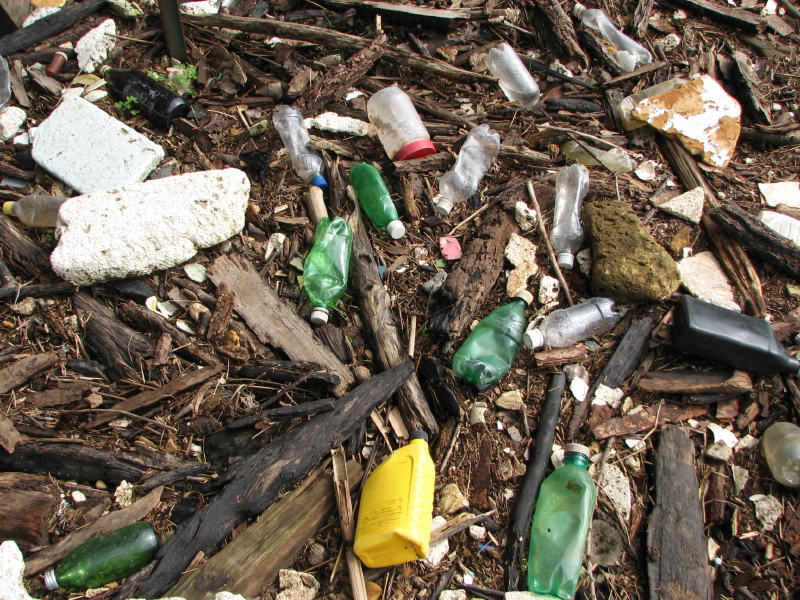
In my case, I am simply too big for them and once the crabs realized this they scuttled away.  Getting back to “Mr. Blue Nose”,  (funny how we didn’t think to ask each other’s name?), we were both astonished by the debris left behind by the retreating river.  After witnessing several other high water incidents over time…this is fairly representative of the stuff we found.

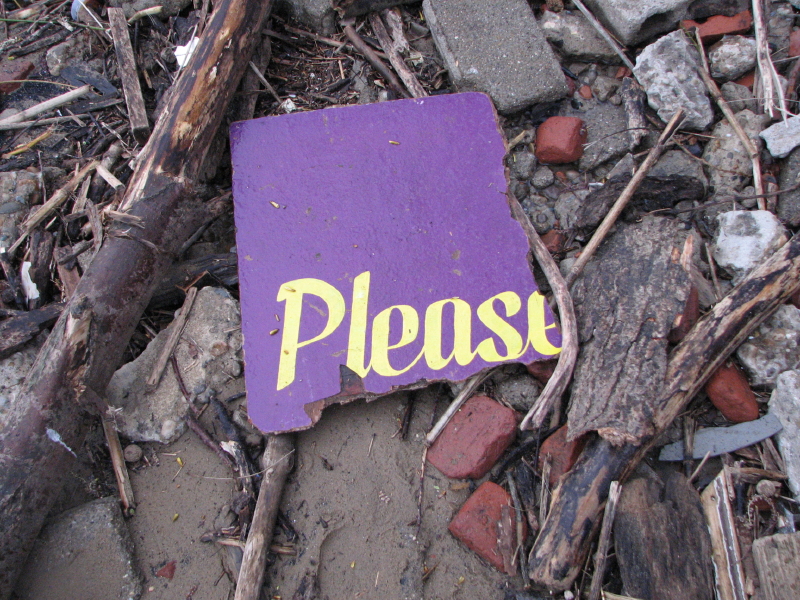
As you can see it’s mostly plastic containers, polystyrene (aka Styrofoam), and lots of shredded bark and wood chips.  Every once in a while, something more interesting would turn up.  While exploring, Mr. Blue Nose and I found two sign fragments and I kept these for my Found Painting and Sign Collection.  Here are the two precious finds.  The first one is kind of self-explanatory.  I like to muse that this is one way the universe communicates to me by leaving these things in my path for me to ponder.

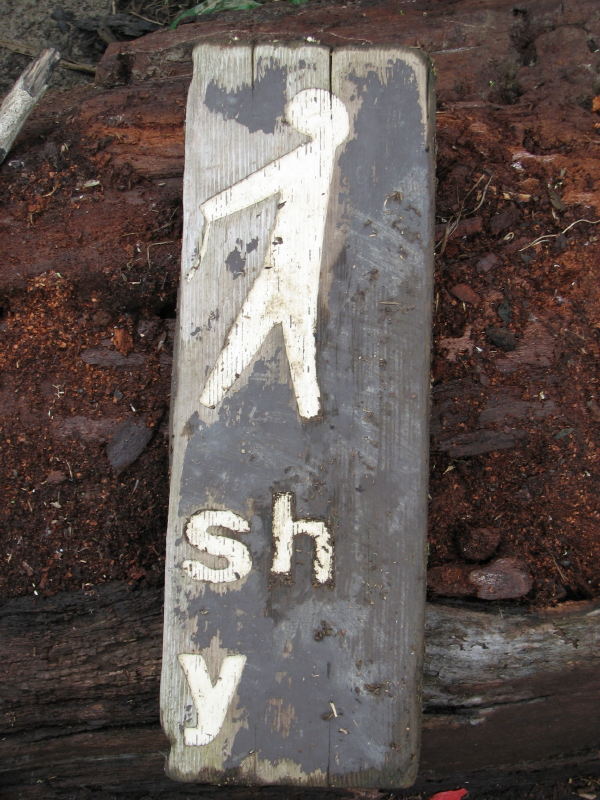
I’m not sure what it is asking…Please don’t litter or Please, only you can prevent forest fires, whatever its actual message, this is at least a polite sign.  The other one is more reclusive, in fact it is “shy”.  Here’s a picture of this enigmatic sign.

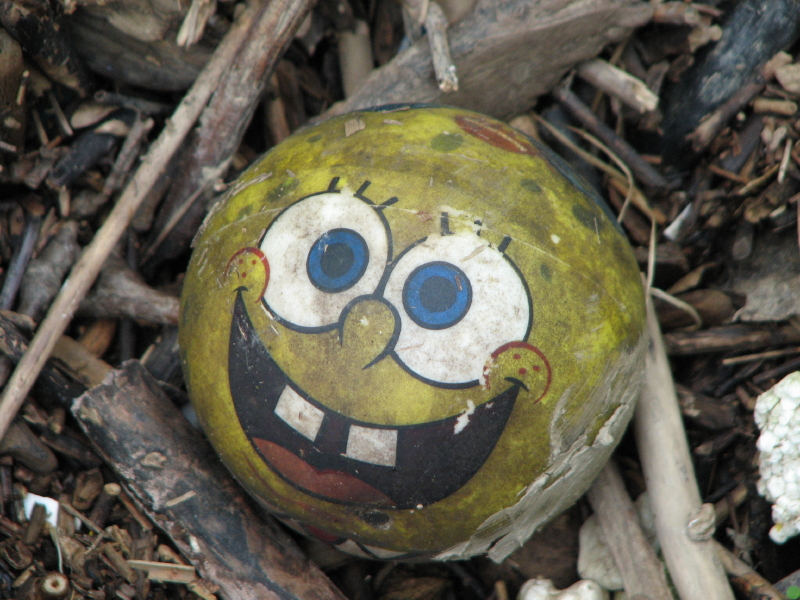
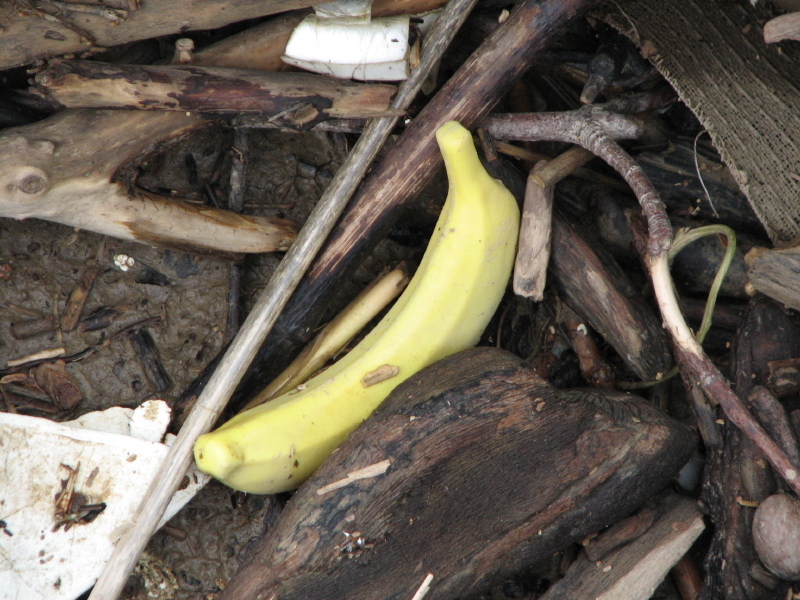
I like the hand-routed and painted “sign” for a person.  I think this fragment may originally have asked dog owners to leash their pets…but its shy and won’t tell me for certain.  Other found treasures included my second banana of the season…naturally it went into the old collecting bag to later join the other artificial produce I have found out here over time.

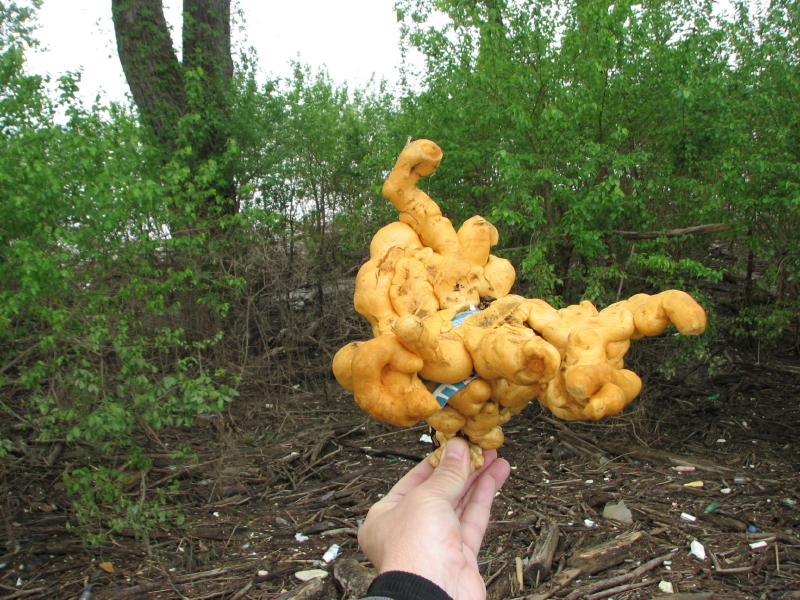
I also find other kinds of foam out here.  Here’s an interesting found sculpture made from polyurethane.  I have come across busted aerosol cans of this stuff where the foam has expanded out resembling entrails.

Mr. Blue Nose called my attention to a log that something had torn into and he wondered what could do this kind of damage.  Chunks of bark and soft decayed wood were scattered all around. 

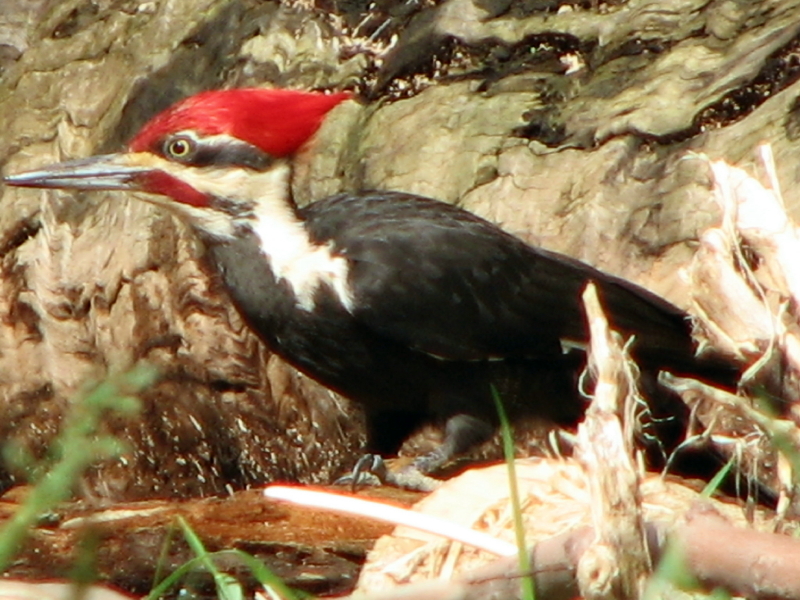
I was happy to inform my new friend that this looked like the work made by a Pileated Woodpecker and I showed him images of this great bird I had taken just a few hours earlier.

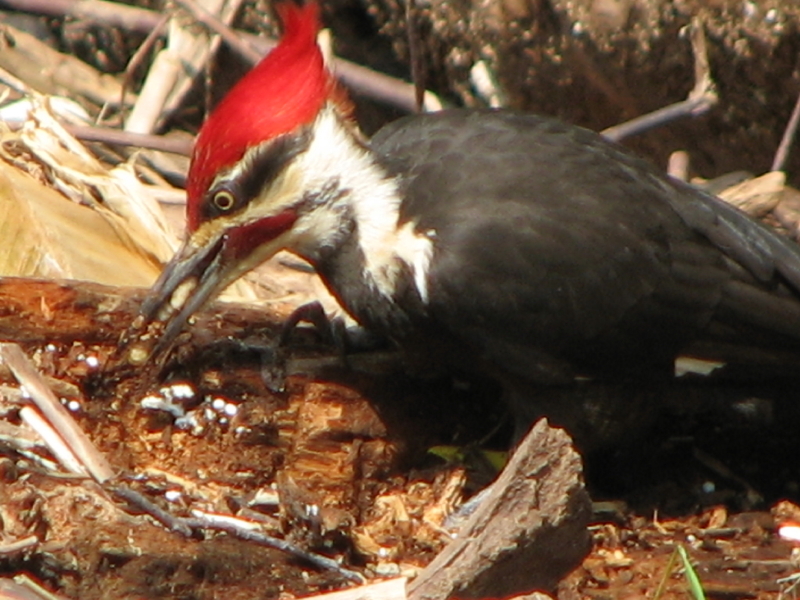
Since no one can verify that the Ivory-billed Woodpecker is still alive along some wild river in Arkansas…the Pileated Woodpecker has the distinction of being our biggest living woodpecker.  For years, I have observed a pair of these crow-sized birds in the park.  This one is the male and can be identified by his red mustache.  The female lacks this and has more black on its head.

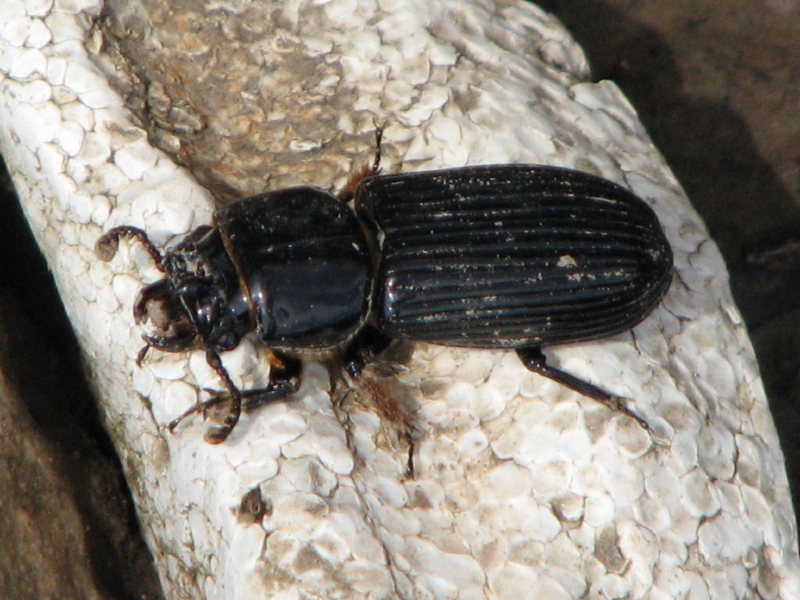
The Pileated Woodpecker has a large bill that goes through wood in a hurry.  Carpenter ants and beetle larvae can be found in these decaying logs and make up the main diet of this magnificent bird.  If you look closely at the photo above you can see a nice grub about to be swallowed.  This bird was so intent on looking for food that I was able to get closer than usual to it.  A couple of weeks a go, I found a Bessbug beetle which is a nice sized insect that uses decaying wood in its life-cycle.  This beetle is also known as the Patent-leather Beetle.  Here’s an adult I found sunning itself on a piece of Styrofoam.  These beetles can get nearly two inches long or about  five centimeters.  I wonder if our country will ever adopt the metric system?  Anyway, these beetle grubs make nice woodpecker snacks.

Thanks to my new companion we were able to make one other nice bird sighting on this day.  Mr. Blue Nose alerted me to some commotion happening in a nearby stand of trees. 

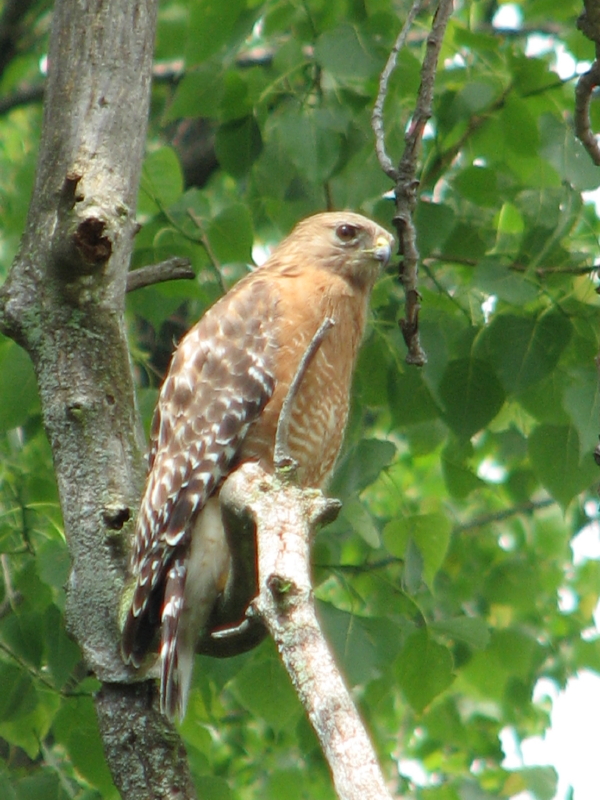
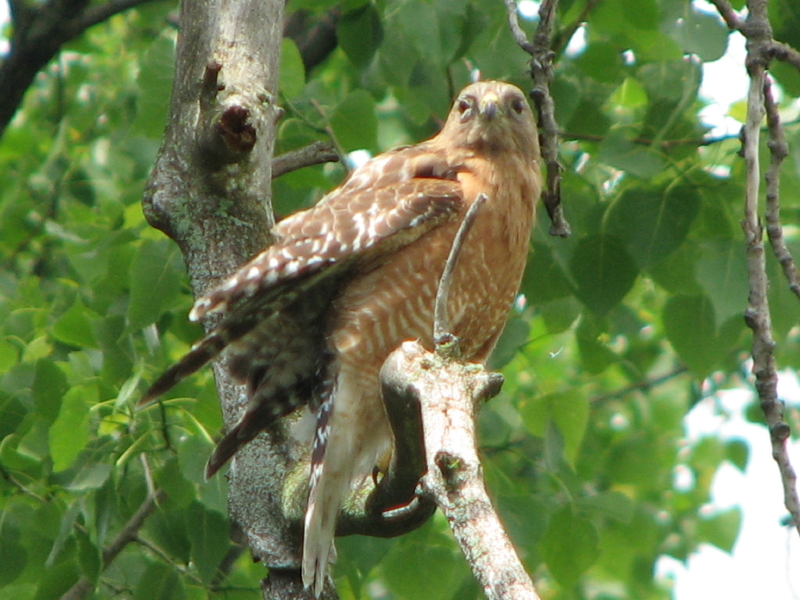
My friend said that he saw several blackbirds (grackles) chasing a larger bird from tree to tree.  I have observed this behavior before when birds of prey are present.  I gathered my camera up and went to see if I could find out what was the object of all this attention.  It turned out to be this beautiful Red-shouldered Hawk.  Here are a couple of pictures of it before the smaller birds drove it out of the area.

I always feel lucky when I see such beautiful birds in the park.  Before flying away, I saw this bird’s mate arriving and the two flew away together.  Soon it was time for me to fly away too and I left my companion on the river bank.

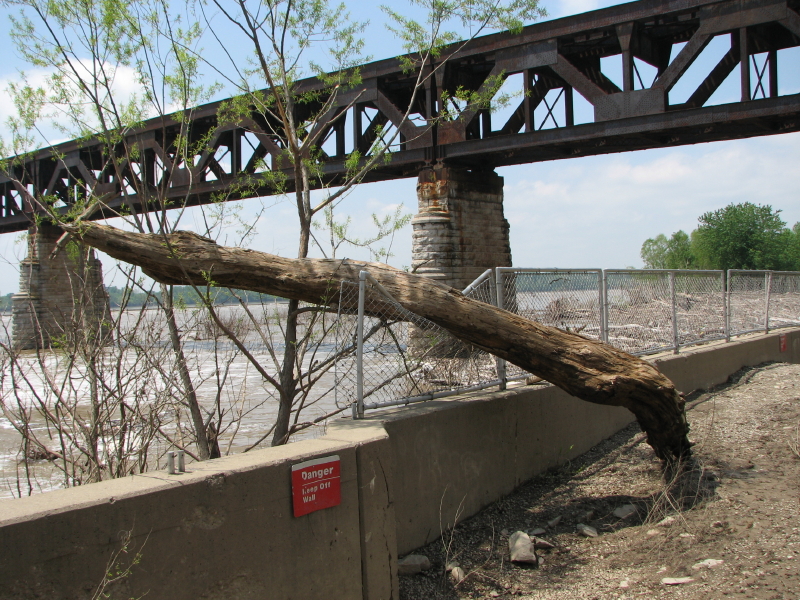
We parted near the railroad bridge and perhaps we will see one another again?  My last image is from an overlook area popular with visitors who want a better view of the tainter gates.  I have taken many pictures here over the years, but this one is different.  To give you an idea of how high the river was…this log was deposited on the fence by the retreating river!  Or, I hope so…I would hate to think it jumped up here!  So long for now!!

Read Full Post »

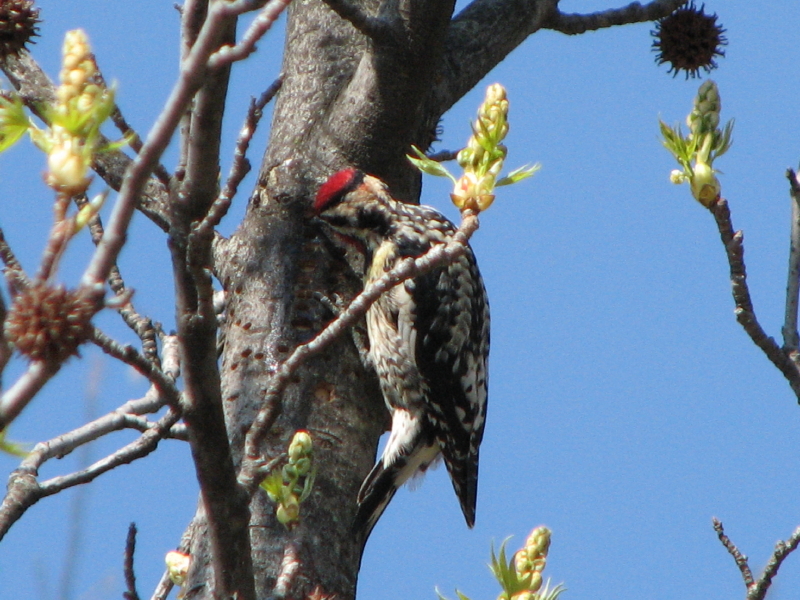
For me, the Yellow-bellied Sapsucker is a signal that Spring is underway.  I believe I have seen this very same bird in the same Sweet Gum tree for several years now.  Before the tree fully leafs out, he drills neat rows of holes in the tree bark which fill with the tree’s sap.  Visiting often, he then licks up the sugary mixture.  I have seen other bird species utilizing the work of this woodpecker including other woodpecker species, warblers and chickadees.  Before the insects and new seeds appear, the Yellow-bellied Sapsucker has accessed another food supply which he defends from all the other birds. 

Throwing his head back, this male Song Sparrow is expressing the feeling of the season.  Song Sparrows are year-round residents and have fully taken advantage of all the niches available at the Falls of the Ohio.  This year White-throated Sparrows have been more abundant than I recall from past years.  Every year is different from the previous ones and you never know what to expect next.  This year is off to a very wet start.

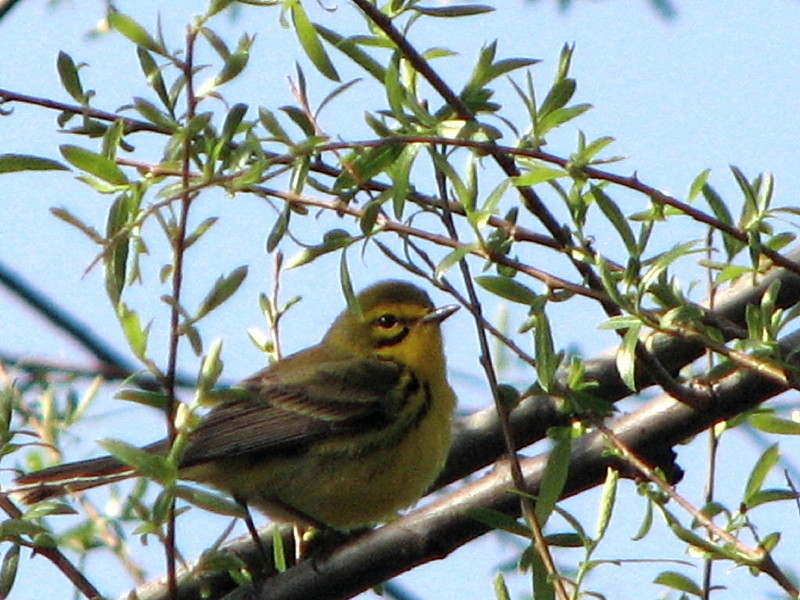
This is a male Prairie Warbler I came across recently.  I have “pished” this species closer to my camera’s lens by making little squeaky sounds that the bird found curious enough to follow.  I am hopeful of seeing other warblers before the Spring migration ends.  So far, I have seen Yellow-rumped Warblers, Common Yellowthroats, and a brilliant male Prothonotary Warbler attracted by the flooded bottomland trees.  There are thirty-five different warbler species on the Falls checklist and I have had the privilege of seeing most of them over the years.

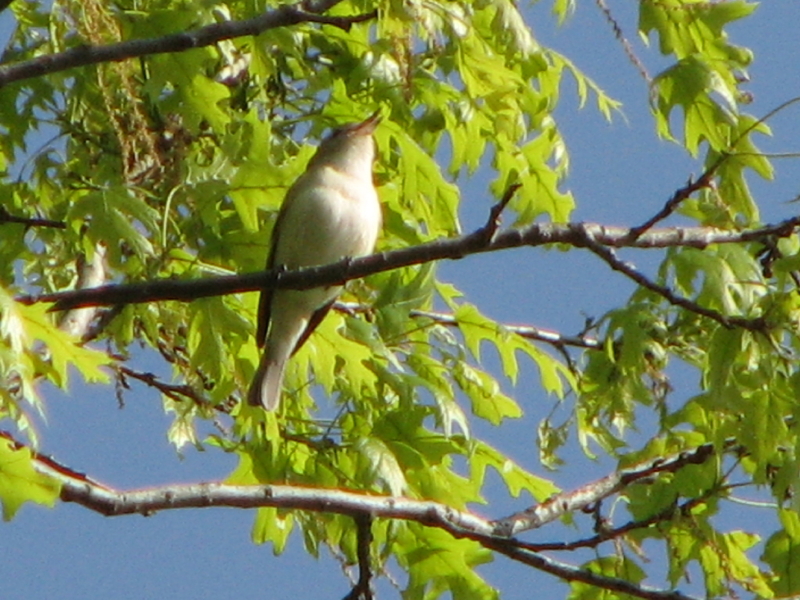
The Warbling Vireo is another bird that is more often heard than seen.  It’s such a tiny bird and it has the habit of staying in the tops of tall trees.  I found this one on the exposed section of an oak branch.  If it weren’t distracted by trying to attract a mate it would be in almost constant movement in search of the small caterpillars and insects that it eats.

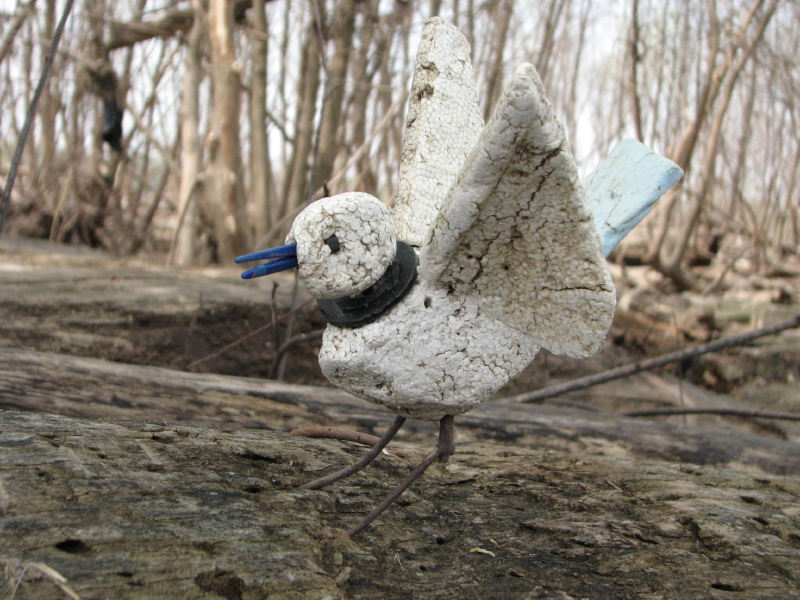
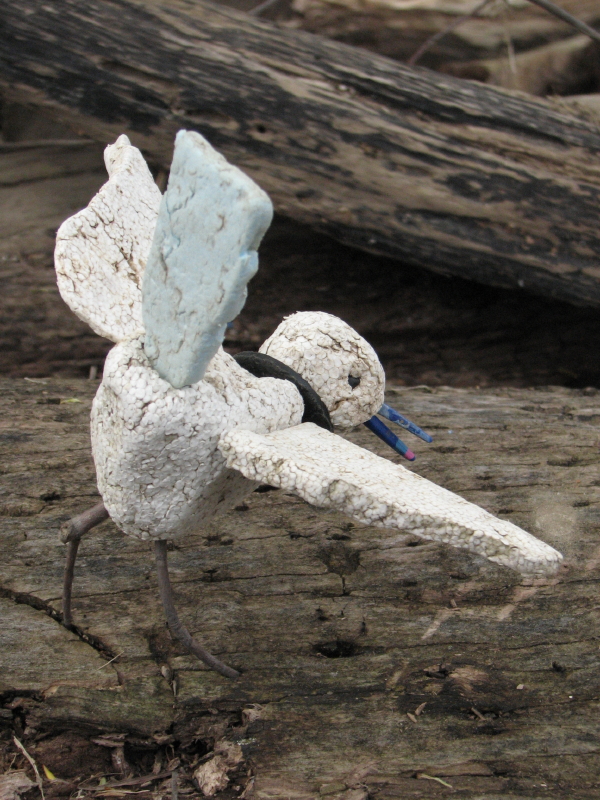
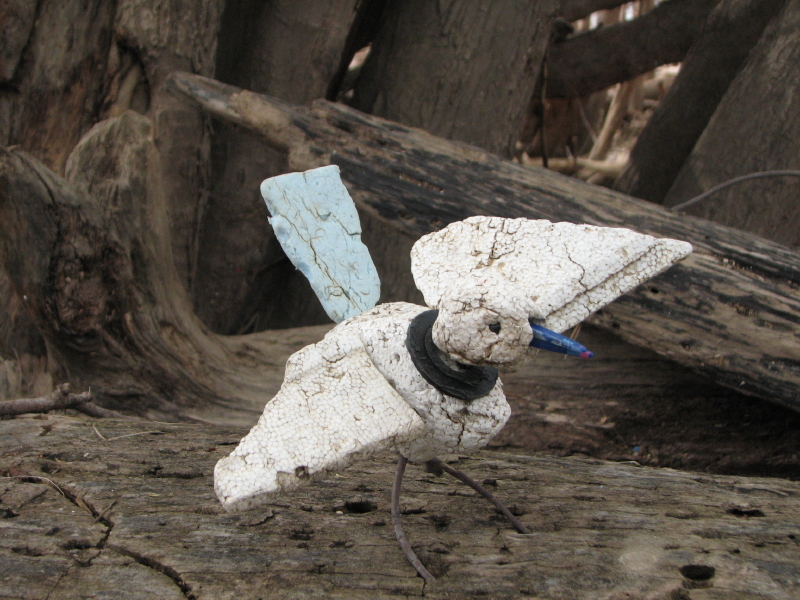
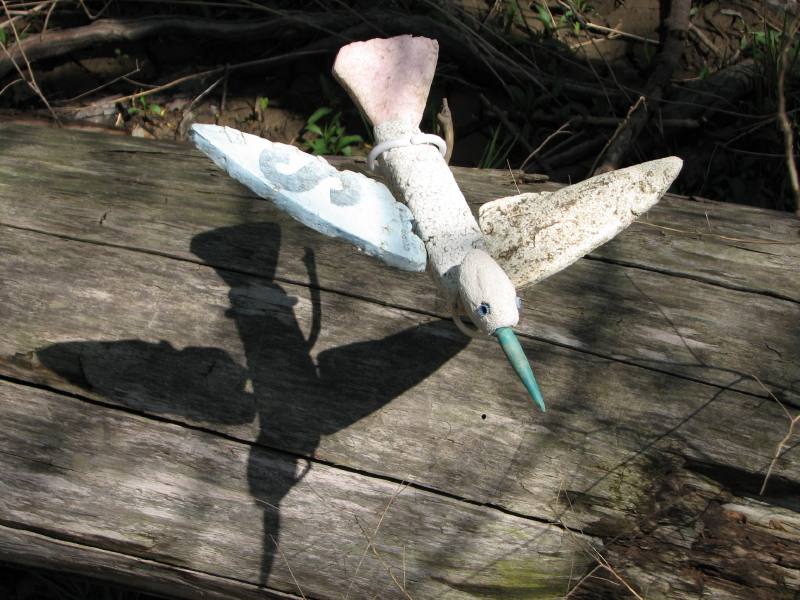
A new bird to add to the old life list is the Blue-tailed Robin.  It’s an infrequent visitor to these parts and so when one is sighted it becomes an event.  You can’t see this in the photo, but there are ten other birdwatchers with cameras and binoculars trained on this fellow as it dances and practices its courtship dance.  Everybody was extra quiet so that this bird wouldn’t spook and fly away.  Here are more images.

The Blue-tailed Robin male does an elaborate dance on a fallen log where it sings and flaps its wings in different positions all the while it struts its stuff.  The real test will happen further north in central Canada where its ability to display and attract a mate will mean the difference between passing on its genetic distinctiveness or not.  No wonder this bird can’t afford the opportunity not to practice!

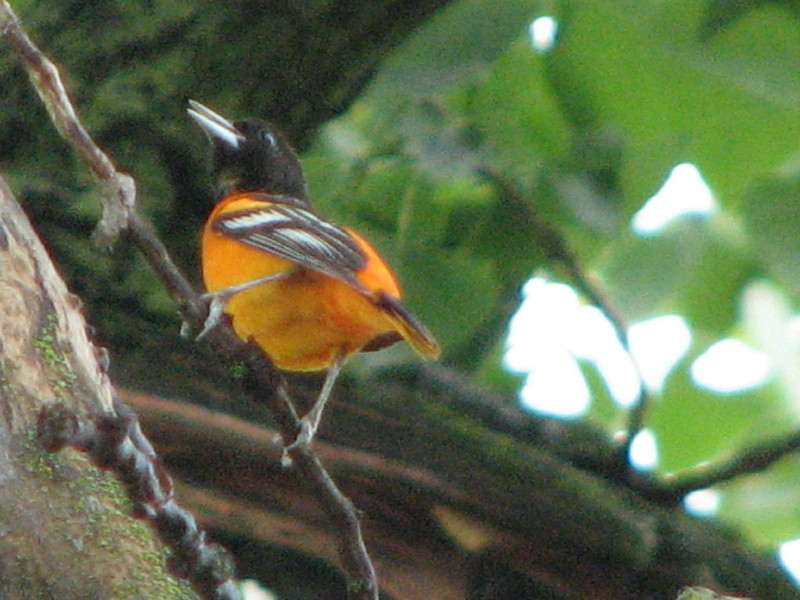
Singing very high up in a Cottonwood tree, this male Northern Oriole is also singing loudly in its territory.  So far, it’s looking and sounding like a good year for this species!  Nearly everywhere I hiked in the park I either sighted or heard Northern Orioles.  The orange color is so distinctive and it contrasts so well against the green of the surrounding leaves.  There is so much moisture in the air that my camera records this as a slightly foggy picture.  I hope for better images of orioles and the other great birds here.

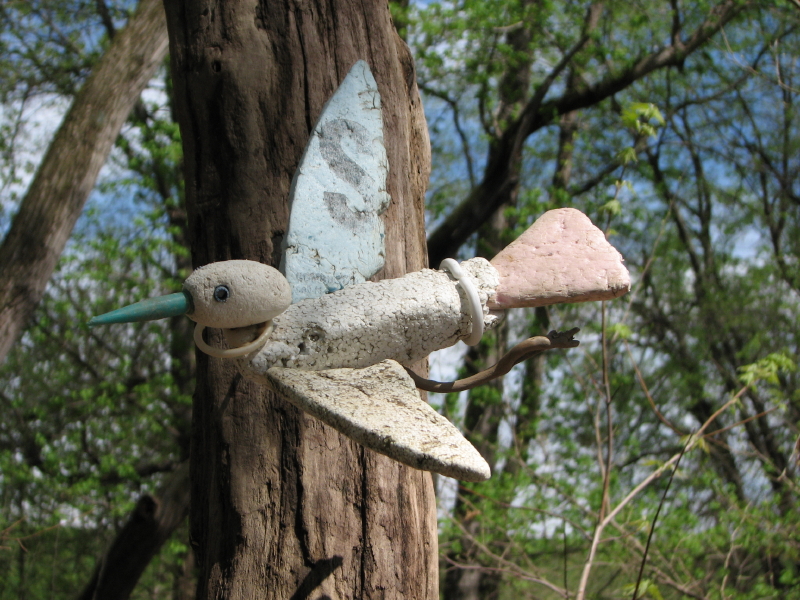
Another rarely recorded migrant is the Dragonfly Tern.  I found one coursing along the river bank and was able to squeeze off a couple decent pictures.  Like the name implies, it specializes in capturing dragonflies which requires the ability to maneuver at high-speed.  It has swept back wings that give it the acceleration it needs in tight corners.  Here’s another picture of it buzzing over a fallen log near my position.

This bird soon will be off to the Great Lakes region where it also breeds.  It barely scratches together a depression in the sand and gravel that it considers a nest.  There are usually two eggs laid that are heavily speckled like the small pebbles that surround it.  It winters in South America and travels thousands of miles each year.

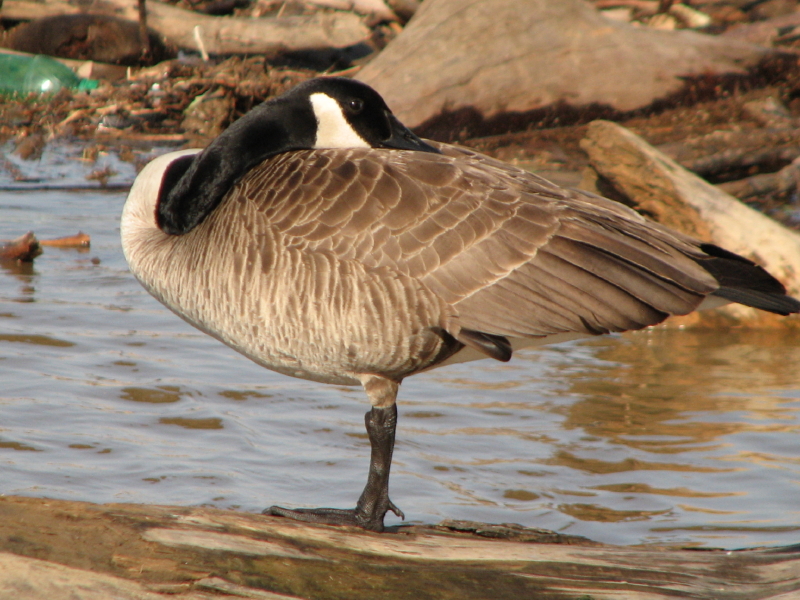
On my way home from the park, I chanced to see this Red-tailed Hawk on top of a utility pole and recorded its image.  It is one of our more common hawks, but since I haven’t featured it in the Riverblog before, I thought I would include it in this post.  As the year progresses, I hope to feature other birds that stop at the Falls of the Ohio. For me, the difference between a successful trip and a really successful adventure sometimes hinges on seeing one nice bird!  In closing here are two Canada Geese.  One is real…

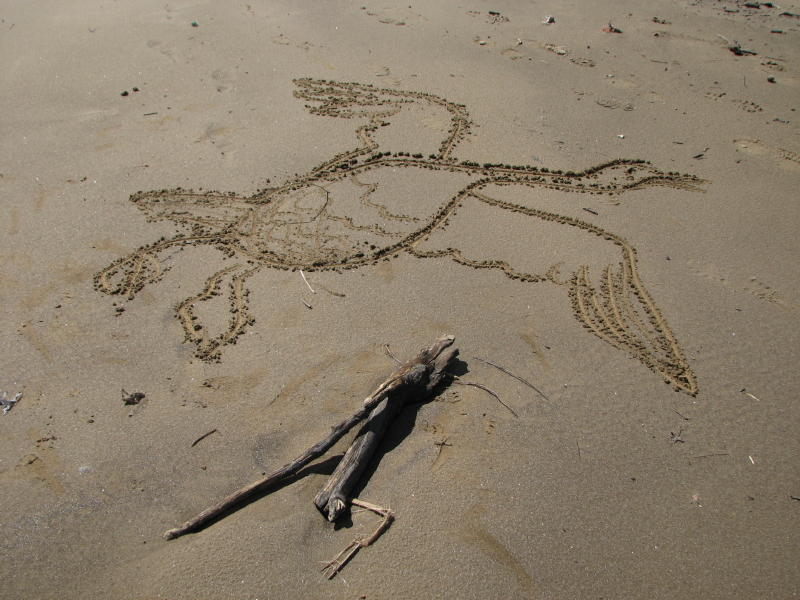
…the other is just a tracing in the sand I made.  Happy birding !!

Read Full Post »

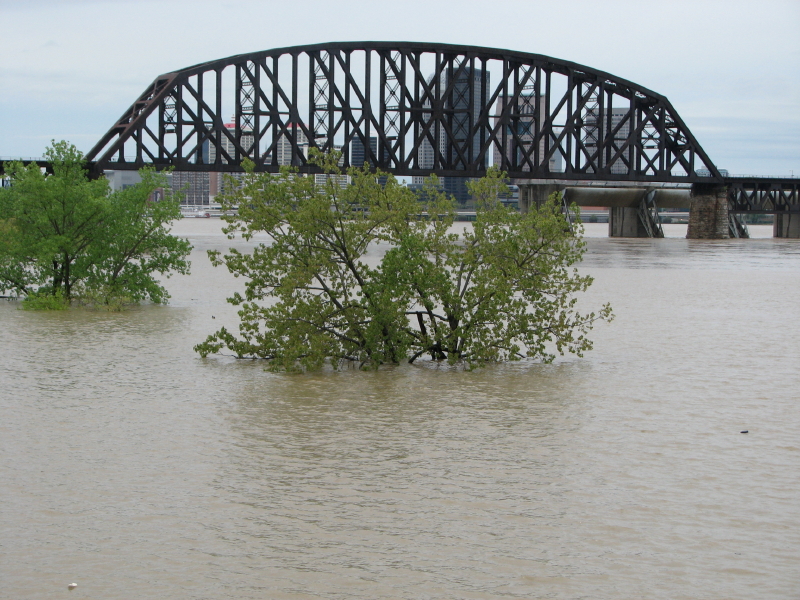
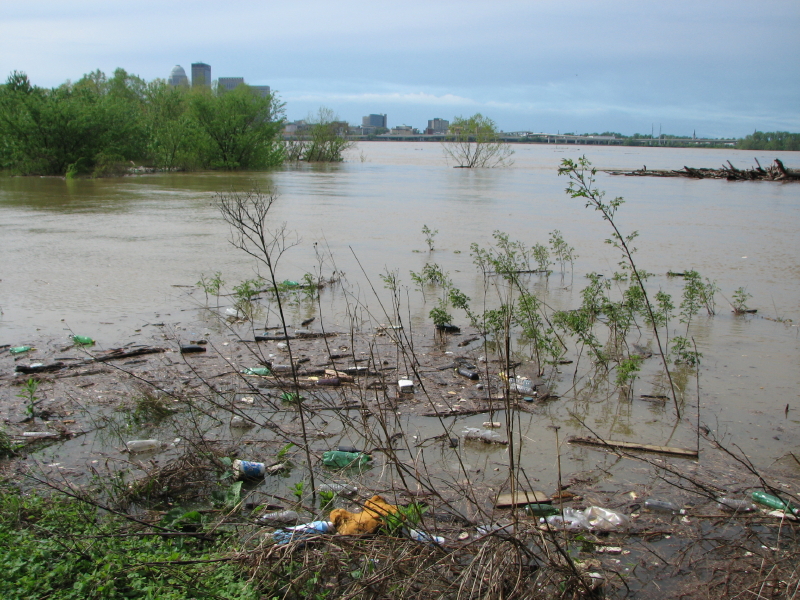
The Ohio River continues to rise because the sky continues to rain.  This flood will be one for the record books…perhaps in the top ten when it’s all said and done.  But who knows when that will be?  The weatherman hasn’t been very encouraging of late.  The timing of this flood is especially bad because it overlaps with the Kentucky Derby Festival and its two weeks of partying and activities which culminates with the most famous horse race in the world.  The additional water will keep the tourists away.

These images were taken just a couple of days a go and now the river is even higher.  In the City of Louisville, some of the most powerful pumps outside Holland are working around the clock pumping water from the low-lying areas.  Streets have been closed and the flood gates are up.  For the people who live nearest to the river…they have packed up and left a few days a go.  By now, the water has reached the roofs of their homes.  There’s nothing more that can be done.  It’s sit tight and see how much more rain will come and how high the river will rise.

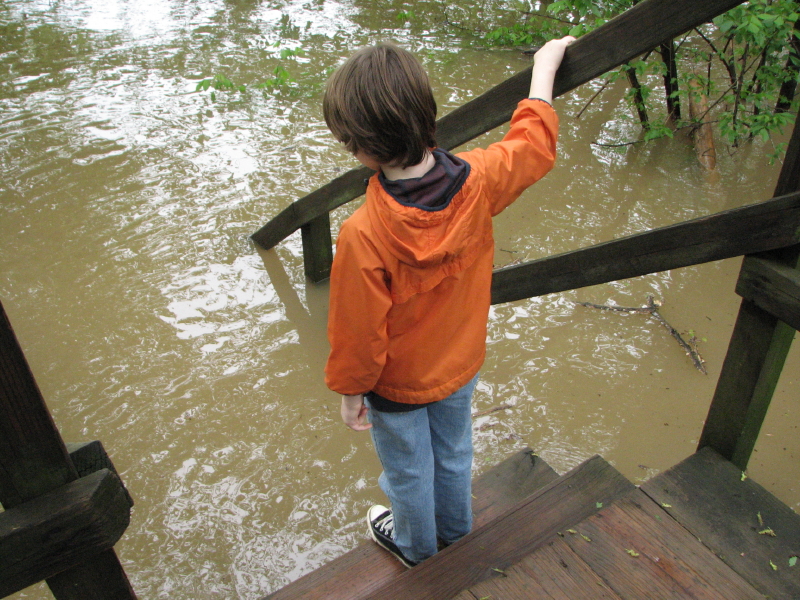
My son Adam was curious to see the extent of the flooding and so we visited the Falls of the Ohio.  The familiar wooden steps that lead to the river bank were now half way underwater.

We watched a box turtle flushed from its home in the underbrush swimming to higher ground.  Fortunately, it received an assist in the form of currents pushing it to land where it was able to escape drowning.  Watching this greatly affected my son who has a tender heart when it comes to all animals.  He really gets upset when the nature shows on television become too graphic. He doesn’t understand that life feeds on other life and that this has been the way of the world for a very long time.  This flood has also affected my creative routine at least by the water.  I’m forced to hopscotch back and forth between events in time which I think is a healthy thing in my life.  I was beginning to feel a little too linear anyway.  So, here’s another Styrofoam project I made sandwiched between the last flood of a couple of weeks a go and now.  This project is also now a memory remembered by these images.
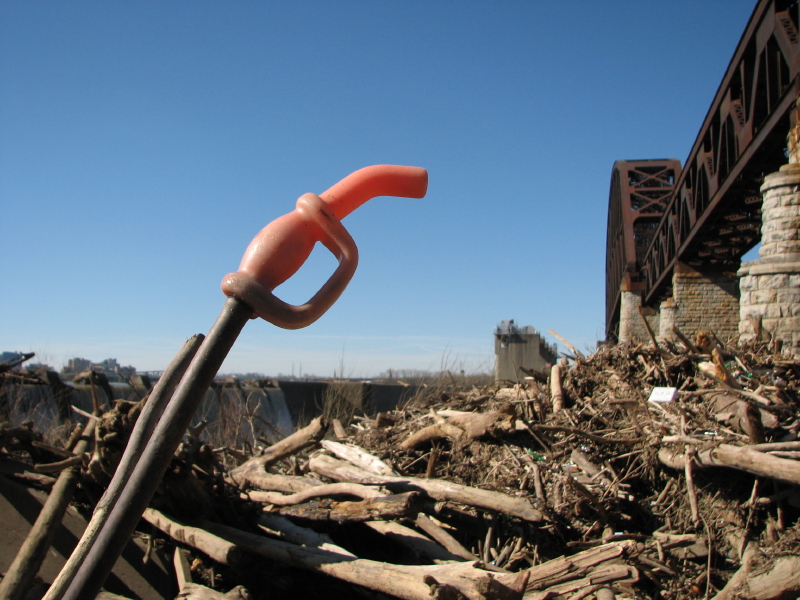
I really thought the previous inundation would be it for the year.  And so I set up shop atop this immense pile of wood and explored what was mixed in with all the natural debris.  Among the “treasures” was this toy gas hose…but that’s not all that I found!  Here’s something unusual too.

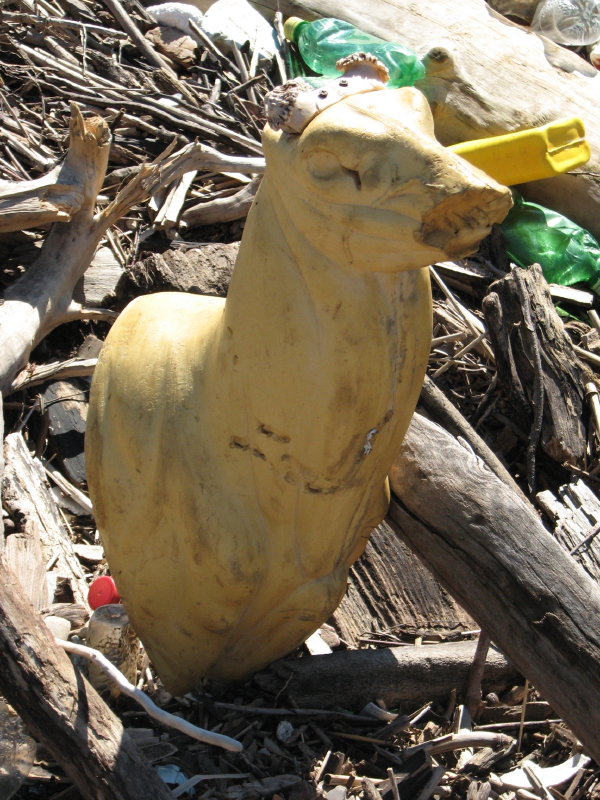
I set it up to help orient it for the photograph.  It’s what’s left of a taxidermed deer head.  The tanned skin that would have been stretched around it is now gone, but the remnants of the deer’s actual skull and broken antlers are screwed into the molded foam form.  This is another object that exists at the intersection of the natural and the artificial which I find curiously to be another sign of the times we live in.  When this trophy was intact, it probably was praised for its life-likeness.

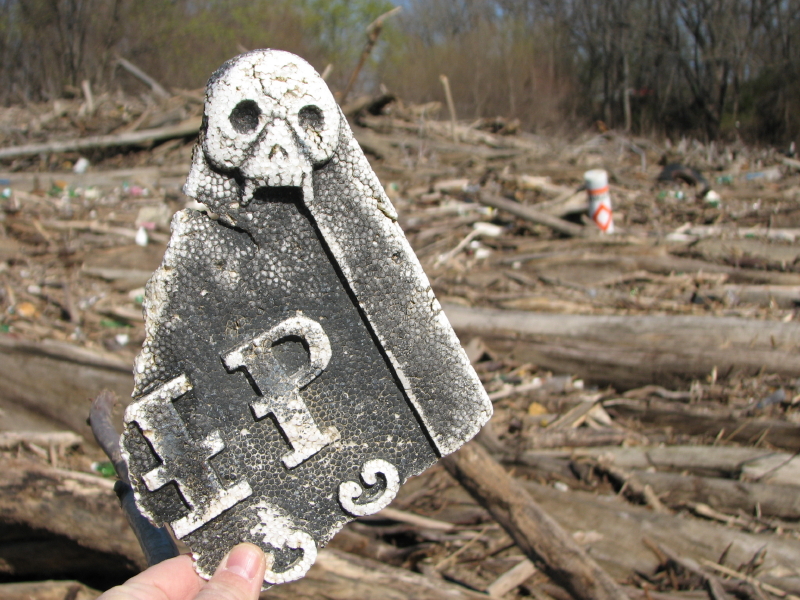
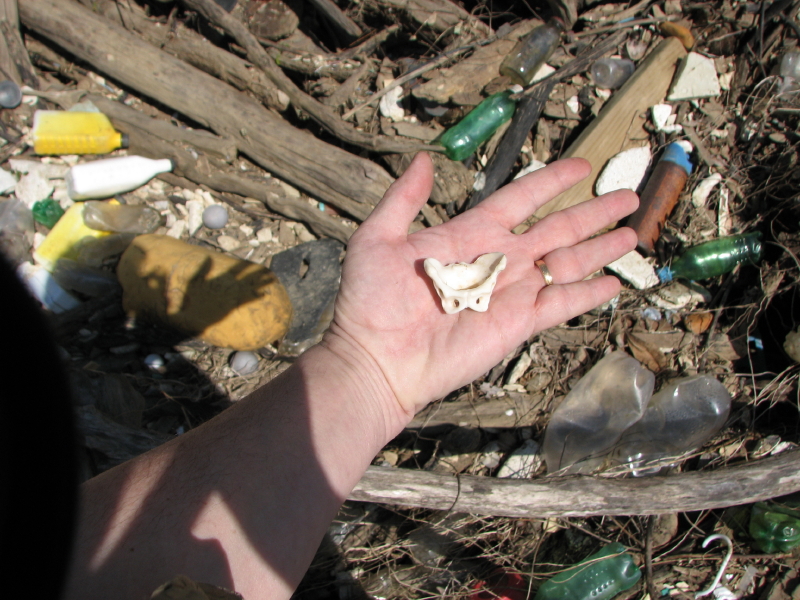
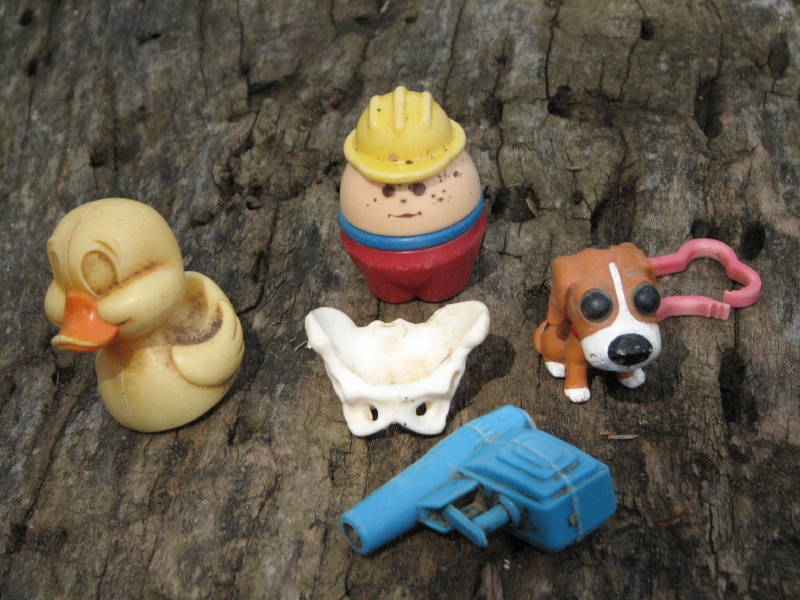
I also picked up this Styrofoam fragment of what I’m guessing was perhaps a Halloween novelty?  Amazingly, the little skull image survived.  I found another human bone reference out here on the wood pile.  It’s a miniature pelvis made out of plastic.  Luckily, I have never found the real deal and probably would freak out if I did.  Here’s that hip bone and a second image with some other fun stuff I picked up including one of the smallest and cutest squirt guns I’ve seen.

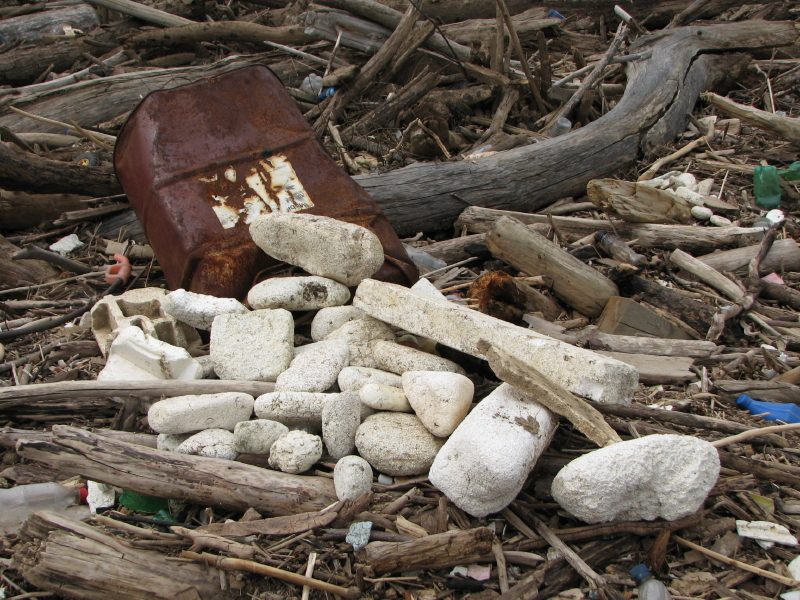
Sitting on a huge log, I started getting comfortable on my new spot.  I thought I could last here until the summer heat drove me under the willows.  I began to gather materials to make sculptures with like I had done with my previous plein air “studios”.  Mother Nature was providing all the material I needed to keep me and this project going for a long time.  Here’s my Styro-cache with its river-polished foam.

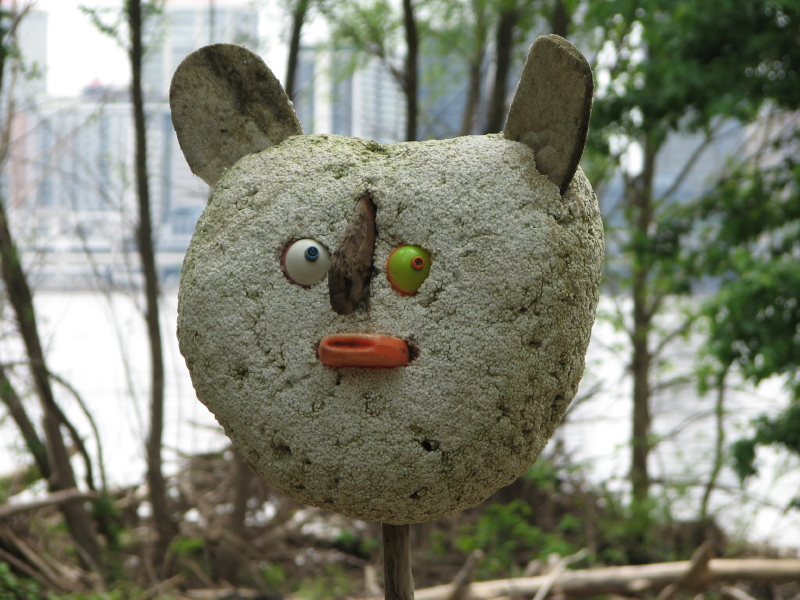
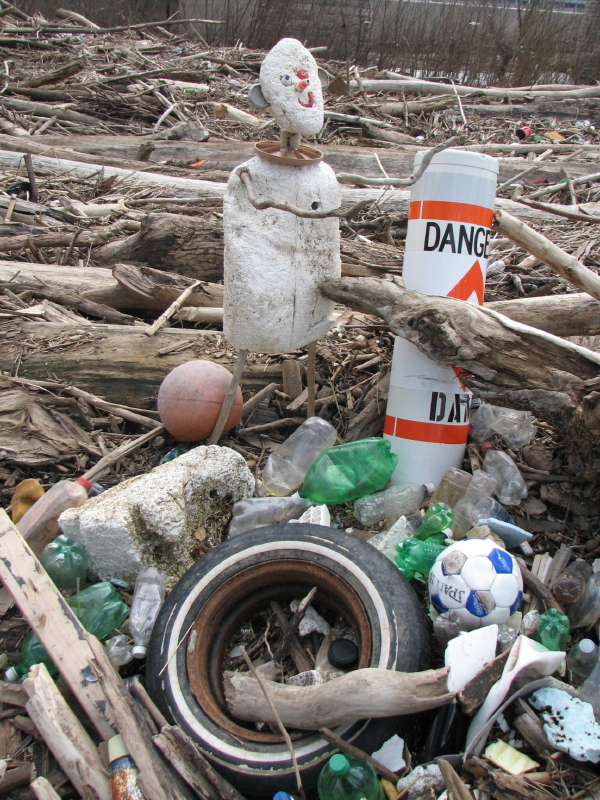
It’s all gone down river now, but before that happened I made one other figure out here.  I called him “Hoser” and set him up next to the “Danger” figure.  First, I started with making a head.  The eyes are old fishing floats.

I felt very meditative in this setting.  I could see the skyline of a city with its proximity to nature and it made me speculate on how it all was going to turn out?  Would we eventually strike some kind of working balance with the planet or was this a taste of what was coming or even worse?  I would walk around my wood pile looking for a stick or branch I could use for a limb to help blow life into this Styro-man.  This is how he eventually turned out.

With gasoline approaching four dollars a gallon I decided to put the fake gas pump nozzle and hose to good use.  I strategically placed this object into the figure’s polystyrene body more as a reference to the fact that here was another resource that we pissed away.

I located “Hoser” near the “Danger is My Middle Name” figure, took my photographs, and walked away.  That was the last I was to see of them.  Within days, the river started to rise more from rain that fell north of here and then it started to rain in earnest in the Ohio River Valley.  That was two weeks plus…it’s still raining and the river keeps on rising and the adventure continues.

Read Full Post »

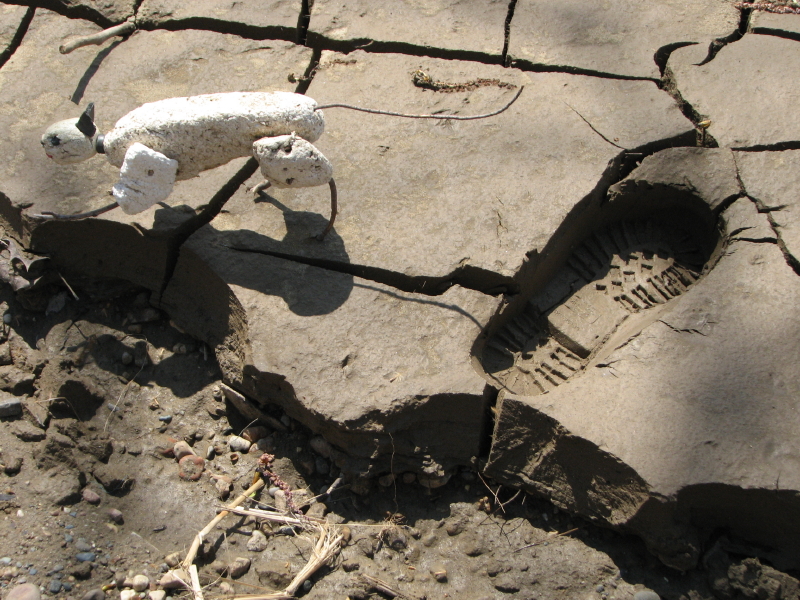
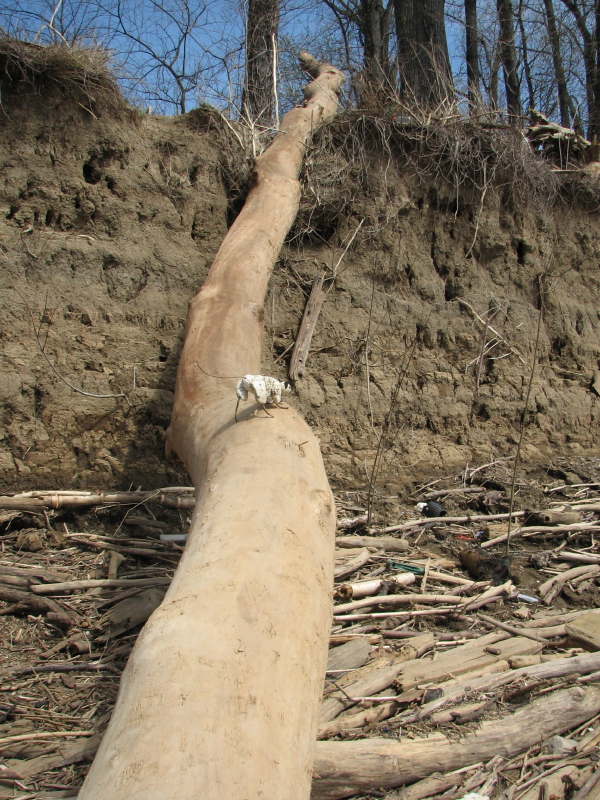
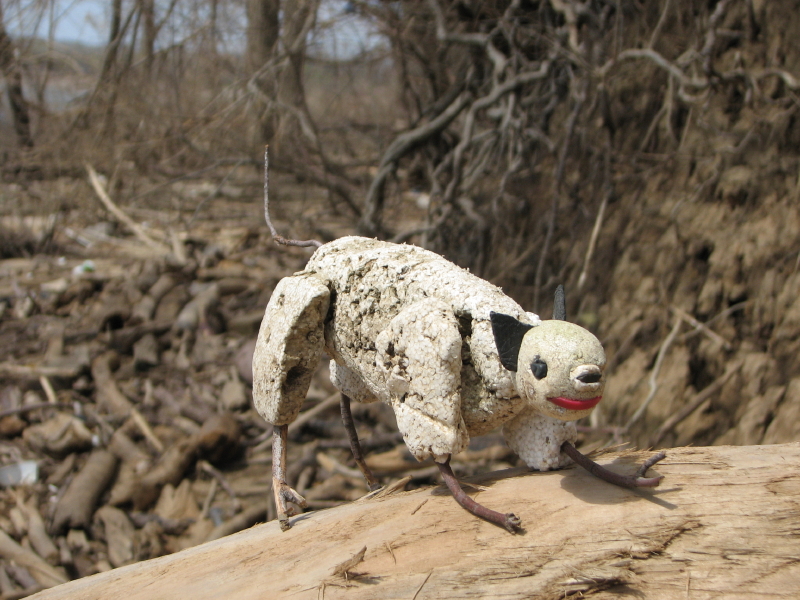
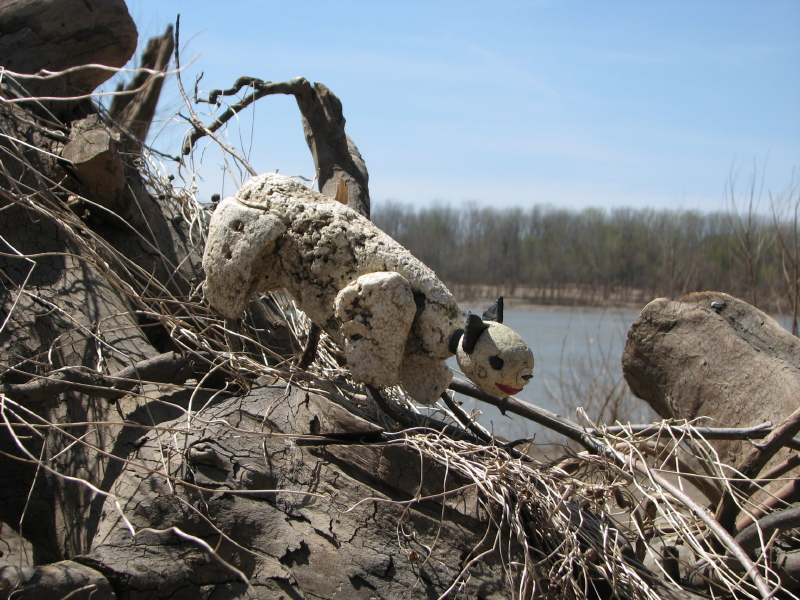
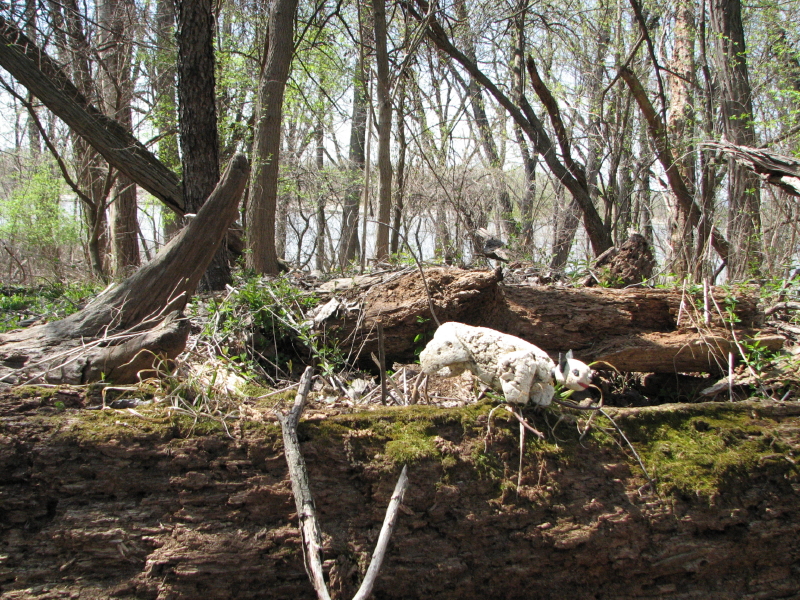
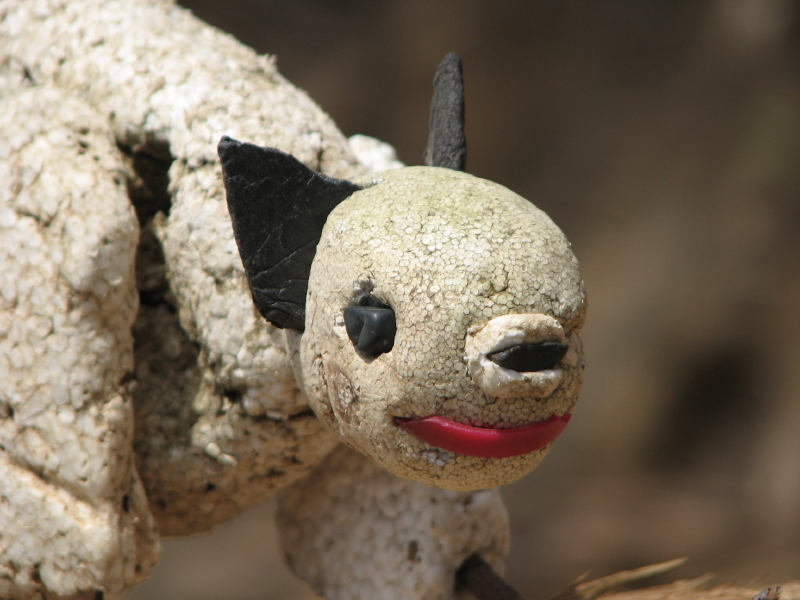
Seldom seen and thus aptly named, the River Ghost is an unusual small mammal living at the Falls of the Ohio.  Over the course of several days I was able to photograph a young adult as it was surveying potential territory.

Don’t let the cute face fool you.  The River Ghost is a relentless pursuer of anything it can catch and eat.  It’s diet includes birds, fish, other mammals no larger than twice its size, eggs, reptiles, and if necessary, insects and carrion.

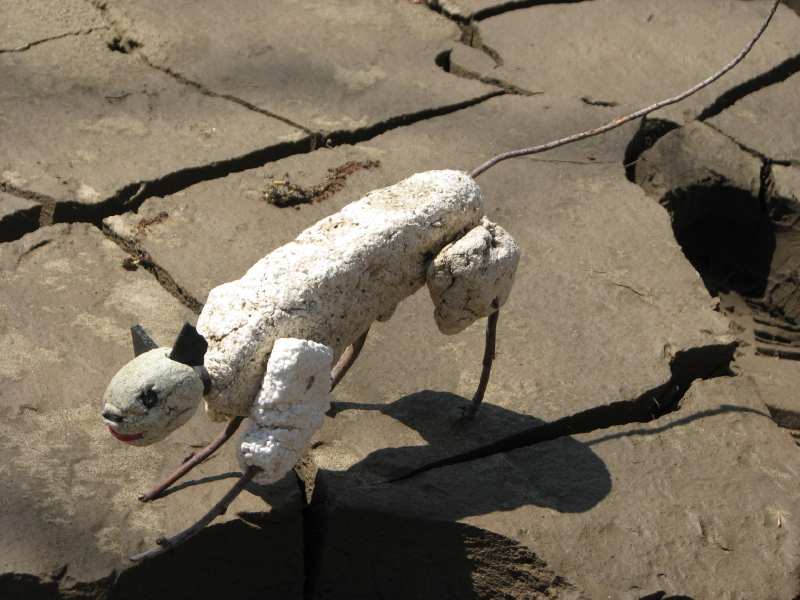
The River Ghost has a long and flexible body that allows it to pursue its prey through underground burrows.  It also utilizes abandoned burrows to raise its own young.  Two kits are usually born, but only the strongest will see the light of day.

I photographed this specimen walking along the mud line that was deposited by the recent flood.  The mud is a five-inch thick layer of “fudge” and very soft and moist.  That’s my boot print in the picture.

This mud is also perfect for recording the foot prints of other animals that cross over its surface.  Scientists are uncertain which senses are most important to the River Ghost, but it seems to have a keen sense of sight and hearing.  This odd animal has kinship to both rodents and weasels and may be a throw back to an older evolutionary line.

Despite having formidable survival skills…the River Ghost is not thriving for a variety of reasons and primary among them is habitat loss.  More and more the riverine bottomlands it prefers are being divided and developed.  It’s prey species are also experiencing a decline in populations.  Many species are dependent on large areas of intact ecosystems in order to remain viable.

It would be a shame to allow this curiosity among the local fauna to disappear before its time.  Humans have coexisted with this intrepid predator for thousands of years.  The native people have legends and myths about the River Ghost’s ferocity and toughness and its way of getting out of trouble that it starts.

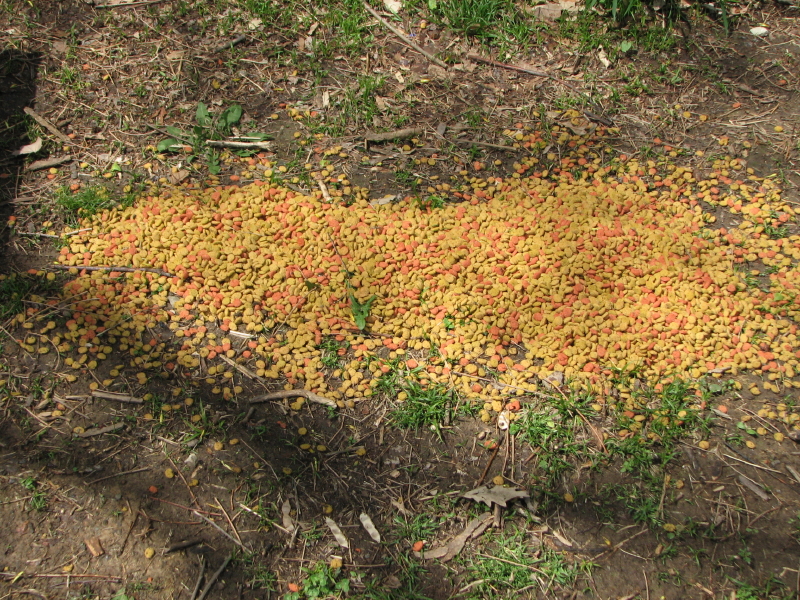
The last time I saw our River Ghost it had moved onto higher ground around the Interpretive Center and Woodland Trail.  It seemingly followed every lead and poked its head into every hole looking for food to satisfy its insatiable hunger.  It occurred to me, that it was heading for the picnic tables where people have been spreading dry cat food on the ground.  I wondered if the River Ghost “knew” that other animals would be attracted to the feeding station…or was it here for a bite of cat food too?  Perhaps I will see it again?

Read Full Post »

It’s a wonderful spring day on the debris heap.  On the old bridge several diesel trains have been carrying their vital shipments back and forth across the Ohio River.  These trains are also a noisy element here when they are crossing.  Among the other sounds you can count on hearing are the aircraft about to land at the local airport and the sound of the river flowing under the gates.

The flooding we experienced a few short weeks a go has left a lot of debris deposited at the Falls.  During the height of the water, the area I’m exploring today was a watery gyre of spinning driftwood, junk, and plastic jugs and bottles.  It’s dry now and in the eastern section of the park under the railroad bridge.  You can’t miss it because in places it must be 12 to 15 feet tall.  It’s all interwoven logs and debris and it can be very treacherous walking here.  You always must be careful where you place your foot and weight because it might just be an air pocket covered in paper and leaves that can cause you to fall into a hole.  It would be no fun walking out of here with an injury.  I usually have a long walking stick with me to help me maintain my balance walking over the backs of logs.
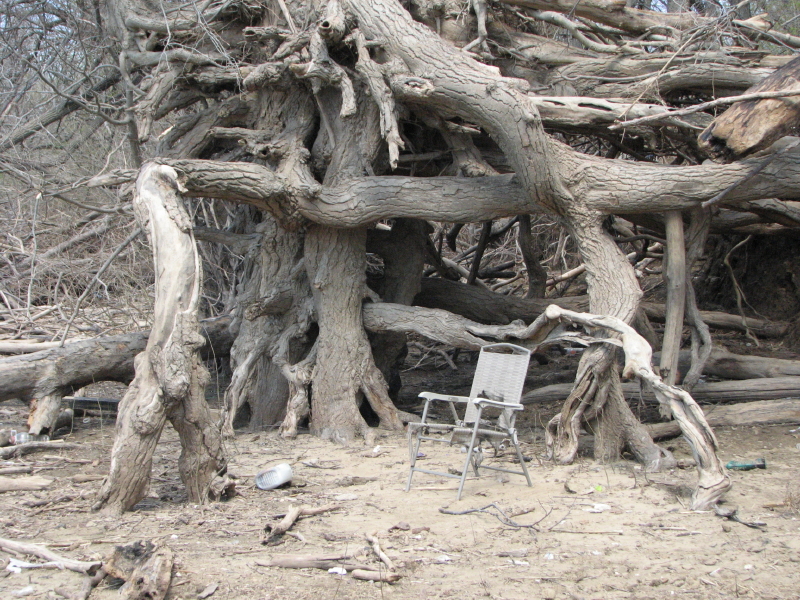
If you are careful, you can explore this wooden mound safely.  It presents several interesting vantage points for photography.

Naturally, I’m also on the look out for interesting objects that have come to rest here.  My collecting sack soon fills with mostly plastic artifacts.

This wooden mound has waves of its own.  It has peaks and valleys and you can sense how the water moved from the artifacts that were swept along and how and where they came to rest.  The lightest stuff like plastic bottles are good indicators of how far the margins extend and where drainage occurred.

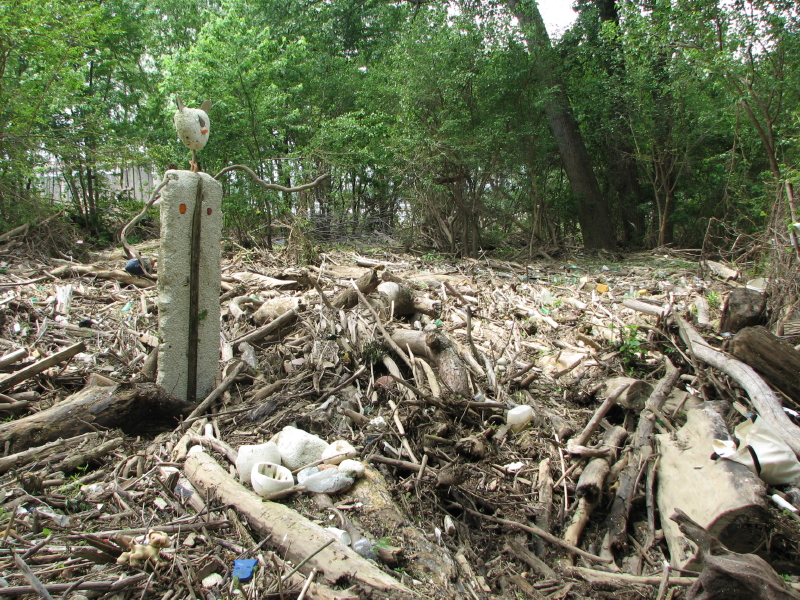
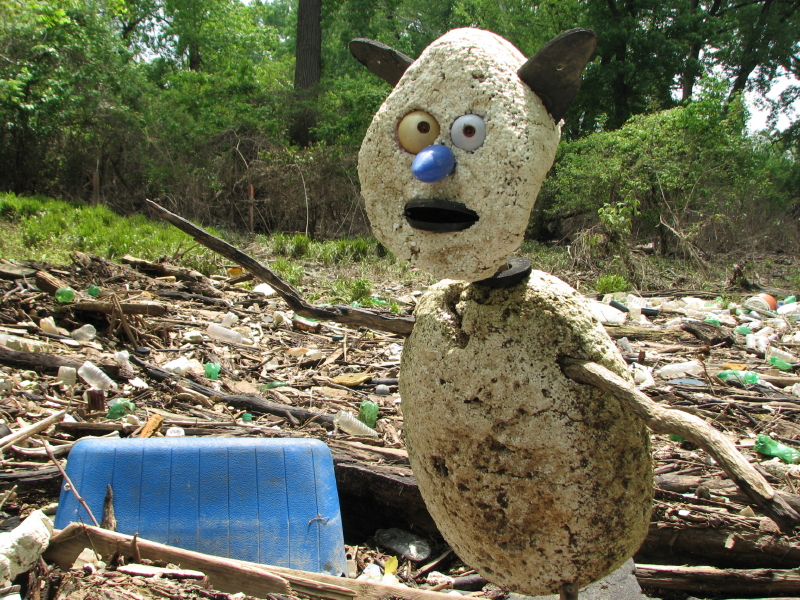
After exploring the area and collecting materials, I soon had another temporary studio going.  This time I’m not finding any huge sections and chunks of Styrofoam around.  There are, however, lots of smaller pieces absolutely everywhere.  I gathered these pieces up and soon I was making a figure to take advantage of this riverscape configuration at the Falls of the Ohio.

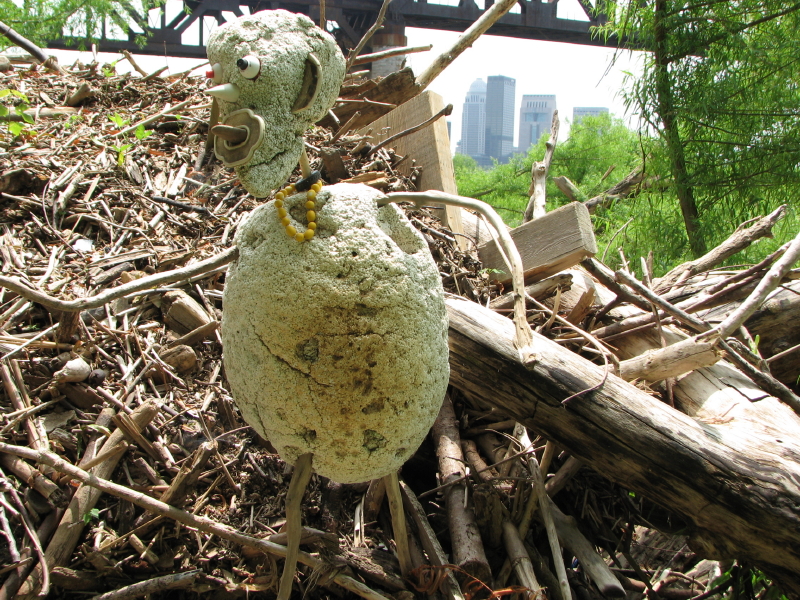
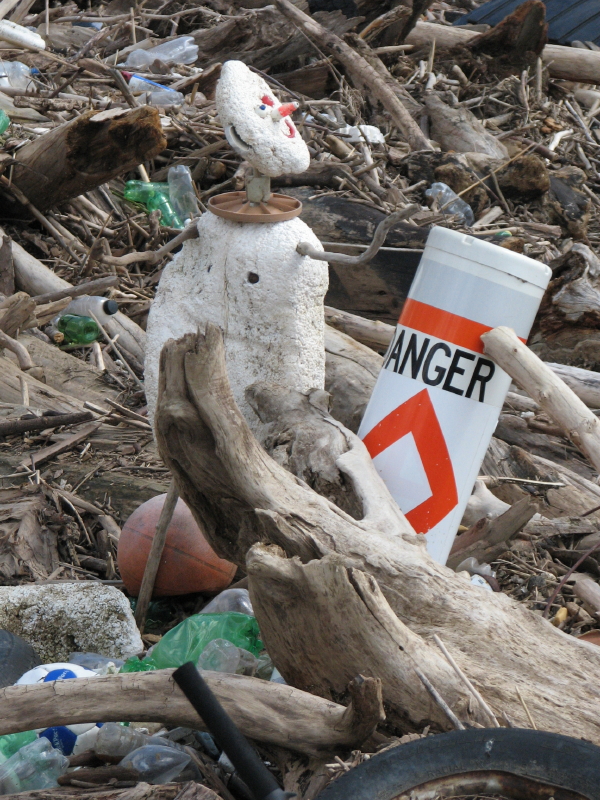
I found a spot with a good view of the city and made this guy.  His name comes from the spot where I left him.  I can feel that my face has received more sun than unusual and since I didn’t bring any sun block…decide that it’s time to go back home.

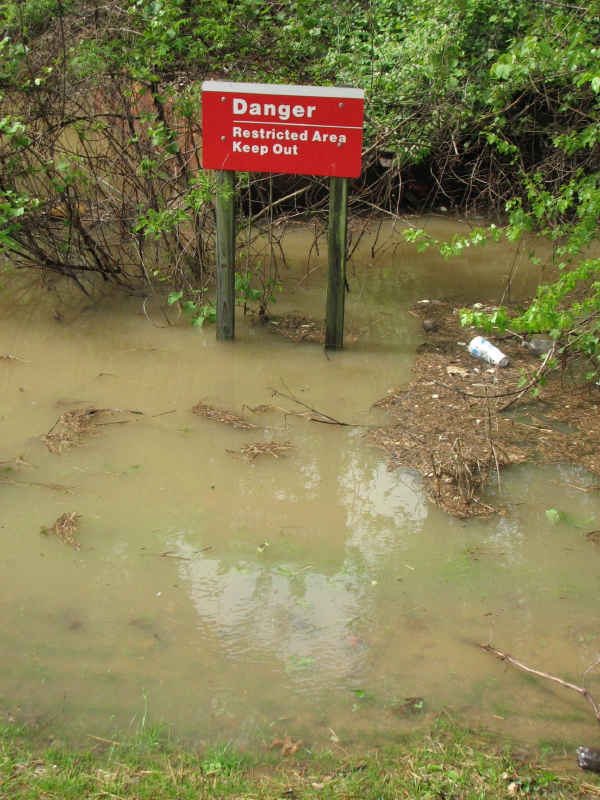
The place is marked by a “Danger” buoy that drifted in with all the other debris.

Around “Danger” are all kinds of other junk mixed among the driftwood.  Tires are ubiquitous as are all the plastic containers and playground balls.  Among the natural materials are wood (limb and lumber), nuts, dried reeds, and lots of shredded tree bark.

I’ve been busy cataloguing with photographs all the small items I found and collected from the Falls over the years.  I have posts to come of that material. I also have several other figures and adventures to relate to you.  With this project you have no choice, but to work with the river and I have been trying to play catch up where and when I can.  The next expedition takes place in the western section of the park.  There I will attempt to capture images of an unusual animal rumored to have been seen there recently.  Wish me luck!

Read Full Post »

« Newer Posts - Older Posts »