Feeds:
Posts
Comments

Posts Tagged ‘recycled art’

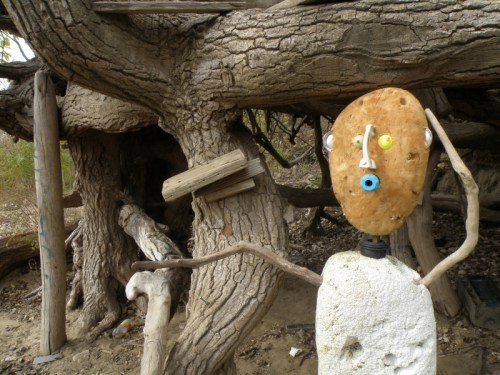
Styro-witness, Jan. 2013

Today has been a full day.  The Project Reclamation art exhibition I participated in is officially over for now.  I picked up my work from the Carnegie Center for Art and History in New Albany and moved on.  Efforts are underway to see if this might make a traveling exhibit that university galleries might be interested in booking.  I hope so.  Having organized many art exhibits over the years I understand how much work goes into the process of creating a good display.  Once a show ends, I often had this feeling that lots of energies and passion were spent by the artist(s) and gallery for a relatively short amount of time and then it’s on to new art and the next exhibition.  We consume exhibits like we experience so many other things in life.  I think this is one reason why I enjoy this Falls project so much.  It exists outside the normal gallery conventions and isn’t bound by white walls, pedestals, labels, and consignment forms.  The show is ongoing in the context of life at large.
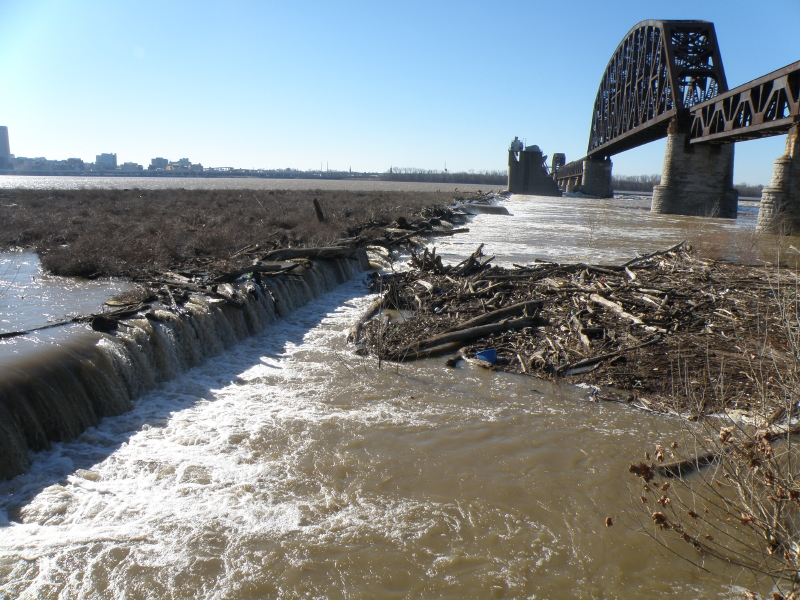
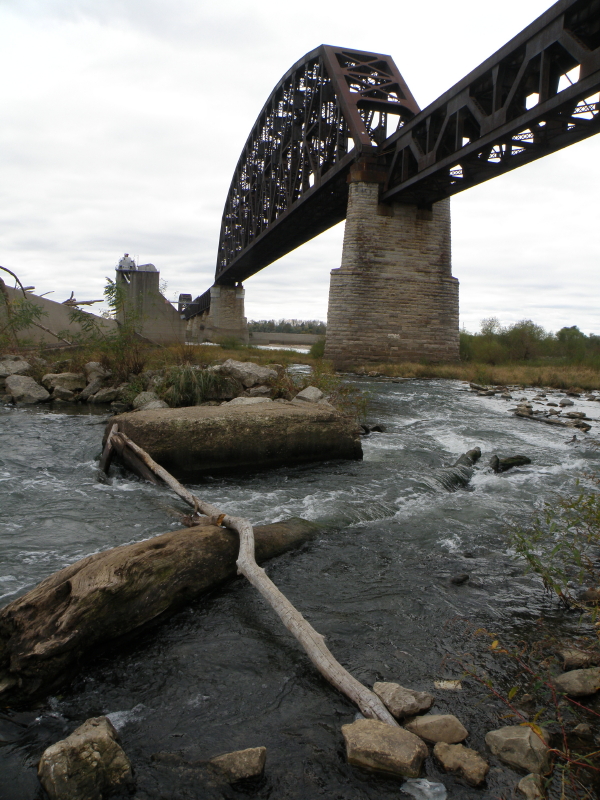
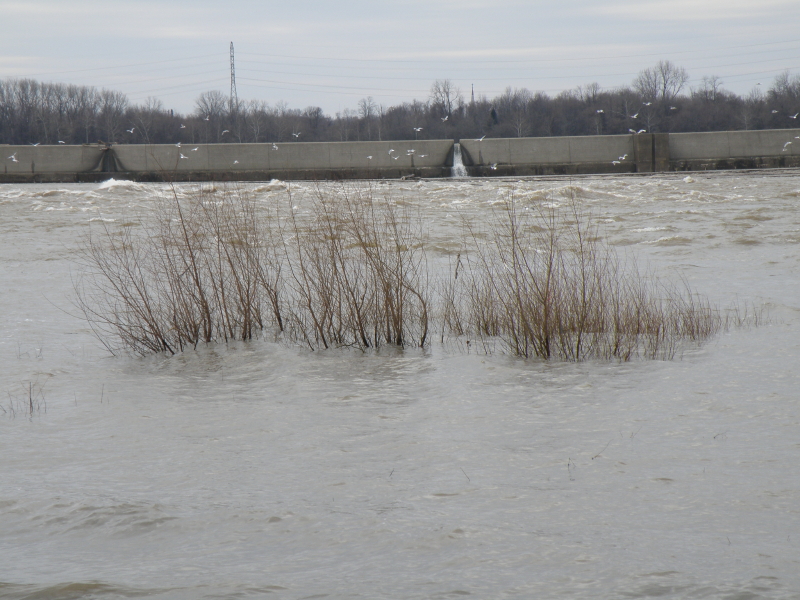
high Ohio River at the Falls of the Ohio, Jan 19, 2013

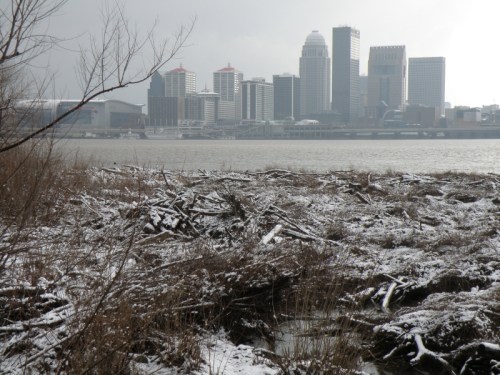
With my artworks in the back of my car…I stopped by the Falls of the Ohio State Park.  The Ohio River has been up due to rain and snow in the northern part of the Ohio River Valley.  Under the railroad bridge you can get a good sense for the strength of the current.  New driftwood was accumulating and enlarging the wood already present.  I could also see a lot of man-made junk intermixed among the natural debris.
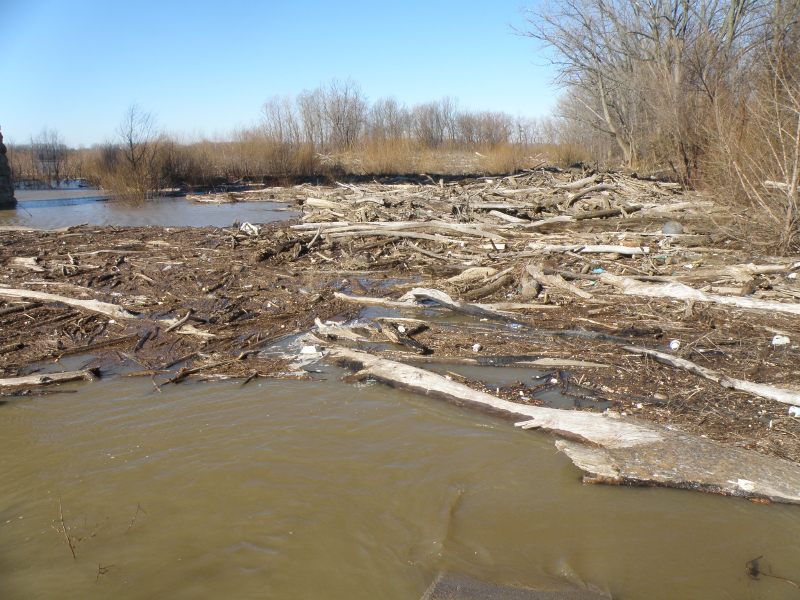
high water at the Falls of the Ohio, Jan. 2013

Just beyond the distant trees in the above image is the approximate location of my outdoor studio.  My “treasure trove” of river-polished polystyrene chunks that I have gathered over the past year may or may not still be there?  Once the river level drops, I will be able to access my spot again.  Regardless, the area will be rearranged by the river…it will be the same, just different if that makes any sense at all?  I may even be able to relocate some of the Styrofoam if it hasn’t floated too far away.  From experience, I know whatever I may have lost is unfortunately too easily replaced.
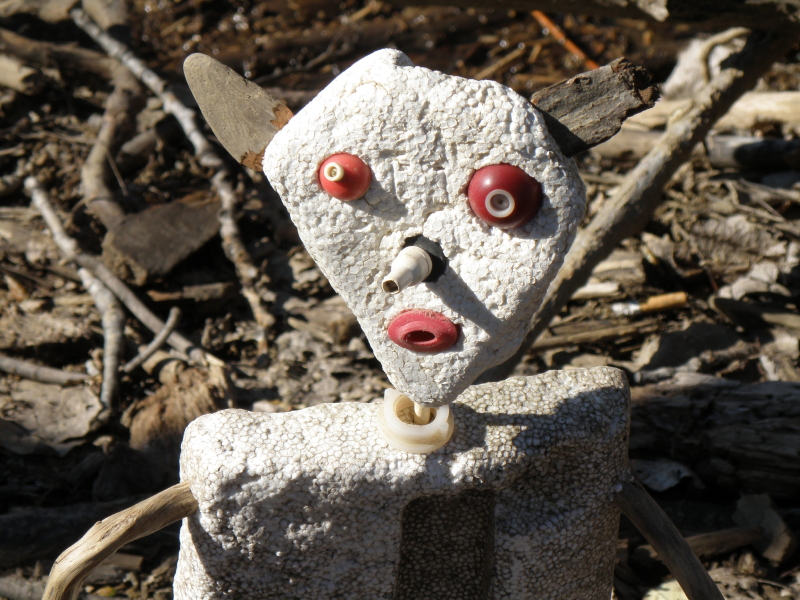
Head of Styro-witness, Falls of the Ohio, Jan. 2013

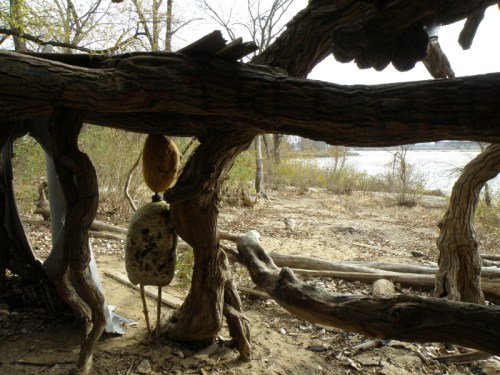
With my usual access points underwater, I explored the river’s edge just west of the Interpretive Center.  Along the way, I found enough materials to create this Styro-Witness to help me experience and document the day.  Although it was a very sunny day, it was still cool and windy.  The river’s high level had me walking among the bottom land trees and walking over the logs that had been deposited here by previous floods.  Every once in a while, I would walk into cold water hiding under last year’s leaves as the river creeps inland.  The squeaky sound of wood rubbing over wood as logs rolled in the waves was occasionally interrupted by loud cracks as branches were separated from tree trunks.
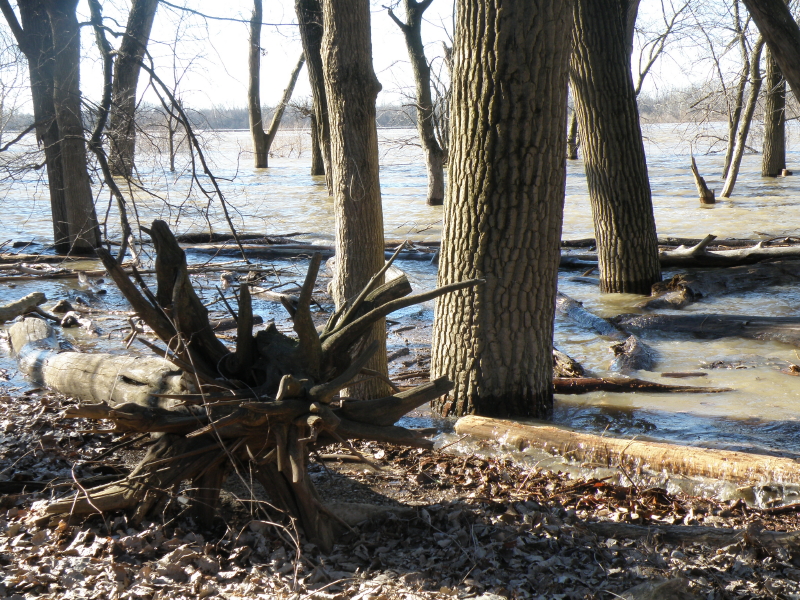
high water at the Falls of the Ohio, Jan. 2013

I was anticipating seeing ducks and geese, but none were around today.  The Ring-billed Gulls that were so numerous a couple of weeks a go were less prevalent on this day.  Just when I thought I might strike out with the birds…I had another personally notable sighting.   I observed three Eastern bluebirds engaging in “fly-catching” behavior flying from their respective perches to the ground and back.  I couldn’t see any insects at all, but I did see spider silk tangled among the branches and perhaps this is what they found here?  Anyway, the Eastern Bluebird is listed in the park’s checklist as being rarely found at the Falls of the Ohio State Park and in the ten years I’ve been paying attention…these are the first bluebirds I have seen here.  It’s really cold up north now and heading our way.  Were these birds driven here by that frigid weather?  Regardless, I wouldn’t have guessed that mid January would be the time I would sight bluebirds here.  Their wonderful predominantly deep blue feathers were complimented by the orange and white on their breasts.
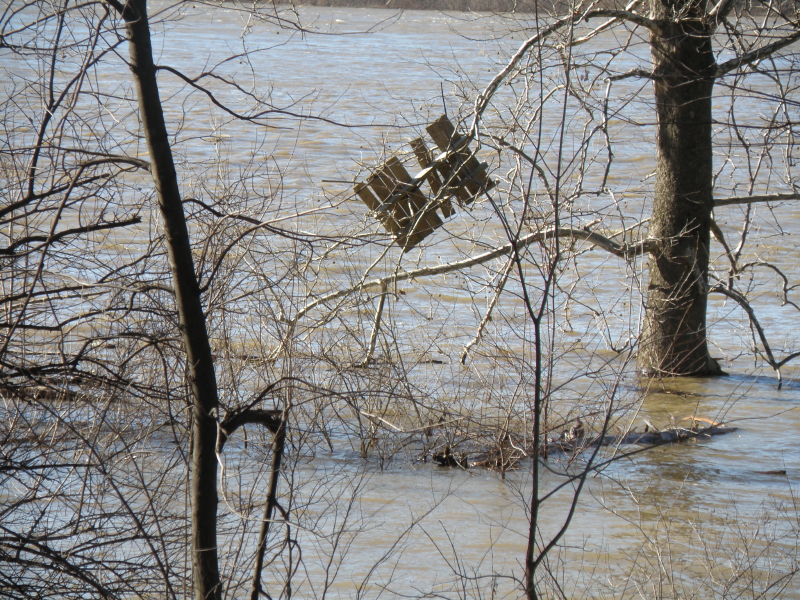
wooden pallet in the trees, Jan. 2013

This wooden pallet has been snagged in the branches of this tree for at least a year now.  I use it as a reference for how high the river can get.  In the early days of this project, I recall seeing an old refrigerator perched in the top of a tree courtesy of the Ohio River at flood stage.  Seeing an appliance crowning a tree top is a surreal sight not easily forgotten.  I kept walking westward with my latest creation and eventually reached the limit of my walk.
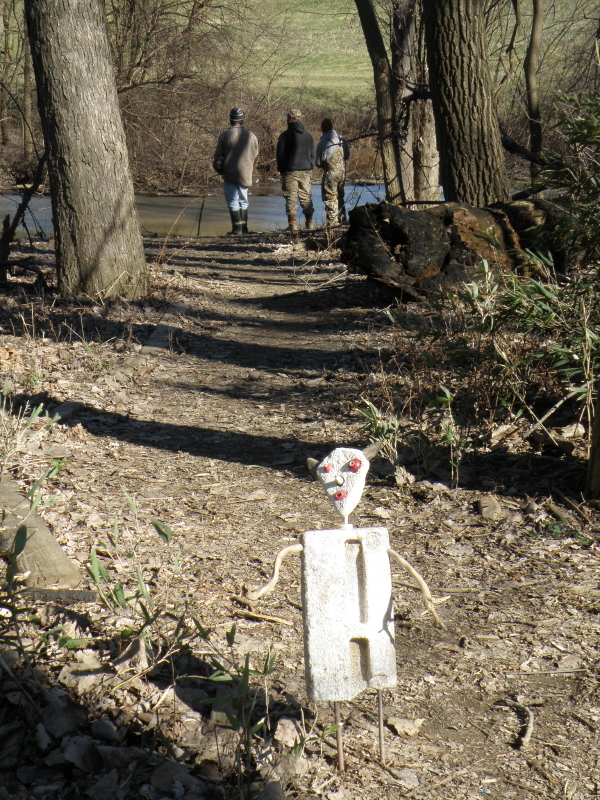
falls photos 026_1_1

The Woodland Loop Trail eventually turns at a small creek that feeds into the river.  Here I found about ten fishermen casting their lines into the high water.  I decided to sit for a spell and watch while making small adjustments to my newest figure.
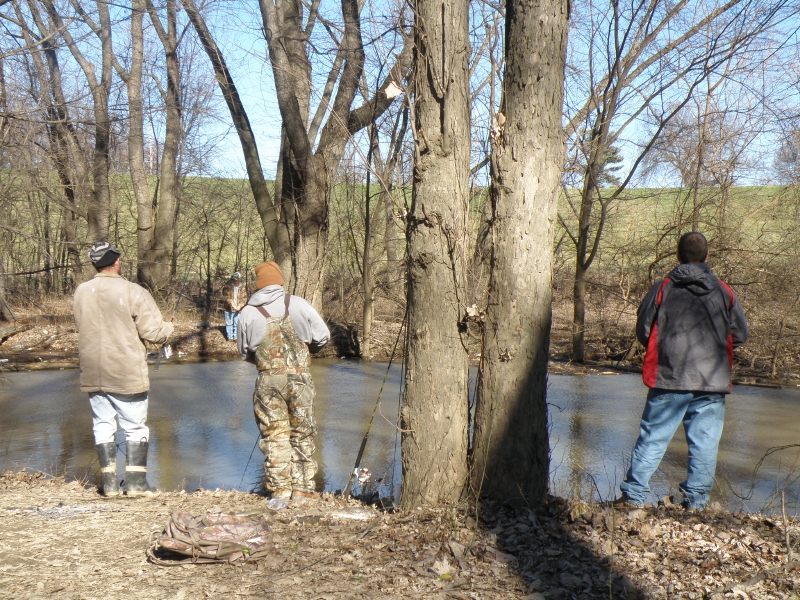
fisherman at the creek, Falls of the Ohio, Jan. 2013

These fishermen were casting small, bright green and yellow, soft-bodied,  tailed jigs into the creek and having amazing success.  All of them were catching Sauger which is a member of the Perch family and smaller cousin to the Walleye.
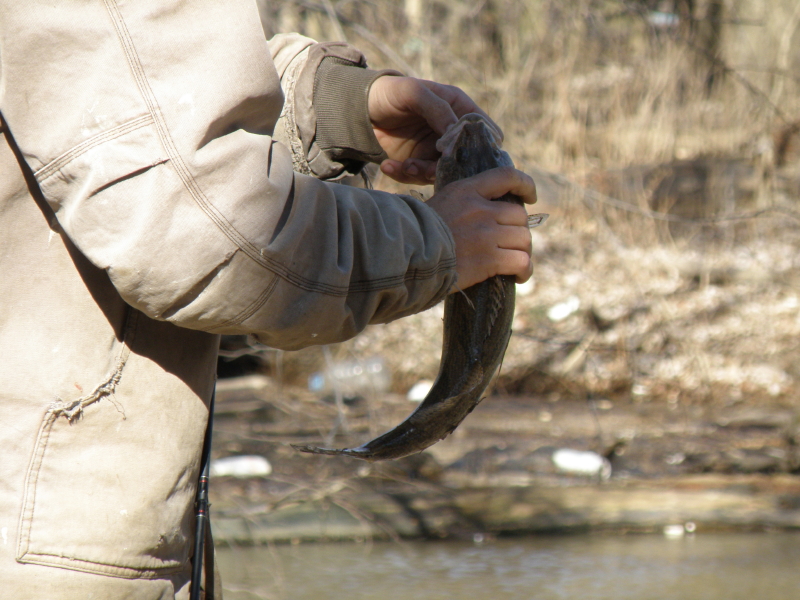
hooked Sauger, Jan. 2013

Sauger are predatory fish and have sharp teeth.  Their eyes seem to glow whenever light hits them just the right way and underscores that they normally live in deep, dark water.  Sauger eyes have adapted to gather as much light as possible in the depths.  Apparently, they are very fine eating and all of the fisherman I observed were filling stringers of fish.  Most of the fish I saw being caught were thick-bodied and in the two to three-pound range although they are also capable of getting bigger.  The fishermen were having the best time and there was obvious camaraderie among them especially since everyone was catching fish.  I had a good time too, but it got to the point of my adventure when it was time to get home and intersect with the family.  I stuck my Styro-figure into the soft wood of the log I was sitting on, took one last photograph, and walked away.
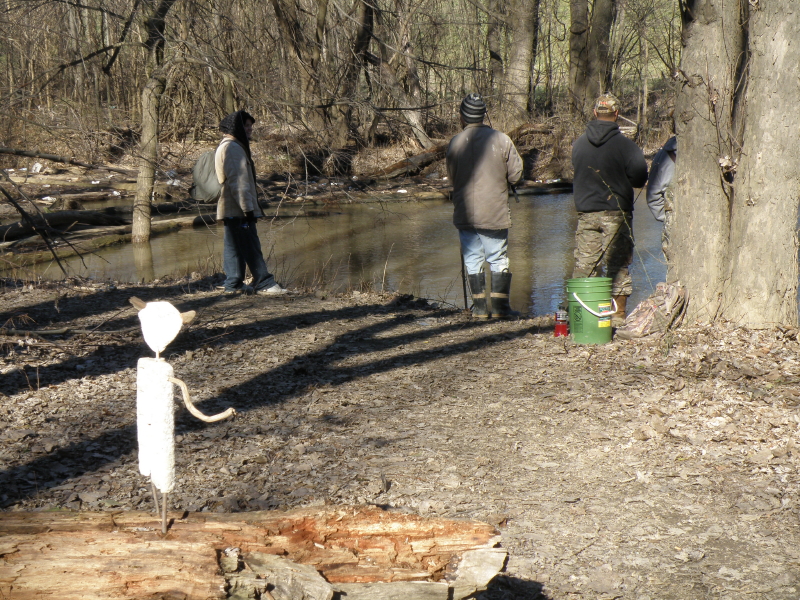
Styro-Witness and the fishermen, Jan. 2013

Read Full Post »

submerged willows at the Falls of the Ohio, Jan. 2013

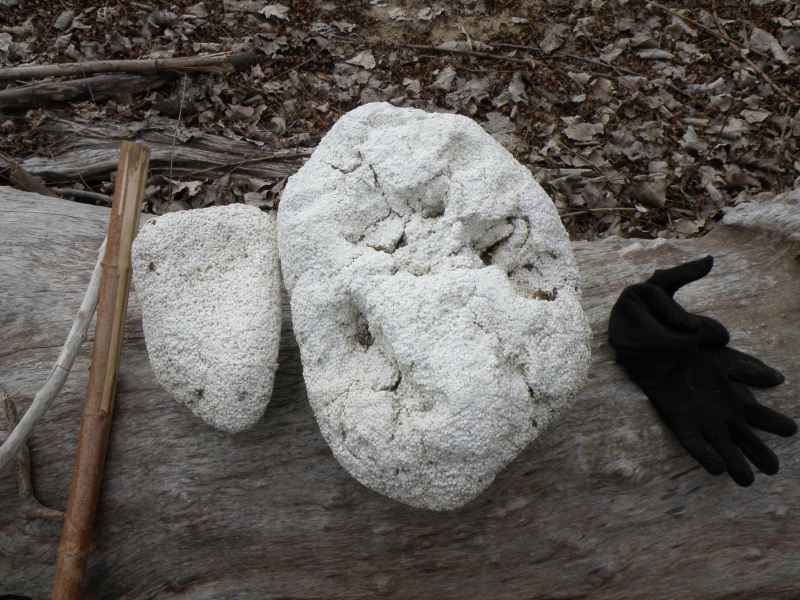
It’s a new year at the Falls of the Ohio and this is my first foray of 2013.  As expected, I have the park to myself.  It’s cold, but not unbearable.  I can tell that the river has risen and fallen since I last set foot here.  The riverbank is rearranged with freshly deposited driftwood and junk.  The only wildlife to be encountered are birds.  I see the geese and ducks I expect to see, but the stars of the day are the hundreds of Ring-billed gulls that are flying over the river.  I begin my visit by walking the riverbank looking for potential art materials and anything else of interest.  I do find lots of new Styrofoam, but the pieces are heavy and frozen with water and too much to carry.  If the river doesn’t rise again soon, I may get the chance to move the bigger polystyrene chunks to my studio under the willows.  Walking the shoreline, here are a few of the other “gifts” I encountered courtesy of the Ohio River.

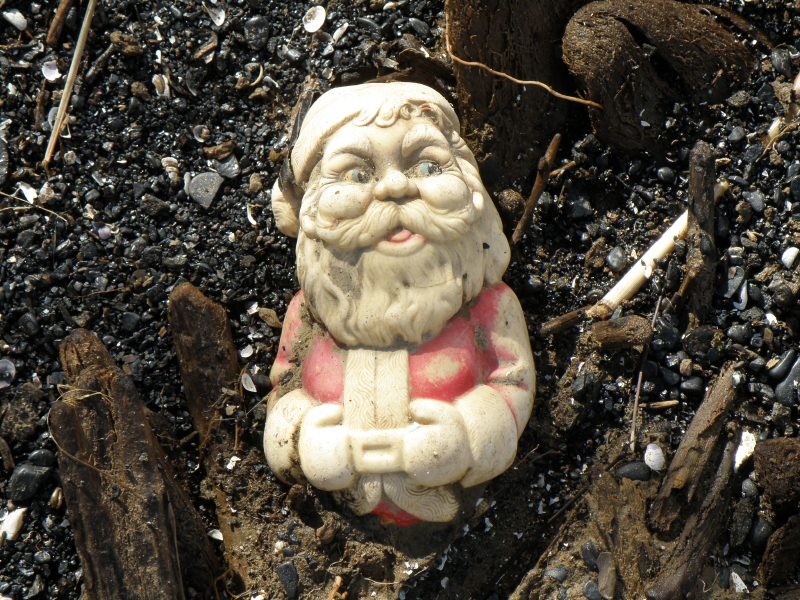
partially buried plastic Santa Claus, Jan. 2013

Half buried in coal dust and gravel is this plastic, scary Santa Claus.  I know we just celebrated Christmas, but I couldn’t resist posting this image.  He looks old to me and I pull him out of the mud and drop him into my collecting bag.  I may try to research him and see if I can find any info about him.  On this day, I also found another doll head.

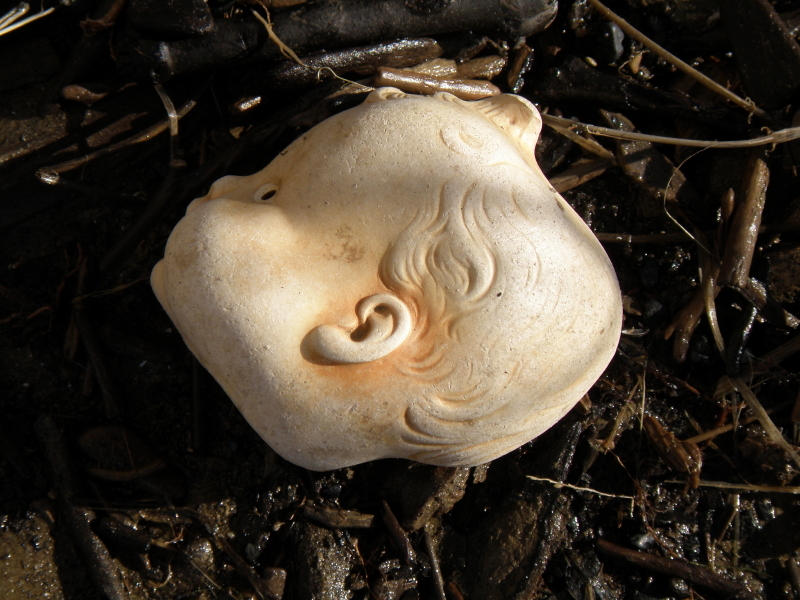
plastic doll head, Jan. 2013

I’m always finding dolls and doll parts.  The interesting thing about this particular find is the location.  I have on other occasions also found old doll parts in the exact same place.  I’m beginning to believe that prior to this area becoming a park it may have served as a landfill?  In other areas of the park it is clear that this area was used as a dump from the amount of back fill I come across.  Nearby, something blue in the sand catches my eye and I take a look.

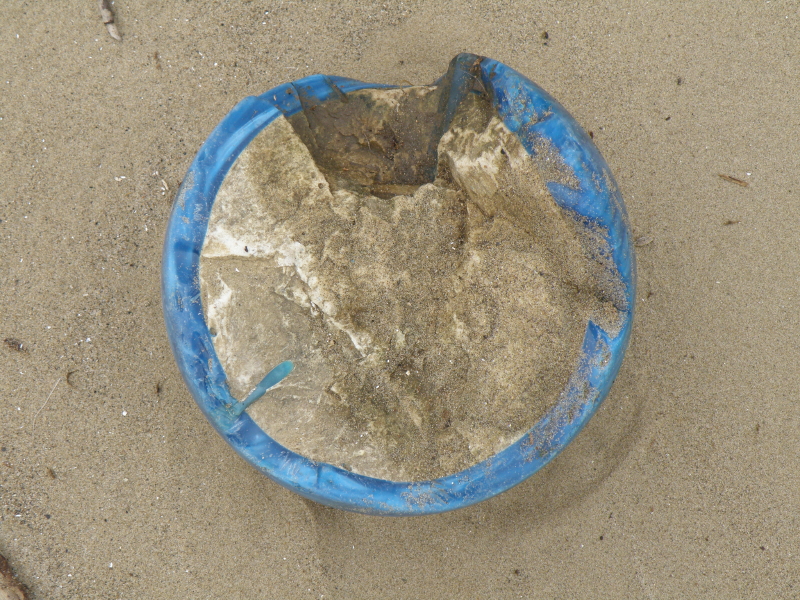
bowling ball fragment, Jan. 2013

interior view of split bowling ball, 2013

In case you were wondering, bowling balls do float.  I turned the beautiful blue-marbled surface over and discover that this ball has split in half.  The interior is made of a dense, hard foam and this is the reason these balls are buoyant.  The outer covering is a very hard plastic and I’m wondering how great a force is needed to break one of these balls open?  I imagine it is considerable and is another reminder of the power of the river.  Here’s one last find before moving on.

jar of peanut butter washing ashore, Jan. 2013

As I walked the riverbank, this jar of peanut butter was deposited by my feet!  I wonder where this came from?  Near the river’s edge I’m also picking up freshly peeled willow sticks.  This is evidence that beavers are in the area.  The sticks all bear their teeth marks as they nibble the bark for food.  Beavers are very secretive and I have only seen them twice in the past ten years.  I like willow wood for its ivory color and use them quite a bit in my river sculptures.  I wonder if beavers would like peanut butter?

outdoor studio, Jan. 2013

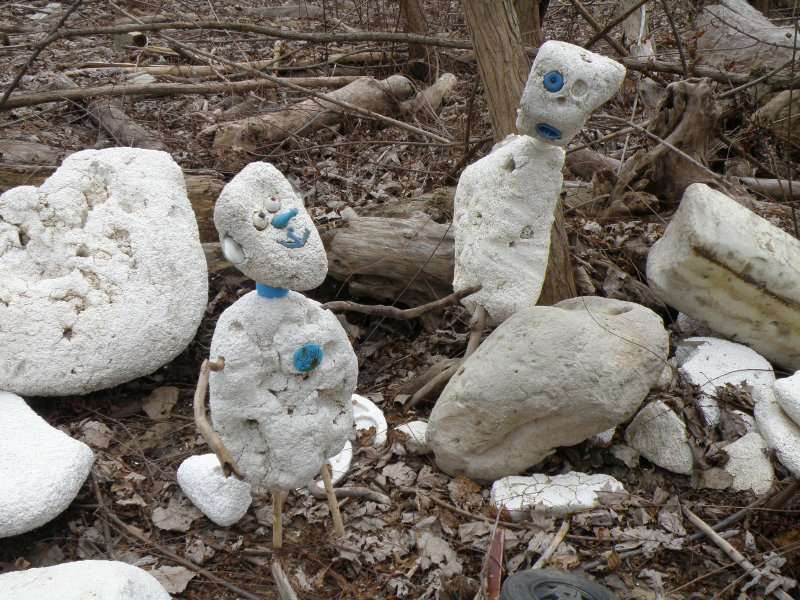
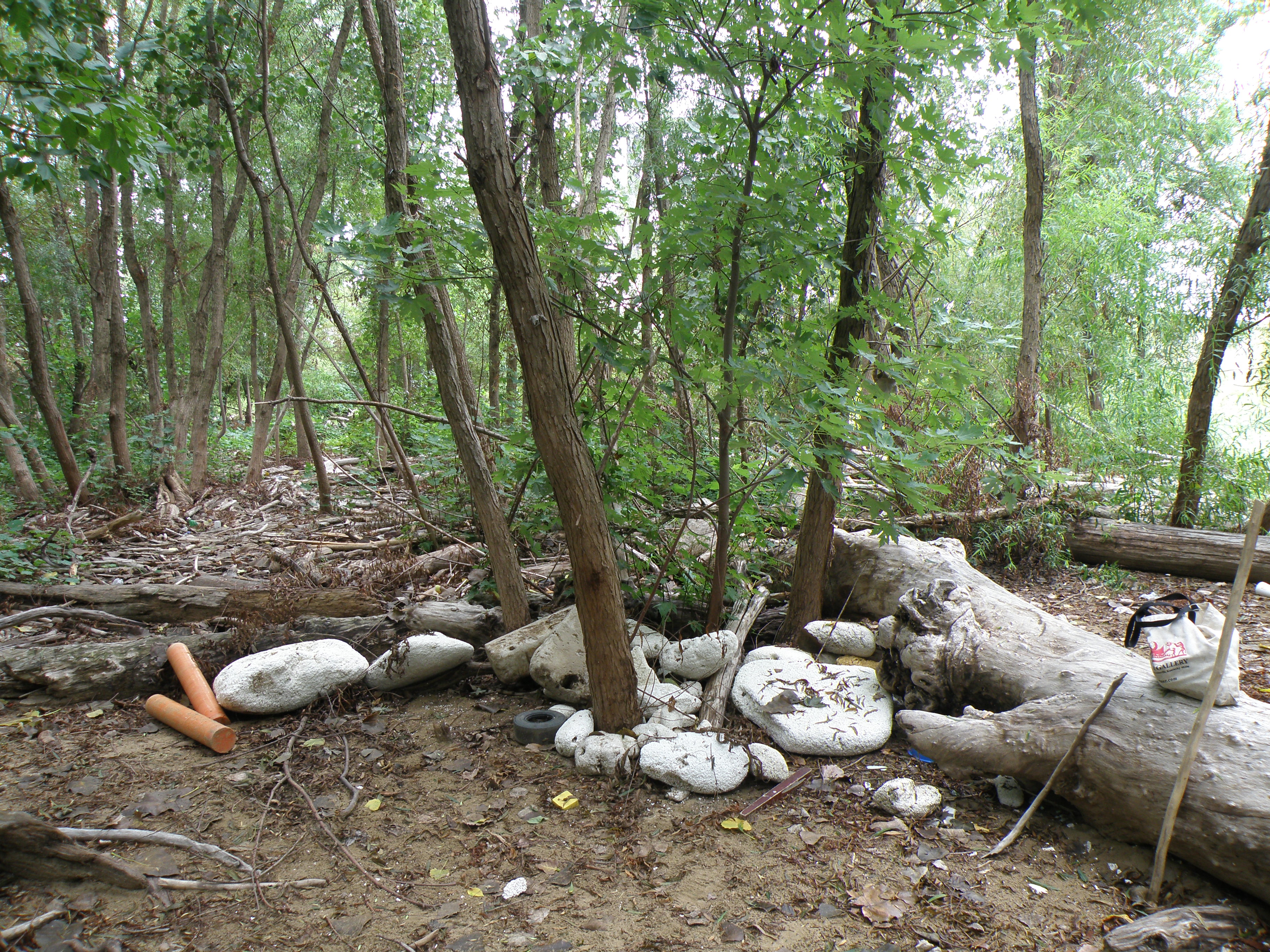
After scouting the river I head up the bank to the area under the willow trees that I have been using as an outdoor studio for the past year.  This ground is slightly higher, but is no match for a flooding river.  I have made many temporary studios over the years where I cache the Styrofoam and sticks I use for my figurative sculptures.  It’s been perhaps two months since I last visited this spot, but to my eye, not much has changed.  I set my collecting bag and walking stick down and select a couple of pieces of Styrofoam for my first figure of the new year.

The beginnings of a figure, Jan. 2013

Styro-figure in process, Jan. 2013

Before too long, a new figure takes form.  Today, I’m breaking in a new knife because I lost my trusty Swiss Army knife out here.  That’s two knives I’ve lost since beginning this project and think of my losses as tribute necessary to appease the river gods.  My new figure also sports one other find from this day…it’s a button that says “Kentucky is My Land”.

My latest Styro-figure greets his kin, Jan. 2013

After saying so long to his kin, my latest and unnamed Styro-figure sets out to explore his world.  The day started out sunny, but now has turned gray and cloudy.  I probably won’t stay out here much longer since the wind has picked up a bit too.

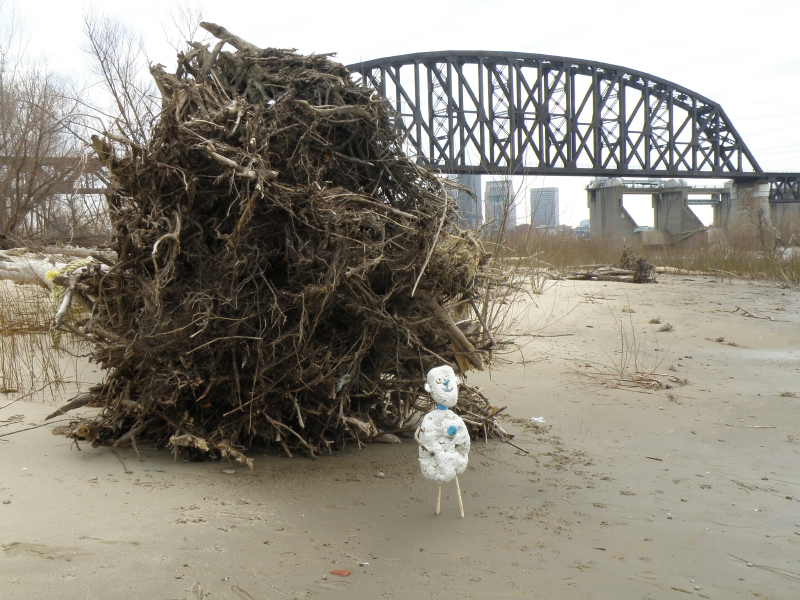
Styro-figure by large downed tree at the Falls of the Ohio, Jan. 2013

Here is further evidence that the river has risen and fallen recently.  A freshly deposited tree has been stranded on the bank and provides an opportunity for investigation.  In the distance and past the railroad bridge, one can spy part of Louisville’s skyline.  Curious about the tree, my newest figure climbs on top to survey the world from this vantage point.

Styro-figure on top of stranded tree, Jan. 2013

Styro-figure on tree, Jan. 2013

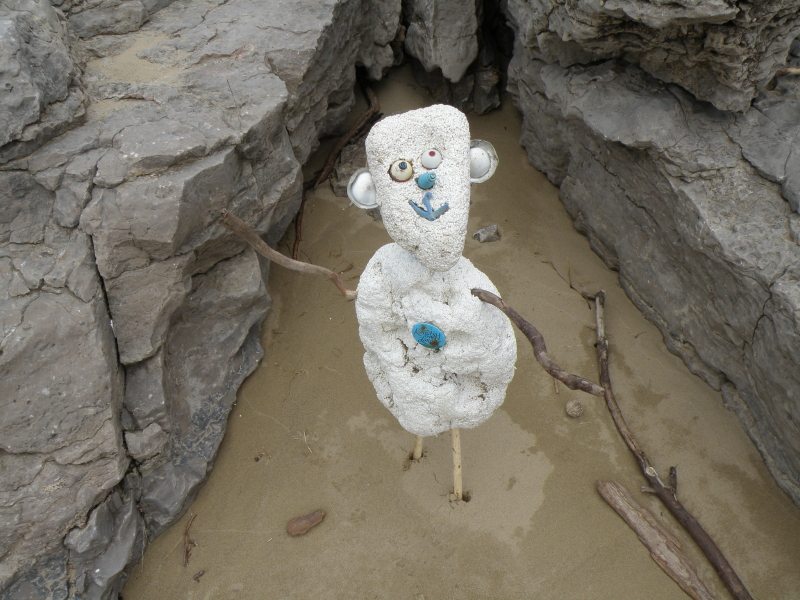
Every day is a new wonder especially at the Falls of the Ohio.  2013 is a new year, but it also marks my tenth as the artist at exit 0.  When I started my Falls project I wondered if I would be able to sustain anybody’s interest much less my own?  It was fun learning from the WordPress yearly summary that my blog has been visited by people living in 103 different countries during 2012!  I suppose more people now know about this special environment as a result of my activities here which is cool.  The Falls are a unique window into the history of life from its past to the present.  It’s a place where nature and man’s nature intersect which tells us something about who we are in this  moment.  I hope my blog continues to be a venue where people can get a sense that creativity can be an active force in shaping the world for the better.  As for my latest creation…he decided to hang around to greet any new visitors by the fossil rocks.  Perhaps by now, he has gone home with one of them?  See you later from the Falls of the Ohio.

Figure by fossil rocks, Falls of the Ohio, Jan. 2013

Read Full Post »

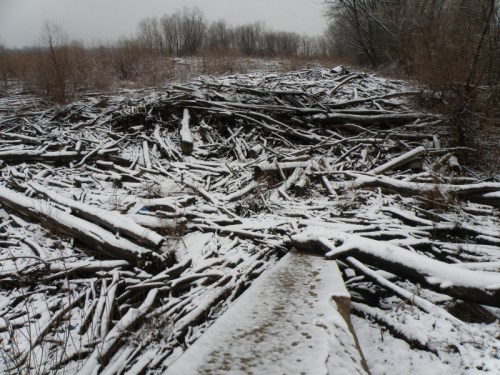
snow covered driftwood, Dec.29, 2012

The last month of the year which began so warmly has finally delivered some cold and snow to the Falls of the Ohio.  The newspaper says that somewhere between two to four inches fell overnight.  I’m sitting in the comfort and security of my home and all is well except for that small voice in my head telling me I need to go check out the river.  The voice is persistent and annoying and makes little sense on such a bitterly cold day.  Naturally, I caved in simply because snow events are uncommon here of late and as a chronicler of the Falls, I have a self-appointed mission to document what happens.  I also know from past experiences that these snow and ice events can be beautiful and have a way of revealing a different side of this environment.  Who knows, maybe I will come across something I’ve not seen before?

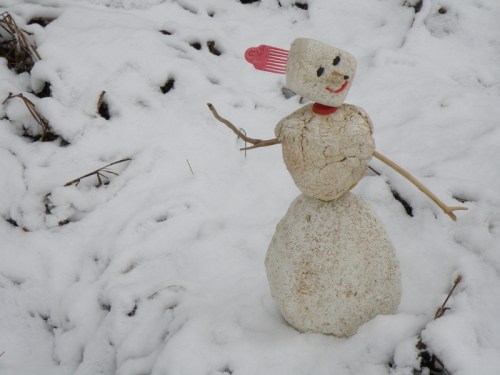
Blanche in the snow, Dec. 2012

Upon arriving I discovered that my way of accessing the riverbank was gone!  The trusty wooden staircase that led from the parking lot to the river is completely missing and I think that some of the maintainance issues it had finally caught up with it?  To compound events further I discovered that my right boot has a hole in the sole and the cold water I just stepped in has made my sock and foot a soggy, frozen distraction.  I’m about ready to get back in my car when I hear that familiar voice again.

Blanche's face, detail, Dec. 2012

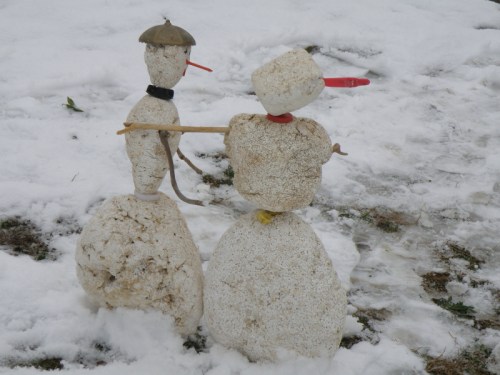
This time that voice wasn’t coming from within me, but rather just a short distance a head of me.  The voice reassured me I wasn’t suffering a relapse of the flu I recently overcame!  Seemingly materializing in thin air was this small, but classic version of a snowman who asked to be called “Blanche”.  I suppose that makes her a snowwoman or snowperson and it’s weird the things you think about in certain moments.  I would guess that the figure was about two feet tall or so.  She had a fishing float for a nose, coal eyes, and bits of red plastic around her neck and mouth.  Attached to her head was a rather interesting hair comb.  Blanche thanked me for showing up and apologized for “getting into my head”.  It was she who had called me to the river to tell me something important.  As she spoke, I forgot all about the hole in my boot.

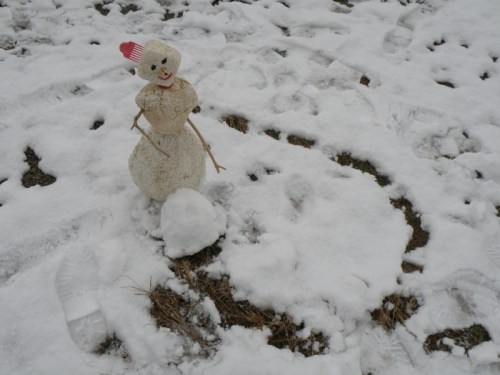
Blanche rolls a snowball, Dec. 2012

Blanche rolls several snow balls, Dec. 2013

I hope I’m getting all this right because several things were happening at once.  While Blanche spoke to me she was also rolling snow into three balls of graduating sizes.  What she in essence told me was that while life did originate in the water…the relationship was deeper and richer than that.  Water was in fact “life” and the medium where its collective unconscious resides.  It is water existing from the North Pole to South Pole in all its forms like snow, rain, ice, salty, fresh, steamy, cubed, etc…that holds the memory, wisdom, and promise of life.  As it turns out water also unifies life.

As I was trying to absorb what was being told to me…I snapped a few photos and hoped that the cold wouldn’t affect my digital camera.  Blanche took the three balls she created and stacked them one on top of the other.

Blanche creates a friend, Dec. 2012

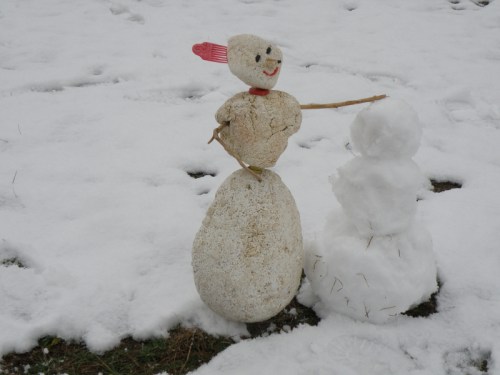
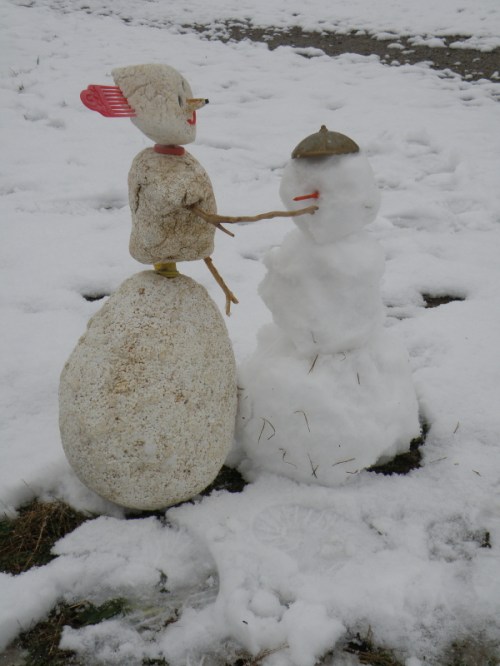
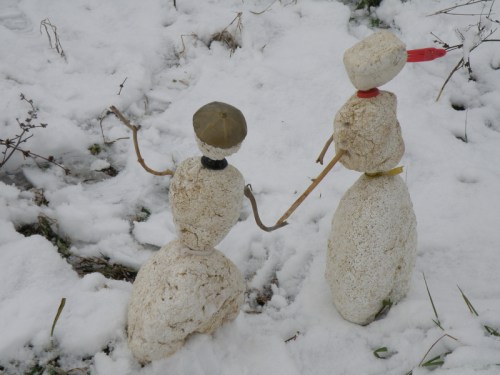
As I watched, Blanche added a gold plastic hat she found as well as an orange golf tee for a nose.  As she worked Blanche hummed a song and I watched in astonishment as a second snowperson appeared before me!  Blanche said his name is “Frio”.

Blanche and Frio, Dec. 2012

Frio and Blanche, alternate view, Dec. 2012

It was the most incredible display I had ever seen!  Right before my eyes the seemingly inert snow took on another form that came to life and reinforced some of Blanche’s message to me.  There would be more.  Frio then asked me to continue to tell the water’s story through my blog because the fate of water and life was more important than ever.  It was vital that water remained as pure and clean as possible or the normal rhythm of the planet would be disturbed. He told me that the internet was something similar to the collective unconscious and the best way to send out a message to the billions of people now living on the planet.  Water and life need all the friends that can be mustered to act on its behalf.

Blanche and Frio singing, Dec. 2012

My encounter with the Snow Folk ended in song.  Before Blanche and Frio headed out they sang a song to the Falls celebrating how this is a unique place on the planet where time and space intersect in interesting ways.  There was a verse dedicated to me and the continued success of my project now entering its tenth year.

Blanche and Frio depart, Dec. 2012

I was completely charmed and captivated and thanked the Snow Folk for the song.  I watched them turn and walk into the river where they completely disappeared.  I’m still trying to digest this experience.  It’s not everyday that water speaks to you in your own language.  Thankfully, I have these photographs to show you and to add weight to Blanche and Frio’s message to us.  After a while, I felt the cold again and decided this time that a mug of hot chocolate or coffee would help me feel my fingers and toes again.  Happy New Year to you all from the Falls of the Ohio.  See you in 2013.

skyline of Louisville, KY at year's end, Dec. 2012

Read Full Post »

Under the Big Tree, Nov. 2012

I have heard stories about this land and river that are supposed to be very old and have been handed down for generations.  Folks back then told each other stories and that’s how things became remembered.  Back then, it also wasn’t unusual to find a young one that knew their family’s history by heart and able to recite the names of all the known ancestors going back as far as people could  remember.  People in the old days must have been very smart and had better senses of memory than we do today.  Before writing and such, I wonder if people back in the old days held jobs as living books and sources of information? But I digress… which brings me to yesterday when I encountered the most unexpected sight at the Falls of the Ohio!  I first learned about this mystery as a little guy while listening to stories over a camp fire with my recent ancestors.  It’s about these special trees that are rumored to live around here that have the ability to uproot themselves and move around.  I didn’t believe it either and chalked it up as being another fun story like the Prince Madoc legend, but then I saw these rare trees with my own eyes!  And, because these days we have cameras…I took a few snapshots of them so that you can see them too.  Check this out.

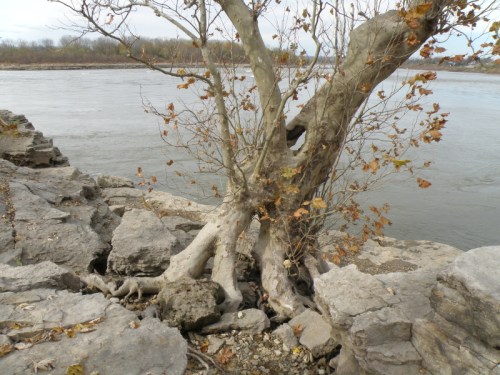
Sycamore tree, roots and rocks, Nov. 2012

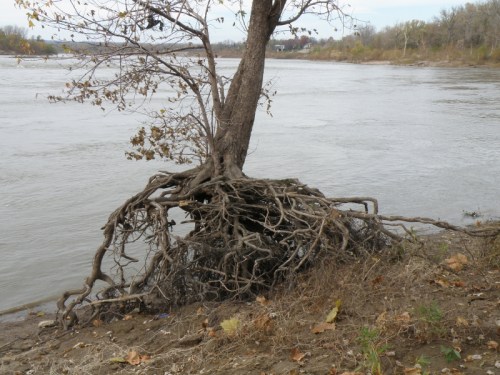
The old stories mention that the boundary between the earth and the water has always been a difficult place to live.  It’s an extreme back and forth existence living at the margins of too much or too little.  There’s not much nutrition coming out of these fabled rocks, but then again the limestone at least gives you something to hold on to.  Water has a way of insinuating itself around every nook and cranny and is always testing allegiances.  Around here, some of the trees have learned that they can improve their lot in life by pulling up roots and going elsewhere.  You see, some trees have long memories and they know when it’s time for that great once in a thousand years flood or some other cyclical disaster to come back around.  Or epic memories are shocked and encoded into the rock and soil and trees are just better at reading and interpreting what it could mean?I’m guessing that some of the trees around the Falls of the Ohio like to be prepared or are skittish or both and have begun the very gradual process of being somewhere else.

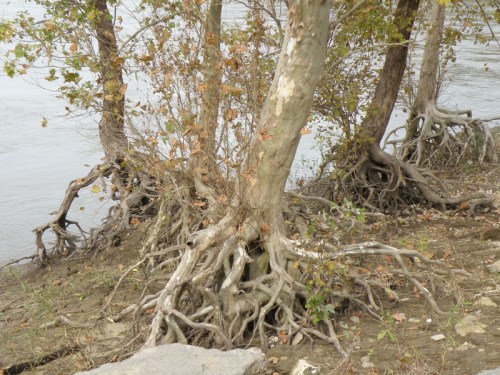
uprooting trees at the Falls of the Ohio, Nov. 2012

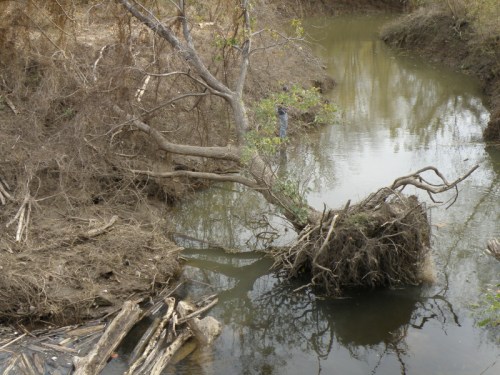
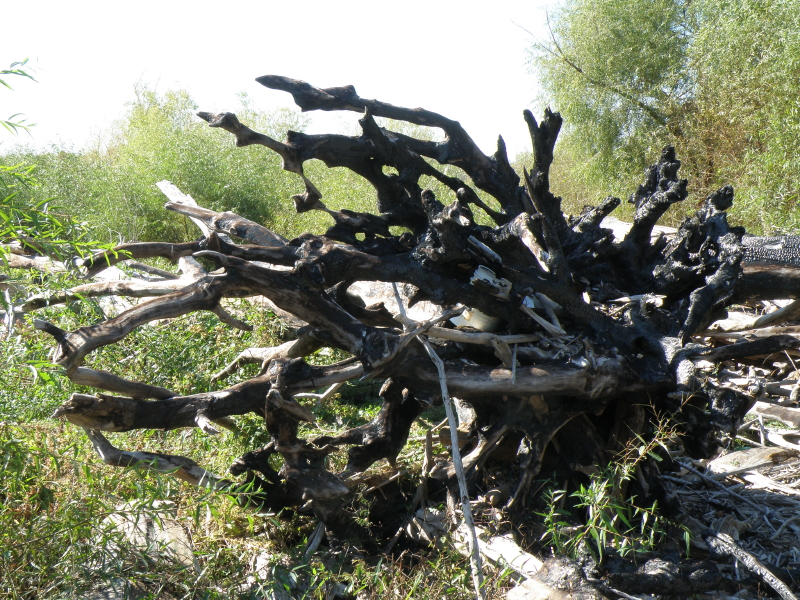
I came across this small mobile grove not far away from the first tree I showed you.  This is an incredible response by these trees to the rise and fall of the river.    The river dissolves  the silt, sand, and mud away from the riverbank and exposes the tree’s rootlet toes which are always growing. Water currents and the rocking back and forth of the wind further helps loosen roots from soil.  These trees are vibrating and creeping along with most of their roots on the surface with just enough tendrils into the earth to hold on to dear life.  Good thing too or else one day you could find yourself swept away.  I have seen it happen before as in this recent example by the creek.  This tree fell into the water and will never right itself or hold the riverbank up as it formerly did and one day it will be swept away by the river to somewhere unintended.
Tree that recently fell off of the riverbank, Falls of the Ohio, Nov. 2012

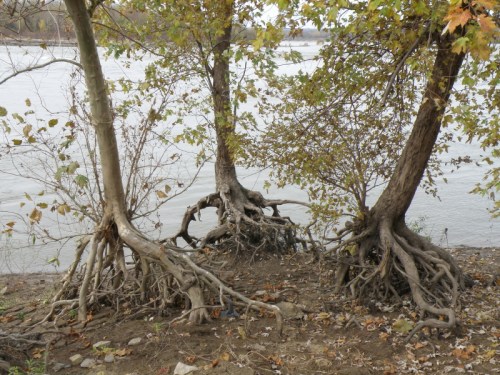
So much water is a mixed blessing.  Just enough and the trees can move a little more than usual.  Too much water and they run the risk of losing control. This mixed lot of trees seems to be moving westward.  Park officials have reported that there seems to be more of a sense of urgency on the trees’ part and they have picked up the pace over the last few years.  I wonder how they know when and where to stop and should I be worried?  Do the walking trees signify a bad omen for the future and is some environmental disaster looming ahead of us?

uprooted tree trio at the Falls of the Ohio, Nov. 2012

Of course life travels at its own speed.  Our tree friends here cannot out run this year’s spent leaves gathering around their feet, but they have patience.  They don’t have the same concept of time as we do. An inch or centimeter or two here and there and progress will be made even if it takes many seasons.  Moving in ultra slow motion, they will either get to their intended destinations or not.  Come to think about it…trees don’t have the same concept of speed either!

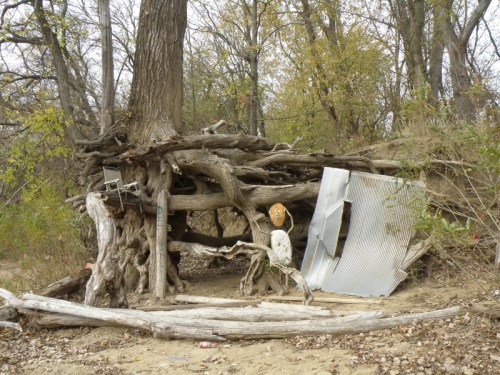
Tall figure under the Great Tree, Nov. 2012

Trees have their own internal logic and physics that they respond to.  My tall friend here is a case in point.  He’s an old cottonwood tree and long a go he too was a walking tree.  You can tell from looking at these fantastic roots that buttress the tree from the river and elements.  For some reason known only to the tree…he decided to stay here and put down his roots.

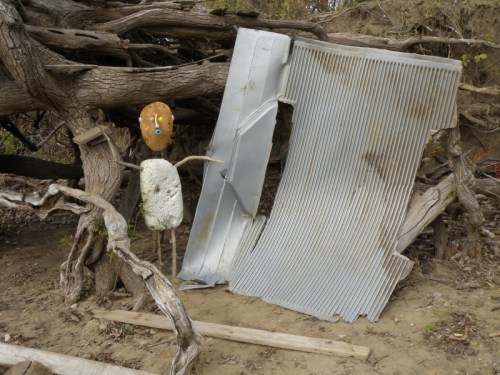
Figure with big sheet of plastic, Nov. 2012

Over time the cottonwood thrived.  Its roots held the riverbank in place and kept it from sliding into the river.  With this particular tree, a small, sheltering space grew directly under the tree’s tall trunk.  Visitors would bring discarded boards and other river finds ( like this large sheet of corrugated and molded plastic) to make forts and tree houses.  This one site has seen plenty of play and fantasy over the many years and has always been recognized as a special tree.

Figure by large cottonwood tree, Nov. 2012

This just occurred to me.  What if the moving trees are just a matter of perception and they really are trying to stay in one place?  What if it’s the rest of the world that is moving so quickly and constantly like one big blur and the trees are holding life in place?  The walking trees have remained where they have germinated and everything else around them has quickly shifted. Because we are so near to it we don’t recognize the movement.  Could time also be as fluid as water seeking out the nooks and crannies and testing allegiances too?  All this head-scratching stuff is making me dizzy on such a fine day by the river.

Great Cottonwood tree at the Falls of the Ohio, Nov. 2012

Unbeknownst to the brown-headed philosopher under the cottonwood, but changes to our area are forthcoming.  This year was the warmest year ever recorded.  The environmental chess board has been set and the game is on.  Pieces are moving and strategies are evolving and somewhere on the Ohio River another pawn is moving into place a little nearer to the cottonwood tree.

Tree with exposed roots, Falls of the Ohio, Nov. 2012

Read Full Post »

Hello all and welcome to another adventure set at the Falls of the Ohio.  Since my last visit, the Ohio River has risen in response to all the rain that fell in the northern portion of the Ohio Valley and has flowed down river in a southwestern direction.  The fossil beds normally exposed during the summer and early autumn months are now submerged by swiftly flowing water.  Walking this ever shifting shoreline I’m open for whatever presents itself as novel and different.  Turning the corner around a  stand of willow trees I was caught by this unusual sight.

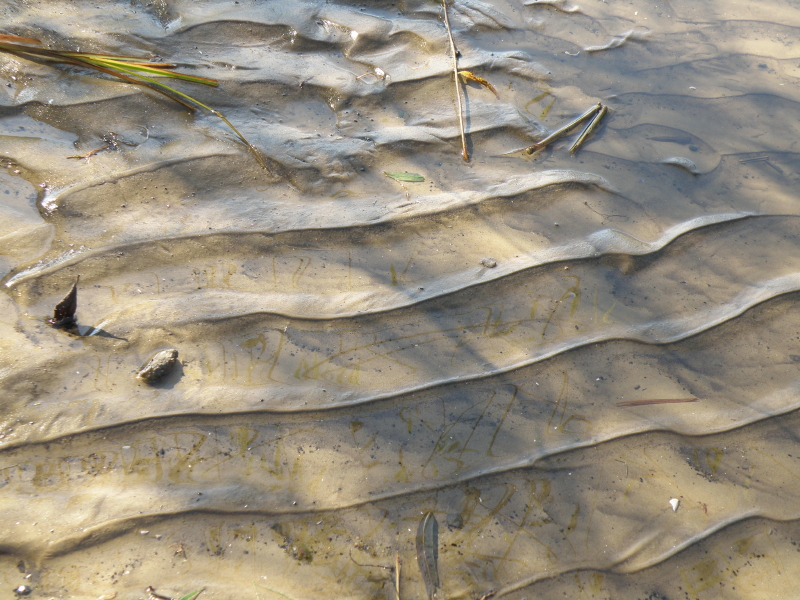
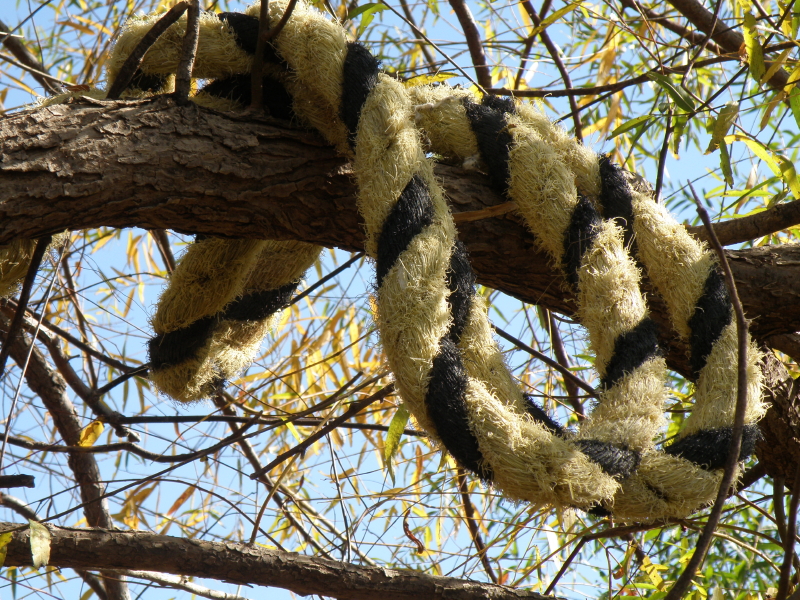
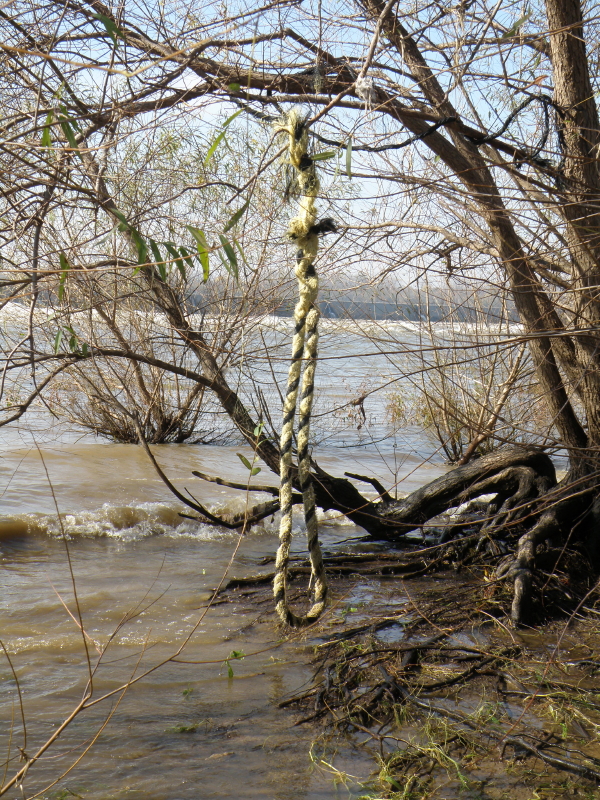
A tree captured barge cable or rope was in a different position from the last time I had noticed it (see this year’s Halloween post).  It is possible that the river rose high enough to dislodge it from its previous resting spot.  I was struck by the way it seemingly is suspended in mid-air with its regular yellow and black intervals contrasting with the unruly roots and branches around it.  Around here, water can both rise and fall quickly.  In the fine silt and mud you can often find interesting patterns that were created by the movement of wind and water.  Here is such an example.

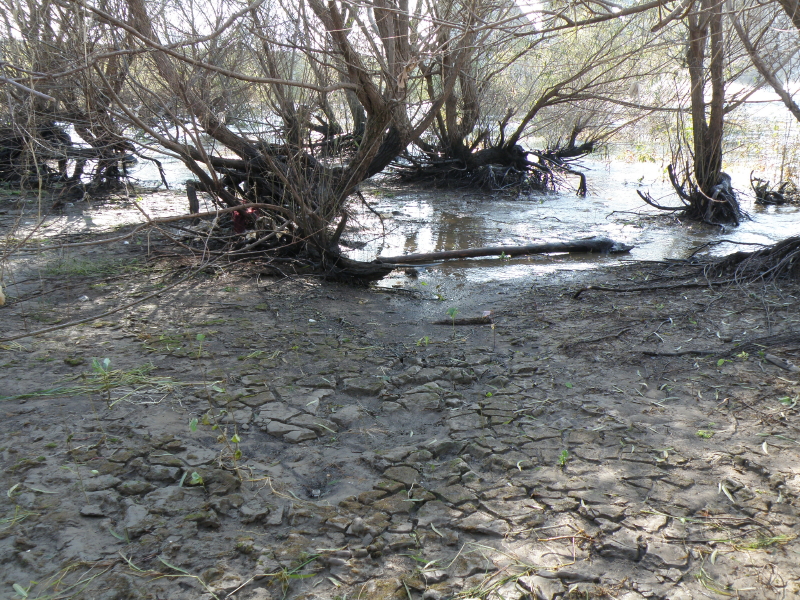
The back and forth rhythm of the river caressing the land are recorded as peaks and valleys in this very fine mud.  I can be “hypnotized” at times by concentrating on this movement which I find soothing.  I’m always interested in the various subtle patterns that water can create on the mud of the riverbank.  It’s akin to trying to “track” water and recognize its footprint as it moves onto the land. I also noticed about a two foot tall, low “wall” of material (mostly wood and dried grasses) along the shoreline that marks this latest high water moment.  And of course, there is always the ever-present mostly plastic junk that also gets swept away and mixes with the natural debris.  I found lots of plastic detergent bottles, bits and pieces from toys including another doll’s head.  Here are images of other finds including an interesting toy ball.

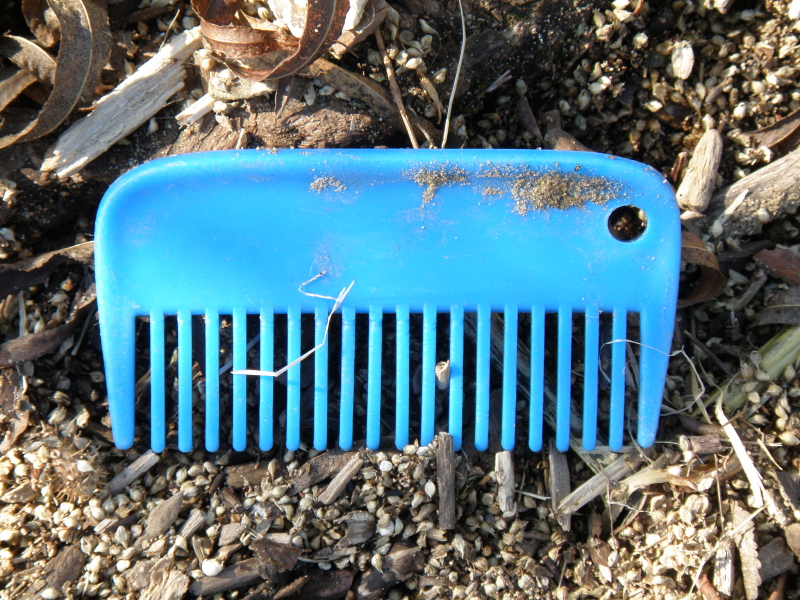
I’m assuming this is a dog toy based on the image of the dog on the ball?  The small knobs are different from the usual balls I find out here.  Now, for a bright blue comb in a design that’s also new to me.  The tiny grains around the comb are seeds from various river grasses.

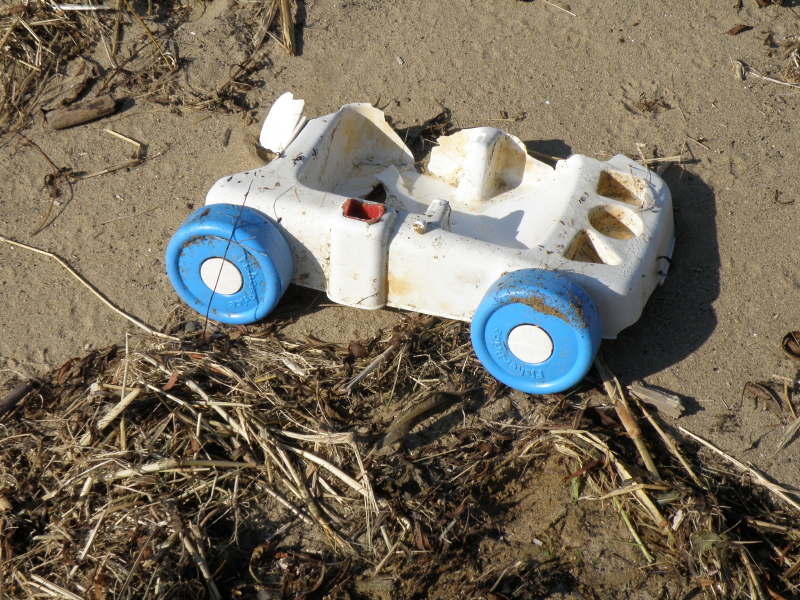
More ” blueness”  in the form of plastic wheels on a wrecked pull toy.

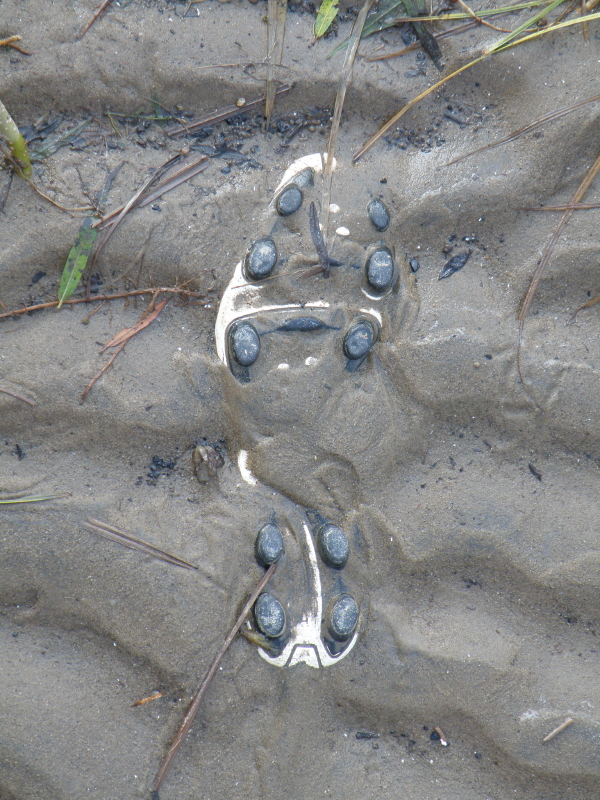
In the mud, I came across this other type of footprint that I thought was a bit unusual from the norm.  Of course, it’s a sports shoe with cleats on the bottom sticking up from the mud.

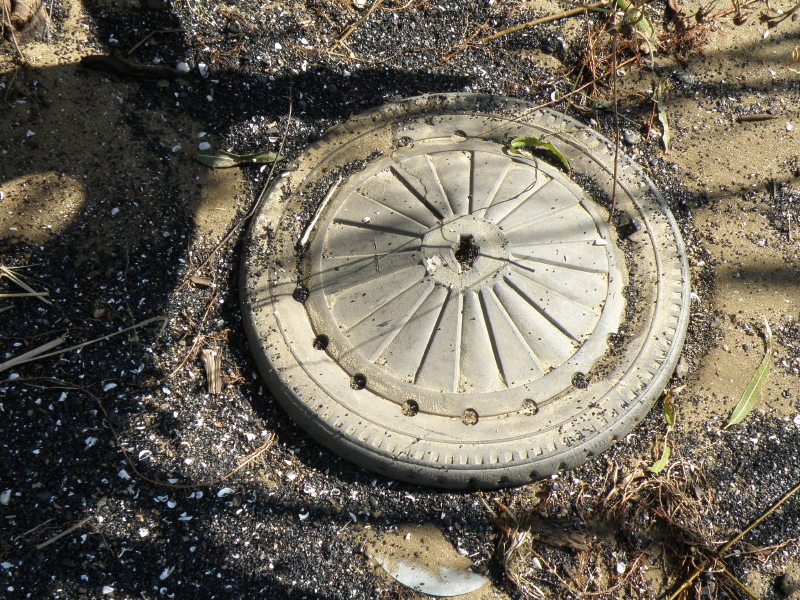
And one last found wheel whose radial pattern inspired another image in my ever-growing “Coal Flake” series.

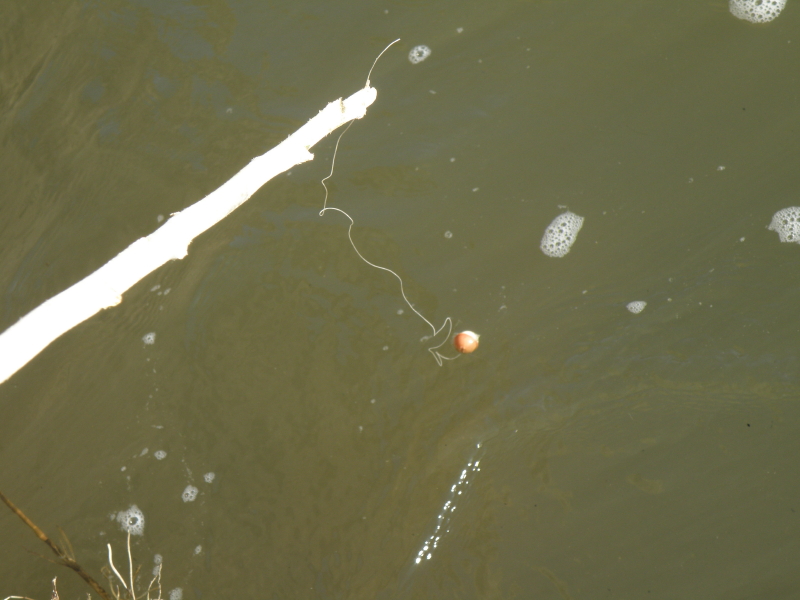
I’ve come to really like making these designs from river-altered coal that I find at the Falls.  I’m under the impression that this coal has fallen or been swept off the immense barges that transport this fuel up and down the river.  I suppose it’s possible that somewhere along the river’s journey the water has cut down through the rock to expose a coal seam somewhere, but I haven’t ever heard of this happening.  The barges seem the likeliest answer.  This particular example has more Asiatic Clam shells used in the design.  These clams are the most common of their kind that I find at the Falls.  Once upon a very recent time a go, the Ohio and Tennessee Valleys were the world’s epicenter for fresh water clams.  By altering the rivers and the water quality in them, many of these amazing creatures have either gone extinct or have become so very rare.  The Asiatic Clam is a non-native animal imported here in the 19th century as a good luck charm and has thrived as has the Zebra Mussel that you may have heard about?  The day was moving on and except for a few Mallard ducks and Canada geese I hadn’t seen much in the way of wildlife.  I decided to end my day by doing a little fishing.  I found a short, recently beaver-chewed willow branch and attached some waste fishing line I found.  I attached a hook and found bobber and into the water it went.

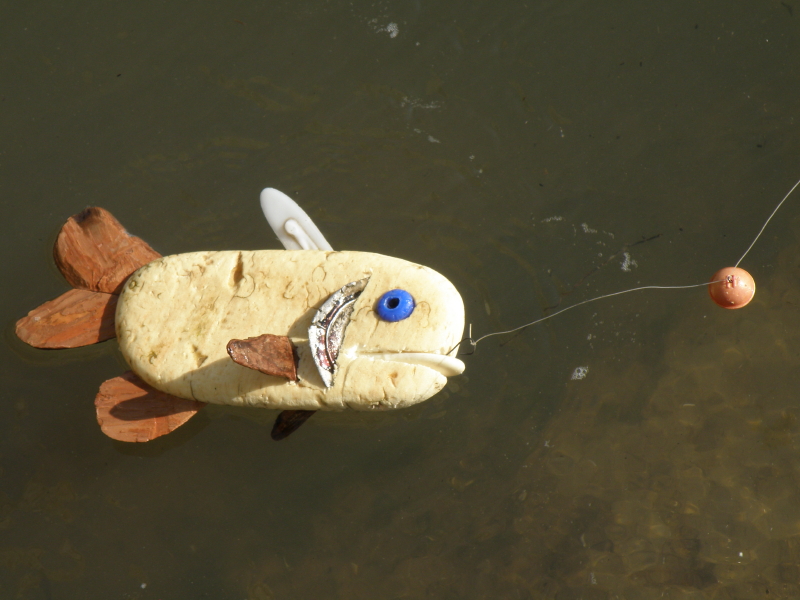
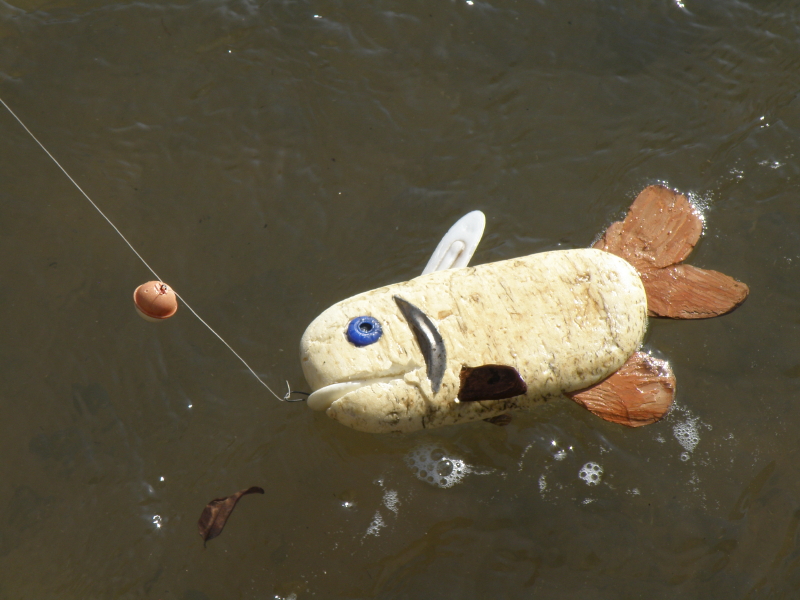
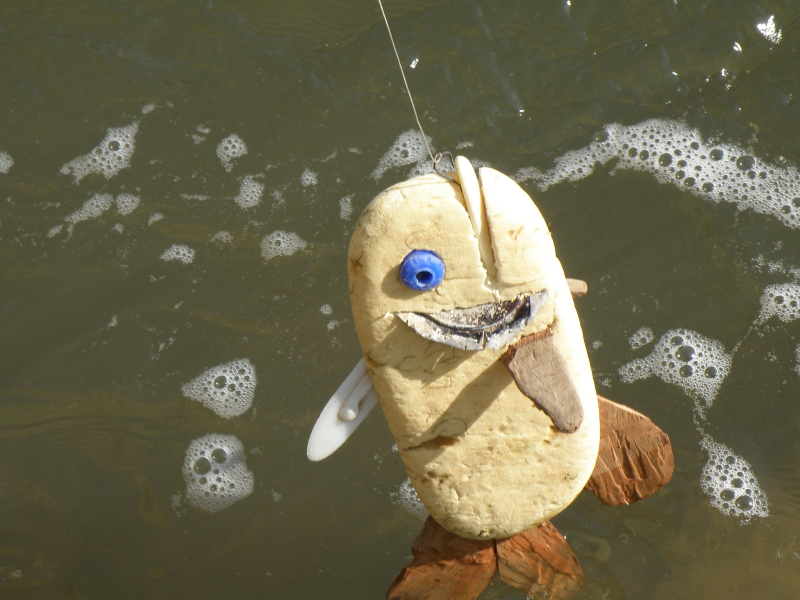
Oh, for bait I caught a small grasshopper and attached it to the hook.  A small found lead weight kept the bait below the water.  Every once in a while I would raise my short pole up and down in a “jigging” motion.  To my immense surprise I caught this very unusual fish!

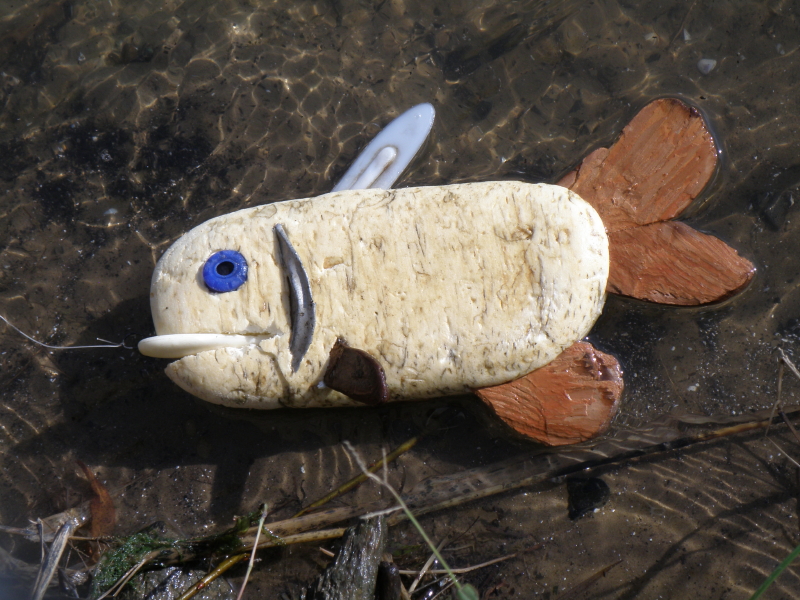
This fish is called the Iron Gill based on the metallic covers it sports around its gills.  Other distinctive features include bright blue eyes and a small white dorsal fin.  It’s body shape is unique and lends itself to easy filleting…although I wouldn’t normally recommend eating the fish from this part of the river.  Catching this fish here was a surprise because normally this is a deep water fish found in large flowing rivers.

This species was first described to science by Constantine Rafinesque back in 1811.  Rafinesque was a controversial figure and brilliant naturalist.  He had a gift for collecting and recognizing new species, however, in his zest to publish and receive credit for his discoveries he was very sloppy in his methods.  As a result, many of the animals and plants he introduced to science are poorly described and classified which led to much confusion and consternation among the other “scientifics” of the time.  In the end, Rafinesque usually won out because science gives priority to the person who first (no matter how poorly) brings the new creature to the world’s attention.

After this last image, I released the Iron Gill back into the water and rebaited my hook.  Alas, this was the only fish I caught on this day, but it reassured me that my skills in this area were still intact.  For my next post, I want to show you images of a coal-themed exhibition I’m participating in the nearby town of  New Albany, Indiana.  It’s a good show and worth a post.  For now, I would like to close with another image of a found toy I came across on this day.  Have a great weekend out there in the wider world!


Read Full Post »

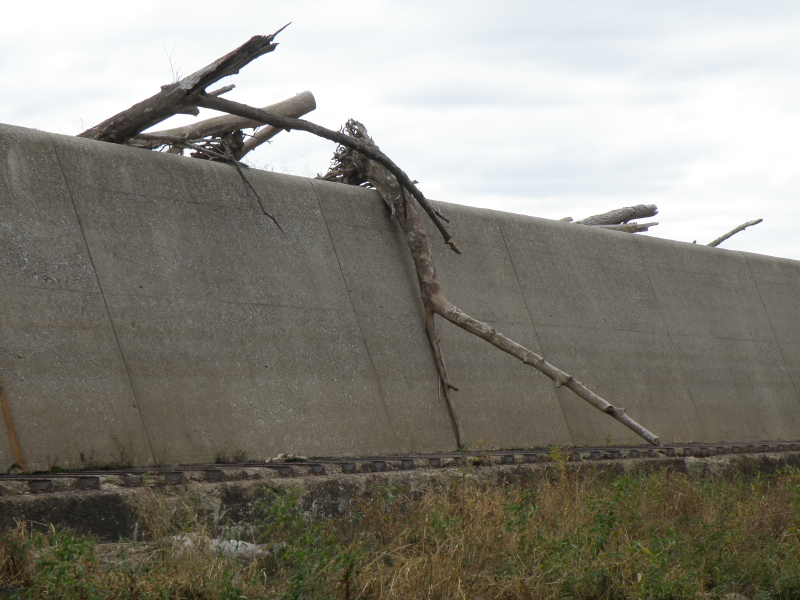
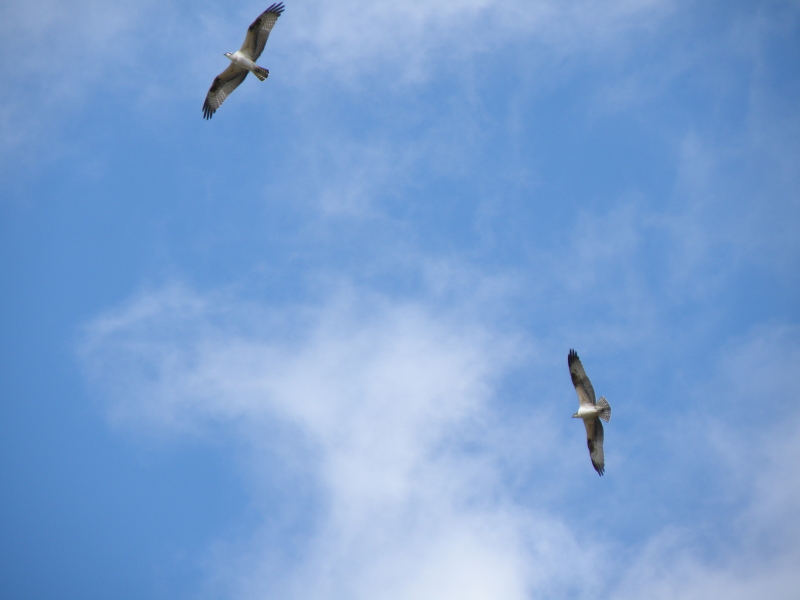
It’s hard for me to believe that October has come and gone.  There isn’t much sand left in 2012’s hourglass.  I’m virtually alone (if you are only counting people) at the Falls of the Ohio today and it’s understandable.  The weather is cool, gray, and an occasional spit of rain falls against my face.  I like it out here when it feels a bit lonelier because my chances of seeing wildlife increases.  Such was the case today when I explored the area next to the tainter gates and under the old railroad bridge.  This area is sheltered a bit from the wind and many times I have found birds in the high grass and low trees near the sloping riverbank.  Today I observed Song Sparrows, White-crowned Sparrows, Mourning Doves, and Hairy Woodpeckers in immediate proximity to each other.  In the sky, the first of the Ring-billed Gulls has arrived and a pair of Osprey with their broad wings searches for unwary fish too close to the surface of the water.  Many of the tree leaves have dropped and it looks like we will have a bumper crop of cockle burrs as I pull dozens of them off my shoe laces and socks.  Their prickly hooks irritate my skin as they work through the fabric of my clothing.  On days like this I’m just trying to attune myself to the subtleties of this landscape and I’m amazed at how often my patience gets rewarded here.  As I was walking to photograph uprooted trees against the flood wall…

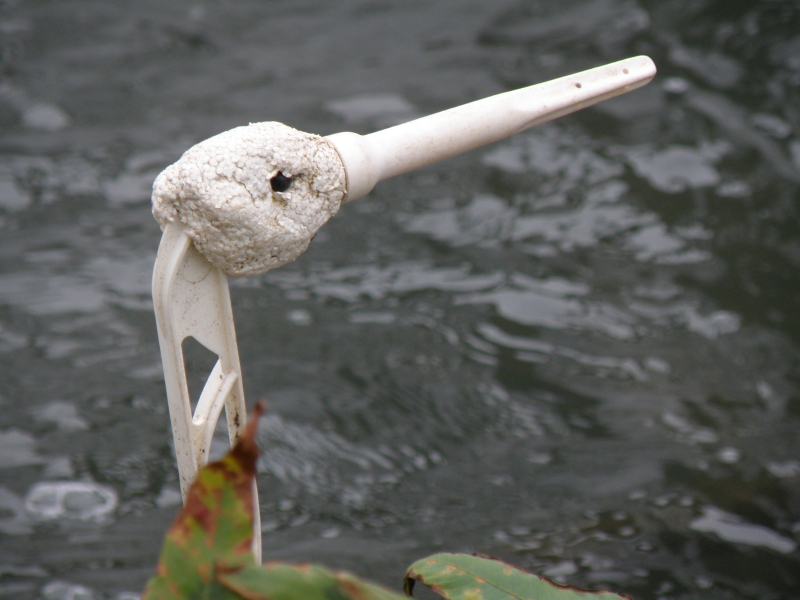
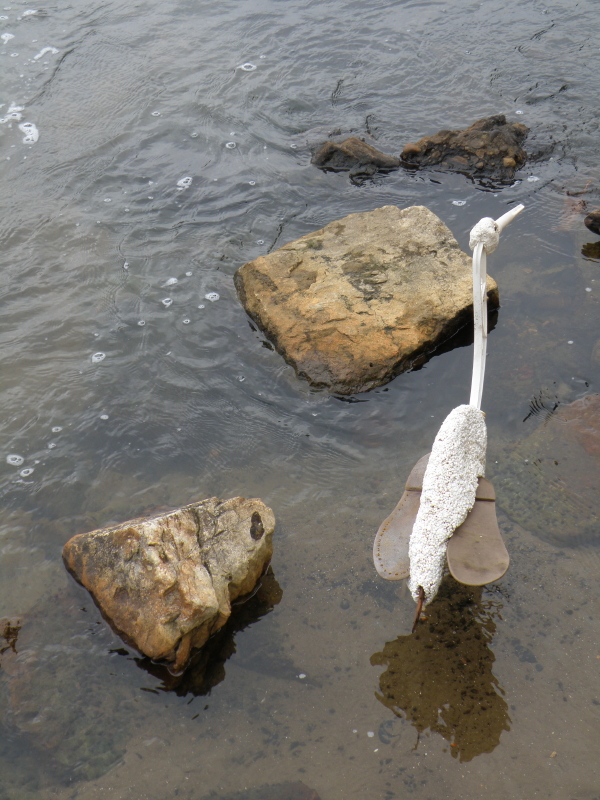
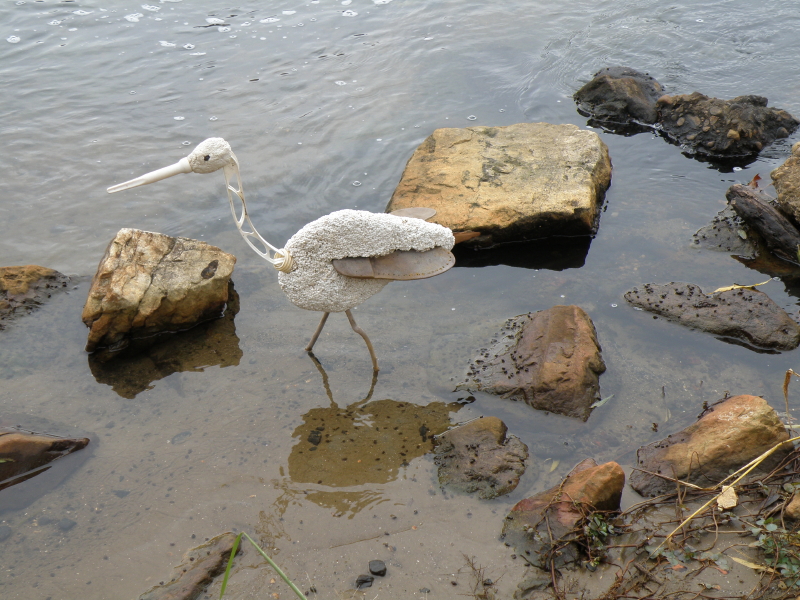
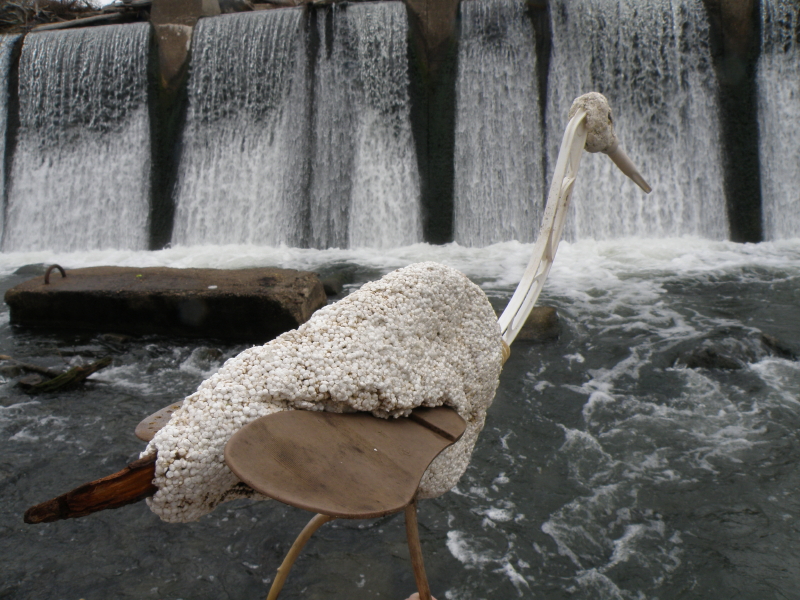
…I spotted something shockingly white moving near the water’s edge.  Carefully moving as close as I could…I recorded this image of another rare bird seldom seen at the Falls of the Ohio.

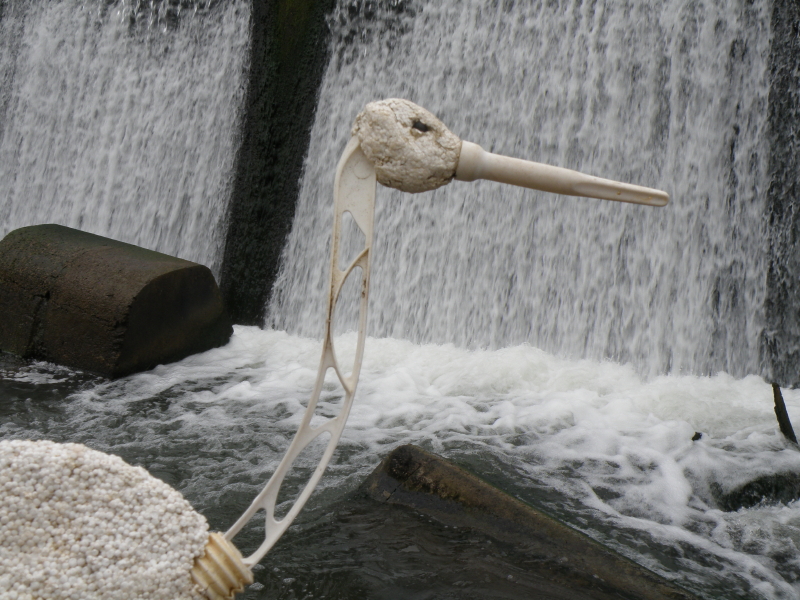
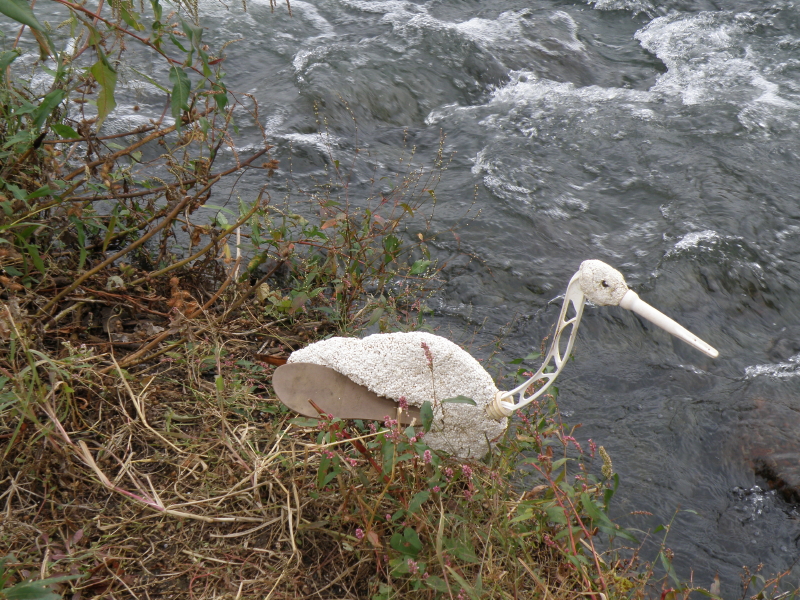
A few more pictures in relatively close succession and I was able to identify this beauty as the Lattice-necked or Brown-winged Ibis.  I prefer using the Lattice-necked moniker because the long neck with its unusual patterning is distinctive to this bird alone.  I happened across an individual that was hunting for food and stalking the margins of the water.  I did observe it feeding on black snails that were common on the rocks. I recall from my old art history days that the ibis was a sacred bird to the ancient Egyptians and often was mummified to accompany dignitaries on their journeys to the afterlife.  In my mind I made the association that this ibis species in front of me was sacred to the life of this river.  Enough gabbing, here are a few more pictures.

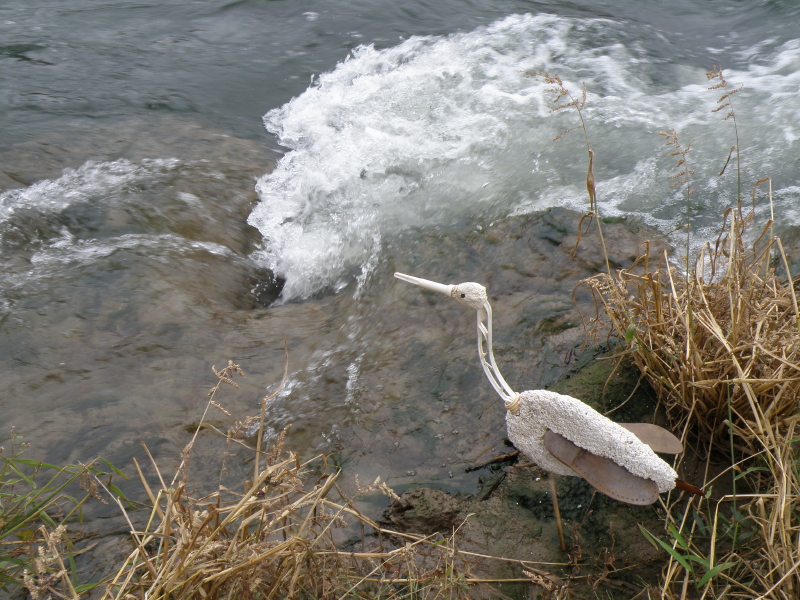
This ibis species is more commonly seen around the Gulf coast and points south of here.  Every once in a while, a storm or hurricane will blow a few individuals into the heartland where they are a welcome treat to the hardcore birders.  The Lattice-necked Ibis has always been less common than the other larger shorebirds.  It is less aggressive than the herons and egrets which out-compete the ibis for prime nesting and feeding sites.  This bird did spy me and flew away, but only a short distance away.  I was able to catch back up with it and captured these final images of this graceful and dignified bird.
Here is the same ibis that found a nice fishing spot next to a small whirlpool. Every now and then a little fish would get caught by the rotating water only to find itself food for the lightning quick ibis.

I felt refreshed and energized by my encounter with the ibis.  I left the river  with a song in my heart which I whistled all the way back home.  Above me, two osprey I had seen earlier were circling in the clear, cool blue sky…another blessing of this day.

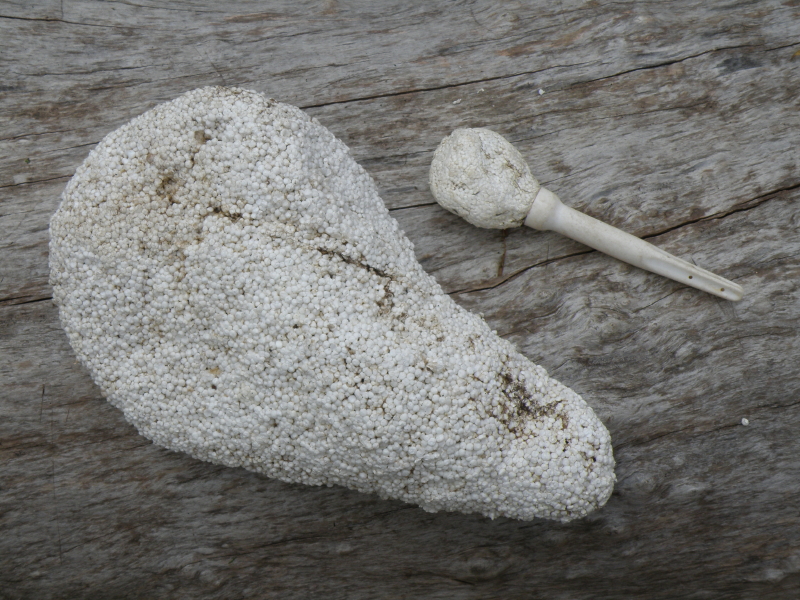
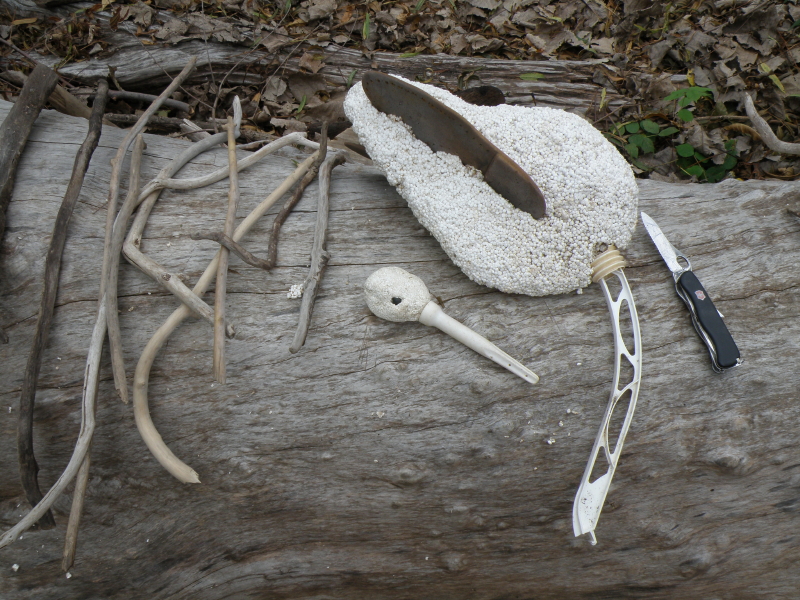
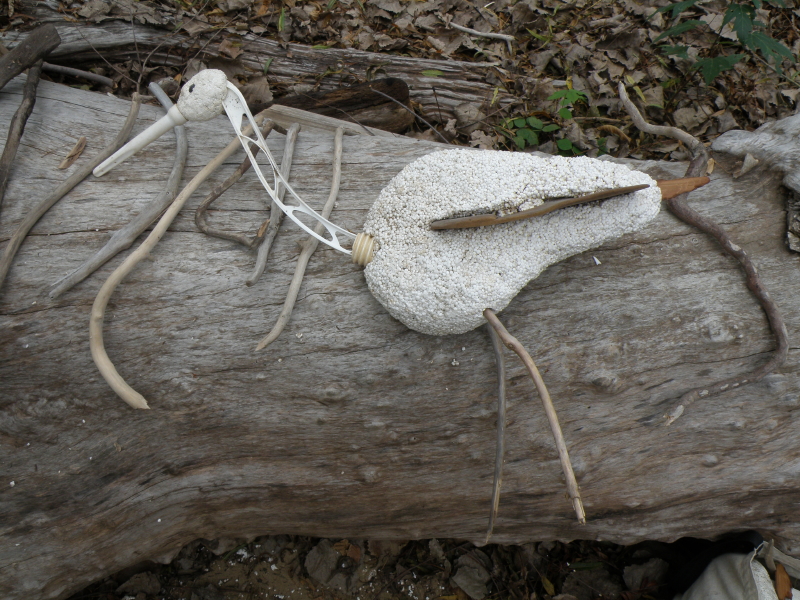
BONUS FEATURE…in process shots of how the ibis was made.  The head and body are pieces of Styrofoam I found out at the Falls of the Ohio.  The bill of the bird is a plastic handle from something…perhaps a feather duster?  The bird’s eyes are two small pieces of coal.  The neck I’m guessing is the plastic arm of a hanging flower planter?  At the base of the neck, I attached a small bit of white plastic hose I came across. The brown wings are the soles of two mismatched shoes I found.  The tiny tail and legs are found wood.  These are all the materials that make up this sculpture which owes something to the tradition of decoy making.  Thanks for tagging along with me on another adventure by the Ohio River.

Read Full Post »

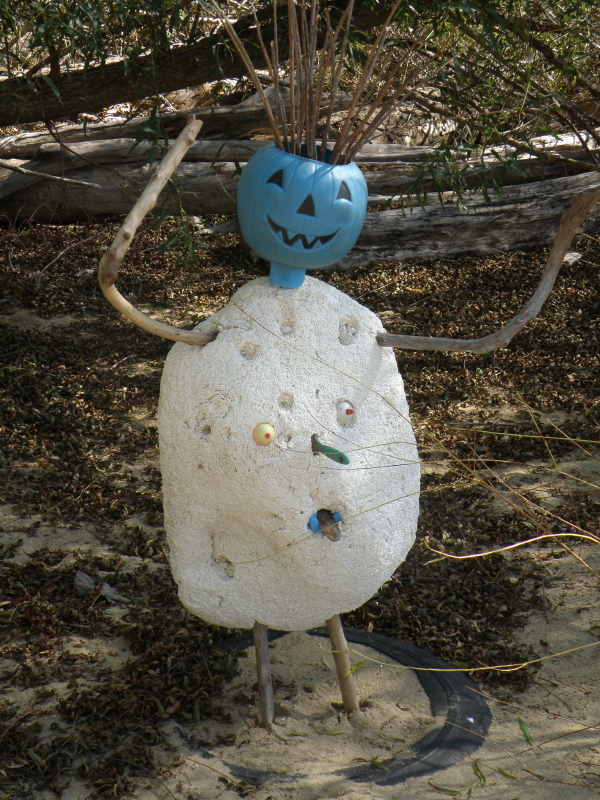
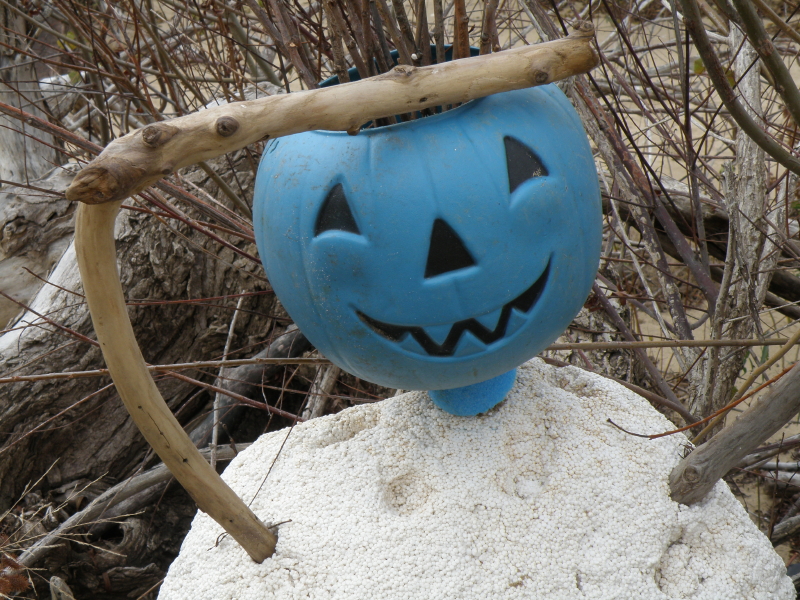
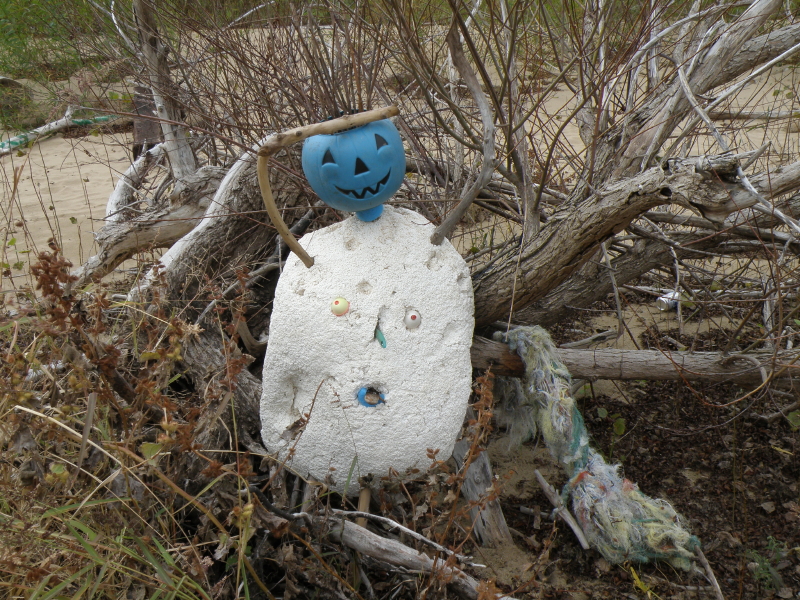
BLAHHHHH!!!!…did I scare you?  Welcome to another Halloween adventure from the Falls of the Ohio.  Today, I have a special treat in mind for you.  My name is Jack Blue and I will be your guide for the next five minutes.

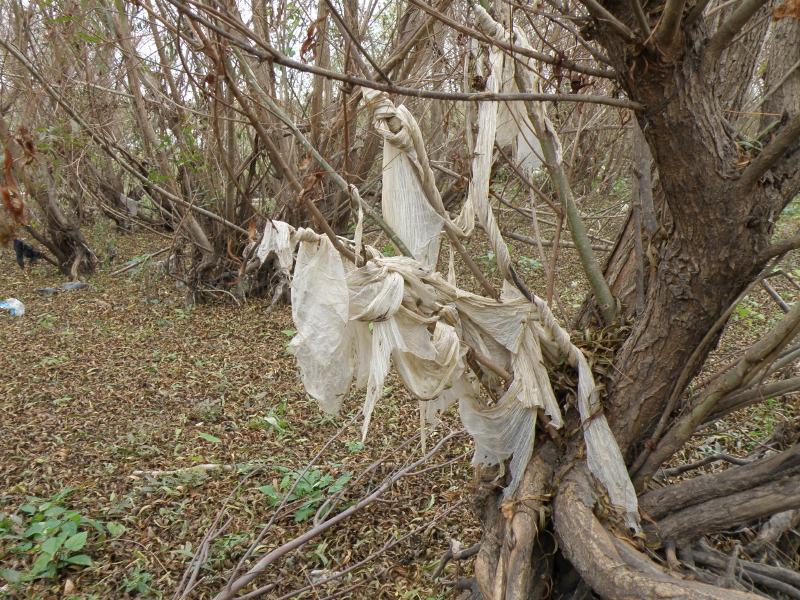
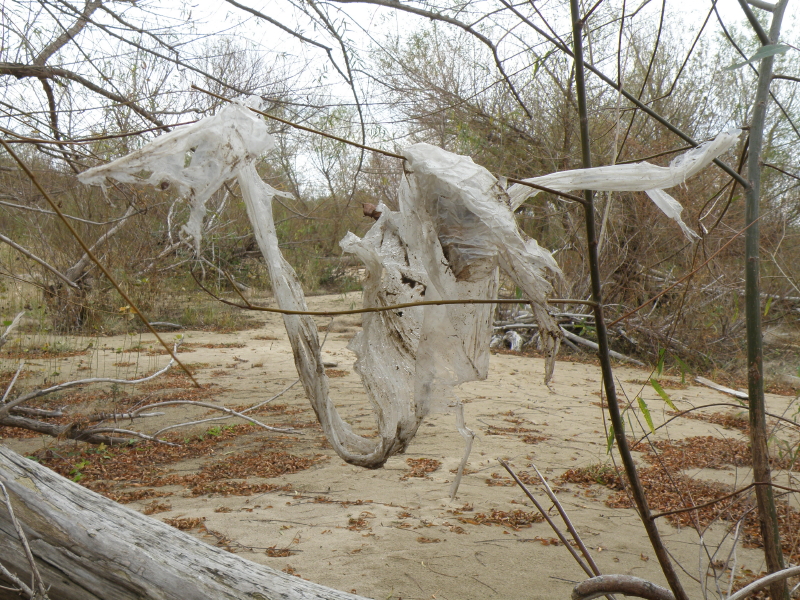
If I didn’t scare you perhaps I fooled you?  No need to be alarmed, my Belly Face has eaten recently.  You should be safe while I show you around the local Halloween sights.  Foremost in mind is the special Shrouded Forest that magically appears at exactly this time every year.  It is weirdly beautiful especially if there is a slight breeze present to animate the spirits that occupy the branches.  Most of them are plastic ghosts that have either floated here via a swollen Ohio River or drifted in with the wind.  Here’s what I mean.

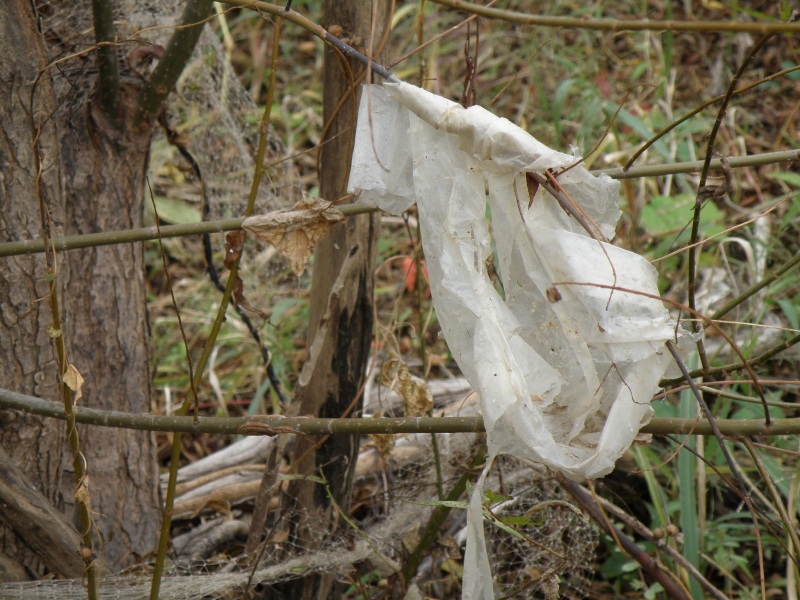
The degrading plastic lends such a festive touch to this area.  As the polymer bonds separate and the plastic starts to disintegrate it hangs in decorative shrouds from the willow branches it graces.  You can walk from tree to tree and admire these spectral creations of man and nature.

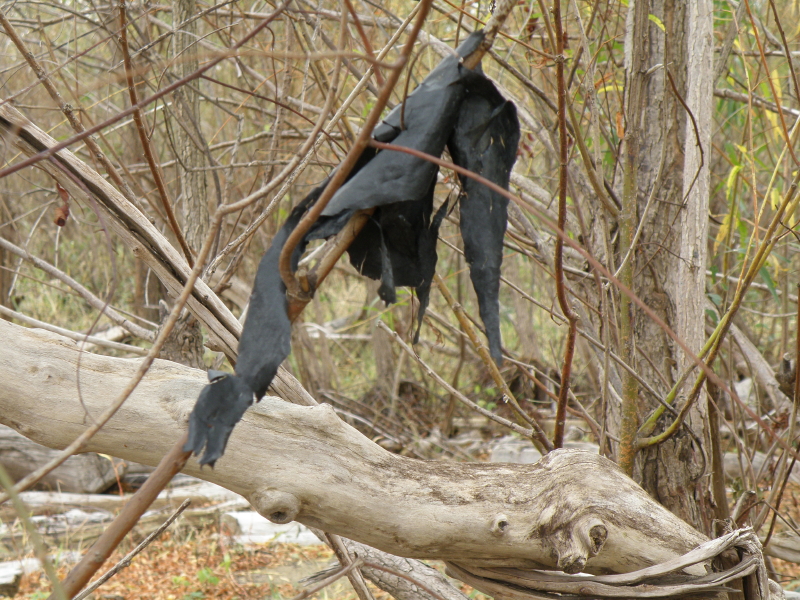
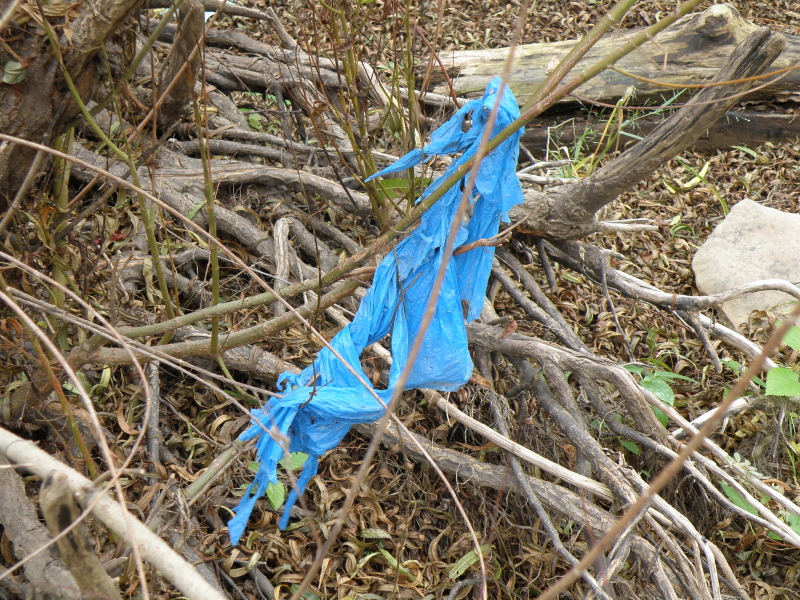
All this “magic” is the result of benign neglect.  Whoever discarded this waste plastic sheeting probably wasn’t thinking it would wind up here draped in the trees like artificial Spanish moss.  In case you were wondering…it also comes in different colors.  Here are two other popular hues for your viewing pleasure and a special “snaky” surprise that might have you needing a doctor!

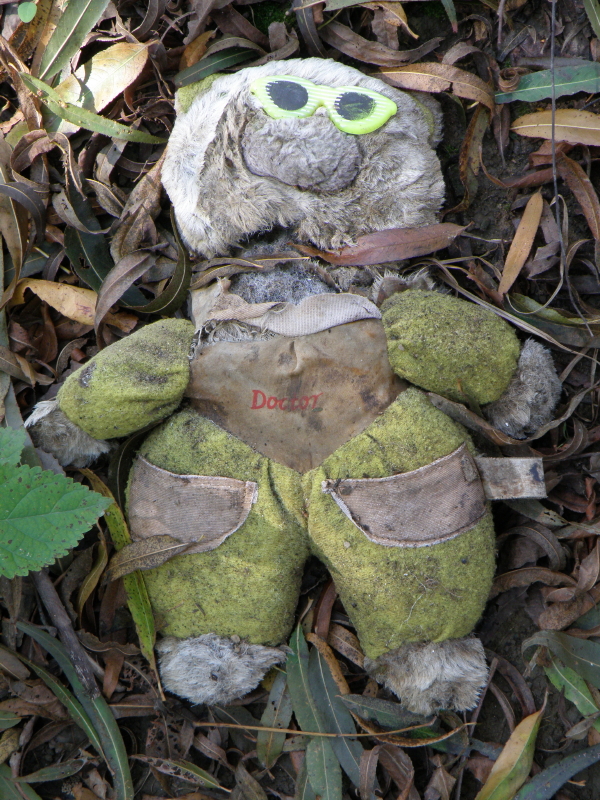
Okay, maybe this isn’t much of a snake, but if you were walking among the trees and looked up at some point…you probably wouldn’t anticipate seeing this?  And now for the “Doctor”…hmm, I don’t think he will be doing anyone any good any time soon!  Kind of looks like he could use a doctor himself.

Somehow I missed this bear when I did my earlier post on plush toys.  He’s been laying under this willow tree for months now and I just happened upon him! Just in time for Halloween!

The truth is one doesn’t need to travel far these days to find a patch of ground not “haunted” by something that doesn’t belong in the environment.  I hope all of you out there have a fun and safe Halloween and please discard all your trash in a responsible way.  Otherwise, my Face Belly may develop an appetite for you…trick or treat?

Read Full Post »

Beloved, once again I evoke you from this beautiful water world I have discovered.  Repairs to my ship go slowly, but progress is being made.  Because of the uniqueness of this world and its potential importance to Styrosia, I continue to venture forth from my hiding places to discover what other life forms call this planet their home.  I continue to monitor the “bipedal humanoids” learning what I can from translating aspects of their culture using our technology.  The humanoids are unpredictable and possess enough data to be dangerous.  They are best seen and experienced from a distance. What I have also observed is that the humanoids have a great curiosity about their own world.  They are constantly engaging in explorations of discovery and seem to exhibit a need to know how the universe functions.  The irony here is that while they express concern for life at large, they are also systematically working to undermine the very conditions necessary to preserve and promote as much diversity of life as possible.  Every day life forms become extinct before they are even formally acknowledged as existing by their sciences.  This is a great topic, perhaps one for a future communication?  Today, however, I want to transmit a few images of interest to amuse and delight you from this alien world.  I would like to begin with an unusual characteristic that is exhibited in the local rocks and has been revealed through water’s ability to dissolve and shape the chemistry around it.

The appearance and proliferation of life on this planet is its most outstanding feature.  No where else in the explored universe can rival this world for the sheer variety and numbers of life forms that have uniquely evolved here.  At my current location are the preserved remains of life forms in calcium carbonate rocks of marine organisms that originated more than 350 million years a go.  Ancient as this is, the history of life is traceable to more than 2 billion years a go.  The humanoid scientists measure one year as being the amount of time it takes their planet to make one complete revolution around its star.  I believe it is correct to assume that life began in the ancient waters or “primordial soup” as the humanoids envision it.  Life and this planet have grown up together and each has influenced the other.  This planet is far from static and its oceans and land masses have shifted across the globe over deep time.  Today, humanoids travel great distances to peer at these local rocks.  What are they ultimately looking for in this ancient coral reef?  My hypothesis is that the humanoids are drawn to seeking a feeling of connection to the history of life on their own home world.  There is something in their behaviors that also suggests that they are mystified by the phenomena of their own existence.

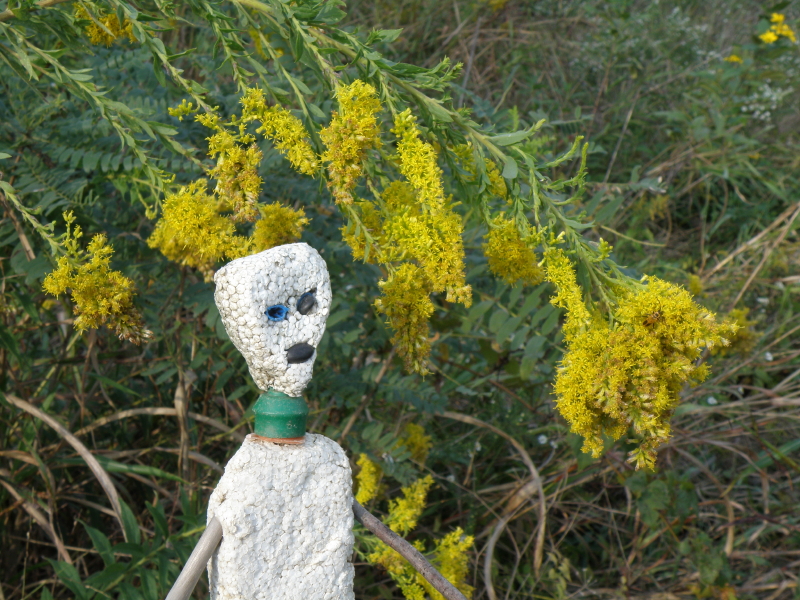
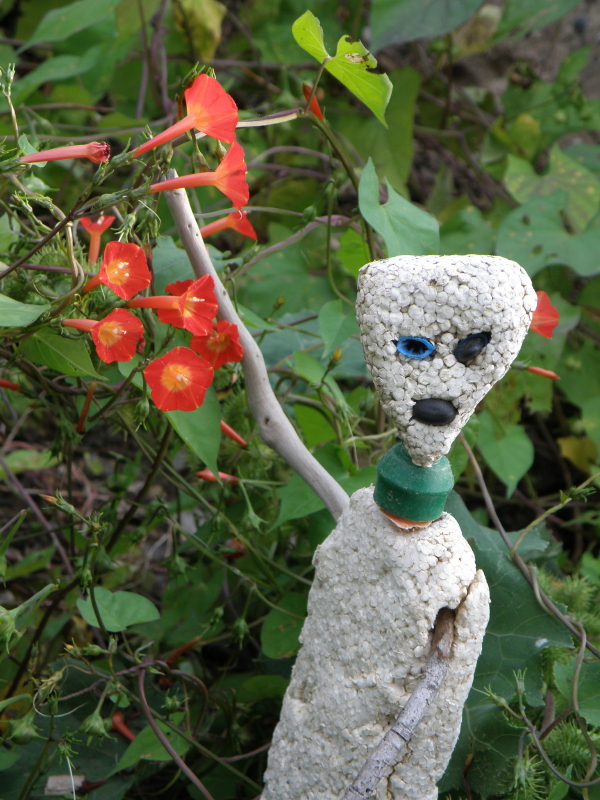
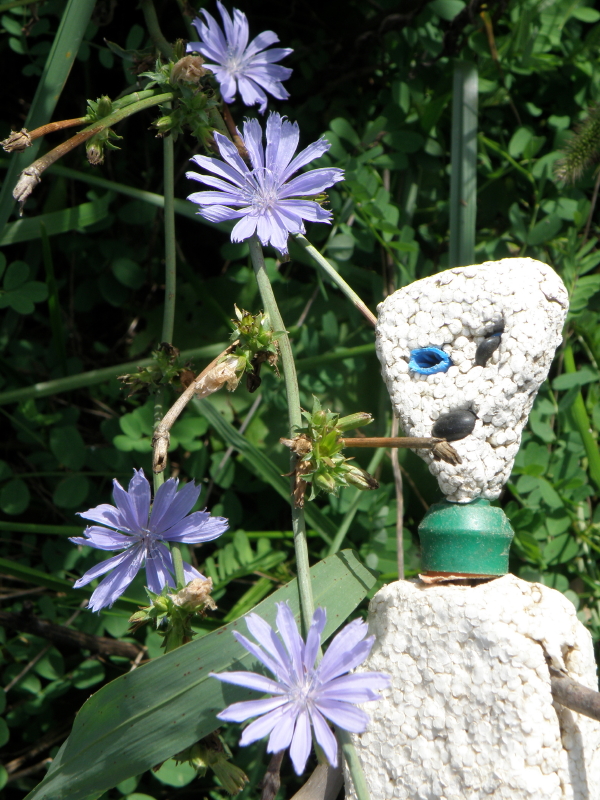
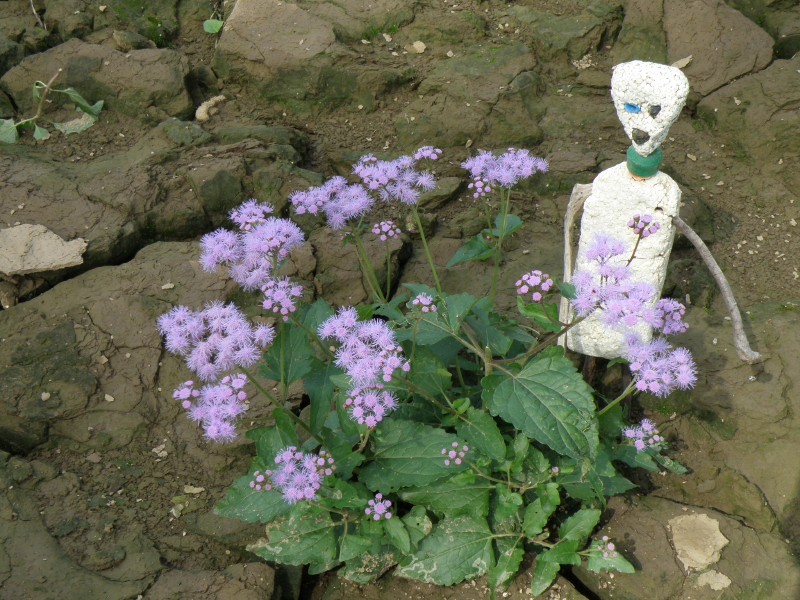
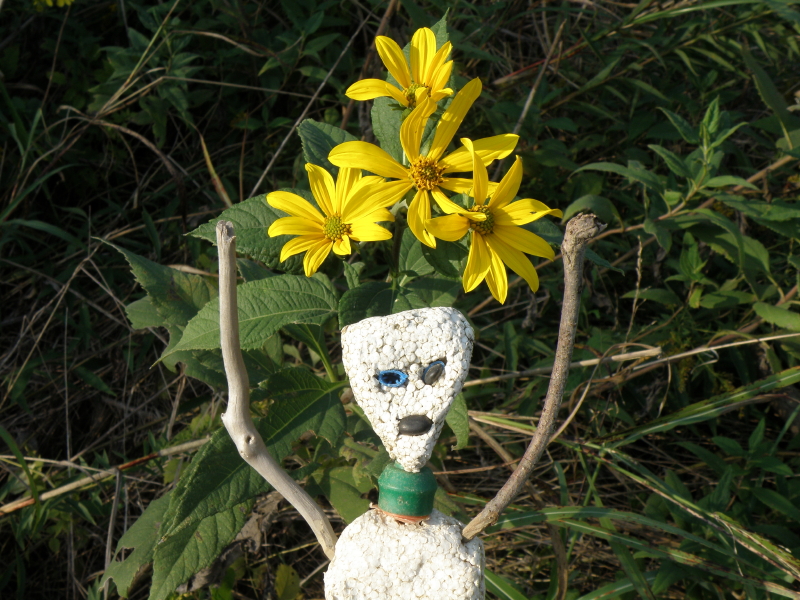
While the humanoids look for the proof of their connectivity to the history of life on their planet, many other interesting forms don’t question this and simply “be”. I have especially grown fond of the sessile life forms that have decided to flourish in the spots most favorable to them.  Once a year, these stationary forms decide to  climax in an electromagnetic spectrum display that is pleasing to the eye.  I have decided to take as many self images in the company of these “flowers and plants” during this “flowering” using my self as a measure of scale.

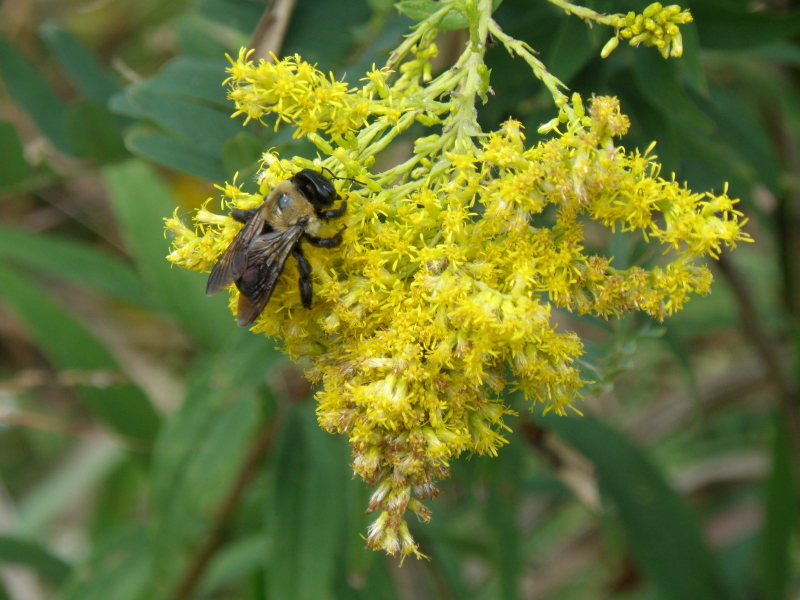
Many of these “flowers” participate in symbiotic relationships often with very diverse and contrasting species.  This particular sessile life form attracts flying animals that feature exoskeletons.  The flowers provide nourishment for these animals and the plant finds an agent to move its genetic material from itself to others of its own kind.  I have observed more of these smaller, exoskeleton-bearing creatures than all the other animals combined and they would make a rich field of enquiry that could occupy the careers of many Styrosian scientists.  Here is a different example of such an animal.

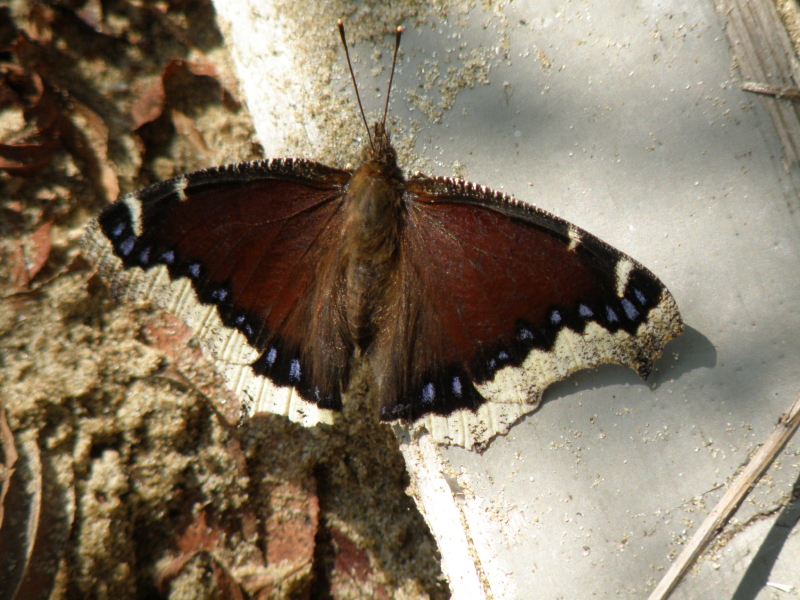
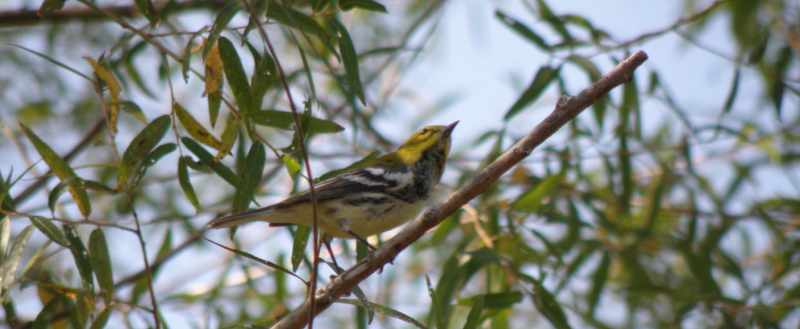
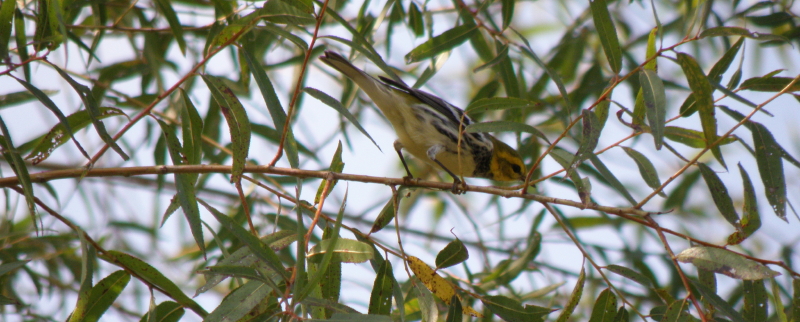
This is what the humanoids call a Mourning Cloak butterfly and I observed it warming itself in the star light.  It’s reverse coloring is cryptic and resembles a dried plant bio-solar panel.  Its mouth parts have been adapted over time to make a tube that can easily extract sugary liquids produced by the plants that these butterflies favor.  There is an exchange of services that benefits both life forms involved in this process.  Other flying animals with a very different morphology also inhabit this space.  Here is a sequence of images from what the humanoid data base refers to as a Black-throated Green Warbler looking for “insects” among the “willow trees”.  Their movements are quick and this species is just traveling through on its way to a warmer environment in the southern latitudes of this world.

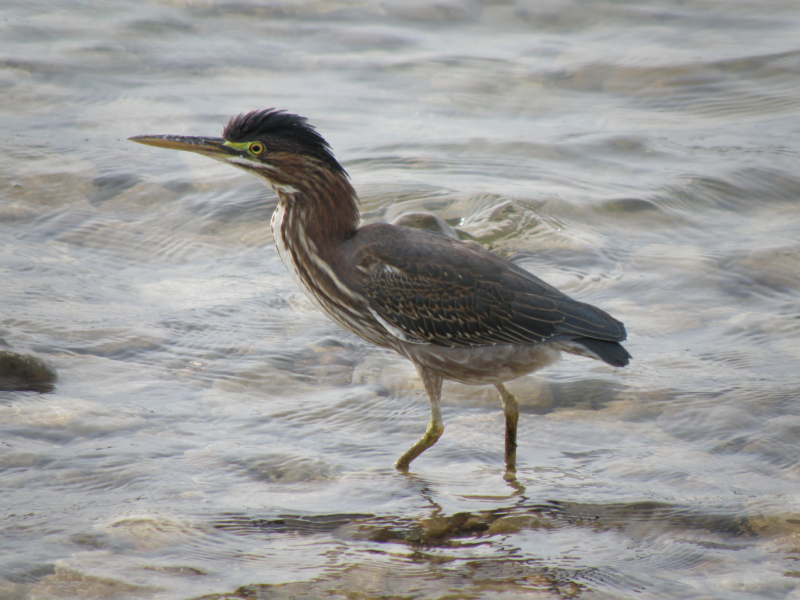
These animate life forms are called “birds” and have internal skeletons made of a lightweight material.  They also have an unusual outer covering that gets shed once a year and helps these animals to fly.  Here is a different and much larger bird I came across feeding at the water’s edge.

From the streaked markings and lighter coloring I identified that this is a juvenile Green-backed Heron.  I disturbed its hunting and feeding along the water’s edge.  Observe that it has a crest on its head which it uses to register increased alarm.  In the next moment, the heron jumped into the sky and with a few quick wing beats was gone from view.  My love, I think you will enjoy the sessile life forms as much as I do!  The humanoids refer to them as either “flowers” or “weeds” and they don’t try to escape if you express interest in examining one like the animate life forms do.  Following is a small portfolio of self-images and some of the variety in these self-sufficient life forms I have experienced on a single solar day.
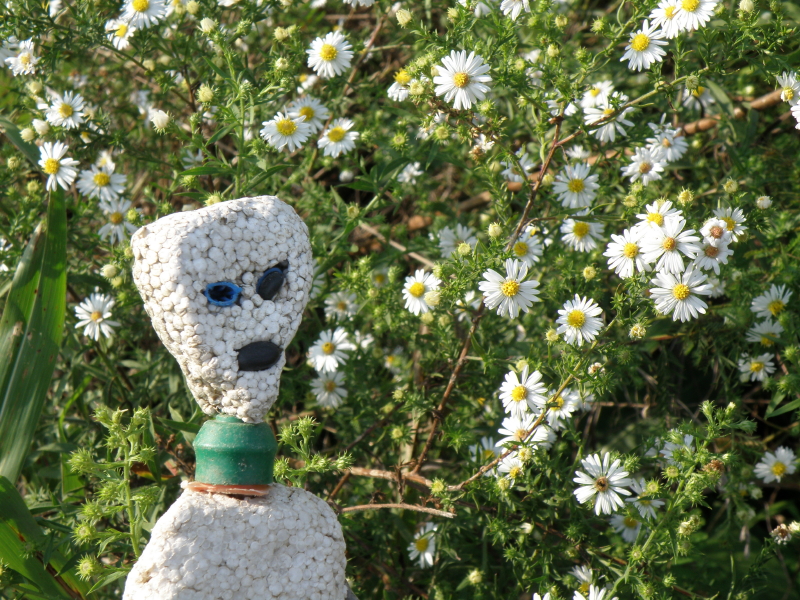
I have noticed that the humanoids have reserved some animosity towards the sessile life forms that they refer to as “weeds”.  To my sense organs, I can not tell the difference between preferred species and the ones considered to be undesirable?  If one quality of a “weed” is its ability to thrive in a variety of conditions…one would think that the humanoids would admire this since this is a quality they share with “weeds”!  This is certainly a planet of mysteries and contradictions and how I wish you were here to experience it with me.  I have observed that the photons emitting from the local star are traveling farther to reach me with each day.  The temperatures have also been getting cooler and the sessile life forms are undergoing changes to the cellular solar panels which are turning color themselves and in some cases falling off the main body of the life form.  There is a frenzy among the smaller exoskeleton animals to gather as much  energy from each plant as possible.  I’m predicting that this world will go into a dormant period before re-emerging in the warmth of a new solar year.  It is also now time for me to end transmissions for the moment.  How I hope you and my fellow Styrosians are receiving them? Finally, I will conclude with two images.  One is a self-image of me in front of small white and yellow “weeds”.  The last image features some of the flying exoskeleton animals attracted to this plant.  Until its time for my next communication…good by from the water world.
Read Full Post »

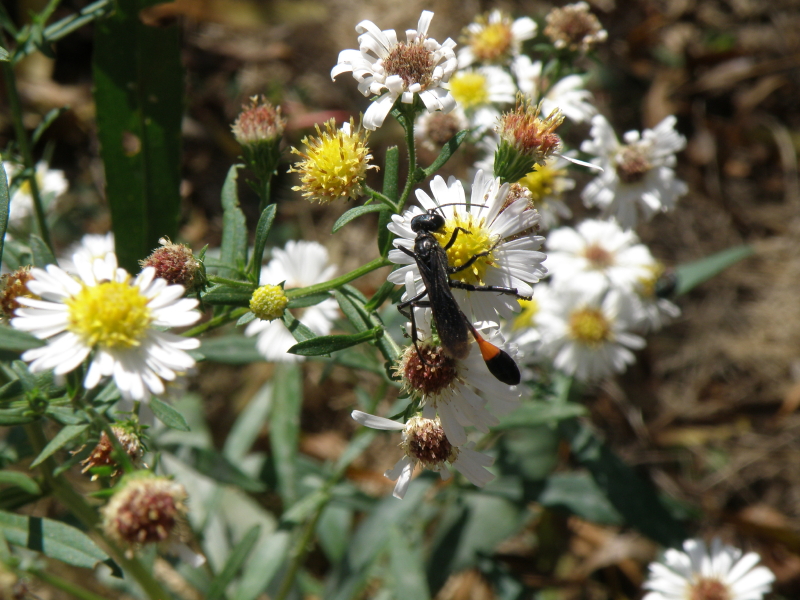
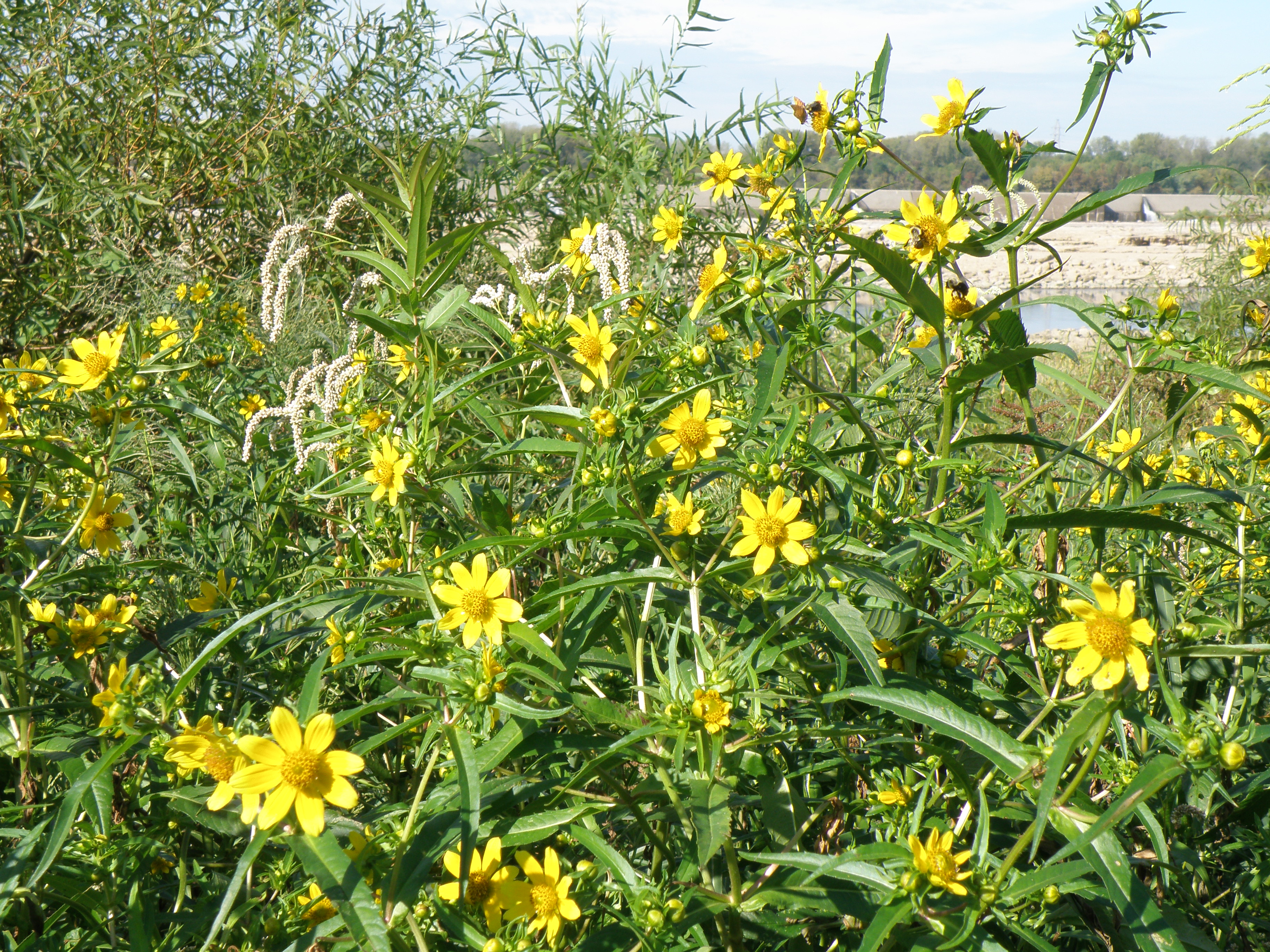
Summer has transitioned to fall.  Everyone has noticed that the days don’t seem to be as long as they were a mere month ago.  This is all the more reason to get out into nature.  Perhaps you have felt that subconscious pull tugging you out the door? The sun is not as insanely hot and the light is intense and clean.  There is just the barest yellowing along the margins of the river’s cottonwood leaves.  More colors will follow.  Right now there is an urgent purposefulness to the world as life prepares to overwinter.  The flowering grasses are alive with flying insects gathering pollen and nectar.  Spider predators are behind every leaf.  After absorbing some of this energy…I headed up to my spot under the willow trees and wondered about making something interesting from my river cache.  I was so happy and absorbed to be back at my outdoor studio that for a moment I lost track of the fact that something was now moving on the left side of my peripheral vision.  Thinking it might be an animal, I carefully brought my camera up to take some quick pictures and this was what I captured.

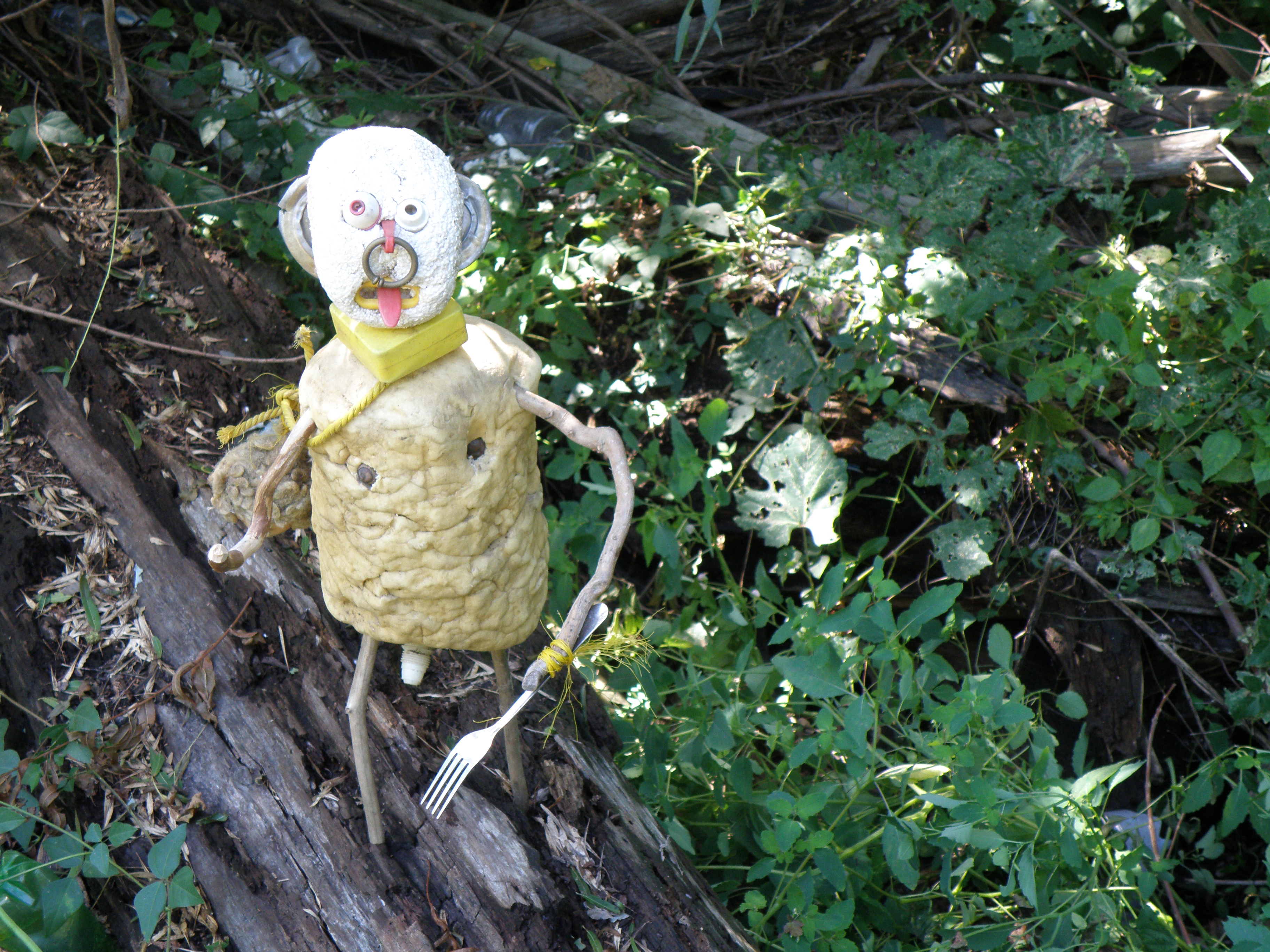
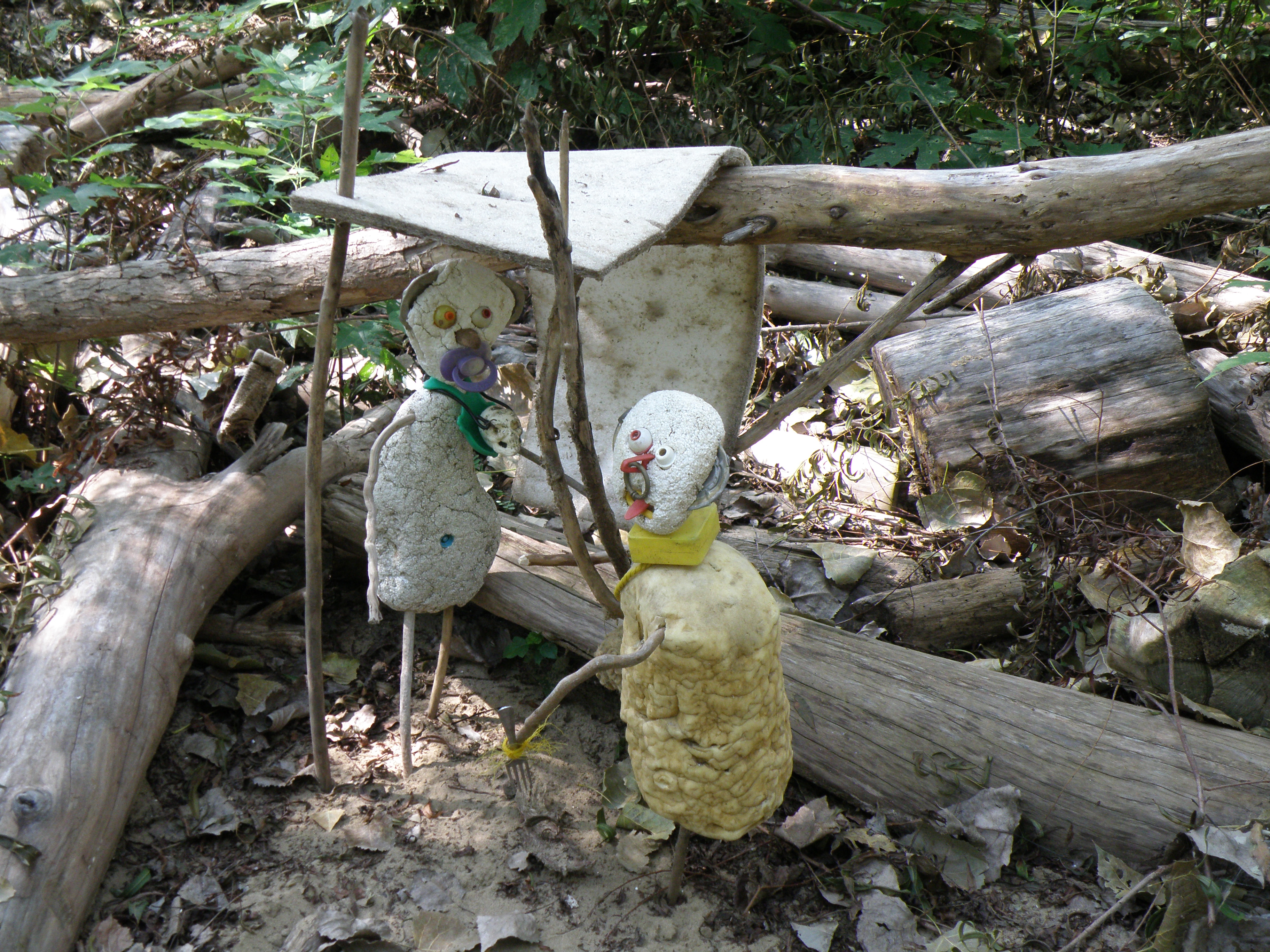
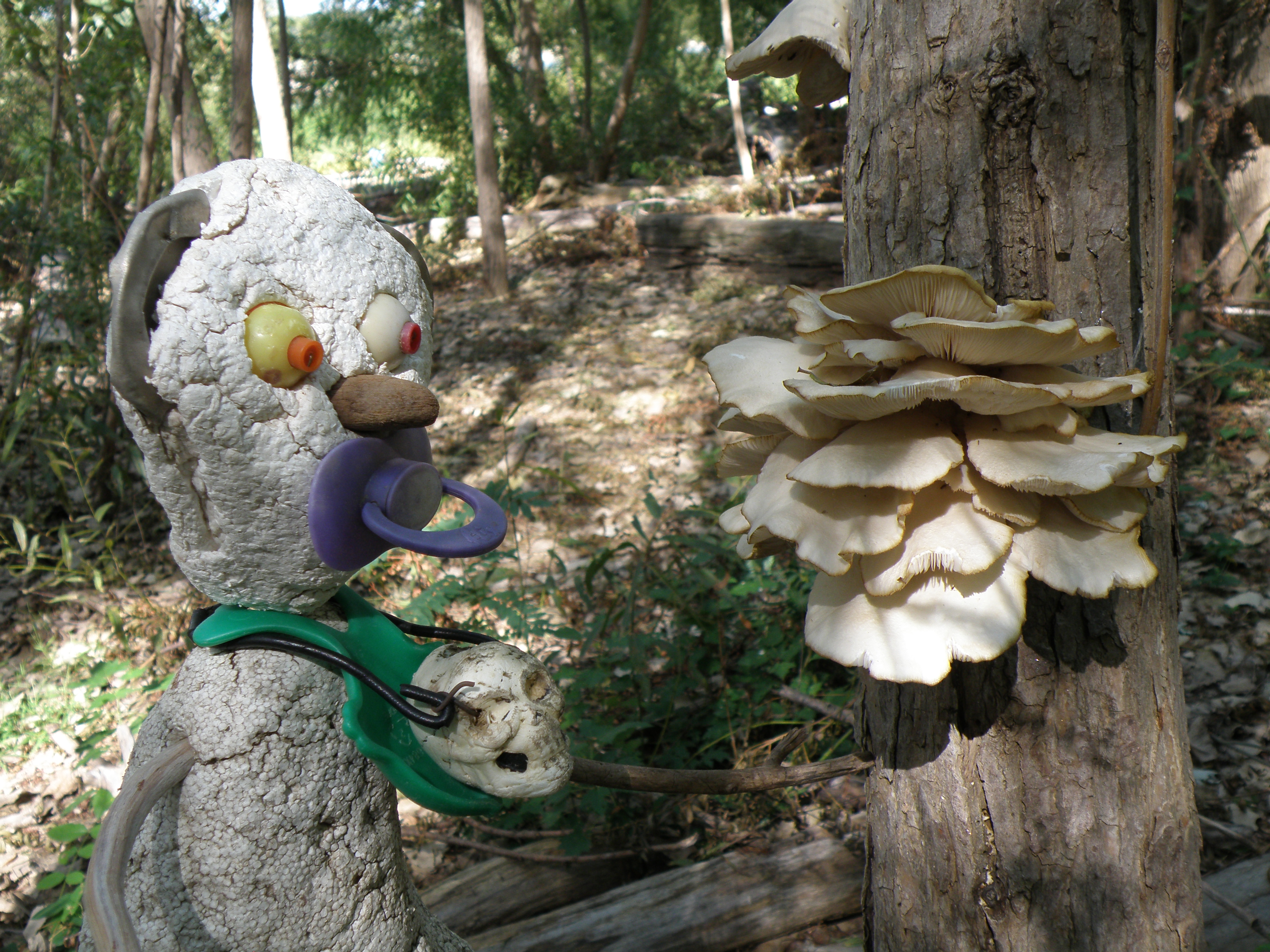
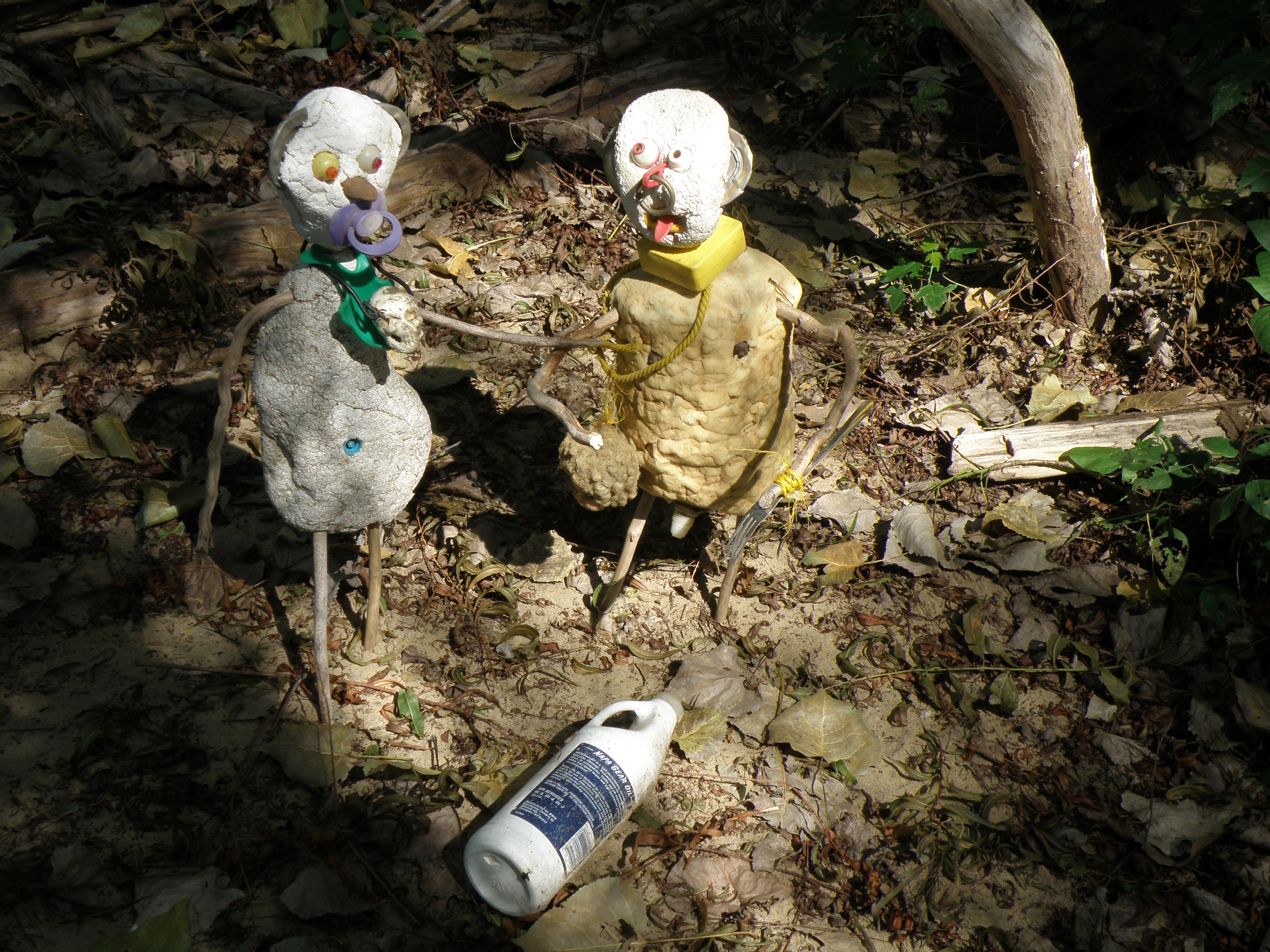
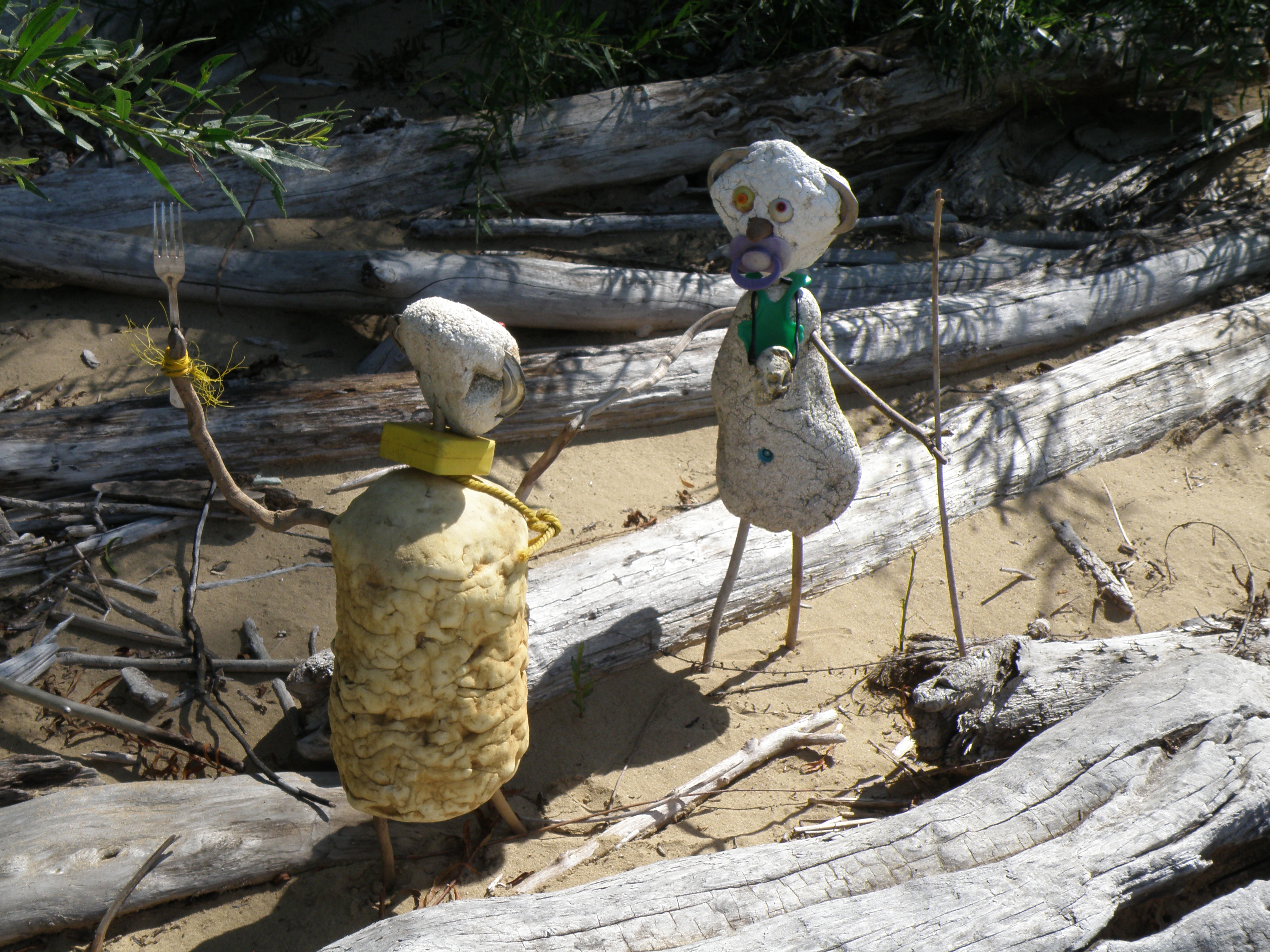
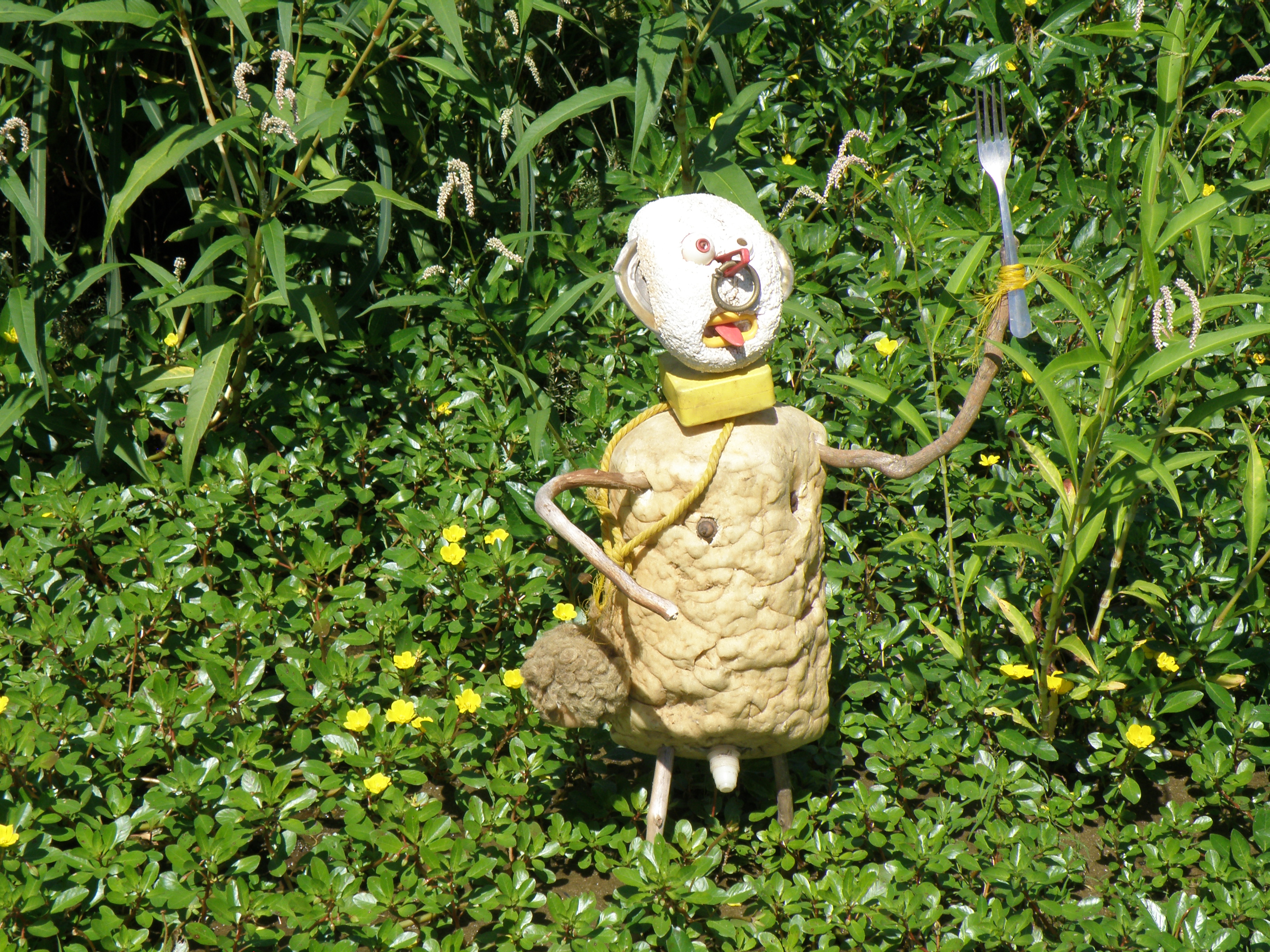
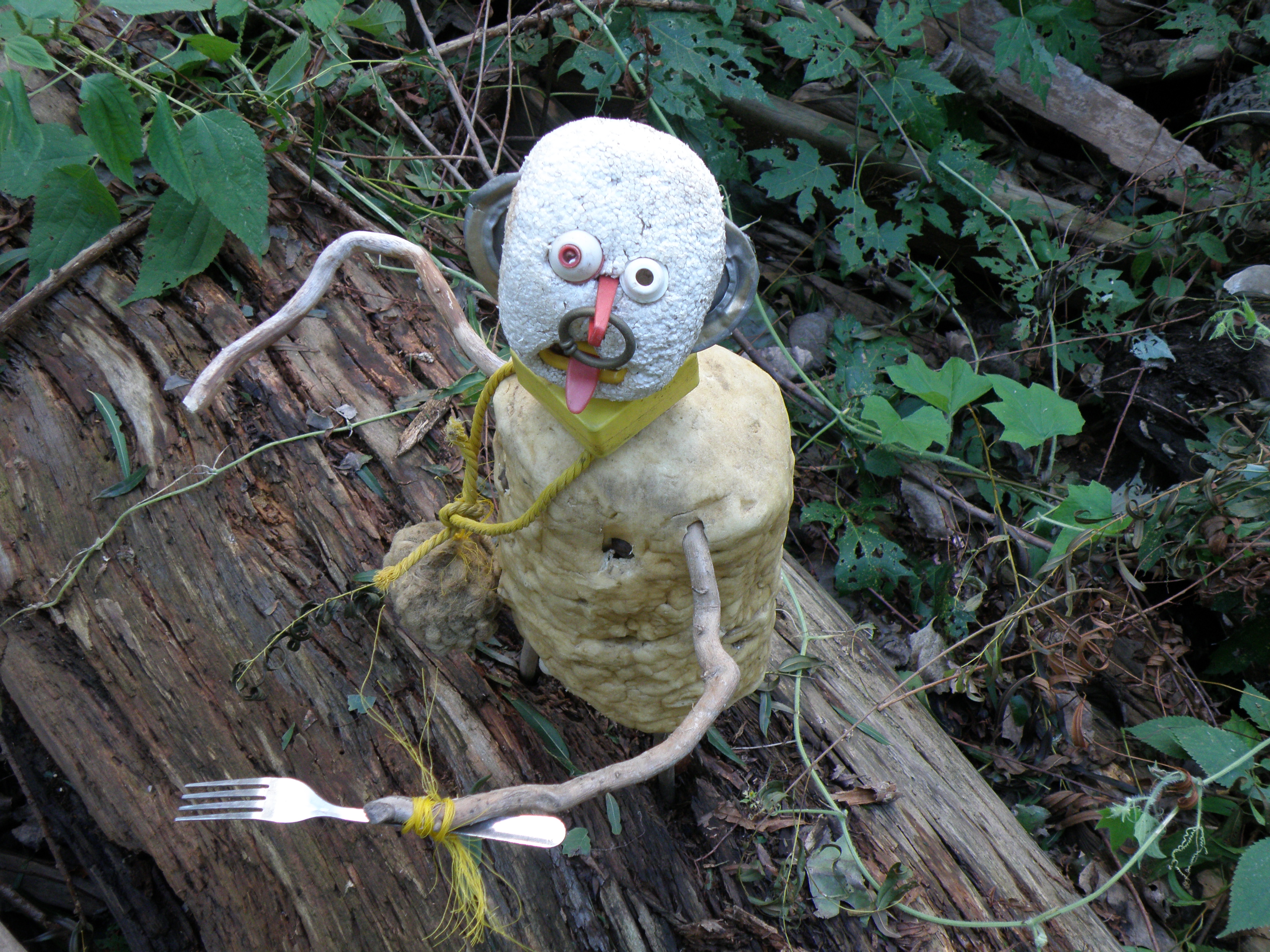
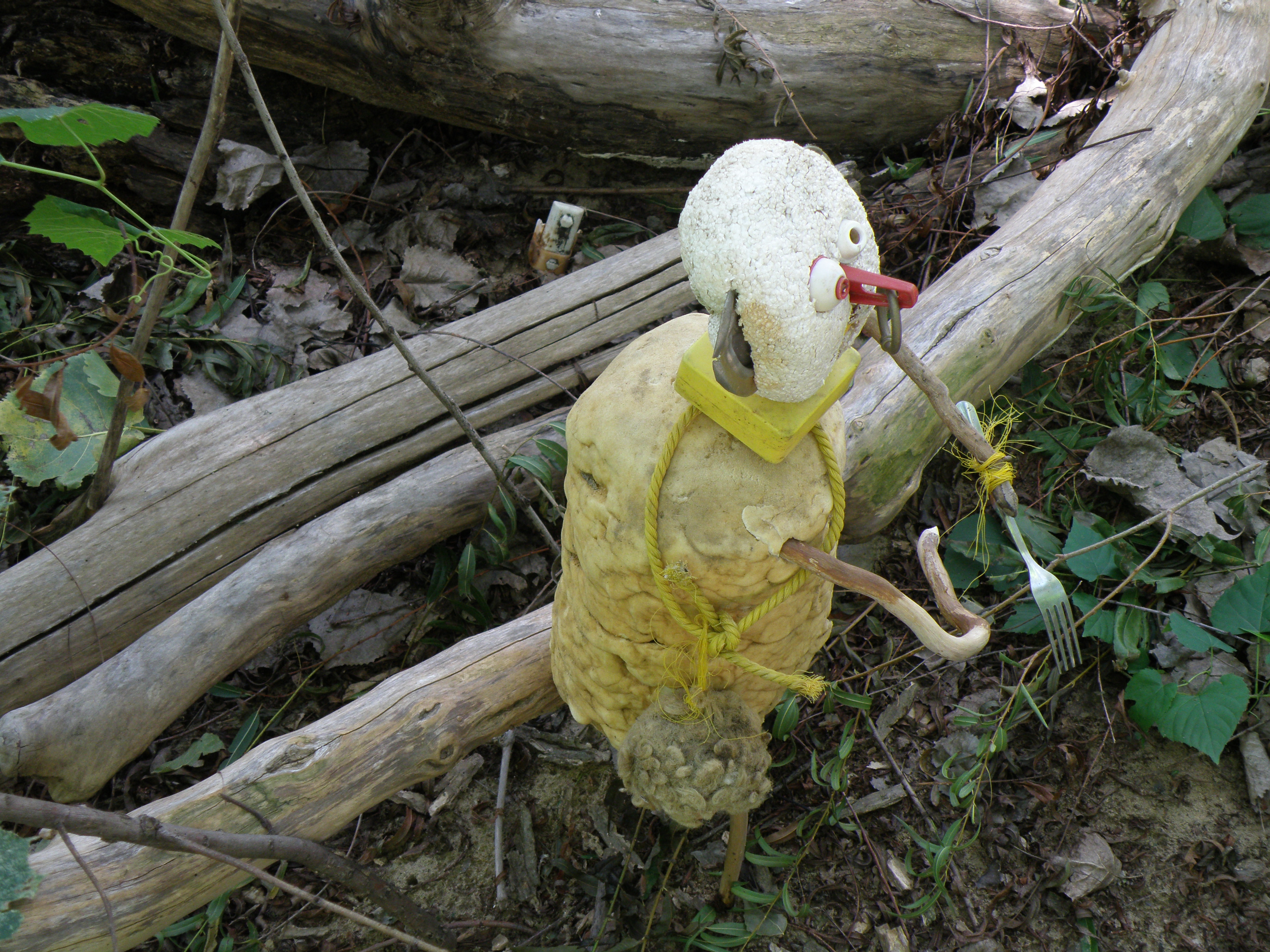
In quick succession, I had two images in my camera before I realized what I was photographing!  Appearing out of a myth was a member of the Pang tribe!  The Pang live in the most remote places in the world’s woods and consider themselves the first people.  It’s not advisable to try to find them because they don’t want to be found and it may in fact be dangerous to do so.  They only appear when they want to be seen.  The land they call home is full of poisonous serpents, insects, and diseases plus the rainy season is relentless.  There are no overland roads and very few trails.  Getting around means braving an unpredictable river.  Oh, and then there is the reputation the Pang have for being headhunters.  The little guy in front of me was reminding me of that by showing me the trophy he carries on a belt everywhere he goes.  I think my camera’s flash startled him!  By holding the captured head aloft, this tribesman was telling me he was experienced in this field!  His nose ring meant that he feared no pain.

The stainless steel fork he brandishes likely means he has had contact with our culture before.  The Pang, otherwise do not work metals.  What is known is that they are a hunting and gathering culture and nature supplies everything they need. The posturing and elaborate facial gestures on display before me continued until he seemed satisfied that I was harmless and perhaps even a bit slow on the uptake?  The Pang have developed a language where one can gauge how a person feels by looking and reading their facial expressions.  Most of the time, an open mouth with prominent tongue exposed is a sign for disgust or disapproval although there are exceptions for most rules.  Using the time-honored hand signal for follow me my new friend beckoned and I walked behind him anticipating adventure and mystery.

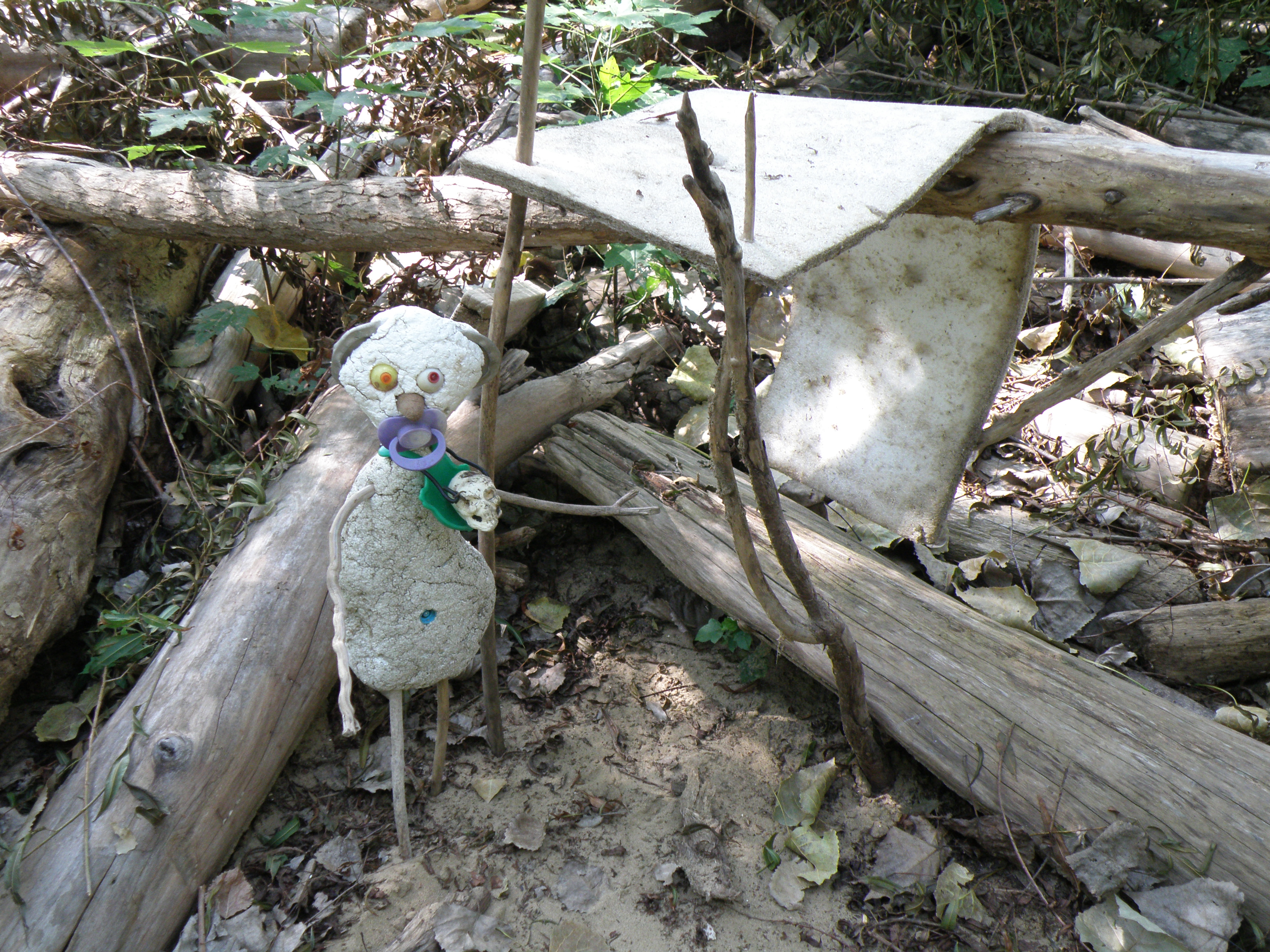
Along our walk the tribesman would point out where my culture had  dumped garbage into the Pang’s territory.  From the look on his face,  I could again register disapproval.  I tried to learn his name and give him mine, but we had trouble communicating by words. Aside from the occasional bit of plastic and paper, the forest walk was also full of beautiful birds and butterflies and late season wildflowers.  Eventually, we entered a small clearing and there set up for our relaxation and respite was an intimate canopy tended by another member of the first people.

A sheet of recycled plastic foam packaging and a couple of wooden posts made up this shelter.  I saw that the Pang were trying to reuse some of the trash they found. Sitting down, food and water is shared and I’m amazed at my new friends ability to live off the land.  A kicked over decaying log full of large, succulent beetle larvae provides the main course.  I, however, developed a taste for bracket fungi and my new hostess showed me what to look for.  I can’t help noticing that she is wearing a small skull object around her neck.  Later I learned that the Pang don’t remove heads from just anybody or without cause.  Head collection is the highest form of respect accorded to friend and foe alike.  I, however, was never in any danger simply because I hadn’t earned any respectability yet in the estimation of the Pang.  Or so another friend told me later.

After a short rest, my hosts were in a mood for a walk and I tagged along.  I could tell that there were things they wanted me to see.  Of course, they showed me just about every piece of litter we came across on the trail.  It seemed important to them that I not miss this.

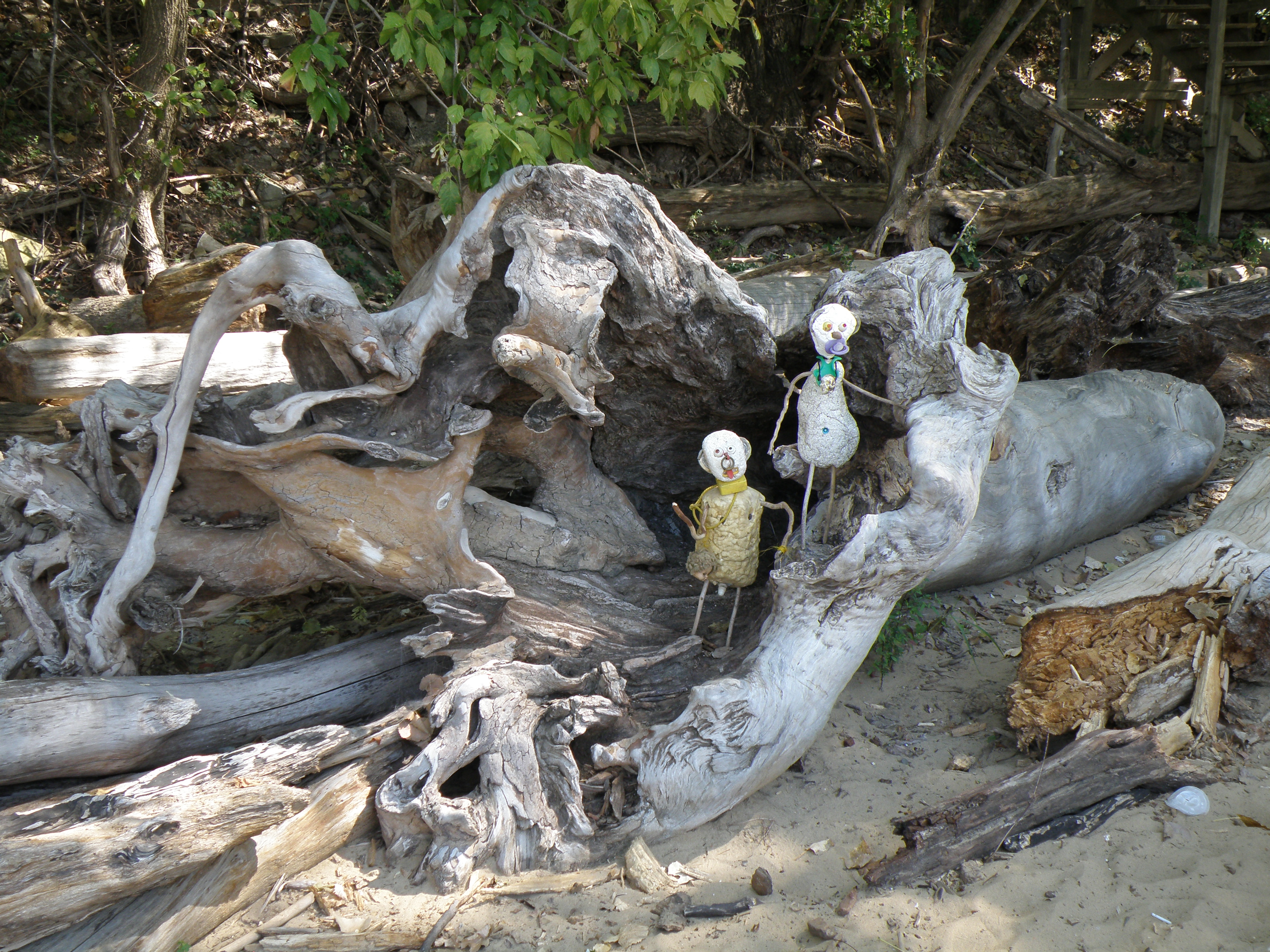
Fortunately, I was shown a lot more that was good than not.  I could see why the Pang were so attached to their land.  It provides them everything including much of what makes up their identity.  We visited an immense hollow log that the river dropped off during some old flood and I took this portrait of the odd couple.

We walked back out into the bright sunlight and hiked near the river.  After having been in a mostly leafy environment, it felt nice to have fresh air against my face.  You could tell by the expressions on the Pang people’s faces how much they enjoyed being free and in a natural state.

Before long we came to a place where driftwood had collected on the beach.  It was nearer to the forest and another trail.  After a protracted goodbye, my friends went their separate ways.  I could tell that our adventure together was coming to an end.

I got the sense that something else needed to happen to make the day complete.  I turned with the man with a fork back down to the riverbank.  As we walked he slowly started chanting and stopped every once in a while by some landmark for added emphasis.  He did this when we came to a bright, marshy area.  My friend’s arms rose into the air along with his song.

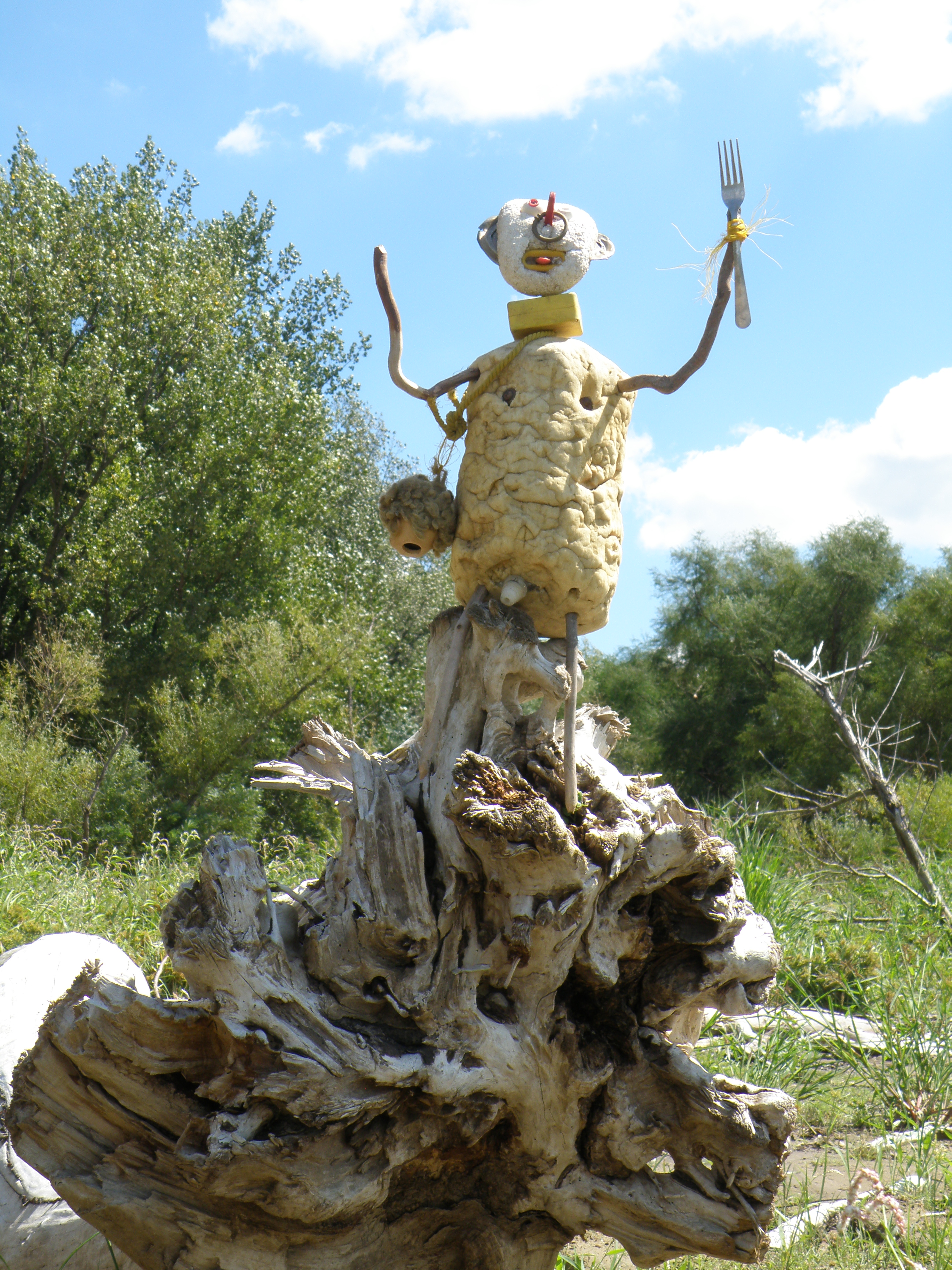
After the marsh, my companion climbed a long log that had washed up on the shore during a flood many years before.  He climbed as far up the root mass as he could and lifted his voice and fork to the heavens.  I wish I knew what he was saying…but whatever comprised his song I could tell it was reverential.

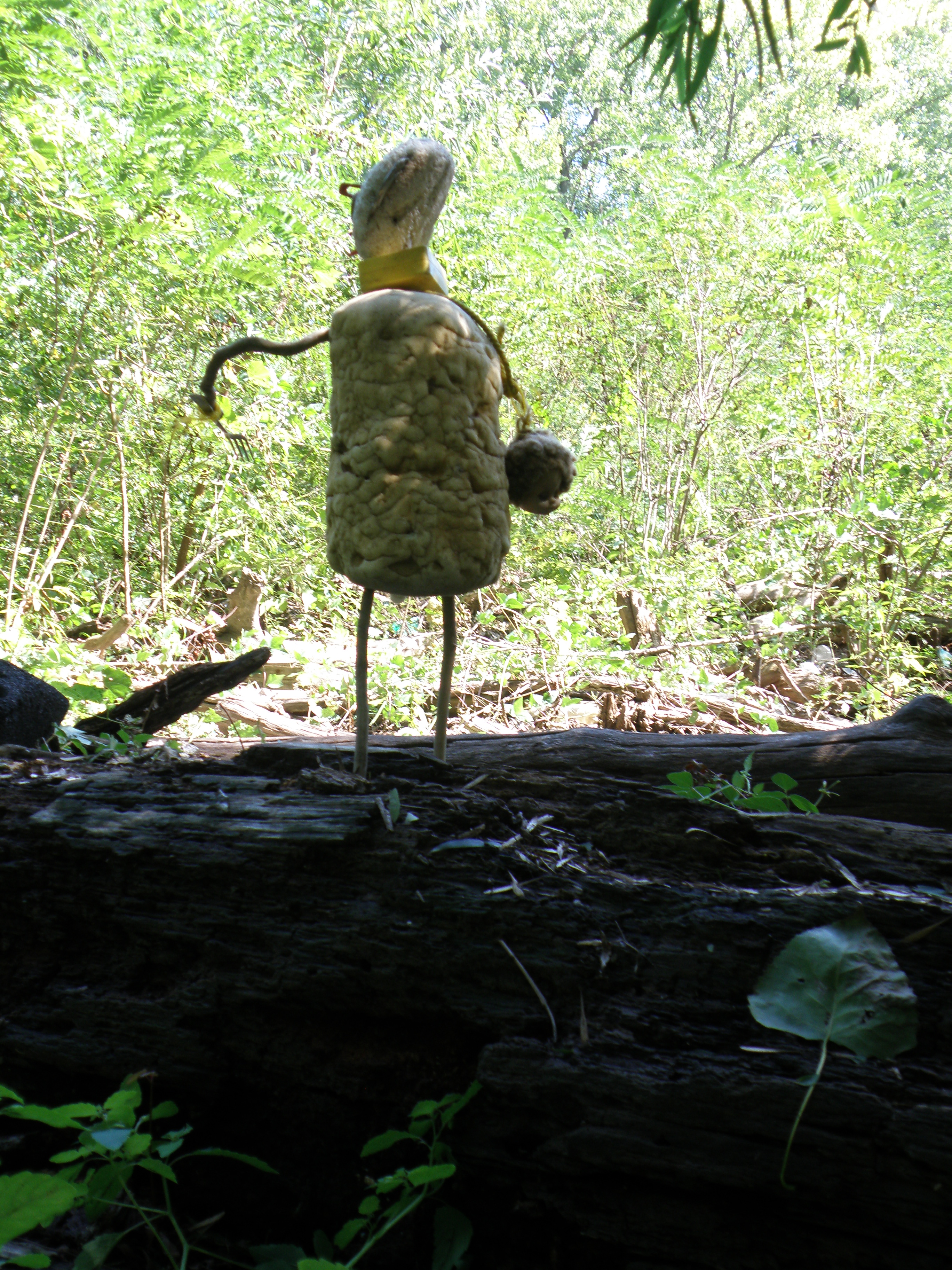
Since this culture doesn’t show itself without some purpose in mind.  I hoped that  I hadn’t missed it.  Looking back upon the day, I enjoyed the camaraderie of my new friends, we relaxed together and shared a meal.  Later we went for a walk where I was showed both what the Pang liked and disliked in the landscape.  Now the day was ending in a prayerful song.  Seemingly to underscore another point, my headhunting friend drew a line in the mud.  In essence, he communicated that my side of the line was mine and if I couldn’t respect his side of the line…we would be unwelcome.  He quickly grimaced with his tongue sticking out on that last point.  Staying on my side of the line, I wished him well in my tongue and with a short wave  watched him melt into the forest where he belonged.

Read Full Post »

This was my Labor Day adventure which spanned two days of hanging out by the Ohio River.  The remnants of Hurricane Isaac came through and gave us some much-needed rain.  I was excited to return to my old studio spot and didn’t mind exploring and working through the drizzle.  My clothes got soaked and muddy, but as long as I was able to keep my camera dry…I felt okay and had fun.  It has been two months since I last laid eyes on my Styro-cache.  Most of these polystyrene chucks were collected in the spring.  I had heard that there were a few scheduled river clean-ups, but they obviously didn’t find my spot.  It wouldn’t have hurt my feelings in the least if all this white trash had disappeared.  The more public areas did look better, but I have a feeling that as long as people are around…there will be litter at the Falls of the Ohio.

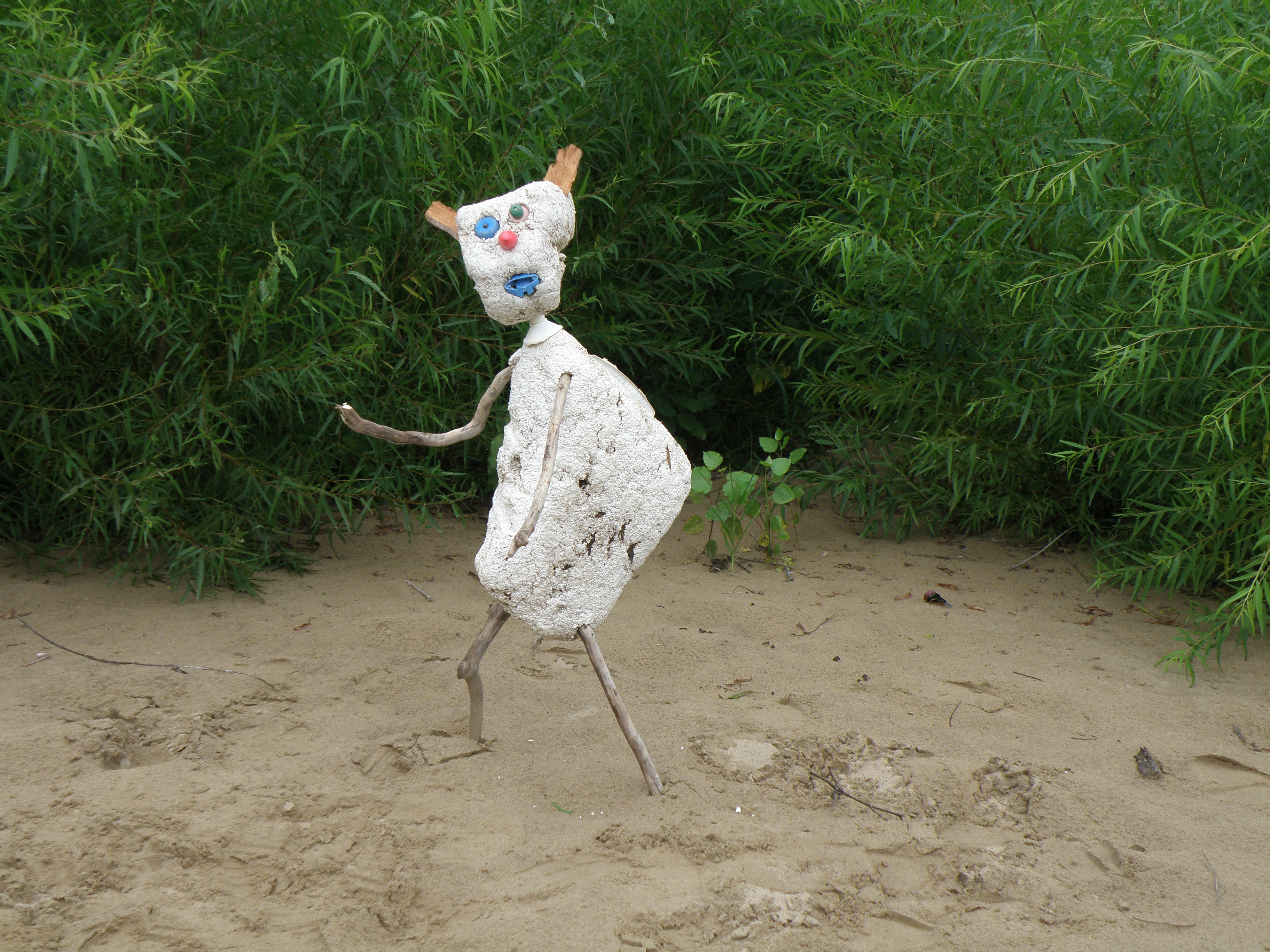
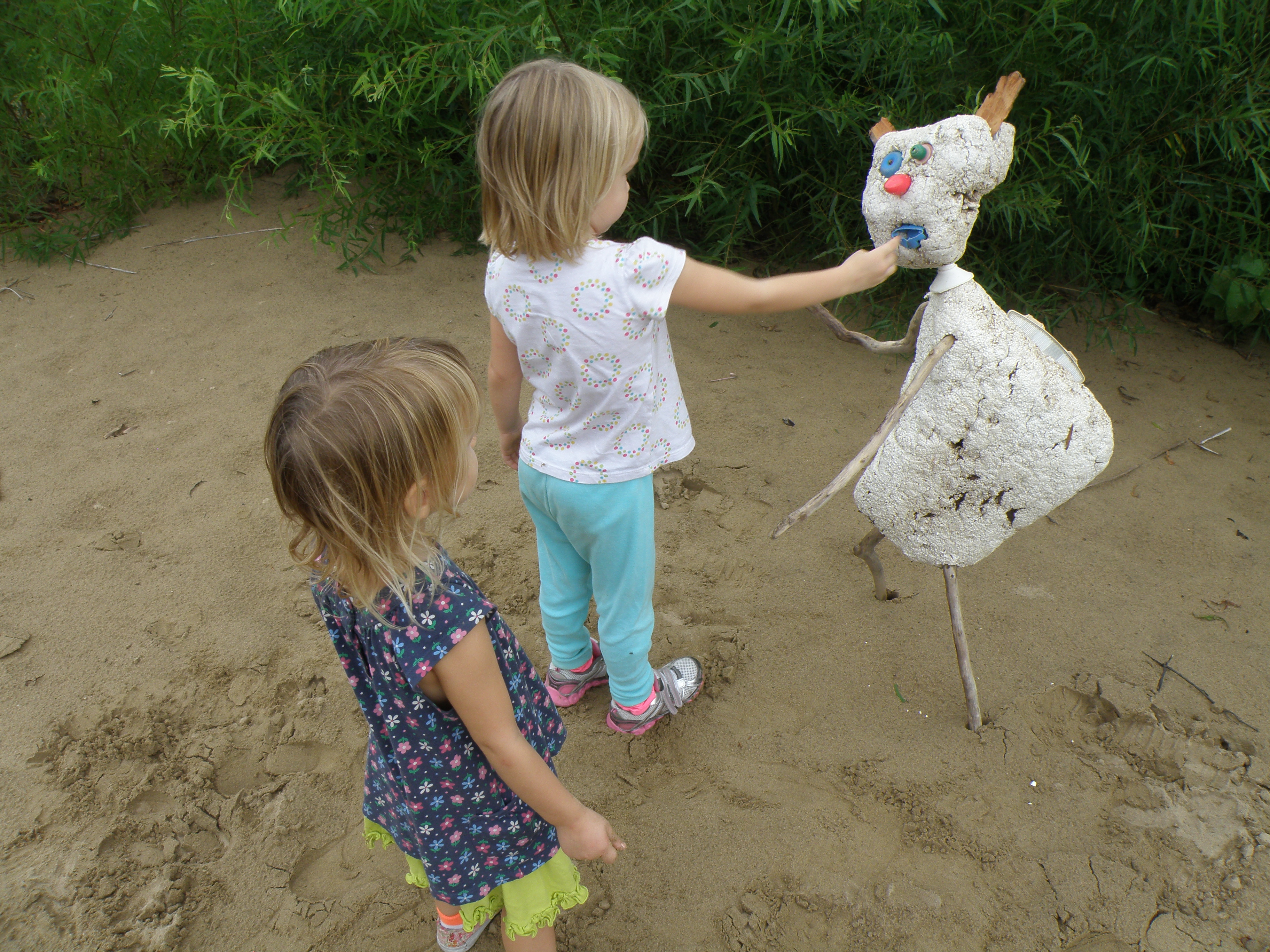
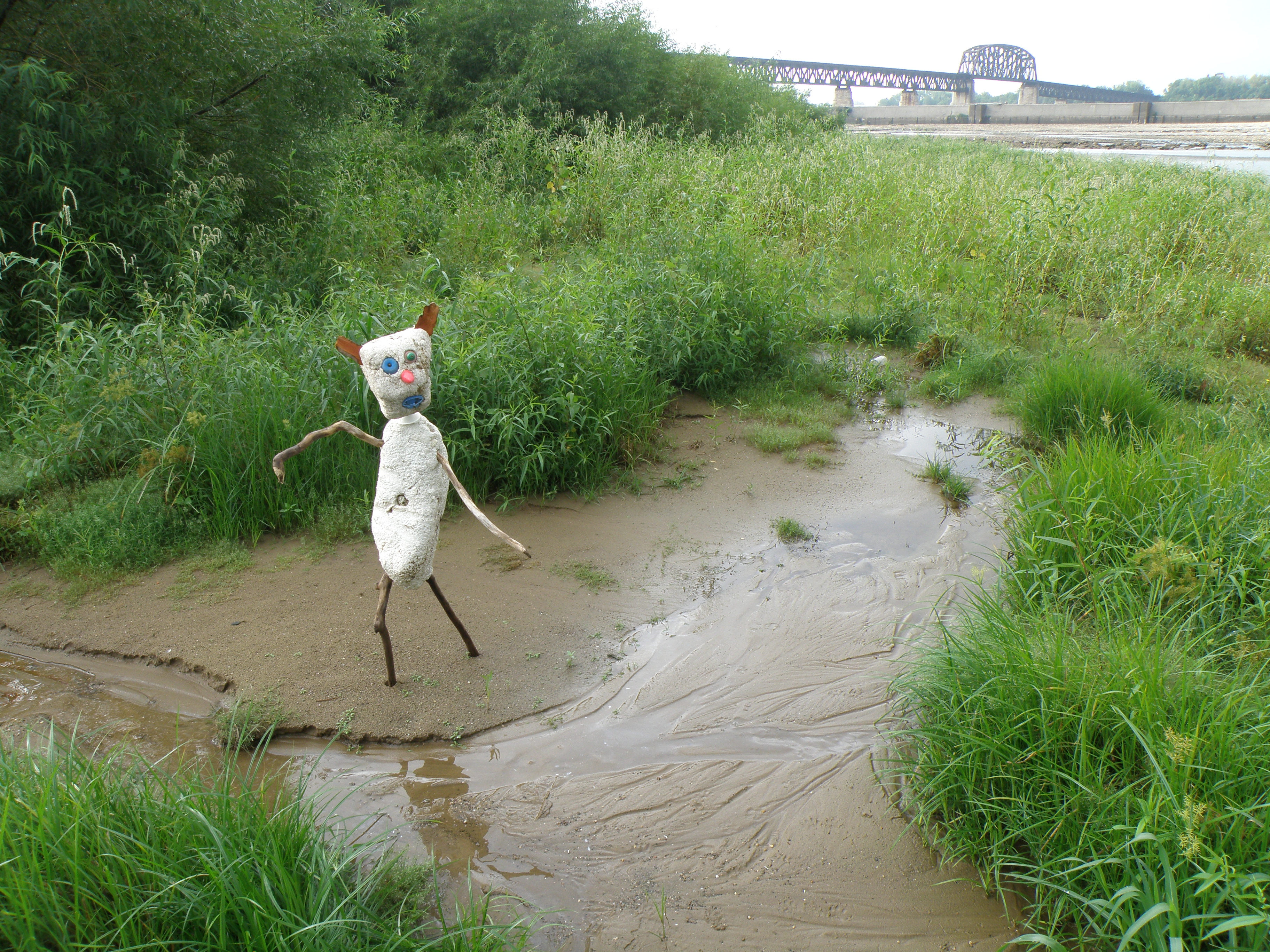
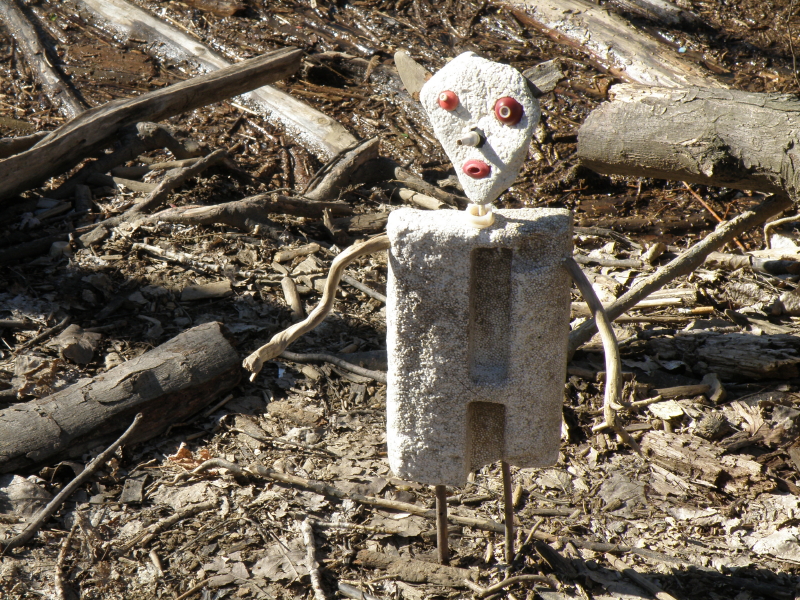
Because I was dodging little rain showers, I quickly created a figure and moved him out into the river landscape.  A nice family who said they were familiar with some of my other Falls projects happened upon me.  Their daughters India and Esmay were interested in “Mr. Rednose”, so named because his nose is a burnt out light bulb from a string of Christmas lights.  I asked permission from the parents to take the girls’ picture before posting something.  Esmay seemed the most interested and kept sticking her finger into “Mr. Rednose’s” mouth.  It’s cool when people I meet out here get what I do and appreciate my small call for creativity.  I have a real concern for what kind of world our children will inherit.  My own sons are now 11 and 16 years old and I remember when they were much smaller and followed me to the river to make a few memories of our own.

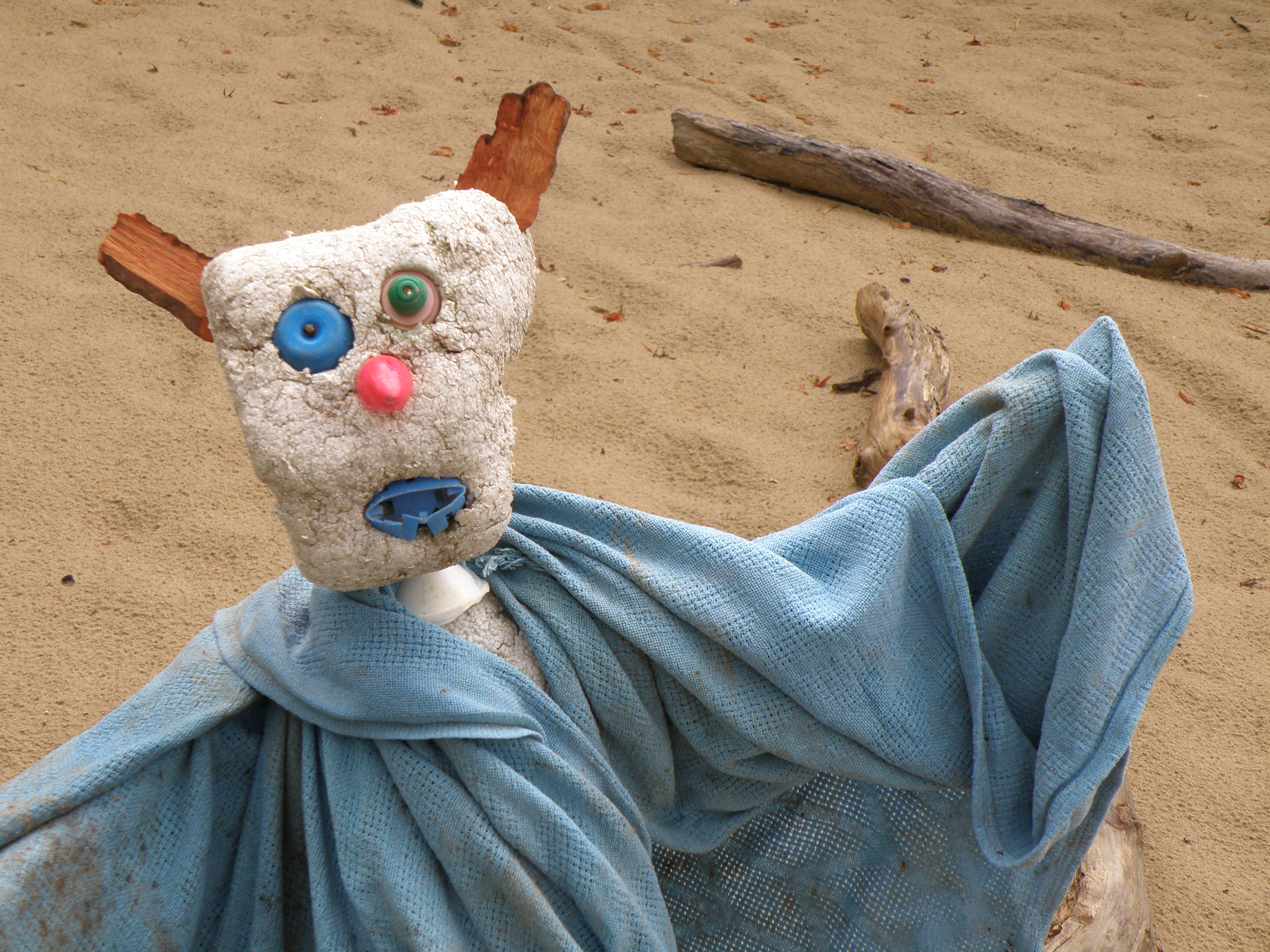
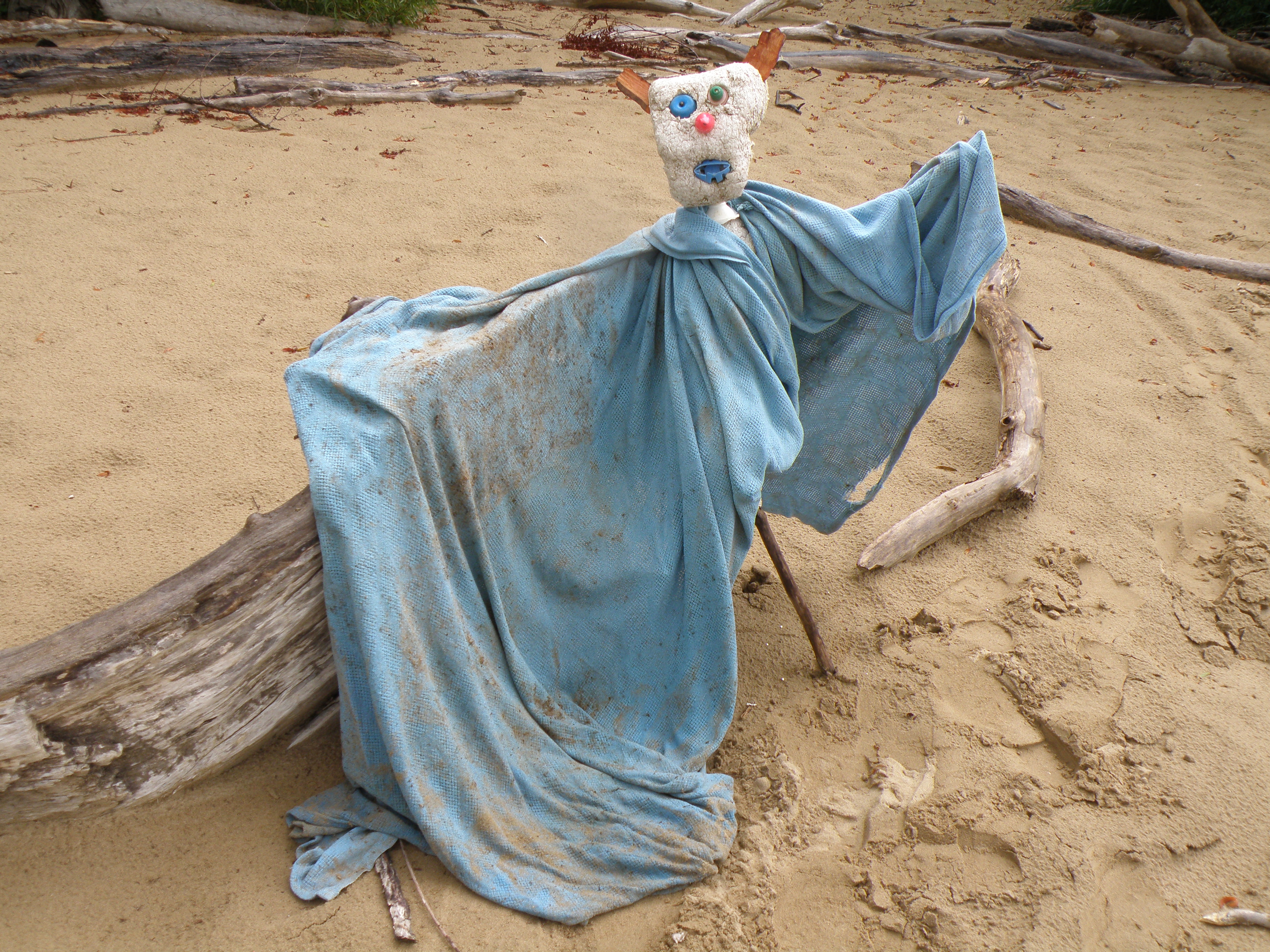
“To exist or not to exist…that is a choice.”  Perhaps meeting little kids inspired me to play dress up with this figure.  But I also kept finding props I could do this with.  This blue blanket was just draped over a log and I wondered why someone would leave this here?  Over the years, I have come across small camps that homeless people would just leave their stuff behind as though they planned to return.  It was eerie when they didn’t.  By the river, I came across yet another potential prop.

A fisherman had left behind as trash this polystyrene minnow bucket and “Mr. Rednose”picked it up.  Since it was beginning to rain more regularly it seemed appropriate to try to use this bucket for a hat and here is what that looked like.

It was about this time that I decided to call it a day.  The rain was coming down more heavily and consistently.  I hid the figure in high, wet  grass where it was waiting for me the following morning.
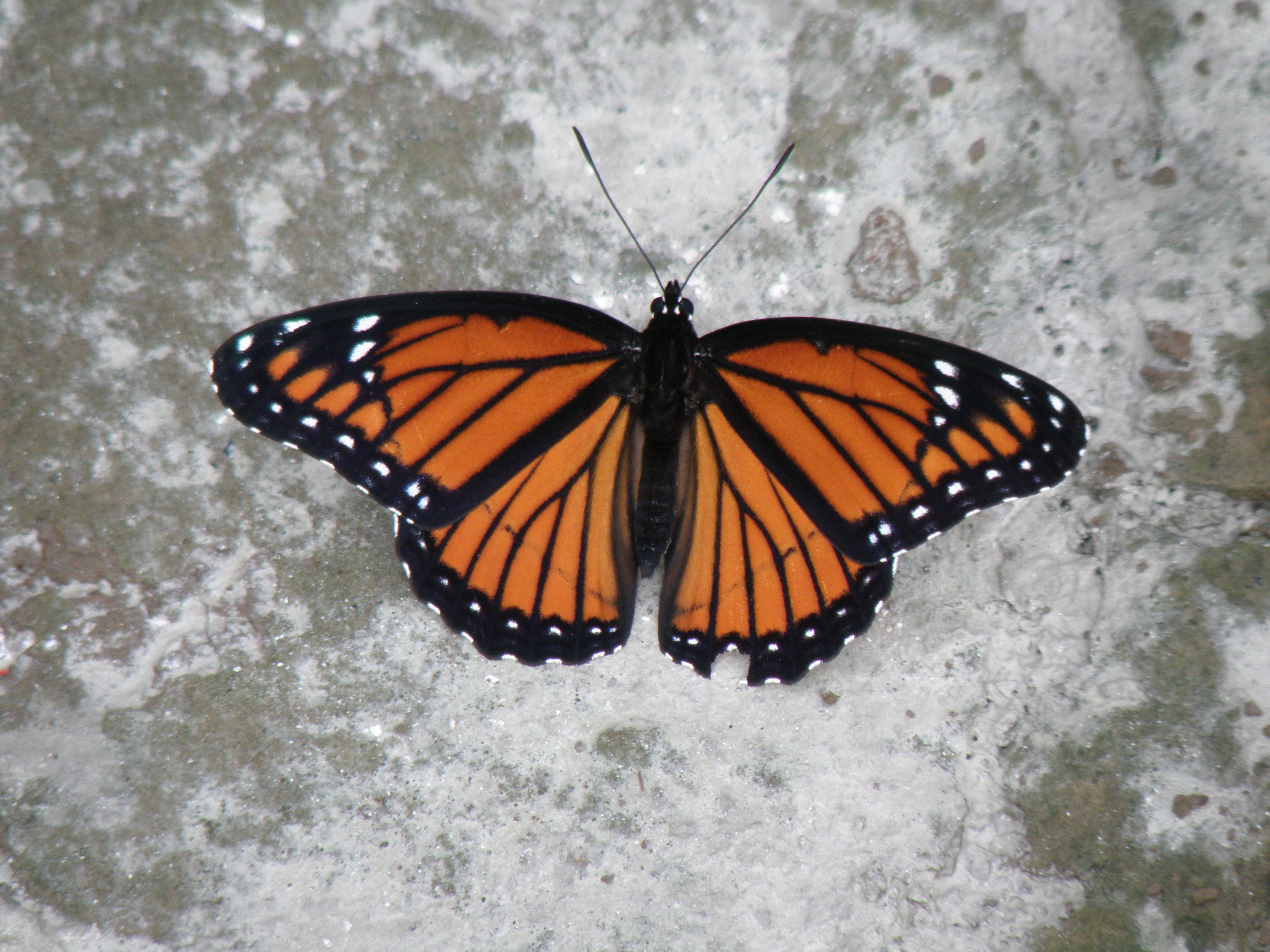
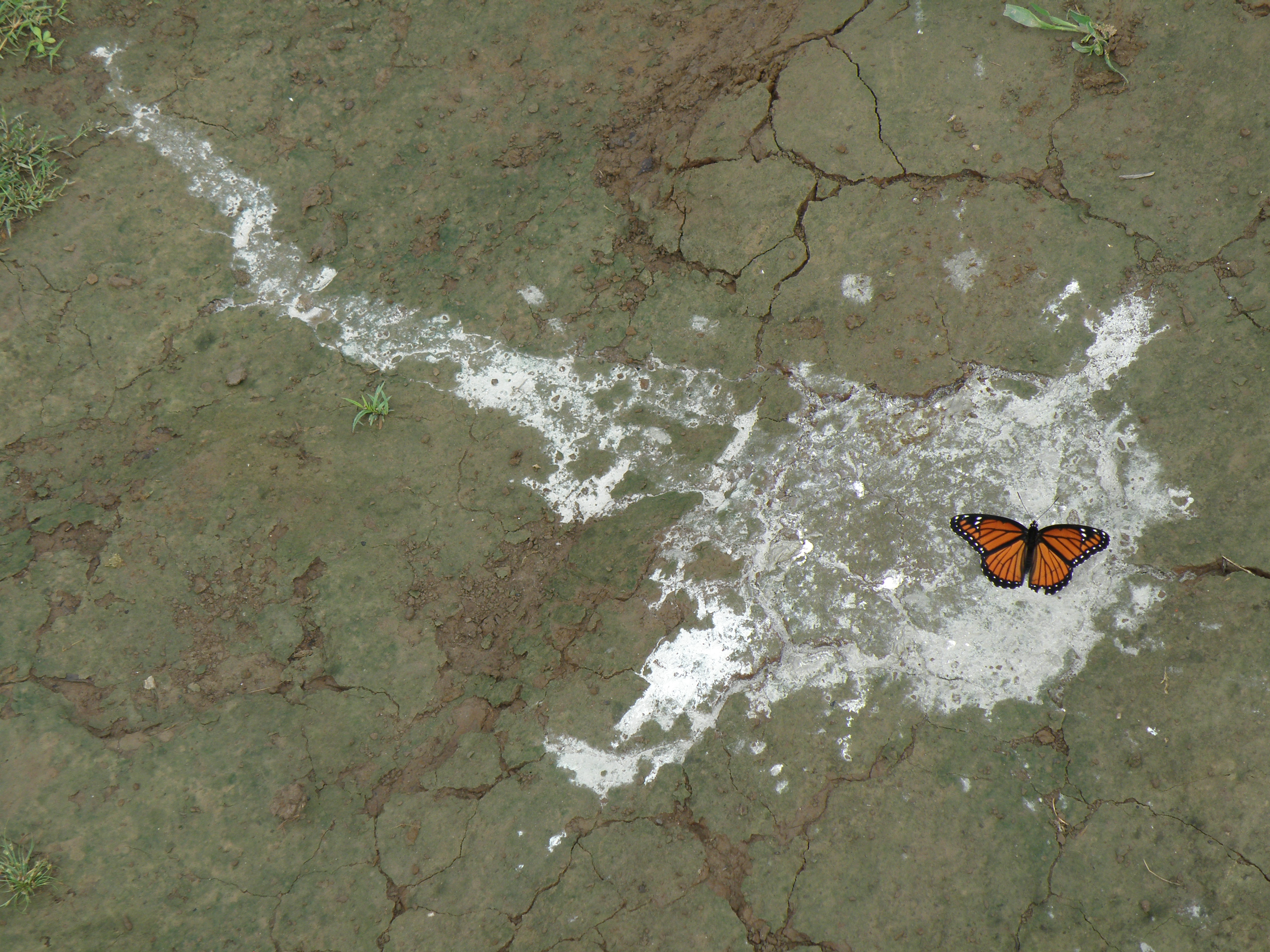
My second day out here was more about discovering nature.  No sooner had I rescued my figure than I had one of my most thrilling bird sightings.  This time it was an actual bird and not something I created myself!  Walking through the wet grasses I unintentionally flushed a bird into flight that I recognized immediately.  It was a Black Rail (Laterallus jamaicensis).  It’s a small blackish bird with a short bill.  It has white speckles on its flanks and a very diagnostic rusty-colored nape.  Rails are the smallest member of a group of wading birds that include herons and egrets.  The literature says that they are very secretive and seldom encountered.  You are more likely to hear one at night along the eastern salt marshes, but there are a few that live in the Midwest.  There are over 260 bird species listed in the official Falls of the Ohio checklist, but the Black Rail is not one of them.  This is a second time I have spotted a bird not officially recorded in the park.  I tried to let the park and our local bird club know about my sighting and I hope somebody else was able to see it?   The flushed rail flew to a nearby willow tree and with camera in hand I tried to get a picture.  Unfortunately, I was not successful.  I will, however, look for it again in the same place the next time I come out here.  The Black Rail was not the only interesting creature out in the park today.  Newly minted butterflies were flitting about and I counted several species including the Viceroy which mimics the Monarch butterfly.

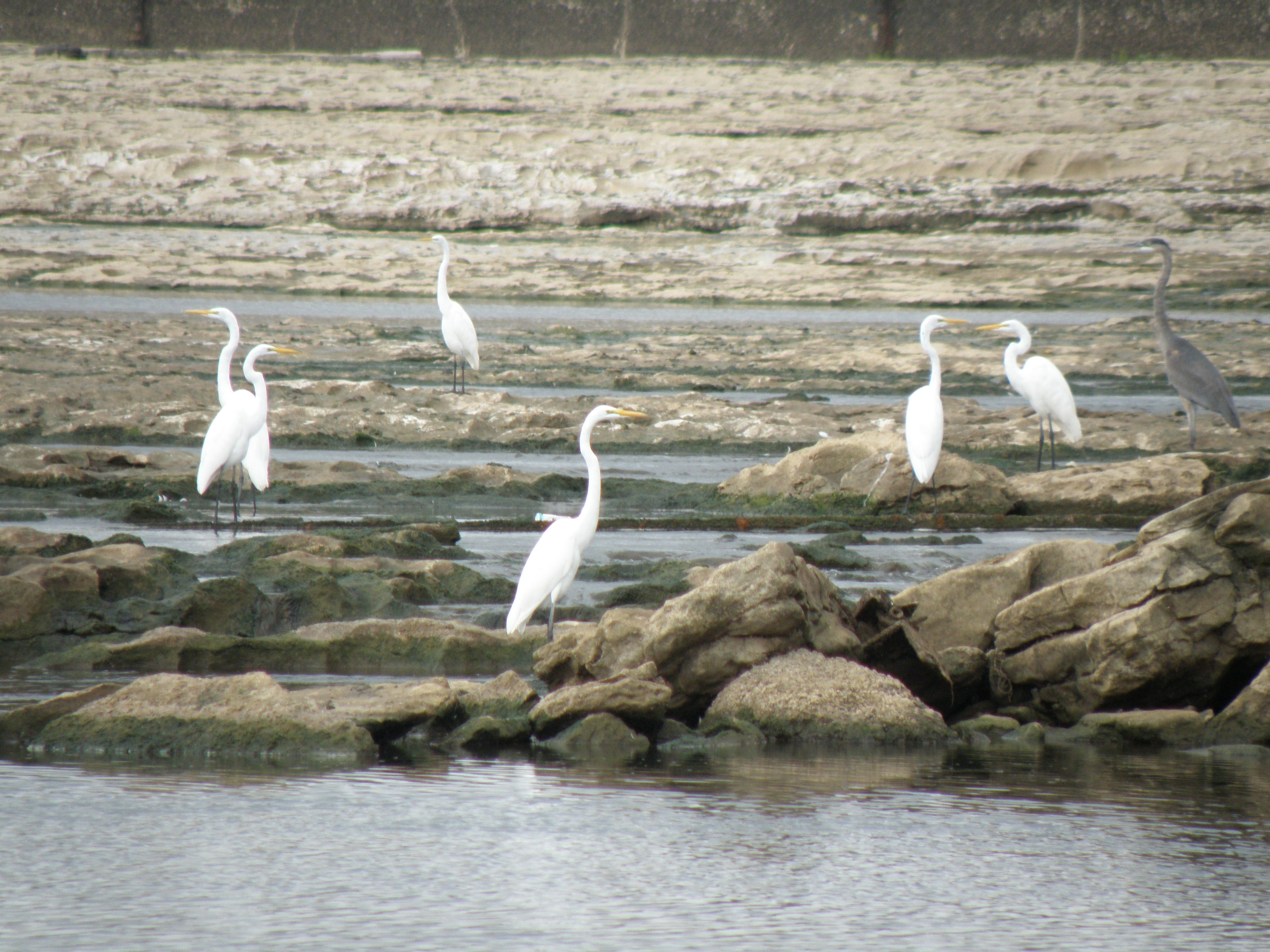
This Viceroy was taking advantage of the minerals present in a fairly large bird dropping!  Out of the fossil beds, Great Blue Herons were outnumbered by the slightly smaller and all-white Great Egrets.  Soon the egrets will be moving off to warmer climes, but the Great Blue Herons are year round residents.


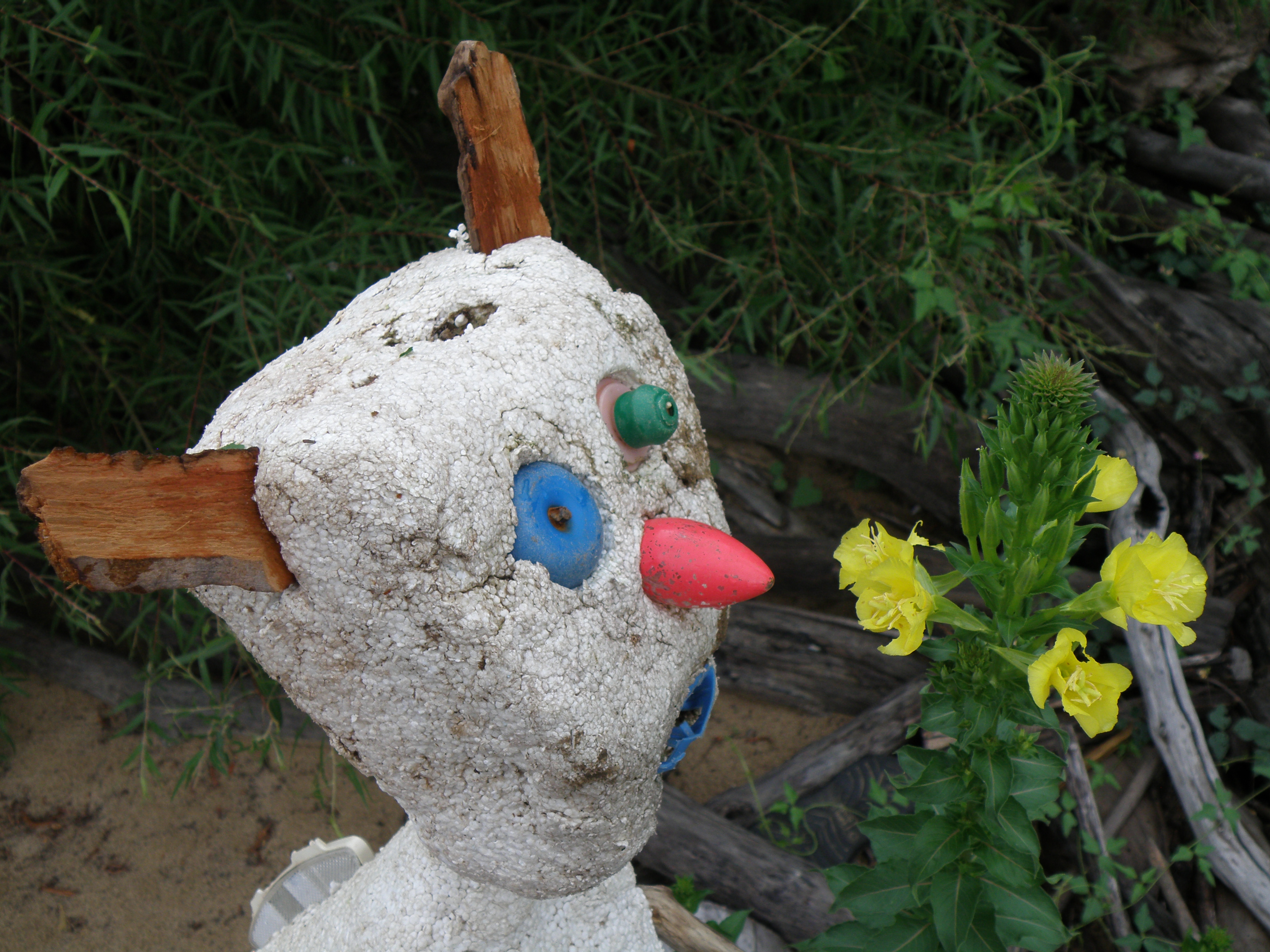
Moving away from the river and back towards the willows, I stopped to admire several flowers including members of the Evening Primrose family.  “Mr. Rednose” enjoyed the slight fragrance emanating from this tall flower.


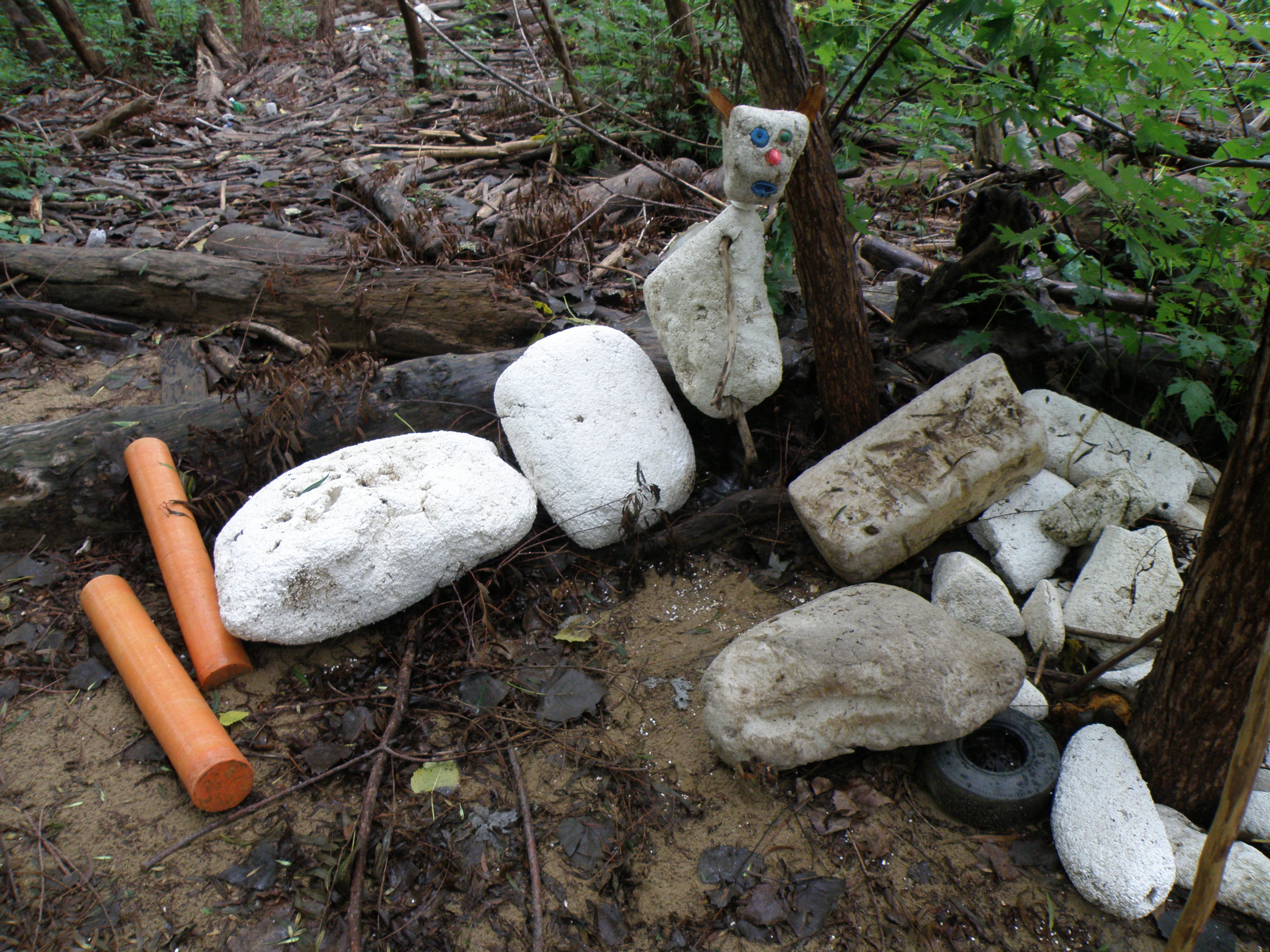
I finished this adventure where it began.  I moved my figure to the place he first took form and where he now stands guard over my Styro-larder.  He might still be there welcoming visitors…or not.  I look forward to returning the following weekend to experience all the surprises both great and small that this environment presents to me.


Read Full Post »

« Newer Posts - Older Posts »