Feeds:
Posts
Comments

Posts Tagged ‘recycled art’

Fish Sand Drawing, 8/09

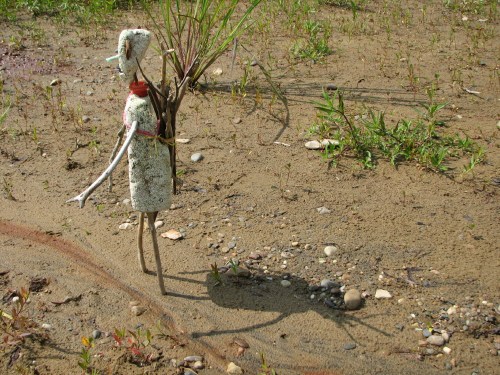
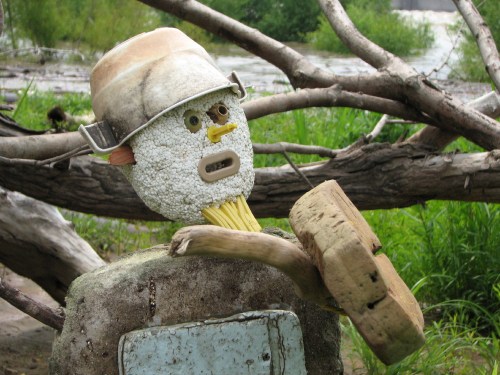
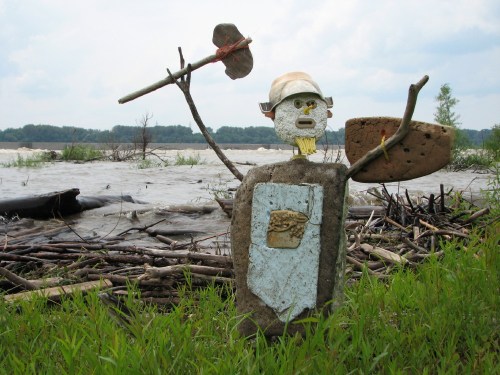
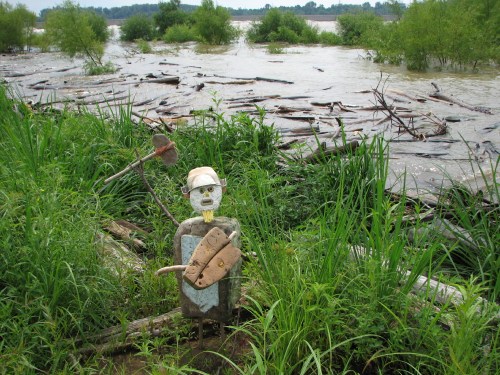
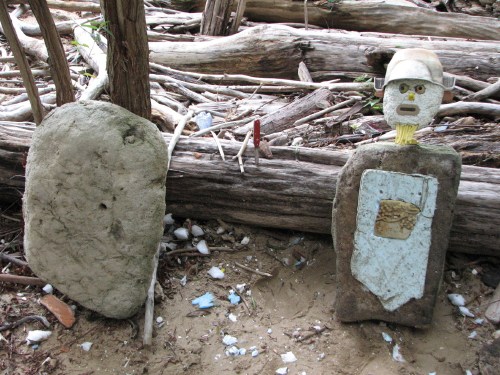
With the power plant behind us, I retrace my steps in the sand along Goose Island.  At the moment, there is shade.  Once we venture back onto the fossil beds we may get momentary cover from a passing cloud.   I stopped along the sand bank and made one more Styrofoam figure from materials found along the way.  He’s a simple guy with one very apparent attribute.  He has a bright yellow belly button.
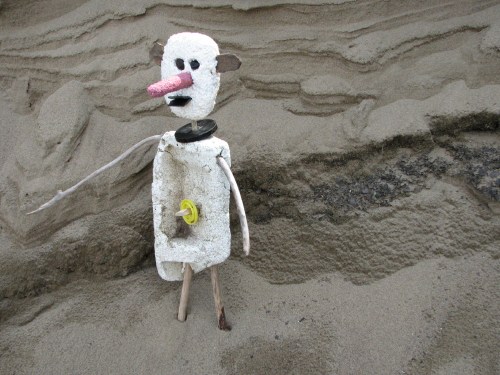
Figure with Big Nose, 8/09

He’s made from found Styrofoam, sticks, various plastics, bark, and nuts.  I decide to take him with me and work him into other images.  I briefly watched a cormorant swimming near my position.  One moment his head was up in the air and then the next he was in underwater pursuit of some fish.  Continuing my walk, I’m heading towards the fossil beds and the remains of a 19thcentury dike.  I like some of the views of the skyline of Louisville from here.  With the water being so low, the exposed rocks create an other worldly sight.  Walking on the rocks it’s easy to imagine you are walking on an alien and ancient surface because it is!
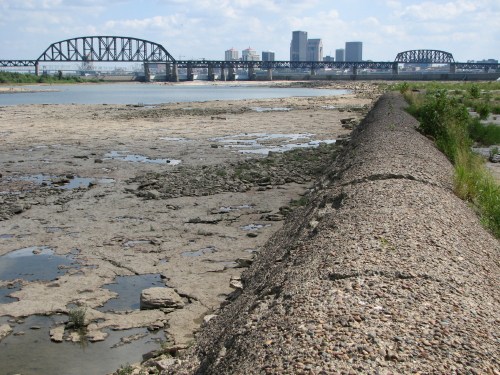
Louisville skyline from dike at the Falls of the Ohio, 8/09

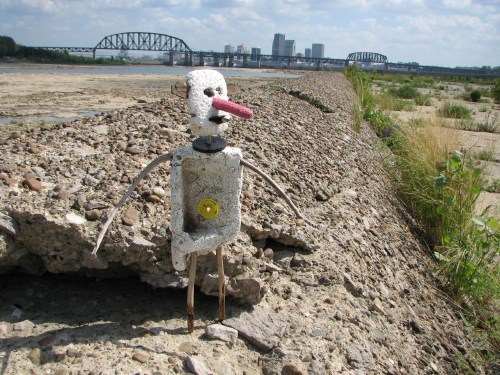
Figure on the Dike, 8/09

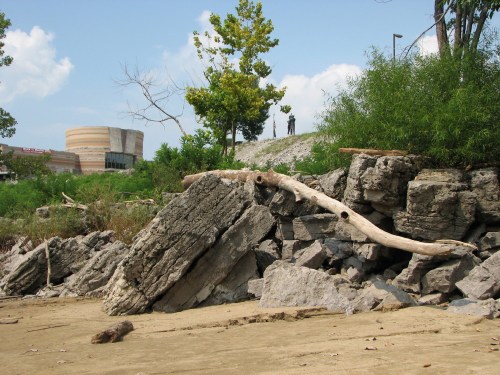
Here are two views from the Goose Island Dike.  You can see how this barrier divides the fossil beds from the Prairie Grass Habitat on the right.  This is where I left this figure…with his legs wedged in the crack of a broken rock.  I left him for someone else to find and enjoy.
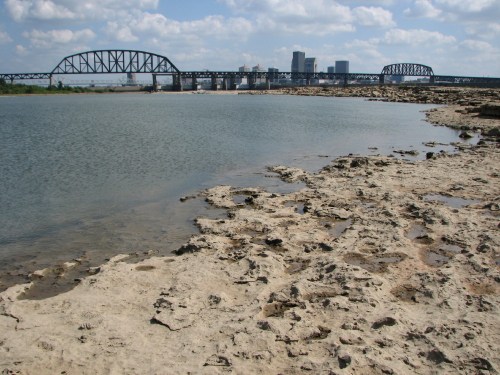
Louisville skyline as seen from the Falls of the Ohio, 8/09

Moving down from the dike and onto to the fossil beds, I’m going to follow the river’s edge.  A small and noisey flock of Killdeer plovers scatters in front of me.  From here you can see how the water has sculpted this limestone into a pock marked wave.  It’s not the easiest surface to walk on and it’s very slippery when wet.  I have always liked this view and feel it’s worth the trek.  It’s like looking at a cross section of the history of life.  It’s ancient rocks represent a moment long ago when life was tropical and the water tasted salty.  Now, we are at a different latitude and the environment has shifted over deep time.  Fresh water now governs this landscape and we cling to it down to its very edge.  The tourist in me is saying my camera’s memory card is full for today and so this marks the end of this particular trip over the fossil beds.  I hope to return soon.  Perhaps the early fall when the sycamore and willow tree leaves start to turn yellow and ducks are in the air.
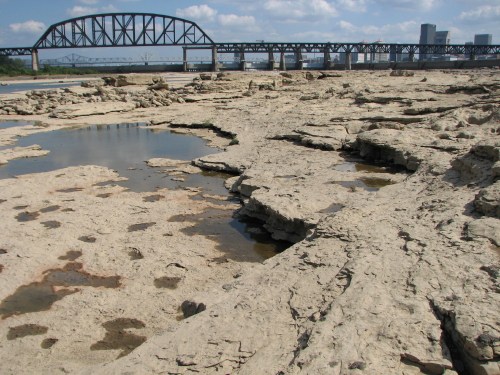
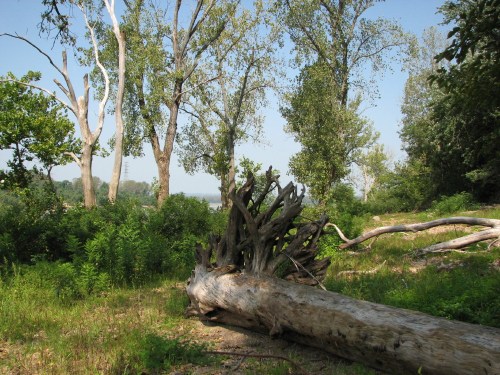
View of Louisville from the Falls of the Ohio, 8/09

Read Full Post »

western park scene, Falls of the Ohio, 8/09

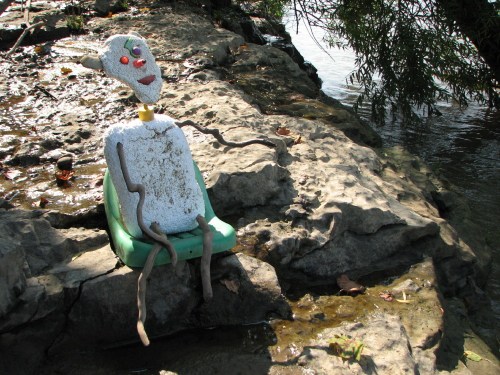
For a change of pace, I decided to explore the park’s western section.  It’s a little more of a walk, but you will see more wildlife and less people.  I was priviledged to observe a pair of ospreys gliding in high circles on very long wings.  Usually, there is less Styrofoam to be found in the western end, but I was able to locate a couple pieces along with assorted sticks and plastic bits to make a figure.  This is what I came up with today.

Figure on Green Seat, 8/09

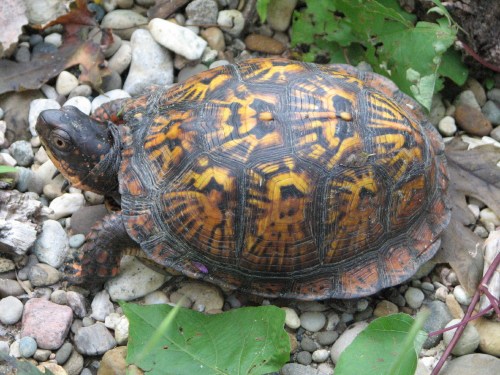
The green plastic seat more than likely came off a child’s riding toy and was the right size for the figure I constructed.  As I was working on this piece, I was treated to the sight of a beautifully marked Eastern box turtle that came walking out of the tall grass.  I couldn’t resist taking a few pictures!

Eastern box turtle, 8/09

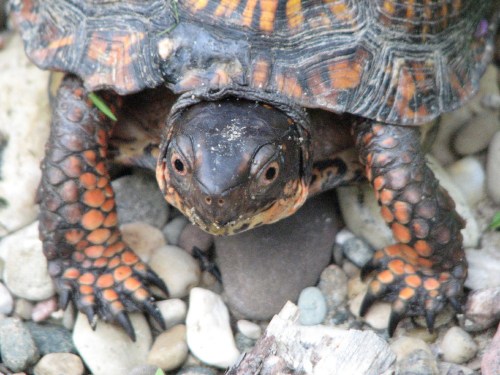
head of box turtle, 8/09

I love the golden- yellow markings on its bony- shell and how it shows signs of wear and polish by moving through its environment over many years.  I carefully picked it up and the turtle’s head and front legs pulled within the shell while it’s trap door closed shut.  I set the turtle down and made my art work and slowly the turtle revealed its head, legs, and tail and sneaked back into the grass from where it came.  I heard that box turtles aren’t as common as they used to be.  And, that they prefer to stay in relatively small territories and don’t transplant to new areas very successfully.

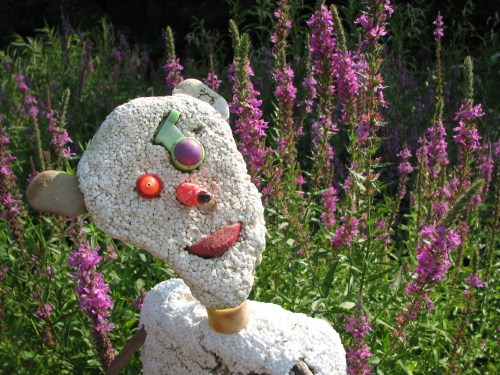
Head of figure on green seat, 8/09

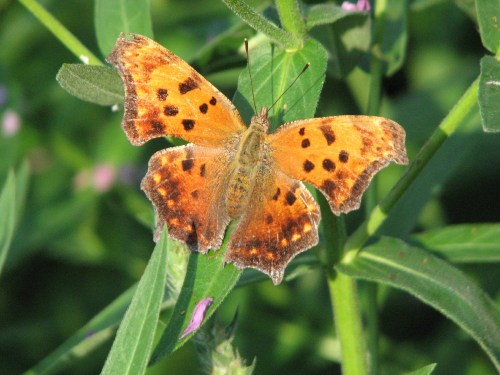
This sculpture is made from Styrofoam (polystyrene), driftwood sticks and roots, with various bits of found plastic.  There are several areas in the park that have gravel deposited from the last glacier of the Ice Age.  That’s the kind of rock that this figure’s ears are made from.  At this front row seat were several varieties of blooming plants that were animated with insect life.  Bumble bees and many species of butterflies were taking advantage of the nectar.  All along I have been photographing (when possible ) the different types of butterflies I come across.  Here is an image of the Comma with its well worn angle-wings.  This species is quite common here.

Comma, 8/09

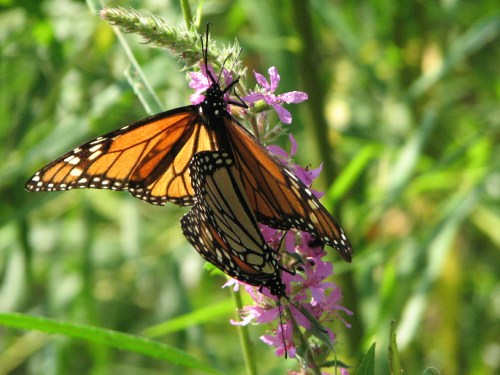
Usually, the lower, hind wings are darker, but this individual has managed to lose a lot of it’s scales.  The edges of its wings are a little more raggedy than normal.  This species has a pugnacious quality to it and I have seen it chase its own kind, other butterflies, and once in awhile…birds!  It has a strong survival instinct…as do these two Monarch butterflies.  This is the image I will leave you with to end this post.  I watched this joined-pair still flying (rather poorly) feeding from flower to flower while mating.  Now that’s multi-tasking for you!

mating Monarch butterflies, 8/09

Read Full Post »

View with Interpretive Center, 8/09

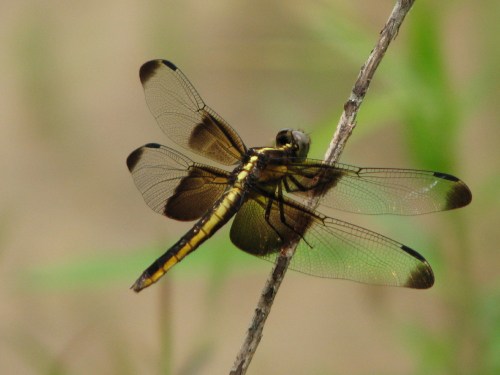
Now this feels more like summer.  The Ohio Valley heat and humidity just grabs your breath and makes it heavy.  After the flash flooding and torrential rains, I thought the park would look a lot different than it does.  You can see that the river did get high because piles of driftwood form a meandering line where the water stopped and receded.  I checked out the new arrangements, but the object that stands out as the find of the day was a plastic, crinkled, French fry!  Something new for the “Fake Food Collection”. dragonfly, 8/09


All manner of insect life is present today.  Various dragonfly species patrol the air space just above my head.  I watched a small thread-waisted wasp carry a caterpillar across the sand.  Ants follow their chemical trails through the driftwood.  Some of the willow trees are exuding a sap that’s attractive to dark-bodied flies and an occasional monarch butterfly floats by.  With all this buggy activity, I can feel the energy of life all around me.

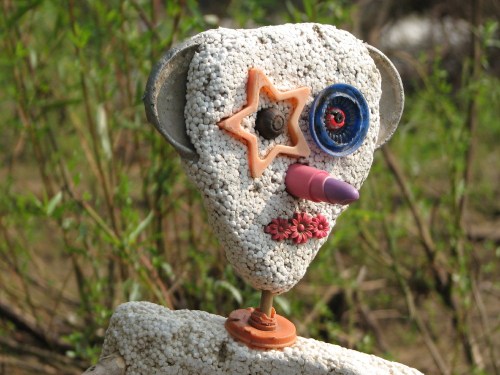
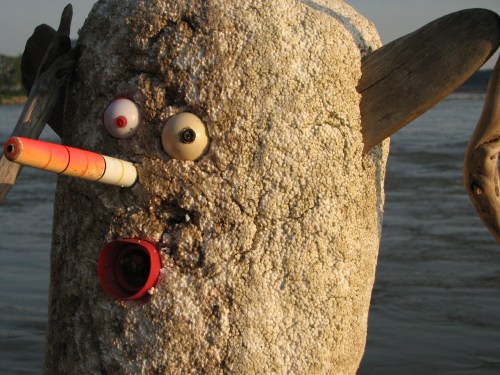
Head of Starry-eyed figure, 8/09

The river stopped just short of my studio site.  As I was walking towards it with today’s finds I could hear the voices of children coming from that direction.  For the first time, I actually came across people standing in my spot.  I know I surprised “Grandma” and her two grand children, a boy and a girl.  She explained very quickly that she lives in Clarksville and wanted to take the kids to the river and get exposure to nature.  The girl was holding a small doll I had found months ago and her brother was carrying the wooden ax I had fashioned for my Prince Madoc figure.  Grandma said that they just came across my site and thought some old drunk had hauled all this trash to this spot!  No I explained, it’s just me…some other kind of eccentric with artistic inclinations.  Grandma, however, wasn’t interested in continuing the conversation and the boy laid down the faux weapon.  I said he could have it and his eyes lit up in the way boy’s eyes shine when they get to hold sticks and guns and there is a suggestion of danger.  I told him that if he struck anything with the ax that it would just fall apart.  Grandma said that if they ran into trouble that she wasn’t too worried.  She dug her hand into one of her short’s pockets and pulled out a wicked looking black folding knife!

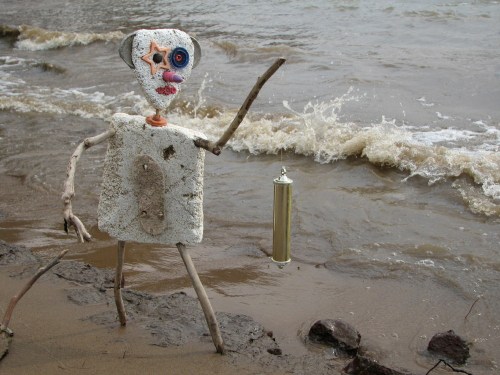
Starry-eyed figure w/ Gold Ornament, 8/09

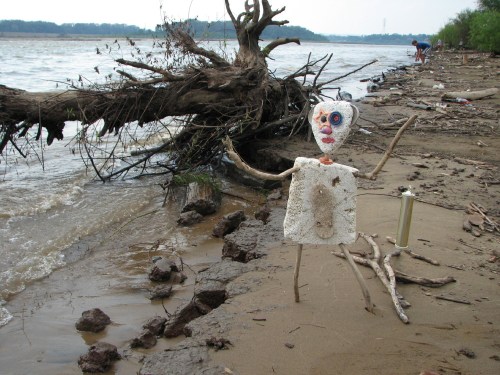
Standing proudly by the river is today’s figure!  It’s all stuff I came across between the parking lot and my studio spot.  The plastic star is either a child’s cookie cutter or a clay tool of some sort.  In the center of the star is an acorn.  The other eye combines an orange foam fishing bobber with the cap from a milk jug.  The nose is a fake, plastic tube of lipstick.  The ears are made from the bottom of an aluminum can.  Can you guess what the mouth is?  It’s a hair barrette.  On the end of some old fishing line, the figure holds a plastic, gold ornament of some kind.  I like the way it shines in the light.  I attached the sole of a child’s sandal to the body to create another area of interest.  The rest is Styrofoam and driftwood sticks.

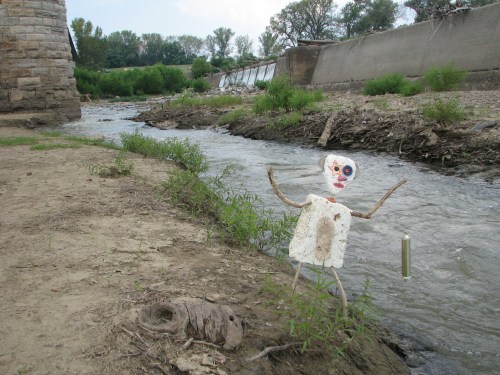
Starry-eyed figure by river, 8/09

I had forgotten how uncomfortable the heat can make things.  My t-shirt and jeans were sticking to my skin.  On such a warm day, why don’t I wear shorts…surely that would be cooler?  Yes, but over the years I have torn my legs up on sharp-bladed grasses, endured insect bites and poison ivy, scratched myself climbing over driftwood and bruised my knees slipping on wet fossil rocks.  You get tired continually healing from something.  I can live with a little perspiration every now and then.

By the wier dam, 8/09

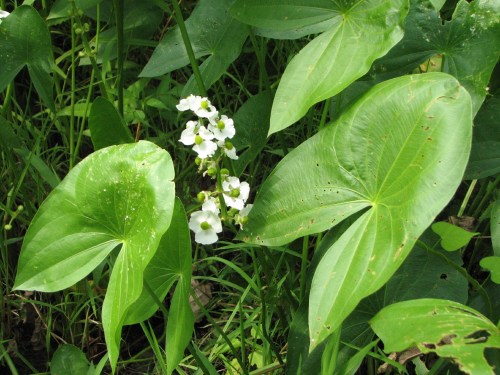
This image was taken under the railroad bridge and next to the eastern tainter gates.  The parking lot is just beyond and up on the hill.  It’s hard to imagine that the level of the river is just about to the top of the wall on the right.  You can’t get any lower in the valley than being at the bottom of the Ohio River, but here at the Falls you can get a feeling for that.  I noticed that the leaves are starting to turn yellow and so summer’s days are numbered.  I did pass a stand of broad-leaved arrowhead plants with their white flowers and thought this a good way to end this post.

Broad-leaved Arrowhead in bloom, 8/09

Read Full Post »

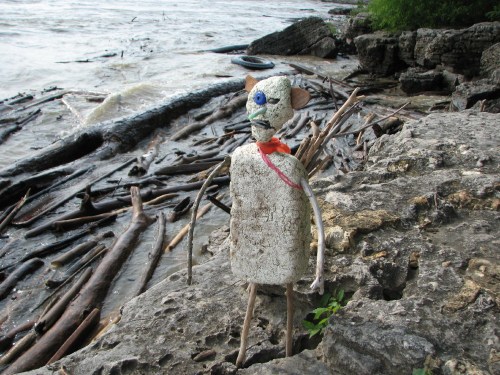
The Woodsman, 8/09

For generations, folks around the Falls (or the Wickets as they are known among the locals) have been gathering the driftwood.  Some use it to decorative effect.  I met a man who told me he gets $25.00 per arrangement for attaching plastic flowers artfully onto small, but nice pieces of driftwood.  I have also seen where people prefer their wood plain and display it along with their other yard art.  And then there are those who prefer to burn what they collect during the cold months.  Whatever your preference…there’s no shortage of wood around here.

Woodsman on the rocks, 8/09

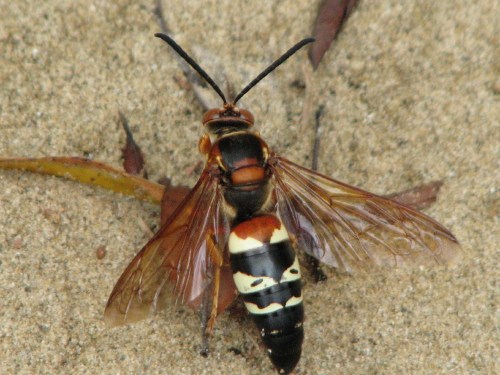
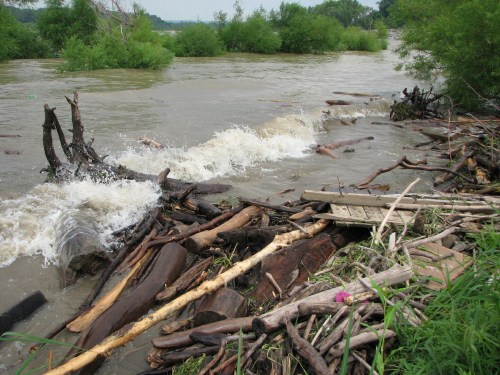
The river has been up and the wood has been gathering at the high water points.  Once the river goes back down, there will be these neat lines of wood to remind you how far up the bank the river has traveled.  Insect life is abundant now.  I’ve seen many butterflies and other pollinating insects.  What caught my eye this time were the large wasps better known as Cicada Killers.  They are aptly named.  The female wasps are huge and are among our largest wasps.  Hunting the cicadas exclusively, the female wasp will paralyze it’s prey with a sting and drag it back to the hole it has dug in the earth.  In the burrow she will lay her egg on the still living but immobile cicada.  Soon the egg hatches and the larval wasp will feed upon the cicada and another generation will play out.  Here is a picture of a male Cicada Killer who has confused a dried willow leaf for a female and is attempting to mate with it.  Males are two-thirds the size of the females.

Cicada Killer, male, 8/09

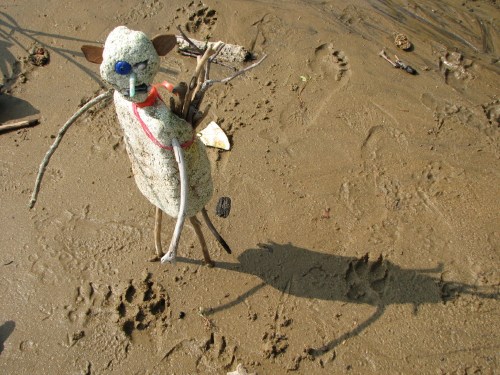
There are all kinds of other giants around here.  Check out the tracks left in the wet sand by various creatures also drawn to the river.  It’s fun trying to identify the various animals that call the Falls home by their spoor.

Woodsman with tracks, 8/09

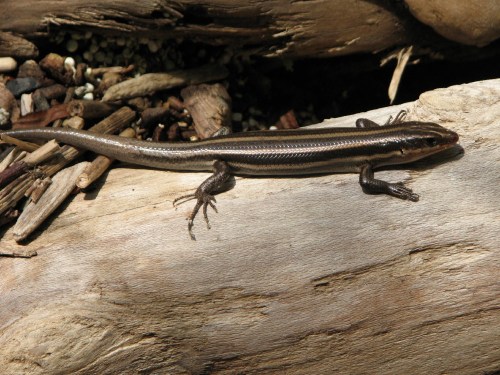
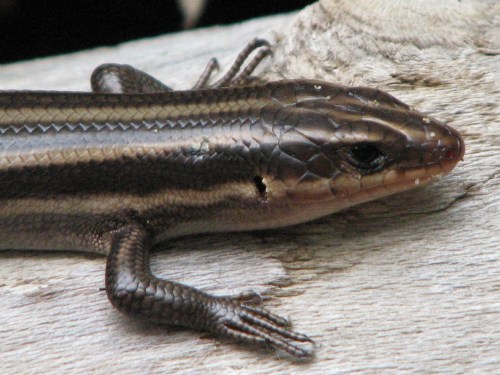
Now is also a good time to see lizards basking on the logs.  Here’s two pictures of a Five-lined Skink.  They like to burrow under the driftwood and hunt insects in the tangles.  Their young are the small familiar lizards with the blue tails.  This one allowed me to get close before darting away.

Five-lined Skink, 8/09

Five-lined Skink, detail, 8/09

One last image and thought before I turn for home.  I have been looking at old camp fire sites and feeling the ritualized antiquity in them.  It’s time now to take this wood I’ve gathered to my place.  I will build my fire tonight and connect with those who came before me in the hypnotic dance of the flames.Woodsman and camp site, 8/09

Read Full Post »

high Ohio River, 8/09

As a child, I can remember the moment when it occurred to me that recorded history doesn’t always measure up to the truth.  It happened in the third grade when we were reading about the discovery of North America by Christopher Columbus.  The teacher brought up the subject of Leif Ericson and his documented voyage to Vineland.  I remember thinking that if the Vikings were first…why were we making such a big deal out of Columbus?  Unfortunately at the time, the proprietary rights of the indigenous Americans didn’t figure into the discussion.  Later I learned that history is indeed fickle and subjective and usually supports the point of view of the victor or whomever was doing the recording.  That turned out to be a valuable lesson in life, although I didn’t know it at the time.

Prince Madoc, detail, 8/09

Among the many things I love about the Falls of the Ohio is the story of Prince Madoc and the Blond-haired, Blue-eyed Indians.  When Lewis and Clark began their exploration of the continent, President Jefferson asked Lewis to confirm their existence.  These people would be the descendants of a colony of Welsh travelers  that accompanied a Prince Madoc back around the year 1170 A.D.!  An even earlier date, five hundred years earlier, has been suggested as the time of the actual voyage and is connected with the descendants of King Arthur!  The most persistent stories, however, go back to the 12th century.

Prince Madoc, 8/09

After arriving in what is believed to be Alabama’s Gulf Coast…Madoc and his people eventually filtered into the heartland by traveling along the rivers.  In their wake, they left little evidence, however, a series of stone fortifications built by unknown hands is attributed to them.  According to a native American oral tradition, these blond-haired, fair-skinned people existed and were routed in battle near the Falls of the Ohio.  The survivors kept moving where they may have merged with the Mandans in the Dakotas.  Lewis and Clark did encounter the Mandans and found them different from the other Indians.  The artist George Catlin did the most extensive study of this tribe before they were all but destroyed by smallpox.  Those survivors later integrated with other native American groups. 

Prince Madoc at the Falls, 8/09

The physical evidence isn’t great.  There are the stone works… walls, fortifications, altered caves, a limestone slab from Kentucky with what appears to be runic writing in ancient Welsh on it.  A few unusual burials have been documented in our area, but nothing definitive has made the case.  Strangely though, there have been documented discoveries of Roman coins. One cache was turned up in the 1960’s during the construction of a bridge crossing the Ohio River at Louisville.  The coins’ discoverer gave two of them to a friend and kept the rest for himself and these were lost again?  The two surviving coins were eventually given to the Interpretive Center at the Falls where they were put on display with facsimiles to simulate the discovered horde.  Other coins have been found in other locations.  Usually, these finds are poo-pooed away as outright forgeries or instances where modern people just happened to lose Roman era coins!

Prince Madoc, in progress, 8/09

I’m sure that history must be full of forgotten stories and the discovery of this continent is among them.  This place has probably been “discovered” and “lost”  on a number of occasions.  With Madoc, whether his story proves to be fact is not as important as the tale itself.  What we remember frequently trumps the truth anyway and seems all the more compelling because there is a persistent mystery surrounding it.  In my own way, I enjoy working in this gray area between fact and fiction as I interpret life at the Falls of the Ohio.  If anyone is interested in the Prince Madoc legend…the links provided for the Falls of the Ohio State Park and the Falls archaeological society can be found in my web log to the right.

Read Full Post »

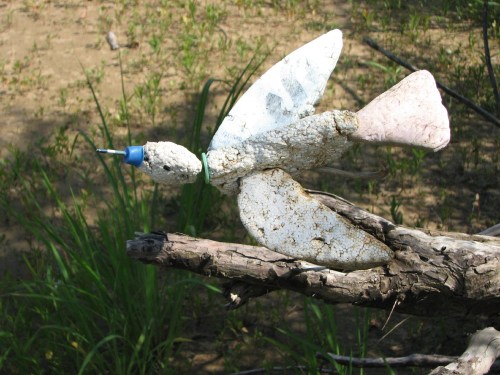
Styro-swift, 7/09Styro-swift, closer view, 7/09

When I’m out by the river I’m also thinking about what birds I might see.  That’s especially true during the Spring Migration when there’s a good chance I will run across a species I’ve never seen before.  In the advent that nothing new comes along…I’m not adverse to making a bird myself!  Above is a quickie that I made recently.  I call it a “Styro-swift”.  The materials are essentially the same as before, polystyrene, wood, plastic, and coal for the eyes.  The bill is made with the broken teeth of an old comb.  With more time, I think I could have photographed this better.

Indigo Bunting, male, 7/09

Here are three recent and very real birds.  The first is a male Indigo Bunting and he’s puffing his feathers out displaying to the unseen female in the bush above him.  Perhaps it is a trick of memory, but the Indigo Buntings I remember in western Kentucky were darker and more iridescently blue.  The Falls birds seem much lighter in color.

Bathing male American Goldfinch, 7/09

I can always count on seeing American Goldfinches.  This male is obviously taking a bath, but this area on the beach seems special to them. Perhaps there is something in the water and grit here that benefits them?  It’s a kind of goldfinch lick.  I love watching their singing, rolling courtship flights.

young Bluejay, 7/09

This young Blue jay was so focused on the beetle he was trying to eat that he almost got run over by a truck.  I had to shoo him away from the danger on the road.  When I’m walking through the woods, I try to avoid jays and the alarm they can ring out to every other living thing in the area.  I have other bird images, but will wait to post them at a later date.

Read Full Post »

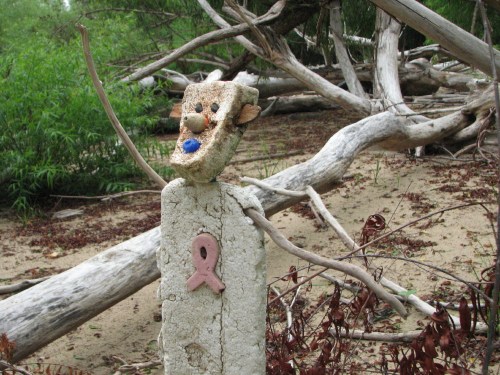
Figure with Pink Ribbon, 7/09

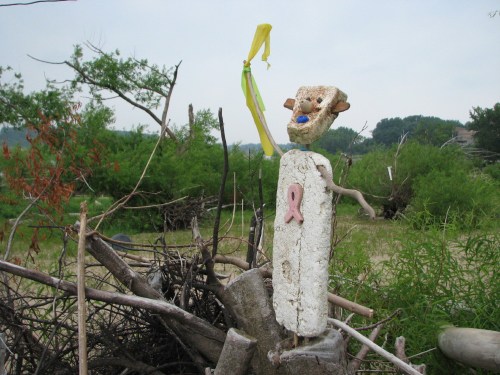
After my adventure with the Giant Blue Ant (previous post), I went back to my studio spot and created this figure.  I recently found this thick pink ribbon form and attached it to the piece.  It looks like something intended to create awareness of breast cancer and so I wanted to place him where he was sure to be seen.  In the end I decided to place this figure along the trail marked by yellow and green  plastic streamers and it was a short leap to merge the trail markers with the piece.  This is where I left it and the next day it was gone.  I hope it went to a new home that appreciates it.

Pink ribbon trail marker, 7/09

Pink ribbon trail marker, 7/09

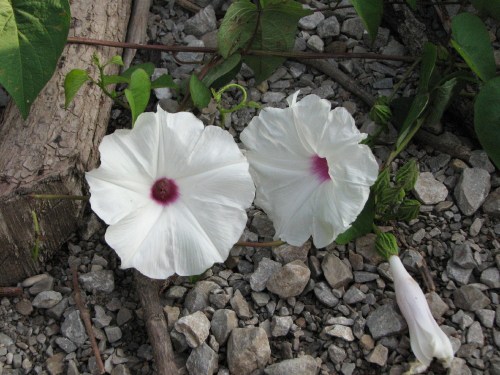
At the moment, there are large morning glory flowers blooming at the Falls and I thought this would be a nice way to end this post.  Until next time.Morning Glories, 7/09

Read Full Post »

Giant Blue Ant surveying river, 7/09

Investing time intensively exploring one little patch of the earth can on occasion lead to some big discoveries.  Such has been my experience following life at the Falls of the Ohio State Park.  Today’s post is about a recent discovery that has so far been kept very quiet.  How renowned myrmecologists E.O. Wilson and Bert Holldobler missed this species for their book “Journey to the Ants:  A Story of Scientific Exploration” will have to be answered by the authors.  The news is all the more compelling in light of a passage in Wilson’s autobiography entitled “Naturalist” where on page 128 he says that each September from his early teens until he graduated from college that he spent time with his mother first in Louisville  and then across the Ohio River in Jeffersonville.  It would be interesting to know what if any formative influence the Falls of the Ohio played on the early Wilson?  Wilson does recount a visit to Mammoth Cave in Kentucky, but doesn’t mention the Falls which are right in his mother’s former backyard.  But I digress…this story is about the Giant Blue Ant.

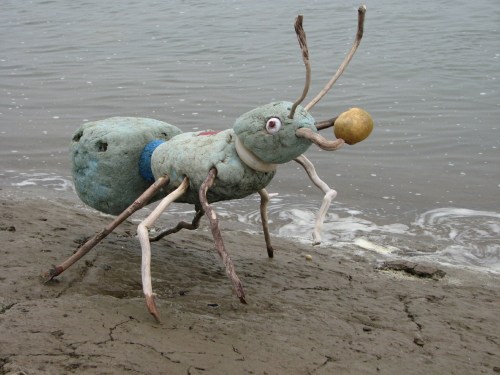
Giant Blue Ant, 7/09

I came across this remarkable insect in a section of the park that receives few visitors.  In my efforts to leave no stone unturned I braved many mosquito bites and brushes with poison ivy in an effort to learn what I could about the world’s largest ant.  In words and images here is the story thus far.  I was gathering art making materials deposited by the river after a recent flood when I observed a single individual moving through the plastic, Styrofoam, and driftwood.  So well adapted is the Giant Blue Ant to this environment, that to evade detection, all it has to do is remain motionless.  It’s an effective strategy since our kind are loath to notice the debris in the first place.  Over the course of several days I was able observe aspects of its behavior and I think, gain it’s partial trust.

Head of Giant Blue Ant w/egg?, 7/09

Ants are social animals, but I was only able to confirm this lone specimen.  From what I understand about ant morphology it appears to be primitive and may account for why it isn’t more socially evolved.  The most remarkable aspect of its behavior that I was able to watch centered around this honey-brown orb it carried around in its mandibles on the last day I saw it.  My first reaction was that this was some aspect of its food.  Like leaf-cutter ants, I thought this was some kind of fungus that it cultivated from organic matter scavenged at the Falls…but I now think I was in error.

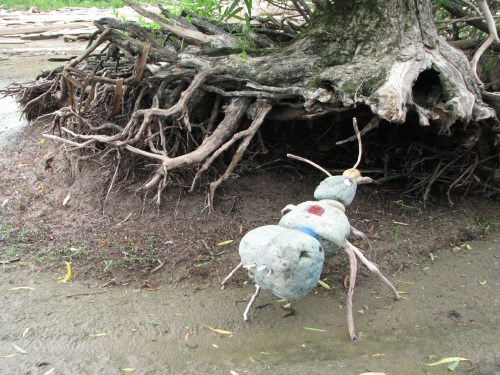
blue ant and willow roots, 7/09

I now believe the orb was in fact an “egg”.  I observed the Giant Blue Ant wandering around the park looking for a place to deposit its treasure.  Above is an image of the ant “considering” this willow tree with exposed roots, but in fact I don’t know where “she” eventually hid it.  I’m sure I don’t want to know because it’s too important a secret.  What if this is the last of its kind?  The responsibility would be too much for me to bear.  I’m not sure of this specimen’s gender and since I haven’t seen others of its kind…now wonder if in fact it reproduces parthenogenetically like aphids do?

Giant Blue Ant w/egg, 7/09

Two images of the Giant Blue Ant walking along the river’s shoreline and showing both sides of its body.  I did observe that one of the two holes on the right side of its abdomen held an active spider web.  Is this an example of some unknown symbiotic relationship between the ant and spider?

Blue ant facing left, 7/09

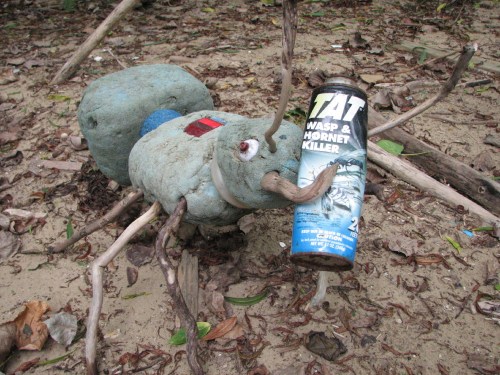
Blue Ant with bug spray can, 7/09

The very last time I saw the Giant Blue Ant I took the above image.  I don’t really know what to make of it?  Why is it carrying this old discarded can of insecticide?  Did I get too close and it was warning me to back off?  Was it asking me to put it out of it misery?  Was it trying to communicate the eternal question of Why?  Perhaps if that egg hatches and the new ant thrives I can eventually learn the answer to these and other questions.

Read Full Post »

Mr. Hand Grenade Heart, 6/09

Yes, I proudly admit that I’m a tree hugger.  And, the harder it is to wrap my arms around a tree the better I like it.  I realize change is a constant, but somethings are moving so rapidly that this hand grenade of a heart of mine …sometimes feels like exploding.

Falls landscape, 6/09

You may not remember the chestnut trees, but I do. Once they were the dominant tree of the eastern forests.  They had really wonderful leaves and their nuts provided food for all kinds of animals.  Now they are all gone.   Today’s trees at the Falls of the Ohio are a little removed from what was first recorded here.  Now, we feel somewhat secure in the knowledge that what we have is what we have.  It’s always going to be there for us…but big changes are walking the land.

Mr. Hand Grenade Heart, 6/09

I’m out here by the river all the time.  It’s around the edges, the interstitial zones, where changes can be seen most noticeably.  The weather and climate of the last two years have been especially hard on our trees.  Paradoxically, we have had spells where we had too much rain at one time, and then not enough.  Those gentle rain showers also seem to becoming a thing of the past.  Today’s storms are more fierce with energy.

Mr. H.G.H., 6/09

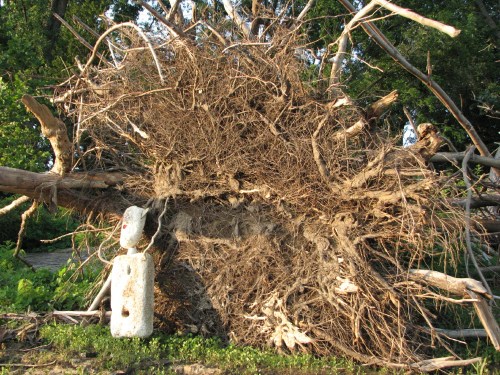
Last year’s wind storm from Hurricane Ike was an eye-opener!  With gusts clocked at over 70 plus miles per hour, the wind clothes-lined our trees.  Some snapped in half at mid-trunk.  Others fell over exposing their root masses when their leaves and canopies provided too much resistance.  The ice storm that followed in winter didn’t help matters any.  Already it’s considered the worst natural disaster to hit Kentucky in modern times.

Head of Mr. Hand Grenade Heart, 6/09

Why are we in such a big hurry to go nowhere?  Is it we just can’t help ourselves?  Already we are introducing exotic pests and diseases that are destroying our indigenous heritage.  Ever heard of “bacterial leaf scorch” or the Emerald Ash Borer?  Succession will occur sooner than later because our trees are already in a weakened condition.  Every time the water gets high, the Ohio River deposits its washed away trees here.

Mr. H.G.H. and roots, 6/09

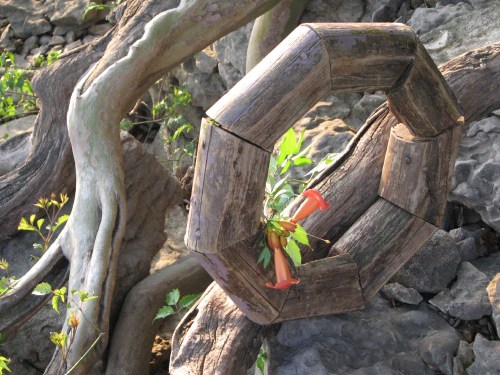
At the Falls…I can see the maple trees waiting in the wings along with trees introduced from other countries.  I don’t know what we can do about all that’s already put into play.  Perhaps we can try living more simply and do our part to reduce the causes of climate change?  When we travel, be vigilant about unseen invasive pest hitchhikers.  For now, I’m going to say goodbye to an old friend.  I’ve enjoyed the shade of this cottonwood tree for many years.  Treasure the big trees and keep them growing!

wood wreath with trumpet vine, 6/09

Read Full Post »

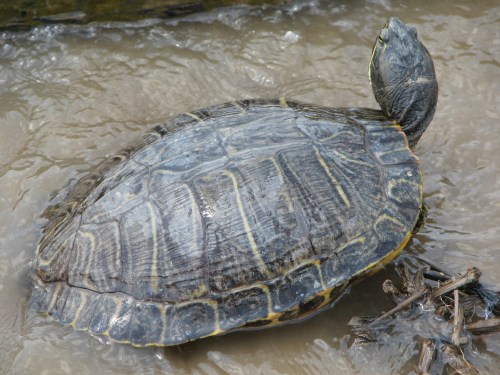
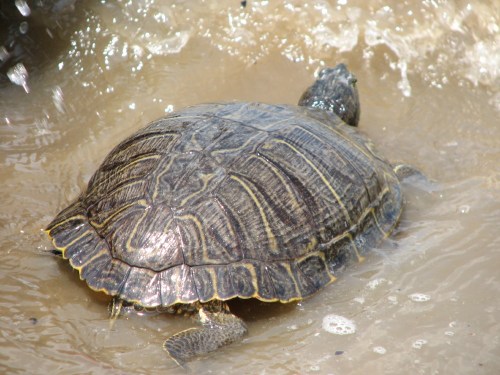
Red-eared Turtle, 6/08

This is a very lucky Red-eared Turtle.  I first came across this old guy more than a week before this picture was taken.  Far from the river I found it stranded among the driftwood.  I thought that was unusual at the time, but dismissed it by saying to myself that the turtle got there without my help and could get away whenever it wanted to.  I turned and left it alone.

Red-eared Turtle, dorsal view, 6/08

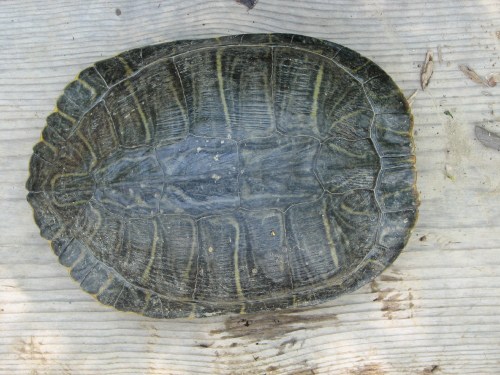
Red-eared Turtle, ventral view, 6/08

When I returned to the site much later, I saw the turtle was still there.  It was then I realized that the last bit of flooding had in fact stranded it.  Looking to be in good shape, I picked it up and made these photos.

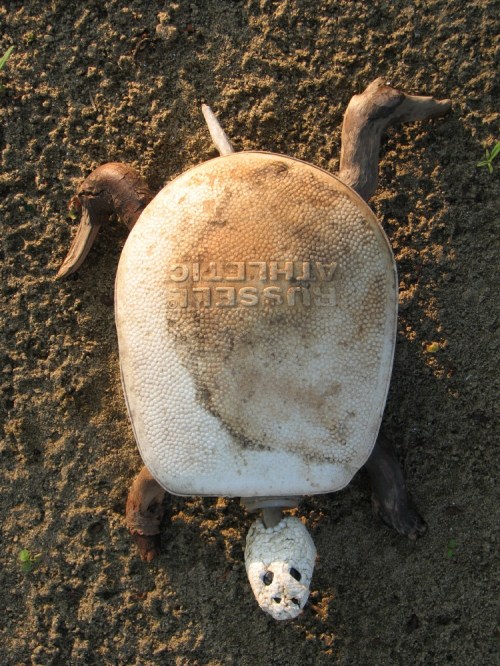
Russel Athletic Turtle, 6/08

Every now and then I come across some truly one of a kind turtles.  This is the Russell Athletic Turtle.  It’s carapace (the name of the top shell) in this case mimics the padding found in protective pads of football gear.  It’s usually found nearer the trees than the water, although it’s reputed to be a good swimmer when pressed.Russell Athletic Turtle, 6/08


The Russell Athletic Turtle is fond of grazing on the newest tufts of river grass found at the Falls.  It’s geographically limited and so is considered a threatened species worth conserving.

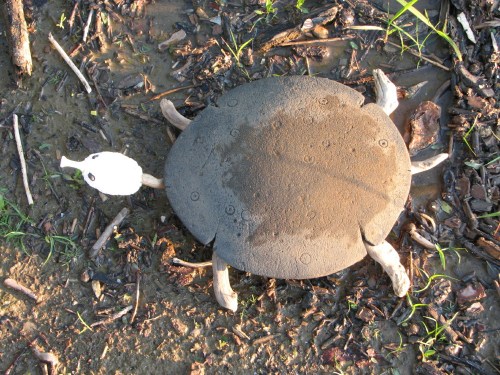
Black Softshell Turtle, 6/08

Black Softshell Turtle, 6/08

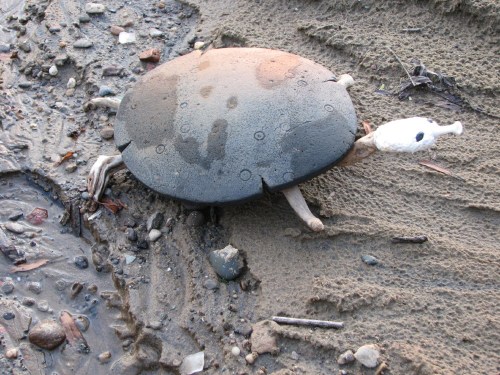
No where else on the planet can you find the spectacular Black Softshell Turtle, except for this park.  The above images are groundbreaking because this exceedingly rare turtle hasn’t been recorded in many years.  These are also in all probability the only known color images.  At the Interpretive Center a few, old grainy images of this softshell turtle are preserved in the library and the museum boasts a partial skeleton in its collection.

Black Softshell Turtle, 6/08

Like other members of the genus Trionyx, the Black Softshell Turtle lays it’s eggs in a sandy nest excavated by the female in a suitable riverbank.  I watched this specimen for several minutes before it returned to the river and hoped that I wasn’t watching the last of its kind slipping beneath the waters.  At least these images will help keep its memory alive. 

Wondering what happened with the Red-eared Turtle I started this post with?  I carefully picked up the turtle by the edges of its shell, being sure not to get my fingers in harm’s way, and placed it at the river’s edge.  At first, the water washed over the top of his shell and the turtle’s head and legs remained tight within.  Slowly, the water revived this turtle and I watched it disappear into the Ohio River.

Red-eared Turtle, 6/08

Read Full Post »

« Newer Posts - Older Posts »