Feeds:
Posts
Comments

Posts Tagged ‘recycled art’

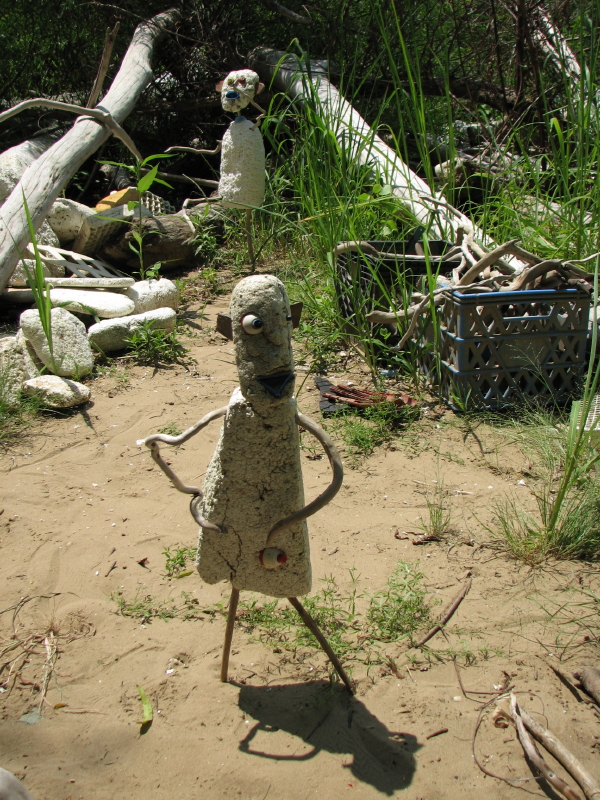
Vulture Boy hung out with me today at the Falls of the Ohio.  He’s a bit of an odd character and I don’t see him often.  He spends most of the summer observing the resident vultures of both species that live here.  He’s studying them. Vulture Boy also thinks of himself as being a bit of a survivalist and when civilization collapses…he will be able to fend for himself by mastering primitive weapons. 
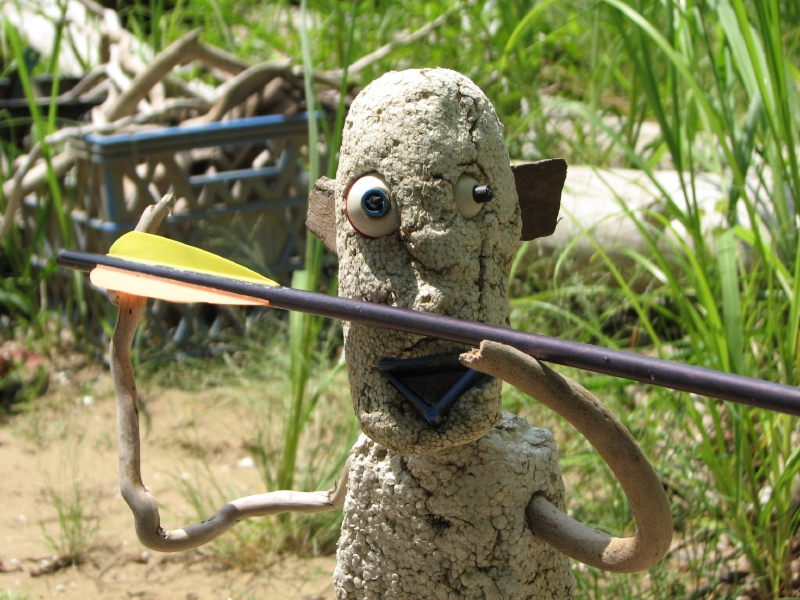
He’s still a boy after all and seems to gravitate towards sticks and stones.  There must be some primeval aesthetic operating here that’s hard-wired?  Regardless, what I enjoy are Vulture Boy’s stories and encounters with the wildlife he sees in the park.  He tells me that he saw some Black Vultures feeding nearby and would I like to watch them?  I pick up my camera and follow him to the river.
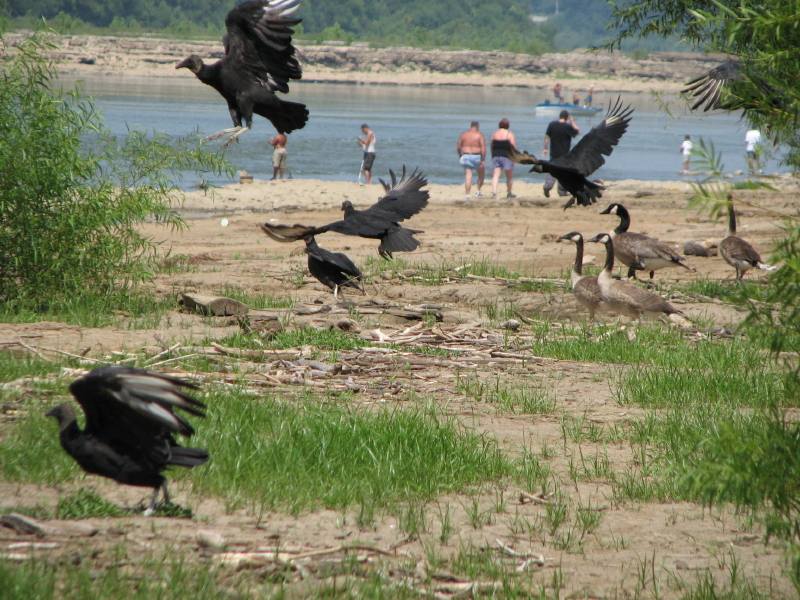
Along the way we surprise two flocks of large birds!  It’s another very hot day and both the vultures and Canada geese are taking advantage of the shade under the biggest trees.  It’s cooler, but they are also vulnerable standing on the ground.  Some passing fisherman got too close and both flocks spooked and went airborne.  I could practically feel the whoosh of air pass my face as the vultures struggled to lift skyward.
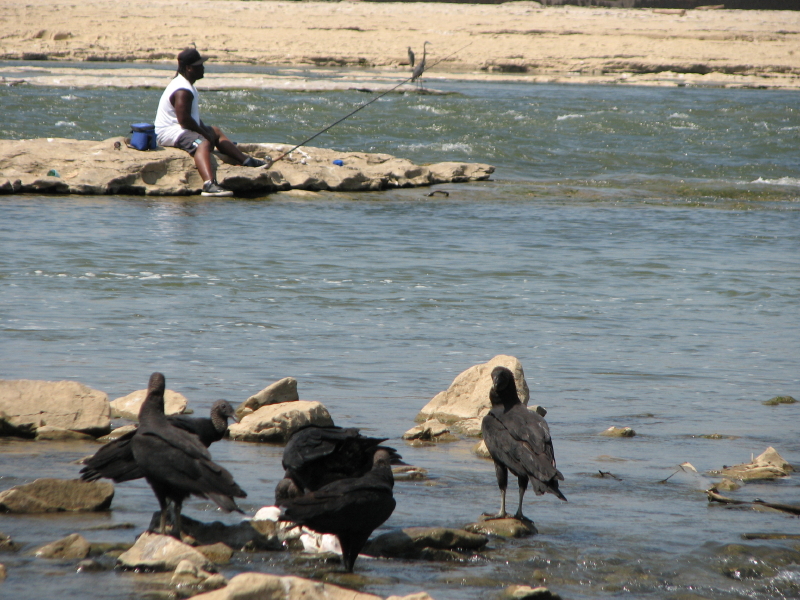
Reaching the river, we find a few Black Vultures feeding on a fish carcass.  They were completely unconcerned about the people around them.  I wonder in some way if the vultures recognize the relationship between the people and the availability of fish?  Vulture Boy says that they are smarter than you think and adapt to situations that benefit them.
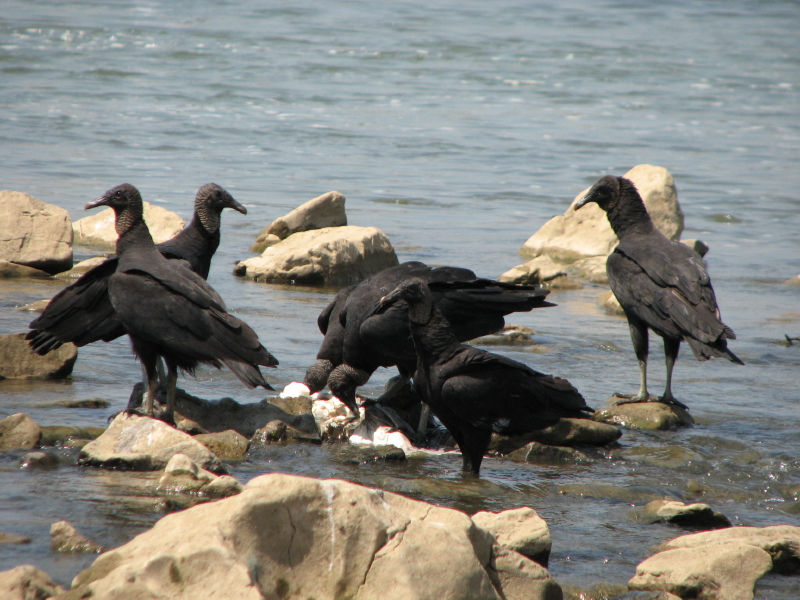
Slowly I move a little closer doing my best not to scare the birds away.  It’s tricky though because the rocks are very uneven and slippery in places.  With their all black bodies, I wonder if they feel hotter on a day like today?  That’s when Vulture Boy lays this factoid on me!  He says that Black Vultures (and other vultures as well) can excrete their waste onto their legs to cool them.  The process is called “urohydrosis”.  Charming! 

I asked Vulture Boy what else he liked or thought interesting about these birds and this is what I remember.  He said that they form strong pair bonds that are usually only broken upon the death of one of the partners.  Additionally, they do not build nests preferring shallow caves or protected rock ledges to raise their young.  Although Black Vultures may roost together, they do not like being near each other’s nurseries.  There is still that competition for food and a pecking order exists not only within the Black Vulture group, but with other species as well.  The shy Turkey Vulture usually surrenders his find to the more aggressive Black Vulture.
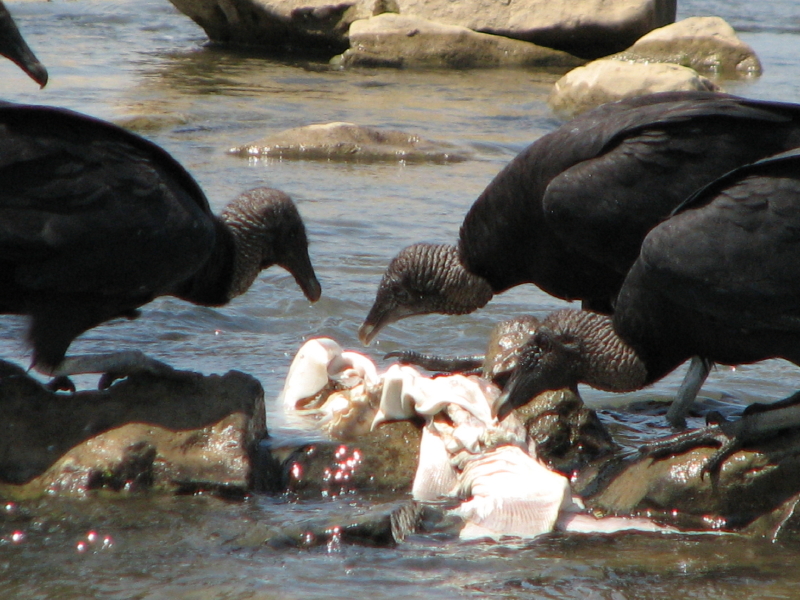
With their naked heads and necks…these vultures look more like the dinosaurs they are descended from.  The lack of feathers around the head helps keep things a little cleaner.  Still, I’m amazed that these birds are able to stomach most anything!  I’ve seen Black Vultures using their feet to help leverage a food morsel from the toughest meal.
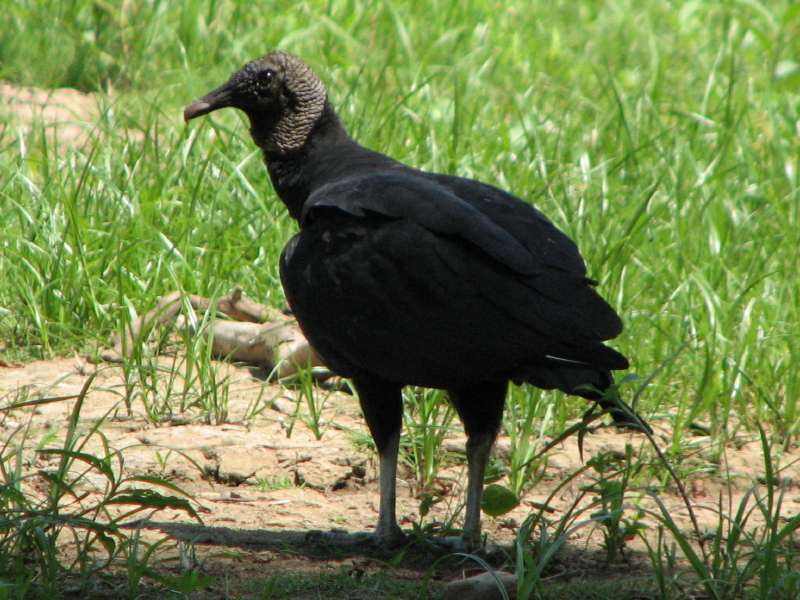
After watching the river vultures for a few minutes, it was time to go home.  Walking back the way we came Vulture Boy and I could see that some of the vultures had returned to the shade under the trees.  A few individuals were nervously posted along the outskirts acting as look outs.  We walked around them and left them be.  Nearby, we came across roosting vultures  high in a tree.  Occasionally, one of these birds would sun itself by spreading its wings and it seemed almost a reverential act.  Or, at least…that’s what I like to think! 

Read Full Post »


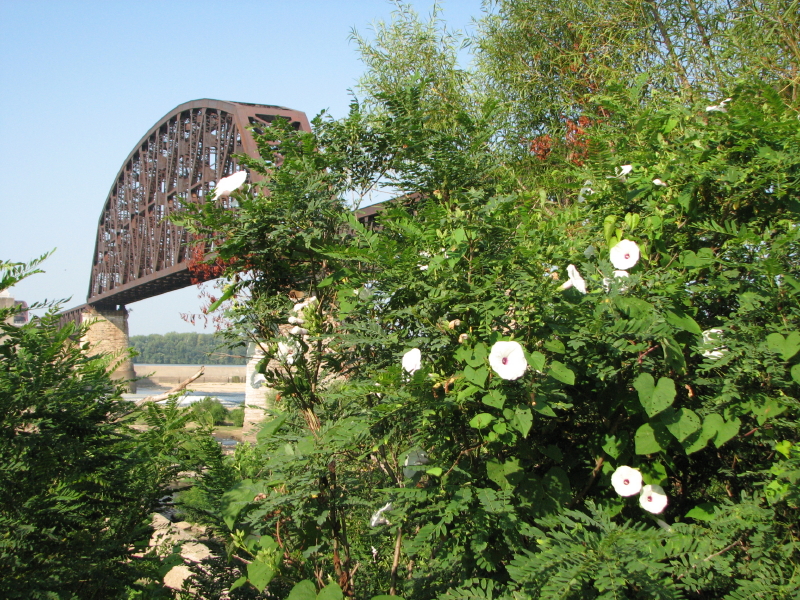
Every summer is different at the Falls and this one is starting to feel  overgrown with vines.  Walking through the vegetation, it doesn’t take long for one’s clothes to stick to your skin.  It’s been very hot here this summer and the high humidity raises the issue to another level.  Although I have never been to the tropics, I begin to feel like I know what it might be like.  The air is filled with cicada song and there are many insects of all types to be found. 

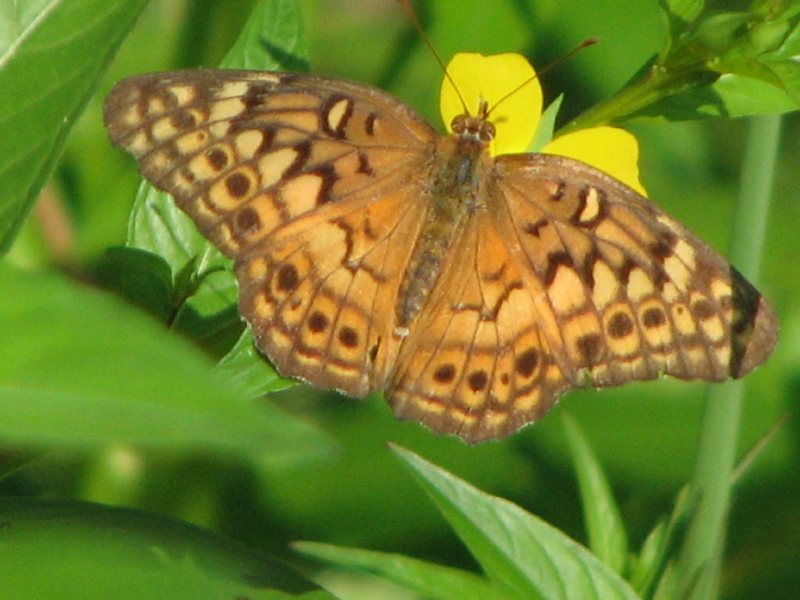
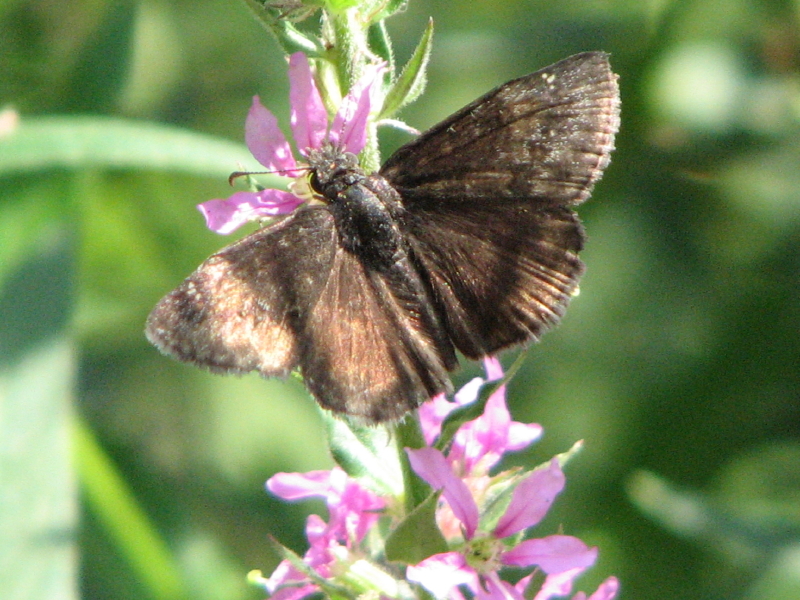
Overall, this has been a good year for butterflies.  I have enjoyed watching, learning, and photographing them as part of my Falls project.  At some point, I will probably post all my better images in my Pages section.  For now, I will release a few at a time as I come across different species.  Here are three new images that I made on this day .

I have seen more Buckeye butterflies this year than I have any other previous year.  Last week they were positively everywhere around the Falls of the Ohio.  This is a common species, but very pretty with its eyespots.  Apparently among professional lepidopterists, there is some disagreement about how to classify this butterfly because there are variations in its scientific name.  Some books list the Buckeye as Junonia coenia while other guides favor Precis coenia.  I haven’t read a good argument why one name is preferred over another!  I’ll wager the butterfly doesn’t care what we call it.

On this outing, I came across just one of these butterflies.  As they go it is rather nondescript and small.  Often the best way to identify a species is to check the markings on the underside.  With this butterfly I had just this single image.  After cross referencing a couple of butterfly guides, I’m fairly confident that this is the Variegated Fritillary, Euptoieta claudia.  With the Fritillaria, you need to look closely because there are many related butterflies.  Now the next species was even harder to identify!

I am not at all certain on this one, but my educated guess is this is the Scalloped Sootywing, Staphylus hayhurstii.  It’s fairly small and nondescript.  The very tiny white dots on its fore wing are a clue along with its fringy wing margins.  The geographic range looks good because this sootywing is found this far north.  I also note that one guide said this species prefers moist areas near willow and cottonwood groves and that certainly is here.  The sootywing is a member of the skipper clan which are a group of interesting butterflies that share characteristics with moths. 

For me, learning what other organisms share this space is a celebration of life.  Even the rather dull looking sootywing is spectacular by virtue of its existence which took millions of years of development to reach this point in time we could share.  On this trip, I enjoyed  just watching what types of insects were feeding off the loosestrife flowers.  It was easy to forget oneself in the collective buzzing and busy activity around this plant.

Read Full Post »

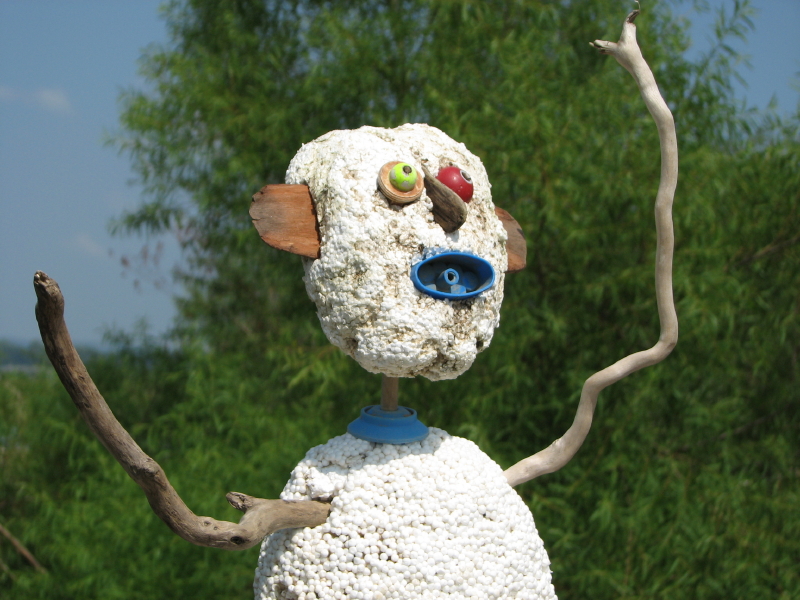
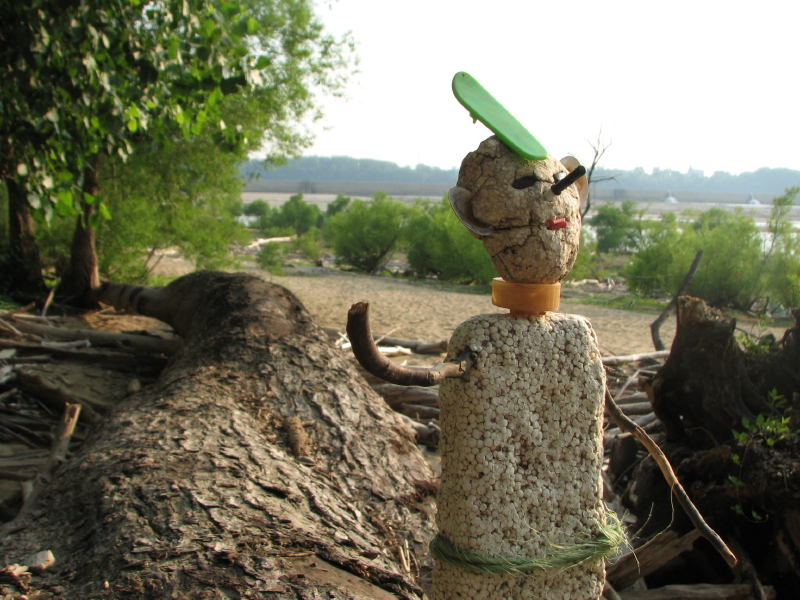
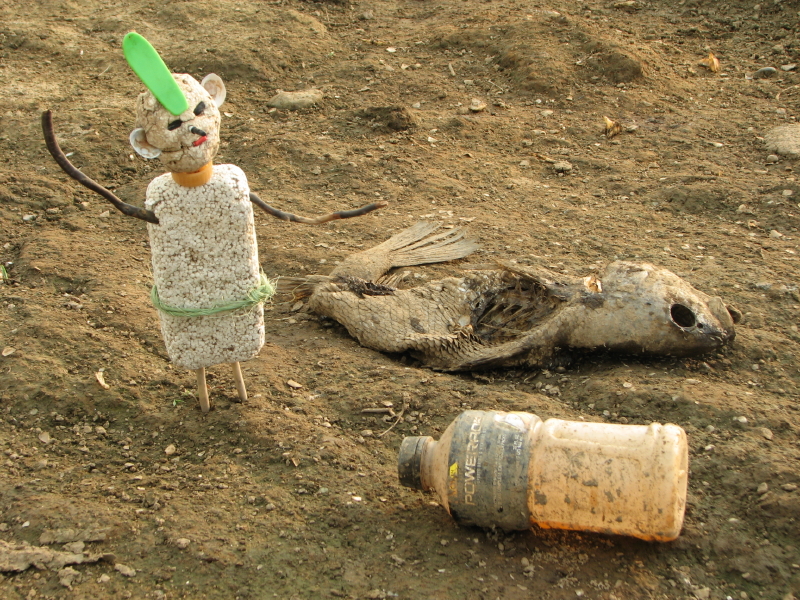
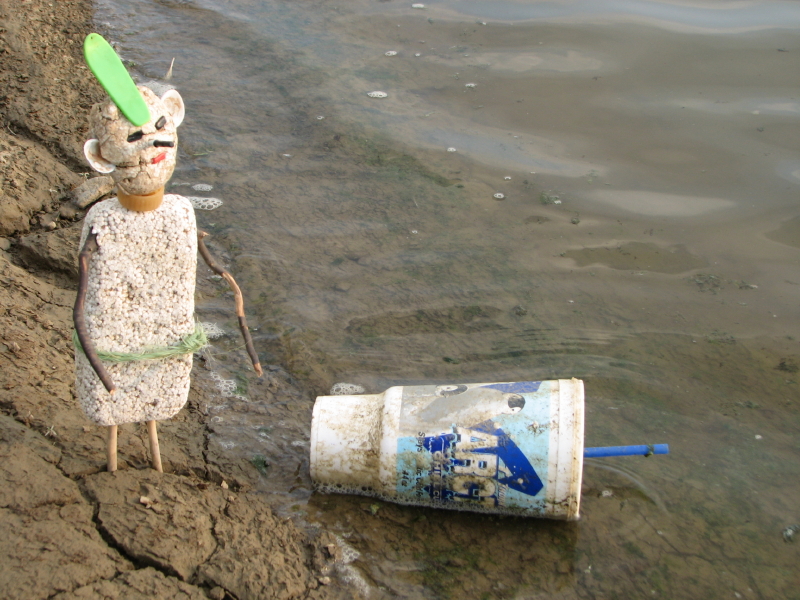
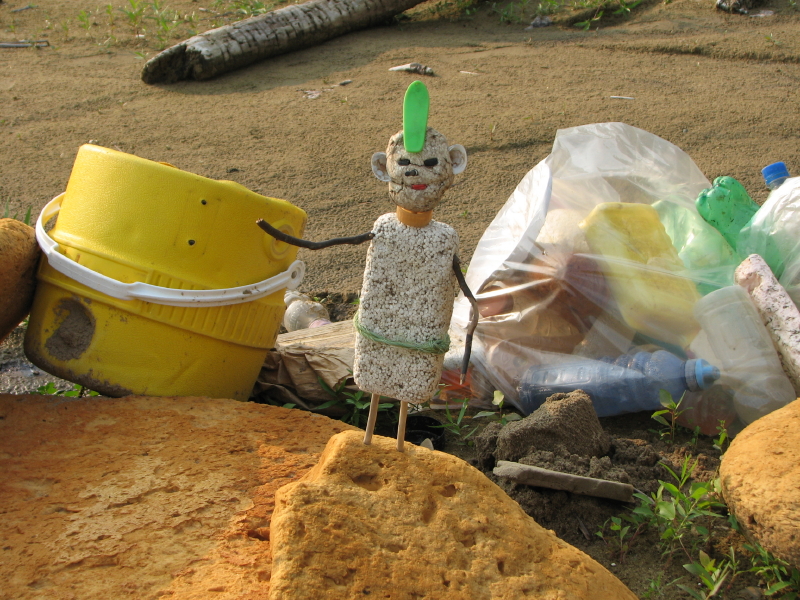
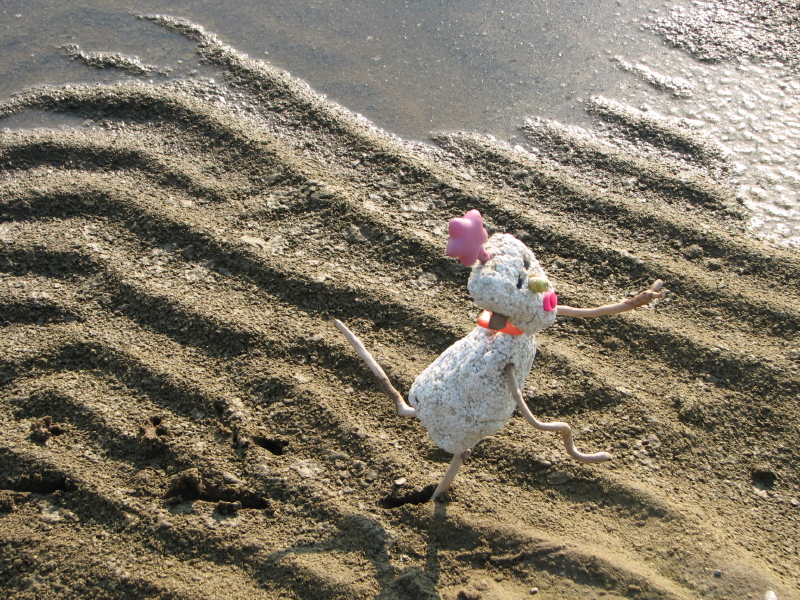
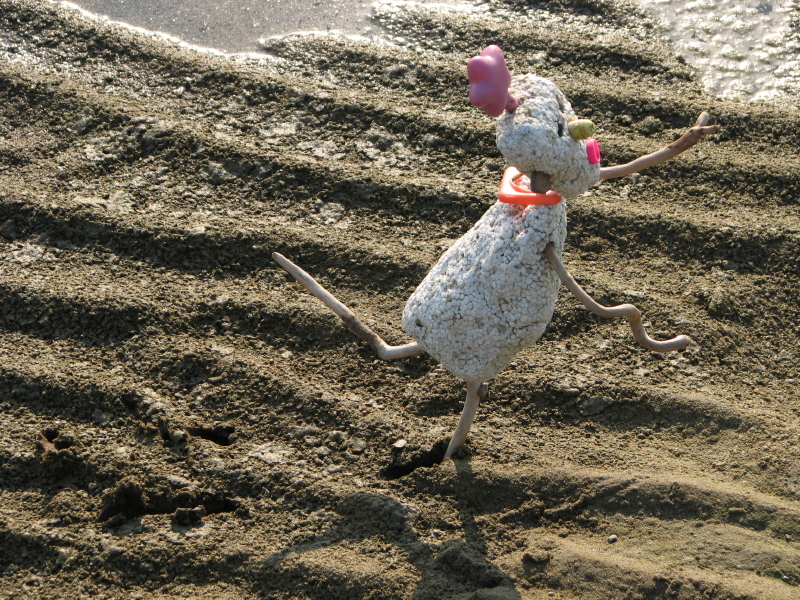
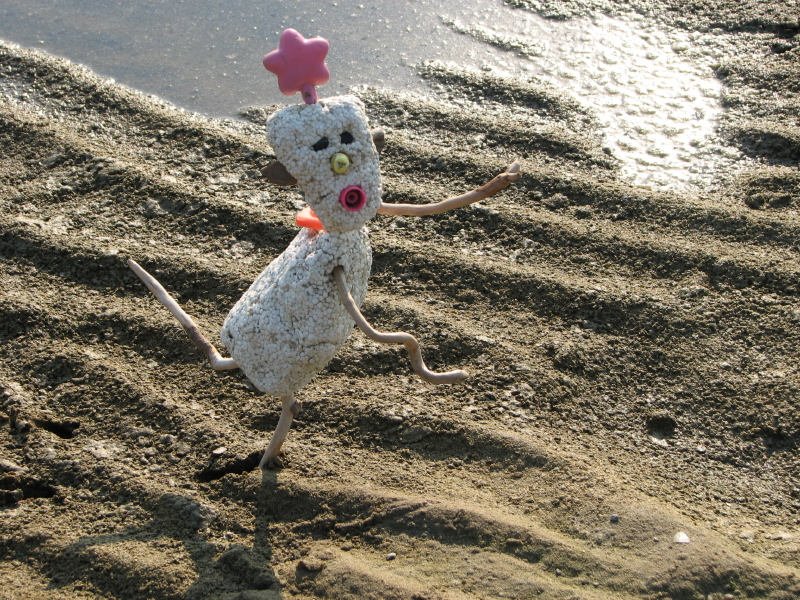
The other night after supper I had an hour or so to visit the river before the sun set.  So, I escaped to the river and my favorite park to check out the quality of the light as it slowly sets below the horizon.  During this time of year, the days are longer.  In short order, I was able to make this little figure from Styrofoam found on site.  What looks to be a green feather on this guy’s head is actually a miniature plastic skateboard missing its tiny wheels.  I used found coal for his eyes and his ears are small clam shells.  I tied some string around his waist for a belt.

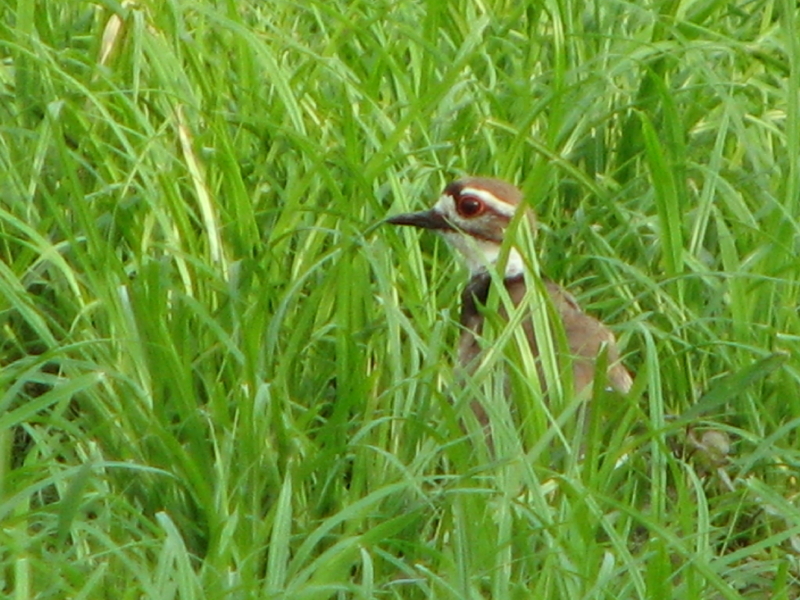
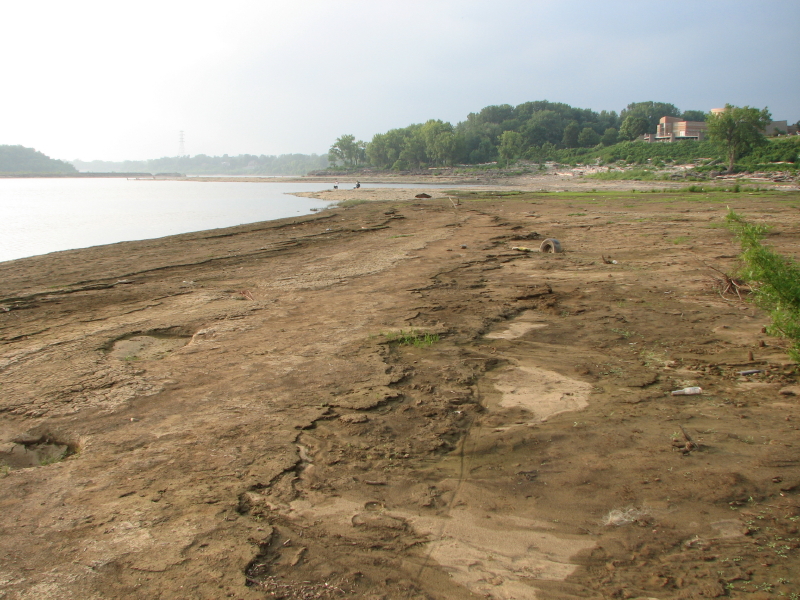
Although it rained lightly a couple of days a go, things are looking a bit stagnant and dry in places.  The weatherman on the television gave some earlier hints that strong storms were a possibility for our area.  We shall wait and see.  For now, a quick stroll is in order before the rain comes or at least until the sun sets for another day.  Wandering near the river, I hear the calls of Killdeer plovers who are so good at sounding the alarm whenever danger is present…in this case, it’s me.  I managed this one quick photo of a bird hiding in an isolated patch of  grass.  The bright red eye-ring is visible making its eyes appear larger.

I noticed that whenever one of the resident vultures flew over, this bird would duck down in the grass.  Although the vultures don’t pose any danger, the Killdeer instinctively hide from what might be a bird of prey intent on eating it.  I have seen an American Kestrel make a meal of one of these large plovers before way out on the fossil beds on the Kentucky side.

There is a drying out occurring and all the small pools of water are evaporating.  In the process, they become more and more stagnant and I bet there’s a wealth of life in a single drop of this water.  I move the figure closer to the river’s edge to see what we can find.

The fishermen have had their moments.  Left on the bank are the remains of dead fish and the trash the anglers didn’t want to deal with packing back to their vehicles.  Of course, the vultures love all the fish and make short work of them.  What the birds miss…the flies find.

I do get a bit upset by the litter left behind by the fishermen.  I wouldn’t consider them sportsmen because they seem to have little regard for this resource.  I wish the people in charge of patrolling the park would come down here more often than they do.  I’m sure they would find many people out here fishing without a license.  I think some official presence visiting occasionally would be a good reminder to keep this place cleaner.

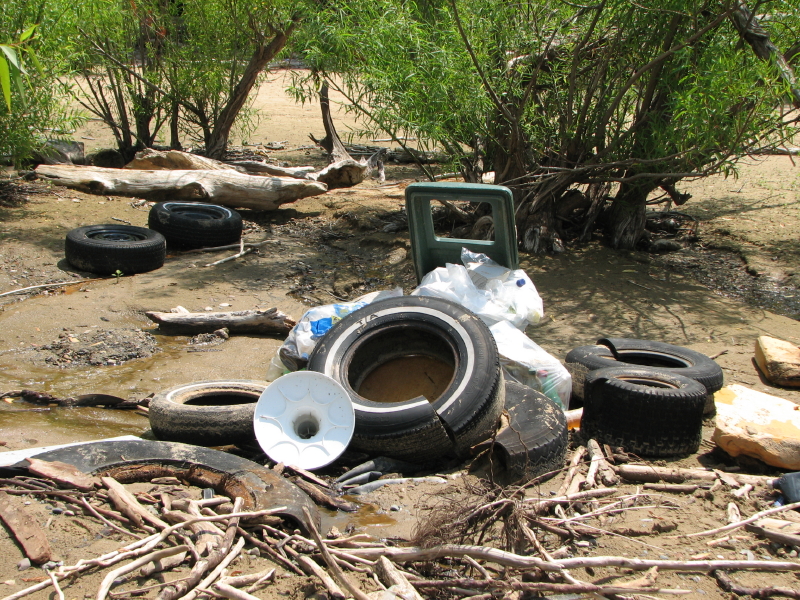
There are still isolated piles of previously collected river debris waiting for the trip to the landfill.  I hope at some point in the near future that this junk gets picked up for good.  For the moment, it represents a job half completed.  At this point in my visit, I perceive  that the quality of the light is different and a breeze is kicking up.  From the west I can see that the weatherman has a good shot of being right about his forecast.  A storm is on its way and I gather my stuff for the return trip home.  I hope the storm is a good one because this place could use a little freshening up.

Read Full Post »

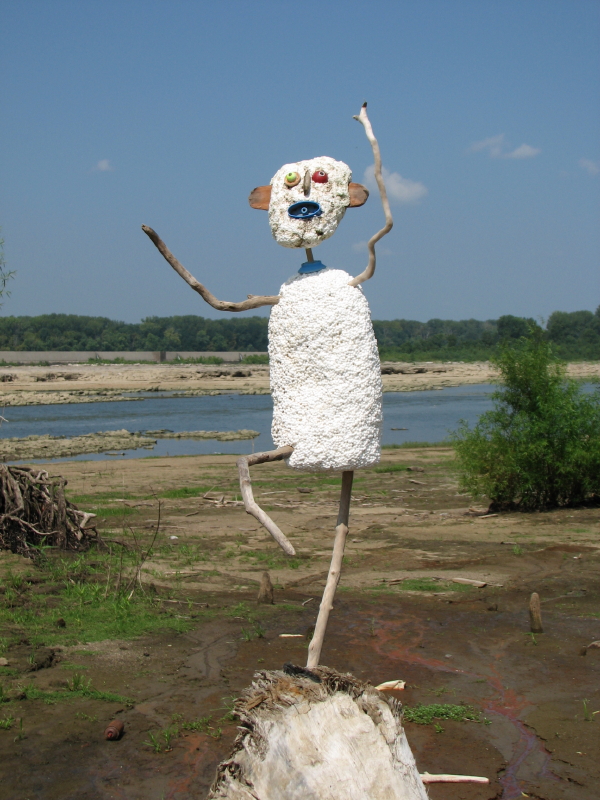
The late afternoon light has this wonderful ability to turn the normally silvery driftwood golden.  It’s a form of alchemy that nature performs on a nearly daily basis if the sun is willing.  I have a few hours to scout around and make something should the opportunity arise.  One of the first places I go by is my Styro-atelier to check on how the big figure Ariana and I worked on is holding up.  There is usually some suspense as to whether the spot has been discovered and will the sculpture be intact or there at all?

This time everything appears in order.  I sit on the nice plank of wood I found and set up to be my work area and I survey my materials.  Grabbing a smaller piece of Styrofoam, the beginnings of an idea start to take shape.   I will try to make my idea physical by using the poor materials I have scavenged off the riverbank.  I have given myself the limitation of not being able to carve the Styrofoam.  It would be easier to bend my idea to my will if I allowed myself to cut away.  As it is, I just poke holes in the Styrofoam.  In this way, I feel my process respects the shaping that the river has already done.  It’s an odd kind of collaboration, but I think the river is okay with this because the mighty Ohio has rewarded me in so many ways.  Having this limitation is also a bit of a nice challenge.

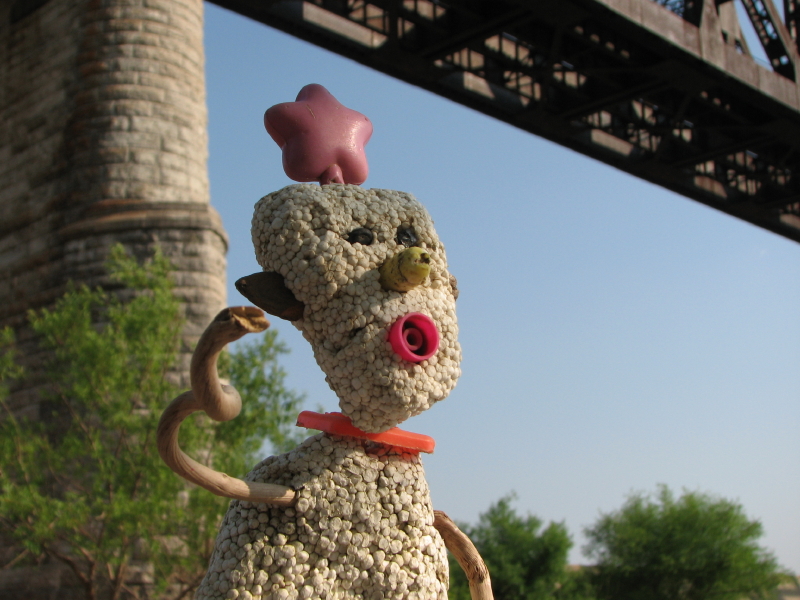
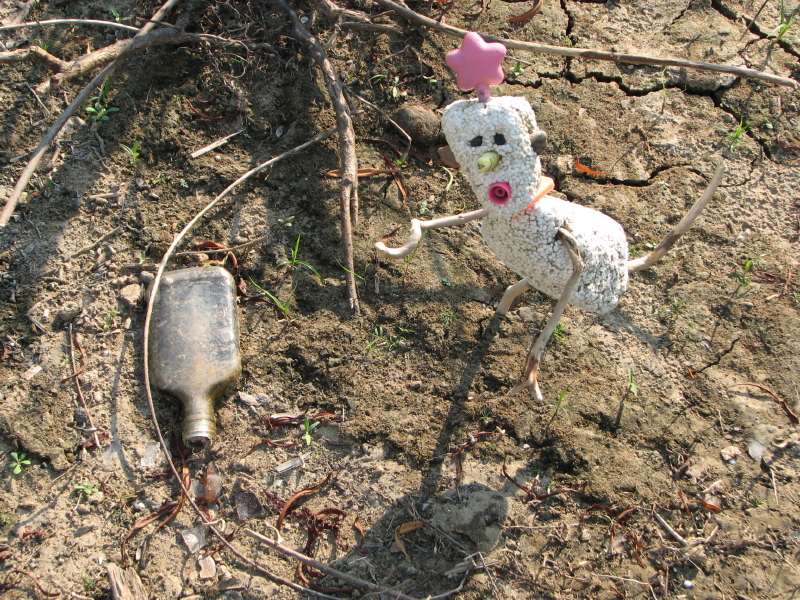
I created the head first and I have the interesting notion that much in life enters the world in this way.  Reaching into my grab bag of bits and pieces I find the plastic nozzle from an aerosol can and this becomes a mouth.  The eyes are dots of coal.  The nose is…I don’t know what, just some piece of yellow plastic.  The ears are wood.   I found a plastic pink star and this becomes my figure’s headgear.  I like the energy and activity of this pose.

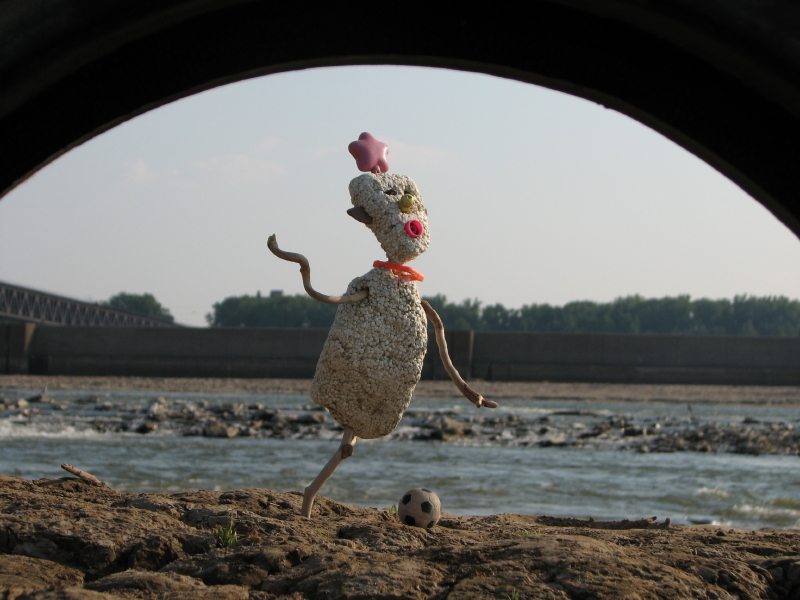
When I was younger, I used to do a lot of running.  Now, I do a lot of walking.  After so many years of sports and various forms of wear and tear, I can feel my age in my knees.  The figure in my hands has turned into a runner and I set him up around the Falls as though it were a cross-country course with obstacles to navigate around.  The Twilight Runner has had an easy time of it so far, but now the course is about to test him.

After running over a fairly dry shore line, our runner has jumped into an evaporating puddle.  It’s still too wet and our guy is becoming mired and a little panicky.  I recall as a child having this classic dream of traveling in the country by train.  At one point in the journey the train stops and passengers (myself included) disembark and wander into a field.  From over the nearby dreamtime hills the sound of barking dogs gets louder.  Everyone else hurries back to the train, but I stand there transfixed watching the pack of wild dogs cresting the hill and running towards me.  I manage to turn and start running back to the train, but the ground has turned to mud and every step in running away takes the greatest effort.  I could hear the dogs gaining on me, but I make it back to the train safely.  I do recall, however, feeling scared that I wouldn’t make it.  Mud has a way of making you feel helpless.  Fortunately, the runner is in no danger and the puddle is a small one and he manages to move onwards.

There are people fishing on the riverbank as the runner goes by a tire set upright in the now drying mud.  Among the junk deposited here by the river, the runner discovers a small soccer ball and decides to use it and the tire to good use.  It is World Cup time after all and I have a team in the finals for the first time since 1978! 

I was born in Amsterdam and have always followed the Dutch team.  I will need to find my orange t-shirt and hope it brings us luck.  If it doesn’t, well, I might need to go back to the river and walks things off a little bit.  Either way, it has been an entertaining tournament. I am glad, however, that this event only happens once every four years! 

Read Full Post »

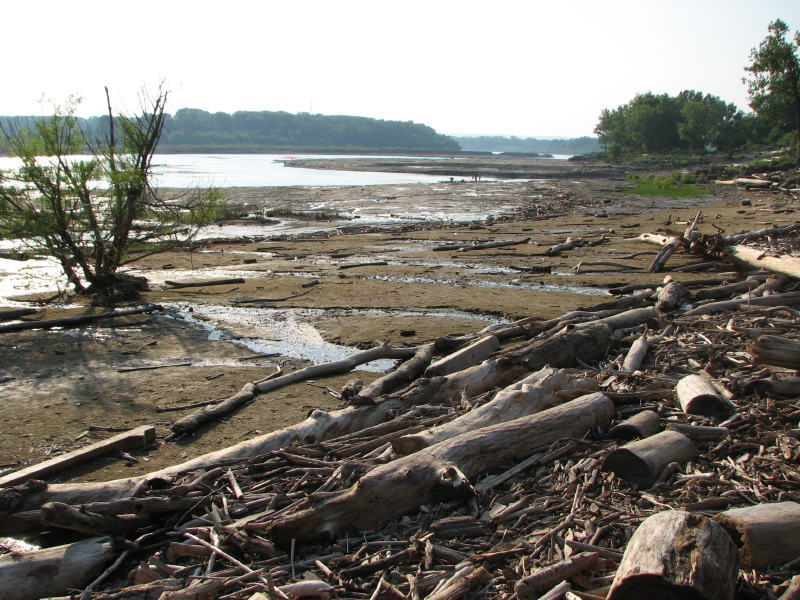
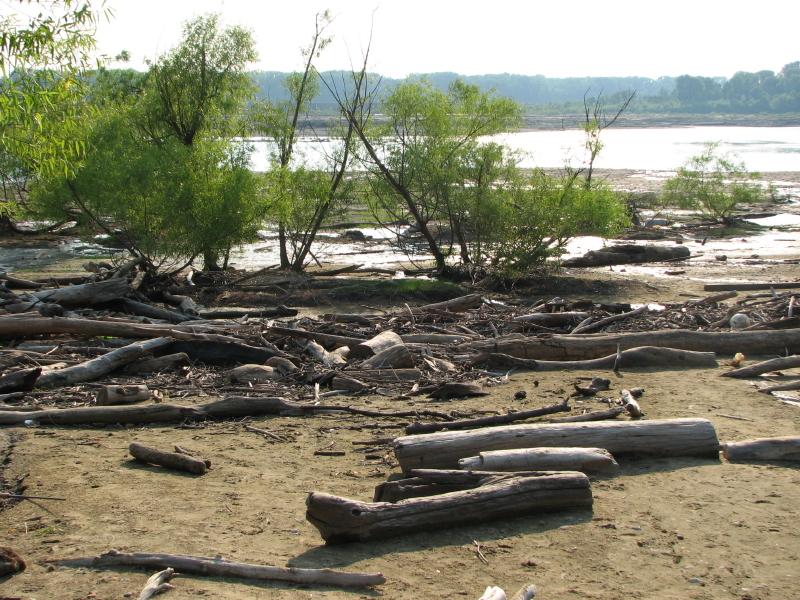
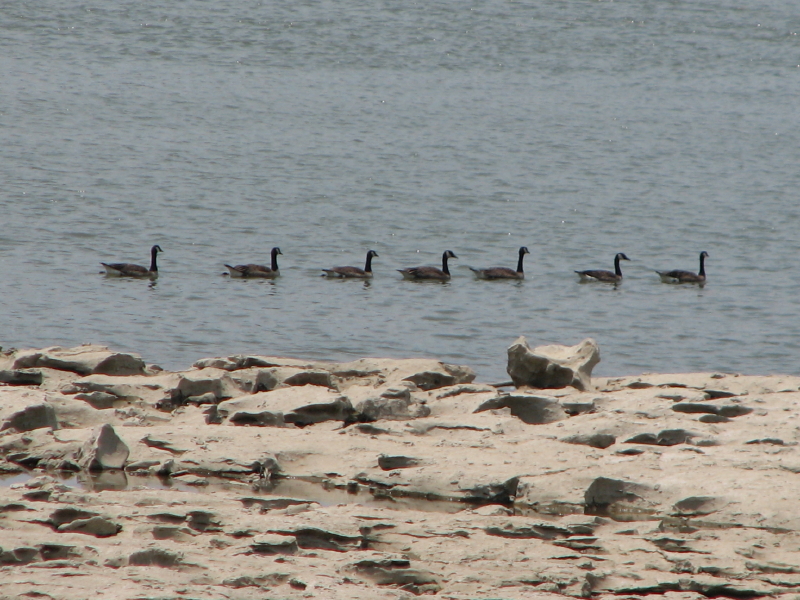
The river is falling, but is not yet in summer pool.  Day by day the extensive Devonian fossil beds are revealed a little at a time.  The limestone surface is scalloped by the actions of the Ohio River and appears to be the landscape from another world…because in fact it is!  Throughout the rocky matrix are the fossilized remains of ancient marine creatures that populated this reef over 375 million years a go.  While my thoughts are lost in deep time, a procession of stately Canada geese glides by which brings me back to the present and my own animal existence.  It is really hot out here today and I brought extra water to drink.  Slowly the first eight geese becomes a large flock as more and more birds reveal themselves that were hiding behind the huge rocks that mark the Kentucky side of the fossil beds.  From my vantage point I count 83 geese which are the most Canada geese I have ever seen here at one time!  In the warmer weather months, the number of bird species here is less than in the spring, but the indigenous birds are entertaining and I enjoy noting aspects of their respective behaviors.  Here are two new birds I haven’t previously featured and I hope you will like them as I do.

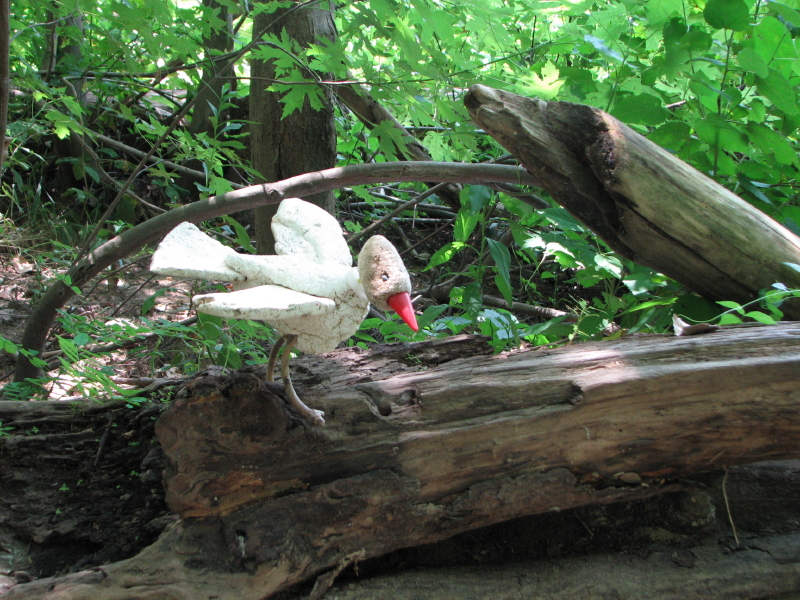
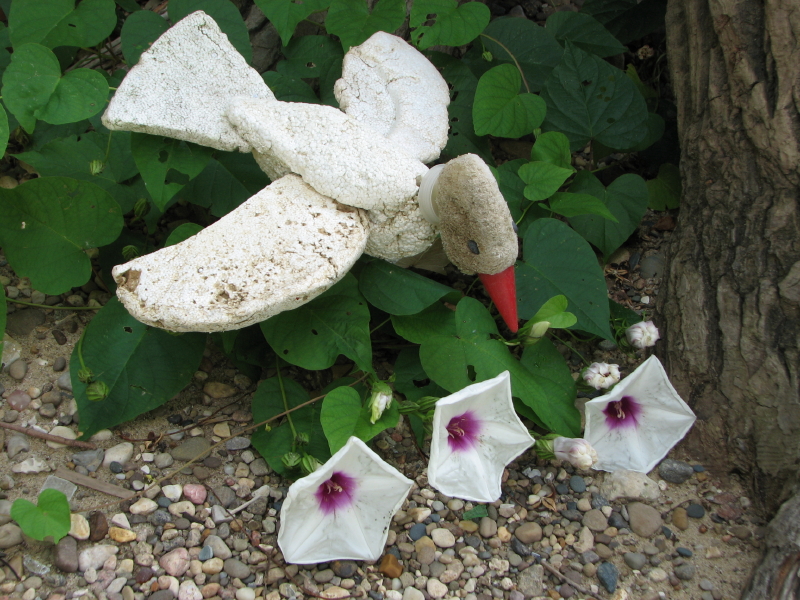
It’s definitely cooler in the deep shade of the woods, but the mosquitoes are more numerous.  I can’t get myself to put poison on my skin to keep them away and so I try not to let them get inside my head.  I suppose that they don’t bother me as much as they do other people.  Maybe I don’t taste as good!  While cooling off by the big trees I came across this unusual species and it’s called more commonly the Bumble Bee Bird.  I think its scientific name is something like “Turdus bombus”, but I could be wrong.  “Turdus” is the genus of thrushes and” bombus” refers to bumble bees.  Seems to make sense.  So, you are probably wondering why this clumsy looking bird is named what it is named and I will show you why.

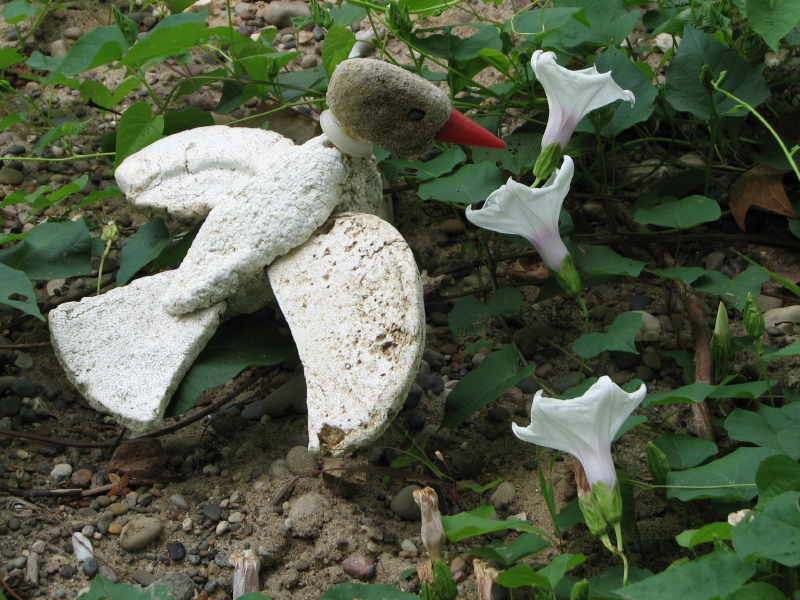
I came across this specimen hanging out at the forest’s edge where many morning glories were present.  These flowers grow close to the soil and sand and in places form thick blooming carpets.  Kind of pretty in an understated way.  Here’s the same bird hopping around some other morning glories, but is he just admiring the flowers or is there some other purpose afoot?

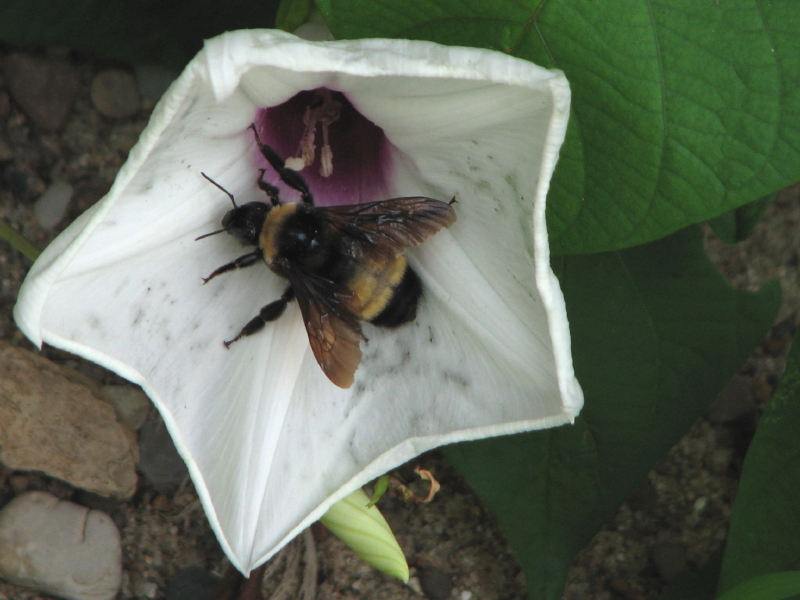
He’s in the deadly serious pursuit of something to eat, but not just any unfortunate creature or seed will do.  This species is aptly named because it has evolved to eat the large bumble bees that pollinate these flowers.

The bird waits for the bee to enter the bloom.  The bee has to get deep into the blossom to reach the sweet nectar it needs.  This is the moment when the bird comes from behind the bee and with its large red bill, seizes the bee crushing it and its nectar-filled abdomen.  The bee had no ability at this point to defend itself.  Stealing the nectar, the bird then tosses the dead bee into the air, catches it, and then swallows it head first.  It’s a doubly good meal and worth the expenditure of energy.

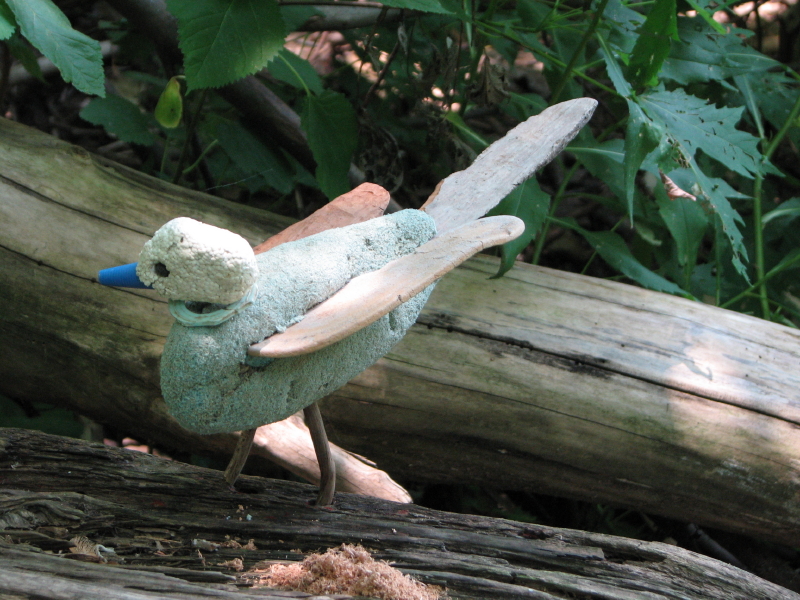
Also found in the cool of the forest is this little bird which is aptly named the Melancholy Dove, scientific name “Columbina melancholia”.  Smallest member of the dove family likely to be found this far north.  It is usually by itself or with a few of its kind and represents the antithesis of a former Falls of the Ohio resident…the now extinct Passenger Pigeon which congregated in immense flocks.  The Melancholy Dove is also recognized by its blue bill and sad expression on its face.  It is not an especially rare bird and I spot this species across the park during the summer season.

I found this bird sitting in a small garden near the Interpretive Center where it seemed unconcerned about the park visitors.  A nearby bird feeder has made this bird especially trusting and I fear that one of the many feral cats in the area will find an easily ambushed snack waiting on the wing.  Contributing to their melancholy name is the soft, plaintive coo…coo-coowee sound it makes during the breeding season.

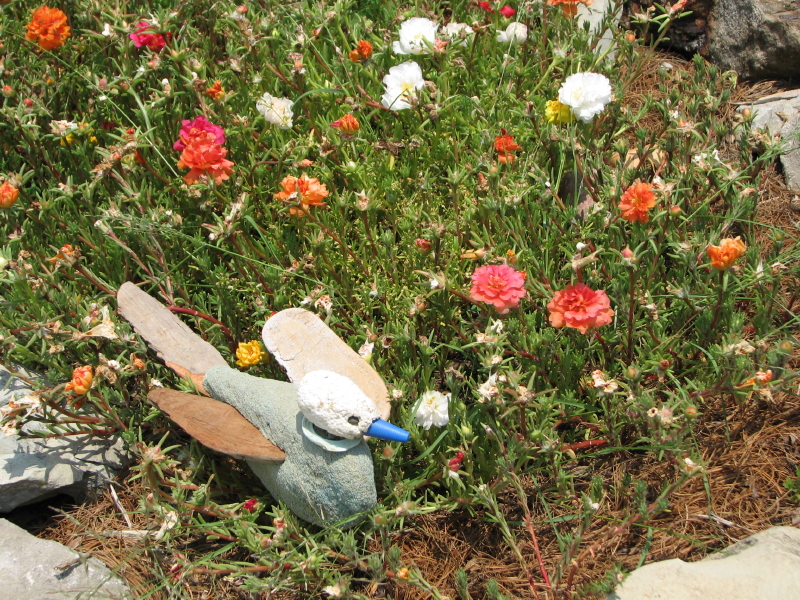
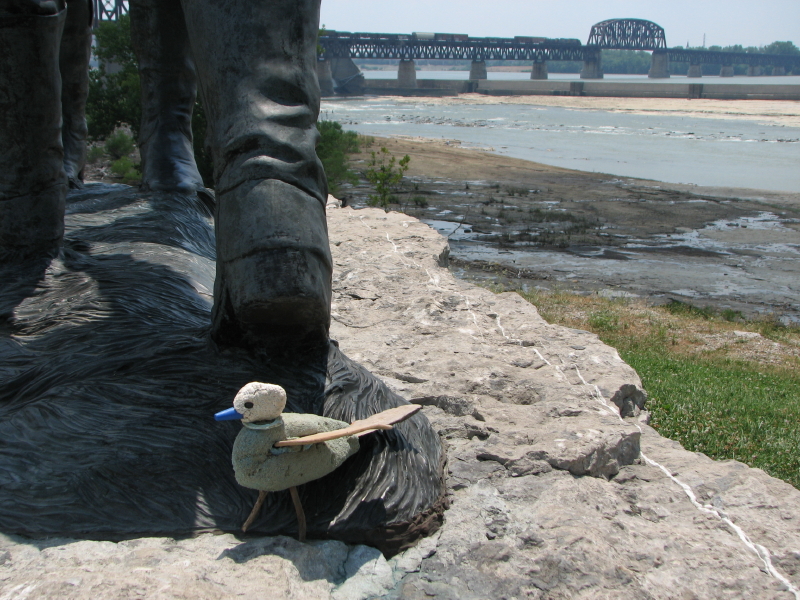
On my way to my vehicle at the end of the day I came across this dove sitting by the Lewis and Clark statue.  It brought back to mind a mental image of a nice pen and ink drawing of this bird that was in one of the personal journals carried by one of the enlisted men that formed the crew of the Corps of Discovery.  I don’t remember the name of the soldier, but he had a fine eye and a sharp quill.  There were a few notes scribbled in the margins commenting that it was too small and not worth the effort to eat!

As summer settles into its now familiar sweltering pattern, I’m looking eagerly to the time when I can cross over the shallow water and explore the Kentucky side of the fossil beds.  There isn’t as much junk to find to make “art” from, but it’s a contemplative landscape for me that has also become something of a seasonal right of passage.  It takes all day to walk across the rocks and I’ll need plenty of water to keep me hydrated, but it is such an interesting place and I look forward to sharing it with you.  Stay cool everybody…the weatherman is calling for some hot ones this week.

Read Full Post »

The long Fourth of July weekend has created a few opportunities to visit the river.  On one of my excursions I had a special guest accompany me.  I’m always happy to be able to share what I know and do at this place called the Falls of the Ohio.  In my day job, I direct an art program for adults with developmental disabilities.  For the last two years my program has been lucky to have interns from Yale University who are part of the Bulldogs in the Bluegrass effort to recruit intelligent, motivated, young people to consider professional opportunities in Louisville.  Sometimes it works!  In the twelve-year existence of the program, 35 graduates have moved to our city to begin their careers.  This year our intern is named Ariana Parenti.  She’s a soon to be senior art student and Philadelphia is her hometown.  I think she was curious about working with artists with disabilities and wondering what else in the not for profit world she could turn her art degree towards?  The internship is a ten week, paid work experience and the coordinators of the Bulldog program have scheduled many fun and educational activities for all the interns to participate in.  This trek to the Falls to make art from river junk is not one of them! 

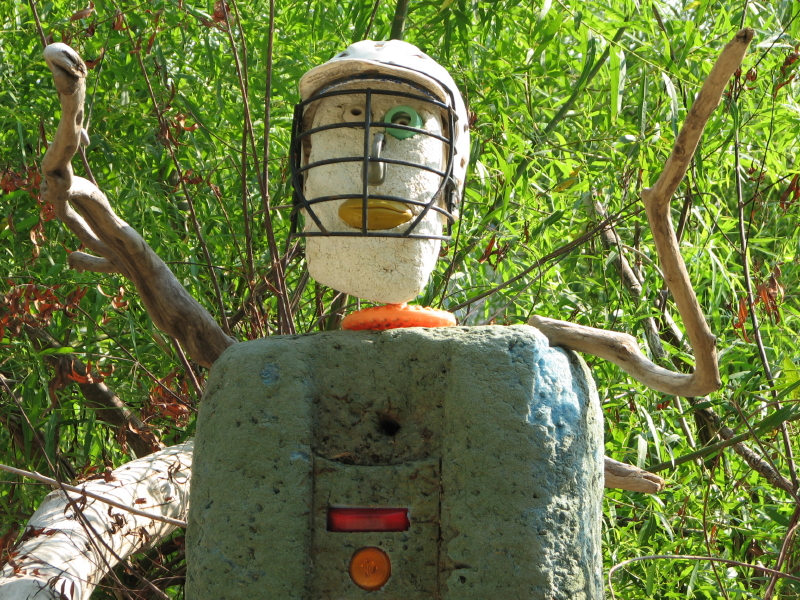
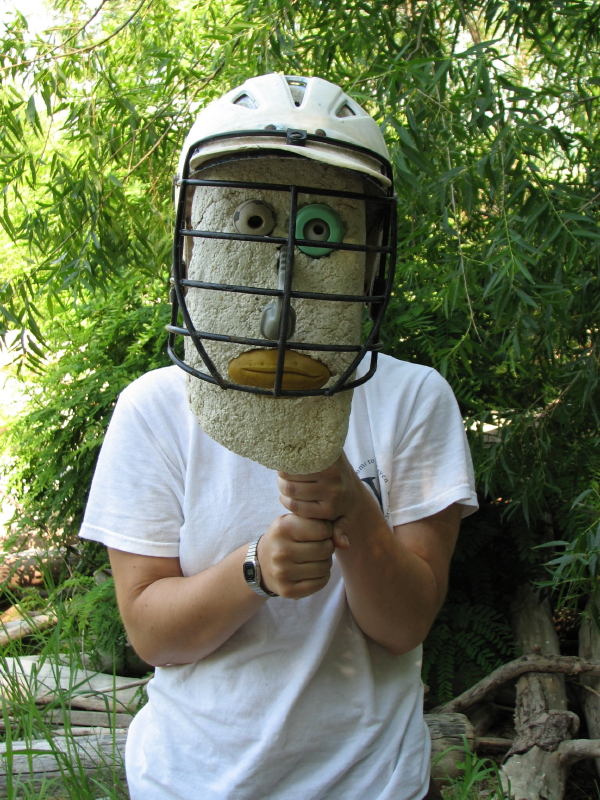
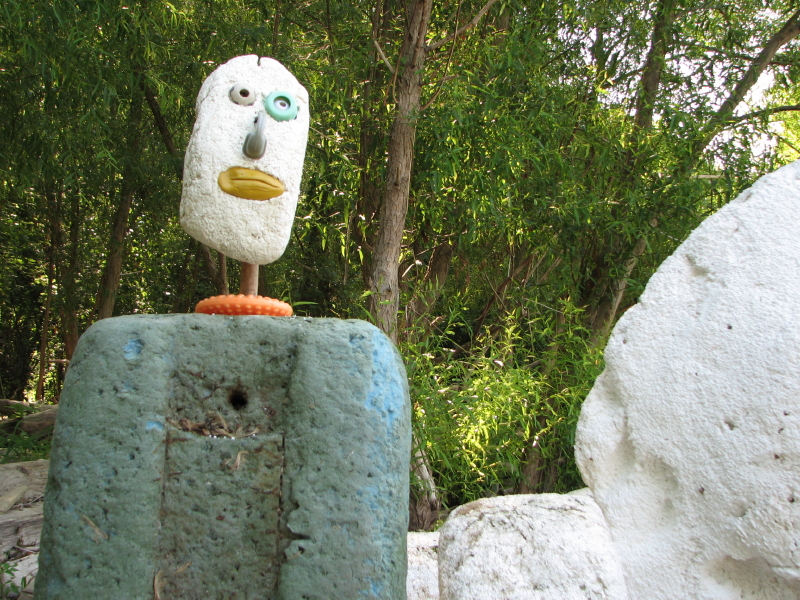
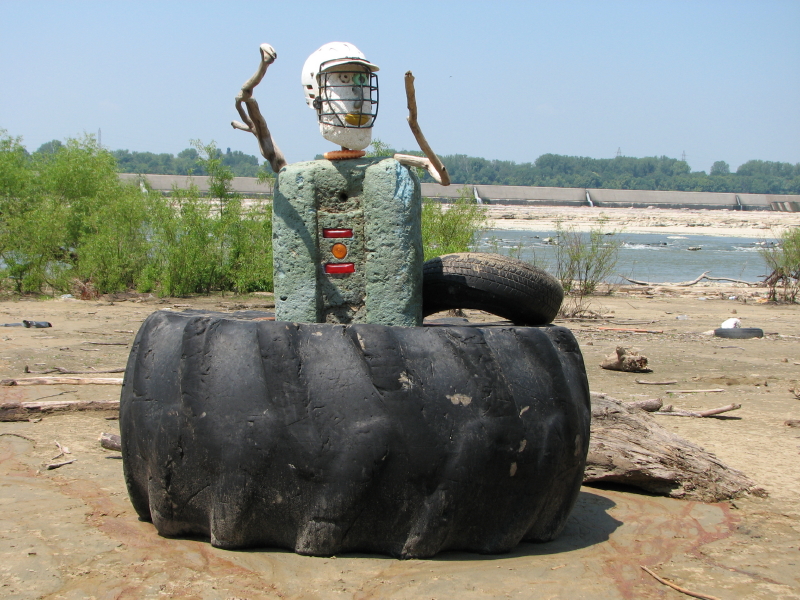
Ariana and I talked about so many things that it’s hard to find a good place to begin.  So, we walked around the riverbank collecting odd interesting bits of stuff, taking pictures and occasionally watching what the fishermen were catching.  Since my last post, catfish have become the fish of choice or at least they were biting.  I wondered what it must be like to walk into a space you first experienced as a site on the internet? For Ariana, this would be a part of her adventure.  The interval between those two points are like the difference between a traditional drawing and a sculpture.  At least with the sculpture you can walk around the object which changes your perspective as you have a three-dimensional experience in your own space.  As we approached my Styro-studio, I could see that something was very different.  Some one had taken the dark-eyed figure from my previous post and left me with a totem-like construction made from materials I had gathered and stored on site.  That’s fine!  I love it when people play along and anyone is free to use what I have left under the willow trees.  I had been wanting to make a larger figure from my scavenged Styrofoam and now I had Ariana to help assist me.  On our walk we found one especially nice prop we used and it’s a discarded lacrosse helmet which is the first one of these I’ve come across out here.

After dumping the contents of my trusty and official Lewis and Clark collecting bag onto the sand, we started mixing and matching the stored Styrofoam.  We had the helmet and needed a head to go in it.  After that, finding a body that seemed to go with the head was next.  The hardest part is selecting the driftwood branches that had enough articulation and gesture to make decent limbs.  That’s not always easy when you are looking for something particular in a mountain of tangled wood.  Here’s an image of the work in progress.  The blue body on this guy is not actually polystyrene but may be some form of fiberglass?  I’ve seen archery targets made from this stuff which is light but dense enough to stop an arrow.

For me, working at the Falls is about making art from the stuff of life in the space of life.  Each informs and influences the other.  The riverbank and nearby woods are my theater whose stage I populate with odd characters that you can interact with and become a part of the show. The sculptures act as temporal focal points…this is what I made on this day.  The images document the context as it existed in the park during that particular moment and form a record of my activities.  My work has a relational aspect to it, perhaps not in the literal postmodern meaning of the term.  I include pictures of the wildlife I encounter in this blog because they are a part of this world too and should not be discounted and dismissed.

Ariana and I talked about our various school experiences, had lunch, and made a few small pieces from the junk on site.  Then I picked up our blue, helmeted friend and looked for good places to take his picture.  I returned to the big tire from the previous post and placed him inside the wheel well and this is what he looked like on this bright, warm, and sunny day.

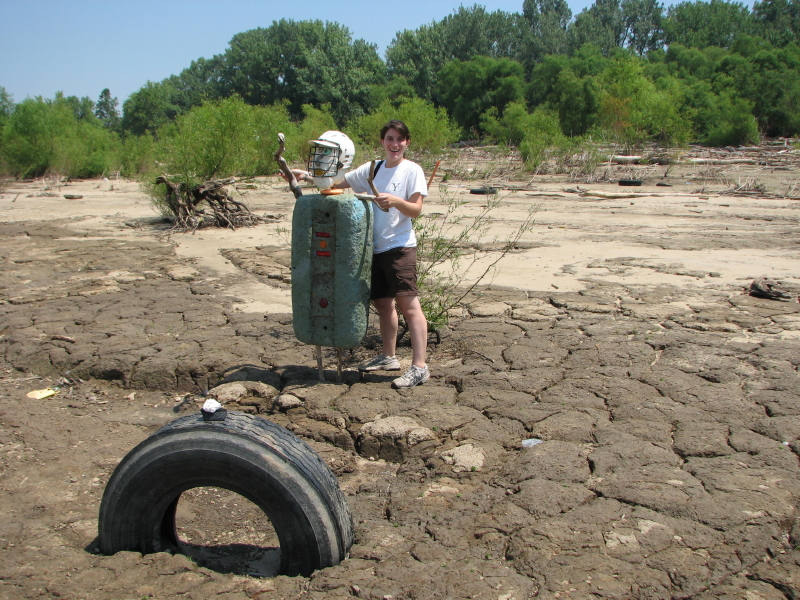
There are a few other tires stuck in the now drying mud and we posed our figure in this landscape.  The tire seems like some large croquet wicket!  Perhaps this is what the figure is doing…playing some obscure game that has rules to it that nobody understands?

And now one image with Ariana in it so you can have some sense for scale!

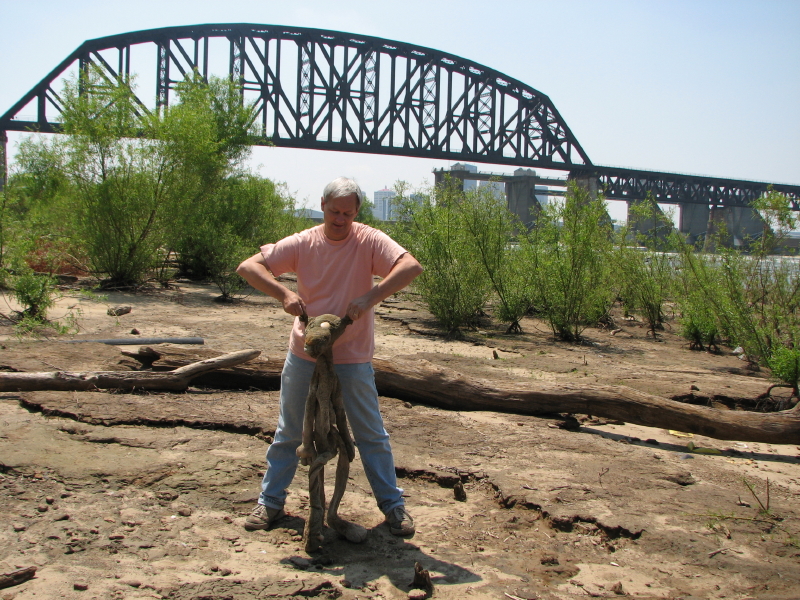
Walking along the riverbank we stumbled upon an old friend.  It’s the remains of a large plush Pink Panther toy that was stuck in the clay.  I remember finding this thing out here last year (for another image see my Mutant Toys post from last July).  I lifted it and it was surprisingly heavy.  Ariana took my picture and I think this is one of the rare images of the Artist at Exit 0 featured in this blog.

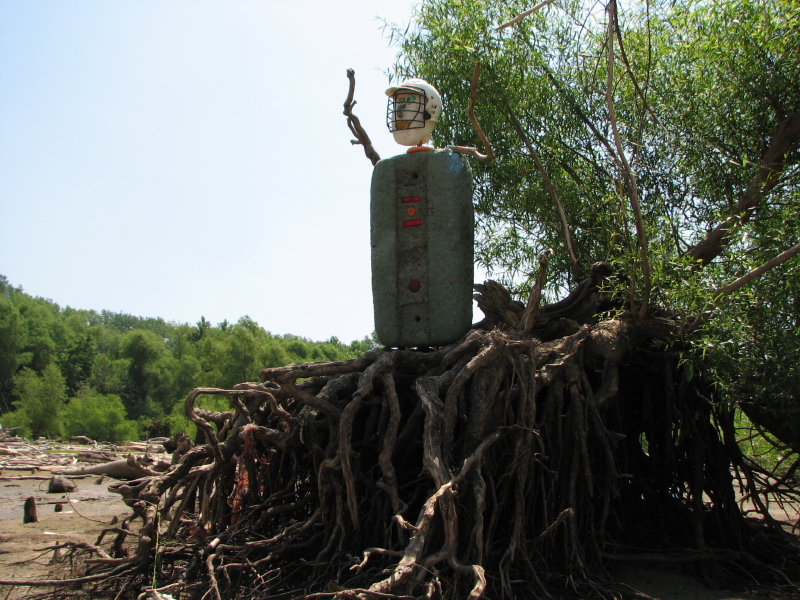
Stopping among the willow trees closest to the water, we posed the figure atop a mass of its amazing root system.  Here our figure looks like he’s pontificating about something important like the value of clean water for example. 

Since the day was moving along and Ariana had other engagements, I stashed our sculpture back at the studio site.  He may show up in something else if he isn’t found by others first.  We toured the Interpretive Center and I noticed their exhibits are starting to look care worn and I understand plans are underway to freshen them up soon.  I think Ariana enjoyed herself and I know I did.  I can’t imagine having the Louisville experience without coming here at some point because for us this is where it began and continues to be relevant.  I’ll end this post for today with a sign I found in the men’s room.  It’s not something you typically find in such a space, but it conveys an important message.  All around us we are being affected by non-native species and some of them are destructive pests like the Emerald ash borer.  We definitely don’t want to find this little guy hitch hiking to our woods!

Read Full Post »

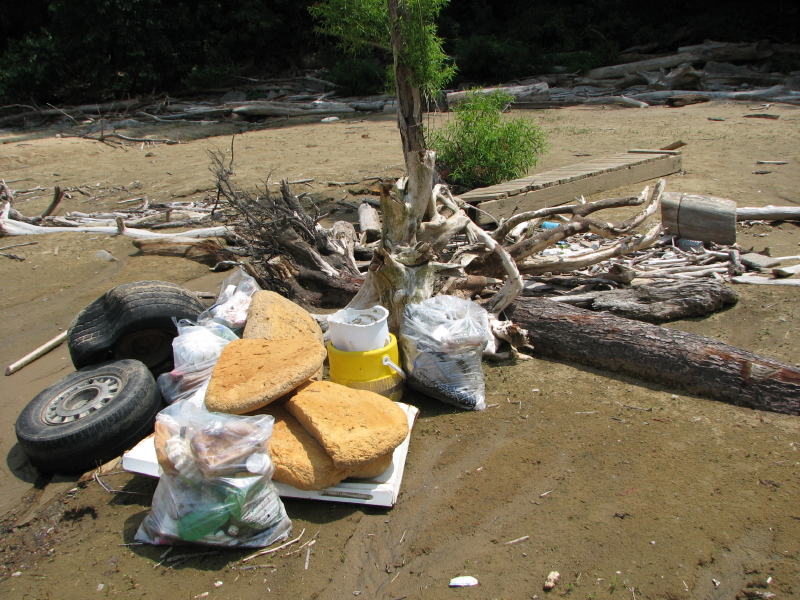
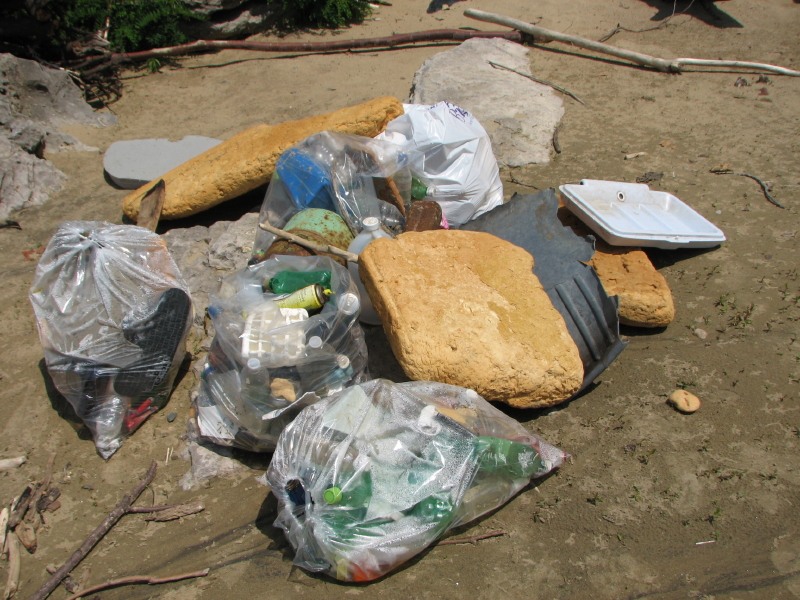
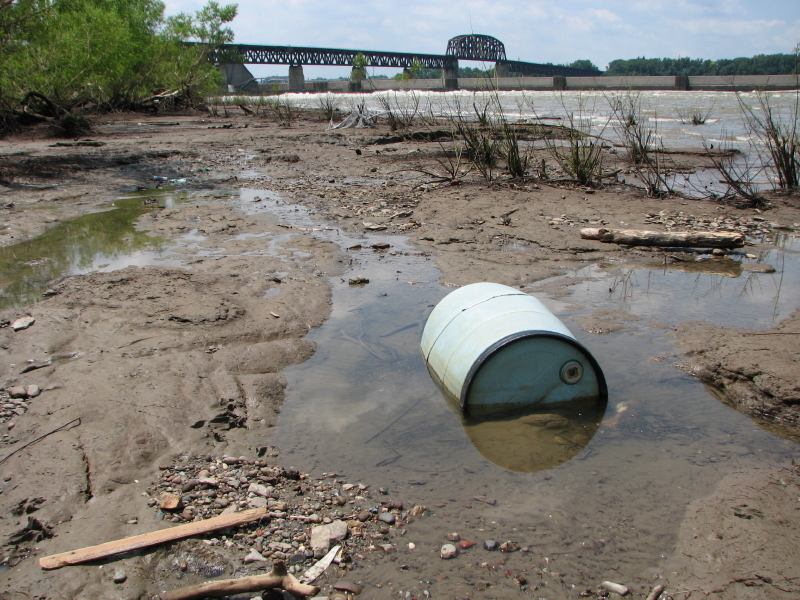
A group of volunteers did a river sweep clean-up last week at the Falls of the Ohio.  Our June has been brutally hot and I can see how trying to clean up the park would be a daunting task…there’s just so much that needs picking up.  I did document some of their efforts which I now present to you.  I suspect that most of this stuff is now landfill bound.

I know it may seem odd to present photographs of bags of trash in a blog that tries to concern itself with art, however, if we can view this act of cleaning up as an aesthetic act…than I think we can say we are making some progress.  I realize we are used to thinking of conventional art in aesthetic terms, but that life-enhancing quality that the term “aesthetic” embodies is often best seen in other actions.  Although I wasn’t part of this coordinated effort to clean this stretch of the river, I still show up regularly and try to do what I can using what I know how to do!  On this adventure, I had a friend who assisted me in picking up a few things.

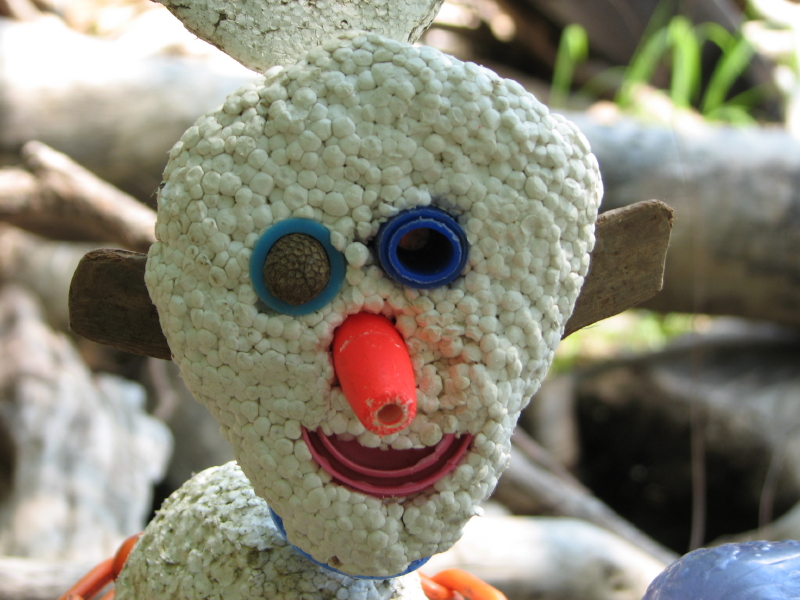
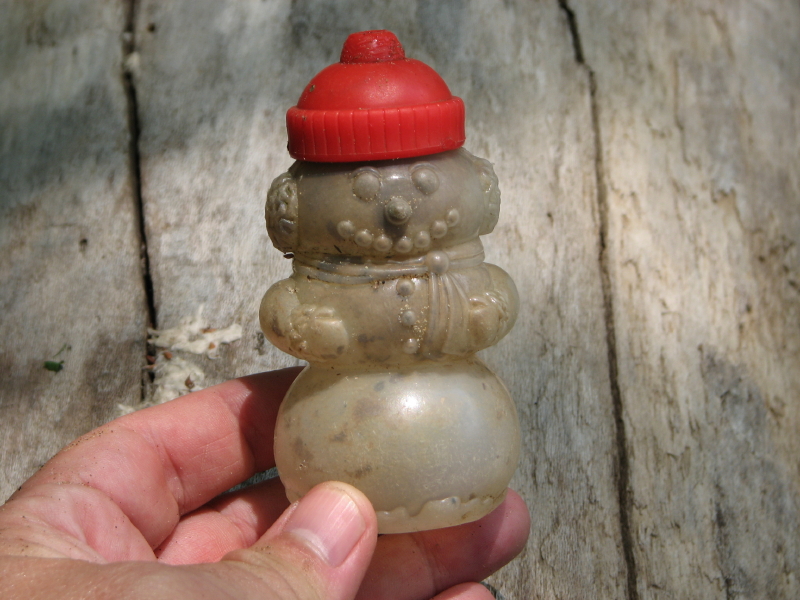
Among the items we found this day included our second snowman of the year!  It’s a little container of some sort.  After taking its picture, I popped this beauty into my collecting bag.  It will probably show up again in one of my Christmas cards.

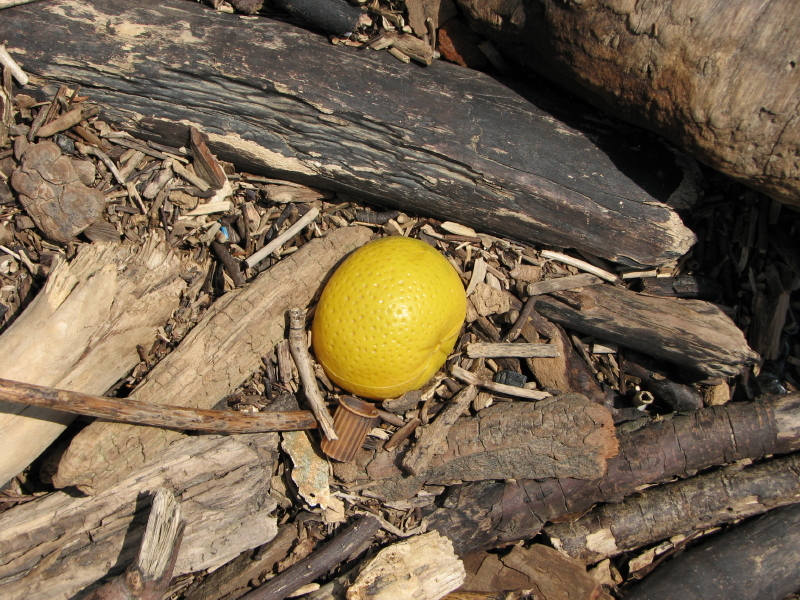
Among my more popular blog entries is my pages section where I feature my Found Fruits and Veggies Collection.  Currently, the physical collection is on display at Oldham County.  Soon I will need to update those photos featured in this blog because I keep finding more stuff all the time.  When I’m in the field, this material is presented by the river in a very causal way.  Here’s a picture of my latest plastic orange in situ.

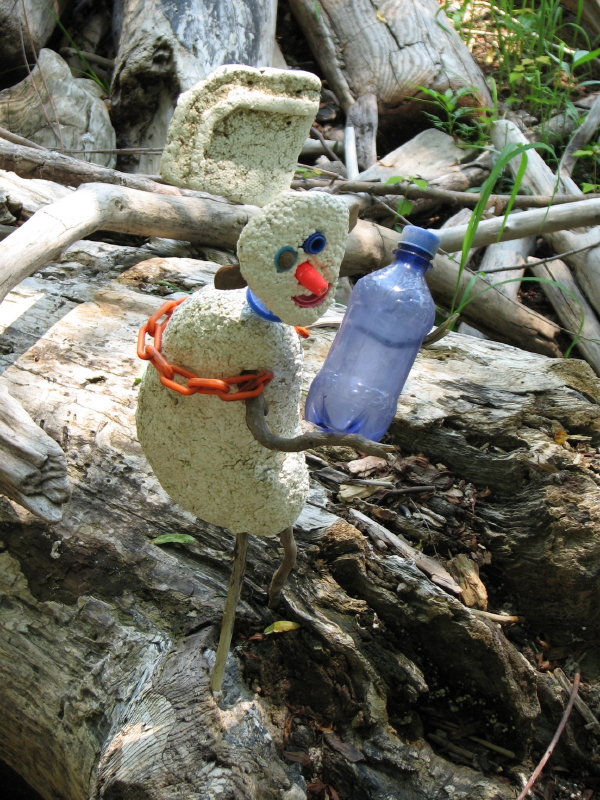
The figure accompanying me isn’t very large, but he’s a hard worker.  I snapped this image as he was picking up plastic bottles.  It was just so darn hot that I was on the edge of what I can deal with in terms of humidity.  My clothes by this time are just plastered to my body making me feel that much warmer.  I have been better about carrying water with me when I come out here on particularly hot days.  My friend, however, had fewer complaints than I did.  He just worked at his own pace.

Despite everyone’s best efforts and intentions…the river clean-up just scratched the surface.  There is just so much garbage in the world which I suppose is also an indicator of material richness…from affluence to effluence!  That sounds like a good title for a future post.  Unfortunately, you just can’t get all the trash and if you could…the river would just deliver fresh debris the next time another flood happens. We need to be better at getting this stuff at its sources.  Still, we shouldn’t surrender and I know I won’t.  The planet is just too important a place to give up on!

Read Full Post »

Reading the old journals from the exploration period…you can hear the authors’ amazement in trying to describe the overwhelming abundance that once existed here.  If you came across a flock of passenger pigeons numbering in the billions and as you watched them cross the sky like rolling smoke until they collectively blotted out the sun’s light how would you record the event?  But it wasn’t just flocks, there were also forests of trees, immense herds of bison and schools of cod and salmon.  In some cases, this was here less than two hundred years a go.  Now this seems remote and out of our living memories.  You don’t miss what you never knew.  Forgetfulness is another type of erosion.

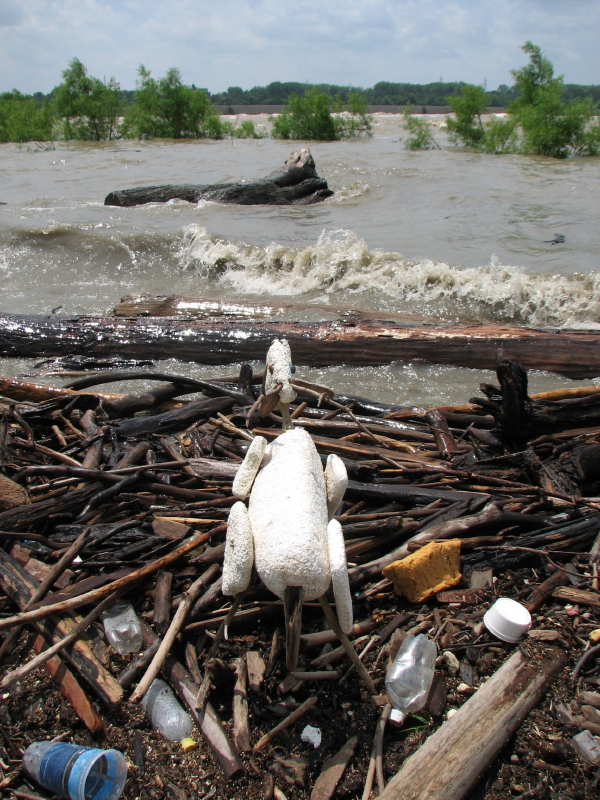
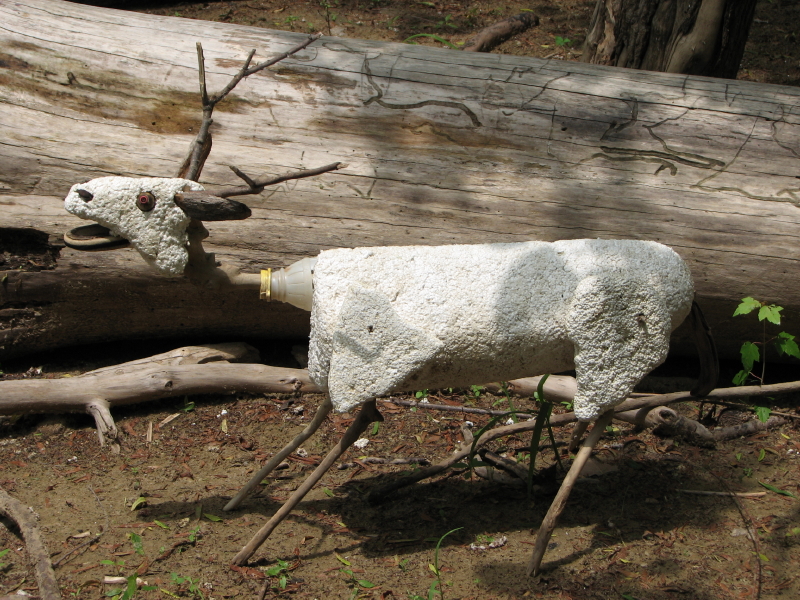
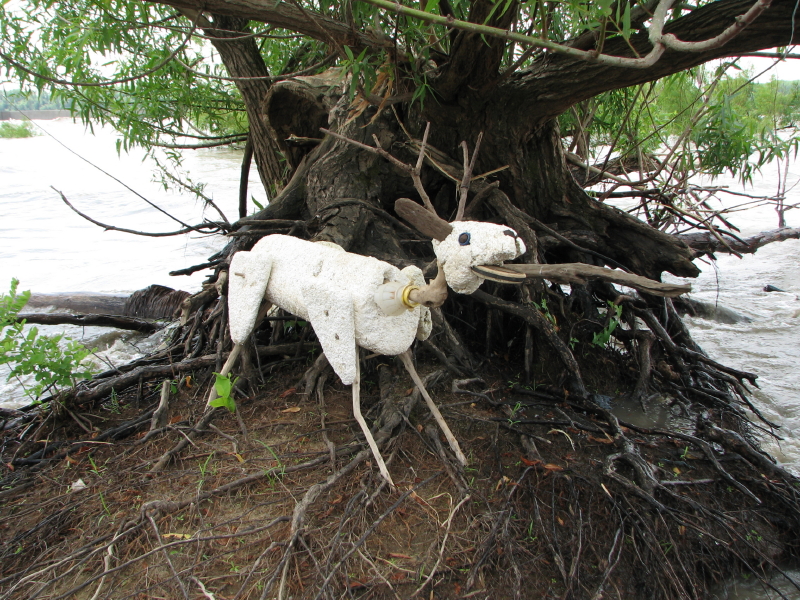
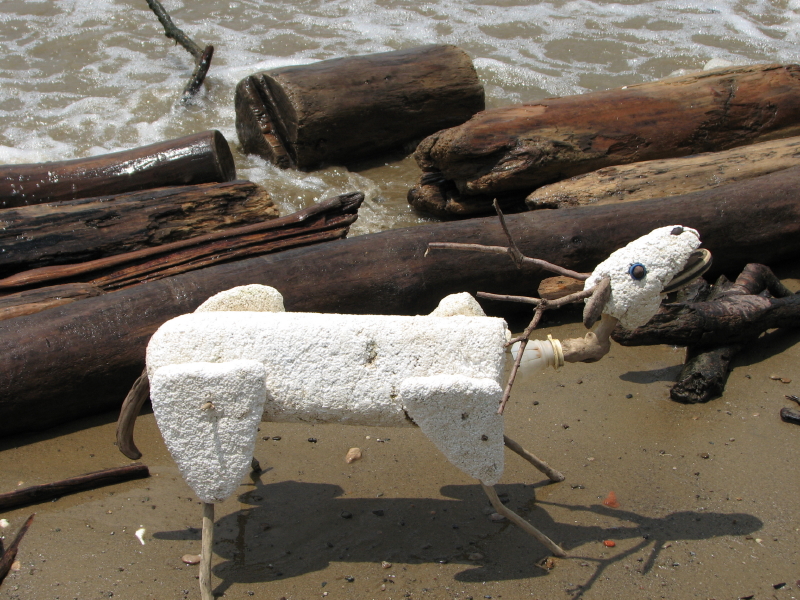
Over the sounds of the river smacking the shoreline, I could discern a few grunts among a high almost “metallic” bugling/whistling in the air.  Or so I imagined as I introduce my latest Styrofoam creation.  In the old days, (which according to my youngest son is anything over nine years a go) the American elk or Wapiti was plentiful in Kentucky and through out the United States.  Several sub-species existed and were classified by geographic region and habitat.  The bulls of this large deer with their immense antlered racks are an impressive sight and are symbolic of nature’s majesty.  Well, mine is not nearly as good…but for the purposes of this post…will do fine!

We are lucky they are still with us today!  As loss of habitat occurred as well as hunting pressures…our elk were driven westward until they were gone east of the Mississippi River.  Eventually, the elk were allowed some federal protections and our herds are rebounding.  Kentucky has led the way in elk conservation by experimentally transplanting a herd to the eastern section of the state where they have thrived!  Their reintroduction has been so successful that a limited hunting season on them has been established.

During the Lewis and Clark trek across the country, elk meat made up a large percentage of the meat consumed.  It remained the meat of choice until the native Americans introduced the explorers to dogs and then that was preferred!  As the country was “settled”, elk continued to disappear from all kinds of pressures.  There was even a brief fad where elk teeth were used for watch fobs!

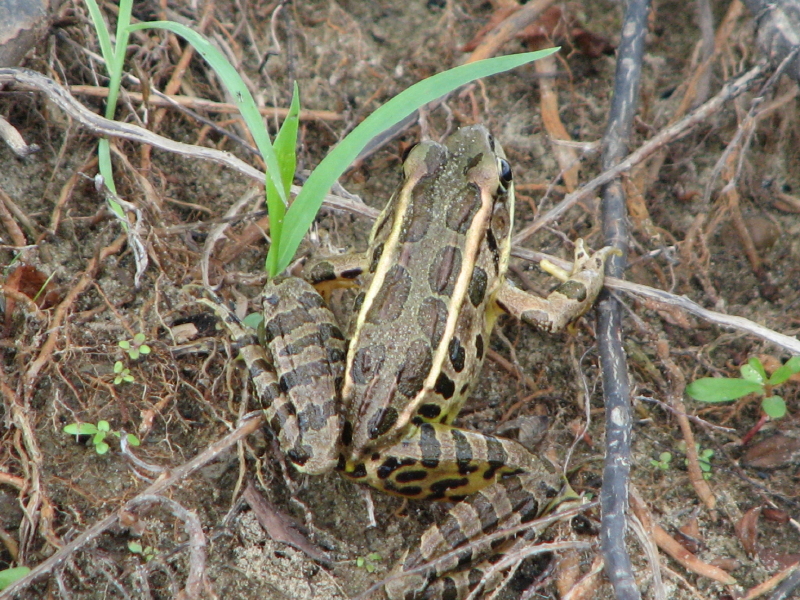
The elk is a member of the megafauna that was once was a large part of the North American ecosystem.  While I’m taking pictures of my sculpture, a smaller member of this ecosystem came hopping by.  To be honest, I don’t see many frogs out here and I’m surprised this Leopard frog isn’t in a more boggy area.  I think many people by now are aware that amphibians aren’t doing as well as they use to for a variety of reasons that range from climate change to exotic fungi.  If a Great Blue Heron spots this guy, then our frog friend will become bird food.  It’s as if life weren’t already difficult enough without adding to it.

The frog is a reminder that even the most humble of species plays its part in the bigger scheme of things.  So often it seems that the smallest players have the out-sized roles that make the biggest differences to the smooth operation of life at large.  My stag is bellowing and issuing a protest and challenge to protect the environment that sustains us all!  There is far too much in the river that doesn’t belong there especially items dependent on crude oil.

Take this stag for instance, it is dependent on crude oil for its existence.  The body, head, and parts of the leg are made from polystyrene.  In this case it is all river-polished Styrofoam.  The lower jaw is the sole of a shoe and also made from petrochemicals.  The eyes and plastic collar are plastic and derived from petroleum extracts.  Only parts of the nose, legs, antlers, and tail are biodegradable.  The Styro-stag is an animal we can afford to lose and it will be interesting watching the river for signs that the exotic materials that comprise it are on the wane.

Read Full Post »

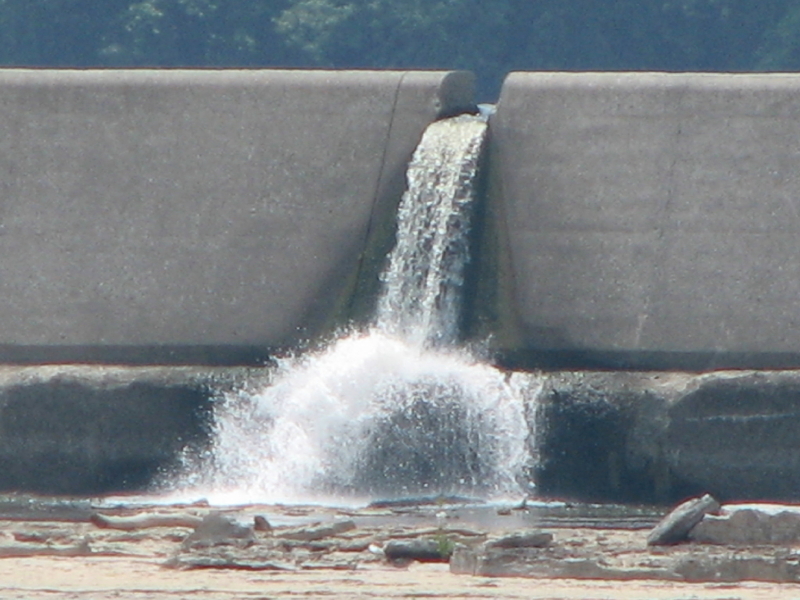
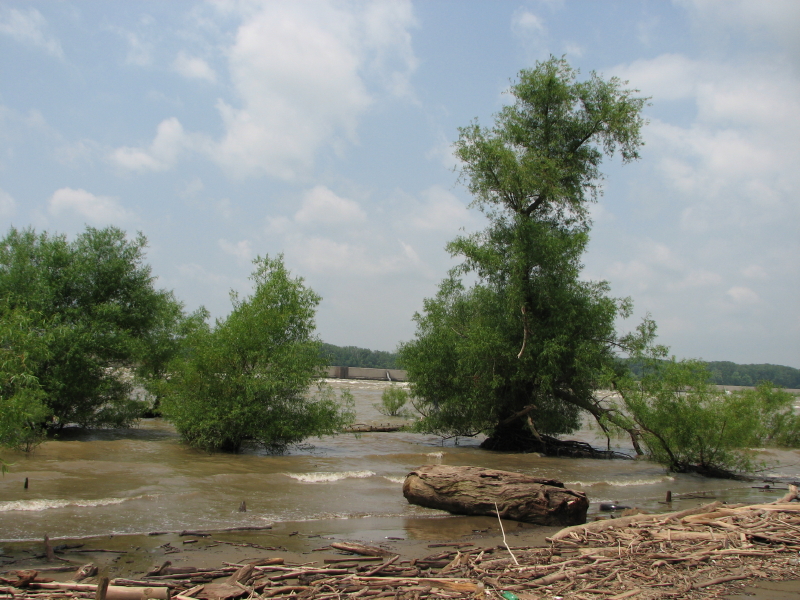
I was standing by the river’s edge when the dam’s siren went off.  At first it scares the pee out of you!  It’s a loud wail, but you get use to it.  The Army Corps of Engineers gives the warning whenever they plan to release more water under the dam.  Throughout the region there have been heavy thunder showers and the river has risen quickly.  I worked at the Falls both on Saturday and Sunday and so I have a number of things I can share over the course of the week.  Technically, it’s not yet summer, but my clothes are stuck to me with sweat and I’m glad for the nice bottle of cold water to drink.  So often, I’m guilty of not bringing something with me to keep hydrated.  I make a pact with myself to do better this summer.

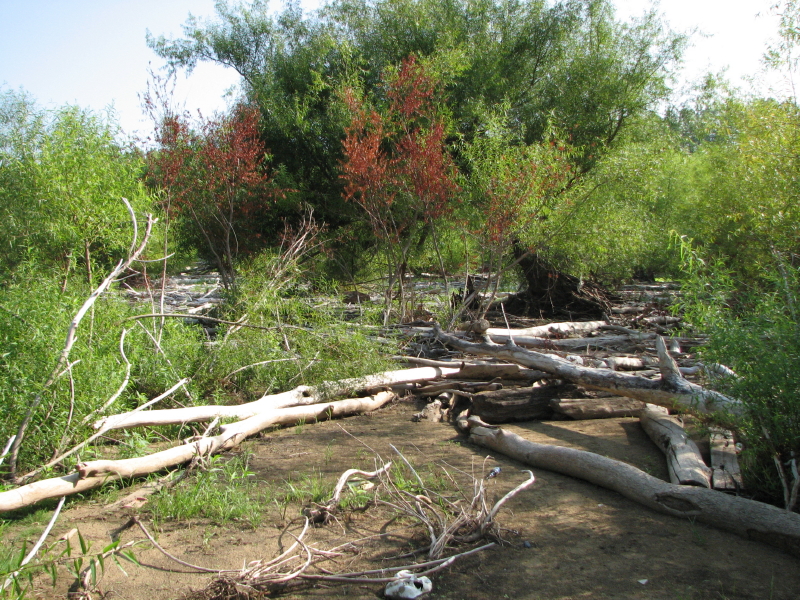
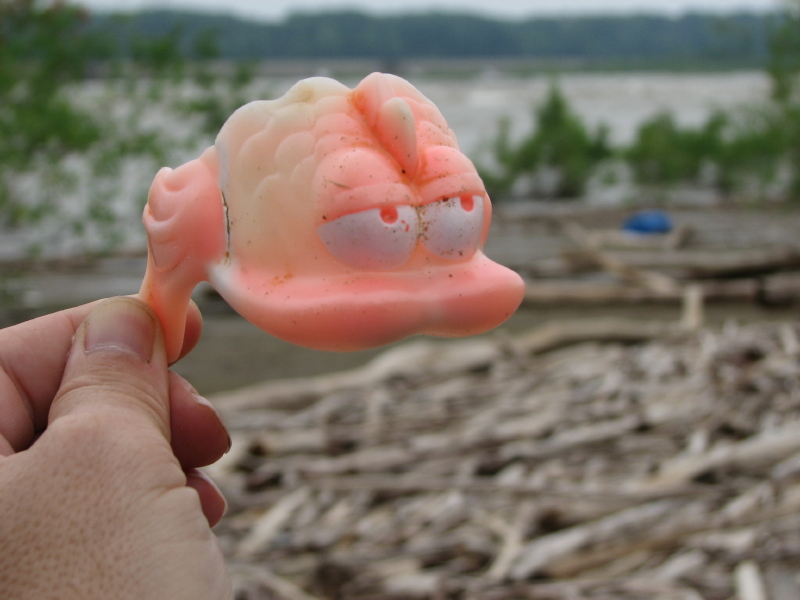
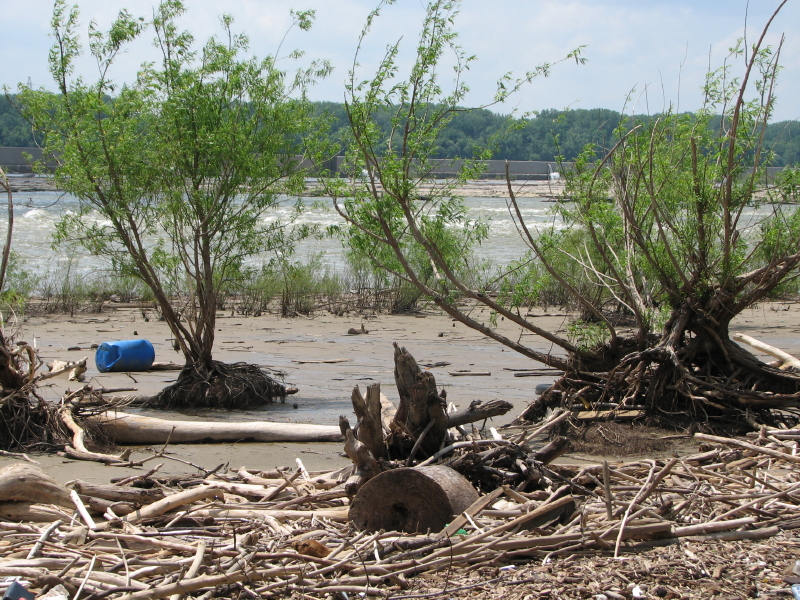
The weekend’s weather report calls for rain on both days, but I managed to dodge that.  I spent a lot of time exploring a mammoth deposit of driftwood near the dam.  If the past is an indicator of the future, then the river will probably not change very much for now and I look for a site higher on the riverbank to set up another temporary studio.  I did come across a project I did a few weeks back that was featured in the post “Tug of War”.  His buddy must be around here too.  I find the plastic broken toy-part I used for his friend’s crazy hairdo…they are cartoonish fisheyes.

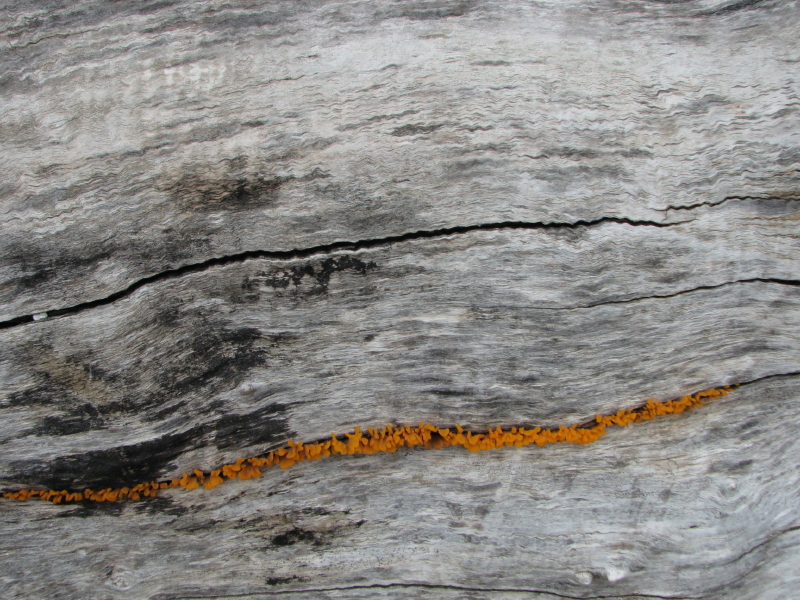
With such humidity, this is a perfect time for mushrooms and fungi to get their hyphi through the soft tissues of decaying matter.  The process of reclaiming old life kicks into gear.  It’s really the small stuff like bacteria, viruses, and fungi that do the dirty work of releasing nutrients back into the system.  The planet is ruled from those kingdoms while we posture around self-importantly.  This fungus was tiny, but so colorful that I thought I would try to magnify it and reveal how fleshy it is in its crack.


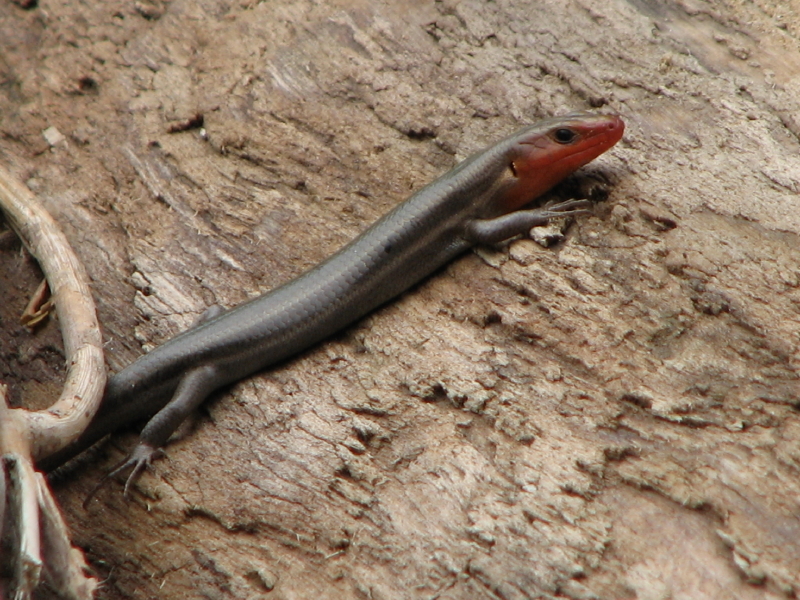
On a nearby log, a male Five-lined Skink is taking a break from his hunt to bask in the sun.  For him, it’s breeding season and you can tell that by the reddish blush he has around his head.  This guy’s lines are indistinct and he’s  bronze in color.  The young lizards have very pronounced black and white stripes and their tails are bright blue.

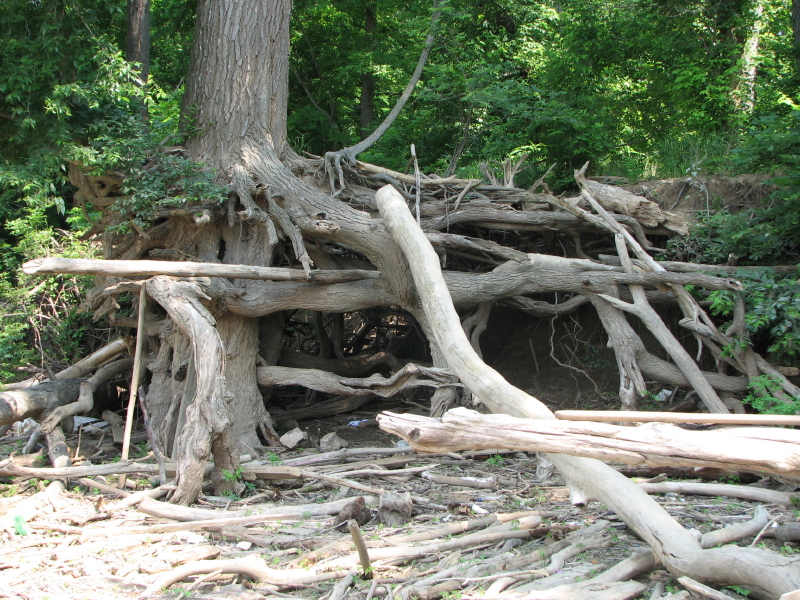
One of the sites I considered for my informal studio is this place with a chair set in front of this large upturned tree.  Sitting in the chair you can perfectly study all the intricate roots as easily if it were situated in your home library.  I decided it’s just a little too public and I look higher up the bank, under the willows and their welcomed shade.

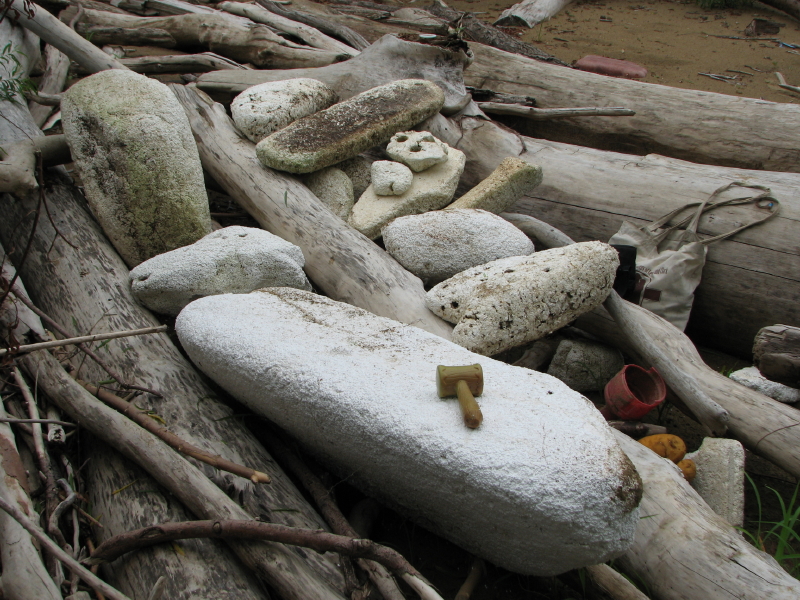
I’ve scouted out the area pretty well and on my mental map of this place, I’ve noted where the nicer Styrofoam pieces are.  It took almost two hours to move things into place.  The larger pieces I hoist onto my shoulder and carefully walking on top of the logs and driftwood reach the new cache I’ve created.  Here’s a piece nearly as tall as I am from the Styrofoam mine that I set upright and photographed.  I don’t have an idea for this one yet!

Here’s an in process shot of the gathering of the polystyrene.  There are several nice sitting logs in the area to work from and it’s under the willows enough to avoid the direct sunshine and there are usually birds around here as well.  My favorite Lewis and Clark canvas bag is nearby for scale.

Here’s the same site about an hour later.  There is still one really large piece I haven’t secured at this location yet.  I can’t wait to start making something from all this stuff!  I also have started gathering driftwood to serve as the arms and legs and I’ve stashed that away here as well.  The mallet in the foreground is made of plastic with simulated wood grain.

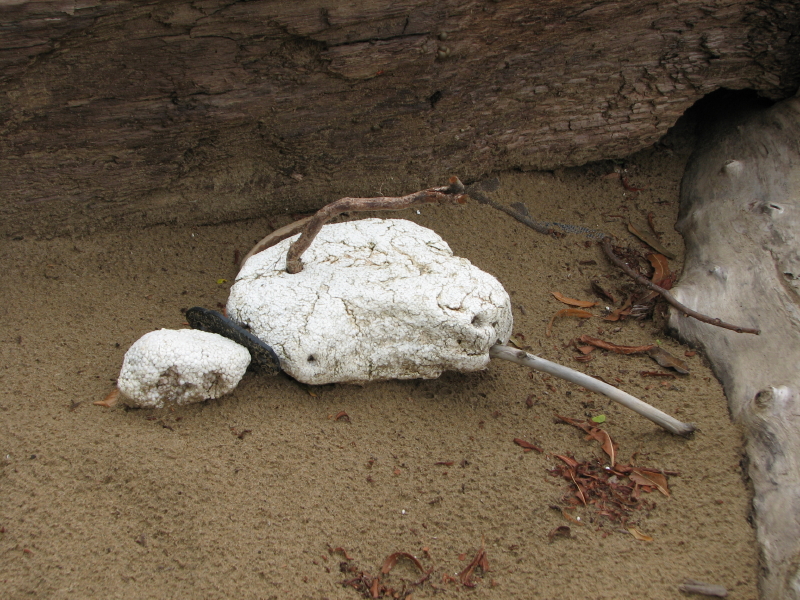
By the time I got around to making a sculpture, it was fairly late in the day.  The resulting piece I dubbed the “Petro-totem” and it takes its initial cue from the skull-like piece of Styrofoam that makes up part of the head.  This piece also features a plastic heart, genitalia (made from walnuts and a plastic toy fire hydrant I found).  The hat is some kind of funnel.  The finished work is far from one of my happier creations.  I just started working on it and making decisions as I went along and this was the result.

I posed this sculpture in several places and photographed it as I moved it around.  There are many tires on the beach and someone has cut many of them so they can’t retain water.  Mosquitoes love to breed in the dank water that collects inside these tires.  An old paint can with its red pigment is used to “sign” the tires…somehow I doubt these are the same people who altered the tires.  It seemed a provoking enough spot to set up a my Styrofoam figure.  I snap of a couple of shots and moved on.

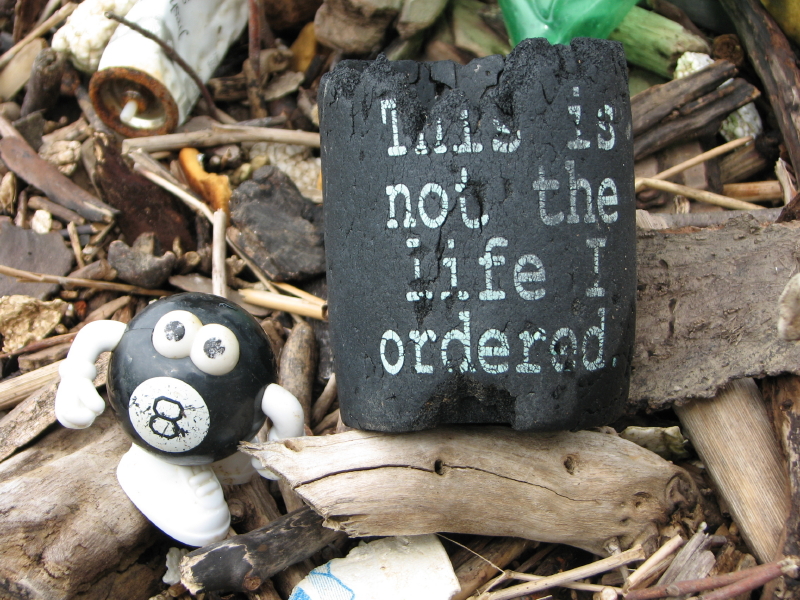
In a future post, I will show you where I eventually left this work.  In closing, I found this little commentary on the big driftwood pile and recorded that with my camera.  The “behind the eight ball” figure was found near by and I added that to the image.

Read Full Post »

Just a mini adventure this time.  During my last expedition to the Falls of the Ohio, I paid a visit to one of my favorite trees.  I love the root system on this Eastern cottonwood because it forms a “room” you can sit under.  I decided to take some refreshment there and rest awhile.  Scavenging  Styrofoam can be thirsty work on a hot day.  Here’s the cottonwood I’m talking about.  Looking around, I can see I’m not the only person who knows about this tree.  A couple of fire pits are in the vicinity.

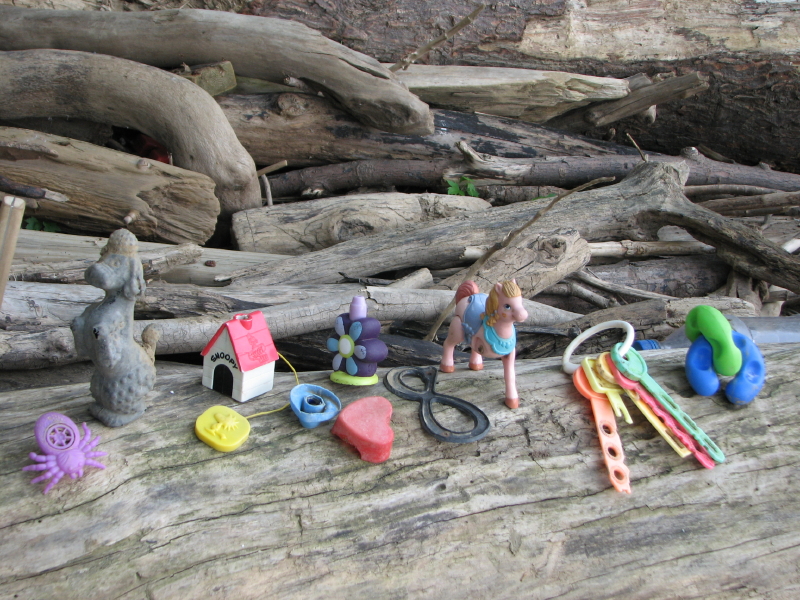
While I was sitting in the shade, my eye was drawn to some definitely non-natural color inside a cavity at the base of this tree.  When I investigated the hole,  I was astonished to find this little treasure trove hidden inside.  I withdrew the contents and set them up on a log for this photograph.  I think you will be as surprised as I was!

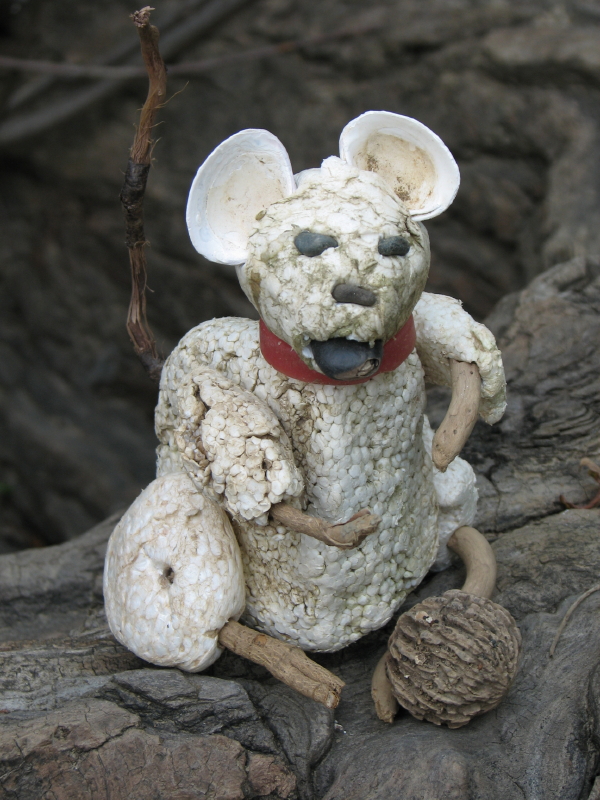
A variety of plastic toys including a poodle, Snoopy’s doghouse, various baby items, a numeral “8”, and a horse with three legs were in the hole.  How or why was this stuff here?  When I checked out the area around the larder more carefully I found very small tracks and the picture started to become clearer.  When I saw this little guy…I had my answer!

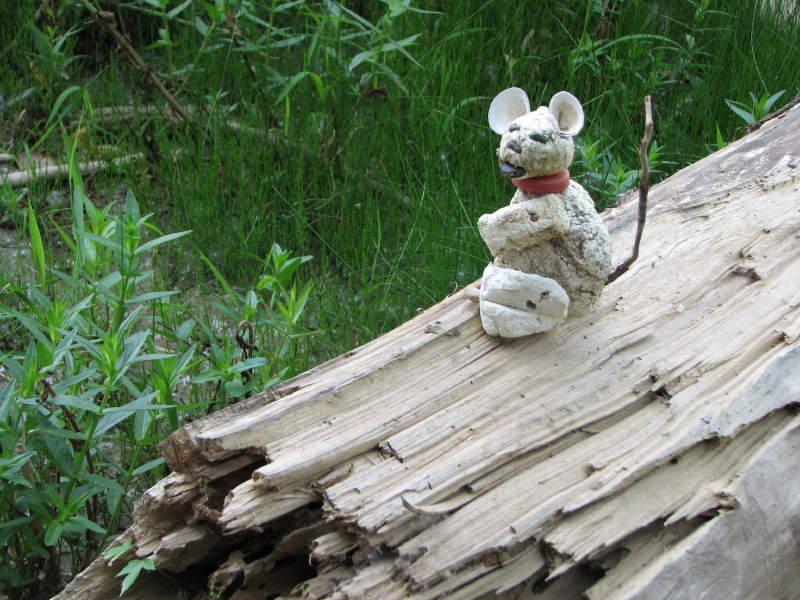
This is Meriwether’s Mouse and he’s named after the famous explorer Meriwether Lewis who was the first to describe this appealing rodent.  This species is known to cache colorful objects and is not above pilfering items from unwary hikers and campers.  In this mouse’s case, he doesn’t need to take anything because the river will provide plenty.  No doubt these toys were found along the riverbank.  I do the same thing myself!

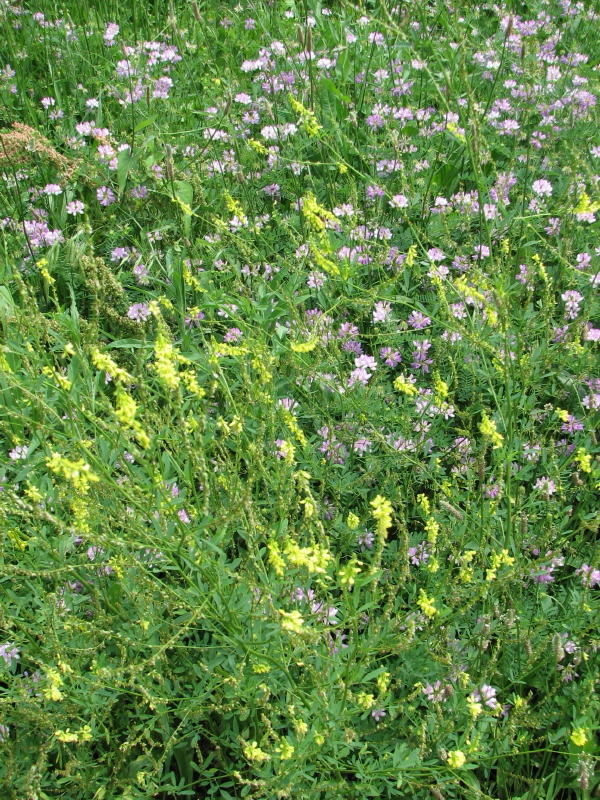
Because there are a formidable number of predators out here, Meriwether’s Mouse is not as common as it once was.  They do possess very acute hearing and this specimen heard me shift my position and off it went!  Recently, I was looking through a copy of Audubon’s Quadrupeds and was amazed at the mostly small varmints that populate the mammalian natural history of our great country.  I guess most animals aren’t going to be as magnificent as a grizzly bear or bison in size.  In fact, most are about the size of our mouse!  I appreciate all the more Audubon’s challenge in making this seem interesting to the average person sitting at home.  Great or small, all animals are glorious to me!  In closing I offer this abstract expressionist, all over composition… rendered in wildflowers.  Thanks!!

Read Full Post »

« Newer Posts - Older Posts »