Feeds:
Posts
Comments

Posts Tagged ‘nature’

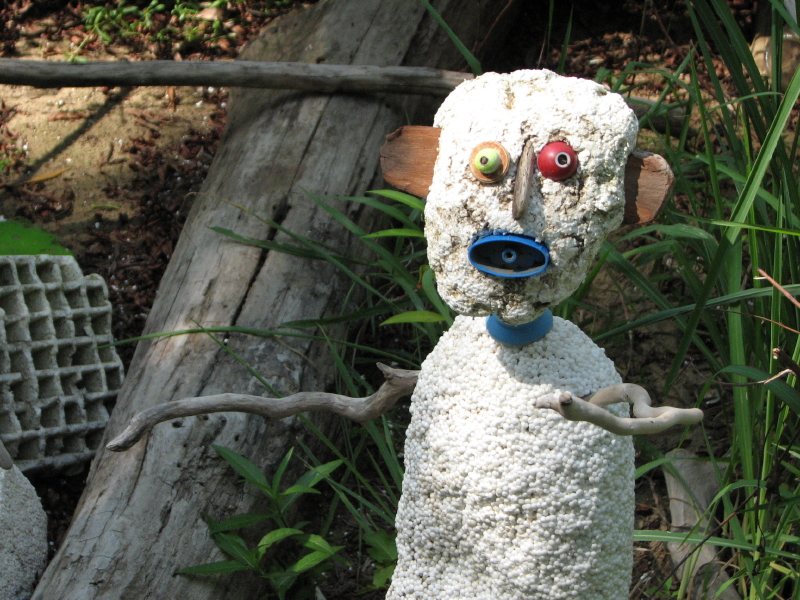
At last we have some respite from the dreaded heat of this summer.  Today is gorgeous!  The air feels fresh, and there is a nice quality to the light.  I decide to spend my time in the western section of the park on the Indiana side.  I heard that the butterflies were plentiful on the loosestrife flowers and that this could be a good time to take pictures.  First, I needed to find an officially sanctioned butterfly guide to show me the way.  He’s supposed to be somewhere over here…yes, there he is right on time.
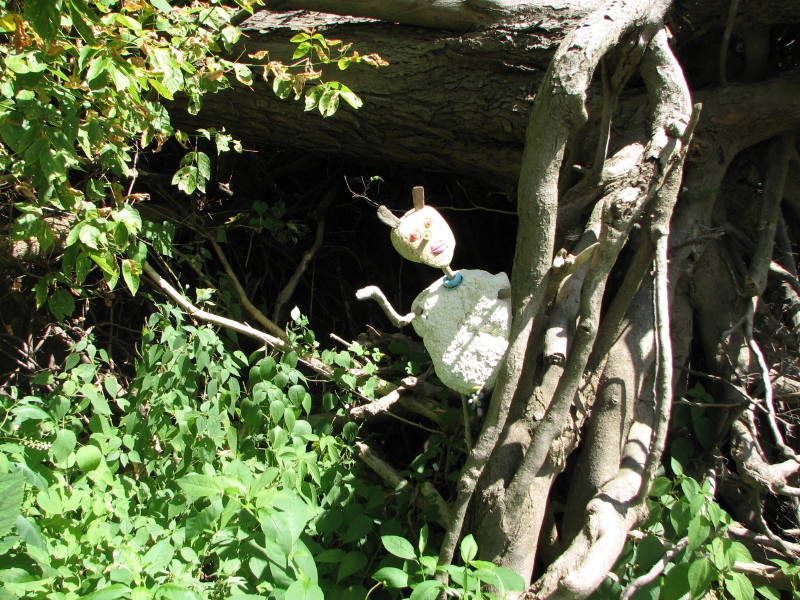
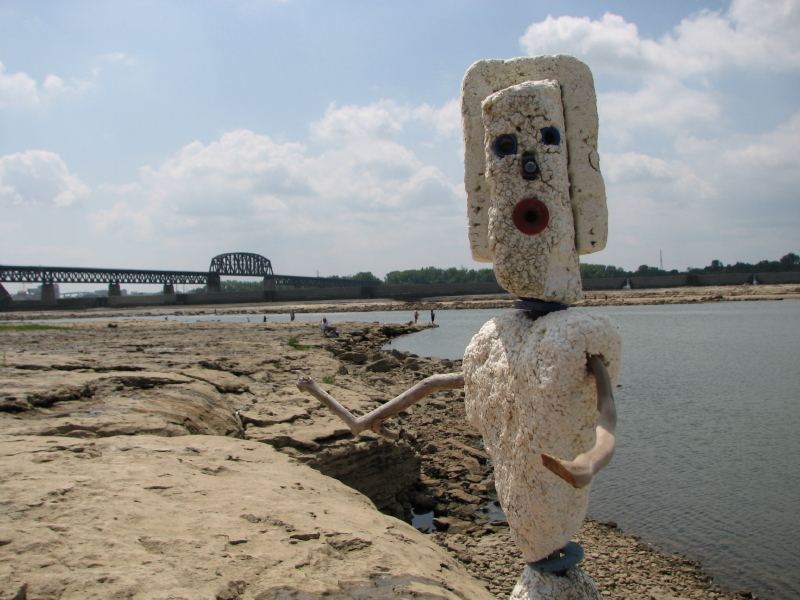
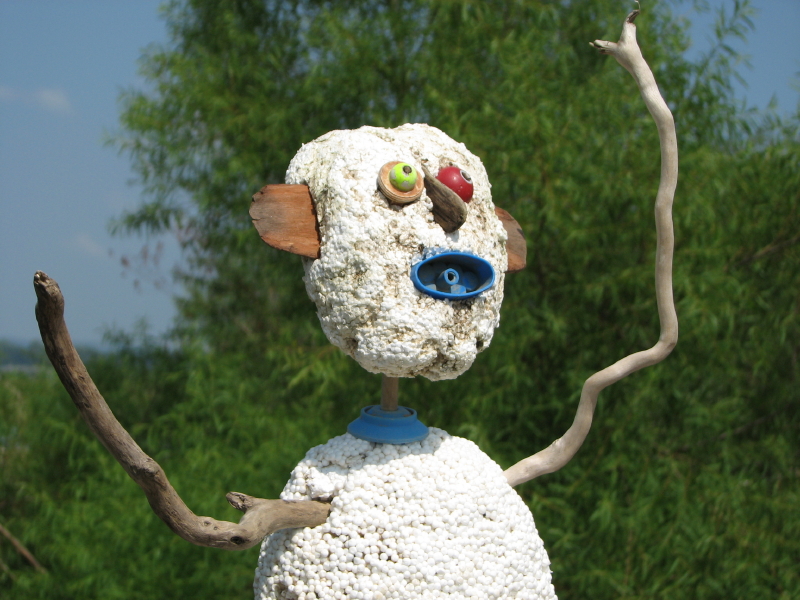
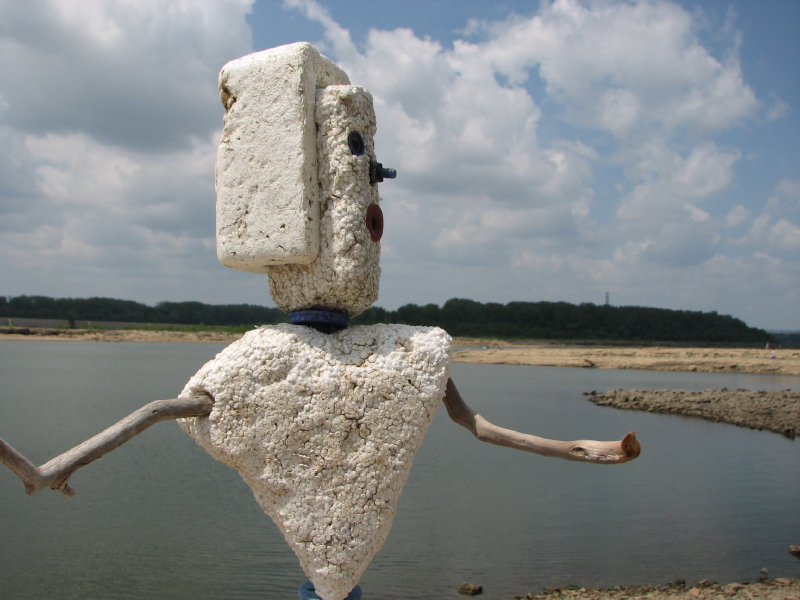
The strange-looking character said “Hello, are you the one who wants to see the butterflies?”  I replied that I was and we met face to face.

And what a memorable face he has with his mismatched eyes and lavender lips!  He told me to call him the Butterfly Man and that I had picked a good time to come to the river because it was now agreed that 2010 was a good year for butterflies in our area.  He also said that the place we wanted to go was a short walk ahead to where the purple flowers were growing.  Many different kinds of butterflies would be there.

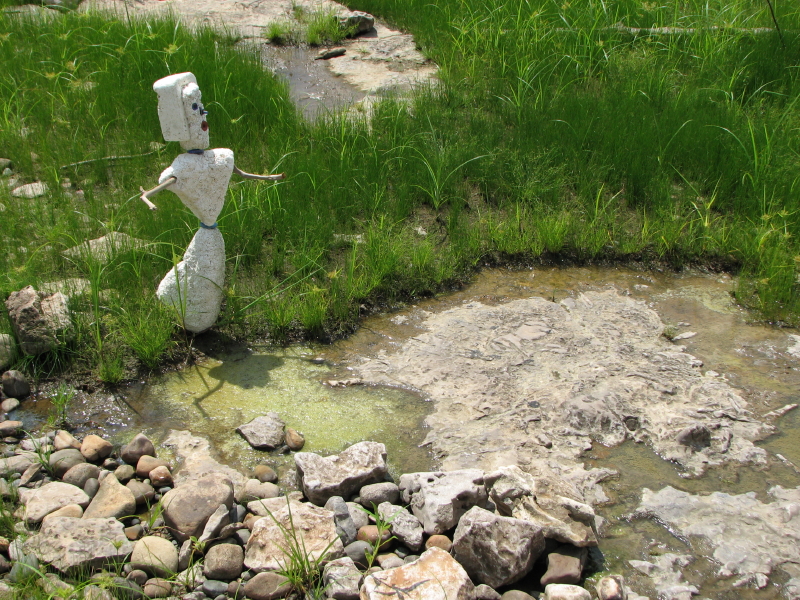
Along the way, the Butterfly Man told me tidbits about the environment we were experiencing and what we might expect to see.  He explained that the loosestrife flowers are an invasive species and quickly take over these shallow wetlands.  Around here small springs trickle water down the bank towards the river and keep this area moist. These are perfect conditions for the loosestrife which has spread from last year.  Butterflies and other insects love the nectar from these flowers and if we encountered bees and wasps…not to be afraid because if you left them alone, they would do likewise.  Soon we were among the flowers and it didn’t take the Butterfly Man long to spot a terrific butterfly!
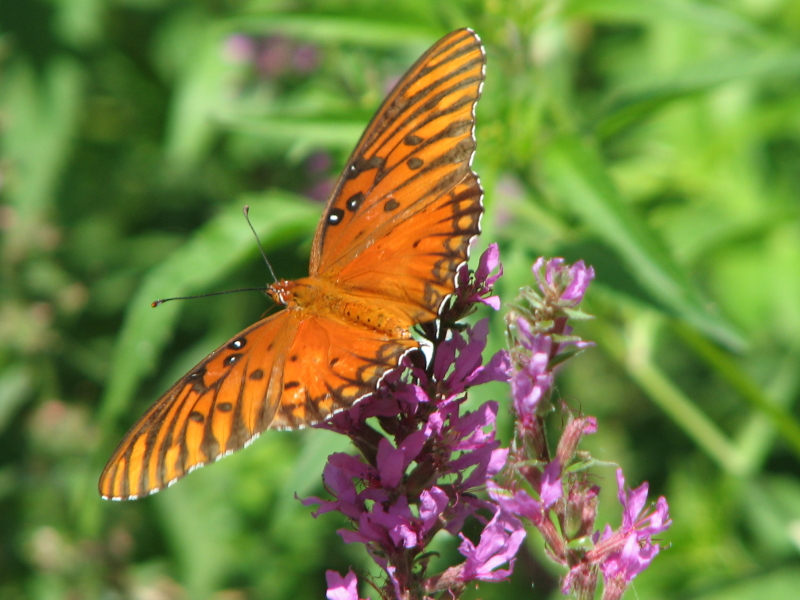
With its slightly elongated forewings and intense orange color the Gulf Fritillary ( Dione vanillae ) stands out among the loosestrife.  As the name suggests, this is a mostly southern species, but does venture north.  The ventral coloring sports mother of pearl and orange spots.  Not to far away on a different flower, Butterfly Man spotted a nice swallowtail.
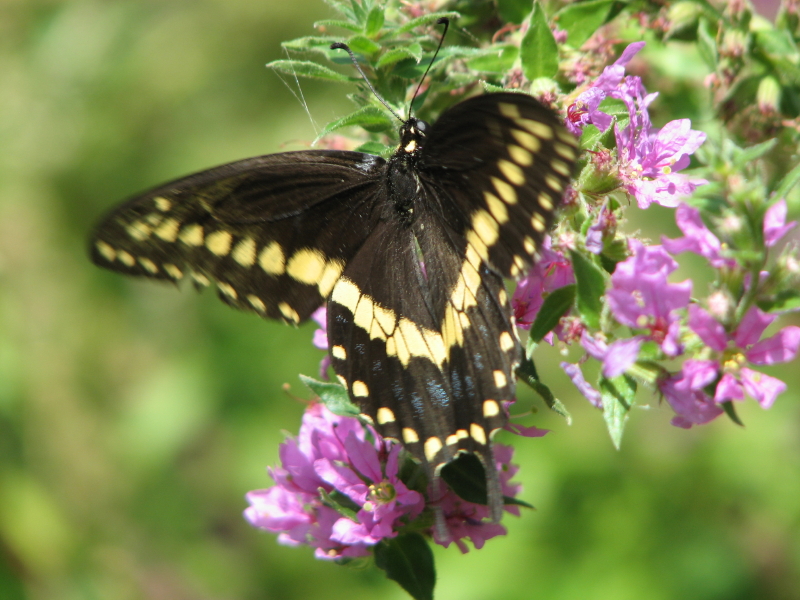
This is the Eastern Black Swallowtail, ( Papilio polyxenes ) and I have come across a few of these and other swallowtails as well.  I have seen, but unable to get a photo of some of them because they never slowed down!  I saw a Giant Swallowtail, our largest butterfly, fly over my head and towards the river.  The Zebra Swallowtail, same thing, it was flying too fast and never alighted.  The Pipevine Swallowtail I saw was so ragged that I decided not to take a picture of it.  I’m sure over time I will get other chances.  Here’s an image I like of a very common butterfly.
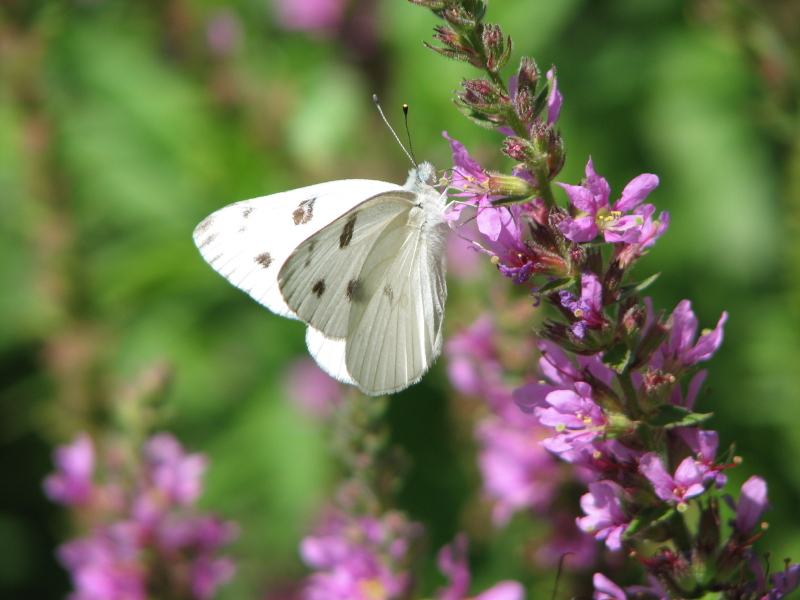
This butterfly was introduced into North America in the 1860’s and has now spread over the continent.  The Cabbage White, ( Pieris rapae ) is the most common white butterfly that most people are likely to encounter.  At the Falls, we also find another immigrant, the European Skipper, ( Thymelicus lineola ) which was accidentally introduced in Ontario about 1910 and has since spread across the country.  These tiny gold skippers can be very hard to identify and probably depends on having one in hand.  I like the idea of capturing a photographic image because no harm is intended.  With their folded wings, many skippers don’t look like butterflies at all. 
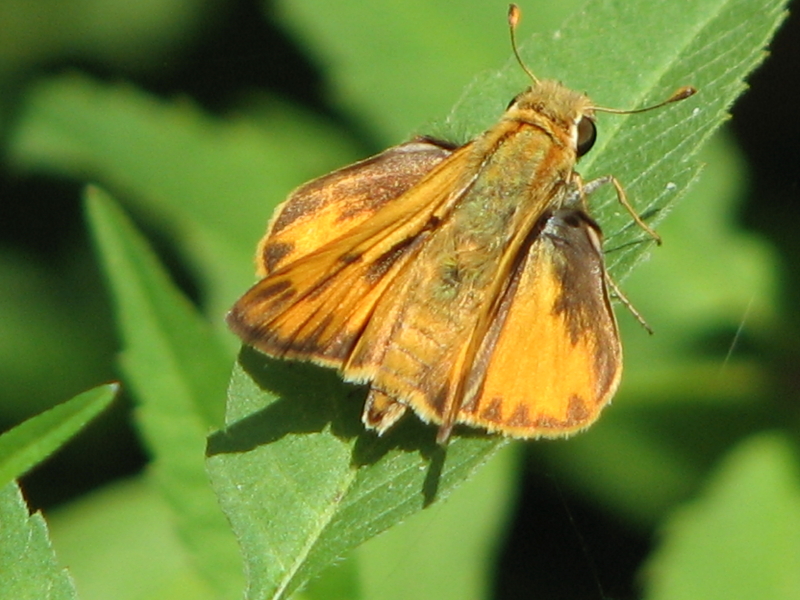
After a while, the Butterfly Man said we should take a break.
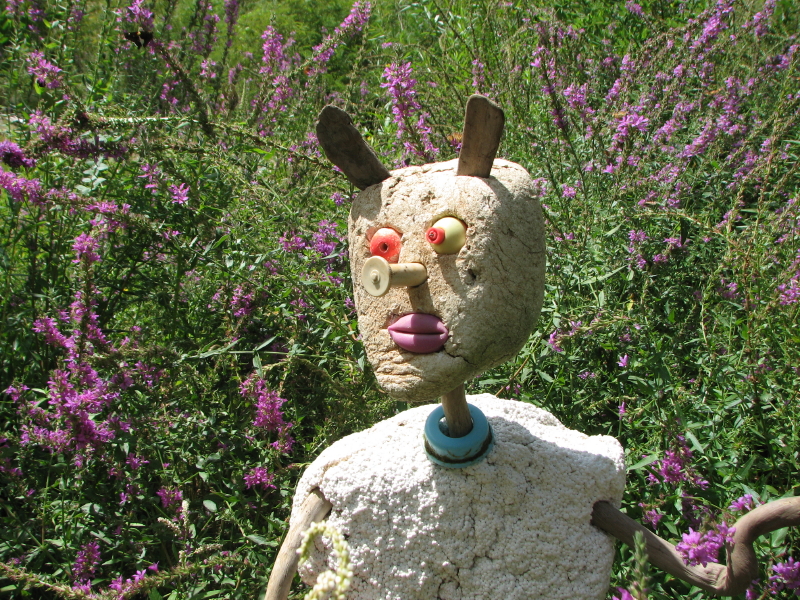
He said he found something special earlier in the morning and it was somewhere in this vicinity.  There is another creature here taking advantage of the butterflies.  Sure enough a couple of bushes away we found her enjoying a snack.

We found such a beautiful and large spider sitting on her web!  The proof she selected the right location was entombed in silk.  I have seen other Black-and-yellow Argiope ( Argiope aurantia ) spiders at the Falls before.  This is the first for this year.  She’s a big spider and soon she will produce her egg case and die.  The baby spiders will overwinter in the case and emerge in the spring.  These orb weavers have a characteristic zig-zag silk pattern on the interior of their webs.  This spider has had luck catching Orange Sulphur and Viceroy butterflies.  I noticed many loose wings below the web.  There is an element of risk out here among the flowers after all.

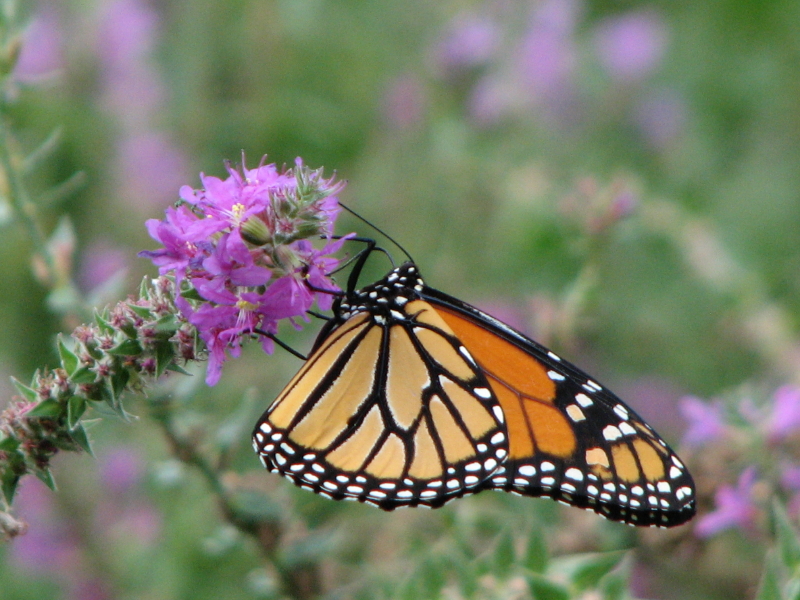
 The Butterfly Man spotted a nice pair of Viceroys ( Limenitis archippus ) basking side by side on the same leaf.  There are many of these species currently out among the willow trees.  With their smaller size and black line crossing the veins of the dorsal hind wing they can be told apart from the Monarch butterflies ( Danaus plexippus ) which are also in the area flying down on their long migration to Mexico.
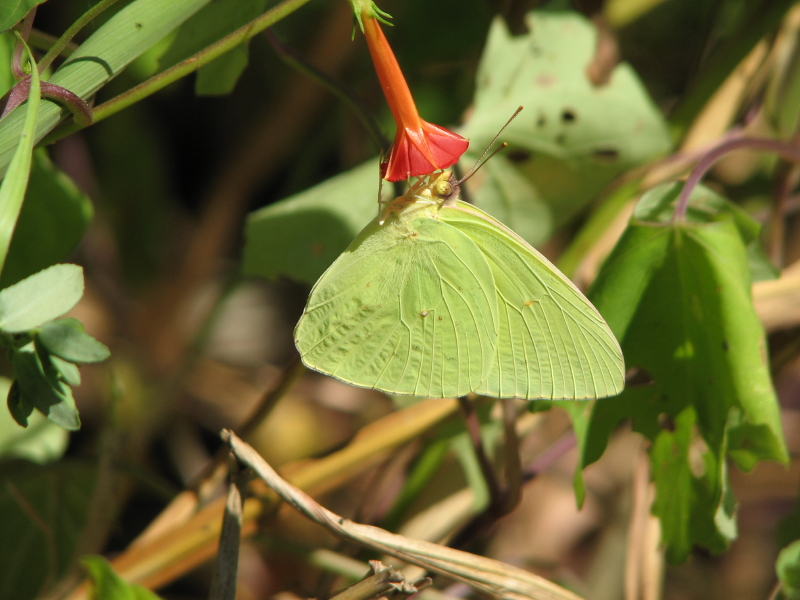
There was time for one last butterfly before turning for home.  Earlier I had spotted a few large yellow butterflies nectaring on the small Jewelweed vines .  I came across this Cloudless Giant Sulphur in a characteristic position with its wings folded together like a yellow leaf and created this composition.
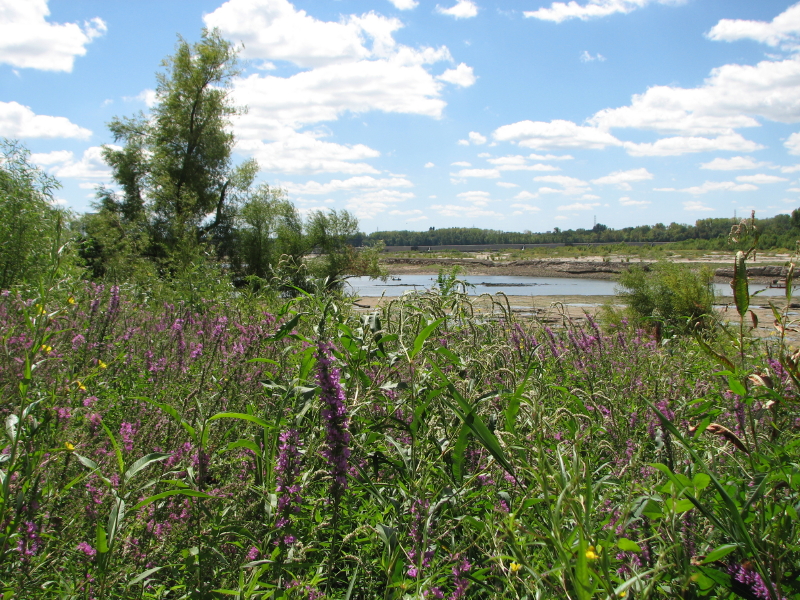
After one final look at the loosestrife fields, I was reminded of French Impressionistic painting and thought this landscape worthy of a canvas or two for the purple colors and nice cloud formations.  You can also glimpse the fossil beds beyond the trees.
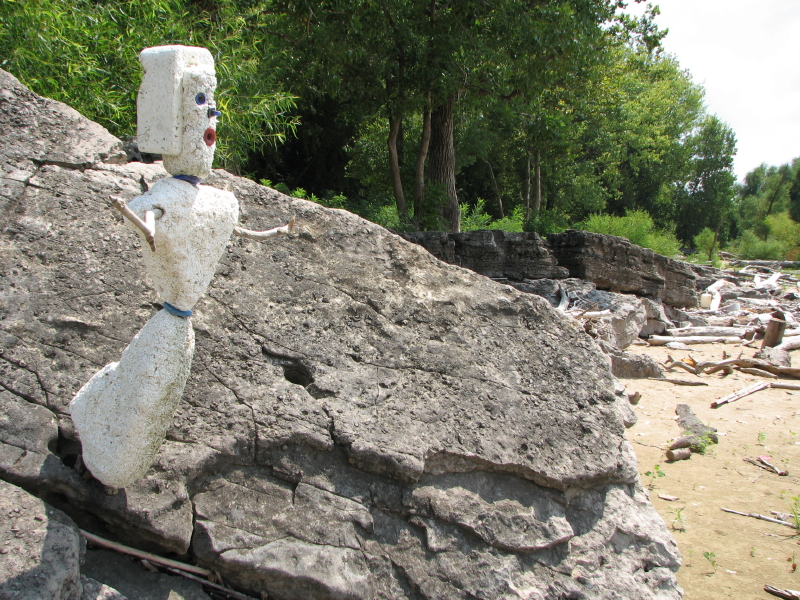
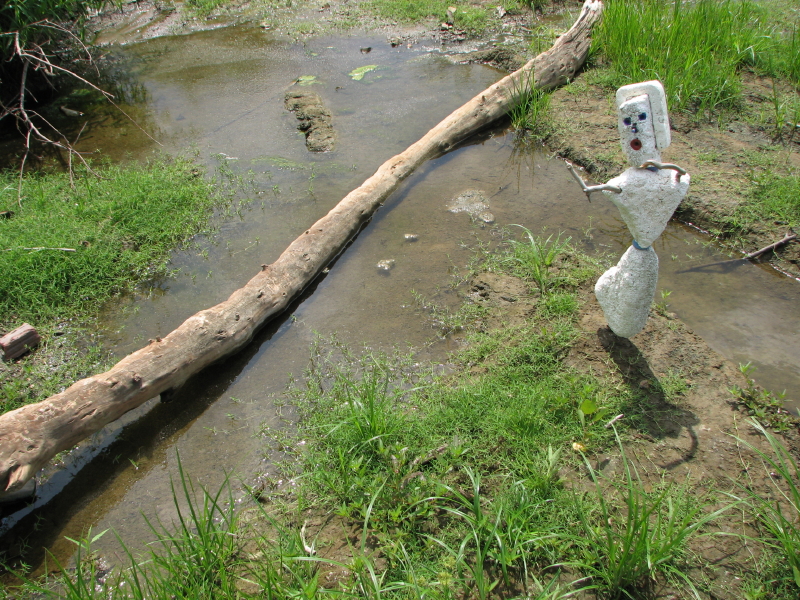
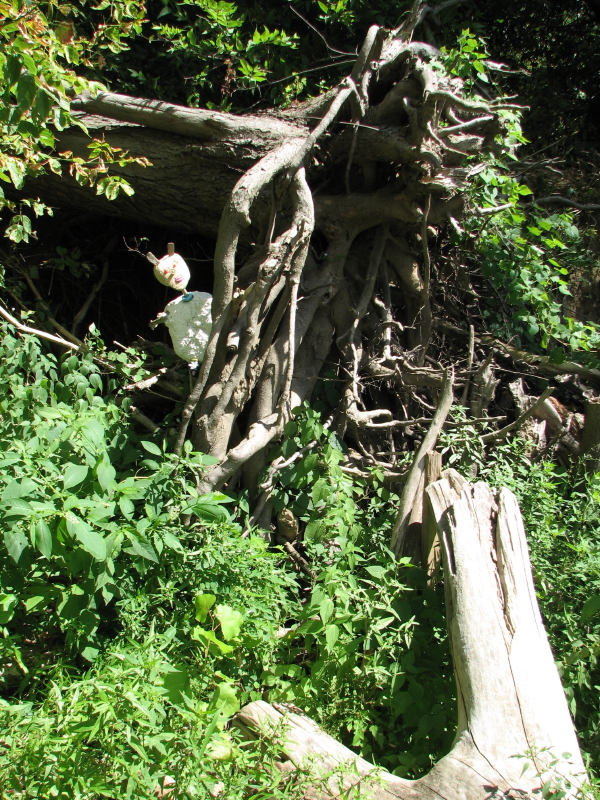
I left the Butterfly Man standing where I first met him by his home next to a downed tree.  I thanked him for taking the time to show me around and hoped to run into him again in another adventure at the Falls of the Ohio.
Read Full Post »

Ah, how nice it is to be in the great outdoors and filling my lungs with fresh air!  The passing weather front has made life bearable again and the fleecy white clouds are a reminder that Autumn is near.

Visitors are down on the fossil beds trying to imagine what life must have been like all those supposed millions of years a go.  I can see a few fishermen too, but I think the water is too warm and the fish won’t be in the mood.  I wonder if when our kind passes into the next geological age…what presences will we leave behind?  Will our very bones turn to stone too and leave a layer here for “others” to discover?  I doubt it.

It’s all so mind-boggling to me that life could have evolved out of some stagnant pool of algae ooze.  I’m not sure I believe that because here I am in my white dress floating over this landscape.  That would have been too unrefined a beginning for someone who is closer to the angels than to the amoebas!

Surely, all this exists for our benefit?  I mean what other use could it have?  Do we think that the animals or plants have the means to develop this site or have the wherewithal to see a bigger picture?  If it’s all going to become history anyway shouldn’t we use our resources as we see fit?  Isn’t that what Darwin meant by survival of the fittest?

Nature is okay, but a little untidy for my tastes.  What the natural world needs are beings like us to organize this place and turn it into a garden.  When I visit the Interpretive Center I think I will plant that idea in the suggestion box.  There are so many more useful ways to experience this landscape  if only the people in charge would clean things up a little.

Read Full Post »

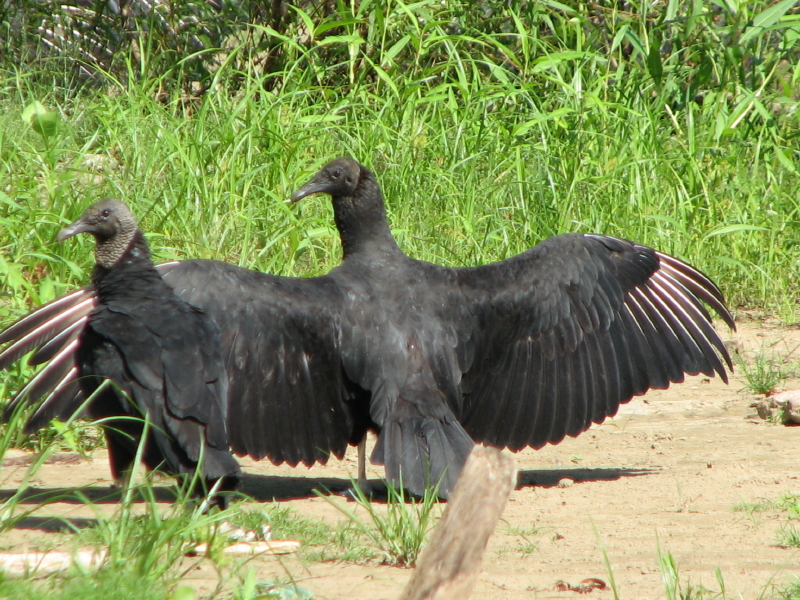
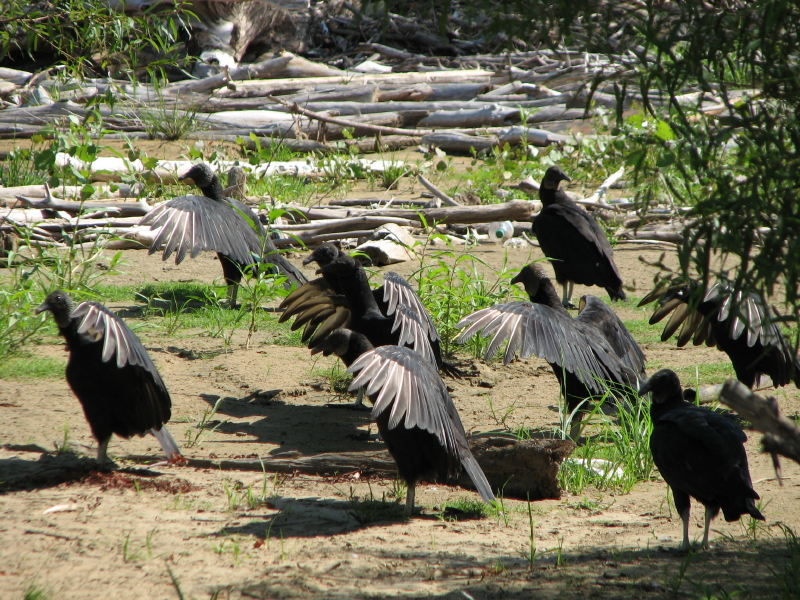
It’s official, this summer was our toastiest.  I looked at the lead article in the local newspaper and words like historic and unprecedented are being used.  We beat the old record that stood since 1936 by a degree and a half!  In meteorological terms that’s a lot.  This was determined by factoring the daily highs and lows and taking the average temp for the day. Louisville had more than 80 above average temperature days this summer which was more than any other city in the country.  No wonder working at the Falls felt so harsh.  We had a number of high pressure systems that just hung around the Ohio Valley making life difficult for everything including these vultures.  Of late, every year has had something climatically anomalous about it.  Too dry, too hot, too wet, too cool…missing are words like usual, normal, ordinary, and uneventful.

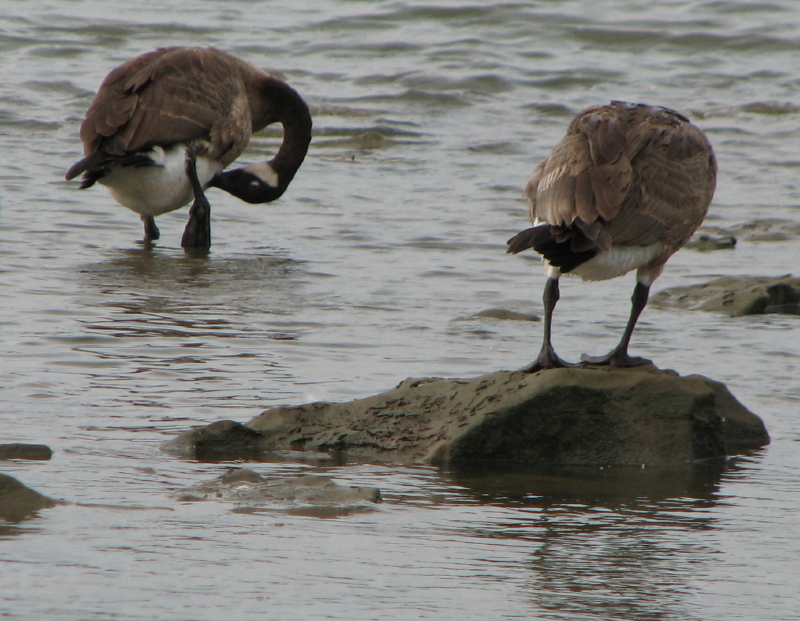
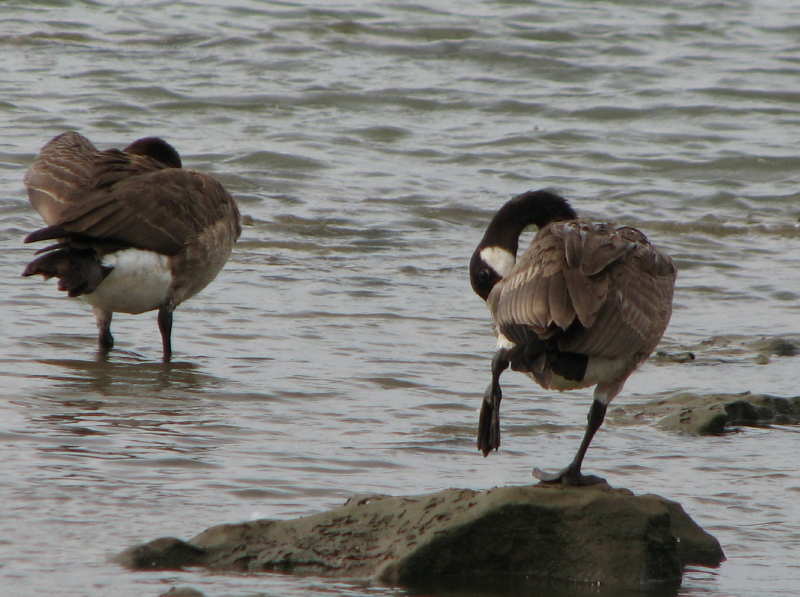
The variety of bird life at the Falls has been down this year too.  When you are a creature that is sensitive to the environment and have the advantage of great mobility…your instincts can tell you to go elsewhere.  I think this is what happened this year.  I will be really curious to see what comes by on the Fall leg of migration.  This year the Black vultures did well as did the Canada geese.  I could count on seeing those two species in good numbers most anytime I came out to the river.

From what I can see “anecdotally” the Canada Geese are on the rise here.  We have few predators to challenge them.  I have seen some very large flocks out on the water and they are keeping the grass clipped short along the riverbank too.  Friends told me that in the “old days”, you could find large stands of native river cane on the margins.  That’s something I don’t ever recall seeing out here.  One of the values I place upon this blog is to act as a record of the environment as I find it.  We have journals and first hand accounts of what this place looked like two hundred years a go and I believe that two hundred years from now…people will still be interested in the Falls of the Ohio and how it has been changed by civilization.

One of my favorite summer birds are American Goldfinches.  There is something cheerful and friendly about them.  The male with his bright yellow and black plumage is an unmistakable bird.  Many times I have watched the dipping and rolling courtship flight and listened for their call notes.  In the past, I have seen this species in mass, but not this year.

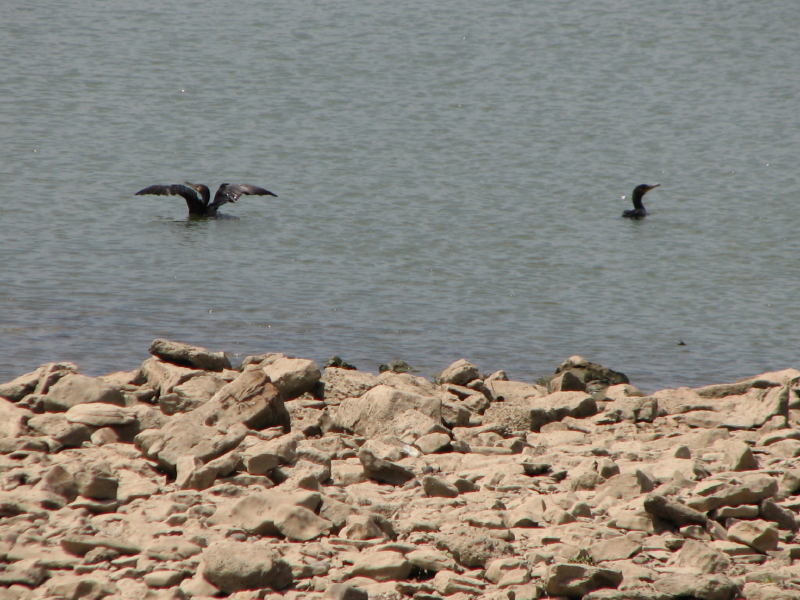
I’ve had conversations with people bragging about their fishing luck or skill, but none of them can hold a candle to a cormorant.  The Double-crested Cormorants in this picture are able to find and catch fish when nothing else can.  Of course, it helps to be able to swim and pursue prey underwater!  These birds are wary and very hard to approach.  In other places of the country, fishermen have persecuted this species because they compete very successfully against the rod and reel.

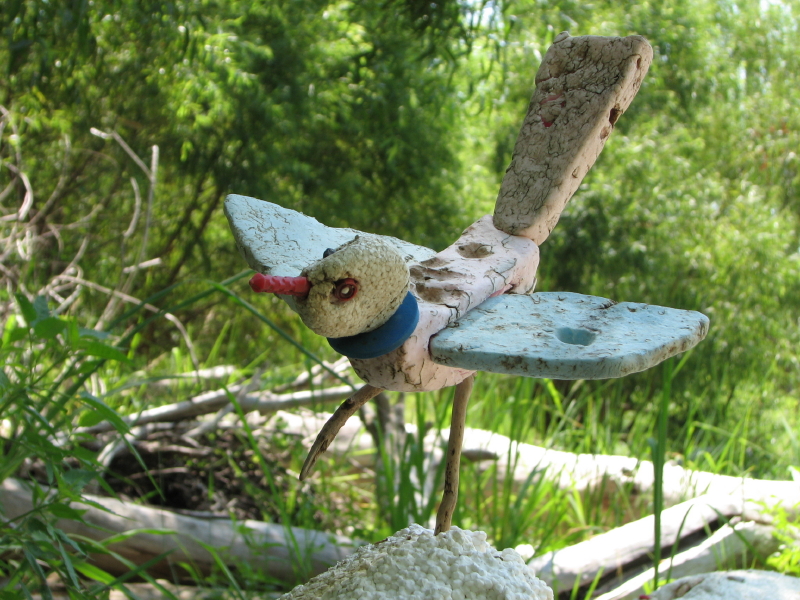
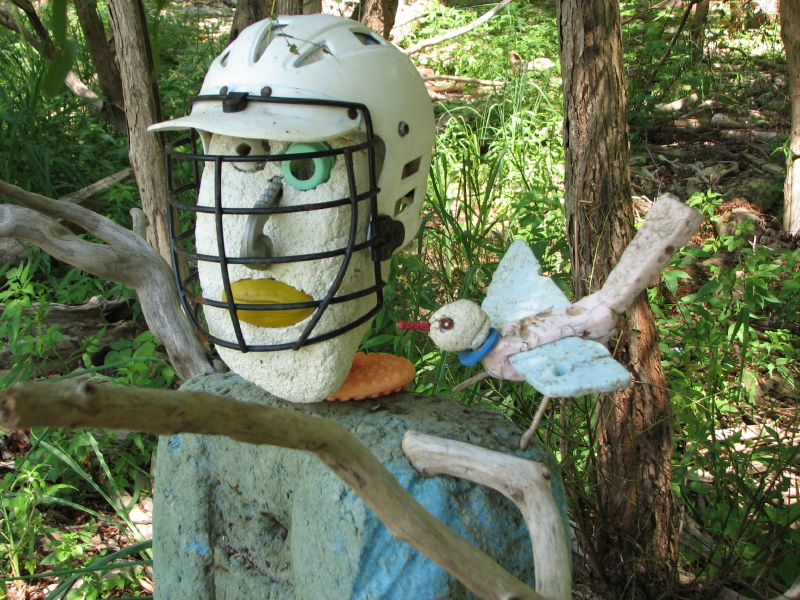
One of the few interesting and new birds to write about is the Azure-winged Mockingbird.  I have encountered them by my studio under the willow trees.  They are fearless and will drive away larger birds.  Among their notable features is the way they flash their wings against their bodies which makes them look more aggressive.  I have wondered as I make my Styrofoam sculptures, if these birds are drawn to the mosquitos and gnats that find me!  This is not a common bird and has been rarely recorded here.  I expect that in a few weeks, it will be winging its way to Central America.  I wonder if this year’s events in the Gulf of Mexico will compromise it and other birds in some way?  The forecast for this holiday weekend looks great and I’m anxious to spend a bit more time out here on my projects.  I’ll close with one more image of my mockingbird friend and a sculpture still around from several weeks past.

Read Full Post »


Every summer is different at the Falls and this one is starting to feel  overgrown with vines.  Walking through the vegetation, it doesn’t take long for one’s clothes to stick to your skin.  It’s been very hot here this summer and the high humidity raises the issue to another level.  Although I have never been to the tropics, I begin to feel like I know what it might be like.  The air is filled with cicada song and there are many insects of all types to be found. 

Overall, this has been a good year for butterflies.  I have enjoyed watching, learning, and photographing them as part of my Falls project.  At some point, I will probably post all my better images in my Pages section.  For now, I will release a few at a time as I come across different species.  Here are three new images that I made on this day .

I have seen more Buckeye butterflies this year than I have any other previous year.  Last week they were positively everywhere around the Falls of the Ohio.  This is a common species, but very pretty with its eyespots.  Apparently among professional lepidopterists, there is some disagreement about how to classify this butterfly because there are variations in its scientific name.  Some books list the Buckeye as Junonia coenia while other guides favor Precis coenia.  I haven’t read a good argument why one name is preferred over another!  I’ll wager the butterfly doesn’t care what we call it.

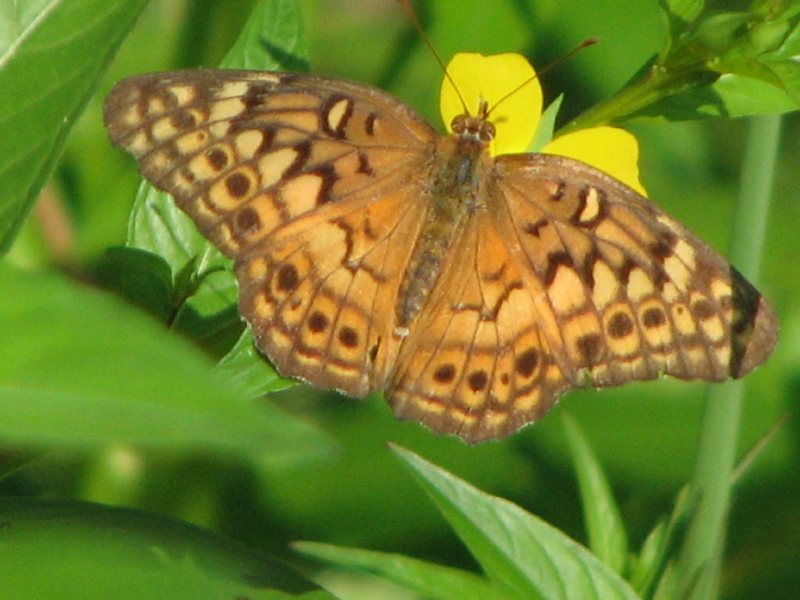
On this outing, I came across just one of these butterflies.  As they go it is rather nondescript and small.  Often the best way to identify a species is to check the markings on the underside.  With this butterfly I had just this single image.  After cross referencing a couple of butterfly guides, I’m fairly confident that this is the Variegated Fritillary, Euptoieta claudia.  With the Fritillaria, you need to look closely because there are many related butterflies.  Now the next species was even harder to identify!

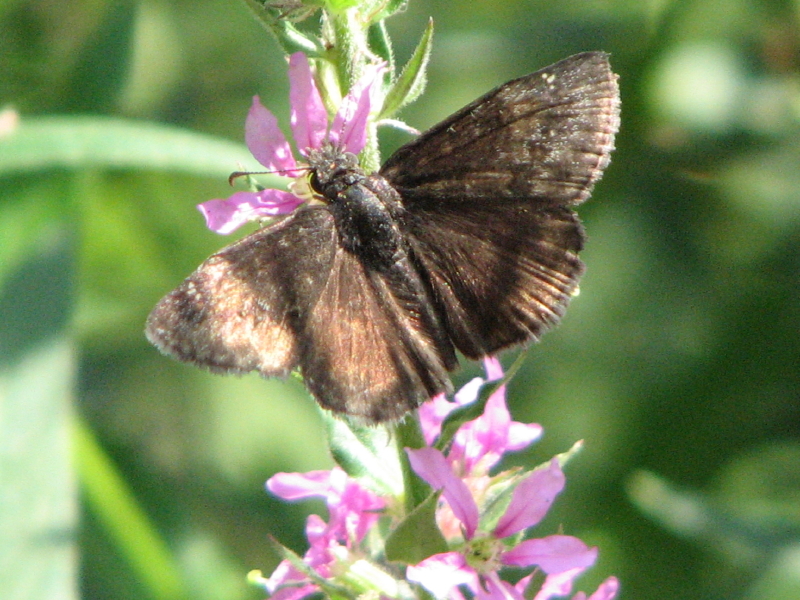
I am not at all certain on this one, but my educated guess is this is the Scalloped Sootywing, Staphylus hayhurstii.  It’s fairly small and nondescript.  The very tiny white dots on its fore wing are a clue along with its fringy wing margins.  The geographic range looks good because this sootywing is found this far north.  I also note that one guide said this species prefers moist areas near willow and cottonwood groves and that certainly is here.  The sootywing is a member of the skipper clan which are a group of interesting butterflies that share characteristics with moths. 

For me, learning what other organisms share this space is a celebration of life.  Even the rather dull looking sootywing is spectacular by virtue of its existence which took millions of years of development to reach this point in time we could share.  On this trip, I enjoyed  just watching what types of insects were feeding off the loosestrife flowers.  It was easy to forget oneself in the collective buzzing and busy activity around this plant.

Read Full Post »

It’s been a brutal and tough summer…one of our hottest yet.  When you are at the river’s edge there’s no place to hide.  It’s just rock, water, and sky.  Life in all its forms is trying to expend just enough energy to keep going on.  That also includes me.  The mosquitos and gnats were extra annoying and chased me from the cool and shade under the willow trees to the open light and heat of the riverbank.

In the air above me, a pair of osprey makes repeated visits to the dam.  Every once in a while, one of them would fold its wings slightly and dive into the river.  I wonder how they know that the water here is shallow?  On occasion their daring would be rewarded with a fish.  Birds, however, are not the only ones ignoring the heat today to chase fish.

This guy has just landed a catfish and is extracting the hook.  Around him is his fishing tackle which includes several poles and a small throw net.  To me it all appears very primal and it wouldn’t have surprised me at this moment to see him take a bite out of this fish.  Observing people fishing out at the Falls is like watching one of those nature documentaries where large bears intercept the salmon on their return home.  People arrange themselves along the most productive sites and arriving early helps. Not all the fish caught by the fishermen are kept.  The rough so-called “trash fish” are thrown back in a weakened, wounded condition.  I have seen the osprey picking those fish off and flying away with them.

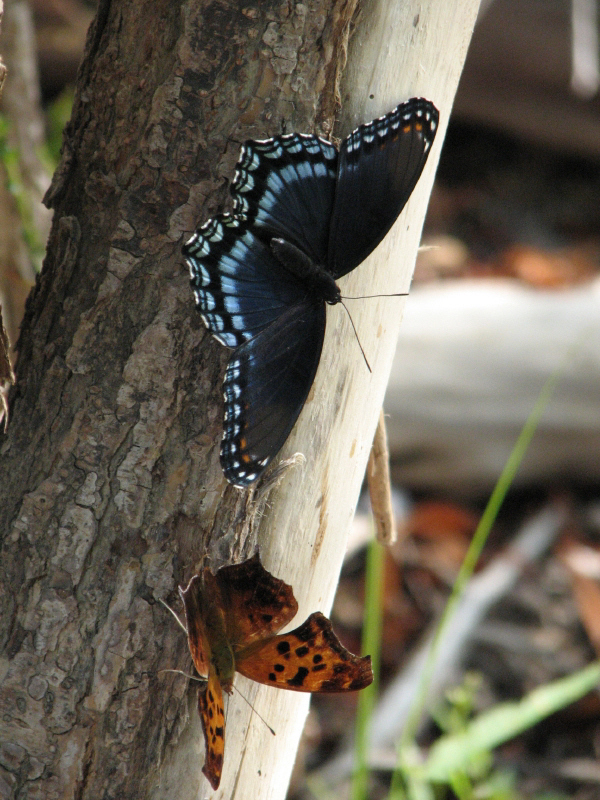
Butterflies are seen in profusion during this time of year.  I have been watching which species like to congregate around the willow trees to sip up what I assume is tree sap.  I have seen as many as six different species lining up on the same tree.  I think areas where these trees have been damaged (from collisions with water born logs) are the preferred feeding areas.  These places that the butterflies like (this includes flies and wasps too) are on the margins of where bark has been worn away.  The above photo features two species…the larger Red-spotted Purple and the Comma butterfly.  I later watched these two individuals engage in a combat over a favorite spot on the tree.  The Comma was by far more aggressive.  So much for the idea of describing a butterfly as being meek.

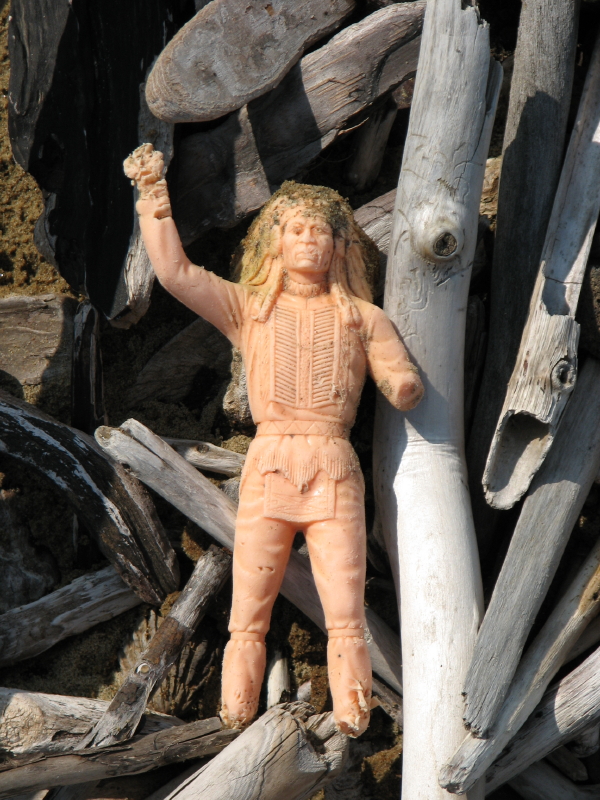
I did make one plastic discovery tangled in the driftwood and sand.  I came across this Indian dressed in his Plains garb.  He’s obviously has led a hard life too and has come to rest at the Falls of the Ohio.  I snap his picture where I found him and dropped him into the collecting bag.  I may or may not use him in some other creation of mine.  We will see.
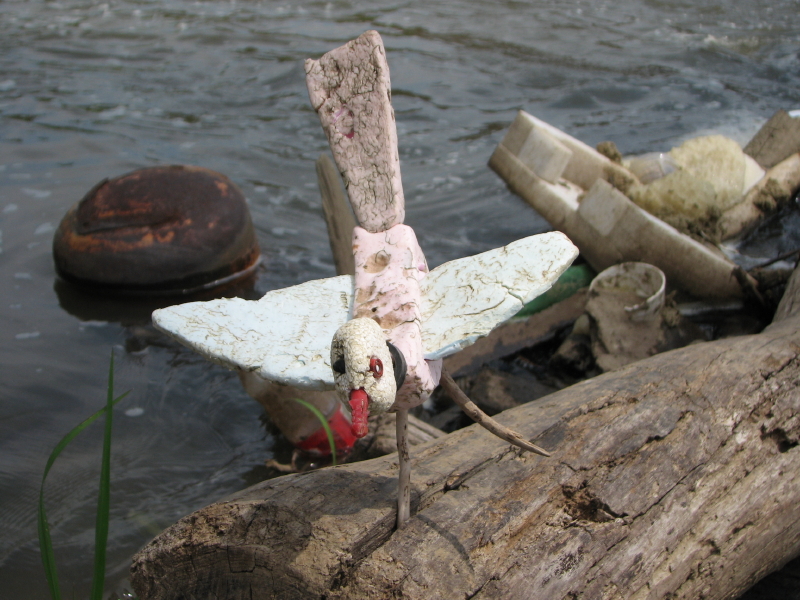
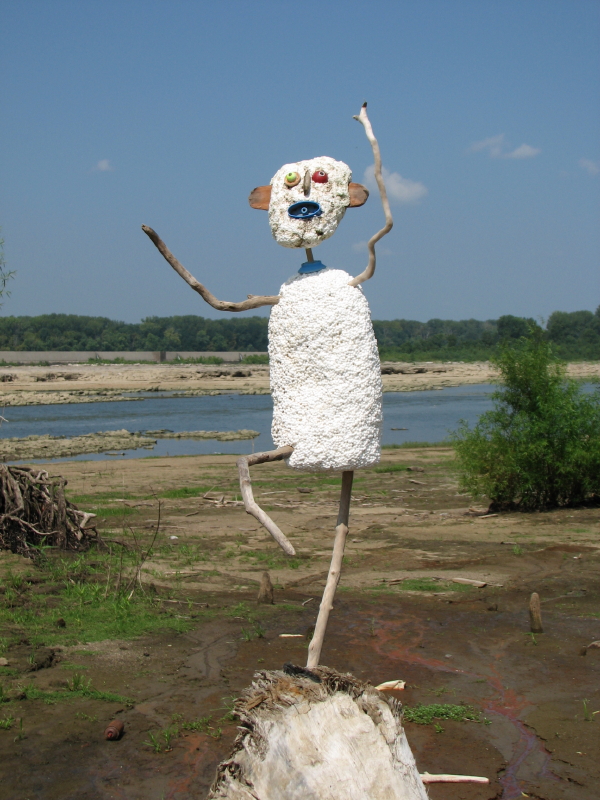
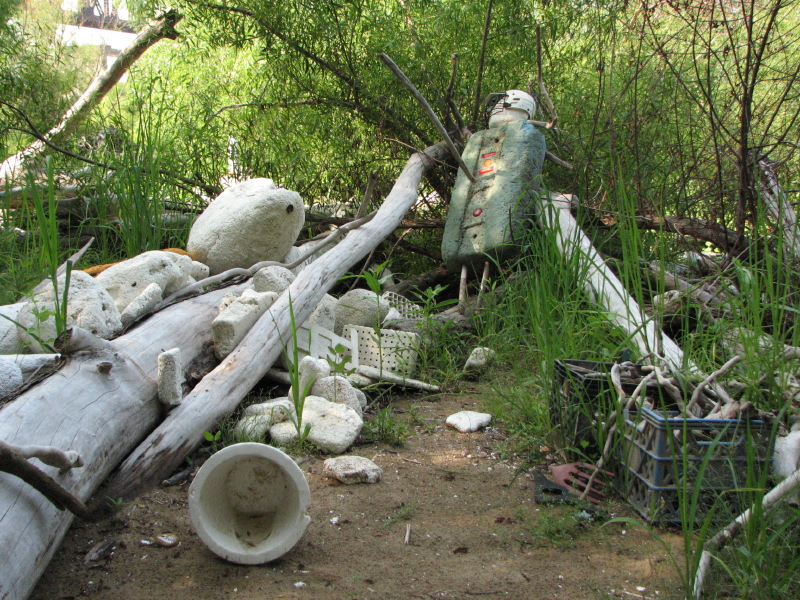
When I reached my studio under the willows, I found this image.  The helmeted figure made a month a go is still here, but he was leaning over with a “spear” thrown into his body.  There wasn’t any other signs of damage or disturbance.  I removed the spear and set the figure up in another location and proceeded to make a new piece.  This is what I came up with before the bugs chased me out into the bright light.  With all the heaviness that life throws at us…I made this figure to remind myself to do a little dance every now and then.  It seems to help!

Read Full Post »

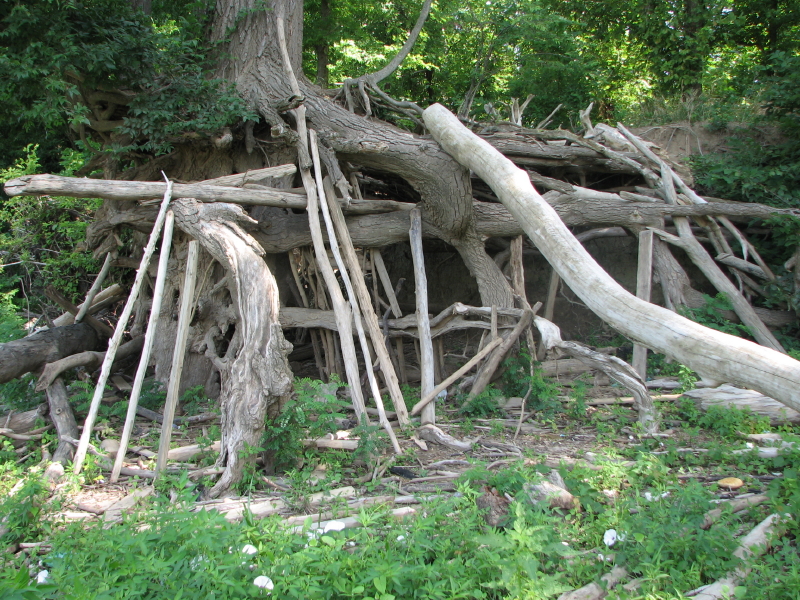
Continuing my last walk…I came to the area that would be my base for the day.  There is a favorite tree with exposed roots that you can sit under and remain cool and out of the sun.  Previous visitors decorated this spot with many vertical sticks that give a fence-like impression.  Here’s two views, first the base of this tree as seen from the outside:

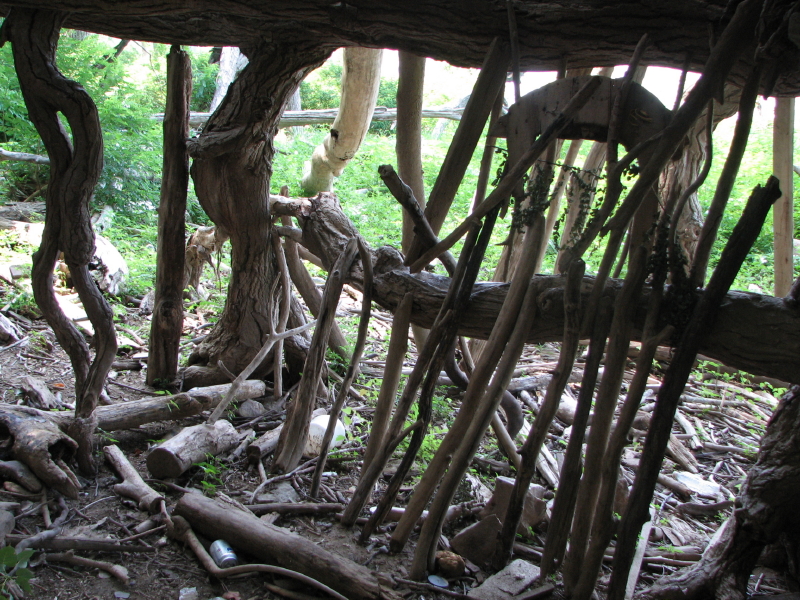
…and a view from the inside.  Over the years, I have left many small sculptures in this area.  They never seem to last very long in here.

Last week was my birthday, and so on this outing I have new tools.  Earlier in the year, I lost my handy two-bladed Swiss Army knife which was a previous gift from a friend.  It had a nice, easy to sharpen blade and a toothy saw that could cut wood.  Replacing that knife are these two objects.  My family gave me the updated Swiss Army knife complete with tweezers and toothpick.  My friend Jeff gave me the bigger saw.  Its blade folds out and has the advantage of locking.  I definitely can chew through a nicely sized limb with this baby! 

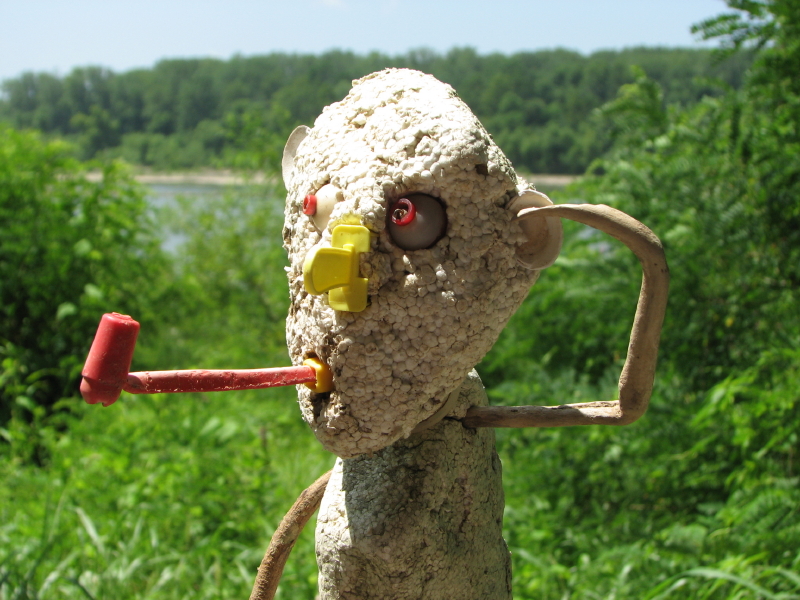
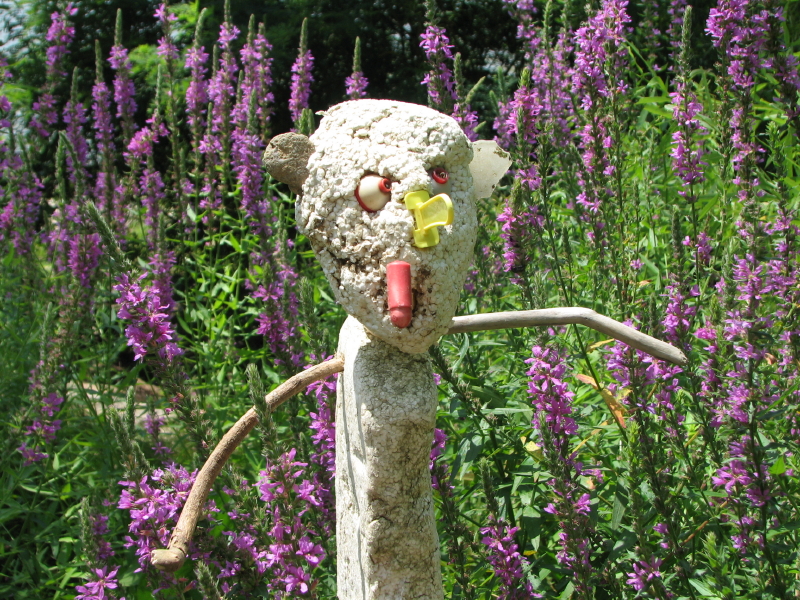
On this particular trip, the heat and humidity put a damper on doing anything ambitious.  I hung around this area for a couple of hours and made this guy who was checking out the butterflies in the purple loosestrife.

I found a little bit of Styrofoam to work with and this red plastic object that looks like a pipe.  I used tiny plastic fishing bobbers for eyes and the ears are clam shells.  Later because the shells kept falling off, I substituted a flat rock and sand-polished glass for the ears.  It’s subtle and you might not notice this change at first.  As for the place I was working at…last year the Purple Loosestrife was getting a foothold and now it is firmly entrenched.  This is a hard to get rid of invasive plant that plays havoc in small wetlands like this one.  The butterflies, however, love this weed. 

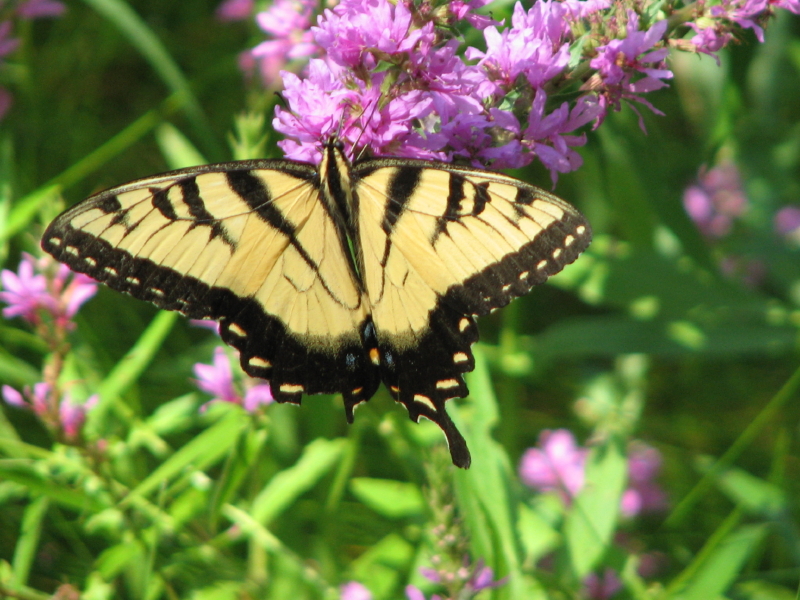
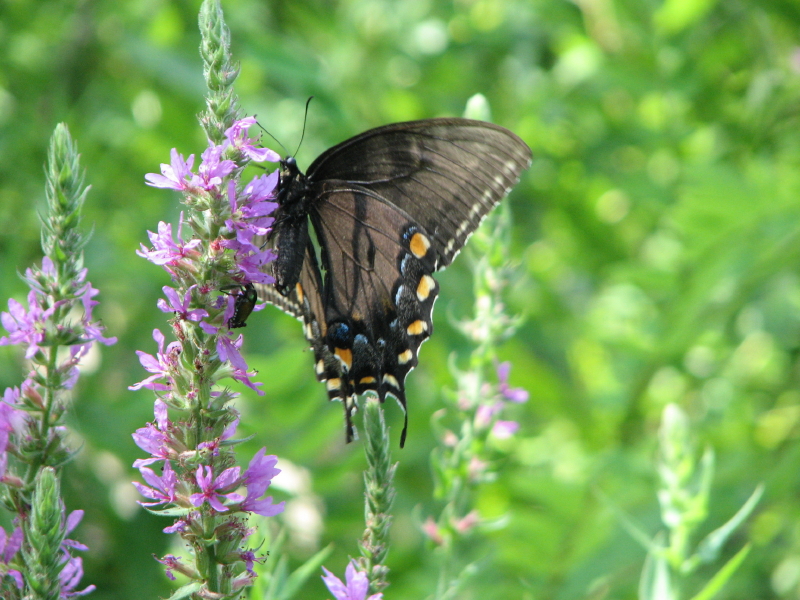
Among the many species feeding from the purple flowers is this Tiger Swallowtail, Pterourus glaucus.  This is a boldly patterned and large butterfly of summer.  I have seen some beat up looking butterflies of different species and am assuming they are from an earlier brood that perhaps over-wintered here?  The tiger swallowtail also has a common melanistic form and I also saw one of those out here today.

You can see the “tiger stripes” showing on his hind wing.  Also working these flowers were the large bumble bees we saw earlier on the morning glories.  I also observed several large, blue-black wasps that I associate with being spider hunters.  They are so intent on gathering nectar that they pay no attention to me.  All through the loosestrife insects were working the flowers.  Clearly, this plant has no shortage of pollinators.

Mr. Red Pipe was enjoying himself in all this purple haze and humidity.  There was something reassuring about watching all this insect life packed into a relatively small area.  Another favorite butterfly is hanging on a loosestrife blossom not too far away and if we move deliberately…we might not spook it away.

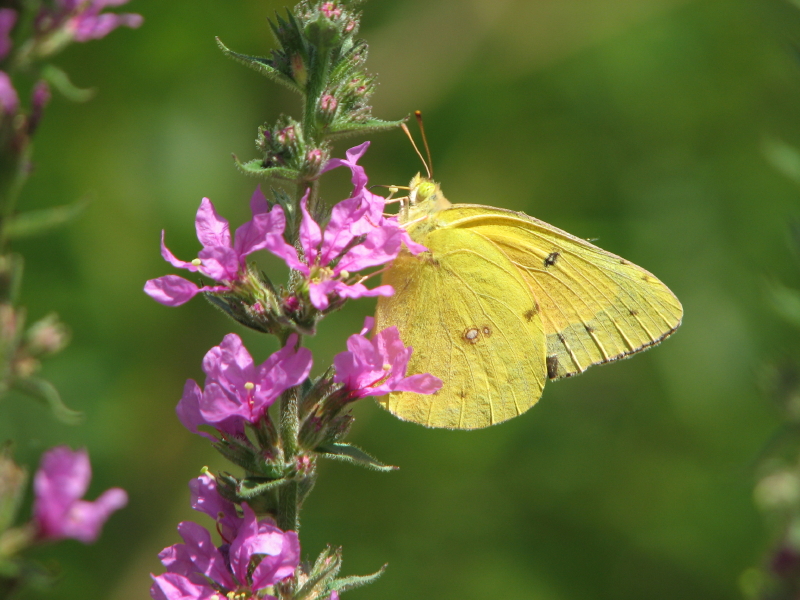
It’s an Orange Sulphur, Colias eurytheme.  We have several other members of the Sulphur family out here along with Viceroys, Red Admirals, and a couple different Skipper species.  I love the yellow-green eyes on this butterfly which seem to have a glow to them.

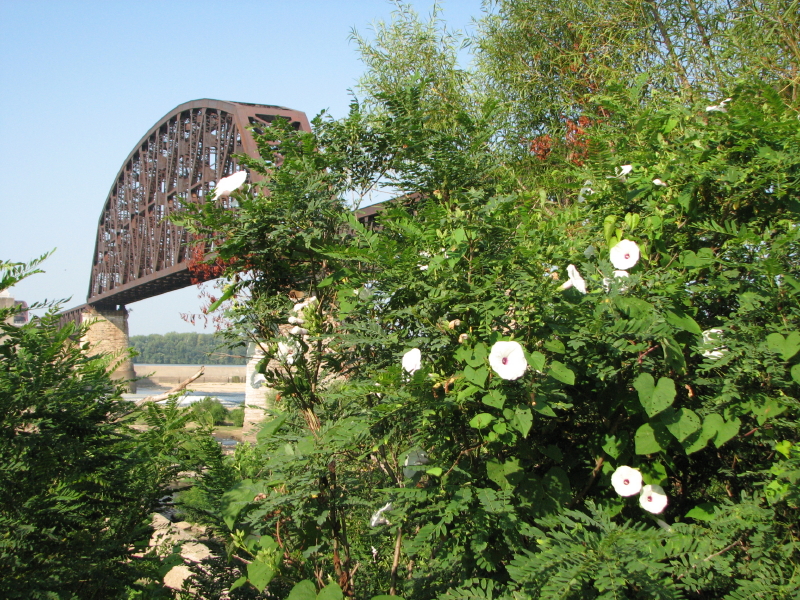
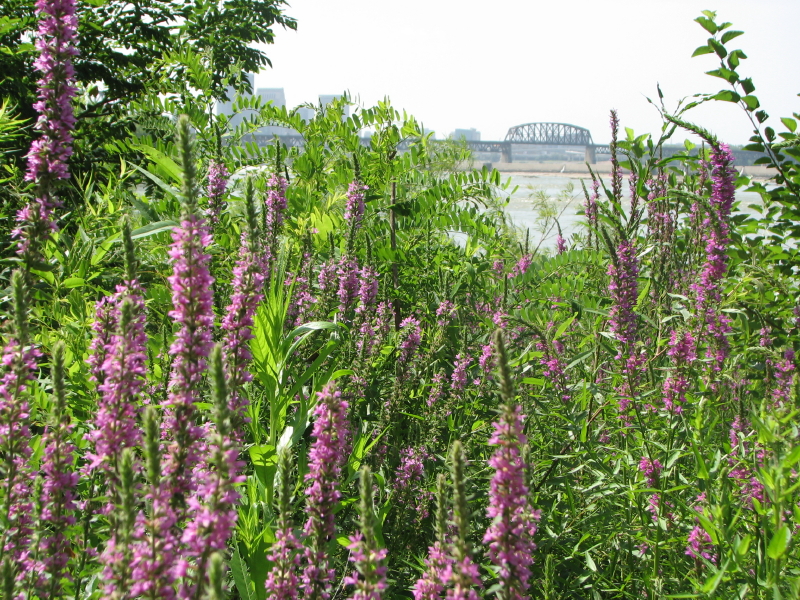
All my water is gone and so the idea of returning to my car sets in.  I have another bottle waiting for me there.  Tomorrow is supposed to be another high temperature day in the 90’s.  After our June being a record setter, it seems July is out for bragging rights too.  Before leaving, I snap one more picture of the Purple Loosestrife in its prime with the railroad bridge visible in the far distance. 

Read Full Post »

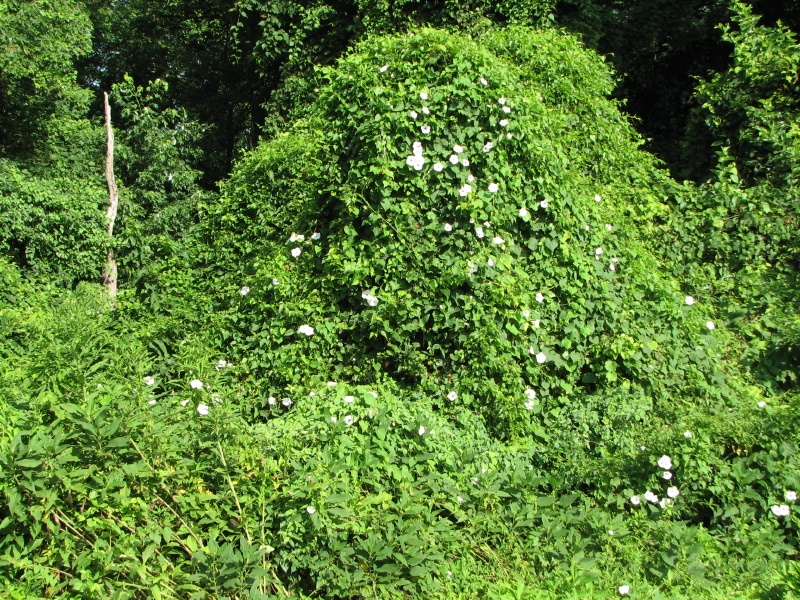
Today is supposed to be the hottest day of the year.  Walking out my front door this morning I’m surprised by how warm and humid it is already.  When I reached the Falls, I decided to take cover from the direct sun by walking along the Woodland Trail.  All the combined vegetation produces a spicy fragrance.  Vines are in their glory and in areas of good sunlight they have grown over some of the trees.  Birds are hunting for insects among the leaves.  They listen for the locations of singing cicadas.

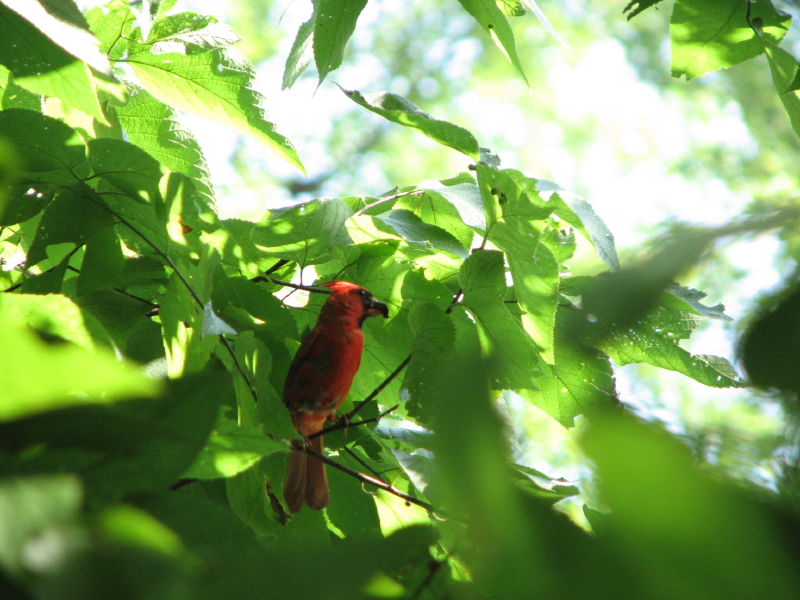
And, once in a while they catch a cicada as this male Northern cardinal has done.  He’s not the only bird moving through the canopy. 

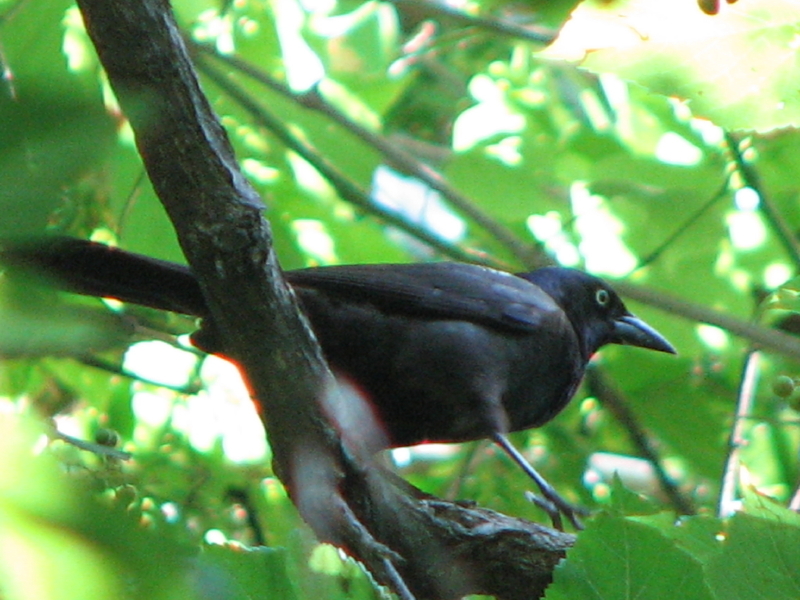
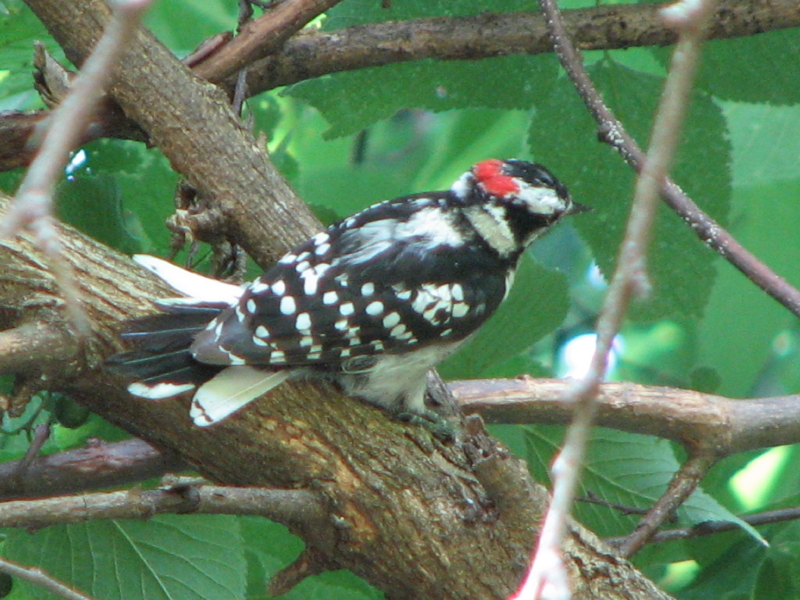
Grackles are stalking along the tree limbs.  They always seem to be just out of reach of my camera.  I had a bit of better luck coming across two Downy Woodpeckers chasing each other in the interest of courtship. So, they didn’t focus on me.  The male held still long enough for me to capture this image.  He’s waiting for the female to make a counter move and then it will be his turn again.  They flew between tree trunks for several minutes.

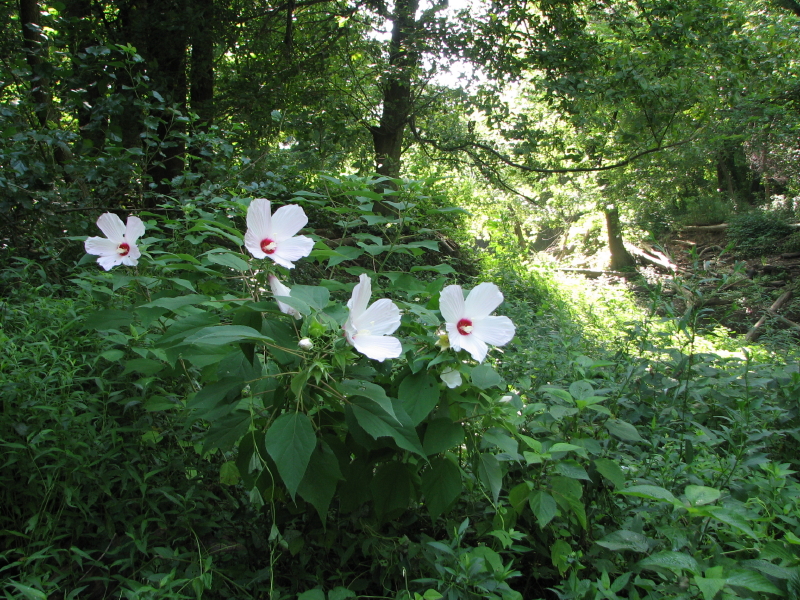
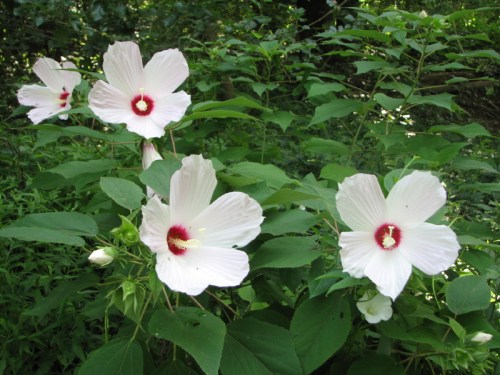
I’m heading out to the western section of the park.  As suspected there are fewer people in this area.  After crossing the creek, I was looking for the trail leading to the river when I came across this unexpected floral surprise.  I do remember seeing escaped hibiscus blooming among the driftwood collected along the eastern dam.  Perhaps these are the same plants that were transplanted here during the last flooding incident?

I will admit to not knowing my plants as well as I do the animals.  And so, if I’m wrong on the identification of this plant, please let me know.  In the interim, I will keep looking at my guides for other possibilities.  What made this encounter even more interesting…another blossum was less than ten feet away.  I wonder if this plant came from the same source up river?

These large blooms along with the heat and sticky humidity added an extra jungle-like quality to the walk thus far.  Although it’s hot, I’m grateful I have my long pants on instead the cooler shorts.  There are stinging nettles, poison ivy, and sharp-edge grasses around to irritate your skin.  It’s a big relief today to walk out from under the trees and into the light.

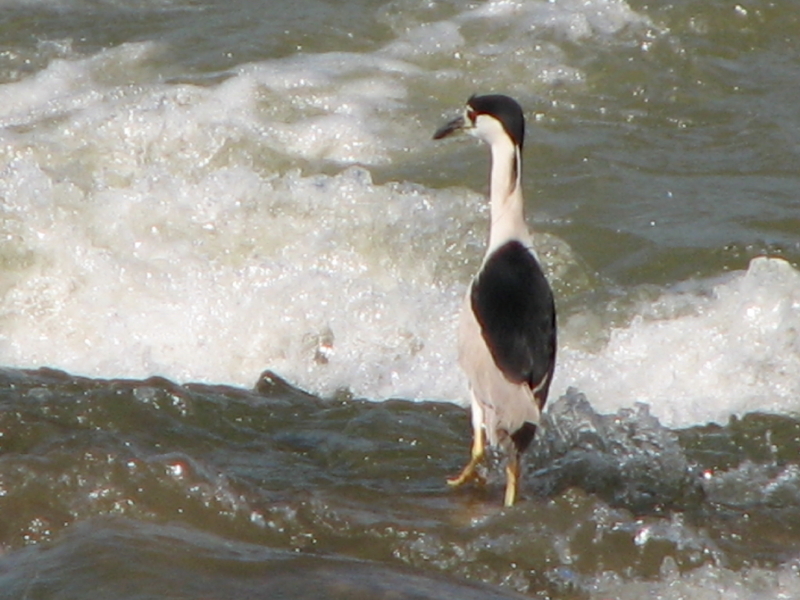
I haven’t yet reached today’s destination, but I’m back at the water’s edge.  I accidently frightened away a pair of Great Blue Herons from the rocks they were hunting from.  I’m going to continue this adventure in my next post.  I have many more nice pictures and I eventually made a piece.  On this day, however, it was mostly about the walk.  Before closing, here’s another bird picture.  It’s a Black-crowned Night -Heron fishing in the shallow, but swift moving river.  He would hold his left foot off to the side while in the water.  I wondered if he did this so that fish bumping into the leg would alert him?  Maybe this helps in water with poor visibility?  That’s it for now…I look forward to sharing this outing the next time around.

Postscript:  My friend Don Lawler turned me in the right direction by suggesting the hibiscus I saw and photographed are in the mallow family.  The white flowers have been identified as being examples of the Crimson-Eyed Rose-Mallow.  The pink flower is from the Swamp Rose-Mallow.  Interestingly, both flowers are considered to be conspecific, meaning they are the same species!  That would explain their proximity to one another at this location.  Their scientific name is Hibiscus palustris.  You learn something everyday!

Read Full Post »

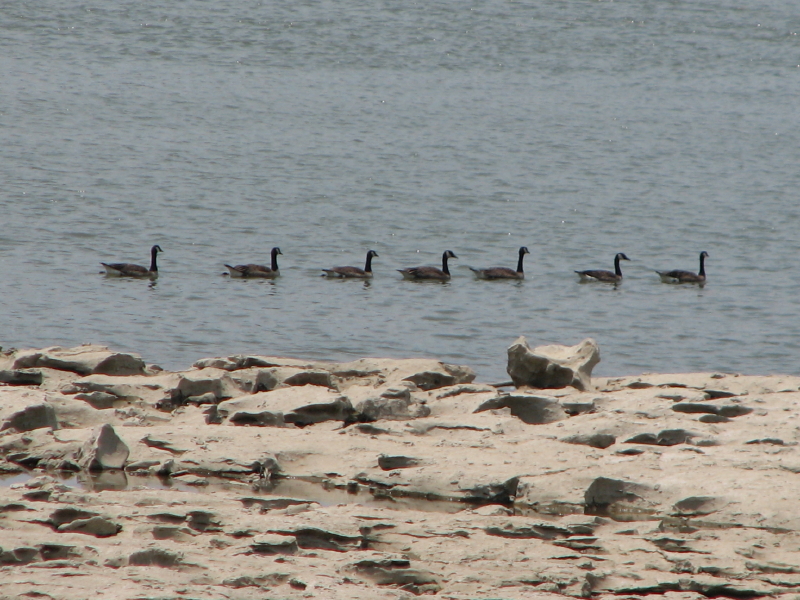
The river is falling, but is not yet in summer pool.  Day by day the extensive Devonian fossil beds are revealed a little at a time.  The limestone surface is scalloped by the actions of the Ohio River and appears to be the landscape from another world…because in fact it is!  Throughout the rocky matrix are the fossilized remains of ancient marine creatures that populated this reef over 375 million years a go.  While my thoughts are lost in deep time, a procession of stately Canada geese glides by which brings me back to the present and my own animal existence.  It is really hot out here today and I brought extra water to drink.  Slowly the first eight geese becomes a large flock as more and more birds reveal themselves that were hiding behind the huge rocks that mark the Kentucky side of the fossil beds.  From my vantage point I count 83 geese which are the most Canada geese I have ever seen here at one time!  In the warmer weather months, the number of bird species here is less than in the spring, but the indigenous birds are entertaining and I enjoy noting aspects of their respective behaviors.  Here are two new birds I haven’t previously featured and I hope you will like them as I do.

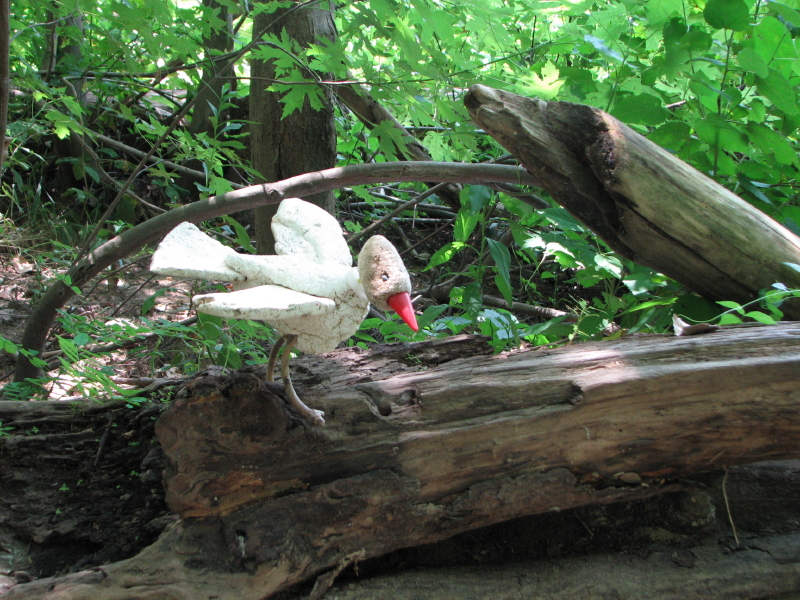
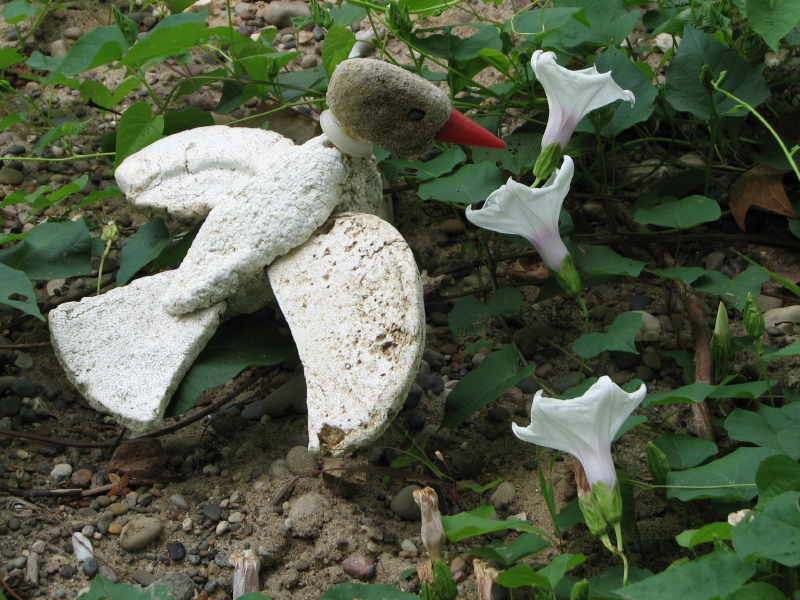
It’s definitely cooler in the deep shade of the woods, but the mosquitoes are more numerous.  I can’t get myself to put poison on my skin to keep them away and so I try not to let them get inside my head.  I suppose that they don’t bother me as much as they do other people.  Maybe I don’t taste as good!  While cooling off by the big trees I came across this unusual species and it’s called more commonly the Bumble Bee Bird.  I think its scientific name is something like “Turdus bombus”, but I could be wrong.  “Turdus” is the genus of thrushes and” bombus” refers to bumble bees.  Seems to make sense.  So, you are probably wondering why this clumsy looking bird is named what it is named and I will show you why.

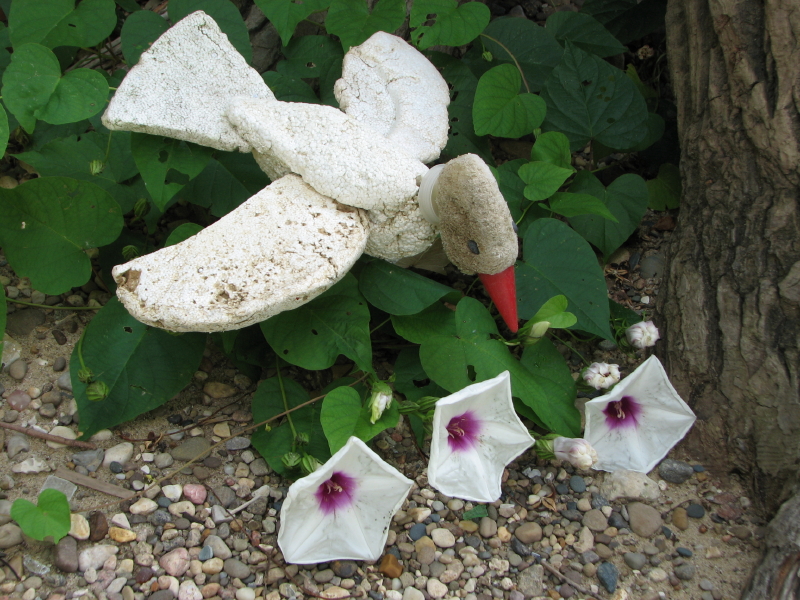
I came across this specimen hanging out at the forest’s edge where many morning glories were present.  These flowers grow close to the soil and sand and in places form thick blooming carpets.  Kind of pretty in an understated way.  Here’s the same bird hopping around some other morning glories, but is he just admiring the flowers or is there some other purpose afoot?

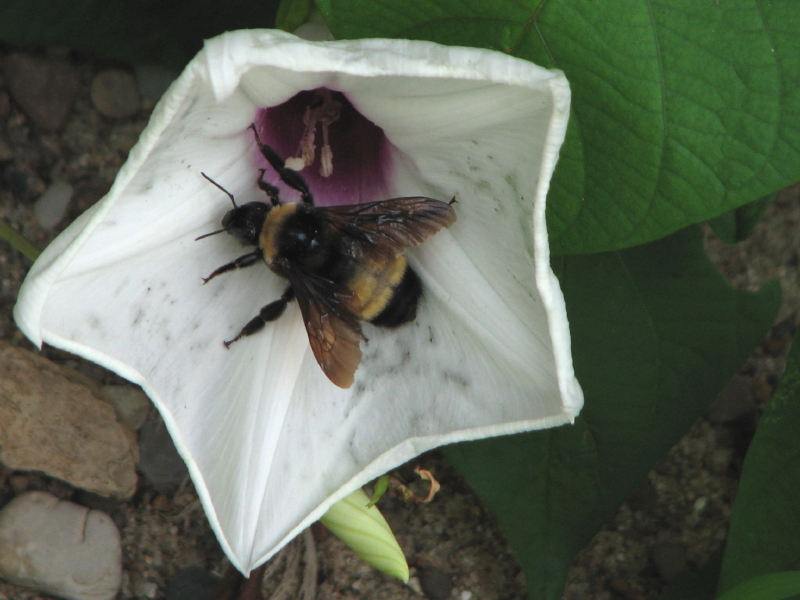
He’s in the deadly serious pursuit of something to eat, but not just any unfortunate creature or seed will do.  This species is aptly named because it has evolved to eat the large bumble bees that pollinate these flowers.

The bird waits for the bee to enter the bloom.  The bee has to get deep into the blossom to reach the sweet nectar it needs.  This is the moment when the bird comes from behind the bee and with its large red bill, seizes the bee crushing it and its nectar-filled abdomen.  The bee had no ability at this point to defend itself.  Stealing the nectar, the bird then tosses the dead bee into the air, catches it, and then swallows it head first.  It’s a doubly good meal and worth the expenditure of energy.

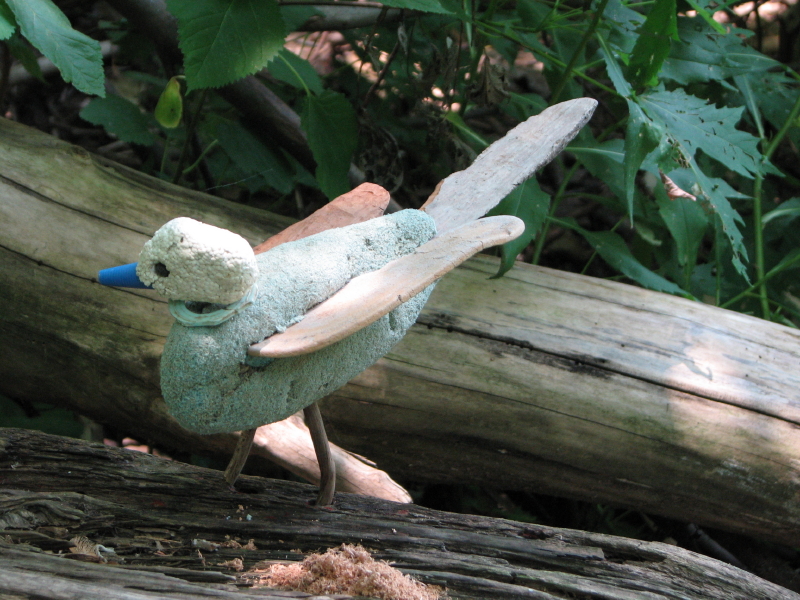
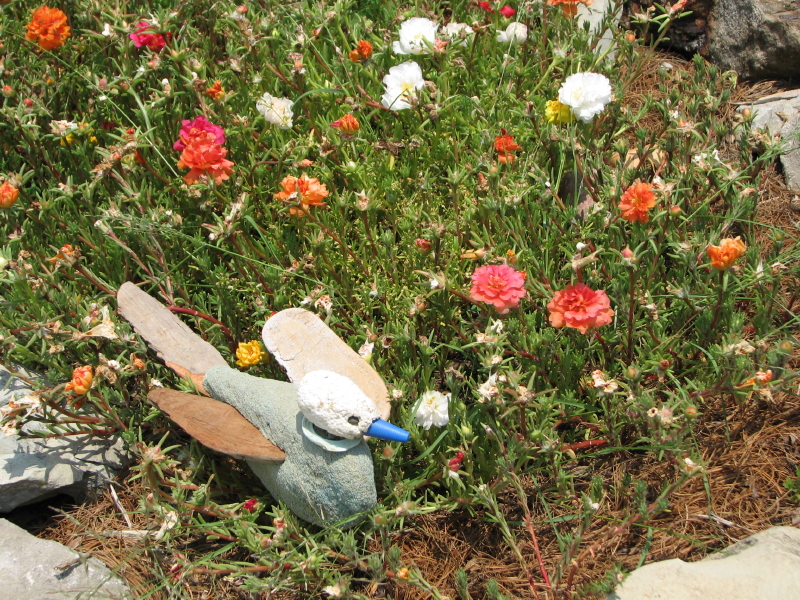
Also found in the cool of the forest is this little bird which is aptly named the Melancholy Dove, scientific name “Columbina melancholia”.  Smallest member of the dove family likely to be found this far north.  It is usually by itself or with a few of its kind and represents the antithesis of a former Falls of the Ohio resident…the now extinct Passenger Pigeon which congregated in immense flocks.  The Melancholy Dove is also recognized by its blue bill and sad expression on its face.  It is not an especially rare bird and I spot this species across the park during the summer season.

I found this bird sitting in a small garden near the Interpretive Center where it seemed unconcerned about the park visitors.  A nearby bird feeder has made this bird especially trusting and I fear that one of the many feral cats in the area will find an easily ambushed snack waiting on the wing.  Contributing to their melancholy name is the soft, plaintive coo…coo-coowee sound it makes during the breeding season.

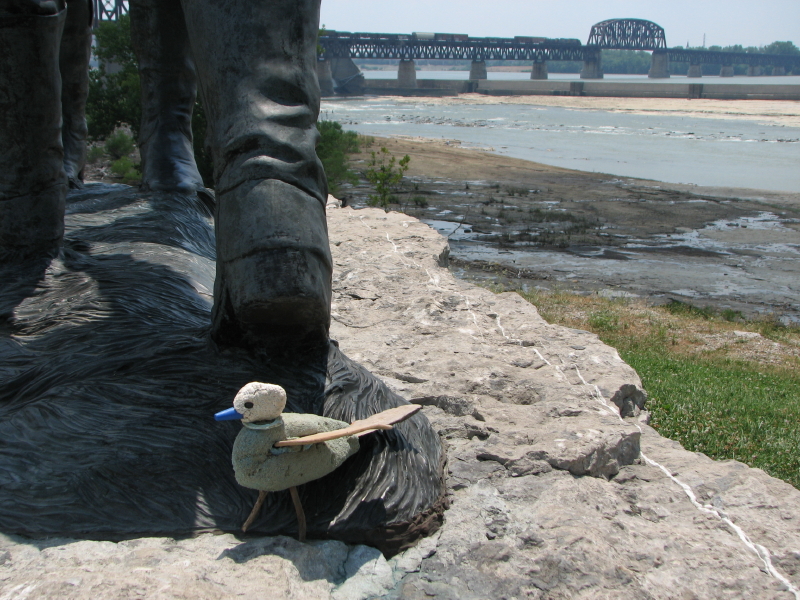
On my way to my vehicle at the end of the day I came across this dove sitting by the Lewis and Clark statue.  It brought back to mind a mental image of a nice pen and ink drawing of this bird that was in one of the personal journals carried by one of the enlisted men that formed the crew of the Corps of Discovery.  I don’t remember the name of the soldier, but he had a fine eye and a sharp quill.  There were a few notes scribbled in the margins commenting that it was too small and not worth the effort to eat!

As summer settles into its now familiar sweltering pattern, I’m looking eagerly to the time when I can cross over the shallow water and explore the Kentucky side of the fossil beds.  There isn’t as much junk to find to make “art” from, but it’s a contemplative landscape for me that has also become something of a seasonal right of passage.  It takes all day to walk across the rocks and I’ll need plenty of water to keep me hydrated, but it is such an interesting place and I look forward to sharing it with you.  Stay cool everybody…the weatherman is calling for some hot ones this week.

Read Full Post »

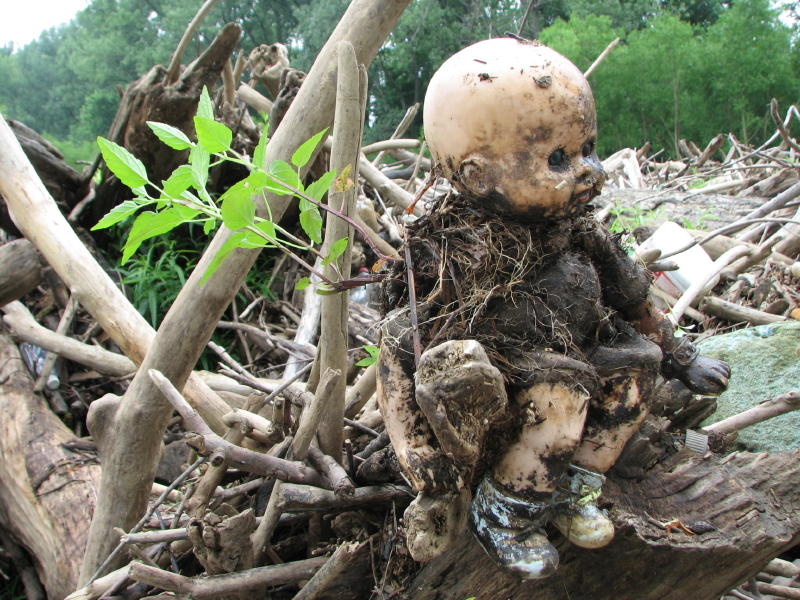
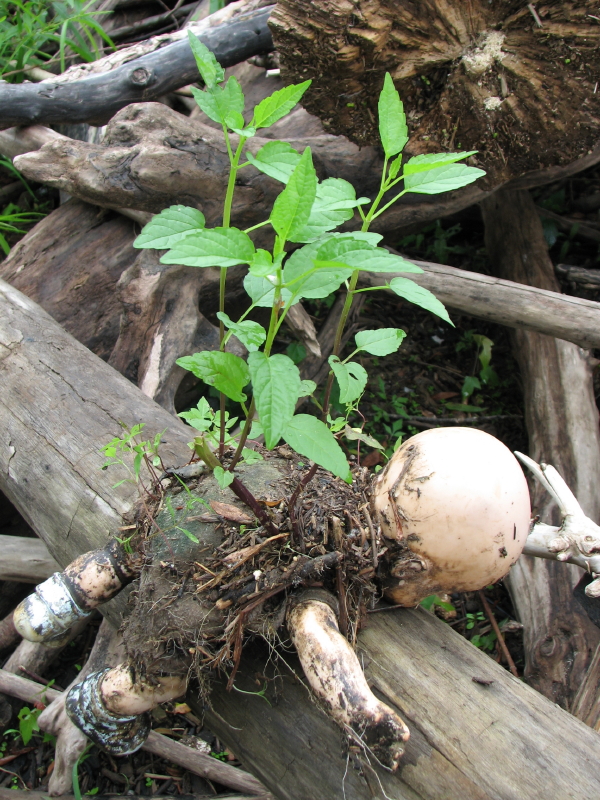
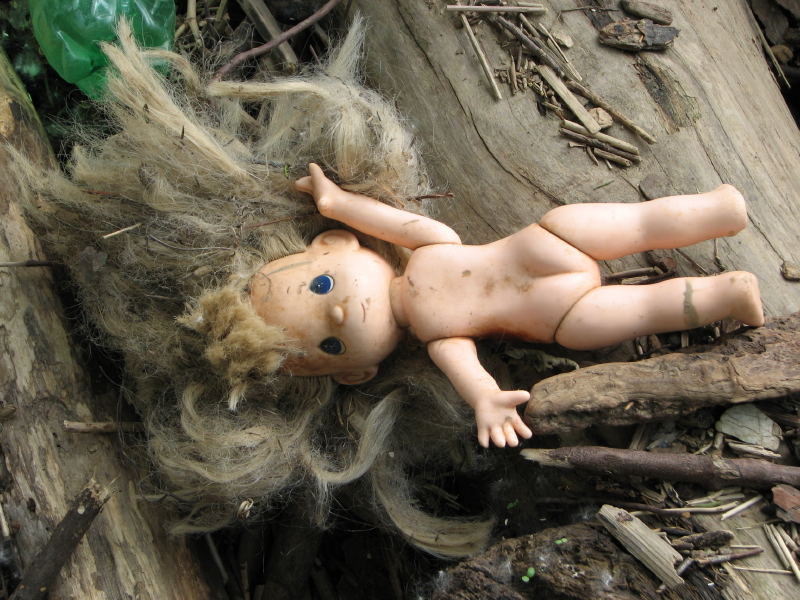
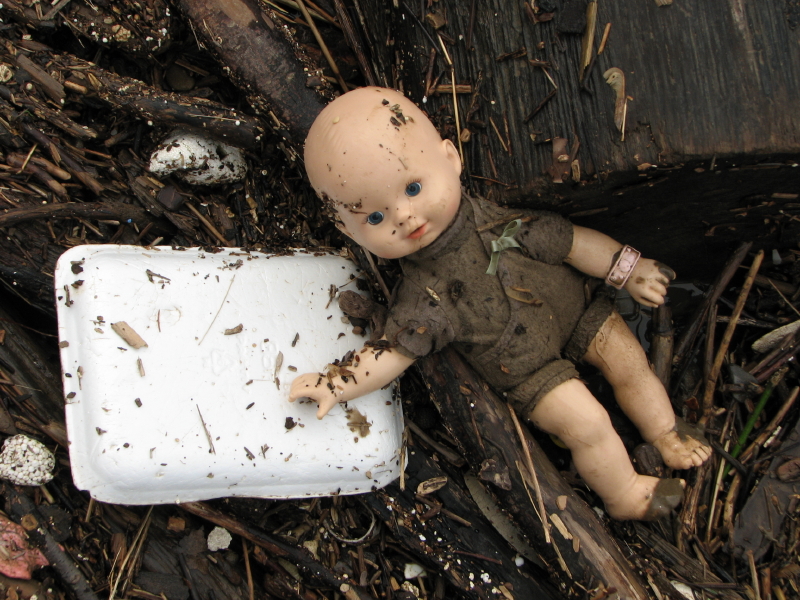
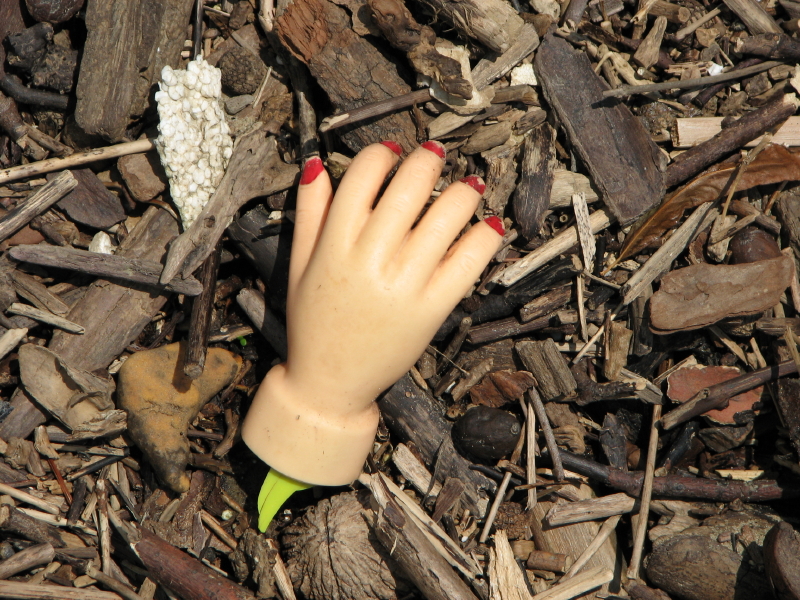
Of the many objects that wash up upon the shores of the Falls of the Ohio, few have the visceral effect that these found dolls produce.  For as long as I have been doing this project, I have been amazed by how many of these toys I have come across.  The various toy balls are the only other playthings that surpass these lost dolls.  The wayward balls I can understand getting into the river because most of them are round and inflated with air!  It would be very easy for a lost ball to become washed or even blown into the river, but what is the story with these dolls?  I came across an especially interesting doll recently and thought I would introduce the lost doll topic.

I came across this doll laying face down in the soft earth.  Several pieces of driftwood partially obscured a full view.  Recognizing what it was I reached down and lifted the doll up and was amazed that several plants clinging to the body had used this decaying doll as a substrate and were in fact growing on it!  I have seen many abandoned dolls, but this one was unique because nature was so actively intertwined with it.  I eventually placed the doll in a sitting position on a log near the place it was discovered, took my pictures and walked away.

The moment of discovery always produces a double-take for me.  There is a slight hesitation before the brain registers the scale differences and I recognize what this really is…just a toy.  I have come across little hands sticking up out of the sand that have sent fearful jolts of adrenalin rushing through me.  People are always asking me if I have ever discovered a human body before?  Fortunately, I haven’t, but these things come a close second.

No doubt about it…these objects are psychologically charged like creepy clowns are and stumbling across a lost doll is like viewing a mini crime scene.  The idea that we would intend a representation of an infant as a plaything strikes me as an odd idea.  So what are these dolls doing in the river so far from home and the people who care for them?

At first I thought it was plausible that many of the hundred or so dolls I’ve found in six years simply washed off or accidently fell off recreation boats.  And then I thought that perhaps the world is just full of mean prankster boys who think it’s fun to throw sister’s doll into the river.  There is that scene in the first Toy Story movie where the boy next door, Sid, engages in this kind of behavior.  And then another idea occurred to me that also seemed possible.

What if it’s not little boys, but instead little girls that are tossing out the baby with the bath water?  What if even on a subconscious level, these girls are rebelling against gender stereotypes they don’t fully understand?  Aren’t many of the baby dolls intended to reinforce the notion of girls becoming mothers?  I have had conversations with female friends who said that they never could relate to dolls and prefered other toys instead.

My wife reminded me that boys play with dolls too and that’s certainly true.  I had a G.I. Joe action figure “we” (me and the other boys in the neighborhood) eventually blew up in the sandbox…ala Sid.  The truth about the river dolls is that every possible way one can imagine these objects getting into the water can and does happen.  I have this other mental image of the dolls that missed the Falls, continuing on their long watery journey until they reach the Gulf of Mexico and then its open ocean from there as the currents circumnavigate the globe with them.

Read Full Post »

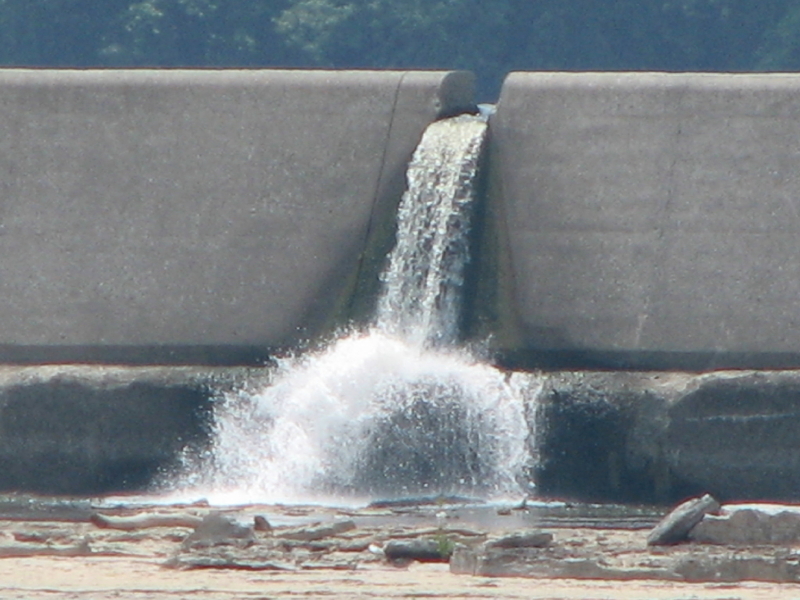
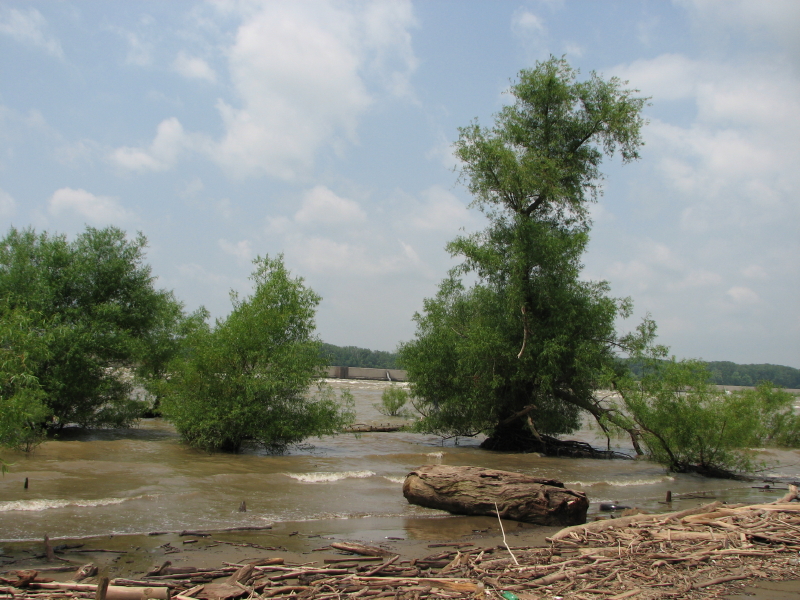
I was standing by the river’s edge when the dam’s siren went off.  At first it scares the pee out of you!  It’s a loud wail, but you get use to it.  The Army Corps of Engineers gives the warning whenever they plan to release more water under the dam.  Throughout the region there have been heavy thunder showers and the river has risen quickly.  I worked at the Falls both on Saturday and Sunday and so I have a number of things I can share over the course of the week.  Technically, it’s not yet summer, but my clothes are stuck to me with sweat and I’m glad for the nice bottle of cold water to drink.  So often, I’m guilty of not bringing something with me to keep hydrated.  I make a pact with myself to do better this summer.

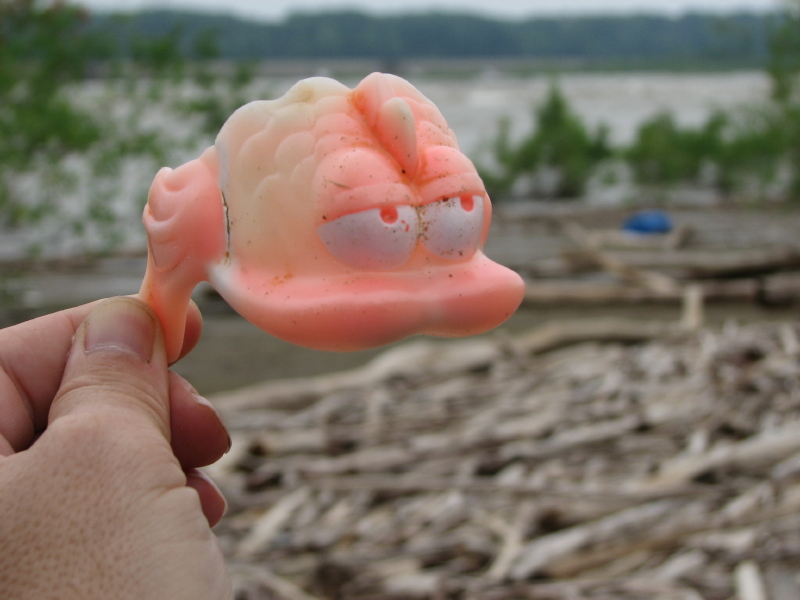
The weekend’s weather report calls for rain on both days, but I managed to dodge that.  I spent a lot of time exploring a mammoth deposit of driftwood near the dam.  If the past is an indicator of the future, then the river will probably not change very much for now and I look for a site higher on the riverbank to set up another temporary studio.  I did come across a project I did a few weeks back that was featured in the post “Tug of War”.  His buddy must be around here too.  I find the plastic broken toy-part I used for his friend’s crazy hairdo…they are cartoonish fisheyes.
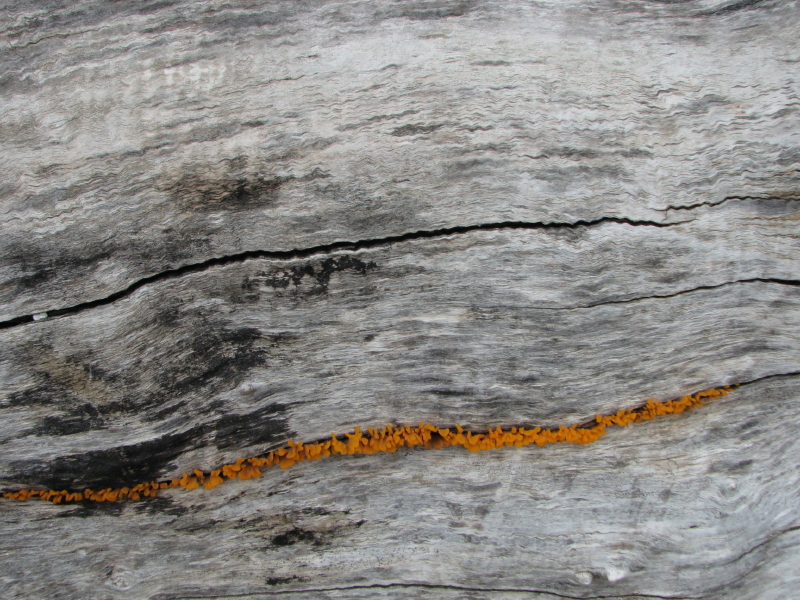
With such humidity, this is a perfect time for mushrooms and fungi to get their hyphi through the soft tissues of decaying matter.  The process of reclaiming old life kicks into gear.  It’s really the small stuff like bacteria, viruses, and fungi that do the dirty work of releasing nutrients back into the system.  The planet is ruled from those kingdoms while we posture around self-importantly.  This fungus was tiny, but so colorful that I thought I would try to magnify it and reveal how fleshy it is in its crack.


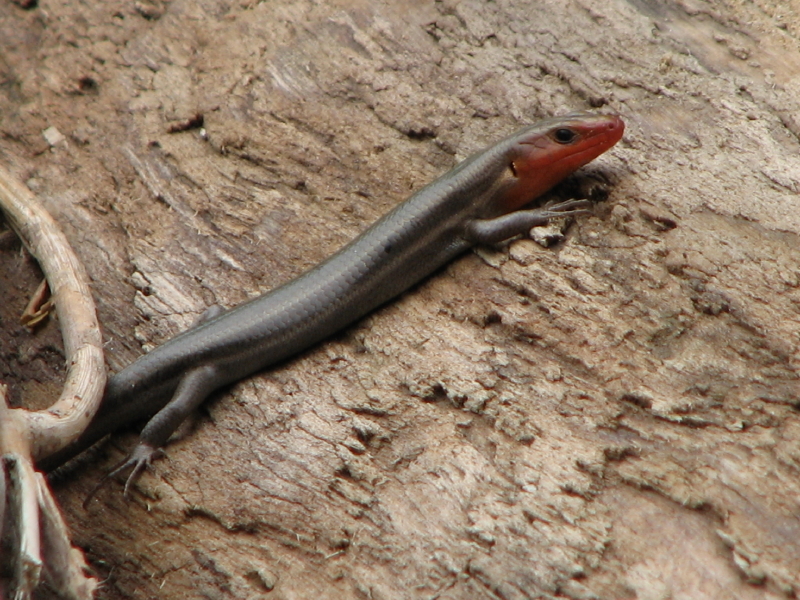
On a nearby log, a male Five-lined Skink is taking a break from his hunt to bask in the sun.  For him, it’s breeding season and you can tell that by the reddish blush he has around his head.  This guy’s lines are indistinct and he’s  bronze in color.  The young lizards have very pronounced black and white stripes and their tails are bright blue.

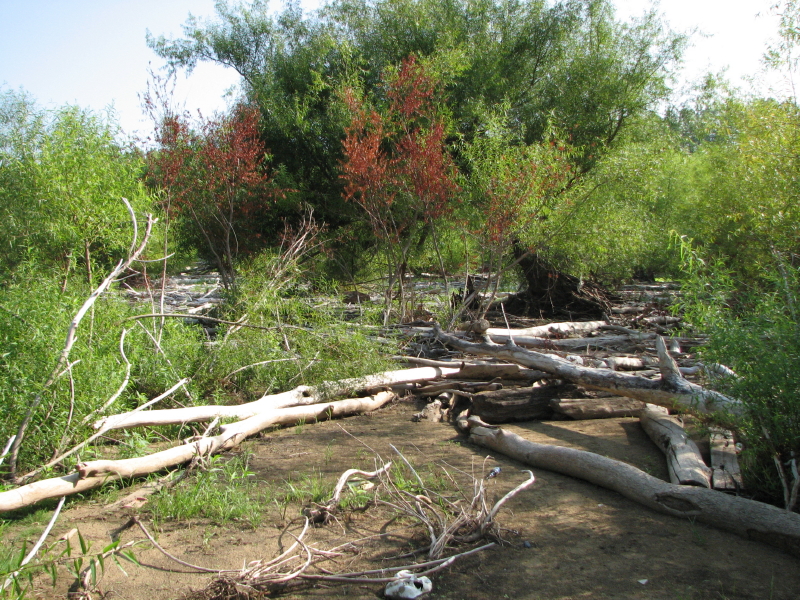
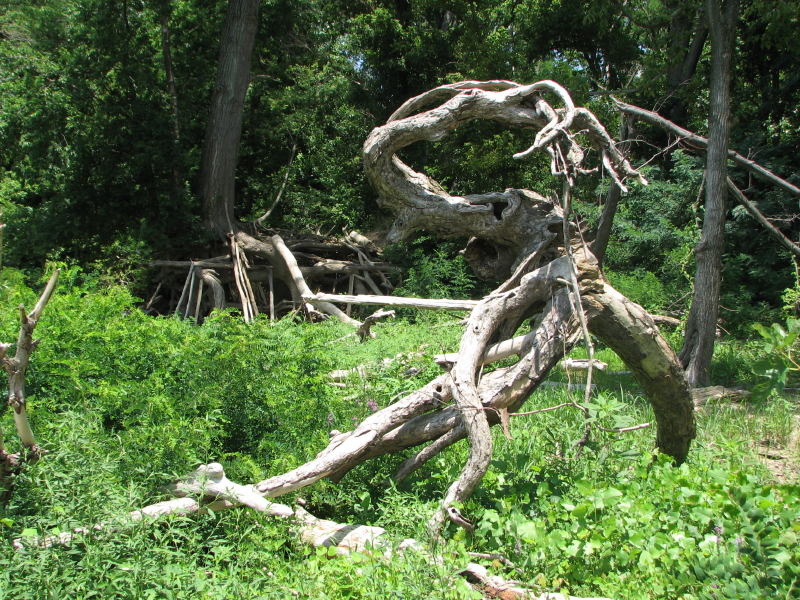
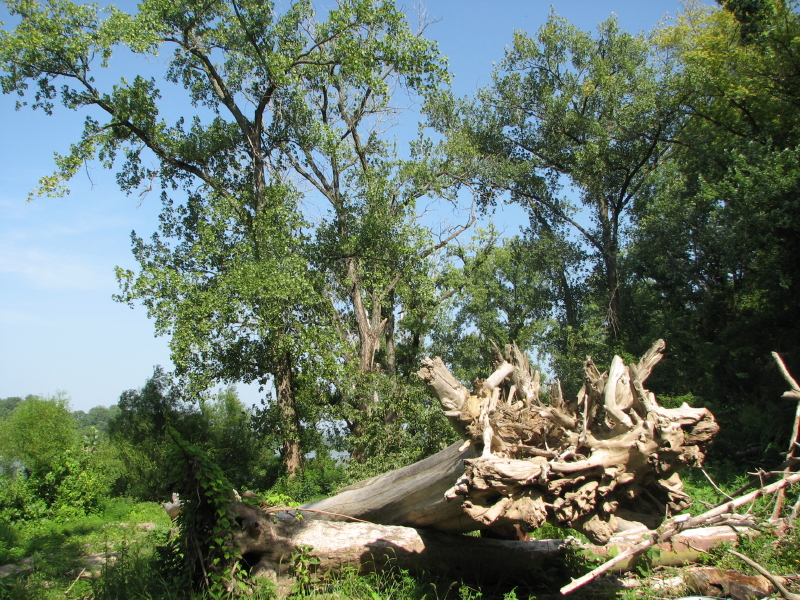
One of the sites I considered for my informal studio is this place with a chair set in front of this large upturned tree.  Sitting in the chair you can perfectly study all the intricate roots as easily if it were situated in your home library.  I decided it’s just a little too public and I look higher up the bank, under the willows and their welcomed shade.

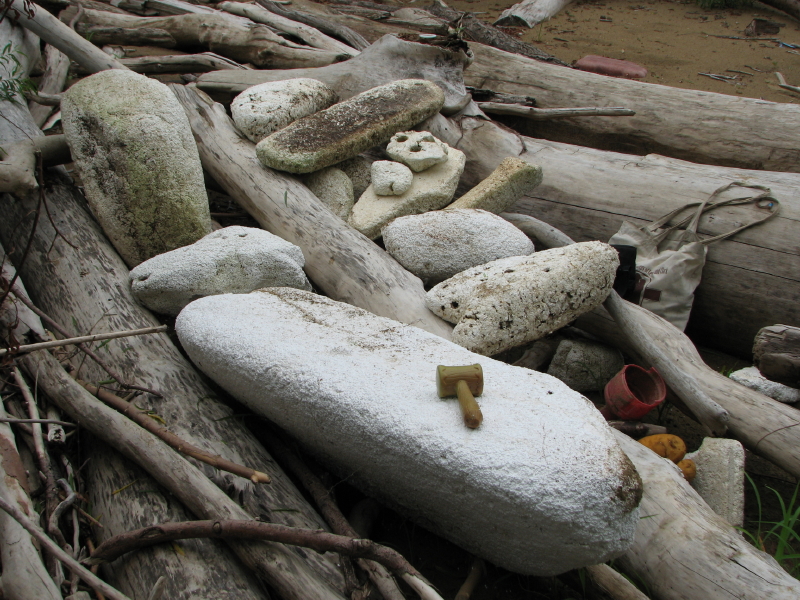
I’ve scouted out the area pretty well and on my mental map of this place, I’ve noted where the nicer Styrofoam pieces are.  It took almost two hours to move things into place.  The larger pieces I hoist onto my shoulder and carefully walking on top of the logs and driftwood reach the new cache I’ve created.  Here’s a piece nearly as tall as I am from the Styrofoam mine that I set upright and photographed.  I don’t have an idea for this one yet!

Here’s an in process shot of the gathering of the polystyrene.  There are several nice sitting logs in the area to work from and it’s under the willows enough to avoid the direct sunshine and there are usually birds around here as well.  My favorite Lewis and Clark canvas bag is nearby for scale.

Here’s the same site about an hour later.  There is still one really large piece I haven’t secured at this location yet.  I can’t wait to start making something from all this stuff!  I also have started gathering driftwood to serve as the arms and legs and I’ve stashed that away here as well.  The mallet in the foreground is made of plastic with simulated wood grain.

By the time I got around to making a sculpture, it was fairly late in the day.  The resulting piece I dubbed the “Petro-totem” and it takes its initial cue from the skull-like piece of Styrofoam that makes up part of the head.  This piece also features a plastic heart, genitalia (made from walnuts and a plastic toy fire hydrant I found).  The hat is some kind of funnel.  The finished work is far from one of my happier creations.  I just started working on it and making decisions as I went along and this was the result.

I posed this sculpture in several places and photographed it as I moved it around.  There are many tires on the beach and someone has cut many of them so they can’t retain water.  Mosquitoes love to breed in the dank water that collects inside these tires.  An old paint can with its red pigment is used to “sign” the tires…somehow I doubt these are the same people who altered the tires.  It seemed a provoking enough spot to set up a my Styrofoam figure.  I snap of a couple of shots and moved on.

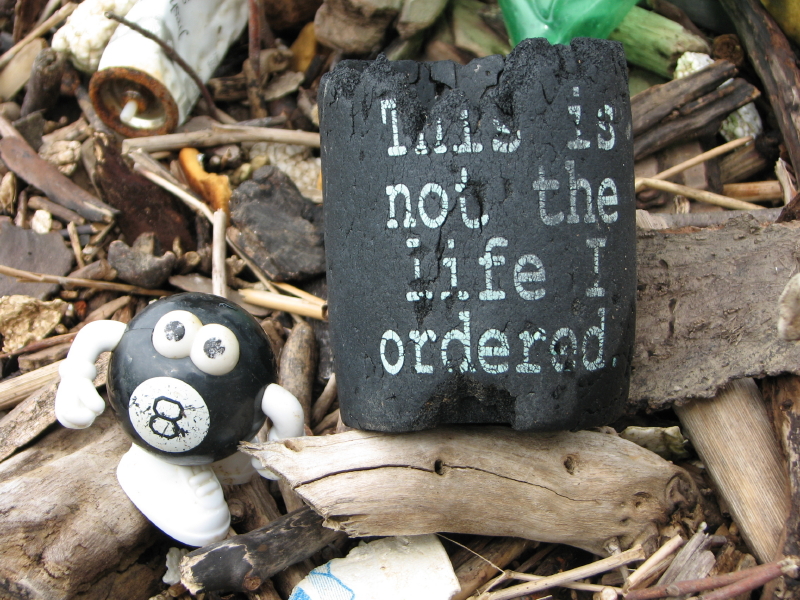
In a future post, I will show you where I eventually left this work.  In closing, I found this little commentary on the big driftwood pile and recorded that with my camera.  The “behind the eight ball” figure was found near by and I added that to the image.

Read Full Post »

« Newer Posts - Older Posts »