Feeds:
Posts
Comments

Posts Tagged ‘found objects’

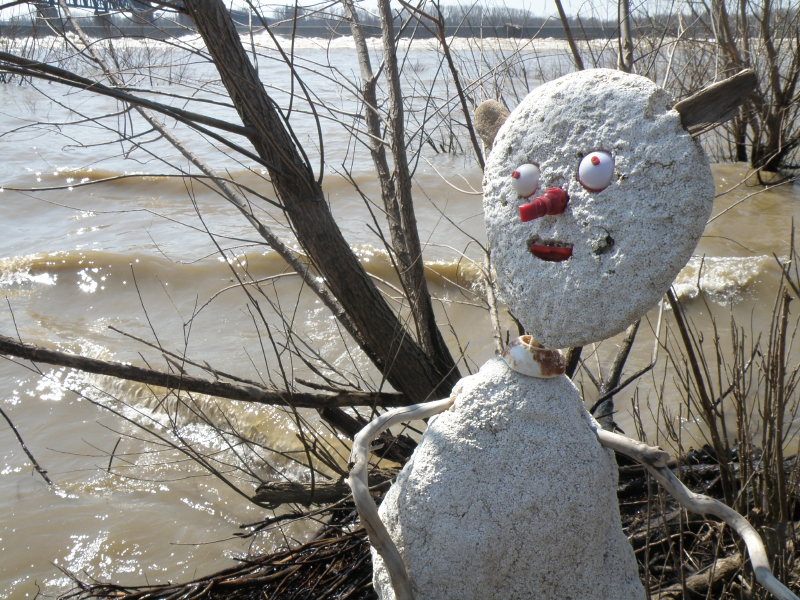
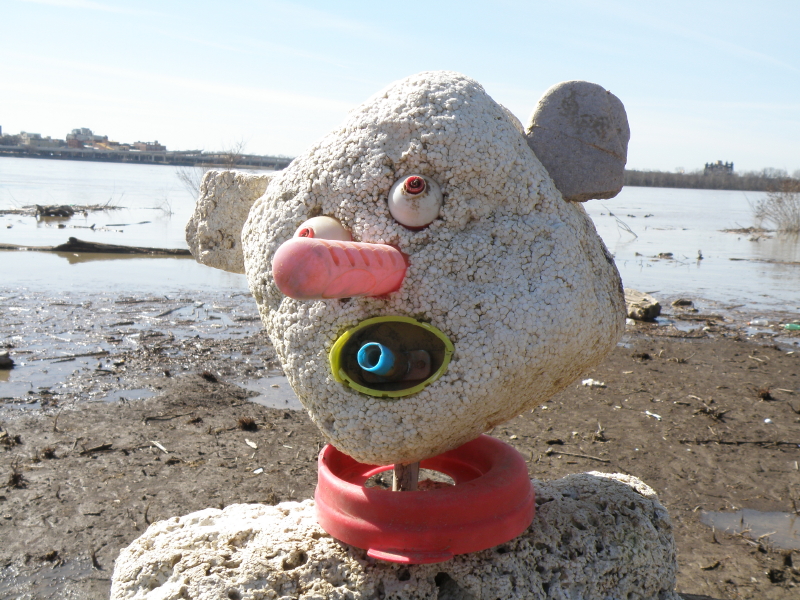
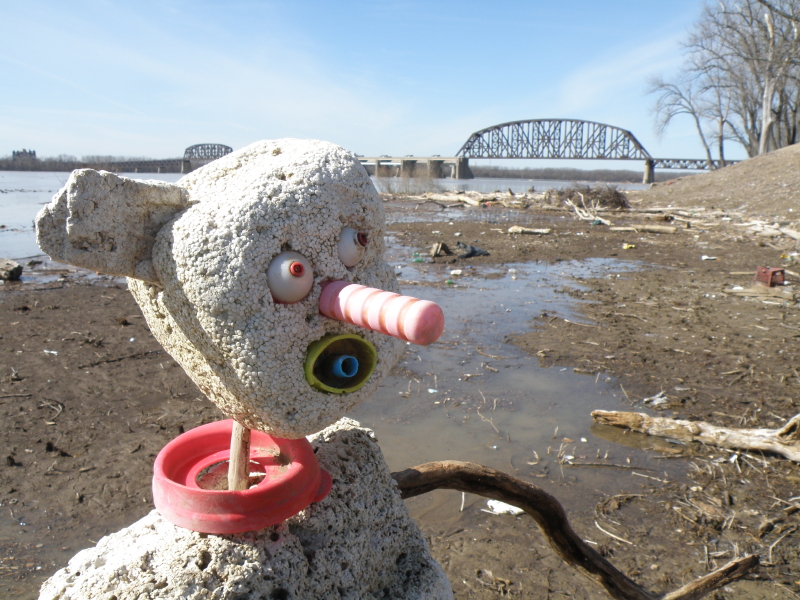
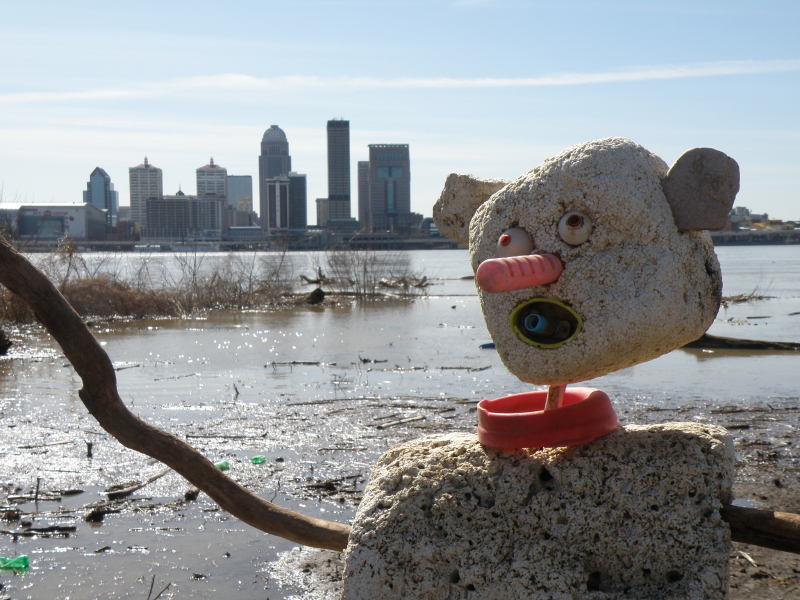
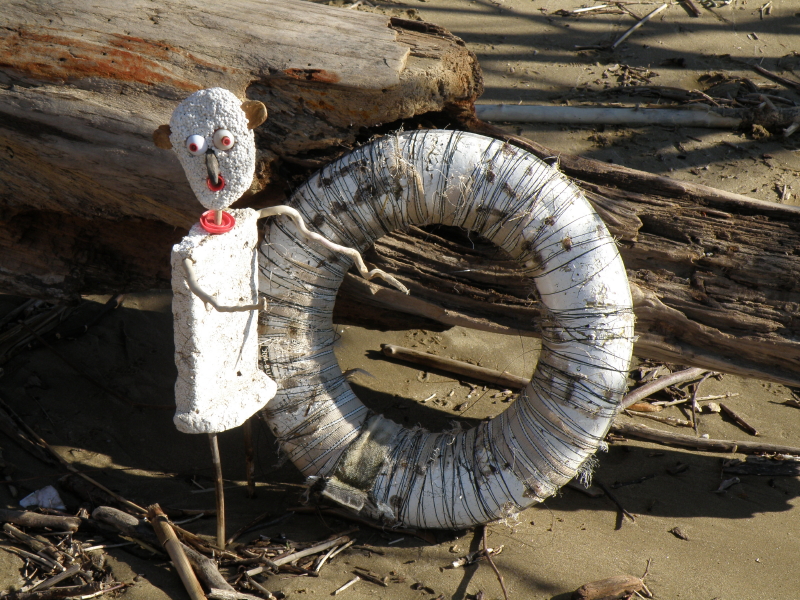
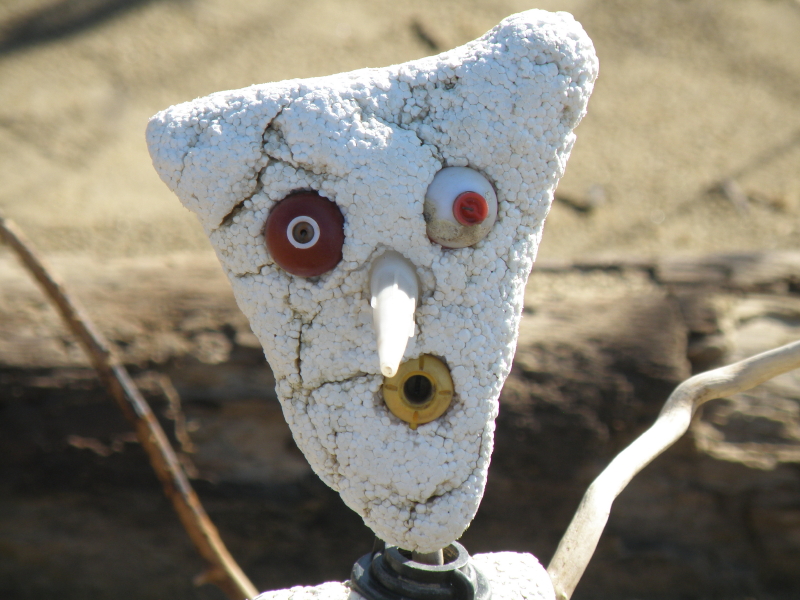
Mr. Mosquito Nose, April 2014

I’ll bet some of you out there might have wondered what’s happened to the old riverblog?  Here it is near April’s end and there is nothing to show for what occurred during this month.  Let me reassure you that the Artist at Exit 0 has been as active as the river has allowed him to be.  Exploring the line between culture and nature is personally important.  Between periodic high water, the exhibit at the Carnegie Center for Art and History, the Kentucky Derby Festival, and life in general…posting stories has needed to take a back seat.  The process, however, is ongoing.  I have been to the river on multiple occasions and observed the transition from winter to spring at the Falls of the Ohio.  Making art remains a priority and I realize that I just feel better if I have the opportunity to make something of my own.  Don’t be surprised if I end this month with a flurry of posts in an attempt to catch up.  Let’s start at the beginning of April and see how far I get.  Here’s a story featuring Mr. Mosquito Nose who had an experience with a young journalism student interested in what the Artist at Exit 0 does on an ordinary trip to the Falls.
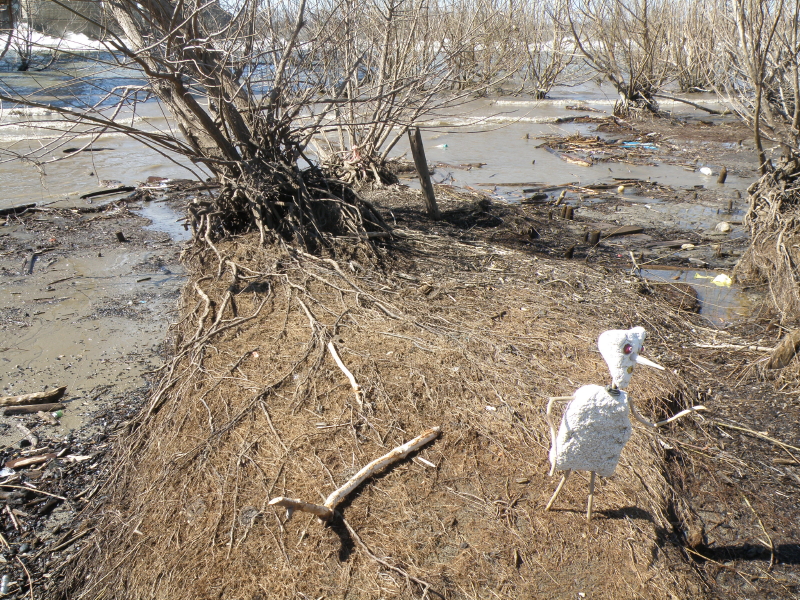
Mr. Mosquito Nose at the river's edge, April 2014

This day began with a rendezvous at the river.  I arrived early and was scouting out the situation.  The Ohio River had just been up and I knew the riverbank was reconfigured with different driftwood and new junk  waiting to be picked up.  I had been contacted previously by Taylor Ferguson who is a journalism student at the nearby Indiana University Southeast in New Albany who requested to tag along with me on one of my Falls of the Ohio adventures.  Taylor has a creative project of her own…to create a short, documentary video and she wanted the Artist at Exit 0 to be the subject.  This was the first time anyone has requested this and so I agreed to do it.  With a cool and sunny day before us we left the still leafless willows and walked out onto the riverbank.

Taylor at the Falls of the Ohio, April 2014

Taylor turned out to be a super friendly and very interested in my projects.  I will admit that it was odd being tethered to a microphone and I felt a little self-conscience talking to myself so openly with a video camera pointing in my direction.  I usually have some dialogue running through my head as I explore this environment, but to hear it in such an audible fashion was different.  I brought Taylor to my U.F.O. (Unidentified Floating Object) art site where I keep my river materials and demonstrated how I went about making an absurd figure from the poor stuff of the world.  With Mr. Mosquito Nose in hand, the three of us left my outdoor studio and explored the environs near the railroad bridge.  Along the way, Taylor would ask me questions about when and why I started this project.  By now, those are familiar questions.  I enjoy looking for what is interesting about each day.  So, now it was time to walk the riverbank with Mr. Mosquito Nose and be present in this moment.

Mr. Mosquito Nose and orange barge cable, April 2014

The lack of footprints in the sand told me that few others had recently passed this way.   As we walked along, I kept an eye out for those little micro-contexts that I could pose this latest Styro-figure in.  After making an object…I’m interested in using it to create an image.  With luck, the images might then be used to tell a story.  Here we have come across an old, frayed barge cable that the river washed into the park.  It seemed a good location to take a few photos.
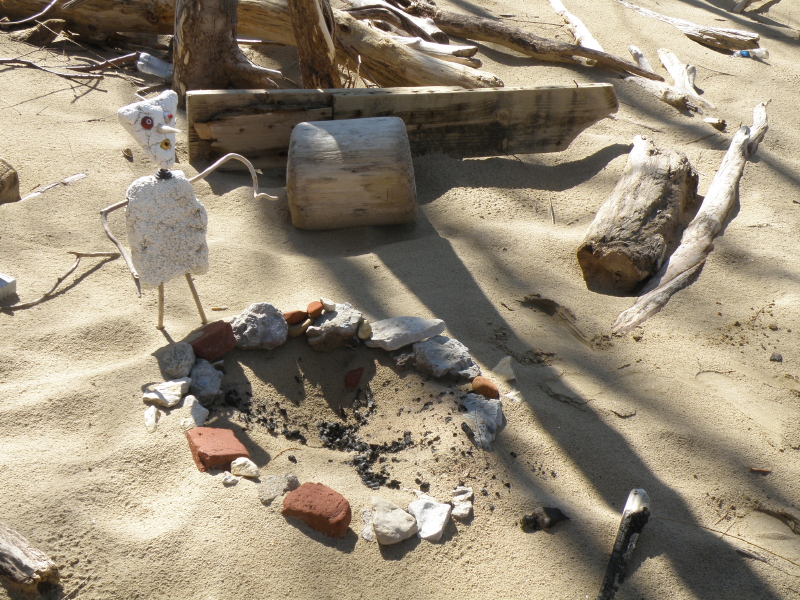
figure next to an old camp fire site, April 2014

Near the cable, we came across the remains of a camp fire.  Brick and rock define a shallow pit that still had some ashes in it.  For a few years now, I have also photographed old camp fire sites with the intention of publishing them here as a collection.  I’m always struck by the elemental nature of this activity and what its importance has meant for our species’ survival.  We set up Mr. Mosquito Nose by the fire pit and now those photos are a part of this record.
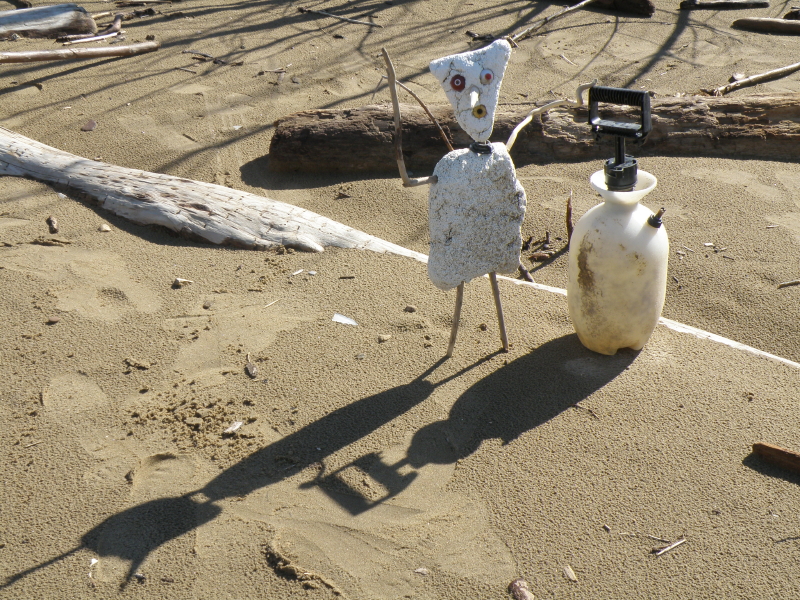
Mr. Mosquito Nose and plastic sprayer, April 2014

Among the other objects we came across was this old sprayer.  The figure’s arms are raised in warning because this might have potentially been used to spray herbicide or worse.  Caution is required whenever you come across something that could possibly harm you.  Knock on wood, I’ve been doing this project for more than a decade without any physical reactions or incidents from the stuff I’ve encountered out here.  I place a lot of faith in the diluting power of millions of gallons of fresh water.
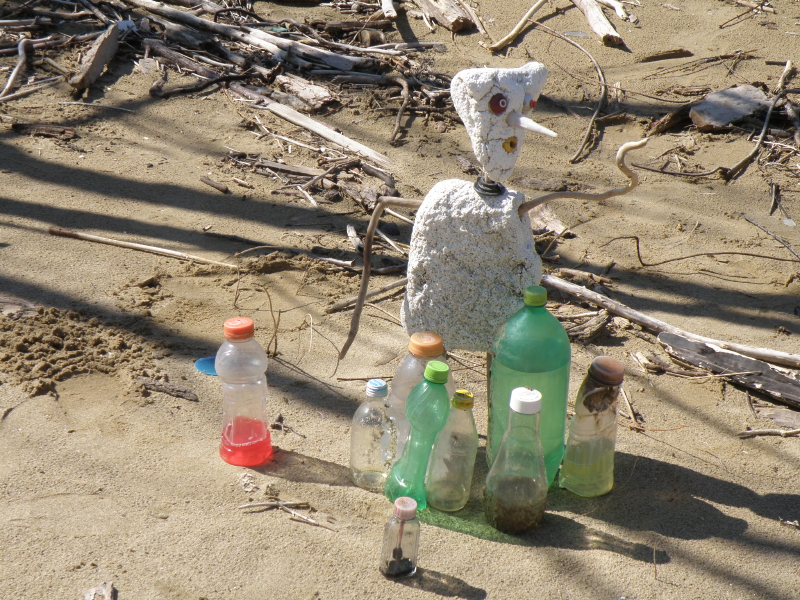
Mr. Mosquito Nose and various bottles, April 2014

Moving on to another location, I collected a few glass and plastic bottles along the way and made this composition.  Some of these containers have mystery contents of their own.
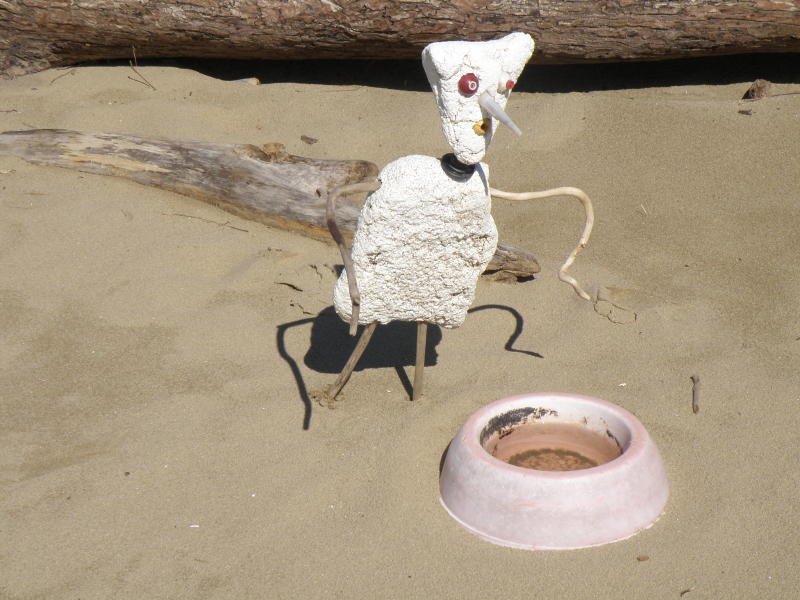
Mr. Mosquito Nose and dog food bowl, April 2014

Later we came across this pet food bowl that was half full with water.  The water in this bowl could have collected here as the river level dropped or been filled up by rainfall?  It is another example of an incongruous object making an appearance at the Falls.Mr. Mosquito Nose, April 2014
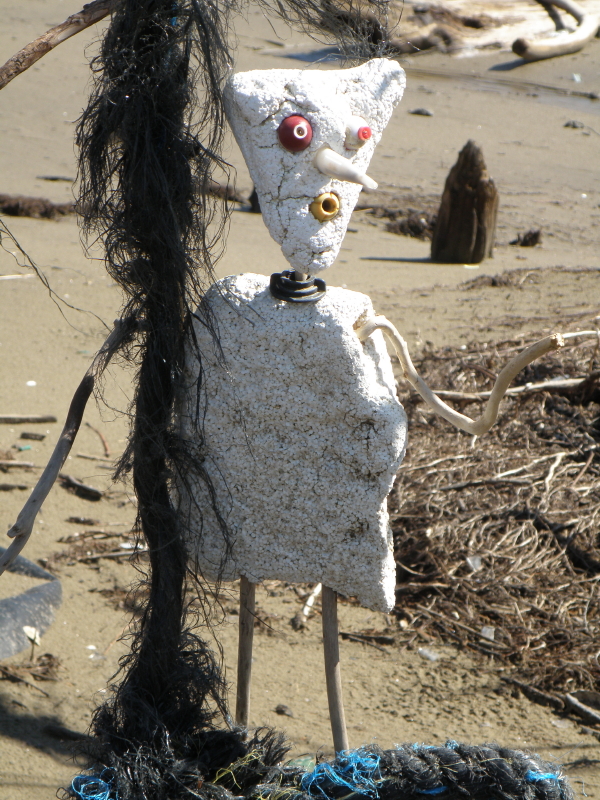
Taylor and I came across another barge cable that had been snagged by a low hanging willow branch and created this final photograph with Mr. Mosquito Nose.  The day was moving along and both of us were needed elsewhere.  About a week later, Taylor called me up to say that most of the audio the microphone picked up had interfering  sounds of wind and water.  This seemed perfect to me because that’s what I usually hear out here as well with the occasional bird call thrown in for good measure.  Taylor had three hours of footage that needed to be edited down to three minutes which sounded like a daunting challenge in its own right without the audio difficulties.  I later caught up with Taylor in Louisville and did a quick voice over recording that I hope will do the trick for her project.  At the time of this writing…I haven’t seen the finished video, but hope it turns out for Taylor and that she gets a good grade for it.  Okay, that’s it for now from the Falls of the Ohio State Park…one last image then I’m calling it a post.
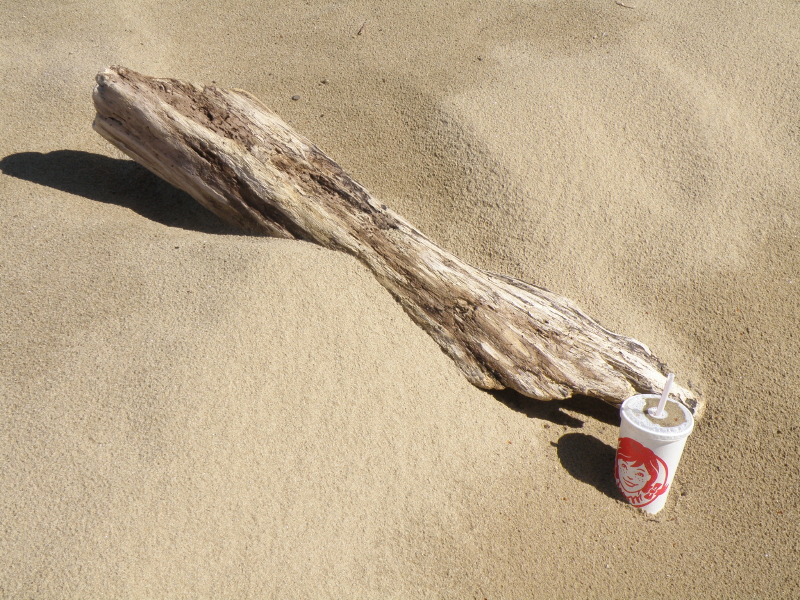
Sand, driftwood, and disposable drink cup, Falls of the Ohio, April 2014


Read Full Post »

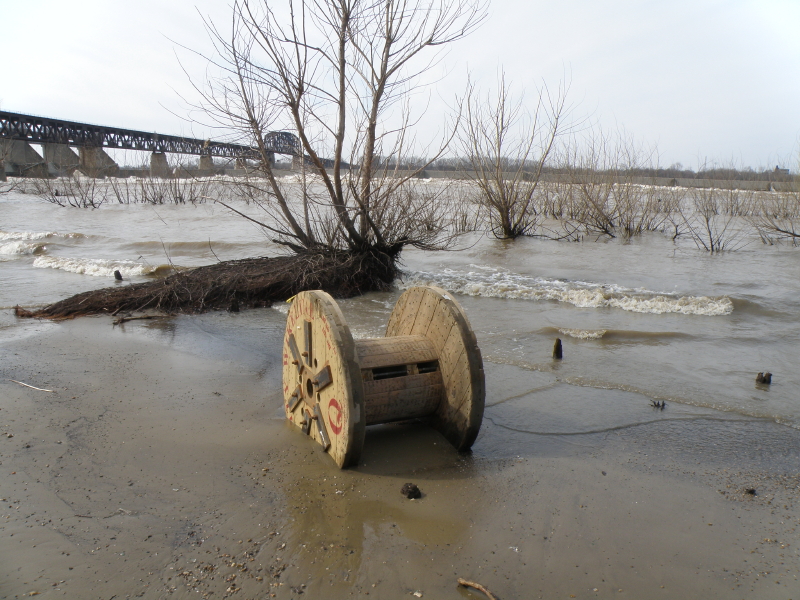
wooden cable spool and willow tree, Falls of the Ohio, March 22, 2014

It’s a sunny Saturday and warm for this time of year.  One of those days I can’t wait to get to the river.  Spring is still slow in developing, but it can’t be much longer now.  I spent a good part of the day just filling up my canvas collecting bag with all types of odds and ends both man-made and natural that have washed up on these fabled shores.  I’m finding so much stuff that for practical reasons I decide to see if I can find a spot up the bank and under the willows that might make a good location for a temporary outdoor art studio.  I can offload some of my larder for future use while continuing to walk the edge of the river.  I’m enjoying the sunshine and taking deep breaths of the fresh air.

U.F.O. studio...Unidentified Floating Object studio, March 2014

U.F.O. studio, Falls of the Ohio, March 2014

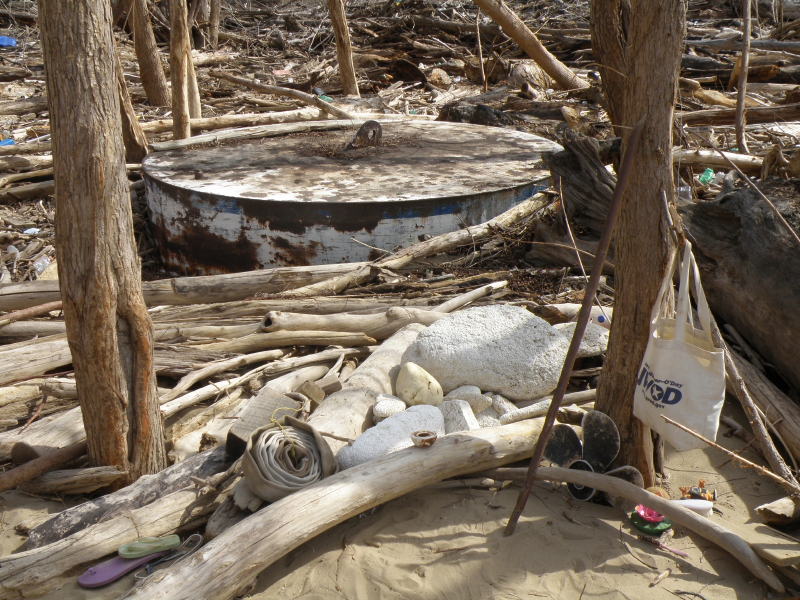
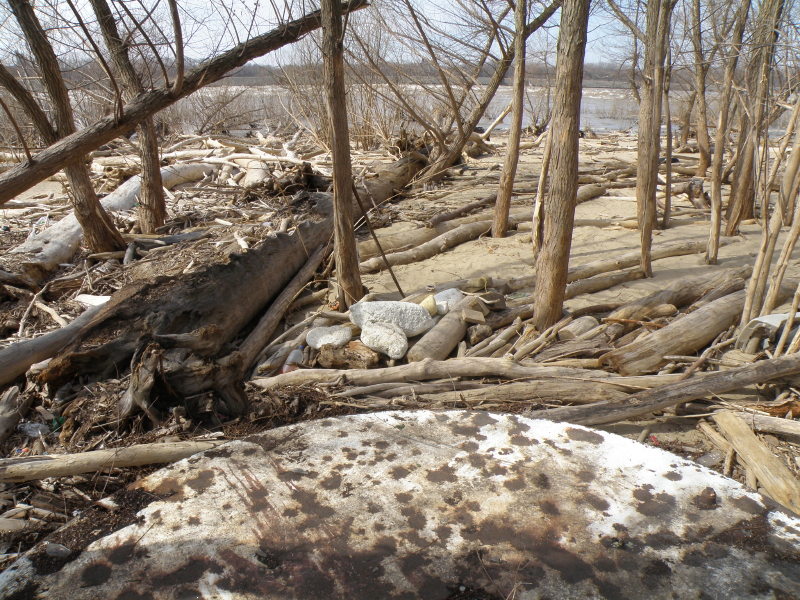
I chose a spot bordered by a large log that keeps most of the driftwood at bay and what I call the U.F.O. or Unidentified Floating Object which is circular metal platform that was once painted white with blue trim.  It’s starting to show some rust now.  This large object washed over the dam during a high water moment three or four years a go.  Since then it’s changed positions with the rising and falling river levels and was once completely buried under driftwood.  The U.F.O. is a platform that normally would be anchored out on  the river.  Barges and other water craft can tie on to it if necessary.  Some how this one got loose and relocated to the park.  When I first discovered it here I also imagined that it was a giant bathtub plug that helped keep the water in the river.   I was lucky that I had the same outdoor studio for many years before this winter’s high water rearranged the landscape again and floated all my collected materials away.  I spent a few hours walking the river collecting Styrofoam and sticks and can’t wait to make something new.

Mega Spool figure in progress, March 2014

Completed figure at the U.F.O. studio, March 2014

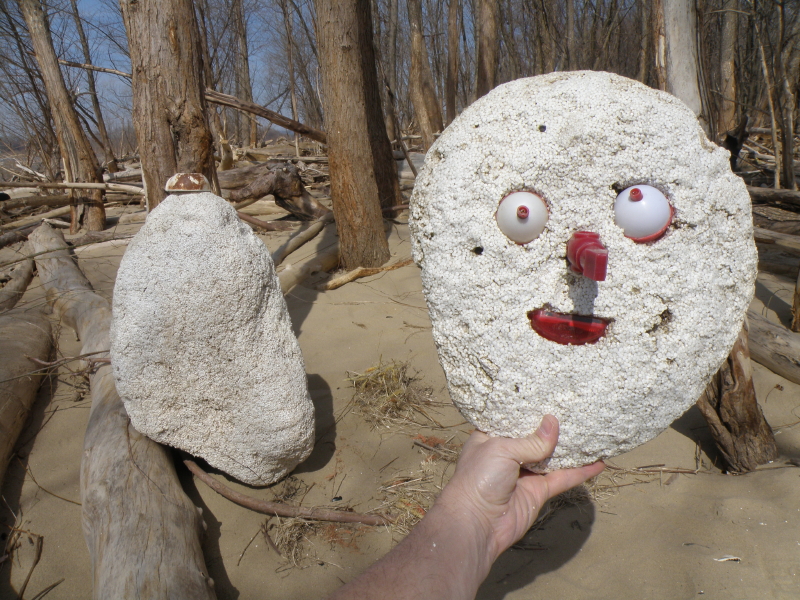
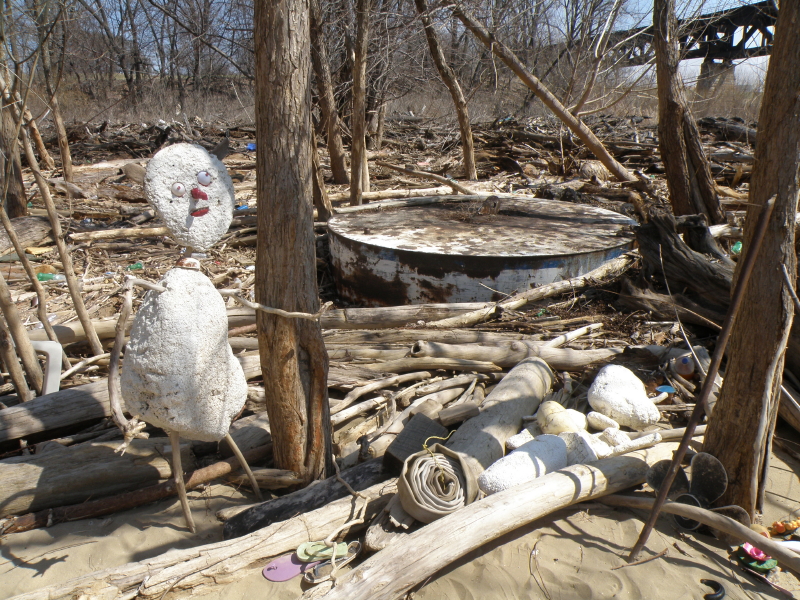
The first figure I make here is from the largest chunks of polystyrene I had found on this excursion.  I used two fishing floats (one larger than the other for expressive effect) for the eyes.  The nose is a plastic piece from a fooseball table.  The mouth is a red reflector.  My figure has ears, arms, and legs that are pieces of driftwood.  The figure has a benevolent feeling to it and I can’t wait to photograph it by the river.  I did run into a young sculptor attending the Kentucky School of Art who was collecting driftwood for her own project.  Her name is Jenn and she approached me asking if I was the person with the show at the Carnegie Center for Art and History?  She and her classmates had seen the exhibition.  Jenn is building an installation at the school and promised to let me know when she completed it.  It will be fun to see art made by someone else from materials collected within the park.

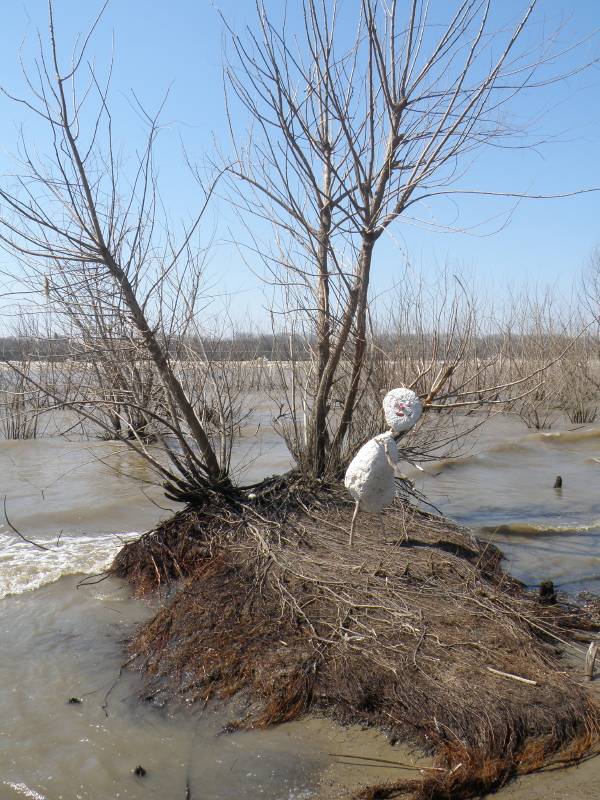
Large Styro-figure on a tiny willow island, March 2014

Styro-figure on tiny willow island, Falls of the Ohio, March 2014

When I first meet the river, I spend a little time looking around and scouting out potential locations to create the photographs that will represent this day in my project.  I decide that I like this tiny “willow island” which consists of clay and sand bound together by the living roots of this tree.  Waves and water wash all around it and at times it does look like an island.  As the river recedes to its normal pool, this tree will be high and dry at last.  It’s amazing what it takes to keep this tree in place with such a dynamic river always testing its resolve to survive.  During the highest river levels, this tree would be completely submerged underwater.  Many of the willows along this stretch of the river bear scars and wounds from large logs battering them, breaking branches, and grinding bark away.  I pose the figure on the root mass and move to the next shot which isn’t too far away.

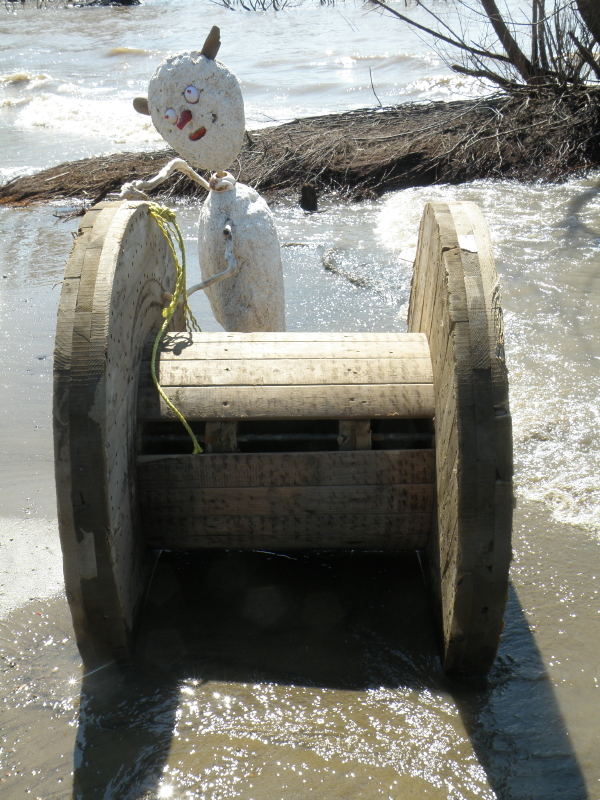
Styro-figure and large, wooden cable spool, March 2014

Styro-figure and wireline spool, Falls of the Ohio, March 2014

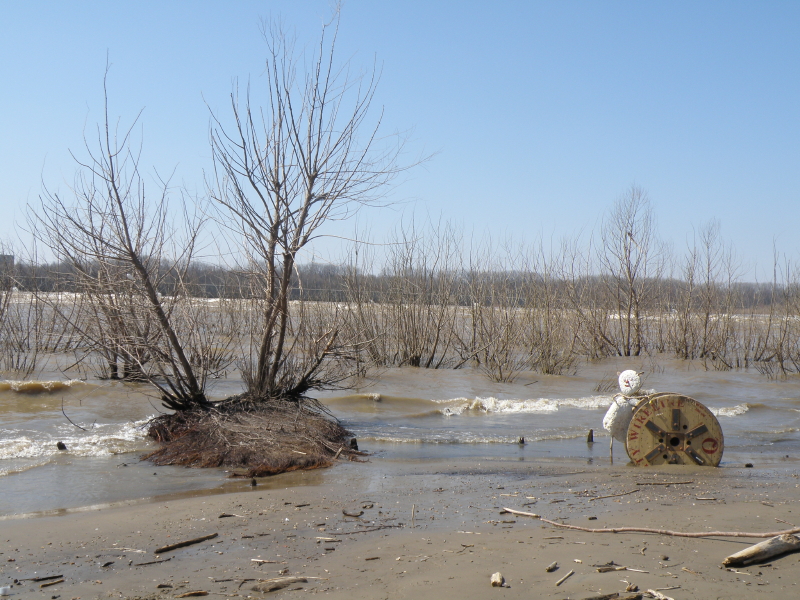
Near tiny willow island is a large wooden “spool” for wire line or cable.  I’m amazed by this object’s heavy-duty construction.  This spool floated into here and is now partially sunk into the sand.  Small waves lap the shoreline and you can also see black coal dust swirling around the water’s edge.  Later when I see my pictures I’m struck by how similar this spool is to the circular platform that now forms part of my latest outdoor studio.  This new area to cache my materials is very visible and hence ultra public, however, if we have heavy spring rains…it’s very possible that all this will be washed away and rearranged again.  I often wonder what might go through people’s minds when they stumble upon my outdoor atelier?  It’s an odd archeological site of Styrofoam boulders, small piles of plastic toys, and a tangle of found roots and driftwood.  All the stuff you need to make an absurd figure!  I left my latest Styro-creation next to the spool.  I will go a head and tell you…I returned a week later and all I could find of him was his body and legs.  There must be headhunters out here?  I searched the area, but found no further trace of my figure.  As with most of my Falls projects, they continue to “exist” as images.  The exhibition that Michael Wimmer and I are participating in at the Carnegie Center of Art and History is entering its last week.  I’m so appreciative of the positive response I’ve received for my work.  The show will end with a tea and cookies closing.  If you are in the area, please stop by.

Final shot from the big spool and tiny willow island, March 2014, Falls of the Ohio

Read Full Post »

Skyliner, Falls, late Feb. 2014

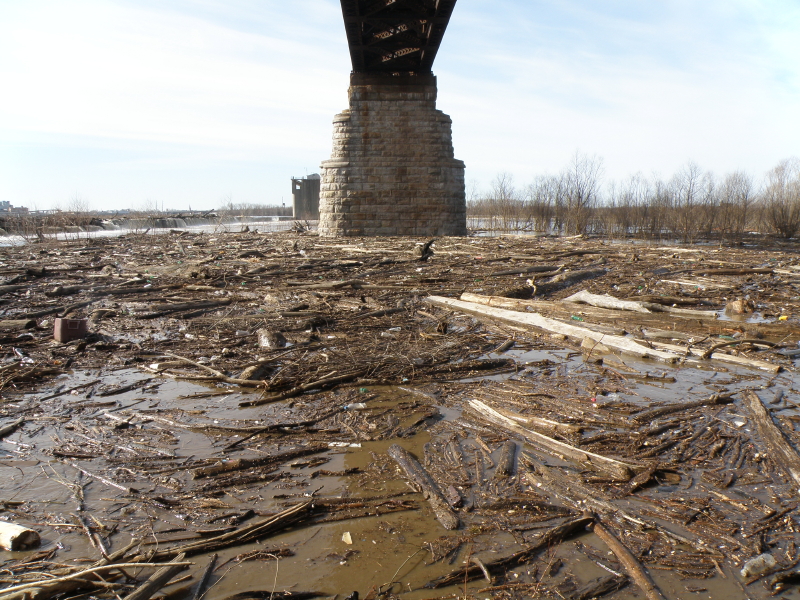
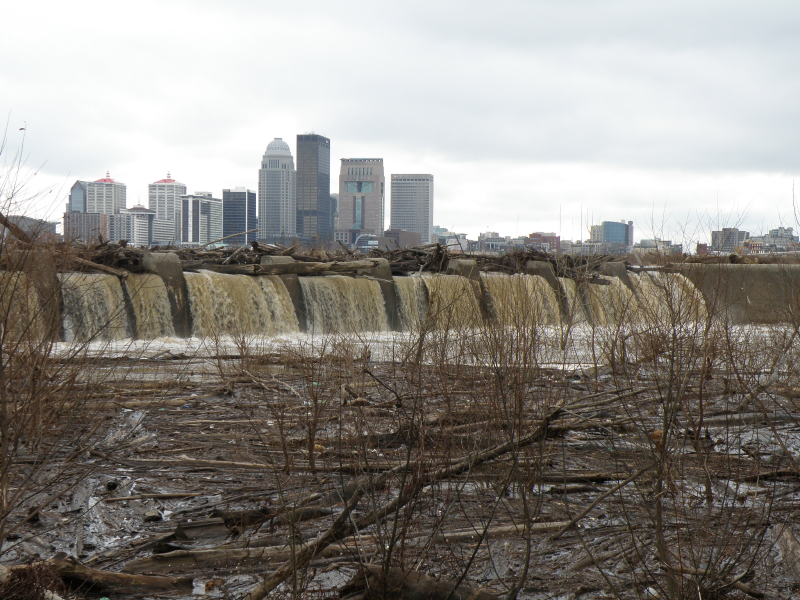
We are all getting antsy for spring to arrive…winter has been hanging on and on for dear life.  It’s been hard to access the river because the water level has been high.  Most of the places I visit at the Falls of the Ohio State Park are currently under muddy water.  We have had just a handful of nicer, warmer days, but that has accelerated the melting of the snow and ice throughout the more than 800 hundred mile long Ohio River Valley.  I don’t mind the cold so much, but it’s harder to do what I like to do on a swollen waterway.  Here’s how one of my spots under the railroad bridge looked during my last visit.

muddy, high water at the Falls of the Ohio, Feb. 2014

Not a pretty picture seeing a river as brown as gravy.  Lots of logs and wood floating on top and when you look more closely…there is also plenty of plastic and polystyrene in the mix too.  Another view this time with me standing on the wall that separates one side of the river from the other.

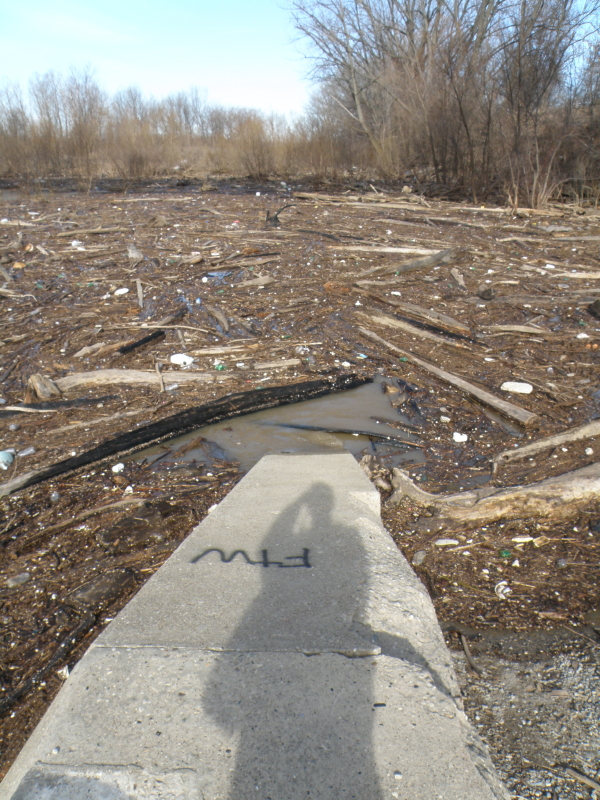
high river at the Falls, Feb. 2014

All those white spots are pieces of Styrofoam.  With my usual haunts inaccessible I moved further east…just outside the park’s entrance.  There has been a lot of activity in this area that has caught my notice.

Skyliner on the riverbank, Feb. 2014

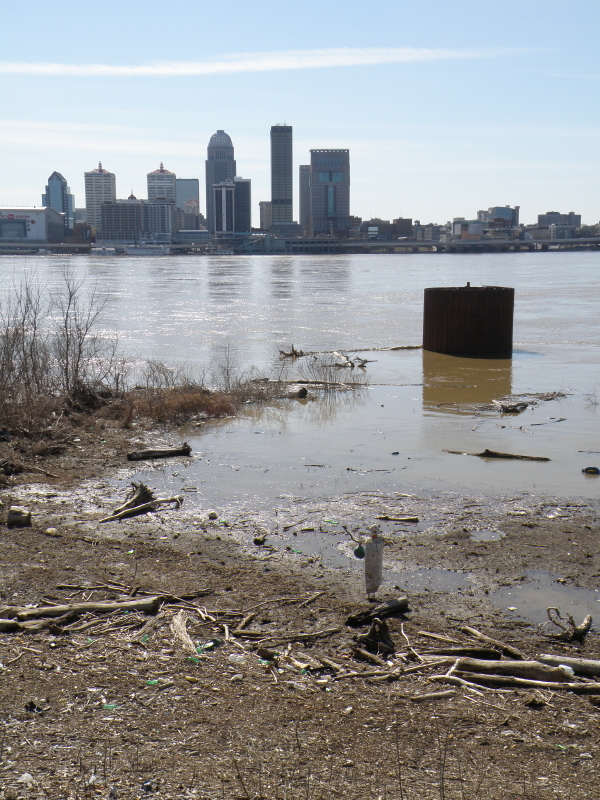
There has been a campaign on the Indiana side to make the river more accessible particularly in areas that afford a good view of Louisville’s skyline.  To do this the vegetation has been bulldozed away.  I came across an elderly person walking her dog and she said to me quite unsolicited..”Bout time they did something to clean up this mess!” as she pointed a thin finger in the general direction of the river.  In this case, one person’s mess is another creature’s habitat.  The true “mess” comes from all the plastic bottles and chunks of man-made junk that make it into the water.  No amount of removing trees and creating views will help with this and it seems what we prefer looking at is a very selective process.  I brought my collecting bag along.  I’m hoping to pick up materials to use in an upcoming art workshop at the Carnegie Center for Art and History, but I find a few other interesting items as well and photograph them upon discovery.

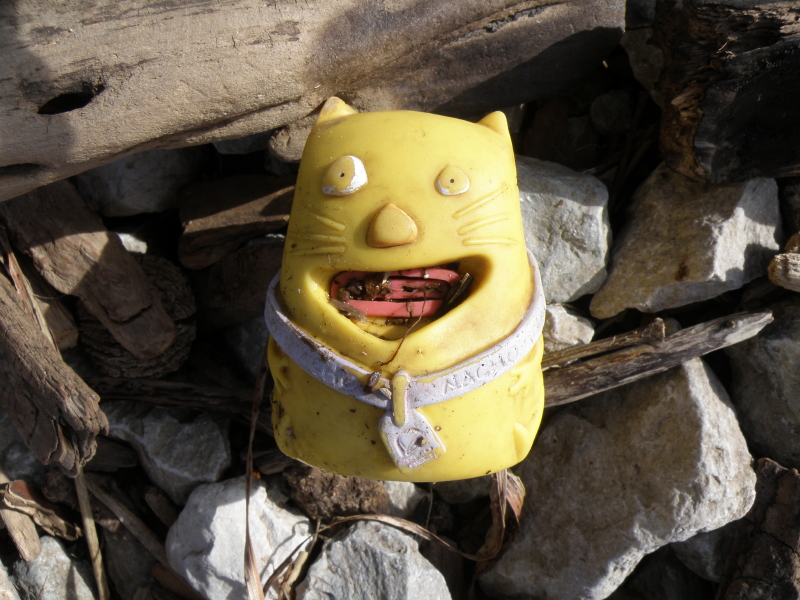
Taco Bell cat toy, Feb. 2014

I came across this smiling yellow cat toy that I think came from a fast food establishment.

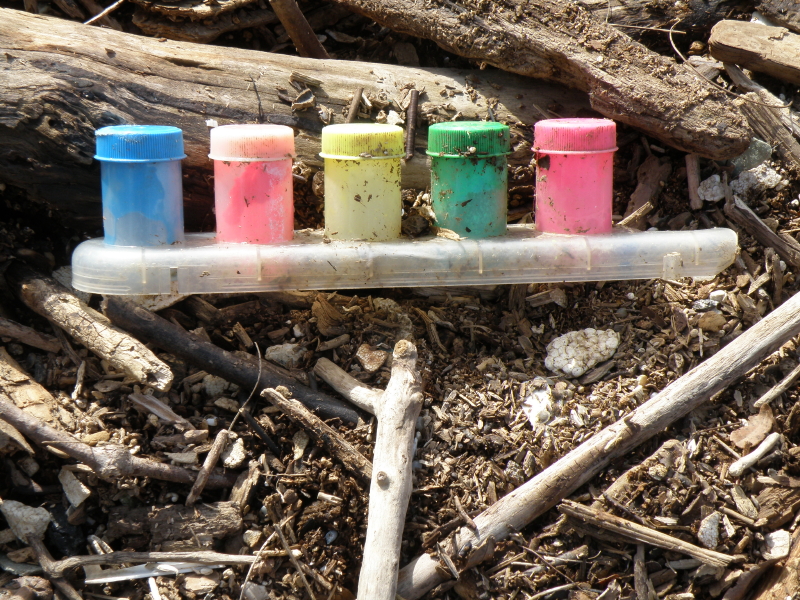
plastic containers for paint, Feb. 2014

Finding these paint containers made me realize how hungry I’ve become for color.  I’m looking forward to the world turning green again with color notes supplied by wild flowers.

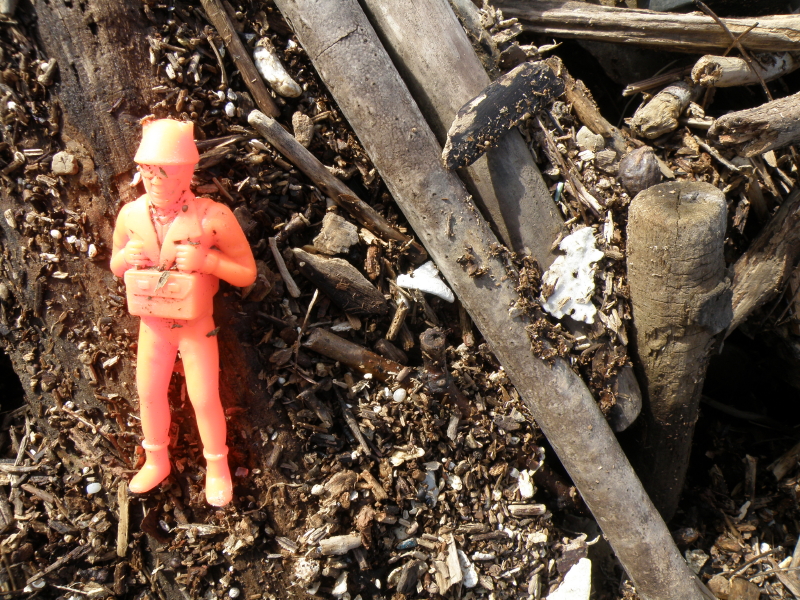
bright orange plastic paratrooper, Feb. 2014

This plastic man with his bright, radioactive orange color was hard to miss.  He was a skydiver or paratrooper in a former life and probably fell to earth using a plastic parachute.

Skyliner with the City of Louisville behind him, Falls of the Ohio, Feb. 2014

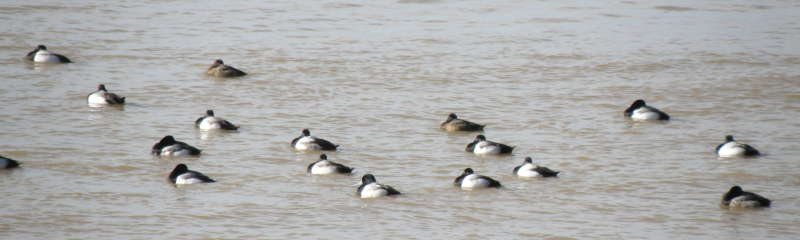
There were other signs from life that the season’s are about to change over.  I’m ever alert to what the birds are doing.  I spotted my first Red-winged Blackbirds of the year and they are among the first migratory species to arrive.  Male Northern Cardinals are singing their courtship songs and scouting out the best spots to build a nest.  On the river, however, I spied what I consider a bird sign of winter.  A nice sized flock of Lesser Scaup ducks were mostly sleeping and relaxing on the surface of the water.  In this area, it seems we see more duck varieties in late fall and early winter. Here’s a peek at the scaups.

White-winged Scoters, Falls of the Ohio, Late Feb. 2014

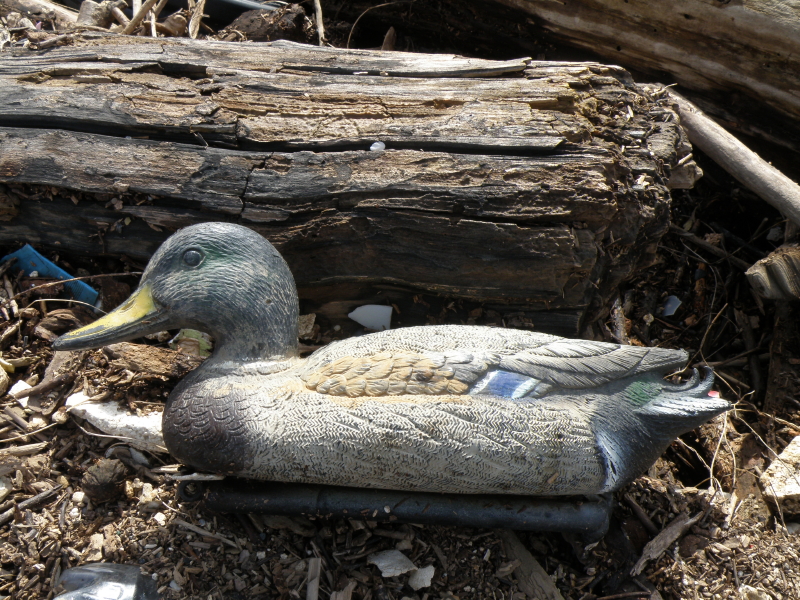
Before I move away from the ducks…I found one other to add to my growing collection.  This is a Mallard decoy made from plastic.  Not too long a go, I found another plastic decoy representing the Pintail Duck.

found plastic Mallard duck decoy, Falls, Feb. 2014

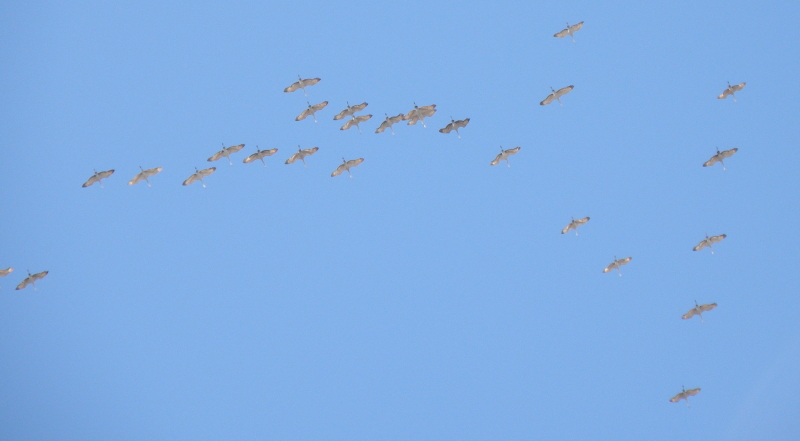
One other bird note…I heard them before I could see them, but I knew what they were instantly.  The familiar calls of migrating Sandhill Cranes winging their way back north.  Like geese, they fly in V-shaped formations to avoid the air turbulence created by other cranes flapping their wings.  These birds are high flyers and this was the best I could do in taking their picture with the camera I have.

high flying Sandhill Cranes, Feb. 2014

As February becomes March…the forecast for the Kentuckiana area is calling for freezing rain and snow.  It appears that Old Man Winter will be hanging out for another week.  Spring will eventually get here and already you can tell that it stays light outside longer with each passing day.   I am, however, really eager to see how the river has rearranged this familiar landscape.

Skyliner on the Ohio River's edge, Feb. 2014

Once the Ohio River recedes there will be a new landscape to explore and who knows what I will find?  I like that each year is different from the last.  Well this post is drawing to a close.  Thanks for visiting and see you soon…from the skyline of Louisville and the Falls of the Ohio.

Looking toward the skyline of Louisville, Late Feb. 2014

Read Full Post »

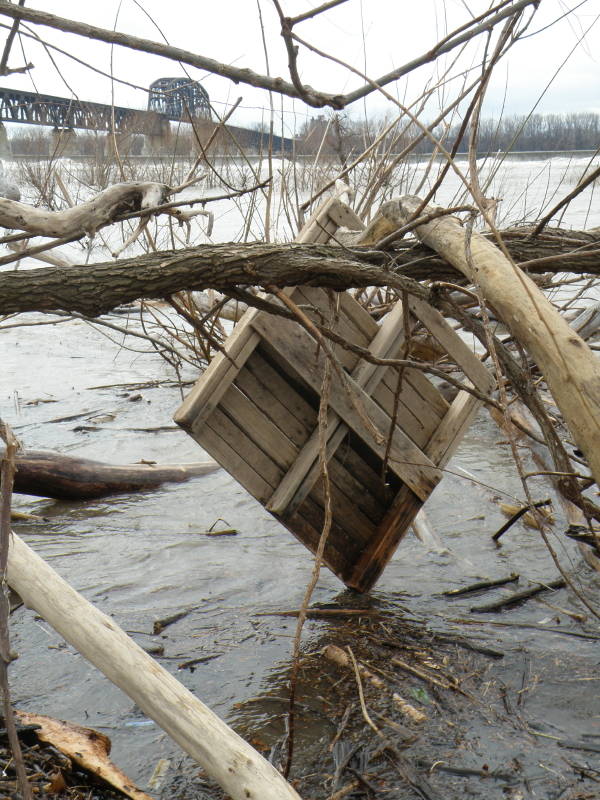
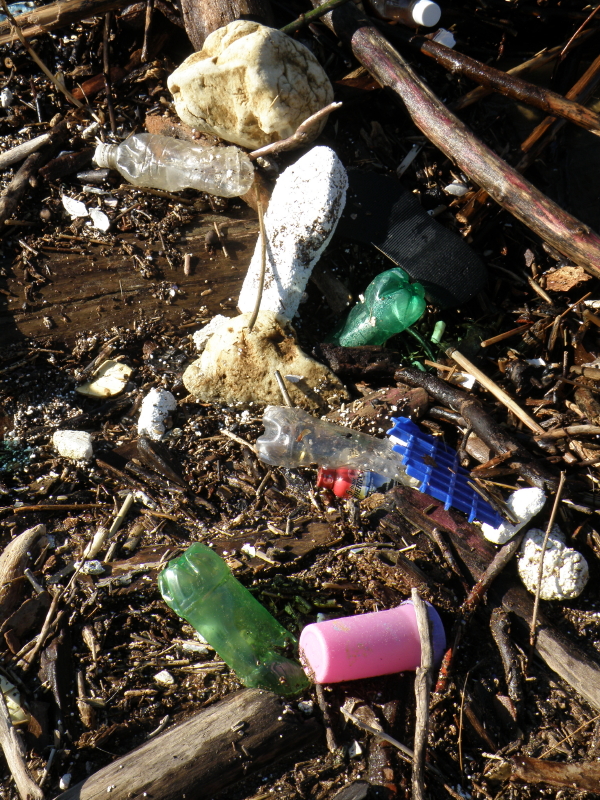
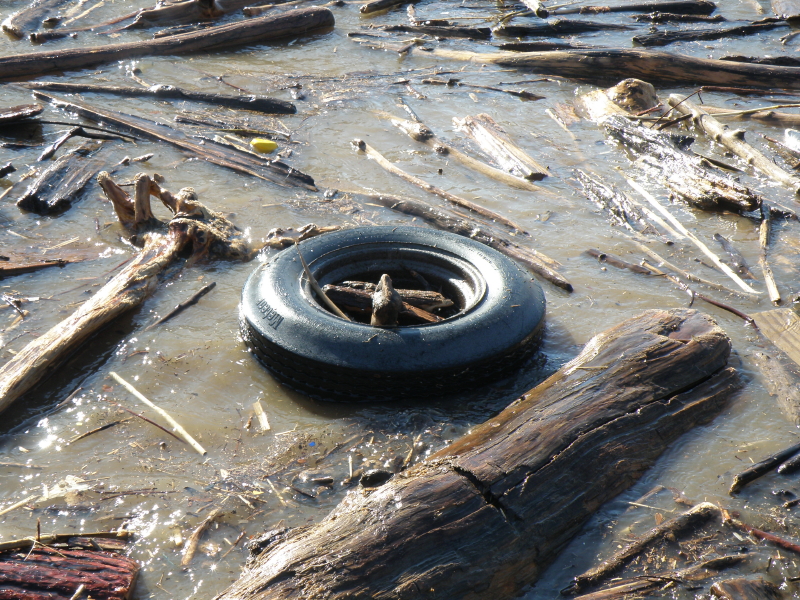
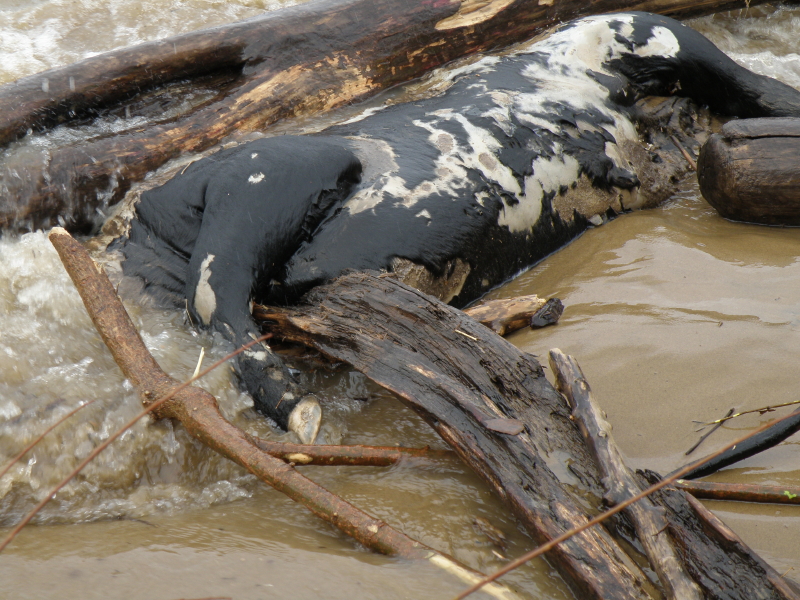
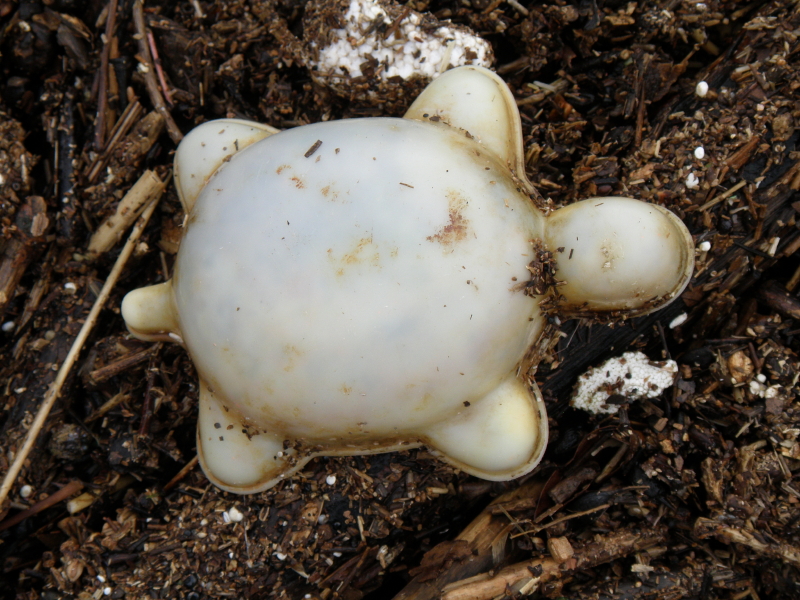
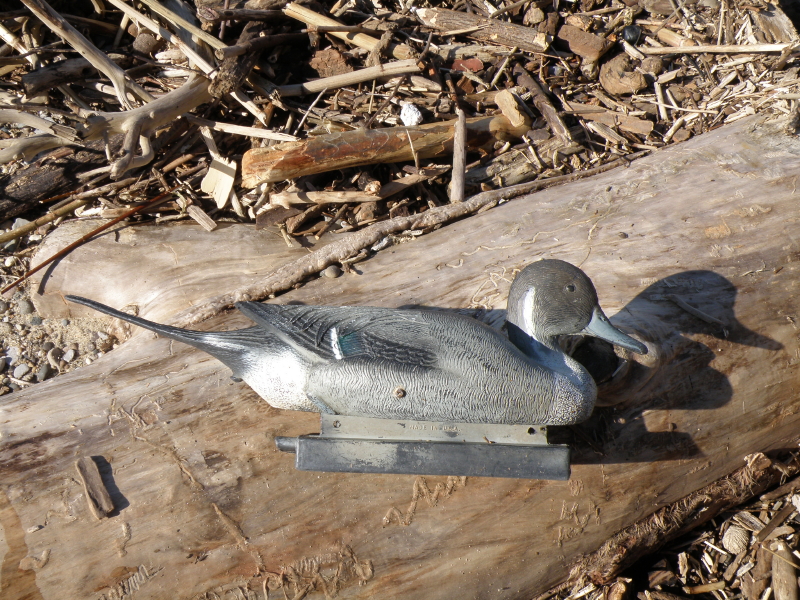
Louisville as seen from the Falls of the Ohio, Jan. 2014 Happy New Year everybody out there in blog land!  I want to thank everyone over the past year who have dropped by to check out the latest from the Artist at Exit 0 at the Falls of the Ohio State Park.  This year is shaping up to be much like the previous one.  Which means both man and nature are predictably unpredictable with a sense of timing not easily plotted.  Since the holidays, the Ohio River has been up and much of the park that I access has been underwater.  That in itself is not news, but the length of time the water has been high has been.  It all points to heavy rains and snows in the northern part of the Ohio River Valley and water flowing downriver.  The forecast at the time of this writing is not encouraging with showers turning to snow today followed by a precipitous drop to sub-zero degree temperatures.  This cold could be historic for us and so far we have received more snow than in recent winters.  I think I will stay indoors today!  Since my last post, I have been to the river twice (including New Years Day itself) to see what there is to see and experience.  Here’s a synopsis so far.wooden pallet in the trees, Falls, Jan. 2014 Between rising and falling waters I have been able to skirt around the edges.  One thing that unfortunately hasn’t changed is the junk in the river.  I’m always interested in what gets stranded in the trees like this wooden pallet that has a corner delicately balanced on the surface of the river.  It’s cold out here and despite being warmly dressed, my eyes and nose water from the bit of wind that is also present. various kinds of debris at the water's edge, Jan. 2014 At the water’s edge is a mix of debris.  Most of it is natural with driftwood, wood bark and bits being the most prominent.  Trees that have surrendered to the river are rolled against other logs by the waves and the grinding (which can be very audible as well) knocks the limbs off with a loud crack and chews the bark away from the trunks.  Intermixed is various man-made and colorful junk that is mostly plastic in composition which also gets masticated by the river.  The above photo is fairly typical with lots of polystyrene fragments which also make up the core of my art materials.  Most artists have positive feelings for their materials, but I have a love /hate relationship with mine.  Let’s move on and see what other sights are along the river in this new year. floating automotive tire at the Falls of the Ohio, Jan. 2014 Floating tires always catch my eye.  Their blackness and circular perfection contrasts sharply with the rest of the objects on the river’s surface.  A short distance away from this wheel I find a dead steer at the water’s edge. dead steer in the Ohio River, Jan. 2014 I debated with myself whether to include this distasteful image in this post, but decided to do it since it represents some of the truth that is in the river.  Pictures of man-made trash are one thing and have an almost benign aura to them by now, but something that was once alive registers in a different way.  The gravity is far heavier.  This poor cow is the largest dead animal I have encountered in the park.  Dead deer and other smaller animals are not too unusual in the river.  No telling how far this unfortunate animal has floated to arrive here?  Rising high waters could once again carry it away.  I take this picture and walk on. plastic turtle sand mold, Jan. 2014 There are other objects that the river has delivered to the park like this plastic turtle sand mold.  Having gone through my river collections recently I discovered that turtles are among the most common subjects for sand molds.  Who knew?  I have found six or seven of them and they are all different like the plastic hamburgers from a recent post of mine.  Here’s something else to add to a growing collection. plastic pintail duck decoy, Jan. 2014 I have a Rubber Duck Collection as well and all found within the park.  Truthfully, none of them are actually made from rubber and are of course composed from plastic.  This is a hunter’s decoy of a pintail duck and would have been cooler had it been made out of wood…alas.  I haven’t seen much of actual bird life in the park except for a few hardy species that are around all year round.  I noticed that the ring-billed gulls that come here for the winter are not present.  I wonder if the cold has them migrating further south this year?  To mark how exceptional this winter has been, our area has seen a rare migration of snowy owls from the far north.  The snowy owl is listed on the official Falls of the Ohio bird checklist as extremely rare and accidental.  For me, this would be a good enough reason to journey here and this just might be the year to see one, but I haven’t heard if any were actually seen in the park?  A short distance away from here, a snowy owl in a weakened condition was rescued by our local raptor rehab folks and is being nursed back to health.

plastic body of "Mr. Potato-head", Jan. 2014

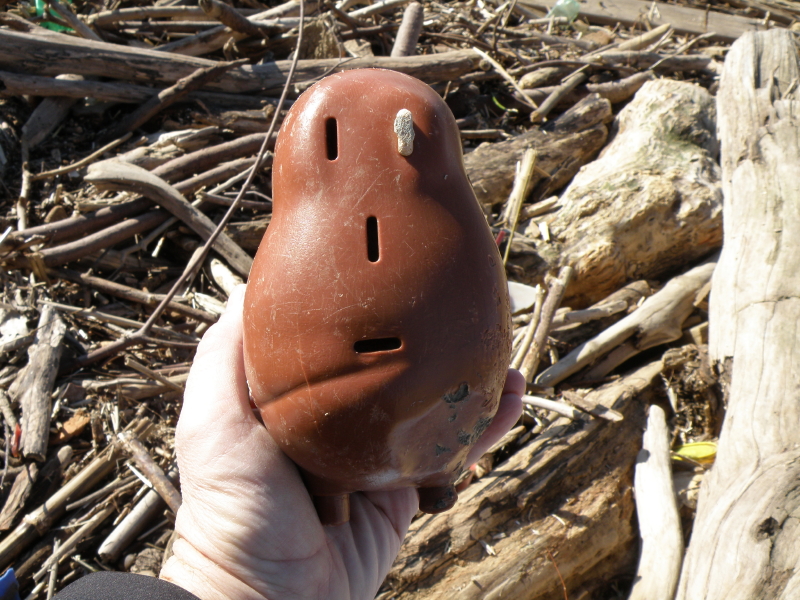
Here’s a test for you.  Do you know what this is?  Time’s up…this is the plastic body of a Mr. Potato Head toy!  I count Mr. Potato Head as one of my artistic influences for my Falls of the Ohio Styrofoam projects and this is the first one of these that I have found out here.  According to Wikipedia, Mr. Potato Head has been in continuous production since 1952 (that’s a lot of plastic) and was the first toy advertised on television.  I can remember as a kid…using actual potatoes to make funny faces and now I use Styrofoam.

My former outdoor studio, now river-swept clean, Jan. 2014

I walked up the riverbank to access my outdoor atelier and discovered that the river has swept over it.  All the materials that I had cached here over the last couple of years have floated away and the large logs that defined my space are rearranged.  I will need to create a new studio if I continue here.  I suspect, however, that the river is far from being done and would wager we will experience more flooding in the near future.  I picked up a few small pieces of Styrofoam and willow sticks and made my first figure of the new year and posed him at the river’s edge as waves lapped the shoreline.

New Year's Day figure at the river's edge, Jan. 2014

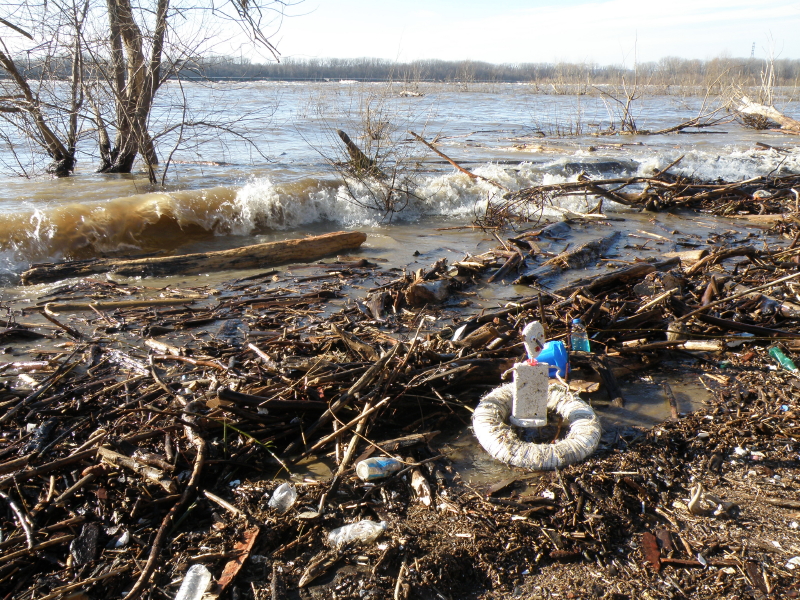
He is not a large figure and the expression on his face is one of amazement.  I first posed him near the river in an old life-preserver that washed up.  In addition to being expedient on a cold day it also seemed symbolic.  For me, it always comes back to the river and its waters.  The quality of our fresh water remains our number one vanishing resource and the river’s course is the journey we all take through life.  I will continue to use my creativity at this one small spot on a large river and publish my results on this riverblog.  Thanks for checking it out every now and then.  As the year progresses, I hope to be like the river by being predictably unpredictable.  May we all have a wonderful 2014!

First figure with life ring of 2014, Falls of the Ohio, Jan. 2014

Read Full Post »

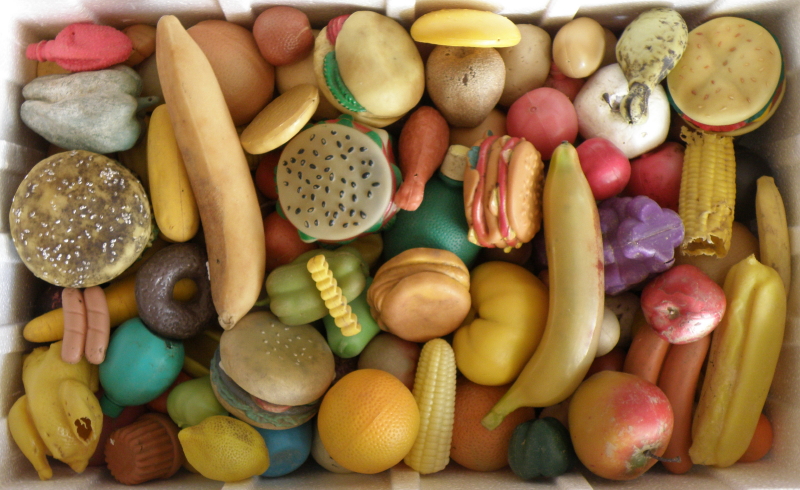
Fake Food Collection, Nov. 2013

I have so much to be thankful for that I don’t need one particular day set aside to remind me of this.  Nevertheless, I happily will take the next two days off from my day job, hang out with my family, eat, and of course… fiddle with my art projects!  I have an exhibition coming up soon (late January 2014 at the Carnegie Museum of Art and History in New Albany, Indiana) and I have been going through my Falls of the Ohio river junk and thinking about what this show might feature of my work?  It’s going to be a two-person show and so there will be a great space to fill.

I recently went through my various river collections including my Fake Food Collection which is ongoing and I have added many new pieces over the past year.  The Ohio River has been bountiful in fact over a ten-year period, it has been a regular liquid cornucopia.  Although I haven’t counted each item, I’ll wager my Fake Food Collection has about a couple hundred pieces now… all of it collected one piece at a time, off of the riverbank.  It’s interesting to think of this stuff as being a part of the fake food tradition.  I’ve seen examples of fake Japanese sushi that look amazingly like the real thing…but not at the Falls.

After all these years, I’m still blown away…perplexed…morbidly fascinated and repulsed…insert other adjectives here…that so much of this stuff exits and that most of it is made from plastic.  I’m just one person living near a river in the interior of a big country and this is what I’ve found at this single location.  Do other American rivers flow with plastic produce and is it all floating towards the oceans?  It’s so curious that we use a natural resource like petroleum to produce artificial food even if it is intended to be playthings.  It personally strikes me as an affront to nature especially once it materially starts breaking down and merging with the substrates we depend on.  Perhaps some of you wordsmiths out there will put your finger on exactly why this stuff is so provoking?

Okay…enough of that, now where’s the beef?  Where’s the plastic meat the title of this post promised?  I was curious about that myself and so I went through my collection and this is what shook out.  Bon appetite!

Plastic poultry from the Falls of the Ohio, Nov. 2013

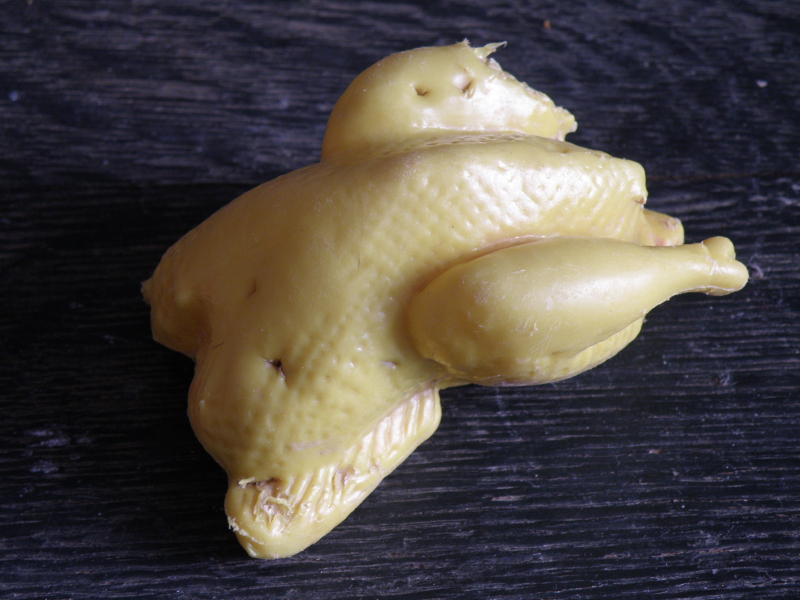
Since Thanksgiving here traditionally means roast fowl of some sort…I thought I would start with a couple of roasted birds and drumsticks.  Of course these items are miniature and I realize that a coin for scale would help.  Okay, I’ve found my ruler and if you must know…the biggest object in the above photo is 3.5 inches or 9 centimeters long.  The middle drumstick on the bottom row has a dark patina acquired from spending much time in the river.

plastic turkey or chicken, Nov. 2013

chewed up, plastic roast fowl, Nov. 2013

This last image of roast fowl looks like something (probably the family dog) tried to eat!  Notice the teeth marks on the carcass.  Now that we are done with the appetizer… let’s move on to the fake hamburgers and cheeseburgers.  I know the old salivary glands are probably kicking in now!

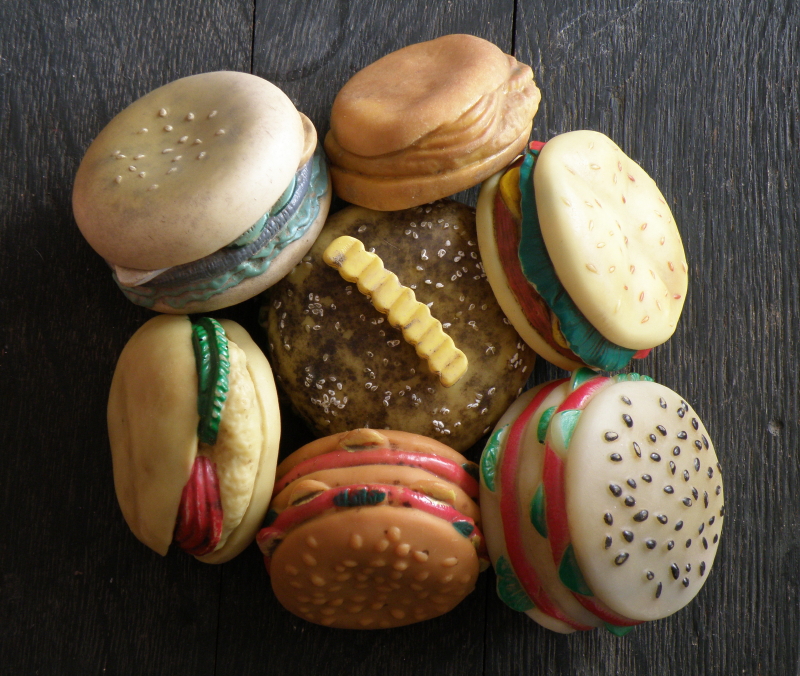
plastic hamburgers and cheeseburgers with one plastic crinkle cut french fry, Nov. 2013

plastic hamburgers and cheeseburgers, Nov. 2013

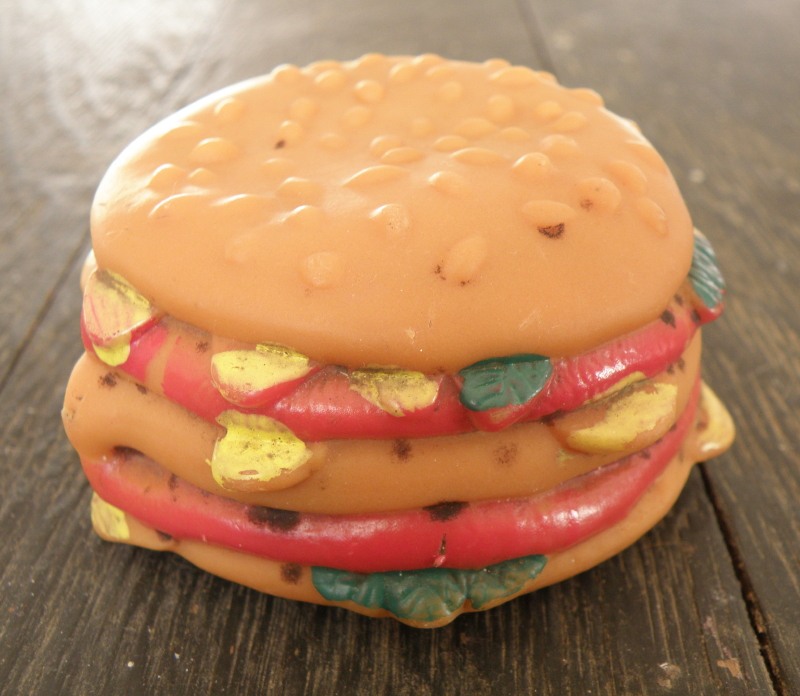
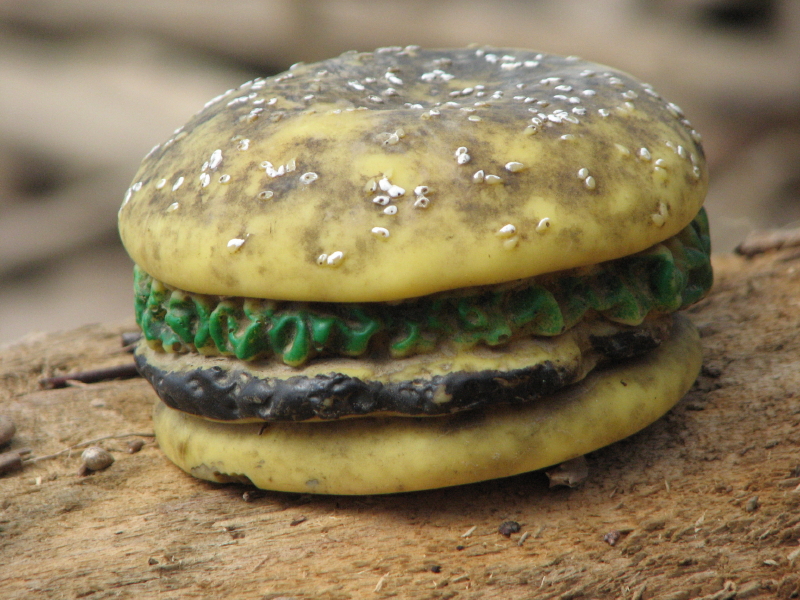
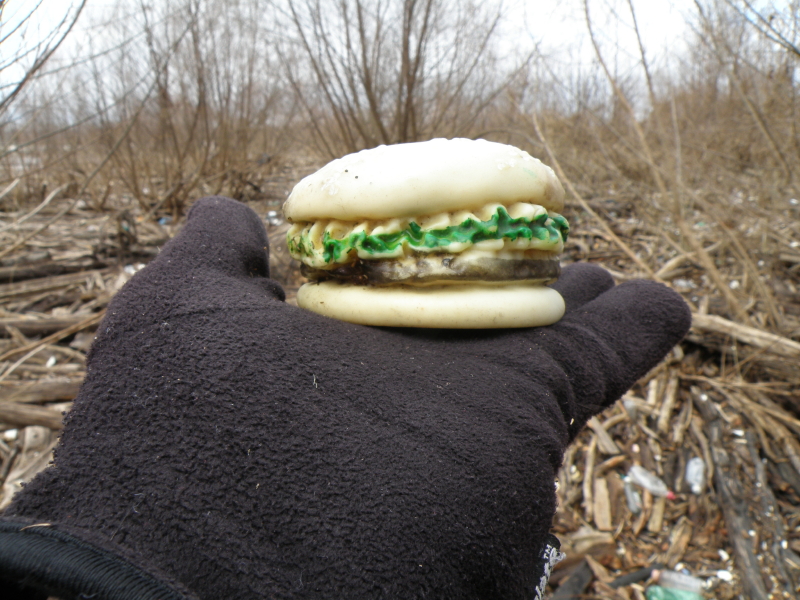
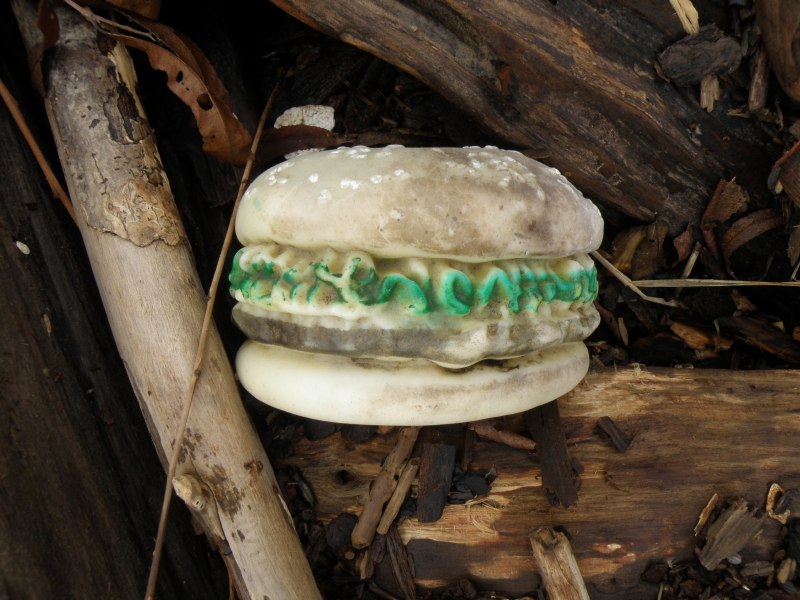
Here’s a couple of shots of the items in question.  In ten years time, the river has washed up and I have found seven cheeseburgers and hamburgers, three loose bun tops, and yes…two crinkle cut french fries (only one is shown) all are made of various plastic recipes.  Several of the burger toys I’m pretty sure were intended as dog toys.  Some of the them still have the little squeaker in the bottom bun.  The others probably came from children’s play sets.  As you can see…they are variously dressed with condiments and the buns go from plain to featuring sesame seeds in white, brown, and black colors.  I have some individual burger portraits too.  Here’s several examples of how you can have it your way.  The larger burgers are roughly life-size to slightly smaller than the real deals.

hamburger with black poppy seeds_1_1

Ahhh…a black poppy-seed bun heavy on the lettuce and tomatoes.

hamburger, plain bun, tomato and lettuce_1_1

Here’s a plain bun, segregate the tomato on one side and the lettuce on the other option.  The meat here is more of a textural suggestion.

plastic hamburger two tomatoes_1_1

This is a gaudy burger with hints of mustard and two layers of tomatoes!

plastic hamburger with seeds, lettuce and tomato_1_1

Not sure if that’s melted yellow cheese or more mustard squeezing over the edge?  Looks de-lish nevertheless!  If you are wondering what artificial food looks like in a natural environment…here are a two images of plastic meat as I found them in place.

Gross cheeseburger with white poppy seeds and river patina

This one has white poppy seeds on the bun, frilly lettuce, and a nice grimy river patina.  Let’s leave the burgers and head into new territory.  First an image of our next plastic meat subset.

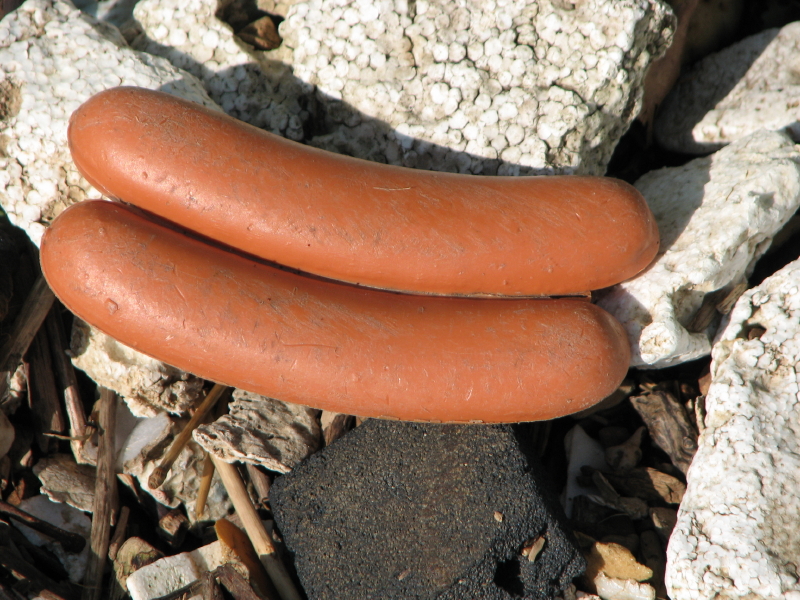
conjoined plastic hot dogs from the Falls of the Ohio

I can remember the joyful moment of finding this rare double score.  Two conjoined, Siamese twin plastic hot dogs resting on a bed of Styrofoam and river sticks.  Of course, I had to take a picture!  Now, for a snapshot of my hot dog collection.

Hot dog collection from the Falls with Oscar Meyer Wiener Mobile

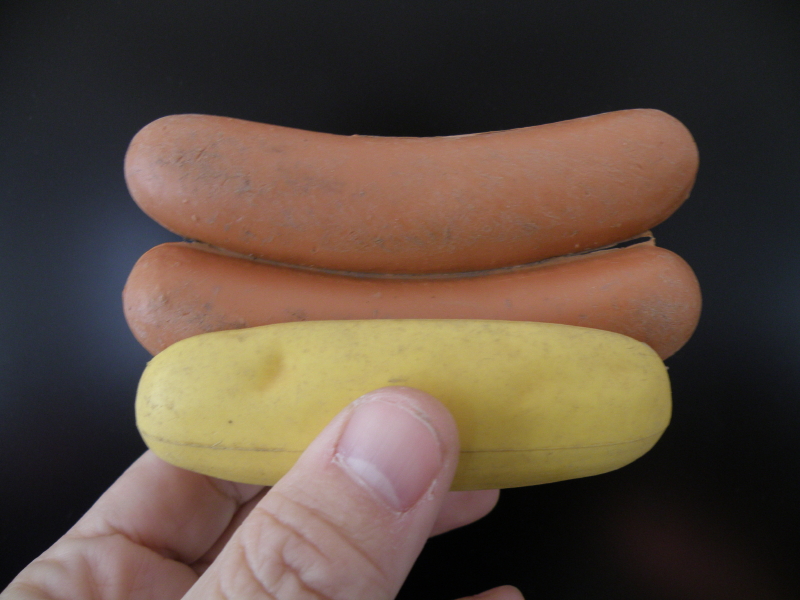
As you can see…these tube steaks and buns vary in size.  The largest example at the very top has all of its paint gone, but you can see where a fake mustard squiggle would be.  Perhaps some of them are actually intended to be Vienna sausages, but who knows?  One particularly prized find is the Oscar Mayer Wiener Mobile whistle in the bottom right hand corner.  I’ve propped it up on a plastic french fry to get a better side view.  There are plastic meats that I know are out there (like fake steaks or even slices of plastic pizza with f aux pepperoni), but I have yet to find examples by the river.  I do have a code I go by…unless I find it at the Falls of the Ohio…I won’t compromise my collection with non-Falls items.  It’s a part of the quest and fun of what scrumptious simulacra will turn up next.  Is Rack of Lamb or Pot Roast on the menu…only time will tell?  For now, I will content myself with this Double Decker Dog…Happy Thanksgiving from the Falls of the Ohio.

World famous Double Decker Dog, Nov. 2013

Postscript:  Less than a month after publishing this post…I found plastic hamburger combination #8 in the late December driftwood.  Here’s a couple of images made in the field.

found plastic hamburger, #8, Falls of the Ohio, Dec. 2013

Plastic hamburger #8 as found, Dec. 2013

Read Full Post »

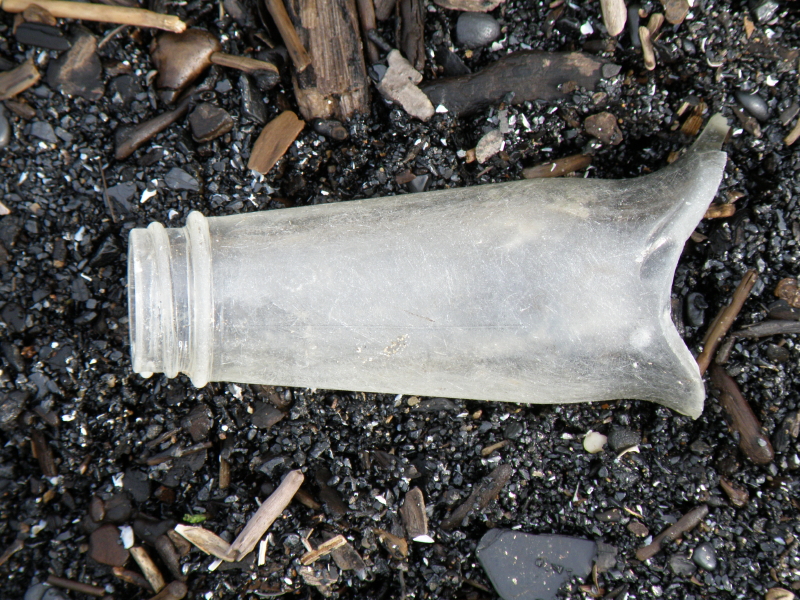
glass bottleneck against coal gravel, 2013

I wish I could remember the exact written passage where the image of a bottleneck captured my imagination.  Back tracking through my books has not revealed the exact source, however, I do remember that the context came from biology and more specifically the history of life.  Of the five great extinction cycles, the one that closed out the Permian period (roughly 245 million years a go) was the most brutal and efficient.  All those trilobites that had been so successful for so long hit the wall.  At this time the super continent Pangaea existed.  Millions of years of continental drift and the resulting global climate change are the leading hypothetical causes for this extinction.  Regardless, the effect was that the majority of life’s diversity as it existed then and which filled up that particular metaphoric bottle…did not make it through the bottleneck.  Fortunately, some life did survive, but it would take subsequent millions of years for life to evolve and radiate out to regain its former glory.

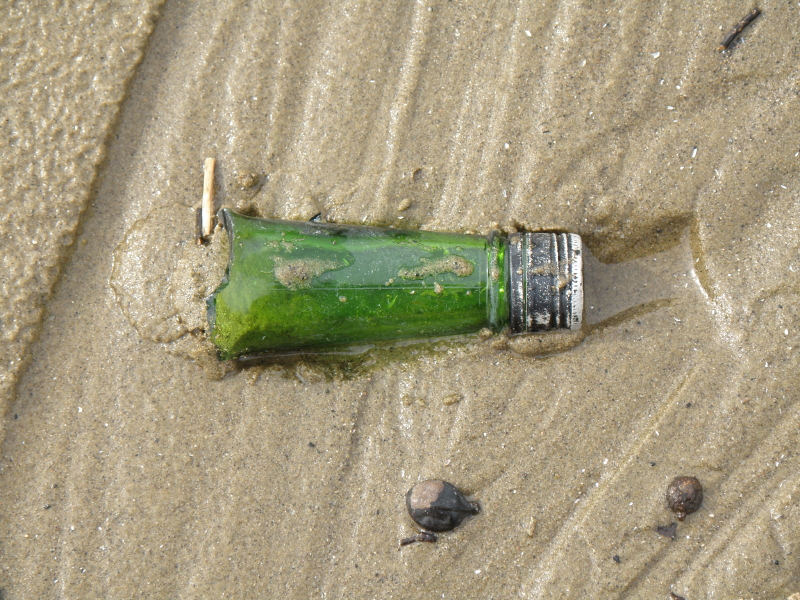
green glass bottleneck with cap against sand and water, 2013

We like to think that we stand atop life as its ultimate achievement.  We frequently miss the bigger picture of which we are small part and are even oblivious to the effects we have on everything else around us.  The bottleneck effect has been adapted by other systems to illustrate that which is a hindrance or impediment to progress.  The basic idea, however, remains the same.  Whatever is in the bottle is going to get squeezed on its way out that is if the contents do in fact make it out.  In my own blog, I don’t mention U.S. politics much, but lately it is in the news and it’s troublesome. Our seeming inability to govern ourselves…to in effect allow small selfish groups to manufacture bottlenecks strikes me as self-defeating and doesn’t bode well for the future.

two glass bottlenecks on sand, 2013

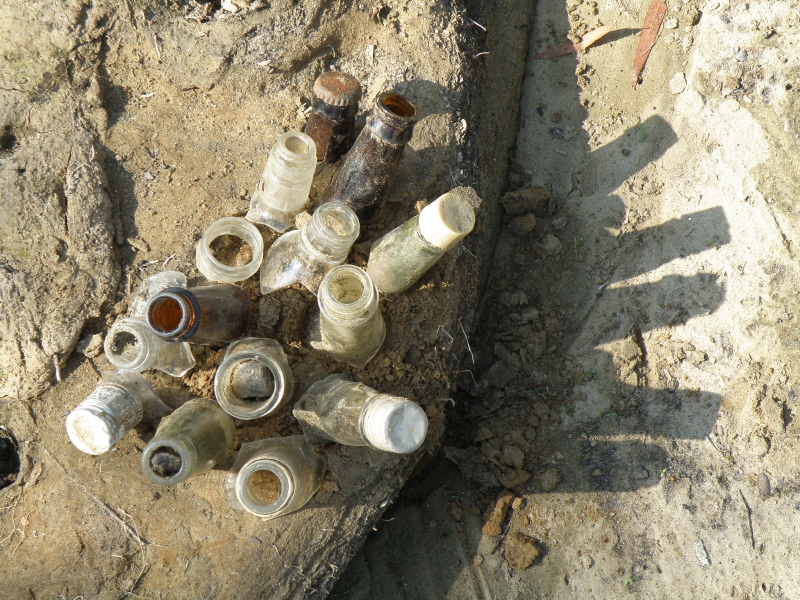
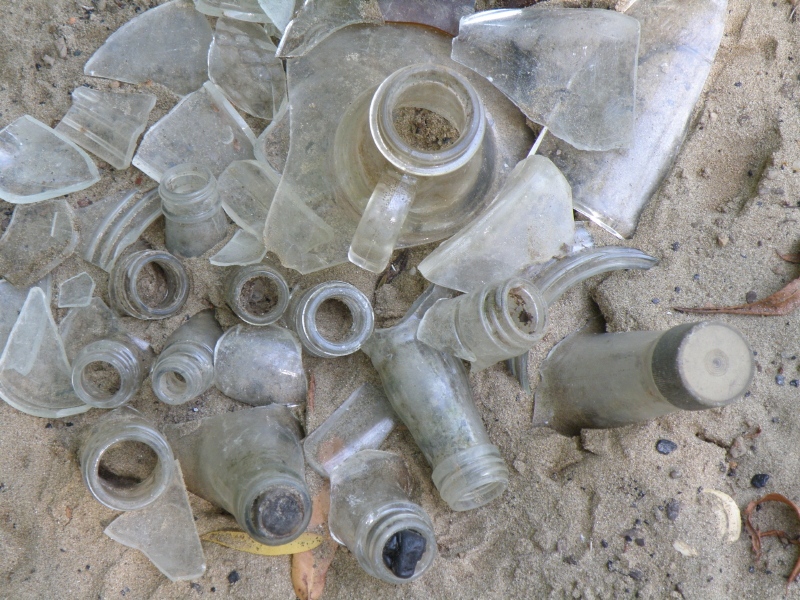
At the Falls of the Ohio State Park, I literally find bottlenecks all the time.  Unlike their plastic counterpoint, the glass ones don’t break down as much.  There must be something about the material strength of glass that is increased when it is forced into a tube that makes it extra resilient.  Over time, their sharp edges do get worn down and their surfaces become frosted through tumbling in the sand.  Personally, I find glass to be a far more attractive material than plastic.  I’ve come to look at our artifacts in much the same way I might regard a fossil as examples of objects that have been touched by and affected by life.

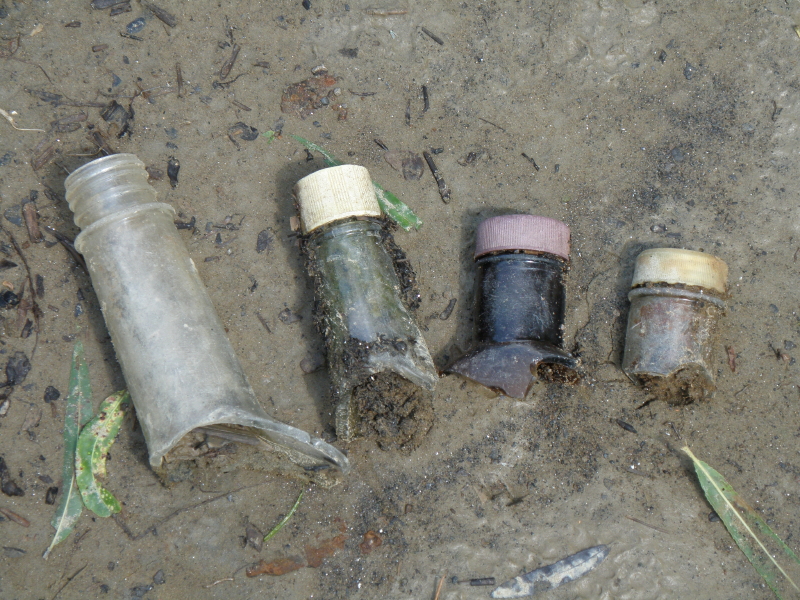
four different glass bottlenecks, 2013

There’s something about the process of “finding” that is compelling if not compulsive for me.  I try to stay watchful for opportunities, particularly if I come across an image or material that I can apply through my art.  The process of collecting, examining, and comparing is also personally meditative and relaxing.  I started photographing bottlenecks years a go with no goal in mind.  Just more documented stuff among all the other stuff along the riverbank that I come across each time I visit the park.  Looking over my photographs, forgotten images of bottlenecks would catch my eye again.

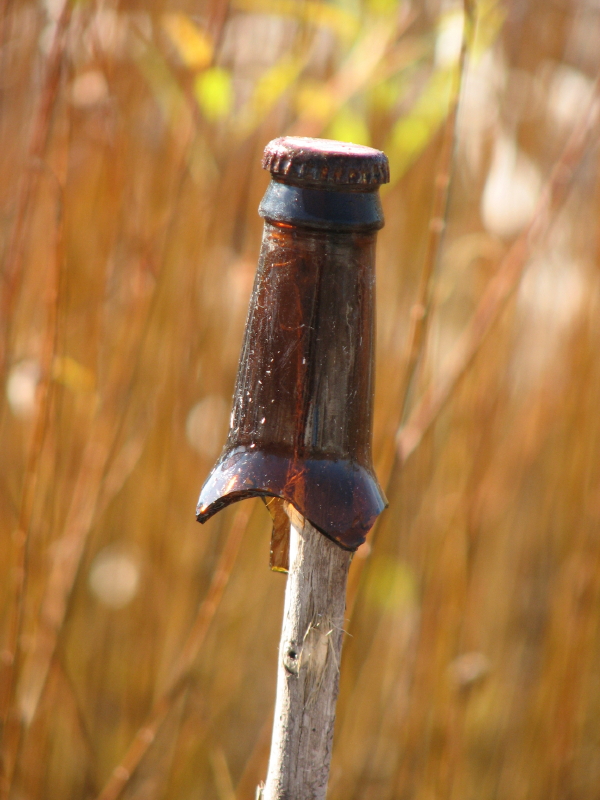
beer bottleneck with cap on stick, 2013

bottleneck with red cap on stick, 2013

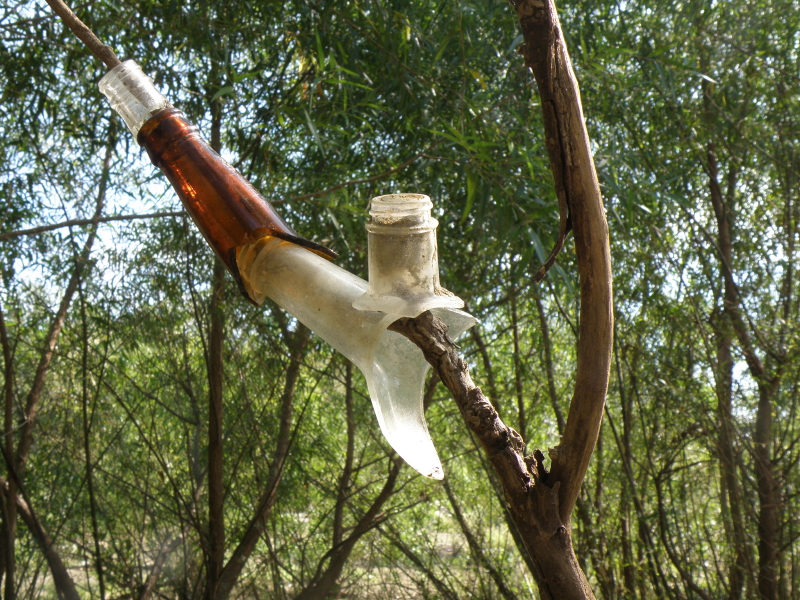
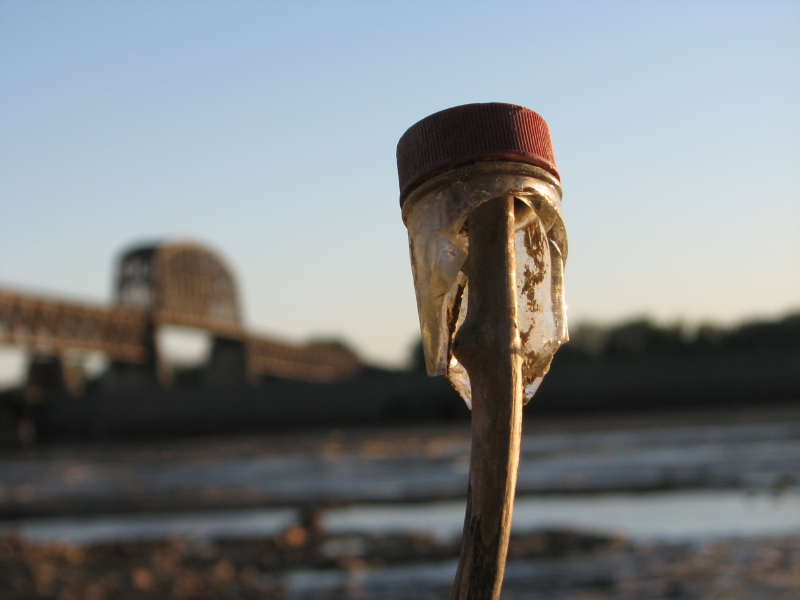
Other than take contextual images, I guess the next thing I did with bottlenecks was to stick them on the ends of branches and sticks.  This allows the light to play through the glass revealing its jewel-like attractiveness.  It might also cause someone else to notice that there is a lot of smashed glass in the park.  Granted, the river floats a lot of bottles in here from upriver, but there is also a lot of drinking that goes on here via the local folks.  Why pack your empties out when you can just throw them on the ground?  One bottleneck on a branch led to more…in fact the whole arc of these now bottleneck projects has trended in the “more” direction.

glass bottlenecks on a willow branch, 2013

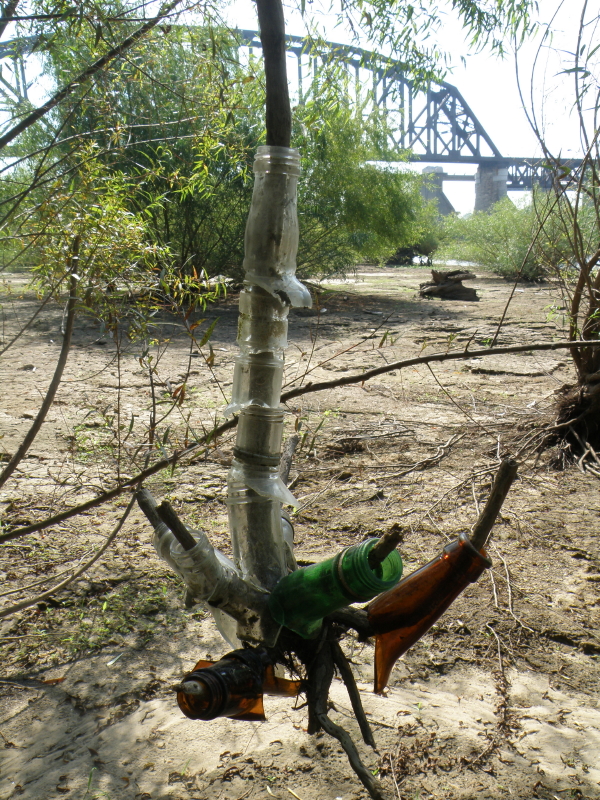
glass bottlenecks on driftwood tied to a branch, 2013

I guess this last image is a bottleneck candelabra?  I find many of the bottlenecks I’ve used near stands of willow trees by the water’s edge.  I suppose bottles that float in are snagged in the tree’s exposed root system eventually breaking through contact with floating logs and leaving the shards in place?  People also throw bottles against the trees which has the same effect.  Rarely, do I need to walk very far to find enough glass to create a small project and image.

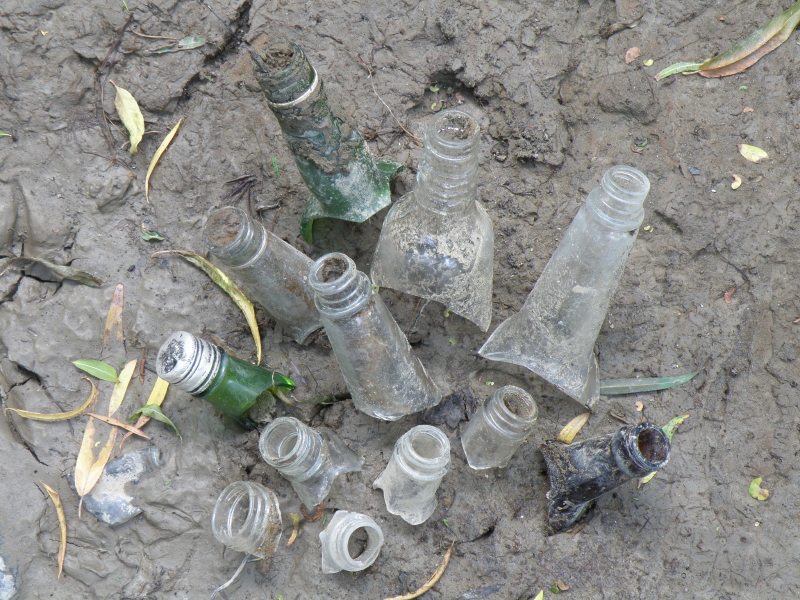
glass bottlenecks stuck in the mud, 2013

Here’s one project made from bottlenecks collected around one particular willow tree.  I liked the way they looked collectively stuck in the mud and their tubular arrangement reminded me of fossil corals which also references the Falls of the Ohio.  Here’s a few other similar site specific groupings of bottlenecks.

upright glass bottlenecks in dirt with shadows, 2013

glass bottlenecks stuck in the mud at the water's edge, 2013

diverse collection of glass bottlenecks, 2013

detail of arrangement of various glass bottlenecks, 2013

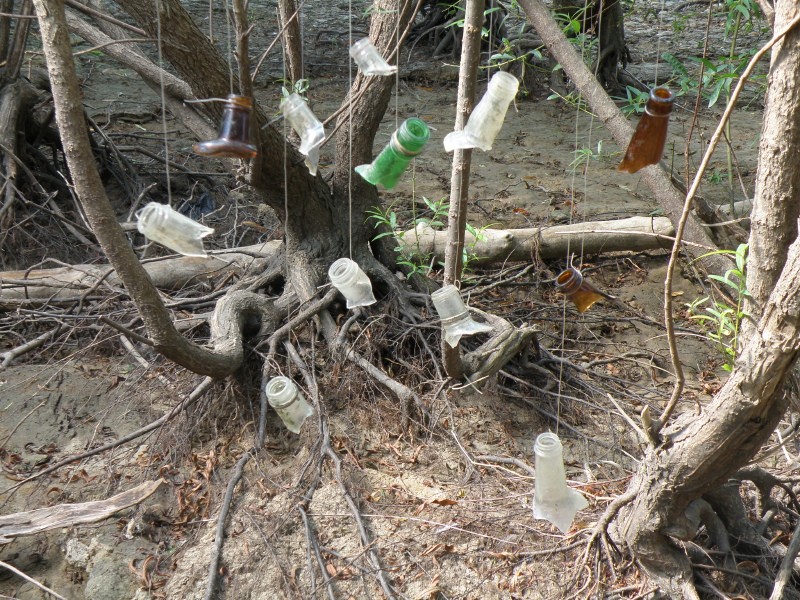
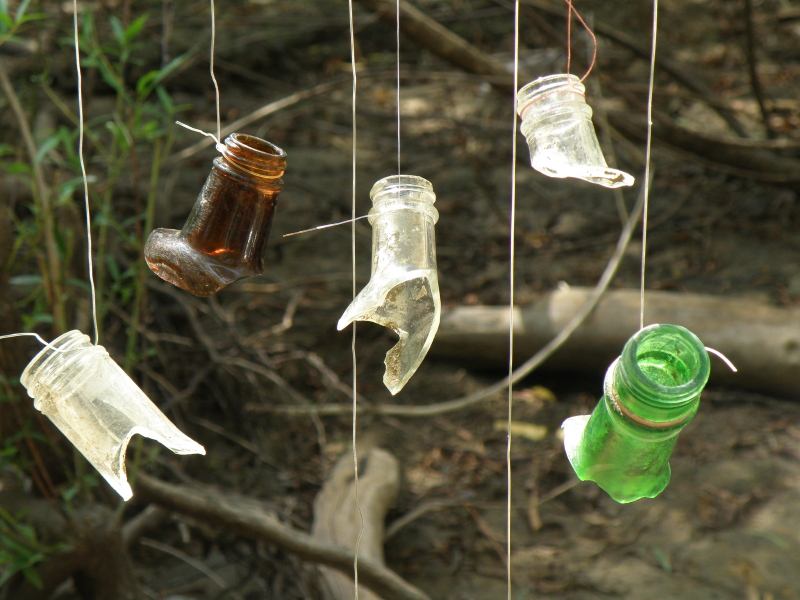
The next couple of images are from my last bottleneck piece.  In addition to lots of waste glass…I also find discarded fishing line, often in the same places.  I brought these two materials together for this ephemeral work.  Recently, I was talking with a good friend of mine and we were remarking about how much of our lives seem mediated by and require reading various kinds of screens.  This last glass project may have something to do with that because the bottlenecks are arranged in a flat, parallel screen hanging from a horizontally growing willow branch.  I wonder if anyone else ever saw this and what they may have thought about it?

various glass bottlenecks suspended on fishing line, 2013

detail, various glass bottlenecks suspended by waste fishing line, 2013

Well there you have it!  I suppose these bottleneck projects will now crop up on occasion like my found coal pieces do as intimate site specific expressions.  For now, it’s enough to present them as images without trying too hard to extract every bit of meaning from them.  Bottlenecks in the broader sense are challenges.  May we always remain open to meeting them.  So long from the Falls of the Ohio.

bottleneck on a stick at sundown, Falls of the Ohio, 2013

Read Full Post »

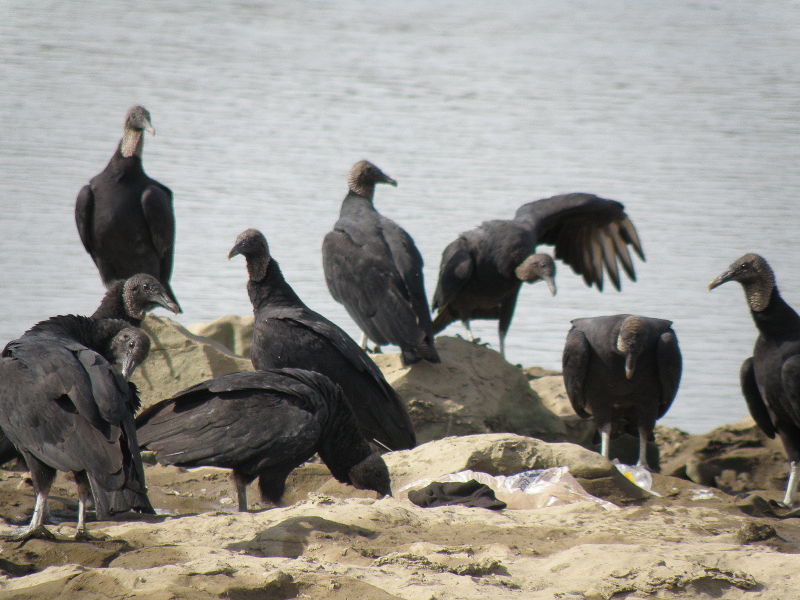
Black Vultures on the Fossil Beds, Falls of the Ohio, Sept. 2013

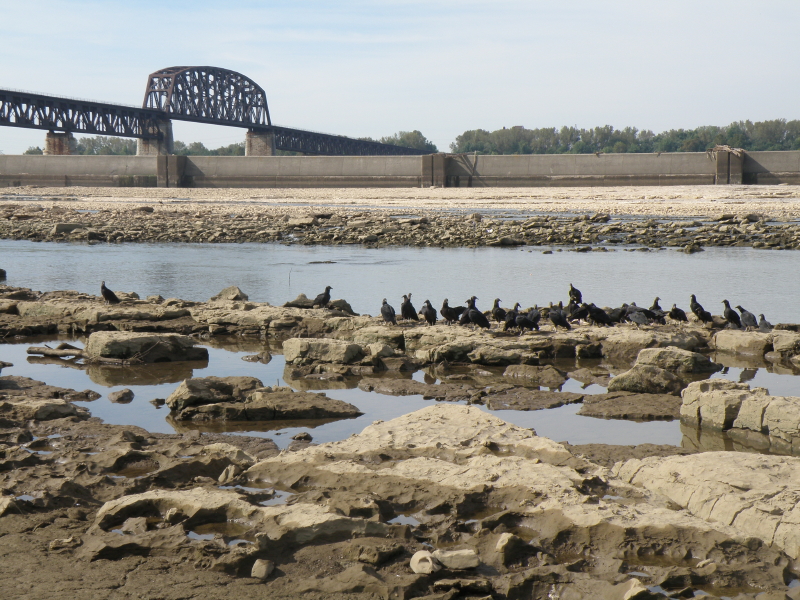
The resident flock of Black Vultures were taking advantage of the fossil beds now exposed on the Kentucky side  of the Falls of the Ohio.  The wier dams were temporarily closed and with it the flow of water.  With the river level reduced much of the sculpted limestone normally underwater is briefly seen again.  Fishermen have been accessing new fishing spots along the freshly revealed fossil beds which turns out to be a boon for the vultures.  Not only do they get to feast on fish left by the anglers, but they also enjoy any other trash including left over fishing bait.  Early autumn is a transitional season among the park’s bird life as residents gear up for over-wintering or prepare for the southerly migration.  Birds from the northern latitudes particularly Canada and the Arctic Circle pass through our area on their epic journeys to Central and South America.

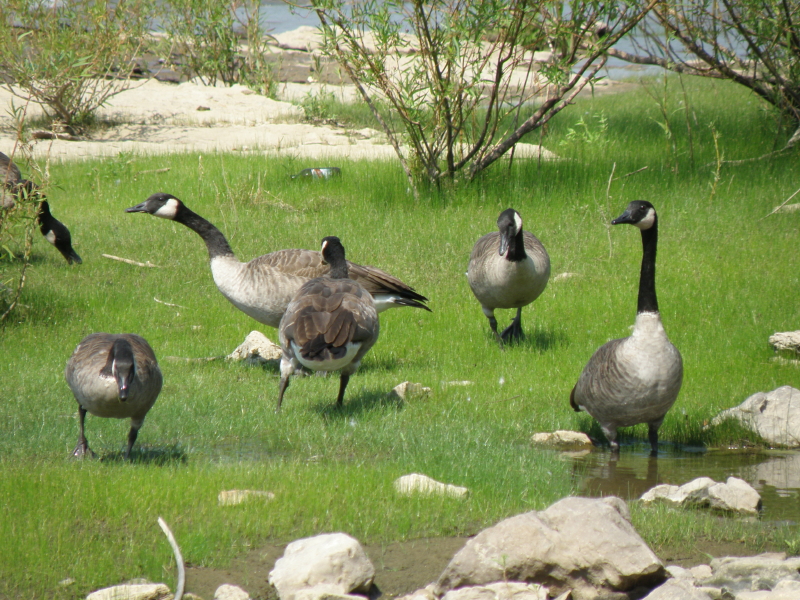
Canada Geese feeding on grass, Falls of the Ohio, Sept. 2013

The vultures will fly away, but many of our Canada Geese will brave it out.  We seem to have at least two distinct flocks of Canada Geese sharing the area around the fossil beds.  It’s amazing how intolerant each group is of the other.  There is competition for the best food sites and each group frequently bump into one another with much squabbling.  That’s what makes the next image interesting to me.

Domestic goose mixed with the Canada Geese, Falls, Sept. 2013

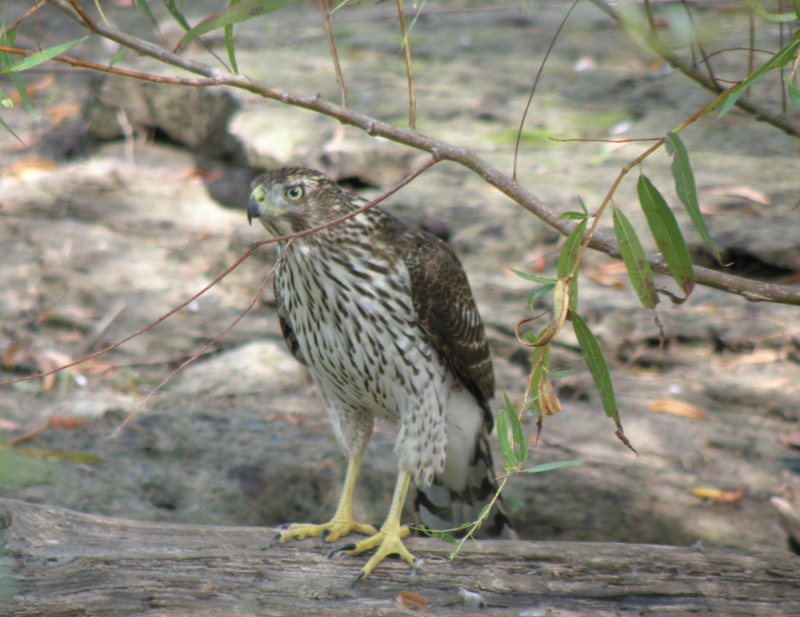
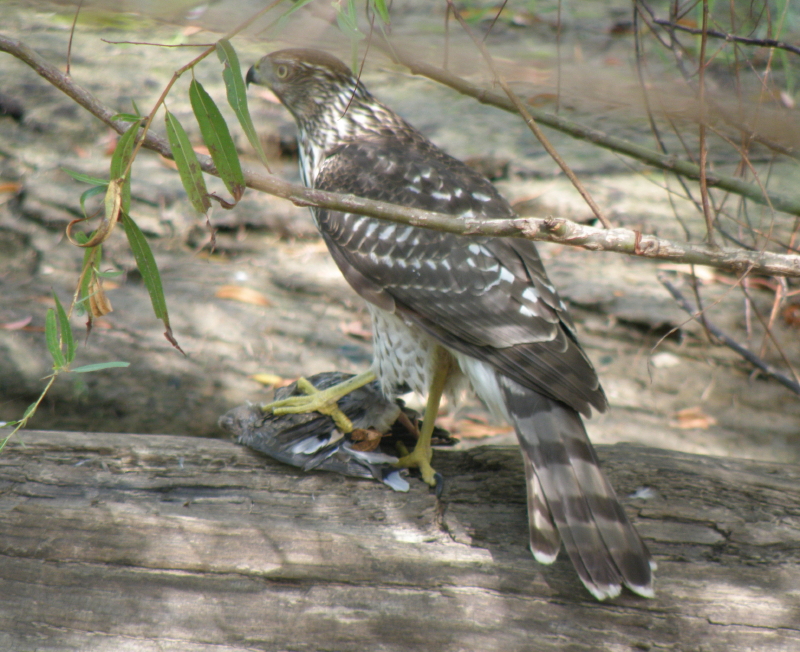
Canada Geese can have limits on how much mingling occurs between their own species, but in this case, are willing to accept a true outsider.  This domestic goose seemed integrated into its adoptive flock.  It swam with its wild cousins and accompanied them to a favorite feeding location and was never bothered by the other geese.  Recently, I came across a young Cooper’s Hawk and I was surprised when it did not immediately fly away after I bumbled across it.  There was a good reason why it didn’t leave.

Young Cooper's Hawk, Falls of the Ohio, Sept. 2013

The hawk sized me up and then jumped down off the log it was standing on to retrieve something it had dropped.

Young Cooper's Hawk with prey, Falls of the Ohio, Sept. 2013

The hawk had what appeared to be a freshly killed Mourning Dove.  After securing its prey with its talons, the hawk seemingly jumped into the sky and  vanished within moments.  I thought I saw it disappearing into the tree tops of a stand of willow trees within walking distance.  I did investigate the area, but never saw the bird again.  I love it when I get to observe behaviors.  Life has a job to do and can’t wait around posing for pictures.  Here’s a different kind of behavior being demonstrated by an American Robin.

American Robin bathing at the Falls of the Ohio, Summer 2013

I love this image which I captured earlier in the summer.  This American Robin is focused on taking a bath.  Its head is under the shallow water and droplets and beads of water are splashed over its body.  Our resident American Robin population is doing well and seem to be increasing at the Falls of the Ohio.  Some of the robins will hang out over our gray winter, while others will seek warmer climes.  My last adventure to the Falls resulted in images of a bird that I had never recorded previously in the park.

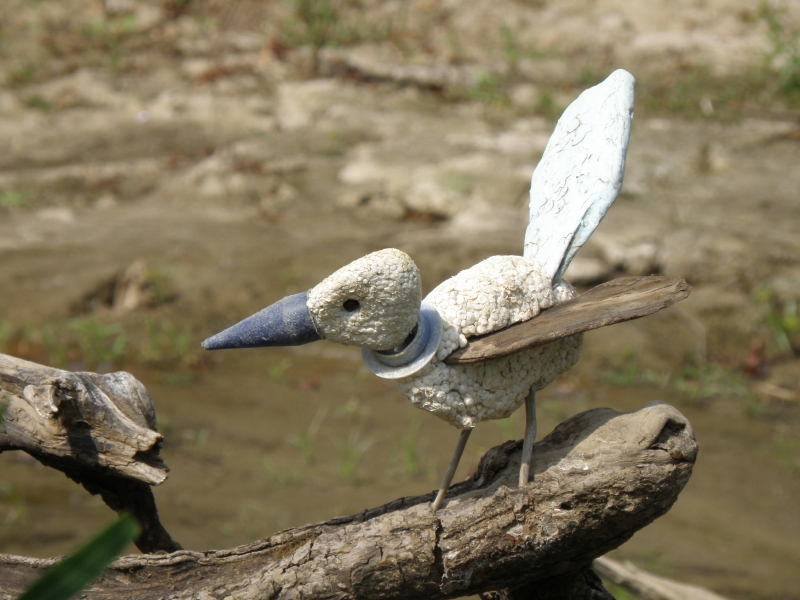
Gross Blue Bill at the Falls of the Ohio, Falls of the Ohio, Sept. 2013

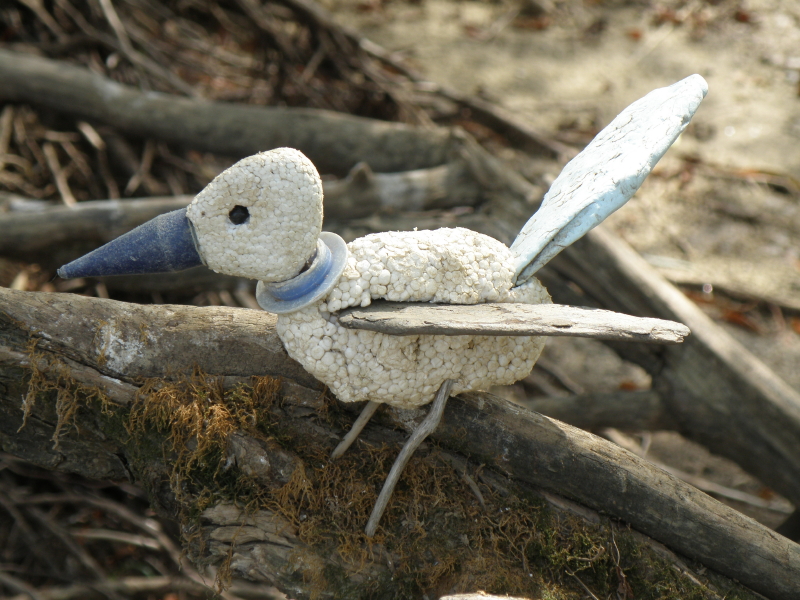
Gross Blue Beak and flowering plants, Falls of the Ohio, Sept. 2013

The Gross Blue Beak is strictly passing through and in fact, this is the first recorded instance of this bird appearing in the park.  Good thing I have all this photographic proof that the bird was here because the resident birders are a skeptical lot.  Reputations and lifetime bird lists are at stake and there is a great burden of proof to produce irrefutable documentation.  This bird has traveled thousands of miles from the edge of the Arctic Circle in Canada and is bound for the Argentine coast.

Gross Blue Beak with corroded aerosol can, Falls of the Ohio, Sept. 2013

portrait of a Gross Blue Beak at the Falls of the Ohio, Sept. 2013

The Gross Blue Beak receives its name not because it has disgusting habits that require an out-sized bill.  Rather the “Gross” idea comes from the German word for “large” .  The Ohio River Valley was settled by many immigrant groups and the Germans were among the most prominent.  This bird’s beak is a heavy-duty tool it uses to crack open nuts, crush mollusks (particularly snails), and jack hammer soft decaying logs in pursuit of beetle grubs.  All three of these food sources are found at the Falls of the Ohio.

Gross Blue Beak at the Falls of the Ohio, Sept. 2013

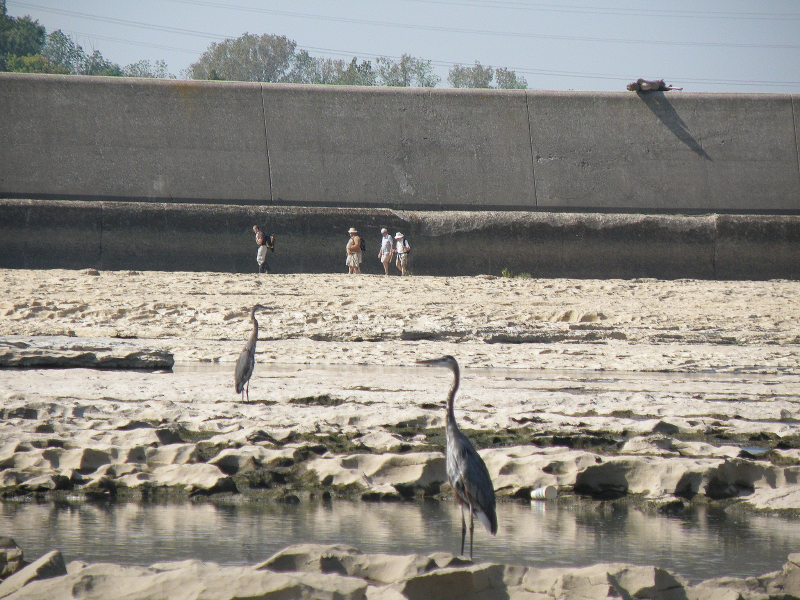
I was able to get quite close to the Gross Blue Beak to snap off these images.  I’ve noticed before that many northern migrants of various species will allow me to approach more closely than the local birds that are around people more.  Perhaps that’s the key?  For the moment, the region around the Arctic Circle has seen less of our influence than other places in North America.  To close, I have one other bird image, but it is noteworthy because of the people in the far distance.  Recently, I received a question about the back wall that is a part of the system in place to produce a stable pool of river water for commercial barge traffic.  I’ve heard that the Ohio River carries more tonnage of goods along it’s 800 plus miles than the Rhine River does in Europe.  The back wall of this dam is quite high up and the actual river level is perhaps a meter or so below the top of the wall.  Beyond the Great Blue Herons, the small band of hikers provides some sense of scale on how the river would be over their heads!  When you are walking the now exposed fossil beds…it’s a sobering thought!

Great Blue Herons and hikers on the fossil beds, Falls of the Ohio, Sept. 2013

Read Full Post »

Landscape at the Falls of the Ohio, Sept. 2013

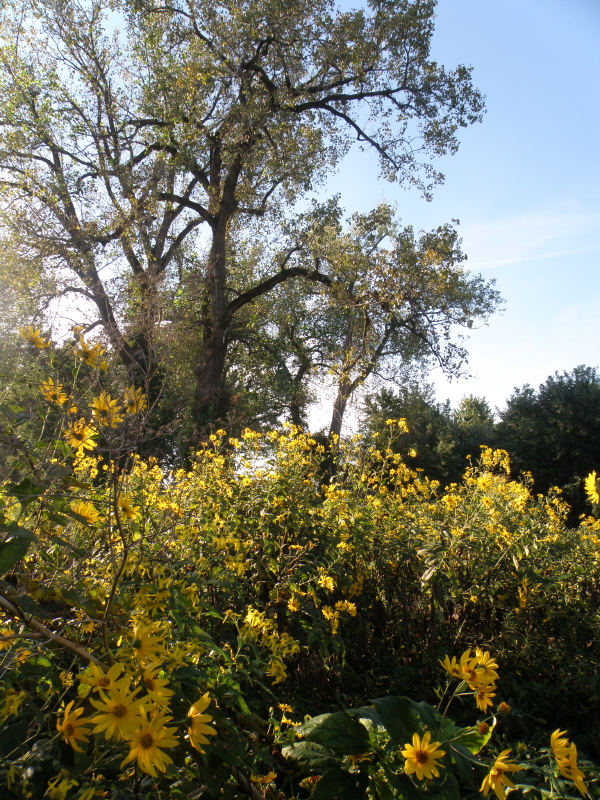
This post is the last of this year’s summer posts and documents a walk I made at the Falls of the Ohio State Park one week before autumn officially began.  As you can see by the pictures…it was a very beautiful day filled with all kinds of discoveries.  There was a profusion of yellow-flowering plants of various species including goldenrod and sunflowers.  Here is a detail, I think from the Woodland Sunflower?  I wish I was as confident about plants as I am in identifying animals.  When I break out my flower books, I realize it would aid identification greatly to have an example on hand.  Collecting plants is not allowed within the park limits…so I try to take photos that might be of use in discerning the various closely related species.  Besides, I don’t think pressing these plants flat would even work?  I ask myself, what leaf shape does it have?  Are the leaves serrated, smooth, or hairy and how many rays do the flower heads have and other such questions of concern to the botanist.

Sunflowers at the Falls, Sept. 2013

I suppose I’m more of an imaginative botanist at heart who also appreciates the beauty and variety the many flowers add to the temporal landscape.  I do, however, stumble upon plants that I wonder if anyone else is noticing?  I’ve posted about these anomalies before and as the seasons change, the parade of these “unnatural plants” and “faux flowers” continues.  Consider these fresh blooms.

The Surprising Poinsettia, Falls of the Ohio, Sept. 2013

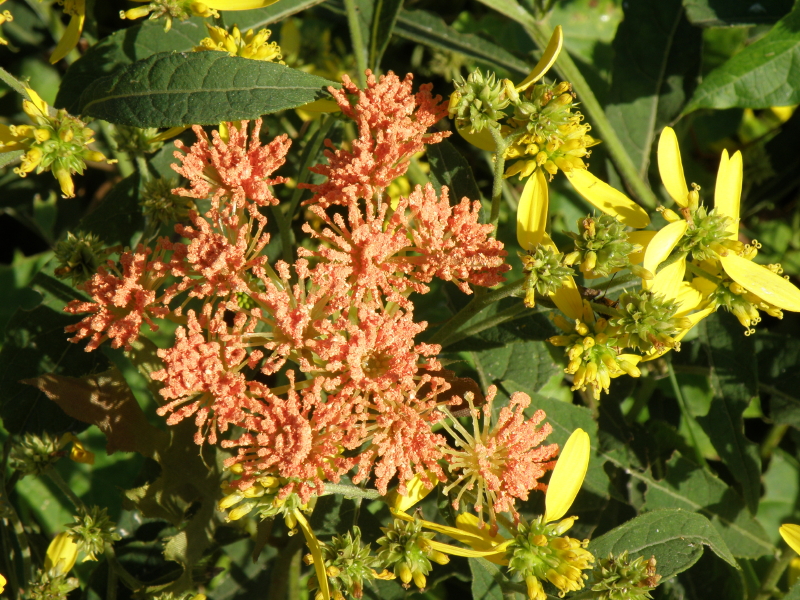
I call this one the “Surprising Poinsettia” because it comes shockingly red and completely unexpected.  Its sepals are rather fabric-like and its stem is grafted upon this sunflower by some unknown means.  The next plant is more subtle.

Orangey-tickseed, Sept. 2013

This is “Orangey-tickseed” and at first blush, one might be tempted to pass over it.  I had to do a double-take on this one, however, my instincts told me something was not quite right here.  Indeed the orange-colored flowers are not at all like the yellow plant it is cohabiting with.  Again, the texture is very much like plastic.  One final plant before moving on to other interesting discoveries.

Pink Sand Lily, Falls of the Ohio, Sept. 2013

I found this beautiful flower growing near the river in the sand and I have designated it the “Pink Sand Lily” because I’m not sure what else to call it?  It is for the most part, a low growing plant and the “flower” appears at the terminal end of a wiry green stalk about four inches tall or so.  The flower petals are composed of a string-like fiber while the stamens are hard and have pseudo-pollen on them.  These unusual plants were not my only discoveries on this fine day.  I nearly always find some doll or doll part that the river has washed into here and today was no exception.  I spotted a form in the wood chips and bark bits and went in for a closer look.  Dusting off the form revealed this doll body.

"rubberized" foam doll body, Sept. 2013

This was quite unlike any other doll “body” I’ve found before at the river.  The material was obviously made from a foam-like material, but it had the flexibility of rubber.  Nearby, I also discovered  an unusual serpent.

red, plush toy snake, Sept. 2013

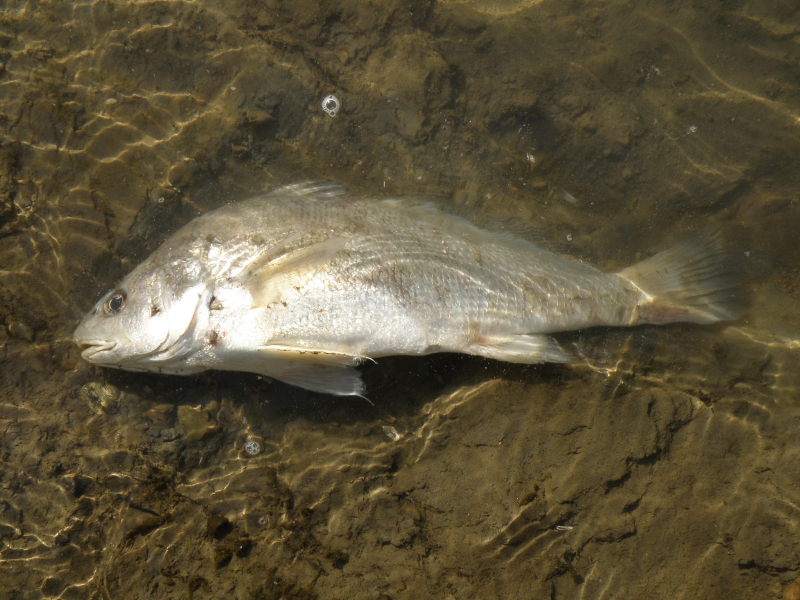
Approximately a foot long, this red plush snake had large black eyes and had just a bit of its tongue sticking out.  This is the first of one of these objects that I have come across .  The river was flowing nearby and I walked over to the edge of the riverbank.  The water level has finally leveled off to more of its seasonal pool and the fossil banks on the Kentucky side were exposed for the first time this year.  Looking along the water’s edge, I came across this Freshwater Drum that an angler caught and released.  Unfortunately, for the fish…it did not survive being captured.  Here is its final portrait.

Freshwater Drum, Falls of the Ohio, Sept. 2013

The Freshwater Drum (Aplodinotus grunniens) is a widespread fish and common in the Ohio River.  It has several molar-like teeth in its mouth that it uses to crush and eat snails and small clams.  The drum is not considered a desirable food species around here.  Here’s another fish I found on this walk that is also inedible.

red plastic fish bottle, Falls of the Ohio, Sept. 2013

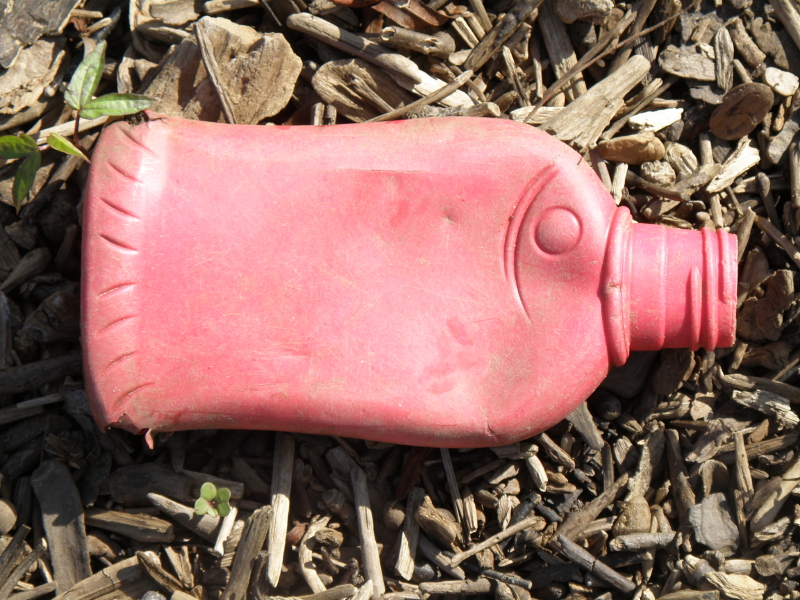
The second “fish” I came across was this plastic bottle.  I’m guessing that the bottle may have contained shampoo for children?  Regardless, I was struck by the level of abstraction occurring here.  The tail is minimally represented and the gills are indicated by two lines near the eyes, but there is enough here to suggest a fish.  My next find is mid way between the drum and the plastic bottle being closer to the latter than the former.  Here are two views of it.

The Silvergill, Falls of the Ohio, Sept. 2013

Silvergill, Sept. 2013, Falls of the Ohio

This is a Silvergill which is closely related to the Iron Gill (which I have posted about previously).  Differences between the two species include size (this fish is smaller) and some of the fins are not the same shape or in the same position.  The Silvergill is much more rarely encountered than its larger cousin.  It is found in water of average to poor quality and often associated with coal and coal dust. It is omnivorous and eats aquatic insect larvae and algae which it grazes off of rocks.  I’m assuming that it washed up here a victim (like the Freshwater Drum) of an angler looking to catch something more worthwhile.  I took a few photos and then moved on.  The fossil beds were beckoning and I could see the resident flock of Black Vultures congregating on the rocks.  No doubt they had discovered a fish or two on their own.  Until next time from the Falls of the Ohio.

Fossil beds and Black Vultures at the Falls of the Ohio, Sept. 2013

Read Full Post »

Soap Bubble Wand Collection, Falls of the Ohio, Sept. 2013

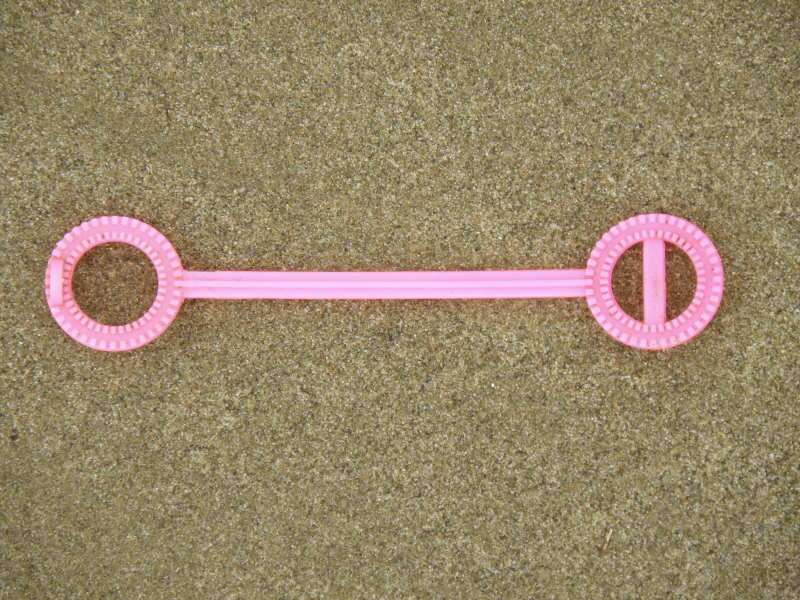
Consolidating some of my river finds revealed this fun collection of soap-bubble wands all found within the Falls of the Ohio State Park.  This is many years worth of walking the riverbank and sampling choice bits of plastic and other displaced objects.  All the bubble wands I’ve found thus far are made of plastic.  Most of these wands were sold inside plastic bottles filled with prepared soap-bubble solution.

Detail, Soap Bubble Wand Collection, Sept. 2013

Simply dip the wand into the soap bottle. Remove the wand allowing a film to form over the loop.  Then gently blow air through the soap film and bubbles should result. With this found wand lot however, the bubbles probably wouldn’t be very big or long-lasting.  The soap-bubble wands you can fashion at home with common materials (along with creating your own bubble mix) can produce spectacular results.  These wands were more than likely lost by kids playing near the river.  I’m frequently amazed by the variety of design solutions intended for such a throw away item.  I mean who holds on to these wands to reuse once the bottle is empty?  I did find some novelty items in the mix.  Check these examples out.

Mini Wedding Novelty Soap Bubble wands , Sept. 2013

Here are two mini soap-bubble nuptial wands.  These are usually in tiny plastic bottles left on the guests’ tables.  Blowing bubbles on the newlyweds frequently substitutes for the traditional rice throwing send off.

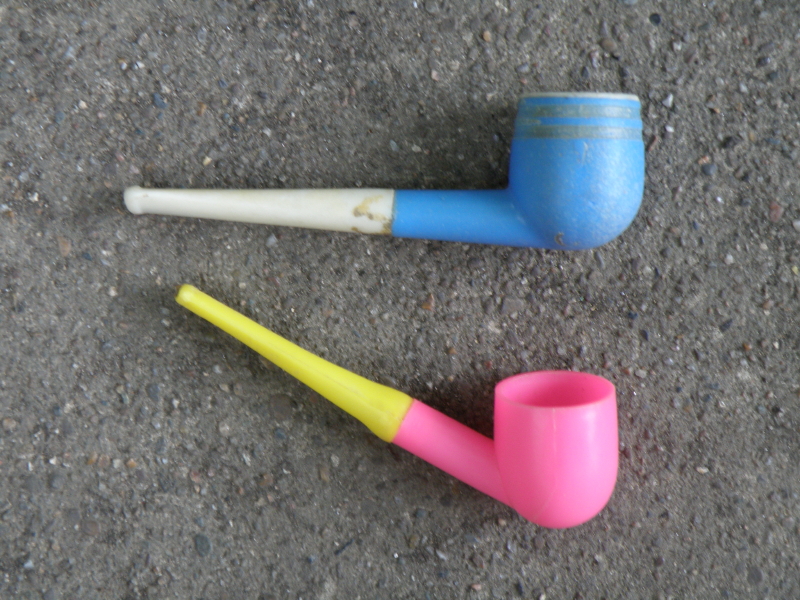
soap bubble plastic pipes, Falls of the Ohio, Sept. 2013

I also found these two soap-bubble pipes.  Personally, I’ve never had much luck making bubbles with pipes.

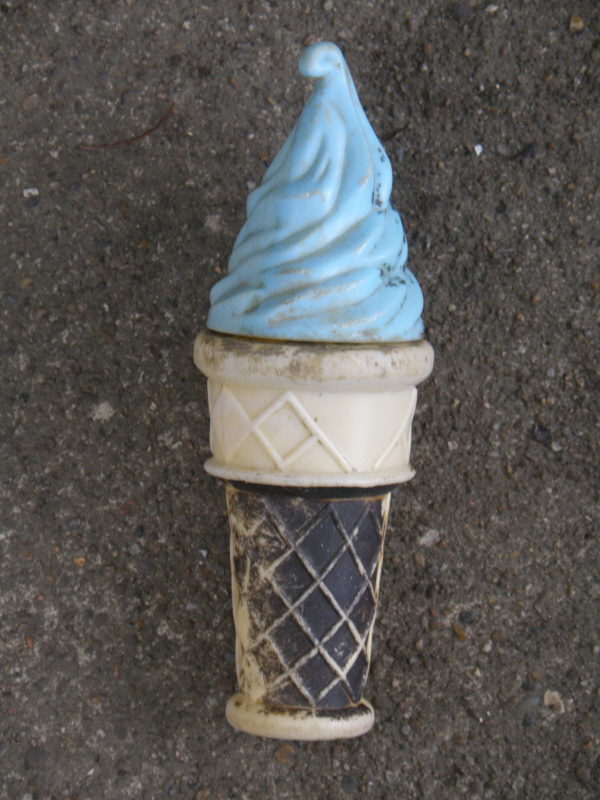
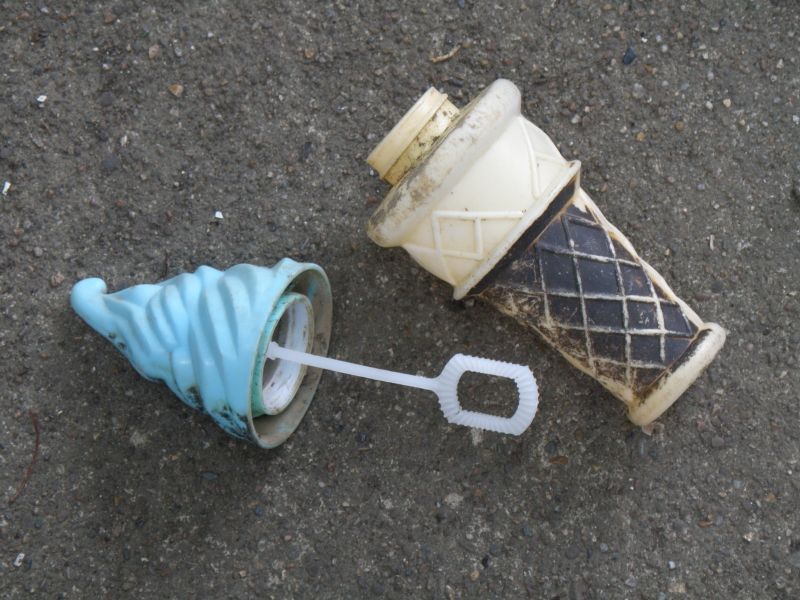
Plastic Ice Cream Cone bubble wand and bottle, Falls of the Ohio, Sept. 2013

Plastic Ice Cream Cone Soap Bubble wand and bottle, Falls of the Ohio, Sept. 2013

This novelty didn’t look good in the frame, but it is one of the nicer soap bottle with wand items I’ve found.  This fake ice cream cone also has that black river patina suggesting it was out floating around for years before I came across it on these fable Falls shores.

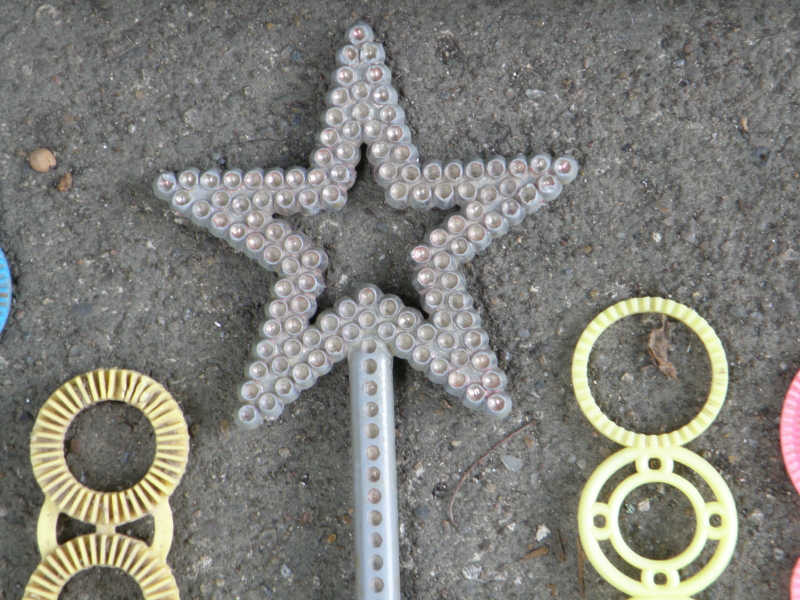
Detail, Star Wand, Sept. 2013

I have a couple of wands that aren’t soap-bubble wands, but since they are wands nevertheless…I keep them in the collection.  The Star Wand is more than likely from a princess costume or magician’s outfit.  The other wand is perhaps more of a plastic scepter.  Originally, the handle lit up with a colored light.  Again, more disposable plastic items.  I’ll keep walking the riverbank a little while longer and I’ll bet I find a few more of these objects to add to the river collection.

found pink plastic bubble wand, Falls of the Ohio, Sept. 2013

Read Full Post »

Tree in the western section of the Falls of the Ohio State Park, Aug. 2013

Resolved to stay away from my old atelier under the willow trees for a while, I decided to explore the western section of the Falls of the Ohio State Park.  It was just the most beautiful day and residents of our area have remarked on how unusually nice it’s been of late.  The air today has wonderful clarity and although it’s summer and the sun is shining…we are many degrees below our usual temps.  I feel the western part of the Falls of the Ohio begins once you cross the creek at the end of the Woodland Loop Trail.  This is an area that receives fewer visitors and I’m happy just to wander with nothing on my mind.  As I walk the narrow strip of land that is the riverbank, on my left are sounds from the river and on my right are various bird songs originating under the tree canopy.  I see the formerly high river has deposited driftwood here in new configurations along with the usual plastic junk.  My eyes are open and ready for anything.  I doesn’t take very long before I make the first of several discoveries new to me in and around a patch of Wild Potato-Vines.

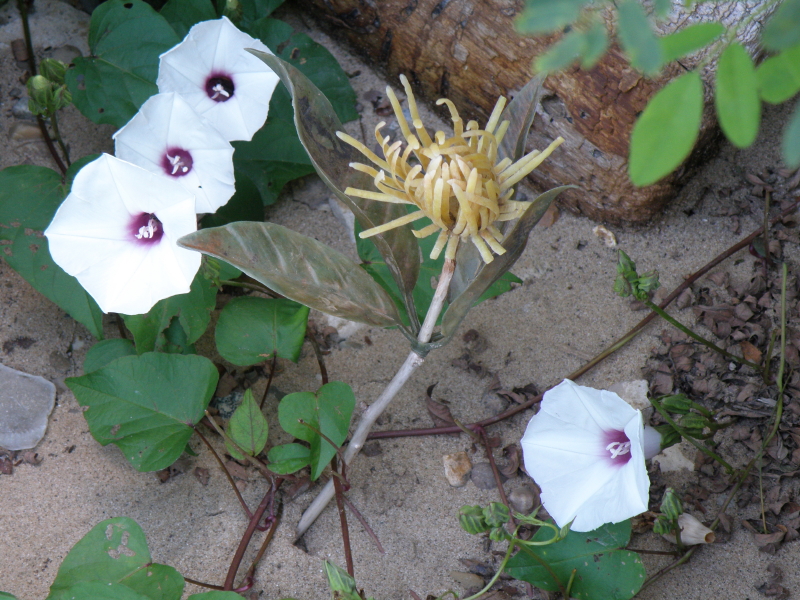
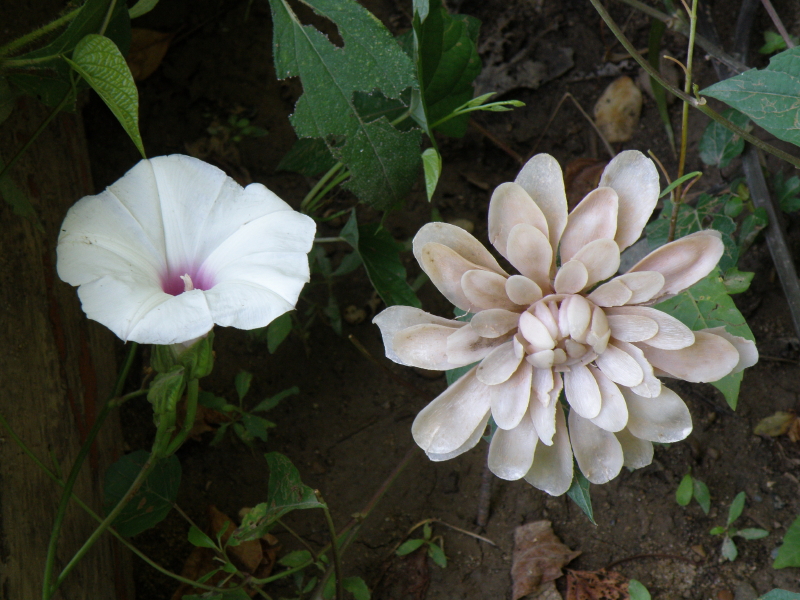
Goldstein's False Mum among Wild Potato Vine flowers, Falls of the Ohio, Aug. 2013

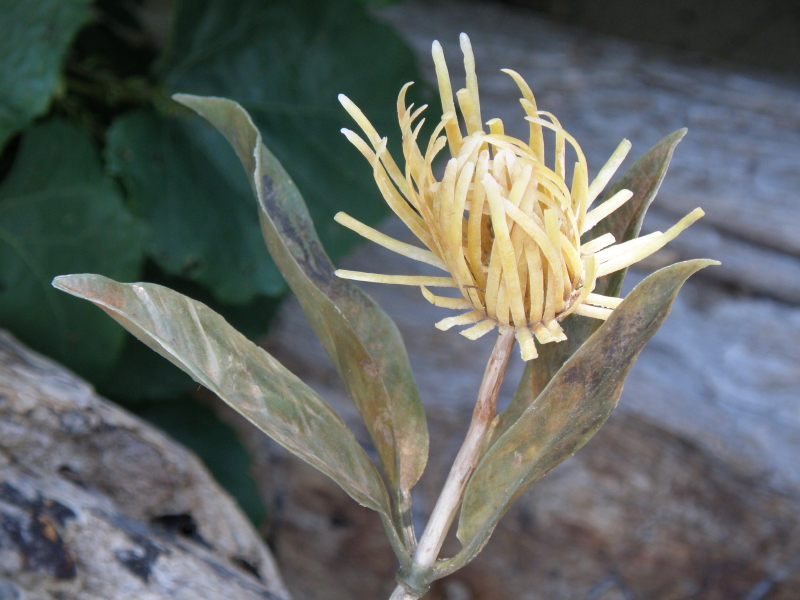
Close up of Goldstein's False Mum, Aug. 2013

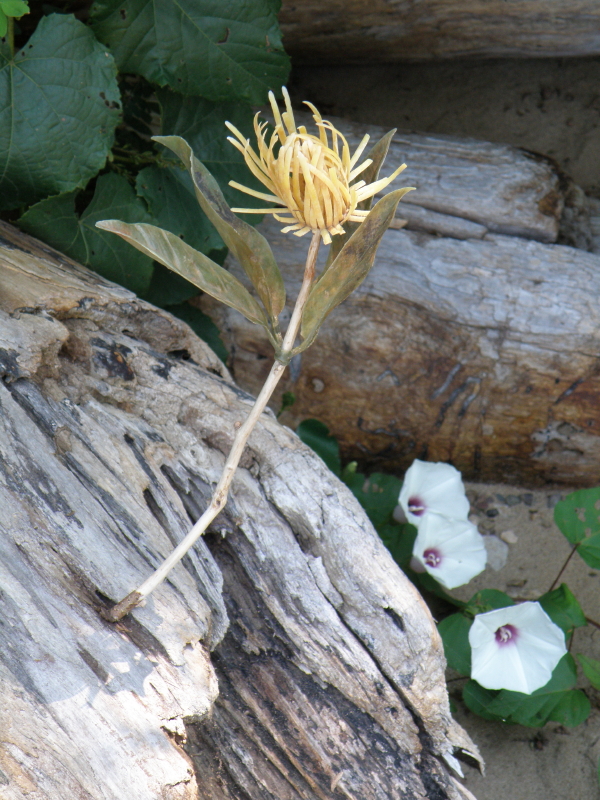
This is Goldstein’s False Mum which is named after the resident naturalist at the Falls of the Ohio State Park.  This is another in a series of very odd flowers while being organic by definition  have little in common with the other plants that grow along side of them.  In general, plastic-like blooms and foliage characterize these botanical rarities.  None of these plants (which form a new order of their own called Artificialia ) are capable of photosynthesis despite the appearance of green leaves.  Goldstein’s False Mum is a summer plant that produces a hard, yellow, frilly blossom that appears on the terminal end of a woody stem.  It prefers sandy, disturbed soils or decaying wood and is usually seen in the company of traditional flowering plants.  It produces no scent and no insects were observed being attentive to the false mum.  Now the Wild Potato-Vine is also an interesting plant.  It is a member of the Morning Glory family and its bloom is primarily white with a purplish maroon throat.  I have seen large bumble bees pollinating this flower.  What sets this plant apart is under the ground.  The Wild Potato-Vine produces a large tuber that had food value for the indigenous people.  Here is a another specimen of Goldstein’s False Mum growing out of a soft, decaying log also in the presence of Wild Potato-Vines.

Goldstein's False Mum and Wild Potato-Vine flowers, Falls of the Ohio, Aug. 2013

Not too far away and also in association with the Wild Potato-Vines is another type of plastic-like plant and here is its portrait.

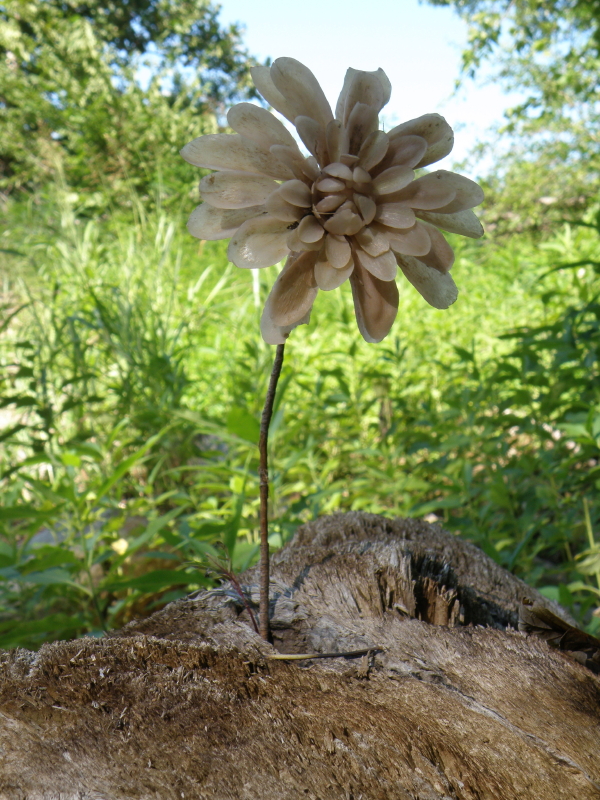
Wild Potato-Vine blossom with Saprophytic Zinnia, Falls of the Ohio, Aug. 2013

The Saprophytic Zinnia, Falls of the Ohio, Aug. 2013

The Log Weed is a saprophytic plant.  Lacking chlorophyll it relies on decaying matter for its sustenance.  The Log Weed is characterized by a corolla of hard plastic-like petals and never has what we would describe as leaves coming off its woody stem.  No one is quite sure how it propagates? Its blossoms appear in mid summer and seem to hang around forever.

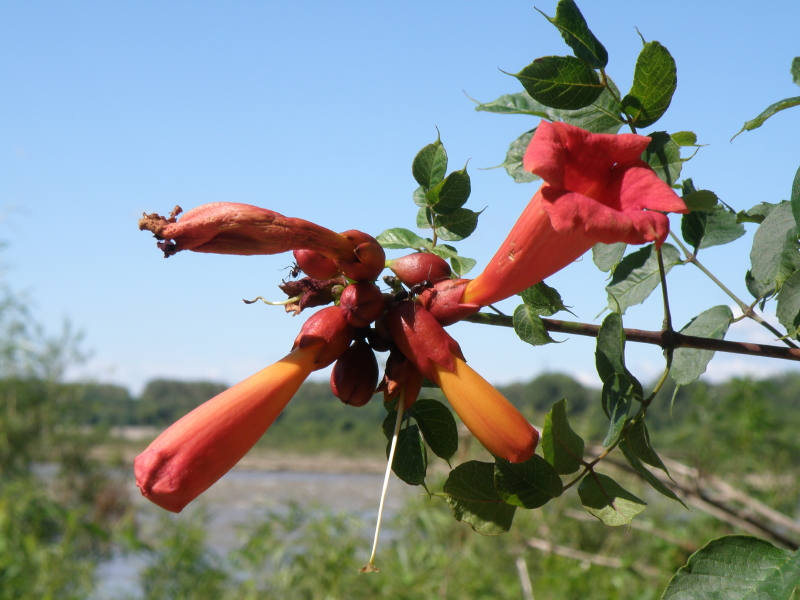
Trumpet Creeper, Falls of the Ohio, Aug. 2013

These are tubular flowers from the Trumpet Creeper vine which is a native and natural sight at the Falls of the Ohio.  This is a climbing, spreading vine and wood ants seem to love them.  If you look closely at the above photo…you can see several ants crawling on the Trumpet Creeper’s attractive blooms.  I was admiring this vine when I noticed that there was something not quite right about it and this is what I discovered.

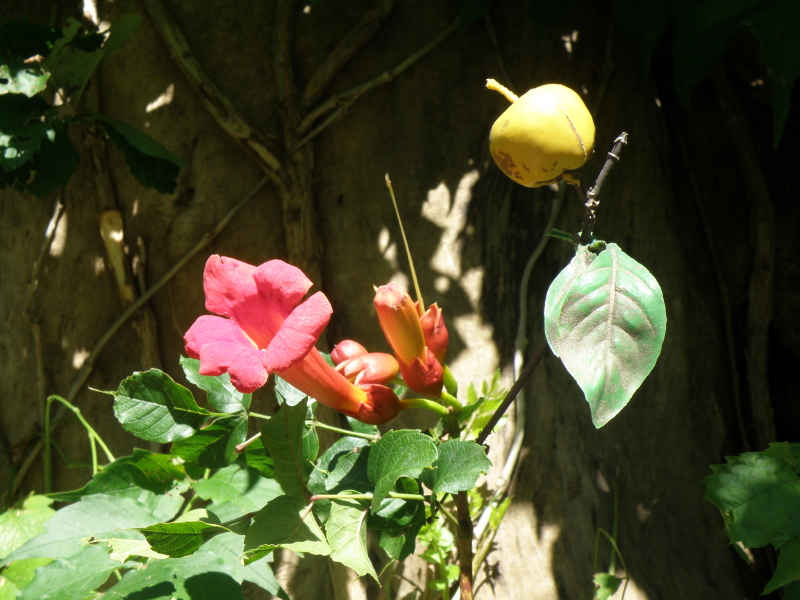
Unknown fruit on Trumpet Creeper, Aug. 2013

Notice the yellow orb to the upper right of the Trumpet Creeper blossoms? Thus far, the yellow fruit with its accompanying leaf remain unclassified.  It is, however, grafted to the woody stem of the vine.  Amazingly, it even has a false stem to deceive.  Could it be parasitic?  One hypothesis why this plant with the odd fruit appears with Trumpet Creeper might be the protection it receives from the vine’s wood ants?  The fruit and leaf are also very polymer-like and may indeed be plastic.  More and more we are learning how ubiquitous plastic is in the environment.  I heard a report about the Great Lakes the other day saying that there is a considerable amount of micro plastic in these large bodies of fresh water.  Upon examination, much of this plastic takes the form of tiny balls that are blended into deodorants and toothpaste to make the product flow more evenly.  These beads are so small that they pass through the finest screens at the waste water treatment plants and into the lakes.  I think Nature is metabolizing this plastic and recombining the hydrocarbons in novel ways, but that is just my theory.

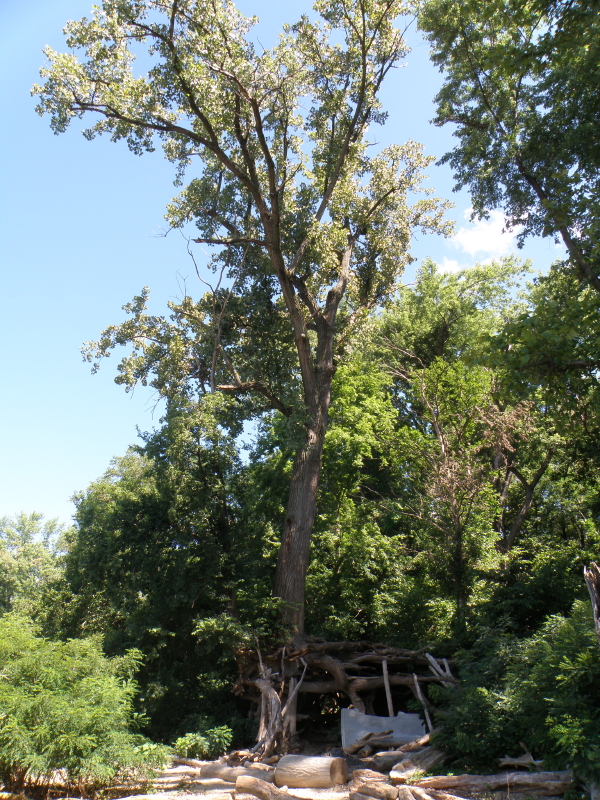
Cottonwood tree fort, Falls of the Ohio, Aug. 2013

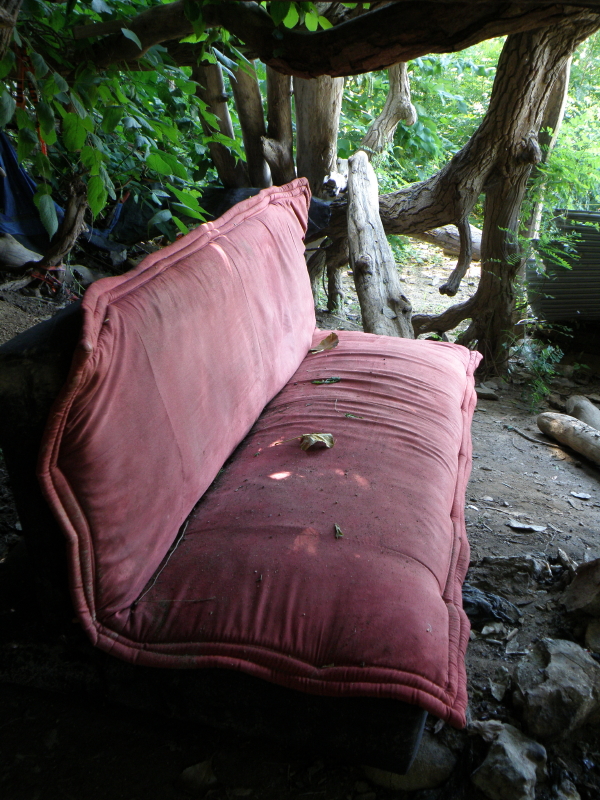
I paid my favorite cottonwood tree a visit and it’s been a while since I took shelter under its large, exposed roots.  People, especially the locals, like hanging out here and I witnessed much less trash since my last visit which is a good thing.  One big “improvement” has been made with the addition of a red, upholstered couch and I took a moment to rest here before moving on.

red couch under the cottonwood tree, Aug. 2013

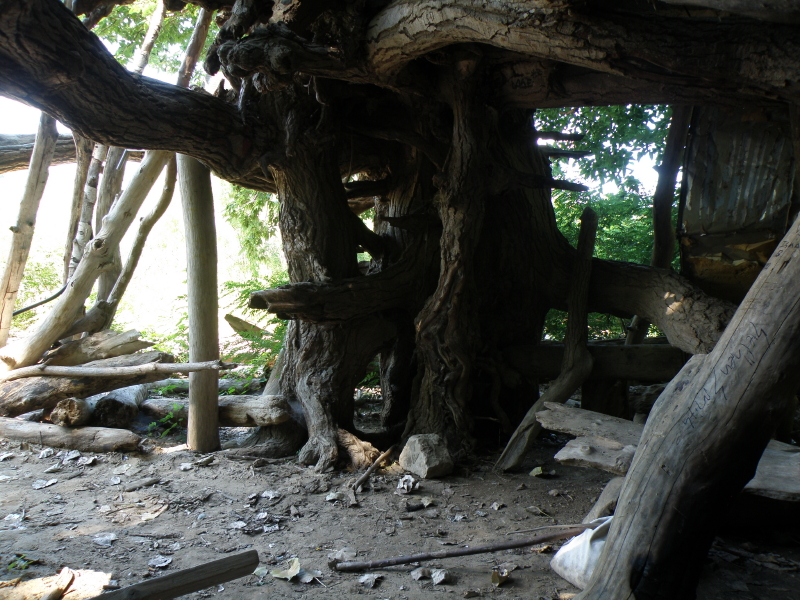
The couch is very comfortable and I’m amazed that people actually dragged this piece of furniture down here.  Eventually, it will be reclaimed by the river.  Here’s another view from under the tree.

space under the cottonwood tree, Aug. 2013

For those who prefer their comforts a bit more on the rustic side…there is another bench for seating and it’s made from a slab of wood balanced on short logs.

under the cottonwood tree, Aug. 2013

I rested, had a snack and drank some water before moving on.  I’ve designated my intended destination as “Loosestrife Land” for the abundance of these non-native flowers that have taken over moist areas in the western section of the park.  I’m going there seeking something else which will be the subject of my next post.  I’ll catch up with you soon but for now…so long and happy trails to you.
Purple Loosestrife flowers in bloom, Falls of the Ohio, Aug. 2013
Read Full Post »

« Newer Posts - Older Posts »