Feeds:
Posts
Comments

Posts Tagged ‘found materials’

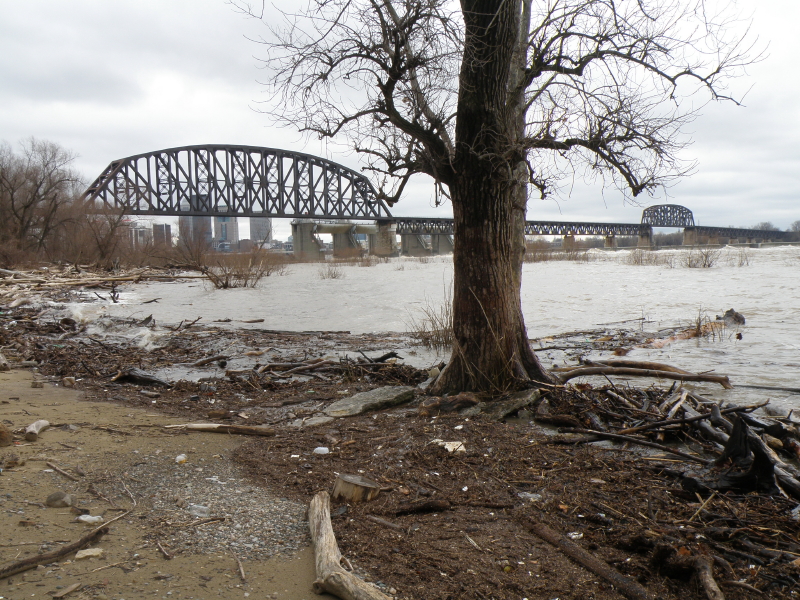
high water Falls of the Ohio landscape, just downriver from the railroad bridge, Dec. 2013

Today is officially the first day of winter.  At the Falls of the Ohio, the Ohio River is up due to the heavy rain producing thunderstorms that went through our region a couple of days a go.  The high water has me walking the edge of the river with anticipation for signs of anything new.  Today I find a story to share with you.  While the winter solstice has passed, it also that Christmas/Holiday Season time  again that seems to be getting longer and weirder with each passing year.  As proof, I offer this variation of the beloved Rudolph the Red-nosed Reindeer, classic Christmas television special that so many of us have enjoyed since childhood.  This tale from a slightly different reality is set at the Falls of the Ohio State Park in Clarksville, Indiana and photographed on site using objects found within the park.  Our tale begins at the water’s edge.

Rudolph the Red-nosed Zombie, Dec. 2013

At this moment, Rudolph has no idea what has happened to him.  He has no recollection of his near escape from the Abominable Snowman.  He was lucky to find a piece of wood big enough to support his weight as he launched himself into the river.  It is widely known that the Abominable Snowman is deathly afraid of water.  While Rudolph was now safe from the snowman he had a river to negotiate and had no basic idea where he was going?  Sometime in the middle of the night it stormed very badly and Rudolf was tossed helplessly into the water.  Many weeks later and with the color washed out of his eyes…Rudolph was coming back to life.

Rudolph heading home, Dec. 2013

Little Rudolph stood up again and propelled by instinct and memory headed down the driftwood line in search of a way home.  Although he couldn’t explain it, there was some hard-wired, deep need to get back to where he originated like a salmon finding just the right stream.  Along the way, a little bit more of what had happened to him crept into his consciousness.  Images of cold white snow and a bearded man in a red suit began to drift across Rudolph’s mind with regularity.  Rudolph still had no idea where he was and every once in a while he would come across something he could identify as being a toy in similar circumstances and he and would investigate it.
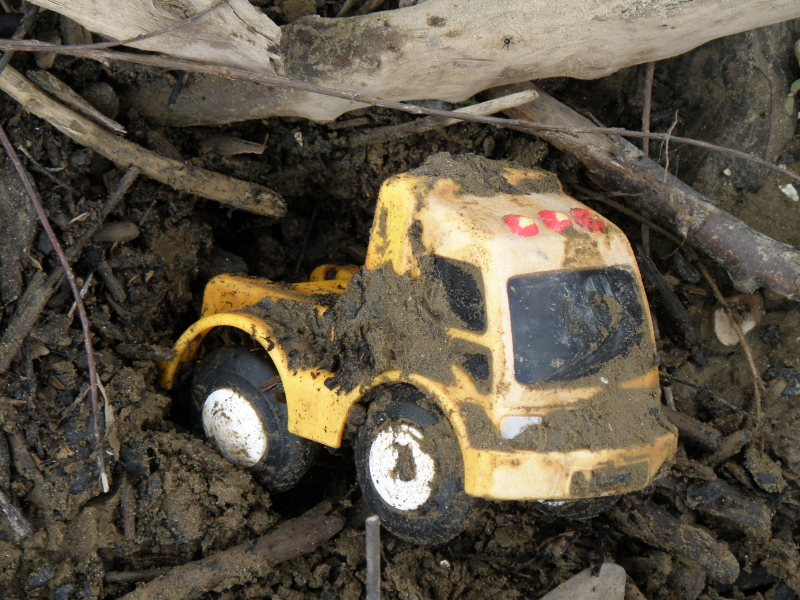
muddy toy truck from the Falls of the Ohio

Rudolph with plastic figure, Dec. 2013

Most of the toys Rudolph encountered where too far gone to converse with and he left them behind.  Every once in a while, however, Rudolph would come across other toys like himself who had a very strong need to exist.  They used creative strategies to reinvent themselves.  The first of these hybrid toys that Rudolph encountered were named Pigskin Pete and his pal Handy.

Pigskin Pete and Handy playing catch, Falls of the Ohio, Dec. 2013

Rudolph talks with Pigskin Pete and Handy, Dec. 2013

They were throwing a football back and forth on the sand.  Rudolph approached them and the trio struck up a conversation.  That is how Rudolph found out that they were in the Park of Misfit Toys.  A fabled land purported to be a paradise for toys.  Pigskin Pete and Handy both had fuzzy memories of distant lives that made them wonder if they in fact belonged here now?  That’s when Rudolph made them the offer that if he could get out of this park…he would come back to get them.  The little deer with the zombie eyes continued walking east along the river’s edge.  After a journey of many hours, Rudolf met the Primate Twins for the first time.
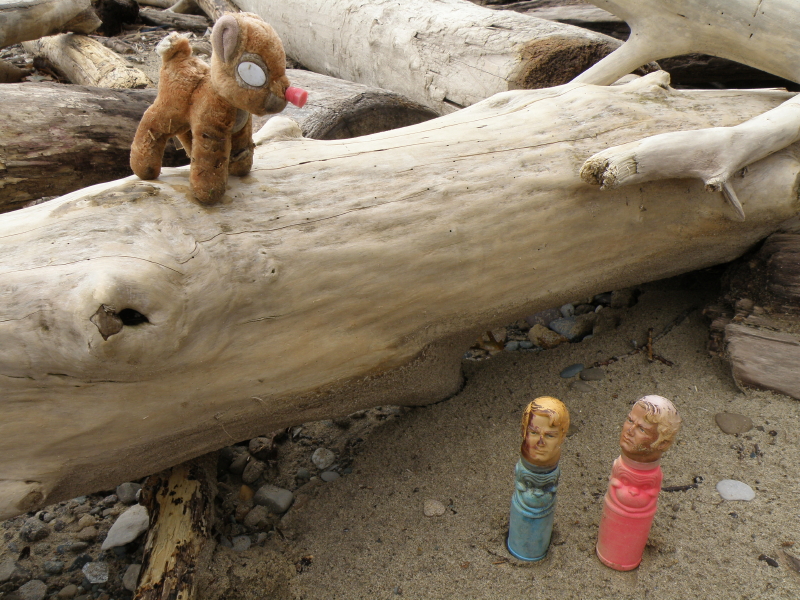
Rudolph meets the Primate Twins, Falls of the Ohio, Dec. 2013

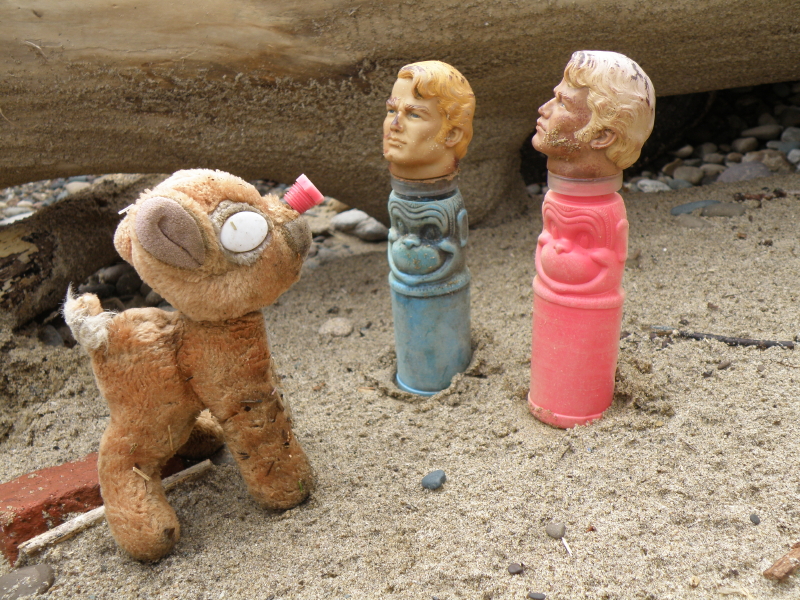
Rudolph with Primate Twins, Dec. 2013

The Primate Twins were a sight to behold!  The will to exist among shampoo bottles is strong and through millions of gallons of waters these twin caps found their nearest relatives to form this plastic simian union.  Rudolph told them of others that he has met along the journey and offered the twins the same offer he was offering everybody that if they could help him get out of the park that he would return to rescue them in return.  The twins seemed intrigued and what were the chances of this happening anyway in the first place?  Rudolph sallied forth to the limit of the park and met one last new friend.
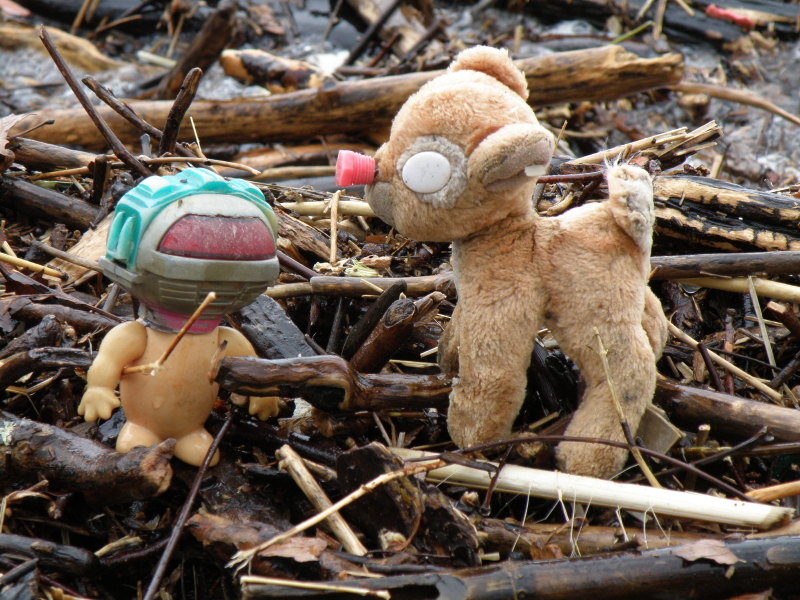
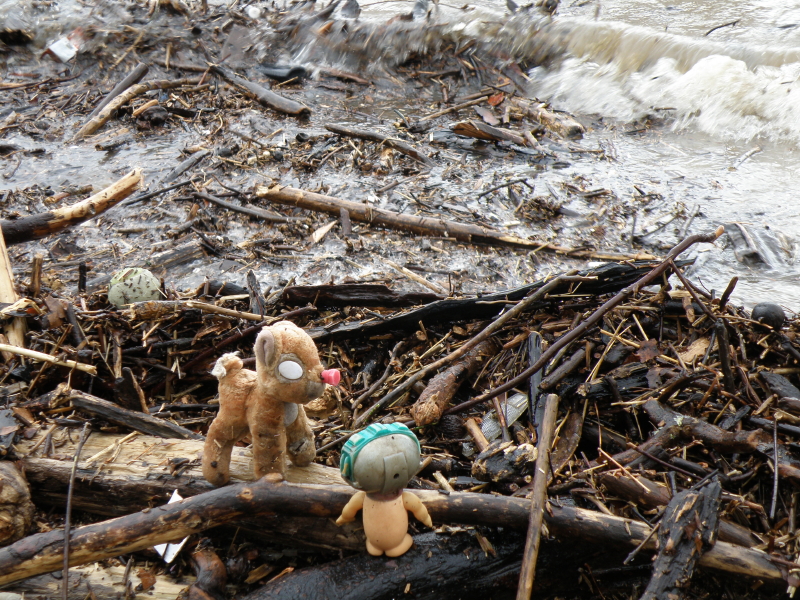
RoboBoy and Rudolph, Dec. 2013

Rudolph and RoboBoy at the Falls, Dec. 2013

RoboBoy lived at the land’s margin and knew the river’s ways too.  He offered Rudolph a wooden plank to attempt the dangerous and potentially foolhardy journey back to the North Pole.  If the river didn’t get him there was still the specter of the Abominable Snowman lurking out in the frozen wastes.  Without hesitation and for the second time…Rudolph hurled himself into the cold river and took his chances.  This time…luck would be kinder.

Rudolph the Hex-bolt Nosed Reindeer on the snow, Dec. 2013

The trip across the waters was uneventful and gave Rudolph time to reflect.  By now, he understood that his visions of a bearded man were of Santa Claus himself and Rudolph knew were to find him.   Rudolph’s families were a part of the reindeer elite that pulled Santa’s sleigh.  Those jobs flying across the sky had long been inherited positions and Rudolph…if he wanted it…was next in the long line of Prancers and Dancers.

found plastic Santa Claus on snow, Dec. 2013

Santa didn’t seem surprised to see Rudolph with his red plastic nose again.  In fact, he said that he had been expecting him because the pull of Christmas is a mysterious force in the universe.  Santa agreed to talk to Rudolph and around a small pine tree they huddled together to talk about what constituted the holiday spirit and other philosophical matters.  While they spoke, a heavy snowfall fell upon the land.

Heavy snow covers Rudolph and Santa, Dec. 2013

By morning the snow had finished and Santa agreed to stop by the Park of Misfit toys and offer its inhabitants the chance of being gifted to different owners.  Santa also told Rudolph to be prepared that toys often change their minds and that he might not get quite the answers as he did before.
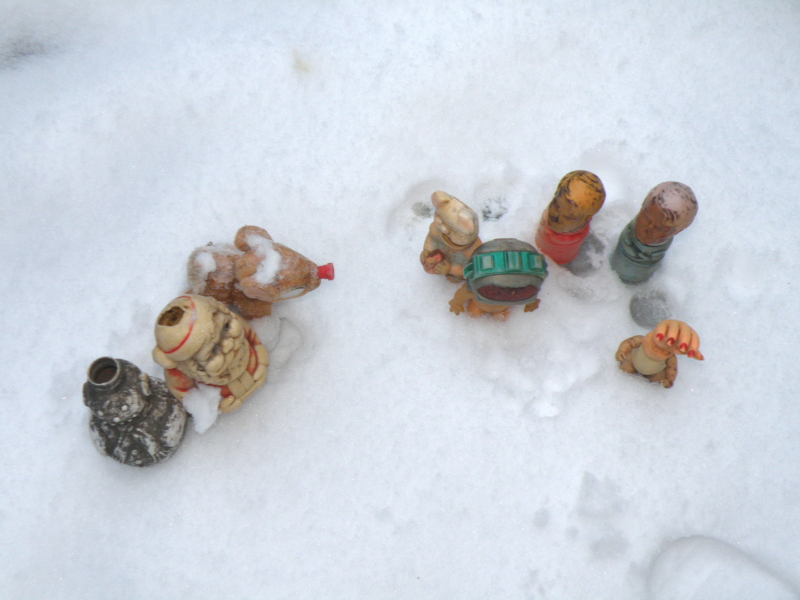
the meeting of Santa and the MisFit Toys, Dec. 2013

Snow had fallen at the Park of Misfit Toys since Rudolph’s previous visit.  A shadowy snowman figure agreed to escort Santa to the assembled Misfit Toys.
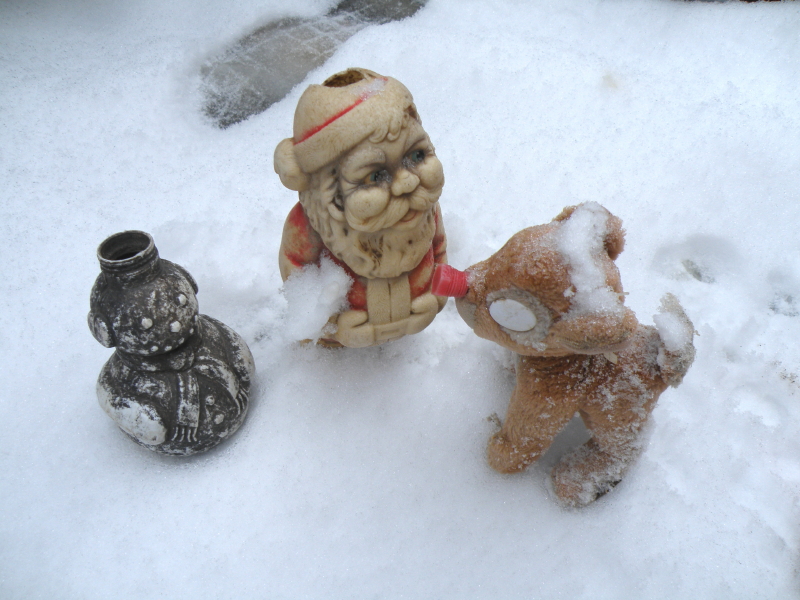
Santa talks to Rudolph about the Park of Misfit Toys, Dec. 2013

On the shores of the Park of Misfit toys Santa declared in full disclosure that he was glad to take anyone away from the park if that were their wish.  He had made Rudolph a promise to help him keep his promise if possible and Santa Claus was going to honor that.  But he also asked if anyone had considered how they had personally arrived at the Park of Misfit Toys?  The prevailing myth is that all you toys were miss manufactured and dropped off here to lead your lives in semi-useful exile ever wanting the love of the other.  The truth Santa declared…is that you were all discarded as trash…not even given the dignity of recycling…you somehow found your way into the river and then here.  You are mass produced and marketed consumer goods that have served your useful lives and more than likely there will be no new owners waiting to embrace you on the other side of this park.  He was speaking from personal experience which made his words all the more convincing.
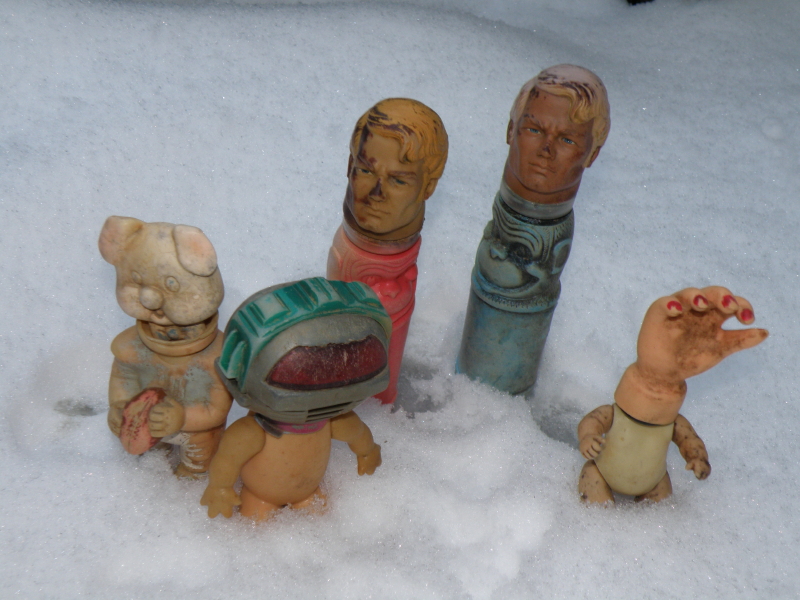
The Misfit Toys talk over Santa's offer, Dec. 2013

Santa’s words had struck a chord with the Misfit Toys.  They hadn’t even considered that they might not be wanted by somebody across the river.    It was the Primate Twins who piped up that life wasn’t so bad here.  At least they had their own culture as a community of survivors and free thinkers.  Those that still had the desire to exist carried on until the sun finally broke the bonds of their plastic polymers and set them free.  In the end, all the Misfit Toys decided to stay at the park and lead out their existences here and leave their layer in the record of the land.
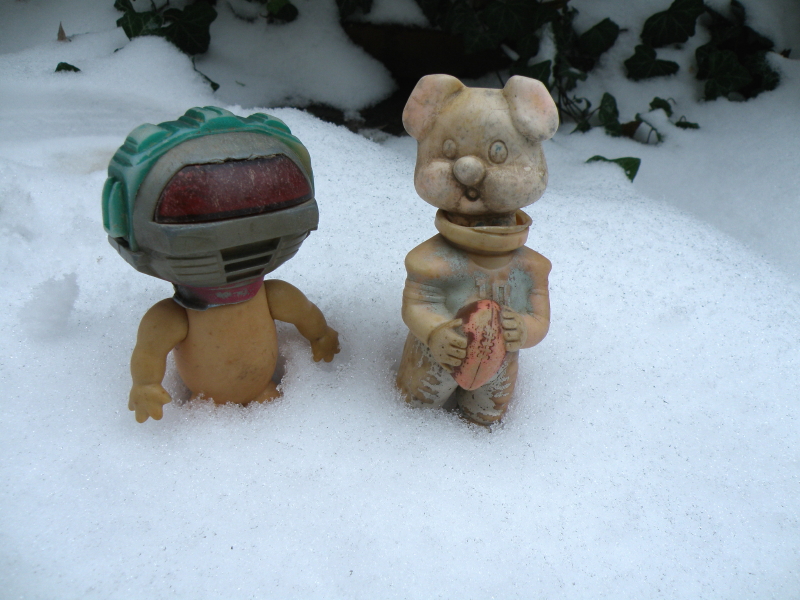
RoboBoy and Pigskin Pete in snow at the Park of Misfit Toys, Dec. 2013

Rudolph decided to return with Santa and the shadowy snowman to the North Pole.  In the years to come, Santa and Rudolph the Zombie, Red, Plastic, Hex-bolt Nosed Reindeer were involved many Christmas season adventures.  In fact, they went down in history.  Happy Holidays from the Falls of the Ohio!
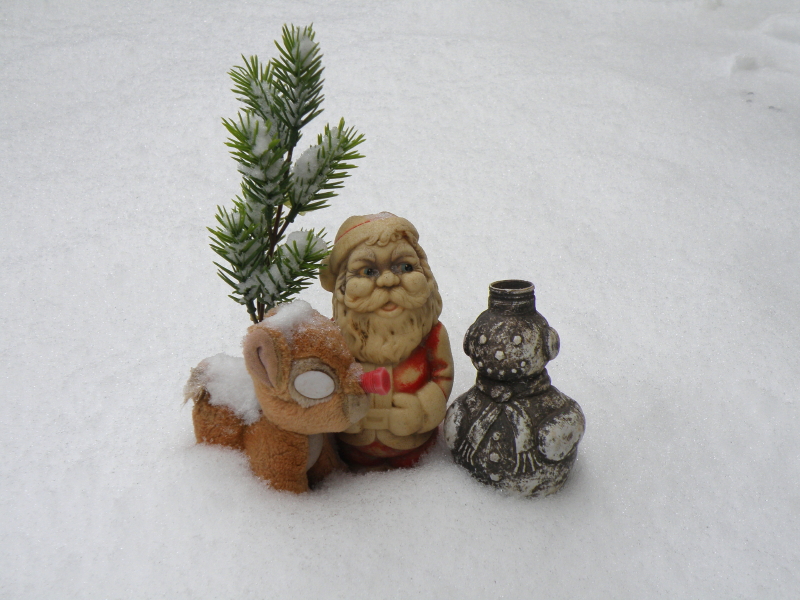
rudolph, santa, and snowman in the snow, 2013_1_1

Read Full Post »

Stacked wood, Falls of the Ohio State Park, Nov. 2013

Moving past the Woodland Trail Loop, I’m in the western section of the Falls of the Ohio State Park.  It’s been more than a month since I last visited this area.  One of my favorite trees is here and although I’ve already missed the prime leaf color moment…I’m hoping some autumn splendor remains.  Along my walk I come across a driftwood structure that has been stacked teepee-style by other park visitors.  I see this kind of expression regularly and there must be a kinship between this activity and piling and stacking rock upon rock.  It’s satisfying to do and when you step back from your work…it’s obvious you left an impermanent mark in the landscape that says you were there.  The tree I seek is just a short walk away and in no time at all I arrive on the scene.

Cottonwood tree, late autumn, Nov. 2013

Under the Cottonwood tree, Nov. 2013

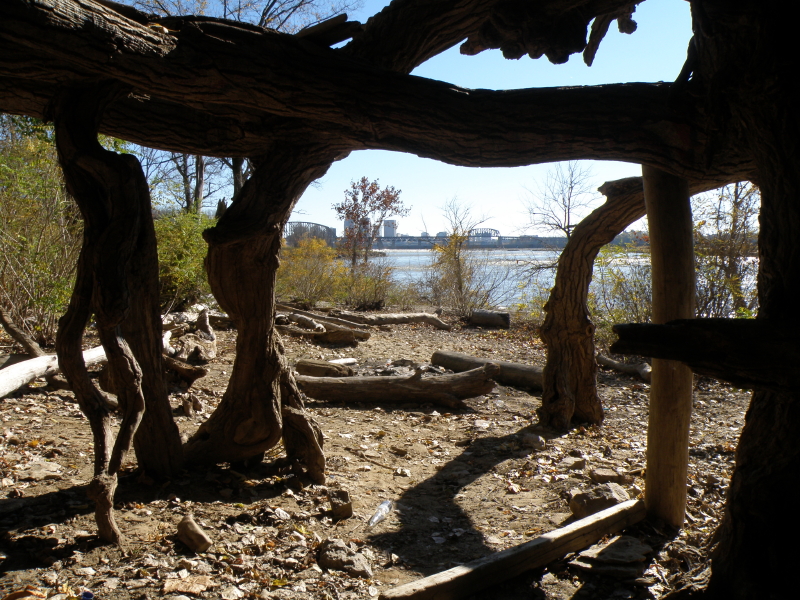
This old Cottonwood tree with its raised roots looms large in my imagination and is my personal favorite tree out here.  I’m sure I’m not the only one who feels this way because there is usually plenty of evidence laying around in the form of empty beer bottles, spent camp fires, and yes…the odd bits of furniture people drag to furnish the room that exists underneath the tree.  I’ll wager for some…this is known as the party tree.  I was elated to see that most of the junk (old tarps and a red couch) have been removed by some other purists.  The Cottonwood tree had already dropped most of its leaves, but there were still a few hanging on.  After resting a moment under the tree and admiring the distant view of Louisville across the Ohio River…I decide to turn for home.  I was in the process of walking away when I noticed something moving along the fossil rocks.  I froze to see if I could get a better look at the creature that was walking towards me.  Naturally, my camera is at the ready!
Golden Hour Ground Beetle, detail of head, Nov. 2013

detail of head from Golden Hour Ground Beetle, Falls of the Ohio, Nov. 2013

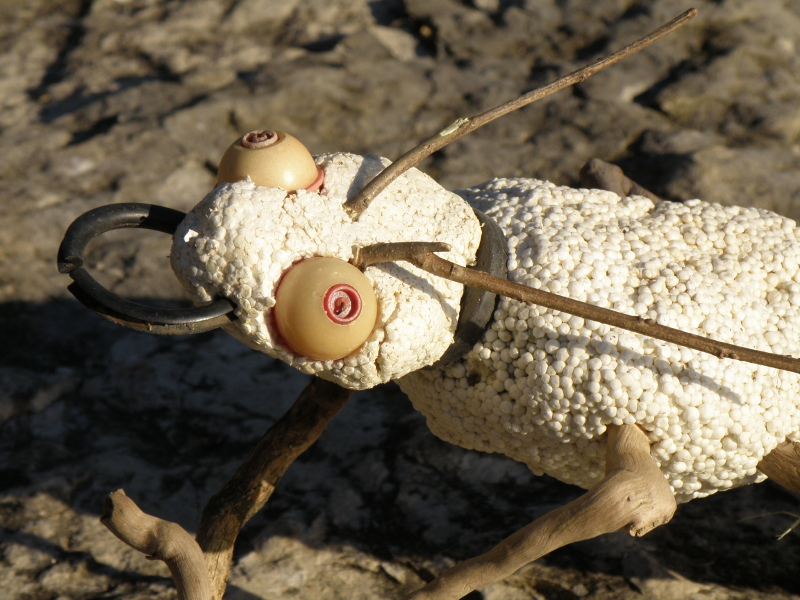
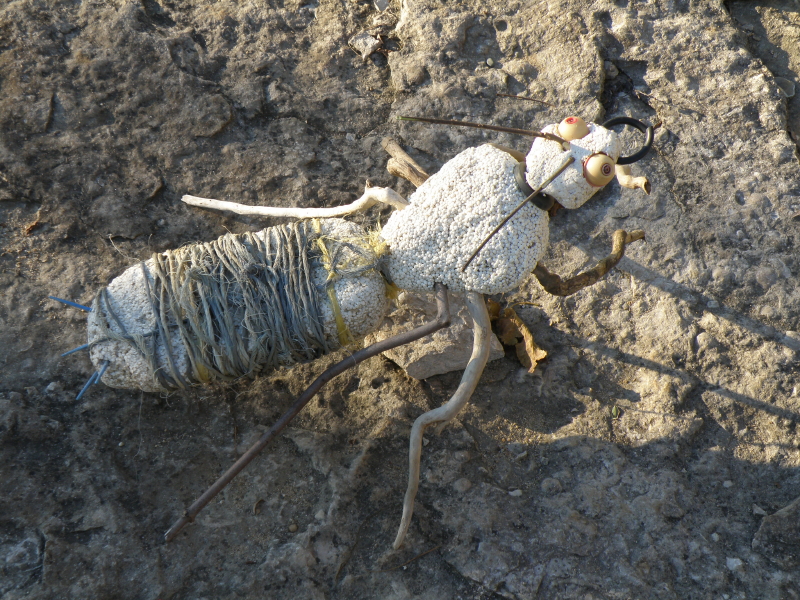
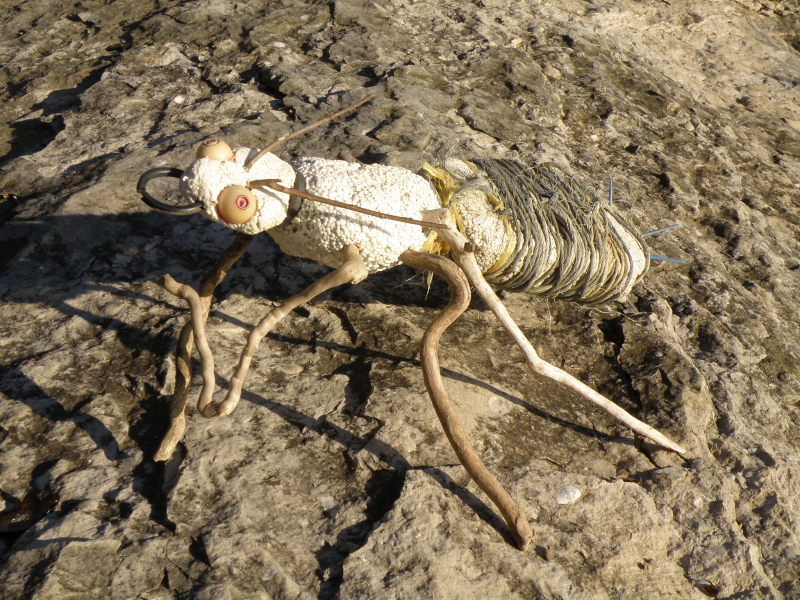
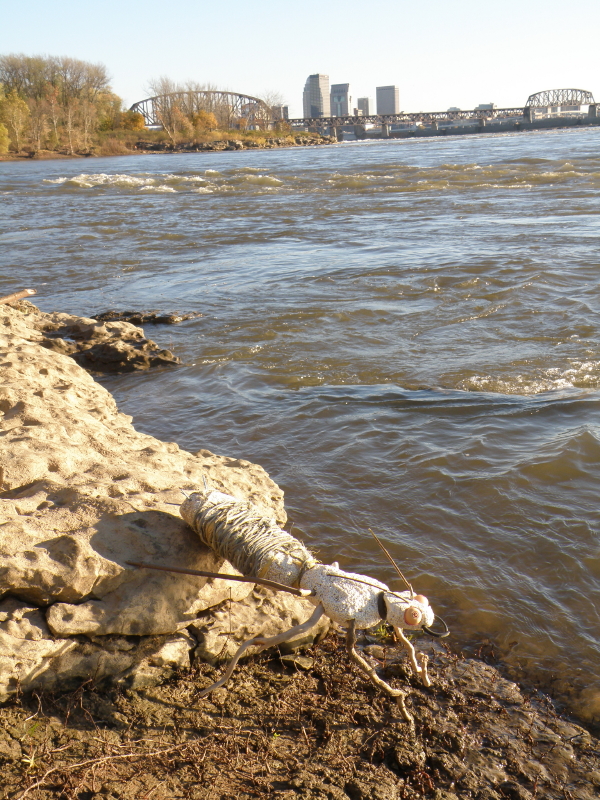
Regular visitors to the Riverblog know that the Falls of the Ohio State Park is home to several out-sized insect species that have uniquely evolved here.  All the different species are critically endangered and not to be harmed in any way.  I was quick to identify this as the Golden Hour Ground Beetle.  It was so named because it usually makes it first appearance of the day when the sun is about to set.  Otherwise, it is nocturnal in its habits.

Golden Hour Ground Beetle, Falls of the Ohio, Nov. 2013

Golden Hour Ground Beetle, Falls of the Ohio, Nov. 2013

The Golden Hour Ground Beetle does not fly.  It relies upon stealth and six strong legs to scramble across any surface.  In form, it is not unlike the much smaller tiger beetles that also make the park their home.  Unlike the smaller beetles, the Golden Hour Ground Beetle is a scavenger and not a hunter.  I suspect this specimen was at the Cottonwood tree because it has learned to find scraps of discarded camping food here.  This beetle has fairly large eyes that can gather the most meager light in the darkest of settings.  It’s abdomen is banded with a coarse hair that insulates this insect during cold nights.  As long as I didn’t make any rash movements, this giant bug was tolerating my presence.

Golden Hour Ground Beetle drinking water?, Nov. 2013

I observed my new “friend” moving to the water’s edge to obtain a drink.  I wondered if it had the ability to swim in its survival tool kit?  I watched the insect as it searched all around the fossil rock shelves that were created by the river dissolving the old limestone away.

Golden Hour Ground Beetle exploring a hollow log, Nov. 2013

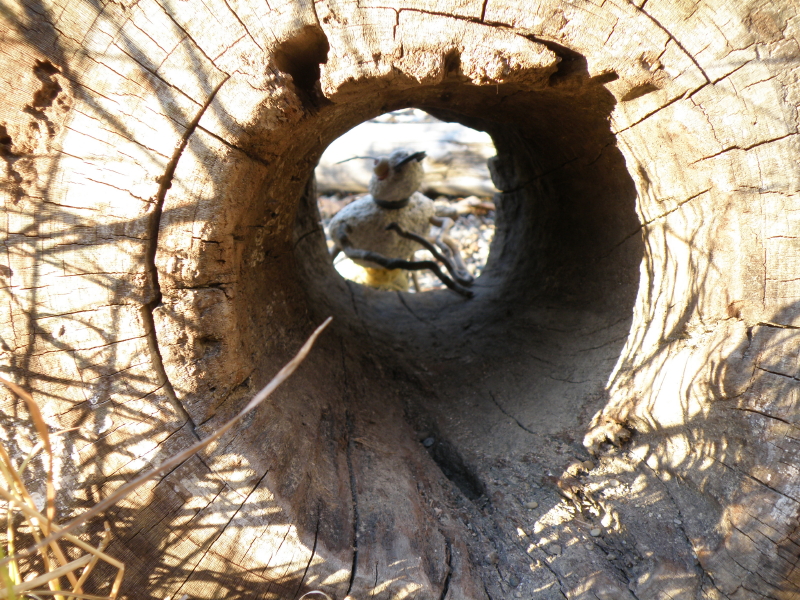
View of the beetle through the hollow log, Nov. 2013

I came across a second giant beetle almost immediately after crossing the small creek that separates the western and eastern sections of the park.  Male and females are virtually identical.  There are gaps in our knowledge about their life cycle.  This specimen was in the process of checking out a short, hollow log.  I’m presuming that it was either seeking food or shelter?  I think poking my camera through the end of the log spooked this one a little.  It ran away, but didn’t go far.  I kept my movements to a minimum and after a while it seemed to relax again.

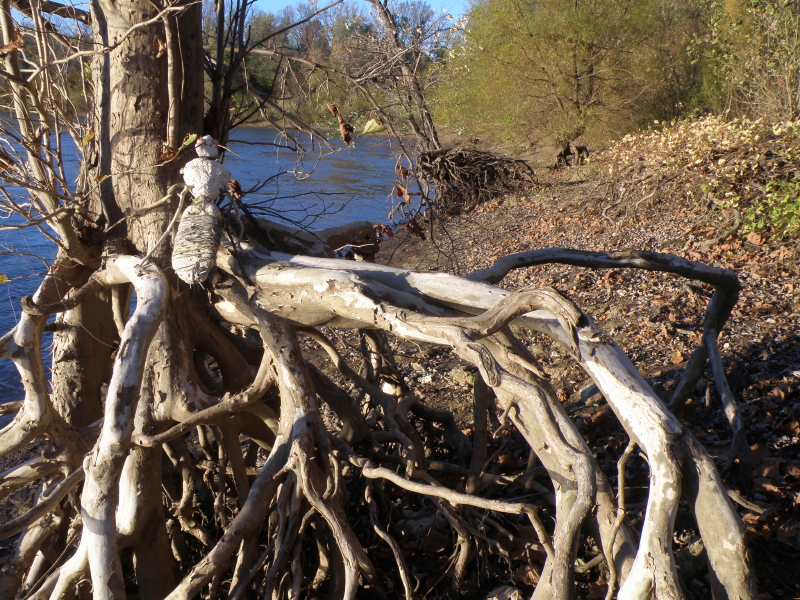
Golden Hour Ground Beetle relaxing on Sycamore tree roots, Nov. 2013

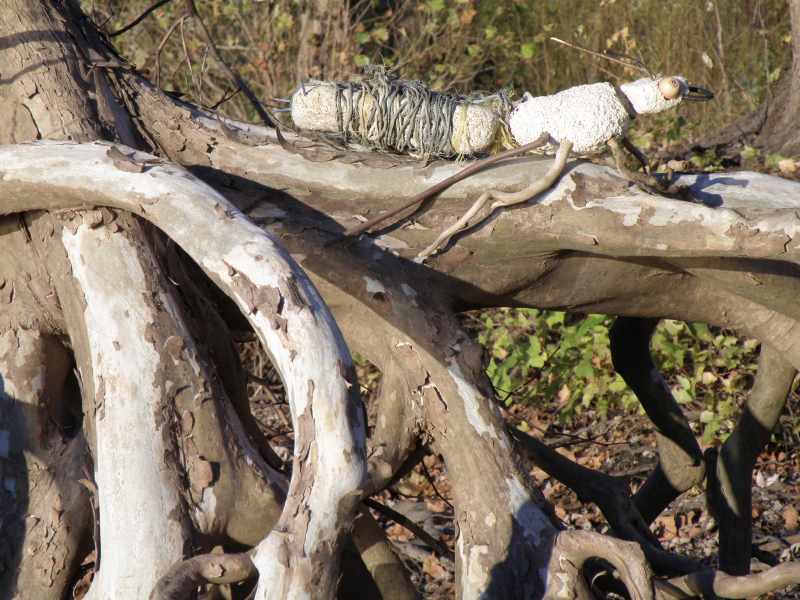
Beetle laying flat on a sycamore root, Nov. 2013

I observed this 14 inch or 35.5 centimeter beetle relaxing on the exposed roots of a Sycamore tree.  As the golden hour approached, the beetle stopped seemingly acknowledging this magic moment when everything is bathed in a warm golden light.  I did the same watching the sun set before finding my vehicle in the parking lot of the Interpretive Center.  To everybody in the wider world…have a great week.

The Golden Hour at the Falls of the Ohio State Park, Nov. 2013

Read Full Post »

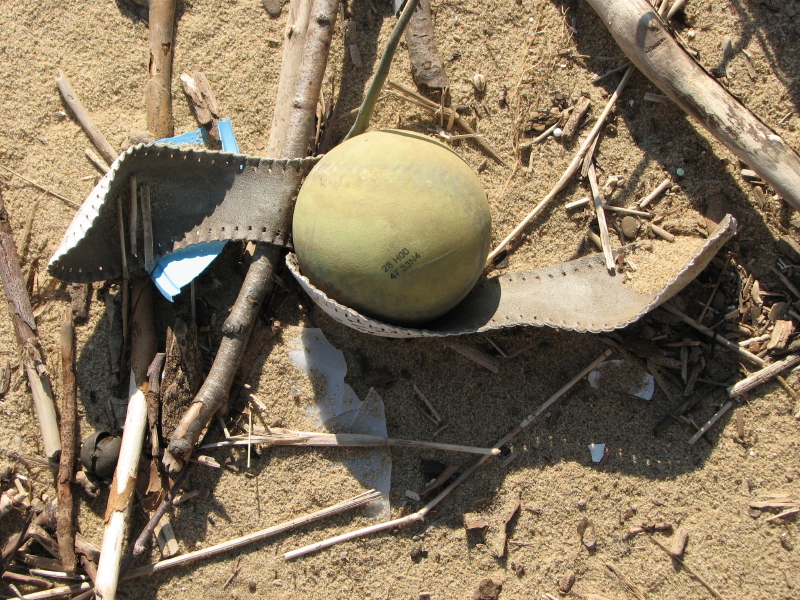
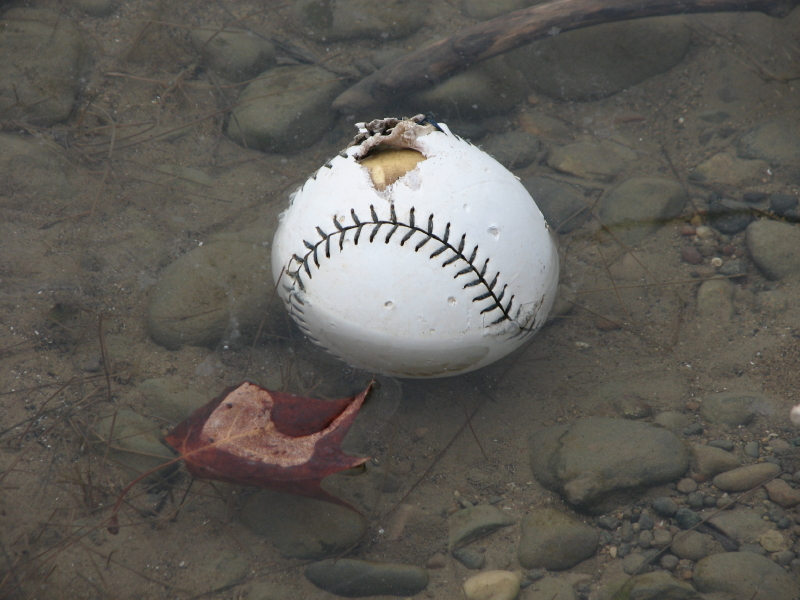
Softball core river pearl from the Falls of the Ohio

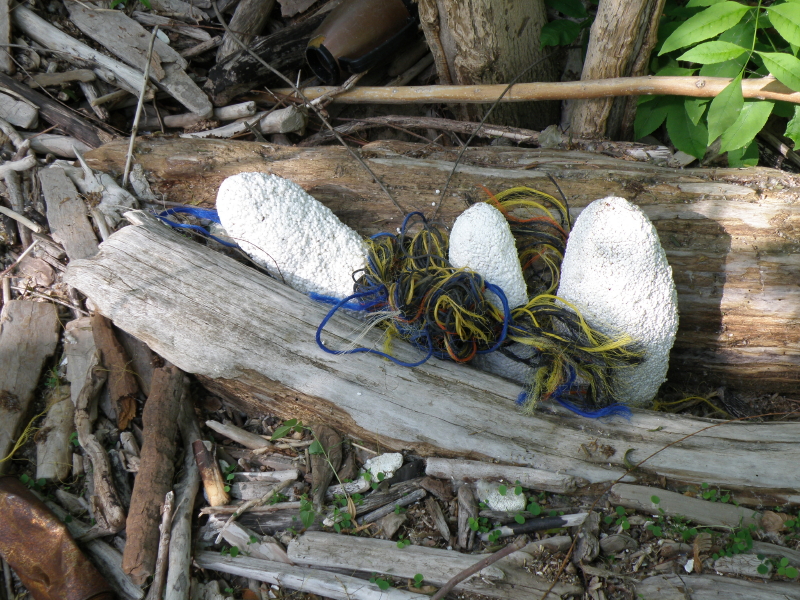
It started with one.  I had been picking them up for years…odd, yellow ocher orbs that the river marooned in various sections of the Falls of the Ohio State Park.  Initially, I was intrigued by them because I knew they had to be something, but what?  Early on I formed this association in my mind that these balls were giant pearls and they were gifts to me from the beautiful river.  Made from a lightweight yet solid, hard foam, these balls weathered in very individualistic ways.  Many of them had acquired a nice patina from their river journey perhaps floating long distances for many years.  For a while, each time I would go on one of my excursions to the Falls of the Ohio, the river made sure that I would stumble upon one or more of these balls.  Into the collecting bag they would go.  Eventually, I found out what kind of balls they are and in case you haven’t guessed yet…here are a couple more images that will reveal what they originally looked like.  I’ll start with one of these balls in the process of transforming, followed by one that is more intact.

softball with covering coming off, Falls of the Ohio

softball in the river

My river pearls are the cores of contemporary softballs.  How did all these softballs end up in the river?  When I was a kid, a softball had a hard rubber ball in the interior which was surrounded by what seemed like miles of string wrapped tightly around the rubber ball.  A two piece leather cover was then sewn over this “string ball” which completed the softball and was now ready to be played with.  For those who might be unfamiliar with softball…it’s a game similar to baseball, but the ball is about twice as large as a standard baseball.  I collected these softball cores for years, but especially during the early phase of my Artist at Exit 0 Project.  After each river trip I would dutifully fill up boxes in my home’s basement with my found balls and then forget about them.  Over time, I started picking up lots of different objects and using them in various ways as materials for my sculptures or as offbeat collections of odd items I was creating.  I guess I always knew that I would return to these balls and make something interesting with them someday.  That day arrived last week.

softball cores in my backyard, Oct. 2013

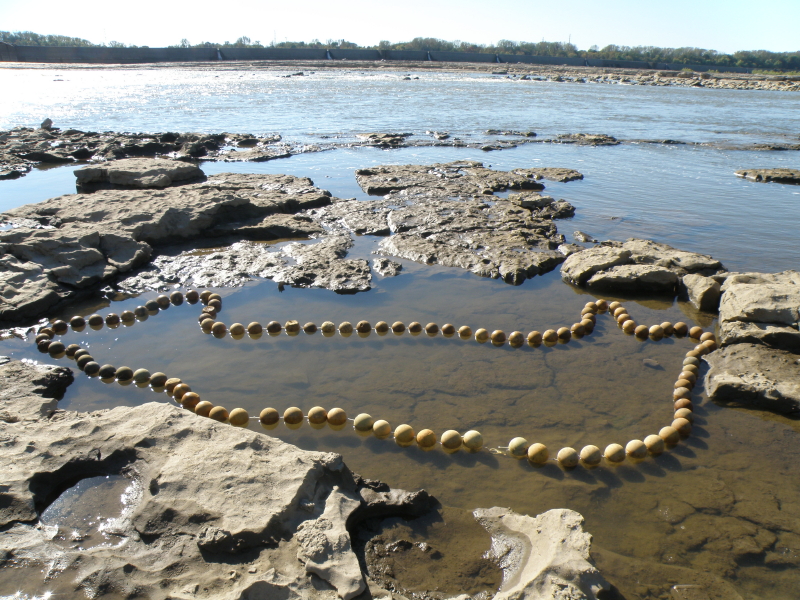
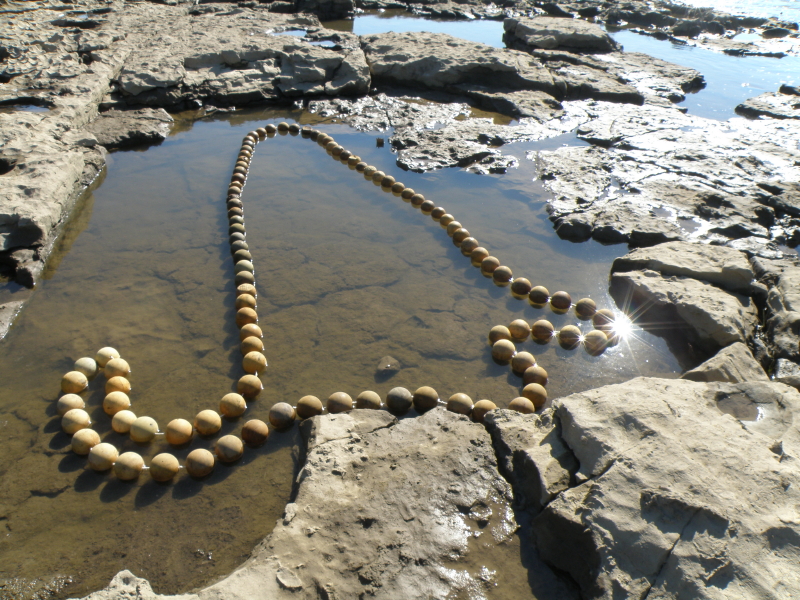
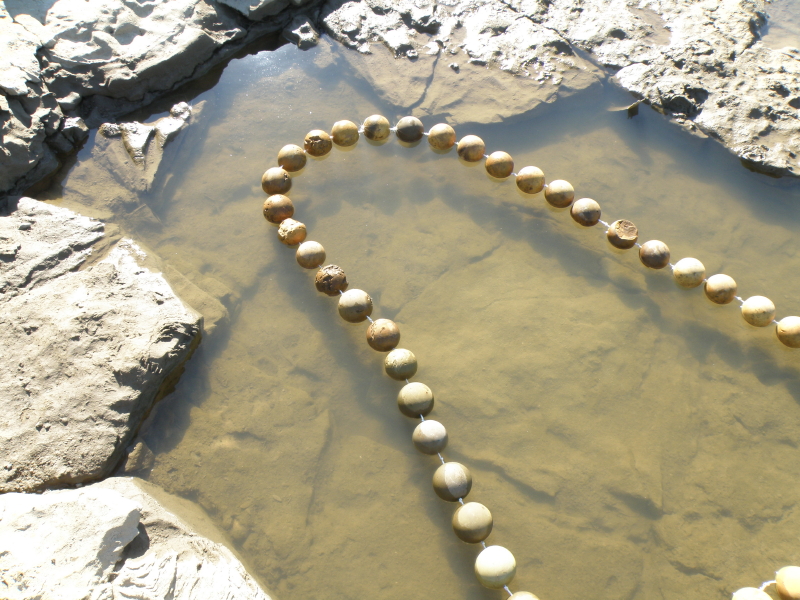
I had no idea how many of these balls I had collected or passed up over the years?  This recent photo taken in my Louisville backyard shows about 110 out of the 160 balls I did save.  I decided to act on my river pearls idea by making an impractically large pearl necklace.  I carried all the balls I had to my friend Tom’s sculpture studio and used his drill press to drill a hole through each ball.  That was a bit more of a technical challenge than I had first conceptualized.  Most of these spheres are not perfectly round. In fact their imperfections (which I really like as evidence of wear by the river and elements) made each drilling a unique experience.  Eventually, I got the job done and laid out many of the balls on the concrete pad in my backyard.  Just as I was beginning to thread and knot braided nylon cord through the balls…the sky let loose a monstrous rain storm.  By day’s end, nearly seven inches or 17.5 centimeters of rain fell and flooded parts of my backyard and basement!  It was like being visited by the river in an interesting way.  I had initially “graded” each ball by condition and color to form transitions in this giant strand, but the water and now mud from my backyard changed the color of each ball.  I decided to make my first piece one hundred balls long.  There is a knot tied with the cord that keeps each ball from touching.  At my local hardware store I found a brass hook that I could use for a clasp to close my giant necklace.  All that was left to do was to return to the river…to the place that I found all of these balls and inspiration and find a way to give thanks for these many gifts.
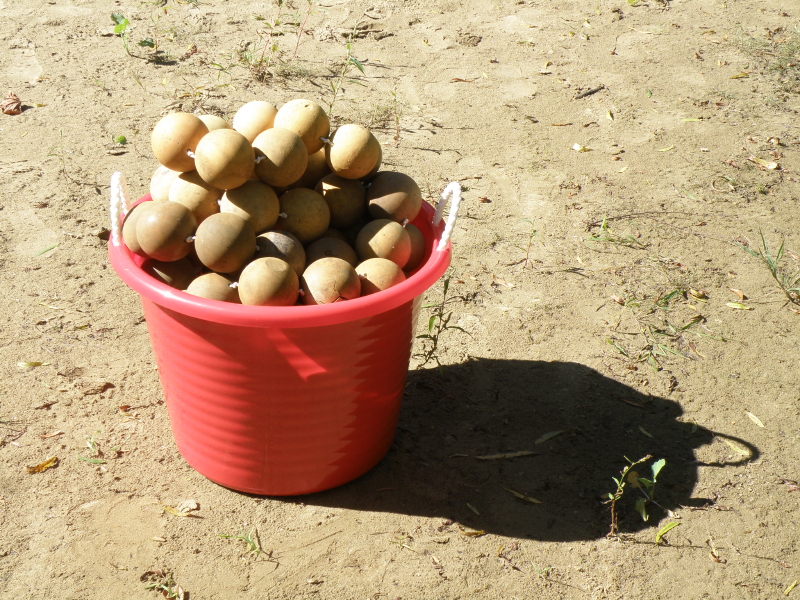
river pearl necklace in plastic bucket, Oct. 2013

Loading the necklace into a large red plastic tub I carried my artwork down to the Ohio River.  One hundred balls became surprisingly heavy and I was concerned about twisting an ankle or tweaking my knee as I walked over the driftwood.  I came to a sunny place under the railroad bridge and laid the necklace out upon the sand for the first time.

weathered softball cores, Oct. 2013

Here’s a look as some of the weathering that occurred with a few of the balls.  And here is one of the first images of the necklace joined together.

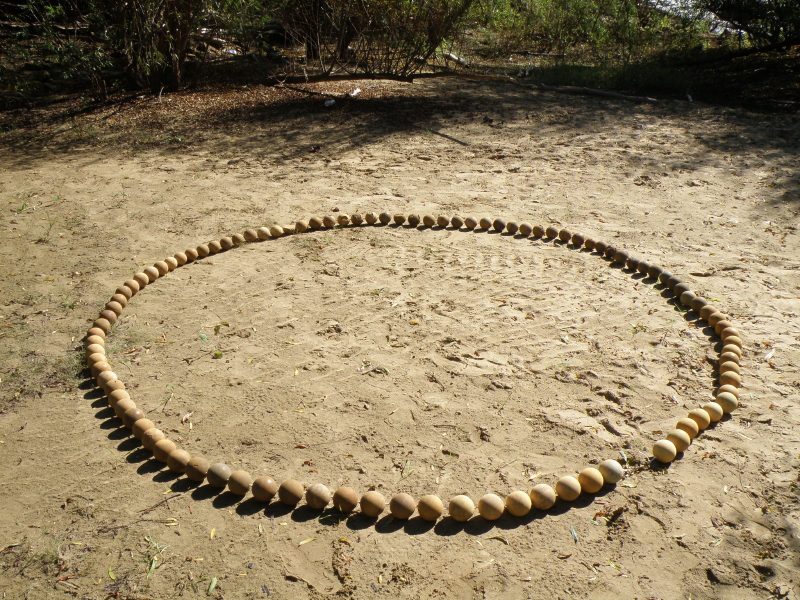
one hundred ball necklace in the sand, Falls of the Ohio, Oct. 2013

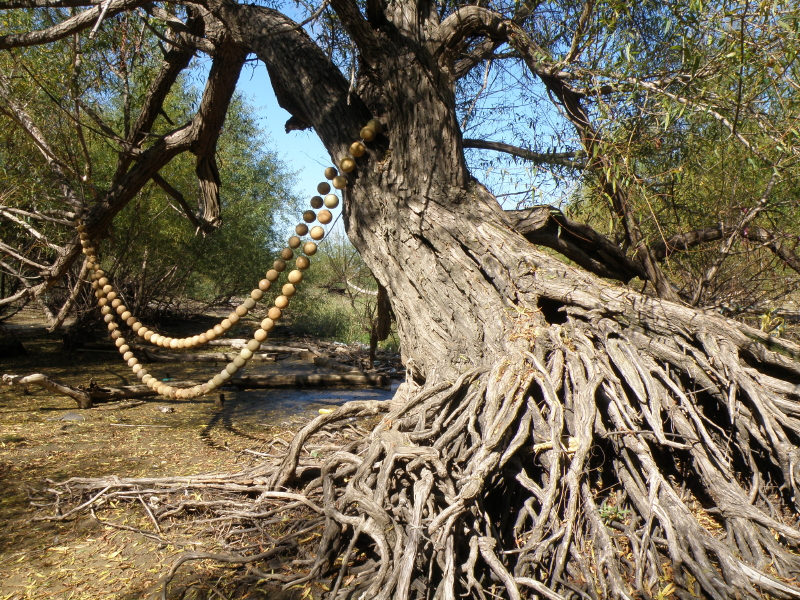
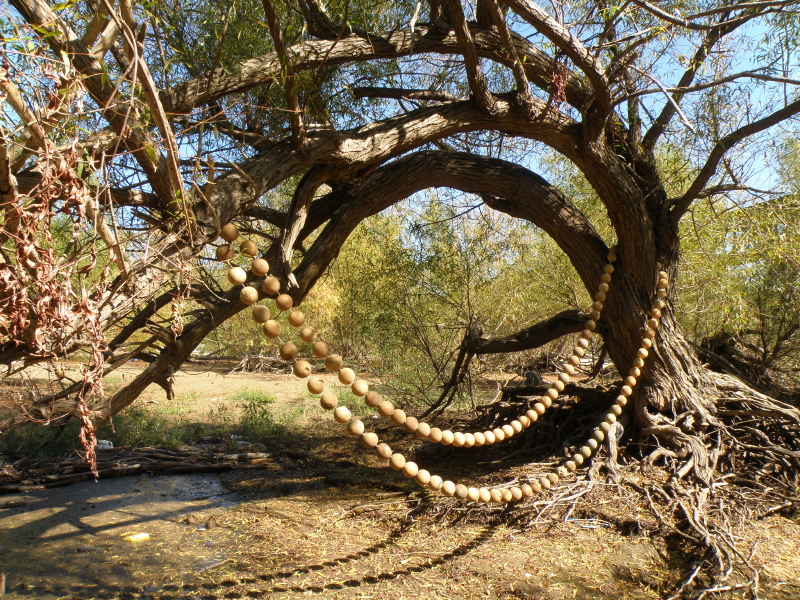
This was okay for a trial run, but I had other images in mind.  I have always loved the willow trees in the park and I chose one of my favorite ones to “wear” my river pearl necklace.  Yes, it’s a hopelessly romantic gesture, but I felt like “celebrating” this tree in a special way.  Here are a few more images.

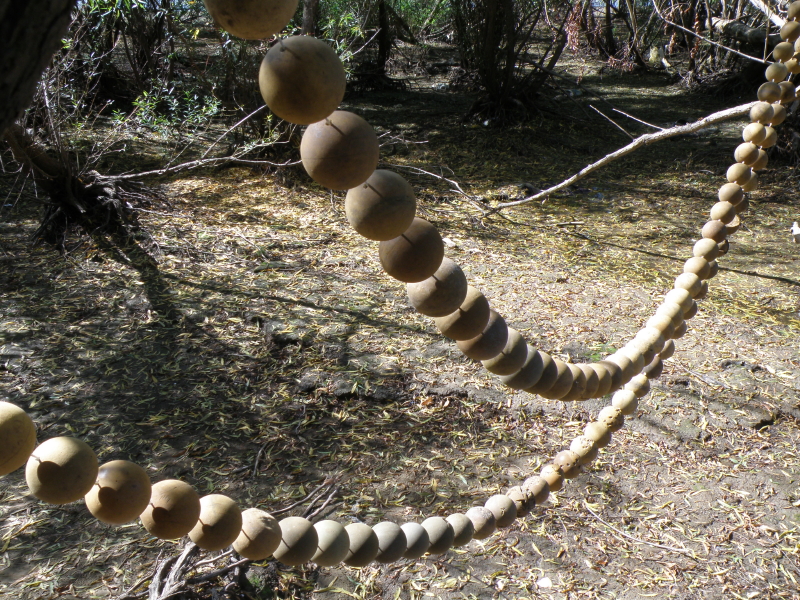
amazing willow tree wearing my river pearl necklace, October 2013

detail of willow tree necklace, Oct. 2013

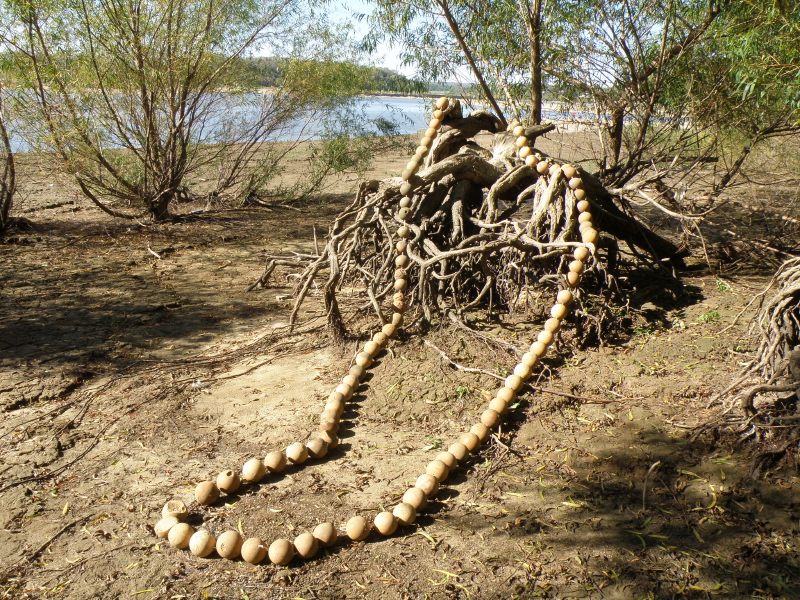
Moving closer to the river, I stopped by an old willow that was barely alive.  I draped my necklace over its old exposed roots and created a few more images.

Old willow roots and necklace, Oct. 2013

Once in a while, a park visitor would walk by and look in my direction and continue on as though I was engaged in a most ordinary activity!  If I had stumbled across this scene…I think curiosity would compel me to say something.  Next is another detail from my eccentric strand of pearls.

detail, slightly elevated river pearl necklace, Oct. 2013

With the river within sight, I lifted my bucket of balls and headed towards the fossil rocks.  It was a sunny, but windy day and my next idea was to put the necklace into the water.

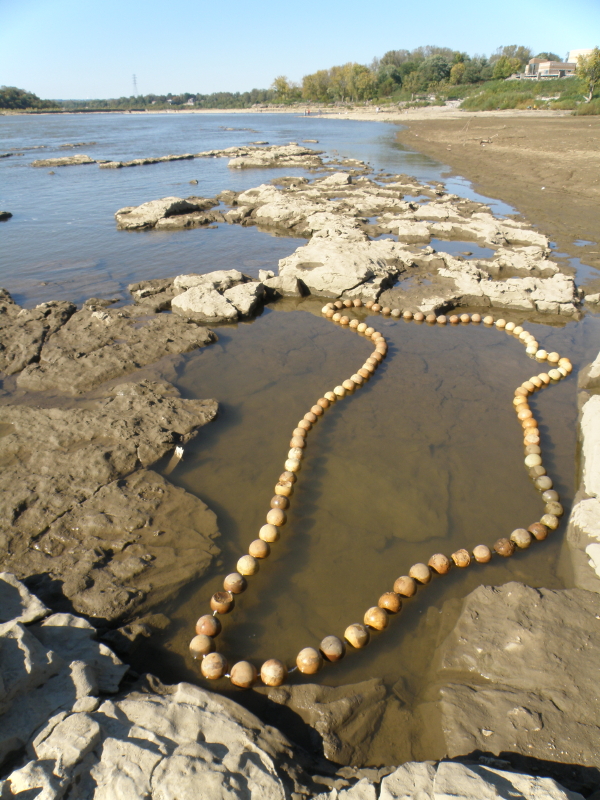
I found a pool of water surrounded by Devonian inspired limestone that would prevent my necklace from being carried away by the current’s flow.  Still, the wind kept changing the configuration and blowing the balls against the rocks.

I used a beaver-chewed willow stick I found on the bank to guide my necklace into shape between photos.  The necklace which I now had named “La Belle Riviere” was the name originally given by French missionaries upon encountering the Ohio River for the first time.

It seems appropriate that the river which played a large part in bringing these balls to this shore…would continue to influence how this piece would be perceived.

I enjoyed how the gourd-colored balls harmonized with the surrounding riverine landscape.  I felt some sense of accomplishment in creating this piece and being able to return it to the Falls environment to create this site specific work.  It was also a fitting ten-year anniversary artwork since “La Belle Riviere” began with that first found ball a decade a go.  I will see how well it holds its own in a gallery environment since I want to include this piece in a two person show I’m participating in this January.  After these river photos…I loaded the necklace back into its container and began the slow walk back to my car.  While making this work, I did have one admirer that found the work irresistible and I will end this post with its image.  So long…from the Falls of the Ohio.

Butterfly with detail of softball core necklace, Oct. 2013

Read Full Post »

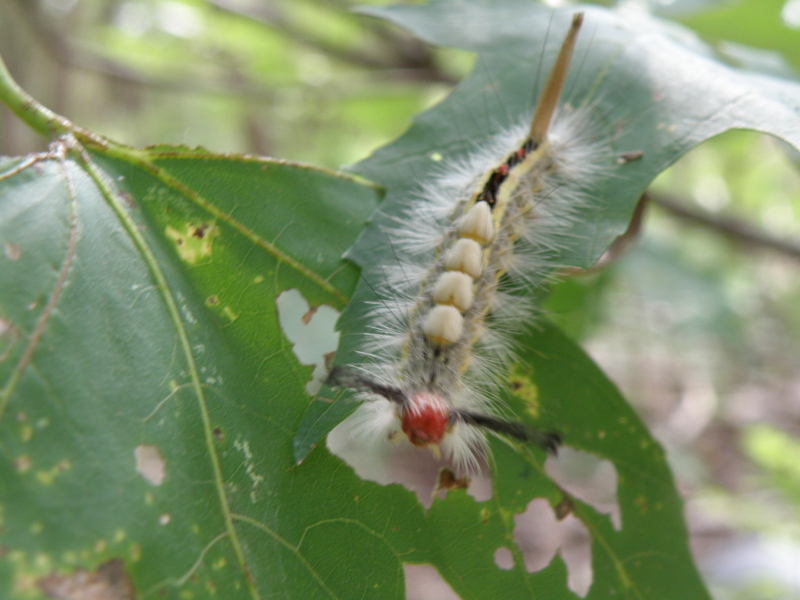
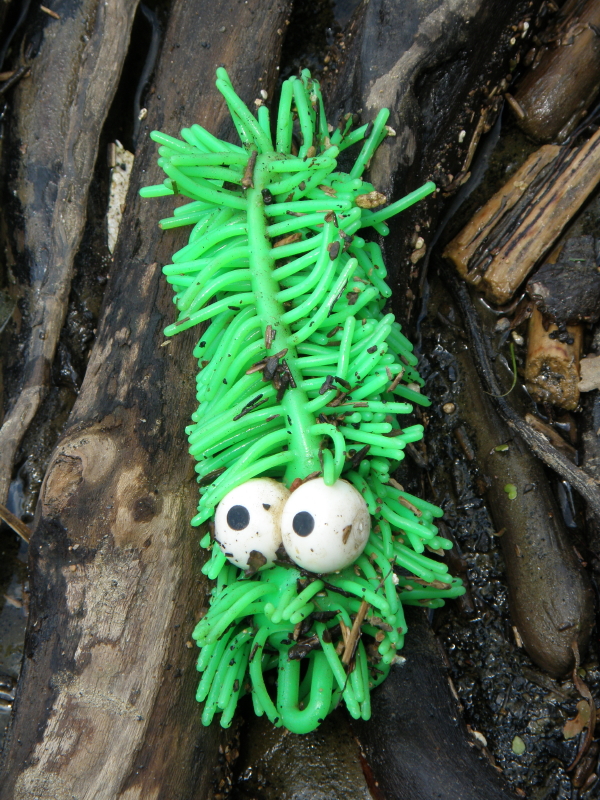
Tussock moth caterpillar, Oct. 2013   Red-faced and bizarrely hairy, the unique caterpillar of the Tussock moth was munching its way through a maple leaf.  Everything about its appearance says I’m not tasty and leave me alone.  It’s now October and it won’t be much longer before the first frost and freezes arrive and with it the colder temperatures which will quiet insect life at the Falls of the Ohio until next year.  The caterpillar inspired me to post a few other entomological images taken in the park.  I confess that I have always liked insects as examples of how diverse life can be.  I’m amazed at the incredible variety and forms that our six-legged friends can assume. Here’s another really weird caterpillar that I found at the Falls that I just haven’t been able to identify through any of my field guides.  Does anybody out there in blog land recognize this?

strange caterpillar from the Falls, late June 2013

This fluorescent green caterpillar has dramatic eye spots on its posterior that would incite a predator to strike there first.  Its anterior is located on the opposite end and I would have fallen for this trick too, but noticed that it was walking backwards.  I wondered once it completed its metamorphosis…would the adult be a moth or butterfly?  Maybe some day I will stumble upon and collect a large cocoon I don’t recognize and I’ll take it home and watch a miracle as it emerges from its silken home.

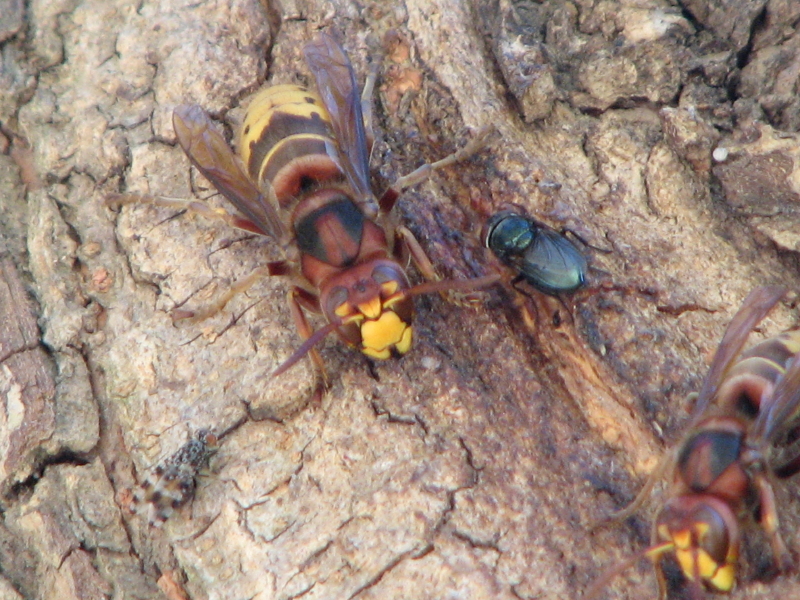
hornets and flies on willow bark, 9/2010

During this time of year, certain willow trees at the Falls are exuding sap which draws a variety of insect life including various flies, hornets, and butterflies to these sweet “licks”.  Whether the flowing sap is due to disease or injury is unknown to me? The large bullet-like hornets are so preoccupied with sipping the sap that they ignore me.  To test this, I’ve carefully touched them with my finger while they were feeding and they remained docile.  I was walking through the tall grass when I noticed a large flying insect land on the bush next to me.  Despite its wonderful camouflage I was able to locate our next insect after a short search.

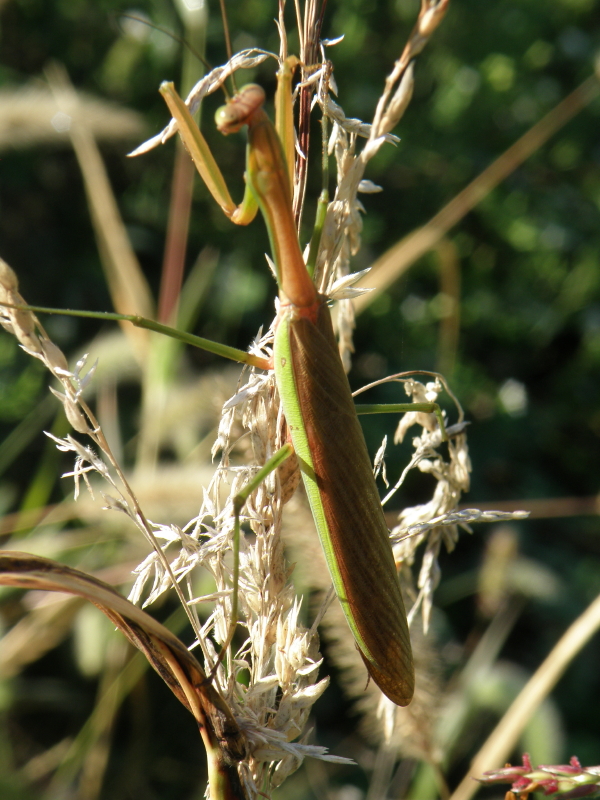
Chinese Mantid, Falls of the Ohio, late Sept. 2013

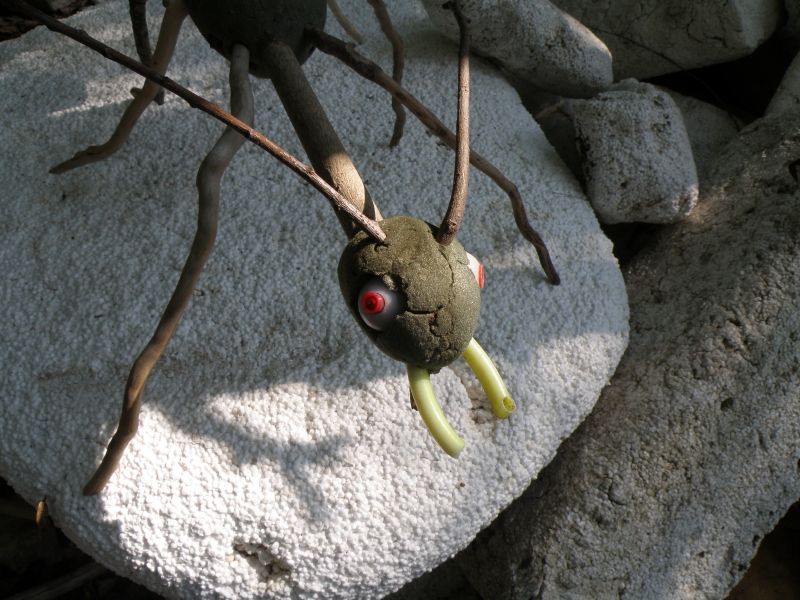
This is the Chinese Mantid which I read was introduced into this country in 1896.  It is the largest praying mantis you are likely to come across in the United States and this specimen was about four inches or ten centimeters long.  I’ve seen them grow larger, but not in this park.  In fact, this is only the second mantid I’ve seen out here.  There are several native species, but they are smaller and more obscure.   And now, it’s time to reveal my most spectacular discovery which is a near but harmless relative of the praying mantis.  Here is a picture of its head.

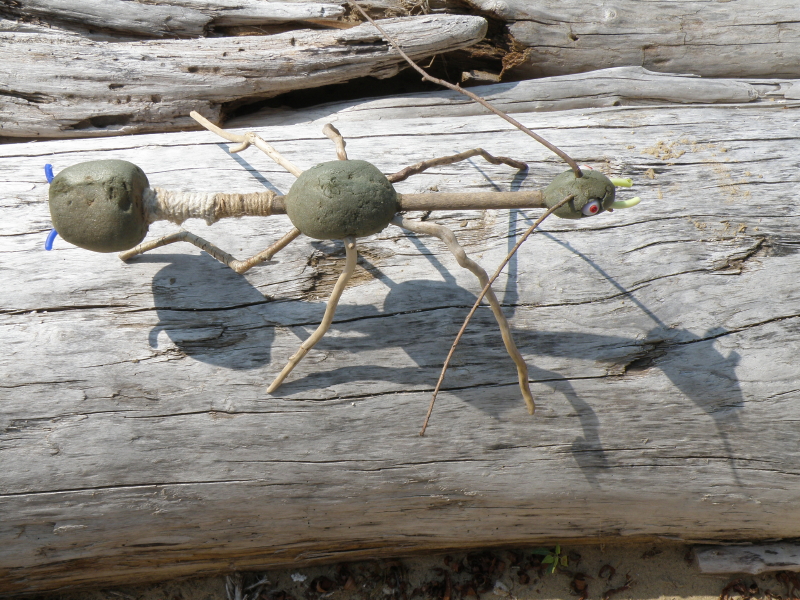
detail, head of the Falls Phasmid Stick Insect, October 2013

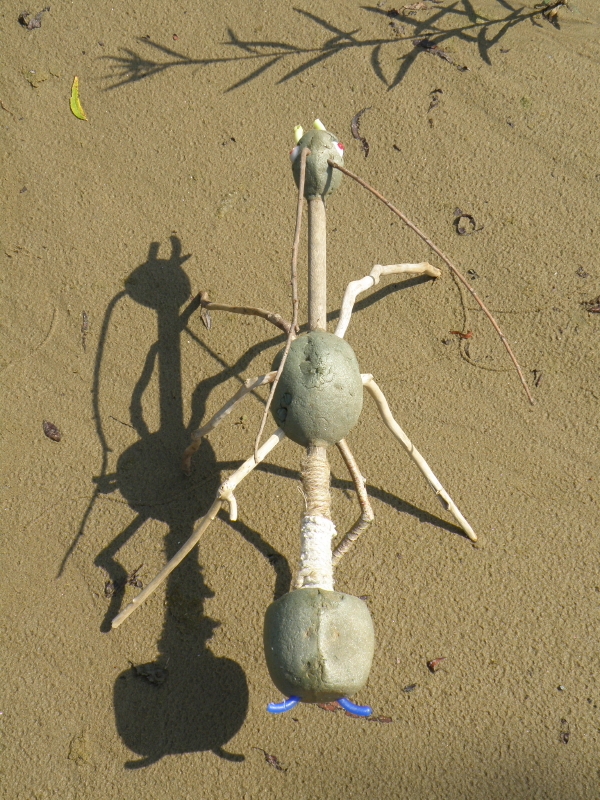
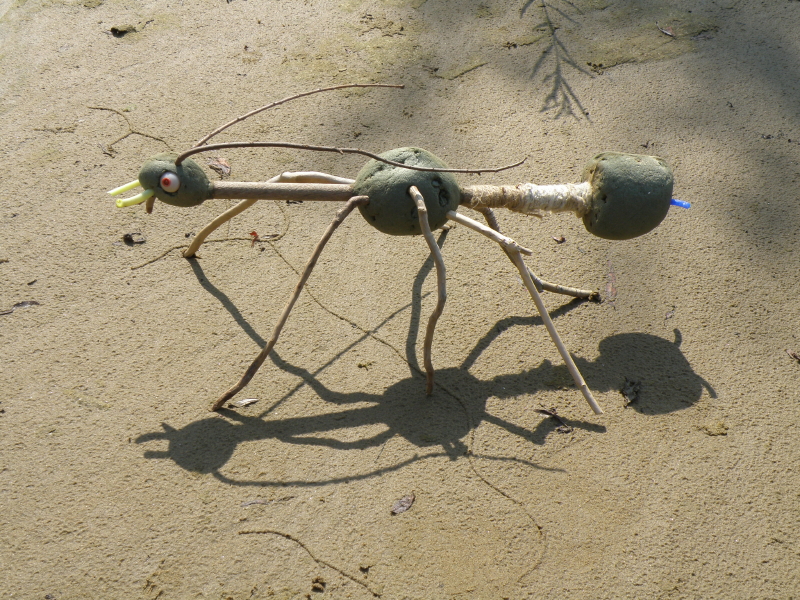
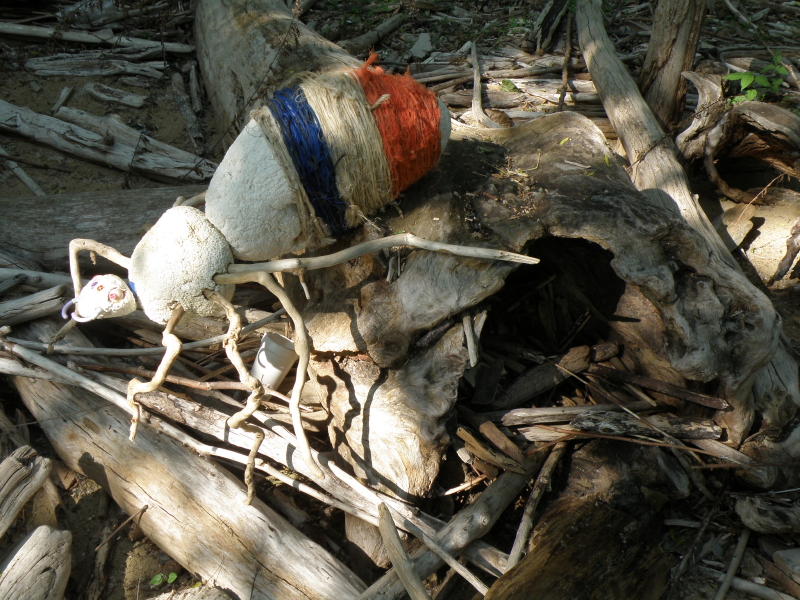
And now, for the rest of its body which is about two feet long or roughly sixty centimeters.  I came upon this unique life form casually walking across the driftwood on its way to somewhere else.

full view of Falls Phasmid, Falls of the Ohio, Oct. 2013

Although as insects go this is a giant…it is also an extremely fragile creature.  It is a member of the walking stick family.  It relies on slow movements and its cryptic forms to merge with its surroundings.  The Falls Phasmid is strictly a vegetarian and eats the foliage from a variety of different trees.

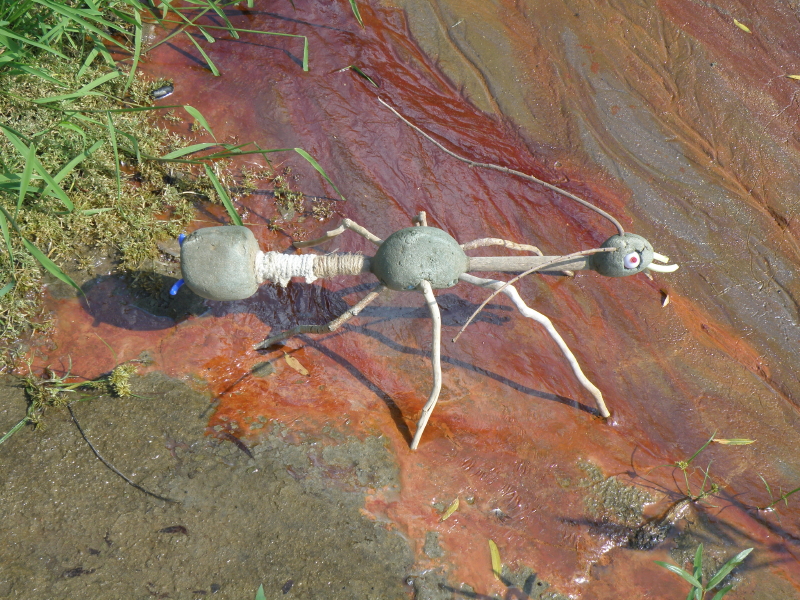
aerial view of Falls Phasmid, Oct. 2013

I came across this specimen in broad daylight.  I had always heard that they were nocturnal and chose to restrict their movements during the day to avoid detection.  Walking stick insects are among the largest insects we have.  This species is additionally strange in that its head, thorax, and abdomen are so clearly differentiated.  Some scientists have gone so far as to suggest a bit of mimicry at work here.  On the surface it does seem to possess a superficial resemblance to a giant ant which might be enough to dissuade predators from attacking it.

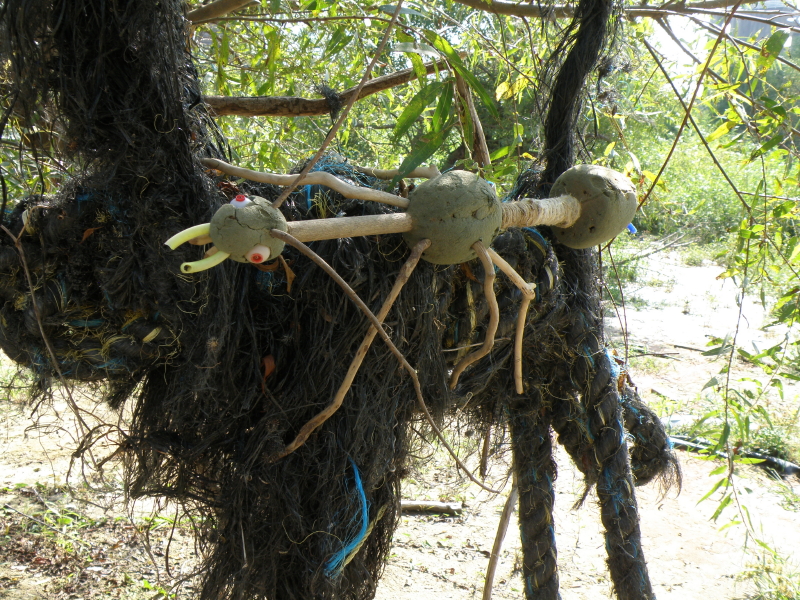
Falls Phasmid hanging in a tree, Oct. 2013

I did observe this particular Phasmid making return trips to a particular willow tree where it clung to a nest-like structure that was hanging down from a branch.  The meaning of this structure was not immediately apparent.  Perhaps the Falls Phasmid uses this form to help it overwinter?  Keeping a respectful distance away, I did see the stick insect walking slowly over the riverbank, but I couldn’t tell if it was searching for something in particular and I did not witness it feeding.

Falls Phasmid Stick Insect, Oct. 2013, facing left

Falls Phasmid in the wetlands area, Oct. 2013

Originally, the Falls Phasmid may have had the ability to fly.  Other walking stick insects from around the world have vestigial wings that suggest a different past.  Our specimen lacks even the most superficial suggestion of wings which hints at an ancient lineage.  Perhaps all stick insects evolved here first and spread around the world much later?

Falls of the Ohio Phasmid Stick Insect, October 2013

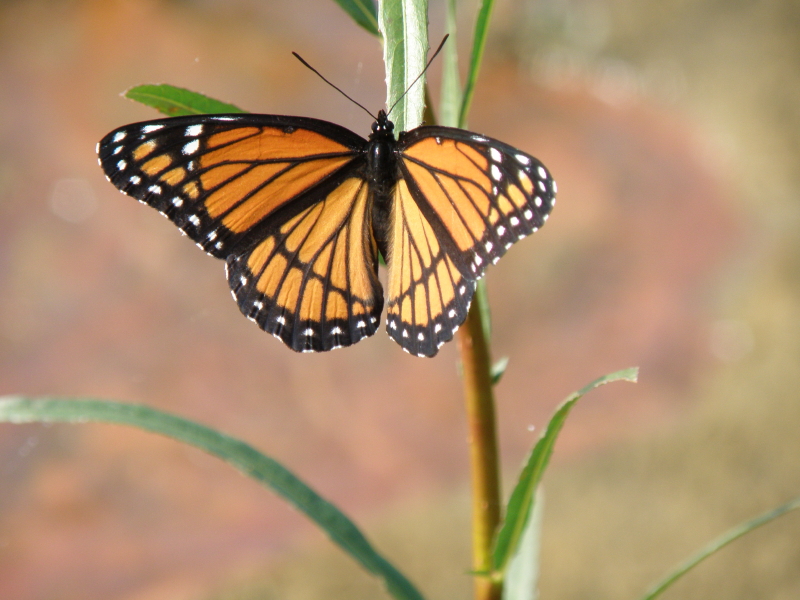
I watched the Falls Phasmid for a while and took a bunch of photographs of it before leaving the park.  I’m curious about that tree that it likes to hang out on and so will check it the next time I’m here.  On my way out of the park, I also came around this wonderful Viceroy butterfly and thought that this would make a fitting image to end this post.  When I think of the butterflies that inhabit the park…this is the species that comes to mind first for me.

Viceroy butterfly, Falls of the Ohio, October 2013

Read Full Post »

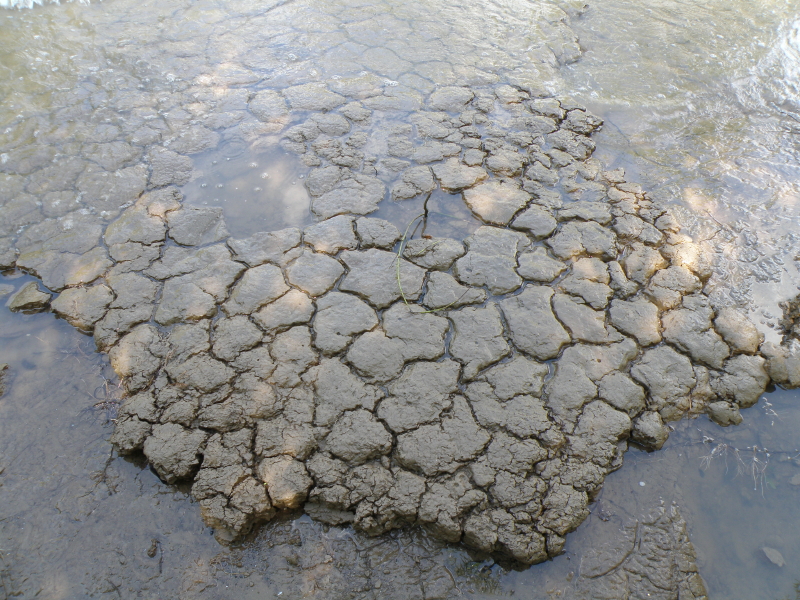
the riverbank, cracks in clay, July 2013

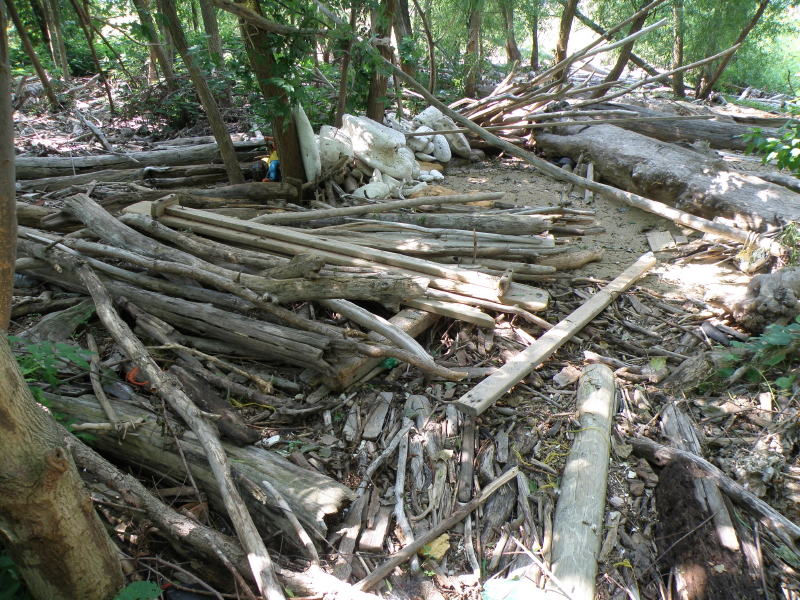
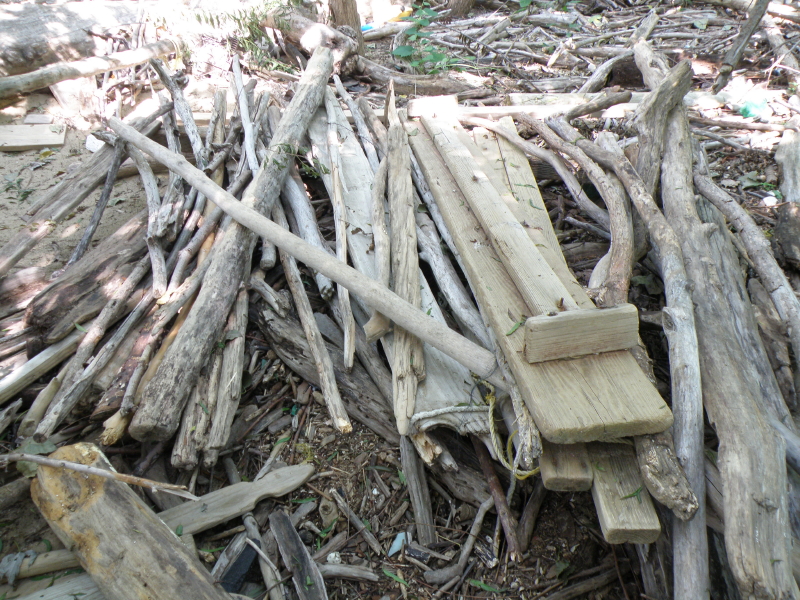
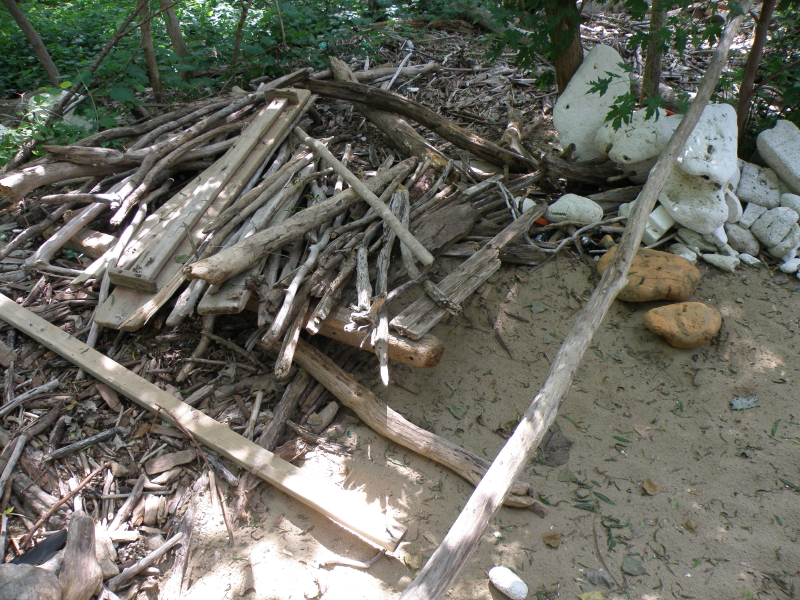
I never told you how this story played out and so now is as good a time as any.  A few weeks back, I had posted on how some unknown visitor(s?) had been altering my outdoor studio at the Falls of the Ohio State Park.  For a least two years previously, I had been storing my river found art materials at this site.  People who stumbled upon this spot often mark their presence by changing how I left it in some way.  Folks might rifle through the junk or take or destroy the Styrofoam figures I might leave behind.  I don’t mind this…in fact, I encourage the interaction.  On site, it’s easy to make the connection that all these poor materials I use came from the river.  I still think of my outdoor studio as a shared laboratory for this exercise in creativity.  It’s an acknowledgement that all this junk is out there and that something else positive might come from it.  For several weekends, my latest visitor has been building a wooden driftwood structure over my spot to the point where it usurps my ability to continue working there.  So, I made a few changes that I thought would benefit both of us.  I modified the structure so that I could stand within my site.  I also opened up the space more which I thought also encouraged additions.  I was curious to see how my visitor would react and here are the pictures.

destroyed driftwood structure, July 2013

destroyed driftwood structure, July 2013

destroyed driftwood structure, July 2013

It appears that my “improvements” weren’t appreciated because I arrived one day to find it all laying on the ground.  All the nylon line and strong knots that were holding things together were cut with a knife.  Stuff was scattered and the big polystyrene figure I had left there was destroyed again.  Here’s how I discovered my Styrofoam man.

fallen figure, July 2013

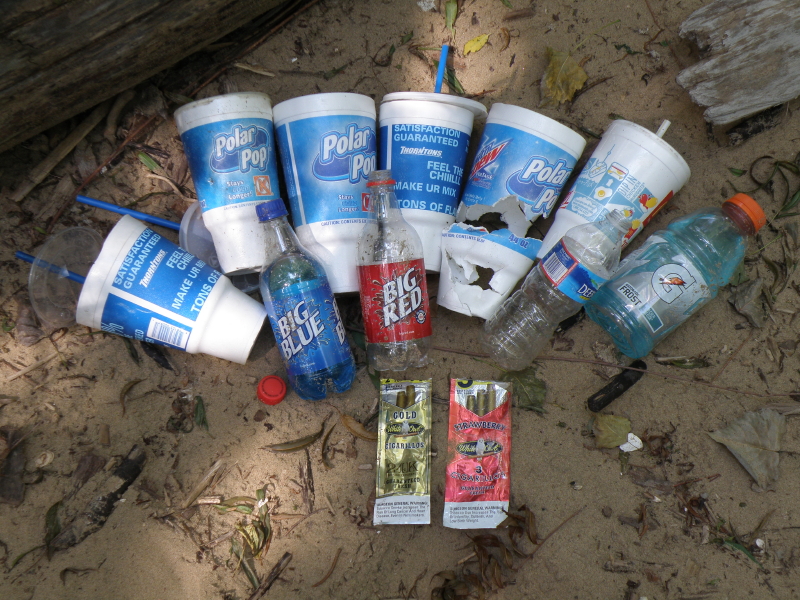
He had been sitting in a fork of a nearby tree.  I think my visitor picked him up and threw him across the site…again!  At this point, I’m feeling pretty bummed out.  I left this figure as I found it.  My visitor also left me some additional trash behind as is his custom and I gathered it together again to create this “portrait”.

trash at my site, July 2013

I thought the “Big Red” with the “Big Blue” was an interesting touch.  In our area, those are the home colors of rival universities.  Another giant Styrofoam cup joined the group and I have my suspicions that the cigar packaging is from the same individual as well?  I think this is what saddens me the most that all this convenient store trash would be walked to this site and simply thrown on the ground.  As much trash that appears here from upriver, I’m shocked by how much park garbage originates from the nearby towns.  And yes, there are trash cans available everywhere.  I sat by my site for a while and pondered the situation.  I wondered why with all the space and driftwood available in the park that this spot became so important to my visitor?  Feeling like this individual more than likely doesn’t play well with others…I decided to walk away from this site for a few weeks or months before returning.  So far, I haven’t been back to my old spot under the willows.

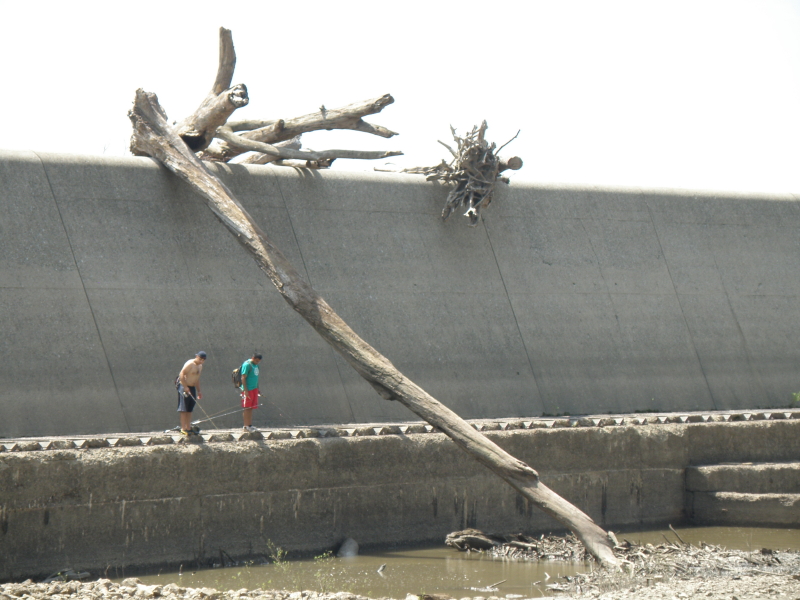
two fishermen, July 2013

The day felt shot, but I didn’t want to leave things that way and so I went for an extra long walk.  After all, I have the rest of the park to potentially explore.! Along the way, I spotted these two guys attempting to fish by the wall of the dam.  They didn’t appear to be having any luck and so I left them with these fishy images by the side of a trail they would pass by.

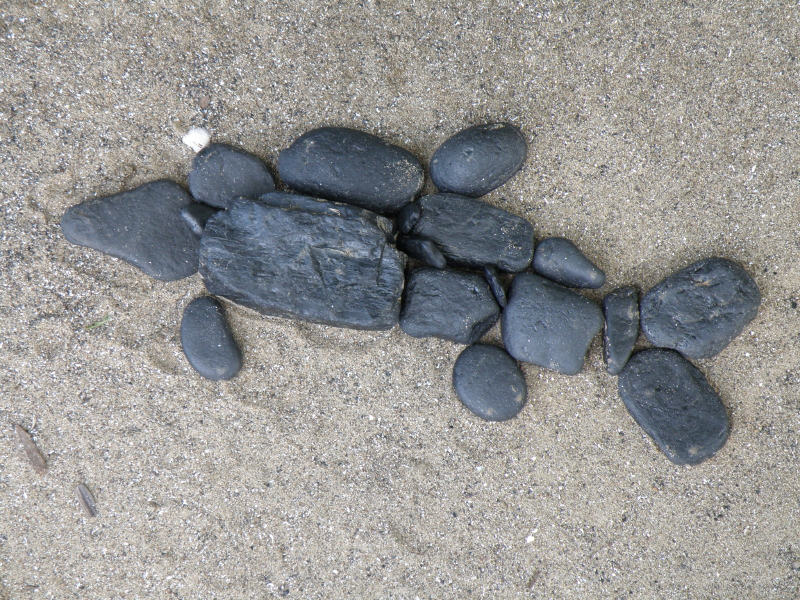
coal fish, July 2013

coal fish, July 2013

coal fish, July 2013

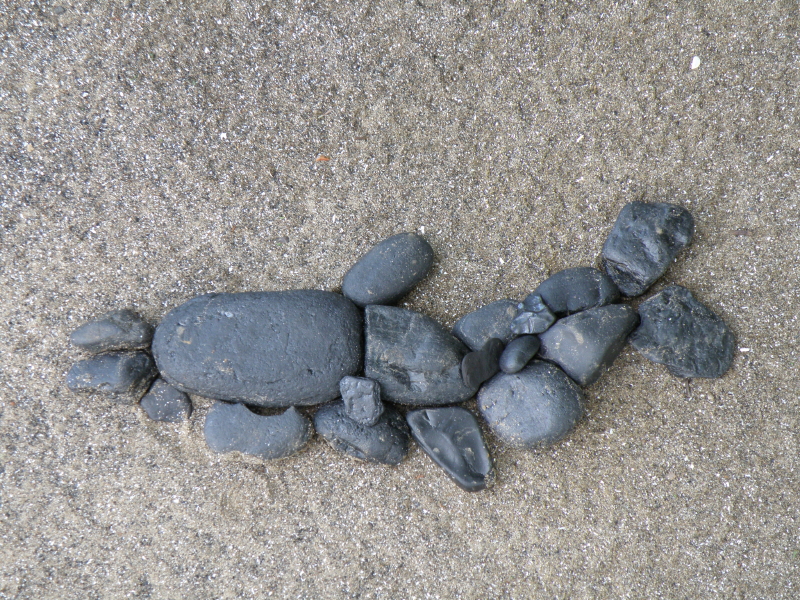
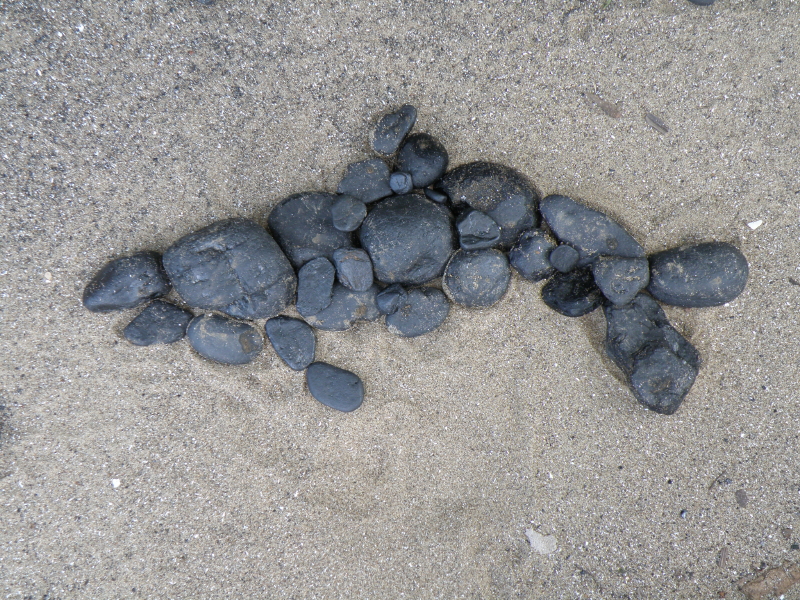
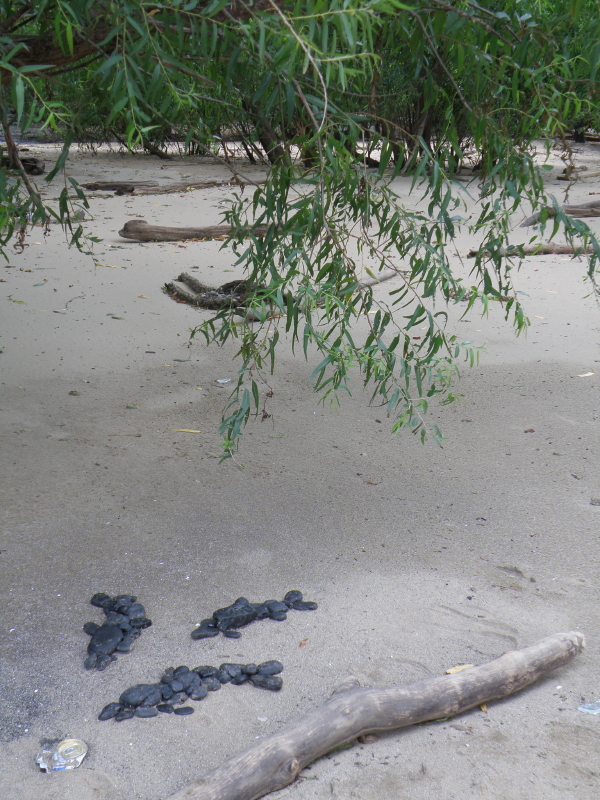
I used river smoothed coal I gathered on site and improvised these three fish on the sand.  Peppering the silica granules black is coal dust.  The white dots are pulverized mussel shells.

three coal fish on the sand, Falls of the Ohio, July 2013

Thus far, it has been an atypical and sometimes unsettling summer at the Falls of the Ohio.  All the early season rains and subsequent high water have disrupted the usually hot, humid, and lazy routine found here during this time of year.  In an odd way, it doesn’t feel like summer has truly arrived for us yet.  We have a few more months for this to happen before the leaves start turning colors.  To close, here is one more coal-fish image in a slightly larger context.  Have a great weekend!

coal fish in context at the Falls of the Ohio, July 2013

Read Full Post »

Muddy Ohio River at the Falls of the Ohio

The Ohio River has remained high and muddy the last couple of weeks.  It’s summer, past mid July when we usually find the river retreated to its summer pool.  This approaches the time when the fossil beds on the Kentucky side of the river would be exposed.  The little bit of flooding that occurred has displaced more than random logs and debris.  I was investigating the riverbank under the railroad bridge and came across an interesting mix of ducks.

domestic and wild ducks at the Falls of the Ohio, July 2013

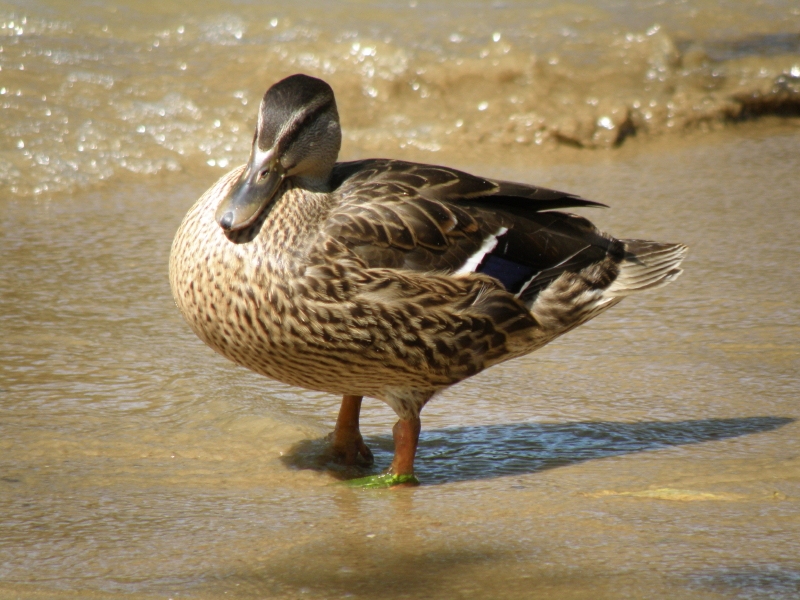
Joining the wild, female Mallards with their iridescent blue-violet speculum on their wings was a small group of domesticated ducks.  More than likely the river overwhelmed a farm pond somewhere which was the opportunity the domesticated ducks needed to swim away and explore the larger world.

Domestic ducks, July 2013

They landed at the Falls of the Ohio and are sharing a vacation together.  White and piebald (a mix of black and white) are the colors of domestication.  These farm ducks are also much larger than their wilder cousins.

two resting female Mallard ducks, July 2013

female Mallard duck, July 2013

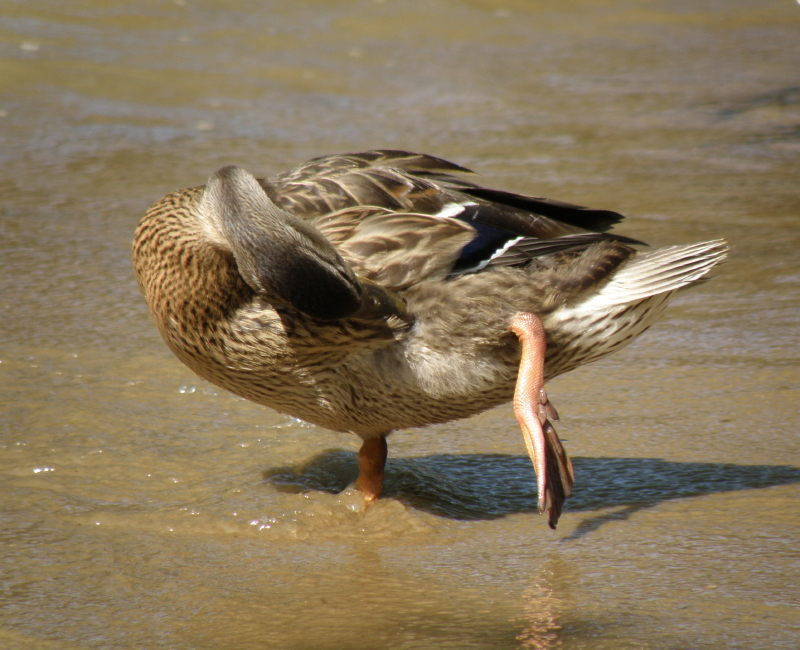
female Mallard duck grooming, July 2013, Falls of the Ohio

The Mallard duck (Anas platyrhynchos) is our most common species of duck and can be found at the Falls throughout the year.  I once stumbled upon a Mallard nest that was built inside a hollow log.  When the mother-to-be flushed out of the log, the surprise took a few years off my lifespan!   They are members of the duck family known as “dabblers”.  Mallards hang out near the zone where water and land meet.  They have specialized bills for feeding in shallow water.  Mallards prefer small grass and sedge seeds for food, but will also strain the water and mud for small organisms.  I have come across other ducks at the Falls of the Ohio that are hybrids of Mallards and domesticated ducks.  Many duck species must be closely related to one another because other inter-species hybrids have been documented.

Blue-ringed dabbler, Falls of the Ohio, July 2013

Head of Blue-ringed dabbler, July 2013

I have also recently photographed an unusual duck for the Falls of the Ohio.  On a recent foray to the river I came across this Blue-ringed Dabbler ( Anas azurcephalos) plying its trade at the water’s edge.  This diminutive duck is native to the western part of North America and rarely strays east of the Mississippi River.  Perhaps it found its way here because of the recent storms that have tracked west to east across the country?  Domesticated ducks are not the only birds affected by severe weather.

Blue-ringed Dabbler at the Falls of the Ohio, July 2013

The Blue-ringed Dabbler is an unusual duck in that it nests in trees or more specifically, in the holes created and abandoned by larger woodpeckers.  This formerly rare duck is now on the increase because conservationists have taken advantage of this breeding preference by setting out nest boxes which the Blue-ringed Dabbler will accept.  A similar program helped the colorful Wood Duck to recoup its former population numbers.

Blue-ringed Dabbler, Falls of the Ohio, July 2013

This is a female Blue-ringed Dabbler identified by its browner coloration and lack of iridescent color on the wings.  The dabbler regarded me for a while before swimming off to a deeper part of the river where I lost track of it.  I returned the next day to see if I could find this duck again, but it was gone.  I get a big kick out of recording bird species that are not a part of the official bird checklist distributed by the Falls of the Ohio State Park.  I love bringing these rarities to the attention of hard-core birders who will only accept as evidence good photographic proof or multiple sightings recorded by multiple birders.  They can be a suspicious lot and highly competitive.  Often bird watchers present themselves as being more interested in what number a particular bird represents on a life list than in the bird itself which seems to me to miss the whole point of watching birds.

domestic ducks with dead catfish, July 2013

Although I never saw the Blue-ringed Dabbler again, I did however, locate a couple of the domesticated ducks I had seen the previous week.  They were investigating the waterline in a particularly muddy area.  I was shocked to discover the dead fish in the foreground upon downloading my images.  I certainly don’t remember seeing this when I snapped this picture.   I doubt these ducks will ever find their way to the farm again, but for now…they seem content.  I’ll end today’s post with one other image of the Blue-ringed Dabbler that I came across on the internet.  It shows a bird in the hand of a conservationist.  So long for now!

Blue-ringed Dabbler in hand, Falls of the Ohio, July 2013

Read Full Post »

Falls black styrofigure, July 2013

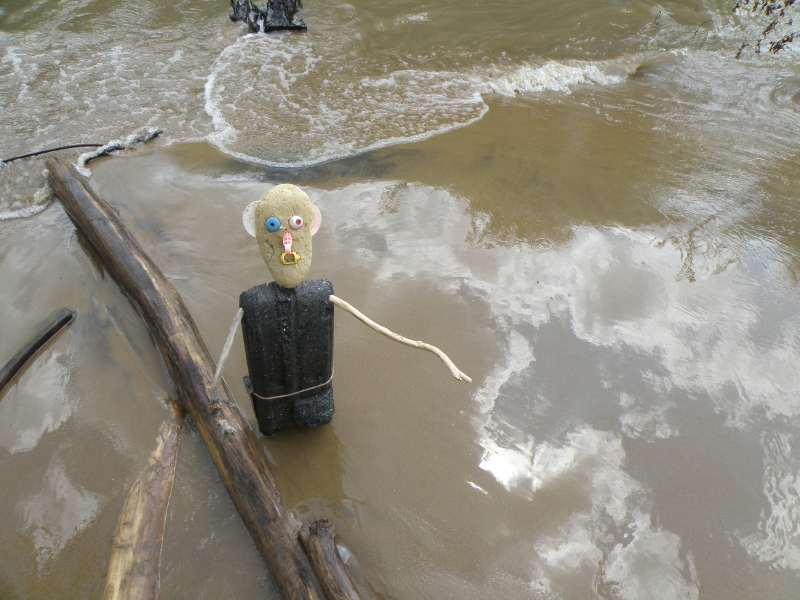
With the sun spotlighting this little patch of sand…my newest Styro-figure proudly stood upright.  He’s the first persona created in the reconfigured studio.  I found a rare piece of “black Styrofoam” on today’s walk.  It’s part of what passes for car bumpers these days.  This material has a rubberized compound mixed throughout the foam which makes it harder to cut or pierce.

Leaving home, July 2013

After making new friends it’s time to venture out into the world.  The leafy green complete with bird song is complimented by the creaky willows that sway with the occasional breeze.  There is another sound, however, that your feet are hearing and you walk in the direction of its source.

Black Styro-figure by the river, July 2013

The mighty Ohio River has been running muddy for more that a week now.  Although it’s hot and humid today, thus far, this summer has been wetter and cooler than average.  As a result of all the rain, the river has been higher than usual.  What I like about the Falls of the Ohio is that in such a relatively intimate space the park can take on all kinds of different looks depending on the weather and season.  Small waves break upon the heightened shoreline and there is a family nearby fishing and playing by the river.

Family fishing for catfish, Falls of the Ohio, July 2013

Seeing that they were having some luck catching fish, I gestured if it was all right to take their pictures.  The family didn’t speak English and I’m guessing that they are recent immigrants from Southeast Asia?  Regardless, both adults and children were having a ball in the river.  I wondered if they came from someplace like this since they seemed so comfortable and natural by the water? After receiving the okay signal I recorded these images of people interacting with the river.

little boy, Falls of the Ohio, July 2013

This little guy was cute and really determined that I should take his picture in what I’m assuming is a martial arts pose?  I obliged him several times and this was my personal favorite snapshot of the group.  Looking through my riverblog…I’m struck by how often children appear and interact with my artistic process.  First, my own two sons would accompany me and now it’s the kids in the park on any given day.

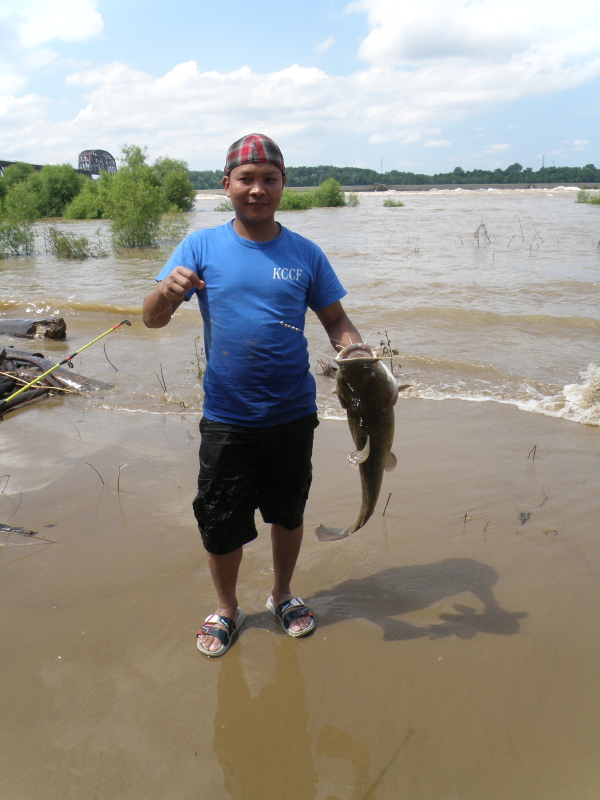
Man with Flathead Catfish, Falls of the Ohio, July 2013

Flathead catfish, Falls of the Ohio, July 2013

I watched this fish being landed and it’s a decent sized Flathead catfish, (Pylodictus olivaris).  This fish probably weighed in the ten to twelve pound range, but this catfish can get as large as a hundred pounds.  It is a fish of big rivers.  A very simple rig was used to catch this fish.  Four slipshot lead weights were clamped onto the line about eight inches away from the hook.  A single nightcrawler worm was used for bait which was cast about 25 yards from the riverbank.  The fishermen would wade in about knee-high to waist deep to increase casting length.  I was amazed that with the current and all the potential underwater obstructions that their lines didn’t get snagged more often than they did.

Catfish stringer, Falls of the Ohio, July 2013

This was the stringer of catfish they were working on.  In addition to the Flatheads…another big river fish the Blue catfish (Ictalurus furcatus) was also being caught.

catfish stringer, Falls of the Ohio, July 2013

The Blue catfish is a slatey-gray color and has a forked tail.  The two fish on the lower right in the above image are blues.  The flatheads are more of a mottled olive color and have very different fins.  Both are omnivorous and will eat most anything that they can catch.

Man and catfish, Falls of the Ohio, July 2013

All the fish on the stringer will be used to feed this family.  It is still not recommended that people eat the larger fish (especially bottom dwelling species) from the Ohio River. The river is much cleaner than it used to be, however, toxins do build up in the fat tissues of the fish that live the longest and grow to be big.  Every once in a while, making a meal of some of the smaller fish should be okay.  Because I was needed elsewhere today…I let my day at the river draw to an end.  Good thing too…because if you stand too long in the same spot at the water’s edge…you chance sinking down too far!  See you soon.

Styro-figure in black, waist deep in wet sand, July 2013

Read Full Post »

Wet studio under the willows, Falls of the Ohio, early June 2013

If you are reading this post between June 28 through September 1, 2013 then you are also participating in an art exhibition.  You may ask…how is that possible?  Well, sitting on a white table within a gallery of the Kentucky Museum of Art and Craft in Louisville is a desktop computer.  On that computer, my “Artist at Exit o Riverblog” is on display in a group show entitled “The Seven Borders” which is curated by Joey Yates.  The exhibition features contemporary artists who either live in Kentucky or in the seven contiguous states that border the commonwealth. I will try to post more about this exhibit over the show’s run.  I’m delighted by this invitation because this is the first time my blog has been featured as art in an art context.  I’ve always thought this was a possibility for this blog because my art comes together here in terms of the objects I make, the pictures I take, and the words I string together to tell stories or just describe the beauty of nature.

 Of course, the dialogue created by people’s comments is a part of that too.  With hope, people will additionally feel they can participate by leaving a comment, however, online you will need to be a WordPress member or a blogger with an Open ID credential.  This is easy and free to do.  If, however, you would prefer to write a note on paper while in the museum and give it to the front desk attendant…I would be glad to include those comments in this project as well. 

 It’s been a busy and engaging June with projects at the river, a family trip to Washington D.C. etc… I had planned a different post for today, but after yesterday’s experiences at the river…I thought I would go out of sequence.   Besides, with art, it is quite often the case that progress or forward movement is not linear, but jumps all over the place.  Let’s begin again with the first image of this post…this was my outdoor studio under the willow trees at the Falls of the  Ohio in early June.  

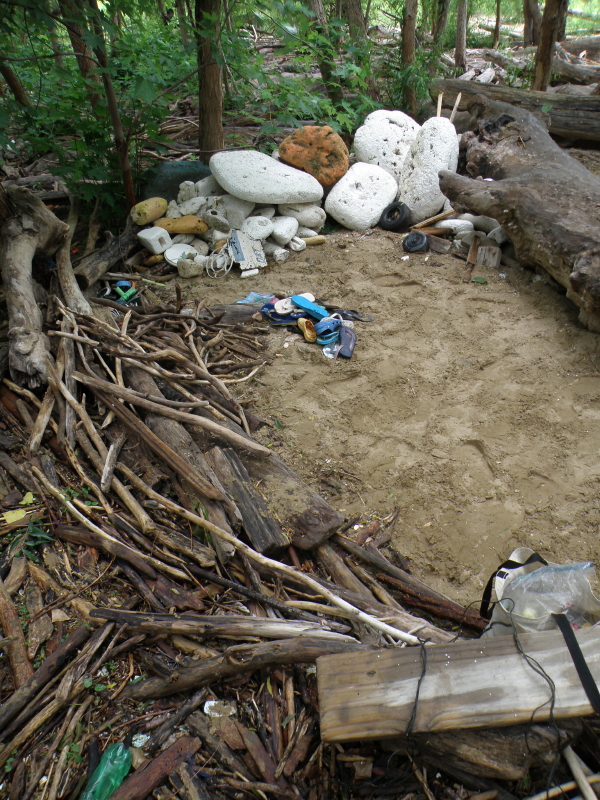
I have used this spot to cache river found materials and to make my sculptures and this has been a handy base of operations for a couple of years now.  This spot has weathered a few near miss floods that could have washed everything away again, but has stayed remarkably intact.  Well…there were a few recent changes which form the true subject of this post and here are the pictures.

Improved outdoor studio space, June 2013

Improved outdoor studio space, Falls, June 2013

Improved studio area, Falls, June 2013

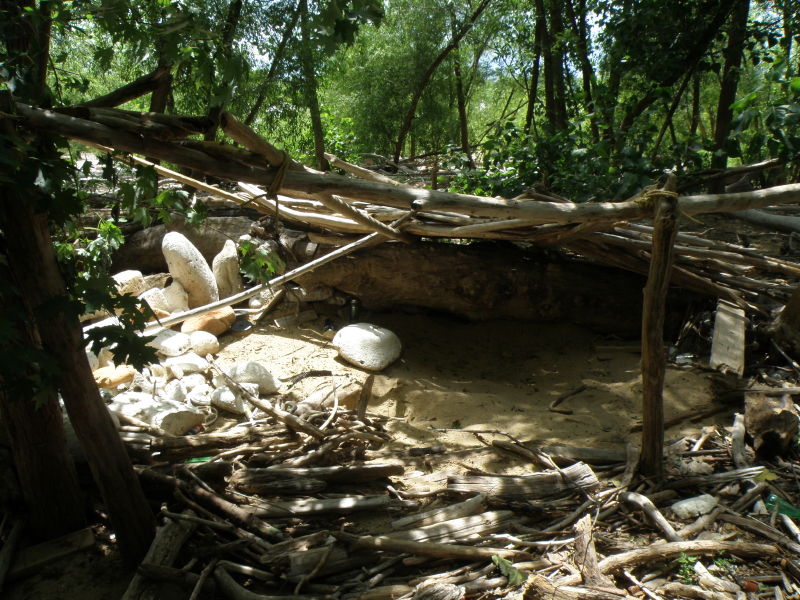
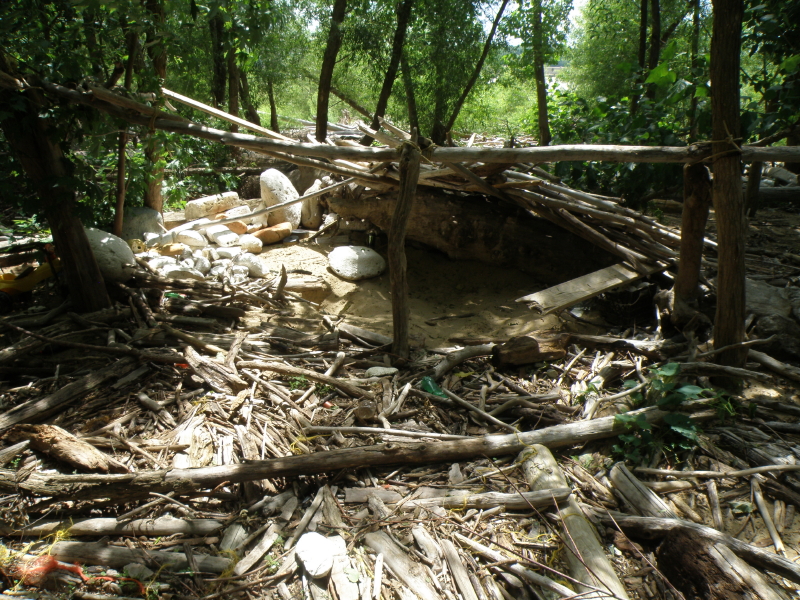
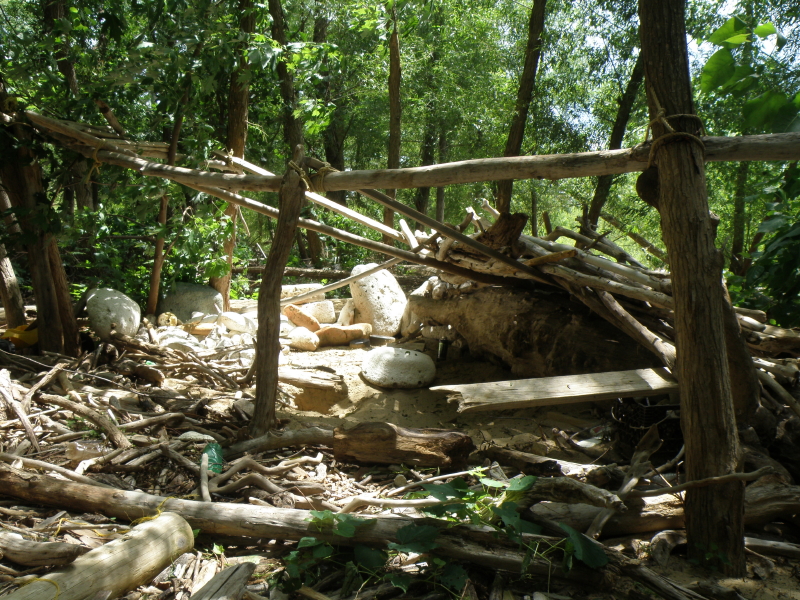
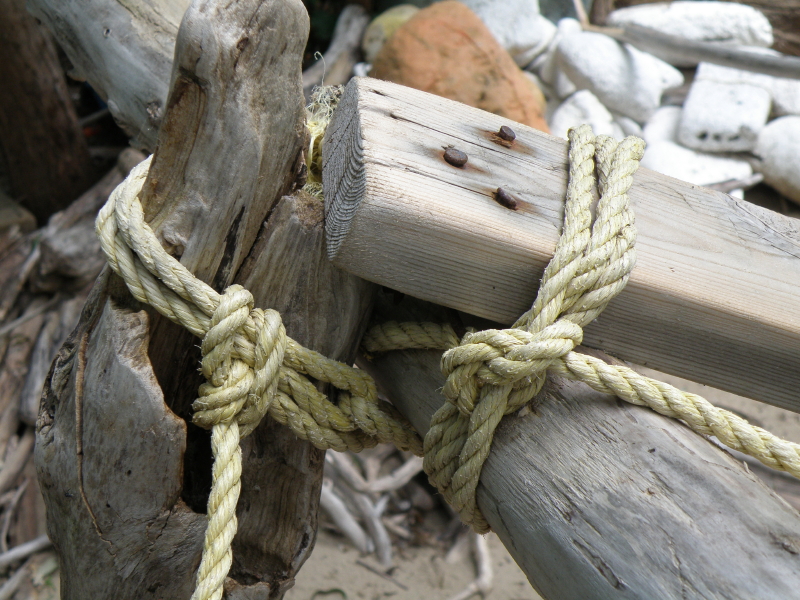
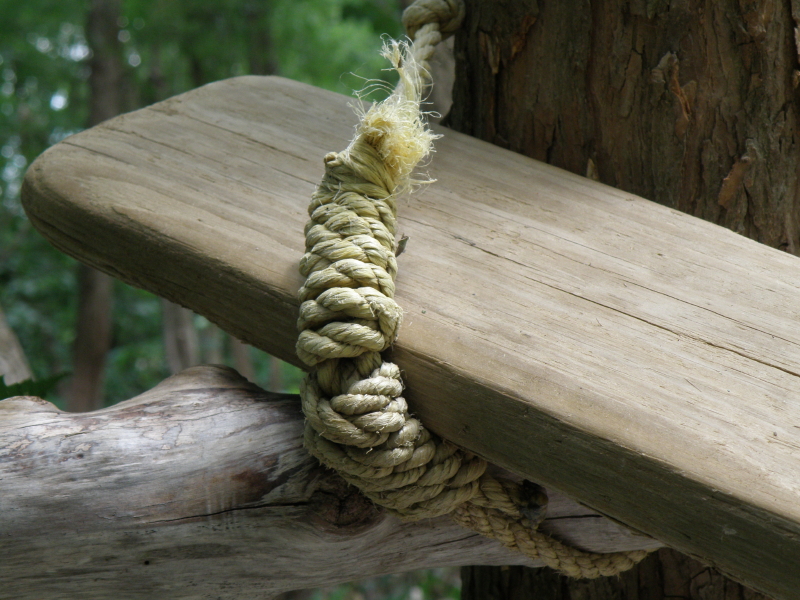
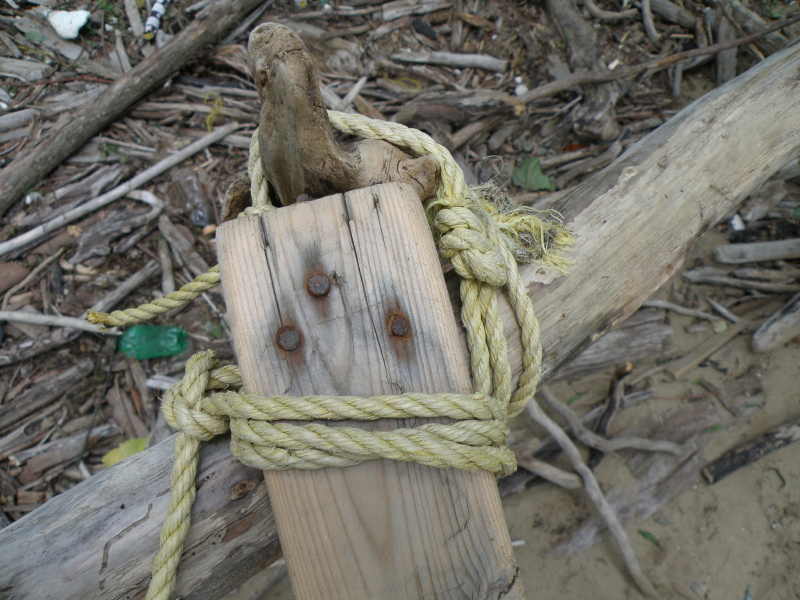
It was an already dramatic day in terms of the weather.  Bright sunshine alternated between heavy, dark clouds dumping rain showers along the way.  The clarity of the air and the mosquitoes were noteworthy.  I did get soaked on this adventure, but as long as the camera stays dry…I’m alright with it all.  Imagine my surprise upon arriving at my site to find that someone anonymously had built a structure around it!  I’m used to folks going through the junk I’ve scavenged and taking or destroying whatever creations I may have left behind, but this is a first!  A great deal of care was used in working with the existing site by utilizing the surrounding trees and logs as posts and beams.  I wonder if this is also the work of more than one person?  This is more than a flimsy lean-to where the wood is simply stacked.  Some craftsmanship is evident from the knots used to hold the structure together.  It might take more than one person to steady things as another does the tying?  Again, more pictures to illustrate the story.

knots used to hold structure together, June 2013

knots used on wood structure, June 2013

knots and wood, June 2013

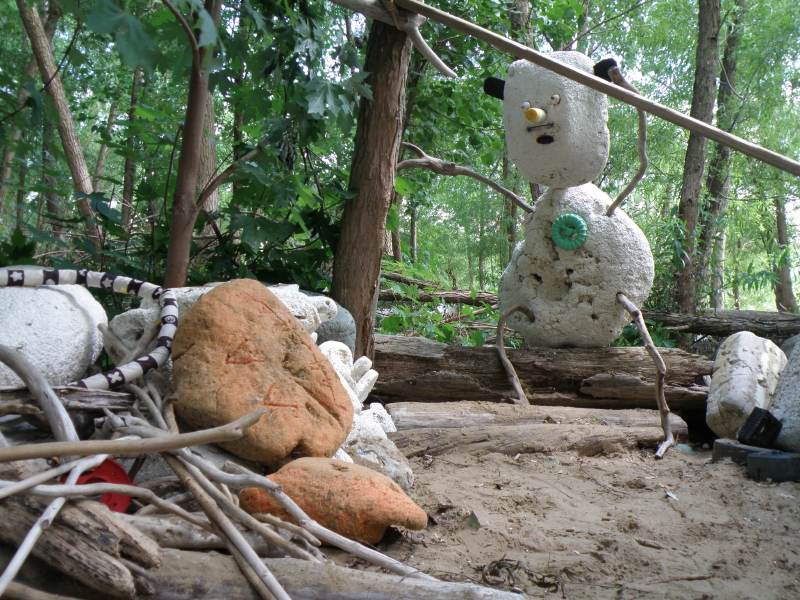
The yellow nylon line is something I had found previously and used to create the giant spider’s web featured in an earlier post.  This structure has a chance to stay up for awhile…at least until someone else messes with it or the river rises again.  I was absorbed with the changes and reflecting on how often I have looked at this site from an archeological perspective.  It might even be fun to draw all this stuff in a scientific sort of way.  Because it had rained while I was looking around, the damp ground muffled the approaching sounds of my second big surprise of the day!

Figure with large head, June 2013

I turned and looked over my shoulder as this large presence stepped over the logs and entered the studio area.  He sat right down and asked, “Are you the guy that makes the Styrofoam sculptures?”

Big Figure with Pencil-thin mustache, Falls, June 2013

Big figure with pencil-thin mustache, June 2013

Whoa!…(I said to myself),…check out this dude with the huge head, miss-matched eyes, and pencil-thin mustache.  No doubt about it…I was a bit taken aback!  Regaining my composure, I replied that indeed I was that person and added that many of those creations were made in this very spot.  Without every telling me his name, he replied “I thought so…I’ve been an admirer of your work for a long time now.”  Knowing he was a fan set me at ease and we had a nice visit together.

Big Figure with pencil thin mustache, Falls, June 2013

Portrait of the Figure with the Big Head and Pencil-thin Mustache, Falls, June 2013

“So, how do you like it?”  Spreading his spindly arms around my studio,  I gathered that he was the architect of these recent improvements.  I told my mustachioed friend that I just love it when people play along and contribute to my Falls of the Ohio project!  I could see this clearly delighted him.  He asked if there were any suggestions for improvements and I replied that I had a few ideas.  To begin with, it is now much more difficult to move within the space.  I whacked my head a few times on wooden supports.  If the structure were higher…that wouldn’t be an issue and I also wouldn’t turn into a hunchback any sooner than I have to.  I also added that I missed having the big log to use as an impromptu work surface.  When I stood, it was just the right height.  Now, it is covered up with stacked wood.  I could see from his expression that this was probably enough in suggestions for this time.  I didn’t tell him that I needed to create new seating because the plank I liked using had been damaged.  That’s no big deal.  With the clouds ahead promising more rain, I gathered my camera, collecting bag, and walking stick and bid my new friend so long…for now.  Perhaps we’ll meet again?  Looking back, I saw the big guy sitting in my customary spot.  As I walked over the driftwood and sand, I wondered if my next visit to this site would harbor any more surprises?

The Big Guy with Pencil-thin Mustache at the studio, Falls of the Ohio, June 2013


Read Full Post »

Falls of the Ohio, late May 2013

Another great day at the Falls of the Ohio.  Although it’s late May, we haven’t immediately jumped from a cool spring into a sweltering summer heat.  We still have time for that.  I’m following the deposited driftwood which forms these nice clearings punctuated here and there by small stands of willow trees.  There’s a method to my walks.  I carefully and as quietly as I can listen and look for any bird life in each new area I move into.  If I don’t find any birds than I move around the driftwood looking for interesting pieces and any other water born junk of note.  If an object captures my eye, I usually take a photograph of it in the context of the environment surrounding it.  If it is something really unusual, portable,  and potentially useful…then I may drop it into my collecting bag.  I also try to pay attention to any new flowers or insects that are out since my last visit. I don’t collect anything living since with the exception of fish…it’s against the park’s rules.

Falls of the Ohio, late May 2013

I will also walk the river bank doing much the same thing before heading back into the trees and my studio under the willows.  It’s here at my outdoor “atelier” that I check out my latest finds and with the materials I’ve previously collected…attempt to make art from them.  I was taking a break sitting on a bench I made and letting my mind “go blank” and just listening.  In the trees I could hear Northern orioles, Blue jays, and Catbirds all making their distinctive sounds.  With birds, you don’t need to see them to know they are present.  Small, noisy flocks of Cedar waxwings were flying from mulberry tree to mulberry tree seeking out ripe fruit.  I also kept hearing a “clicking or clacking”  sound originating behind where I was sitting which I mistakenly took for a squirrel moving among the branches.  I would look over my shoulder every now and then, but I didn’t see anything at first.  I didn’t see anything at all…until it moved!

Giant spider on web, late May 2013

Between its cryptic coloration and the dappled light effects of sunlight filtering through the tree tops…I had completely missed seeing the biggest spider in the world!  I know I had to walk by this marvel, but it didn’t register at all until this moment.  The spider wasn’t making any threatening gestures yet…perhaps it was remaining still “thinking” that I hadn’t located it.  The spider on its web was perhaps a dozen feet away from where I was sitting.  Meanwhile the hairs on the back of my neck were on end and I had an acute case of goosebumps all over my body!  Instinctively, I reached for my camera and started taking pictures.

Giant spider, May 2013

Carefully walking around the spider and its web, I snapped off as many images as my nerves would dare.  I still had no idea what it was capable of doing especially in protection of its nest?  I had my stout walking stick at the ready.  Nestled in a depression in the wood at the web’s base was a silk-lined “pocket” that held three white cocoons.  I wasn’t sure if these were egg cases or the wrapped up remains of former meals?

giant spider egg cases?, Falls of the Ohio, May 2013

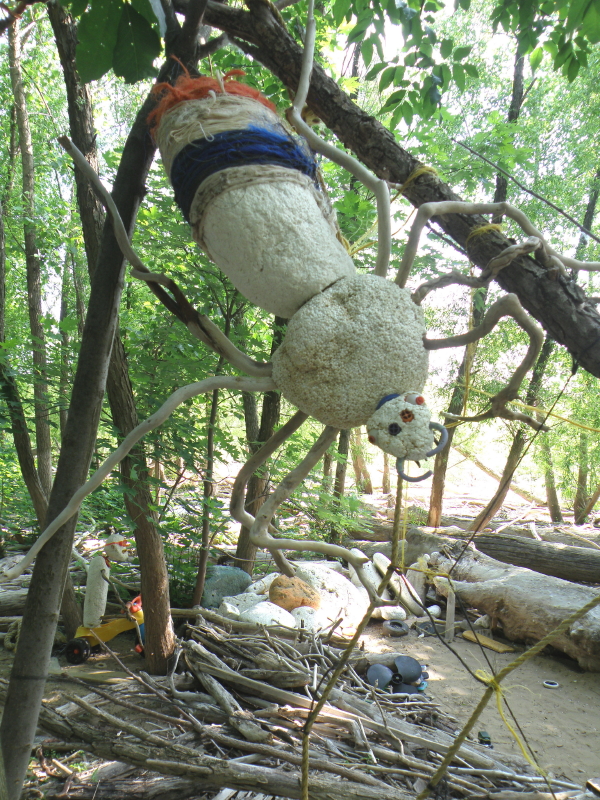
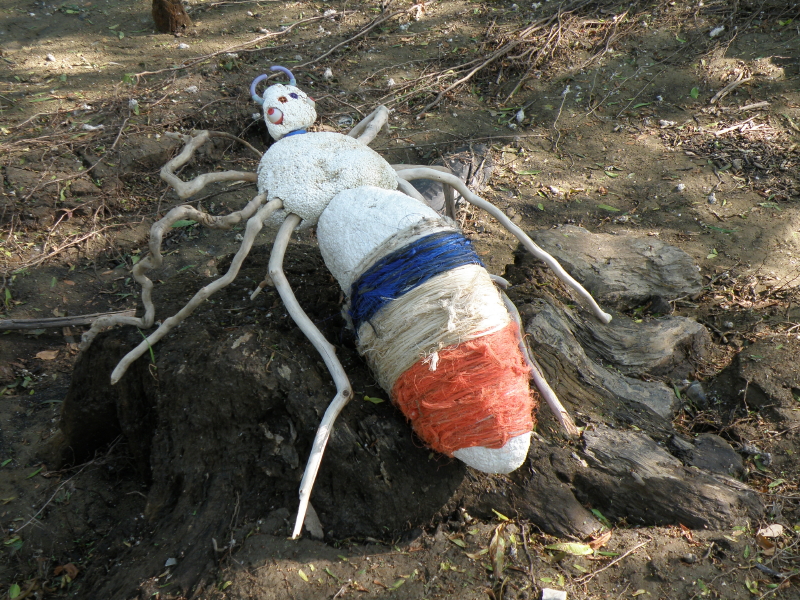
In trying to describe this spider to you…I utilized my walking stick not only for protection, but to gauge its size as well.  Later in the comfort of my home, I estimated that the length of its body from the head to the tip of its abdomen to be approximately 30 inches or 76 centimeters long.  It’s moving legs made the spider seem much larger, but they were harder to measure.  The legs were perfectly camouflaged resembling the driftwood all around us.  The spider’s abdomen is covered with coarse hair arranged in bands of orange, white, and a bluish-black colors.  Otherwise, the spider is as white as the large river-polished chunks of Styrofoam that wash up on these fabled shores all the time.

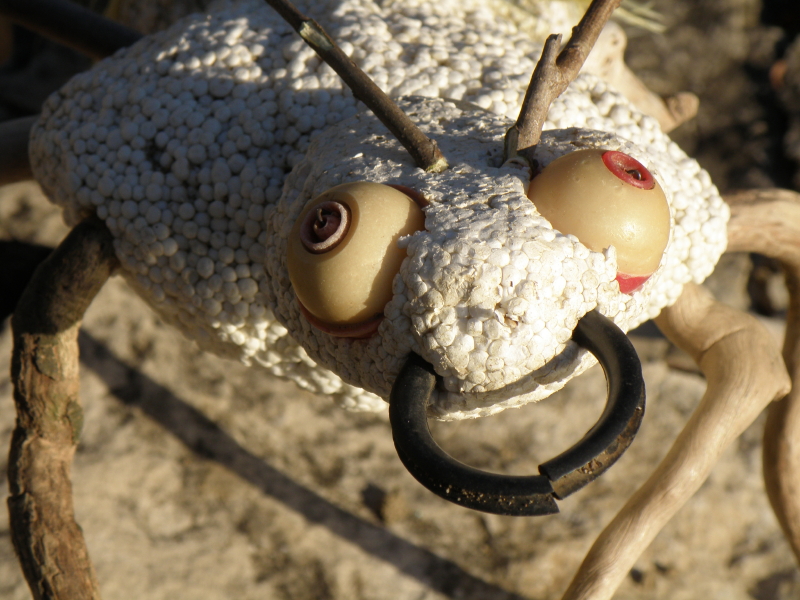
Head of Giant Driftwood Spider, May 2013

lower jaws of Giant Driftwood Spider, May 2013

The head of what I’m now going to call the “Giant Driftwood Spider” is very unusual for a spider.  The fact it is nearly distinct (as in insects) and not simply continuous with the thorax makes it different.  The head was not, however, capable of movement.  This spider features four eyes.  It has two, larger dominant eyes and a vestigial pair located between them.  The fangs were purple in color and supported by black jaws used for gripping prey.  The clicking sound I had heard earlier were its fangs rubbing together.  Like all spiders…I assumed that this species is carnivorous as well.? Consistent with true spiders, this giant species also has eight legs, although the Giant Driftwood Spider’s are not uniform.  After watching this great arachnid for several minutes, it surprised me by leaving its web and walking towards the river.  I naturally, followed behind it at a discreet distance.

Giant Driftwood Spider, May 2013

Giant Driftwood Spider on a stump. May 2013

Giant Driftwood Spider on tree roots, May 2013

The giant spider moved deliberately through the driftwood field pausing once in a while for whatever reason.  Thoughts about what this spider did for food crossed my mind.  Was it an ambush predator secretly lying next to a log waiting for a meal to walk by?  Did it rush and overwhelm its prey with a lethal bite to the body?  I thought this likely since its web by my outdoor studio didn’t seem big enough to capture anything larger than birds or rodents.  I got the sense that this spider was able to go a long time between feedings.  I continued to follow the spider when it stopped at another silk construction it had previously created.

Great Driftwood Spider in yellow silk lair, May 2013

The spider stopped by what I’m guessing to be another silk trap?  The spider may have been trying to hide its form with the silk?  Perhaps it uses a method similar to trapdoor spiders in catching its food?  I will confess that I do get “creeped out” by having spider webs go across my face.  I have always had an aversion to this feeling, although generally speaking…I’m okay with the spiders themselves.  In this particular area, it felt like I was constantly wiping my face which made me very ill at ease.

Giant Driftwood Spider in its lair, May 2013

Giant Driftwood Spider attack!, May 2013

I circled back around to get a better look and when I did the spider lunged for me! With fangs clacking together and its legs gesturing wildly, the spider held its ground, but did not advance towards me.  With stick at the ready and in deep fear, I was prepared to swing down as hard as I could on the spider if I had to.  That’s when it occurred to me how wrong that would be?  Who was doing most of the provoking anyway?  Perhaps the spider was reacting in self-defense?  As with most living things, this spider had as much if not more reason to fear humans.  Even though this was the biggest spider I had ever seen…I was still bigger than it.  With that realization I backed off and took my leave of the Giant Driftwood Spider.  Reaching my home, I couldn’t wait to see the pictures and to tell the story of this remarkable animal encounter.  The world is full of natural marvels and the Falls of the Ohio…has many of them.

willow tree and roots at the Falls of the Ohio, May 2013

Read Full Post »

Falls of the Ohio, mid May 2013

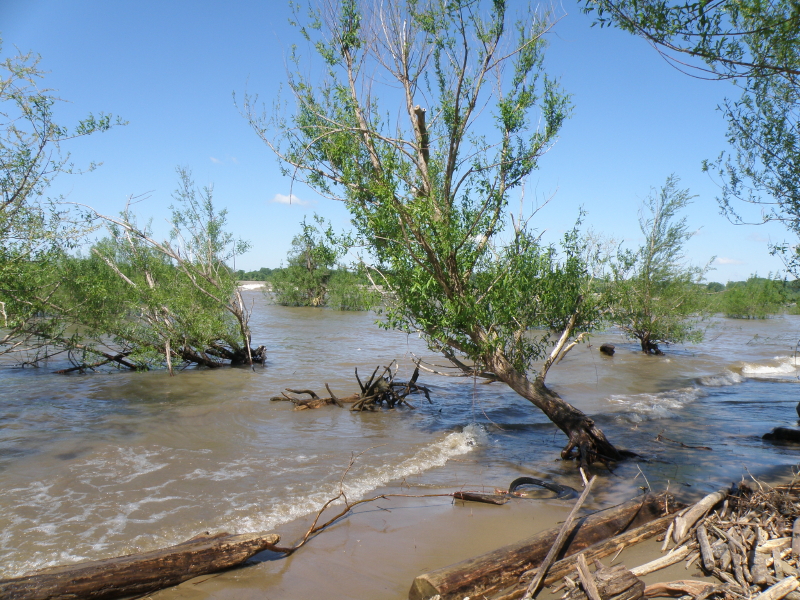
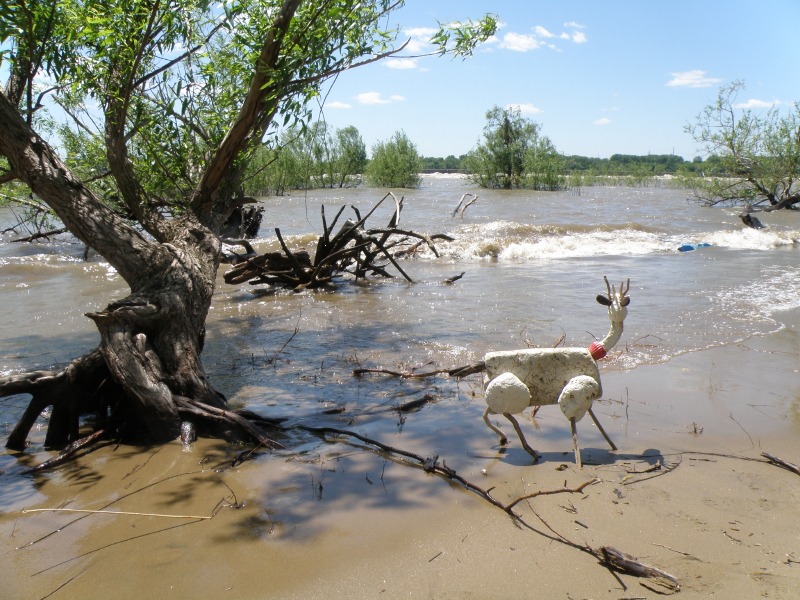
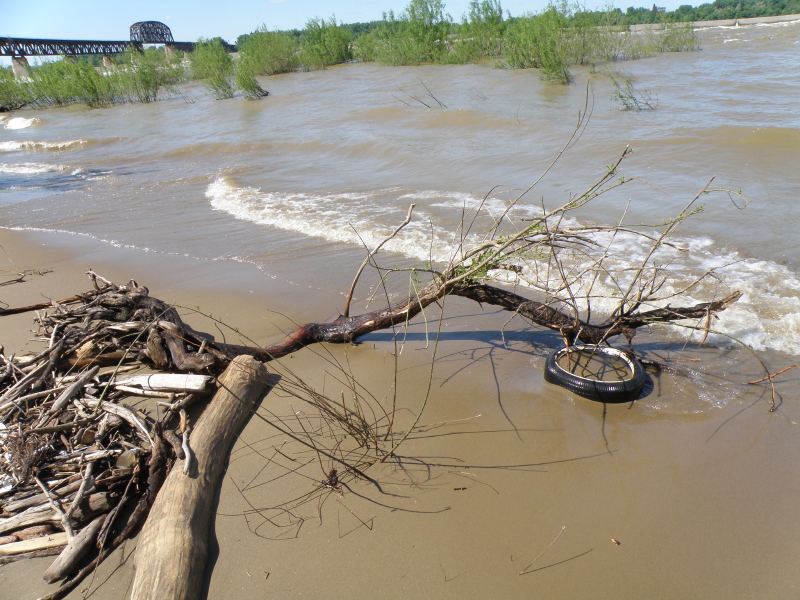
It’s mid May and the Ohio River is high at the Falls of the Ohio.  A now warm wind (it was cold yesterday) is driving muddy waves against the shoreline and the willow trees are in their element.  Except for me…there is no one else around.  Bird life, however, is ever-present and I count many newly arrived species that spent the winter south of the equator.  Eastern Kingbirds are establishing their territories and many different birds already have active nests going.  A bright blue Indigo Bunting flies into my sight line long enough to be identified before once again hiding from view in the tops of the trees. Because the river is taking up most of the bank, I’m walking on top of the driftwood on the parameter of the willow environment.  As I slowly walk along, I move as quietly as possible between the trees.  I’m always hopeful of seeing wildlife and although it is mid morning…I get lucky.  Something has caught my eye down the beach at the water’s edge and I reach for my camera.

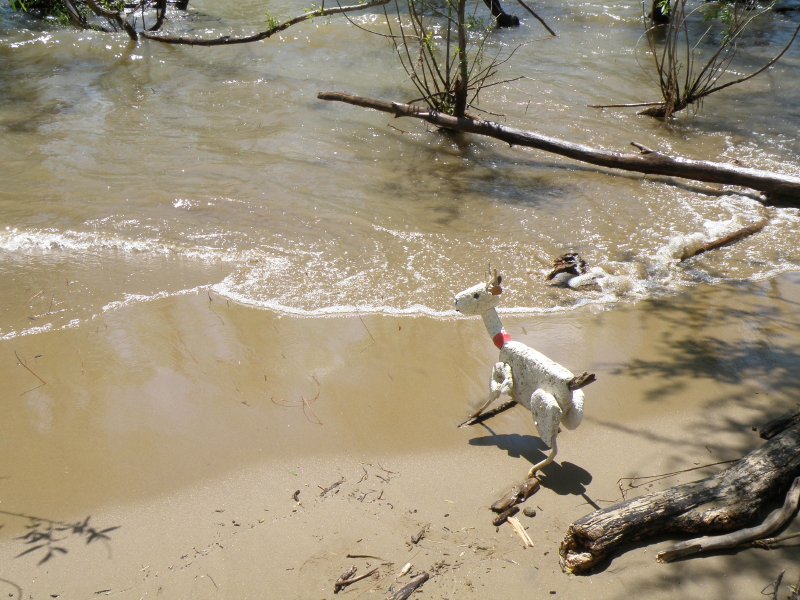
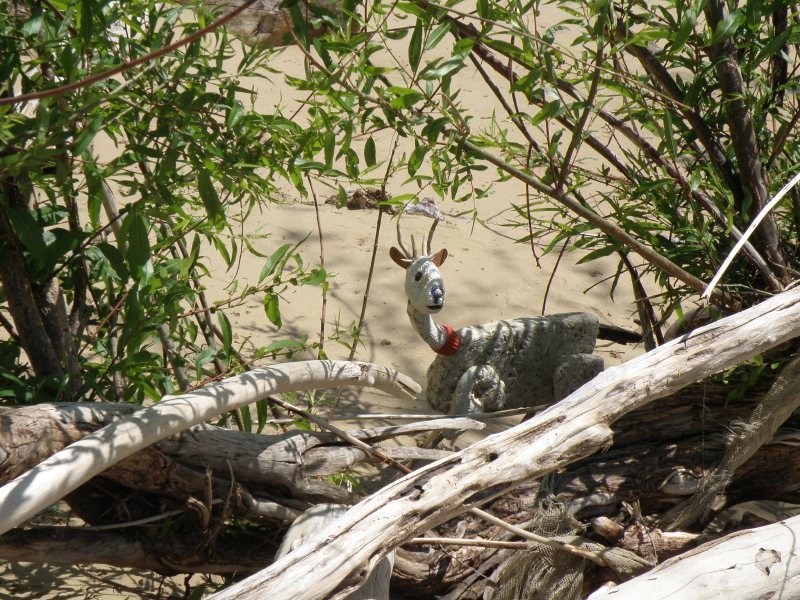
young Styrobuck at the water's edge, Mid May 2013

It’s a young Styrobuck and it is nervously checking out the river.  The wind is blowing my scent in the opposite direction. This is indeed great luck because this unusual animal is also one of the rarest mammals in this area.  Years can go by between sightings and there is always conjecture on whether they still exist here at all.  Occasionally, tracks are found which renews hope that they still occupy their original range. I decided that this was too great a photo opportunity to pass up and so I changed my plans for the day.  I would follow and record this beautiful and odd animal for as long as I could.

Styrobuck at the river, May 2013

The Styrobuck is one of those hard to classify mammals.  Although genetically a deer…it also shares traits with goats and antelopes.  I recall getting caught up in the discovery in 1992 of a new large mammal discovered in the Annamite Range bordering Vietnam and Laos.  Science calls it a Saola, (Pseudoryx nghetinhensis) but it is also more colorfully known as the Asian unicorn.  Anyway, its resemblance to an antelope is striking, but technically it is a member of the cow family.  Just when it was looking like all the big animals on the planet had been discovered…out trotted the Saola.  The mystery of it was amazing!  Of course, the indigenous people had known about it for a long time.  Once in a while, they would catch one in their snares meant for the other forest animals.  Still, it was a great rarity for them as well…a near mythic animal.  It was probably tasty too.

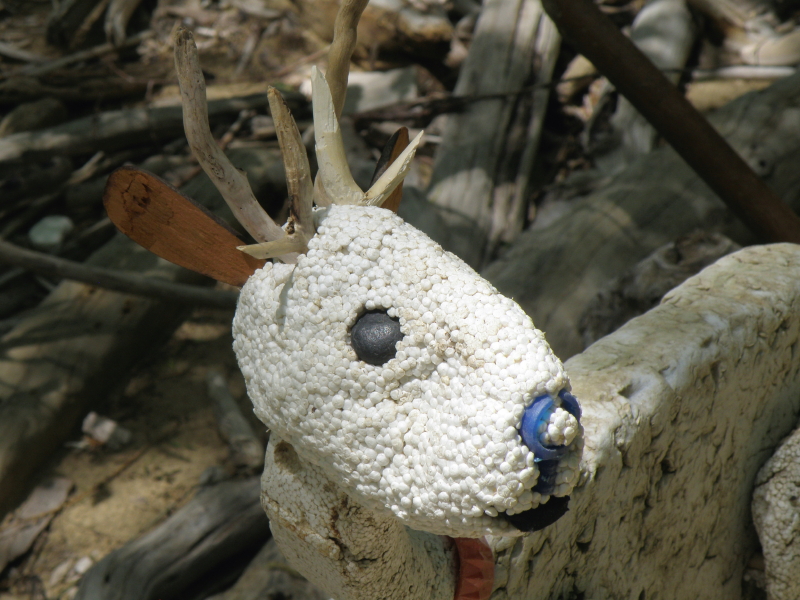
head of a young Styrobuck, May 2013

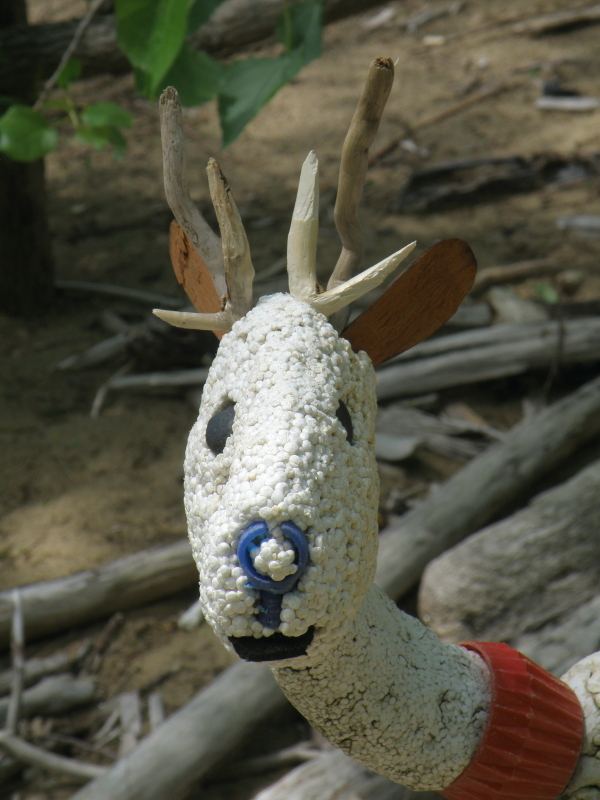
Styrobuck, detail of head facing forward, May 2013

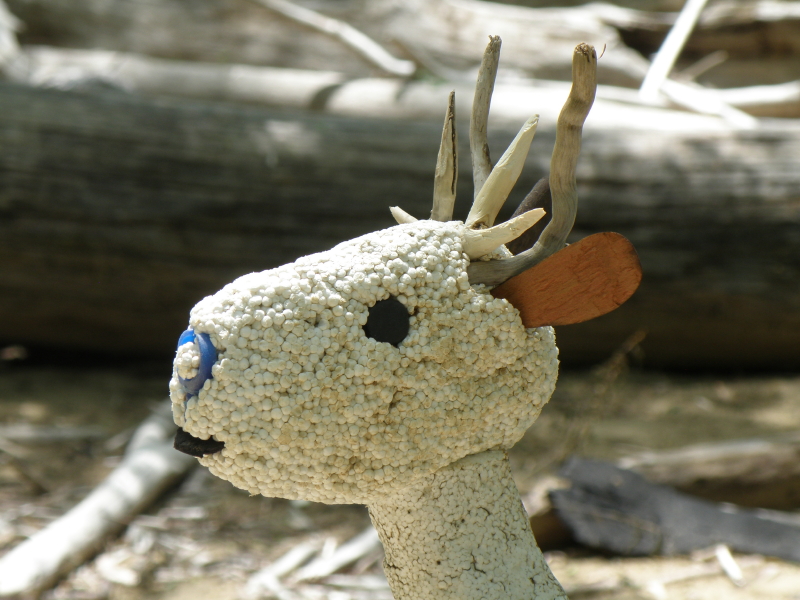
Styrobuck ,detail, head facing left, May 2013

The Styrobuck is by necessity a very nervous and wary animal.  It is about the size of a small dog and the perfect prey size for many of our predators.  It has large eyes and a keenly developed sense of smell.  There are also old first hand accounts that also suggest the Styrobuck has a sense of curiosity which can lead to its downfall.  Smallish antlers are grown and shed each year after the breeding season in the late autumn.  In the spring one to two fawns are born that remain with their mother until the following  summer.

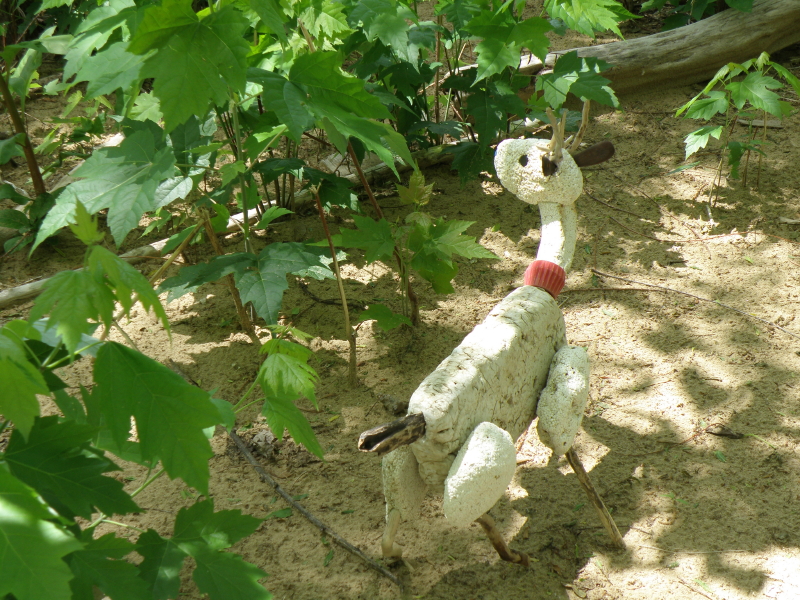
Styrobuck in the willow woods, May 2013

The animal I was watching was more than likely born last year and probably newly separated from its mother.  To my eye, it did appear that the young Styrobuck was searching for something in the vicinity.

young Styrobuck, mid May 2013

The Styrobuck certainly was concentrating in an area between the river and the margins of the woods.  If there were any other members of its species around here…they remained well hidden.  Every now and then the young buck would browse on young tree leaves and tender grasses.

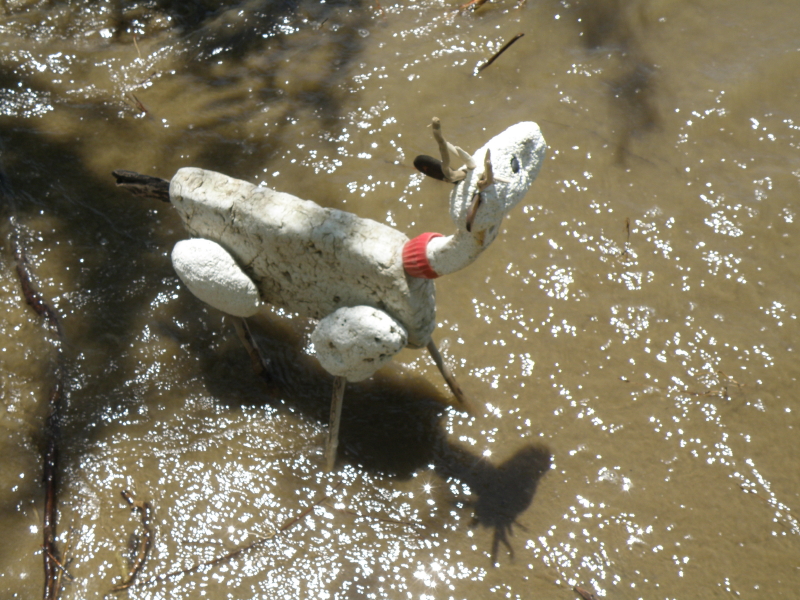
Styrobuck in the water, may 2013

My last image of the Styrobuck in the water was taken from a vantage point in the top of a willow tree that I quietly shinnied up.  I could feel the wind shifting and sure enough the young buck caught my all too human odor and bolted for parts unknown.  I shared my images with the Interpretive Center who were glad to receive them.  I hope exposing this one animal won’t lead to a stampede by the public that drives this vulnerable species from our area for good.  The Falls of the Ohio is a richer for having this interesting animal call this place home.

Falls of the Ohio, looking east, May 2013

Read Full Post »

« Newer Posts - Older Posts »