Feeds:
Posts
Comments

Posts Tagged ‘driftwood’

In the Willow Habitat, Falls of the Ohio, Nov. 2014

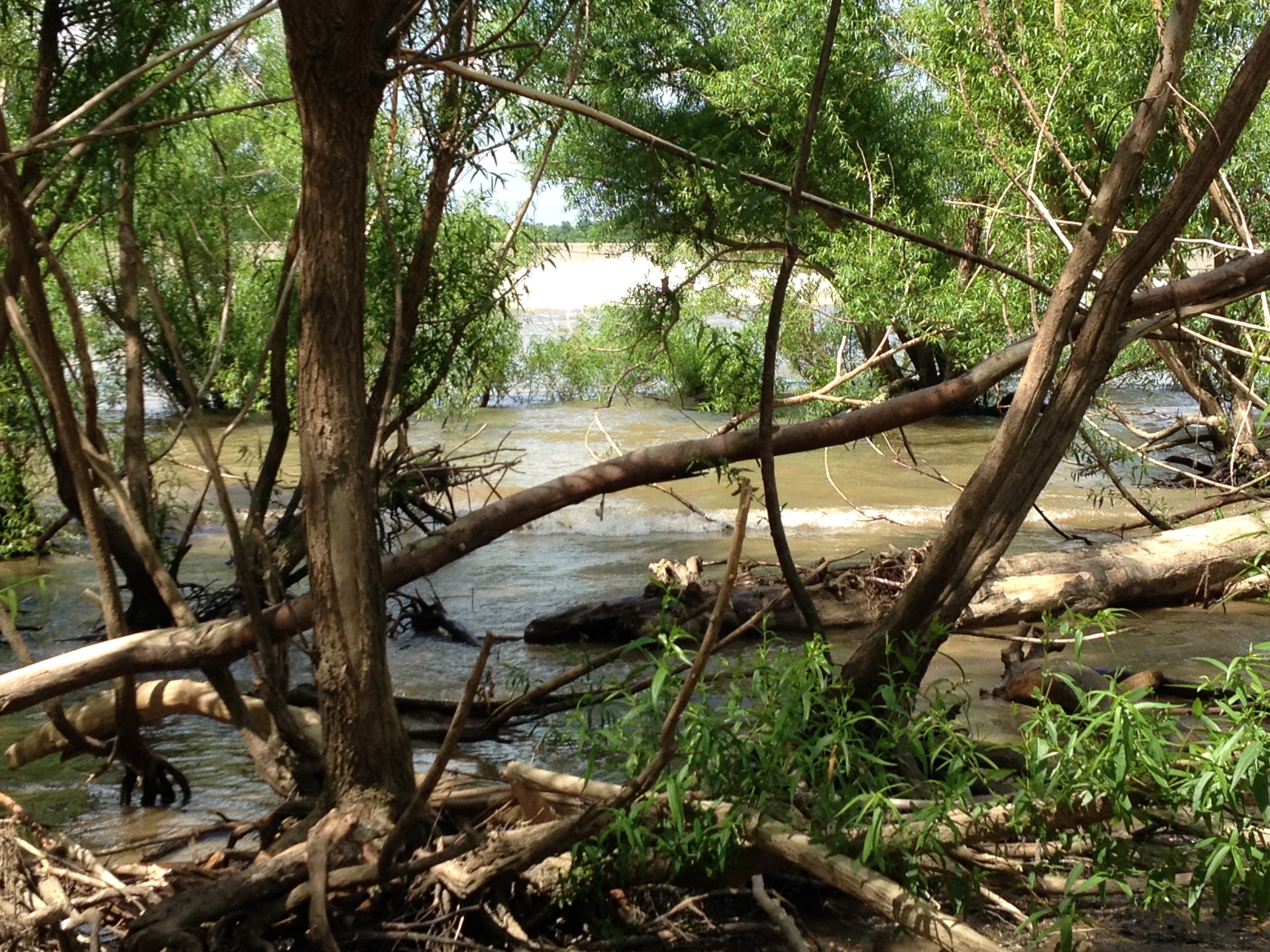
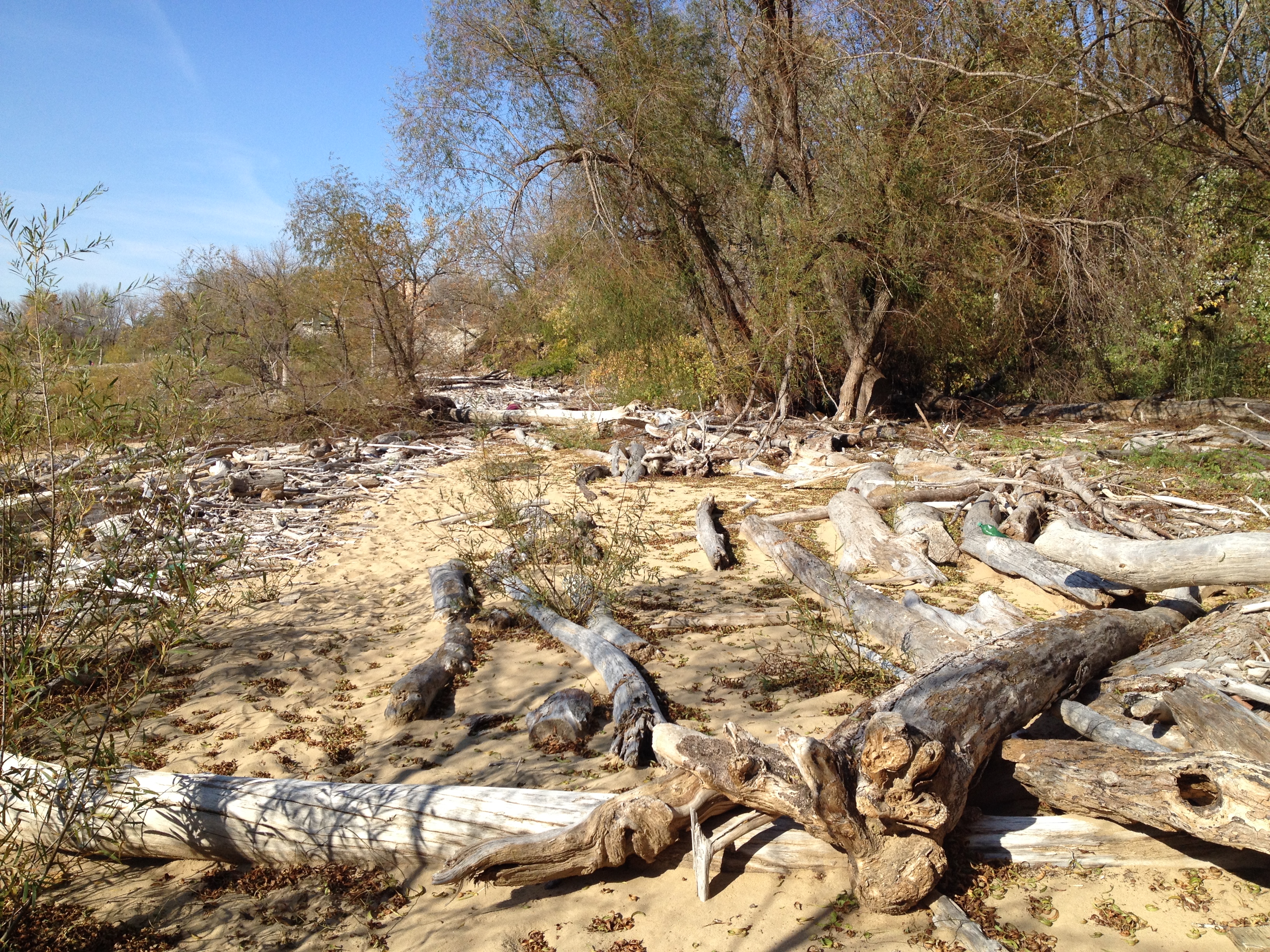
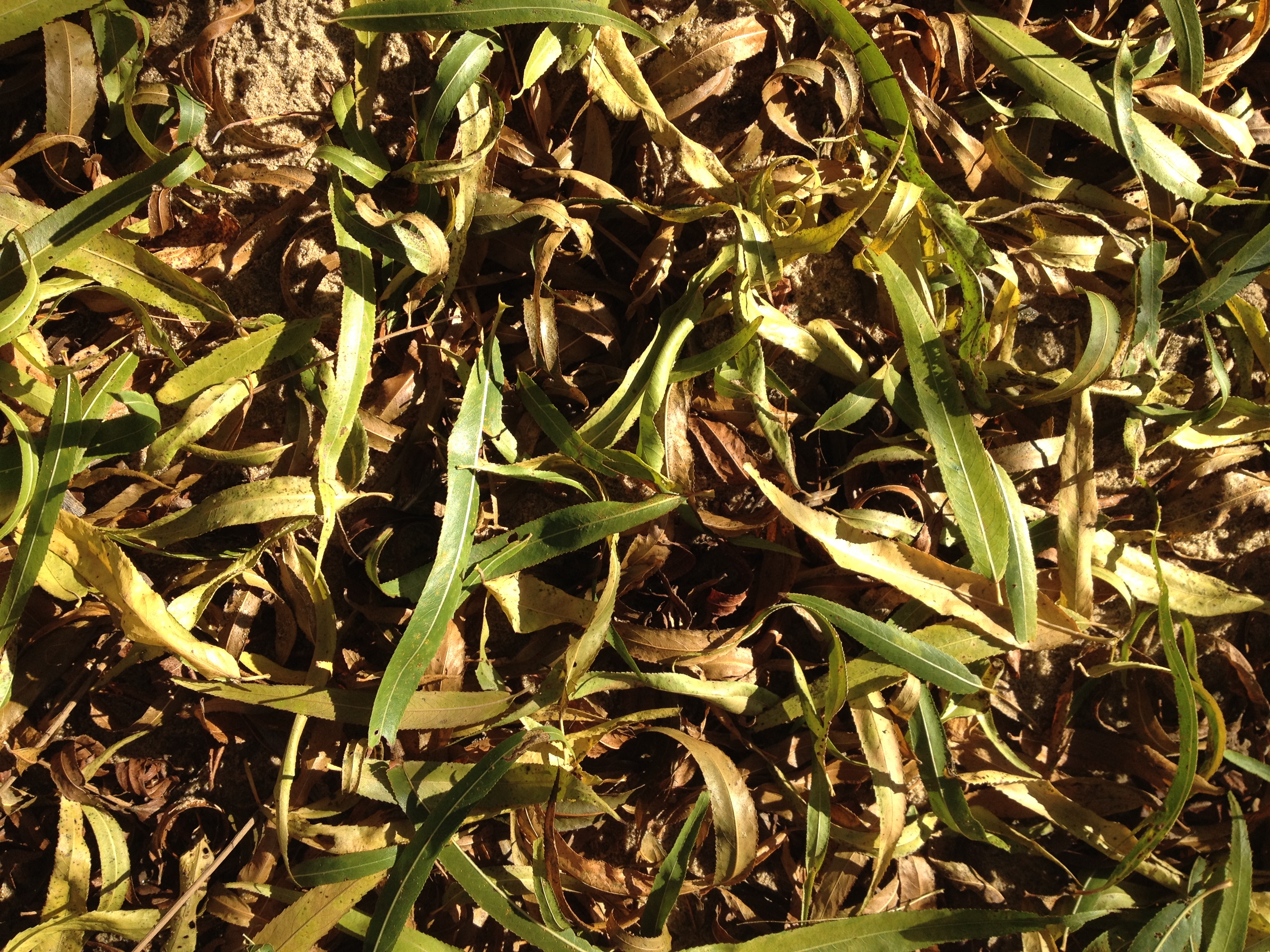
The Falls of the Ohio State Park has experienced its first light frost.  With the colder temperatures arriving, a maturing autumn anticipates the winter to come.  Although there are still some leaves left on the black willows and cottonwood trees…they won’t last much longer.  Already the curled up, shed leaves of the willows are gathering and forming brown islands around the parent trees and defining the spaces the willows occupy in this sandy area near the river.  As I walk through this habitat, cocklebur and various other seeds attach themselves to my jeans and shoe laces.  Picking and rubbing off the various prickly and sticky hitchhikers, it’s amuses me to think of myself as an agent of seed dispersal!
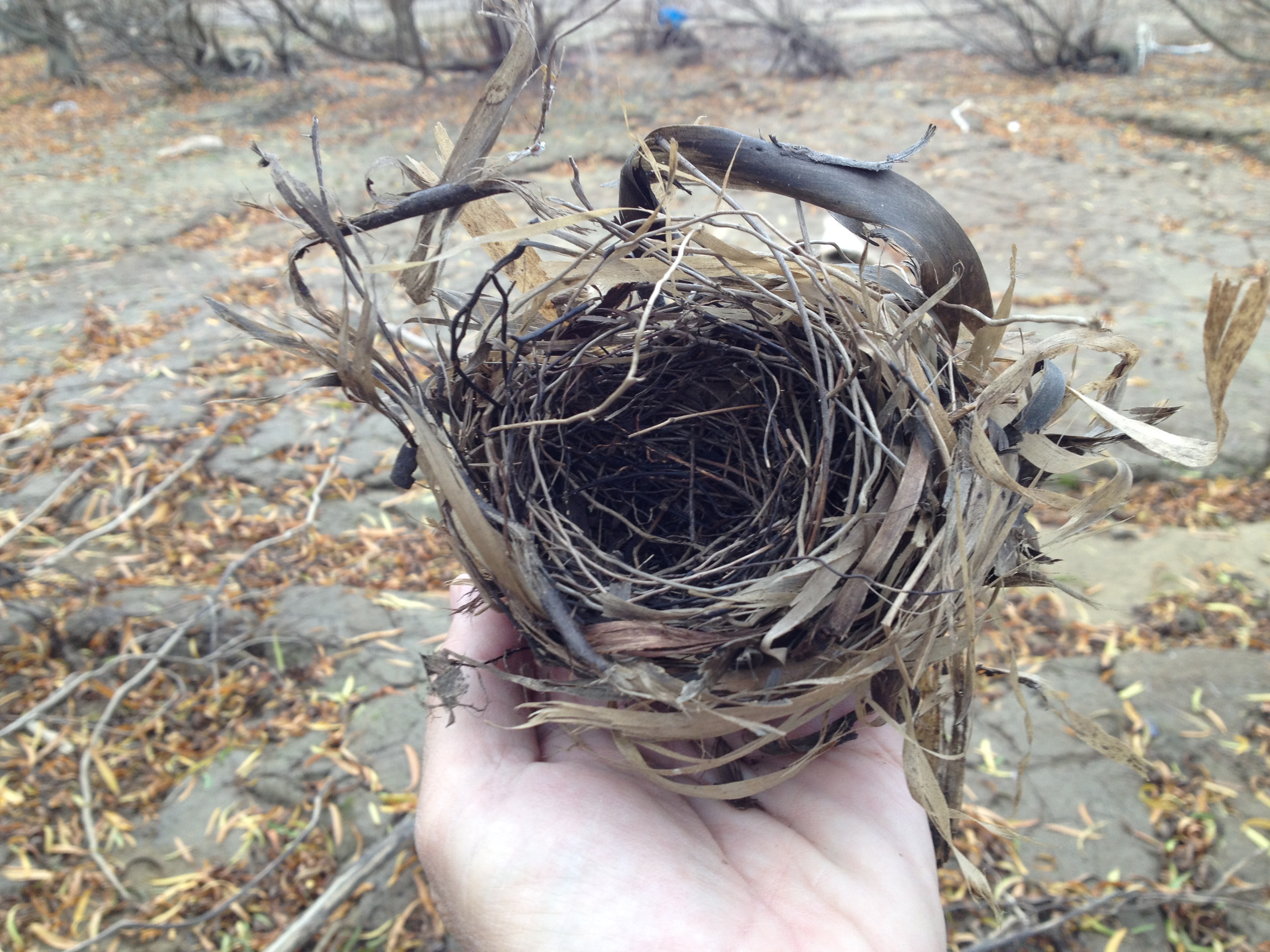
Found bird nest, Falls of the Ohio, Nov. 2014

A circular grass ball lying on the ground catches my eye.  Picking up the object I discover an intact bird nest.  Did it dislodge from some fork of a tree branch or is this from a ground nesting species?  I marvel at its construction and note its exterior is made from dried, interwoven grasses which contrasts with the well-defined interior composed of tiny twigs and rootlets that give structural strength to the bowl.  I wonder which species created it and were they successful in raising offspring?  The nest is now spent like the willow leaves and I place it on the ground to be reclaimed by nature.
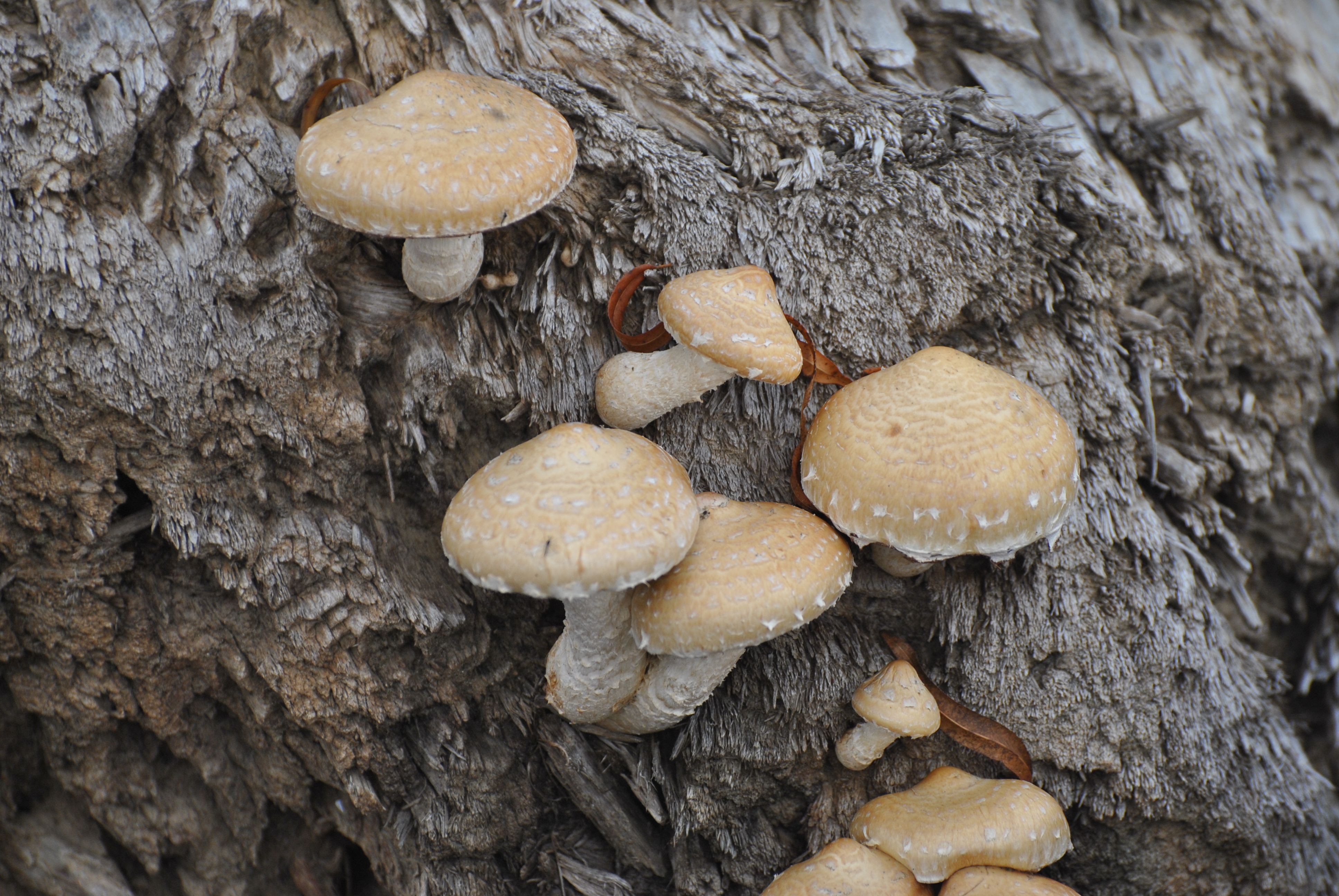
mushrooms growing on driftwood, Falls of the Ohio, Nov. 2014

Along my walk, I find various mushrooms and fungi growing on the decomposing driftwood.  I admire the variety of forms present.  Although the notion of decay hardly sounds optimistic…in this instance it is.  The fungi are great recyclers and return needed nutrients back into the environment.  These mushrooms are not lesser than, but rather co-equal to the many other interesting life forms that make this place their home.  I come across other signs of life along my hike.
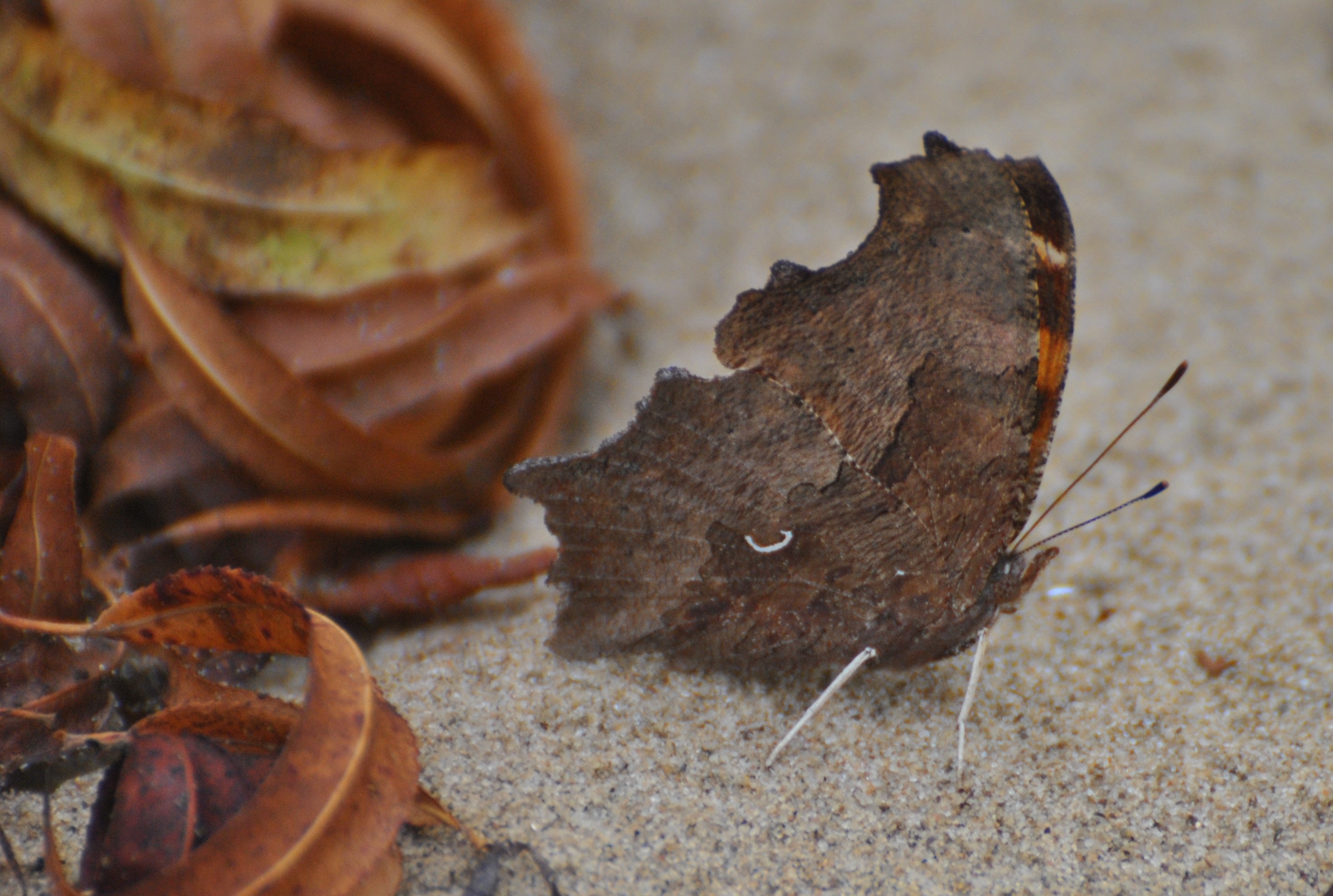
Comma butterfly with wings folded, Falls of the Ohio, Nov. 2014

There are still a few butterflies around like this Comma.  Although nectar from flowers is absent, there are still what I call “butterfly licks” on a few of the willow trees.  These licks are sweet spots along the trunk or branches where the tree exudes a sticky sap that attracts insects.  With its wings folded upright, this Comma looks much like a dried leaf itself.  There is a good chance this butterfly will hibernate and overwinter here before “passing the torch” to the next generation of Comma butterflies in the spring.
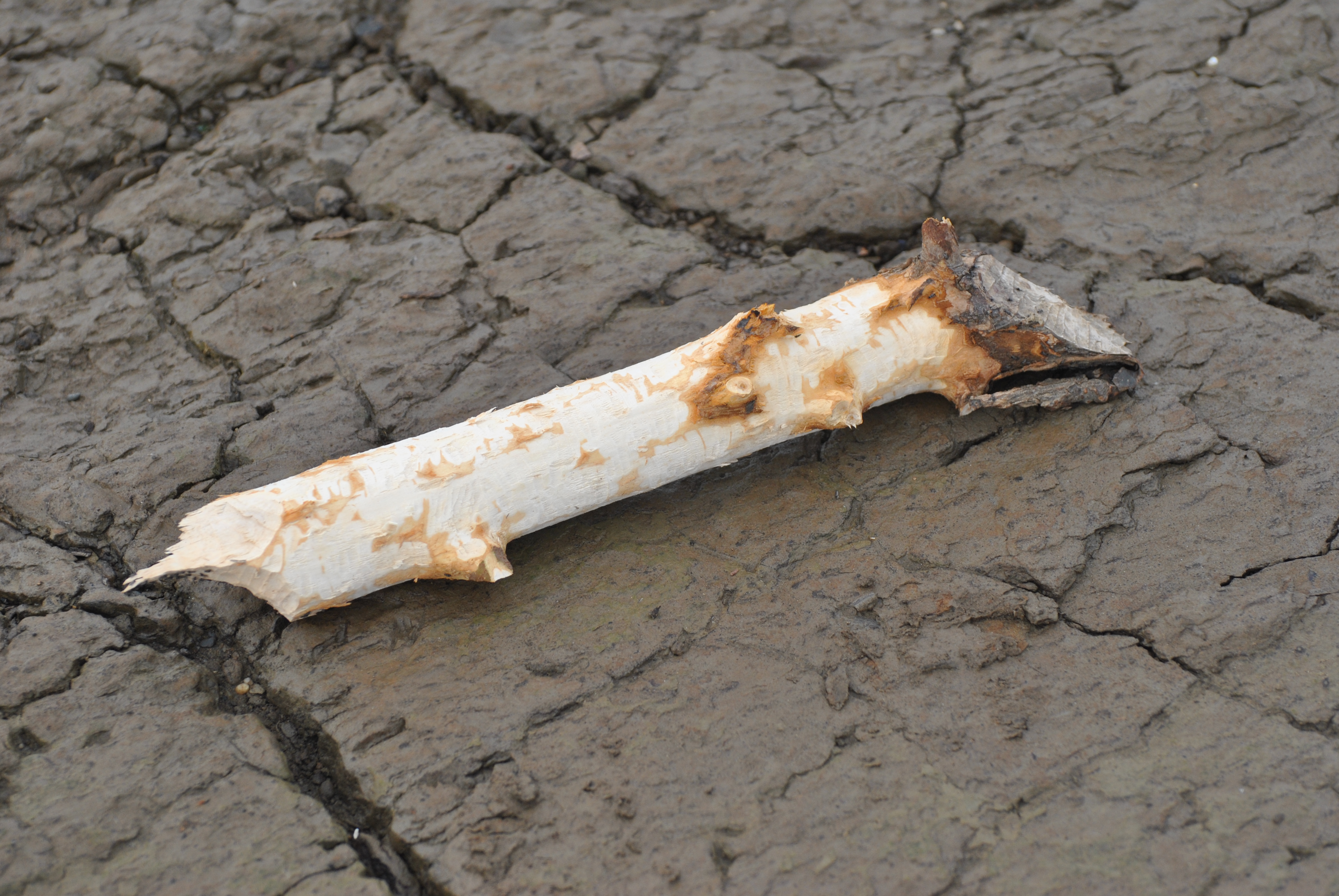
beaver chewed willow wood, Falls of the Ohio, Nov. 2014

Along the riverbank, I find lots of evidence that beaver have been in the area.  They have been feeding off the willow trees growing nearest to the water.  Beaver are very wary and are probably active at night or very early in the morning.  In all my years walking throughout the park, I have only seen them on a couple of occasions.  The photo above shows a willow branch that has been gnawed away from the tree and its bark has been nibbled off for food.  Their teeth leave “tool marks” on the creamy, ivory-colored wood.  By the end of today’s hike, I have collected a nice bundle of beaver chewed sticks to use in my art.  And speaking of art…I walked by a couple of projects I worked on in my previous post.  The rock ring in the water is still holding up, however, the “Silver Star” made from overlaying driftwood lengths in the sand is a shadow of its former self.  Here are a few before and after images.

Detail of silver driftwood star, Falls of the Ohio, Oct. 2014

remains of the "Silver Star" driftwood piece, Falls of the Ohio, Oct. 2014

It’s a big difference and doesn’t appear to be the result of natural wear and tear…unless we accept that there is a naturally destructive side to man’s nature?  Of course, this is just a pile of sticks arranged in the sand, but on a much larger, planetary level can we say that the wholesale changes we are making to the environment are natural and inevitable?  I’m in the “no” camp because another aspect of our complex natures is the ability to discern right from wrong.  Still I wonder when our instincts for self-preservation will start kicking in?  I was beginning to mull this over more when I heard what sounded like someone playing strange music from an unfamiliar instrument.  I was pretty sure my ears weren’t hearing things and so I walked around until I found its source.  You can imagine my deep surprise when I came upon this interesting character in the willow habitat.

The Giggle Master, Falls of the Ohio, Nov. 2014

He introduced himself as the “Giggle Master” and he said he heard me talking to myself about serious things and grew concerned.  His method of revealing himself was to play a tune of his own composition from this combination oboe/recorder that grew from the middle of his face!  By breathing in and out and working the finger holes on his instrument he could produce a variety of sounds some of which were quite unique and appealing.  When I had adjusted to the idea that a strange being about a foot or 20 or so centimeters tall was talking to me…I relaxed my guard and decided to see what would happen next?  The Giggle Master told me to follow him and that he had something to show me that he believed would lighten my mood up considerably.

The Giggle Master and his collection, Falls of the Ohio, Nov. 2014

I followed my new friend to his shelter under a willow tree and he introduced me to his “collection”.  Like me, the Giggle Master is a finder and collector of odd river-deposited items.  He said it gave him great joy to assemble various odd collections where the sum of the collection is greater and more interesting than the parts.  I understood this perfectly because I have many unusual collections of my own river junk.  Some of which have been presented in this blog like my Squirt Gun Collection or Collection of Fake Foods.  You can see other collections I’ve formed and appear in my Pages section..  I have to say that the collection my friend was presenting to me was indeed unusual.  I asked what he called it and would it be possible to photograph it and present it to the wider world?  He said that he had no objections and so without further ado…here is what my friend called “The Giggle Bowl”.

The Giggle Bowl, Falls of the Ohio, Nov. 2014

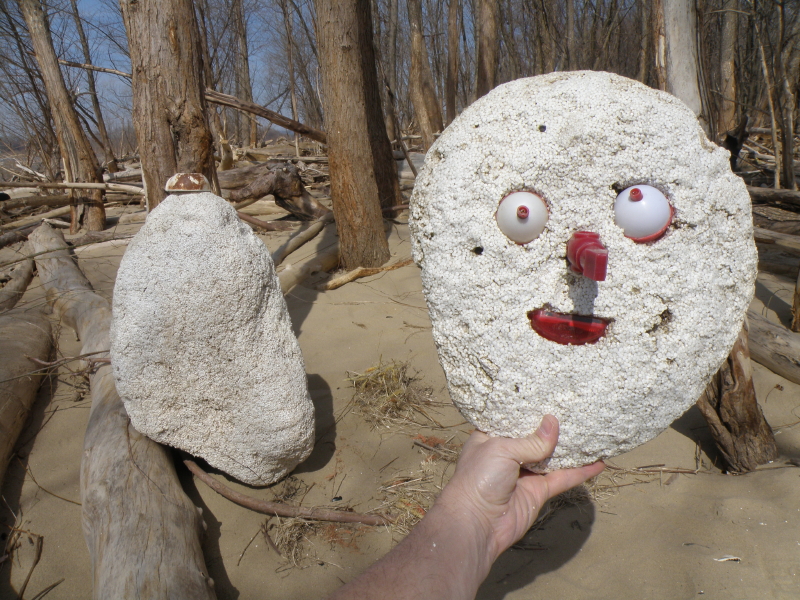
We moved to the fossil beds for our impromptu photo shoot.  The Giggle Master told me that he had been collecting these “smiley faces” for a few years and now had enough to fill a found plastic bowl.  He went on to say that although he recognized that this was mostly waste plastic with all the accompanying bad baggage…it was also important to be able to step back and just appreciate the absurdity of it all.  The Giggle Master told me that taking oneself too seriously has potential consequences of its own.  He also told me that maintaining a healthy sense of humor would balance out the dark moods and I began to see the wisdom in this.  The Giggle Master said that he was appearing to me now because through some sixth sense all his own he could tell my own thoughts and feelings were beginning to sink below the horizon line.  He believed every person’s well-being would benefit from having a good laugh.  I have to admit it worked on me!  Okay, let’s spill the bowl and take a closer look at this goofy collection.
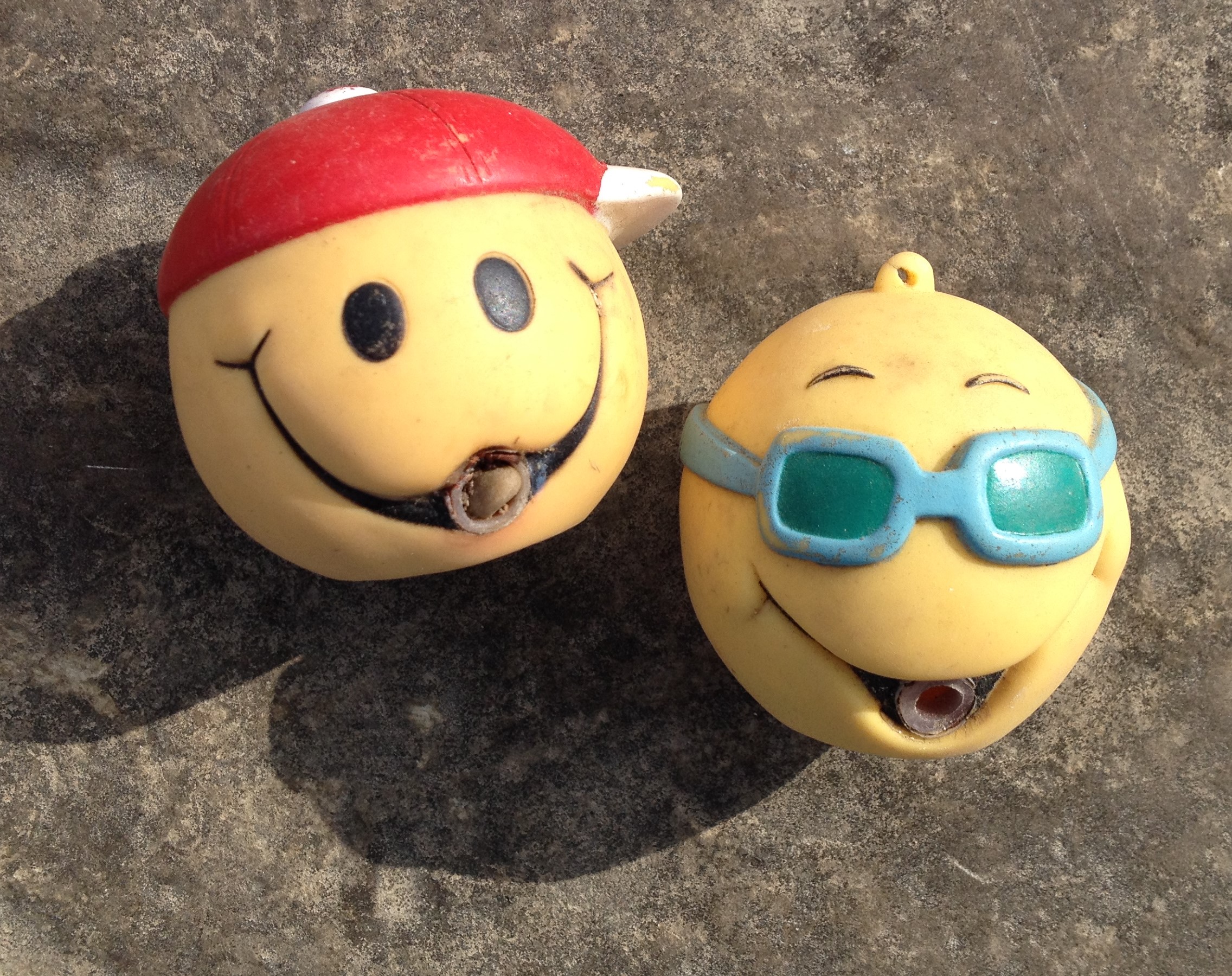
Two Smiley Face balls, purpose unknown, found at the Falls of the Ohio State Park

Okay, I confess that I have no idea what or how these smiley faces were used?  In their mouths, they have what look to be squeakers, however, these balls are too hard to squeeze.  The one with the red cap has a small stone lodged in its mouth and was made in China.

Three smiley face antenna balls, found at the Falls of the Ohio State Park

I frequently am grateful when something I come across says what it is.  In this case, these are three lightweight foam “antenna balls”.  Yes, for a while, there was a fad where people decorated the ends of their cars’ radio antennas with these novelties.  I like the one sporting a jester’s cap.
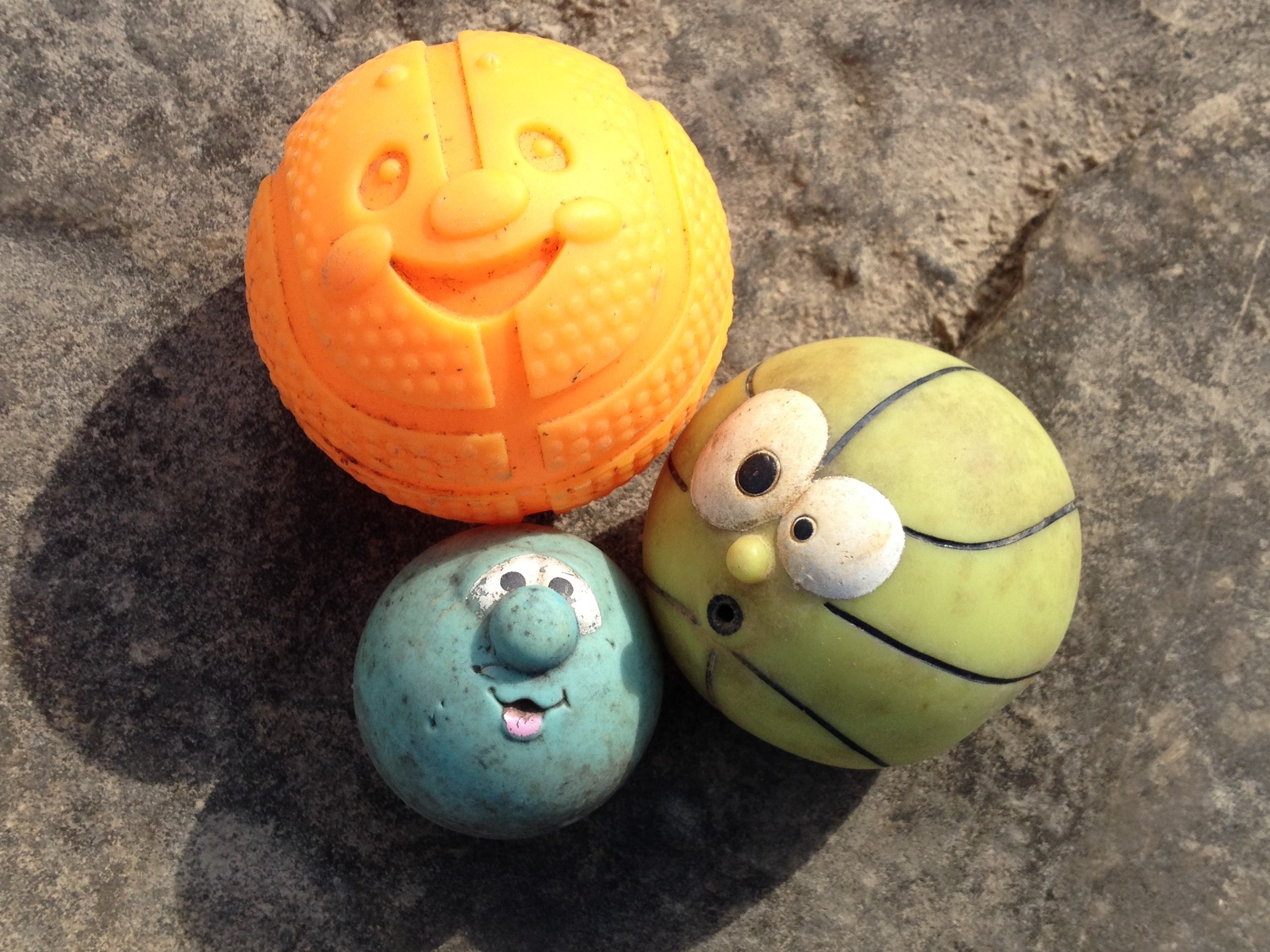
Three hard plastic face balls found at the Falls of the Ohio.

I’m calling these simply “face balls” because they are obviously not the more traditional “smiley faces”.  They floated into the park via the Ohio River from parts unknown.
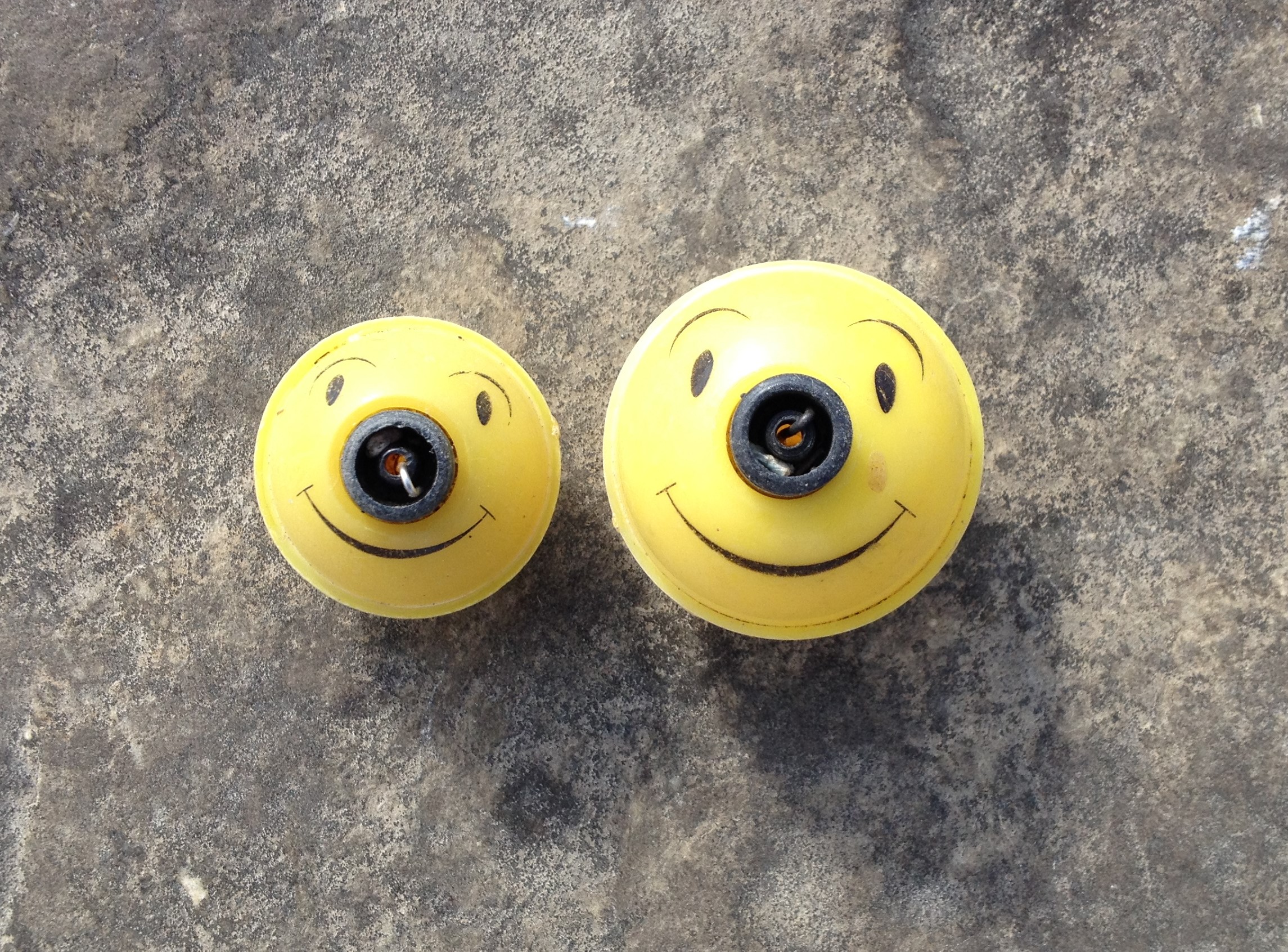
Two smiling face fishing floats from the Falls of the Ohio

The Giggle Master was slightly alarmed because he realized he is missing the third smiling face from this series of objects.  I recognized that these are fishing floats and the missing float is larger still.  It will turn up somewhere.

A trio of plastic smiley faces found at the Falls of the Ohio

Here’s a trio of smiling faces.  The yellow one in the center is a simple ball, but the top and bottom pieces belong to something else I don’t recognize…do you?  The top piece looks to be a tiny container and maybe once held candy or soap-bubble solution, but there is no other information about it including its country of origin.
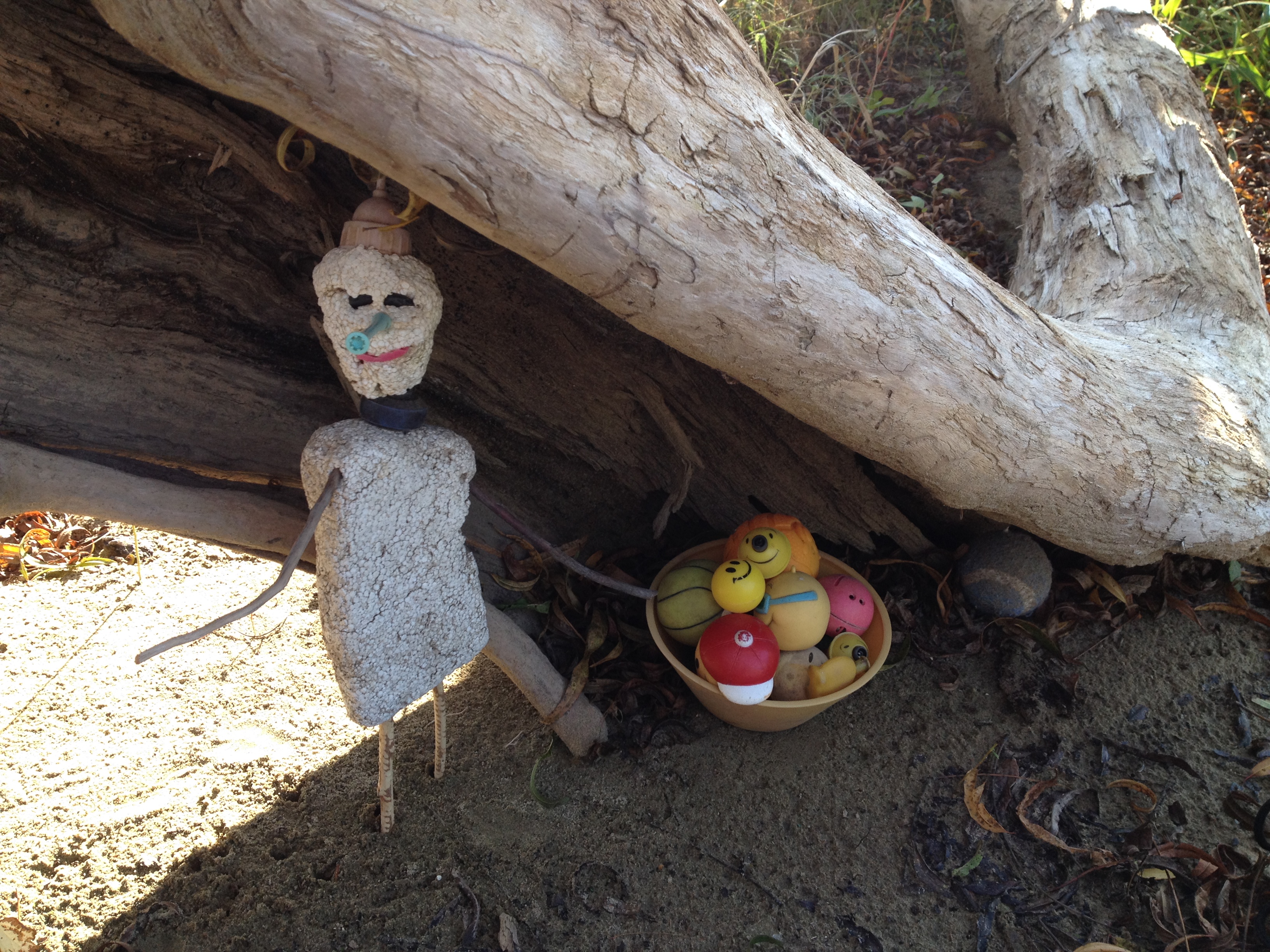
The Giggle Master with his Giggle Bowl collection, Falls of the Ohio, Nov. 2014

After the photo session was over, we returned to the willow tree where I first met the Giggle Master.  He stored his collection in a hollow formed in the tree’s trunk.  Before departing from my new friend, I thanked him for the much-needed laugh and wished him happy hunting as he expanded his silly collection.  No doubt the river will continue to supply new items.  He replied with a few notes from his…”nose instrument’.  As I turned for home, I looked back one last time and could discern a slight smile on his tiny face.  Until next time from the Falls of the Ohio.
fallen black willow leaves, Falls of the Ohio, Nov. 2014

Read Full Post »

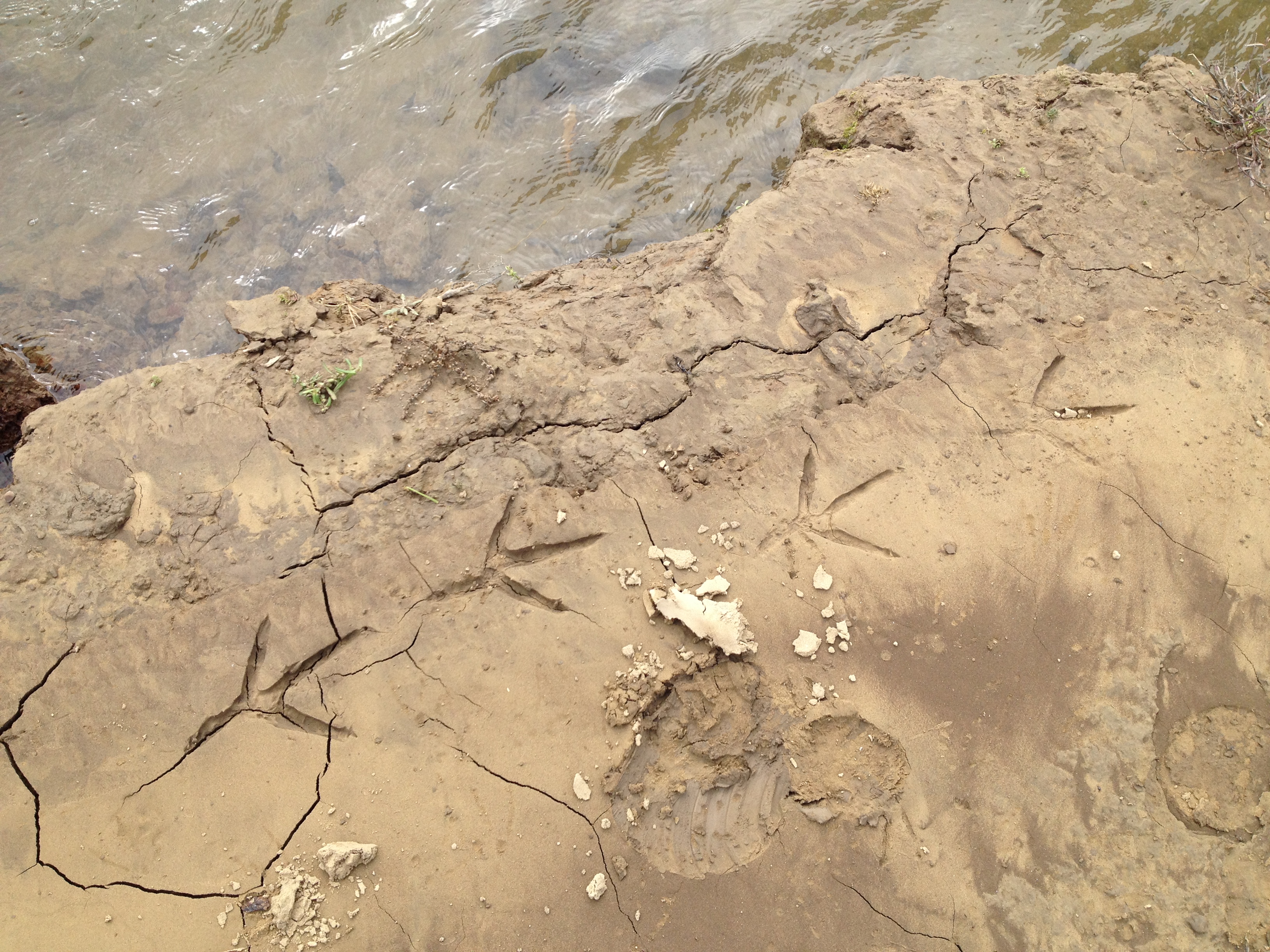
Great Blue Heron tracks in the mud, Falls of the Ohio, Oct. 2014

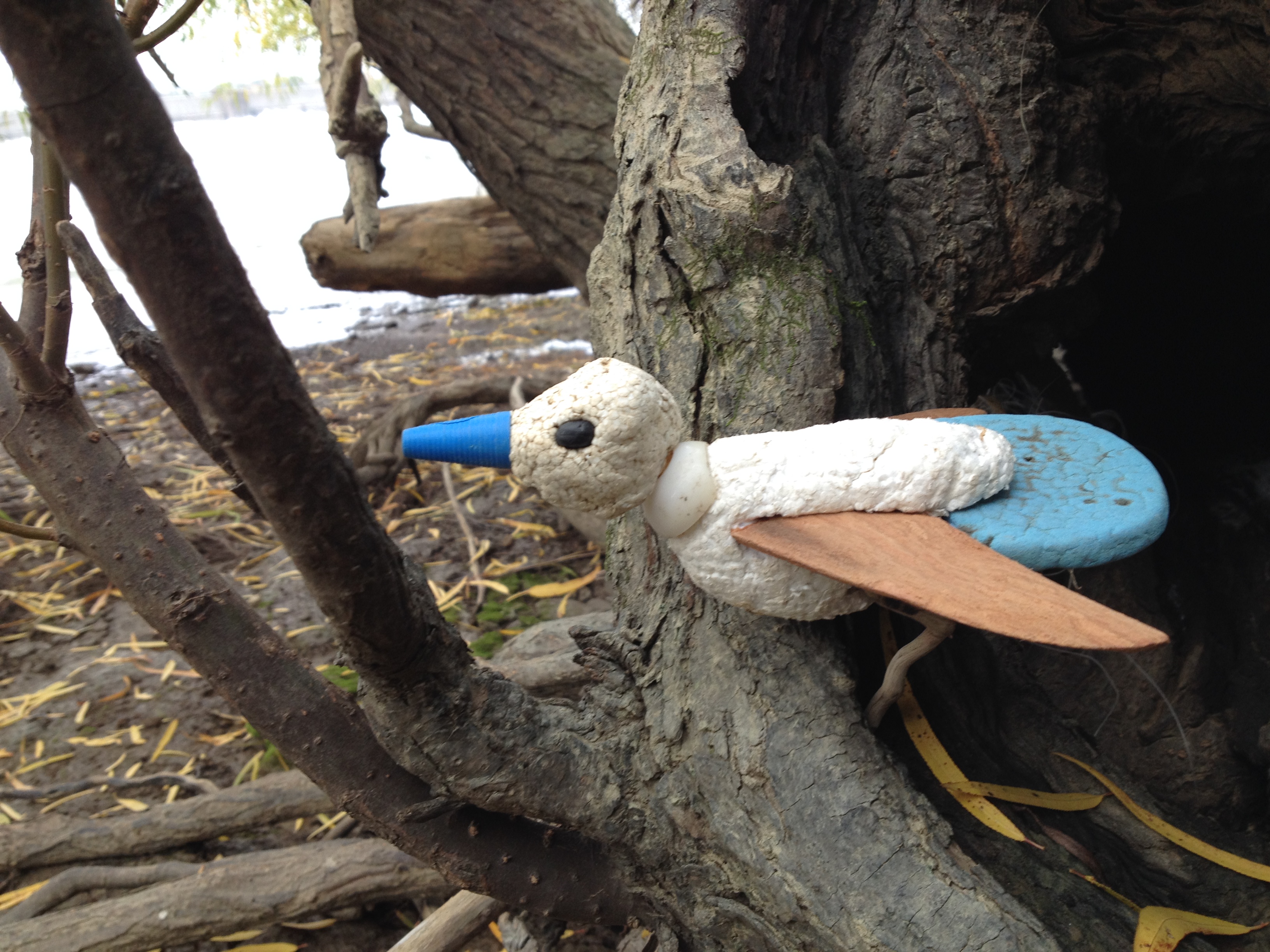
What began overcast and dreary blossomed into a gorgeous, sun-filled autumn day.  The exposed fossil beds by the Upper Tainter Gates are now covered by water rushing at break neck speed.  The Ohio River has once again reclaimed its ancient limestone bed with man’s help.  The Falls of the Ohio are like Niagara Falls which can also be regulated with the flip of a switch.  There’s a good chance that I won’t be visiting that side of the park again until next summer’s heat returns.  Today I concentrated my attention and energy along the riverbank under the Conrail Railroad Bridge.  This is an area where I have had good luck finding materials to work with and many of my best bird sightings have also occurred here.  The autumnal migration is under way.  Many of the birds that had passed this way going north in the spring are now moving south towards wintering grounds in exotic locations in Central and South America.  I ducked under the Black willow trees whose leaves are turning bright yellow and was soon rewarded by a bird species new to me.

Fan-tailed Gnatcatcher, Falls of the Ohio, Oct. 2014

This is the Fan-tailed Gnatcatcher and this is the first time this species has been recorded in the park.  I had the greatest luck hiding behind the trunk of this willow and was able to observe this bird at extremely close range.  If it spotted me…it demonstrated no concern at all and continued its search for small insects and spiders hiding among the furrows in the tree’s bark.

Fan-tailed Gnatcatcher, Falls of the Ohio, Oct. 2014

The Fan-tailed Gnatcatcher is a diminutive bird.  I watched as it dutifully searched the tree for food.  It had no problems going down the tree head-first in nuthatch fashion.  In this species, both the male and the females are similarly marked.  This young bird (identified by its lack of a feathered crest on it head) was just an egg a couple of months a go and has flown here from northern Canada.

Fan-tailed Gnatcatcher, Falls of the Ohio, Oct. 2014

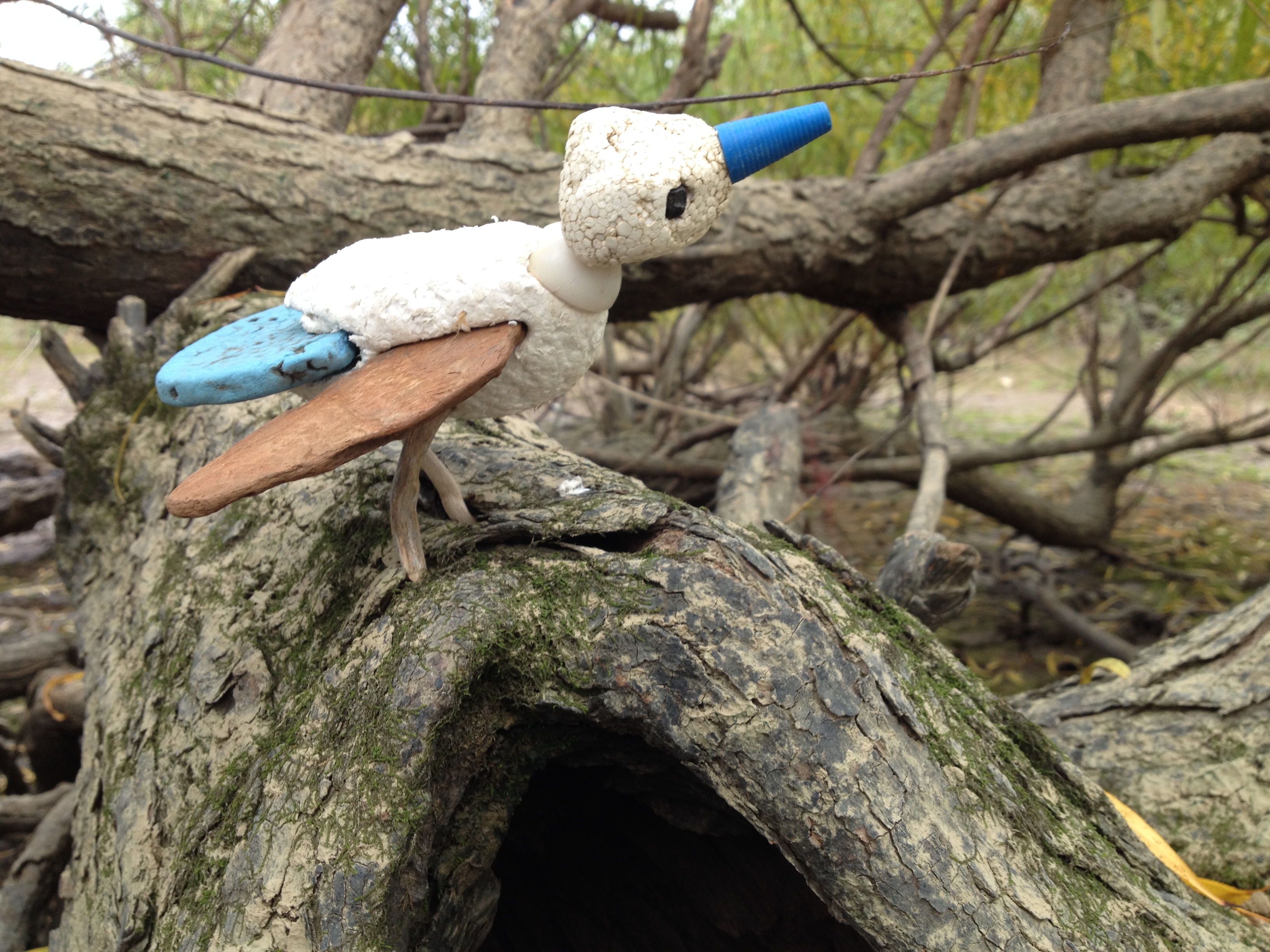
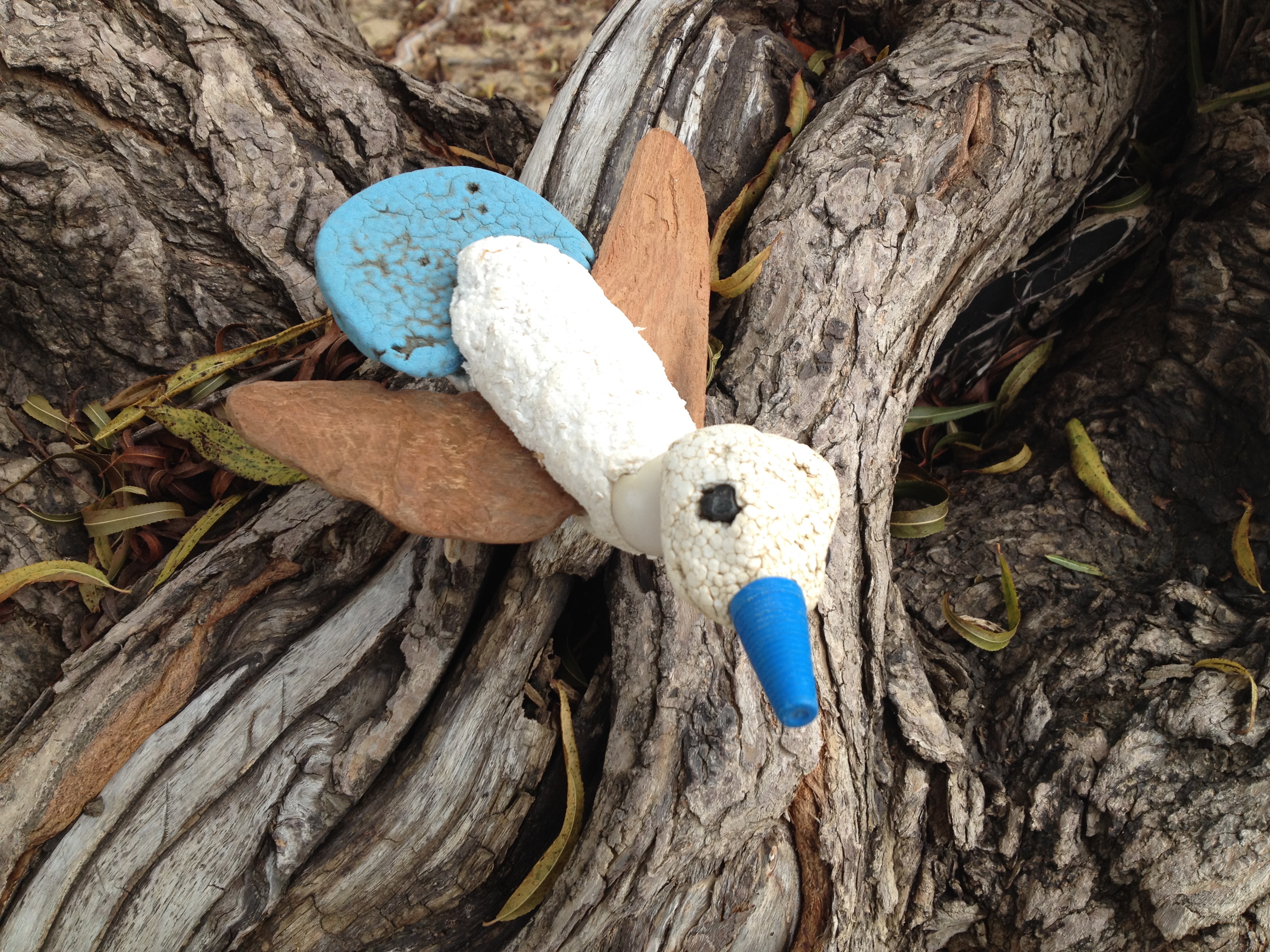
I was literally at arm’s length to this bird and it was a such a treat to observe something new and at close range.  I loved the coloration on this bird.  The tail feather’s blue fan is balanced by the bird’s bright blue beak.  Rusty-colored wings are set off by the arctic-white hues along the head and body.  Like many bird encounters, I was only able to observe this bird for a minute or two at the most, but it was an experience that will last a lifetime.  As it flew off…I wished the bird well on its long journey and I hoped I could count its kind again among the park’s willow trees.

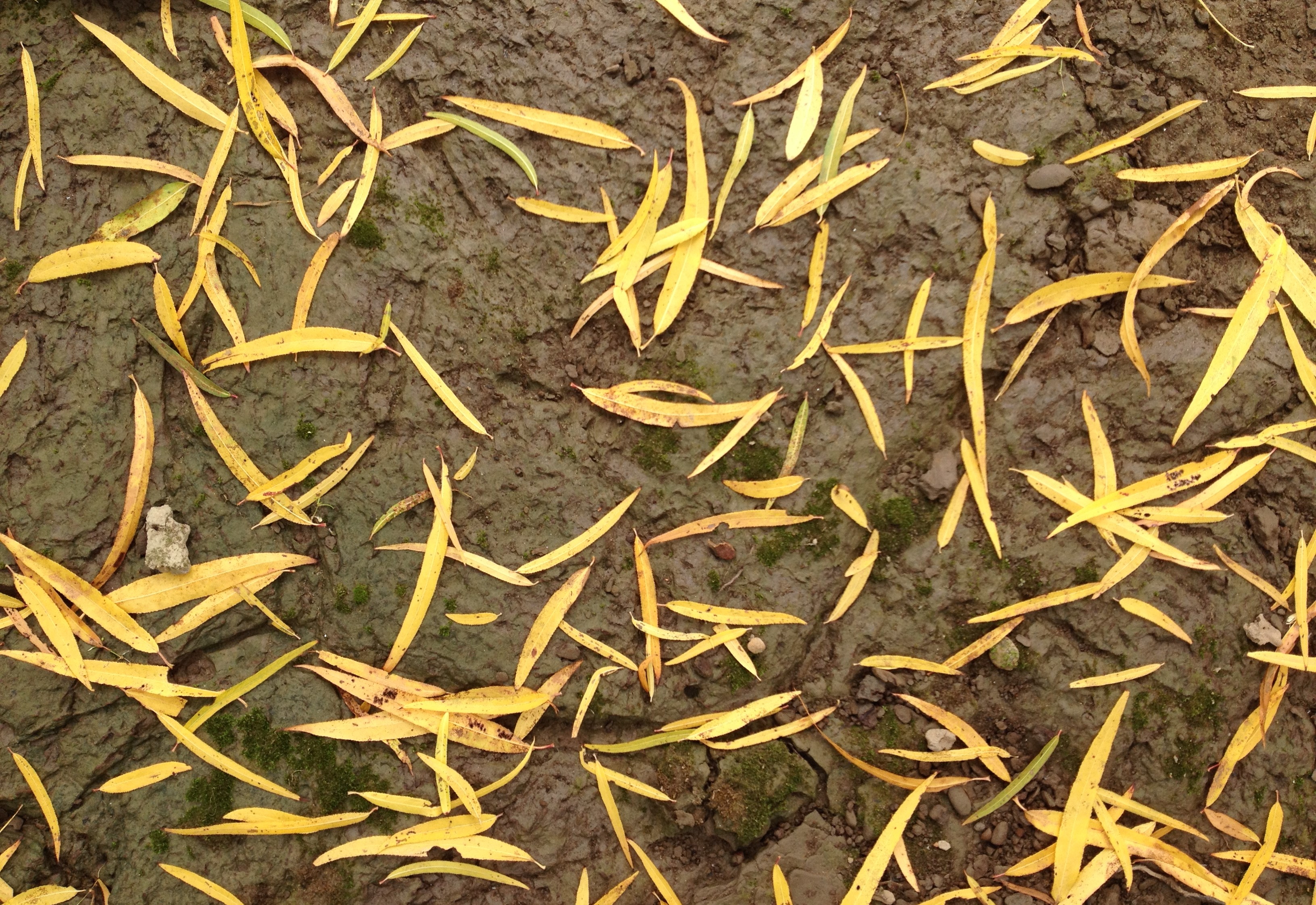
fallen willow leave on mud, Falls of the Ohio, Oct. 2014

I lingered in the moment for a while.  No sense in rushing things.  When I was confident that no other birds were in the area, I moved back to a spot where the Fixed Wier Dam joins the Lower Tainter Gates.  This would be the site for my next project.

stone and concrete ring by the dam, Falls of the Ohio, Oct. 2014

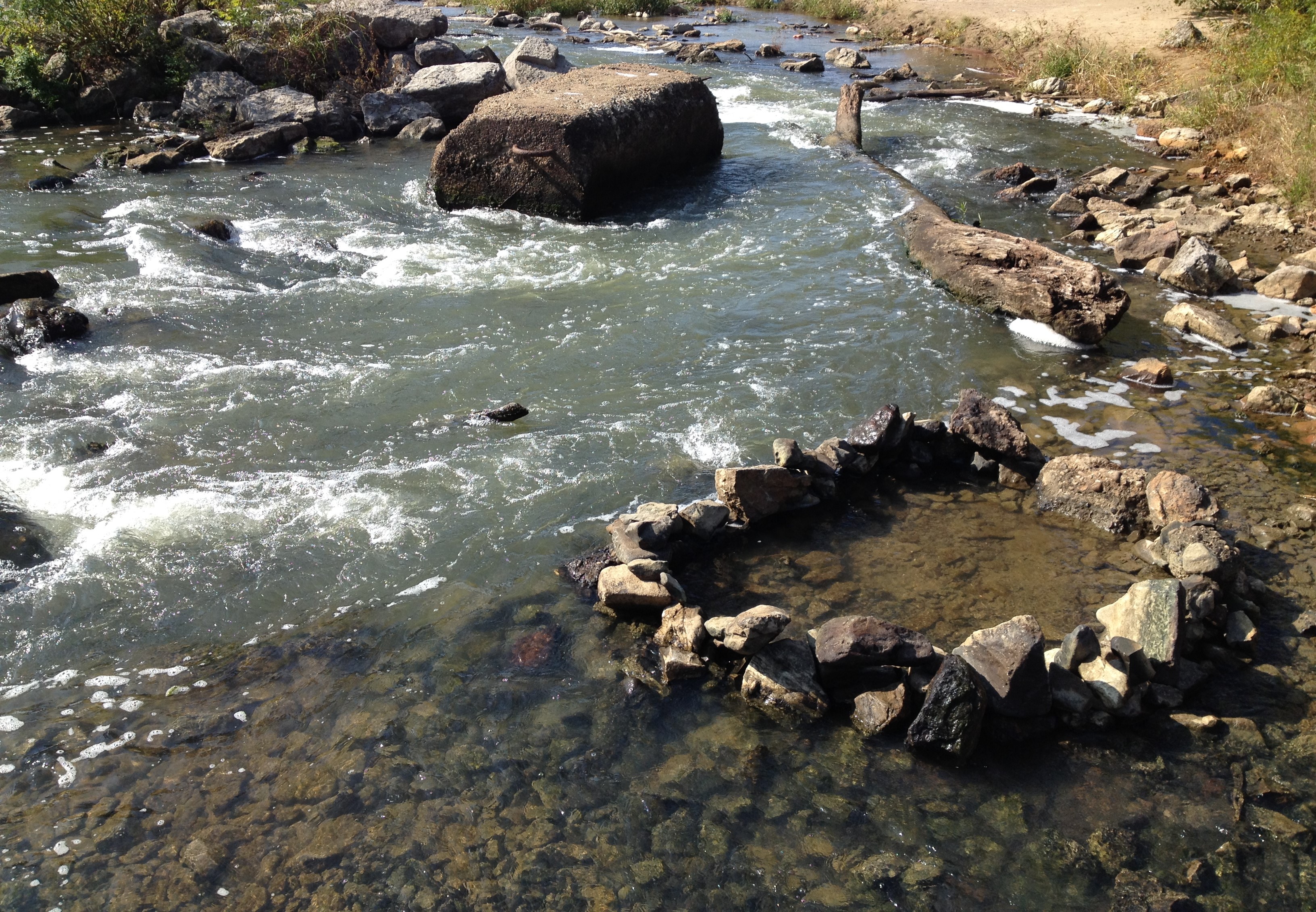
The dam at this location has curtains of water flowing through openings that are lower than the top of the wall and represents the true water level of the river.  This flow feeds a small channel that leads back to the river and is a favorite place for fishermen.  I had earlier noticed among the large broken sections of concrete and loose rock that some other creative soul(s) had started what looked like a stacked stone ring in the water.  There was the remnants of a foundation and I decided to build it back up for a look-see and to elaborate on it if possible.  I guess this in effect is a collaboration with an anonymous individual.  The image above was taken after I began reconstructing the ring.

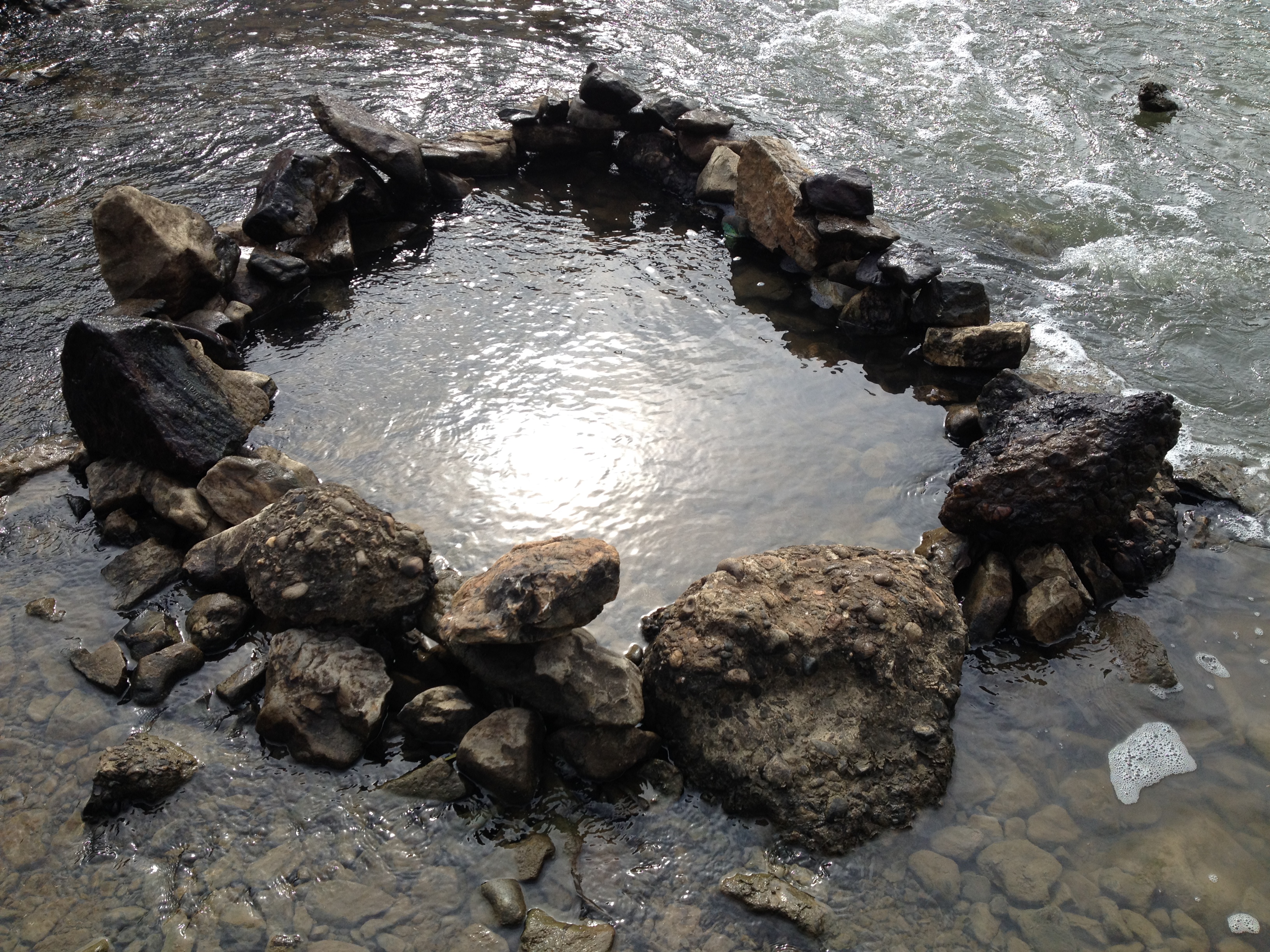
Sun light reflecting with the stone ring, Falls of the Ohio, Oct. 2014

As I kept building up the ring, I would document my progress.  This is one of my favorite shots from the series.  Here I was able to center the sun’s reflection within the ring’s interior.  In my mind it became a portal to some other place far beyond the river.  The image of a passage way or tunnel is one that recurs in my Falls projects.

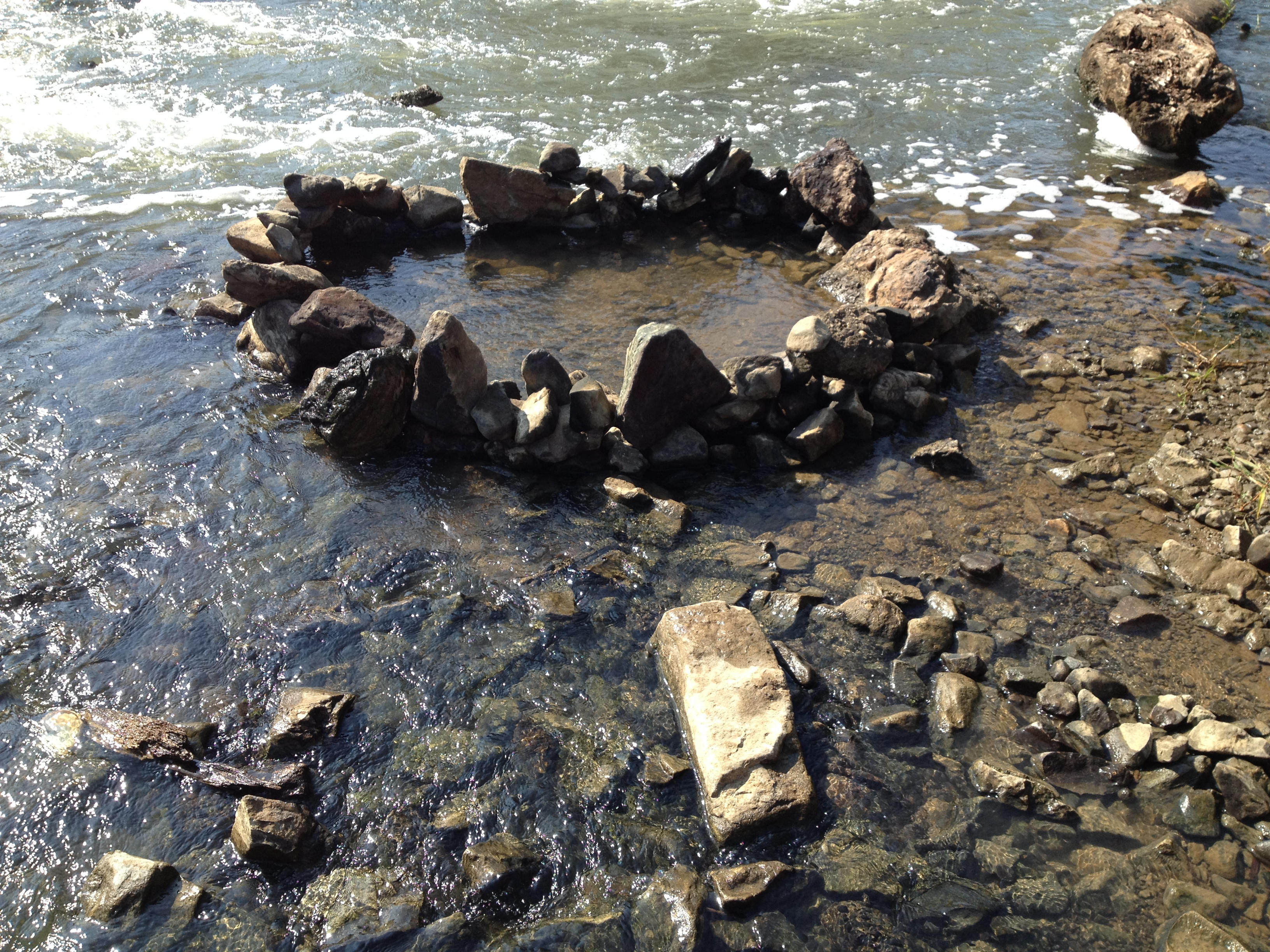
rock and concrete ring, Falls of the Ohio, Oct. 2014

I would have added the rectangular rock in the foreground, but it proved heavy and sunk into the mud.  Interestingly, the water within the ring was much calmer and created a safe harbor which contrasted with the swiftly flowing water around it.

rock and concrete ring, Falls of the Ohio, Oct. 2014

The ring’s slightly irregular shape was determined by its placement.  The ring is situated on the edge of where the water cascading off the dam’s wall has worn a deeper channel in the shallow bottom.  Since it was such a beautiful day I decided to spend more time at the Falls.  I made one other site-specific work where the center is a point of focus.

silver driftwood star, Falls of the Ohio, Oct. 2014

Detail of silver driftwood star, Falls of the Ohio, Oct. 2014


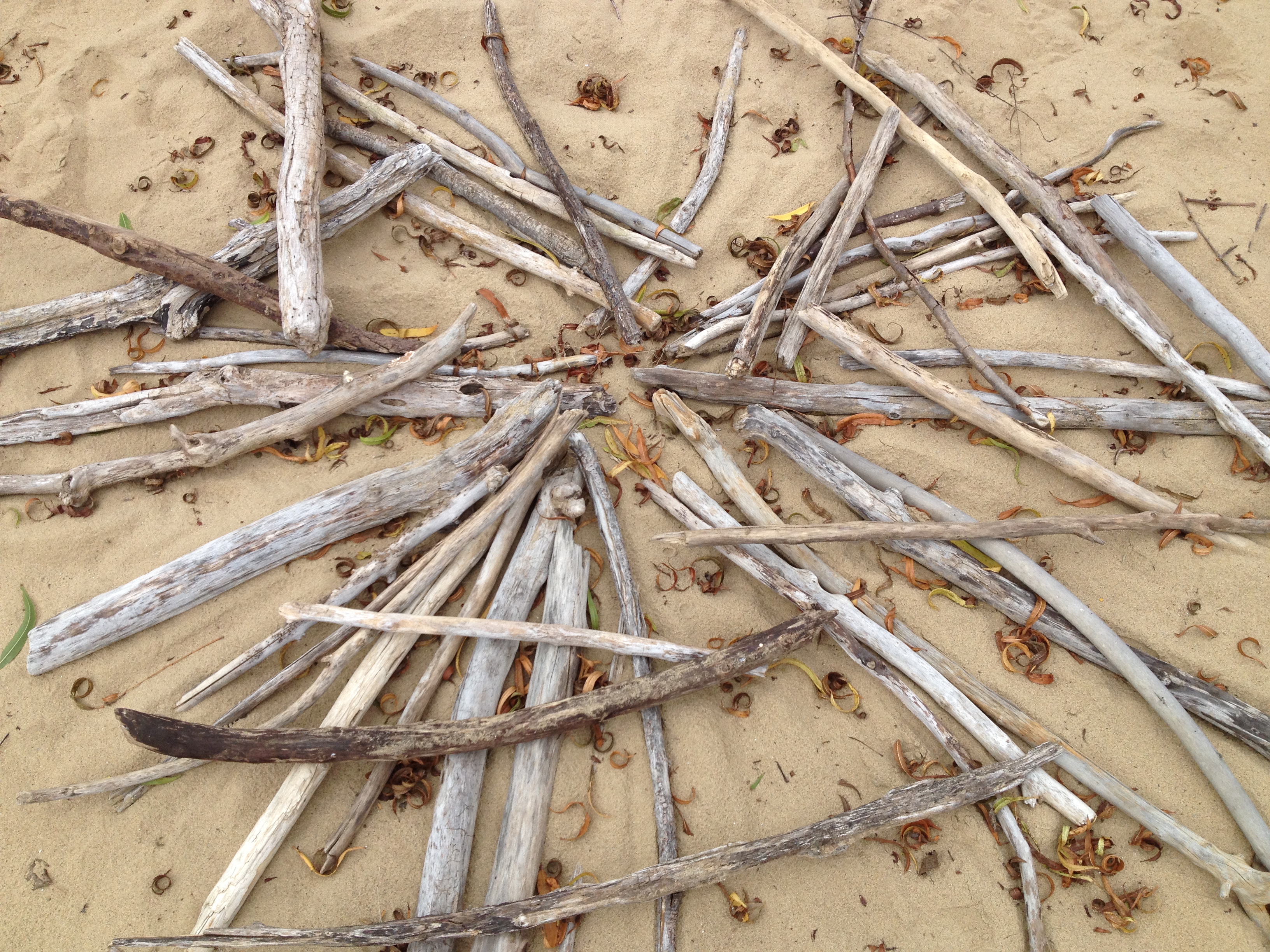
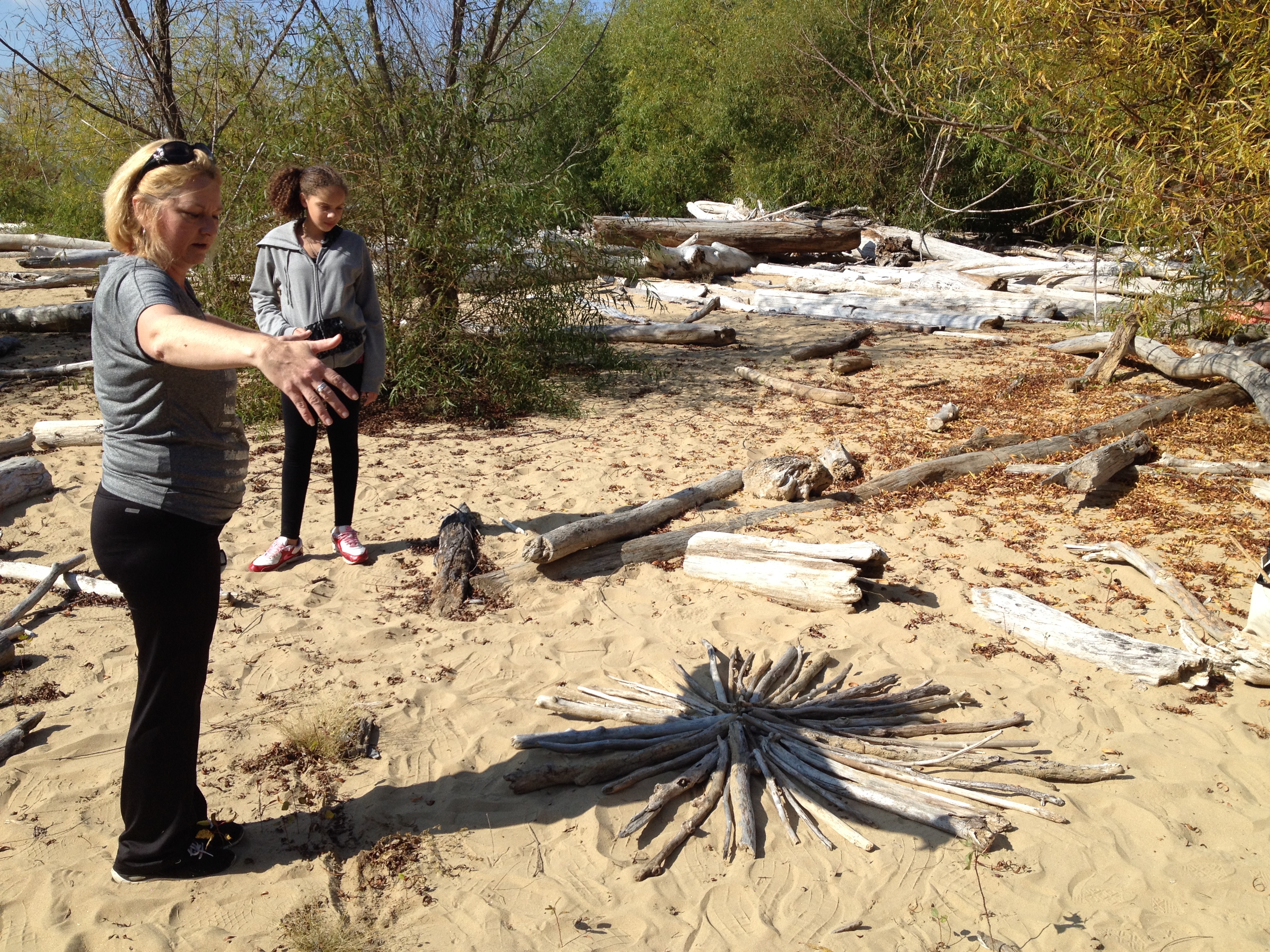
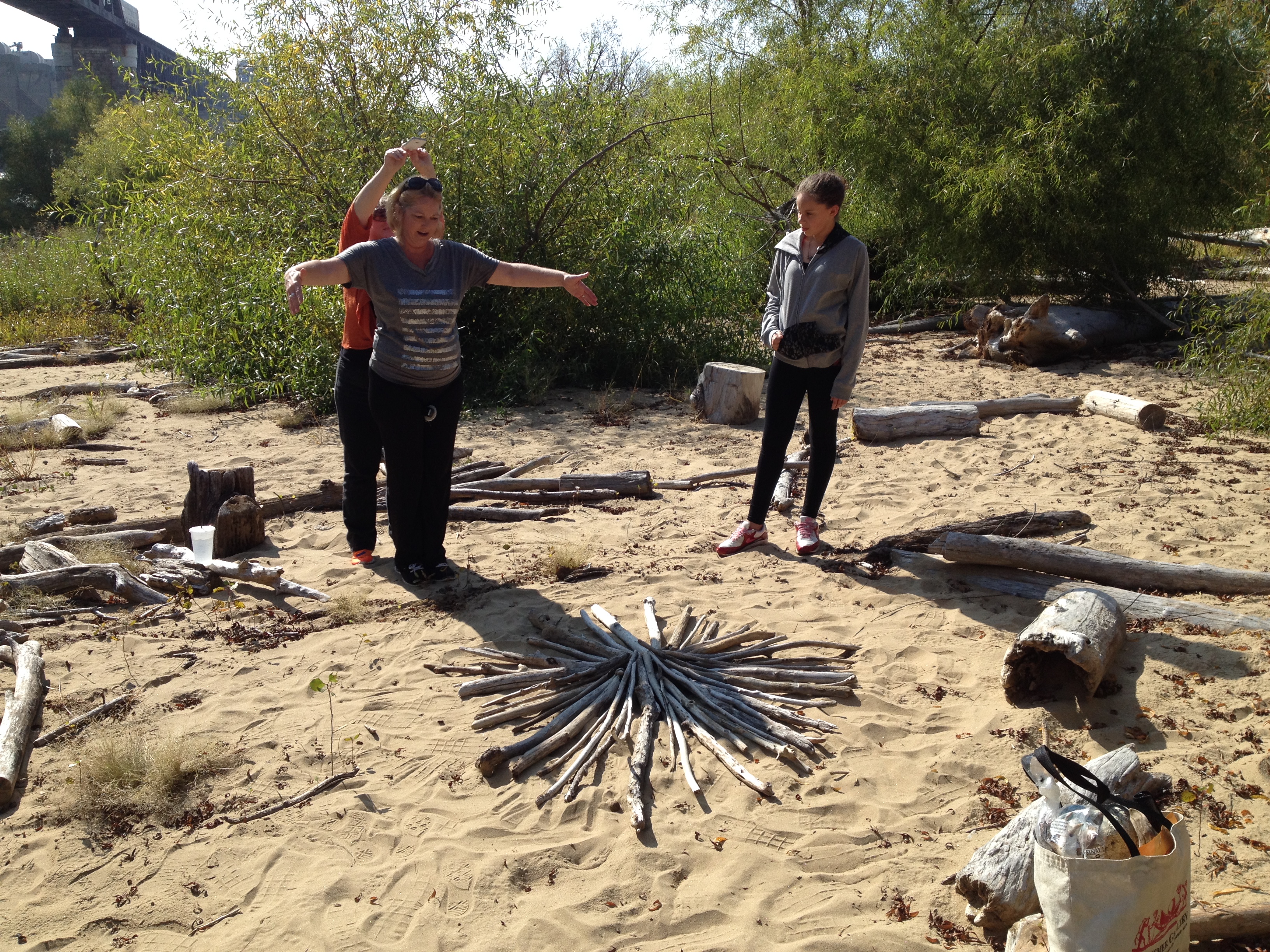
What I love about the driftwood at the Falls of the Ohio is the way it changes color as it ages.  After a summer’s worth of sunlight, the wood here takes on a silvery-gray color.  I collected lengths of wood from the immediate area and laid them in the sand.  The silver driftwood radiates away from a central point.  While I was engaged with my “Silver Star” four very nice people stopped by and asked directions to the fossil beds.  These park visitors became interested in what I was doing.  I appreciated that they wanted to participate and play along in their own way.  Here are a few additional images.  I’m assuming they are two mothers with their daughters enjoying an outing to the river?  Here one person is photographing the cast shadow on my wood piece.

Visitors interacting with my art, Falls of the Ohio, Oct. 2014

Park visitors interacting with my driftwood star, Falls of the Ohio, Oct. 2014

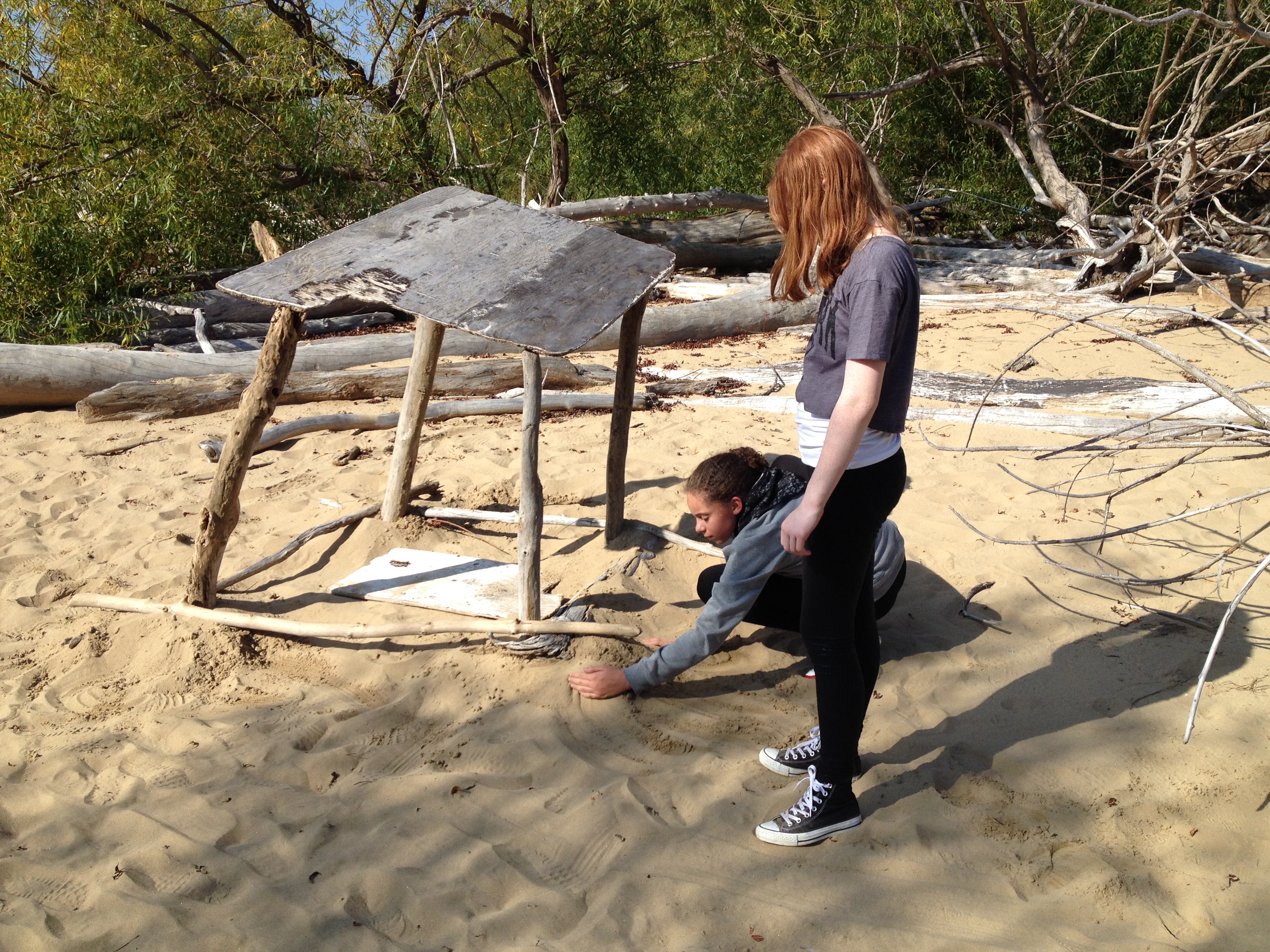
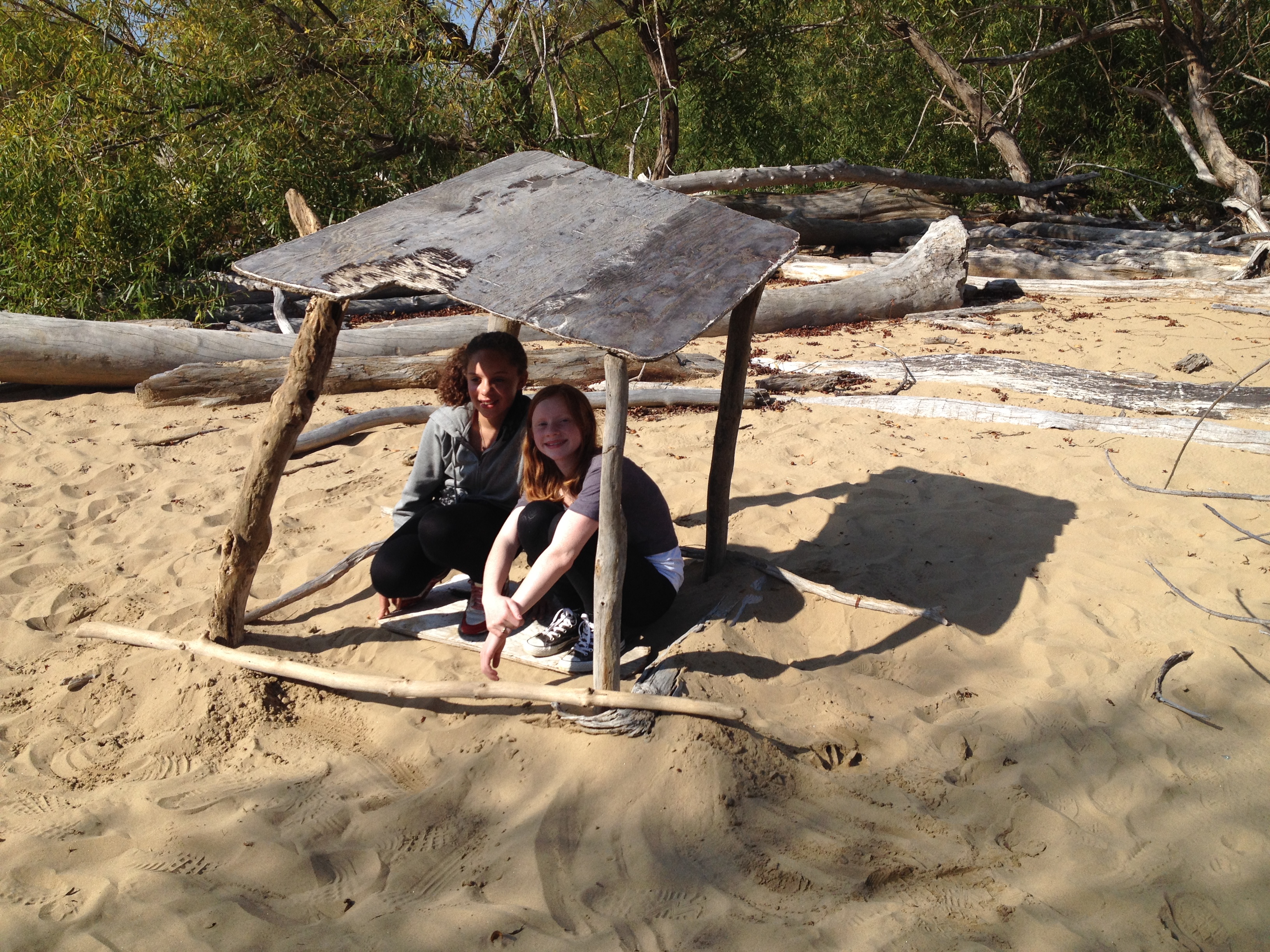
I think I may have inspired the daughters to attempt their own project?  Before too long they were picking up pieces of driftwood and making a make-shift shelter of their own design.

Girls making a driftwood shelter, Falls of the Ohio, Oct. 2014

Girls posed under their improvised shelter, Falls of the Ohio, Oct. 2014

The girls looked very happy under their driftwood shelter!  When my sons were younger, this was a favorite activity of theirs and this day brought back those good memories.  This park is such a great playground and allows one to exercise both your body and imagination.  I wonder if these ladies ever found the fossil beds?  It probably doesn’t matter since it looked like a good time was had by all.  Soon enough it was time to go home and I gathered up my collecting bag and walking stick and admired the late season flowers as I walked back to my vehicle.  Thanks for tagging along and I hope to see you next time from the Falls of the Ohio State Park.

tiny composite flowers with bee, Falls of the Ohio, Oct. 2014

Read Full Post »

On the dry Indiana bank, Falls of the Ohio, Oct 2014

After my all day excursion to the Kentucky side of the fossil beds…my next visit to the park was a relatively short one.  I had a few hours to work with and decided to check out the riverbank on the Indiana side.  It has been very dry of late and I heard on the radio that farmers have begun revising their optimism about this year’s corn crop.  Once again, we have had a season that seems atypical in a few respects.  Most notably, our summer has been a cool one.  No temperatures in the high 90 or 100 degree range…that would be about 35 to 38 degrees on the Celsius scale.  Climatologists point to the cold Arctic air that came sweeping down from Canada during July as the reason our summer was not as hot.  People around here aren’t complaining about that, but after last year’s polar vortex winter… folks are wondering if that bodes well for this year’s fall and winter?

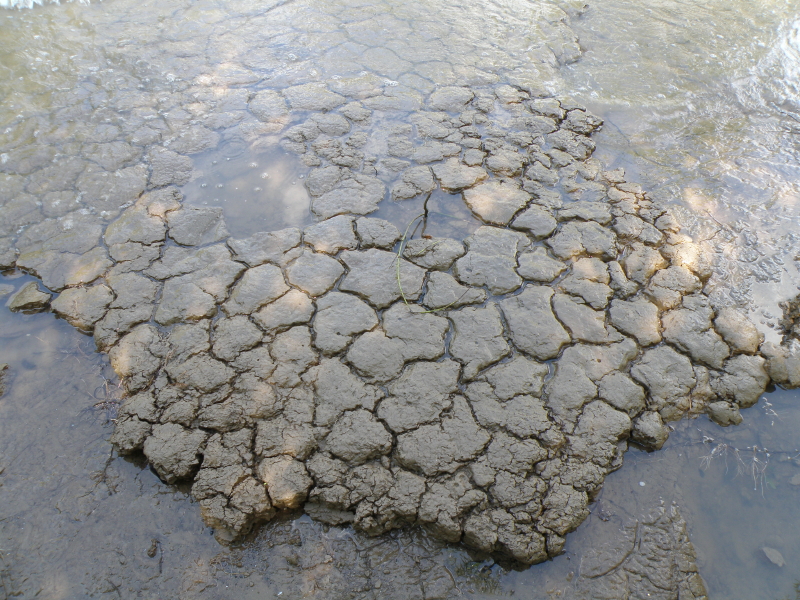
Cracked, drying mud, Falls of the Ohio, Oct. 2014

In addition to the coolness, it’s also been dry of late.  Seems that we haven’t had a significant rain storm to speak of in weeks and the river continues to recede.  New pools are formed stranding fish in them and many creatures take advantage of this bounty.  Walking along the cracked riverbank I find evidence of this.

Dead Longnose gar and decaying Bull gill, Falls of the Ohio, Oct. 2014

I soon came across dead fish left behind in the wake of weekend fishermen.  In this picture, an armored and toothy Longnose Gar (Lepisosteus osseus) lies side by side with an equally interesting fish that is rarely found here.  With its thick body, white caudil fins, and unique pectoral fins…I identify this smaller fish.  It’s more commonly called a Bull Gill, but science also recognizes it as (Taurus opercula).  I wonder if there are any other specimens hiding in the deeper pools around here?  To find out, I gather waste monofilament line found all along the riverbank along with a found lead-headed jig and before too long I have improvised a hand line for fishing.

Bull Gill on a hand line, Falls of the Ohio, Oct. 2014

Bull Gill on the line, Falls of the Ohio, Oct. 2014

After some trial and error, I succeeded in catching a Bull Gill by bumping my jig along the bottom of a wide, but shallow pool.  The fish was well hooked and after a short struggle I was able to bring him up for a better look.

Bull Gill in hand, Falls of the Ohio, October 2014

Captured Bull Gill facing left, Falls of the Ohio, Oct. 2014

I hurriedly take as many photographs as I can.  My intention is to release this fish back into the water after I document its presence here at the Falls of the Ohio.  As you can see, this fish contrasts greatly with the dead gar we saw earlier.  The gar is in fact a more ancient and primitive fish that relies on its hard armor for protection.  The gar is mostly a surface fish mimicking a floating piece of wood while it stealthily seeks out smaller fish to ambush.  The gar’s strategy has been so successful that it has changed little after millions of years.  The Bull Gill evolved much later and lacks prominent scales on its more compact body.  It too, however has evolved a unique method of feeding.

Bull Gill seen head on, Falls of the Ohio, Oct. 2014

Bull Gill supporting itself on its pectoral fins, Falls of the Ohio, Oct. 2014

The Bull Gill gets its name from its powerfully muscled head.  Just below and behind its gill covers, the unique pectoral fins have evolved so that this fish can support itself on the bottom of a swiftly moving stream or river.  I was able to demonstrate this with my specimen.  I placed my fish upon the rocks by the riverbank and it was able to support its body off the rocky surface using its strong and rigid fins.  In the water, the Bull Gill secures itself on the rocky bottom with its stiff pectoral fins and with its head facing upriver.  The Bull Gill is a predatory bottom feeder.  As prey fish swim by, the Bull Gill with a quick burst is able to capture its food and swallows them head first before returning to its spot on the river bottom.  I had this fish out of water for just a couple of minutes before releasing it safely back into the Ohio River.  I had to say that I enjoyed encountering a creature you don’t see every day.  It’s presence here is a good sign since the Bull Gill needs good quality water to thrive.   I gathered up my collecting bag and walking stick and decided to check out my stash of Styrofoam under the willows.

Up the riverbank and under the willows, Falls of the Ohio, Oct. 2014

The willow trees are up the riverbank and the leaves are beginning to yellow more noticeably.  Along the way you pass by a couple of courses of deposited driftwood.  I love the silvery color of this wood which is due to exposure to the sun and elements.  I had a great surprise in store for me once I ducked under the cover of the trees.  For many years I have known that White-tail Deer are present in the park because their tracks are all over the place.  These ghost deer are fairly close to a populated area and extremely wary of people.  They must move around the park in the middle of the night or really early in the morning to avoid detection.

The deers' resting place, Falls of the Ohio, Oct. 2014

deer tracks in the sand, Falls of the Ohio, Oct. 2014

As I moved near my spot, I spooked a doe and her late season fawn.  I could still make out the spotted pattern on the fawn.  They were bedded down near a large log that floated into the park last year.  I first saw the doe which rose and ran off upon sighting me.  The fawn then stood up and followed after its mom.  I was unable to take a photograph because this sequence happened in just seconds.  I then followed to see if a second glimpse was possible and I even doubled back to this spot should the deer attempt the same maneuver.  Unfortunately, I didn’t get another look at them, but since they are near my outdoor studio, I will be sure to check for them next time.

My stash of Styrofoam, Falls of the Ohio, Oct. 2014

It had been many weeks since I last visited my larder of river-gleaned materials.  I could tell that people had been through here, but there is obviously nothing of value.  I mean what could one do with water-tumbled polystyrene and sticks?  If the river doesn’t rise anytime soon, I will come back and make something from this odd deposit.  My next post, however, will come from the Kentucky side of the fossil beds.  After this adventure, I returned with my river-polished coal and explored a few more areas around Goose Island and the hydroelectric plant.  I think I made some compelling images that speak of a sense for place and I look forward to sharing them with you.

Fall color at the Falls of the Ohio, Oct. 2014


Read Full Post »

Map detail of the Falls of the Ohio State Park

Most of the work that I have created at the Falls of the Ohio State Park was made between the two “P’s” on the above map detail.  I lifted this image from a recent brochure about the Ohio River Greenway.  I’m just noticing that the word “park” has an “e” at the end…what’s with that?  Is this a variation of Ye Old Park(e) or a simple misspelling?  Anyway, the green line that separates the dark blue river from the blonde fossil beds is the area I walk.  Most of my river finds and the pieces I make from them occur in this area.  The thicker black line is the old iron railroad bridge that I have  featured so often throughout this blog.  It’s been a while since I posted anything new here.  In fact, since I started the old riverblog, this is the longest I have gone without posting something.  I have had a series of misfortunes that have dented my mojo with the biggest being losing my day job.  I’m not one that easily compartmentalizes my life and occasionally things spill over and affect other areas.  Among the other changes included having to purchase a new computer.  It’s taken a while to get used to doing things in a different way.  I’m still in the process of transferring images and data from the old machine to the new one.  I have too many images that need parking in a “cloud” somewhere.  I debate with myself whether or not I absolutely need all of these pictures?  I do harbor the ambition to produce a book or two about my stories and collections, but I’m sure I have enough material already.  This blog after all, has over 3,ooo images that I have already published.  What it doesn’t have are the first five years or so of this project that are recorded on 4″ x 6″ color prints that were developed at the local drugstore.

At the water's edge, Falls of the Ohio, 2014

Although I haven’t posted much recently, I am still going to the river.  It’s been an unusual year out here and for much of this spring the river has been high.  Summer is now upon us and with that comes the high heat and humidity.  This adventure happened in early June after the willow trees had fully leafed out.  I believe this is also my first post using just images recorded with my cell phone.  I now have a new Nikon my brother gave me as a birthday present.  He is an avid nature photographer living in Florida and had a spare digital SLR he could part with.  I can’t wait to try out the new camera at the river and I hope to do this soon.

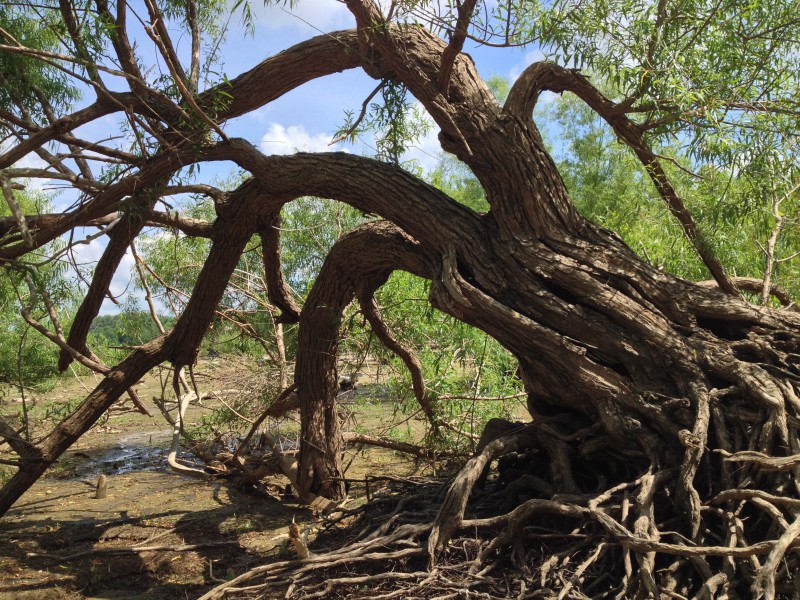
Old willow tree at the Falls of the Ohio, 2014

willow tree detail, 2014

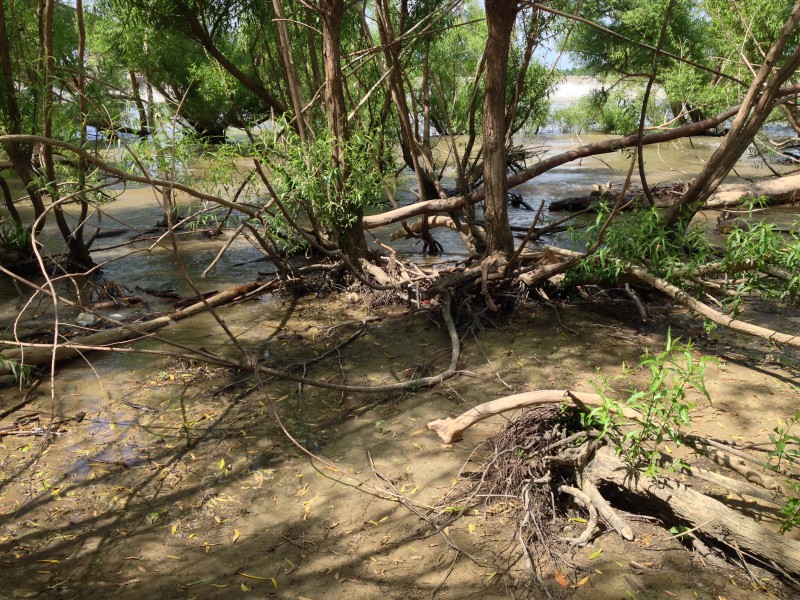
I have really fallen in love with this old willow tree.  Last year, I photographed my “La Belle Riviere” piece using this tree as my model.  This tree is a survivor.  It’s managed to go through many floods and while it is severely bent over and its roots are exposed…it keeps on living and adding character to this landscape.  I have noticed that the center of its trunk is starting to hollow out a bit.  I wonder how long this willow has held this ground?  I was musing about these things when I noticed movement in a nearby stand of mixed maple and willow trees.  I picked up my collecting bag and walking stick and quietly moved over to investigate.  I was quite unprepared for what I was about to discover!  Here are a few of the first images I made of my new find.

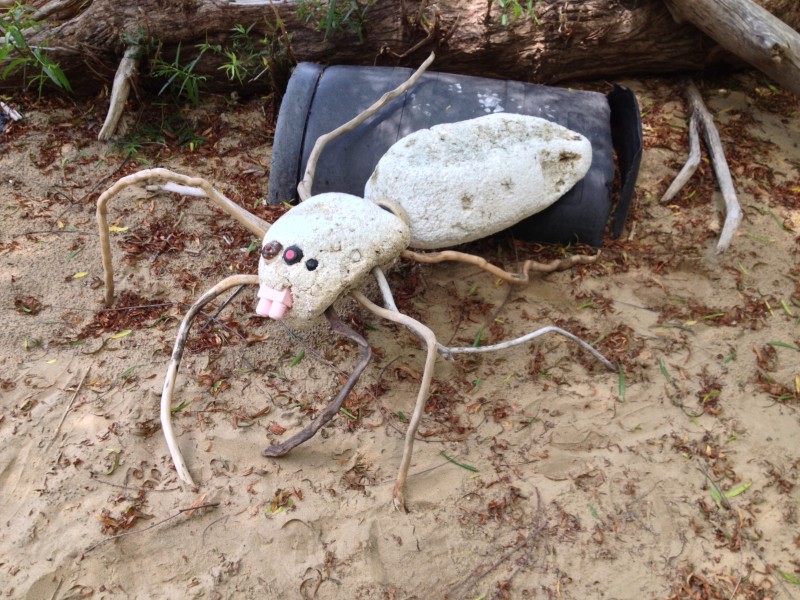
Great Wolf Spider, Falls of the Ohio, June 2014

Great Wolf Spider, Falls of the Ohio, June 2014

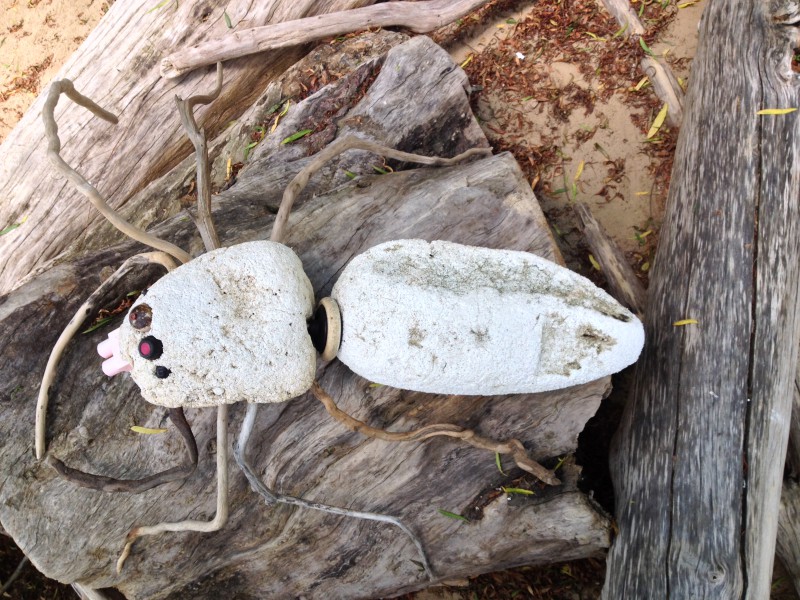
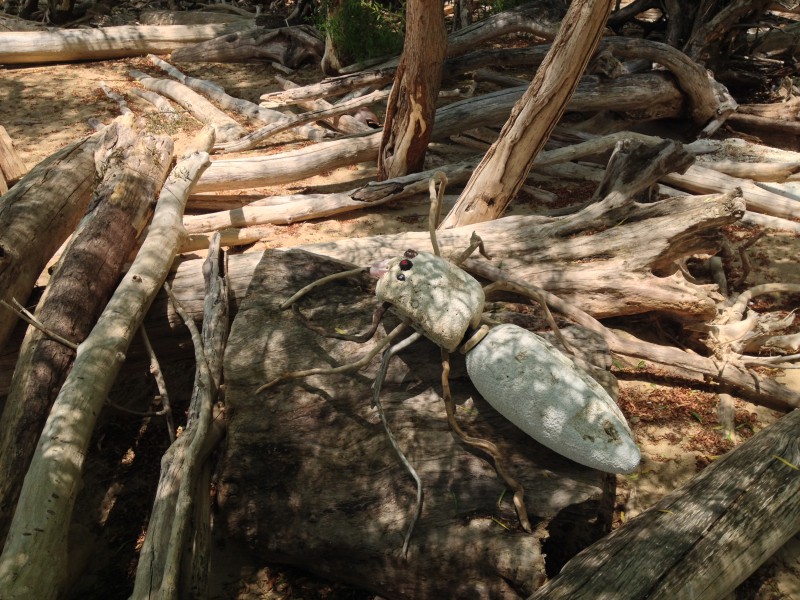
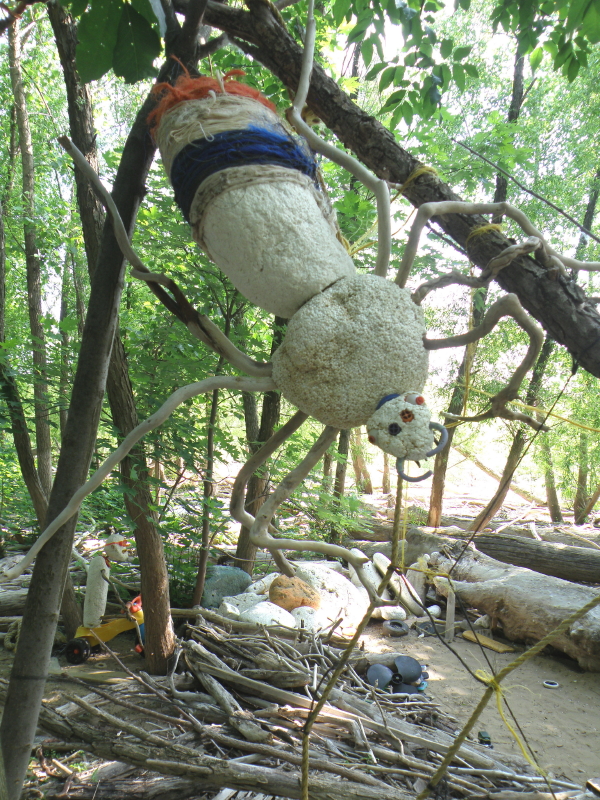
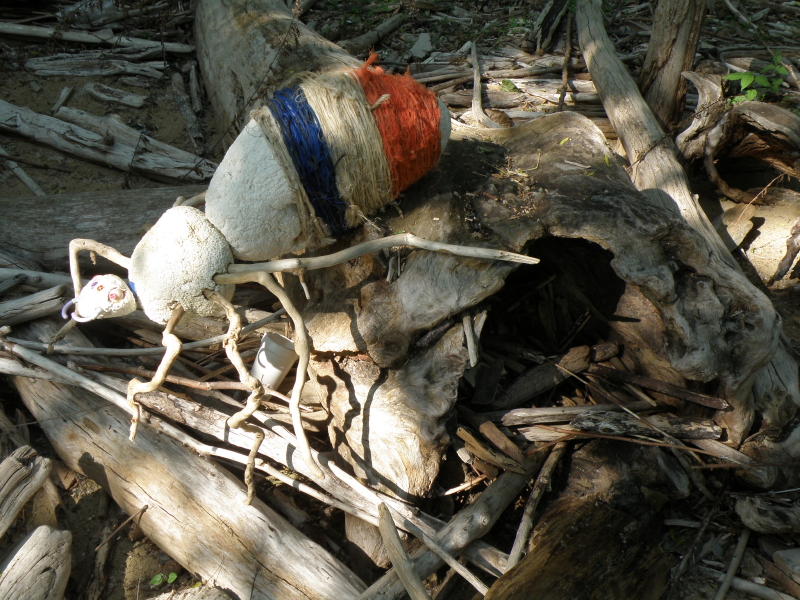
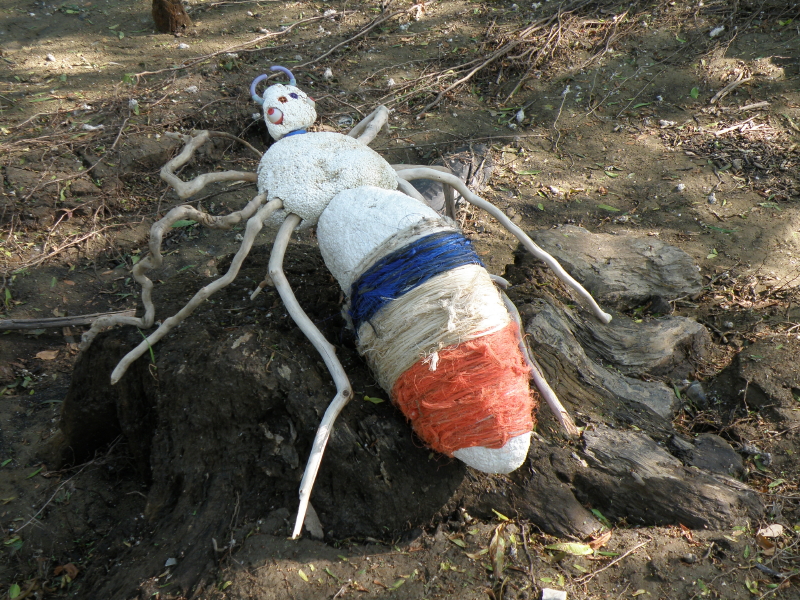
It was another giant spider!  I recalled that it was about this time last year that I encountered the Giant Driftwood Spider which is a completely different animal from the spider I was looking at now.  It’s body was a bit over two feet long and a mottled white in color.  This seems to be another example of what I have come to coin as the “Falls of the Ohio Godzilla Effect”.  Over the years, this particular park has regularly produced freaks of nature.  The most striking of which are the giant insects (and now spiders) that pop up on occasion.  My theory as to why this happens here has everything to do with contemporary pollution and a degraded environment.  For some reason, arthropods in particular are sensitive to these ecological changes which can result in gigantism in these organisms.

Great Wolf Spider, Falls of the Ohio, June 2014

Great Wolf Spider on a stump, Falls of the Ohio, June 2014

I decided to call this the Great Wolf Spider, (Lycosa styreni).  Looking around, I could find no trace of a web and decided that this was a ground hunting species like other members of the family of wolf spiders, Lycosidae.  I imagined that this impressive spider subsisted upon the small mammals that it could capture within the confines of this park.  That would include many rodents including squirrels, rats, groundhogs, and perhaps the occasional beaver.  I also imagine that stray cats and dogs would be on the menu too.  This spider has large pink-colored fangs that gave it a somewhat bucktoothed appearance.  As long I kept my distance and did not make any threatening moves…the spider tolerated me.  I also noticed that this amazing creature also has unusual eyes.

Detail of Great Wolf Spider eyes, June 2014

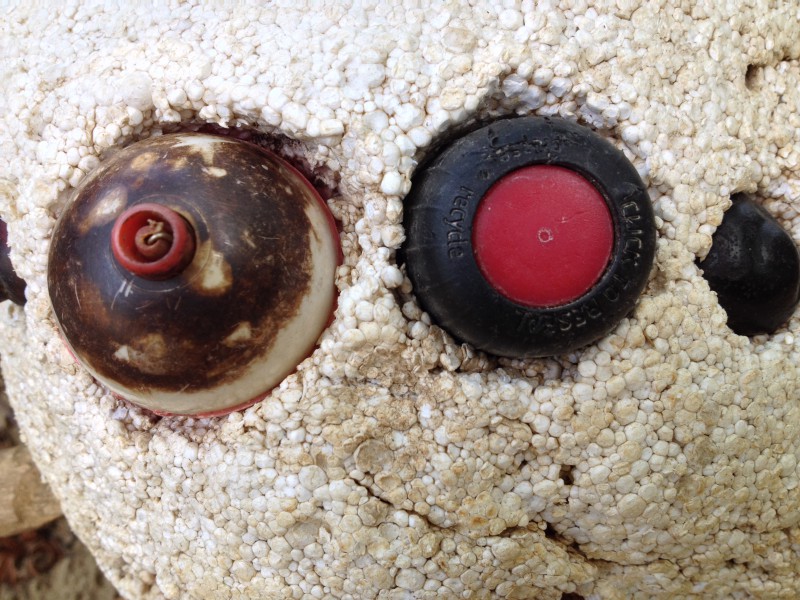
From what I could discern…this spider sported four eyes total and all in a row.  It had two large and rather mismatched eyes.  One eye possessed a large red iris that leant a diabolical aspect to it.  On either side of these “great eyes” were two smaller, black vestigial eyes.  I wonder if the smaller eyes are used to detect peripheral motion?  It was disconcerting in the least to be the object of attention from these unblinking eyes.  I approached this spider with caution.  Although I was fearful once the spider moved…I, however, was never in any actual danger since the spider never took any aggressive actions toward me.  I was of course satisfied to keep my distance just in case!

Great Wolf Spider waiting in ambush, Falls of the Ohio, June 2014

The Great Wolf Spider seen from behind, June 2014

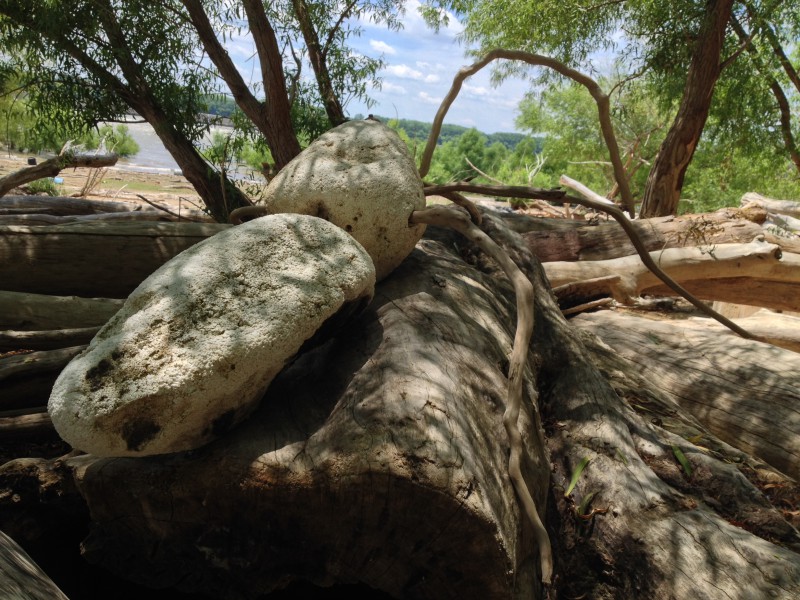
My last images of this impressive arachnid show it blending into its surrounding environment.  The sun light filtering through the tree canopy produced a dappled light and dark pattern that helped camouflage the spider as it lay in wait of its next meal.  The only bit of movement that could betray it was the slight, subtle twitching produced by its driftwood-like legs.  It was at this moment that I decided to back off and head home.  I don’t know if this spider is a one of a kind creature or whether there are other examples of this species that could populate this park?  I’m inclined to believe that I was observing a single individual.  The question is…how long will it be before our continued abuse of the environment produces monsters we may regret?  Until the next adventure…

At the river's edge, Falls of the Ohio, June 2014


Read Full Post »

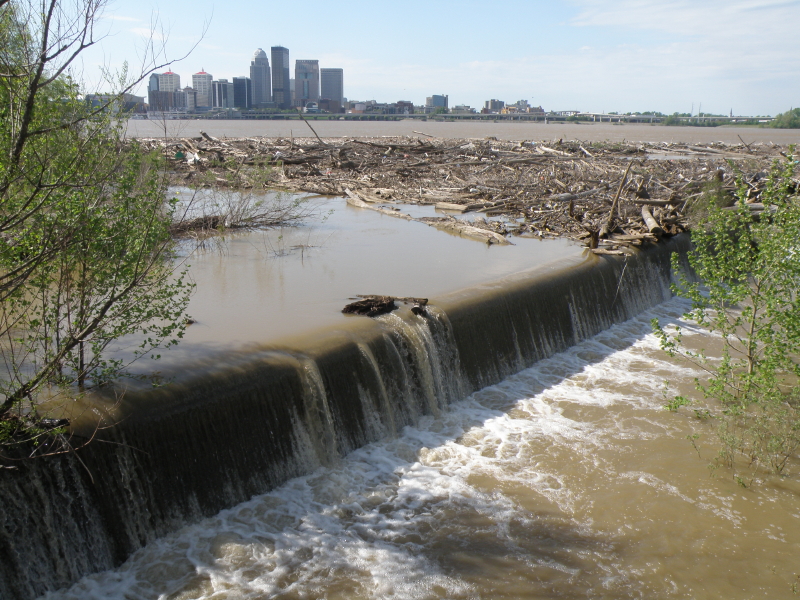
Louisville seen from the Falls of the Ohio, early May 2014

We have seen a lot of water flowing over the dam at the Falls of the Ohio this season.  The month of May has been punctuated by intense storms and ample sunshine.  Rainfall across the Ohio River Valley has been plentiful.  On this particular excursion, the river was high and many of the places that I like to sit and work were inaccessible.

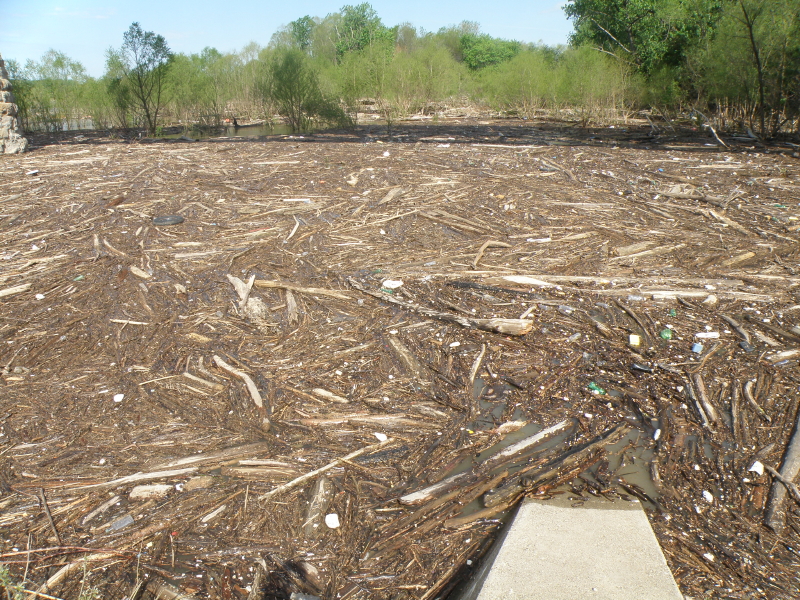
wood and debris in the Ohio River, May 3, 2014


There was plenty of wood and trash in the soupy brown water and despite the beautiful sunshine, I was thinking that I might need to go home early today.  Instead, I decided to do a little exploring along the margins of the high water and see how far I might be able to go.

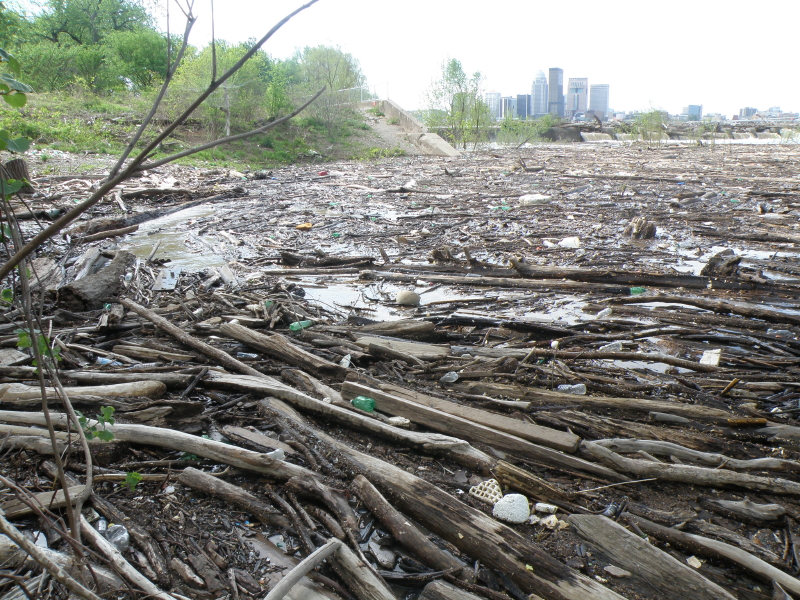
high water at the Falls of the Ohio, May 3, 2014

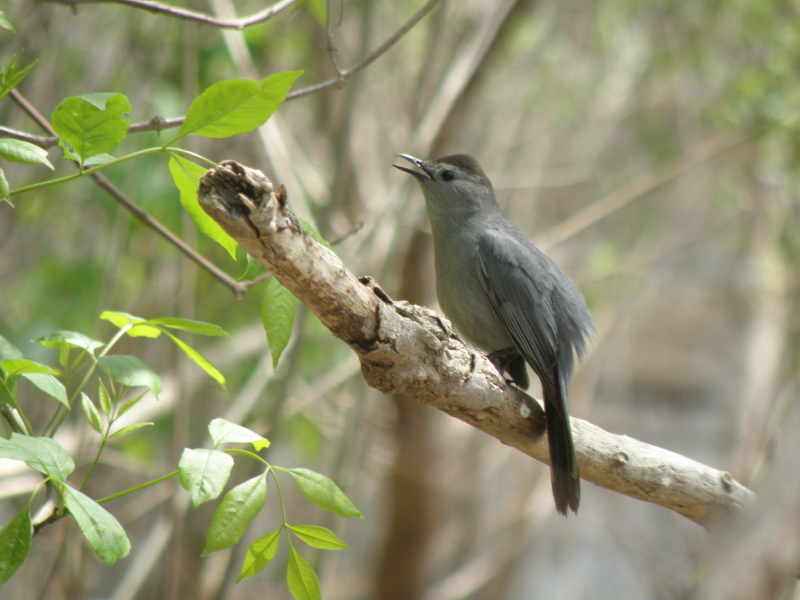
Skirting the margins of the high water, I was able to walk over logs and driftwood and reach small pockets of higher land that remained dry.  After initially feeling that my day in the park would be a loss…I started to feel excited again!  In part, this was due to the abundant bird life I was seeing and hearing.  This particular area has always been good for me and finding birds.  There is enough shelter here under the cottonwood trees and willows that provide relief from the wind and is close enough to the water.  Among the species I was encountering included this colorful grouping of birds: Baltimore Orioles, Northern Cardinals, Indigo Buntings, Palm Warblers, Gray Catbirds, American Goldfinches, and a tiny Blue-gray Gnatcatcher.  Here’s an image I captured of a Gray Catbird singing.

Gray Catbird singing, Falls of the Ohio, May 3, 2014

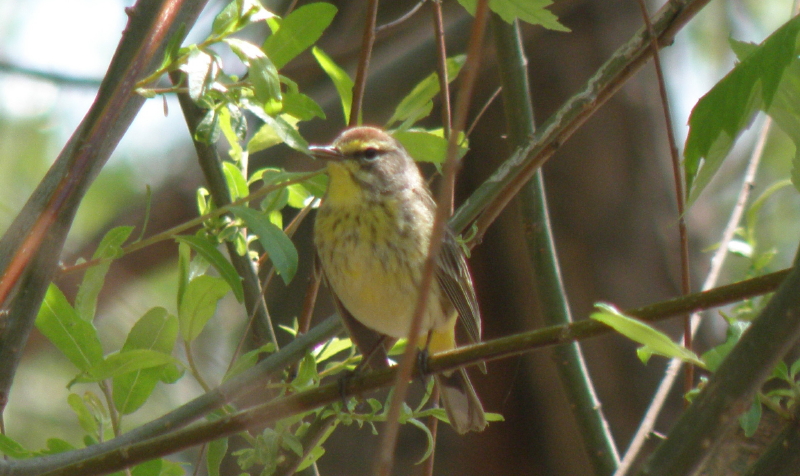
These birds are very territorial and the males chase one another out of their areas when interlopers trespass.  Catbirds have a wide variety of sounds they make including a “mewing” call that reminds people of cats.  Usually, I hear catbirds before I see them.  Thus far, this has also been a good year to observe some warbler species.  Warblers are my favorite group of birds to see because they are diverse, beautiful, transient (they are famous for their long migrations) and challenging to photograph.  Here’s a picture of a Palm Warbler that I recorded on this day.

Palm Warbler, Falls of the Ohio, May 3, 2014

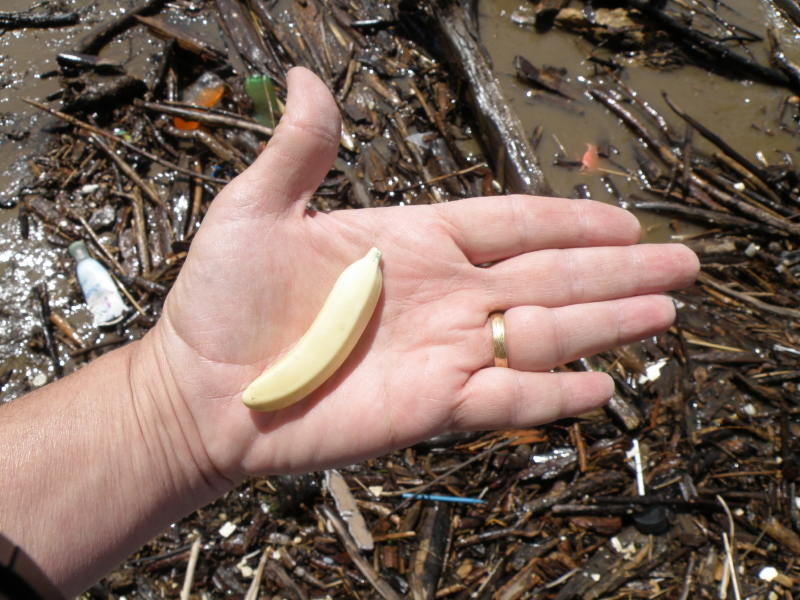
This guy hung around for a while.  The guidebooks say that this warbler species summers in the northern bog lands and really has nothing to do with palm trees. That was an unfortunate bit of naming.   The Falls of the Ohio are just one stop among many that this bird will make and I was glad to see him.  In addition to birds, I was also finding plastic junk and other bits and pieces including a miniature plastic banana…I’m sure you want to see that?

miniature plastic banana, Falls of the Ohio, May 3, 2014

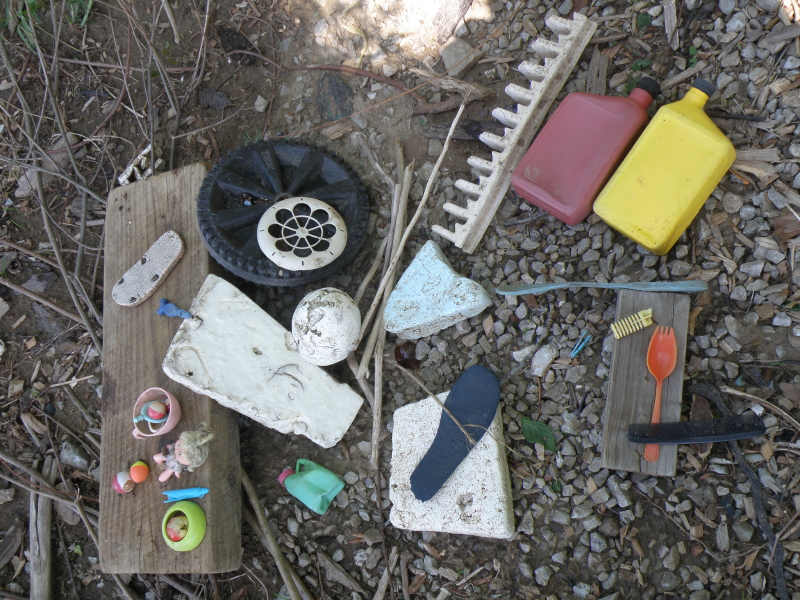
This banana (my second of the year) will enter my Fake Fruits and Vegetables Collection which now numbers hundreds of pieces found in this park.  Here are other found objects, some of which I will use to create a new figure.

Found objects, Falls of the Ohio, May 3, 2014

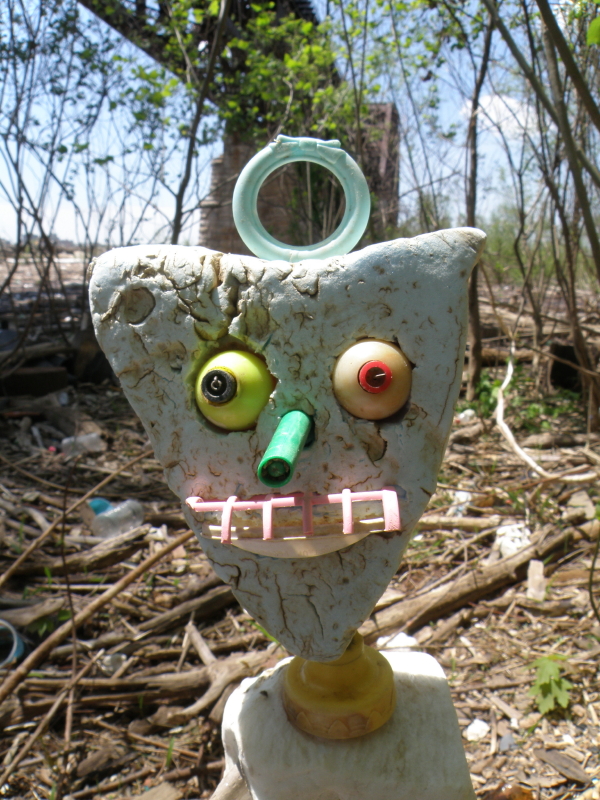
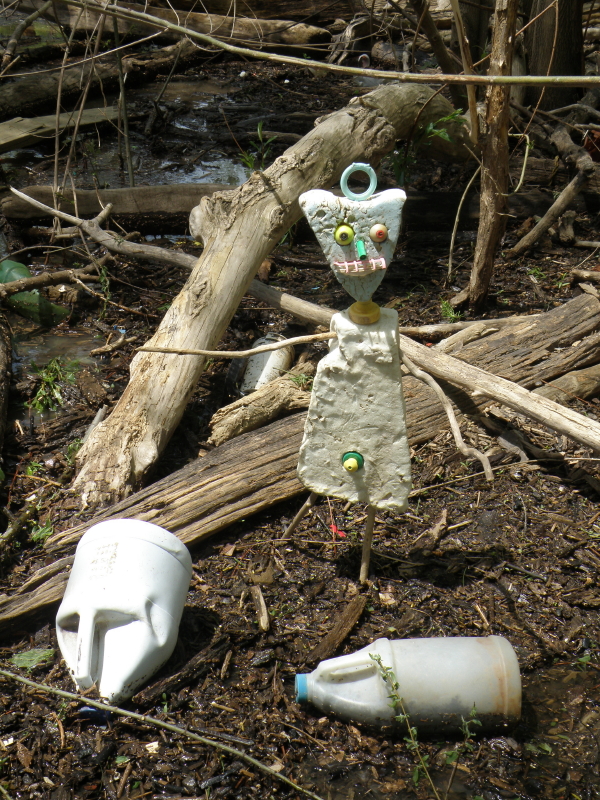
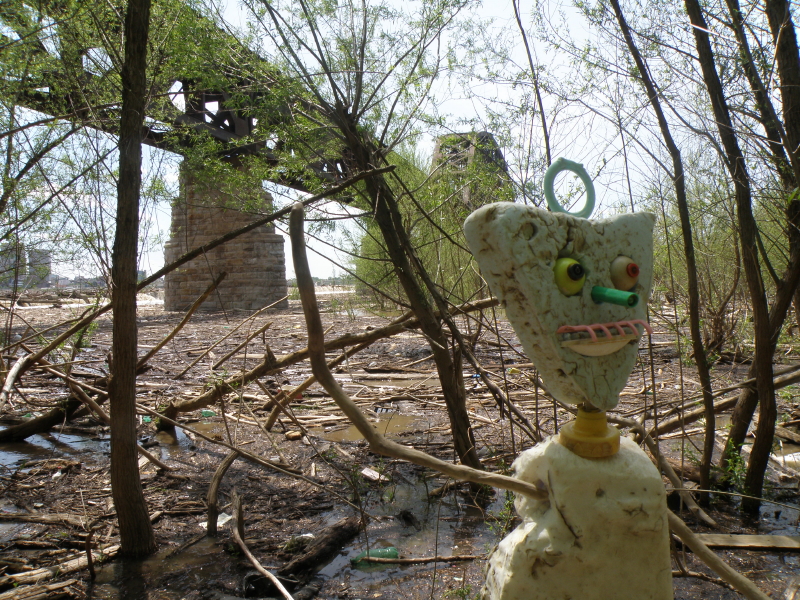
And…here is the figure I constructed on this day.  He’s pretty outlandish looking and another in a long line of pieces that reflect how I feel about our species’ absurd handling of the environment.  For the moment, he remains unnamed, but if one comes to you…please share!

Unnamed figure, found objects from the Falls of the Ohio, May 3, 2014

Styro-figure with white plastic bleach bottles, Falls of the Ohio, May 3, 2014

He’s made mostly from insulating foam, plastic, and driftwood and sports one jaundiced eye and what appears to be a unique, pink moustache.  The area I was working in had so many plastic bottles lying around that my latest Styro-figure decided to put some of the colorful ones to use.  Every year, the park does its best to keep this special place clean and orderly.  Unfortunately, most of the trash I use and show originates elsewhere…mostly along the Ohio River flowing north of here and is carried to this down river location during flooding and high water.

small, plastic container, Falls of the Ohio, May 3, 2014

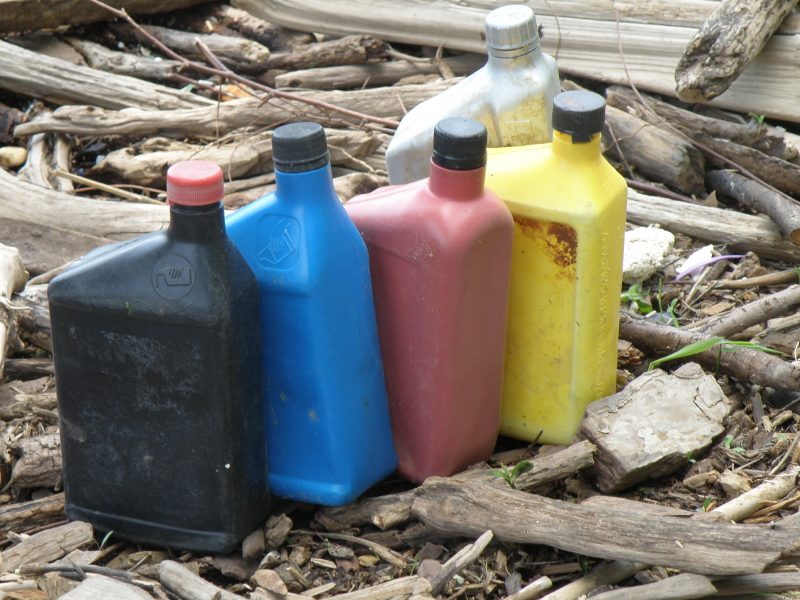
various colorful plastic oil containers, Falls of the Ohio, May 2014

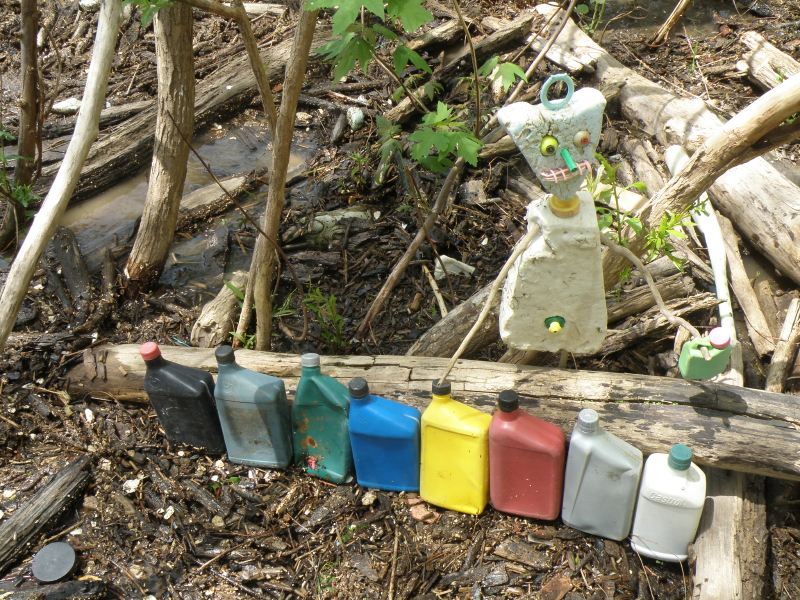
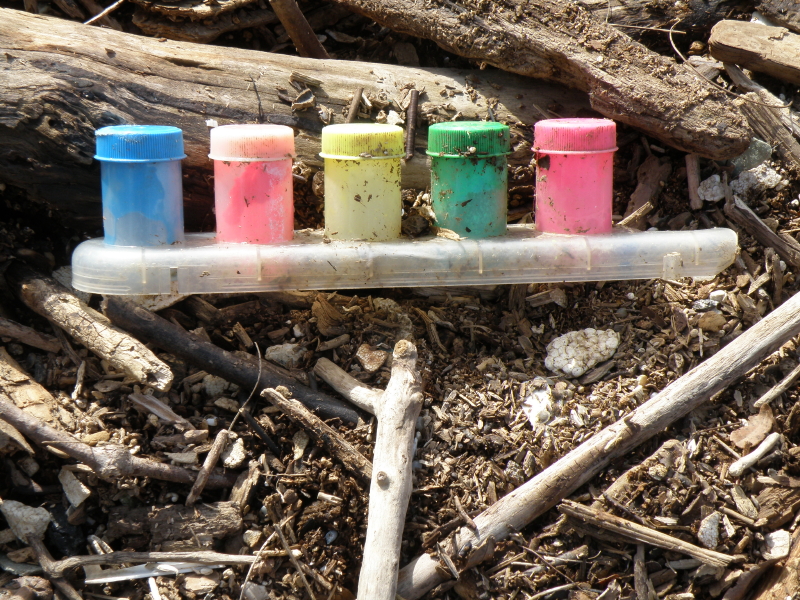
Looking around the immediate area I was able to locate various colorful plastic oil containers and my Styro-figure decided to line them up for a photo opportunity.  Here’s the results.

Styro-figure with plastic oil container color spectrum, Falls of the Ohio, May 3, 2014


It’s an oily color spectrum of sorts.  The Styro-figure seemed happy with it and for this day…left it at that.  I have used this similar idea for other plastic found objects discovered in the park.

Styro-figure under the railroad bridge, Falls of the Ohio, May 3, 2014

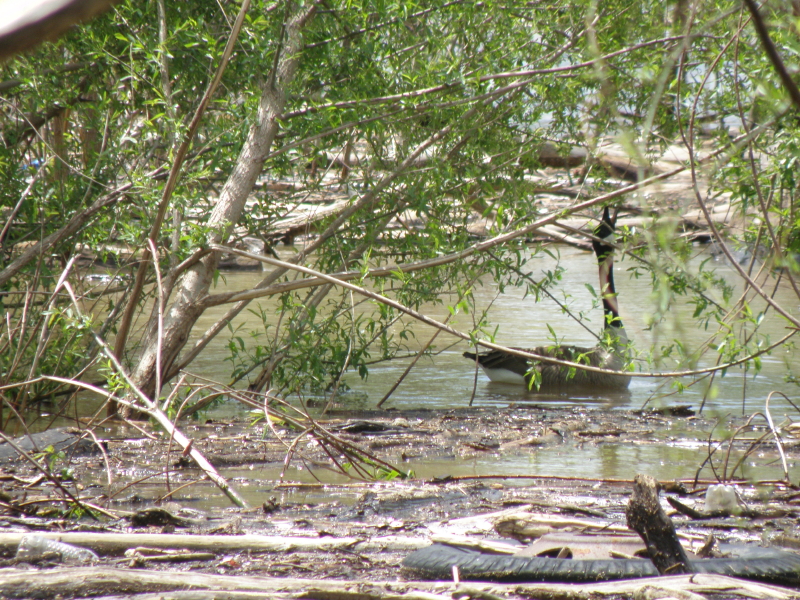
Soon it was time to go home.  The day turned out to be a more creative and productive day than I originally thought it would be.  I gathered up my collecting bag, camera, and walking stick and made the very short walk up to the parking lot.  Looking back, I spied a Canada Goose taking advantage of the high water to feed from bushes it normally could not reach.  This seemed as good an image as any to end this post with.  Thanks as always for tagging along on another day at the Falls of the Ohio State Park.

Feeding Canada Goose, Falls of the Ohio, May 3, 2014


Read Full Post »

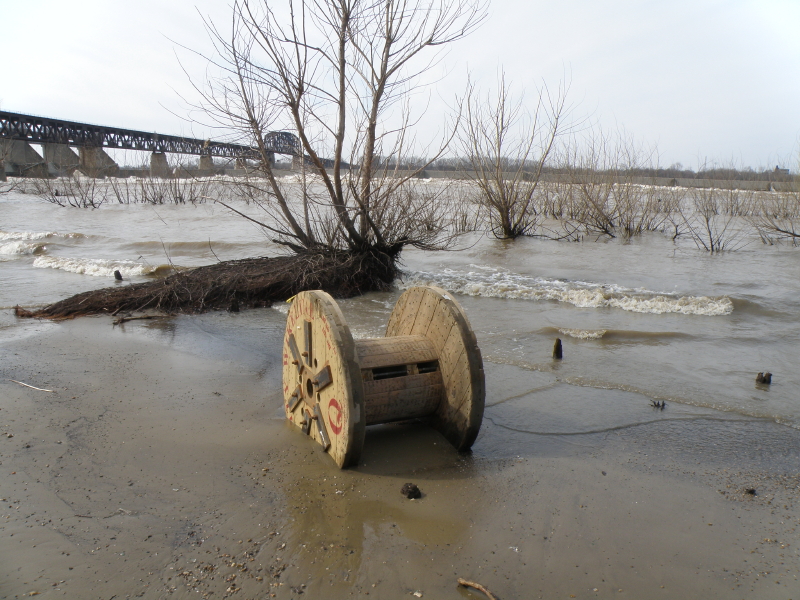
wooden cable spool and willow tree, Falls of the Ohio, March 22, 2014

It’s a sunny Saturday and warm for this time of year.  One of those days I can’t wait to get to the river.  Spring is still slow in developing, but it can’t be much longer now.  I spent a good part of the day just filling up my canvas collecting bag with all types of odds and ends both man-made and natural that have washed up on these fabled shores.  I’m finding so much stuff that for practical reasons I decide to see if I can find a spot up the bank and under the willows that might make a good location for a temporary outdoor art studio.  I can offload some of my larder for future use while continuing to walk the edge of the river.  I’m enjoying the sunshine and taking deep breaths of the fresh air.

U.F.O. studio...Unidentified Floating Object studio, March 2014

U.F.O. studio, Falls of the Ohio, March 2014

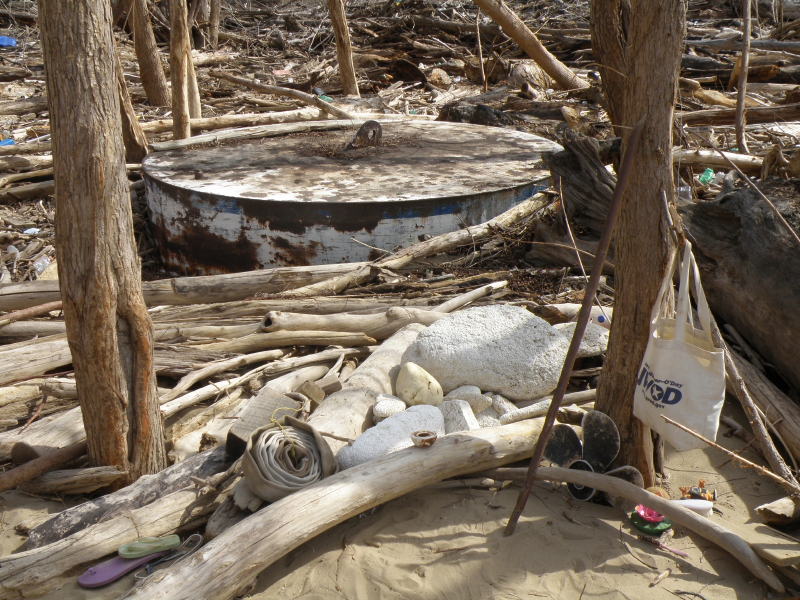
I chose a spot bordered by a large log that keeps most of the driftwood at bay and what I call the U.F.O. or Unidentified Floating Object which is circular metal platform that was once painted white with blue trim.  It’s starting to show some rust now.  This large object washed over the dam during a high water moment three or four years a go.  Since then it’s changed positions with the rising and falling river levels and was once completely buried under driftwood.  The U.F.O. is a platform that normally would be anchored out on  the river.  Barges and other water craft can tie on to it if necessary.  Some how this one got loose and relocated to the park.  When I first discovered it here I also imagined that it was a giant bathtub plug that helped keep the water in the river.   I was lucky that I had the same outdoor studio for many years before this winter’s high water rearranged the landscape again and floated all my collected materials away.  I spent a few hours walking the river collecting Styrofoam and sticks and can’t wait to make something new.

Mega Spool figure in progress, March 2014

Completed figure at the U.F.O. studio, March 2014

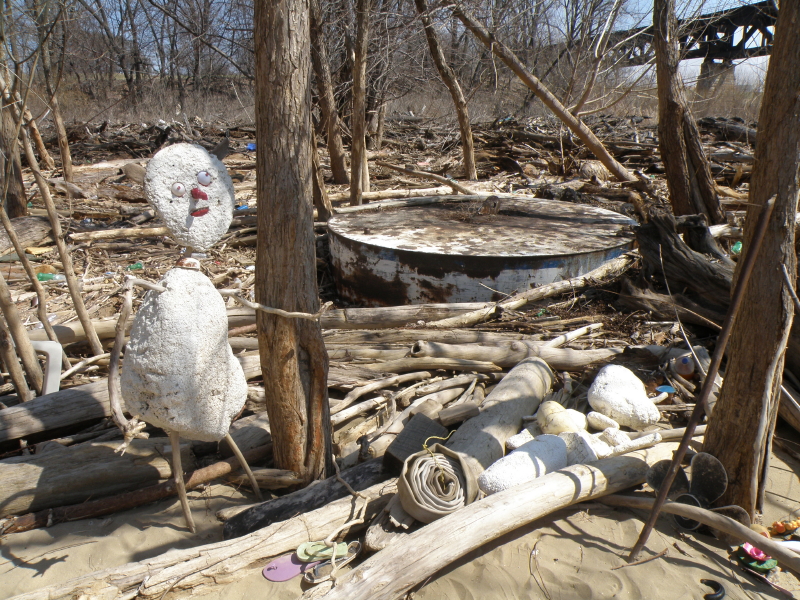
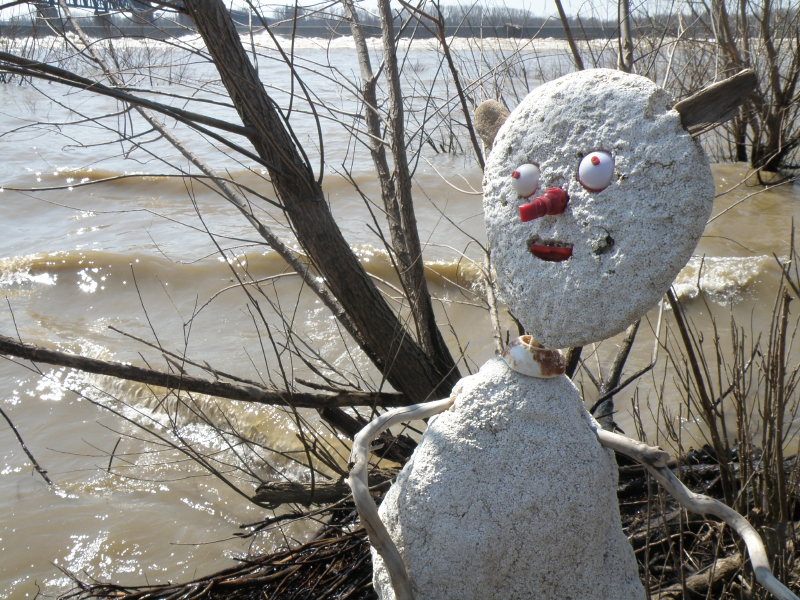
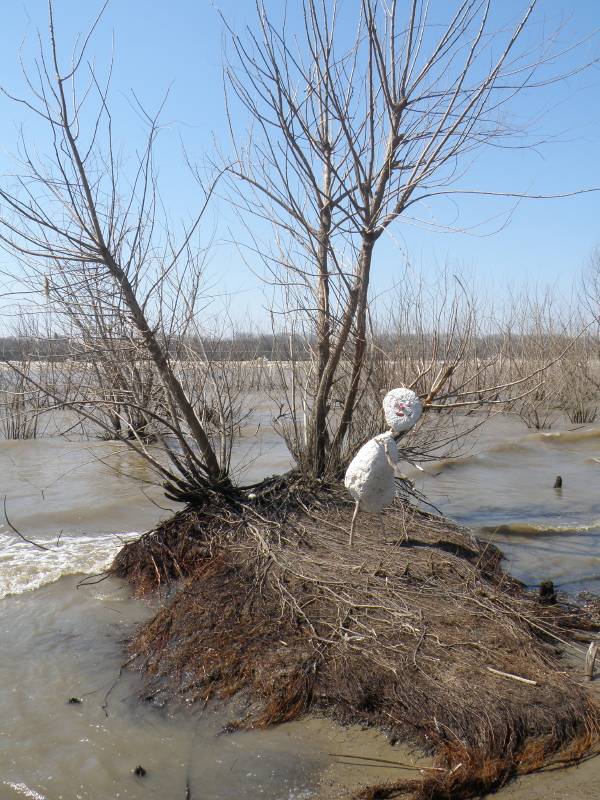
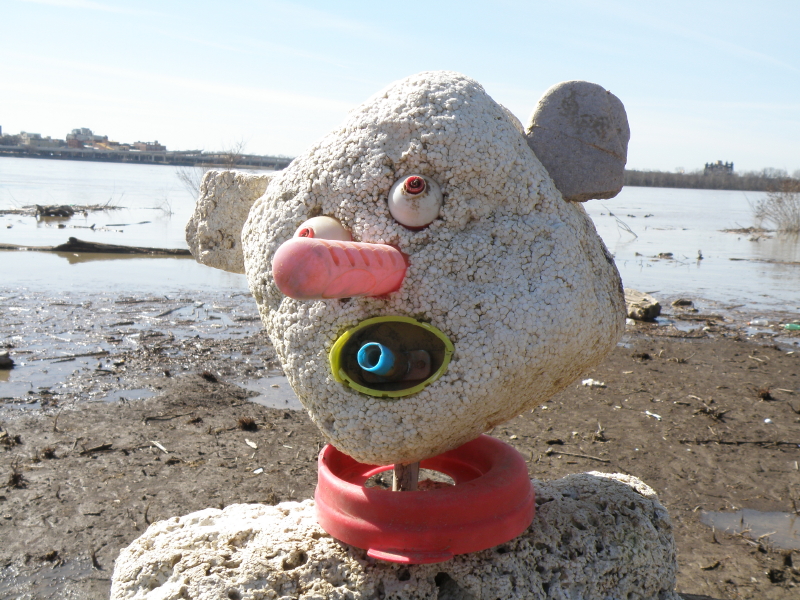
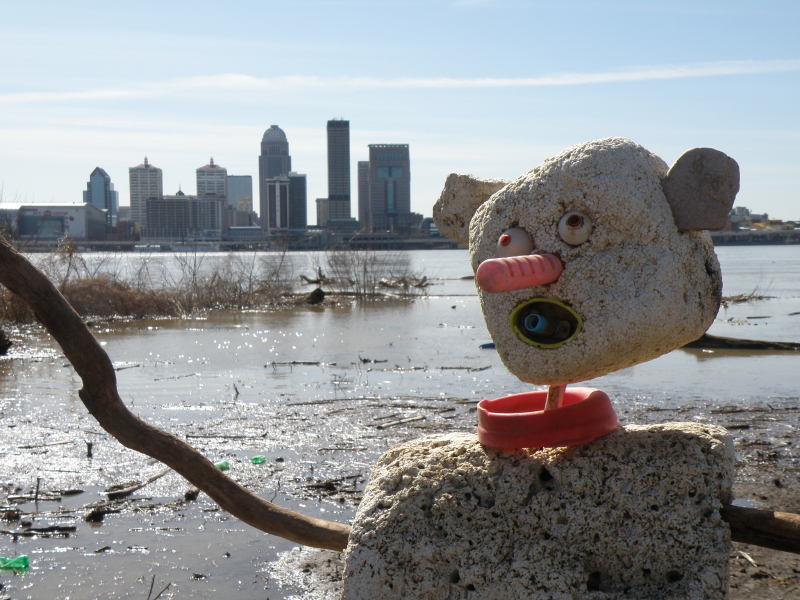
The first figure I make here is from the largest chunks of polystyrene I had found on this excursion.  I used two fishing floats (one larger than the other for expressive effect) for the eyes.  The nose is a plastic piece from a fooseball table.  The mouth is a red reflector.  My figure has ears, arms, and legs that are pieces of driftwood.  The figure has a benevolent feeling to it and I can’t wait to photograph it by the river.  I did run into a young sculptor attending the Kentucky School of Art who was collecting driftwood for her own project.  Her name is Jenn and she approached me asking if I was the person with the show at the Carnegie Center for Art and History?  She and her classmates had seen the exhibition.  Jenn is building an installation at the school and promised to let me know when she completed it.  It will be fun to see art made by someone else from materials collected within the park.

Large Styro-figure on a tiny willow island, March 2014

Styro-figure on tiny willow island, Falls of the Ohio, March 2014

When I first meet the river, I spend a little time looking around and scouting out potential locations to create the photographs that will represent this day in my project.  I decide that I like this tiny “willow island” which consists of clay and sand bound together by the living roots of this tree.  Waves and water wash all around it and at times it does look like an island.  As the river recedes to its normal pool, this tree will be high and dry at last.  It’s amazing what it takes to keep this tree in place with such a dynamic river always testing its resolve to survive.  During the highest river levels, this tree would be completely submerged underwater.  Many of the willows along this stretch of the river bear scars and wounds from large logs battering them, breaking branches, and grinding bark away.  I pose the figure on the root mass and move to the next shot which isn’t too far away.

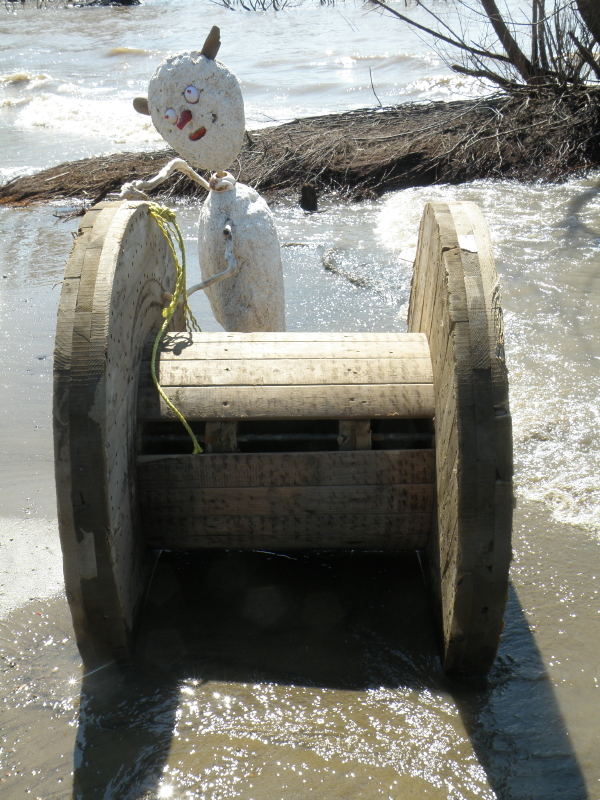
Styro-figure and large, wooden cable spool, March 2014

Styro-figure and wireline spool, Falls of the Ohio, March 2014

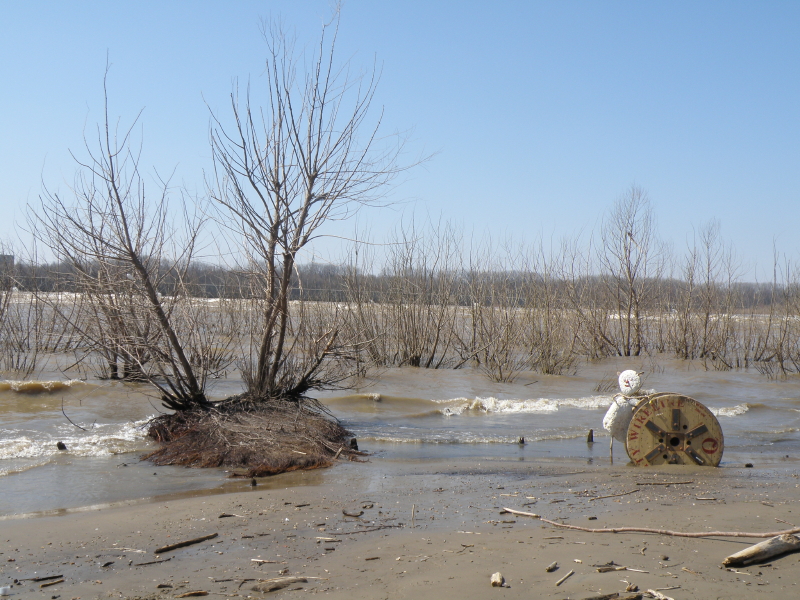
Near tiny willow island is a large wooden “spool” for wire line or cable.  I’m amazed by this object’s heavy-duty construction.  This spool floated into here and is now partially sunk into the sand.  Small waves lap the shoreline and you can also see black coal dust swirling around the water’s edge.  Later when I see my pictures I’m struck by how similar this spool is to the circular platform that now forms part of my latest outdoor studio.  This new area to cache my materials is very visible and hence ultra public, however, if we have heavy spring rains…it’s very possible that all this will be washed away and rearranged again.  I often wonder what might go through people’s minds when they stumble upon my outdoor atelier?  It’s an odd archeological site of Styrofoam boulders, small piles of plastic toys, and a tangle of found roots and driftwood.  All the stuff you need to make an absurd figure!  I left my latest Styro-creation next to the spool.  I will go a head and tell you…I returned a week later and all I could find of him was his body and legs.  There must be headhunters out here?  I searched the area, but found no further trace of my figure.  As with most of my Falls projects, they continue to “exist” as images.  The exhibition that Michael Wimmer and I are participating in at the Carnegie Center of Art and History is entering its last week.  I’m so appreciative of the positive response I’ve received for my work.  The show will end with a tea and cookies closing.  If you are in the area, please stop by.

Final shot from the big spool and tiny willow island, March 2014, Falls of the Ohio

Read Full Post »

Skyliner, Falls, late Feb. 2014

We are all getting antsy for spring to arrive…winter has been hanging on and on for dear life.  It’s been hard to access the river because the water level has been high.  Most of the places I visit at the Falls of the Ohio State Park are currently under muddy water.  We have had just a handful of nicer, warmer days, but that has accelerated the melting of the snow and ice throughout the more than 800 hundred mile long Ohio River Valley.  I don’t mind the cold so much, but it’s harder to do what I like to do on a swollen waterway.  Here’s how one of my spots under the railroad bridge looked during my last visit.

muddy, high water at the Falls of the Ohio, Feb. 2014

Not a pretty picture seeing a river as brown as gravy.  Lots of logs and wood floating on top and when you look more closely…there is also plenty of plastic and polystyrene in the mix too.  Another view this time with me standing on the wall that separates one side of the river from the other.

high river at the Falls, Feb. 2014

All those white spots are pieces of Styrofoam.  With my usual haunts inaccessible I moved further east…just outside the park’s entrance.  There has been a lot of activity in this area that has caught my notice.

Skyliner on the riverbank, Feb. 2014

There has been a campaign on the Indiana side to make the river more accessible particularly in areas that afford a good view of Louisville’s skyline.  To do this the vegetation has been bulldozed away.  I came across an elderly person walking her dog and she said to me quite unsolicited..”Bout time they did something to clean up this mess!” as she pointed a thin finger in the general direction of the river.  In this case, one person’s mess is another creature’s habitat.  The true “mess” comes from all the plastic bottles and chunks of man-made junk that make it into the water.  No amount of removing trees and creating views will help with this and it seems what we prefer looking at is a very selective process.  I brought my collecting bag along.  I’m hoping to pick up materials to use in an upcoming art workshop at the Carnegie Center for Art and History, but I find a few other interesting items as well and photograph them upon discovery.

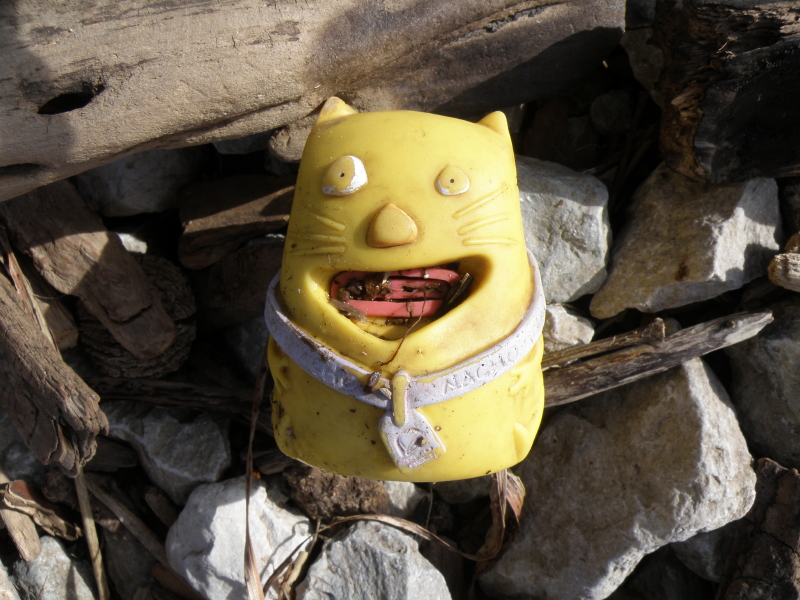
Taco Bell cat toy, Feb. 2014

I came across this smiling yellow cat toy that I think came from a fast food establishment.

plastic containers for paint, Feb. 2014

Finding these paint containers made me realize how hungry I’ve become for color.  I’m looking forward to the world turning green again with color notes supplied by wild flowers.

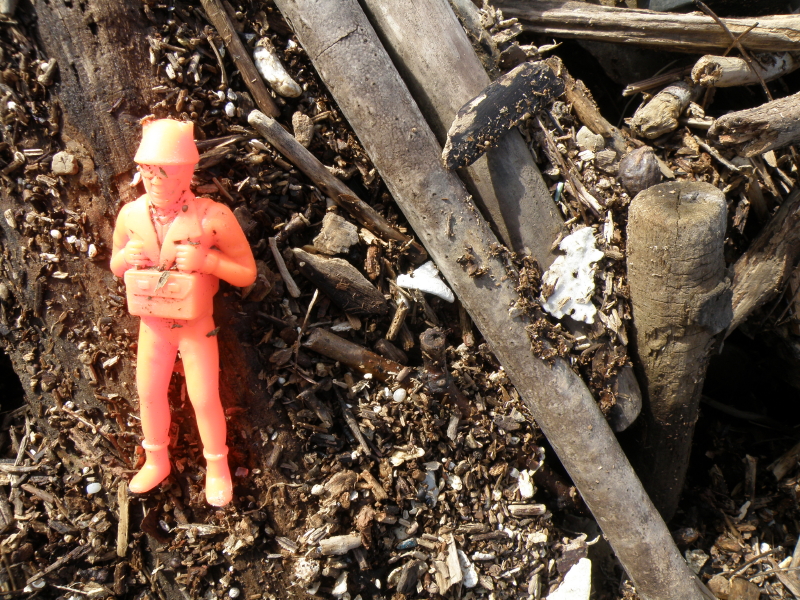
bright orange plastic paratrooper, Feb. 2014

This plastic man with his bright, radioactive orange color was hard to miss.  He was a skydiver or paratrooper in a former life and probably fell to earth using a plastic parachute.

Skyliner with the City of Louisville behind him, Falls of the Ohio, Feb. 2014

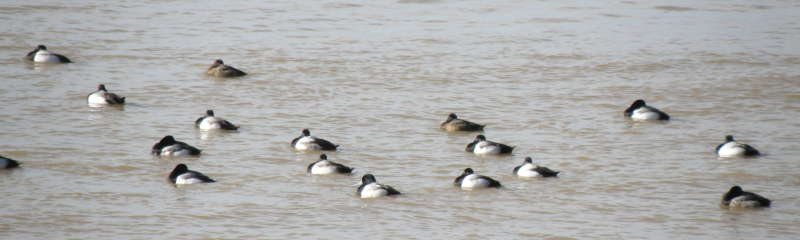
There were other signs from life that the season’s are about to change over.  I’m ever alert to what the birds are doing.  I spotted my first Red-winged Blackbirds of the year and they are among the first migratory species to arrive.  Male Northern Cardinals are singing their courtship songs and scouting out the best spots to build a nest.  On the river, however, I spied what I consider a bird sign of winter.  A nice sized flock of Lesser Scaup ducks were mostly sleeping and relaxing on the surface of the water.  In this area, it seems we see more duck varieties in late fall and early winter. Here’s a peek at the scaups.

White-winged Scoters, Falls of the Ohio, Late Feb. 2014

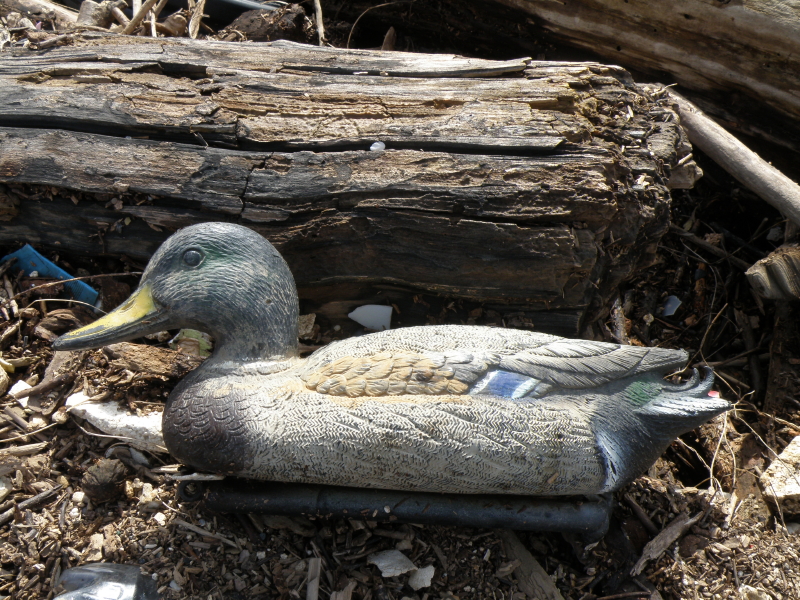
Before I move away from the ducks…I found one other to add to my growing collection.  This is a Mallard decoy made from plastic.  Not too long a go, I found another plastic decoy representing the Pintail Duck.

found plastic Mallard duck decoy, Falls, Feb. 2014

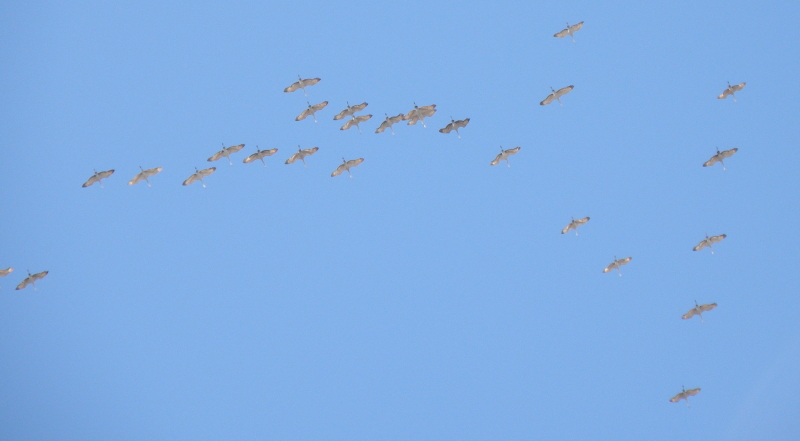
One other bird note…I heard them before I could see them, but I knew what they were instantly.  The familiar calls of migrating Sandhill Cranes winging their way back north.  Like geese, they fly in V-shaped formations to avoid the air turbulence created by other cranes flapping their wings.  These birds are high flyers and this was the best I could do in taking their picture with the camera I have.

high flying Sandhill Cranes, Feb. 2014

As February becomes March…the forecast for the Kentuckiana area is calling for freezing rain and snow.  It appears that Old Man Winter will be hanging out for another week.  Spring will eventually get here and already you can tell that it stays light outside longer with each passing day.   I am, however, really eager to see how the river has rearranged this familiar landscape.

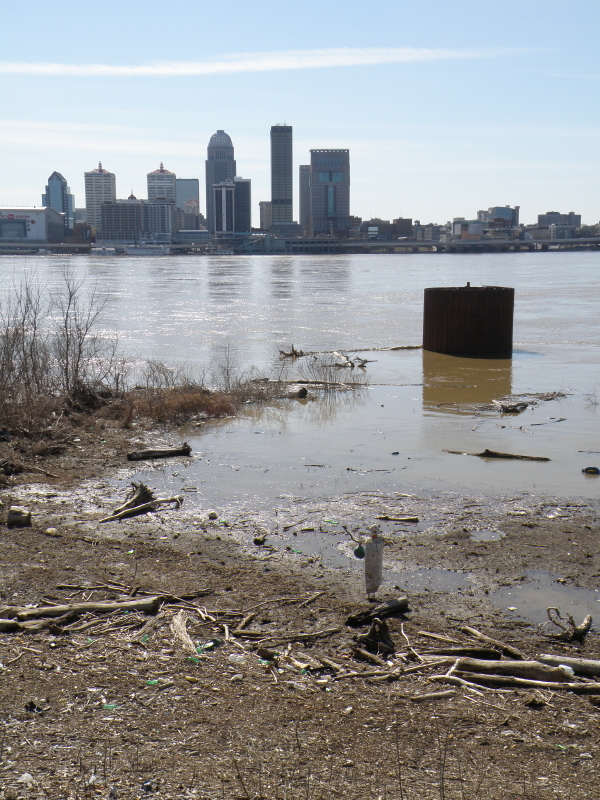
Skyliner on the Ohio River's edge, Feb. 2014

Once the Ohio River recedes there will be a new landscape to explore and who knows what I will find?  I like that each year is different from the last.  Well this post is drawing to a close.  Thanks for visiting and see you soon…from the skyline of Louisville and the Falls of the Ohio.

Looking toward the skyline of Louisville, Late Feb. 2014

Read Full Post »

Tree in the western section of the Falls of the Ohio State Park, Aug. 2013

Resolved to stay away from my old atelier under the willow trees for a while, I decided to explore the western section of the Falls of the Ohio State Park.  It was just the most beautiful day and residents of our area have remarked on how unusually nice it’s been of late.  The air today has wonderful clarity and although it’s summer and the sun is shining…we are many degrees below our usual temps.  I feel the western part of the Falls of the Ohio begins once you cross the creek at the end of the Woodland Loop Trail.  This is an area that receives fewer visitors and I’m happy just to wander with nothing on my mind.  As I walk the narrow strip of land that is the riverbank, on my left are sounds from the river and on my right are various bird songs originating under the tree canopy.  I see the formerly high river has deposited driftwood here in new configurations along with the usual plastic junk.  My eyes are open and ready for anything.  I doesn’t take very long before I make the first of several discoveries new to me in and around a patch of Wild Potato-Vines.

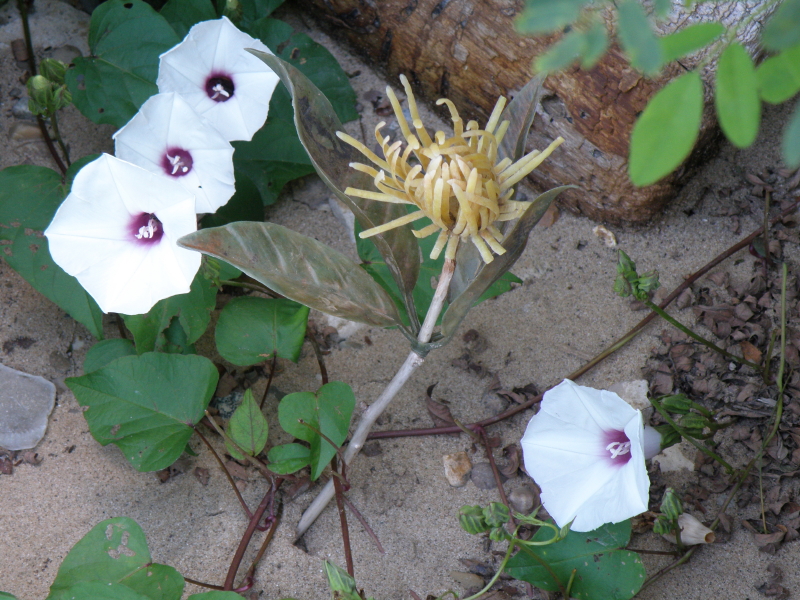
Goldstein's False Mum among Wild Potato Vine flowers, Falls of the Ohio, Aug. 2013

Close up of Goldstein's False Mum, Aug. 2013

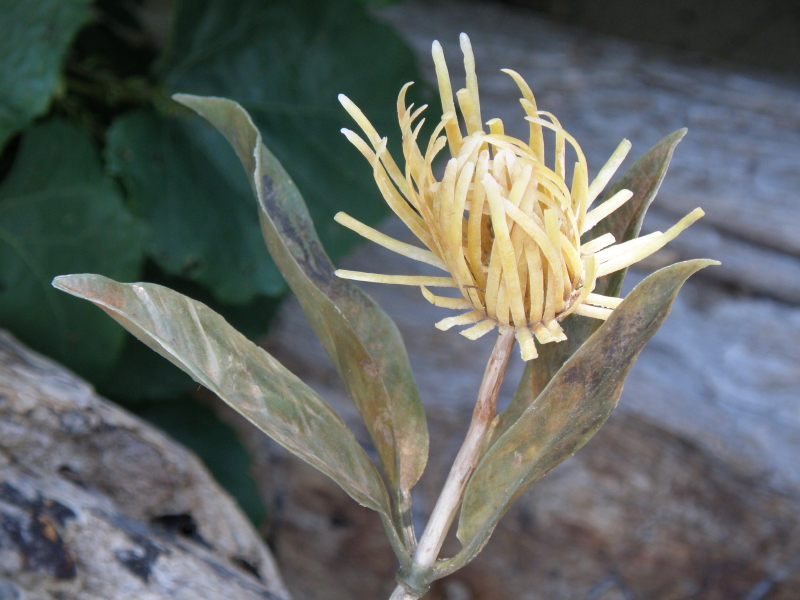
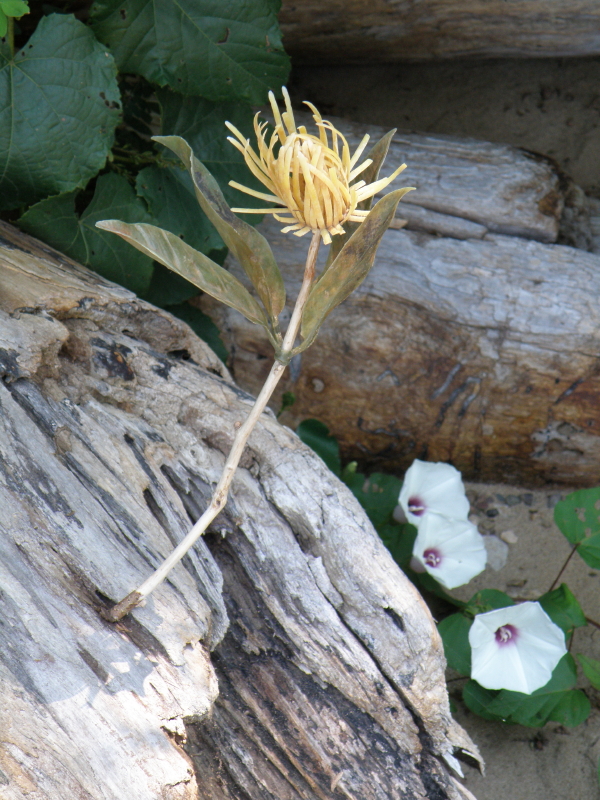
This is Goldstein’s False Mum which is named after the resident naturalist at the Falls of the Ohio State Park.  This is another in a series of very odd flowers while being organic by definition  have little in common with the other plants that grow along side of them.  In general, plastic-like blooms and foliage characterize these botanical rarities.  None of these plants (which form a new order of their own called Artificialia ) are capable of photosynthesis despite the appearance of green leaves.  Goldstein’s False Mum is a summer plant that produces a hard, yellow, frilly blossom that appears on the terminal end of a woody stem.  It prefers sandy, disturbed soils or decaying wood and is usually seen in the company of traditional flowering plants.  It produces no scent and no insects were observed being attentive to the false mum.  Now the Wild Potato-Vine is also an interesting plant.  It is a member of the Morning Glory family and its bloom is primarily white with a purplish maroon throat.  I have seen large bumble bees pollinating this flower.  What sets this plant apart is under the ground.  The Wild Potato-Vine produces a large tuber that had food value for the indigenous people.  Here is a another specimen of Goldstein’s False Mum growing out of a soft, decaying log also in the presence of Wild Potato-Vines.

Goldstein's False Mum and Wild Potato-Vine flowers, Falls of the Ohio, Aug. 2013

Not too far away and also in association with the Wild Potato-Vines is another type of plastic-like plant and here is its portrait.

Wild Potato-Vine blossom with Saprophytic Zinnia, Falls of the Ohio, Aug. 2013

The Saprophytic Zinnia, Falls of the Ohio, Aug. 2013

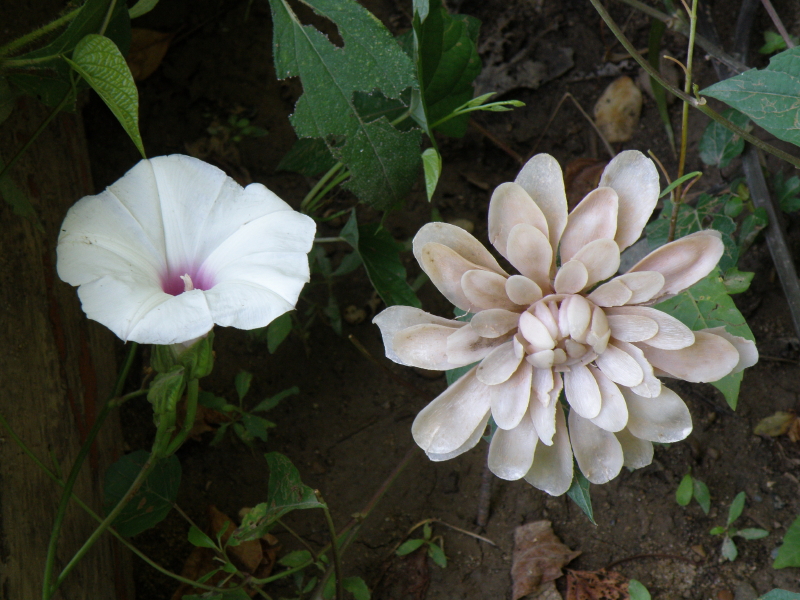
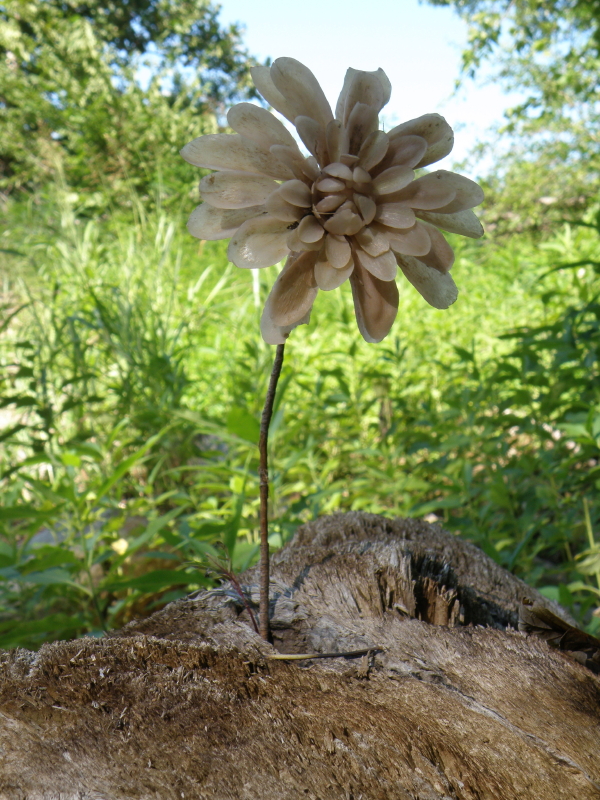
The Log Weed is a saprophytic plant.  Lacking chlorophyll it relies on decaying matter for its sustenance.  The Log Weed is characterized by a corolla of hard plastic-like petals and never has what we would describe as leaves coming off its woody stem.  No one is quite sure how it propagates? Its blossoms appear in mid summer and seem to hang around forever.

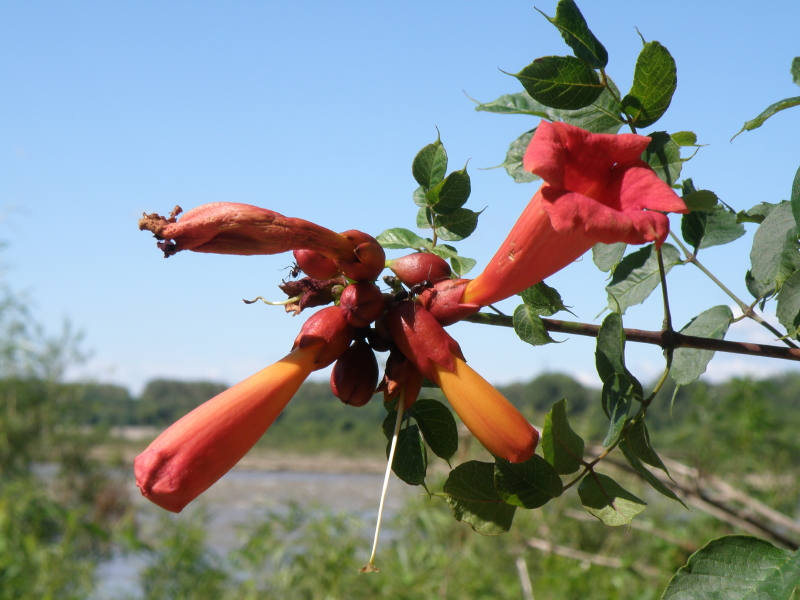
Trumpet Creeper, Falls of the Ohio, Aug. 2013

These are tubular flowers from the Trumpet Creeper vine which is a native and natural sight at the Falls of the Ohio.  This is a climbing, spreading vine and wood ants seem to love them.  If you look closely at the above photo…you can see several ants crawling on the Trumpet Creeper’s attractive blooms.  I was admiring this vine when I noticed that there was something not quite right about it and this is what I discovered.

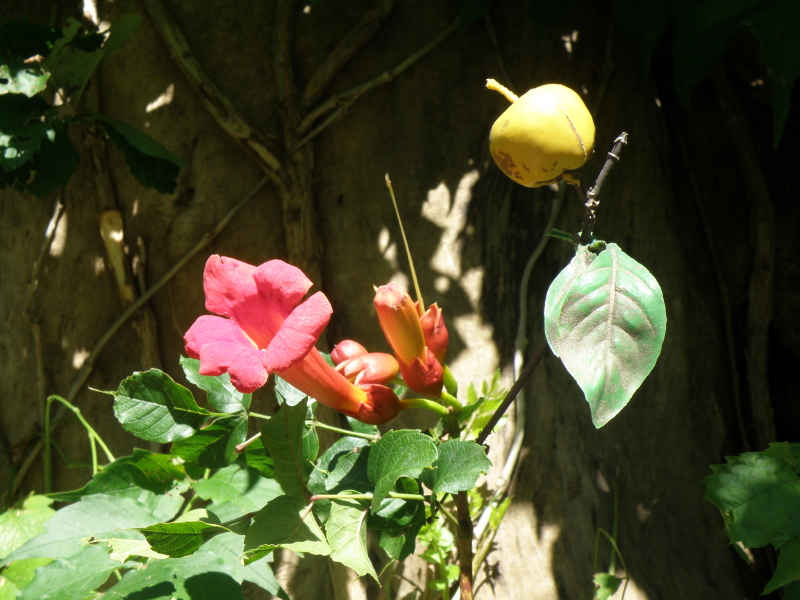
Unknown fruit on Trumpet Creeper, Aug. 2013

Notice the yellow orb to the upper right of the Trumpet Creeper blossoms? Thus far, the yellow fruit with its accompanying leaf remain unclassified.  It is, however, grafted to the woody stem of the vine.  Amazingly, it even has a false stem to deceive.  Could it be parasitic?  One hypothesis why this plant with the odd fruit appears with Trumpet Creeper might be the protection it receives from the vine’s wood ants?  The fruit and leaf are also very polymer-like and may indeed be plastic.  More and more we are learning how ubiquitous plastic is in the environment.  I heard a report about the Great Lakes the other day saying that there is a considerable amount of micro plastic in these large bodies of fresh water.  Upon examination, much of this plastic takes the form of tiny balls that are blended into deodorants and toothpaste to make the product flow more evenly.  These beads are so small that they pass through the finest screens at the waste water treatment plants and into the lakes.  I think Nature is metabolizing this plastic and recombining the hydrocarbons in novel ways, but that is just my theory.

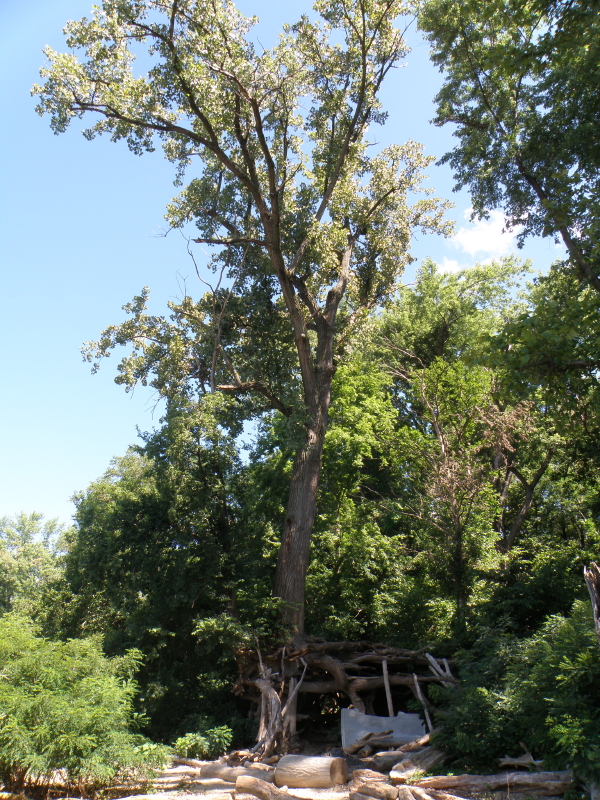
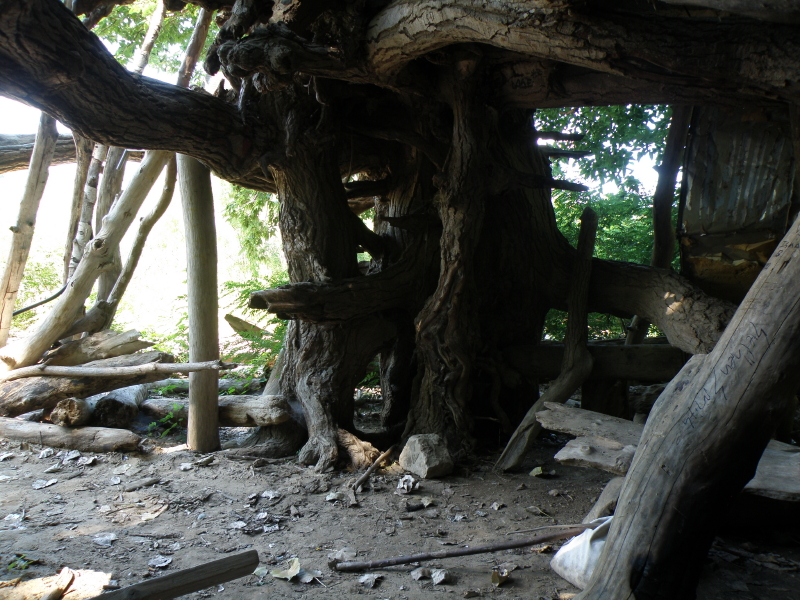
Cottonwood tree fort, Falls of the Ohio, Aug. 2013

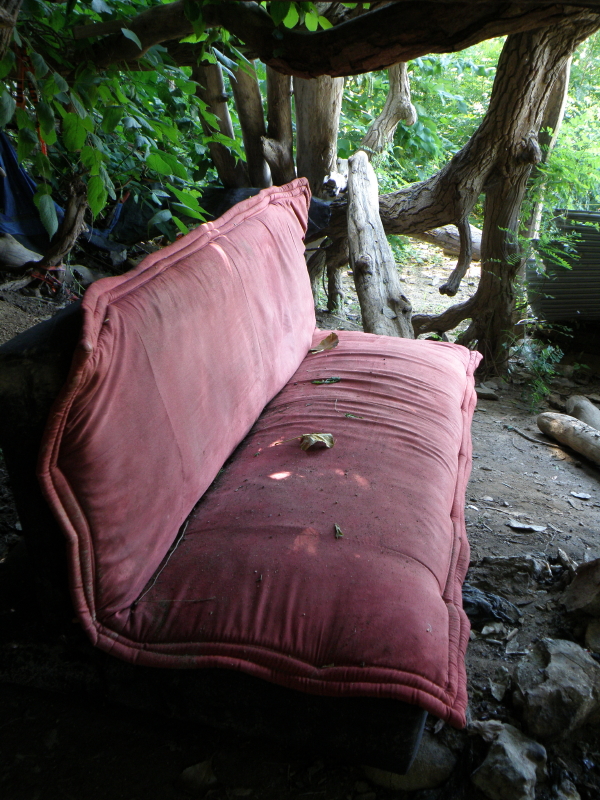
I paid my favorite cottonwood tree a visit and it’s been a while since I took shelter under its large, exposed roots.  People, especially the locals, like hanging out here and I witnessed much less trash since my last visit which is a good thing.  One big “improvement” has been made with the addition of a red, upholstered couch and I took a moment to rest here before moving on.

red couch under the cottonwood tree, Aug. 2013

The couch is very comfortable and I’m amazed that people actually dragged this piece of furniture down here.  Eventually, it will be reclaimed by the river.  Here’s another view from under the tree.

space under the cottonwood tree, Aug. 2013

For those who prefer their comforts a bit more on the rustic side…there is another bench for seating and it’s made from a slab of wood balanced on short logs.

under the cottonwood tree, Aug. 2013

I rested, had a snack and drank some water before moving on.  I’ve designated my intended destination as “Loosestrife Land” for the abundance of these non-native flowers that have taken over moist areas in the western section of the park.  I’m going there seeking something else which will be the subject of my next post.  I’ll catch up with you soon but for now…so long and happy trails to you.

Purple Loosestrife flowers in bloom, Falls of the Ohio, Aug. 2013

Read Full Post »

the riverbank, cracks in clay, July 2013

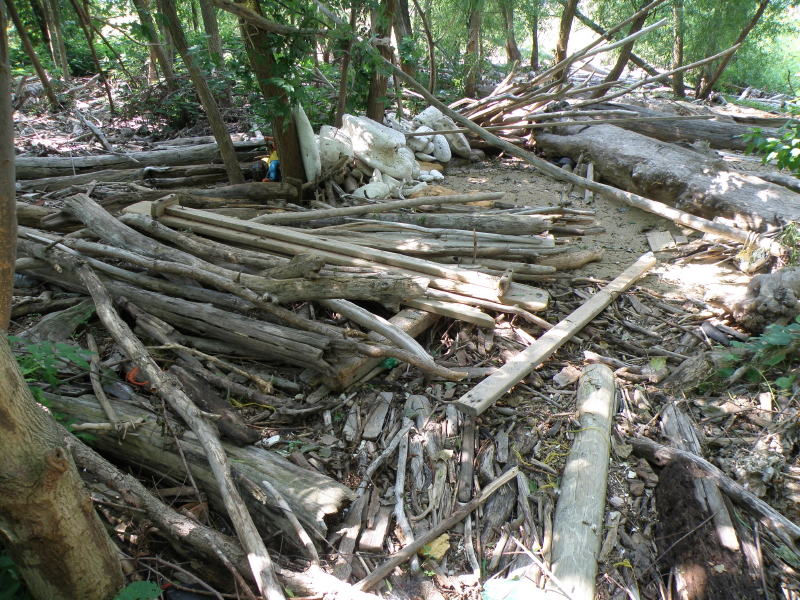
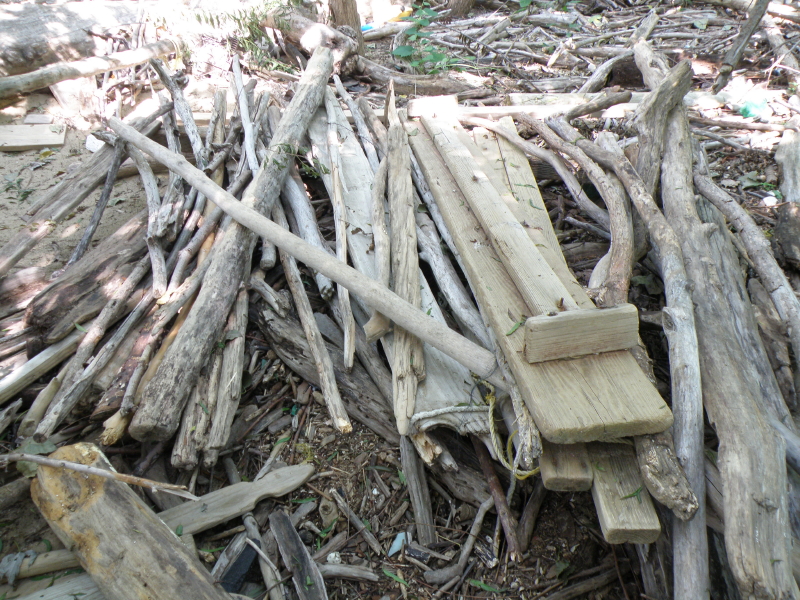
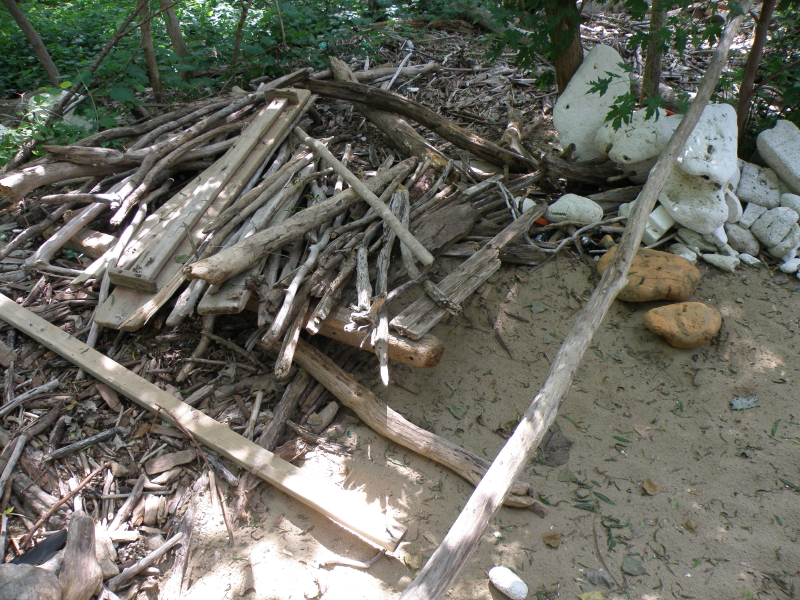
I never told you how this story played out and so now is as good a time as any.  A few weeks back, I had posted on how some unknown visitor(s?) had been altering my outdoor studio at the Falls of the Ohio State Park.  For a least two years previously, I had been storing my river found art materials at this site.  People who stumbled upon this spot often mark their presence by changing how I left it in some way.  Folks might rifle through the junk or take or destroy the Styrofoam figures I might leave behind.  I don’t mind this…in fact, I encourage the interaction.  On site, it’s easy to make the connection that all these poor materials I use came from the river.  I still think of my outdoor studio as a shared laboratory for this exercise in creativity.  It’s an acknowledgement that all this junk is out there and that something else positive might come from it.  For several weekends, my latest visitor has been building a wooden driftwood structure over my spot to the point where it usurps my ability to continue working there.  So, I made a few changes that I thought would benefit both of us.  I modified the structure so that I could stand within my site.  I also opened up the space more which I thought also encouraged additions.  I was curious to see how my visitor would react and here are the pictures.

destroyed driftwood structure, July 2013

destroyed driftwood structure, July 2013

destroyed driftwood structure, July 2013

It appears that my “improvements” weren’t appreciated because I arrived one day to find it all laying on the ground.  All the nylon line and strong knots that were holding things together were cut with a knife.  Stuff was scattered and the big polystyrene figure I had left there was destroyed again.  Here’s how I discovered my Styrofoam man.

fallen figure, July 2013

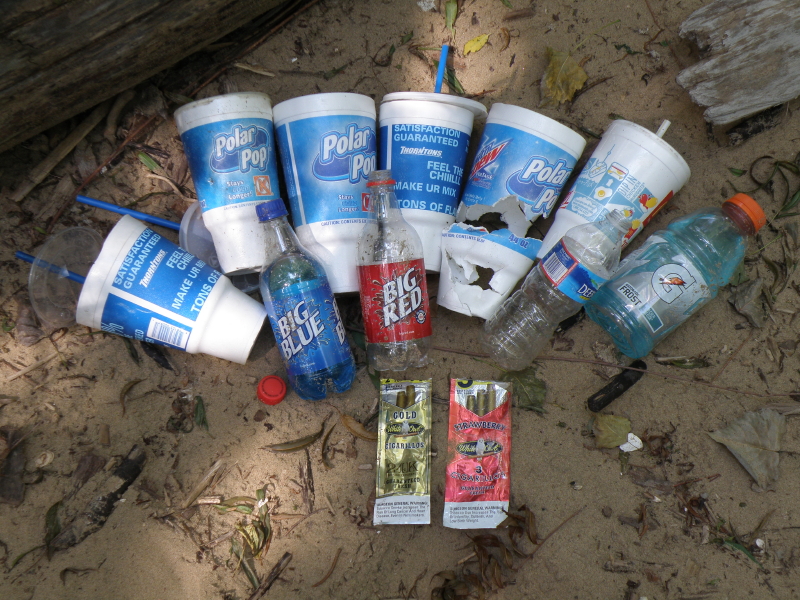
He had been sitting in a fork of a nearby tree.  I think my visitor picked him up and threw him across the site…again!  At this point, I’m feeling pretty bummed out.  I left this figure as I found it.  My visitor also left me some additional trash behind as is his custom and I gathered it together again to create this “portrait”.

trash at my site, July 2013

I thought the “Big Red” with the “Big Blue” was an interesting touch.  In our area, those are the home colors of rival universities.  Another giant Styrofoam cup joined the group and I have my suspicions that the cigar packaging is from the same individual as well?  I think this is what saddens me the most that all this convenient store trash would be walked to this site and simply thrown on the ground.  As much trash that appears here from upriver, I’m shocked by how much park garbage originates from the nearby towns.  And yes, there are trash cans available everywhere.  I sat by my site for a while and pondered the situation.  I wondered why with all the space and driftwood available in the park that this spot became so important to my visitor?  Feeling like this individual more than likely doesn’t play well with others…I decided to walk away from this site for a few weeks or months before returning.  So far, I haven’t been back to my old spot under the willows.

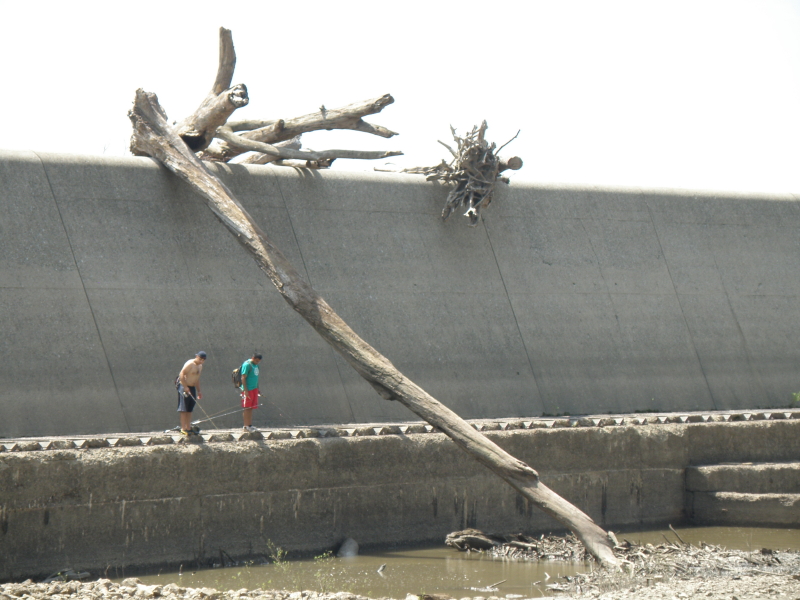
two fishermen, July 2013

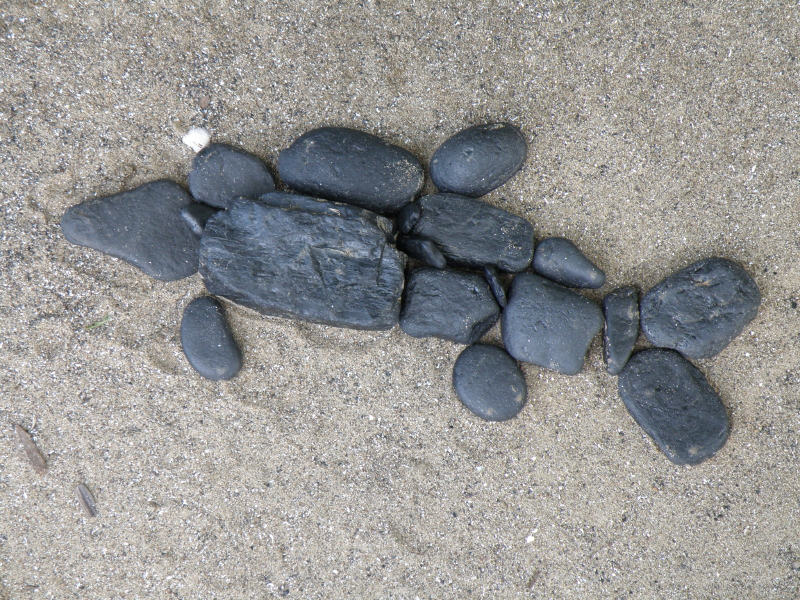
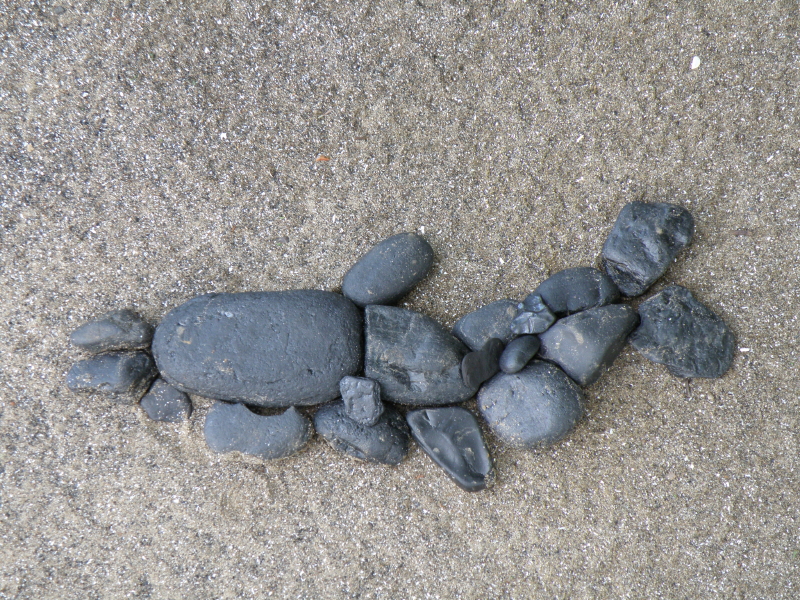
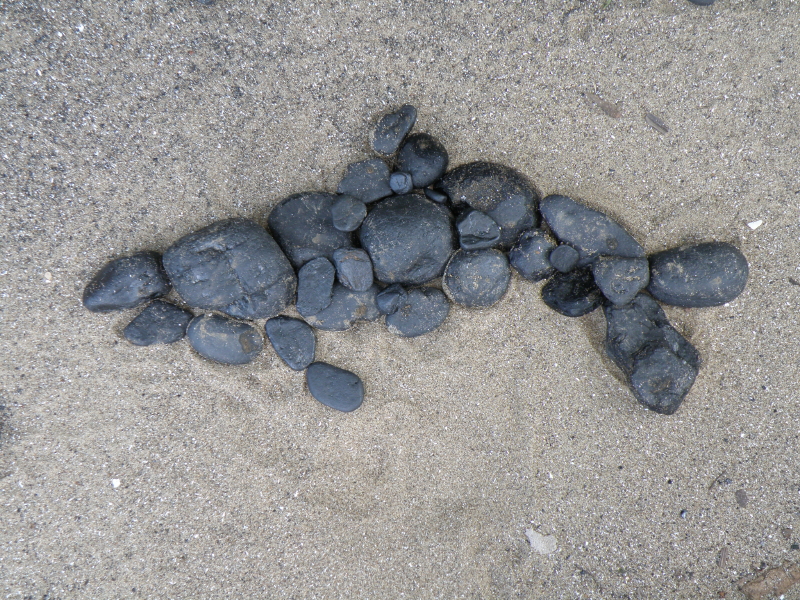
The day felt shot, but I didn’t want to leave things that way and so I went for an extra long walk.  After all, I have the rest of the park to potentially explore.! Along the way, I spotted these two guys attempting to fish by the wall of the dam.  They didn’t appear to be having any luck and so I left them with these fishy images by the side of a trail they would pass by.

coal fish, July 2013

coal fish, July 2013

coal fish, July 2013

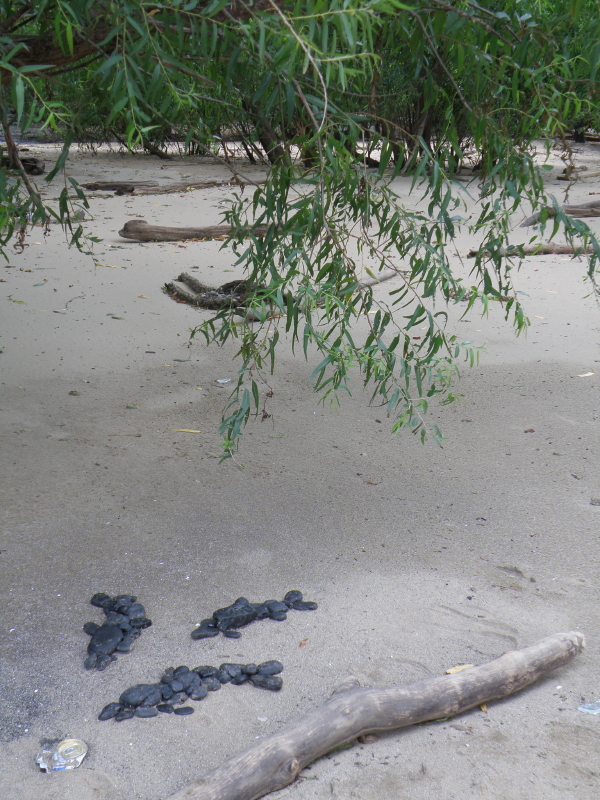
I used river smoothed coal I gathered on site and improvised these three fish on the sand.  Peppering the silica granules black is coal dust.  The white dots are pulverized mussel shells.

three coal fish on the sand, Falls of the Ohio, July 2013

Thus far, it has been an atypical and sometimes unsettling summer at the Falls of the Ohio.  All the early season rains and subsequent high water have disrupted the usually hot, humid, and lazy routine found here during this time of year.  In an odd way, it doesn’t feel like summer has truly arrived for us yet.  We have a few more months for this to happen before the leaves start turning colors.  To close, here is one more coal-fish image in a slightly larger context.  Have a great weekend!

coal fish in context at the Falls of the Ohio, July 2013

Read Full Post »

Falls of the Ohio, late May 2013

Another great day at the Falls of the Ohio.  Although it’s late May, we haven’t immediately jumped from a cool spring into a sweltering summer heat.  We still have time for that.  I’m following the deposited driftwood which forms these nice clearings punctuated here and there by small stands of willow trees.  There’s a method to my walks.  I carefully and as quietly as I can listen and look for any bird life in each new area I move into.  If I don’t find any birds than I move around the driftwood looking for interesting pieces and any other water born junk of note.  If an object captures my eye, I usually take a photograph of it in the context of the environment surrounding it.  If it is something really unusual, portable,  and potentially useful…then I may drop it into my collecting bag.  I also try to pay attention to any new flowers or insects that are out since my last visit. I don’t collect anything living since with the exception of fish…it’s against the park’s rules.
Falls of the Ohio, late May 2013

I will also walk the river bank doing much the same thing before heading back into the trees and my studio under the willows.  It’s here at my outdoor “atelier” that I check out my latest finds and with the materials I’ve previously collected…attempt to make art from them.  I was taking a break sitting on a bench I made and letting my mind “go blank” and just listening.  In the trees I could hear Northern orioles, Blue jays, and Catbirds all making their distinctive sounds.  With birds, you don’t need to see them to know they are present.  Small, noisy flocks of Cedar waxwings were flying from mulberry tree to mulberry tree seeking out ripe fruit.  I also kept hearing a “clicking or clacking”  sound originating behind where I was sitting which I mistakenly took for a squirrel moving among the branches.  I would look over my shoulder every now and then, but I didn’t see anything at first.  I didn’t see anything at all…until it moved!

Giant spider on web, late May 2013

Between its cryptic coloration and the dappled light effects of sunlight filtering through the tree tops…I had completely missed seeing the biggest spider in the world!  I know I had to walk by this marvel, but it didn’t register at all until this moment.  The spider wasn’t making any threatening gestures yet…perhaps it was remaining still “thinking” that I hadn’t located it.  The spider on its web was perhaps a dozen feet away from where I was sitting.  Meanwhile the hairs on the back of my neck were on end and I had an acute case of goosebumps all over my body!  Instinctively, I reached for my camera and started taking pictures.

Giant spider, May 2013

Carefully walking around the spider and its web, I snapped off as many images as my nerves would dare.  I still had no idea what it was capable of doing especially in protection of its nest?  I had my stout walking stick at the ready.  Nestled in a depression in the wood at the web’s base was a silk-lined “pocket” that held three white cocoons.  I wasn’t sure if these were egg cases or the wrapped up remains of former meals?

giant spider egg cases?, Falls of the Ohio, May 2013

In trying to describe this spider to you…I utilized my walking stick not only for protection, but to gauge its size as well.  Later in the comfort of my home, I estimated that the length of its body from the head to the tip of its abdomen to be approximately 30 inches or 76 centimeters long.  It’s moving legs made the spider seem much larger, but they were harder to measure.  The legs were perfectly camouflaged resembling the driftwood all around us.  The spider’s abdomen is covered with coarse hair arranged in bands of orange, white, and a bluish-black colors.  Otherwise, the spider is as white as the large river-polished chunks of Styrofoam that wash up on these fabled shores all the time.

Head of Giant Driftwood Spider, May 2013

lower jaws of Giant Driftwood Spider, May 2013

The head of what I’m now going to call the “Giant Driftwood Spider” is very unusual for a spider.  The fact it is nearly distinct (as in insects) and not simply continuous with the thorax makes it different.  The head was not, however, capable of movement.  This spider features four eyes.  It has two, larger dominant eyes and a vestigial pair located between them.  The fangs were purple in color and supported by black jaws used for gripping prey.  The clicking sound I had heard earlier were its fangs rubbing together.  Like all spiders…I assumed that this species is carnivorous as well.? Consistent with true spiders, this giant species also has eight legs, although the Giant Driftwood Spider’s are not uniform.  After watching this great arachnid for several minutes, it surprised me by leaving its web and walking towards the river.  I naturally, followed behind it at a discreet distance.

Giant Driftwood Spider, May 2013

Giant Driftwood Spider on a stump. May 2013

Giant Driftwood Spider on tree roots, May 2013

The giant spider moved deliberately through the driftwood field pausing once in a while for whatever reason.  Thoughts about what this spider did for food crossed my mind.  Was it an ambush predator secretly lying next to a log waiting for a meal to walk by?  Did it rush and overwhelm its prey with a lethal bite to the body?  I thought this likely since its web by my outdoor studio didn’t seem big enough to capture anything larger than birds or rodents.  I got the sense that this spider was able to go a long time between feedings.  I continued to follow the spider when it stopped at another silk construction it had previously created.

Great Driftwood Spider in yellow silk lair, May 2013

The spider stopped by what I’m guessing to be another silk trap?  The spider may have been trying to hide its form with the silk?  Perhaps it uses a method similar to trapdoor spiders in catching its food?  I will confess that I do get “creeped out” by having spider webs go across my face.  I have always had an aversion to this feeling, although generally speaking…I’m okay with the spiders themselves.  In this particular area, it felt like I was constantly wiping my face which made me very ill at ease.

Giant Driftwood Spider in its lair, May 2013

Giant Driftwood Spider attack!, May 2013

I circled back around to get a better look and when I did the spider lunged for me! With fangs clacking together and its legs gesturing wildly, the spider held its ground, but did not advance towards me.  With stick at the ready and in deep fear, I was prepared to swing down as hard as I could on the spider if I had to.  That’s when it occurred to me how wrong that would be?  Who was doing most of the provoking anyway?  Perhaps the spider was reacting in self-defense?  As with most living things, this spider had as much if not more reason to fear humans.  Even though this was the biggest spider I had ever seen…I was still bigger than it.  With that realization I backed off and took my leave of the Giant Driftwood Spider.  Reaching my home, I couldn’t wait to see the pictures and to tell the story of this remarkable animal encounter.  The world is full of natural marvels and the Falls of the Ohio…has many of them.
willow tree and roots at the Falls of the Ohio, May 2013

Read Full Post »

« Newer Posts - Older Posts »