Feeds:
Posts
Comments

Posts Tagged ‘creativity’

On a warm Saturday morning in mid February, I was exploring the eastern section of the Falls of the Ohio State Park.  At first glance, I had the place to myself and I began my systematic sweep of the shoreline looking for whatever the river had temporarily marooned here.  Usually, I will walk down to the water’s edge first and then I comb the bank walking back and forth until I hit the treeline.  This typically takes an hour or so and my collecting bag quickly fills up with all kinds of river treasures both natural and artificial.  This morning was to prove to be a memorable one when I came across a creature new to me and I believe science as well?

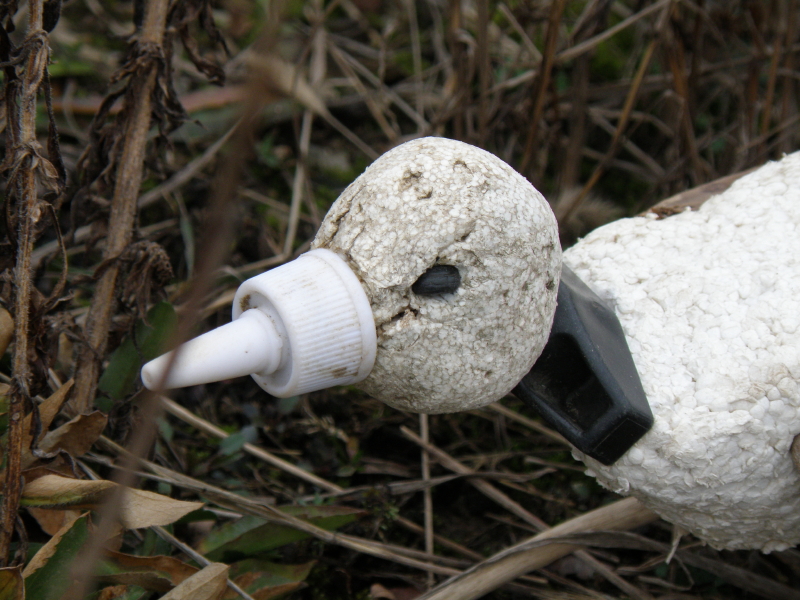
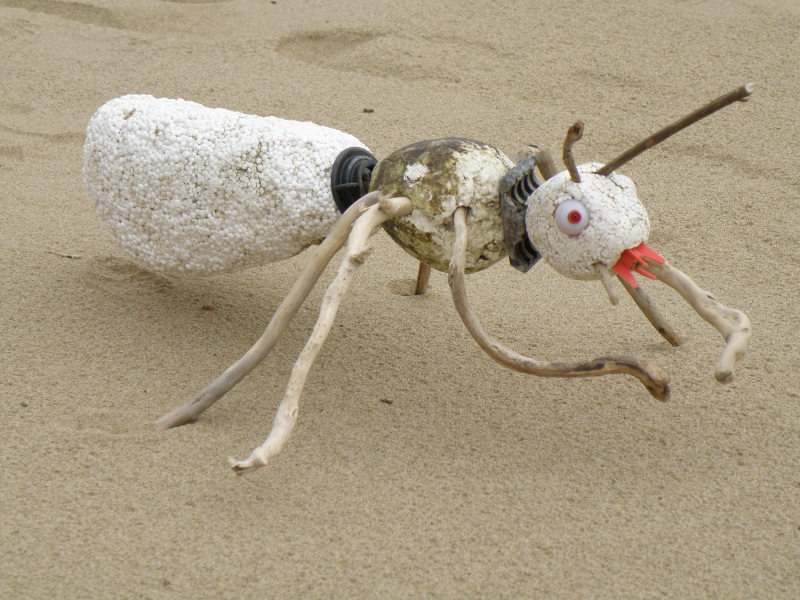
Years of bird watching had trained me to key on the slightest movement that might betray a creature’s location.  Such was the case when I came across this extraordinary insect that was exploring the same territory as me!  I saw a little motion from the corner of my eye while scanning the riverbank that proved to be this very large ant’s wiggling legs.  This is not my first encounter with a large insect at the Falls of the Ohio.  Previously, I had discovered five other giants of different species all belonging to a genus I had dubbed “Polystyrenus”… because their exoskeletons look like they are made from weathered Styrofoam.  The following is my report complete with photographs and observations made in the field.
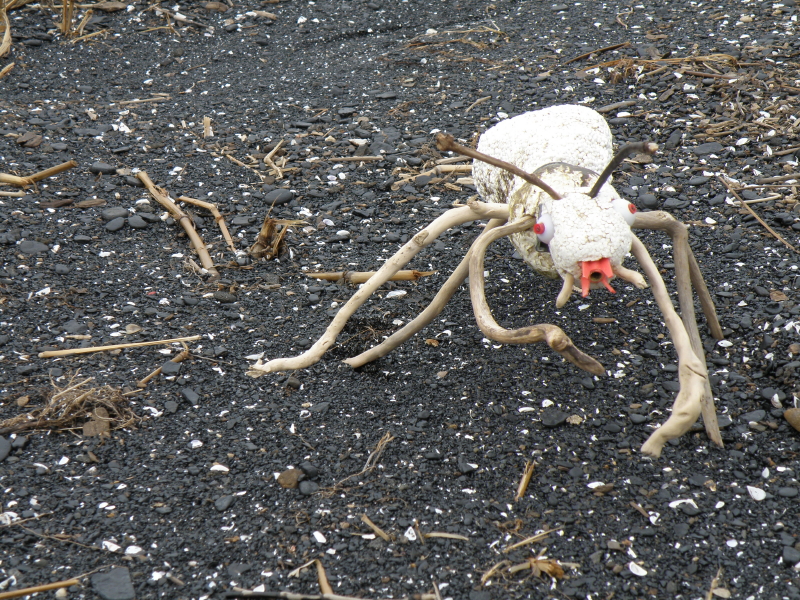
I would estimate that this insect’s body, (which looks to be an  “ant”), to be about a foot in length.  Of course, the articulated legs make it seem bigger.  Its eyes appeared to be simple and its mouth parts seemed feeble.  I surmised that whatever it fed upon didn’t require the shearing power of larger mandibles.  I could be more certain of this, but I refused to “collect” or kill this creature in the name of science just to complete a more thorough morphological examination . The thought crossed my mind that this could be the young of the Giant Blue Ant I had seen here a couple of years a go?  I also noticed that many of its legs were different from one another and each appendage might be a different tool like blades in a Swiss Army knife?
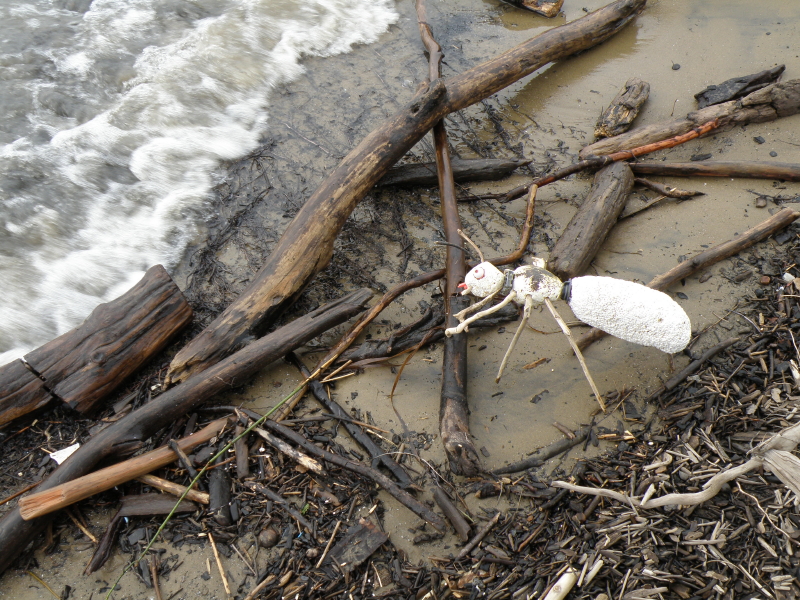
While the ant explored its world I discreetly followed along.  My camera is equipped with a telephoto lens nearly as big as the bug.  Still, I found this particular specimen to be amazingly tolerant of my presence.  I watched it while it moved to the river’s edge, but I could not gauge its purpose here.
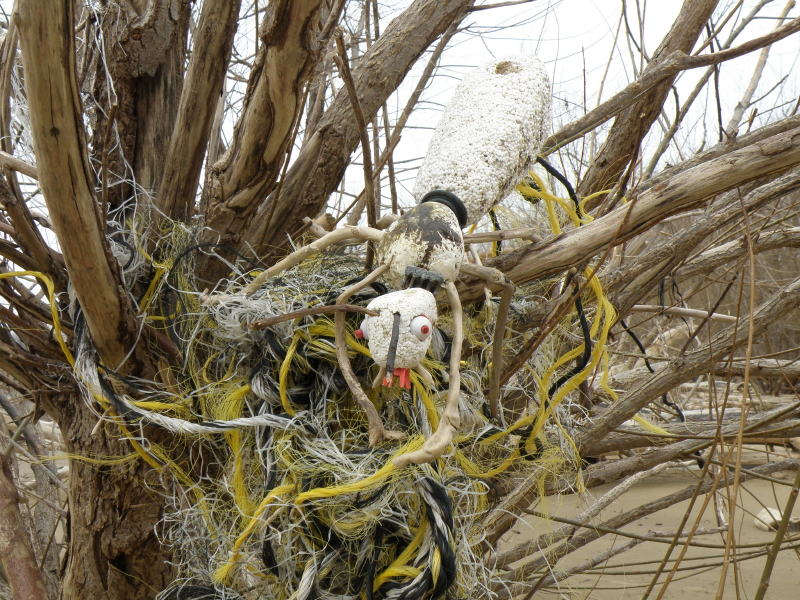
Interestingly, I did observe it checking out a couple of frayed barge cables that were snagged and unraveling among the willow branches.  It seemed very intent with the fiber strands and used its six legs to gather up the strings into a ball.
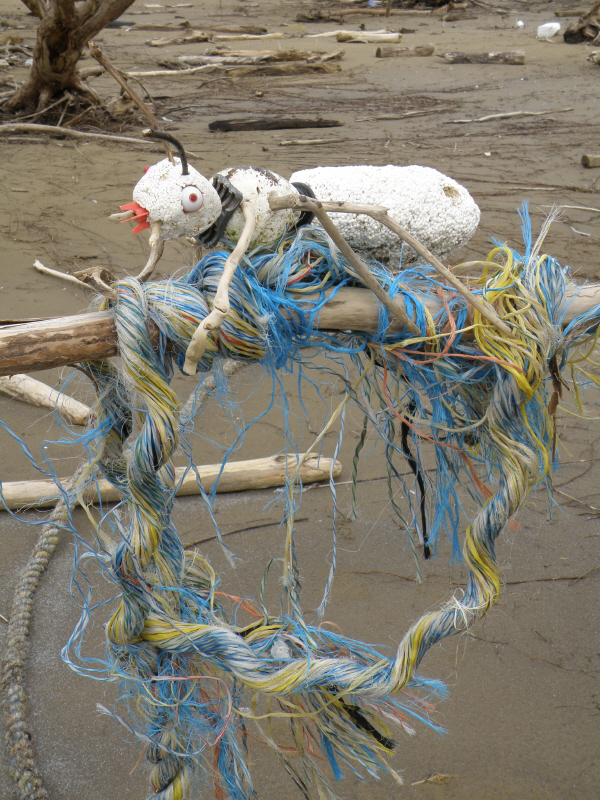
Here’s the ant on a different branch.  I wonder if it is responsible for the cuts on this cable?  You can see an intact length of this heavy rope on the sand below.  Could this be some form of play?  This is a question to be answered later.  I never saw the ant do anything else with these two cables .  Does anyone out there have a hypothesis?  Moving on, I did get some very interesting images of the ant either feeding or drinking that show how unusual this ant is from its smaller kin.
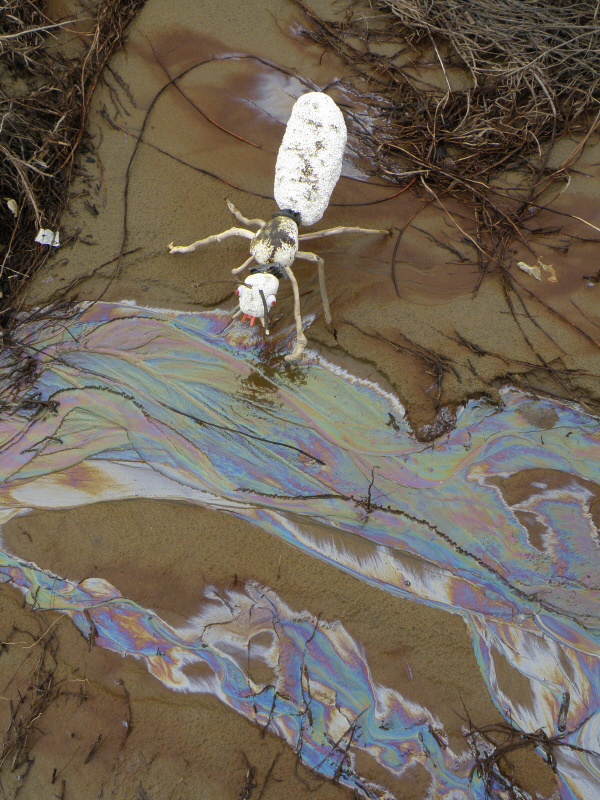
On several occasions I was able to observe our remarkable ant taking “sustenance” from iridescent water which flowed in rivulets from the sand below.  What is this stuff?  Is it petroleum pollution or the oils and minerals leaching from other biodegradable materials breaking down below the sand?  As it fed, the ant was at its least cautious.  Perhaps it was drunk?  I walked up to it and was able to take this aerial view.  The rainbow-effect on the sand contrasted nicely against the whiteness of the insect. You can easily see the basic insect body plan with its head, thorax, and abdomen.  Of course, all true insects have six legs.
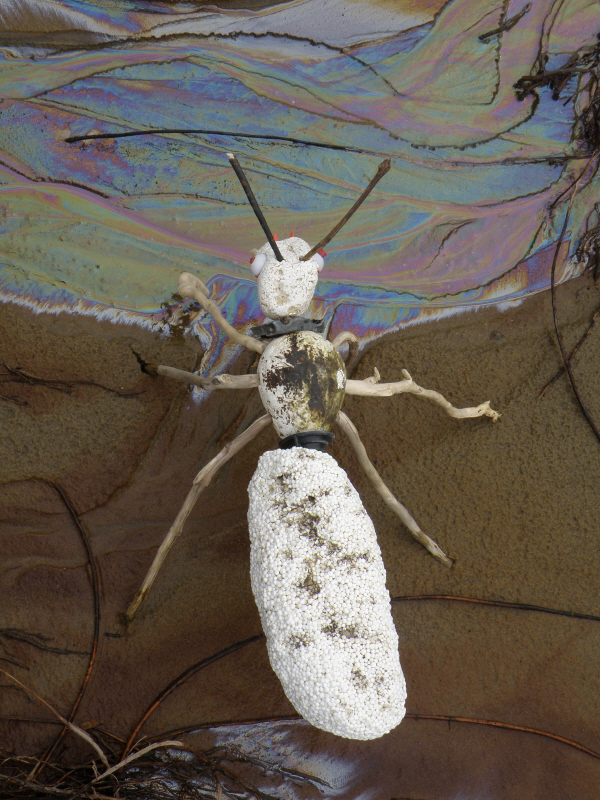
Here’s another image that comes as a revelation and shows clearly how it feeds.
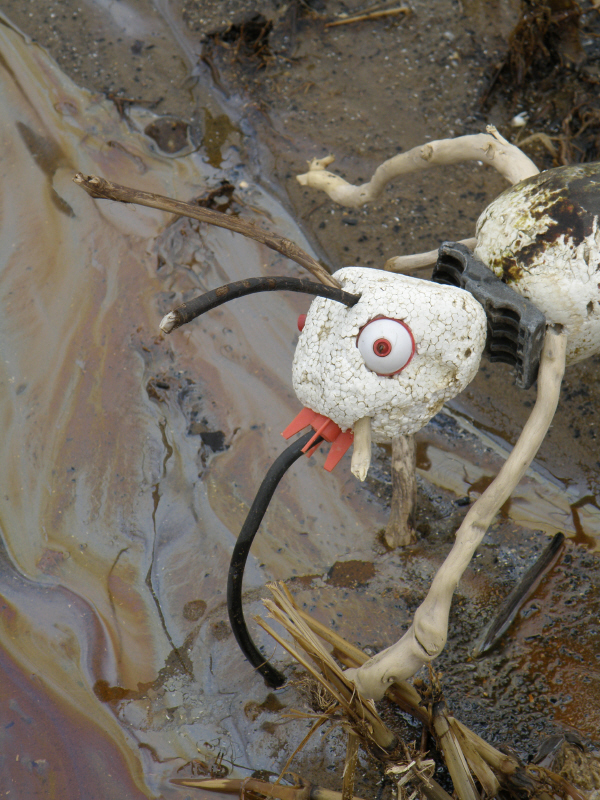
Like a butterfly, the ant unveiled a long proboscis or feeding tube and lowered into the sheen.  Its abdomen pulsed while it sucked.  I kept thinking about what this stuff is that bubbles to the surface and could it be responsible for the appearance here of these large insects?  Is this some local version of the “Godzilla-effect” where pollution mutates the endemic creatures into giants?  Well, at least I think Clarksville, Indiana will be safe from this ant for the time being.  Now if millions of these ants were to show up at the same time…then this story could change.
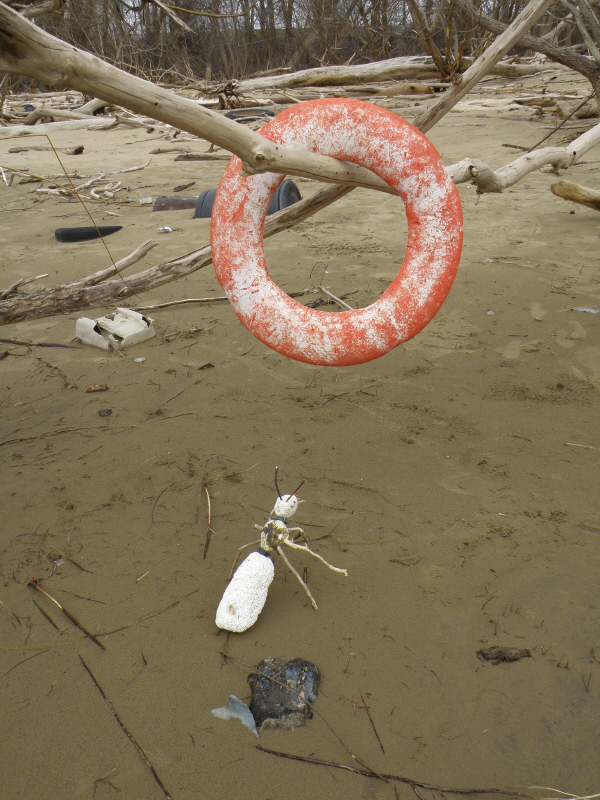
After imbibing this strange brew, I observed the Giant White Ant exploring the park.  A previous visitor had found an orange life-preserver and placed it over the branch of a tree.  Here the ant gets on its “hind” legs to investigate the ring.  This ant displays a lot of curiosity about its world.  For a short-time, I lost track of the ant which is able to walk across the driftwood more quickly than I, but I was able to relocate it when I came across this shattered plastic barrel.  It kind of looked at home here and so I left it be and moved on.
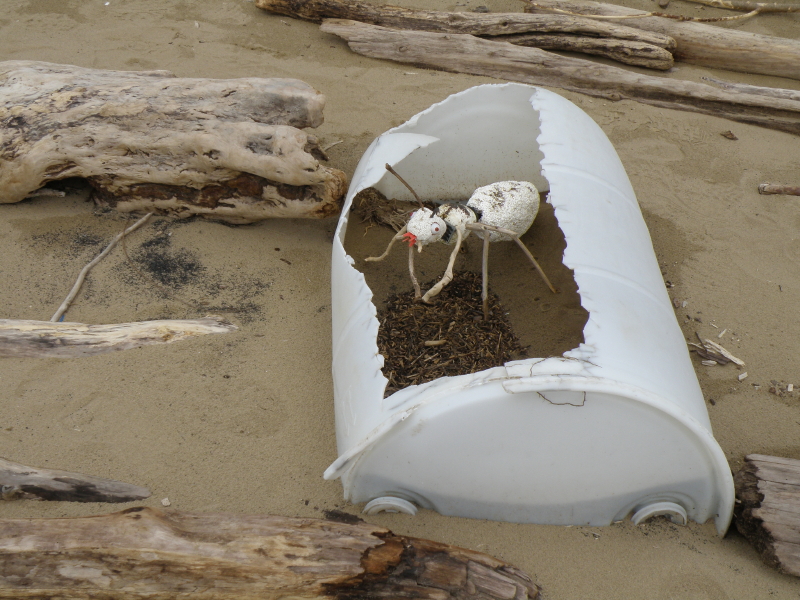
That’s it…I have more pictures, but they don’t reveal anymore about the Giant White Ant’s behavior.  Of course, I hope to see it again provided it manages to evade its enemies and stay alive.  What will the “Godzilla-effect”  produce here next?  I wonder if E.O. Wilson has encountered anything like this before in all his researches?  I’ll close now with a final image of my ant.
Read Full Post »

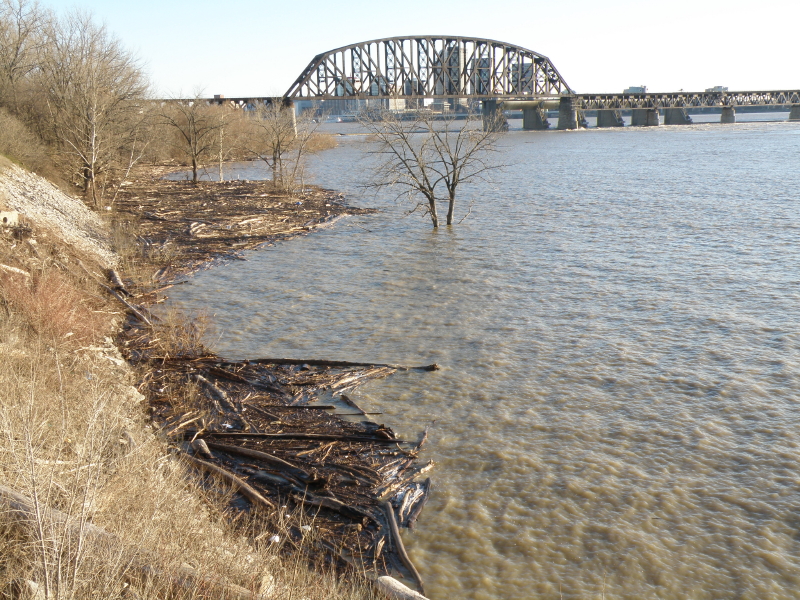
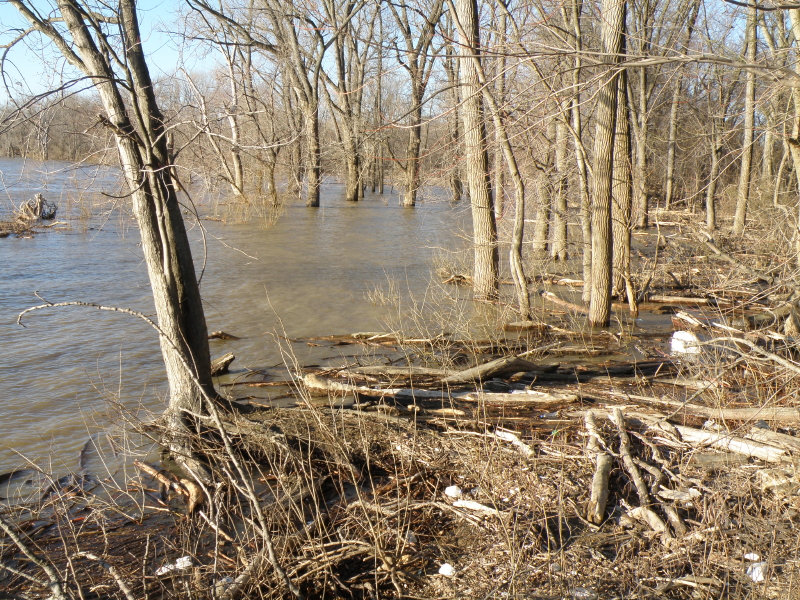
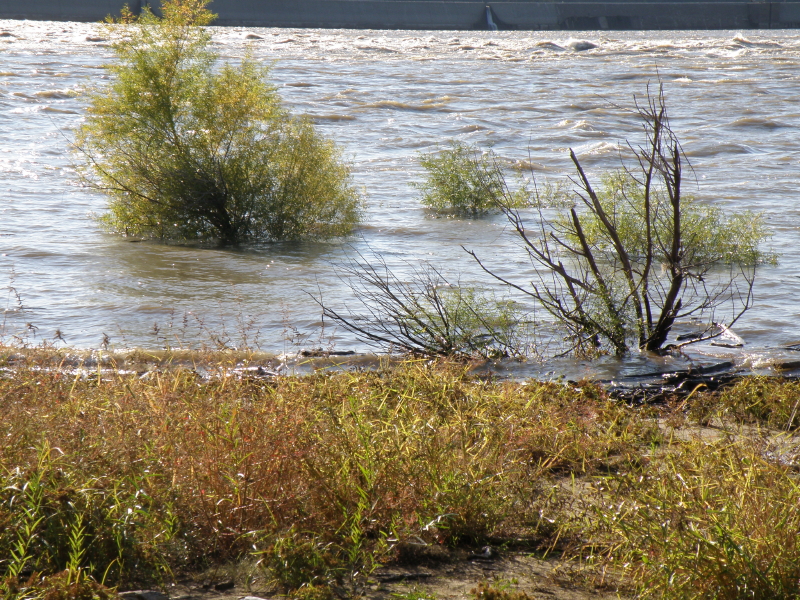
I think today’s post will be shorter than usual, but will need to type it out to be sure.  On this visit to the Ohio River I found it rising which surprised me because we haven’t had much in the way of either rain or snow this year.  When I arrived on the scene, many of the familiar places I visit to make my art were already underwater.  I had to keep moving west in the park to access the shrinking riverbank.

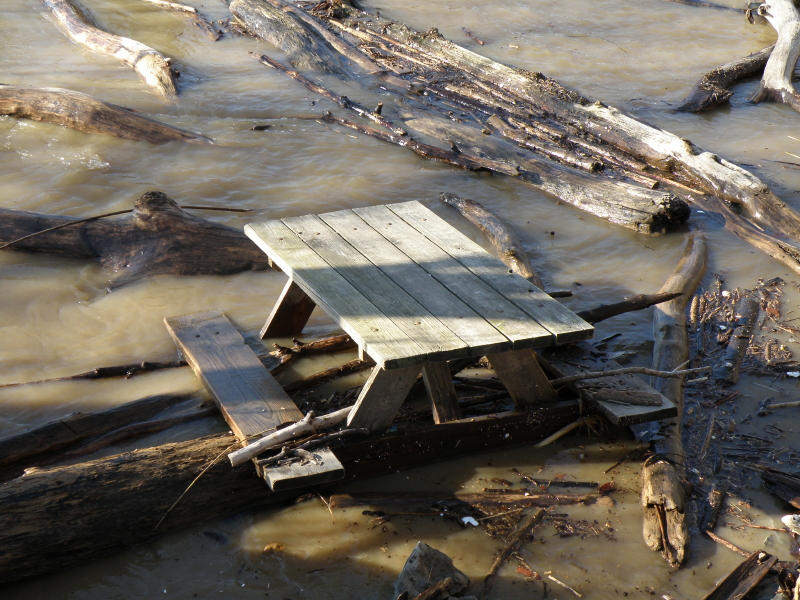
I came across this picnic table near the Interpretive Center.  The river is now enjoying what is normally a cozy place to share a few sandwiches.  I wonder if this table eventually floated off?  I kept walking along the retreating shoreline being mindful not to step into the ever creeping waters.

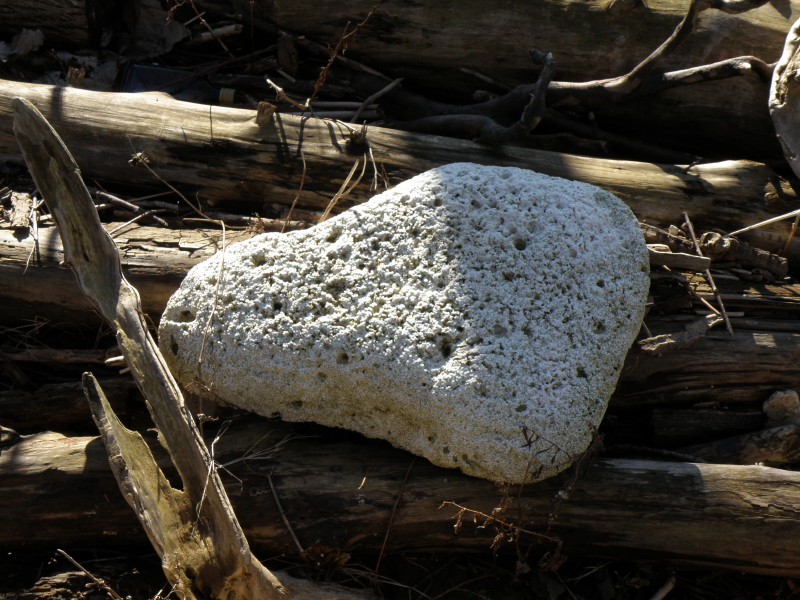
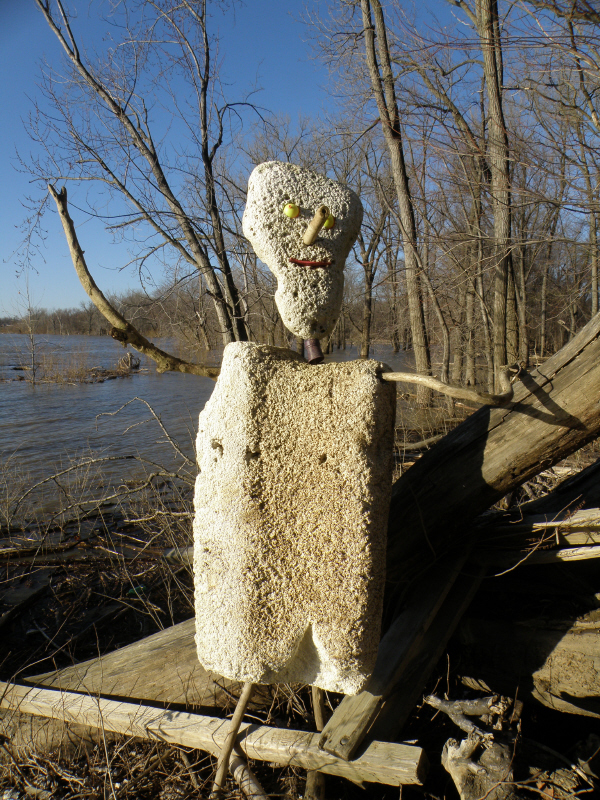
I have my collecting bag with me, but there’s not much to find today.  It will probably be different after the river retreats. The trash left behind will mark how far the waves pushed the debris onto the land. I came across this nice-sized chunk of eroded polystyrene and decided to use it in today’s project.  A short distance from this find was an even larger hunk of Styrofoam and I was in business for the day.

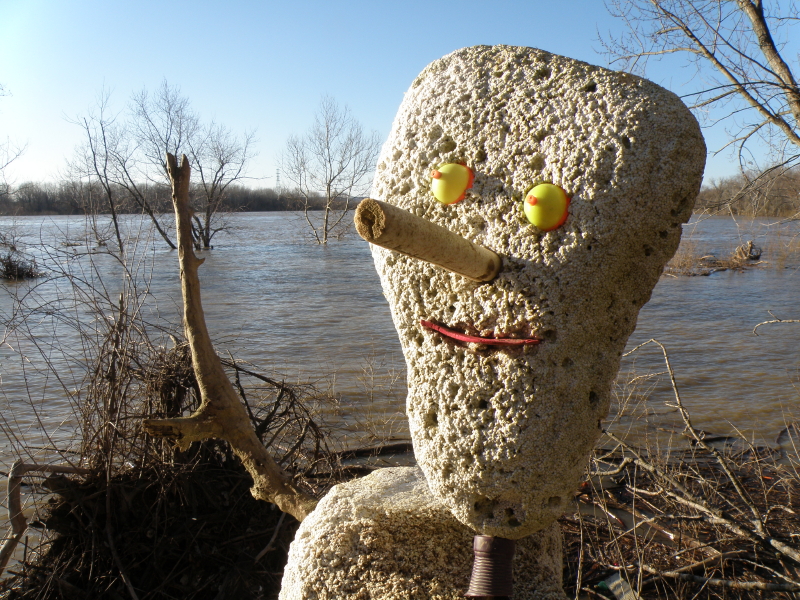
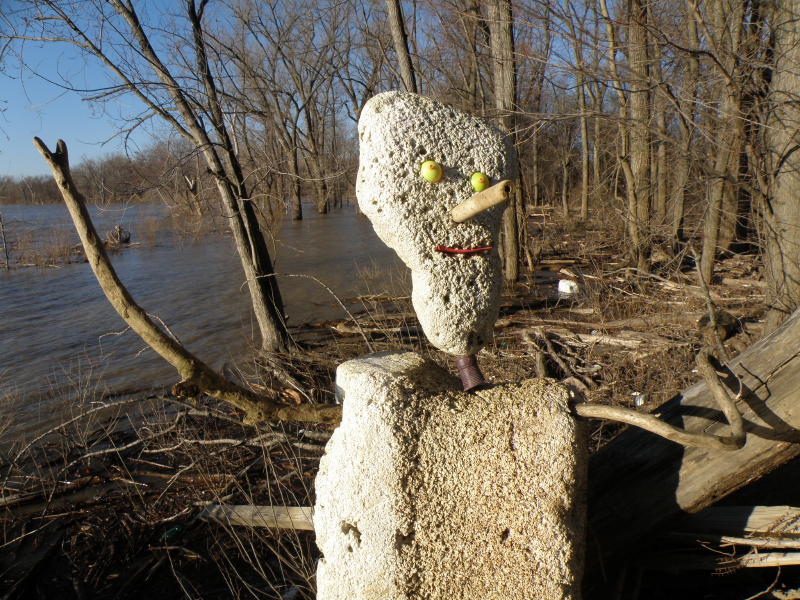
This second piece of foam was nearly as large as me.  It took a bit of struggling to get it positioned where I wanted it near the rising river.  In this section of the park much of the driftwood I was finding seemed dried out and brittle.  I never did come across the right sticks, but had to make do with what today presented.  I did like the happy-go-lucky expression on this figure’s face.

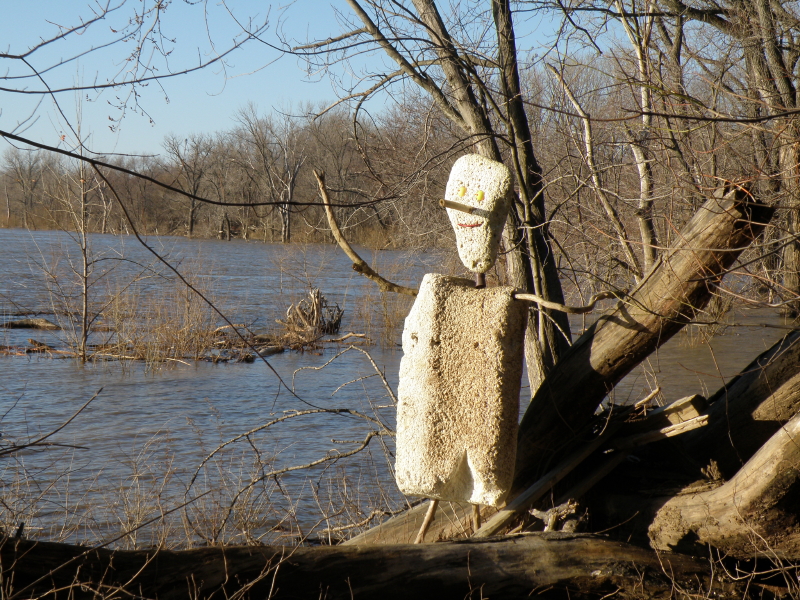
Here’s a full shot of the figure at the place where I left it.  It’s gone now and the few ducks who were around were probably the only witnesses?

A slightly different view this time.  This figure’s eyes are large fishing bobbers I already had in my bag, however, the nose is some rolled piece of foam that I found out here.  I’m glad the sun came out and made the day a bit more cheerful.  That white object in the distance is another hunk of Styrofoam riding the waves…perhaps my next sculpture?

The river was rising and the light was beginning to fade and once the wind started to pick up…I decided to call it an early day.  One last look back at my saluting figure and this final image of it.  I’ll return once the river recedes and let you know what I found.

Read Full Post »

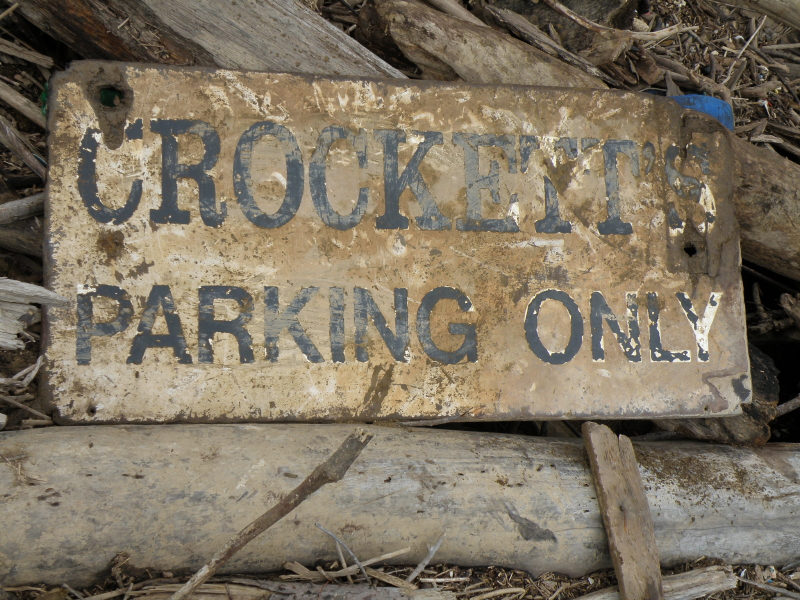
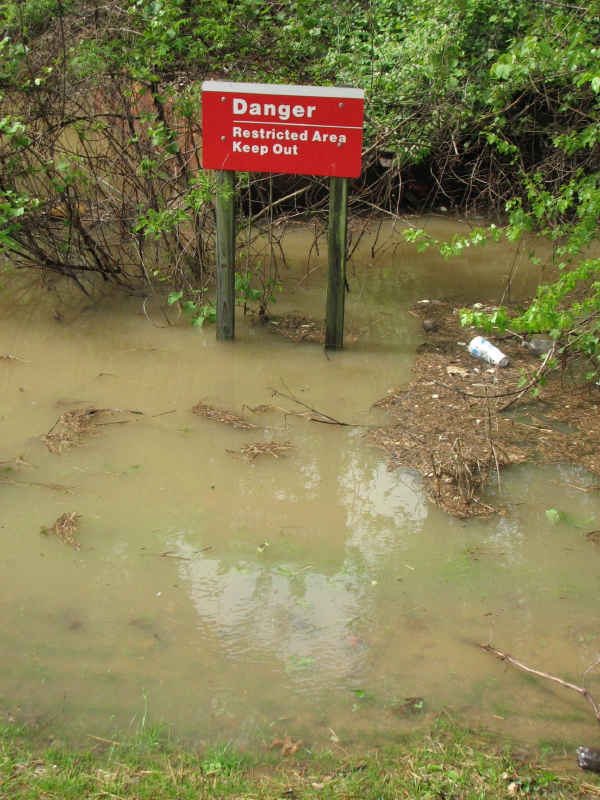
A gray day with the Ohio River rising and I’m exploring this huge driftwood mound created by last spring’s flooding.  Over the last few months this section has seen other minor floods and even a fire.  It’s interesting to me to see how the river has a leveling effect as it flows under and moves the driftwood pile. The shifting reveals new “treasures” that were formerly buried.  I’m out here to see what I can find and possibly reuse.  Soon I uncover a sign that tempts me.

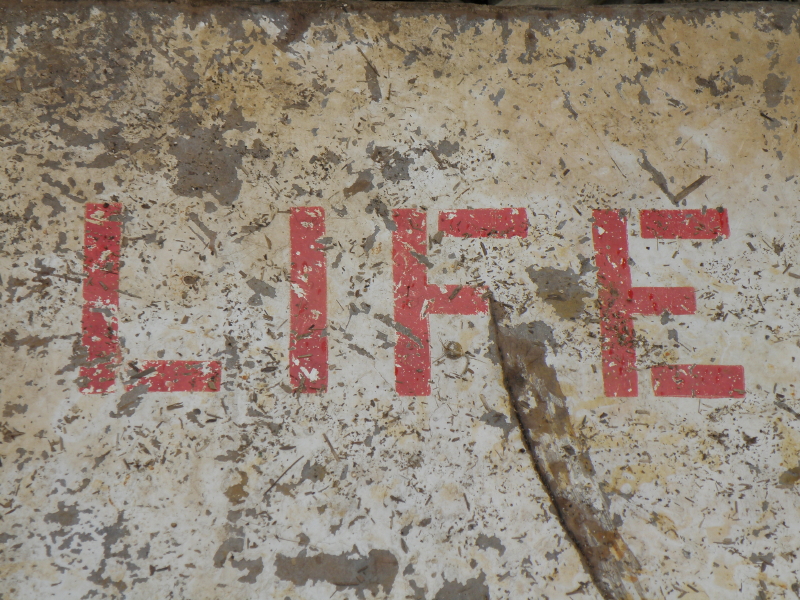
Yes, I have a found sign collection as well and you can see it on my Pages section where I keep other collections of stuff I have stumbled across.  First, let me tell you why this particular sign caught my eye.  In this neck of the woods, we still remember the now mythic frontiersmen who explored and settled this great land.  Daniel Boone, Audubon, Lewis and Clark, and one Davy Crockett are among these pioneers.  Seeing this sign caused me to “flash forward” and I speculated what Crockett’s descendants were now doing after taming our great wilderness.  Did they as Joni Mitchell once sang “…paved paradise and put up a parking lot” and here was the sign to prove it?  As signs go, this one was interesting because it’s double-sided and the reverse message is different and says “Life Vest Required” in red stenciled letters.  Here is a detail that I like.

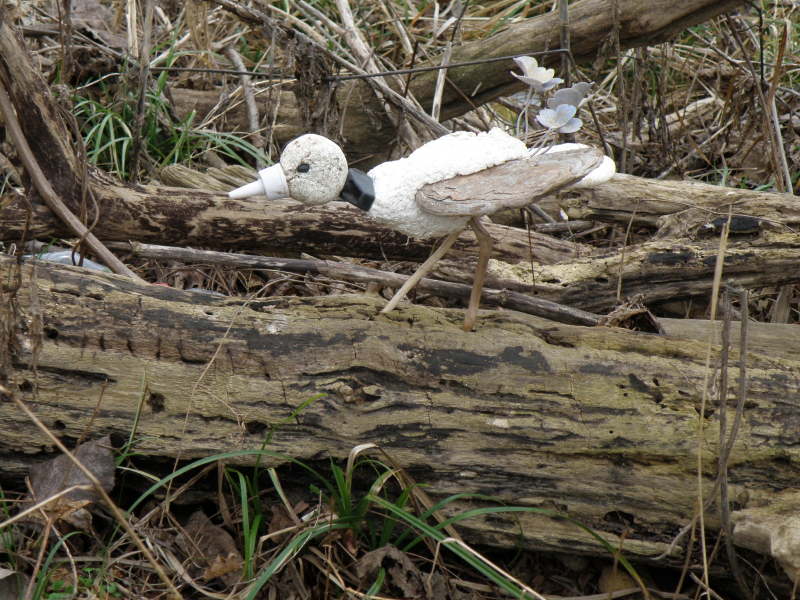
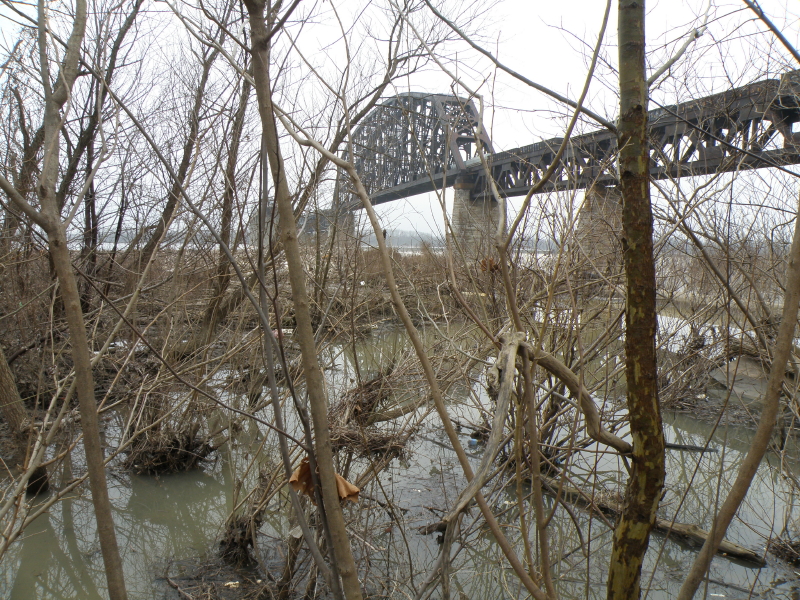
I was contemplating whether I wanted to drag this heavy and muddy sign with me when an unexpected thing occurred. Life happened! My activity flushed out a bird I didn’t recognize and it flew right over my head and landed in an area of bottom land just east of the railroad bridge.  I kept my eyes on it the whole time and I saw where it landed.  I forgot about the sign and grabbed my camera gingerly stepping over the driftwood.  I would hate to twist my ankle again as I anticipated my rendezvous with this rare bird.  After quietly searching the underbrush, I located it and excitedly snapped the following images.

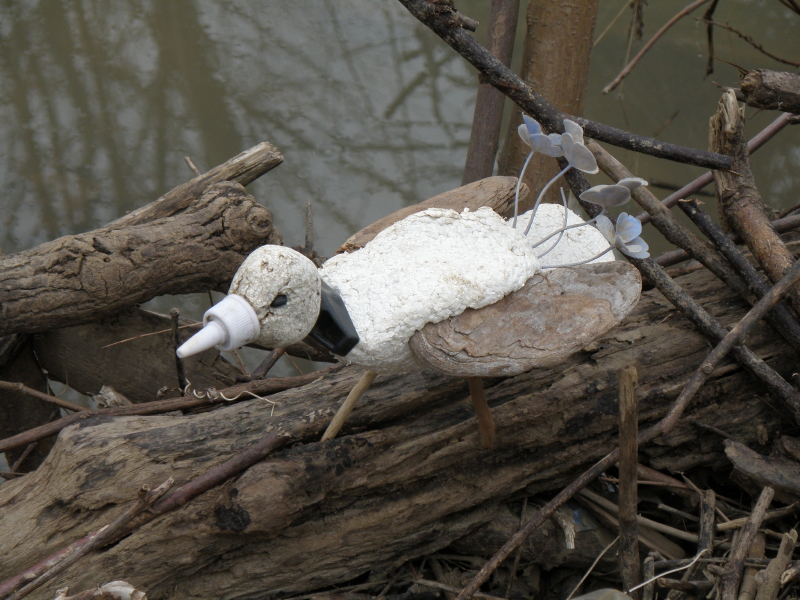
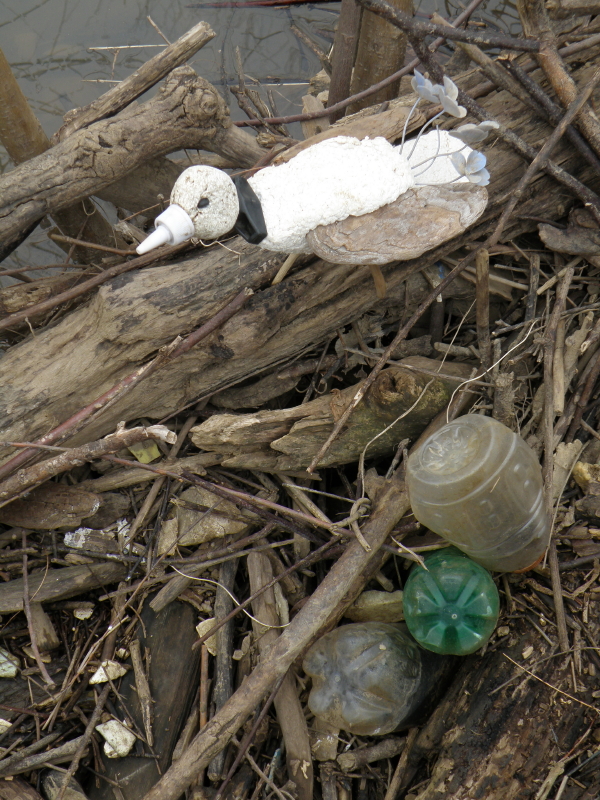
I have the honor of announcing the first documented sighting of the Temperate Bird of Paradise ever seen at the Falls of the Ohio!  I found it at the water’s edge skulking among the litter and downed logs.  FYI, this is the only bird of paradise found in North America (hence temperate) from a family of birds that are almost exclusively tropical.  You are more likely to encounter a bird of paradise in New Guinea or the Aru Islands than here.  Interestingly, the first tropical examples to reach Europe were ethnographic specimens and the prepared bird skins were missing their feet and sometimes their wings.   This resulted in the early European naturalists assuming that the birds of paradise were forever on the wing kept aloft by their magnificent feathers.  (That’s a true story!)  Here are a few more pictures of this magical bird.

What this bird has in common with the other birds of paradise are very unusual feathers that the males use in courtship displays.  You can see the wiry, blue, flower-like feathers near the base of the tail.  In the wild, the males compete against each other for the affections of the females by wildly dancing and showing off their unusual plumage.  Once mating has occurred, the female builds a nest near the ground and the male takes off and plays no part in raising the young.  The particular bird I was observing was a juvenile male and lacked the small tuft of feathers found on the heads of the adults.

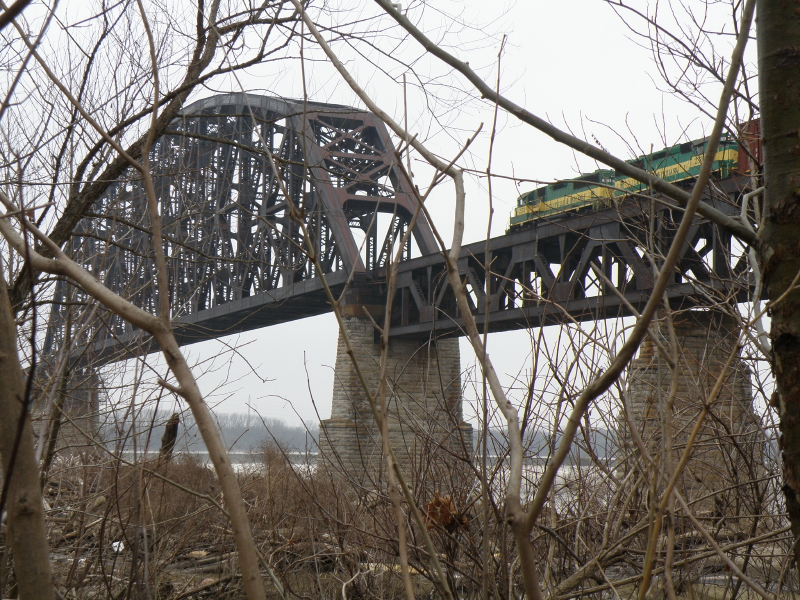
While I was taking these pictures and recording my observations, a train was passing overhead on the bridge.  I could tell it was making my visitor uneasy.

The diesel locomotives were noisy as they hauled their great loads over the span.  My bird of paradise began walking nervously back and forth and then flew away.  I was, however, able to snap one more image of it before it disappeared for good.  I returned to the area over several days, but it definitely left the area.  This is my final picture of the bird of paradise at the Falls.

Because this was a juvenile male, I’m hoping that this signals that the Temperate Bird of Paradise is on the increase and this young bird is seeking out new territories.  The bird initially became rare during the hey day when exotic bird plumes worn on fancy hats were all the rage.  Since then, habitat loss and the fact it is a ground nesting species makes it more vulnerable.  Excitedly, I rushed home to view my pictures on the computer!  I forgot all about the sign and I’m not sure it is still there anymore?  The rising Ohio River may have reclaimed it.  The next time I’m out there, I will look for it and the rare Temperate Bird of Paradise in case it returns.

Read Full Post »

After a brief cold and wet spell I made it out to the Falls of the Ohio last Saturday.  The Ohio River was rising as were the temperatures which had dipped into the 30 degree mark  for a few days.  One look around here and there is no doubt that it is autumn in Kentuckiana.  The willow leaves were noticeably yellower and many of the trees were in the process of losing their foliage.  I was scouting around for what else was different in this environment and spotted this tiny butterfly moving about.

This small whitish butterfly was sipping on something on the sand.  I was practically nose to nose with it and recognized that it was a member of the skipper family.  Last year was such a banner year for butterflies at the Falls and to my eye…this year was a noticeable drop off.  After following this skipper for a few yards I was able to take this image of it.  At home I identified it as the Common Checkered Skipper (Pyrgus communis) which is considered a very common species.  It seemed rather late in the season for a butterfly, but I was able to observe a few rag-tag Buckeye butterflies and a few tattered Viceroys too.  Funny how I had never noticed this skipper before.  Nevertheless, I felt a sense of personal discovery as though I was the first person ever to see this tiny revelation. It was about this time I heard a distinctive tapping coming from a stand of willow trees.  Somewhere a woodpecker was plying its trade.

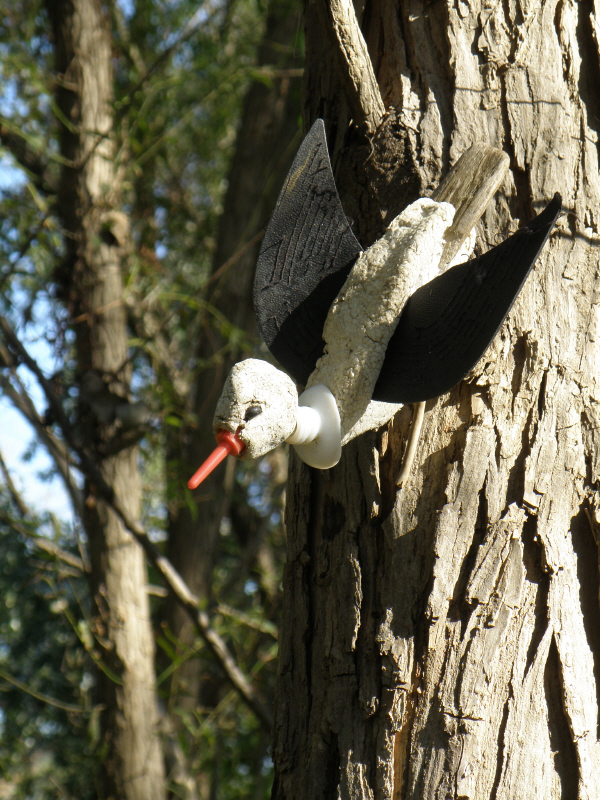
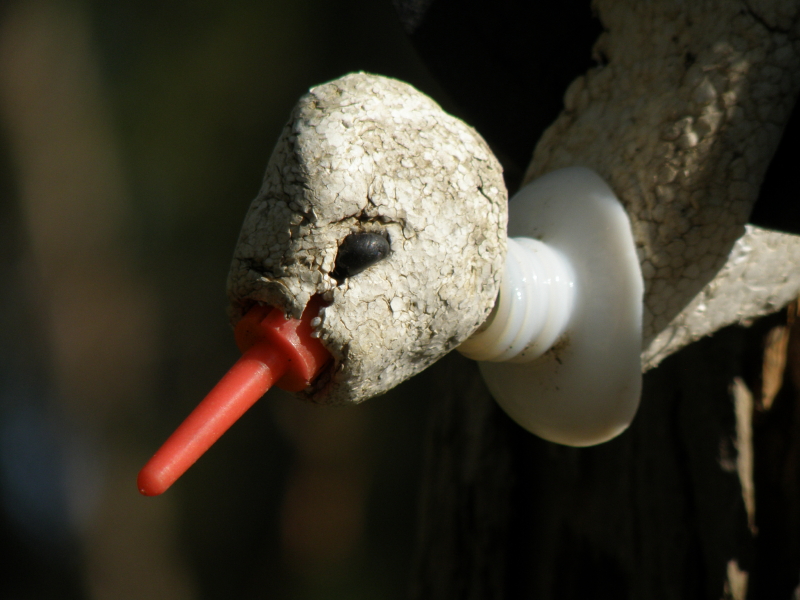
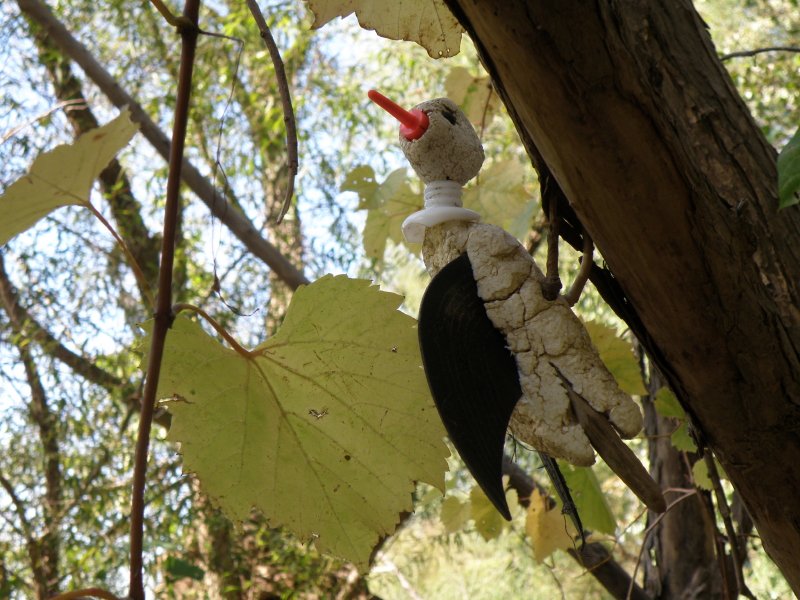
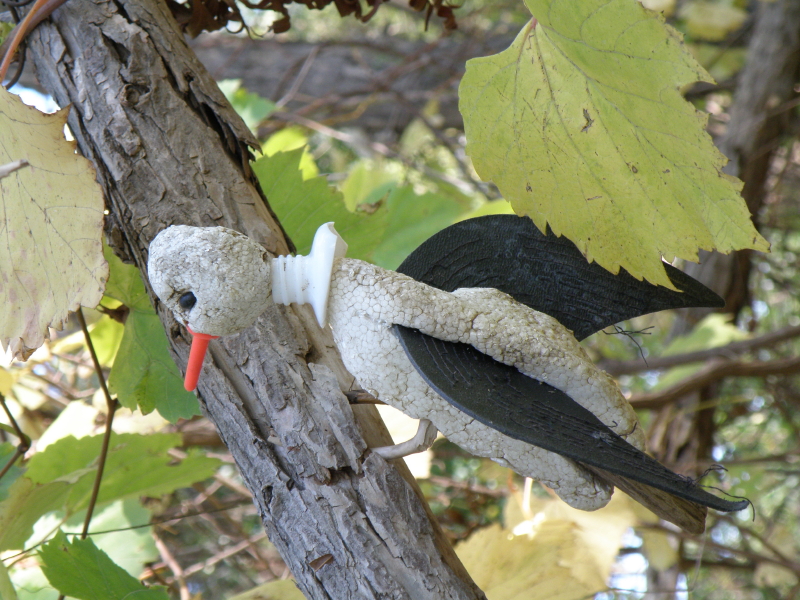
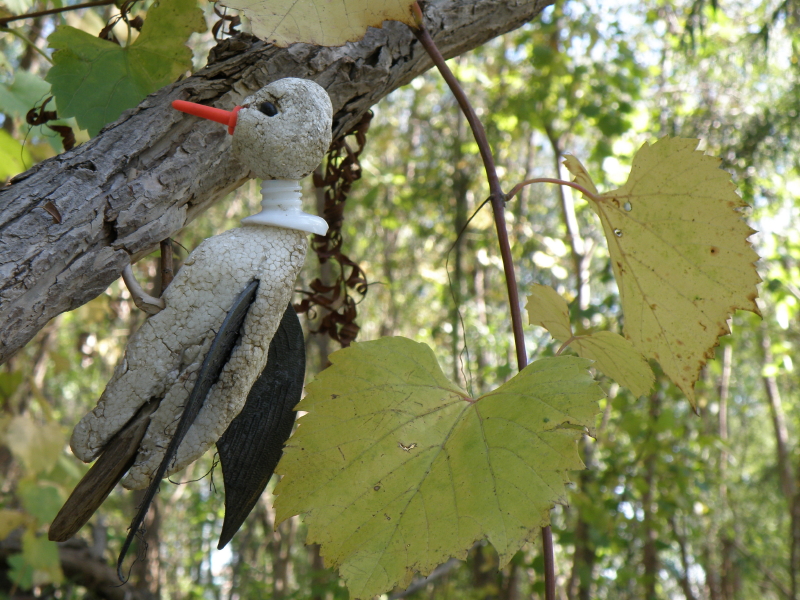
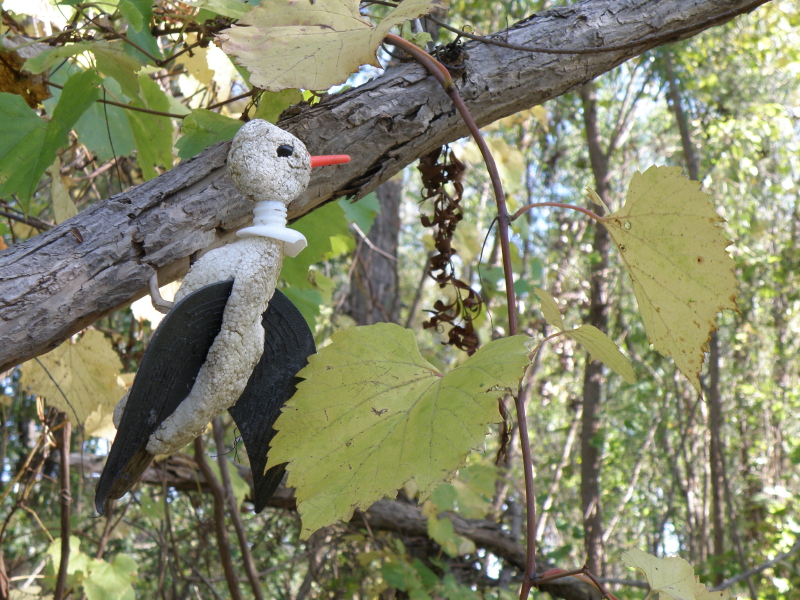
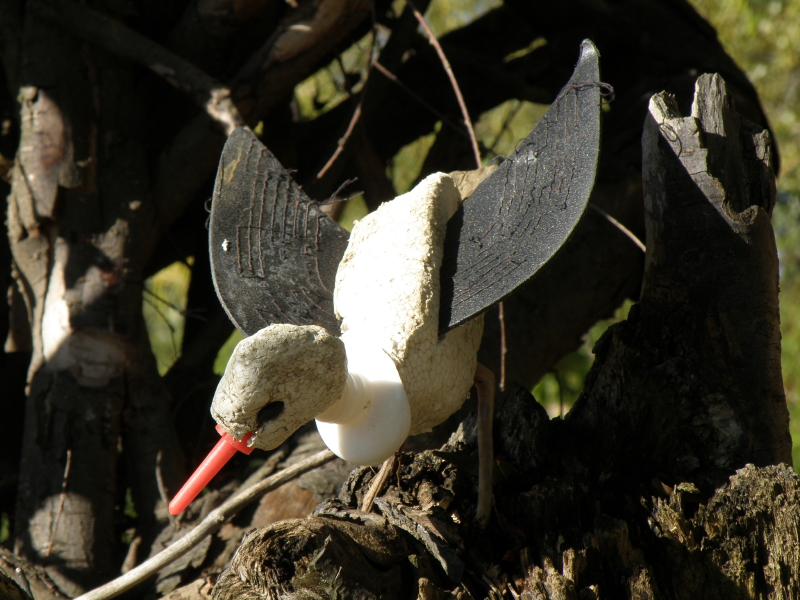
With its jet-black wings, white body, and bright red bill this bird is easy to identify…it’s the Pied Woodpecker.  About this time of year the northern population of this interesting woodpecker begins its southerly migration to the warmer climes of Central America.  Although I had added this bird to my “Life List” while on a family trip to Wisconsin…this was the first Pied Woodpecker I have seen at the Falls of the Ohio.  I observed it moving up and down the trunks of the willow trees exploring the crevasses in the bark for small insects.  It likes to move head down in its search for food like nuthatches are known to do.  Every now and then it would use its bill to chip away the wood to uncover the bugs it sought and it seemed quite unconcerned about me taking pictures of it.  I snapped as many as I could as I followed it on its path through the woods.

Soon it came to a grove of trees that were covered in wild grape vines.  The Pied Woodpecker explored the bark here too, but I saw it augmenting its diet with the tiny fruits this vine was producing.  Every once in a while it would make this nasally sound that I tried imitating.  Fortunately, this bird didn’t take offense and fly away.  Perhaps it “cut me some slack” for at least trying to talk to it in its own language…or at least that was my thought at that moment.

From the vine-covered trees, the woodpecker next flew to a large log with a large exposed root mass.  When this tree was living it must have been huge. The Pied Woodpecker didn’t linger here long and I watched its rising and dipping flight pattern as it crossed over the Ohio River into Kentucky.  I wonder if I will ever see another of its kind here again?  That’s the funny thing. There are birds that are considered common and regularly recorded here that I have yet to see.  I’ve seen them elsewhere, but not here at the Falls of the Ohio.  That’s the thing about birds…their extreme mobility can make them unpredictable!

Read Full Post »

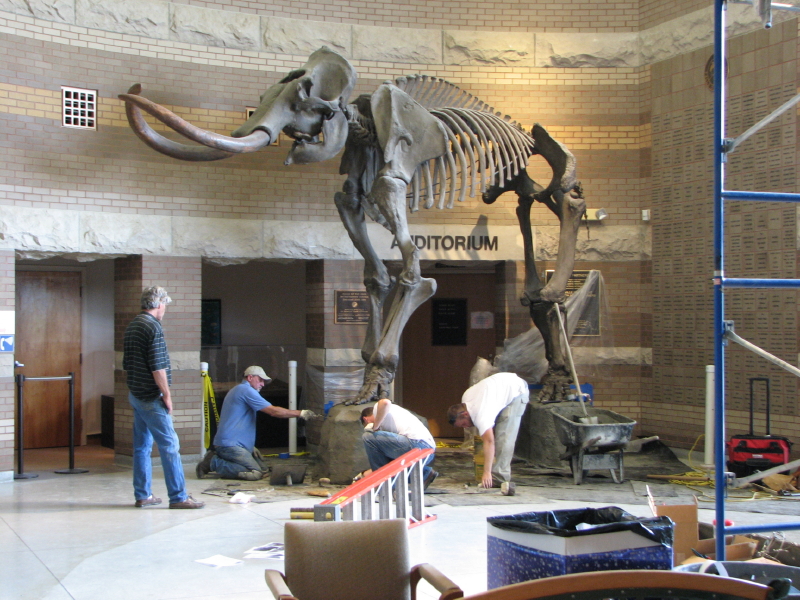
It’s been nearly a month since I last visited the Falls of the Ohio.  My still tender twisted ankle and the brutal heat of this summer has me concentrating on other projects and exhibits.  Admittedly, I haven’t posted much and that periodic malaise that can affect bloggers hit me too.  My ankle is slowly getting better (intimations of mortality!) and with hope the oppressive heat is relenting?  I made the short trip from my home in Louisville to Clarksville, Indiana where the Falls of the Ohio Interpretive Center is redoing its exhibits.  I’m glad the mammoth skeleton will still be on display and I’m curious what else will be featured?

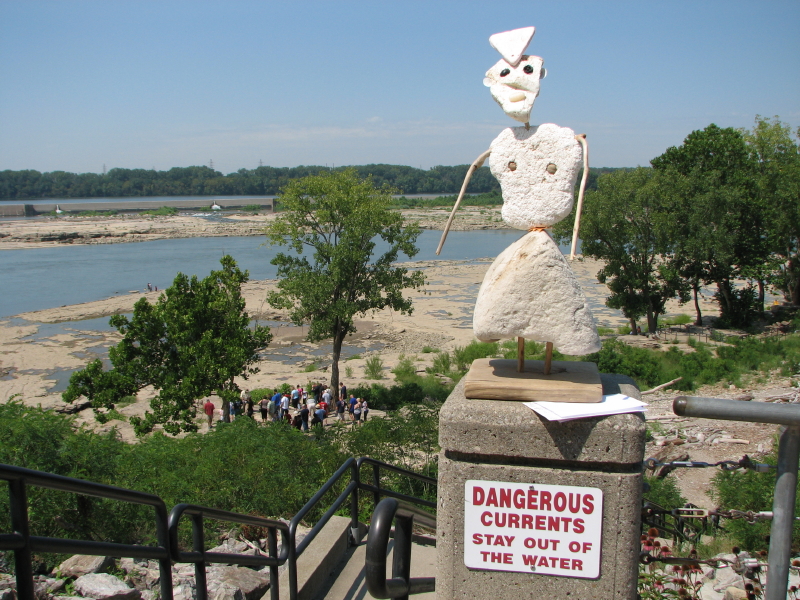
Each year the center’s foundation stages its “Rock the Rocks” fundraiser which features a silent auction.  I usually contribute one of my sculptures made from the river-born junk I find in the park.  This year my donation is entitled “Priscilla” and she’s a piece I made years a go and predates the old riverblog.  I hope she finds a nice home.  “Priscilla” with her dark eyes has a depth to her that seems to raise many questions.  Well, that’s how I read her!  The main question remains…why do we do the things we do that we know can harm the environment?  “Priscilla” knows she shouldn’t exist.

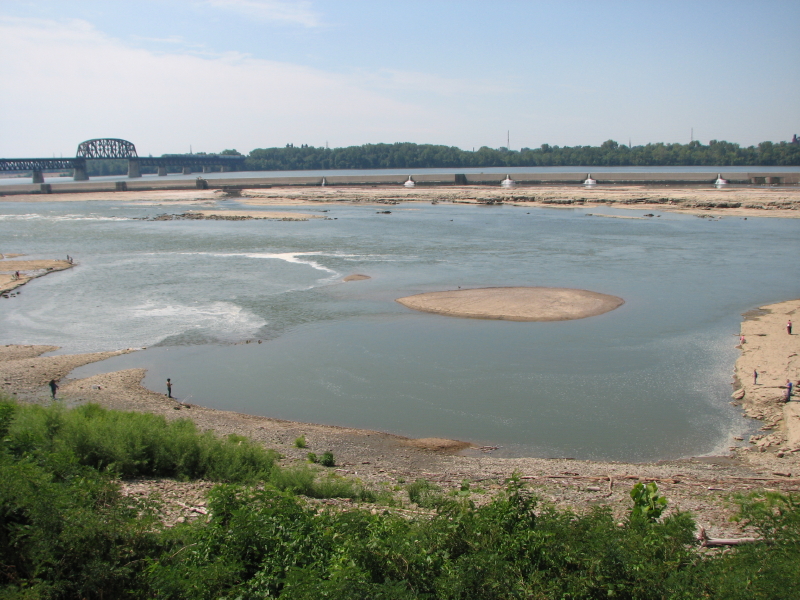
After my errand, I hung around to look at the Ohio River as it presents itself at the Falls of the Ohio.  Most of the fossil deposits are exposed and in my mind I’m walking out among them which in reality is always an interesting experience.  It’s easy for me to fantasize that I’m on another planet or a different place in time.  I know, however, that it will be a while yet before I wade across the shallow river and back out upon the water-scalloped limestone.  I don’t think my ankle is ready for that test yet.  It would be a long way to limp back.

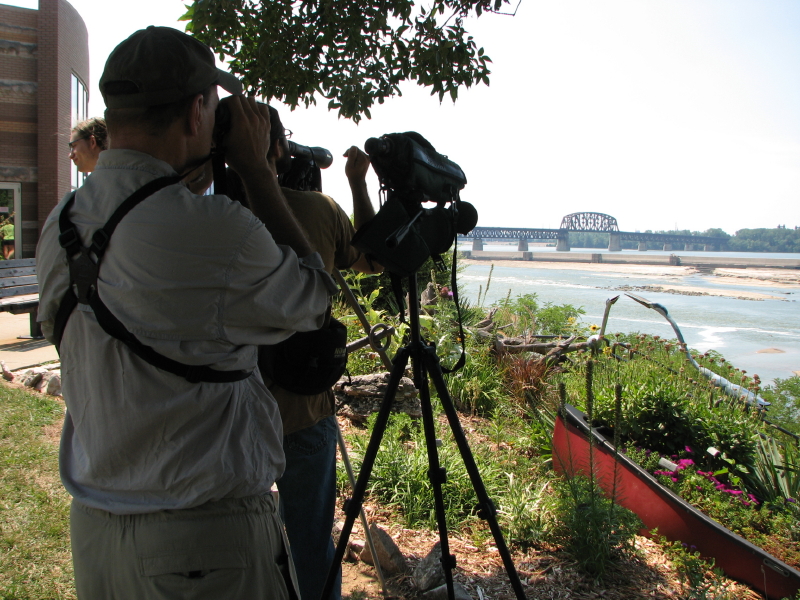
I stopped and talked with several birders who had their scopes and binoculars fixed upon the distant fossil beds. Summer shorebirds were present including Great Egrets, Caspian Terns, Spotted Sandpipers, and an uncommon siting of an American White Pelican which had just flown away!  I missed it but was glad to hear that it had been seen regularly over the last three weeks.  I recall a few years a go, there was another young male bird that hung around for a while.  Once upon a time they were seen as far east as the Miami River in Ohio, but that was in the 19th century.  Now the pelicans are seen more frequently and might be extending their range again eastward along our great rivers.

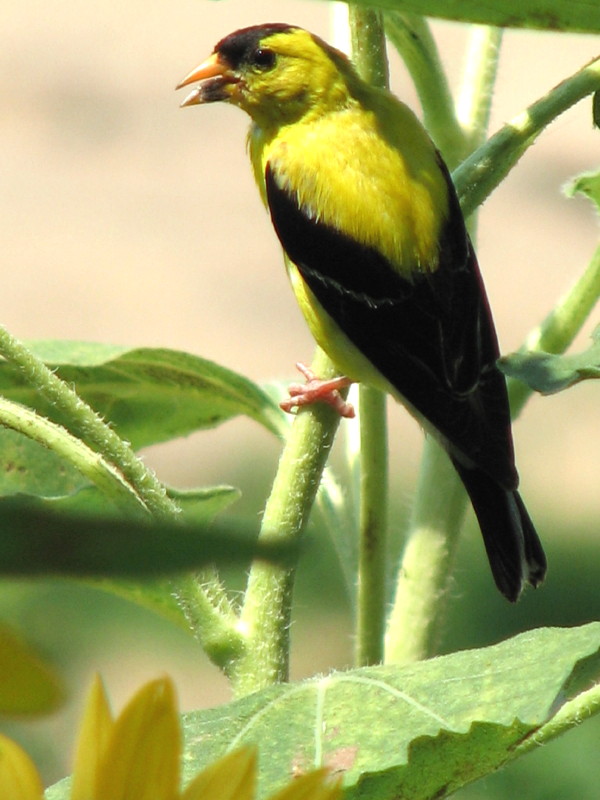
I enjoy birds of all kinds and near the birdwatchers, a male American Goldfinch fed on sunflower seeds from one of the center’s flower beds.  I don’t know exactly what it is about the attraction to birds, but it lifts my spirits.  I go back to my car and collect the surprise within.  Although I haven’t physically been out here as much as a usually am…my thoughts don’t stray far from this environment.  I made a new figure in my basement and I’m eager to snap a few shots of it in the context of where the materials I used to construct it were found.

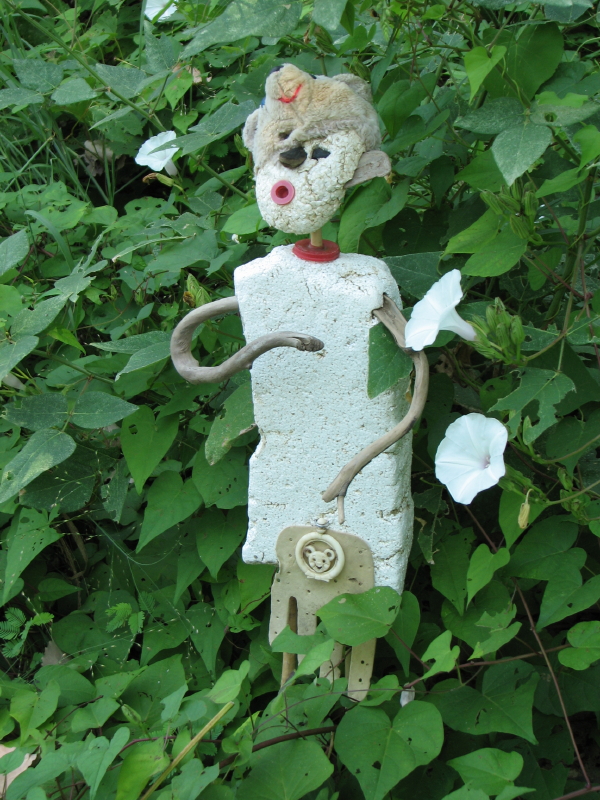
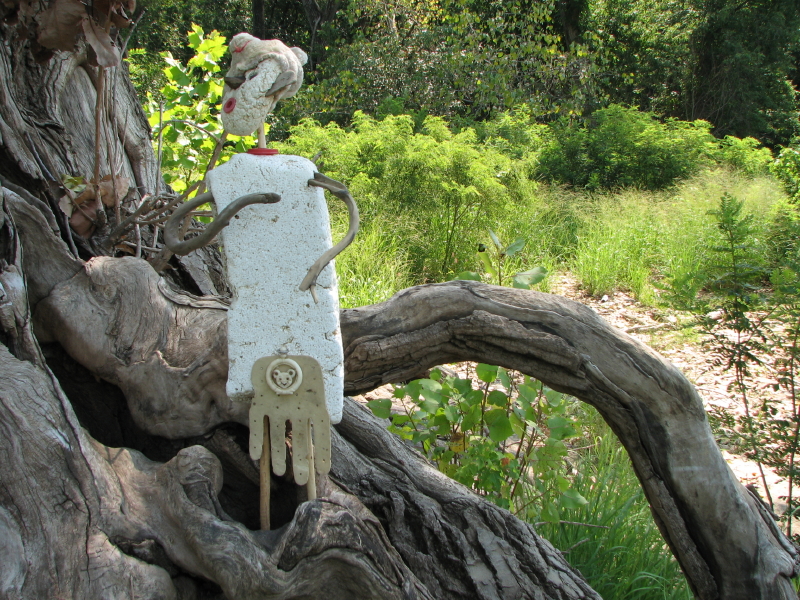
This is “Cubby” and he is eager to see the world.  We walked along the trail together and came across this spot where the morning-glory vines were growing in profusion.  Only in the shade did we find the blossoms still open.  The heat of broad daylight would shrivel them to nothing.  Along our walk we could hear the sound of cicadas and the smell of sun tan lotion was lingering in the air.  It’s the weekend and the park is full of visitors.

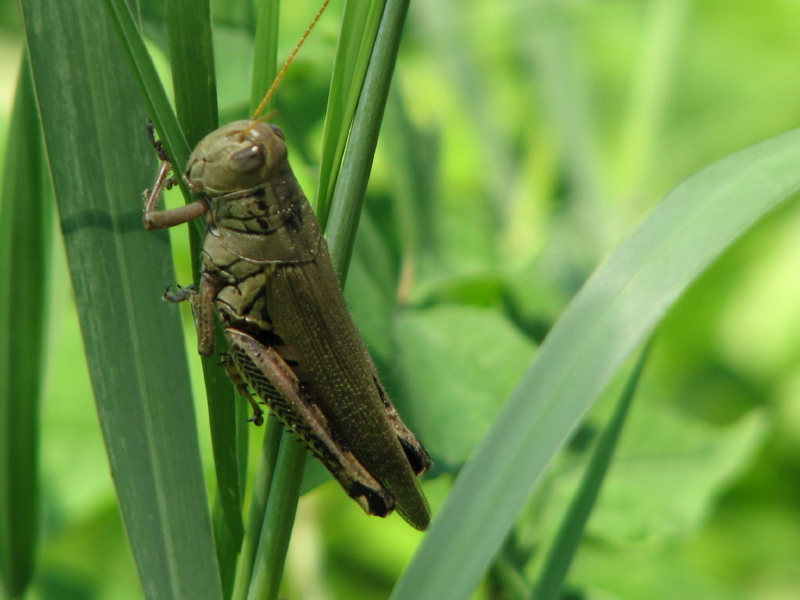
As we walk through the grass, the blades come alive with the many grasshoppers that are present.  “Cubby” and I check them out and we also notice a few nice Buckeye butterflies flitting about with their beautiful blue eye spots checking us out too.

It’s amazing what a month can change around here.  It seems so verdant and overgrown.  We find evidence that some of the recent and powerful thunderstorms have blown over a few old trees.  This seems to happen with increased frequency.  When it does rain, it seems to be accompanied by strong winds and torrential downpours.  There is so much moisture and energy in our weather systems as the fronts move along the Ohio Valley.

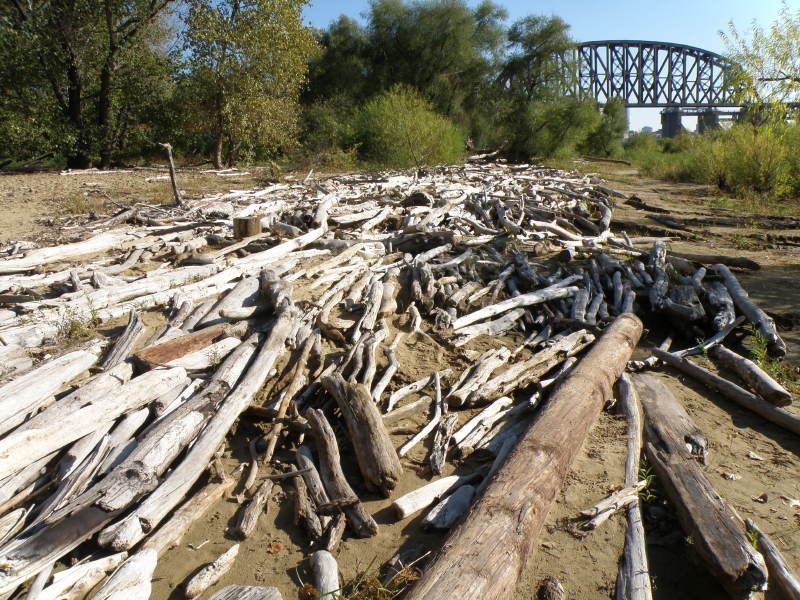
It’s been a year of contrasts.  Our spring was so wet and led to some flooding.  Several months later the driftwood evidence is all around.  The park staff have had their hands full re-establishing the walking trails.  Chain saws and small bulldozers are required for that job.  All this wood will just sit here until it decays or washes away with the next flood.  The Ohio River is a dynamic element that continually shapes this park.

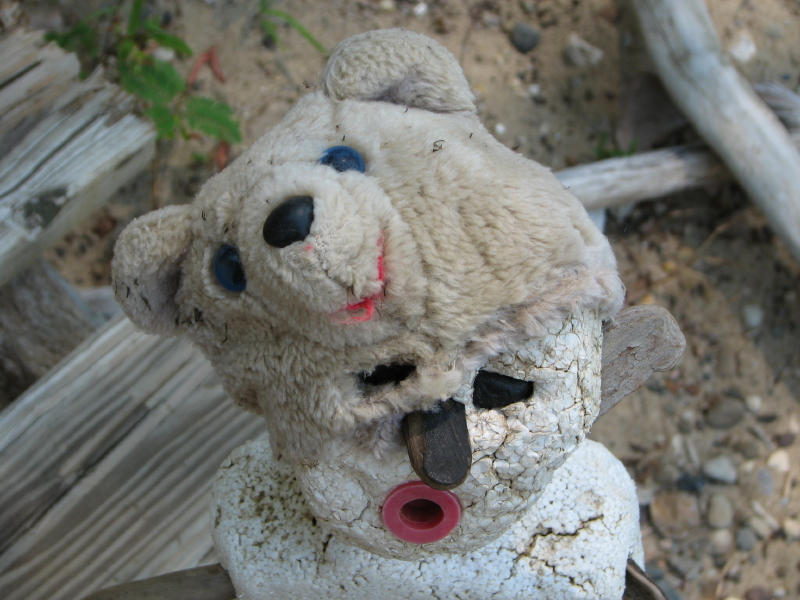
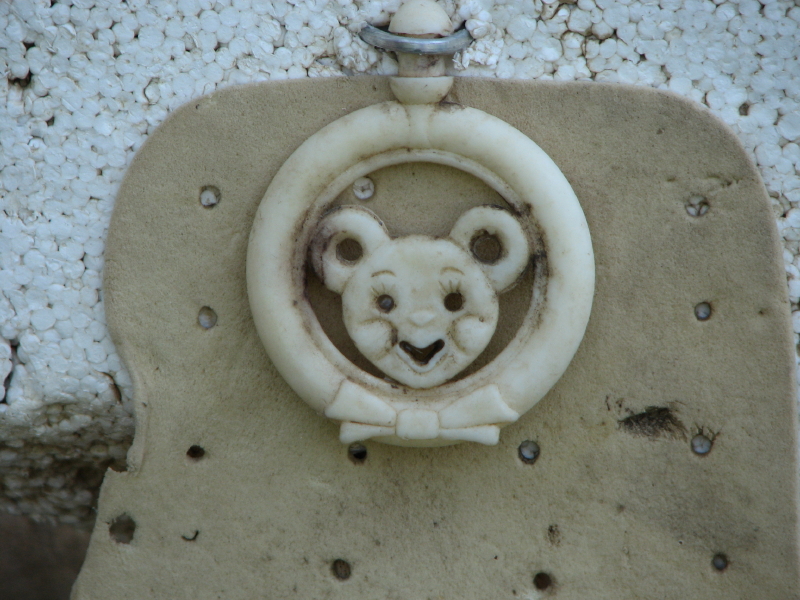
I made “Cubby” for an exhibition that will be held at Bellarmine University in September.  It’s a two person show and my exhibit partner, Scott Scarboro, also uses found materials, but his works are of a more urban nature.  He likes using discarded mechanical toys and using sound in his work.  I will post more about that show as it happens.  As for “Cubby”, he derives his name from the unique head-gear he wears.  Last year, I came across the “skin” of a river-exploded teddy bear and saved it into the collecting bag.  This is how that find manifested itself.  To further reinforce the bear cub idea I added a small plastic bear head image that I think came from a pacifier.  It holds his breach cloth in place which comes from the lining of an old glove.  And in case you were wondering…he’s also anatomically correct underneath.  If you are bothering to cover the loins…there might as well be something there!!!  Well, I guess that’s it for now.  It feels good to blog again.

Read Full Post »

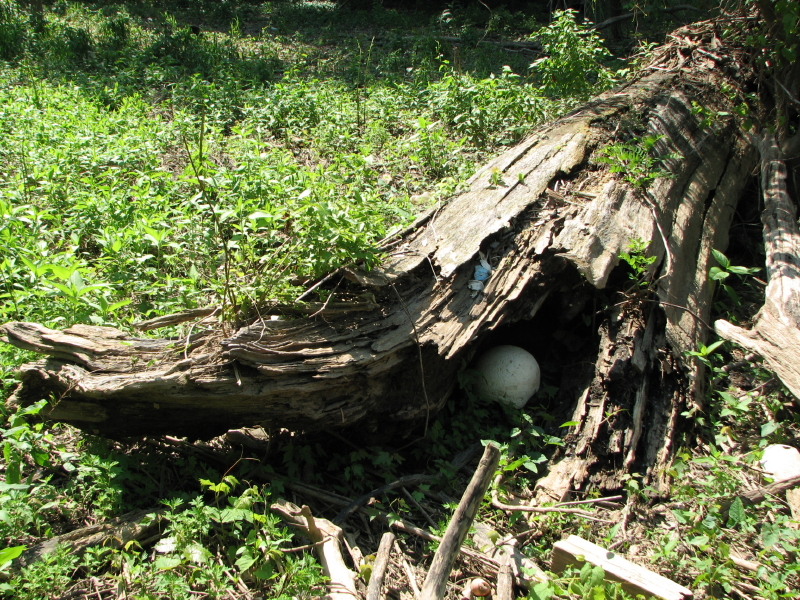
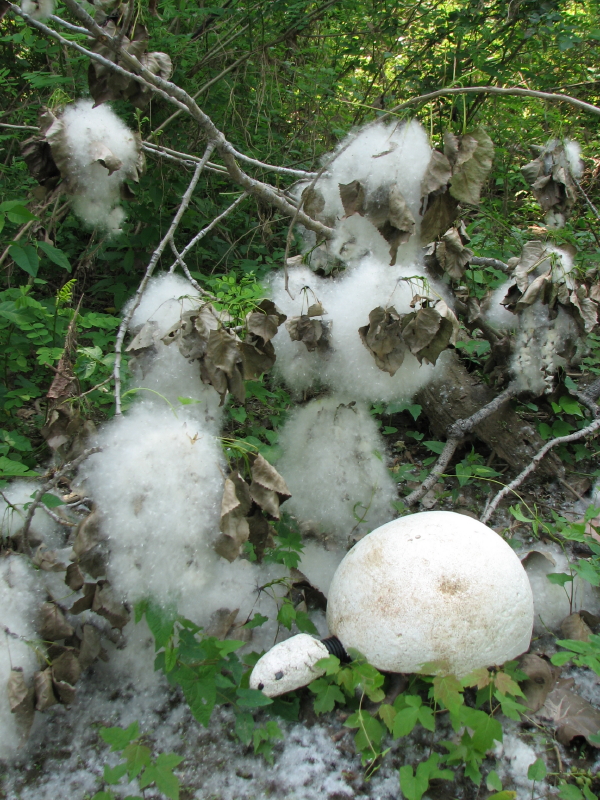
First, I would like to thank all the people who checked out my last post on the box turtles.  The response has been pretty overwhelming and I’ve enjoyed everybody’s comments.  The Eastern Box Turtle isn’t the only turtle to be found at the Falls of the Ohio State Park and this post is about that other mysterious and rare reptile. It’s called the Cottonwood Turtle (Terrapene populus) and its habitat overlaps that of the box turtle.  On a warm and humid morning I was exploring the eastern section of the park around the debris line formed by a retreating Ohio River.  Plastic bottles and containers and the ever-present polystyrene chunks helped define the high-water mark.  We have had so much rain here and it’s officially Kentuckiana’s wettest spring on record!  I was mesmerized watching and listening to the Cedar Waxwings pursuing each other from mulberry tree to mulberry tree and whose fruits are just now beginning to ripen to a glossy black.  The air was filled with the fine downy fluff produced by the catkins of our giant cottonwood trees and seemed like so much snow falling in ultra slow motion.  The chances of inhaling this fluff are real and white airy drifts were forming on the ground where the air currents pushed this gossamer material with its tiny secret of seeds within.  With so much going on, I was surprised to catch a slight bit of movement inside a nearby hollow log.  I remained still and this is what I saw.

Emerging into the light of a new day was this very ancient looking turtle.  Of course I recognized what it is and determined to follow it and make a record of my observations.  I kept a discreet distance away and tried not to make any sudden movements or loud noises so the turtle would act as naturally as possible.  I kept up with it for a several hours and then I had to pull myself away for home.

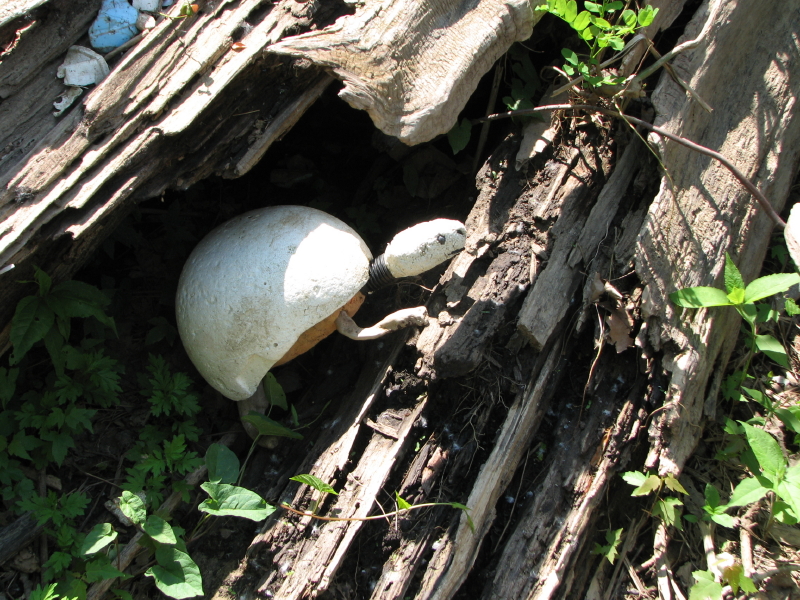
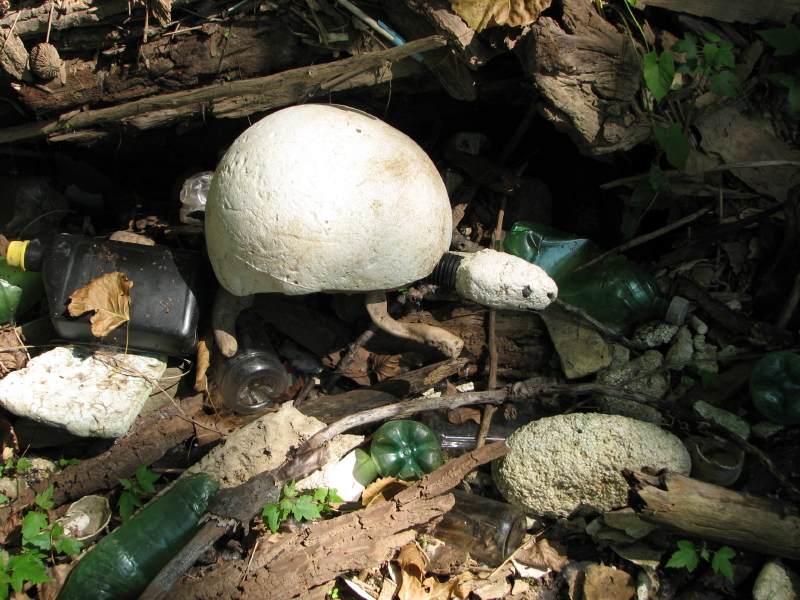
The Cottonwood Turtle is characterized by a high-domed carapace that the original inhabitants of the Ohio Valley used for war and ceremonial helmets.  Unlike the box turtles which it shares some affinities with…the Cottonwood Turtle cannot retract its head and limbs fully into its shell.  This makes it vulnerable to predators.  I watched my turtle crawling over the plastic and Styrofoam debris left by the last flood.  It seemed to be going somewhere with a purpose and I followed discreetly behind it.

The previous night we had another tremendous rain storm with high winds.  Mud, broken branches and leaf litter evidence can be found everywhere.  I followed my turtle to a large cottonwood branch and saw it engaging in the activity that gives this remarkable reptile its name.

Over the course of about an hour, I watched the turtle carrying mouthfuls of the Cottonwood fluff to a hole that it had previously prepared.  It made about a half a dozen trips back and forth from the downed branch to what looked to my eye to be an abandoned groundhog hole that the turtle retrofitted for its own purpose.  The fluff was carried  into the hole where a special chamber was being prepared for this turtle’s eggs!

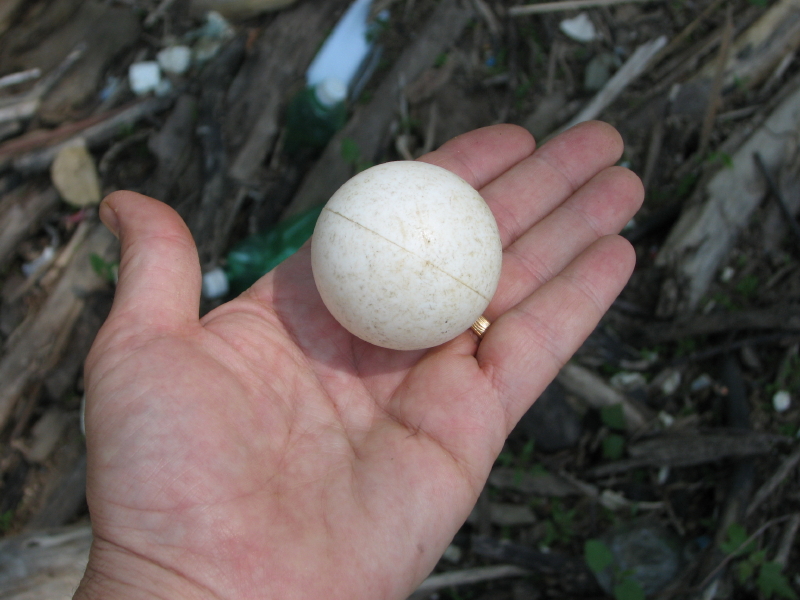
Here is the Cottonwood Turtle about to finish laying her eggs.  I observed about five ping pong ball-sized eggs being deposited upon their bed of cottonwood fiber.  I suppose the fluff cushions the eggs and perhaps as this material decays provides some modicum of warmth to assist in the incubation?  From what I have read, new turtles should be emerging from their subterranean nursery after sixty days.  After the turtle covered her nest with her back legs she moved on.  From this moment, the eggs and baby turtles to be are on their own.  I gently uncovered some of the soil and photographed this single egg.  Afterwards, I placed the egg back into the nest, re-covered it and went on my way happy to have witnessed this ancient rite of life.

It occurred to me on my walk back through the tangle of bottomland, that this turtle might be benefitting the tree as well?  I haven’t heard or read anything concerning a link, but what if?  The fluff contains minute seeds and the act of burying them might aid in propagating this tree.  The turtle places these seeds a little deeper than usual which might encourage stronger and deeper root growth.  Since this area is frequently altered by the river, it would make sense for the tree to have a deeper hold on the soil?  I came across another downed cottonwood branch and admired all the fluff it was producing.  It all looked so beautiful and magical in broad daylight.

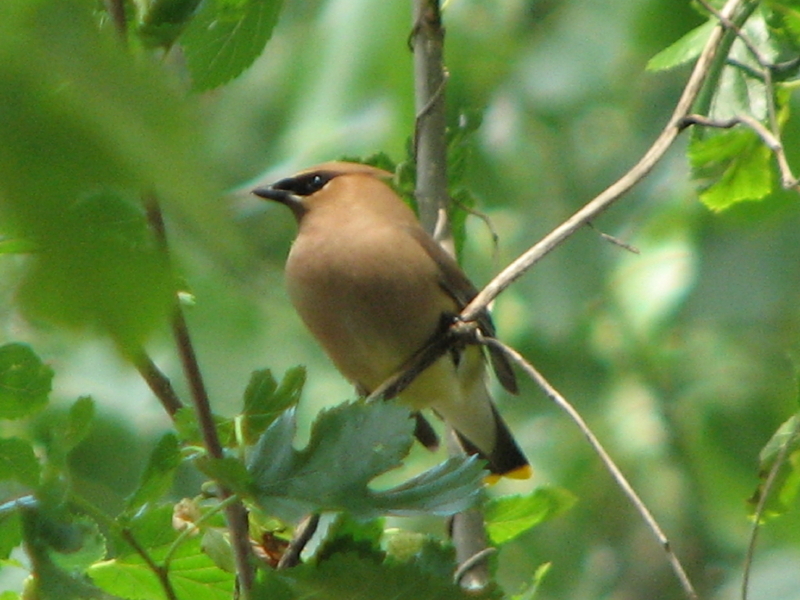
Overhead the orioles were collecting their own materials to build their amazing hanging basket nests.  And the Cedar Waxwings were fueling up on the mulberries in preparation for their long migration up into the north country.  One last image of one of these waxwings.  Such an interesting and beautiful bird so uniquely marked.

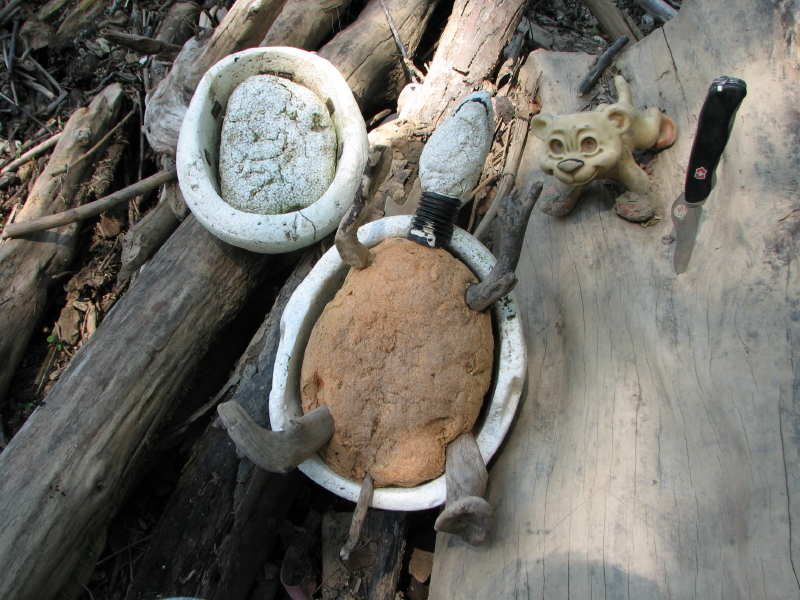
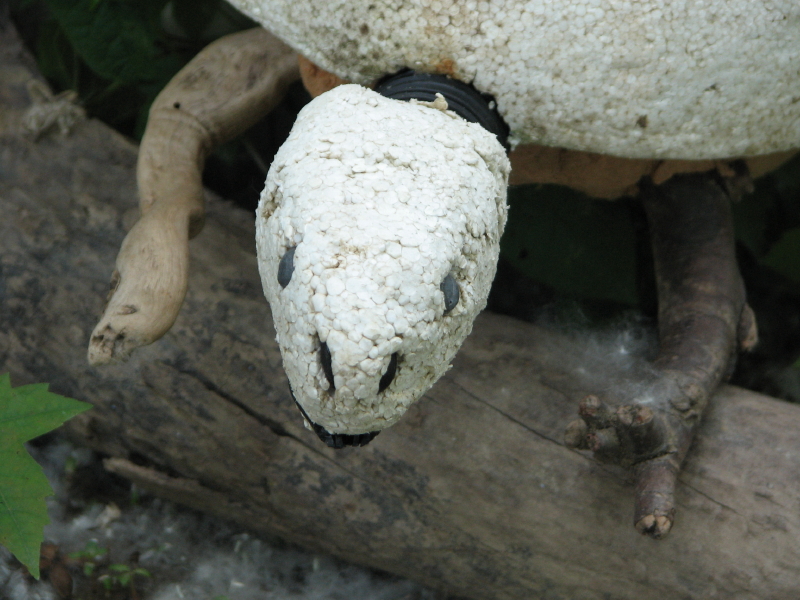
Although I may have fooled some people out there (wink, wink)…the Cottonwood Turtle doesn’t actually exist!  I made it from junk I found here in this very real environment at the Falls of the Ohio.  The shell or carapace is the cushioning from inside an old bicycle or motorcycle helmet and I have found several of these helmets after the last flood.

I used three pieces of Styrofoam…the shell, head, and one piece under a chunk of fiberglass-like material to fill the space inside the helmet.  Limbs are pieces of found wood attached to the lightweight fiberglass.  Everything is joined and pegged together with wood skewers.  I did use some found plastic for the actual neck and mouth of the turtle.  The eyes are round lead fishing weights and the nostrils are pieces of coal.  Thanks for tagging along!

Read Full Post »

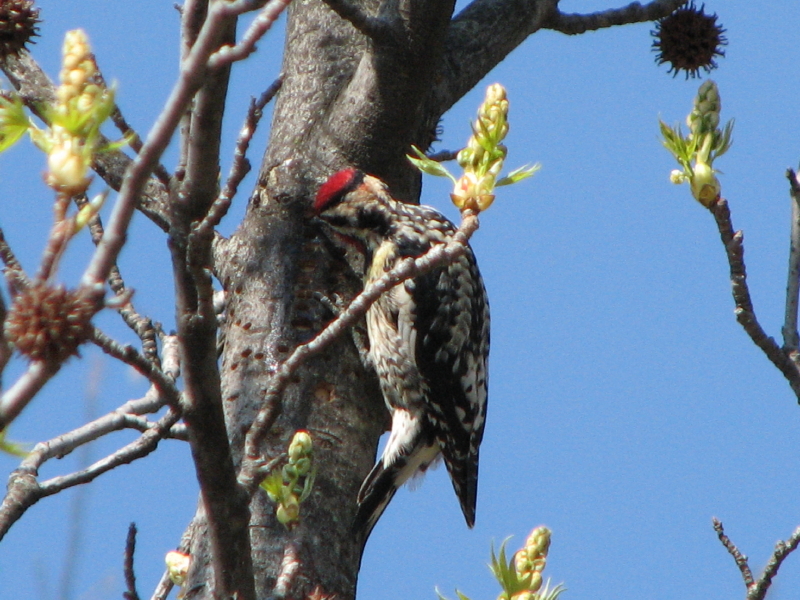
For me, the Yellow-bellied Sapsucker is a signal that Spring is underway.  I believe I have seen this very same bird in the same Sweet Gum tree for several years now.  Before the tree fully leafs out, he drills neat rows of holes in the tree bark which fill with the tree’s sap.  Visiting often, he then licks up the sugary mixture.  I have seen other bird species utilizing the work of this woodpecker including other woodpecker species, warblers and chickadees.  Before the insects and new seeds appear, the Yellow-bellied Sapsucker has accessed another food supply which he defends from all the other birds. 

Throwing his head back, this male Song Sparrow is expressing the feeling of the season.  Song Sparrows are year-round residents and have fully taken advantage of all the niches available at the Falls of the Ohio.  This year White-throated Sparrows have been more abundant than I recall from past years.  Every year is different from the previous ones and you never know what to expect next.  This year is off to a very wet start.

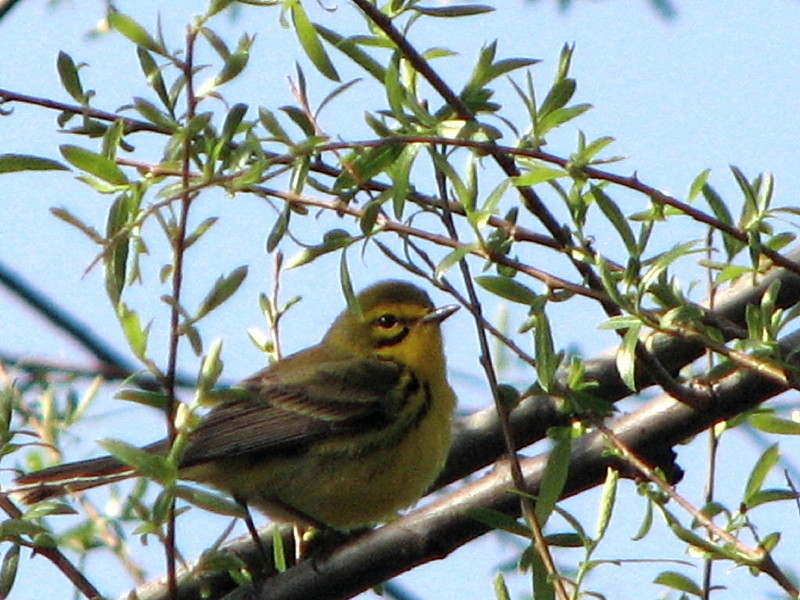
This is a male Prairie Warbler I came across recently.  I have “pished” this species closer to my camera’s lens by making little squeaky sounds that the bird found curious enough to follow.  I am hopeful of seeing other warblers before the Spring migration ends.  So far, I have seen Yellow-rumped Warblers, Common Yellowthroats, and a brilliant male Prothonotary Warbler attracted by the flooded bottomland trees.  There are thirty-five different warbler species on the Falls checklist and I have had the privilege of seeing most of them over the years.

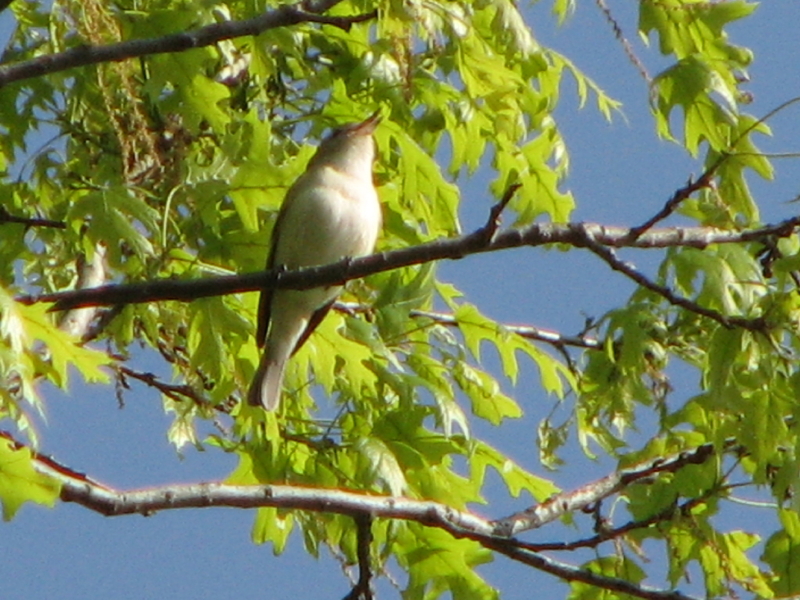
The Warbling Vireo is another bird that is more often heard than seen.  It’s such a tiny bird and it has the habit of staying in the tops of tall trees.  I found this one on the exposed section of an oak branch.  If it weren’t distracted by trying to attract a mate it would be in almost constant movement in search of the small caterpillars and insects that it eats.

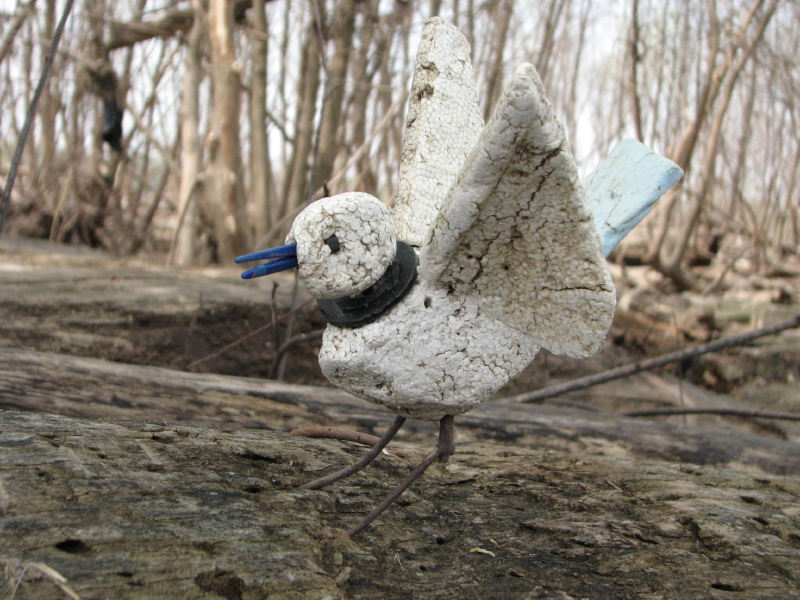
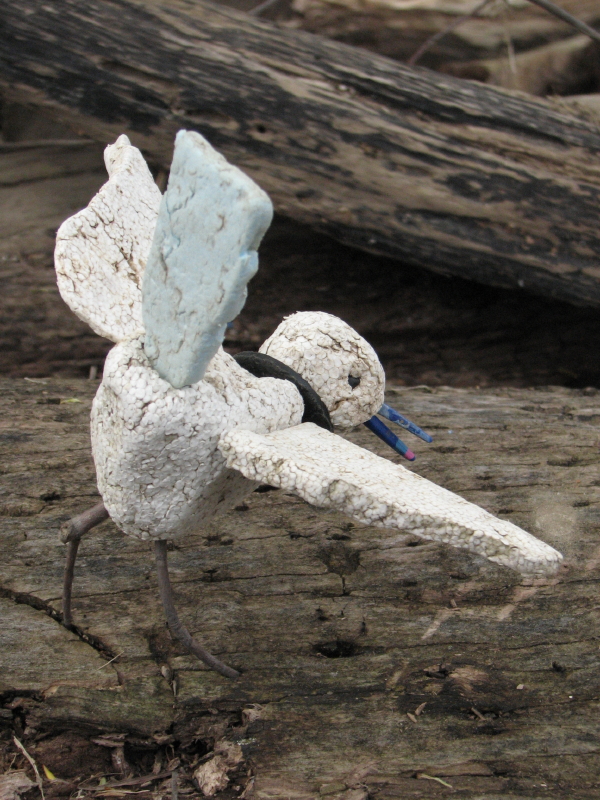
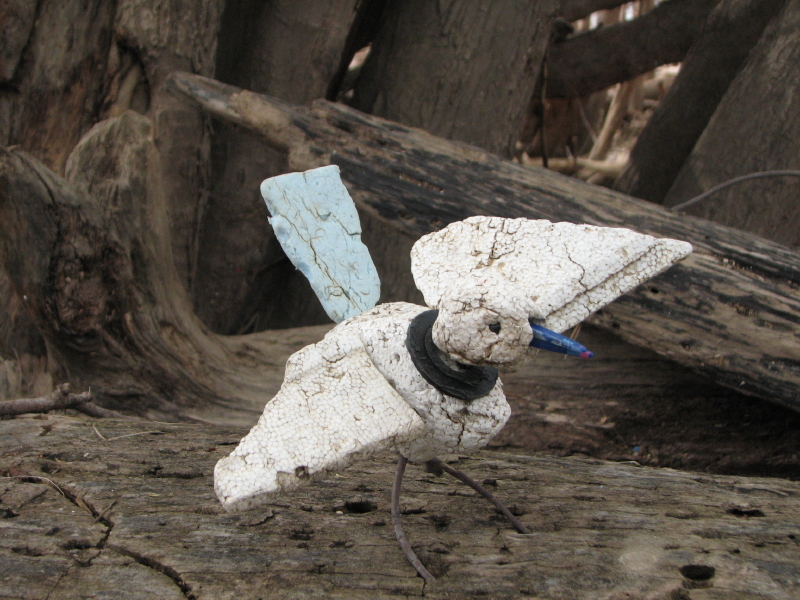
A new bird to add to the old life list is the Blue-tailed Robin.  It’s an infrequent visitor to these parts and so when one is sighted it becomes an event.  You can’t see this in the photo, but there are ten other birdwatchers with cameras and binoculars trained on this fellow as it dances and practices its courtship dance.  Everybody was extra quiet so that this bird wouldn’t spook and fly away.  Here are more images.

The Blue-tailed Robin male does an elaborate dance on a fallen log where it sings and flaps its wings in different positions all the while it struts its stuff.  The real test will happen further north in central Canada where its ability to display and attract a mate will mean the difference between passing on its genetic distinctiveness or not.  No wonder this bird can’t afford the opportunity not to practice!

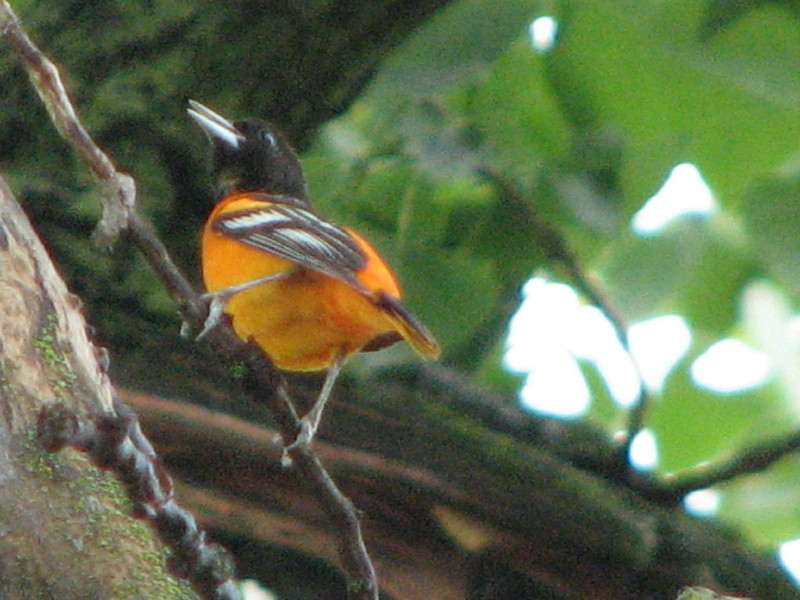
Singing very high up in a Cottonwood tree, this male Northern Oriole is also singing loudly in its territory.  So far, it’s looking and sounding like a good year for this species!  Nearly everywhere I hiked in the park I either sighted or heard Northern Orioles.  The orange color is so distinctive and it contrasts so well against the green of the surrounding leaves.  There is so much moisture in the air that my camera records this as a slightly foggy picture.  I hope for better images of orioles and the other great birds here.

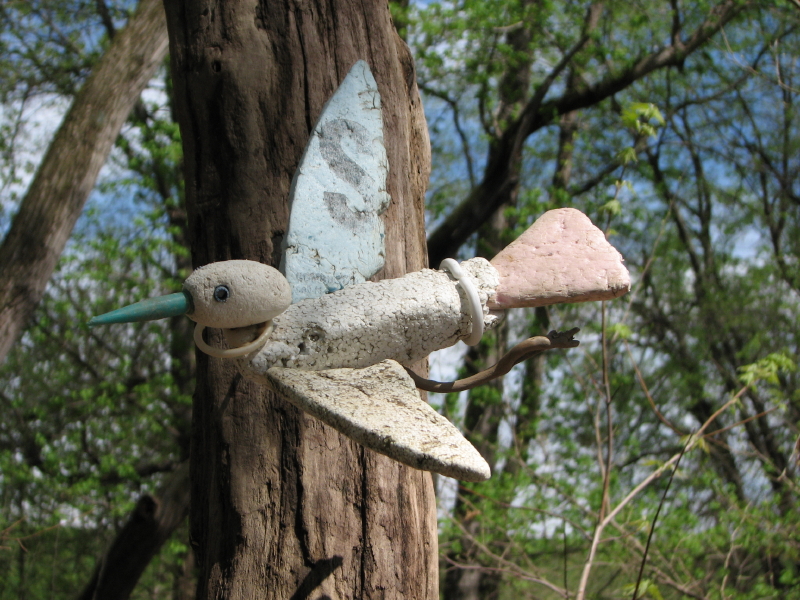
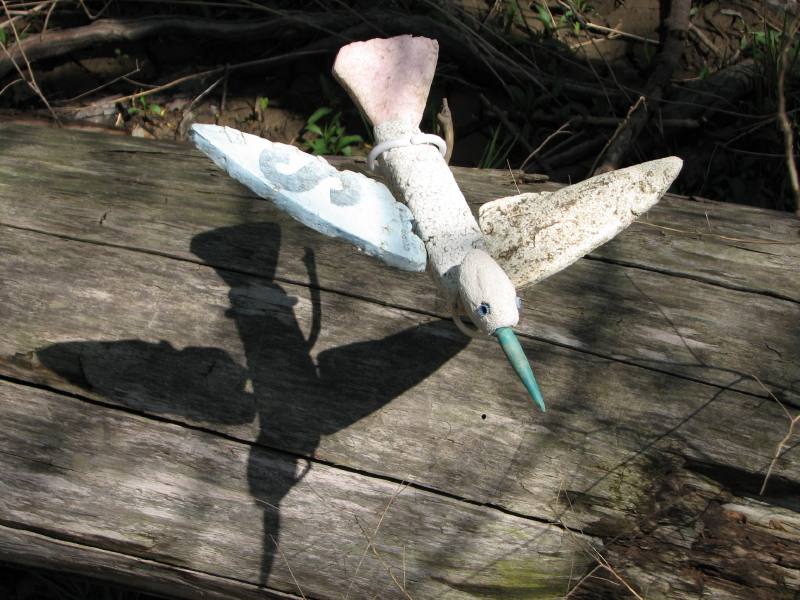
Another rarely recorded migrant is the Dragonfly Tern.  I found one coursing along the river bank and was able to squeeze off a couple decent pictures.  Like the name implies, it specializes in capturing dragonflies which requires the ability to maneuver at high-speed.  It has swept back wings that give it the acceleration it needs in tight corners.  Here’s another picture of it buzzing over a fallen log near my position.

This bird soon will be off to the Great Lakes region where it also breeds.  It barely scratches together a depression in the sand and gravel that it considers a nest.  There are usually two eggs laid that are heavily speckled like the small pebbles that surround it.  It winters in South America and travels thousands of miles each year.

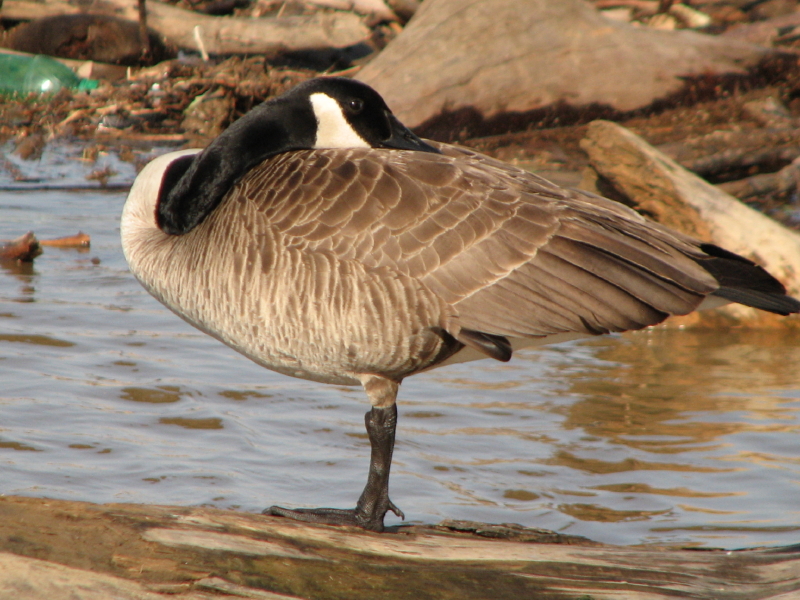
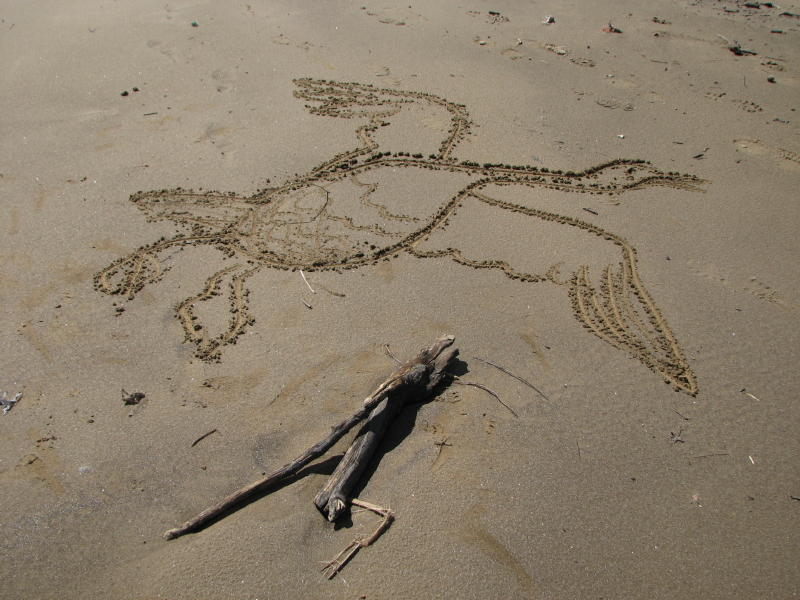
On my way home from the park, I chanced to see this Red-tailed Hawk on top of a utility pole and recorded its image.  It is one of our more common hawks, but since I haven’t featured it in the Riverblog before, I thought I would include it in this post.  As the year progresses, I hope to feature other birds that stop at the Falls of the Ohio. For me, the difference between a successful trip and a really successful adventure sometimes hinges on seeing one nice bird!  In closing here are two Canada Geese.  One is real…

…the other is just a tracing in the sand I made.  Happy birding !!

Read Full Post »

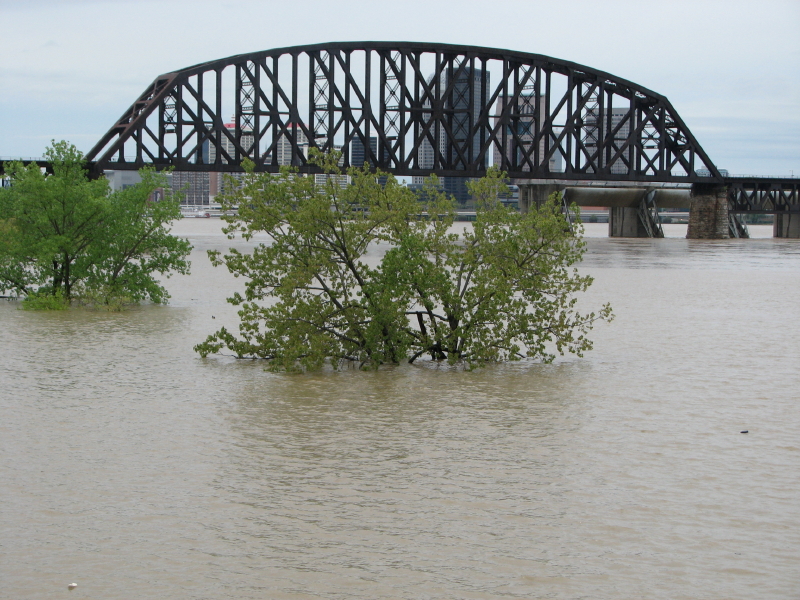
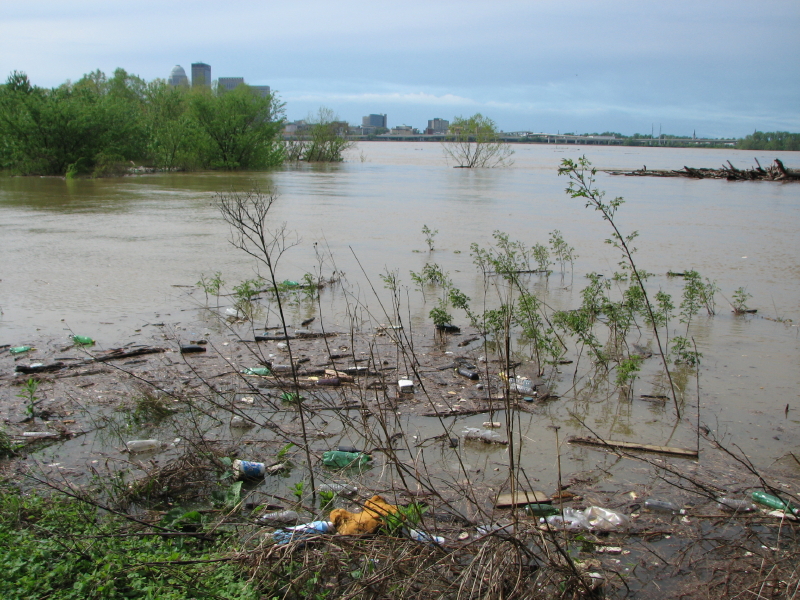
The Ohio River continues to rise because the sky continues to rain.  This flood will be one for the record books…perhaps in the top ten when it’s all said and done.  But who knows when that will be?  The weatherman hasn’t been very encouraging of late.  The timing of this flood is especially bad because it overlaps with the Kentucky Derby Festival and its two weeks of partying and activities which culminates with the most famous horse race in the world.  The additional water will keep the tourists away.

These images were taken just a couple of days a go and now the river is even higher.  In the City of Louisville, some of the most powerful pumps outside Holland are working around the clock pumping water from the low-lying areas.  Streets have been closed and the flood gates are up.  For the people who live nearest to the river…they have packed up and left a few days a go.  By now, the water has reached the roofs of their homes.  There’s nothing more that can be done.  It’s sit tight and see how much more rain will come and how high the river will rise.

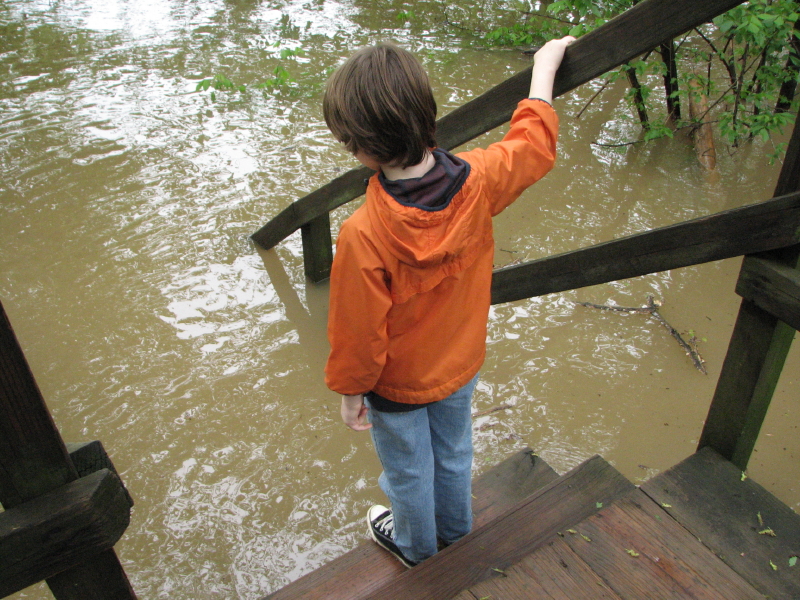
My son Adam was curious to see the extent of the flooding and so we visited the Falls of the Ohio.  The familiar wooden steps that lead to the river bank were now half way underwater.

We watched a box turtle flushed from its home in the underbrush swimming to higher ground.  Fortunately, it received an assist in the form of currents pushing it to land where it was able to escape drowning.  Watching this greatly affected my son who has a tender heart when it comes to all animals.  He really gets upset when the nature shows on television become too graphic. He doesn’t understand that life feeds on other life and that this has been the way of the world for a very long time.  This flood has also affected my creative routine at least by the water.  I’m forced to hopscotch back and forth between events in time which I think is a healthy thing in my life.  I was beginning to feel a little too linear anyway.  So, here’s another Styrofoam project I made sandwiched between the last flood of a couple of weeks a go and now.  This project is also now a memory remembered by these images.

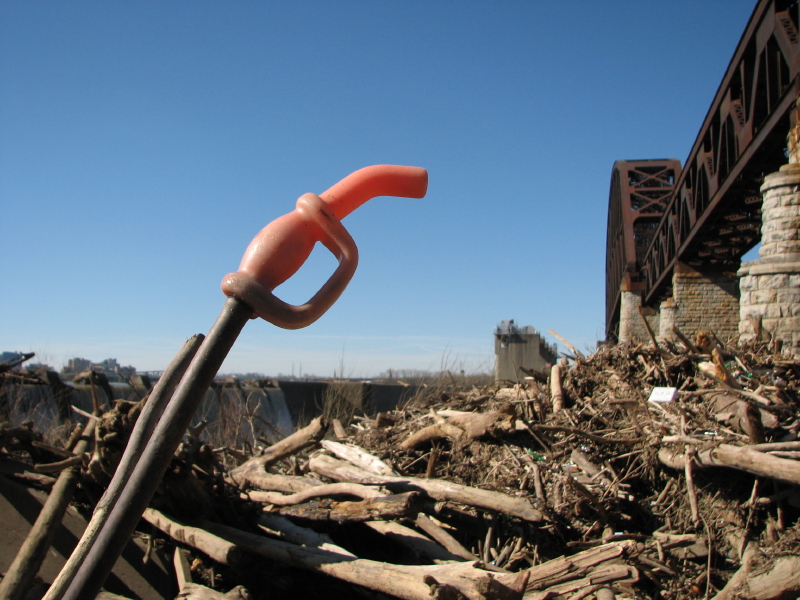
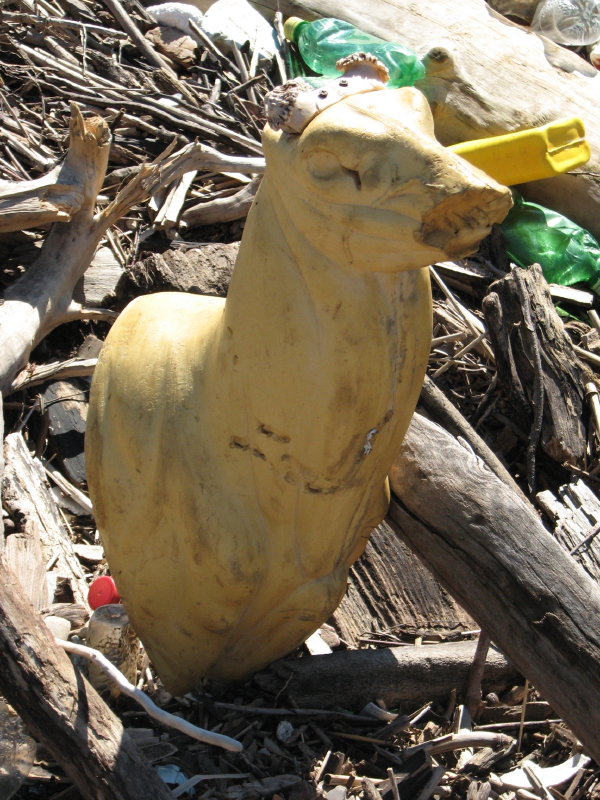
I really thought the previous inundation would be it for the year.  And so I set up shop atop this immense pile of wood and explored what was mixed in with all the natural debris.  Among the “treasures” was this toy gas hose…but that’s not all that I found!  Here’s something unusual too.

I set it up to help orient it for the photograph.  It’s what’s left of a taxidermed deer head.  The tanned skin that would have been stretched around it is now gone, but the remnants of the deer’s actual skull and broken antlers are screwed into the molded foam form.  This is another object that exists at the intersection of the natural and the artificial which I find curiously to be another sign of the times we live in.  When this trophy was intact, it probably was praised for its life-likeness.

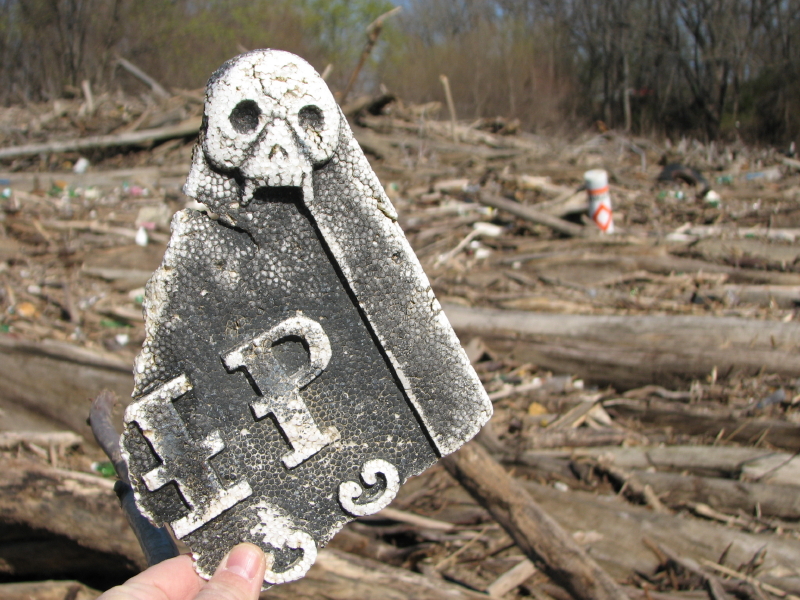
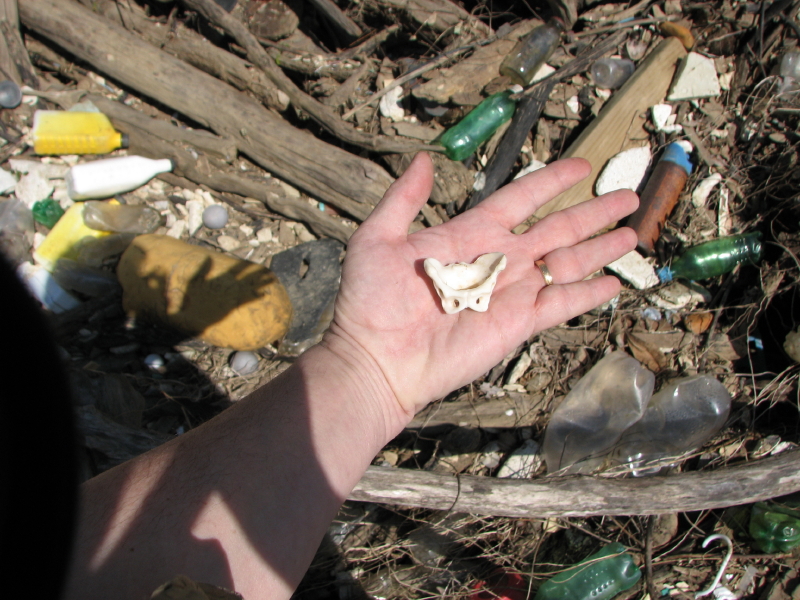
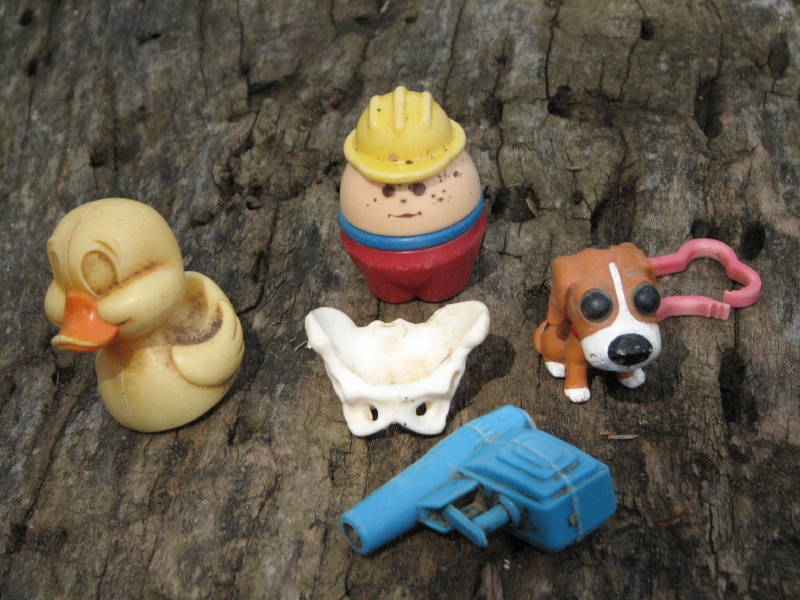
I also picked up this Styrofoam fragment of what I’m guessing was perhaps a Halloween novelty?  Amazingly, the little skull image survived.  I found another human bone reference out here on the wood pile.  It’s a miniature pelvis made out of plastic.  Luckily, I have never found the real deal and probably would freak out if I did.  Here’s that hip bone and a second image with some other fun stuff I picked up including one of the smallest and cutest squirt guns I’ve seen.

Sitting on a huge log, I started getting comfortable on my new spot.  I thought I could last here until the summer heat drove me under the willows.  I began to gather materials to make sculptures with like I had done with my previous plein air “studios”.  Mother Nature was providing all the material I needed to keep me and this project going for a long time.  Here’s my Styro-cache with its river-polished foam.

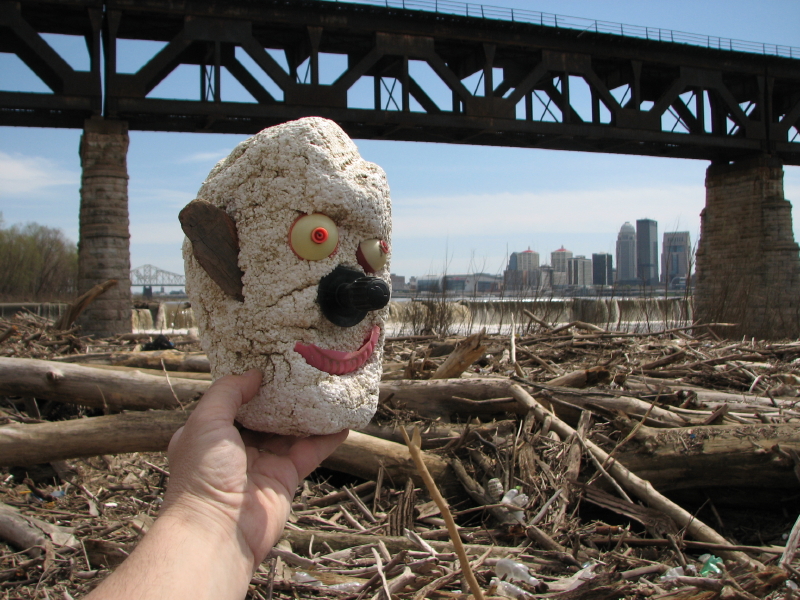
It’s all gone down river now, but before that happened I made one other figure out here.  I called him “Hoser” and set him up next to the “Danger” figure.  First, I started with making a head.  The eyes are old fishing floats.

I felt very meditative in this setting.  I could see the skyline of a city with its proximity to nature and it made me speculate on how it all was going to turn out?  Would we eventually strike some kind of working balance with the planet or was this a taste of what was coming or even worse?  I would walk around my wood pile looking for a stick or branch I could use for a limb to help blow life into this Styro-man.  This is how he eventually turned out.

With gasoline approaching four dollars a gallon I decided to put the fake gas pump nozzle and hose to good use.  I strategically placed this object into the figure’s polystyrene body more as a reference to the fact that here was another resource that we pissed away.

I located “Hoser” near the “Danger is My Middle Name” figure, took my photographs, and walked away.  That was the last I was to see of them.  Within days, the river started to rise more from rain that fell north of here and then it started to rain in earnest in the Ohio River Valley.  That was two weeks plus…it’s still raining and the river keeps on rising and the adventure continues.

Read Full Post »

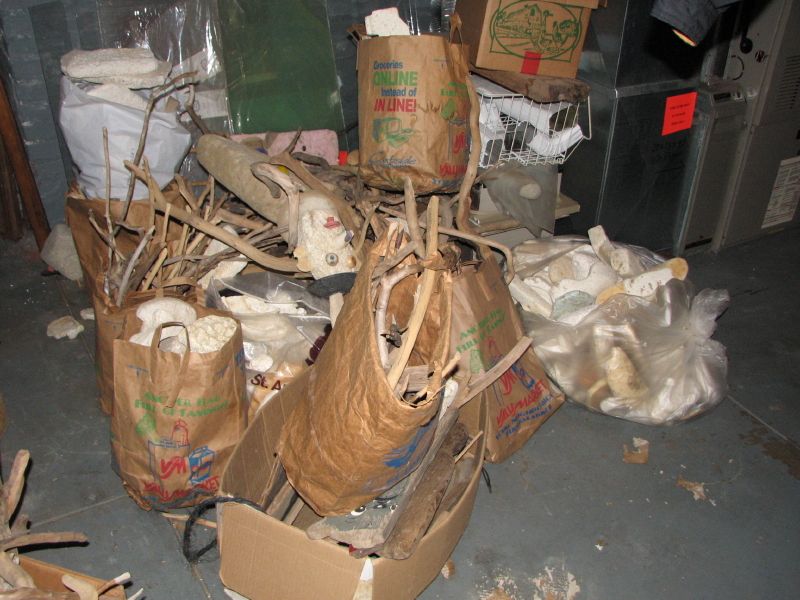
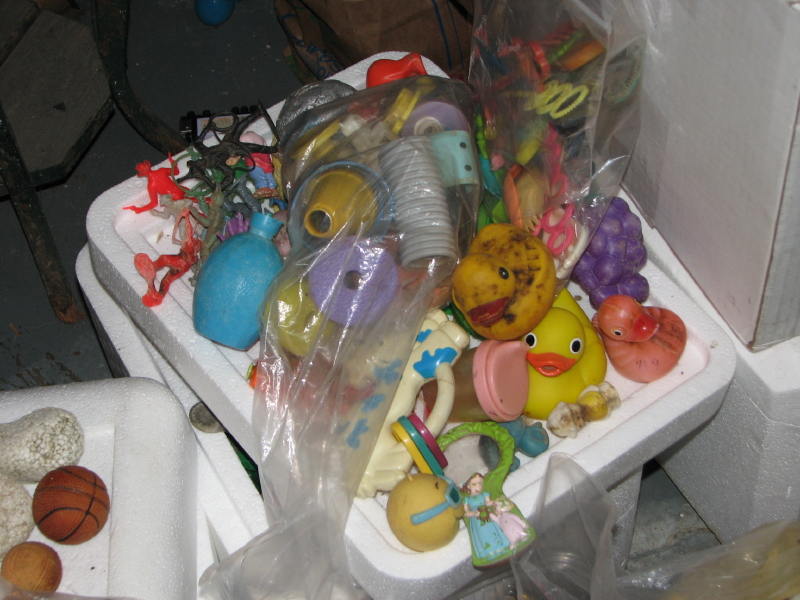
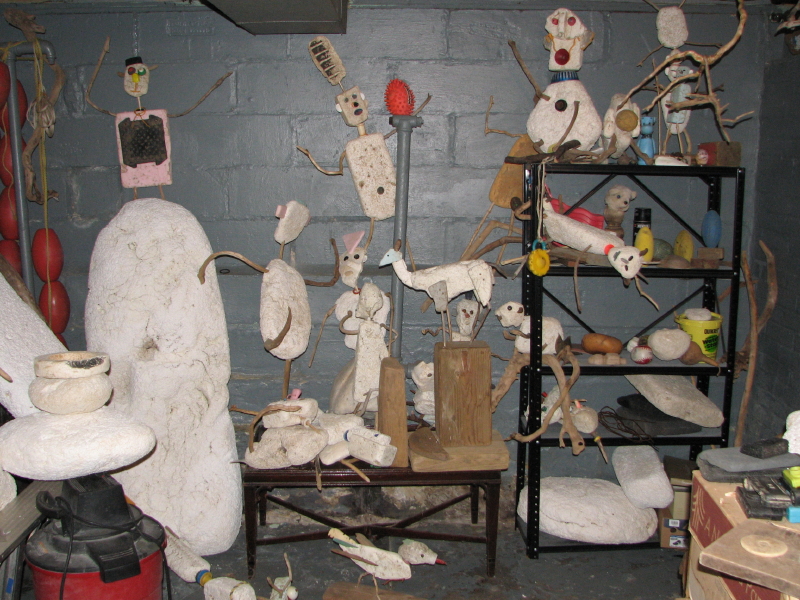
I debated with myself about going down this road in this post and decided it would be okay.  I did solicit opinions from fellow artist friends on the topic of obsessive compulsions and hoarding in an attempt to come up with a self-diagnosis.  Opinions varied.  Since photographs do a good job of describing things… I will start with images from the basement of my house and my dilemma (and subject of this post) will become clearer.

I have been doing my Falls of the Ohio project since 2003.  During this time, I have made many sculptures from the materials I found deposited in the park by the Ohio River.  Most of those materials and sculptures were left on site, but not all.  I do have a desire to remove the trash I find from this environment even if I realize I can’t get it all.  The result is that I have brought a lot of it home with the notion of using it in my art, sometime in the near future.

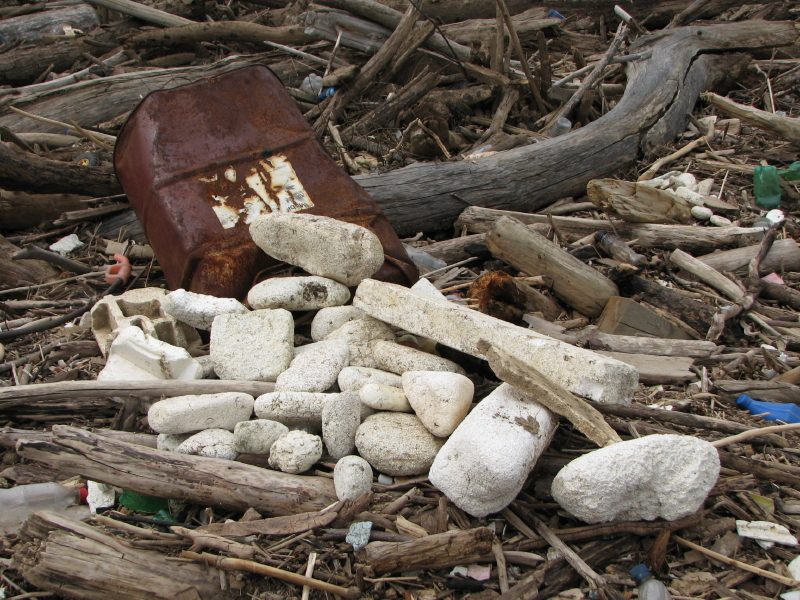
I “maintain” a small studio space in my basement where I store materials with the aim of making something from them.  One issue I have is that I see “potential” in so many things and I’m reluctant to give up on materials that could become art.  I am plagued by seeing all the possibilities which on occasion out strips my ability to realize all this “potential”.  Part of this is economic in nature.  I have never ever had any money and as many of you know, art materials can be very costly.  With this Falls project, I have spent the bare minimum since what I’ve been picking up is free.

These are my “rainy day” materials from which I’ve made many birthday gifts, Christmas presents, and donations for not for profit fund-raising events.  Over the years all this material culture has built up and it’s getting hard to move around my basement!  So, I ask myself…am I a hoarder?

I have to admit looking at this image…things look bad!  It’s nearly the classic picture of the hoarder house that has paths of stacked newspapers and magazines with little paths running through the spaces.  I assure you that the rest of my house is quite normal…for the most part.  We have what seems like thousands of books and I have more art hanging around than the “average” home.  The men of my family have always been drawn to collecting things (coins, medals, old photographs, etc…), but I think I came down with a more serious case than most.  I will say the books are in their cases and the art is hung on the walls with some care.  I try to take care of the objects I seriously collect, but not with the art materials and their as yet unrealized potentials.

There has never been a time that I wasn’t making something.  That sense of thrift and trying to recycle and reuse I see as being virtues of my creative process.  Years a go,  I once found employment as a picture framer and I was disturbed by all the waste in that profession.  I couldn’t see throwing away perfectly good picture frames because they were old.  And, all those scraps of 100% cotton rag matboard…are too hard-won to be thrown in the dumpster with impunity.  So, naturally much of these materials also found their way into the basement.  In my defense, I will tell you that this stuff does eventually get used.  For many years, I supplied all the neighborhood kids with all the free matboard they could draw and paint upon.  Because the matboard in particular was quality material, there are many childhood drawings and artworks that might actually survive to say something about the ephemeral experiences of being children.  Although I have vivid recollections of the art I made as a kid…nothing from my childhood survives and that does bother me a bit.  I have saved most of my sons’ childhood art.  Perhaps that’s another sign of a hoarder!

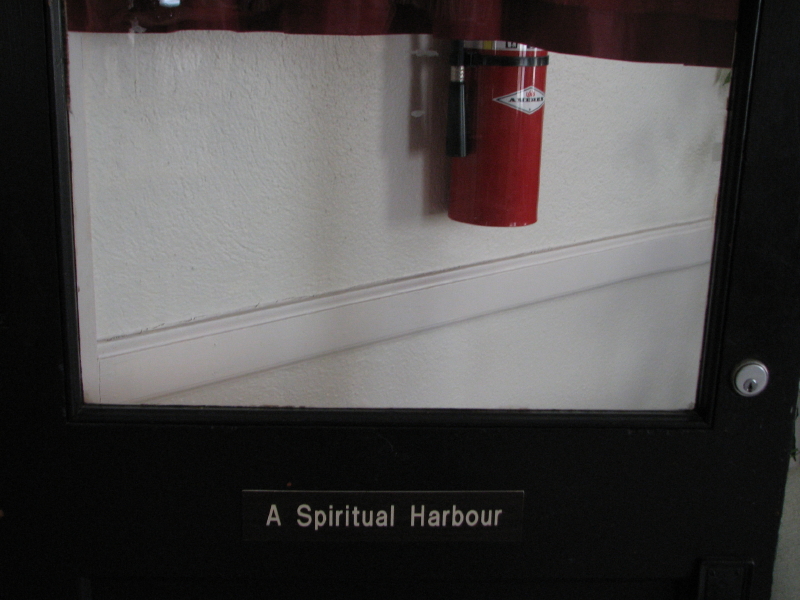
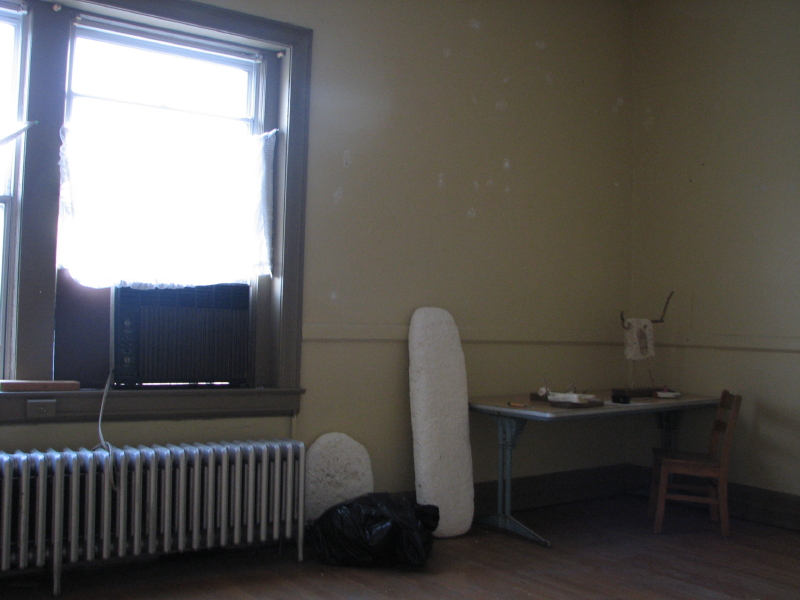
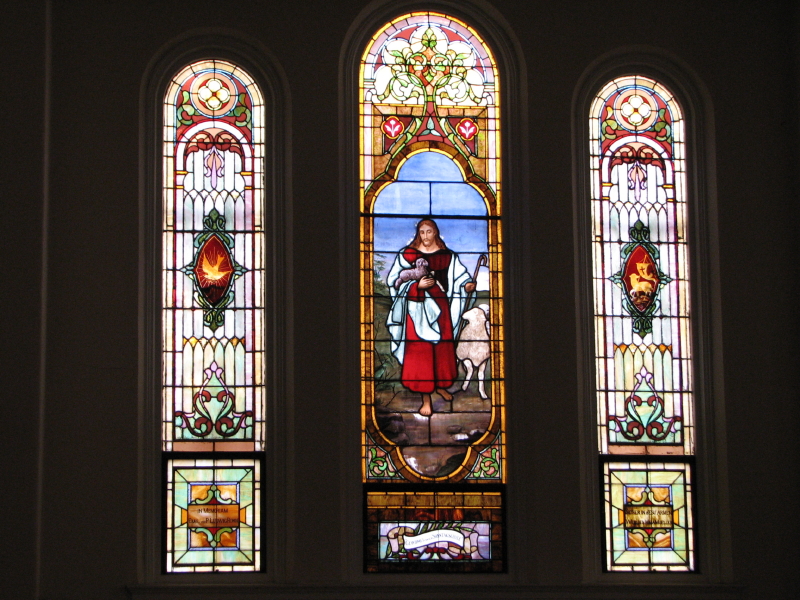
So, what am I going to do with all this “river treasure”?  I have resolved to use it this year and get it out of the basement!  I have a few upcoming exhibition opportunities and may pursue more.  To help with this goal, I have rented an additional studio space in a local church where several other artists keep spaces.  The enigmatic image I began this post with is from that church and it’s from a small library/study area used by the congregation.  Here is a partial view of my new studio room in this church with the beginnings of me moving materials out of my basement.

The church (whose name I will keep private) dates from the turn of the 20th century.  The current congregation is small and aging and I wonder how long it will remain a viable church?  To help bring in income, the vacant spaces are rented out.  I’m sharing my space with two good friends of mine both of whom are primarily painters.

Although I do think of myself as a spiritual person, I wouldn’t describe myself as being traditionally religious.  My sacrament is my creativity.  I do, however, find the idea of redemption interesting.  With my project, I am trying to redeem these poor materials I find by our river and maybe point to something that is within all of us…a univeral creativity that I feel is the hope for our planet. 

Read Full Post »


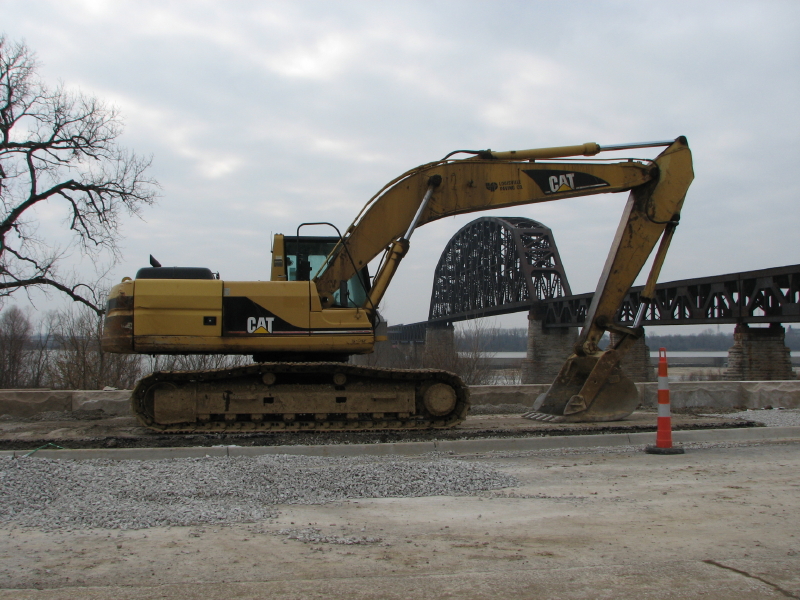
Today is the first day in a week that I haven’t run a fever.  I don’t get sick very often, but when I do…I usually get my money’s worth.  I missed a week of work and probably worried the folks closest to me, but now I’m thankfully on the mend.  Now, there’s a lot of catching up to do and I look forward to reading what my blogging friends have been up to and to share a bit of my world by the river.  The following story and images were part of my last expedition to the Falls of the Ohio and made the day before the microbes laid me low.  To begin, I’ll start with the first image in this post.  There are changes afoot in the park proper.  High on the riverbank, the road and parking areas are being expanded and made more accessible.  I naturally am a bit troubled by this since I don’t think this unique place needs to be “loved” anymore than it already is.  I remember the Falls of the Ohio before its state park designation and the building of the Interpretive Center.  I can’t say that I enjoy this space anymore than I did before the building boom began.  Change, as “they” say is the only constant and at the Falls of the Ohio, the rocks bear witness to over 375 million years worth of changes.  So what’s a few more?

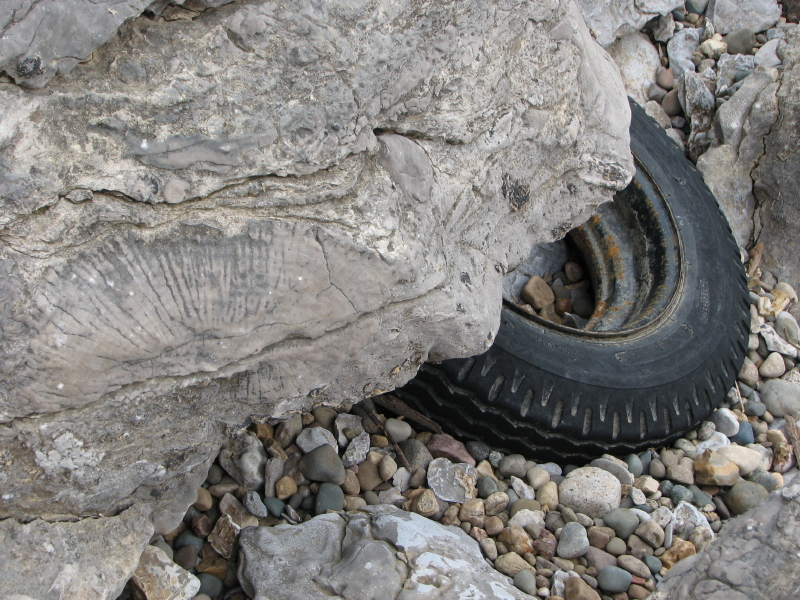
I spent more time scrambling up and down the fossil rocks than I usually do and came across this image.  I noticed that the fossil coral on the rock to the left of the tire bore some resemblance to the tire’s tread and created this reciprocal relationship in my pre-fevered brain.  Beyond shape and pattern, I’m struck by our dependence on ancient life to advance our own contemporary concerns.  The Ohio River buried this tire in this ice age gravel many years a go and here it stays.

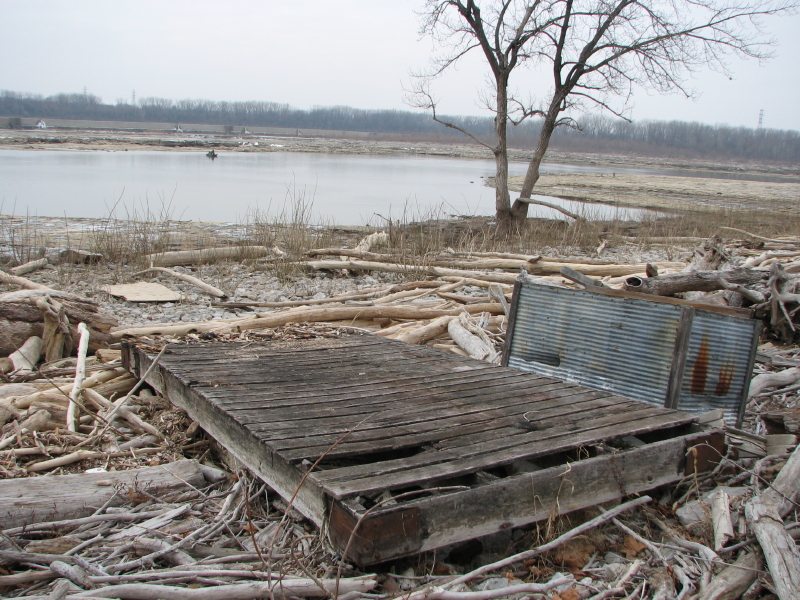
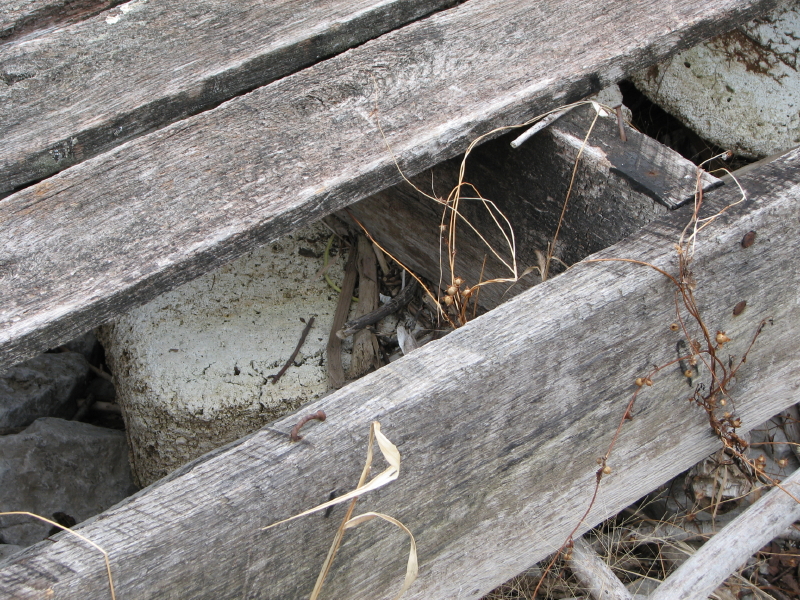
I have passed by this scene for a while now, but for some reason just decided to check it out more closely.  People often ask me where the larger chunks of Styrofoam I use come from and I reply …”I think they are from floating boat docks”.  Now, I actually have proof of this instead of just relying upon conjecture and intuition.  The larger object to the right of the wooden slatted form is separate from it and actually deposited by the river prior to the dock’s arrival. 

Something unnaturally white seen past the bleaching wood caught my notice and here was my proof.  This boat dock or swimming platform was kept afloat by several monolithic sections of polystyrene.  As the wood decays and breaks apart, the entrapped Styrofoam is released into the river to continue its journey downstream.

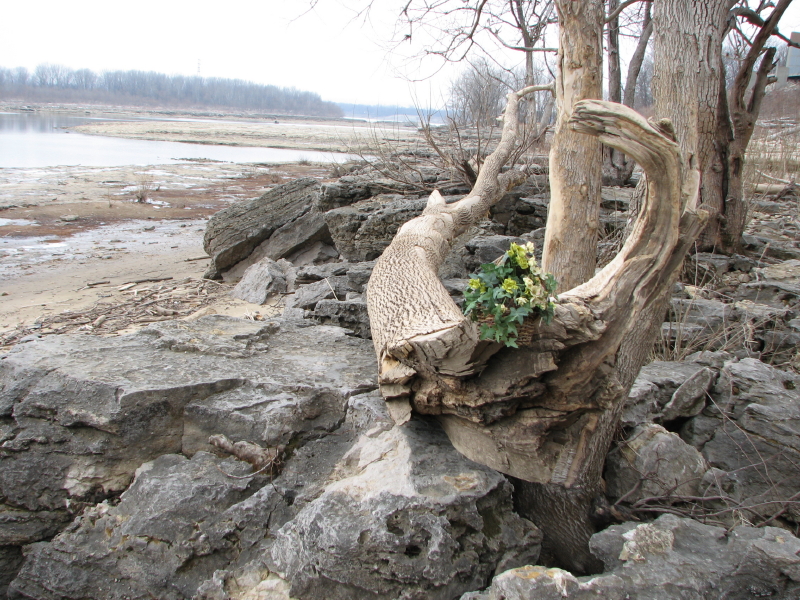
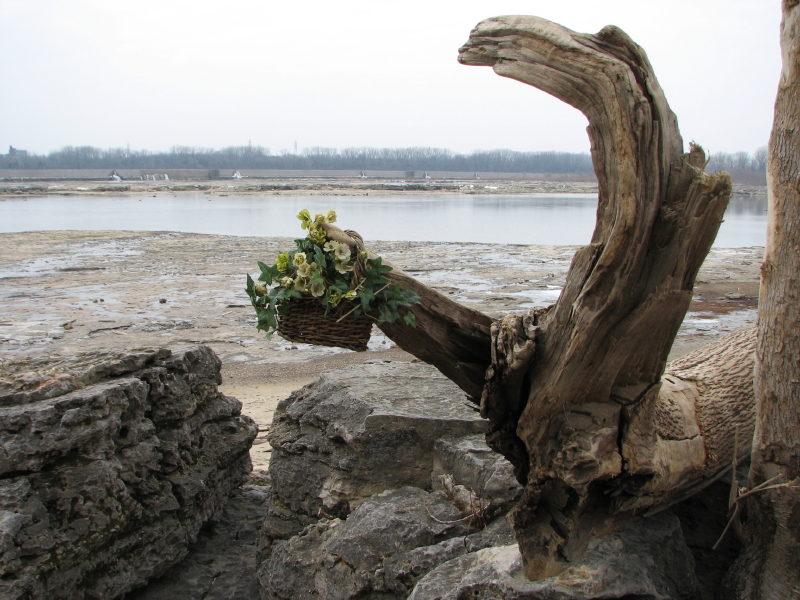
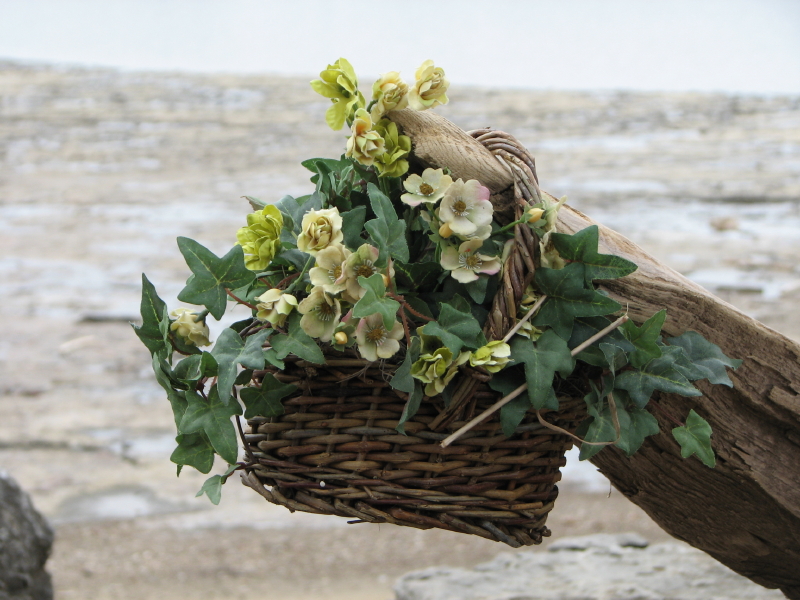
Returning to the rocks, I was poking around when I noticed something verdant.  It’s the middle of winter and there isn’t much of anything green to be found anywhere around here.  Looking more carefully, I see that some other Falls beachcomber has found a basket of artificial flowers and propped them on this large fallen tree trunk.  Here is a different view of that basket.
Although I’m no fan of artificial flowers and ivy (my Dutch grandmother actually forbid them in her house) I find I “like” this picture.  Perhaps it’s the illusion of greener times ahead or the considered placement by the basket’s original finder, but it makes me see this place in a way I wasn’t expecting.  On site, I remember thinking that this was put here as a gift.
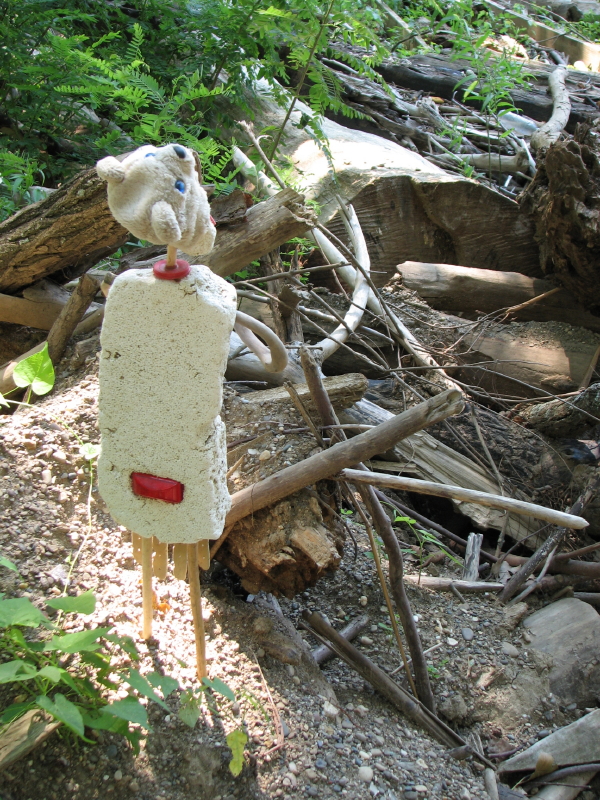
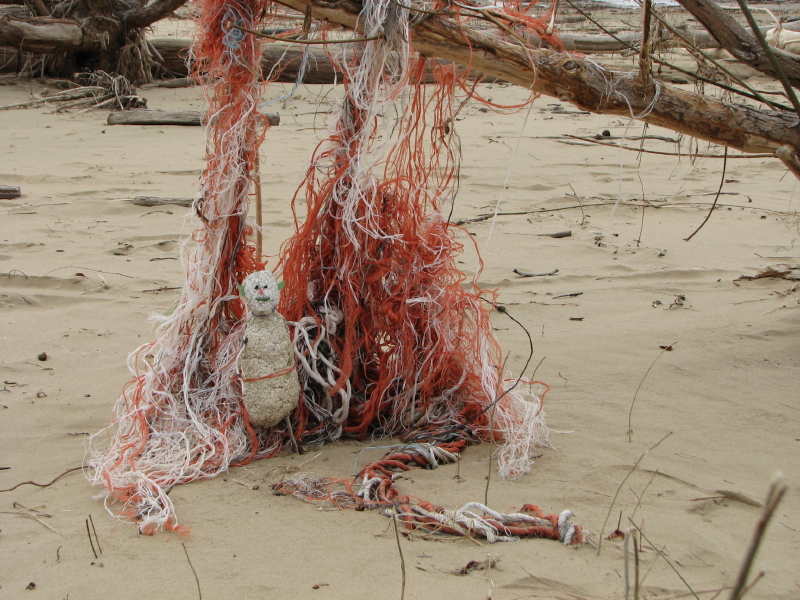
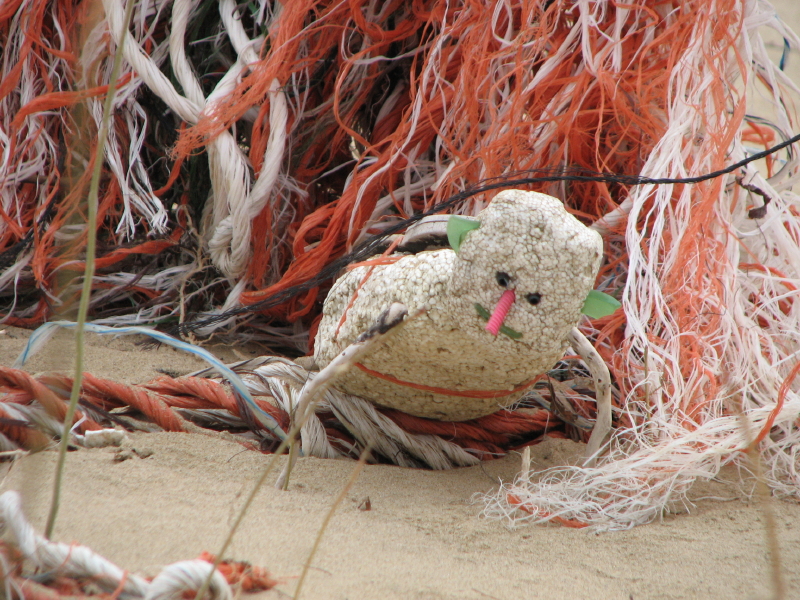
Walking past a recent project I discovered that the small Styrofoam figure I made was still present…but had blown over by the wind.
So, I set him right and moved on to my next project.  That will be the subject of my next post barring a relapse of my viral funk.  For now, I’m glad to be gaining my strength back and I’m looking forward to returning to work in all its forms. 

Read Full Post »

« Newer Posts - Older Posts »