Feeds:
Posts
Comments

Posts Tagged ‘birds’

Before the month of May slid into history, I did a little sliding of my own.  The day after Julia and I visited Nerinx, I did a solo expedition to the western section of the Falls of the Ohio State Park.  Now the sliding part has to do with mud!  In places the earth was high and dry, but in key areas  the mud remained slippery and sticky.  Here’s a picture of what I mean.
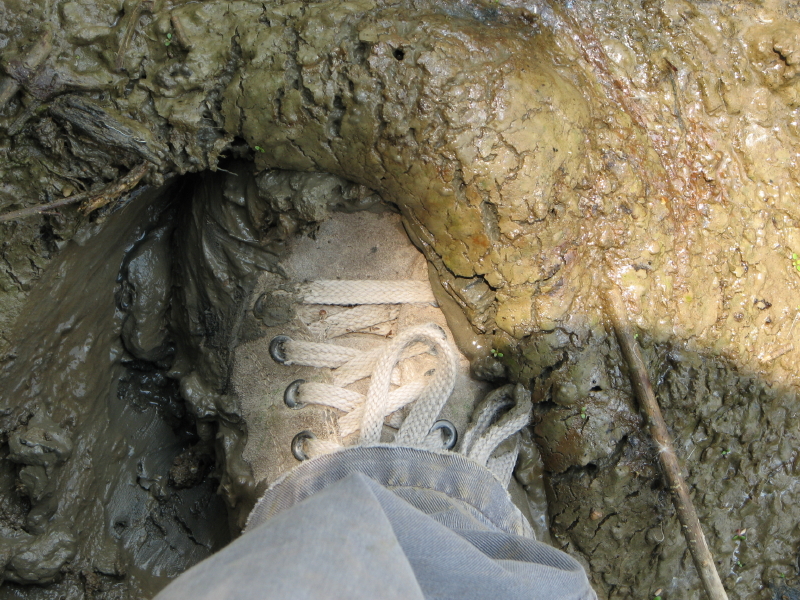
It’s creamy and in places you could sink in over your ankles.  To get things over with so I don’t have to obsess about this, well I just find some mud and step into it.  After that there are no worries about remaining clean!  The deed is done.  I have a similar philosophy about the rain.  Once I’m as wet as I can get…I can relax and do my thing as long as I don’t get too cold.  The mud is more treacherous closer to the river’s edge and I decide not to flirt with it too much.  There is afterall, much to see around here.
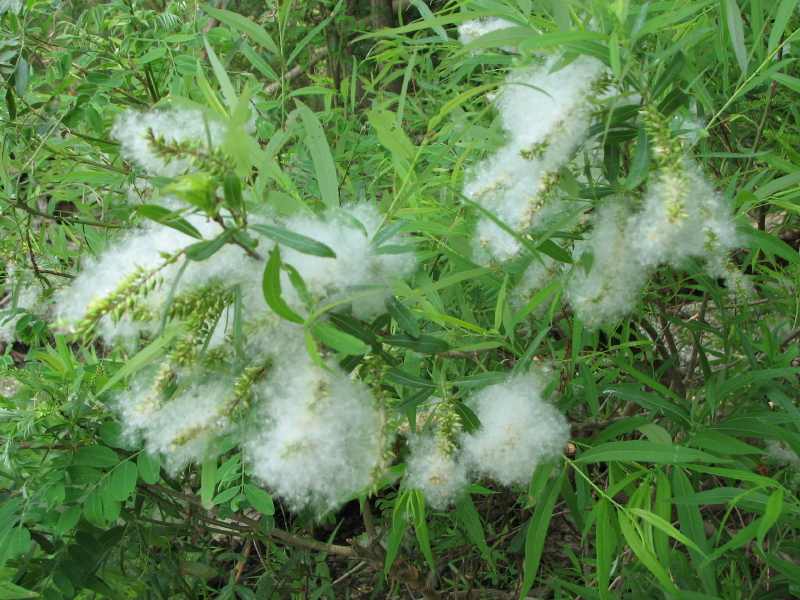
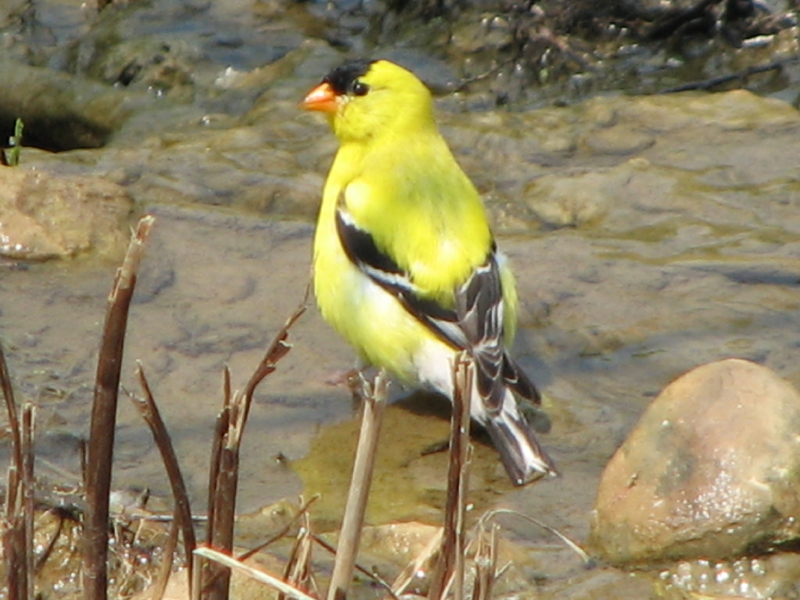
The willows are in maximum fluff production and there are drifts of the stuff on the ground.  When the wind stirs then the willow seeds become air born and are carried away.  With so much fluff, you would think willows would be even more common than they are.  I have to say that so far, I haven’t seen any birds that have made my year.  Last year’s signature bird was the Summer Tanager.  This year hasn’t been the warbler fest that I experienced just two years a go.  Still, I take what I can get and I always love American Goldfinches.  Here’s a male taking a dip in some water.  Small flocks cruise along the trees nearest the river.
I’m walking west along the river and I came across the only persona that I saw all day.  We eye-balled each other, decided that neither was a threat and so we had a short conversation.  Mostly, it was an opportunity to compare nature notes.  I guess the feature that most stood out about my acquaintance is the bright pink hat she? is wearing.  I said I was looking for birds and junk and “she” said that she was a Lepidopterist.  Oddly, we didn’t introduce ourselves, but she let me take her picture for my blog.  I guess she’s about five feet tall or so and walked with a cane.
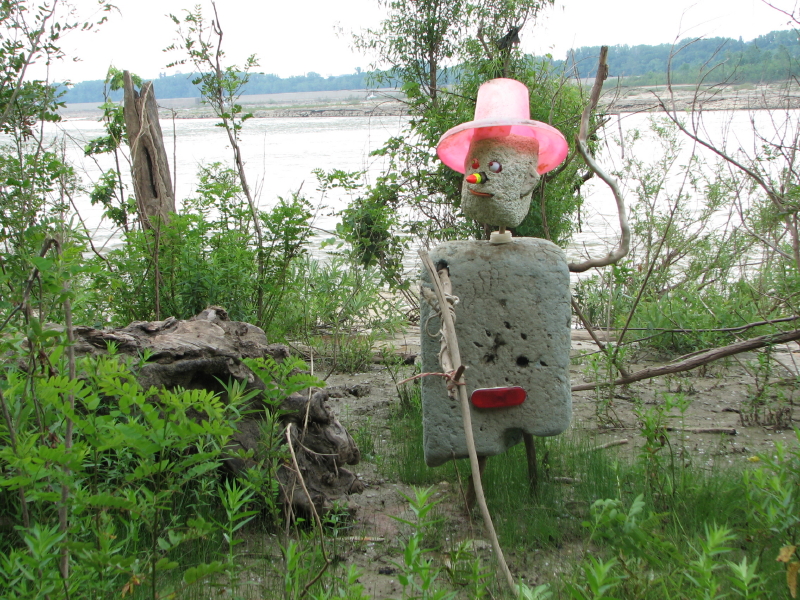
After I asked if she had seen any interesting birds…she hadn’t.  I was asked about what butterflies I had come across.  Fortunately, I also like butterflies and try to take their pictures when both insect and camera cooperate.  I really don’t like these autofocus cameras.  Anyway, I noticed many species out on this day including Commas, Mourning Cloaks, Cabbage Whites and then I showed her images of the two butterflies that I did get decent pictures of and she seemed happy to identify them for me.  Here is the more unusual of the two that I came across at the forest’s edge.
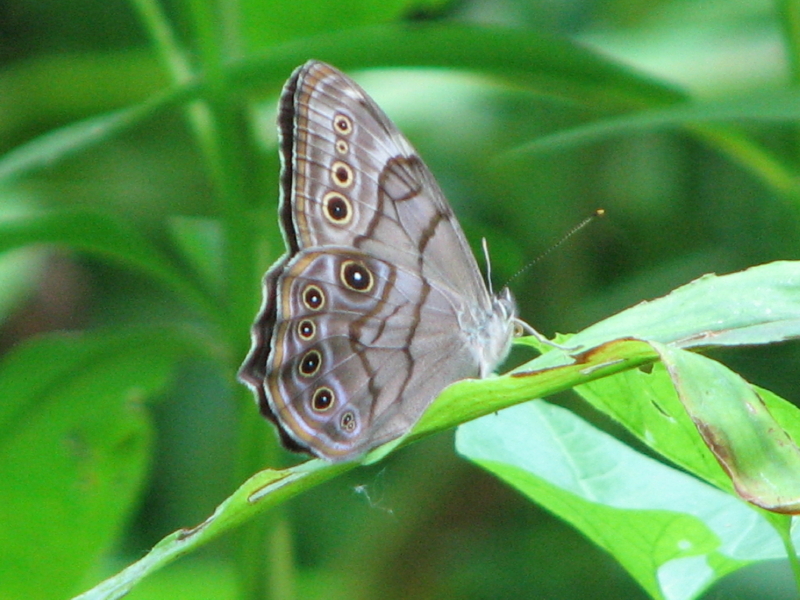
Quickly my new friend identified this as being Enodia anthedon or more commonly, the Northern Pearly Eye.  It is a forest butterfly that does not come to flowers preferring instead the fermenting juices of fruits and tree saps.  I reply that I had noticed that there were many butterflies around the fallen mulberries and on the sides of the willow trees. 
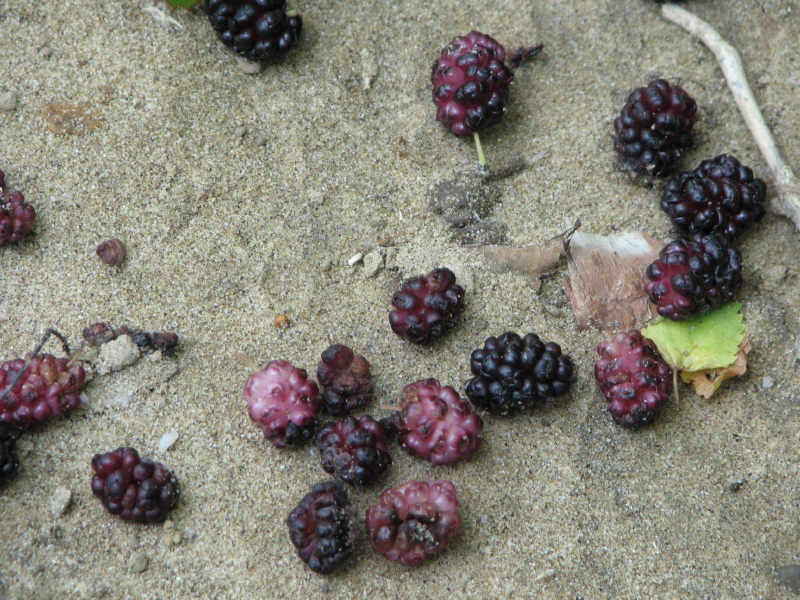
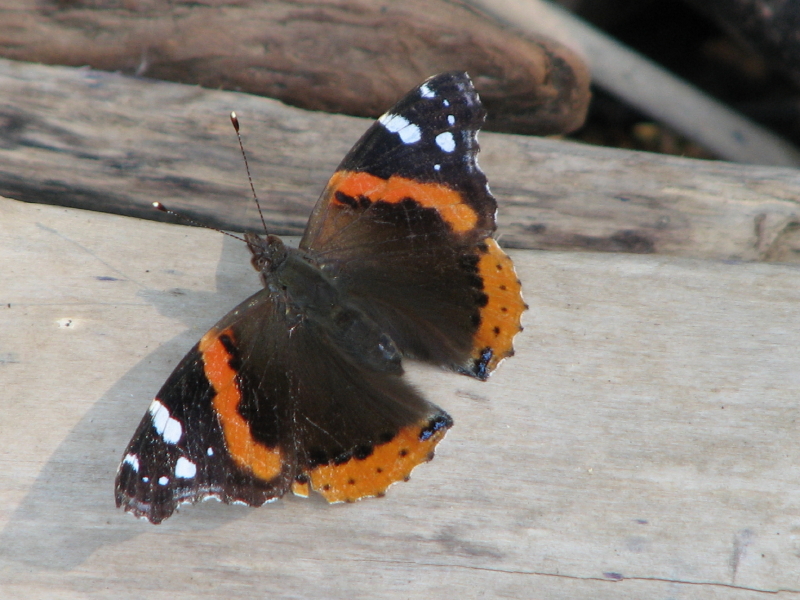
I wonder if science has determined if a butterfly can get drunk off the fermented juice and if this is possible…do they experience hangovers?  I know this does happen with birds like Cedar Waxwings that literally get tipsy.  The second butterfly is one that many people know and it’s the pretty Red Admiral or Vanessa atalanta . Even its scientific name is charming.  This is a people friendly butterfly and will often alight upon a person.  I came across dozens of these today.
With the rising heat the promised threat of a late afternoon thunderstorm began to materialize.  First there was the distant sound of thunder and since I had a hike to still make to reach my car…I said farewell to my butterfly friend whom I hope to see again.  I asked before parting if she collected butterflies and she answered that once she had, but was now over that part of her interest in them.  She no longer needed to possess them and instead grew flowers and plants to attract them.

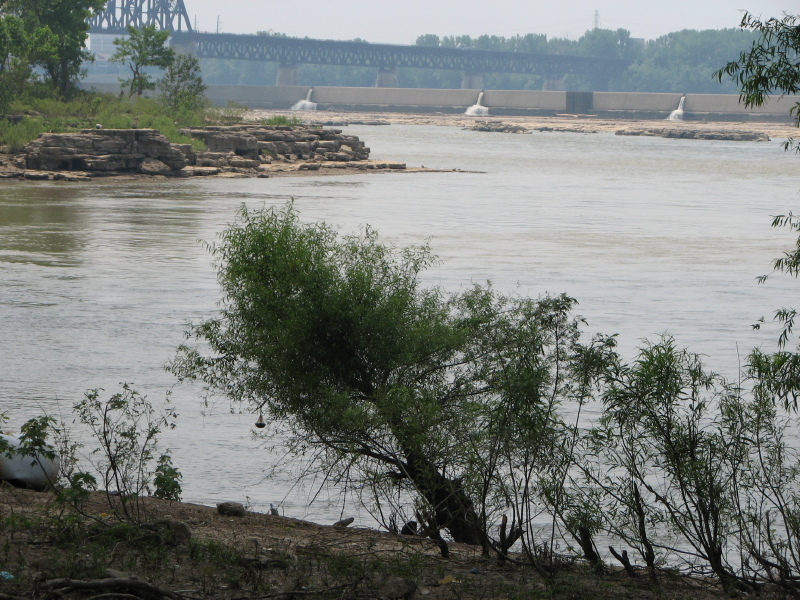
I hope I run into the lady with the pink hat again.  She seemed to share a reverence for the life that is out here in the park.  I would welcome learning more about the butterflies that call this place their home.  One last shot showing willows, the riverbank, fossil cliffs, and the dam in the far distance that keeps the river at bay…most of the time.
Read Full Post »

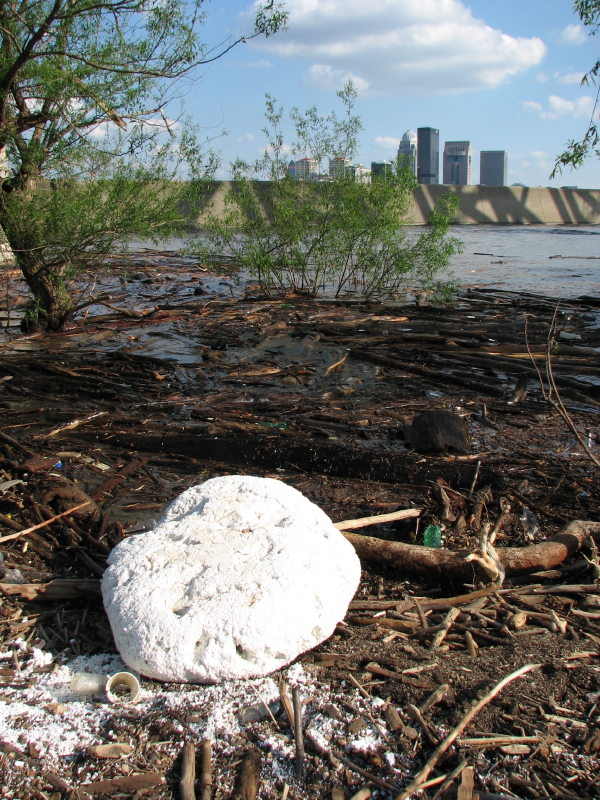
I never have a dull visit to the Falls of the Ohio.  Each time I come out here I can expect an adventure of one type or another.  On this day the river had noticeably receded and this large boulder of Styrofoam that I had been watching for days as it floated out here was finally on the shore.  I tried to move it, but it was so waterlogged and heavy that I gave up…for now.  All around it were Styro-bits that were ground off by abrading against logs and the sandy bottom.

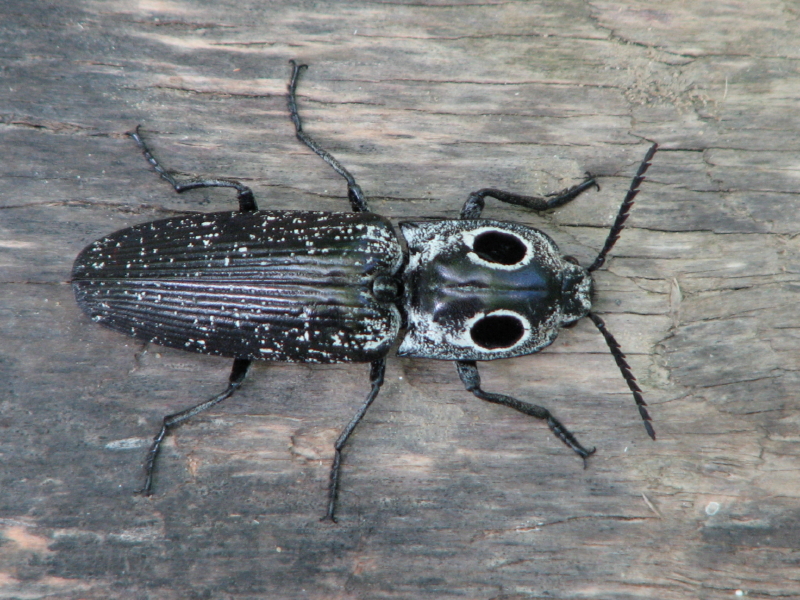
Near my polystyrene giant was this section of the riverbank.  It’s the aftermath of a tug of war we are engaging in with the planet.  In this type of struggle there are no winners.  Recent images from the oil spill in the Gulf of Mexico come to mind which incredibly still flows unabated weeks later.  Since much of the garbage in this photo is derived from petrochemicals, I wonder if this also could qualify as an oil spill?  If I scooped up a handful of sand around here…I would see tiny bits of plastic and the ever-present polystyrene bead.  This stuff is likely to never go away.  But life does try to keep carrying on as it always has.  I also came across this interesting beetle and a smile returned to my face.

I have seen these out here before.  It’s an Eastern Eyed Click Beetle and I think I read somewhere that this is our largest click beetle.  If you placed this beetle on its back, it would flip right side up with an audible “click”.  Hence click beetle.  There are other species, but they are all smaller.  This one is just under two inches (about five centimeters).  It’s coloration is similar to a bird dropping, but it also has these dramatic eyes on its pronotum.  These guys do fly, but most of their lives are spent as larvae living in decayed wood.  I passed by the mulberry tree with its ripening berries and there are birds who just can’t resist this plentiful food source.

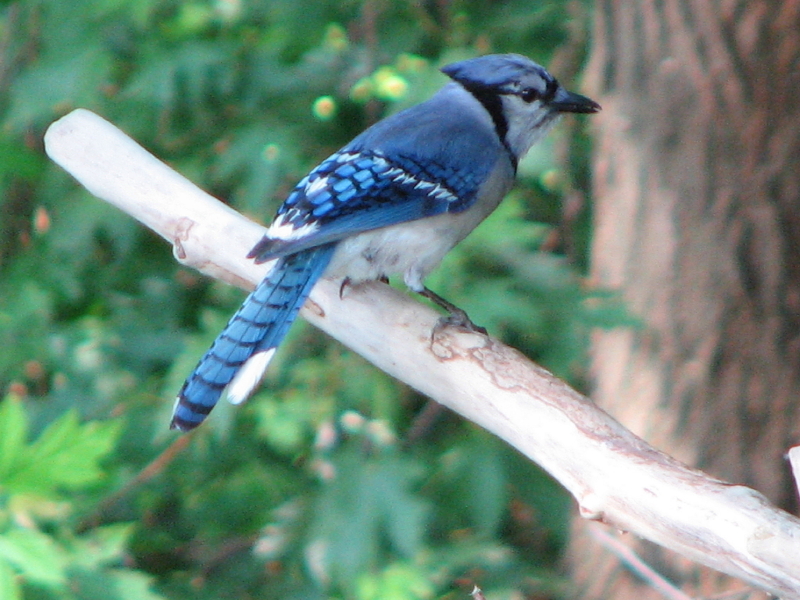
Among the bird species eating fruit from this tree included this Blue Jay…

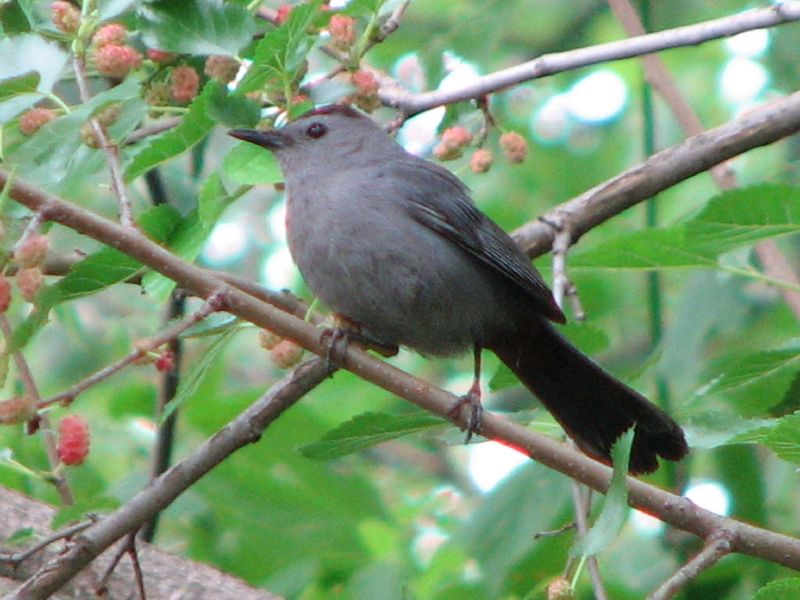
…and this Catbird which does make odd sounds which sometimes sound like the mewing of a cat (hence catbird!).  They can be quite territorial to their own and other species too.

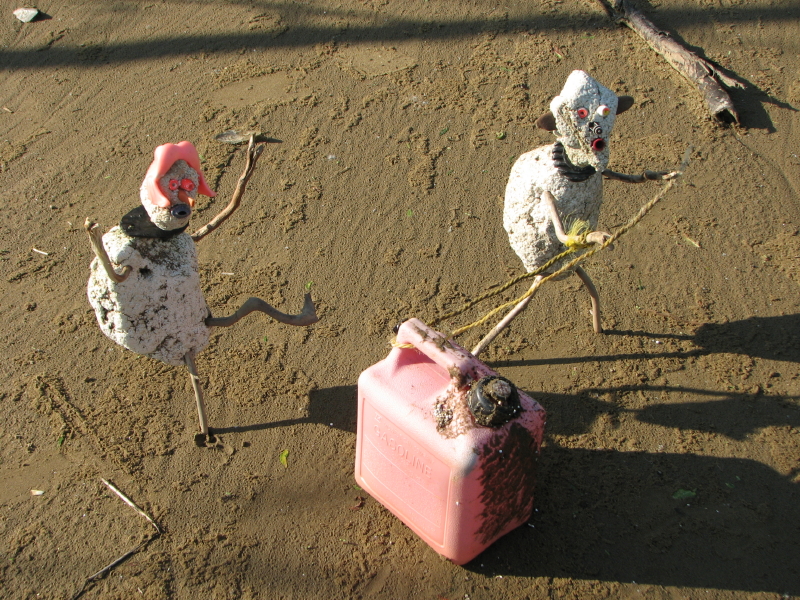
Not too far from this tree, I could hear some squabbling going on and I moved towards the sound.  You can imagine my surprise when I came upon this scene!  I stayed hidden behind a large willow and just observed.

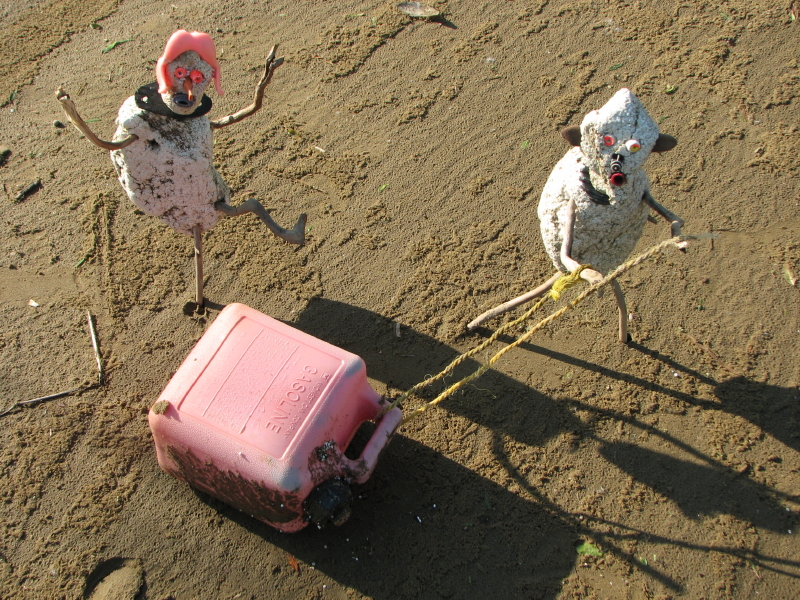
There were these two little figures and one of them was tugging on a rope attached to a plastic gasoline container and his “friend” with the wierd hairdo was jumping up and down on one leg trying to get him to stop!

The figure with the rope eventually succeeded in knocking the container over while his friend continued hopping!  What he thought he was going to do with this gas can is a mystery?  He soon grew frustrated with his efforts and a shouting match between the two began.  That deteriorated into another contest where each tried to take the rope from the other.

All this effort must have been exhausting because after a little while they gave up and abandoned the rope and the gas can leaving them lying on the sand.  They reconciled and walked away from here hand in hand. 

Perhaps they realized the futility of their struggle and came to their senses?  Perhaps they recognized that it was better to conserve their energies for more constructive pursuits?  Who knows, but while I pondered these questions I came across another image of futility and I will leave you with that until next time.
Read Full Post »

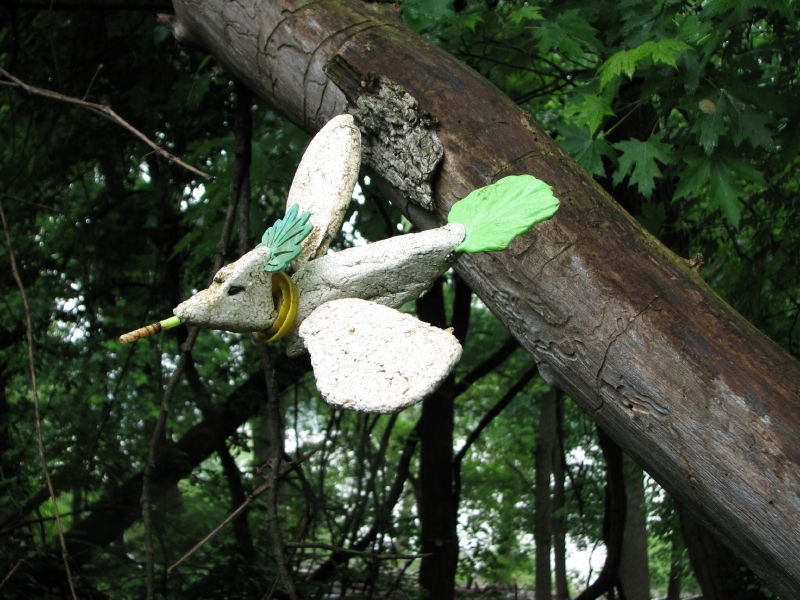
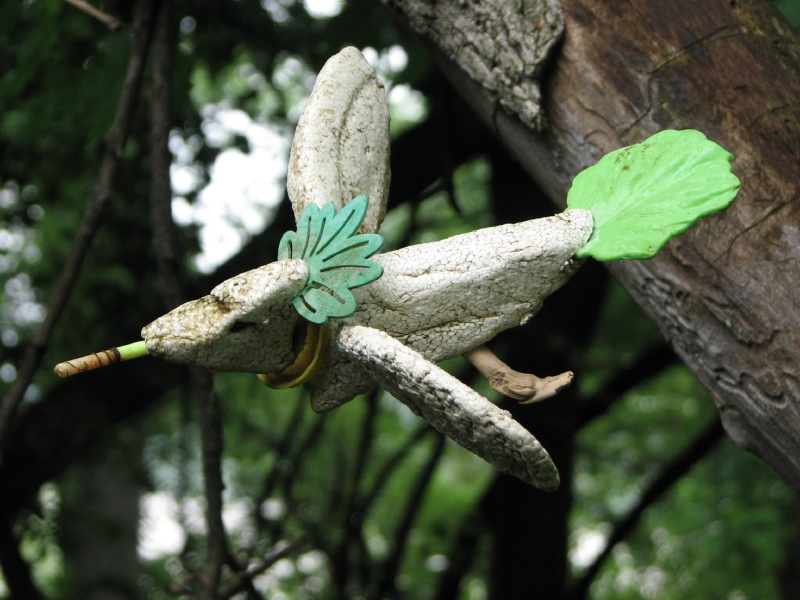
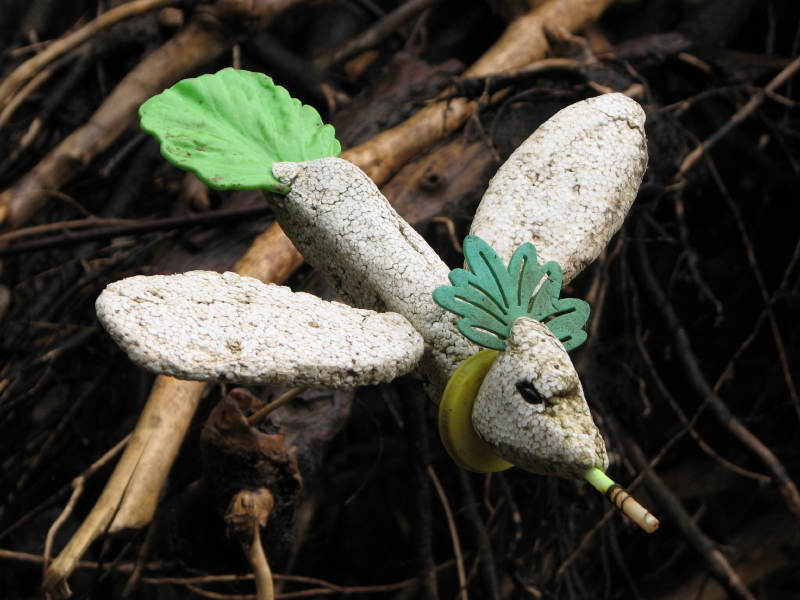
While wandering the Woodland Trail in an area best described as temperate semi-rainforest, I made another unusual bird discovery.  I believe that I have these privileged sightings because of two principal reasons.  The first has to do with frequency.  I am at the Falls of the Ohio as much as I can get away from my other responsibilities and so I have more chances for encounters.  The other has to do with motive.  Being knowledgeable about our avian friends, I simply am out here looking for birds and therefore open to their discovery.  On this particular day I was actually anticipating members of the wood warbler tribe when I came across what must be a first for this park…the rare Cumberland Greencrest!

This is one species missed by both Lesson and Gould in their individual monographs on hummingbirds of which the Cumberland Greencrest is an atypical member.  The Cumberland Greencrest was first discovered on the Guatemalan Highlands in 1910.  It is larger and slower on the wing than the average hummingbird.  It’s flight can best be described as being Swift-like where the individual wing beats alternate between extreme activity and gliding.  In its main haunts, this bird constructs a small nest from lichens and spider webs on a suitable tree branch and a single jelly bean-sized egg is produced.  The adults take both small insects on the wing and feed from the nectar of rare orchids found only in certain protected valleys. 

I was exploring the trees lining both banks of Parfume Creek (so named because on certain days, the scents of various laundry detergents are detectable emanating from the water using one’s  open nose) when the Cumberland Greencrest made its appearance.  I immediately recognized I was in the presence of something special and limited my movements so I wouldn’t frighten it away.  As this single individual coursed along the creek bank, I slowly brought my camera up to my eye and recorded these images in quick succession.  I think they show this bird in its glory very well and are worthy of sharing with a larger audience if I say so myself!  But please, don’t just take my word on this…judge for yourself!

I recorded these images using my high-speed camera as the bird made its passes back and forth along the creek.  In these images one can see why this bird is appropriately named with its lacy green crest atop its head.  The encounter was brief, but memorable!  What was this bird doing in our area to begin with?  The answer may lie in the very powerful thunderstorms that are becoming a staple of the Western Hemisphere.  I speculate that this bird was simple blown way off course as is known to happen with other species of hummingbirds.  I returned to this area the following three days, but never again encountered this specimen.  I did, however, see the duckling of a species of which I am currently unfamiliar and recorded its image among the driftwood and I hereby also present this to you my very dear reader in the hopes it will fuel your curiosity!

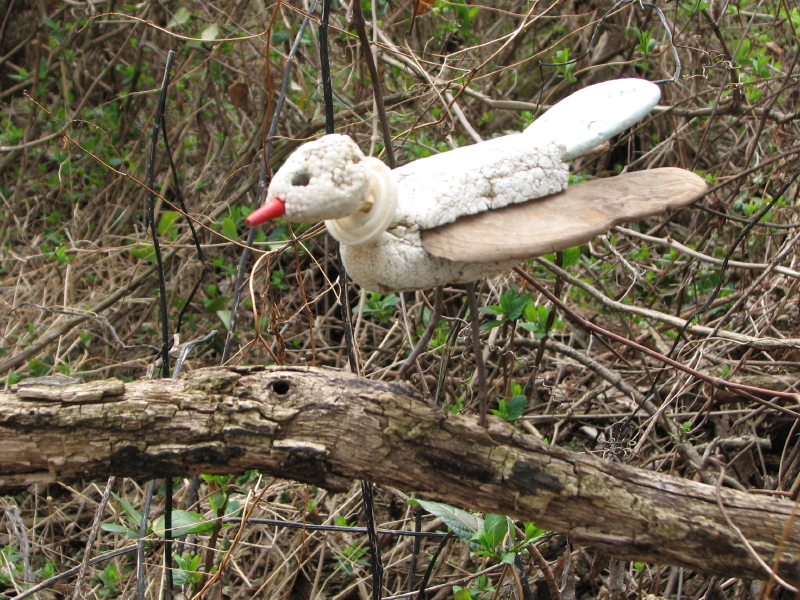
The Cumberland Greencrest was made from materials found entirely within the park and include:  Styrofoam (body and wings), wood (its tiny feet), coal (the eyes), plastic ( the bill which was part of a fishing bobber and the tail which is a plastic lettuce leaf!, the yellow collar is from a soft drink bottle) and lastly the green crest is some foam-like material.  It is held together in places with small, sharpened wood pegs.

Read Full Post »

The Kentucky Derby happened 24 hours a go, but the bigger regional story was all the rain we received.  I’ve said this before in this blog, the gentle spring rains of yesteryear seem like a thing from the past.  Now every storm is charged with energy and abundant water.  In the Louisville area totals for the last two days are 5 to 7 inches ( 12 to 17.75 cms).  In Nashville, TN there is wide spread flooding.  There was one period of a few hours on Saturday that things were just misty.  That was as good as our luck ran this weekend.  I took that opportunity to get my river fix and it was good for my peace of mind!

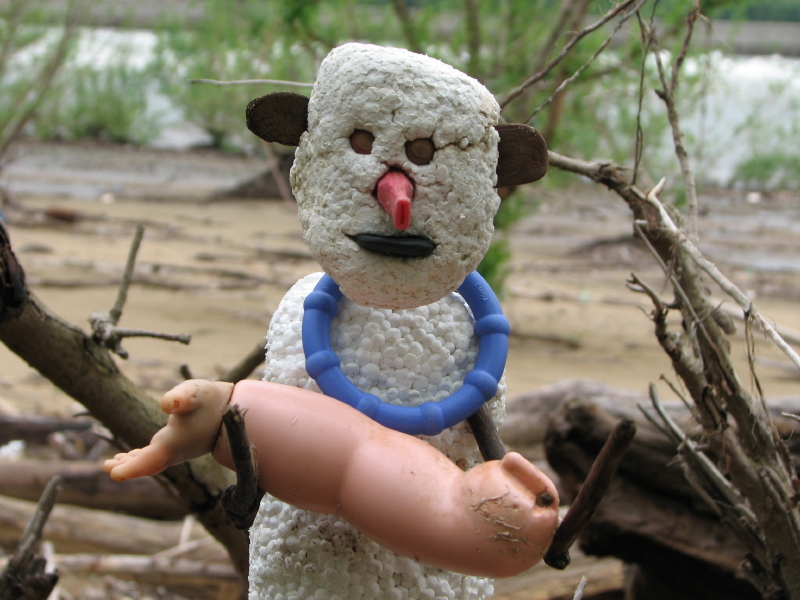
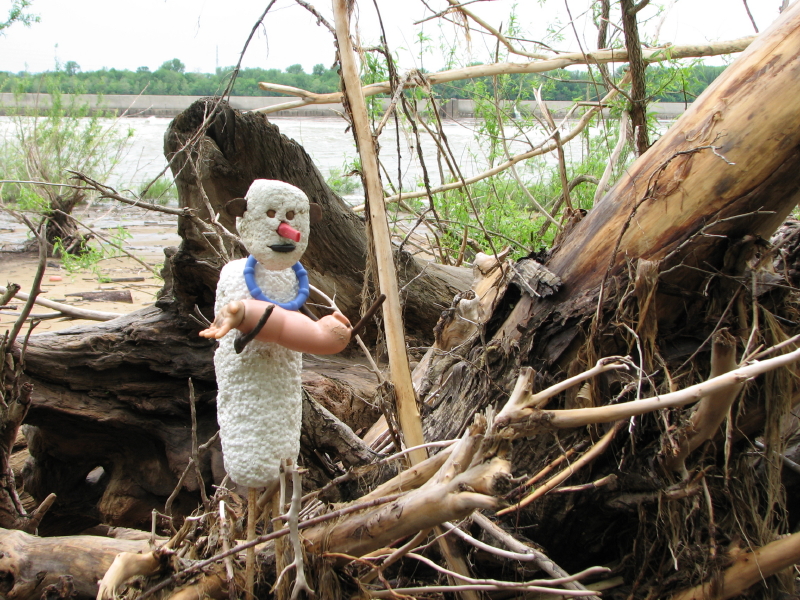
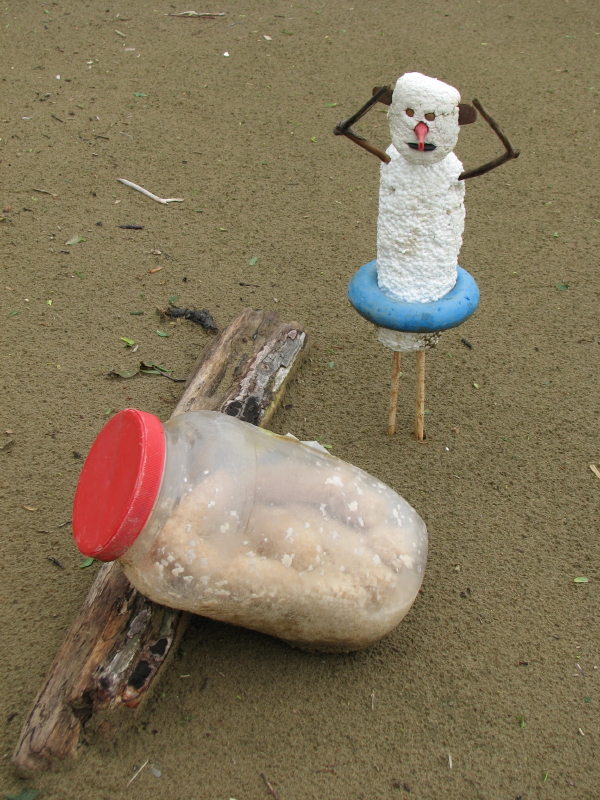
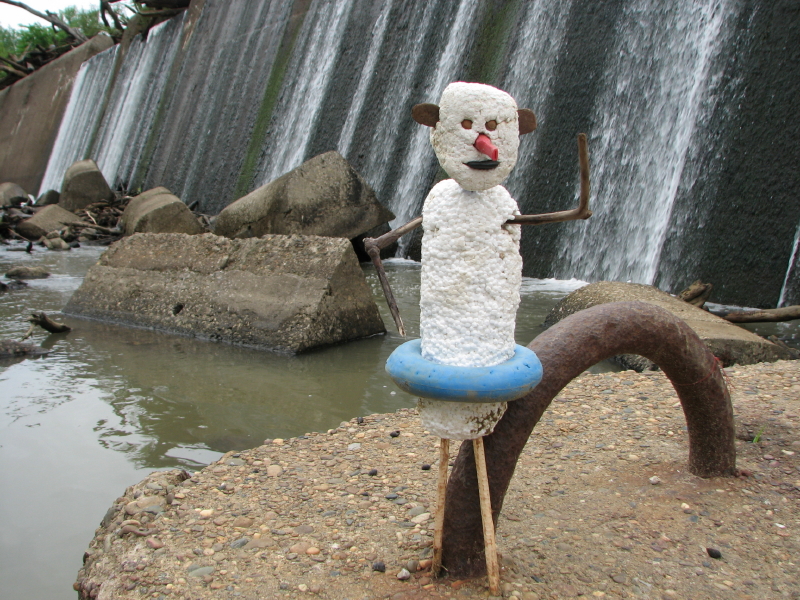
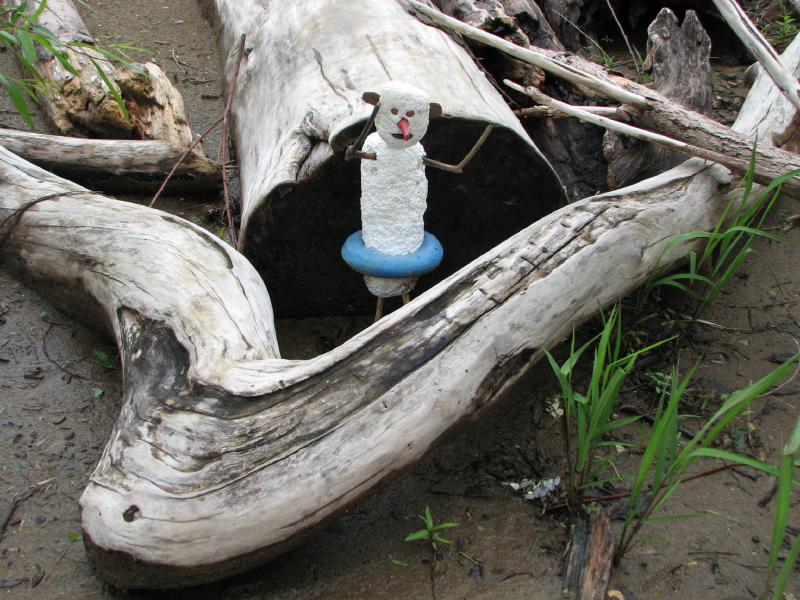
Since I fully expected the rain to just pound me at any moment, I kept my eyes open as I moved along the river.  I had the place nearly to myself which helped make the Falls seem larger.  The willow trees were in bloom and there were even a few nice birds around.  I quickly made a figure from available Styrofoam and sticks and I will now turn the narrative over to him.

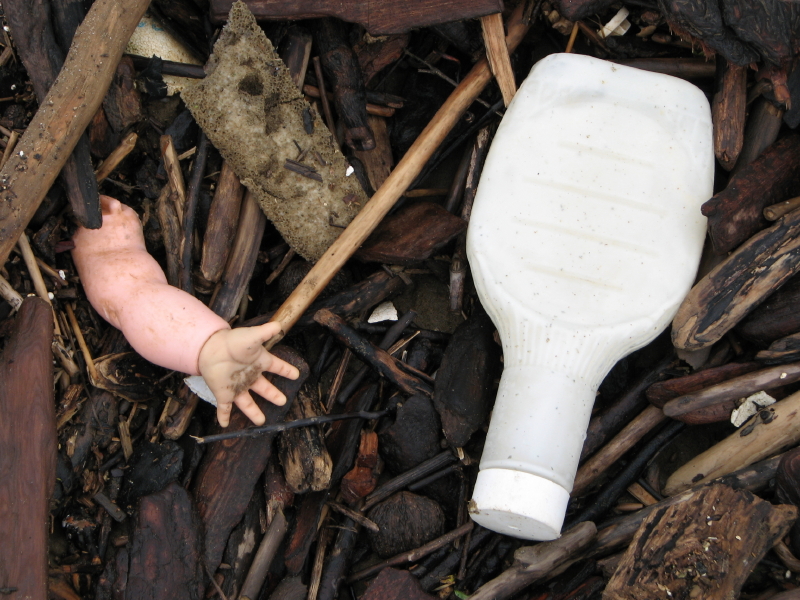
Yeah…we moved as fast as my beaver-chewed willow legs would carry me over the wet and packed sand.  We checked out the various debris fields near the river and took pictures of the things that caught our attention.  We came across a lost arm lying next to a plastic bottle and I wondered who would lose an arm and not miss it?  I picked it up and examined it.

It’s a perfectly good arm, but I don’t want to carry it around and so I left it where it was found.  If I find out later that I have a need for it…I think I can remember where this spot is provided the river doesn’t rise and rearrange things again.  Certainly looks a lot greener now than the last time I dropped by.

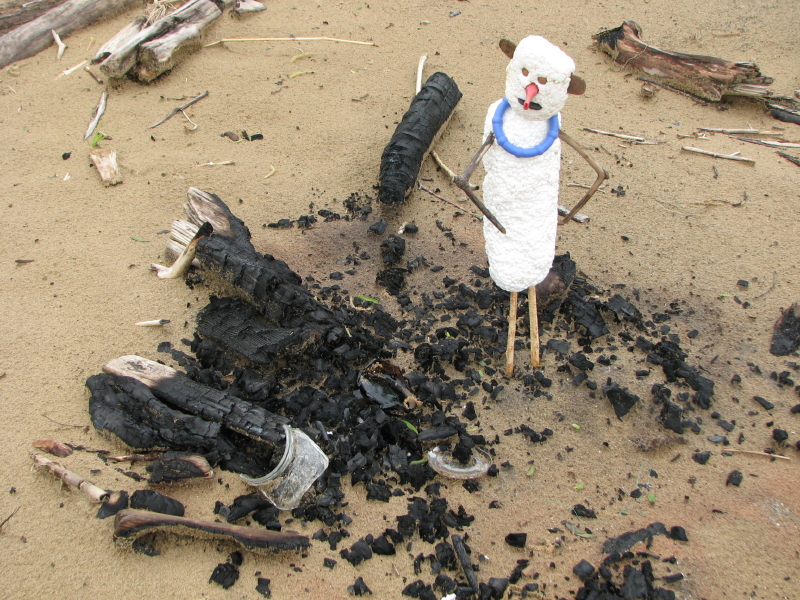
Of late, I’ve taken an interest in the remains of old fires and camp sites.  It’s a test of observation and I like to learn what I can from the charcoal and ashes, but this one has been hit hard by the rain and we learn little.

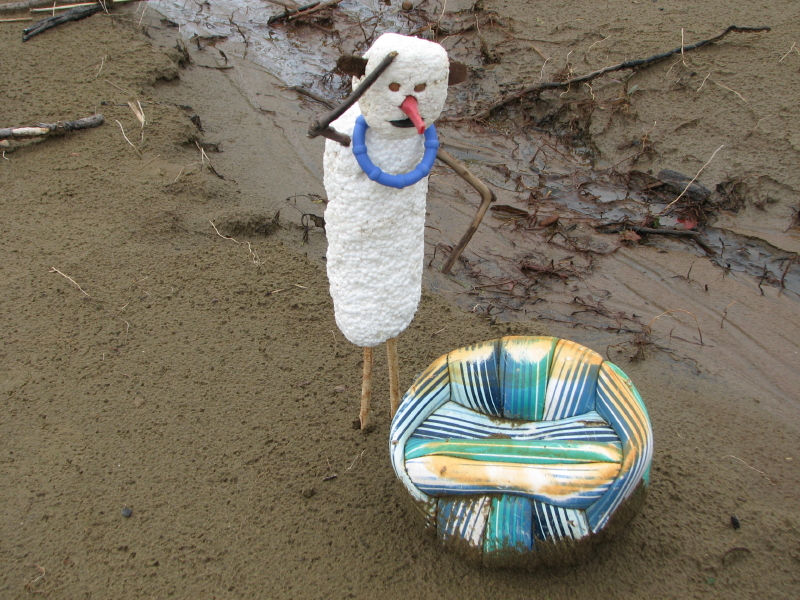
A colorful, but ruined soccer ball lay before us. The leading edge of the river usually has a few balls of one kind or another in the mix.  We stopped for a few snapshots than went our merry way.  There were more things we could see laying on the sand a head of us that looked worth checking out.

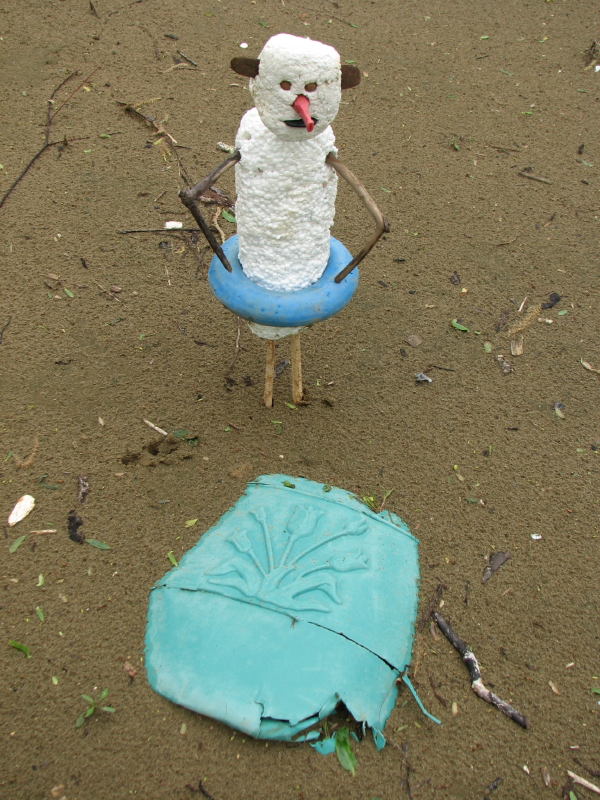
I traded the blue ring around my neck for a larger one I could wear around my waist.  It could be used as a flotation device if necessary!  Walking the shoreline we came across this vignette…a still life of tulips.  It’s a partially buried plastic watering can and the river has revealed this picture for us!

Oh man!  We found that awful jar of baloney again.  Even the river doesn’t want this thing and keeps casting it back upon the shore.  The thought crosses my mind that this might make good catfish bait if I could stomach running a hook through this mystery meat.  I wonder if that giant bug-thing is around?

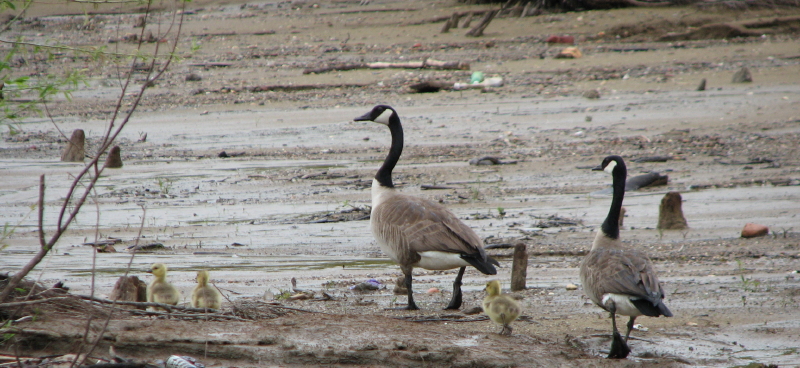
Like I mentioned earlier…we saw a few birds too!  Some of our warmer weather birds have returned.  I thought we had some better pictures, but I guess there was just too much water in the air.  We did come across a pair of Canada Geese with three goslings doing the same thing we were…namely investigating the riverbank.  Their young are very cute!

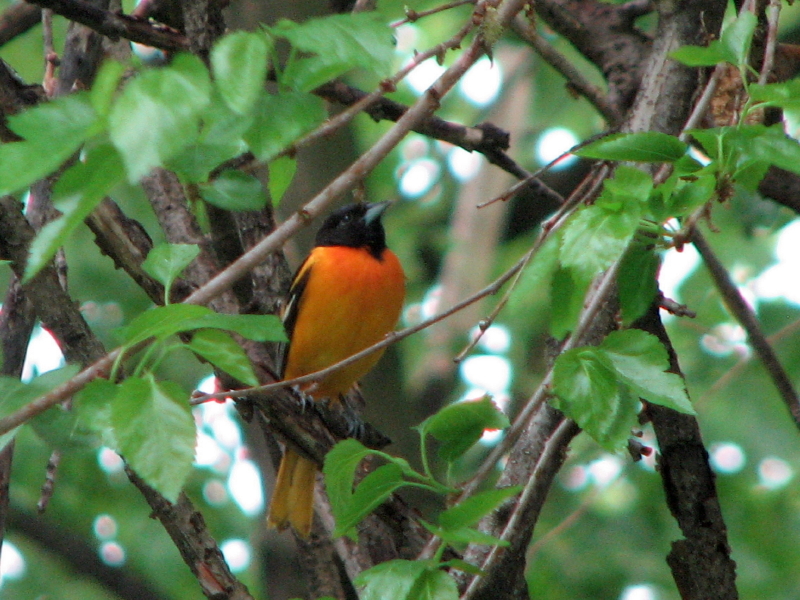
And, we saw three of our favorite bird species!  The Yellow Warblers have returned and we tried like crazy to get a decent shot of this bird singing away, but the images were kind of gray.  Also saw a Spotted Sandpiper (but missing its spots) heading north.  We will see those spots upon its return migration from near the Arctic circle.  Indigo Buntings seem plentiful and we were fortunate to watch Baltimore Orioles chasing one another through the trees.  Here’s a picture of a male oriole who was watching a female among the branches and not intent on us. 

With hope, the Scarlet Tanagers and Rose-breasted Grosbeaks will be passing through soon.  I decided to hang out longer while that artist-guy went home.  I’ll be right here, unless someone else finds me first.

Well, that’s how our Derby Day went.  The rain stayed away long enough for the race to be run and by all reports the festival was an overall success.  I’m glad people had a good time, but I’m getting a little event weary and feeling the need to be more contemplative…and dry!

Read Full Post »

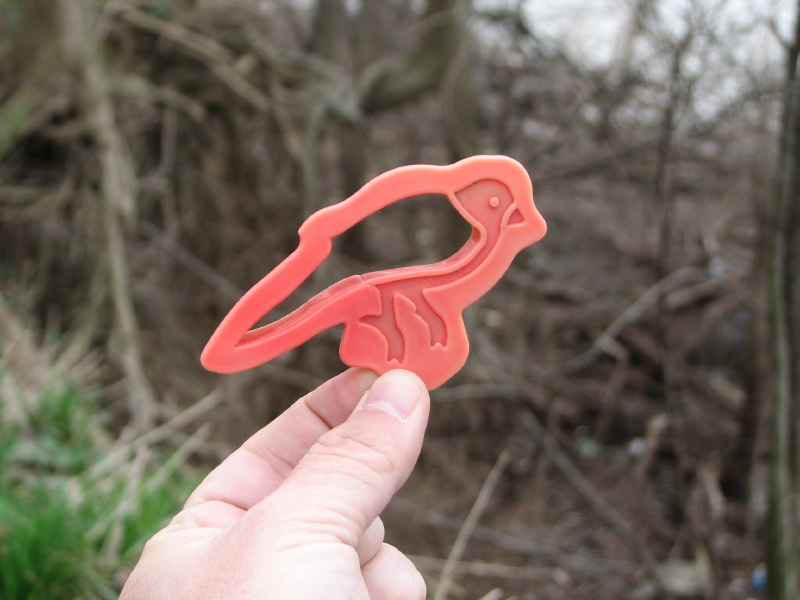
The little red bird perched easily between my forefinger and thumb.  I was walking along the river bank and spotted it among the recently deposited debris…another small gift.  If I had to guess, I would say that the red bird was intended to be child’s clay tool.  It’s like a cookie cutter stencil only smaller.  I was on the look out for birds and my subconscious was on alert.  I think this is partially why the plastic bird appeared to me when it did.  The axiom about chance favoring the prepared mind touches upon this phenomenon.

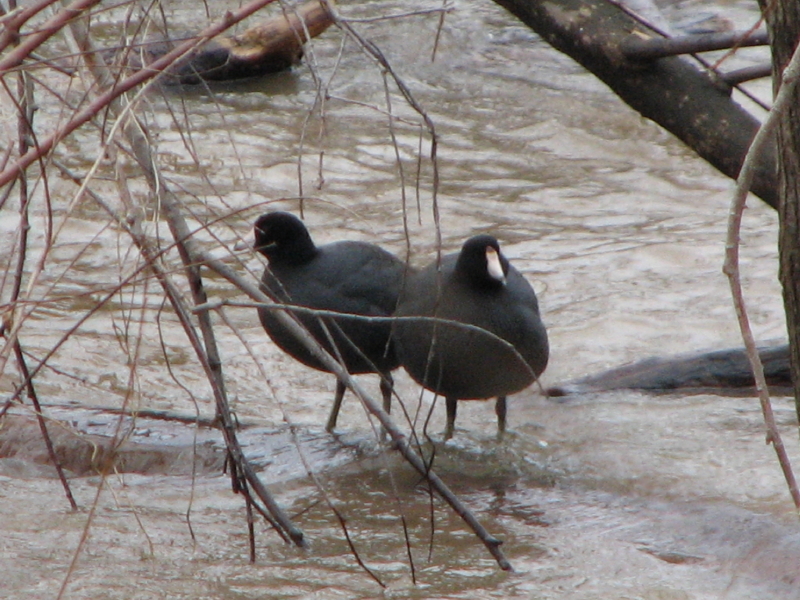
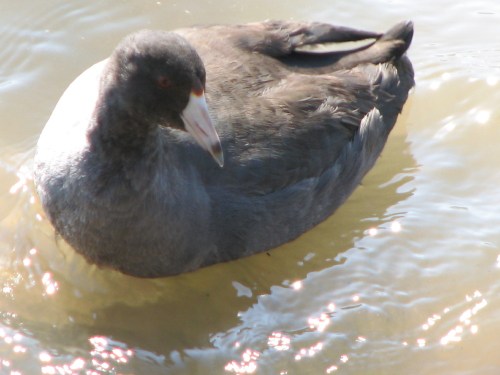
While the river level was still high, I came across this pair of American Coots near the shore.  Logs and chunks of wood were bobbing in the water.  Their dark feathers took on the look of wet wood.  The odd appearance of these coots had to do with them standing on a log that is mostly submerged.  Among the other birds I found near the water were Canada Geese, Mallard Ducks, and high overhead…kingfishers.
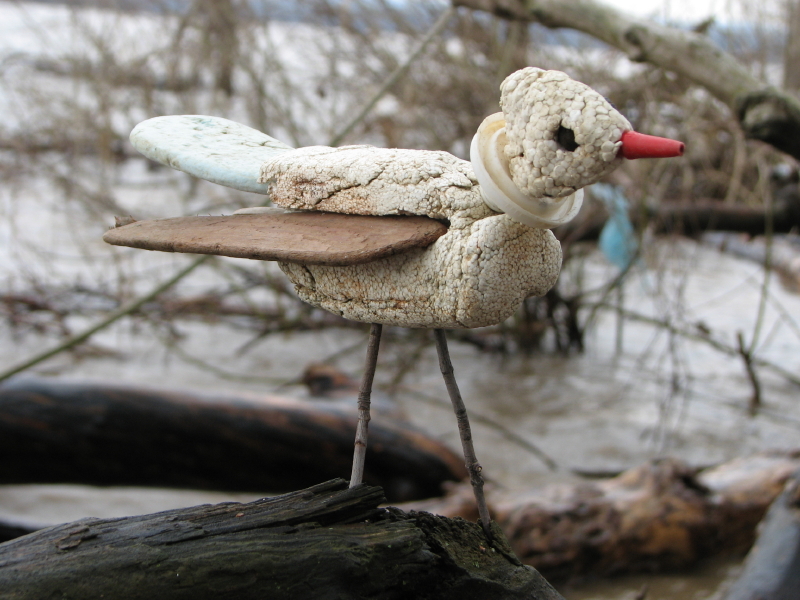
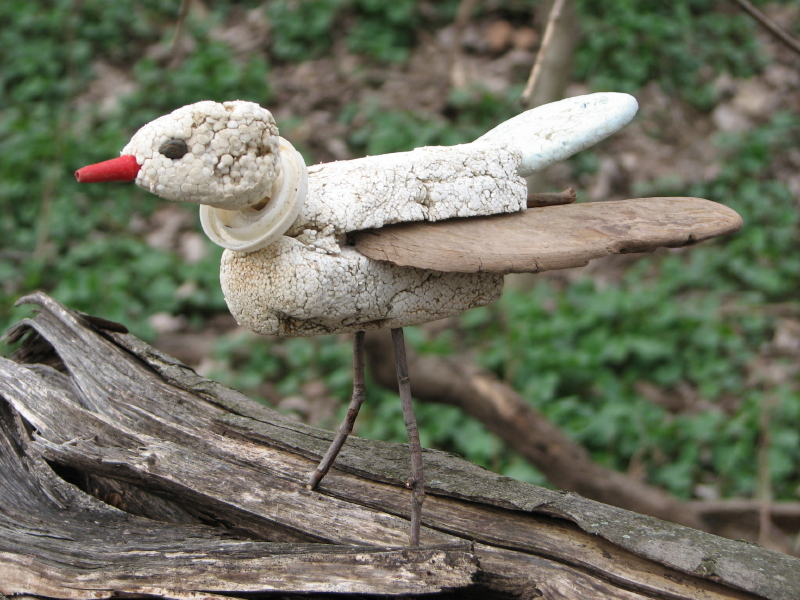
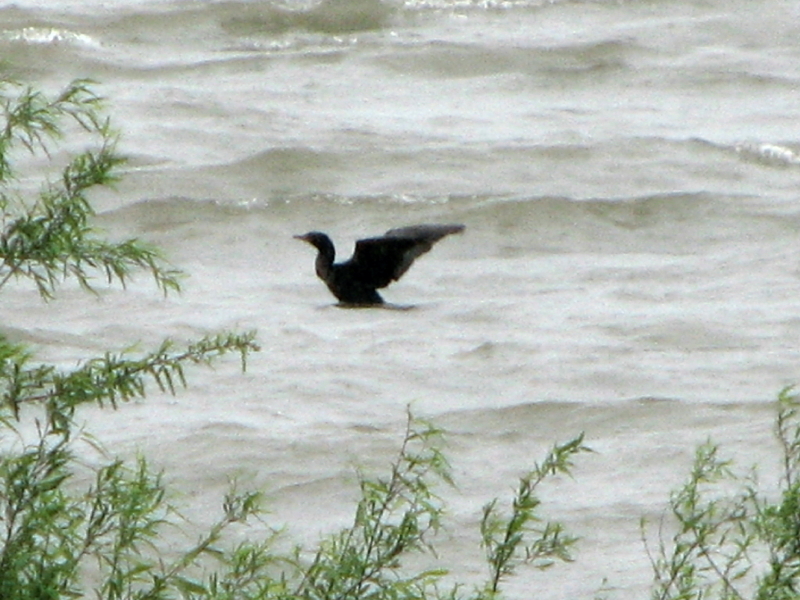
Like little twittering machines, a male and two female Belted Kingfishers were chasing each other across the sky.  I watched them for over half an hour and hoped that one of them would perch in a tree near me.  Alas, this was the best image from that moment.  With its low profile, out-sized bill, and crested head, the Belted Kingfisher’s silhouette is distinctive.  Someday, I hope to stumble upon their nest built into the side of the riverbank.  I’ll prepare my mind for that moment and let’s see if chance intervenes!  I did spot an Eastern Phoebe which is an early migrant.  As the warmth and light speeds up the production of tree leaves, we can expect the arrival of the birds we share with Central and South America.  Their timing is exquisite and seems to coincide with the many small cut-worm caterpillars that will chew their way through the foliage of the canopy.

During migration, the Falls becomes home for several different thrush species.  Some of them can be notoriously hard to identify, but not the bird above.  It’s the White Thrush and it utilizes all the available habitats here to put on a little weight before moving northward.  I have seen them patrolling the water line and investigating the densest vegetation in search of food which can include insects, seeds, and berries.

This bird was investigating decaying logs in search of a meal.  Every once in a while, the thrush would “scratch” the rotten wood with a backwards jump that would reveal small grubs and insects just below the wood’s surface.  These morsels were quickly seized by this agile bird.

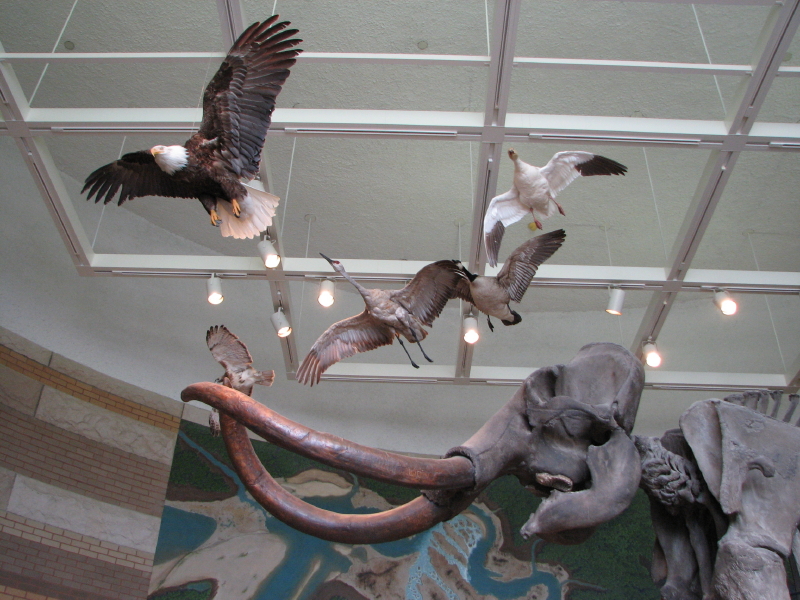
Here’s a third thrush perched upon a vine near the Woodland Trail.  I observed this bird picking off very small midge-like flies and returning to this position.  On my way back home, I stopped at the Interpretive Center to pick up another bird list for the park.  My list is getting a bit tattered from use and I still have about half of the 268 bird species recorded here left to go!  I did spot one bird last year in the park that I’m surprised is omitted from the checklist and it’s the American Turkey.  It would fit easily in the Game and Marsh Birds category.  There are also birds “flying” inside the Interpretive Center and above the mammoth’s head and I’ll end this post with that image.

Read Full Post »

west section of the Falls, 11/09

Because the climate has been so spectacular of late, it’s been possible and desireable to hang out in the park to make and see what one can.  This is another bird post, but one that specializes in what’s possible here in the fall.  Some of these species are found no where else…and for good reason.  I start with a shot of the typical terrain one encounters at this time of year.  What is a bird without some context?  Naturally, the river predominates as the distinct landscape feature with mixed hardwoods flanking the shoreline.  I’ll start first with an American Coot.  Not a particularly rare bird, but one I always enjoy seeing at the river.  I came across this lone individual and snapped this quick image for luck.  The true rarities are ahead.

American Coot, 11/09

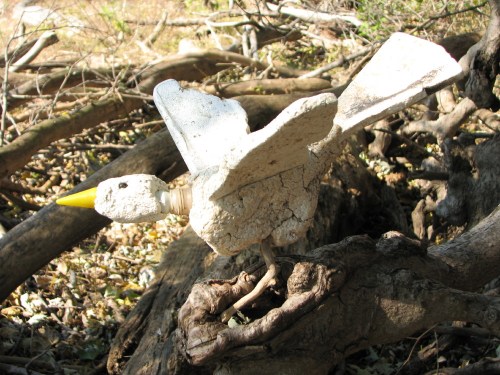
In the western section of the park a couple of late nesting birds can be found among the exposed roots of the great trees.  This is the home of the Styro-Grackle and the Fleur-de-lis Dovelette.  The next two images are of the grackle.  I stumbled upon a male with its great yellow bill displaying with the remains of a baby’s pacifier.  In this species, males vie for the attention of females by choosing objects they believe the females will like.  The Styro-Grackle is a large, and noisey bird, but wary to the extreme.

Styro-Grackle display, 11/09

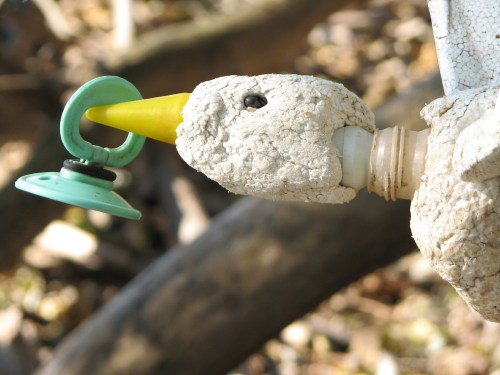
Here’s a close-up image of its head, bill, and pacifier it found by the river.

Styro-Grackle head with pacifier, 11/09

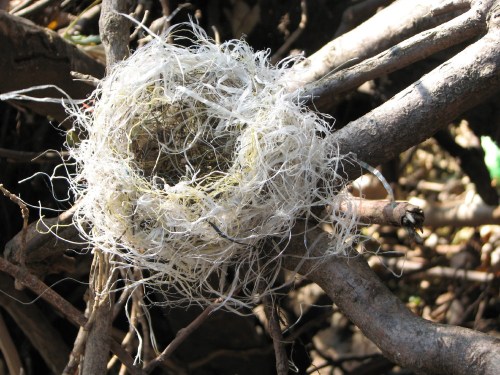
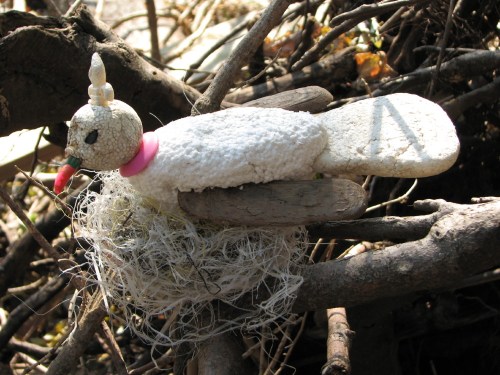
Often found in association with the grackles are the gentle Fleur-de-Lis Dovelettes.  The female specimen I came across was sitting on a fresh nest.  No eggs were observed within it.  The dovelette is not particularly fussy about what materials it uses to construct its bowl-like nest.  This one was made from shredded plastic with hardly a trace of natural fibers interwoven into its structure.  First, a picture of the bird itself in its woody habitat.

Fleur-di-lis Dovelette, 11/09

The bird derives its common name from the unusual crest upon its head.  It is rumored that this was the inspiration for the symbol used by the City of Louisville on its flag, official letterhead, etc…  More than likely though, it’s just a coincidence.  Like many dove species, this one has tiny feet.  Here’s a good look at the unusual nest constructed in the fork of a tree root.

Plastic fiber nest, 11/09

And here is the bird and nest joined together.  I didn’t linger because I didn’t want to disturb the dovelette anymore than I had to.  If the conditions are right, she will lay three to four light green eggs.  The dovelette will have to stand guard against raccoons, but otherwise her young have a good chance of reaching maturity.  Wild prairie grass seeds make up much of its diet.

Fleur-di-lis Dovelette on nest, 11/09

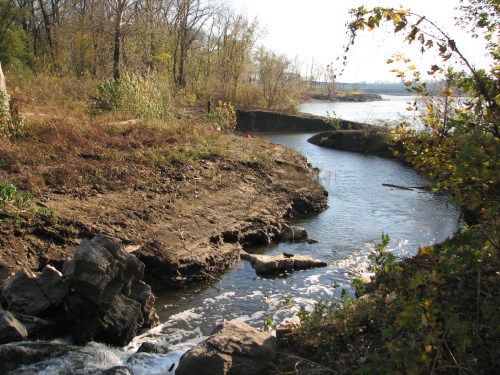
Cane Run Creek, 11/09

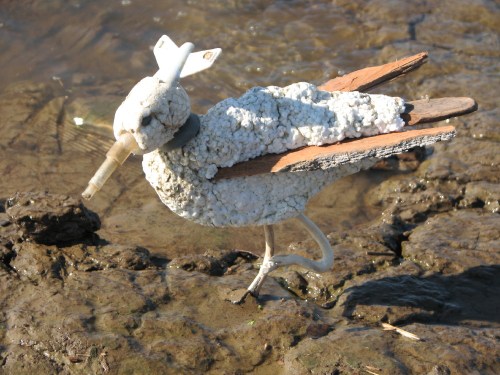
Near the middle of the park, Cane Run Creek flows into the Ohio River.  It’s a spot that’s favored by fisherman and birds alike.  Large rocks and trees deposited by flooding line its banks.  Because of the vagaries of the larger river, the creek’s appearance is highly variable.  It was in this area that I came across a rare and unusual shorebird that I would like to share with you.  Here are two images of the Jet Piper.  It is so named because it evolved a distinct crest that is believed to stabilize it during its speedy flight.  One sees a similar structure on the tail of modern aircraft.  The Jet Piper never stays in one place for long.  It probes the mud along the creek bank in search of worms and other invertebrates.  Recent studies have shown that this piper will on rare occasions, take nectar from hummingbird feeders.  Here are two views.

the Jet Piper, 11/09

Jet Piper, 11/09

The last specialty I came across is one of the sweetest singers in the park.  In fact, that’s how I located the Styro-wood Wren first…by its optimistic, cheery song.  I was sitting in my usual spot under the willows when I heard it nearby.  I took a position along a path I thought it might take and with success, recorded these images of this rare endemic bird.

Styro-wood Wren, 11/09

On a sunny morning, the Styro-wood Wren was making its rounds in the underbrush.  Its singing has more to do with staking its feeding territory than it does with finding a mate.  That will change once Spring arrives at the Falls once again.  Among the interlopers that the wood wren is trying to discourage are other members of the family Troglodytidae.  Sharing its range at various times are Carolina Wrens, House Wrens, and the tiny Winter Wrens.  That’s a lot of competition to try and discourage.  This particular bird was in rare form and seemed to pose for my camera.

Styro-wood Wren singing, 11/09

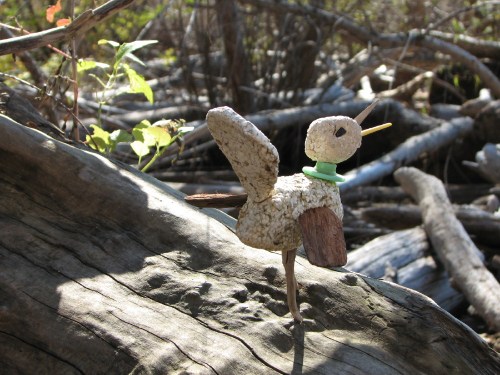
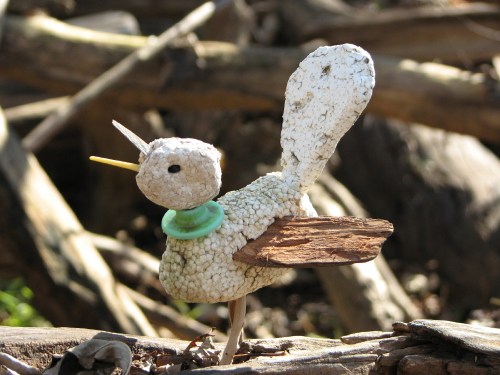
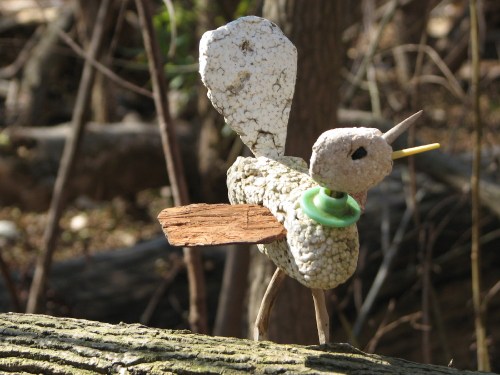
It spread its fan-tail and with a shudder of its brown- wings burst into song.  The small feathers along its neck make an attractive collar.

Styro-wood Wren, 11/09

CODA:

I made these birds from materials I found in the park.  All the plastic and Styrofoam elements were once in the Ohio River where they interact with the natural ecosystem.  Among the other materials used include:  tree bark (for wings), coal (for eyes), and rootlets and twigs (for the legs).  I make these artworks to call attention to the condition of the land and water, to draw attention to the unique qualities of this place, to celebrate creativity, and because I love birds!  All the photos are mine and shot on location at the Falls of the Ohio State Park.

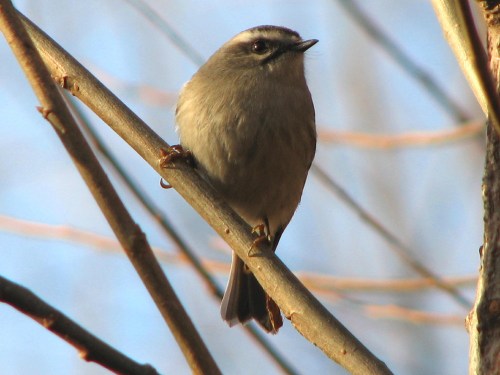
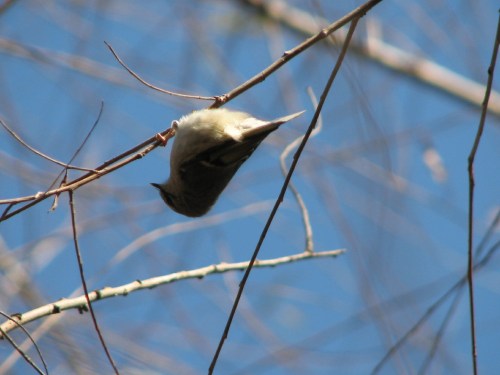
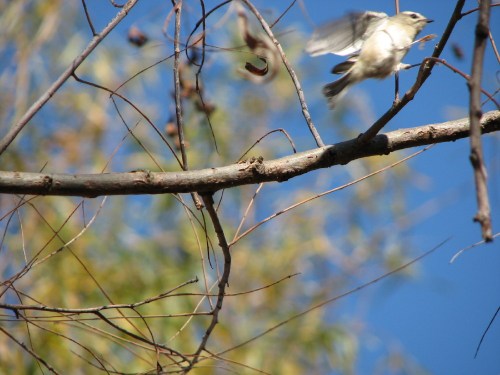
While I was making my faux birds, the real articles were busy in the tree tops above my studio.  Among my favorites to watch are the Golden-crowned Kinglets.  These tiny birds are ever in motion and hard to photograph!  Here are a few more real bird pictures.

Golden-crowned Kinglet

upside down Golden-crowned Kinglet, 11/09

Golden-crowned Kinglet in action, 11/09

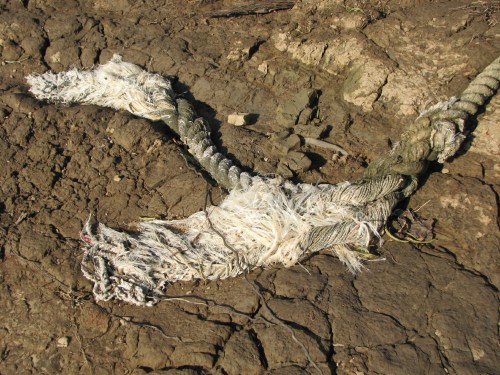
Lastly, the nest featured with the Fleur-de-lis Dovelette is in fact a genuine bird nest.  I found it in the branches of a downed tree.  I have no idea which species created it.  I have seen within the park, the nest of a Northern Oriole that used cast-off fishing monofilament in its construction.  I do, however, think I located a source for the plastic fibers.  Near the discovered nest, a large barge rope was slowly unraveling and its threads look identical to the ones in the nest I came across.

frayed barge rope or cable, 11/09

Read Full Post »

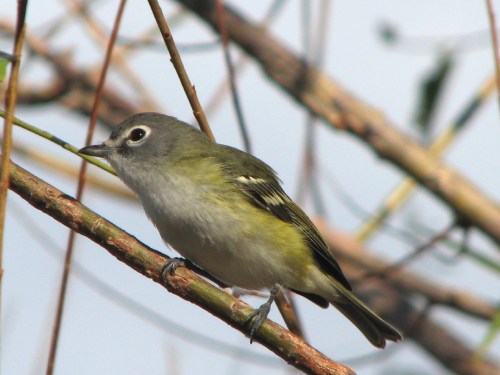
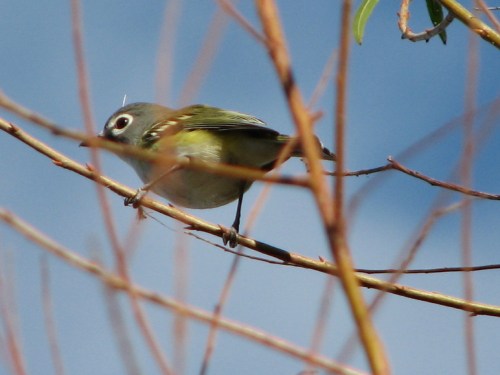
blue-headed vireo

October and the Fall migration is underway.  One bird I look forward to seeing is the Blue-headed Vireo.  I have spotted them the same week in October for two consecutive years now.  I watched a pair working their way around the willow trees and observed one eating a fat, dark moth it caught.  These vireos are less wary and found lower in the trees than the other vireo species recorded here.  The official Falls of the Ohio checklist counts six vireo species.  I’m still looking for the Yellow-throated Vireo, which like the Blue-headed is considered uncommon for the park.  I like the bright white spectacles around this bird’s eyes.  Here’s a different view of this bird.

Blue-headed Vireo, 10/09

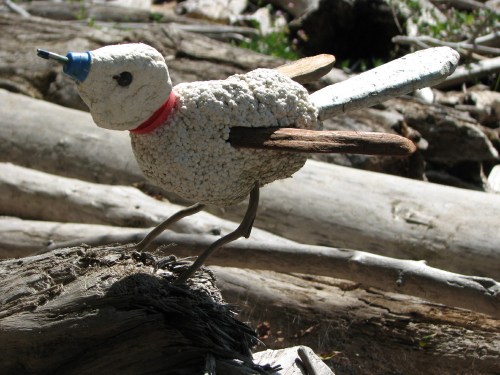
A couple weeks back I made another bird from Styrofoam and just didn’t get the chance to post it till now.  I think it turned out well and I call it a “White Jay”.  It’s about the same size as a Blue Jay.  Materials used to create this sculpture include:  polystyrene foam, sticks, lead (one eye), bark (for the wings) and plastic.  I later attached it to a branch, as in early ornithological prints, and is in the present Galerie Hertz exhibit.  Again, here are a  couple different views of this piece.

White Jay, 10/09

White Jay, 10/09

Read Full Post »

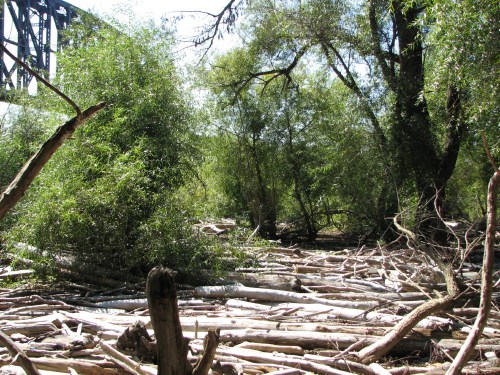
Willow habitat at the Falls, 10/09

The slightest hint of yellow is tinting the willow leaves at the Falls of the Ohio.  Picking my way through the driftwood, my legs brush against the occasional clump of ripening Cocklebur.  This time the bur’s tiny hooks stay fast on the parent plant, but in a few weeks my shoes’  laces will collect all they touch. 

Black-and-white Warbler, 10/09

As far as birds go, I’m in luck today.  Small groups of mixed warbler species are passing by the Falls on their way south.  I saw Magnolia Warblers, American Redstarts, and Black-and-white Warblers moving through the willows.  I watched the Black-and-white Warbler pictured above harvesting drab-colored moths from the fissures in the tree bark.  It seemed that everything happened at once.  The warblers would appear along with Eastern Wood-Peewees, Blue Jays, and a Northern Flicker made the scene.  There would be a brief flurry of activity and then the birds would be gone.  Is there security in the numbers or does the sound and motion confuse the small insects they flush out?  If allowed, I could spend all my time just trying to figure that out.  Here’s a picture of the flicker with his yellow tail.Northern Flicker, 10/09 


I’ve walked these same driftwood piles for months, but I still find river-polished Styrofoam and odd bits of plastic that I can use for my sculptures.  I have removed a lot of artificial junk from this place and made art out of most of this stuff.  As far as sculptural processes go, I use both additive and subtracted methods.  The additive parts are apparent in the sticks and such I attach to the polystyrene chunks.  The subtractive part is less obvious and is represented in my mind by the unwanted materials that I remove from the natural beauty of the park.  I rarely do any other carving to the foam chunks themselves.  This needs to be something anyone can do and not be some brilliant example of technical hand skill if I want others to try.

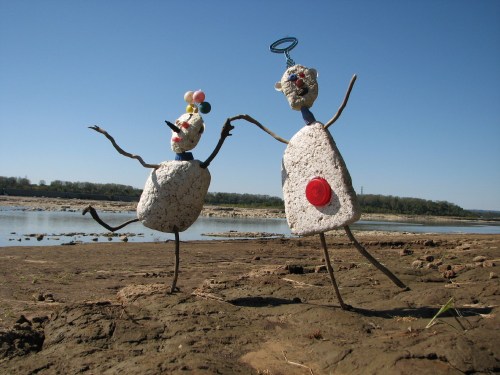
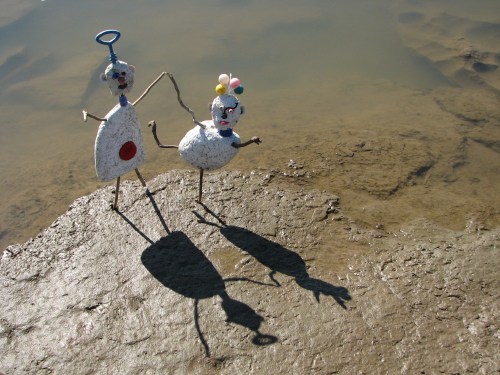
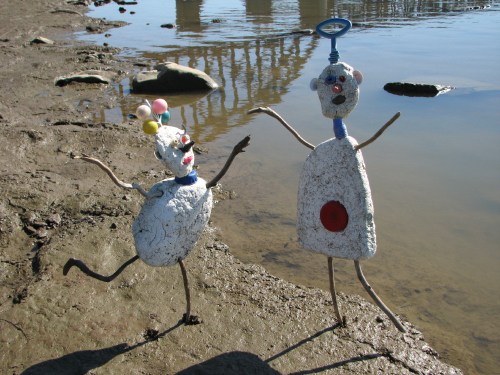
Alien Ballet, 10/09

Here’s what I came up with on this early autumn day along the Ohio River.  I call it the Alien Ballet and I amused myself by making it and the digital images that resulted from the experience!  Recently, I read that the estimated number of potential planets that could harbor life just increased greatly because our ability to see into the universe’s deep places keeps getting better.  This is also based on life as we know it and needing just the right conditions (water, distance from the right type of star, etc…) in other words, other Earth-like planets.  It is interesting to speculate that in the vastness of creation, those conditions that result in life may not be as rare as we currently think.

Alien Ballet, 10/09

My aliens have traveled from that other dimension that is my imagination.  They are revelling in their individuality and dancing together with the light and shadow on the edge of three different states of matter.

Alien Ballet, 10/09

There is value in being in the present moment, right here and now.  Despite the chance of there being other similar worlds in the cosmos, I can’t imagine they would be as conducive to life as we live it than right here on Earth.  We need to celebrate this place while we can.

Read Full Post »

Great Egret, 5/07

Where did our Great Egrets go?  I’m asking that question this year because they are a familiar summer time bird at the Falls of the Ohio.  Visitors are usually treated to their presence from May to October or for however the warm weather lasts.  Usually, you can see them along the water’s edge fishing along with Great Blue Herons, Black-crowned Night-Herons, and the occasional Green Heron and Snowy Egrets.  As I have mentioned in previous posts, this hasn’t been the  most typical of years.

Great Egret, 10/08

Although 2009 still has a few months left to go, this year has been among our wettest and our summer was the coolest I can ever recall.  I have lived most of my life in Kentucky and we hit the 90 degree mark only a few times early in the season.  Usually, summers here are hot, humid, and long.  Just about everybody I know has acknowledged that this has been another climatically unusual year, but nobody has been complaining about the cooler than average summer. 

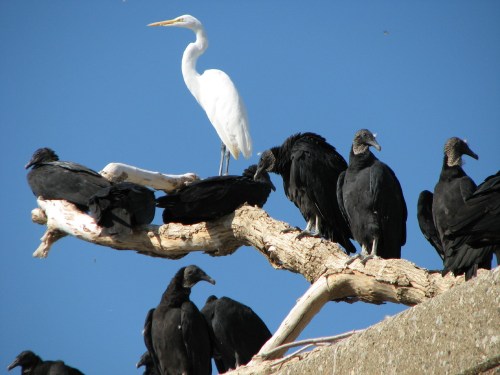
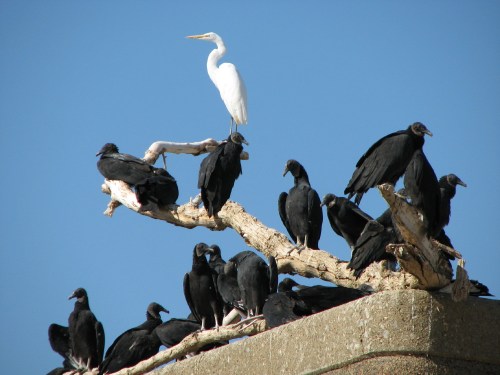
Great Egret with Black Vultures, 10/08

A possible exception could be our Great Egrets.  I have been out at the Falls most of this year and have been trying to pay attention to when birds  arrive and leave our area.  As far as I can tell, the Great Egrets were only around for a week in July.  I recorded seeing them on July 19 and then they were gone.  More rain and cool weather followed their appearance and obviously they went somewhere else, but where? 

Great Egret with roosting Black Vultures, 10/08

The images of the Great Egret and roosting Black Vultures were made at the Falls during October of 2008.  They are among my personal favorite bird pictures that I have taken in the park.  I was walking  near the dam that separates the Ohio River from the fossil beds and came across this scene.  A previous flood had stranded a dead tree on the wall and made a nice resting spot.  I liked the contrast between the stately white egret rising above the fidgety and squabbling vultures.  I had to be extra stealthy in my approach since my camera isn’t equipped with the best telephoto lens.  The Black Vultures seem to be getting more ubiquitous and this year I counted one flock of over fifty birds.  Soon, they too will be migrating to warmer parts down south, perhaps they will be catching up with our Great Egrets?

Read Full Post »

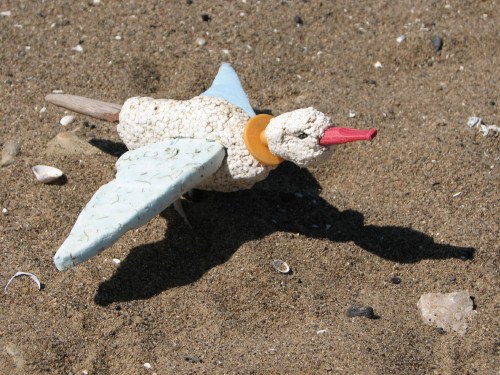
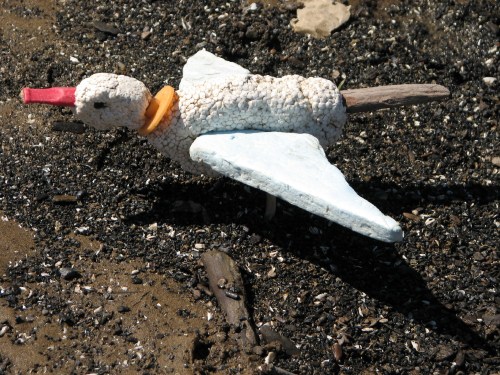
Styro-sandpiper, 9/09

September is the month that the smaller shorebirds begin their migrations through our area towards warmer southern climates.  We see a variety of different species at the Falls of the Ohio.  Here is one impromptu tribute to them made from polystyrene foam.  This one is a Styro-Sandpiper dragging its wing in mock injury.  Among the materials I used to fashion him include:  Styrofoam, blue- insulating foam, river wood, plastic (around the collar and the bill is the tip from a cheap little cigar).  Oh, the eyes are tiny bits of coal.  You are not allowed to collect fossils in the park and I sometimes wonder if this applies to the coal as well?  Anyway, here are some images of genuine shorebirds photographed in the park.

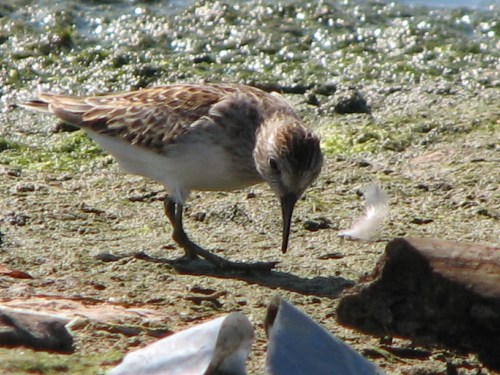
Least Sandpiper, 9/07

Small bands of Least Sandpipers explore the margins along shallow pools of water covering the fossil beds during this time of year.  Their bills probe the algae for the small invertebrates that live in the green mats.  These are our most common sandpipers followed in number by Spotted Sandpipers.  This time of year the Spotted Sandpipers actually have barred flanks and bright white bellies. We will have to wait for spring to see them with their characteristic spots and dots.

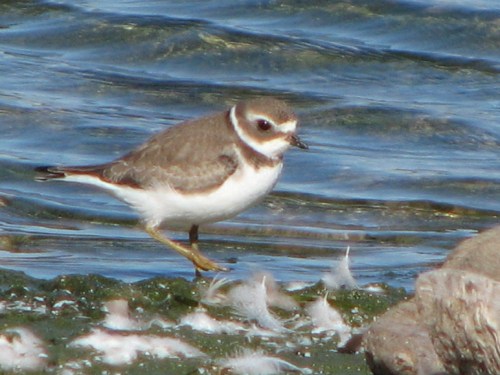
Semipalmated Plover, juvenile, 9/09

Tiny Semipalmated Plovers have traveled from the Arctic tundra and some make a stopover at the Falls.  The autumn birds seem to be mostly juveniles.  Piping Plovers, an endangered species, have been recorded in the park, but I haven’t had the pleasure of seeing one here.  By far, our most common plover is the Killdeer.  It’s hard to walk across the fossil beds this time of year without setting off their alarm calls.

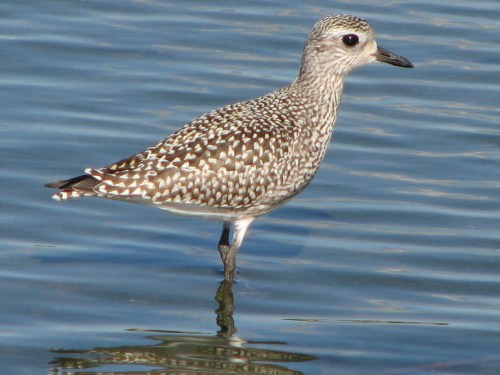
American Golden Plover, juvenile, 9/07

For two years in a row I have come across American Golden-Plover juveniles.  Although they are a bit larger than the smaller “peeps”,  I decided to throw them in too because I like them and they show up this time of year!  I’m amazed that this bird started life on the Arctic tundra and is now traveling to South America. 

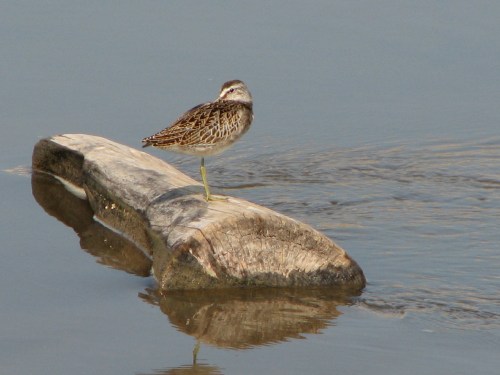
Short-billed Dowitcher, 9/08

Last year I came across this bird dozing on a well placed log and wondered what it was?  Its bill was tucked under the feathers on its back.  As I got closer, you can imagine my surprise when the bill was exposed!  I believe this is a juvenile Short-billed Dowitcher.  Here is another image of this bird.

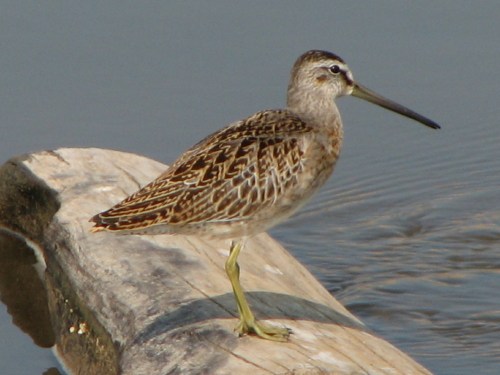
Short-billed Dowitcher, juvenile?, 9/08

I watched this bird for a while and never heard it utter a sound.  Referencing my bird guides, the literature says that the best way to differentiate it from the Long-billed Dowitcher is by its call. The length of its bill is of little help.  Both bird species have been recorded in the park.  The Short-billed is listed as rare and more than likely encountered in the summer.  This bird was photographed last year on the first of September.  The Long-billed is seen occasionally in the fall.  After checking out several bird guides, there was something in its coloration and markings that said Short-billed Dowitcher for me.  Perhaps some one out there with more experience can hazard a guess?  Either way, it was a tremendous treat to come across it!  I’ll end this post with another view of my Styro-Sandpiper posed in the sand and coal.

Styro-sandpiper, 9/09

Read Full Post »

« Newer Posts - Older Posts »