Feeds:
Posts
Comments

Posts Tagged ‘birding’

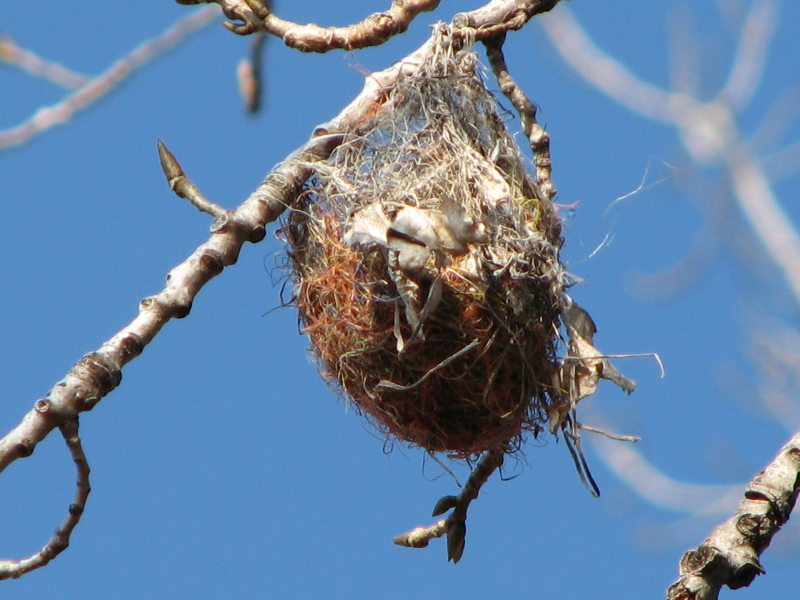
On my last expedition to the Falls, I spotted this oddity about twenty feet off the ground on a terminal branch of a cottonwood tree.  I had a feeling I knew what this is, but clicked-off a couple more close-ups for more information.  The day was very cold, but bright and clear.

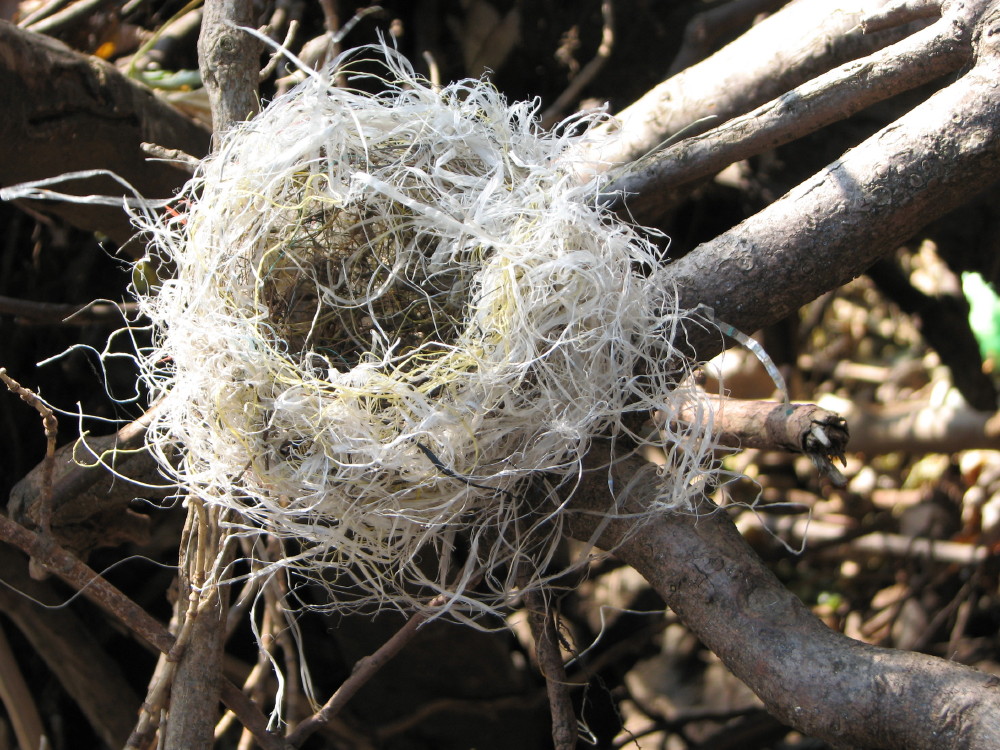
I believe this to be a hanging basket nest from a Northern or Baltimore Oriole.  I had seen one other similar nest years ago at the Falls that incorporated waste fishing line and long-stemmed grass.  This one is different in that it is made mostly from synthetic fibers teased out of a discarded barge cable along with fishing line.  These cables are very large, thick ropes that are used to tie-off and secure the barges used in commercial river traffic.  Here is a recent picture of just such a cable that was lost and wound around willow roots.  This one has blue and yellow fibers instead of orange like the oriole’s nest has.

As these ropes slowly break down, it’s interesting to think of nest-building birds preferring to use this material as opposed to strictly natural ones.  I know of other birds (more in an urban environment) that will use other bits of artificial litter in their nests.  A month or so a go in the western section of the park I came across another synthetic nest created by a different species and featured that in a post about rare birds.  Here is that nest reproduced again along with a close-up of the oriole’s nest.

Since a nest made of these materials will last longer…I’m wondering if the oriole or another bird will attempt to reuse it?  I will have to wait until spring to find that out.

Read Full Post »

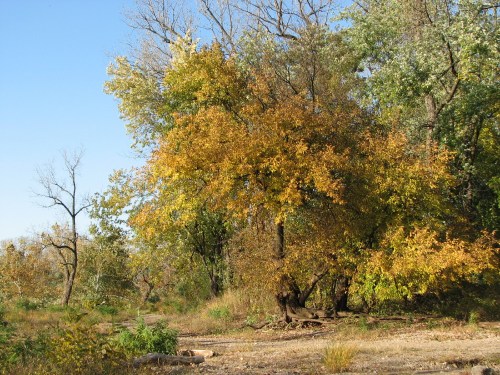
Late October color, 10/09

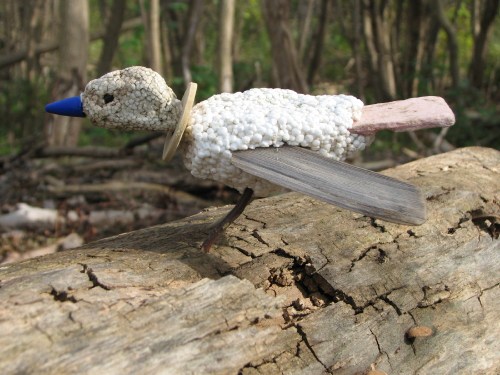
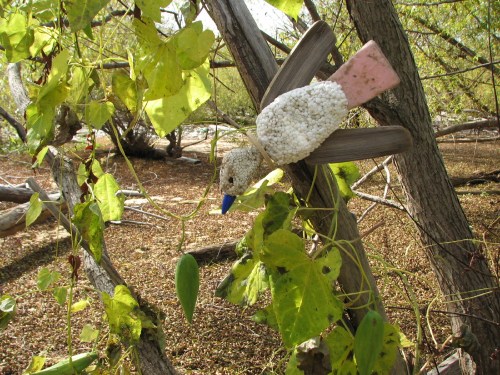
When the trees at the Falls of the Ohio reach peak color, birders keep an eye open for avian rarities.  The Uncommon Bluebill may or more likely may not appear in the park.  Usually birders have to settle for glossy pictures of this bird in fancy magazines devoted to all things…birds.  Those images are usually taken in the bluebill’s northern haunts during the breeding season when the birds are a bit more distracted as they go through their courtship gyrations.  This post is about a personal stroke of luck as I had a once in a lifetime opportunity to record the Uncommon Bluebill at the Falls of the Ohio.

the Uncommon Bluebill, 10/09

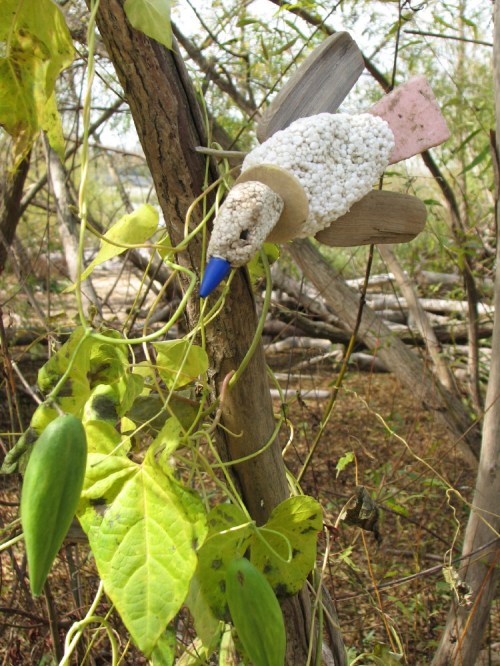
And here it is!  As advertised, this bird does possess a distinctly blue beak.  It’s a little larger than the average wood warbler and has some of the same foraging behaviors.  Other distinct features for identification purposes include a white body and pink tail.  This bird is equally at home on the ground or in the top most branches of a tree.  I do confess that I wasn’t looking for this bird for that would be an excercise in frustration.  In a way, it has to find you and you have to be prepared to receive it when it appears.  That is why I bring my camera with me whenever I’m here.

Uncommon Bluebill with Milkweed, 10/09

I recall that a few Golden-crowned Kinglets proceeded the bluebill.  I was watching the kinglets and their hovering, mid-air investigations of the undersides of leaves when from the corner of my eye I noticed a bird that was distinctly not a kinglet.  The Uncommon Bluebill moved easily from a branch to the trunk of a tree ready to pounce on the insects it discovered.  Some of my best shots of this single bird were in association with a Milkweed vine that held its attention for a while.  It was so intent in its pursuit that it did not notice me observing it from behind a large willow.

Uncommon Bluebill and Milkweed, 10/09

I held my breath and hoped the digitally- produced mechanical camera noise would not frighten it away.  The bird hung around for a minute and no longer.  After that, it was gone.  I walked silently over the dropped willow leaves and back to my car.  I had just seen a creature so rare that it was essentially a ghost.  What could possibly top that as an experience today?

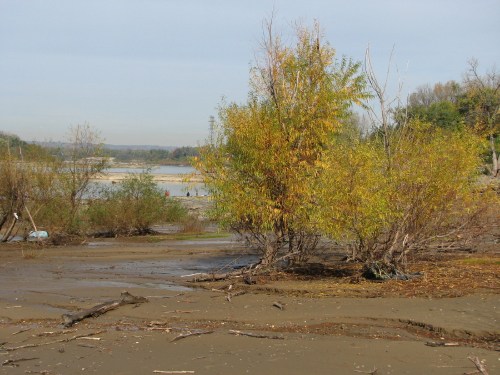
Autumn willows by the river, 10/09

Read Full Post »

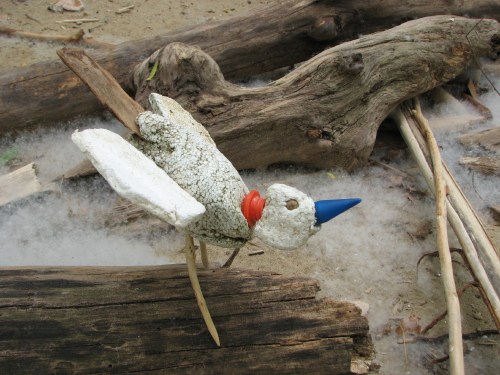
Styro-sandpiper, 9/09

September is the month that the smaller shorebirds begin their migrations through our area towards warmer southern climates.  We see a variety of different species at the Falls of the Ohio.  Here is one impromptu tribute to them made from polystyrene foam.  This one is a Styro-Sandpiper dragging its wing in mock injury.  Among the materials I used to fashion him include:  Styrofoam, blue- insulating foam, river wood, plastic (around the collar and the bill is the tip from a cheap little cigar).  Oh, the eyes are tiny bits of coal.  You are not allowed to collect fossils in the park and I sometimes wonder if this applies to the coal as well?  Anyway, here are some images of genuine shorebirds photographed in the park.
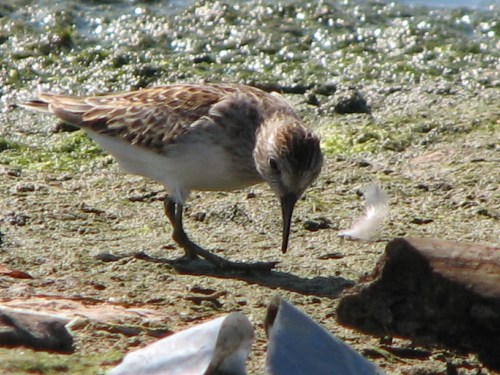
Least Sandpiper, 9/07

Small bands of Least Sandpipers explore the margins along shallow pools of water covering the fossil beds during this time of year.  Their bills probe the algae for the small invertebrates that live in the green mats.  These are our most common sandpipers followed in number by Spotted Sandpipers.  This time of year the Spotted Sandpipers actually have barred flanks and bright white bellies. We will have to wait for spring to see them with their characteristic spots and dots.
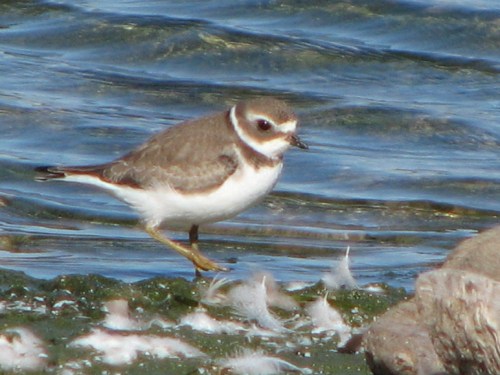
Semipalmated Plover, juvenile, 9/09

Tiny Semipalmated Plovers have traveled from the Arctic tundra and some make a stopover at the Falls.  The autumn birds seem to be mostly juveniles.  Piping Plovers, an endangered species, have been recorded in the park, but I haven’t had the pleasure of seeing one here.  By far, our most common plover is the Killdeer.  It’s hard to walk across the fossil beds this time of year without setting off their alarm calls.
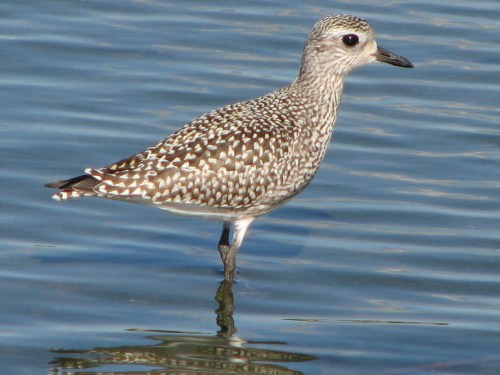
American Golden Plover, juvenile, 9/07

For two years in a row I have come across American Golden-Plover juveniles.  Although they are a bit larger than the smaller “peeps”,  I decided to throw them in too because I like them and they show up this time of year!  I’m amazed that this bird started life on the Arctic tundra and is now traveling to South America. 
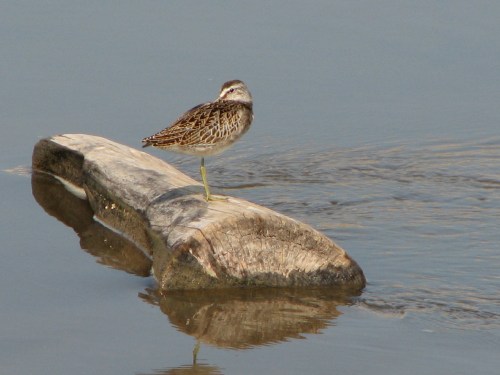
Short-billed Dowitcher, 9/08

Last year I came across this bird dozing on a well placed log and wondered what it was?  Its bill was tucked under the feathers on its back.  As I got closer, you can imagine my surprise when the bill was exposed!  I believe this is a juvenile Short-billed Dowitcher.  Here is another image of this bird.
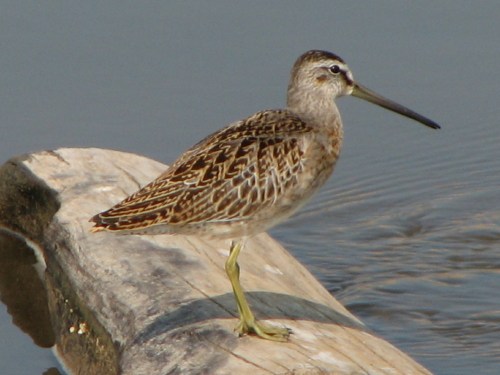
Short-billed Dowitcher, juvenile?, 9/08

I watched this bird for a while and never heard it utter a sound.  Referencing my bird guides, the literature says that the best way to differentiate it from the Long-billed Dowitcher is by its call. The length of its bill is of little help.  Both bird species have been recorded in the park.  The Short-billed is listed as rare and more than likely encountered in the summer.  This bird was photographed last year on the first of September.  The Long-billed is seen occasionally in the fall.  After checking out several bird guides, there was something in its coloration and markings that said Short-billed Dowitcher for me.  Perhaps some one out there with more experience can hazard a guess?  Either way, it was a tremendous treat to come across it!  I’ll end this post with another view of my Styro-Sandpiper posed in the sand and coal.
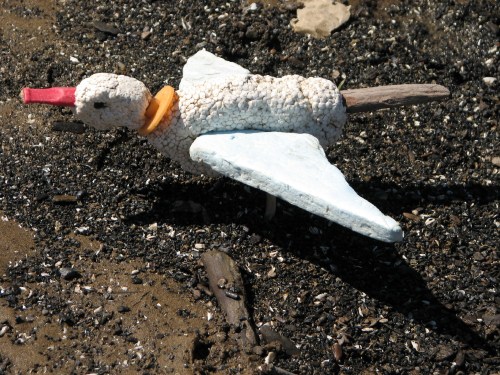
Styro-sandpiper, 9/09

Read Full Post »

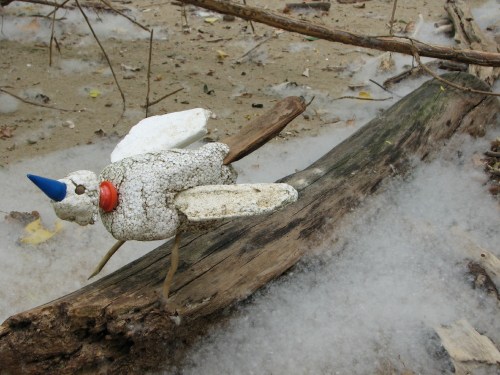
Orange-collared Thickbill, 5/09

The shoe/figure from the previous post wasn’t the only piece I made that day.  Here’s another in my Styro-bird series I call the “Orange-collared Thickbill”.  It  wouldn’t surprise me to learn that somewhere among the world’s 10,000 plus bird species is an actual bird called this!  All the elements came from this day’s walk.  The blue bill is the nose cone of a bottle rocket.  The eyes come from sycamore seeds.  I wanted to create another image with the willow fluff before the expected rains wash it away.

Orange-collared Thickbill and fluff, 5/09

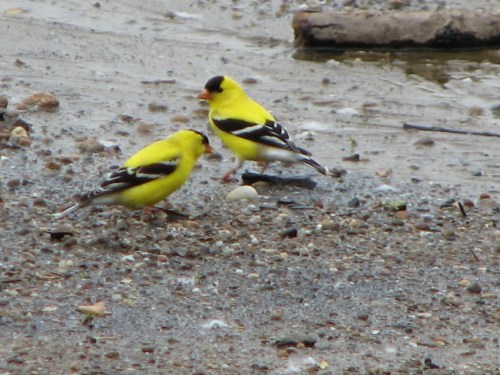
I’m seeing fewer actual bird species now and feel we are settling into our summer time mode.  Cedar waxwings are still around…taking advantage of a bumper crop of mulberries.  The resident Eastern Kingbirds are back flycatching from their willow posts.  Orioles still flash through the treetops as they pursue their own kind relentlessly.  Closer to the ground, I came across a small flock of American Goldfinches.  Their bright yellow bodies, black wings, and orange bills add a color note to the muted tones of sand and gravel.  I remember seeing once, a small flock of about twenty goldfinches their numbers doubled by their reflections in the shallow water they were bathing in…now that was beautiful! 

male, American Goldfinches, 5/09

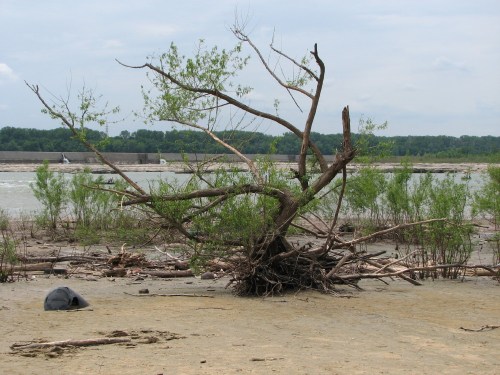
Last shot is of one of these amazing willow trees that survive being immersed and battered by the river’s currents.  It’s like walking through this habitat of giant bonsai trees. 

willow tree, 5/09

Read Full Post »

« Newer Posts