Feeds:
Posts
Comments

Posts Tagged ‘art and the environment’

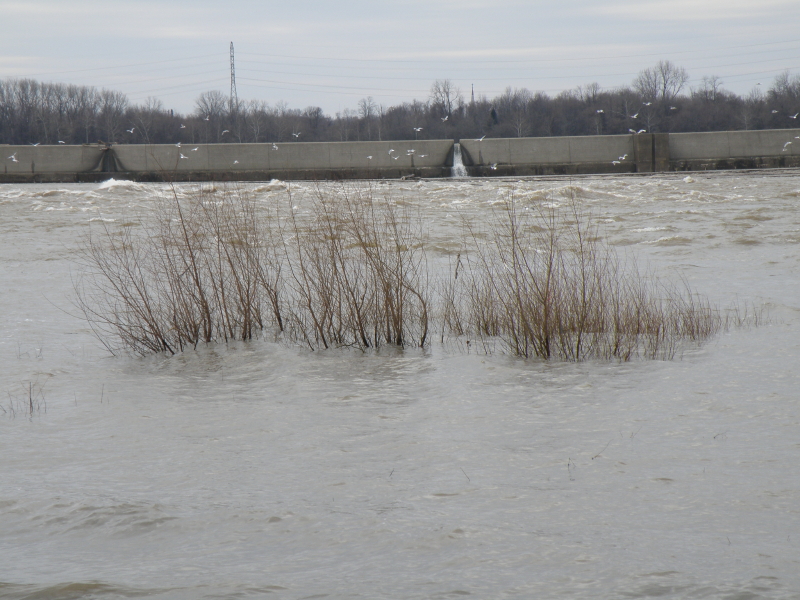
submerged willows at the Falls of the Ohio, Jan. 2013

It’s a new year at the Falls of the Ohio and this is my first foray of 2013.  As expected, I have the park to myself.  It’s cold, but not unbearable.  I can tell that the river has risen and fallen since I last set foot here.  The riverbank is rearranged with freshly deposited driftwood and junk.  The only wildlife to be encountered are birds.  I see the geese and ducks I expect to see, but the stars of the day are the hundreds of Ring-billed gulls that are flying over the river.  I begin my visit by walking the riverbank looking for potential art materials and anything else of interest.  I do find lots of new Styrofoam, but the pieces are heavy and frozen with water and too much to carry.  If the river doesn’t rise again soon, I may get the chance to move the bigger polystyrene chunks to my studio under the willows.  Walking the shoreline, here are a few of the other “gifts” I encountered courtesy of the Ohio River.
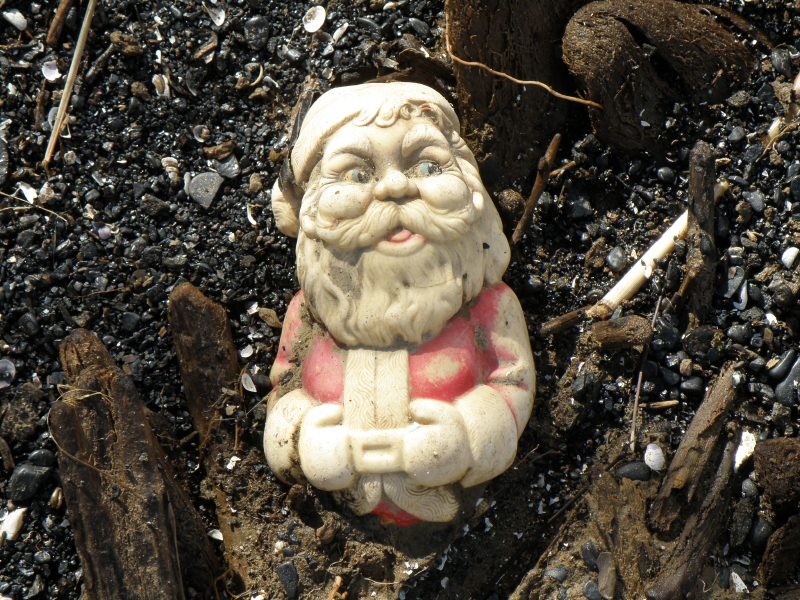
partially buried plastic Santa Claus, Jan. 2013

Half buried in coal dust and gravel is this plastic, scary Santa Claus.  I know we just celebrated Christmas, but I couldn’t resist posting this image.  He looks old to me and I pull him out of the mud and drop him into my collecting bag.  I may try to research him and see if I can find any info about him.  On this day, I also found another doll head.
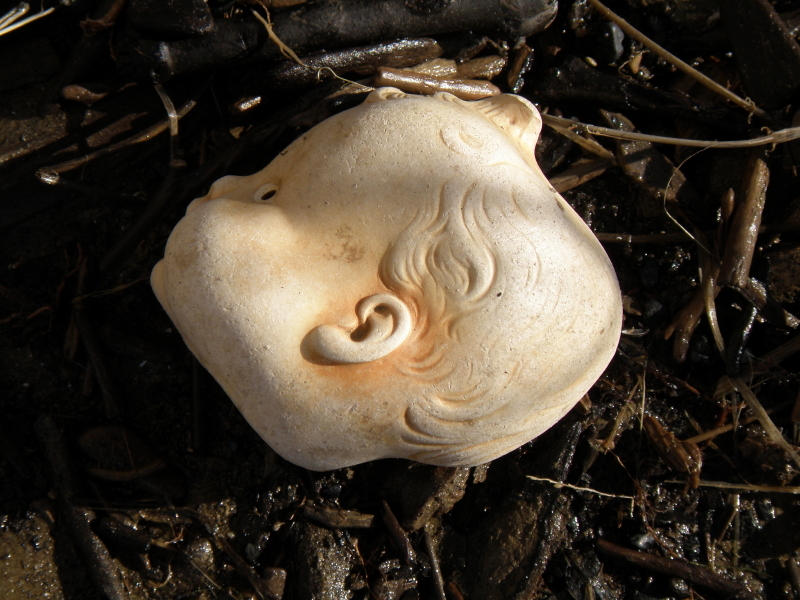
plastic doll head, Jan. 2013

I’m always finding dolls and doll parts.  The interesting thing about this particular find is the location.  I have on other occasions also found old doll parts in the exact same place.  I’m beginning to believe that prior to this area becoming a park it may have served as a landfill?  In other areas of the park it is clear that this area was used as a dump from the amount of back fill I come across.  Nearby, something blue in the sand catches my eye and I take a look.

bowling ball fragment, Jan. 2013

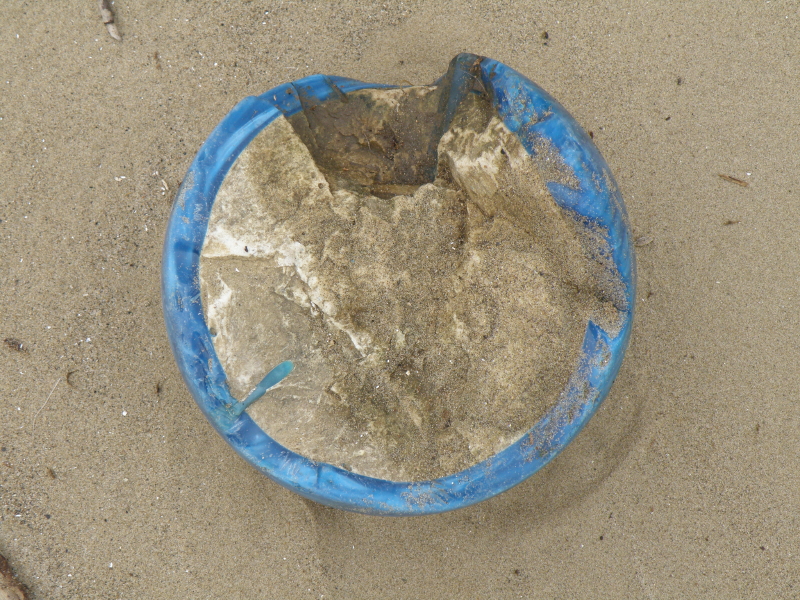
interior view of split bowling ball, 2013

In case you were wondering, bowling balls do float.  I turned the beautiful blue-marbled surface over and discover that this ball has split in half.  The interior is made of a dense, hard foam and this is the reason these balls are buoyant.  The outer covering is a very hard plastic and I’m wondering how great a force is needed to break one of these balls open?  I imagine it is considerable and is another reminder of the power of the river.  Here’s one last find before moving on.

jar of peanut butter washing ashore, Jan. 2013

As I walked the riverbank, this jar of peanut butter was deposited by my feet!  I wonder where this came from?  Near the river’s edge I’m also picking up freshly peeled willow sticks.  This is evidence that beavers are in the area.  The sticks all bear their teeth marks as they nibble the bark for food.  Beavers are very secretive and I have only seen them twice in the past ten years.  I like willow wood for its ivory color and use them quite a bit in my river sculptures.  I wonder if beavers would like peanut butter?

outdoor studio, Jan. 2013

After scouting the river I head up the bank to the area under the willow trees that I have been using as an outdoor studio for the past year.  This ground is slightly higher, but is no match for a flooding river.  I have made many temporary studios over the years where I cache the Styrofoam and sticks I use for my figurative sculptures.  It’s been perhaps two months since I last visited this spot, but to my eye, not much has changed.  I set my collecting bag and walking stick down and select a couple of pieces of Styrofoam for my first figure of the new year.
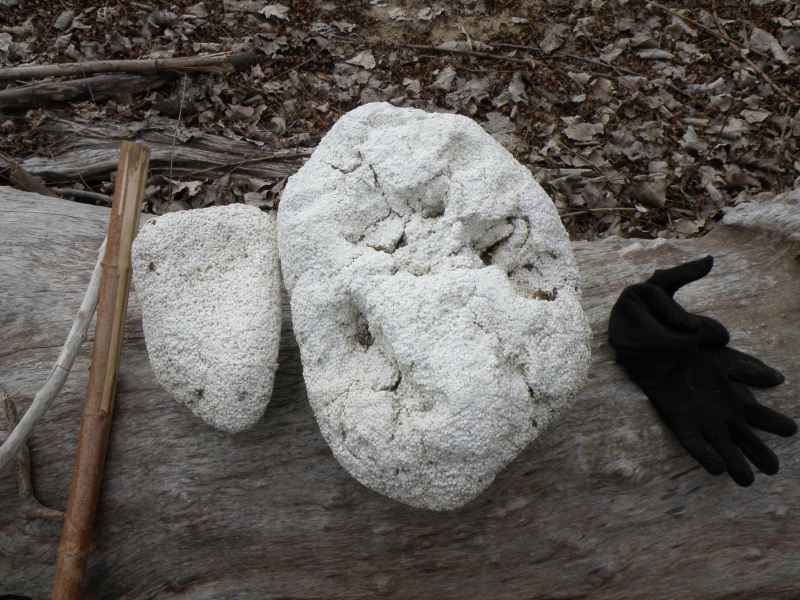
The beginnings of a figure, Jan. 2013

Styro-figure in process, Jan. 2013

Before too long, a new figure takes form.  Today, I’m breaking in a new knife because I lost my trusty Swiss Army knife out here.  That’s two knives I’ve lost since beginning this project and think of my losses as tribute necessary to appease the river gods.  My new figure also sports one other find from this day…it’s a button that says “Kentucky is My Land”.
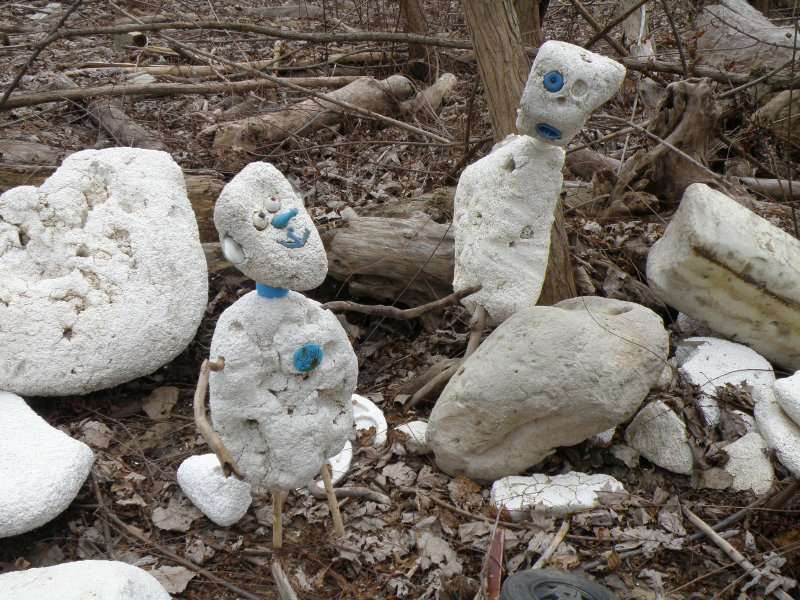
My latest Styro-figure greets his kin, Jan. 2013

After saying so long to his kin, my latest and unnamed Styro-figure sets out to explore his world.  The day started out sunny, but now has turned gray and cloudy.  I probably won’t stay out here much longer since the wind has picked up a bit too.
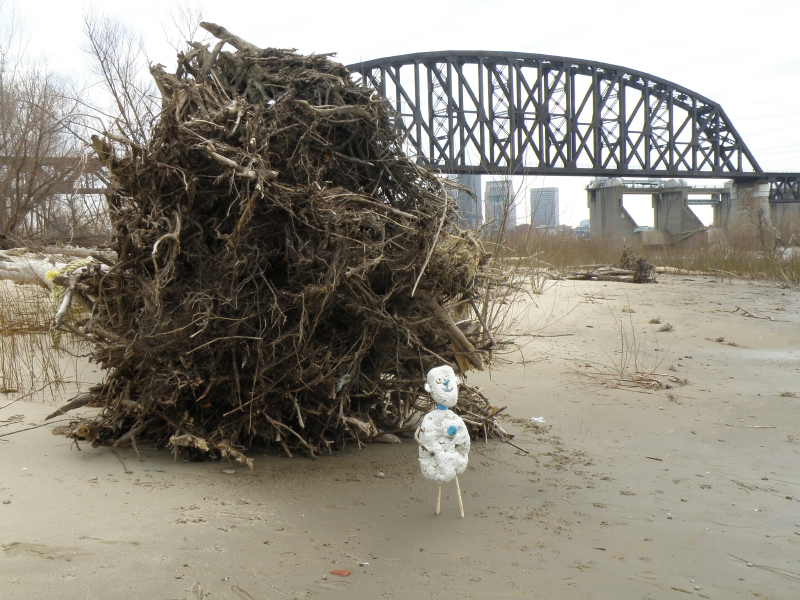
Styro-figure by large downed tree at the Falls of the Ohio, Jan. 2013

Here is further evidence that the river has risen and fallen recently.  A freshly deposited tree has been stranded on the bank and provides an opportunity for investigation.  In the distance and past the railroad bridge, one can spy part of Louisville’s skyline.  Curious about the tree, my newest figure climbs on top to survey the world from this vantage point.

Styro-figure on top of stranded tree, Jan. 2013

Styro-figure on tree, Jan. 2013

Every day is a new wonder especially at the Falls of the Ohio.  2013 is a new year, but it also marks my tenth as the artist at exit 0.  When I started my Falls project I wondered if I would be able to sustain anybody’s interest much less my own?  It was fun learning from the WordPress yearly summary that my blog has been visited by people living in 103 different countries during 2012!  I suppose more people now know about this special environment as a result of my activities here which is cool.  The Falls are a unique window into the history of life from its past to the present.  It’s a place where nature and man’s nature intersect which tells us something about who we are in this  moment.  I hope my blog continues to be a venue where people can get a sense that creativity can be an active force in shaping the world for the better.  As for my latest creation…he decided to hang around to greet any new visitors by the fossil rocks.  Perhaps by now, he has gone home with one of them?  See you later from the Falls of the Ohio.
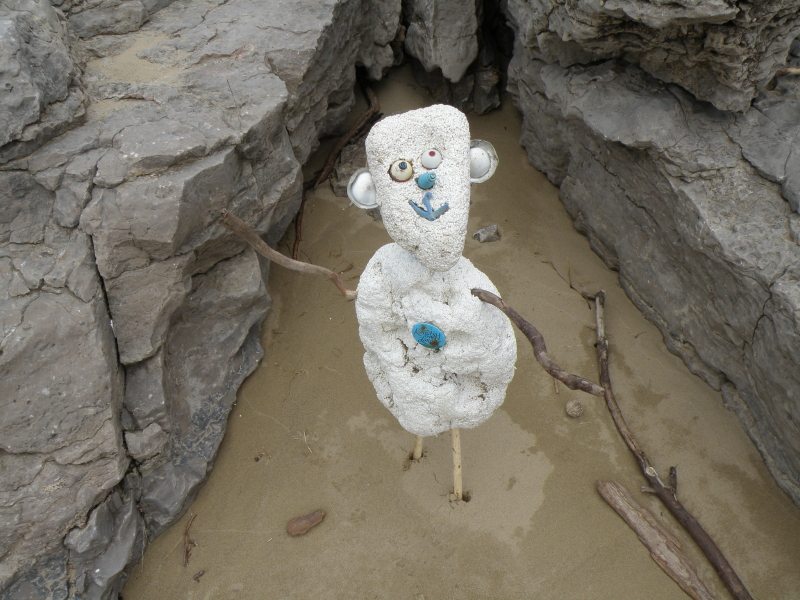
Figure by fossil rocks, Falls of the Ohio, Jan. 2013

Read Full Post »

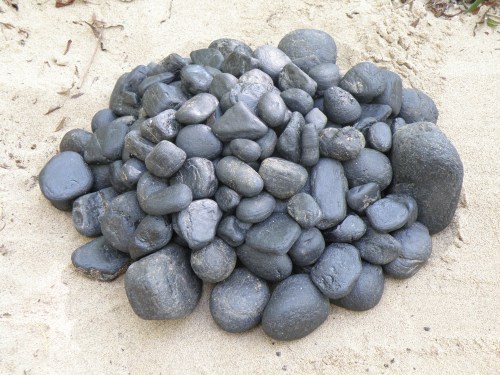
river-polished coal, Falls of the Ohio

The coal that I find at the Falls of the Ohio looks like the image above.  What I mostly come across in the park are pebble-sized stones and coarse gravel that have been polished smooth by the Ohio River.  The same river processes that shapes Styrofoam and wood also alters coal.  Over the last two years I have been collecting this coal off of the riverbank and creating site specific art installations and images using this fossil material.  Although coal is organic and natural, what I’m finding does not belong in the Ohio River.  I believe this coal comes from the commercial barge traffic delivering fuel to hydroelectric plants throughout the Ohio River Valley.  During times when the river is running high, materials carried into the water seem to eventually find their way to the Falls of the Ohio.
coal flake in situ, 2012

Before getting to the heart of this post, I would like to share a few other associations I have with coal and Christmas.  My Dutch mother told me stories of her childhood and St. Nicholas Eve which is celebrated earlier in the month than our Christmas.  Good children might expect small toys, fruit, or candy to be placed in their shoes as gifts from the white bearded saint.  If, however, you were badly behaved over the year…you ran the risk of getting coal in your shoe as punishment.  St. Nicholas has a chimney sweep friend named Black Pete and he usually does the dirty work. Fortunately, my mom doesn’t recall anyone she knew who this happened to!  There are times, however, when getting coal in your shoe isn’t a completely bad outcome.

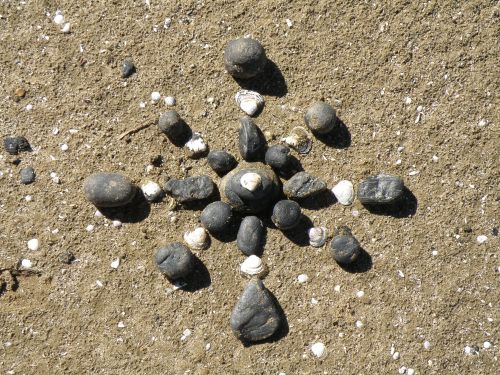
radiating coal flake at the Falls of the Ohio, 2012

My mother also recalls how important and scarce coal was one particularly bitter winter and Christmas.  It also happened to be during World War II and the city of Amsterdam was occupied by foreign soldiers.  I believe she said the particular year in question was 1942?  When resources  became scarce, people would walk the railroad tracks at night looking for chunks of coal that fell off the railroad cars.  People risked their lives doing this.  Found coal would be burned in home stoves to keep everyone warm.  When coal wasn’t available wood was burned next.  My mom remembers that by war’s end, every wooden piece of furniture in the entire apartment was cut up and burned for heating and cooking purposes.  Back then, a bag of coal would have been as fine a gift as receiving an orange or piece of chocolate.  The times have really changed since then.

coal flake in water, 2012

It’s becoming more difficult for me to believe that the events of 1942 occurred seventy years a go!  Since then, the peace was won (for a short time) and the western economies thrived and grew on cheap and abundant fossil fuels.  If populations had stayed relatively the same size, perhaps we wouldn’t be noticing the effects burning those fossil fuels have had on the environment?  But the world’s population grew and then grew a lot more which puts pressure on all our resources.  Today we live on a planet where billions of people want to live at the same standard of living that the west has squandered away.  With China and India experiencing their own industrial growth moments being fueled by coal…the environment at large will surely see further damages.

found coal and aluminum can bottoms in red mud, Falls of the Ohio, 2912

Since beginning this Falls of the Ohio Project nearly ten years a go…I have created my own unique holiday cards.  Every year I send something different out into the world.  This helps me get into some kind of holiday spirit. Friends and family tell me that they enjoy receiving these admittedly odd cards.  The last several years I have waited for the weather to get more seasonal perhaps with snow or ice present before rushing out to document the moment.  As it so happens, it’s been getting warmer and warmer over the past several winters.  As a whole, 2012 was our warmest year ever and the calendar page hasn’t yet turned to the new year!  Our December began with temperatures in the low 70 degrees mark.  Finally, the day after Christmas it has become cold enough and we may see a dusting of snow over the ground.

coal and clam shell designs, Falls of the Ohio, 2012

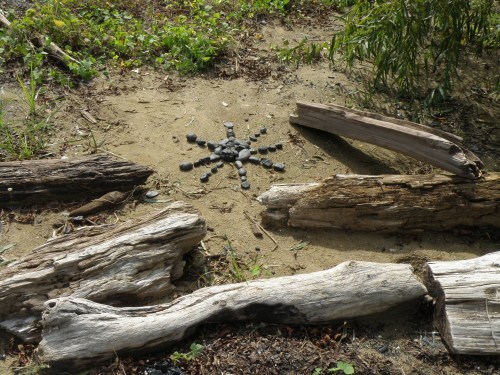
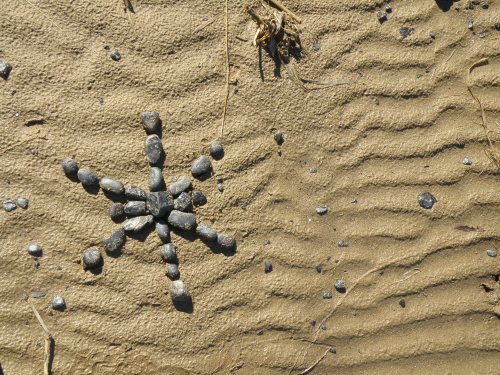
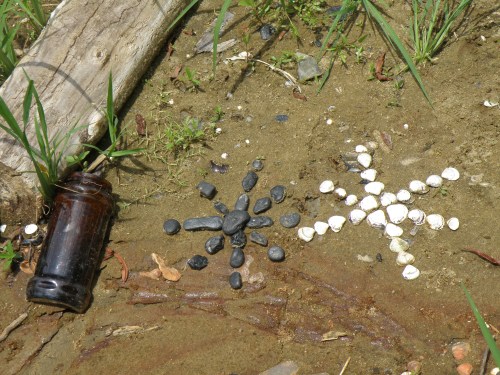
Currently, I have artworks (a sculpture and photo series) on display in a coal-themed exhibit at the Carnegie Center for Art and History in New Albany, Indiana.  While working on my projects, I had a conversation with a sculptor friend of mine who grew up in a steel making town in Pennsylvania.  He recalled from his childhood that it snowed a lot during their winters, however, it didn’t take the snow long to turn from white to dull black because of all the coal soot in the air.  This inspired me to envision black “snowflakes” or “coal flakes” and I began to create small site specific designs on the ground based on this idea.  No two coal flakes I’ve made has been exactly the same as another.

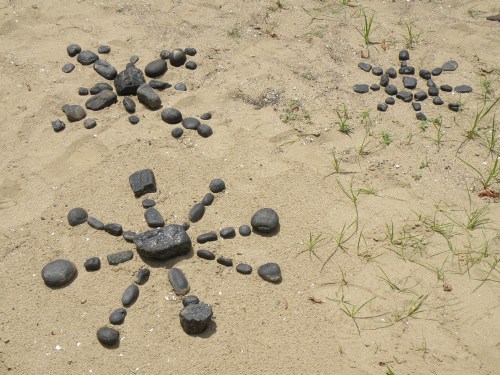
three coal flakes at the Falls of the Ohio, 2012

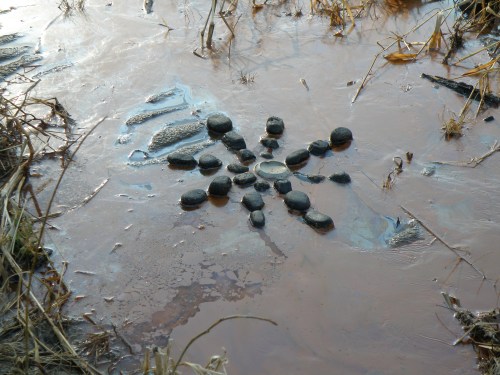
I have located these coal flake designs in fairly public places along side walking trails mostly used by fishermen.  A photograph documents each one I have made.  To me, this is a form of public art and it’s interesting to see how people will react to these modest designs.  Some coal flakes don’t make it because there is something else in the human spirit that needs to disturb or destroy what it doesn’t understand.  Many of these designs were rubbed out nearly as quickly as I made them!  By now, I’ve created enough coal flakes that it occurred to me that I had my newest holiday card theme already completed in sixteen different designs!  The images in this post are just a few of the ones I sent out this year.

coal flake on red mud, 2012

And so I ask myself, what am I hoping might occur by sending out these unfamiliar images?  Hopefully, people will register that there is a connection between burning fossil fuels and the changing climate we are currently experiencing.  The environment isn’t just something that’s out there, but is a big part of the context of our lives that we contribute something to.  I also continue to hope, that people will see personal creativity as an advantage our species has over others and that we honor and use this creativity to figure out how to live harmoniously with ourselves and the planet.  I feel a lot of our hyper consumption is based on low self-esteem where creativity is replaced with consumption.  Here’s hoping in the new year that more people learn how to tap into their own internal resources to help aid the earth!  Happy Holidays to all from the Falls of the Ohio!

coal flake made from coal and small clam shells, Falls of the Ohio, 2012

Read Full Post »

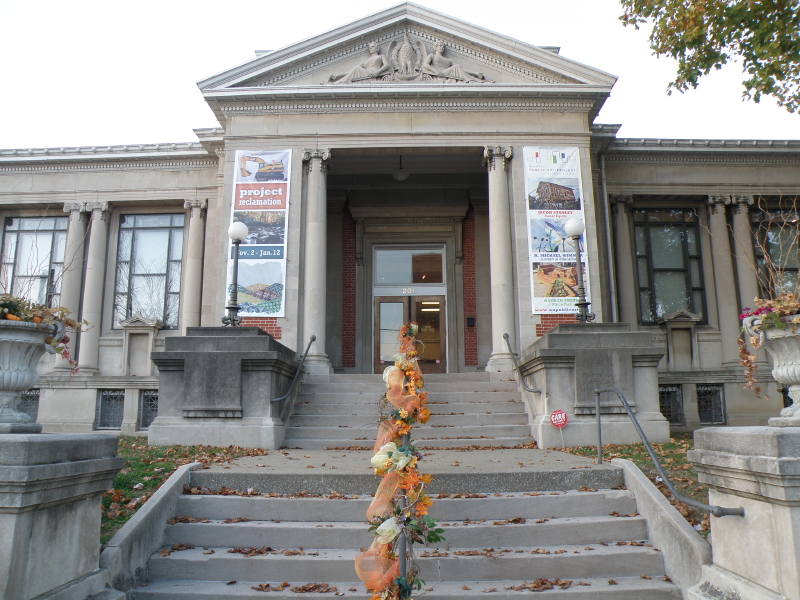
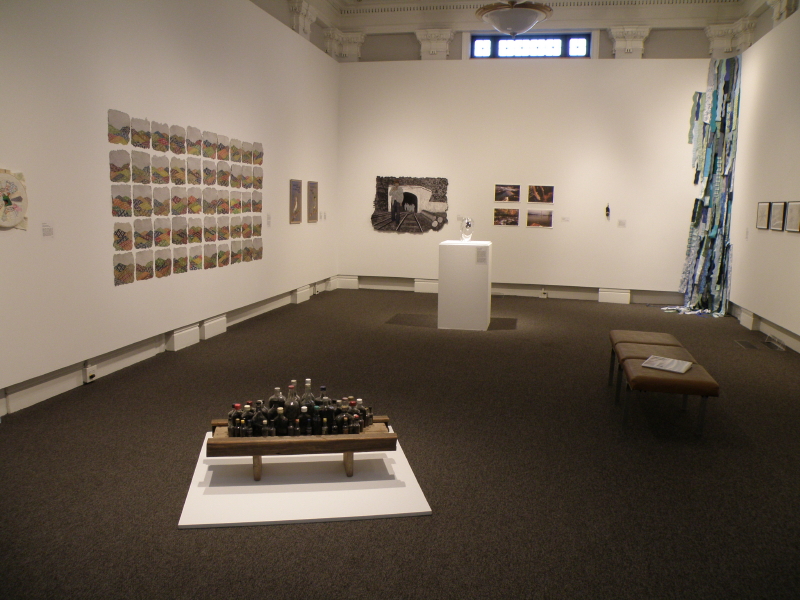
I have had a few folks ask about the Project Reclamation exhibit I’m participating in and I thought this post would be a good place to feature this.  The exhibit opened a couple of weeks a go on November 2, 2012 and will run through January 12, 2013.  About a year and a half have passed since curator and artist Mary Margaret Sparks asked me to participate in this invitational exhibit.  There are thirteen artists represented in this group show with a nice cross-section of projects in various media addressing the complex topic of coal its use and extraction.  The Carnegie Center for Art and History located across the Ohio River from Louisville in nearby New Albany, Indiana has done a fine job of installing and interpreting the works and has planned many activities that the public can engage in to learn more about the controversial topic of coal mining through the practice of Mountaintop Removal or MTR.  This is a highly destructive way to extract coal from southern Appalachia’s mountains which also endangers  some of the greatest biodiversity in our part of the world in pursuit of cheap and reliable energy.  To further spur the artists along, the not for profit organization Kentuckians For the Commonwealth invited the participants to Whitesburg in Letcher County, Kentucky to tour Appalshop and watch a few coal-themed documentaries.  A guided tour into coal country provided additional impressions of the mountains and the folks who call this place home.

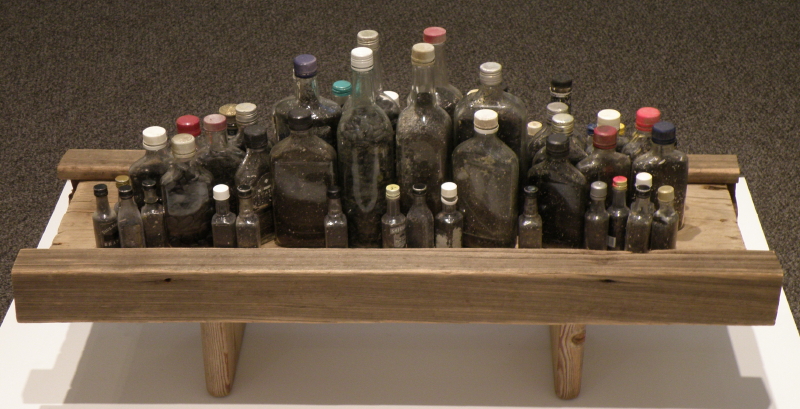
All of the participating artists had some prior interest either working with coal as a social issue or material substance before accepting the invitation to show.  There is a unity in the belief that the more we degrade the environment, the more we change ourselves and not for the best. For me, my entry came through the related issue of clean fresh water  which is also our number one vanishing resource.  I frequently find river-altered coal at the Falls of the Ohio State Park.  Combining this coal gravel with discarded and river found booze bottles gave me an opportunity to work with ideas about consumption and addiction.  The result was my “Mountaintop Mini-bar” sculpture, but I also have six photographs from my “Coal Flake Series” on view as well. My impression of our guided trip to coal country reinforced what I’ve previously seen and experienced.  It seems to me that the people who were sacrificing their land and culture were not receiving much in the way of compensation for our quest for coal.  Regrettably, this is an old tale seen time after time across the globe.  People might think that this is something that only happens in distant poor countries, but we have our own share of material poverty in our own backyard.

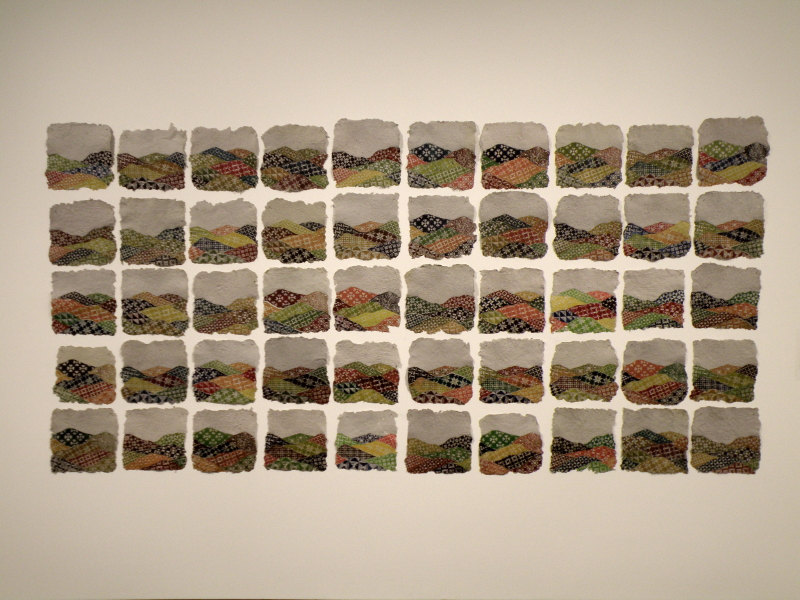
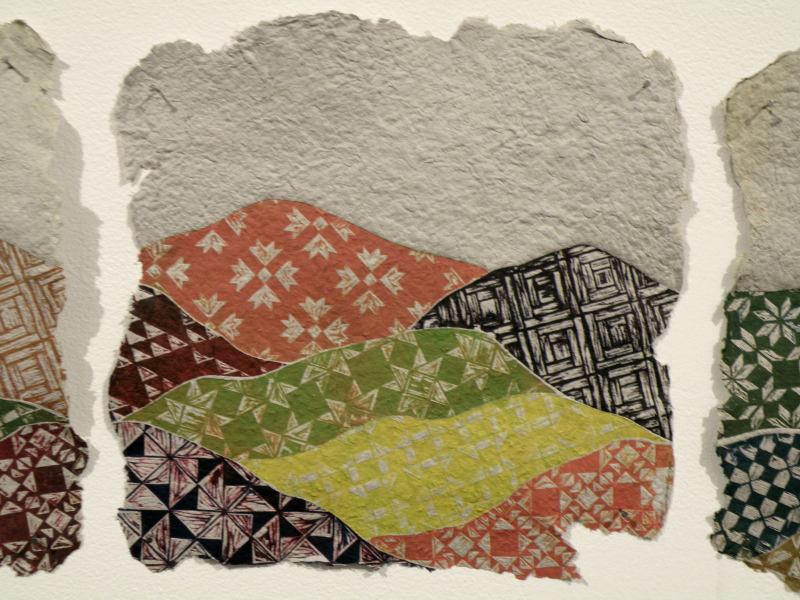
Most of the participating artists took considered approaches that referenced and respected the uniquely rich culture of coal country.  Several artists worked with traditional fiber and or needle and thread to produce their statements.  Julie Yoder created a large wall installation, “Appalachian Patchwork”,  assembled with woodcuts on handmade paper.  Patchwork quilting is an important Appalachian art form and Yoder’s piece represents the landscape and local culture as being a composite of unique designs that have come together over time to form a whole.  Mountaintop removal has a way of fragmenting this landscape and disrupting the continuity that life here depends upon for survival.

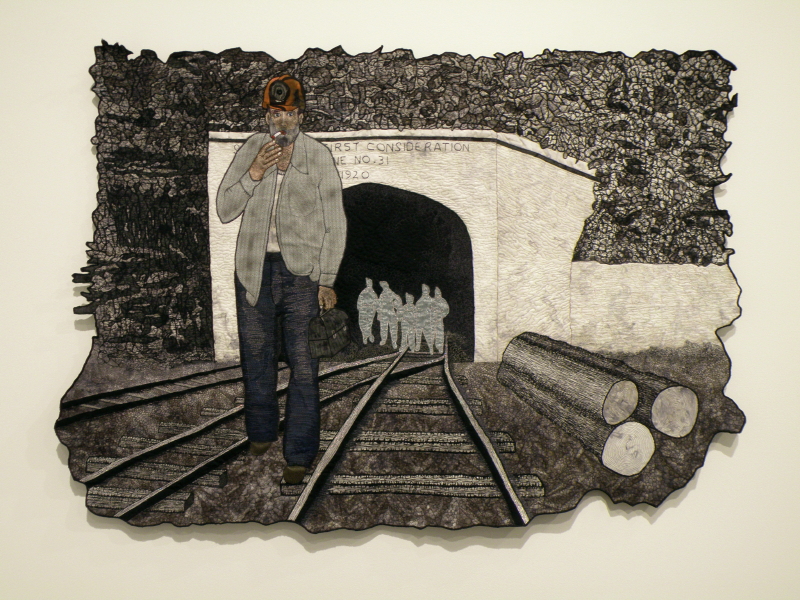
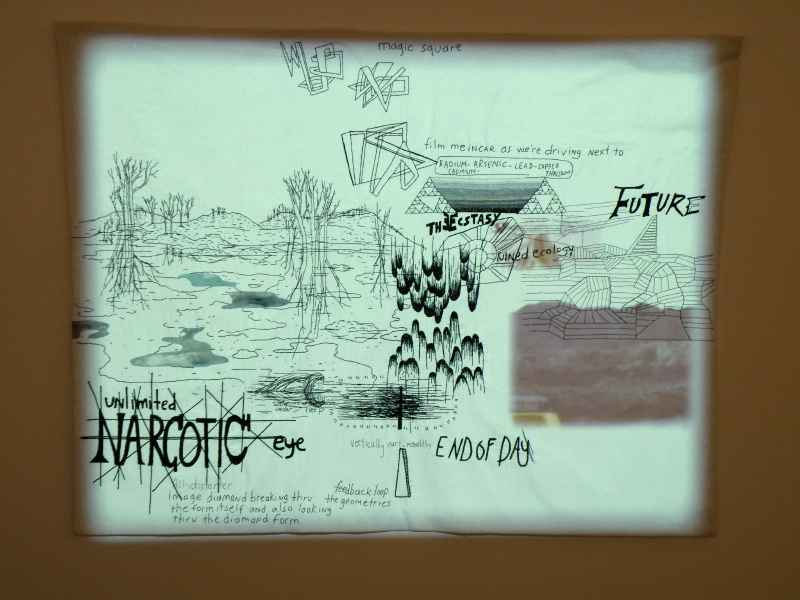
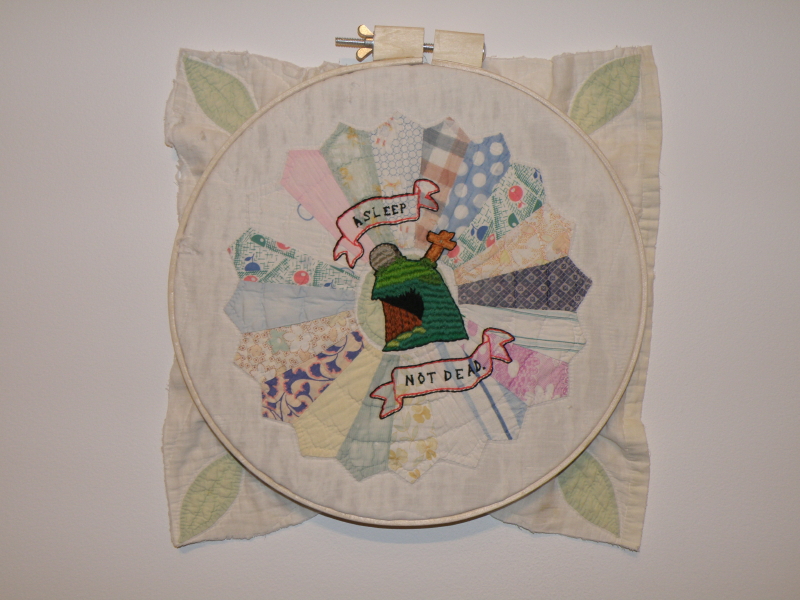
Other artists utilizing fabric, needle, and thread include Jo Ann Grimes with her sympathetic portrayals of miners.  Joel Darland and his marvelous hand-embroidered quilt squares.  Rachel Brewer’s two embroideries of song birds on dirty furnace filters.  Mary Margaret Sparks’ imposing “Lest We Forget” hand-embroidered and sewn re-purposed fabric waterfall that is a memorial to lost mountain streams and creeks that were damaged by coal mining.  Also in this group is a fascinating video entitled “Harriman” which is the work of Denise Burge and incorporates video, fabric, and thread.  Burge’s video is a statement made in the aftermath of a disaster.  A broken coal slurry dam in Tennessee had poisoned the surrounding watershed and imperiled the health of a community living in the area.  Burge’s video documents some of the clean-up involved and how protective the coal industry is in guarding its own image.

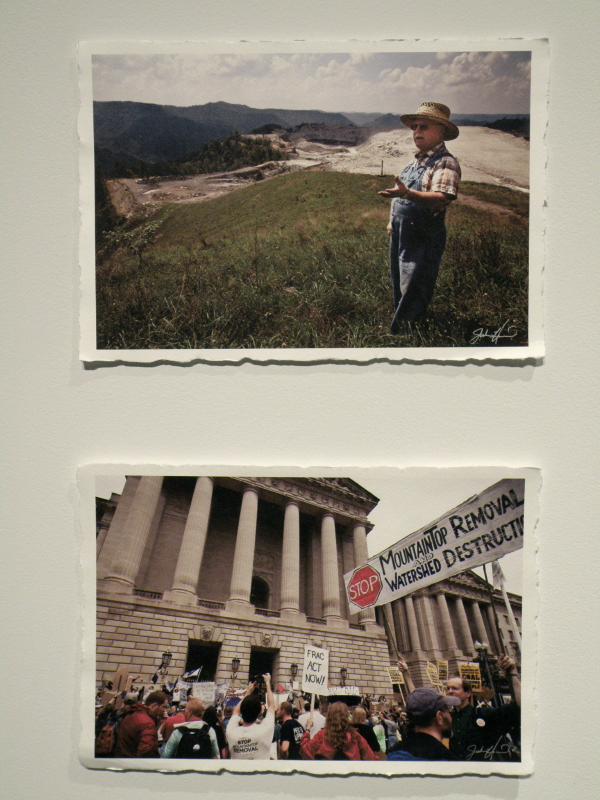
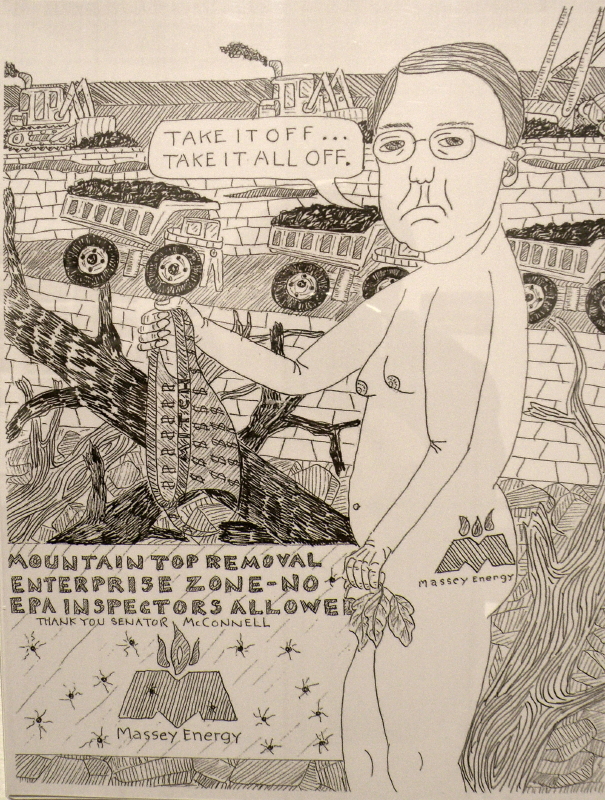
Photographs by Joshua Howard contrast the natural beauty of coal country with the grim realities of the industry.  A more overt political statement comes from Wayne Ferguson who sees Kentucky’s senior senator as being in cahoots with the industry that helps bankroll his re-election campaigns.  Ferguson’s drawings chart the corrupting influences of money and power at the expense of the land and the best interests of the people.

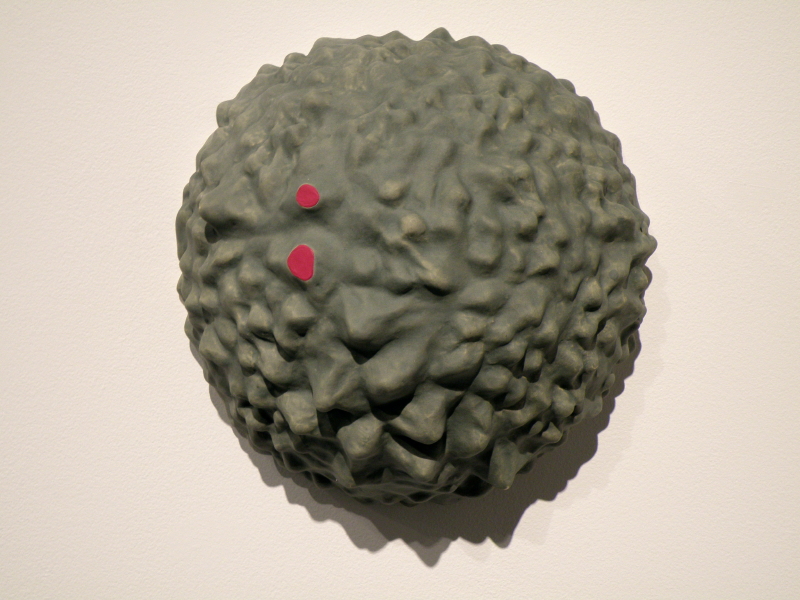
The sense that mountaintop removal is a great calamity for nature at large comes through the works of two artists.  Ceramic sculptor Alex Adams’ piece entitled “Wounded” suggests that MTR mining disrupts the very living tissue of the mountain range. He does this by representing two mountains that have had their peaks literally removed revealing  raw, open wounds.

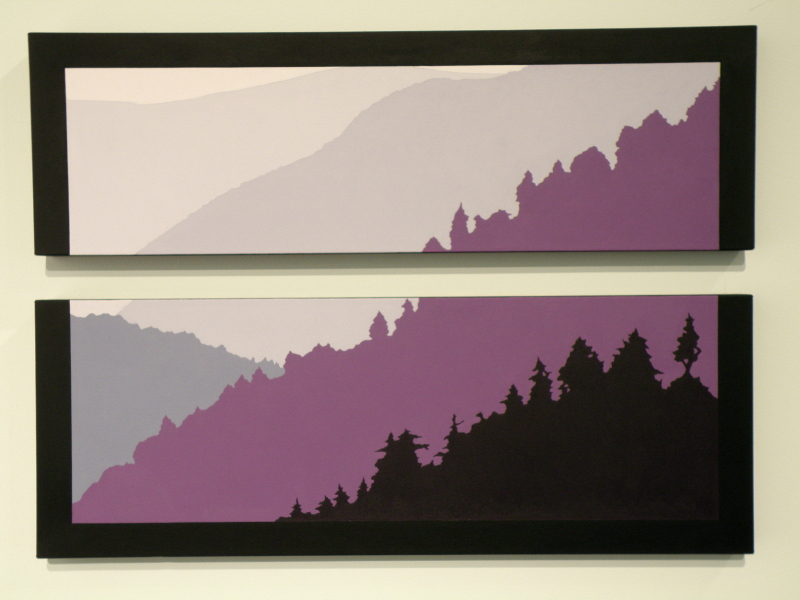
Painter Michael Koerner’s approach is equally reductive and he comes to a similar conclusion about the fate of the mountains.  His diptych entitled “After the Canaries Left the Coal Mines, the Mountains Began to Leave Appalachia” is an argument reduced to its essential points.  For example, in Koerner’s landscape, the painting is physically divided into two parts suggesting man’s indifference towards nature.  The bare slopes past the forested mountains are a warning of what could occur with unchecked mountain top removal.

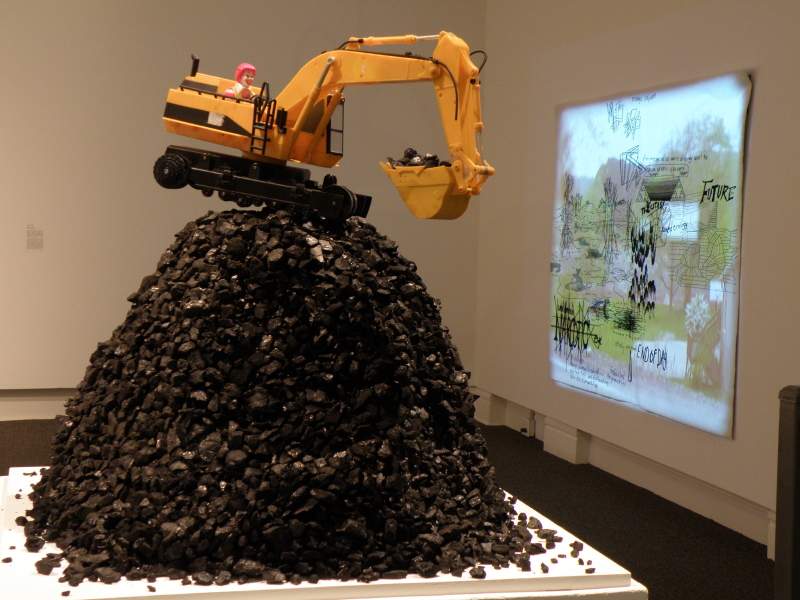
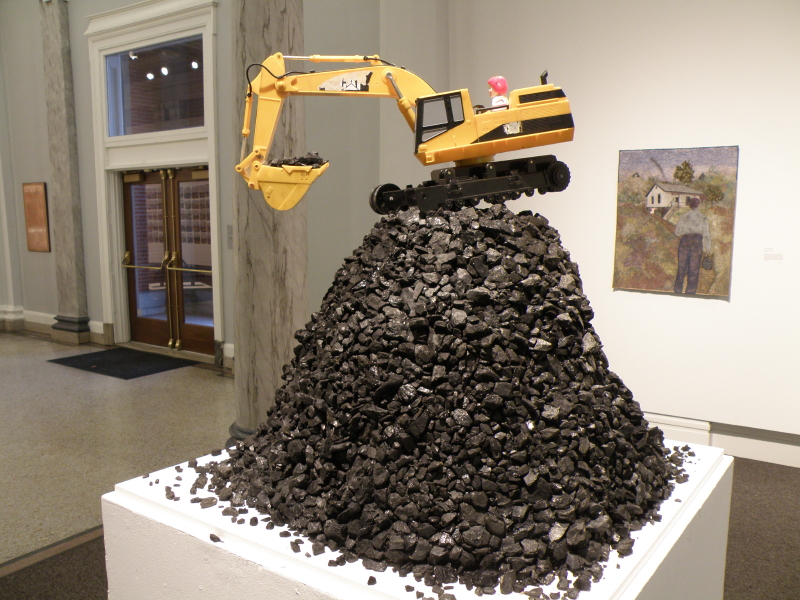
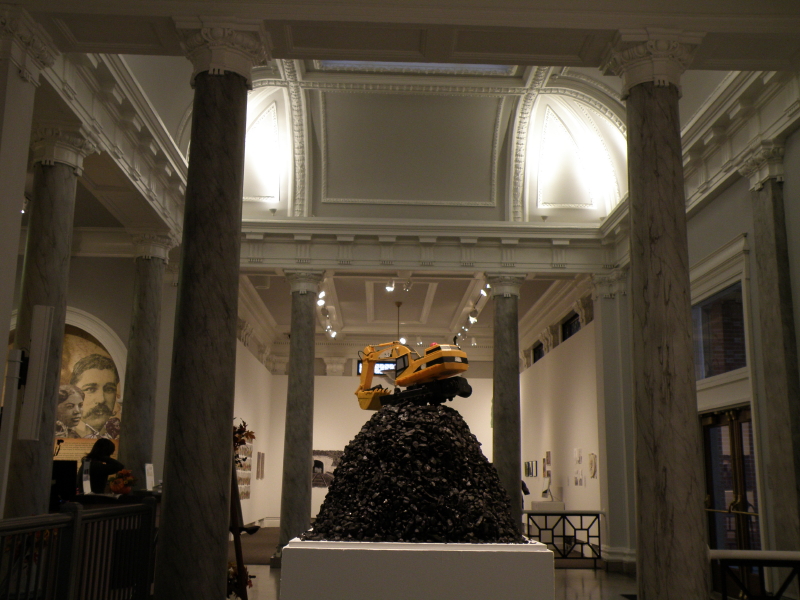
One last artist before closing.  Aron Conaway’s work lies at the heart of our culture of consumption.  His work entitled “Billions and Billions Served” features a Ronald McDonald clown driving a toy front loader on top of a large pile of coal.  In his work, Conaway makes it obvious that we are all implicated in the big issues of our day.  The demand for coal exists because we demand the energy to stay warm in the winter and cool in the summer time heat.  If we don’t like the side effects of coal mining, perhaps we should speed up our search for alternative energy sources, find ways to curtail our addiction to electricity or both?  The demand for cheap coal and energy is what drives the supply.

The Carnegie Center for Art and History has a nice program of upcoming events that expands the breath of this exhibition.  I have already participated in one gallery talk that drew an interested crowd.  Film screenings, art making opportunities, and a panel discussion on mountaintop removal and renewable energy sources will also be held during Project Reclamation’s run.  There is the hope that this show will travel which will be an added bonus.  Thanks to Mary Margaret Sparks, Karen Gillenwater, and the staff at the Carnegie Center for their hard work.  I hope you have enjoyed this glimpse into an exhibition from our area.  My next post will be from the Falls of the Ohio!

Read Full Post »

« Newer Posts