Feeds:
Posts
Comments

Posts Tagged ‘art and the environment’

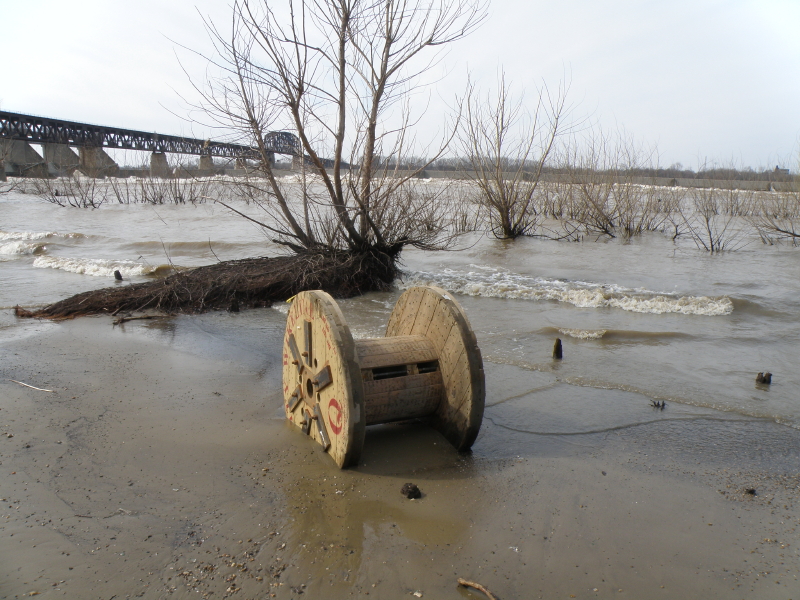
wooden cable spool and willow tree, Falls of the Ohio, March 22, 2014

It’s a sunny Saturday and warm for this time of year.  One of those days I can’t wait to get to the river.  Spring is still slow in developing, but it can’t be much longer now.  I spent a good part of the day just filling up my canvas collecting bag with all types of odds and ends both man-made and natural that have washed up on these fabled shores.  I’m finding so much stuff that for practical reasons I decide to see if I can find a spot up the bank and under the willows that might make a good location for a temporary outdoor art studio.  I can offload some of my larder for future use while continuing to walk the edge of the river.  I’m enjoying the sunshine and taking deep breaths of the fresh air.
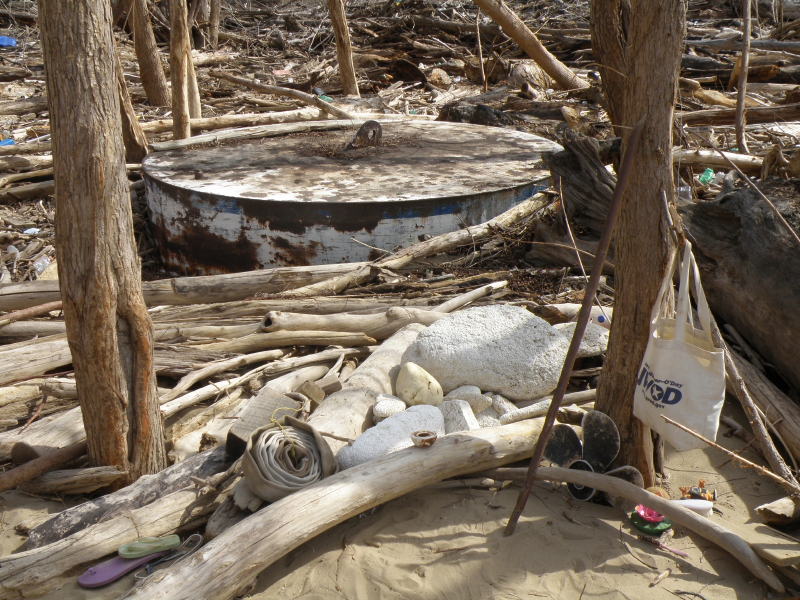
U.F.O. studio...Unidentified Floating Object studio, March 2014

U.F.O. studio, Falls of the Ohio, March 2014

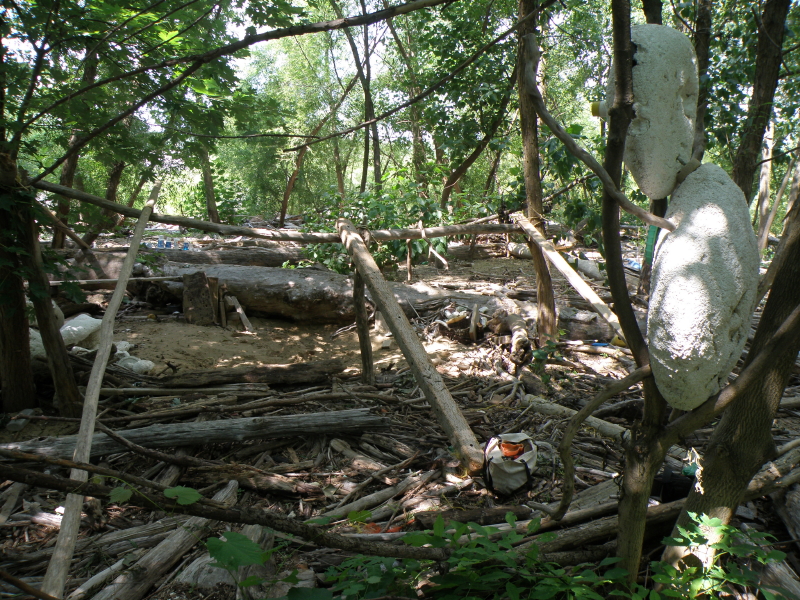
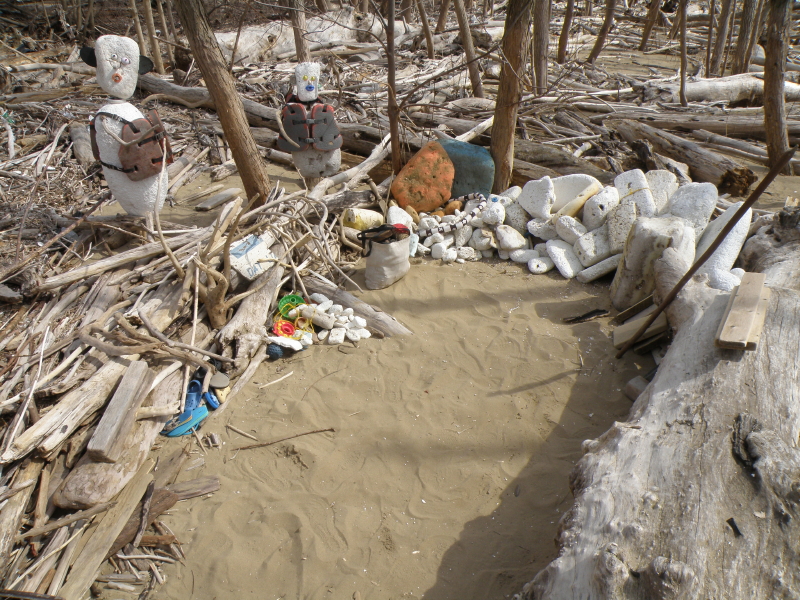
I chose a spot bordered by a large log that keeps most of the driftwood at bay and what I call the U.F.O. or Unidentified Floating Object which is circular metal platform that was once painted white with blue trim.  It’s starting to show some rust now.  This large object washed over the dam during a high water moment three or four years a go.  Since then it’s changed positions with the rising and falling river levels and was once completely buried under driftwood.  The U.F.O. is a platform that normally would be anchored out on  the river.  Barges and other water craft can tie on to it if necessary.  Some how this one got loose and relocated to the park.  When I first discovered it here I also imagined that it was a giant bathtub plug that helped keep the water in the river.   I was lucky that I had the same outdoor studio for many years before this winter’s high water rearranged the landscape again and floated all my collected materials away.  I spent a few hours walking the river collecting Styrofoam and sticks and can’t wait to make something new.
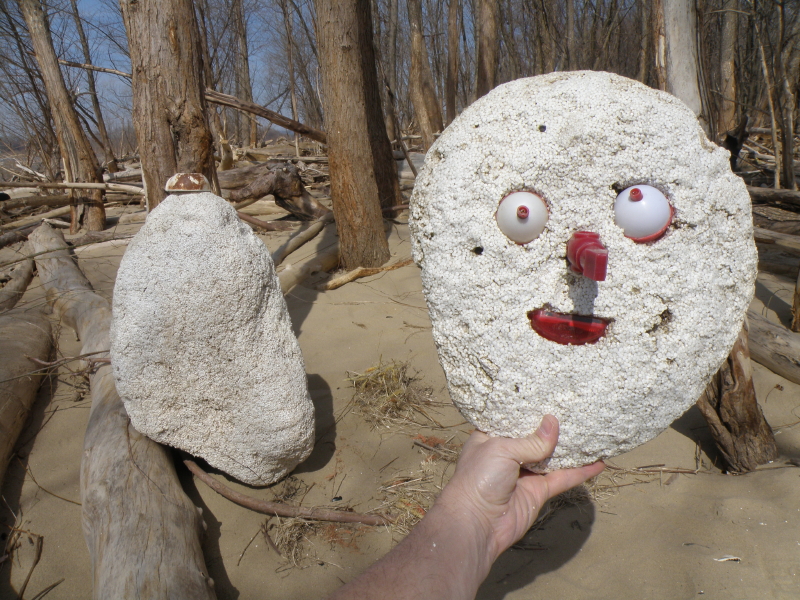
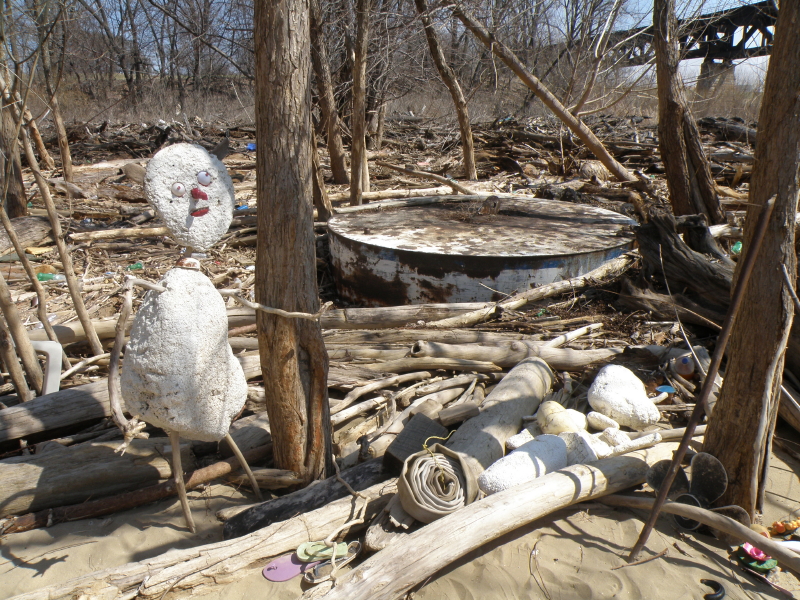
Mega Spool figure in progress, March 2014

Completed figure at the U.F.O. studio, March 2014

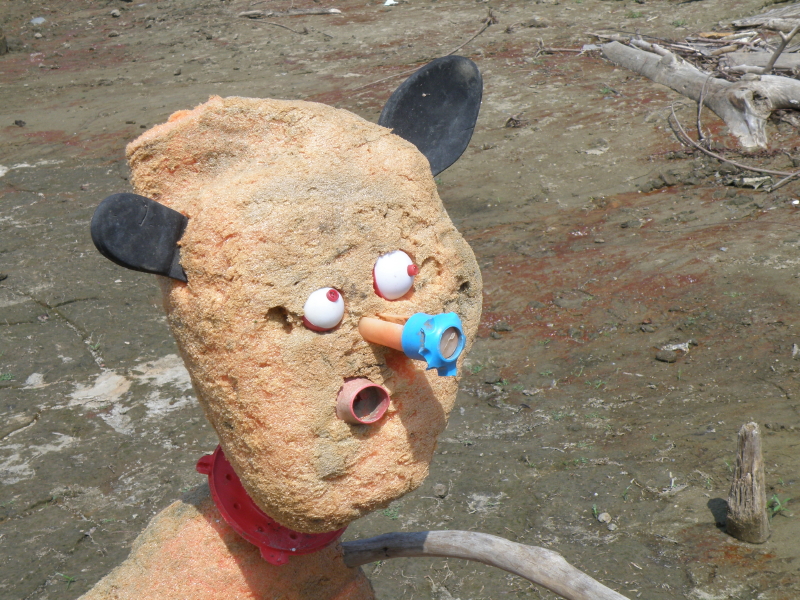
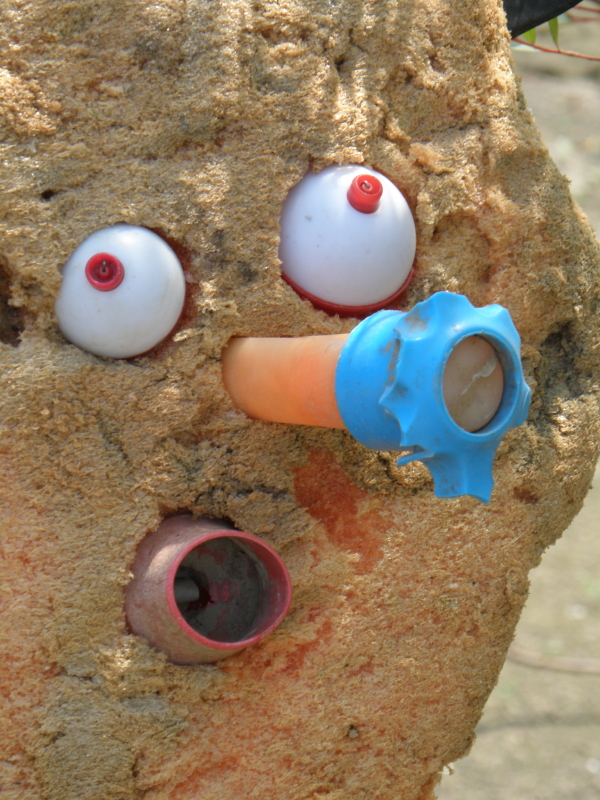
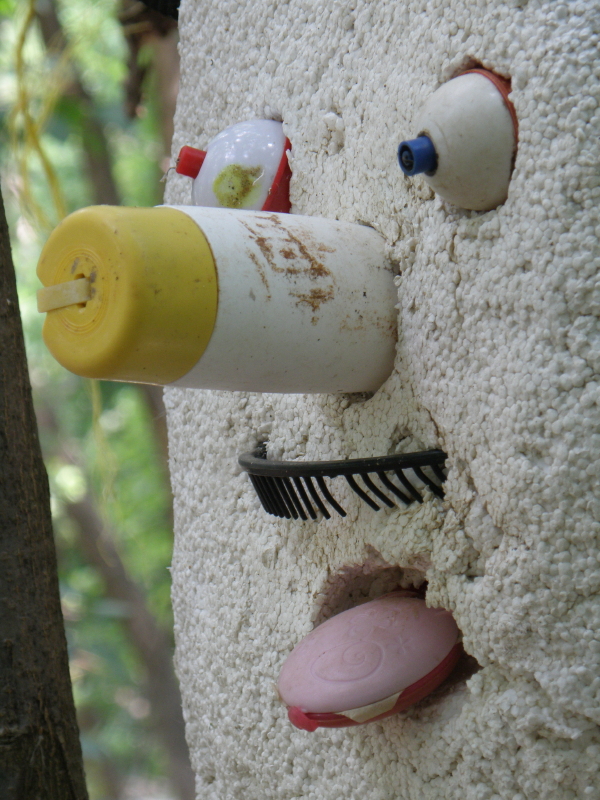
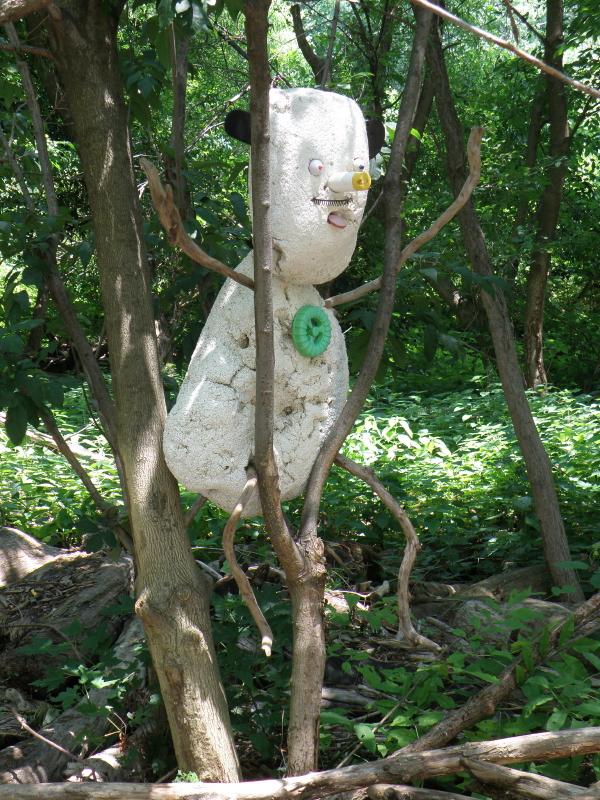
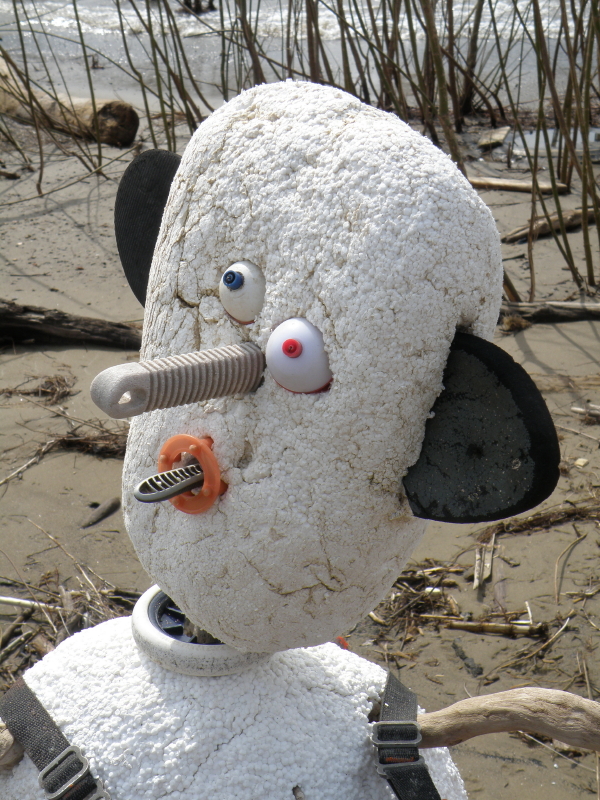
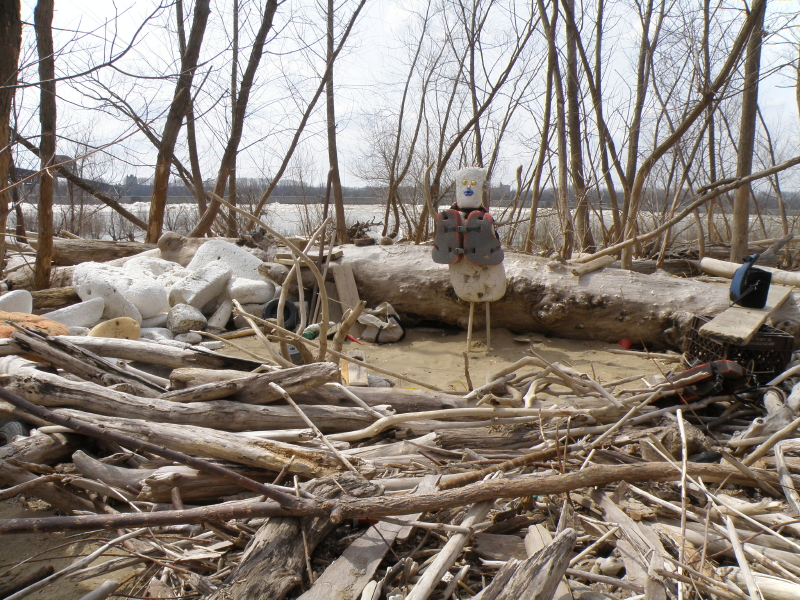
The first figure I make here is from the largest chunks of polystyrene I had found on this excursion.  I used two fishing floats (one larger than the other for expressive effect) for the eyes.  The nose is a plastic piece from a fooseball table.  The mouth is a red reflector.  My figure has ears, arms, and legs that are pieces of driftwood.  The figure has a benevolent feeling to it and I can’t wait to photograph it by the river.  I did run into a young sculptor attending the Kentucky School of Art who was collecting driftwood for her own project.  Her name is Jenn and she approached me asking if I was the person with the show at the Carnegie Center for Art and History?  She and her classmates had seen the exhibition.  Jenn is building an installation at the school and promised to let me know when she completed it.  It will be fun to see art made by someone else from materials collected within the park.
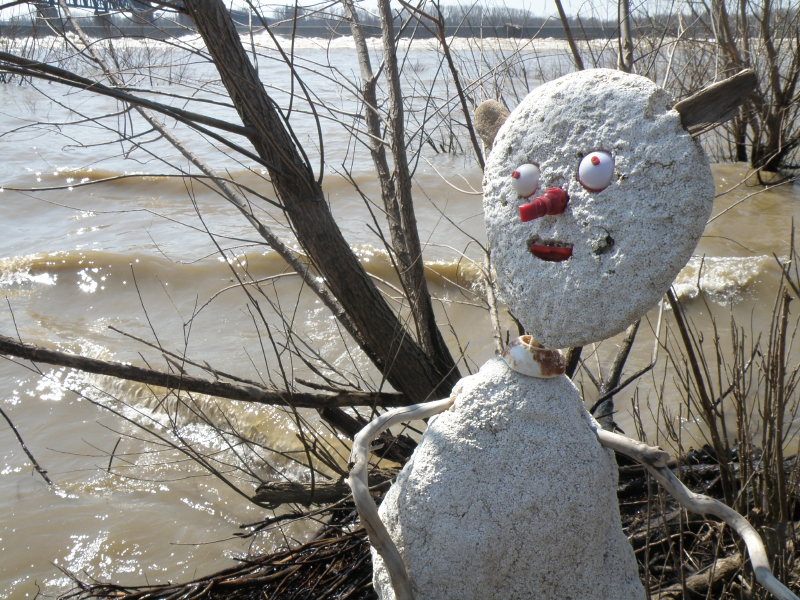
Large Styro-figure on a tiny willow island, March 2014

Styro-figure on tiny willow island, Falls of the Ohio, March 2014

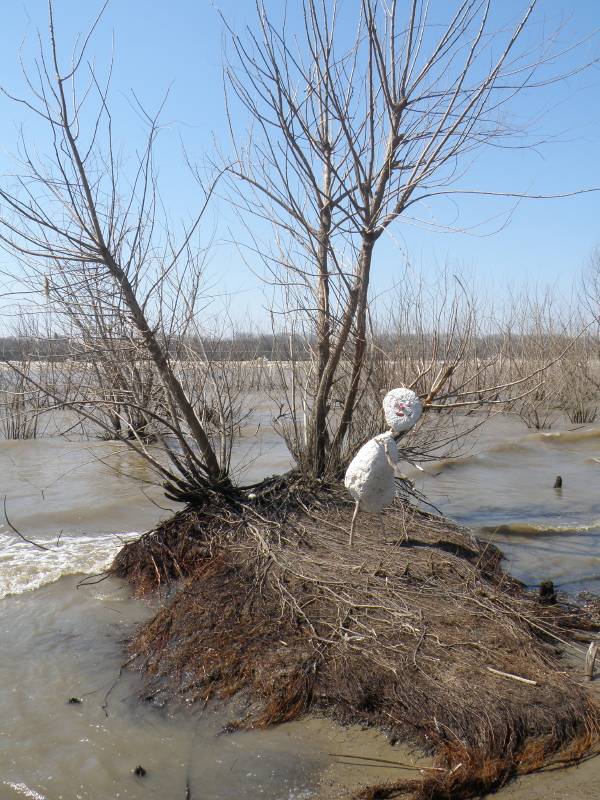
When I first meet the river, I spend a little time looking around and scouting out potential locations to create the photographs that will represent this day in my project.  I decide that I like this tiny “willow island” which consists of clay and sand bound together by the living roots of this tree.  Waves and water wash all around it and at times it does look like an island.  As the river recedes to its normal pool, this tree will be high and dry at last.  It’s amazing what it takes to keep this tree in place with such a dynamic river always testing its resolve to survive.  During the highest river levels, this tree would be completely submerged underwater.  Many of the willows along this stretch of the river bear scars and wounds from large logs battering them, breaking branches, and grinding bark away.  I pose the figure on the root mass and move to the next shot which isn’t too far away.
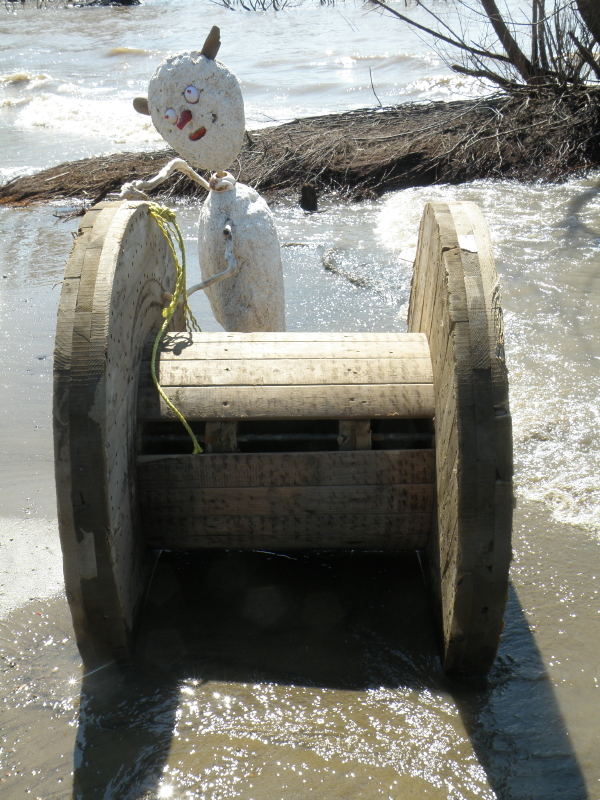
Styro-figure and large, wooden cable spool, March 2014

Styro-figure and wireline spool, Falls of the Ohio, March 2014

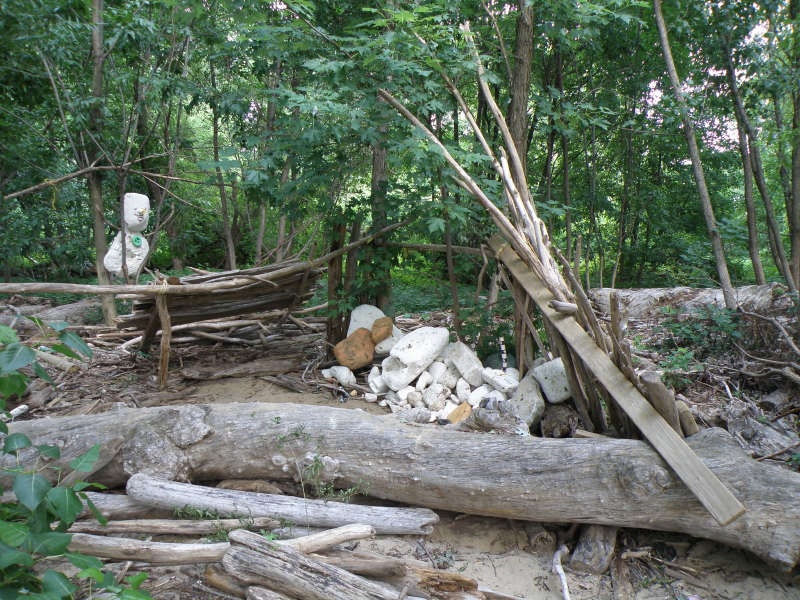
Near tiny willow island is a large wooden “spool” for wire line or cable.  I’m amazed by this object’s heavy-duty construction.  This spool floated into here and is now partially sunk into the sand.  Small waves lap the shoreline and you can also see black coal dust swirling around the water’s edge.  Later when I see my pictures I’m struck by how similar this spool is to the circular platform that now forms part of my latest outdoor studio.  This new area to cache my materials is very visible and hence ultra public, however, if we have heavy spring rains…it’s very possible that all this will be washed away and rearranged again.  I often wonder what might go through people’s minds when they stumble upon my outdoor atelier?  It’s an odd archeological site of Styrofoam boulders, small piles of plastic toys, and a tangle of found roots and driftwood.  All the stuff you need to make an absurd figure!  I left my latest Styro-creation next to the spool.  I will go a head and tell you…I returned a week later and all I could find of him was his body and legs.  There must be headhunters out here?  I searched the area, but found no further trace of my figure.  As with most of my Falls projects, they continue to “exist” as images.  The exhibition that Michael Wimmer and I are participating in at the Carnegie Center of Art and History is entering its last week.  I’m so appreciative of the positive response I’ve received for my work.  The show will end with a tea and cookies closing.  If you are in the area, please stop by.
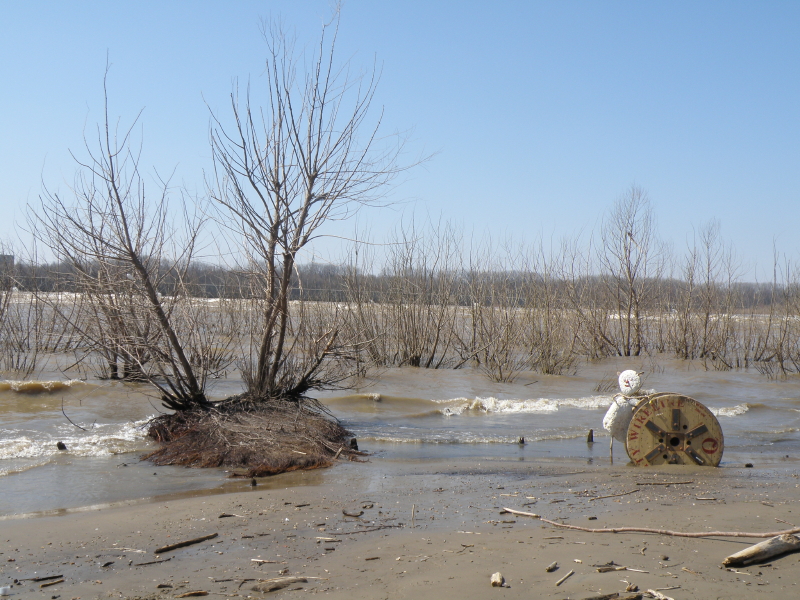
Final shot from the big spool and tiny willow island, March 2014, Falls of the Ohio

Read Full Post »

Stacked wood, Falls of the Ohio State Park, Nov. 2013

Moving past the Woodland Trail Loop, I’m in the western section of the Falls of the Ohio State Park.  It’s been more than a month since I last visited this area.  One of my favorite trees is here and although I’ve already missed the prime leaf color moment…I’m hoping some autumn splendor remains.  Along my walk I come across a driftwood structure that has been stacked teepee-style by other park visitors.  I see this kind of expression regularly and there must be a kinship between this activity and piling and stacking rock upon rock.  It’s satisfying to do and when you step back from your work…it’s obvious you left an impermanent mark in the landscape that says you were there.  The tree I seek is just a short walk away and in no time at all I arrive on the scene.

Cottonwood tree, late autumn, Nov. 2013

Under the Cottonwood tree, Nov. 2013

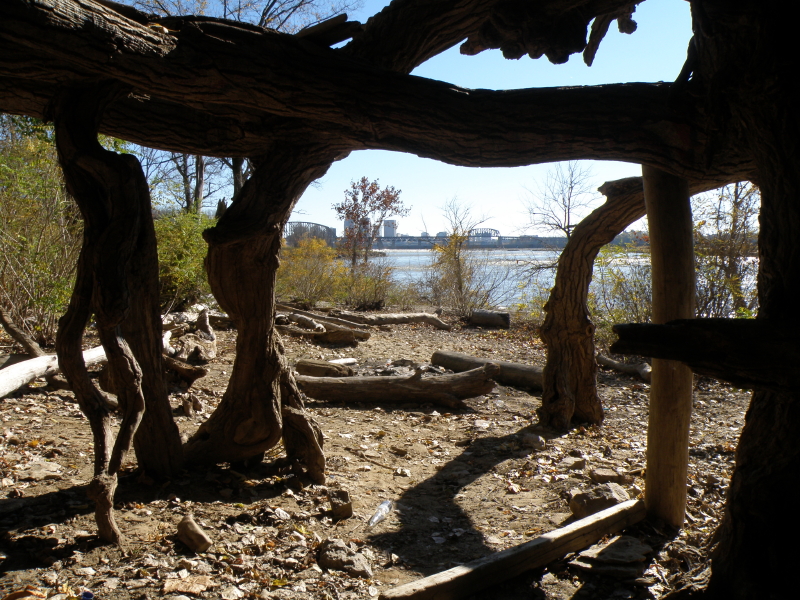
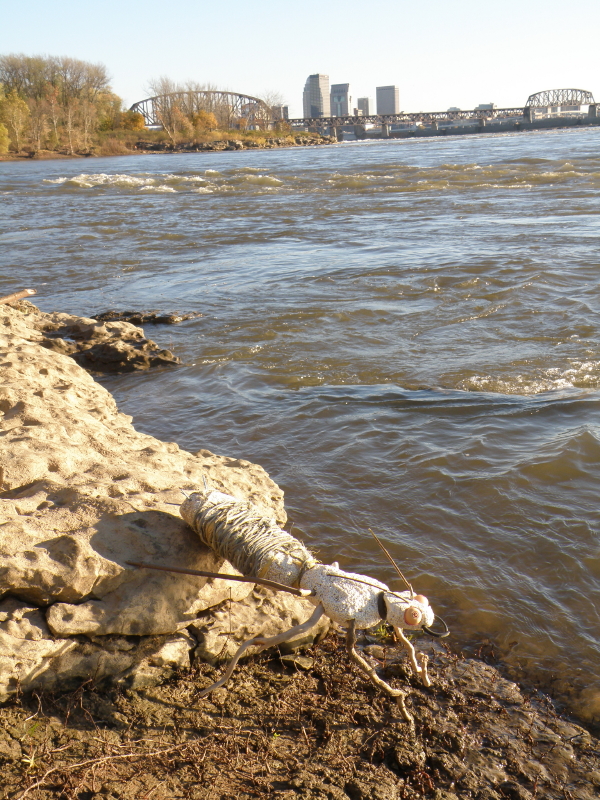
This old Cottonwood tree with its raised roots looms large in my imagination and is my personal favorite tree out here.  I’m sure I’m not the only one who feels this way because there is usually plenty of evidence laying around in the form of empty beer bottles, spent camp fires, and yes…the odd bits of furniture people drag to furnish the room that exists underneath the tree.  I’ll wager for some…this is known as the party tree.  I was elated to see that most of the junk (old tarps and a red couch) have been removed by some other purists.  The Cottonwood tree had already dropped most of its leaves, but there were still a few hanging on.  After resting a moment under the tree and admiring the distant view of Louisville across the Ohio River…I decide to turn for home.  I was in the process of walking away when I noticed something moving along the fossil rocks.  I froze to see if I could get a better look at the creature that was walking towards me.  Naturally, my camera is at the ready!

Golden Hour Ground Beetle, detail of head, Nov. 2013

detail of head from Golden Hour Ground Beetle, Falls of the Ohio, Nov. 2013

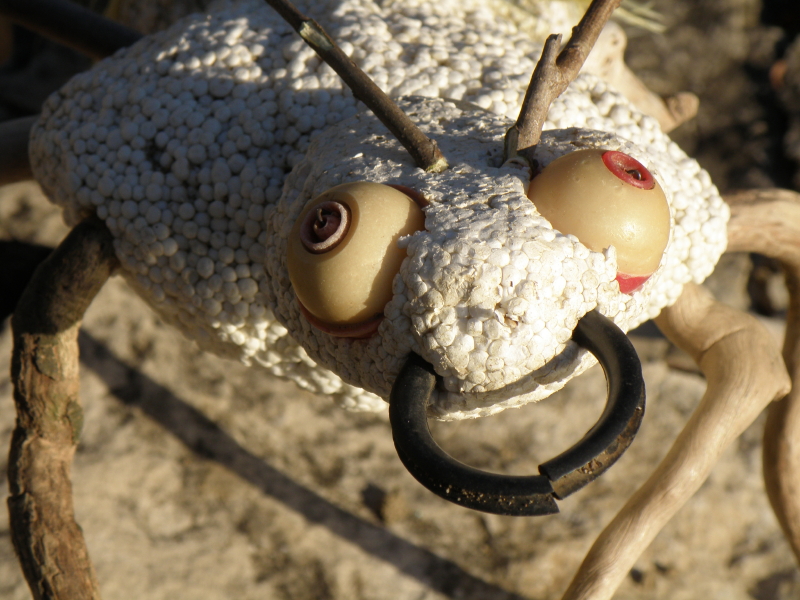
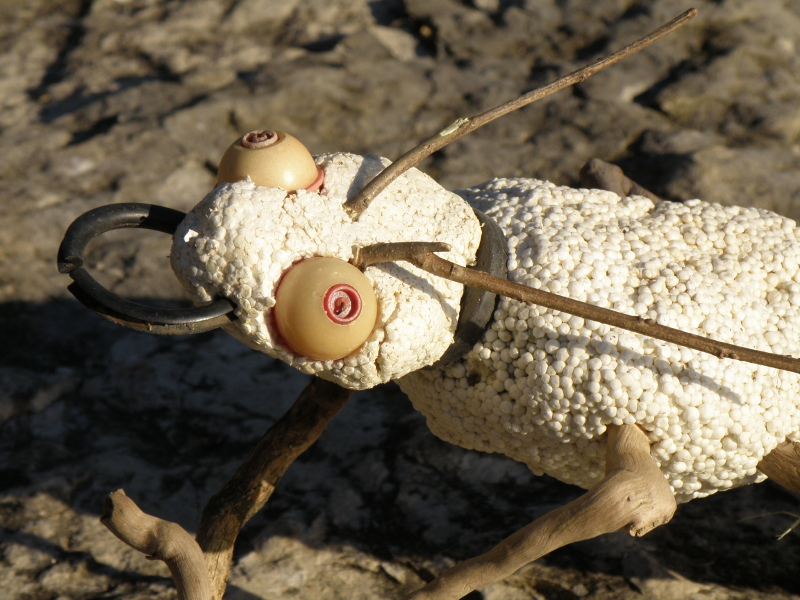
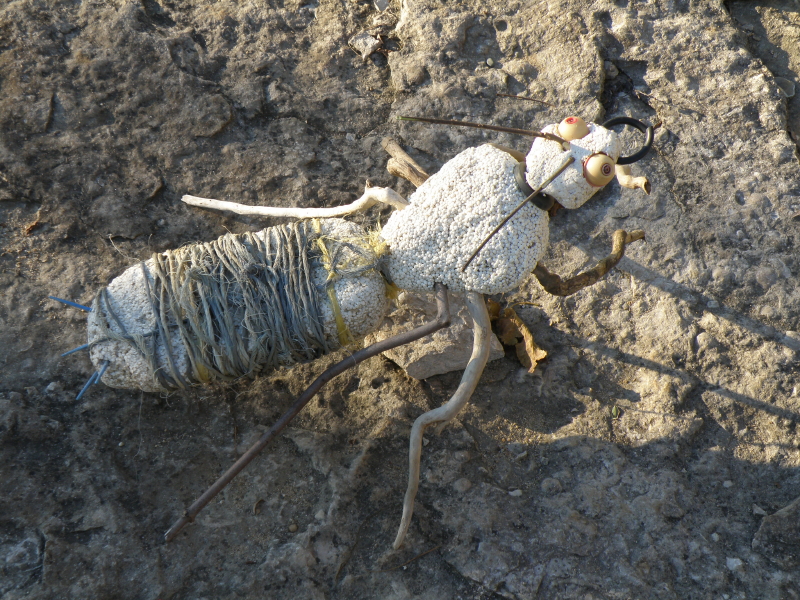
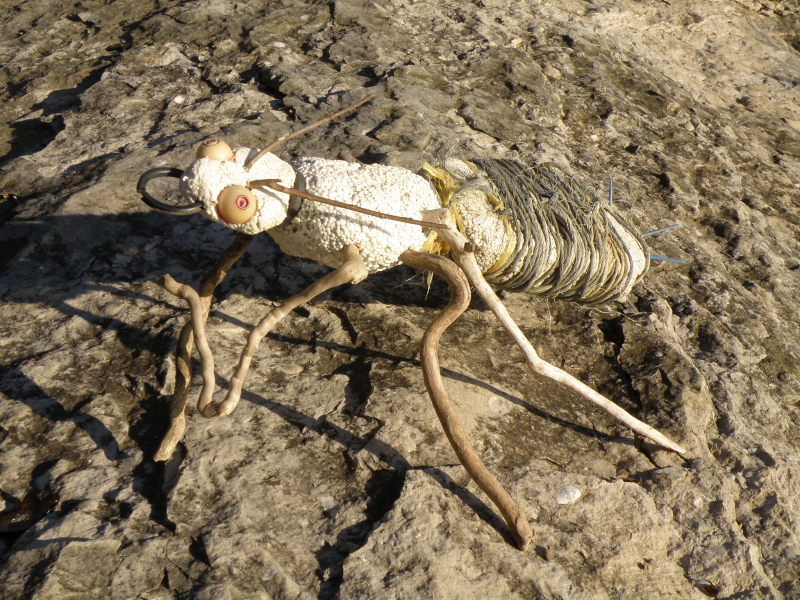
Regular visitors to the Riverblog know that the Falls of the Ohio State Park is home to several out-sized insect species that have uniquely evolved here.  All the different species are critically endangered and not to be harmed in any way.  I was quick to identify this as the Golden Hour Ground Beetle.  It was so named because it usually makes it first appearance of the day when the sun is about to set.  Otherwise, it is nocturnal in its habits.
Golden Hour Ground Beetle, Falls of the Ohio, Nov. 2013

Golden Hour Ground Beetle, Falls of the Ohio, Nov. 2013

The Golden Hour Ground Beetle does not fly.  It relies upon stealth and six strong legs to scramble across any surface.  In form, it is not unlike the much smaller tiger beetles that also make the park their home.  Unlike the smaller beetles, the Golden Hour Ground Beetle is a scavenger and not a hunter.  I suspect this specimen was at the Cottonwood tree because it has learned to find scraps of discarded camping food here.  This beetle has fairly large eyes that can gather the most meager light in the darkest of settings.  It’s abdomen is banded with a coarse hair that insulates this insect during cold nights.  As long as I didn’t make any rash movements, this giant bug was tolerating my presence.
Golden Hour Ground Beetle drinking water?, Nov. 2013

I observed my new “friend” moving to the water’s edge to obtain a drink.  I wondered if it had the ability to swim in its survival tool kit?  I watched the insect as it searched all around the fossil rock shelves that were created by the river dissolving the old limestone away.

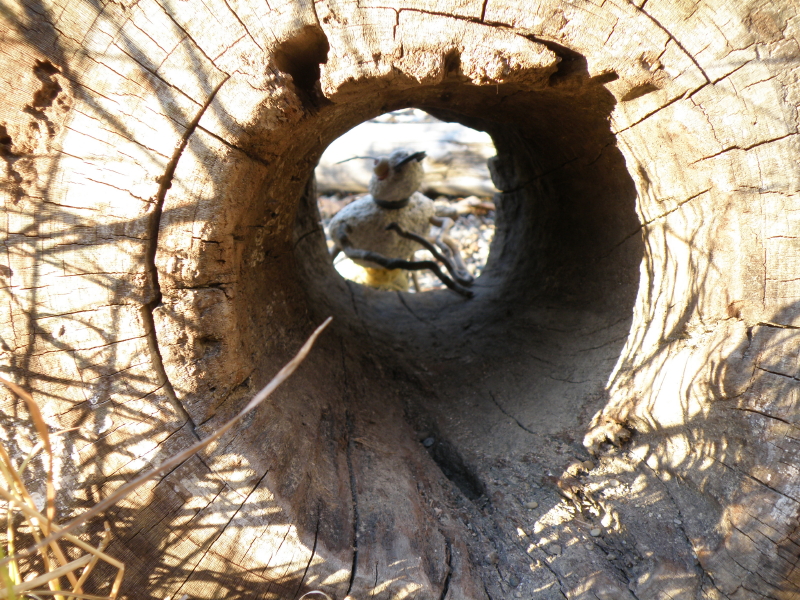
Golden Hour Ground Beetle exploring a hollow log, Nov. 2013

View of the beetle through the hollow log, Nov. 2013

I came across a second giant beetle almost immediately after crossing the small creek that separates the western and eastern sections of the park.  Male and females are virtually identical.  There are gaps in our knowledge about their life cycle.  This specimen was in the process of checking out a short, hollow log.  I’m presuming that it was either seeking food or shelter?  I think poking my camera through the end of the log spooked this one a little.  It ran away, but didn’t go far.  I kept my movements to a minimum and after a while it seemed to relax again.

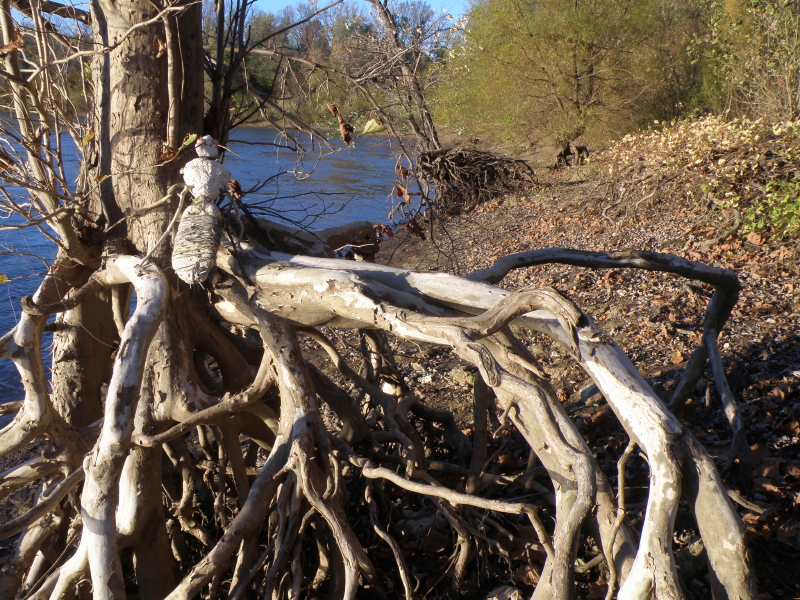
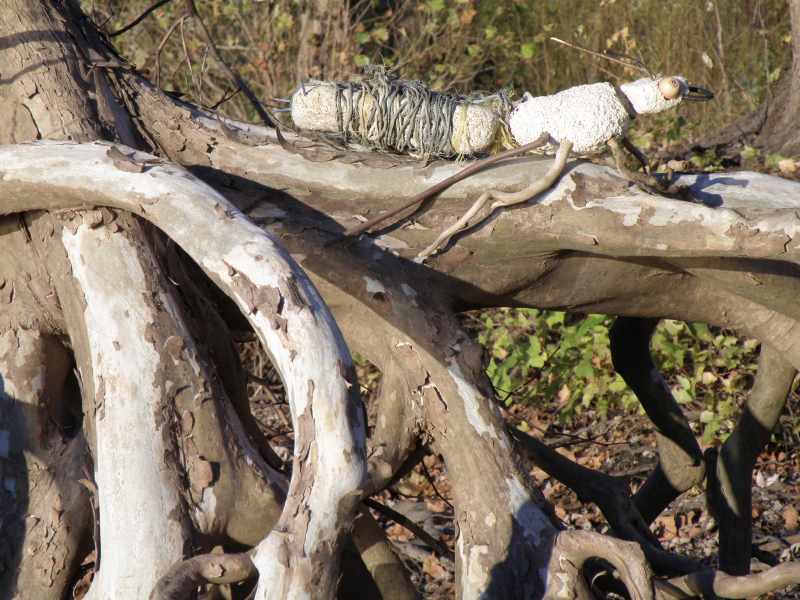
Golden Hour Ground Beetle relaxing on Sycamore tree roots, Nov. 2013

Beetle laying flat on a sycamore root, Nov. 2013

I observed this 14 inch or 35.5 centimeter beetle relaxing on the exposed roots of a Sycamore tree.  As the golden hour approached, the beetle stopped seemingly acknowledging this magic moment when everything is bathed in a warm golden light.  I did the same watching the sun set before finding my vehicle in the parking lot of the Interpretive Center.  To everybody in the wider world…have a great week.

The Golden Hour at the Falls of the Ohio State Park, Nov. 2013

Read Full Post »

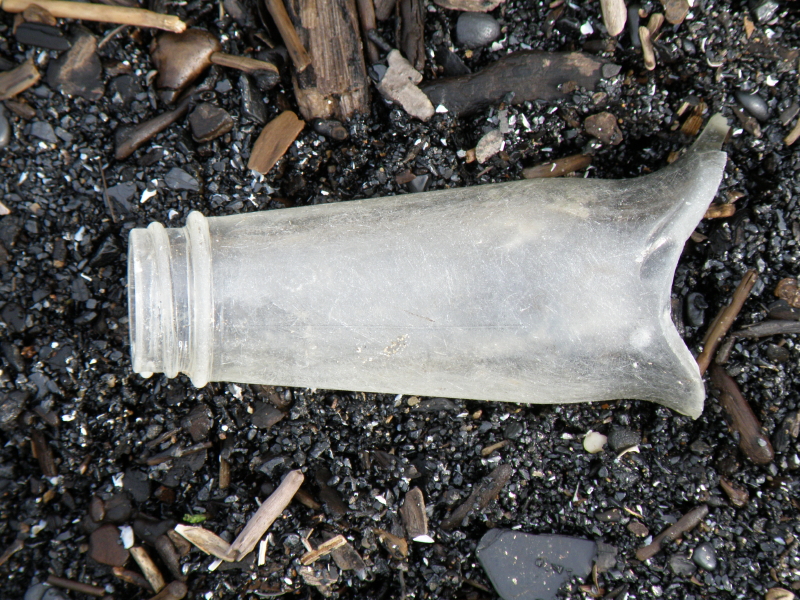
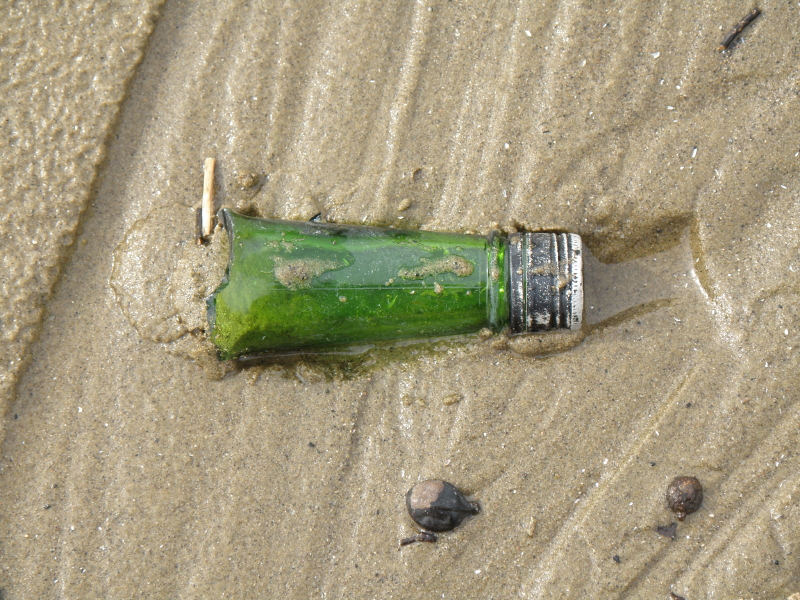
glass bottleneck against coal gravel, 2013

I wish I could remember the exact written passage where the image of a bottleneck captured my imagination.  Back tracking through my books has not revealed the exact source, however, I do remember that the context came from biology and more specifically the history of life.  Of the five great extinction cycles, the one that closed out the Permian period (roughly 245 million years a go) was the most brutal and efficient.  All those trilobites that had been so successful for so long hit the wall.  At this time the super continent Pangaea existed.  Millions of years of continental drift and the resulting global climate change are the leading hypothetical causes for this extinction.  Regardless, the effect was that the majority of life’s diversity as it existed then and which filled up that particular metaphoric bottle…did not make it through the bottleneck.  Fortunately, some life did survive, but it would take subsequent millions of years for life to evolve and radiate out to regain its former glory.

green glass bottleneck with cap against sand and water, 2013

We like to think that we stand atop life as its ultimate achievement.  We frequently miss the bigger picture of which we are small part and are even oblivious to the effects we have on everything else around us.  The bottleneck effect has been adapted by other systems to illustrate that which is a hindrance or impediment to progress.  The basic idea, however, remains the same.  Whatever is in the bottle is going to get squeezed on its way out that is if the contents do in fact make it out.  In my own blog, I don’t mention U.S. politics much, but lately it is in the news and it’s troublesome. Our seeming inability to govern ourselves…to in effect allow small selfish groups to manufacture bottlenecks strikes me as self-defeating and doesn’t bode well for the future.

two glass bottlenecks on sand, 2013

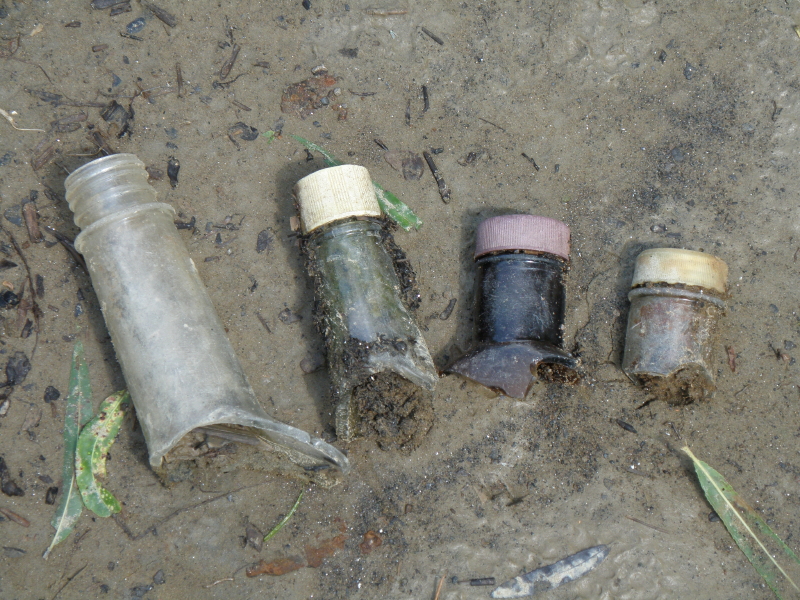
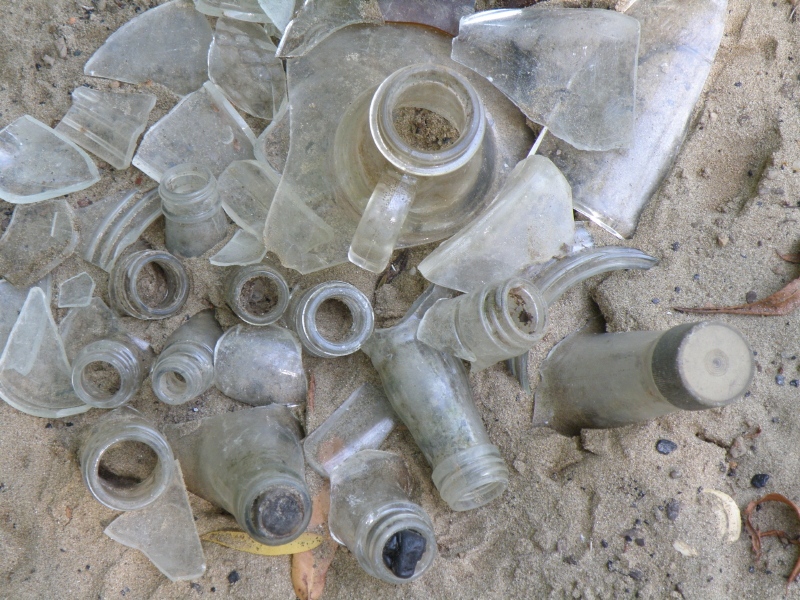
At the Falls of the Ohio State Park, I literally find bottlenecks all the time.  Unlike their plastic counterpoint, the glass ones don’t break down as much.  There must be something about the material strength of glass that is increased when it is forced into a tube that makes it extra resilient.  Over time, their sharp edges do get worn down and their surfaces become frosted through tumbling in the sand.  Personally, I find glass to be a far more attractive material than plastic.  I’ve come to look at our artifacts in much the same way I might regard a fossil as examples of objects that have been touched by and affected by life.

four different glass bottlenecks, 2013

There’s something about the process of “finding” that is compelling if not compulsive for me.  I try to stay watchful for opportunities, particularly if I come across an image or material that I can apply through my art.  The process of collecting, examining, and comparing is also personally meditative and relaxing.  I started photographing bottlenecks years a go with no goal in mind.  Just more documented stuff among all the other stuff along the riverbank that I come across each time I visit the park.  Looking over my photographs, forgotten images of bottlenecks would catch my eye again.

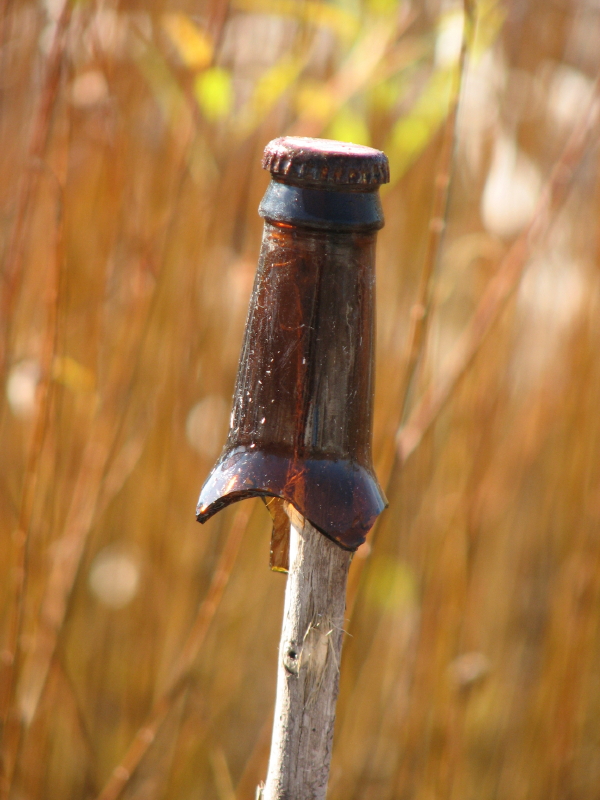
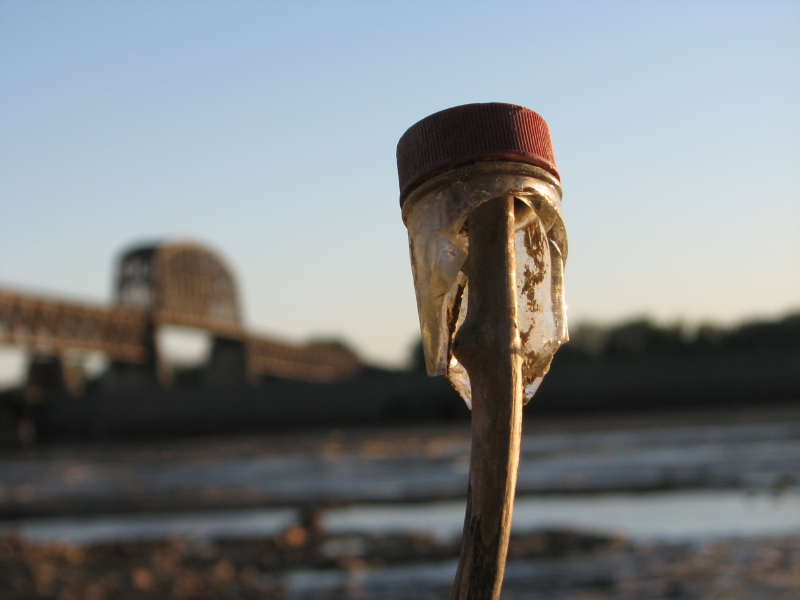
beer bottleneck with cap on stick, 2013

bottleneck with red cap on stick, 2013

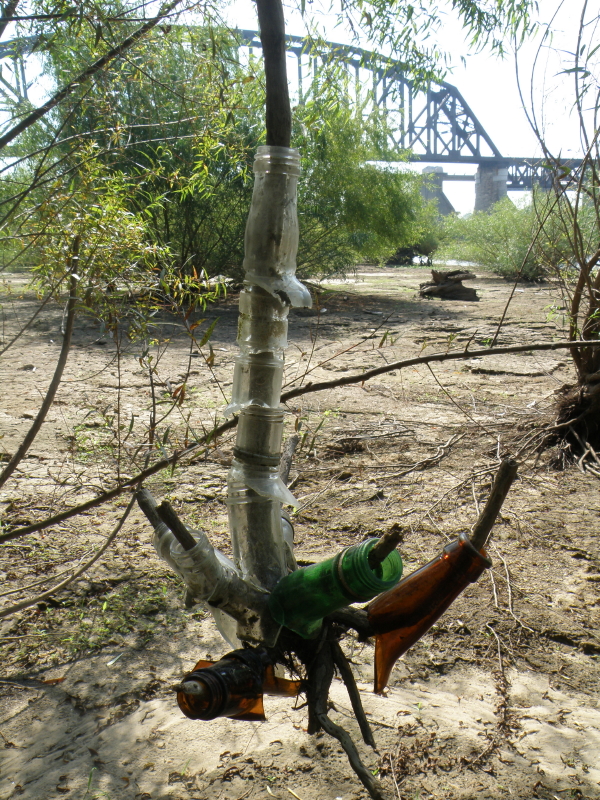
Other than take contextual images, I guess the next thing I did with bottlenecks was to stick them on the ends of branches and sticks.  This allows the light to play through the glass revealing its jewel-like attractiveness.  It might also cause someone else to notice that there is a lot of smashed glass in the park.  Granted, the river floats a lot of bottles in here from upriver, but there is also a lot of drinking that goes on here via the local folks.  Why pack your empties out when you can just throw them on the ground?  One bottleneck on a branch led to more…in fact the whole arc of these now bottleneck projects has trended in the “more” direction.

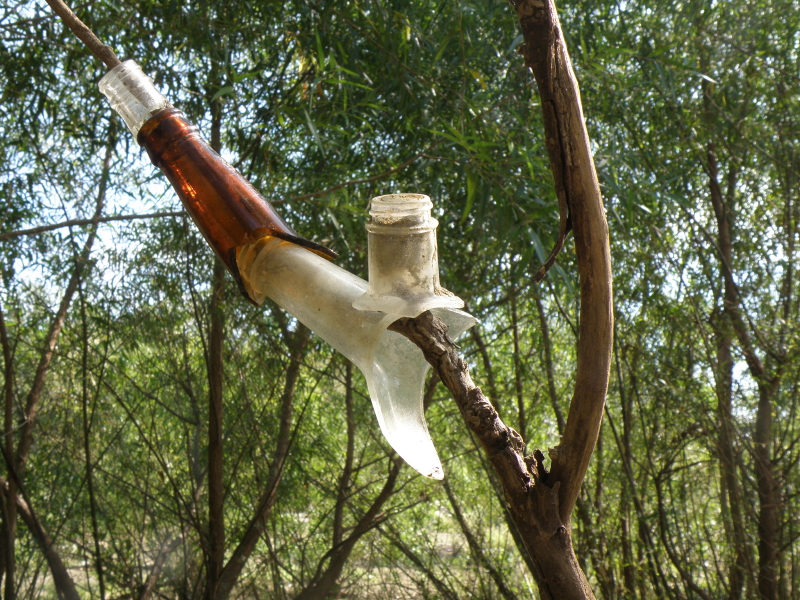
glass bottlenecks on a willow branch, 2013

glass bottlenecks on driftwood tied to a branch, 2013

I guess this last image is a bottleneck candelabra?  I find many of the bottlenecks I’ve used near stands of willow trees by the water’s edge.  I suppose bottles that float in are snagged in the tree’s exposed root system eventually breaking through contact with floating logs and leaving the shards in place?  People also throw bottles against the trees which has the same effect.  Rarely, do I need to walk very far to find enough glass to create a small project and image.

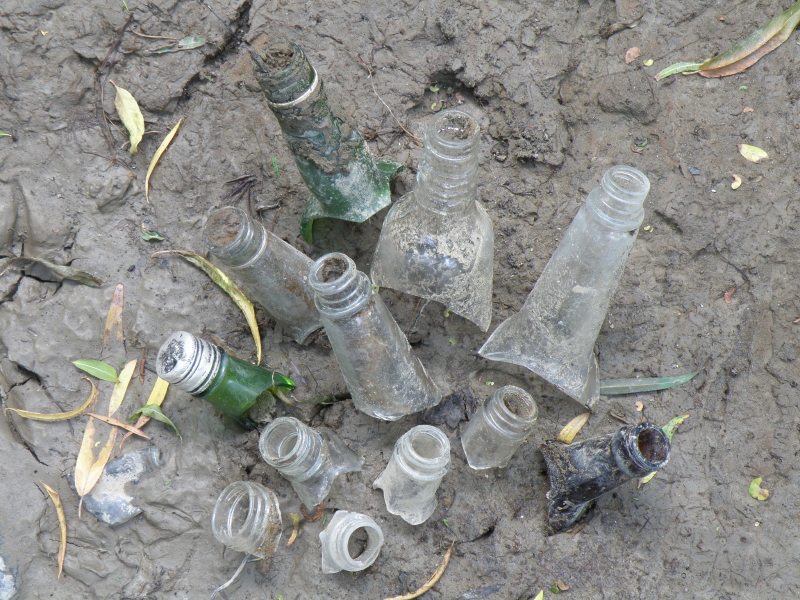
glass bottlenecks stuck in the mud, 2013

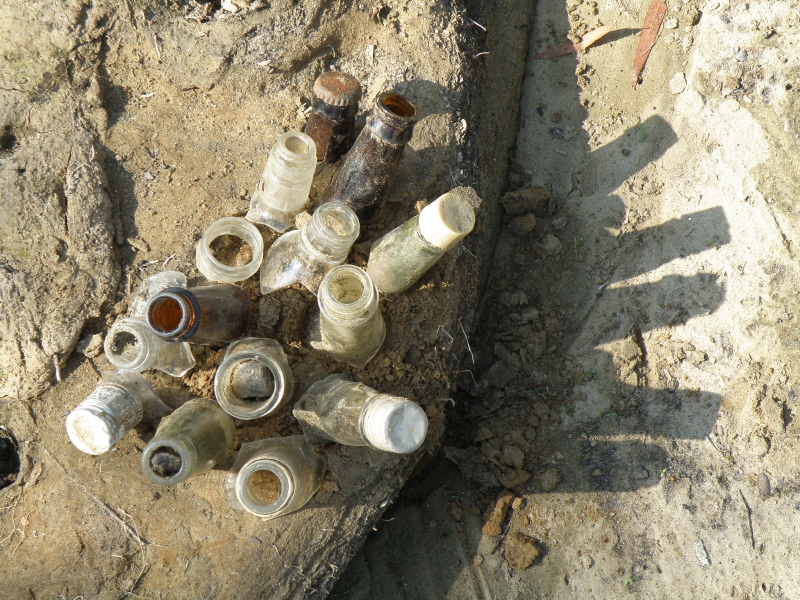
Here’s one project made from bottlenecks collected around one particular willow tree.  I liked the way they looked collectively stuck in the mud and their tubular arrangement reminded me of fossil corals which also references the Falls of the Ohio.  Here’s a few other similar site specific groupings of bottlenecks.

upright glass bottlenecks in dirt with shadows, 2013

glass bottlenecks stuck in the mud at the water's edge, 2013

diverse collection of glass bottlenecks, 2013

detail of arrangement of various glass bottlenecks, 2013

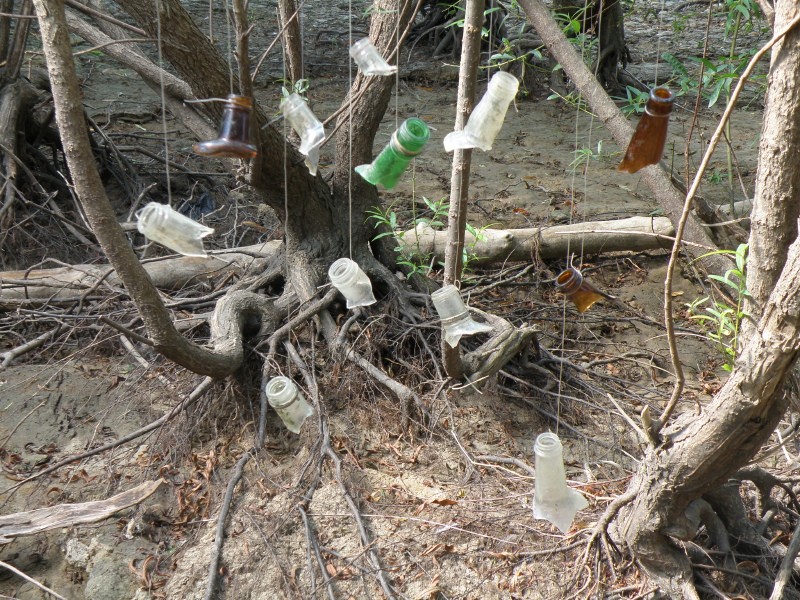
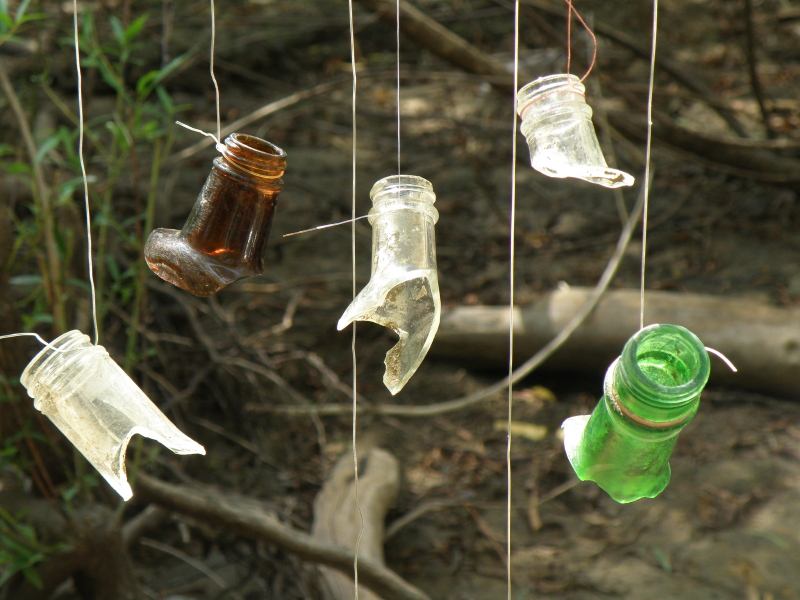
The next couple of images are from my last bottleneck piece.  In addition to lots of waste glass…I also find discarded fishing line, often in the same places.  I brought these two materials together for this ephemeral work.  Recently, I was talking with a good friend of mine and we were remarking about how much of our lives seem mediated by and require reading various kinds of screens.  This last glass project may have something to do with that because the bottlenecks are arranged in a flat, parallel screen hanging from a horizontally growing willow branch.  I wonder if anyone else ever saw this and what they may have thought about it?

various glass bottlenecks suspended on fishing line, 2013

detail, various glass bottlenecks suspended by waste fishing line, 2013

Well there you have it!  I suppose these bottleneck projects will now crop up on occasion like my found coal pieces do as intimate site specific expressions.  For now, it’s enough to present them as images without trying too hard to extract every bit of meaning from them.  Bottlenecks in the broader sense are challenges.  May we always remain open to meeting them.  So long from the Falls of the Ohio.

bottleneck on a stick at sundown, Falls of the Ohio, 2013

Read Full Post »

Orangeman, Falls of the Ohio, Sept. 2013

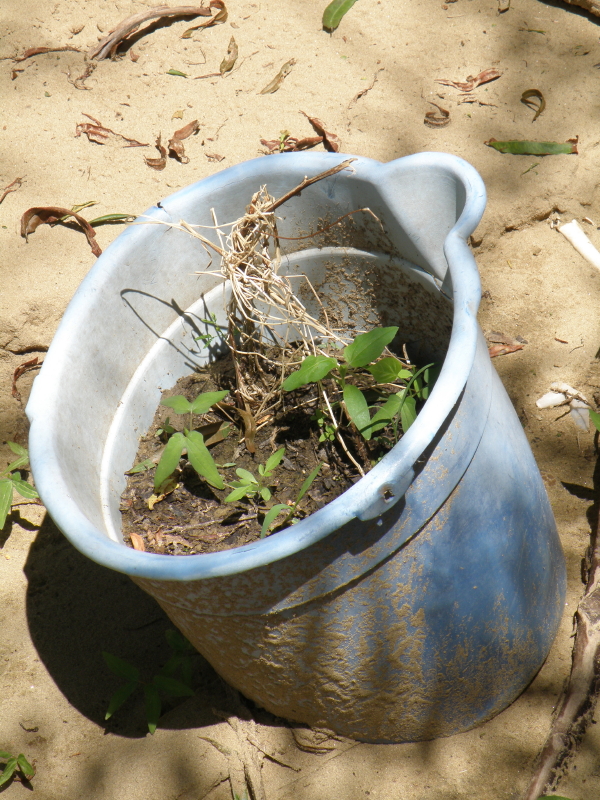
The Orangeman was really excited to see me and asked me breathlessly, “Where have you been lately?”  I filled him in about my busy life and work and then turned the table by asking my friend what all the hubbub was about?  He knows that if I could I would spend most of my time down by the river and probably go completely native and become a river rat in the process.  He also knows that if there is something not to be missed down by the Falls of the Ohio…that I would do my best not to miss it!  The Orangeman explained that he had several things he wanted to show me beginning with a monumental discovery he came across in a discarded plastic five gallon bucket.  This would be Exhibit A.

plants growing in a found bucket, Falls of the Ohio, Sept. 2013

The slightly sun-faded blue bucket or pail was sitting on an angle in the sand…just as the river had left it.  River mud and dirt more than filled the bucket up passed the midway point.  Orangeman walked me over to the bucket and said “Peek inside and tell me what you see.”  I did as he asked and more than a little perplexed I replied…”Well, I see a few small plants and vines growing in the dirt.”  Orangeman groaned…”That part is obvious, however, the deeper meaning lies in how resilient life is and even within the confines of a plastic bucket…life wants to grow and express itself.”  I had to admit that the Orangeman was making an interesting point here.  At home, I keep flowers and plants in flower pots and other containers made for the purpose and get pleasure from seeing them thrive and be beautiful.  What I hadn’t considered was the idea that any container also acts as a barrier.  Life wants to join with life and be a part of the interconnected whole.  The roots of these bucket plants were only going to be able to spread so far.  Still, as the Orangeman explained…”The will to live and grow is strong even if there are limitations present.  There was more to see and the Orangeman walked me over to Exhibit B.

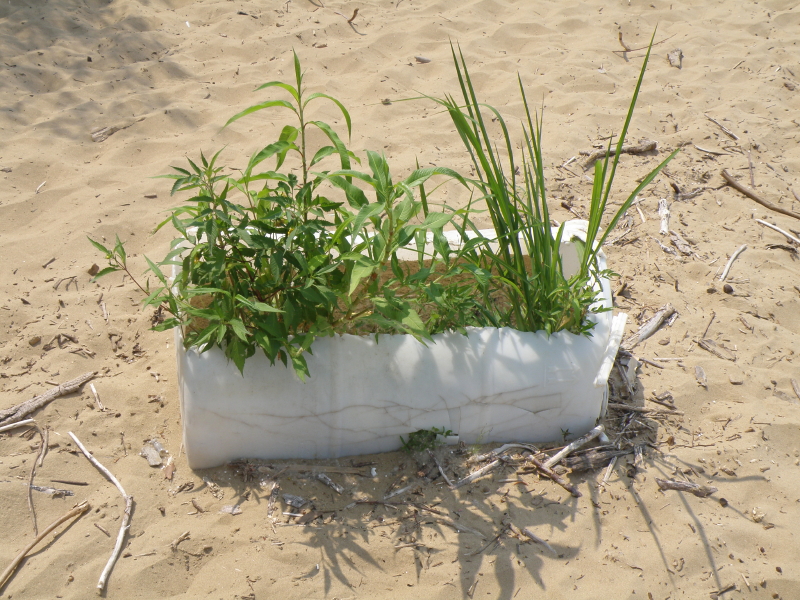
plant life growing in a shattered plastic drum, Falls of the Ohio, Sept. 2013

I must admit that I was impressed by the second example that my friend the Orangeman showed me.  In a shattered plastic drum, various grasses and so-called weeds were sprouting through a large hole in the top of the container.  Years ago, dirt and sand filled the barrel through the actions of river water and wind rendering it too heavy to pick up and move.  Different plant seeds found their way into the barrel and discovering this small niche…set out to colonize and thrive as best they could.  Perhaps these grasses will find enough of what they need to move through their life cycle and produce seed for another generation?  Or perhaps they won’t due to all kinds of other variables, but the point remains that life will take that chance.

Orangeman speaks, Sept. 2013

I hadn’t seen the Orangeman in such a didactic mood before and I was impressed with his earnestness.  Previously, he had struck me as a happy-go-lucky guy and not especially bothered by all the serious stuff in the world.  I certainly was seeing a different side of my friend that I hadn’t seen before.  We walked and talked together and before long reached the last sight he wanted me to see.  We might as well designate this as Exhibit C of the day.

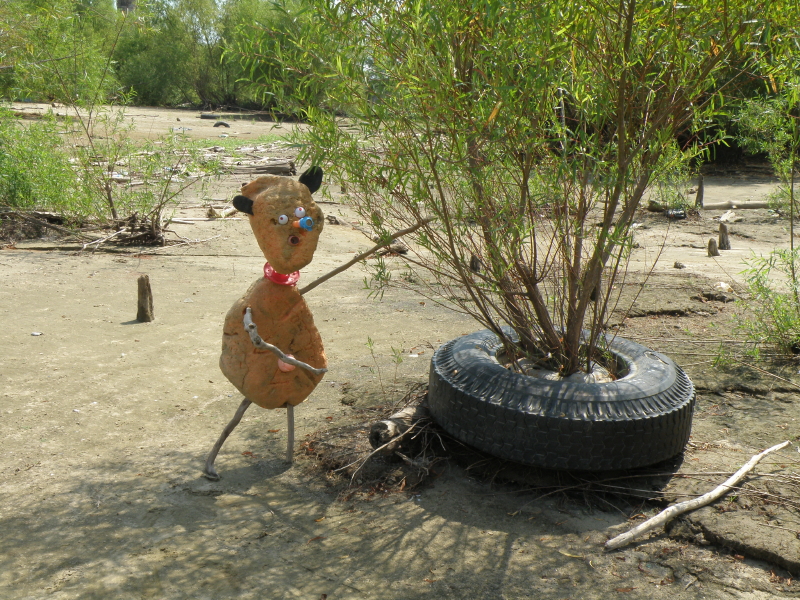
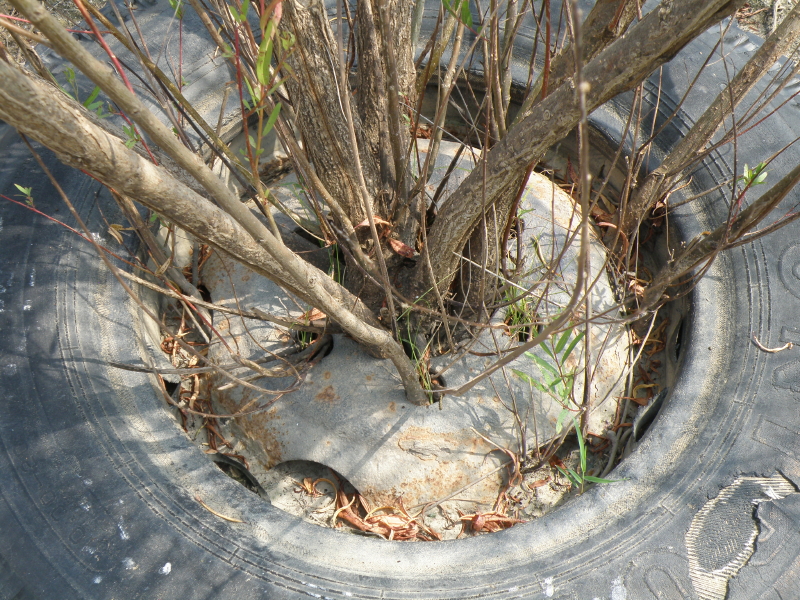
Orangeman and willow/tire tree, late Aug. 2013, Falls of the Ohio

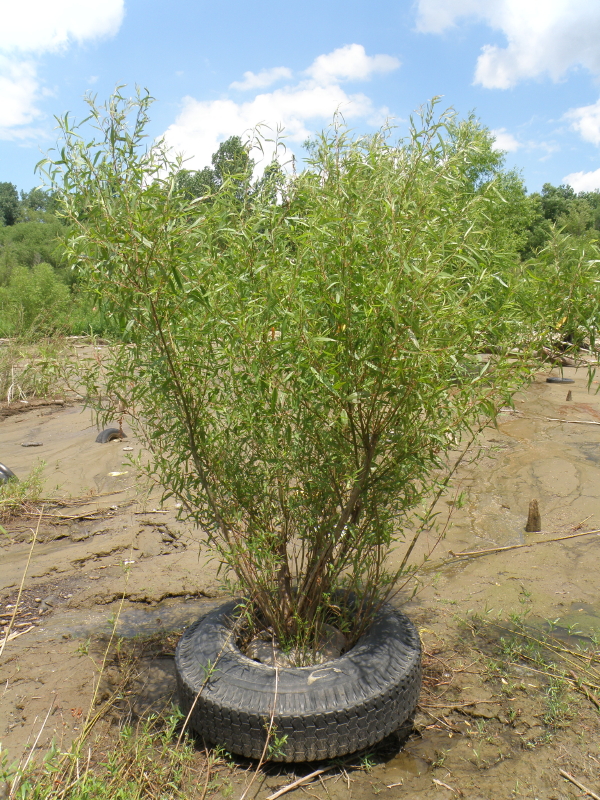
The Orangeman stopped next to an old discarded tire and with a flourish of his arms and hands and said, “Here it is!”  The “it” part was a small willow tree that was growing through the center of the tire.  I didn’t tell my friend this but, I already knew about this particular tree and another one I had discovered very similar to it in the western section of the Falls of the Ohio State Park.  I had even photographed this very tree on several occasions.  This is how it looked in late spring.

willow tree growing through a tire

We had a relatively cool spring and it seemed to my eye that the plants at the Falls got off to a slow start.  The willow-in-the-tire took its time ‘leafing out”, but eventually it did.  Now I must say that a tree growing through the middle of a tire is a remarkable thing, however, there is more to admire about this particular tree.  The Orangeman invited me to make a closer inspection.

willow growing through holes in a metal wheel, Sept. 2013

Amazingly, this willow tree was growing through the holes in the metal wheel that were still in the tire!  The tiny, wispy seeds from a willow tree must have passed through one of the holes and taken root in the mud and soil beneath the tire.  Hungry and thirsty for light, the various branches moved through the holes.  I told the Orangeman that this was indeed an amazing example of life making do in very unpromising circumstances.

willow/tire tree, June 2013

I’m going to monitor this tree with the Orangeman’s help because I’m curious to see if it can continue to thrive and grow.  Will it eventually lift the tire into the air like some perverse hula-hoop as the trunk thickens and becomes more pronounced?  Or, will the holes in the metal prove too restrictive and choke the life out these branches?  Or, will something else out of the blue change the situation?  The river usually gets the last word and flooding could easily send a flotilla of battering logs the willow tree’s way.  The Orangeman and I parted company, but not before I thanked him for his time.  Indeed, he had given me much to mull over.  The idea that life is very resilient and will find a way to endure was comforting to me…especially as the physical world continues to change around us.

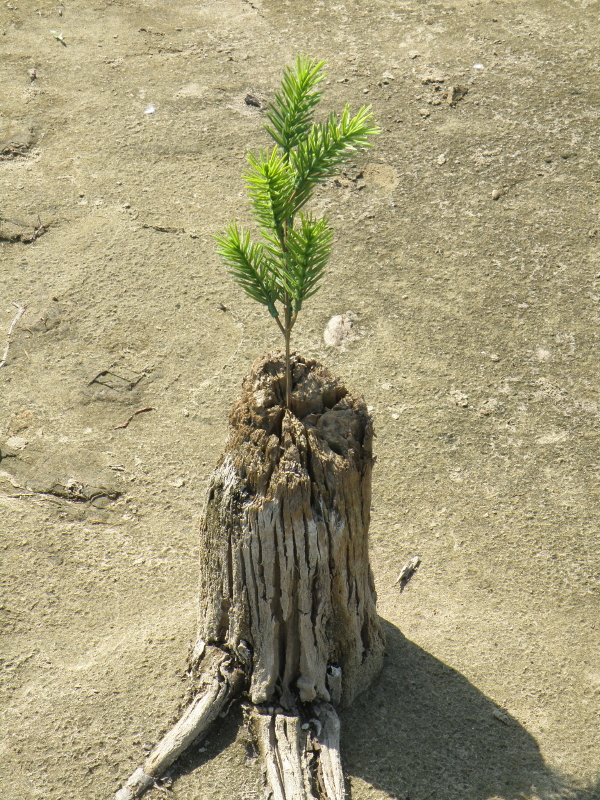
plastic pine growing out of a stump, Sept. 2013

Read Full Post »

soft drink waste, Falls of the Ohio, July 2013

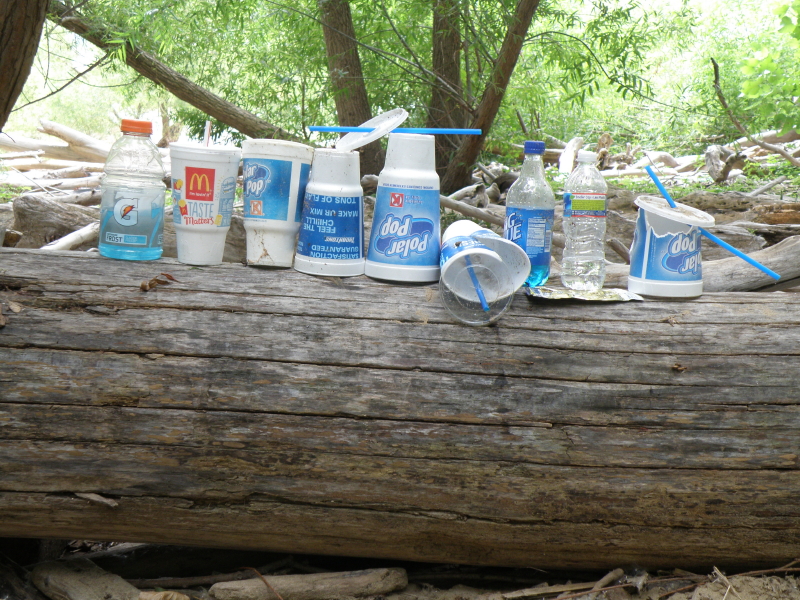
When last we visited the Falls of the Ohio the river was rising.  Several days of intense rainfall throughout the Ohio Valley are now flowing by and coloring the water a muddy ocher. My outdoor site where I make my polystyrene figures and store materials is being usurped by twin forces.  It’s difficult gauging the intentions of this visitor or visitors, however, I also continue finding their waste soft drink cups and bottles.  What’s with the blue drinks?  I guess the color blue is also your symbol for cool refreshment.  If I am to continuing working here, I will need to change the driftwood structure erected over my site.  I was  secretly hoping that the river would solve this dilemma for me.  If the water rose high enough, it would move the largest beached logs which would effect everything near them.  That didn’t happen.  The river fell short of my spot and a visible line demarcating brown wet wood from bleached, silver-gray wood marks the high waterline.

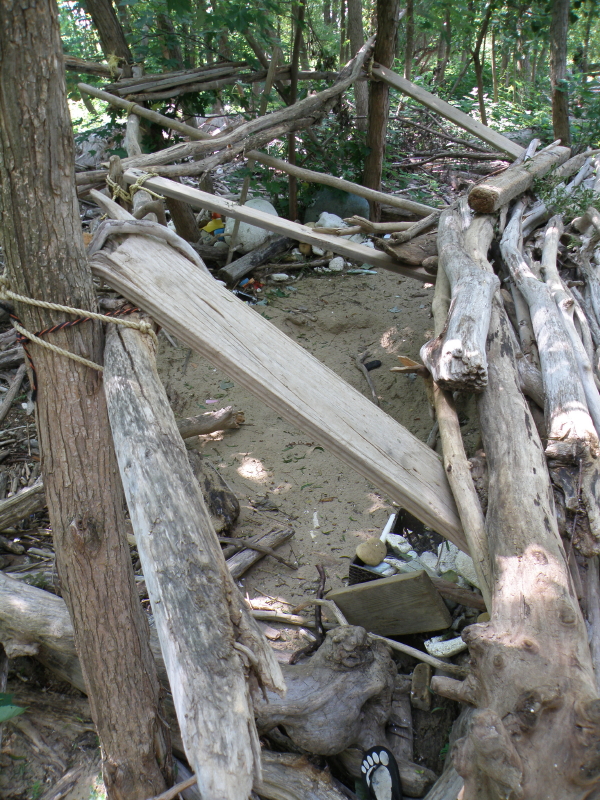
My site with evolving structure, Falls of the Ohio, July 2013

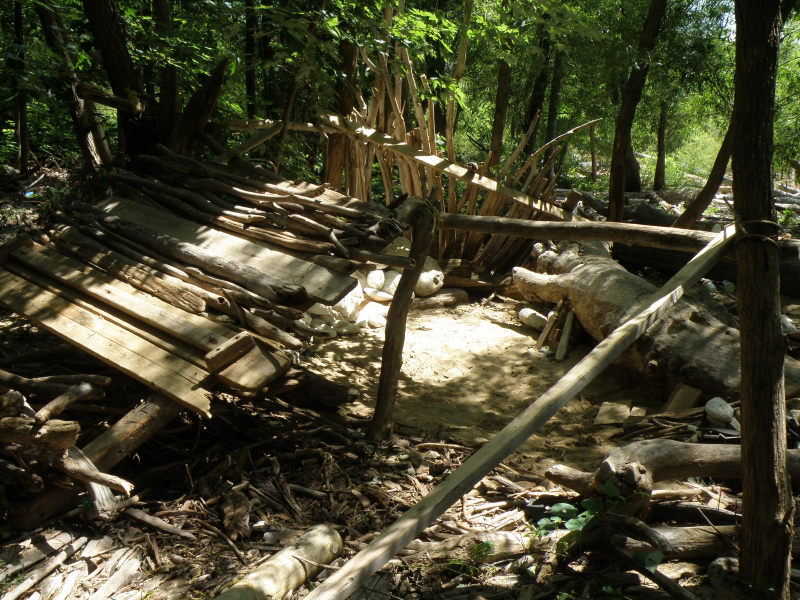
The structure the visitors are building is enclosing the space.  As it is, it’s difficult now to stand on the center sand, especially since a growing pit is developing.  My collected river materials continue to be strewn about.  I initially liked that someone else was seeing the potential of this site and adding their distinctiveness to the mix.  Now I’m seeing less intent here and and I’m going to make the next move and see what happens?  First, I will need to find and repair the large Styro-figure I left here sitting on the roof.  He’s a participant/witness to all the proceeding events.

My mustachioed Styro-friend, Falls of the Ohio, July 2013

Again he looks like he was cast aside.  I find everything except his mouth and replace it with some other river plastic I picked up.  I reattach his arms and legs and he’s as good as new again.  Well almost, the excitement with the visitors and the unpredictable nature of the river have dinged his persona.  He never said much before and he says even less now.  How unfortunate.  I park him in a nearby try to keep him safe.

Figure in a tree, July 2013

I’ve seen this before and call it “Styro-shock” or “polystyrene demensia”.  Imagine willing your body into a stasis where you have no awareness at all and you will begin to know what it means to be Styrofoam.  He might come out of it on his own…who knows?  I turned my attention back to the wooden structure to see what I could do to affect the space in a positive way.  I’m not interested in getting into some escalating contest of wills with someone.  While I figured out what to do…my silent friend continued to sit tight.

Changing the wooden structure, July 2013

I stripped off the wood to expose the frame.  Next, I flipped a few of the cross braces over which opened the center of the space back up.  I created a small doorway by cutting away some excess wood with my saw on my Swiss Army knife.  That has come in handy more than once.

remodeled driftwood structure on site, July 2013

Using the wood already collected, I made a small lean-to for a shelter and a wall of upright sticks to enclose the space on one end and create more visual interest.  The maple tree on site separates one area from another.  There’s plenty more that can be done, but I decide to stop here and see if anything happens while I’m away.  The site now does a better job of corralling any wayward Styrofoam and has further called attention to the studio site as a performance space.  As the day progressed which was sunny and cooler than usual…the sun shone just right to highlight the interior of my studio under the willows and filled it with energy.

remodeled studio with sun shining in. July 2013

It was a long and busy day by the muddy river.  I have lots of other interesting pictures to show you, but they are worthy of separate posts which will happen soon.  For now, I’ll end with a backward glance of my studio under the willows as I walked towards home.

View departing the willow studio, July 2013

Read Full Post »

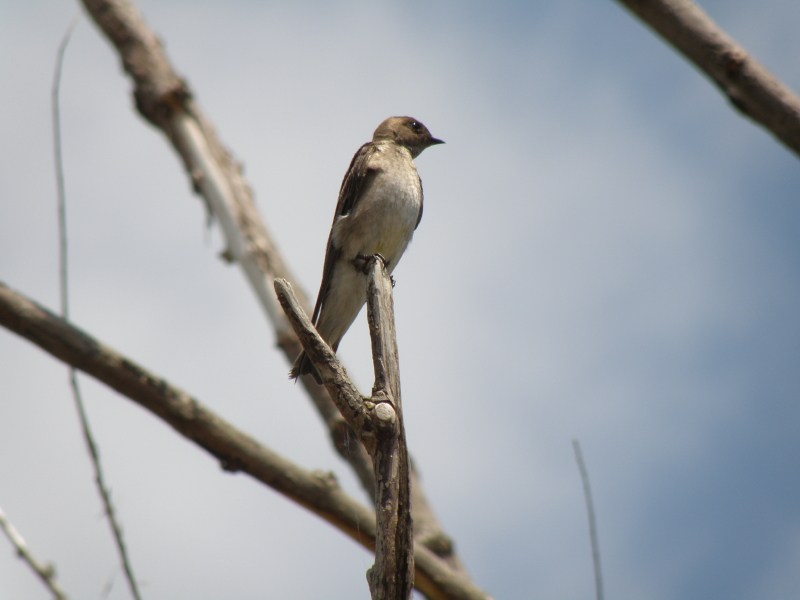
Northern Rough-winged Swallow, Falls of the Ohio, 2013

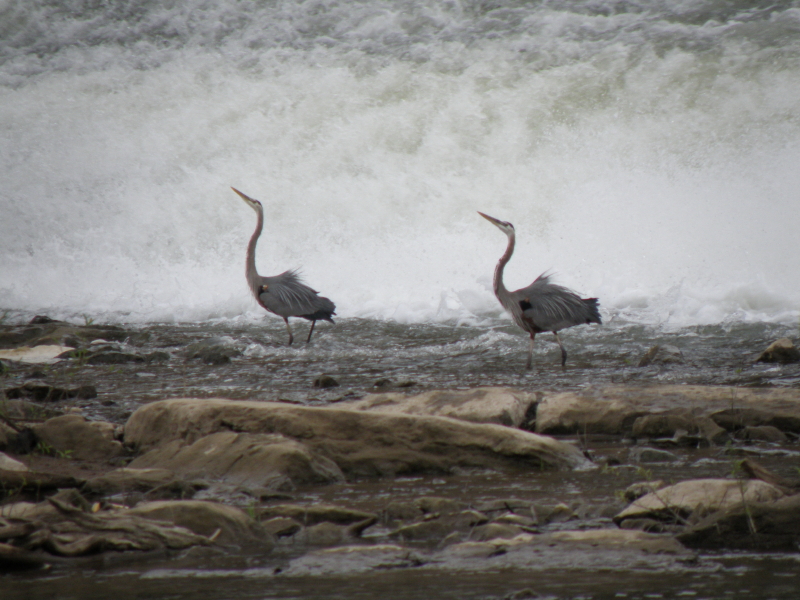
I’ve had some interesting birding encounters of late at the Falls of the Ohio and so I thought now is an opportune time to post them.  I took this image of the Northern Rough-winged Swallow recently.  To my eye, this species seems to be on the increase as is its cousin, the more familiar Barn Swallow.  This is especially good since they eat big quantities of flying insects.  Herons (especially Great Blue Herons and Black-crowned Night-Herons) are abundant and since the fishing has been good of late…I’ve seen plenty of both species.  Here are two more recent images.  The first is of a pair of Great Blue Herons that were taking advantage of the recent Skipjack Herring run.

Great Blue Heron pair, June 2013

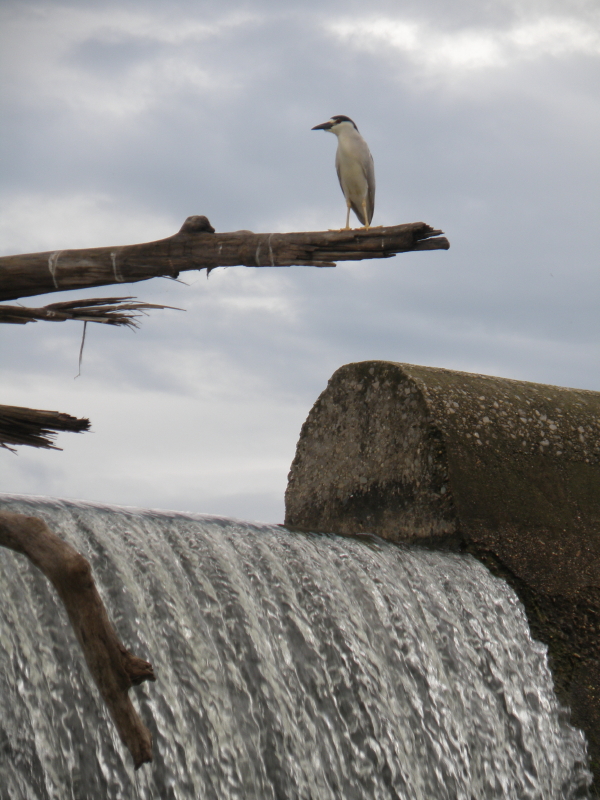
The most common heron here is the Black-crowned Night-Heron.  They are considerably smaller than the Great Blues and have striking red eyes.  You can find them wading in the shallower waters looking for fish, crayfish, or small frogs.  This image was taken in the eastern section of the park and this bird was perched on a log stranded on top of the dam’s wall.

Black-crowned Night Heron at the Falls of the Ohio, June 2013

I’ve saved the two most interesting avian encounters for last.  A couple of weeks a go, I was sitting at my outdoor studio under the willow trees when I heard the sound of a young bird pleading for food.  Looking around, I was able to find the hungry bird and I snapped this picture of it.

young Brown-headed Cowbird, June 2013

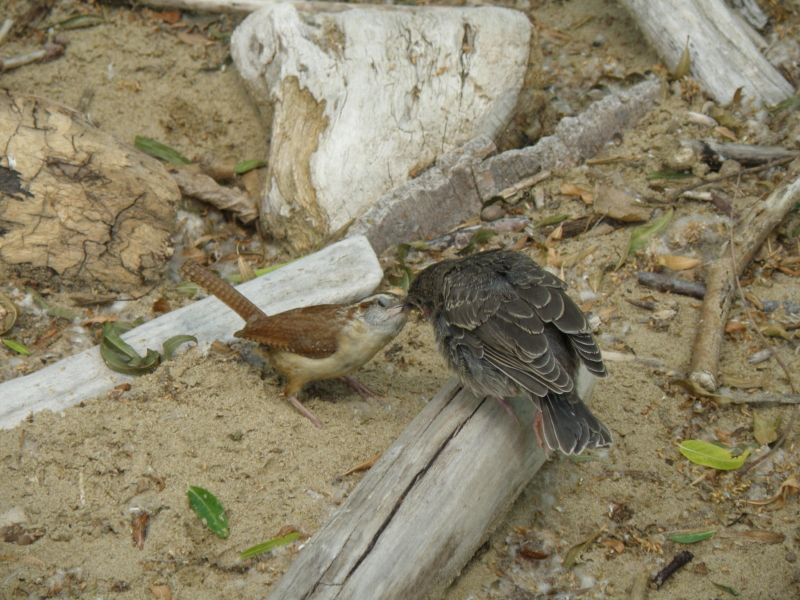
I recognize that this is the young of the Brown-headed Cowbird.  What is fascinating about this species (and the two other species of cowbirds in North America) is that the adults do not raise their own young.  Cowbirds parasitize the nests of other bird species.  In the case of the Brown-headed Cowbird they have been known to lay their eggs in the nests of about 200 different species of birds.  Usually, the young Brown-headed Cowbird out competes the host specie’s nestlings.  I was curious to see who this bird’s “parents” were and it didn’t take long to find out.

Brown-headed Cowbird chick and Carolina Wren, Falls of the Ohio, June 2013

In the case of this cowbird chick it is being raised by a hardworking pair of Carolina Wrens.  The baby is nearly double the wren’s size and vibrates its wings along with calling out to stimulate the wrens to feed it.  Here are a couple more pictures of the wren feeding the cowbird.

Carolina Wren feeding a Brown-headed Cowbird chick, Falls of the Ohio, June 2013

Carolina Wren and Brown-headed Cowbird chick, June 2013

In case you were wondering, cowbirds are not the only species to lay their eggs in other bird’s nests.  In Europe, the cuckoo also does this, but parasitizes fewer species.  I often wonder how does the cowbird know it’s a cowbird especially if it is raised by a completely different species?  Obviously, some behaviors are “hard-wired” and innate .  In the early Spring, Brown-headed Cowbirds are early arrivals and always on the look out for other breeding species of birds and their nest sites.  Their courtship is not a thing of beauty with each drab Brown-headed Cowbird female usually being pursued by multiple males.  Moving on, here is a recent picture of an adult male and you can see why they are called Brown-headed Cowbirds.

male Brown-headed Cowbird, Falls of the Ohio, June 2013

Recently, I was in the far western section of the Falls of the Ohio State Park where I saw my very first Indiana Rail.  Rails are much smaller relatives of the heron family and other wading shorebirds.  The Indiana Rail is a little smaller than a chicken and rarely seen since it favors dense underbrush and is usually more active at night.

Indian Rail at the Falls of the Ohio, June 2013

I was taking a break sitting on the fossil rocks when this bird with a long, bright red bill appeared from among the ever-growing vines.  I held still and was able to record this species with a small series of photographic images.  This bird seemed very interested in the holes situated among the rocks.

Indiana Rail, Falls of the Ohio, June 2013

Indiana Rail, Falls of the Ohio, June 2013

Unlike the cowbirds…both the Indiana Rail male and female participate in raising their own young.  Typically, four or five green mottled eggs are deposited in a loose bowl constructed of decaying river vegetation.  It is believed that the heat generated from this decomposing matter helps to incubate the eggs , but this is still speculative.  There is a lot left to learn about this enigmatic creature.

Head of the Indiana Rail, June 2013

Indiana Rail, Falls of the Ohio, June 2013

I watched the rail for about twenty minutes as it poked around the vines that were beginning to cover the fossil rocks.  Every now and then it would use its strong-looking bill to probe the cracks around the drying mud.  Just as mysteriously as it appeared…it disappeared leaving me with this wonderful memory and a hand full of pictures to prove it was here.  See you later!

Indiana Rail, Falls of the Ohio, June 2013

Read Full Post »

Fog at the Falls of the Ohio, April 2013

Fog is actually common on the Ohio River, but looking through my images, I’m surprised by how few fog pictures I have taken here.  On my last foray to the Falls, the day began extremely foggy like moving within a cloud.  Visibility was limited.  The railroad bridge was completely obscured, but as the sun rose and the temperature became warmer the fog dissipated quickly.  It was another magical moment of transformation as the receding water-cloud revealed the driftwood bones of the park.

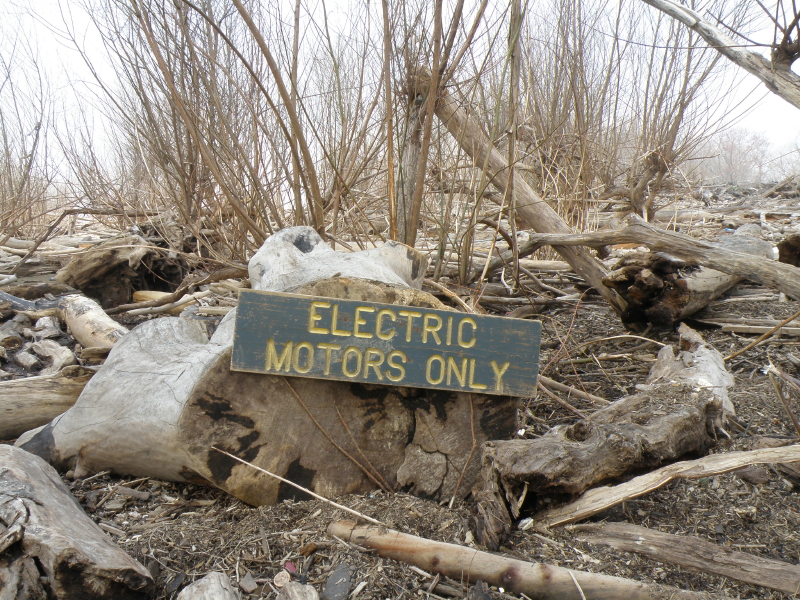
Electric Motors Only sign at the Falls, April 2013

Walking to my outdoor atelier, I passed by this unusual sight.  At first, I thought the large tree stump was a part of this sign, but upon inspection, saw that a single rusty nail attached this sign to the wood.  There is no way this sign could survive the river secured so loosely.  Someone before me found this sign and stuck it on the stump up for grabs in true river junk fashion.  Since I collect signs from the river…this was perfect and I welcomed the new addition to my collection!  After removing the sign from the stump I understood why its original discoverer left it behind.  The sign was on a heavy, thick board that had been routed and painted green with yellow letters.  I stashed the sign under some debris and picked it back up on my way home.  As you can imagine, my wife was thrilled to see it like she is with all the other junk I haul out of here.  I liked the sign’s message which is ecological in its own way.  I wonder where it came from and what kind of electric motors is it referring to…perhaps electric golf carts?  Navigating through the dense driftwood, I made my way to the river’s edge.  Waves were lapping the shoreline and there were other surprises to come.

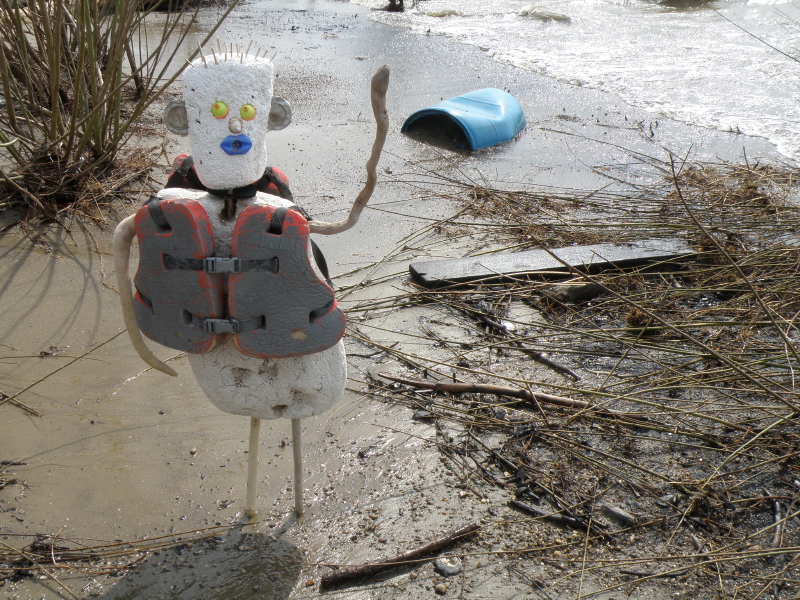
Blue-lipped figure with life preserver on, April 2013

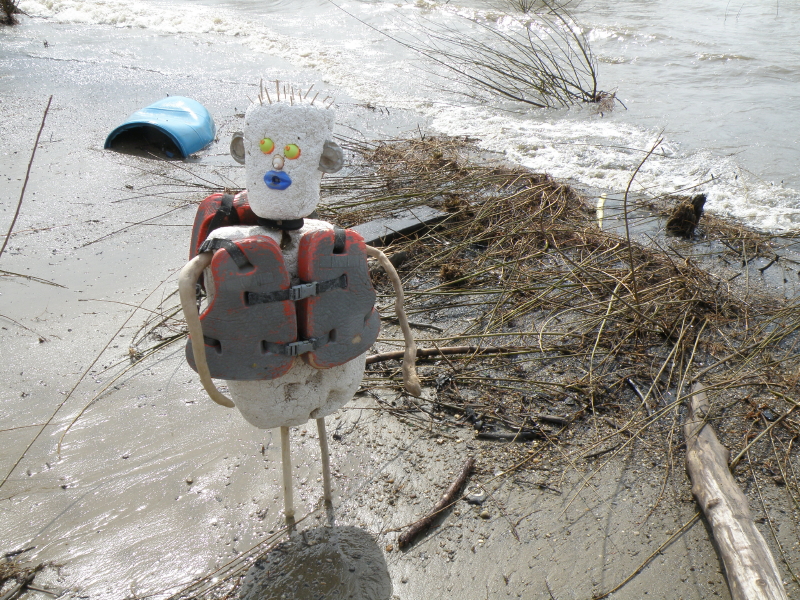
Blue-lipped figure with flotation device, April 2013

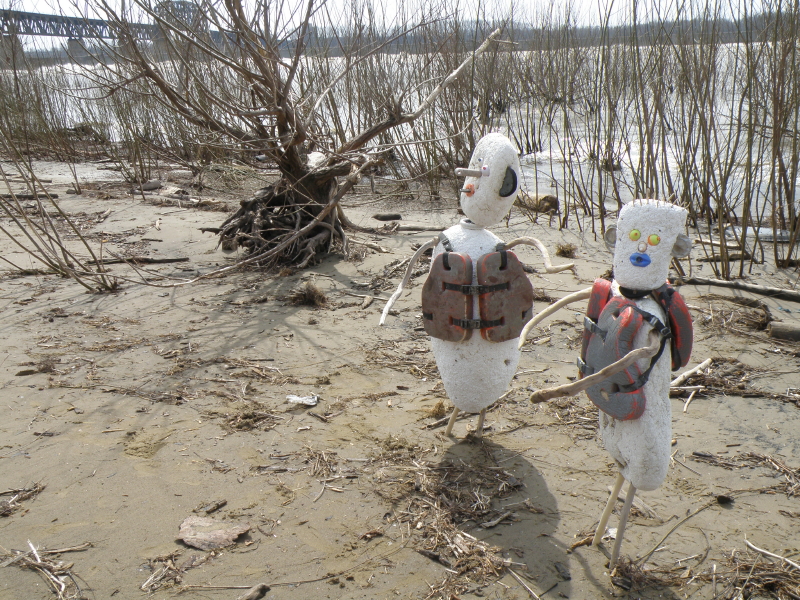
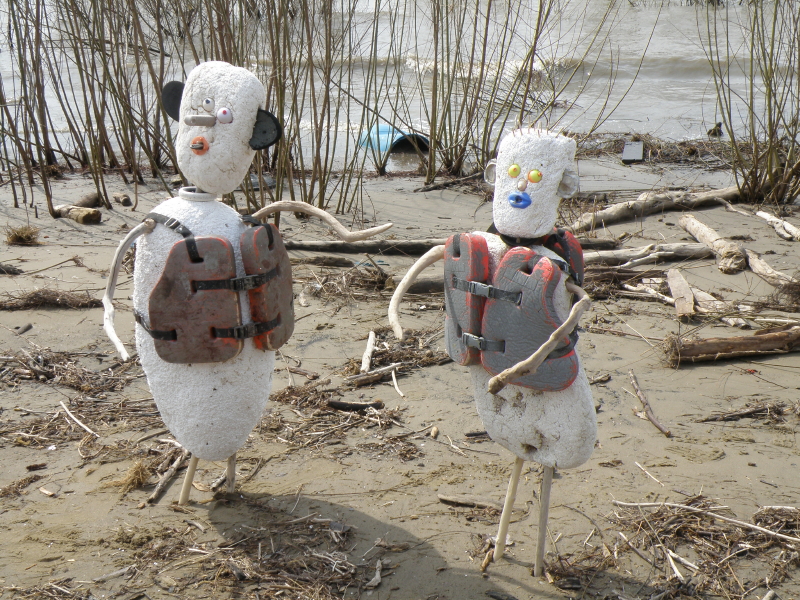
This is the moment I met the first of the Flood Brothers.  I had heard of them before and I was pleased to finally get to meet one.  They are called the Flood Brothers because in their own “Chicken Little” way instead of the sky falling…they are rumored to believe the world is in imminent danger of being inundated.  For this reason they wear life jackets and flotation devices everywhere they venture particularly along the river.  They are living legends in this part of the world.

Portrait of F.B. 1, April 2013

This is a close-up portrait of Flood Brother #1…henceforth identified as F.B.1.  He has blue lips like he has been out in the cold too long.  His eyes have this jaundiced quality to them and they are slightly asymmetrical as well.  The ears stick out some and he has spiked hair.  Aside from looking goofy…he is a friendly enough guy and hailed me upon sighting me.  I told him it was a pleasure to meet him and was his brother around too?  As it turns out…Flood Brother #2 was not far away and after walking a short distance along the shoreline, we ran into him as well.

Flood Brother # 2, April 2013

Portrait of Flood Brother #2, April 2013

Flood Brother #2 or F.B.2 is the larger and older of the two.  Like his smaller brother he wears a flotation device every where he travels along the river.  You can tell they are brothers because they share some physical characteristics such as large ears and mismatched eyes which are more pronounced in the older brother.  As it turns out, he is also the more nervous of the pair.

The Flood Brothers at the Falls of the Ohio, April 2013

The Flood Brothers, April 2013

I asked them if it was true that they believe the world would be destroyed in a great cataclysmic flood?  For argument’s sake F.B.2 qualified things by saying that more unusual events had happened during the Earth’s long history.  As it turned out, they were more concerned about the quality and quantity of fresh water.  Climate change is rewriting things and there is just so much more “free” water in the system that formerly was locked up as ice.  That energy is changing the weather patterns and redistributing water across the globe.  Some places were now getting too much and other places not enough.  And yes the potential to redraw the world’s coastlines also existed.  Whether all this would happen overnight or over the course of many years seemed irrelevant to the pair.  The life jackets were just a necessary precaution to them because they were conducting their research along the river in all its many moods and it just seemed a logical safety thing to do.  The pair was visiting the Falls of the Ohio and inspecting the park for water-born plastic of which there was plenty to see. As the brothers told me…this plastic has a very good chance of making it into the oceans where it has effects of its own.  I didn’t have the heart to tell them that they were already preaching to the converted.  Instead, I invited them to my studio under the willow trees to rest and talk further and they accepted my invitation.  My site was just a short distance away.

The Flood Brothers at my outdoor studio, April 2013

The Flood Brothers at my outdoor studio, April 2013

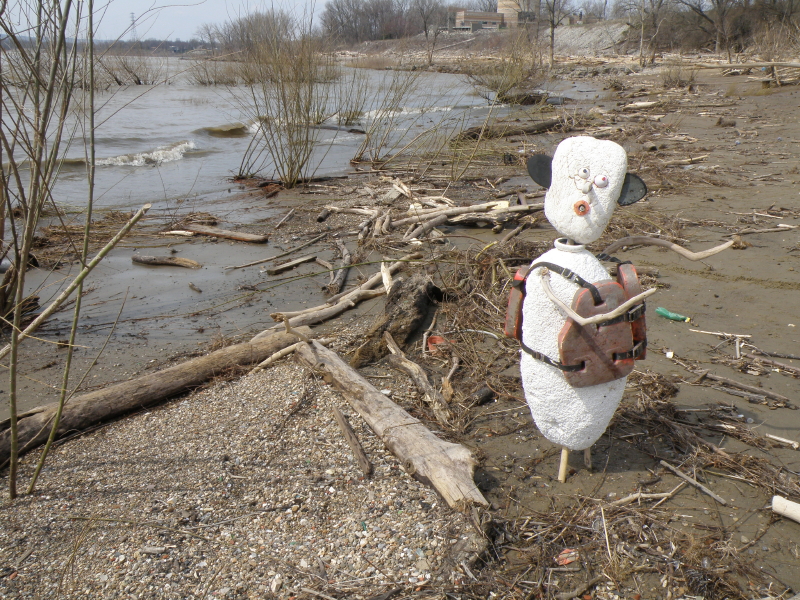
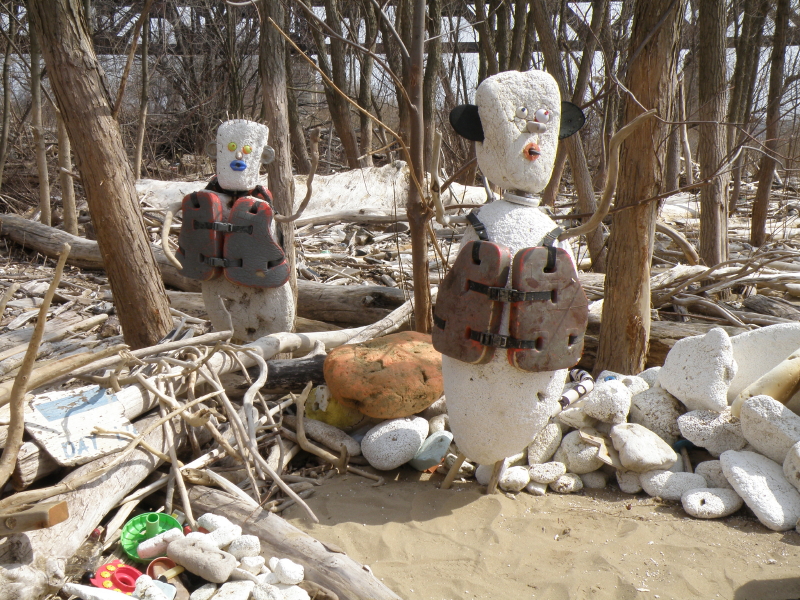
Looking around the Flood Brothers could see that I was interested in many of the same concerns that they had and wasn’t it all so absurd after all?  I told them my story and that all the stuff they saw in my little area came from the immediate river.  I mentioned that I try to find creative ways to use this junk and to tell the story about a place I find to be very special.  They asked me if I happened to see along the way a nice sign they had attached to a stump?  I confessed that I had and wanted to repurpose it as part of my sign collection.  The Flood Brothers just smiled and said I could have it.  After visiting for a while, it was time for me to go home.  I told the brothers they were welcome to hang out in my site and perhaps I will see them here again?  I liked them as characters.  With one last look back I saw F.B. 1 waving good-bye to me.  I always have an interesting day at the Falls of the Ohio.

F.B.1 at my studio, April 2013

This story marks my four-year anniversary on WordPress .  Hard to believe the time has flown by so quickly.  Thanks for tagging along!!

Read Full Post »

logs on the dam, March 2013

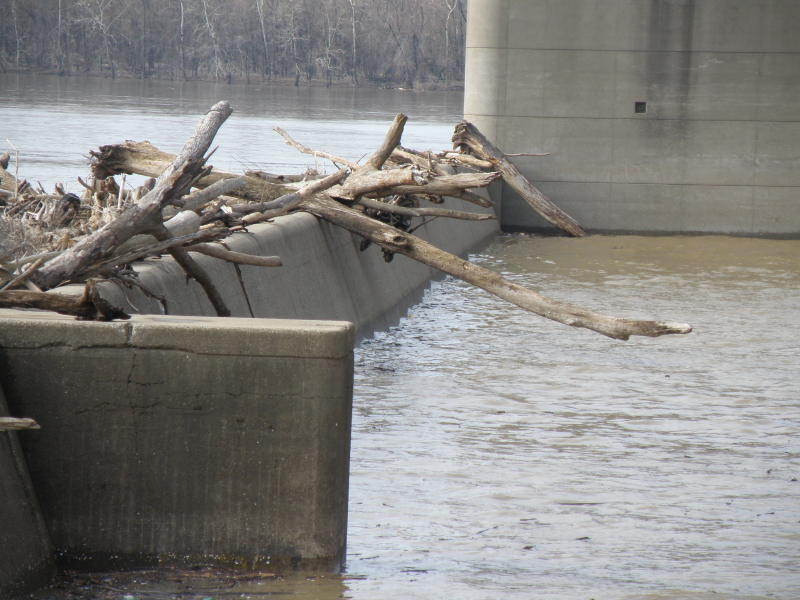
It’s an unbelievably gorgeous morning at the Falls of the Ohio and I have the park to myself.  The Ohio River has been running high although we haven’t had a lot of rain pass through our area.  Most of this water is probably coming from snow melt and precipitation in the northern section of the Ohio River Valley.  The river is receding and one of the first sights I see are logs that have been stranded on the dam as the water level drops.  These logs will remain balanced here until the river shifts them around again.  As I begin my walk, I see driftwood and trash everywhere I look.

plastic trash and driftwood, March 2013

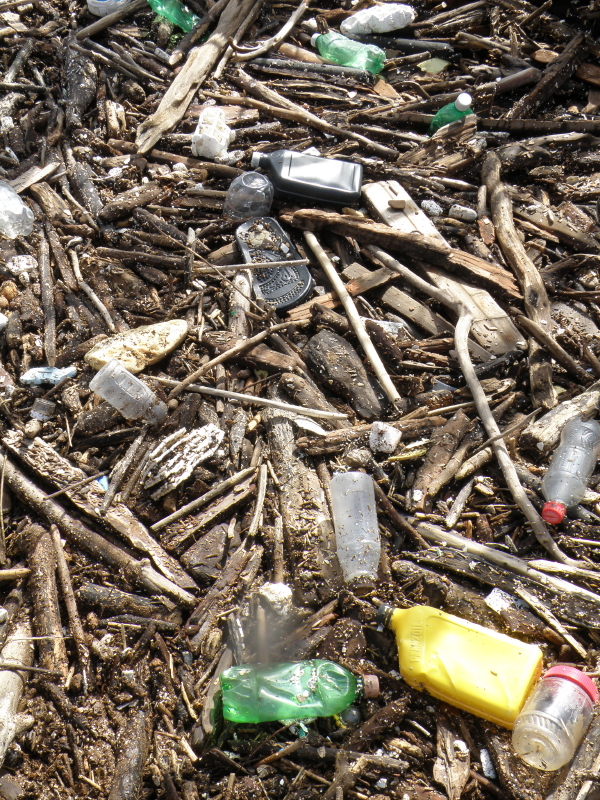
Accessing the bank is tricky and muddy.  I maneuver by walking on the backs of logs and balancing myself with my walking stick.  In areas where the river has dropped back… plastic trash, Styrofoam, and driftwood remain where this detritus floated in.  I like studying the patterns I see in the deposited wood and imagine the swirl of the river in these areas.  Of course, I find other treasures and oddities too.  Here are just a few objects that made it into the collecting bag.

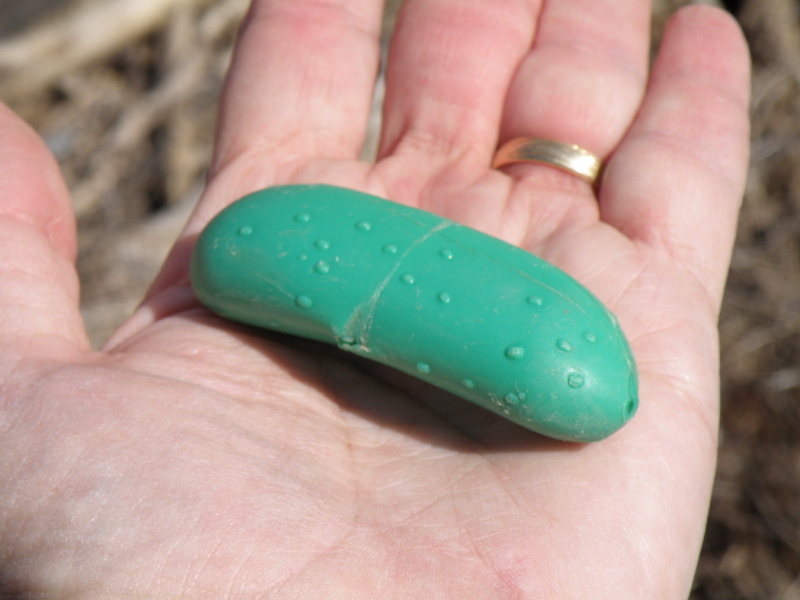
plastic pickle, March 2013

My fake food collection keeps getting bigger and bigger.  Here’s a plastic pickle  I found.  On this day, I also picked up a plastic chicken drumstick, a plastic plum and in the bag already from my last visit are a plastic onion and a plastic cheeseburger!  I find all this plastic food to be an interesting indicator of the times we live in.

plastic pirate skull with eye-patch, March 2013

This is kind of cool.  It’s a pirate skull with movable eye-patch.  The river has really colored this object.  Here’s something more humorous.

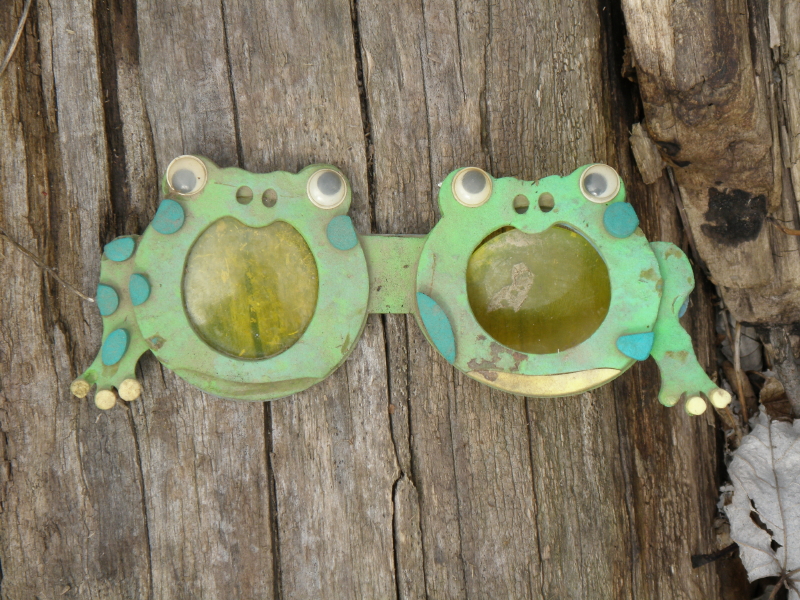
goofy frog sunglasses, March 2013

These silly frog sunglasses may be the only amphibian inspiration I receive all year.  In all the years I’ve worked this project, I have come across one actual common toad and two small leopard frogs.  Perhaps the river is just too big and wild here for the frogs?

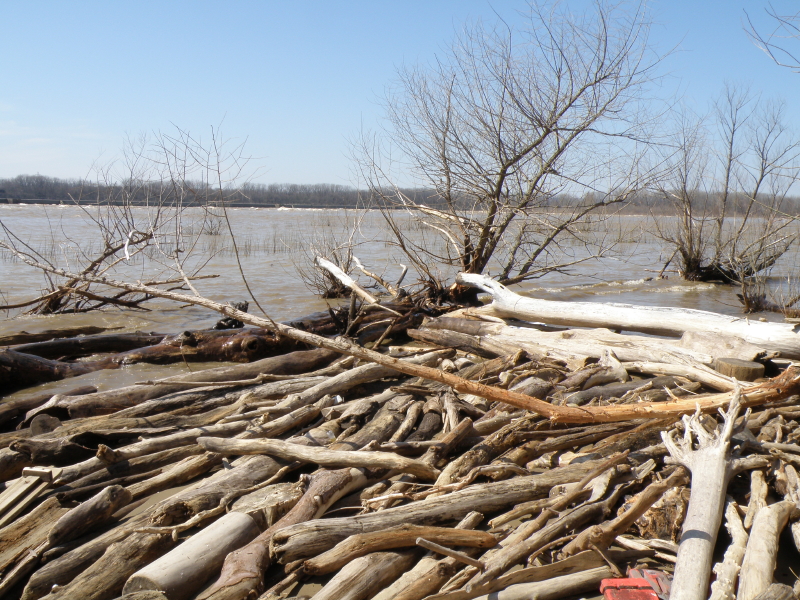
driftwood on the bank, March 2013

I decide to walk west along the riverbank and reach areas that are more driftwood than trash.  I always marvel at how the river lays the wood in fairly parallel rows.  That bright reddish-orange object in the foreground is the remains of a life preserver…it is one of two that I find on this day.

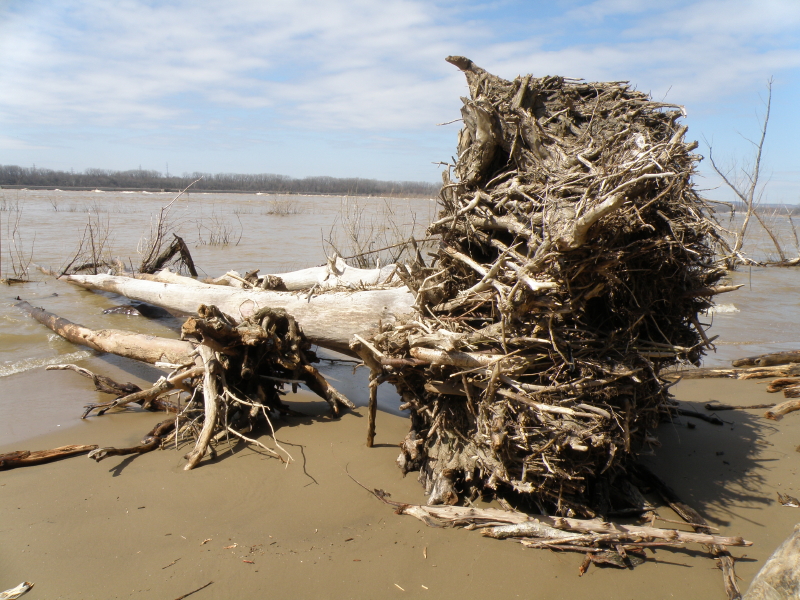
large washed up log, March 2013

Another tree with an intact root mass has been beached by the river.  Notice how all the branches have been knocked off.  This is fairly typical.  The river keeps subdividing these trees into smaller and smaller parts.  Up ahead I notice something that a muddy wave has just returned to the land.  I walk over and check it out and see something I’ve never seen here before.

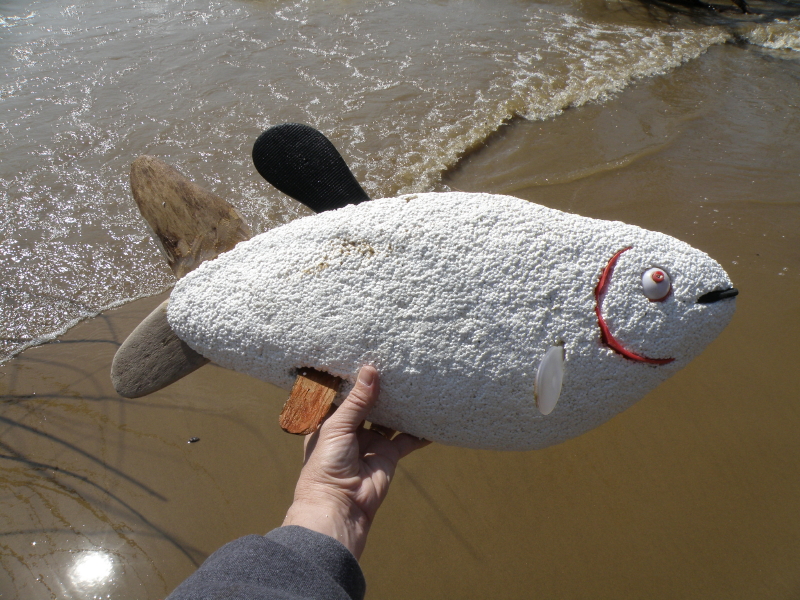
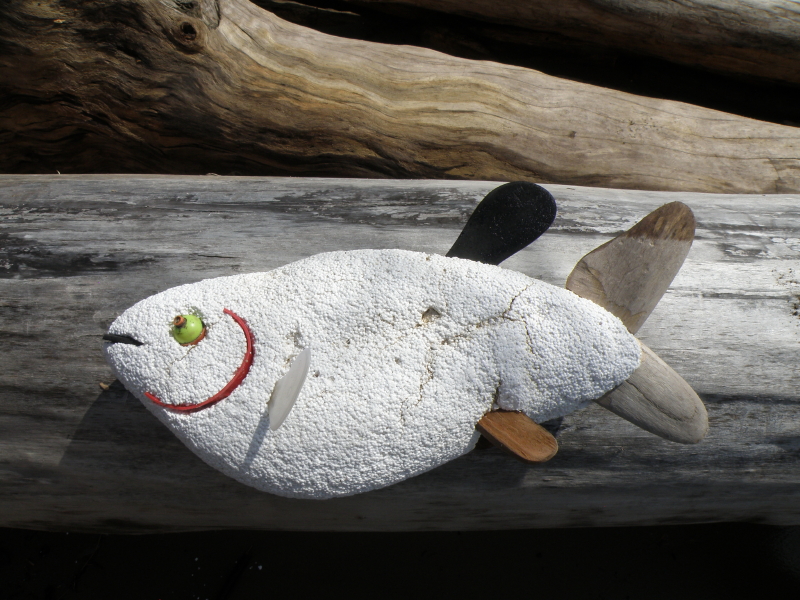
beached Styro-fish, March 2013

It’s a big fish, but I don’t recognize the species.  It’s not too bloated and so I examine it more closely.  I think it may be one of those Asiatic carp species that have become so invasive to our bigger rivers?  Recently, in western Kentucky in the Land Between the Lakes area, there was the first ever commercial fishing tournament to try to harvest as many of these large carp as possible.  Strong nets are needed to catch them since they grow big and rarely if ever take a baited hook.  The idea behind the tournament was to  educate people that these fish are good to eat and to try to help create a commercial demand for them.

large Styro-carp in the hand, March 2013

Here I am holding the fish at arm’s length.  Notice that it has a relatively small mouth.  This fish feeds on microscopic plankton and other tiny food items which is why they are hard to hook by traditional means.  This is a thick-bodied fish with a large head and powerful tail.  I have known that these fish are in the Ohio River, but I haven’t had the chance to inspect one this closely before.  I’ve attached a couple more views of this fish.

Styro-carp facing right, March 2013

Styro-carp facing left, March 2013

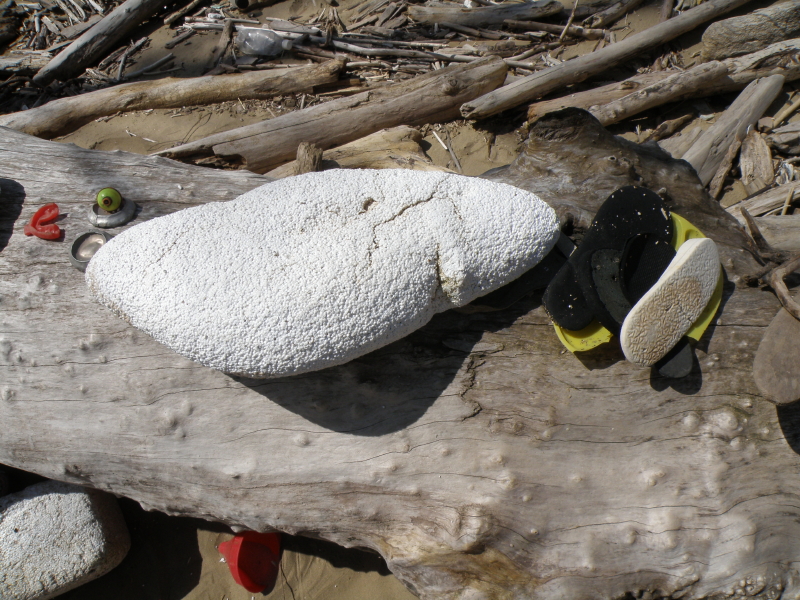
By now, you are probably used to my game!  I made this fish from a hunk of Styrofoam I picked up on this day.  The Styrofoam reminded me of a fish and so that’s the direction I took this sculpture. The other found elements include:  fishing bobber eyes, red plastic gills, fins made from wood, shoe soles, and plastic junk.  This is how it looked before I started.

found piece of polystyrene before it became a fish, March 2013

I try to respect the basic shape the river gives me and feel that whatever results… is a collaboration between me and the river.  I don’t cut too much into the polystyrene because I also try not to release many of those tiny white beads back into the environment.  I try to work minimally and to clean up after myself.  It’s not a perfect system, but is what has evolved after so many years of coming out here.  I did find even more Styrofoam on my latest adventure and now just need the time to create something from it all.  My parting shot is the latest image of my outdoor studio.  See you next time from the banks of the Ohio River.

Outdoor studio at the Falls of the Ohio, March 2013

Read Full Post »

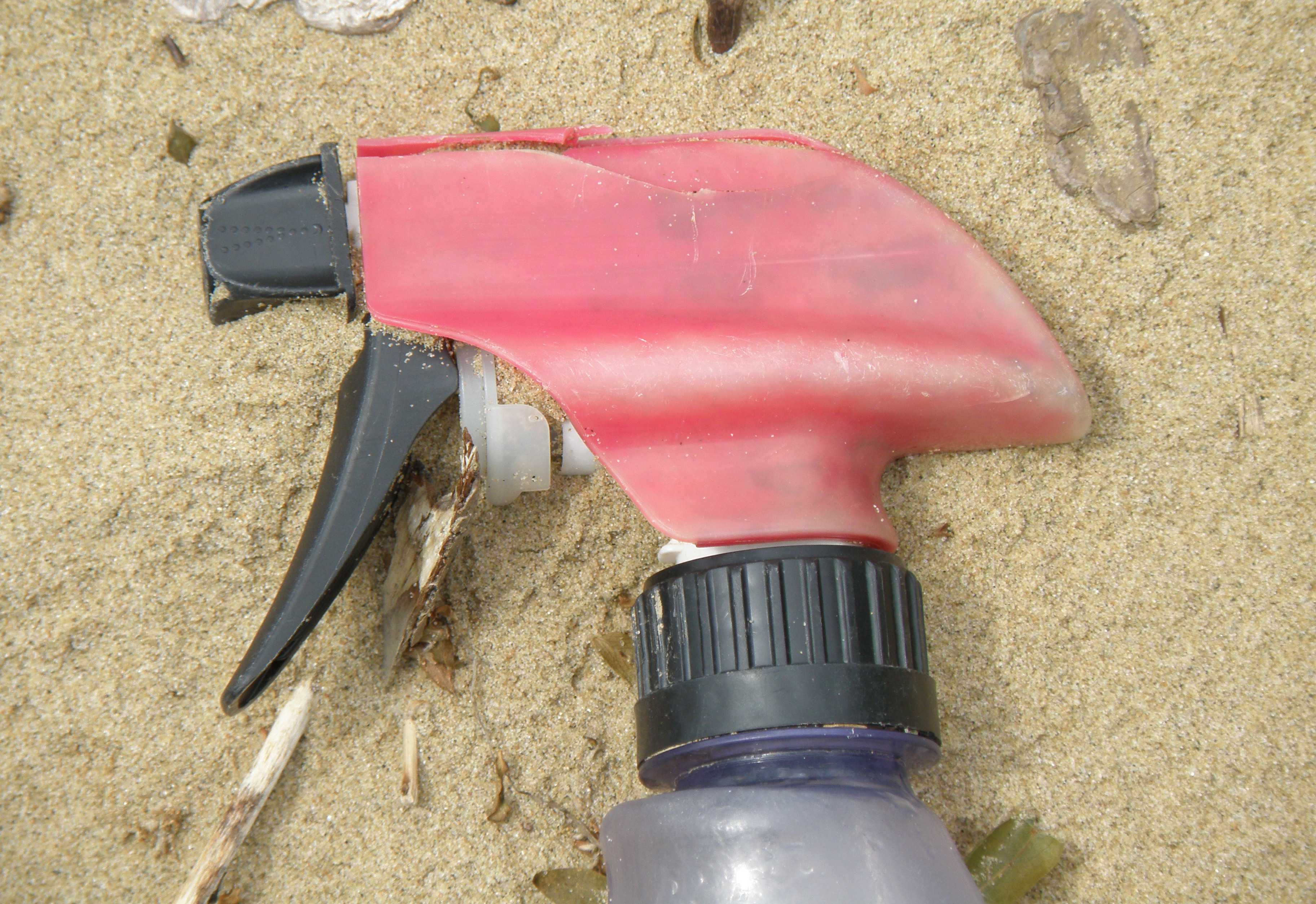
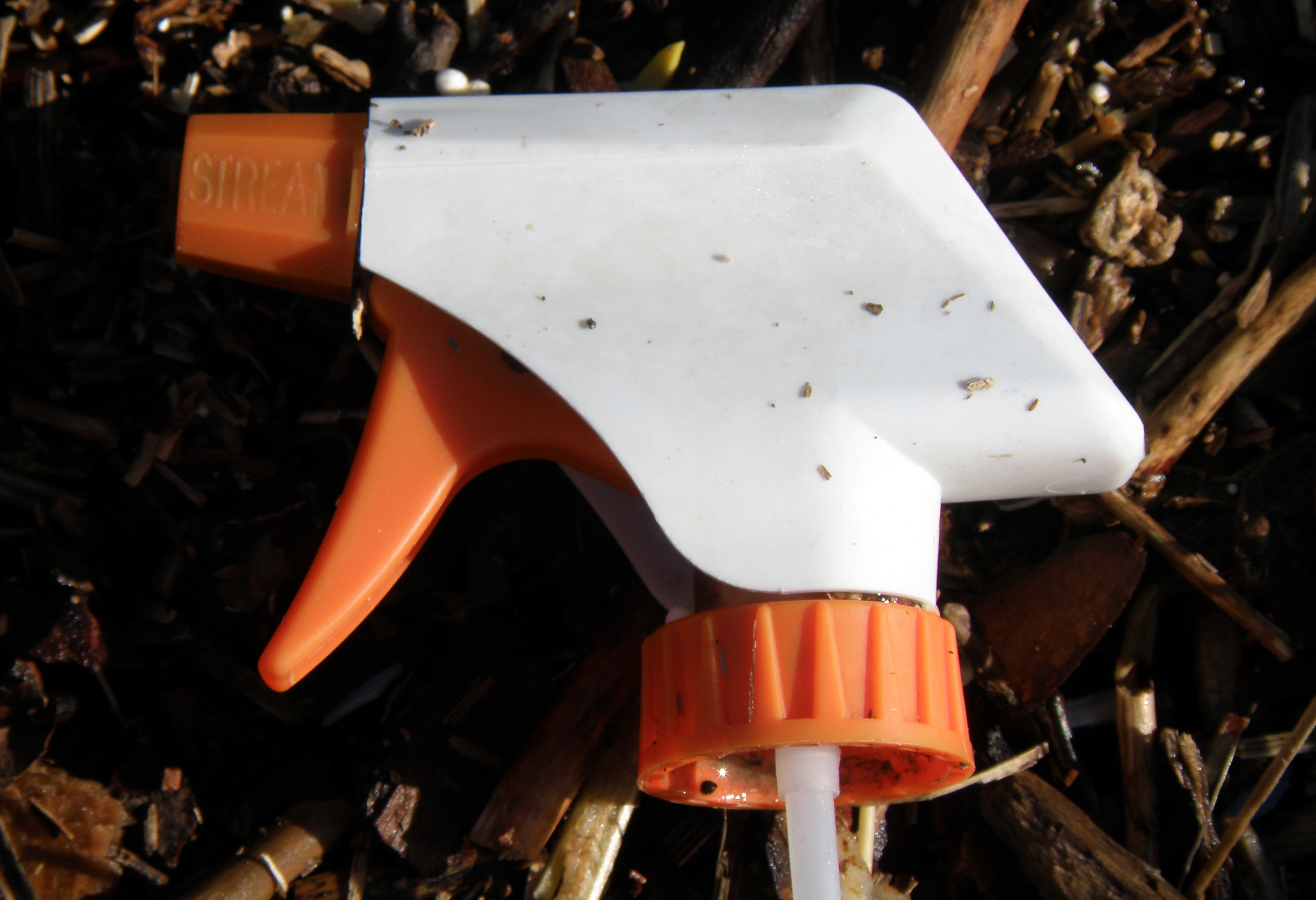
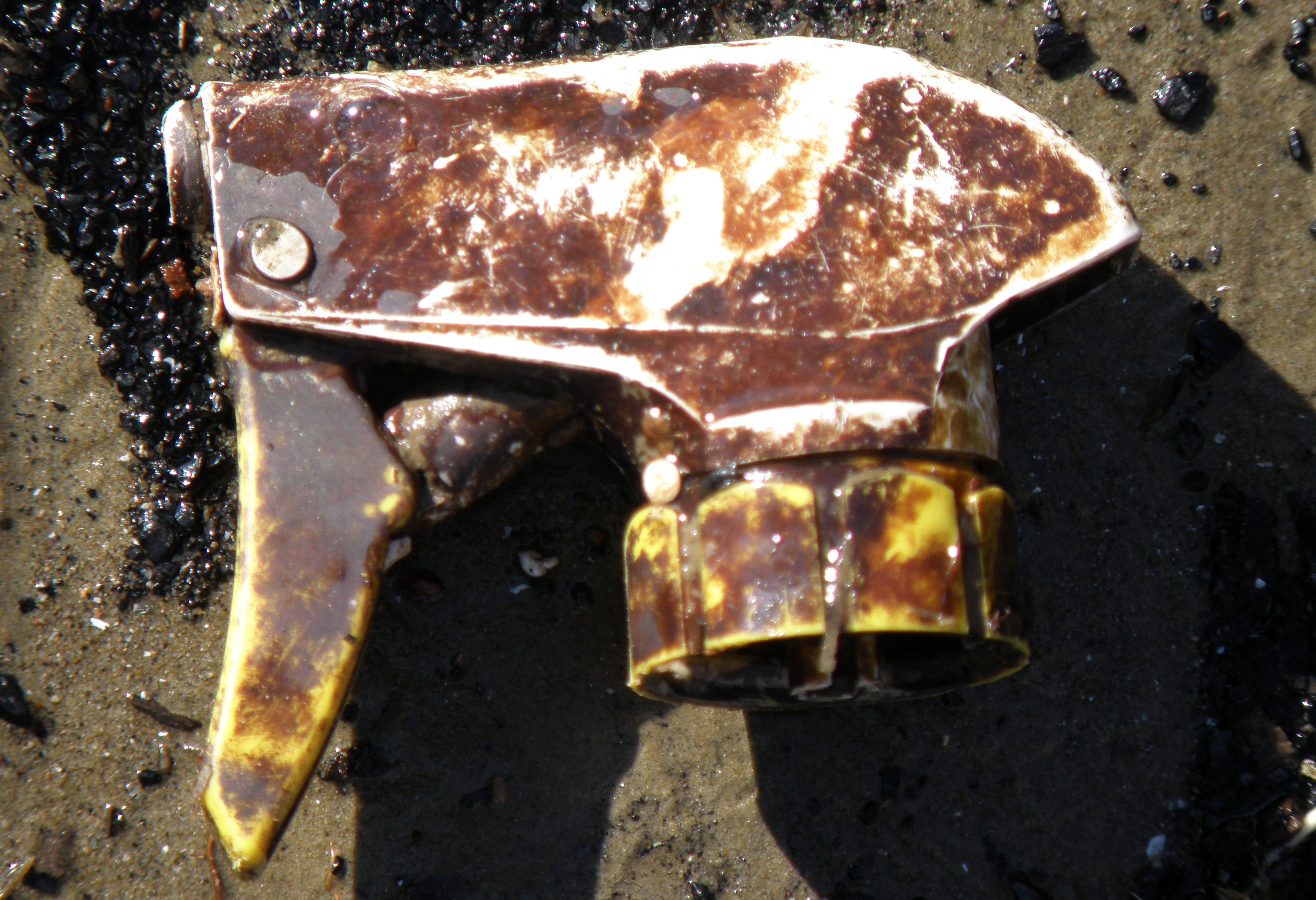
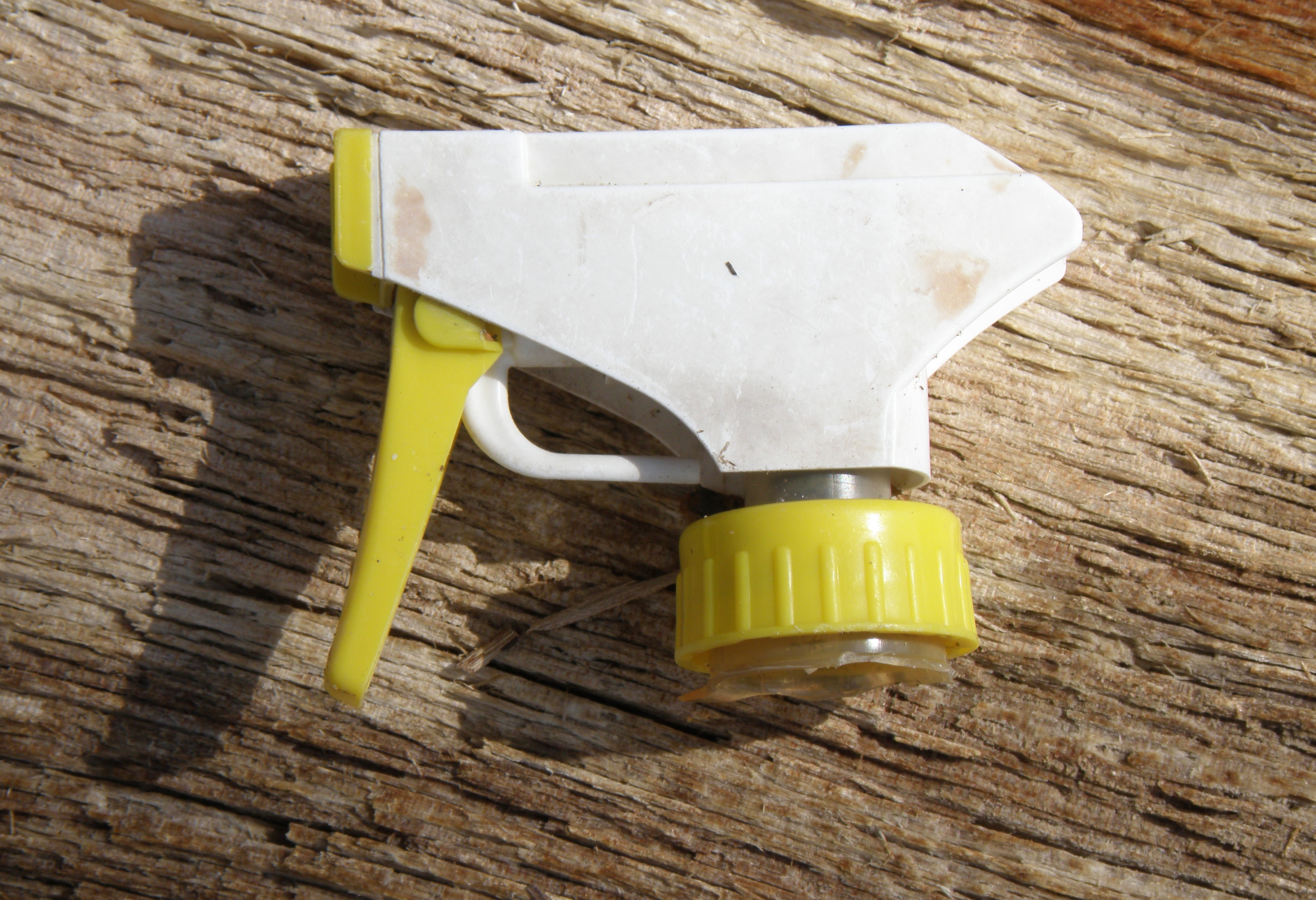
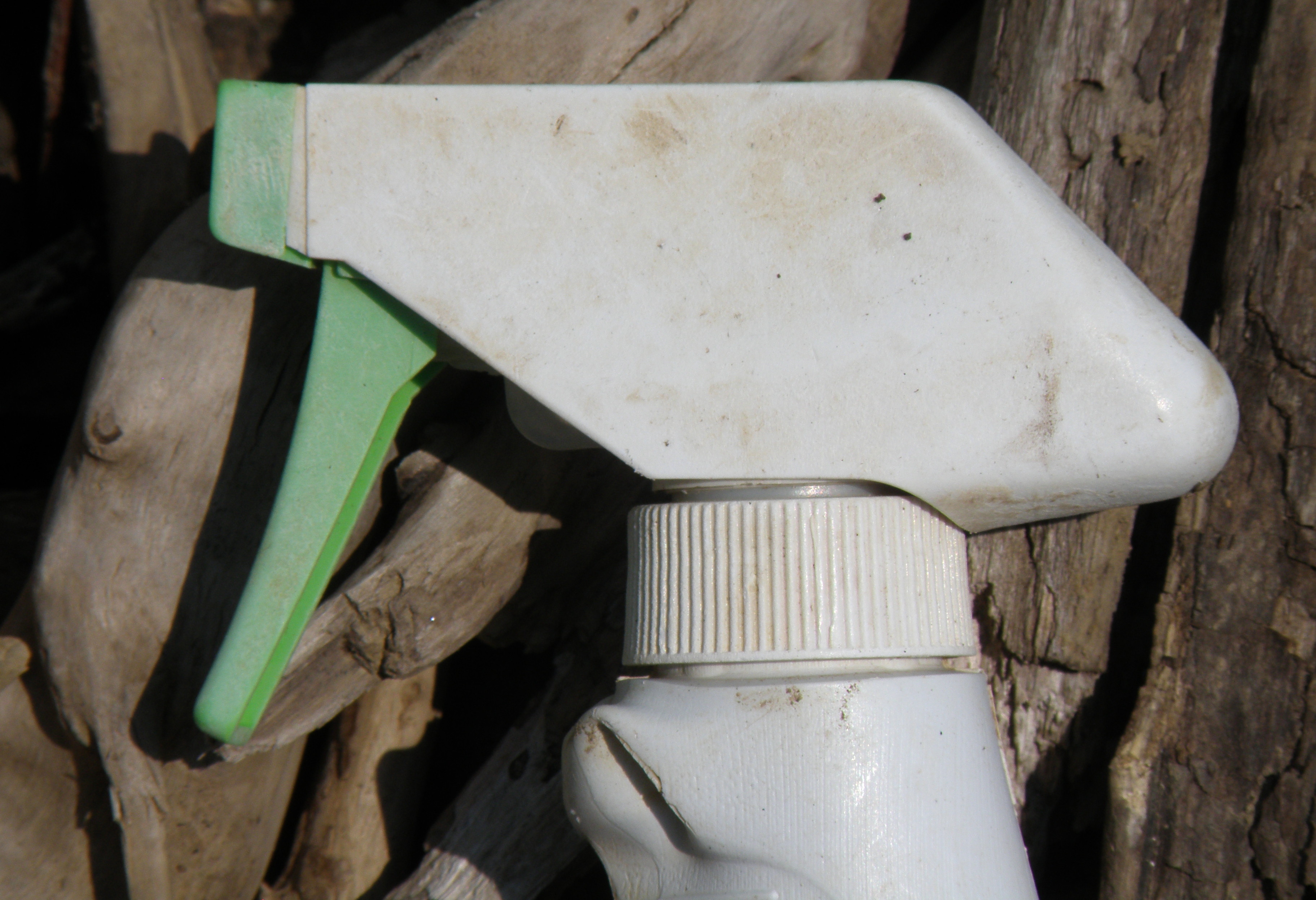
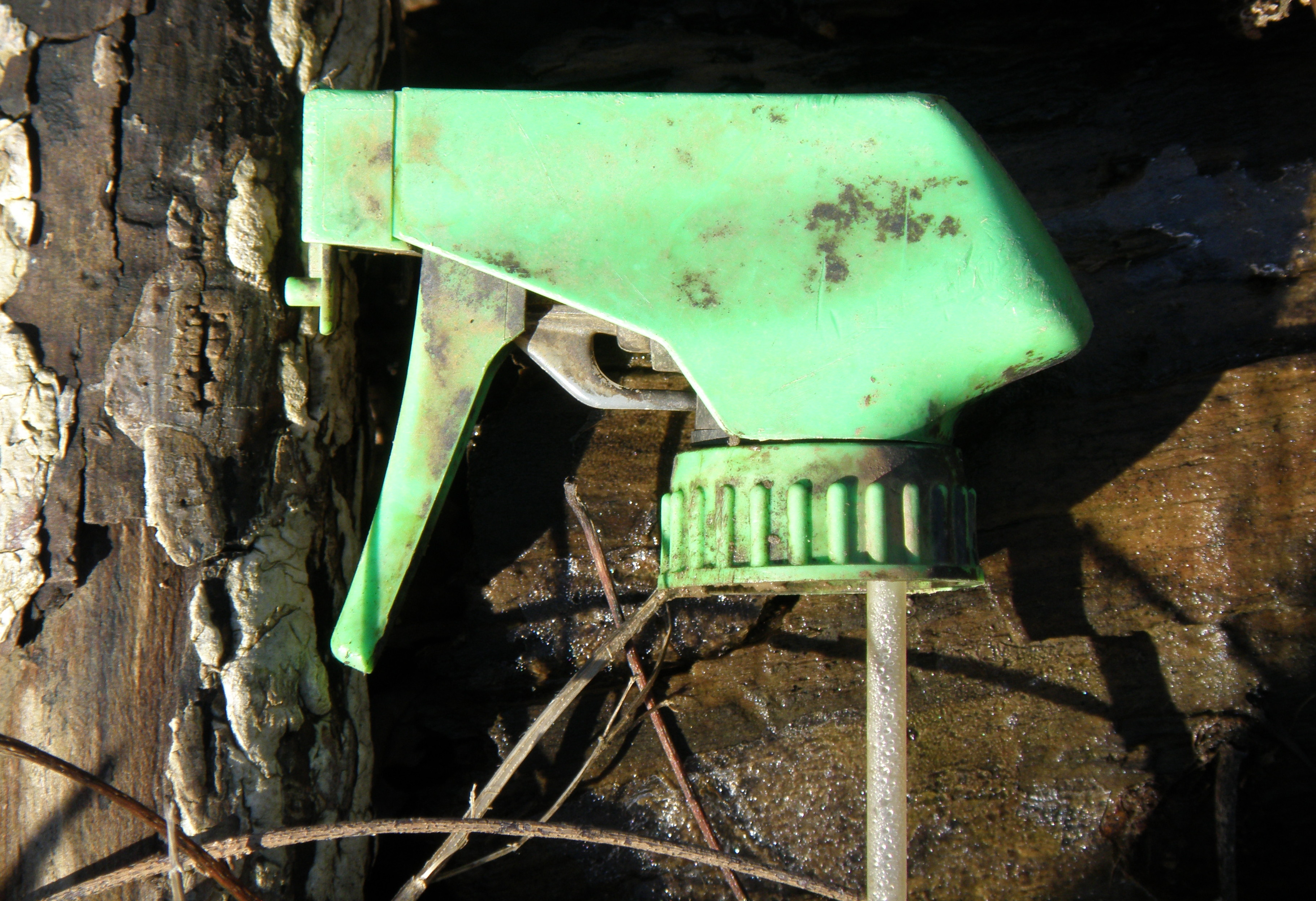
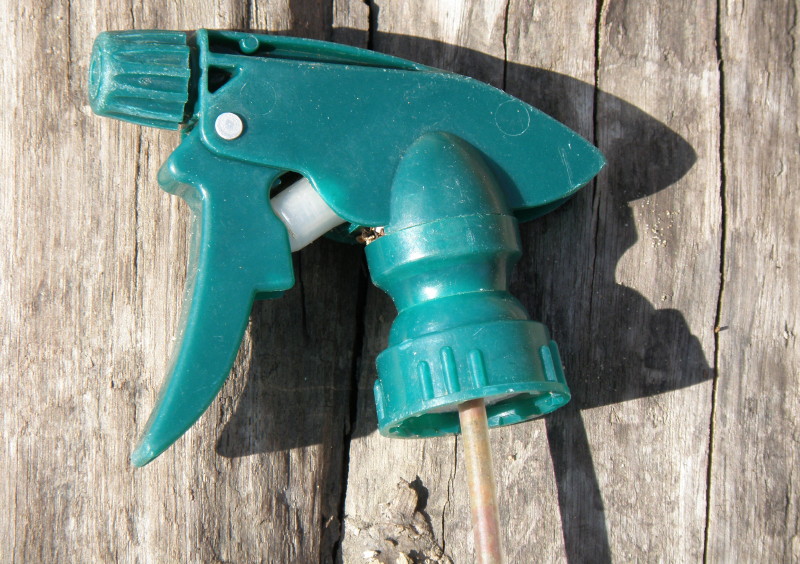
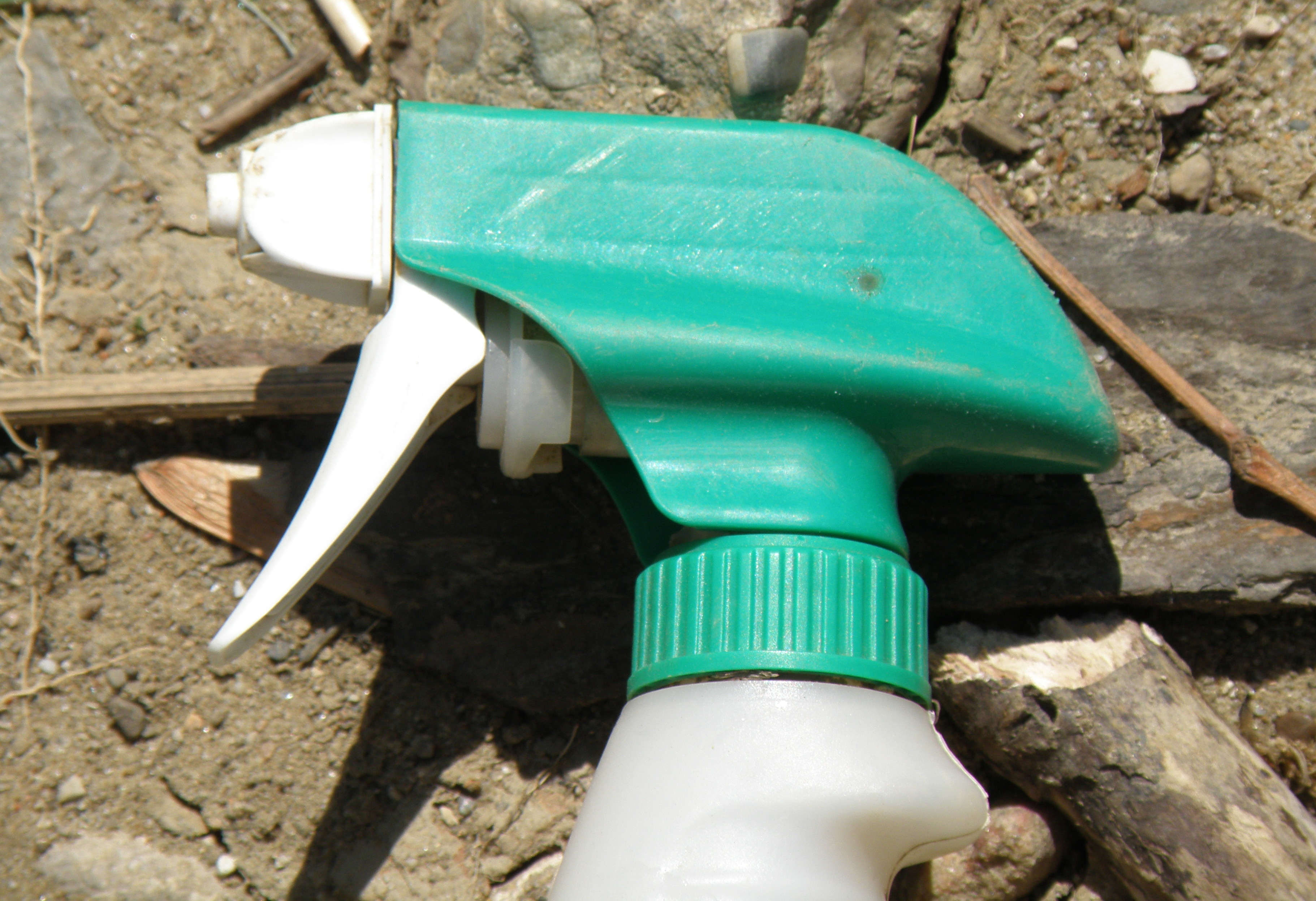
Spray bottle trigger assembly, March 2013

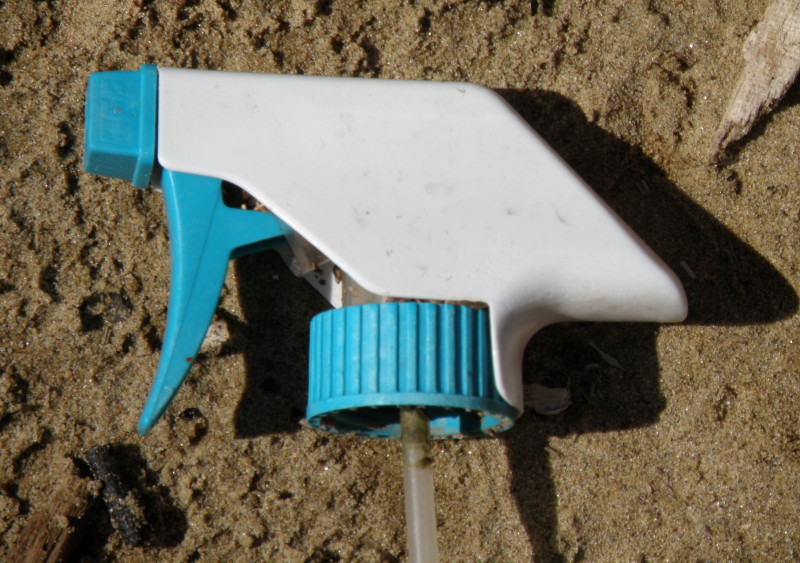
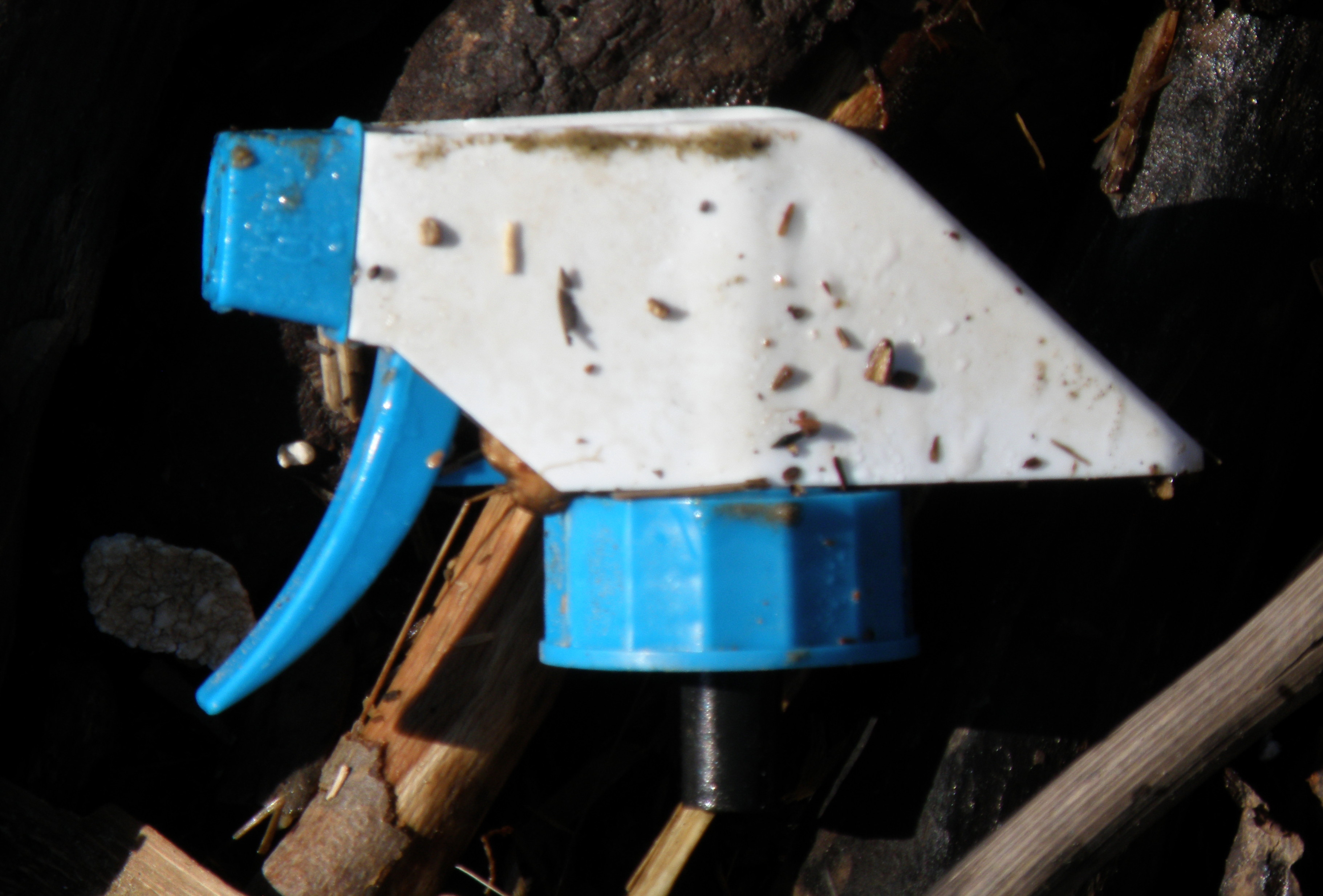
The range of plastic refuse one encounters at the Falls of the Ohio State Park is both numbing (it’s obviously trash and shouldn’t be here) and morbidly fascinating (the design sensibility and colors ) catches one’s eye and occupies the mind.  Consider the variations in something as mundane as “spray bottle triggers” if indeed this is what you call these things?  I’m not sure when I started noticing these objects and photographing them…but here they are.  Each adventure to the river is sure to garner multiple images and story lines that I sift through at my leisure.  Consider this a personal cleansing of the spray bottle trigger palette.  Ironically, much thought went into designing each of these beauties to facilitate dispersal of their contents from plastic bottles.  I like the rotating tips that give me options such as “spray” or “stream” and so forth.  These triggers are ingenious and they do their jobs well.  Without further adieu and fanfare…here are more images from an admittedly odd collection.

red and black spray bottle trigger, March 2013

orange and white trigger, March 2013

dirty yellow and white trigger, March 2013

yellow and white trigger, March 2013

another yellow and white trigger, March 2013

white and green trigger, March 2013

yellow/green spray bottle trigger, March 2013

dark green trigger, March 2013

green and white trigger, March 2013

green and clear plastic trigger, March 2013

blue and white trigger, March 2013

another blue and white trigger, March 2013

white and purple trigger, March 2013


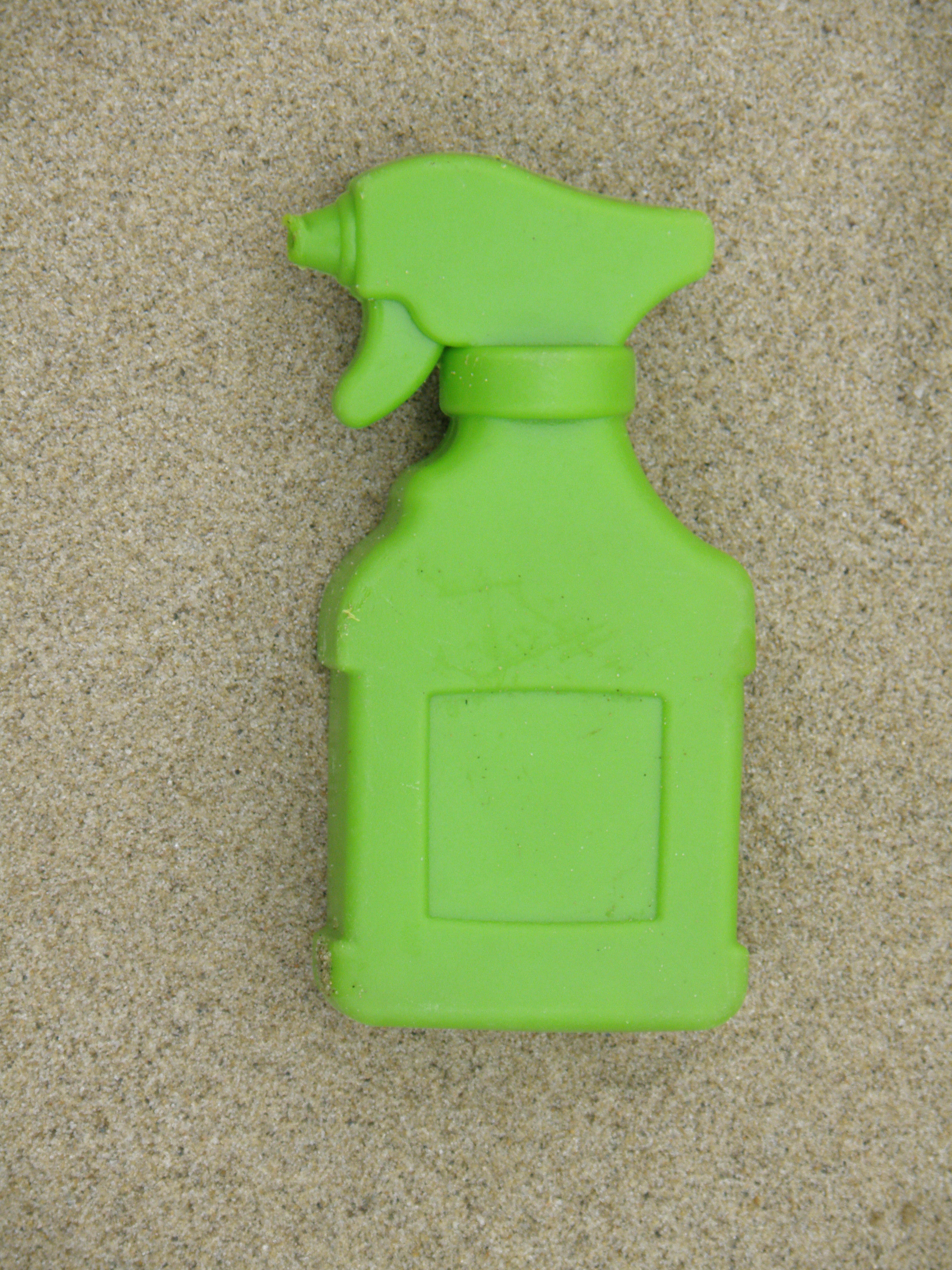
One final image in closing.  You know you have “arrived” when a cute miniature is produced.  Here’s a recent find from a sandy bank of the Ohio River at the Falls of the Ohio State Park.

miniature green plastic spray bottle, March 2013

Read Full Post »

nature's template, Falls of the Ohio

It’s been raining off and on for the past three days and so I’ve decided to give the actual Falls of the Ohio a pass this weekend.  That, however, does not mean that my heart and thoughts are ever far from the park.  Looking through my Falls image archive, I have put together a post on a topic that has been concerning me of late.  Increasingly, we feel we can manipulate nature and bend it to our desires without consequences.  Man has this vision that we can force nature into our template and that “she” will obey in predictable, obedient ways.  Ever see a square tomato grown in a cube?  Nature, however, is much more dynamic than we give her credit for and frequently presents ideas of her own.  As regular followers of the riverblog may have noticed new fauna often show up here and the consensus is that their appearance is a result of our altering the environment in myriad ways.  Over the last few years, I have also noticed some previously unknown plants.  Allow me to present a photo-bouquet of highly questionable, potentially toxic, exotic flora.

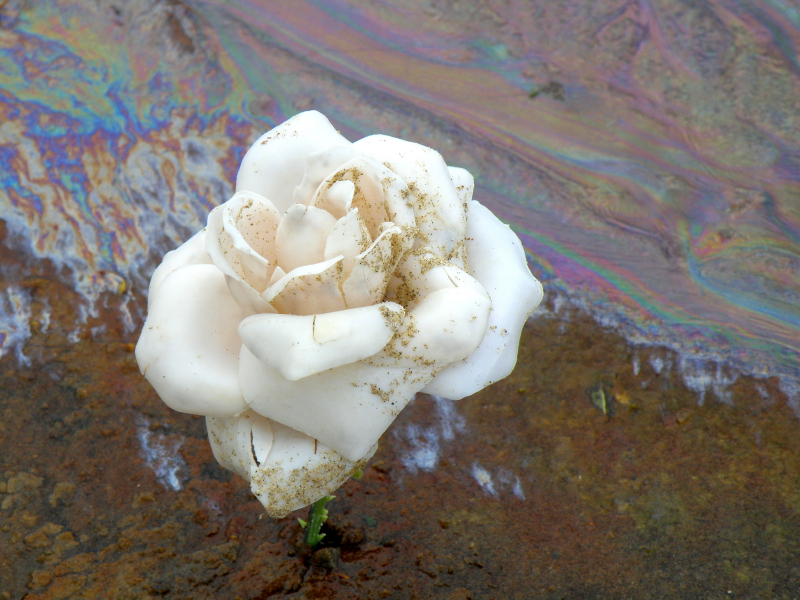
The Chemical Rose, Falls of the Ohio, 2012

Meet the Chemical Rose which is a new species I discovered at the Falls last year.  It was found growing by an area where an unknown iridescent sheen was percolating up through the sand.  It has no leaves and aside from its thorny stem, has no photosynthetic ability.  This is a fairly consistent trait of these new plants.  They may be parasitic or fungal-like, but I’m sure there is considerable variation on how they live.  The petals on the Chemical Rose are hard and seem very much like plastic.  More on this later.

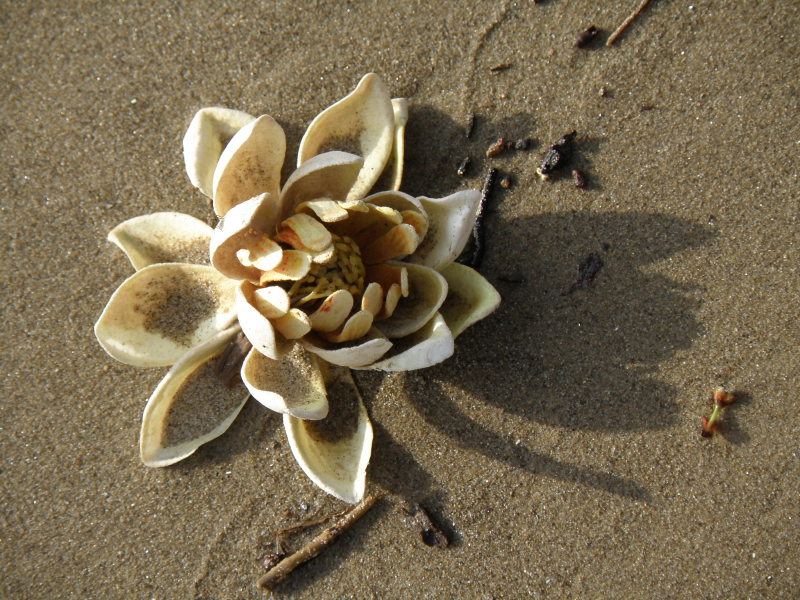
The Sand Lotus, 2012

It’s beautiful in its own way, but what is it?  For lack of a better name, I call this a Sand Lotus.  It shares some characteristics with the Chemical Rose.  Notice no leaves…doesn’t need them.  It’s roots go down deep in the sand.  Like the previous rose, its petals are hard to withstand the rigors of the river.

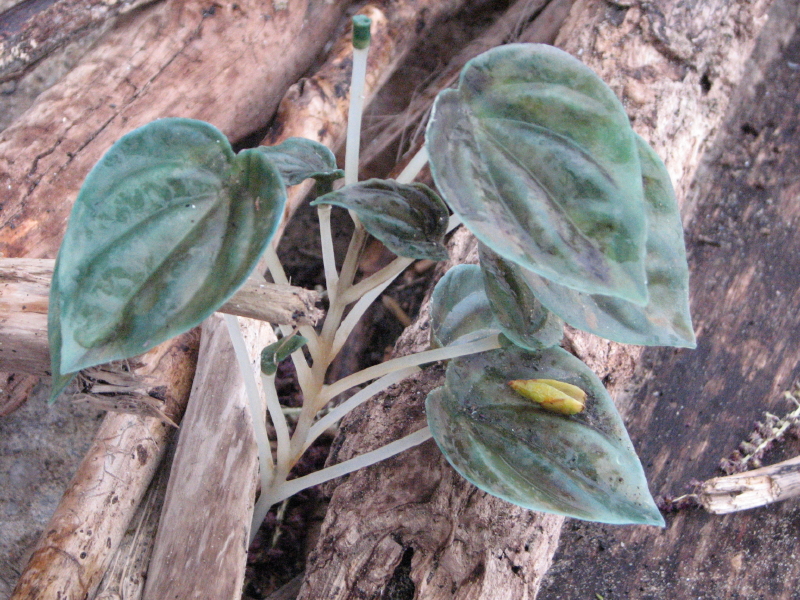
Petrochemical Coleus

I bet I walked by this strange plant many times before something told me to look again.  I call this one the Petrochemical Coleus.  Although it has green leaves, it does not possess chlorophyll.  This specimen was growing up through the driftwood.  It’s small size also makes this one hard to see and find.

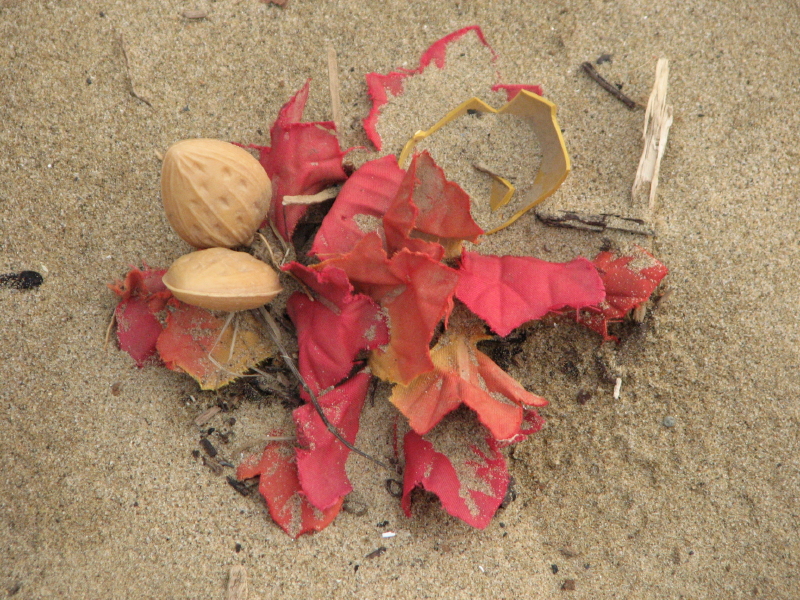
Flame Nut with seeds

Here’s the Flame Nut so-named because what passes for its foliage turns bright red when its seeds mature.  Its leaves feel very much like coarse fabric and it seems to prefer sandy environments as well.

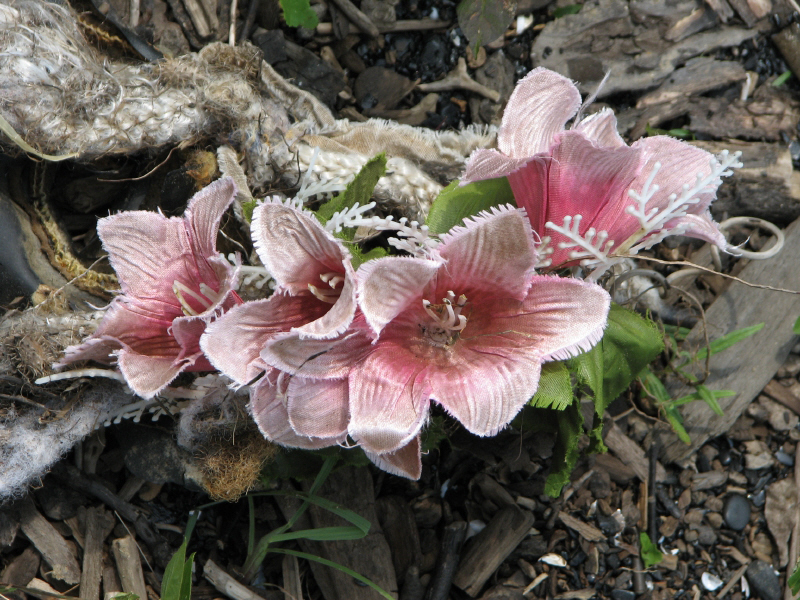
False Pink Bell in bloom

This interesting and dare I say “lovely” flower is the Faux Pink Bell.  It combines characteristics of several of the mutant plants I’ve uncovered.  It possesses hard plastic parts as well as the softer, synthetic petals that are fabric-like.  It grows in highly disturbed, contaminated soils.  Which brings me to a theory I’ve been formulating ever since I first discovered these strange plants.  Although I’ve not done a chemical analysis on them, their resemblance to plastic can not be coincidental?  Plastic is after all organic by definition.  Plastic is derived from petroleum which is an extract from ancient life and I think there is something in the long memory of life that is presenting itself here?  We know that our traditional plastics keep breaking down to the micro level.  These really small particles are absorbed by living tissues.  Is it possible that this plastic pollution is altering life in reaction to the many changes brought about through man’s activities?  Can the long polymer chains connect with DNA?  In effect, Nature is demonstrating that it is even more plastic by molding and forming new species to harmonize with the changed environment.

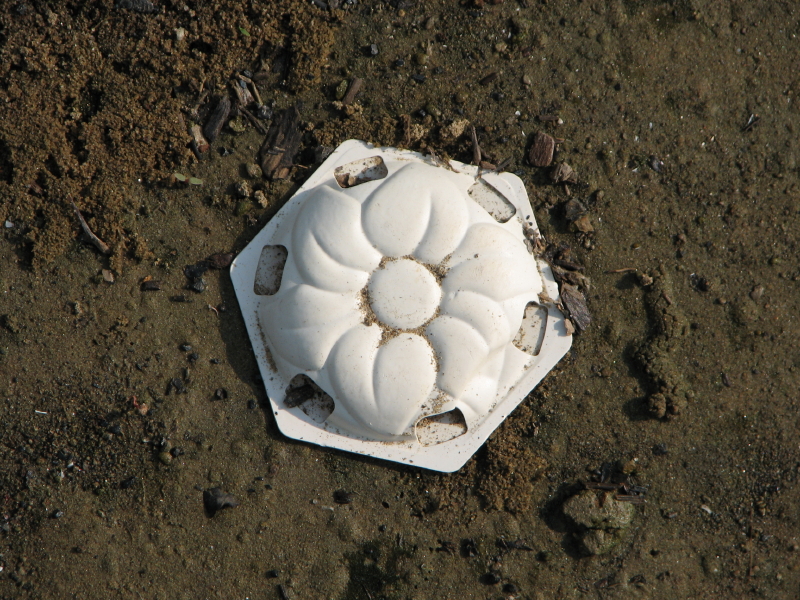
Polymer Posey

I came across the Polymer Posy growing in the mud.  I believe this is as much fungus as anything else or a new theory has been presented.  Perhaps this is a carnivorous plant that traps and eats insects?  Upon inspection, there are small entry ways along its base that invite small insects like ants to go inside.

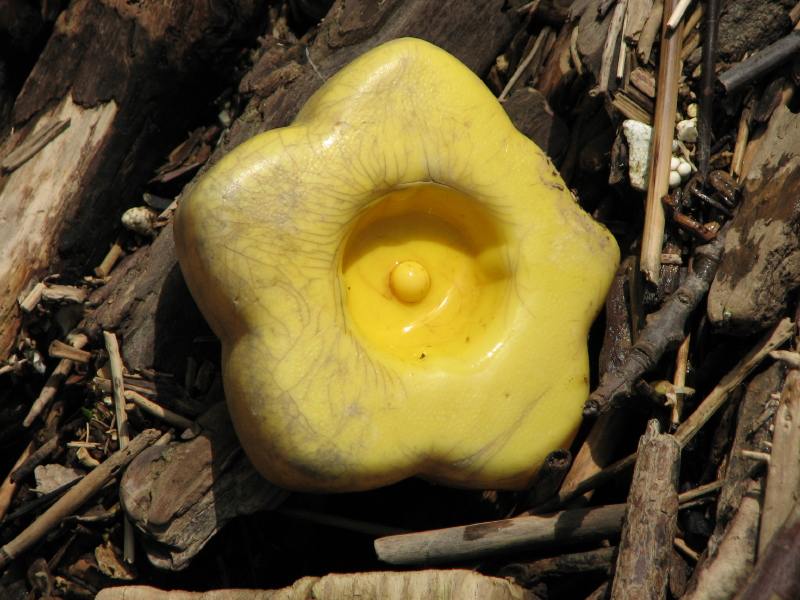
Yellow Bittercup

Growing out of the wood chips is this botanical novelty I’ve designated the Yellow Bittercup.  Again, no leaves required.  This flower can appear anytime of the year.  I came across this one last summer.

Orange Forget-me-not

The Orange Forget-me-not is indeed memorable.  It is encountered among the driftwood and may in effect break down cellulose to create its own plastic structure.  The holes in the flower trap, strain, and direct moisture and nutrients to its shallow root system.  And now for something really spectacular in a twisted way.

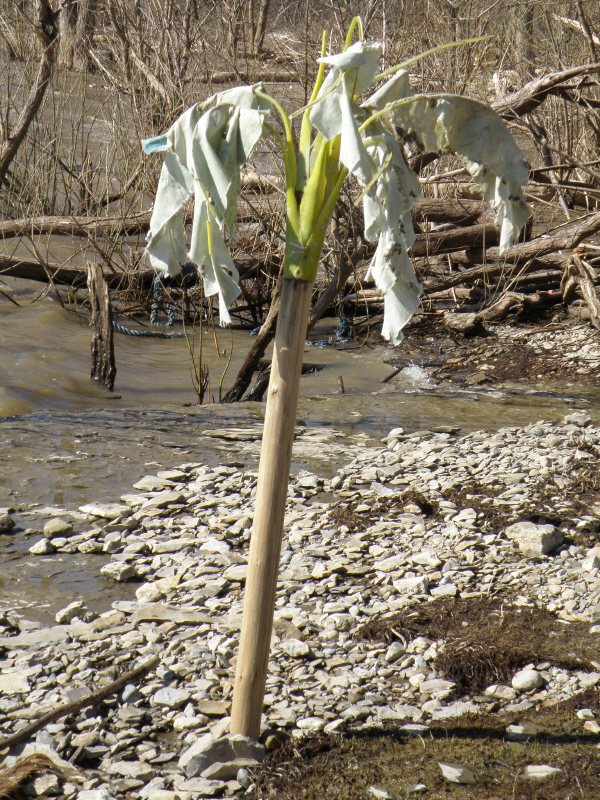
Polyvinyl Palm, 2012

I did a massive double take upon encountering the Polyvinyl Palm growing from the poor rocky soil in the western section of the park.  This is easily the largest of the new plants I’ve stumbled upon in my wanderings.  I had hoped to study it more, but another visitor to the park collected it.  We have discovered that it is possible to change the chemical composition of the atmosphere through our combined activities.  I believe we are simultaneously altering through chemistry the very organisms that inhabit this world with us with unintended consequences.  How long will it take before we change ourselves into something different as well?plastic tulip image

Read Full Post »

« Newer Posts - Older Posts »