Feeds:
Posts
Comments

Posts Tagged ‘art and nature’

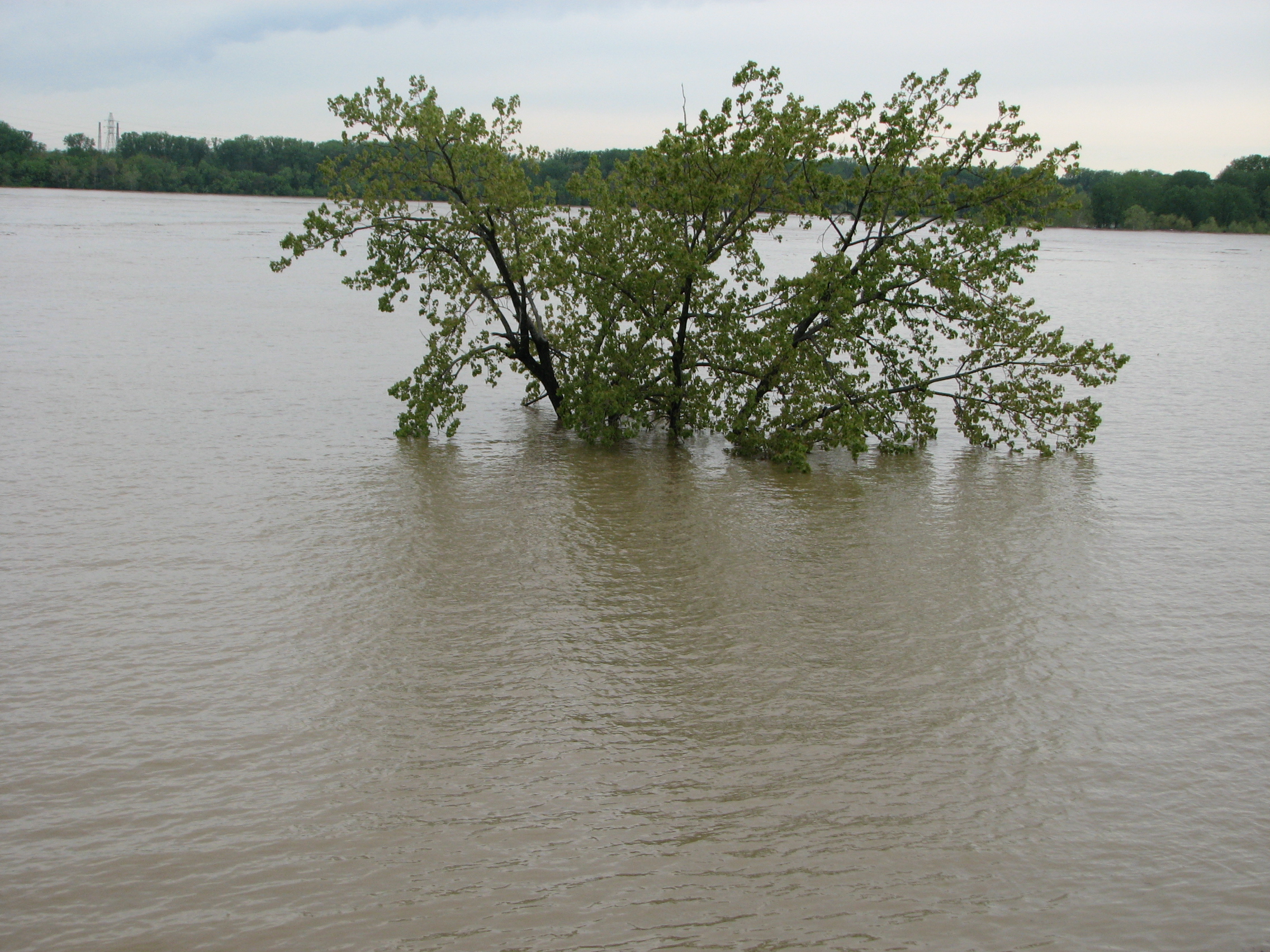
Mid April High Water, Falls of the Ohio, April 2015

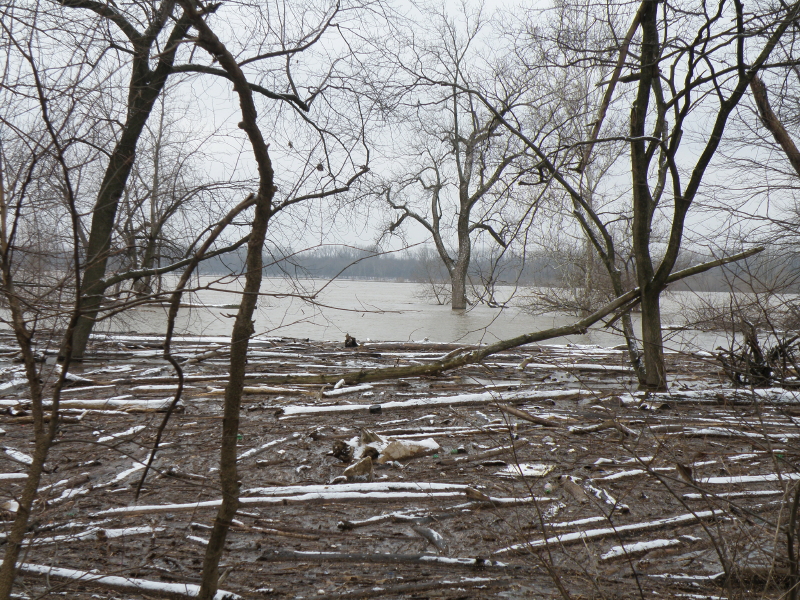
It’s mid April and the television meteorologists have said it all.  If the Kentuckiana area receives one more drop of rain…we will set an all time local record for precipitation during any April since records have been kept.  With half a month to go and more rain in the forecast for this week…that record is a goner.  As I write this…the river is still rising.  I mentally contrast this to what is happening in California with their severe drought.  I wonder if there are any billionaires out there that would like to invest in a pipeline that would send all this extra water to where it’s needed most?  After all, isn’t water a much more precious commodity than crude oil?  We don’t send exploratory satellites and space craft into the vast distances of the universe looking for petroleum.  It’s water we seek because in a fundamental way we realize that water is the key to life.
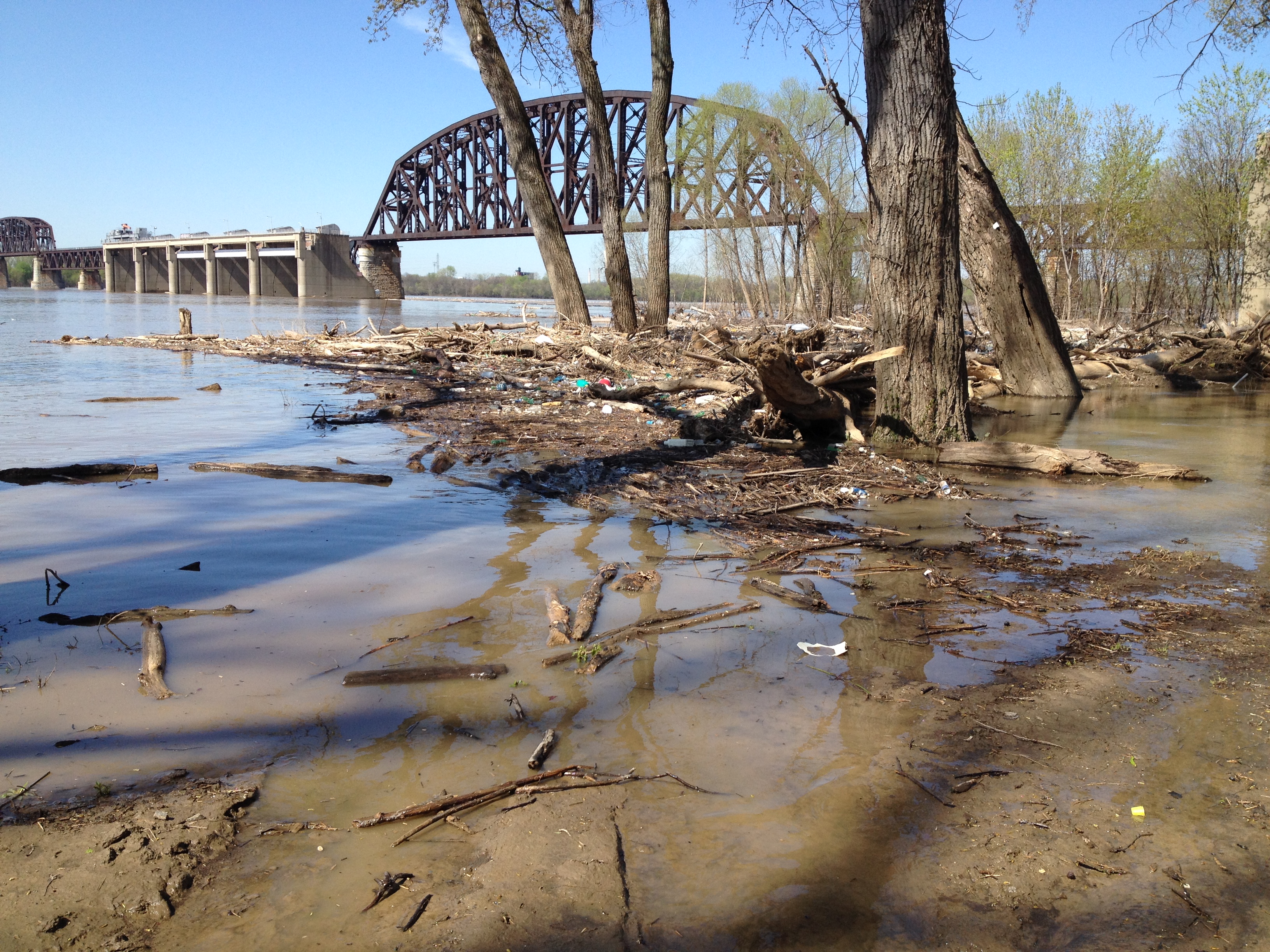
The high Ohio River at the Falls of the Ohio, April 2015

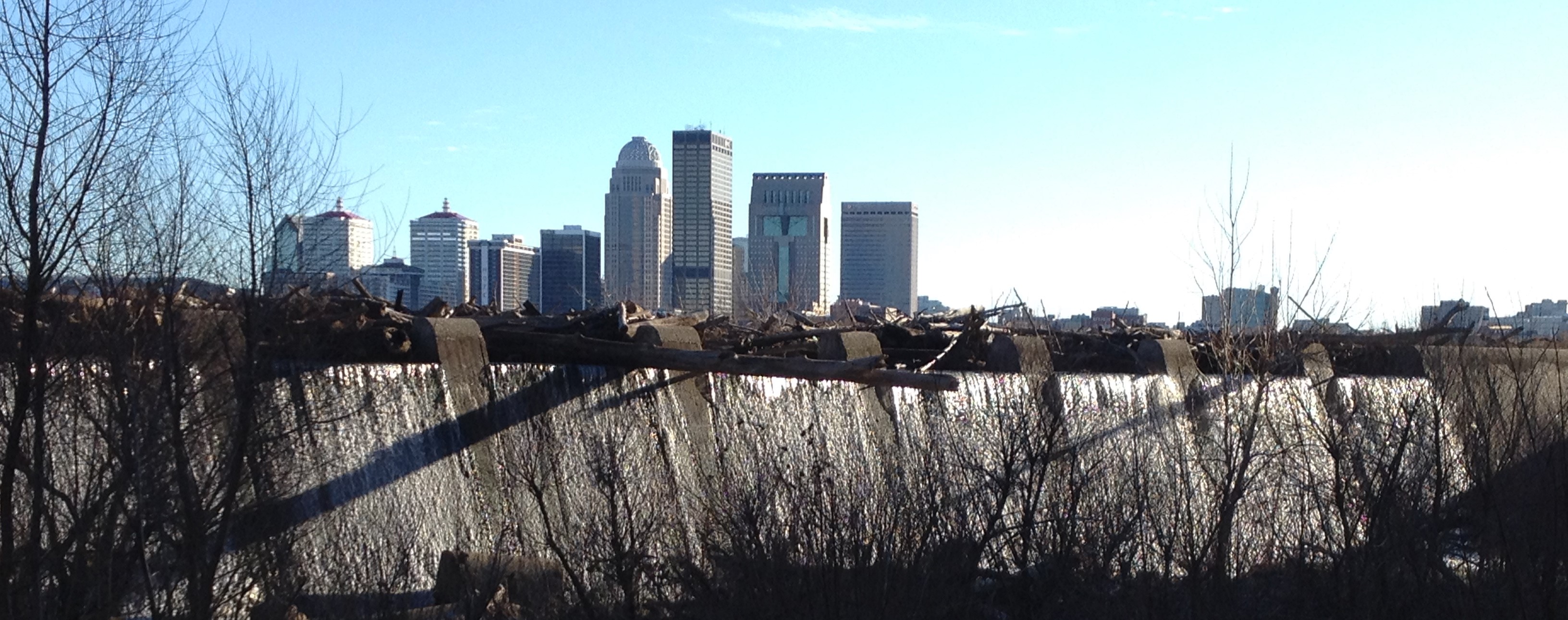
The following adventure happened last weekend which was warm and beautiful, but with an ever-rising river.  The large driftwood mound under the railroad bridge I documented in my last post has broken apart and floated away along with my absurd March Madness figure.  Perhaps when the river returns to its usual water levels, I may run into him once again?  For now, I am exploring a section of the Ohio River Greenway which is near the Interpretive Center’s entrance and has a nice view of Louisville’s skyline.  The riverbank does not lack for junk and before long I’ve photographed and collected a full bag of possibilities for future use.  It was while I was absorbed in my own head space that I bumped into a most unusual character that was engaged in what looked to be some type of ritual at the water’s edge.
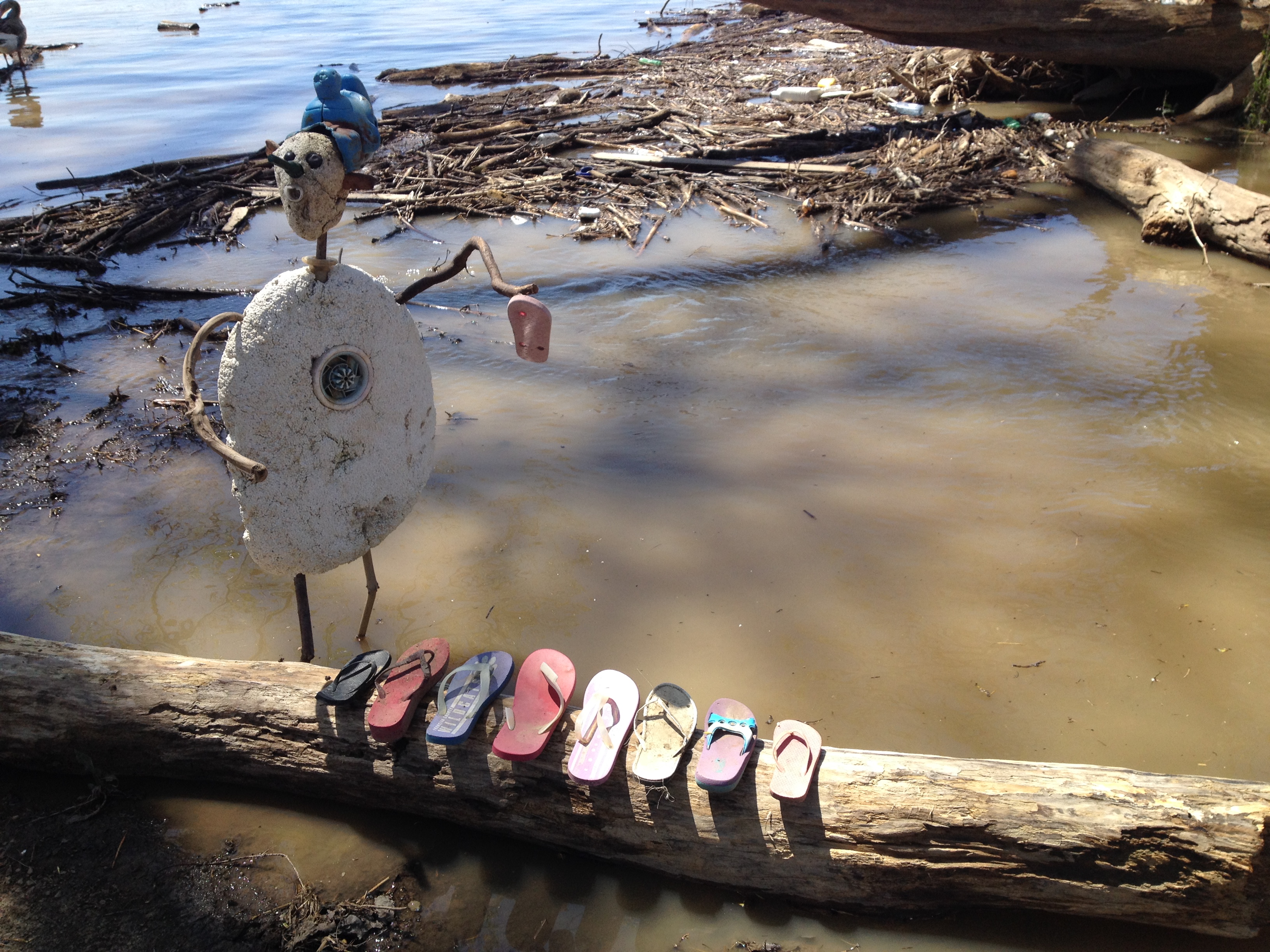
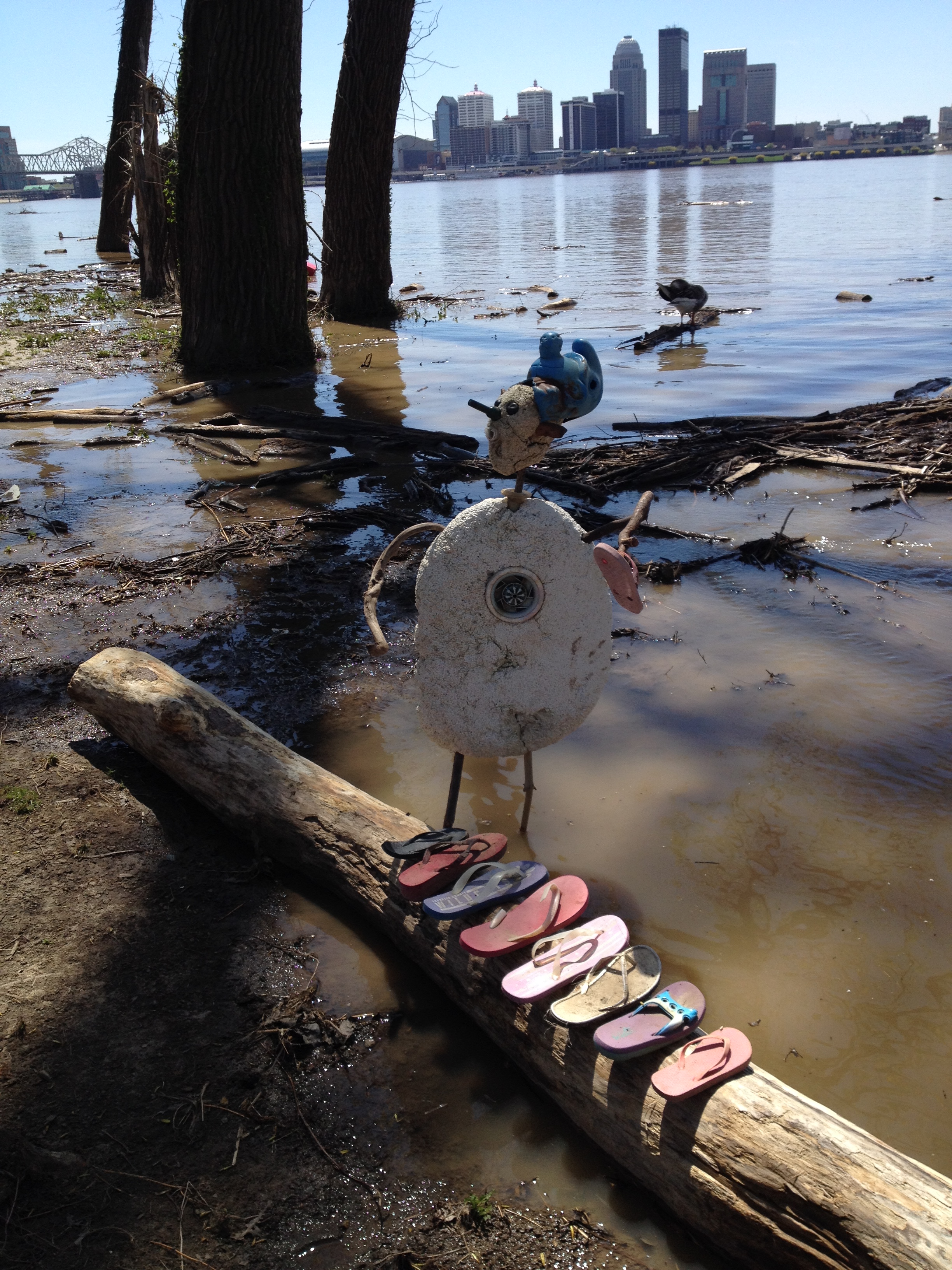
Shoe Shaman of the Big Blue Nation, Falls of the Ohio, April 2015

What I first thought was singing turned out to be chanting and it was coming from this exotic guy.  I’m sure I must have had the strangest expression on my face!  Despite my presence, this blue-helmeted figure with some kind of mandala on his chest was practically knee-deep in muddy water and lining up found flip-flops on a beached log.  A perfectly normal activity don’t you agree?  I’m assuming he gathered these sandals from all the other flotsam and jetsam that has washed into here?  That part I can understand because I have an ongoing collection of the same footwear that I hope to make into something grand and profound some day.

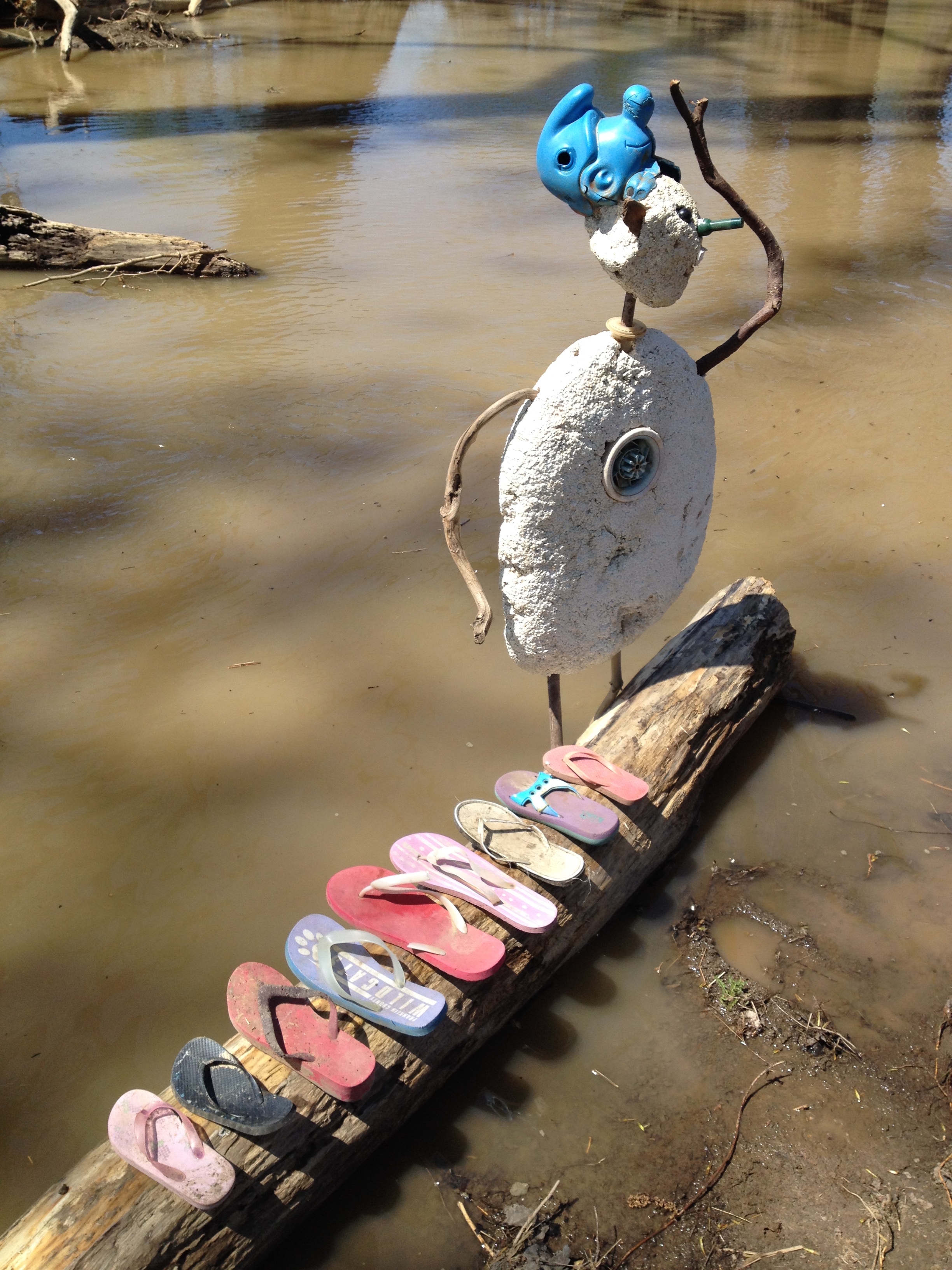
Detail of the Shoe Shaman, Falls of the Ohio, April 2015

Shoe Shaman of the Big Blue Nation and altar, Falls of the Ohio, April 2015

I remained quiet, stayed observant, and took these photographs.  I saw the blue helmeted man face west and chant.  He later did the same thing looking towards all the cardinal directions.  On occasion, he would carefully pick up a sandal and whisper to it before placing it back upon the water-logged trunk of a limb-less tree.  For emphasis, he would also do this little hop dance step in the muddy water.  I waited for him to finish before interrupting him with a few questions of my own.
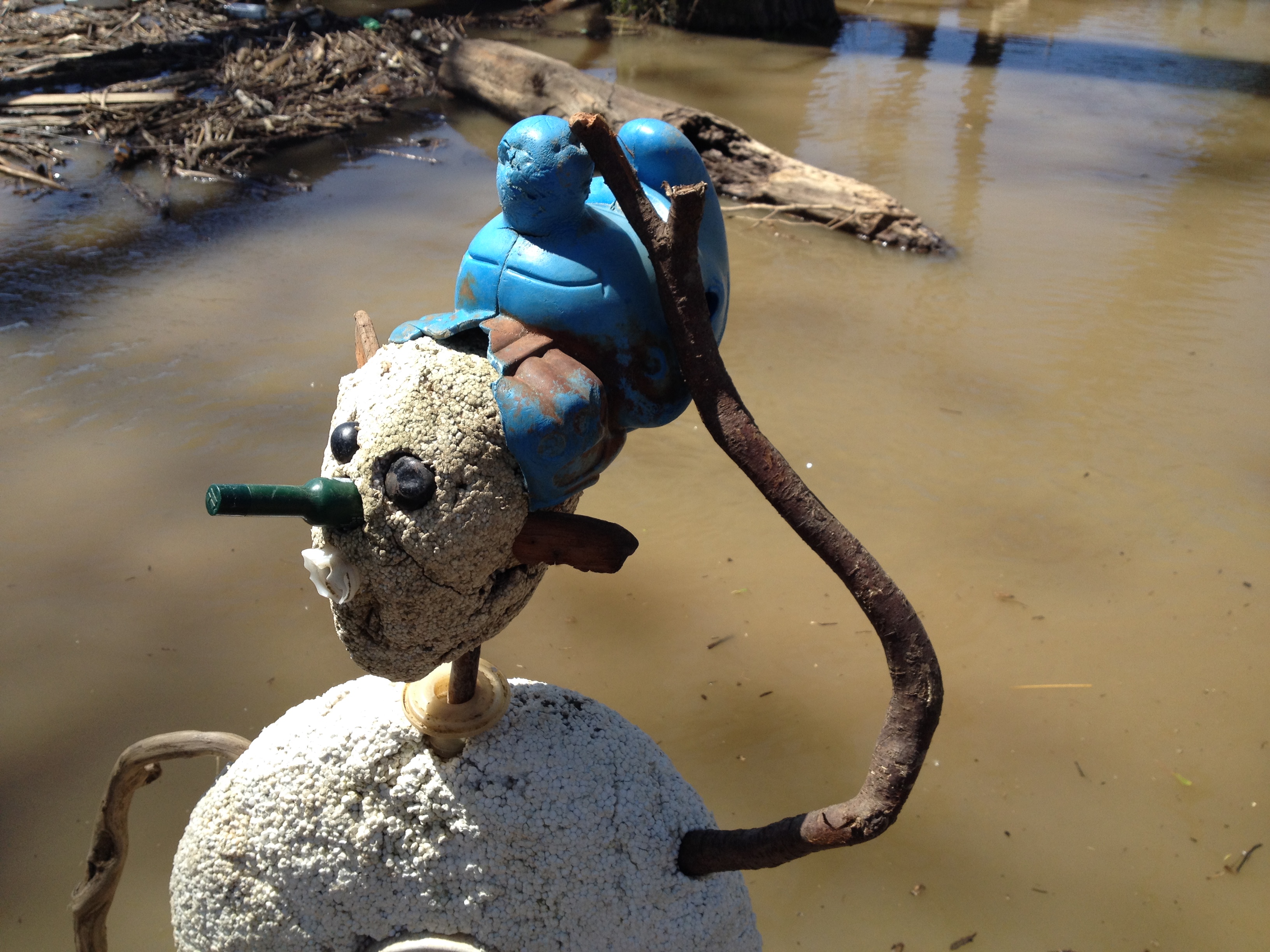
Head of the Shoe Shaman, Falls of the Ohio, April 2015

Shoe Shaman with his altar, Falls of the Ohio, April 2015

Finally, I had my chance to speak and the mysterious figure looked my way.  I was surprised that I could understand what he was saying.  First, he thanked me for respecting his custom by not interrupting his ceremony.  He also said that it is very important that the flow of energy continue unabated if the ritual was to take hold.  Filled with questions, I asked his name and what was he doing?  Patiently, he explained that he was the Shoe Shaman of the Big Blue Nation, a holy man and offered as proof the ill-fitting helmet on his head which was the official crest of his high office.  I didn’t say anything, but thought the Shoe Shaman’s head-gear bore an uncanny resemblance to a Smurf’s head.  I wondered if that was in fact the Big Blue Nation he was referring to?  If that indeed was the case…well, it did make some sense in a surreal sort of way.  There are many cultures that have legends about “little people”.  I asked what he was doing with the sandals and he said that working with footwear was his specialty.  Each shoe, in this case, each lost sandal…has a direct connection to the soul of its former owner and is holy to them.  The weight of each person is impressed into the sole’s foam and is as individual as a fingerprint.  In his culture, they have a saying that you can’t fully understand someone until you stand in their shoes.  I said we have a similar saying.  The Shoe Shaman said that his goal is to affect the river’s empathy and not to further enrage it for taking the water and environment for granted. My new friend was attempting to appease the flood waters by asking the river to forgive our carelessness and to accept the sacrifice that had been prepared for it on this altar of wood.  The shaman assured me that only in this way would the river agree to return to its normal banks and not seek out our kind that had been hurtful towards it.
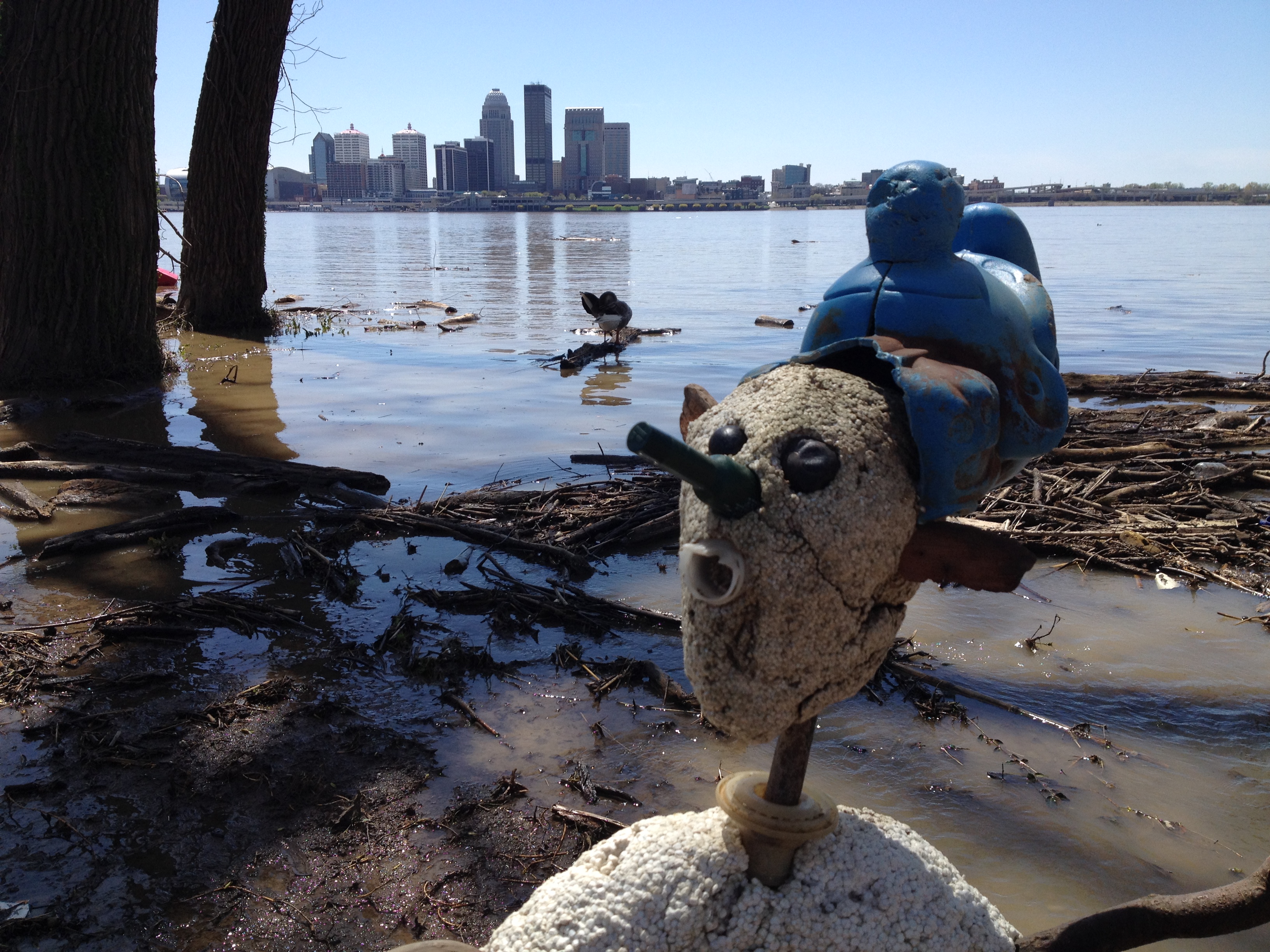
Shoe Shaman of the Big Blue Nation with the skyline of Louisville across the river, April 2015

At the water's edge, the Shoe Shaman, Falls of the Ohio, April 2015

I’ll admit that the idea of a revenge seeking river stunned me some, however, history is full of epic floods.  In our arrogance, we forget how at Nature’s mercies we really are.  My curiosity sated…it was time to move on.  I left the shaman at that interstitial zone between water and land.  Slogging through the mud, I paused briefly sitting on a dry log and thought about what I had witnessed as I also picked the mud off the bottom of my shoes.  I am hoping that he was successful in intervening on our behalf and only time will tell.  For my part, I will never forget the scene and will pledge to do my part to be respectful towards creation by celebrating it and in doing so…hope to save myself and those dearest to me.  I don’t ever want one of our soles to go missing and find itself on a log floating somewhere along the Ohio River.  Until the river retreats…

The Sandal, Wood Altar, Falls of the Ohio, April 2015

Read Full Post »

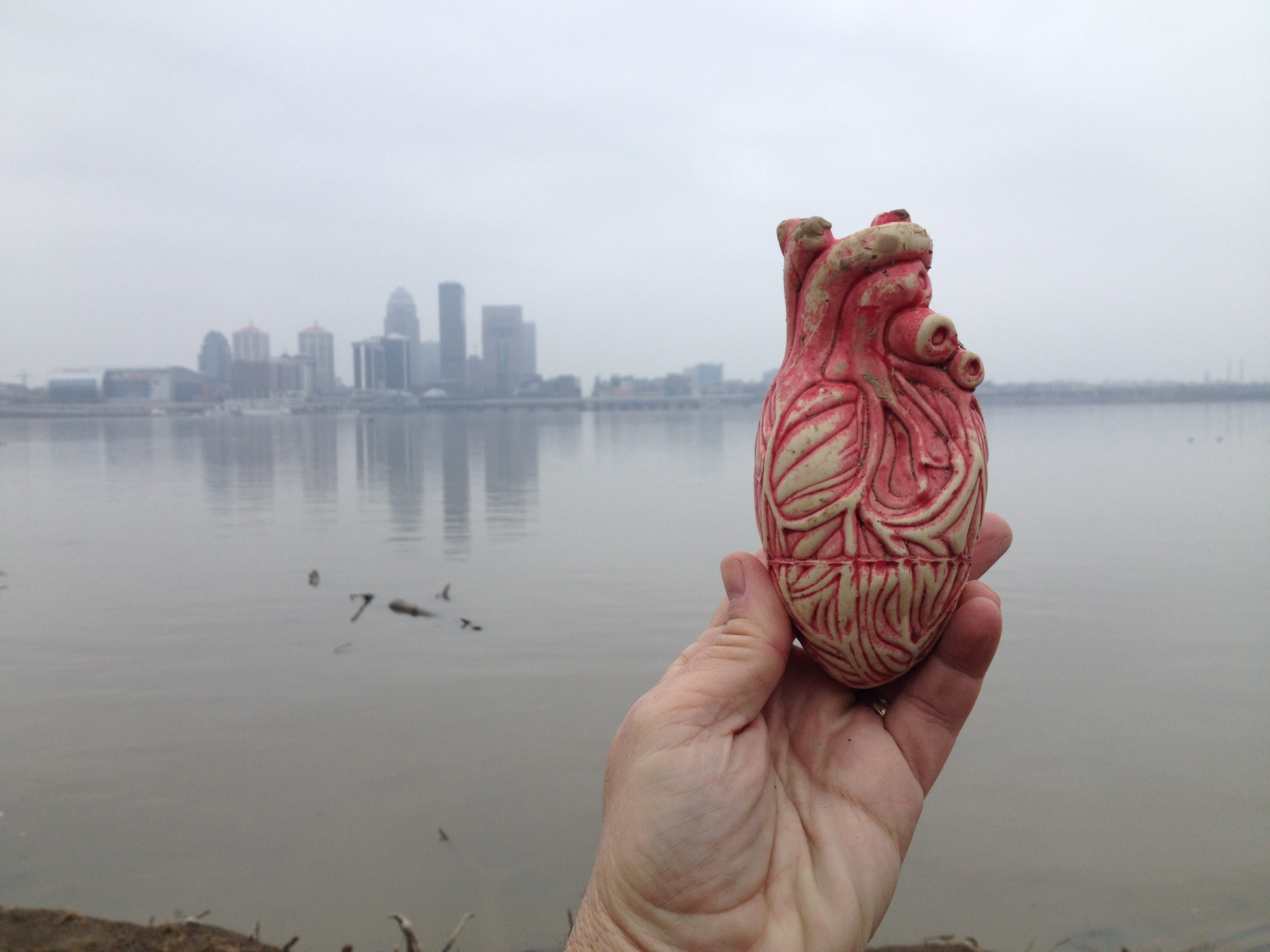
Found Plastic Heart, Falls of the Ohio across from Louisville, Jan. 2015

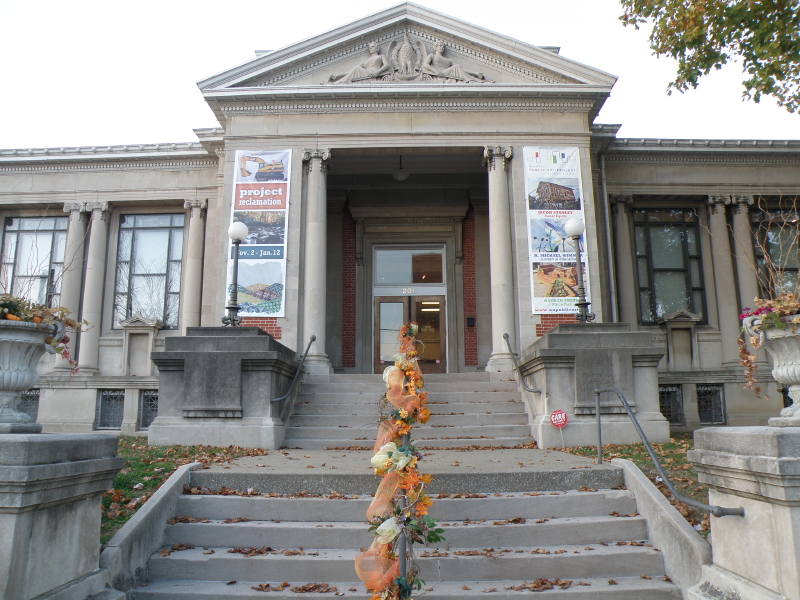
Happy 2015 to all from the Falls of the Ohio State Park!  This is my first post of the new year which has started auspiciously for me.  I am happy to report that I found a new day job!  I am the new Coordinator of Public Programs and Engagement at the Carnegie Center for Art and History in New Albany, Indiana.  About this time last year I was showing my own river art at this organization.  It’s funny how things worked out…I had a feeling that my opportunities were leading me to the north bank of the Ohio River and that’s what happened.  I found this plastic heart in the mud of the Indiana riverbank about a week before I was offered the job.  I wonder if it has significance?

Carnegie Center for Art and History, New Albany, IN, Nov. 2012

My relationship with the Carnegie Center for Art and History goes back to the early 1990’s when as a staff member at the Louisville Visual Art Association I helped to install the Indiana version of the Children’s Free Art Classes on the Carnegie Center’s gallery walls.  Over the years, I’ve been fortunate enough to have exhibited my own work here with the latest being the Potential in Everything show with Michael Wimmer that was up this time last year! There has to be a lot of serendipity in play here for all the stars to line up as they did and so I am feeling it was meant to be.  I will be creating new workshop opportunities and other programming to help the center with its community-minded mission.  It’s a new challenge for a new year!

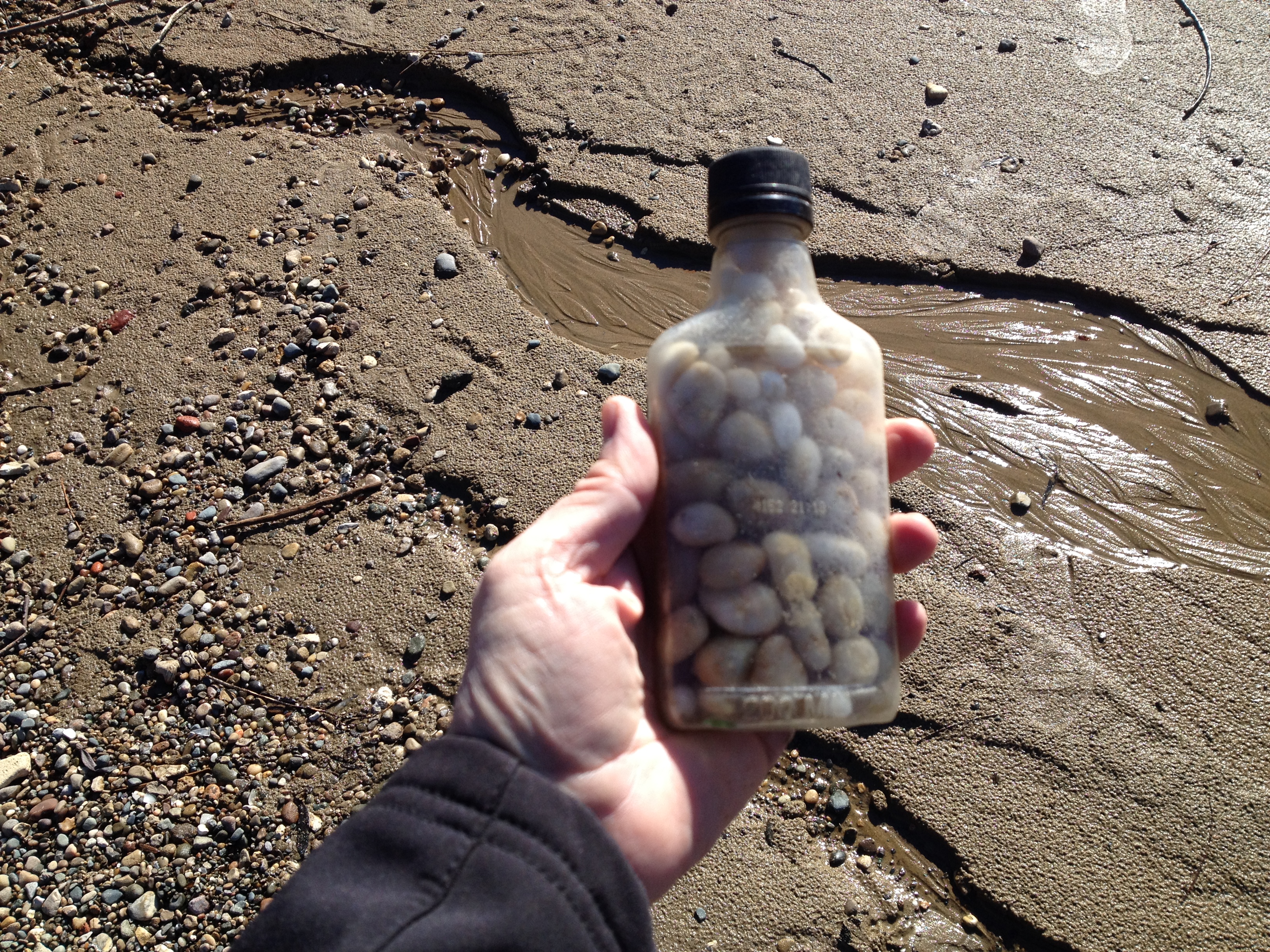
plastic liquor bottle filled with quartz pebbles, Falls of the Ohio, Jan. 2015

With the new job and a recent cold spell I haven’t had the opportunity to visit the river until this three-day weekend.  I heard that 2014 was the warmest year ever recorded across the globe.  Today our temps are in the low 50’s which is quite a change from the teens we just experienced.  I grabbed my walking stick and collecting bag and made a day at the river.  I have been doing various bottle projects and here is a new one.  I found a plastic liquor bottle that still had its cap on it.  It’s interesting to note that most bottles I find with screw-top bottle caps are discarded with their caps on.  By a deposit of Ice Age gravel, I was able to fill the bottle with river-tumbled white and pale yellow quartz pebbles.  Not sure how I will use this, but will probably factor into a new artwork soon.  Being outside on such a fine day is something else I wish I could bottle for future use when the cold, damp, and gray returns.  For now I place the bottle in my collecting bag and move on.  There are other things to find and discover.

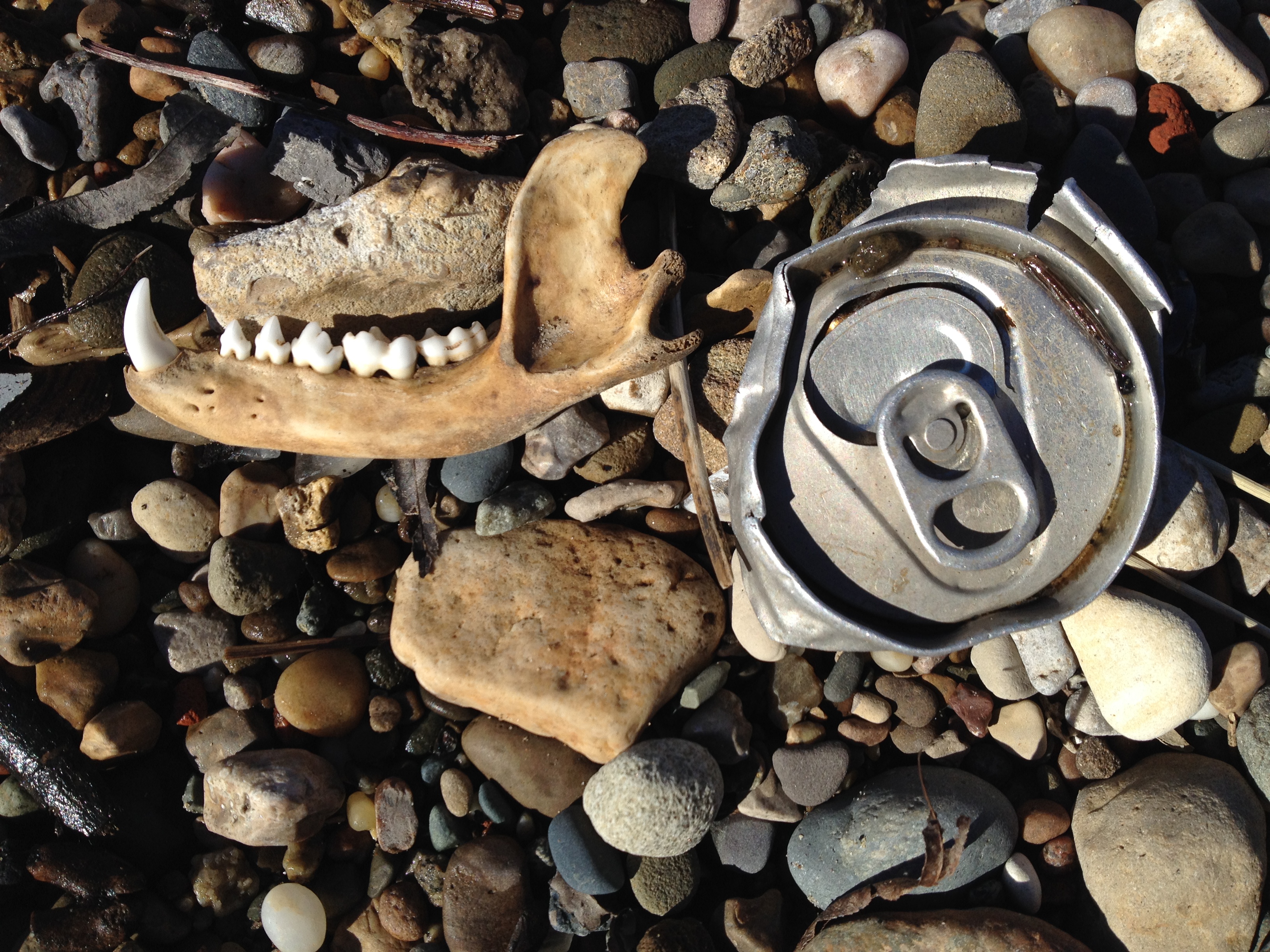
jaw bone and aluminum can top, Falls of the Ohio, Jan. 2015

Next to the flattened top of an aluminum can I found this small, partial jaw bone.  I think it’s from a skunk or some other small carnivore, but will need to check the dentition more carefully.  After taking this picture, I picked the mandible up and placed it into my bag.  This find will factor into something else I put together before day’s end.

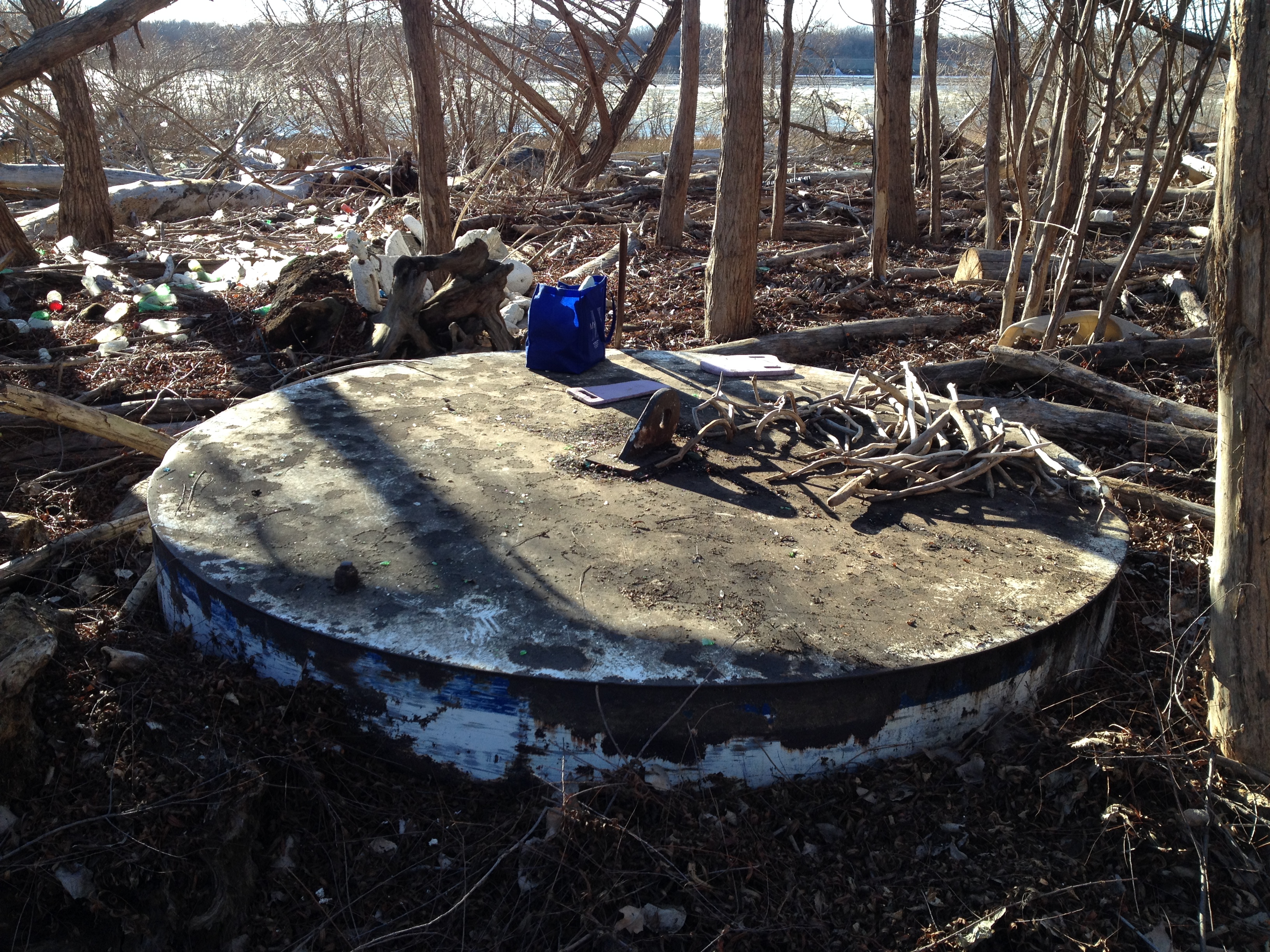
Circular platform at my outdoor studio, Falls of the Ohio, Jan. 2015

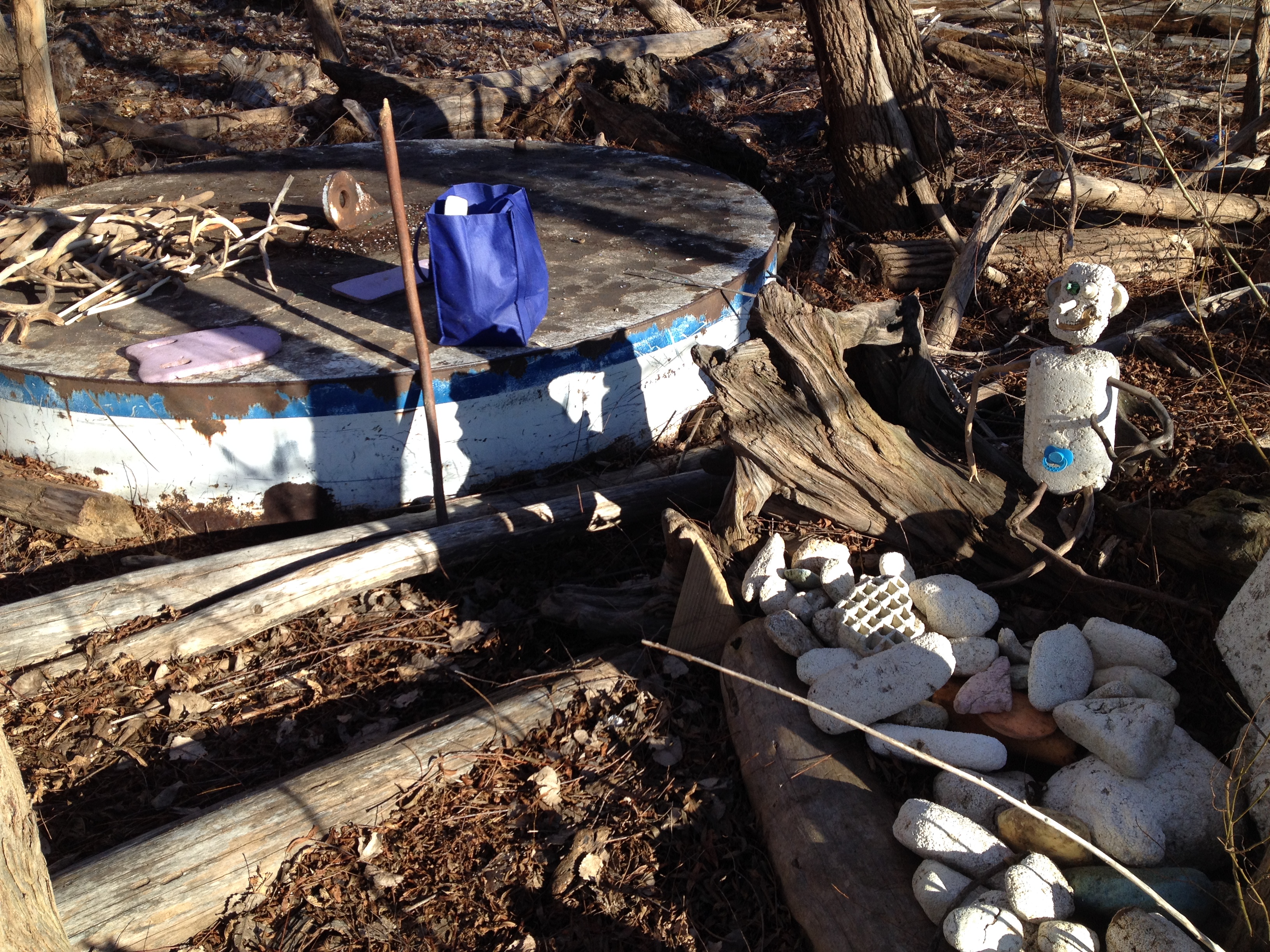
The mud and melting ice made checking out the river’s edge problematical and so I headed up the riverbank and into the willow trees.  I visited my outdoor atelier and decided to do a little “house cleaning”.  I swept the leaves and dirt off of the circular metal platform that has been here for several years.  If I could have figured out how to get this object home, I probably would have done so by now.  As it is, I like using it as a work surface and place to sit.  My other stashed materials are nearby.  To me, the platform is still a “U.F.O.”…which stands for “Unknown Floating Object”.  I think it has something to do with mooring barges, but could be wrong about that.  I also like that it adds a stage-like presence and helps define one small area at the Falls.

Louisville and Indiana railroad cars, Falls of the Ohio, Jan. 2015

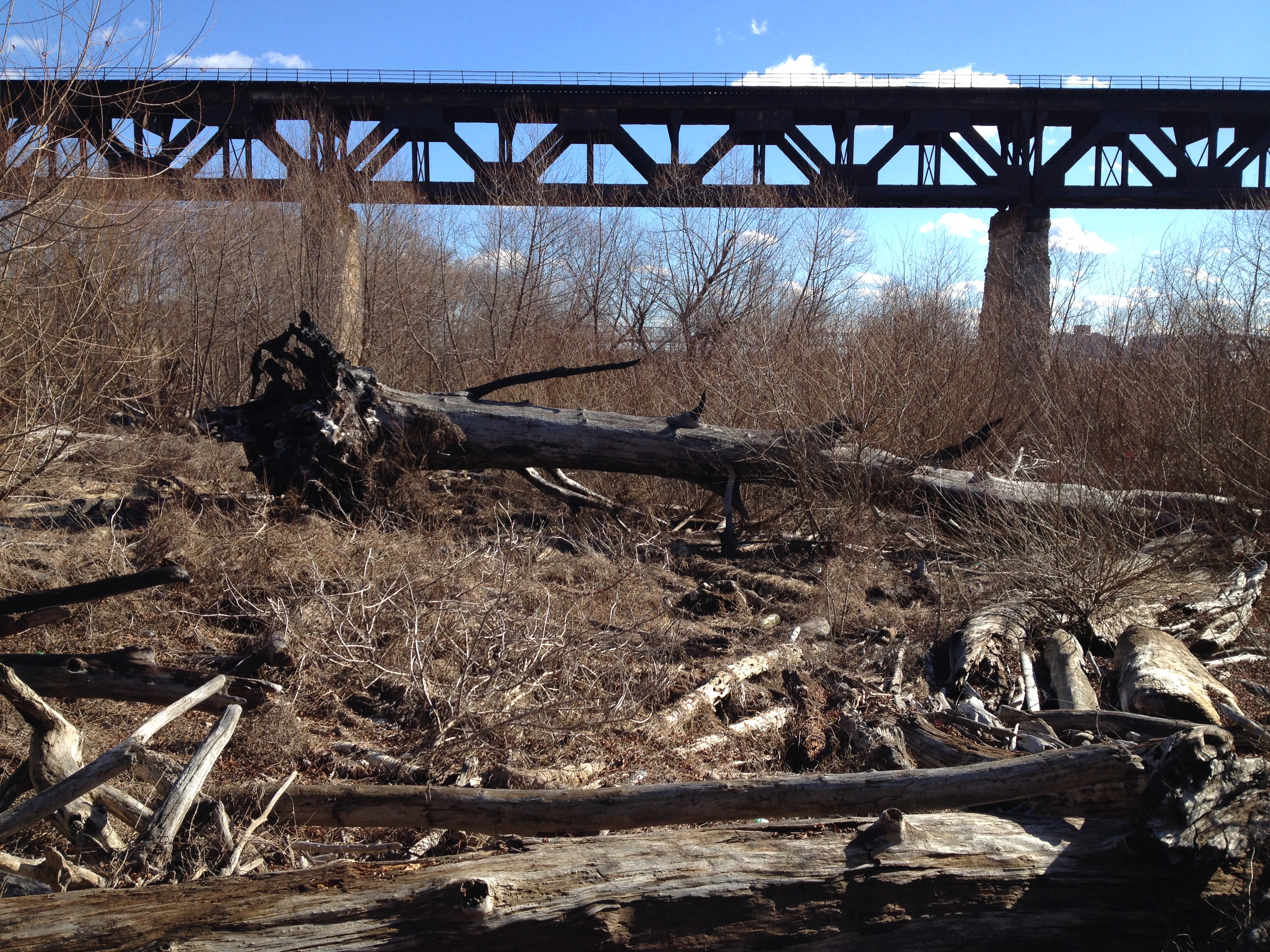
Huge downed log near the railroad bridge, Falls of the Ohio, Jan. 2015

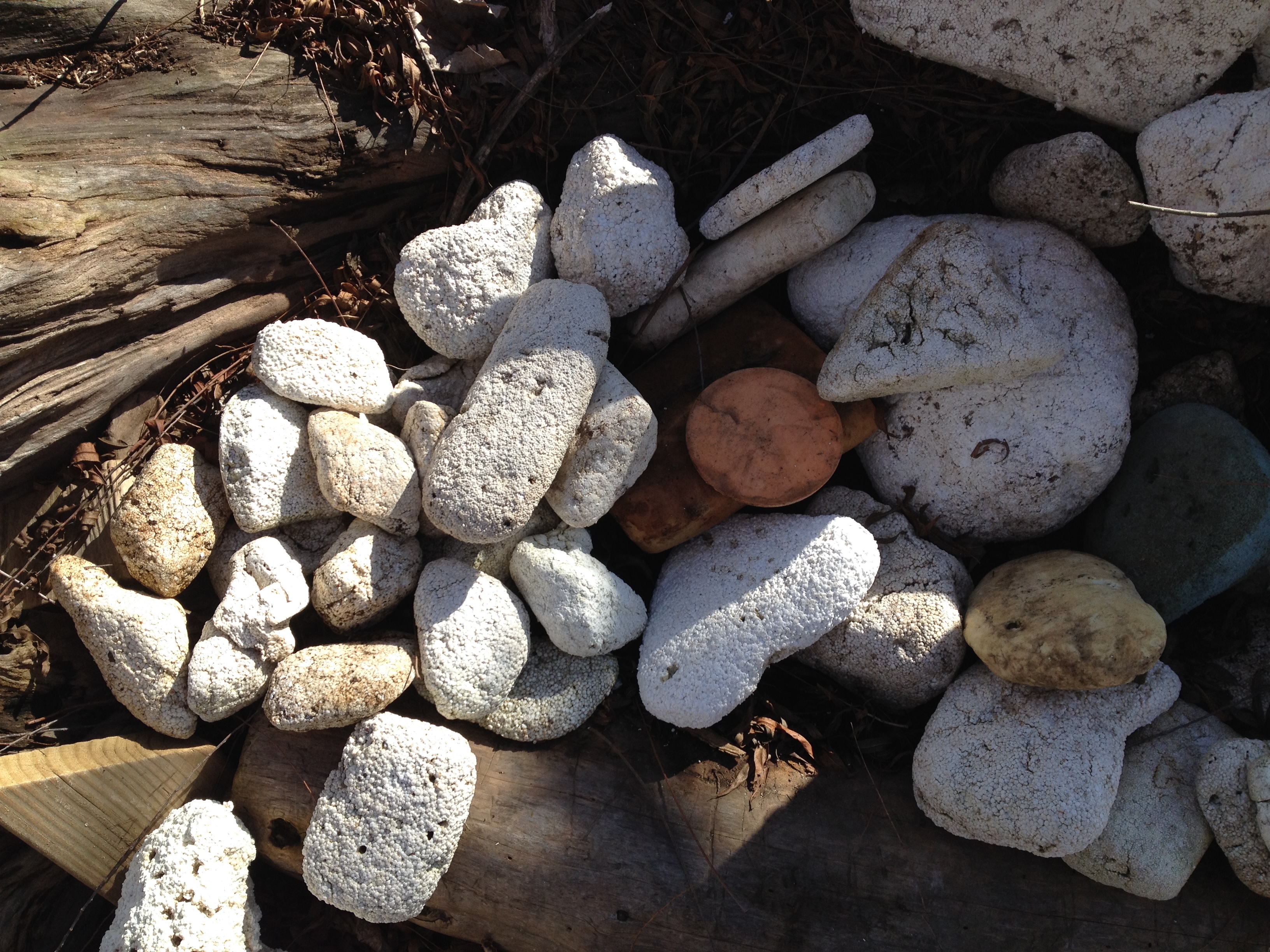
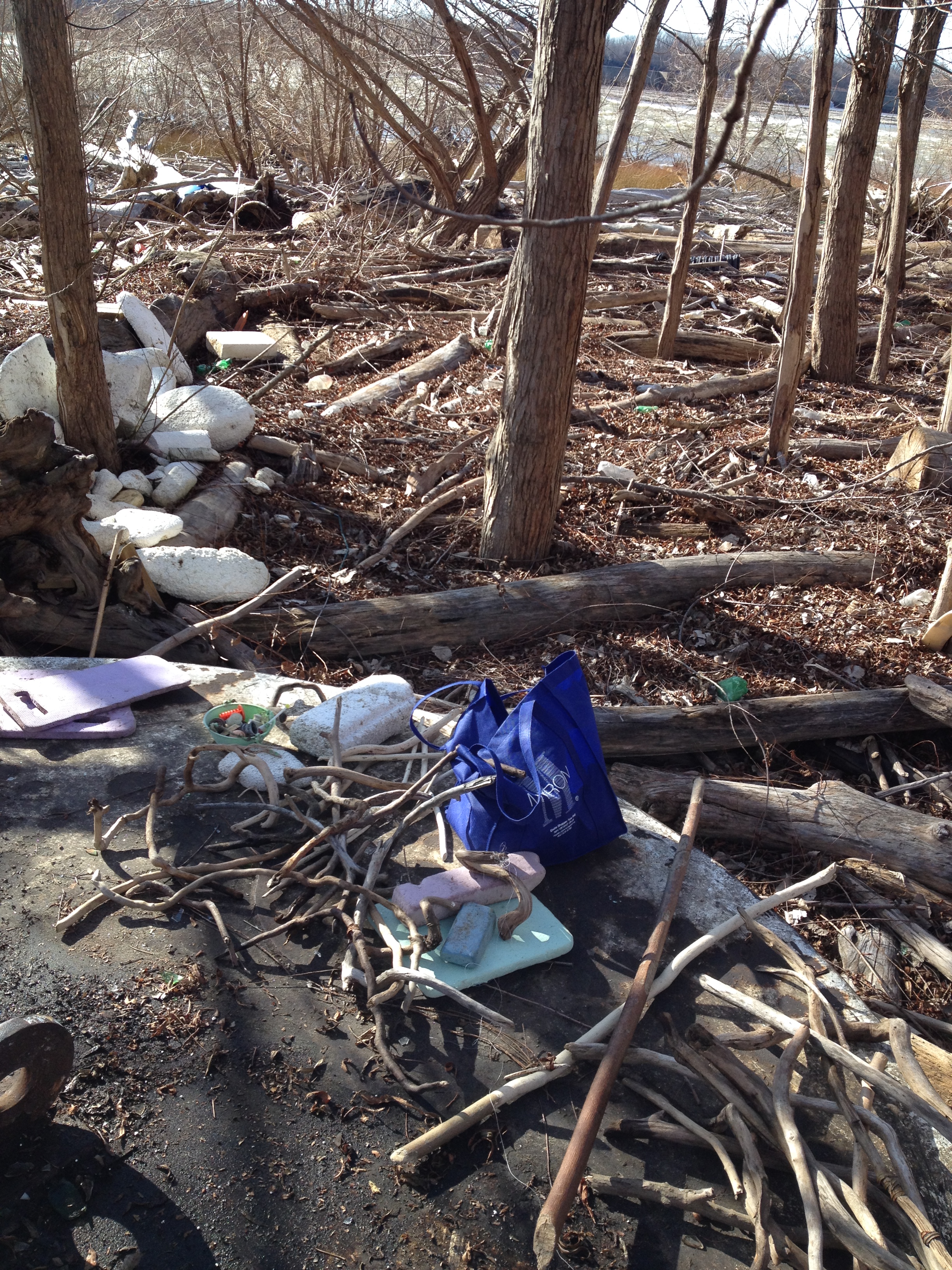
Standing on the platform and facing the river, if I look to my left I see the old railroad bridge.  There were several trains that went back and forth while I was occupied.  The railroad is part of the atmosphere of the place.  A large and partially burned log occupies the space between the platform and the bridge.  I straightened out my stick and root collection and sorted them on the platform.  I then rediscovered my Styrofoam collection.  Every time I walk the river, I find new river-polished pieces and add them to this assemblage.  There is simply more here than I can use at a time and so anyone is welcome to try making something from what has been gathered.

Styrofoam larder at the Falls of the Ohio, Jan. 2015

Detail, Styrofoam pieces, Falls of the Ohio, Jan. 2015

I grab a few rounded pieces from the collection and decide to construct a figure from what I have here and in the bag.  I decide which shapes and forms would make good heads and bodies and set them aside.  Once in a great while, some other creative souls find my larder and make something of their own from this junk.  I like it when people see the opportunity here.

Outdoor studio view, Falls of the Ohio, Jan. 2015

Materials for a figure, Falls of the Ohio, Jan. 2015

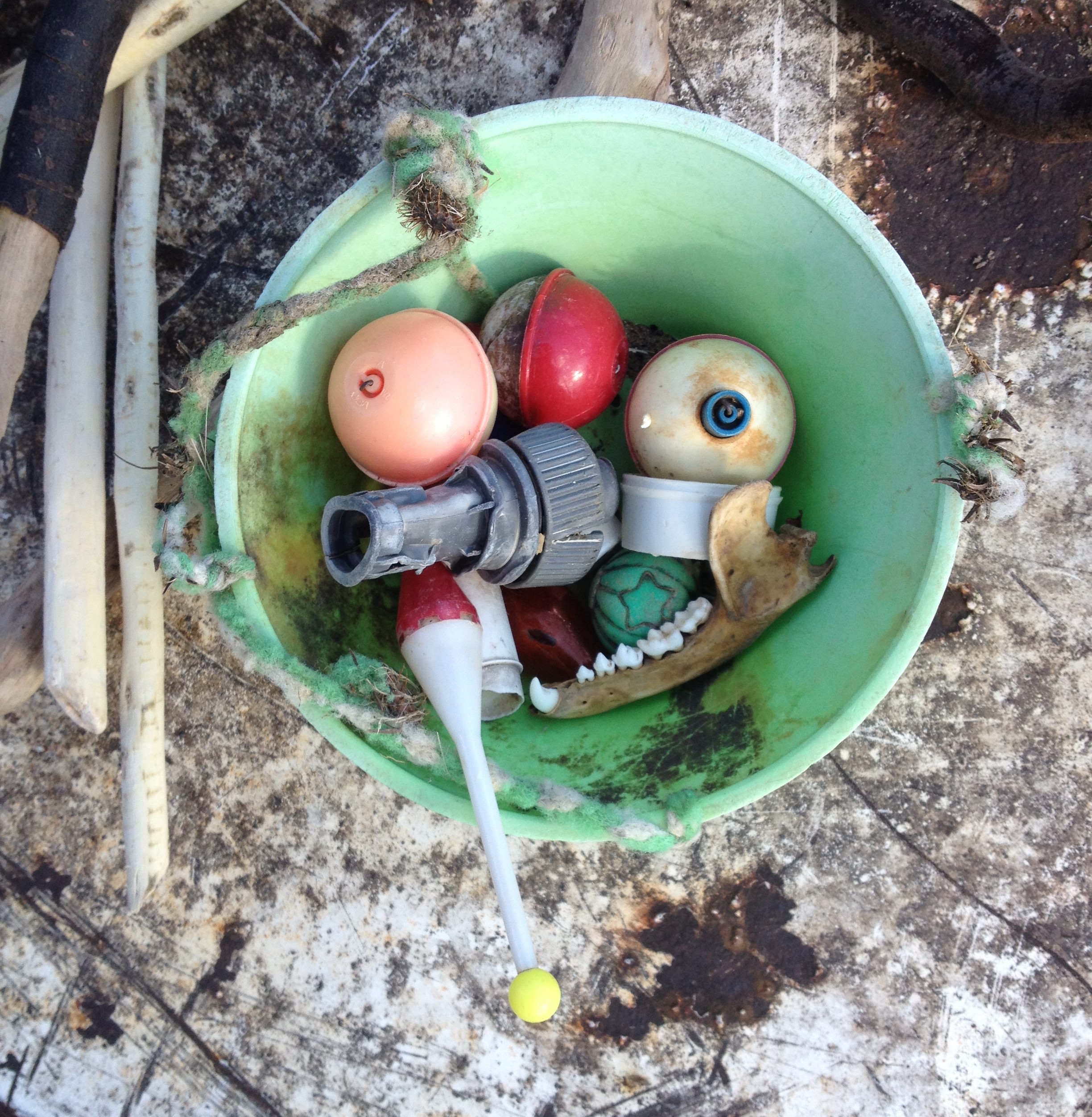
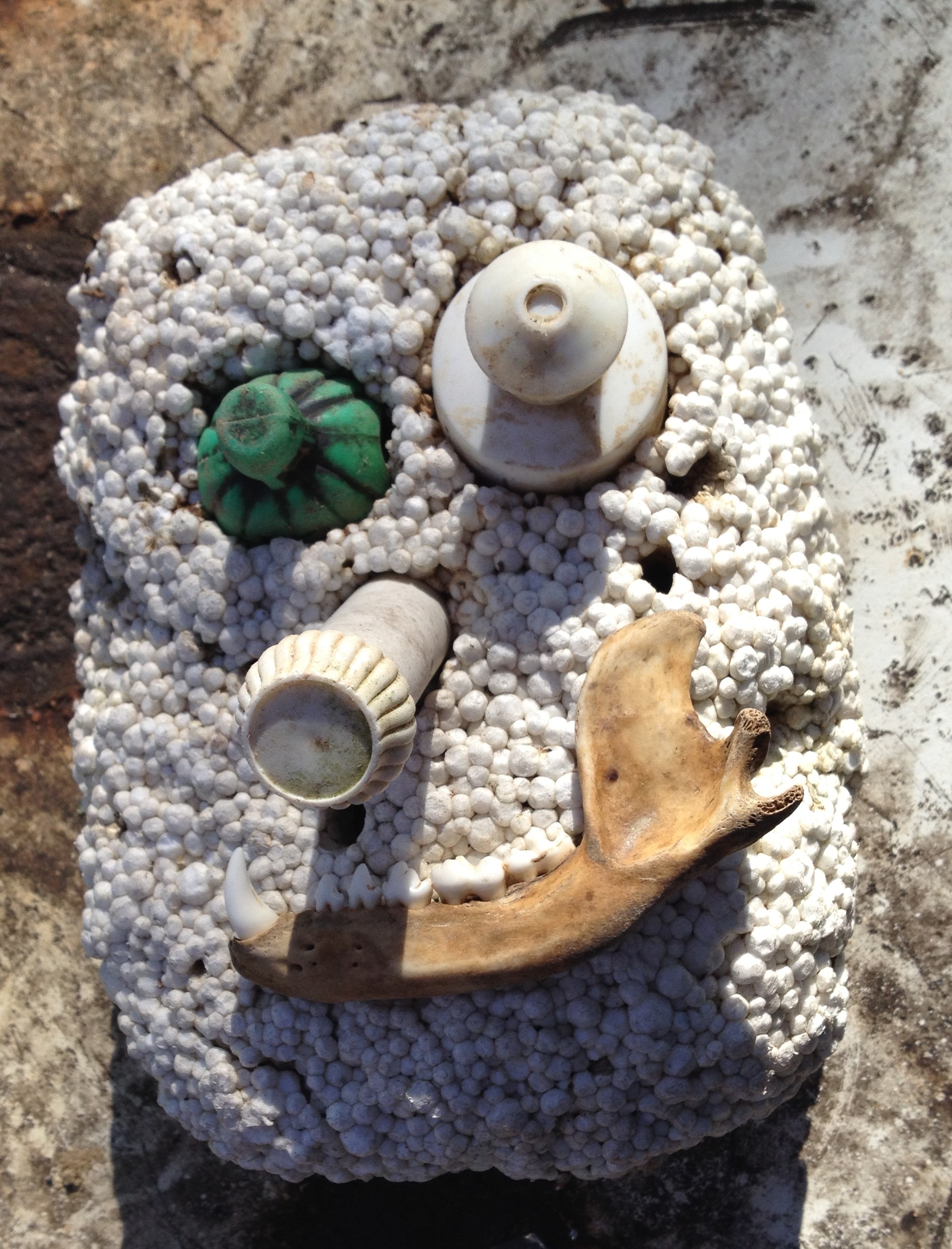
I usually like starting with the head first.  It’s where the most information is focused and my Styro-figures share this with archaic works and folk art.  In the case of this figure, I decided on another shape for the head.  Collected bits of plastic and potential facial elements are placed into a found plastic bowl.  I will decide the features of today’s figure from what I’ve gathered today.  Here’s a sequence showing the progression of how the head evolved including what already looks like a found face in the bowl.

Plastic bowl with potential "facial features", Falls of the Ohio, Jan. 2015

January Styro-figure head in progress, Falls of the Ohio, Jan. 2015

Finished head, Falls of the Ohio, Jan. 2015

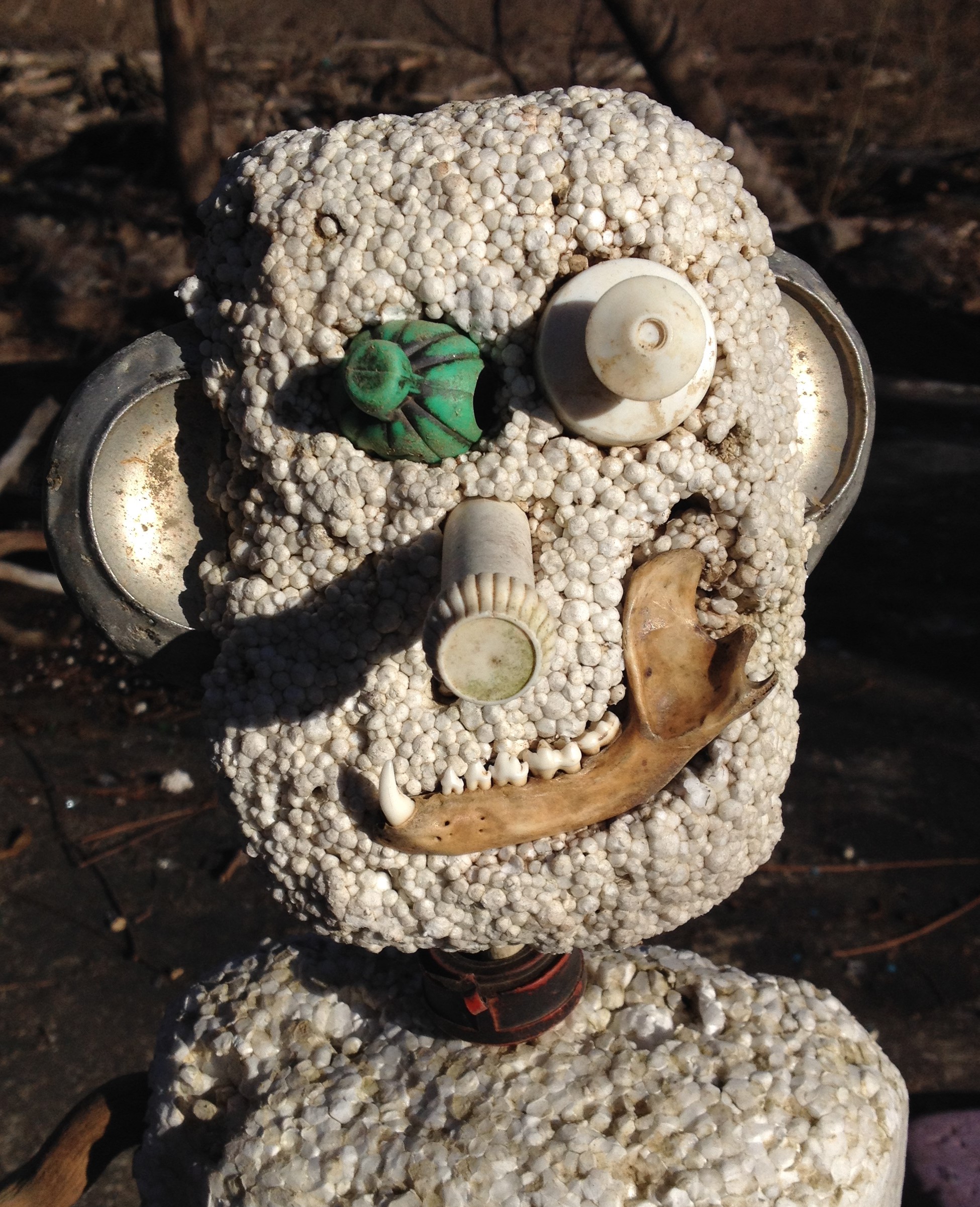
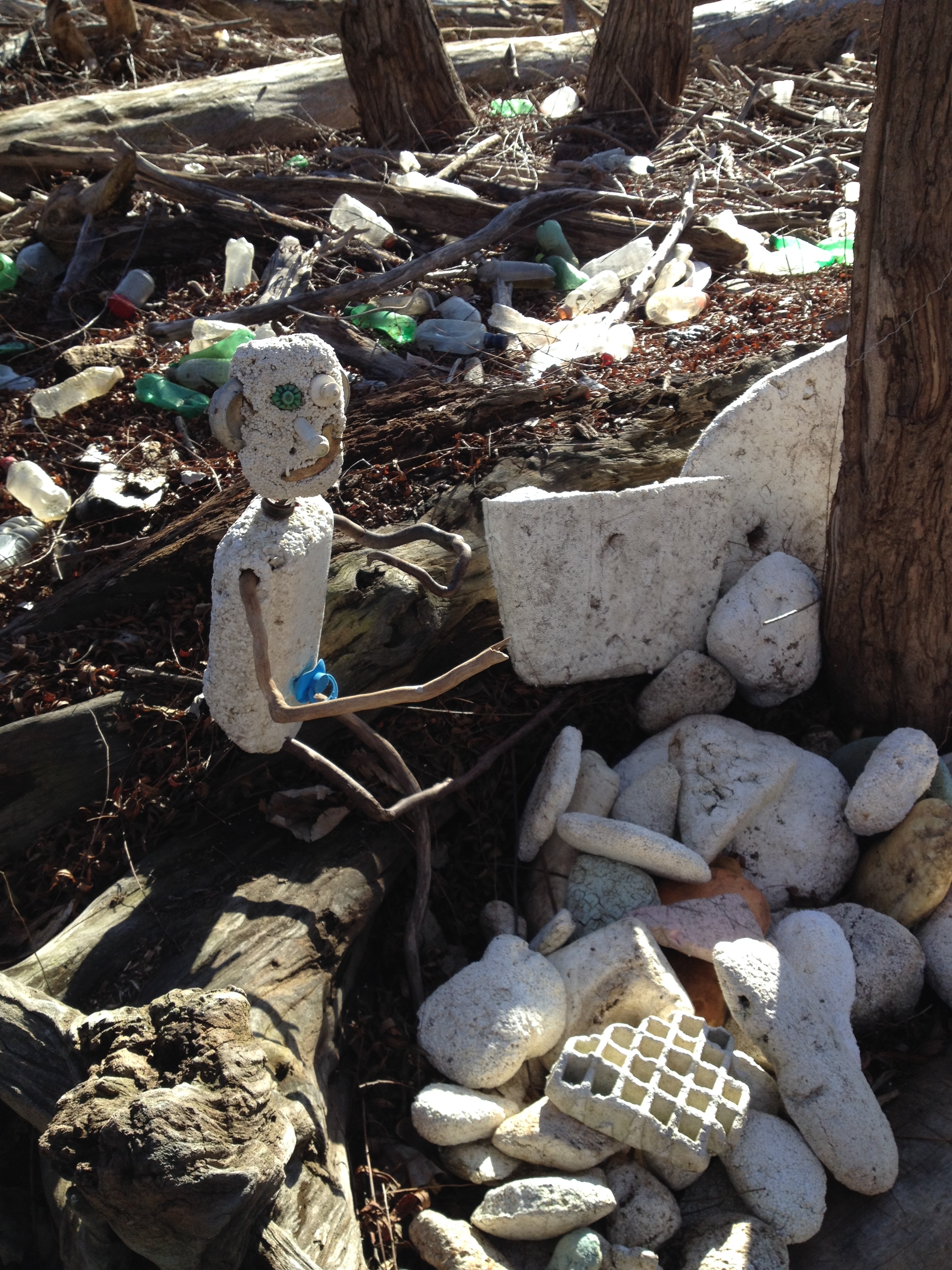
The found mandible has a new home on this piece.  I split the bottom from an aluminum can to make the ears which does give this figure a monkey-like quality to it.  The eyes are a white, plastic bottle cap and the green, plastic bead from a child’s toy.  I found two expressive sticks for arms and set the figure up as though it were sitting down with crossed legs.  Here are images of this piece finished on site.

First Man of January, Falls of the Ohio, Jan. 2015

Figure at my outdoor art site, Falls of the Ohio, Jan. 2015

I had the best time today.  There is still lots of winter before us, but this weekend’s respite helped connect me to the river for the first time this year. I will be curious to see if we even have one decent snow fall this season?  Whatever happens during 2015, I will take it all in stride. The year is already off to a positive start!  I think I will leave it at that and sign off until next time from the Falls of the Ohio.

Skyline of Louisville from the Falls of the Ohio, Jan. 2015


Read Full Post »

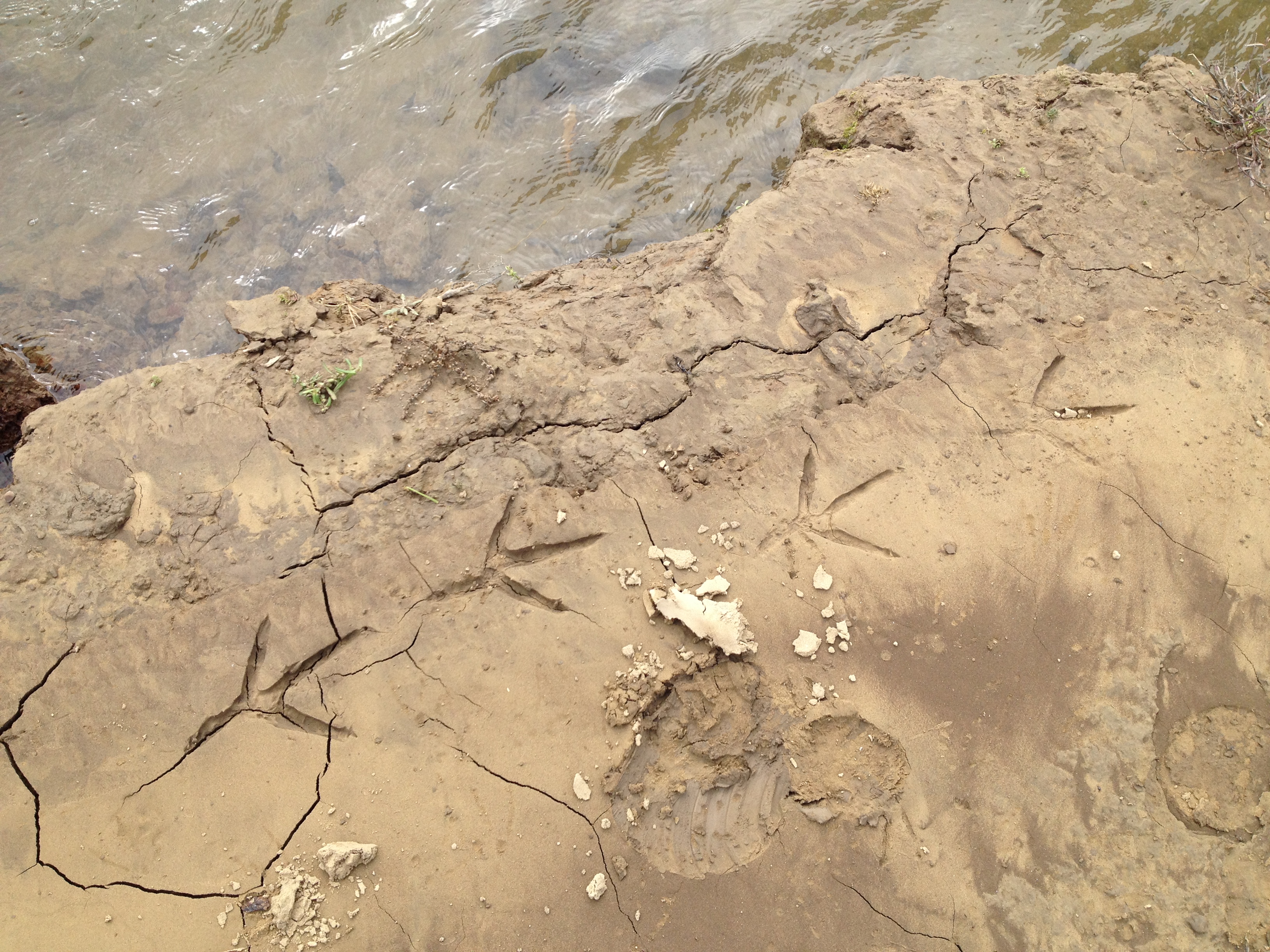
Great Blue Heron tracks in the mud, Falls of the Ohio, Oct. 2014

What began overcast and dreary blossomed into a gorgeous, sun-filled autumn day.  The exposed fossil beds by the Upper Tainter Gates are now covered by water rushing at break neck speed.  The Ohio River has once again reclaimed its ancient limestone bed with man’s help.  The Falls of the Ohio are like Niagara Falls which can also be regulated with the flip of a switch.  There’s a good chance that I won’t be visiting that side of the park again until next summer’s heat returns.  Today I concentrated my attention and energy along the riverbank under the Conrail Railroad Bridge.  This is an area where I have had good luck finding materials to work with and many of my best bird sightings have also occurred here.  The autumnal migration is under way.  Many of the birds that had passed this way going north in the spring are now moving south towards wintering grounds in exotic locations in Central and South America.  I ducked under the Black willow trees whose leaves are turning bright yellow and was soon rewarded by a bird species new to me.

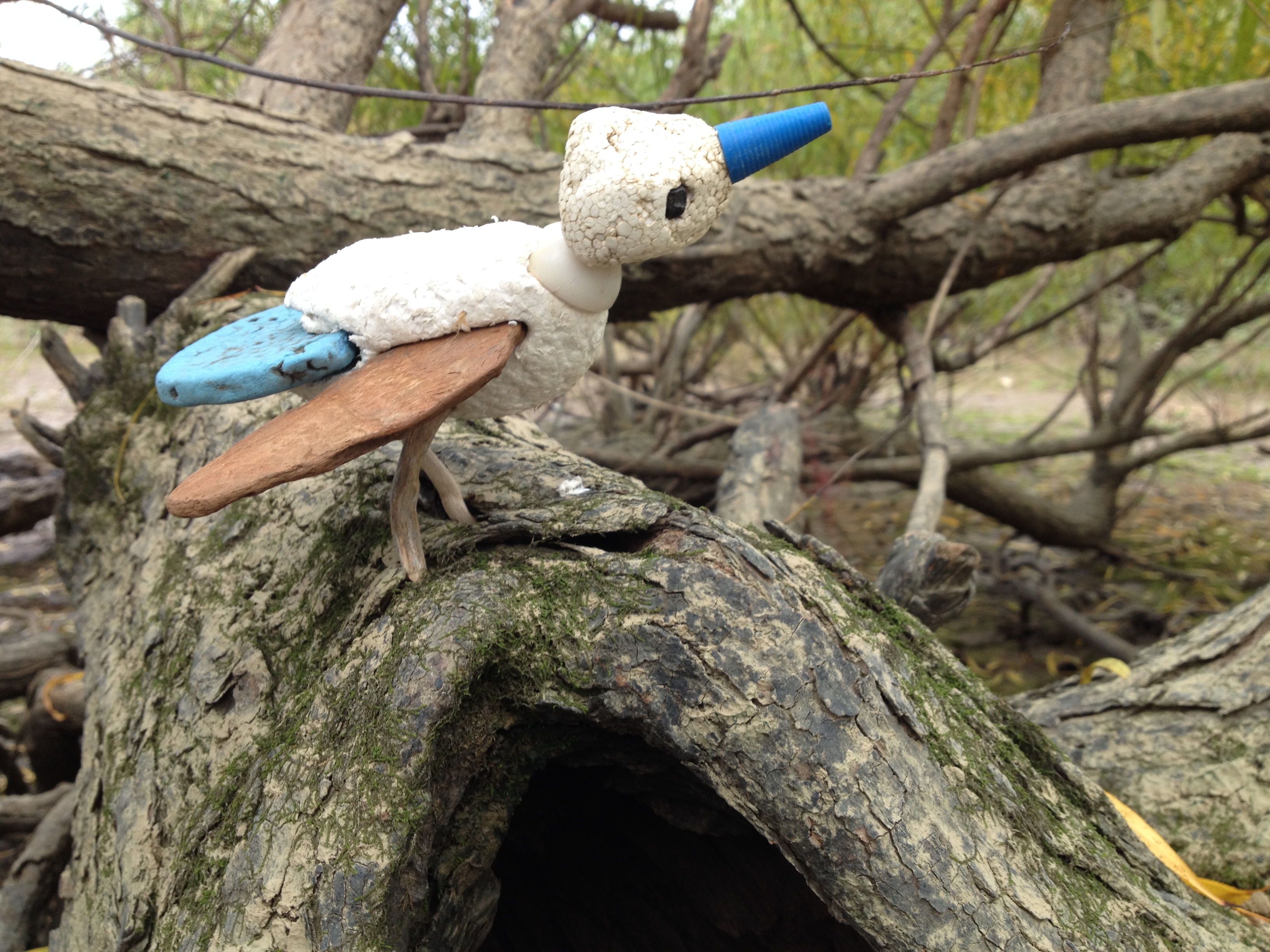
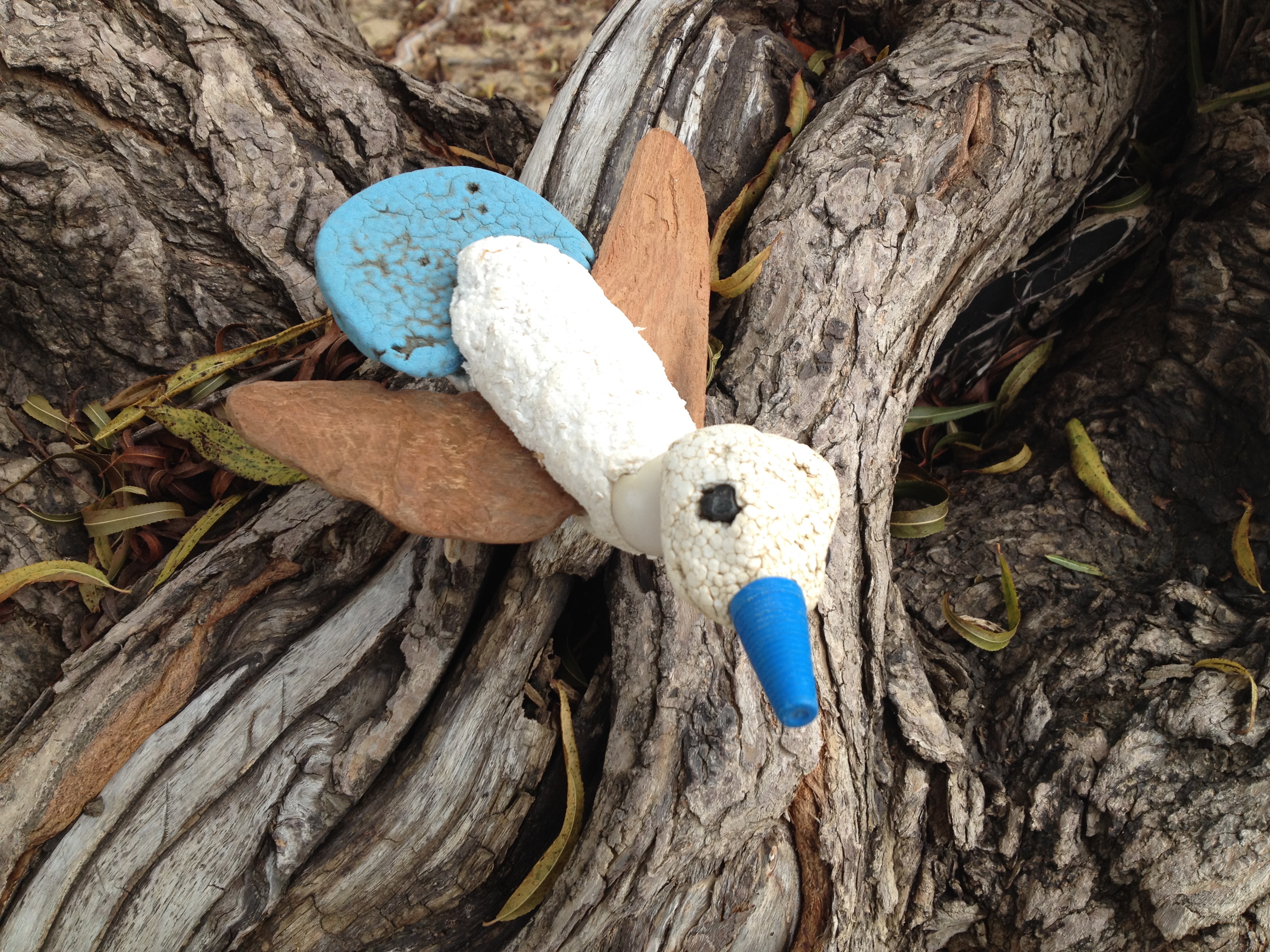
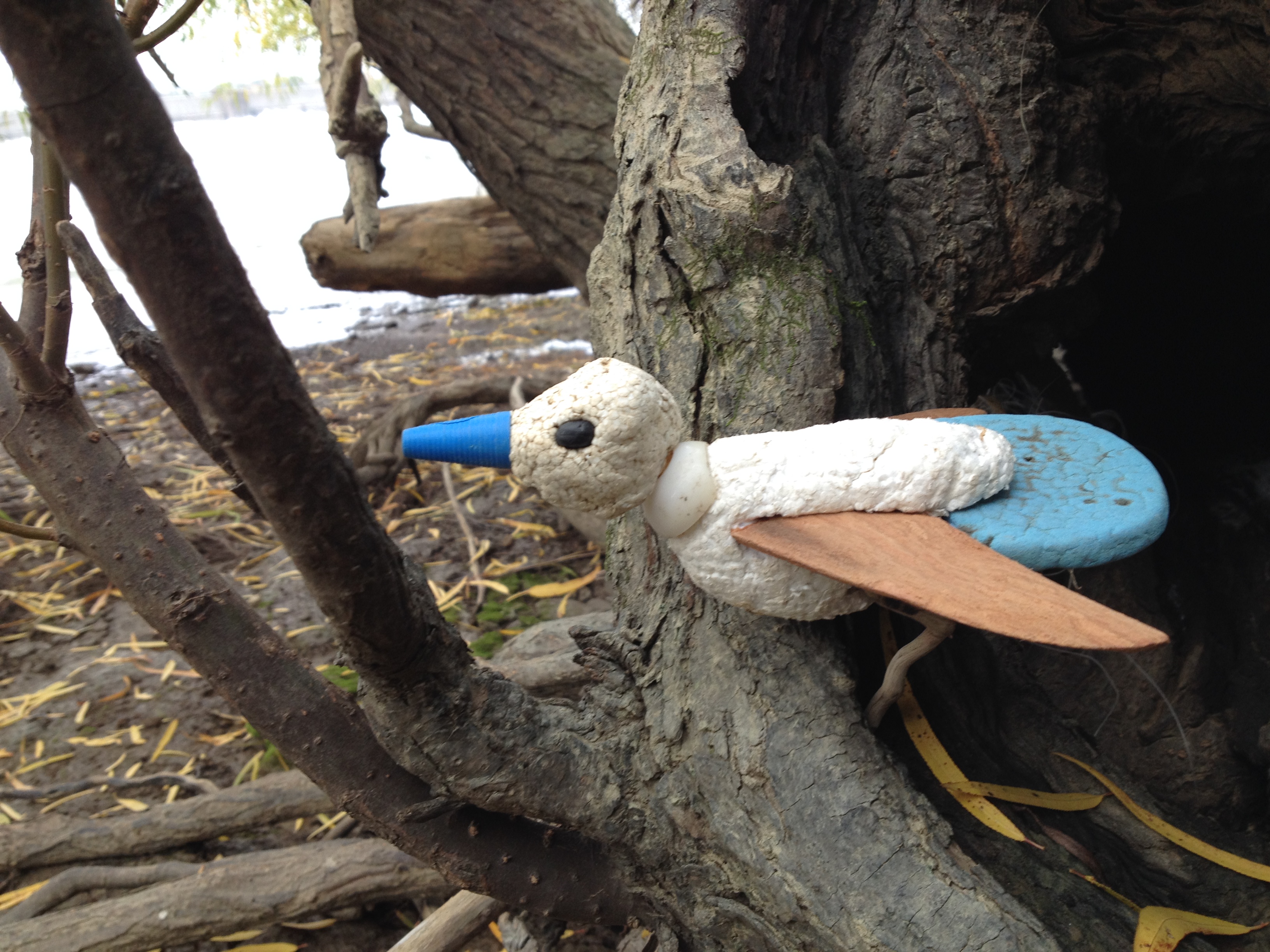
Fan-tailed Gnatcatcher, Falls of the Ohio, Oct. 2014

This is the Fan-tailed Gnatcatcher and this is the first time this species has been recorded in the park.  I had the greatest luck hiding behind the trunk of this willow and was able to observe this bird at extremely close range.  If it spotted me…it demonstrated no concern at all and continued its search for small insects and spiders hiding among the furrows in the tree’s bark.

Fan-tailed Gnatcatcher, Falls of the Ohio, Oct. 2014

The Fan-tailed Gnatcatcher is a diminutive bird.  I watched as it dutifully searched the tree for food.  It had no problems going down the tree head-first in nuthatch fashion.  In this species, both the male and the females are similarly marked.  This young bird (identified by its lack of a feathered crest on it head) was just an egg a couple of months a go and has flown here from northern Canada.

Fan-tailed Gnatcatcher, Falls of the Ohio, Oct. 2014

I was literally at arm’s length to this bird and it was a such a treat to observe something new and at close range.  I loved the coloration on this bird.  The tail feather’s blue fan is balanced by the bird’s bright blue beak.  Rusty-colored wings are set off by the arctic-white hues along the head and body.  Like many bird encounters, I was only able to observe this bird for a minute or two at the most, but it was an experience that will last a lifetime.  As it flew off…I wished the bird well on its long journey and I hoped I could count its kind again among the park’s willow trees.

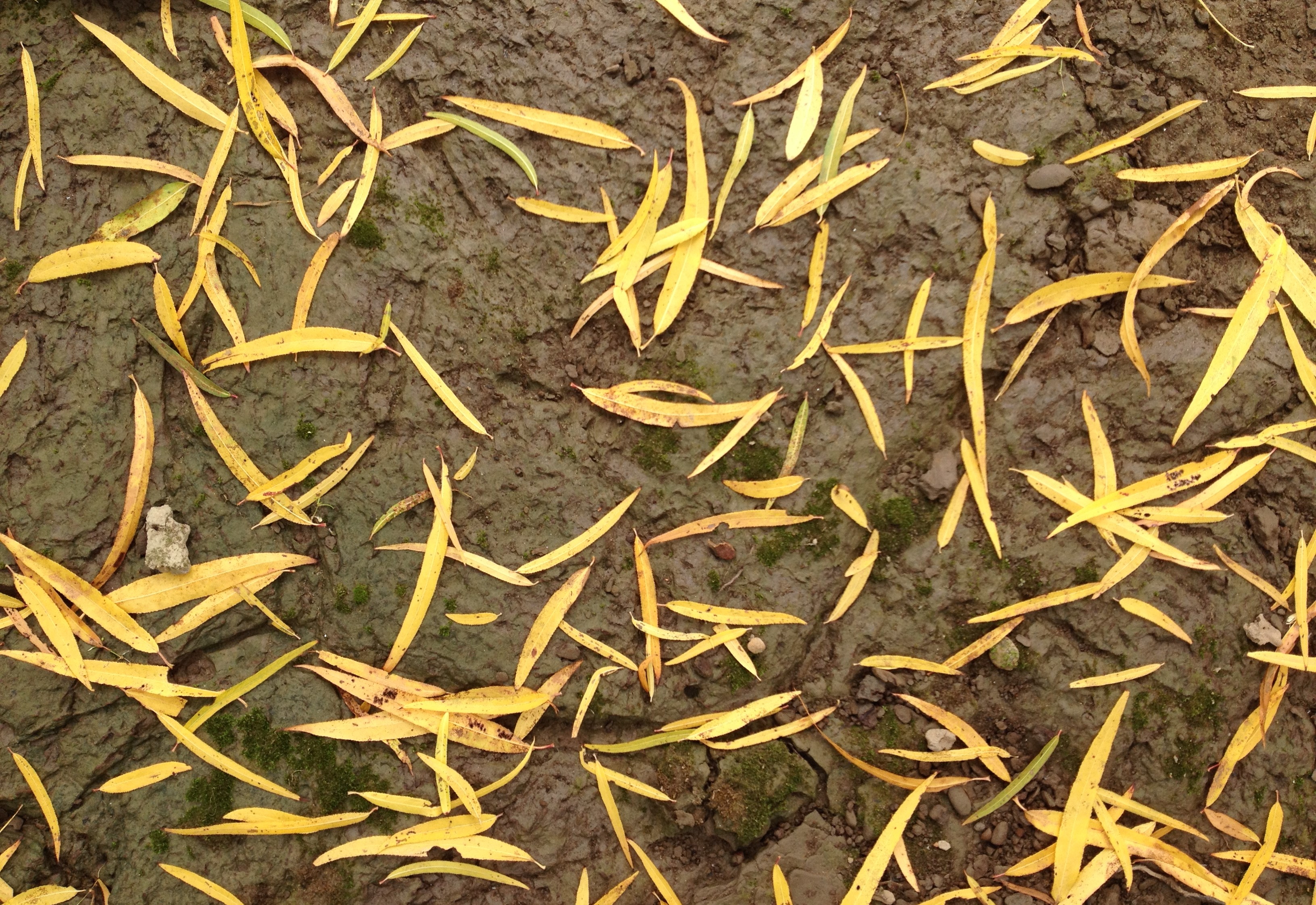
fallen willow leave on mud, Falls of the Ohio, Oct. 2014

I lingered in the moment for a while.  No sense in rushing things.  When I was confident that no other birds were in the area, I moved back to a spot where the Fixed Wier Dam joins the Lower Tainter Gates.  This would be the site for my next project.

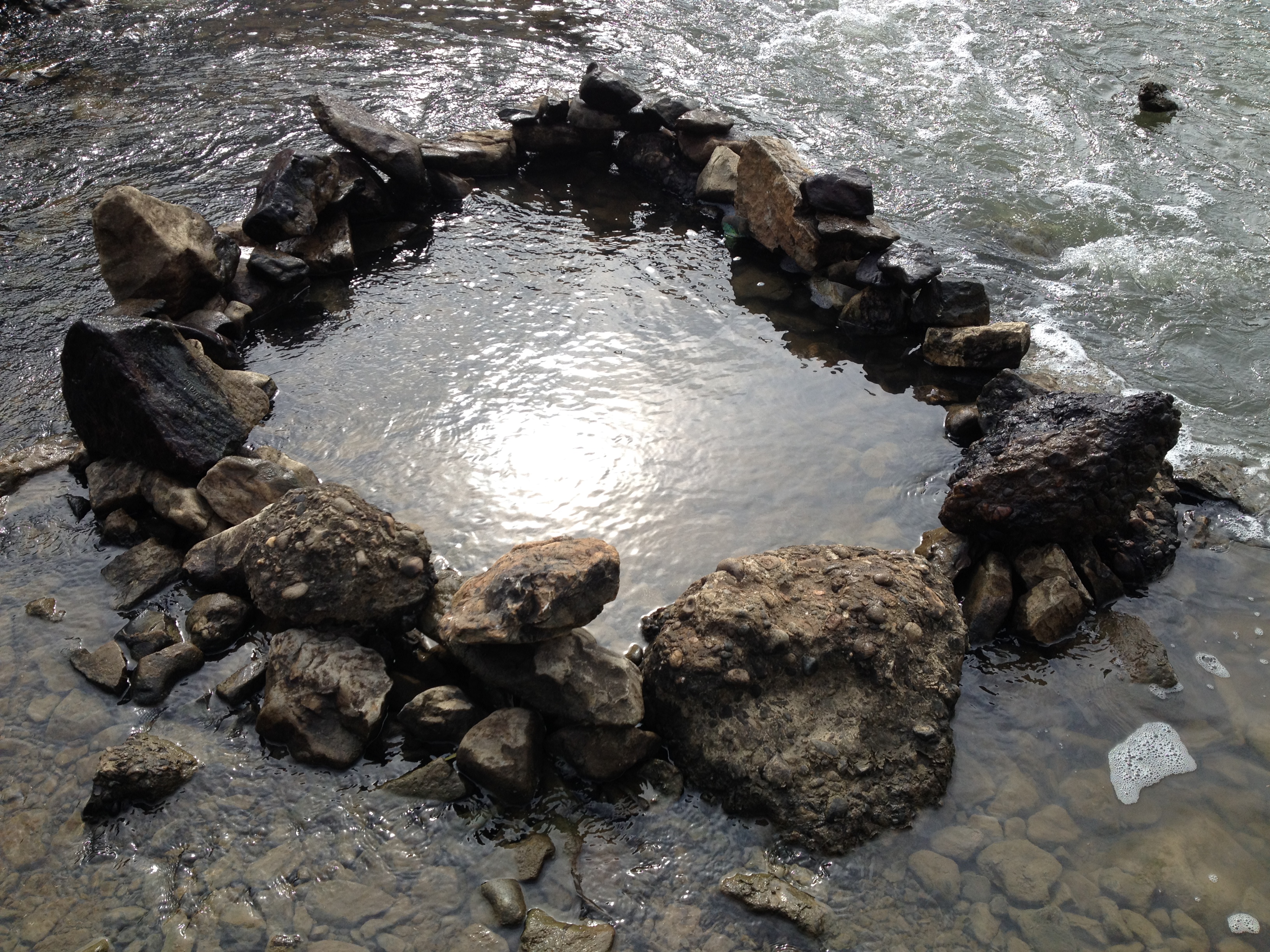
stone and concrete ring by the dam, Falls of the Ohio, Oct. 2014

The dam at this location has curtains of water flowing through openings that are lower than the top of the wall and represents the true water level of the river.  This flow feeds a small channel that leads back to the river and is a favorite place for fishermen.  I had earlier noticed among the large broken sections of concrete and loose rock that some other creative soul(s) had started what looked like a stacked stone ring in the water.  There was the remnants of a foundation and I decided to build it back up for a look-see and to elaborate on it if possible.  I guess this in effect is a collaboration with an anonymous individual.  The image above was taken after I began reconstructing the ring.

Sun light reflecting with the stone ring, Falls of the Ohio, Oct. 2014

As I kept building up the ring, I would document my progress.  This is one of my favorite shots from the series.  Here I was able to center the sun’s reflection within the ring’s interior.  In my mind it became a portal to some other place far beyond the river.  The image of a passage way or tunnel is one that recurs in my Falls projects.

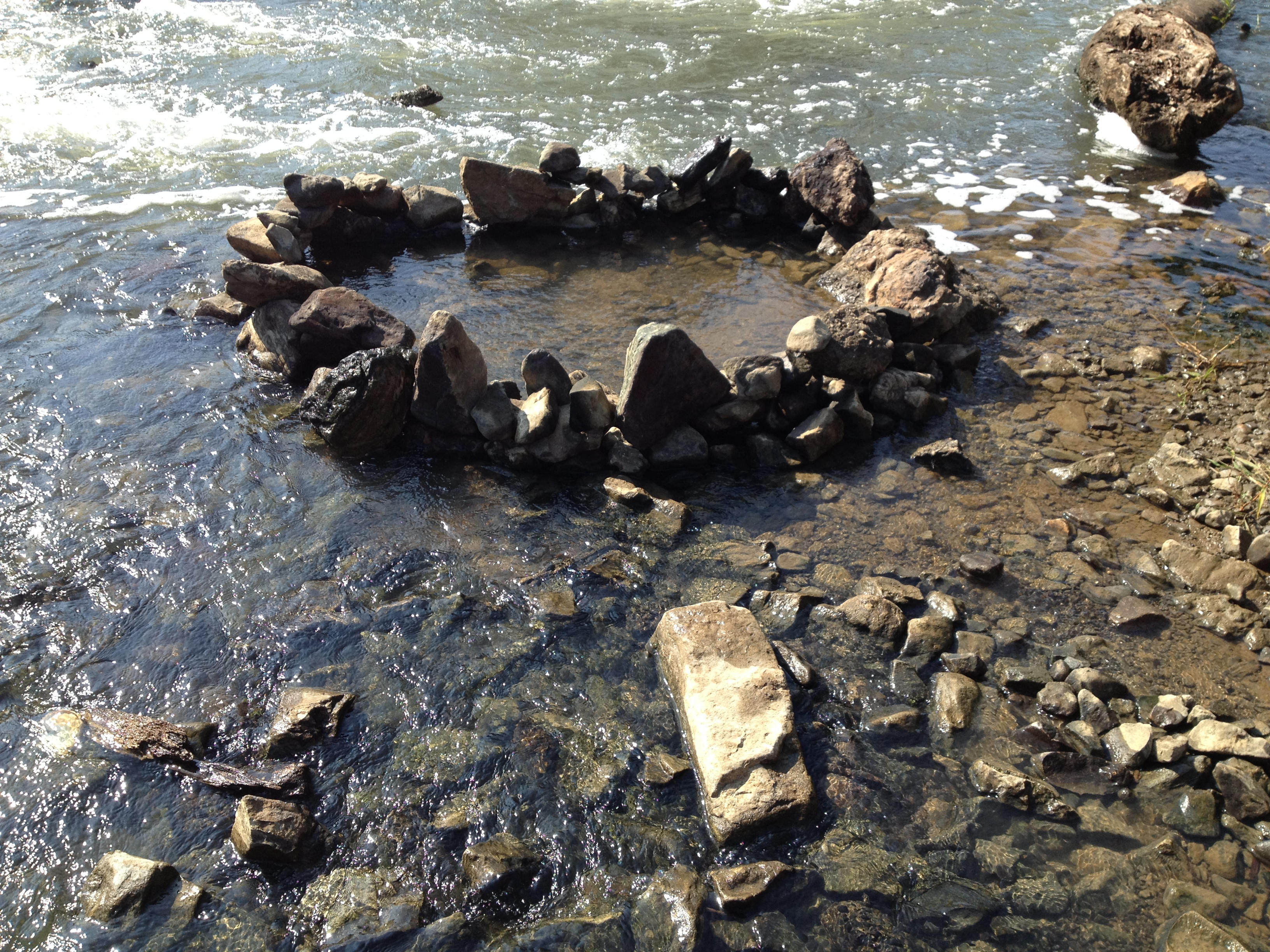
rock and concrete ring, Falls of the Ohio, Oct. 2014

I would have added the rectangular rock in the foreground, but it proved heavy and sunk into the mud.  Interestingly, the water within the ring was much calmer and created a safe harbor which contrasted with the swiftly flowing water around it.

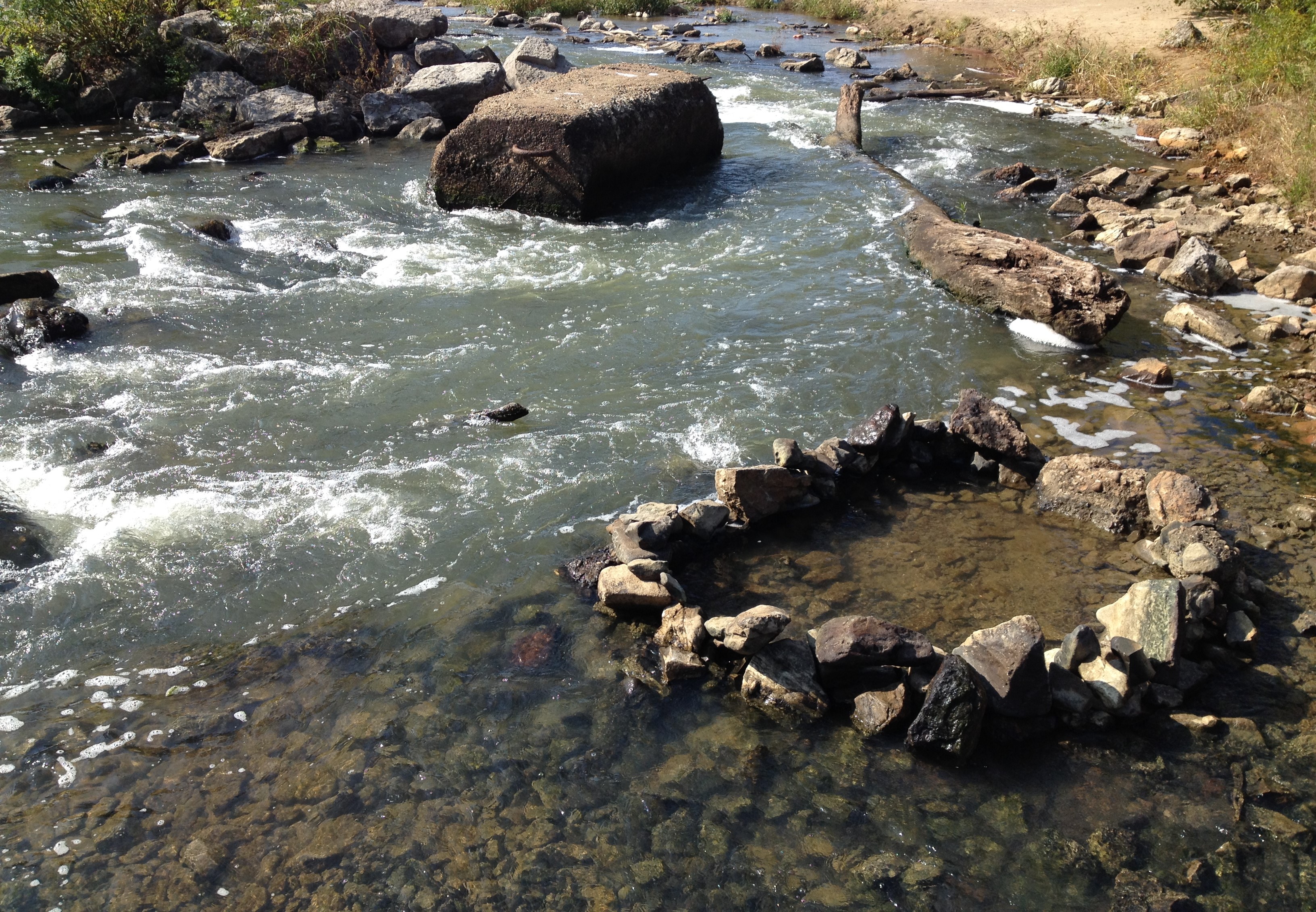
rock and concrete ring, Falls of the Ohio, Oct. 2014

The ring’s slightly irregular shape was determined by its placement.  The ring is situated on the edge of where the water cascading off the dam’s wall has worn a deeper channel in the shallow bottom.  Since it was such a beautiful day I decided to spend more time at the Falls.  I made one other site-specific work where the center is a point of focus.

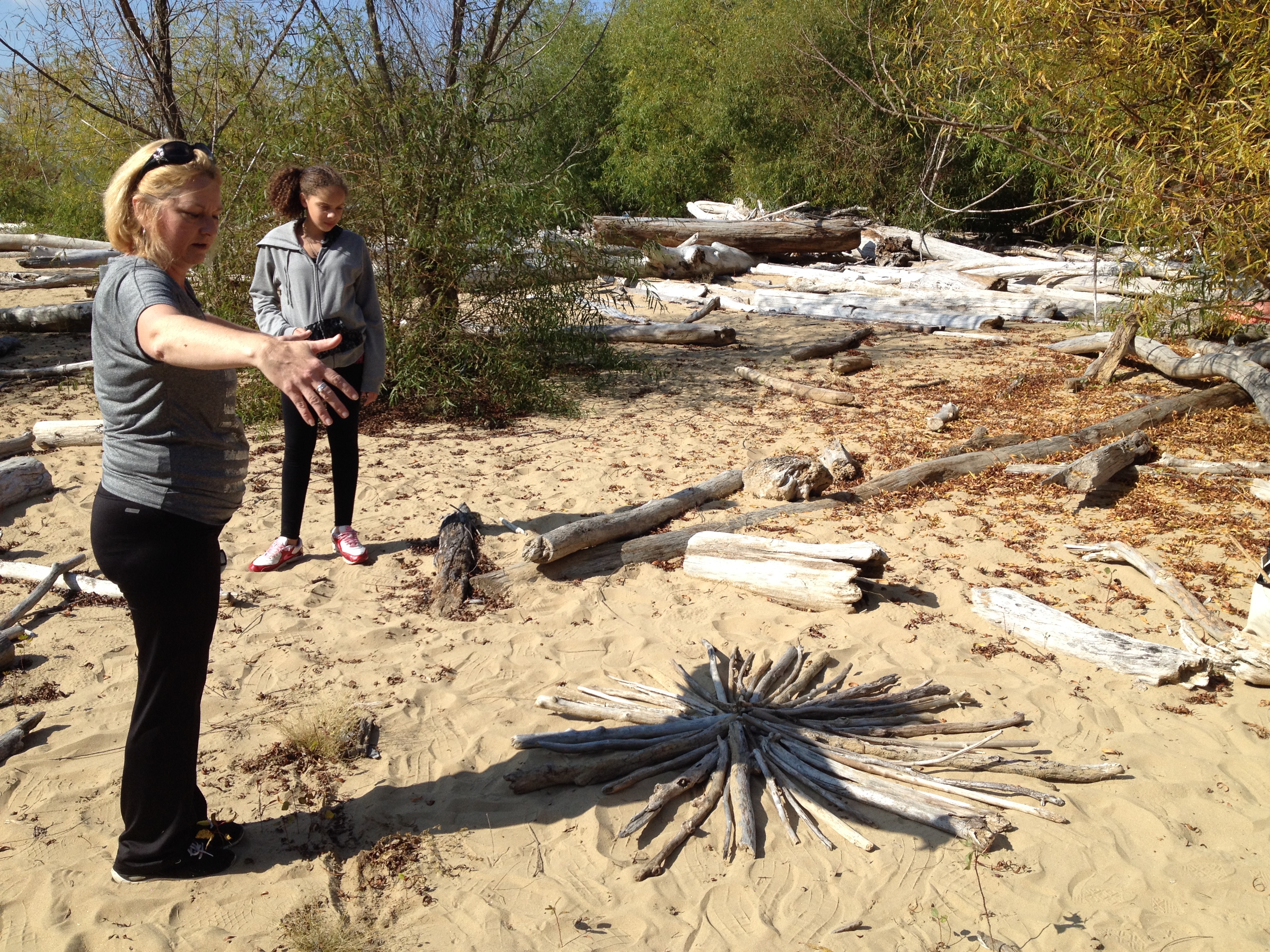
silver driftwood star, Falls of the Ohio, Oct. 2014

Detail of silver driftwood star, Falls of the Ohio, Oct. 2014


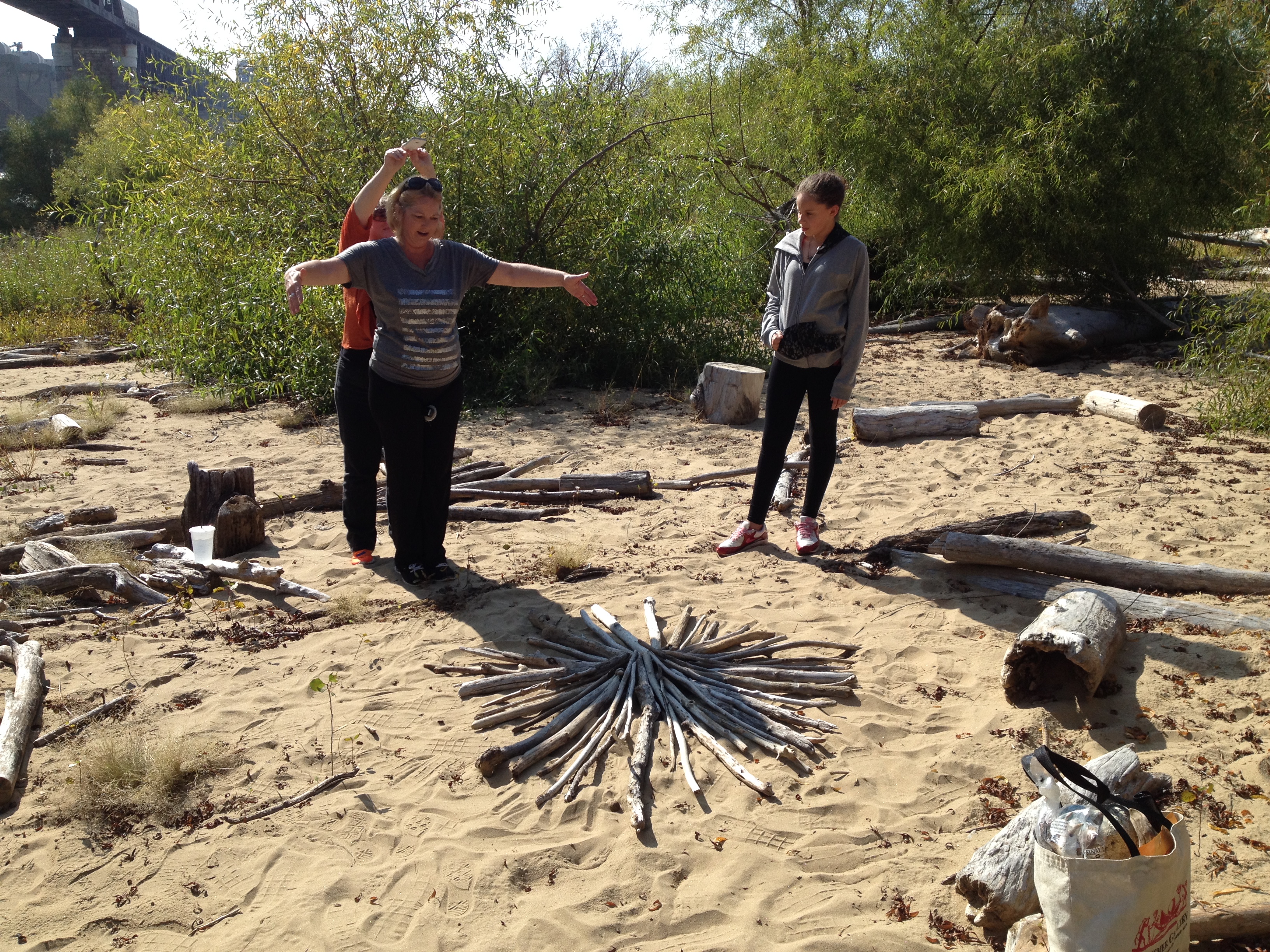
What I love about the driftwood at the Falls of the Ohio is the way it changes color as it ages.  After a summer’s worth of sunlight, the wood here takes on a silvery-gray color.  I collected lengths of wood from the immediate area and laid them in the sand.  The silver driftwood radiates away from a central point.  While I was engaged with my “Silver Star” four very nice people stopped by and asked directions to the fossil beds.  These park visitors became interested in what I was doing.  I appreciated that they wanted to participate and play along in their own way.  Here are a few additional images.  I’m assuming they are two mothers with their daughters enjoying an outing to the river?  Here one person is photographing the cast shadow on my wood piece.

Visitors interacting with my art, Falls of the Ohio, Oct. 2014

Park visitors interacting with my driftwood star, Falls of the Ohio, Oct. 2014

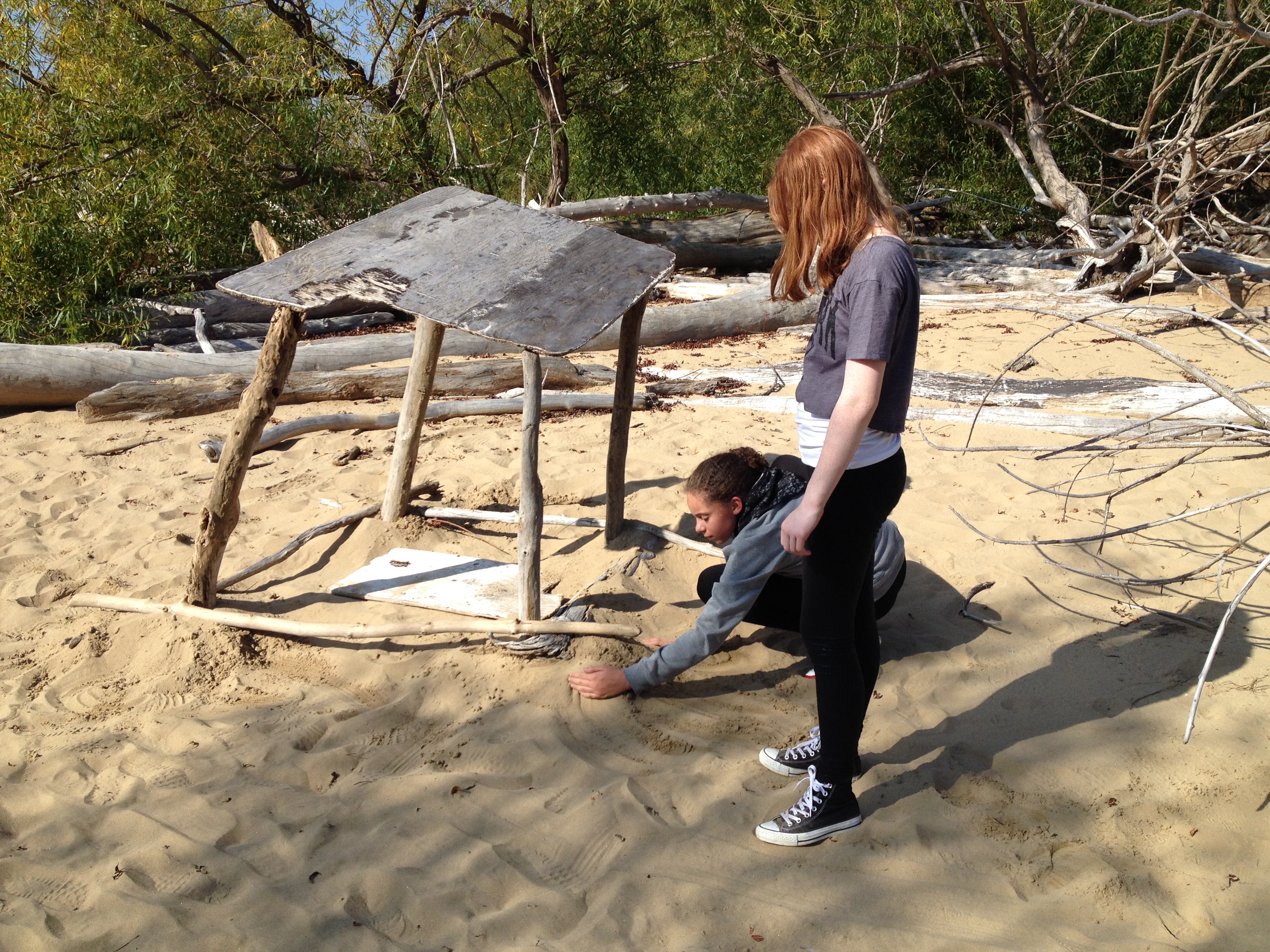
I think I may have inspired the daughters to attempt their own project?  Before too long they were picking up pieces of driftwood and making a make-shift shelter of their own design.

Girls making a driftwood shelter, Falls of the Ohio, Oct. 2014

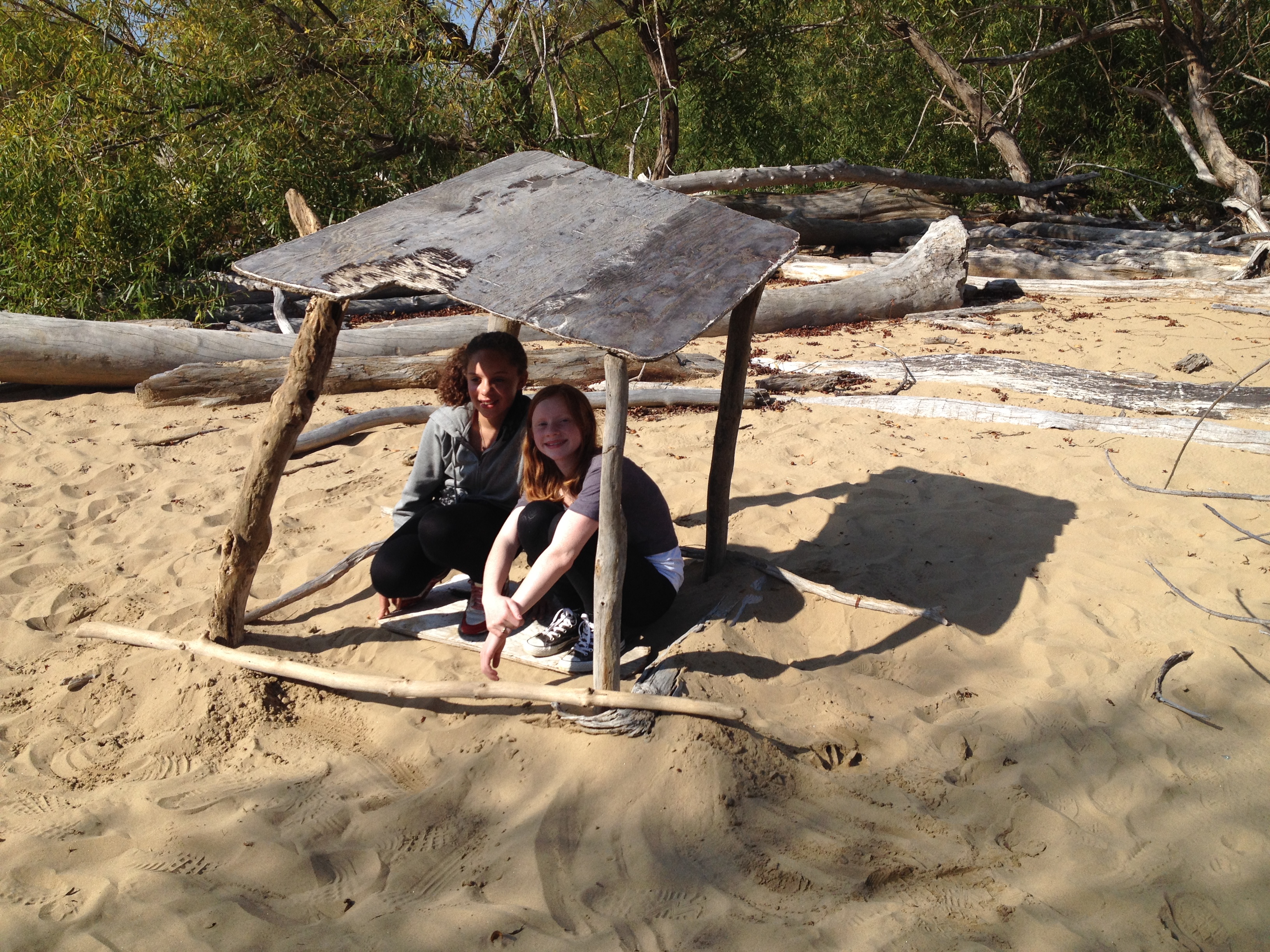
Girls posed under their improvised shelter, Falls of the Ohio, Oct. 2014

The girls looked very happy under their driftwood shelter!  When my sons were younger, this was a favorite activity of theirs and this day brought back those good memories.  This park is such a great playground and allows one to exercise both your body and imagination.  I wonder if these ladies ever found the fossil beds?  It probably doesn’t matter since it looked like a good time was had by all.  Soon enough it was time to go home and I gathered up my collecting bag and walking stick and admired the late season flowers as I walked back to my vehicle.  Thanks for tagging along and I hope to see you next time from the Falls of the Ohio State Park.

tiny composite flowers with bee, Falls of the Ohio, Oct. 2014

Read Full Post »

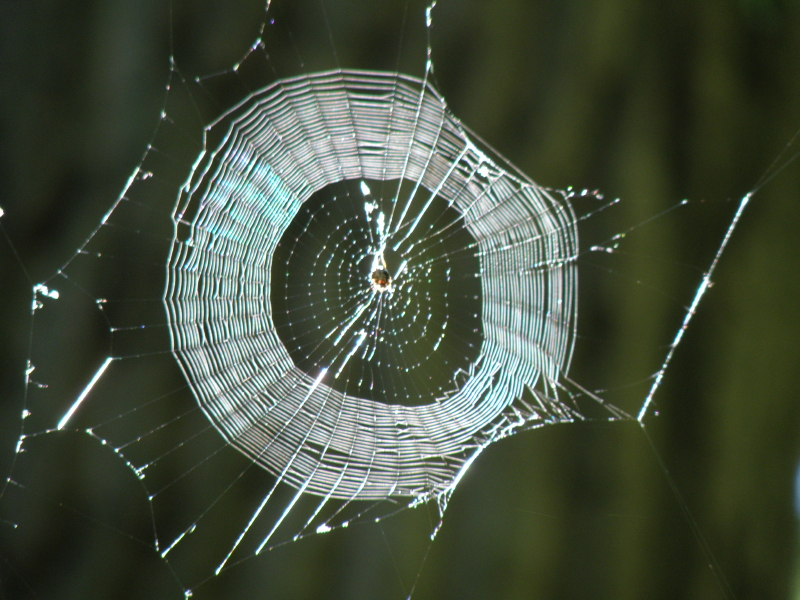
spider's web in the morning light, Falls of the Ohio, Aug. 2013The Falls of the Ohio is a special place in the history of life.  From the ancient marine creatures whose remains are preserved in limestone dating back more than 370 million years a go to the contemporary creatures that inhabit the park today…it is my goal to celebrate life here in all its diversity.  I’m going to use this post to present images of recent finds.  I was exploring the western side of this state park recently and saw this spider’s web high off the ground catching the early morning light.  I’m sure its architect would prefer a buggy meal over the photons it has snared instead!  Looking at this web image, I’m struck by how similar this  looks to the cross-section of a tree.  Can you see that too with the outermost silk rings resembling a tree’s growth rings?  In the Purple Loosestrife stands, butterflies were having a nectar feast and I presented many images of them in a previous post.  Here’s one more to add to that portfolio.  I have seen this butterfly species wind up on the spider’s menu before.

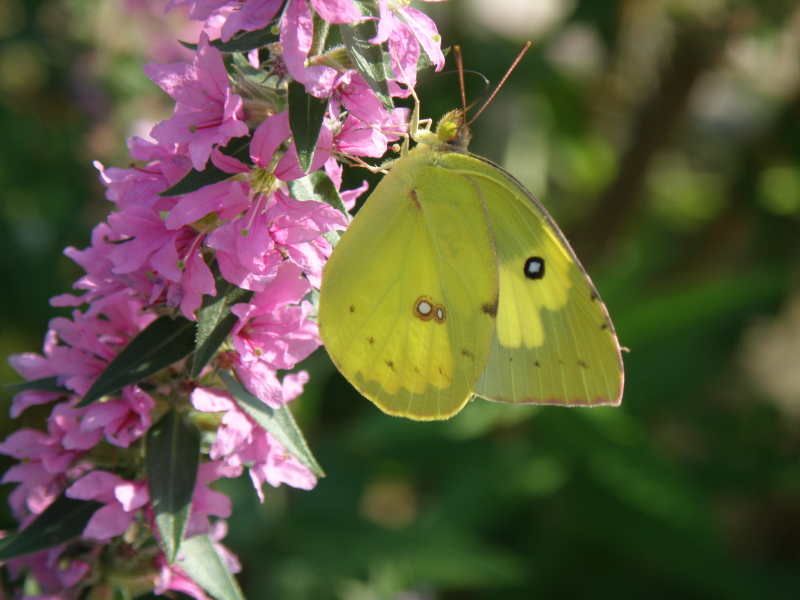
Dog Face Butterfly on Purple Loosestrife, Falls of the Ohio, late Aug. 2013

This is the Dog Face Butterfly (Colias cestonia ).  It is often difficult to photograph this butterfly in the wild with its wings open because this species prefers to feed with its wings held together.  Through the strong light passing through the forewings, you can get the suggestion of a dog’s head in profile.  Imagine the black rimmed spot as the “dog’s eye” with its muzzle pointing down.  When open, the dark interior margins of the wings are a warm black color.  I was exploring the interstitial sandy zone between the river and the willow woods…when I came across this interesting amphibian.

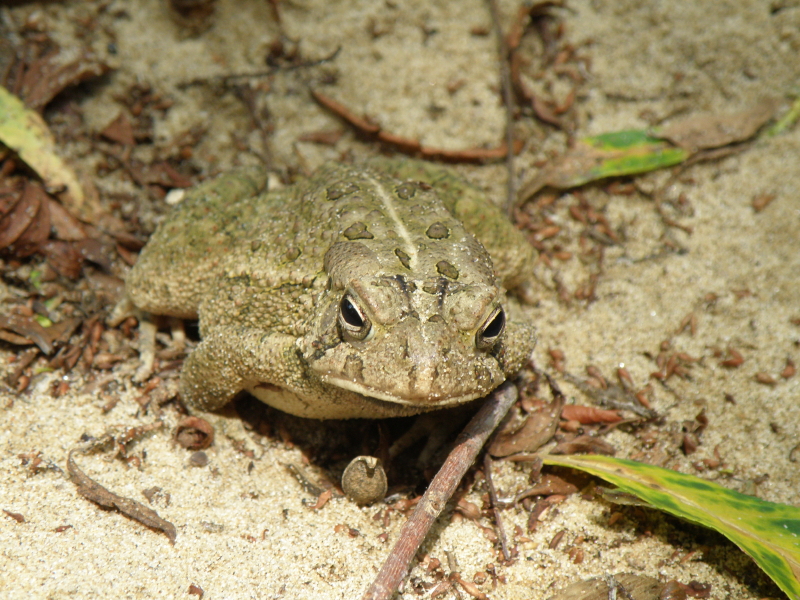
The American Toad at the Falls of the Ohio, August 2013

American Toad, dorsal view, Falls of the Ohio, Aug. 2013

If this American Toad ( Bufo americanus ) had not moved…I doubt I would have seen it.  It’s coloration is wonderfully cryptic easily blending into the sand.  The toad was busy hunting among the debris and driftwood for any insects and invertebrates it could find.  I don’t encounter many amphibians out here…so finding a common toad is a noteworthy event.  Let’s move up the evolutionary ladder a bit.  I was busy working on one of my Styrofoam sculptures at my outdoor studio when I felt I was being watched.  When I lifted my eyes up from my artwork…I found myself looking eye to eye with this critter.

Woodchuck or groundhog at the Falls of the Ohio, Aug. 2013

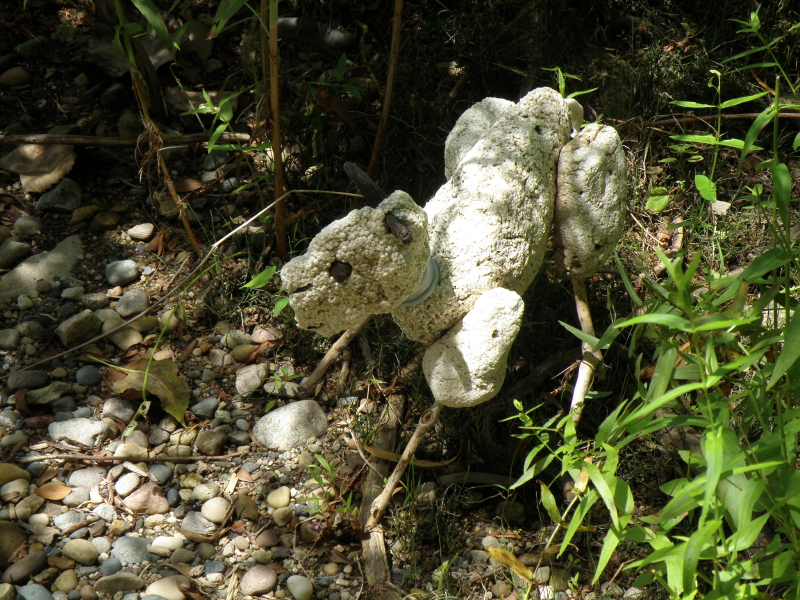
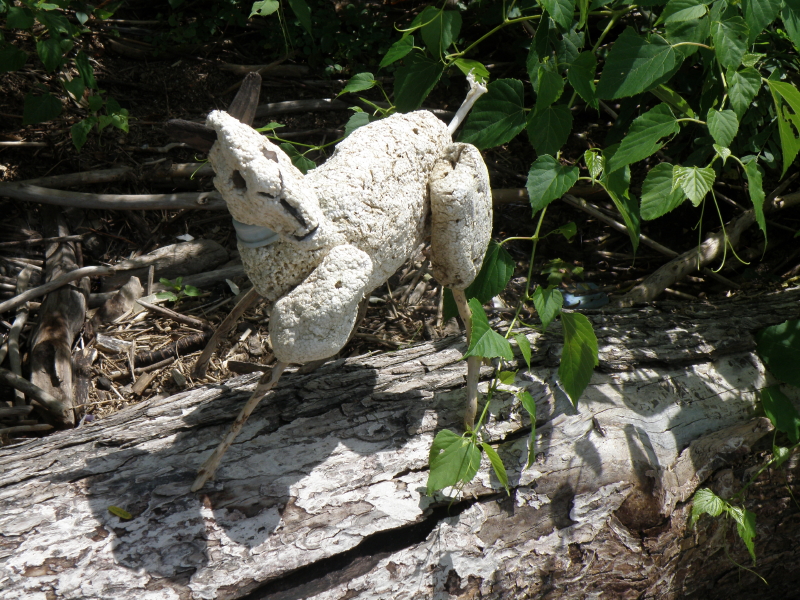
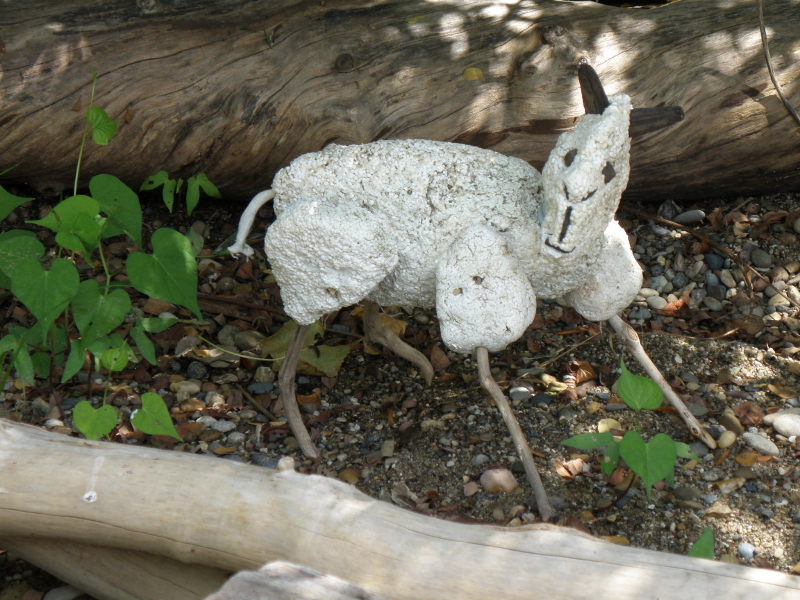
This is the common Groundhog or Woodchuck ( Marmota monax ).  As its scientific name suggests, this large rodent is a member of the marmot family.  Woodchucks are successfully established at the Falls and I encounter them often.  They are fast diggers and live in an extensive system of burrows.  Woodchucks usually don’t stray too far away from the entrances to their burrows.  Succulent greens are the preferred foods.  This particular woodchuck regarding me is a young individual and may be seeking territory of its own?  Usually, I don’t see them this close to the river.  I did have an interesting recent encounter with a very different animal in the western section of the Falls of the Ohio State Park.  Have you ever heard of an animal called the Camelope, (Antilocapra fallsei )?  It is very rarely seen.  The flora and fauna at the Falls can be roughly divided between forms that are “natural” and “unnatural”.  The spider, butterfly, toad, and woodchuck fit in the natural fauna category, while the Camelope is definitely on the unnatural fauna side of life and may represent evolution at an accelerated pace?  The many stresses to the environment and its myriad ecosystems have required a dramatic response and creatures like the Camelope may be nature’s way of responding to these changes?  I’m not a trained scientist, but that is my educated guess.  Discovering and documenting these recent life forms has become a passion of mine.  Anyway, let’s look at a Camelope.  Let’s start with an image of its head.

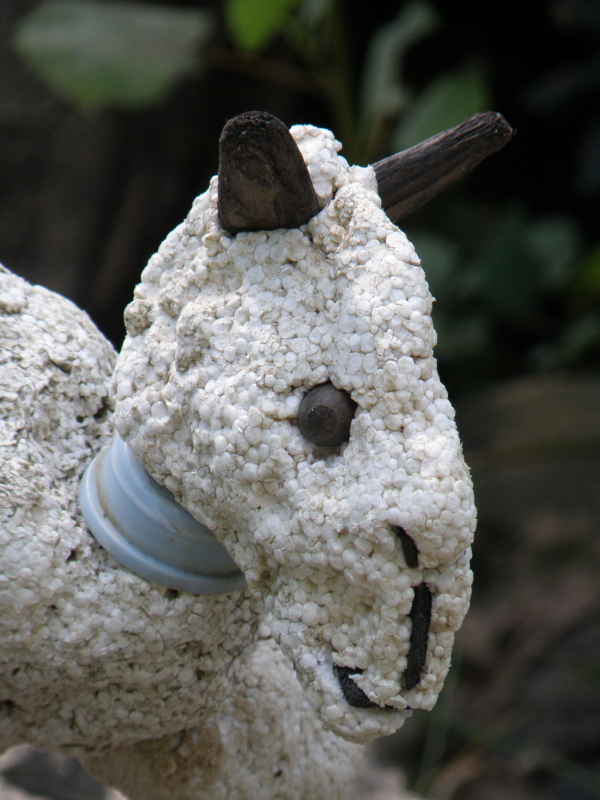
Camelope, detail of head, August 2013

It’s called a Camelope because its head generally resembles that of a camel’s.  This is a browsing animal and accepts a wide range of vegetation growing along the river.  It has dark eyes that are always nervously looking around for potential predators.  This park is also home to Feralocitors that prey upon Camelopes.  This particular species also has an acute sense of smell.

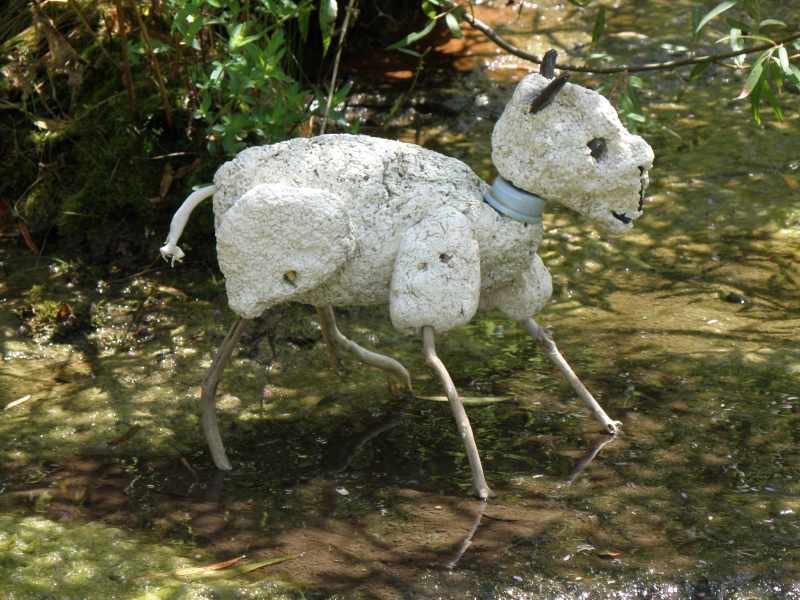
Camelope at the Falls of the Ohio, Aug. 2013

Camelope at the Falls of the Ohio, Aug. 2013

I came across this Camelope in a more isolated section of the park.  It was hiding among the stands of loosestrife and drinking water from the springs that flow downhill and into the river.  It is ever alert and very nimble with quick feet and seemingly at home climbing on rocks or navigating through dense vegetation.  Their bodies resemble that of deer or antelopes…hence Camelope.

Camelope reacting to an unfamiliar sound, Aug. 2013

Camelope at the Falls of the Ohio, Aug. 2013

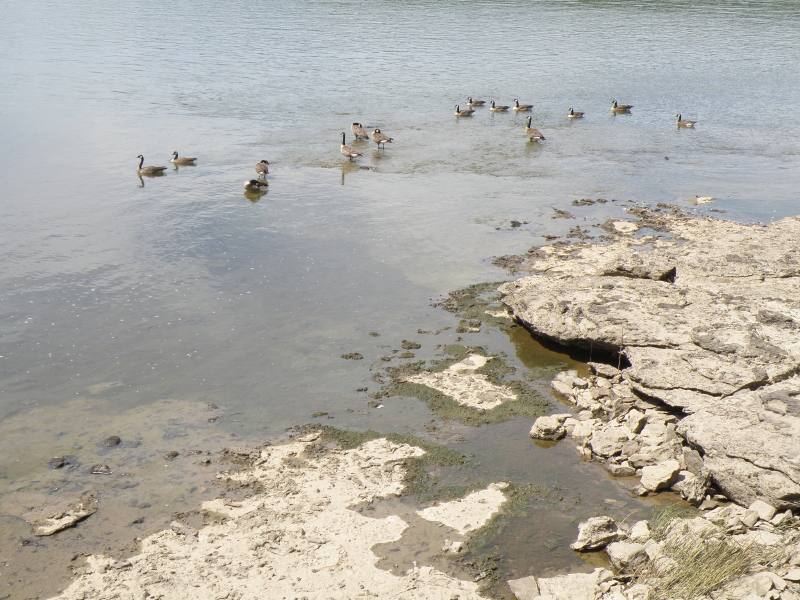
Since it is a relatively new animal…not very much is known about it.  I was able to conceal my presence long enough to manage these images.  I either moved or the wind shifted, but anyway my presence was detected and with a quick bound, the Camelope disappeared into the brush.  I hope I may come across it again and learn more about its secretive life.  Regardless, I will keep my eyes open and my camera at the ready for any new “unnatural” life forms I discover.  It occurred to me on my way home that my Falls of the Ohio Project is now officially ten years old!  I started exploring this fascinating park as the Artist at Exit 0 in August 2003 when the bicentennial of the Lewis and Clark Expedition was being celebrated.  Reading early 19th century accounts of the natural abundance of our country and this place in particular made me wistful for a world that no longer exists.  Two hundred years later…that process continues and no doubt will two hundred years from now.  I have often thought of this riverblog as a historical document as relevant today as Lewis and Clark’s notebooks and journals were back when this country was first being described.  I hope this park and its remarkable history will continue to inspire people for a very long time.  In closing, I would like to present an image of Canada Geese on the water near the fossil beds.  Their coloration gives them in my mind’s eye a formal quality and lends dignity to the landscape.  Until next time…from the Falls of the Ohio.

Canada Geese and fossil rock at the Falls of the Ohio, Aug. 2013

Read Full Post »

Joe Arbor at the river's edge, Falls of the Ohio, July 2013

Everybody has a different tipping point where enough is finally enough and action is called for.  This was the case with Joe Arbor.  For many years, Joe Arbor walked the river’s edge paying attention to what the Earth was telling him from the signals that washed ashore.  Yes, this is a nonverbal language, but the Earth is eloquent in this way.  On this particular day, Joe Arbor noticed that there was a lot of wood everywhere and while it was picturesque…it was also disturbing.  Joe Arbor realized that all the wood he was seeing represented trees in the past tense.

driftwood at the Falls, June 2013

Joe Arbor knew of other places where the Earth via the river had left a record of lost trees particularly at the Falls of the Ohio.  In the hot bleaching sun the various logs and limbs piled on top of one another reminded him of bones.  Joe Arbor would walk among these elephant’s graveyards of trees and felt ill at ease.  These trees represented a huge loss in terms of the free services they provided.  Here was food and shelter for a multitude of other life forms.  Here was the air we breathe and the cooling shade of summer and potential warmth in winter.  Here was lost inspiration!  Since Joe Arbor also made his home next to the river, he also knew that tree roots also held the riverbank in place.  Over the past several years it had not escaped Joe Arbor’s notice that at this location,  it rained more and harder and trees were being swept away.  Joe Arbor was no scientist or genius, but could recognize that life seemed out of balance and it worried him.  What could be done?  Joe Arbor went home and decided to sleep on the question.

Joe Arbor and Pip hatch up a plan, Falls of the Ohio, July 2013

Joe Arbor makes his home at the base of an old willow tree.  It took several nights of sleeping on the question before the beginnings of an answer started to form in his mind.  When the solution came to him, Joe Arbor decided that he needed some help or company and he called his good friend Pip.  Pip is short for Pipistrel which is a name given to several species of bats.  One fine morning, the pair got up early and gathered some tools and provisions together and ventured forth to the river’s edge.  If the Earth was losing her balance due to tree loss…it made sense to Joe Arbor that getting involved with planting and saving more trees could be a good thing to do.

eastern cottonwood tree leaves and capsules, June 2013

eastern cottonwood leaves and seeds, July 2013

Joe Arbor decided he wanted to try to do something to help the Eastern Cottonwoods that grew along the Falls of the Ohio.  These cottonwoods are magnificent, fast growing trees and reach great heights.  They produce unusual capsule-shaped fruits and when conditions are right, these capsules burst open releasing tiny, fluffy seeds that drift through the air like dry snow and move with the slightest breeze.  Joe Arbor also knew from experience that many more of these seeds germinate than reach maturity.  At the Falls, those seeds that sprout nearest the river eventually are destroyed by the river during flooding.  They simply get washed away or crushed by logs rolling in the waves.  Joe Arbor decided to perform an experiment to see if he could successfully transplant a cottonwood tree to a safer location?

selecting a cottonwood seedling, July 2013

First Joe Arbor and Pip selected a little cottonwood growing in the sand.  They next held hands and said a few kind words and explained to the tree what they were about to do and why.  In this way, they hoped to obtain the tree’s blessing.  Together, they carefully dug around the sand to uncover as much of the tree’s roots as they could.  Bagging up the little tree roots and all the paired moved on to a different location.

Canada geese at the Falls, July 2013

All the while Joe Arbor and Pip were working, a small flock of Canada Geese were standing nearby and acted as guards and witnesses.  Because the geese also live near the river they are also privy to the Earth’s nonverbal language and understood what was at stake here.  Their presence added a bit of solemnity to the event.

Joe Arbor and Pip with cottonwood tree, July 2013

Joe Arbor and Pip with cottonwood tree and tools, July 2013

With their valuable charge in a bag, the pair moved on to a pre-selected location they hoped would be favorable to the cottonwood tree.  Cottonwood trees do best when they are close (but not too close) to the water.  As they walked, Joe Arbor whistled an improvised melody partly out of nervousness and the excitement of the moment.  As is his norm…Pip remained quiet.

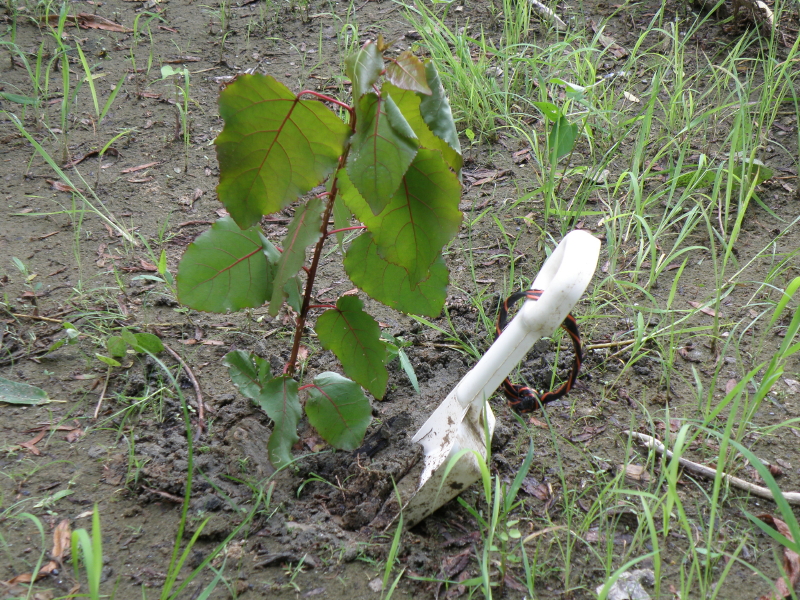
Young cottonwood in the ground, July 2013

A large enough hole was dug in the new location to accommodate all the young cottonwood’s roots.  Sand and soil were shoveled lovingly around the tree.

Joe Arbor and Pip plant the tree, July 2013

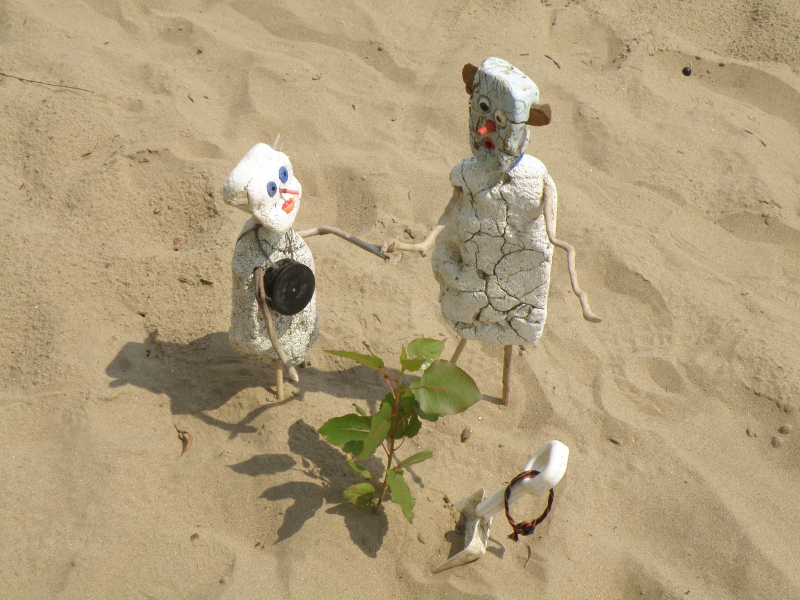
After the tree was safely in the hole, Joe Arbor said a few words while Pip watered the transplant.  It was hoped that the chosen location was the right distance from the river and that the young tree would grab a toe-hold here and prosper.  Time will tell.  The day still had one more nice surprise and it came from Pip.  Joe Arbor didn’t know why he didn’t pay attention to this before, but Pip was wearing a circular, black, plastic box on a cord hung around his neck.  This circular box was the container that smokeless tobacco is sold in.  Many of these boxes routinely wash up at the Falls of the Ohio.  Anyway, Pip opened up the container revealing its contents and this is what Joe Arbor saw.

snuff box with mulberries, July 2013

Wrapped in mulberry leaves were four ripening mulberries.  This is another tree that grows at the Falls of the Ohio and provides food for many birds and animals.  The berries are sweet and juicy when ripe and some people find them tasty too.  The leaves are interesting and come in different shapes with serrated edges.

Pip holding a mulberry, July 2013

Pip (who says very little) had his own tree planting experiment in mind and Joe Arbor got the idea.  Moving to a different location, a new hole was dug in the rich soil and a berry was placed in that hole.

Pip and Joe Arbor plant mulberries, Falls of the Ohio, July 2013

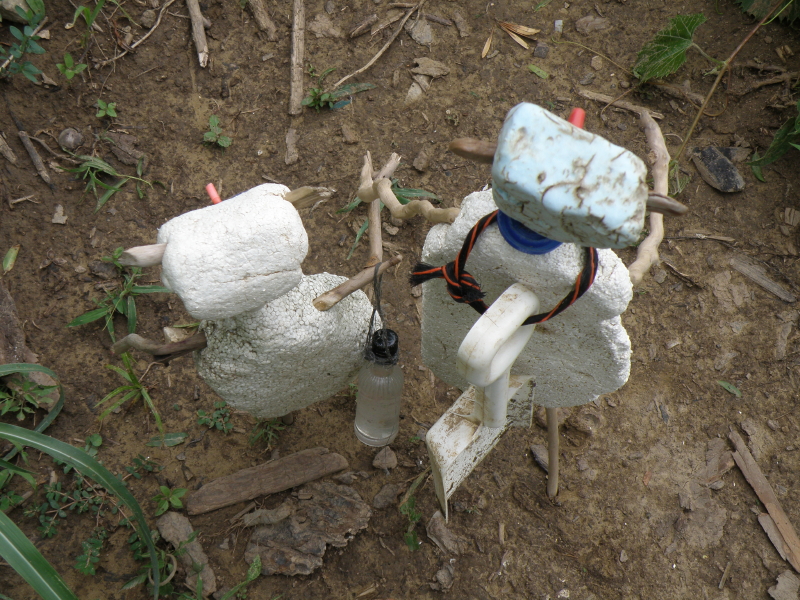
The process was repeated until all the berries were planted.  Pip was curious to see if he could start a mulberry tree in this way or whether the seeds needed to travel through the gut of a bird or some other animal first?  Again, time will tell.  Satisfied that at least for today, the duo had done some good for the Earth, the pair picked up their gear and headed home together.

Pip and Joe Arbor go home, July 2013

This little story is dedicated to an artist friend of mine I have never met.  She has a vision of creating a tree art project around the world and if you are interested in learning more about it and perhaps participating…here is a link  to a post she wrote about it:  http://rooszwart.wordpress.com/2013/05/29/the-bridge-land-art-forest/

Pip and Joe Arbor after planting trees together, July 2013

Read Full Post »

high Ohio River at the Falls of the Ohio, Feb., 3, 2013

The Ohio River at the Falls of the Ohio is even higher now since my last visit with the fishermen.  We have had some wild weather in the interim.  First it gets unseasonably warm and then a cold front collides with a wet weather system originating in the Gulf of Mexico.  The results of this can be very dangerous as this is the perfect recipe for a tornado outbreak which did occur south of here.  My family was awakened to the sound of tornado warning sirens at 4:30ish in the morning.  We began that day in the basement of our house which was a rude awakening even for the family dog.  Luckily, we didn’t experience any damage although it rained hard and was very windy.  And after the cold front blasted through it became extremely cold and was followed by snow.  I think we have seen the gamut of winter weather and I was glad to hear the “groundhog” did not see its shadow in Pennsylvania meaning that winter would come to a normal end this year.  That is if you believe animals can predict the weather?

floating trash in the river, Feb. 2013

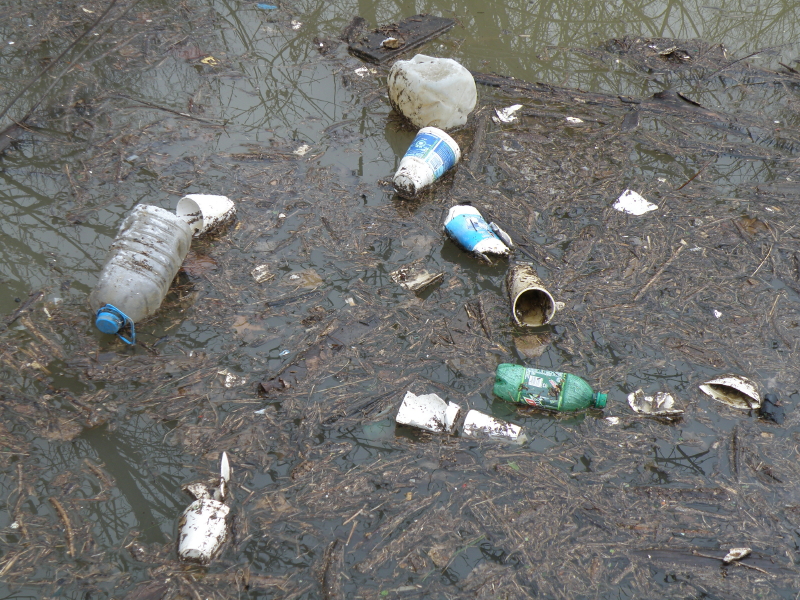
I am certain this time that my outdoor studio under the willows is history by now.  The Ohio River has claimed the spot and my cache of art materials.  Unfortunately, there is a ready re-supply floating in the water.  It seems I begin many a post with what amounts to a weather report, but please bear with me.  My blog concerns itself with the local conditions which are the context that my adventures and stories are set in.  I’m also amazed and concerned that I can detect variations in our weather patterns having lived in this area for so long.  Much of the time I feel I’m bearing witness to events of importance to us all.  What is happening here is also occurring in other places in the world.  As I was walking through the woods on this day, I was surprised by the bird life I was encountering when I expected to see nearly nothing.  My Eastern Bluebird friends were still hanging around and they had company.  I saw White-breasted Nuthatches, Carolina Chickadees, Tufted Titmice, Brown Tree Creepers and many more especially near the river’s expanding edge.  I also saw and photographed another amazing bird which makes up the bulk of this post.

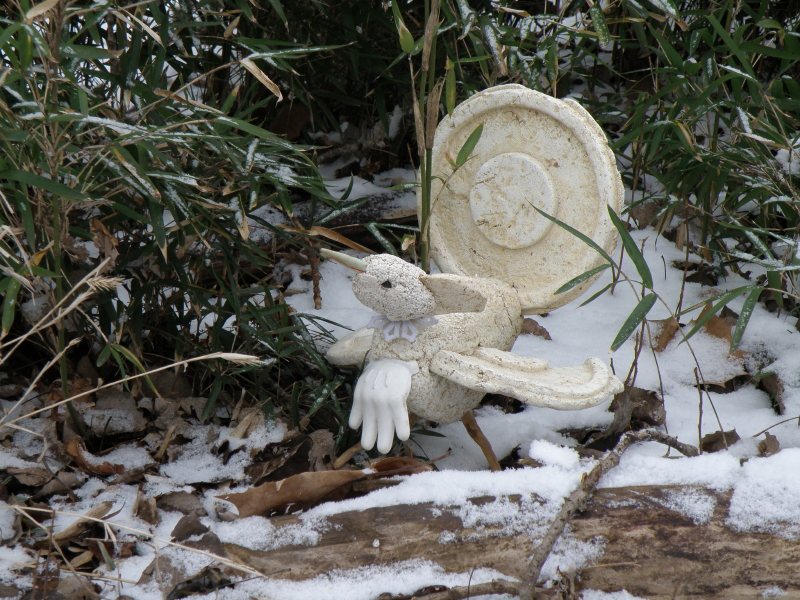
Snow Cock at the Falls of the Ohio, Feb. 2013

Snow Cock, Falls of the Ohio, Feb. 2013

Fellow bird watchers had put the alert out that an unusual visitor was seen hanging out at the Falls.  A young, male Snow Cock was seen near the Woodland Loop Trail which is a bird not seen in these parts since the late 19th century.  As you can imagine this is a northern bird used to the cold and snow…in fact it depends upon these conditions for its survival.  The Snow Cock (like some ptarmigan species) turns nearly white in winter.  The rest of the year it sports plumage that is more like leaf camouflage.  Regardless of the season, the Snow Cock is a cryptic animal and is shy and retiring.  Except of course when it’s time to choose a mate when the males make it a point to be as noticeable to their own kind as possible.  I was hoping the bad weather would cause this wayward Snow Cock to linger and I was rewarded by its presence.  I took as many photographs as possible.  I have a feeling that I won’t ever see this exact species out here again.

detail of Snow Cock head, Feb. 2013

Snow Cock in natural habitat, Feb. 2013

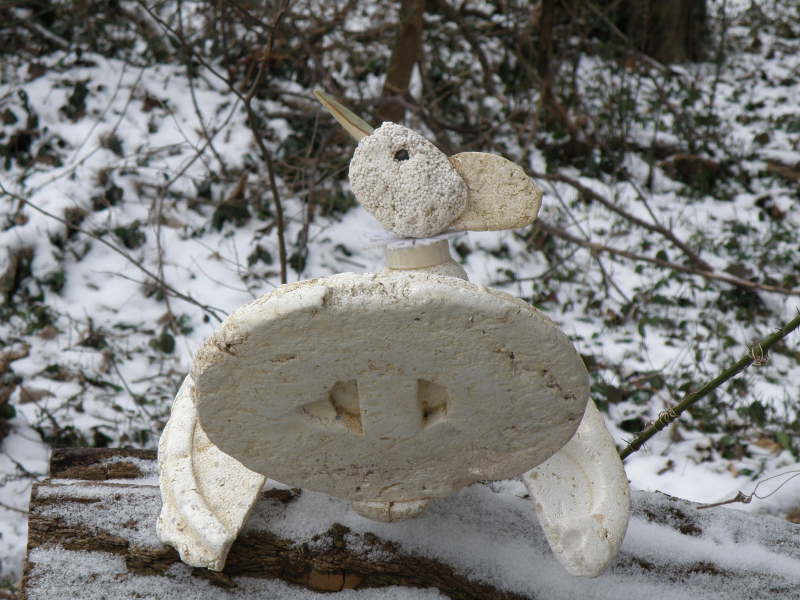
Snow Cock, back view showing tail fan, Feb. 2013

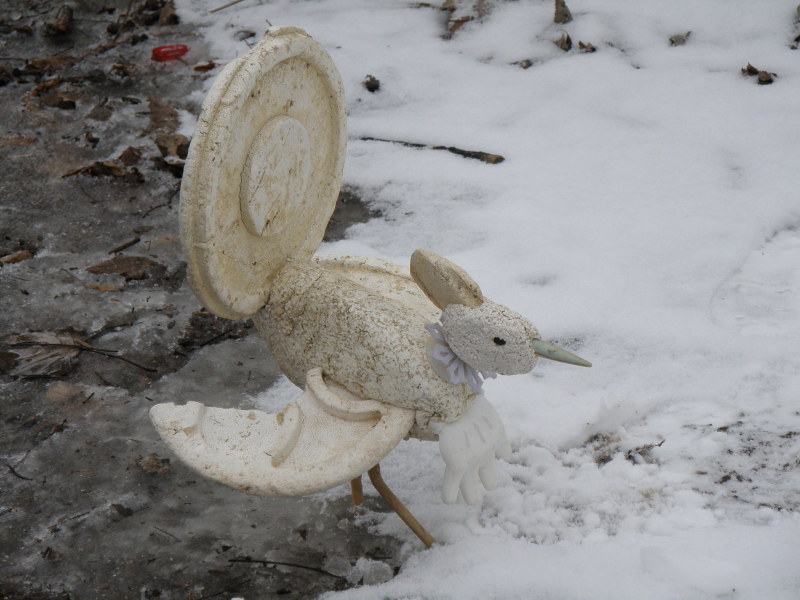
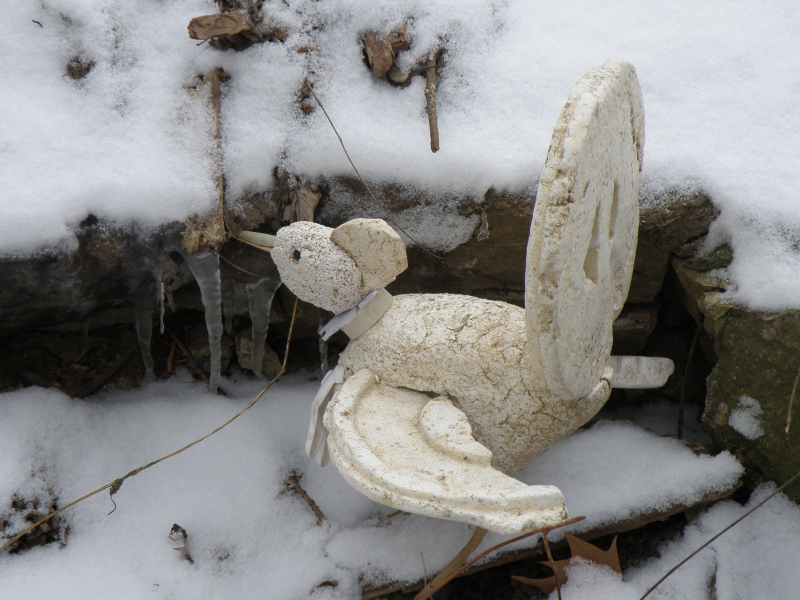
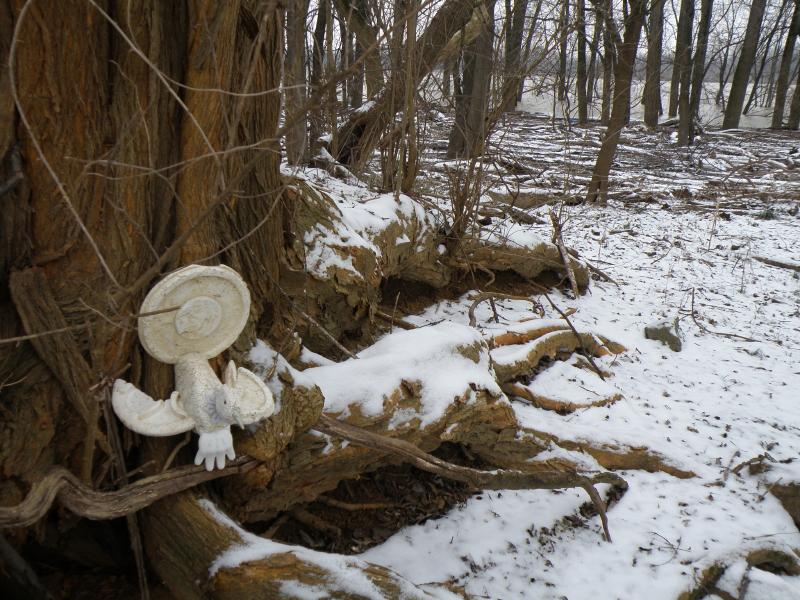
The Snow Cock is also called the “Snow Turkey” and “Styro-grouse” because of the large fan of tail feathers it uses for courtship displays.  That’s how I found this particular bird which wasn’t all that wary.  The young male was rehearsing his dance and song and establishing a lek or territory where he would fight other males for the attention of the females.  Although this bird wasn’t going to hang out at the Falls forever, it was nevertheless, practicing this important survival skill.  Other interesting field marks included a head crest, an unusual beard growing from his chest, and a long bill for seeds and insects.

Snow Cock at the water's edge, Feb. 2013

falls 030_1_2

I watched the Snow Cock look for just the right spot to strut its stuff.  It was frequently hopping from one vantage point (usually a tall stump) to the ground and back.  The call of the Snow Cock as you might guess is very chicken-like and not particularly beautiful in its own right.  To my eye, it seemed very interested in the water which was noticeably spreading over the land.  This might be the first flood it has ever experienced?

Snow Cock sipping water, Feb. 2013

Snow Cock by large Osage Orange tree, Feb. 2013

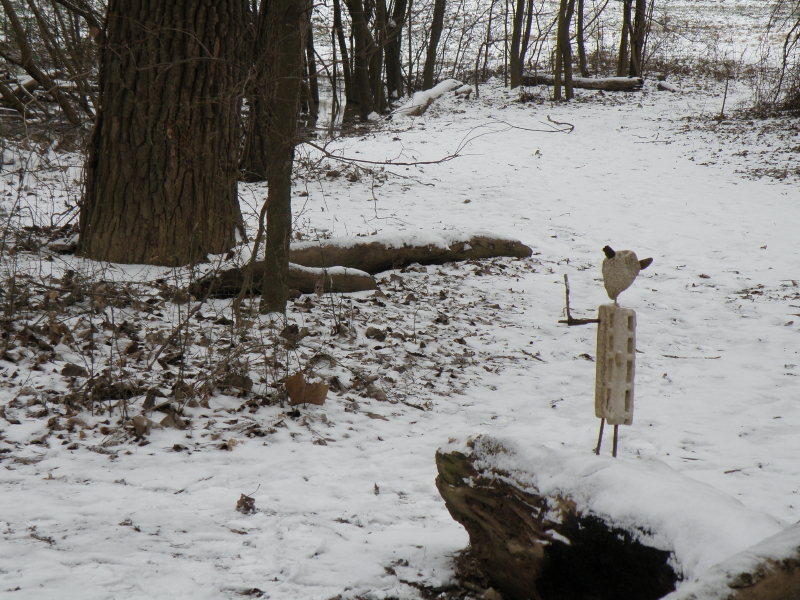
I kept my distance from the bird and quietly followed it through the woods.  I observed it drinking from melting ice and I left it be hanging out near a large Osage Orange tree along the trail’s path.  The wind was beginning to pick up again and more flakes were in the air.  Despite wearing good gloves, my finger tips were cold and painful.  I decided that now was a good time to go home and I did.  I hope the next time I’m out here that the conditions will be more favorable for an extended visit.  I had one other small surprise waiting for me along the Woodland Loop Trail.  I passed the spot by the creek where I watched the fishermen catch sauger and was amazed and amused that the figure I had made from river junk that day was still there!  He was missing his nose, but otherwise he was intact.  I guess the fishermen appreciated him as I do you for tagging along on another adventure at the Falls of the Ohio.

Styro-figure along the loop trail, Feb. 2013

Read Full Post »

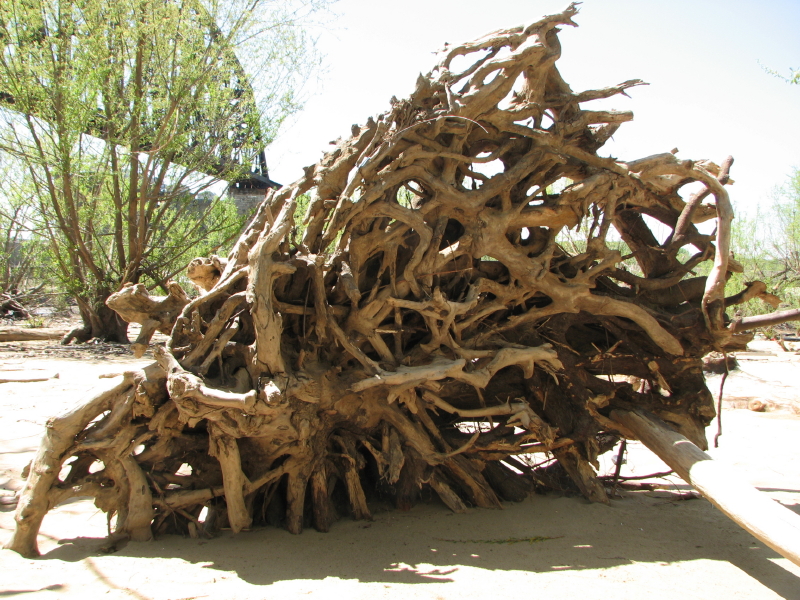
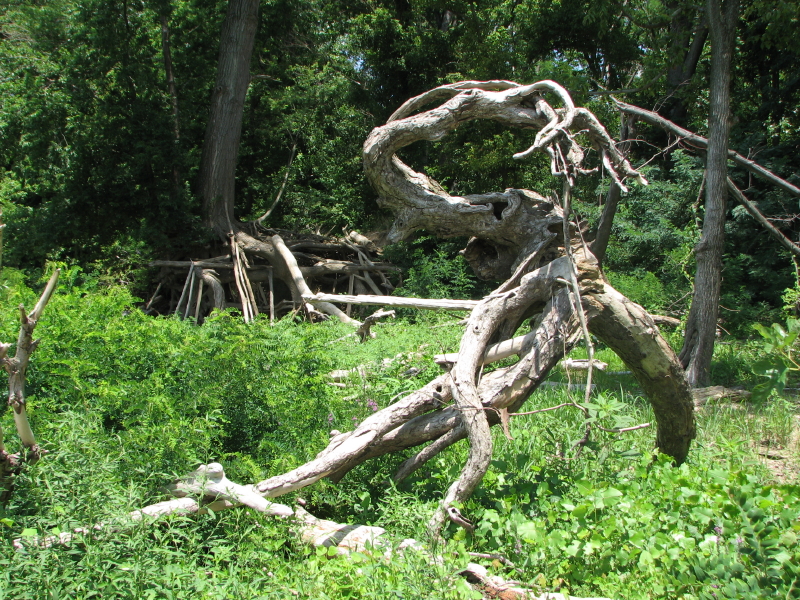
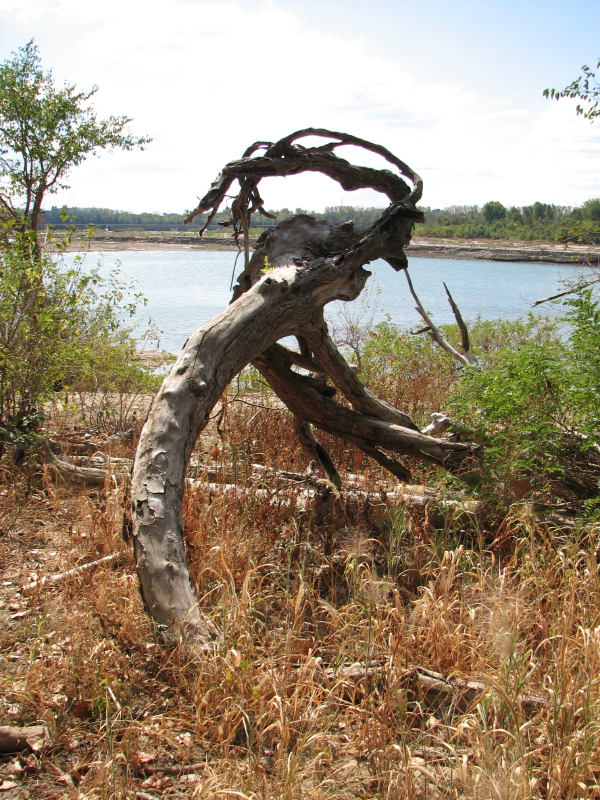
One last driftwood post before hopefully moving on to the current conditions at the Falls of the Ohio.  As my knee heals, I have been sifting through my own digital photographs.  Sitting at home, I have been spared the relentless heat that has defined our summer.  Artist at Exit 0, however, does miss bearing witness to life along the river and can’t wait to get back!  I thought I would end this driftwood series by looking at wood that is more organically expressive.  As mentioned in a previous post, the river processes a tree by removing its branches into increasingly smaller segments.  With all the broken down wood present at the Falls of the Ohio State Park, it can be a challenge to find a piece that implies movement.  Here are a few larger examples that I find to be especially sculptural.

I come across many unique pieces of wood in the park that feel as satisfying to me as many abstract sculptures made by man.  Walking around a  particularly nice piece of driftwood, I am rewarded with different viewpoints that remind me that the object I am regarding share a common space.  Here’s a different image of the same dramatic driftwood log and the experience in perception changes as you move around the wood.  I notice not only the arc of branches and roots, but the spaces between forms as well.

Here’s another nice piece that I came across this year and it also has many nice sculptural qualities.  I love the “S” curve snake-like motion implied in this driftwood.

When I see a piece of wood this twisted and convoluted I’m reminded that nature is the true sculptor here.  Doing the shaping are water, wind, and the life force of the tree itself whose innate “intention” is to live.

It’s hard for me to imagine that works of art were considered ” superior” to the “corruptness” of nature.  Fortunately, the philosophy of aesthetics is ever-changing, but still could use additional tweaking from what strictly enhances the experiences of our lives to embracing a better appreciation of life in all its forms.  Even when we use ourselves as the egotistical measure of all things we should be starting to understand by now that the quality of our very lives and that of our descendants depends upon the overall quality of the natural environment.

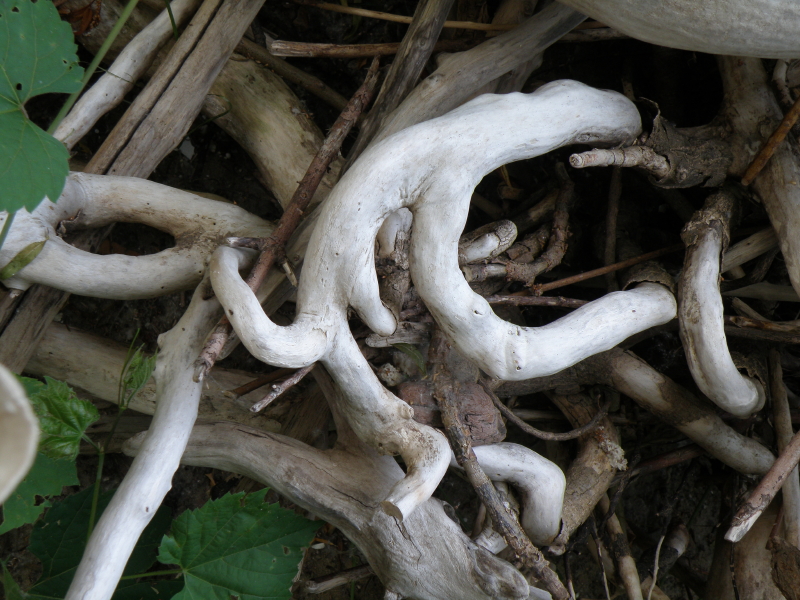
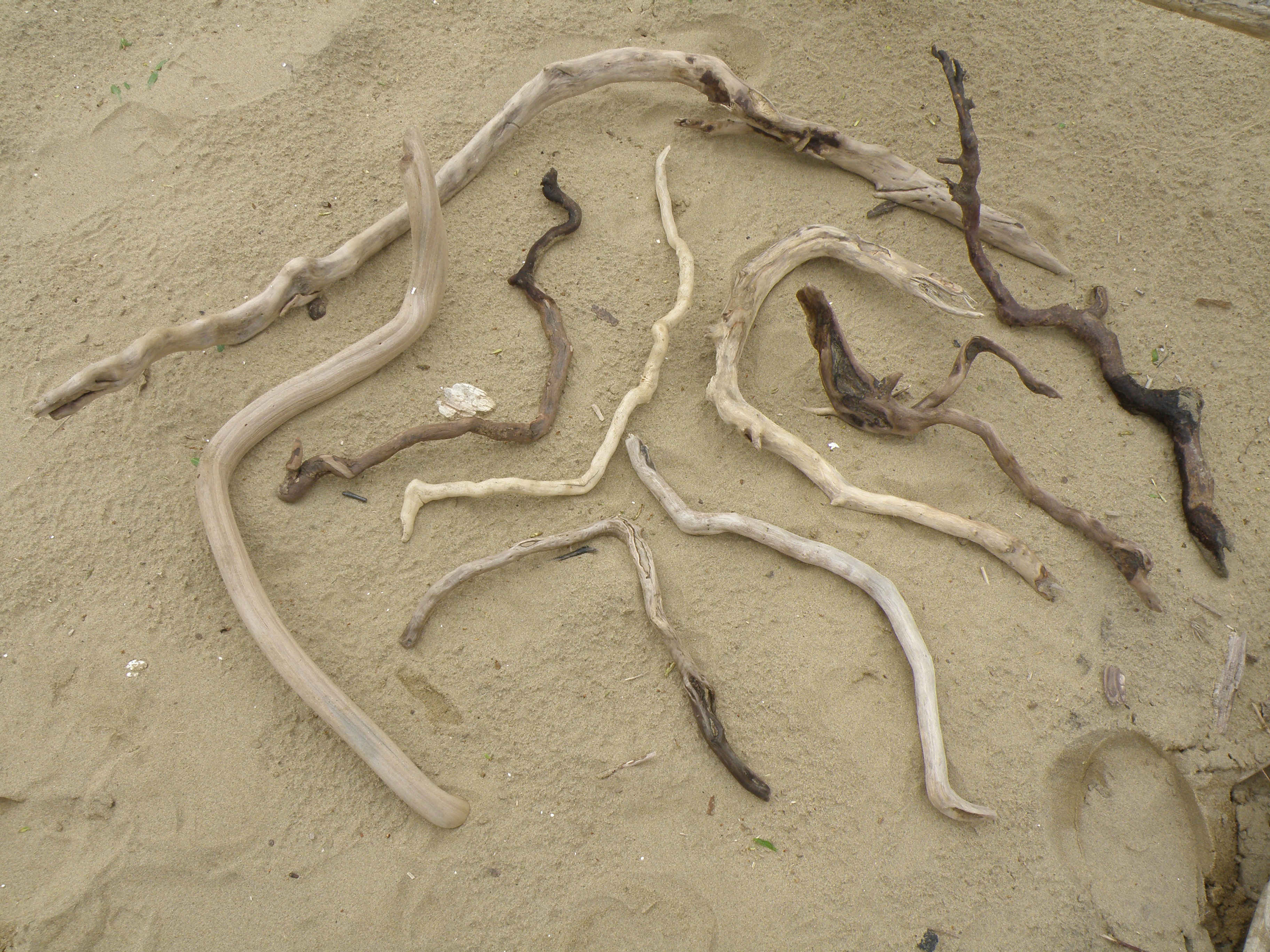
When I’m at the river I try to be as present in the moment as much as I can, however, my mind does day-dream a lot about the relationships between art, man, and nature.  I believe as my friend Ellen Dissanayake has eloquently expressed through her well-researched books that art has survival value otherwise our species would not have spent thousands of years involved in this activity.  My reaction is to try to use my creativity in this special place using the materials I find on hand to try to further this conversation along.  The sculptures I make to tell my little stories are combinations of natural and artificial materials.  The river-eroded Styrofoam I use for my figurative work is usually so static in form that to enliven it requires finding rootlets and branches that the river hasn’t fully removed all sense of gesture and movement.  These pieces become the arms and legs of my characters that help imply animation.  The picture above shows roots I collected while walking over the driftwood that the river did not completely break apart.

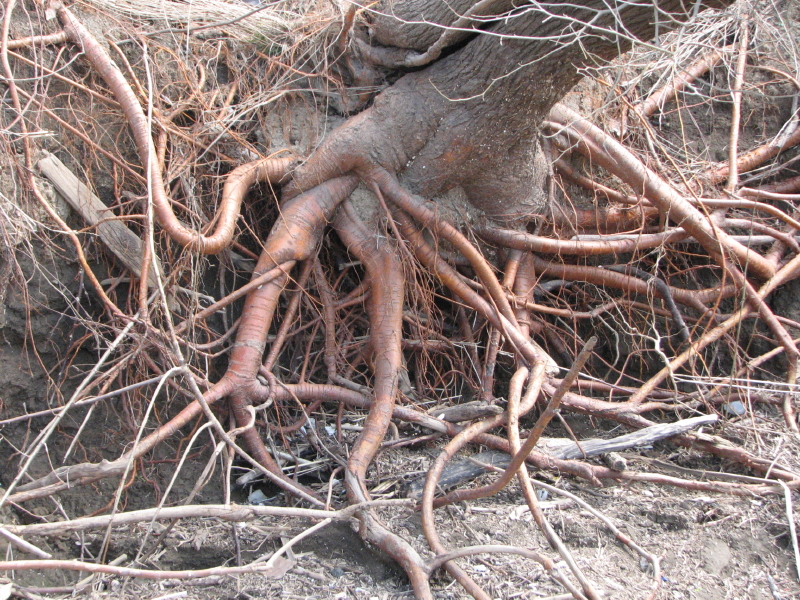
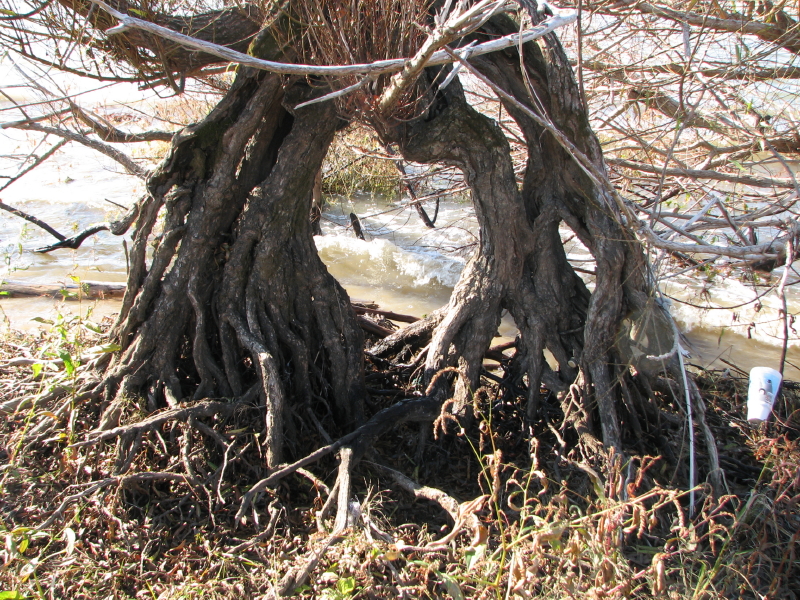
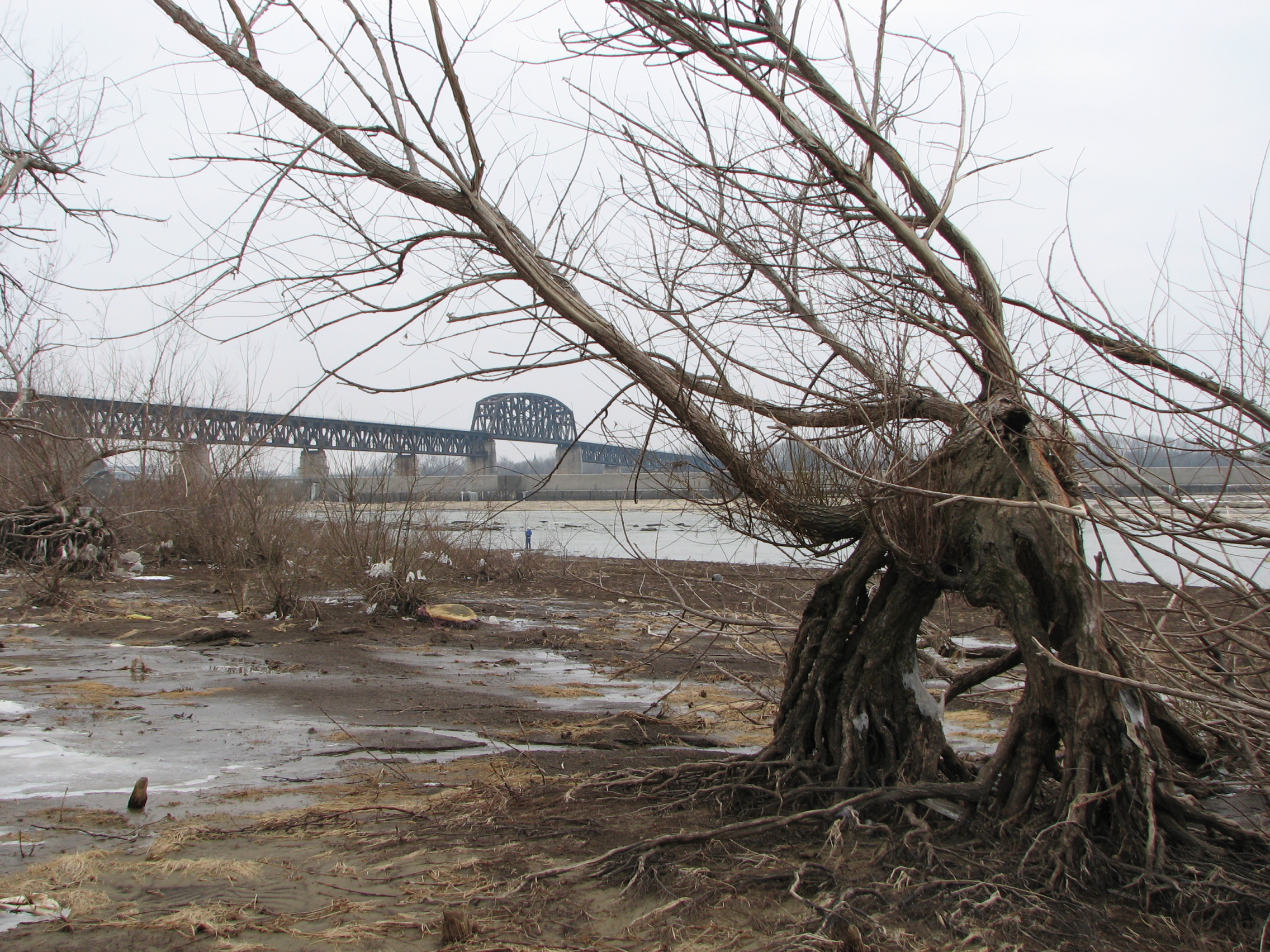
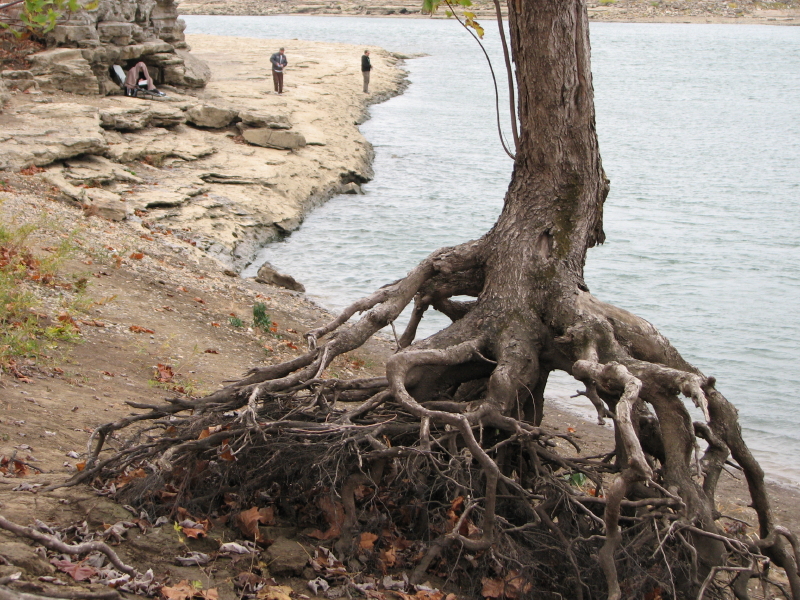
It’s interesting how often trees enter the picture.  One nice touch in the opening ceremony of the recently completed London Olympics was the large tree image that brought nature into the festivities.  Key to the life of a tree are the roots that help bring water and nutrients to its tissues.  By growing and burrowing through the soil the root system helps buttress the tree and holds the soil together.  This is especially important on a riverbank.  Since driftwood is essentially deadwood…I didn’t want to wrap up this post on such a dismal note.  At the Falls of the Ohio live many tenacious trees and here are images of a few of them that have weathered many a storm, flood, and the activities of man.

Before the idea of climate change and global warming there was already enough change occurring through the busyness of our species.  I remember looking at satellite imagery of the Amazon region a few years a go and being able to see the tell-tale grid system of logging roads and farms supplanting the jungle.  Deforestation is continuing at an even greater rate now.  Our trees need our love and we need the free services they provide.  Now for one last look at another resilient tree at the Falls of the Ohio.

Read Full Post »

under the willows, 10/09

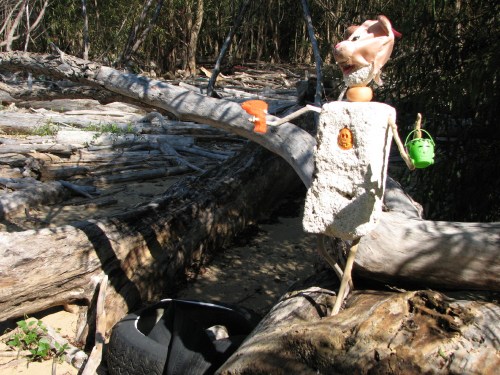
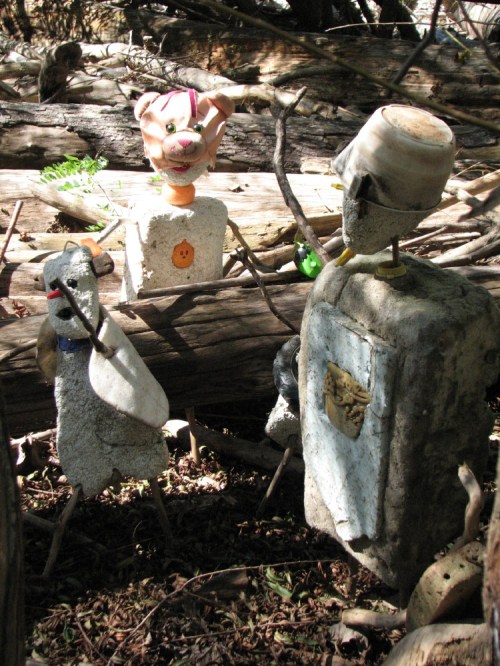
Under the willows the trap has been set.  With mask on and gun drawn the Trick or Treater isn’t waiting for the end of the month.  Halloween is now.  Soon a victim will appear and it will be “your candy or your life”!  Sugar can do that to a fella…even one made from Styrofoam.

Question Mark butterfly, 10/09

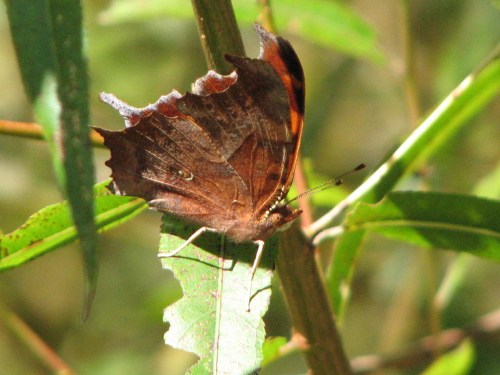
Waiting requires patience and so the Trick or Treater stays hidden.  Insects are plentiful today.  Fresh Question Mark butterflies flit through the zone demarcated by shade and sunshine. Can you see the small question mark sign on the hind wing that gives this butterfly its name?  Small tiger beetles chase each other across the sand and a hundred small grasshoppers are making lace from the wild grapevines.  Sooner or later, someone is sure to come by and then the trap will be sprung.

mask of the Trick or Treater, 10/09

Today is warmer than it has been for a few weeks.  The bear mask starts to get hot and with that a change in tactics is required.  Rising from his hiding place, the Trick or Treater begins to stalk the margins along the willow habitat.  Do you hear voices or is it just imagination playing tricks?  Carefully, he follows a line of driftwood towards the sound in the woods.

Trick or Treater, 10/09

Trick or Treater, 10/09

The ambush is set and everything is ready.  The trusty squirt gun is armed and the Frankenstein-head candy bucket is eager to find fulfillment.  The prey has been spotted next to a pile of Styrofoam and sticks that look vaguely familiar.  Inching closer, the Trick or Treater is aided by the noise his potential victims are making and the crunch of sticks and leaves is unheeded until total surprise is achieved!

the Trick or Treater's surprise, 10/09

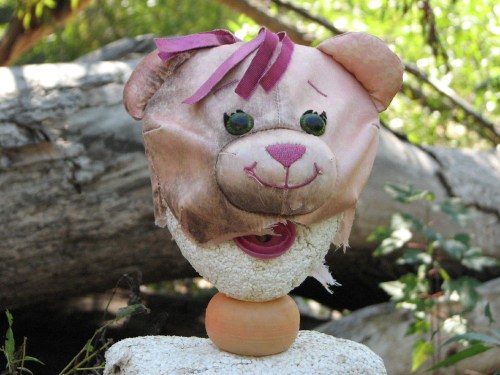
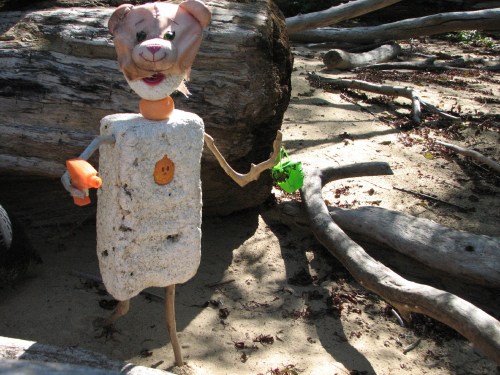
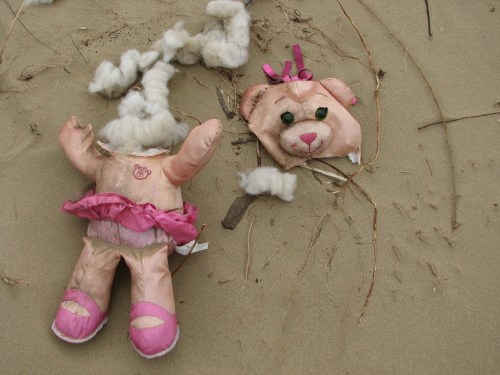
The idea for this figure came from a destroyed teddy bear I found at the Falls last March.  Either some child or dog came across it first and knocked the stuffing out of it.  The bear was still damp having been carried by the river to the spot where it was discovered. The empty bear’s head would make a perfect mask and I waited until now to put it together.  There is a face I made with acorn eyes and pink plastic mouth under the  disguise.  Every now and then, I find Halloween related items and I decided to put a few together to create this figure.  I’ll probably use it for a decoration this year where it will greet fellow tricksters in their quest for candy.

destroyed pink teddy bear, 3/09

Read Full Post »

Connect at Bernheim, 9/09

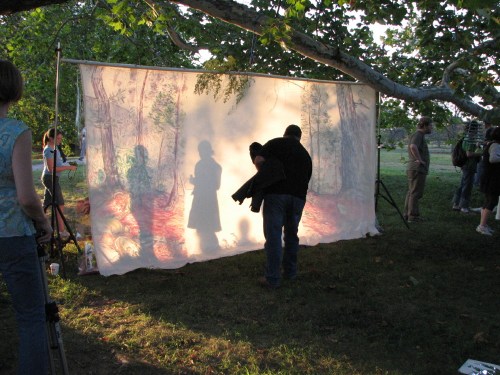
On an absolutely perfect night, my family and I attended the CONNECT event at the Bernheim Arboretum and Research Forest.  Bernheim is located in Clermont, KY about twenty or so miles south of Louisville.  The event was the park’s attempt at creating a festival that centered on promoting a creative dialogue between artists, scientists, naturalists, and other progressive thinkers.  The following is a couple images from this event.

water canon at Bernheim, 9/09

The local press suggested that CONNECT would be our version of the Burning Man event.  Although it was far from that,  the absolutely perfect weather brought the curious out by the car loads.  Much of the festivities  centered around the park’s Lake Nevin.  Two water canons were present that children could play with.  Once darkness fell, lasers were projected upon the water canon’s mist.

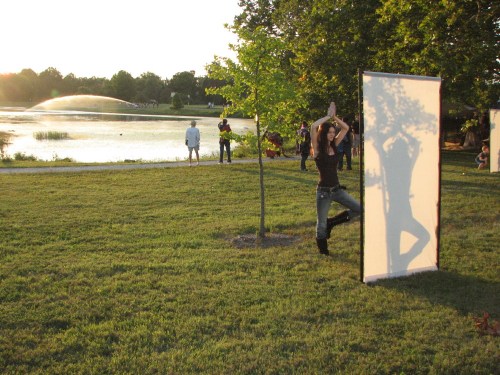
Back lit screen, Bernheim, 0/09

Yes, there was a science aspect to the event, but it was presented informally and was fun for the kids.  If there was a loose unifying element it had to do with the presence and absence of light.  All around Lake Nevin screens for shadow play and video projections were set up and being engaged.  Perhaps this is a sign of the times since we have become so accustomed to reading information from screens of all types?

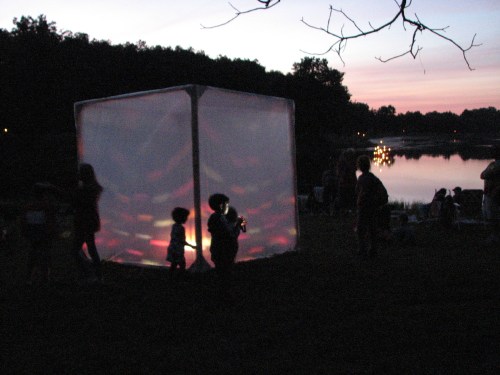
rainbow light cube, Bernheim, 9/09

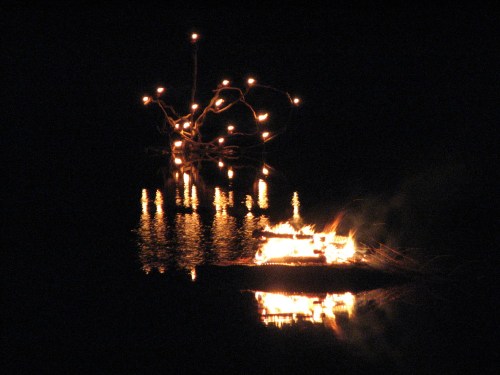
As the sun went down the music began in earnest.  The fire sculptures on Lake Nevin were lit.  People were enjoying the food and drink.  Strategically placed telescopes allowed people to obtain good views of the planet Jupiter with four of its moons.  My two sons really enjoyed the telescopes and they insisted on looking at the night sky before we could go home.

video projection, Bernheim, 9/09

The artwork I found really mesmerizing was a series of video projections by Julia Oldham, who has accepted a residency at Bernheim.  The above still is from her work entitled ” Churr-churr Ziz Ziz Ziz”.   In her videos, the artist by using some skillful speeded up editing was able to use her body to accompany the incredible sounds made by insects and birds.  It is difficult to describe, but the work held people’s attention and I’m excited to see what she creates in Kentucky!  If you would like to see Oldham’s video, she has generously posted it on her blog, “Bee Sting Brose” and the link is on my blog roll.

Lake Nevin fire sculptures, 9/09

In the afterglow of the Lake Nevin fires, I hope the organizers of CONNECT were encouraged by the public’s response.  Perhaps it’s too soon to tell if this will become an annual event?  The need to find common ground among the various disciplines is a useful excercise and the Bernheim Arboretum and Research Forest is a beautiful and contemplative place to host this gathering.  If CONNECT should happen again next year, I would suggest advertising an earlier opening time since it was hard to get around to see all the displays before the light went down.  Throughout the year, Bernheim is a great place to visit and if you want to learn more about its history and programs…I have attached their link to my blog roll on the right.

Read Full Post »

« Newer Posts