Feeds:
Posts
Comments

Archive for the ‘watershed’ Category

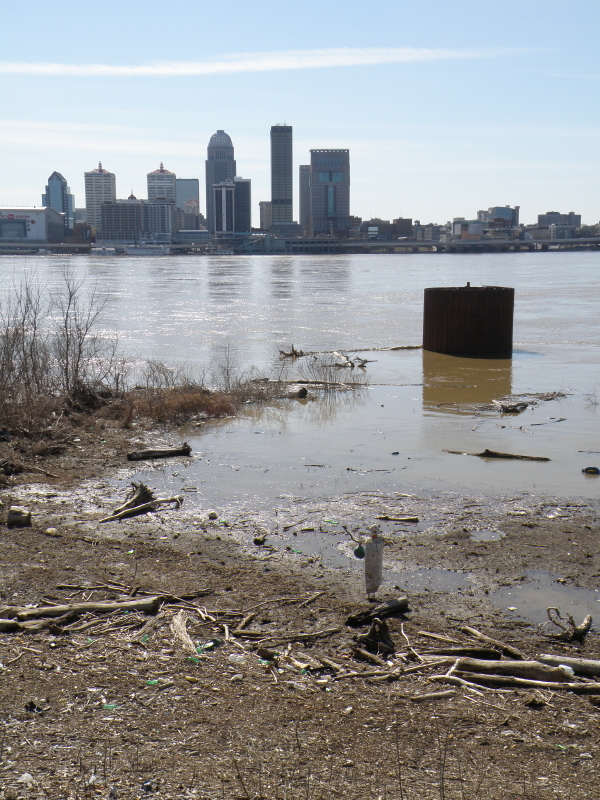
Winter view at the Falls of the Ohio State Park, Feb. 2015

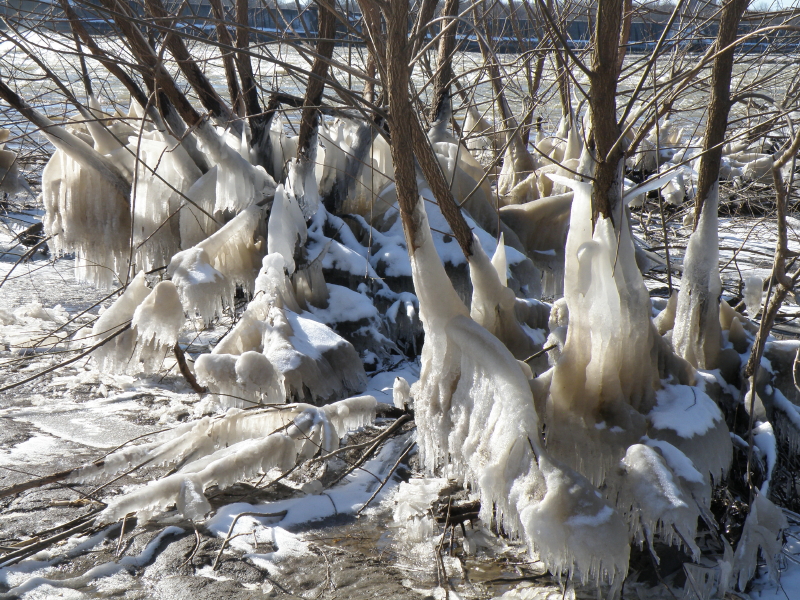
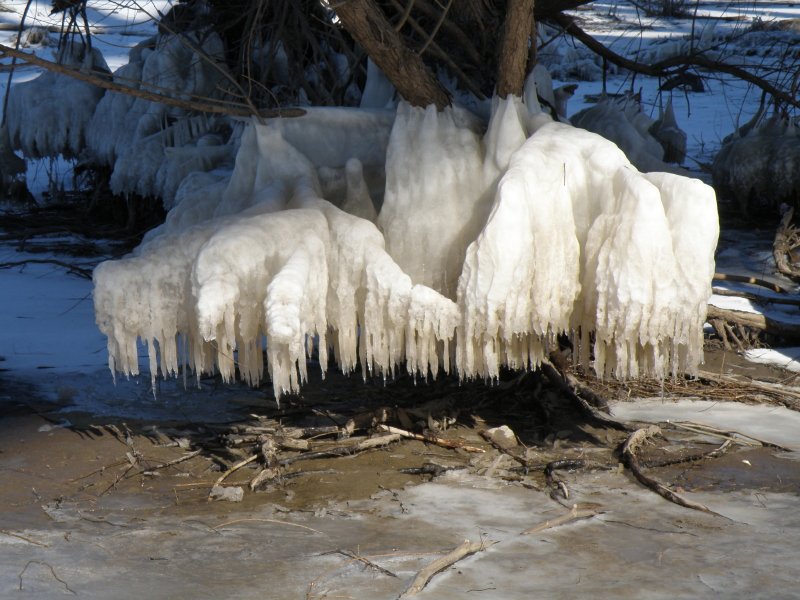
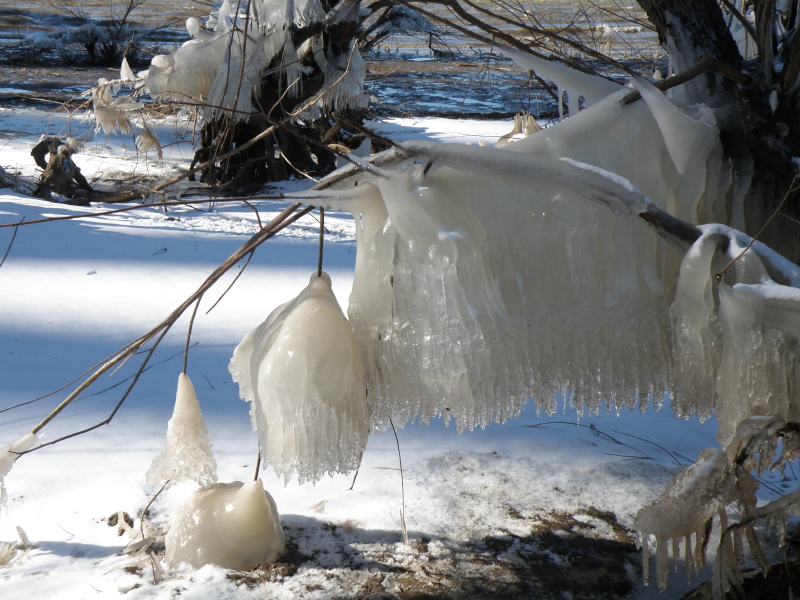
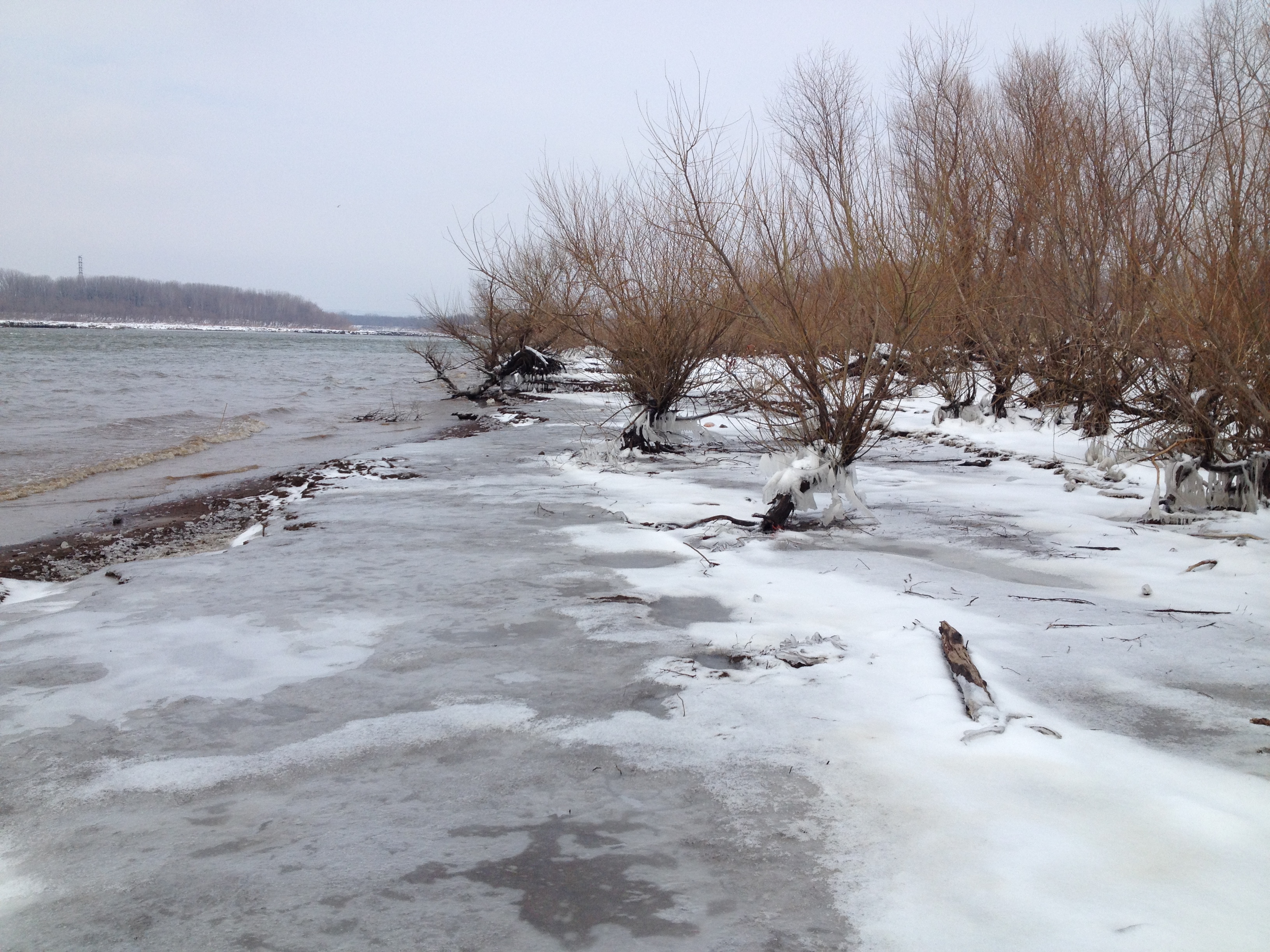
And just when we thought we were winter-proof…the cold descended.  Literally, one day it was near 60 degrees and a few days later came the snow, ice, and record-breaking cold.  Although it has been a mostly mild winter in the Kentuckiana area…it has also seemed like a longer than necessary season.  Everyone I know is winter weary.  Cabin fever has me out venturing among the frozen willow trees at the Falls of the Ohio State Park.  From winter’s past, I know that when conditions are just right, I can expect to see some interesting ice formations near the river.
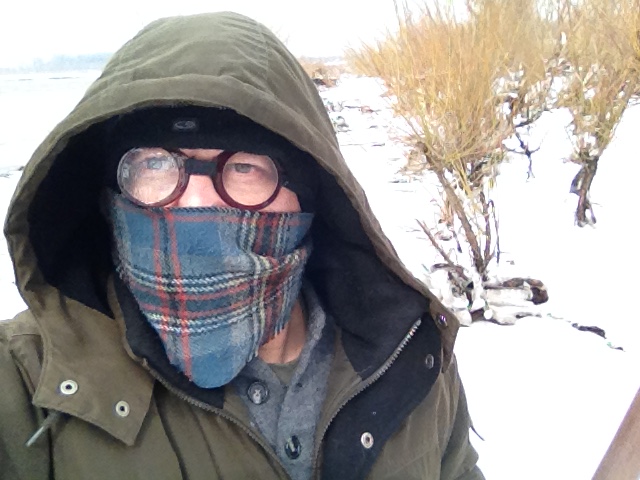
The Artist at Exit 0 in winter time, Feb. 2015

The right conditions are also cold conditions and you need to dress appropriately.  I find I’m in good shape wearing my vintage pair of Wind-Dodger goggles to keep my eyes from getting all watery.  An old treasured scarf across my face and an all wool, German, military surplus, submariner sweater add to the many layers I have on.  I bring along my trusty walking stick which I use frequently to test the thickness of the ice over frigid water-filled puddles.  Outfitted in my best polar garb I feel confident as I venture forth over a hibernating landscape covered in snow and ice.
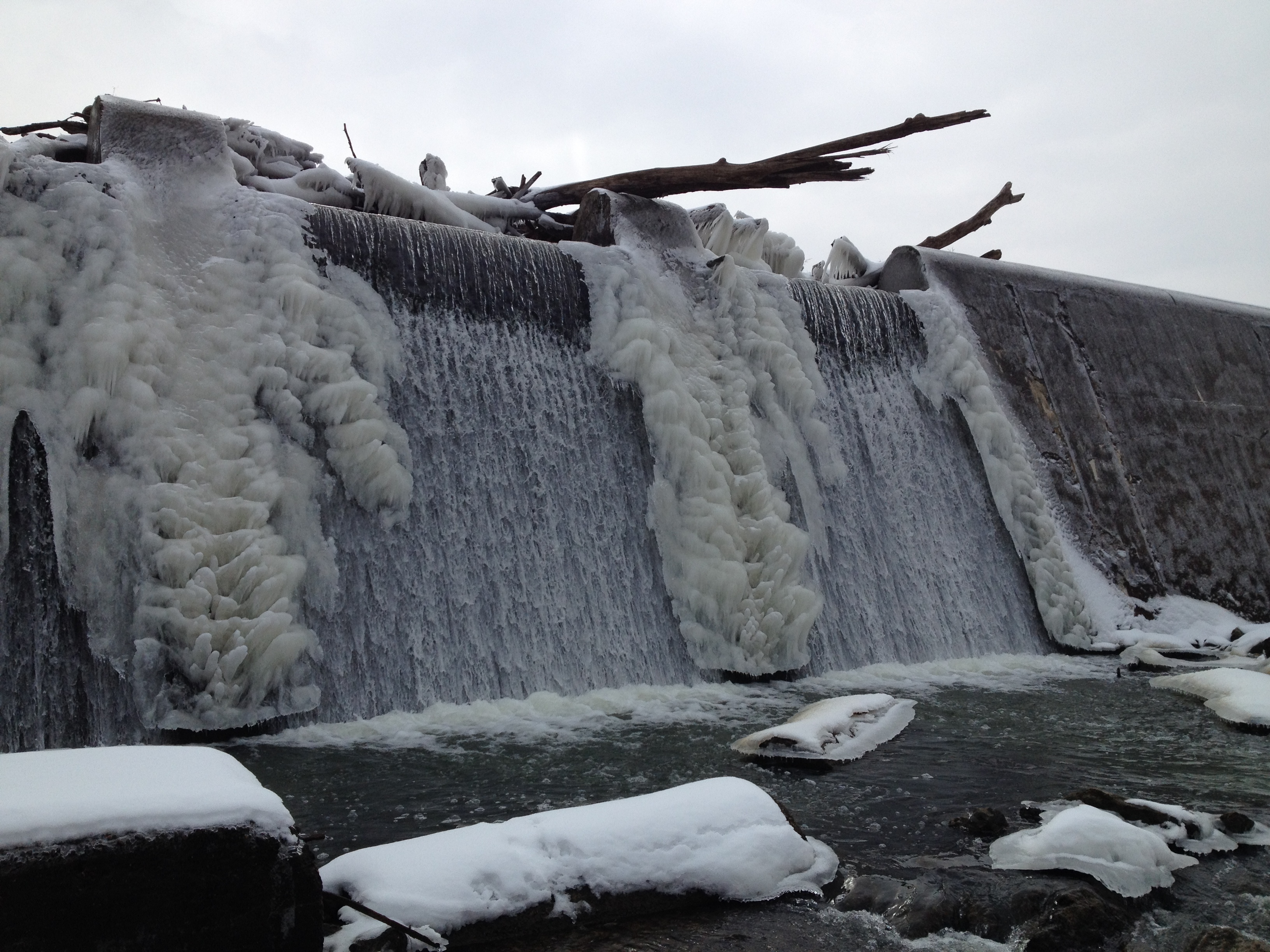
Ice formations on the dam's wall, Feb. 2015

In the eastern section of the park, ice has formed on the dam’s wall.  This wall is all that separates the full force of the Ohio River from impacting the lower levels of the park that I am familiar with.  The true height of the river is many feet above my head.  The more swiftly flowing water keeps from freezing.  Debris of all description and the trunks of washed away trees build up on the upriver side of the dam.  More than likely, all the pent-up driftwood will find release when the spring floods come and even the walls of this dam can’t keep the river from rearranging this area once more.  It is a dynamic environment ruled by the river.  If I were to contrast the scene before me with the way this spot will look like in six month’s time…you would think you were on a different planet altogether.  I try to appreciate the variety before me which also has a way of keeping out the cold.
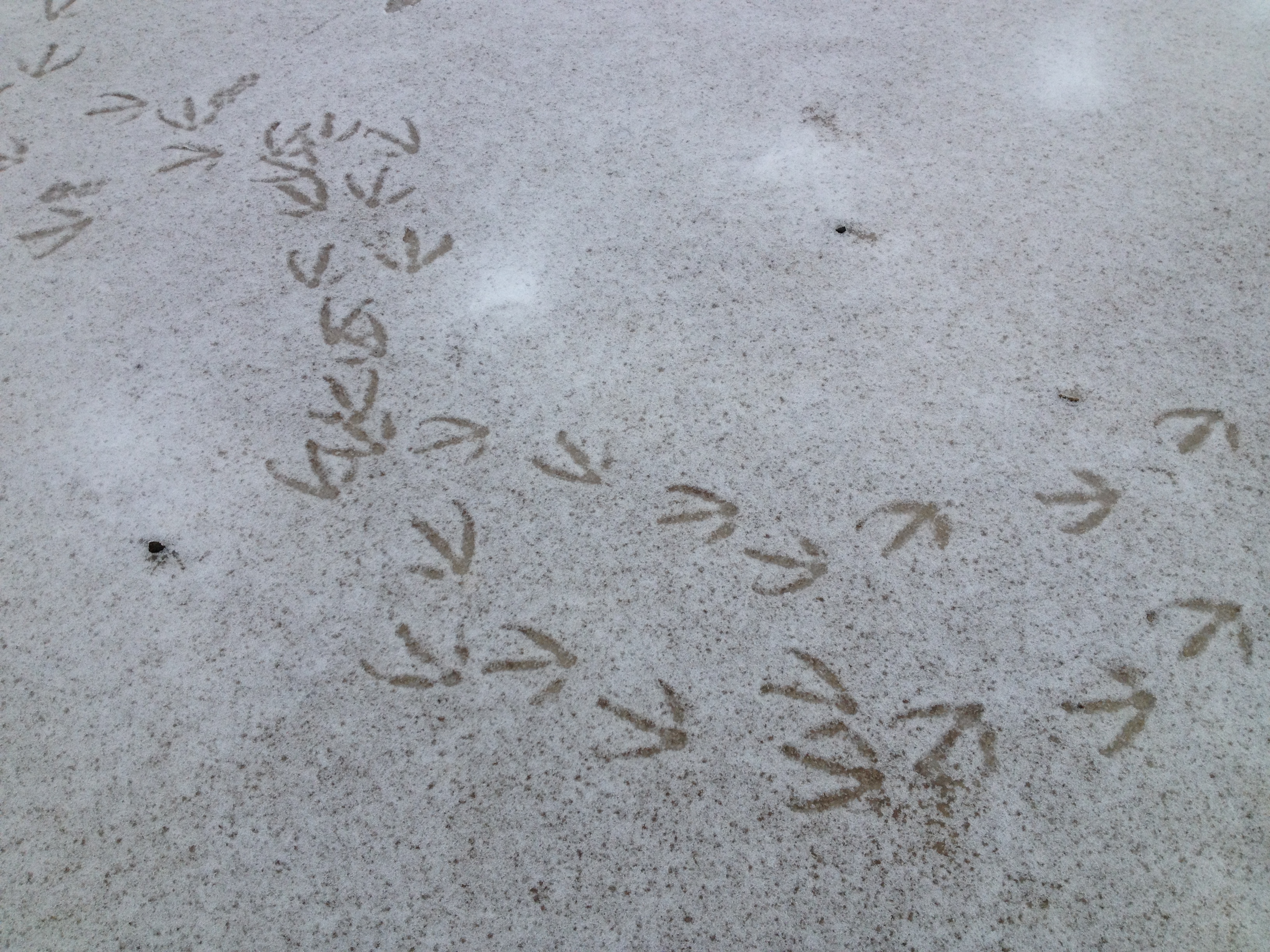
geese tracks in the snow, Feb. 2015

I find there is a surprising amount of life out here.  Although I’m the only person around, I have already spotted several species of birds that don’t seem to mind these conditions.  Geese have left there meandering tracks in the snow.  In the air, I watched both a Peregrine falcon and a nice flock of Ring-billed gulls engage in aerobatics over the river.  I come across other tracks in the cold mud that has me momentarily frozen in place.  I sort of recognize them, but there is also something not quite right here that I can’t put my finger on?
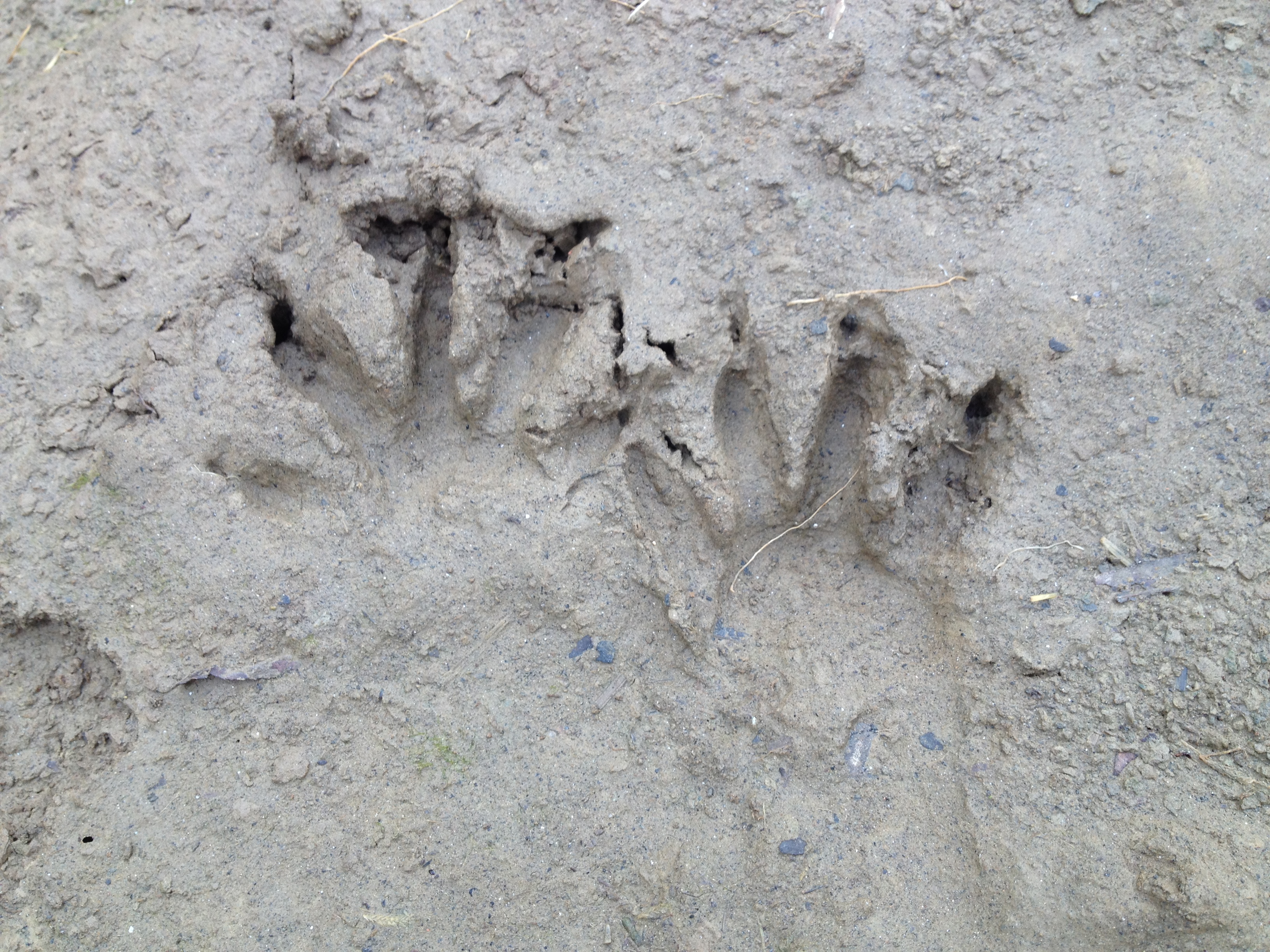
beaver tracks in the mud

To my eye, they appear to be beaver tracks, but they are too small.  I run all the possible candidates through my mind’s mammal filter, but I’m drawing a blank.  I chalk it up to my inexperience.  Try as you might, you can’t learn everything from books and there’s no substitute for doing the fieldwork.  I left the tracks and headed towards the spot on the river where I’ve seen good ice formations before.  Along the way, I find many chewed up willow branches and cuttings near a stand of willow trees.  Something has been dining fairly regularly in this area and with luck I may find other evidence identifying my mystery animal.  As you may have already guessed…luck was with me!
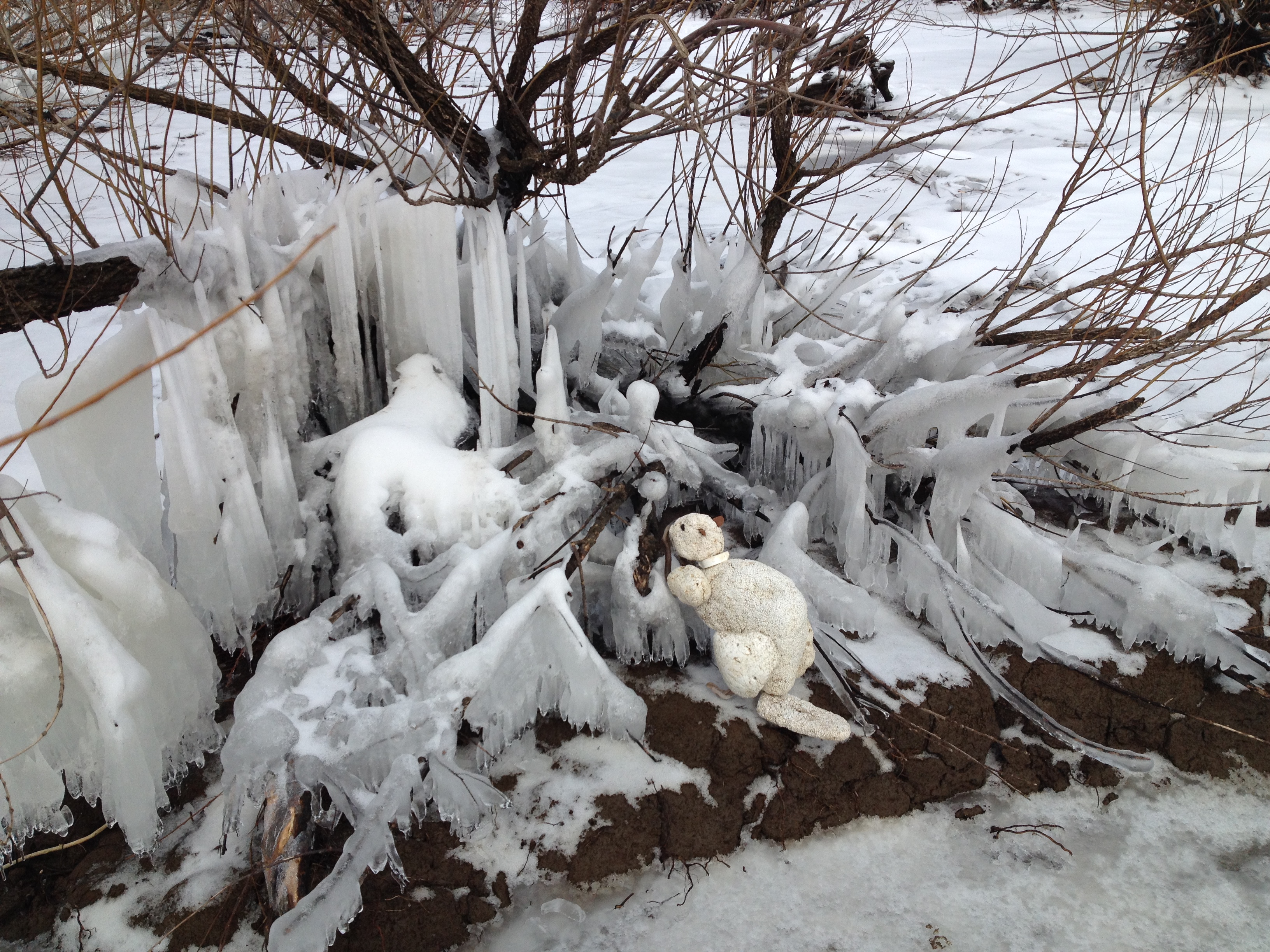
The Polar Beaver, Falls of the Ohio, Feb. 2015

If it hadn’t moved, I doubt that I would have seen it and I would have missed the first recorded occurrence of the Polar Beaver (Castor arcticus) at the Falls of the Ohio State Park!  In size, this remarkable rodent is about the size of the common house cat.  I stood transfixed as this all-white animal concentrated its intentions on the ice-covered willow trees near the river’s edge.
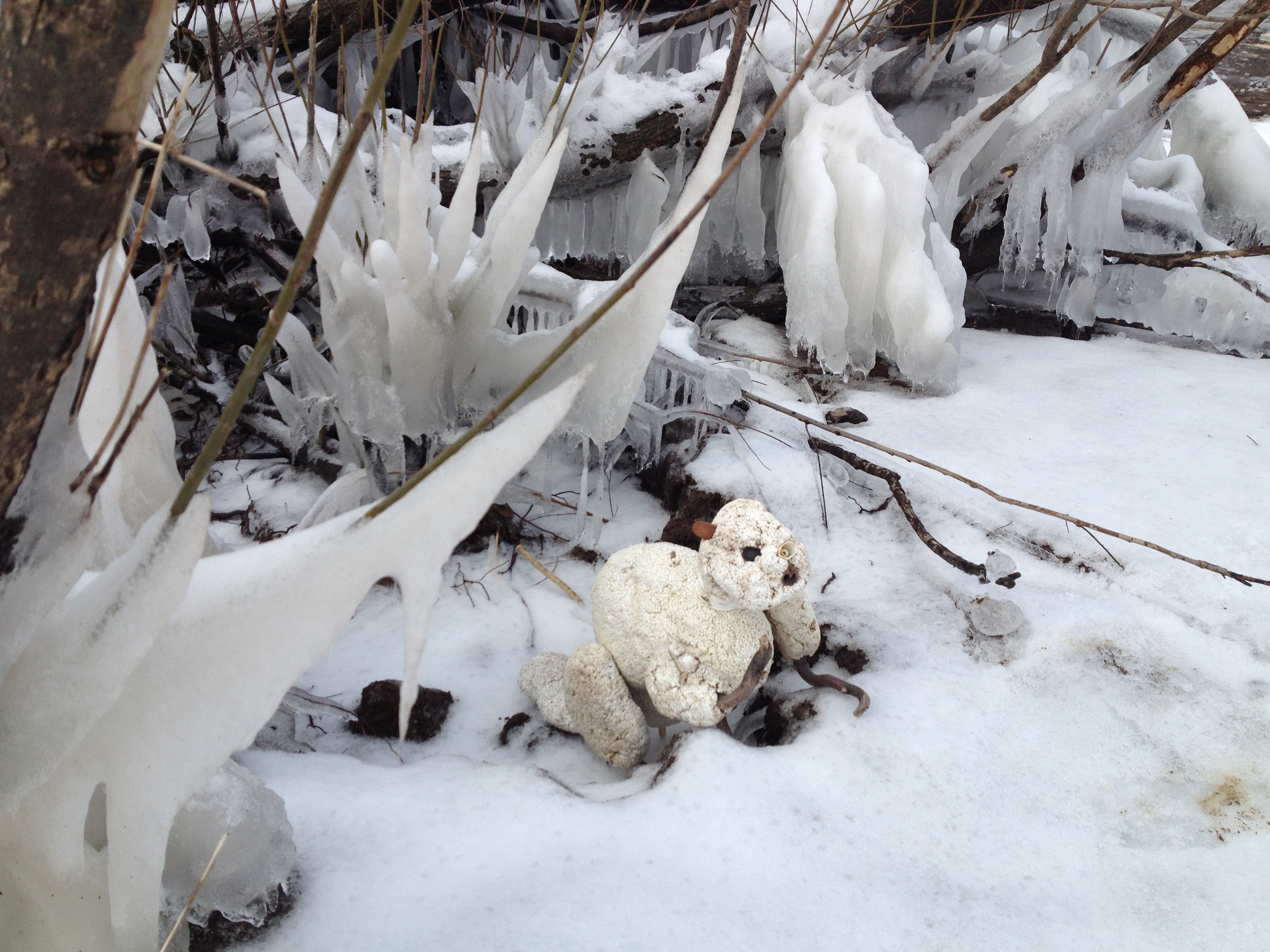
Polar Beaver, Falls of the Ohio, Feb. 2015

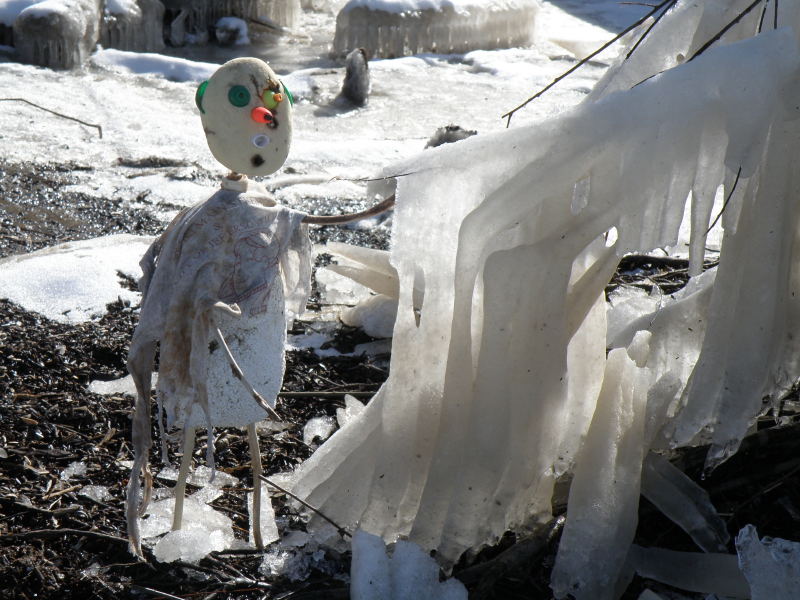
I wondered if the Polar Beaver could appreciate the varieties of shapes and forms that frozen water can take?  In the background, the Ohio River seemingly “smoked” as the surrounding air is much colder than the water.  This vapor or steam gradually coats the structures nearest the river.  As the condensation freezes it creates the many shapes that I like to describe as ribbons, sausages, and candles in this beautiful wonderland.  During these special moments, one can appreciate water as it exists in three different states of matter…gaseous vapor, flowing liquid, and rock solid.

The Polar Beaver, Falls of the Ohio, Feb. 2015

Historically speaking, the Polar Beaver is a fairly new animal to be described by science.  Although its beautiful snow-white pelt has been a valuable and prized trade item by the northern indigenous people…it was thought these rare white furs were taken from albino morphs of the common beaver.  Ironically, crypto-zoologists looking for the legendary Sasquatch, instead brought to light the existence of this very rare rodent.  DNA testing confirmed that the Polar Beaver is a truly unique species.  Some of the first observations about this animal documented that this beaver’s coat turns white as autumn transitions to winter.  This is a trait it shares with other polar animals like the Arctic hare and Stoat.
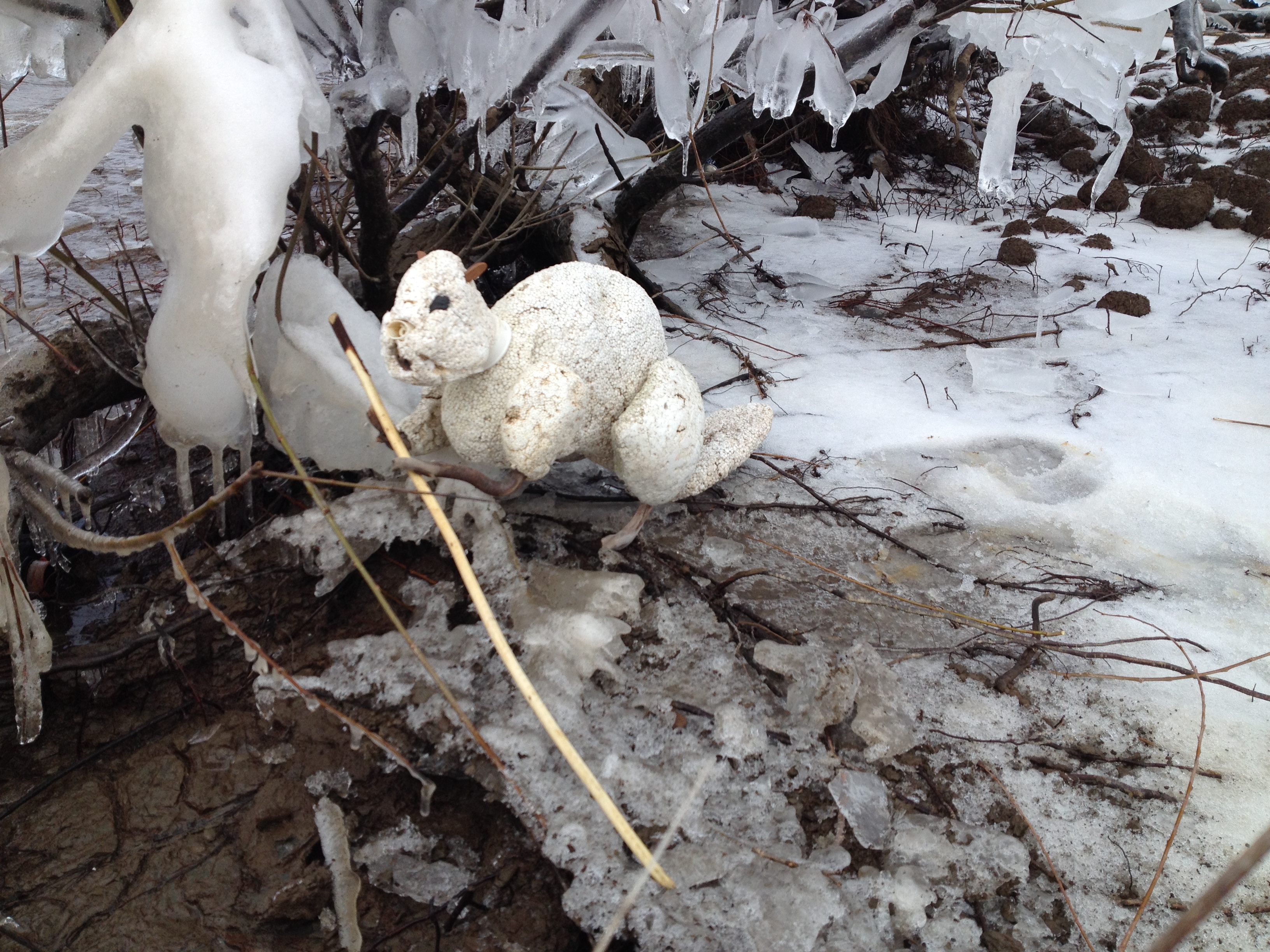
Polar Beaver with willow branch, Feb. 2015

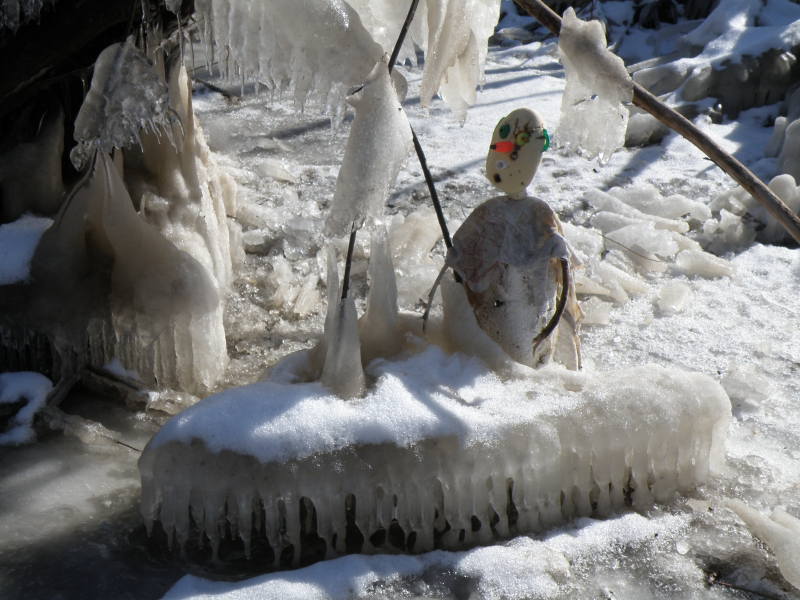
During this time at the Falls,  I was able to observe the Polar Beaver feeding.  Deftly, the beaver chose just the right willow twig and with a quick bite, severs it from the parent tree.  Holding the stick with its front paws, the beaver than carefully chews away the surrounding bark revealing the ivory warmth of the wood.  “Tool marks” left behind by the beaver’s teeth are recorded in the wood.  Willow makes up a significant part of this animals diet, but it is now known that other tree species and plants are eaten “in season” as well.
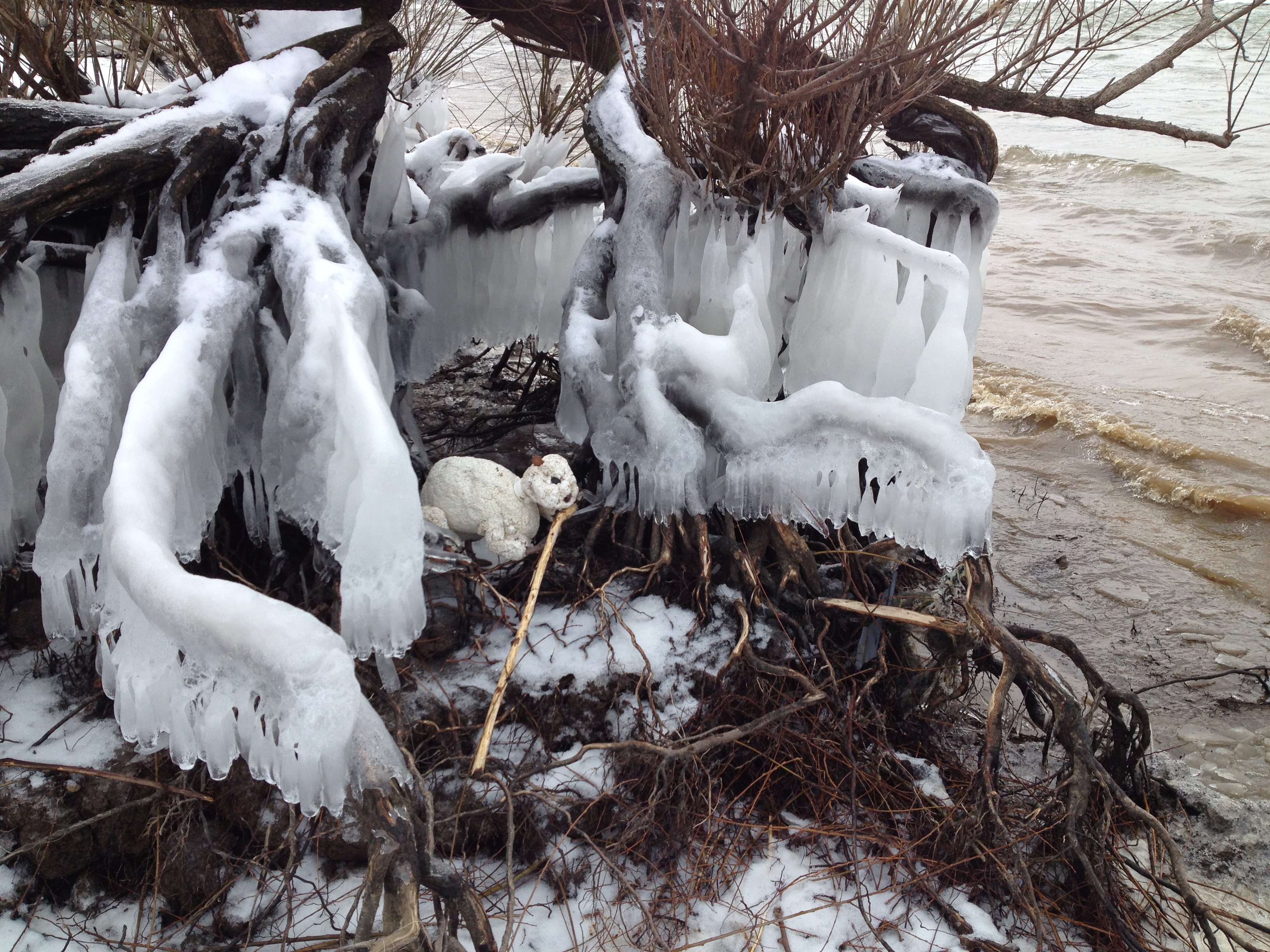
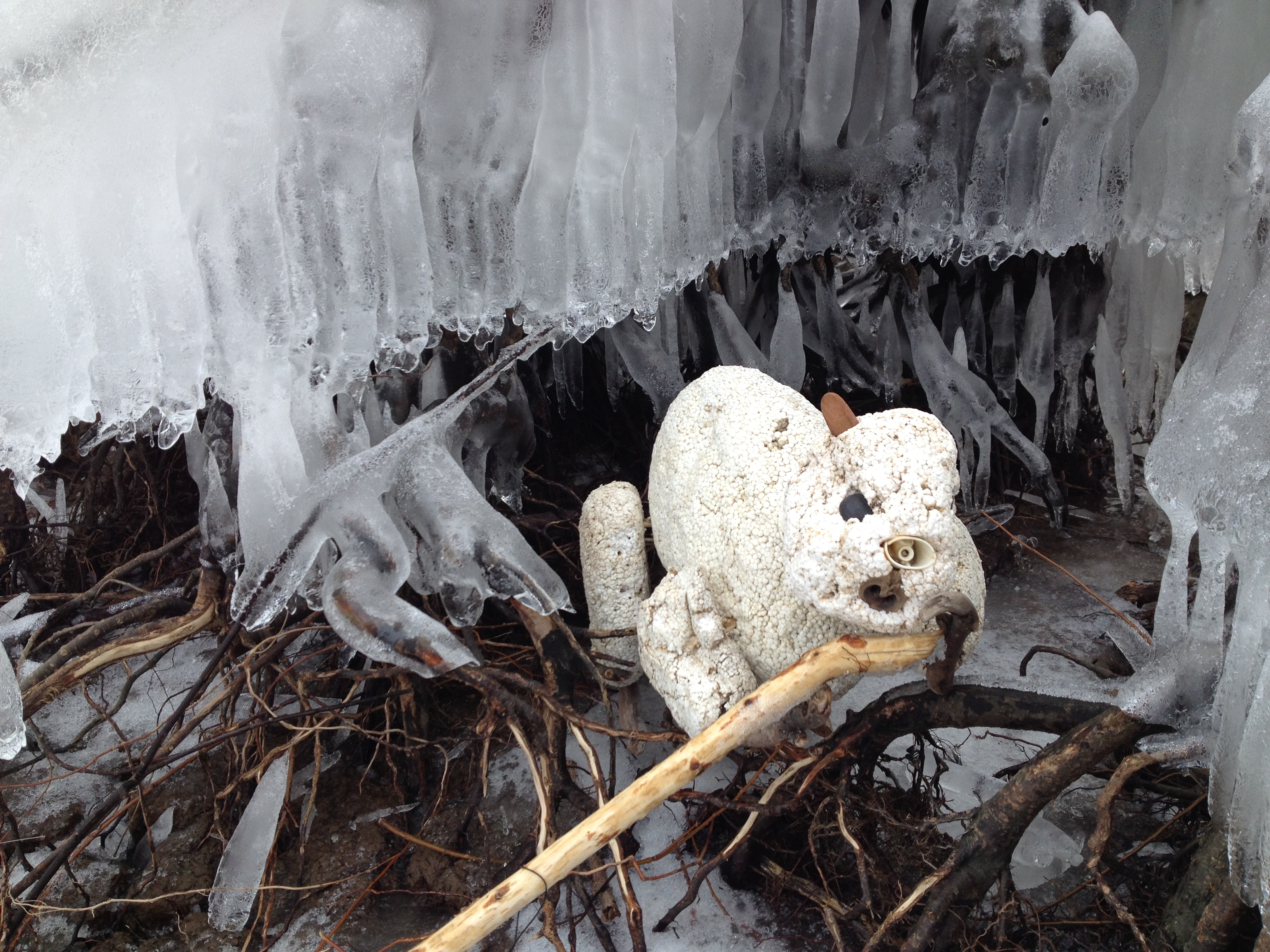
Polar Beaver feeding in its ice shelter, Falls of the Ohio, Feb. 2015

Polar Beaver feeding on willow branch, Feb. 2015

If the Polar Beaver noticed me at all…I couldn’t tell because it seemed so intent upon feeding.  I watched this animal carry a willow branch to a small “ice shelter” where it focused on the task on hand.  The muddy Ohio River gently lapped the shoreline.  When the beaver finished its meal, it continued to explore the immediate environs with its many ice formations.
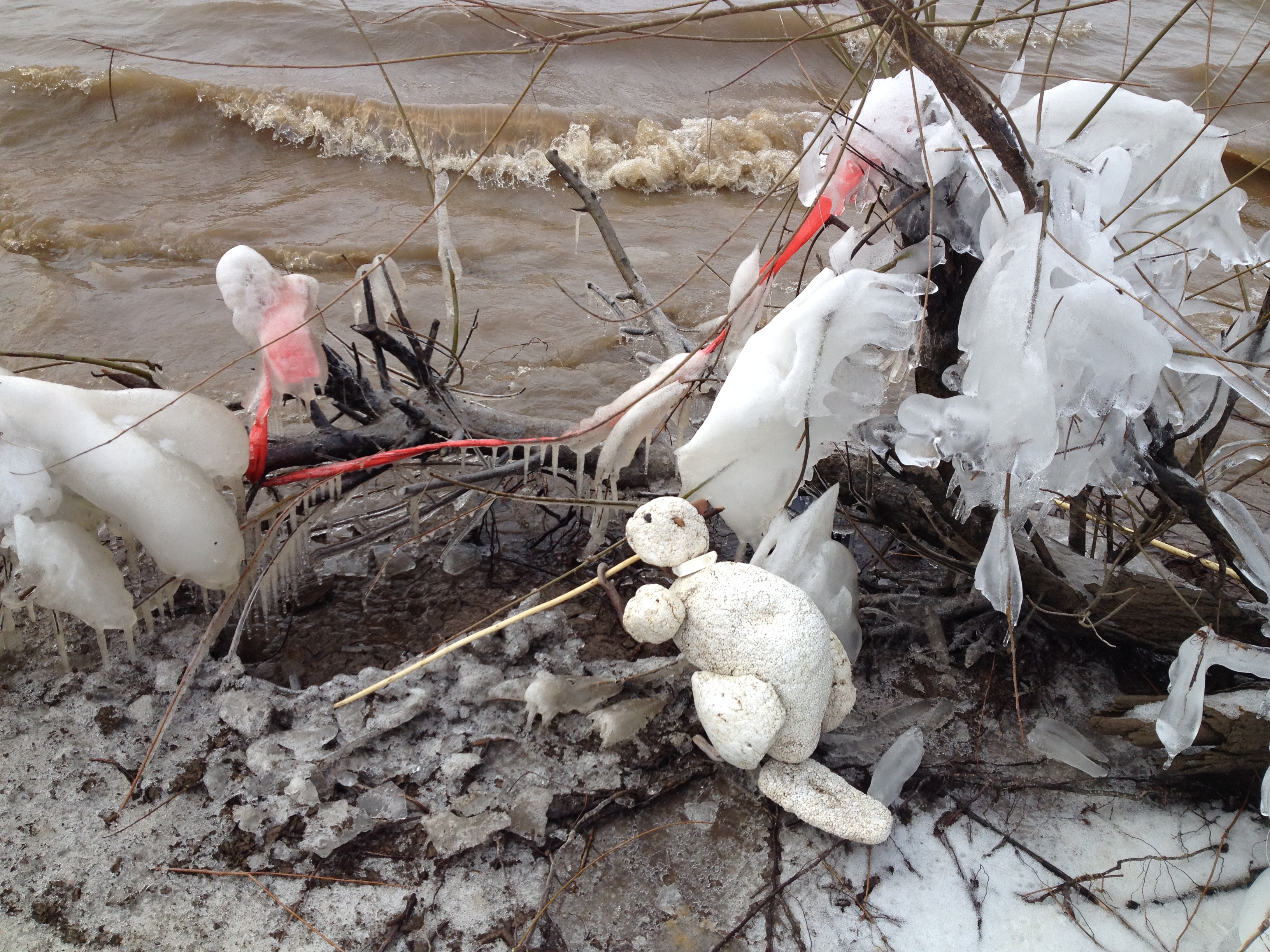
Polar Beaver at the Falls of the Ohio, Feb. 2015

I noticed the beaver sampling willow it had already chewed upon as it moved down along the river’s edge.  I stood transfixed by this nearly mythical animal.  I finally lost sight of the beaver when it went behind an ice formation and unseen by me…slipped back into the water and disappeared.  I searched around for a couple of hours hoping to have another glimpse of this Polar Beaver or any others that might have been around, but ultimately was unsuccessful.  I returned during the next two days, but this beaver apparently moved on for good.  I was lucky to have seen it, but can you blame me for being greedy and wanting more time with this magical animal?  Wouldn’t you wish for the same if you were me?  When my reverie lifted, I realized that I could no longer feel my toes and my digital camera was also feeling the cold and not operating properly.  It was time to go home and I will leave you with one final image from this trip.  Here is a view of a favorite old willow tree as it appears during the heart of winter.  Spring will soon be around the corner and I will see you again at the Falls of the Ohio.
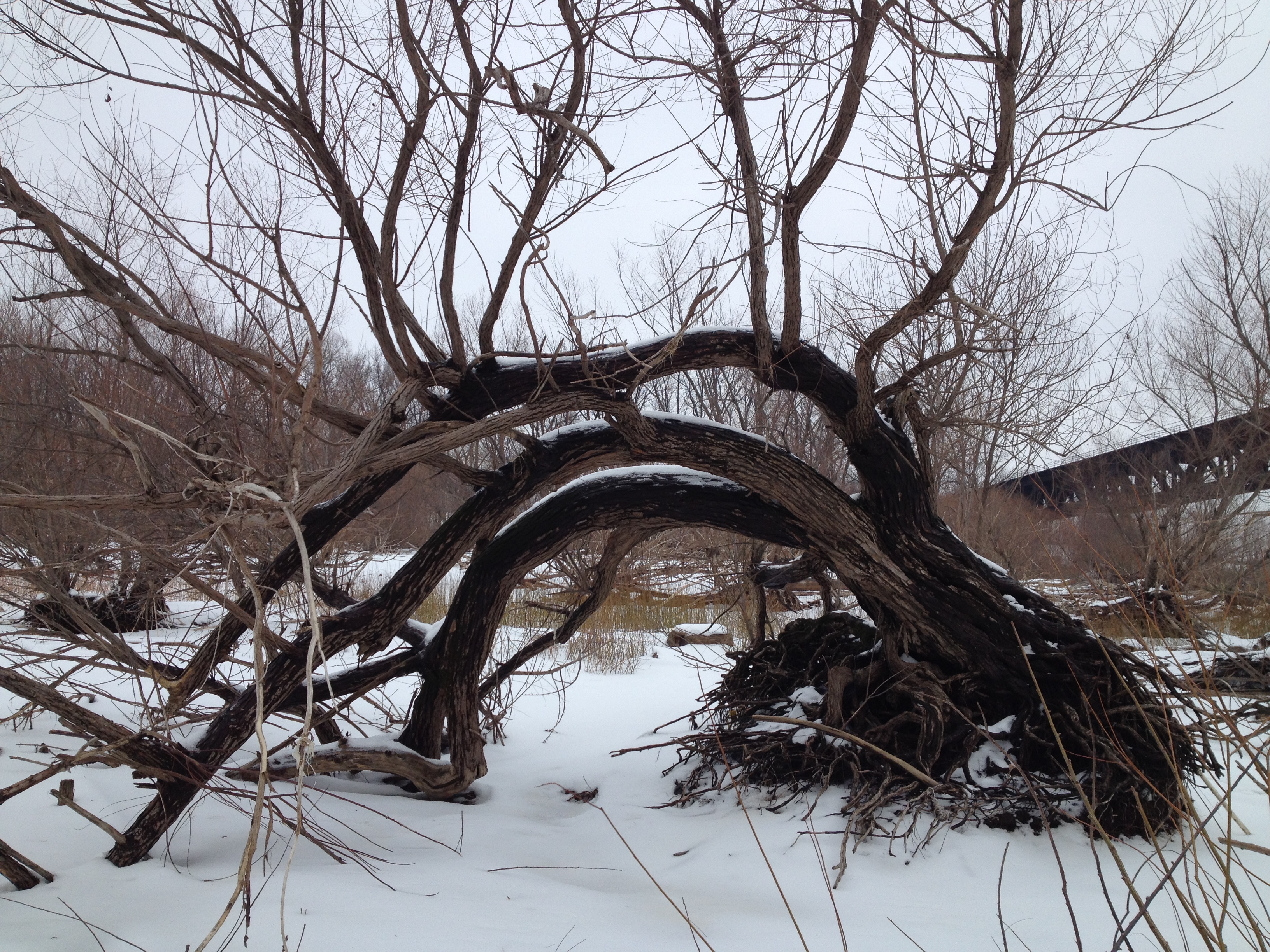
Old willow tree in winter, Falls of the Ohio, Feb. 2015

Read Full Post »

Under the railroad bridge, Tainter Gates, Sept. 2014

Two years have passed since I last set foot on the fossil beds on the Kentucky side of the river.  I had to wait until I fully trusted a bum knee to be well enough to walk upon the hard, irregular limestone surface that for most of the year is underwater.

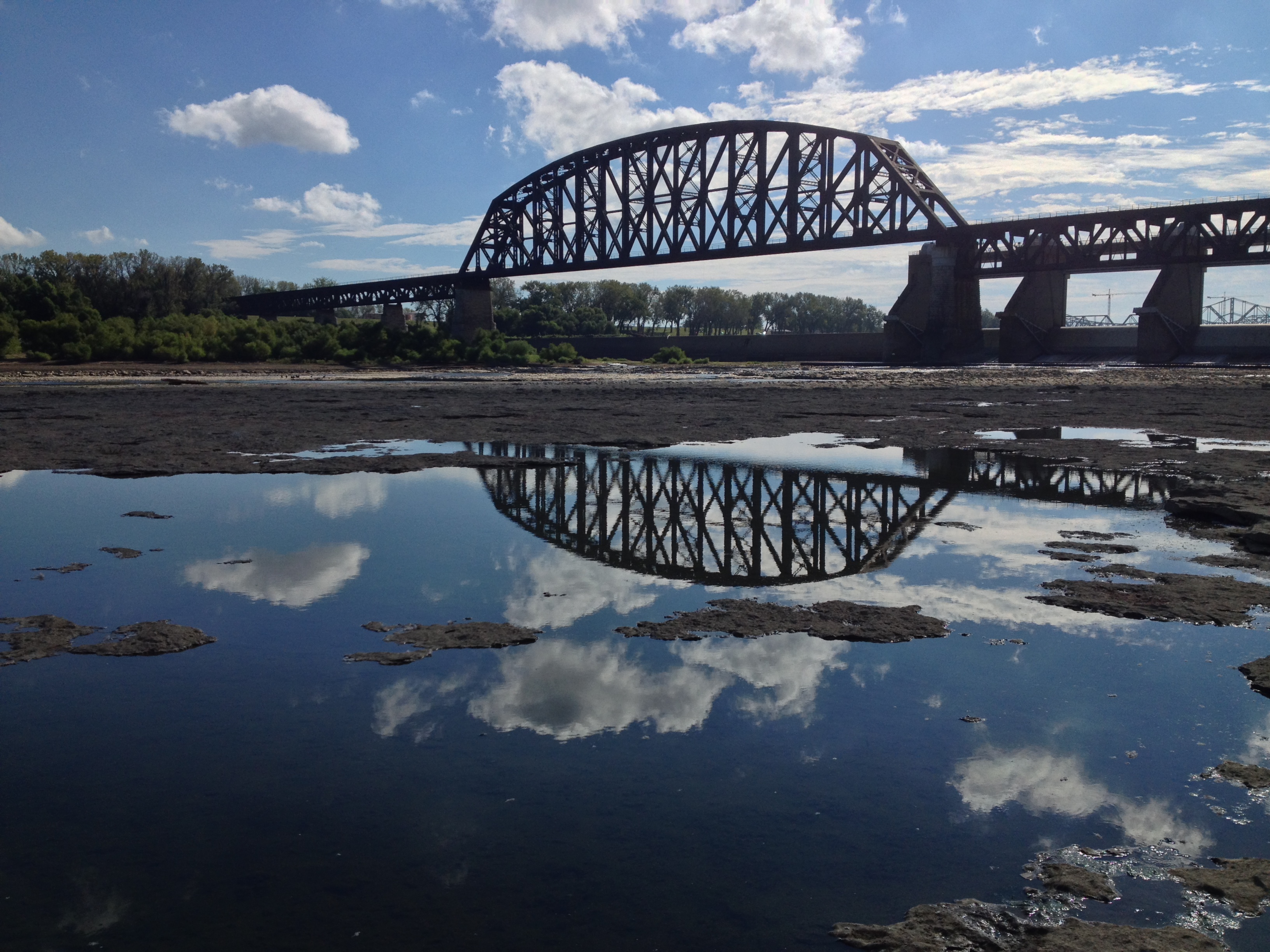
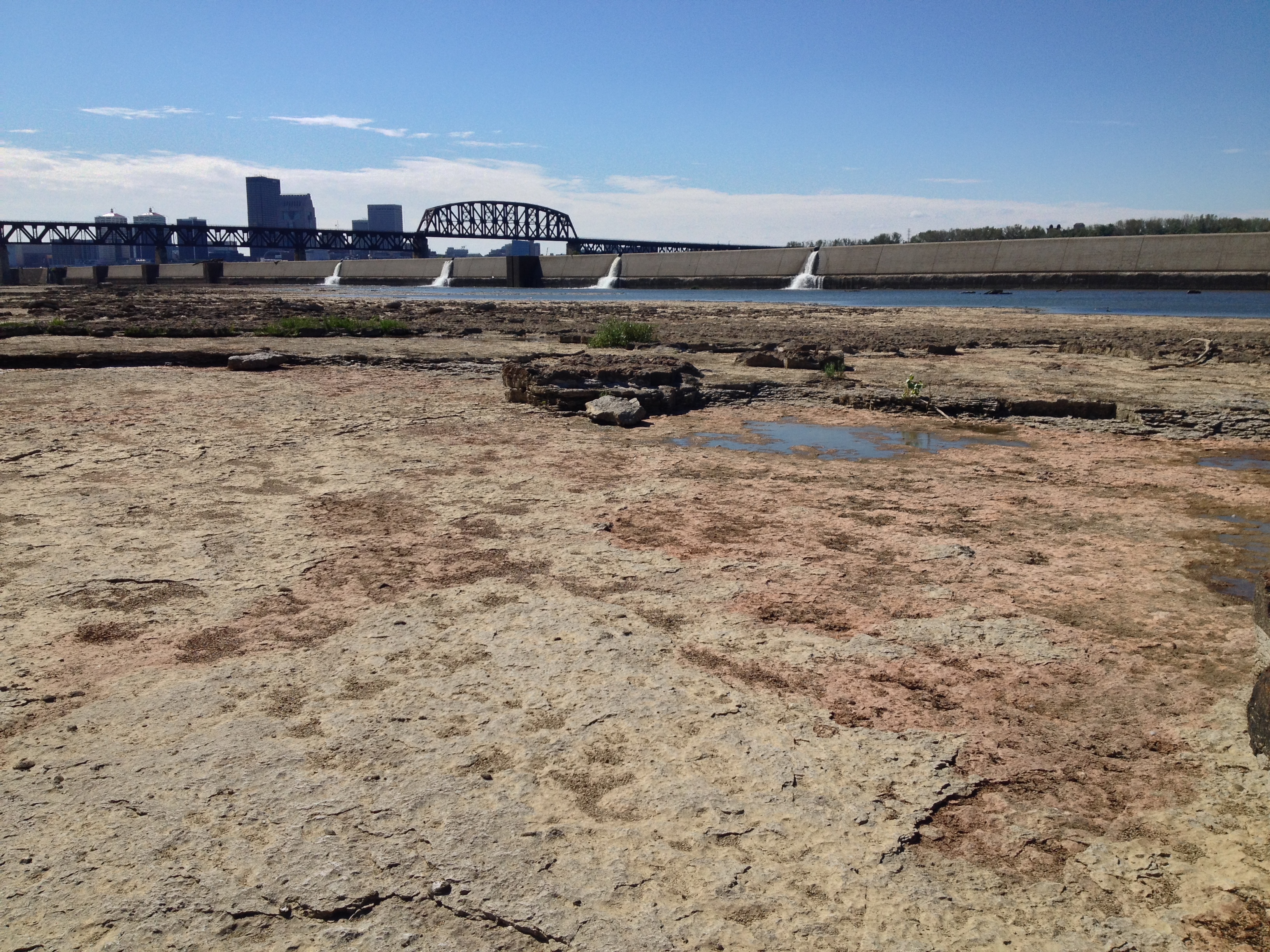
This is after all, the bottom of the Ohio River and accessible most summers when water is diverted to fill water levels at the McAlpin Locks and Dams.  The Ohio River is a managed river for much of its length.  Closing the snow plow shaped tainter gates helps regulate water levels for commercial navigation and flood control, but it also exposes the majority of the fossil beds to inspection at the Falls of the Ohio State Park.

I have rolled my ragged jeans up and I’m wearing a pair of shoes for sloshing through knee-high deep water at best.  As I move under the old iron railroad bridge, I walk past the gigantic concrete and metal gates holding the river back.  Something in their hieratic designs reminds me of ancient Egyptian art.  Here on a massive, civic-project scale, abstracted silhouettes of seated pharaohs serve the gods of engineering.  My goal today is to reacquaint myself with this unique environment and mark the day in some way.

The railroad bridge looking back to the Indiana side.  Sept. 2014

From experience, I know that there are far fewer materials to access on this side of the fossil beds.  Most of the Styrofoam, plastic, and driftwood I frequently use is driven by wind and river currents to the Indiana bank where I’ve preformed  most of my projects.

Being out in this environment with its varied materials often inspires me to want to make something, but what will I do today?  I take advantage of the river polished coal I found around the railroad bridge and envision an image I can work with site specifically.

I have come to like working with coal as a material because it is timely and is also invested with so much meaning.  In Kentucky, coal is currently a big political issue and many good people truly believe there is a war on coal and climate change is a not supported by the facts.

Anthracite is a deeply, shiny-black crystalline material out of the mine… but the river can tumble it into dull, but smooth feeling, egg-like forms.  I prefer the more river polished pieces of coal.

I’m guessing I’ve picked up about 10 or 12 pounds of coal which I carry in a canvas collecting bag.  Okay, I have my material and my feet are already wet.  With walking stick in hand, I walk along side the high walls that separate the Ohio River from the now exposed Devonian Age fossil beds.

Wall seperating Ohio River from fossil beds, Falls of the Ohio, Sept. 2014


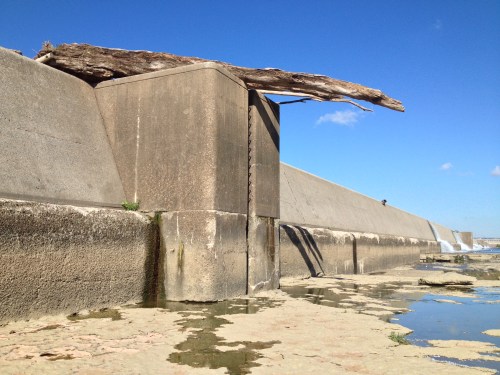
The dam’s concrete wall that separates the river from where you are standing on the fossil beds is maybe 18 to 20 feet tall?  It’s up there and sobering as well because the Ohio River’s waterline is just below the top of the wall which is just on the other side!  A series of pre-formed notches along the top of the wall allows water to flow over a section of the fossil beds.

A small wetlands area has been encouraged here that draws many water-loving birds.  Among the species I observed on this day included:  the Belted Kingfisher, Caspian Terns, Great Egrets, Osprey, Great Blue Heron, Double-crested Cormorants, Canada Geese, Killdeer plovers, Blue-winged Teal, Mallard Ducks, Black Vultures, and an American Coot.

Although it’s not hot today, there is little to shade you from the intense light out on the open fossil beds.  Most of these beds are high and dry, but the surface is pockmarked in places with potholes that hold water.  Most of the shallow pools that caught fish when the river level dropped have been cleaned out by the water birds.

In the above photo, a large log has become stranded on the top of the wall placed there when the Ohio River was receding from flood stage.  It was in this area that I set down my heavy collecting bag and laid out my first Coal Man design on the fossil surface.

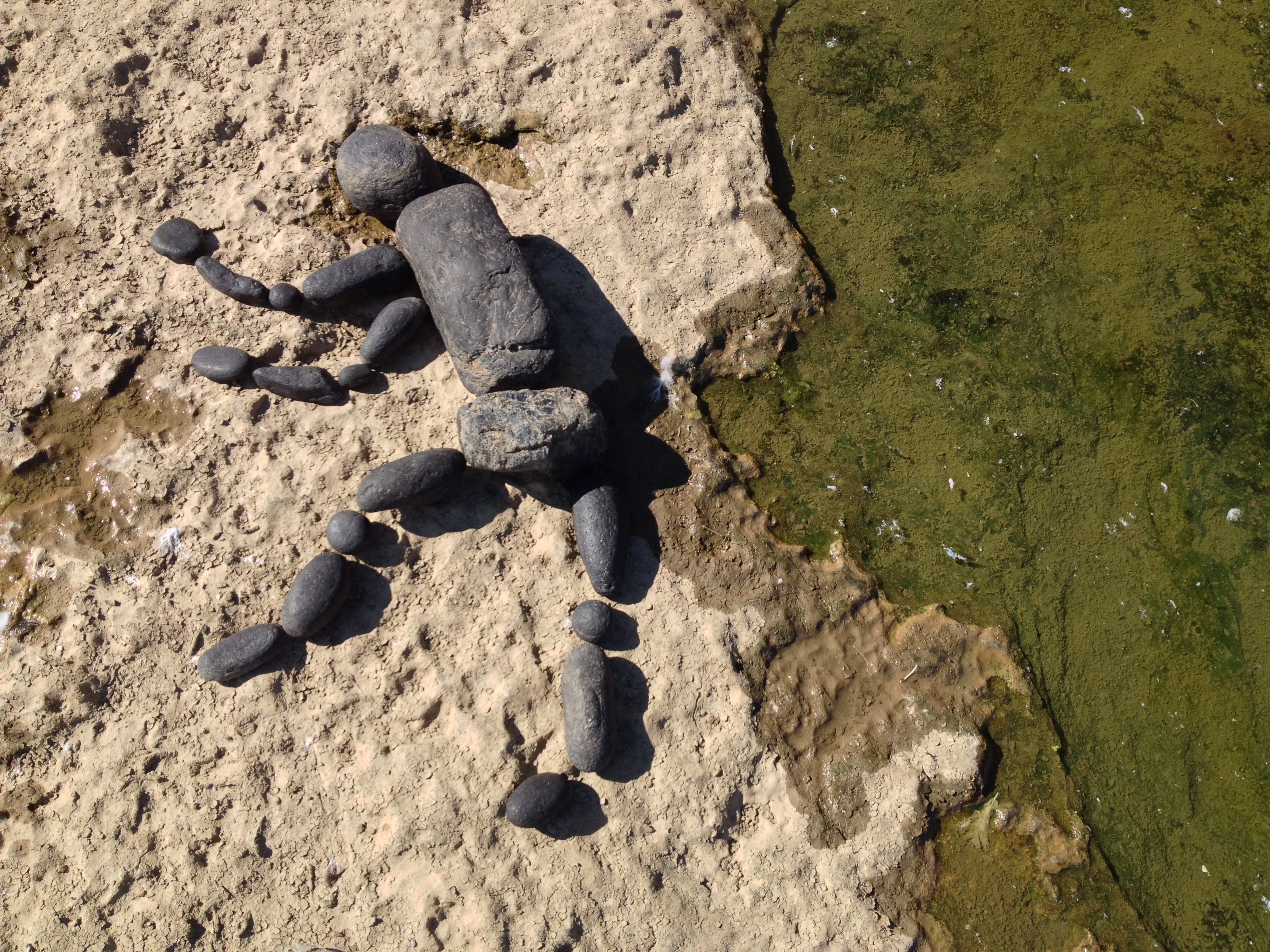
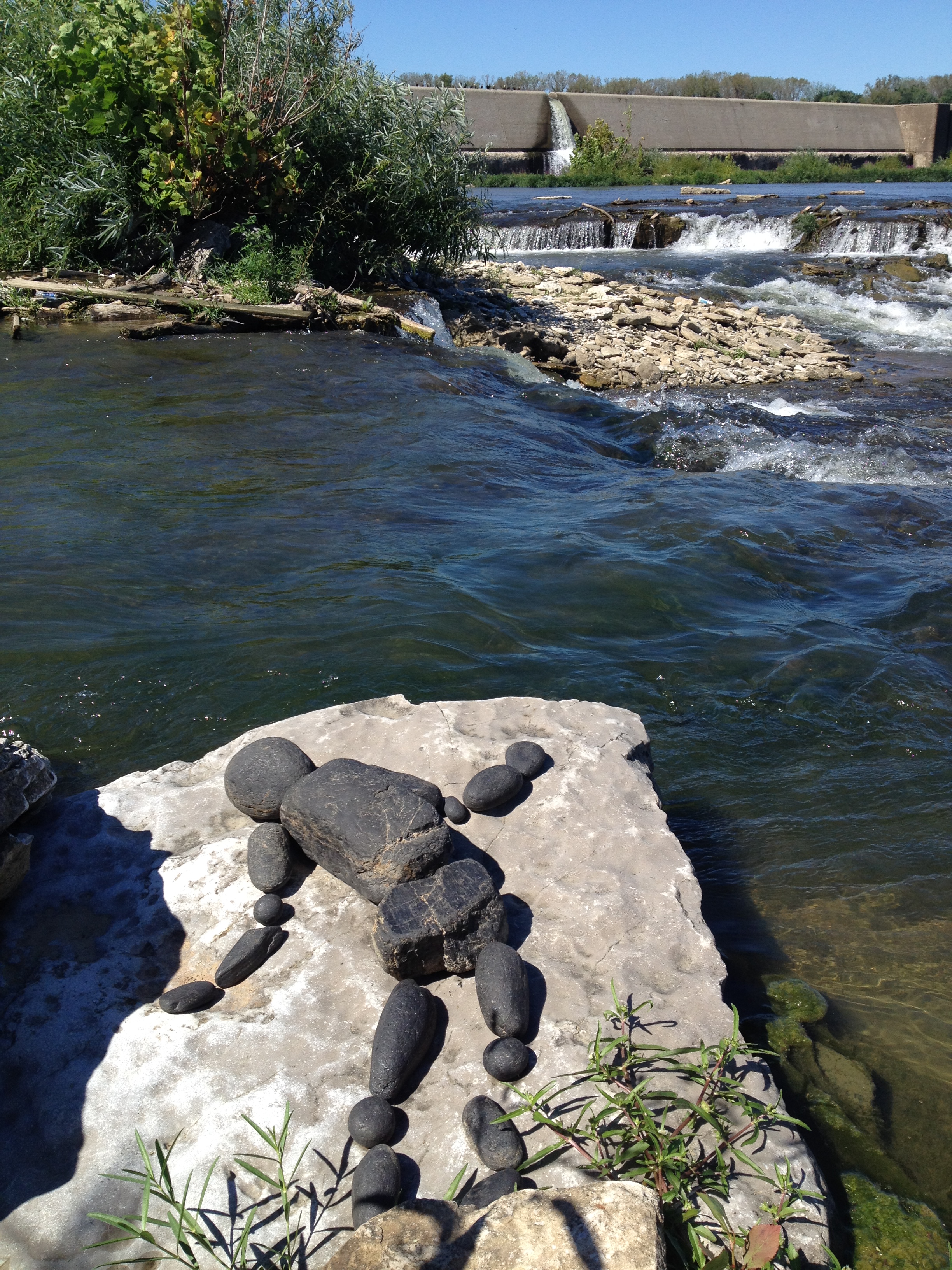
Coal Man variation, Falls of the Ohio, Sept. 2014

The figure has a marionette-like presence, but I relate more to it as a simple sign for figure.  In my head I’m seeing an ancient landscape marked here and there with this contemporary pictographic/petroglyph.  The Falls of the Ohio have been occupied by man for thousands of years and I like relating to this history.  The water is shallow and green from algae.  Molted bird feathers define the circumferences of many of these water holes.  Annoying small flies and gnats fly around the potholes and around your head seeking salt or other moisture.

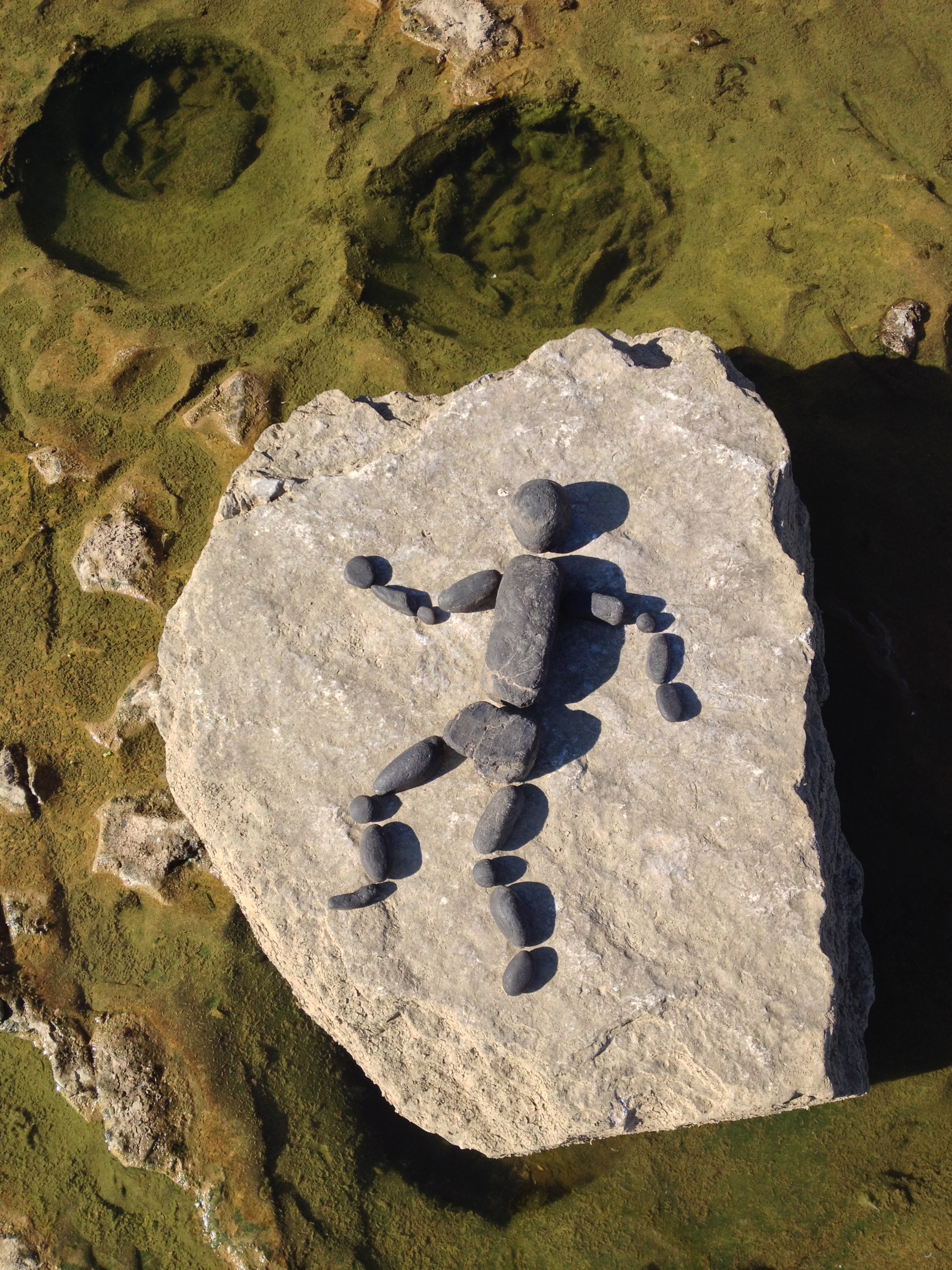
Coal Man Series, Falls of the Ohio, Sept. 2014

This figure has been laid out on a table-like boulder surrounded by very shallow water.  It’s a very temporary site-specific expression on a very tiny island.  I have heard people describe the exposed fossil beds as being a “moonscape” and it does feel like this landscape could be from another planet.

Seated Coal Man on Fossil Beds, Falls of the Ohio, Sept. 2014

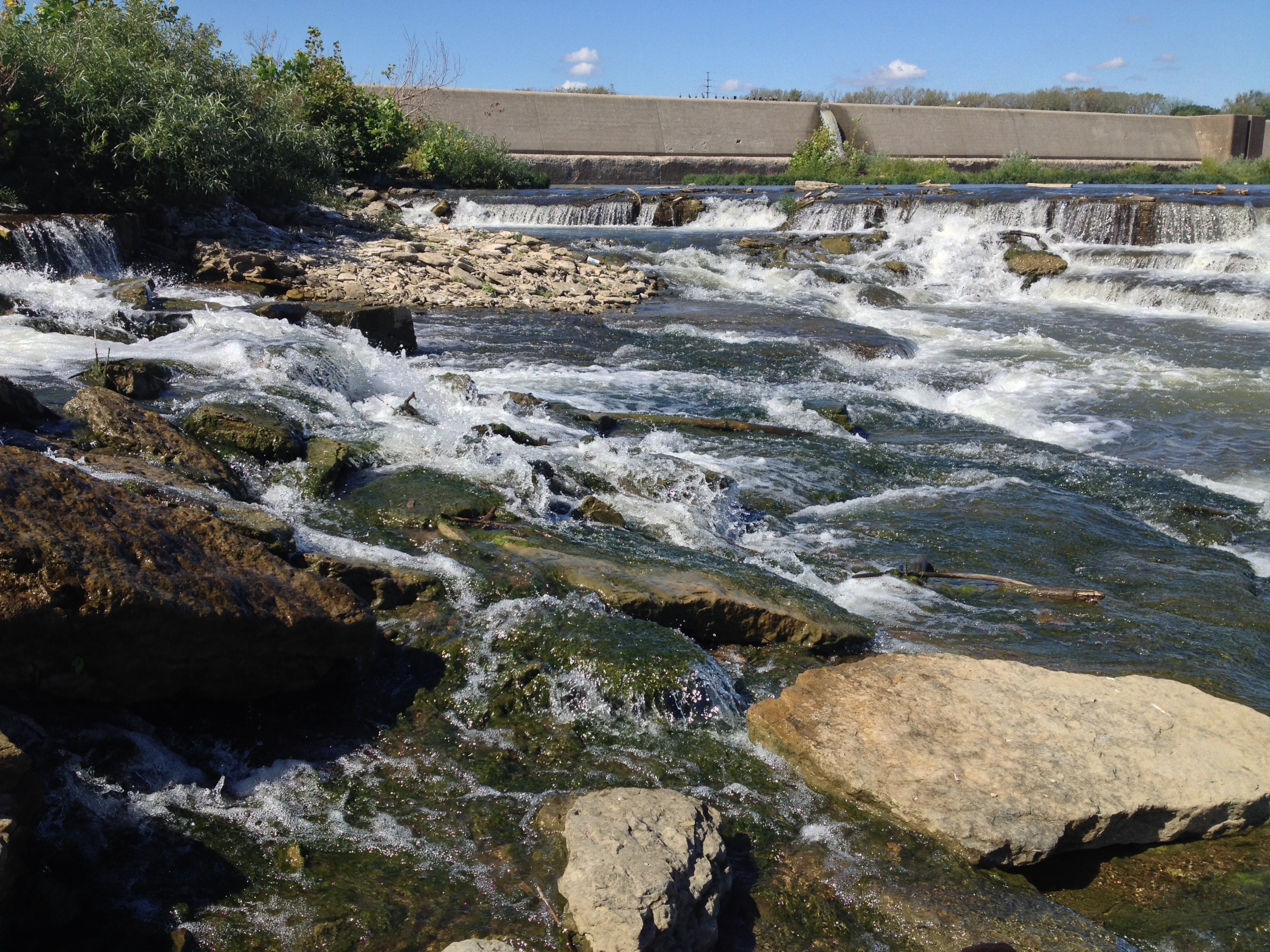
Many of the fossil beds are in layers or courses and here I am trying out some of the pictorial possibilities using my now seated Coal Man.  The Interpretive Center is the structure in the far distance.  After a while,  it’s time to cool off a little and have a good sit.  There’s a series of small cascades up ahead that are the nearest to imagining what the Falls may have originally looked like and I head that way.

Coal Man by the Cascades, Falls of the Ohio, Sept. 2014

I see in my mind’s eye, each different Coal Man design introducing a different feature on this side of the park.  I have been wading in shin-high to knee-high water to reach this place.  It’s like an oasis on the exposed and fossilized ancient coral reef.  I like resting here and having a water and snack break.  If you remain inconspicuous you can often spot many different bird species here.  The shallow but swiftly flowing water has small schools of baby fish seeking places of safe harbor.  I’ll bet the oxygen levels in this water is very high?

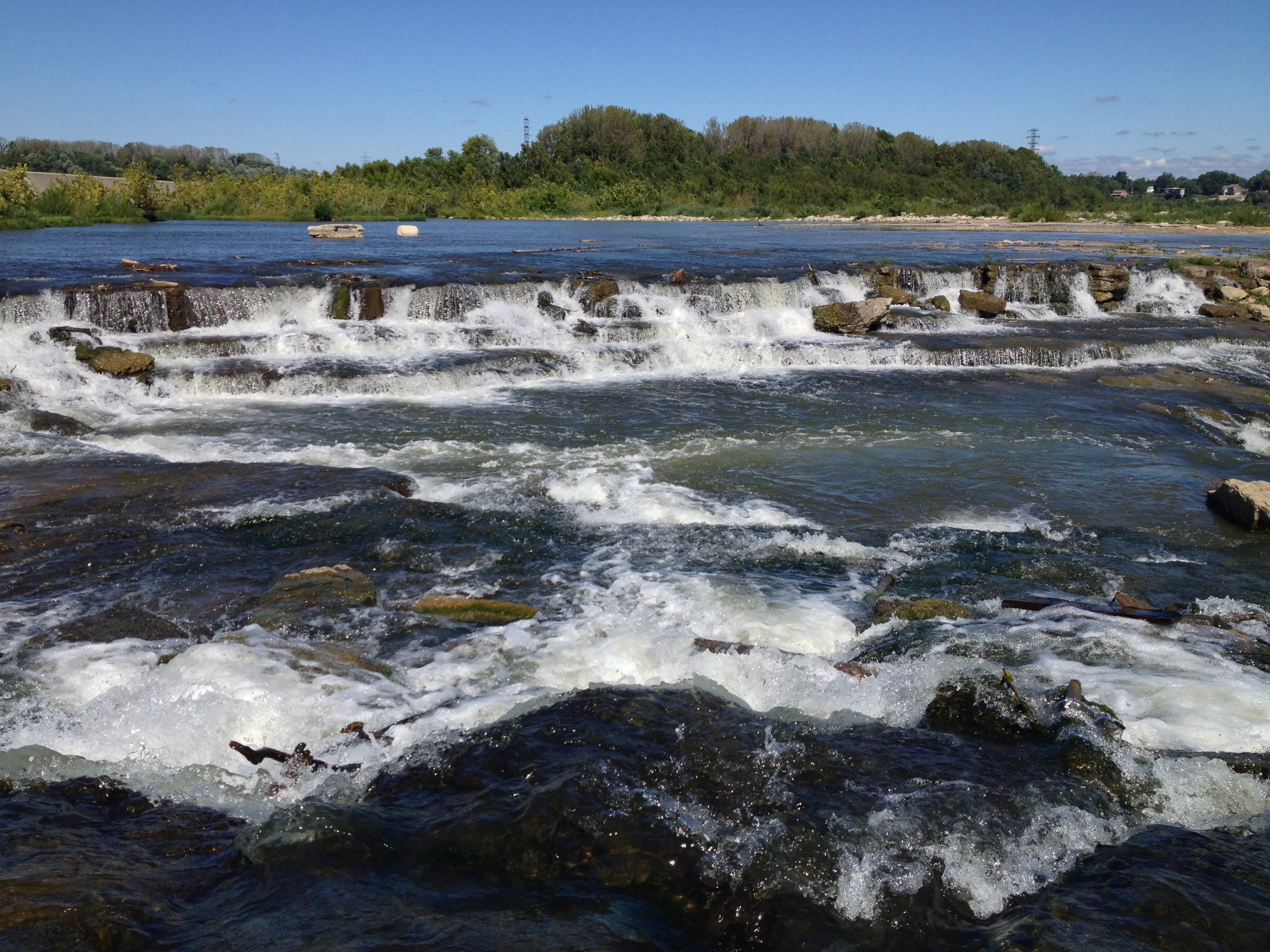
Cascades, Falls of the Ohio, Sept. 2014

Cascades, Falls of the Ohio, Sept. 2014

I cool off wading and exploring this area before moving on.  This space has a bit of the amphitheater feeling about it.  The cascades take on a larger horseshoe formation connected by many small waterfalls.  In the recent past, much larger cascades existed and put on a water show that I wish I could have seen.

Cascade at the Falls of the Ohio, Sept. 2014

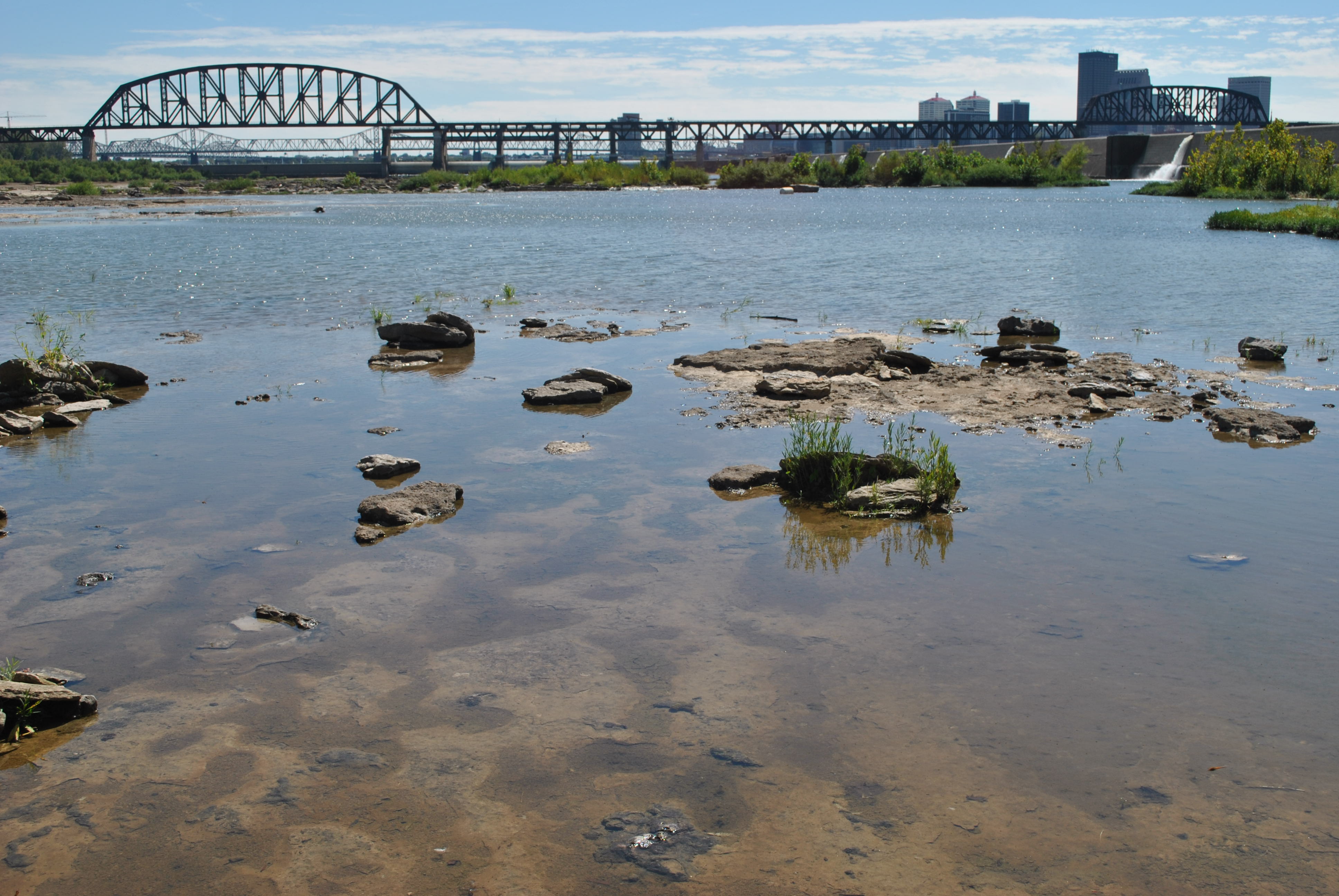
Time to move on and dry off.  Today, I’m only planning on walking to the beginnings of Goose Island where I will make my final images with this Coal Man.  I definitely see returning out here again soon while the river level remains low.  It won’t be too much longer before autumn rains and winter snows replenish the Ohio River and re-submerges these fossil beds until next year.

Skyline of Louisville as seen from the Falls of the Ohio, Sept. 2014

So far, I had kept the Coal Man dry.  At this location which was the extent of today’s visit…I took advantage of clear, shallow water to create these pictures.

Coal Man Series, Falls of the Ohio, Sept. 2014

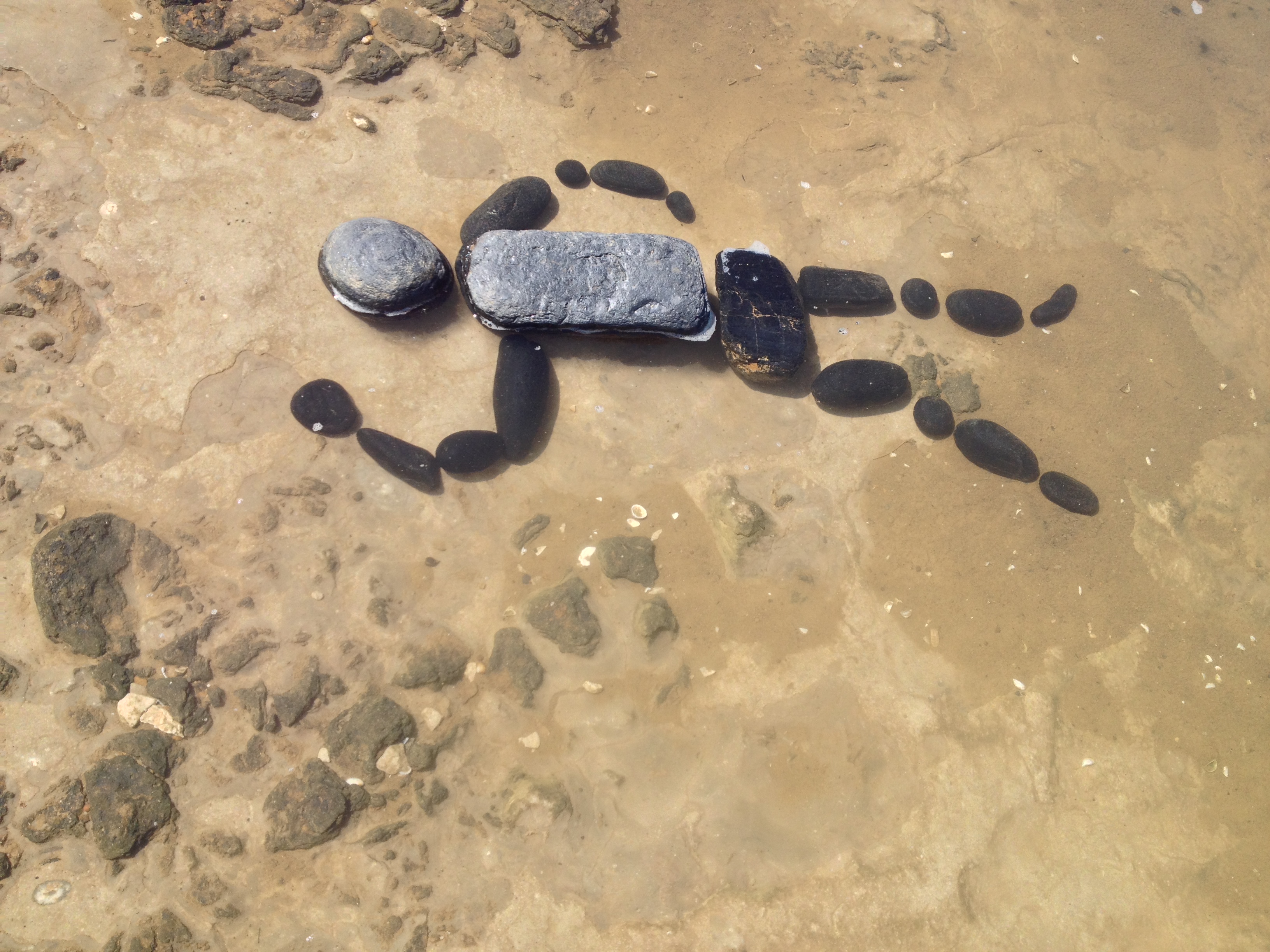
Coal Man Swimming, Falls of the Ohio, Sept. 2014

The wet coal turned deep black and I liked how many of the images graphically benefited from that.  I guess this is Carboniferous Man swimming above the Devonian Age?  From here I bagged the coal and started the walk home over the fossil beds.

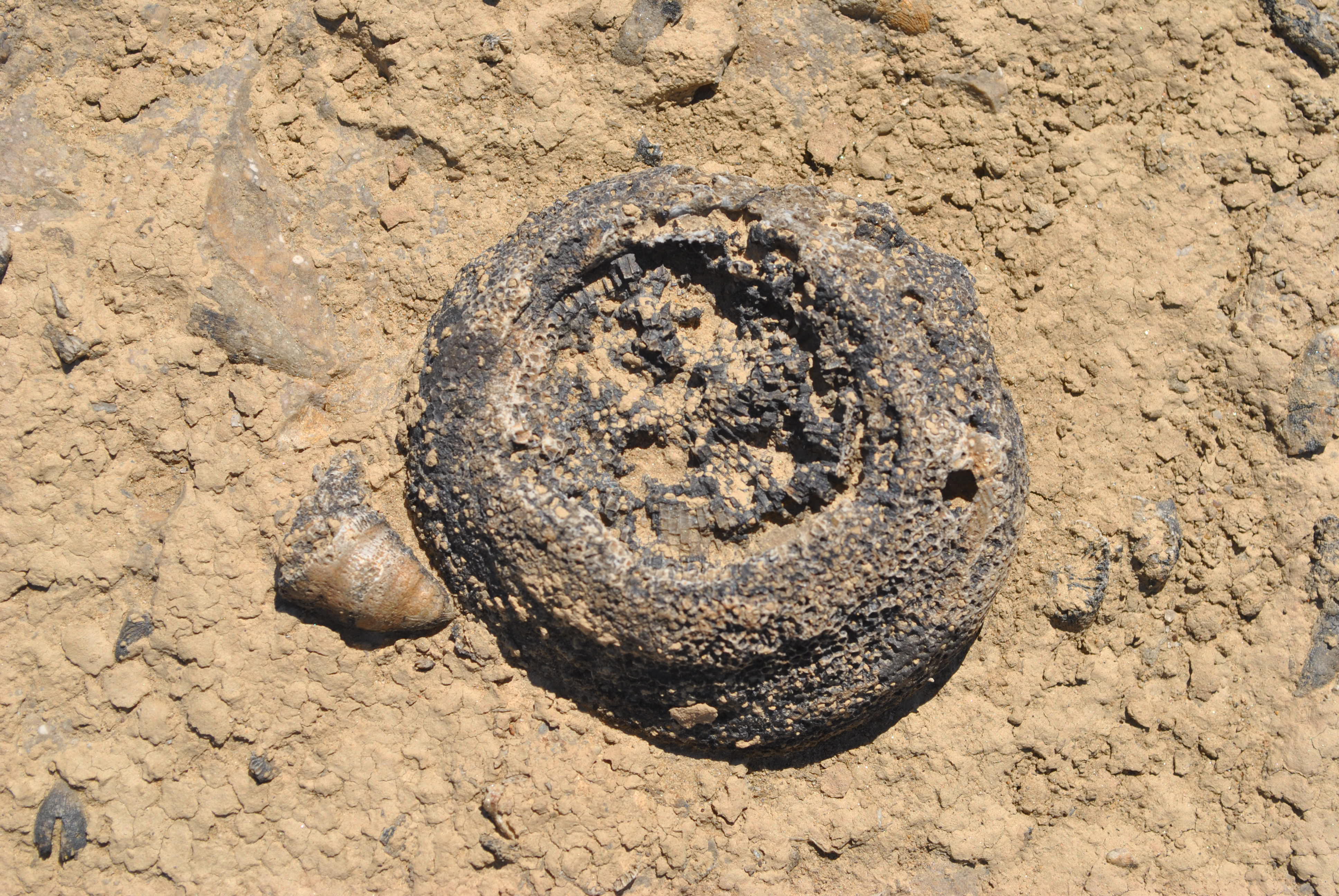
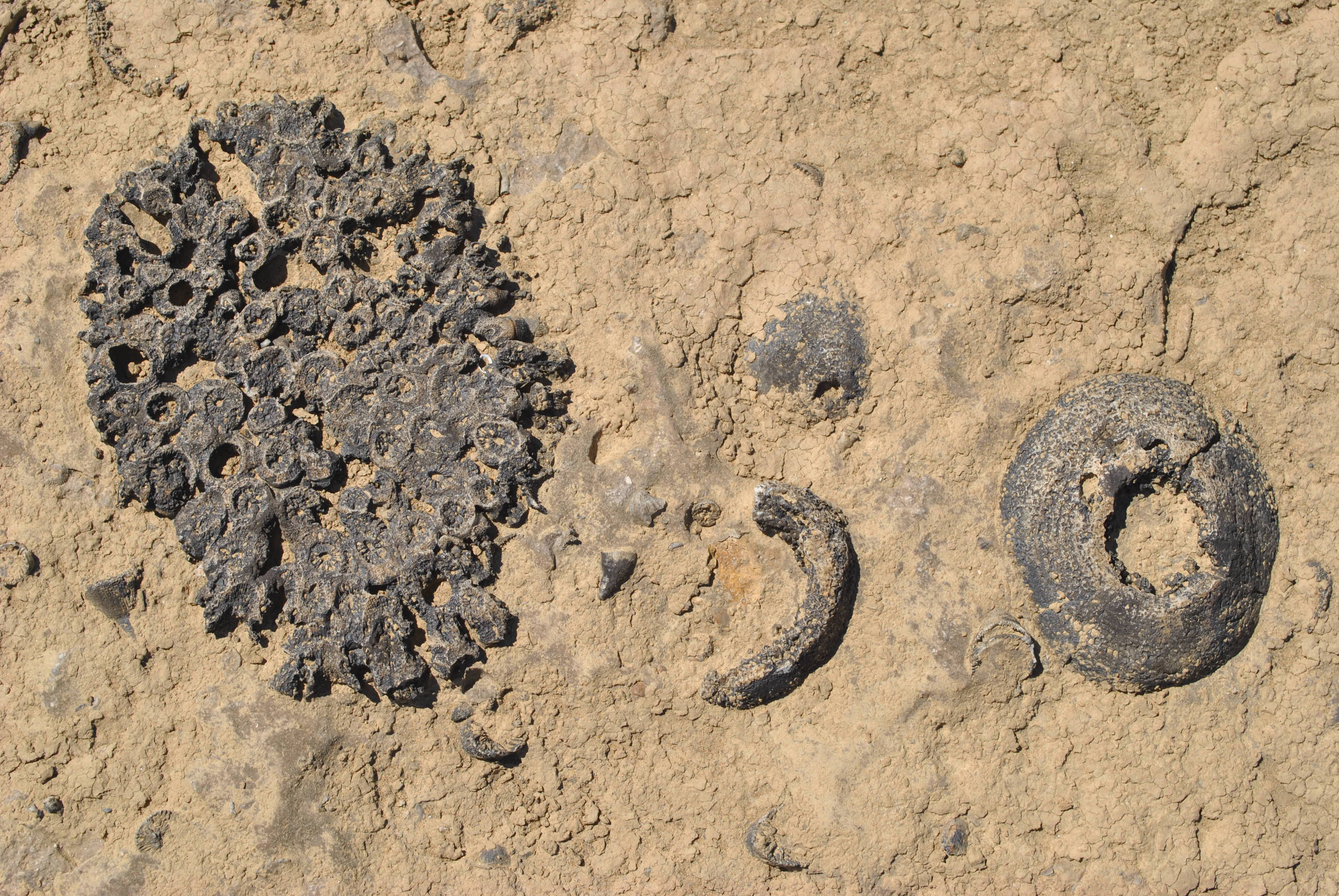
Before closing, here are a few actual fossils I photographed along the way.  This was once an active coral reef over 300 million years a go.  Life was in the oceans.  The species first discovered here have greatly expanded our knowledge of life at this time.  This was the high point for corals and sponges and also gave rise to the first fishes.

Fossils from the Falls of the Ohio State Park, Sept. 2014

Fossils from the Falls of the Ohio State Park, Sept. 2014

This was my last river excursion of the summer.  It is amazing how quickly this year is flying by!  I was really happy that my left knee did not give me any problems.  I am feeling encouraged and I still have this bag of coal I can keep playing with on a future visit.  Thanks again for coming along…from the fossil beds at the Falls of the Ohio State Park…so long for now.

Fossil Beds at the Falls of the Ohio State Park, Sept. 2014

Read Full Post »

Louisville seen from the Falls of the Ohio, early May 2014

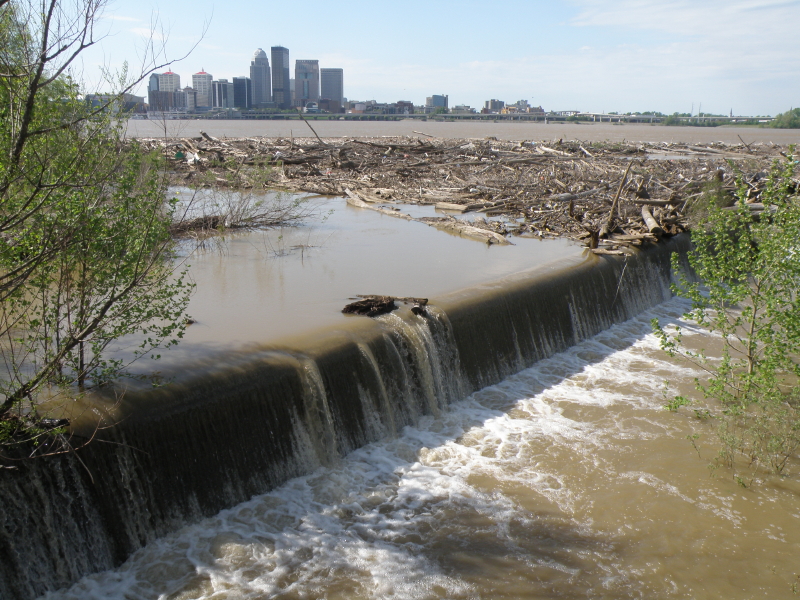
We have seen a lot of water flowing over the dam at the Falls of the Ohio this season.  The month of May has been punctuated by intense storms and ample sunshine.  Rainfall across the Ohio River Valley has been plentiful.  On this particular excursion, the river was high and many of the places that I like to sit and work were inaccessible.

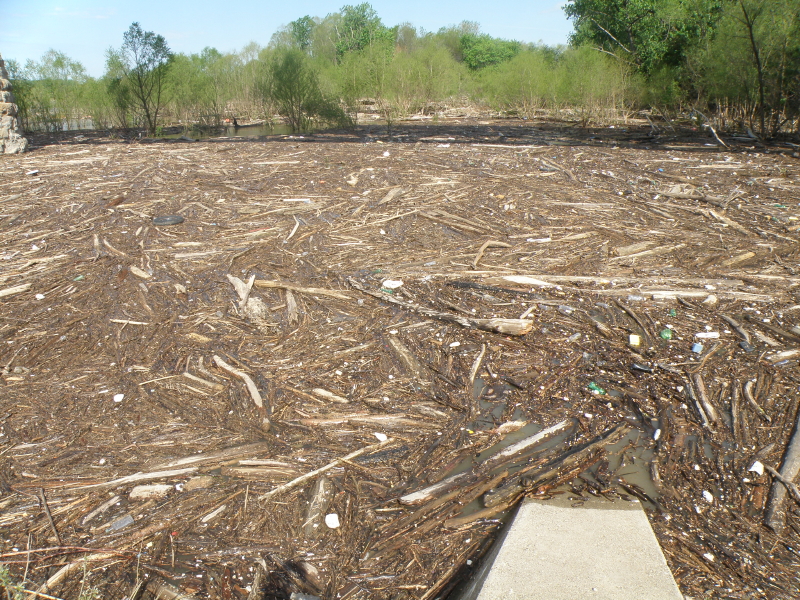
wood and debris in the Ohio River, May 3, 2014


There was plenty of wood and trash in the soupy brown water and despite the beautiful sunshine, I was thinking that I might need to go home early today.  Instead, I decided to do a little exploring along the margins of the high water and see how far I might be able to go.

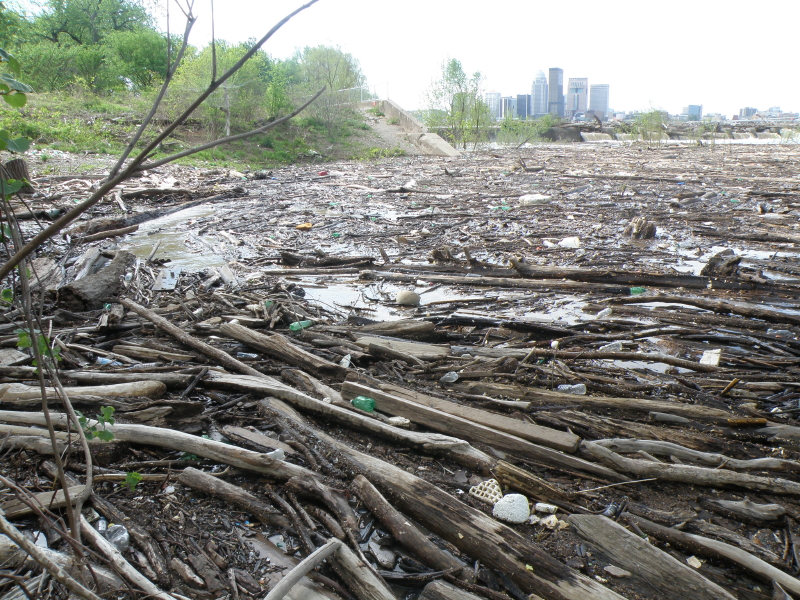
high water at the Falls of the Ohio, May 3, 2014

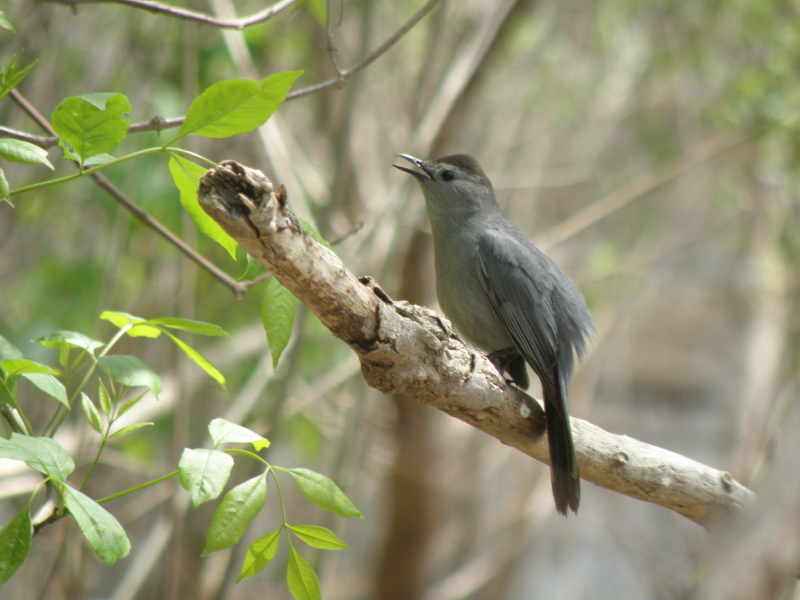
Skirting the margins of the high water, I was able to walk over logs and driftwood and reach small pockets of higher land that remained dry.  After initially feeling that my day in the park would be a loss…I started to feel excited again!  In part, this was due to the abundant bird life I was seeing and hearing.  This particular area has always been good for me and finding birds.  There is enough shelter here under the cottonwood trees and willows that provide relief from the wind and is close enough to the water.  Among the species I was encountering included this colorful grouping of birds: Baltimore Orioles, Northern Cardinals, Indigo Buntings, Palm Warblers, Gray Catbirds, American Goldfinches, and a tiny Blue-gray Gnatcatcher.  Here’s an image I captured of a Gray Catbird singing.

Gray Catbird singing, Falls of the Ohio, May 3, 2014

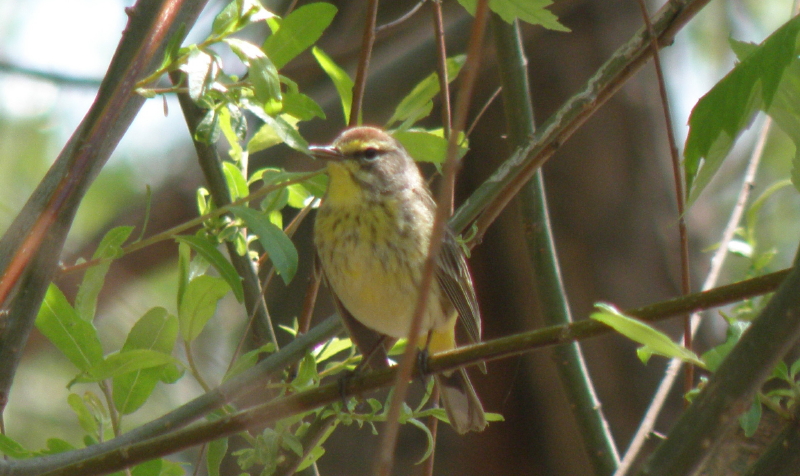
These birds are very territorial and the males chase one another out of their areas when interlopers trespass.  Catbirds have a wide variety of sounds they make including a “mewing” call that reminds people of cats.  Usually, I hear catbirds before I see them.  Thus far, this has also been a good year to observe some warbler species.  Warblers are my favorite group of birds to see because they are diverse, beautiful, transient (they are famous for their long migrations) and challenging to photograph.  Here’s a picture of a Palm Warbler that I recorded on this day.

Palm Warbler, Falls of the Ohio, May 3, 2014

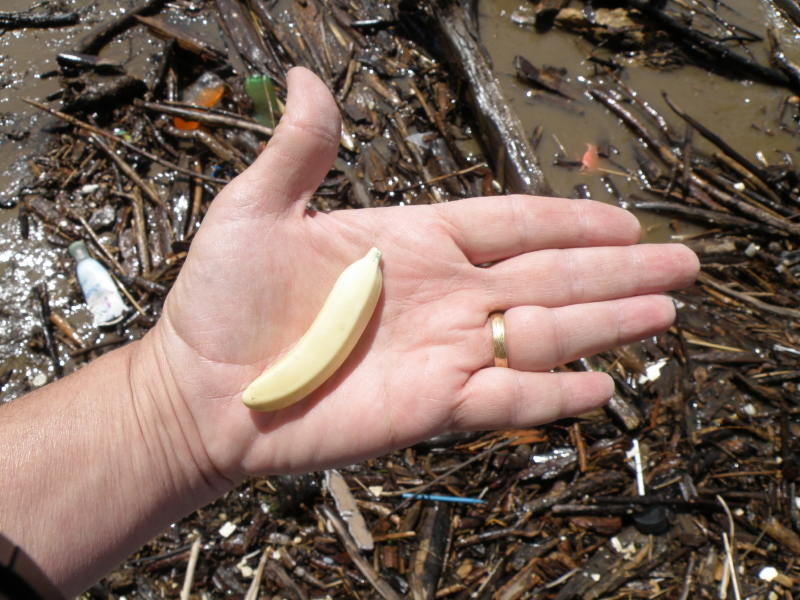
This guy hung around for a while.  The guidebooks say that this warbler species summers in the northern bog lands and really has nothing to do with palm trees. That was an unfortunate bit of naming.   The Falls of the Ohio are just one stop among many that this bird will make and I was glad to see him.  In addition to birds, I was also finding plastic junk and other bits and pieces including a miniature plastic banana…I’m sure you want to see that?

miniature plastic banana, Falls of the Ohio, May 3, 2014

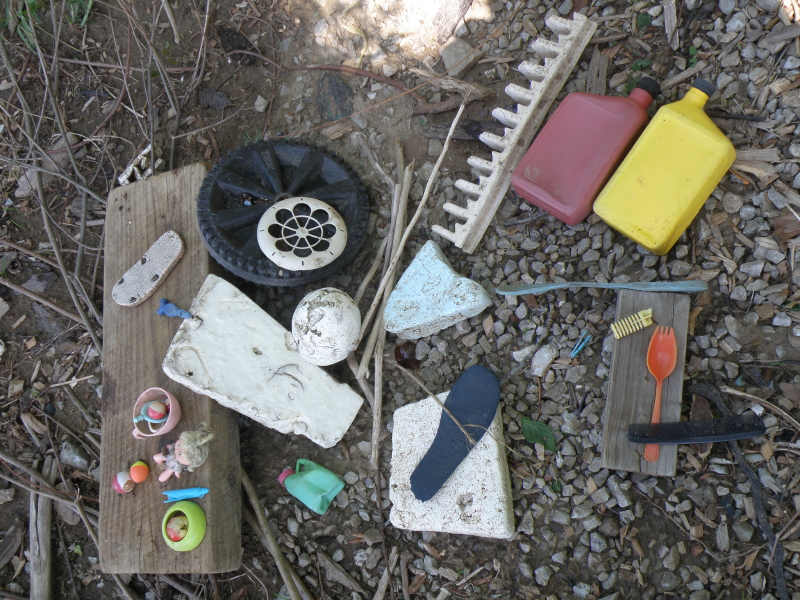
This banana (my second of the year) will enter my Fake Fruits and Vegetables Collection which now numbers hundreds of pieces found in this park.  Here are other found objects, some of which I will use to create a new figure.

Found objects, Falls of the Ohio, May 3, 2014

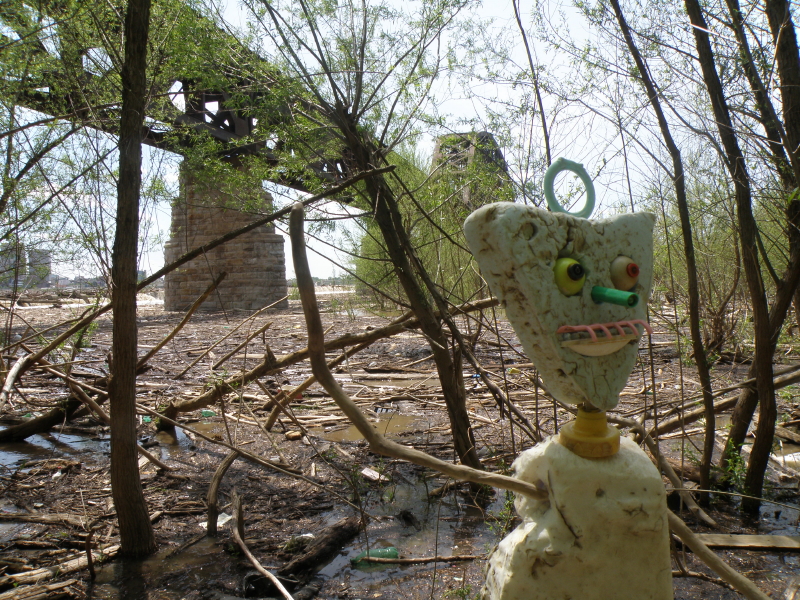
And…here is the figure I constructed on this day.  He’s pretty outlandish looking and another in a long line of pieces that reflect how I feel about our species’ absurd handling of the environment.  For the moment, he remains unnamed, but if one comes to you…please share!

Unnamed figure, found objects from the Falls of the Ohio, May 3, 2014

Styro-figure with white plastic bleach bottles, Falls of the Ohio, May 3, 2014

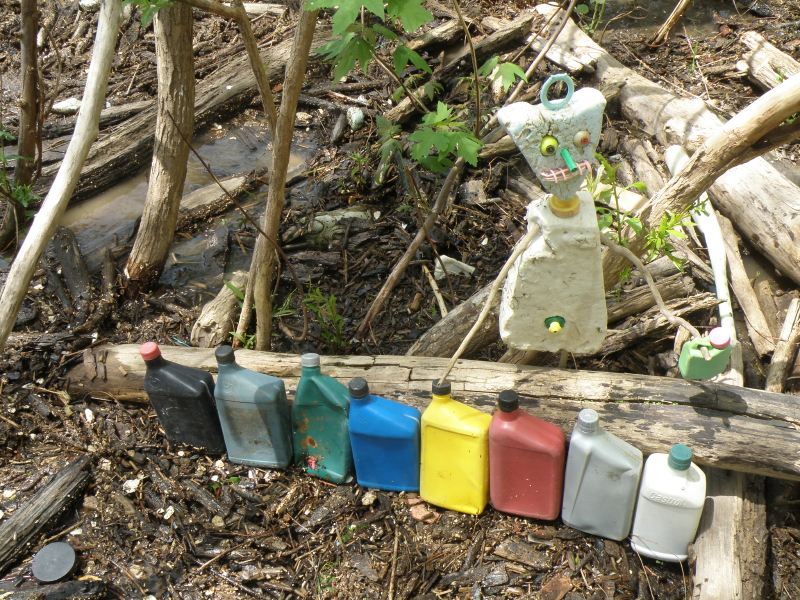
He’s made mostly from insulating foam, plastic, and driftwood and sports one jaundiced eye and what appears to be a unique, pink moustache.  The area I was working in had so many plastic bottles lying around that my latest Styro-figure decided to put some of the colorful ones to use.  Every year, the park does its best to keep this special place clean and orderly.  Unfortunately, most of the trash I use and show originates elsewhere…mostly along the Ohio River flowing north of here and is carried to this down river location during flooding and high water.

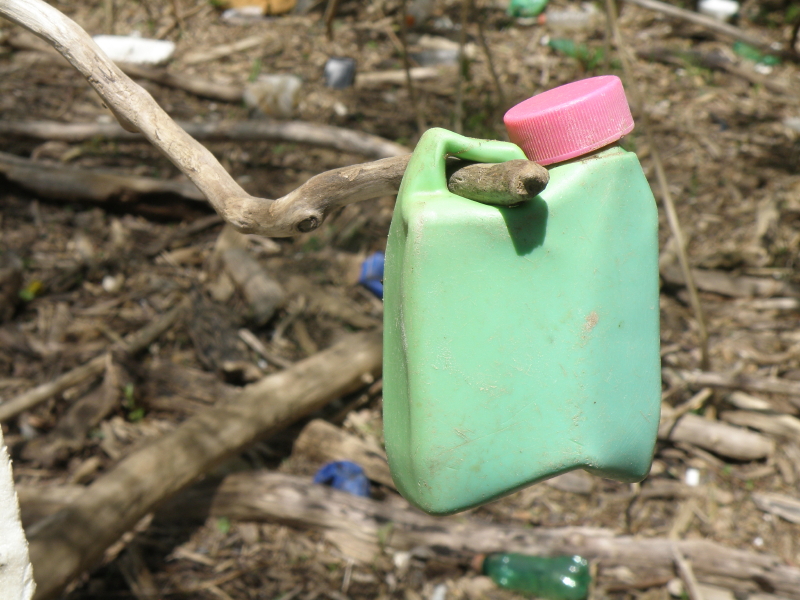
small, plastic container, Falls of the Ohio, May 3, 2014

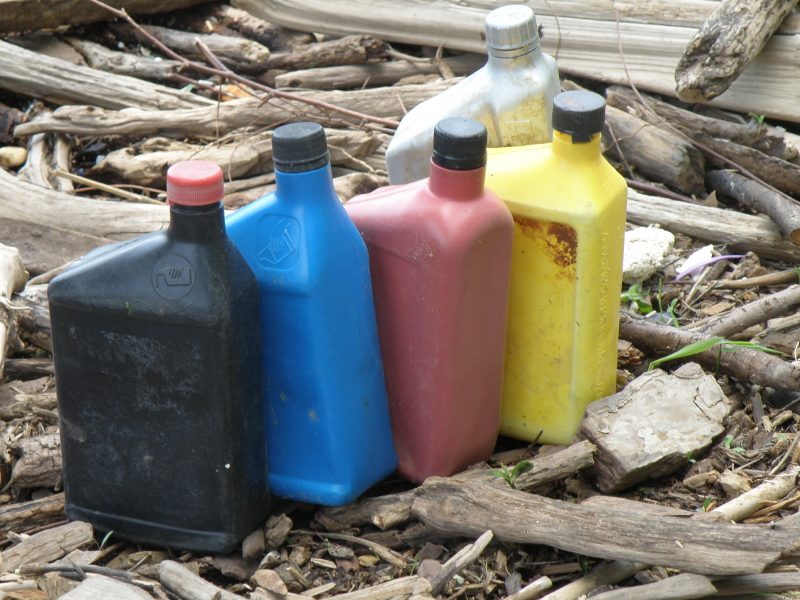
various colorful plastic oil containers, Falls of the Ohio, May 2014

Looking around the immediate area I was able to locate various colorful plastic oil containers and my Styro-figure decided to line them up for a photo opportunity.  Here’s the results.

Styro-figure with plastic oil container color spectrum, Falls of the Ohio, May 3, 2014


It’s an oily color spectrum of sorts.  The Styro-figure seemed happy with it and for this day…left it at that.  I have used this similar idea for other plastic found objects discovered in the park.

Styro-figure under the railroad bridge, Falls of the Ohio, May 3, 2014

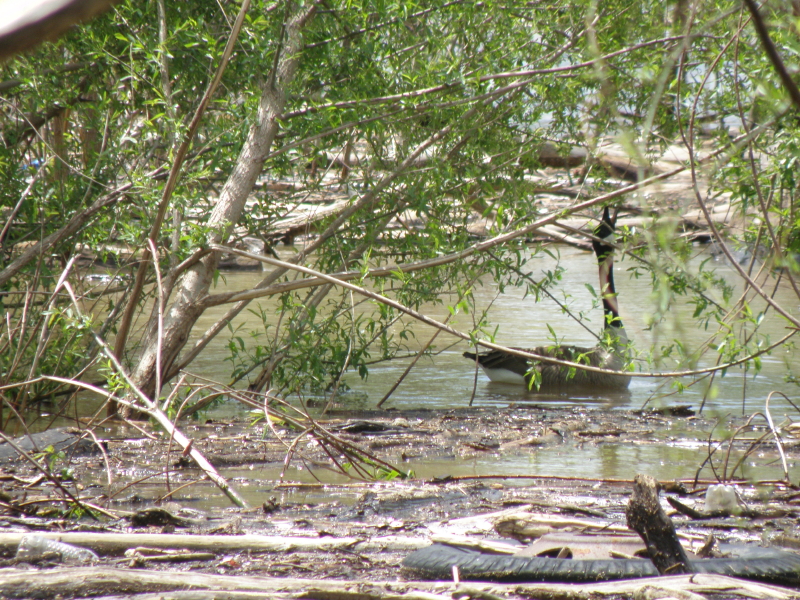
Soon it was time to go home.  The day turned out to be a more creative and productive day than I originally thought it would be.  I gathered up my collecting bag, camera, and walking stick and made the very short walk up to the parking lot.  Looking back, I spied a Canada Goose taking advantage of the high water to feed from bushes it normally could not reach.  This seemed as good an image as any to end this post with.  Thanks as always for tagging along on another day at the Falls of the Ohio State Park.

Feeding Canada Goose, Falls of the Ohio, May 3, 2014


Read Full Post »

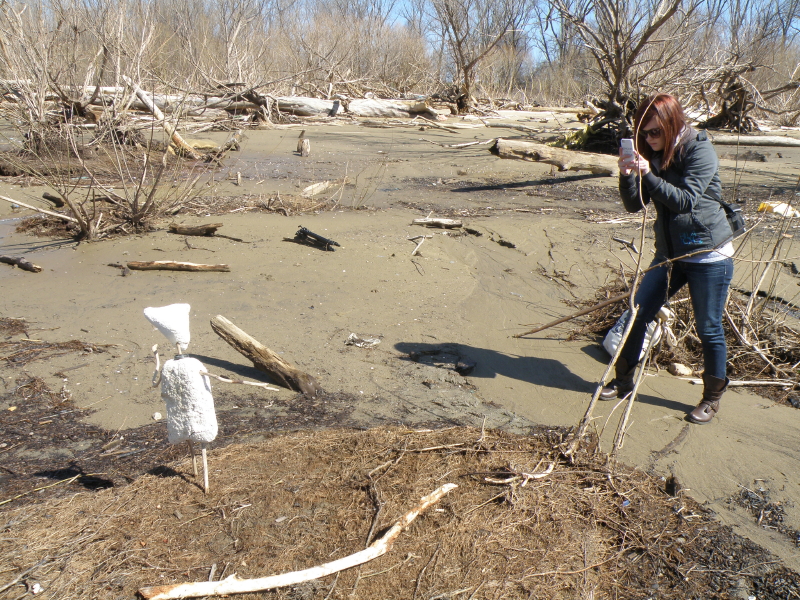
Taylor with Styro-sculpture, late March 2014

Taylor’s Artist at Exit 0 Video Link

Here’s a short video interview conducted by Taylor Ferguson on my Artist at Exit 0 project at the Falls of the Ohio State Park.  Taylor is a journalism student at the Indiana University Southeast in New Albany, Indiana and was nice enough to be interested in filming my process.  Our late March day at the river was a bit windy which the microphone picked up beautifully, however, it washed out the rest of the audio.  What you hear me saying is a bit of stream of conscious narrative which was edited into the video at a later date.  I previously published a post entitled “Touring with Taylor” that has some of my images and words made about the experience.

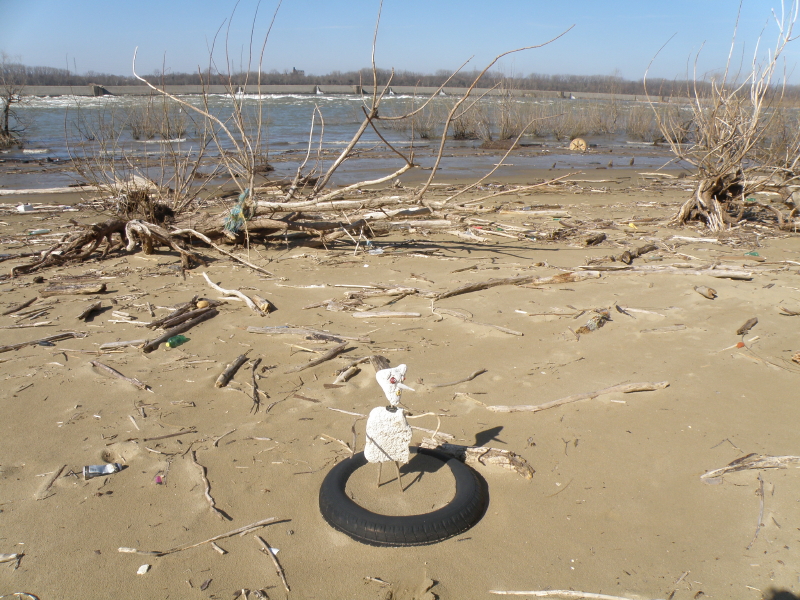
Mr. Mosquito Nose standing in a tire, late March 2014, Falls of the Ohio

Read Full Post »

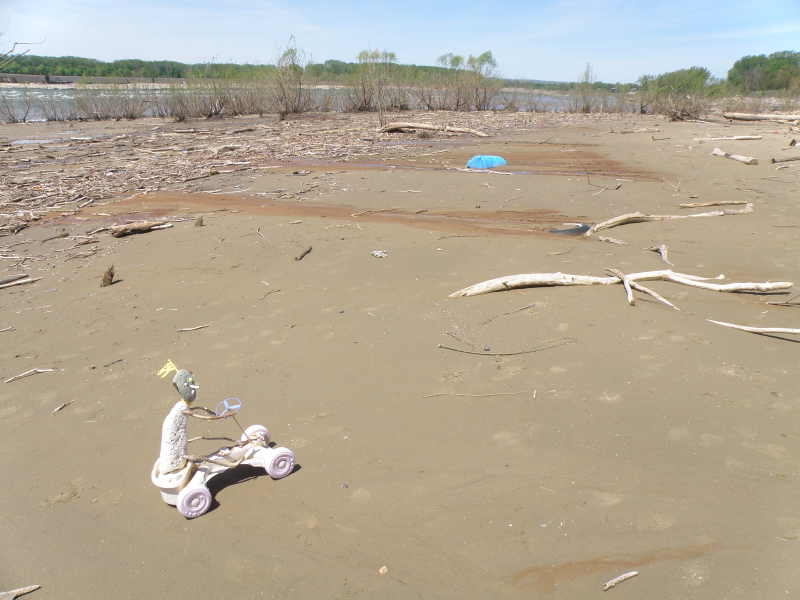
The Sand Rover, May 2014, Falls of the Ohio


A gorgeous morning at the Falls of the Ohio and the urge to explore is strong.  Our current spring pattern is holding.  We will have a few days of steady rain resulting in localized flooding which is then followed by the river rising as all that water seeks the lowest level and here we are after all at the bottom of the Ohio River Valley!  The latest reports on the potential effects of climate change for our area have been predicting this.  In the years to come, we can expect more fierce storms with heavier than usual rainfall causing periodic flooding.  Actually, that’s just one prediction among many.  There is also the specter of hotter summers and invasive, non-native species among other scenarios.  We will each do what we feel compelled to do to cope with it all.  For now the sky is mostly clear and the river has retreated and it’s time to break out the old sand rover and see what there is to see and find what there is to find on the banks of the Ohio River.

Sand Rover, Falls of the Ohio, May 2014

We don’t need to travel very far to stumble upon unusual objects and startling sights.  The flotsam and jetsam that can’t evade the stronger currents and navigate that hard left turn westward towards the Mississippi River get deposited in the park.  Something flesh-colored has been spotted lying on the surface of the sand and our intrepid driver moves in closer for a better look.

Headless Barbie knock off doll, May 2014

Upon inspection it turns out to be a headless, knock-off copy of a Barbie-style doll.  It’s made from cheap, hollow plastic instead of the more rubberized material that the better Barbies are made from. Thus far, this has been a good year for finding dolls at the Falls of the Ohio.  I seem to find one or two new ones each time I come out here.  Of the common objects that I routinely find…all these dolls still strike me as being especially odd and sad.  Taking a picture, it’s back aboard the sand rover and on to our next stop.
Detail of Sand Rover driver, May 2014

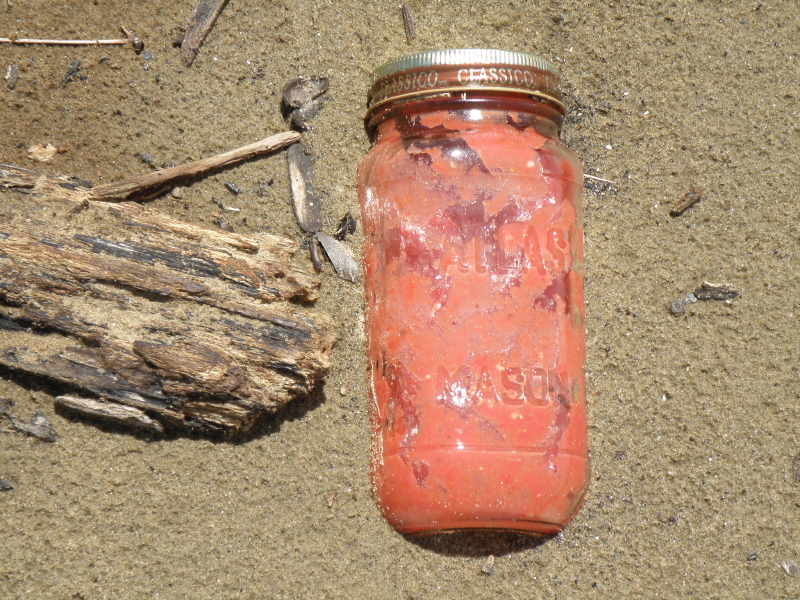
We don’t need to travel very far for our next discovery.  With the sun up, there is a strong glare emanating from something shiny half buried in the sand.  Pulling up to the object, our driver is  startled and bemused to find a glass jar of spaghetti sauce!

Partially buried jar of spaghetti sauce, Falls of the Ohio, May 2014

Would you believe me if I told you this is not the first jar of pasta sauce found out here?  Because it is relatively easy to prepare…I’m assuming that spaghetti is among the more popular dishes among folks who like to recreate around the river?  Over the years, I have also found jars of pickles, condiments, soup, and one very large, memorable jar of bologna.

sand rover, May 2014, Falls of the Ohio

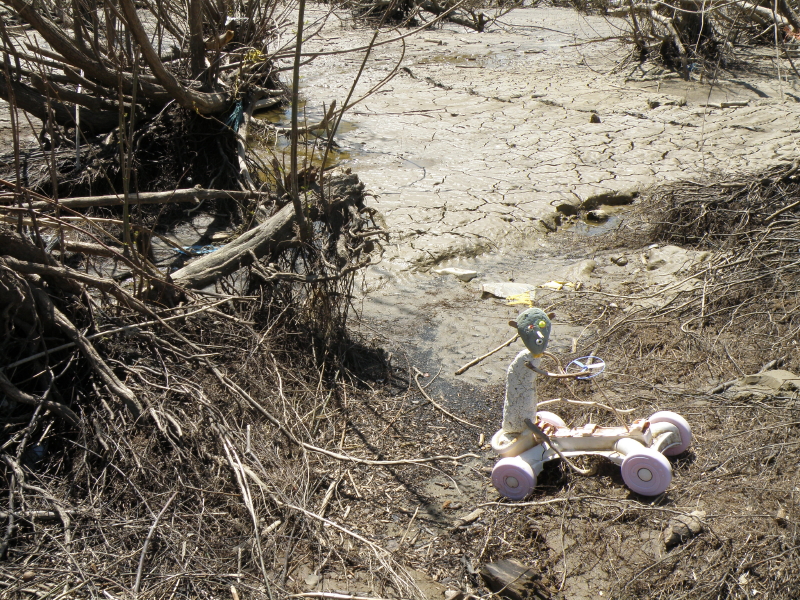
The sand rover crosses over the sand easily, but it’s a different story near the edge of the river where sticky, thick mud cakes the ground.  As the sun dries the water out of the fine silty mud, deep cracks appear and widen with the heat.

Sand Rover and mud, May 2014, Falls of the Ohio

The driver decides that caution is the proper way to navigate around this mud.  This surface can be deceptive and it’s easy to step ankle to shin deep in this sticky quagmire.  You could lose a shoe in this stuff and I’m speaking from experience!  Once your shoes are coated with this mud…it’s hard to get them clean again.  You can tell where I live by my front porch…it’s the house with the muddy shoes lined up in a row.

Sand Rover at the Falls of the Ohio, May 2014

Carefully maneuvering around the pitfalls, the sand rover is once again safely on the shifting, but surprisingly secure sand.  There are other river treasures within view worthy of investigation.

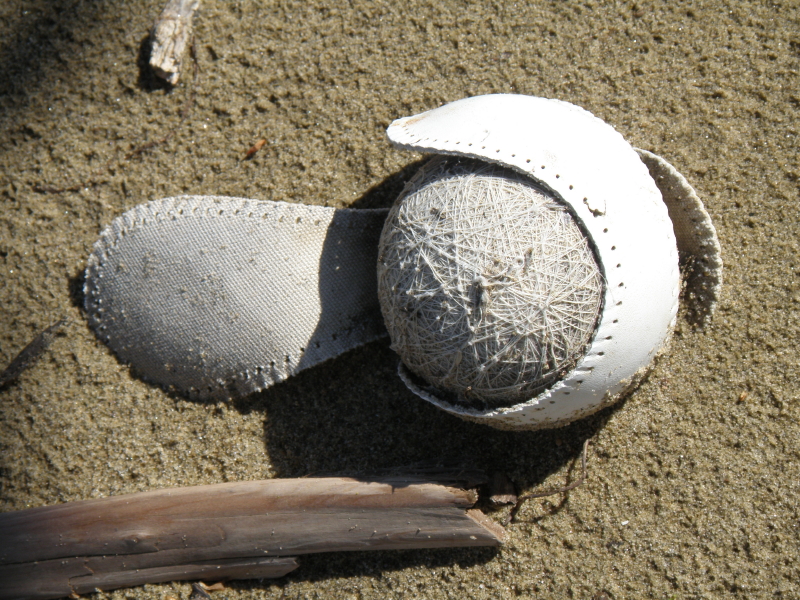
baseball losing its cover, May 2014

A water destroyed baseball lies nearby.  This is more of an old-style ball because its core is still made with string wrapped tightly around a hard rubber core.  The covers, however, are not leather and so this isn’t an official baseball of any sort.  Just a little further down the beach is another toy that was immersed in the former liquid sand and now lies trapped in a fine granular matrix.

toy truck half buried in sand, Falls of the Ohio, May 2014

Once upon a time, this may have been a remotely controlled vehicle?  The style of this truck looks like military vehicles I have seen.  Having explored the sand, it’s time to cruise by the driftwood.

sand rover, Falls of the Ohio, May 2014

Having initially spotted something lying on the driftwood, the driver decided that he would check out the mystery object more thoroughly upon his trip home.  The closer the driver approached the stranger the object became.  In fact, he felt it was looking right back at him.  Parking the sand rover nearby, the driver climbed upon the driftwood to get a better look and this is what he found.

partial, artificial deer head, May 2014

It was heavily weathered, but there was enough present to suggest that this was the hard foam head of a deer.  The driver thought that this was perhaps part of a taxidermy trophy or maybe the head of a figurative archery target?  The object’s single dark eye was piercing and made the driver uncomfortable.  Satisfied for now, the driver climbed back aboard the sand rover and headed towards home.

head of the sand rover driver, May 2014

Well, there you have it, another interesting day at the river.  The driver was glad he came since each excursion promised new sights and mysteries to solve.  Already the next trip was being anticipated and all that was now required was for nature to cooperate.  It’s still spring and we shall see how it goes at the Falls of the Ohio this year.

Arching willow at the Falls of the Ohio, May 2014

Read Full Post »

Mr. Mosquito Nose, April 2014

I’ll bet some of you out there might have wondered what’s happened to the old riverblog?  Here it is near April’s end and there is nothing to show for what occurred during this month.  Let me reassure you that the Artist at Exit 0 has been as active as the river has allowed him to be.  Exploring the line between culture and nature is personally important.  Between periodic high water, the exhibit at the Carnegie Center for Art and History, the Kentucky Derby Festival, and life in general…posting stories has needed to take a back seat.  The process, however, is ongoing.  I have been to the river on multiple occasions and observed the transition from winter to spring at the Falls of the Ohio.  Making art remains a priority and I realize that I just feel better if I have the opportunity to make something of my own.  Don’t be surprised if I end this month with a flurry of posts in an attempt to catch up.  Let’s start at the beginning of April and see how far I get.  Here’s a story featuring Mr. Mosquito Nose who had an experience with a young journalism student interested in what the Artist at Exit 0 does on an ordinary trip to the Falls.
Mr. Mosquito Nose at the river's edge, April 2014

This day began with a rendezvous at the river.  I arrived early and was scouting out the situation.  The Ohio River had just been up and I knew the riverbank was reconfigured with different driftwood and new junk  waiting to be picked up.  I had been contacted previously by Taylor Ferguson who is a journalism student at the nearby Indiana University Southeast in New Albany who requested to tag along with me on one of my Falls of the Ohio adventures.  Taylor has a creative project of her own…to create a short, documentary video and she wanted the Artist at Exit 0 to be the subject.  This was the first time anyone has requested this and so I agreed to do it.  With a cool and sunny day before us we left the still leafless willows and walked out onto the riverbank.

Taylor at the Falls of the Ohio, April 2014

Taylor turned out to be a super friendly and very interested in my projects.  I will admit that it was odd being tethered to a microphone and I felt a little self-conscience talking to myself so openly with a video camera pointing in my direction.  I usually have some dialogue running through my head as I explore this environment, but to hear it in such an audible fashion was different.  I brought Taylor to my U.F.O. (Unidentified Floating Object) art site where I keep my river materials and demonstrated how I went about making an absurd figure from the poor stuff of the world.  With Mr. Mosquito Nose in hand, the three of us left my outdoor studio and explored the environs near the railroad bridge.  Along the way, Taylor would ask me questions about when and why I started this project.  By now, those are familiar questions.  I enjoy looking for what is interesting about each day.  So, now it was time to walk the riverbank with Mr. Mosquito Nose and be present in this moment.

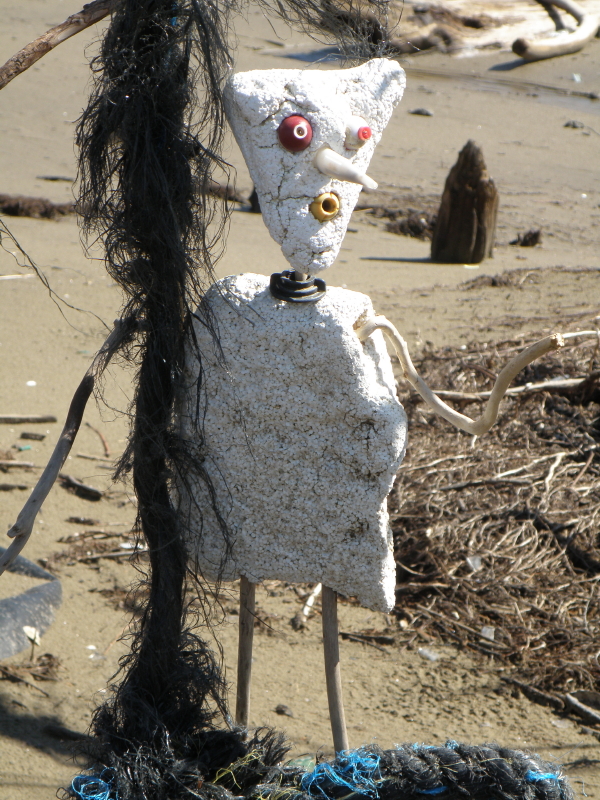
Mr. Mosquito Nose and orange barge cable, April 2014

The lack of footprints in the sand told me that few others had recently passed this way.   As we walked along, I kept an eye out for those little micro-contexts that I could pose this latest Styro-figure in.  After making an object…I’m interested in using it to create an image.  With luck, the images might then be used to tell a story.  Here we have come across an old, frayed barge cable that the river washed into the park.  It seemed a good location to take a few photos.

figure next to an old camp fire site, April 2014

Near the cable, we came across the remains of a camp fire.  Brick and rock define a shallow pit that still had some ashes in it.  For a few years now, I have also photographed old camp fire sites with the intention of publishing them here as a collection.  I’m always struck by the elemental nature of this activity and what its importance has meant for our species’ survival.  We set up Mr. Mosquito Nose by the fire pit and now those photos are a part of this record.

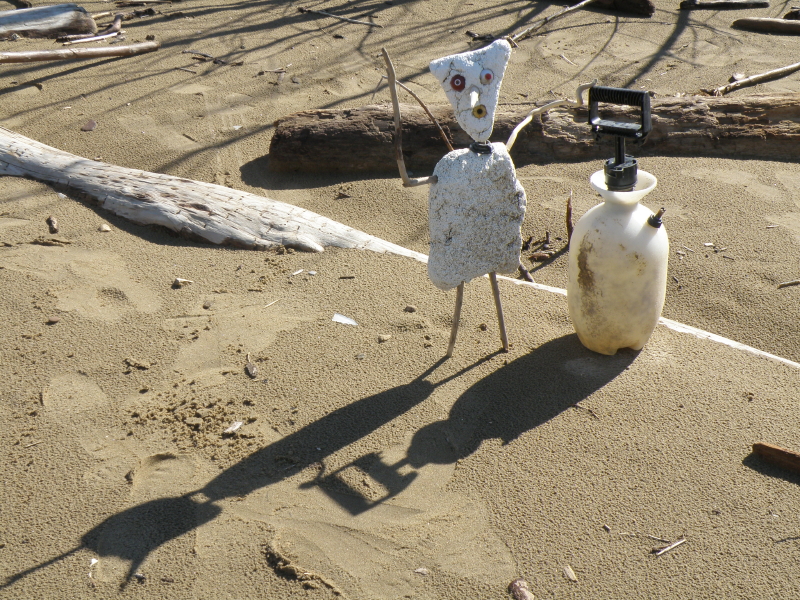
Mr. Mosquito Nose and plastic sprayer, April 2014

Among the other objects we came across was this old sprayer.  The figure’s arms are raised in warning because this might have potentially been used to spray herbicide or worse.  Caution is required whenever you come across something that could possibly harm you.  Knock on wood, I’ve been doing this project for more than a decade without any physical reactions or incidents from the stuff I’ve encountered out here.  I place a lot of faith in the diluting power of millions of gallons of fresh water.

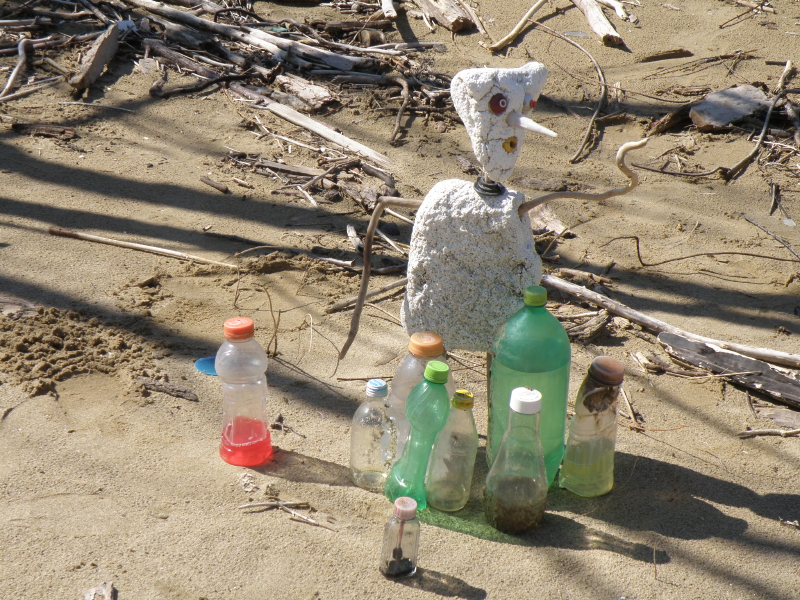
Mr. Mosquito Nose and various bottles, April 2014

Moving on to another location, I collected a few glass and plastic bottles along the way and made this composition.  Some of these containers have mystery contents of their own.

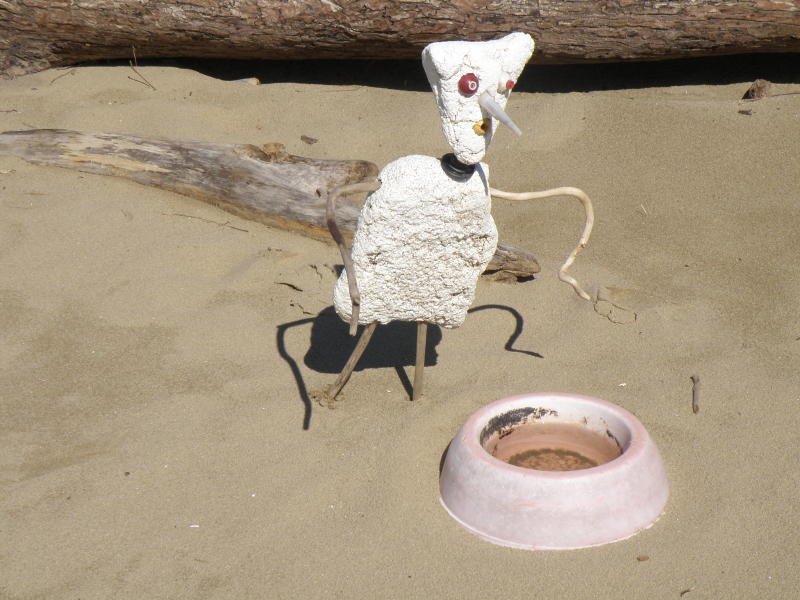
Mr. Mosquito Nose and dog food bowl, April 2014

Later we came across this pet food bowl that was half full with water.  The water in this bowl could have collected here as the river level dropped or been filled up by rainfall?  It is another example of an incongruous object making an appearance at the Falls.Mr. Mosquito Nose, April 2014

Taylor and I came across another barge cable that had been snagged by a low hanging willow branch and created this final photograph with Mr. Mosquito Nose.  The day was moving along and both of us were needed elsewhere.  About a week later, Taylor called me up to say that most of the audio the microphone picked up had interfering  sounds of wind and water.  This seemed perfect to me because that’s what I usually hear out here as well with the occasional bird call thrown in for good measure.  Taylor had three hours of footage that needed to be edited down to three minutes which sounded like a daunting challenge in its own right without the audio difficulties.  I later caught up with Taylor in Louisville and did a quick voice over recording that I hope will do the trick for her project.  At the time of this writing…I haven’t seen the finished video, but hope it turns out for Taylor and that she gets a good grade for it.  Okay, that’s it for now from the Falls of the Ohio State Park…one last image then I’m calling it a post.

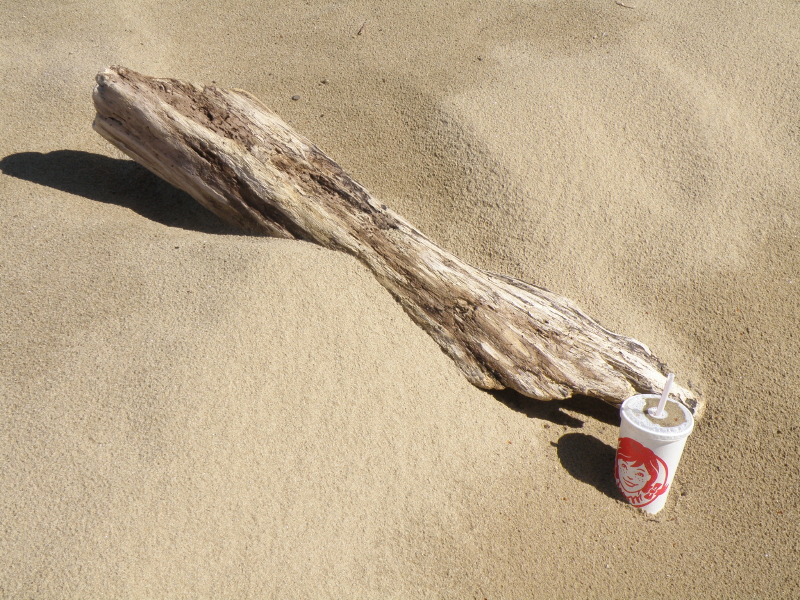
Sand, driftwood, and disposable drink cup, Falls of the Ohio, April 2014


Read Full Post »

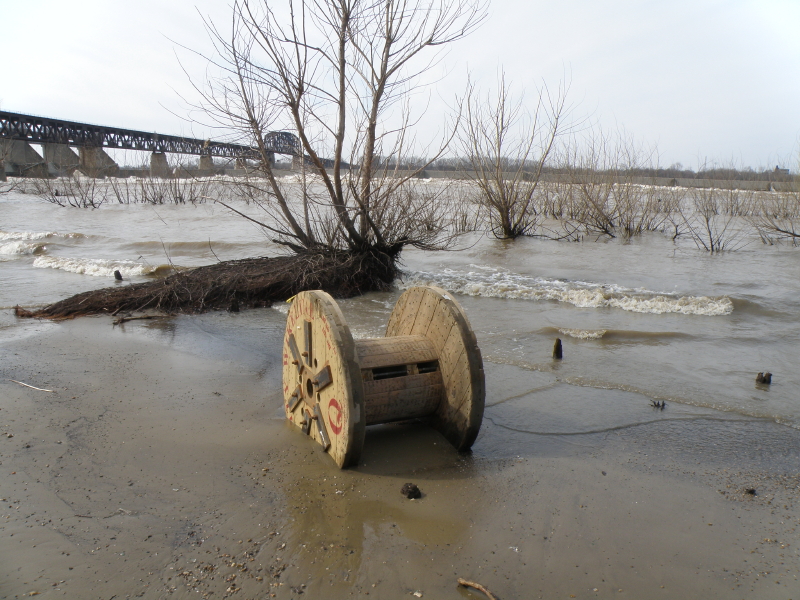
wooden cable spool and willow tree, Falls of the Ohio, March 22, 2014

It’s a sunny Saturday and warm for this time of year.  One of those days I can’t wait to get to the river.  Spring is still slow in developing, but it can’t be much longer now.  I spent a good part of the day just filling up my canvas collecting bag with all types of odds and ends both man-made and natural that have washed up on these fabled shores.  I’m finding so much stuff that for practical reasons I decide to see if I can find a spot up the bank and under the willows that might make a good location for a temporary outdoor art studio.  I can offload some of my larder for future use while continuing to walk the edge of the river.  I’m enjoying the sunshine and taking deep breaths of the fresh air.

U.F.O. studio...Unidentified Floating Object studio, March 2014

U.F.O. studio, Falls of the Ohio, March 2014

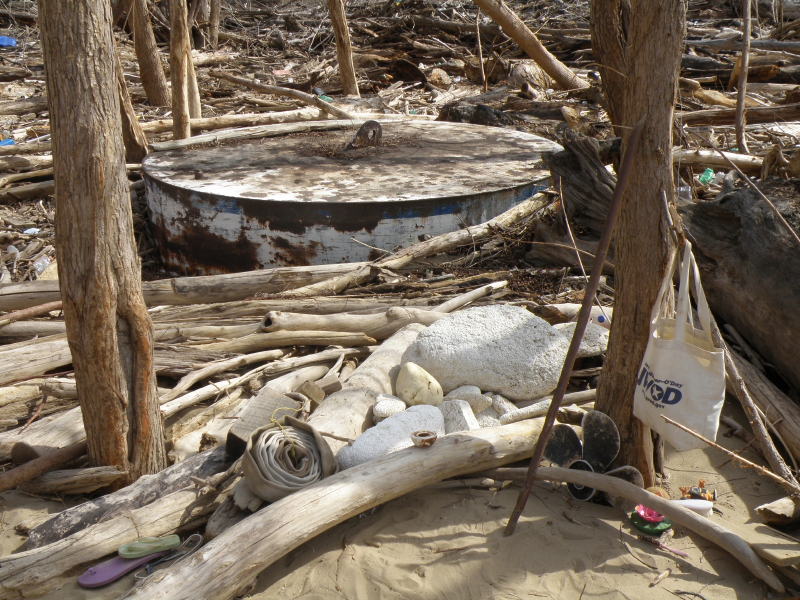
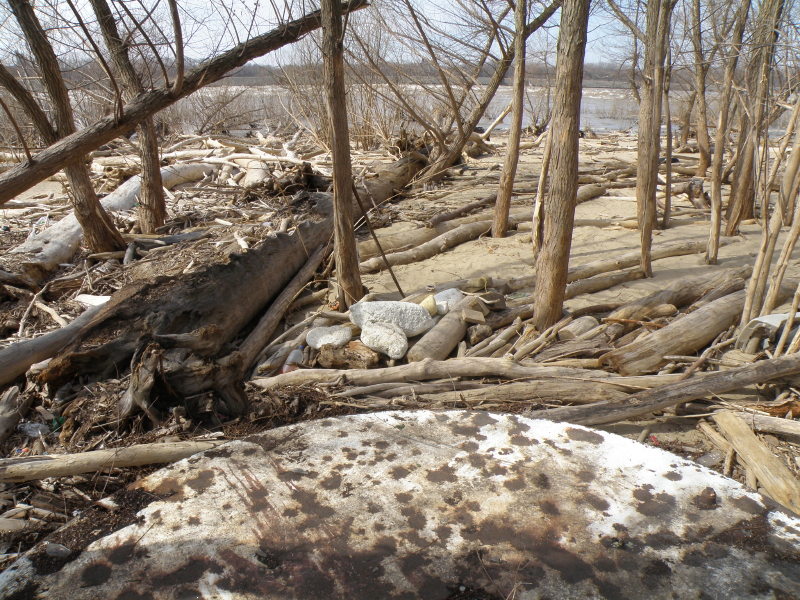
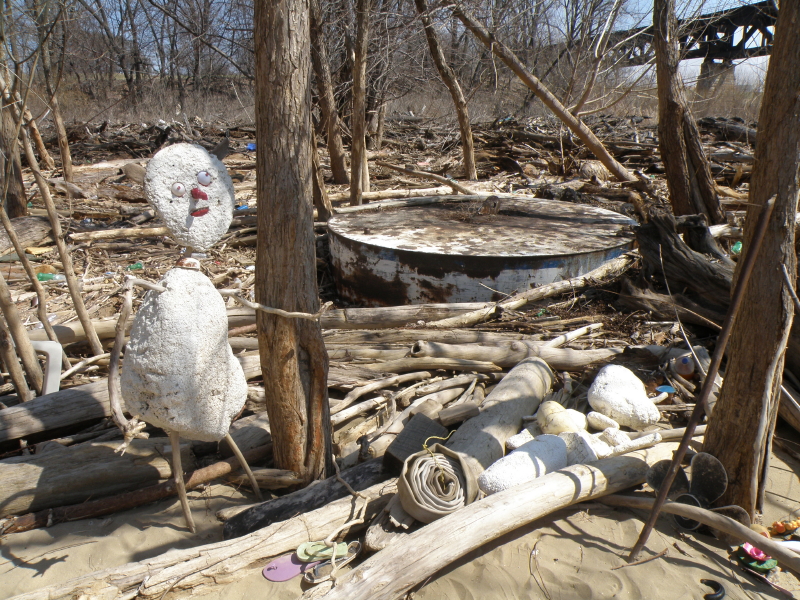
I chose a spot bordered by a large log that keeps most of the driftwood at bay and what I call the U.F.O. or Unidentified Floating Object which is circular metal platform that was once painted white with blue trim.  It’s starting to show some rust now.  This large object washed over the dam during a high water moment three or four years a go.  Since then it’s changed positions with the rising and falling river levels and was once completely buried under driftwood.  The U.F.O. is a platform that normally would be anchored out on  the river.  Barges and other water craft can tie on to it if necessary.  Some how this one got loose and relocated to the park.  When I first discovered it here I also imagined that it was a giant bathtub plug that helped keep the water in the river.   I was lucky that I had the same outdoor studio for many years before this winter’s high water rearranged the landscape again and floated all my collected materials away.  I spent a few hours walking the river collecting Styrofoam and sticks and can’t wait to make something new.

Mega Spool figure in progress, March 2014

Completed figure at the U.F.O. studio, March 2014

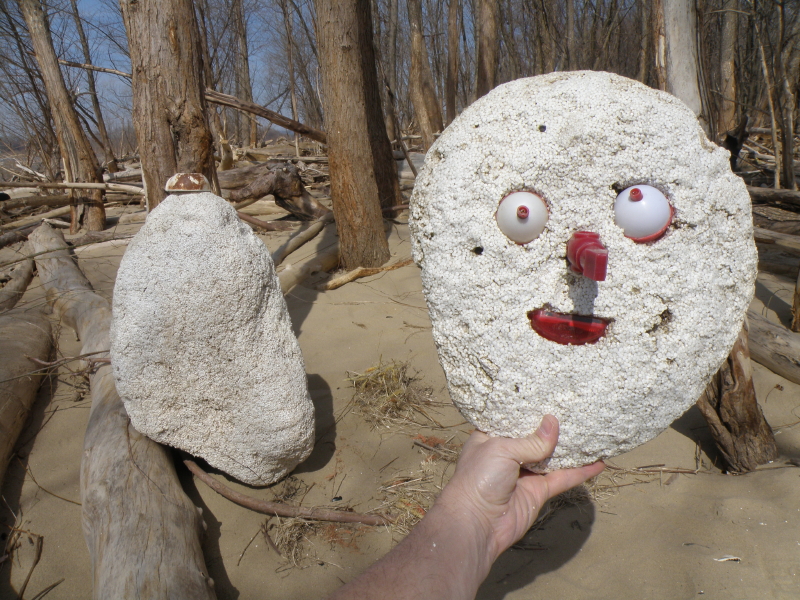
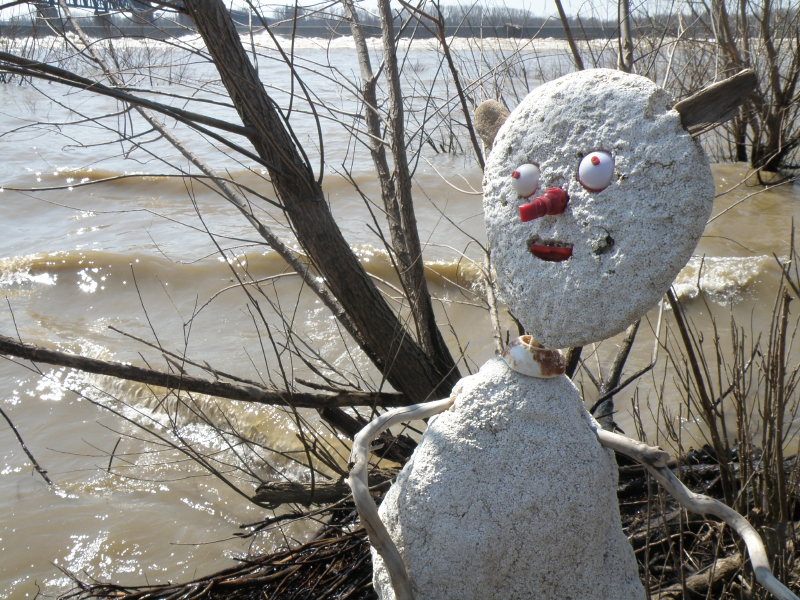
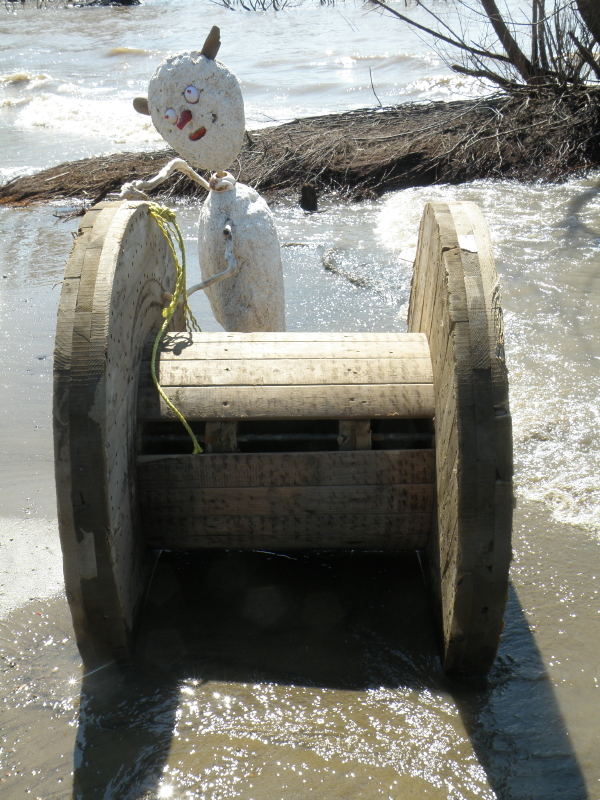
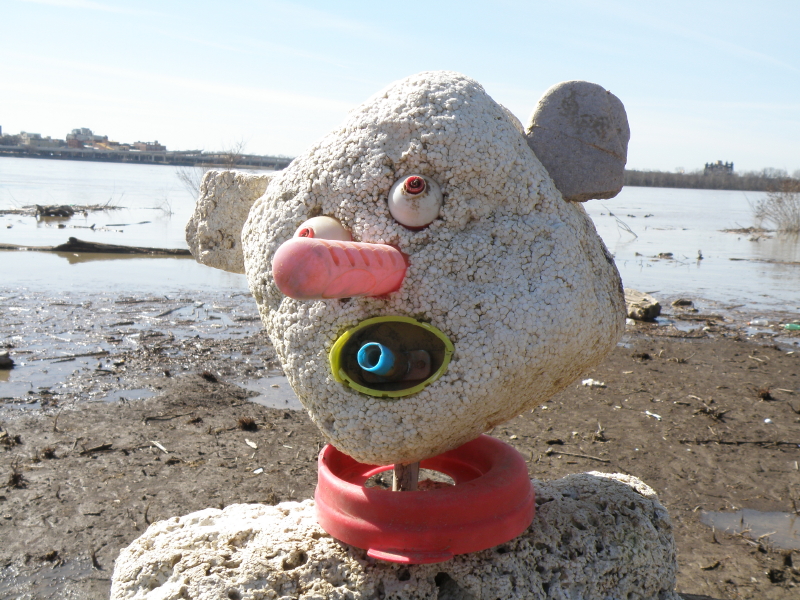
The first figure I make here is from the largest chunks of polystyrene I had found on this excursion.  I used two fishing floats (one larger than the other for expressive effect) for the eyes.  The nose is a plastic piece from a fooseball table.  The mouth is a red reflector.  My figure has ears, arms, and legs that are pieces of driftwood.  The figure has a benevolent feeling to it and I can’t wait to photograph it by the river.  I did run into a young sculptor attending the Kentucky School of Art who was collecting driftwood for her own project.  Her name is Jenn and she approached me asking if I was the person with the show at the Carnegie Center for Art and History?  She and her classmates had seen the exhibition.  Jenn is building an installation at the school and promised to let me know when she completed it.  It will be fun to see art made by someone else from materials collected within the park.

Large Styro-figure on a tiny willow island, March 2014

Styro-figure on tiny willow island, Falls of the Ohio, March 2014

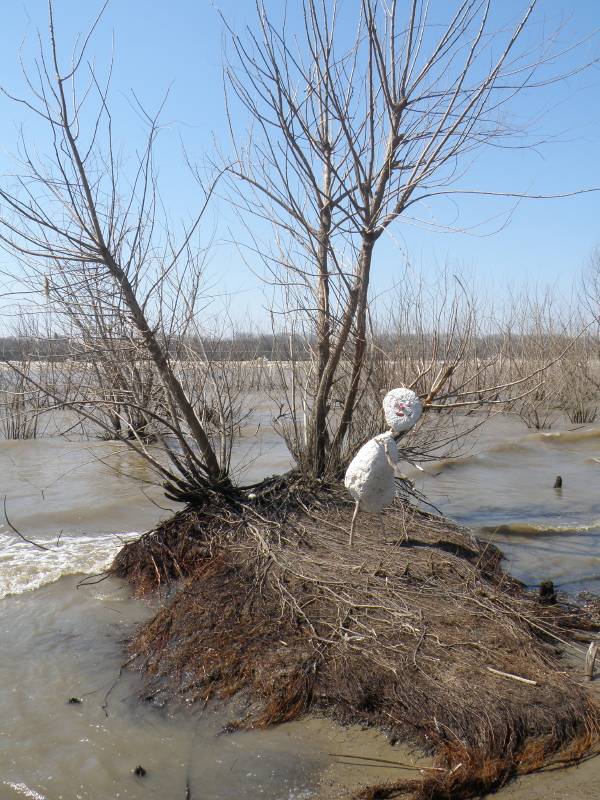
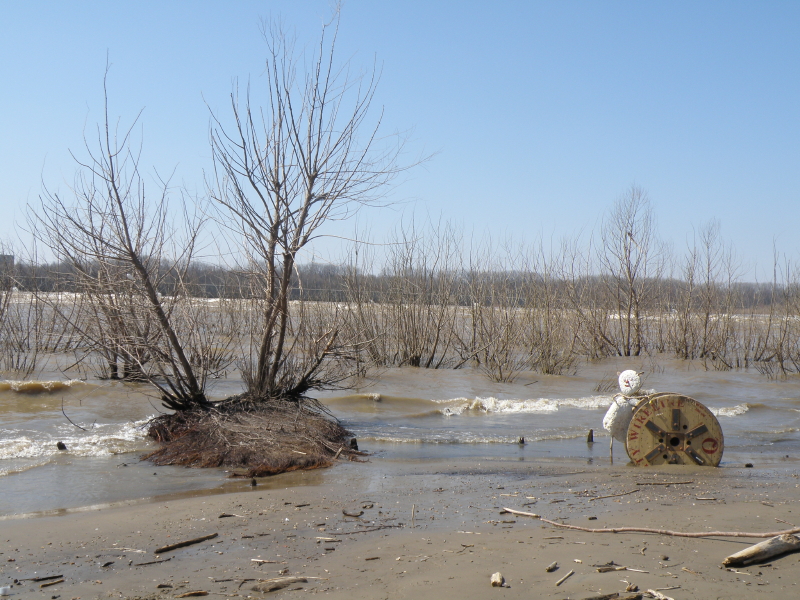
When I first meet the river, I spend a little time looking around and scouting out potential locations to create the photographs that will represent this day in my project.  I decide that I like this tiny “willow island” which consists of clay and sand bound together by the living roots of this tree.  Waves and water wash all around it and at times it does look like an island.  As the river recedes to its normal pool, this tree will be high and dry at last.  It’s amazing what it takes to keep this tree in place with such a dynamic river always testing its resolve to survive.  During the highest river levels, this tree would be completely submerged underwater.  Many of the willows along this stretch of the river bear scars and wounds from large logs battering them, breaking branches, and grinding bark away.  I pose the figure on the root mass and move to the next shot which isn’t too far away.

Styro-figure and large, wooden cable spool, March 2014

Styro-figure and wireline spool, Falls of the Ohio, March 2014

Near tiny willow island is a large wooden “spool” for wire line or cable.  I’m amazed by this object’s heavy-duty construction.  This spool floated into here and is now partially sunk into the sand.  Small waves lap the shoreline and you can also see black coal dust swirling around the water’s edge.  Later when I see my pictures I’m struck by how similar this spool is to the circular platform that now forms part of my latest outdoor studio.  This new area to cache my materials is very visible and hence ultra public, however, if we have heavy spring rains…it’s very possible that all this will be washed away and rearranged again.  I often wonder what might go through people’s minds when they stumble upon my outdoor atelier?  It’s an odd archeological site of Styrofoam boulders, small piles of plastic toys, and a tangle of found roots and driftwood.  All the stuff you need to make an absurd figure!  I left my latest Styro-creation next to the spool.  I will go a head and tell you…I returned a week later and all I could find of him was his body and legs.  There must be headhunters out here?  I searched the area, but found no further trace of my figure.  As with most of my Falls projects, they continue to “exist” as images.  The exhibition that Michael Wimmer and I are participating in at the Carnegie Center of Art and History is entering its last week.  I’m so appreciative of the positive response I’ve received for my work.  The show will end with a tea and cookies closing.  If you are in the area, please stop by.

Final shot from the big spool and tiny willow island, March 2014, Falls of the Ohio

Read Full Post »

Skyliner, Falls, late Feb. 2014

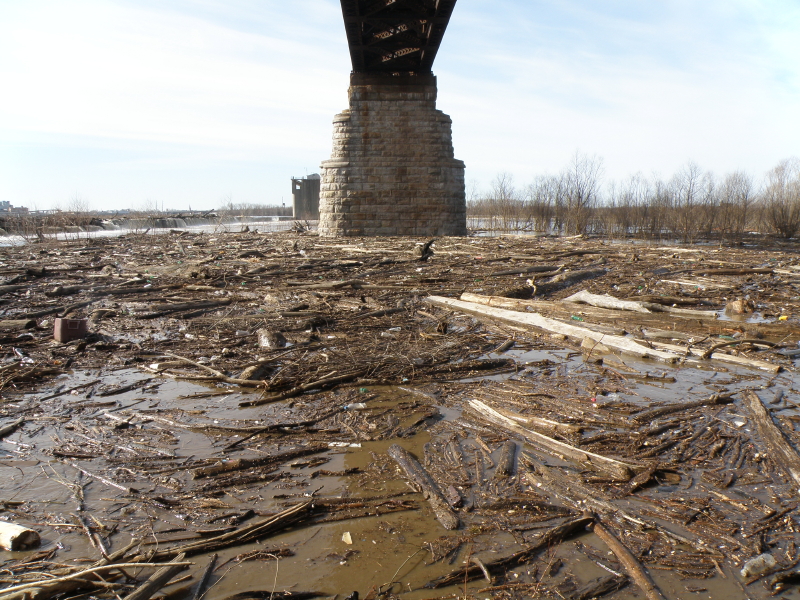
We are all getting antsy for spring to arrive…winter has been hanging on and on for dear life.  It’s been hard to access the river because the water level has been high.  Most of the places I visit at the Falls of the Ohio State Park are currently under muddy water.  We have had just a handful of nicer, warmer days, but that has accelerated the melting of the snow and ice throughout the more than 800 hundred mile long Ohio River Valley.  I don’t mind the cold so much, but it’s harder to do what I like to do on a swollen waterway.  Here’s how one of my spots under the railroad bridge looked during my last visit.

muddy, high water at the Falls of the Ohio, Feb. 2014

Not a pretty picture seeing a river as brown as gravy.  Lots of logs and wood floating on top and when you look more closely…there is also plenty of plastic and polystyrene in the mix too.  Another view this time with me standing on the wall that separates one side of the river from the other.

high river at the Falls, Feb. 2014

All those white spots are pieces of Styrofoam.  With my usual haunts inaccessible I moved further east…just outside the park’s entrance.  There has been a lot of activity in this area that has caught my notice.

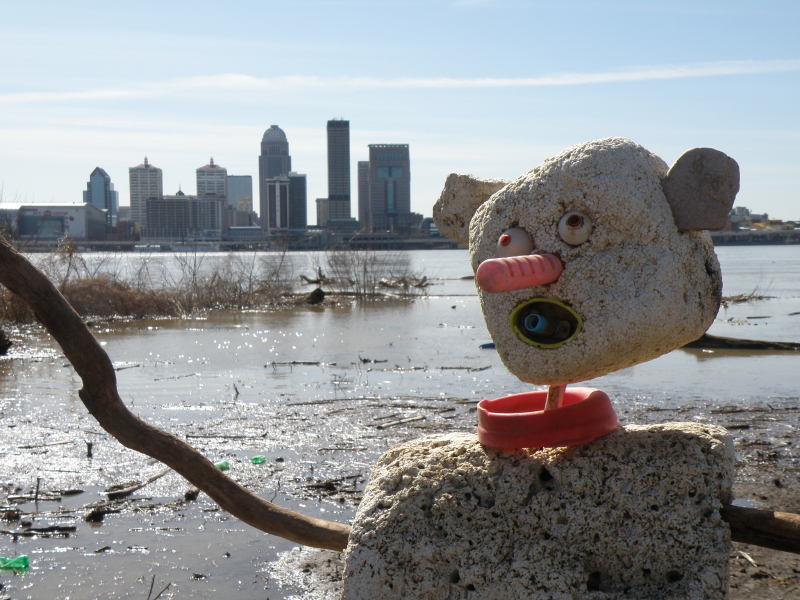
Skyliner on the riverbank, Feb. 2014

There has been a campaign on the Indiana side to make the river more accessible particularly in areas that afford a good view of Louisville’s skyline.  To do this the vegetation has been bulldozed away.  I came across an elderly person walking her dog and she said to me quite unsolicited..”Bout time they did something to clean up this mess!” as she pointed a thin finger in the general direction of the river.  In this case, one person’s mess is another creature’s habitat.  The true “mess” comes from all the plastic bottles and chunks of man-made junk that make it into the water.  No amount of removing trees and creating views will help with this and it seems what we prefer looking at is a very selective process.  I brought my collecting bag along.  I’m hoping to pick up materials to use in an upcoming art workshop at the Carnegie Center for Art and History, but I find a few other interesting items as well and photograph them upon discovery.

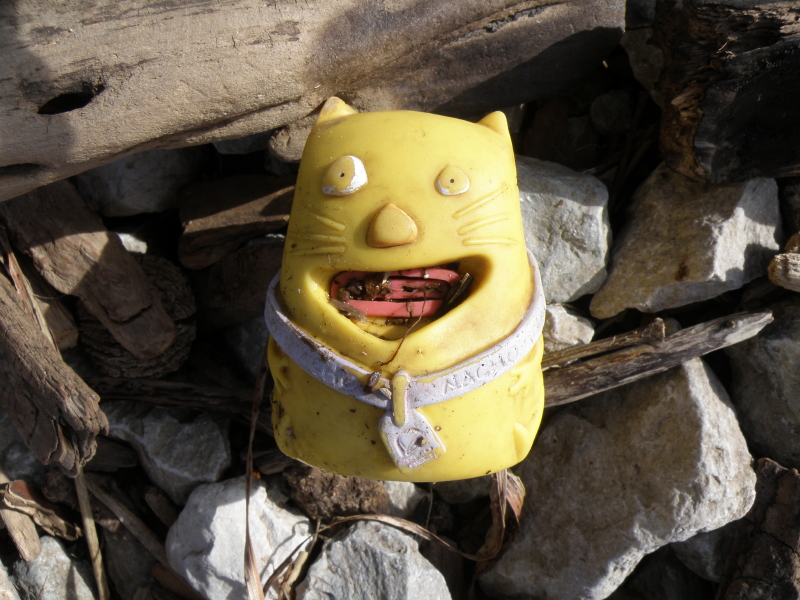
Taco Bell cat toy, Feb. 2014

I came across this smiling yellow cat toy that I think came from a fast food establishment.

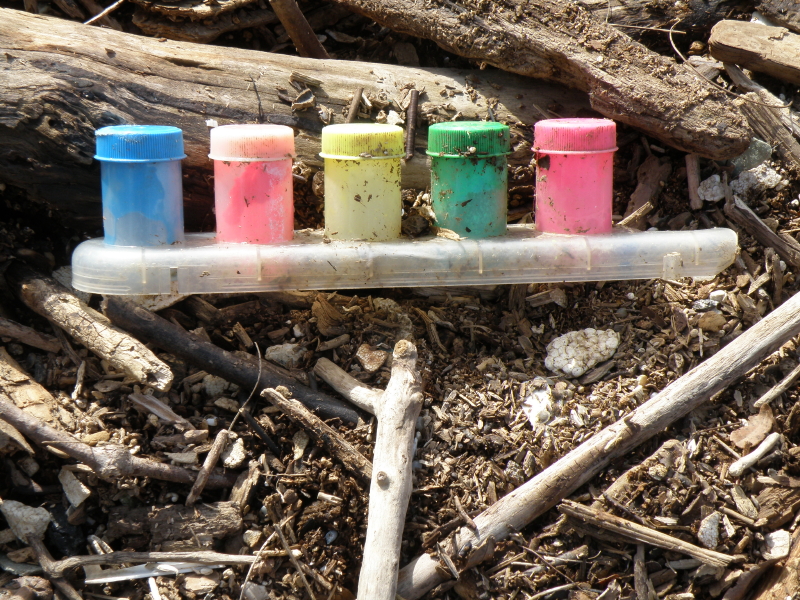
plastic containers for paint, Feb. 2014

Finding these paint containers made me realize how hungry I’ve become for color.  I’m looking forward to the world turning green again with color notes supplied by wild flowers.

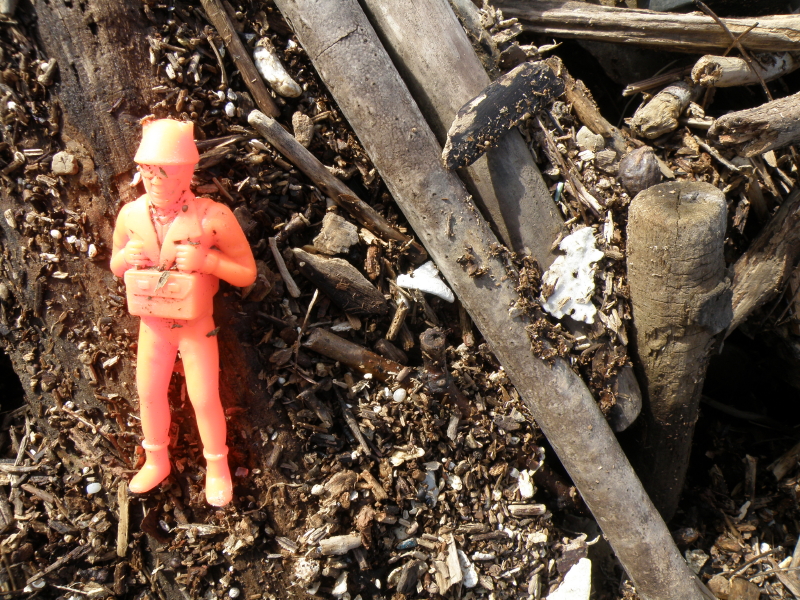
bright orange plastic paratrooper, Feb. 2014

This plastic man with his bright, radioactive orange color was hard to miss.  He was a skydiver or paratrooper in a former life and probably fell to earth using a plastic parachute.

Skyliner with the City of Louisville behind him, Falls of the Ohio, Feb. 2014

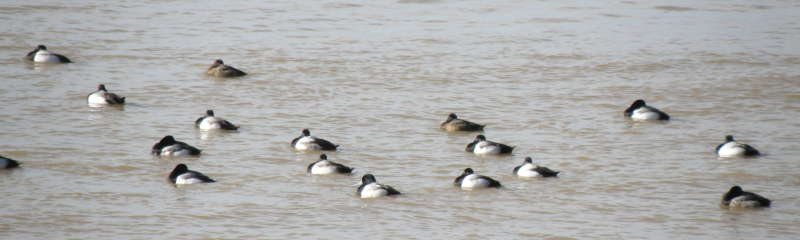
There were other signs from life that the season’s are about to change over.  I’m ever alert to what the birds are doing.  I spotted my first Red-winged Blackbirds of the year and they are among the first migratory species to arrive.  Male Northern Cardinals are singing their courtship songs and scouting out the best spots to build a nest.  On the river, however, I spied what I consider a bird sign of winter.  A nice sized flock of Lesser Scaup ducks were mostly sleeping and relaxing on the surface of the water.  In this area, it seems we see more duck varieties in late fall and early winter. Here’s a peek at the scaups.

White-winged Scoters, Falls of the Ohio, Late Feb. 2014

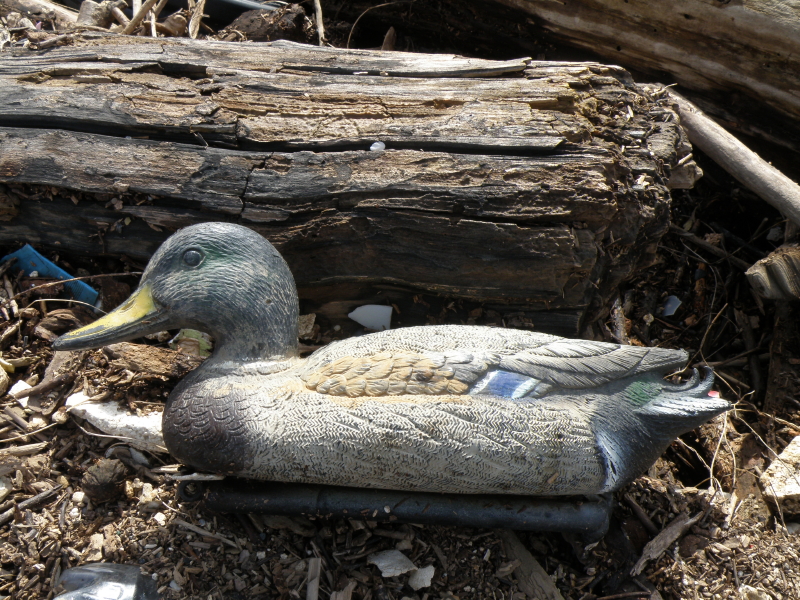
Before I move away from the ducks…I found one other to add to my growing collection.  This is a Mallard decoy made from plastic.  Not too long a go, I found another plastic decoy representing the Pintail Duck.

found plastic Mallard duck decoy, Falls, Feb. 2014

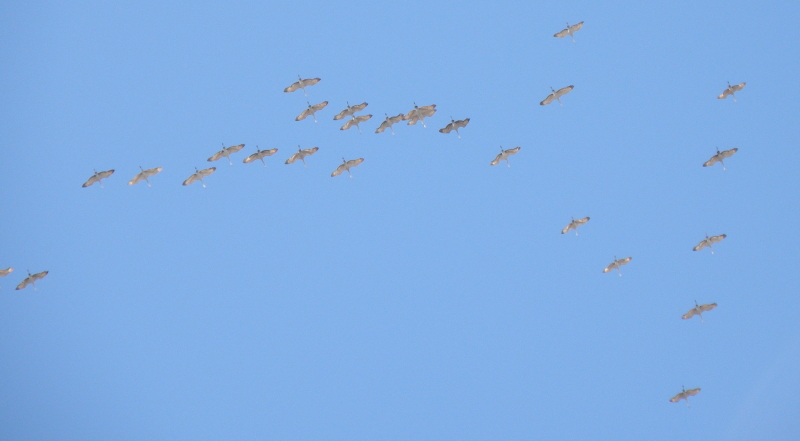
One other bird note…I heard them before I could see them, but I knew what they were instantly.  The familiar calls of migrating Sandhill Cranes winging their way back north.  Like geese, they fly in V-shaped formations to avoid the air turbulence created by other cranes flapping their wings.  These birds are high flyers and this was the best I could do in taking their picture with the camera I have.

high flying Sandhill Cranes, Feb. 2014

As February becomes March…the forecast for the Kentuckiana area is calling for freezing rain and snow.  It appears that Old Man Winter will be hanging out for another week.  Spring will eventually get here and already you can tell that it stays light outside longer with each passing day.   I am, however, really eager to see how the river has rearranged this familiar landscape.

Skyliner on the Ohio River's edge, Feb. 2014

Once the Ohio River recedes there will be a new landscape to explore and who knows what I will find?  I like that each year is different from the last.  Well this post is drawing to a close.  Thanks for visiting and see you soon…from the skyline of Louisville and the Falls of the Ohio.
Looking toward the skyline of Louisville, Late Feb. 2014

Read Full Post »

willow trees and ice, Jan. 2014

Polar vortex…that’s the new buzz words for us this winter.  The Kentuckiana area has tasted this Arctic gift twice so far and we haven’t had a winter this cold in many years.  It manifests with the temperature bottoming out around 0 degrees Fahrenheit…colder still with the wind chill.  Snow and ice also accompany this blast of icy weather.  Once under the spell of the polar vortex…all one can do is ride it out.  It’s going to be bone-chilling cold for several days in a row.  Even if you know it’s going to happen, you really don’t feel prepared for it.  People tape plastic over their windows to trap heat and foil wind.  Shoppers rush out to purchase bread and milk.  Folks let the faucets drip throughout the day and night to prevent freezing and bursting water pipes.  Still, the plumbers are busy.  Extra layers of clothes are needed however,  you still feel cold around the edges.  If there is a weakness in a machine…the extreme cold will find it and this happened to my trusty rivermobile.  School may be out, but otherwise it’s pretty much business as usual.

ice formations, Falls of the Ohio State Park, Jan. 2014

The part about “business as usual” also strikes me as being a bit sad.  I am of the opinion that the reason the Earth has winter is to slow everything down and that’s vitally necessary.  It’s meant to be reflective and allows a moment for a deep breath before moving on again.  We all have more than enough pushing us to accomplish tasks at increasing breakneck speed.  The polar vortex challenges us to slow down if we can.

Ice formations, Falls of the Ohio, Jan. 2014

Ice formations on willow trees, Falls of the Ohio, Jan. 2014

In an effort to foster personal wonder for the world, I made it out to the Falls of the Ohio on a day that wouldn’t risk frost bite.  Over the years, I have prized coming out here on cold winter days especially if it meant seeing different ice formations.   There are ice ribbons, sausage-shaped icicles, frozen homemade candles, and just plain ice blobs on display.  I love the variety of forms and the play of light through the magic of solid water.  The most interesting ice formations are near the water’s edge where the willow trees catch the rising steam off of the river.  The water is warmer than the surrounding air temperatures and this “fog” helps coat the roots and branches with glassy layers of ice.  I thought I had the place all to myself when I was joined in this frigid landscape by a new friend.

The Ice Tourist, Falls, Jan. 2014

The Ice Tourist following my tracks, Jan. 2014

He described himself as being a fellow “ice tourist” and so that’s how I remember him.  He said he was curious about the ice, but also wary of stepping through thin ice and feeling the burn of extremely cold water.  I’ve had this experience before and so I could relate.  The Ice Tourist told me he had followed my tracks into the ice field and so far I had kept him out of danger.  We spent about an hour together before parting.  Here are some more pictures of him posed next to the ice formations we encountered.

The Ice Tourist, Falls, Jan. 2014

The Ice Tourist among icy willow, Jan. 2014

Ice Tourist and ice formation, Jan. 2014

The Ice Tourist had to check out everything as closely as possible.  He would climb upon the willow branches and roots to get the best view.  As it turns out, he was a local guy who like me, likes to hang out near the river whenever he can.  He was wearing a very thin and worn out t-shirt that said something about the town of Jeffersonville on it.  That’s the next town over from the Falls of the Ohio State Park.  I mentioned something about the poor condition of his garment and how it didn’t look substantial enough to keep him warm.  His response was that feeling warm was as much a mental state of mind and he was far too engaged by this novel environment to feel the cold.

The Ice Tourist, Falls of the Ohio, Jan. 2014

The sun was rising.  The day was warming and the ice was beginning to drip and lose its strength.  Today’s show was at an end.  The image of a hot cup of coffee or cocoa was starting to have great appeal to me and so I said my farewell to the Ice Tourist.  Perhaps we will run into one another again at the river…we shall see?  Leaving my new friend behind, I walked the riverbank  and could see that the Ring-billed gulls that had been absent during the polar vortex were once again in residence in the park.  I wonder if the groundhogs will see their shadows tomorrow?

Ring-bill gulls and mallard ducks, Jan. 2014

Read Full Post »

purple loosestrife at the Falls of the Ohio, Aug. 2013

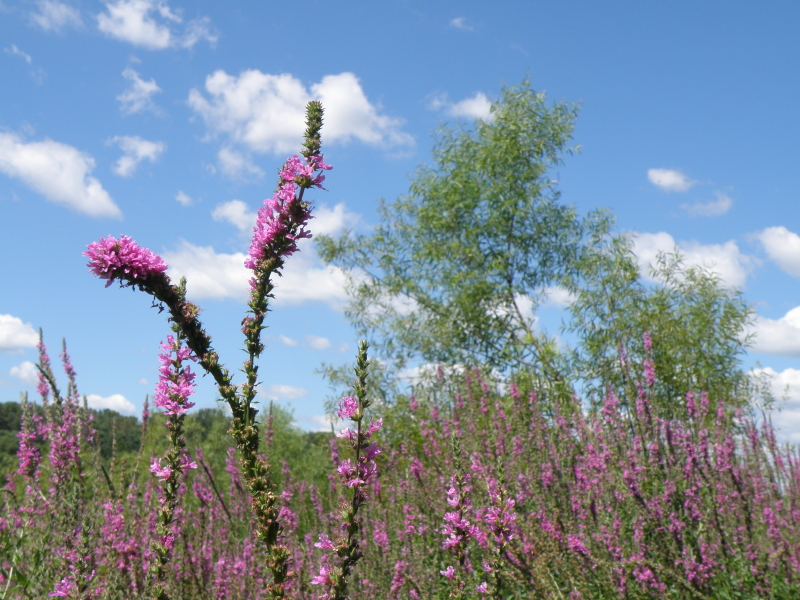
This post includes two recent trips to the Purple Loosestrife (Lythrum salicaria) flowers in the western section of the Falls of the Ohio State Park.  I have made my peace with the fact that the Purple Loosestrife plant is an invasive species at this location. It is really successful at crowding out the other plants that gather in this wetlands area. Originally introduced from Europe, the Purple Loosestrife has spread across the United States.  Eradicating it is very difficult because millions of seeds are produced annually and the loosestrife can grow with just a fragment of root in the ground.  The loosestrife probably doesn’t realize that it has this poor reputation for it provides beauty to the landscape and food for a myriad of insects, particularly butterflies.  Surely, the loosestrife can be forgiven for being itself?  Can the same be said of our kind who after all perpetuated the Purple Loosestrife by planting it to begin with and then allowing it to escape into the larger environment?  The loosestrife arrived here floating down the river.  I can recall when there wasn’t any to be found in the park.

The Butterfly Man, 9/2010

Here’s a flashback from three years a go.  I remember it was my lavender-lipped friend, the Butterfly Guide, who introduced me to this loosestrife stand back in September of 2010.  We had a great time together and I managed a few nice butterfly images on that day.  Ever since the Butterfly Guide showed me the way, I’ve been returning on my own and observing and documenting what happens here.  I heard through the grapevine that my old friend has since passed on and is conducting tours in the great beyond.  He had a knack for revealing beauty to all who wanted to experience it.  Seeing his image again makes me feel nostalgic.
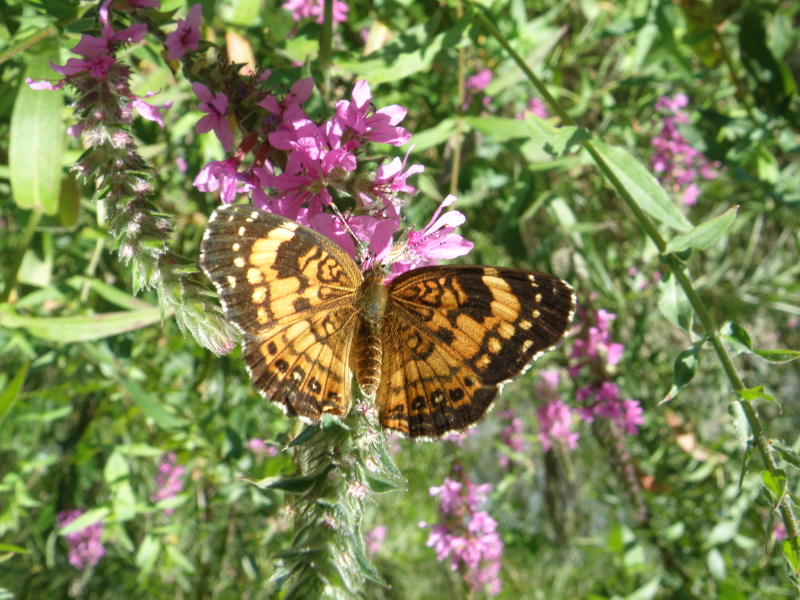
Eastern Checkerspot

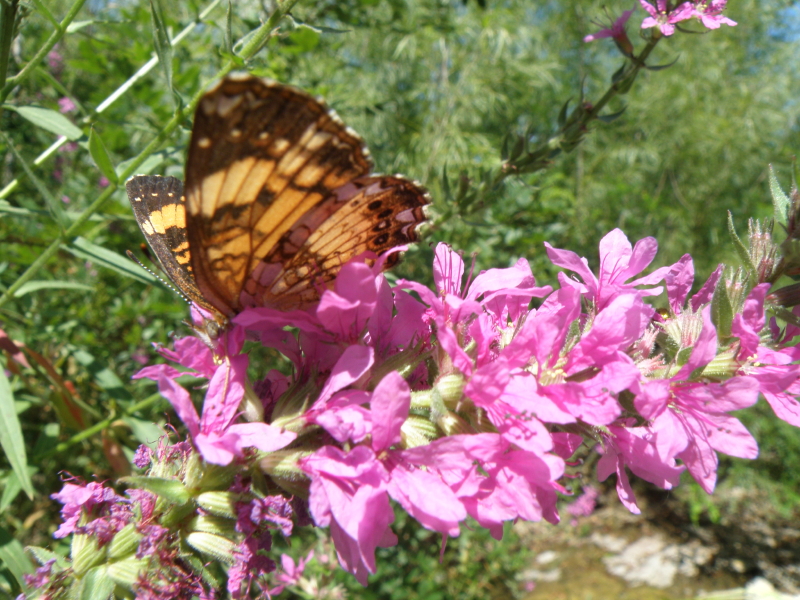
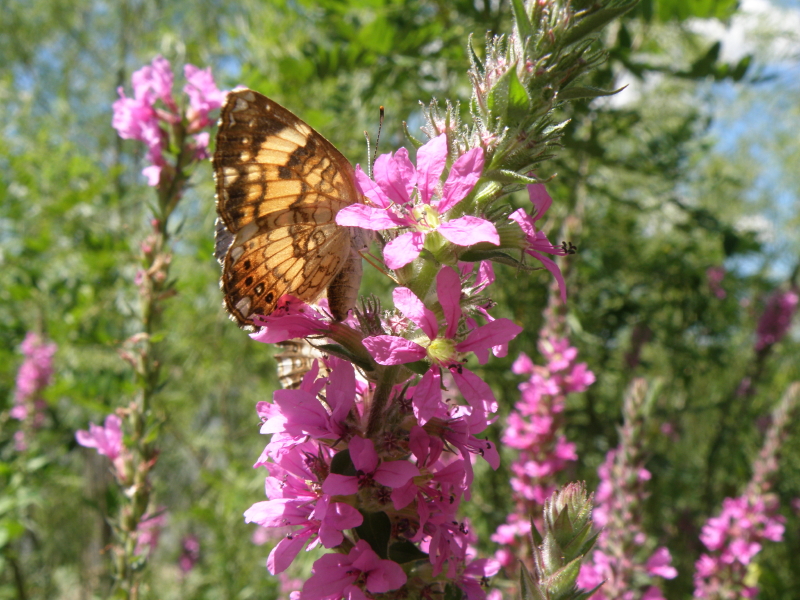
This is an Eastern or Harris’ Checkerspot (Chlosyne harrisii) and was the most numerous butterfly I saw visiting the loosestrife flowers.  They were so intent on sipping nectar that it was easy to approach them as they fed.  Now for a few more checkerspot images.

Eastern Checkerspot feeding, Aug. 2013

Eastern Checkerspot, Falls of the Ohio, Aug. 2013

Eastern Checkerspot, Aug. 2013, Falls of the Ohio

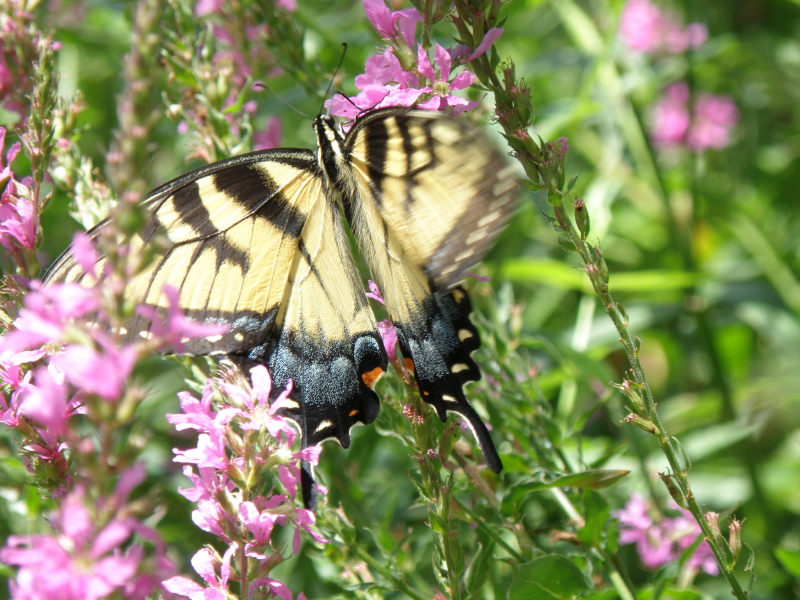
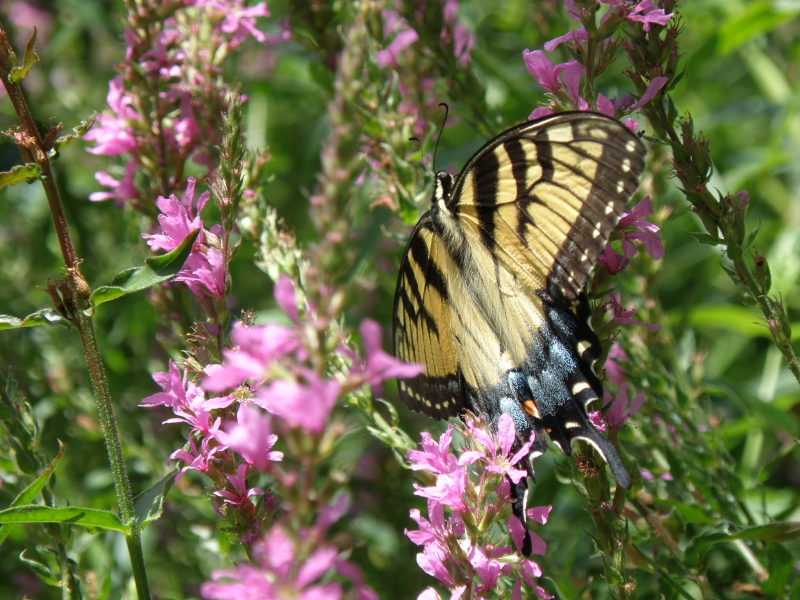
I found myself carefully wading into the flowers to get as close as possible.  Many of the flower bunches were in the six to seven feet tall range and it was humid walking among the plants.  We have been having a mild streak lately with lower than normal temperatures and regular precipitation.  Residents in our locality have had few reasons to complain about the heat.  The checkerspots are not the only butterflies out here.  Various swallowtail butterflies also enjoy these flowers.  Here are images of an Eastern Tiger Swallowtail, (Papilio glaucus).

Tiger Swallowtail on purple loosestrife, Falls of the Ohio, Aug. 2013

Tiger Swallowtail on Purple Loosestrife, Falls of the Ohio, Aug. 2013

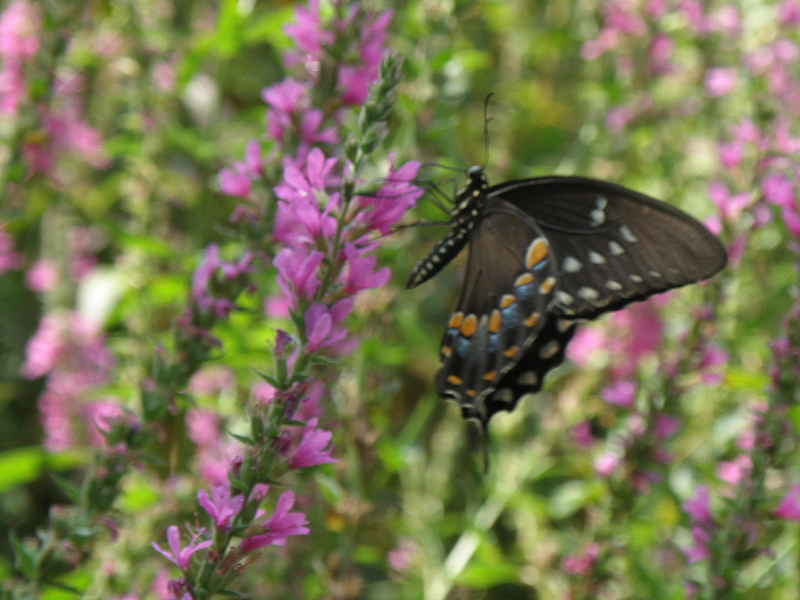
We are fortunate to have many other species of swallowtails in our area.  Among the others I have associated with the loosestrife flowers include the Pipevine Swallowtail (Battus philenor), the American or Eastern Black Swallowtail (Papilio polyxenes), and the Spicebush Swallowtail (Papilio troilus).  Here’s an image of a Spicebush Swallowtail feeding.

Spicebush Swallowtail on Purple Loosestrife, Aug. 2013

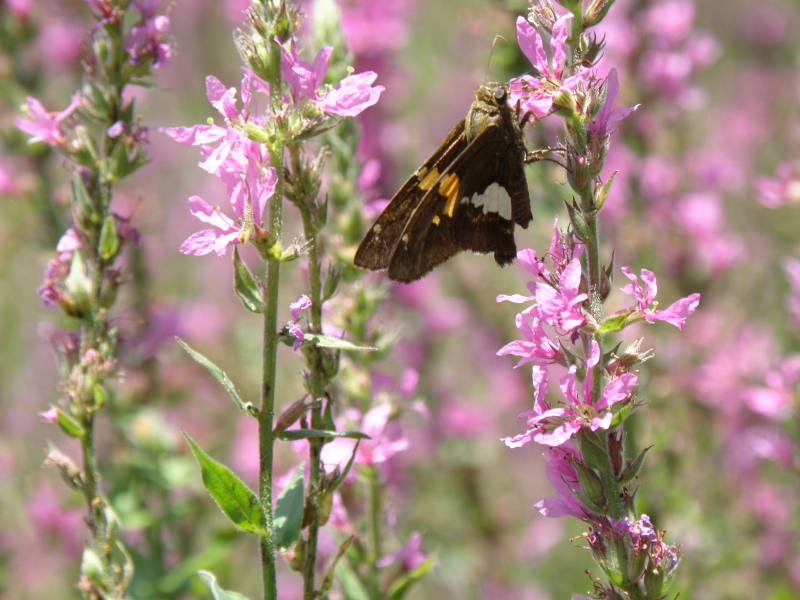
We have several different Skipper species present.  This is the Silver-spotted Skipper (Epargyreus clarus).  The white spot on its hind wing shines like mother-of-pearl when the light hits it just right.

Silver-spotted Skipper on Purple Loosestrife, Falls of the Ohio, Aug. 2013

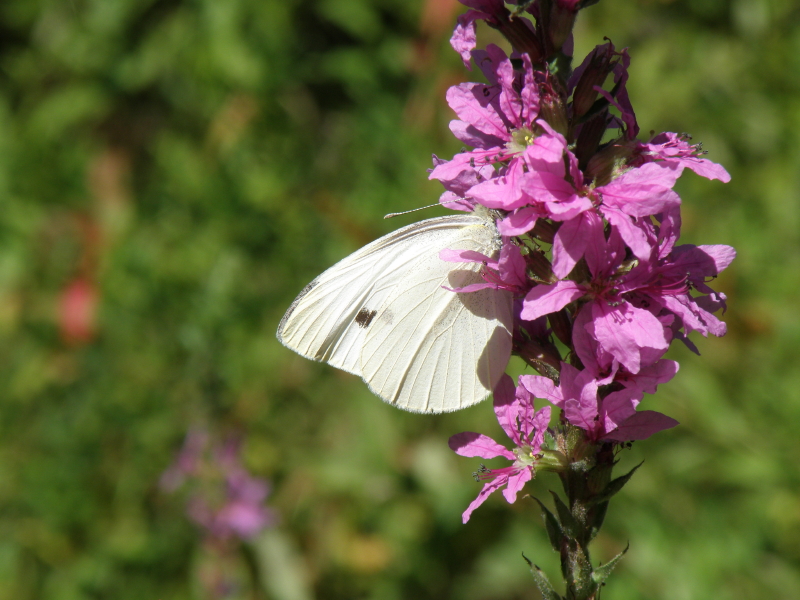
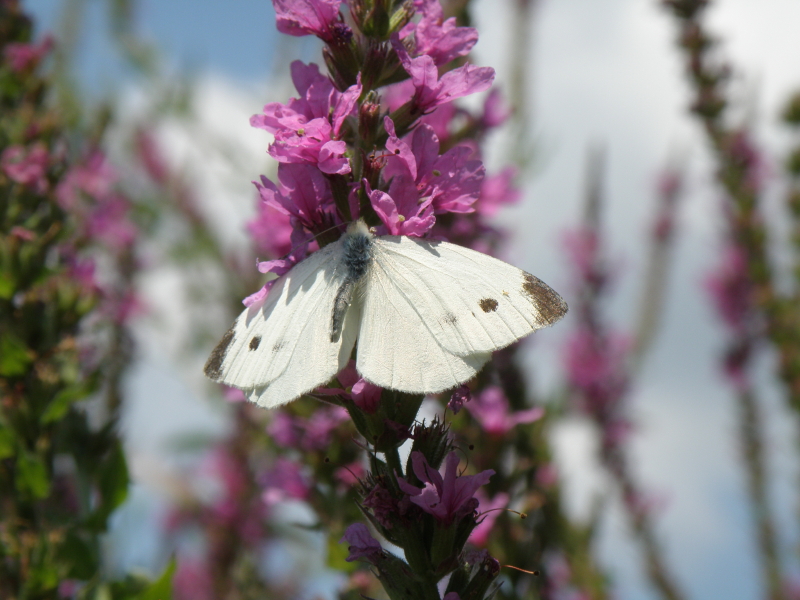
Another regular visitor is the Cabbage Butterfly (Pieris rapae).

Cabbage Butterfly, Aug. 2013

Cabbage Butterfly caught by a spider, Falls of the Ohio, Aug. 2013

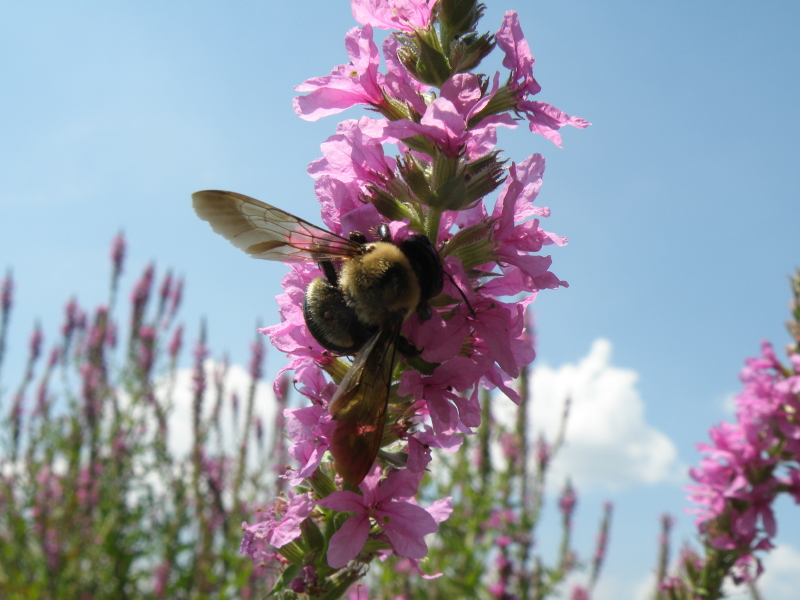
I was struck by the unusual pose this Cabbage Butterfly was in and decided to get closer to check it out.  When it didn’t fly away…I knew something else was going on.  Although you can’t see it in this picture, a small spider has caught this butterfly by its head.  With so many insects feeding on the loosestrife, predators were sure to follow.  Large bumble bees also enjoy these flowers.  They are so heavy that they cause the loosestrife stems to bend upon landing on them.

Bumble Bee on loosestrife flowers, Aug. 2013

Over the years, I have watched the Purple Loosestrife become more common in the western section of the park.  The plant is now well established.  Typically, the loosestrife blooms continuously from July to September, but to my eye, it is looking like the blooms are starting to play out a bit?  Every year is different and some butterflies are more common in one year than another.  Missing from the loosestrife blooms this year are the Buckeyes, Monarchs, and their mimics…the Viceroy Butterflies.  Perhaps they will still make an appearance later on if the loosestrife flowers continue blooming.  I hope you have enjoyed wading through the loosestrife with me?  Next time, I will post something about the exhibition at the Kentucky Museum of Art and Craft that is featuring this blog in their show.  Now time for one final image before closing.Purple Loosestrife at the Falls of the Ohio, Aug. 2013

Read Full Post »

« Newer Posts - Older Posts »