Feeds:
Posts
Comments

Archive for the ‘sculpture’ Category

After finding all my sculptures smashed, I decided to give that section of the park a rest.  I will eventually return there and make new pieces from the remains.  Today’s walk is along the western section of the park.  It is an area I have come to appreciate more.  In part, because fewer people venture this way and there are different points of interest.  It’s fall migration time and I’m always on the look out for birds.  The birds that are just passing through are of particular interest, but I also like the species that can be found here year around.  I came across this really noisy Northern Flicker on a branch and snapped its picture.
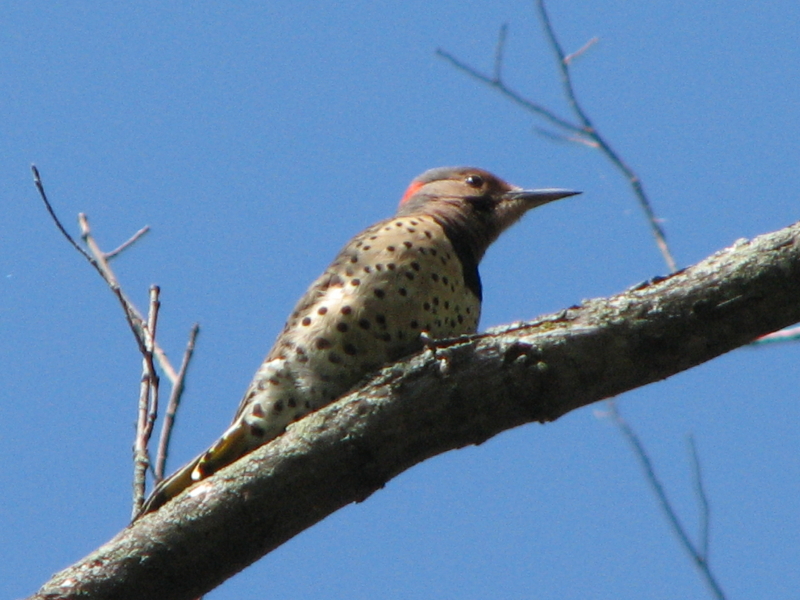
This is a fairly large woodpecker.  In the old guides, this would have been identified as the “Yellow-shafted” form.  The feathers under the wings and tail are a bright yellow which can be seen as the bird flies.  The black “mustache” extending away from its bill identifies this as being a male.
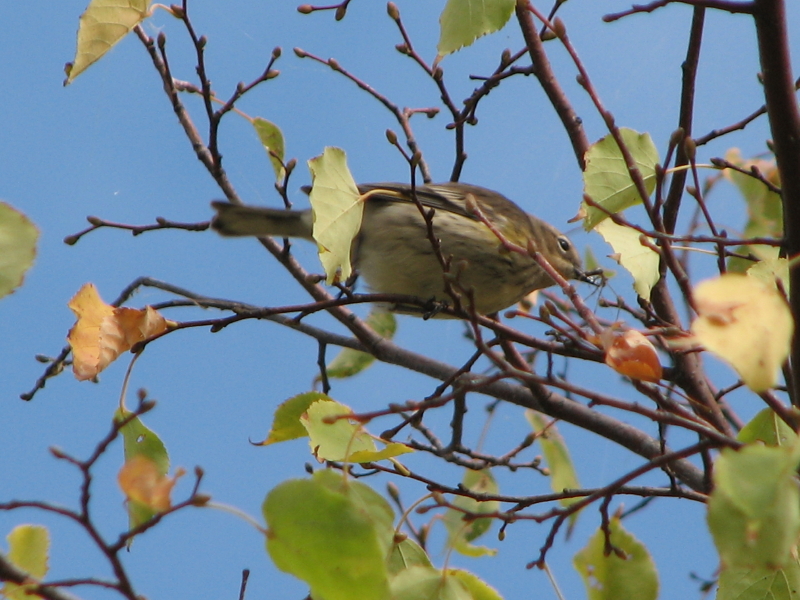
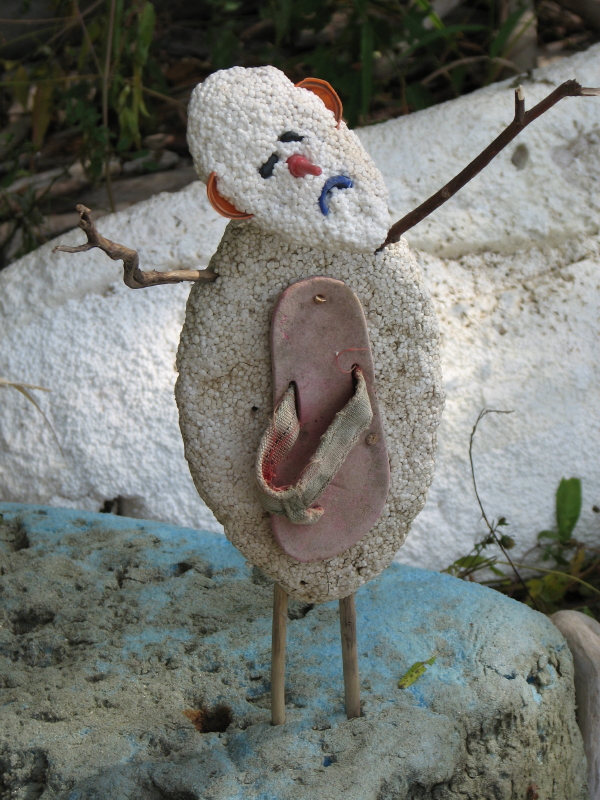
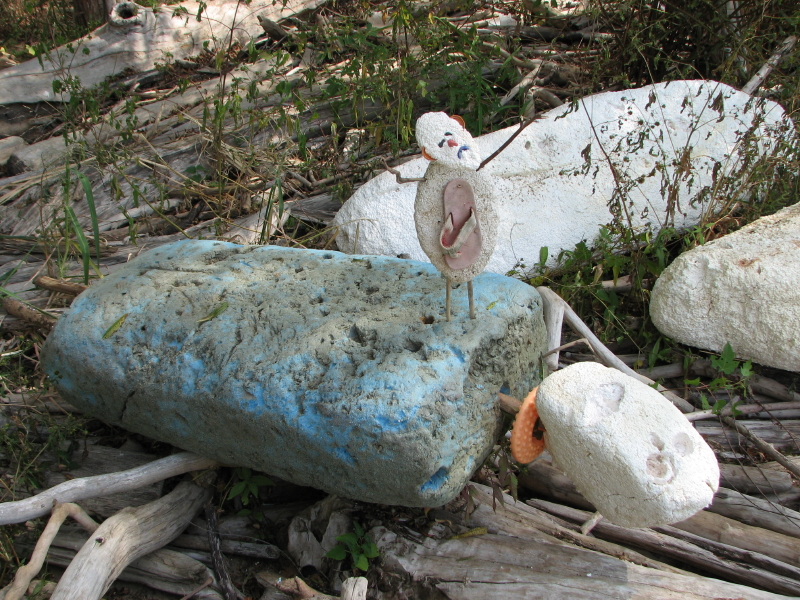
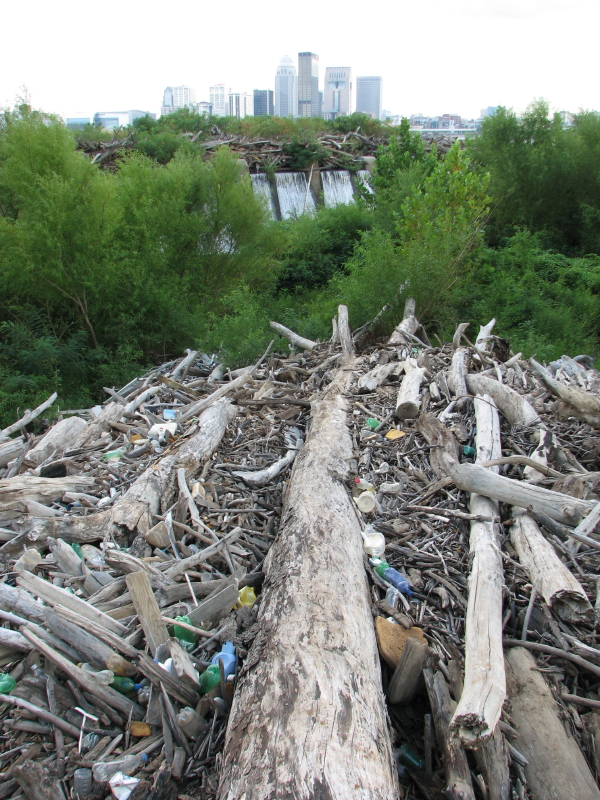
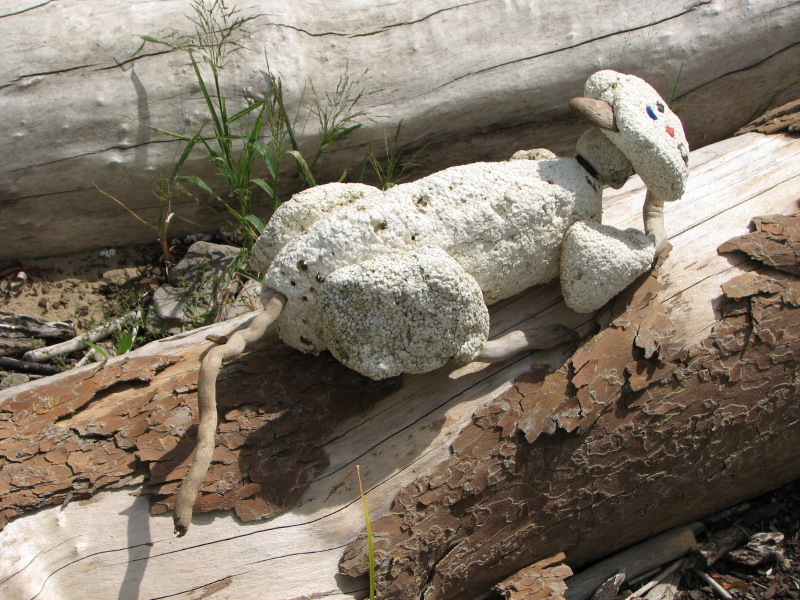
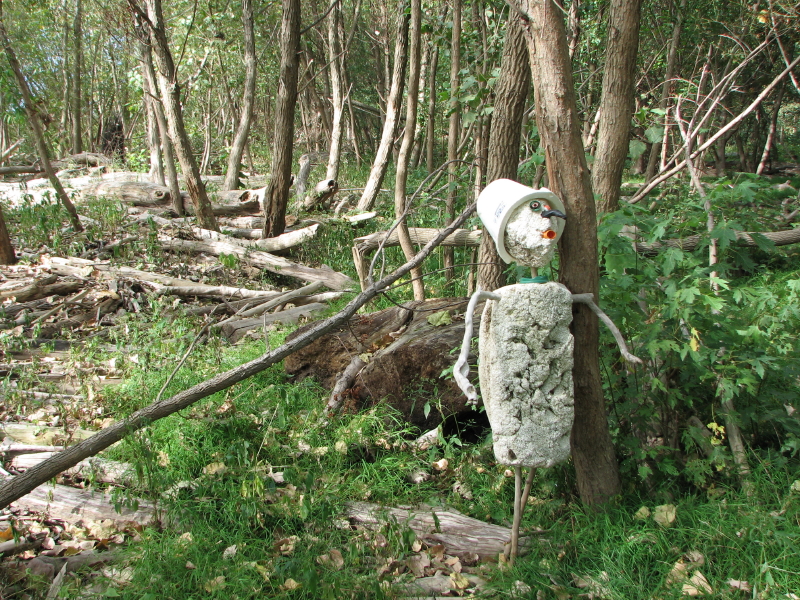
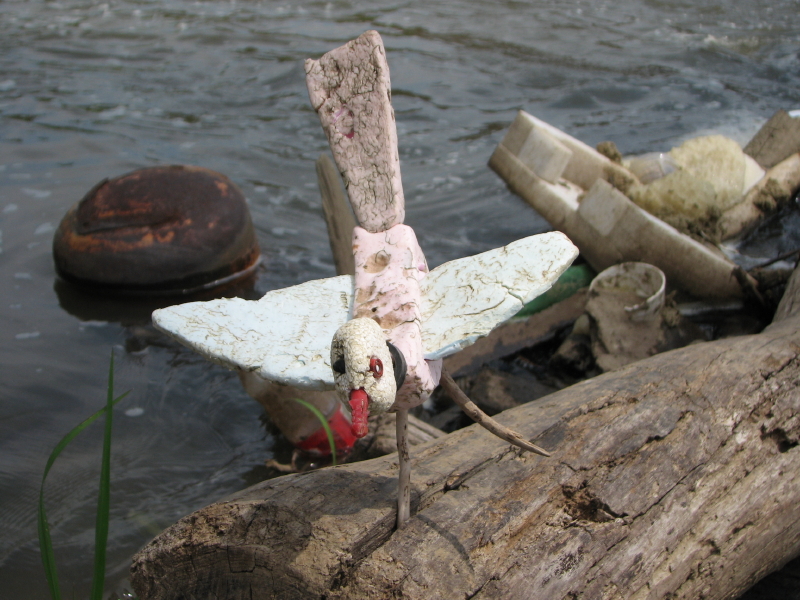
Chasing small insects among the fall leaves is this Yellow-rumped Warbler.  This is the park’s most common warbler and one that hangs around longer than any other of the park’s 35 sighted warbler species.  I have seen most of them, but they are easier to identify in the spring when their plumage is more colorful.  Fall warblers can be a challenge and I’m still learning all their nuances.  I have seen more different warbler species this year because I have tried a little harder to look for them.  Still, when you are out on the land, you just never know what you will cross paths with and that is the subject of this post.  I saw my first Water Chick on this expedition and managed a few decent images that I can share with you.  First, can you spot the Water Chick in this photo?
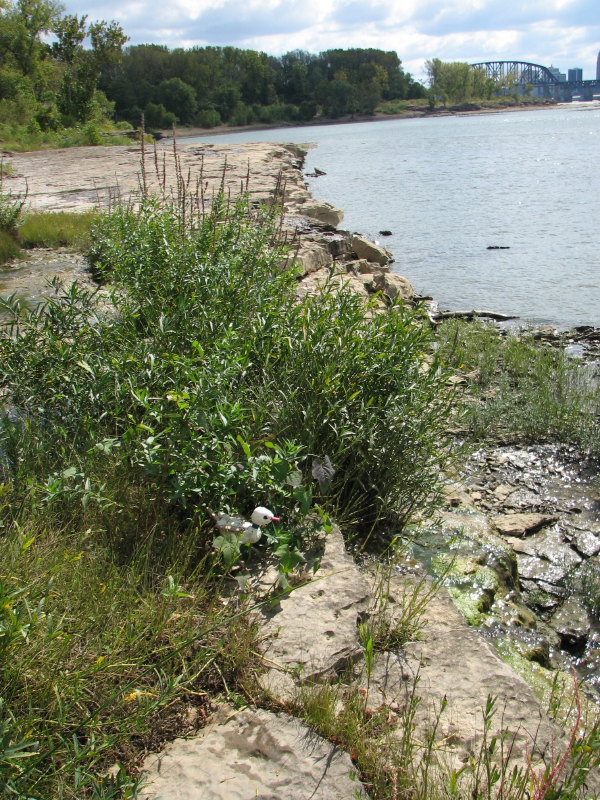
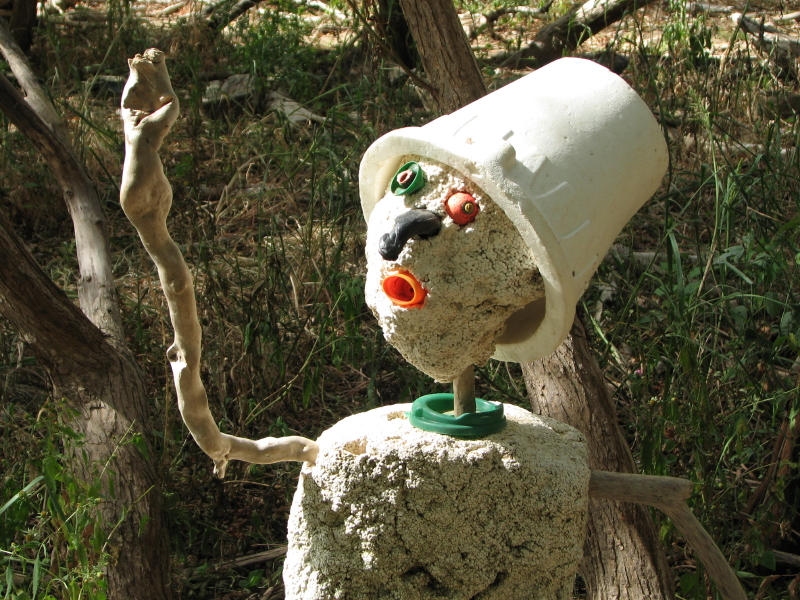
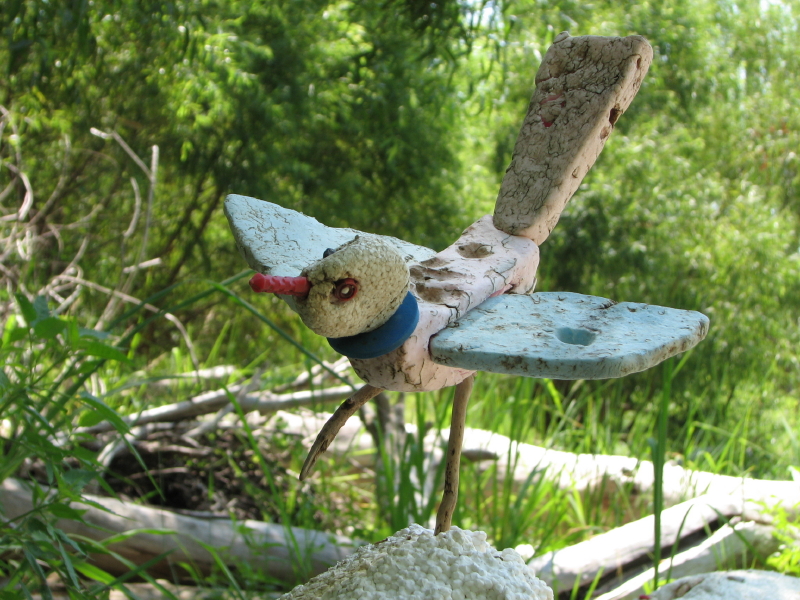
I bet you found this interesting bird?  It’s snow-white in color and has a bright red bill.  It’s only occasionally found in this park and the habitat it prefers matches exactly the kind of landscape you see here.  The Water Chick is usually found near water and also needs dense vegetation to hide and raise its young.  Over the course of a couple of hours I ran into this bird several times and here are a few “portraits” I was able to manage.
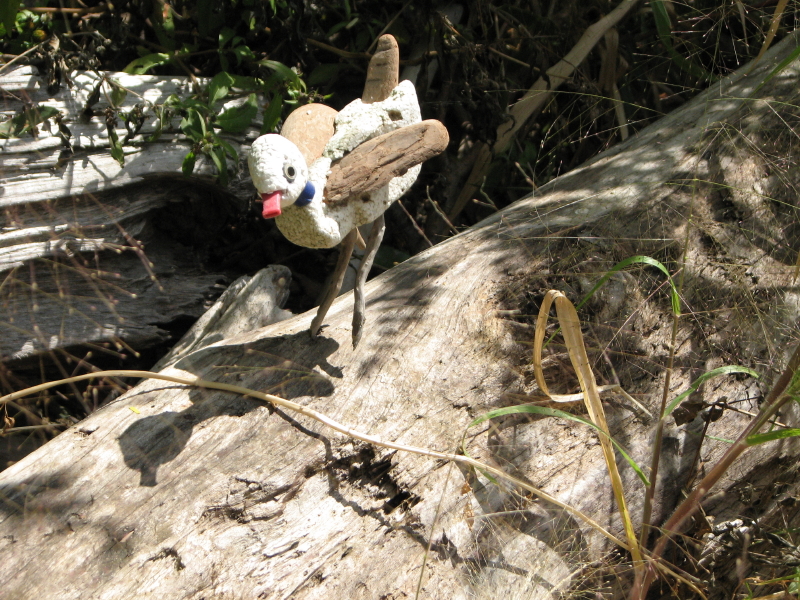
The Water Chick is usually found on the ground, but reportedly, is a decent swimmer as well.  Although it can fly it is reluctant to do so.  It much prefers hiding and taking advantage of the local cover where it seeks out small insects and spiders that make up its diet.  I surprised this one investigating a decaying log.  Here’s another image of this bird.
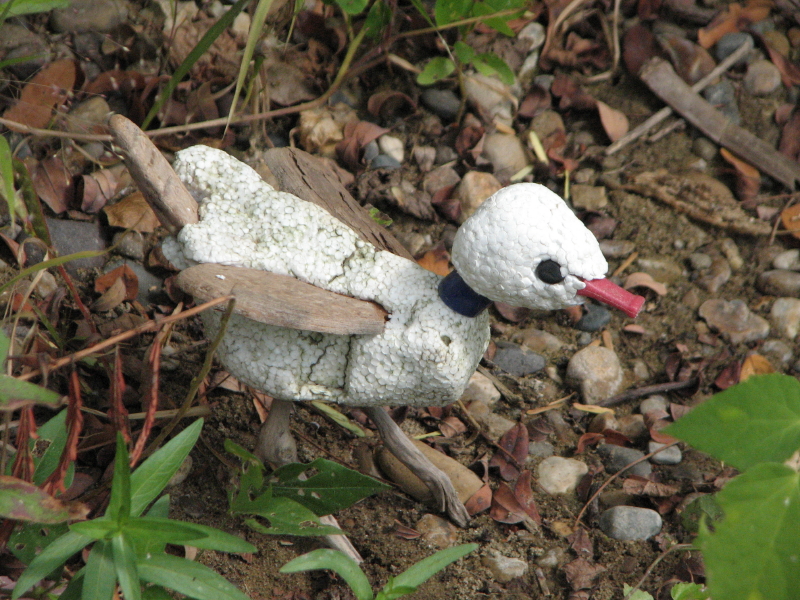
As you might be able to discern…the Water Chick is a small bird and relies on its diminuitive size and secretive habits to go unnoticed.  I believe I heard (not entirely sure though) a low piping sound when this bird noticed me and became alarmed.  It high-tailed it into the loosestrife clumps as quick as can be.  This is precisely the type of ground bird that I worry about being preyed upon by feral cats and in fact, ornithologists report that this species is on the decline for multiple reasons.  While I was birdwatching, I did come across another bird predator.  However, this one is so large that I doubt that it would bother taking a Water Chick.
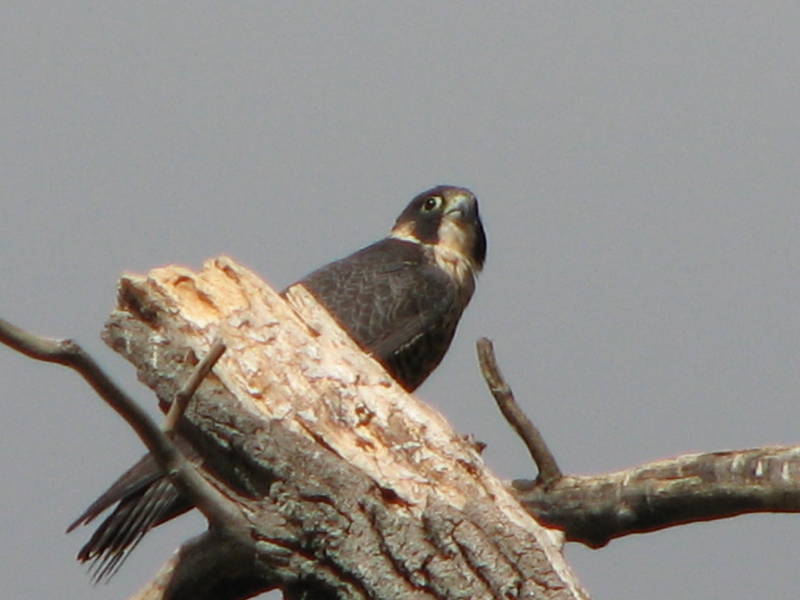
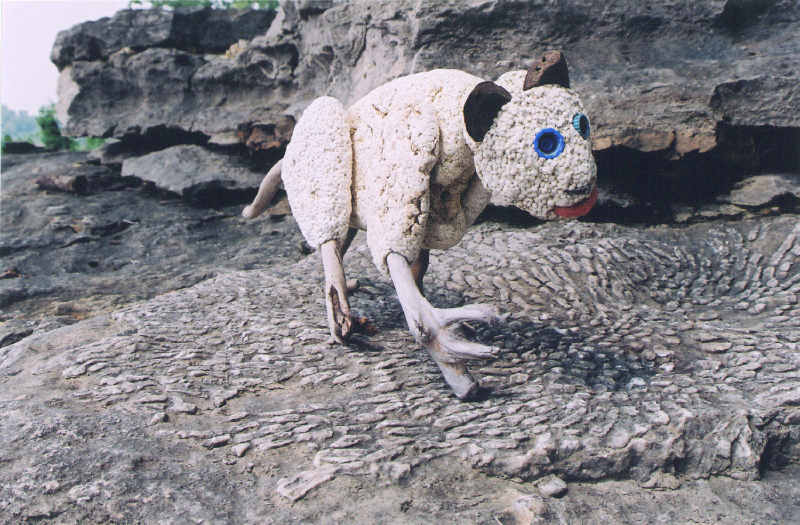
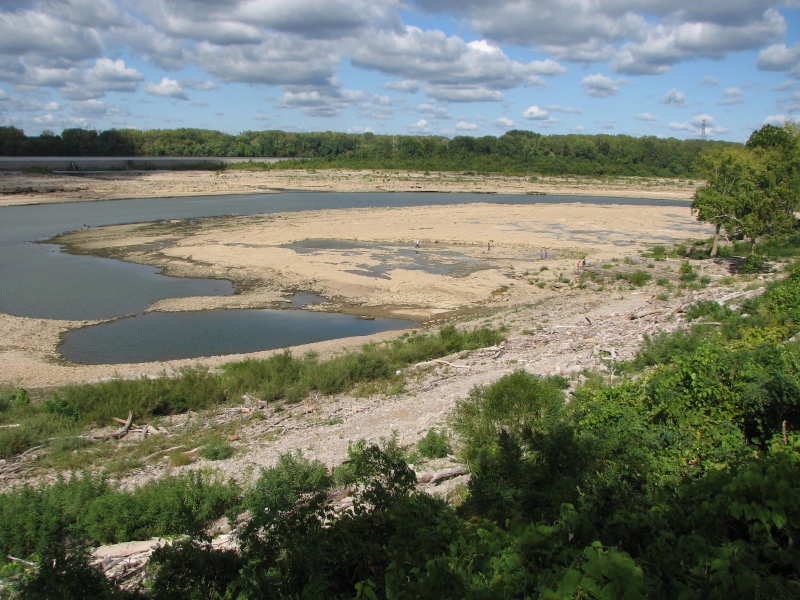
I see Peregrine Falcons on occasion out at the Falls, but this is the first one I could get a picture of…unfortunately part of the tree obscures the bird, but it’s still distinctive enough to identify this large bird of prey.  I have actually seen these falcons more in the city where they nest on the taller buildings in Louisville.  Like other parts of the country, we nearly lost this magnificent bird to DDT poisoning.  Since banning this pesticide they have made a comeback, but we could use more to help keep the pigeon population in check.  I located the Water Chick one more time before heading home.  It was along the fossil beds that rise above the river level which is still down from an acute lack of rain.
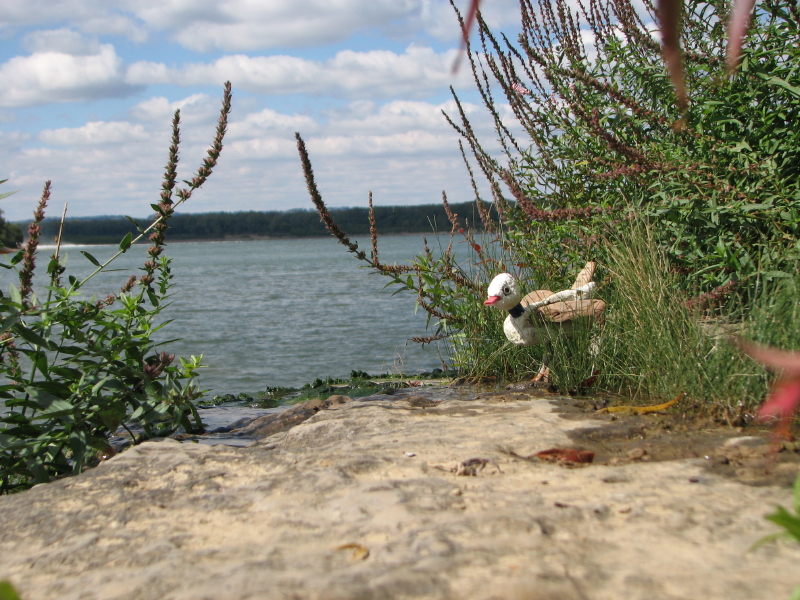
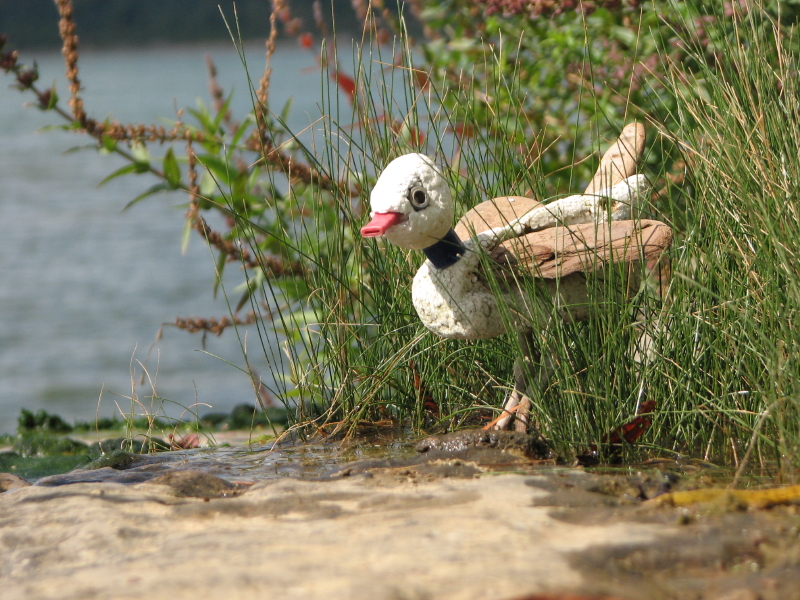
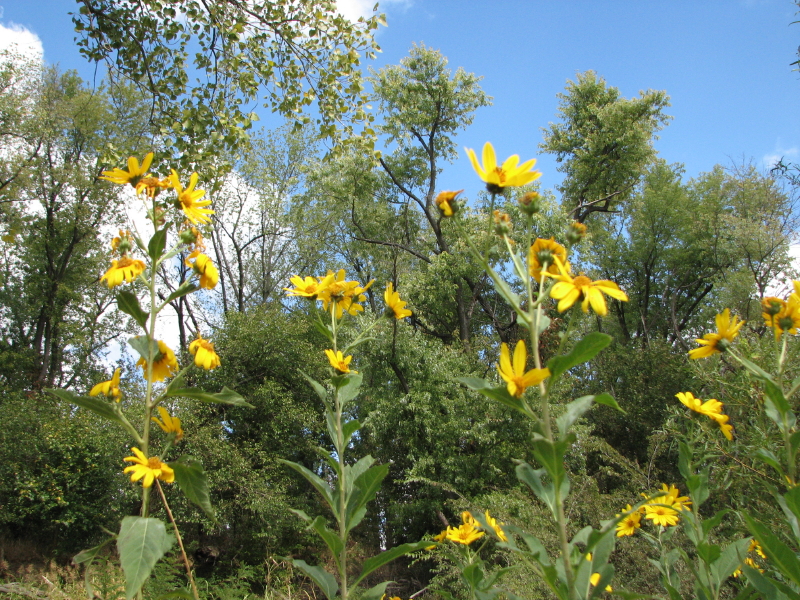
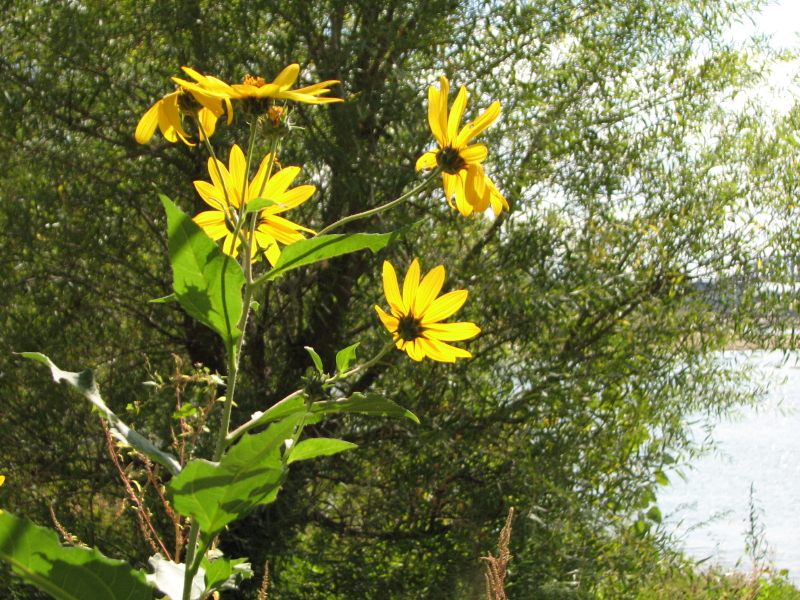
I was on my belly laying on the limestone rocks when these photos were taken.  I think it helps give an idea of what it must be like from this bird’s perspective?  After taking these images, I decided that I disturbed this bird enough and backed off.  I hope it forgives my intrusion, but I had never seen one of its kind before…and maybe never will again?  This bird is bound for our Gulf Coast where it spends the winter in the swamps.  Turning for home, I also came across small stands of this rather large flower and thought this a nice way to end this post.
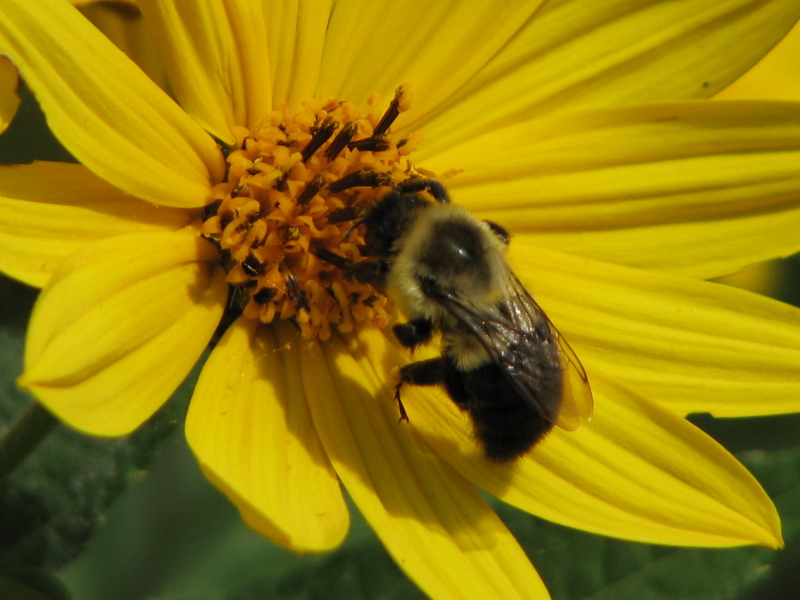
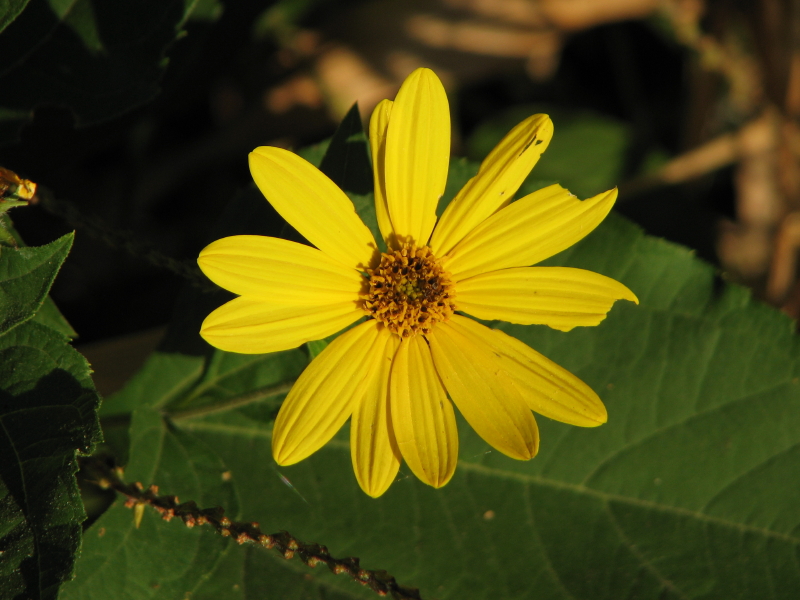
I’m not sure on the identification of this plant? Many in this stand were over six feet tall.  I need to bring a guide with me into the field to help with this.  In the moment, I’m happy for the color this large flower brings which contributes to the beauty of the season.  Thanks for tagging along on another of my walks at the Falls of the Ohio.  See you later!
Read Full Post »

Oh woe is me!  It was starting out to be such a beautiful day.  There was a spicyness to the air that was intoxicating and the willows were alive with birds.  I saw several different warblers and managed a good photo or two!  As I approached what has been my outdoor studio spot for months,  I could tell something was different this time.  A feeling of foreboding began to fill me and my heart sank as I looked around my site.

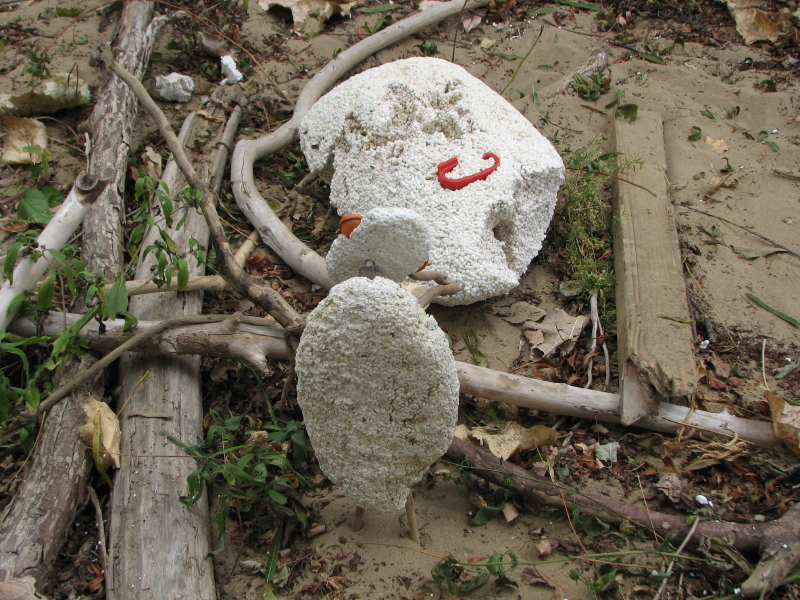
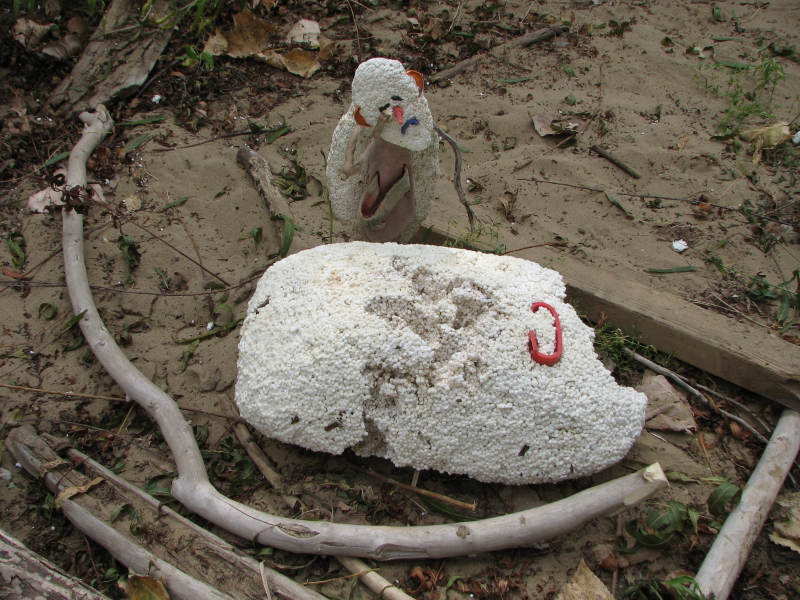
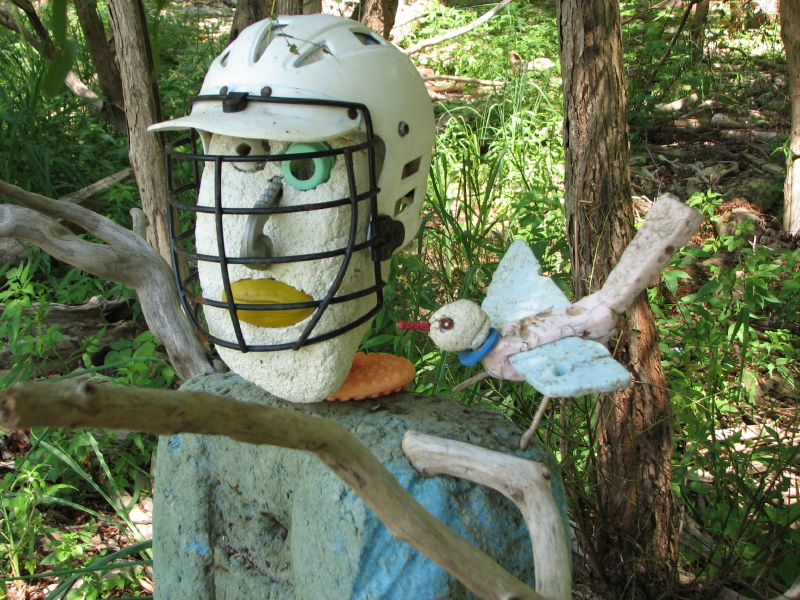
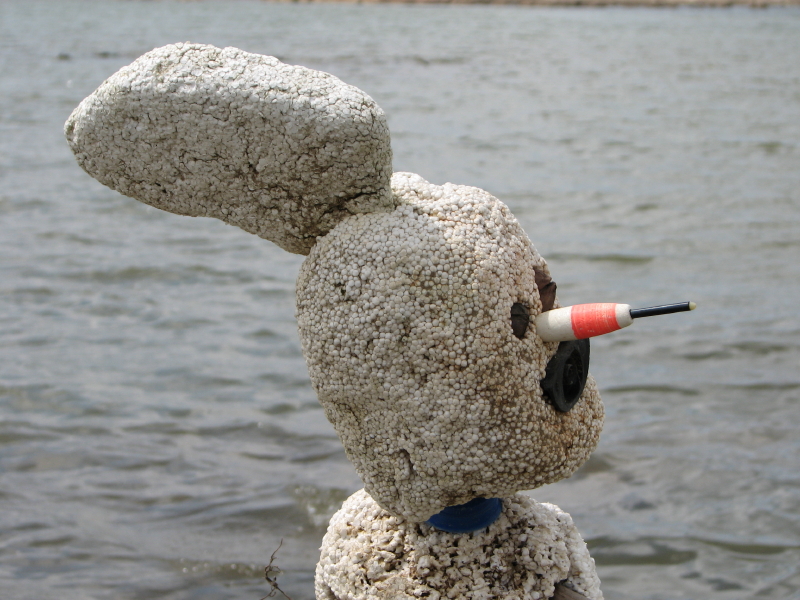
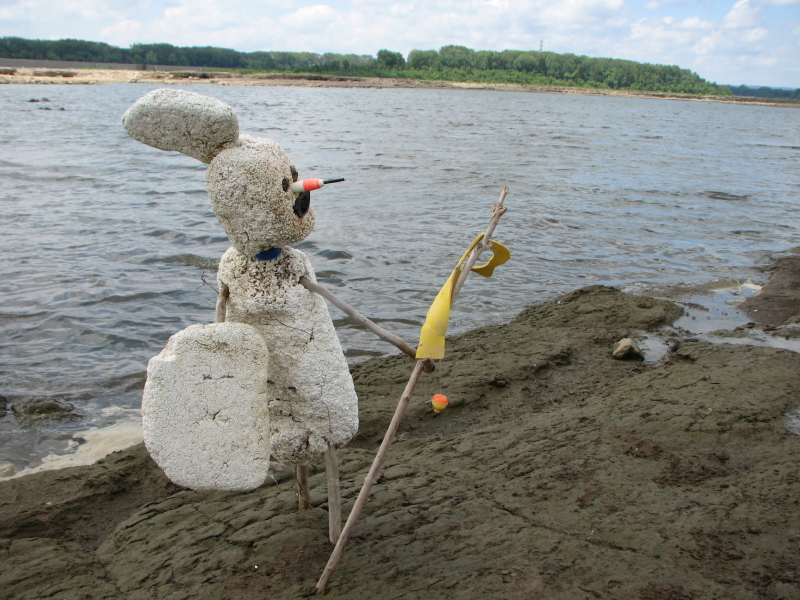
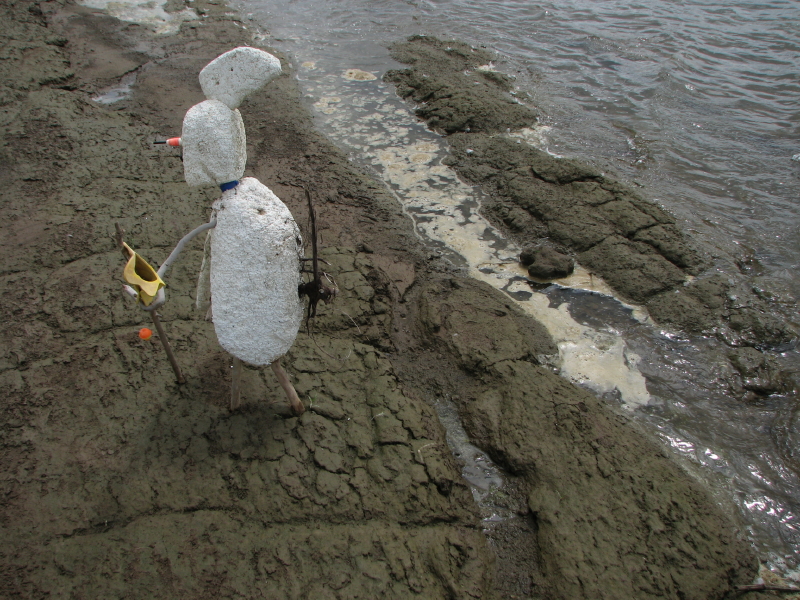
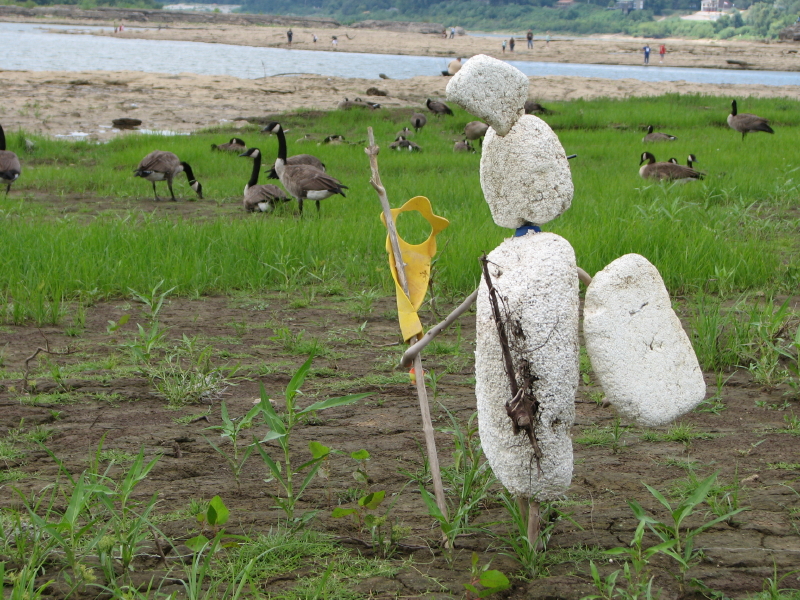
They were all down and destroyed!  Figures that had been my friends since early summer were lying around my studio smashed and savaged to bits!  The figure I made with Ariana that wore the lacrosse helmet we found together was staring up at me like some ancient Egyptian mummy.  The eye sockets were hollow and I could not find either the helmet or the eyes.  Even the small bird piece that had alighted on this figure’s shoulder was just random bits of broken polystyrene.

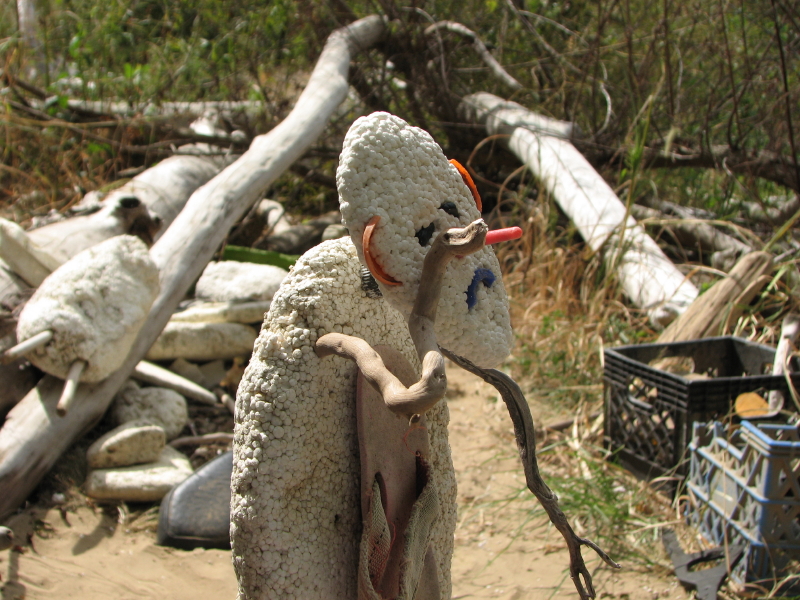
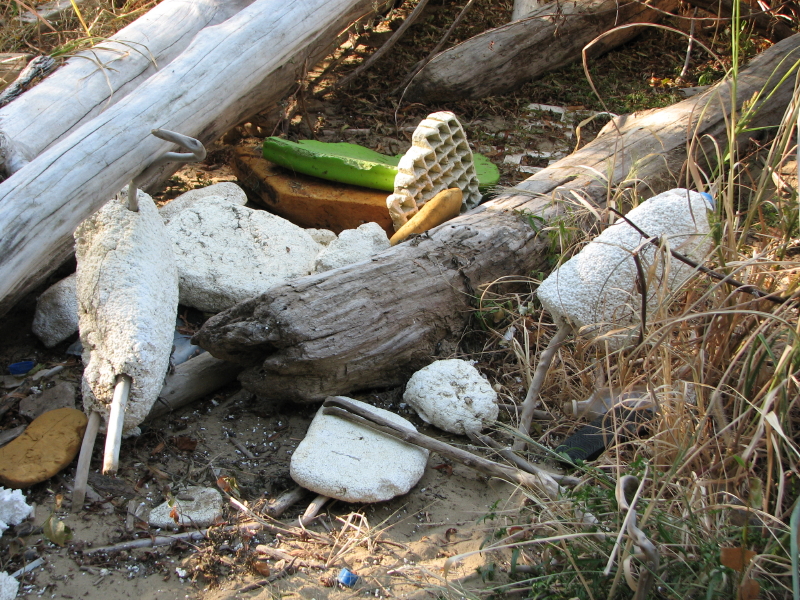
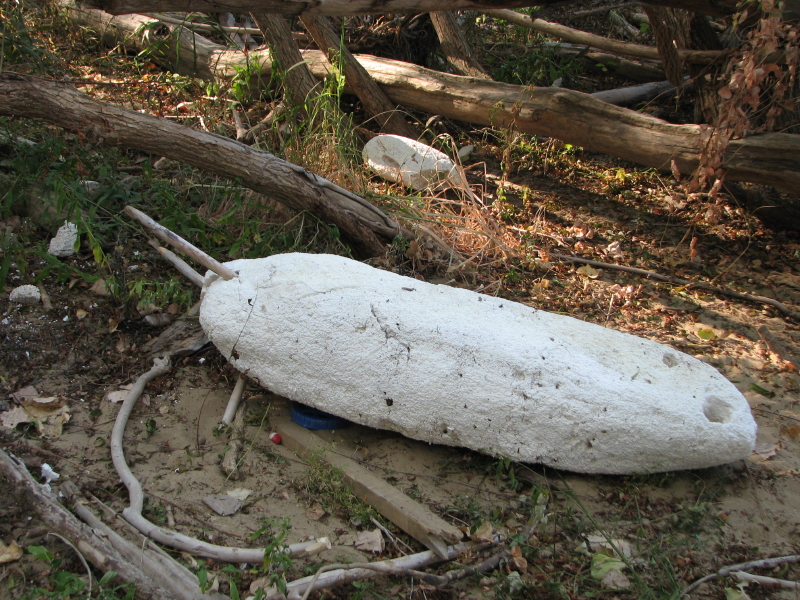
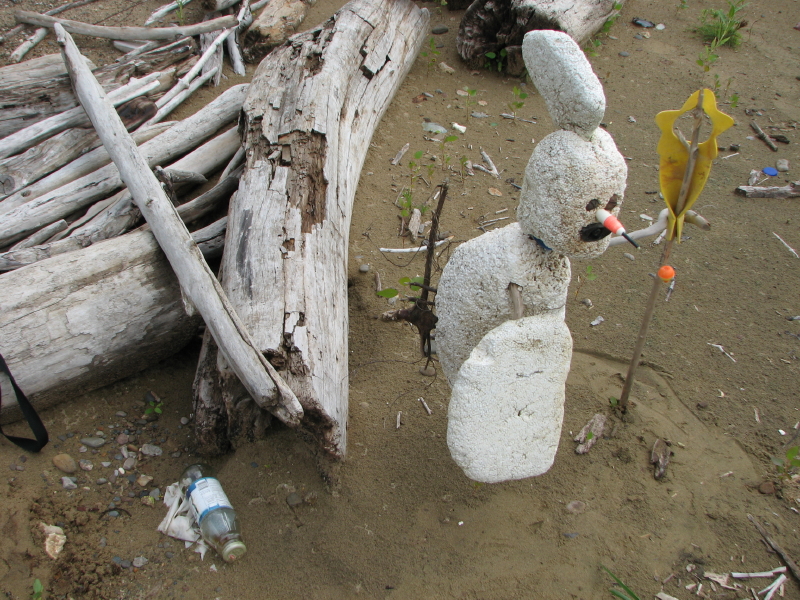
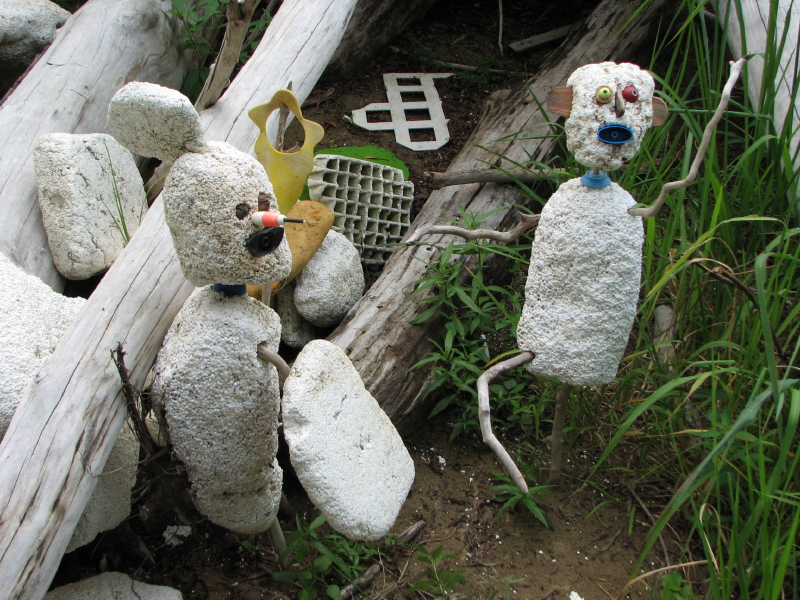
Both the Styro-Odysseus figure and the dancing figure that greeted him back from the war were goners now.  It seemed that a particular kind of viciousness was reserved for the heads as they appeared to take the brunt of the attacks.  The violence was not restricted to the “art” and I saw that even the old milk crates I stored found objects in were also now cracked and battered.  There were two other works out here and how did they fare?  What about that Figure with the Long Arm?  Look for yourself.

It’s not an encouraging sight.  All these sculptures had been up here for weeks and many people have had the opportunity to see them and interact with them in positive ways.  Among the other options included taking them home, moving them to another location at the Falls, adding to them in some other creative way, leaving them be until the river eventually found them, etc…  Unhappily, the option exercised was just to smash them with sticks.  One other figure was also out here and unfortunately, she lasted only long enough for one good post until she too was discovered by the vandals.

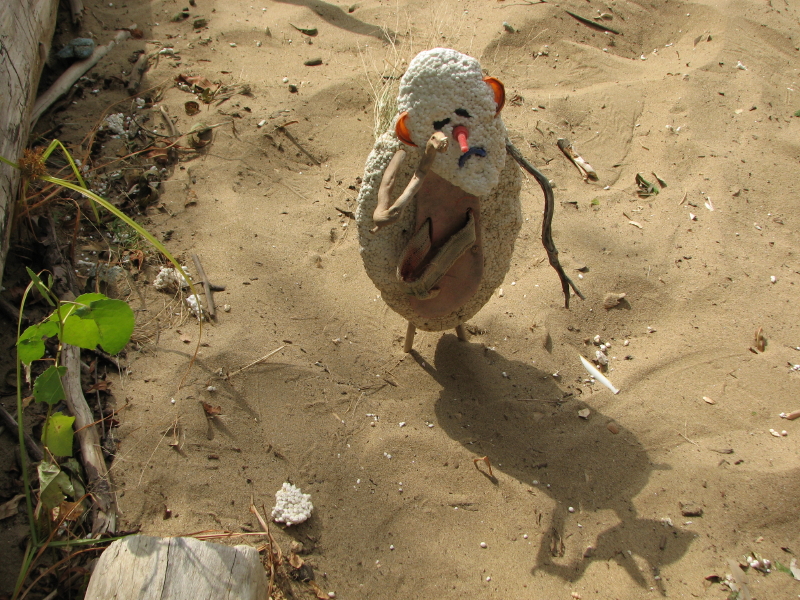
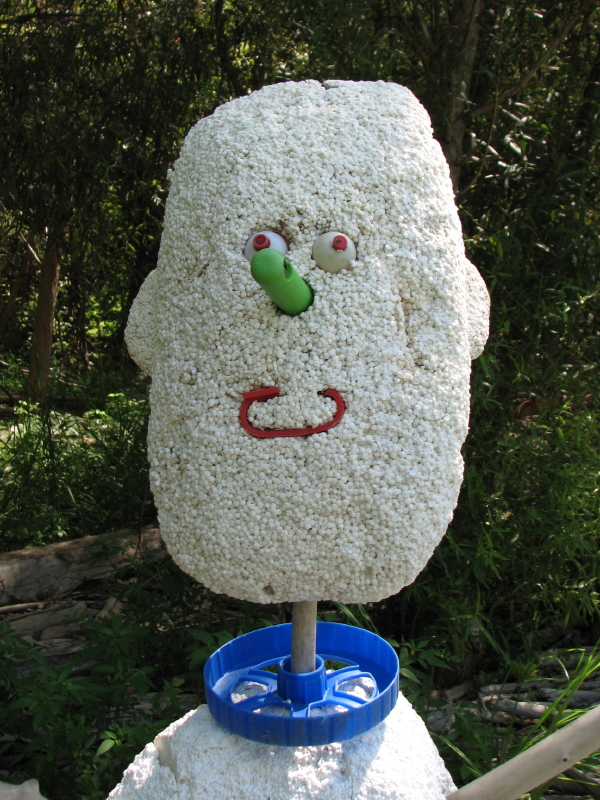
This is all that remains of Minnie now…fragments of broken Styrofoam.  Minnie was an interesting character and people seemed to relate to her.  More than likely all this carnage is the handiwork of adolescent boys.  I have seen this before…many times over the years.  What is it in the human spirit that finds some strange satisfaction at tearing down what has been built by others?  I don’t understand the pleasure derived from this kind of destruction?  I will admit to feeling down after I encountered all this trauma and I haven’t been back to this site since then.  I did gather up what I could and I intend to make new works if I can lift my spirits up enough to do it.  For now, all that remains are photographs of these sculptures when they existed intact and in the contexts that helped to define them.  Here are a few previously unpublished images.

I know I shouldn’t be too upset since all this stuff is just river-born trash anyway.  I think I keep saying this to myself in part because it’s true and to insulate my feelings for when these black days occur.  These materials had already been abandoned. I can’t take it all home with me and I should just enjoy the ephemeral nature of it all.  Still…

Read Full Post »

At the eastern end of the Falls of the Ohio State Park is where I see the most bird species.  It is also the area that seems to trap the most driftwood after we have had a bout of high water.  Material of all kinds collects between the high walls of the dam and the steep riverbank itself.  There is another sizeable collection of driftwood on the other side of the dam’s wall that is just waiting for the river to rise before depositing another layer of wood and debris in the park.  The bowl-like depression created in this space cuts across a few distinct habitats and is also protected from the wind which is why I think the birds like this spot.

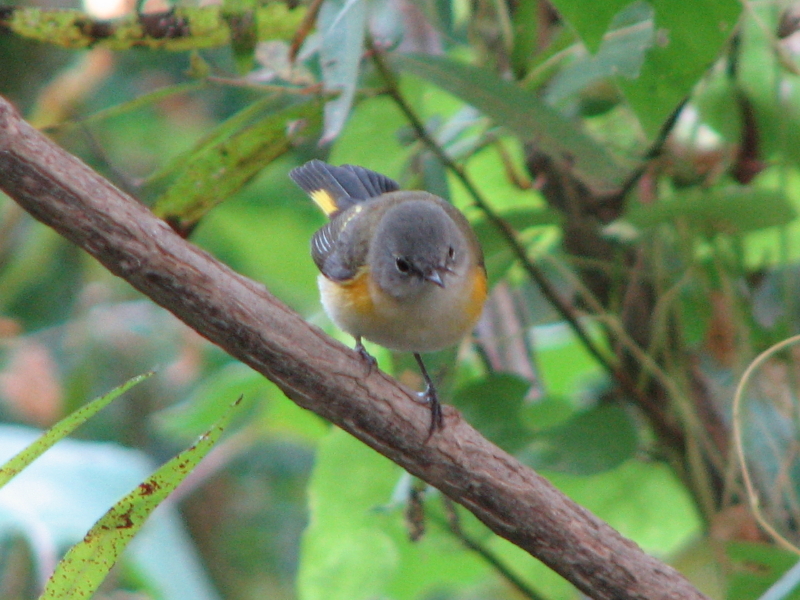
On this day I was doing my birdwatching thing and trying to photograph some of the warbler species that migrate through here in the fall.  It’s a real challenge for many reasons.  First, there is still enough foliage around that it is hard to get an unobstructed view of a bird.  Second, the migrating warblers are now much duller in color having lost their breeding plumage, can be hard to identify.  In some cases, the differences can be dramatic between how a species appears in the spring and how they look on their autumnal migration south.  Added challenges also include that these birds are very small and extremely active.  They don’t sit still for long.  On those occasions when I get a picture that I like…I feel more like a fortunate opportunist than as a photographer with any skills.  I know I’m rambling, but I need to set the scene first before getting to the point of this post!  It took a bit of luck and patience just to obtain the above photo of this first year American Redstart and it looked like this bird was going to hang out a bit and I was well concealed and anticipating more images when something very interesting happened.  There was movement in the brush below the bird which flew off and I was left with this quickly snapped photograph!

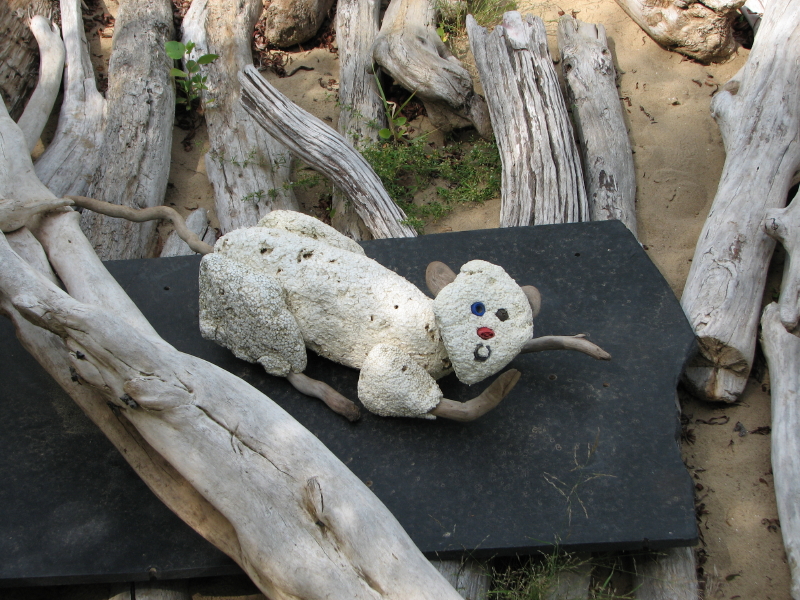
I just witnessed a failed hunting attempt by the Flat-faced Cat.  It’s an unusual mutation that has occurred among the resident feral cats which seem to be gaining in population in this park.  To me, this is a big point of concern because in addition to the garbage left behind from picnics…they are also preying upon and eating the small wildlife found in the park.

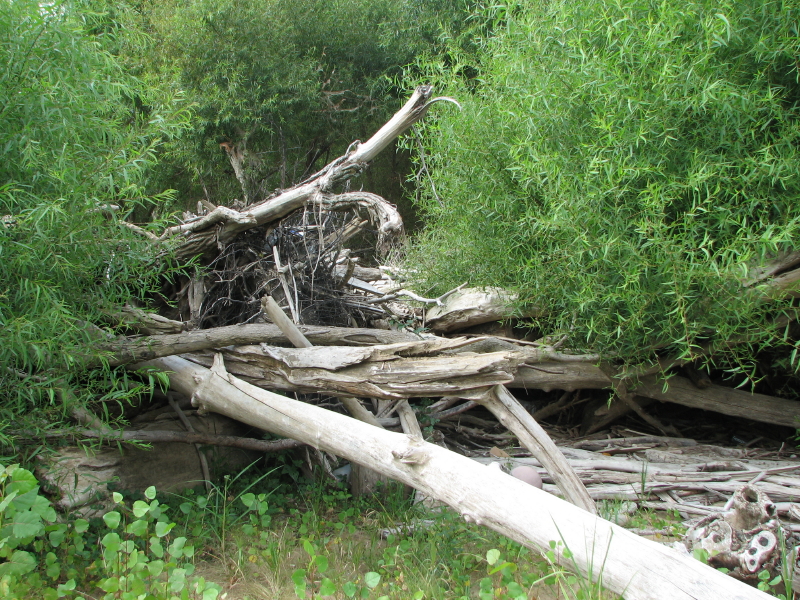
So, where are these cats living?  I have literally found them throughout the park where they can find shelter.  I tracked the Flat-faced Cat back to a den under the driftwood.  The interlocking logs have created a structure that has many natural tunnels and rooms.  It can also be dangerous because the wood is always shifting under its own weight as it breaks down from environmental exposure.  I’m sure that it can’t be an easy life for these cats.

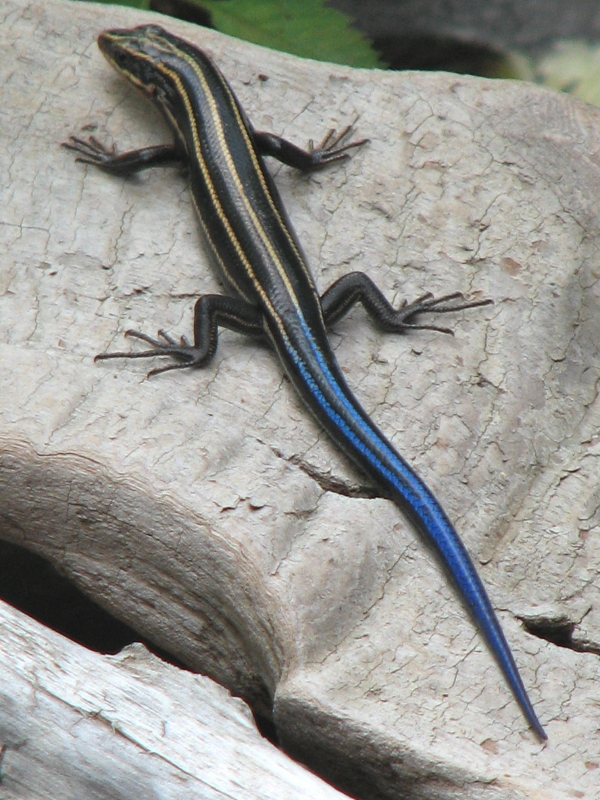
Since our first encounter, I have taken an interest in this particular animal.  It always runs away once it spots me and is now completely wild.  I see it the most when I’m in the Willow Habitat and I think we are after the same thing!  We are both hungry for wildlife, but in very different ways.  I recently observed and photographed this cat hunting lizards basking on the sun-drenched logs.  First an image of its intended prey.

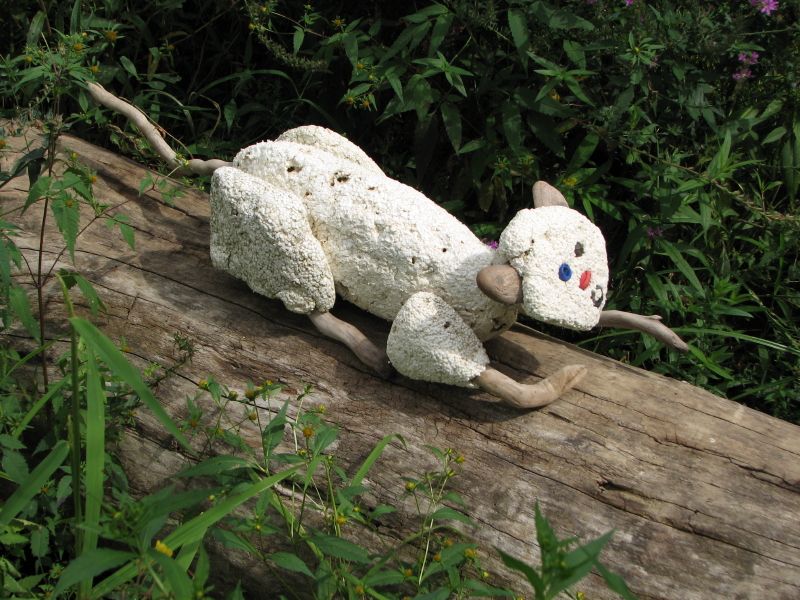
The blue tail marks this as the young of the Five-line Skink.  This is a fairly common lizard in this park and the one most people are likely to encounter.  While I was hiding behind a sizeable willow tree, I saw the Flat-faced Cat attempt another unsuccessful hunt and took these images.

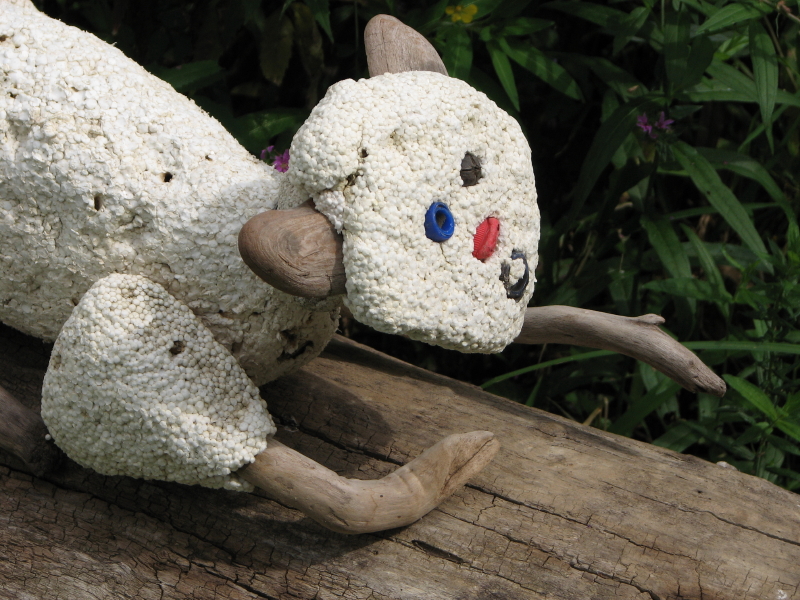
Now, don’t let its cute face fool you.  Out in the woods, this animal is all business when it comes to hunting.  I’ve looked at a few articles on the web about the cat predation problem and interestingly there is some controversy.  There are studies from Great Britain and California that suggest that feral and domestic cats take millions of songbirds and small animals a year.  Societies devoted to cats, however, dispute the evidence and say that there aren’t good studies to back this assertion up.  When all else fails…turn to anecdotal evidence!  How many of you out there who own cats that are allowed to roam outdoors have been “gifted” with dead birds and other little animals on your door steps?  I have a hunch that many cat owners have had this experience.  Now multiply these “gifts” with the millions of cats that are out in the world and the studies probably aren’t too far off.  The studies also suggest that the hunting instinct is so well engrained…that even very well fed cats can’t resist that little chipmunk running around the backyard.

Of course, feral cats are not the only cause for the decline in the numbers of songbirds.  There are pressures of all kinds and habitat loss and environmental degradation play their huge parts.  Still, the domestic cat is not something that occurs “naturally” in our wild environments.  Responsible pet owners should never set unwanted pets loose where they don’t belong.  Responsible owners also have their pets spayed or neutered to further limit the population of unwanted pets.  It’s kinder to all living things to do this. Looking through my archives, I remembered that I had seen another feral cat that looked a lot like the cat which is the subject of this post and here is its image.

I photographed this big tom cat on the fossil beds near the Interpretive Center.  It had only one eye and sported this murderous looking paw!  Who knows it may be a direct ancestor of the Flat-faced Cat?

Read Full Post »

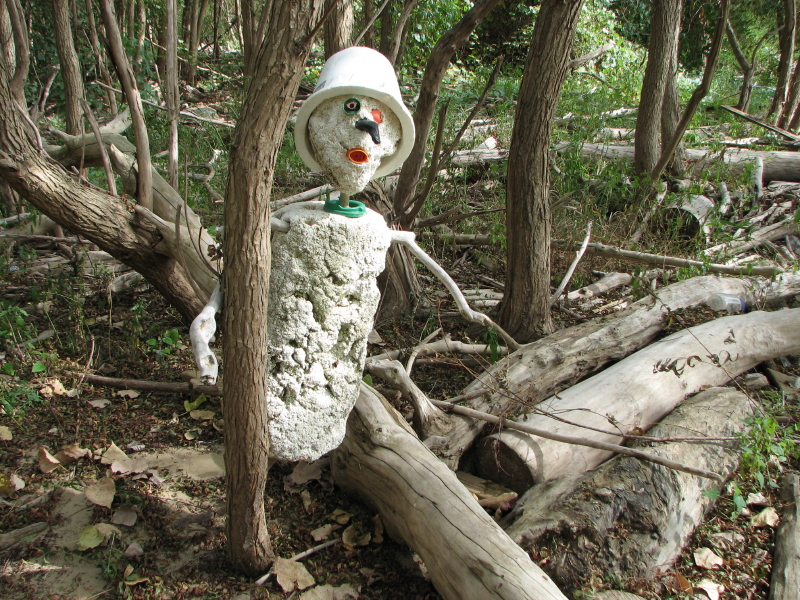
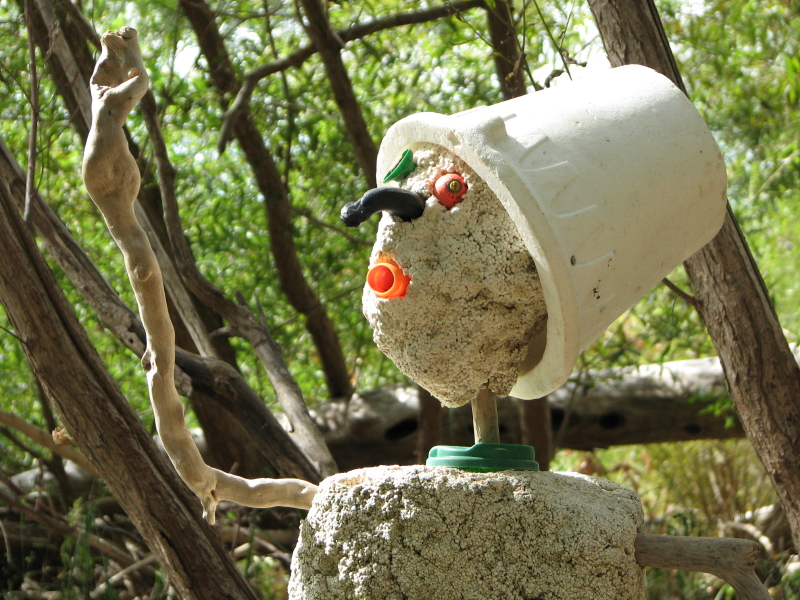
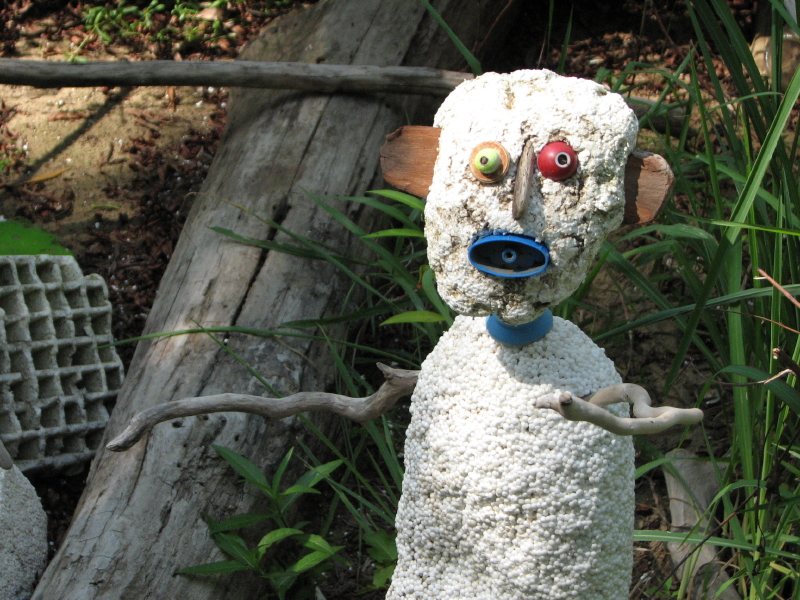
I was walking through the woods on a sun-dappled day looking for migratory birds when I came across a new friend.  We talked for a little while before introducing ourselves.  Both of us remarked on the dry weather we have been having and I said that it’s official now.  September was the driest ever in the commonwealth of Kentucky since records have been kept dating back to 1871.  We have had a spits-worth of rain… that’s it.  Overall, this has been our third driest month ever, beaten only by two Octobers over the course of the past century.  We both wondered if this was an omen for this October?  We certainly hope not.  Having created some common ground, I introduced myself and she said to call her Minnie, Minnie Buckethead.

As it turned out, Minnie is an interesting old lady with a fascination for everything in the woods.  I asked if she had seen any migrating warblers and she had.  American Redstarts, Black and White Warblers, were moving with small groups of other birds including Carolina Chickadees and Tufted Titmice.  I had seen nothing.  I definitely need to get up earlier in the day to catch the bird show.  Perhaps Minnie was taking pity on me and she said that there were a few other things happening in the woods and would I like to see them?  How could I turn down such a nice offer from an old lady?

We walked over to a large willow tree and I saw Minnie crane her neck and squint her eyes from the sun and she scanned the willow bark.  “Here” she said and I checked out what she was pointing at.

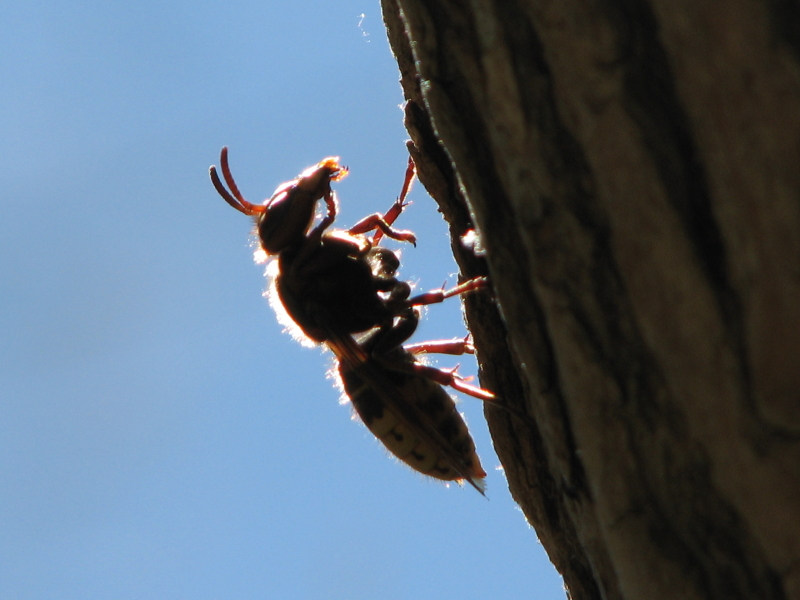
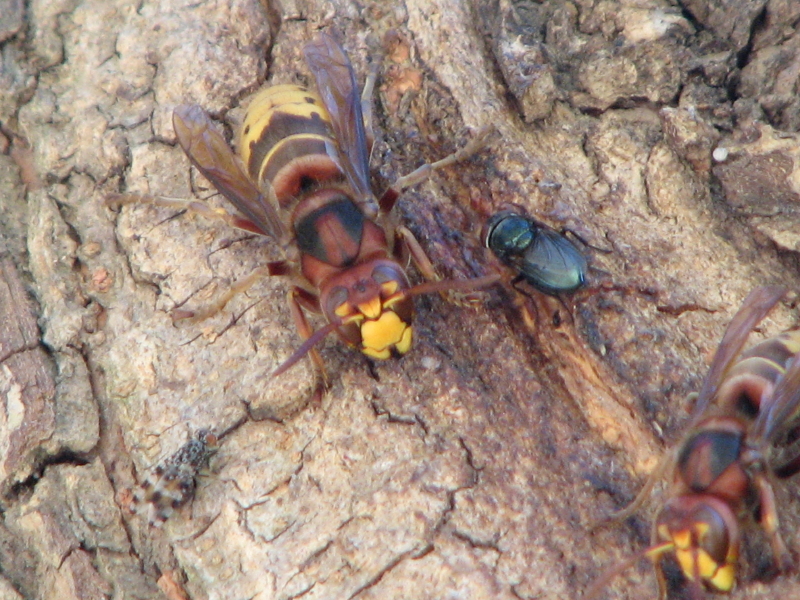
At first I thought it was a bee, but it was larger and more robust and not as big as a bumble bee.  There were others.  Walking around to the shady side I could determine that they are hornets of some kind.  The hornets and other insects were licking whatever was exuding from the willow tree.

“Don’t worry, they won’t get you”, she said.  The hornets were so preoccupied with the sap that they were quite tame.  Walking around the tree gave us this sight.  Three different species of butterflies also taking advantage of the willow bark.  The one in the foreground is the Red Admiral.  Although I hadn’t seen the hornets doing this before, I did say to Minnie that I had observed many butterflies on these willows and wasn’t it nice that so many living creatures could set aside their differences to take advantage of this common resource.  She just smiled.

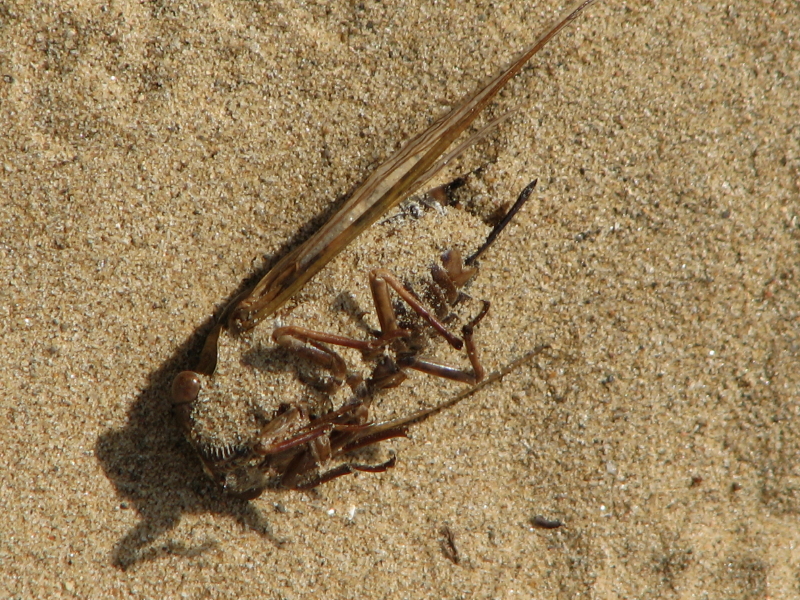
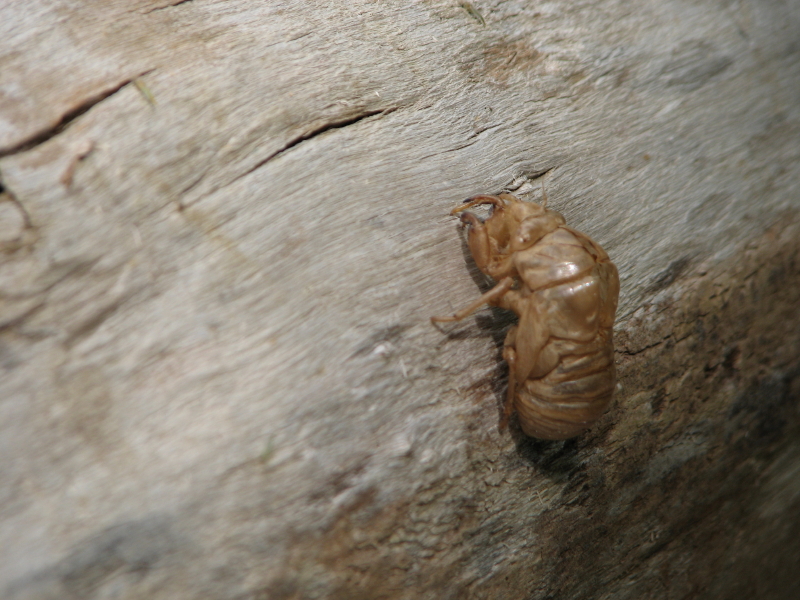
I was appreciative of Minnie showing me the tree and so I tried to impart a little knowledge to her about the local cicadas.  I had come across a dead female in the sand,(identified by the hypodermic needle of an ovipositor she uses to lay her eggs under the thin bark of a tree).  I asked Minnie if she knew anything else about their life cycle and she said she didn’t and so I went on.  I told her that after the egg hatches under the bark, the nymphs drop down and burrow under the ground and attach themselves to the tree’s roots.  With this species, after a couple of years of sucking tree juices, they emerge from the ground and become adults which for cicadas, is a brief moment in time.  They mate, lay eggs, and then die after a glorious two weeks or so.  You find their split skins where they transform as juveniles into adults near where they emerged from the ground.  Here’s a pictures of the dead cicada, the split cicada skin, and a fresh adult.

With any life cycle it’s hard to know exactly where to begin and I suppose that’s the classic which came first question… the egg or the cicada? I’ll leave that to brighter minds than my own for now. 

Minnie listened attentively and then asked me to follow her.  She had something else to show me before we parted company.  We walked away from the willow tree to an area where several large logs were decomposing.  She pointed a thin finger at a yellow patch on one log’s side and I could see it was some type of fungus.  It seemed to be spreading outward as it broke down the tissues inside the tree. 

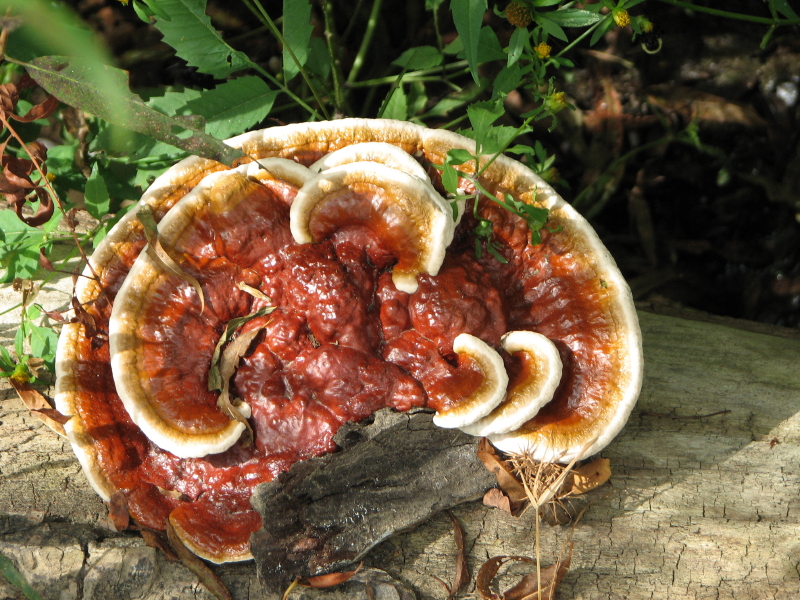
It was both fascinating and oddly repellent. On another nearby log was yet another fungi which I could identify as a fresh bracket or shelf  fungus.  The bright colors also seemed on the lurid side to me.

Minnie talked to me about what a wonderful system that nature has created to break things down after death.  Like these fungi were doing to what were once living trees.  She talked about how life depended on materials being able to decompose in order to release the nutrients that are needed for life to move forward.  This is what it means to live naturally and that we should look at the systems that the planet has in place and to learn from them.  With that, I took my leave and waved good-by to the old lady in the woods.

Read Full Post »

The autumnal equinox has come and gone and with it the this long, hot summer has given way to temperatures twenty degrees cooler.  We are thankful for this and without trying to sound ungrateful…could use a little rain as well.  Artist at Exit 0, the unofficial artist at the Falls of the Ohio, was looking through some older images of his and was reminded of a former project that was offered as a physical prayer and remembrance of times gone by. 

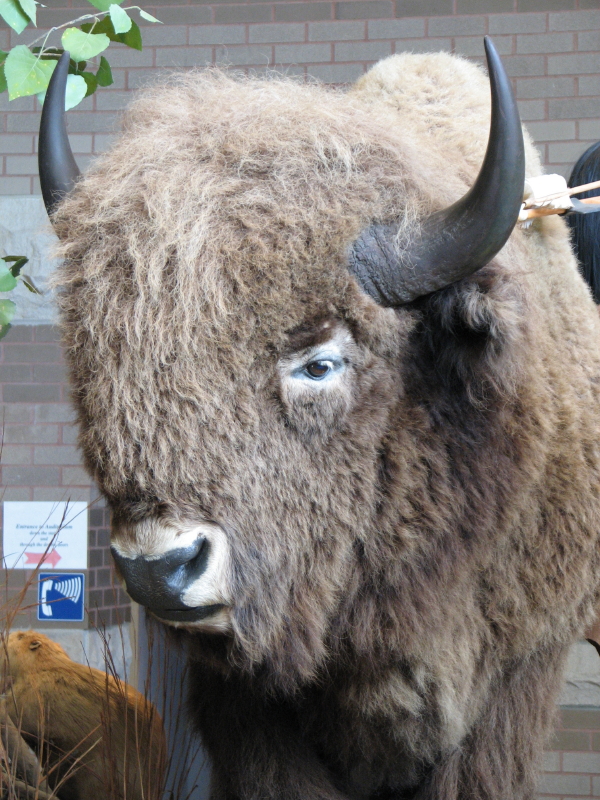
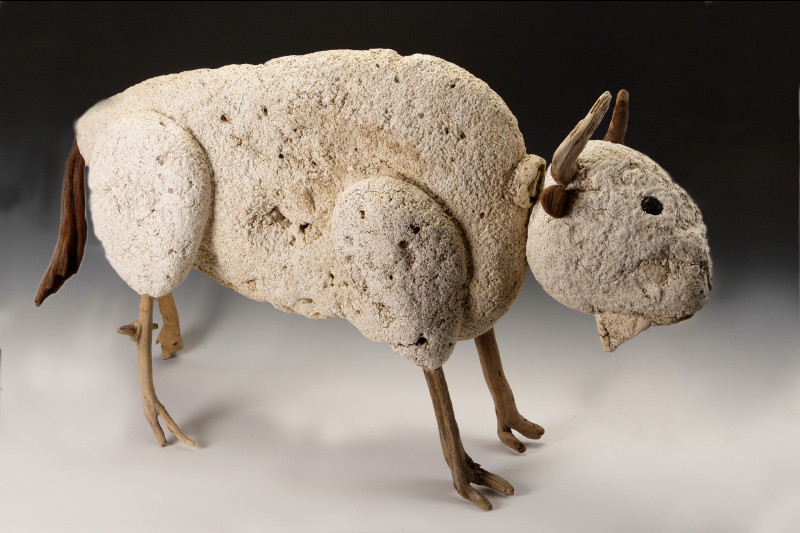
On occasion, references have been made in the riverblog that one of the historic features about the Falls of the Ohio is that it once was an active bison trace.  Animals forded the river at this location and in fact many of the major roads in Kentucky are old buffalo trails that have been paved over.  For millennia, bison were a resource that people could count on until they were slaughtered on an industrial scale in the 19th century for a variety of reasons…none of them good.  To the indigenous people, bison were more than their supermarkets and great spiritual significance was associated with them.  It’s probably a miracle of some kind that these animals continue to exist to the present day.  Artist at Exit 0 has made several bison pieces over the years…but this was his favorite one.

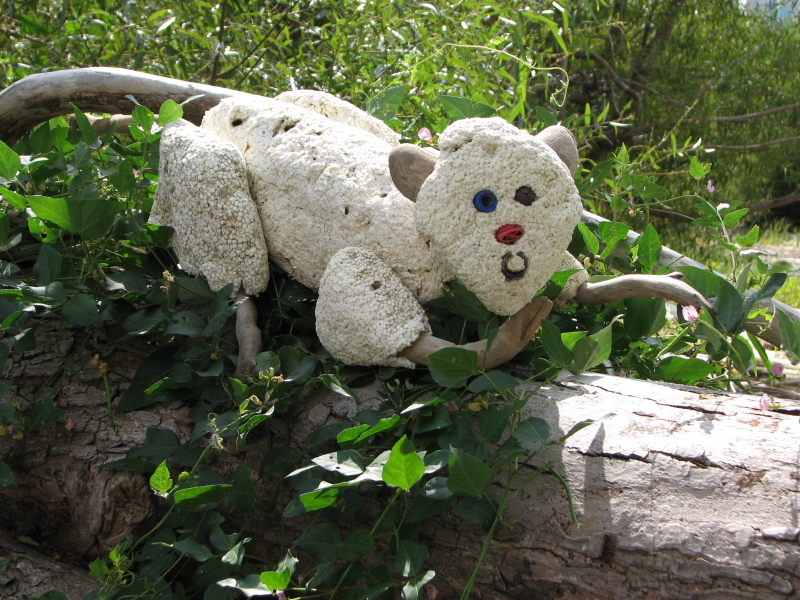
Here it is presented as a simple art object.  Constructed from river-polished polystyrene, driftwood branches, and nuts this piece was about as large as a good-sized dog.  What the artist especially likes, however, are some of the images showing the Styro-Buffalo in the context of the Falls.

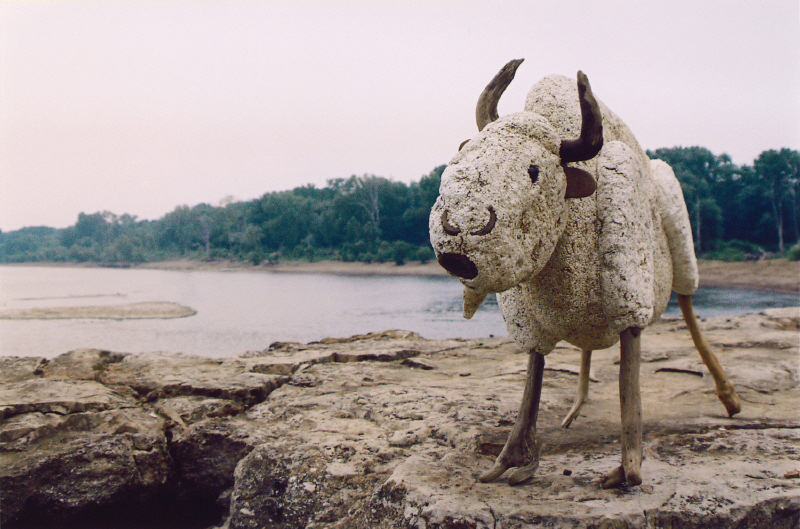
The Styro-Buffalo was photographed on the fossil cliffs near the western section of the park.  The images were recorded with a 35mm camera and conventional print film that was developed at the local drugstore.  I recently read in a Wikipedia search, that the white buffalo is an extremely rare animal and their births occur in approximately one out of every ten million births.  Whether this takes into account leucistic (white fur, blue eyes), albinos (white fur, pink eyes) or other genetic anomalies is not certain.  We had a female, white bison calf born in Shelbyville, KY in 2005 at a buffalo ranch and tourist attraction called Buffalo Crossing.  The animal was named “Cantje Pejute” from the Lakota language which translates to “Medicine Heart”.  A recent search on Buffalo Crossing was inconclusive as to whether the ranch is still open to the public and with it the fate of this particular animal?

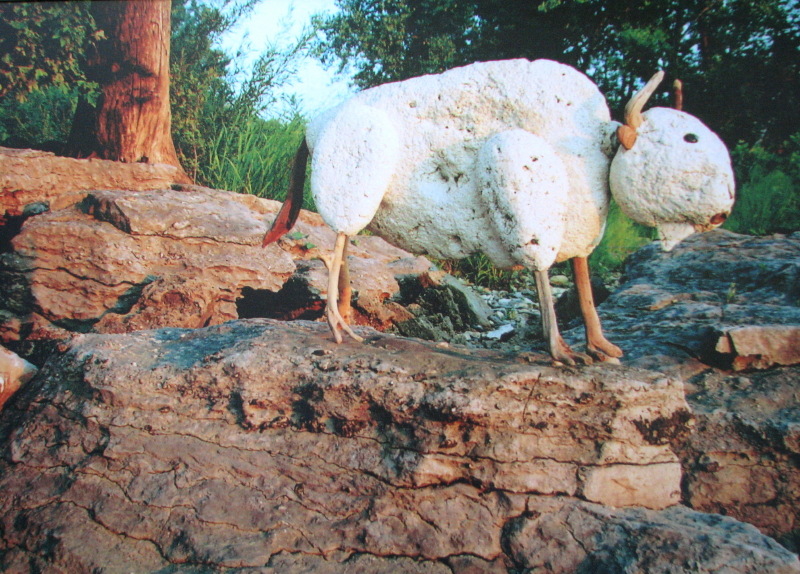
Here is the Styro-Buffalo photographed at sunset on the fossil rocks.  One critic who commented on this image considered it overly romantic.  It was meant to be a pejorative statement since apparently there is little room in contemporary art for work that includes nature as part of the work’s context.  The quest for the sublime and awe for nature are not generally in fashion in the high contemporary art world.  Artist at Exit 0 was okay with that comment only because it underscored and confirmed personal observations about the contemporary art world that Artist at Exit 0 feels mirrors the general disconnect he perceives from our kind for the environment.  If we persist in this attitude…we too may go the way of the buffalo and again it will be our choice. 

 This post is offered in friendship to 47 Whitebuffalo who’s fine blog is full of social conconciousness and art.  Her link is included in my blogroll on my home page.

Read Full Post »

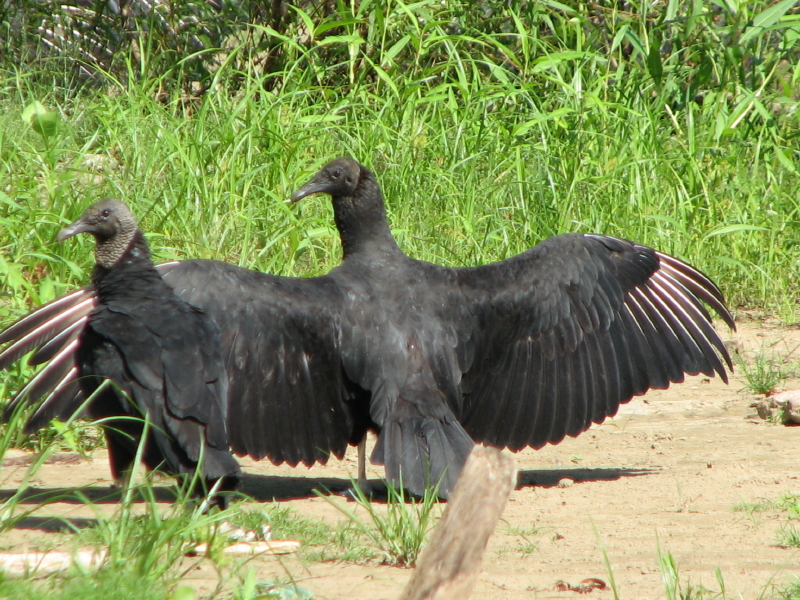
It’s official, this summer was our toastiest.  I looked at the lead article in the local newspaper and words like historic and unprecedented are being used.  We beat the old record that stood since 1936 by a degree and a half!  In meteorological terms that’s a lot.  This was determined by factoring the daily highs and lows and taking the average temp for the day. Louisville had more than 80 above average temperature days this summer which was more than any other city in the country.  No wonder working at the Falls felt so harsh.  We had a number of high pressure systems that just hung around the Ohio Valley making life difficult for everything including these vultures.  Of late, every year has had something climatically anomalous about it.  Too dry, too hot, too wet, too cool…missing are words like usual, normal, ordinary, and uneventful.

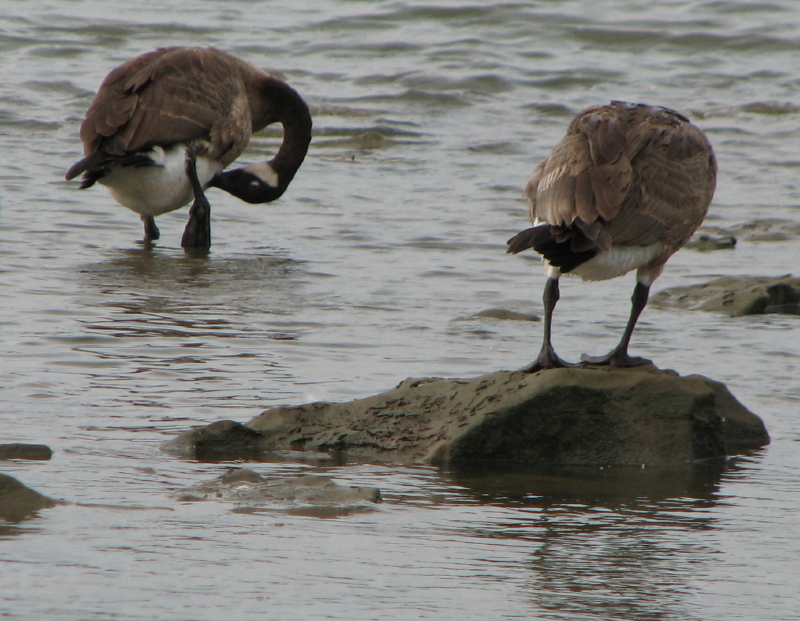
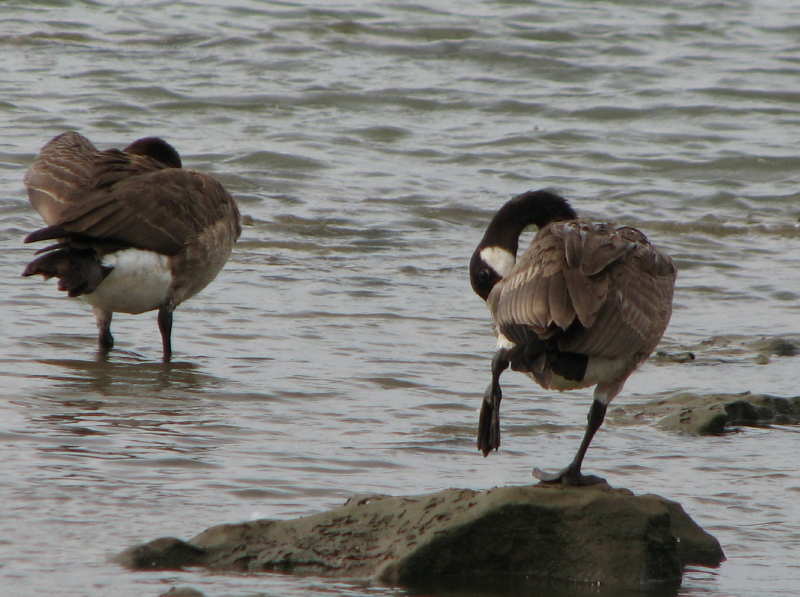
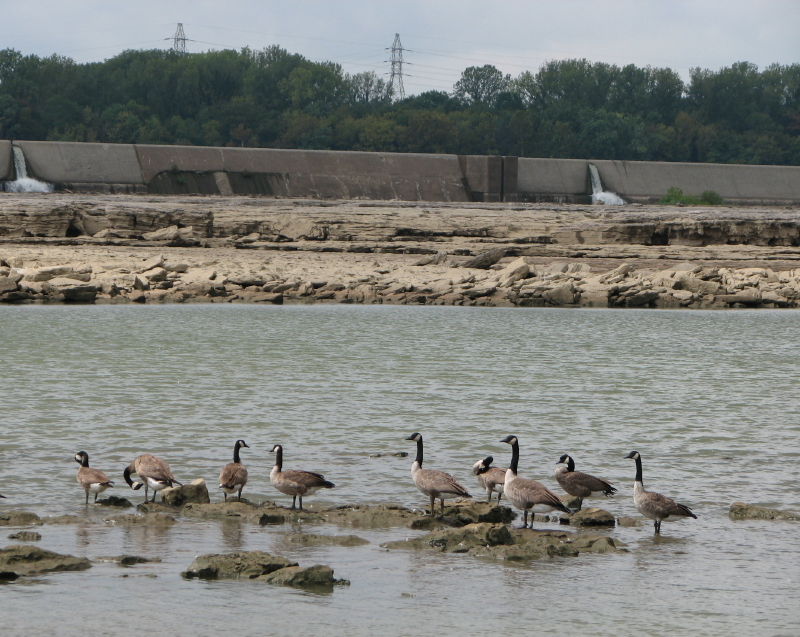
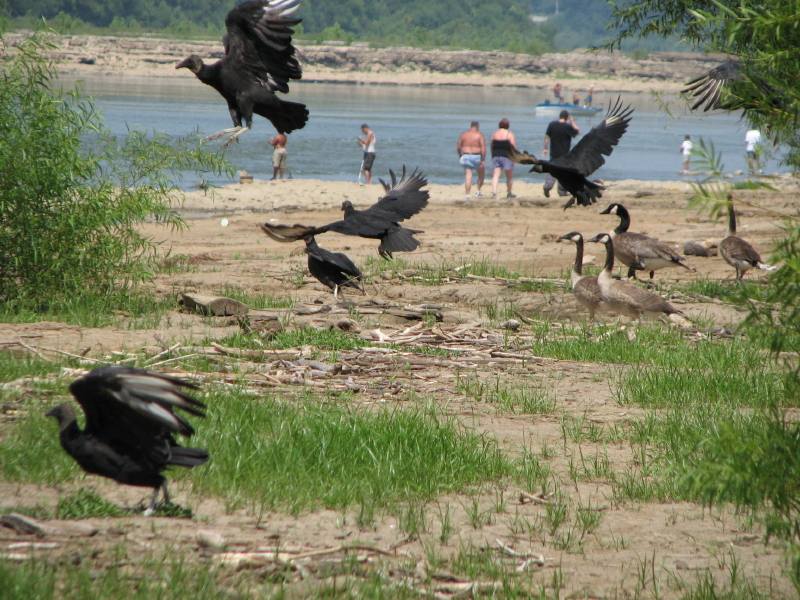
The variety of bird life at the Falls has been down this year too.  When you are a creature that is sensitive to the environment and have the advantage of great mobility…your instincts can tell you to go elsewhere.  I think this is what happened this year.  I will be really curious to see what comes by on the Fall leg of migration.  This year the Black vultures did well as did the Canada geese.  I could count on seeing those two species in good numbers most anytime I came out to the river.

From what I can see “anecdotally” the Canada Geese are on the rise here.  We have few predators to challenge them.  I have seen some very large flocks out on the water and they are keeping the grass clipped short along the riverbank too.  Friends told me that in the “old days”, you could find large stands of native river cane on the margins.  That’s something I don’t ever recall seeing out here.  One of the values I place upon this blog is to act as a record of the environment as I find it.  We have journals and first hand accounts of what this place looked like two hundred years a go and I believe that two hundred years from now…people will still be interested in the Falls of the Ohio and how it has been changed by civilization.

One of my favorite summer birds are American Goldfinches.  There is something cheerful and friendly about them.  The male with his bright yellow and black plumage is an unmistakable bird.  Many times I have watched the dipping and rolling courtship flight and listened for their call notes.  In the past, I have seen this species in mass, but not this year.

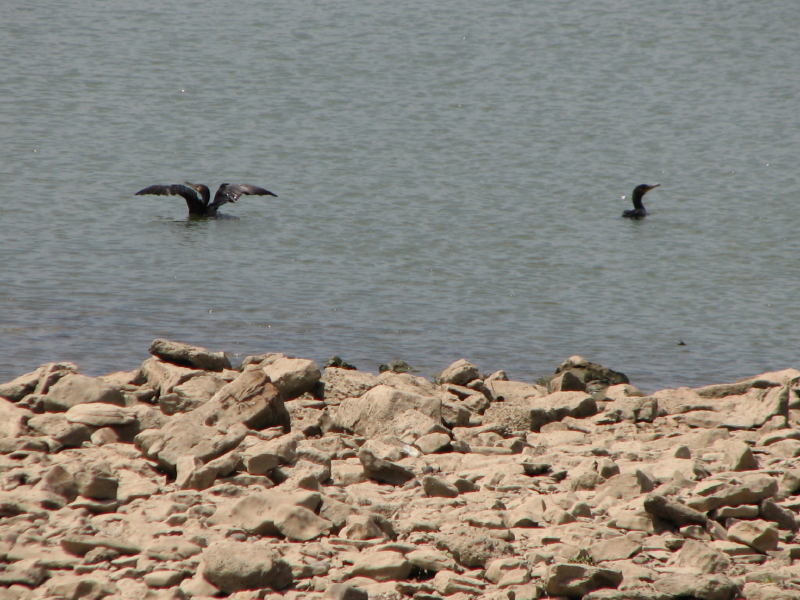
I’ve had conversations with people bragging about their fishing luck or skill, but none of them can hold a candle to a cormorant.  The Double-crested Cormorants in this picture are able to find and catch fish when nothing else can.  Of course, it helps to be able to swim and pursue prey underwater!  These birds are wary and very hard to approach.  In other places of the country, fishermen have persecuted this species because they compete very successfully against the rod and reel.
One of the few interesting and new birds to write about is the Azure-winged Mockingbird.  I have encountered them by my studio under the willow trees.  They are fearless and will drive away larger birds.  Among their notable features is the way they flash their wings against their bodies which makes them look more aggressive.  I have wondered as I make my Styrofoam sculptures, if these birds are drawn to the mosquitos and gnats that find me!  This is not a common bird and has been rarely recorded here.  I expect that in a few weeks, it will be winging its way to Central America.  I wonder if this year’s events in the Gulf of Mexico will compromise it and other birds in some way?  The forecast for this holiday weekend looks great and I’m anxious to spend a bit more time out here on my projects.  I’ll close with one more image of my mockingbird friend and a sculpture still around from several weeks past.
Read Full Post »

Battered and tired the old soldier looked wistfully to the west.  They said it would be an easy war as wars go.  And sure enough the enemy that wore a uniform was quickly overwhelmed.  Much, however, had changed since Styro-Odysseus began his career as a common soldier. 

Victories were no longer clear-cut and the peace was hard to recognize. Nobody could remember what they were fighting for?  After many years of trying to win the hearts and minds of the occupied people it was time for Styro-Odysseus to return to the muddy shores of his origin.

He had his country’s thanks, but all the old soldier wanted now was the comfort of his family and familiar surroundings.  His valor was now a thing of the past.  It would take all of Styro-Odysseus’ remaining energy to walk the distance towards the life he most desired.  His armor, shield, and standard that he once wore with pride grew heavier with each passing step.  He thought often of the innocence of childhood and green fields.

Along the way, Styro-Odysseus could not help noticing that the country he had risked his life for had fallen into neglect and ruin.  In places it looked as though the war had happened here.  He could not understand his countrymen’s apathy?  He wondered if people still cared?

Rounding a bend by a river, the returning veteran had the oddest sensation that the people had in fact been bewitched and turned into geese.  That would explain the poor condition of so much he observed around him.

Meeting fellow travelers along the way Styro-Odysseus learned that much of his beloved land was in a similar condition.  The ordinary man had become disillusioned by evil pundits who were masters of instilling fear and preyed upon the best intentions of the good.

Styro-Odysseus had much to think about.  It seemed to him that righting the course of his own country might prove to be a greater challenge than fighting a foreign enemy.  What force of arms could be used to fight the new enemy that resides within? What could inspire the people and renew the idea of a shared common purpose?  While Styro-Odysseus’ mind grew cloudy…his feet kept on walking and soon he reached a familiar path.

Styro-Odysseus was home and he forgot the great weight he carried upon seeing his family.  For now, he would set aside his armor and forget the duties of being a soldier for at least a little while.  He would try to allow what sweetness that remained in the world to begin the healing process.  The old soldier would rest and renew his energy for the next task at hand.

Read Full Post »

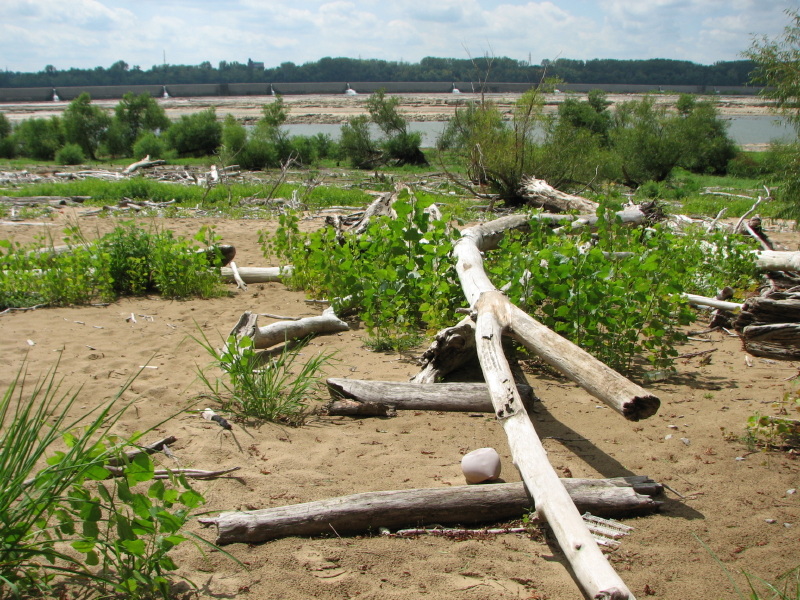
The heat and humidity remain unabated.  I think this is the hottest summer I have spent at the Falls of the Ohio.  Yes, there were always super hot days in the past, but this year we have had many more of them.  I was excited about this weekend because I have three days off, few family obligations, and I planned to go out to the river to see and make what I could.  I have collected some large pieces of Styrofoam and it’s time to use it before the river eventually rises and carries it all away again.

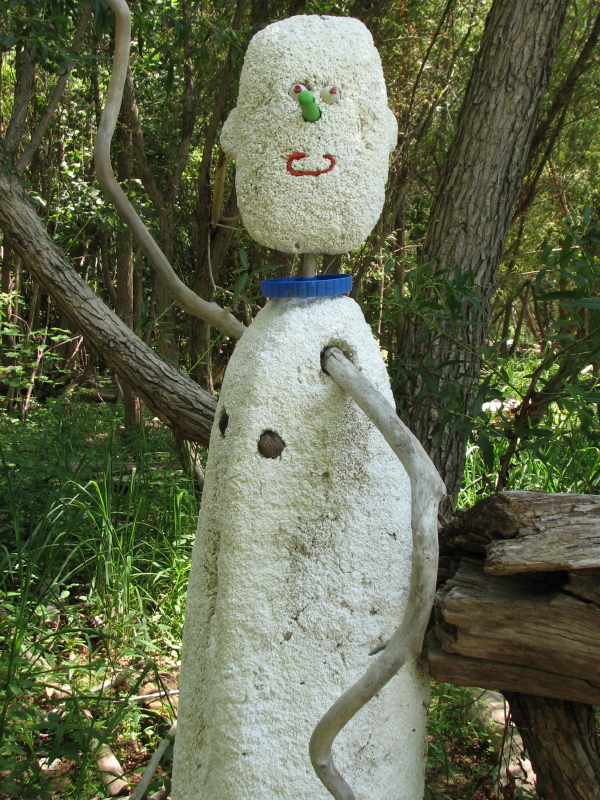
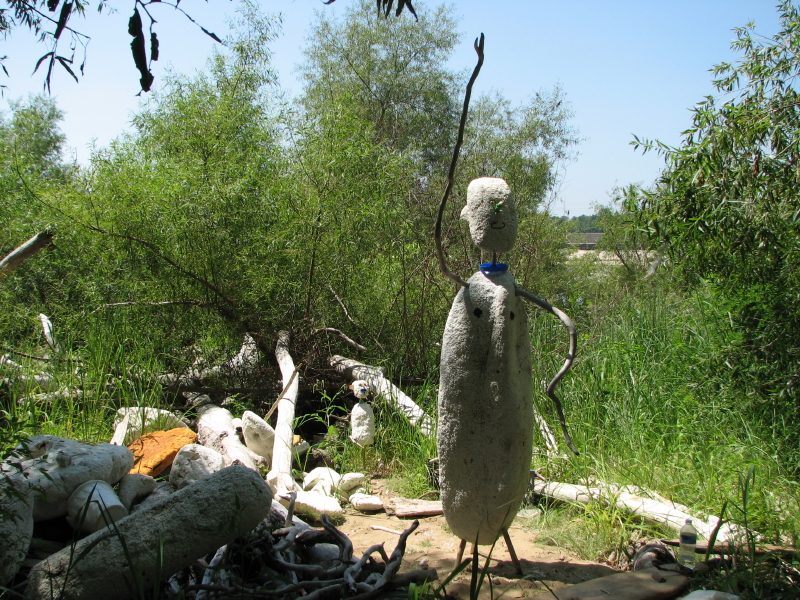
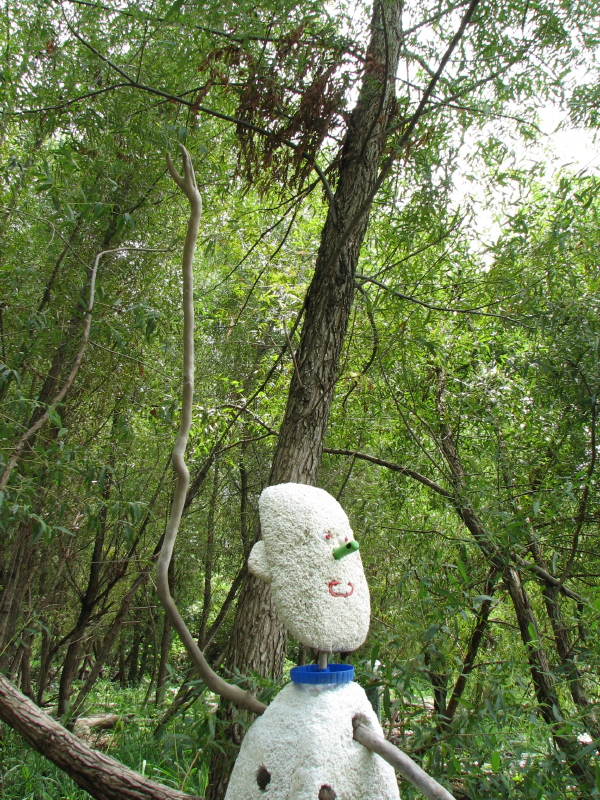
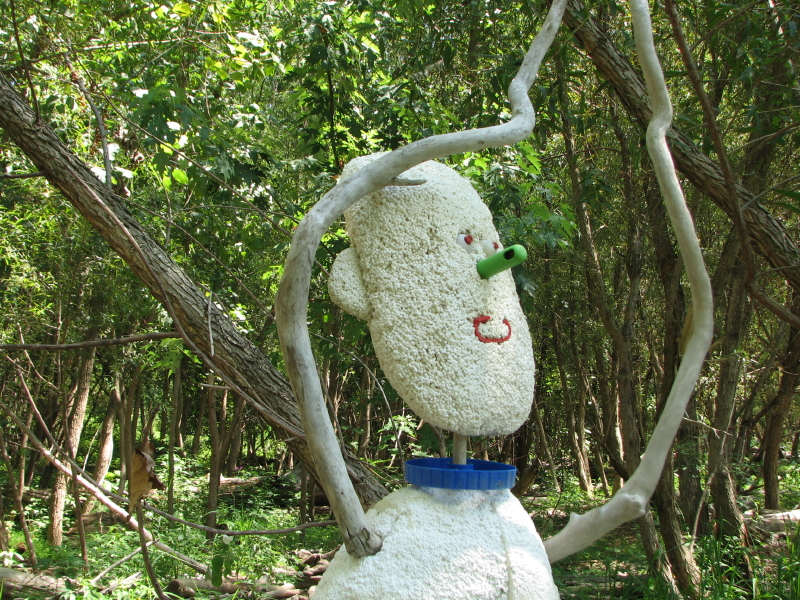
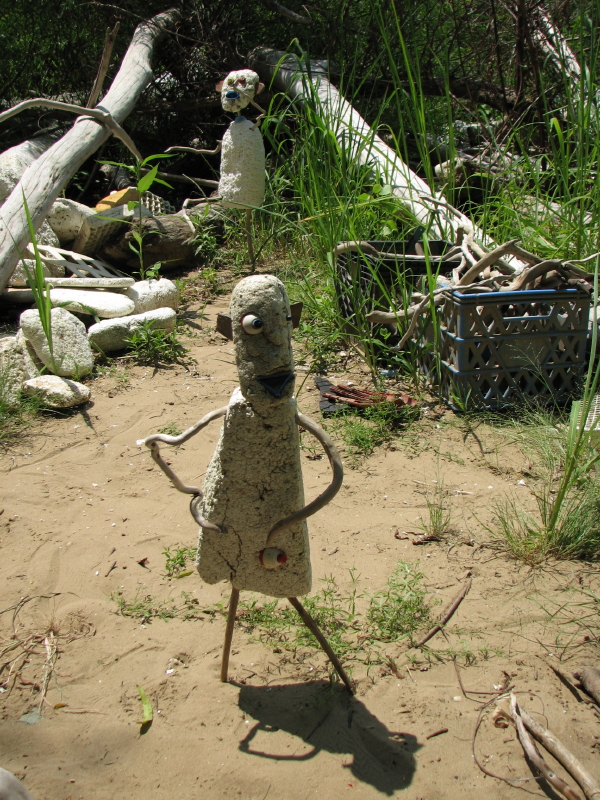
On this day, I have made one of my tallest figures ever.  This one is a head taller than I am and when you add the extra long arm…it is even more so.  I can’t say that I worked up a story to go with this one…yet.  If, however, he hangs out long enough, I’m sure I will think of a narrative.  For now, this is what I made and in the process I drank all the water I brought with me and soaked through my shirt.  A mixture of sweat and sun block kept running into my eyes which led to a few choice words said by me.  Fortunately, there wasn’t anybody around to hear them!

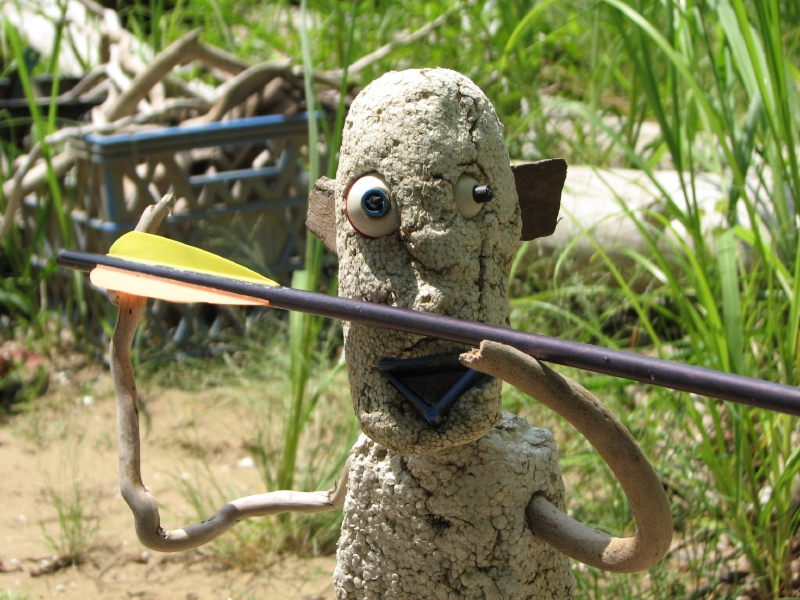
After I made this figure, it seemed to me that it had some affinities with the Wallace and Gromit characters.  I think it’s because of the close-set eyes and large nose?  I like that this guy has a sense of humor which can’t be said about some of the figures I have made before.  He’s probably amused that anyone would choose to spend their day off engaged in this activity!

What prompted this sculpture was the long stick I eventually used for one of his arms.  The body is somewhat elongated and the extra long arm brings this out even more.  Perhaps the arm is an evolutionary adaptation for picking fruit from the higher branches of the tree?  In this way, it works similarly to a giraffe’s neck with its ability to reach the topmost leaves.

The brutal sun kept me close to the shade of the willows, but even this had its issues.  There are mosquitos in the shadows and the humidity is trapped by the vegetation and foliage.  Being uncomfortable made me less patient with myself.  Every once in a while I would get distracted by the song of a wren or the myriad insect life around me.  There are still many butterflies and wasps visiting the flowers and willow trees.

I had a few technical problems to work out. The main one being how will this sculpture stand upright?  Even though the sand and mud are soft, this figure is clumsy and comes down to a point.  My solution was to rest the figure on a tripod of sticks.  Two of them can be seen, the third “leg” lends support from behind the figure.  Once it cools down, I would like to move this sculpture around the different vignettes that the Falls offers and see if I can improve upon the photographs.  For the moment, I consider these evidence that I made something on a fairly uncompromising day cut short by the heat.  I decided to leave early and left this figure resting against the trunk of a tree.  I can’t wait for it to cool down a little.  I can tell Autumn is around the corner.  I detect a hint of yellow in the leaves around me that were a bright green not too long a go.

Read Full Post »

Vulture Boy hung out with me today at the Falls of the Ohio.  He’s a bit of an odd character and I don’t see him often.  He spends most of the summer observing the resident vultures of both species that live here.  He’s studying them. Vulture Boy also thinks of himself as being a bit of a survivalist and when civilization collapses…he will be able to fend for himself by mastering primitive weapons. 

He’s still a boy after all and seems to gravitate towards sticks and stones.  There must be some primeval aesthetic operating here that’s hard-wired?  Regardless, what I enjoy are Vulture Boy’s stories and encounters with the wildlife he sees in the park.  He tells me that he saw some Black Vultures feeding nearby and would I like to watch them?  I pick up my camera and follow him to the river.

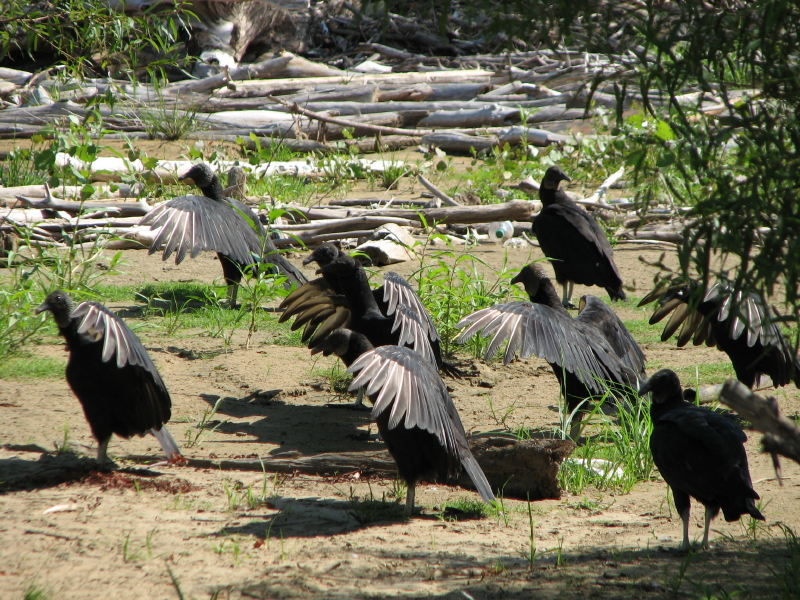
Along the way we surprise two flocks of large birds!  It’s another very hot day and both the vultures and Canada geese are taking advantage of the shade under the biggest trees.  It’s cooler, but they are also vulnerable standing on the ground.  Some passing fisherman got too close and both flocks spooked and went airborne.  I could practically feel the whoosh of air pass my face as the vultures struggled to lift skyward.

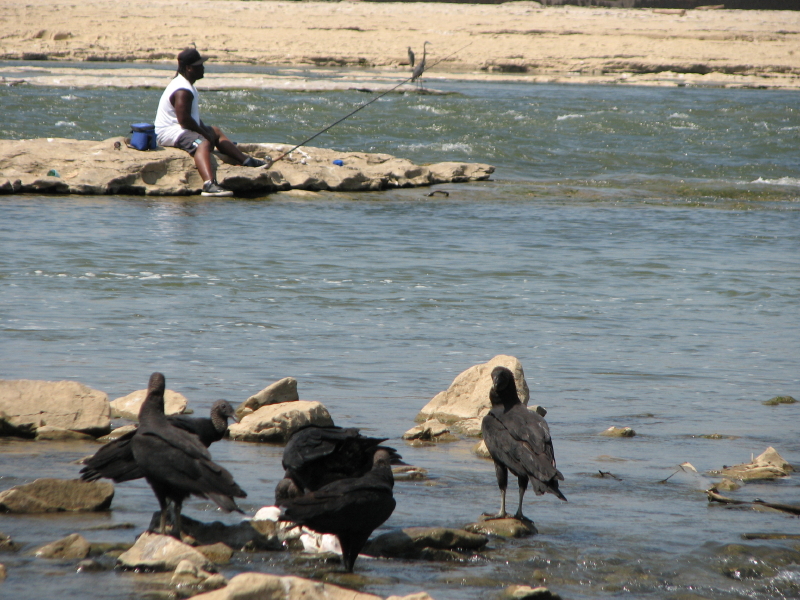
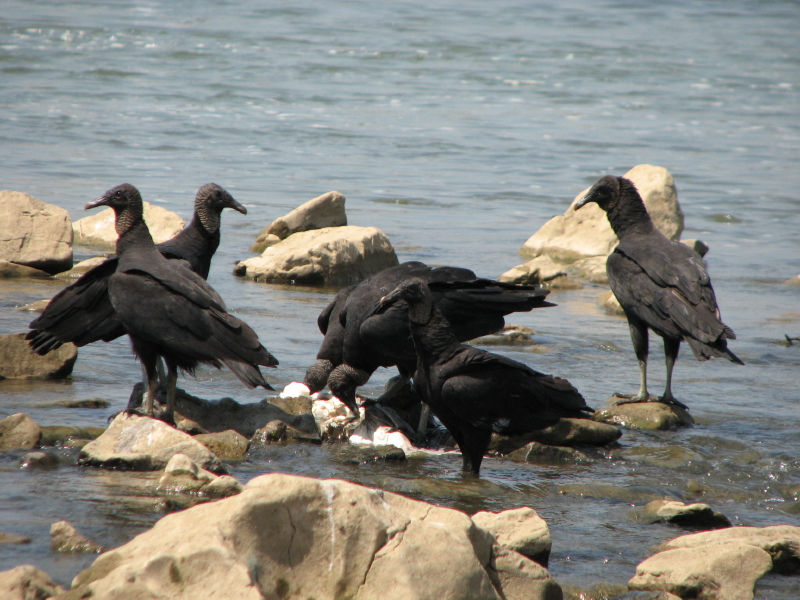
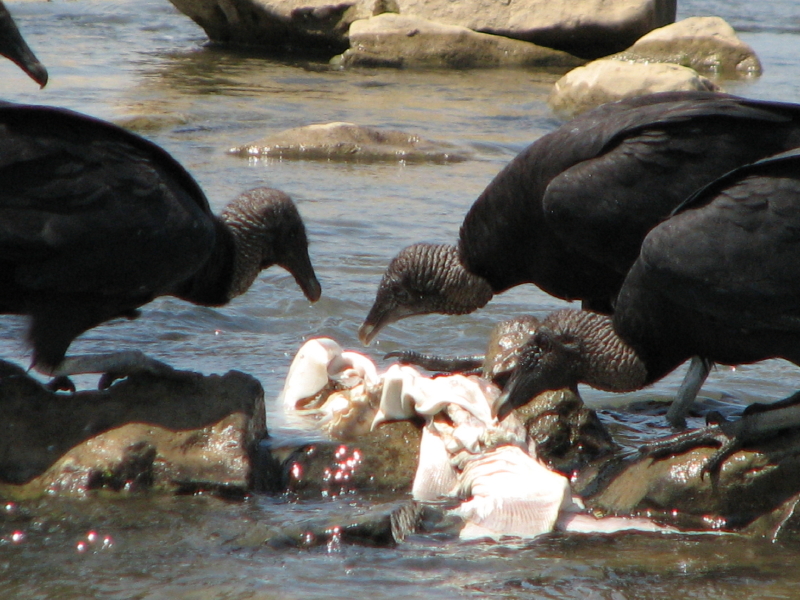
Reaching the river, we find a few Black Vultures feeding on a fish carcass.  They were completely unconcerned about the people around them.  I wonder in some way if the vultures recognize the relationship between the people and the availability of fish?  Vulture Boy says that they are smarter than you think and adapt to situations that benefit them.

Slowly I move a little closer doing my best not to scare the birds away.  It’s tricky though because the rocks are very uneven and slippery in places.  With their all black bodies, I wonder if they feel hotter on a day like today?  That’s when Vulture Boy lays this factoid on me!  He says that Black Vultures (and other vultures as well) can excrete their waste onto their legs to cool them.  The process is called “urohydrosis”.  Charming! 

I asked Vulture Boy what else he liked or thought interesting about these birds and this is what I remember.  He said that they form strong pair bonds that are usually only broken upon the death of one of the partners.  Additionally, they do not build nests preferring shallow caves or protected rock ledges to raise their young.  Although Black Vultures may roost together, they do not like being near each other’s nurseries.  There is still that competition for food and a pecking order exists not only within the Black Vulture group, but with other species as well.  The shy Turkey Vulture usually surrenders his find to the more aggressive Black Vulture.

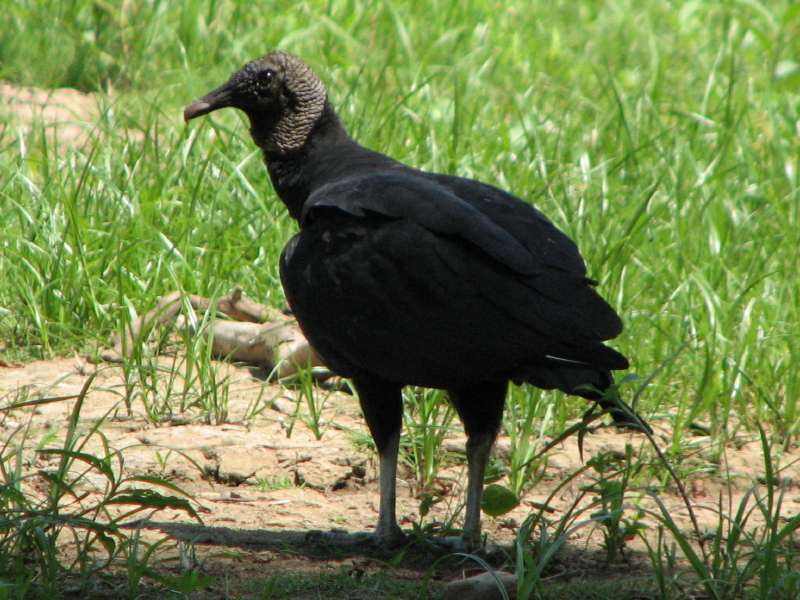
With their naked heads and necks…these vultures look more like the dinosaurs they are descended from.  The lack of feathers around the head helps keep things a little cleaner.  Still, I’m amazed that these birds are able to stomach most anything!  I’ve seen Black Vultures using their feet to help leverage a food morsel from the toughest meal.

After watching the river vultures for a few minutes, it was time to go home.  Walking back the way we came Vulture Boy and I could see that some of the vultures had returned to the shade under the trees.  A few individuals were nervously posted along the outskirts acting as look outs.  We walked around them and left them be.  Nearby, we came across roosting vultures  high in a tree.  Occasionally, one of these birds would sun itself by spreading its wings and it seemed almost a reverential act.  Or, at least…that’s what I like to think! 

Read Full Post »

It’s been a brutal and tough summer…one of our hottest yet.  When you are at the river’s edge there’s no place to hide.  It’s just rock, water, and sky.  Life in all its forms is trying to expend just enough energy to keep going on.  That also includes me.  The mosquitos and gnats were extra annoying and chased me from the cool and shade under the willow trees to the open light and heat of the riverbank.

In the air above me, a pair of osprey makes repeated visits to the dam.  Every once in a while, one of them would fold its wings slightly and dive into the river.  I wonder how they know that the water here is shallow?  On occasion their daring would be rewarded with a fish.  Birds, however, are not the only ones ignoring the heat today to chase fish.

This guy has just landed a catfish and is extracting the hook.  Around him is his fishing tackle which includes several poles and a small throw net.  To me it all appears very primal and it wouldn’t have surprised me at this moment to see him take a bite out of this fish.  Observing people fishing out at the Falls is like watching one of those nature documentaries where large bears intercept the salmon on their return home.  People arrange themselves along the most productive sites and arriving early helps. Not all the fish caught by the fishermen are kept.  The rough so-called “trash fish” are thrown back in a weakened, wounded condition.  I have seen the osprey picking those fish off and flying away with them.

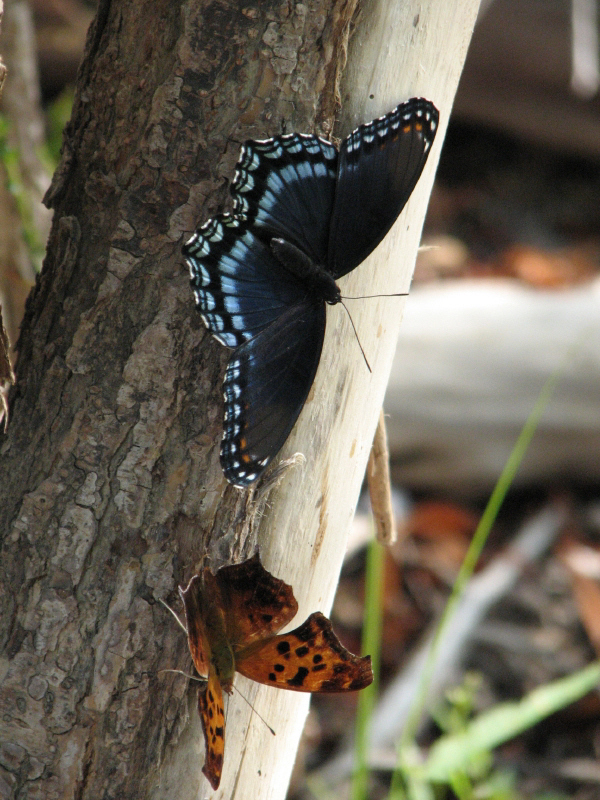
Butterflies are seen in profusion during this time of year.  I have been watching which species like to congregate around the willow trees to sip up what I assume is tree sap.  I have seen as many as six different species lining up on the same tree.  I think areas where these trees have been damaged (from collisions with water born logs) are the preferred feeding areas.  These places that the butterflies like (this includes flies and wasps too) are on the margins of where bark has been worn away.  The above photo features two species…the larger Red-spotted Purple and the Comma butterfly.  I later watched these two individuals engage in a combat over a favorite spot on the tree.  The Comma was by far more aggressive.  So much for the idea of describing a butterfly as being meek.

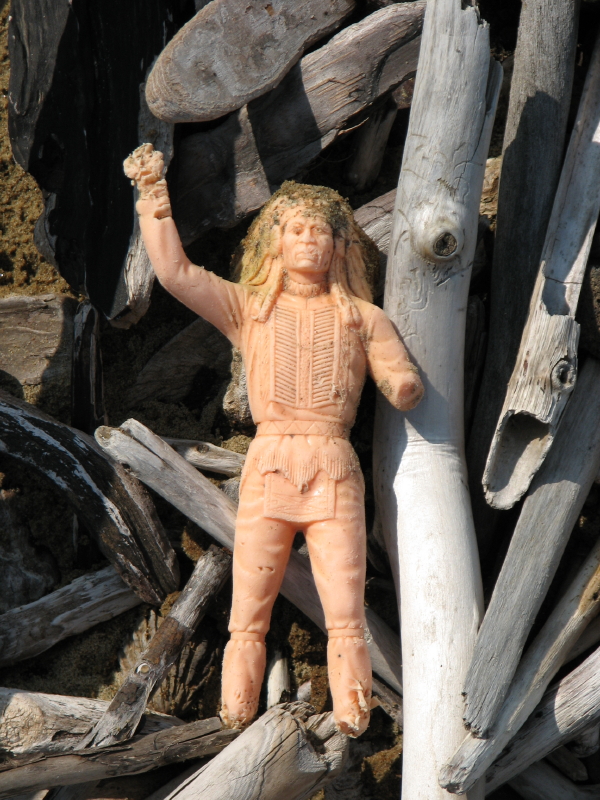
I did make one plastic discovery tangled in the driftwood and sand.  I came across this Indian dressed in his Plains garb.  He’s obviously has led a hard life too and has come to rest at the Falls of the Ohio.  I snap his picture where I found him and dropped him into the collecting bag.  I may or may not use him in some other creation of mine.  We will see.

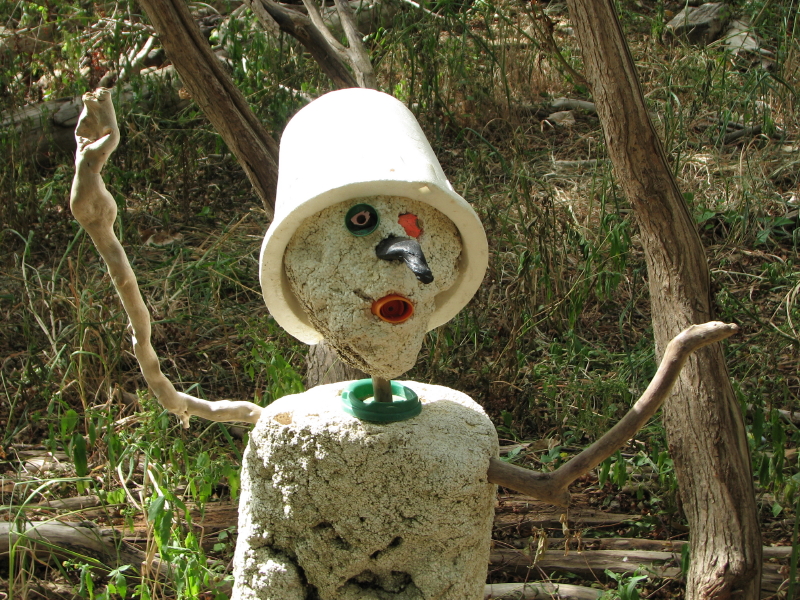
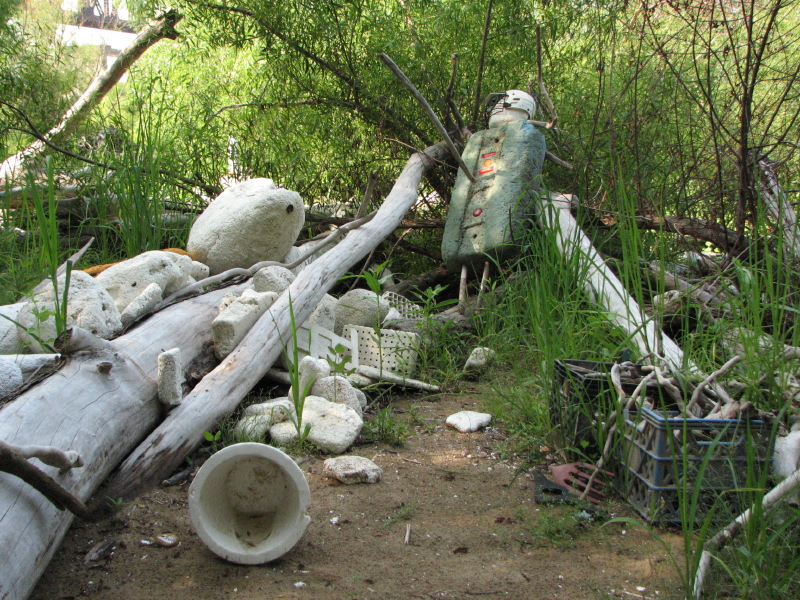
When I reached my studio under the willows, I found this image.  The helmeted figure made a month a go is still here, but he was leaning over with a “spear” thrown into his body.  There wasn’t any other signs of damage or disturbance.  I removed the spear and set the figure up in another location and proceeded to make a new piece.  This is what I came up with before the bugs chased me out into the bright light.  With all the heaviness that life throws at us…I made this figure to remind myself to do a little dance every now and then.  It seems to help!

Read Full Post »

« Newer Posts - Older Posts »