Feeds:
Posts
Comments

Archive for the ‘recycled art’ Category

Softball core river pearl from the Falls of the Ohio

It started with one.  I had been picking them up for years…odd, yellow ocher orbs that the river marooned in various sections of the Falls of the Ohio State Park.  Initially, I was intrigued by them because I knew they had to be something, but what?  Early on I formed this association in my mind that these balls were giant pearls and they were gifts to me from the beautiful river.  Made from a lightweight yet solid, hard foam, these balls weathered in very individualistic ways.  Many of them had acquired a nice patina from their river journey perhaps floating long distances for many years.  For a while, each time I would go on one of my excursions to the Falls of the Ohio, the river made sure that I would stumble upon one or more of these balls.  Into the collecting bag they would go.  Eventually, I found out what kind of balls they are and in case you haven’t guessed yet…here are a couple more images that will reveal what they originally looked like.  I’ll start with one of these balls in the process of transforming, followed by one that is more intact.
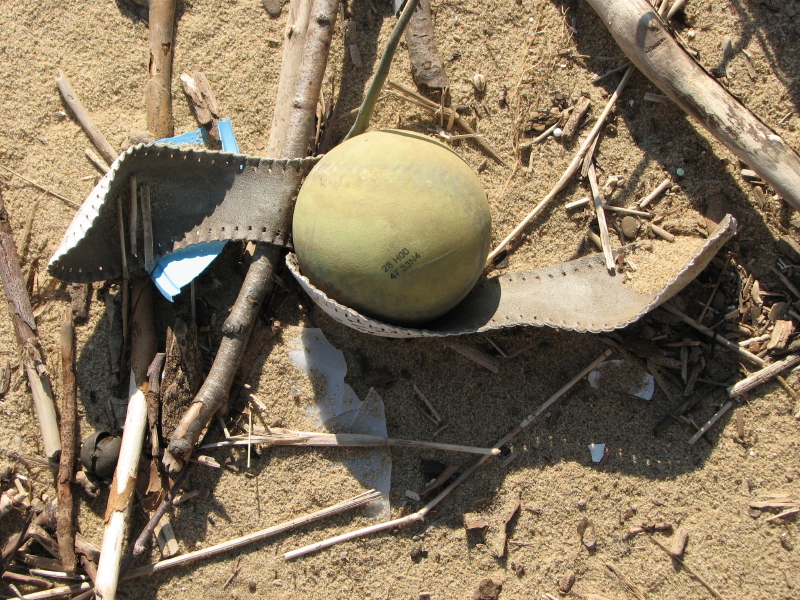
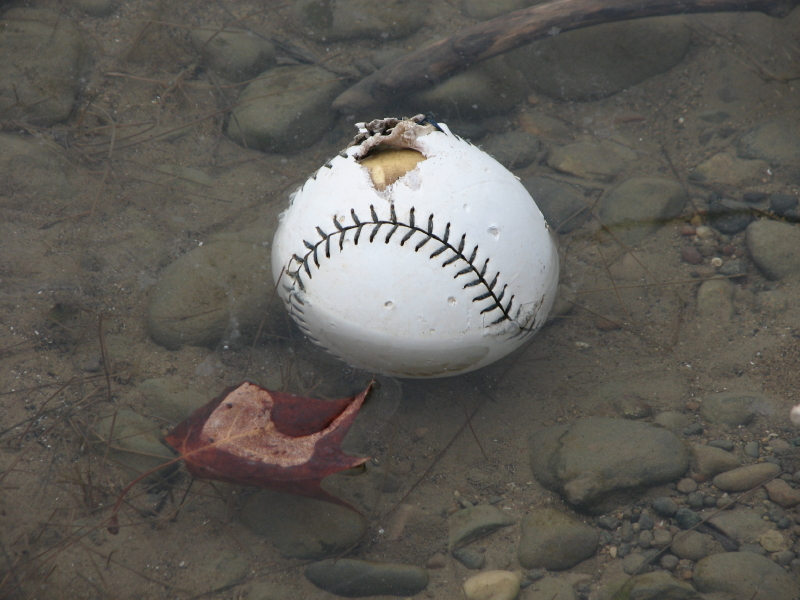
softball with covering coming off, Falls of the Ohio

softball in the river

My river pearls are the cores of contemporary softballs.  How did all these softballs end up in the river?  When I was a kid, a softball had a hard rubber ball in the interior which was surrounded by what seemed like miles of string wrapped tightly around the rubber ball.  A two piece leather cover was then sewn over this “string ball” which completed the softball and was now ready to be played with.  For those who might be unfamiliar with softball…it’s a game similar to baseball, but the ball is about twice as large as a standard baseball.  I collected these softball cores for years, but especially during the early phase of my Artist at Exit 0 Project.  After each river trip I would dutifully fill up boxes in my home’s basement with my found balls and then forget about them.  Over time, I started picking up lots of different objects and using them in various ways as materials for my sculptures or as offbeat collections of odd items I was creating.  I guess I always knew that I would return to these balls and make something interesting with them someday.  That day arrived last week.

softball cores in my backyard, Oct. 2013

I had no idea how many of these balls I had collected or passed up over the years?  This recent photo taken in my Louisville backyard shows about 110 out of the 160 balls I did save.  I decided to act on my river pearls idea by making an impractically large pearl necklace.  I carried all the balls I had to my friend Tom’s sculpture studio and used his drill press to drill a hole through each ball.  That was a bit more of a technical challenge than I had first conceptualized.  Most of these spheres are not perfectly round. In fact their imperfections (which I really like as evidence of wear by the river and elements) made each drilling a unique experience.  Eventually, I got the job done and laid out many of the balls on the concrete pad in my backyard.  Just as I was beginning to thread and knot braided nylon cord through the balls…the sky let loose a monstrous rain storm.  By day’s end, nearly seven inches or 17.5 centimeters of rain fell and flooded parts of my backyard and basement!  It was like being visited by the river in an interesting way.  I had initially “graded” each ball by condition and color to form transitions in this giant strand, but the water and now mud from my backyard changed the color of each ball.  I decided to make my first piece one hundred balls long.  There is a knot tied with the cord that keeps each ball from touching.  At my local hardware store I found a brass hook that I could use for a clasp to close my giant necklace.  All that was left to do was to return to the river…to the place that I found all of these balls and inspiration and find a way to give thanks for these many gifts.
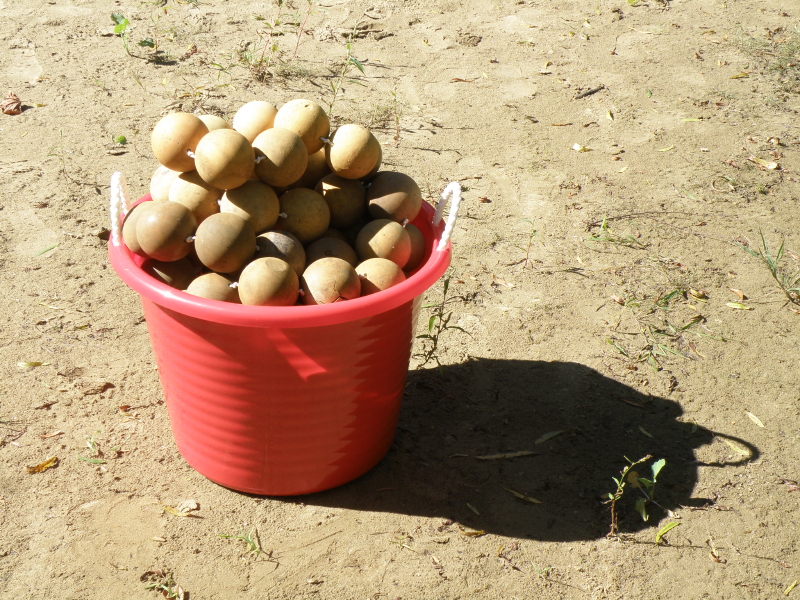
river pearl necklace in plastic bucket, Oct. 2013

Loading the necklace into a large red plastic tub I carried my artwork down to the Ohio River.  One hundred balls became surprisingly heavy and I was concerned about twisting an ankle or tweaking my knee as I walked over the driftwood.  I came to a sunny place under the railroad bridge and laid the necklace out upon the sand for the first time.

weathered softball cores, Oct. 2013

Here’s a look as some of the weathering that occurred with a few of the balls.  And here is one of the first images of the necklace joined together.
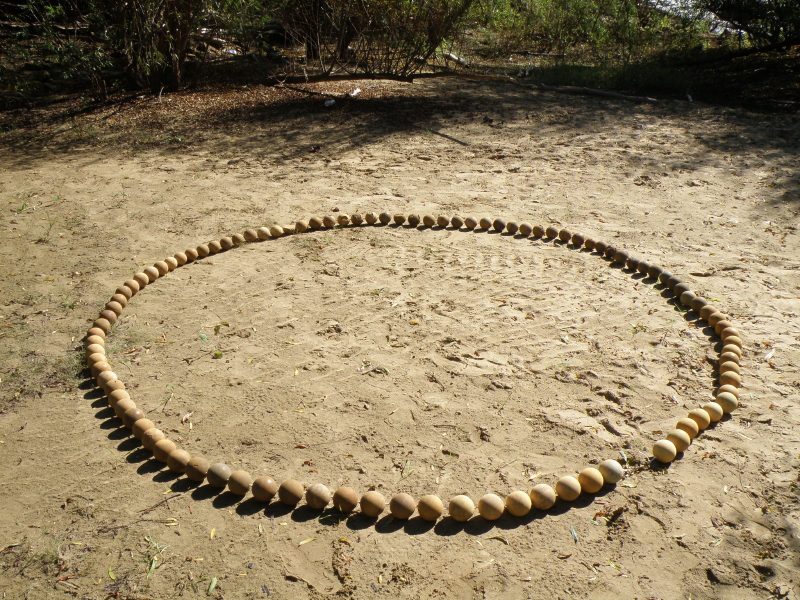
one hundred ball necklace in the sand, Falls of the Ohio, Oct. 2013

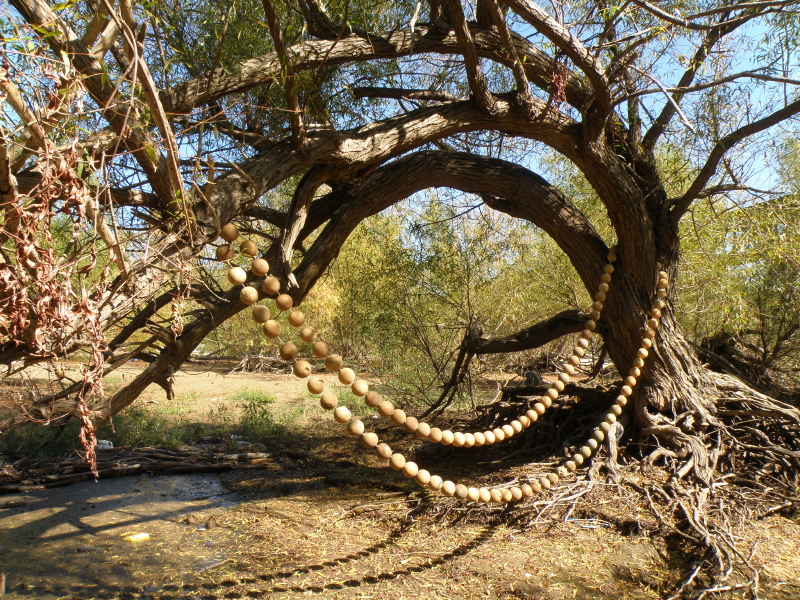
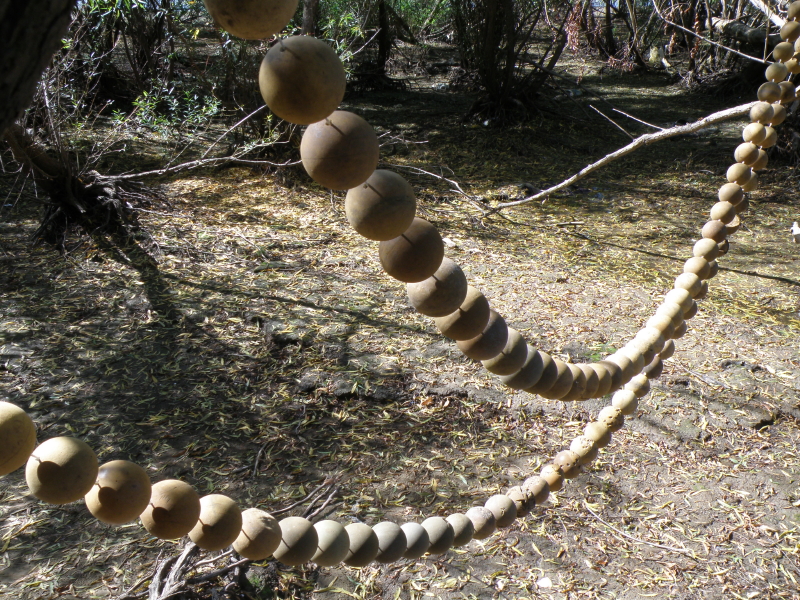
This was okay for a trial run, but I had other images in mind.  I have always loved the willow trees in the park and I chose one of my favorite ones to “wear” my river pearl necklace.  Yes, it’s a hopelessly romantic gesture, but I felt like “celebrating” this tree in a special way.  Here are a few more images.
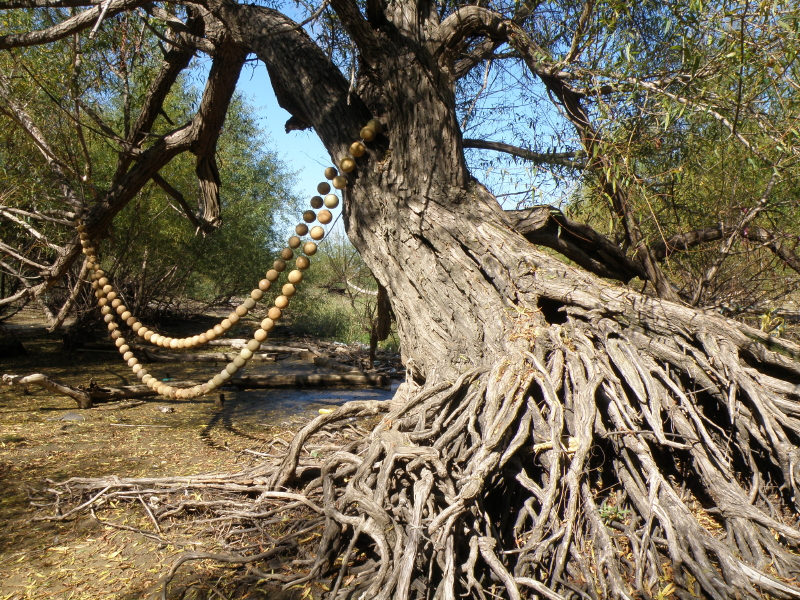
amazing willow tree wearing my river pearl necklace, October 2013

detail of willow tree necklace, Oct. 2013

Moving closer to the river, I stopped by an old willow that was barely alive.  I draped my necklace over its old exposed roots and created a few more images.
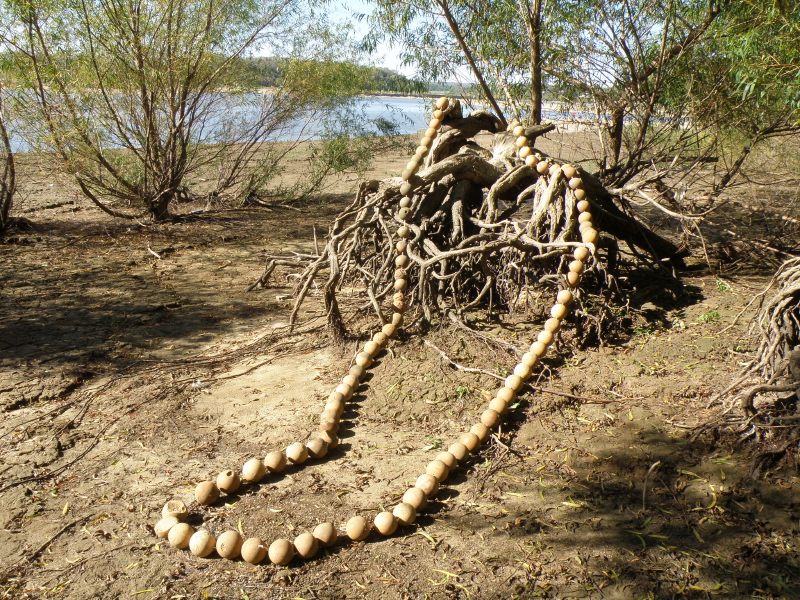
Old willow roots and necklace, Oct. 2013

Once in a while, a park visitor would walk by and look in my direction and continue on as though I was engaged in a most ordinary activity!  If I had stumbled across this scene…I think curiosity would compel me to say something.  Next is another detail from my eccentric strand of pearls.

detail, slightly elevated river pearl necklace, Oct. 2013

With the river within sight, I lifted my bucket of balls and headed towards the fossil rocks.  It was a sunny, but windy day and my next idea was to put the necklace into the water.
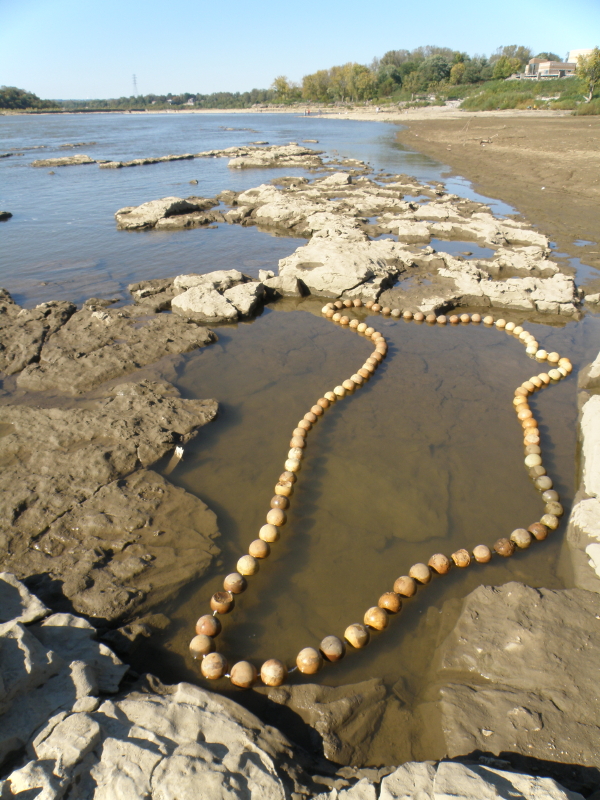
I found a pool of water surrounded by Devonian inspired limestone that would prevent my necklace from being carried away by the current’s flow.  Still, the wind kept changing the configuration and blowing the balls against the rocks.
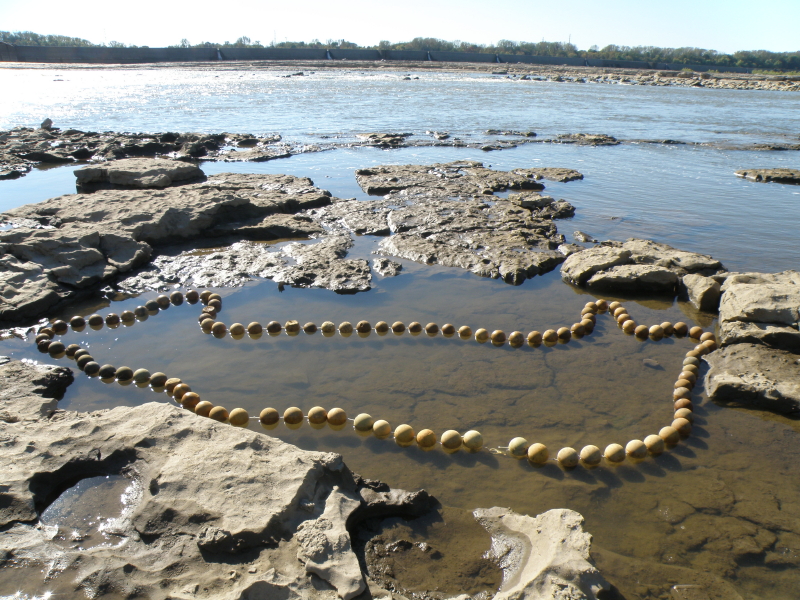
I used a beaver-chewed willow stick I found on the bank to guide my necklace into shape between photos.  The necklace which I now had named “La Belle Riviere” was the name originally given by French missionaries upon encountering the Ohio River for the first time.
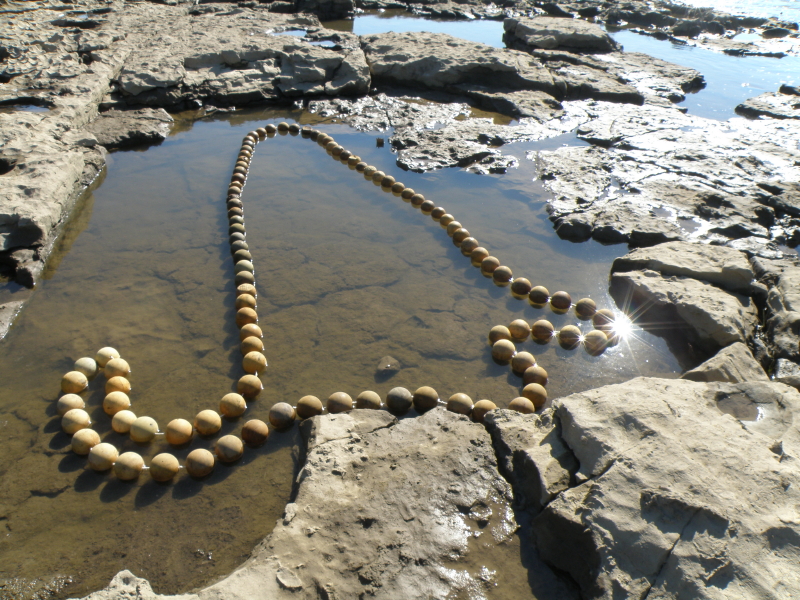
It seems appropriate that the river which played a large part in bringing these balls to this shore…would continue to influence how this piece would be perceived.
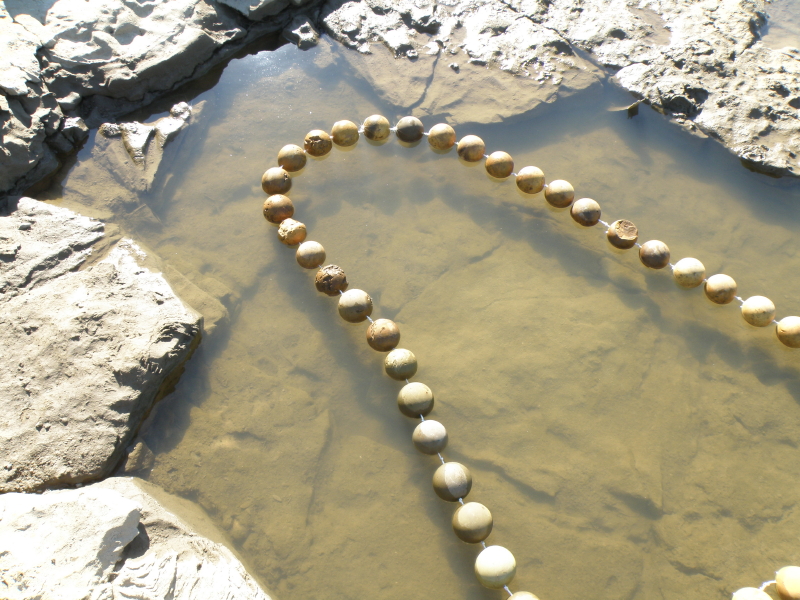
I enjoyed how the gourd-colored balls harmonized with the surrounding riverine landscape.  I felt some sense of accomplishment in creating this piece and being able to return it to the Falls environment to create this site specific work.  It was also a fitting ten-year anniversary artwork since “La Belle Riviere” began with that first found ball a decade a go.  I will see how well it holds its own in a gallery environment since I want to include this piece in a two person show I’m participating in this January.  After these river photos…I loaded the necklace back into its container and began the slow walk back to my car.  While making this work, I did have one admirer that found the work irresistible and I will end this post with its image.  So long…from the Falls of the Ohio.

Butterfly with detail of softball core necklace, Oct. 2013

Read Full Post »

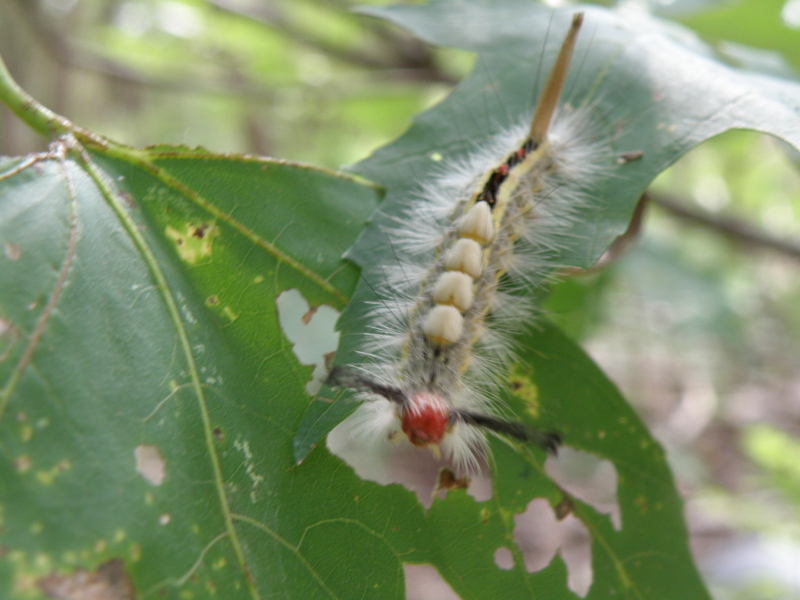
Tussock moth caterpillar, Oct. 2013   Red-faced and bizarrely hairy, the unique caterpillar of the Tussock moth was munching its way through a maple leaf.  Everything about its appearance says I’m not tasty and leave me alone.  It’s now October and it won’t be much longer before the first frost and freezes arrive and with it the colder temperatures which will quiet insect life at the Falls of the Ohio until next year.  The caterpillar inspired me to post a few other entomological images taken in the park.  I confess that I have always liked insects as examples of how diverse life can be.  I’m amazed at the incredible variety and forms that our six-legged friends can assume. Here’s another really weird caterpillar that I found at the Falls that I just haven’t been able to identify through any of my field guides.  Does anybody out there in blog land recognize this?

strange caterpillar from the Falls, late June 2013

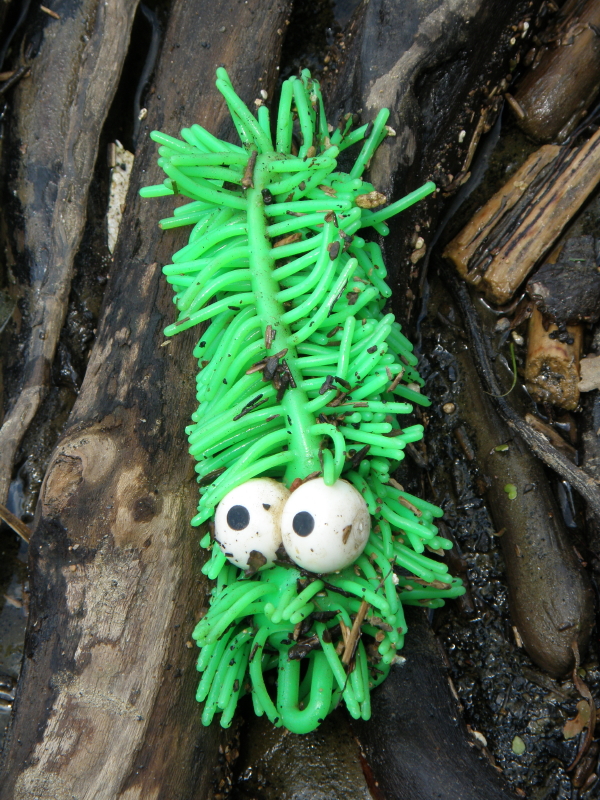
This fluorescent green caterpillar has dramatic eye spots on its posterior that would incite a predator to strike there first.  Its anterior is located on the opposite end and I would have fallen for this trick too, but noticed that it was walking backwards.  I wondered once it completed its metamorphosis…would the adult be a moth or butterfly?  Maybe some day I will stumble upon and collect a large cocoon I don’t recognize and I’ll take it home and watch a miracle as it emerges from its silken home.

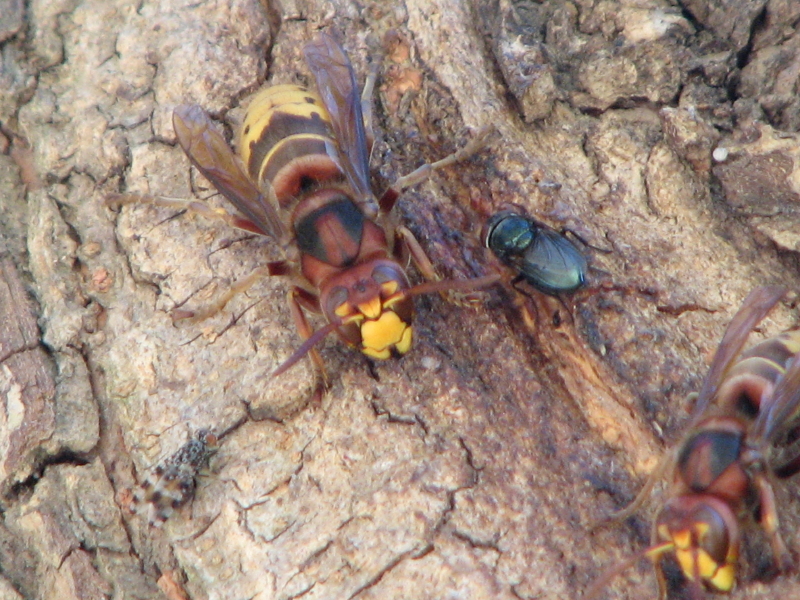
hornets and flies on willow bark, 9/2010

During this time of year, certain willow trees at the Falls are exuding sap which draws a variety of insect life including various flies, hornets, and butterflies to these sweet “licks”.  Whether the flowing sap is due to disease or injury is unknown to me? The large bullet-like hornets are so preoccupied with sipping the sap that they ignore me.  To test this, I’ve carefully touched them with my finger while they were feeding and they remained docile.  I was walking through the tall grass when I noticed a large flying insect land on the bush next to me.  Despite its wonderful camouflage I was able to locate our next insect after a short search.

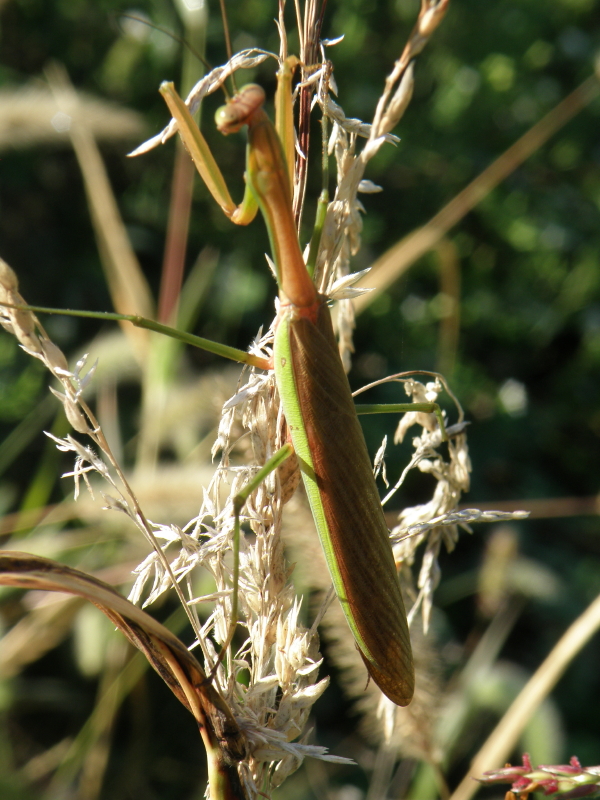
Chinese Mantid, Falls of the Ohio, late Sept. 2013

This is the Chinese Mantid which I read was introduced into this country in 1896.  It is the largest praying mantis you are likely to come across in the United States and this specimen was about four inches or ten centimeters long.  I’ve seen them grow larger, but not in this park.  In fact, this is only the second mantid I’ve seen out here.  There are several native species, but they are smaller and more obscure.   And now, it’s time to reveal my most spectacular discovery which is a near but harmless relative of the praying mantis.  Here is a picture of its head.

detail, head of the Falls Phasmid Stick Insect, October 2013

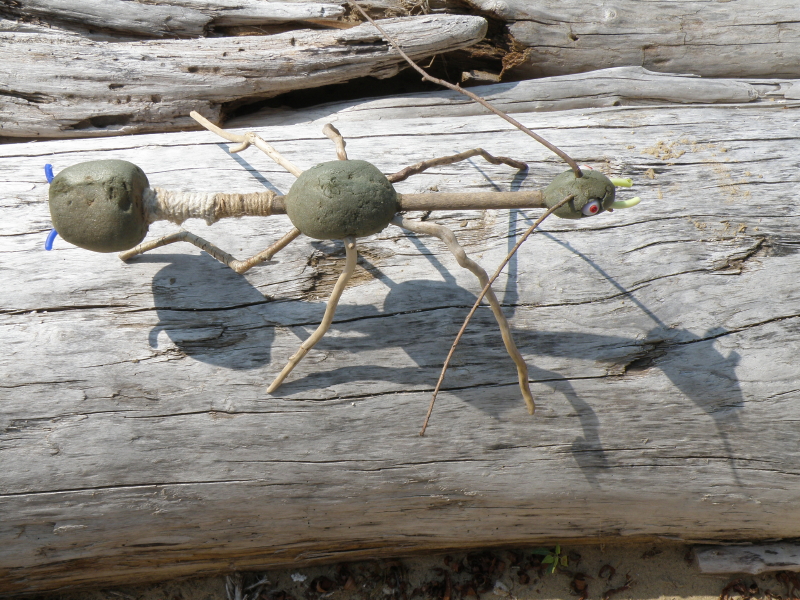
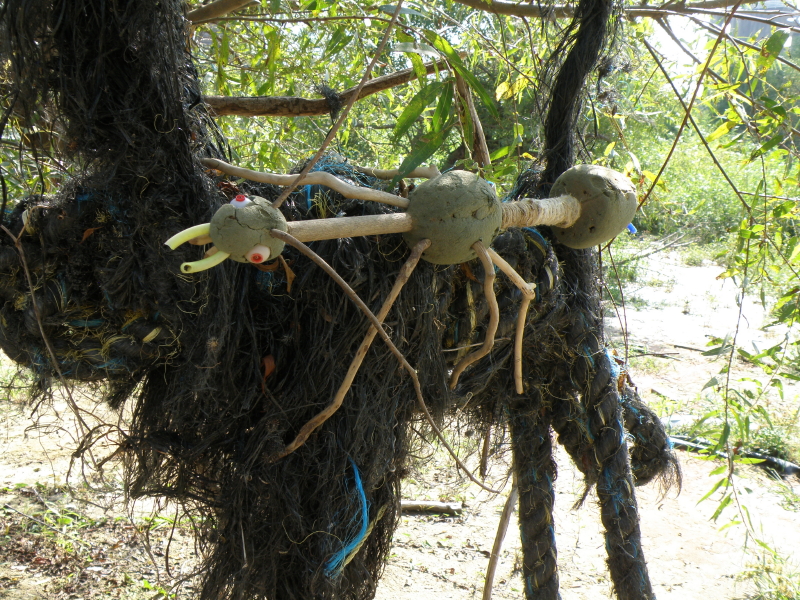
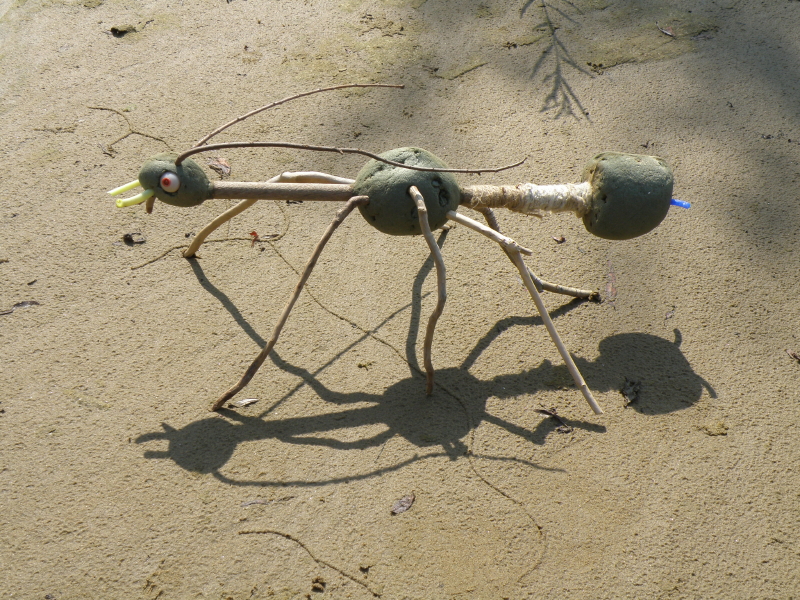
And now, for the rest of its body which is about two feet long or roughly sixty centimeters.  I came upon this unique life form casually walking across the driftwood on its way to somewhere else.

full view of Falls Phasmid, Falls of the Ohio, Oct. 2013

Although as insects go this is a giant…it is also an extremely fragile creature.  It is a member of the walking stick family.  It relies on slow movements and its cryptic forms to merge with its surroundings.  The Falls Phasmid is strictly a vegetarian and eats the foliage from a variety of different trees.

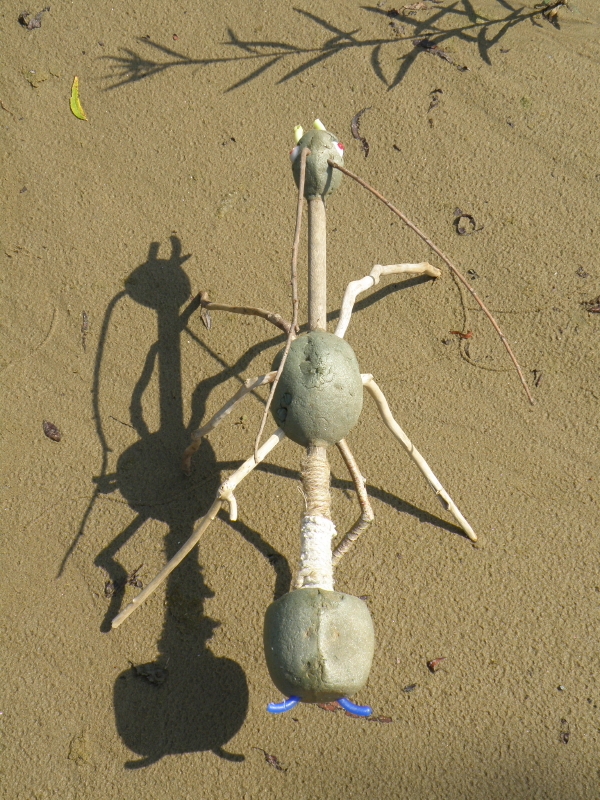
aerial view of Falls Phasmid, Oct. 2013

I came across this specimen in broad daylight.  I had always heard that they were nocturnal and chose to restrict their movements during the day to avoid detection.  Walking stick insects are among the largest insects we have.  This species is additionally strange in that its head, thorax, and abdomen are so clearly differentiated.  Some scientists have gone so far as to suggest a bit of mimicry at work here.  On the surface it does seem to possess a superficial resemblance to a giant ant which might be enough to dissuade predators from attacking it.

Falls Phasmid hanging in a tree, Oct. 2013

I did observe this particular Phasmid making return trips to a particular willow tree where it clung to a nest-like structure that was hanging down from a branch.  The meaning of this structure was not immediately apparent.  Perhaps the Falls Phasmid uses this form to help it overwinter?  Keeping a respectful distance away, I did see the stick insect walking slowly over the riverbank, but I couldn’t tell if it was searching for something in particular and I did not witness it feeding.

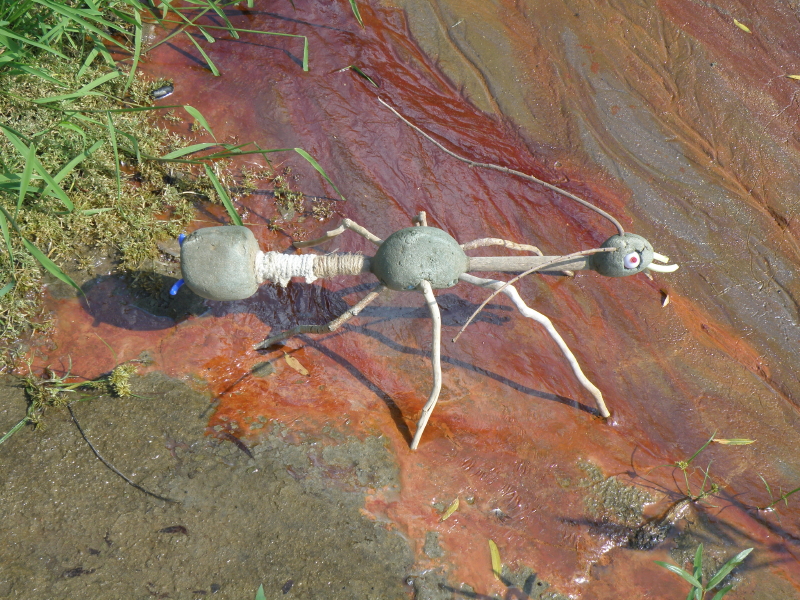
Falls Phasmid Stick Insect, Oct. 2013, facing left

Falls Phasmid in the wetlands area, Oct. 2013

Originally, the Falls Phasmid may have had the ability to fly.  Other walking stick insects from around the world have vestigial wings that suggest a different past.  Our specimen lacks even the most superficial suggestion of wings which hints at an ancient lineage.  Perhaps all stick insects evolved here first and spread around the world much later?

Falls of the Ohio Phasmid Stick Insect, October 2013

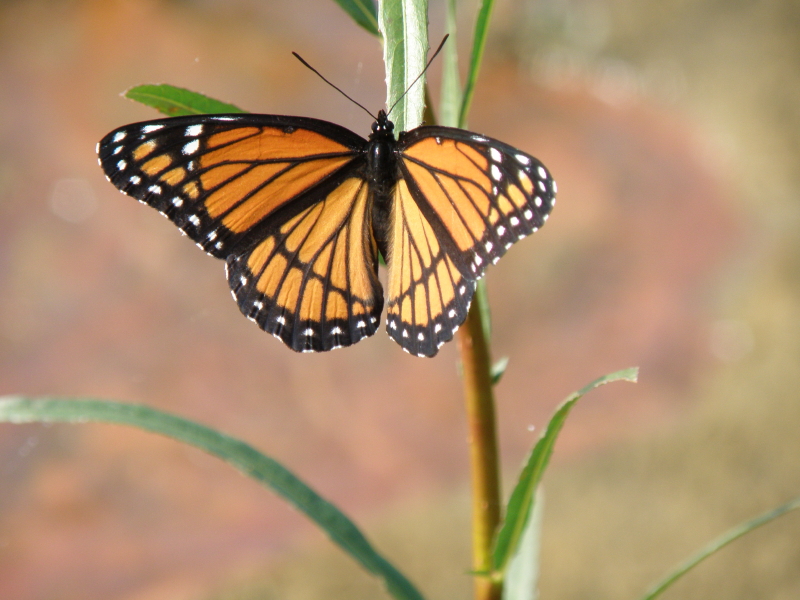
I watched the Falls Phasmid for a while and took a bunch of photographs of it before leaving the park.  I’m curious about that tree that it likes to hang out on and so will check it the next time I’m here.  On my way out of the park, I also came around this wonderful Viceroy butterfly and thought that this would make a fitting image to end this post.  When I think of the butterflies that inhabit the park…this is the species that comes to mind first for me.

Viceroy butterfly, Falls of the Ohio, October 2013

Read Full Post »

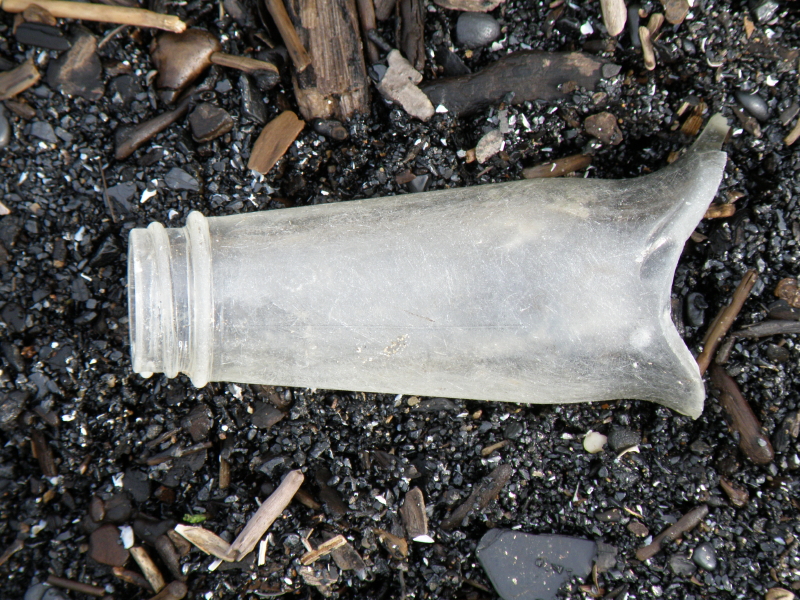
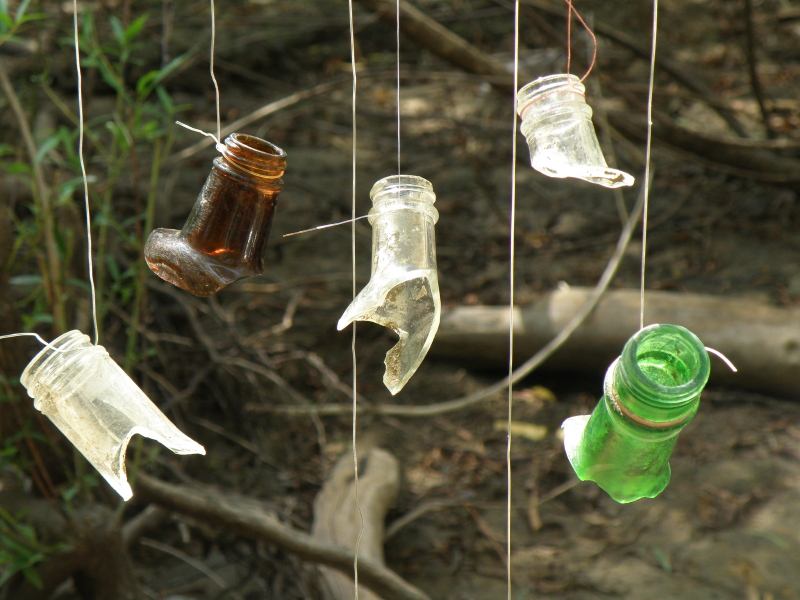
glass bottleneck against coal gravel, 2013

I wish I could remember the exact written passage where the image of a bottleneck captured my imagination.  Back tracking through my books has not revealed the exact source, however, I do remember that the context came from biology and more specifically the history of life.  Of the five great extinction cycles, the one that closed out the Permian period (roughly 245 million years a go) was the most brutal and efficient.  All those trilobites that had been so successful for so long hit the wall.  At this time the super continent Pangaea existed.  Millions of years of continental drift and the resulting global climate change are the leading hypothetical causes for this extinction.  Regardless, the effect was that the majority of life’s diversity as it existed then and which filled up that particular metaphoric bottle…did not make it through the bottleneck.  Fortunately, some life did survive, but it would take subsequent millions of years for life to evolve and radiate out to regain its former glory.

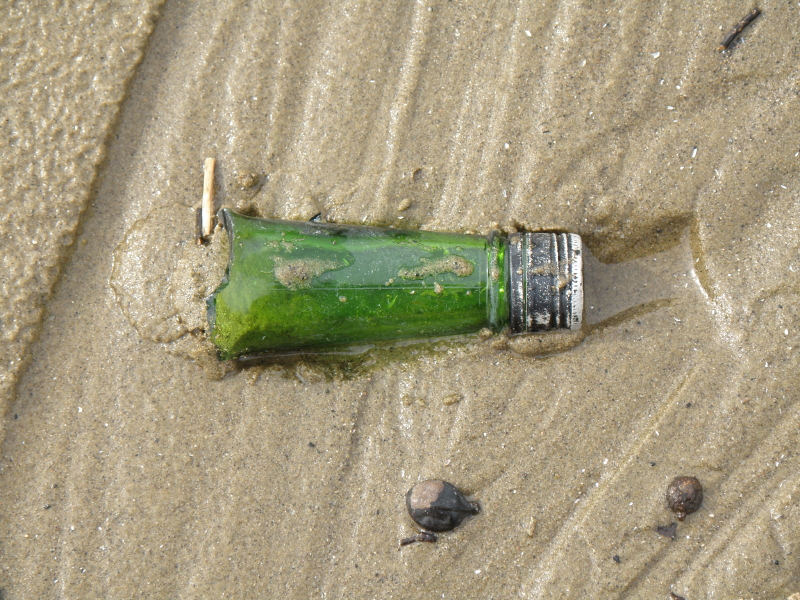
green glass bottleneck with cap against sand and water, 2013

We like to think that we stand atop life as its ultimate achievement.  We frequently miss the bigger picture of which we are small part and are even oblivious to the effects we have on everything else around us.  The bottleneck effect has been adapted by other systems to illustrate that which is a hindrance or impediment to progress.  The basic idea, however, remains the same.  Whatever is in the bottle is going to get squeezed on its way out that is if the contents do in fact make it out.  In my own blog, I don’t mention U.S. politics much, but lately it is in the news and it’s troublesome. Our seeming inability to govern ourselves…to in effect allow small selfish groups to manufacture bottlenecks strikes me as self-defeating and doesn’t bode well for the future.

two glass bottlenecks on sand, 2013

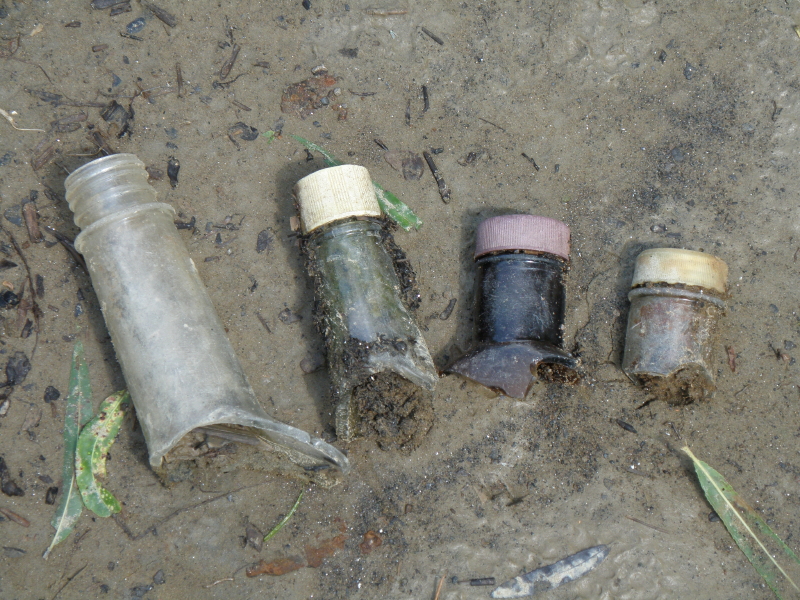
At the Falls of the Ohio State Park, I literally find bottlenecks all the time.  Unlike their plastic counterpoint, the glass ones don’t break down as much.  There must be something about the material strength of glass that is increased when it is forced into a tube that makes it extra resilient.  Over time, their sharp edges do get worn down and their surfaces become frosted through tumbling in the sand.  Personally, I find glass to be a far more attractive material than plastic.  I’ve come to look at our artifacts in much the same way I might regard a fossil as examples of objects that have been touched by and affected by life.

four different glass bottlenecks, 2013

There’s something about the process of “finding” that is compelling if not compulsive for me.  I try to stay watchful for opportunities, particularly if I come across an image or material that I can apply through my art.  The process of collecting, examining, and comparing is also personally meditative and relaxing.  I started photographing bottlenecks years a go with no goal in mind.  Just more documented stuff among all the other stuff along the riverbank that I come across each time I visit the park.  Looking over my photographs, forgotten images of bottlenecks would catch my eye again.

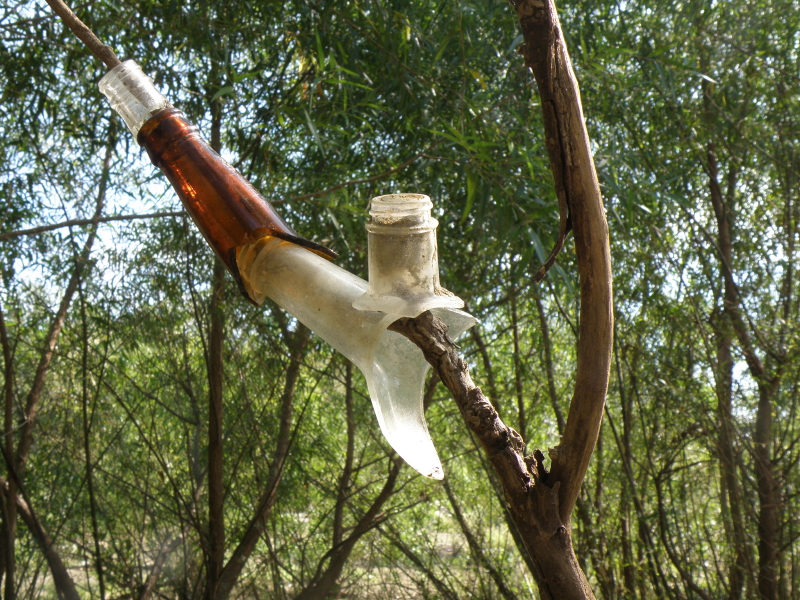
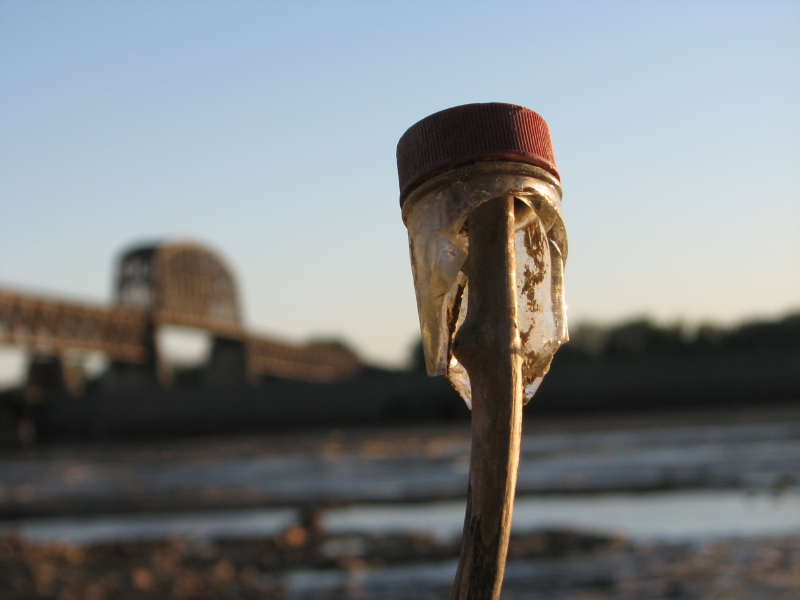
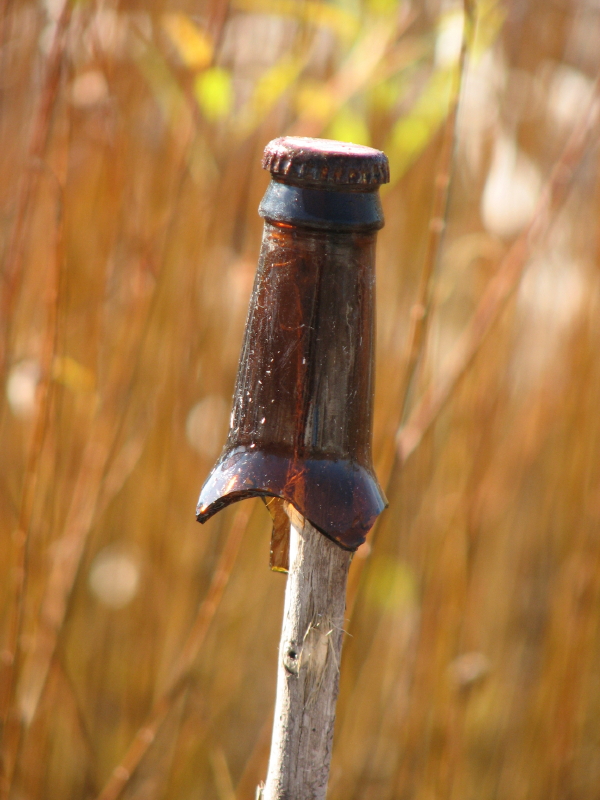
beer bottleneck with cap on stick, 2013

bottleneck with red cap on stick, 2013

Other than take contextual images, I guess the next thing I did with bottlenecks was to stick them on the ends of branches and sticks.  This allows the light to play through the glass revealing its jewel-like attractiveness.  It might also cause someone else to notice that there is a lot of smashed glass in the park.  Granted, the river floats a lot of bottles in here from upriver, but there is also a lot of drinking that goes on here via the local folks.  Why pack your empties out when you can just throw them on the ground?  One bottleneck on a branch led to more…in fact the whole arc of these now bottleneck projects has trended in the “more” direction.

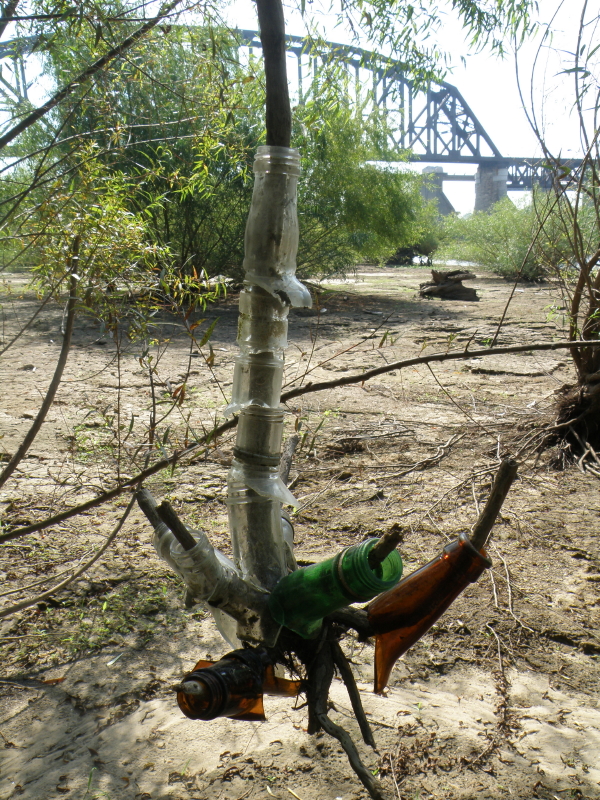
glass bottlenecks on a willow branch, 2013

glass bottlenecks on driftwood tied to a branch, 2013

I guess this last image is a bottleneck candelabra?  I find many of the bottlenecks I’ve used near stands of willow trees by the water’s edge.  I suppose bottles that float in are snagged in the tree’s exposed root system eventually breaking through contact with floating logs and leaving the shards in place?  People also throw bottles against the trees which has the same effect.  Rarely, do I need to walk very far to find enough glass to create a small project and image.

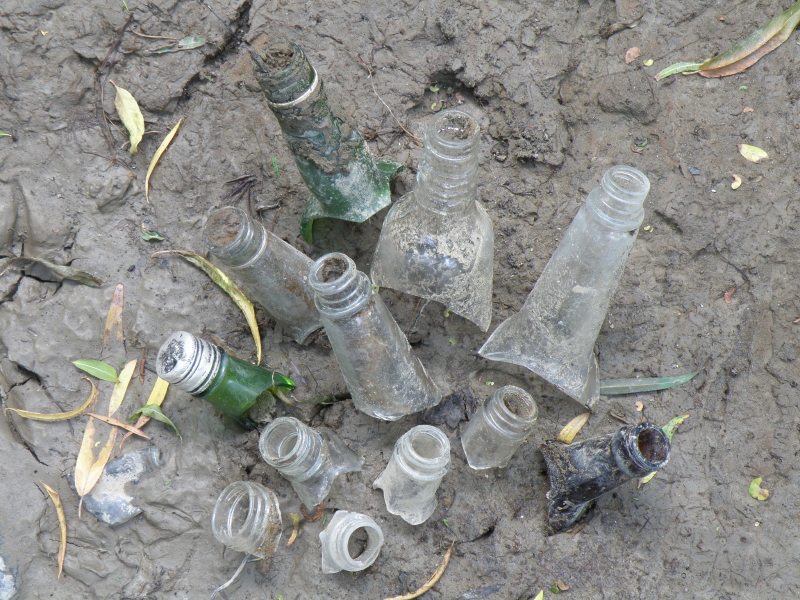
glass bottlenecks stuck in the mud, 2013

Here’s one project made from bottlenecks collected around one particular willow tree.  I liked the way they looked collectively stuck in the mud and their tubular arrangement reminded me of fossil corals which also references the Falls of the Ohio.  Here’s a few other similar site specific groupings of bottlenecks.

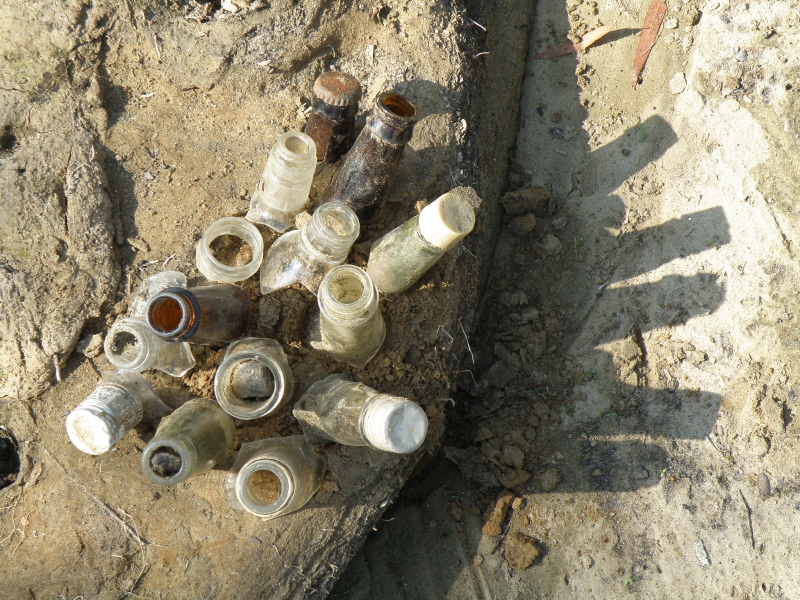
upright glass bottlenecks in dirt with shadows, 2013

glass bottlenecks stuck in the mud at the water's edge, 2013

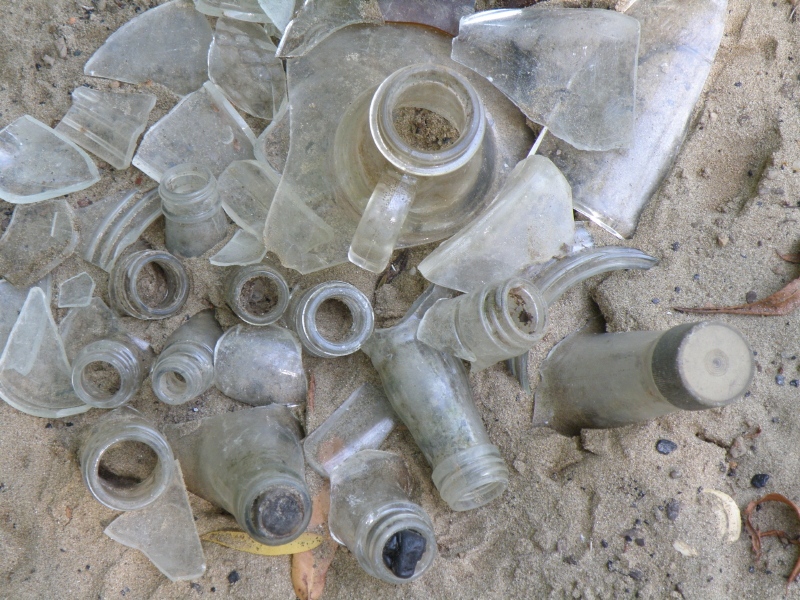
diverse collection of glass bottlenecks, 2013

detail of arrangement of various glass bottlenecks, 2013

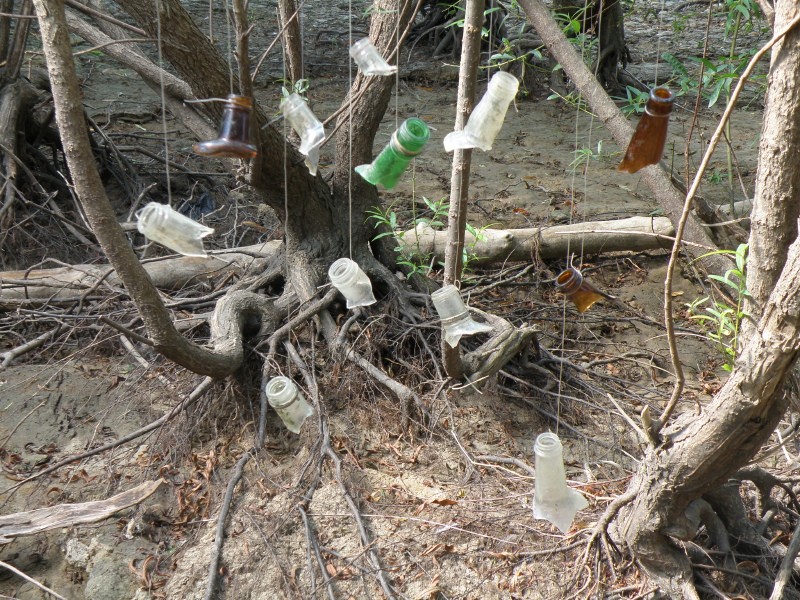
The next couple of images are from my last bottleneck piece.  In addition to lots of waste glass…I also find discarded fishing line, often in the same places.  I brought these two materials together for this ephemeral work.  Recently, I was talking with a good friend of mine and we were remarking about how much of our lives seem mediated by and require reading various kinds of screens.  This last glass project may have something to do with that because the bottlenecks are arranged in a flat, parallel screen hanging from a horizontally growing willow branch.  I wonder if anyone else ever saw this and what they may have thought about it?

various glass bottlenecks suspended on fishing line, 2013

detail, various glass bottlenecks suspended by waste fishing line, 2013

Well there you have it!  I suppose these bottleneck projects will now crop up on occasion like my found coal pieces do as intimate site specific expressions.  For now, it’s enough to present them as images without trying too hard to extract every bit of meaning from them.  Bottlenecks in the broader sense are challenges.  May we always remain open to meeting them.  So long from the Falls of the Ohio.

bottleneck on a stick at sundown, Falls of the Ohio, 2013

Read Full Post »

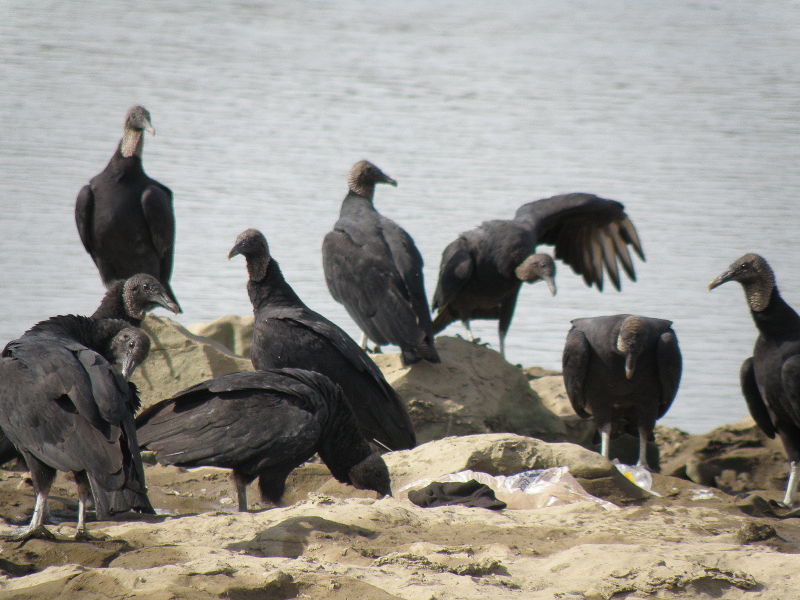
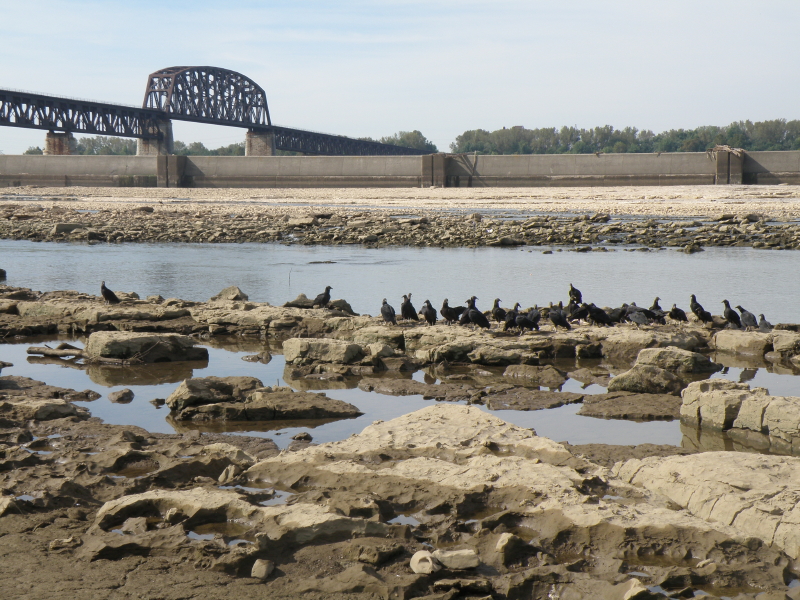
Black Vultures on the Fossil Beds, Falls of the Ohio, Sept. 2013

The resident flock of Black Vultures were taking advantage of the fossil beds now exposed on the Kentucky side  of the Falls of the Ohio.  The wier dams were temporarily closed and with it the flow of water.  With the river level reduced much of the sculpted limestone normally underwater is briefly seen again.  Fishermen have been accessing new fishing spots along the freshly revealed fossil beds which turns out to be a boon for the vultures.  Not only do they get to feast on fish left by the anglers, but they also enjoy any other trash including left over fishing bait.  Early autumn is a transitional season among the park’s bird life as residents gear up for over-wintering or prepare for the southerly migration.  Birds from the northern latitudes particularly Canada and the Arctic Circle pass through our area on their epic journeys to Central and South America.

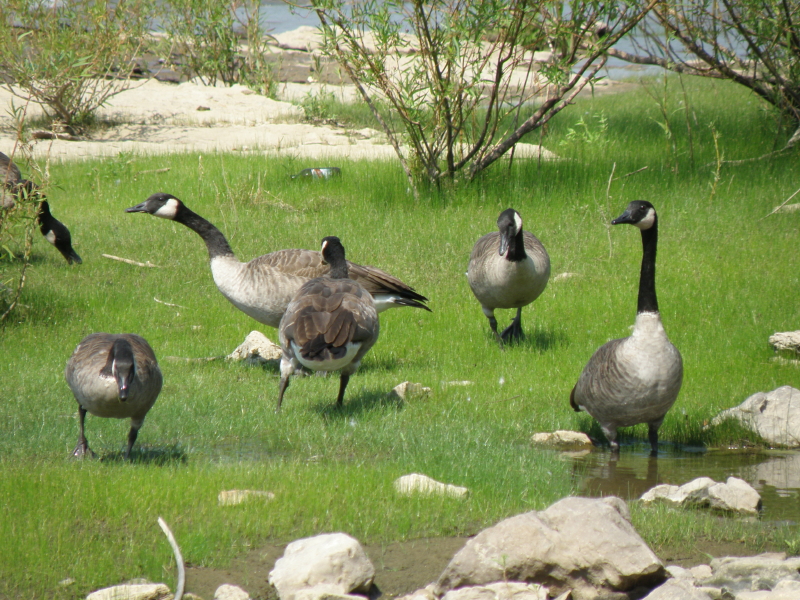
Canada Geese feeding on grass, Falls of the Ohio, Sept. 2013

The vultures will fly away, but many of our Canada Geese will brave it out.  We seem to have at least two distinct flocks of Canada Geese sharing the area around the fossil beds.  It’s amazing how intolerant each group is of the other.  There is competition for the best food sites and each group frequently bump into one another with much squabbling.  That’s what makes the next image interesting to me.

Domestic goose mixed with the Canada Geese, Falls, Sept. 2013

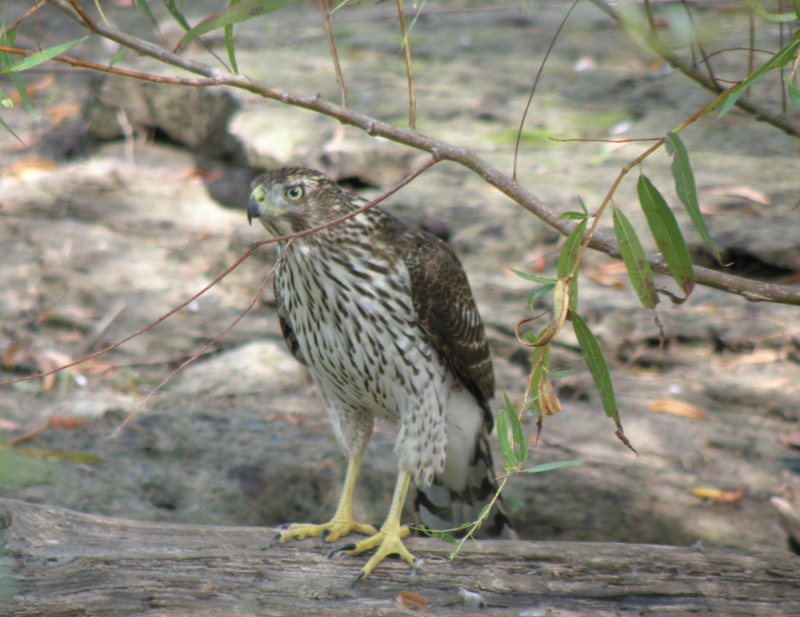
Canada Geese can have limits on how much mingling occurs between their own species, but in this case, are willing to accept a true outsider.  This domestic goose seemed integrated into its adoptive flock.  It swam with its wild cousins and accompanied them to a favorite feeding location and was never bothered by the other geese.  Recently, I came across a young Cooper’s Hawk and I was surprised when it did not immediately fly away after I bumbled across it.  There was a good reason why it didn’t leave.

Young Cooper's Hawk, Falls of the Ohio, Sept. 2013

The hawk sized me up and then jumped down off the log it was standing on to retrieve something it had dropped.

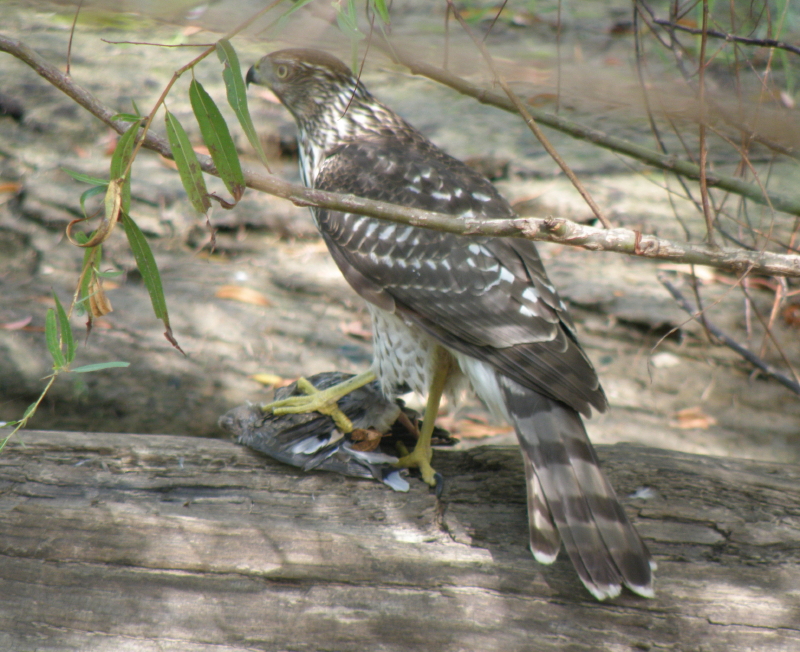
Young Cooper's Hawk with prey, Falls of the Ohio, Sept. 2013

The hawk had what appeared to be a freshly killed Mourning Dove.  After securing its prey with its talons, the hawk seemingly jumped into the sky and  vanished within moments.  I thought I saw it disappearing into the tree tops of a stand of willow trees within walking distance.  I did investigate the area, but never saw the bird again.  I love it when I get to observe behaviors.  Life has a job to do and can’t wait around posing for pictures.  Here’s a different kind of behavior being demonstrated by an American Robin.

American Robin bathing at the Falls of the Ohio, Summer 2013

I love this image which I captured earlier in the summer.  This American Robin is focused on taking a bath.  Its head is under the shallow water and droplets and beads of water are splashed over its body.  Our resident American Robin population is doing well and seem to be increasing at the Falls of the Ohio.  Some of the robins will hang out over our gray winter, while others will seek warmer climes.  My last adventure to the Falls resulted in images of a bird that I had never recorded previously in the park.

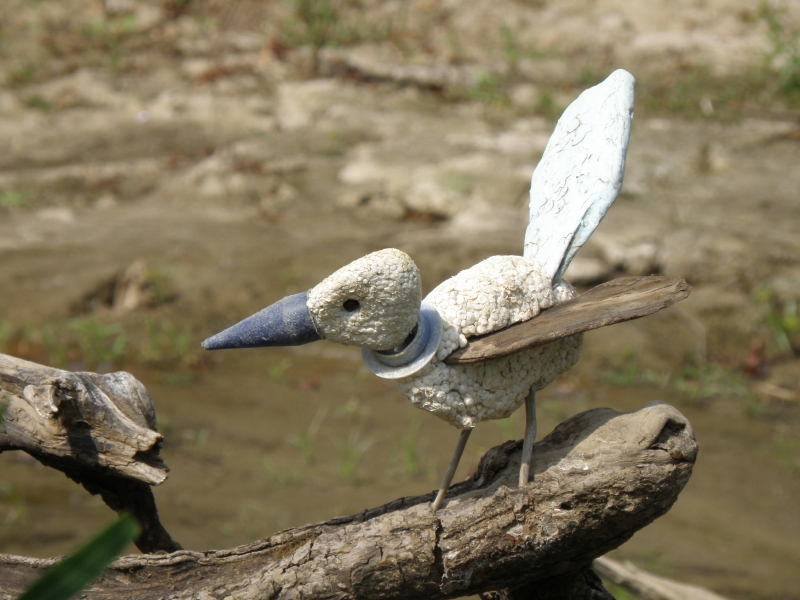
Gross Blue Bill at the Falls of the Ohio, Falls of the Ohio, Sept. 2013

Gross Blue Beak and flowering plants, Falls of the Ohio, Sept. 2013

The Gross Blue Beak is strictly passing through and in fact, this is the first recorded instance of this bird appearing in the park.  Good thing I have all this photographic proof that the bird was here because the resident birders are a skeptical lot.  Reputations and lifetime bird lists are at stake and there is a great burden of proof to produce irrefutable documentation.  This bird has traveled thousands of miles from the edge of the Arctic Circle in Canada and is bound for the Argentine coast.

Gross Blue Beak with corroded aerosol can, Falls of the Ohio, Sept. 2013

portrait of a Gross Blue Beak at the Falls of the Ohio, Sept. 2013

The Gross Blue Beak receives its name not because it has disgusting habits that require an out-sized bill.  Rather the “Gross” idea comes from the German word for “large” .  The Ohio River Valley was settled by many immigrant groups and the Germans were among the most prominent.  This bird’s beak is a heavy-duty tool it uses to crack open nuts, crush mollusks (particularly snails), and jack hammer soft decaying logs in pursuit of beetle grubs.  All three of these food sources are found at the Falls of the Ohio.

Gross Blue Beak at the Falls of the Ohio, Sept. 2013

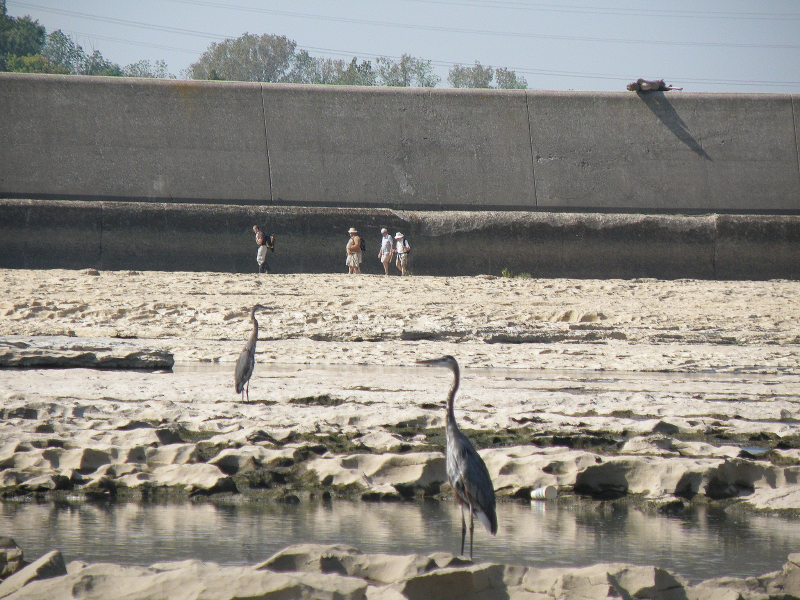
I was able to get quite close to the Gross Blue Beak to snap off these images.  I’ve noticed before that many northern migrants of various species will allow me to approach more closely than the local birds that are around people more.  Perhaps that’s the key?  For the moment, the region around the Arctic Circle has seen less of our influence than other places in North America.  To close, I have one other bird image, but it is noteworthy because of the people in the far distance.  Recently, I received a question about the back wall that is a part of the system in place to produce a stable pool of river water for commercial barge traffic.  I’ve heard that the Ohio River carries more tonnage of goods along it’s 800 plus miles than the Rhine River does in Europe.  The back wall of this dam is quite high up and the actual river level is perhaps a meter or so below the top of the wall.  Beyond the Great Blue Herons, the small band of hikers provides some sense of scale on how the river would be over their heads!  When you are walking the now exposed fossil beds…it’s a sobering thought!

Great Blue Herons and hikers on the fossil beds, Falls of the Ohio, Sept. 2013

Read Full Post »

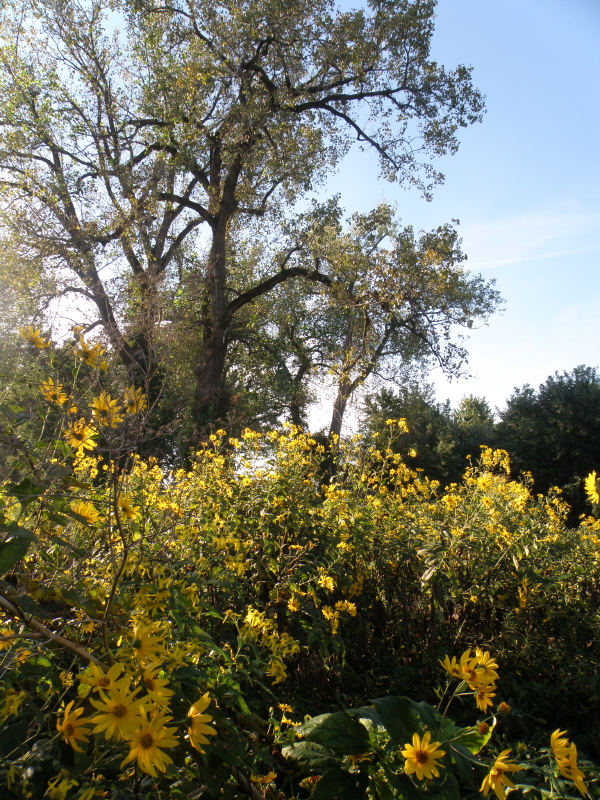
Landscape at the Falls of the Ohio, Sept. 2013

This post is the last of this year’s summer posts and documents a walk I made at the Falls of the Ohio State Park one week before autumn officially began.  As you can see by the pictures…it was a very beautiful day filled with all kinds of discoveries.  There was a profusion of yellow-flowering plants of various species including goldenrod and sunflowers.  Here is a detail, I think from the Woodland Sunflower?  I wish I was as confident about plants as I am in identifying animals.  When I break out my flower books, I realize it would aid identification greatly to have an example on hand.  Collecting plants is not allowed within the park limits…so I try to take photos that might be of use in discerning the various closely related species.  Besides, I don’t think pressing these plants flat would even work?  I ask myself, what leaf shape does it have?  Are the leaves serrated, smooth, or hairy and how many rays do the flower heads have and other such questions of concern to the botanist.

Sunflowers at the Falls, Sept. 2013

I suppose I’m more of an imaginative botanist at heart who also appreciates the beauty and variety the many flowers add to the temporal landscape.  I do, however, stumble upon plants that I wonder if anyone else is noticing?  I’ve posted about these anomalies before and as the seasons change, the parade of these “unnatural plants” and “faux flowers” continues.  Consider these fresh blooms.

The Surprising Poinsettia, Falls of the Ohio, Sept. 2013

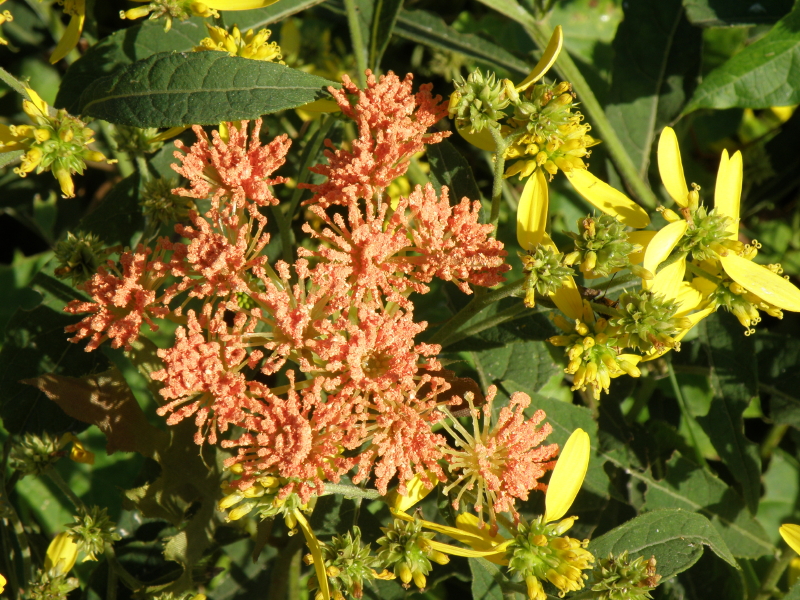
I call this one the “Surprising Poinsettia” because it comes shockingly red and completely unexpected.  Its sepals are rather fabric-like and its stem is grafted upon this sunflower by some unknown means.  The next plant is more subtle.

Orangey-tickseed, Sept. 2013

This is “Orangey-tickseed” and at first blush, one might be tempted to pass over it.  I had to do a double-take on this one, however, my instincts told me something was not quite right here.  Indeed the orange-colored flowers are not at all like the yellow plant it is cohabiting with.  Again, the texture is very much like plastic.  One final plant before moving on to other interesting discoveries.

Pink Sand Lily, Falls of the Ohio, Sept. 2013

I found this beautiful flower growing near the river in the sand and I have designated it the “Pink Sand Lily” because I’m not sure what else to call it?  It is for the most part, a low growing plant and the “flower” appears at the terminal end of a wiry green stalk about four inches tall or so.  The flower petals are composed of a string-like fiber while the stamens are hard and have pseudo-pollen on them.  These unusual plants were not my only discoveries on this fine day.  I nearly always find some doll or doll part that the river has washed into here and today was no exception.  I spotted a form in the wood chips and bark bits and went in for a closer look.  Dusting off the form revealed this doll body.

"rubberized" foam doll body, Sept. 2013

This was quite unlike any other doll “body” I’ve found before at the river.  The material was obviously made from a foam-like material, but it had the flexibility of rubber.  Nearby, I also discovered  an unusual serpent.

red, plush toy snake, Sept. 2013

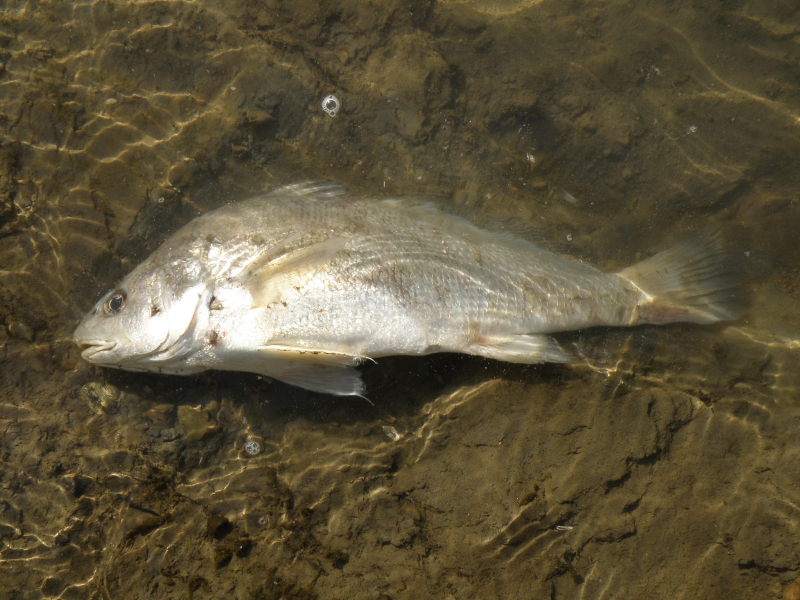
Approximately a foot long, this red plush snake had large black eyes and had just a bit of its tongue sticking out.  This is the first of one of these objects that I have come across .  The river was flowing nearby and I walked over to the edge of the riverbank.  The water level has finally leveled off to more of its seasonal pool and the fossil banks on the Kentucky side were exposed for the first time this year.  Looking along the water’s edge, I came across this Freshwater Drum that an angler caught and released.  Unfortunately, for the fish…it did not survive being captured.  Here is its final portrait.

Freshwater Drum, Falls of the Ohio, Sept. 2013

The Freshwater Drum (Aplodinotus grunniens) is a widespread fish and common in the Ohio River.  It has several molar-like teeth in its mouth that it uses to crush and eat snails and small clams.  The drum is not considered a desirable food species around here.  Here’s another fish I found on this walk that is also inedible.

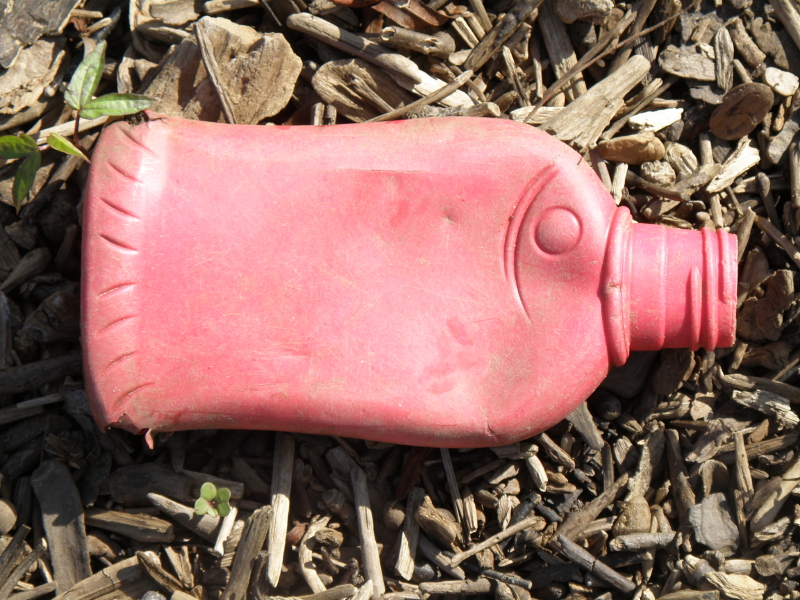
red plastic fish bottle, Falls of the Ohio, Sept. 2013

The second “fish” I came across was this plastic bottle.  I’m guessing that the bottle may have contained shampoo for children?  Regardless, I was struck by the level of abstraction occurring here.  The tail is minimally represented and the gills are indicated by two lines near the eyes, but there is enough here to suggest a fish.  My next find is mid way between the drum and the plastic bottle being closer to the latter than the former.  Here are two views of it.

The Silvergill, Falls of the Ohio, Sept. 2013

Silvergill, Sept. 2013, Falls of the Ohio

This is a Silvergill which is closely related to the Iron Gill (which I have posted about previously).  Differences between the two species include size (this fish is smaller) and some of the fins are not the same shape or in the same position.  The Silvergill is much more rarely encountered than its larger cousin.  It is found in water of average to poor quality and often associated with coal and coal dust. It is omnivorous and eats aquatic insect larvae and algae which it grazes off of rocks.  I’m assuming that it washed up here a victim (like the Freshwater Drum) of an angler looking to catch something more worthwhile.  I took a few photos and then moved on.  The fossil beds were beckoning and I could see the resident flock of Black Vultures congregating on the rocks.  No doubt they had discovered a fish or two on their own.  Until next time from the Falls of the Ohio.

Fossil beds and Black Vultures at the Falls of the Ohio, Sept. 2013

Read Full Post »

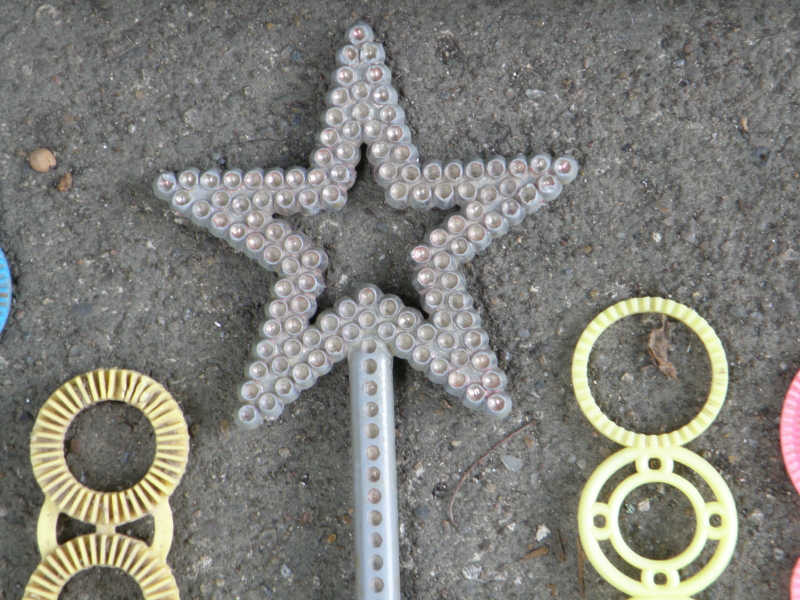
Soap Bubble Wand Collection, Falls of the Ohio, Sept. 2013

Consolidating some of my river finds revealed this fun collection of soap-bubble wands all found within the Falls of the Ohio State Park.  This is many years worth of walking the riverbank and sampling choice bits of plastic and other displaced objects.  All the bubble wands I’ve found thus far are made of plastic.  Most of these wands were sold inside plastic bottles filled with prepared soap-bubble solution.

Detail, Soap Bubble Wand Collection, Sept. 2013

Simply dip the wand into the soap bottle. Remove the wand allowing a film to form over the loop.  Then gently blow air through the soap film and bubbles should result. With this found wand lot however, the bubbles probably wouldn’t be very big or long-lasting.  The soap-bubble wands you can fashion at home with common materials (along with creating your own bubble mix) can produce spectacular results.  These wands were more than likely lost by kids playing near the river.  I’m frequently amazed by the variety of design solutions intended for such a throw away item.  I mean who holds on to these wands to reuse once the bottle is empty?  I did find some novelty items in the mix.  Check these examples out.

Mini Wedding Novelty Soap Bubble wands , Sept. 2013

Here are two mini soap-bubble nuptial wands.  These are usually in tiny plastic bottles left on the guests’ tables.  Blowing bubbles on the newlyweds frequently substitutes for the traditional rice throwing send off.

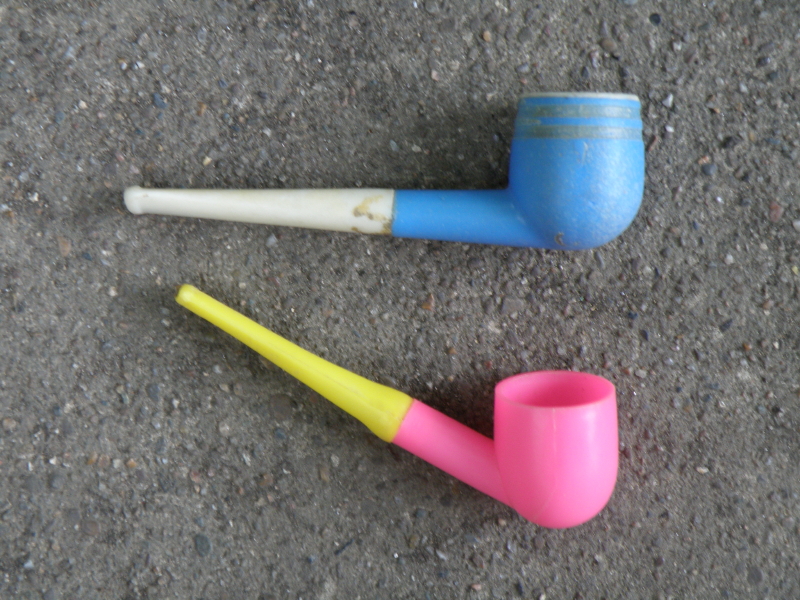
soap bubble plastic pipes, Falls of the Ohio, Sept. 2013

I also found these two soap-bubble pipes.  Personally, I’ve never had much luck making bubbles with pipes.

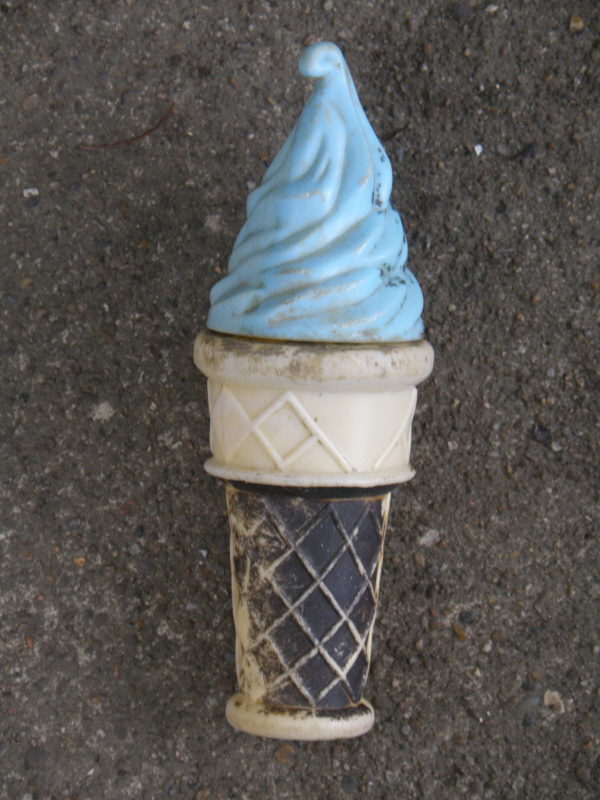
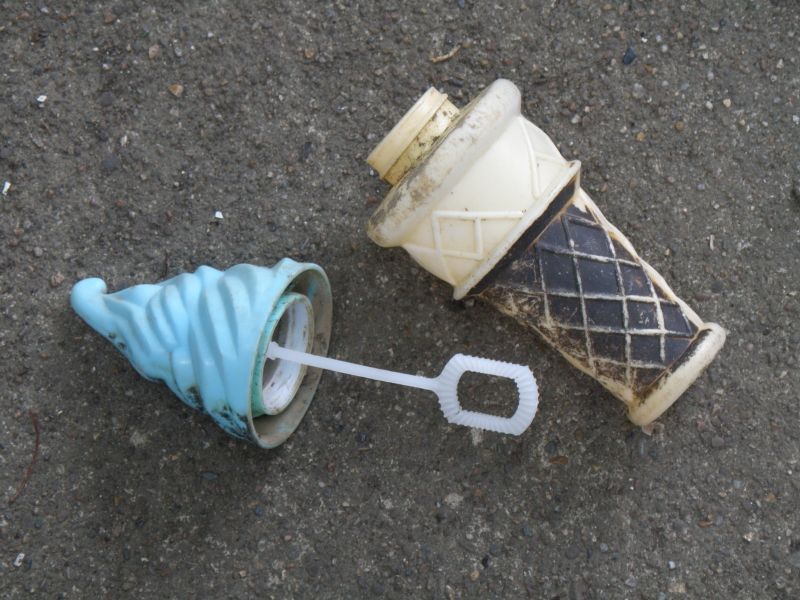
Plastic Ice Cream Cone bubble wand and bottle, Falls of the Ohio, Sept. 2013

Plastic Ice Cream Cone Soap Bubble wand and bottle, Falls of the Ohio, Sept. 2013

This novelty didn’t look good in the frame, but it is one of the nicer soap bottle with wand items I’ve found.  This fake ice cream cone also has that black river patina suggesting it was out floating around for years before I came across it on these fable Falls shores.

Detail, Star Wand, Sept. 2013

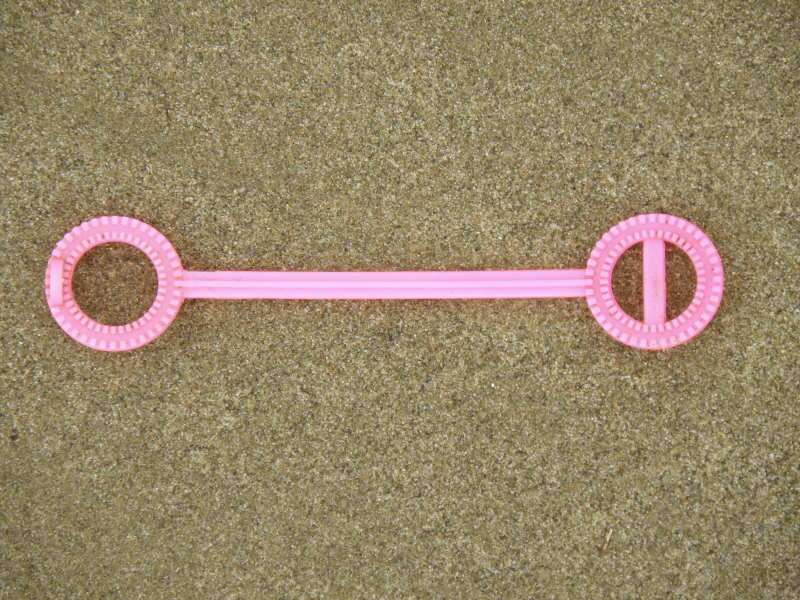
I have a couple of wands that aren’t soap-bubble wands, but since they are wands nevertheless…I keep them in the collection.  The Star Wand is more than likely from a princess costume or magician’s outfit.  The other wand is perhaps more of a plastic scepter.  Originally, the handle lit up with a colored light.  Again, more disposable plastic items.  I’ll keep walking the riverbank a little while longer and I’ll bet I find a few more of these objects to add to the river collection.

found pink plastic bubble wand, Falls of the Ohio, Sept. 2013

Read Full Post »

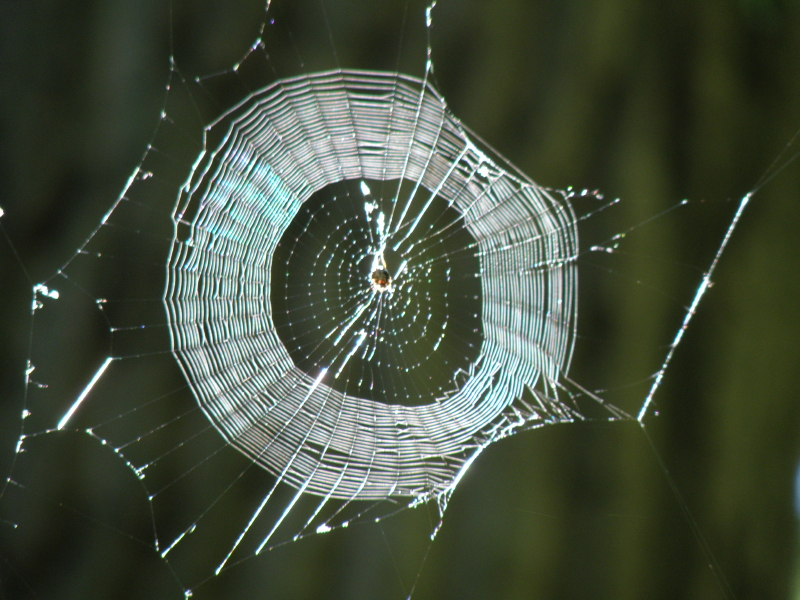
spider's web in the morning light, Falls of the Ohio, Aug. 2013The Falls of the Ohio is a special place in the history of life.  From the ancient marine creatures whose remains are preserved in limestone dating back more than 370 million years a go to the contemporary creatures that inhabit the park today…it is my goal to celebrate life here in all its diversity.  I’m going to use this post to present images of recent finds.  I was exploring the western side of this state park recently and saw this spider’s web high off the ground catching the early morning light.  I’m sure its architect would prefer a buggy meal over the photons it has snared instead!  Looking at this web image, I’m struck by how similar this  looks to the cross-section of a tree.  Can you see that too with the outermost silk rings resembling a tree’s growth rings?  In the Purple Loosestrife stands, butterflies were having a nectar feast and I presented many images of them in a previous post.  Here’s one more to add to that portfolio.  I have seen this butterfly species wind up on the spider’s menu before.

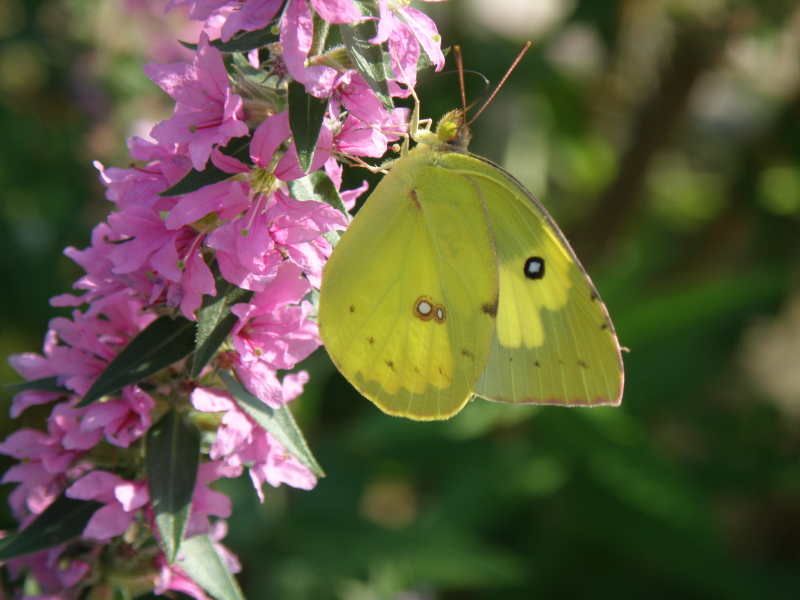
Dog Face Butterfly on Purple Loosestrife, Falls of the Ohio, late Aug. 2013

This is the Dog Face Butterfly (Colias cestonia ).  It is often difficult to photograph this butterfly in the wild with its wings open because this species prefers to feed with its wings held together.  Through the strong light passing through the forewings, you can get the suggestion of a dog’s head in profile.  Imagine the black rimmed spot as the “dog’s eye” with its muzzle pointing down.  When open, the dark interior margins of the wings are a warm black color.  I was exploring the interstitial sandy zone between the river and the willow woods…when I came across this interesting amphibian.

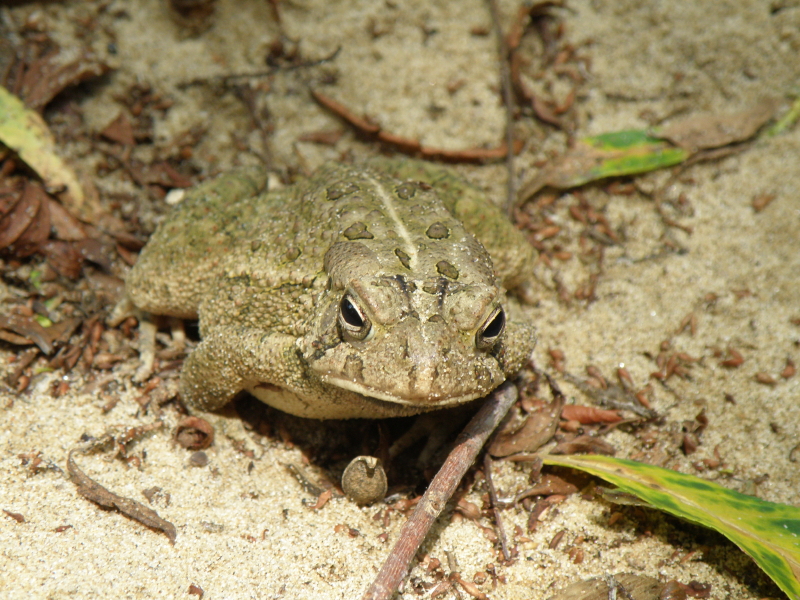
The American Toad at the Falls of the Ohio, August 2013

American Toad, dorsal view, Falls of the Ohio, Aug. 2013

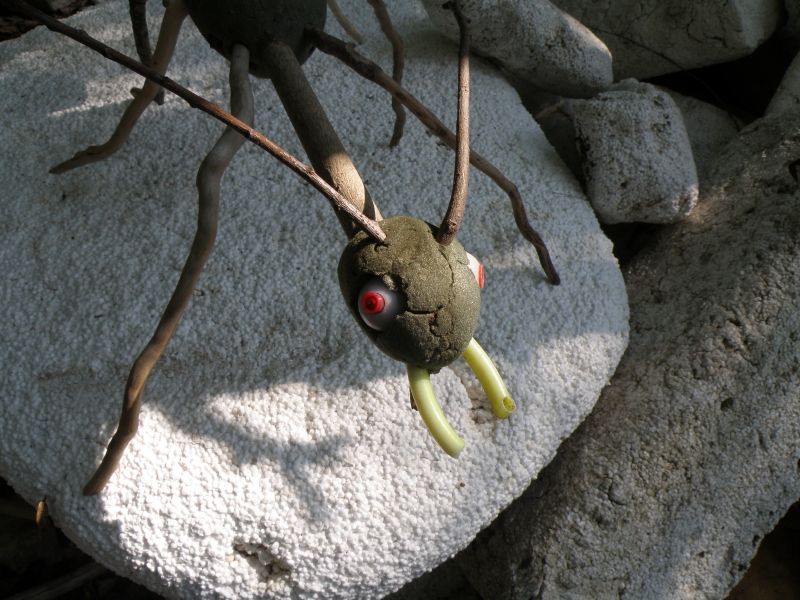
If this American Toad ( Bufo americanus ) had not moved…I doubt I would have seen it.  It’s coloration is wonderfully cryptic easily blending into the sand.  The toad was busy hunting among the debris and driftwood for any insects and invertebrates it could find.  I don’t encounter many amphibians out here…so finding a common toad is a noteworthy event.  Let’s move up the evolutionary ladder a bit.  I was busy working on one of my Styrofoam sculptures at my outdoor studio when I felt I was being watched.  When I lifted my eyes up from my artwork…I found myself looking eye to eye with this critter.

Woodchuck or groundhog at the Falls of the Ohio, Aug. 2013

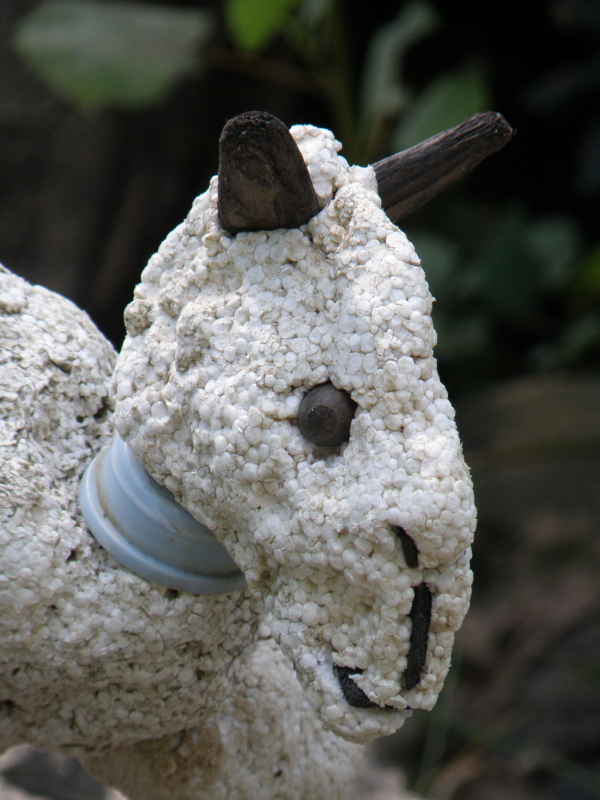
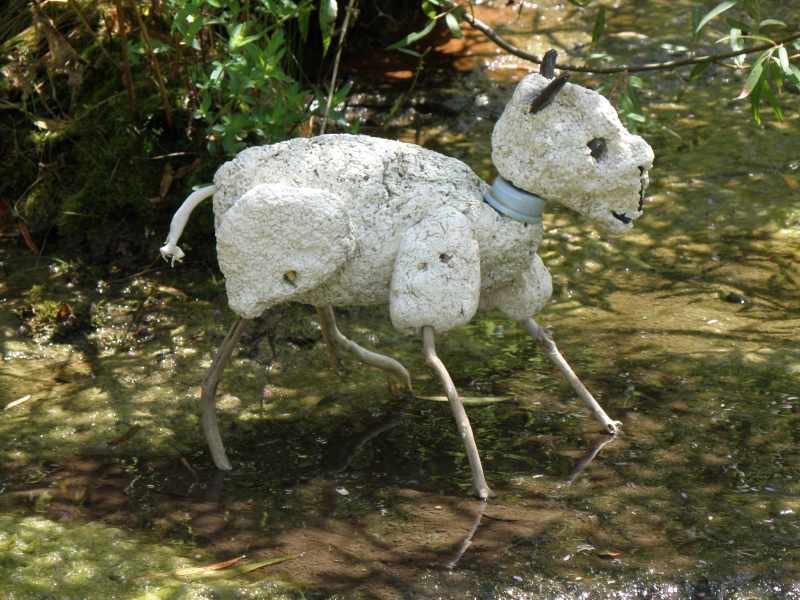
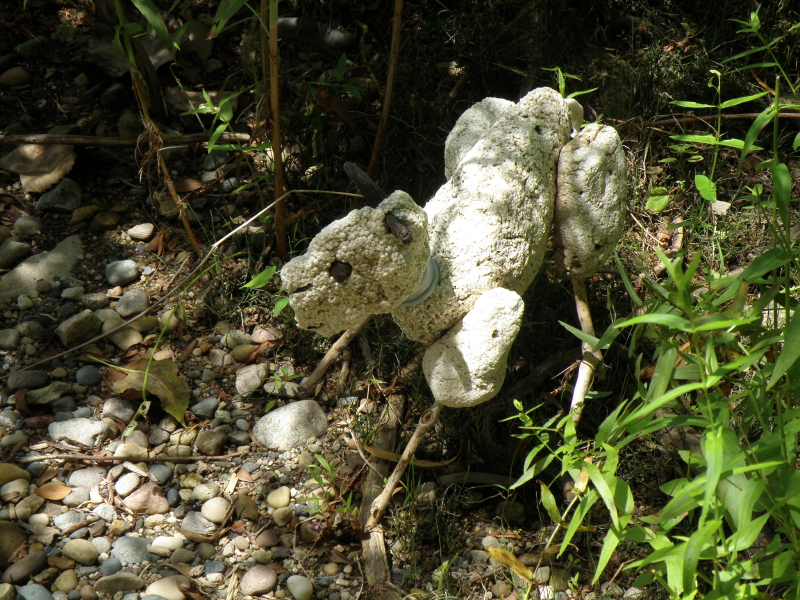
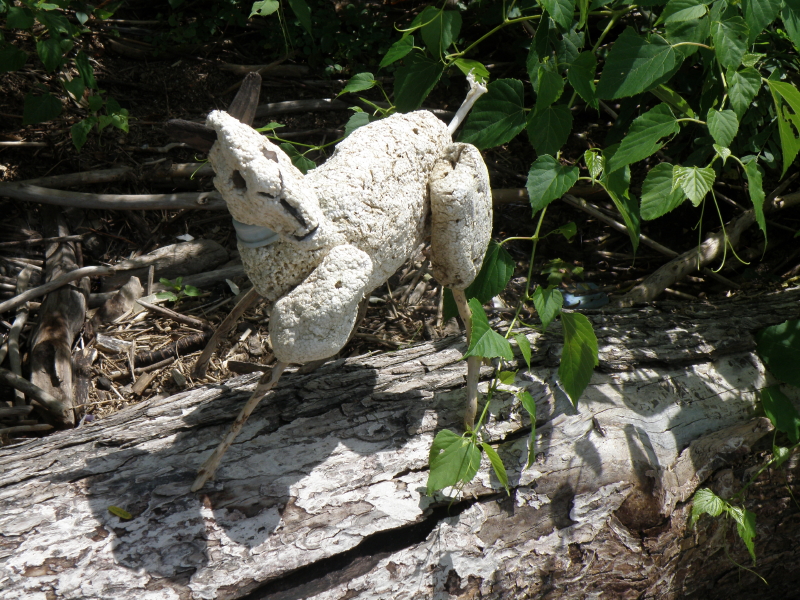
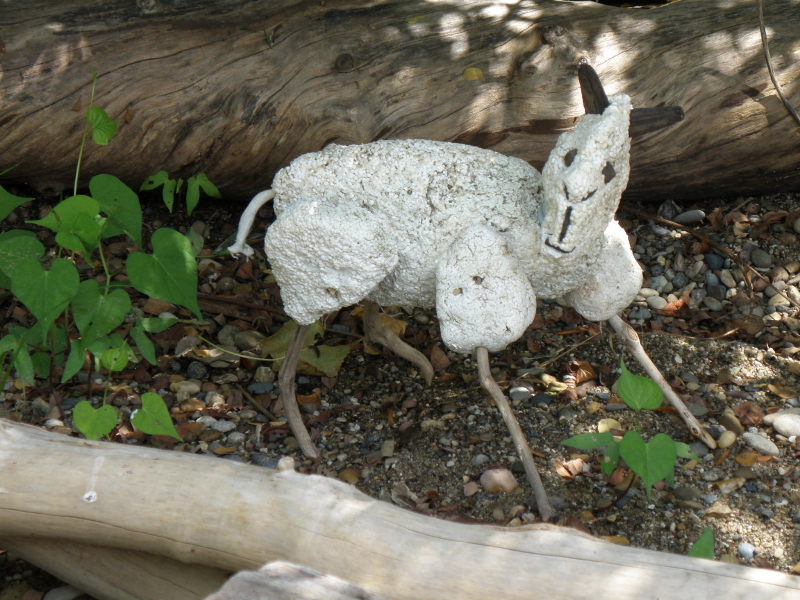
This is the common Groundhog or Woodchuck ( Marmota monax ).  As its scientific name suggests, this large rodent is a member of the marmot family.  Woodchucks are successfully established at the Falls and I encounter them often.  They are fast diggers and live in an extensive system of burrows.  Woodchucks usually don’t stray too far away from the entrances to their burrows.  Succulent greens are the preferred foods.  This particular woodchuck regarding me is a young individual and may be seeking territory of its own?  Usually, I don’t see them this close to the river.  I did have an interesting recent encounter with a very different animal in the western section of the Falls of the Ohio State Park.  Have you ever heard of an animal called the Camelope, (Antilocapra fallsei )?  It is very rarely seen.  The flora and fauna at the Falls can be roughly divided between forms that are “natural” and “unnatural”.  The spider, butterfly, toad, and woodchuck fit in the natural fauna category, while the Camelope is definitely on the unnatural fauna side of life and may represent evolution at an accelerated pace?  The many stresses to the environment and its myriad ecosystems have required a dramatic response and creatures like the Camelope may be nature’s way of responding to these changes?  I’m not a trained scientist, but that is my educated guess.  Discovering and documenting these recent life forms has become a passion of mine.  Anyway, let’s look at a Camelope.  Let’s start with an image of its head.

Camelope, detail of head, August 2013

It’s called a Camelope because its head generally resembles that of a camel’s.  This is a browsing animal and accepts a wide range of vegetation growing along the river.  It has dark eyes that are always nervously looking around for potential predators.  This park is also home to Feralocitors that prey upon Camelopes.  This particular species also has an acute sense of smell.

Camelope at the Falls of the Ohio, Aug. 2013

Camelope at the Falls of the Ohio, Aug. 2013

I came across this Camelope in a more isolated section of the park.  It was hiding among the stands of loosestrife and drinking water from the springs that flow downhill and into the river.  It is ever alert and very nimble with quick feet and seemingly at home climbing on rocks or navigating through dense vegetation.  Their bodies resemble that of deer or antelopes…hence Camelope.

Camelope reacting to an unfamiliar sound, Aug. 2013

Camelope at the Falls of the Ohio, Aug. 2013

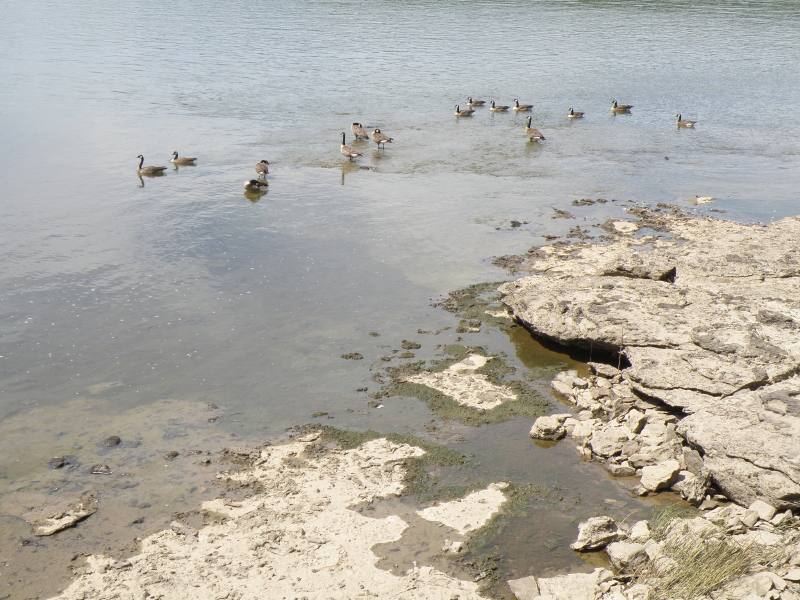
Since it is a relatively new animal…not very much is known about it.  I was able to conceal my presence long enough to manage these images.  I either moved or the wind shifted, but anyway my presence was detected and with a quick bound, the Camelope disappeared into the brush.  I hope I may come across it again and learn more about its secretive life.  Regardless, I will keep my eyes open and my camera at the ready for any new “unnatural” life forms I discover.  It occurred to me on my way home that my Falls of the Ohio Project is now officially ten years old!  I started exploring this fascinating park as the Artist at Exit 0 in August 2003 when the bicentennial of the Lewis and Clark Expedition was being celebrated.  Reading early 19th century accounts of the natural abundance of our country and this place in particular made me wistful for a world that no longer exists.  Two hundred years later…that process continues and no doubt will two hundred years from now.  I have often thought of this riverblog as a historical document as relevant today as Lewis and Clark’s notebooks and journals were back when this country was first being described.  I hope this park and its remarkable history will continue to inspire people for a very long time.  In closing, I would like to present an image of Canada Geese on the water near the fossil beds.  Their coloration gives them in my mind’s eye a formal quality and lends dignity to the landscape.  Until next time…from the Falls of the Ohio.
Canada Geese and fossil rock at the Falls of the Ohio, Aug. 2013

Read Full Post »

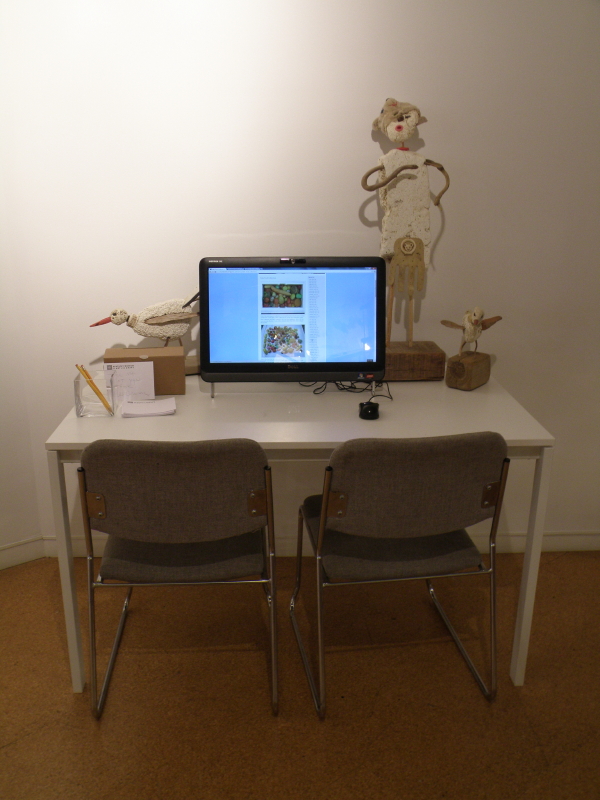
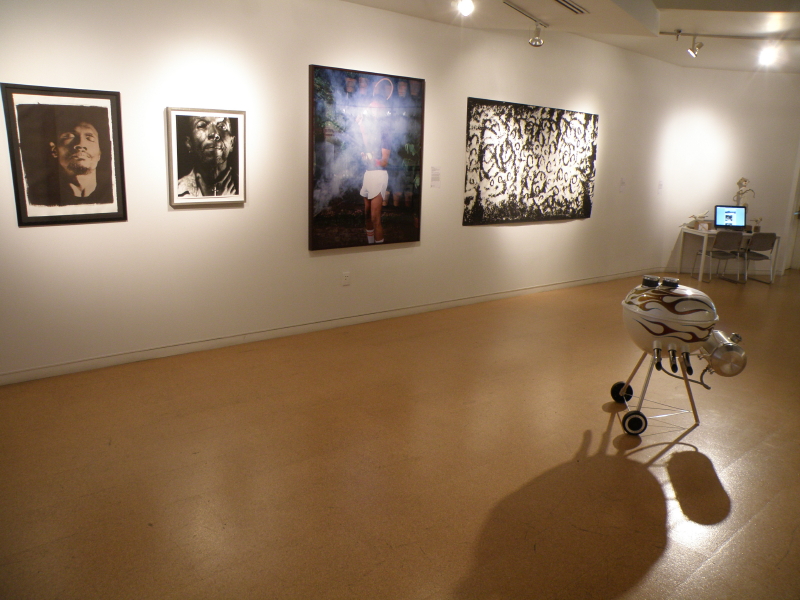
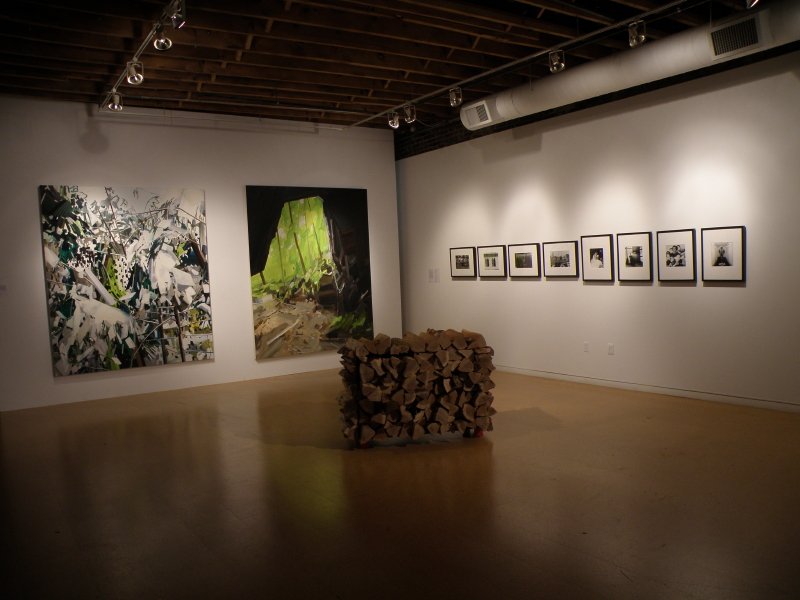
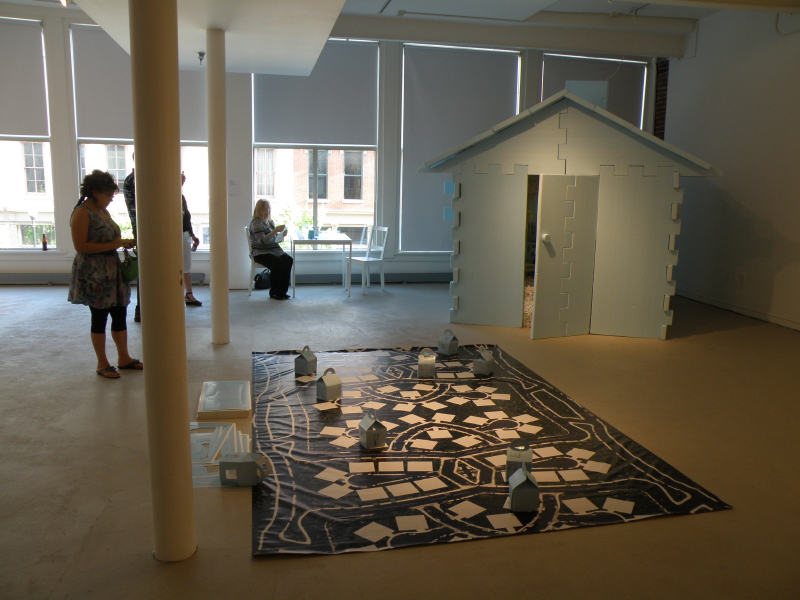
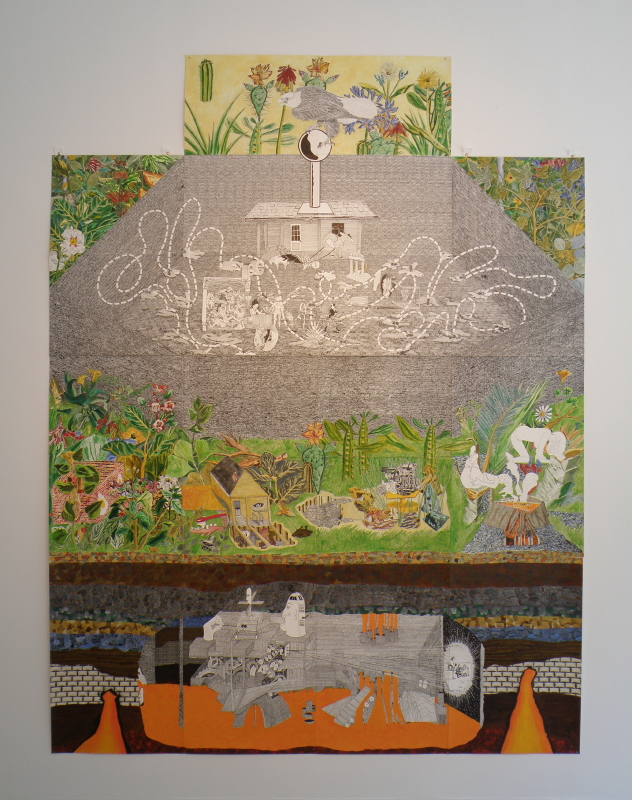
riverblog on computer monitor, The Seven Borders, KMAC, Aug. 2013 As promised, here is a post about the “The 7 Borders, Mapping Kentucky’s Regional Identity” exhibition at the Kentucky Museum of Art and Craft in Louisville.  My “Artist at Exit 0 Riverblog” has been a part of this show which opened on June 29 and runs through September 1.  I’m honored to have been asked by KMAC and curator Joey Yates to participate especially since this is the first time my blogging activities have appeared in an art context.  My display in the museum included a few small Styrofoam artifacts, a computer monitor on a table with chairs, a box for handwritten comments, and a label on the wall.  Not quite your typical art offering.  If, however, you think of the computer as a keyhole that you can peer through to a different reality…then you get transported to the world of the Artist at Exit 0 at the Falls of the Ohio State Park.  At your fingertips are over 360 posts and more than 3500 images and my own peculiar blend of fact and fiction.  Many of you who follow this blog have been nice enough to leave recent comments and I wonder if you realized that you were participating in this exhibition too?  At the end of this post, I will add the comments that visitors left for me in the little box so that they can be a part of this exhibition record as well.  For now, I would like to share some other images of the works that are (were) a part of this exhibition. The 7 Borders, installation view, Aug. 2013 Eighteen artists are participating in this exhibition.  A few of the artists either currently live in Kentucky or are originally from here.  The majority of the artists, however, live in the seven contiguous states that border the commonwealth, hence “The 7 Borders”.  In the above image, works by Rashid Johnson are on the wall, while Brian McCutcheon’s whimsically modified cooking grill entitled “Trailer Queen II” rests on the floor. The 7 Borders, gallery view, Aug. 2013 The exhibition is a survey of contemporary works produced in a geographical area that is often hard to define.  At various times, Kentucky has been considered by Americans to be the frontier west, the Midwest, or the most northern of the southern states.  The fact this region has been historically hard to place is attractive to me.  For a professional artist, one downside is that the nearest art market of any size is in Chicago.  Many of the artworks in “The 7 Borders” reference issues born of local conditions and landscapes and gain a certain power by not being made for strictly commercial reasons.  The exhibit’s curator wrote: “Each of the artists represented is witness to varying views of the region focusing on personal history and collective experience.”  In the gallery shot above are paintings by Claire Sherman, a photo series by Guy Mendes, and a unique chest of drawers that looks like a stacked firewood entitled “Facecord” by Mark Moskovitz. "The River" by Andrew Douglas Underwood, The 7 Borders, KMAC, Aug. 2013 This mixed media work is entitled “The River” and the artist is Andrew Douglas Underwood who originally is from Louisville.  Personally, I relate to Underwood’s piece because it weaves together metaphors and history relating to people’s long association with the Ohio River.  This work effectively combines photography, embroidery, and found objects. "Pre-Fab(ulous) Environments", Leticia Bajuyo, at KMAC Leticia Bajuyo’s “Pre-Fab(ulous) Environments” is an installation piece located on the museum’s second floor.  Her multimedia piece with its blue Styrofoam installation house and suburban floor map complete with Happy Meal-styled folding cardboard houses reference contemporary suburban neighborhoods. "Roan Mountain Matrix", Denise Burge, The 7 Borders, KMAC This is an image of “Roan Mountain Matrix” by Denise Burge who lives in Cincinnati, Ohio.  Her large fabric and thread works quote traditional Appalachian quilting while alluding to changes occurring to the land and its people through contemporary processes like mountain top coal removal. "Bog Taan", Joel McDonald, at KMAC, Aug. 2013 Joel McDonald’s “Bog Taan” is a tour-de-force mixed media drawing on 26 sheets of watercolor paper.  This is a large, obsessively detailed work that touches upon the artist’s social views as told through the context of his Germantown neighborhood in Louisville, Kentucky.  McDonald has a deep understanding and appreciation for 20th Century illustration.  You could look at this artwork for a long time and keep finding images within it.

To conclude this post, I would like to include the comments left by gallery visitors upon engaging my blog in the gallery.  Some of the comments are by children who participated in summer camp programs organized by the museum.

BLOG COMMENTS

“Love this – so fun!

I once saw a duck taking a nap on a submerged & upside down shopping cart on the L-ville side of the OR (Ohio River)”

“The Joe Arbor set was sweet. Poignant. – you should do stop action animation.”

“Love the triker! and the deer-Styrobuck! and the spider-and Pip and the fish-”

“It’s beautiful, I love it! – famous artist”

“Looks like garbage to me!”

“Be cooler if it was metal”

“Some really remarkable & moving works!  Really enjoyed 7 borders.”                       Lou Knowles…Forest Hills, New York

“I like it!  Keep up the good work!”

“So Playful!  What a blast.  Thank you.”

“I like it!”

“Very interesting, one man’s trash is another man’s treasure.  Love the blue nose man”

“dirty + whimsical like crawling through a broken greenhouse in the backyard + making toys as a child”  Lilly Ettinger

“Love it!” “???” “Fabulous: fun, imaginative & thought provoking…Thank you”                                     Mary from Wisconsin

“Quirky & original.  Brought a smile to my face”  K. Woodard (art teacher UK)

“I like the very last peice.  I think personally it looks like here is a passage in between the trunk and the roots”

” I agree we did not make enough “to do” about the beginning of manned flight.  I wouldn’t be here enjoying our work without a flight by plane.  Also like your reminder to “follow your dreams”  Kay Gorman (Maryland)

“Love them!  Priddy Cool!”

“This is very suspicious and cool to see what people throw in the river”

“Ummmm!”

“Love the birds…they are alive.”  Adrian (New Zealand)

“It looks like two snowman”

“I think this was awsome”

“Love the recycling, cute and clever.  Loved to take the time to see the whole-plus the blog.- Just a passer-by, Aug. ’13”

“Fab Al – Love where you went with this – Always happy too see your dementia”  Paul and Sandy Sasso………..these folks are old college friends of mine

“They look like Big, Dirty, Marshmallows”

“You are awesome”

THIS WAS THE LAST OF THE COMMENTS LEFT AT THE EXHIBITION.  NEXT TIME…SEE YOU FROM THE RIVER!


Read Full Post »

Tree in the western section of the Falls of the Ohio State Park, Aug. 2013

Resolved to stay away from my old atelier under the willow trees for a while, I decided to explore the western section of the Falls of the Ohio State Park.  It was just the most beautiful day and residents of our area have remarked on how unusually nice it’s been of late.  The air today has wonderful clarity and although it’s summer and the sun is shining…we are many degrees below our usual temps.  I feel the western part of the Falls of the Ohio begins once you cross the creek at the end of the Woodland Loop Trail.  This is an area that receives fewer visitors and I’m happy just to wander with nothing on my mind.  As I walk the narrow strip of land that is the riverbank, on my left are sounds from the river and on my right are various bird songs originating under the tree canopy.  I see the formerly high river has deposited driftwood here in new configurations along with the usual plastic junk.  My eyes are open and ready for anything.  I doesn’t take very long before I make the first of several discoveries new to me in and around a patch of Wild Potato-Vines.

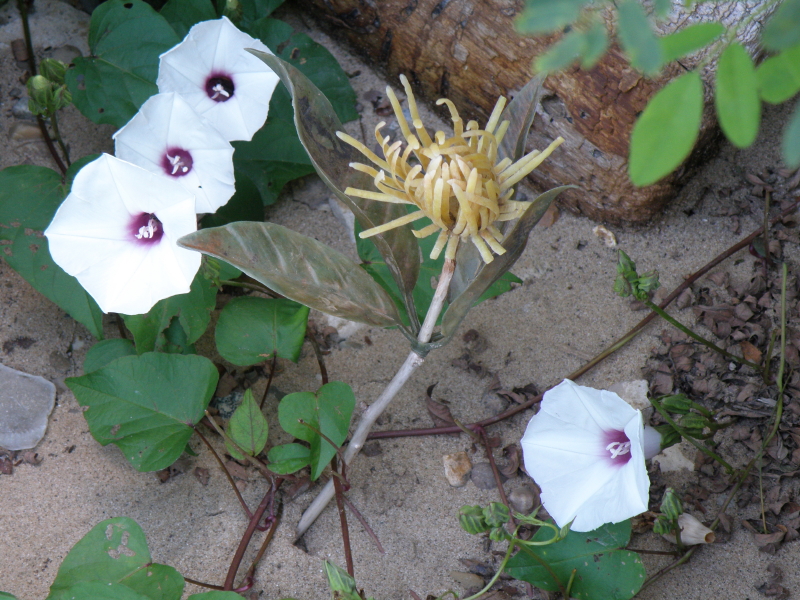
Goldstein's False Mum among Wild Potato Vine flowers, Falls of the Ohio, Aug. 2013

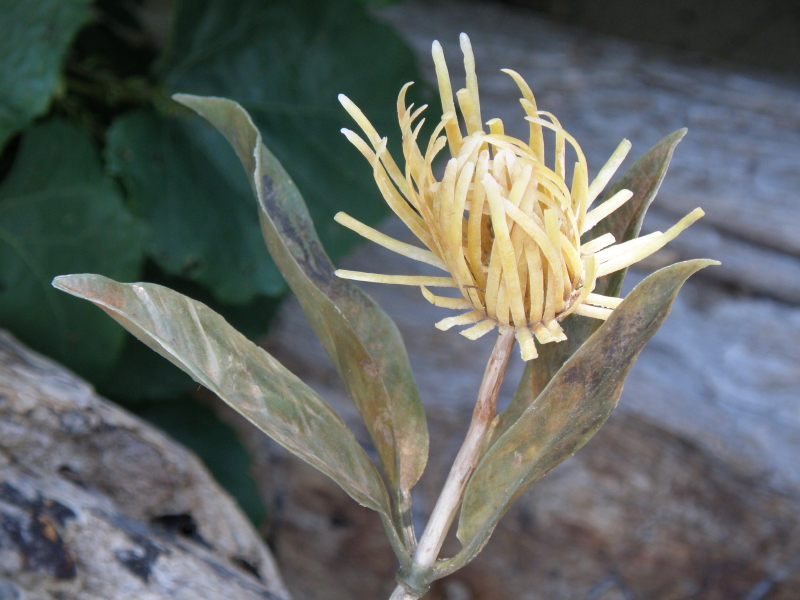
Close up of Goldstein's False Mum, Aug. 2013

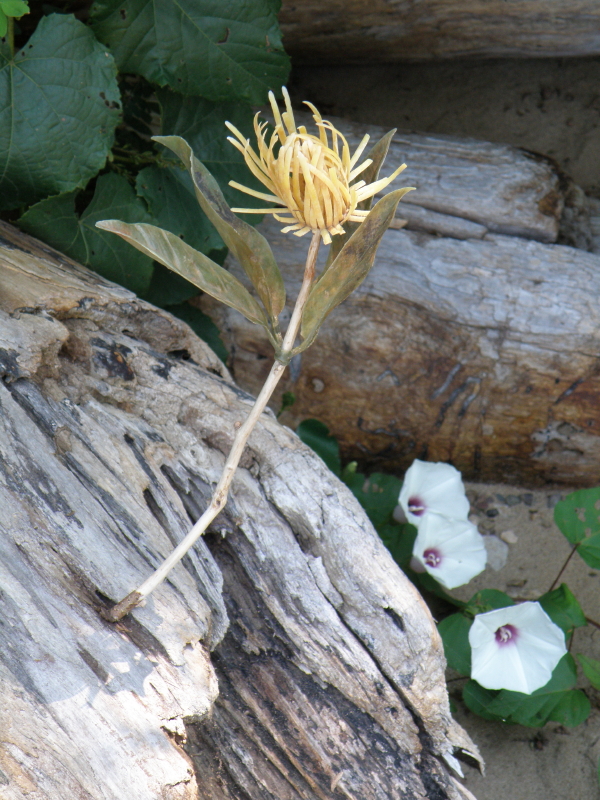
This is Goldstein’s False Mum which is named after the resident naturalist at the Falls of the Ohio State Park.  This is another in a series of very odd flowers while being organic by definition  have little in common with the other plants that grow along side of them.  In general, plastic-like blooms and foliage characterize these botanical rarities.  None of these plants (which form a new order of their own called Artificialia ) are capable of photosynthesis despite the appearance of green leaves.  Goldstein’s False Mum is a summer plant that produces a hard, yellow, frilly blossom that appears on the terminal end of a woody stem.  It prefers sandy, disturbed soils or decaying wood and is usually seen in the company of traditional flowering plants.  It produces no scent and no insects were observed being attentive to the false mum.  Now the Wild Potato-Vine is also an interesting plant.  It is a member of the Morning Glory family and its bloom is primarily white with a purplish maroon throat.  I have seen large bumble bees pollinating this flower.  What sets this plant apart is under the ground.  The Wild Potato-Vine produces a large tuber that had food value for the indigenous people.  Here is a another specimen of Goldstein’s False Mum growing out of a soft, decaying log also in the presence of Wild Potato-Vines.

Goldstein's False Mum and Wild Potato-Vine flowers, Falls of the Ohio, Aug. 2013

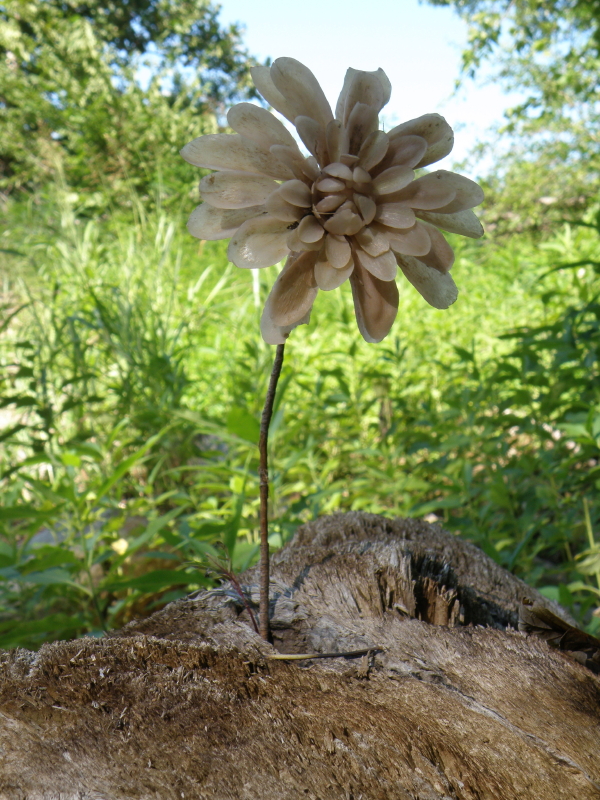
Not too far away and also in association with the Wild Potato-Vines is another type of plastic-like plant and here is its portrait.

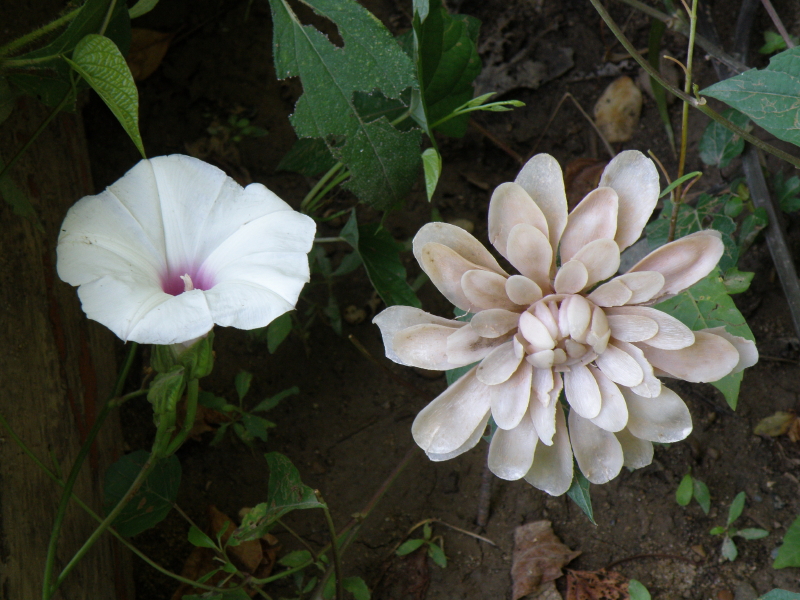
Wild Potato-Vine blossom with Saprophytic Zinnia, Falls of the Ohio, Aug. 2013

The Saprophytic Zinnia, Falls of the Ohio, Aug. 2013

The Log Weed is a saprophytic plant.  Lacking chlorophyll it relies on decaying matter for its sustenance.  The Log Weed is characterized by a corolla of hard plastic-like petals and never has what we would describe as leaves coming off its woody stem.  No one is quite sure how it propagates? Its blossoms appear in mid summer and seem to hang around forever.

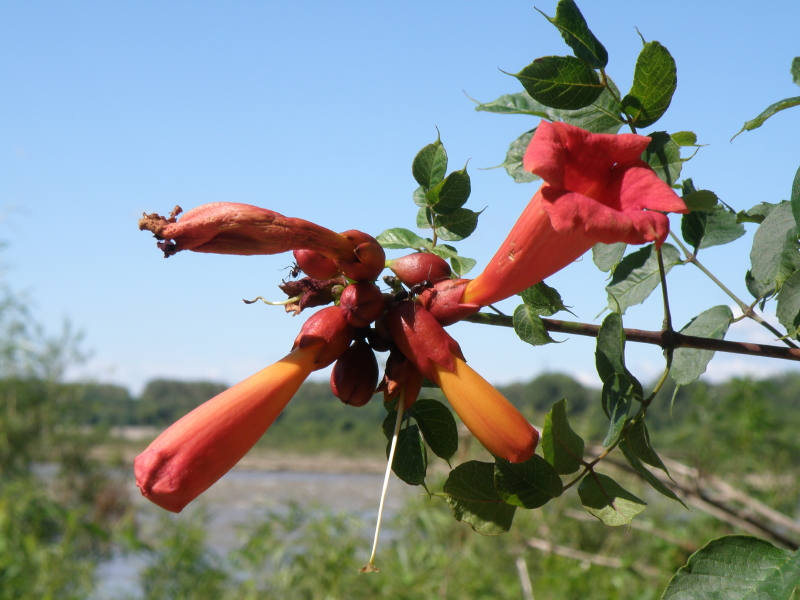
Trumpet Creeper, Falls of the Ohio, Aug. 2013

These are tubular flowers from the Trumpet Creeper vine which is a native and natural sight at the Falls of the Ohio.  This is a climbing, spreading vine and wood ants seem to love them.  If you look closely at the above photo…you can see several ants crawling on the Trumpet Creeper’s attractive blooms.  I was admiring this vine when I noticed that there was something not quite right about it and this is what I discovered.
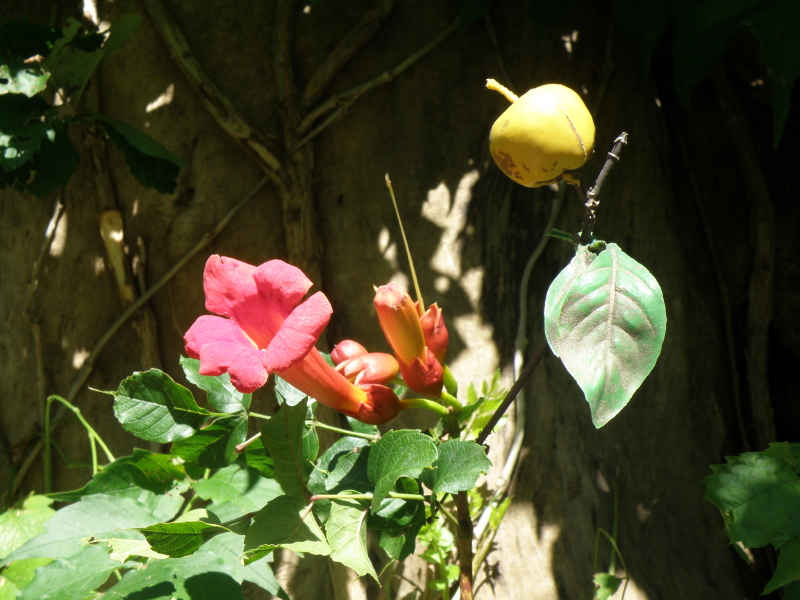
Unknown fruit on Trumpet Creeper, Aug. 2013

Notice the yellow orb to the upper right of the Trumpet Creeper blossoms? Thus far, the yellow fruit with its accompanying leaf remain unclassified.  It is, however, grafted to the woody stem of the vine.  Amazingly, it even has a false stem to deceive.  Could it be parasitic?  One hypothesis why this plant with the odd fruit appears with Trumpet Creeper might be the protection it receives from the vine’s wood ants?  The fruit and leaf are also very polymer-like and may indeed be plastic.  More and more we are learning how ubiquitous plastic is in the environment.  I heard a report about the Great Lakes the other day saying that there is a considerable amount of micro plastic in these large bodies of fresh water.  Upon examination, much of this plastic takes the form of tiny balls that are blended into deodorants and toothpaste to make the product flow more evenly.  These beads are so small that they pass through the finest screens at the waste water treatment plants and into the lakes.  I think Nature is metabolizing this plastic and recombining the hydrocarbons in novel ways, but that is just my theory.

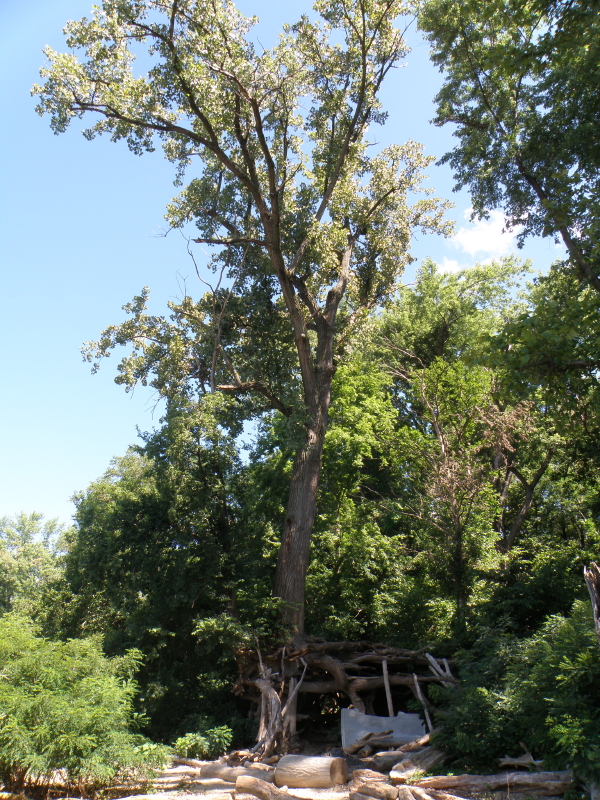
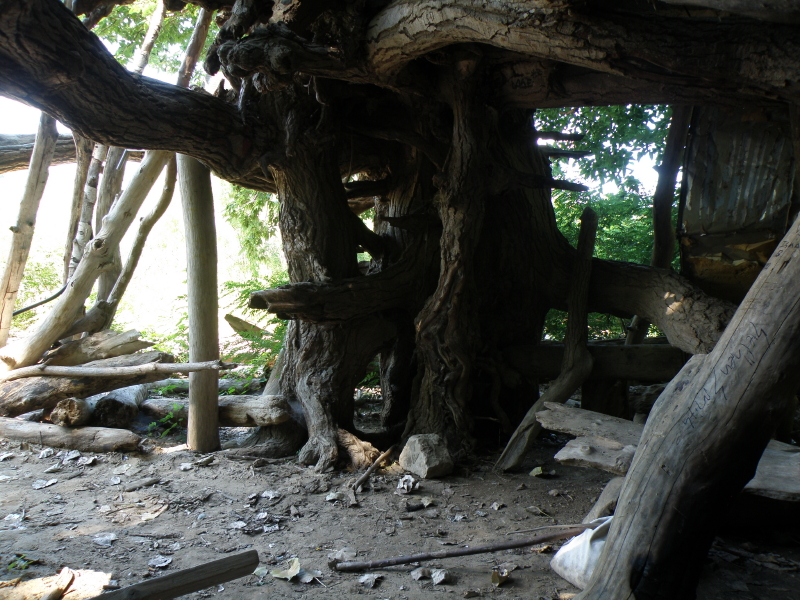
Cottonwood tree fort, Falls of the Ohio, Aug. 2013

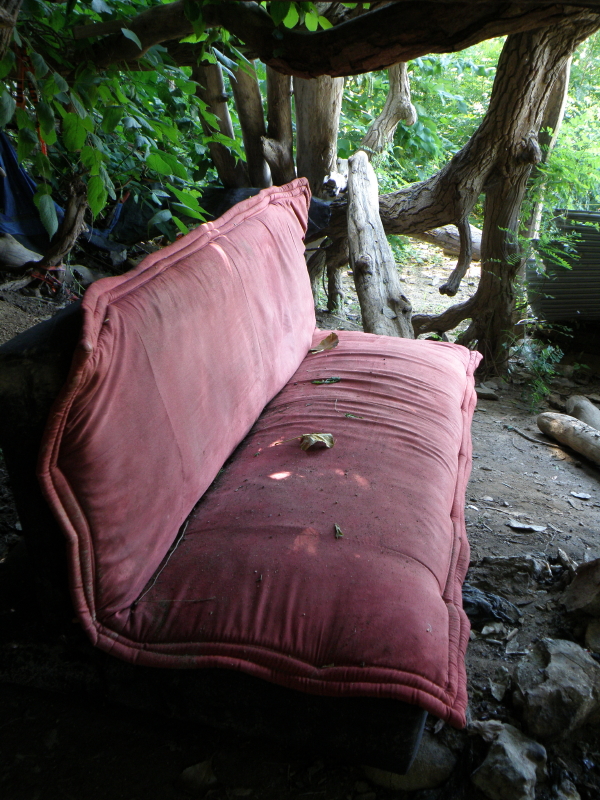
I paid my favorite cottonwood tree a visit and it’s been a while since I took shelter under its large, exposed roots.  People, especially the locals, like hanging out here and I witnessed much less trash since my last visit which is a good thing.  One big “improvement” has been made with the addition of a red, upholstered couch and I took a moment to rest here before moving on.

red couch under the cottonwood tree, Aug. 2013

The couch is very comfortable and I’m amazed that people actually dragged this piece of furniture down here.  Eventually, it will be reclaimed by the river.  Here’s another view from under the tree.

space under the cottonwood tree, Aug. 2013

For those who prefer their comforts a bit more on the rustic side…there is another bench for seating and it’s made from a slab of wood balanced on short logs.

under the cottonwood tree, Aug. 2013

I rested, had a snack and drank some water before moving on.  I’ve designated my intended destination as “Loosestrife Land” for the abundance of these non-native flowers that have taken over moist areas in the western section of the park.  I’m going there seeking something else which will be the subject of my next post.  I’ll catch up with you soon but for now…so long and happy trails to you.

Purple Loosestrife flowers in bloom, Falls of the Ohio, Aug. 2013

Read Full Post »

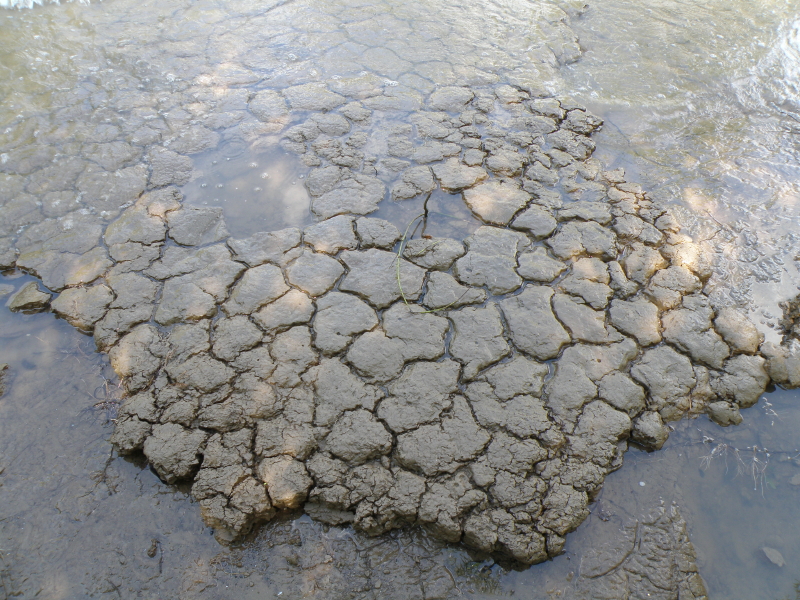
the riverbank, cracks in clay, July 2013

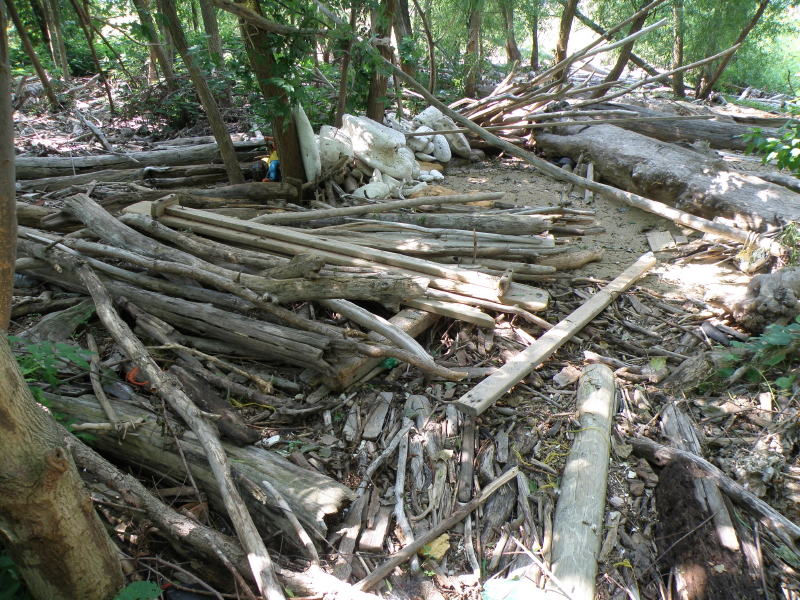
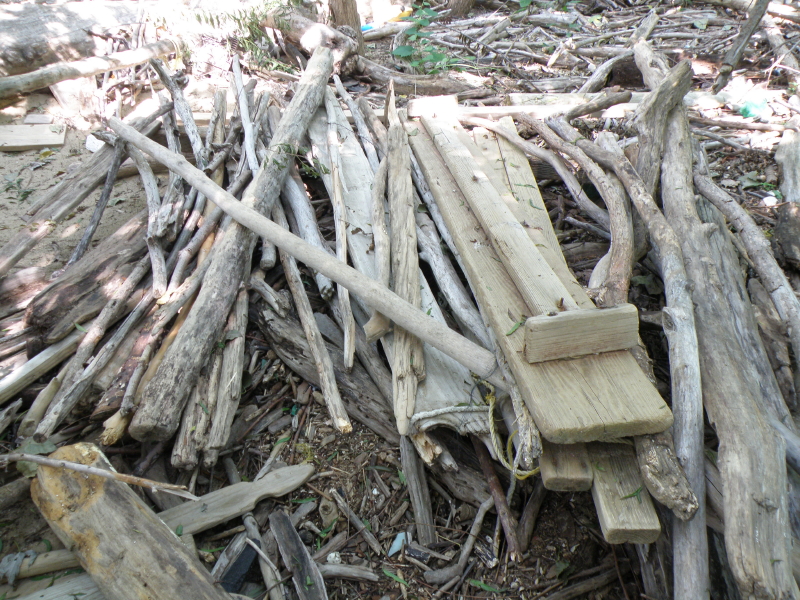
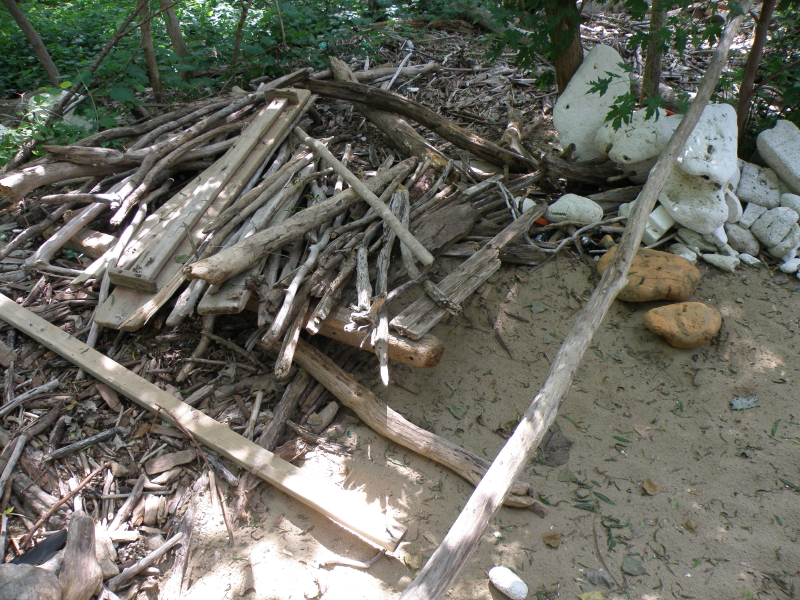
I never told you how this story played out and so now is as good a time as any.  A few weeks back, I had posted on how some unknown visitor(s?) had been altering my outdoor studio at the Falls of the Ohio State Park.  For a least two years previously, I had been storing my river found art materials at this site.  People who stumbled upon this spot often mark their presence by changing how I left it in some way.  Folks might rifle through the junk or take or destroy the Styrofoam figures I might leave behind.  I don’t mind this…in fact, I encourage the interaction.  On site, it’s easy to make the connection that all these poor materials I use came from the river.  I still think of my outdoor studio as a shared laboratory for this exercise in creativity.  It’s an acknowledgement that all this junk is out there and that something else positive might come from it.  For several weekends, my latest visitor has been building a wooden driftwood structure over my spot to the point where it usurps my ability to continue working there.  So, I made a few changes that I thought would benefit both of us.  I modified the structure so that I could stand within my site.  I also opened up the space more which I thought also encouraged additions.  I was curious to see how my visitor would react and here are the pictures.

destroyed driftwood structure, July 2013

destroyed driftwood structure, July 2013

destroyed driftwood structure, July 2013

It appears that my “improvements” weren’t appreciated because I arrived one day to find it all laying on the ground.  All the nylon line and strong knots that were holding things together were cut with a knife.  Stuff was scattered and the big polystyrene figure I had left there was destroyed again.  Here’s how I discovered my Styrofoam man.

fallen figure, July 2013

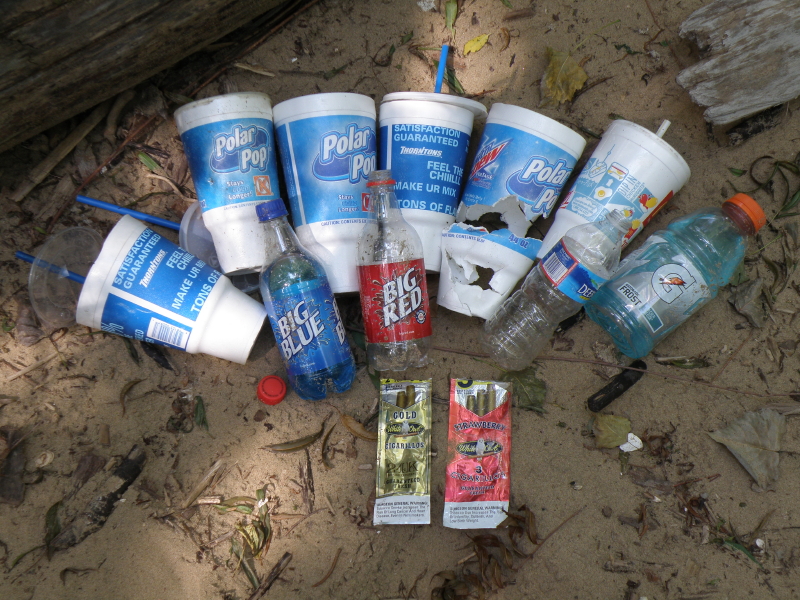
He had been sitting in a fork of a nearby tree.  I think my visitor picked him up and threw him across the site…again!  At this point, I’m feeling pretty bummed out.  I left this figure as I found it.  My visitor also left me some additional trash behind as is his custom and I gathered it together again to create this “portrait”.

trash at my site, July 2013

I thought the “Big Red” with the “Big Blue” was an interesting touch.  In our area, those are the home colors of rival universities.  Another giant Styrofoam cup joined the group and I have my suspicions that the cigar packaging is from the same individual as well?  I think this is what saddens me the most that all this convenient store trash would be walked to this site and simply thrown on the ground.  As much trash that appears here from upriver, I’m shocked by how much park garbage originates from the nearby towns.  And yes, there are trash cans available everywhere.  I sat by my site for a while and pondered the situation.  I wondered why with all the space and driftwood available in the park that this spot became so important to my visitor?  Feeling like this individual more than likely doesn’t play well with others…I decided to walk away from this site for a few weeks or months before returning.  So far, I haven’t been back to my old spot under the willows.

two fishermen, July 2013

The day felt shot, but I didn’t want to leave things that way and so I went for an extra long walk.  After all, I have the rest of the park to potentially explore.! Along the way, I spotted these two guys attempting to fish by the wall of the dam.  They didn’t appear to be having any luck and so I left them with these fishy images by the side of a trail they would pass by.

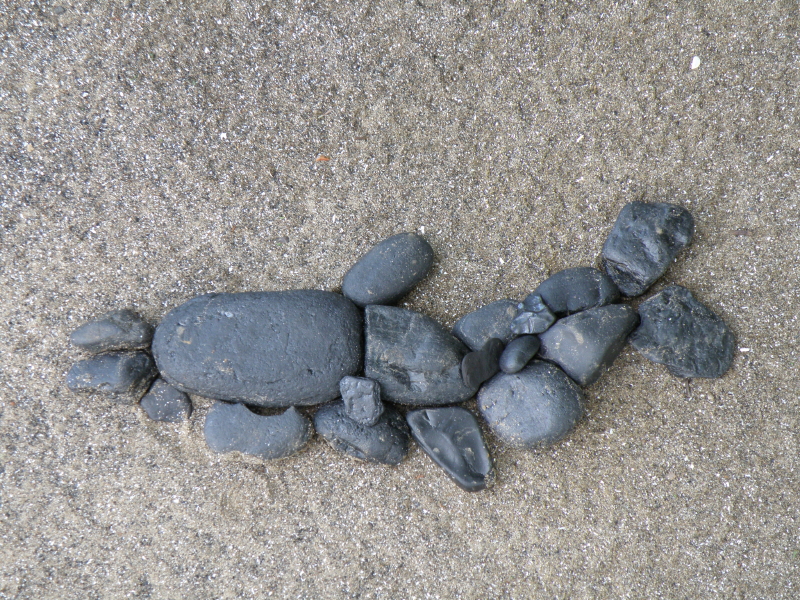
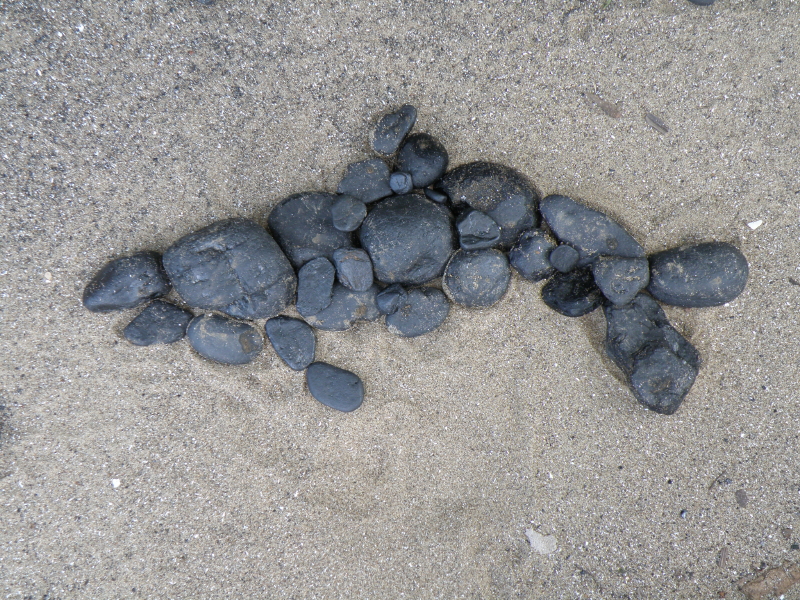
coal fish, July 2013

coal fish, July 2013

coal fish, July 2013

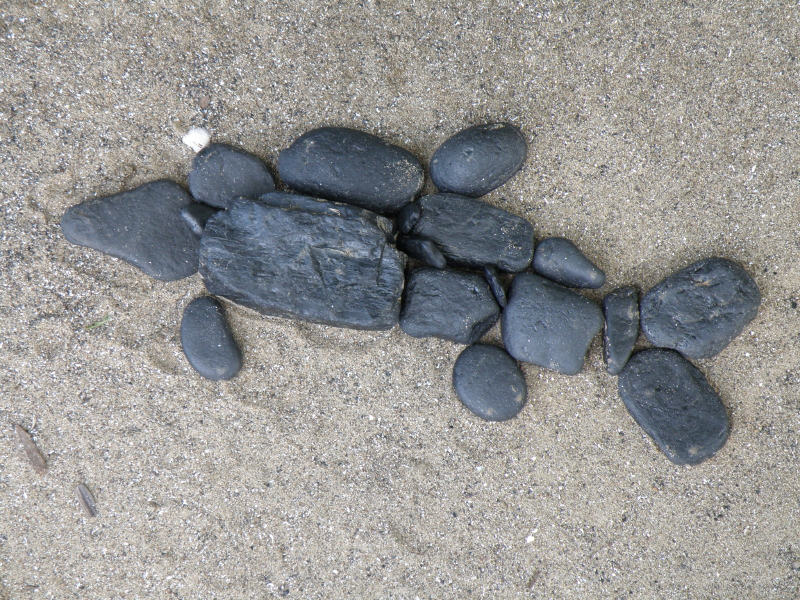
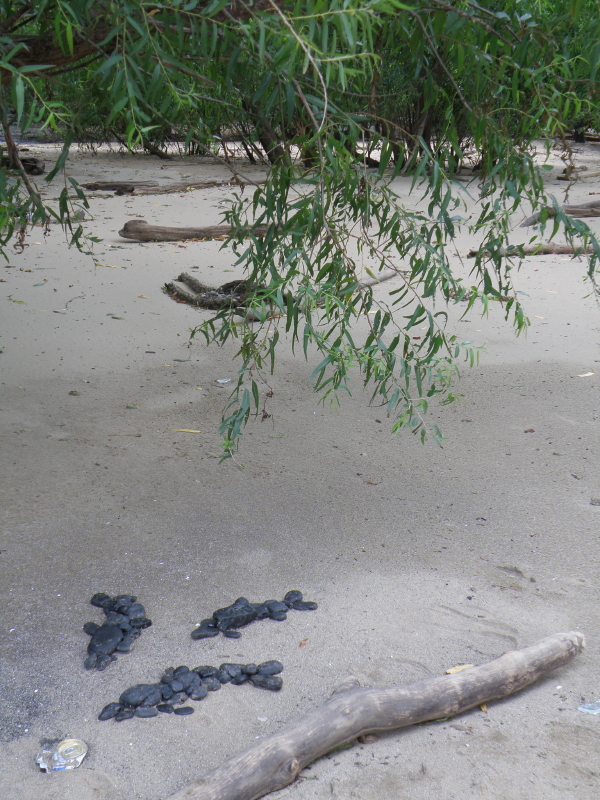
I used river smoothed coal I gathered on site and improvised these three fish on the sand.  Peppering the silica granules black is coal dust.  The white dots are pulverized mussel shells.

three coal fish on the sand, Falls of the Ohio, July 2013

Thus far, it has been an atypical and sometimes unsettling summer at the Falls of the Ohio.  All the early season rains and subsequent high water have disrupted the usually hot, humid, and lazy routine found here during this time of year.  In an odd way, it doesn’t feel like summer has truly arrived for us yet.  We have a few more months for this to happen before the leaves start turning colors.  To close, here is one more coal-fish image in a slightly larger context.  Have a great weekend!
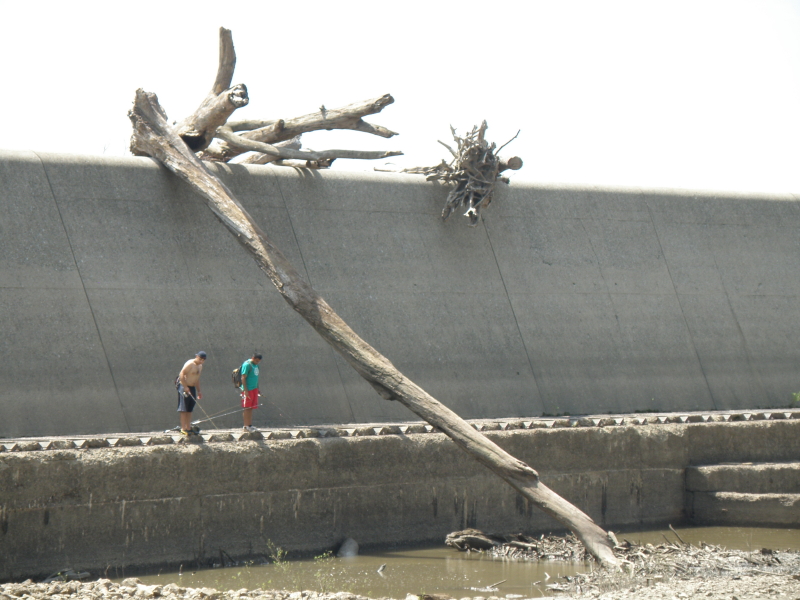
coal fish in context at the Falls of the Ohio, July 2013

Read Full Post »

« Newer Posts - Older Posts »