Feeds:
Posts
Comments

Archive for the ‘recycled art’ Category

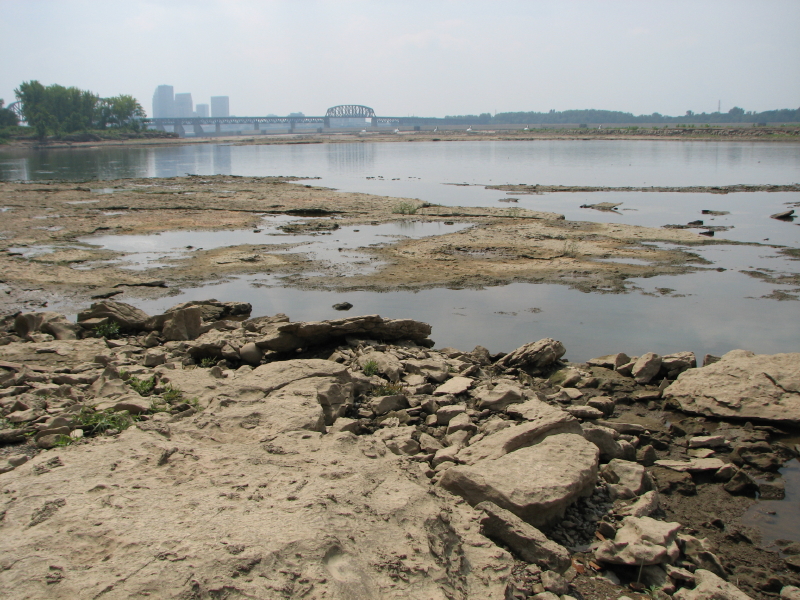
It’s the Falls of the Ohio State Park in late summer.  We haven’t had any significant rain in a few weeks and the fossil beds are exposed as the river has retreated away.  This isn’t a permanent condition…just the way it is during this season. Visitors are walking over the rocks and admiring the many ancient fossil corals that during the rest of the year are under water.
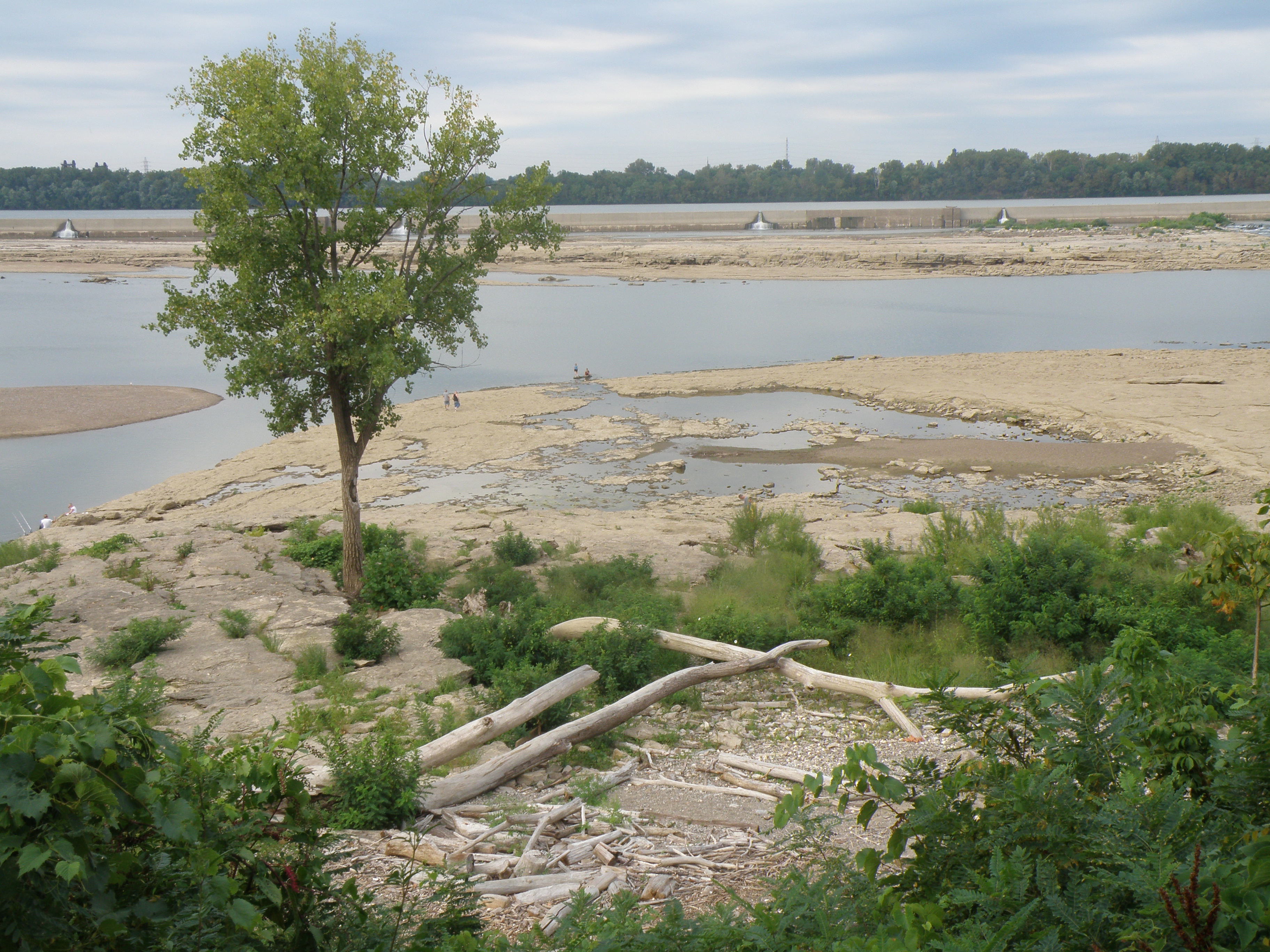
The best time to get a sense of the extent of the fossil beds is during summer.  From the top of the riverbank you can get a good overview of the area.  You can see across the fossil beds to the high wall that keeps the Ohio River at bay. Bird watchers are scoping the rocks and the top of that wall on the look out for seasonal birds or that once in a lifetime rarity.  Well today was their and my lucky day!  I was sitting by the picnic table when in the far distance I noticed something large and white winging its way across the ancient limestone terrain.  At first I thought it was a pelican, but it clearly wasn’t big enough.  That’s when I heard one of the bird watching flock who also spotted it say that he thought it was a heron or egret of some kind.  I grabbed my camera and hustled down to the river.
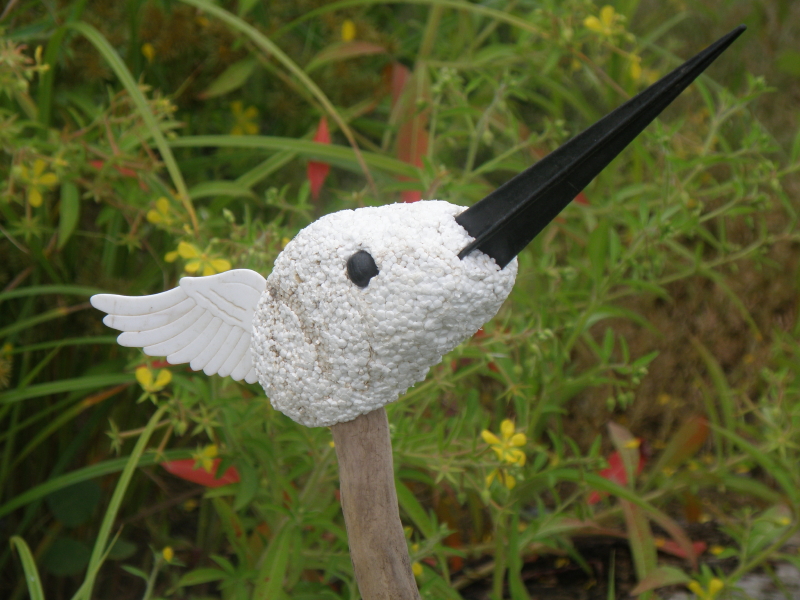
I watched the white bird circle the area by the lower tainter gates and I anticipated its possible landing spot.  As I approached the area my mental field guide was going through all the possible species.  Great Egrets are seasonally common here and while they are white…they do not possess a black bill.  One white wader that does have a black bill is the Snowy Egret, however, it is smaller and has black legs with yellow feet.  Snowy Egrets come to the Falls but they are less common.  It couldn’t be a Whooping Crane because I couldn’t see any black tips on the wings.  For a moment, I even thought this bird might even be an albino.  Nevertheless, it was shaping up to be a mystery which are among the most fun birds of all.
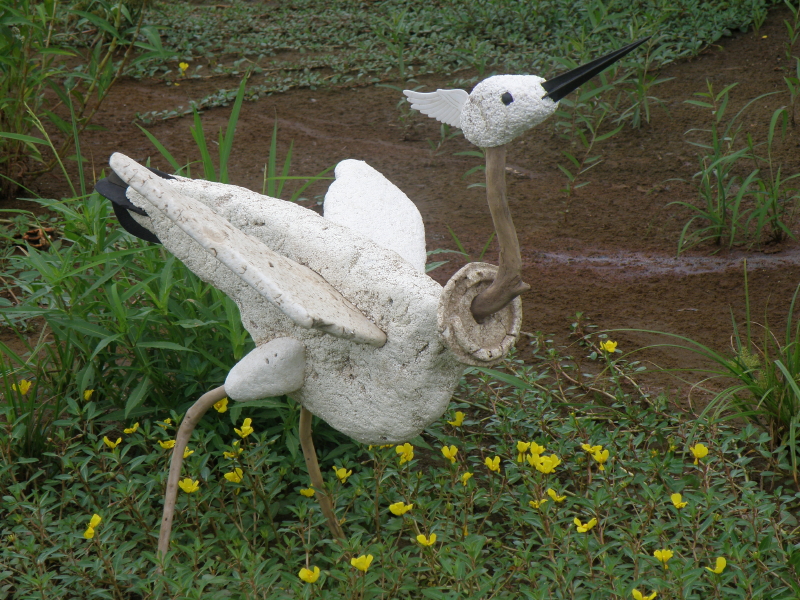
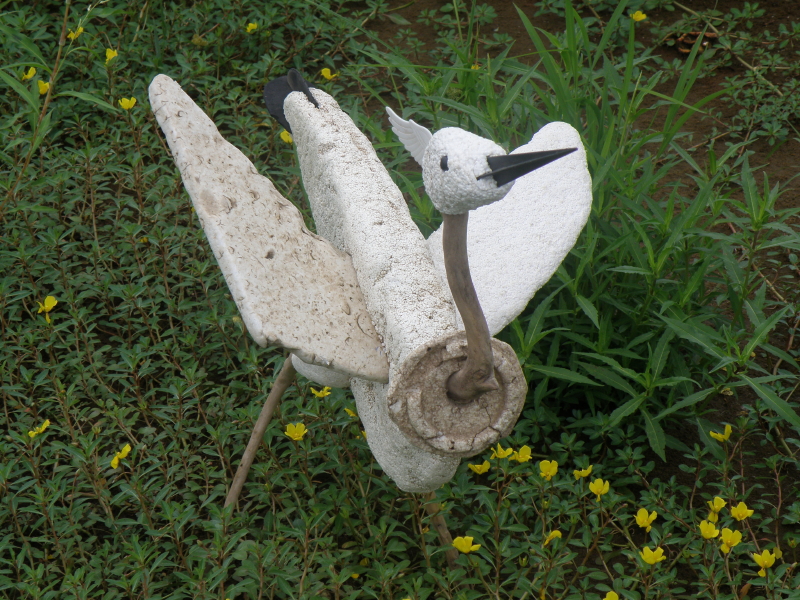
I saw the bird alight in the sedges and grasses near the river which is where I took these photographs.  This beautiful bird was distinctive with its black bill and white head crest.  It’s tail feathers were also tipped in black.  I watched it catch and eat grasshoppers that were numerous in the weeds.  For the moment, I would concentrate on taking pictures and being discreet.  I could always identify it later in the comfort of my home, but already I knew it wasn’t a bird normally found here or in our country.  This bird’s beauty was enough and knowing its name wouldn’t make it more beautiful.  Time stood still until the bird spooked or just decided to fly off.  Later that day I saw the heron return to the river and I hung around hoping for just this opportunity.
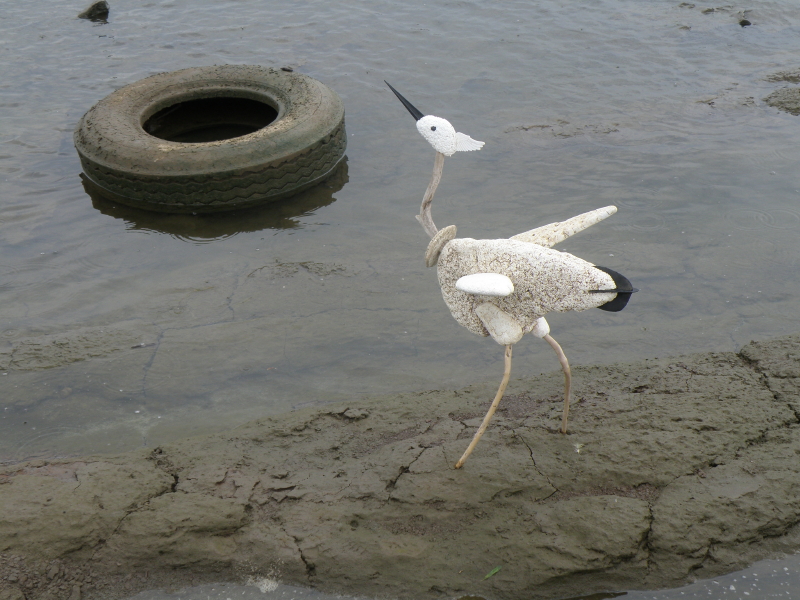
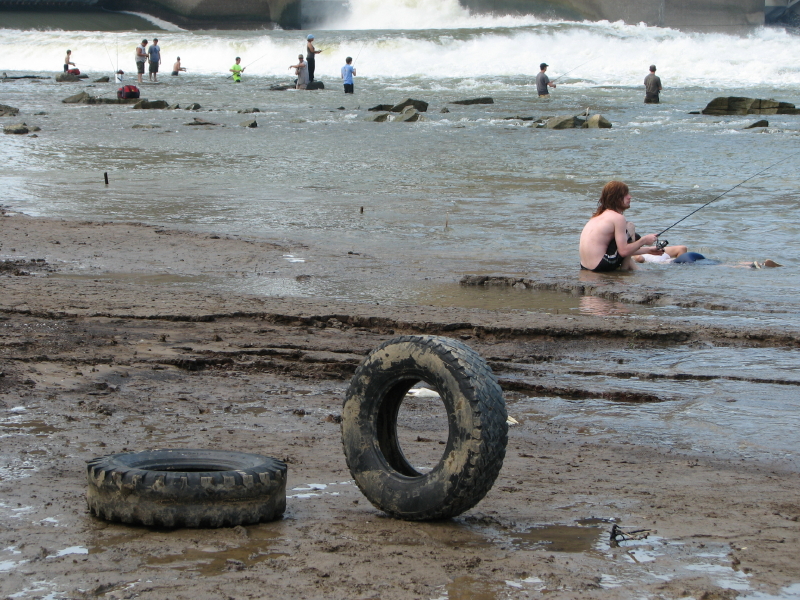
I was struck by the great contrast between the snow whiteness of the bird and the dingy black of the tire resting in the water.  I thought the heron was exhibiting signs of distress or anxiety, but I was surely projecting my own feelings onto this animal…or maybe not!

In one of the most curious bird behavior moments I have ever observed, the heron walked over to a group of discarded plastic bottles and started hitting them with its bill.  I guess it was just checking them out?  A passing fisherman came too close and the bird was gone for good.  I took a deep breath and hoped that I had a few good images and turned for home.  The bird turned out to be the Black-billed Heron which is more accustomed to being found around the heat of the equator.  Few confirmed records exist of this species being seen this far north. But since it’s been hot just about everywhere this year, the right conditions were present for it to make this appearance.  This same individual would create quite a bird watching stir wherever it was sighted in the United States and even made the cover of several bird watching magazines.  The Falls of the Ohio was as far north as this bird was seen and for me it was a happy privilege to see a bird that even John James Audubon never saw.
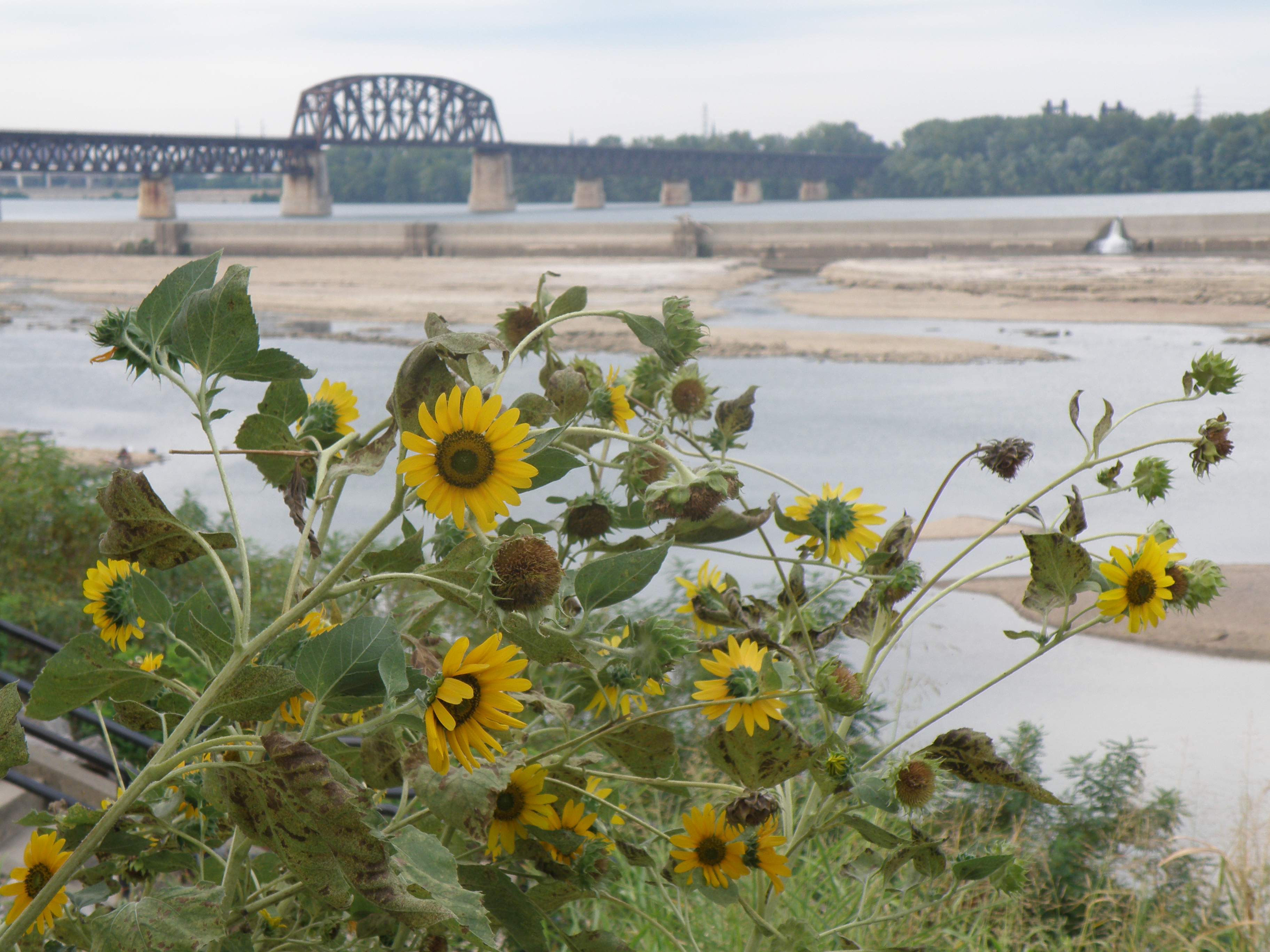
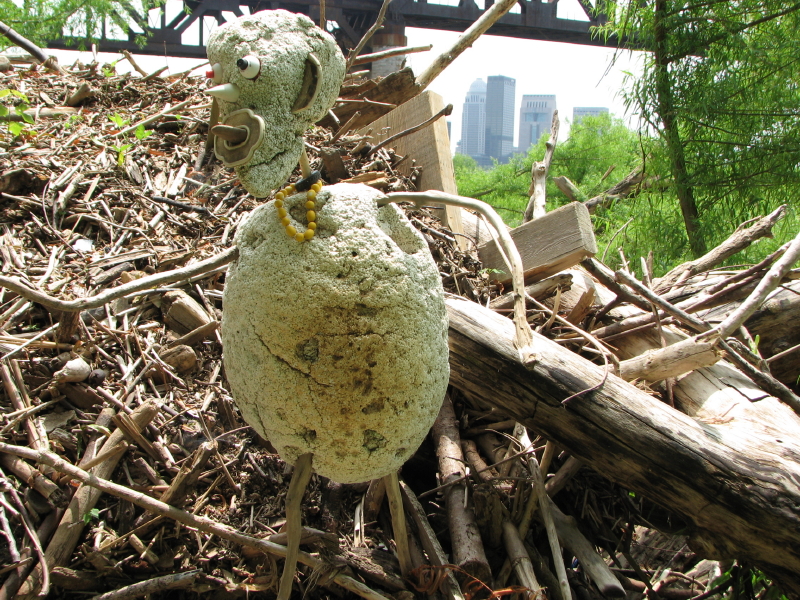
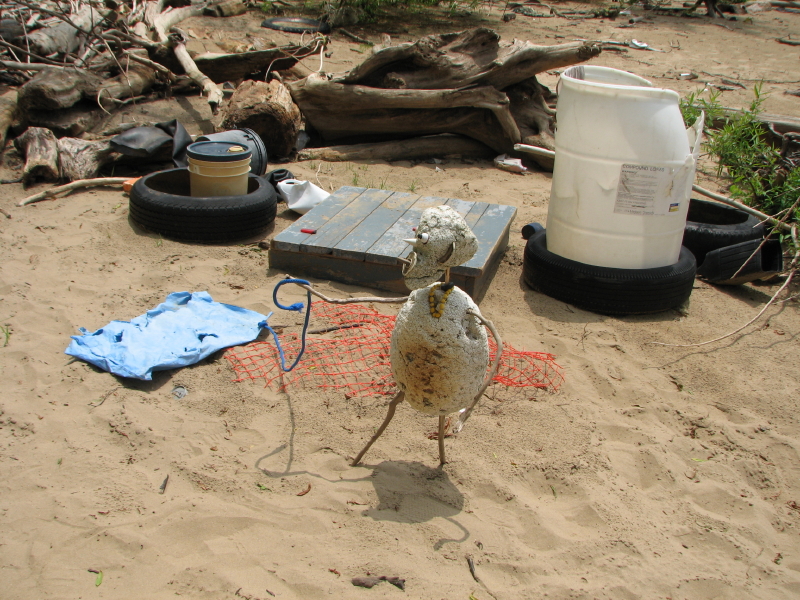
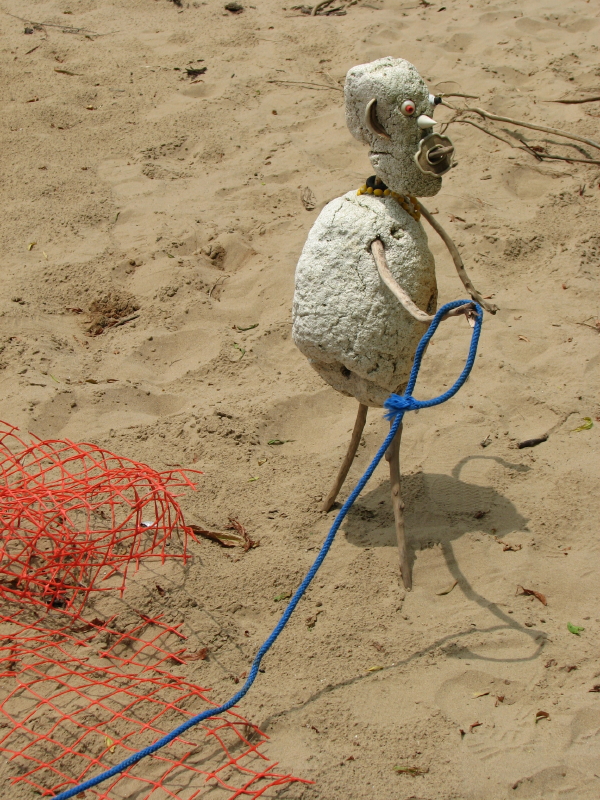
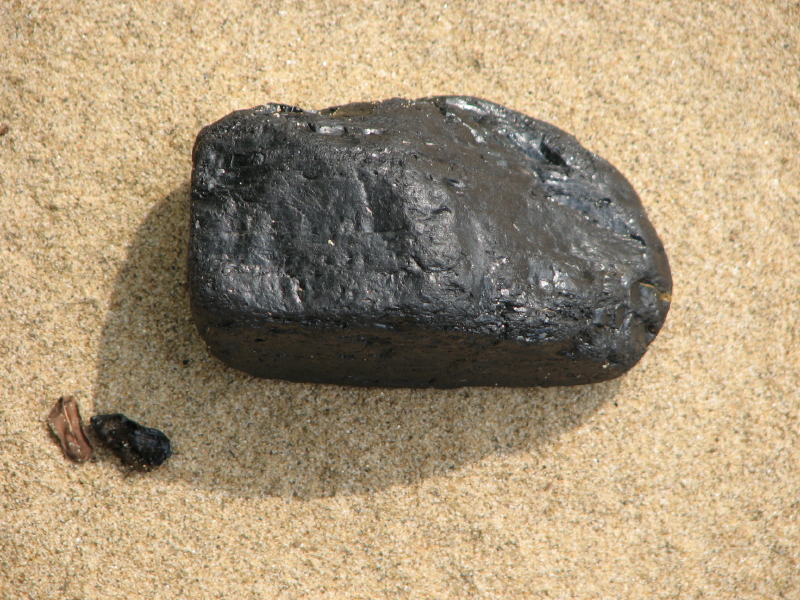
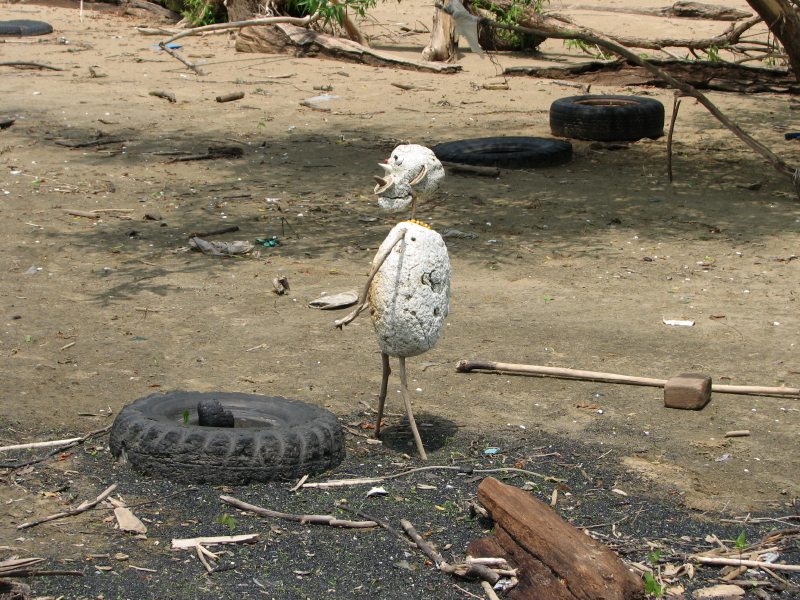
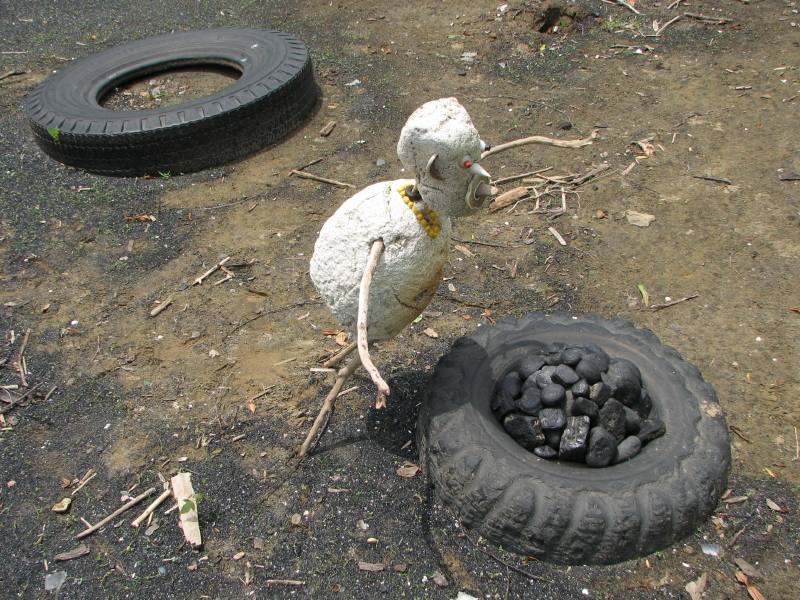
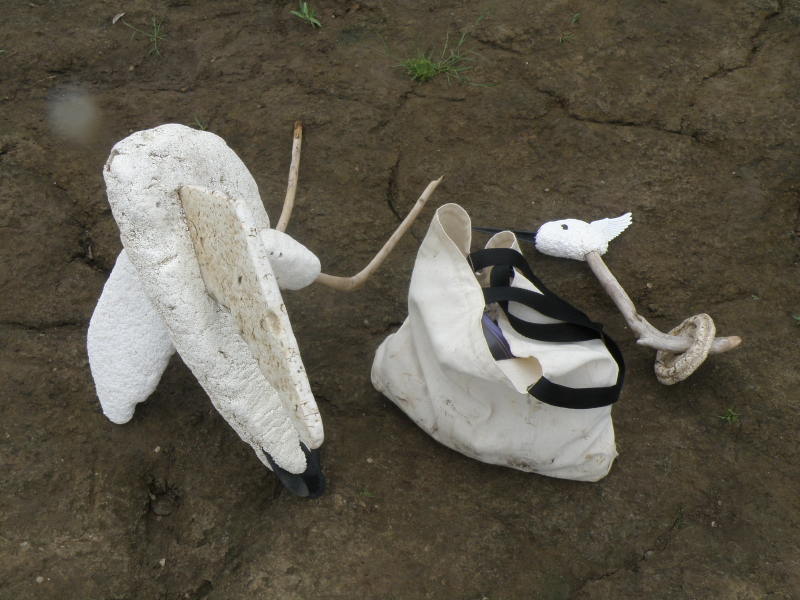
Postscript:  Readers familiar with the riverblog know that the Black-billed Heron was made with materials deposited at the Falls of the Ohio.  These found materials include:  River polished Styrofoam, plastic, sticks, river tumbled coal, the black tail feathers were cut from the soles of cast off shoes.  Thanks for tagging along on this avian adventure!
Read Full Post »

August has been the toughest month and I have two measly posts to show for it.  The ankle is better and thanks for all the well wishes I received.  I guess my other newsworthy item is that my trusty camera broke while on expedition to the Falls of the Ohio.  I received the dreaded “lens error restart the camera” message and of course everything I tried after reading whatever I could about fixing it…didn’t work.  Now, I will need to have the pros look at it.  Although I have  never dropped my camera, I am, however, guilty of working in a dusty and sandy environment.  I’ll bet a well placed grain of sand is all it takes to render the most precise instrument useless.  If my camera proves to be a lost cause…then this was its last adventure.

A couple of weeks a go I was approached by a person who was looking for a friend that was last seen at the Falls of the Ohio.  The missing individual had made a phone call to his friend stating where he was and that he would remain at the Falls for a while, but had not been heard from since then.  I was being asked to guide the concerned friend to the places mentioned in their phone conversation.  Perhaps the missing individual would still be there or some clues as to what happened to him?  Our journey took us to the western section of the park over the sweltering fossil beds.  Like I mentioned earlier, August has been a bear.

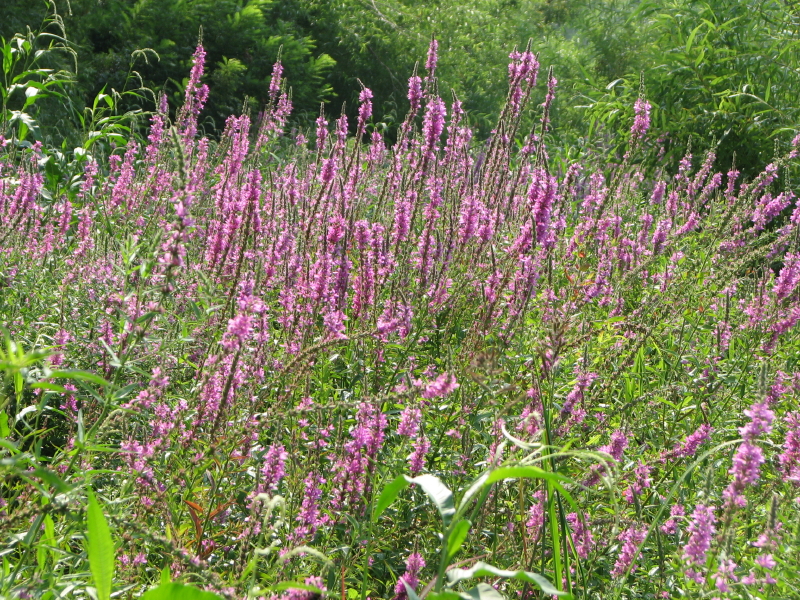
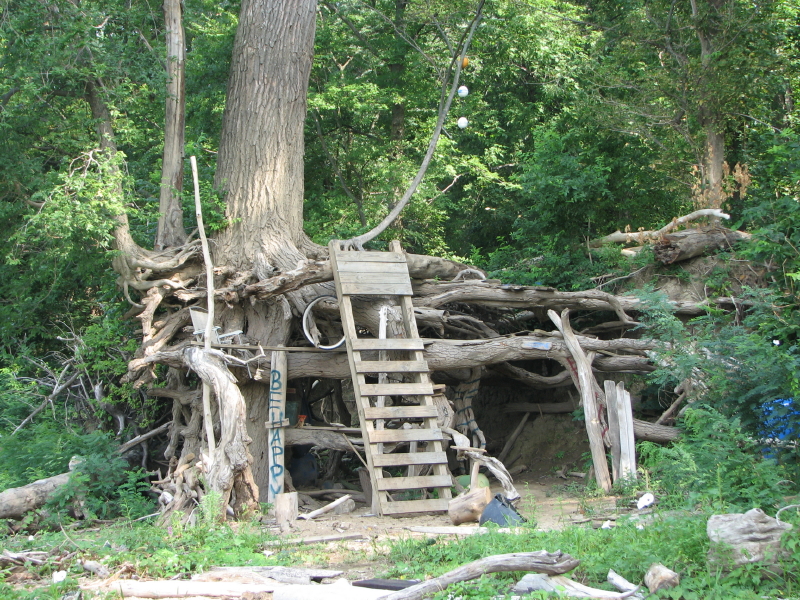
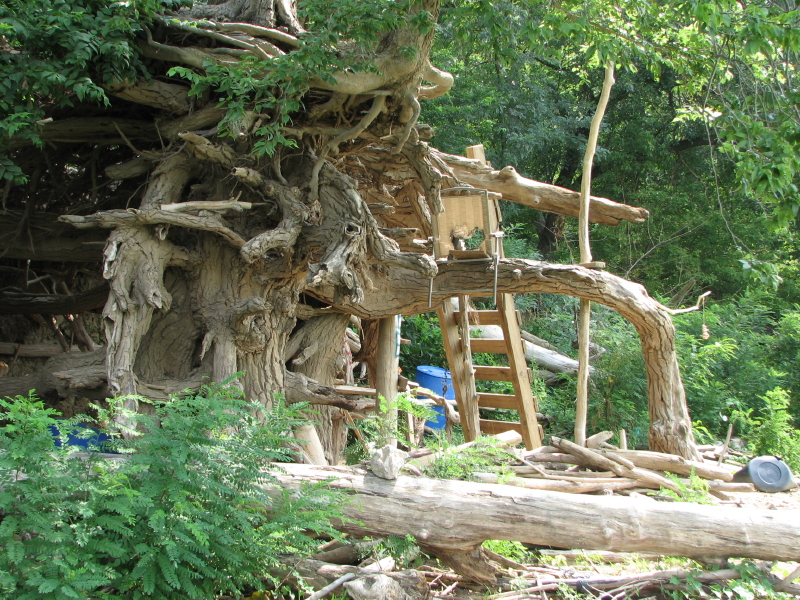
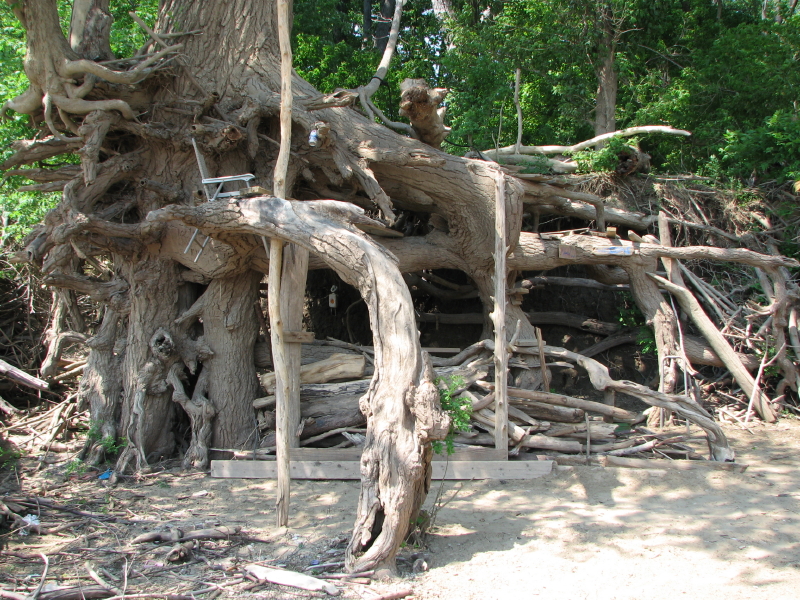
We walked by large areas of purple loosestrife flowers that were growing in the moist soil and sands near the edge of the river.  For a few moments, we lingered over the flowers and watched all the insects drawn to them.  There was a profusion of butterflies and more than a few exotic wasps and bees.  Each year it seems the loosestrife flowers are spreading and their nectar should make the insects very happy.  The place we were walking to was just a head of us.  I featured it in a recent post called the “Mahalo Tree House”.  It’s a wonderful old cottonwood tree that recently was turned into a “club house” by kids I think?  Here are two recent views as we approached the tree.

My guest became excited to see this unique tree house and mentioned to me that it was exactly as described in his friend’s conversation.  We walked over a couple old fire pits that proved this site had been occupied recently.  I made a few mental notes of other changes I observed since my last visit, but kept those to myself.

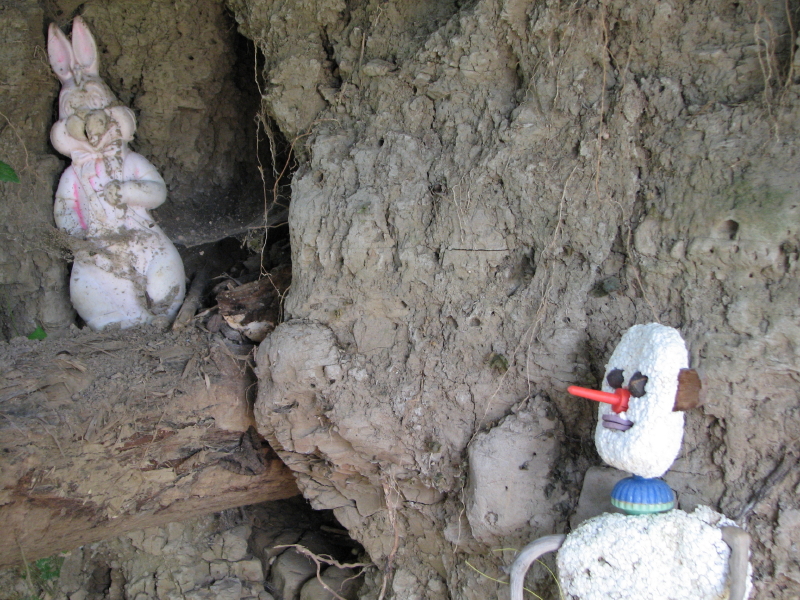
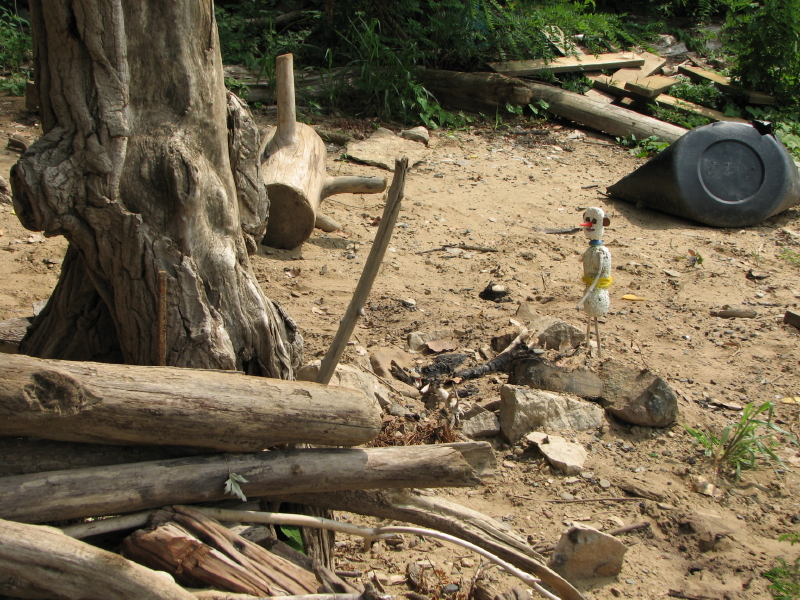
My companion grew excited when he spotted the plastic rabbit in his clay niche.  This was one of the details mentioned by the missing friend. There was another clue as well.

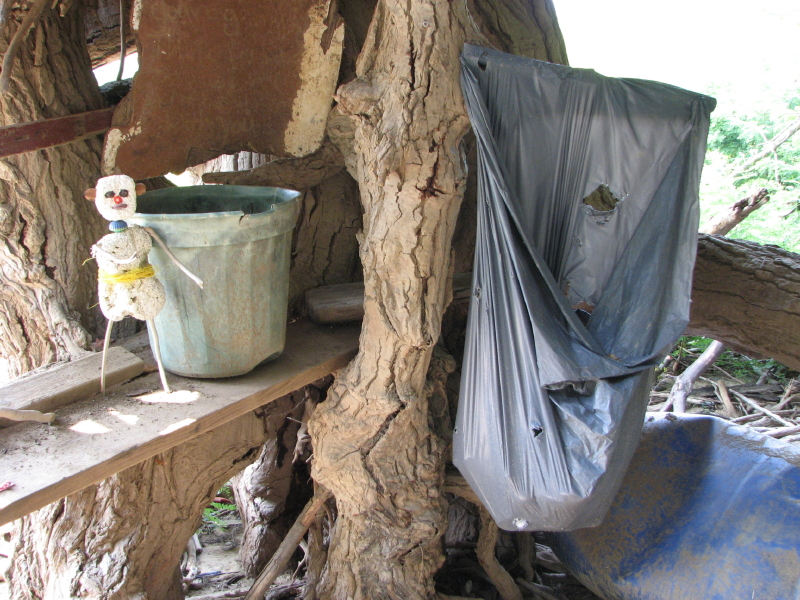
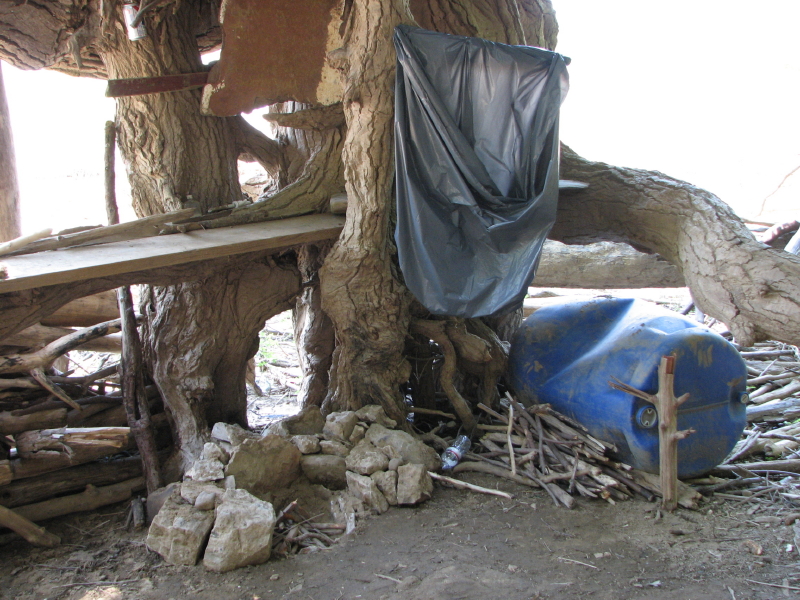
The garbage bag that had been left behind during my last visit was now full.  Who was going to carry it up the bank to dispose of in a responsible manner?  There were other signs that started to make me feel uneasy.  What do you make of this?

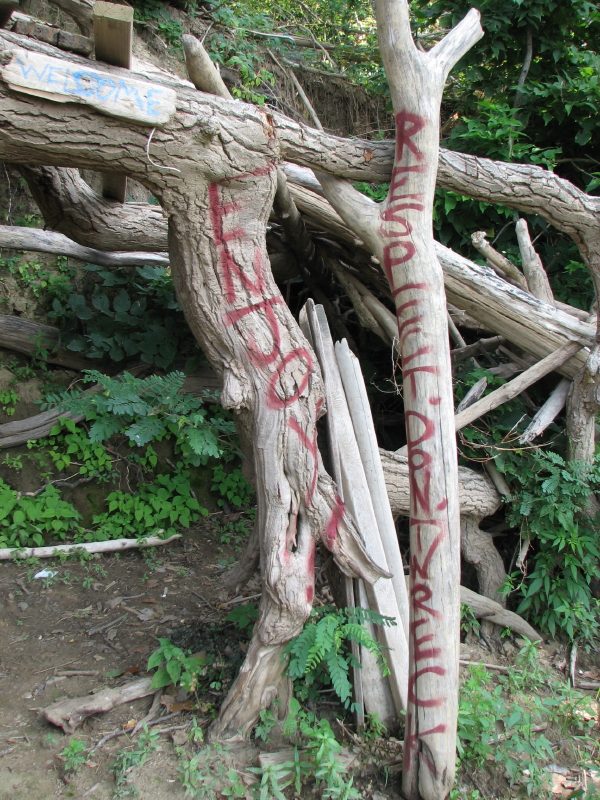
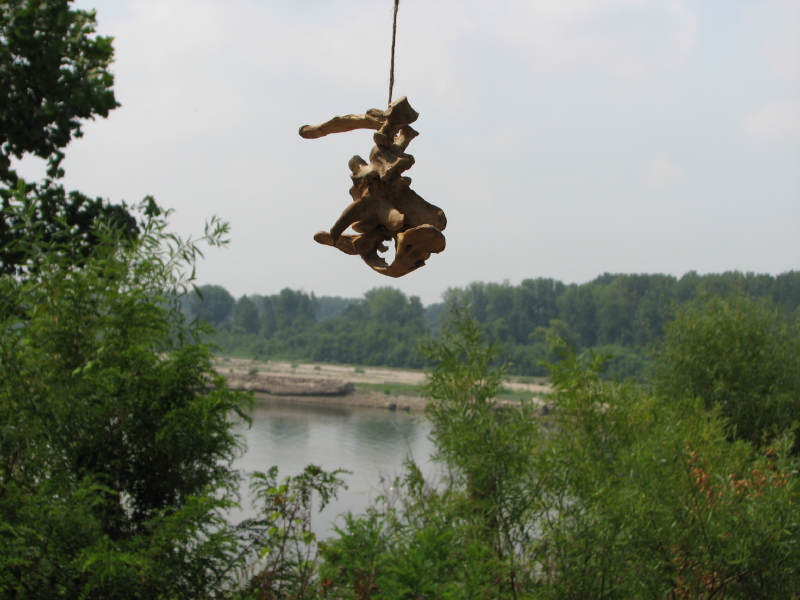
Do you think it is respectful to the tree to spray paint it?  I think not.  There were other ill omens all around us.  Someone or some group had been decorating the place with found bones.  Several clusters of bones were hanging on the end of strings attached to the tree.  Here’s an example of this.

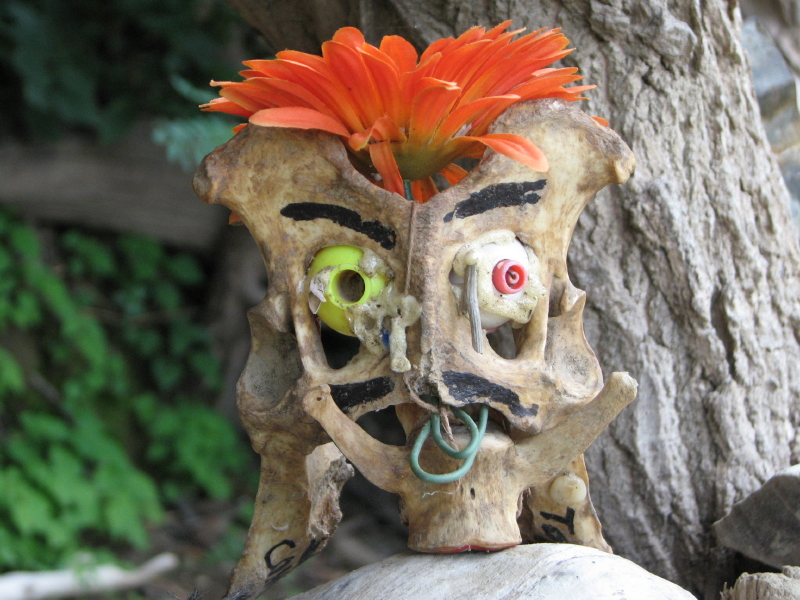
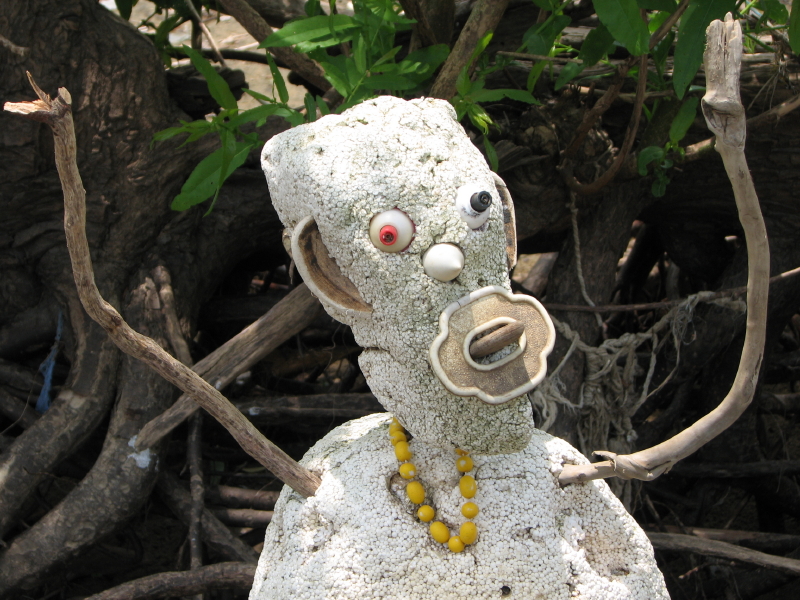
The oddest bone creation, however, was the weird face we found.  It was made from a pelvis and vertebrae that I think originally belonged to a small deer.  Some man-made elements in the form of fishing float eyes and a fake flower were also added.  It took me a moment to register where the eyes might have originally came from.  Black magic marker was used to draw additional designs on the bone.  The head’s eyes had a way of following you around the interior of the tree house.  The bone additions definitely made the place seem primitive.

My guest and I were feeling uneasy when we made the discovery.  We found the missing friend or what was left of him behind the main trunk of the cottonwood tree.

It was too difficult to tell if the friend had succumbed to natural causes or had help of some kind?  All that was left were the bones and fortunately none of them was used to decorate the tree.  One part of the mystery had been solved…the friend had been found.  It was decided to leave the remains were they lay so that law enforcement could conduct their investigation.

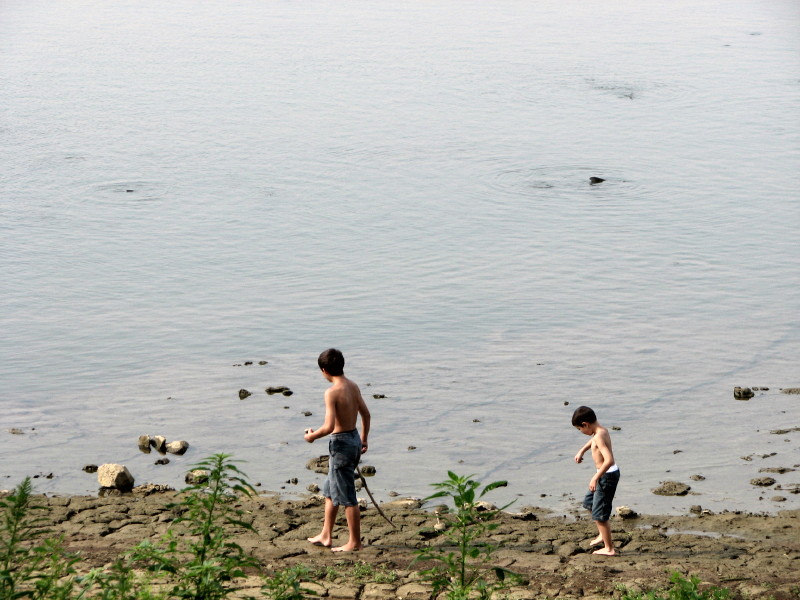
All that was left now was to say good-bye and retrace our steps along the river.  My companion was quiet for the most part.  The one time he broke his silence was when we passed two barefoot boys playing next to the water.  The surviving friend said it reminded him of his own childhood when he and his late sidekick would skip rocks off the surface of the Ohio River.  Here’s hoping September will be a kinder month.

Read Full Post »

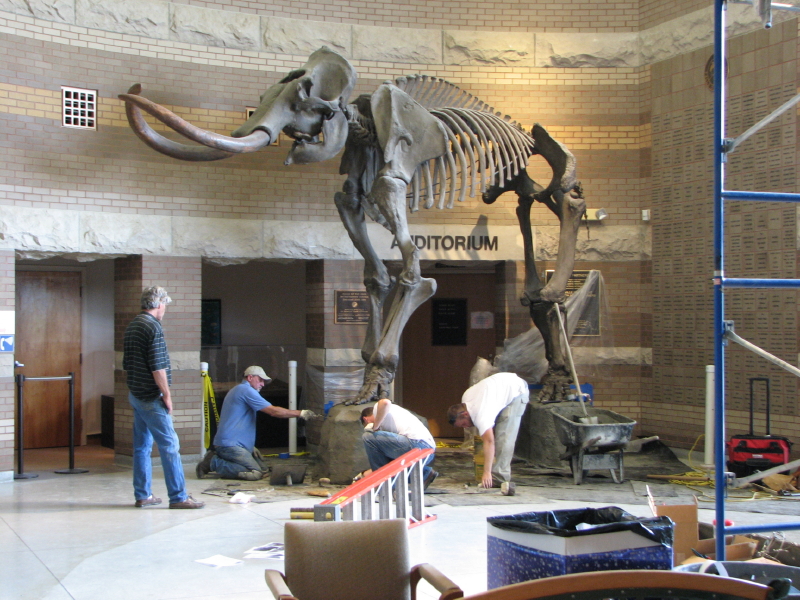
It’s been nearly a month since I last visited the Falls of the Ohio.  My still tender twisted ankle and the brutal heat of this summer has me concentrating on other projects and exhibits.  Admittedly, I haven’t posted much and that periodic malaise that can affect bloggers hit me too.  My ankle is slowly getting better (intimations of mortality!) and with hope the oppressive heat is relenting?  I made the short trip from my home in Louisville to Clarksville, Indiana where the Falls of the Ohio Interpretive Center is redoing its exhibits.  I’m glad the mammoth skeleton will still be on display and I’m curious what else will be featured?

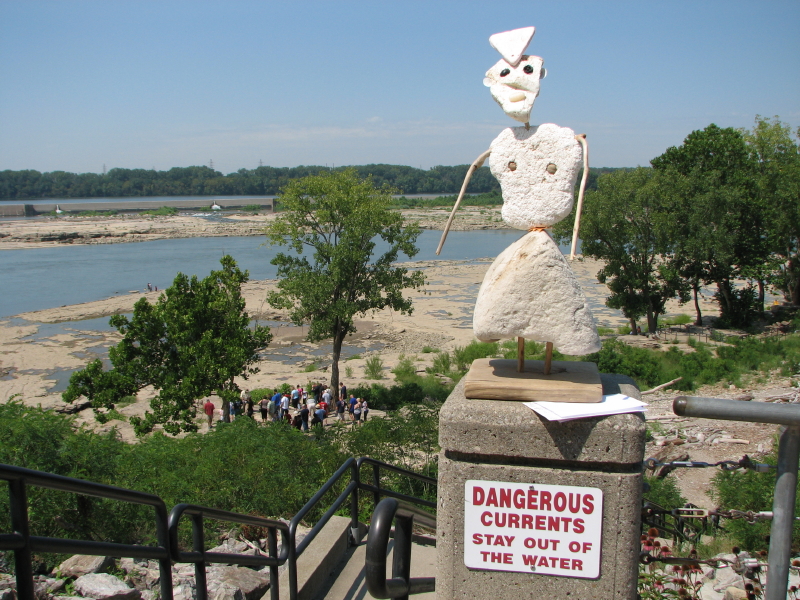
Each year the center’s foundation stages its “Rock the Rocks” fundraiser which features a silent auction.  I usually contribute one of my sculptures made from the river-born junk I find in the park.  This year my donation is entitled “Priscilla” and she’s a piece I made years a go and predates the old riverblog.  I hope she finds a nice home.  “Priscilla” with her dark eyes has a depth to her that seems to raise many questions.  Well, that’s how I read her!  The main question remains…why do we do the things we do that we know can harm the environment?  “Priscilla” knows she shouldn’t exist.

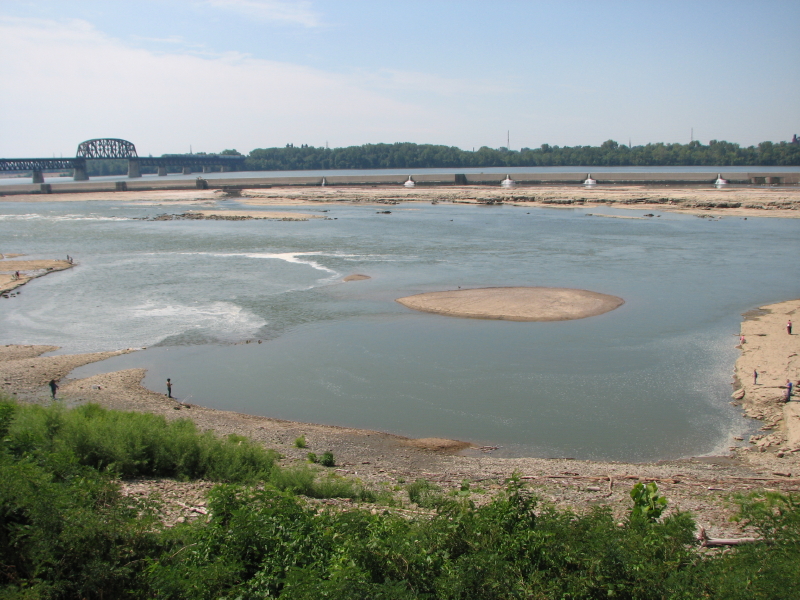
After my errand, I hung around to look at the Ohio River as it presents itself at the Falls of the Ohio.  Most of the fossil deposits are exposed and in my mind I’m walking out among them which in reality is always an interesting experience.  It’s easy for me to fantasize that I’m on another planet or a different place in time.  I know, however, that it will be a while yet before I wade across the shallow river and back out upon the water-scalloped limestone.  I don’t think my ankle is ready for that test yet.  It would be a long way to limp back.

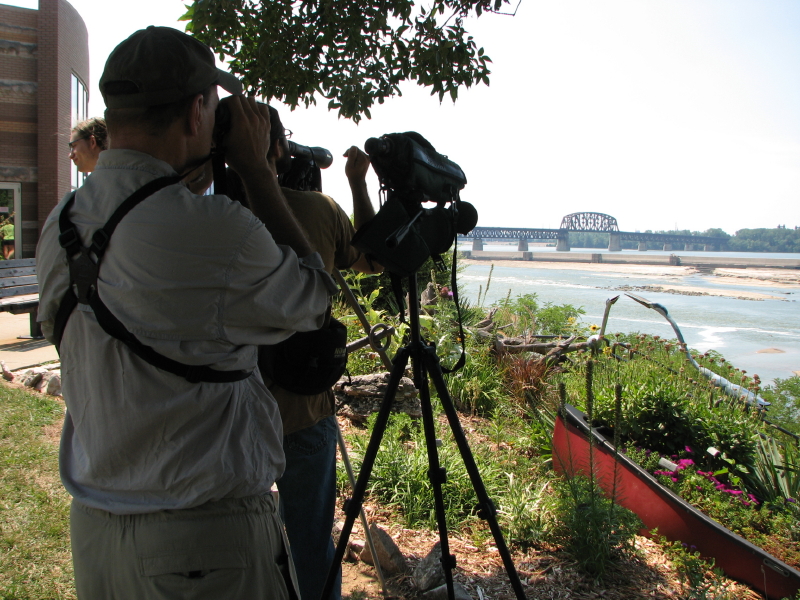
I stopped and talked with several birders who had their scopes and binoculars fixed upon the distant fossil beds. Summer shorebirds were present including Great Egrets, Caspian Terns, Spotted Sandpipers, and an uncommon siting of an American White Pelican which had just flown away!  I missed it but was glad to hear that it had been seen regularly over the last three weeks.  I recall a few years a go, there was another young male bird that hung around for a while.  Once upon a time they were seen as far east as the Miami River in Ohio, but that was in the 19th century.  Now the pelicans are seen more frequently and might be extending their range again eastward along our great rivers.

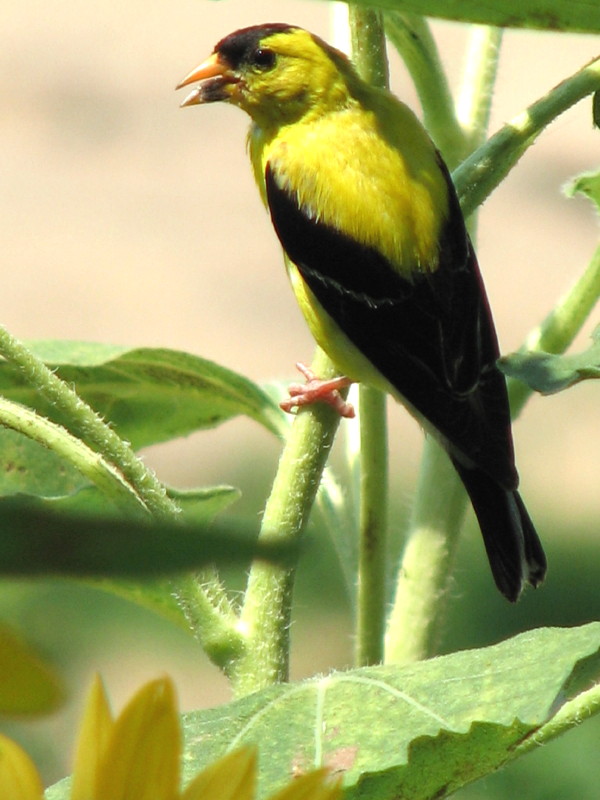
I enjoy birds of all kinds and near the birdwatchers, a male American Goldfinch fed on sunflower seeds from one of the center’s flower beds.  I don’t know exactly what it is about the attraction to birds, but it lifts my spirits.  I go back to my car and collect the surprise within.  Although I haven’t physically been out here as much as a usually am…my thoughts don’t stray far from this environment.  I made a new figure in my basement and I’m eager to snap a few shots of it in the context of where the materials I used to construct it were found.

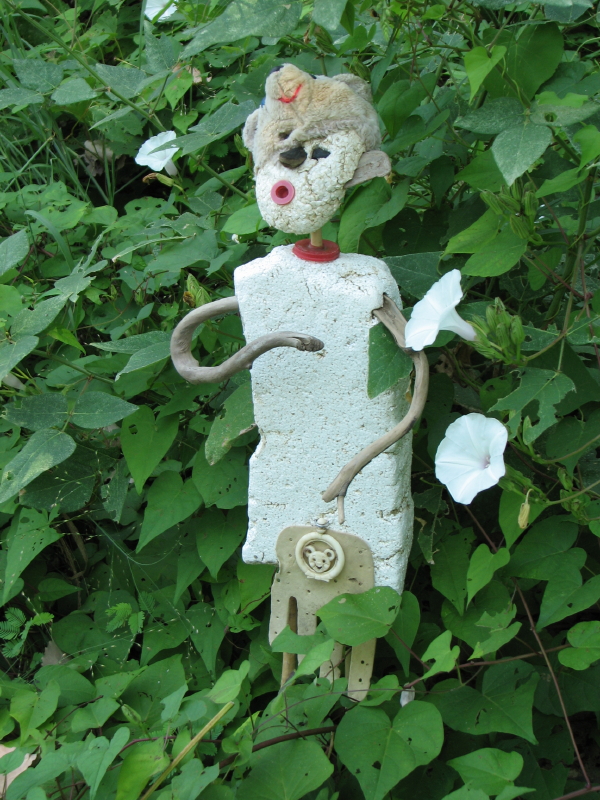
This is “Cubby” and he is eager to see the world.  We walked along the trail together and came across this spot where the morning-glory vines were growing in profusion.  Only in the shade did we find the blossoms still open.  The heat of broad daylight would shrivel them to nothing.  Along our walk we could hear the sound of cicadas and the smell of sun tan lotion was lingering in the air.  It’s the weekend and the park is full of visitors.

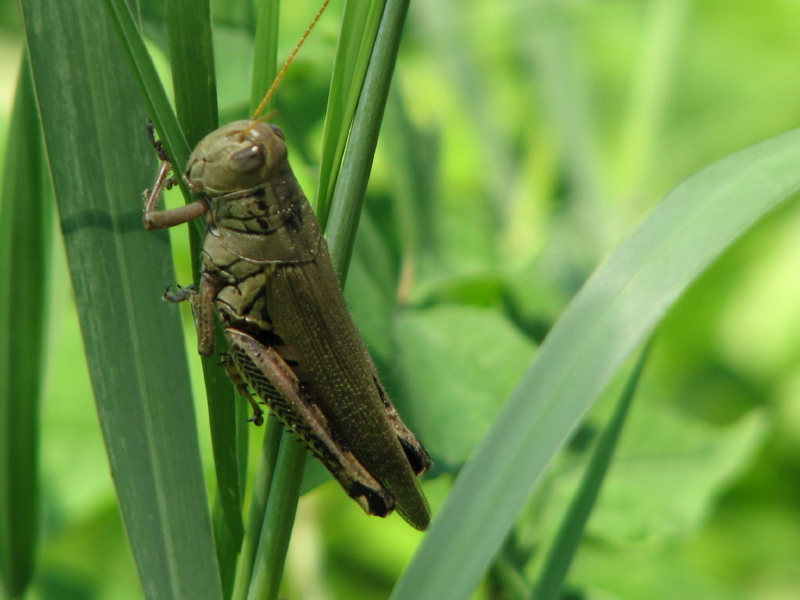
As we walk through the grass, the blades come alive with the many grasshoppers that are present.  “Cubby” and I check them out and we also notice a few nice Buckeye butterflies flitting about with their beautiful blue eye spots checking us out too.

It’s amazing what a month can change around here.  It seems so verdant and overgrown.  We find evidence that some of the recent and powerful thunderstorms have blown over a few old trees.  This seems to happen with increased frequency.  When it does rain, it seems to be accompanied by strong winds and torrential downpours.  There is so much moisture and energy in our weather systems as the fronts move along the Ohio Valley.

It’s been a year of contrasts.  Our spring was so wet and led to some flooding.  Several months later the driftwood evidence is all around.  The park staff have had their hands full re-establishing the walking trails.  Chain saws and small bulldozers are required for that job.  All this wood will just sit here until it decays or washes away with the next flood.  The Ohio River is a dynamic element that continually shapes this park.

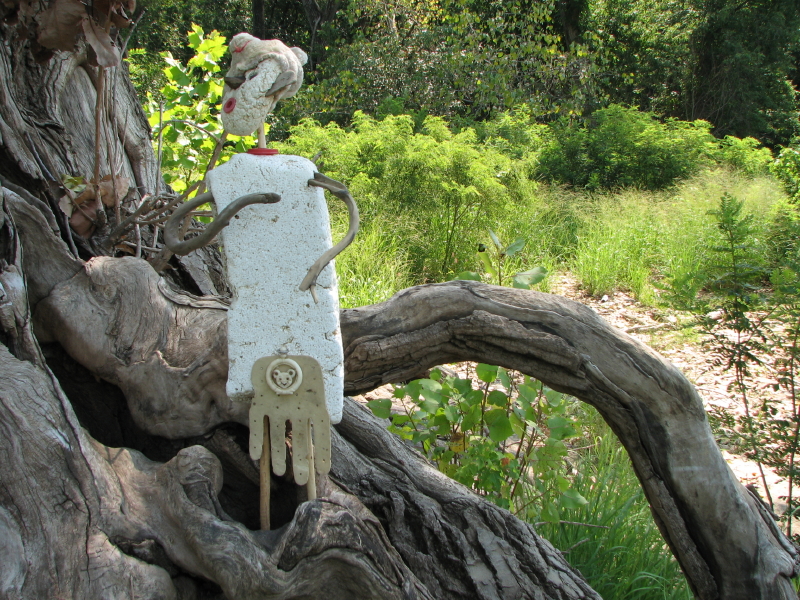
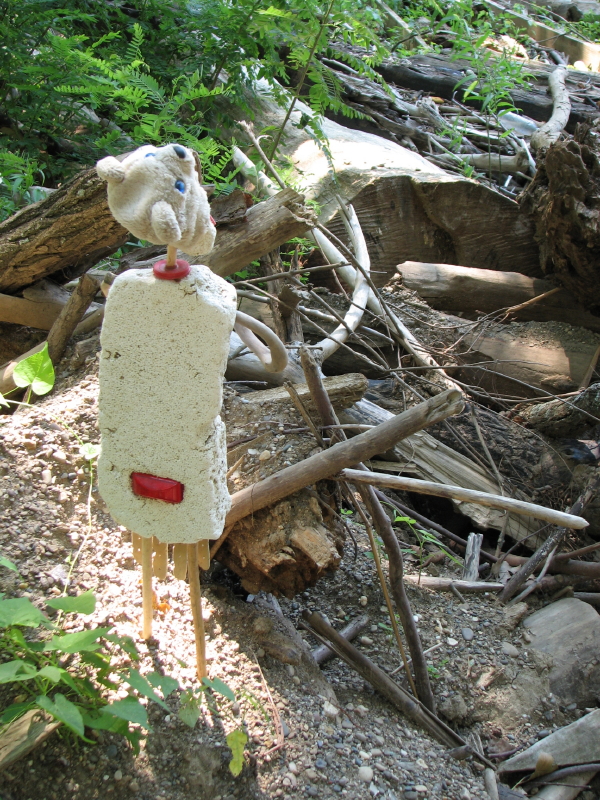
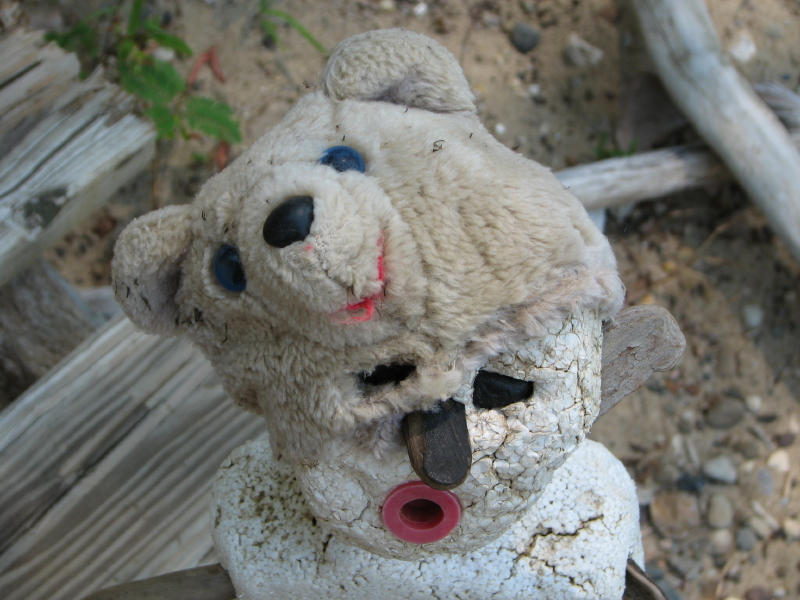
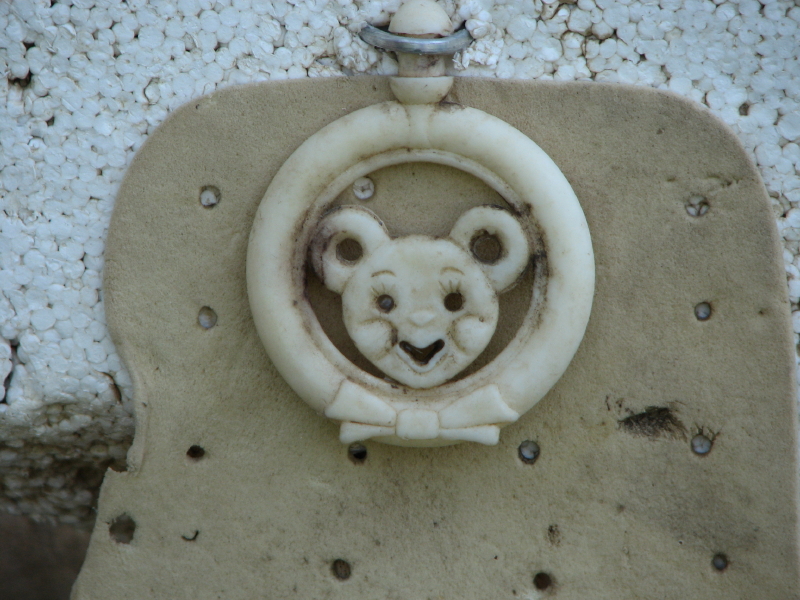
I made “Cubby” for an exhibition that will be held at Bellarmine University in September.  It’s a two person show and my exhibit partner, Scott Scarboro, also uses found materials, but his works are of a more urban nature.  He likes using discarded mechanical toys and using sound in his work.  I will post more about that show as it happens.  As for “Cubby”, he derives his name from the unique head-gear he wears.  Last year, I came across the “skin” of a river-exploded teddy bear and saved it into the collecting bag.  This is how that find manifested itself.  To further reinforce the bear cub idea I added a small plastic bear head image that I think came from a pacifier.  It holds his breach cloth in place which comes from the lining of an old glove.  And in case you were wondering…he’s also anatomically correct underneath.  If you are bothering to cover the loins…there might as well be something there!!!  Well, I guess that’s it for now.  It feels good to blog again.

Read Full Post »

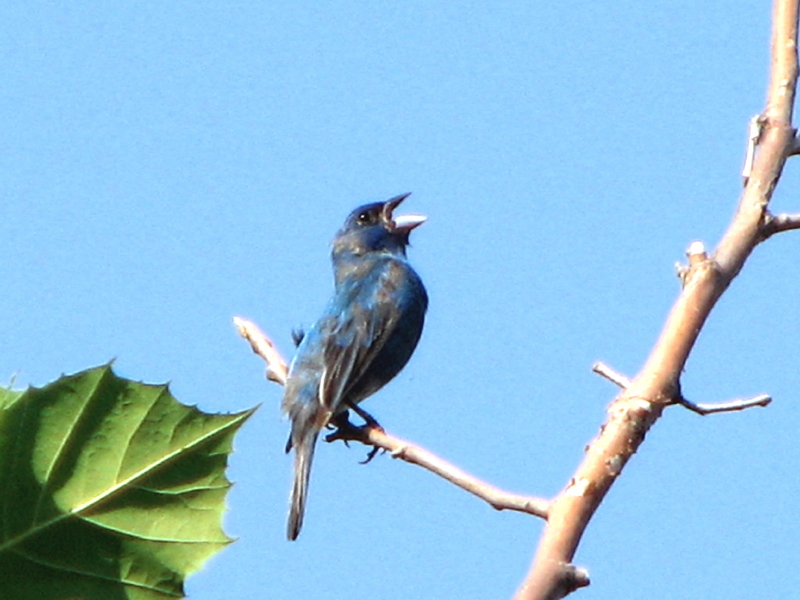
It’s been a hot, hot summer at the Falls of the Ohio.  For me, the best time to be out here is as early in the morning as possible.  One advantage in doing this is you are more likely to see birds and other wildlife.  I found this Indigo Bunting singing away from the topmost branch of this tree.  For as open and publicly trampled as this park is…witnessing such small and intimate moments where man and nature freely mix keeps me coming back for more.

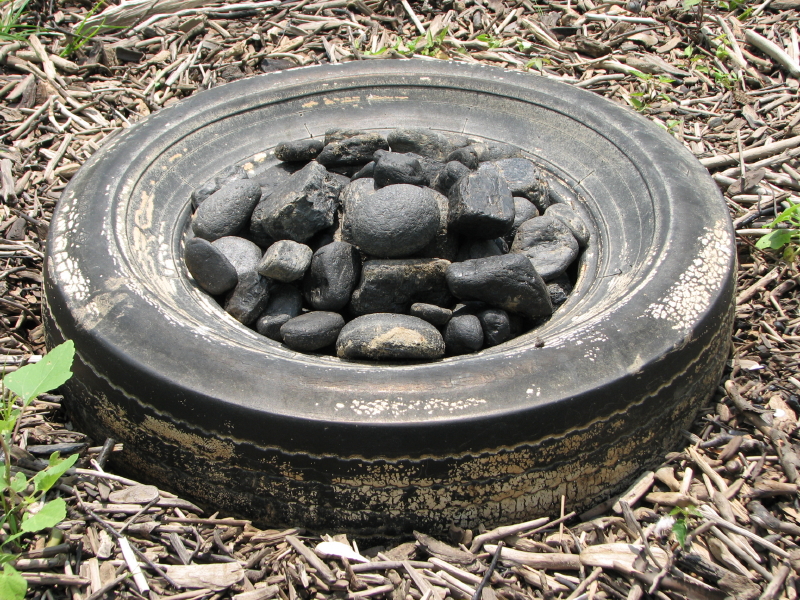
This adventure occurred during my last visit to the park and early in the month.  As it turned out, it was a memorable visit.  I’ll go ahead and tell you that I twisted my right ankle which isn’t big news or a particularly rare occurrence.  But this time, I was sure it was broken and I limped out of the park with the aid of my trusty walking stick.  I was walking along in the sand and my ankle just collapsed.  That’s all it took.  All my early sports injuries have left me with a weak ankle.  The x-rays didn’t reveal a fracture, but I was surprised by the bone spurs and bone deterioration.  As I write this three weeks later, I’m still limping along but without the aid of crutches so I guess I’m on the mend.  Returning to that day and before the sprain,  I revisited the sand sunken tire from previous posts and replaced the coal that was removed from it and then moved on.

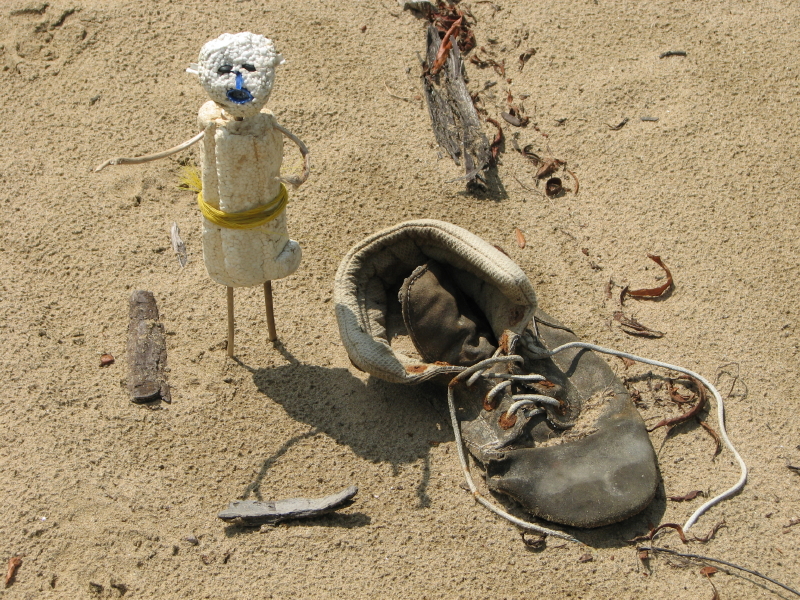
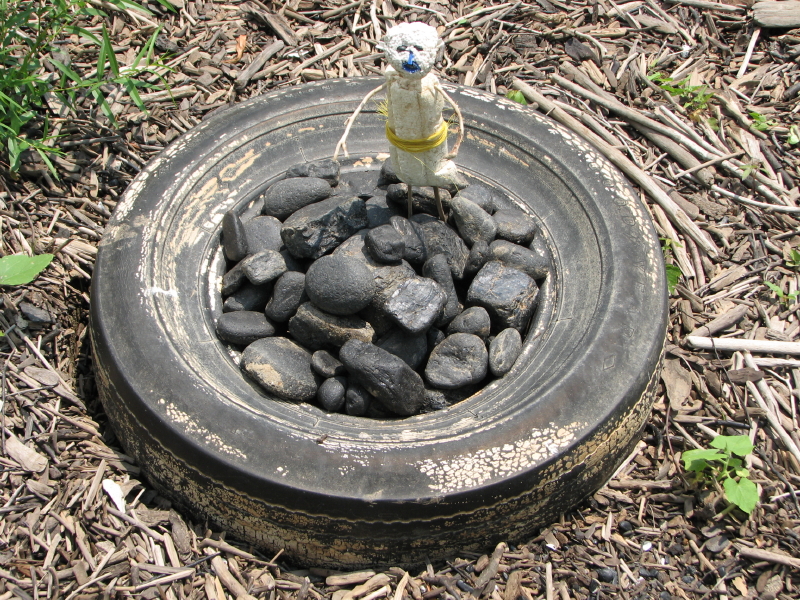
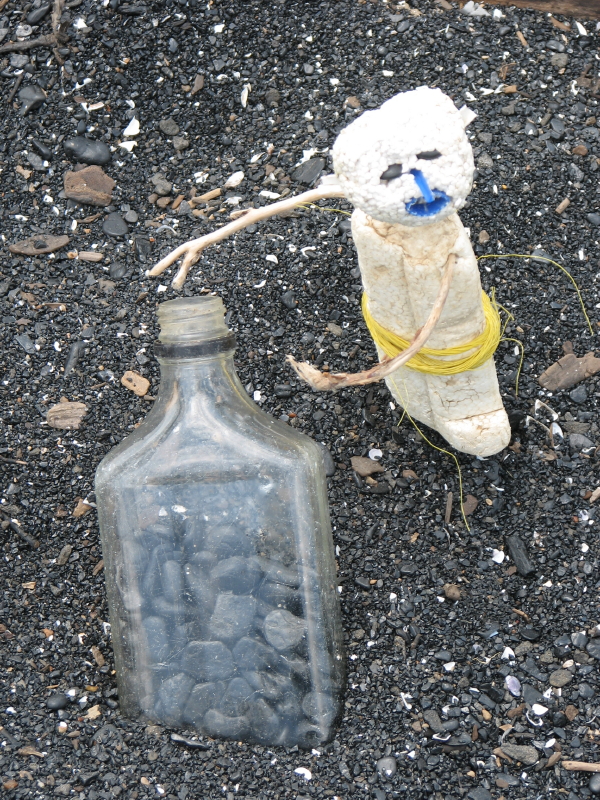
I created a little friend to keep me company and to help me with the day’s projects.  He’s made with Styrofoam, sticks, plastic, and a little bit of coal for his eyes.  I have used the coal that washes up here for as long as I have been doing this particular body of work which is approaching eight years now.  As a material, its relevance has always been appreciated by me.  Like the corals and brachiopods that have left their traces in the limestone at the Falls…these black rocks also speak of ancient life, but coal has a different and contemporary purpose that is won at great cost.  Walking along the eastern section of the park, I explored and gathered the coal I found interspersed among the sand and driftwood.  My little helper tagged along and soon we filled the hole in a second found tire.

I noticed after I selected this tire that it had once been painted white.  I have seen this before where people of thrift have used cast off tires for garden planters.  On this one, most of the paint has worn off and the river has given this tire a unique patina.  For the Little Man and myself, this would just be the beginning of our play with the found coal out here.

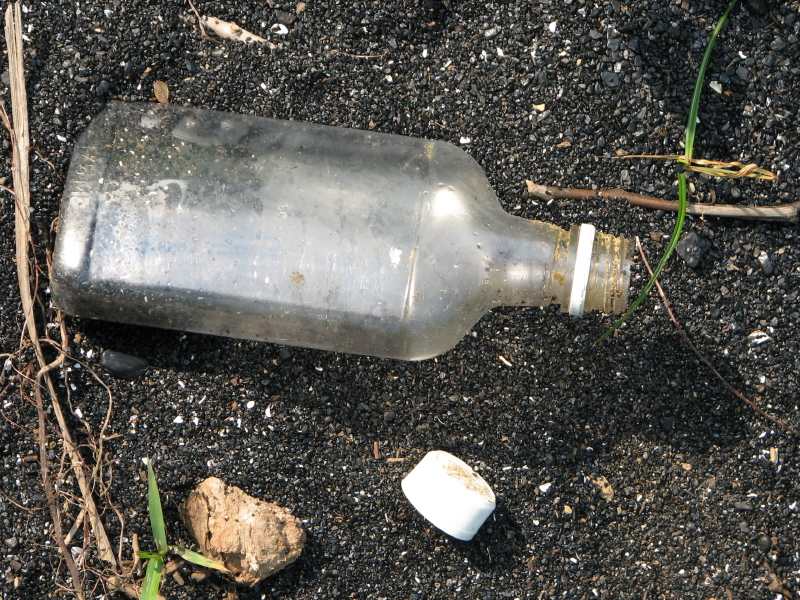
Among the other found objects I scavenge along the beach are empty pint bottles made from glass and plastic.  I like them when I find them with their labels soaked off by the river and their bottle caps in place.  A little more than a year a go I shared a river adventure with video artist Julia Oldham and we marked the day by putting notes and colorful fishing floats in other empty bottles.  I sometimes think of those bottles and wonder if anyone has ever found one of our notes?  In all my years here, I have never found a note in a bottle and by now I have looked at thousands of bottles.  Some of my friends at Living Lands and Waters report finding notes in bottles all the time and I’m guessing that this happens more along the Mississippi River than it does the Ohio River?  For me, finding a note in a bottle will happen when it’s supposed to…I just hope that it’s written content will be interesting!

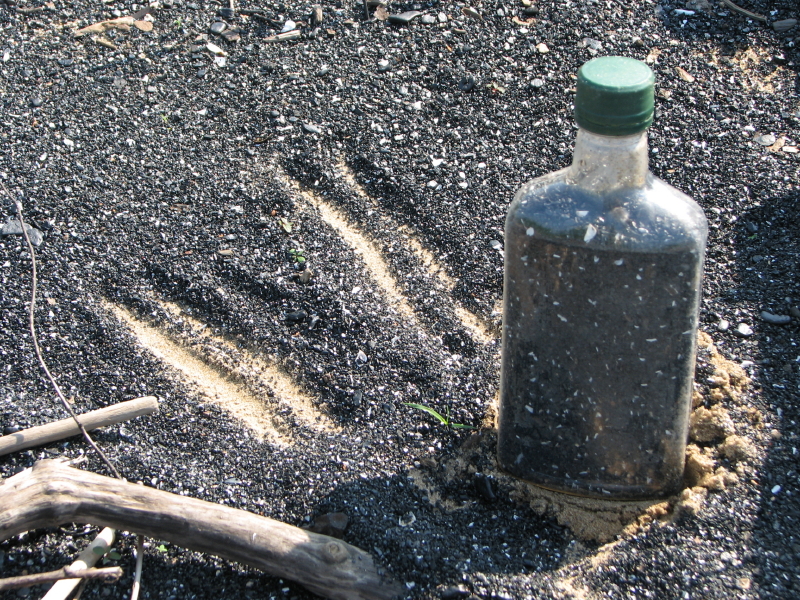
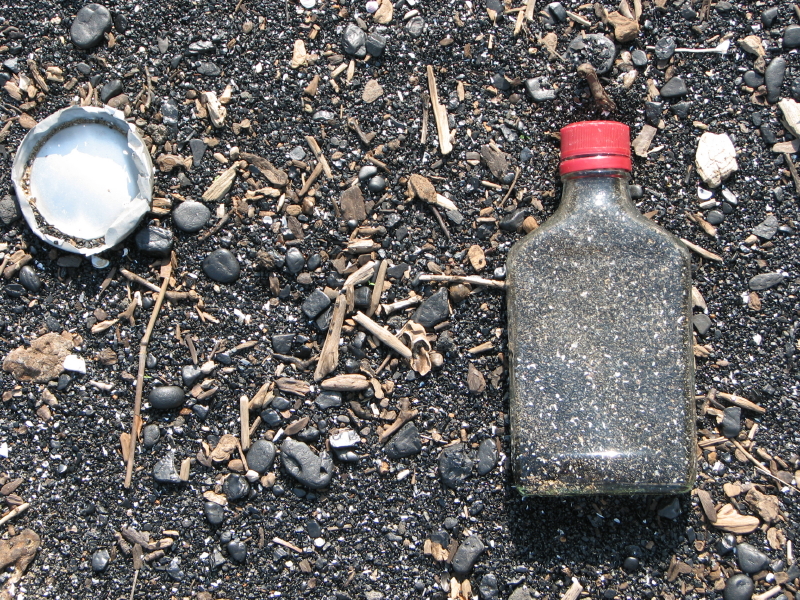
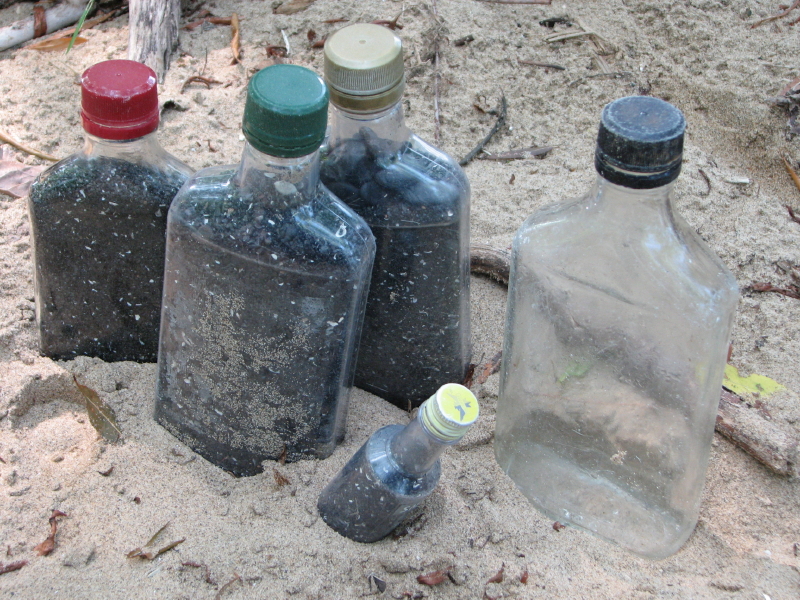
You have just seen a few of the bottles I have filled with coal.  The white flecks you see mixed into the coal are bits and pieces of mostly zebra mussel shells which is another unwanted element in this river.  Filling these bottles with coal is meditative for me.  Usually, there is still a little bit of whiskey or alcohol in the bottom of these bottles that scents the coal inside its container.  Coal is such a complex subject in our region that it is enough to drive one to drink.  On one side it is a common and available form of energy, but the costs to the land, people, and larger environment are extreme.  Having visited the coal fields in eastern Kentucky, it is certainly plain that the people whose land and mountains have been mined out from under them haven’t benefited to the extent that you would think since poverty and despair are far too common.

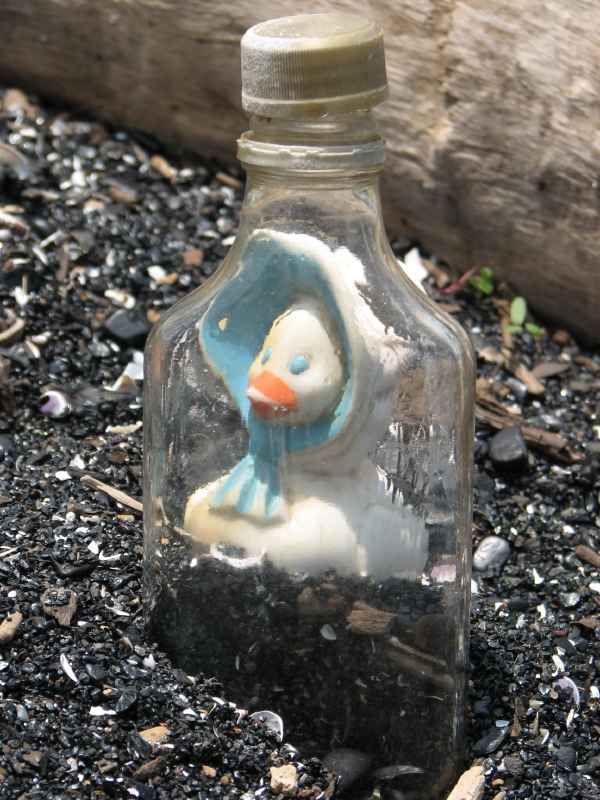
I’m going to continue to explore coal as a material and social issue with the help of some new friends.  I have been invited by a group of mostly younger Kentucky artists to participate in an exhibition to be held sometime in the near future.  A blog has been set up called Project Reclamation and if you would like to follow along…just click on the link on my Blog Roll on the right column. I will keep you posted.  To close, here is one other bottle or carbon storage image I photographed with a found rubber duck behind the transparent bottle.  I look forward to going back out to the Falls of the Ohio as soon as my ankle fully heals.

Read Full Post »

The fishing had been good and attracted both experienced and novice fisherman.  People were catching some of the smaller striped bass and the occasional catfish.  Summer has descended full-bore with its twins…heat and humidity and so a visit to the river is a welcome diversion for many.  The parking lots around the park are full.  To me, this is a mixed blessing.  You want those who can appreciate nature and the surrounding area to enjoy themselves, however, there is always that element present that can’t resist despoiling for their own selfish reasons.  Sometimes it seems that visitors leave as much trash here as the river does in its wildest moods.  Please pack your garbage out.  After checking out the fishermen, I head up the bank to locate my last project with its polystyrene figure.

I’m not shocked at all to come across Joe Coalman’s eyeless skull resting in the hot sand.  To be honest, I would be more amazed to find him still intact.  My postmortem revealed that he had the stuffing knocked out of him.  I found his body about thirty yards from his head.  I take some photographs and gather the remains.  I’ll probably recycle him into another project in the future.  As for the tire with the coal in it…

…well, it too has been altered.  I can see how a standing Styrofoam figure would make a tempting target, but what about a tire filled with coal?  It must have provoked someone because the coal had been knocked out.  The black rocks were scattered all around.  I regathered them, but I could not find all the coal that was originally in the tire.  Curiously, if you look at the rim of the tire you will see something I had not originally placed there.  It’s a tiny white clam shell left perhaps by another visitor?  I appreciated this simple gesture and moved on.  Soon I reached my outdoor atelier with its latest cache of Styrofoam.  I laid Joe Coalman, skull and all back into the pile and wondered what to do next?

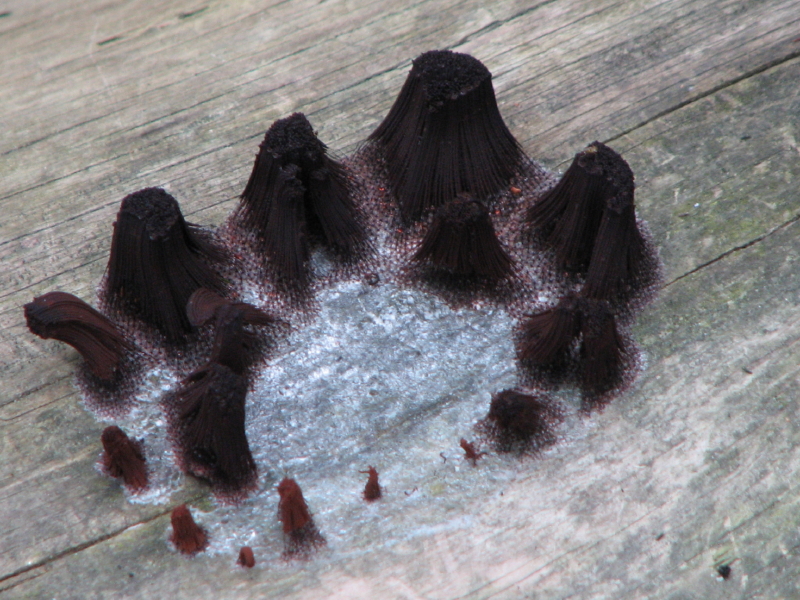
While sitting on the enormous wooden beam that defines one side of my outdoor studio, I spied something interesting on an equally impressive log.  Growing along the margins of an old bird dropping was this wonderful fungus.  At the Falls of the Ohio, there are many different types of fungi that help break down the organic bonanza that washes into here.  I wish I knew more about them, but realize that this is another entire field of study.  Nevertheless, fungi are of immense importance and help recycle nutrients among the many other useful services they perform.  With this particular fungus, it looked like it was on the downward cycle having already released its spores from the fruiting bodies that were now arranged like some organic version of Stonehenge.  After studying this curiosity for a few minutes, I settled into the familiar activity of creating a figure that would be the benchmark for the day.  Before revealing it to you…here are a couple of other things that I want to show you that I happened across during my walk.

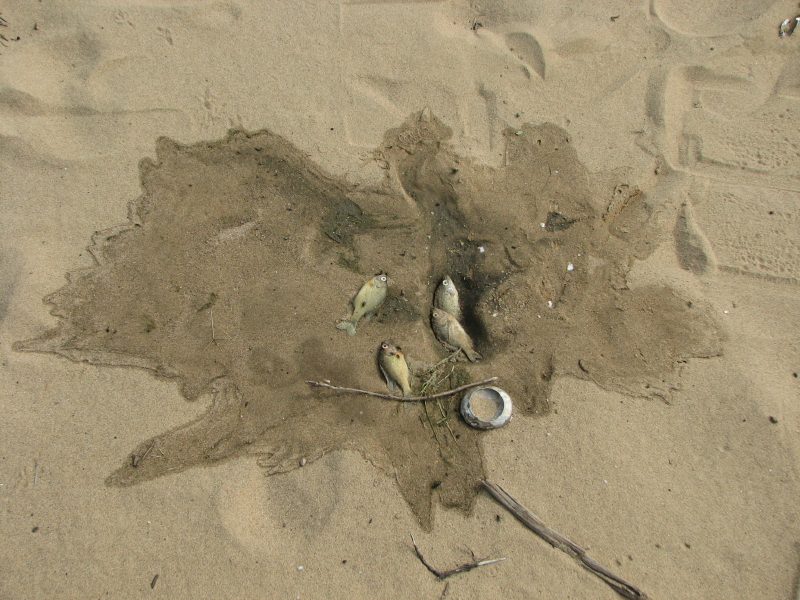
I’m always looking at the evidence and trying to figure out what occurred at a particular place?  Here a fisherman on his way back to the rest of his life has dumped out his bait bucket and left the four tiny bluegills in the sand.  Perhaps they were dead already since fish in a bucket die of oxygen loss without an aerator to cycle air back into the water?  I wondered if the use of these bluegills broke any laws since using other sport fish for bait is generally frowned upon?  I could imagine the size of the bucket from the wet area in the sand.  The silver circular object is the bottom of an aluminum can.  Near this scene, I also came across this discovery.

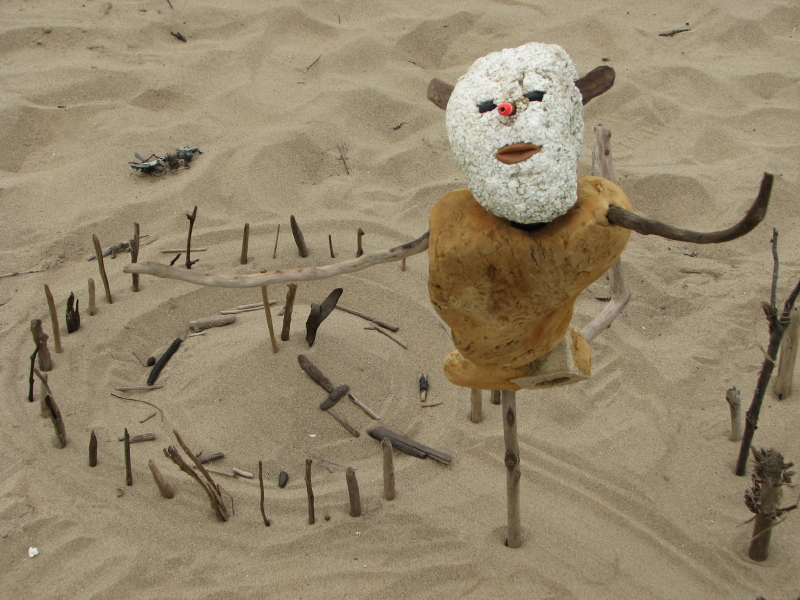
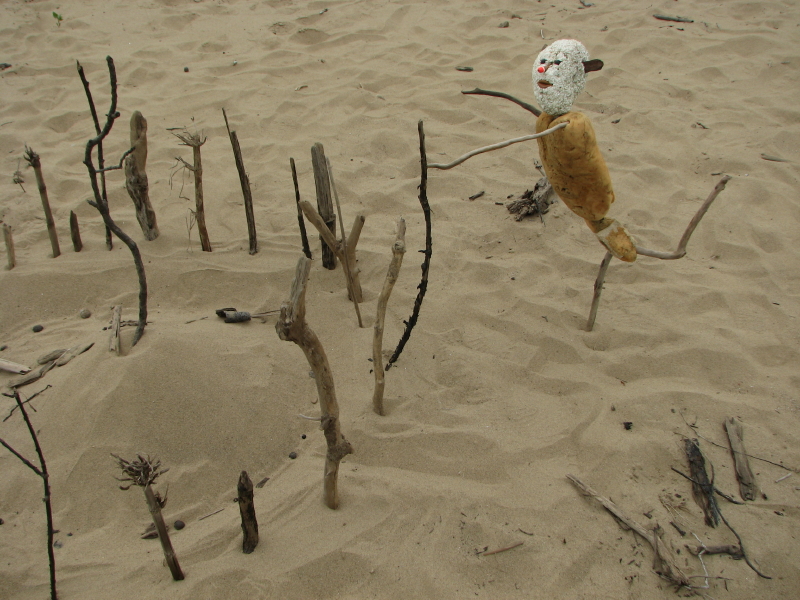
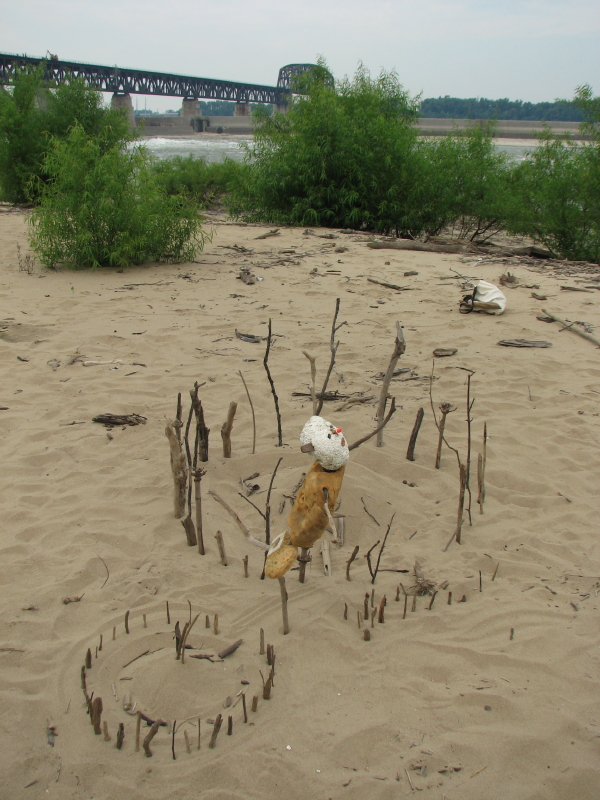
Less than a stone’s throw from the dead fish I found this arrangement in the sand.  I love it when people opt to leave their mark on the land in this fashion.  Present were two complete circles in the sand defined by upright sticks with mounded sand in their centers.  In my mind, I imagined two gears or cogs moving in response to each other.  The movement of the sun provided some of the energy needed to activate this metaphorical machine.  I decided that this place was a good site to unveil my latest figure which implies movement too.  I let it dance throughout this arrangement in the sand.

Maybe this was originally made by a child while his family fished?  It doesn’t matter because it gave me something positive to react with and made my day.  Feeling satisfied, I started back to my own vehicle, but there would be one more surprise on this day.  Perhaps this was also made by the same folks who did the circles in the sand?  Again, sticks were employed albeit much longer in length.  See for yourselves.

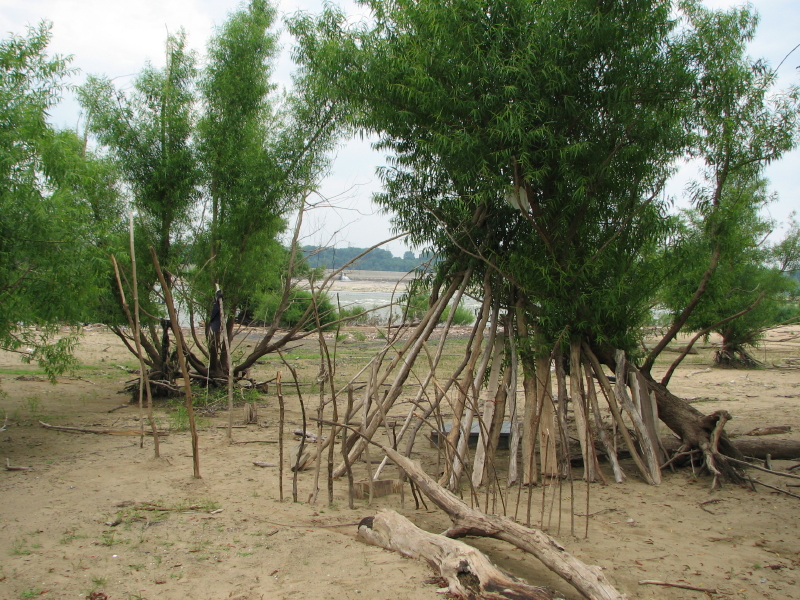
Logs and long branches were leaned against a willow tree and the effect implied shelter to me.  Other long sticks were placed upright into the sand and helped define the area.  A wooden palette was dragged to this location and left to provide seating.  Because the materials used are all local, it would be very easy to walk by this if you weren’t paying attention.  That’s one of the things my Styrofoam figures have working against them…their stark whiteness usually gives them away even at some distance.  But then again, for me that’s part of what I do which is to call attention to the stuff that doesn’t belong out here and through a little creativity, show what can be done.  I appreciate the stick pieces because they only use the natural materials that are out here.  I wish I could do this more often myself, but this isn’t the reality I usually discover out here.  Leaving the area, I came by this wonderful flower and in its center…was this tiny bee carrying on as her kind has for as long as there have been flowers in need of pollination.  Until next time.

Read Full Post »

I threw my arms up into the air and said “WHAAAAA”!  I had been resting in the shade after a couple of hours of junk scavenging when I heard this low vibrating sound and the bump of something landing on my head.  Reflexively, I knocked off whatever was on my noggin and it fell to the ground…and this is what I saw.

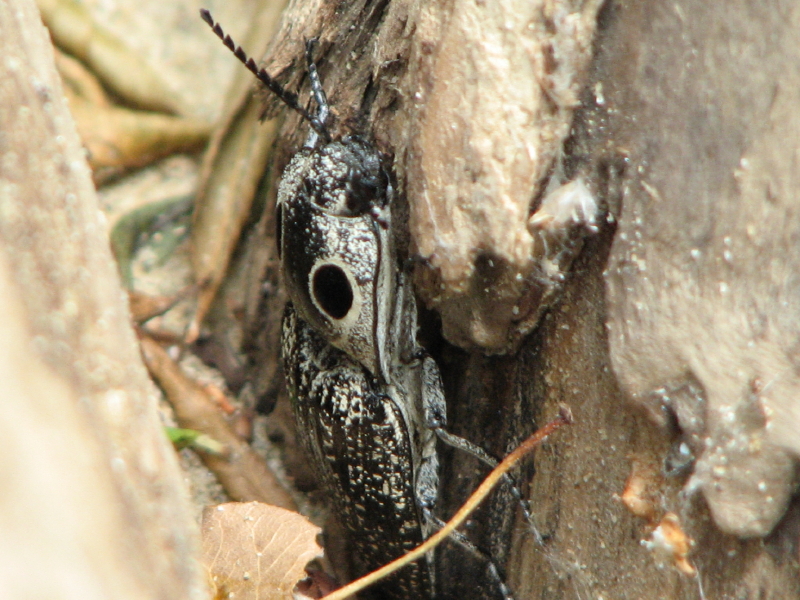
This is the Eastern Eyed Click Beetle or Big Eyed Click Beetle, (Alaus oculatus).  It’s one of my favorite indigenous beetles and one I’ve seen at the Falls of the Ohio on numerous occasions.  As beetles go, this one is on the large side approaching two inches or about five centimeters in length.  Getting smacked in the head by one certainly surprised me, but it turned out to be a good one.  I love the cryptic bird dropping coloring and those two large eye spots get your attention!  After the beetle recovered its senses, it flew and landed on a dead tree trunk right behind where I was sitting.  It turned and started walking down the tree towards the ground.

I watched as the beetle lowered the tip of its abdomen at the base of this dead tree.  I’m hoping it might be laying an egg or two.  When it was done, it walked back up the tree trunk before flying off for the next tree or head that catches its fancy.

I was rummaging around one of the driftwood mounds for whatever secrets it was carrying and to separate out materials for the river sweep clean up.  Nearby, was the beginnings of another garbage pile that someone else had started.  I decided to throw my junk into this lot to consolidate it and make the removal just a bit easier.

It was the usual lot.  A few plastic 55 gallon drums, a bit of hurricane fencing, tires, and a palette or two were among the larger items that were deposited here by the last flood.

Of course how these things came to be in the river is another story.  It’s amazing what our kind can tolerate and consider acceptable.  I suppose this represents the collateral damage we are willing to endure to support our ultra consumptive way of life.  It makes me want to retch! I think this partly explains why so much of this trash is colorful.  If we have to look at it…it might as well be pretty.  When I finished up in this area I moved on like the click beetle did to new surroundings.  There is no shortage of trash out here.  After this Spring’s floods there is also an abundance of coal gravel and coal chunks in the eastern section of the park.  Here’s an example.

The Falls of the Ohio is famous for its fossils, but this black rock wasn’t originally a part of the geologic scene here.  More than likely, this piece of coal was removed from the top of a mountain in Eastern Kentucky and shipped by barge to this area to be burned in a plant to produce electricity.  For some reason, this and many other pieces of coal got into the river where they were tumbled and ground to bits.  In case you were wondering…coal does not float.

In places the coal gravel was several inches thick and reminded me of the black beaches made of volcanic sand.  Also interspersed on this river bank were many automotive tires.  I couldn’t help but associate the coal with the tires and I began to combine both of these elements in this landscape.  Here’s a picture of me in action.

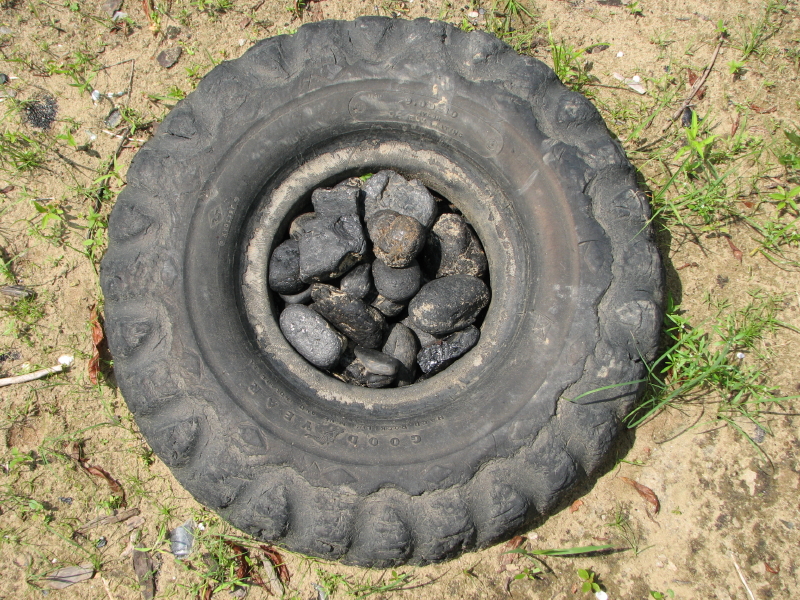
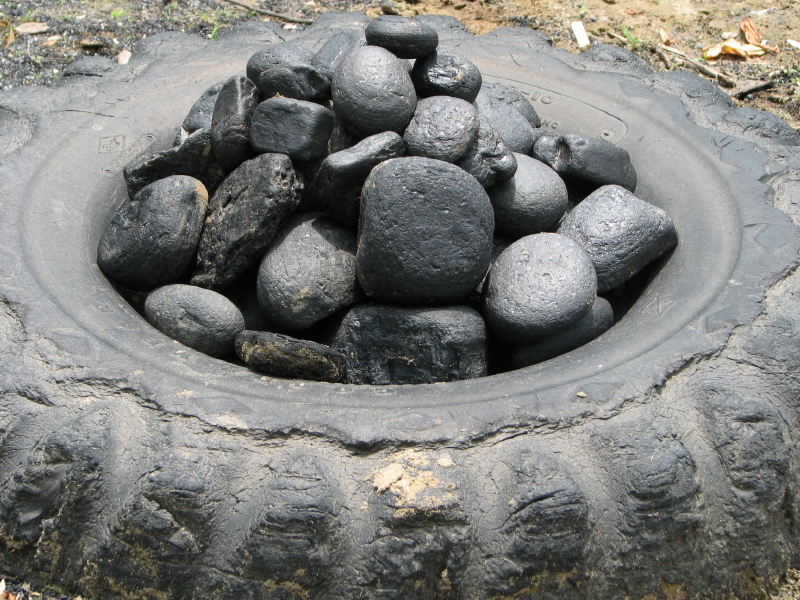
Walking around in this area, I found enough large coal pieces to fill a tire.  Doing this was highly addictive for me.  Here I was picking up real chunks of fossil fuel to place inside a circle that itself is made from fossil fuels in an area that’s well-known for its Devonian Age fossils.  How all these things affect or reference life made my head swim more than the actual heat and humidity.  When I finished filling one tire…this is how it looked.

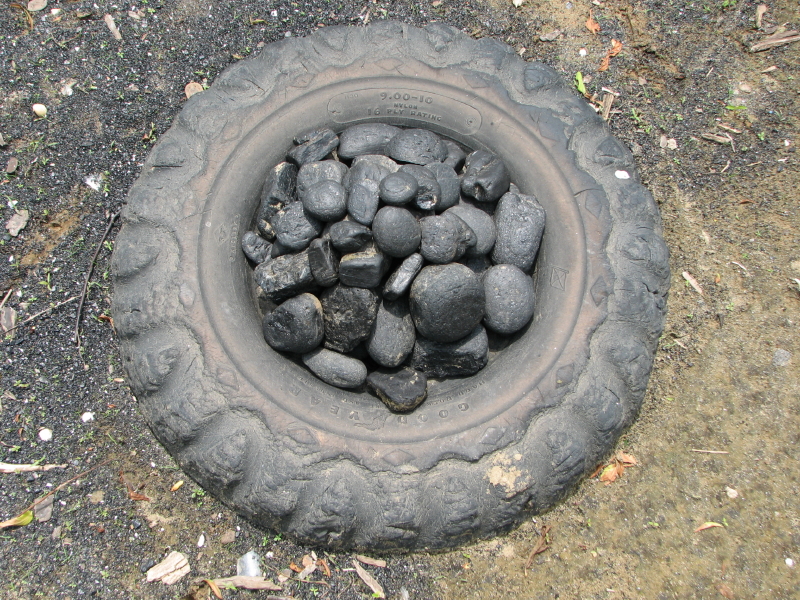
And now, for an aerial view.

To me, this looks like some kind of unusual and bizarre fire pit ready to go.  Scientists have already established that “burning rubber” and coal are contributing to the excess amounts of heat, energy, and toxins now found throughout many of the Earth’s systems.  In Kentucky, the coal debate is a complex one.  We have an abundance of coal, but it comes at a dear price to the land and the people who call the coal fields home.  The sun is getting hot and I have already had a busy day watching fishermen and making sand drawings!  For now, I will have to leave the coal debate where it is, but I’m sure to return to it since there is so much coal here at the Falls.  It will remain here until the forces that shape this planet decide otherwise.

Read Full Post »

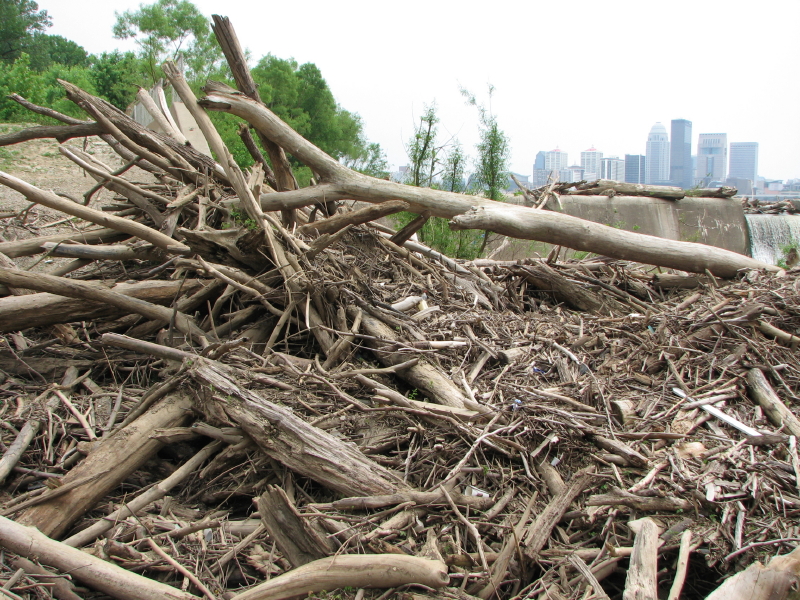
June began all bare bones in the aftermath of our minor flooding and now at month’s end it passes overgrown with vines.  Near the tainter gates, a massive raft of driftwood lies intertwined with the landscape.  We haven’t seen such a wooden mound in many years.  June had some odd and compelling images and here are a few more before we turn the page.

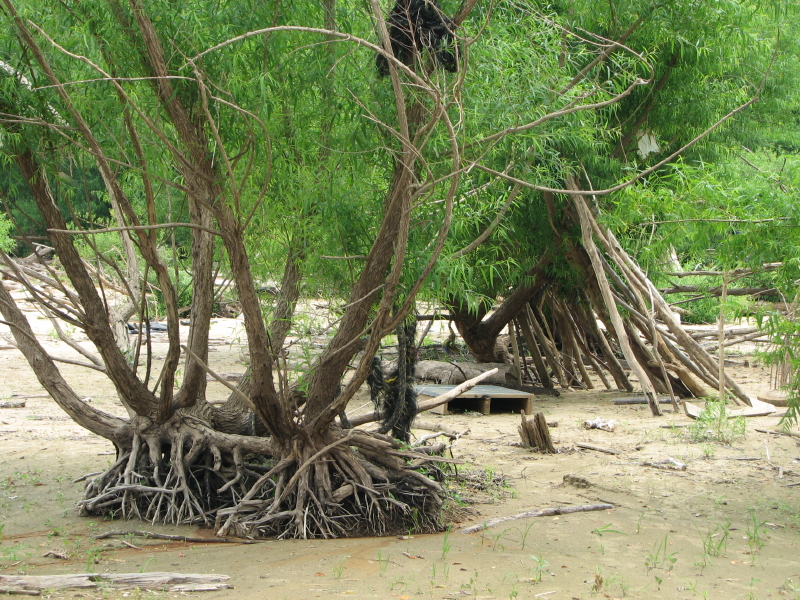
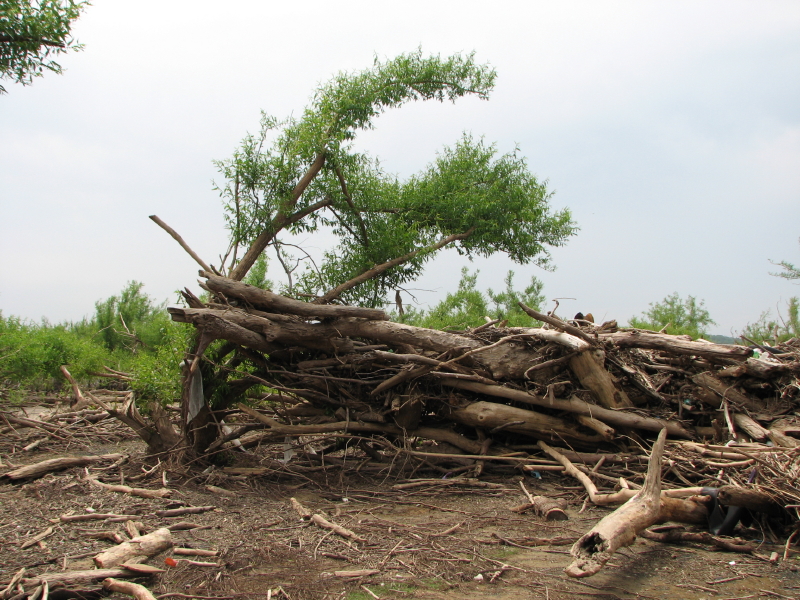
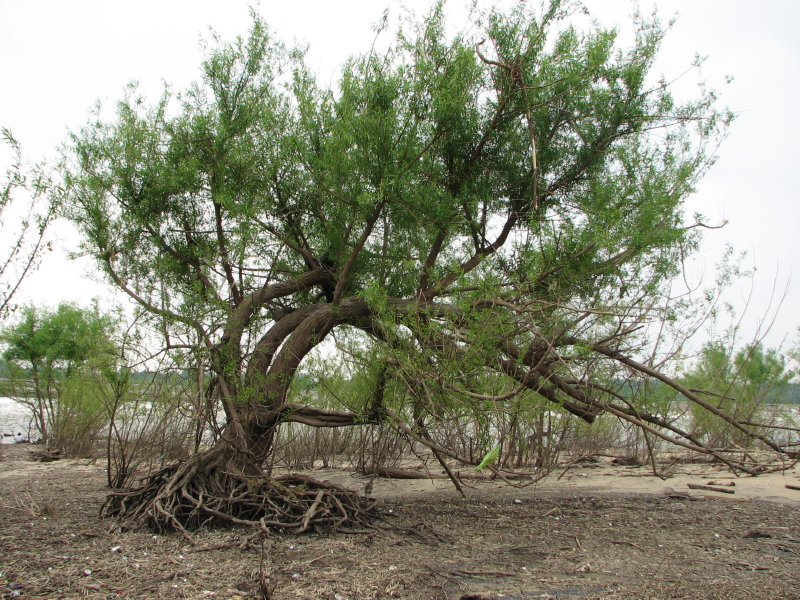
The willow trees are the heroes here tenaciously clinging to the sand and clay.  This taunts the Ohio River which sends high water and a battering ram of floating logs their way every once in a while.

Willow wood is flexible and the sustained high water’s flow is echoed in the shape of these trees.  I imagine the river as an artist shaping its garden at the Falls of the Ohio.  There’s a bit of that bonsai- look if you can get past the larger scale.

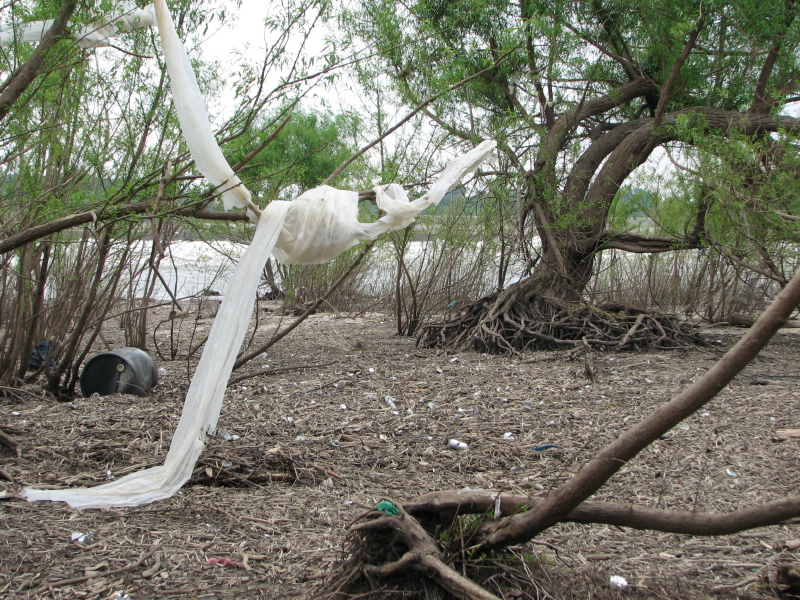
The willows’ branches do their part in snagging some of the flotsam and jetsam floating loosely in the retreating waters.  Branches become decorated with plastic bags, fraying barge cables, driftwood, the occasional dead deer, refrigerators, fishing line, and whatever is present in the Ohio River.

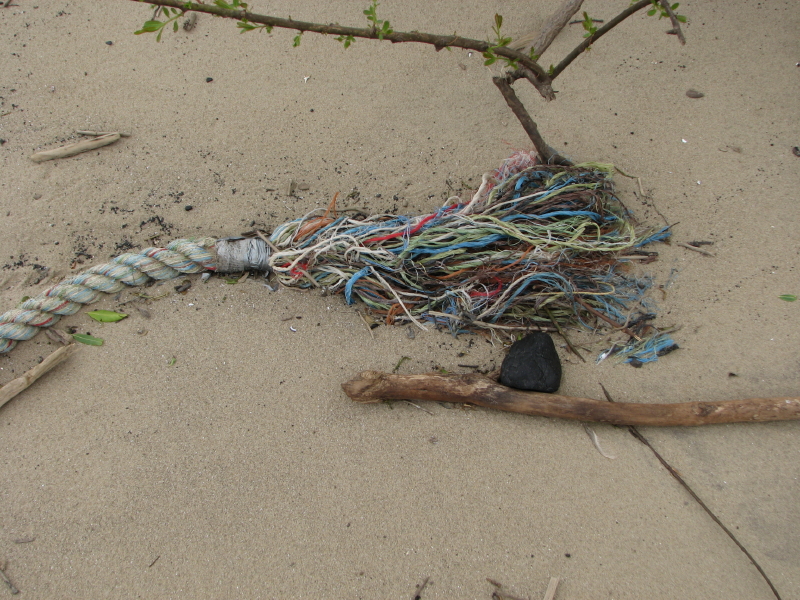
Here plastic sheeting has been caught and stretched some length across these trees.  It looked like something some installation artist might attempt.  I also came across a “nylon crinoid”…in actuality, an unraveling barge cable that made me think of the extinct sea lilies of ancient oceans and in fossils which are pages in the book of life.

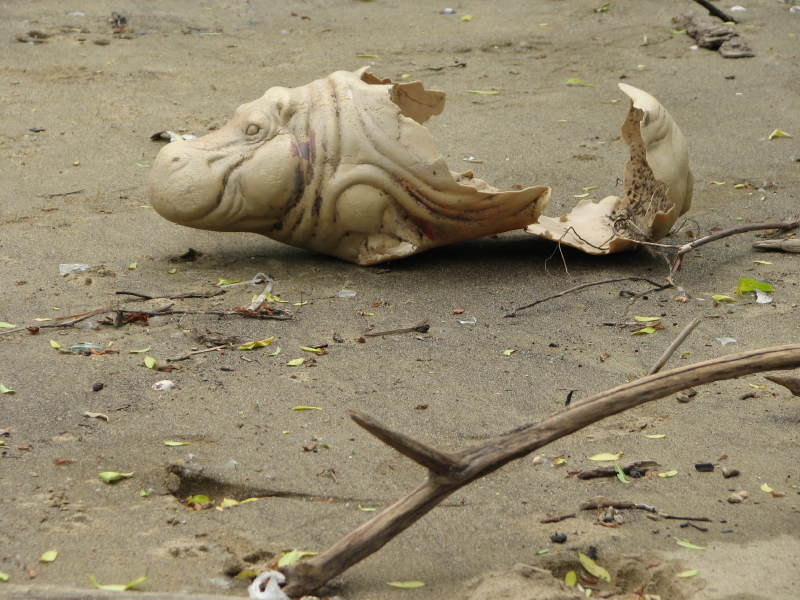
Walking across the sand I came across this unusual view which gave me the idea for the title of this post.  Very nonchalantly, this mostly destroyed hippopotamus was standing its ground.  I’ve read somewhere in a book that the name “hippopotamus” means “river horse” in some African language?

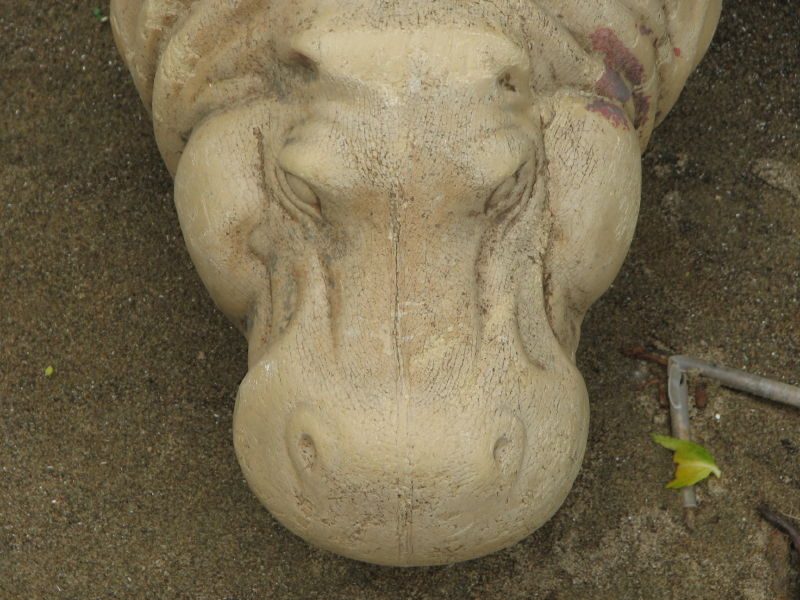
Another view, but this one from the top.

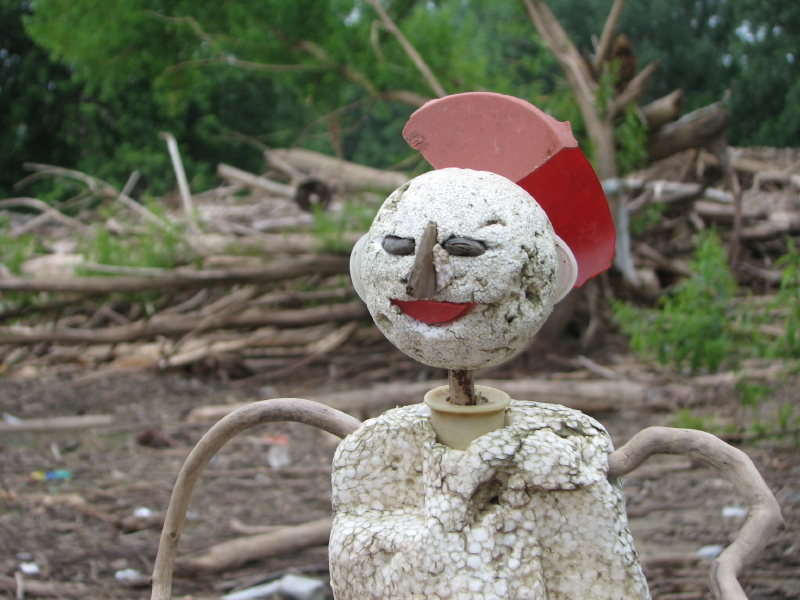
I made another Styrofoam figure on this day.  I imagine this as being a figure of some exotic Spanish dancer with fancy combs in her hair.  I won’t say this is the best figure I’ve ever made, but it’s also not the worst.  It just happens to be how things turned out when I picked this group of materials and objects to make something with at that particular moment.

Now for a full length view.  That pink radiating thing is made of plastic and helps to add other visual interest.

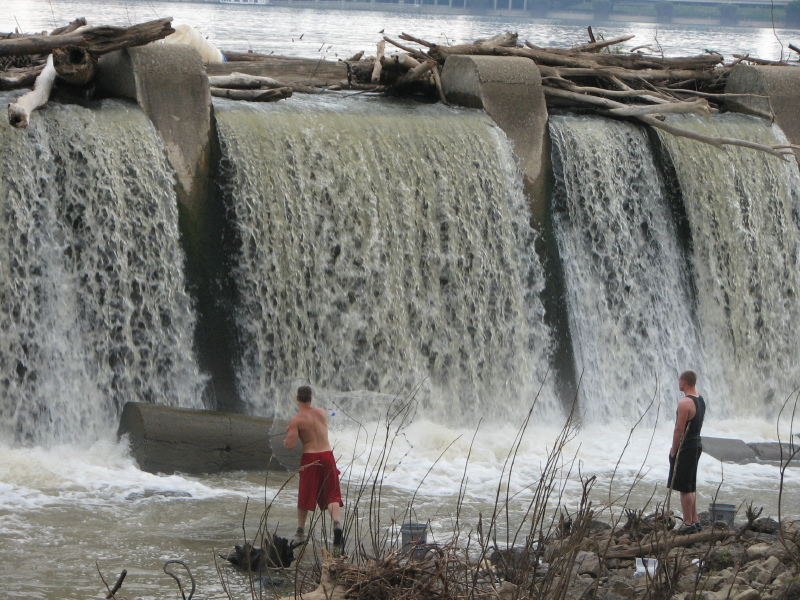
Before leaving for home on this day.  I watched a couple of guys using a throw net to catch shad to use for fishing bait.  I couldn’t help but see them in the context of the Ohio River which was so many more feet above their heads.  Here we are at the bottom of the valley.

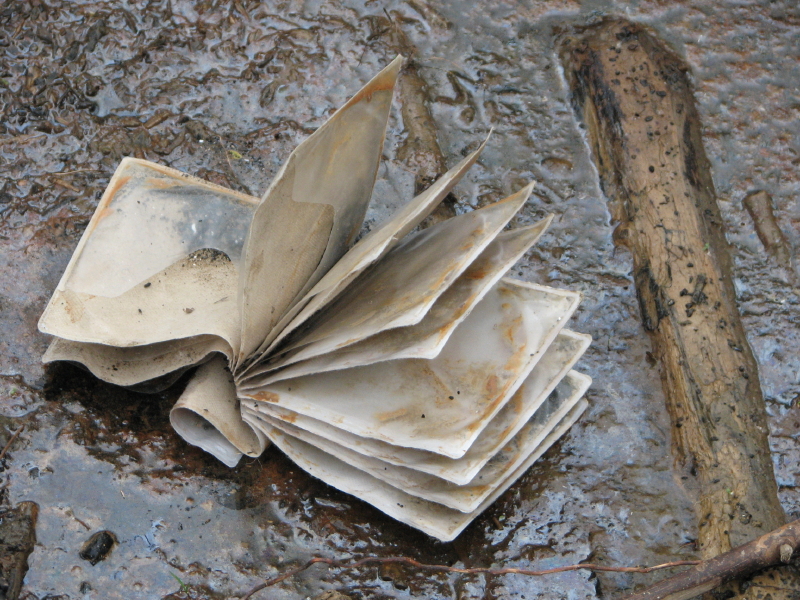
Since I’ve used the book metaphor a few times in this post…it’s fitting that I end with this picture taken on this day.  It’s really a small plastic photo album whose transparent sleeves were full of coal gravel and water.  Until next time…


Read Full Post »

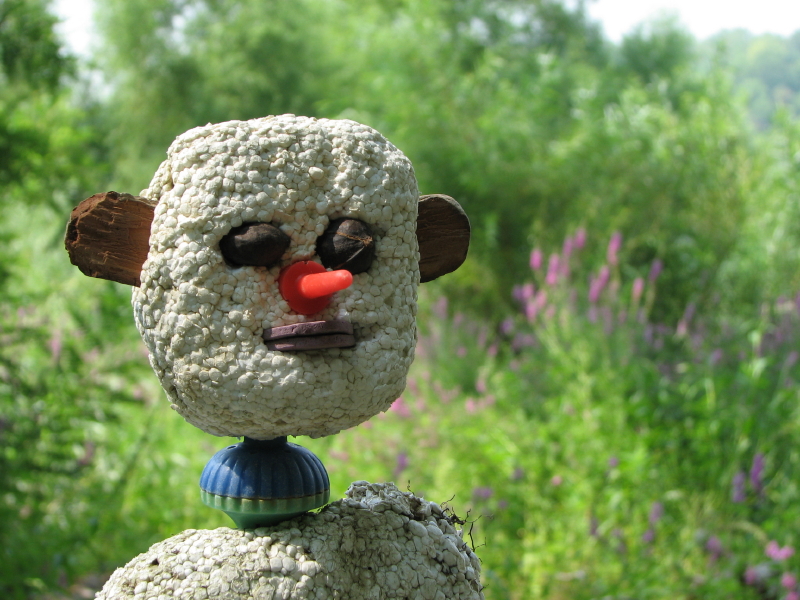
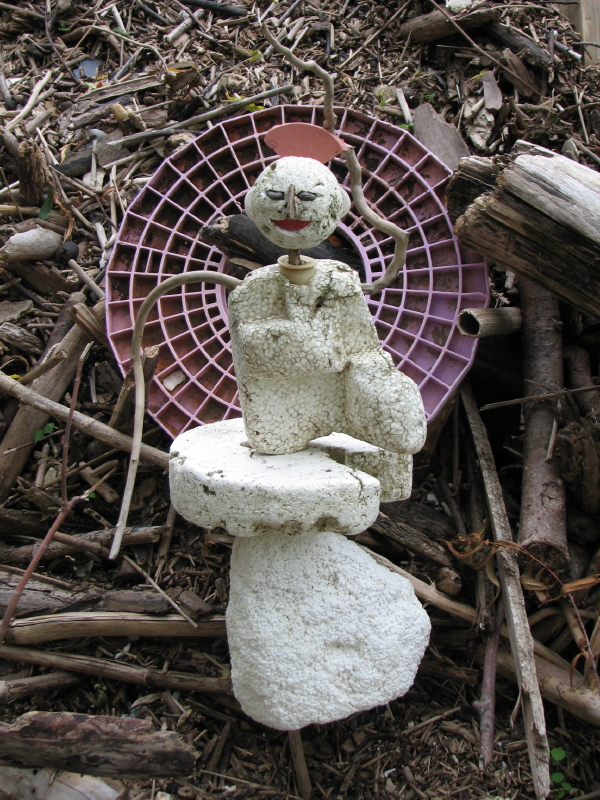
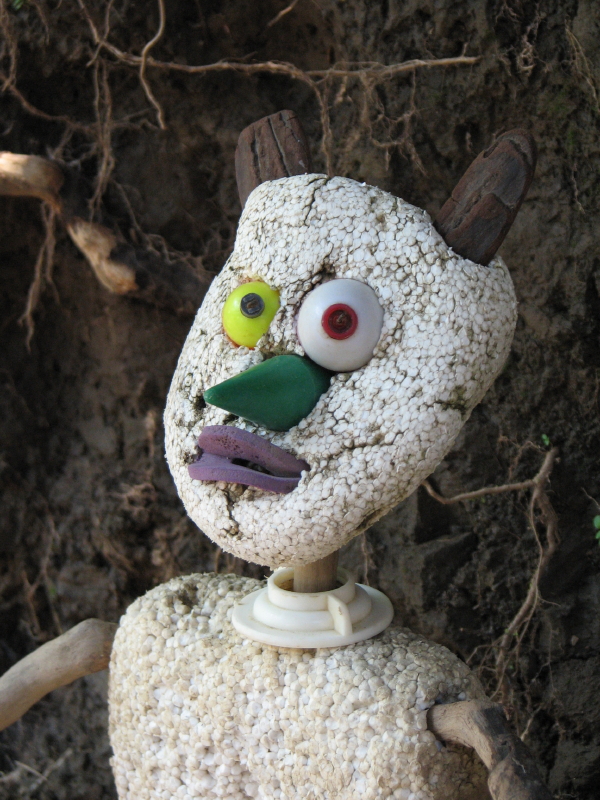
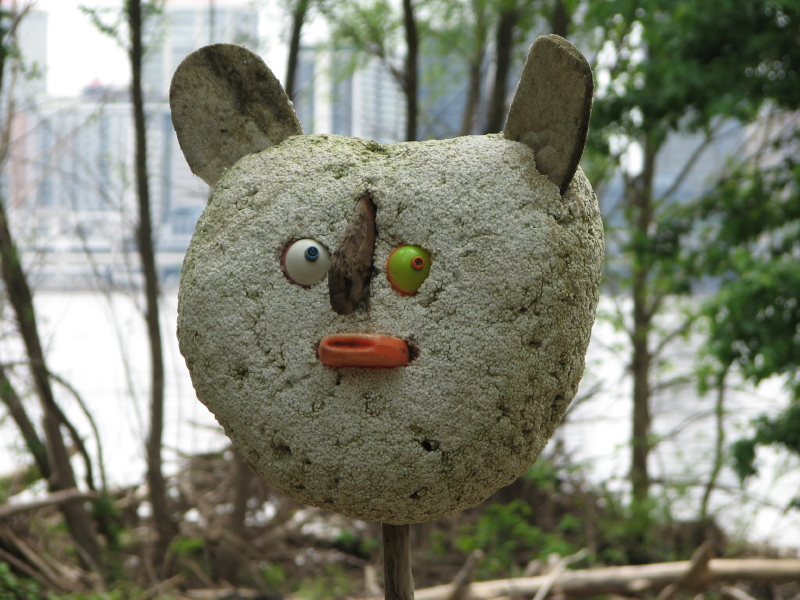
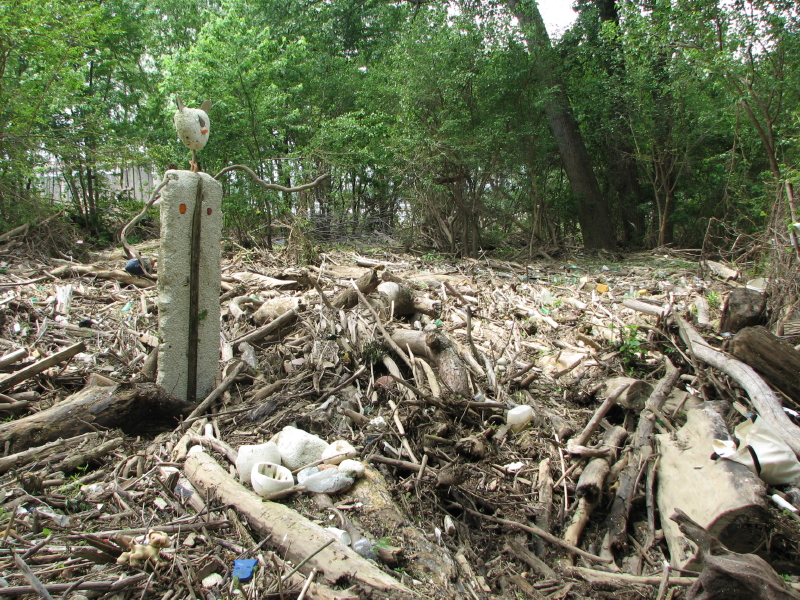
In my hands was the head of a small Styrofoam figure I made at the Falls of the Ohio State Park.  I found all the parts while walking along the northern shore of the river.  The eyes are fishing bobbers and the nose is the plastic cone from a moderate-sized bottle rocket.  I can’t remember what I used to make the purple lips!  I was on my way to see one of my favorite trees and wondered how it was doing after this year’s flooding?

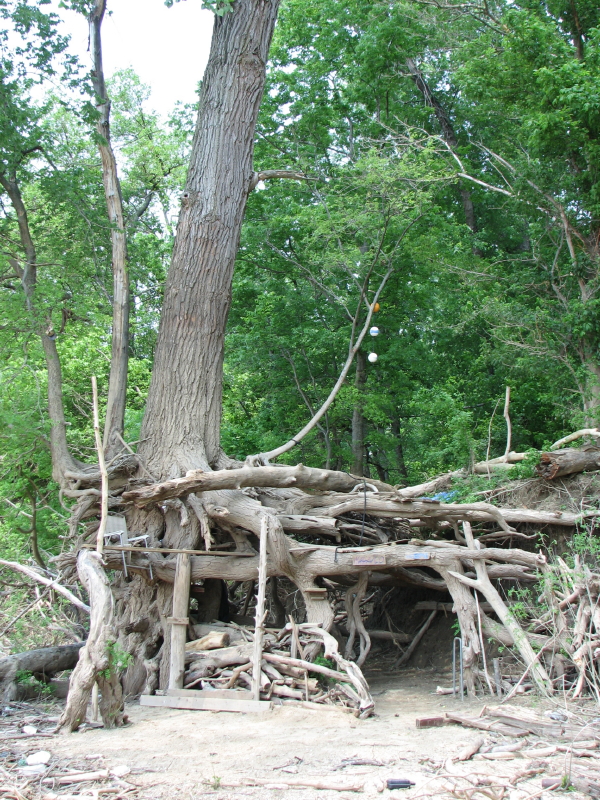
The great tree with its amazing roots had survived in fine shape.  Approaching I could see that recent visitors had added new amenities to enhance the natural room existing under the trunk of this tree.  Long a go the river washed away the river bank, but the tree’s roots held fast and kept growing.  Here’s a side view.

I ran into Steve the Arrowhead Man earlier in the week and he told me that teenagers had discovered this tree and turned it into a party hangout.  Nailed to the tree was a hand-drawn sign that read “Mahalo”.  Driftwood had been collected and neatly stacked near an improvised kitchen area that had counter space, a stone-lined fire pit, and a plastic trash bag to carry garbage out.

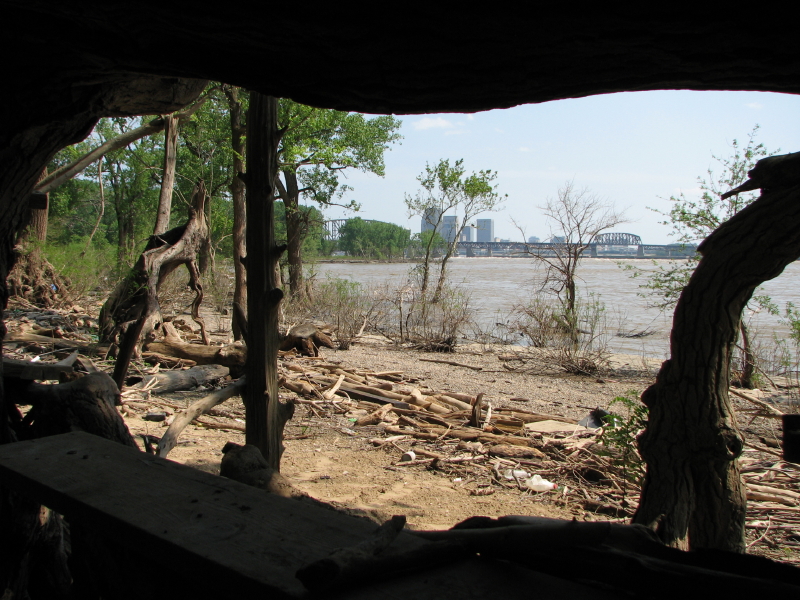
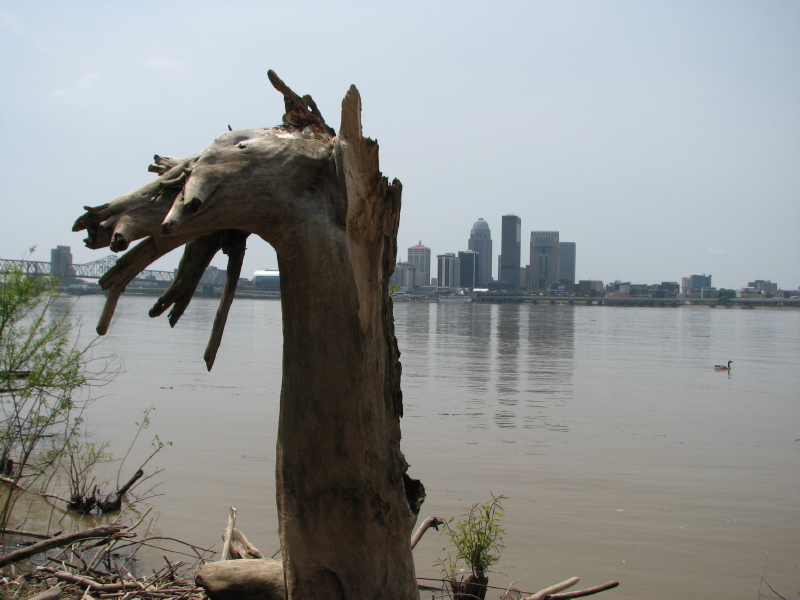
I like the counter-top plank that also helps frame this view out the window.  The skyline of Louisville can be seen on the farthest shore.

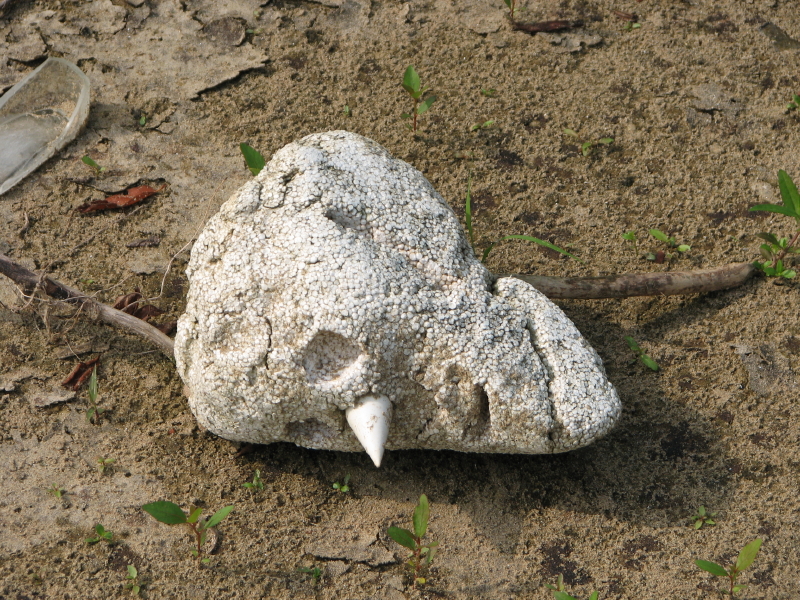
Sitting in the Mahalo Tree was more about fantasy than reality.  The fire pit was located too close to the tree!  Still I admired the sense of play and creativity and decided to leave the figure I was making now named “Mahalo Man” as a present for the next visitor to the tree house.  I finished my figure with materials I found around the tree.  Here’s a portrait of my latest creation.
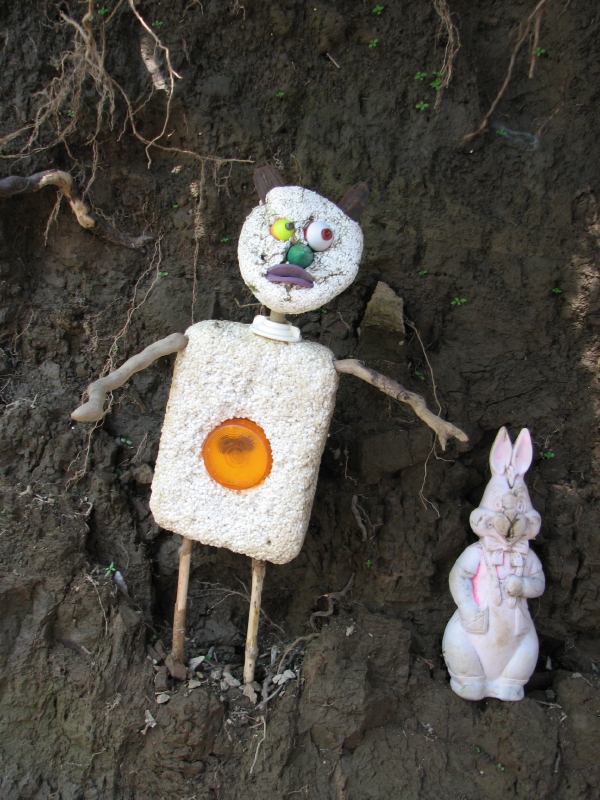
First, I moved Mahalo Man by the sign nailed into the tree…but I didn’t like it.  So, I reached into the old collecting bag and pulled out a plastic bunny rabbit I had found on the walk out here.  The rabbit had a coin slot in the back of its head.  I finally left Mahalo Man under the earth and rootlets beneath this great tree.  Here is another view of this figure with his rabbit companion.


The rabbit figure lent a certain Alice in Wonderland quality to the ambiance surrounding the Mahalo Tree.  I hope to check back here sometime during the summer and see what other changes have been made by man and nature.  I  will close with a final rabbit picture next to the hole in the bank our friend now calls home.

Read Full Post »

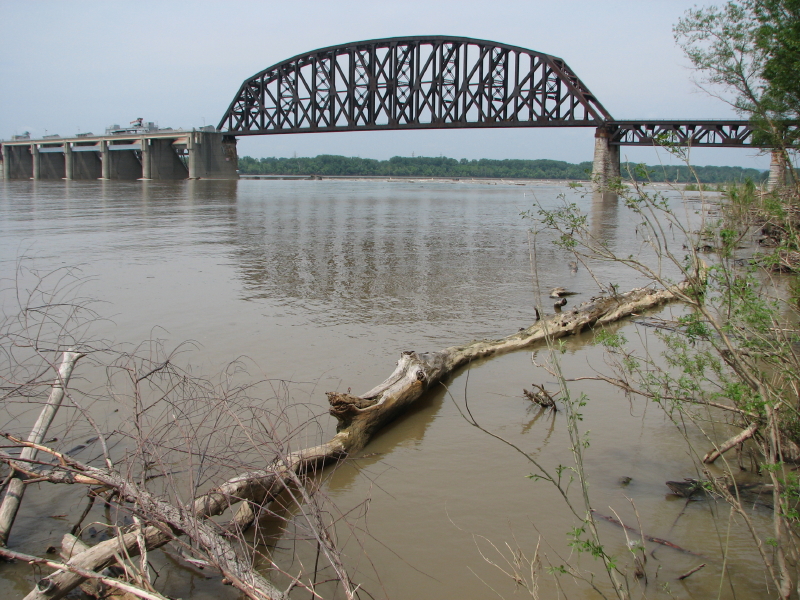
Just left or east of the railroad bridge at the Falls of the Ohio is where this adventure occurred.  The river was still high but dropping.  I was enjoying working in a section of the park that I don’t normally hang out at, but have discovered is both full of wildlife and potential art materials.  Evidence of our recent flooding was everywhere and I was exploring what there was to see and find.

While I was exploring this area I could hear Beatles’ music quite clearly drifting over the water.  It was the annual Abbey Road on the River Festival at the Waterfront Park in Louisville.  I guess the goal of each tribute band is to sound as closely to the original Fab Four as possible because I couldn’t detect much variation from one group’s rendition of a familiar song to another’s.  I did, however, notice that the Belle of Louisville’s steamboat calliope was in direct competition with the bands.  Like last year’s festival…snatches of 19th century tunes intermingled with pop hits from the 1960’s.  Baby, baby…Do dah day.

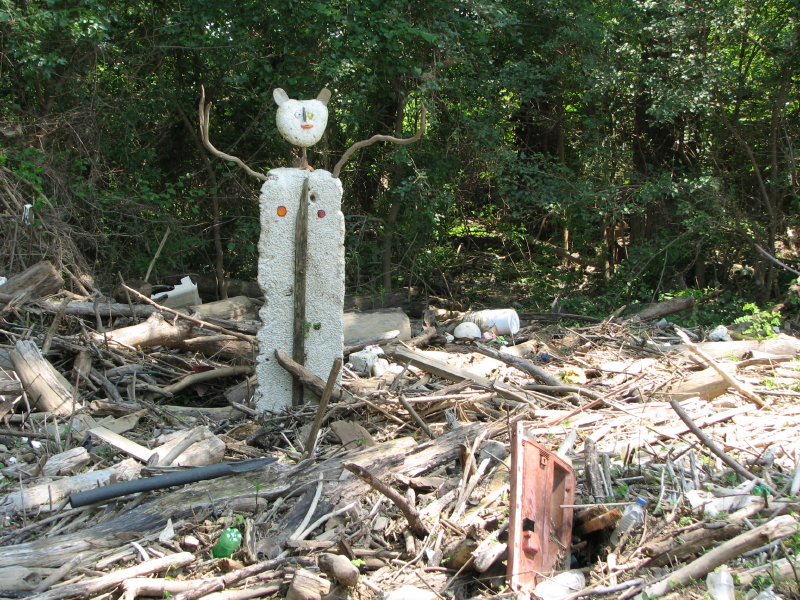
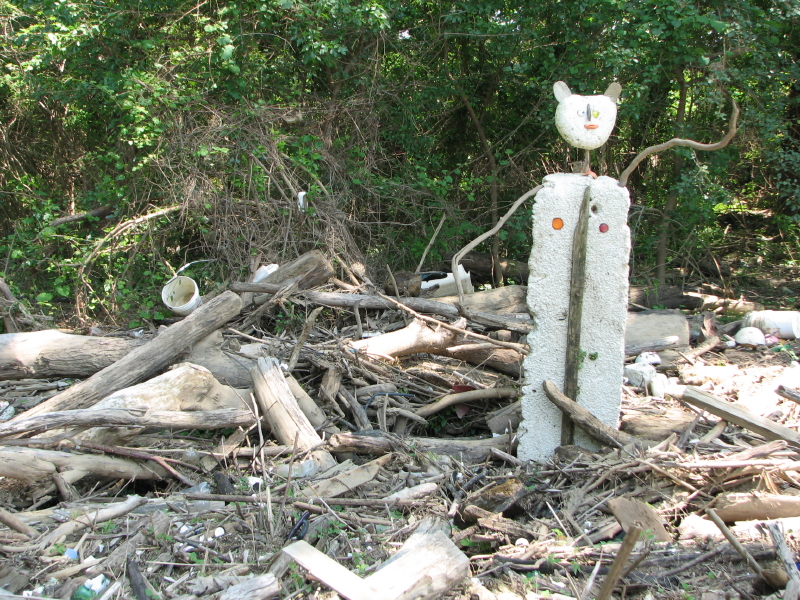
I was in this section of the park because I was searching for larger sections of Styrofoam.  This last bout of flooding pretty well wiped the slate clean as far as the materials that I had collected last year.  There is no shortage of smaller chunks throughout the park, but the larger pieces that are remnants of floating docks were in shorter supply.  I did find this piece that still had wood attached to both sides and set it upright, stelae-style.  Here’s what it looked like right after I assembled it.

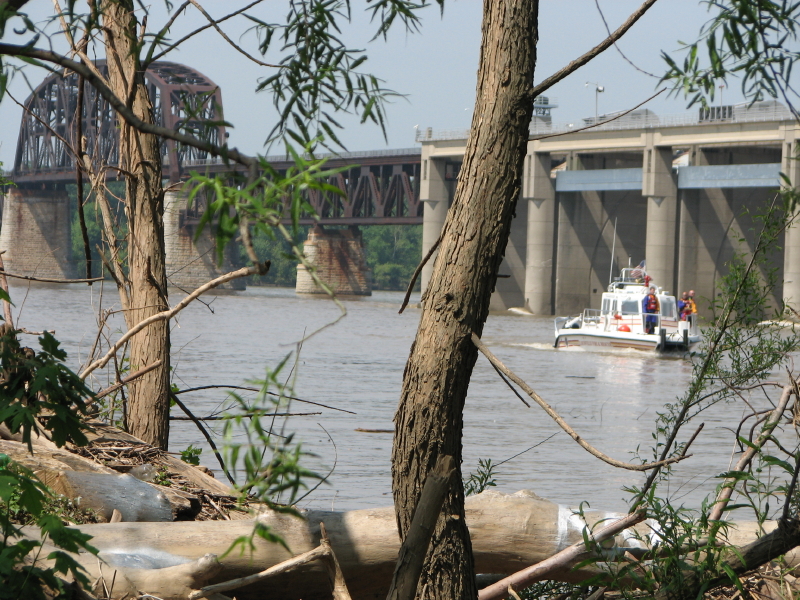
I had the turtle piece going too while this six-foot figure was under construction.  I also happily observed Northern Orioles chasing one another through the Cottonwood Trees.  I taught myself how to imitate the oriole’s song and on occasion can lure a curious bird closer by whistling to it.  I’m still trying to get a primo photograph of one of these birds, but they do tend to stay in the tops of the trees.  Out on the river, I observed a boat going back and forth along my side of the river and I’m speculating that they are looking for some poor lost soul that the river may have claimed?

I left my Styro-sentinal in place, but returned a couple of days later to discover it had fallen over.  This time I moved him to a different place facing the river and changed its arm positions a bit.  Originally, he held one of those soft nerf-type footballs.  I haven’t been back since and he may or may not be still guarding this section of the river bank.

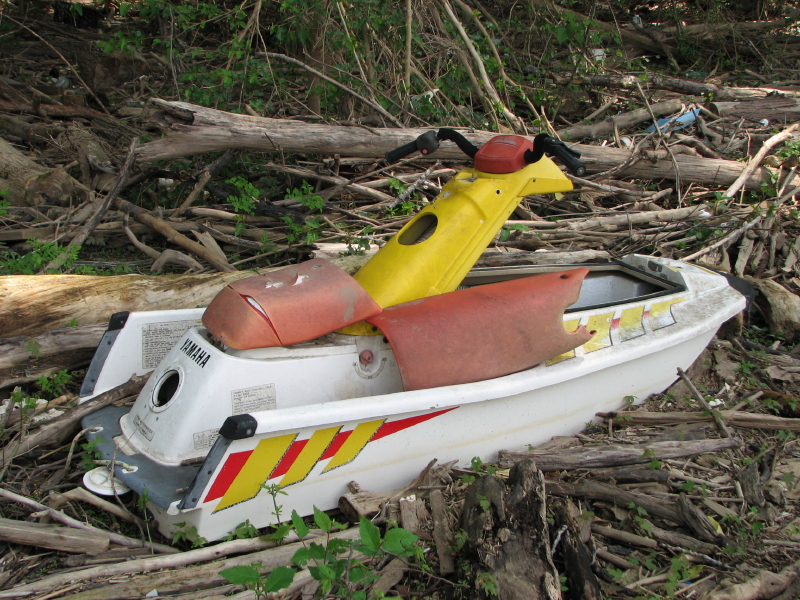
Among the items I “found” out here include this ruined Jet-ski.  Which…

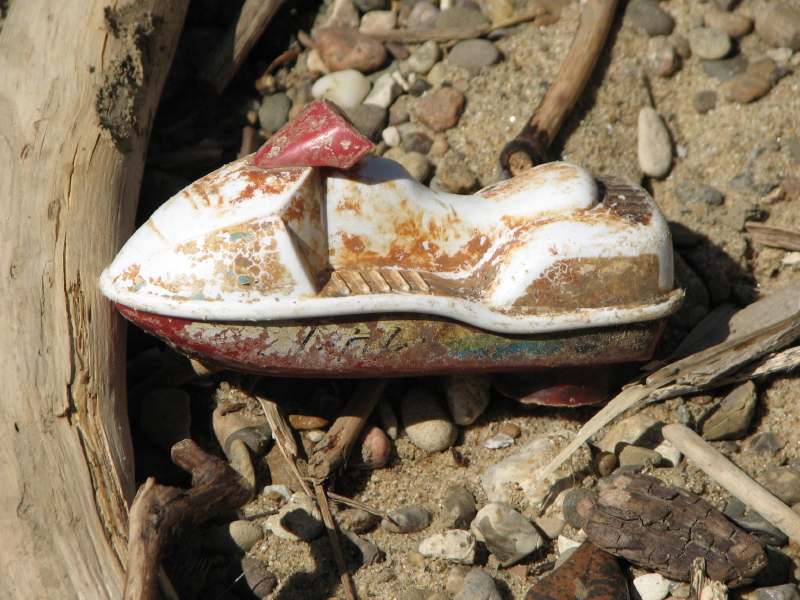
…bookends nicely with the miniature version of it I found in the western section of the park also courtesy of the Ohio River and its recent flooding.

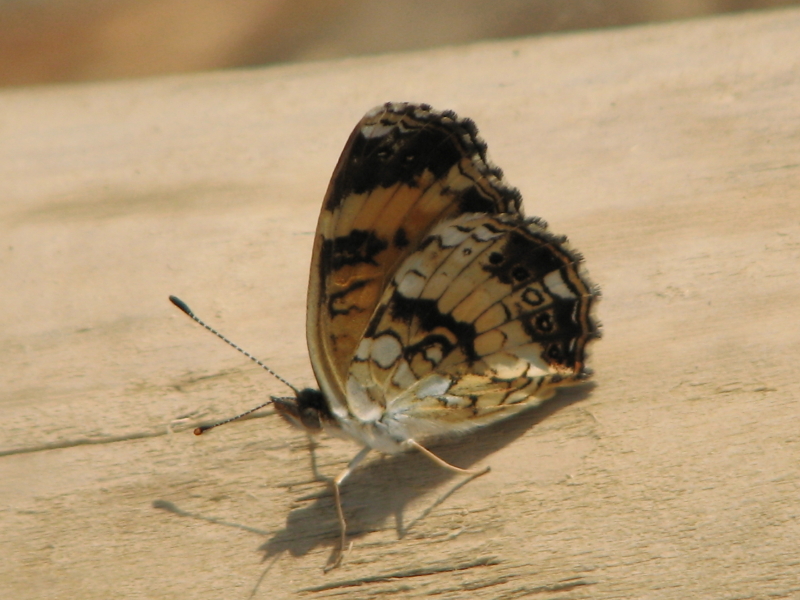
Butterflies and other insects are becoming more prevalent as the season progresses.  I saw what I thought was a familiar butterfly, but wasn’t totally convinced it was the species I thought I knew…so I photographed it and researched it a bit in the comfort of my home.  Here is my first image which shows two of these “different” butterflies.

Here’s a single, resting individual with its wings spread open.  This butterfly shows more black than the Pearly Crecents that are common out here. 

I cross referenced my butterfly guides at home and was glad that I was able to take a picture of this butterfly’s ventral surface because it helps to identify it.  I was leaning towards the Eastern or Harris Checkerspot but decided that this is the Streamside or Silvery Checkerspot (Chlosyne nycteis ). Here is the view that was most helpful.

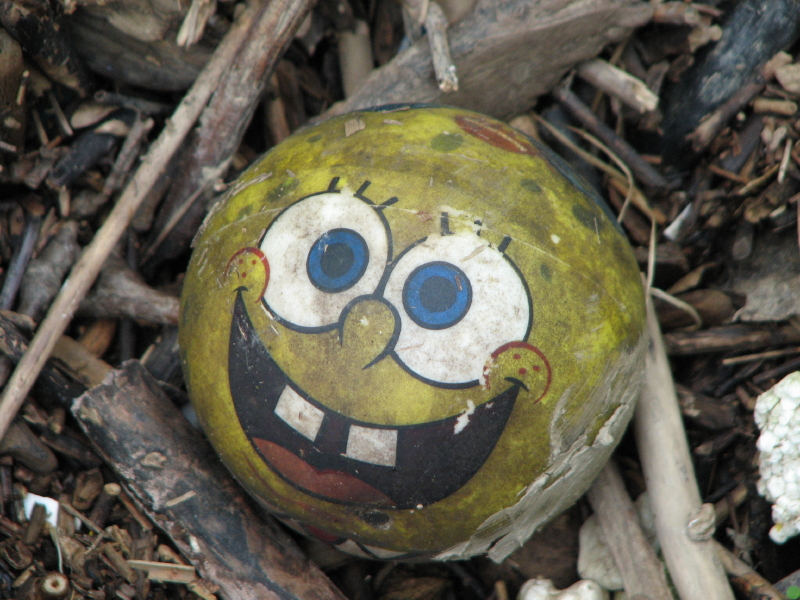
I’m looking forward to seeing many other butterfly species out here this year.  I will try to keep a checklist of what I see just as I do for the many bird species that visit or call the Falls of the Ohio State Park home.  On my way out of the woods, I “felt” something looking at me and after checking around…discoverd these eyes following me which is as good a way to end this post as any!


Read Full Post »

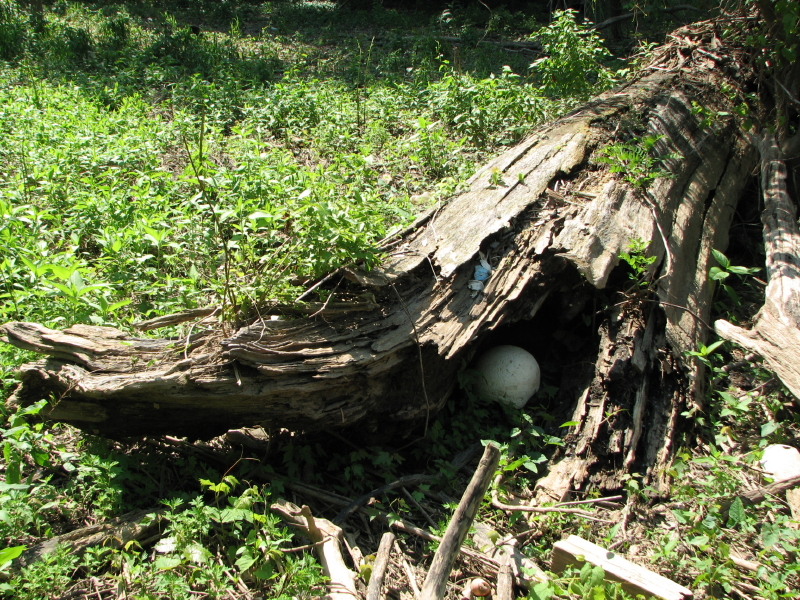
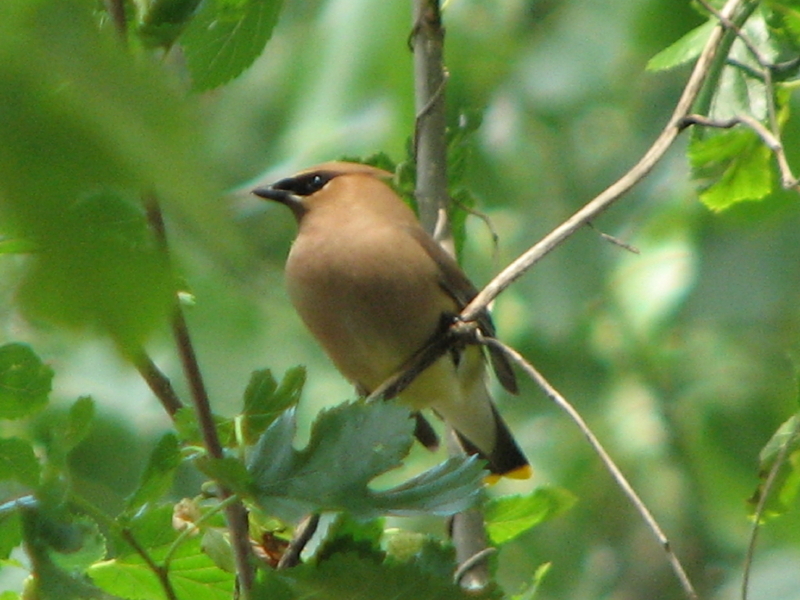
First, I would like to thank all the people who checked out my last post on the box turtles.  The response has been pretty overwhelming and I’ve enjoyed everybody’s comments.  The Eastern Box Turtle isn’t the only turtle to be found at the Falls of the Ohio State Park and this post is about that other mysterious and rare reptile. It’s called the Cottonwood Turtle (Terrapene populus) and its habitat overlaps that of the box turtle.  On a warm and humid morning I was exploring the eastern section of the park around the debris line formed by a retreating Ohio River.  Plastic bottles and containers and the ever-present polystyrene chunks helped define the high-water mark.  We have had so much rain here and it’s officially Kentuckiana’s wettest spring on record!  I was mesmerized watching and listening to the Cedar Waxwings pursuing each other from mulberry tree to mulberry tree and whose fruits are just now beginning to ripen to a glossy black.  The air was filled with the fine downy fluff produced by the catkins of our giant cottonwood trees and seemed like so much snow falling in ultra slow motion.  The chances of inhaling this fluff are real and white airy drifts were forming on the ground where the air currents pushed this gossamer material with its tiny secret of seeds within.  With so much going on, I was surprised to catch a slight bit of movement inside a nearby hollow log.  I remained still and this is what I saw.
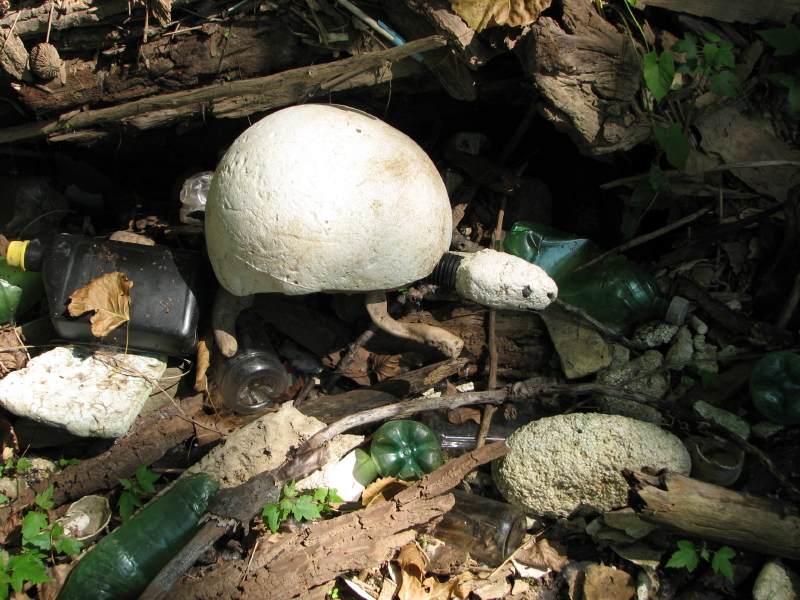
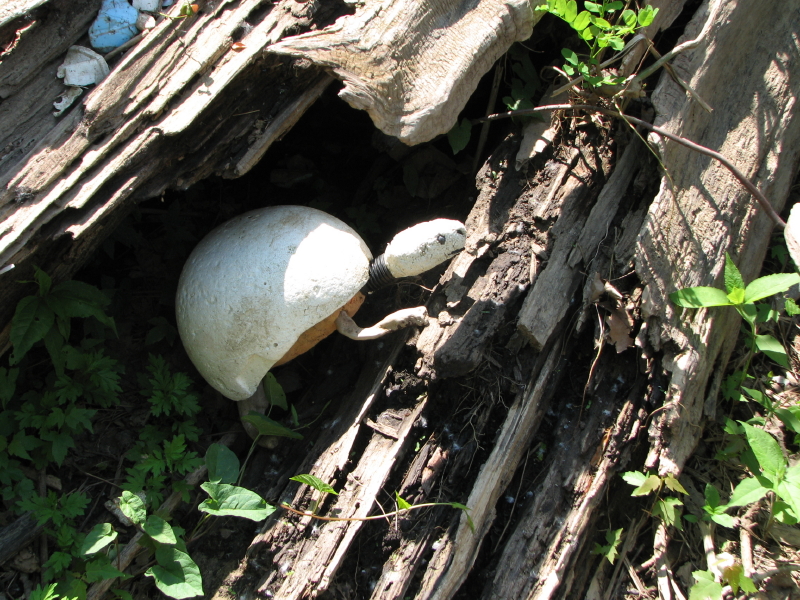
Emerging into the light of a new day was this very ancient looking turtle.  Of course I recognized what it is and determined to follow it and make a record of my observations.  I kept a discreet distance away and tried not to make any sudden movements or loud noises so the turtle would act as naturally as possible.  I kept up with it for a several hours and then I had to pull myself away for home.

The Cottonwood Turtle is characterized by a high-domed carapace that the original inhabitants of the Ohio Valley used for war and ceremonial helmets.  Unlike the box turtles which it shares some affinities with…the Cottonwood Turtle cannot retract its head and limbs fully into its shell.  This makes it vulnerable to predators.  I watched my turtle crawling over the plastic and Styrofoam debris left by the last flood.  It seemed to be going somewhere with a purpose and I followed discreetly behind it.

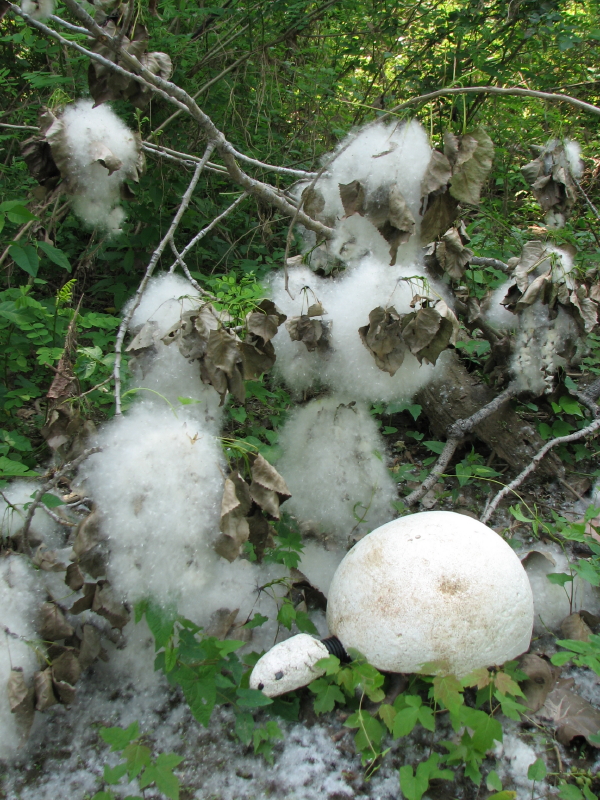
The previous night we had another tremendous rain storm with high winds.  Mud, broken branches and leaf litter evidence can be found everywhere.  I followed my turtle to a large cottonwood branch and saw it engaging in the activity that gives this remarkable reptile its name.

Over the course of about an hour, I watched the turtle carrying mouthfuls of the Cottonwood fluff to a hole that it had previously prepared.  It made about a half a dozen trips back and forth from the downed branch to what looked to my eye to be an abandoned groundhog hole that the turtle retrofitted for its own purpose.  The fluff was carried  into the hole where a special chamber was being prepared for this turtle’s eggs!

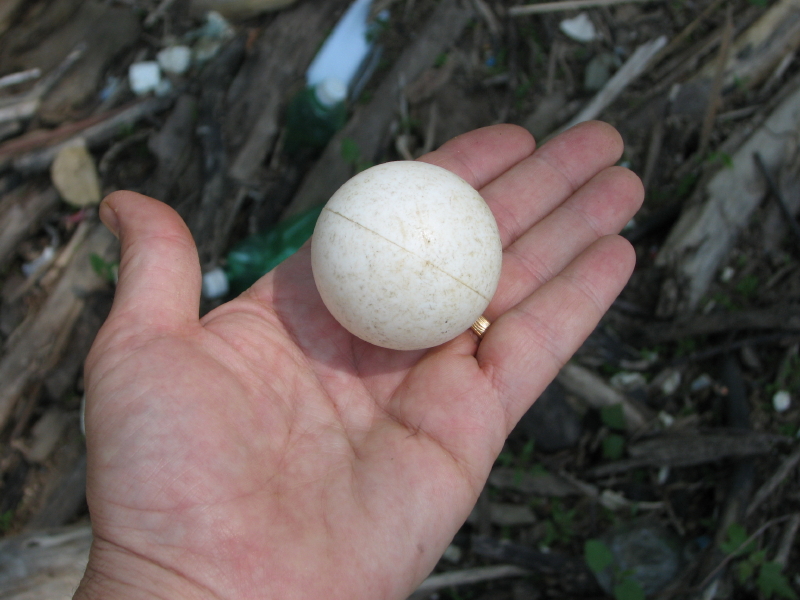
Here is the Cottonwood Turtle about to finish laying her eggs.  I observed about five ping pong ball-sized eggs being deposited upon their bed of cottonwood fiber.  I suppose the fluff cushions the eggs and perhaps as this material decays provides some modicum of warmth to assist in the incubation?  From what I have read, new turtles should be emerging from their subterranean nursery after sixty days.  After the turtle covered her nest with her back legs she moved on.  From this moment, the eggs and baby turtles to be are on their own.  I gently uncovered some of the soil and photographed this single egg.  Afterwards, I placed the egg back into the nest, re-covered it and went on my way happy to have witnessed this ancient rite of life.

It occurred to me on my walk back through the tangle of bottomland, that this turtle might be benefitting the tree as well?  I haven’t heard or read anything concerning a link, but what if?  The fluff contains minute seeds and the act of burying them might aid in propagating this tree.  The turtle places these seeds a little deeper than usual which might encourage stronger and deeper root growth.  Since this area is frequently altered by the river, it would make sense for the tree to have a deeper hold on the soil?  I came across another downed cottonwood branch and admired all the fluff it was producing.  It all looked so beautiful and magical in broad daylight.

Overhead the orioles were collecting their own materials to build their amazing hanging basket nests.  And the Cedar Waxwings were fueling up on the mulberries in preparation for their long migration up into the north country.  One last image of one of these waxwings.  Such an interesting and beautiful bird so uniquely marked.

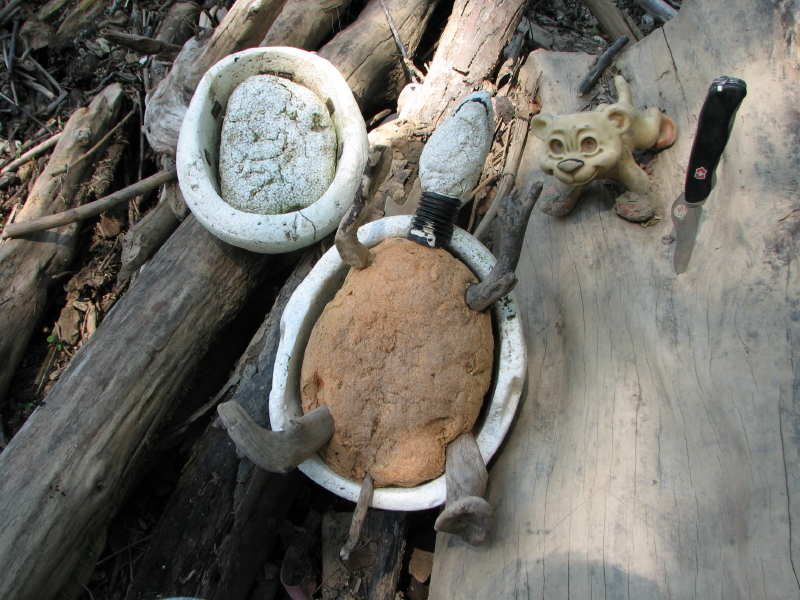
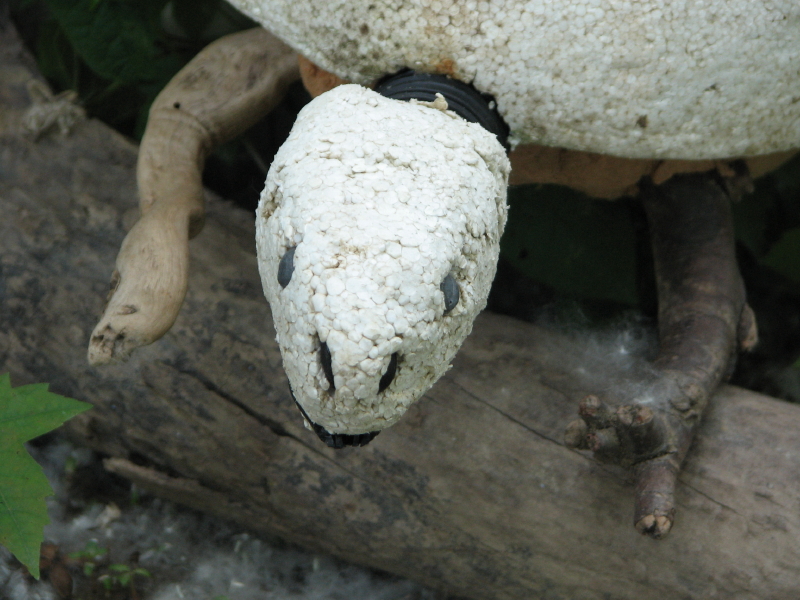
Although I may have fooled some people out there (wink, wink)…the Cottonwood Turtle doesn’t actually exist!  I made it from junk I found here in this very real environment at the Falls of the Ohio.  The shell or carapace is the cushioning from inside an old bicycle or motorcycle helmet and I have found several of these helmets after the last flood.

I used three pieces of Styrofoam…the shell, head, and one piece under a chunk of fiberglass-like material to fill the space inside the helmet.  Limbs are pieces of found wood attached to the lightweight fiberglass.  Everything is joined and pegged together with wood skewers.  I did use some found plastic for the actual neck and mouth of the turtle.  The eyes are round lead fishing weights and the nostrils are pieces of coal.  Thanks for tagging along!

Read Full Post »

« Newer Posts - Older Posts »