Feeds:
Posts
Comments

Archive for the ‘Ohio River’ Category

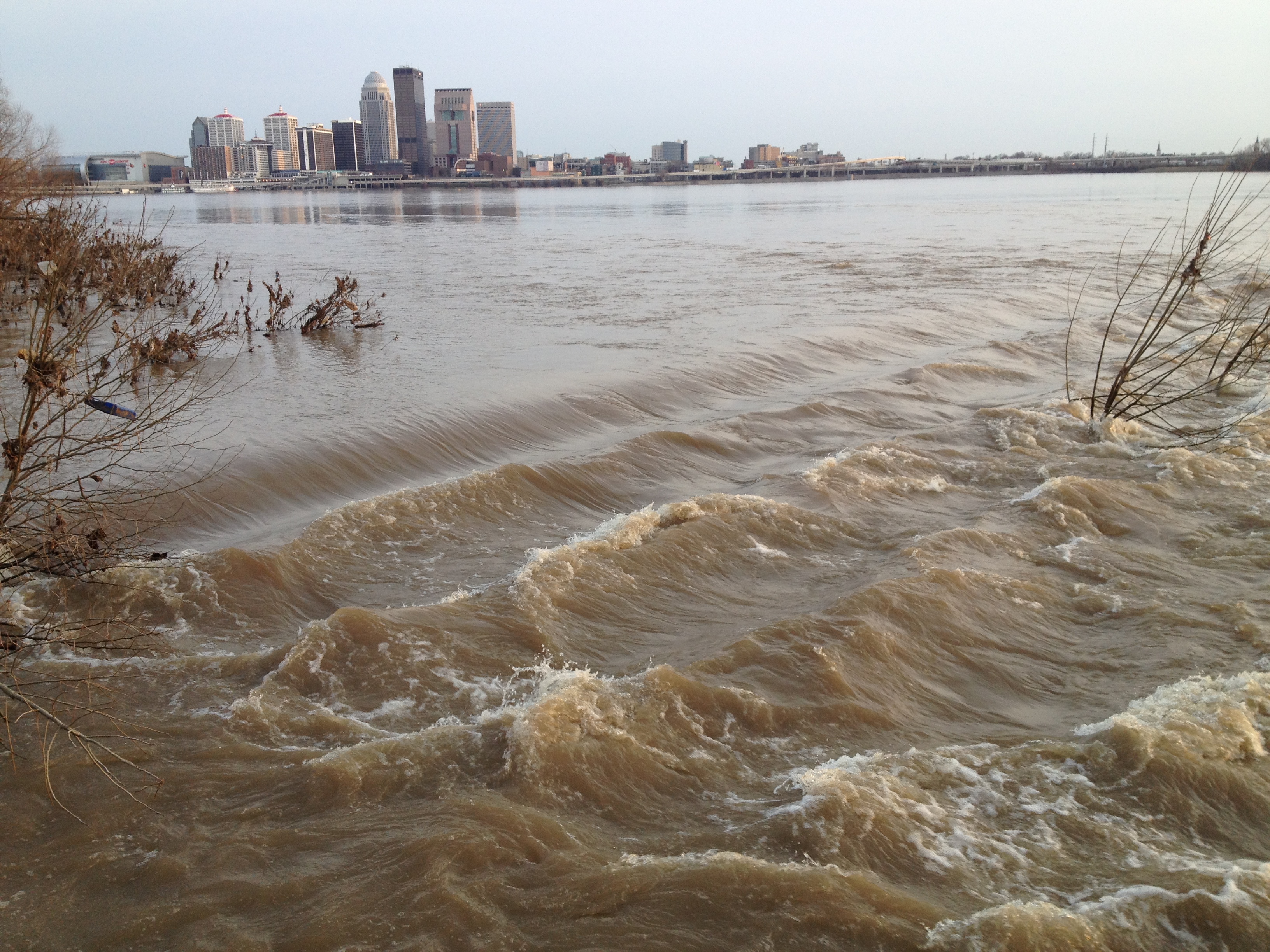
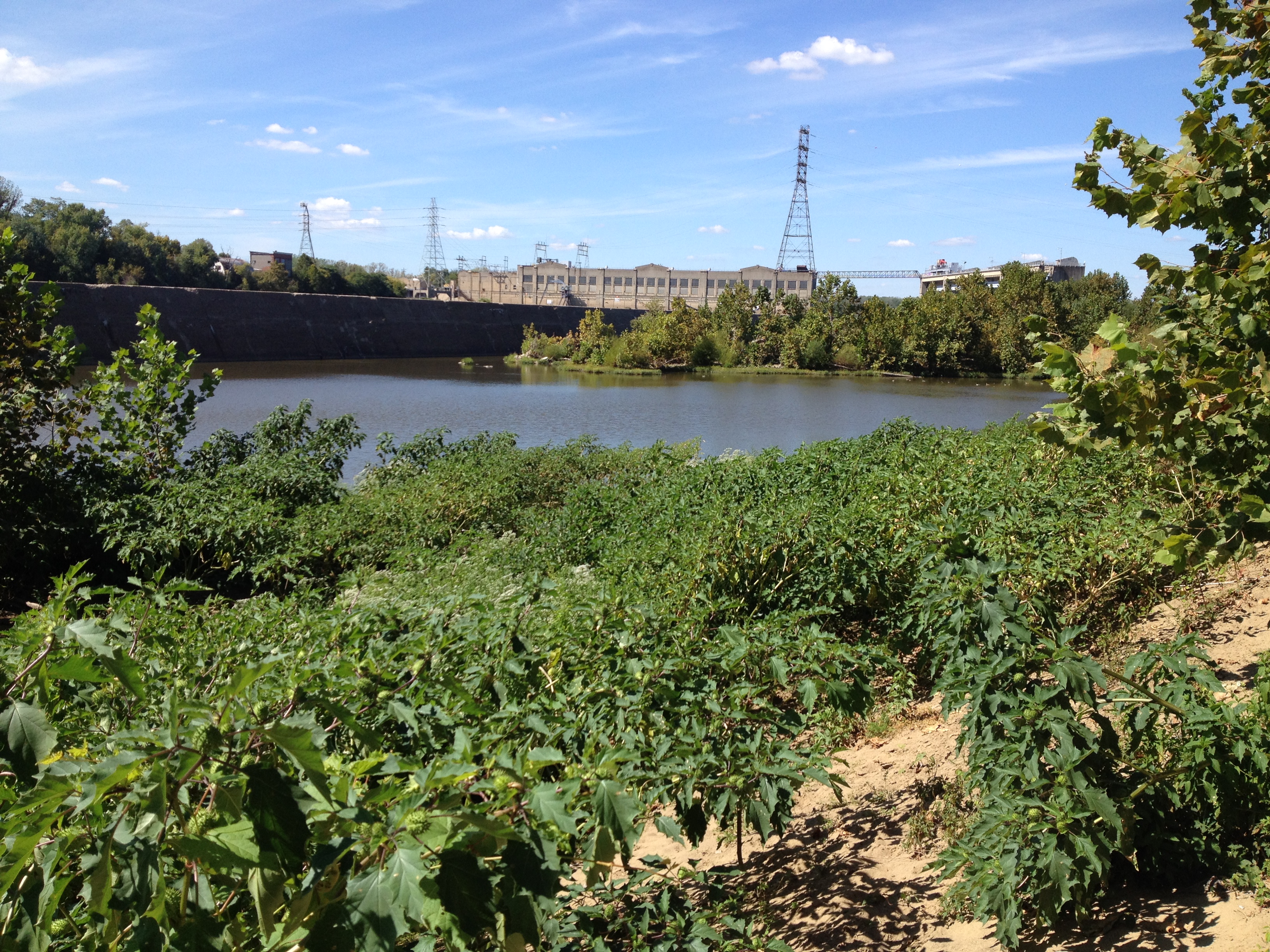
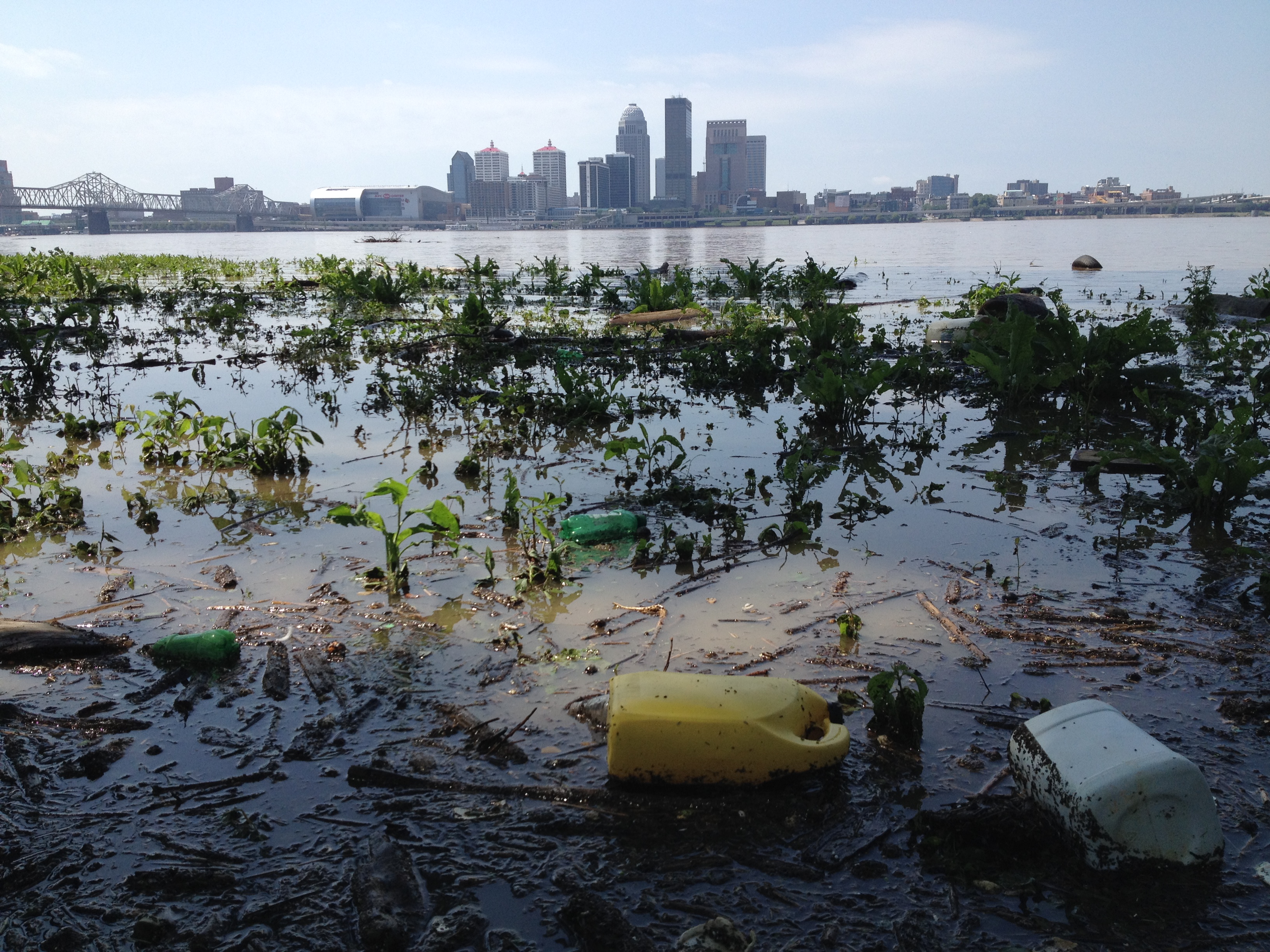
High water with Louisville in the distance, July 18, 2015

I’ve been to the river three times this month, but this is my first post for July!  Where to begin?  It’s been eventful in so many ways.  First, the hard drive of my computer crashed which put me out of business for a few weeks.  All the while this was being dealt with…the river has been high due to what seems like at times, monsoon-intensity rains.  Not light, gentle rains, but strong storms that dump inches of rain at one time and are often accompanied by high winds.  I suspect that this year’s June and July will be among the wettest combos recorded around here.  There has been tragedy too.  Five people lost their lives in a boating accident while watching the 4th of July fireworks display in front of downtown Louisville.  The river was especially high and fast flowing when their pontoon boat struck a parked barge sending people into the water.  It took several days to recover the bodies.  We may think that we can manage the river through levies and dams, but nature often has other ideas.  Where is all this water coming from and can be this be further evidence of the planet’s changing climate?  When I see before and after pictures of what were former glaciers or images of huge ice shelves breaking off of Antarctica…that fresh water goes somewhere right?  Seems there is a lot of moisture being drawn up into the atmosphere which then precipitates out over the land.  Too bad it doesn’t seem to be going where it is needed the most.
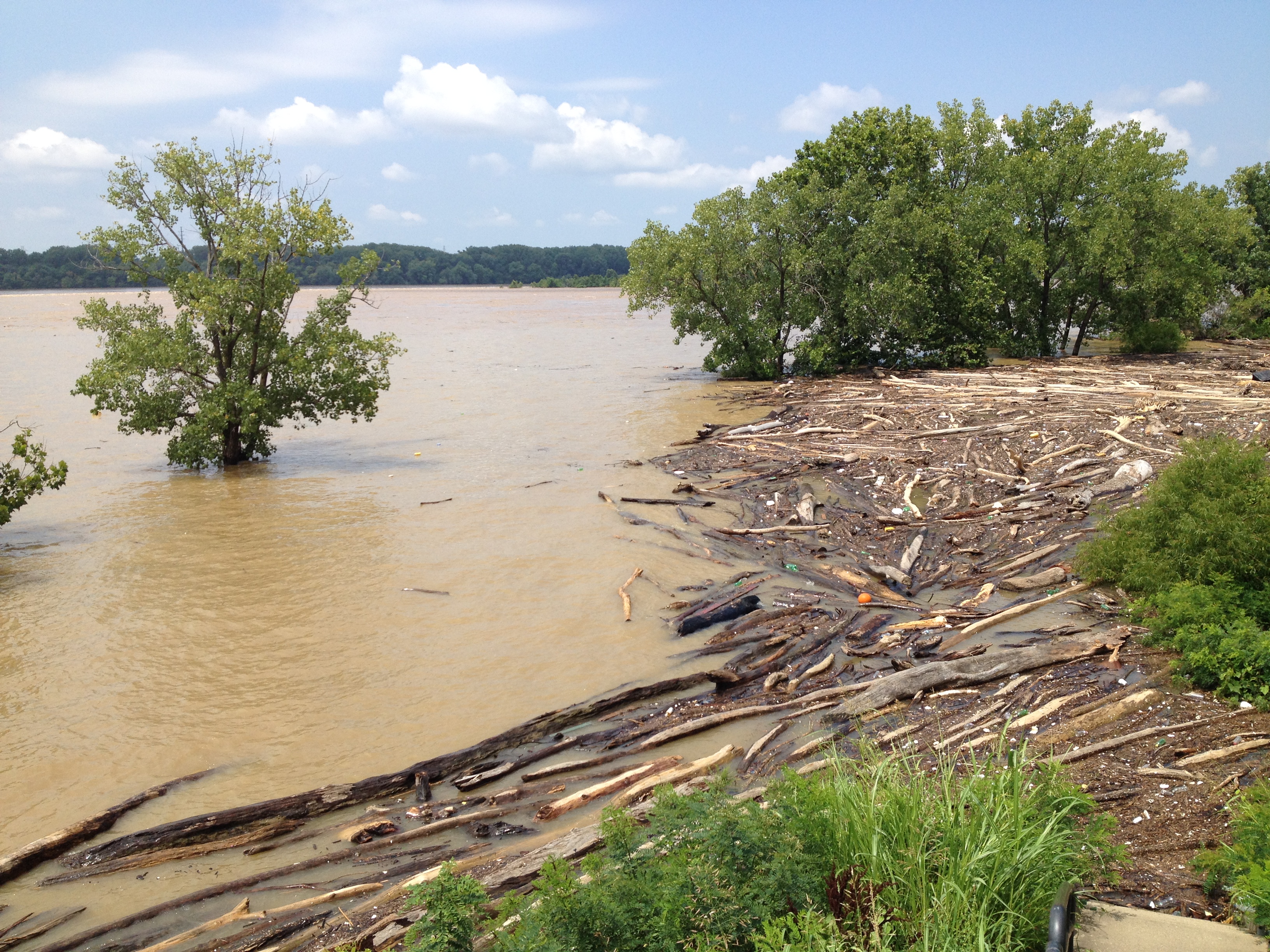
Muddy flood waters below the Falls Interpretive Center, July 2015

For the moment, all my usual haunts at the Falls of the Ohio are under water.  Usually during this time of year, the fossil beds are at their most extensively exposed.  I love being able to walk over the fossil beds which makes me feel like I’m on another planet.  Once the water recedes, there will be a newly rearranged landscape to explore along with its attendant material culture that gets left behind.  This is how I obtain my art supplies.
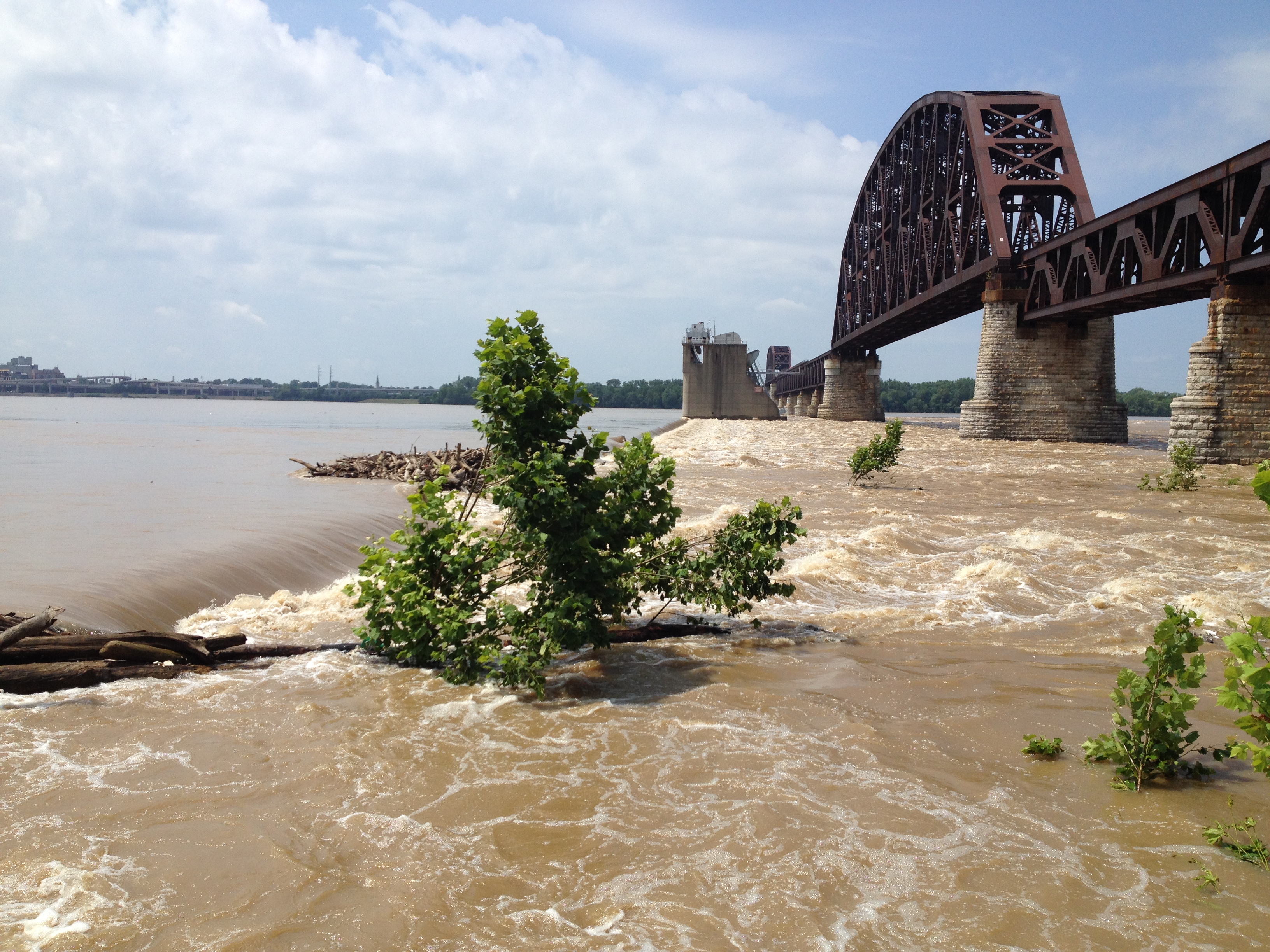
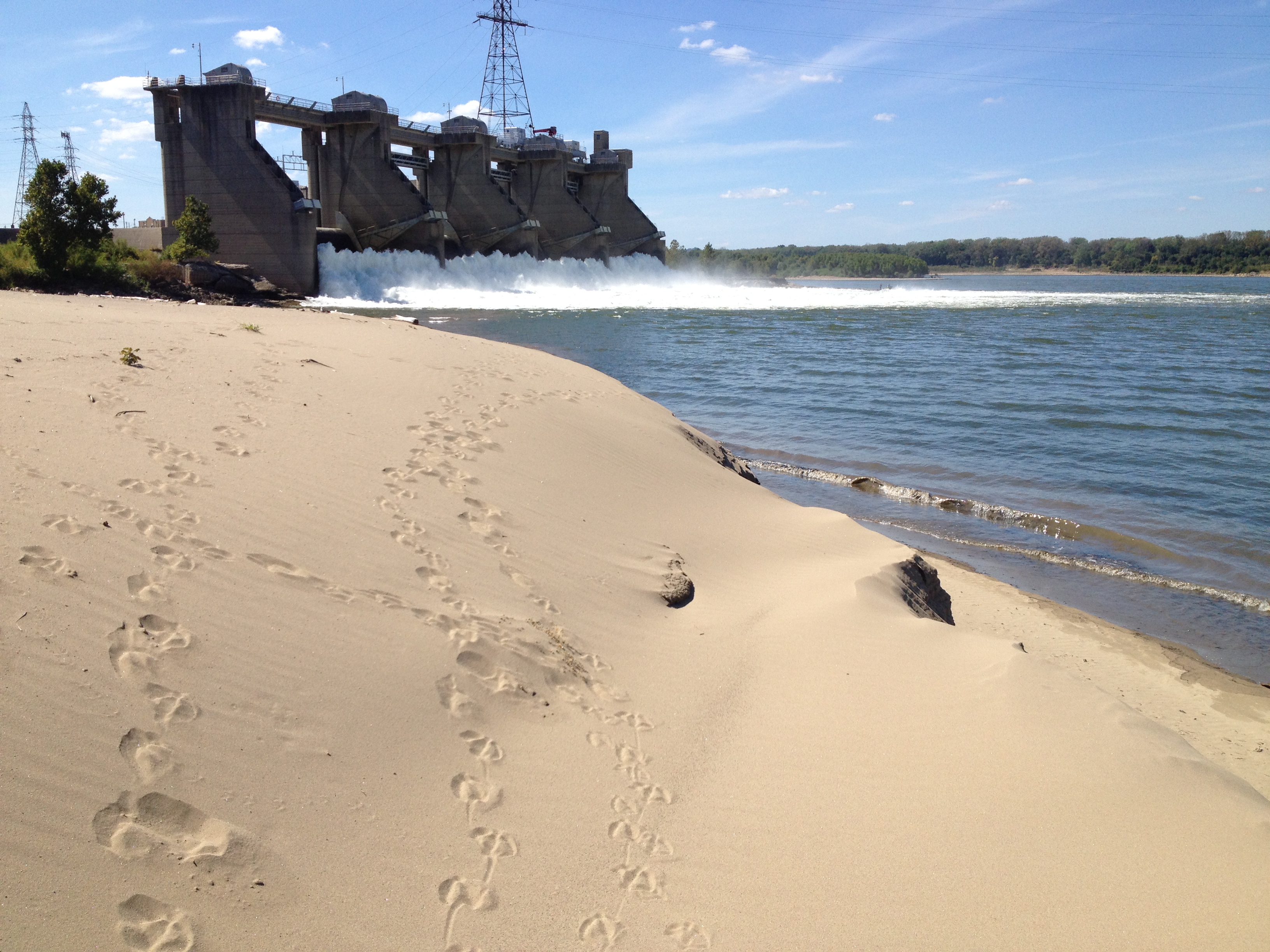
High water by the Upper Tainter Gates, Falls of the Ohio, July 2015

This is a view along the Fixed Wier Dam and Upper Tainter Gates in the eastern section of the park.  The water level had been higher and is in the process of going down a bit.  I noticed fish activity and was surprised to see Asian carp congregating in the swirling, muddy water.
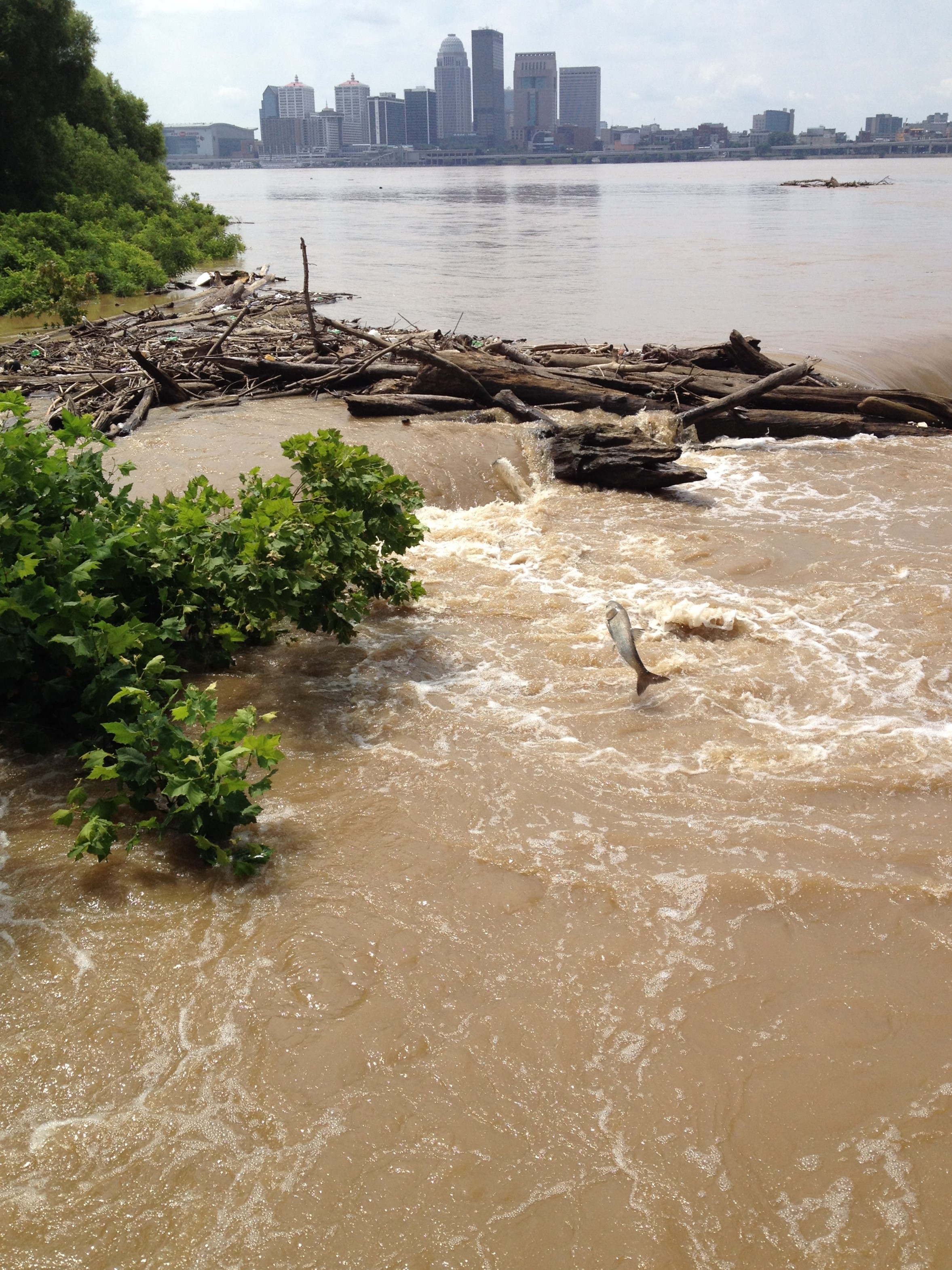
High Ohio River with jumping Asian carp, Falls of the Ohio, July 18, 2015

About midway down you can see a carp that is doing its own impression of a salmon going upstream.  Let’s zoom in for a closer look.
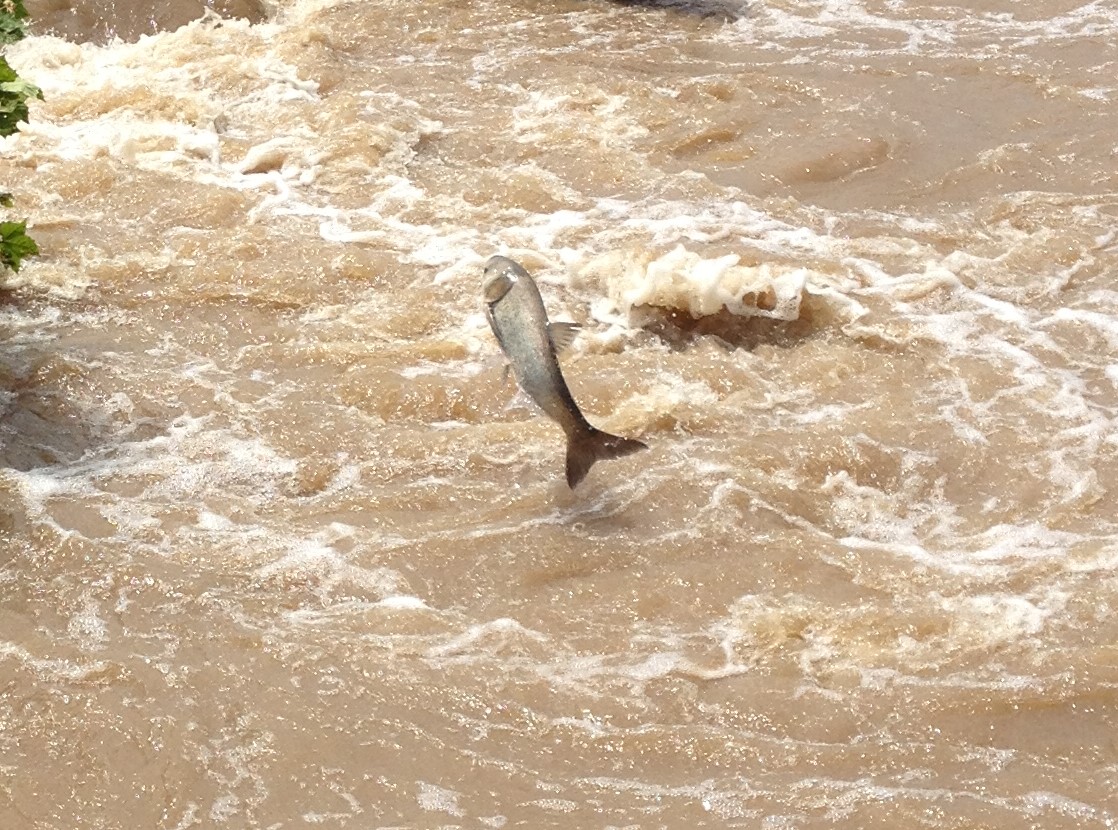
Jumping Asian carp, Falls of the Ohio, July 18, 2015

Here are a few more details of fish jumping.  I was surprised that my cellphone camera was able to catch this action.  Some of the fish I observed were very large.  I would estimate the largest ones I saw were plus 50 pounds.
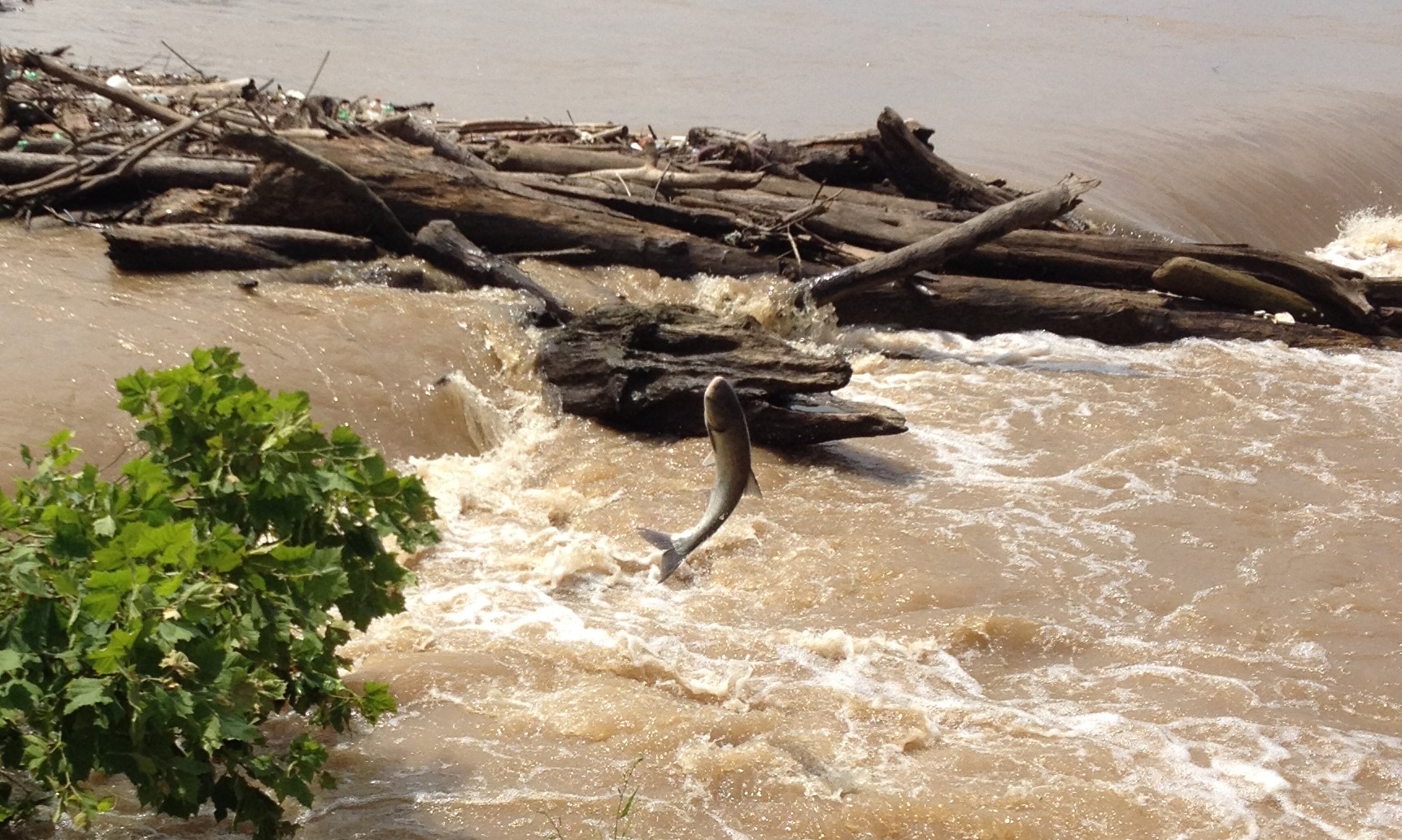
Jumping Asian carp, Falls of the Ohio, July 2015

And here is one more image catching a fish in mid air.
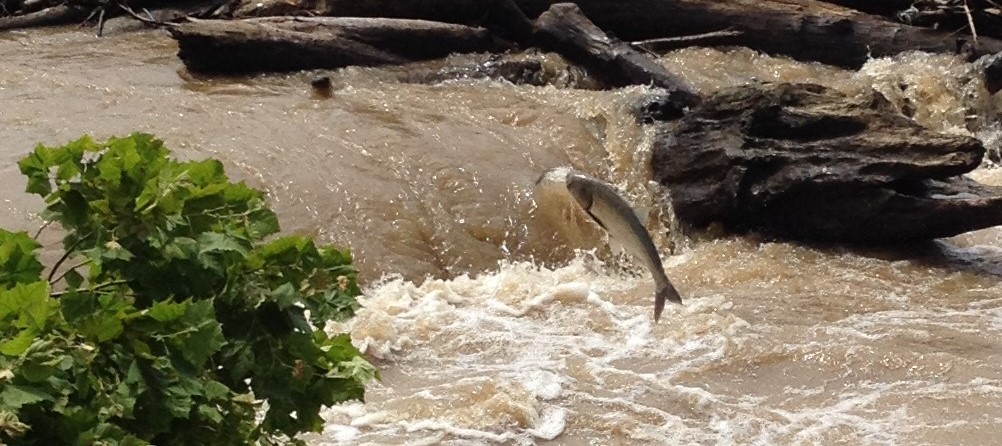
Jumping Asian carp, Falls of the Ohio, July 18, 2015

There are a couple of species of Asian carp and they are all highly invasive and non-native.  To see these fish jumping to overcome obstacles on their way upriver shows how determined they can be.  These fish feed on algae and other tiny water organisms.  They out compete native species and are highly prolific.  Extensive campaigns have been launched to control or eradicate these fish with limited results.  The big fear is that they will make their way into the Great Lakes were they pose a huge issue for that fishery.  In Western Kentucky, at Land Between the Lakes, a commercial fishery has been created to harvest these carp by netting them.  Because they eat tiny micro organisms, they can not be taken by rod and reel unless you happen to snag one by accident.  The goal is to create a commercial demand for its flesh and apparently they are a coveted food item in China.  Although a demand for these carp may be created…they are also in our waters for good now.  The fish I photographed are on their way to Cincinnati and points northward along the Ohio River and all its tributaries and streams that feed this great river.  Carp were not the only creatures around on this day.  Check out this guy!

Large Common Snapping Turtle, Falls of the Ohio, July 18, 2015

Walking along the edge of the flooding, I came across this large, Common Snapping Turtle that was bulldozing its way to the river.  It emerged from underneath some high weeds and was unaware of me at first.  As I came closer, it started to pull its head underneath its shell as much as it could while raising up on its legs to appear even more menacing and large.  This big turtle did hiss and lunge for me a few times and after a couple snapshots…I left it alone.  This turtle was large enough to remove a finger if that unfortunate person should offer it.  Although it moved slowly for the most part, it did have the ability to strike quickly and its neck could reach out further than you may have anticipated!  I have found dead snappers at the Falls before that were washed into here by flooding or were caught and killed by fisherman.  This is the first live one I have seen here and it was a beauty!  Being confined to the margins of the swollen river did have some benefits.  I came across two remarkable flowers that I would like to present.  Here is the first one I discovered on the Fourth of July.
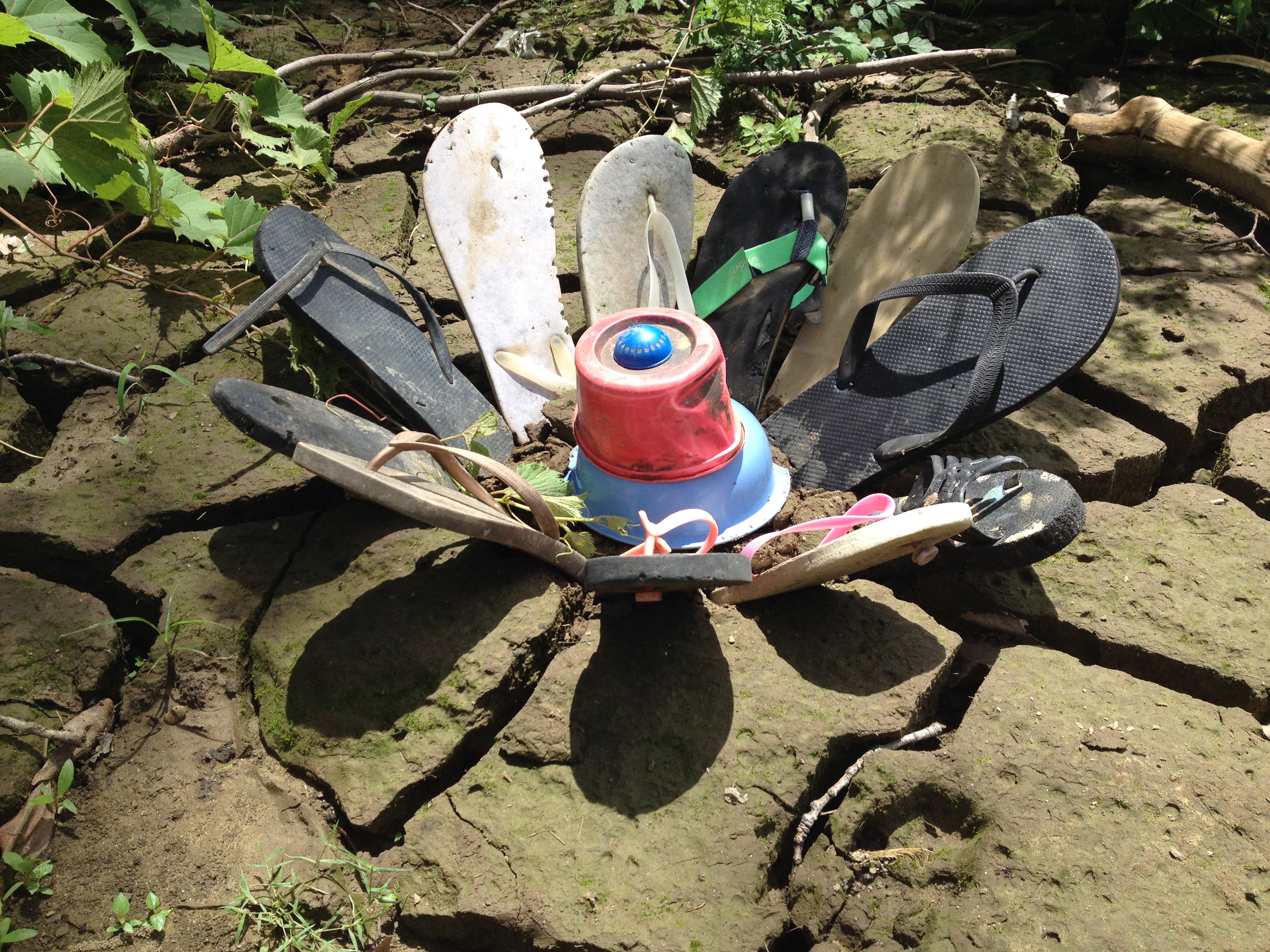
Giant Mud Flower from the genus Siltana, Falls of the Ohio, early July 2015

detail of Giant Mud Flower, Falls of the Ohio, July 2015

This is the first of two Giant Mud Flowers (from the genus Siltana) that I have discovered at the Falls of the Ohio.  They are large perennials that appear only when the conditions are just right.  Apparently, all the flooding we have experienced along the river has proven ideal for this rare bloom.  This flower sports large, fleshy “petals” that are organized around a central core that emerges first from the soil.  No leaves are visible and much is unknown about this rare plant.  It is believed that after blooming, the Mud Flower puts its remaining energies into producing a single, round seed about the size of a golf ball.  Attempts to grow this plant under controlled conditions have thus far proven to be unsuccessful.  Here is a different flower which may or may not be a related species?
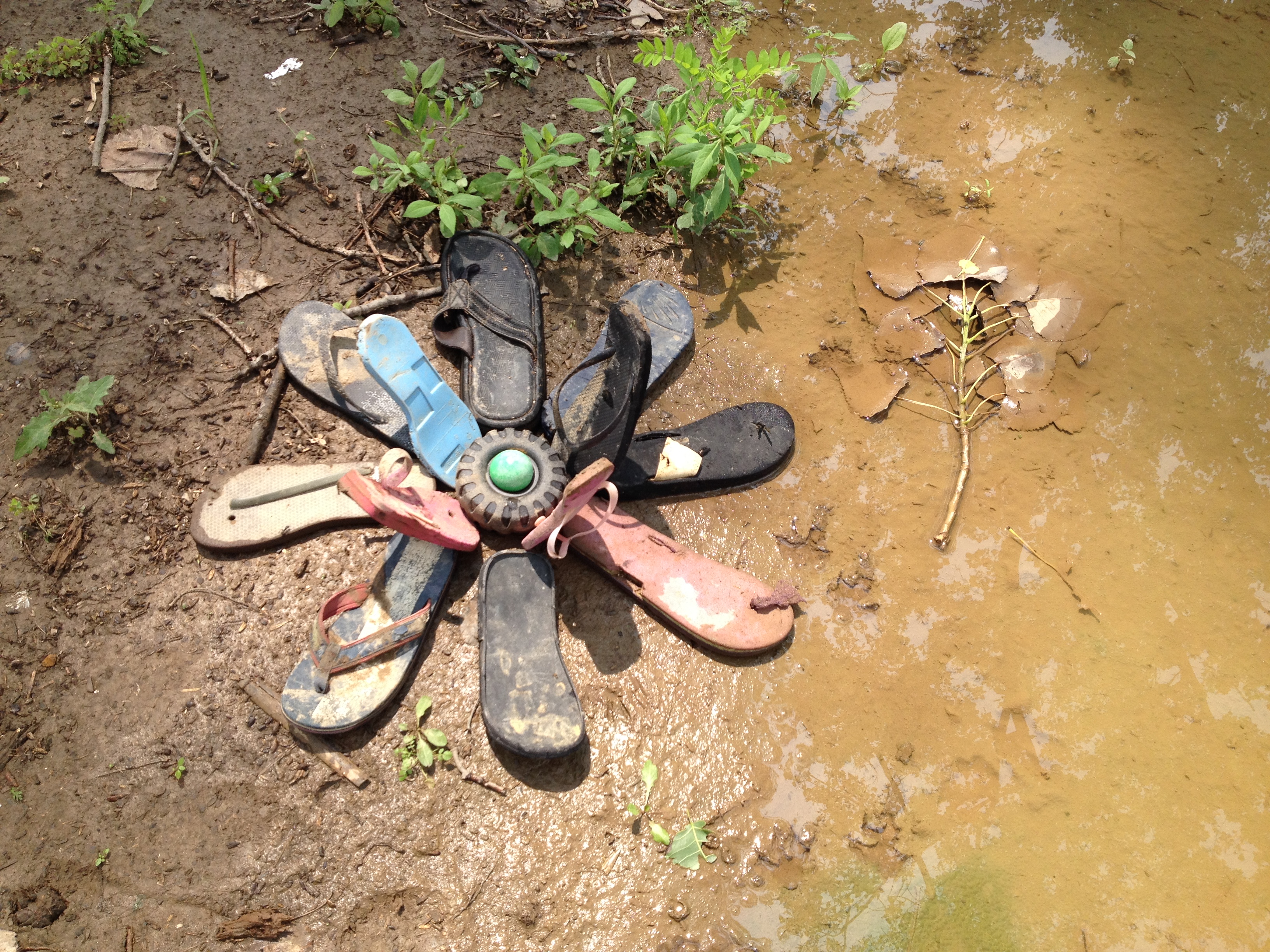
Second Giant Mud Flower from the genus Siltana, Falls of the Ohio, July 2015

Giant Mud Flower detail, Falls of the Ohio, July 2015

This specimen was found during mid month in a different section of the park.  On the surface, it compares well with the preceding example.  Noticeably, the thick petals are of different colors and the central core is a different structure.  Botanists may eventually determine that these two Giant Mud Flowers are related, but different species too.  Much is needing to unlock the key to how this species survives and whether there are any pollinating agents involved at all?  I am going to end today’s trip with one more flower photograph.  This was taken in front of the still renovating Interpretive Center.  There is a wonderful day lily garden here with many different varieties.  The center is hoping to be back open to the public come this fall.  I want to thank park director, Kelley Morgan for inviting me to talk during their volunteer appreciation dinner.  I loved being in a room full of left brained people who must have thought where did this “odd duck” came from?  Everyone was very nice and interested in what I do which admittedly, deviates from the norm!  What I like is that however we view and use the park…we all have a passion for this very special place.  Here’s hoping my next post will occur under dryer circumstances!

From the Day Lily Garden at the Falls of the Ohio Interpretive Center, July 18, 2015

Read Full Post »

End of the Woodland Loop Trail, Falls of the Ohio, June 2015

Balancing on the spine of a water-soaked log, I crossed over to the western section of the Falls of the Ohio State Park.  A gorgeous day with the river high from torrential hurricane remnant thunder storms the valley experienced a couple of days a go.  It has been a few weeks since I was last in this section of the park.  Everything is green and growing and pressing upon the life around it.  This was another productive excursion to the river and I made several site specific works with the plastic I found.  I’ve decided to break those posts up into several stories because many of the pictures came out well.

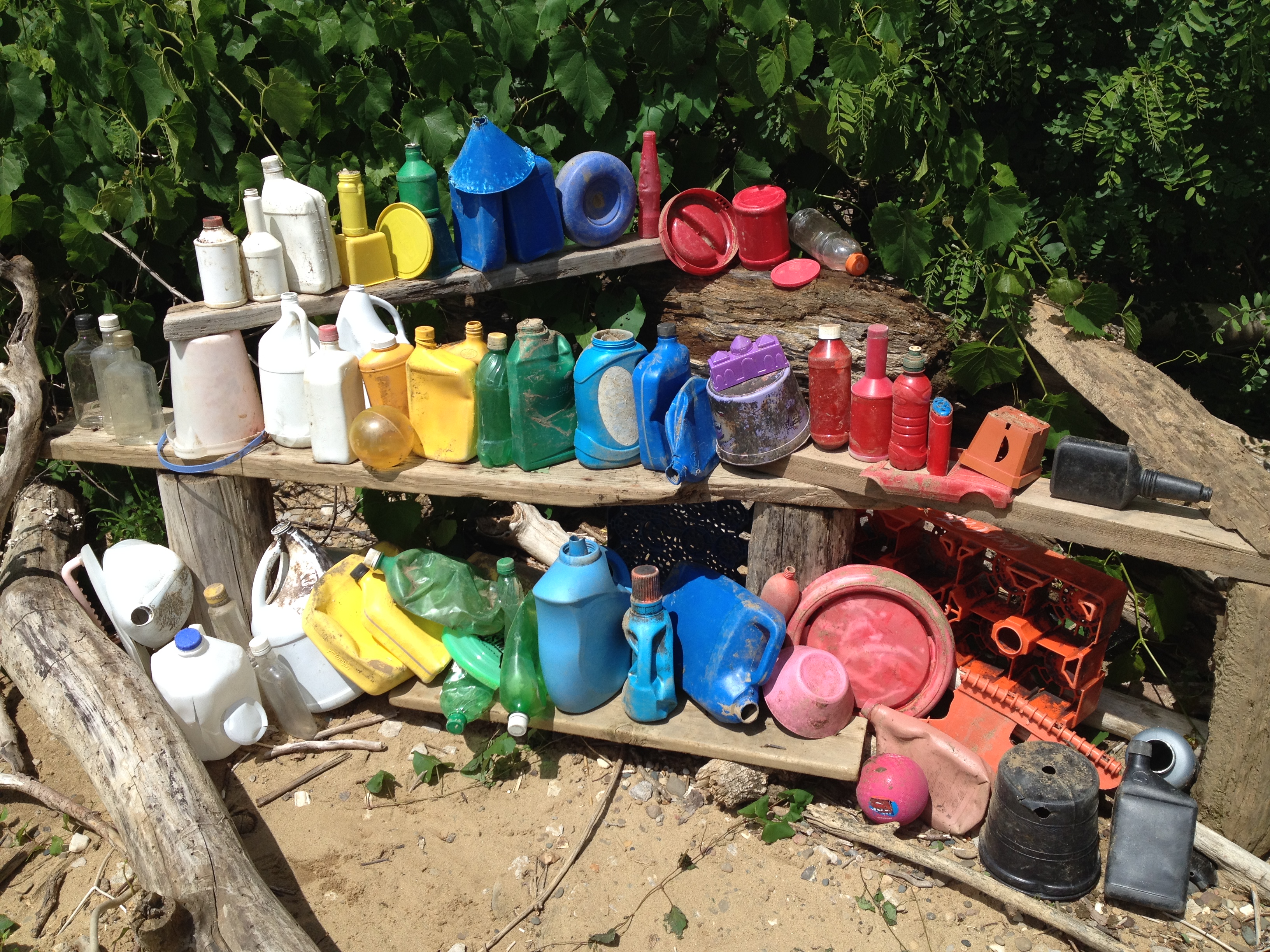
The days found plastic, mid  June 2015, Falls of the Ohio

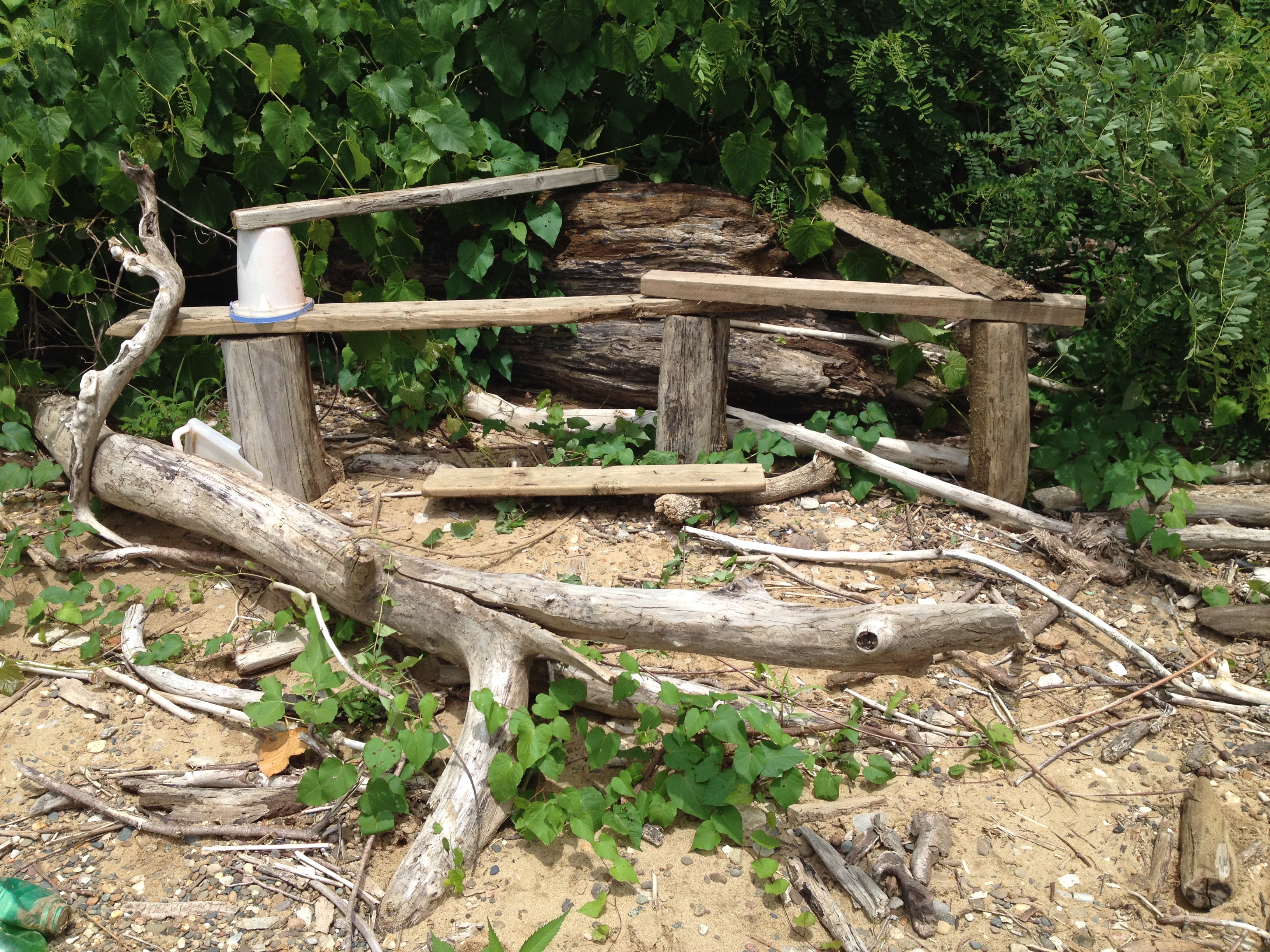
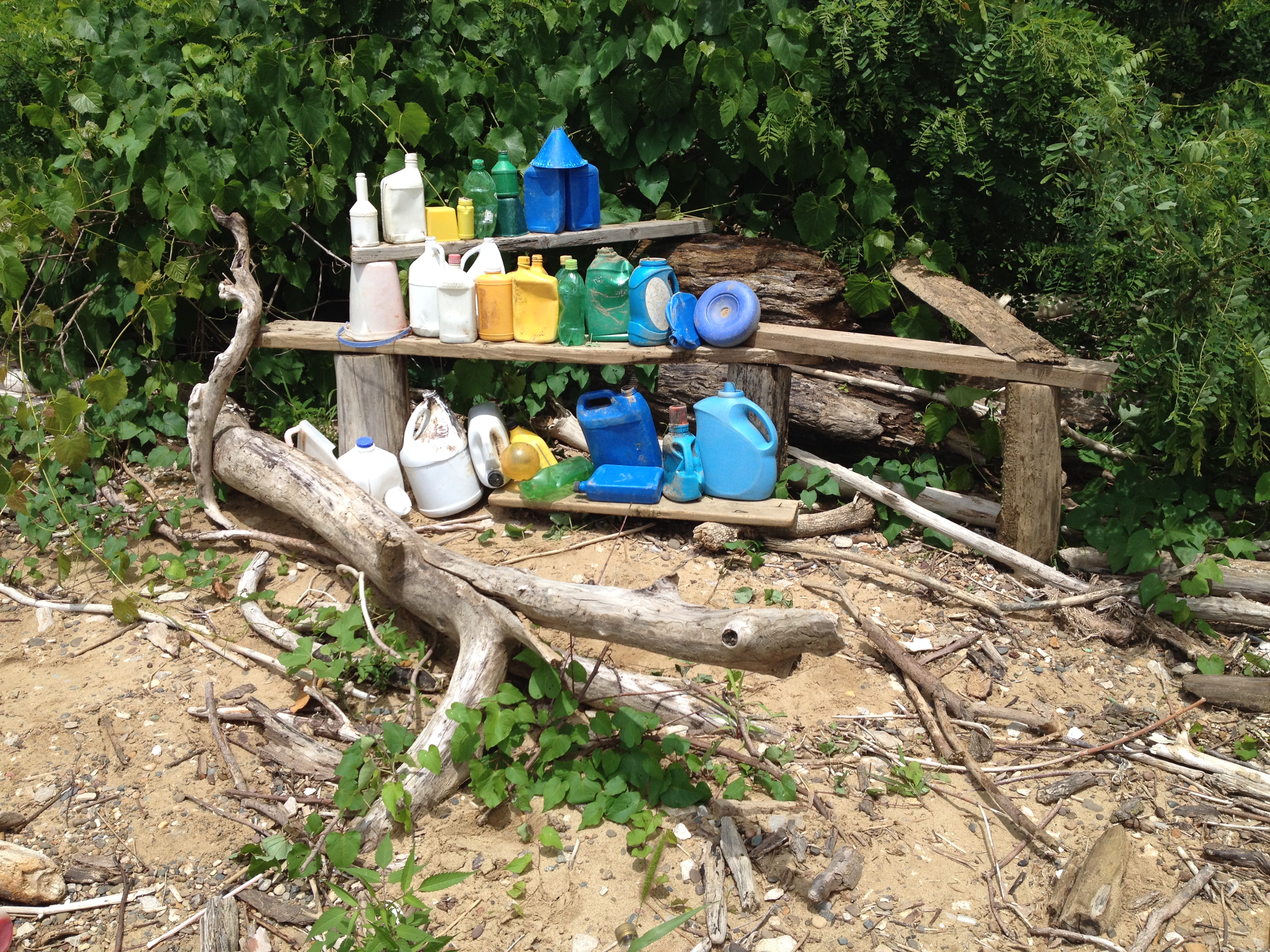
For this piece, I selected an area that I knew would have lots of plastic washed ashore.  With the river currently high, the searchable area is constricted by the encroaching water and high-walled riverbank and by dense vegetation.  When I unloaded my collecting bags and the contents of a milk crate I pressed into service…this is what I picked up.  Interestingly, this collection also includes plastic palettes from rival cola companies.  The rest of the best includes plastic containers for petroleum and laundry products.  As you can see, most of the labels have come off of the bottles due to river immersion.  I picked a place with lots of growing grape vines and set up my latest bottle piece.  Here is a quick sequence showing the progress…starting with building a three-tiered structure using local wood and logs I found in place.

Wood structure for Triple-tiered Petroleum RainbowTriple-tiered Petroleum Rainbow in progress, Falls of the Ohio, June 2015Completed

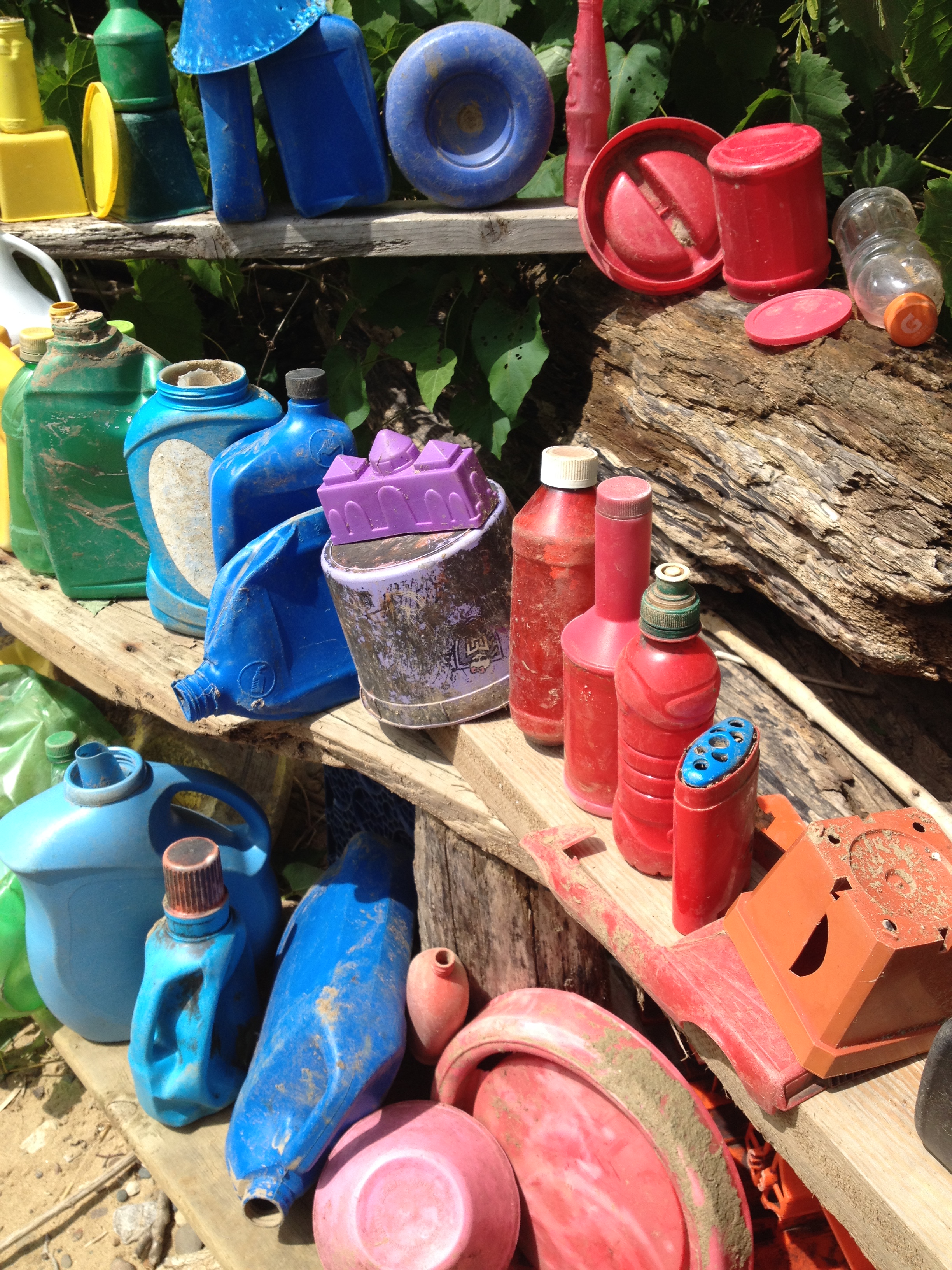
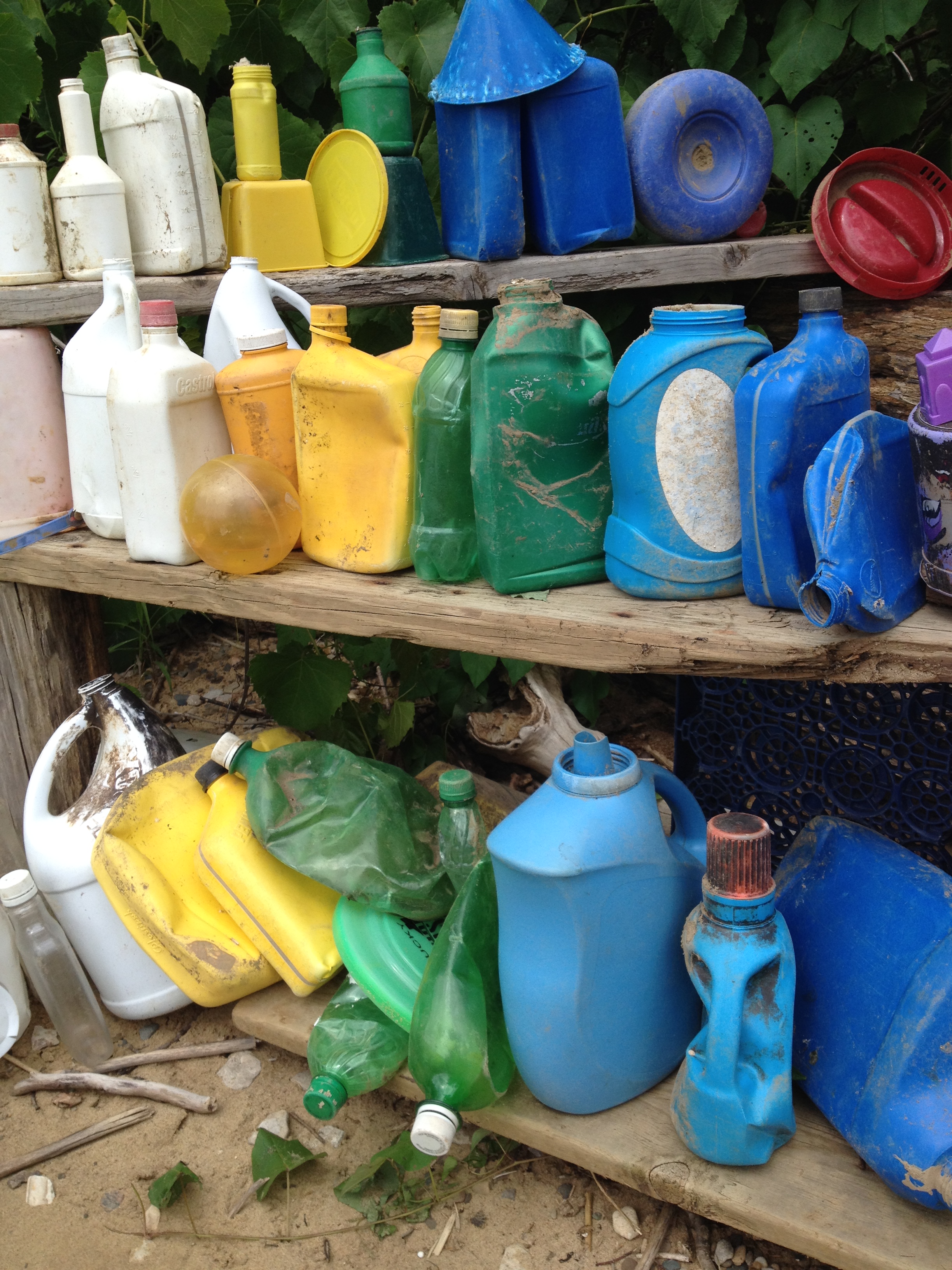
There are always surprises in what colors are available in a given area.  In this section of the park, black, green, and purple colored plastic was harder to come by.  I used five boards, three small logs, and a large log (hidden in the grape vines) to build this three layer structure to hold my found bottles.  I worked on this piece and another one I will show later moving back and forth between the hot sunlight of this assemblage and the piece I was making in the cooling shade.  Here are a couple more bottle details which I like to show off the color.

Detail of Triple-tiered Petroleum Rainbow, Falls of the Ohio, June 2015

Plastic bottle detail from

Everything about these containers is so highly artificial that they contrast with all the greenery around it.  So much thought and effort went into the design of these bottles to make their intended contents as desirable as possible.  That part worked because these plastic bottles were consumed in large numbers and many of them found their way carelessly into the Ohio River.

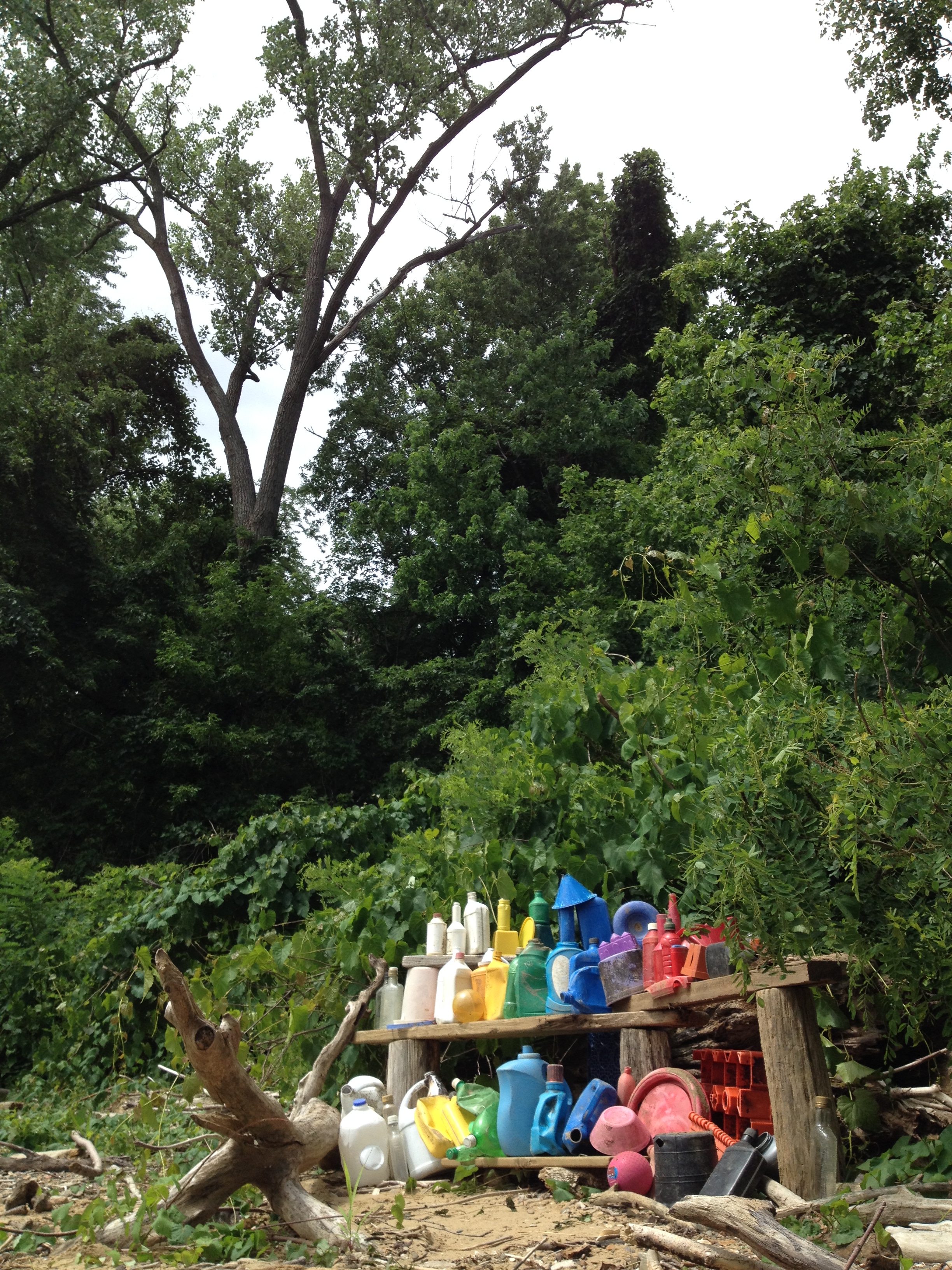
Triple-tiered Petroleum Rainbow, Falls of the Ohio, June 2015

The reality that this was made from discards is balanced by the good cheer I feel from the rainbow-inspired colors arranged on the weathered wood.  If I had not put them into this form, they would be nearly invisible plastic units scattered over the land.  These bottles are ubiquitous in our lives and even without the labels…we recognize what many of the products were.

Triple-tiered Petroleum Rainbow at the Falls of the Ohio, June 2015

This is where I left the latest of the Petroleum Rainbow series…pressed by verdant grapevines and an ever encroaching river.  Since I made this piece last week…our area has been buffeted by torrential rains and high winds.  It wouldn’t surprise me to see that water now laps at this assemblage’s “feet”.  It has been a remarkable week in other ways with the upholding of the Affordable Heath Care Act and making marriage a right for all throughout the land.  I hope that these great quality of life decisions we make will keep the state of the environment a high priority too.  One last picture before leaving…also taken in the western section of the park….so long from the Falls of the Ohio.

downed tree with log resting against it, Falls of the Ohio, June 2015

Read Full Post »

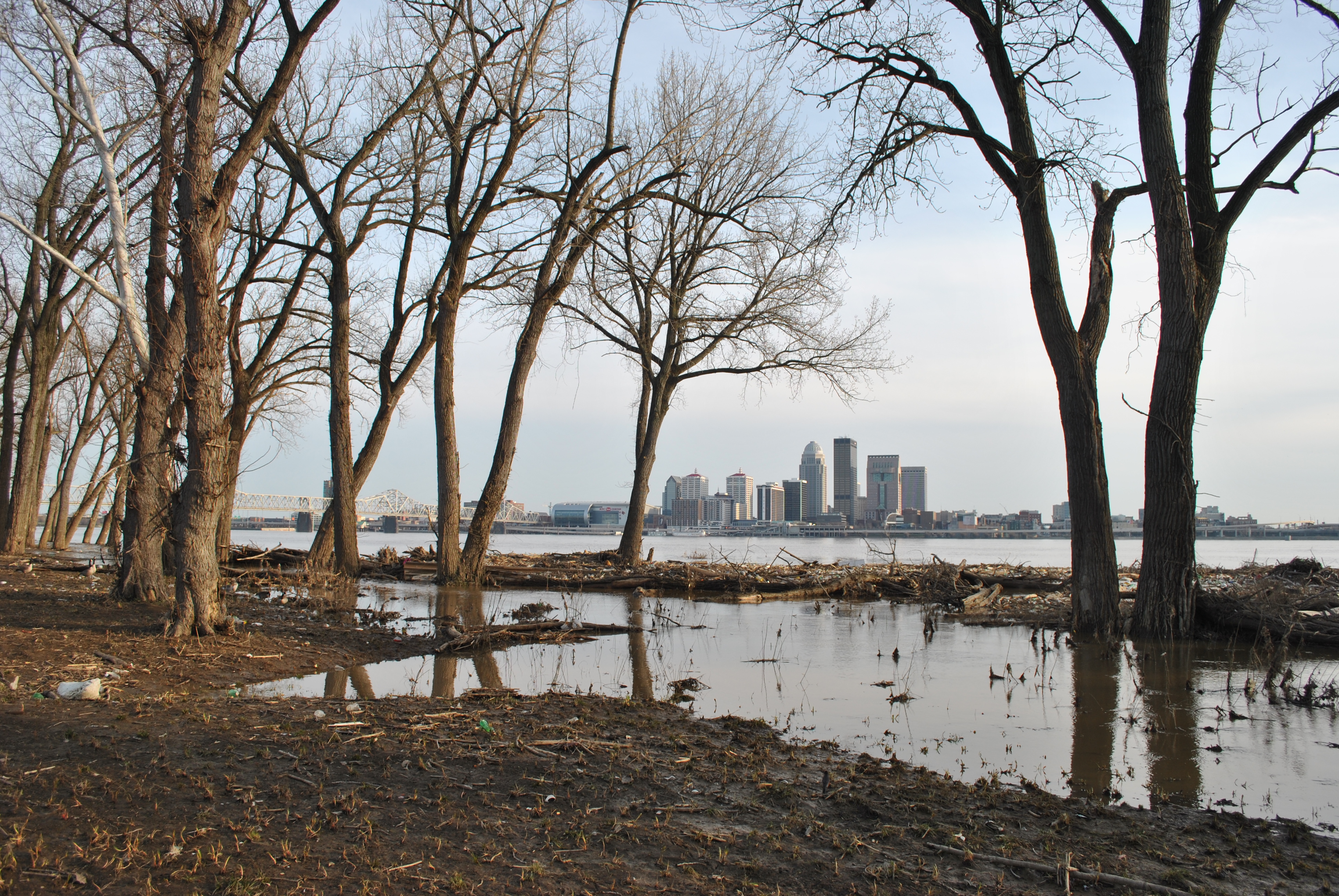
City of Louisville, KY as seen across flooded Ohio River, March 2015

The Ohio River remained higher than expected and was bolstered by a few days of rain.  I visited the Falls of the Ohio last weekend during a moment when the water level had dropped just enough to reveal a muddy shoreline with its accompanying line of stranded debris.  The places in the park I like to work and visit were still underwater.

Louisville as seen from the muddy Falls of the Ohio, March 2015

I put on my “Falls shoes” which were already muddy and that I keep outside on the front porch of my house and headed for the river.  As usual, I brought a collecting bag and camera with me and ventured forth to see what there was to see.  In places, you could tell that the river with its water-born logs had acted as a battering ram and pretty much leveled the vegetation nearest to the water.

"river shivers", Falls of the Ohio, March 2015

The silt and clay are both very fine and sticky when wet.  I gingerly step on wood and other debris to keep from sinking ankle-deep in this quagmire.  I enjoy looking at the rippling wave patterns that the water creates.  I call this “river shivers” and imagine if the riverbank could display “goose-flesh” that it would look something like this.  And speaking of geese…

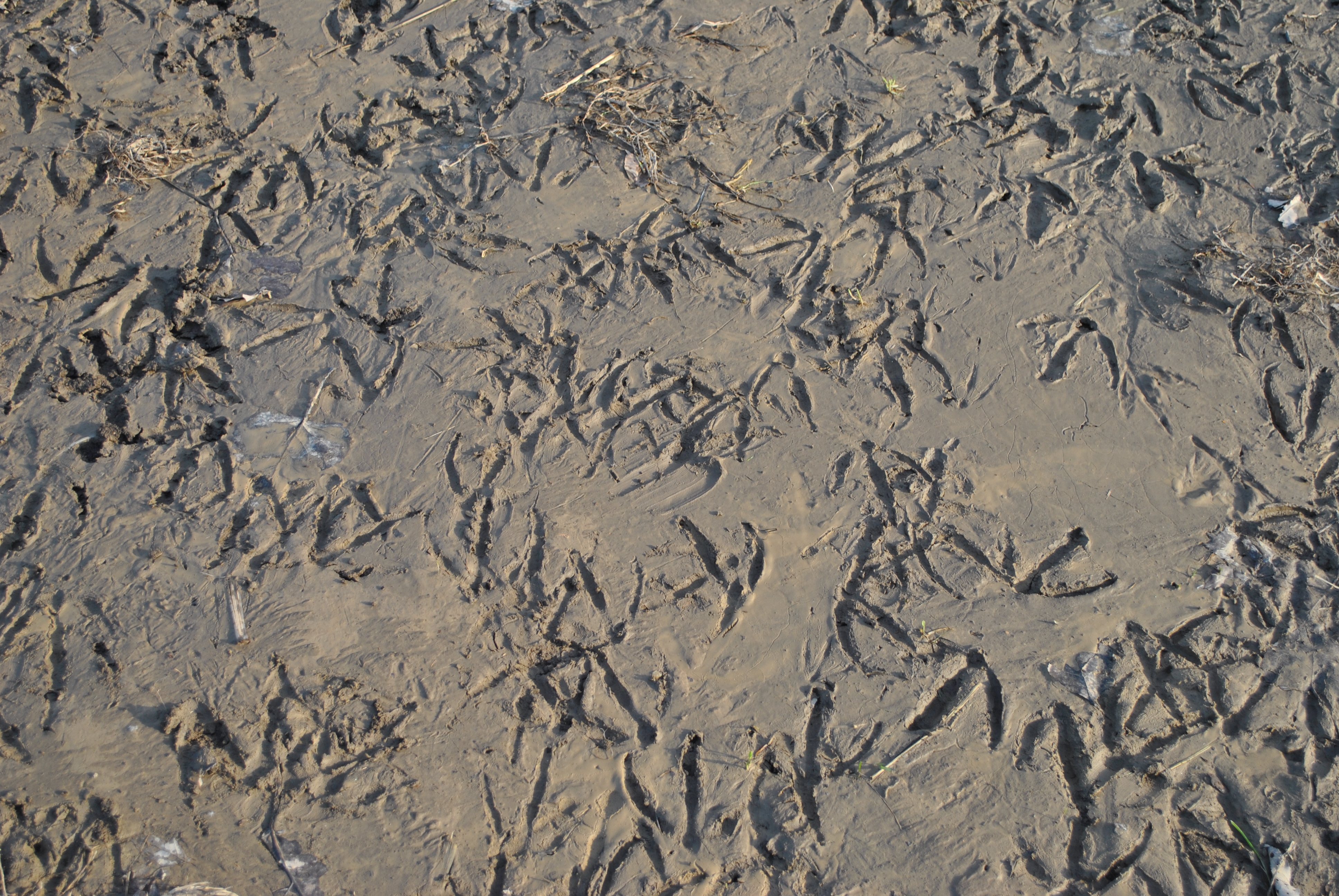
tracks made by geese, Falls of the Ohio, March 2015

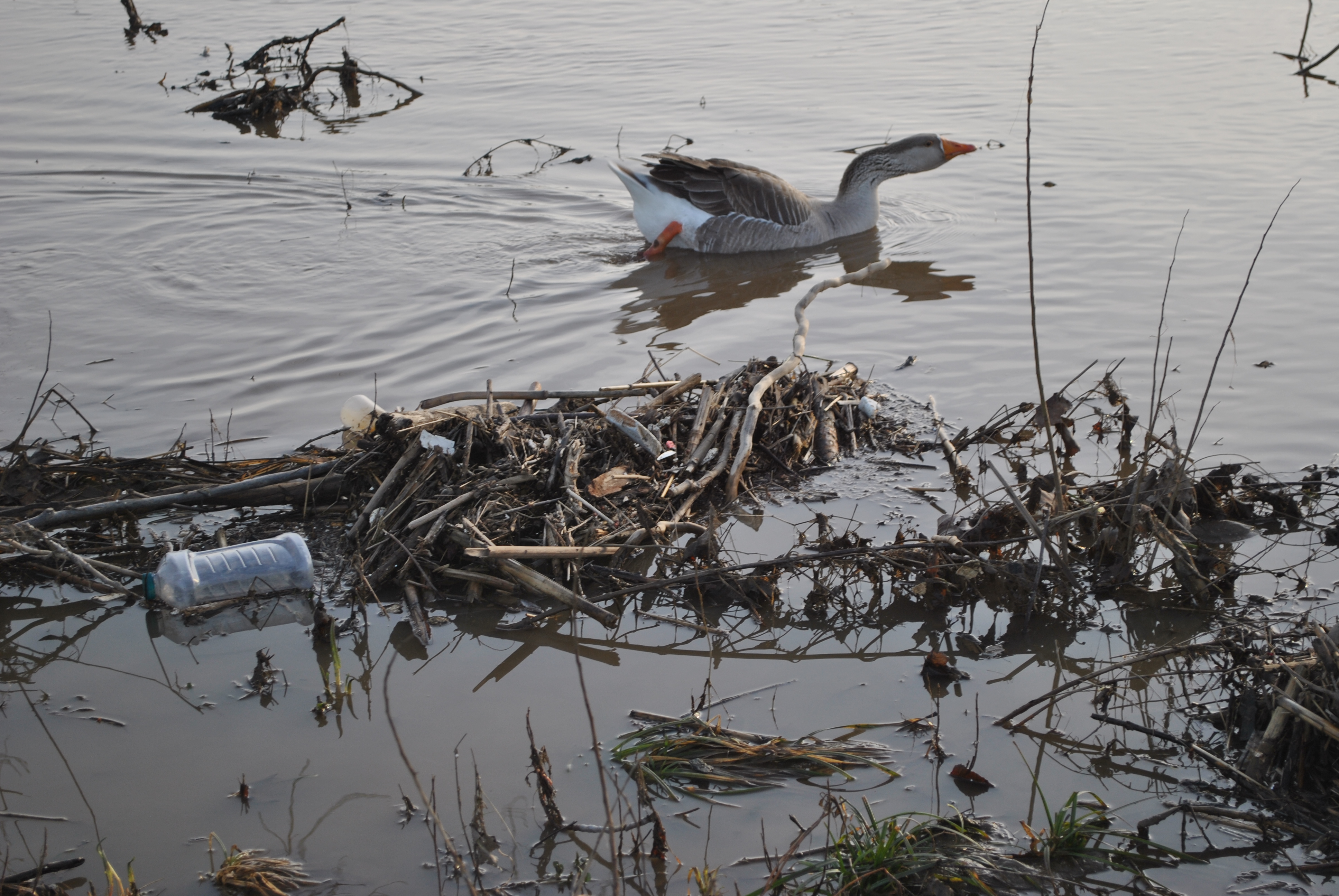
domestic goose at the Falls of the Ohio, March 2015

…the flock of Canada geese I photographed the previous week, left their footprints everywhere in the mud.  Their friend, the ex-patriot domestic goose, was still hanging out with them.

High water trash at the Falls of the Ohio, March 2015

Of course, nearly every place you looked, you could see man-made trash and driftwood.  Much of this material has originated far from here.  When things finally dry out enough for a more thorough exploration, I’m expecting to find all kinds of examples of our material culture washed into the park.

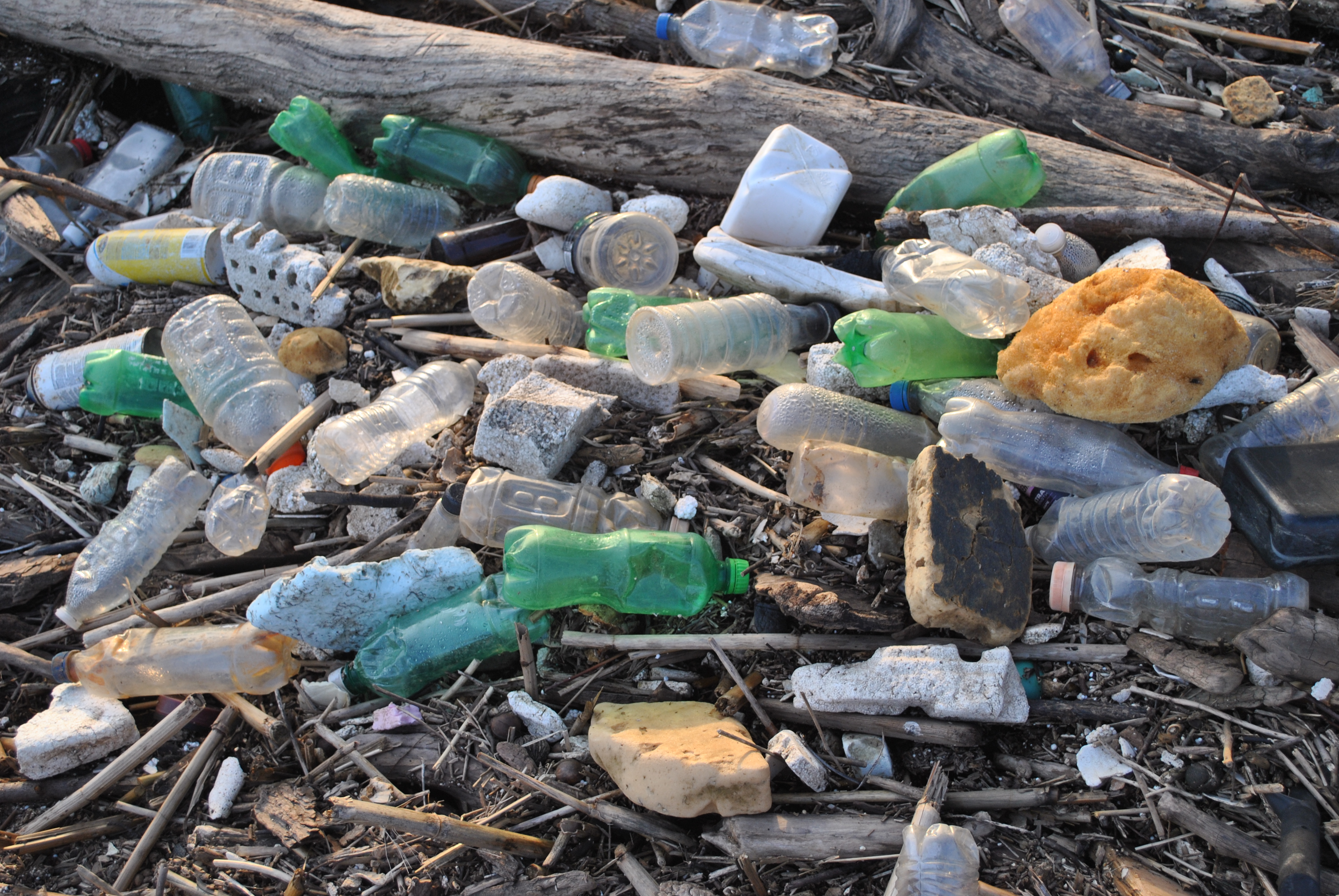
flood born trash at the Falls of the Ohio, March 2015

Interspersed with the bottles are lots of other plastic items and various foam-based garbage including Styrofoam…my primary sculptural material.  This is just a detail of one small area.  Already I’m seeing hundreds of plastic drinking bottles.  I’ve been asked on more than one occasion if I’m ever afraid that I might poison myself or get an infection from something that I’ve found out here by the river.  My short answer is yes.  One needs to be concerned, however, I don’t press my luck with anything that looks at all questionable.  I guess I do place a lot of trust that the billions of gallons that constitutes the Ohio River does in effect “wash” the stuff that I use.  So far, knock on wood, I’ve never had an adverse reaction after working out here for more than a decade.  The Falls of the Ohio State Park is a public space and what I encounter is also what the public encounters.

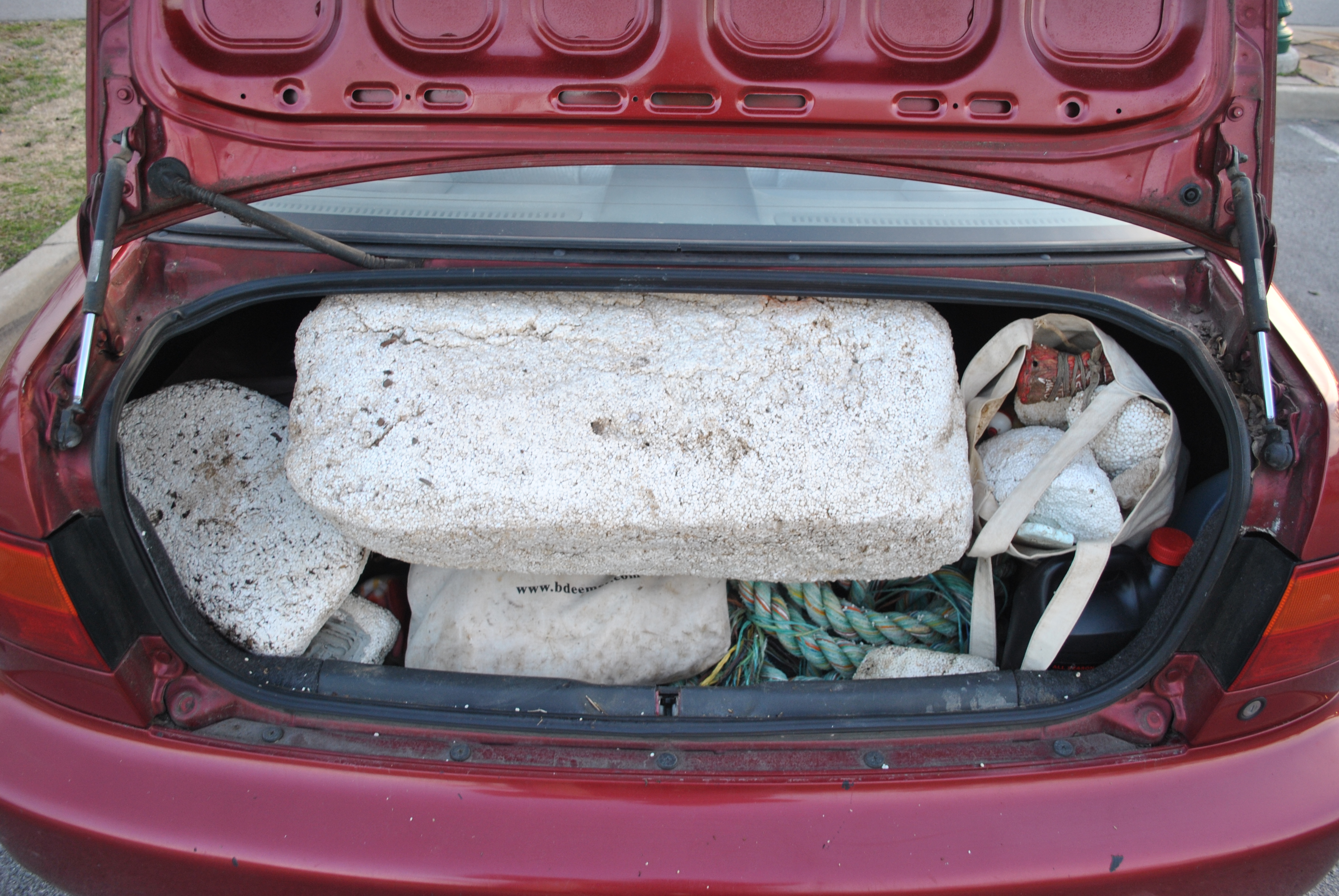
trunk load of river junk, March 2015

Here’s the trunk of my car after this brief foray to the river.  This may be hard for some of you to believe, but I’m actually very selective now. These days, I only carry back to my home work space, the “cream of the crop”.  I prefer to make my artworks at the river, but will also take materials home to “hedge my bets” and for workshop purposes.  The larder I had created at my “UFO” (Unknown Floating Object) outdoor studio is now long gone and I wonder if that circular metal platform is still around…or has it finally floated away too?

Galerie Hertz exhibition announcement, March 2015

While temporally stymied by water and mud, I have the opportunity to interact with the local art world in a more usual way.  Galerie Hertz which represents my art in Louisville opened a collage and assemblage group show.  Billy and his partner Tom have been important players in our city’s cultural life.  They have been rightly credited for creating an arts district on Market Street through the activities of their renovated galleries.  Each new space the pair opened was an upgrade of a building that needed some help.  This gentrification has attracted other galleries and dealers, bars, restaurants, and several home décor stores along Market Street.  In typical Galerie Hertz fashion, Billy and Tom have moved on to a different location and their current gallery where I’m showing my works is now on South Preston Street.  How often is it the case that creative folks move into formerly neglected areas and bring them to back to life?

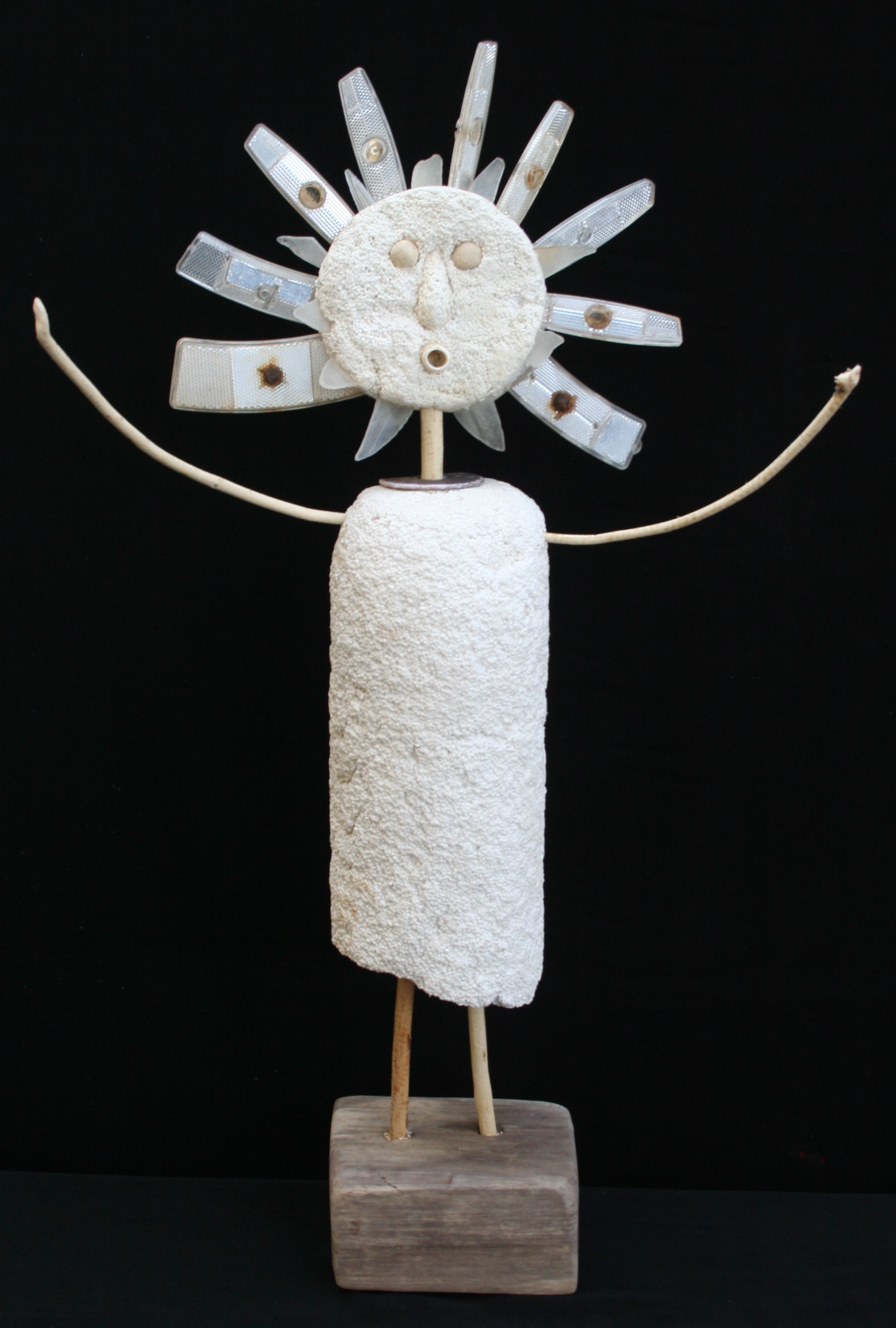
"Moon Star", found objects from the Falls of the Ohio, March 2015

Among the works I have in this group show is this piece entitled “Moon Star”.  I made this piece at the river, but felt is could use a bit more embellishment.  I added many found bicycle tire reflectors and some river-polished glass around the head.  When the light hits it just right, the reflectors just glow.

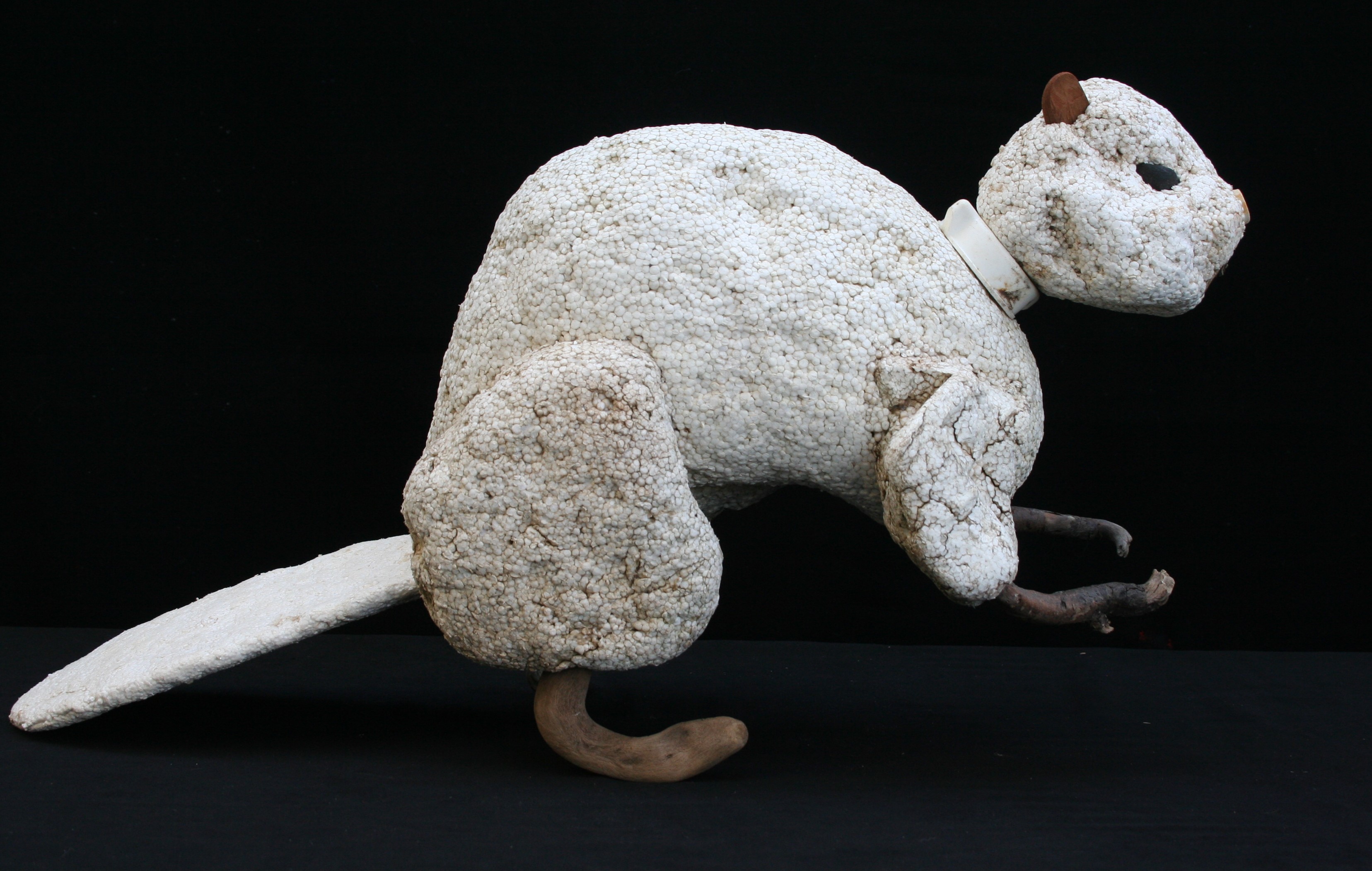
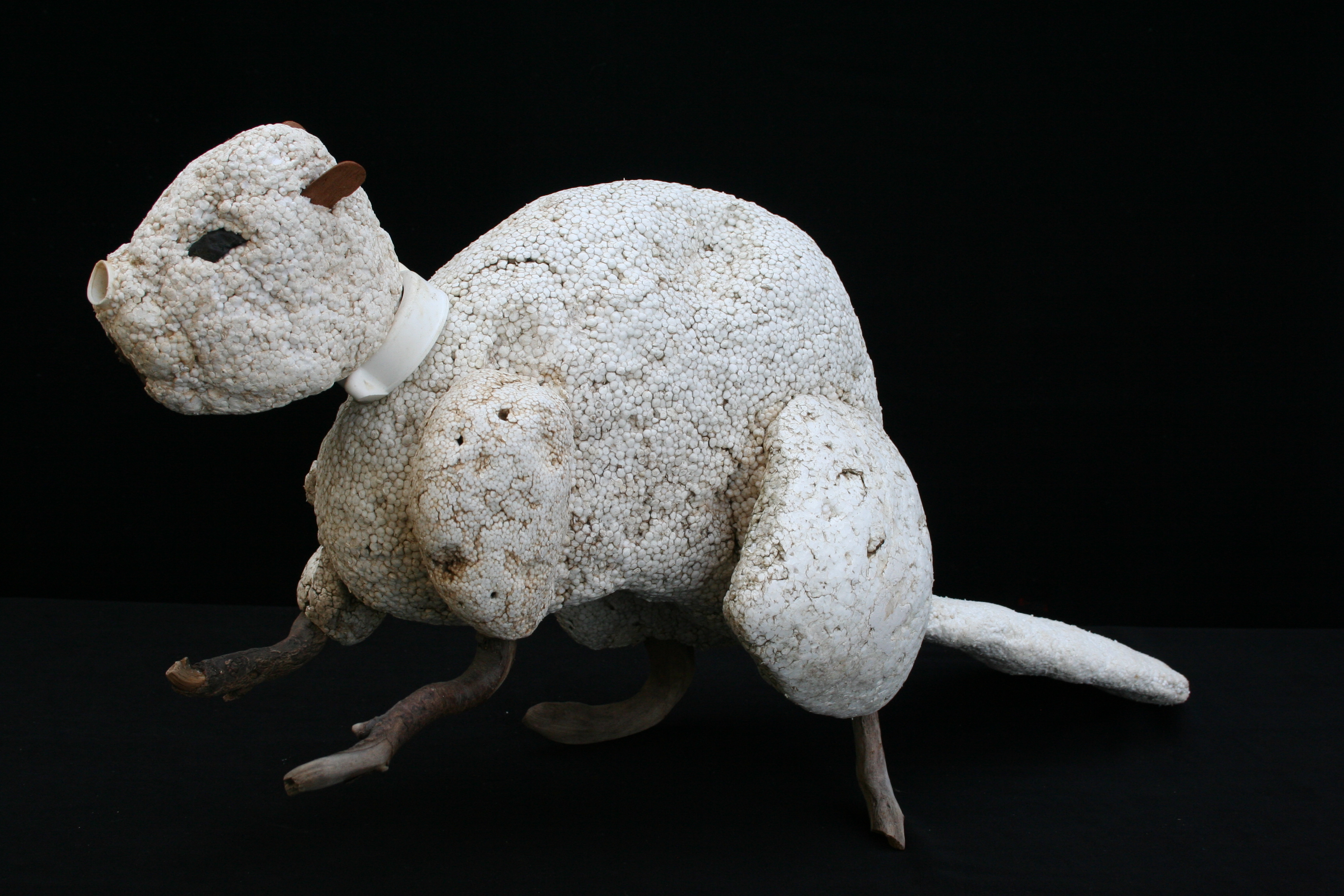
"Polar Beaver", found materials from the Falls of the Ohio, March 2015

"Polar Beaver", facing left, found materials from the Falls of the Ohio, March 2015

Through the miracle of “Styro-dermy”, I saved the Polar Beaver I encountered recently.  To get this piece to sit the way I want it to…I have embedded three, large, lead fishing weights into the tail to counterbalance the body.

"The Harbinger of Spring", found materials, Falls of the Ohio, March 2014

This diminutive figure is called “The Harbinger of Spring” and I created him last year at this time.  I also wrote an accompanying story that helped explain how winter transitions to spring.  Although I like to think that many of my Styrofoam-bodied sculptures can hold their own as freestanding objects…they are also relics and artifacts of a site specific performance that happens out at the river and is additionally documented through photographs and stories.  At the moment, the sun is shining, but it is also cold at the river.  Tomorrow is another day, another day for the river to recede and the mud to dry.  I think I will get up early and give it a go.  I will let you know what I discover at the Falls of the Ohio State Park.

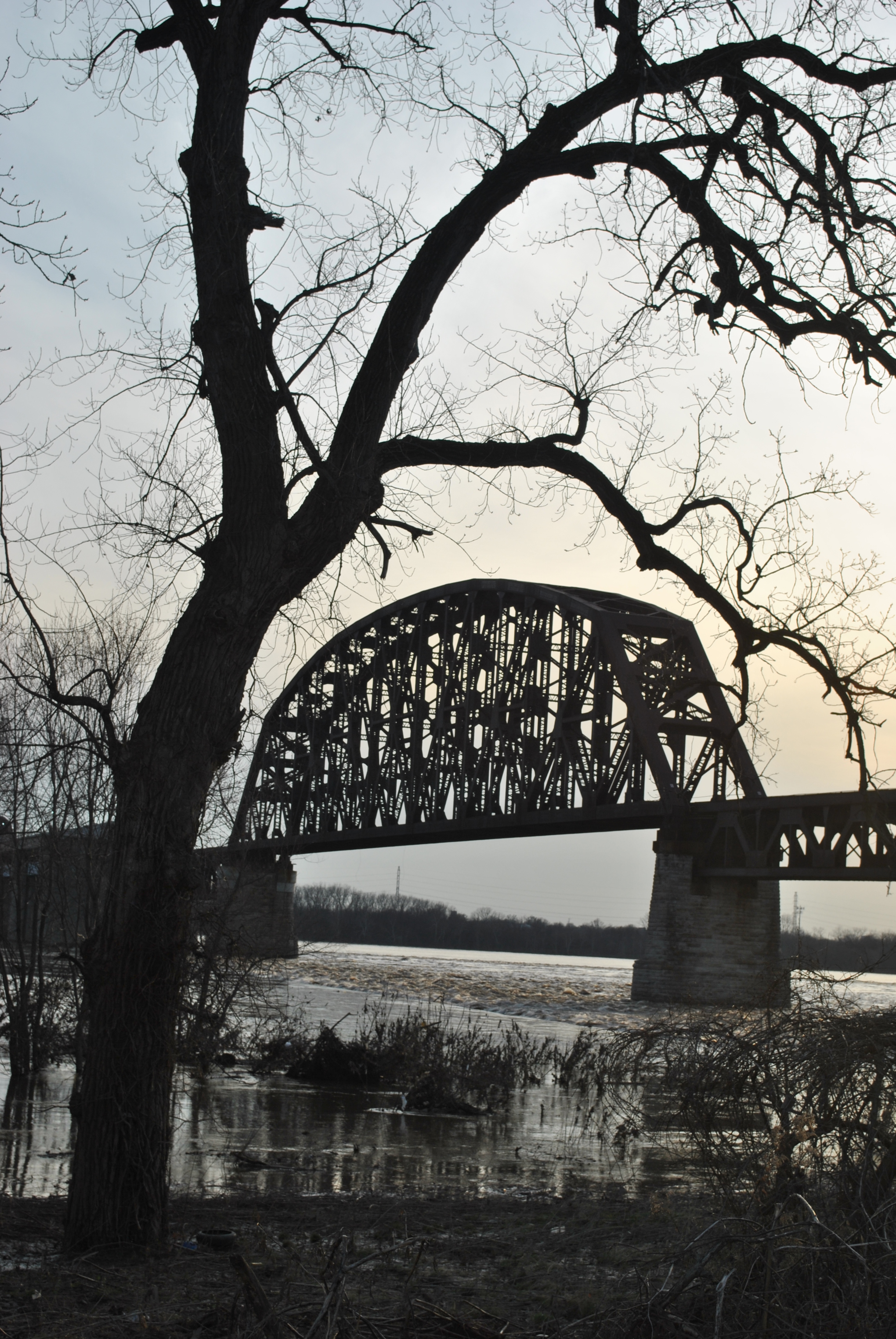
Railroad bridge at the Falls of the Ohio, March 2015


Read Full Post »

City of Louisville skyline as seen from flooded bank of Ohio River in Clarksville, IN, March 9, 2015

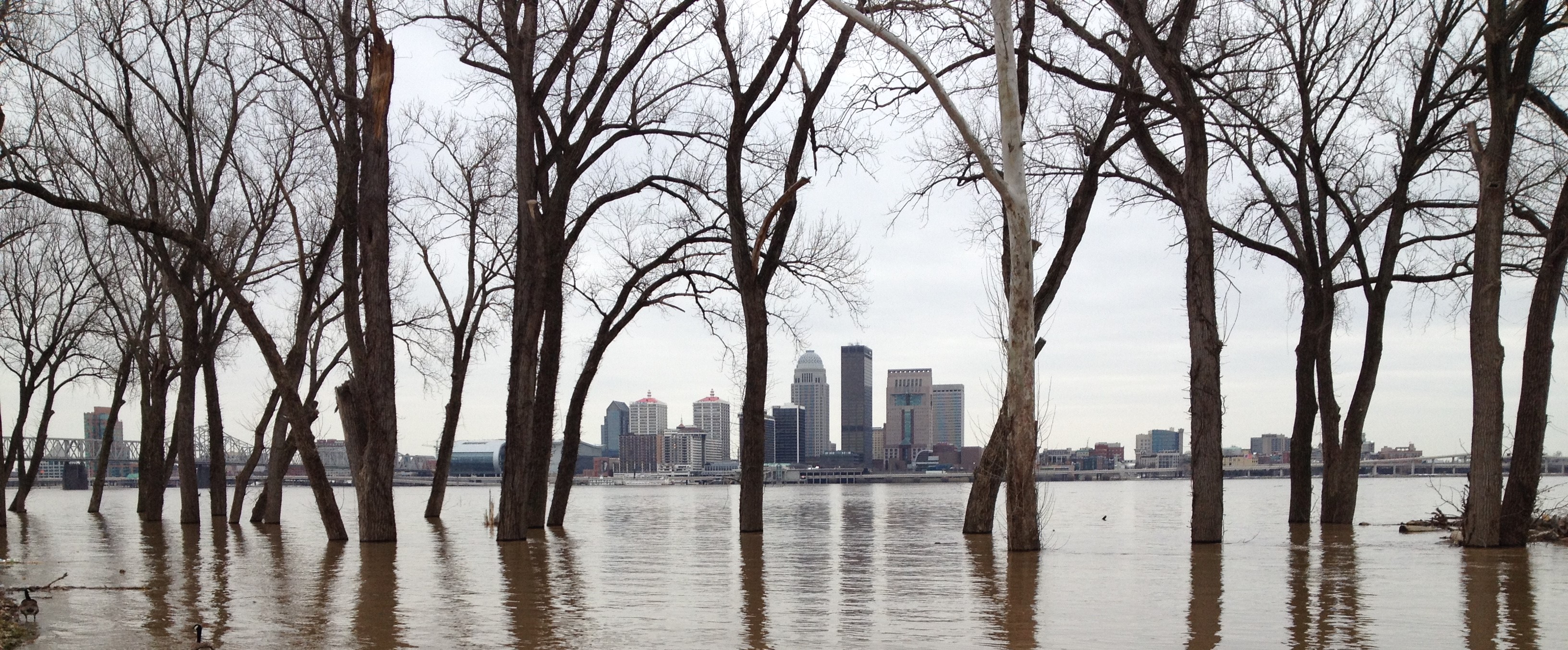
Following is a portfolio of images I made the first week of March during a bout of minor flooding that at the time of this writing has not yet subsided.  After a late season rain and record-breaking snow storm, the Ohio River predictably has swelled its banks.  During the past week, we received several more days of rain that kept the water level high.  This is seasonal and normal flooding that we usually experience almost every year.  I heard the other day that the river hasn’t been at this level since 2011.  I published some images of this series on my newly minted Facebook page and will try to avoid duplicating those images here.

Skyline of Louisville as seen from the flooded Falls of the Ohio, March 9, 2015

Many of these images are of the skyline of Louisville as seen from a soggy Falls of the Ohio State Park.  Currently, in Louisville, low-lying sections of our roadways are underwater and a major downtown exit has been closed.  River Road is truly in the river.  The city is expecting an influx of visitors to arrive by Thursday for the start of the NCAA basketball tournament.  Louisville is one of the host sites and our basketball arena is right on the river.  As long as there isn’t anymore significant precipitation along the Ohio River Valley, the river should drop fairly quickly.

Dark tower with Louisville in the background, March 9, 2015

Light levels were dropping fast near day’s end and I used my camera phone to record these images.  There was no wind and the only motion was created by a fast flowing river.  I like the way the inundated trees along with their reflections create this frieze that was fun to use in framing a composition.

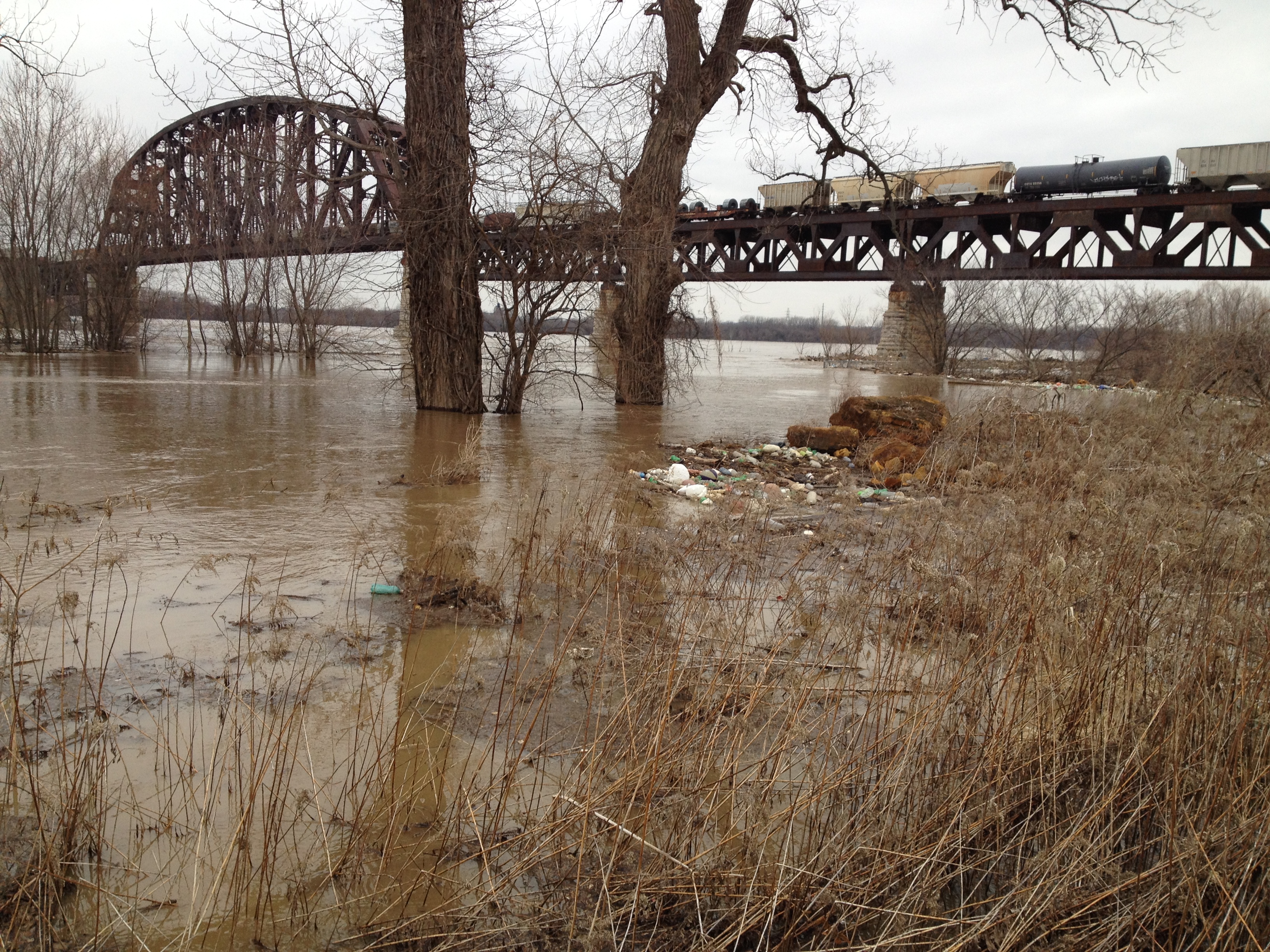
Train crossing over the railroad bridge during flooding at the Falls of the Ohio, March 9, 2015

The Army Corps of Engineer Tainter Gates are under water.  Usually, they hold the muddy Ohio River at bay exposing the world-famous fossil beds for exploration.  This image captures a long train crossing over the old iron bridge.  My outdoor studio where I stash my materials has long since floated away.  I will need to start from scratch again, but I have done this many times before.  Once the river subsides, I will be able to find new art materials to work with.  Frankly, I like it when the park floods a bit.  The Ohio River is so dynamic and along with the changing of the seasons provides a novel landscape every time I visit.

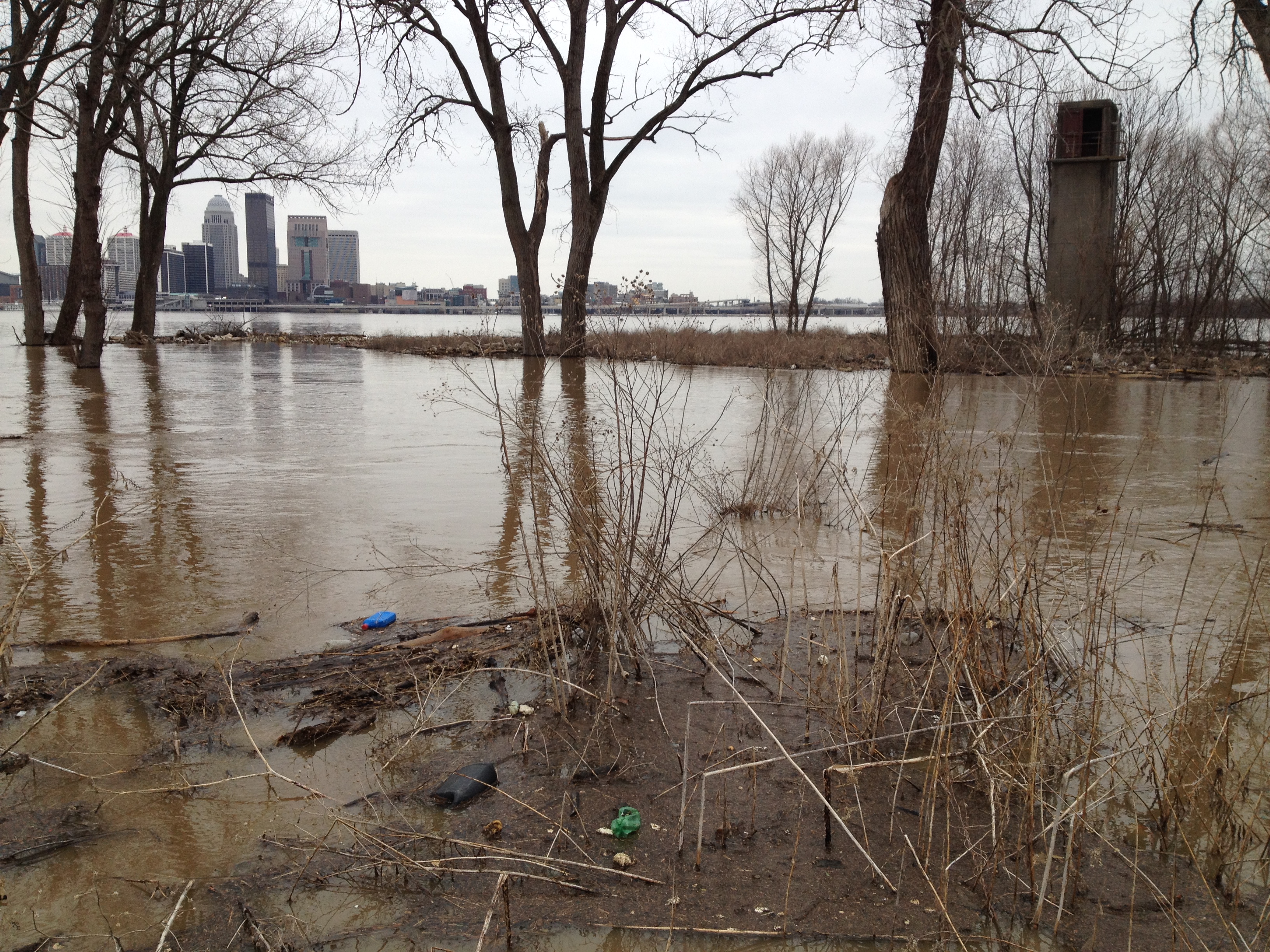
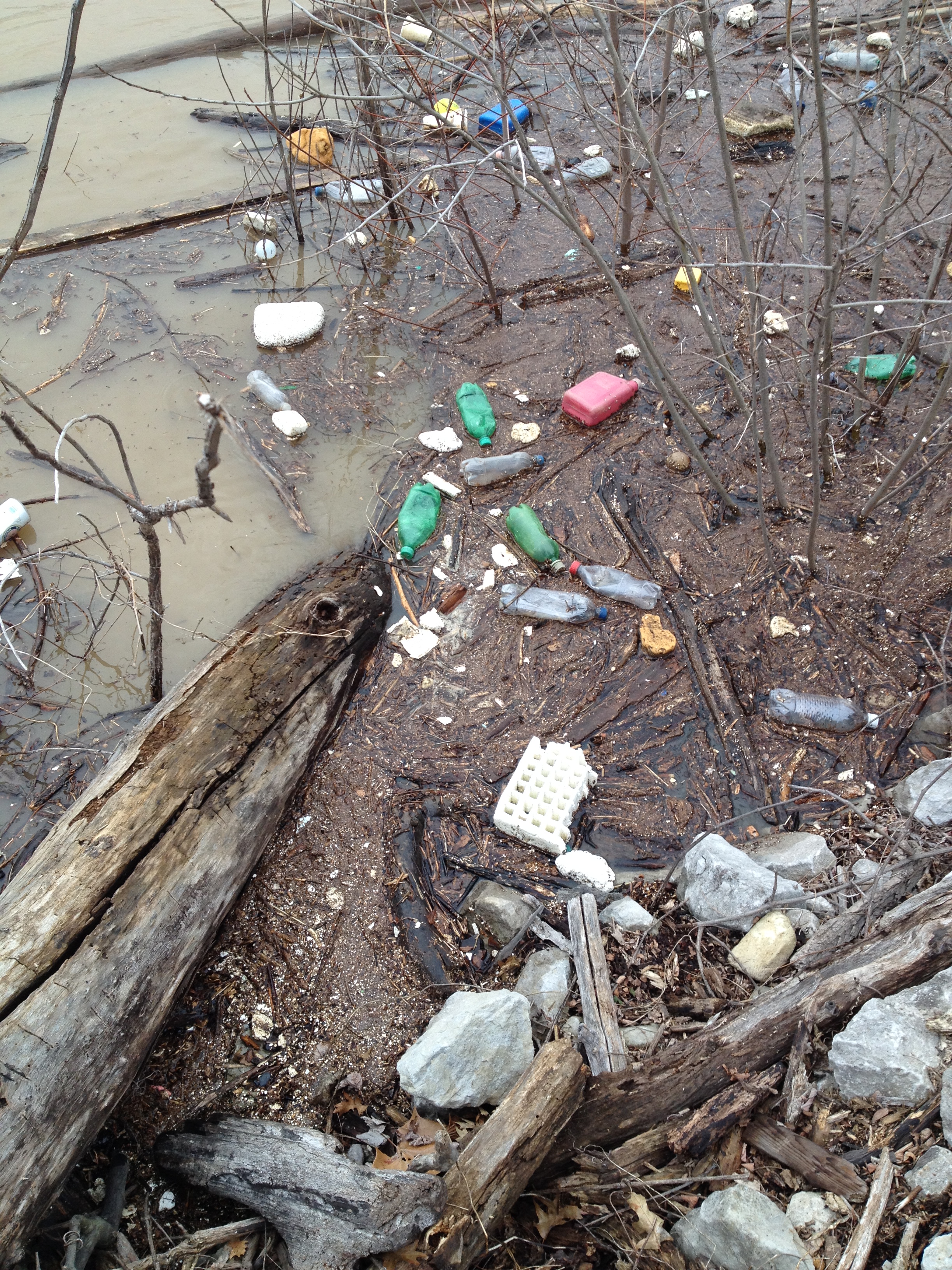
Garbage in a flooded river, Falls of the Ohio, March 9, 2015

Now there is also a downside to all this activity.  All the pent-up junk along both banks of the river is free once more to continue its journey to the Gulf of Mexico.  In this image, there’s lots of plastic bottles for drinking and oil products plus the usual Styrofoam and driftwood all mixed together.  The brightly colored plastic contrasts with the natural tones of the river.

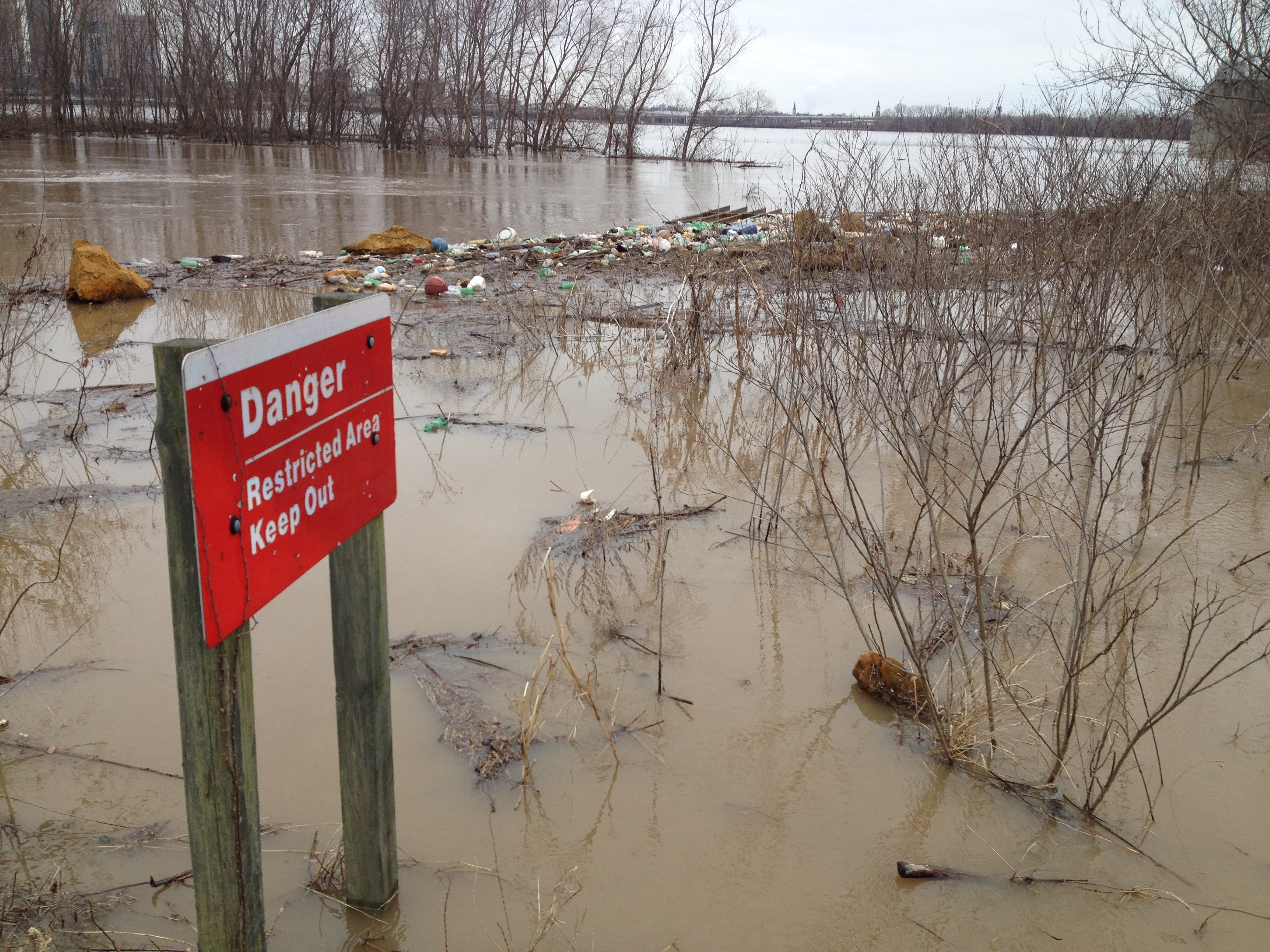
Danger sign at the flooded Falls of the Ohio, March 9, 2015

This sign is up all year round, but frankly it makes the most sense to me during moments like this.  Floating junk forms a line about where the dam’s wall would be.

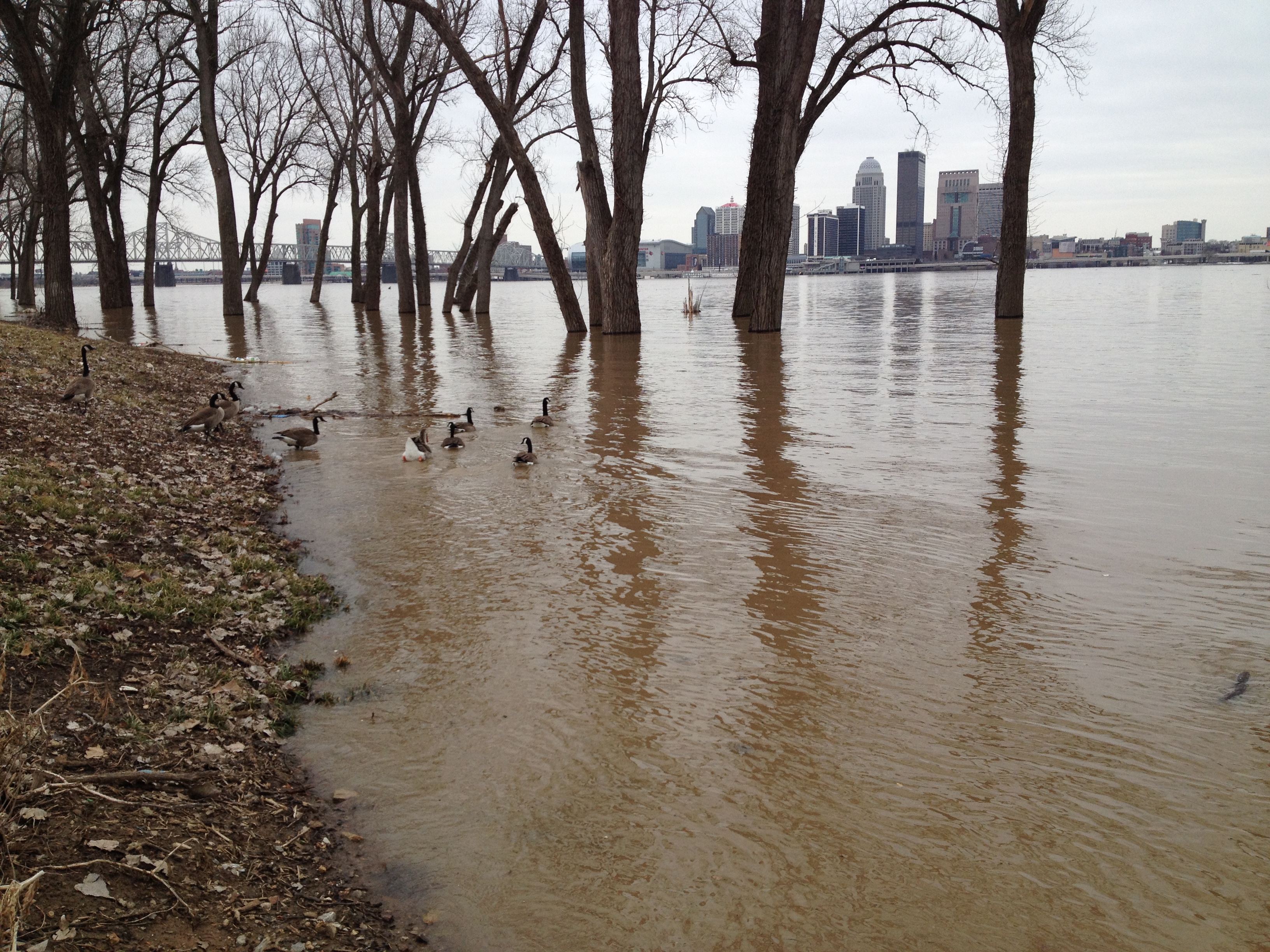
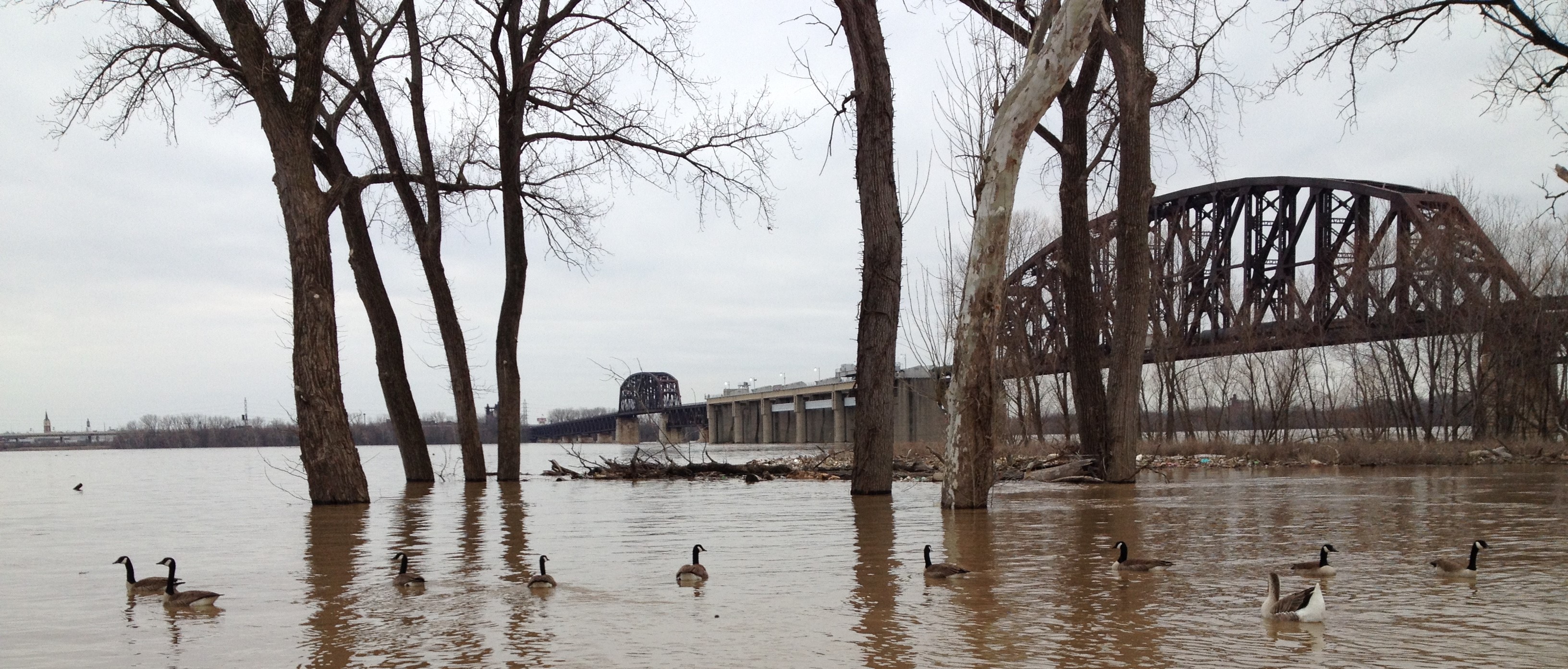
Flock of geese at the Falls of the Ohio, March 9, 2015

Even though the river was high…there was also lots of signs of life.  Soon it will be time for the Spring migration of birds moving north which is one of my favorite times of the year in the park.  I took several images of this flock of geese.  Most are Canada Geese, but the one guarding the rear is a domestic escapee.  I have watched this bird with this particular flock of geese for several years now.  Usually, the Canada Geese are very territorial especially towards others of their own kind.  Perhaps that is the key to the domestic goose’s acceptance…he really isn’t one of them and so he’s tolerated.

Geese by the old railroad bridge, March 9, 2015

Except for some selective cropping of a few images…I have done nothing else to them.  In this image, I have made the geese more prominent by eliminating the water in the foreground that makes up most of the photograph.  The other nice bird sighting of the day was seeing a juvenile Bald Eagle doing a fly over.  Eagles are becoming more common sights along the Ohio River and several pairs have built nests fairly close to the city.

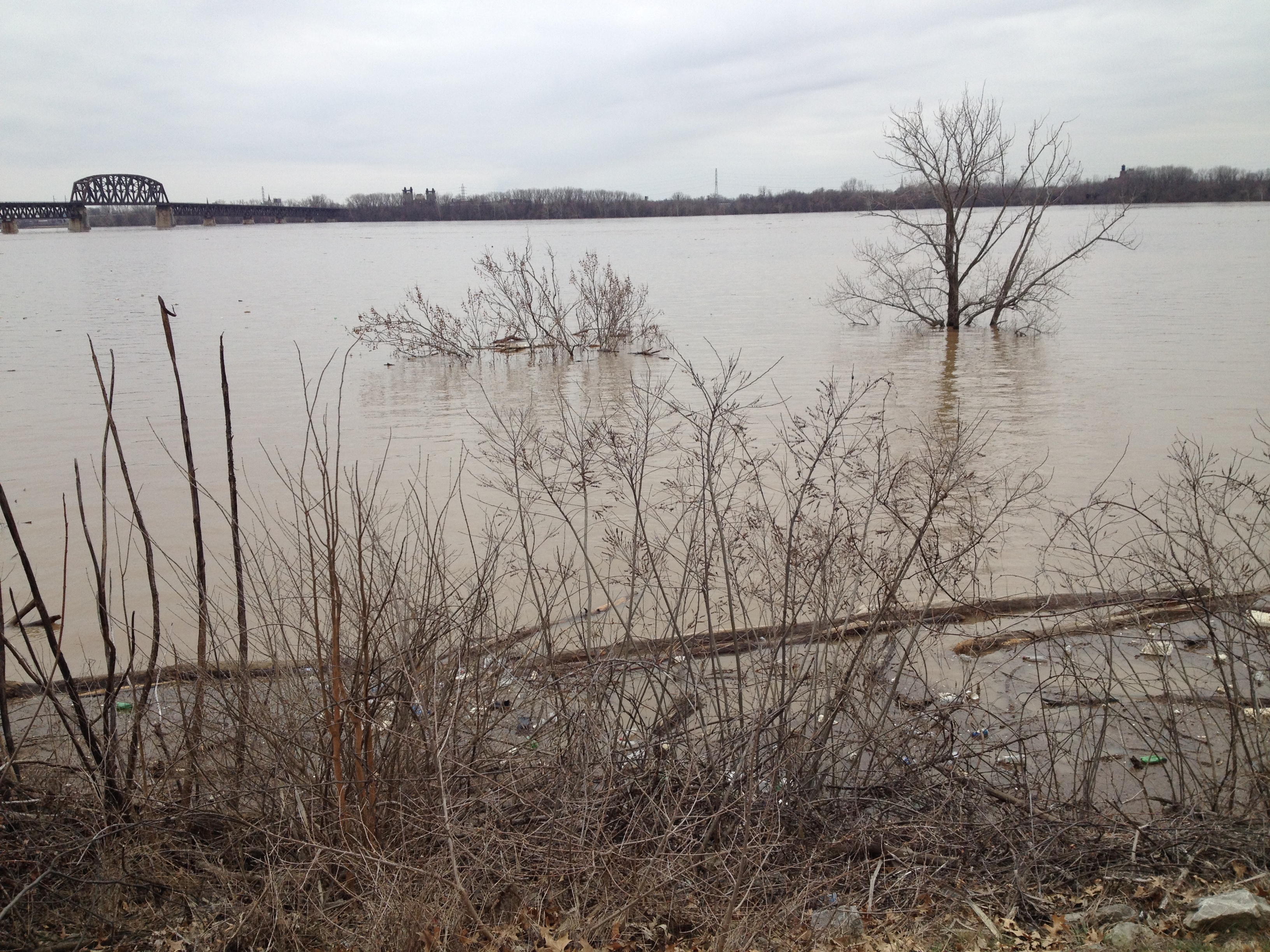
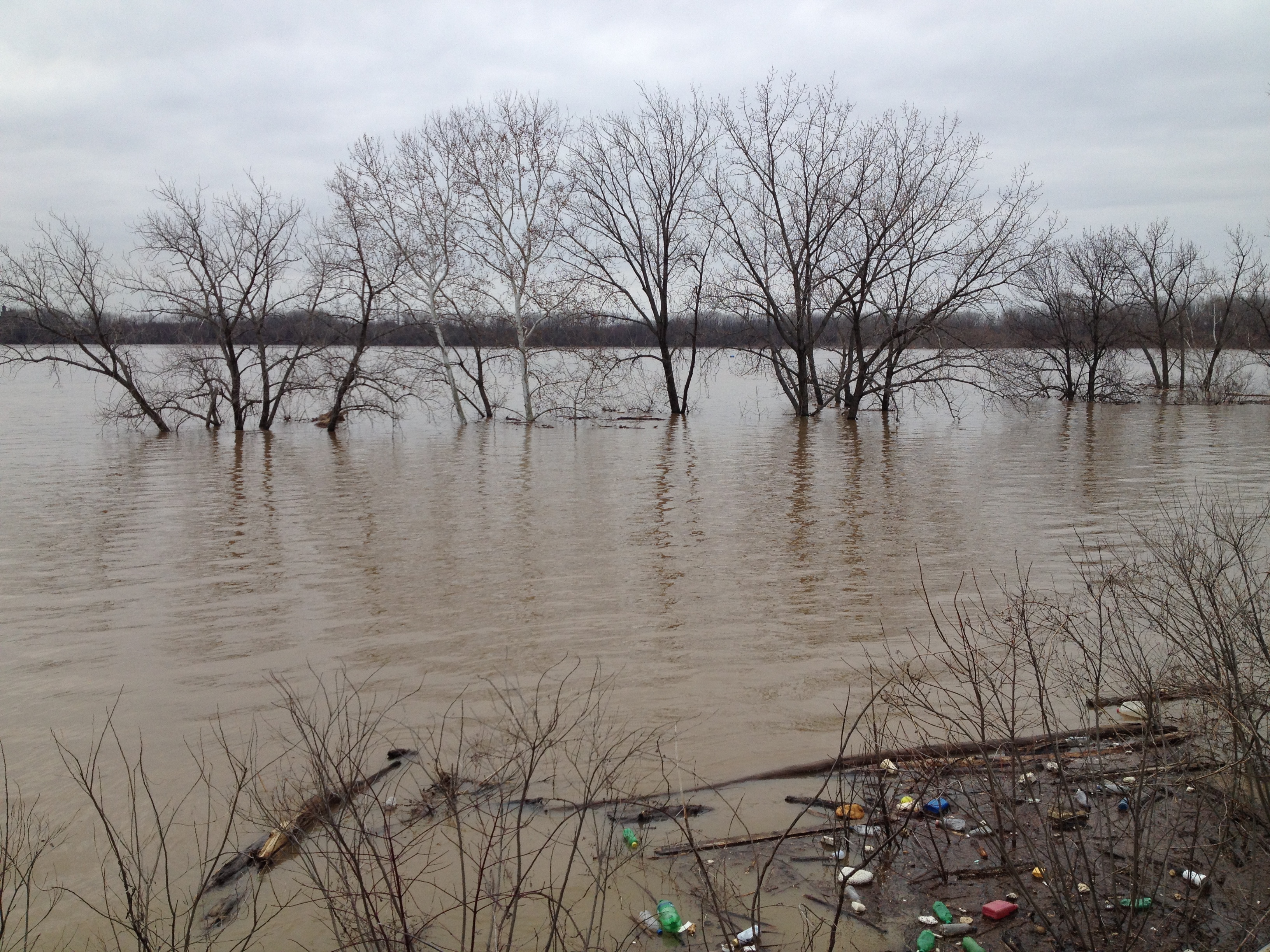
Flooded trees at the Falls of the Ohio State Park, March 9, 2015

You can get a better sense for this “gentle flood” by showing a few inundated trees.  Here larger pieces of driftwood have been blown or directed by currents to the Indiana side of the Ohio River.  You can also see plastic junk interspersed among the wood.

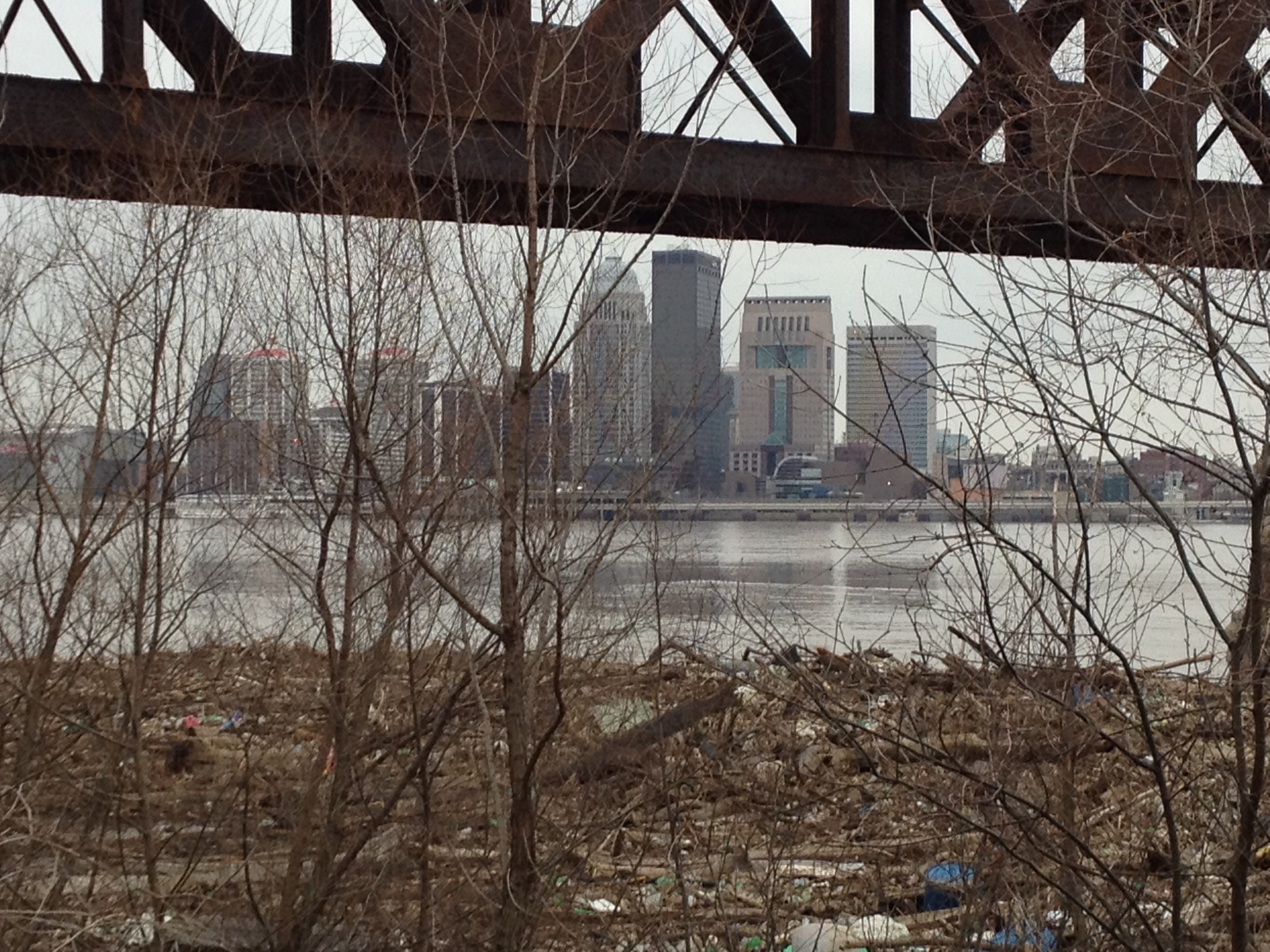
View of Louisville as seen from under the railroad bridge at the Falls of the Ohio, March 9, 2015

The City of Louisville’s downtown section as seen from under the railroad bridge at the Falls of the Ohio.  The pink rectangular building with the bluish-green highlights (second tallest building on the right) is the Humana Building.  It’s architect, Michael Graves, passed away a few days a go.  The Humana Building is considered one of Graves’ Post Modern masterpieces and one of the nicest buildings in our city.  I remember when Humana’s founder, Wendell Cherry kept some of his art collection on view in the building that the public could tour on occasion.  You might come across Roman statuary in one room and a tall Giacometti bronze in another.  The art holdings were amazing.  Cherry was mostly secretive about his purchases and once paid the world record for a painting at auction when he bought an early Blue period Picasso self-portrait entitled “Yo Picasso”.  I believe the disclosed purchase price was just under 7 million dollars which seems like a bargain now that the record has been pushed recently to over 300 million dollars for a Gauguin painting.  I could go on about that, but that is a topic for another time.

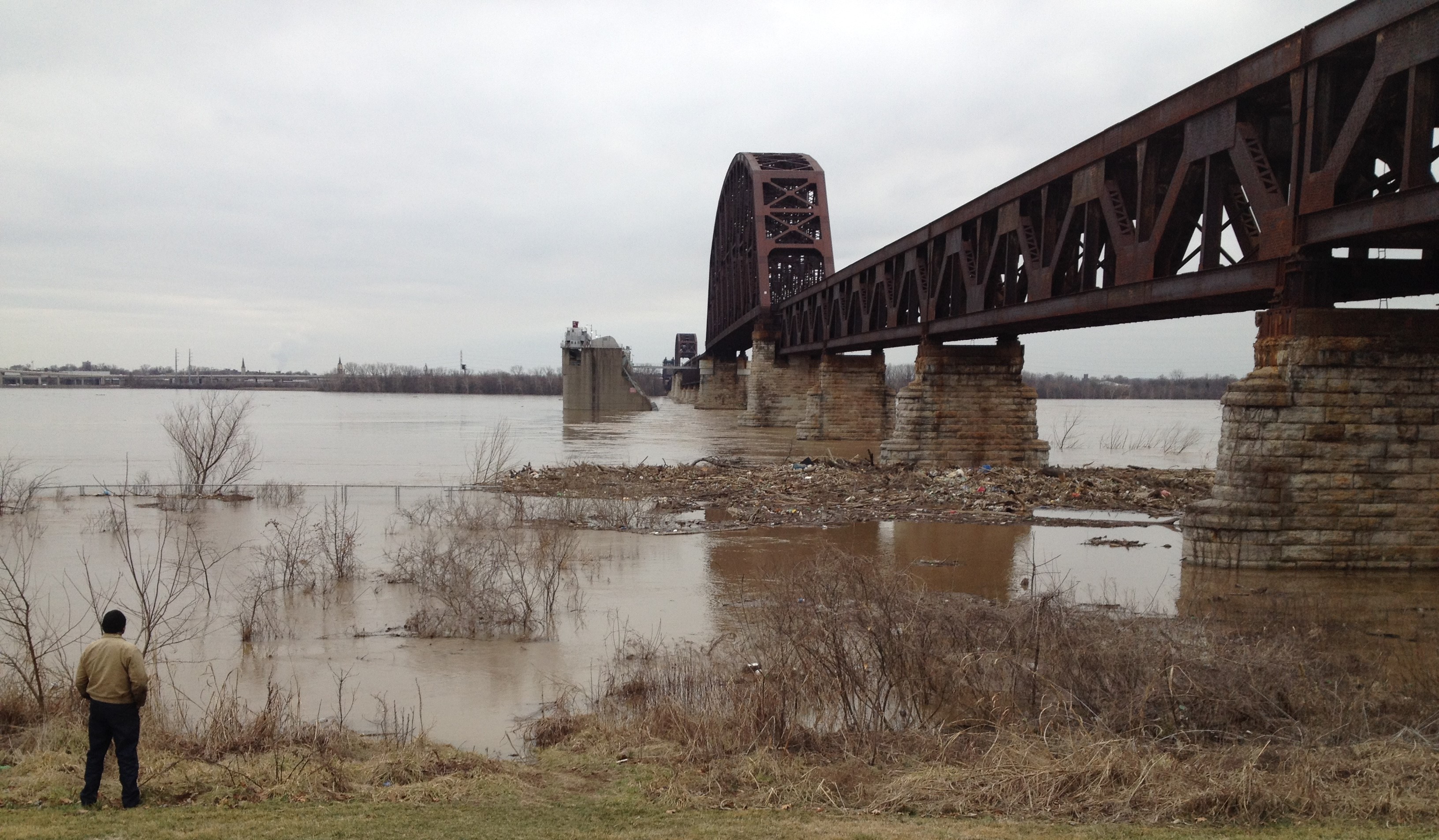
Man by the railroad bridge, flooded Falls of the Ohio, March 2015

Like this guy in the foreground, I’m waiting for the river to recede before seeing what changes have been made.  Many of my favorite willow trees are completely underwater.  I know they get buffeted and damaged by the currents which carry lots of debris in their wake.  Perhaps by this weekend it will be all right to venture out among the muddy driftwood piles?  I will bring an empty collecting bag because I’m sure to find “stuff” to use for my creations.  On March 22, I will be participating in a group assemblage and collage show at Galerie Hertz.  I will have six different sculptures on view.  I will give you a sneak peek in my next post.  For now, keep your feet dry…Spring is on the way!

Flooded trees below the Interpretive Center, Falls of the Ohio, March 9, 2015

Read Full Post »

river frosted bottle glass, Falls of the Ohio, Dec. 2014

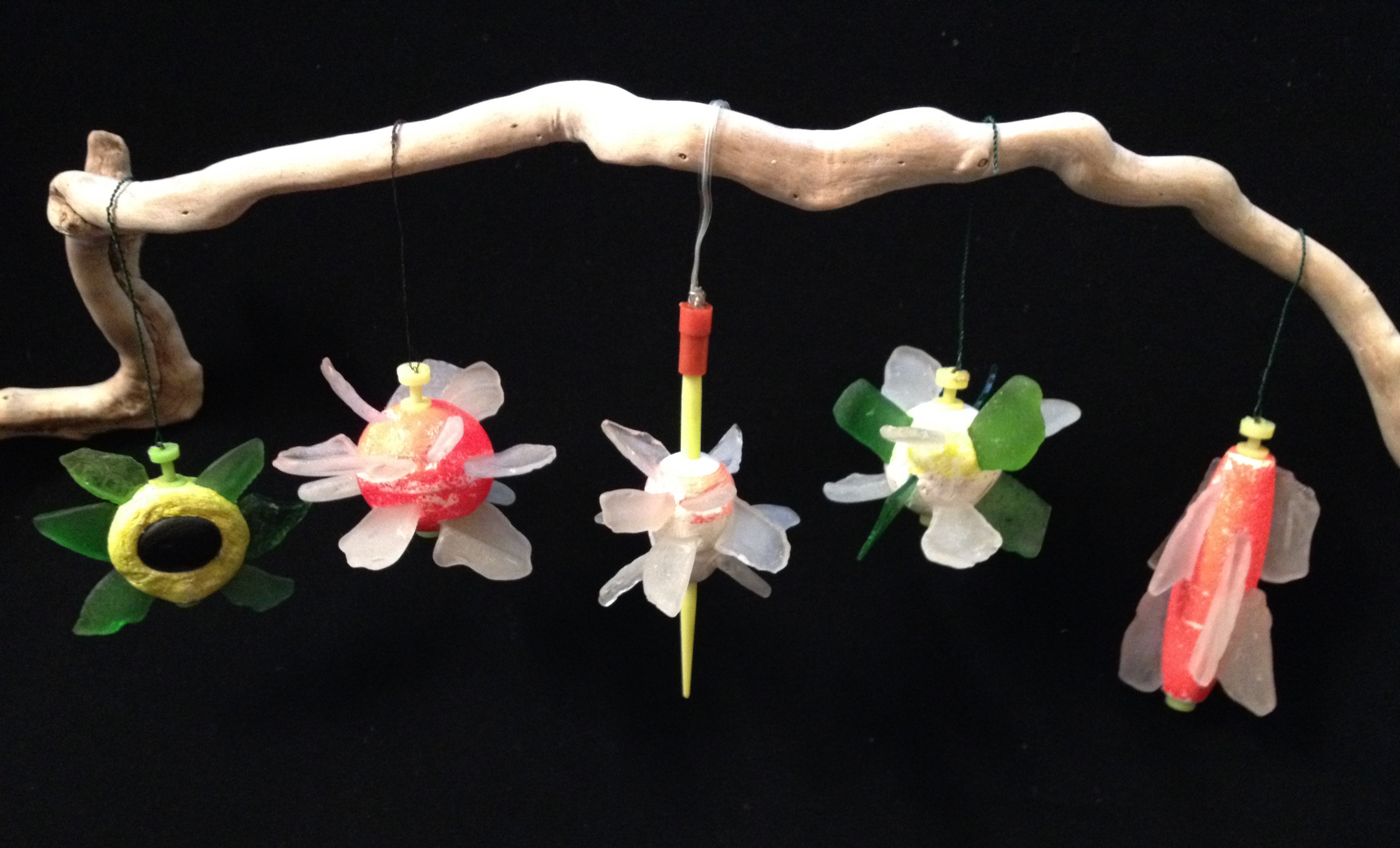
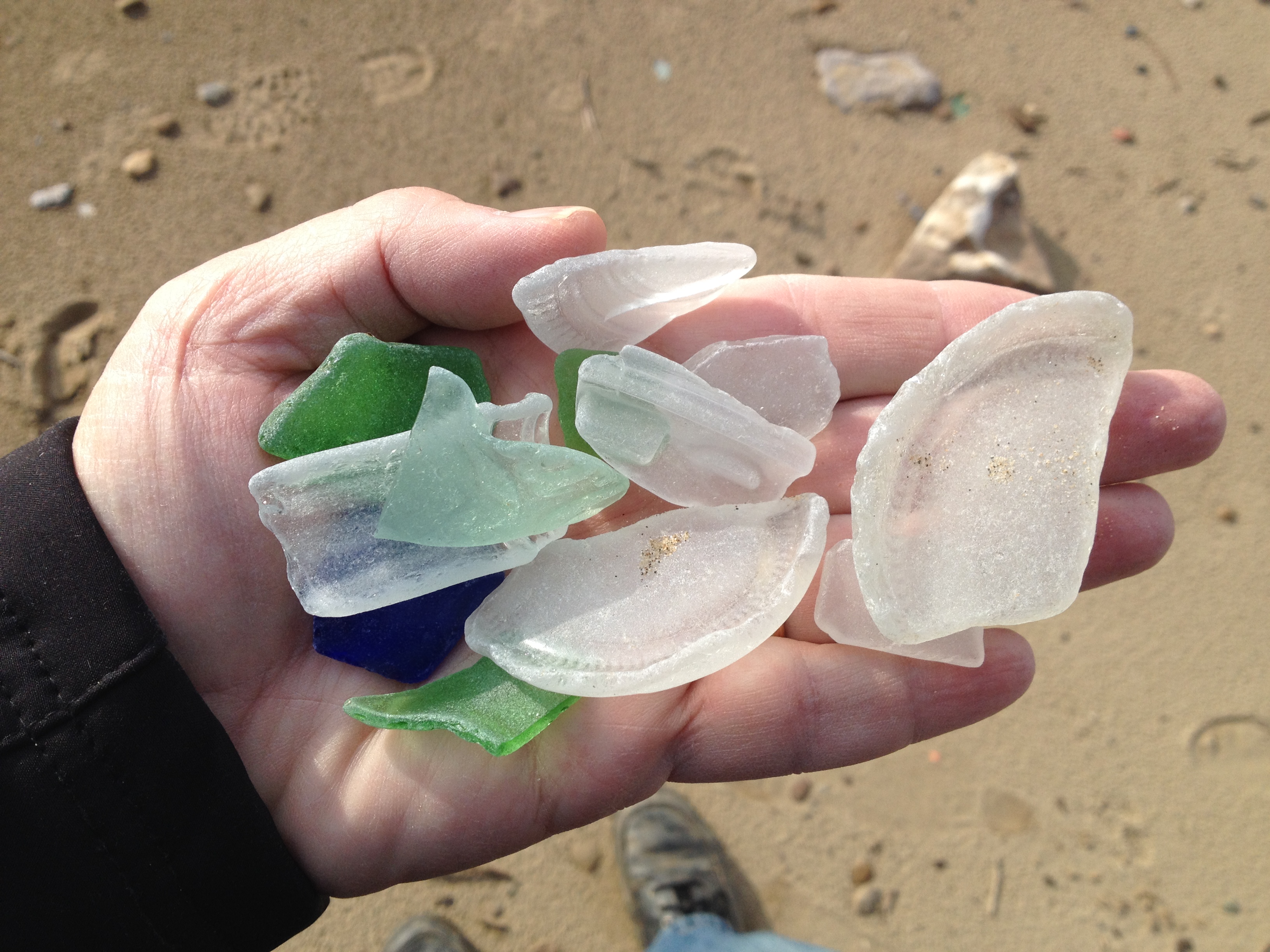
I hope all of you out in blogland are having a great holiday season.  My own family has enjoyed having the additional time to connect with folks we don’t see often enough.  Today is the last day of the year.  With no pressing commitments scheduled for today, I thought I would squeeze in one final post before the ball drops later tonight.  You may be wondering what an image of a hand holding river polished and frosted bottle glass has to do with anything?  Well, that’s the subject of this craftier than usual post.  Every year I enjoy sending out original holiday cards and other “stuff” I make and gift from river junk.  This year in addition to the cards (which featured the Christmas Bird of previous post fame), I created more of my “Ice Blossom Ornaments”.  Friends who were the recipients of these “river treasures” assured me they were blog worthy.  We shall see about that.

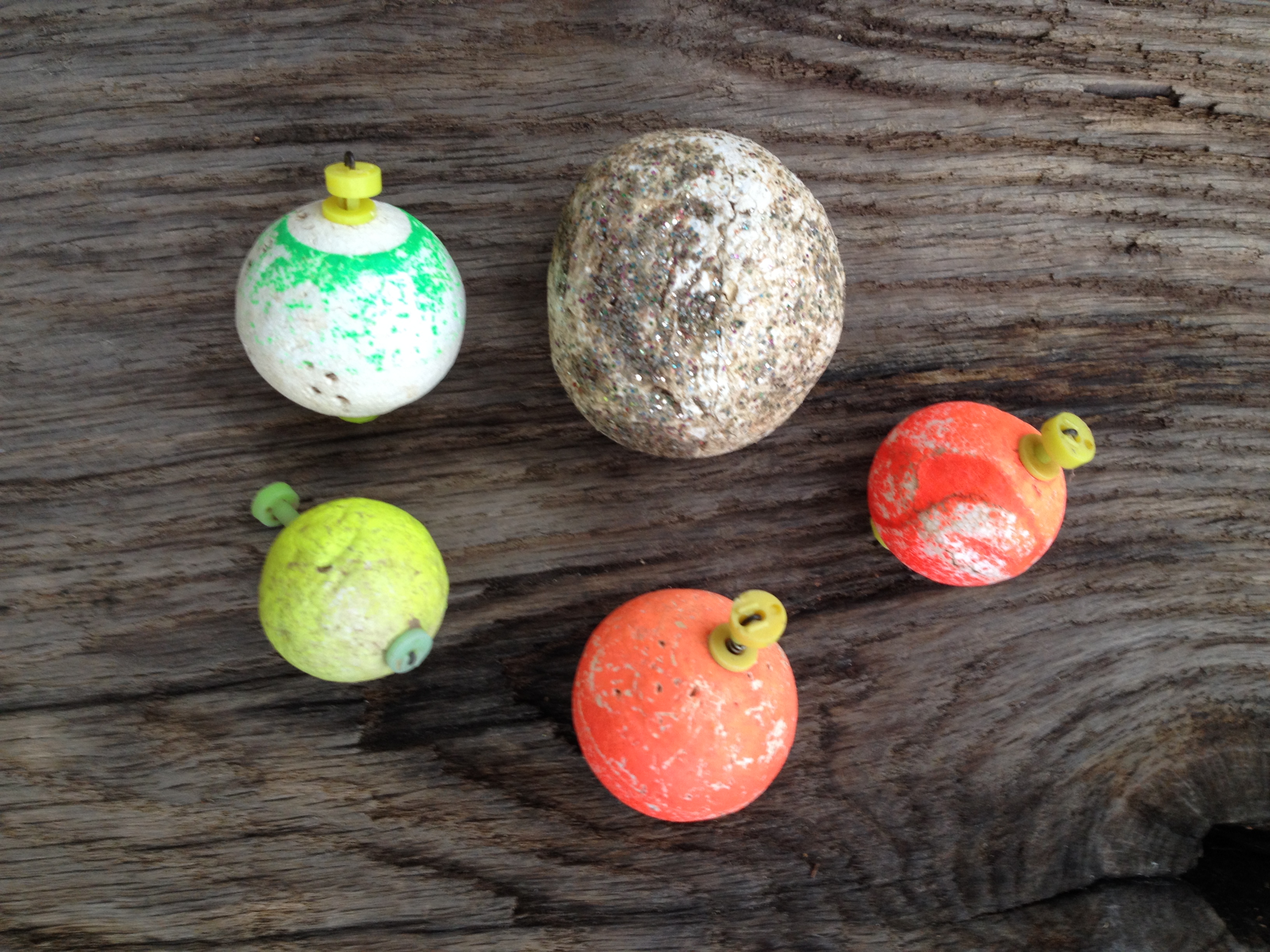
Styrofoam fishing floats and old Styrofoam Christmas ornament, Falls of the Ohio, Dec. 2014

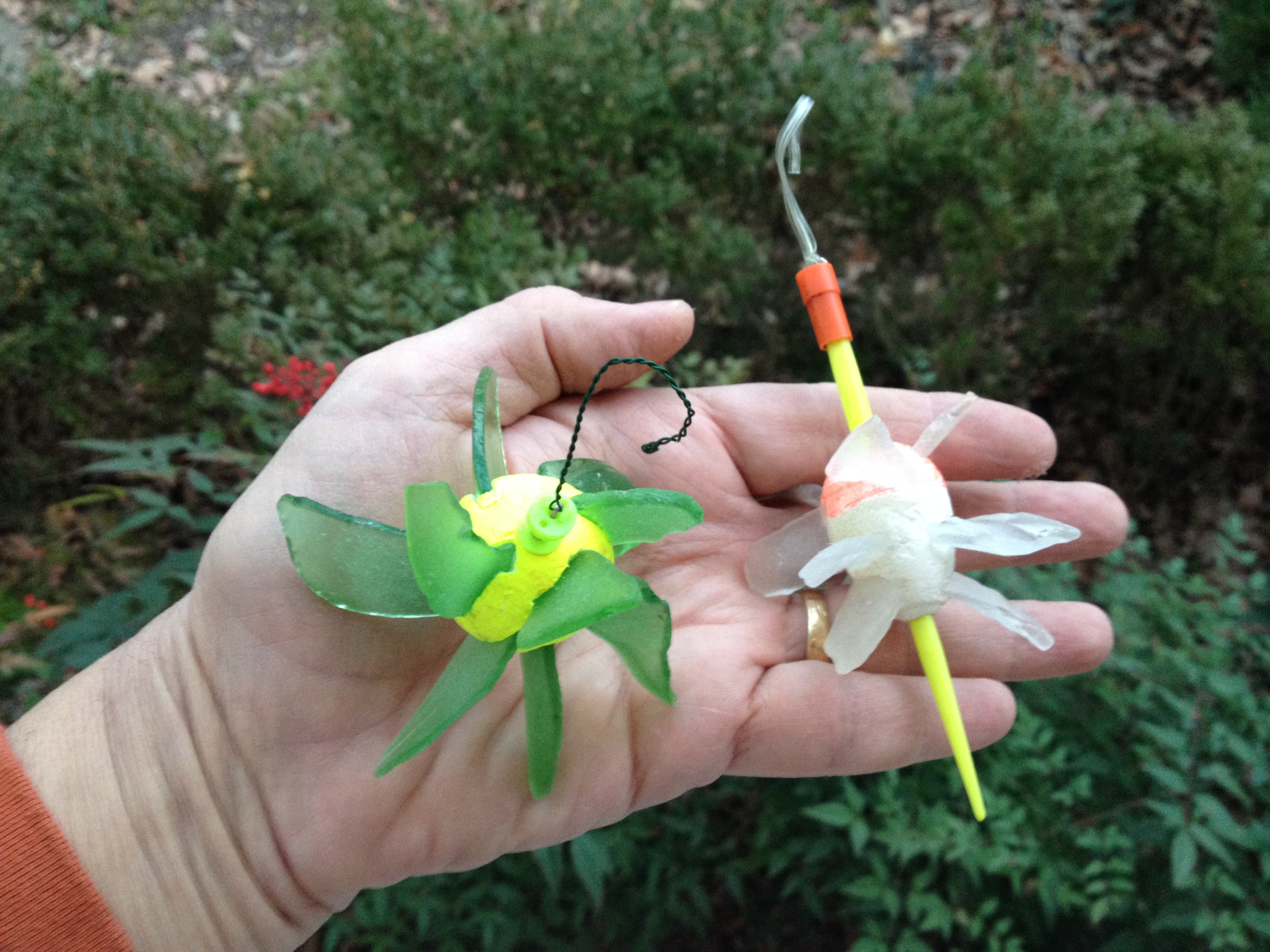
To make an “Ice Blossom Ornament” you need a bit more than broken glass found at the river or beach…you also need a body or form to attach the shards to.  In this case, I like using the Styrofoam fishing floats I find and ironically polystyrene balls that are the remains of former Christmas tree ornaments that have washed into the park.  I have seen a few of these original ornaments in various states of decomposition and they are usually covered with a shiny fabric that is glued to the ball.  I prefer the balls that have lost their covering. When placement of the glass pieces has been decided, you cut into the ball form using a sharp Exacto knife.  The hole I create is traced around the glass shape that I will embed into the ball  A drop of glue holds the glass in place.   I love using this river-collected glass because all the sharp edges have been worn away and I like the “frosted” surface created from abrasion with the sand and water.  The same natural processes that tumble the Styrofoam and coal I use, also works its magic on glass.  Even with something as trifling as these ornaments, I like that nature had a “collaborative role” in their making.  The ornaments are finished off with the addition of found wire or waste fishing line and the occasional found piece of hardware.  Here are some finished examples.

Two Ice Blossom Ornaments , Dec. 2014

2014 Ice Blossom Ornaments made with Falls of the Ohio found materials

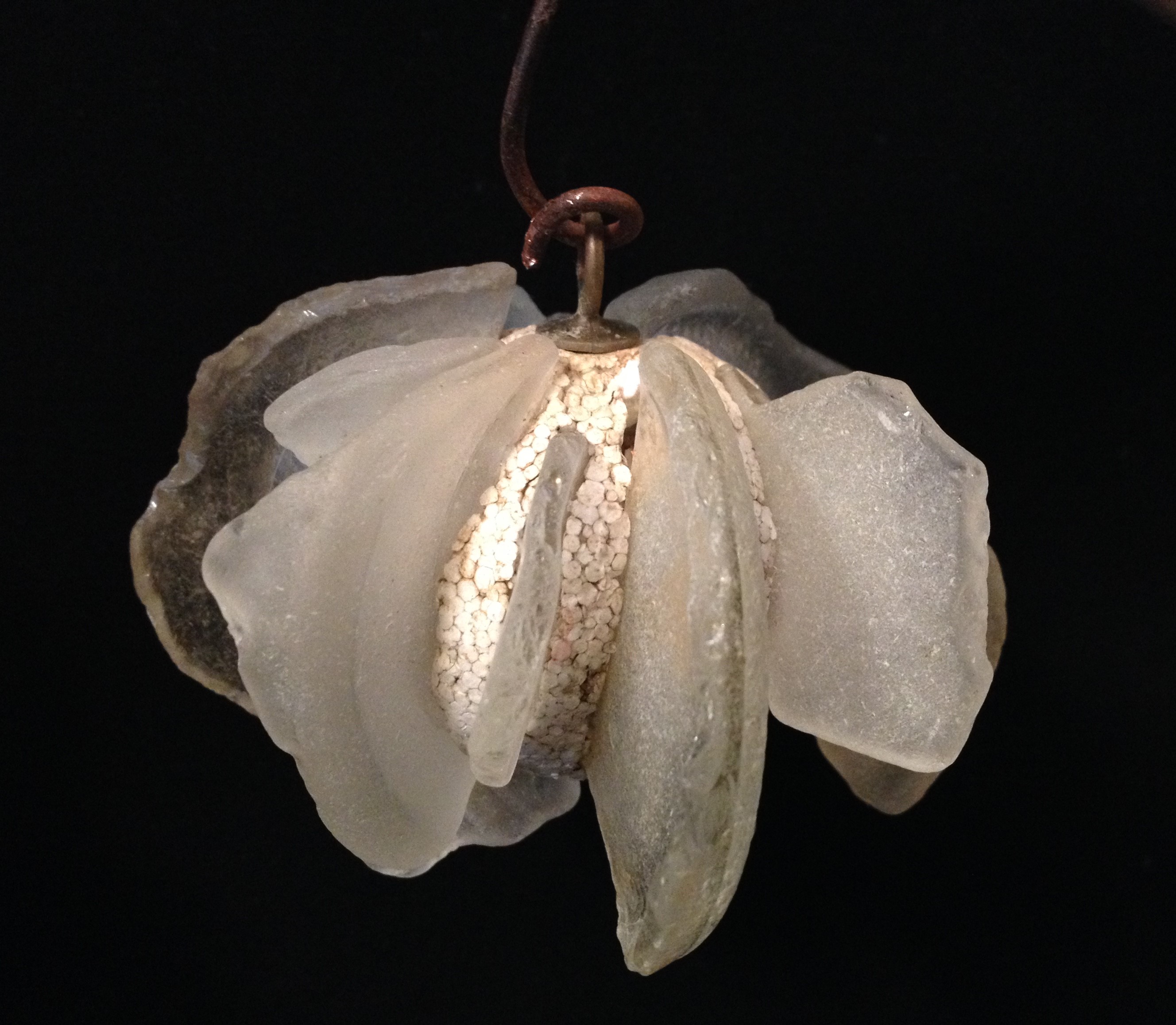
The next two pieces are a little larger and utilize bigger glass fragments.  Some of these larger ornaments reference seed pods and marine forms like urchins.

Ice Blossom Ornament with copper wire, Dec. 2014

This year I added polished coal to the list of materials used.  Coal is after all, stored energy from the sun and suits the “star” image.  Also, at the heart of every living star is a potential black hole and this ornament has that going for it as well.

Ice Blossom Star with Coal, Dec. 2014

The original ideas behind the “Ice Blossoms” comes from the 2009/10 holiday season.  It was an important element in a story I wrote about the very rare migration of the Arctic Hummingbird (Styrotrochildae polystyrenus).  When the conditions are just right, the very unusual Arctic Hummingbird times its appearance with the emergence of the Ice Blossom flower.  The hummers seek out the concentrated energy found in the Ice Blossom’s nectar.  I just happened to be lucky enough to be at the Falls of the Ohio when the Ice Blossoms were in bloom.  Here’s an image I captured showing the relationship between the bird and flower.

Arctic Hummingbird feeding, 1/2010

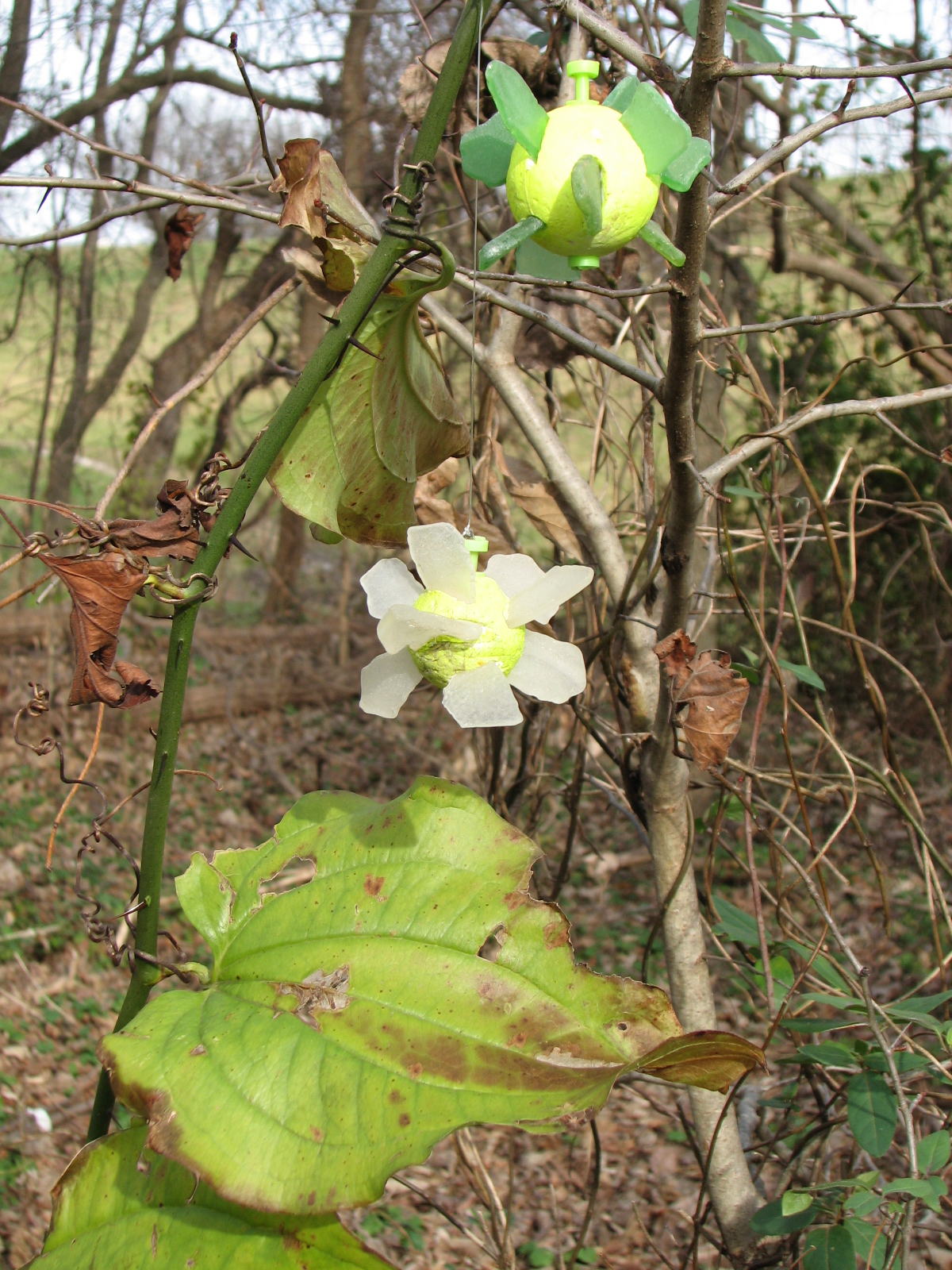
Later I created another series of ornaments that I used to decorate the trees and vines at the Falls of the Ohio State Park.  Some of these images were later incorporated into my Christmas cards.

Ice Blossom ornaments and briar vines

I liked the idea of ornaments in nature and still feel some of the trees in the park are just as worthy of decoration as the trees we set up for the holidays.  Regardless, the next time you find yourself around beach glass and Styrofoam…here’s an idea you can try to reuse both materials.  Happy New Year everybody…see you in 2015.

Ornaments in Nature, 12/09

Read Full Post »

Christmas Bird at the Falls of the Ohio, Dec. 2014

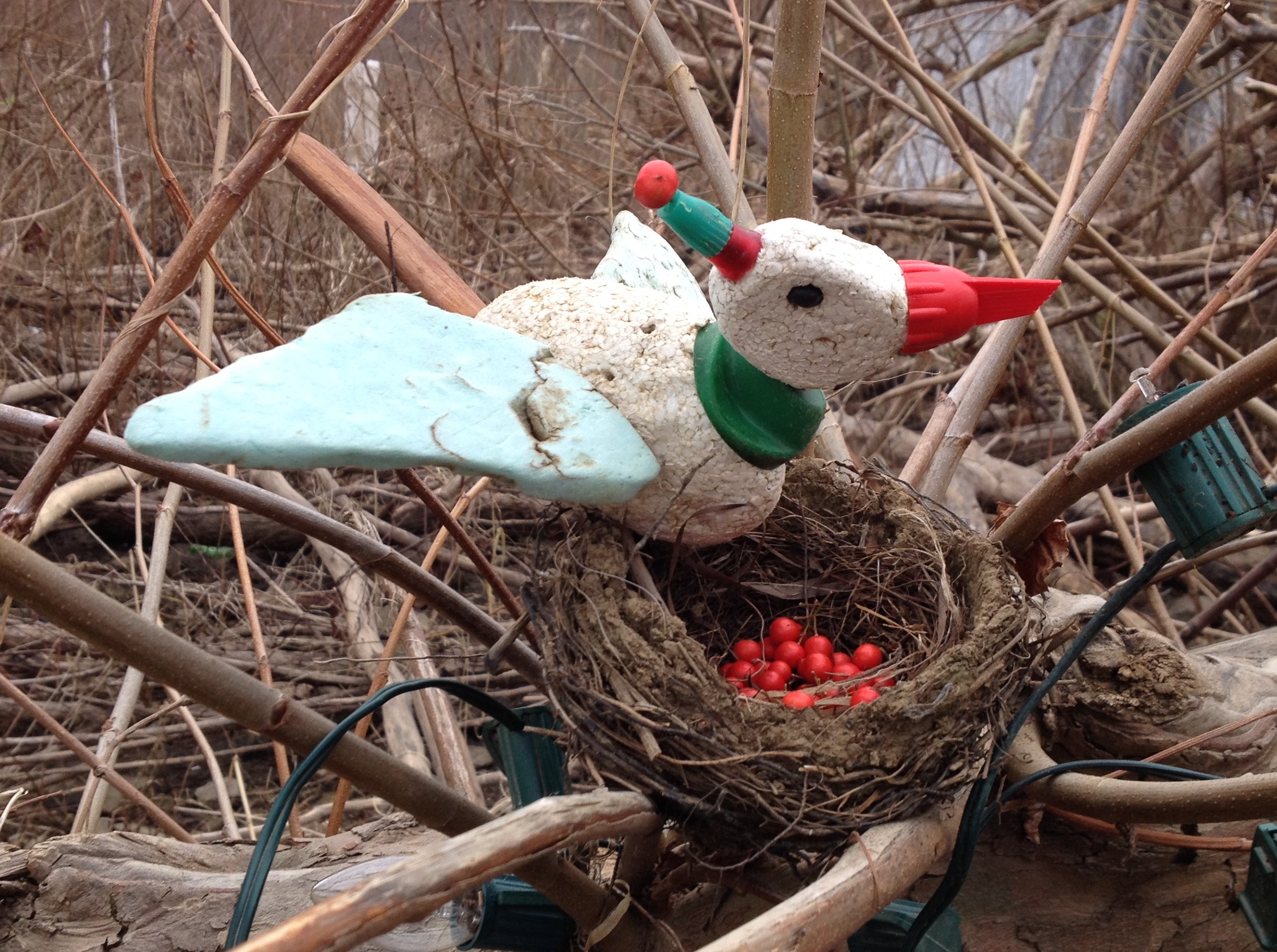
In the eastern section of the Falls of the Ohio State Park I came across a remarkable bird.  As far as I know, this is the first documented sighting of the so-called Christmas Bird (Xmasii noelensis) in our area.  The bird’s red crest, green collar, and azure-colored wings are diagnostic as is the bicolor beak.  I was down at the river on a rather foggy morning when I noticed the bird flashing its wings in mockingbird fashion which is a distant relative of this species.

The Christmas Bird, Louisville in the background, Dec. 2014

I was looking for interesting pieces of driftwood and odd items washed up by the Ohio River when I came across this bird.  This is a long distance migrant and one that hails from as far north as the Arctic Circle.  The Christmas Bird earns its name in a couple of ways.  Of course, its complimentary plumage is rather seasonably inspired and it does seem to migrate to the lower 48 states around the time of the holidays.  Where the bird will appear is rather unpredictable, however, it is a welcome sight in most any location.  Here I have photographed the bird “flashing” its wings against its body while perched upon a driftwood log.  The park is in Southern Indiana and the skyline of Louisville, Kentucky can be seen across the Ohio River.  After taking this shot, the bird flew off.

Display of the Christmas Bird, Falls of the Ohio, Dec. 2014

I said to myself…”Well, that’s that”.  I fully did not expect to see this rare bird again, but I received a “gift” of a rather unexpected nature.  Underneath the old iron railroad bridge, not too far away from my initial sighting, I came across this “decorated” nest and recognized its significance.  This is a display from the Christmas Bird.  Using an abandoned mud-lined nest of an American Robin, (Turdus migratorius), the Christmas Bird has created an assemblage involving red berries and the remains of a string of old Christmas lights that washed into the park with the other river-bourn detritus.  From this evidence, I suspected the bird had “claimed” this area.  If I in turn displayed patience…I might get another opportunity to photograph this unusual species.

Christmas Bird with its display, Falls of the Ohio, Dec. 2014

I waited about an hour and the Christmas Bird did appear to my great joy!  It arrived at the nest with a red berry in its beak which it added to its growing collection.  It is believed that this bird is attracted to the color red.  Usually, berries from the holly tree are used, but in this instance I recognized them as the fruit of the Nandina plant.  The bird probably discovered them growing in a private garden in nearby Jeffersonville, Indiana.  It is suspected by ornithologists that the southerly migration of the Christmas Bird, which brings it to warmer climates, may trigger this unusual nest-like and courting behavior.  The Christmas Bird is known for its ability to tolerate extreme cold and it takes a great drop in temperature to stimulate it to migrate.

Close up of the Christmas Bird with red berry, Falls of the Ohio, Dec. 2014

Christmas Bird with display, Falls of the Ohio, Dec. 2014

I was able to observe this bird making about ten trips back and forth between the nest and its berry source.  If the bird was aware of my presence…it did not appear to be overly alarmed.  Once in a while, the bird with crest erected, would cock its head back and forth trying to differentiate my form among the willow branches.  I held my breath and tried to remain still and as unthreatening as possible.

The Christmas Bird with its seanonable display, Falls of the Ohio, Dec. 2014

The weather grew damp and cold and the sun looked like it was not going to appear from beneath its blanket of clouds.  I made the decision that I had enough images and it was time to leave this bird in peace and go home.  On the ride home, I felt I had been given this great gift, the gift of nature which remains priceless and timeless!  For me, nothing packaged in a box and wrapped with a bow can equal this living blessing.  To all who have followed my adventures by the river this year…I offer my sincerest good wishes during this season of holidays!  I hope that at least once in your lifetimes, you will be visited by the Christmas Bird bringing red berries for your nest.
Christmas Bird with red berry, Falls of the Ohio, Dec. 2014

Read Full Post »

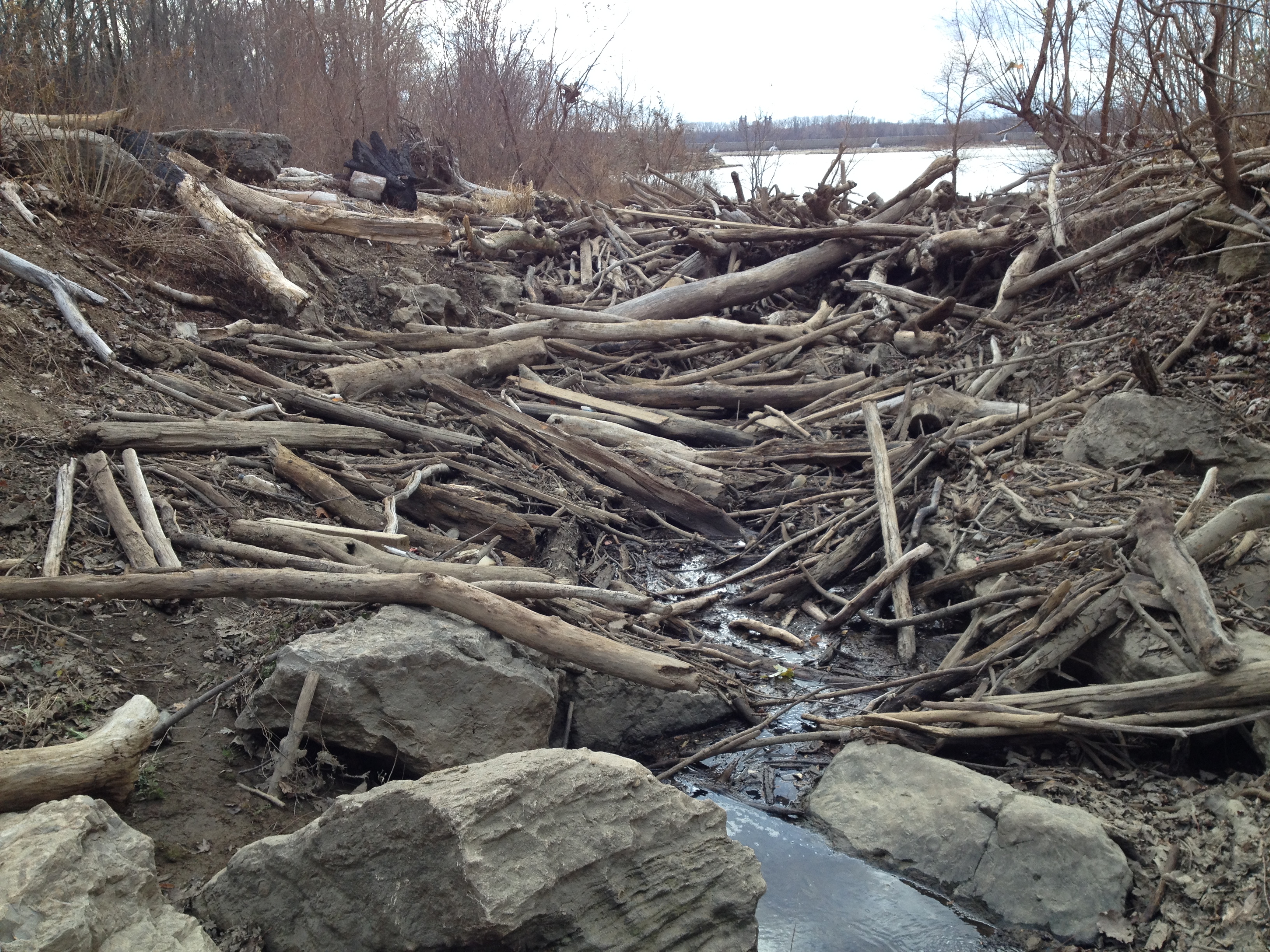
piled up driftwood, Falls of the Ohio, Dec. 2014

The following is my latest adventure from the Falls of the Ohio State Park.  It’s official now, the month of November was among our top ten coldest Novembers ever recorded.  This continues a see-saw trend where one month might set a record for heat (like October did) only to bounce back down to the other extreme.  It’s too early to tell about December, but on this recent visit it was cool and overcast.  We have since had several days of rain causing the river to swell.  Today’s story begins at the westernmost point on the Woodland Loop Trail.  This path is bordered by what folks around here refer to as a “creek”, but in actuality is a channel cut into the riverbank by storm water overflow released from the town of Clarksville.  I wish it were a creek and perhaps long ago, may have been one.  During periods of flooding and high water, driftwood and logs back up into this area and are stranded once the water level recedes.  The picture above is a recent illustration of this.

beaver tracks, Falls of the Ohio, Dec. 2014

I was exploring this water-cut channel and noticed that there were lots of beaver signs present.  In addition to their tracks left in the mud, I found plenty of chewed willow branches.  I added some of the nicer sticks to my collecting bag.  It made me think about how much the appearance of the black willow trees around here are shaped by the beaver’s “pruning” methods.  I don’t know why this didn’t occur to me before…perhaps it was just too obvious.  Actually, I think it has something to do with the beaver population rebounding over the last few years.  In certain local places, they have become “pests”.  Their damning of local drainage canals has necessitated their capture and removal to other more remote areas.

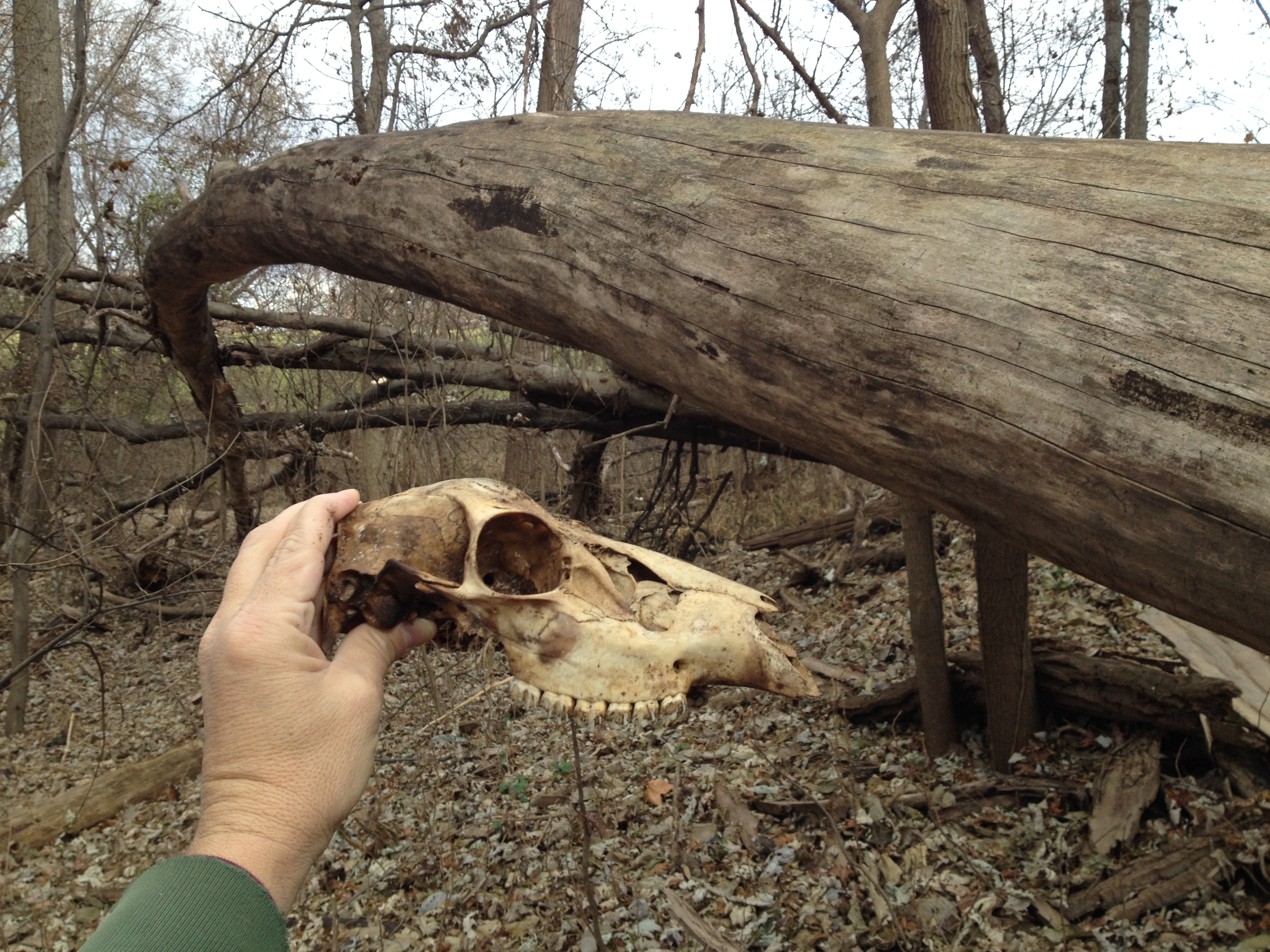
found deer skull, Falls of the Ohio, Dec. 2014

Exploring a bend on the Woodland Loop Trail, I found this deer skull laying upside down on the fallen leaves.  It was kind of hard to see, but something in the old brain said to look more closely and I did.  After taking a few photographs, I laid it upon the trunk of a large fallen tree for others to discover.  Like the beaver, it appears the deer are becoming more numerous as well.  After years of finding just their tracks and the occasional bone, this season I was able to spot a doe and her fawn in the park during broad daylight.

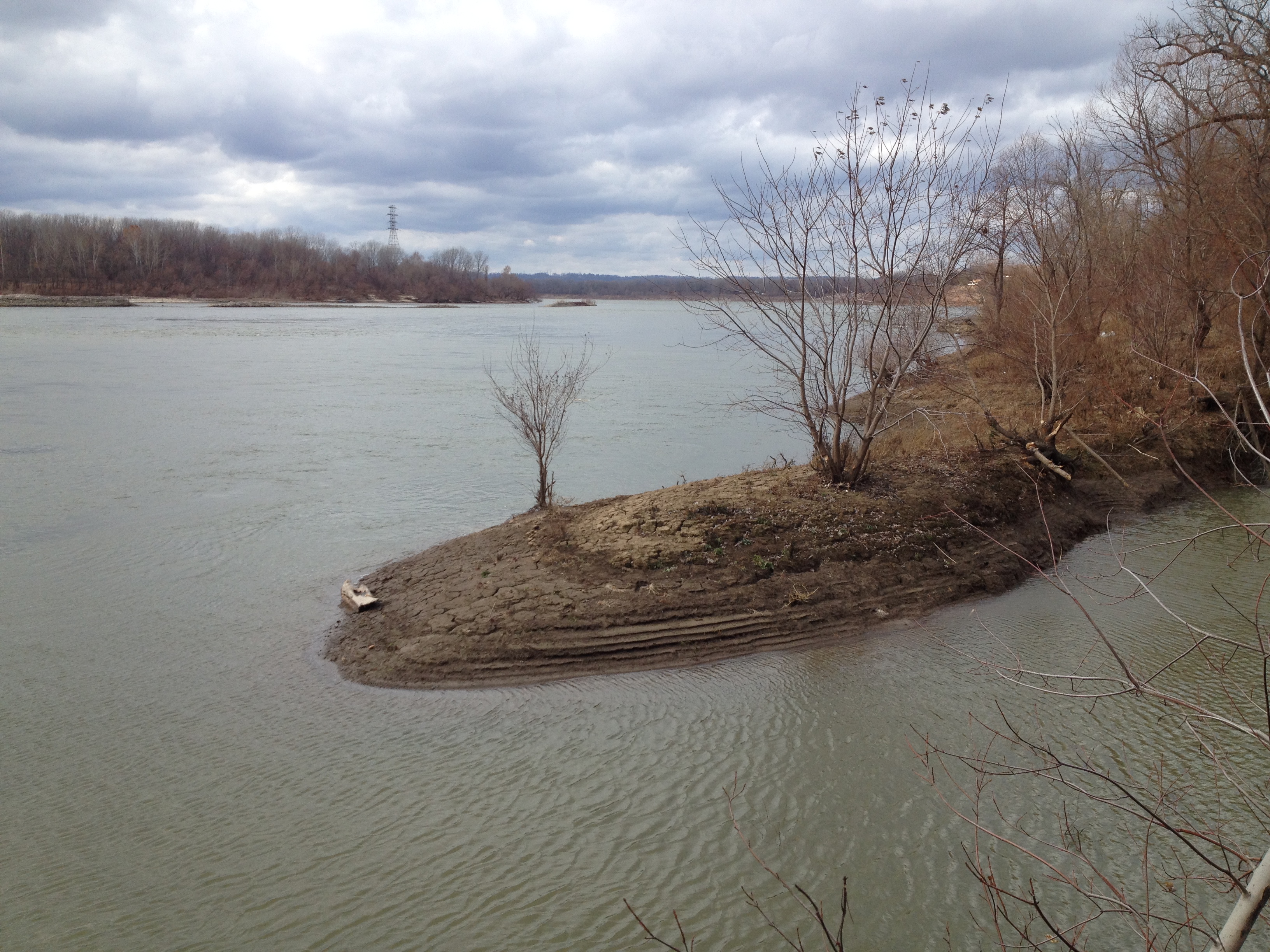
storm sewer overflow peninsula, Falls of the Ohio, Dec. 2014

I walked to the top of the riverbank to get a better look at the peninsula that has been created at the mouth of the “creek” from the storm sewer’s overflow.  Over the years, I have witnessed stringers of sauger and catfish being caught here by the local fishermen.  I like how the rising and falling of the river has terraced the mud into a series of graduated steps.  I was relaxed and zoning out on the view when I noticed something white that had surfaced and was entering the “creek”.  I quickly took a photo and here it is.

white dorsal fin in the Ohio River, Falls of the Ohio, Dec. 2014

I scrambled down the riverbank to get a better view and got my clothes severely muddy in the process.  In my head I’m telling myself that for all the world this looks like a shark’s dorsal fin…but is this possible?  I remember hearing that there are a few shark species (notably bull sharks) that are capable of swimming up rivers and able to tolerate being in fresh water for extended periods of time.  Still, we are a long way from the ocean which also includes navigating a large section of the Mississippi River before entering into the Ohio River… just to reach this spot.  I observed the fin submerging as it disappeared from view.  Hustling, I reached the general location where I thought the fin was heading and was “blown away” by this sight!
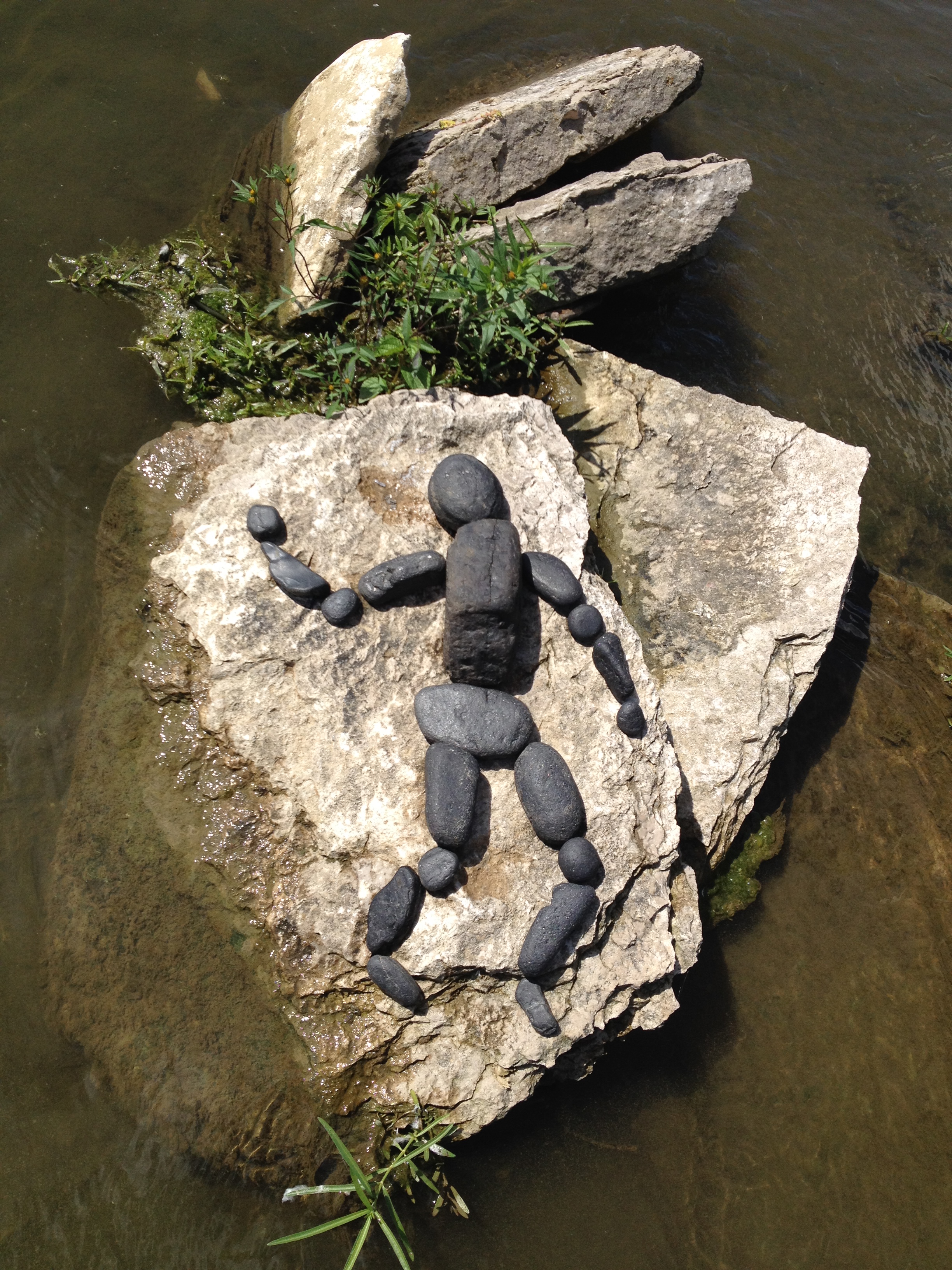
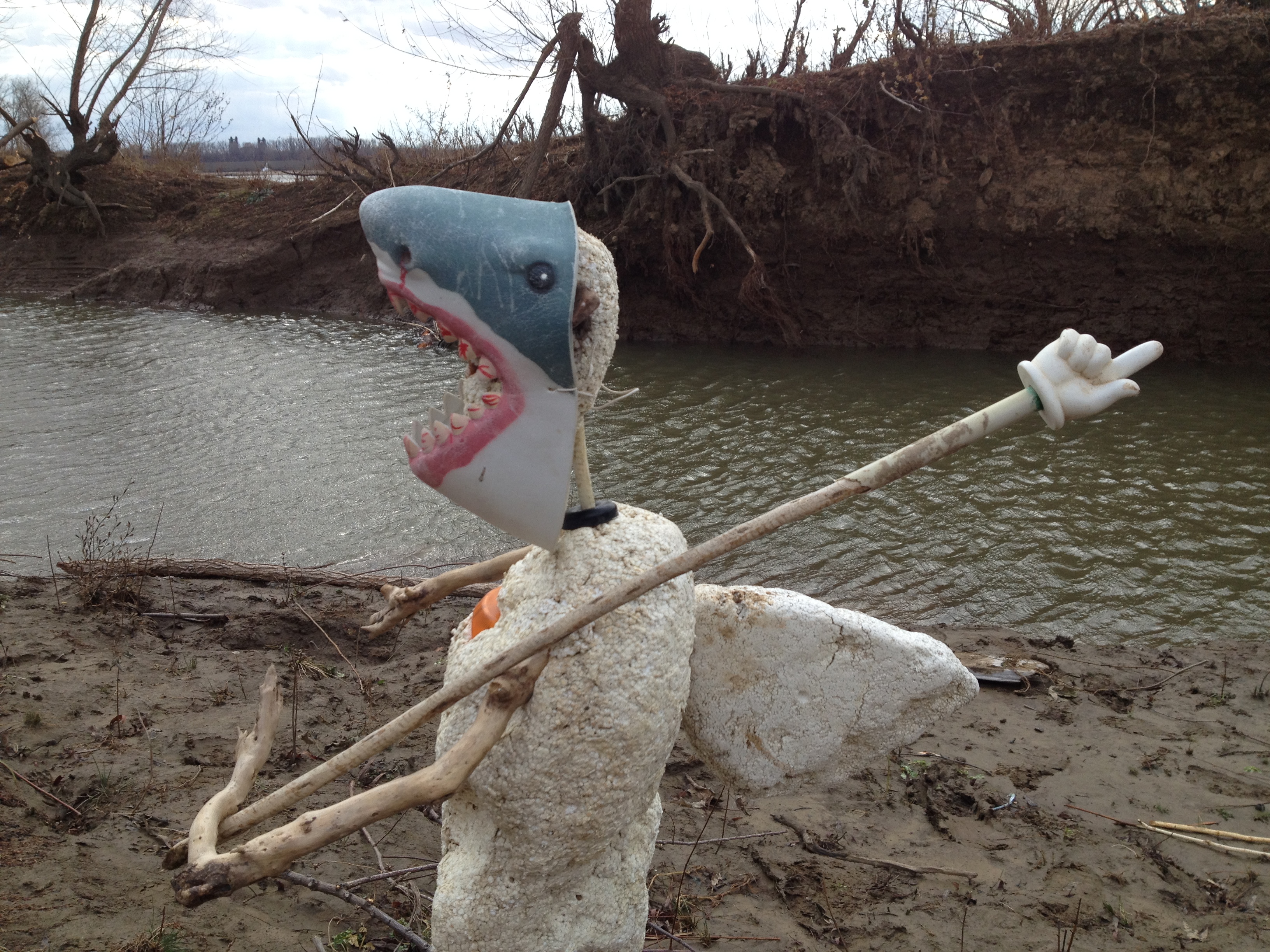
The Shark Shepard emerges from the river, Falls of the Ohio, Dec. 2014

Emerging from the muddy water was this white figure sporting an improbable headdress or mask?  The figure was carrying a staff and appeared to have fins on its body similar to a shark.  I let this fellow come fully out of the water before my curiosity overwhelmed me and I went in for a closer look.

Shark Shepard, side view, Falls of the Ohio, Dec. 2014

This strange being did not seem to be afraid of me and regarded me through his dark eyes.  His face was framed by what looked like the jaws, teeth, and the head of a shark.  My attention kept returning to the fearsome mask it was wearing which I surmised might be a part of some breathing apparatus?  A yellow light on its chest would occasionally blink signaling some other unfamiliar technology was present.  The staff the figure was holding was terminated by a hand pointing a finger which reinforced the stranger’s mysterious presence.

The Shark Shepard on the riverbank, Falls of the Ohio, Dec. 2014

Using its staff, I watched as the figure drew the outlines of several sharks in the soft mud and then pointed to one of his eyes.  He followed this by making a sweeping movement with his arm that seemed to encompass the river and its surrounding landscape.  It took me a moment, but I think it asked me if I had seen any sharks in the area?  Reflexively, I replied by shaking my head “no” which the figure seemed to understand by dropping his head and shoulders in a disconsolate manner?  That’s when I had this mental flash that this guy was a shepherd, a shark shepherd and he was looking for his lost flock?  From here on out, I will refer to him as the Shark Shepherd.  He next stuck his staff into the mud and walked away from it.  I decided to tag along to see if I could learn anything else about my new silent friend.

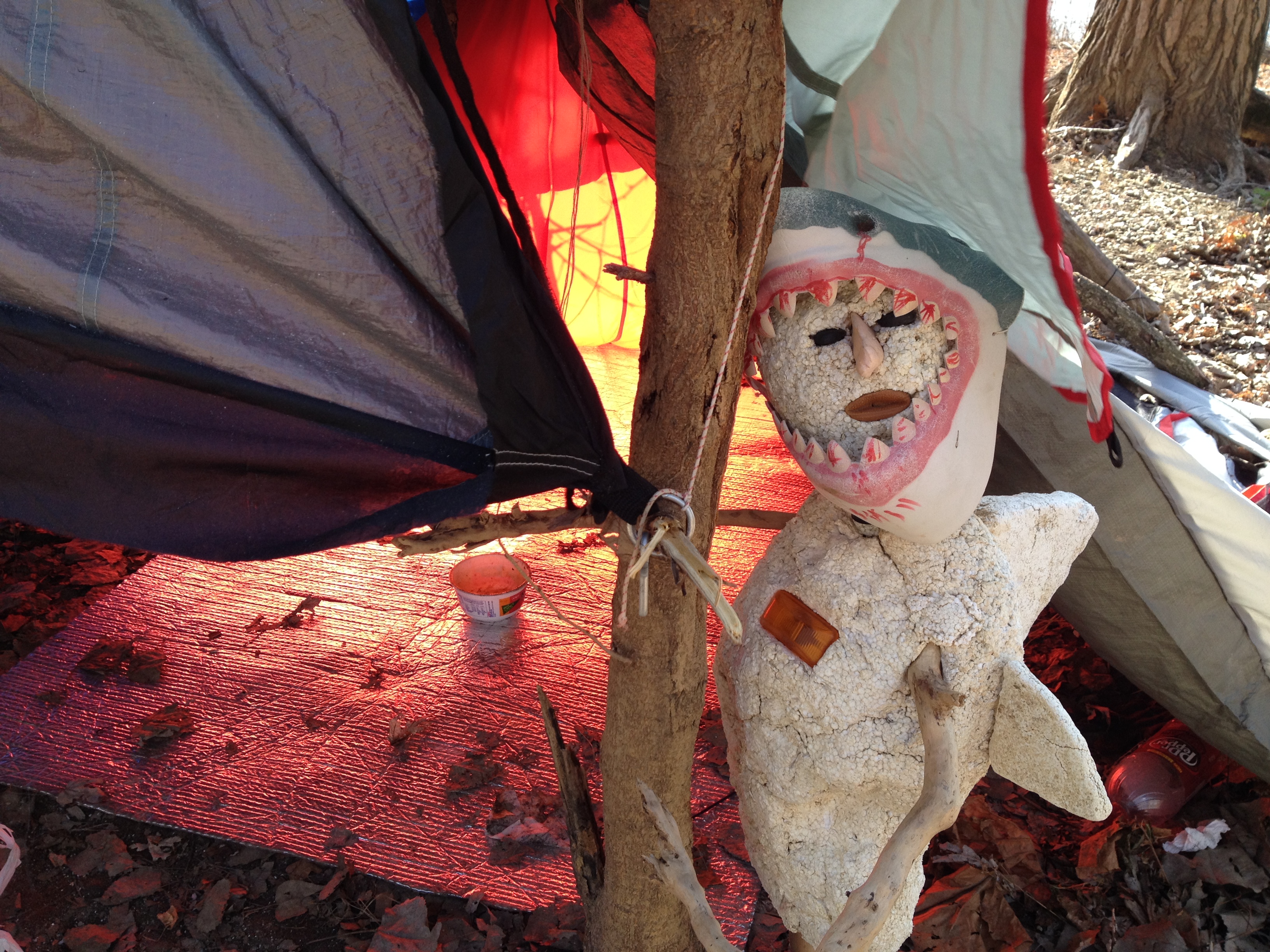
Shark Shepard by improvised tent, Falls of the Ohio, Dec. 2014

The Shark Shepherd seemed to have a curiosity about our world.  I observed as he approached an improvised tent that someone had set up among the trees.  It’s owner(s), however, were not around, but it didn’t seem abandoned in my eyes.  Probably made by fishermen and there seemed to be several trying their luck along the riverbank on this windy day.  I too have a curiosity about the world and after my encounter with the Shark Shepherd ended…I rushed home to try to figure out what he was doing here so far from the sea?  Using the miracle of the internet, I learned a few alarming facts about shark disappearances worldwide.

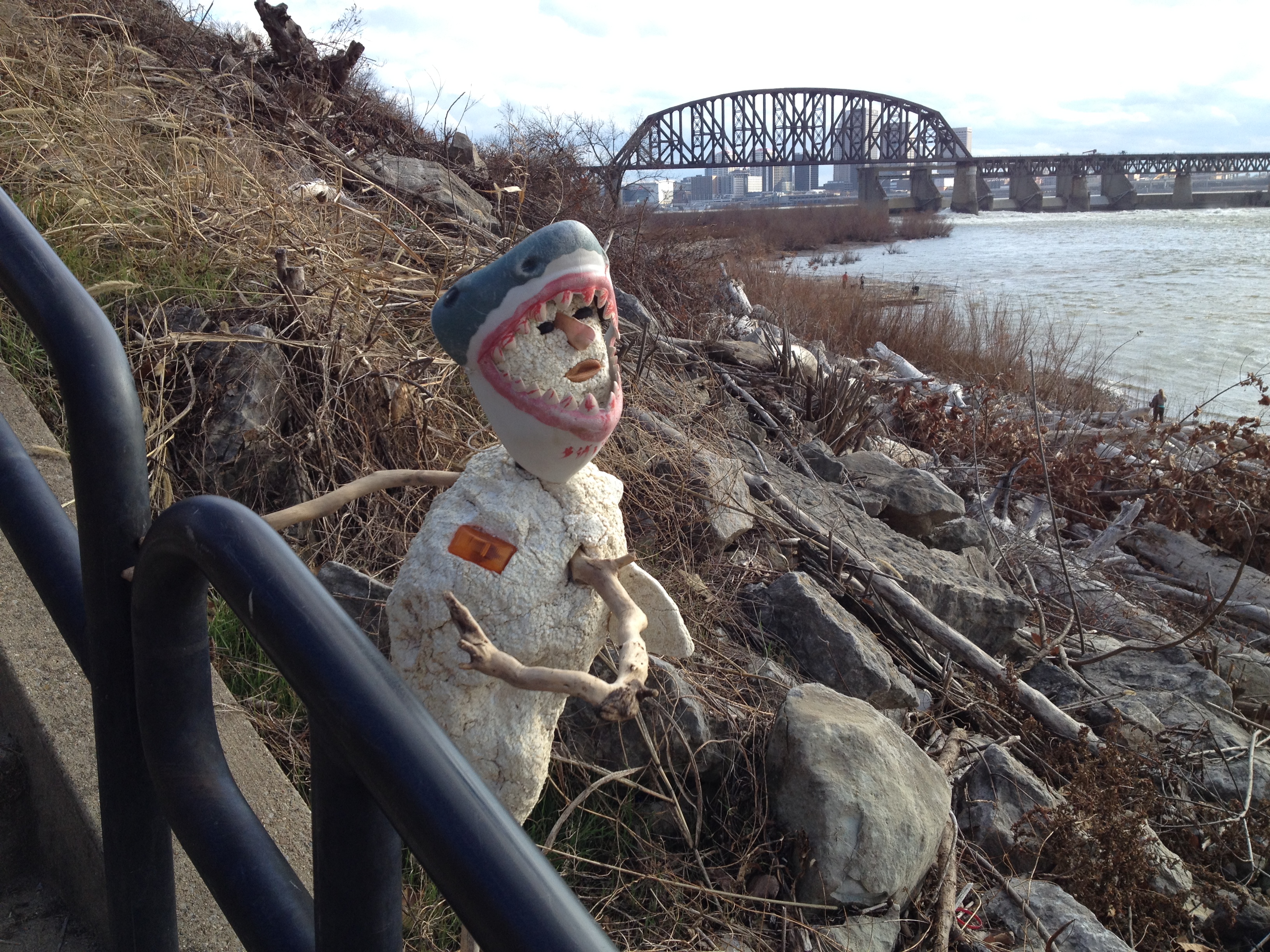
The Shark Shepherd by fossil rocks, Falls of the Ohio, Dec. 2014

On average, between 20 million to 73 million sharks a year are taken out of marine ecosystems across the planet.  Most of the statistics mentioned the higher number…regardless, that’s too many sharks.  Sharks are “harvested” for their fins, cartilage, and teeth.  The boom in popularity for shark fin soup has led to an insidious practice where millions of sharks are harvested and often indiscriminately by using thousands of hooks set on miles of trailing “longlines”.  Sharks are a valuable bycatch.  The captured sharks (which are often caught alive) have their fins cut off and are frequently thrown back into the seas to die in agony.  It’s a lucrative business because this was once a delicacy and status symbol reserved for the wealthy back in the day when sharks were harder and more challenging to catch. Now it is within the reach of more people.  Through industrialized commercial fishing, millions of mostly Asian consumers can have a bowl of shark fin soup on special occasions.  Interestingly, the soup itself needs to be flavored with beef or chicken stock because the fins themselves are a textural element and contribute no flavor of their own.  Of course, a bowl of soup is not the only challenge sharks face.  Commercial sports fishing, pollution, reef destruction, and overfishing of the shark’s prey base play their part as well.

The Shark Shepherd at the Falls of the Ohio State Park, Dec. 2014

In the United States, large sharks have disappeared from the Gulf of Mexico.  I think this is the reason the Shark Shepherd was this far inland.  Along our Atlantic Coast, it has been reported that eleven of the largest shark species have essentially vanished.  This has important repercussions for the overall marine environment.  You can’t remove this many apex predators from an ecosystem and expect it to function normally.  There are cascading effects.  A recent study attributes the decline in our East Coast scallop industry is due to the loss of sharks that normally would keep cownosed rays and sting rays who eat scallops in check.

Shark Shepherd by the Falls of the Ohio Interpretive Center, Dec. 2014

I followed the Shark Shepherd as he explored the area around the newly closed Interpretive Center.  There were people around and they did exhibit interest in my friend, but were generally respectful for what was going on.  A few folks asked if they could take pictures of the Shark Shepherd and he obliged them.  During my internet research, I did find it fascinating that there are places like American Samoa, Hawaii, Guam, and the island nation of Palau where sharks are protected.  Interestingly, these are all places in the Pacific Ocean where people regard the shark as a culturally and spiritually significant animal.  These Polynesian cultures understand that their very identities are connected with sharks.  The same, however, can’t be said for the rest of the world who regard sharks as nuisances and or threats.  Better to view something with reverence than through fear.

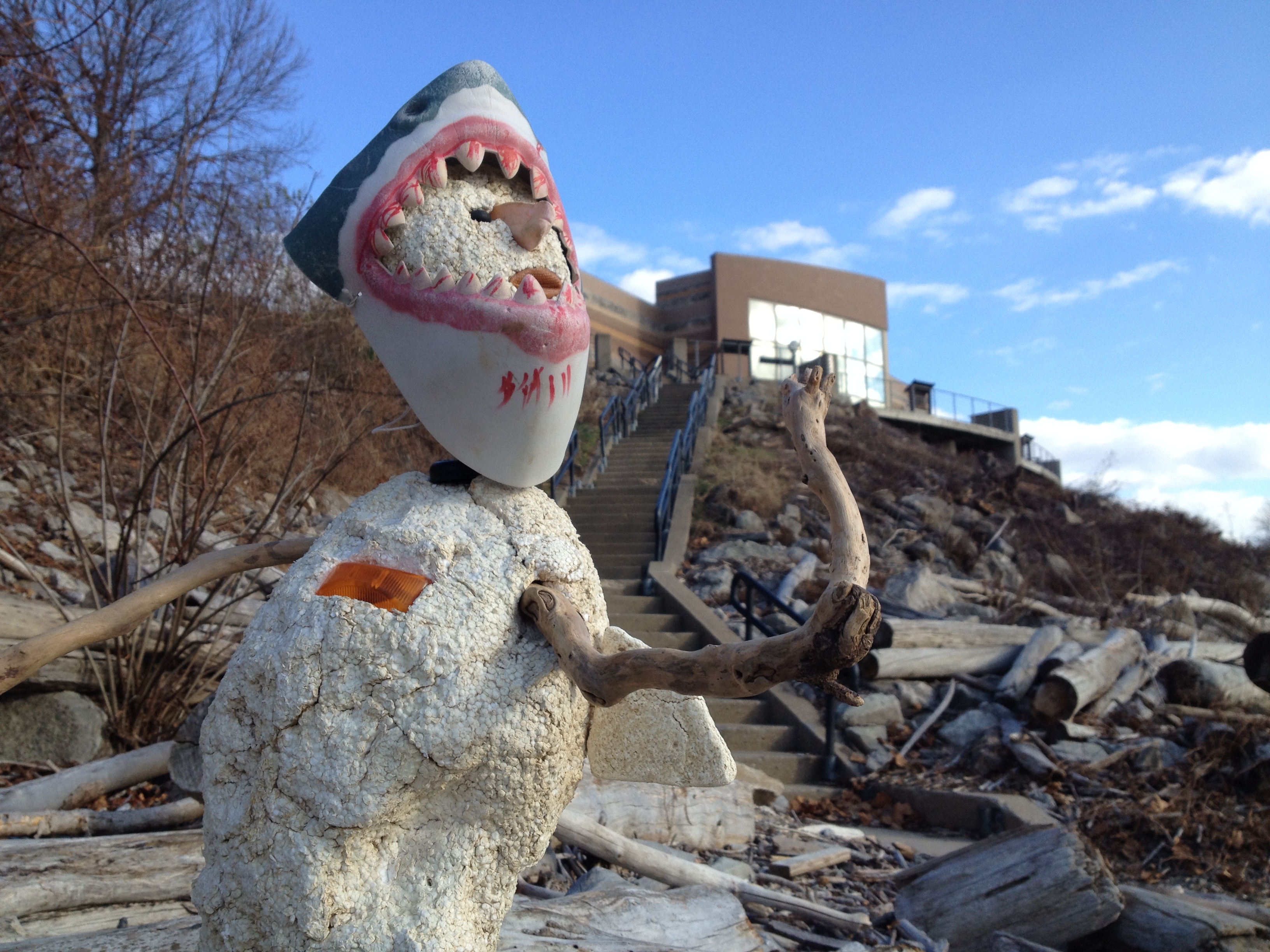
The Shark Shepherd surveys the Falls of the Ohio State Park, Dec. 2014

The Shark Shepherd climbed the staircase to gain a better vantage point overlooking the river.  I watched him scan the waters, but only an occasional fishing boat presented itself.  If he was looking for sharks, well, there probably hasn’t been any here for about 400 million years when this area was a Devonian Age coral reef.  I could feel the poignancy of the Shark Shepherd’s search as it failed to bear fruit.  After a short while, we reversed our course and retraced our steps.  The Shark Shepherd gathered his staff and walked back into the creek where after acknowledging me with one last look back…disappeared into the Ohio River.  Although I realized that I would not see him again, I couldn’t help but hope that he and his sharks wouldn’t disappear forever from the oceans of the world.

The Shark Shepherd, Falls of the Ohio, Dec. 2014

Read Full Post »

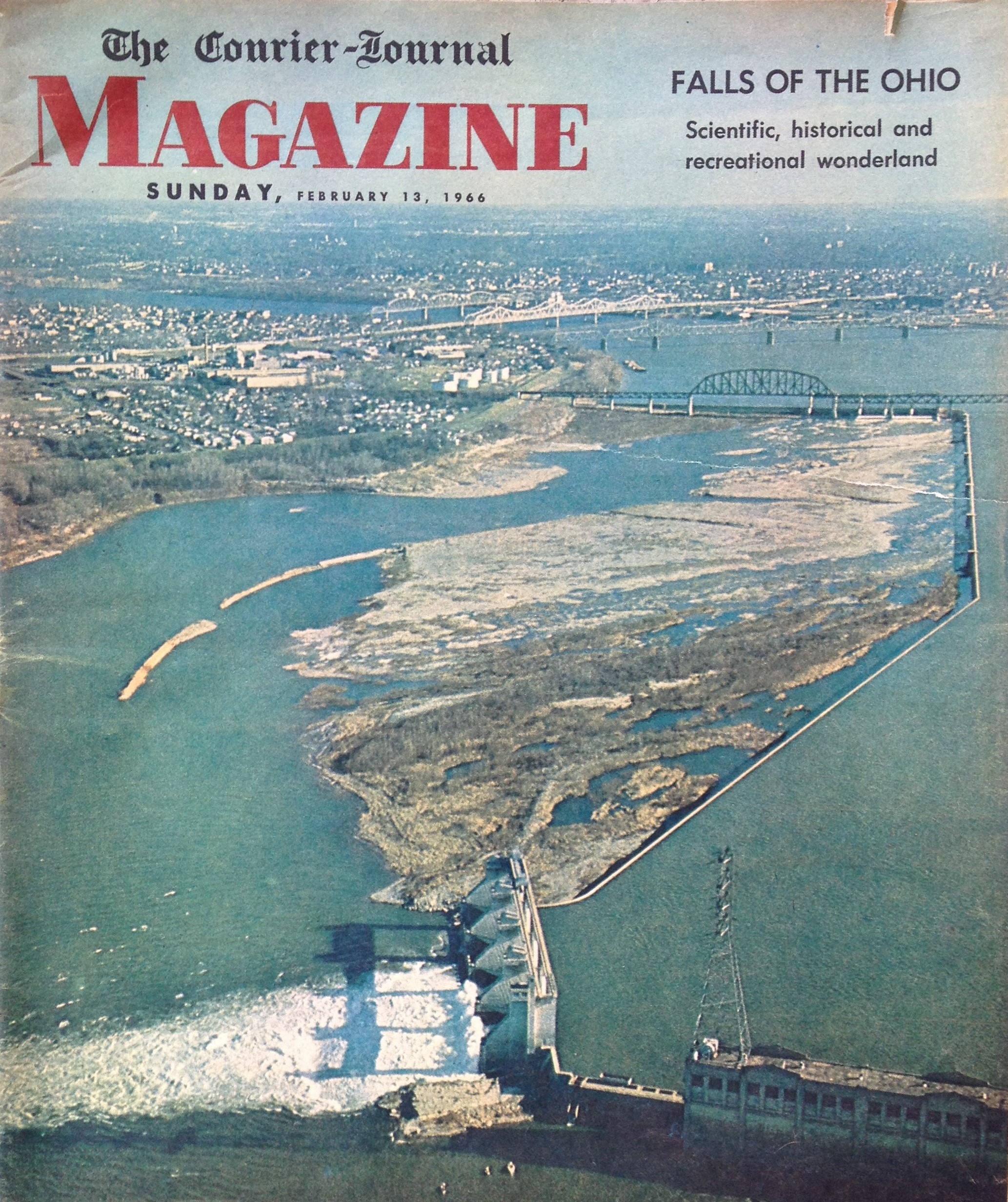
Falls of the Ohio article, Courier-Journal Magazine cover, Feb. 13, 1966

On the occasion of my 400th riverblog post I thought I would try something a little different.  I’m thinking that reaching a personal blogging milestone is worthy of some observance .  It took me a little more than five years, 399 posts of original content, over 4000 published images, nearly 2500 comments, and deleting more than 30,000 blocked spam requests, etc… before I filled all the free space on my original WordPress blog.  I finally had to lay down some coin in order to purchase additional storage space to continue.  For me, this has been more than a great bargain.  When I originally began posting about my trips to the Falls of the Ohio, I had no idea of how much it would shape me as an artist, but without a doubt, it has.  I now view this blog as being more than just a vehicle for publishing the things I’ve made and experienced and has become a medium in its own right.  To everybody who has participated either at the river or by visiting and commenting…the Artist at Exit 0 thanks you!!  And now, from the intersection of nature and culture…on with the show.

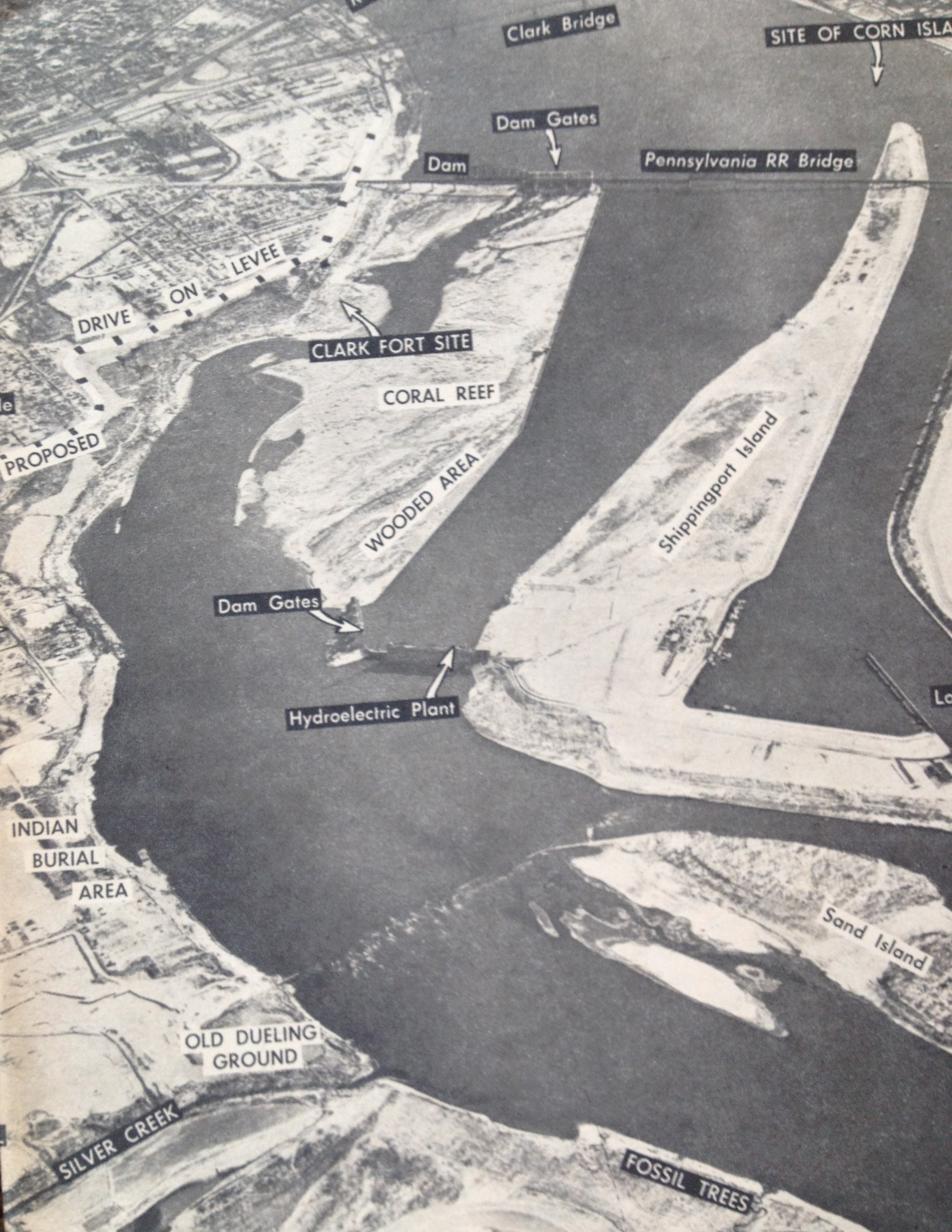
Aerial view of the Falls of the Ohio, Courier-Journal magazine article 1966

One of my best friends gifted me this extensive article about the Falls of the Ohio dating back to 1966 that originally appeared in The Courier-Journal’s Sunday Magazine.  The C-J is published in Louisville and for a time was one of the best newspapers in the country winning many Pulitzer Prizes for its original reporting.  Like many fine newspapers across the land it is no longer locally owned and is a shadow of its former self.  Still, it survives and dutifully arrives at the doorstep of its subscribers seven days a week minus the Sunday magazine feature.  I was really fascinated by this article because it predates the Falls of the Ohio as an Indiana state park by many years.  I was surprised to see an area on the lower right of the aerial view labeled “Fossil Trees”.  This was the first reference to this I had come across.  Supposedly, this area is composed of slate containing the fossilized remains of Carboniferous trees.  It occurred to me that there was a lot about the northern bank I did not know about and decided to go exploring outside my usual confines.

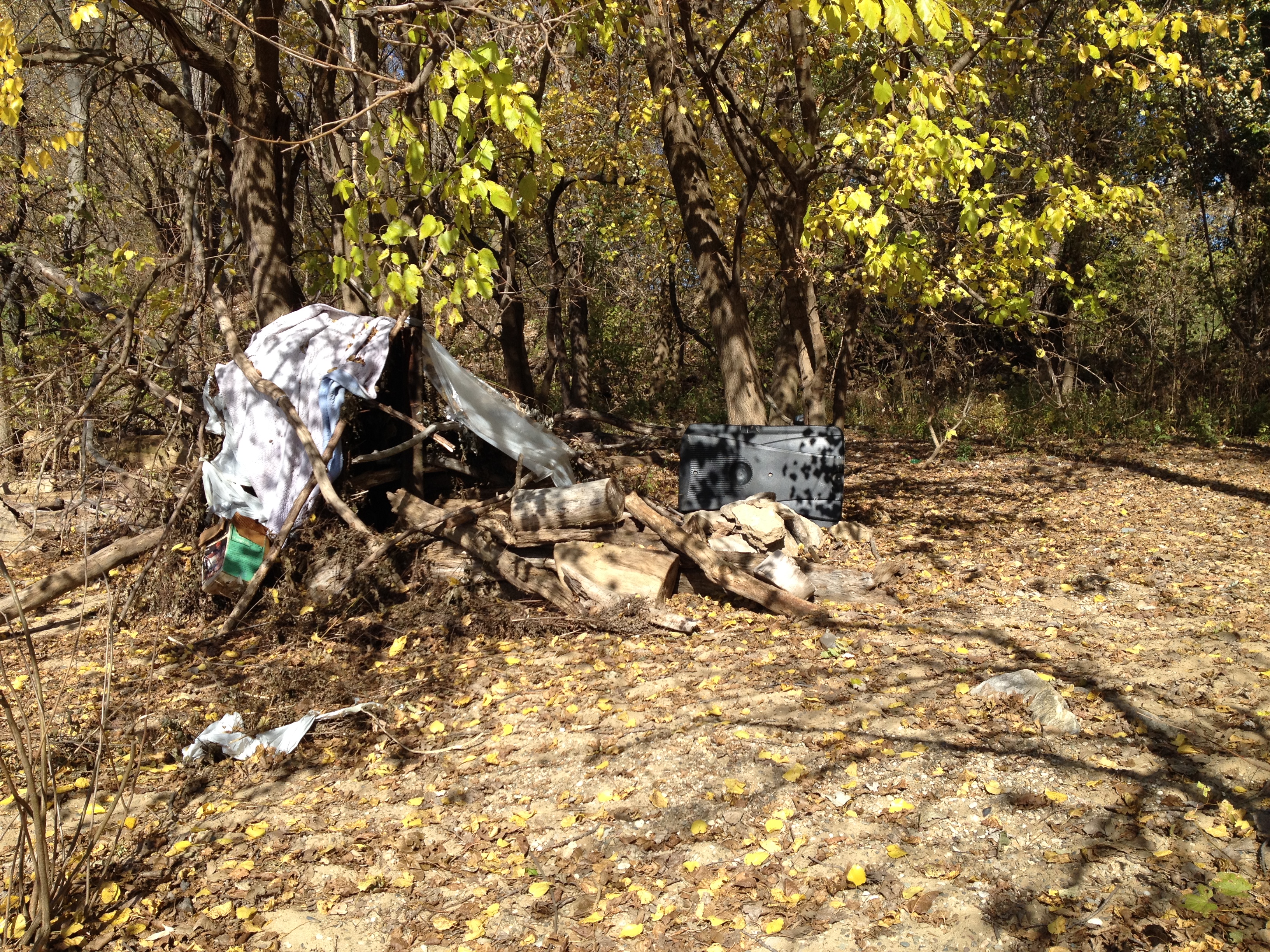
Improvised shelter at the Falls of the Ohio, Nov. 2014

I walked past the Woodland Loop Trail and heading west by hugging the riverbank.  Along the way, I came across this  makeshift and abandoned shelter created from found plastic and a quilted mover’s blanket.  The remains of a small campfire marked where someone sought temporary refuge here.  On more than one occasion I have come across folks in the park that are down on their luck and camp out here during the better weather months.

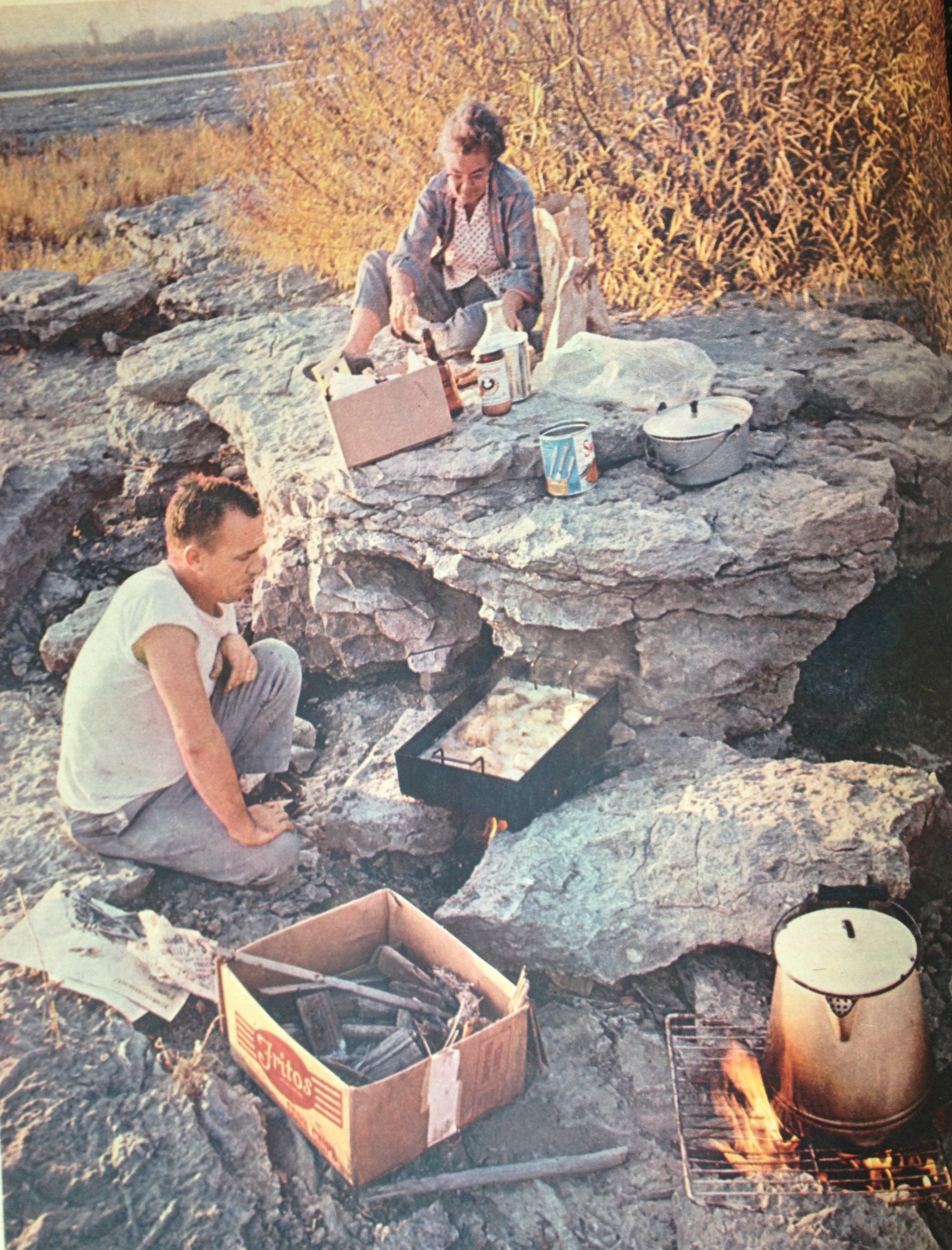
Photo from 1966 Courier-Journal article

As the magazine article from 1966 shows…people have been camping out and utilizing the abundant driftwood resources for a long time.  I have to admit, in all my years of coming out here, I haven’t seen anyone enjoying a fish fry like this.  That was 48 years a go, but seems more remote to me than that.  Among the many changes here, it is recommended that you limit your consumption of the local fish.

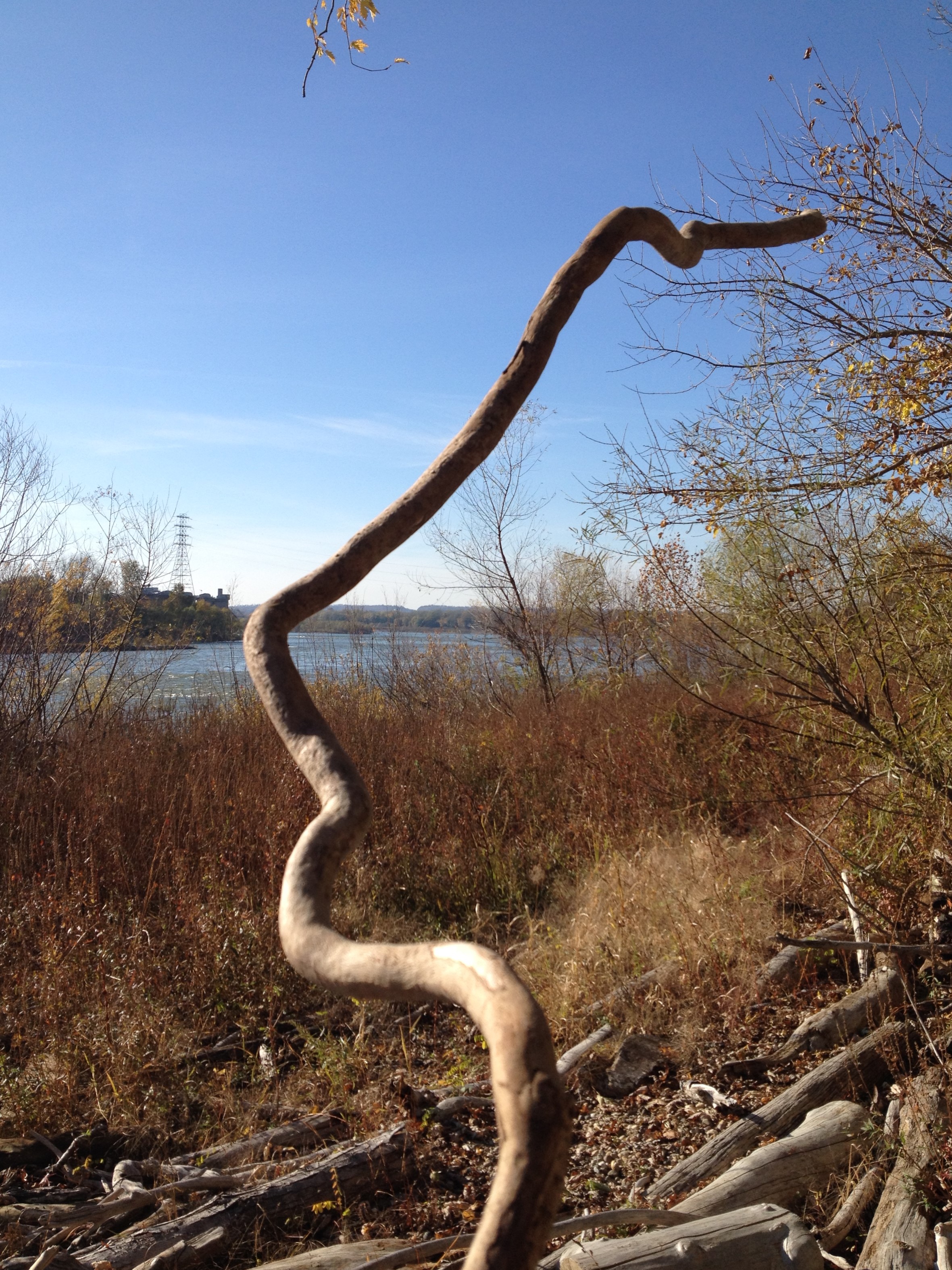
meandering length of driftwood, Nov. 2014Such a beautiful sun-shiny day and unseasonably warm too.  As I write this our first snowfall of the year lies on the ground.  Another article in last week’s paper caught my attention.  Apparently, this past October was the warmest October in the last fifty years and the fourth warmest ever recorded.  As I meander back and forth along the riverbank, it’s odd bits of trivia that come to mind.  I remember that I was living in Ft. Knox in 1966 and having a great time in Mrs. Songster’s third grade class at Van Vorris Elementary School.  Back then, my nature experiences were shaped by stalking the woods and creeks on this extensive military reservation.

Falls of the Ohio, Louisville in the distance, Nov 2014

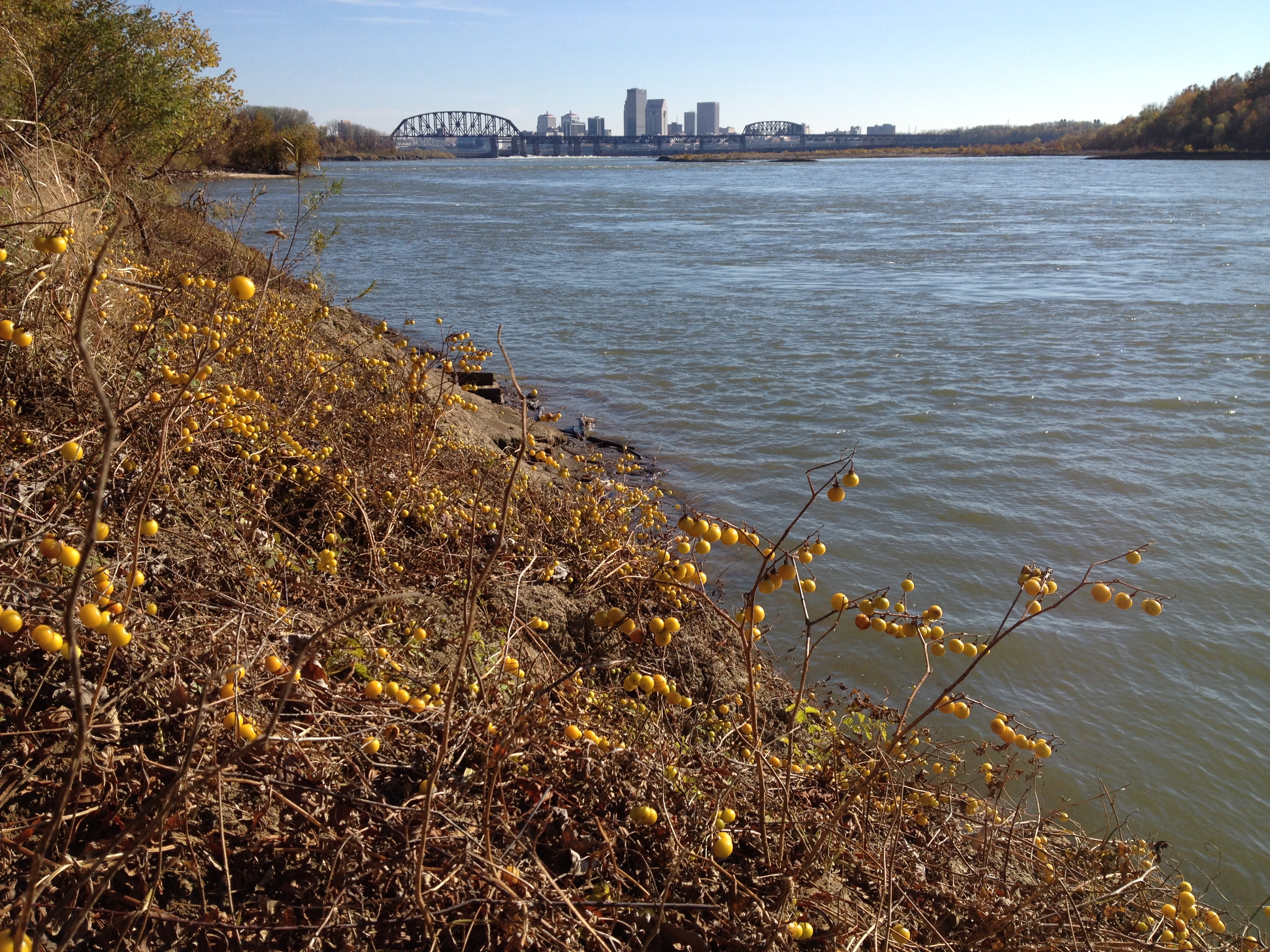
As I kept walking westward, I would come across sections of the riverbank enlivened by the bright yellow fruit from the horse nettle plant.  These cherry tomato sized marbles look tempting, but they are highly poisonous.  I came across places on my hike where there were thousands of these fruits ripening.  I have always liked this view with the skyline of Louisville hanging on the horizon.  The city with its tall buildings looks diminutive and fragile balancing on the edge between the sky and water.

Falls of the Ohio, Tainter Gates in the background, Nov. 2014

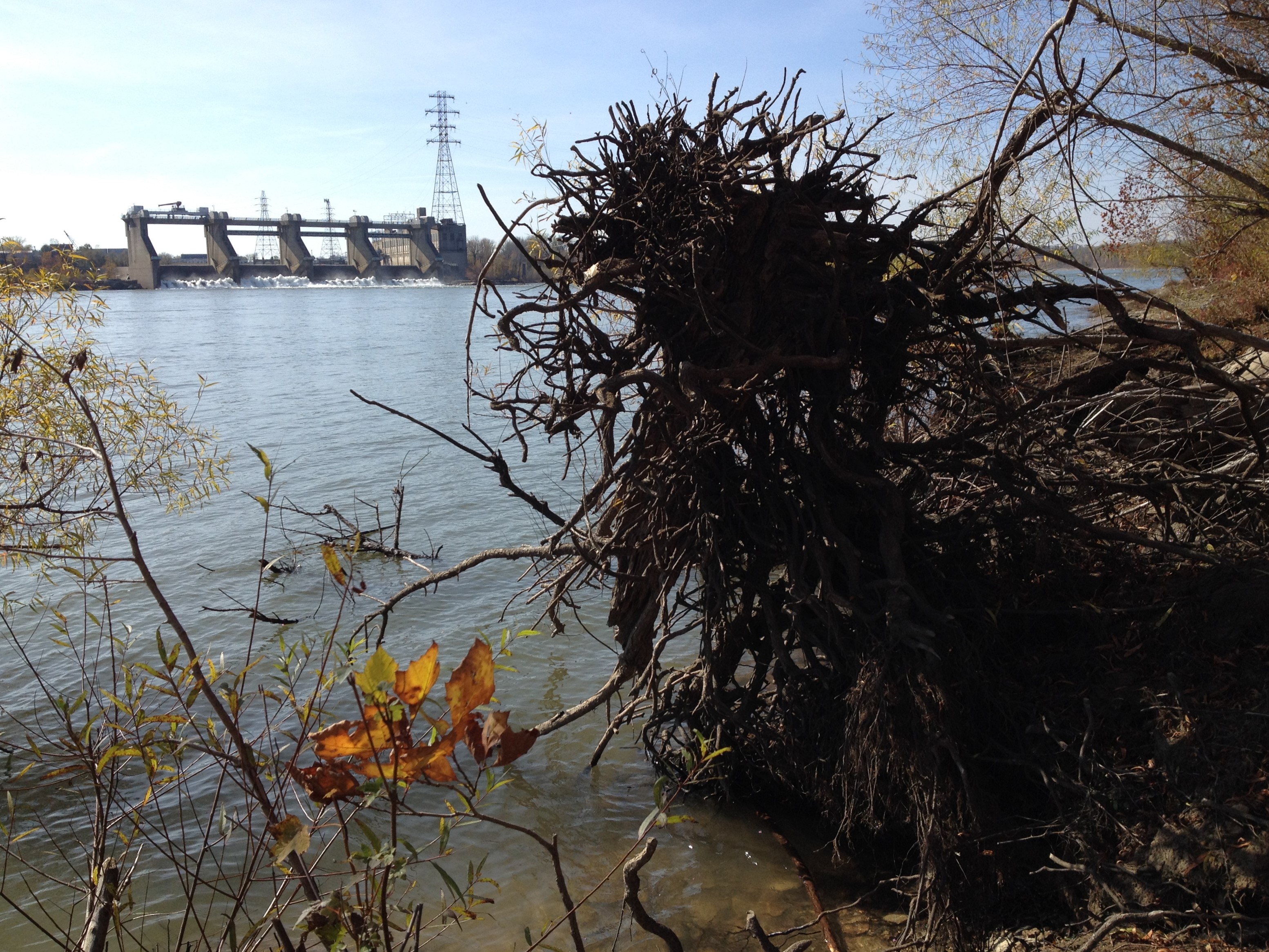
The blackened root mass from a downed willow tree has an almost menacing presence on the riverbank.  A few turtles slide off logs into the water.  Goose Island and the Lower Tainter Gates are across the way.  I realize that this is the furthest west I have ever walked on this side of the river.  Previously, I have always limited my activities to the park proper.  Although I don’t see any signage demarcating boundaries, I am assuming that I’m now on private property?

Large house on the Indiana side of the Ohio River, Nov. 2014

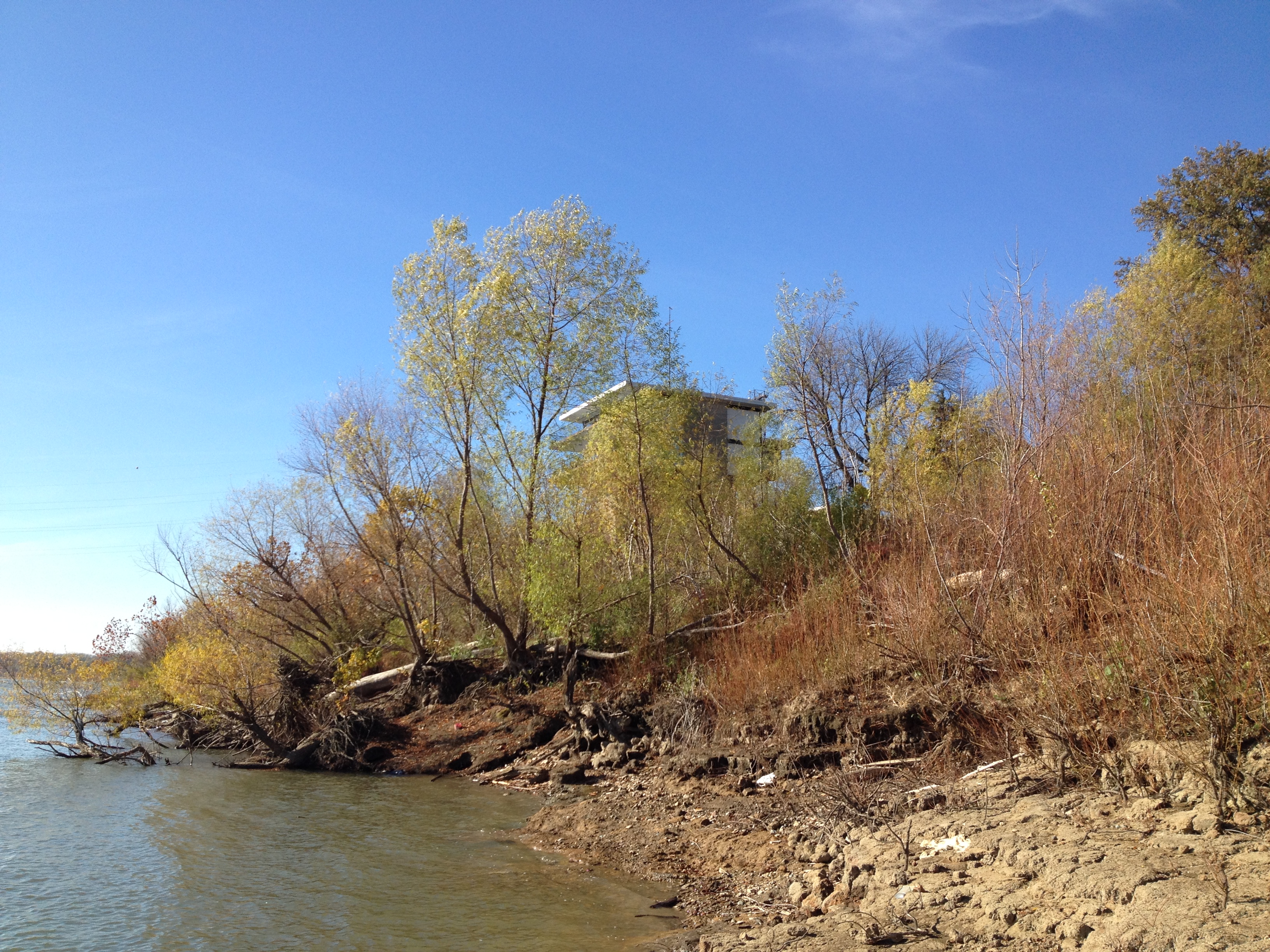
I come across some wonderful homes that must command spectacular views of the river.   A couple of these dwellings sport their own boat ramps.  I stay nearest to the water and respectively move my way through.  Nobody challenges me and I keep moving forward.  I know there is an area up ahead that is administered by the Falls of the Ohio State Park.  After all these many years, it feels good to have other places associated with this special place to explore.

boat ramp near George Rogers Clark cabin site, Nov. 2014

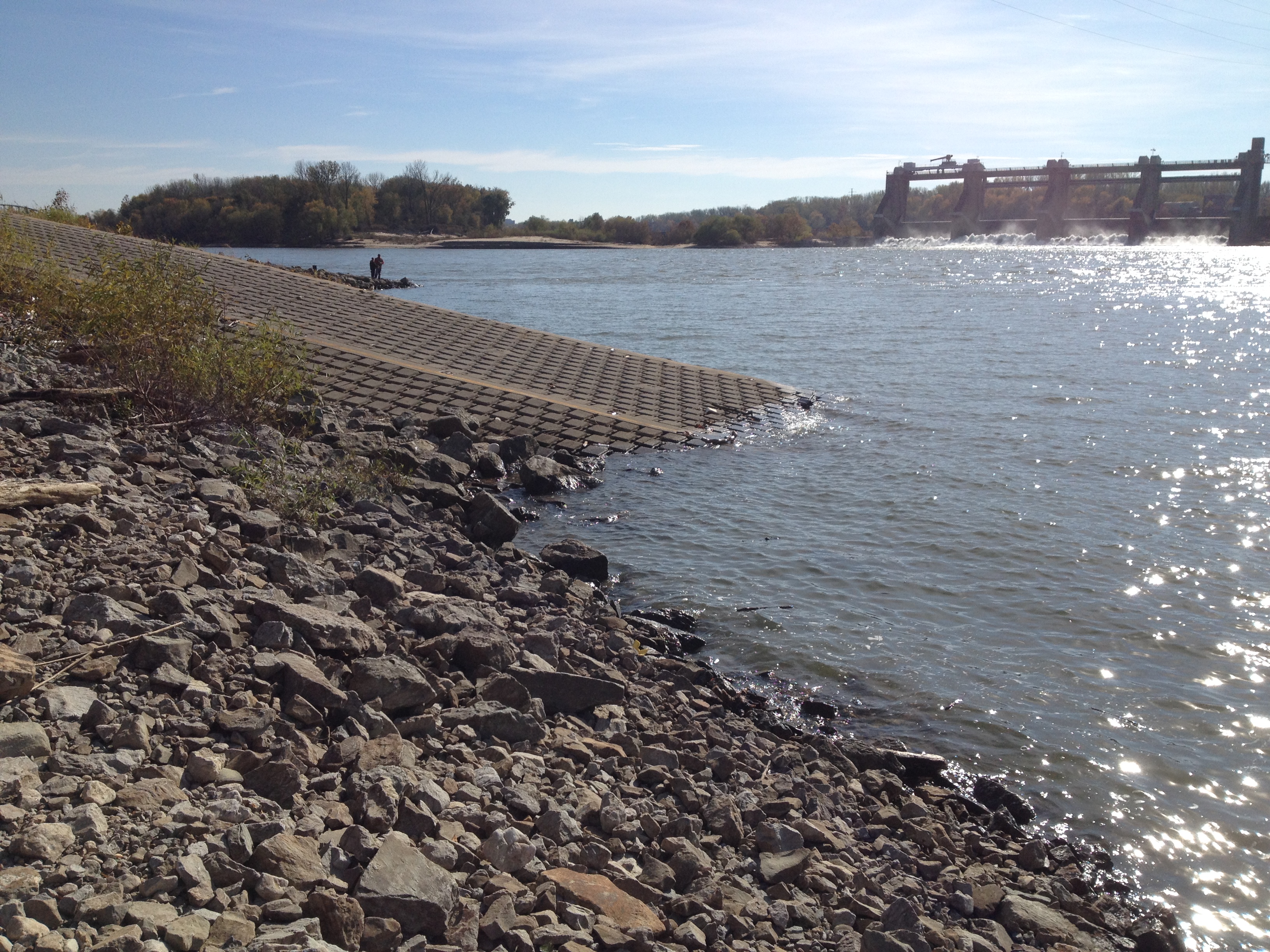
After a leisurely walk lasting several hours I reach the boat launch area by the George Rogers Clark home site.  The famous hero of the Revolutionary War and founder of Louisville and Clarksville, retired to a small cabin that overlooked the river.  This boat ramp is right across the river from the Lower Tainter Gates and Hydroelectric Plant and gets lots of traffic from fishermen.  I decide that the areas I want to explore are still a long walk away and I modify my plans.  If I want to reach the spot where the fossilized tree remains are found, I probably should park my car near the ramp and walk westward from here.  For the time being I feel satisfied and retrace my steps back to the Falls of the Ohio State Park.

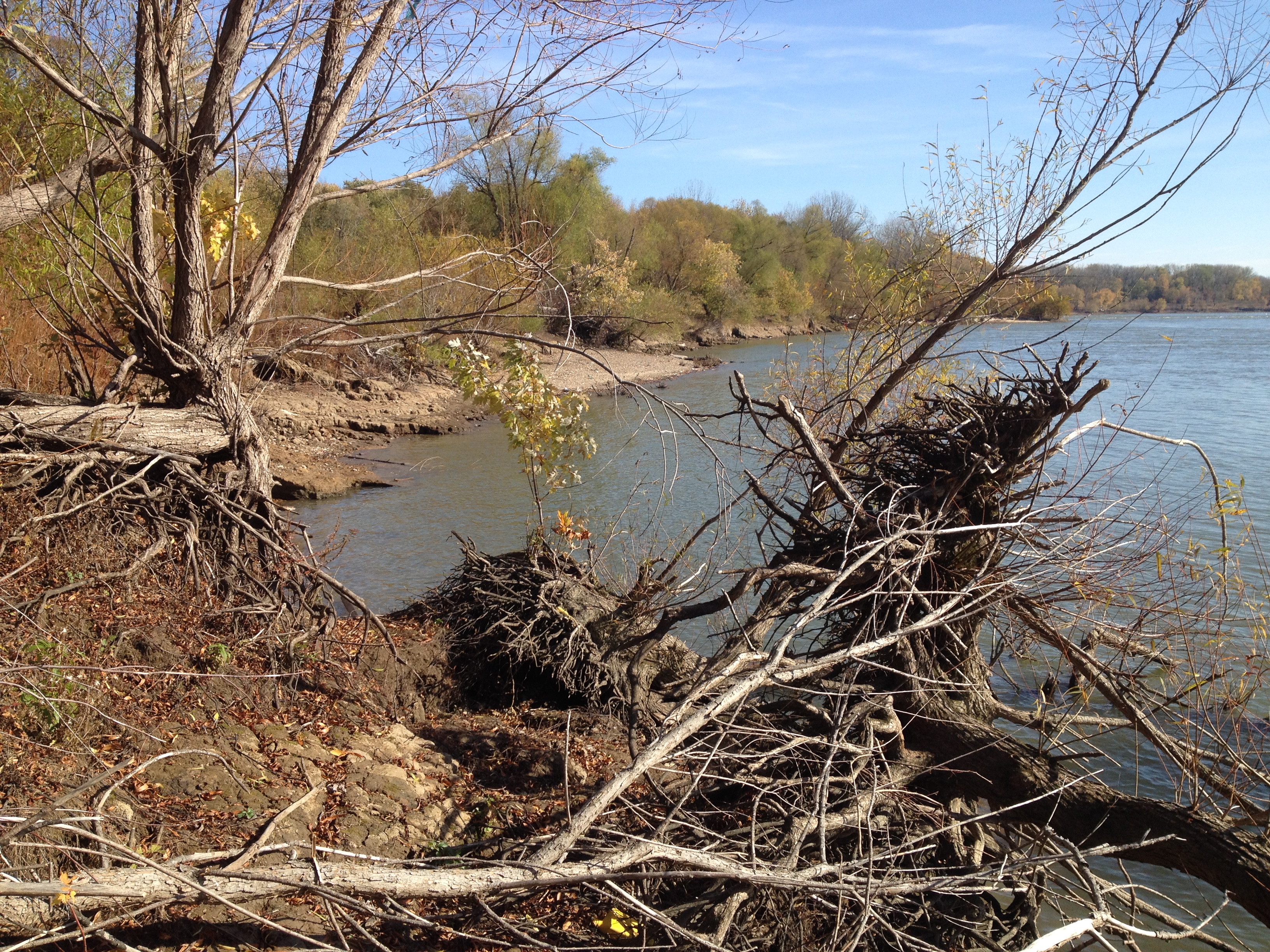
riverbank view by the Falls of the Ohio State Park, Nov. 2014

The walk back is gorgeous.  On the return trip I collect lots of beaver-chewed willow sticks and a nice length of barge cable.  I will use these materials to make something.  Happily, I can report that I did not find nearly as much trash along this walk.  I did, however, make one small project from found materials and here it is.

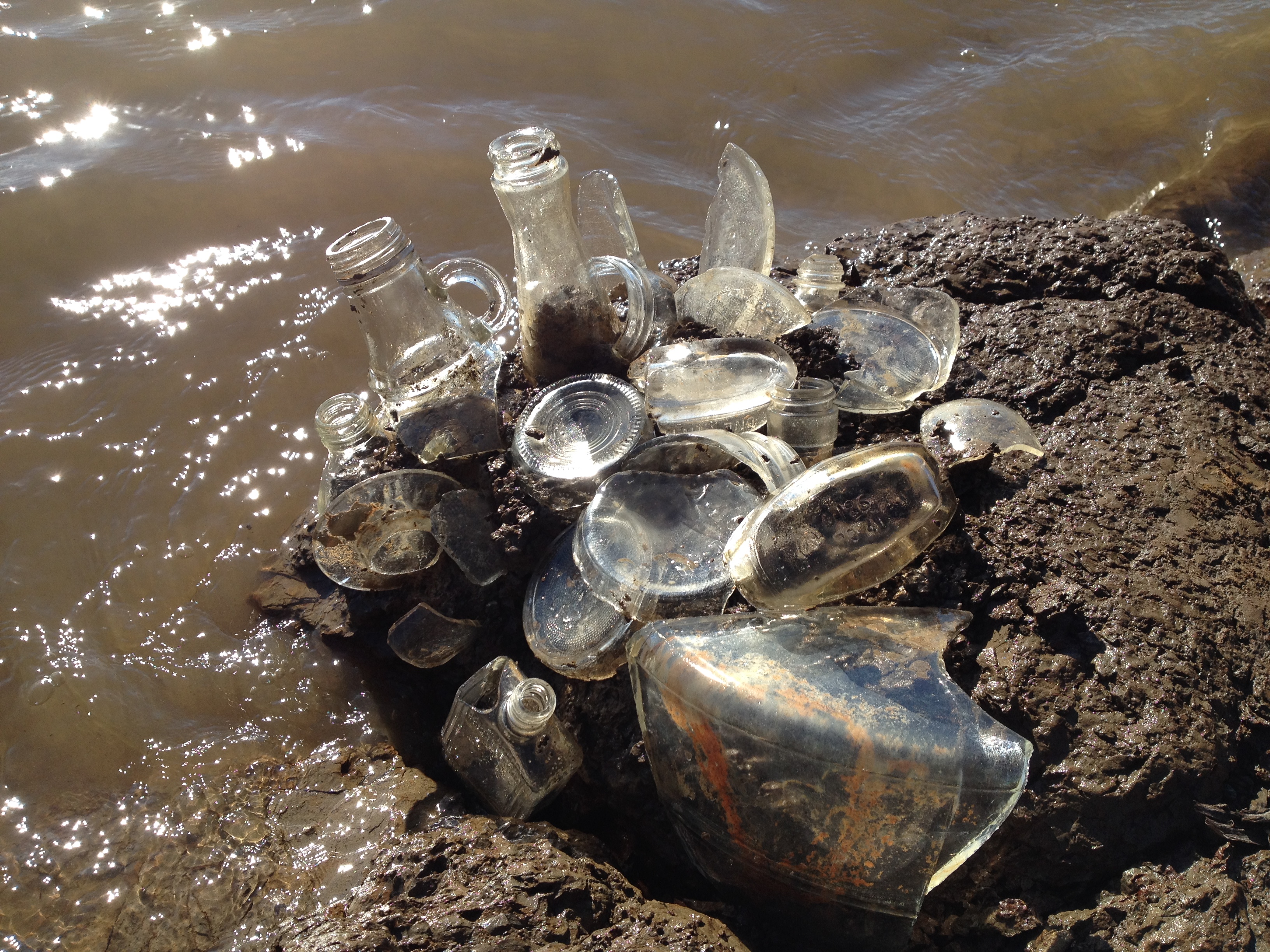
clear bottle glass assemblage, Falls of the Ohio, Nov. 2014

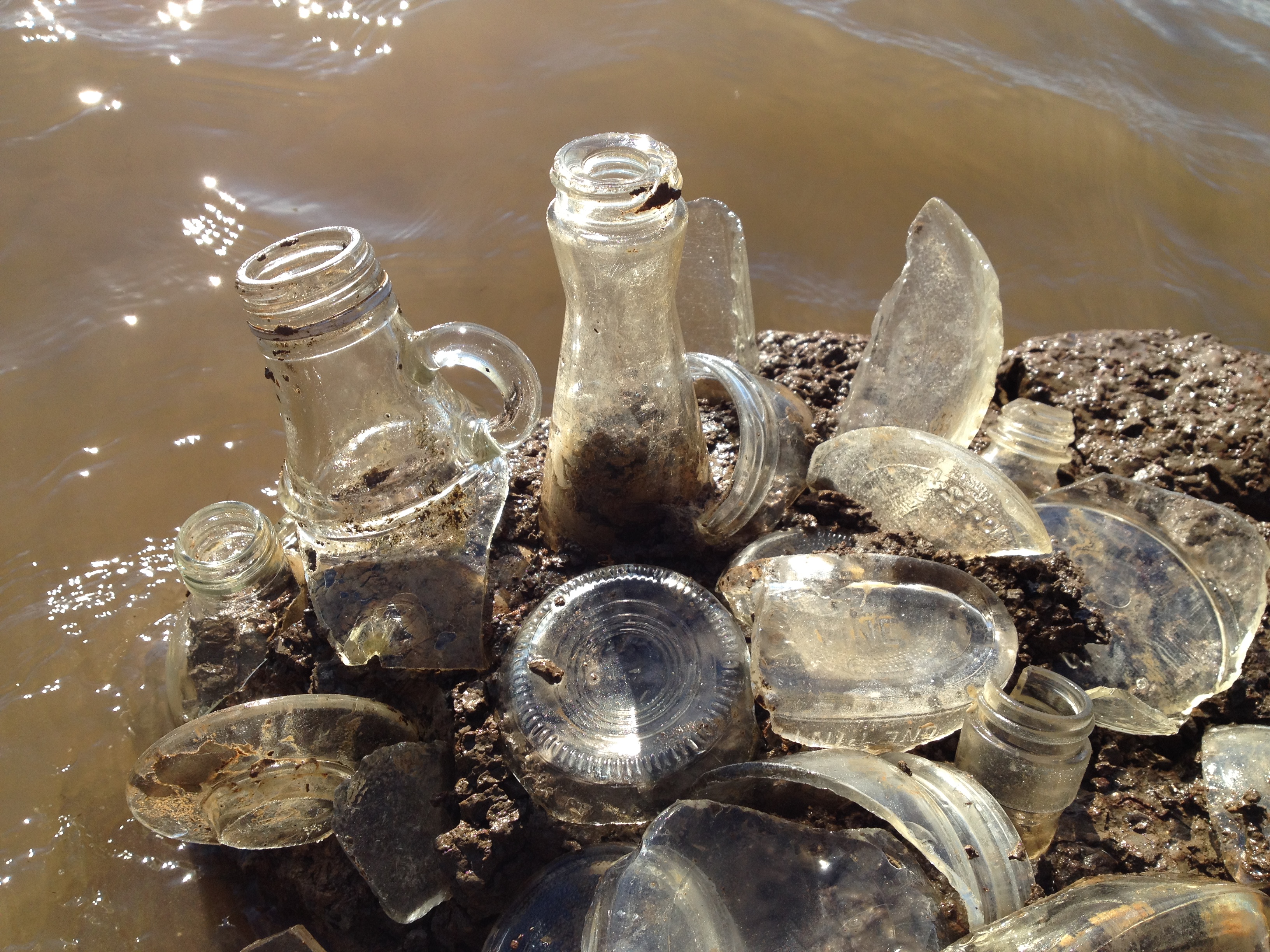
detail, clear bottle glass assemblage, Falls of the Ohio, Nov. 2014

I found all this clear bottle glass lying in close proximity and created this small assemblage on the mud.  I made this to enjoy the play of light through the glass as well as appreciate the highlights on the water.  This piece consisted mostly of bottlenecks and bottle bottoms which are the strongest parts of a glass bottle.  I wondered what if some archeologist in the future found this assemblage…would they think it had any aesthetic reason for being or could this be part of some unknown ritual?  This area along the Ohio River has been in constant habitation for thousands of years and the bottle pieces are now a part of that record.  My concept of art has greatly expanded since my student days.  On the back page of this 1966 magazine I find an amusing advertisement that reminds me of how far I’ve traveled from the traditional practice!  I guess being your own art teacher involves nude women?  If only my art education had cost a mere $6.00 dollars a month.  For better or for worse, who knows where I would be now?

Back page ad, Courier-Journal Magazine, Feb. 13, 1966


Read Full Post »

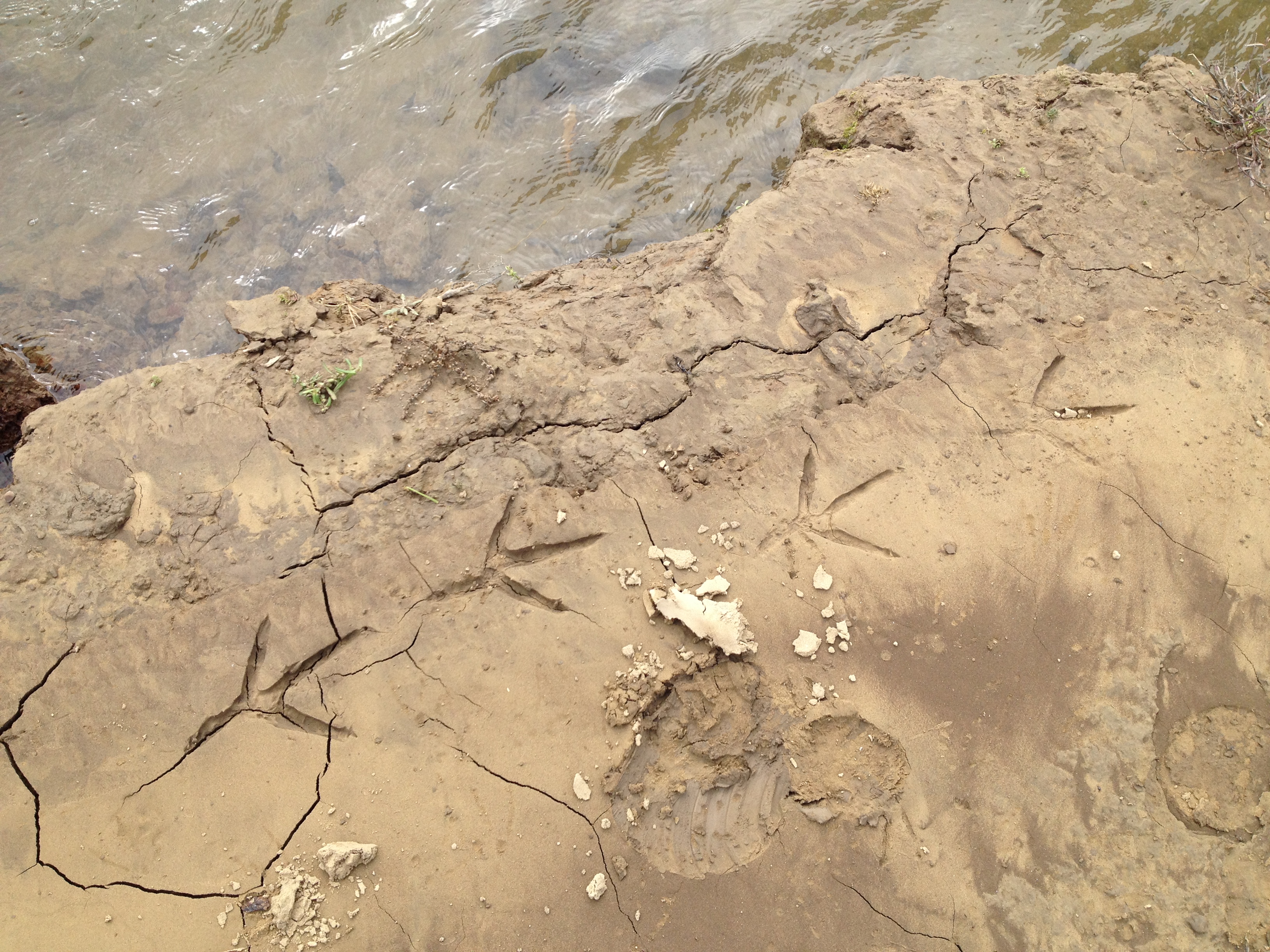
Great Blue Heron tracks in the mud, Falls of the Ohio, Oct. 2014

What began overcast and dreary blossomed into a gorgeous, sun-filled autumn day.  The exposed fossil beds by the Upper Tainter Gates are now covered by water rushing at break neck speed.  The Ohio River has once again reclaimed its ancient limestone bed with man’s help.  The Falls of the Ohio are like Niagara Falls which can also be regulated with the flip of a switch.  There’s a good chance that I won’t be visiting that side of the park again until next summer’s heat returns.  Today I concentrated my attention and energy along the riverbank under the Conrail Railroad Bridge.  This is an area where I have had good luck finding materials to work with and many of my best bird sightings have also occurred here.  The autumnal migration is under way.  Many of the birds that had passed this way going north in the spring are now moving south towards wintering grounds in exotic locations in Central and South America.  I ducked under the Black willow trees whose leaves are turning bright yellow and was soon rewarded by a bird species new to me.

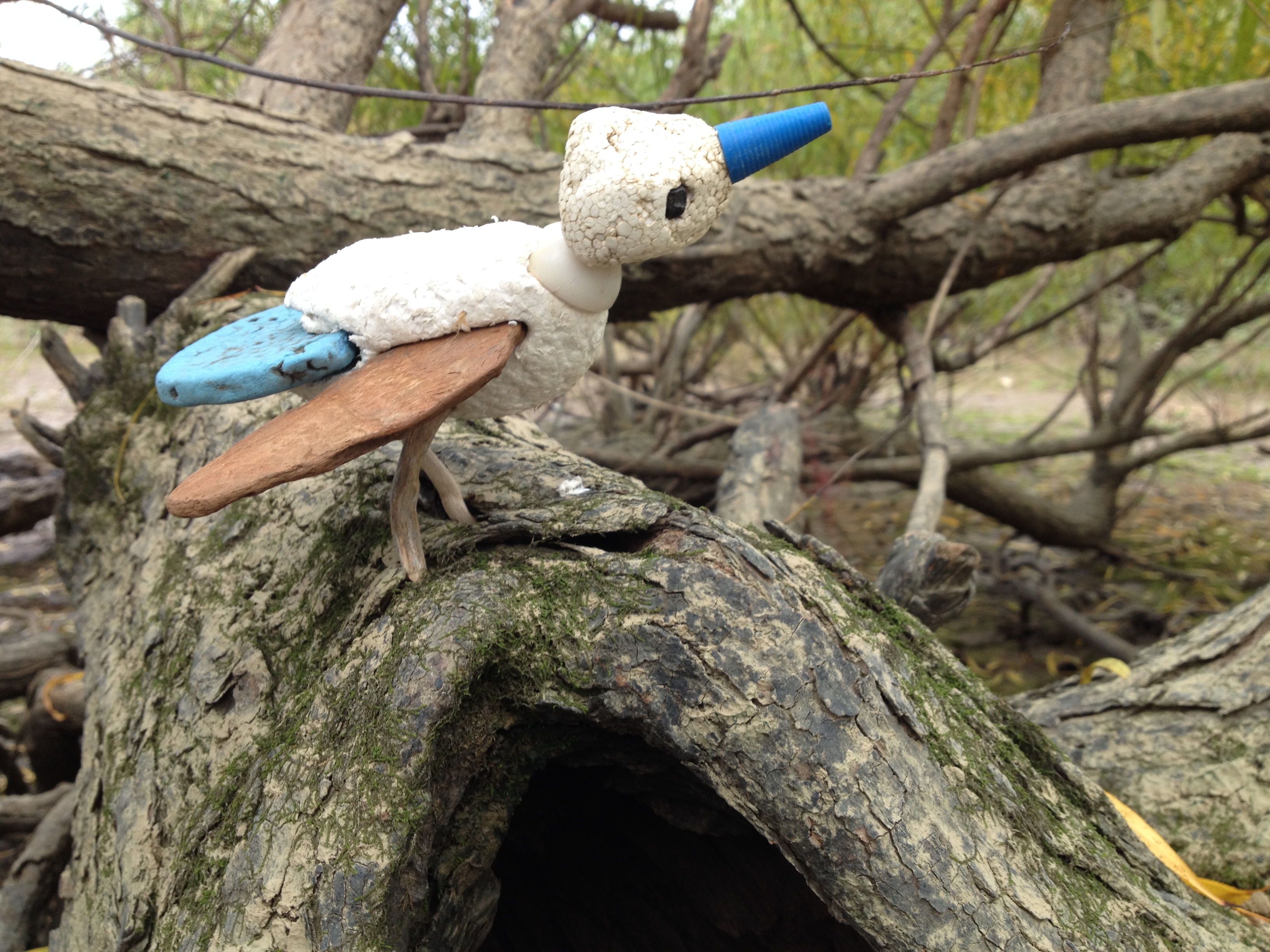
Fan-tailed Gnatcatcher, Falls of the Ohio, Oct. 2014

This is the Fan-tailed Gnatcatcher and this is the first time this species has been recorded in the park.  I had the greatest luck hiding behind the trunk of this willow and was able to observe this bird at extremely close range.  If it spotted me…it demonstrated no concern at all and continued its search for small insects and spiders hiding among the furrows in the tree’s bark.

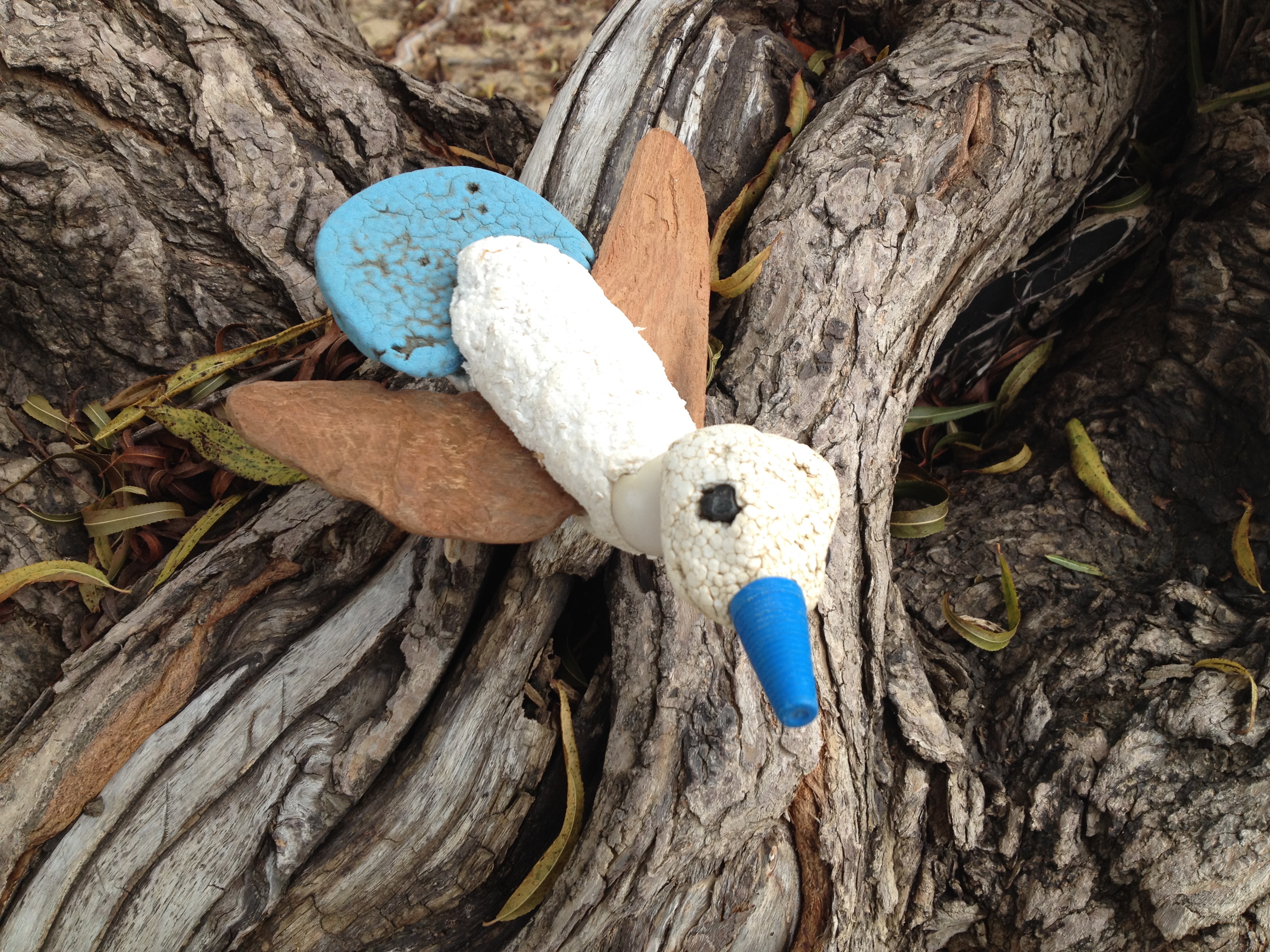
Fan-tailed Gnatcatcher, Falls of the Ohio, Oct. 2014

The Fan-tailed Gnatcatcher is a diminutive bird.  I watched as it dutifully searched the tree for food.  It had no problems going down the tree head-first in nuthatch fashion.  In this species, both the male and the females are similarly marked.  This young bird (identified by its lack of a feathered crest on it head) was just an egg a couple of months a go and has flown here from northern Canada.

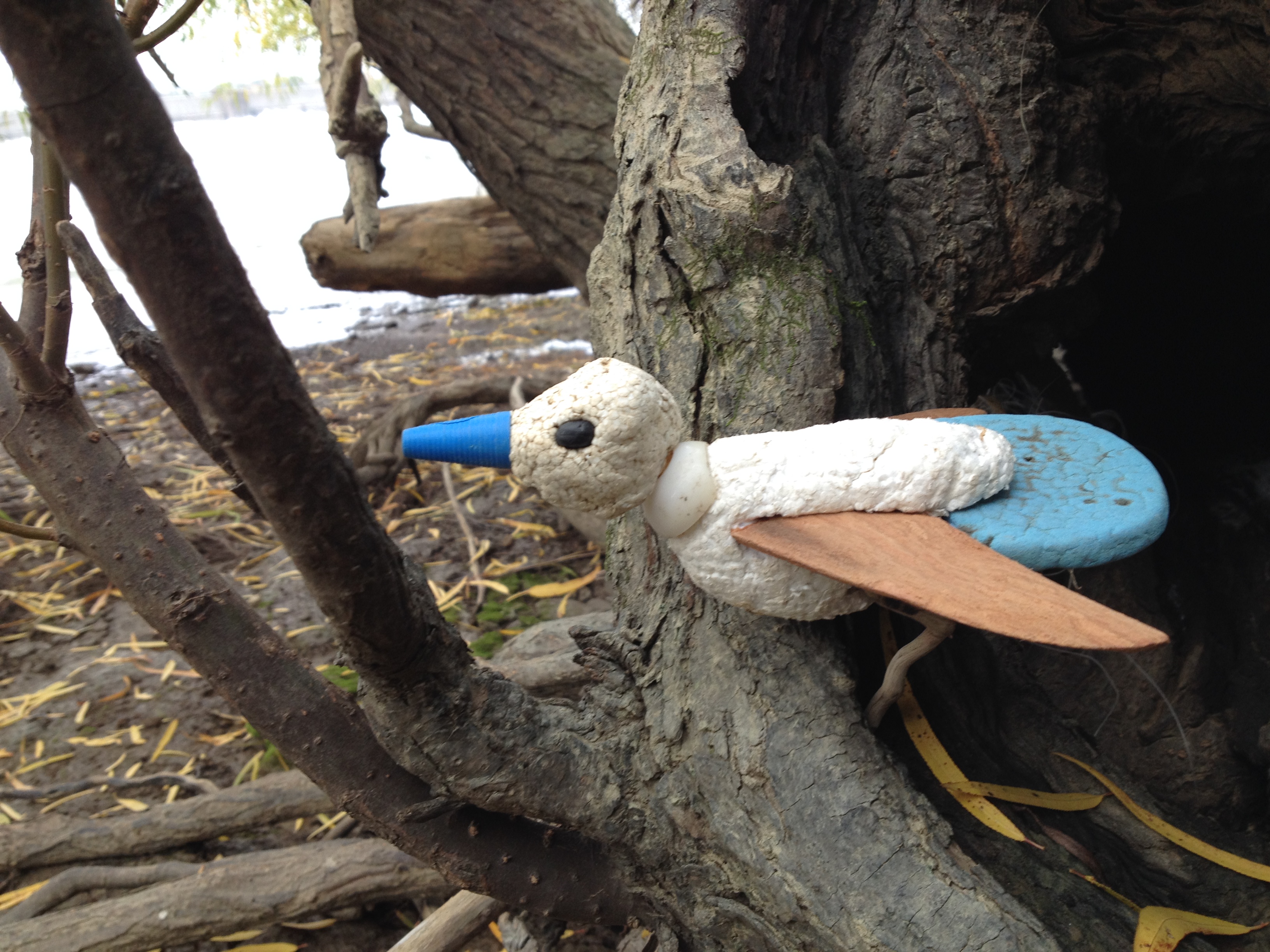
Fan-tailed Gnatcatcher, Falls of the Ohio, Oct. 2014

I was literally at arm’s length to this bird and it was a such a treat to observe something new and at close range.  I loved the coloration on this bird.  The tail feather’s blue fan is balanced by the bird’s bright blue beak.  Rusty-colored wings are set off by the arctic-white hues along the head and body.  Like many bird encounters, I was only able to observe this bird for a minute or two at the most, but it was an experience that will last a lifetime.  As it flew off…I wished the bird well on its long journey and I hoped I could count its kind again among the park’s willow trees.

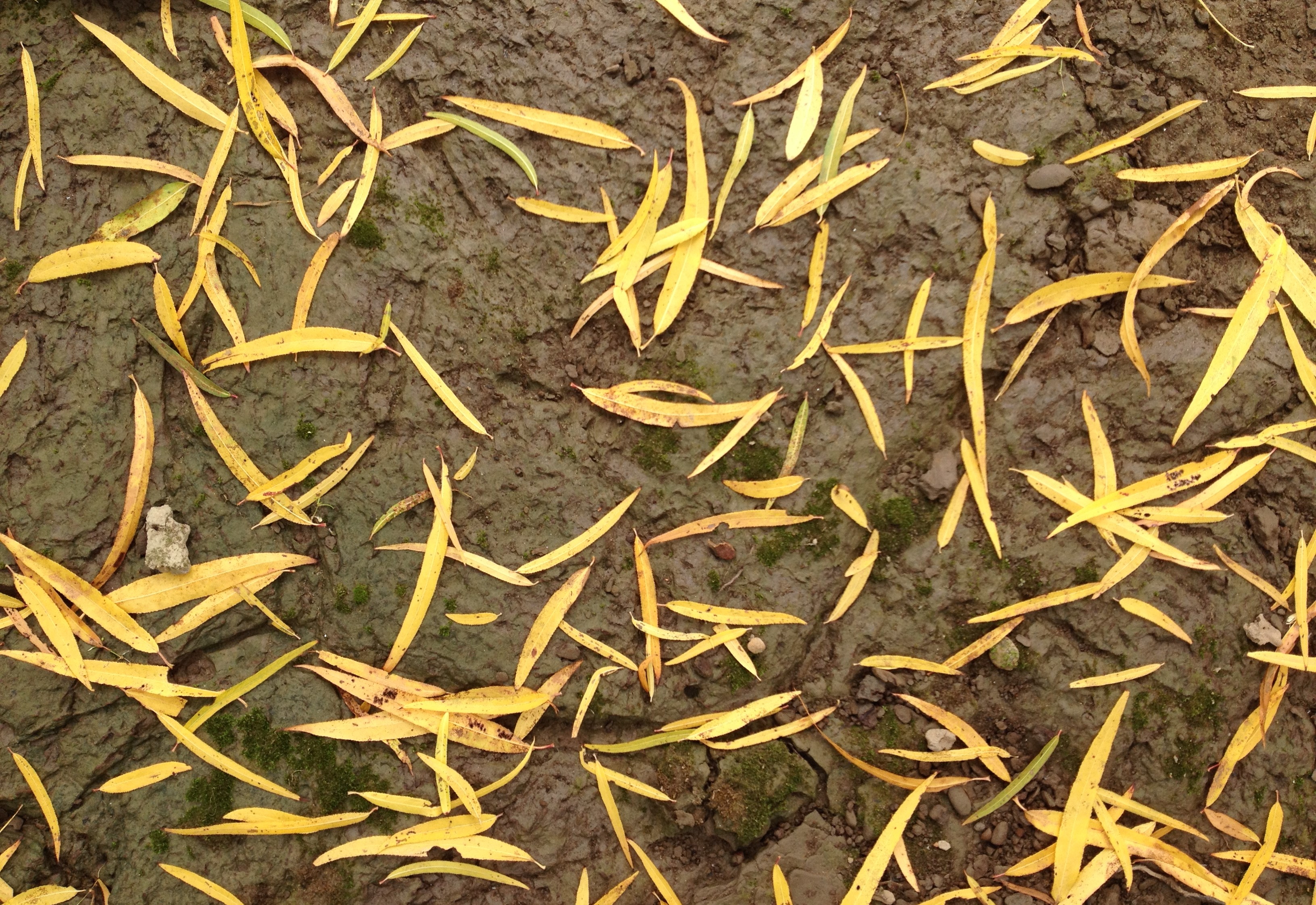
fallen willow leave on mud, Falls of the Ohio, Oct. 2014

I lingered in the moment for a while.  No sense in rushing things.  When I was confident that no other birds were in the area, I moved back to a spot where the Fixed Wier Dam joins the Lower Tainter Gates.  This would be the site for my next project.

stone and concrete ring by the dam, Falls of the Ohio, Oct. 2014

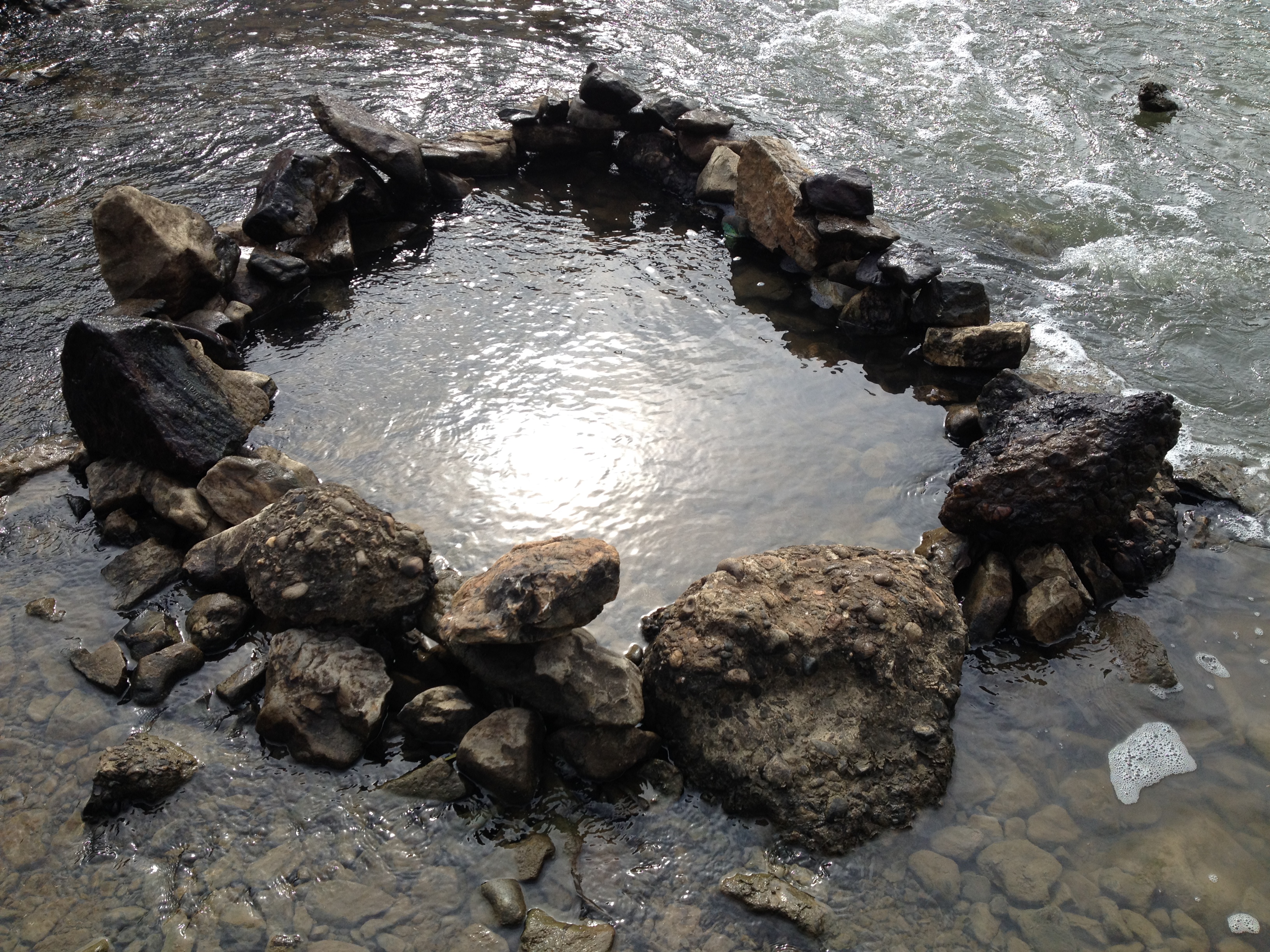
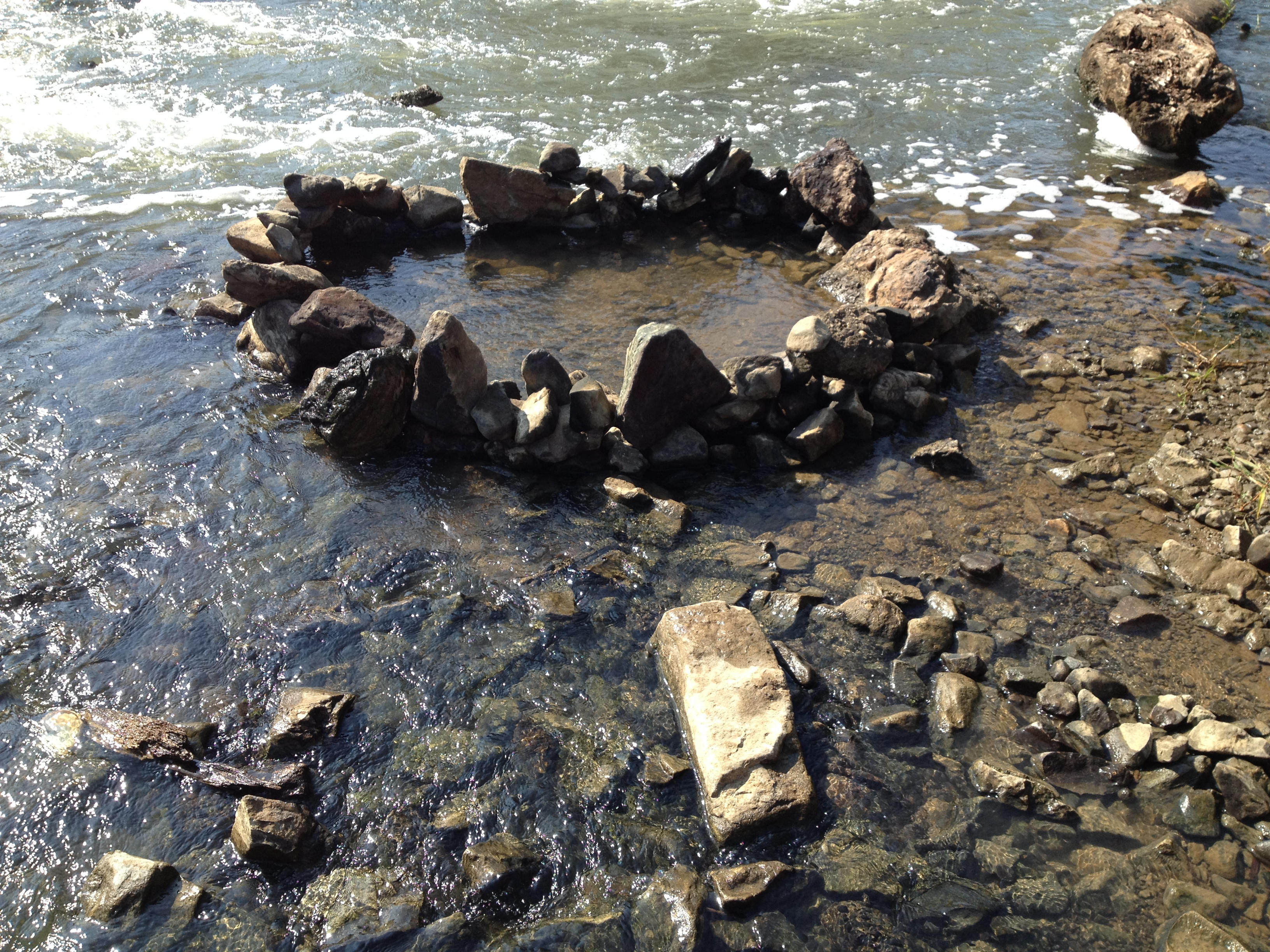
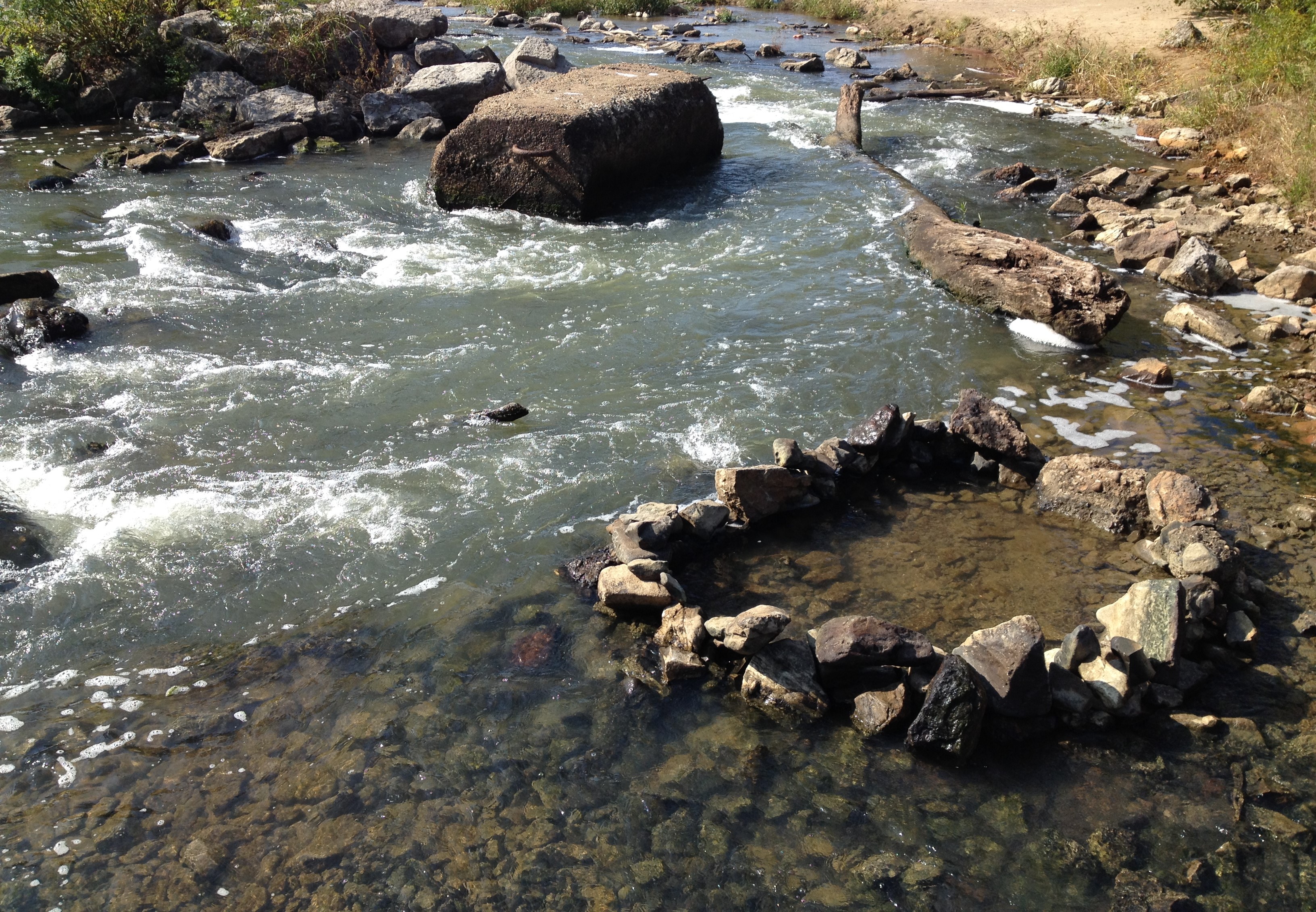
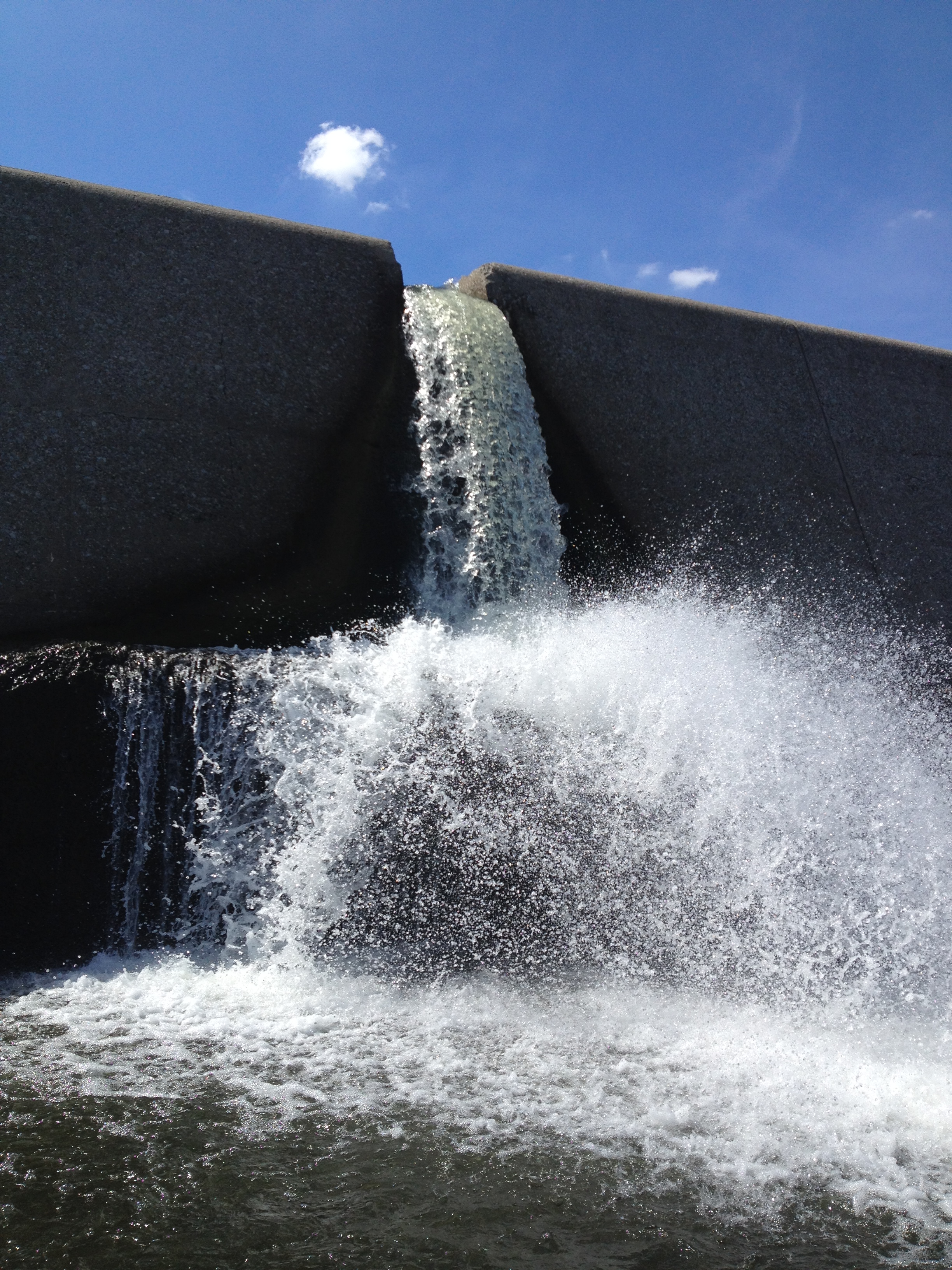
The dam at this location has curtains of water flowing through openings that are lower than the top of the wall and represents the true water level of the river.  This flow feeds a small channel that leads back to the river and is a favorite place for fishermen.  I had earlier noticed among the large broken sections of concrete and loose rock that some other creative soul(s) had started what looked like a stacked stone ring in the water.  There was the remnants of a foundation and I decided to build it back up for a look-see and to elaborate on it if possible.  I guess this in effect is a collaboration with an anonymous individual.  The image above was taken after I began reconstructing the ring.

Sun light reflecting with the stone ring, Falls of the Ohio, Oct. 2014

As I kept building up the ring, I would document my progress.  This is one of my favorite shots from the series.  Here I was able to center the sun’s reflection within the ring’s interior.  In my mind it became a portal to some other place far beyond the river.  The image of a passage way or tunnel is one that recurs in my Falls projects.

rock and concrete ring, Falls of the Ohio, Oct. 2014

I would have added the rectangular rock in the foreground, but it proved heavy and sunk into the mud.  Interestingly, the water within the ring was much calmer and created a safe harbor which contrasted with the swiftly flowing water around it.

rock and concrete ring, Falls of the Ohio, Oct. 2014

The ring’s slightly irregular shape was determined by its placement.  The ring is situated on the edge of where the water cascading off the dam’s wall has worn a deeper channel in the shallow bottom.  Since it was such a beautiful day I decided to spend more time at the Falls.  I made one other site-specific work where the center is a point of focus.

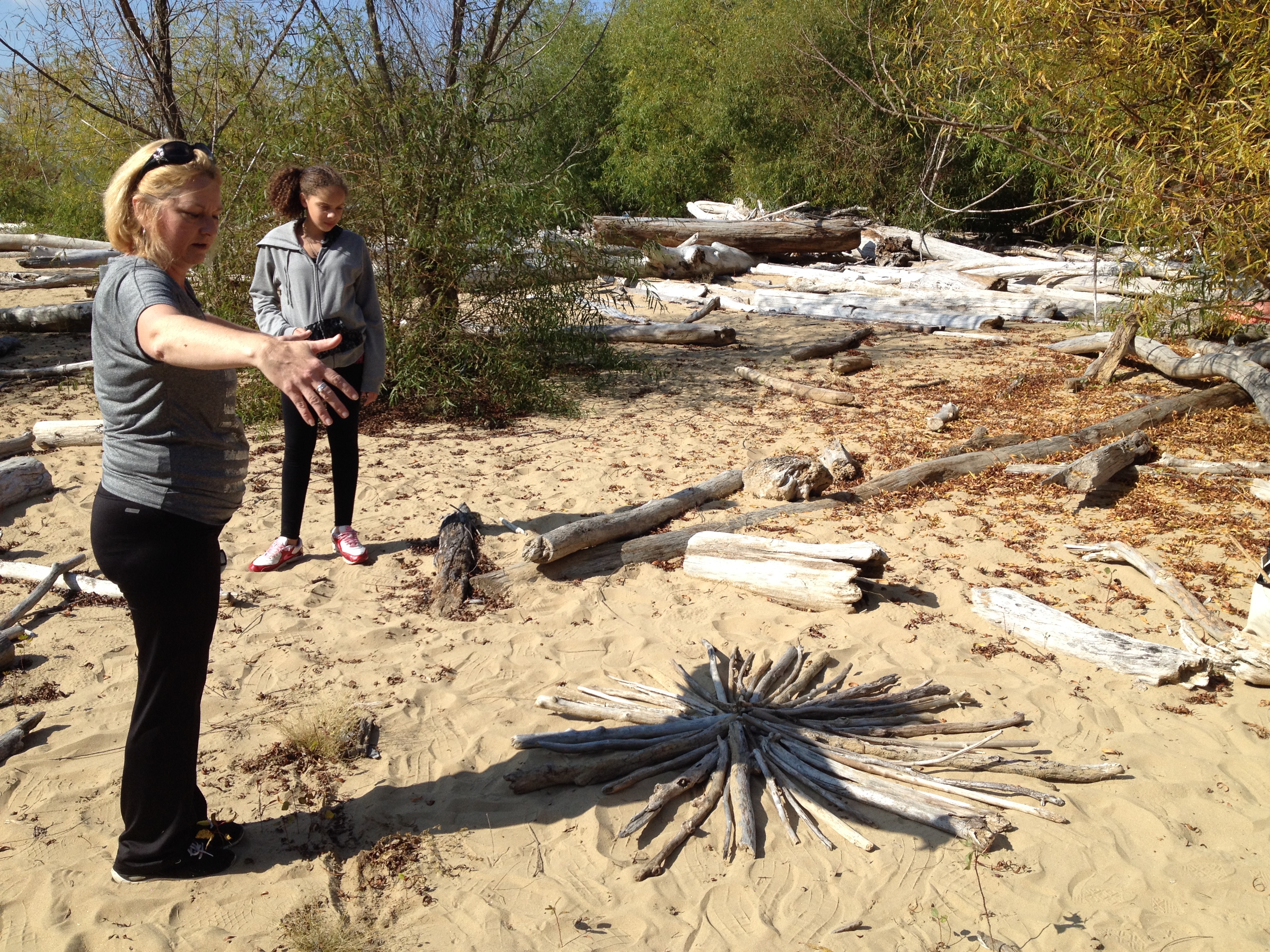
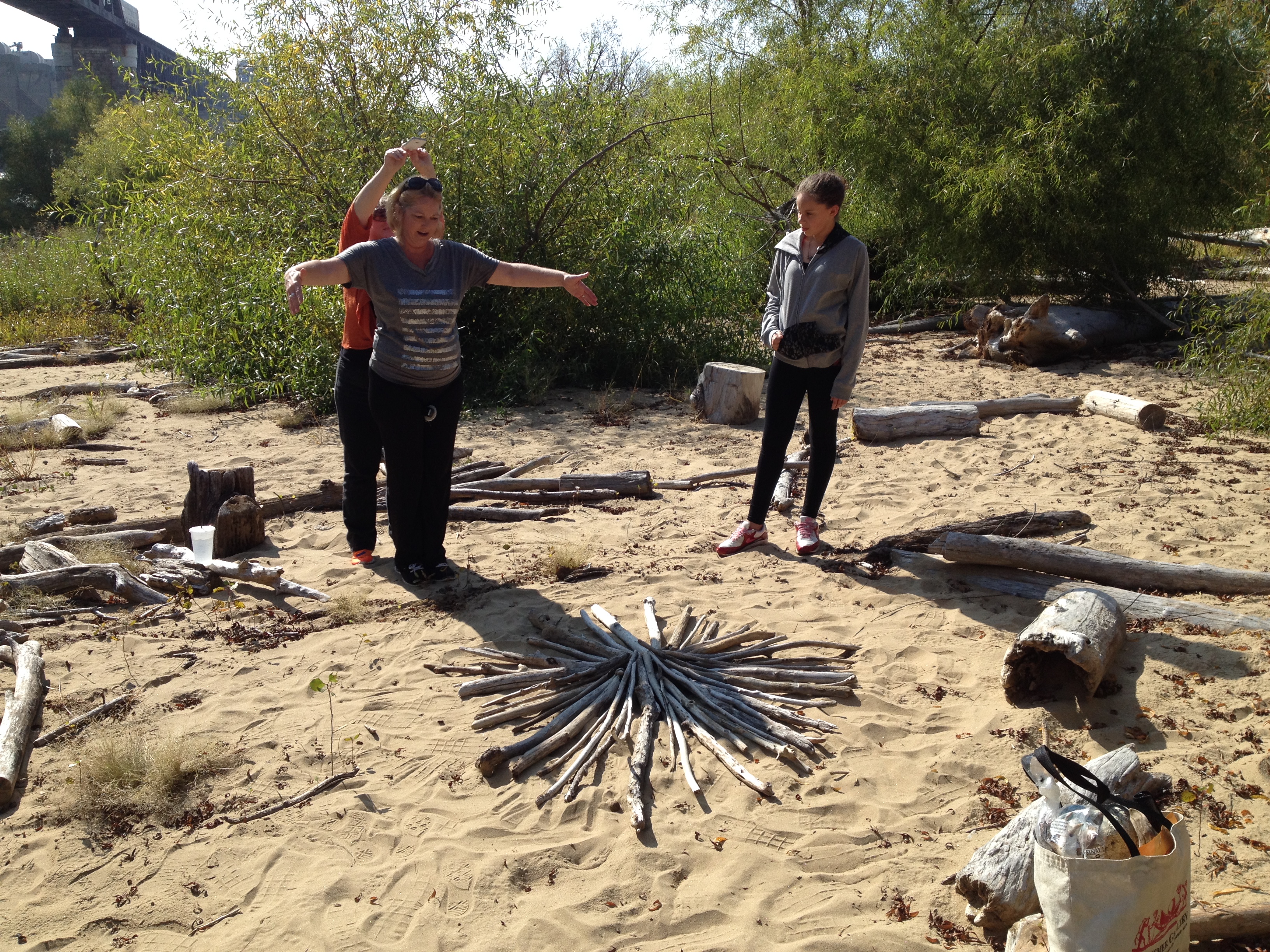
silver driftwood star, Falls of the Ohio, Oct. 2014

Detail of silver driftwood star, Falls of the Ohio, Oct. 2014


What I love about the driftwood at the Falls of the Ohio is the way it changes color as it ages.  After a summer’s worth of sunlight, the wood here takes on a silvery-gray color.  I collected lengths of wood from the immediate area and laid them in the sand.  The silver driftwood radiates away from a central point.  While I was engaged with my “Silver Star” four very nice people stopped by and asked directions to the fossil beds.  These park visitors became interested in what I was doing.  I appreciated that they wanted to participate and play along in their own way.  Here are a few additional images.  I’m assuming they are two mothers with their daughters enjoying an outing to the river?  Here one person is photographing the cast shadow on my wood piece.

Visitors interacting with my art, Falls of the Ohio, Oct. 2014

Park visitors interacting with my driftwood star, Falls of the Ohio, Oct. 2014

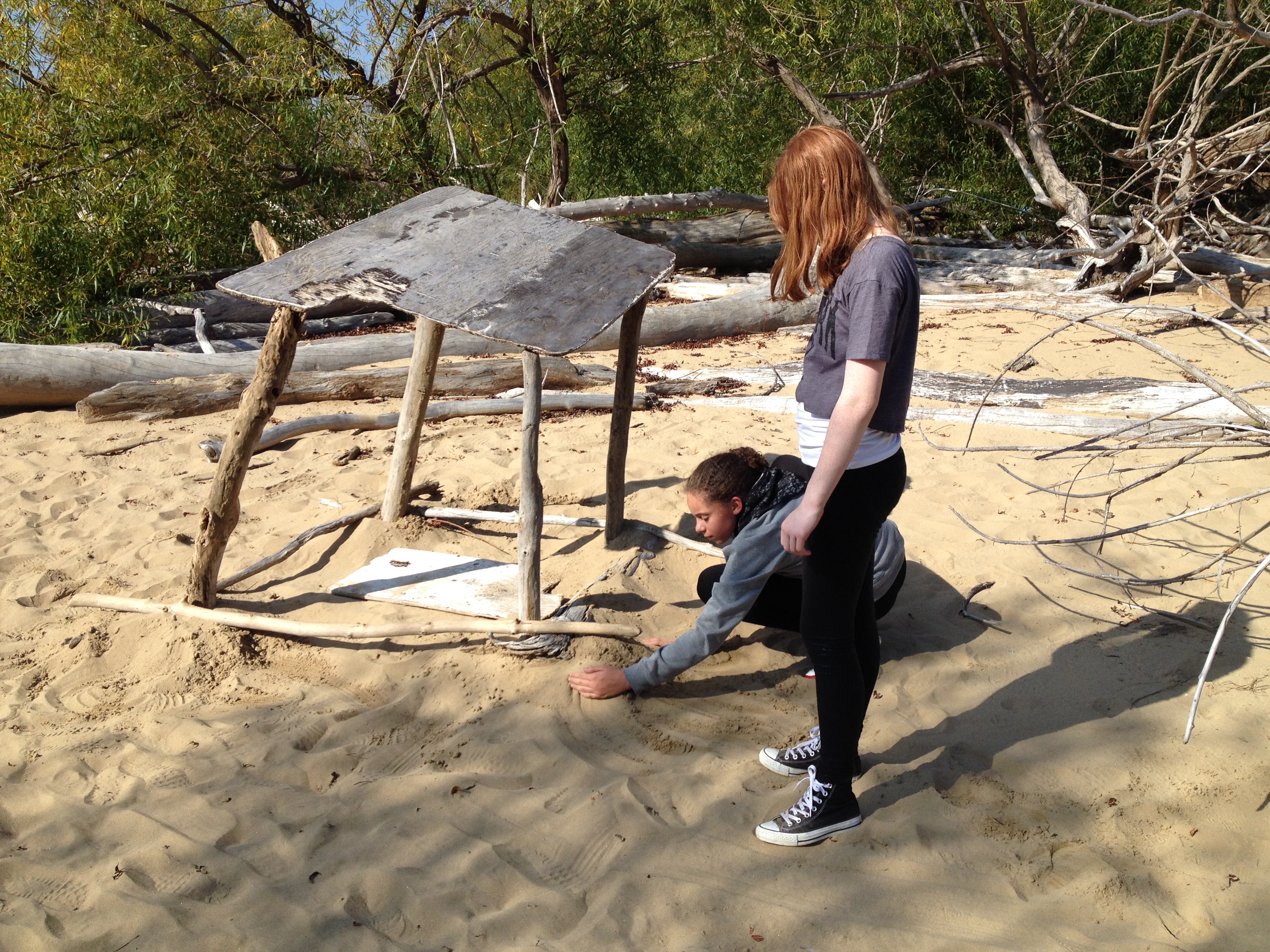
I think I may have inspired the daughters to attempt their own project?  Before too long they were picking up pieces of driftwood and making a make-shift shelter of their own design.

Girls making a driftwood shelter, Falls of the Ohio, Oct. 2014

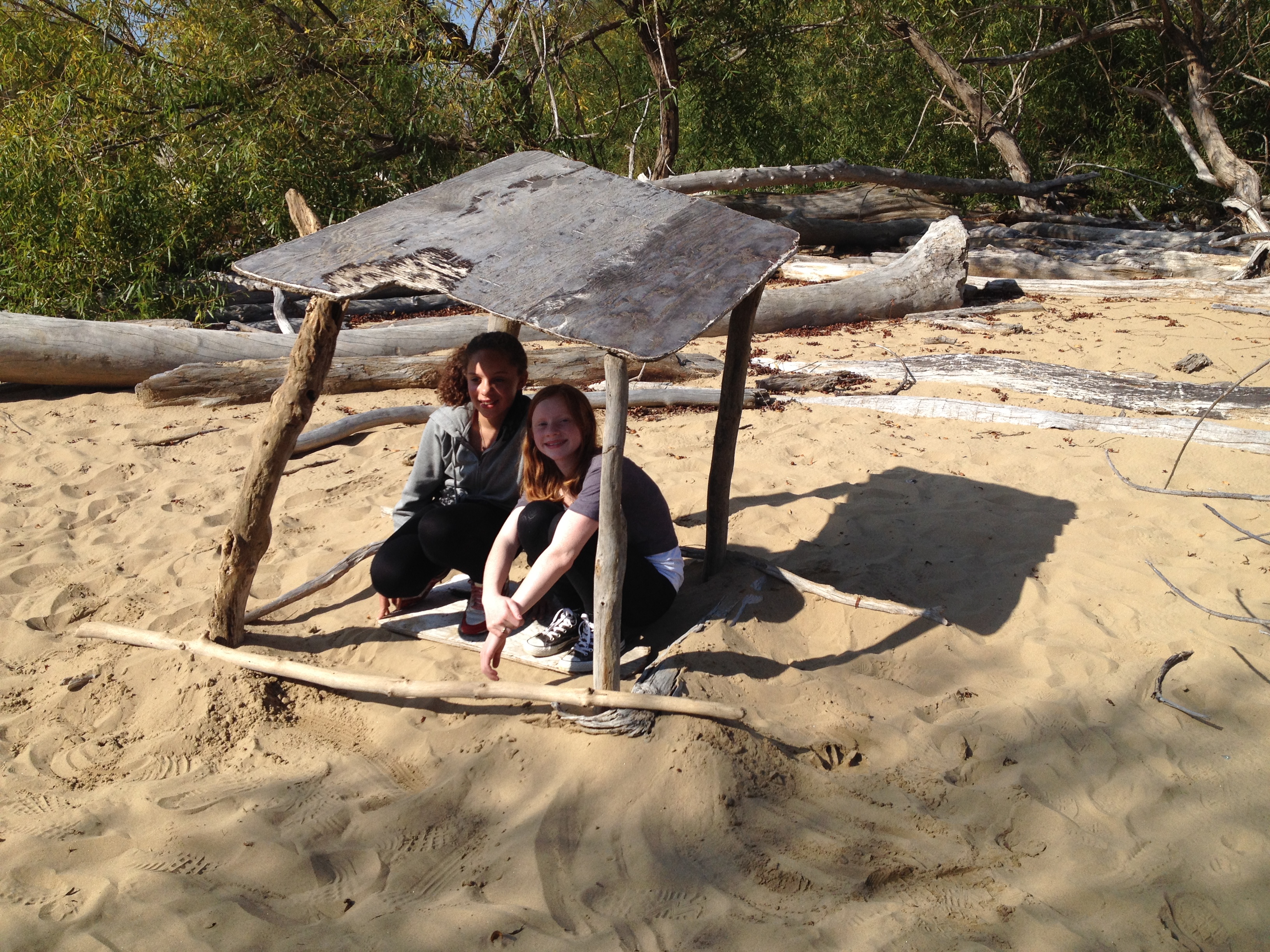
Girls posed under their improvised shelter, Falls of the Ohio, Oct. 2014

The girls looked very happy under their driftwood shelter!  When my sons were younger, this was a favorite activity of theirs and this day brought back those good memories.  This park is such a great playground and allows one to exercise both your body and imagination.  I wonder if these ladies ever found the fossil beds?  It probably doesn’t matter since it looked like a good time was had by all.  Soon enough it was time to go home and I gathered up my collecting bag and walking stick and admired the late season flowers as I walked back to my vehicle.  Thanks for tagging along and I hope to see you next time from the Falls of the Ohio State Park.

tiny composite flowers with bee, Falls of the Ohio, Oct. 2014

Read Full Post »

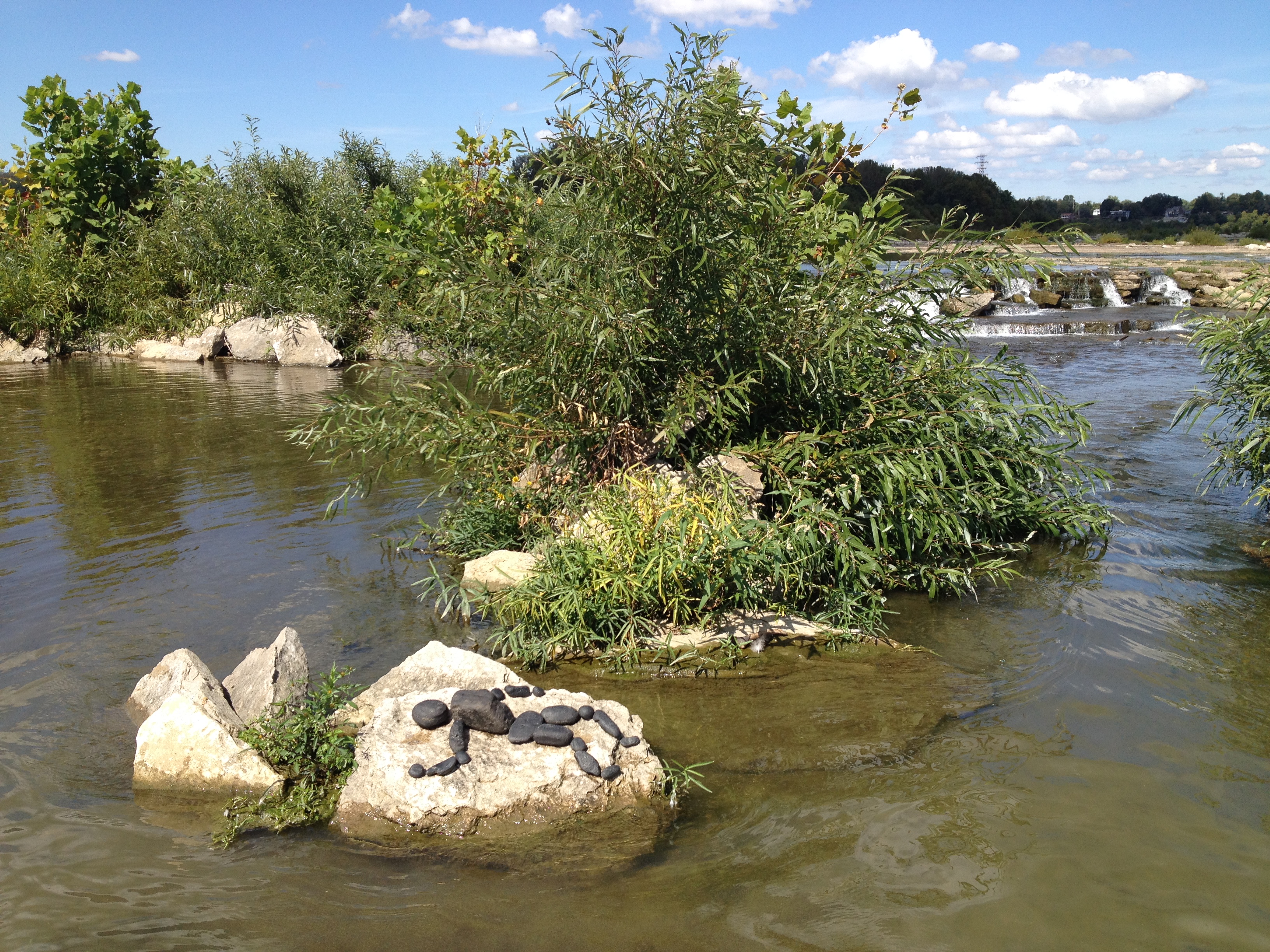
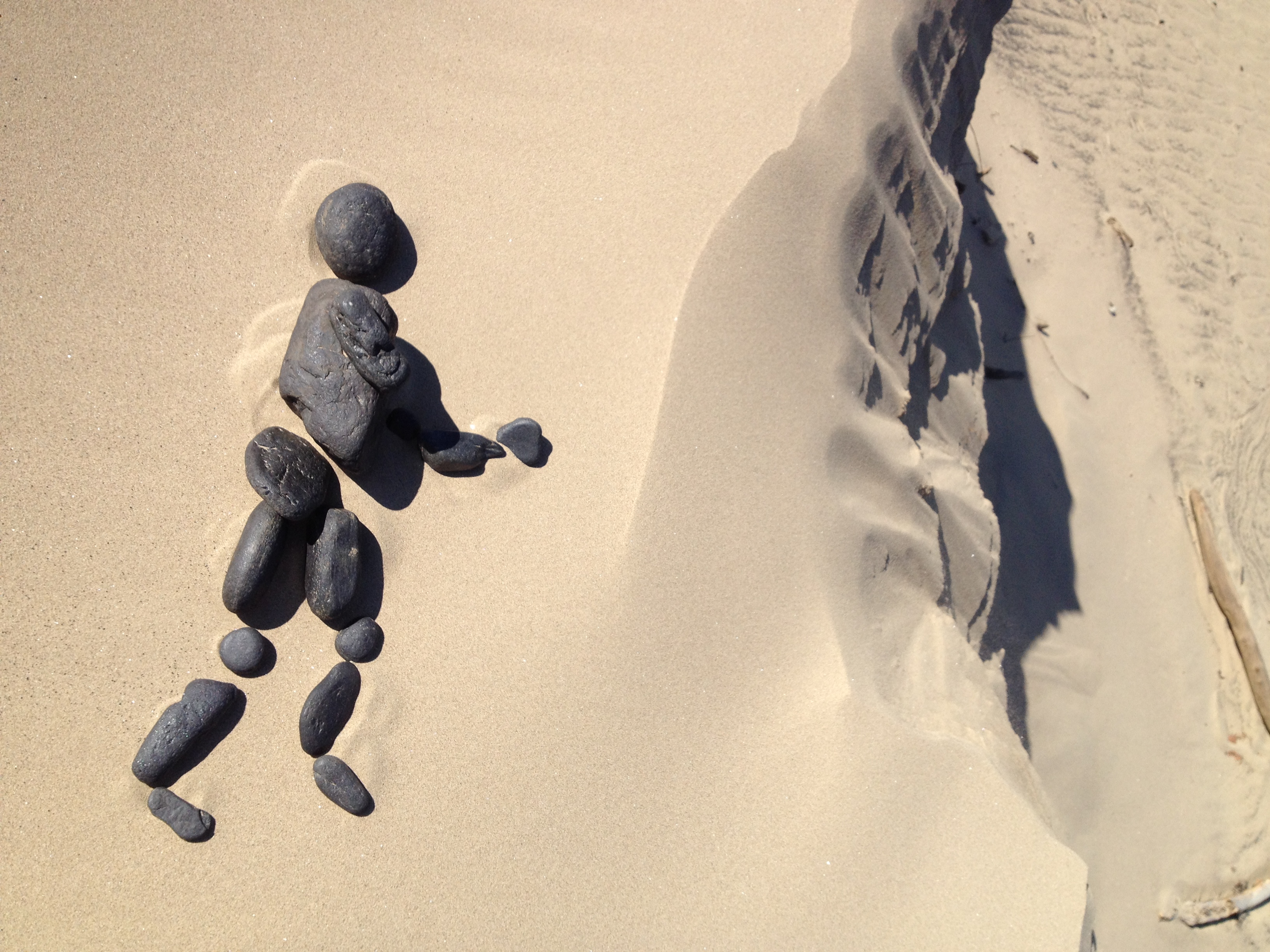
Coal figure near the waterfalls, Falls of the Ohio, Oct. 2014

I waited a few days to return to the exposed fossil beds on the Kentucky side of the Falls of the Ohio State Park.  My earlier trek went so well that I was determined to walk a little farther dragging my collecting bag full of water worn coal with me.  I had the same idea as before, namely creating figurative images using the coal in site specific areas.  Today I was determined to walk around Goose Island which is accessible by foot in the summer and early fall when the river level is diverted towards the locks and thus exposing the many layers of this ancient Devonian reef.  It won’t be too much longer until the autumn rains replenishes the water along the Ohio River Valley and submerges this part of the park again until next summer.

Dancing Coal figure, Falls of the Ohio, Oct. 2014

As before, I crossed over at the Lower Tainter Gates in the eastern section of the park.  I walked along the Fixed Wier Dam reaching the area where some waterfalls that flow into Whiskey Chute remain.  This is where I created my first coal figure of the day.  From above, the figure appears to be dancing and this is one of my favorite images from this new series.

Water flowing thru notch in fixed wier dam, Falls of the Ohio, Oct. 2014

Going around the waterfalls, I walk through ankle to knee-deep water and continue following the dam’s wall westward.  Strategically placed notches at the top of this concrete wall provides a flow of water to a small wetlands area that harbors a variety of life.  In this place natural waterfalls and cascades have been replaced by artificial ones.  As I wade through it is a bit humbling knowing that the level of the Ohio River is at the top of this wall.  I saw many water-loving birds including Belted Kingfishers, Blue-winged Teal, Caspian Terns, Double-crested Cormorants, and Great Blue Herons that favor this part of the park.

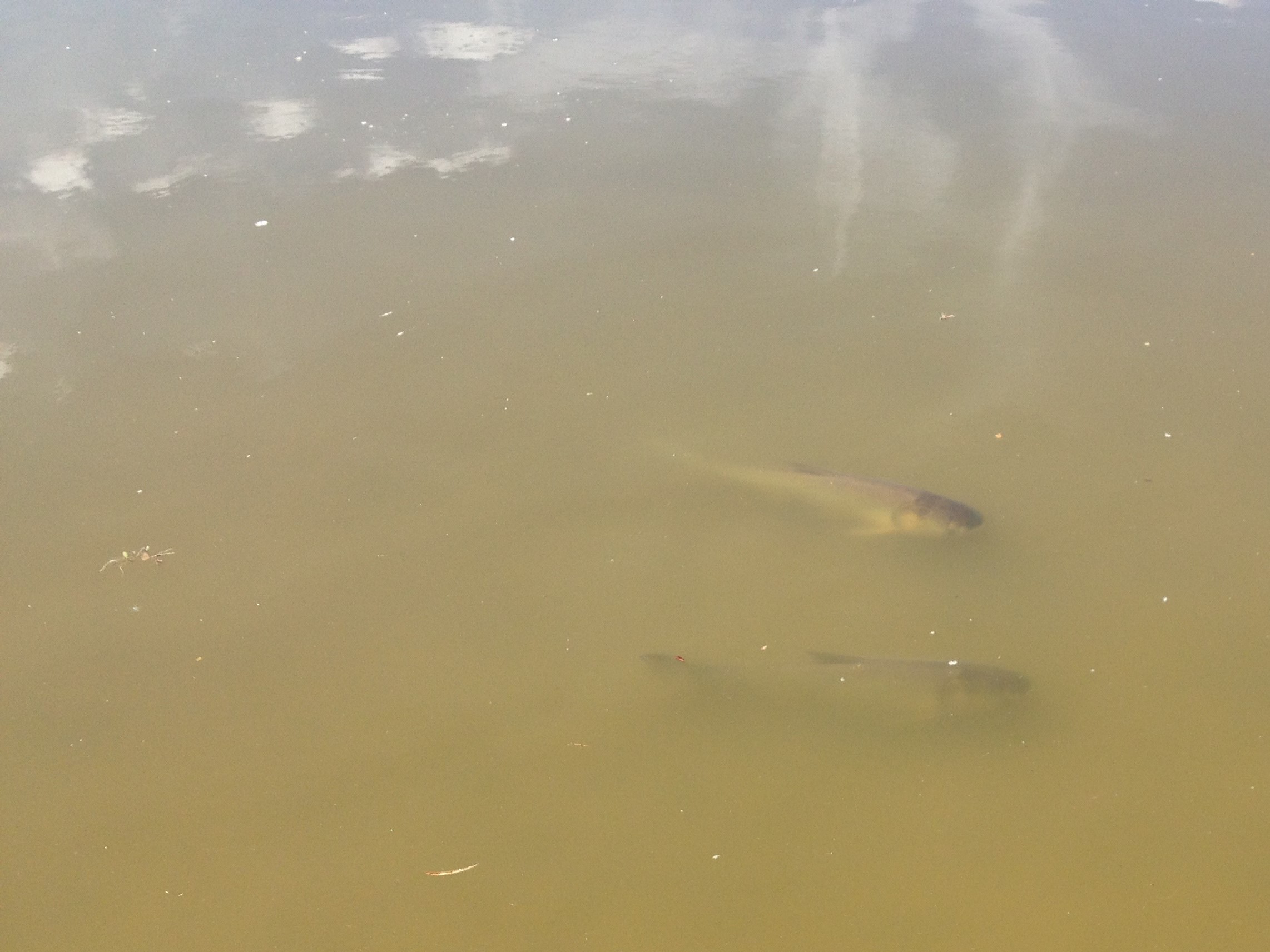
A pair of Grass Carp, Falls of the Ohio, Oct. 2014

Many of these birds were here because this area also attracts fish.  Numerous grass carp were eating algae in the shallows and small schools of juvenile fish were startled by the sudden appearance of my all too white legs as I walked through their space.  If I stood motionless for a while, the carp would return and I could observe them more closely.

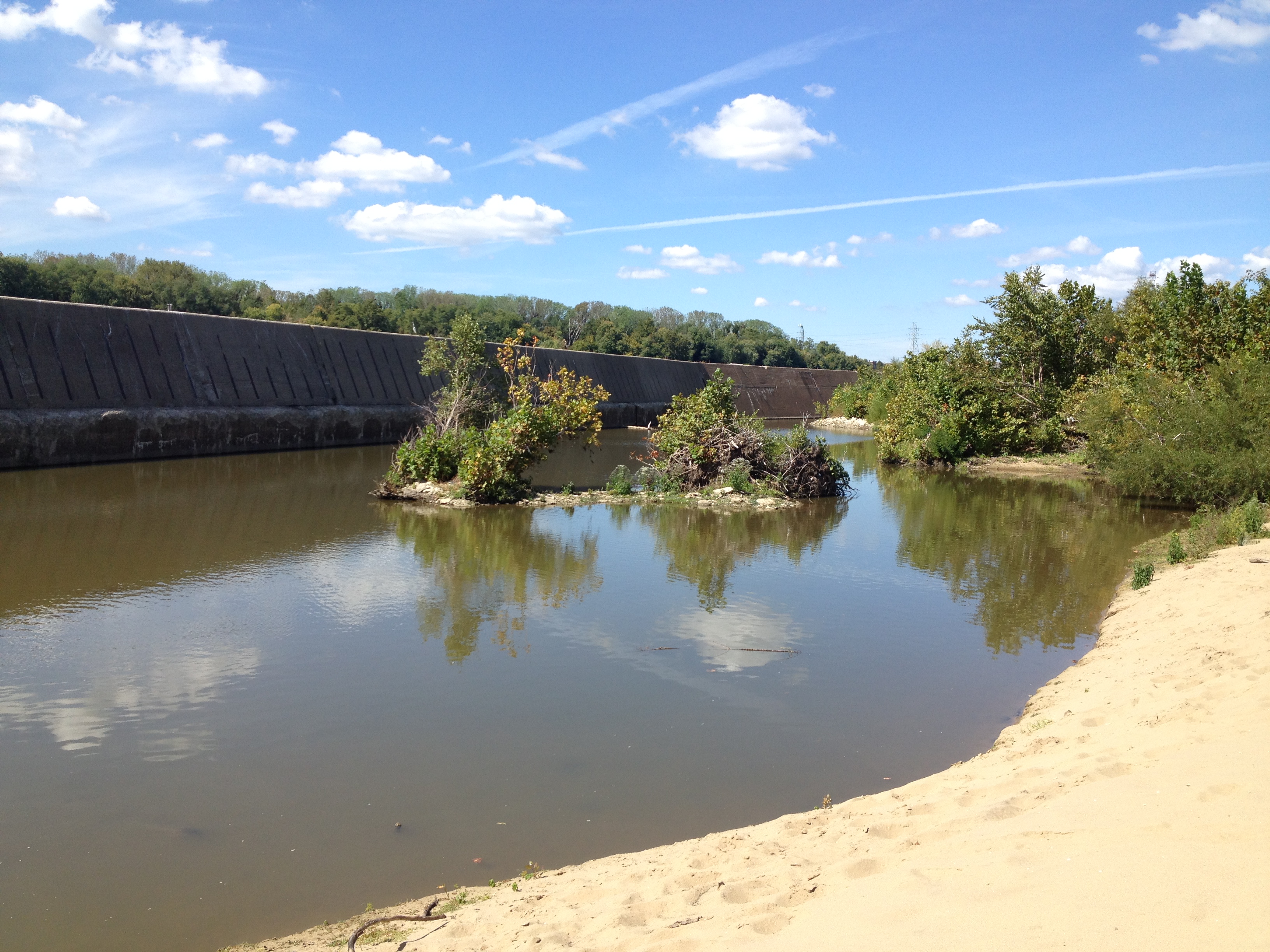
Scene along the northwest tip of Goose Island, Falls of the Ohio, Oct. 2014

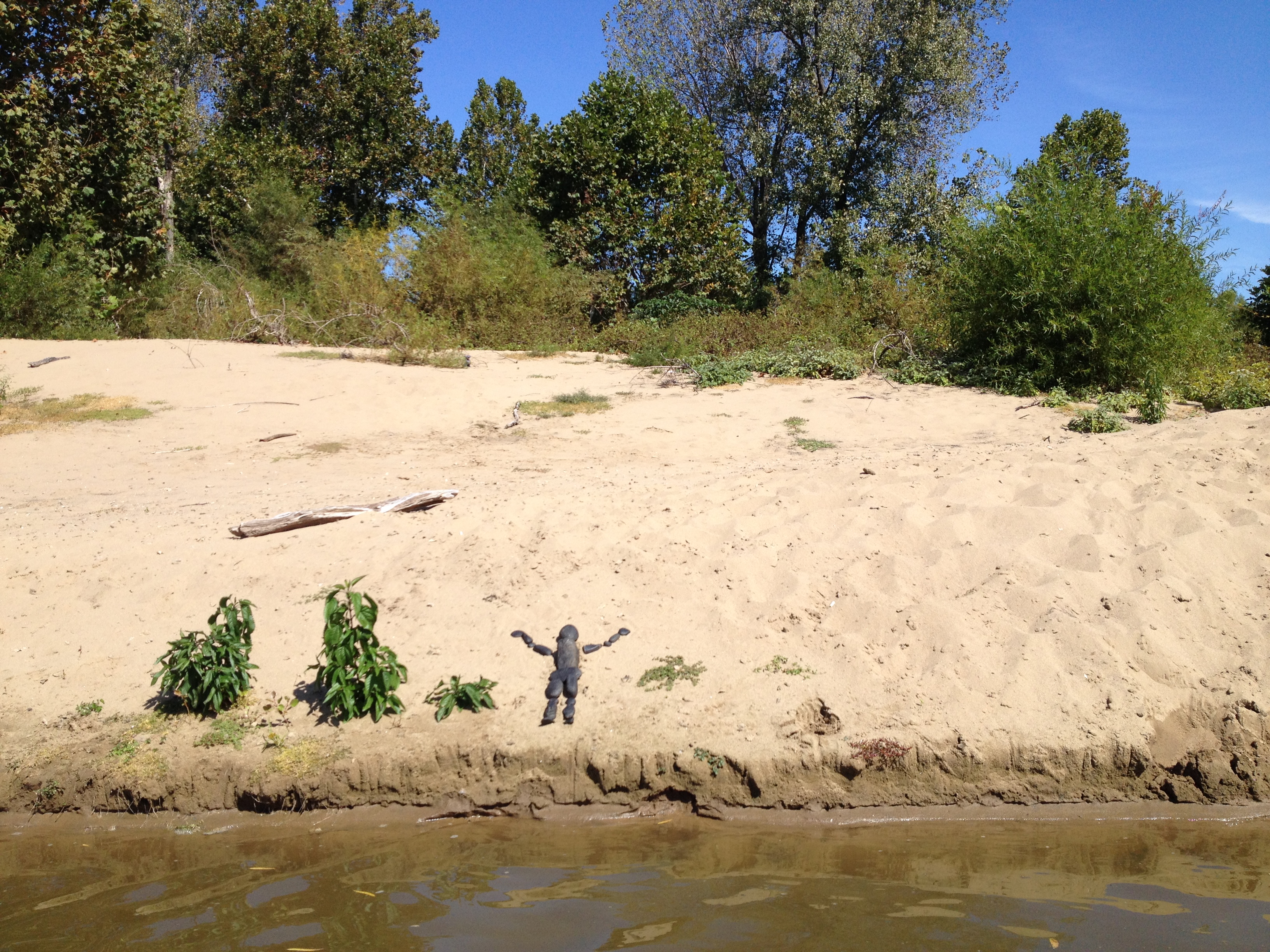
Goose Island Coal Figure, Falls of the Ohio, Oct. 2014

Goose Island has sandy banks.  As I was wading along the southeast side of the island, I set up this figure with up raised arms in an open spot among plants that were growing in a row parallel to the water’s edge.

Bleaching Goose Island Cottonwood tree, Falls of the Ohio, Oct. 2014

Evaporating pond on Goose Island, Falls of the Ohio, Oct. 2014

I left the water and walked along the edge of the island walking westward.  This section has a cottonwood habitat.  I came across a large cottonwood tree that had fallen off the high bank and was now bleaching in the sun.  Driftwood snagged around this tree’s root mass marks how high the water can get when the river is flowing.  There was a strong smell of urine around this shrinking pond and the many deer tracks proved these animals frequented this place.  Hundreds of tiny toads were hopping through the grass near this waterhole!  I had never seen anything like this out here before.  I wished I had taken at least one image of these toads in my hand for scale.  Although they were tiny, they also looked like perfectly formed adults that had been miniaturized.

Goose Island with distant view of the hydroelectric dam, Falls of the Ohio, Oct. 2014

Continuing my walk on Goose Island, I can see the wall of the Fixed Wier Dam and the hydroelectric plant in the distance which is situated on Shippingport Island.  The plants in the foreground with their prickly, ripening seed pods are Jimsonweed.  Along the sandy bank,  I could see slides where beaver have dragged their tree cuttings from the nearby woods into the water.  There is probably evidence of a dam nearby, but I did not see it on this trip.

Goose Island sand dunes, Lower Tainter Gates in the background, Falls of the Ohio, Oct. 2014

This is as far as you can walk in this part of the park.  Goose Island’s western edge ends at the Upper Tainter Gates.  This is a popular area for fishermen who reach this spot by boat.  I did see several Osprey circling the sky here.  There is a small section of sand dunes on Goose Island that are shaped by wind and wave.  In the above image, bird tracks crisscross the sand.  I placed my final coal figure of the day here at the edge of a dune.  This time the figure has been turned on its side. Plumes of sand were blowing up and away at the dune’s edge by wind.  In the image below, the distance from the top of the dune to the riverbank on the right is deceiving.  I estimate that this is a seven or eight foot drop and a short roll to the river.

Coal figure on Goose Island sand dune, Falls of the Ohio, Oct. 2014

From this area I start my hike home on the north side of Goose Island and start heading east.  It has been a great day interacting with this environment.  I have several other images to show before closing that were shot on this walk.  Fortunately, there isn’t as much plastic junk to find on this side of the park, but of course there were a few things that caught my eye.

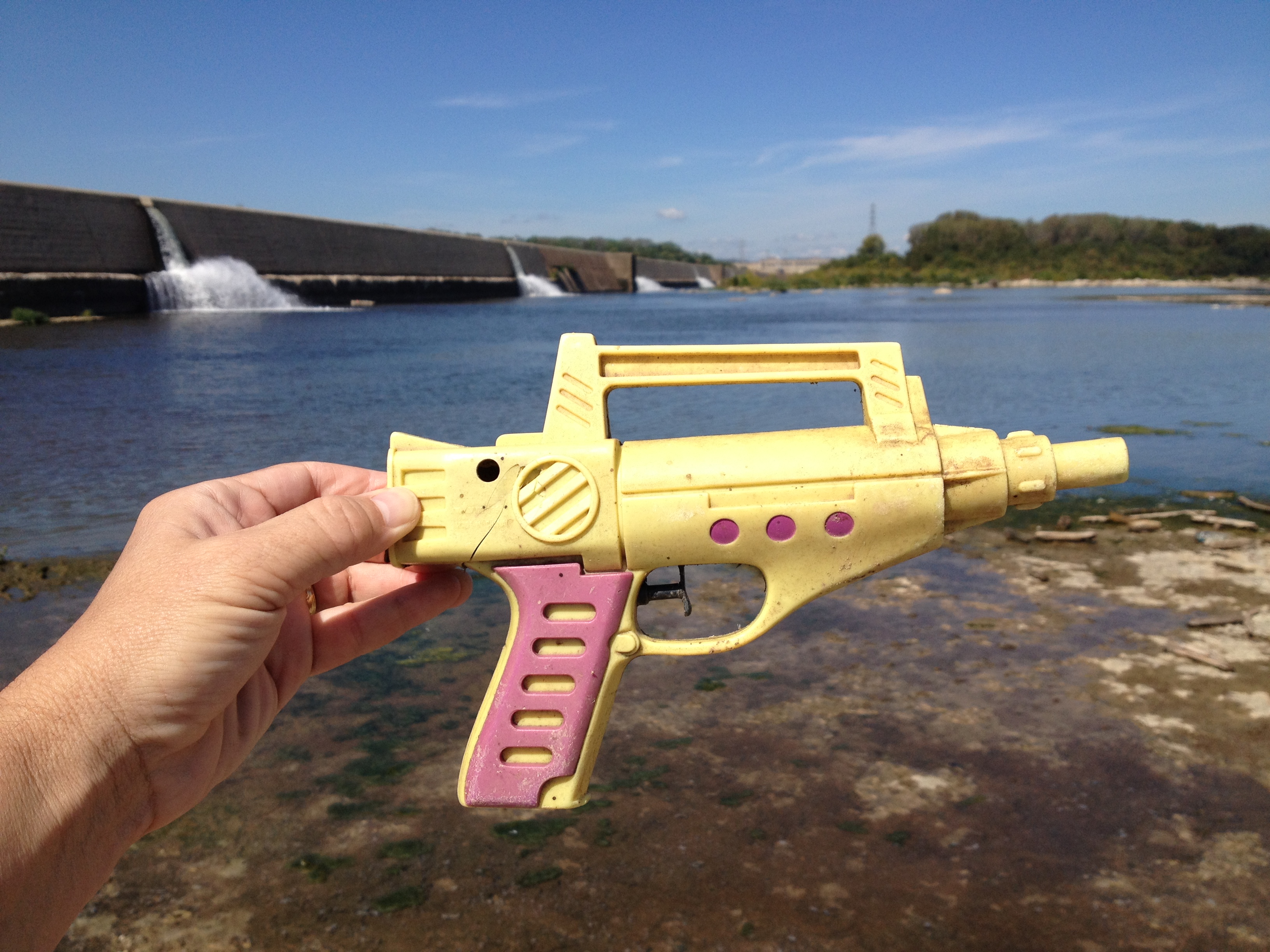
plastic squirt gun, Falls of the Ohio, Oct. 2014

Here’s another squirt gun to add to the collection.

blue plastic hand on fossil rocks, Falls of the Ohio, Oct. 2014

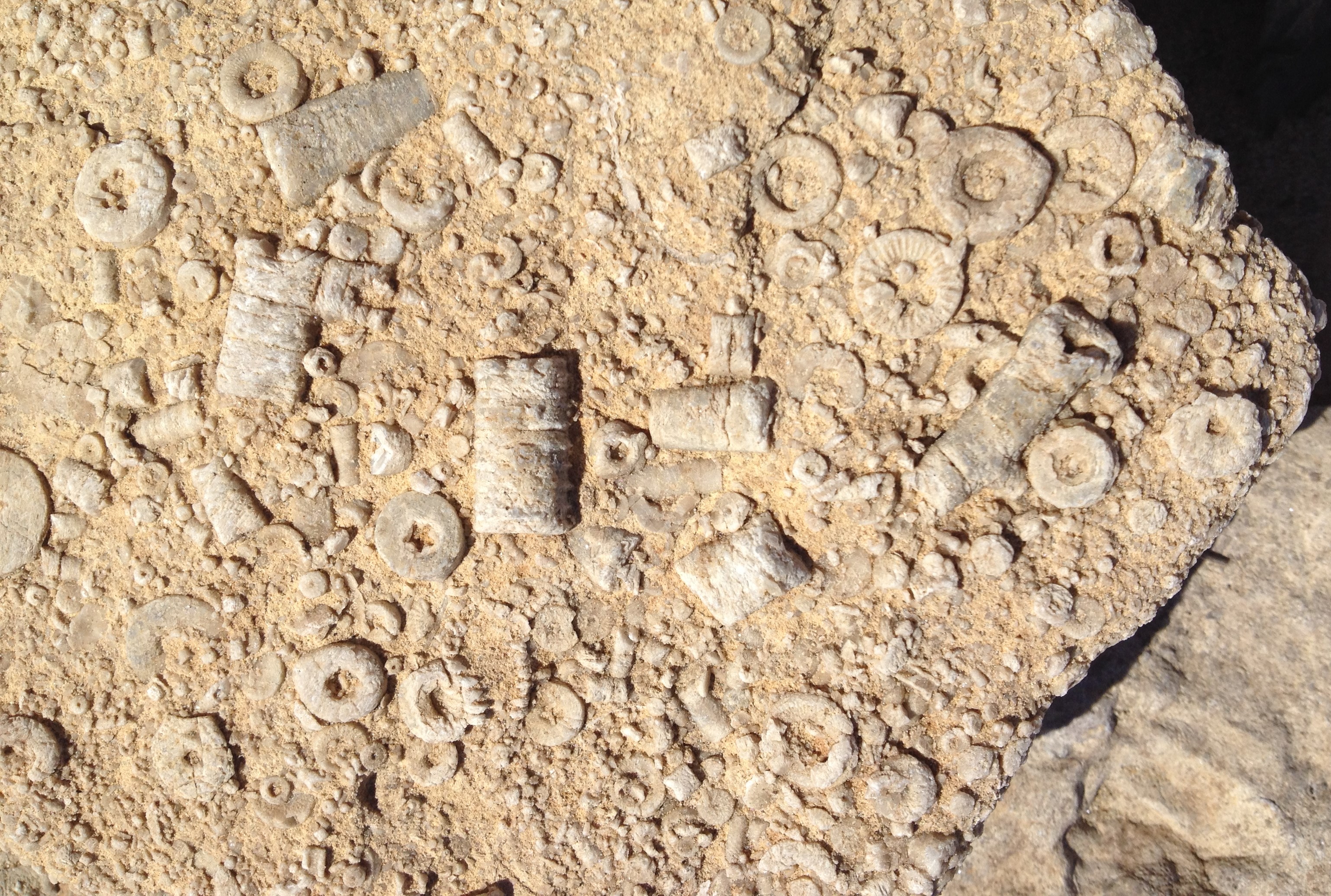
A goofy blue plastic hand rests on a fossil bearing rock .  If you look closely, you can see bits of a crinoid stem by the  thumb.  I did take other images of fossils along my walk.  Here are more crinoid pieces found near the Upper Tainter Gates.  Crinoids are often described as sea lilies and were sessile marine animals that filtered and captured small animals from a flower-like calyx.

Fossil crinoid pieces, Falls of the Ohio, Oct. 2014

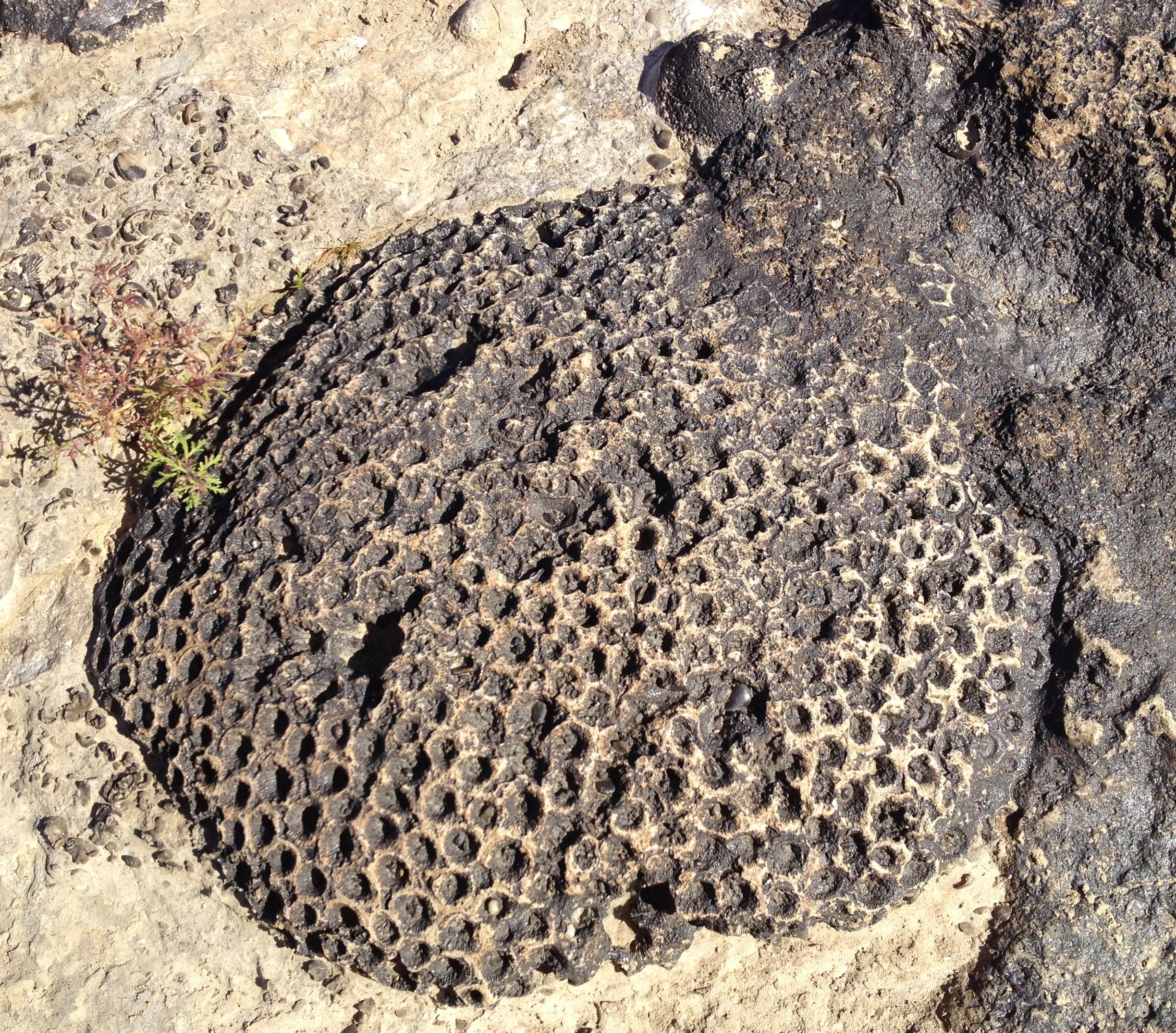
On the walk home, I kept walking by different fossil corals exposed in this ancient limestone.  Corals are colonial animals and you get a sense for this in my next image.

Exposed fossil coral, Falls of the Ohio, Oct. 2014

The park prohibits collecting fossils and I begin to wonder if this heavy bag of coal that I have lugged around the island would count?  Technically speaking coal is a fossil material.  Although I found all my coal within the park, it did not originate here.  I retrace my steps crossing the exposed fossil beds and by the time I reach my vehicle…I am one tired guy.  If my luck holds, I might be able to take one more walk out here before this area becomes the bottom of the river again.  If it doesn’t happen…there is always next year!

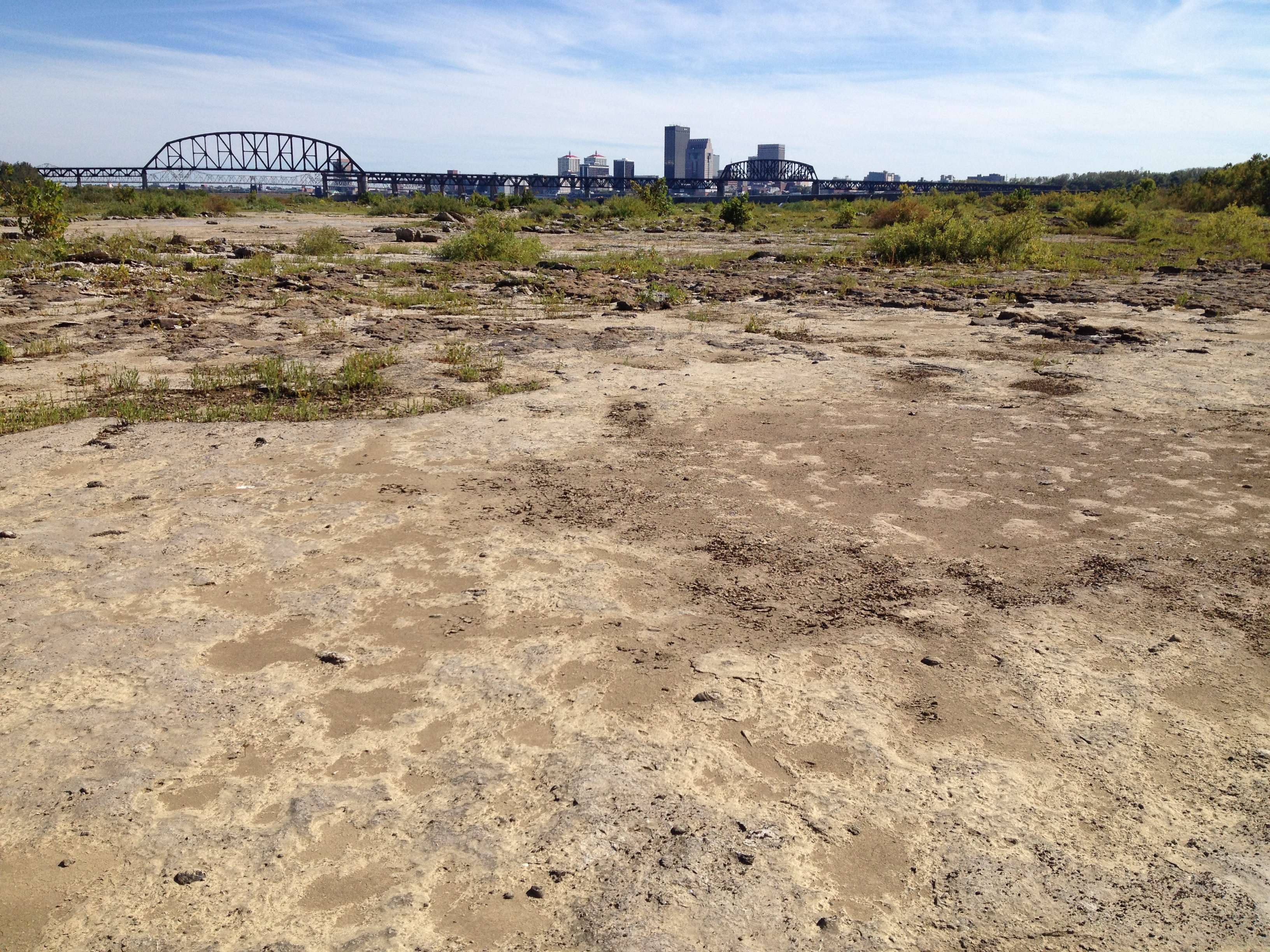
Fossil beds with the skyline of Louisville in the distance, Falls of the Ohio, Oct. 2014

Read Full Post »

« Newer Posts - Older Posts »