Feeds:
Posts
Comments

Archive for the ‘Ohio River’ Category

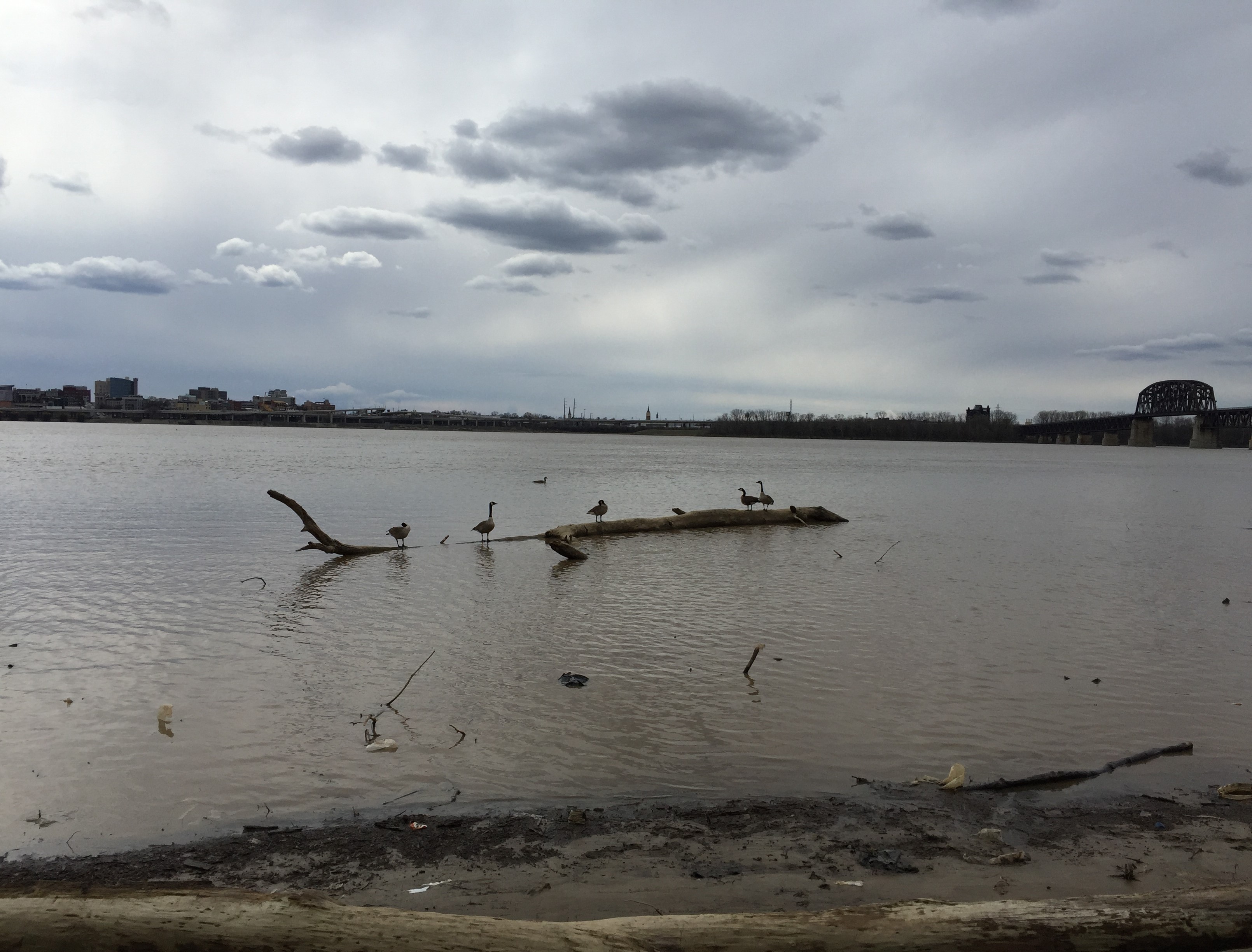
Early morning view on the Ohio River, mid March 2016

Went out to the river, but to tell you the truth…I thought it would be too high.  Just a couple of days earlier, the Ohio River was once again over its normal banks.  Every year is different and this year the tail end of our winter was marked by warmth and high water.  Although the riverbank was muddy, I was happy to be able to walk around.  I’m having a show at a friend’s place in May and I was on the lookout for more washed up materials.  As it played out, this first official day of Spring would be a more memorable one than I had first anticipated.
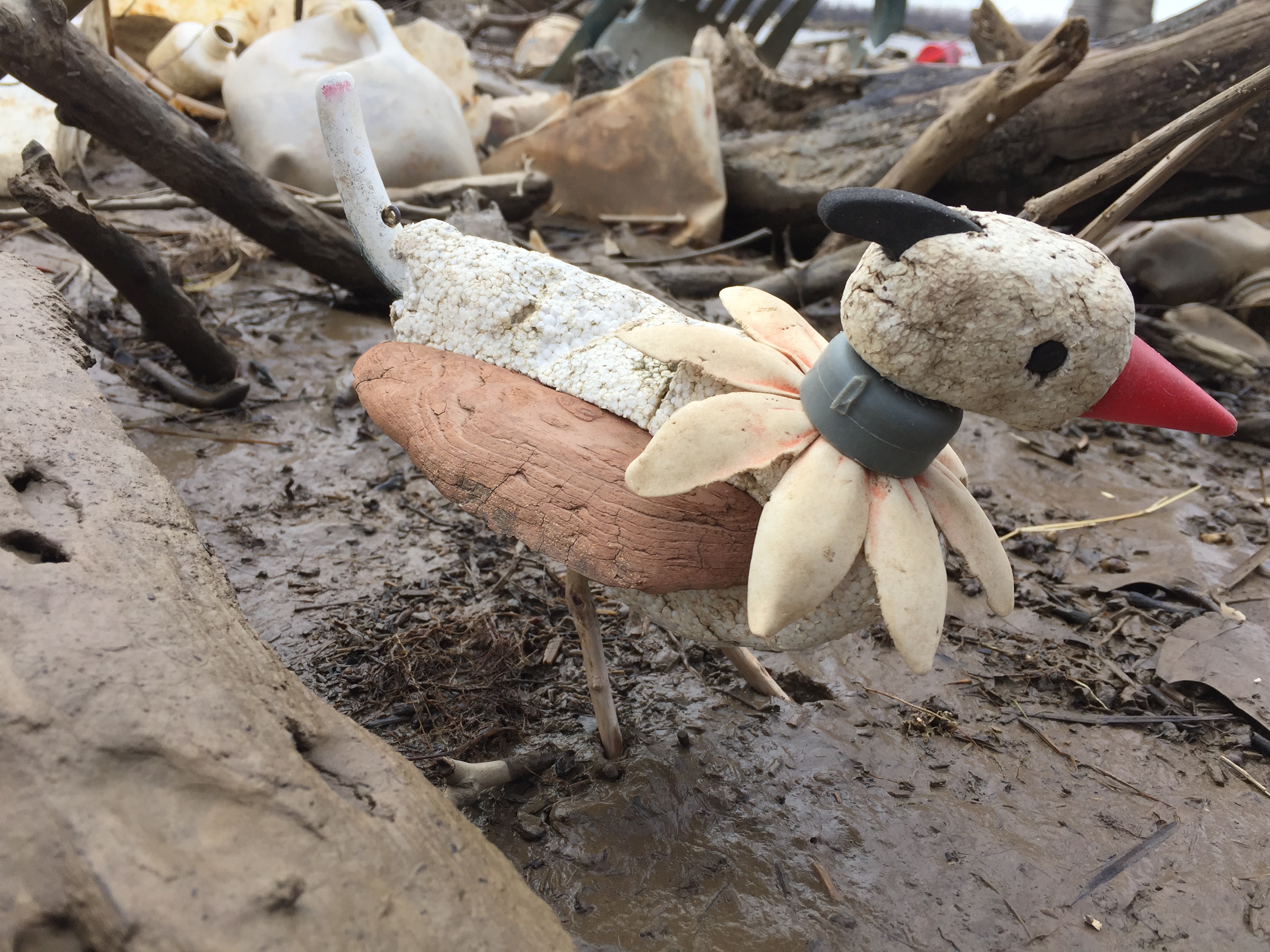
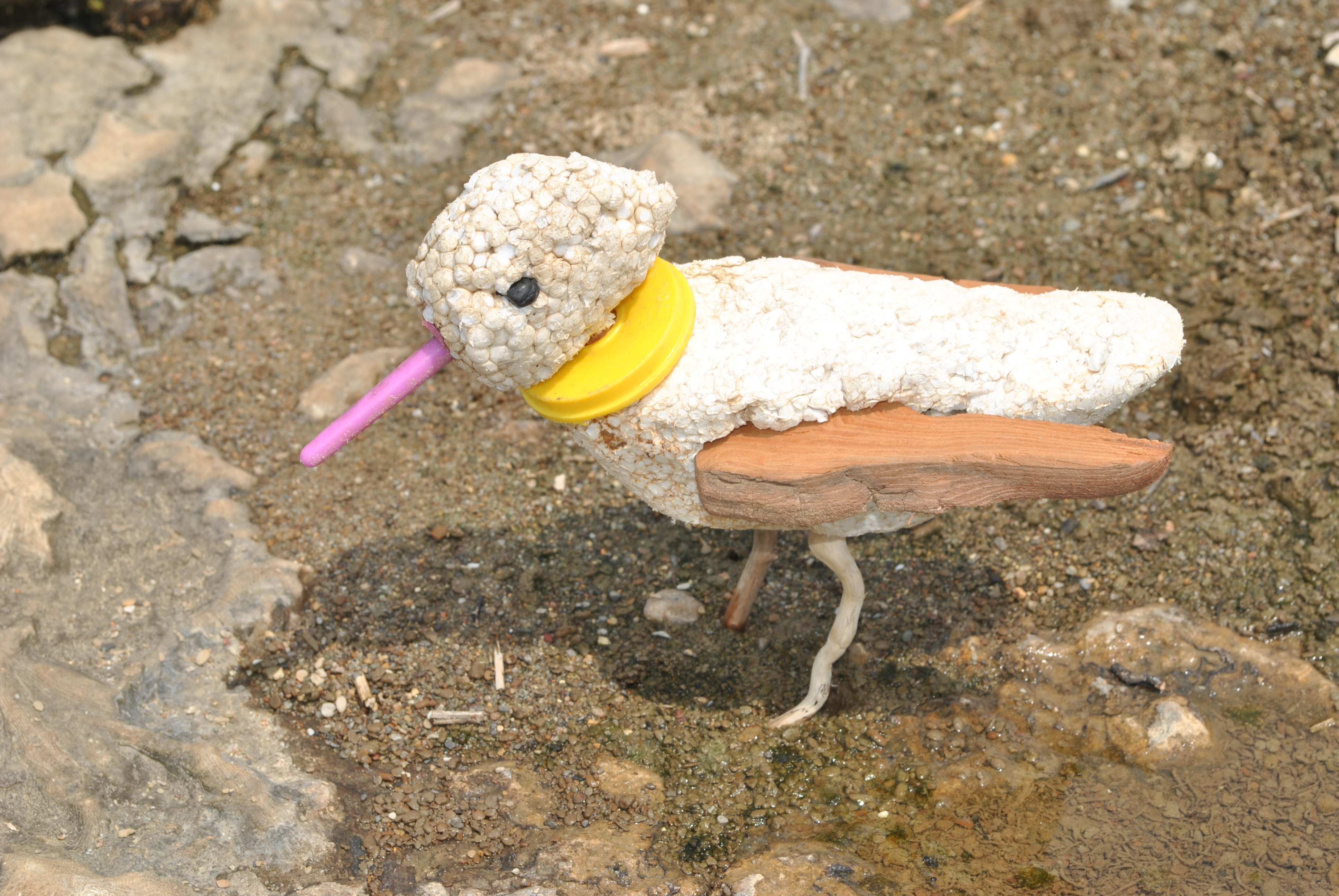
Heisenberg's Hammerkopf or Hammerhead, Falls of the Ohio, March 20, 2016

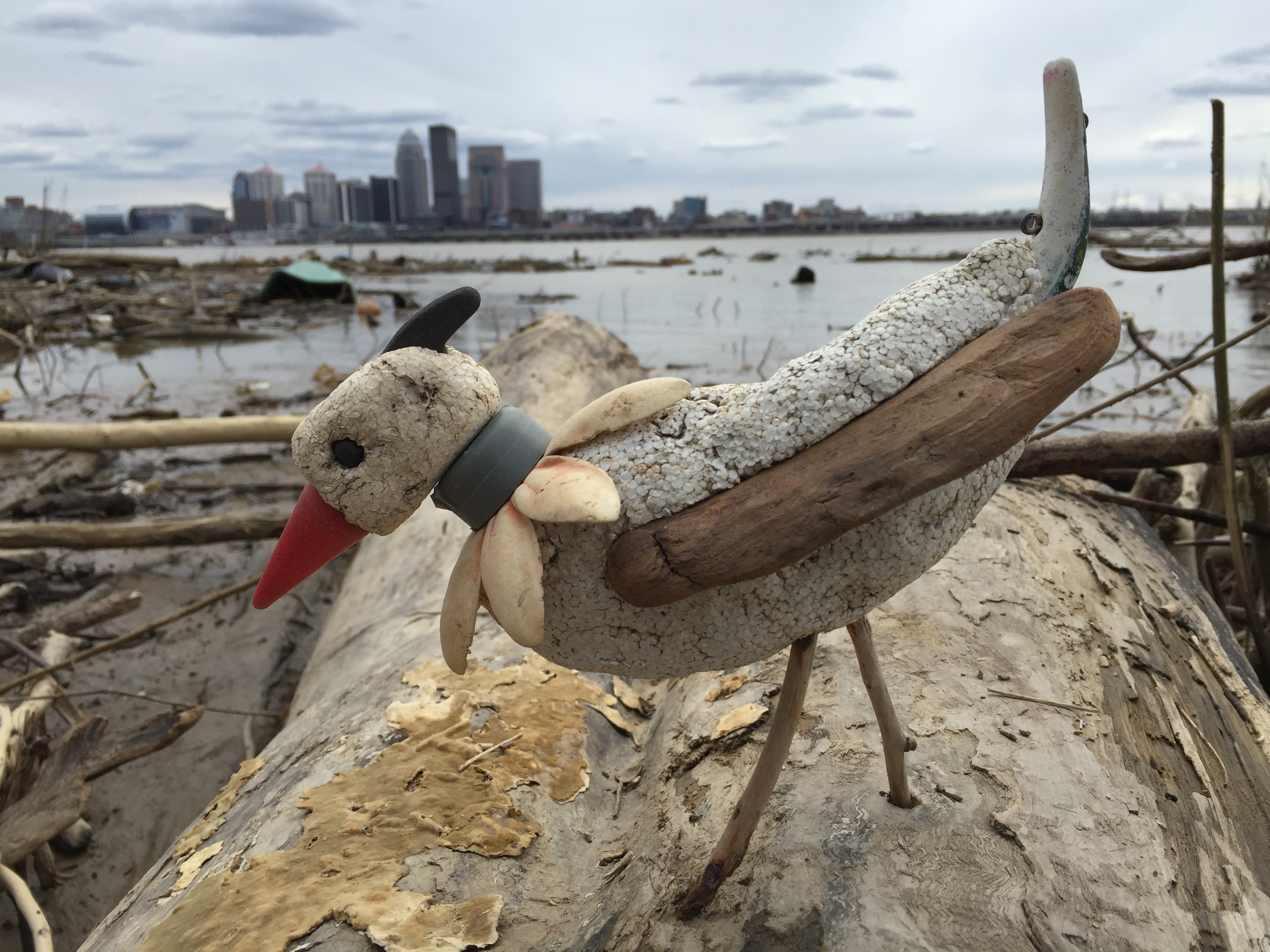
Heisenberg's Hammerkopf in view of Louisville, KY, March 20, 2016

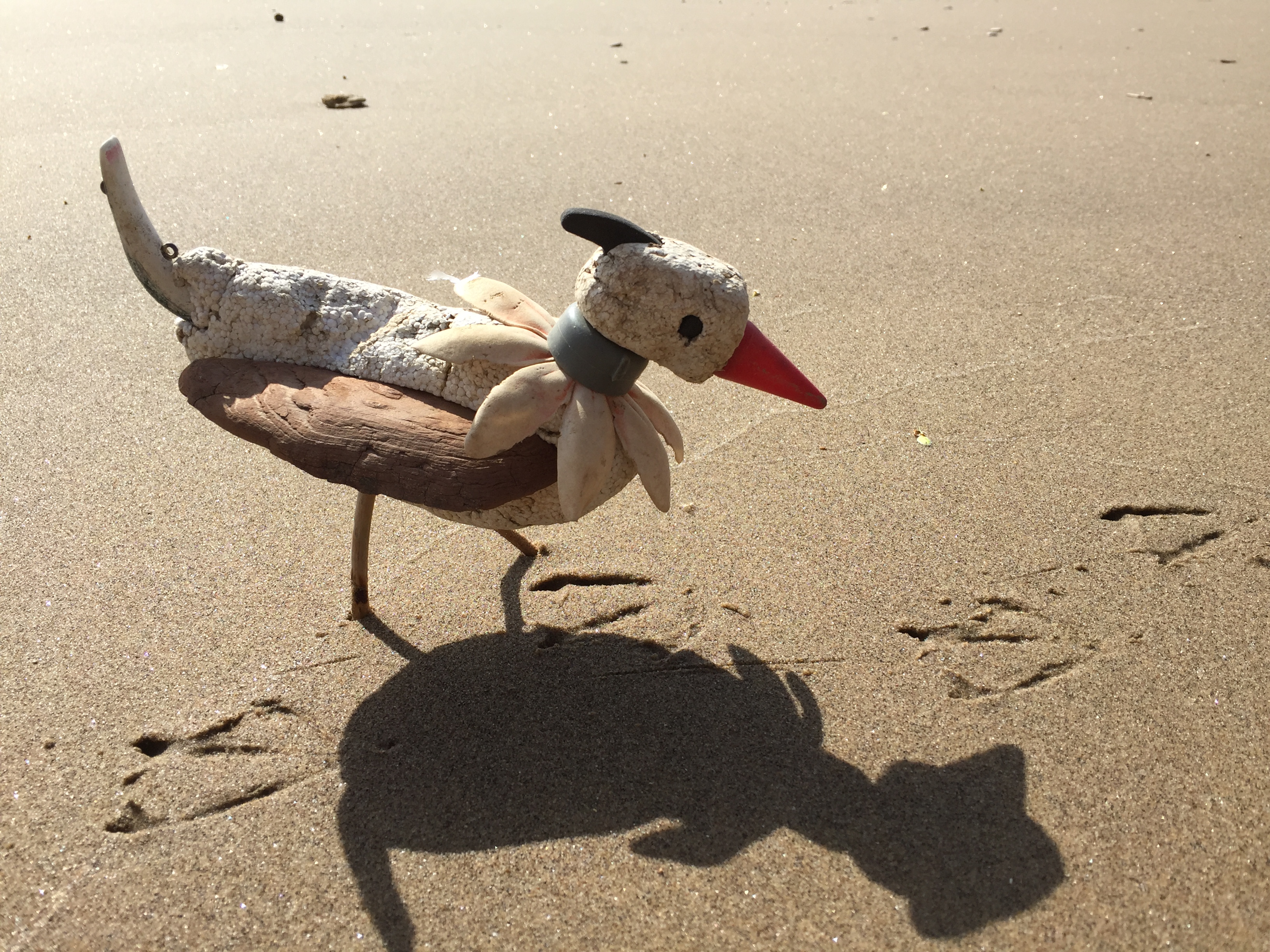
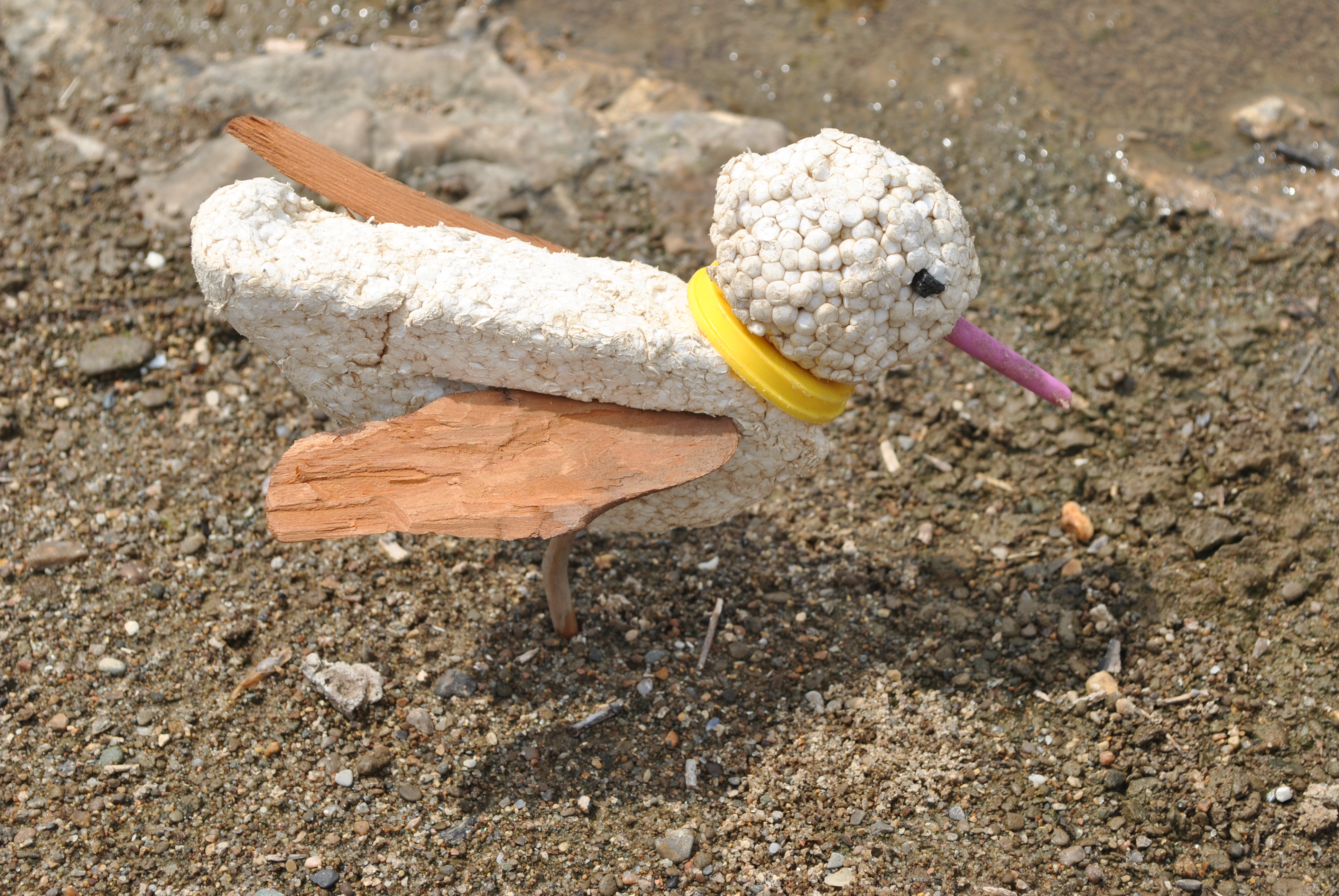
One of the reasons that this can be an interesting time of the year at the Falls of the Ohio is the annual Spring migration of neotropical birds.  I have been known to set my collecting bag aside and just hit the woods on the look out for migrating birds.  The first time you see a male Scarlet Tanager or a Rose-breasted Grosbeak will make a bird watcher out of a lot of people.  This past weekend, which is still a bit early for the usual migrants…I came across something totally unexpected that I couldn’t identify at first.  I didn’t get many pictures, but what I have is here.  If you have never seen (or much less heard of) Heisenberg’s Hammerkopf, (Aviana indeterminus)…you wouldn’t be alone.  Hammerkopf translated into English is hammerhead and that description seems to fit.  Heisenberg’s bird is about the size of an American Robin.  Among the features that stand out the most are its massive red bill and the petal-like feathers found at the base of its neck.  The wings can be brown or white and it has been known to have a crest, but some individuals have been seen that don’t have this feature.  There is no consensus as to its overall population, but a few individuals seem to make the news each year.  This bird is an enigma and it seems to prefer things that way.

Heisenberg's Hammerkopf, Falls of the Ohio, March 20, 2016

The individual I came across is a second year male.  Looking at the info there is on this species did say that the unusual ruff of feathers around its neck could turn bright red as the bird matured and was ready for the breeding season.  What little there is in the scientific literature suggests that this is a highly variable species that can be found anywhere at any time.  With this bird, you really can’t pin down where it originates and it doesn’t seem to have a “normal range”.  It seems to be a very uncommon bird with a world-wide distribution.
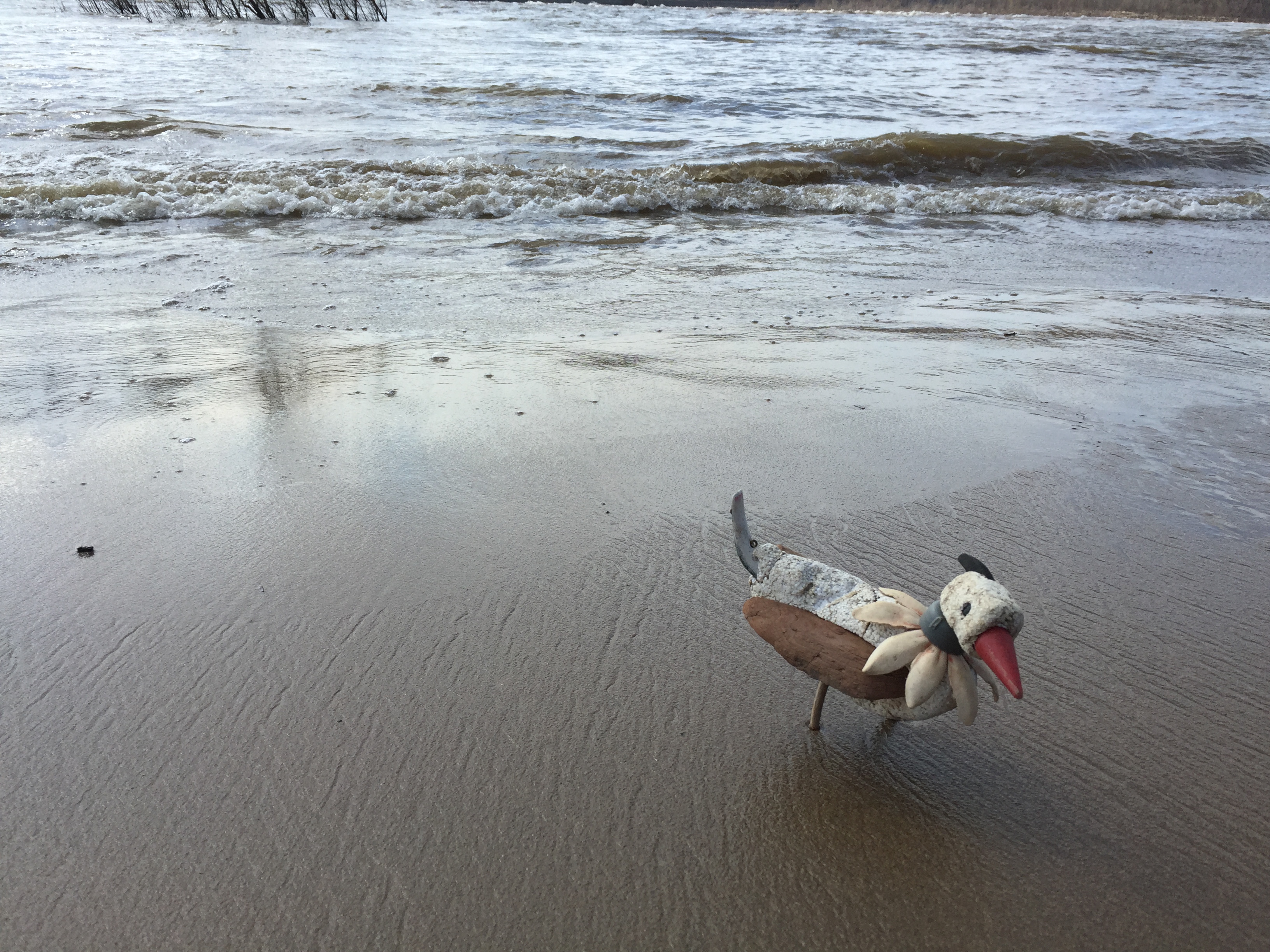
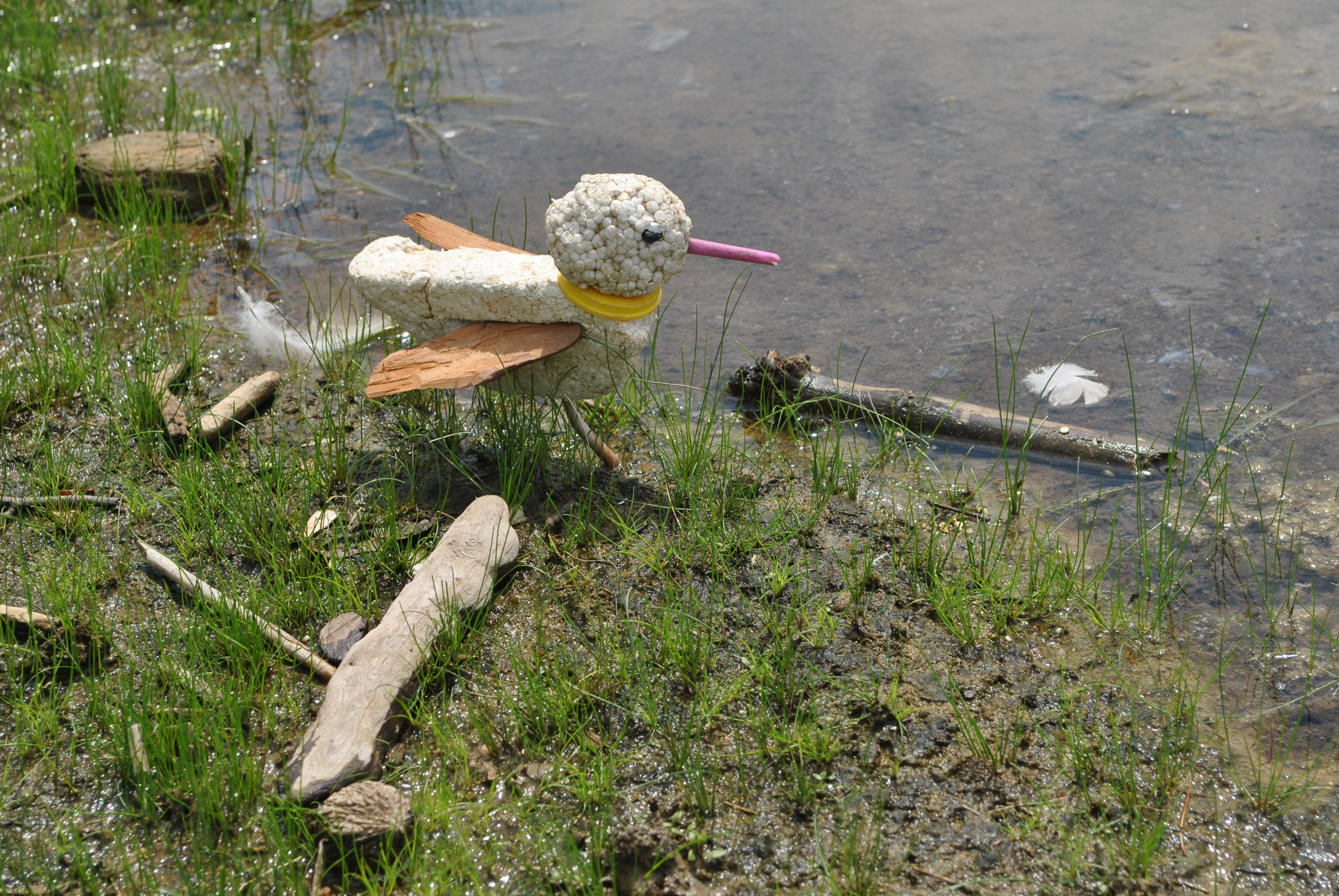
Heisenberg's Hammerkopf at the river's edge, March 20, 2016

Heisenberg's Hammerkopf investigating goose tracks, Falls of the Ohio, March 20, 2016

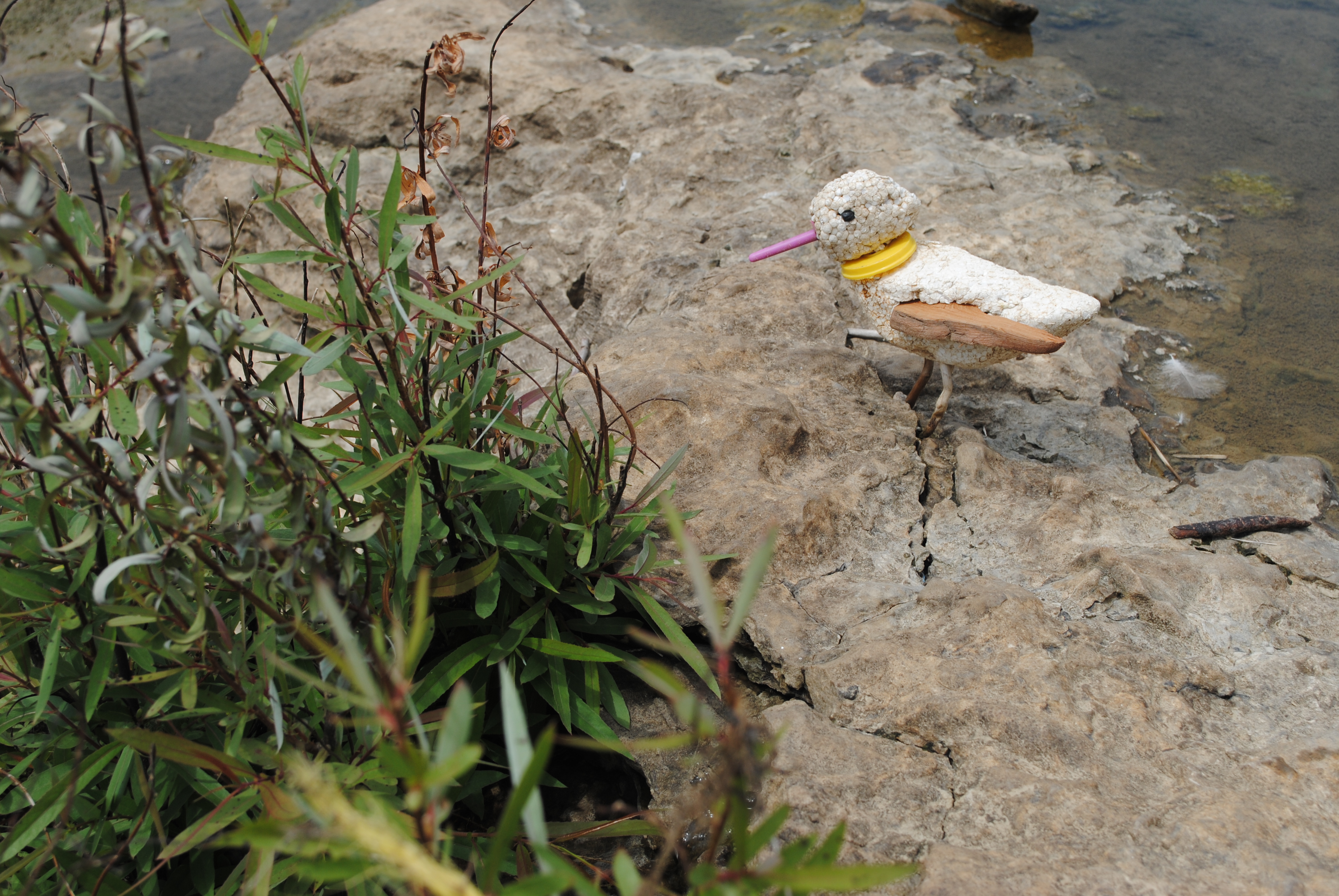
This individual kept surprising me.  I almost felt that it “changed” the more I observed it.  By that I mean at first I found it by the mud and then it changed habitat by going into the trees.  I lost track of it for a short while, but rediscovered it at the water’s edge.  From there, it moved back under the willow trees where I eventually lost it for good.  I saw it use its large bill to delicately probe the mud and hammer through a driftwood log and in both cases wasn’t sure of what it was eating if indeed it found anything to begin with?  I just saw enough of this bird to pique my interest, but I have had bird sightings that have lasted mere seconds that were satisfying enough to last a lifetime.
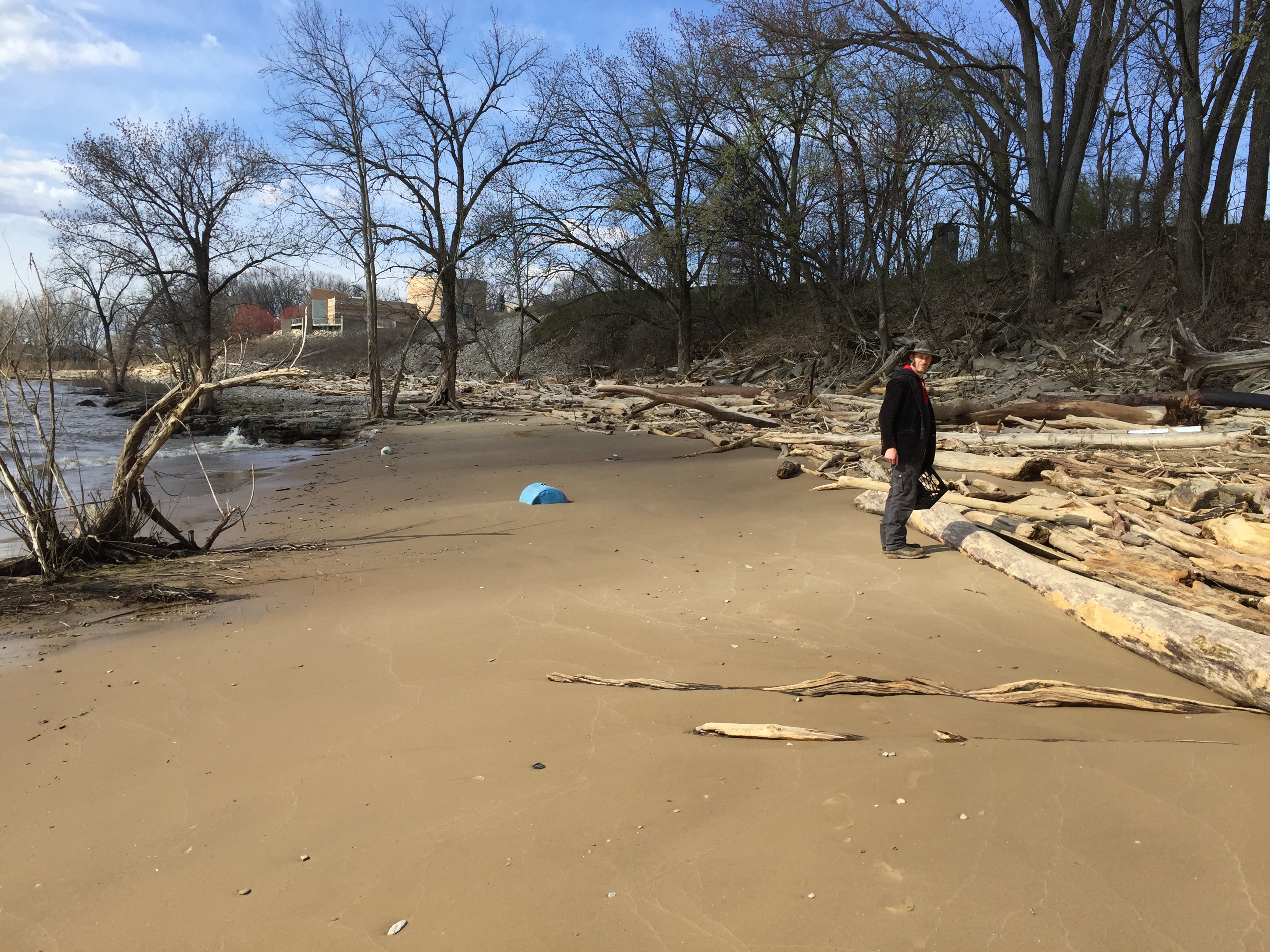
Chiel collecting driftwood, Falls of the Ohio, March 20, 2016

While I was out exploring the Falls environment, I did come across another individual who can vouch for me that this strange bird was indeed out here.  I struck up a conversation with him and as it turns out he is also an artist.  His name is Chiel Kuijl and he is from the Netherlands.  He has a residency at the Bernheim Arboretum and Research Forest in Clermont, Kentucky where he is working on a unique outdoor rope environment.  He was looking for select, interesting pieces of wood that he could incorporate into his art project and the Falls of the Ohio are a perfect place to do this.  Talking with Chiel, one of the things he is enjoying most are the new and unfamiliar birds he is encountering in this country.  I asked if he had ever seen a Heisenberg’s Hammerkopf before and he said that he hadn’t and it was really unlike what he was accustomed to back home.  I am sure I will see Chiel again, but what of the hammerkopf?
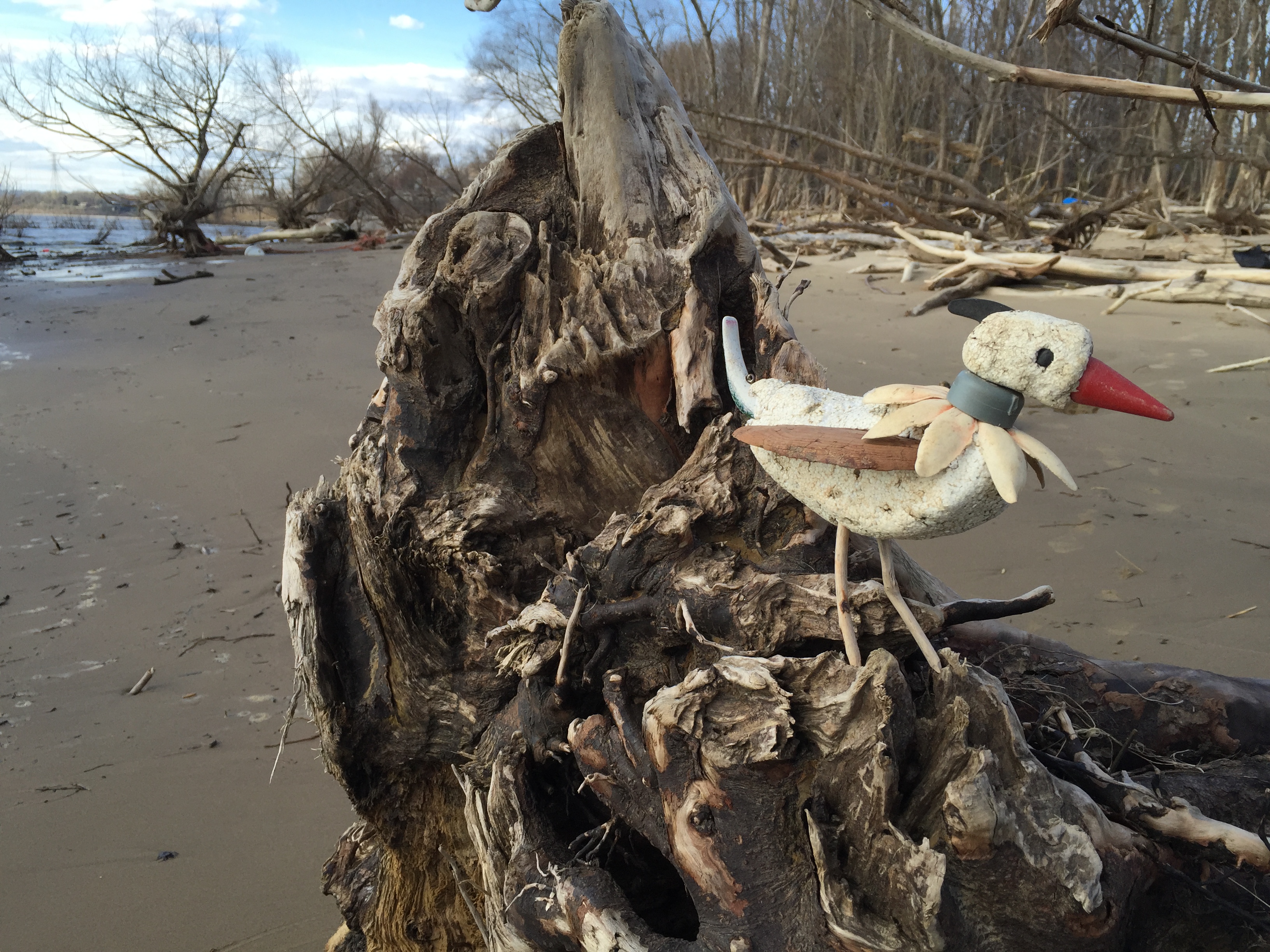
Final view of Heisenberg's Hammerkopf at the Falls of the Ohio, March 20, 2016

I don’t often make an appeal to the larger blogging world, but if anyone should happen to see this bird or something similar to it…I hope that you will post pictures of it.  It might make an interesting research project to see where in the world this species will turn up and what it might have to say about those particular places where it is found.  For now, I will leave it here and hope you will follow along the next time I am hiking at the Falls of the Ohio State Park.
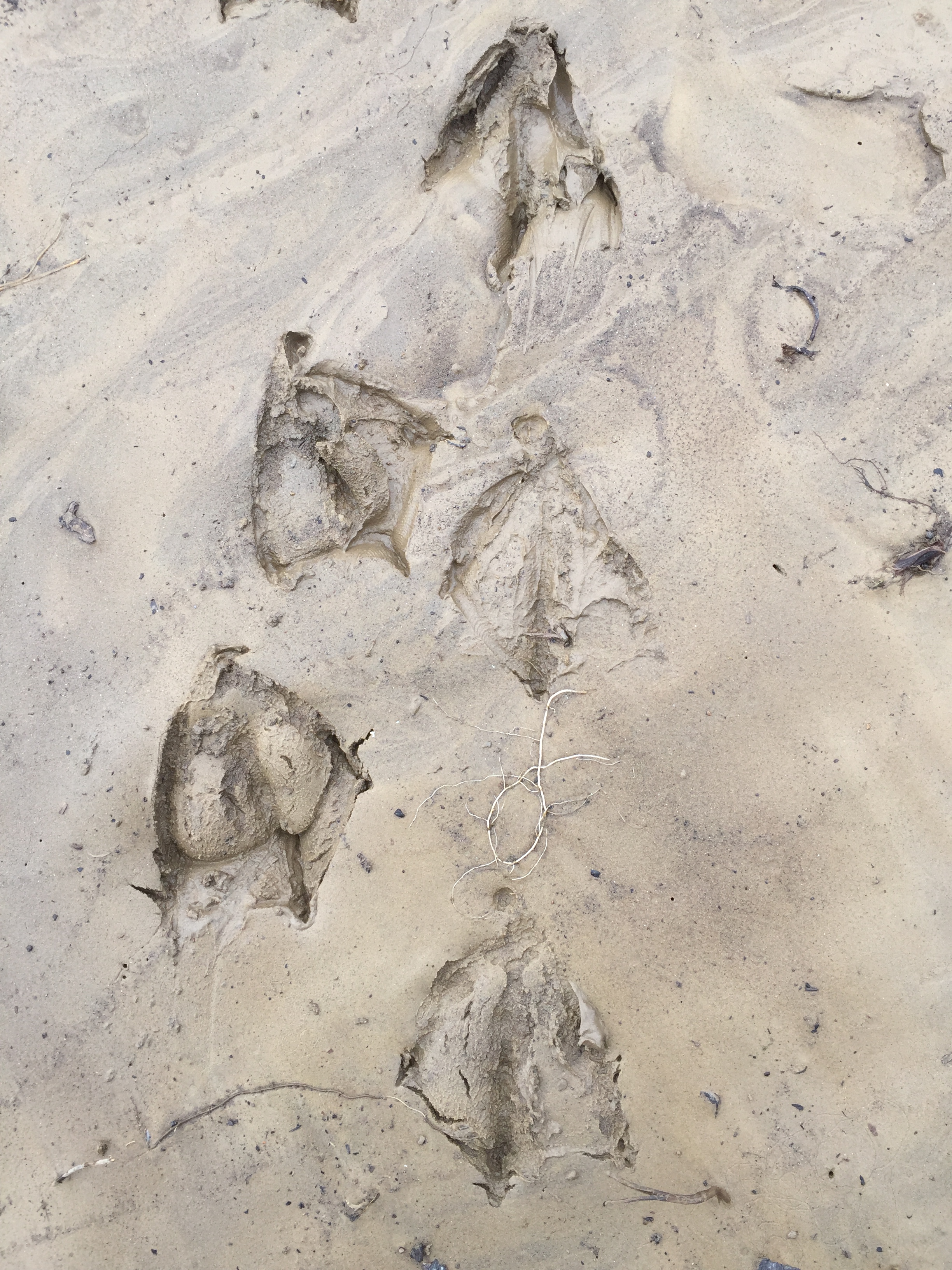
Goose tracks in the mud, Falls of the Ohio, March 20, 2016


Read Full Post »

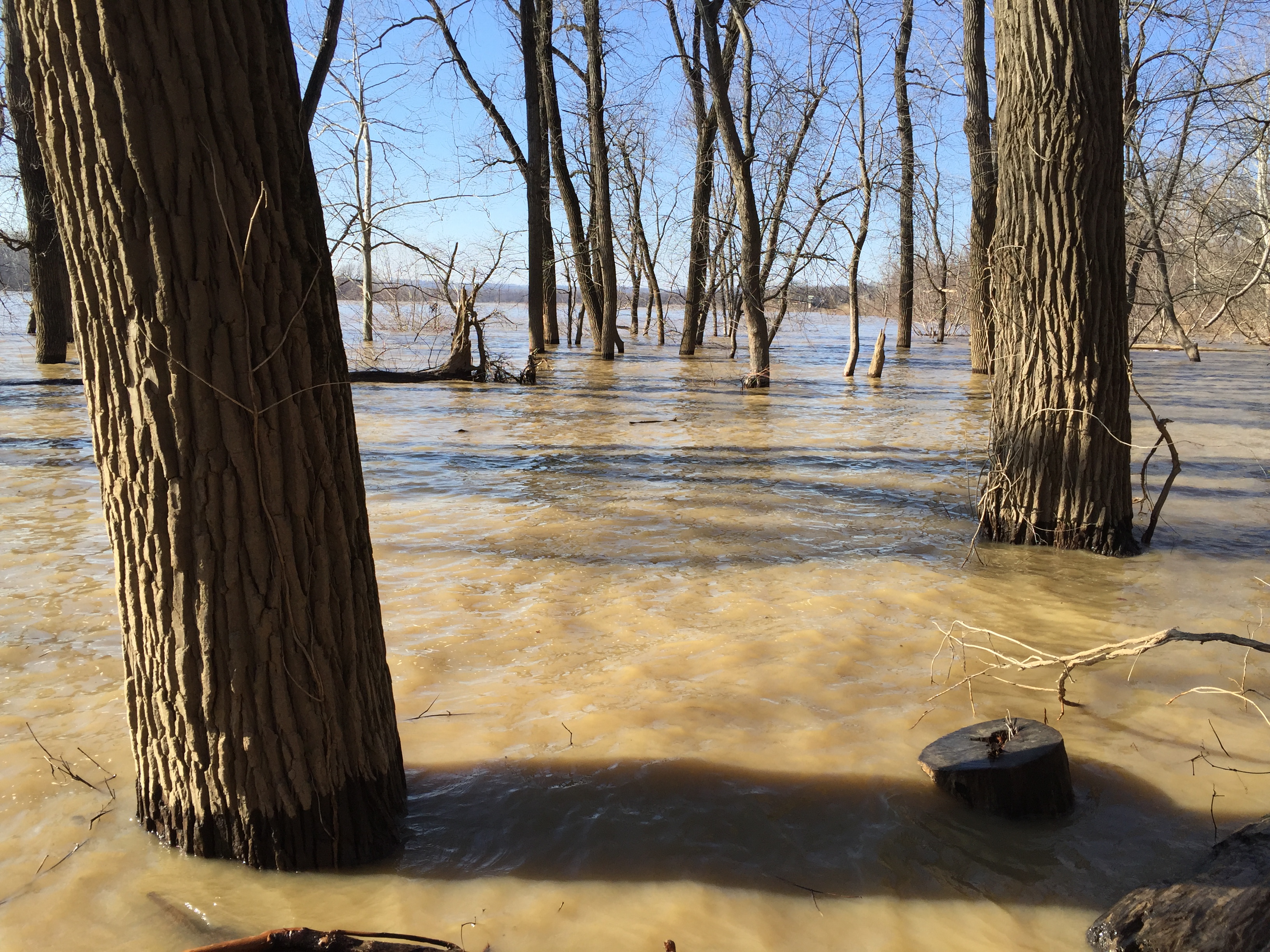
High water at the Falls of the Ohio, Feb. 29, 2016

It was Leap Day, February 29 when I went back out to the Falls of the Ohio State Park.  For the third consecutive week the Ohio River has been high and all my usual spots are underwater.  This post is being written a week later and the river is still covering most of my spots along the riverbank.  For the past month, I have been active mainly in the western section of the park.

Fallen Tree and high water at the Falls of the Ohio, Feb. 29, 2016

In the western area of the Falls,  the riverbank rises to greet a sliver of woods.  Standing on the top most level along the bank, this latest high water we are experiencing is about 8 to 12 feet below your feet, but in most places the river directly butts up to the bank and so there are few “beaches” to stand on and explore.  It is during these moments that you can most directly see and feel how a high river can upset and erode the riverbank.  I imagine that over time, the river will keep getting wider as the trees are undermined by the waters.  As I was searching for new sites and materials to work with…I decided to walk a bit more in the woods than I usually do.  Right now is a good time to do this before the vines and mosquitoes make it more difficult and unpleasant.

Found whitetail deer skull, Falls of the Ohio, Feb. 29, 2016

As I was walking along the muddy paths I couldn’t help noticing how heavy the deer traffic was in this area.  Their tracks were everywhere and almost on cue, I came across five antler-less whitetail deer that were moving away from me near the tree line.  I liked this little area mostly because I came across small stands of bamboo-like river cane.  The old timers say that river cane used to be more plentiful and once helped to define the area more than it does now.  Walking along, I saw something white laying on its side and it turned out to be a deer skull from a small doe.  In the early days of my Artist at Exit 0 project, it was uncommon to come across deer tracks and years passed before I actually saw one out here.  All that has changed now.  This is the third deer skull I have found in the park in the last two years.  Their presence throughout the Falls of the Ohio has visibly increased which is probably not a good thing for such a small park as this one.

Deer skull mounted on a tree, Falls of the Ohio, Feb. 29, 2016

I decided to leave the skull behind for someone else to discover.  Finding a suitable tree along the path, I mounted the skull on the knobby remains of a branch to mark this area as being particularly deer favored.  It was just a short hike from here to reach the river’s high edge again.

Wood debris in the water, Falls of the Ohio, Feb. 29, 2016

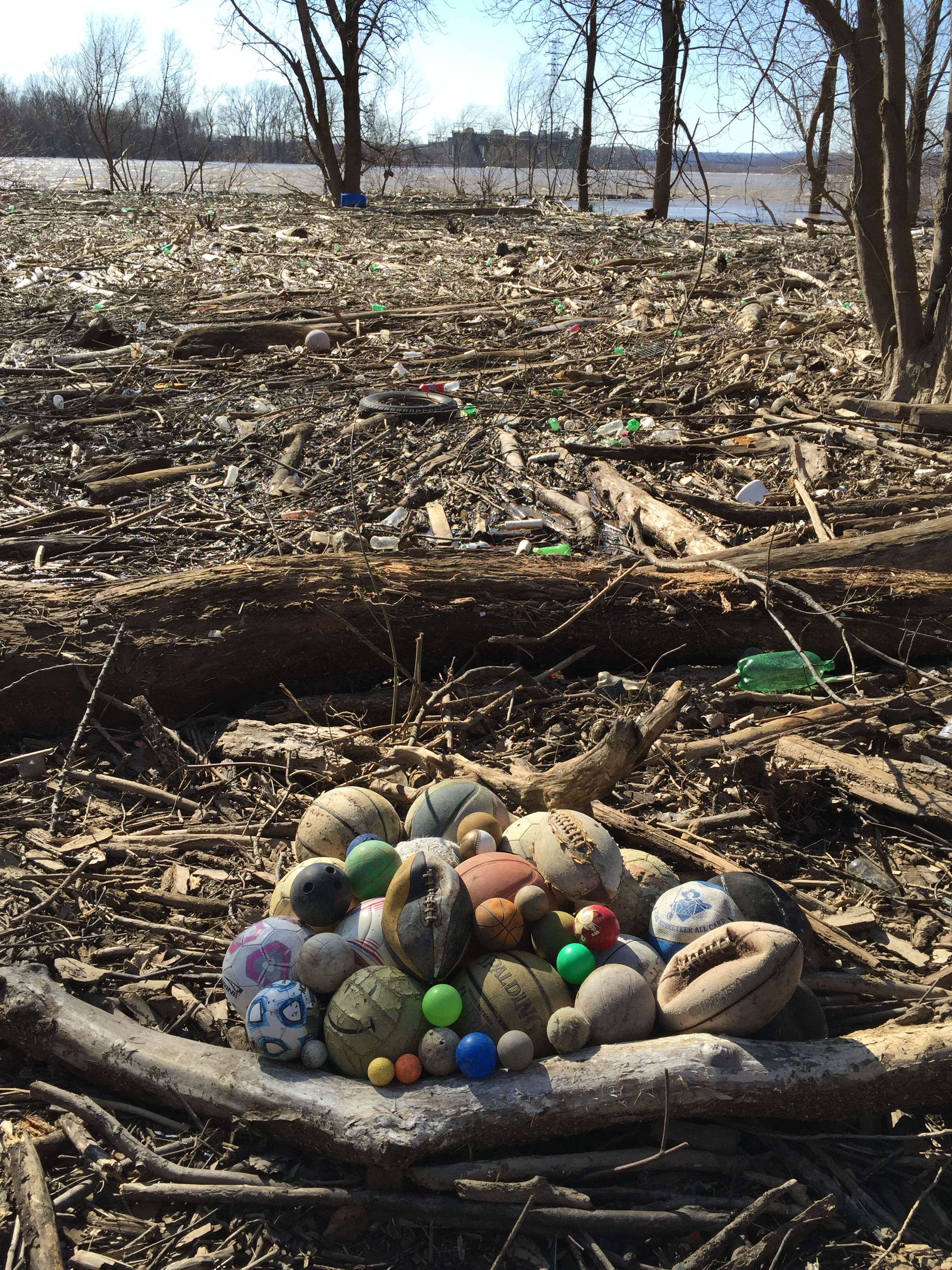
Eventually, I did find a hundred yard or so stretch of muddy bank that I could access and walk around.  It was located in a sheltered area where this was a slight bend in the river.  The prevailing currents and wind had pushed a large amount of debris against the bank and most of it consisted of wood and bark bits with the now expected plastic garbage mixed in for good measure.  I immediately began to find “stuff” and here are a few pictures of my “prized” finds.

Plastic drumstick, Falls of the Ohio, Feb. 29, 2016

Here is something for my Fake Food Collection…a small, plastic drumstick.  Over the years, I have found a few of this exact plastic poultry leg and so this is not exactly a unique find.  Note the teeth marks probably from the family dog?

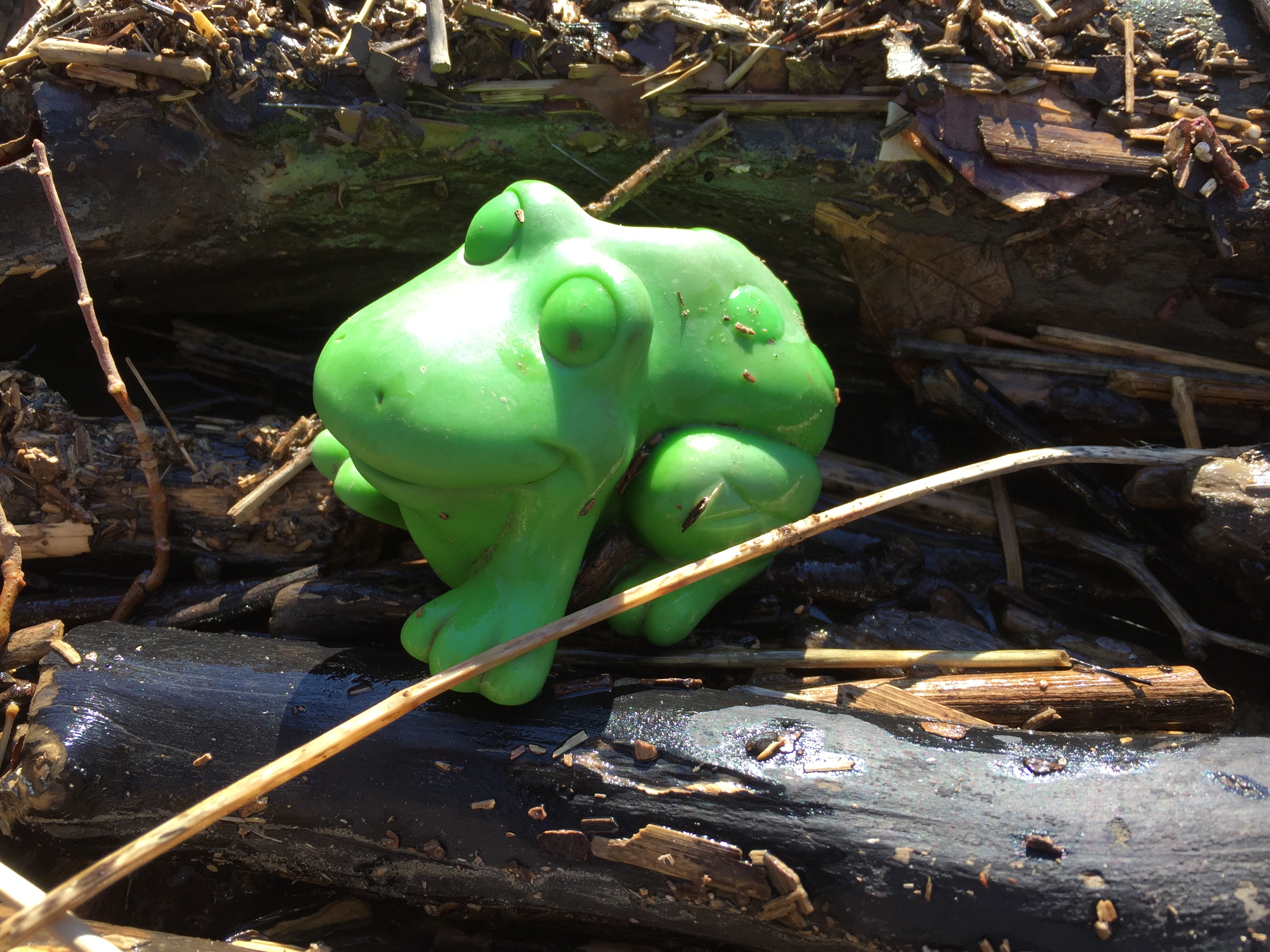
Found green plastic frog toy, Falls of the Ohio, Feb. 29, 2016

Although the spring peepers are starting to be heard in our area…this one will never make a sound.

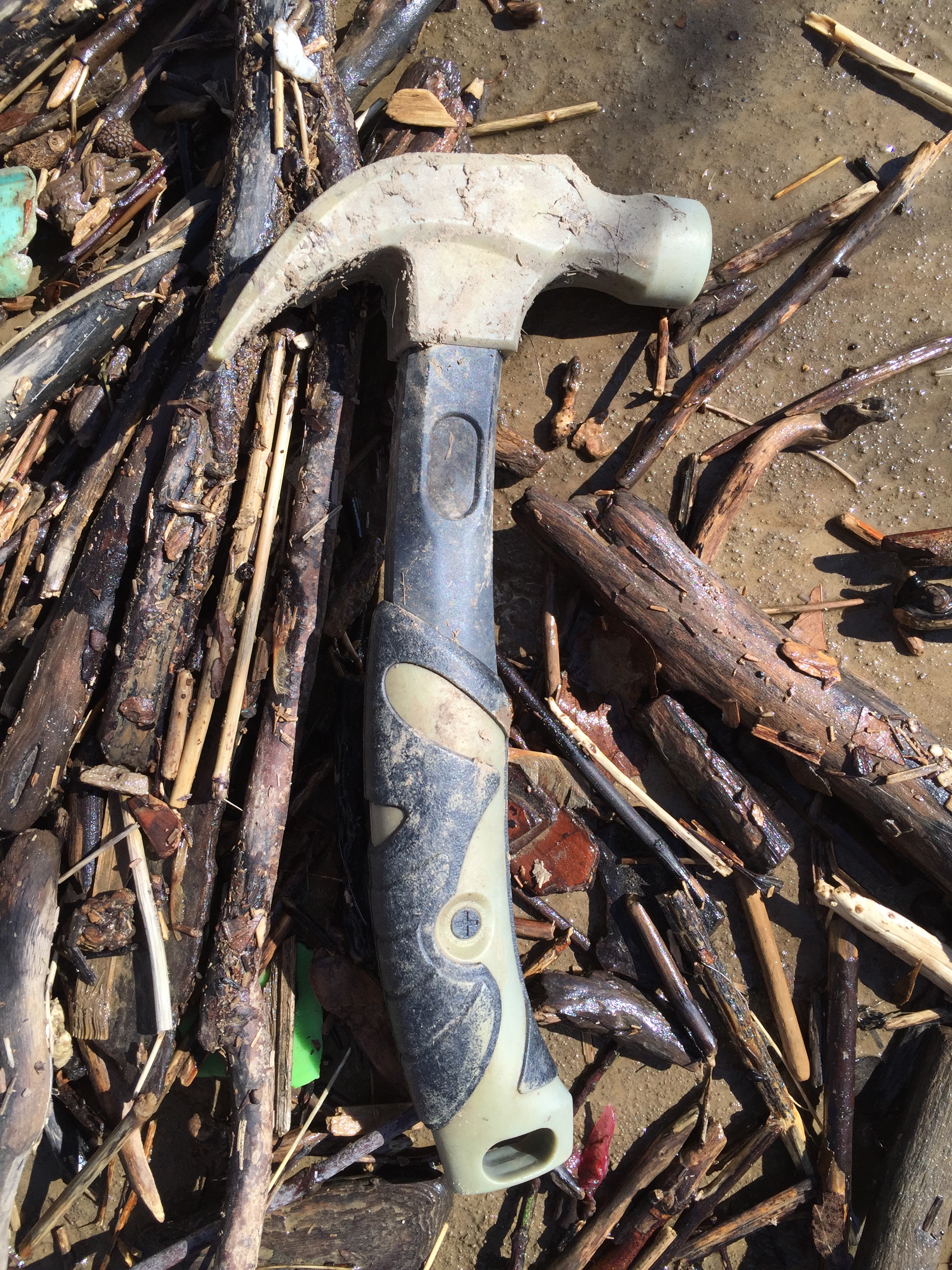
Found plastic toy hammer, Falls of the Ohio, Feb. 29, 2016

I now have an impressive collection of found toy hammers and mallets and they are all made of plastic.  I need to take a photo of that collection and post it which is another in a line of weirdly specific things I have found out here.

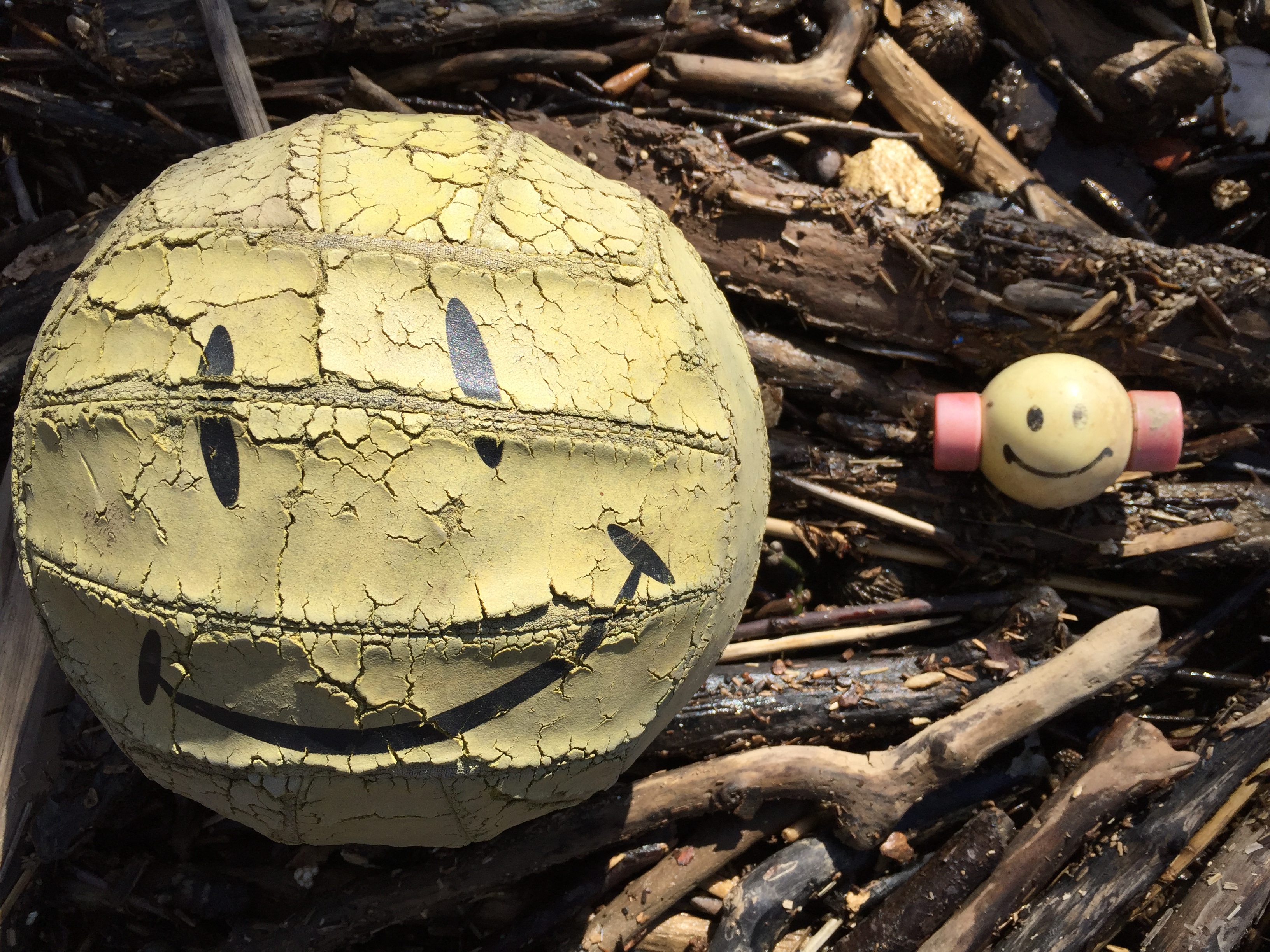
Found Smiley Faces, Falls of the Ohio, Feb. 29, 2016

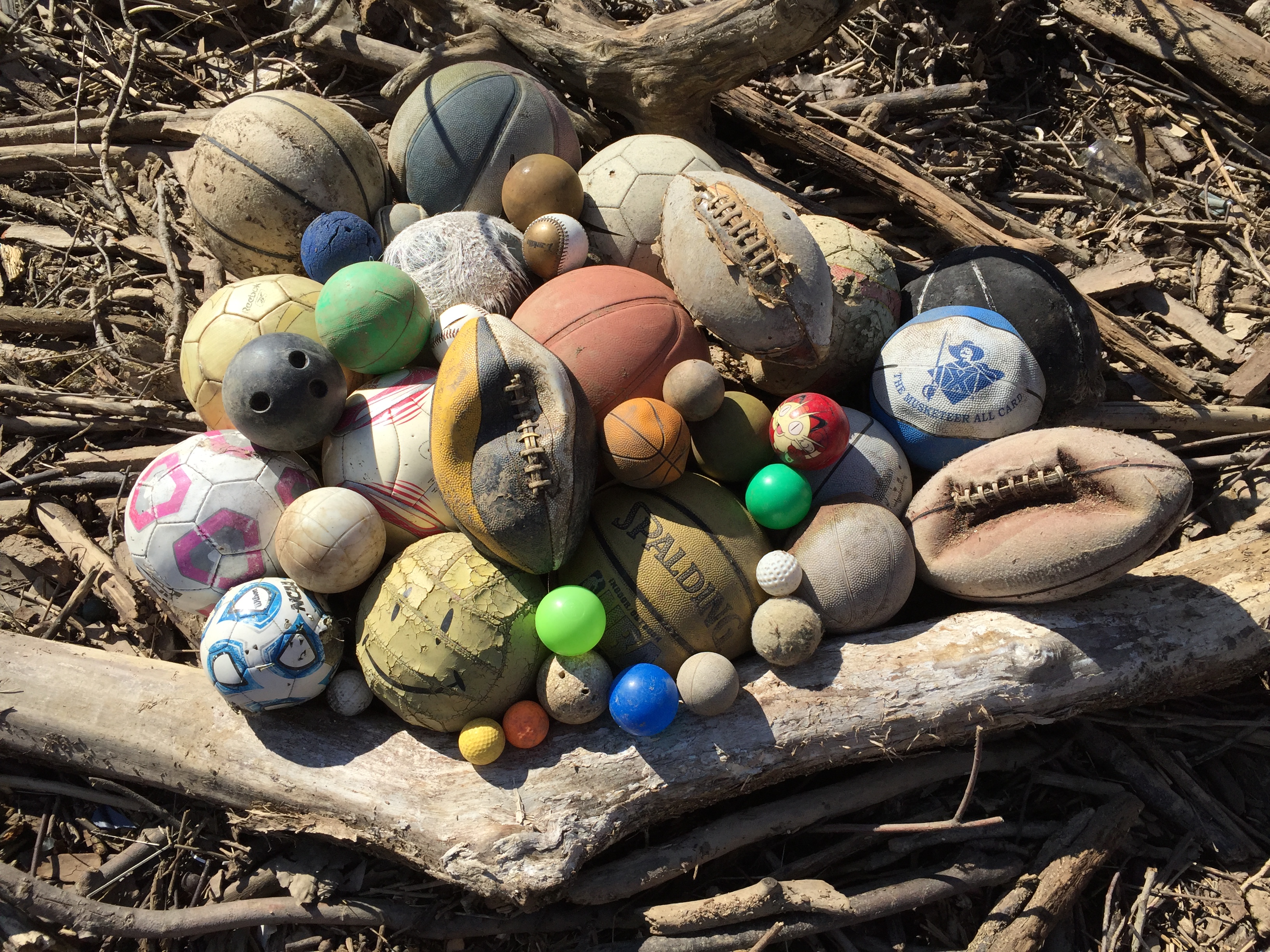
Here are two more “Smiley Faces” that are the latest ones I have found out here.  The larger is a volleyball and I’m not sure what the smaller one was intended for?  I haven’t looked at it again since I dropped it into the old collecting bag.  As I was exploring, what I couldn’t help but notice along this particular stretch of riverbank was how common toy balls of all sizes and sports that I was finding.  I decided to pick up all the ones I could access and make a collection of them all.  Here is that image.

A pile of various found balls, Falls of the Ohio, Feb. 29, 2016

Detail of found balls, Falls of the Ohio, Feb. 29, 2016

So, what is your sport?  In this motley collection of forty plus river-found balls we have American footballs, soccer balls, basketballs (of course since this is major basketball country), golf balls, tennis balls, playground balls, Styrofoam balls, softballs, a plastic bowling ball, a volleyball, several ball pit balls, and couple of novelty balls, etc…  Of course, balls are the perfect floating object since they are round and roll easily and since they are usually inflated with air they are buoyant as well.  As the day was starting to get late and I had found all the balls in the area that I could reach…it was time to start for home.  I’m looking forward to the river dropping down and the temperatures to begin to rise.  Soon the spring bird migration will be passing through and I’m hopeful of seeing a few Rose-breasted grosbeaks and maybe a Scarlet Tanager or two.  One more image of my made on the spot ball collection looking back on an interesting day at the Falls of the Ohio.

Improvised Ball Collection, Falls of the Ohio, Feb. 29, 2016


Read Full Post »

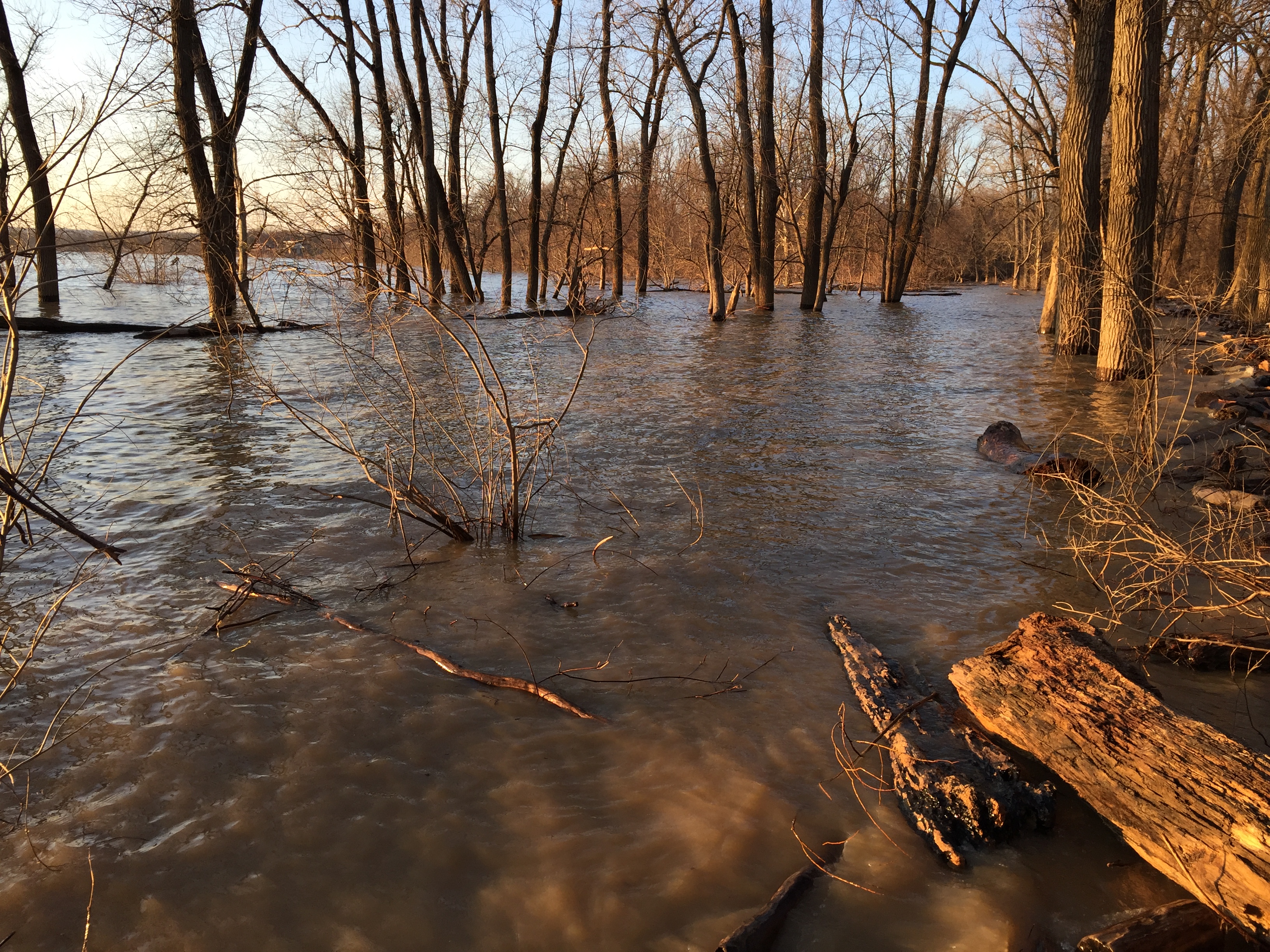
Flooded trees at the Falls of the Ohio, Feb. 7, 2016

Imagine my surprise to return to the same spot I had been working at last week…only to find it underwater!  Such was the case on my latest foray to the Falls of the Ohio State Park.  In the week since I was last here, we did experience one day where it pretty much rained all day long.  Still, in my experience, the intensity of that storm would not account for all the high water I was seeing during this visit.  Flooding in February is commonplace, but also usually tied to snow melt in the upper Ohio River Valley.  Perhaps what I was seeing was a combination of heavy rains upriver from Louisville and snow melt?  Regardless, this required a change in plans in the field.  I decided to go where nature would allow me to go.  In this case, high, dry land was to be found in the western section of the park.  I had to walk widely around the edge of a rising river, but this interstitial zone between wet and dry is often a very interesting place to explore.


Found green plastic toy Tug Boat, Falls of the Ohio, Feb. 7, 2016

Found, green plastic tug boat toy, Falls of the Ohio, Feb. 7, 2016

Among today’s discoveries includes this green plastic, tug boat that floated in with the high water.  This, however, was not the only transportation related toy that I found on my walk.  Here is something else that I came across.

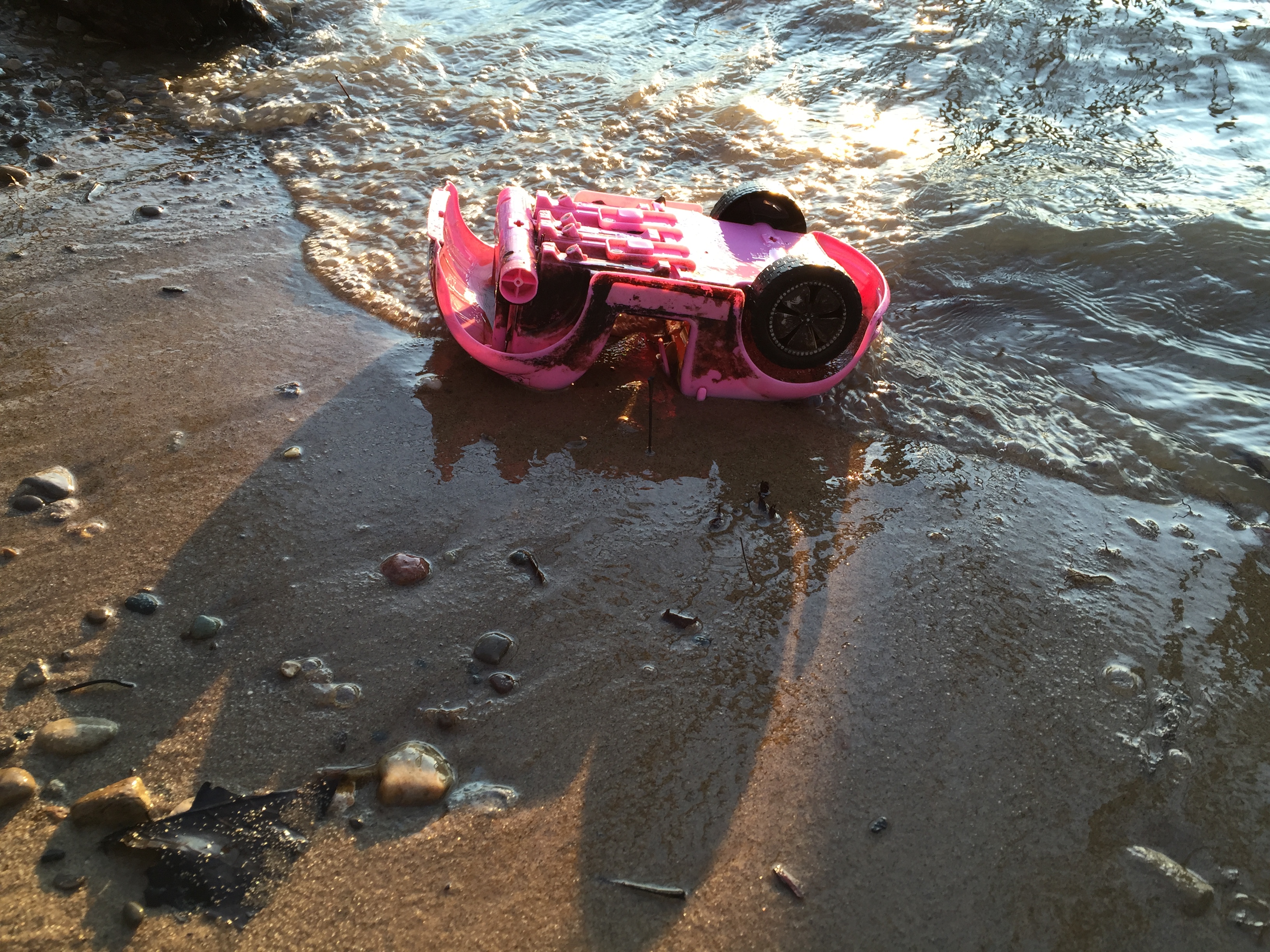
Found plastic doll car, Falls of the Ohio,  Feb. 7, 2016

It’s missing two wheels, but this plastic toy car may have given a Barbie-sized doll a ride once upon a time.  How long had this piece of plastic been floating in the river?  I like to go down to the river’s edge because this is such a dynamic place.  You never know what might be washing ashore while you are there!  Soon I reached an area that was crisscrossed by downed trees and logs that had floated in which forced me away from the water and higher up on the riverbank.  That’s when I made another significant discovery.

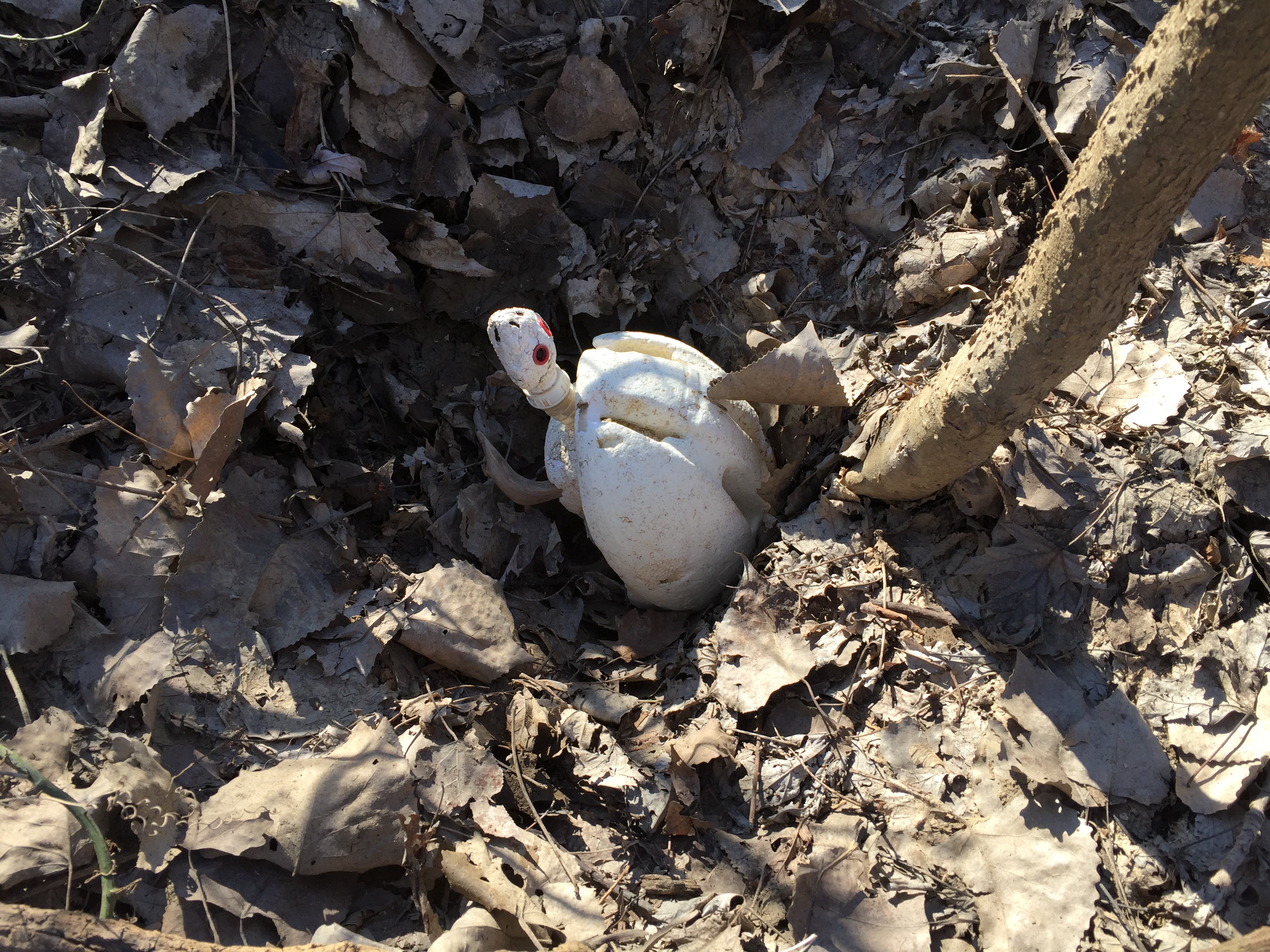
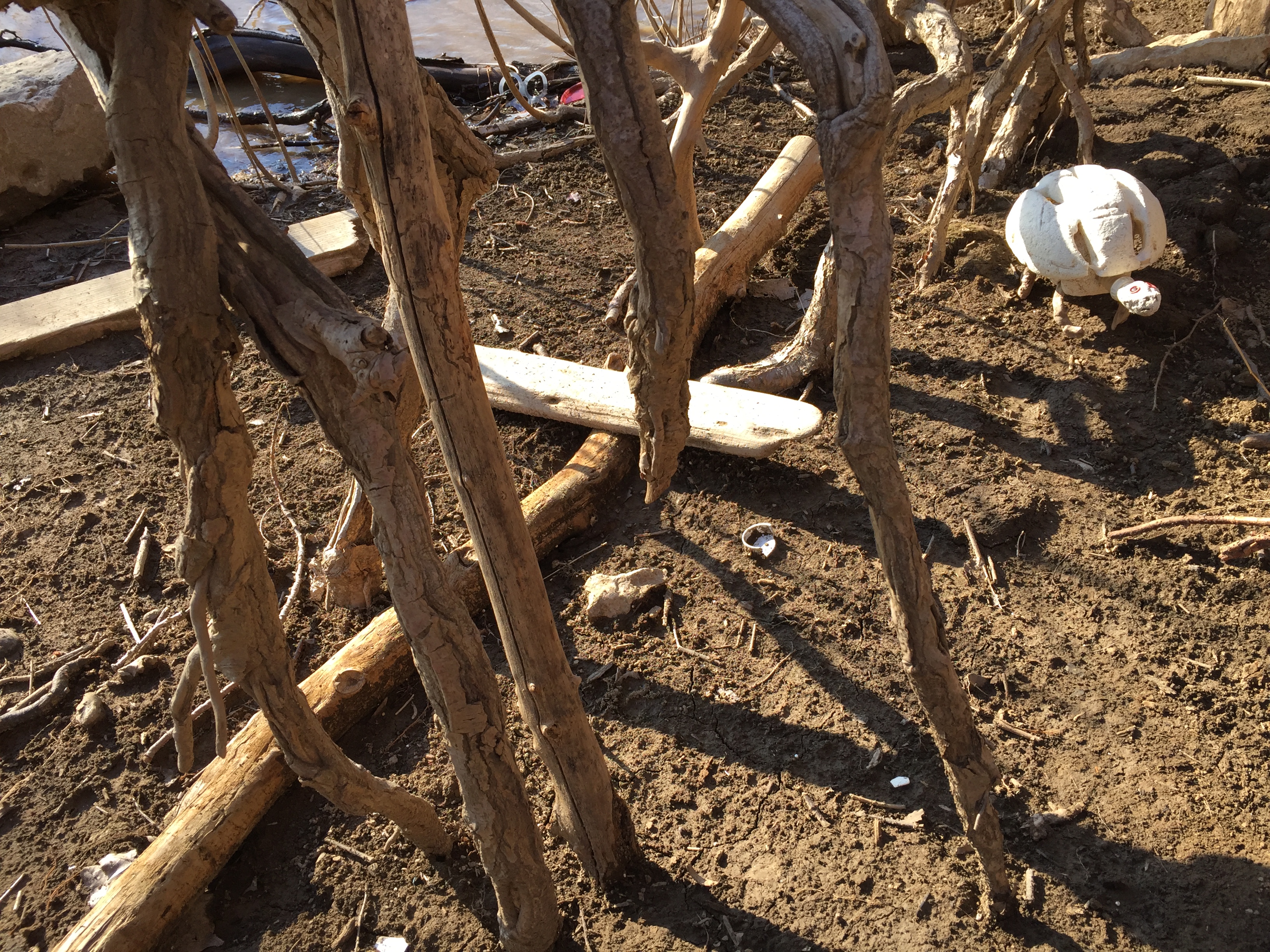
The emergence of the Red-eyed Tortoise from it's burrow, Falls of the Ohio, Feb. 7, 2016

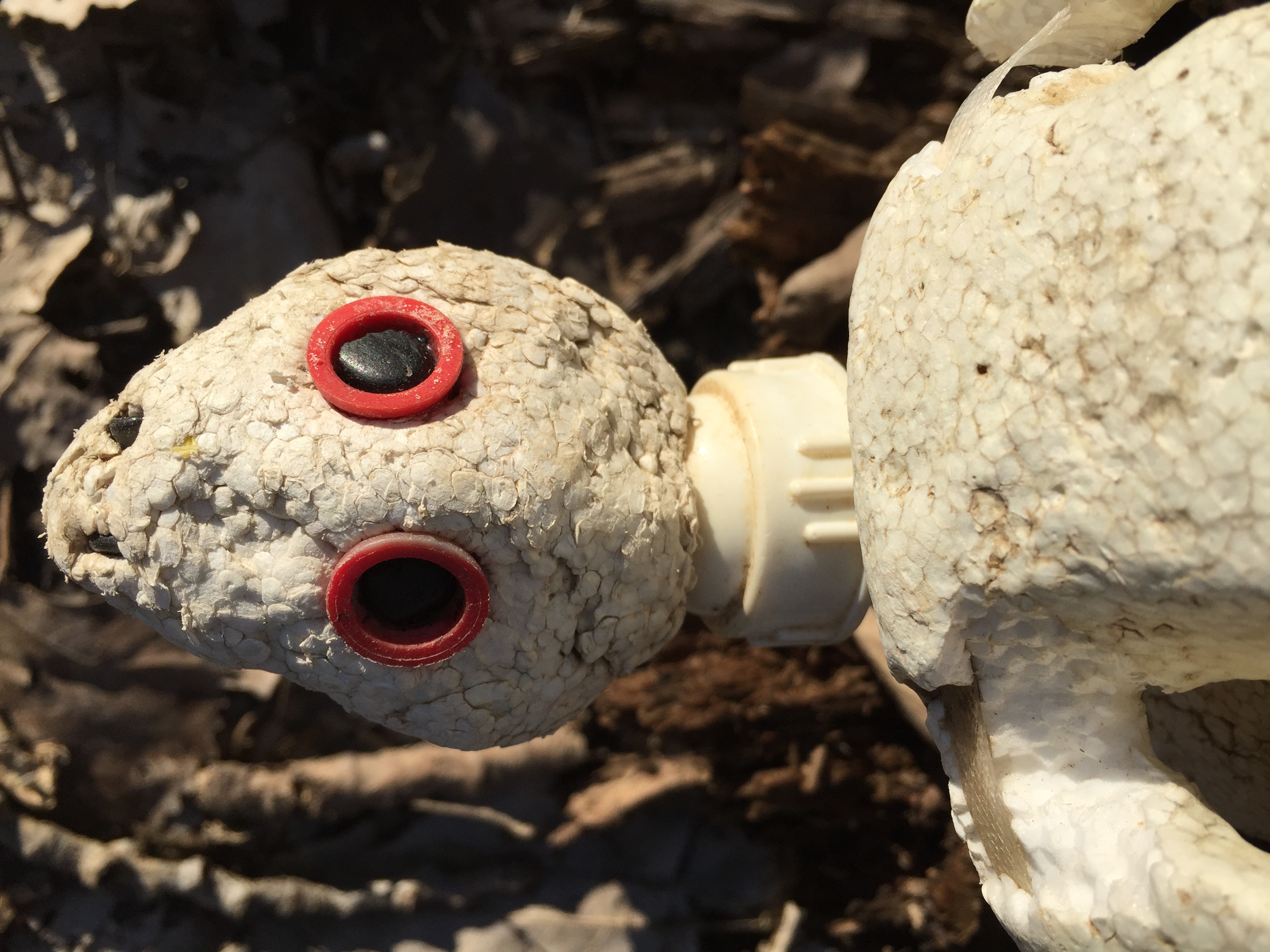
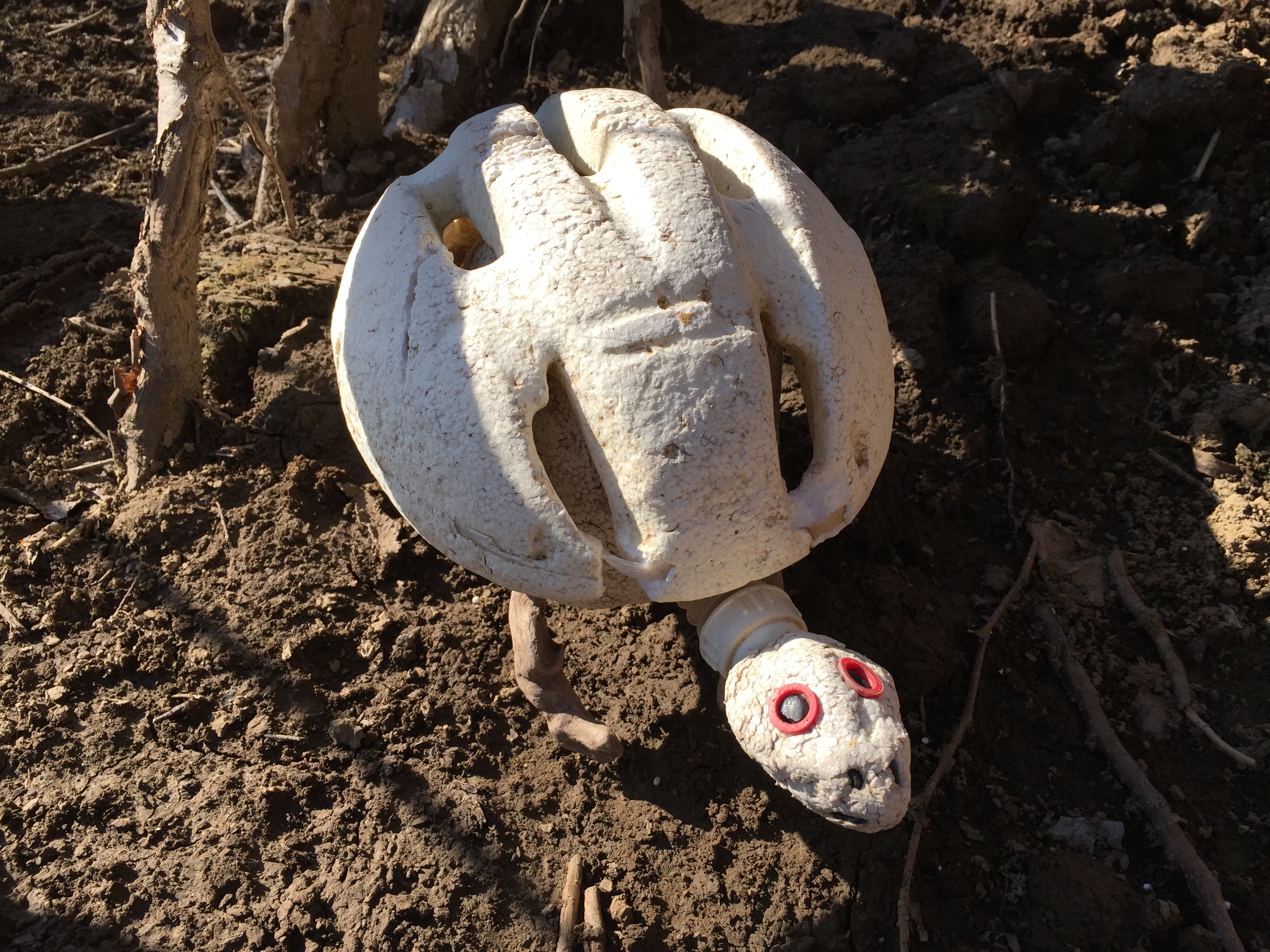
Detail of head of the Red-eyed Tortoise, Falls of the Ohio, Feb. 7, 2016

As I was walking, I heard the distinctive sound of leaves rustling on the ground and I knew an animal was nearby.  I followed the sound to its source and came upon a very rare creature that appeared to be exiting an abandoned groundhog’s burrow.  I took a couple of quick photos and backed off.  This proved to be a good move since my actions did not necessitate a full-scale retreat back into the hole it was emerging from.  Hiding behind a tree, I let the tortoise take its sweet time as it fully came to the surface.  I was practically holding my breath the entire time and for good reason.  It’s not everyday that you get the opportunity to photograph and study one of the world’s rarest reptiles…the Red-eyed Tortoise (Gopherus helmeti).

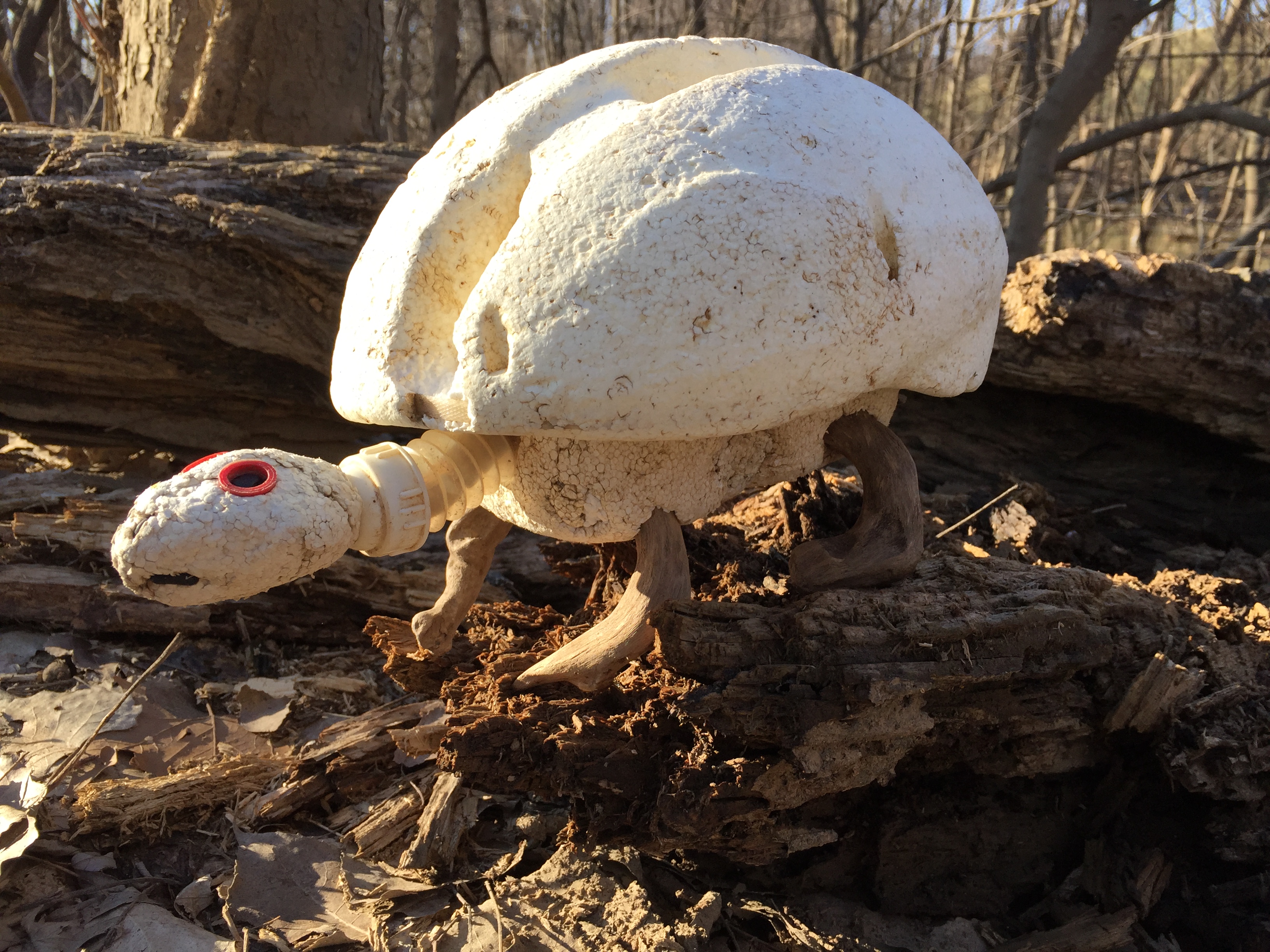
Red-eyed Tortoise, Falls of the Ohio, Feb. 7, 2016

The Red-eyed Tortoise was first discovered by naturalists early in the 19th century.  The Falls of the Ohio (and on the Indiana side of the Ohio River) is the southernmost point of this uncommon creature’s range.  Perhaps they were never plentiful to begin with?  Everything I was witnessing about this tortoise seemed to suggest that it is not only slow, but likes to take its time.  If this animal had a motto it would be something like, “Hey, what’s the big hurry”?

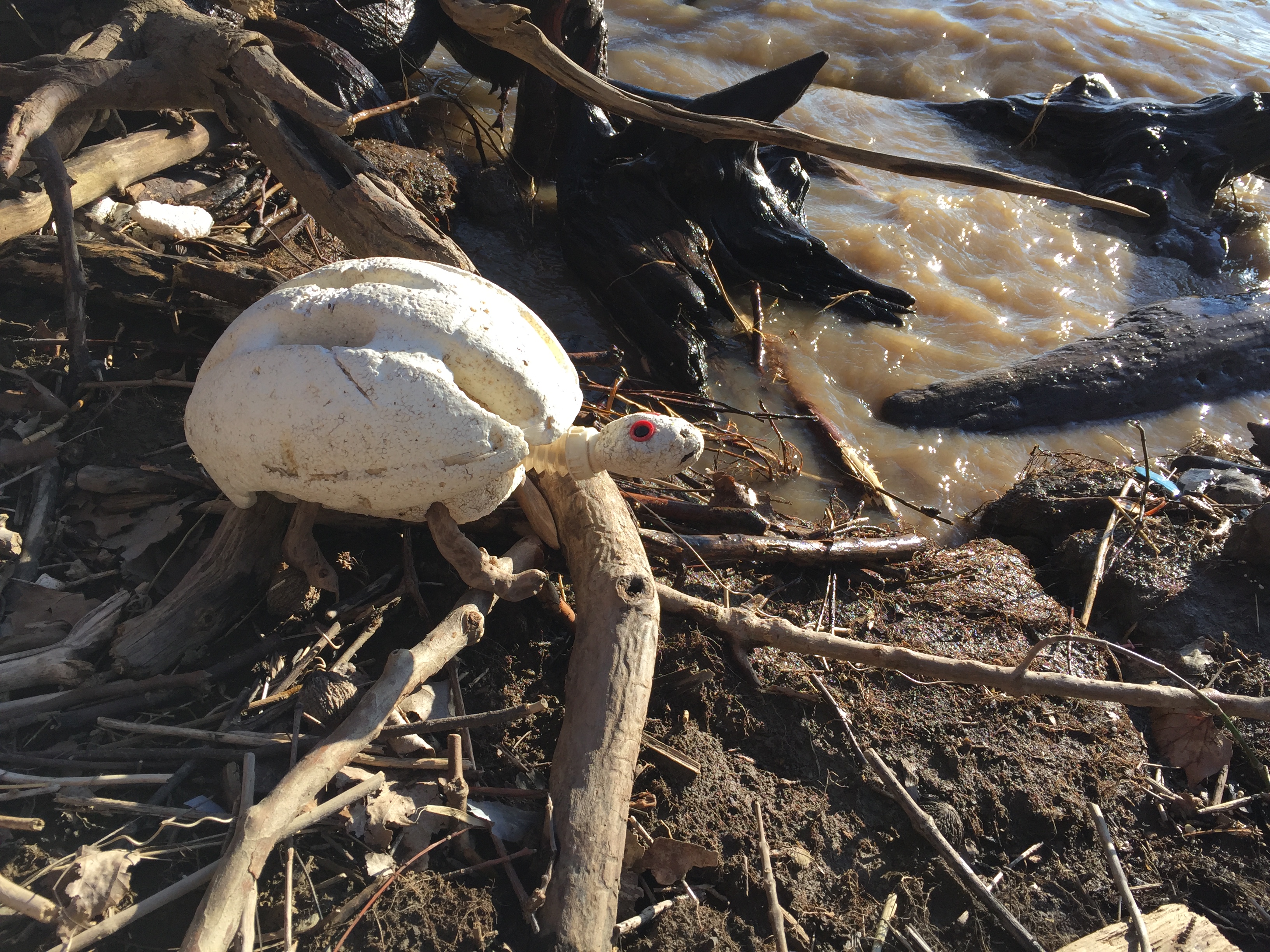
Red-eye Tortoise at the river's edge, Falls of the Ohio, Feb. 7, 2016

I watched as the tortoise very deliberately walked to the water’s edge.  What I knew from books about this reptile was that it is omnivorous, but if it is hungry for live food than positioning itself near a rising river driving small animals up the bank would increase the chances of successfully catching a meal.  Unfortunately, I did not witness anything so dramatic.  In fact, during my time in the presence of this tortoise…I did not see it eat or drink at all.

Red-eyed Tortoise and Cottonwood tree roots, Falls of the Ohio, Feb. 7, 2016

Red-eyed Tortoise, Falls of the Ohio, Feb. 7, 2016

The tortoise lingered at the edge of the river for a while.  It very deliberately examined the driftwood.  Perhaps this was part of its hunting strategy?  There was something I was very curious about and it had to do with the temperature.  Most reptiles are cold-blooded and require the sun’s energy to warm them up.  Was this also true for this tortoise?  Although it was warmer today, it was still far from spring-like temperatures and so how was this reptile able to deal with the coolness?  The secret resides in its unique shell design and composition.  During the colder days, the tortoise’s carapace is made from a hard, foam-like material that not only protects it from blows, but also insulates and retains what heat this animal is able to generate.  In the warmer weather months, special vents in the carapace do the reverse and provide cooling ports that keep the tortoise from overheating.

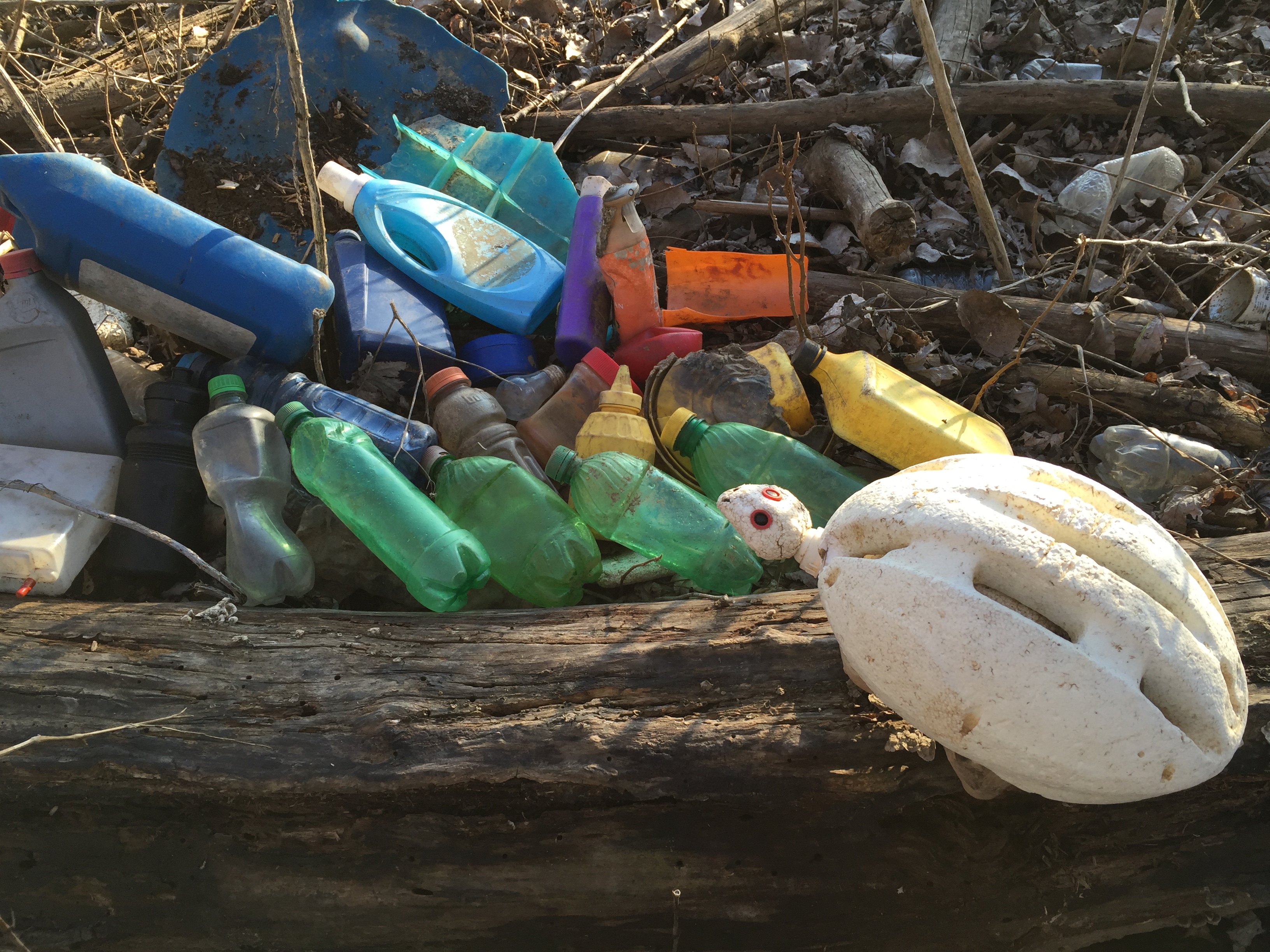
Red-eyed Tortoise with found plastic bottles, Falls of the Ohio, Feb. 7, 2016

I did catch one other puzzling behavior and it was in connection with a cache of river-born plastic bottles that had accumulated next to a large, downed log.  The tortoise appeared to initially be interested in them, but one sniff had our hard-shelled friend reacting adversely and it moved as quickly as it could away from that area.  I did not personally check out these plastic bottles, but I theorized that one of them was probably still carrying its toxic, noxious contents that the tortoise picked up on?  Regardless, it did beat a retreat away from the river and I followed from a respectful distance.

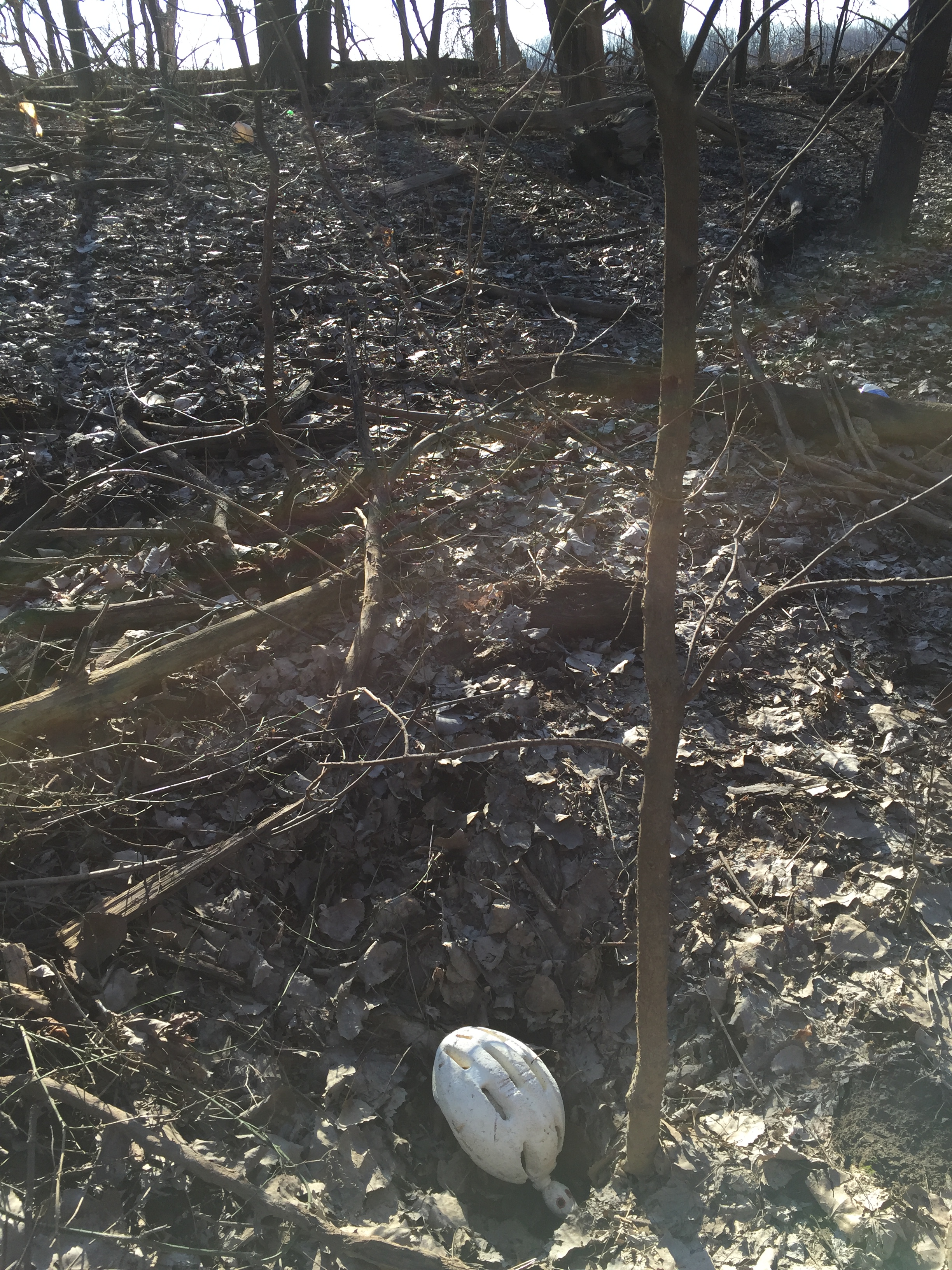
The Red-eyed Tortoise returning to its burrow, Falls of the Ohio, Feb. 7, 2016

The last view I had of the Red-eyed Tortoise had it going head-first back down into its winter burrow.  There was a brief “flurry” of legs as dirt and leaves were used by the tortoise to seal the hole back up.  I made a mental note of the area where this burrow is located, but also realized that with the advent of warmer weather…this whole section of woods would transform in practically unrecognizable ways.  Perhaps this is for the best because even with the purest of intentions, I would not want any undo harm to come to it by drawing unnecessary attention to it.  I would be very selective about who I would tell about this tortoise’s existence and even more careful about who would see the images I made of it.  Of course, I hope I will get the chance to see it again, but I’m also prepared to have this be the one and only time I had this direct experience with it.  With the tortoise secure again, I collected my belongings and with the sun setting on my back…started on the long hike back home.  It had been a very special day and one that I would savor for some time to come.

Sun down at a flooded Falls of the Ohio State Park, Feb. 7, 2016


Read Full Post »

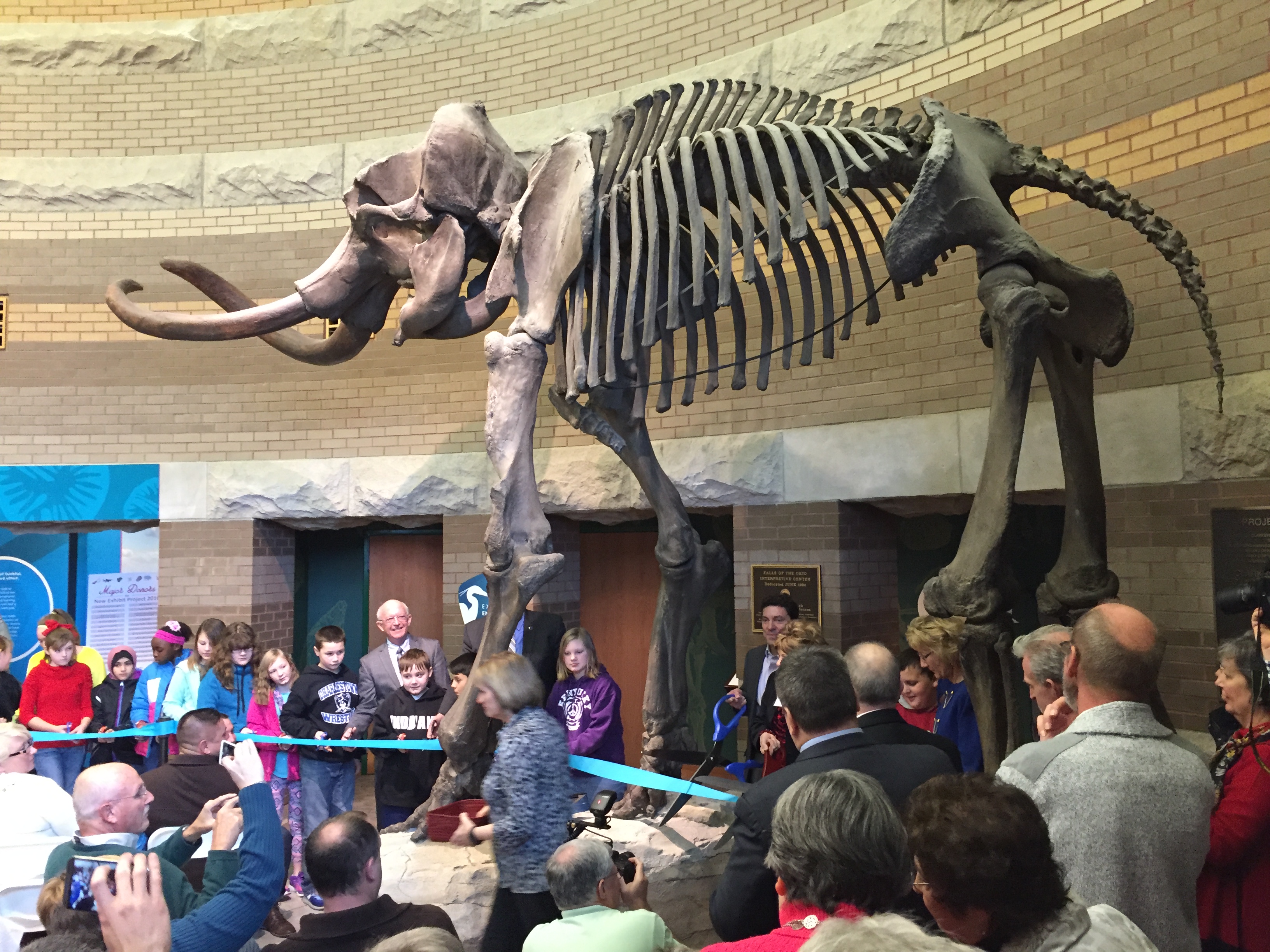
Ribbon cutting ceremony, Falls of the Ohio, Jan. 8, 2016

On January 8 of this new year, the exhibits at the renovated  Falls of the Ohio Interpretive Center opened to the public with a grand ribbon cutting ceremony.  The interior of the Interpretive Center had been closed for 13 months.  About 6 million dollars had to be raised to upgrade the 22-year-old permanent educational displays.  After a national search, Louisville-based exhibit design company, Solid Light, Inc. won this high-profile contract and solidified their growing reputation within the exhibit design field.  Judging from the enthusiastic response of the people attending the reopening it was worth the wait.  I played a very small part with a commission to create an assemblage from objects I found in the park and I was eager to see how Solid Light used it.

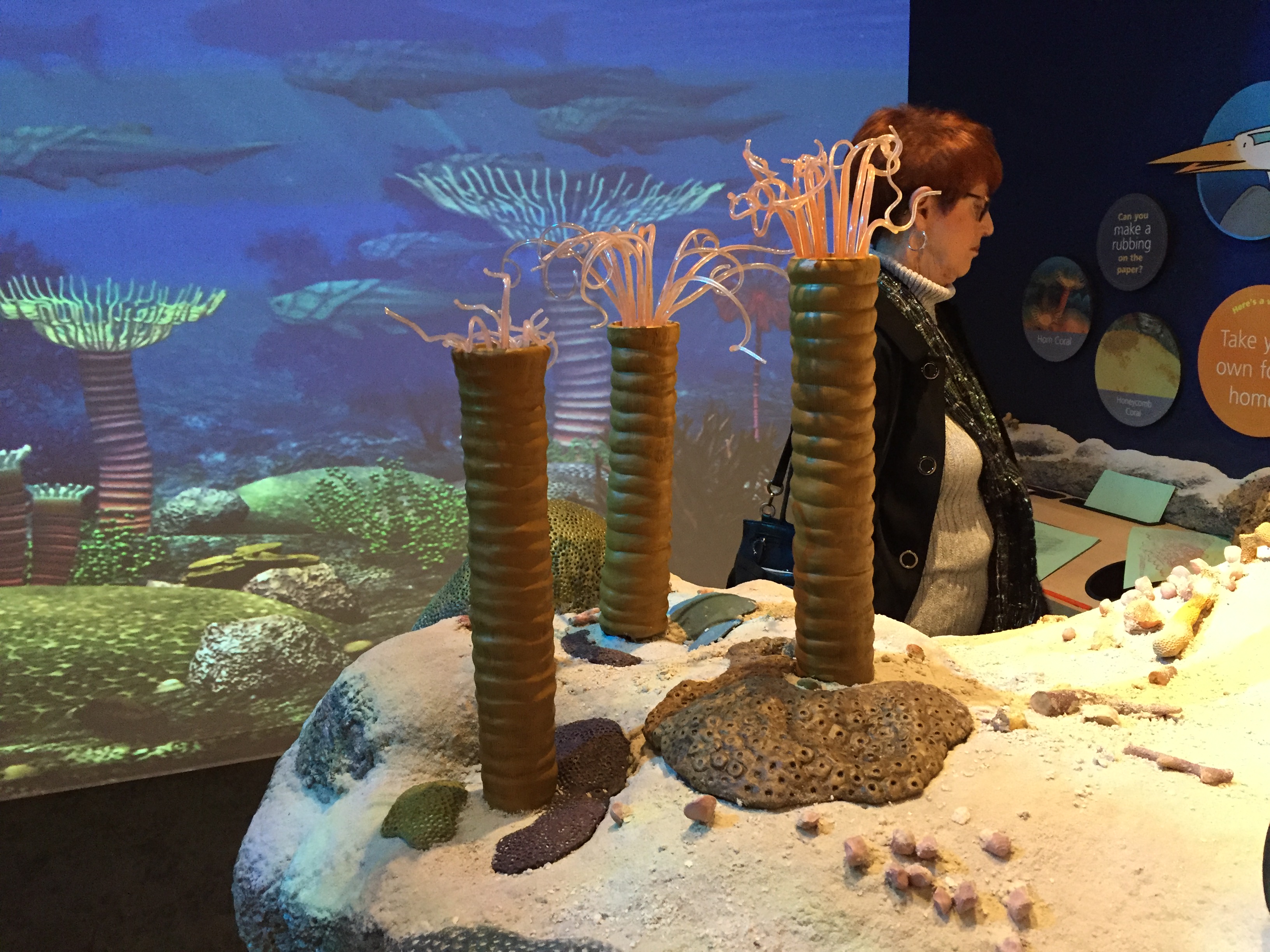
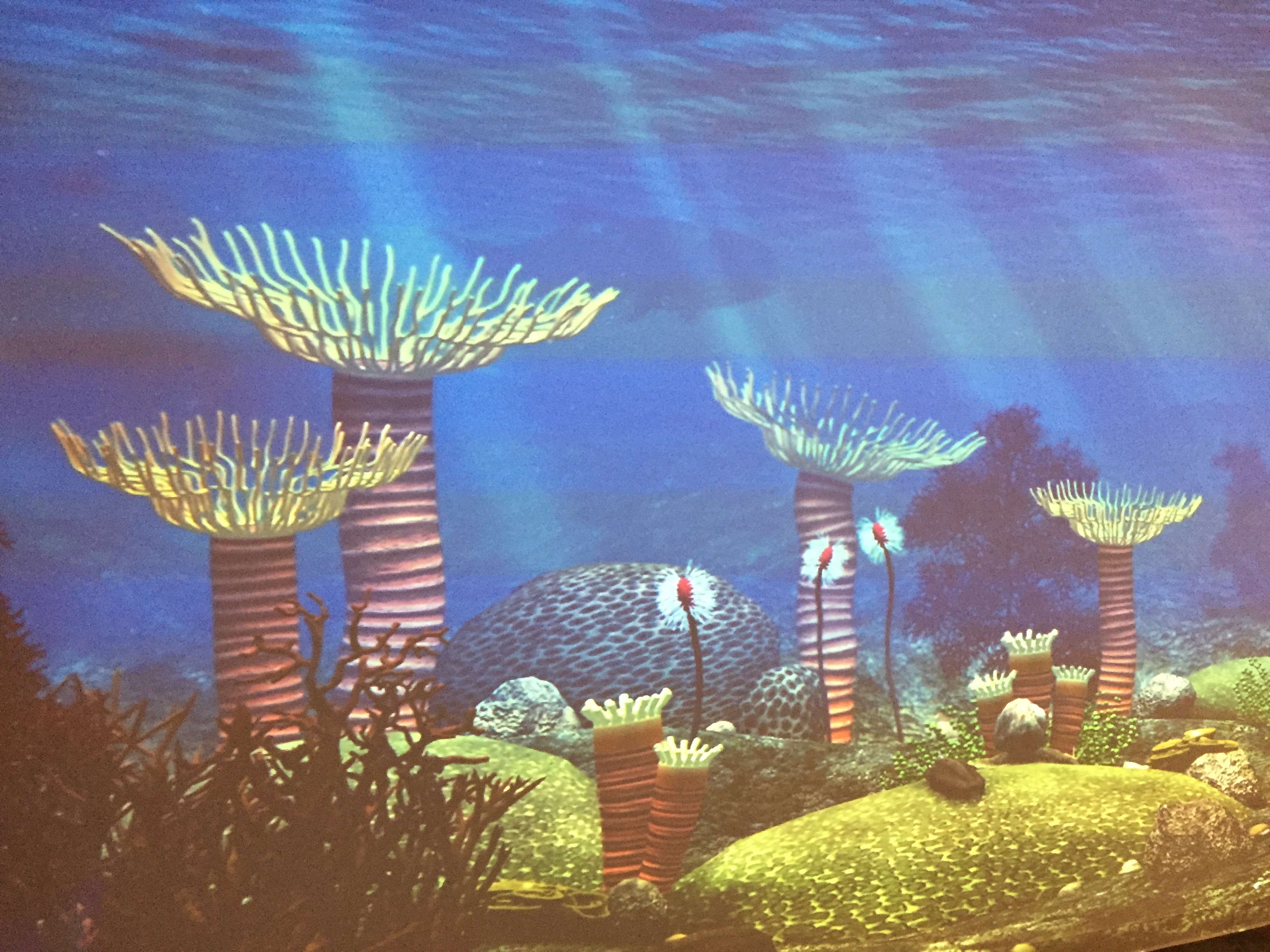
From "An Ancient Sea", Falls of the Ohio Interpretive Center, Jan. 8, 2016

video projection of the Devonian Sea, Falls of the Ohio Interpretive Center, Jan. 8, 2015

The displays are divided into four themes or sections beginning with “An Ancient Sea” that highlights early marine life during the Devonian Period.  The extensive fossil beds in the park date roughly to 400 million years ago and are the remains of an early coral reef ecosystem populated with many species of coral, brachiopods, and early fish which make their first appearance during the Devonian Period.  I was glad to see some of the older models that made up the original display were re-purposed into the new display.  The exhibit is interactive and there are hands on elements that children will enjoy.  Large, wall-sized videos help set the scene through many of the sections and in “An Ancient Sea” an animation depicting a shallow marine environment includes fish swimming through sun-dappled waters as trilobites search for food among the corals.

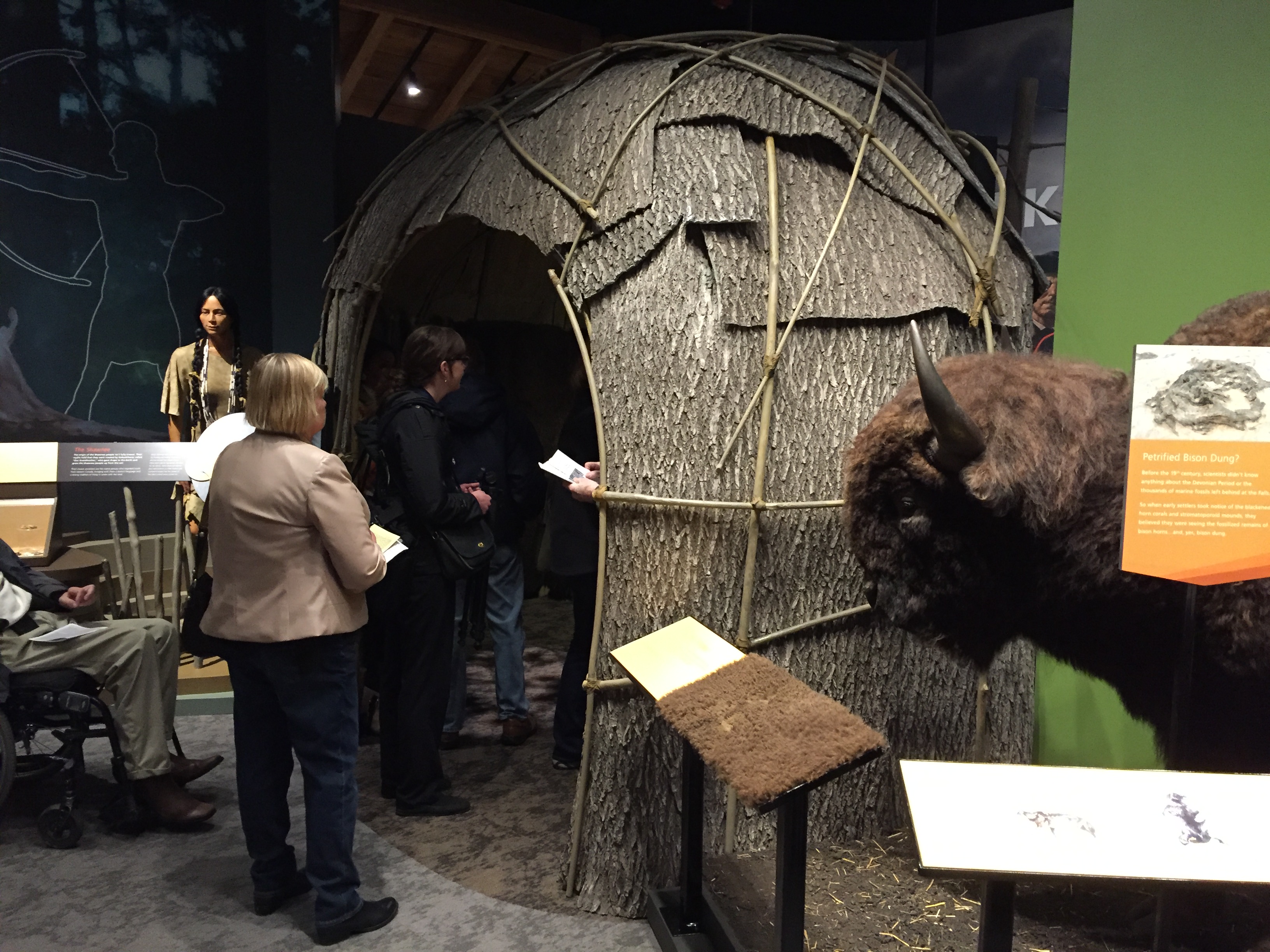
Reconstructed Native American house, Falls of the Ohio Interpretive Center, Jan. 8, 2016

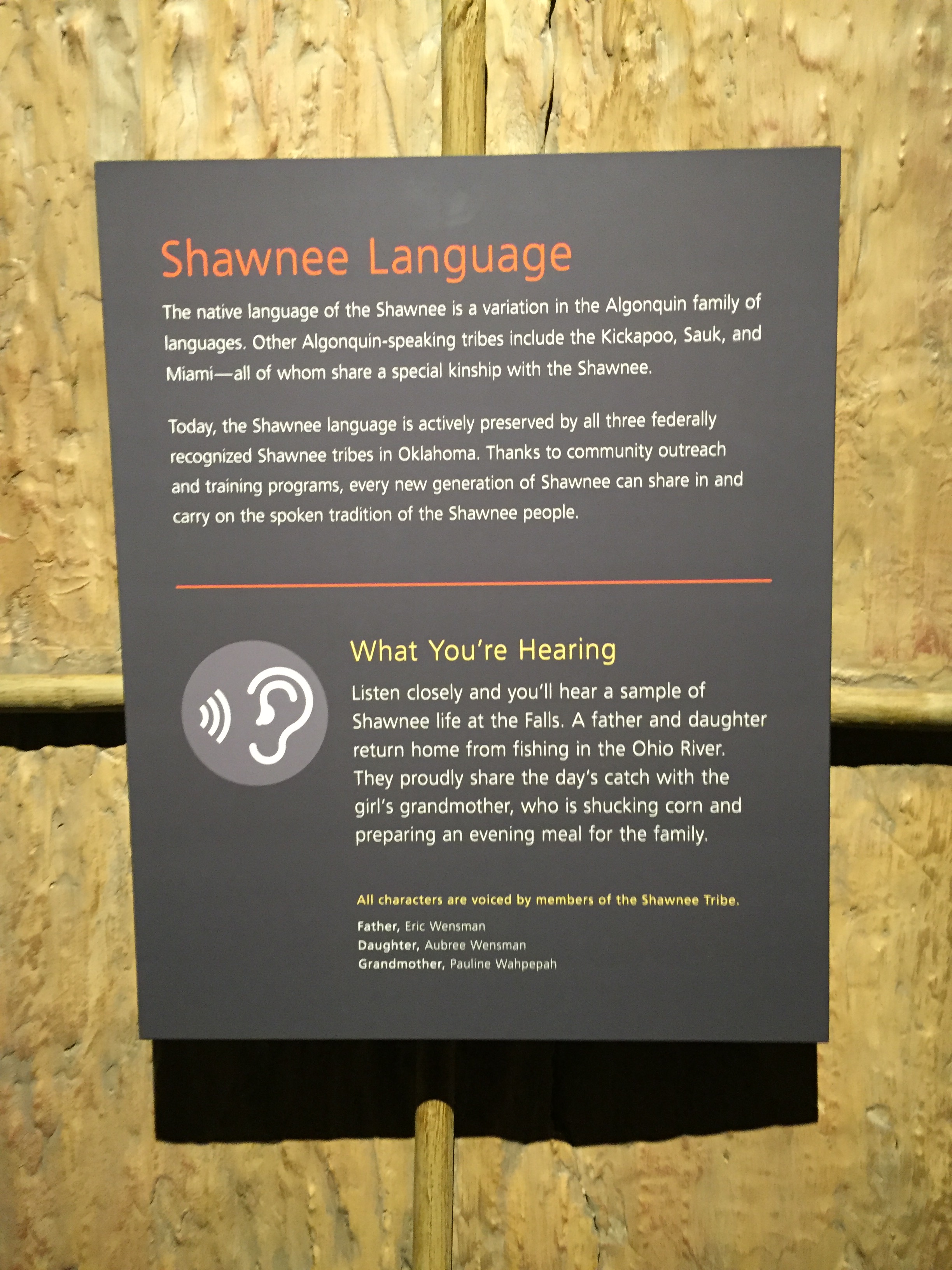
Signage about the Shawnee language, Falls of the Ohio Interpretive Center, Jan. 8, 2016

The second theme is entitled “A Changing Land” and covers all the geologic changes from the Ice Age to the appearance of the first Americans.  For me, the highlight of this area is the inclusion of the Shawnee language which can be heard spoken inside a reconstructed shelter.  It’s wonderful that the contemporary descendants of these ancient people were involved in the design of this display and acknowledges their presence at the Falls of the Ohio.

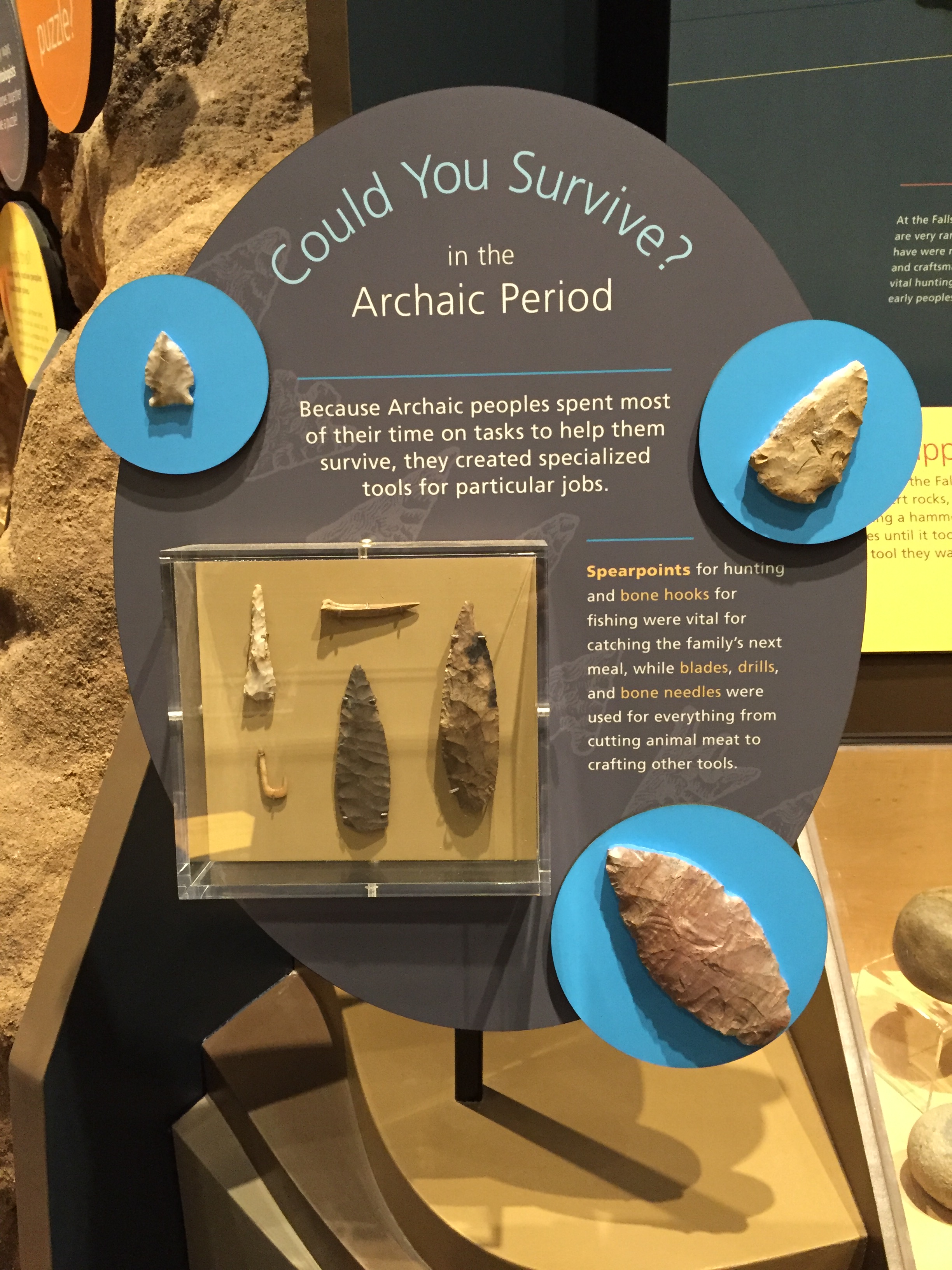
Archaic tool display, Falls of the Ohio Interpretive Center, Jan. 8, 2016

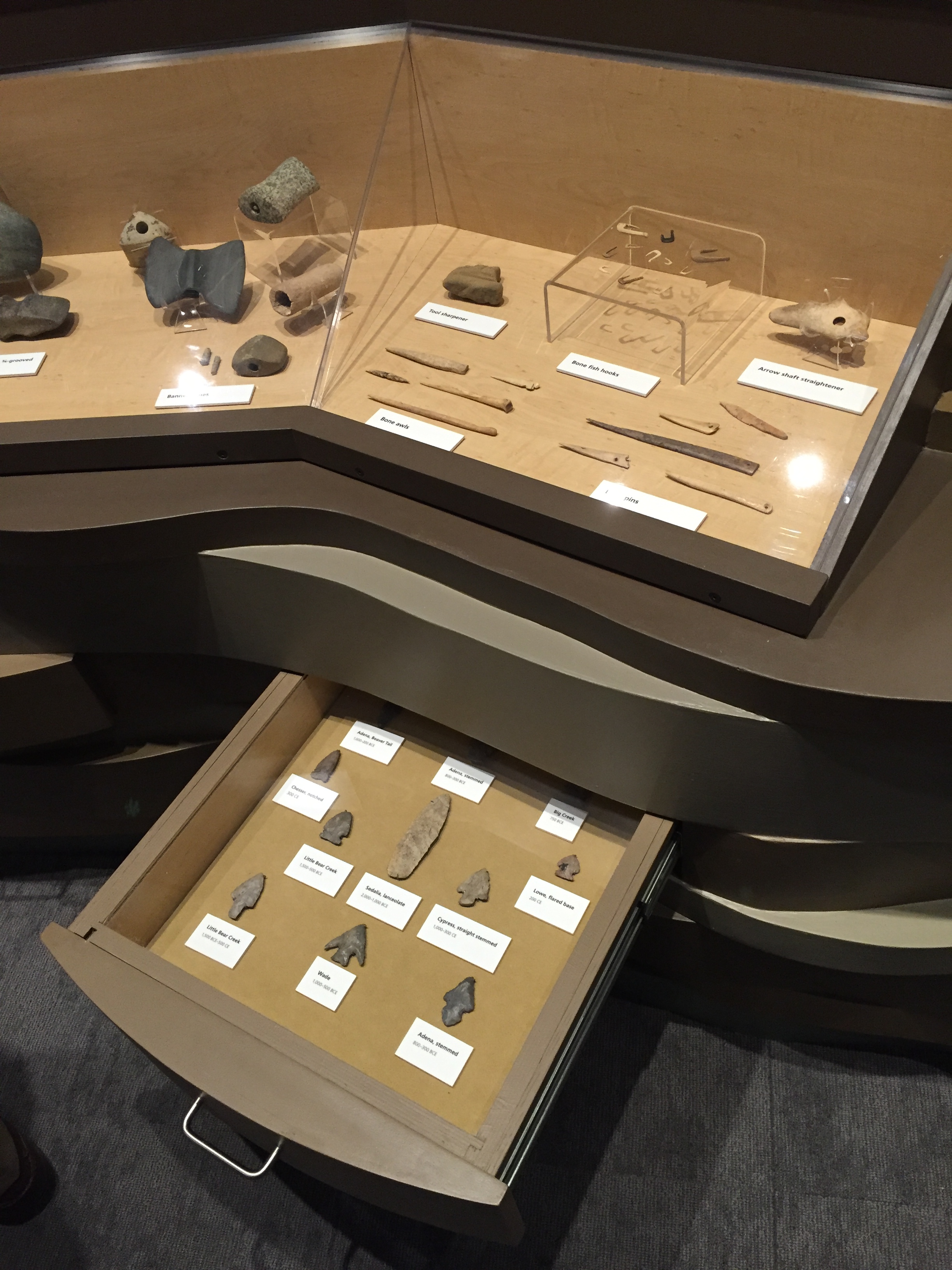
Prehistoric tools on display, Falls of the Ohio Interpretive Center, Jan 8, 2016

Previously, the remains of prehistoric man’s material culture (primarily represented through flint tools) were a focal point in the old center’s displays.  For those worried that examples of the “real thing” would be replaced with virtual images and copies will be pleased that you can still explore original material through some inspired casework.  Be sure to peek inside many of the drawers in the different themed areas to see fine examples of specimens and artifacts.

From " Converging Cultures", Falls of the Ohio Interpretive Center, Jan. 8, 2016

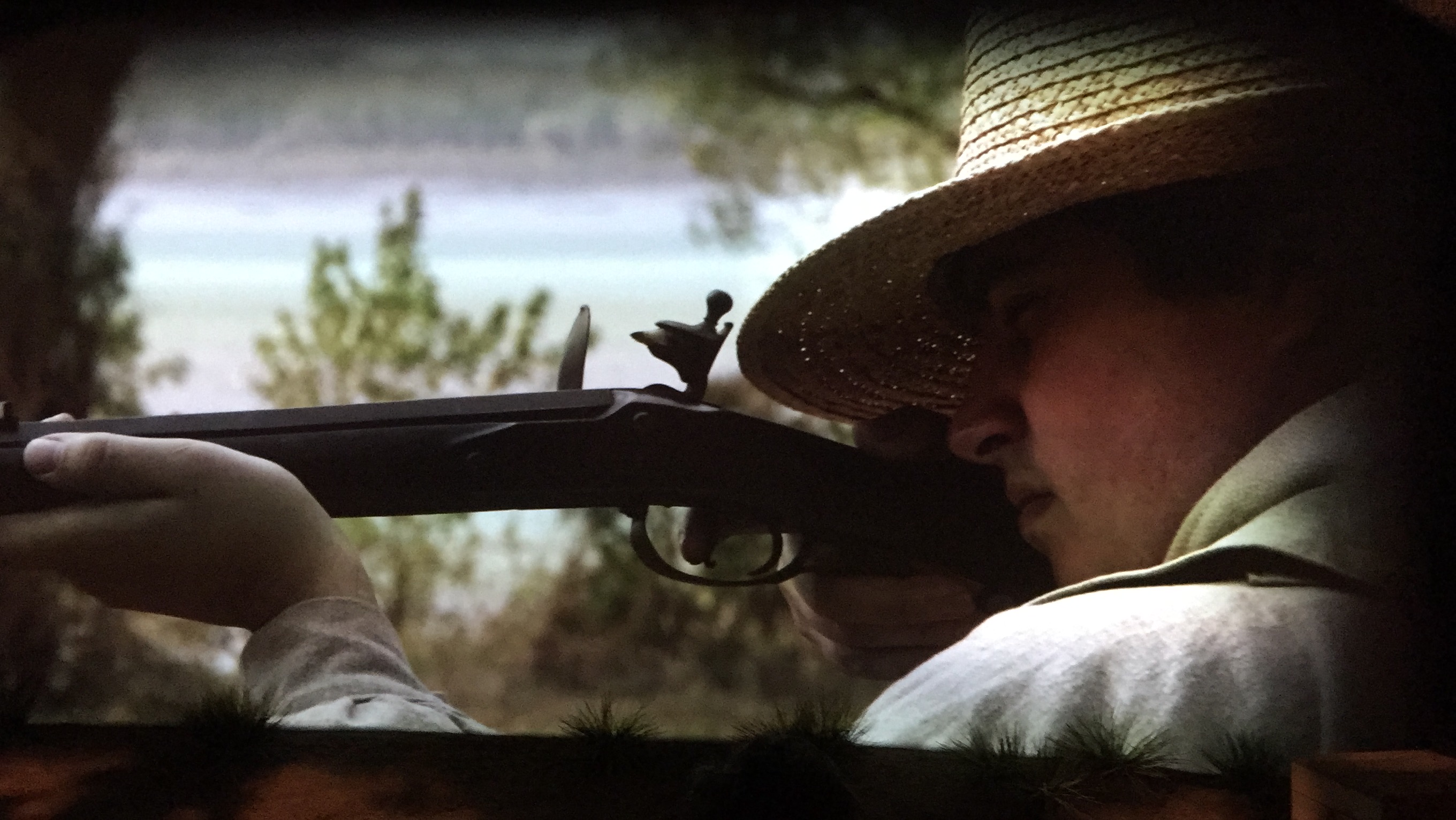
Frontier-themed video image, Falls of the Ohio Interpretive Center, Jan. 8, 2016

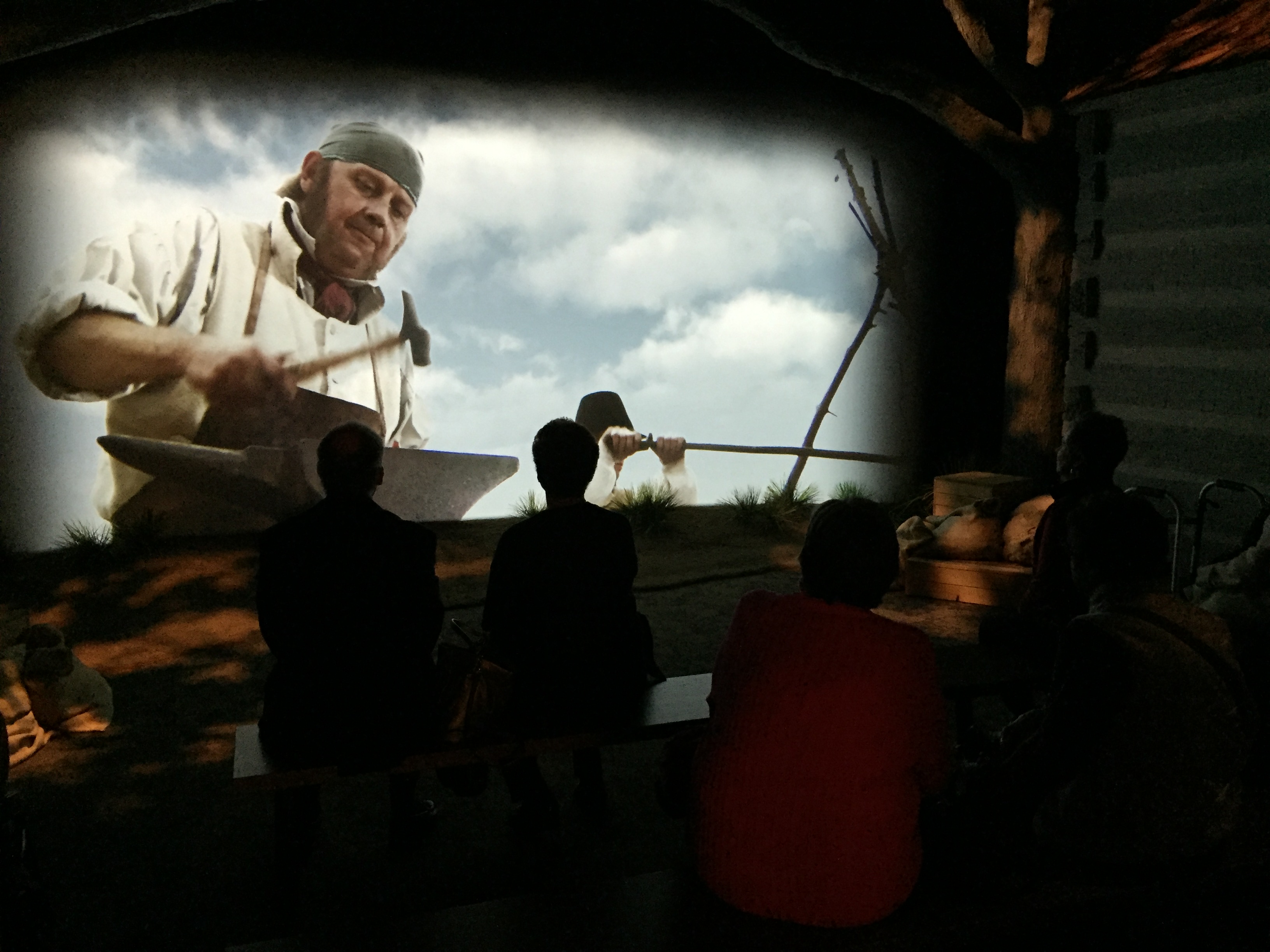
Blacksmith video image, Falls of the Ohio, Jan. 8, 2016

The third theme “Converging Cultures” recounts the history of the Falls area with the arrival of the Europeans.  The Lewis and Clark Expedition is a key moment not only in the history of the United States, but of the Falls of the Ohio as well.  Many of the men that comprised the “Corps of Discovery” were originally from Kentucky and Southern Indiana.  Wall-sized videos in the Lewis and Clark Theater recount the biographies of many of the men who made this epic transcontinental journey.  The story of John James Audubon is also noted and forms a transition into the last themed area of the new displays.

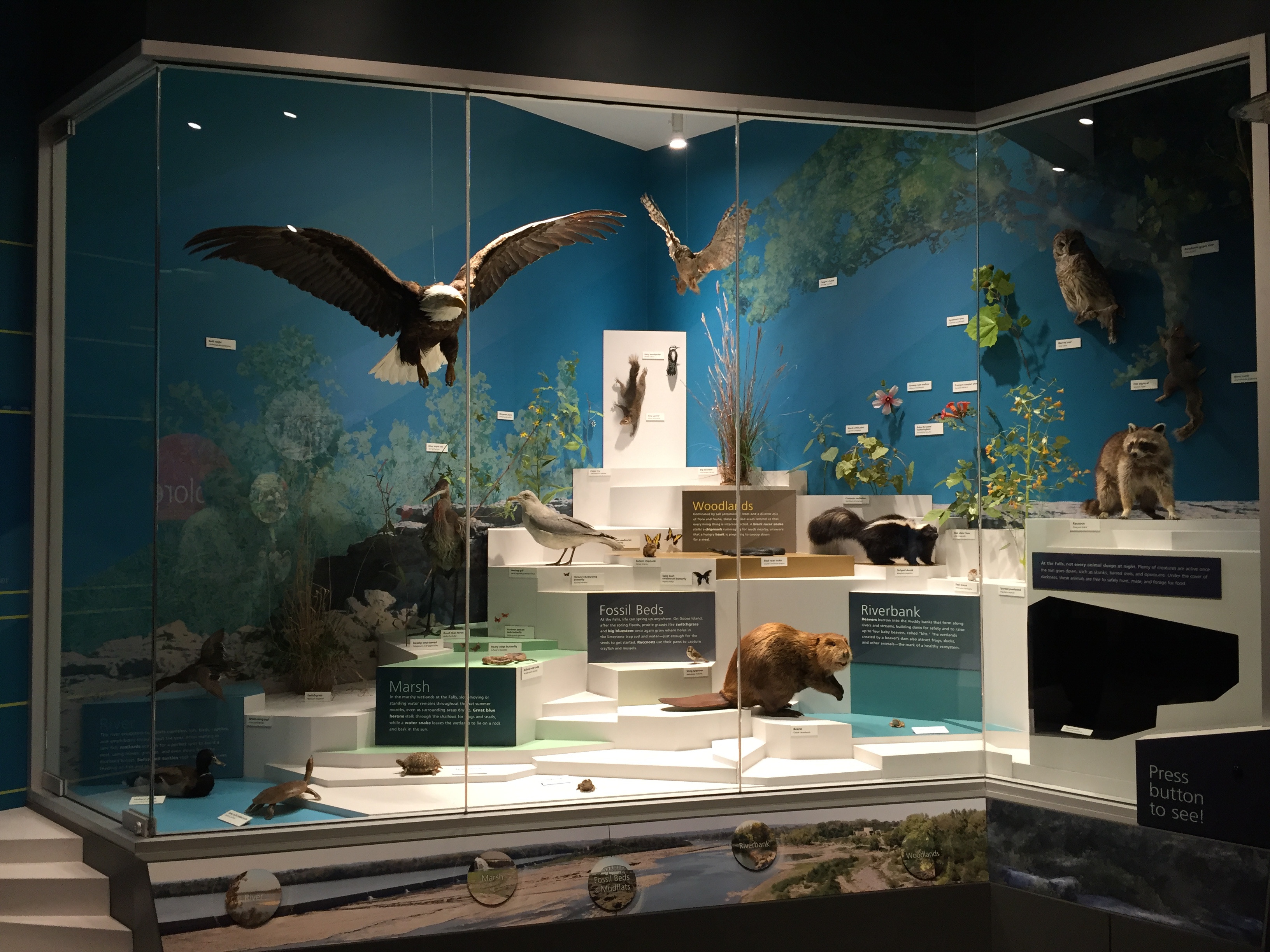
Display within the "The Falls Today", Jan. 8, 2016

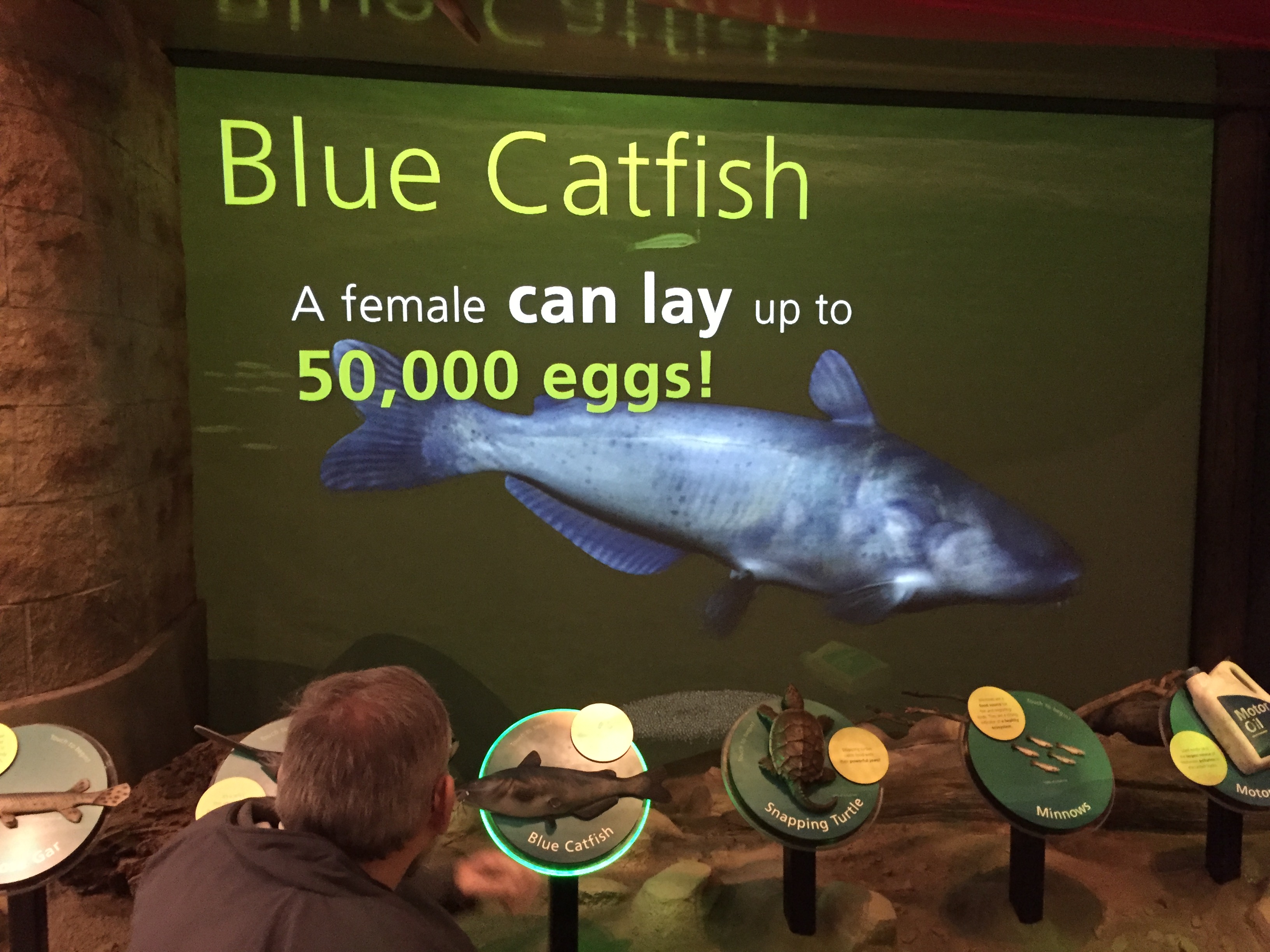
Virtual aquarium image from the "The Falls Today", Falls of the Ohio Interpretive Center, Jan. 8, 2016

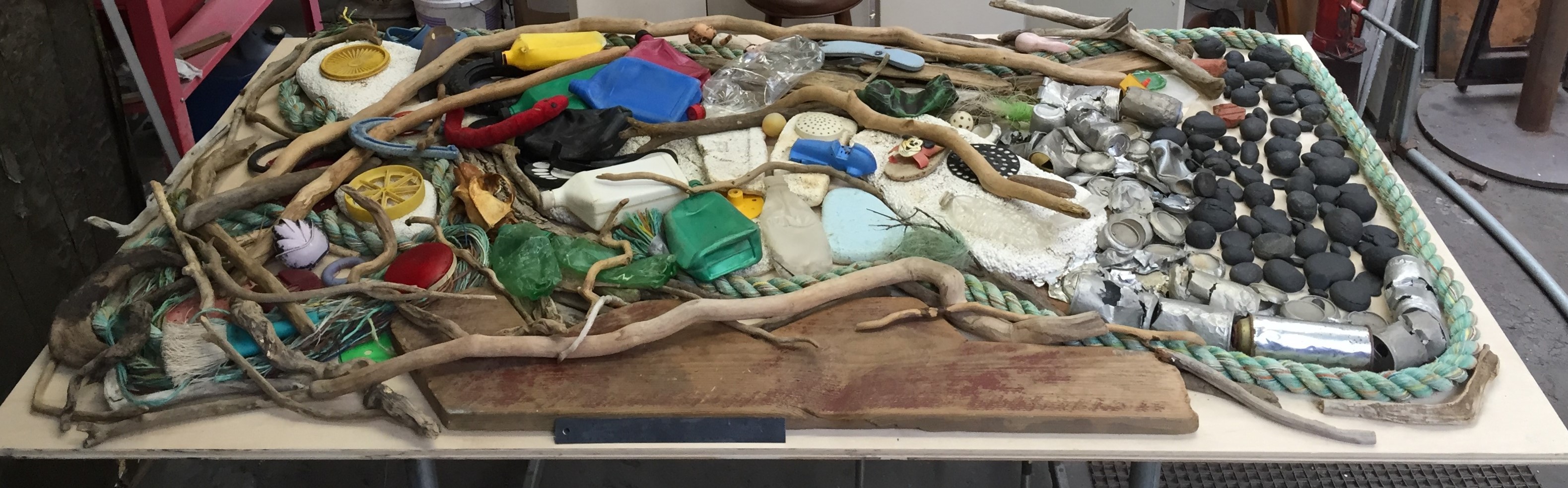
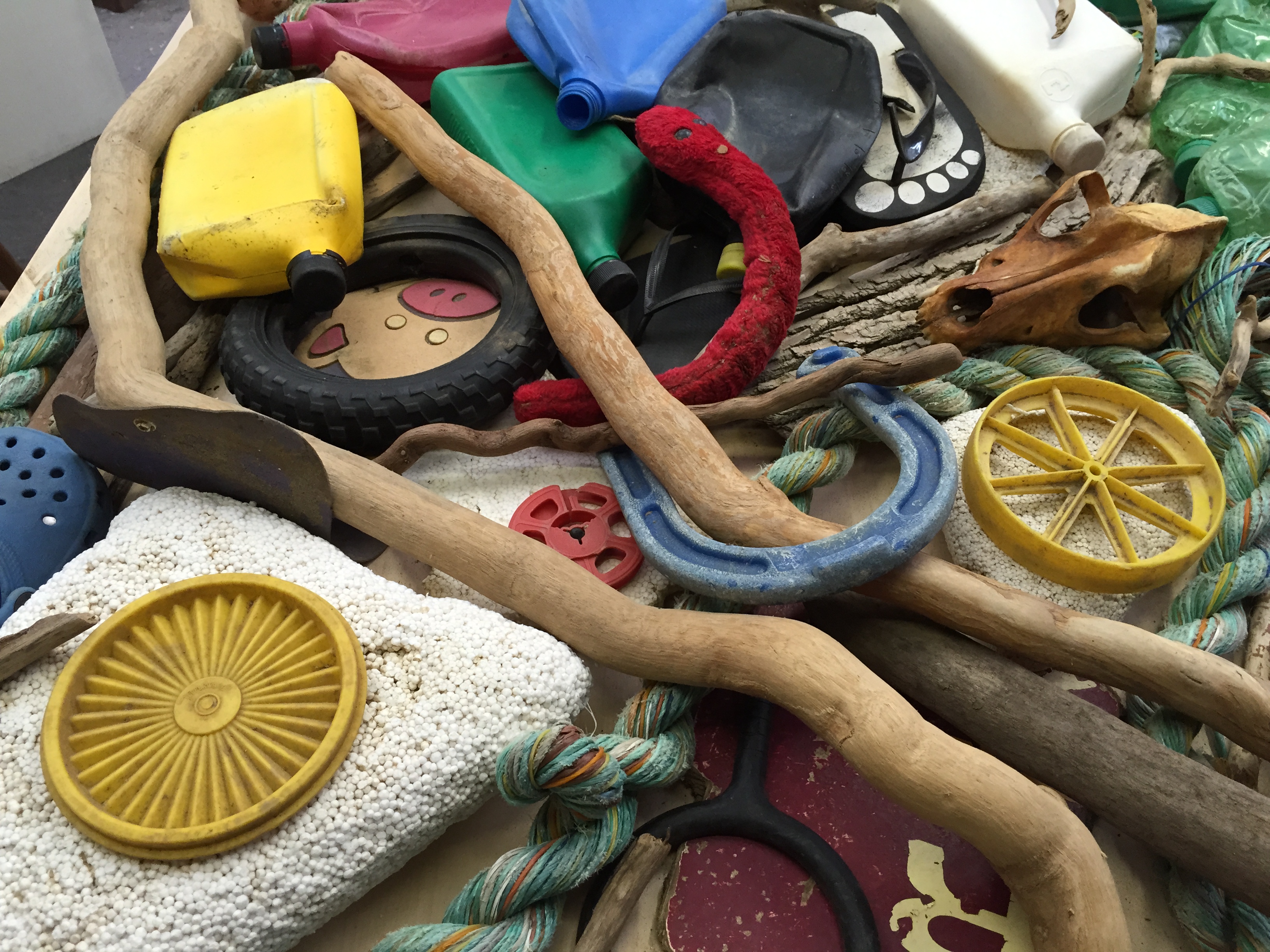
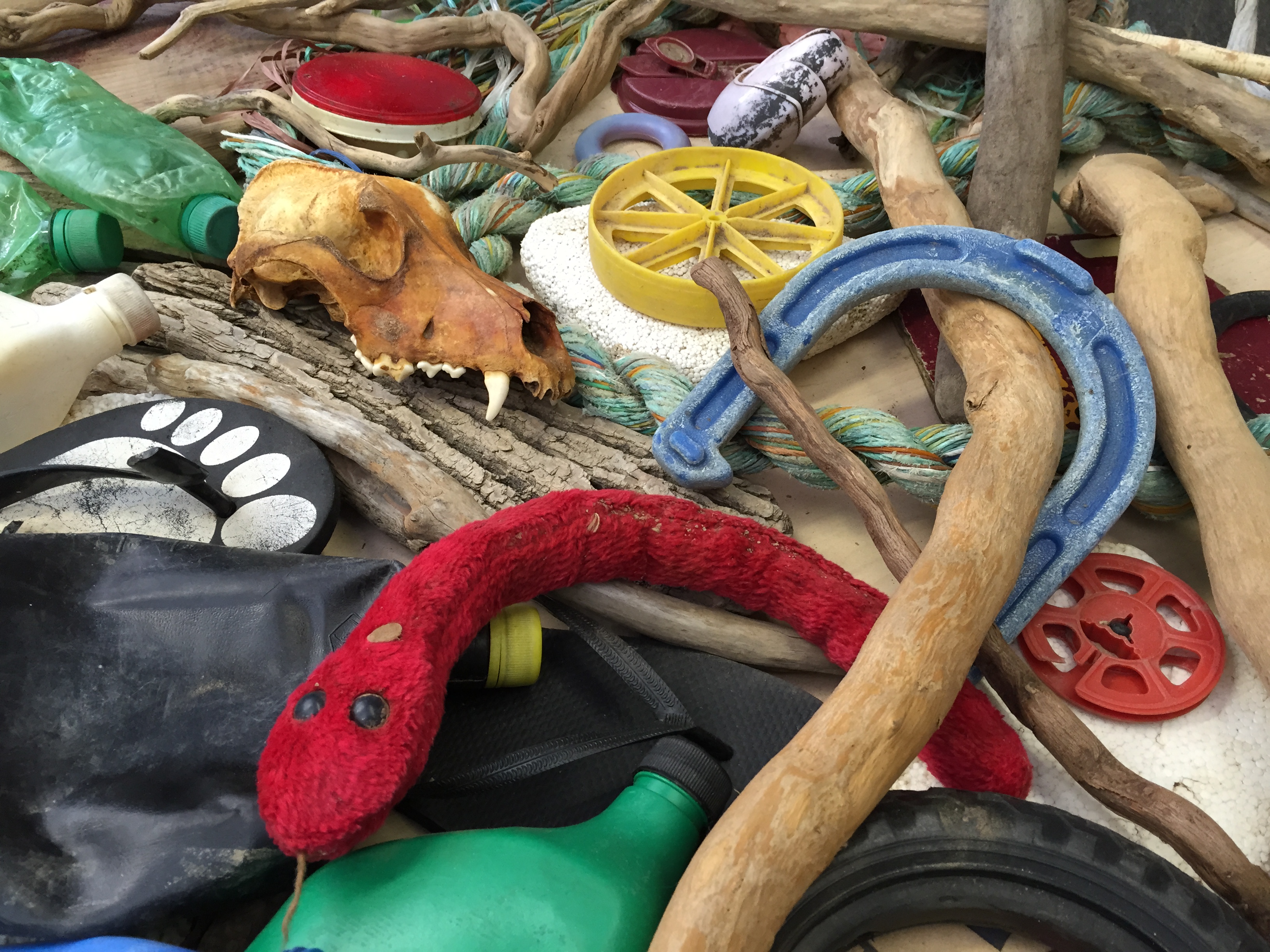
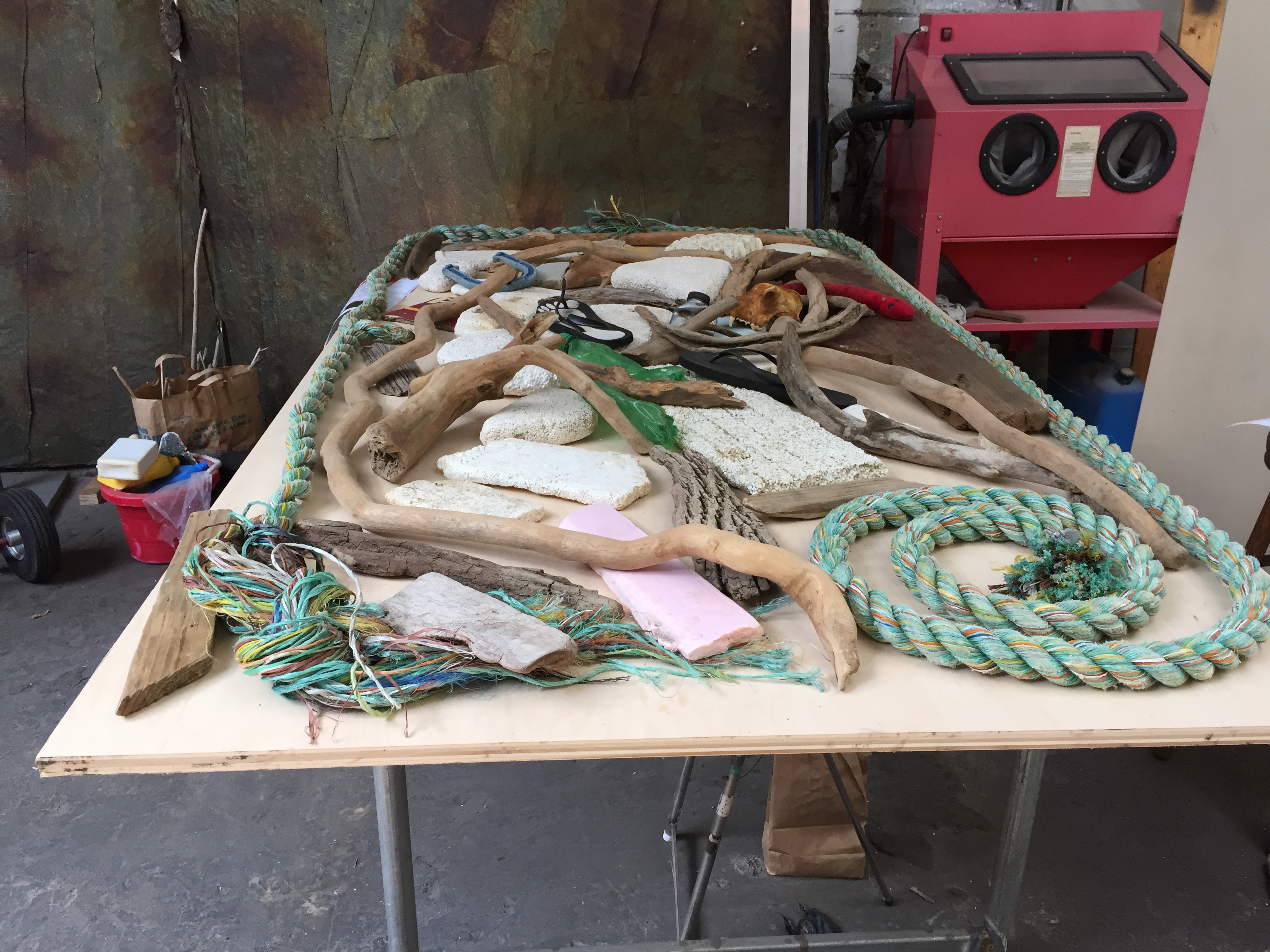
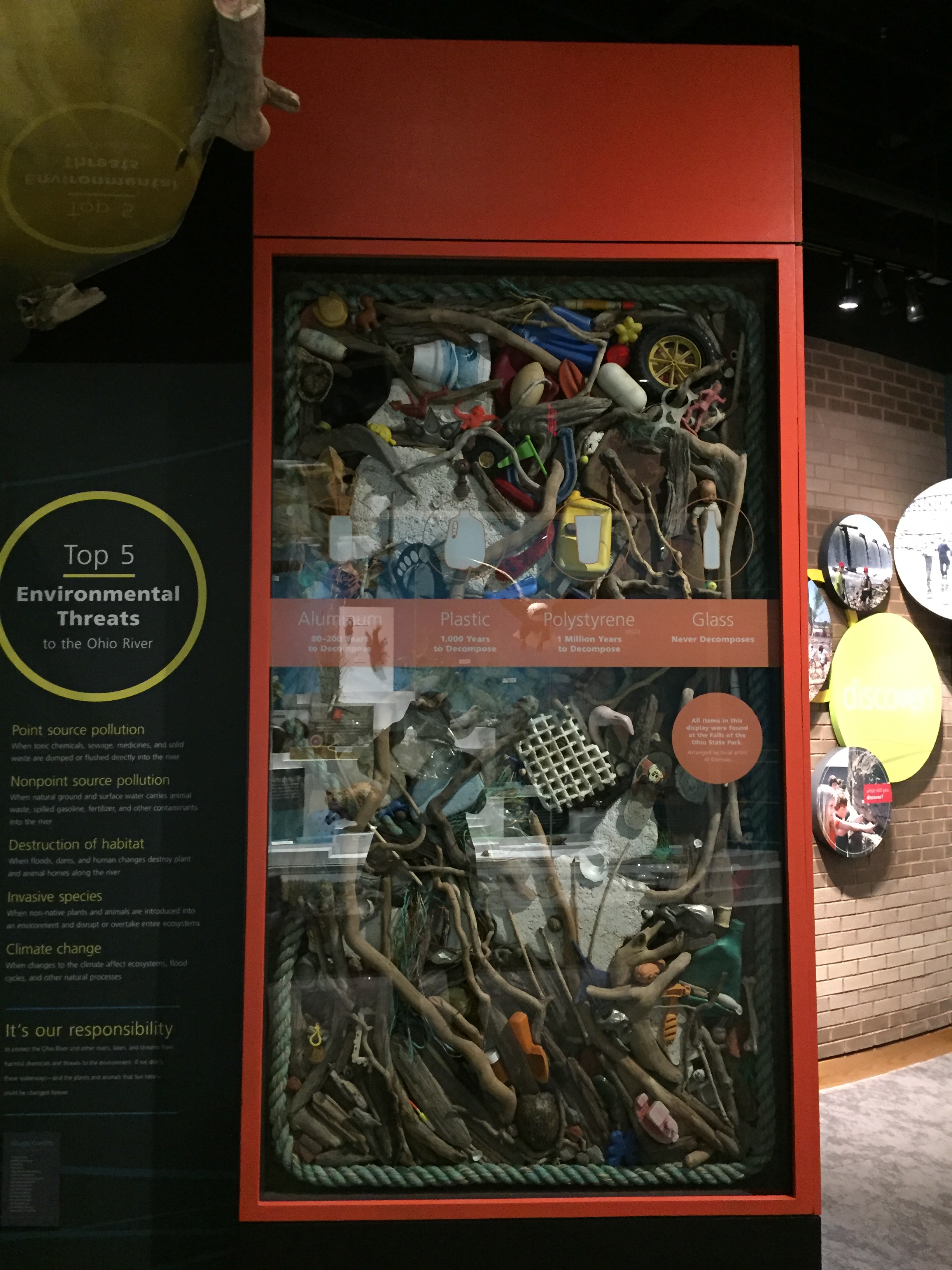
This last section is called “The Falls Today” and focuses upon the Falls of the Ohio as a rich contemporary ecosystem.  Some of the old taxidermy mounts have been reused to highlight some of the many species that live within the park.  Another large video display, this time a virtual aquarium, speaks to the richness of life in the river, particularly the species of game fish that are of interest to fisherman.  There is also a call to responsible and sustainable living and the need to keep pollution at bay.  This is where I come in.  I was commissioned by Solid Light to create an assemblage of found objects that is representative of what can be found in the Ohio River.  Here is the finished result that was placed within its own case with graphic elements added.

River Object Assemblage by Al Gorman, Falls of the Ohio Interpretive Center, Jan. 8, 2018

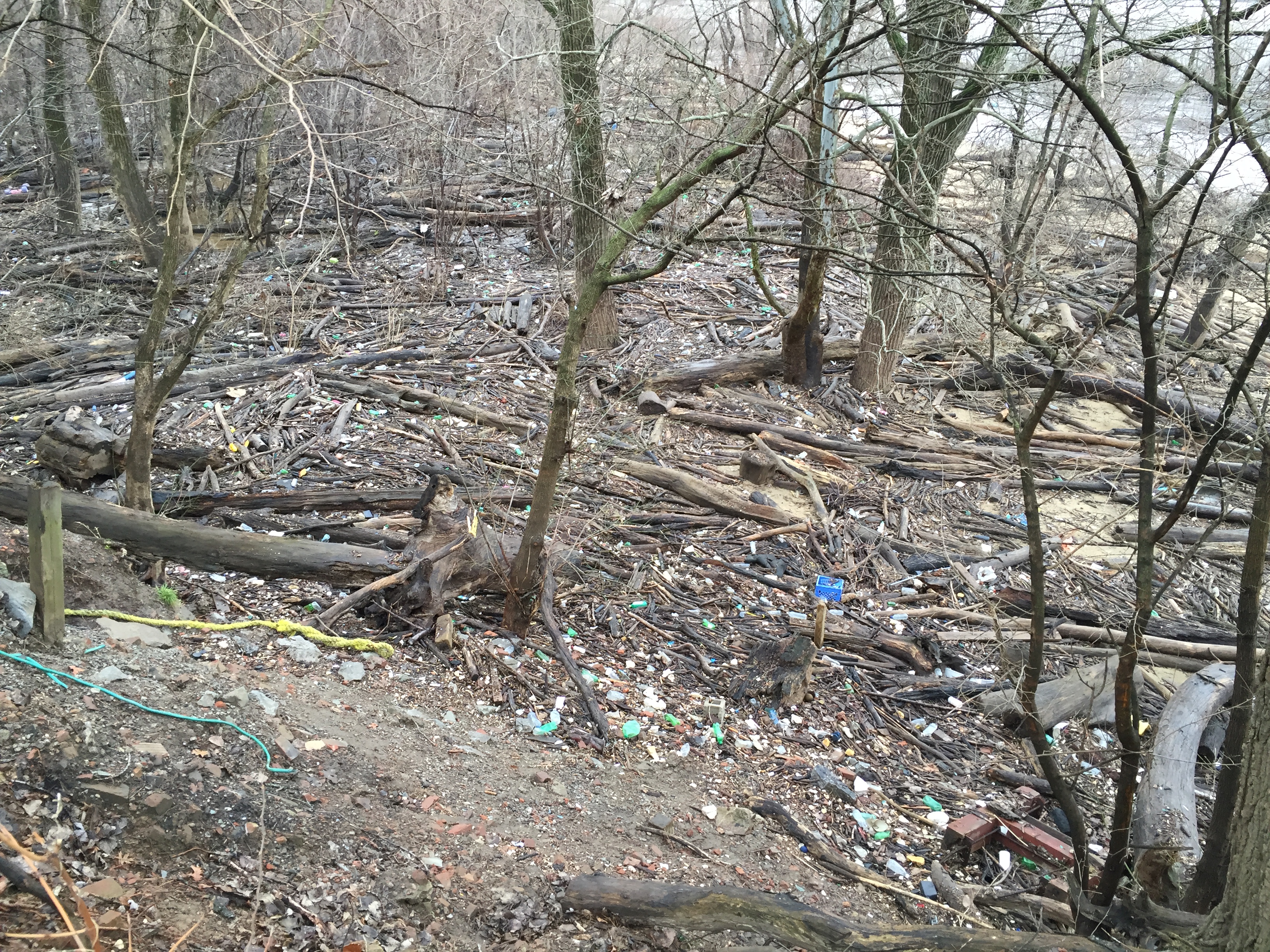
The panel within the case is 8 feet by 4 feet large.  I posted about the panel as I was creating it and showed many details of the more than 100 different objects that comprise it.  Of course, everything I’ve attached here was found within the context of the park.  The early reaction is that children in particular love looking at all the odd elements especially the found toys.  My panel is among the last things you see as you leave the exhibits area to exit the building.  I’m glad that there has been a greater emphasis in this new interpretation to include the current state of the world.  One could argue that as interesting as the past is…it is the present that is of the greatest concern. Further reinforcing this idea are the results of the minor flooding we experienced the previous week.  As the river has subsided, another massive new inventory of junk has washed into the park.  As I was leaving the ribbon cutting ceremony and walking to my vehicle, I could clearly see how much more work needs to be done.  Until next time…from the Falls of the Ohio.

Detritus on the riverbank, Falls of the Ohio State Park, Jan. 8, 2016


Read Full Post »

Eric and his contraption, Nov. 2015, Falls of the Ohio

When I received the call from my friend Eric, I was already heading to the Falls of the Ohio.  A simply gorgeous autumn day was upon us and the smell of freshly dropped leaves perfumed the air near the river.  Soon we would experience our first full frost that would truly signal an end to the warm days and the coming cold, grayness ahead of us.  For now, everything seemed perfect and both man and animals reveled in being outside.  Like so many of my friends, Eric is a bit of an eccentric.  He’s highly creative, full of surprises, but has difficulty at times channeling his enthusiasms into something positive and useful.  I can somewhat relate to that and perhaps this forms the basis of our friendship?  The plan was to meet at my outdoor atelier under the willow trees so he could show me his latest invention and sure enough…I found Eric standing next to what looked like some kind of unusual machine.  Eric was fiddling with the various gizmos, dials, and buttons when I greeted him.

Eric preps his machine, Falls of the Ohio, Nov. 2015

My friend was excited to see me and rushed to shake my hand.  He spoke to me in out of breath fashion until I told him to relax and slow down.  Of course, I was curious to learn what he was up to.  Eric told me that he thought he had the answer to all the world’s energy problems and it took the form of this contraption that clearly looked like it was cobbled together from secondhand junk.  Eric called me because he wanted a witness to observe a demonstration of his device’s capabilities.  If all went well, Eric intended to send the plans for his latest invention  to the patent office and from there who knew?  Filled with curiosity, I asked Eric what was the function of his machine and how exactly did it work?

Eric "feeds" the hopper, Nov. 2015, Falls of the Ohio

To back track a bit, here is a fuller description of the look of this device.  The main body of the machine was boxy and covered with a white insulating material.  All sides of the box were embellished with tubes, light bulbs, vials of mysterious fluids, gears, pulleys, dials, levers, and what appeared to be radiator panels for keeping the machine cool while it operated.  A large yellow hose protruded from the back of the machine.  In the front where the operator did his “thing” was a “hopper” where material could be fed into the machine.  A large, clear, horizontally mounted bottle introduced water into the process.  The whole contraption was mounted on four wheels which made it a mobile power plant that could be moved to any location that was required.  Now, I’m not a scientist and so a lot of what Eric told me I frankly did not understand, but in short, here is what the machine did along with its practical applications.  The purpose of the machine as Eric explained it to me was to produce “UBF” or Universal Bio Fuel which my friend believed would not only make us energy self-sufficient, but would also solve the world’s hunger problems as well!  Anything organic could be fed into the “hopper” and as a way of demonstration…Eric picked up a large arm load of dried leaves and stuck them into the cup and fired up his machine.  One of the beautiful things about his invention was that it operated on the fuel that it produced. The next stage occurred within the bowels of this odd mechanism.  I could hear sounds of the leaves being broken down, ground up and masticated into mush.  Water, various enzymes, acids, and yes…bacterial cultures were introduced into this leaf mash.  As this bolus moved through various internal chambers, the mash would ferment and in quick order convert into “UBF”.  The desired product has a waxy consistency when cool.  Eric’s machine not only could produce “UBF” to be utilized for industrial needs, but also had a soft-serve function where it could be doled out like some nutritious, but hardly tasty ice cream.  Flavoring could come later.  According to Eric, apart from a cheese-like odor,  very little waste would result…so complete were the reactions that created the “UBF”.

Eric's machine overflows, Falls of the Ohio, Nov. 2015

"UBF" overflowing the bowl, Falls of the Ohio, Nov. 2015

As I watch, I’m thinking the machine is working as intended, but soon notice that Eric is frantically operating the buttons and dials and a small puff of white smoke emanates from his machine.  He quickly runs to the yellow hose where a small bowl for receiving the “UBF” has turned over on its side.  Too much of the precious bio fuel is being produced and is spilling forth and coagulating on the ground.  I ask is there anything I can do, but Eric doesn’t hear me and for some unknown reason takes the following rash action.

Eric sucks the hose, Falls of the Ohio, Nov. 2015

Eric grabs the end of the hose and sticks it into his mouth!  I hear a guzzling sound as he swallows a massive amount of the surplus “UBF”.  He then runs to the front of the machine and hits the button that stops all the reactions.  Why Eric did not do this first is due to the fact that he panicked.  He told me that in his mind, he heard his inner voice saying that this fuel is precious and should not be wasted.  Eric had a dazed look upon his face and then the oddest thing happened…all the hairs on his head stood straight up and they remained that way!

Eric's hair standing on end, Falls of the Ohio, Nov. 2015

Exhausted and over-wrought, Eric decides to call it a day.  He leaves his bio fuel extracting machine where it stands and with assistance from me…we head for home.  Eric is a persistent fellow and with his mission to solve the planet’s energy needs… I know this latest setback will not keep him down for long.

Eric waste deep in water, Nov. 2015, Falls of the Ohio

Eric in the water by his machine, Falls of the Ohio, Nov. 2015

Sure enough, about a week later, I run into my mad scientist friend back at the Falls of the Ohio on another beautiful day.  As it turned out…this hair-raising experience was permanent.  The “UBF” is such a rich mixture and the full physiological effects of eating such a large dose are unknown.  Certainly, he had eaten more than a minimum, recommended serving which according to plan was to be determined later.  Just a little bio fuel goes a long way.  Luckily for Eric, there were no other scary after effects.  Undaunted, Eric is willing to try his machine again soon, but first he had to clean it out and replenish his water supply.  On this day, I find him waste deep in a stagnant pool of water.  He has adjusted his hose by placing one end into the water and the other end delivers liquid into the hopper.  This is required to flush all the enzymes and other residues out of his bio fuel plant.

Eric by his machine, Falls of the Ohio, Nov. 2015

Eric next to his bio fuel machine, Falls of the Ohio, Nov. 2015

As he tinkers with his contraption we converse.  Eric told me that he has a lot more to learn about which organic materials produce the most energy.  I ask him if by organic, would that also include plastic and a lot of other waste products and detritus that our current technologies produce?  He’s intrigued by the question and thinks plastic by-products could work to create energy although he doesn’t think they would have much food value.  I nod my head in agreement.

Eric adjusts the settings on his machine, Nov. 15, Falls of the Ohio

Eric's bio diesel machine, Falls of the Ohio, Nov. 2015

I don’t know if Eric was ultimately successful in earning his hoped for patent.  I didn’t hear what happened the other times he tested his machine.  I know he places a lot of faith in technology and believes that it will save us in the long run.  Of course, reality is more complicated than that.  Part of me fears that if he was successful in his quest…some large corporation would just buy him out and warehouse the solution until they could profit from it.  What I appreciate about Eric is that he never talked about money or getting rich.  There simply are great problems out there in the wider world and he finds fulfillment in trying to resolve them.  Working on his machine has given Eric a renewed sense of purpose.  As I contemplate the prismatic colors on the surface of the water…I hope Eric finds an answer.  Until next time from the Falls of the Ohio.

iridescent colors on the water, Falls of the Ohio, Nov. 2015


Read Full Post »

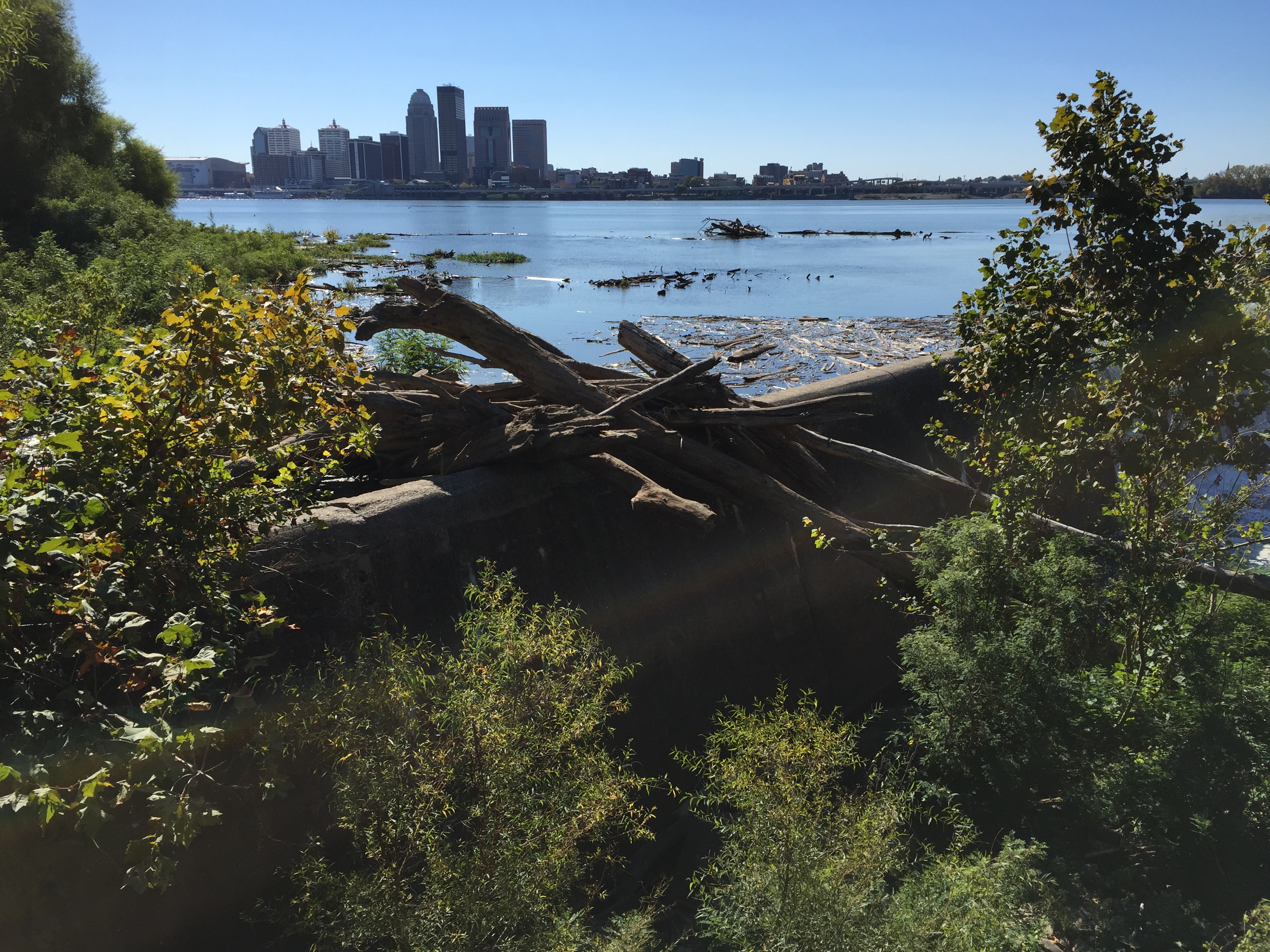
Skyline of Louisville as seen from the Falls of the Ohio State Park, Oct. 2015

That big summer rush is over now.  The Interpretive Center panel is finished and this past Saturday, I picked up all the works I had on display at Eastern Kentucky University.  I now have no other plans for my art which feels good for a change.  I like staying busy, but don’t want to be so on the go that I don’t enjoy what I do.  Art is one of those things we eat greedily until it time to move over to the next course.  The process of creating and displaying new works has become such a consumptive activity on its own and it’s funny that I don’t hear more artists talking about the good and bad aspects of this.  With this officially being Autumn, I went looking for traces of color at the Falls of the Ohio.

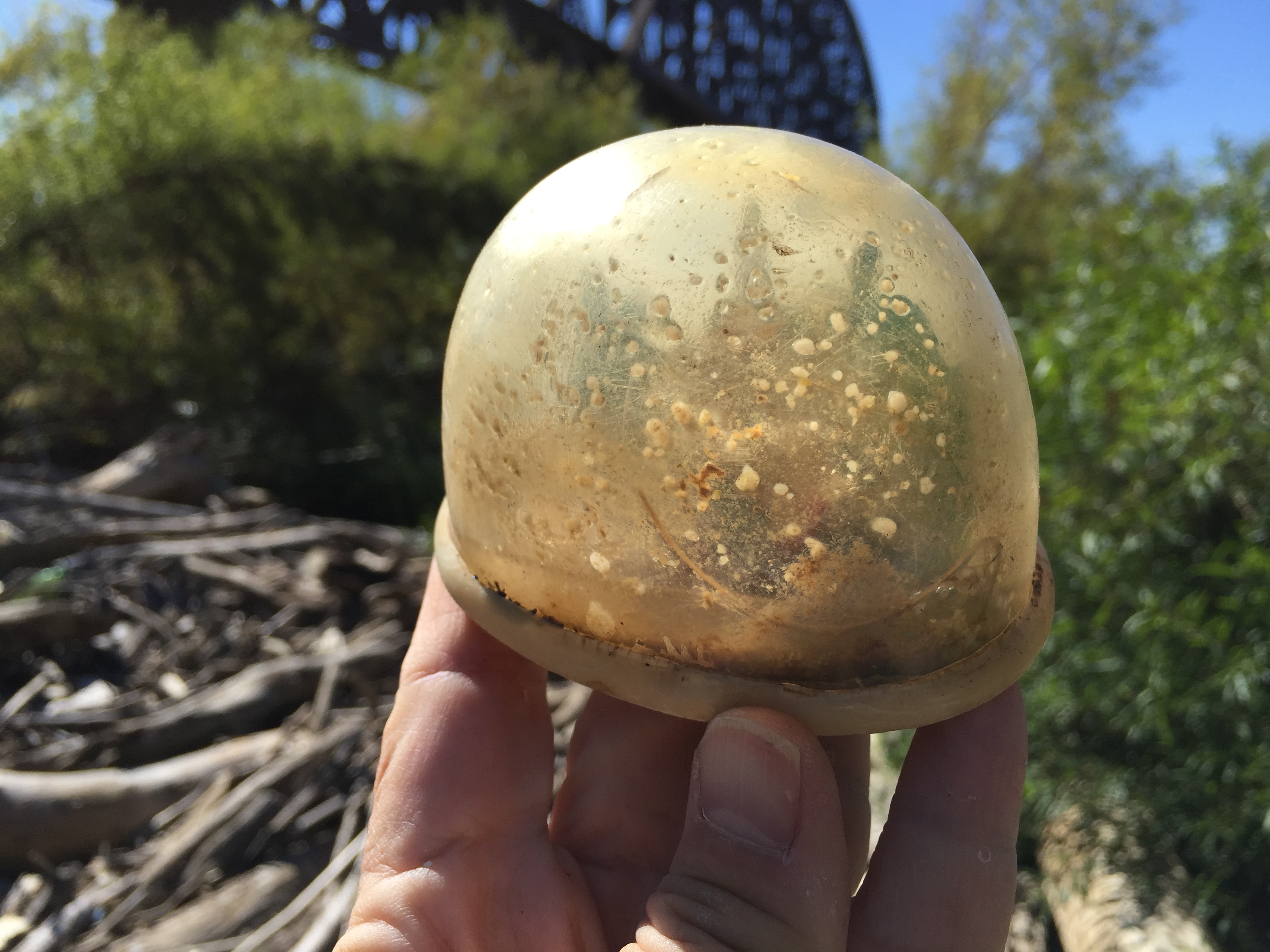
found snow globe or dome, Falls of the Ohio, Oct. 2015

I showed up under the old railroad bridge with a mostly empty collecting bag.  At this time of year, it isn’t so much the interesting objects that just floated in here with the latest flood, but rather the interesting items that have come to the surface after all this driftwood started to break down.  As proof, I offer this recently discovered snow globe or dome.  It’s too hard to see from my image, but there is a winter holiday scene inside the dome!  It will be cold soon enough and Christmas as well.  I’m all set with this little decoration that still has bits and pieces of fake snow inside.

Green Bottles, Falls of the Ohio, October 2015

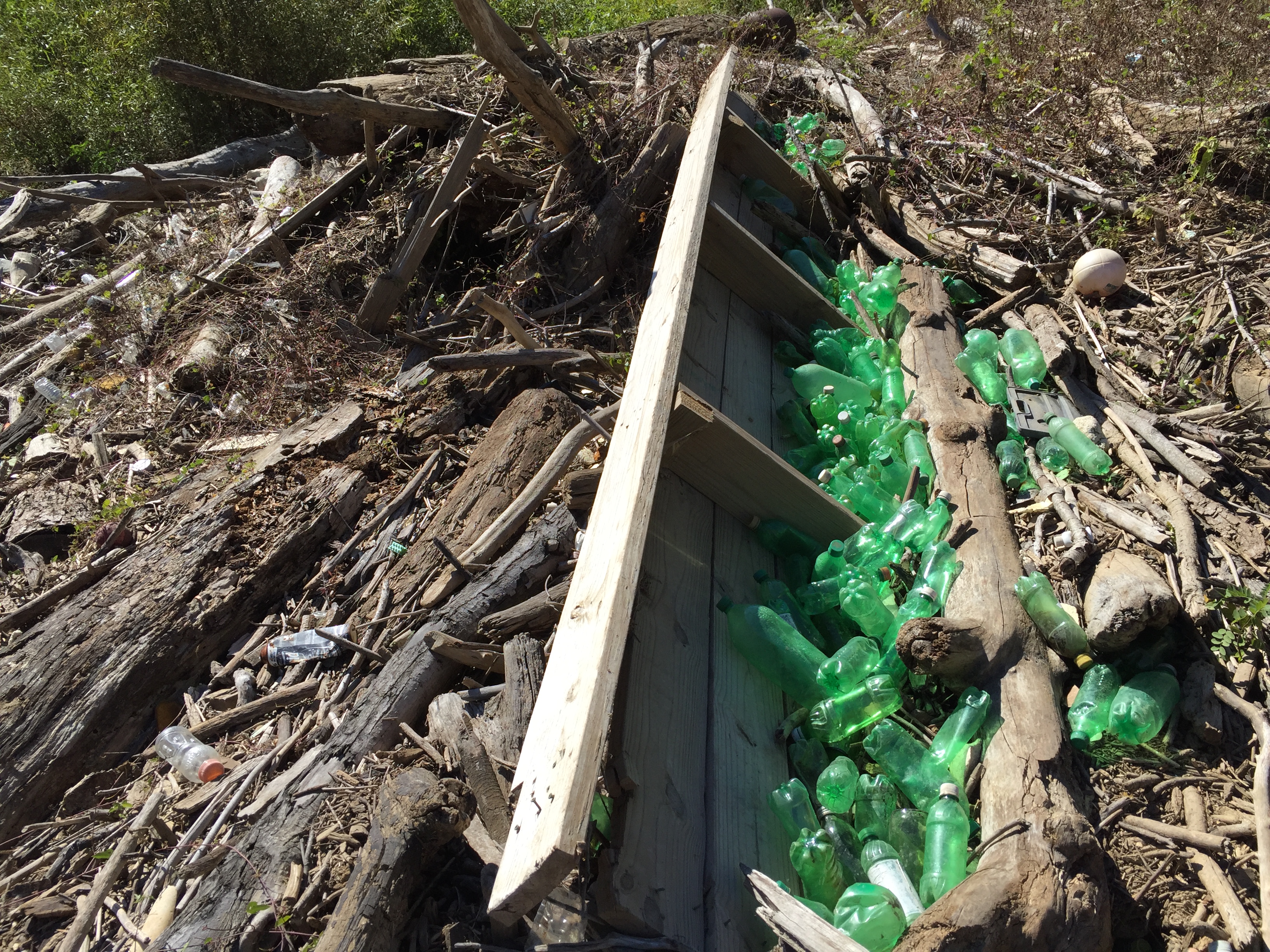
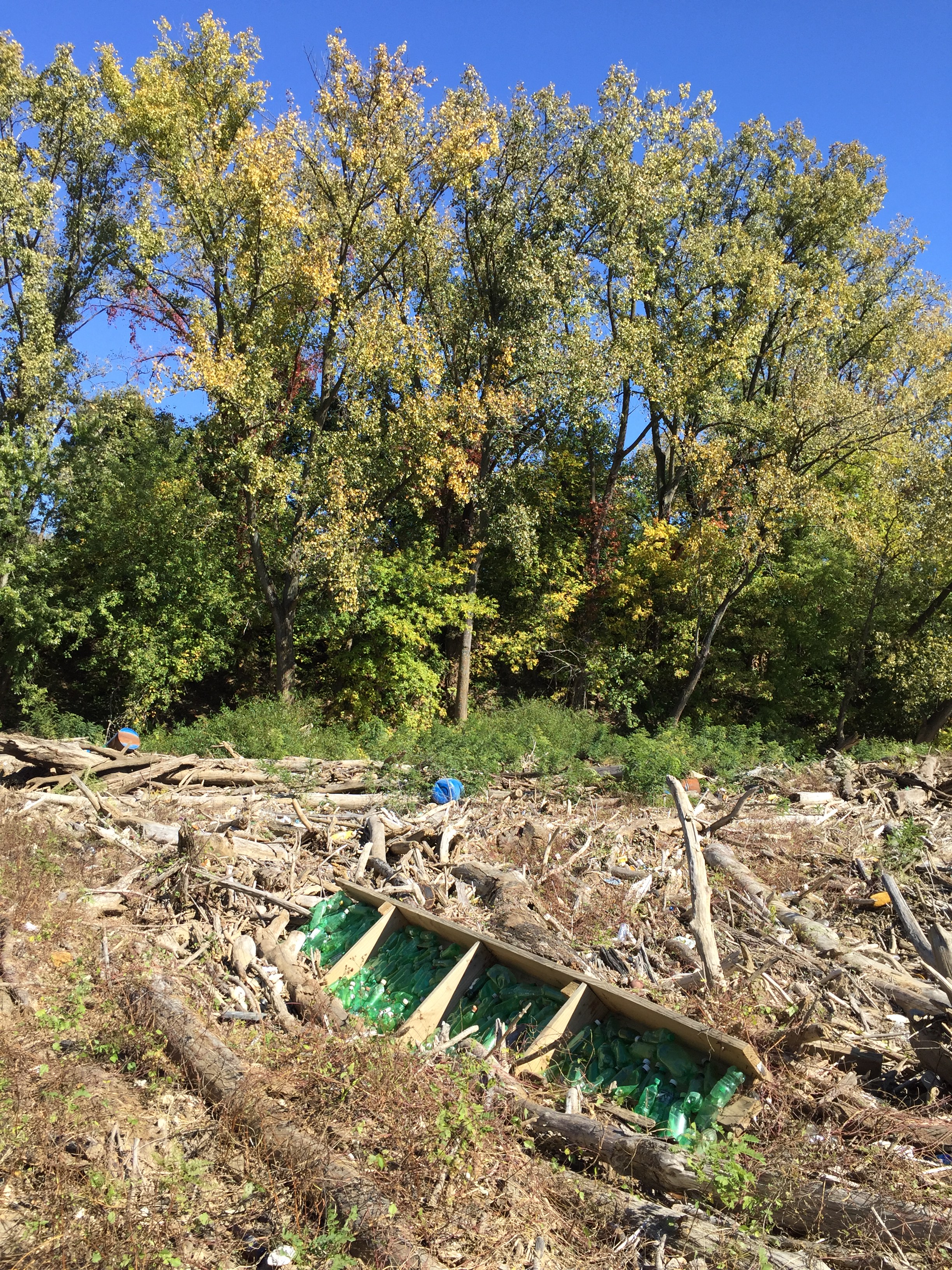
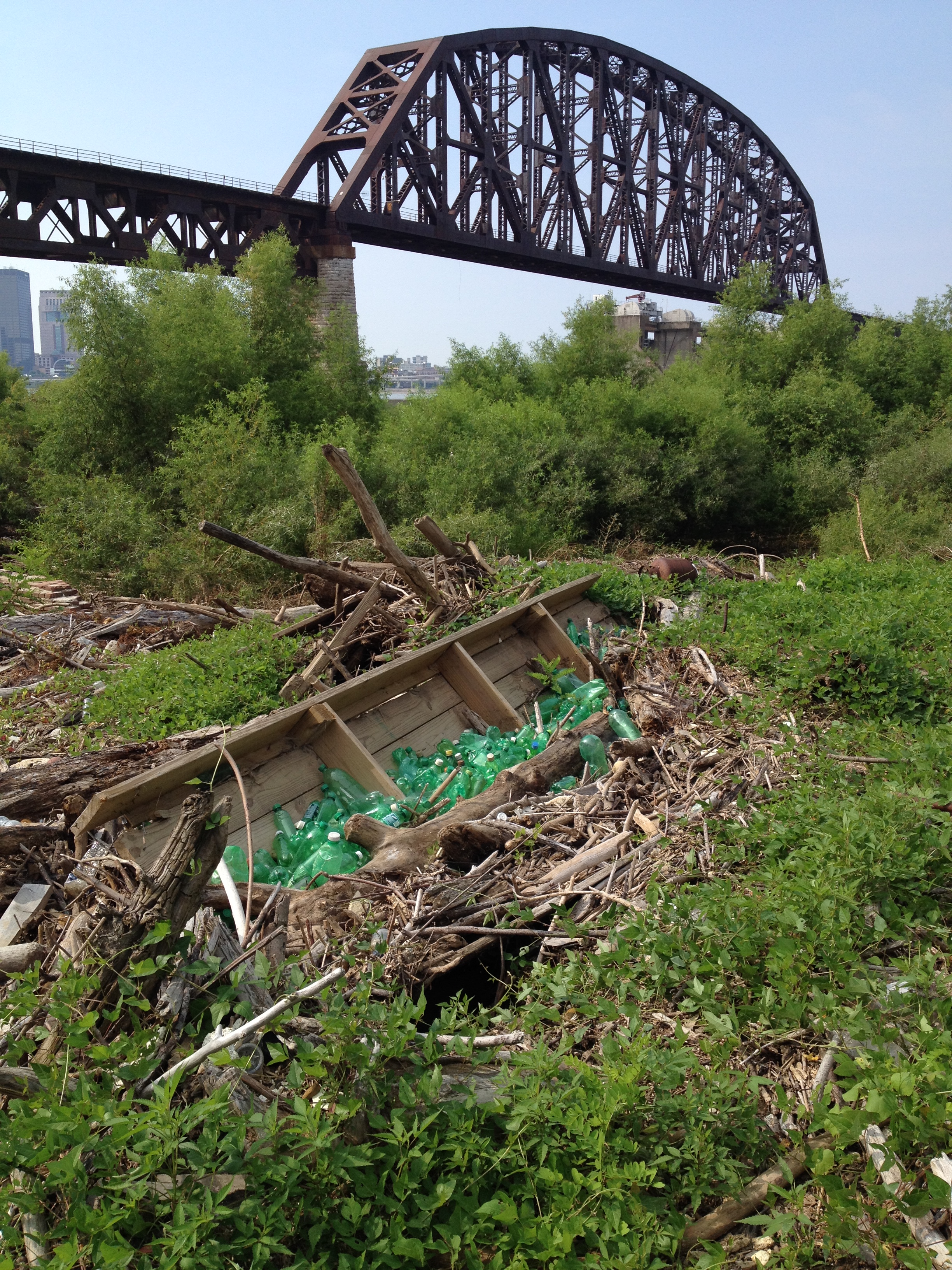
Today I have no plan other than to wander.  As luck would have it, I revisited an area that I haven’t checked out in the past 2 1/2 months.  One of my favorite pieces I made this year involves setting up green plastic bottles inside an old boat dock that was deposited on top of the driftwood pile and that happens to be in this spot.  When I was here last, the vines had pretty much ensnared and intertwined with all this wood and made walking a bit treacherous.  All the greenery from those vines is now history, but the woody stems are still a tripping hazard.  Coming across my piece from earlier in the year…I decided to reconstruct it as best I could.  All the bottles were still here and the light was looking especially good.

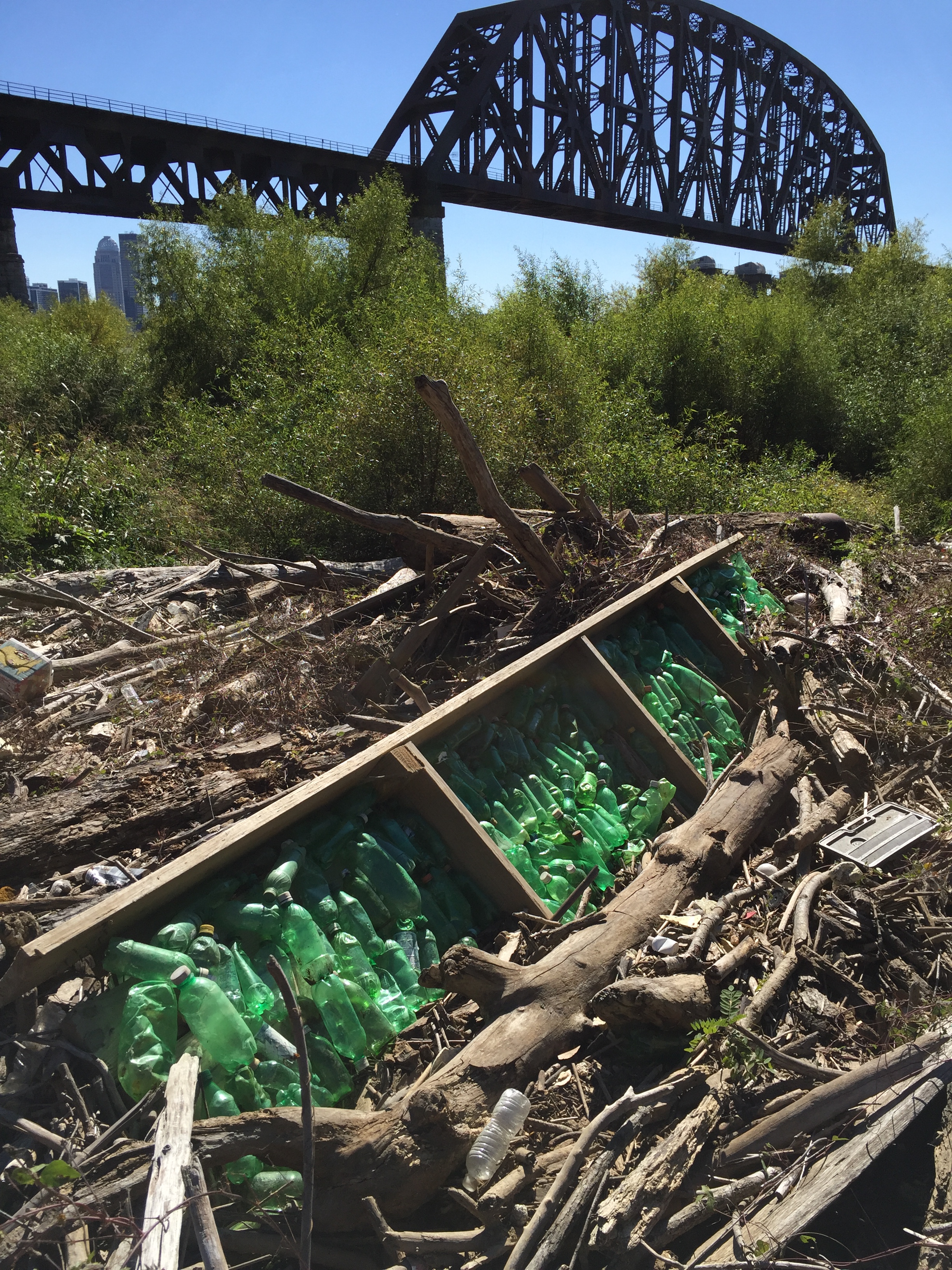
Green Bottle piece at the Falls of the Ohio, October 2015

Under the wooden dock are four compartments that I filled with the bottles.  They can only be seen from this side and so this piece has evaded detection for the most part because it is not visible from the path that skirts the periphery of this driftwood mound.  I just happen to like how the light gets concentrated within these green plastic bottles and activates the work in just the right conditions.  The wooden compartments add a little structure to what would be generally be thought of as a chaotic composition.

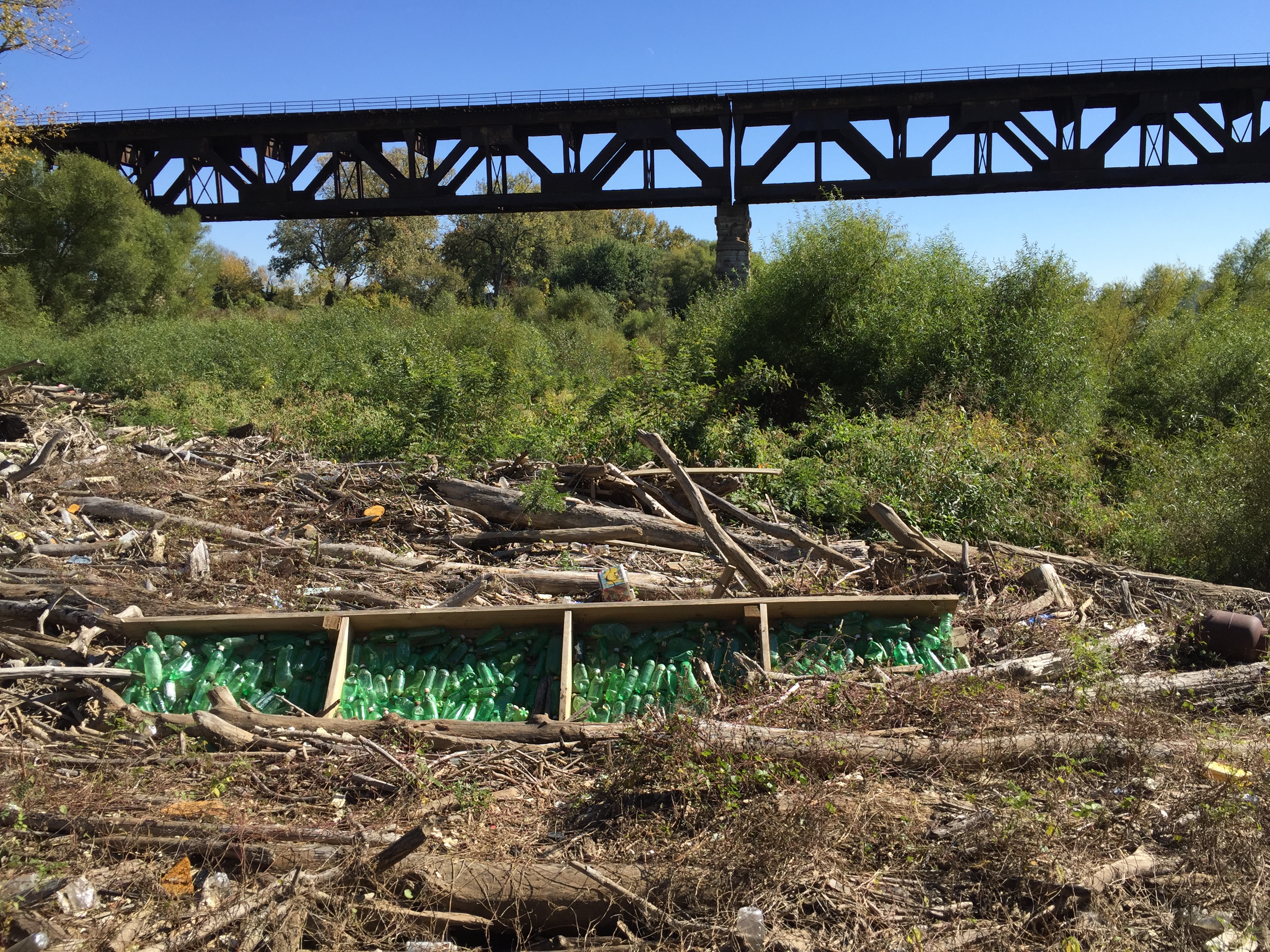
Green Bottles, Falls of the Ohio, October 2015

Although we still have plenty of “green” in the environment.  You can also see where “yellowing” is happening with the foliage.  I expect as the season wears on and transitions to another that this Green Bottle piece will subtly change over time.

found flip-flops, Falls of the Ohio, Oct. 2015

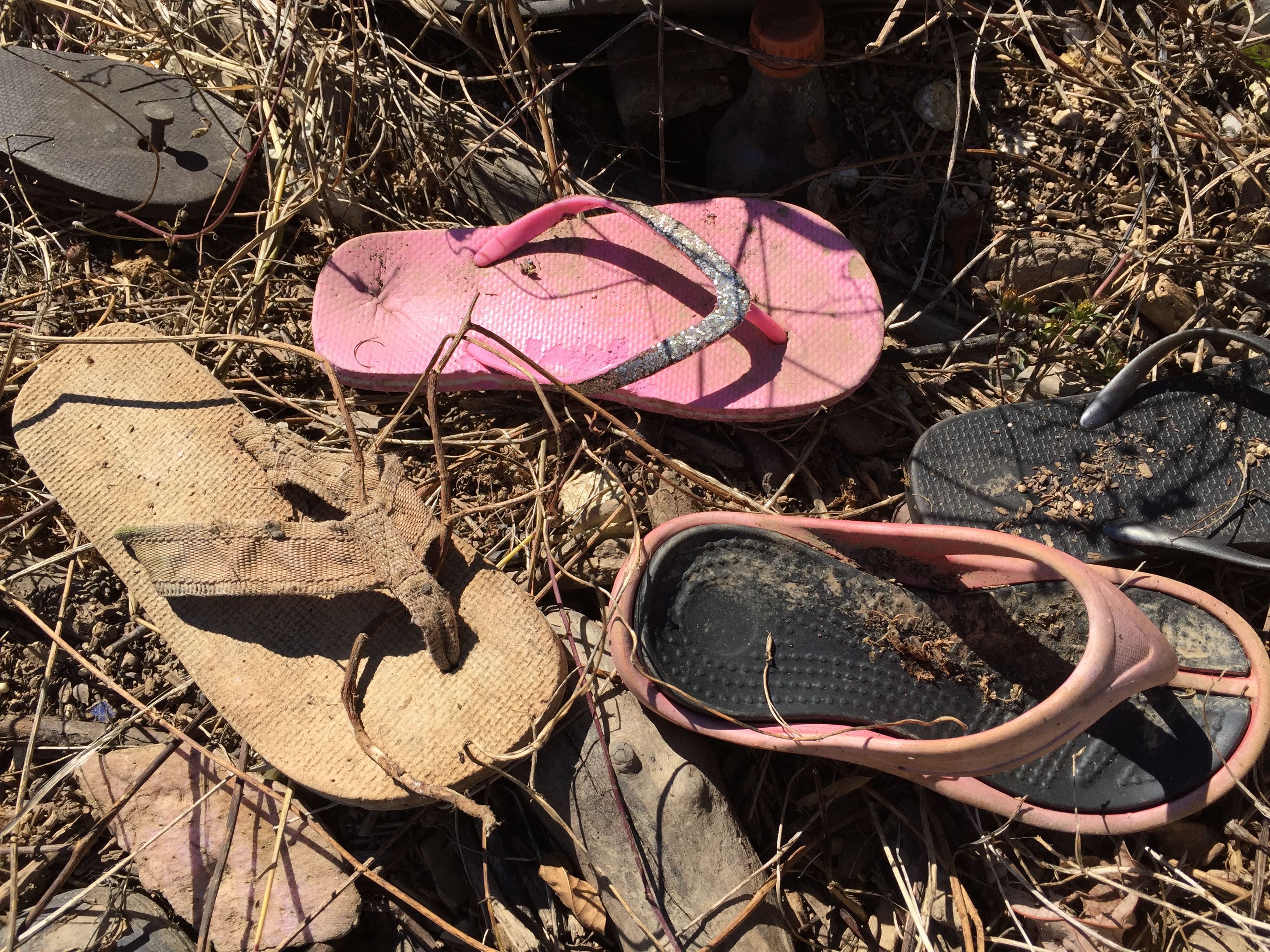
Walking over the mound, I came across an area that was completely obscured by vines a few weeks a go.  What I uncovered in place was a series of found flip flop sandals I had parked here until a better idea showed up.  For now, I record the lightweight shoes and move on.  It might be transformed into something different the next time I pass this way.

Green Bottles in Autumn, Falls of the Ohio, October 2015

The cottonwood trees that flank part of this driftwood mound are much “yellower” than before.  When I first came out here during the month of May, everything around me was verdant and dark green.  After setting this piece up again for the second time, I turned and walked away and cleared my head by walking to the riverbank.  I will periodically stop by here and maybe after a few months will be able to create a series of images documenting this site specific assemblage as it changes with the seasons.  For now, I will check out if the fishermen are having any luck…at the Falls of the Ohio.

Fishing at the exposed fossil beds at the Falls of the Ohio, Oct. 2015

Read Full Post »

E.K.U. show card, Sept. 2015

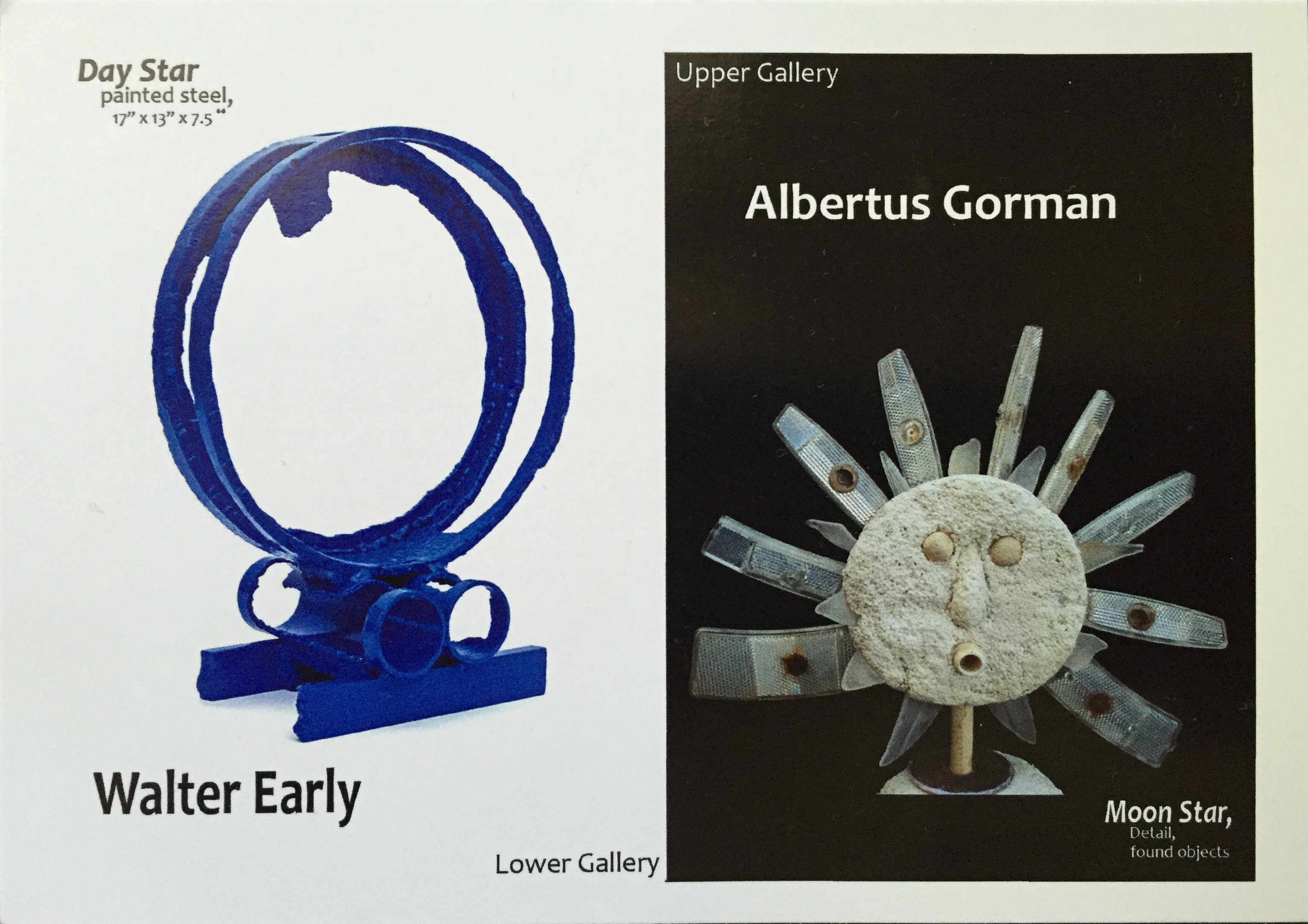
Although this is my first post of the month…my heart has not been far from the river or the odd kind of art that I make from the found remains of our material culture.  A few months back, I accepted the generous offer from Esther Randall, who is the Gallery Director of the Giles Galleries at Eastern Kentucky University in Richmond to show in their upstairs gallery.  The bottom gallery will hold the colorful welded sculptures of Walter Early and his show will run concurrently with mine.  I do like the postcard Esther created.  She found two works by two very different artists that share the word “star” in their titles.  Our exhibitions will open during the upcoming week and if you happen to be in the area.  Please do stop by and check out our art shows.  Richmond is about 22 miles past Lexington, KY or about an hour and 45 minute drive from Louisville.  Here is the reverse of the card that gives other particulars about the opening reception and run of the show.

E.K.U. show card info, Sept. 2015

As you can see, my show is called “Albertus Gorman: Artist from Exit 0”.  For all the work I’ve done at the river, I still identify very much with the “Exit 0” sense for place and the slightly existential “feel” that it implies to me.  So much of my river art has been located in that interstitial area between the natural and artificial, between water and solid land, and between my own despair for the continued environmental degradation I experience in the park and the hope and optimism I want to feel as a human being rooted in the physical world.  So what am I going to present in this newest exhibition?

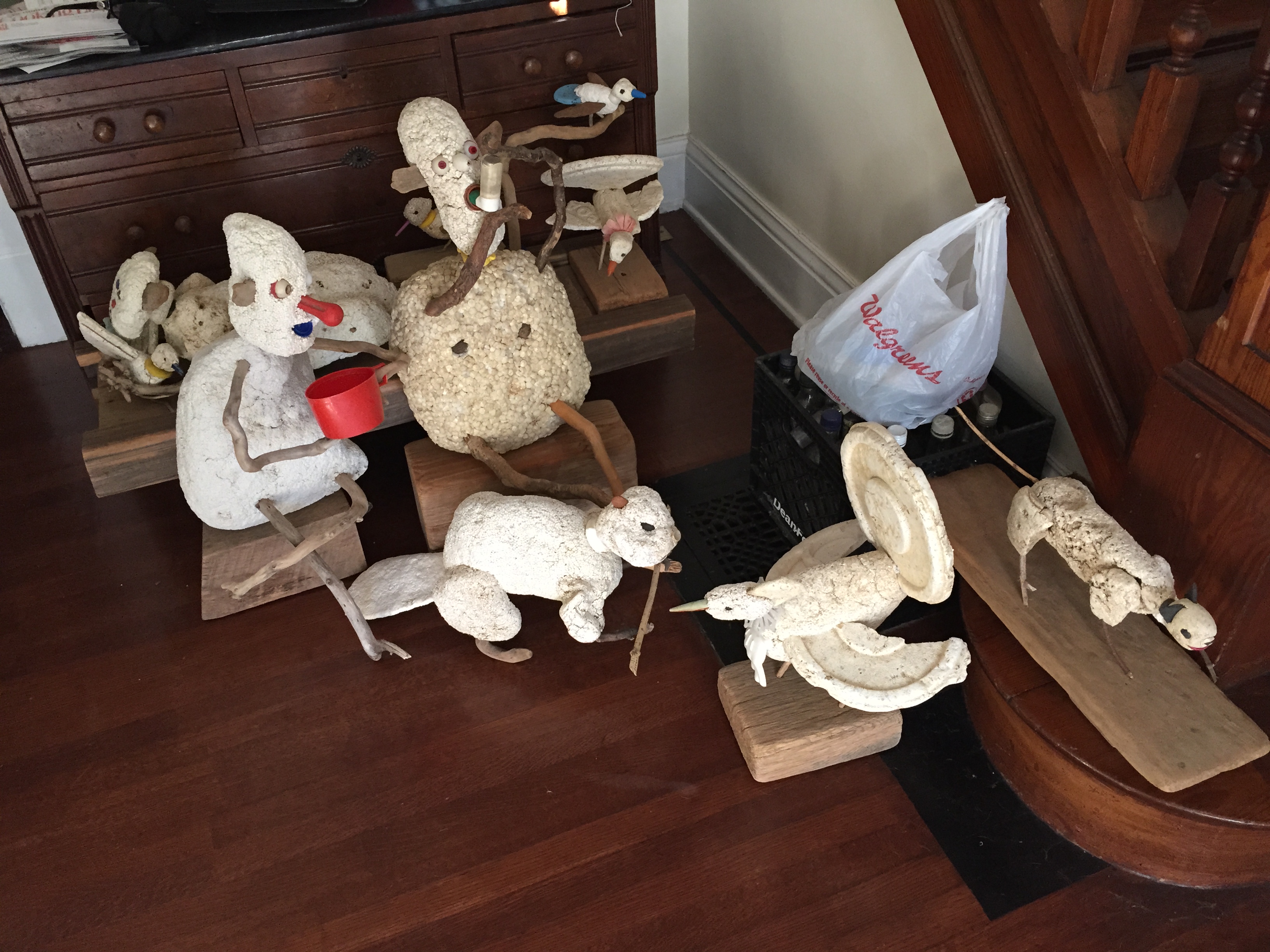
Al's art at home, Sept. 2015

Like many artists, I have the world’s greatest collection of my own artwork…or at least the pieces I’ve bothered to save from the river.  Like many artists, I tend to keep moving forward making new stuff which means that many pieces exist that may have been shown only once or not at all.  Of course, that is a big shame because different contexts bring out different qualities in the individual works and potential relationships that exist with the other pieces on exhibit.

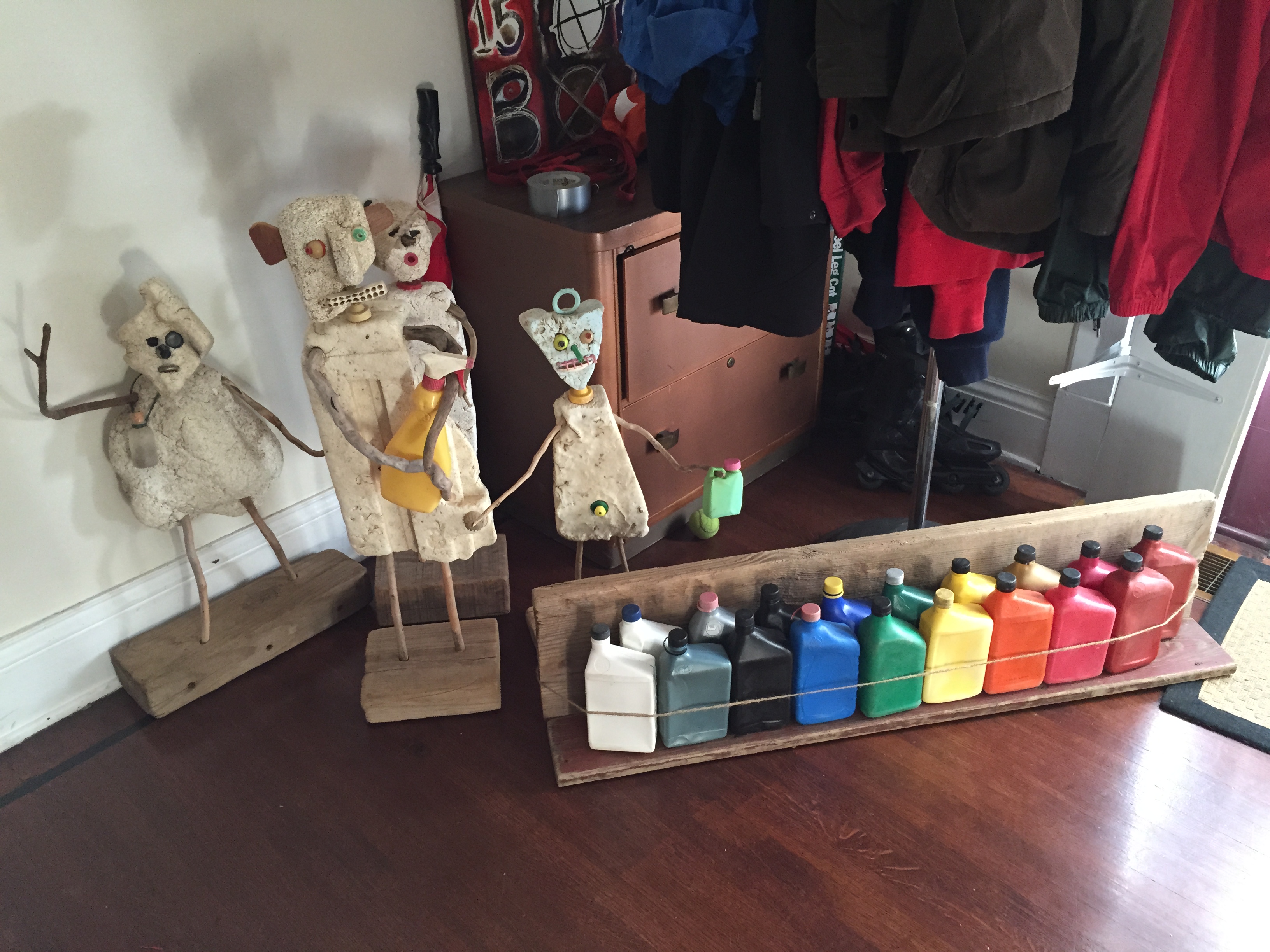
Al's art at home, Sept. 2015

Here are a few more artworks I have “staged” prior to loading them in a cargo van.  I have many figurative Styrofoam sculptures that I have never shown in exhibition contexts.  In the above image, you can see my latest piece which continues the work I have been doing with found plastic containers.  I built a wall-mounted shelf from river-gifted wood and arranged the colorful plastic containers that I have also scavenged off the riverbank.  The individual bottles have Velcro on their bottoms to help secure them onto their narrow shelf.  A length of twine is there to help keep the bottles together while in transport.

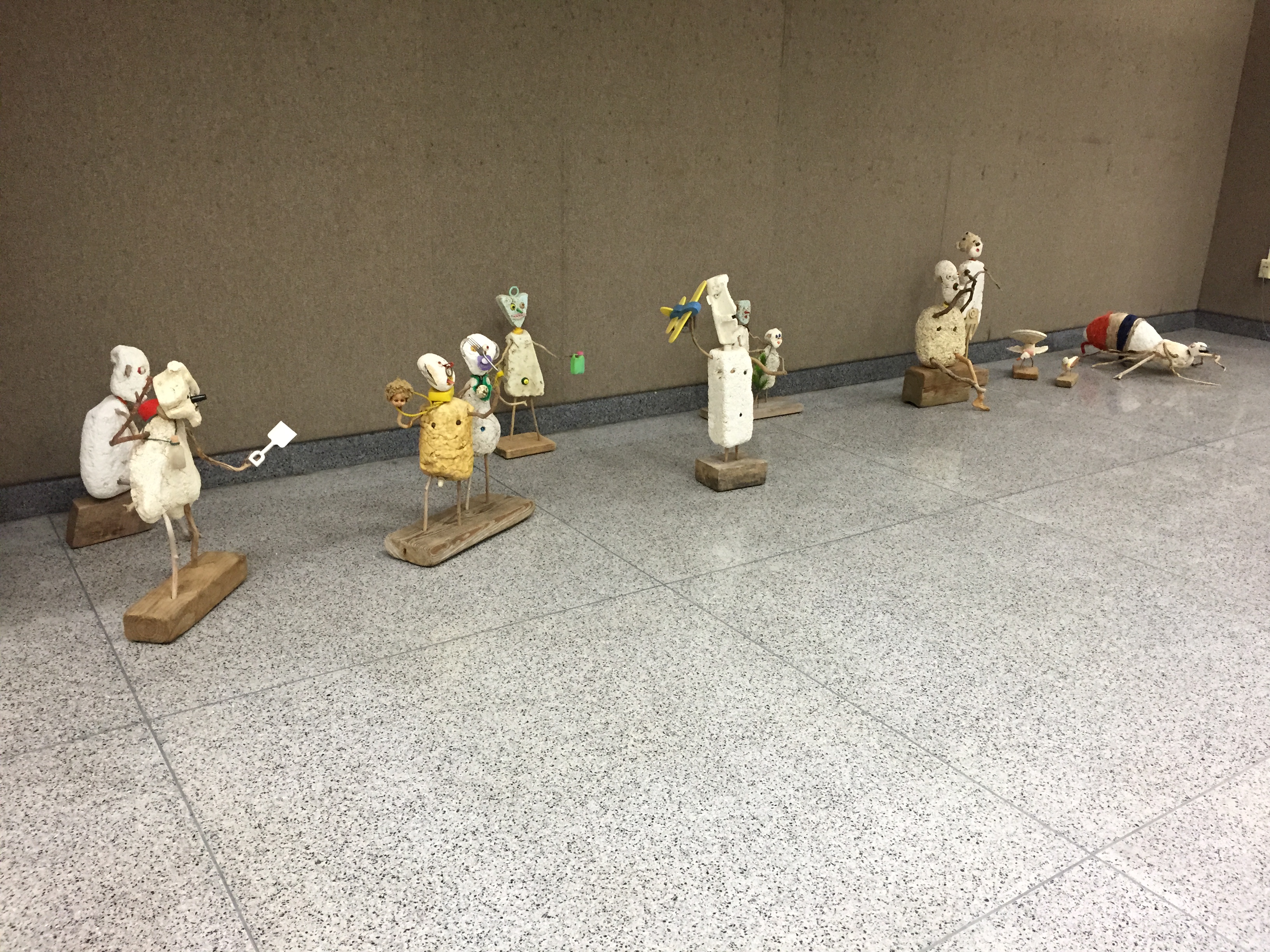
Delivered sculptures at E.K.U., Sept. 2015

All of these Styro-sculptures have stories associated with them and I remember them like old friends!  This blog is their genealogical source recording their creation, their “lives” as art objects, and in some cases…even their demise.

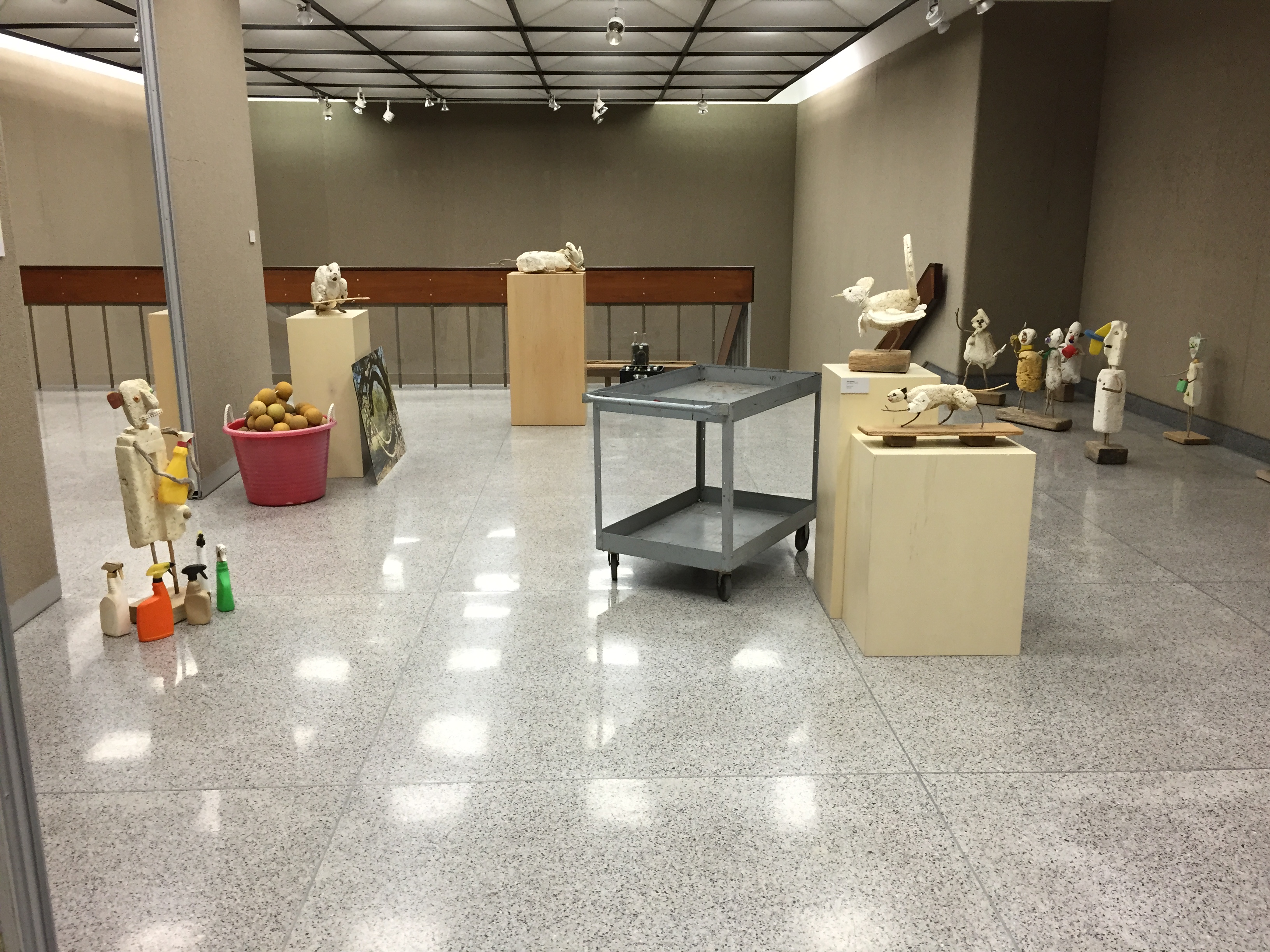
Unloaded art work at the Giles Gallery, Sept. 2015

My work prior to installation at the Giles Gallery, Sept. 2015

I have five new works that were created specifically for this show.  Three of them are larger photo enlargements I have had made that show works I created in the contexts of their river environments.  For now, I will let Esther work her magic and I will post other images from the completed installation.  I also have one other project going on that I have remained mum about so far.  As you might remember, the Falls of the Ohio Interpretive Center has been closed for renovation as they upgrade their displays?  Well, they have contracted with me to create an assemblage on a roughly 8 foot by 4 foot wooden panel showing some of the river junk I have collected within the park.  I am really excited by this since this panel will be a part of their new presentation and will be the last panel seen as you exit the new displays.  Thousands of people (many school tours) will get a chance to see this piece which will document many of the things that you can unfortunately find in the Ohio River.  This panel is due soon and I have a lot of work left to do on it.  Once completed, it will slide into a vertical case with a sheet of plexiglas with some text elements on it to help explain, cover, and protect it.  It has already gone through several permutations, but for the moment, I will show just a few images taken of it in progress.  Here are images from Phase 1.

Panel for Interpretive Center, Phase 1, August 2015


Falls Panel, Phase 1, Aug. 2015

Detail, of Falls panel, Phase 1, August 2015

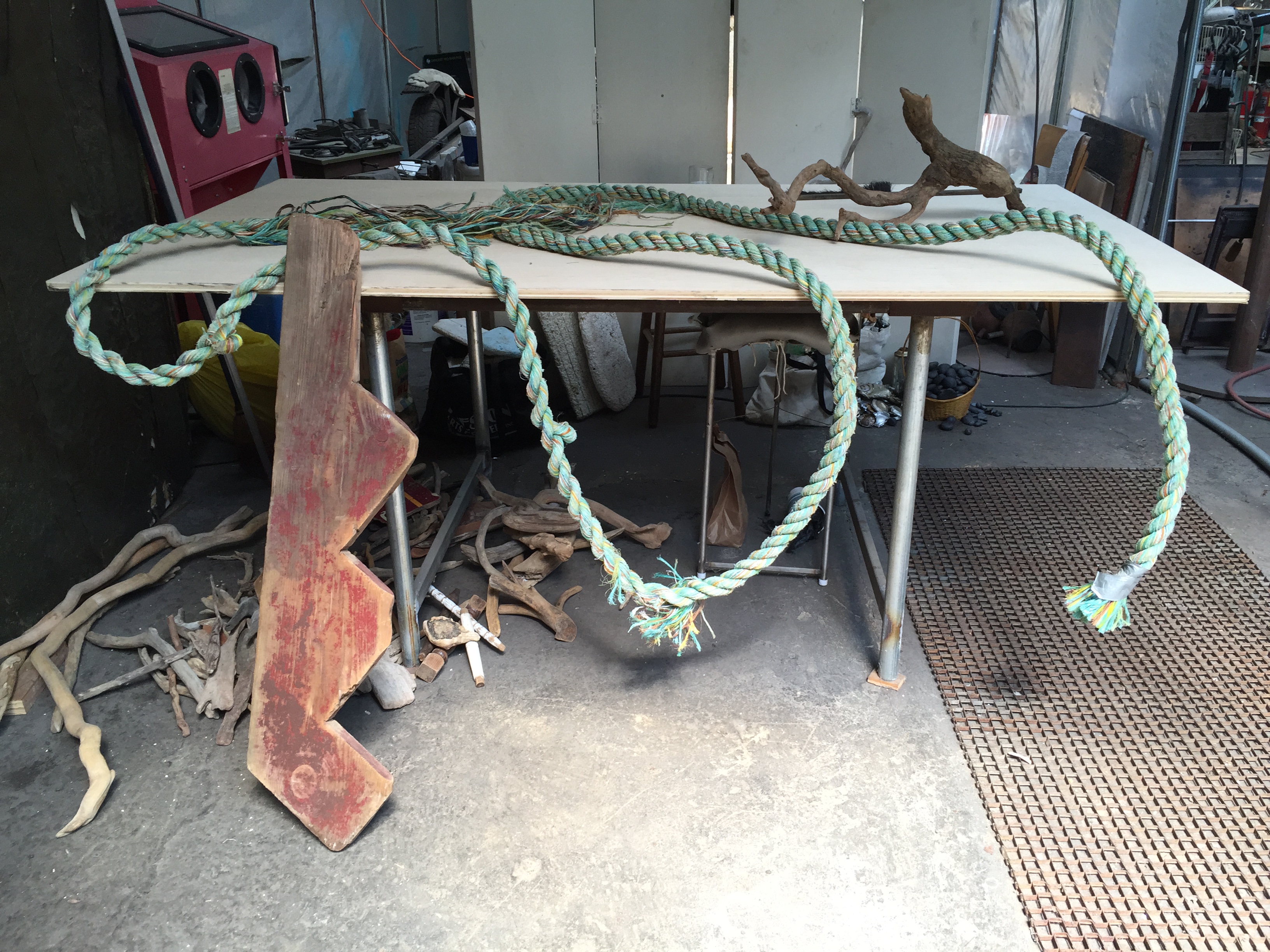
As you can tell, this can go in a lot of different directions because of the wealth of materials available.  All the stuff going onto this panel will have been collected within the Falls of the Ohio State Park.  There is no need to go anywhere else!  I want it to be as authentic as possible in so far as representing the kinds of stuff you can find floating in the Ohio River.  Since these images were made, Solidlight (the Louisville-based company creating the new Interpretive Center displays) has suggested some changes.  They want to see more driftwood used as a unifying element which should be easy enough to do.  I hope, however, that they will appreciate that people will be just as interested in the variety of crap I’ve collected as well and not settle for a cross-section of materials that can be found at the water’s edge.  To see that, a visitor simply needs to go down to the river to experience that already in place.  My good friend, sculptor Tom Butsch is letting me use his studio to construct this.  My own space at home is simply not large enough to accommodate this.  A couple more pictures before ending.

Beginning of Phase 2, Sept. 2015

A river found barge cable and section from a set of stairs are big individual elements going onto this panel.  I keep playing around with different compositions.  The trick for me is in keeping it more informal.  My impulse as an artist is to want to order this in some more formal way.  I will let you know how all this turns out.  I have an early October deadline, so this panel will be my focus for the next few weeks.  Until then…and from the banks of the Ohio River…see you next time.

Falls panel, Phase 2, Sept. 2015


Read Full Post »

Exposed fossil beds at the Falls of the Ohio, mid August 2015

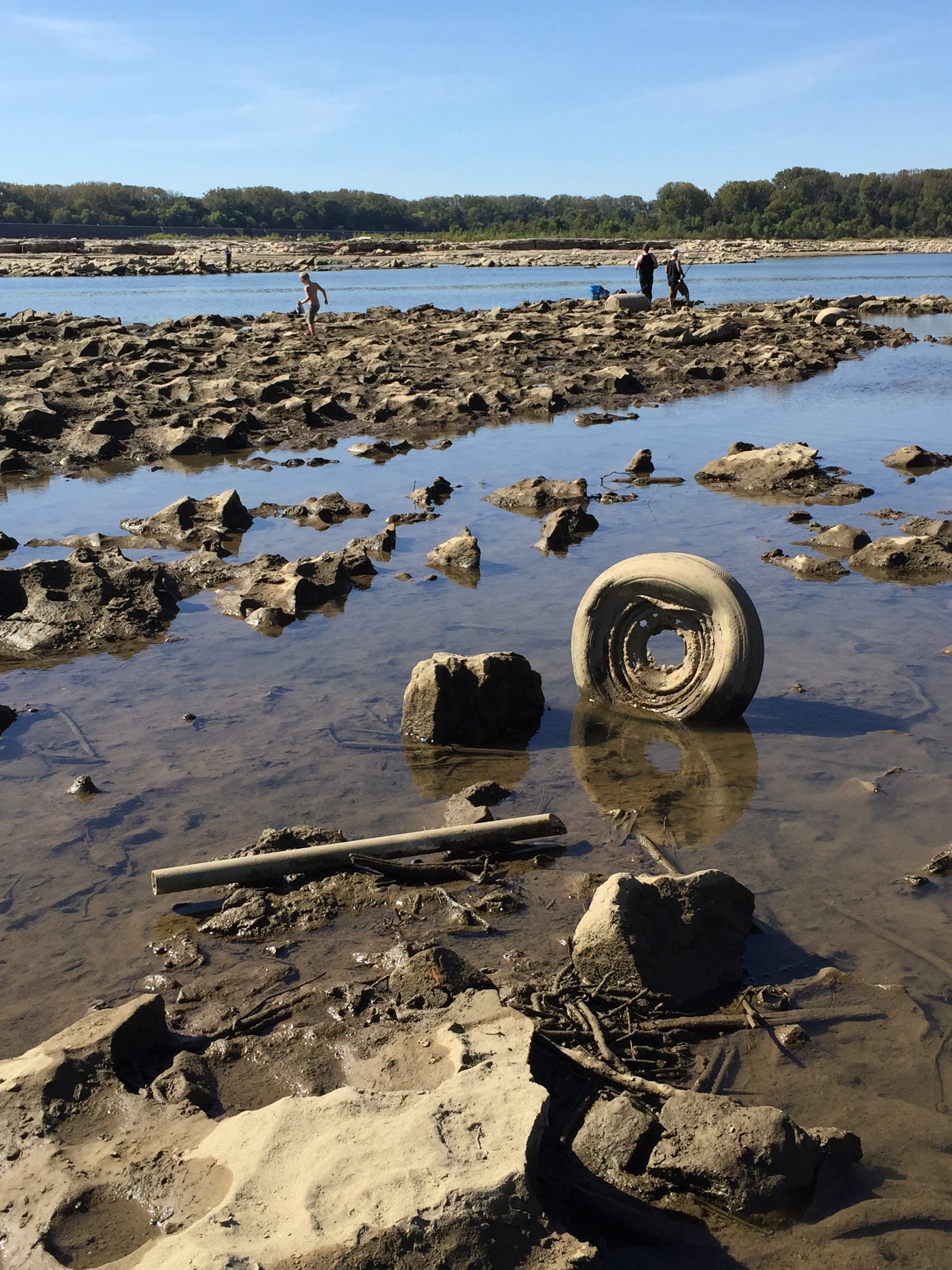
Once a year, usually in mid to late summer, the dam is closed and the water retreats off of and exposes the ancient Devonian fossil beds.  It is an other worldly landscape of blonde-colored rocks that preserves in limestone the proof that life existed over 400 million years ago.  This exact place during that time too ancient to imagine was in the latitude of the present day Bahama Islands.  Then it is was a marine reef supporting early salt water animals, most especially a large variety of corals. Today, this is a fresh water environment defined by the Ohio River. My goal is to cross over to the Kentucky side (where the majority of the fossil beds are located) by wading through the shallower areas near the tainter gates.  Unfortunately, and unforseen by me, all the recent high water has made the riverbank a slippery muddy mess and the current that is allowed to flow through a channel by the dam is still too strong to wade through.  I got almost half way across and found the footing treacherous.  I didn’t fear for my personal safety, but I didn’t want to risk dunking my camera and phone in the water.  Thwarted today, I will need to make better provisions for that the next time I attempt this.

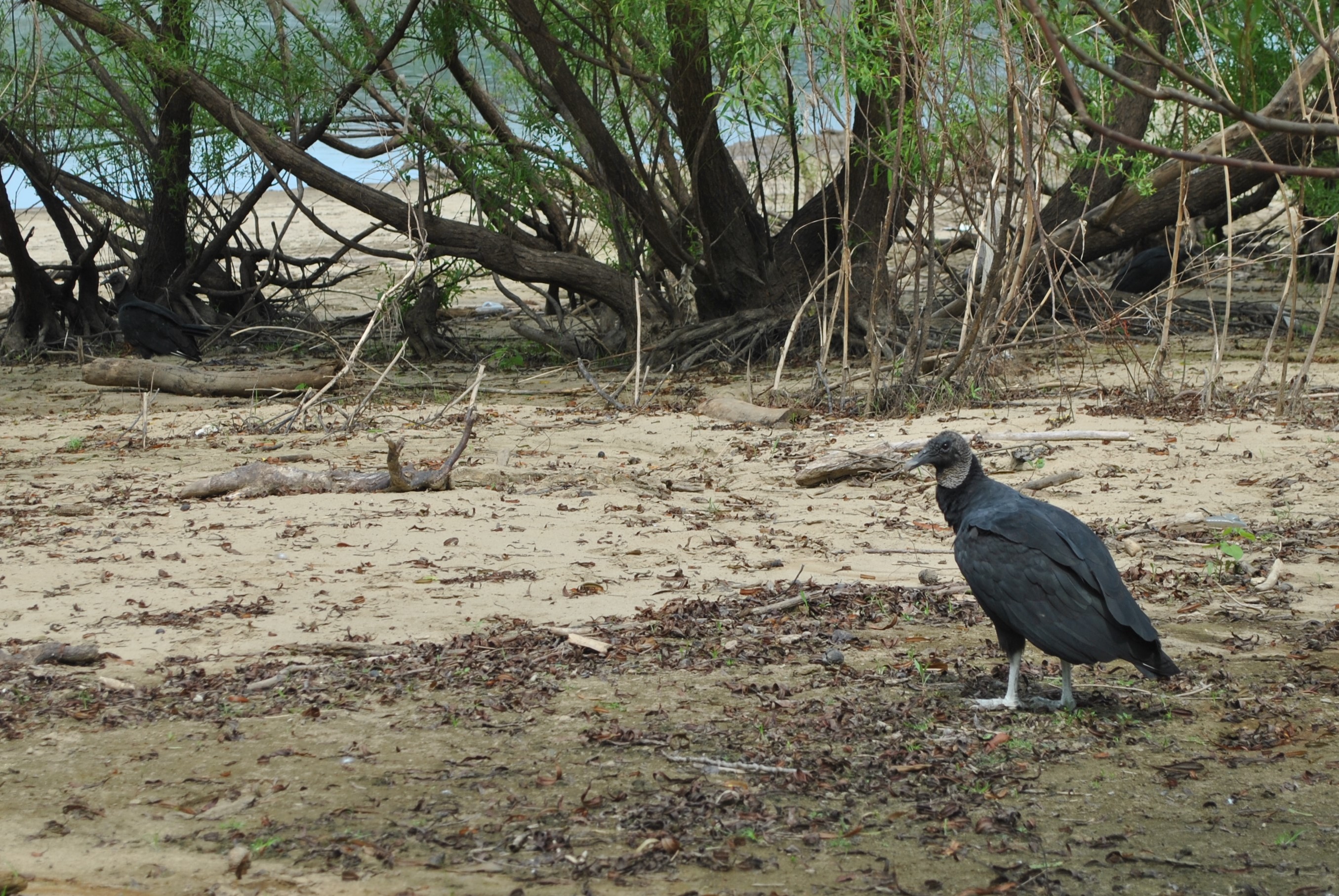
Black vulture on the riverbank, Falls of the Ohio, mid August 2015

So, I did the next best thing which was to explore the riverbank and nearby Willow Habitat.  The resident colony of Black Vultures was hanging out under what shade some of these willow trees could provide.  The bird in the above image is a sentry maintaining its post outside of where the main group of birds were resting under the nearby trees.  The vulture flock doesn’t seem as large as it has been in the recent past.  Perhaps the prolonged conditions of having a high river forced some of these large birds of prey to seek greener pastures?  The vultures would allow me to only get so close before jumping into the air in search of thermals to lift them even higher.  I continued my modified trip by walking towards the fossil cliffs below the Interpretive Center.

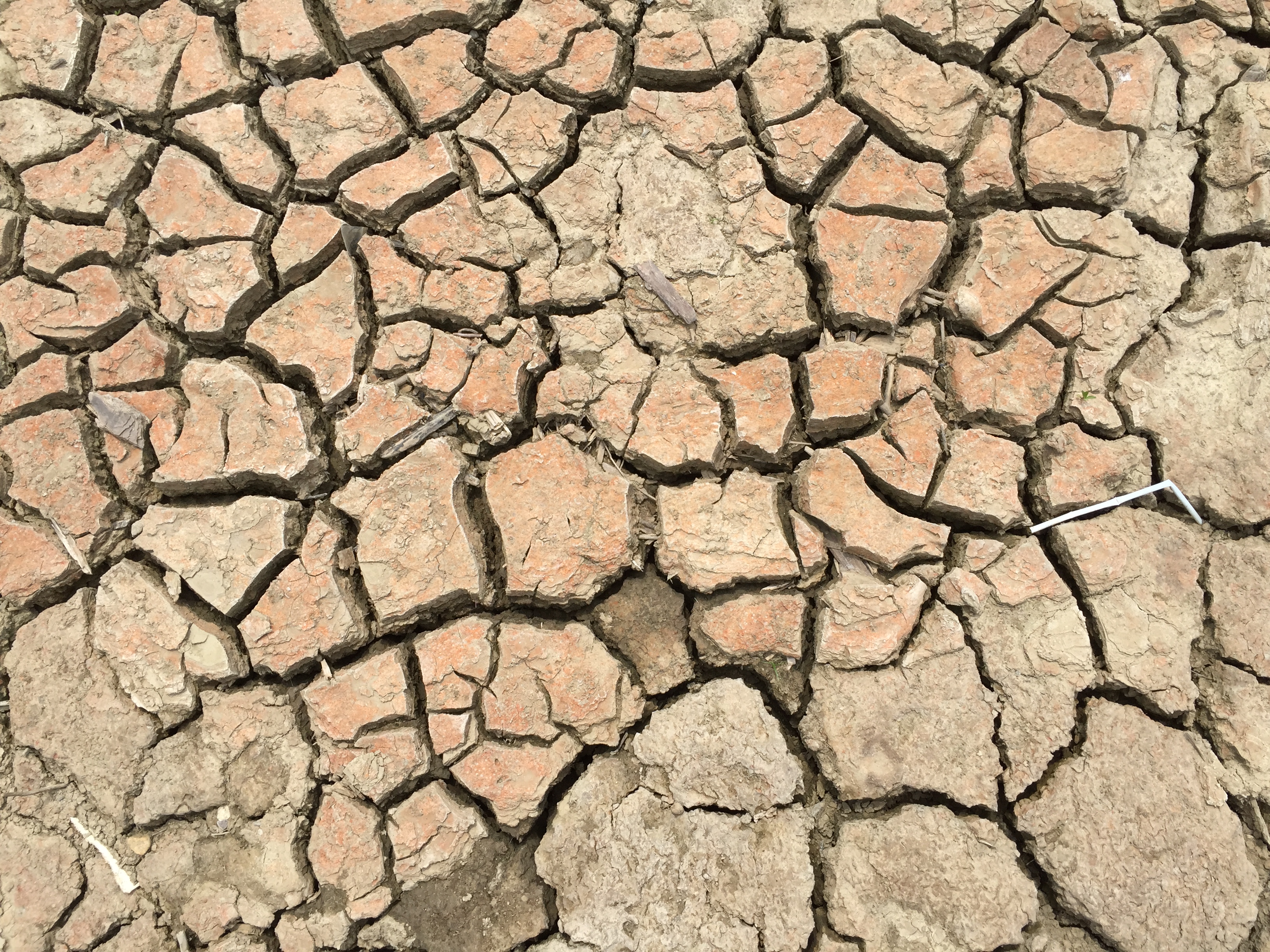
cracked, drying mud at the Falls of the Ohio, mid August 2015

It was a very hot day and in places you would come across areas that were once very wet and had dried revealing a wonderful network of cracks.

Artist at Exit 0 re-hydrating, Falls of the Ohio, mid Aug. 2015

I’m proud of myself.  In addition to wearing a cap…I made sure to bring along plenty of drinking water on this very hot and humid day.  Here my bottle is wrapped in a heavy mil plastic bagel bag.  I used this to keep the other items in my pack dry just in case this bottle leaked.  I continued my hike to the fossil cliffs when I could see something snow-white in color moving along the ground.  At first I thought this was a piece of paper disturbed by the breeze, but soon noticed it was moving in bird-like fashion.  I continued approaching very carefully yet deliberately and had my cameras at the ready.  Here is my first image of what would soon be many.

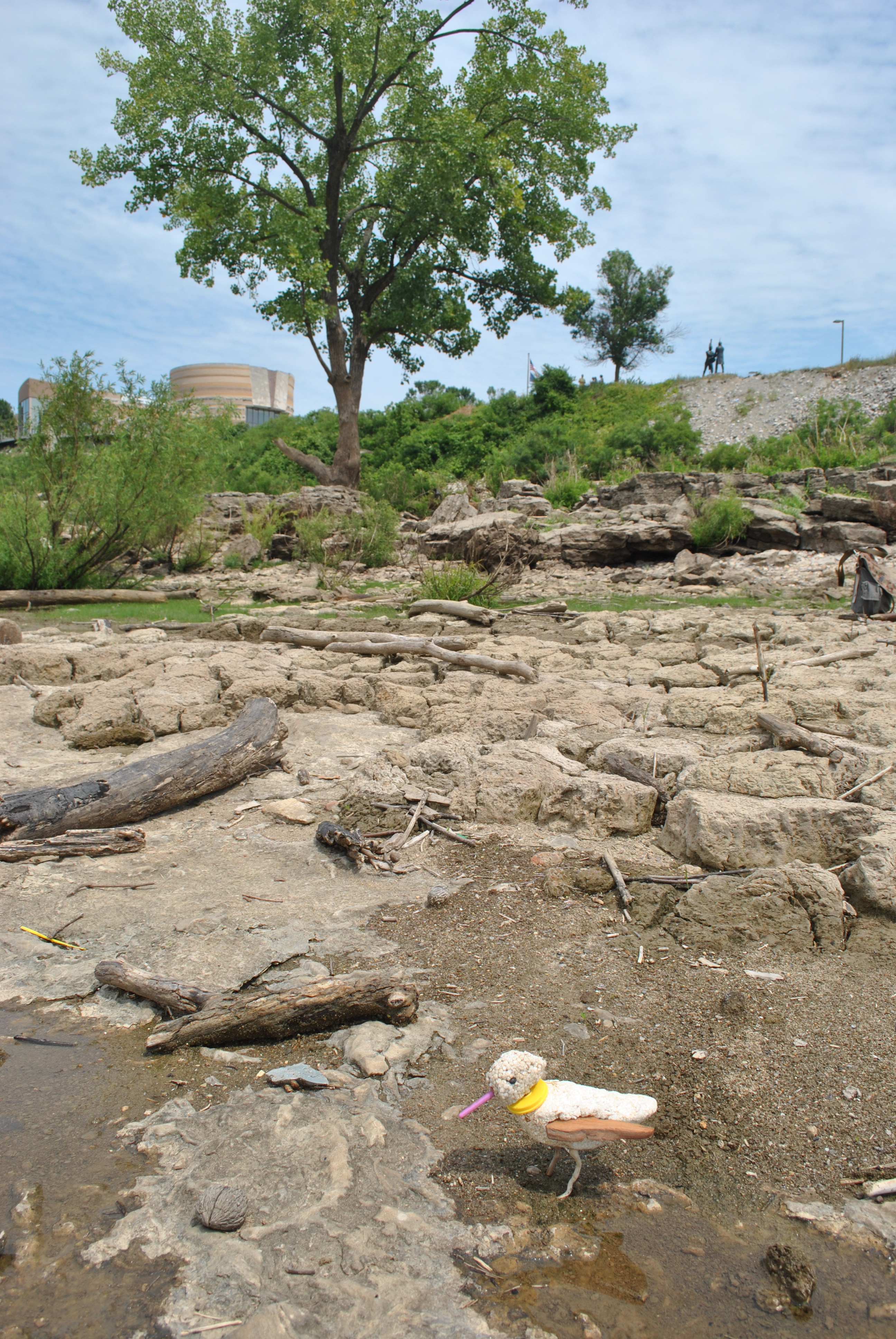
The Yellow-collared Sandpiper at the Falls of the Ohio, mid August 2015

Switching over to higher magnification, I could see my new bird was a species I had never encountered out here before.  In the comfort of my own home I was able to identify this little guy as the Yellow-collared Sandpiper (Caladris fascinati).  This is a tiny shorebird more at home in the Pacific Northwest and has rarely been recorded east of the Mississippi River.  This is the first recorded instance of this bird at the Falls of the Ohio State Park.  So, what was it doing here so far away from home?

Yellow-collared Sandpiper, Falls of the Ohio, mid August 2015

Yellow-collared Sandpiper, Falls of the Ohio, mid August 2015

It is not unusual for this park to record rarities during the migration seasons in early spring and autumn.  To see this bird here outside the normal times shorebirds would be migrating through our area makes me think this bird is here by accident.  Perhaps one of the monster storms we have experienced this year blew this little one way off course?  Looking at my reference guides, I identified this as being a juvenile of the species.  You can tell that by the pink bill.  Once fully mature, the bill turns dark, nearly black in color.  I have recorded other juvenile shorebirds migrating through the park on other Falls of the Ohio adventures.  In particular, I remember seeing juvenile Golden Plovers and once…even saw a juvenile Short-billed Dowitcher.  What makes these sightings all the more incredible for me is knowing that a few short weeks ago…these birds were beginning life as eggs in shallow nests located in the high Arctic tundra.  Normally, the Yellow-collared Sandpiper migrates down the Pacific coastline of the United States, crosses into Mexico, and winters in Central America.  This is a journey of several thousand miles.

Yellow-collared Sandpiper at the Falls of the Ohio State Park, mid August 2015

I observed this bird for about a half hour or so.  I watched it feeding around the margins of small pools of water that had puddled on the fossil beds.  It used its pink bill to probe the soft mud in search of the tiny invertebrates that make up the bulk of its diet.  The bird seemed not to be concerned about me and I took many photographs to document its presence in the park.

Yellow-billed Sandpiper on the fossil beds, Falls of the Ohio, mid August 2015

The mouse-like bird moved like a wind-up toy on the fossil rocks.  When it moved, its tiny legs seemed to be going as quickly as they could.  The sandpiper had a curiosity for the world and checked out every clump of vegetation and crack upon the limestone surface as potential sources for food.  Perhaps it was the hawk that flew high over our heads casting a fast shadow upon these ancient reefs that scared it away or perhaps it just grew tired of my company…regardless, the Yellow-collared Sandpiper flew away in a blur of brown wings.  I thought I could detect a high “peep” call note as it went skyward.  Heading back to my vehicle, I had one more pleasant surprise in store for me.  While this is not on par for rarity, seeing the beginning of the Monarch butterfly migration going through our small piece of the planet is still an awesome occasion.  Like the Yellow-collared Sandpiper, the Monarch butterfly has a very impressive migration of its own as it moves from Canada to Mexico and back again.  On my way home, I said a little prayer asking for the continued safety of all the small things moving through the world.  I guess that’s it for this time at the Falls of the Ohio.

Monarch butterfly feeding at the Falls of the Ohio, mid August 2015

Read Full Post »

Detail, Western Petroleum Rainbow, Falls of the Ohio, early August 2015

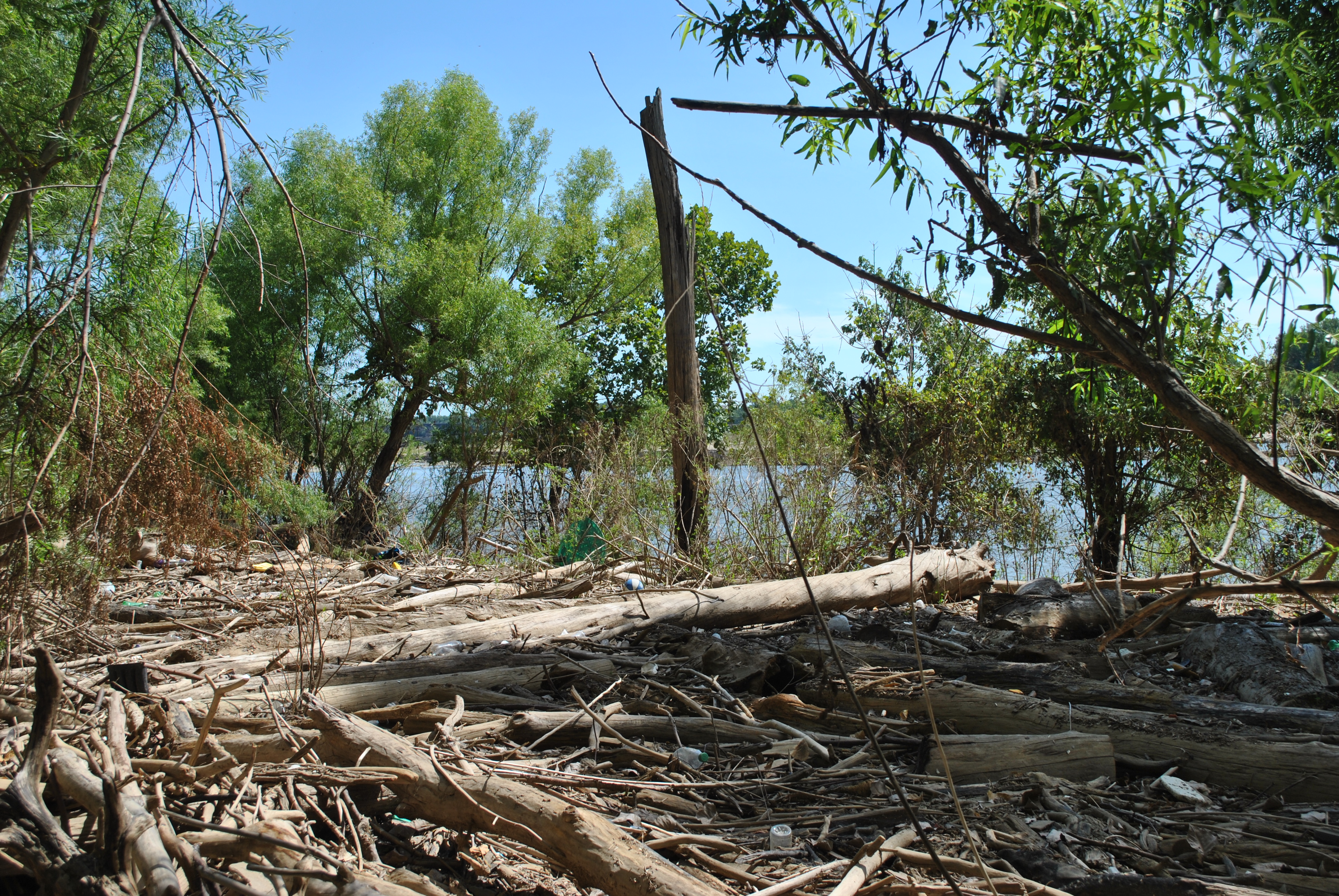
Hot, sticky, and the humidity had me sweating the moment I entered the park.  Today’s outing seemed more like an extreme sport than an attempt at art making.  I decided to focus my efforts in the western section of the Falls of the Ohio State Park.  I knew the recent flooding we had experienced would more than likely deposit a lot of junk and debris along the driftwood cluttered shoreline.  I was right about that, but first I had to “earn it”.  To access the shoreline in this area of the park required going over, under, and around large trees that had either blown over by high winds or were undermined by the soil being washed away from the riverbank.
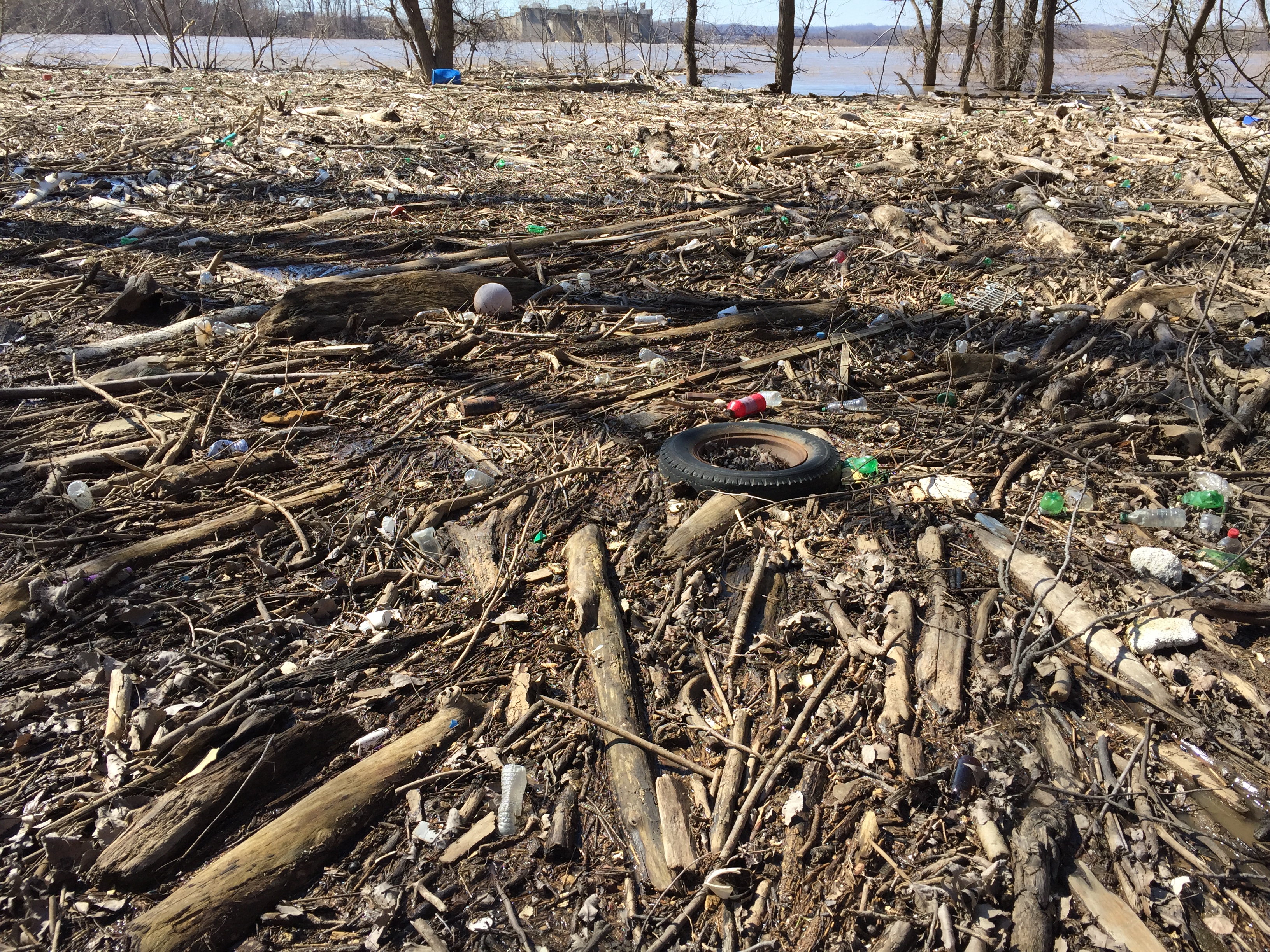
Driftwood on the riverbank, Falls of the Ohio, early August 2015

One thing I noticed being in this section of the park…was that all the purple loosestrife seemed to be gone.  Normally, one can expect to find a whole host of butterfly and other insect species sipping nectar from the colorful flowers.  On this expedition, I did not see one bloom from this admittedly invasive species.  I think the Ohio River’s recent bouts of high water must have affected them?  I find this somewhat unusual since I associate them with growing in very damp areas.  Perhaps in their case, too much of a good thing is actually a bad thing?  I will do some research to see if my hunch is true.  Regardless of no purple loosestrife, there were plenty of vines to snag and trip over making the footing tricky…as if the soft mud and irregular surfaces of the driftwood weren’t enough of a challenge!

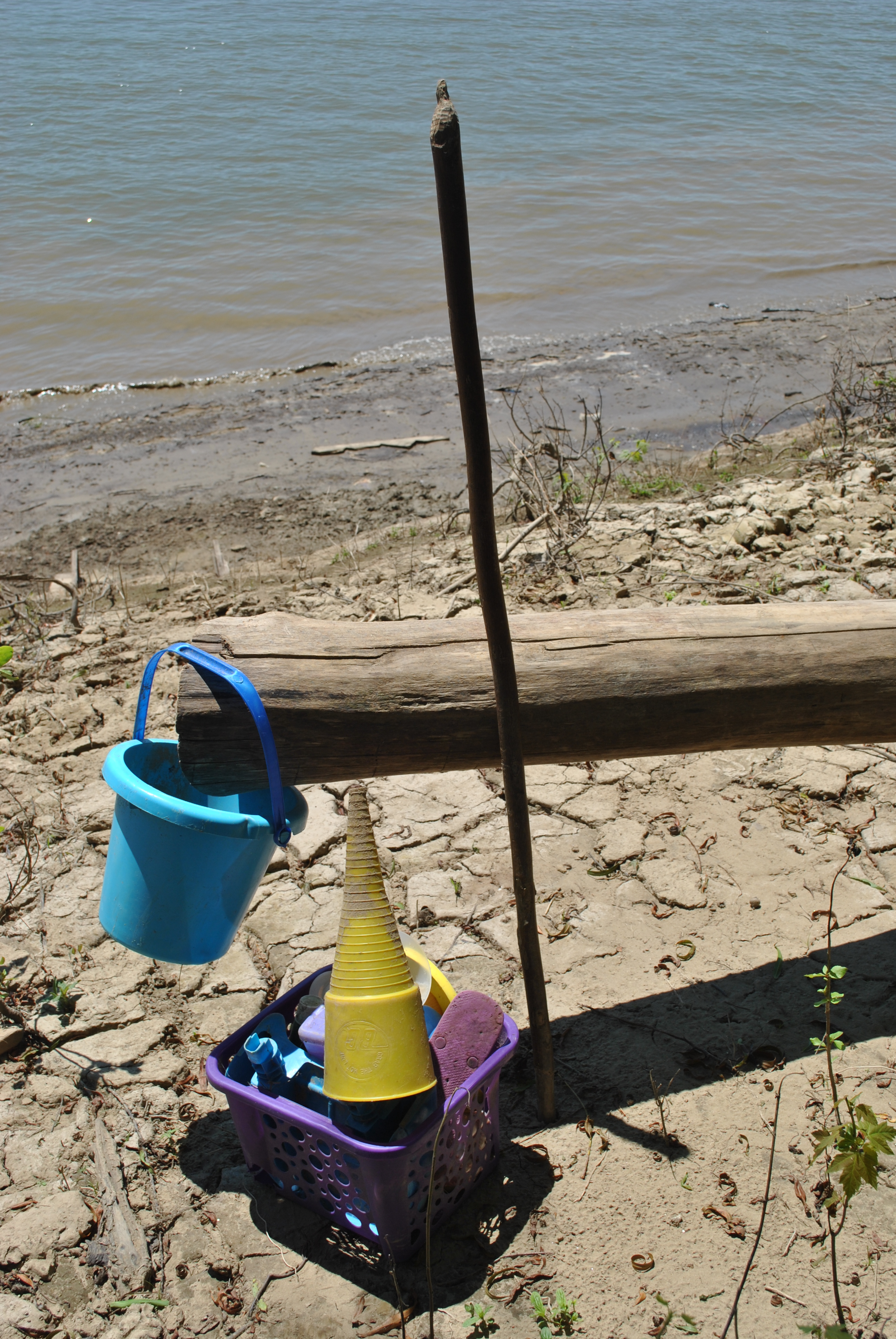
My walking stick and found plastic items, early August, 2015, Falls of the Ohio

With the hot sun beating on me, I faithfully search the riverbank and collected the colorful discarded items that were first “gifted” to the river and then to me.  Walking from one promising area to another…I found enough plastic junk to make my next site specific piece.  Here’s another look at some of the objects that I found on this day.

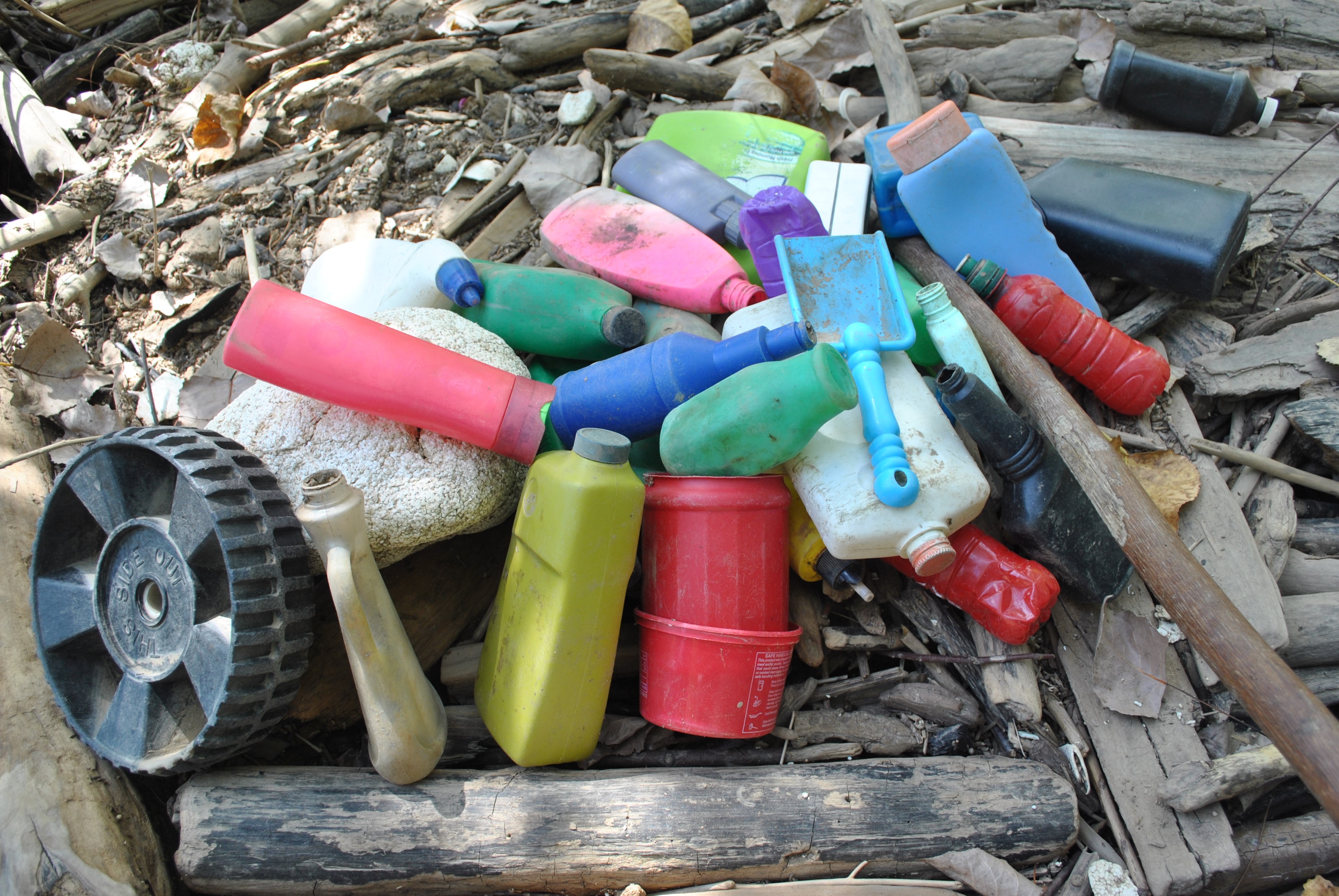
River junk, Falls of the Ohio, early August 2015

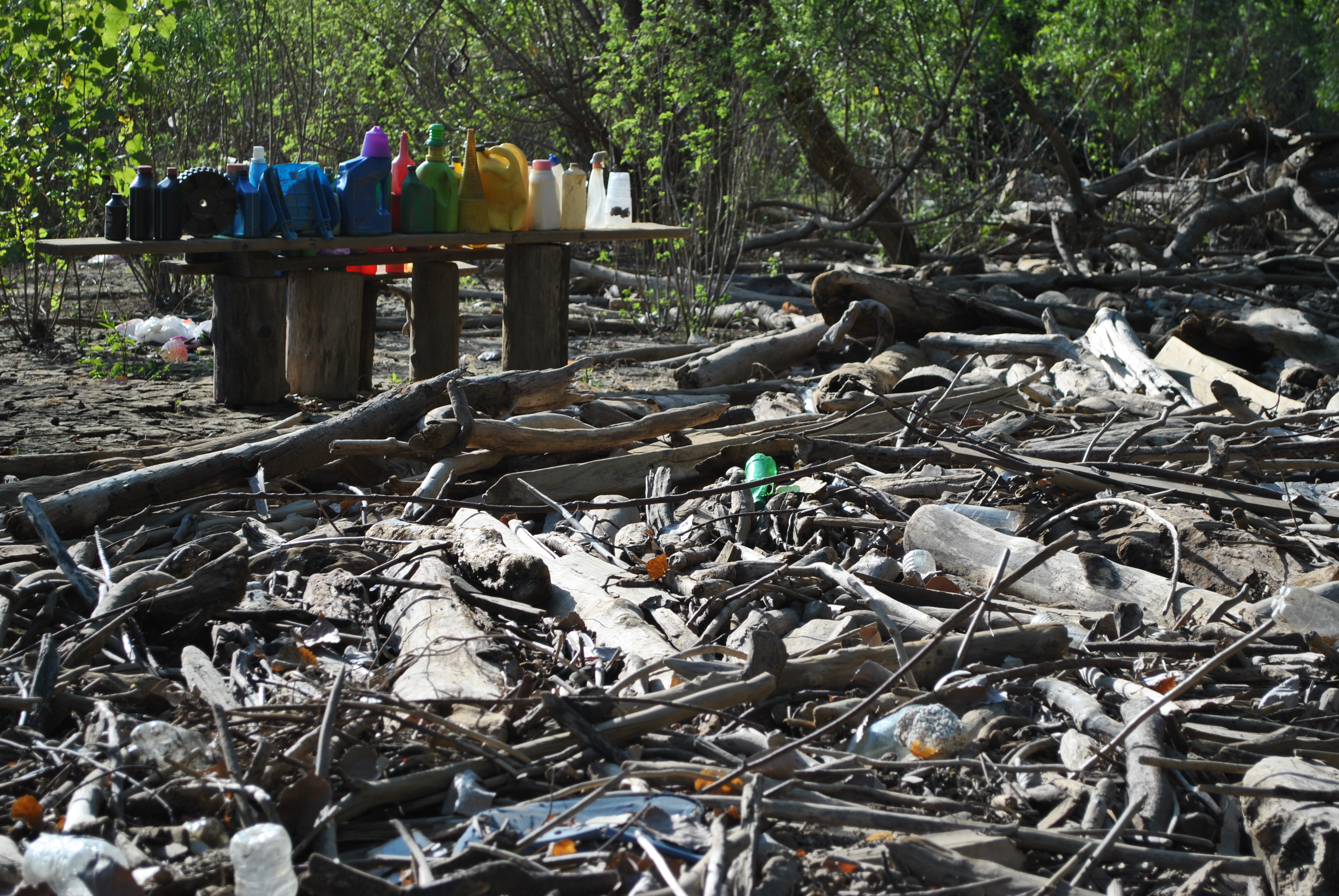
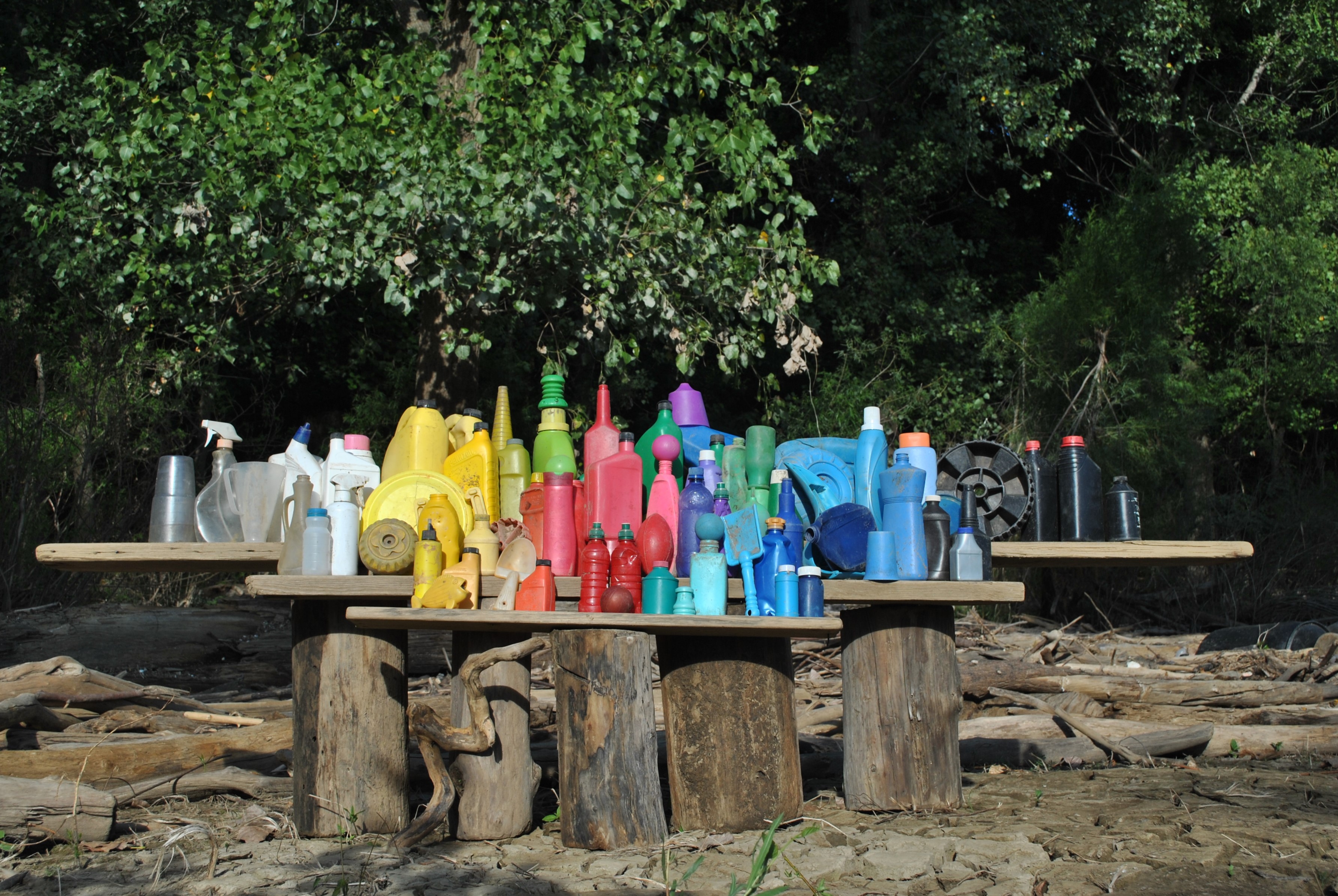
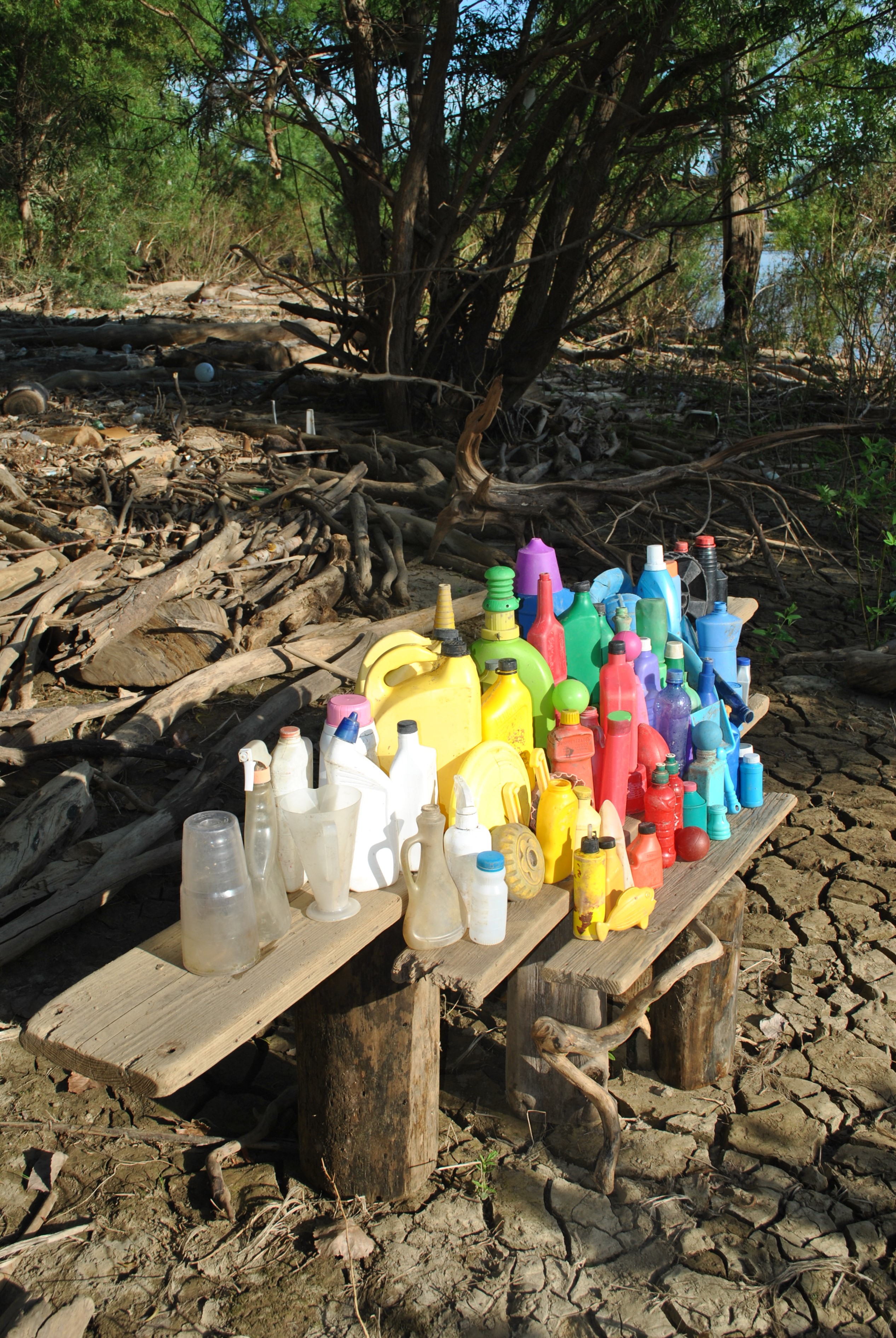
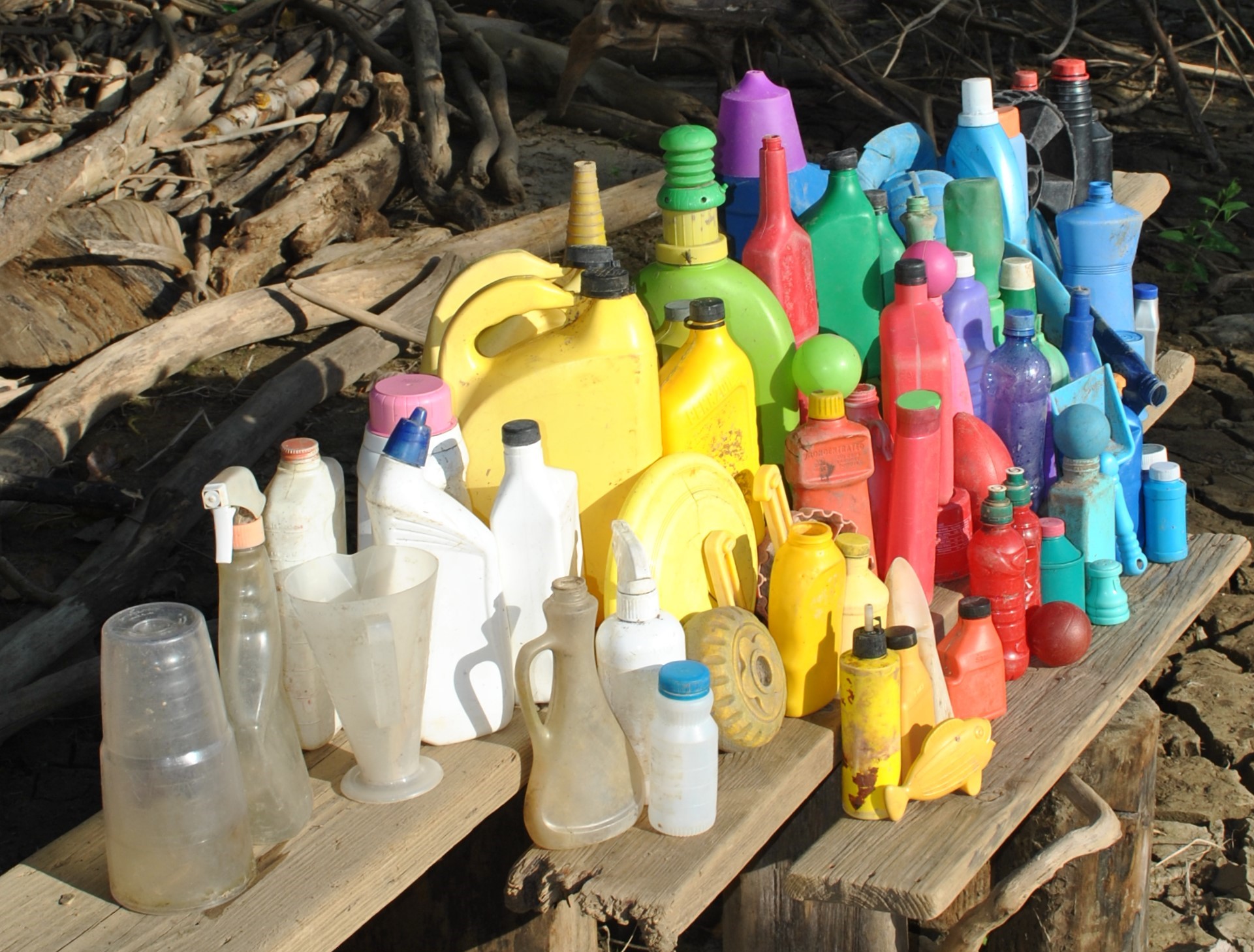
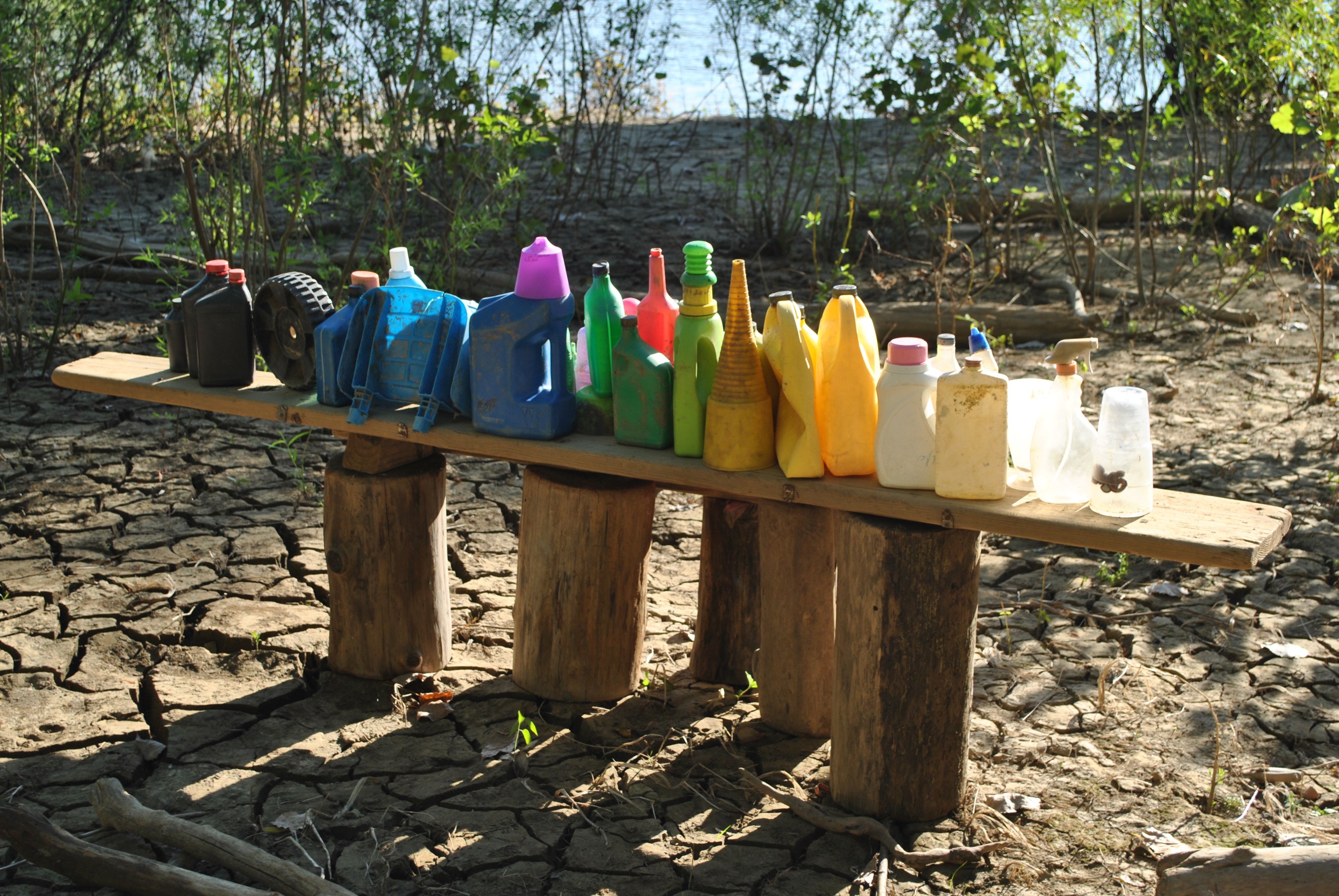
The really bright and colorful plastic objects virtually scream at you when you bother to pay attention.  Otherwise, it’s all just part of the material crap we create and dispose of indiscriminately.  Maybe because I’m looking for this kind of thing…I see it more easily.  I’ve trained my eye to spot the unnatural colors mixed among the gray and brown tones of the driftwood.  I decided to set up a display in a particularly promising area between two debris fields that was also close to the river.  I looked around and gathered some old milled boards and set them up on short, cut logs and before long had a table-like altar to lay my plastic treasures upon.  Following are several looks at the completed work.

The Western Petroleum Rainbow assemblage, Falls of the Ohio, early August 2015

Here’s a view from behind the piece.  You can see other bottles and junk mixed into the driftwood in the foreground.  I set this piece up on an area of cracked and drying river mud.

Western Petroleum Rainbow, early August 2015, Falls of the Ohio

Now a view from the front.  I placed this work here to take advantage of the sunlight which was beginning to set in the late afternoon.  I also wanted the verdant darkness behind all the colors to help create greater contrast.  There are three tiers of boards that I used for this display.  As is usual, I found less of some colors and more of others.  In this instance, I could have used a few more orange plastic objects, but just one small plastic bottle was all I found this time.

Angled view, Western Petrochemical Rainbow, early August, 2015, Falls of the Ohio

Detail view, Park West Petrochemical Rainbow, Falls of the Ohio, early August 2015

In the late afternoon, all the various colors in this plastic are energized by the sun’s electromagnetic spectrum which causes this junk to glow.  It’s the “golden hour” and one of my favorite times of day for its ability to infuse and unify the everyday with magic.  I have stayed out on the river far longer than I first anticipated.  The gnats and mosquitoes have had their way with me.  Plus all my granola bars for energy have been consumed and my water ran out a couple of hours a go.

Back view, Park West Petrochemical Rainbow

I’m fading fast and still have a long hike to make.  All the obstacles that were there on the way in will also be there on the way out of the park.  I took one last look back at my most recent project and decide that it is the best I can do at this particular moment.  I’m calling this one, the “Park West Petrochemical Rainbow” so I can remember what section of the park I visited when I assembled this piece.  I picked up my collecting bag and walking stick and made sure I wasn’t leaving something I might need behind me.  The rest is one foot in front of the other.  I let the fading beauty of the light distract me from my discomforts.  Food, water, and a nice shower are waiting for me at the end of the line.  See you later from the Falls of the Ohio State Park.
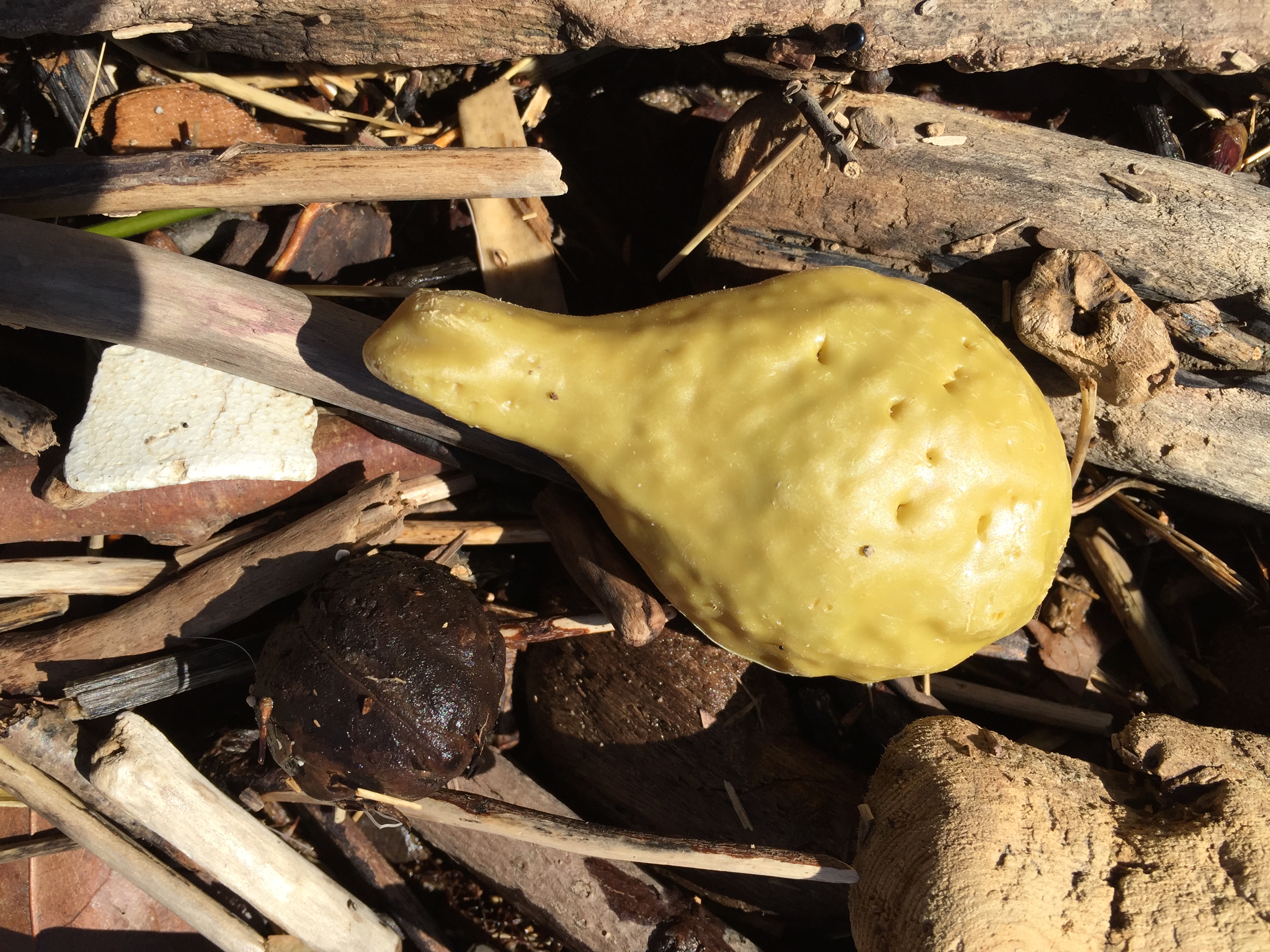
Sunset at the Falls of the Ohio, early August 2015

Read Full Post »

After the last high waters, late July, 2015

Eventually, the water does go back down and reveals after the fact, all the newest changes that the river has made in the park.  You saw part of that in my last post with the way one favorite willow tree has been shaped by this latest event.  In many places in the park, you can find logs that floated here from some potentially far away places.
Stranded logs on the wier dam wall, with the City of Louisville in the background, late July 2015. Falls of the Ohio

Just a few weeks earlier, I posted images of Asian carp jumping over this very same spot.  The walls of the dam were no obstacle then.  Now the dam has been “graced” with many logs that were stranded along the top.  They will stay here until the next flooding event or until something else shifts the balance.

My green bottle piece after the latest flood, late July 2015, Falls of the Ohio

Because this is summer and we have experienced so much rain, all the vegetation is really lush.  Familiar paths are overgrown and the heat and humidity seem trapped at ground level.  I am completely sweaty in no time at all.  I went and checked out the green bottle piece I had made many weeks a go and it is still relatively in place.  I assembled it on top of a large driftwood mound that this latest bout of high water was unable to fully reach.  I can tell that the mound has shifted some and all of the bottles have settled within the upturned boat dock.  Now, the entire mound is covered in vines.  This makes it especially tricky to walk over.  I snapped a few pictures and moved to the safety of the riverbank.  There are lots of areas to explore and who knows what we shall find?
River coconut, Late July 2015, Falls of the Ohio

Slogging through the mud and wetness along the river’s edge, I make this amazing discovery.  It’s a River coconut!  I wonder what the tree that produced this hairy fruit looks like?  Since much of the water that reaches us here flows from the north downward, I imagine that this is one hardy tree.  I guess the coconut’s shagginess is a coping mechanism for cold winters?  As we walk, there are more discoveries to be made.

Giant toy watch or ?, late July 2015, Falls of the Ohio

Further down the riverbank I encounter this object.  I am holding it as I am because initially, I thought this was an extra-large toy wristwatch minus the hands and numbers.  Since I have been able to examine it more closely from the leisure of my home…I am now thinking that this is a child’s pro wrestling inspired championship belt?  All the glued on rhinestones must have fallen off while the river carried it away from wherever it originated from.

Broken, blue plastic dolphin riding toy, late July 2015, Falls of the Ohio

Walking further west…I discover the remains of a riding toy.  This is a blue plastic dolphin that came to rest in the Willow Habitat.  There are more plastic items to find.  Next was perhaps my favorite find of the day.

River patinated, plastic doll shoe, late July 2015, Falls of the Ohio

This is so small, that I’m surprised I spotted it among all the other small items both natural and artificial.  It’s of course a plastic doll shoe, but this one has a nice patina acquired from being in the river for a while.  I still find many dolls and doll parts, but this little doll accessory is a rare find.  Unfortunately, there is also plenty of other plastic in the park that isn’t so hard to find.  Here’s one such example as I found it in place.

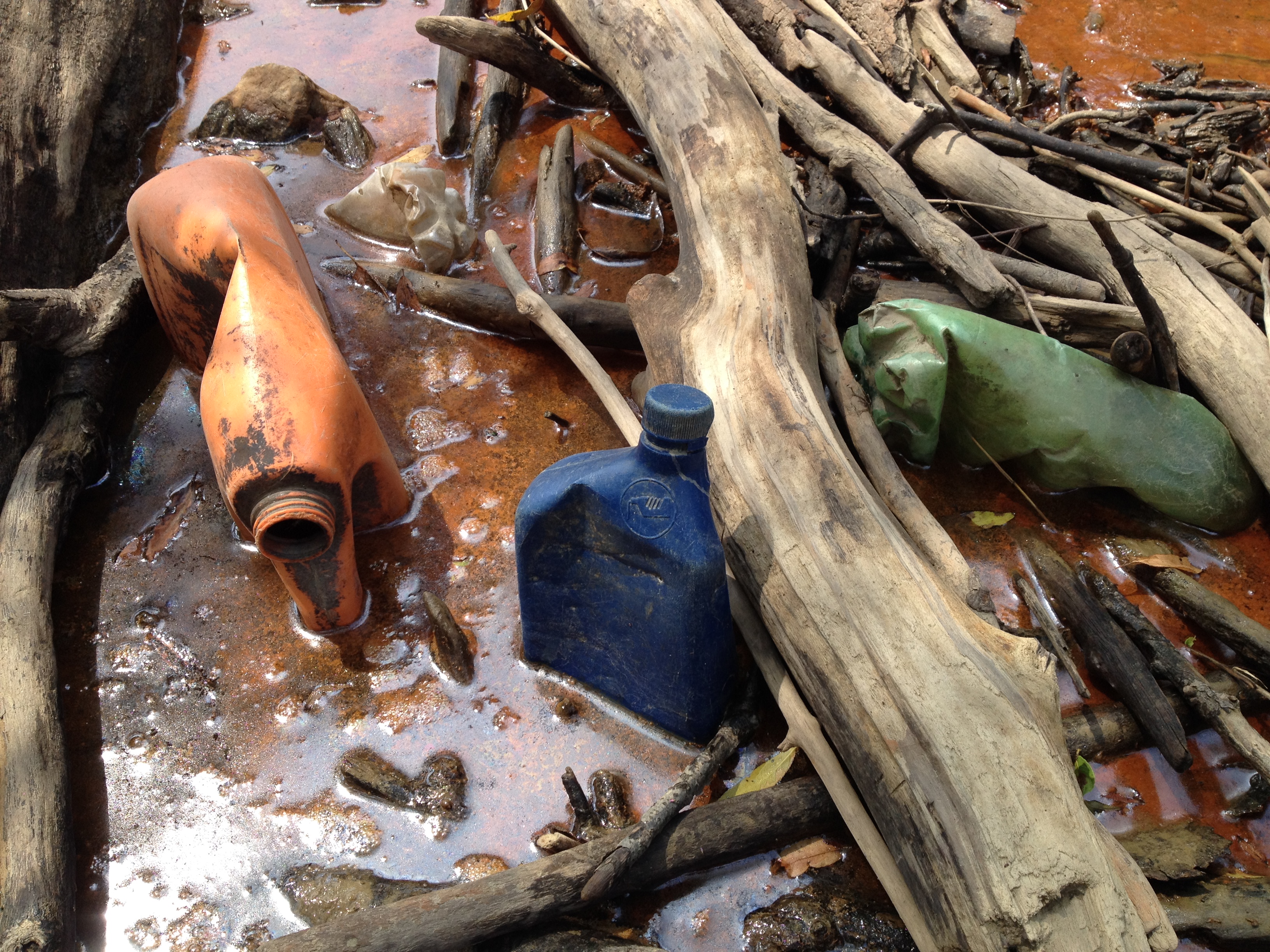
Plastic jugs in a mud puddle, Late July 2015, Falls of the Ohio

Three plastic bottles and containers rest in a pretty disgusting looking puddle.  The orange color is actually something I find occurring here naturally and may be due to some red oxide that exists below the many levels of clay and sand.  Of late, I have been collecting various plastic bottles and creating other site specific pieces with them.  On this particular day, I made a relatively small one due to time constraints.  I have often found that it is good to have some limits with this river art.  Simply, there are so many things one can work with and I have added to my vocabulary of forms and materials slowly over the years.

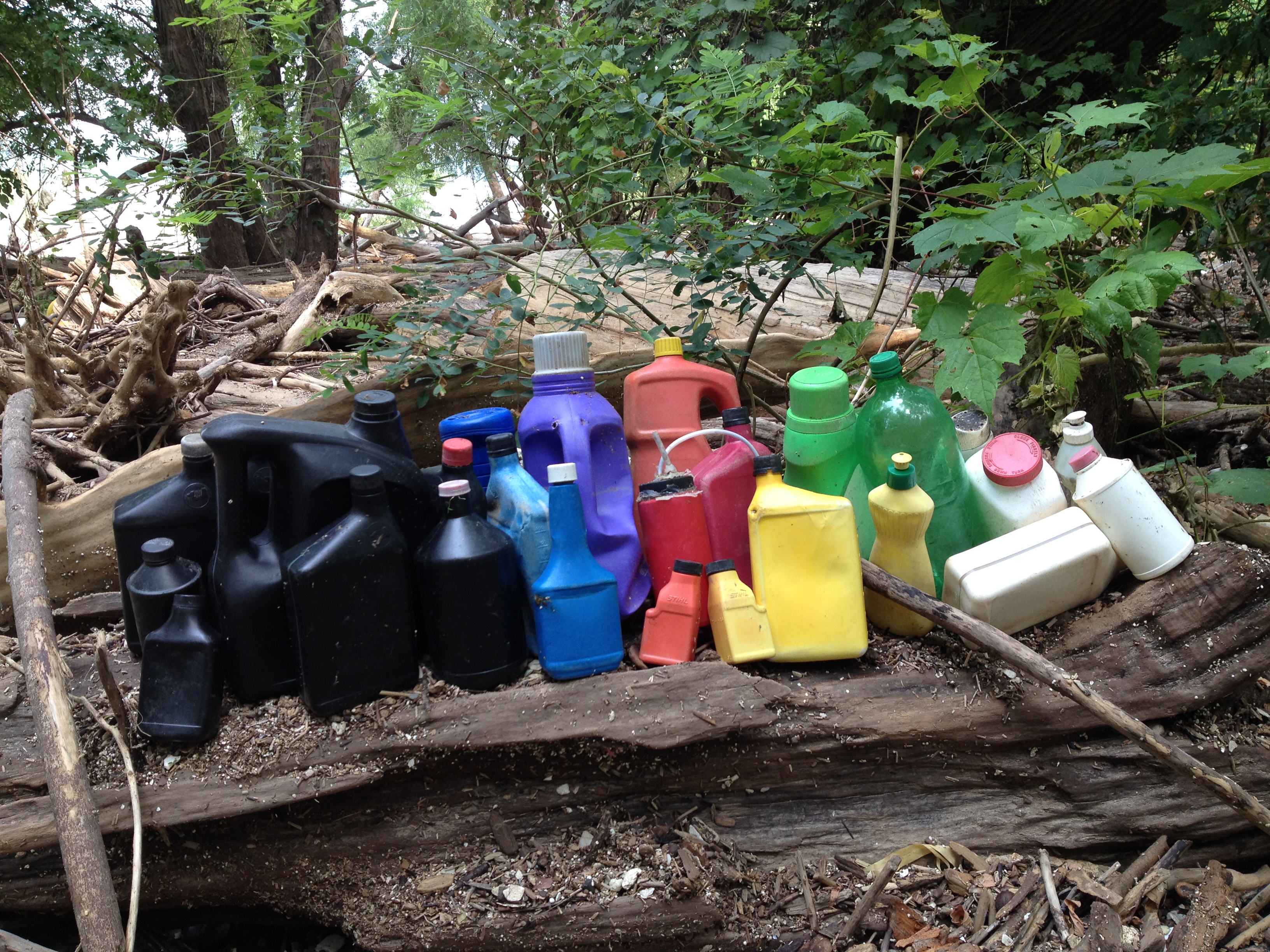
Plastic bottle composition, heavy with the black, Falls of the Ohio, late July 2015

detail of colorful bottle piece, Falls of the Ohio, late July 2015

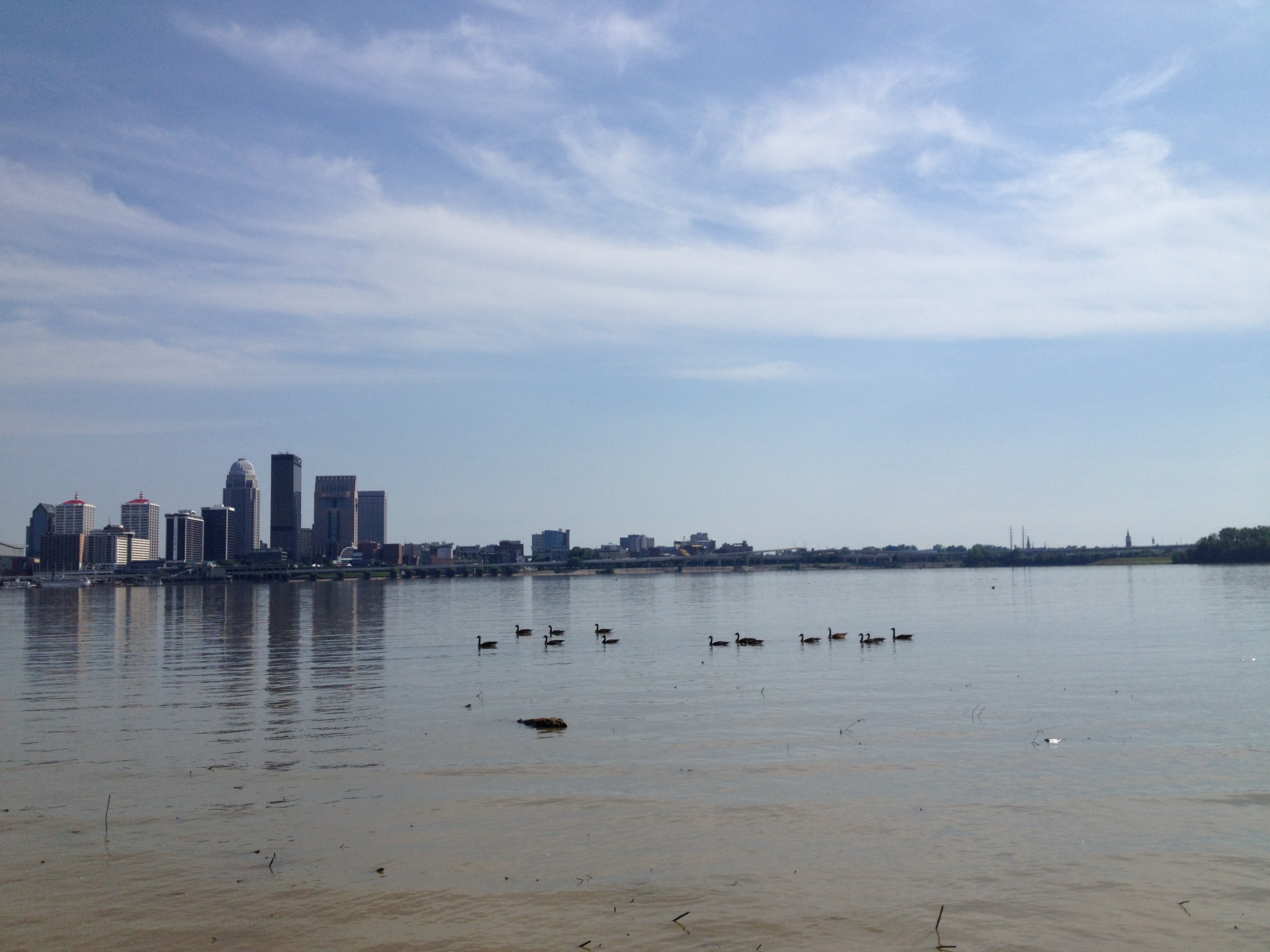
Like some of my previous efforts, I chose a particularly promising area that seemed to have a “wealth” of plastic bottles and containers.  I then set out to find colorful examples to make an assemblage with.  I like contrasting the high artificiality of these bright objects with the more subdued organic efforts of Mother Nature.  The high-keyed colors are often cheery.  I think that even on a subconscious level, we recognize the former products that were in these bottles even without their original labels which have washed away.  From our own household experiences and uses, we are reassured by the soap that will clean our clothes or the oil that keeps our engines humming and in good condition.  That’s where the tension lies in these simple assemblages…we know that this is far from the case.   Since we now know that these containers and the products they once held were extracted from nature at great cost.  In the aftermath of use…that cost continues as the packaging is disposed of irresponsibly.  This particular artwork is heavy on the black which influences things as well.  I simply found more black containers on this day and used them.  After a few photographs, I picked up my collecting bags and headed home exhausted from slogging through the mud, heat, and humidity.  I’ll leave this post with one more view from the Indiana side of the Ohio River.  On the way home, I noticed a small flock of Canada Geese gliding past the skyline of Louisville and the river seemed at peace for the moment.  Catch you later from the Falls of the Ohio.

Skyline of Louisville with Canada Geese swimming, Late July 2015

Read Full Post »

« Newer Posts - Older Posts »