Feeds:
Posts
Comments

Archive for the ‘Originality’ Category

nature's template, Falls of the Ohio

It’s been raining off and on for the past three days and so I’ve decided to give the actual Falls of the Ohio a pass this weekend.  That, however, does not mean that my heart and thoughts are ever far from the park.  Looking through my Falls image archive, I have put together a post on a topic that has been concerning me of late.  Increasingly, we feel we can manipulate nature and bend it to our desires without consequences.  Man has this vision that we can force nature into our template and that “she” will obey in predictable, obedient ways.  Ever see a square tomato grown in a cube?  Nature, however, is much more dynamic than we give her credit for and frequently presents ideas of her own.  As regular followers of the riverblog may have noticed new fauna often show up here and the consensus is that their appearance is a result of our altering the environment in myriad ways.  Over the last few years, I have also noticed some previously unknown plants.  Allow me to present a photo-bouquet of highly questionable, potentially toxic, exotic flora.
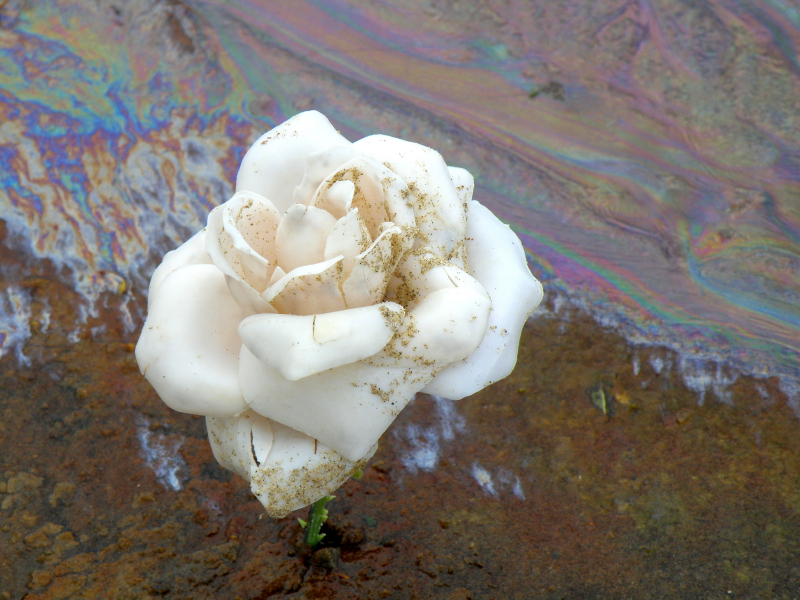
The Chemical Rose, Falls of the Ohio, 2012

Meet the Chemical Rose which is a new species I discovered at the Falls last year.  It was found growing by an area where an unknown iridescent sheen was percolating up through the sand.  It has no leaves and aside from its thorny stem, has no photosynthetic ability.  This is a fairly consistent trait of these new plants.  They may be parasitic or fungal-like, but I’m sure there is considerable variation on how they live.  The petals on the Chemical Rose are hard and seem very much like plastic.  More on this later.
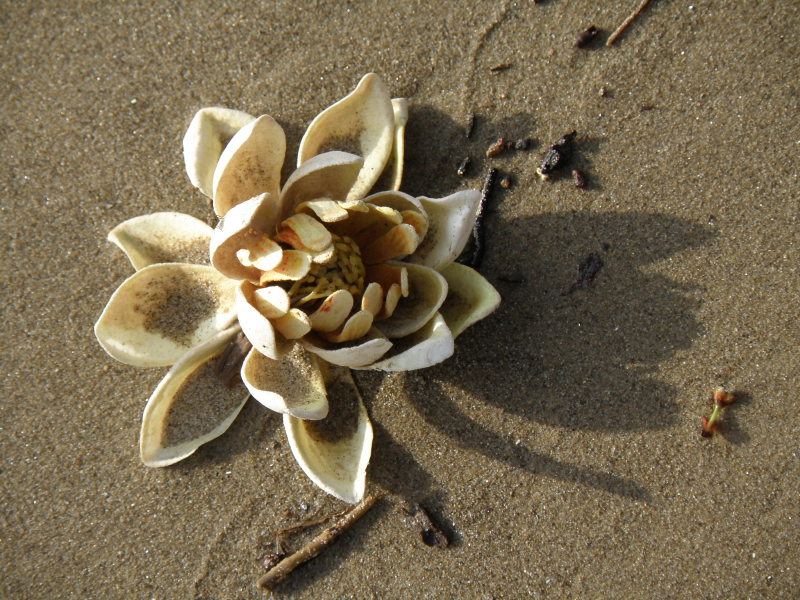
The Sand Lotus, 2012

It’s beautiful in its own way, but what is it?  For lack of a better name, I call this a Sand Lotus.  It shares some characteristics with the Chemical Rose.  Notice no leaves…doesn’t need them.  It’s roots go down deep in the sand.  Like the previous rose, its petals are hard to withstand the rigors of the river.
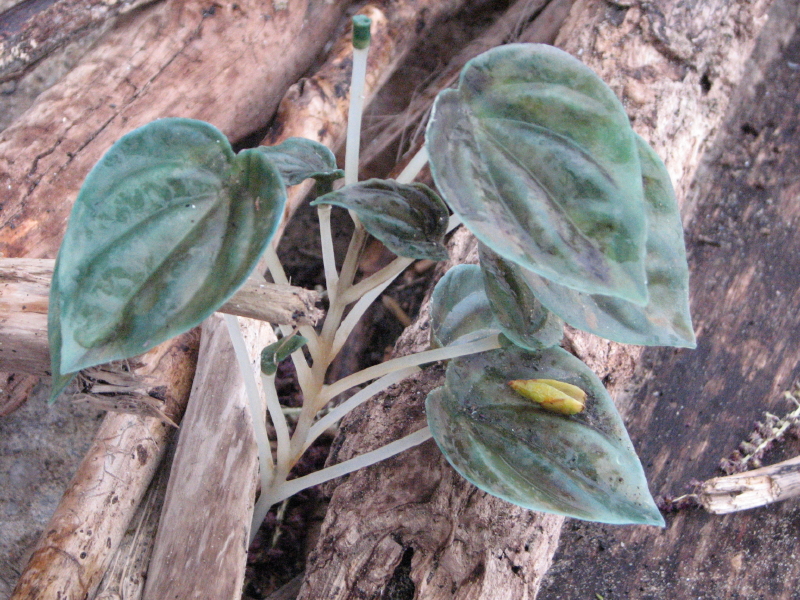
Petrochemical Coleus

I bet I walked by this strange plant many times before something told me to look again.  I call this one the Petrochemical Coleus.  Although it has green leaves, it does not possess chlorophyll.  This specimen was growing up through the driftwood.  It’s small size also makes this one hard to see and find.
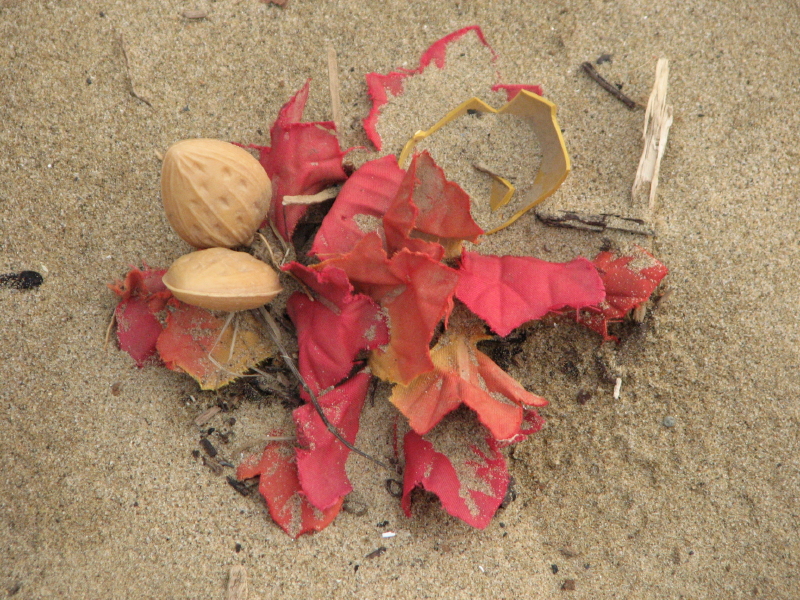
Flame Nut with seeds

Here’s the Flame Nut so-named because what passes for its foliage turns bright red when its seeds mature.  Its leaves feel very much like coarse fabric and it seems to prefer sandy environments as well.
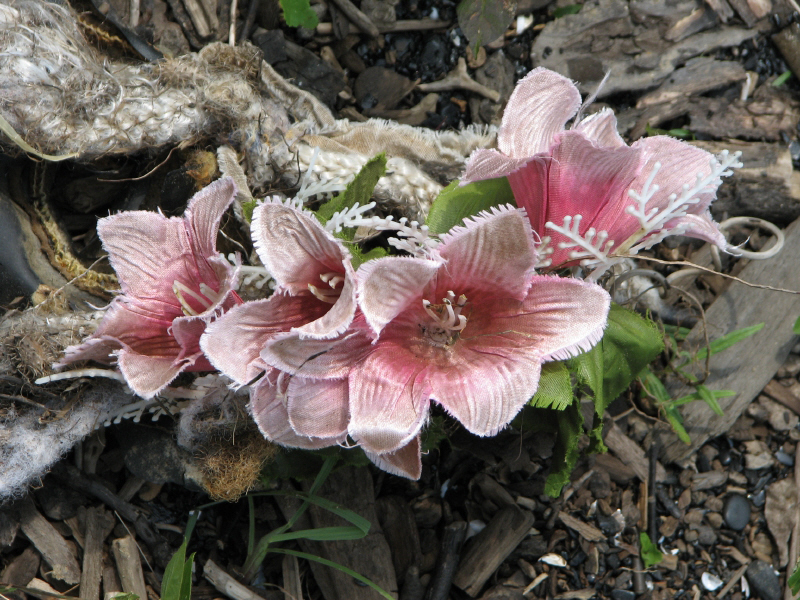
False Pink Bell in bloom

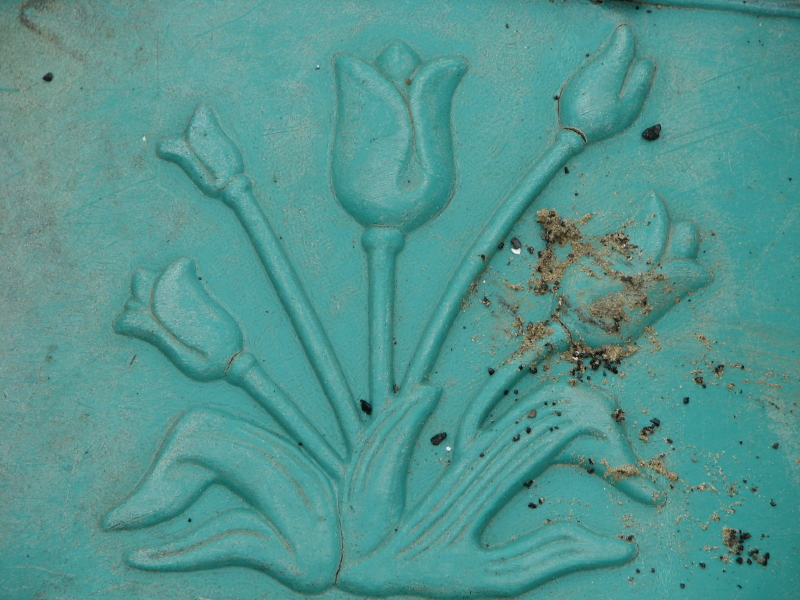
This interesting and dare I say “lovely” flower is the Faux Pink Bell.  It combines characteristics of several of the mutant plants I’ve uncovered.  It possesses hard plastic parts as well as the softer, synthetic petals that are fabric-like.  It grows in highly disturbed, contaminated soils.  Which brings me to a theory I’ve been formulating ever since I first discovered these strange plants.  Although I’ve not done a chemical analysis on them, their resemblance to plastic can not be coincidental?  Plastic is after all organic by definition.  Plastic is derived from petroleum which is an extract from ancient life and I think there is something in the long memory of life that is presenting itself here?  We know that our traditional plastics keep breaking down to the micro level.  These really small particles are absorbed by living tissues.  Is it possible that this plastic pollution is altering life in reaction to the many changes brought about through man’s activities?  Can the long polymer chains connect with DNA?  In effect, Nature is demonstrating that it is even more plastic by molding and forming new species to harmonize with the changed environment.
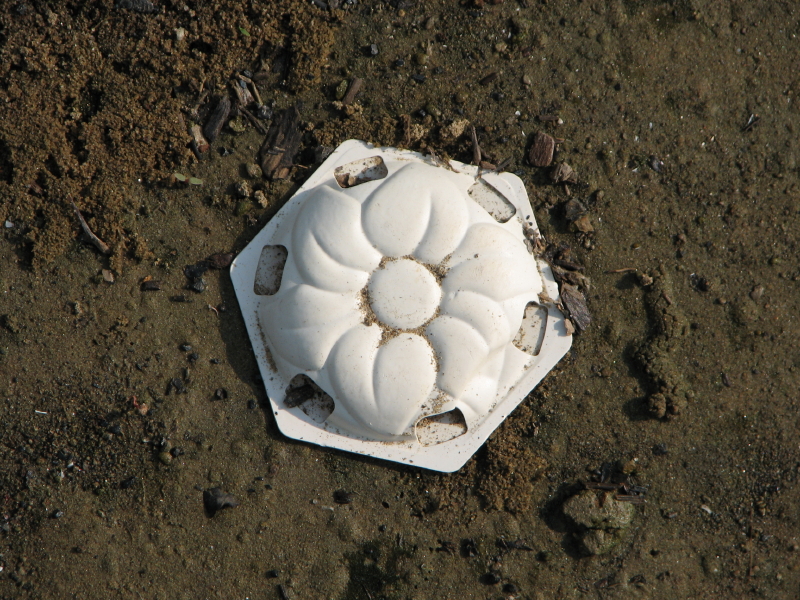
Polymer Posey

I came across the Polymer Posy growing in the mud.  I believe this is as much fungus as anything else or a new theory has been presented.  Perhaps this is a carnivorous plant that traps and eats insects?  Upon inspection, there are small entry ways along its base that invite small insects like ants to go inside.
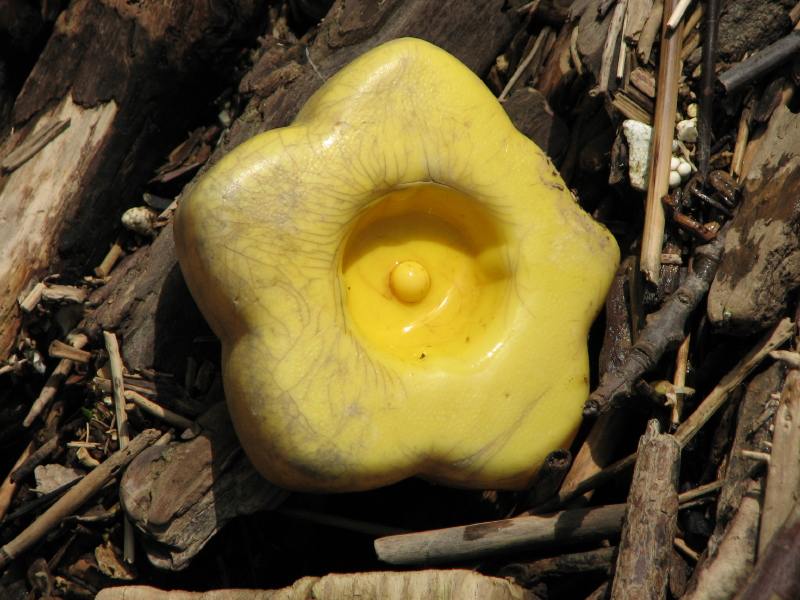
Yellow Bittercup

Growing out of the wood chips is this botanical novelty I’ve designated the Yellow Bittercup.  Again, no leaves required.  This flower can appear anytime of the year.  I came across this one last summer.

Orange Forget-me-not

The Orange Forget-me-not is indeed memorable.  It is encountered among the driftwood and may in effect break down cellulose to create its own plastic structure.  The holes in the flower trap, strain, and direct moisture and nutrients to its shallow root system.  And now for something really spectacular in a twisted way.
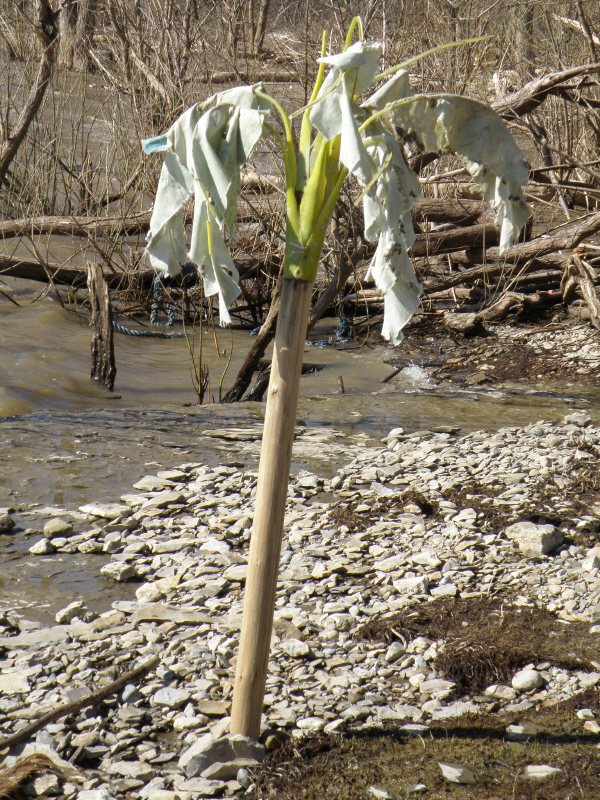
Polyvinyl Palm, 2012

I did a massive double take upon encountering the Polyvinyl Palm growing from the poor rocky soil in the western section of the park.  This is easily the largest of the new plants I’ve stumbled upon in my wanderings.  I had hoped to study it more, but another visitor to the park collected it.  We have discovered that it is possible to change the chemical composition of the atmosphere through our combined activities.  I believe we are simultaneously altering through chemistry the very organisms that inhabit this world with us with unintended consequences.  How long will it take before we change ourselves into something different as well?plastic tulip image
Read Full Post »

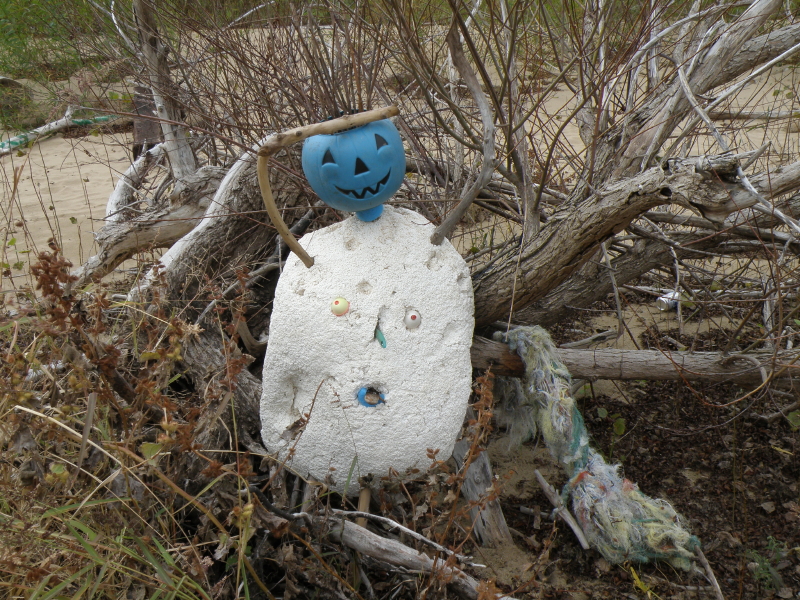
BLAHHHHH!!!!…did I scare you?  Welcome to another Halloween adventure from the Falls of the Ohio.  Today, I have a special treat in mind for you.  My name is Jack Blue and I will be your guide for the next five minutes.
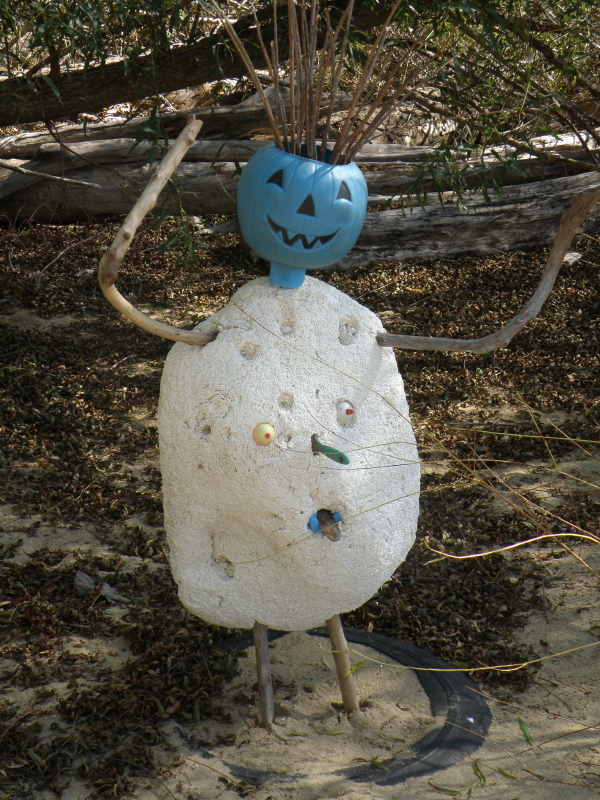
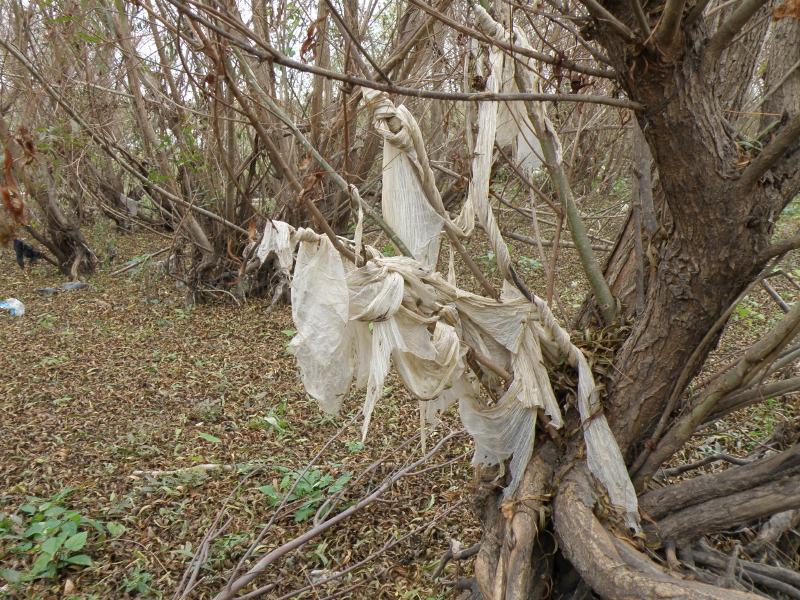
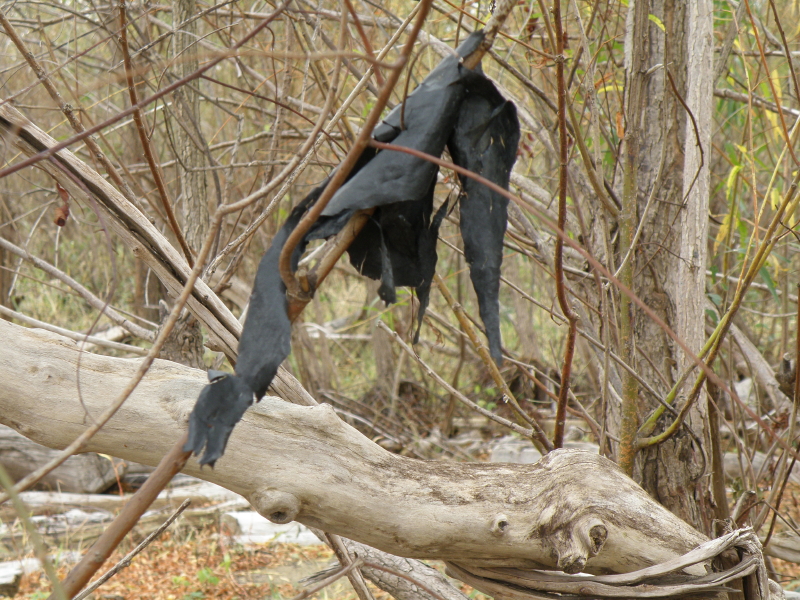
If I didn’t scare you perhaps I fooled you?  No need to be alarmed, my Belly Face has eaten recently.  You should be safe while I show you around the local Halloween sights.  Foremost in mind is the special Shrouded Forest that magically appears at exactly this time every year.  It is weirdly beautiful especially if there is a slight breeze present to animate the spirits that occupy the branches.  Most of them are plastic ghosts that have either floated here via a swollen Ohio River or drifted in with the wind.  Here’s what I mean.

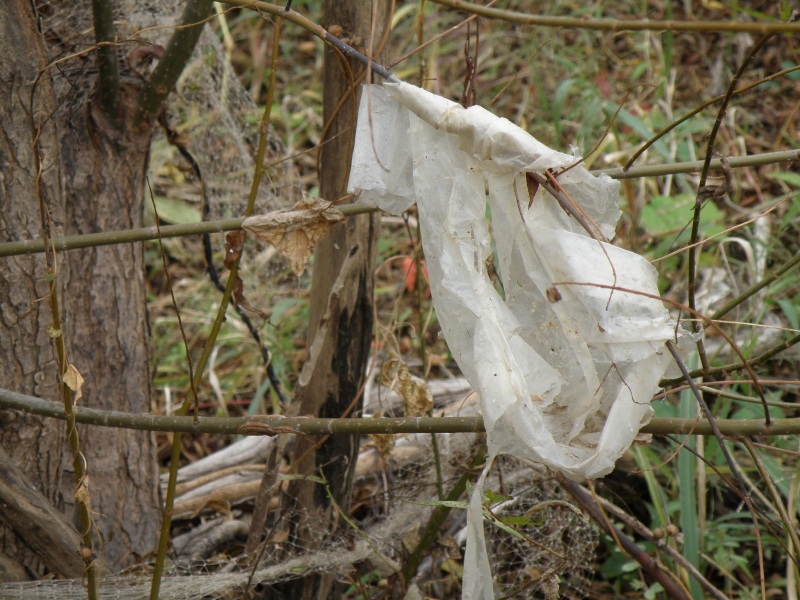
The degrading plastic lends such a festive touch to this area.  As the polymer bonds separate and the plastic starts to disintegrate it hangs in decorative shrouds from the willow branches it graces.  You can walk from tree to tree and admire these spectral creations of man and nature.

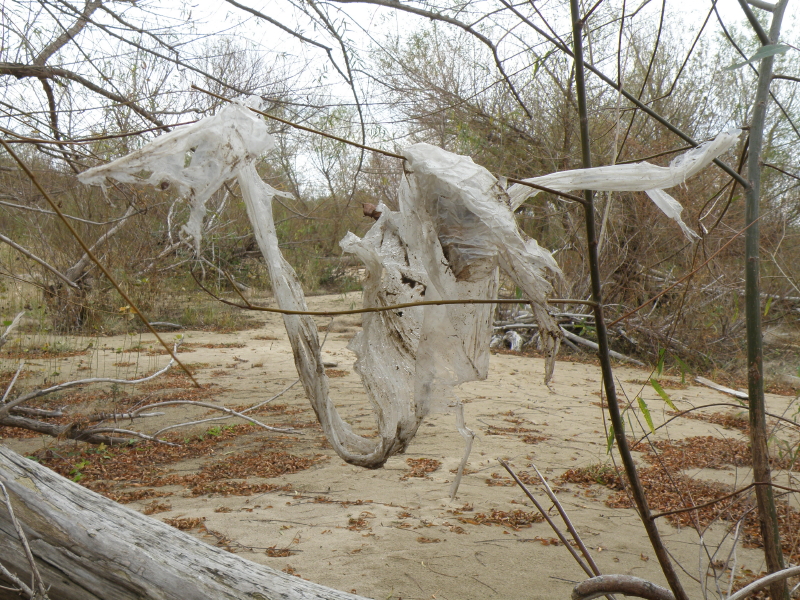
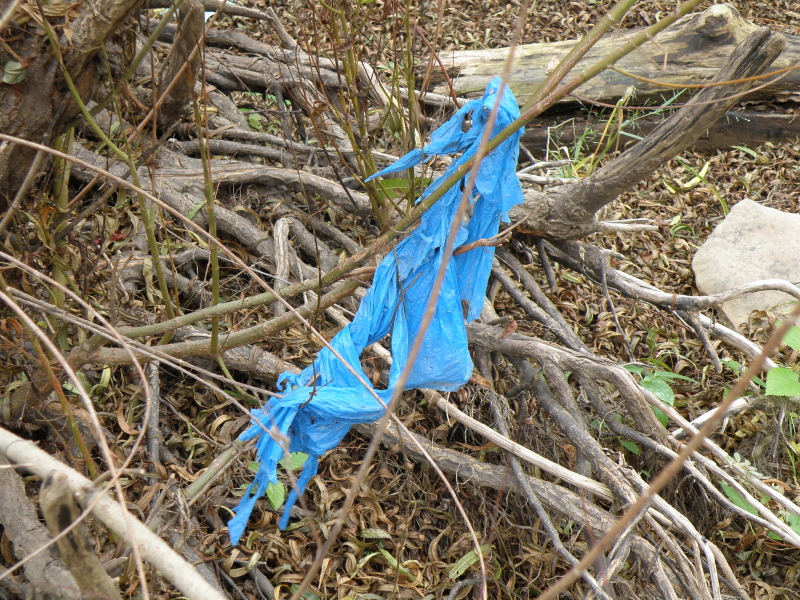
All this “magic” is the result of benign neglect.  Whoever discarded this waste plastic sheeting probably wasn’t thinking it would wind up here draped in the trees like artificial Spanish moss.  In case you were wondering…it also comes in different colors.  Here are two other popular hues for your viewing pleasure and a special “snaky” surprise that might have you needing a doctor!

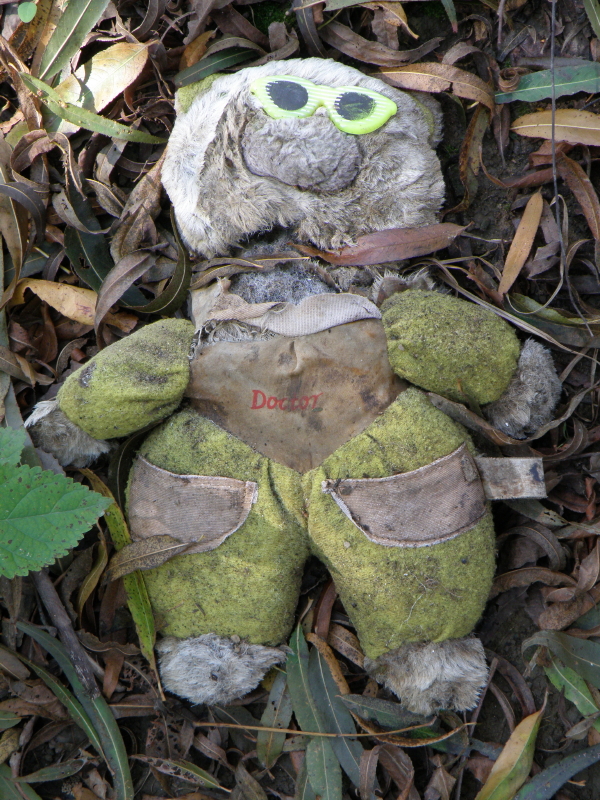
Okay, maybe this isn’t much of a snake, but if you were walking among the trees and looked up at some point…you probably wouldn’t anticipate seeing this?  And now for the “Doctor”…hmm, I don’t think he will be doing anyone any good any time soon!  Kind of looks like he could use a doctor himself.

Somehow I missed this bear when I did my earlier post on plush toys.  He’s been laying under this willow tree for months now and I just happened upon him! Just in time for Halloween!

The truth is one doesn’t need to travel far these days to find a patch of ground not “haunted” by something that doesn’t belong in the environment.  I hope all of you out there have a fun and safe Halloween and please discard all your trash in a responsible way.  Otherwise, my Face Belly may develop an appetite for you…trick or treat?

Read Full Post »

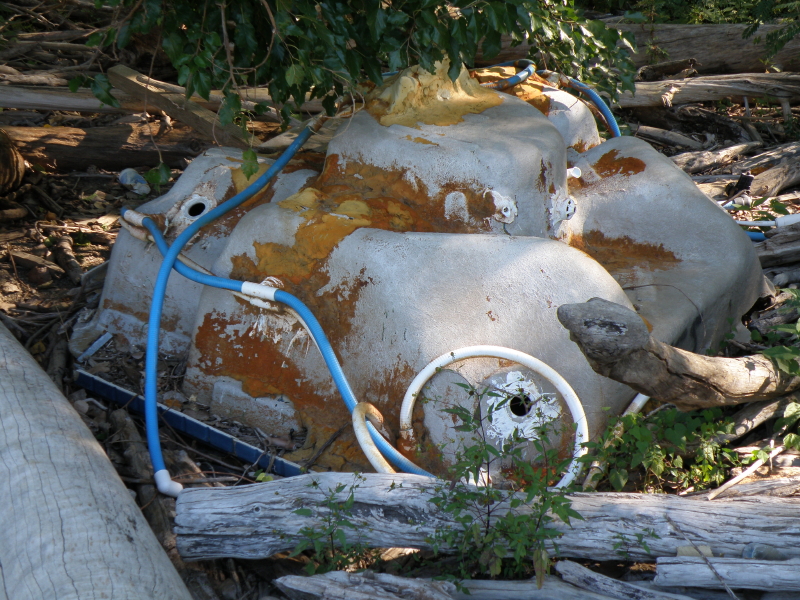
My beloved…I still live!  I hope my repair to my communication transmitter has been successful and that you and our fellow Styrosians so far away across the universe will receive this message and know that I still exist.  While exploring a little known solar system my ship was damaged in a collision with undetected fragments of space debris in orbit surrounding a smallish, blue-green planet.  This planet is the third nearest to its star. This solar system is comprised of eight other planets of varying dimensions and densities.  Damage to my guidance system made controlling my craft difficult and I entered the atmosphere of this planet like a meteor across the sky.  Fortunately, I arrived without attracting attention and I was able to affect a safe landing.  My craft, however, will need much maintenance. Hopefully, the coordinates of my position reached you before I entered this planet’s dense gaseous atmosphere? Here is an image of my vehicle which I call home and its contents are a dear reminder of the world from which I originated.  So often I have thought of you and wondered if we will ever see each other again?

I have so much to tell my fellow Styrosians that I hardly know where to begin.  Duty compels me to start with a report concerning my original mission.  I have crashed on a beautiful planet where the majority of its surface is covered by that most precious combination of hydrogen and oxygen.  I am so excited to have found water in abundance!  I have detected water in all three of its known states including gas, liquid, and yes…I have even seen ice!  It was the chemical signature for water that compelled me to take a closer look when the accident occurred.

Most of the water I have been able to analyze locally is of the fresh variety which contains many other chemical additions some of which are naturally occurring.  I have, however, been able to learn that the vast majority of the water on this planet is heavily influenced by the compounded interactions of sodium and chlorine.  I have not only discovered water…but water in different flavors!  After surviving the shock of my sudden and unexpected arrival, I couldn’t wait to explore this new environment which offers such a stark contrast to our own dry home world.  There is so much water here that it actually falls from the sky!  Please excuse me while I transmit additional self images made while engaging in water joy!  They at least offer further visual evidence of the importance of my unexpected discovery.

How I wish you were here so we could experience this together.  I have been able to further confirm that our hypothesis about the connection between water and life is correct!  The abundance of water is equaled by the sheer amount and variety of life forms that inhabit this world.  Where there is water I have found life even in the precious fluid itself! There are sessile, terrestrial life forms that process sunlight through green, cellular solar panels.  They anchor themselves and obtain moisture through a system of filaments interwoven into its supporting substrate. And there are also many animate life forms that move through space and have evolved into hierarchies where every environmental niche is occupied by a specialized life form.  Interestingly, there are even species that dominate and consume other life forms. Our scientists will have much to study in this new world! I would like to expand on one of those species which seems to occupy a very prominent position on this planet.  It is an interesting life form and is bilaterally symmetrical like us and appears to be sentient to a degree.  Monitoring their communication patterns I have been able to translate and understand something of its language and culture.  I have heard self references to being a” bipedal humanoid”, but I’m not certain if I fully understand what is meant by that.  This animal while claiming intelligence and rationality is actually characterized by numerous contradictions.  The most observable of these traits is a predisposition towards delusion and self-deception.  It does much harm under the guise of doing good. This animal (which I believe as some members of its own kind acknowledge have evolved from what are known as “primates”) is constantly engaging in selfish behaviors that are having a deleterious effect on this planet.  Ironically, they are harming not only the other life forms here, but ultimately themselves as well.

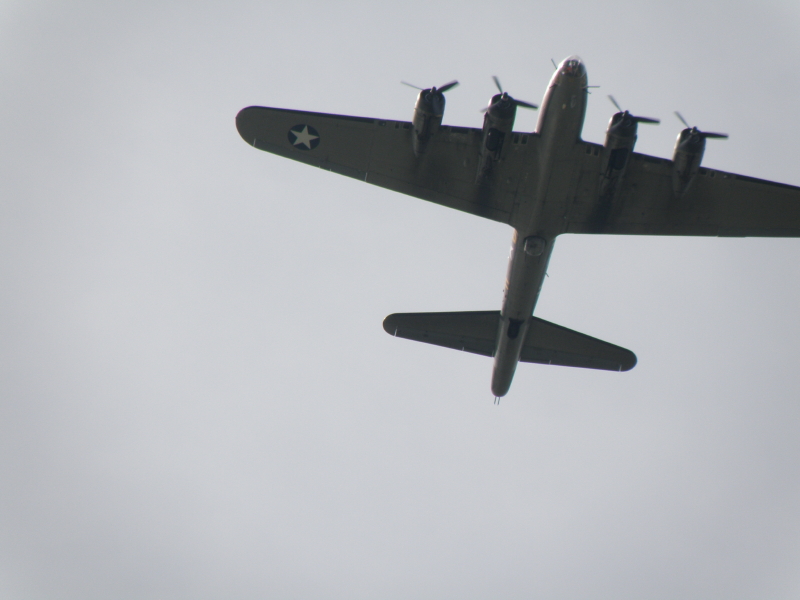
Recently, I was exploring a water channel when I saw a shape flying towards me from some distance away.  It appears to be an antique flying craft bristling with armaments.  The dominant species here is addicted to using hydrocarbons extracted from the ground which are then  further refined to produce fuel and energy.  I quickly captured this image over my head and placed it in the catalog I am compiling for future reference.  I have observed other technologically superior war-like aircraft in the vicinity before, but this one was unusual.  These so-called “bipedal humanoids” are constantly engaged in warfare somewhere on their planet.  This is one of their most primitive characteristics.  Monitoring their telecommunications I have ascertained that violence is an integral part of their conflict resolution process.  The “bipedal humanoids” are capable of rationalizing and justifying any act they commit. When they are not fighting among themselves…they are consuming or damaging resources often with other primitive machines that require hydrocarbons to function.  For instance, observe this case that I recently experienced and documented.

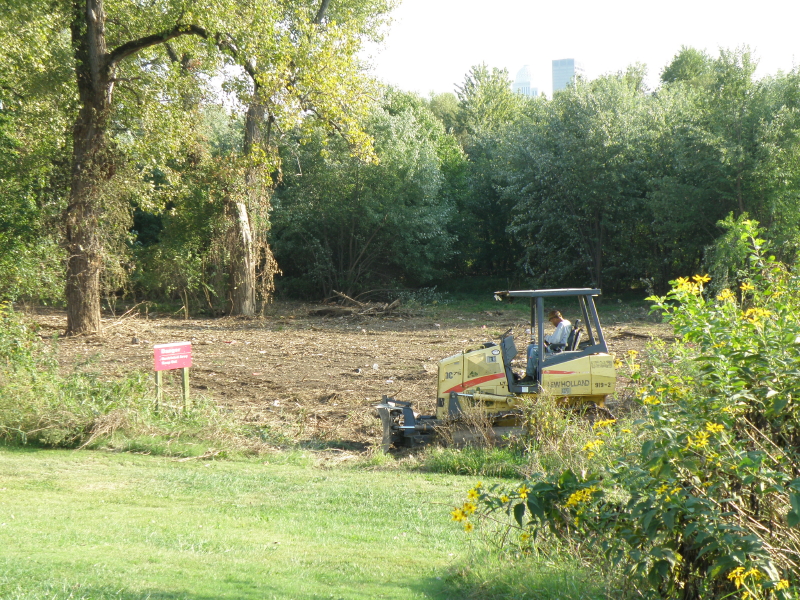
In a nearby field that was once occupied by photosensitive sessile life forms, I observed a humanoid operating a large machine.  This machine did violence to all that was alive in this area.  The remains of many different kinds of sessile life forms were stacked into random piles, but what is the purpose of this activity?

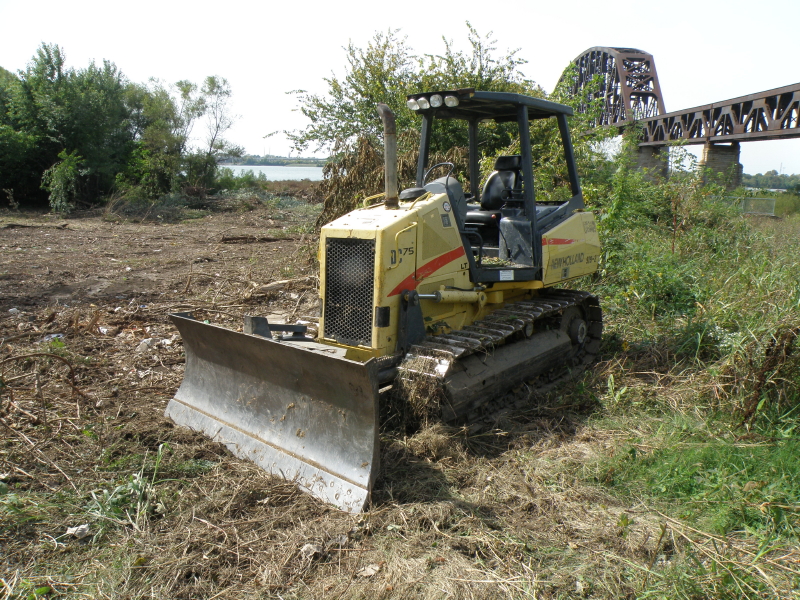
This area was once home to a large variety of life forms and now they have been displaced.  I have observed this before and very recently.  The “bipedal humanoids” created an area that they call the Ohio River Greenway and ironically they removed many of the larger photosensitive life forms to accommodate easy access to the river for their other hydrocarbon burning vehicles.  This seemed strange for many reasons, but perhaps our biopsychologists can figure that one out!  I was able to get a closer picture of the large machine that was utilized to sterilize this particular area and it is frightening to stand next to.  I waited for its operator to leave the area before doing my reconnaissance.

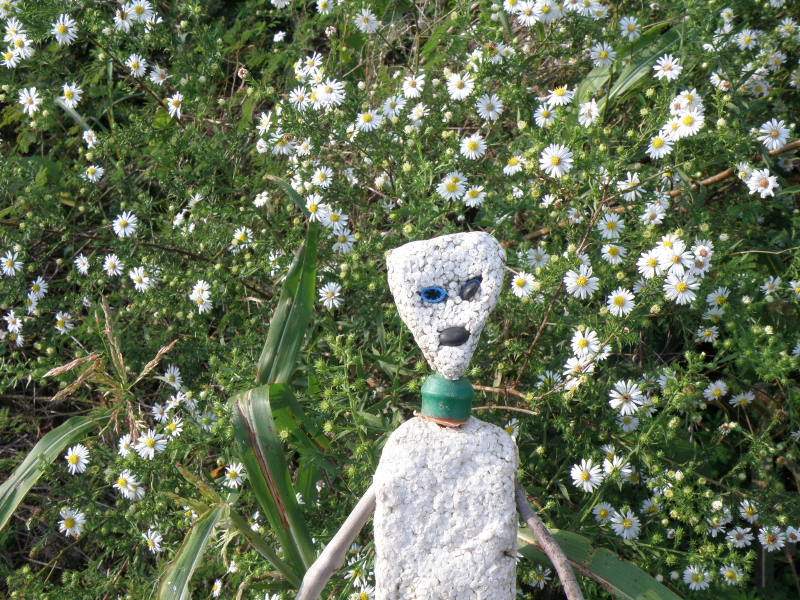
Alas my beloved, it is time for me to regenerate back at my space craft.  I will leave you for now, but I promise more from this fascinating planet.  In my next transmission I will show you more images of the life forms I have observed and maybe something of the history of life on this planet.  For now, accept this self-image made next to the many sessile life forms that lend this land beauty and interest.

Read Full Post »

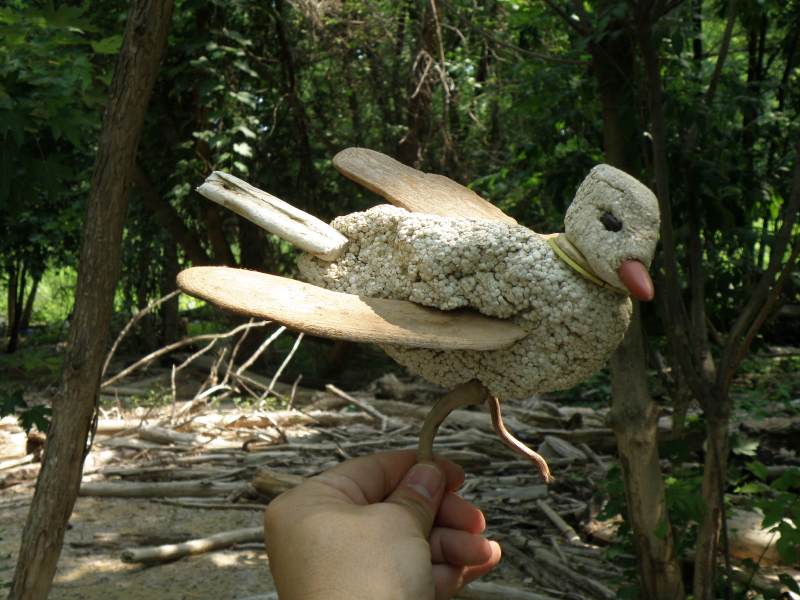
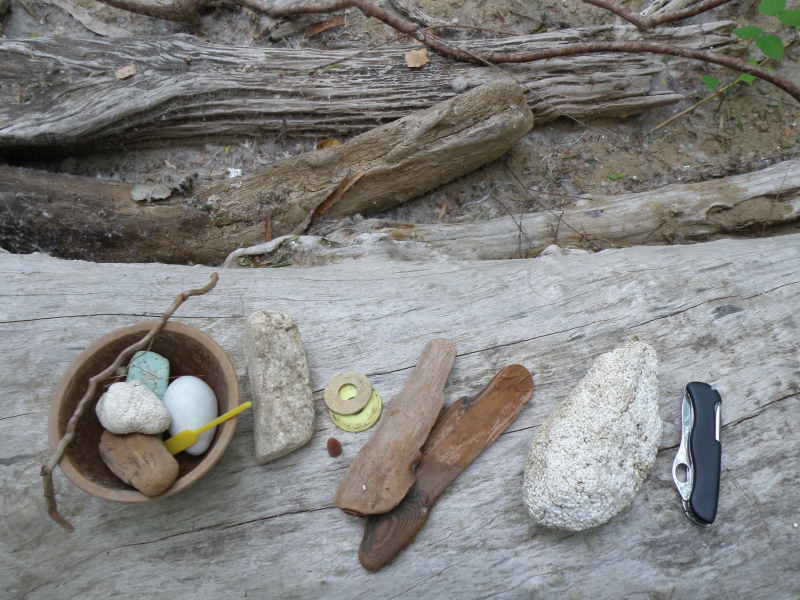
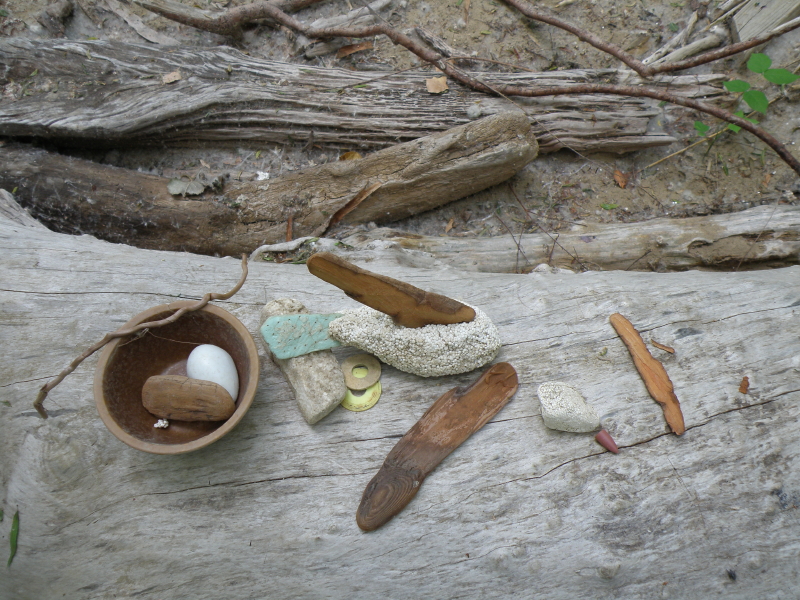
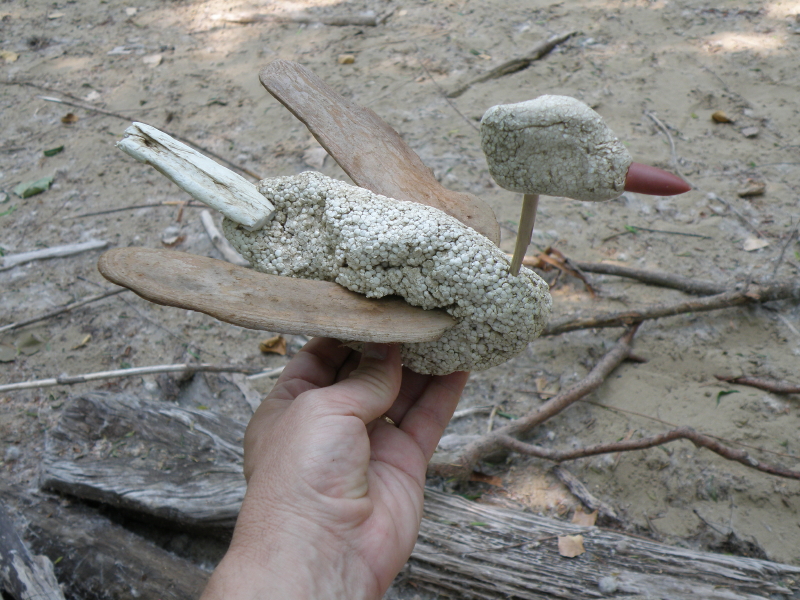
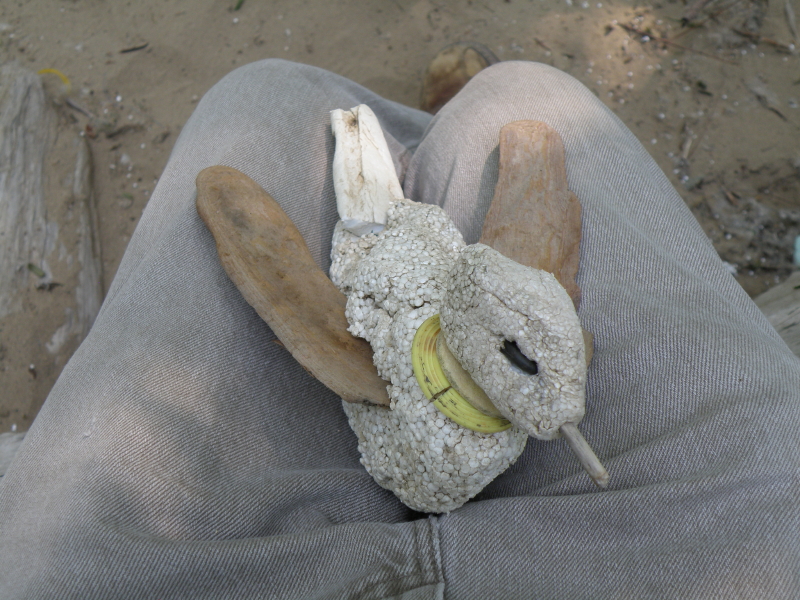
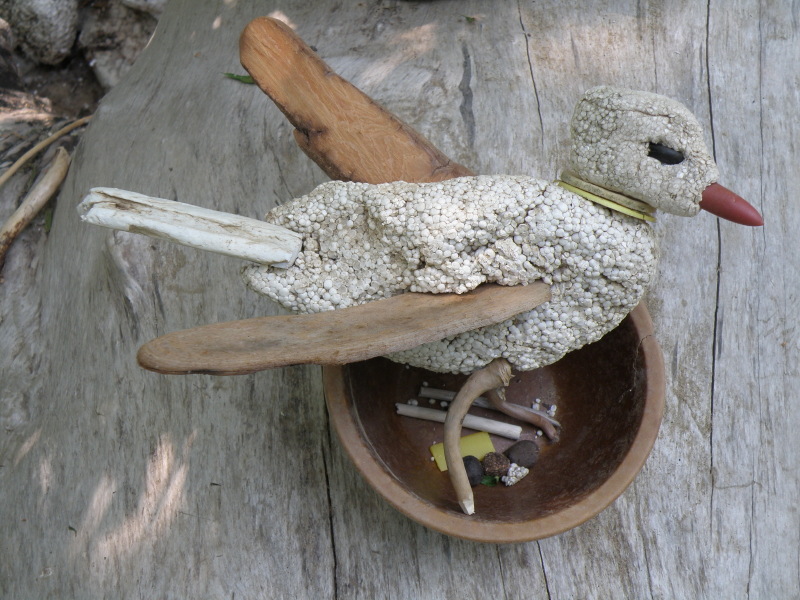
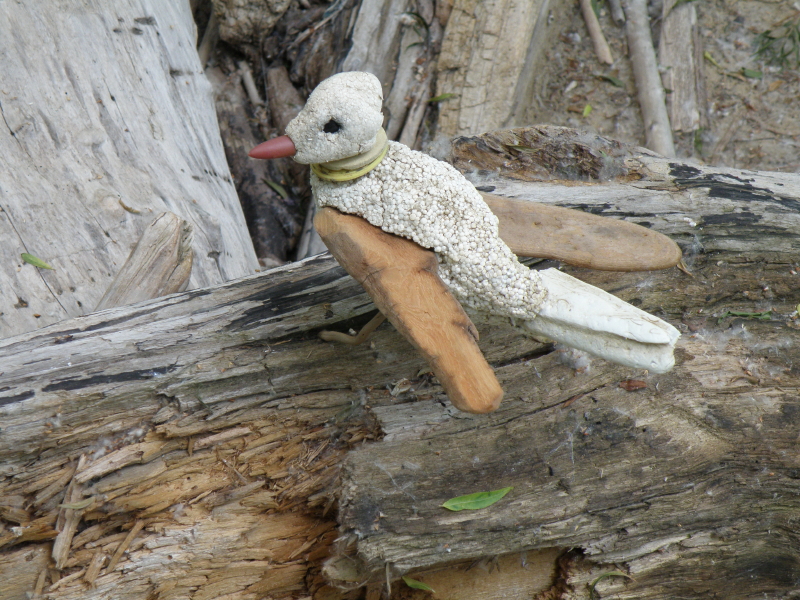
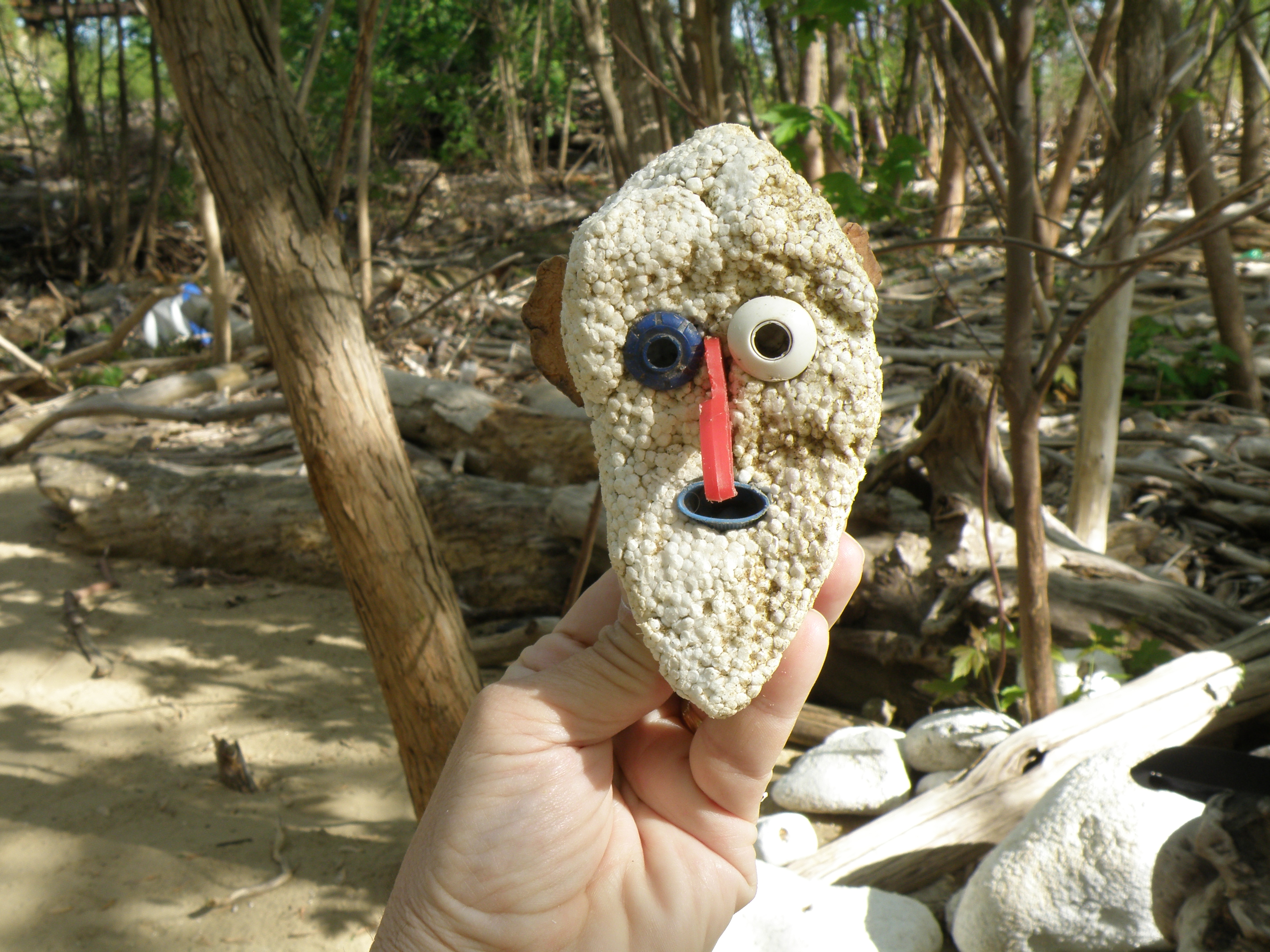
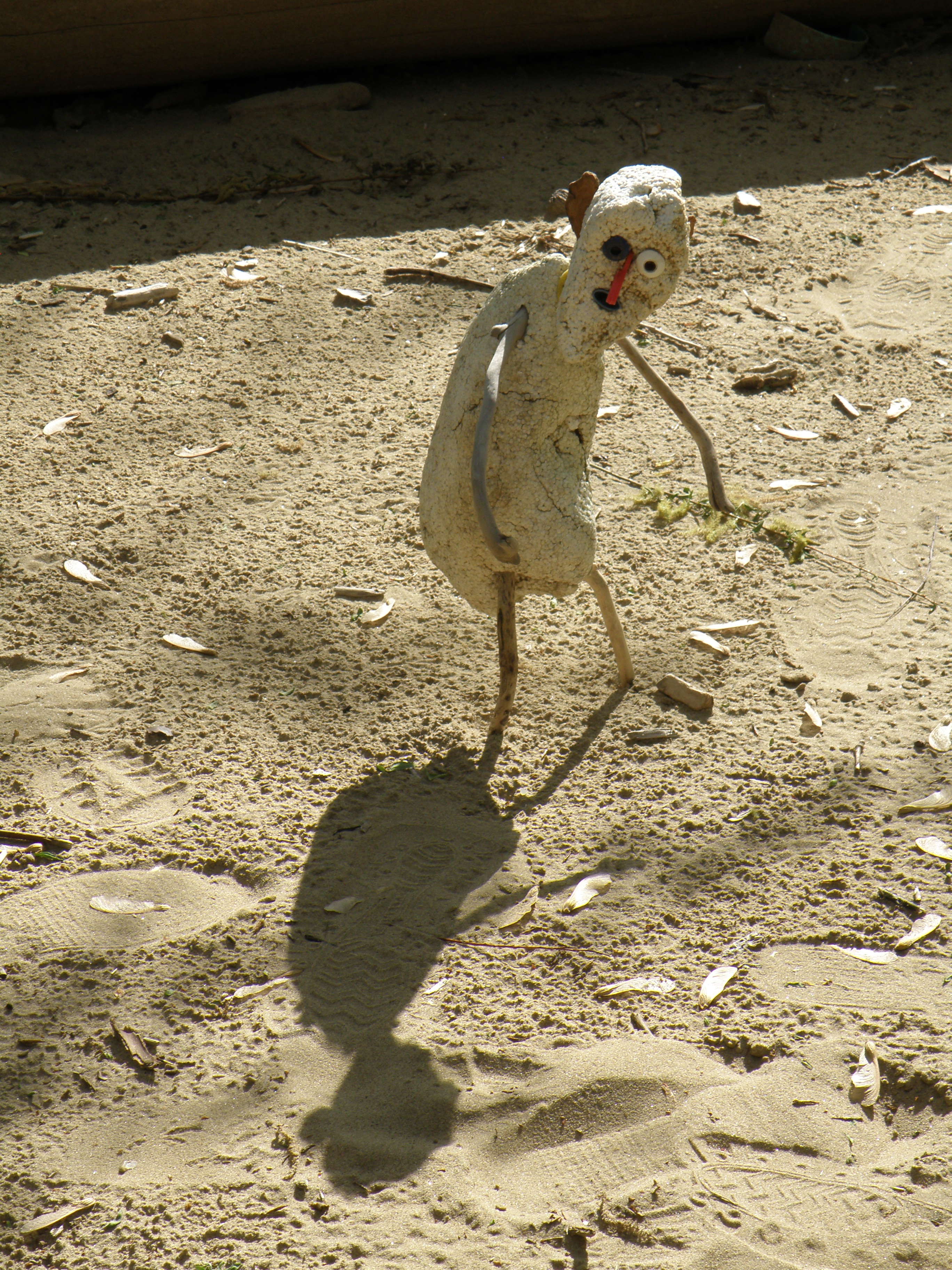
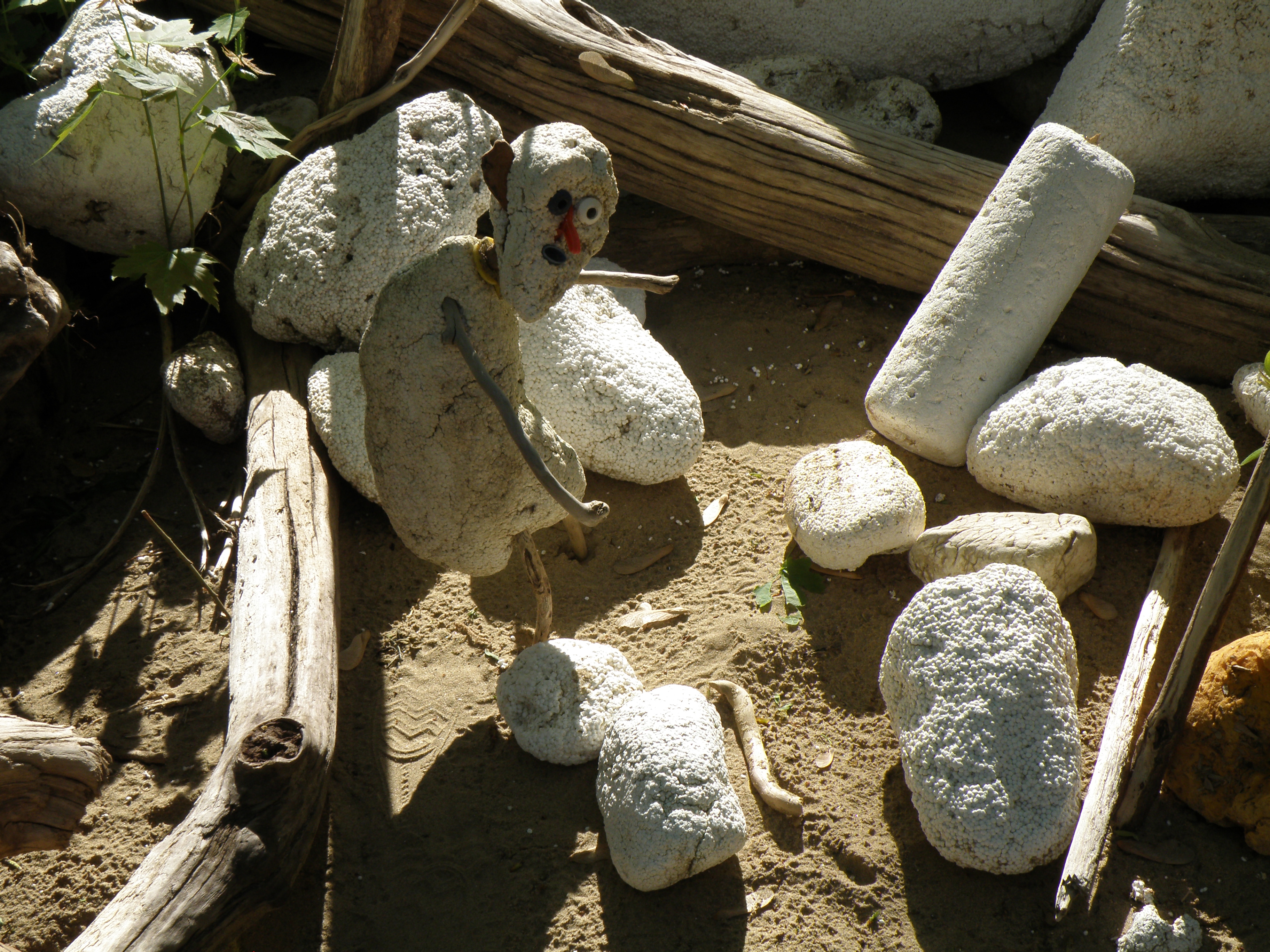
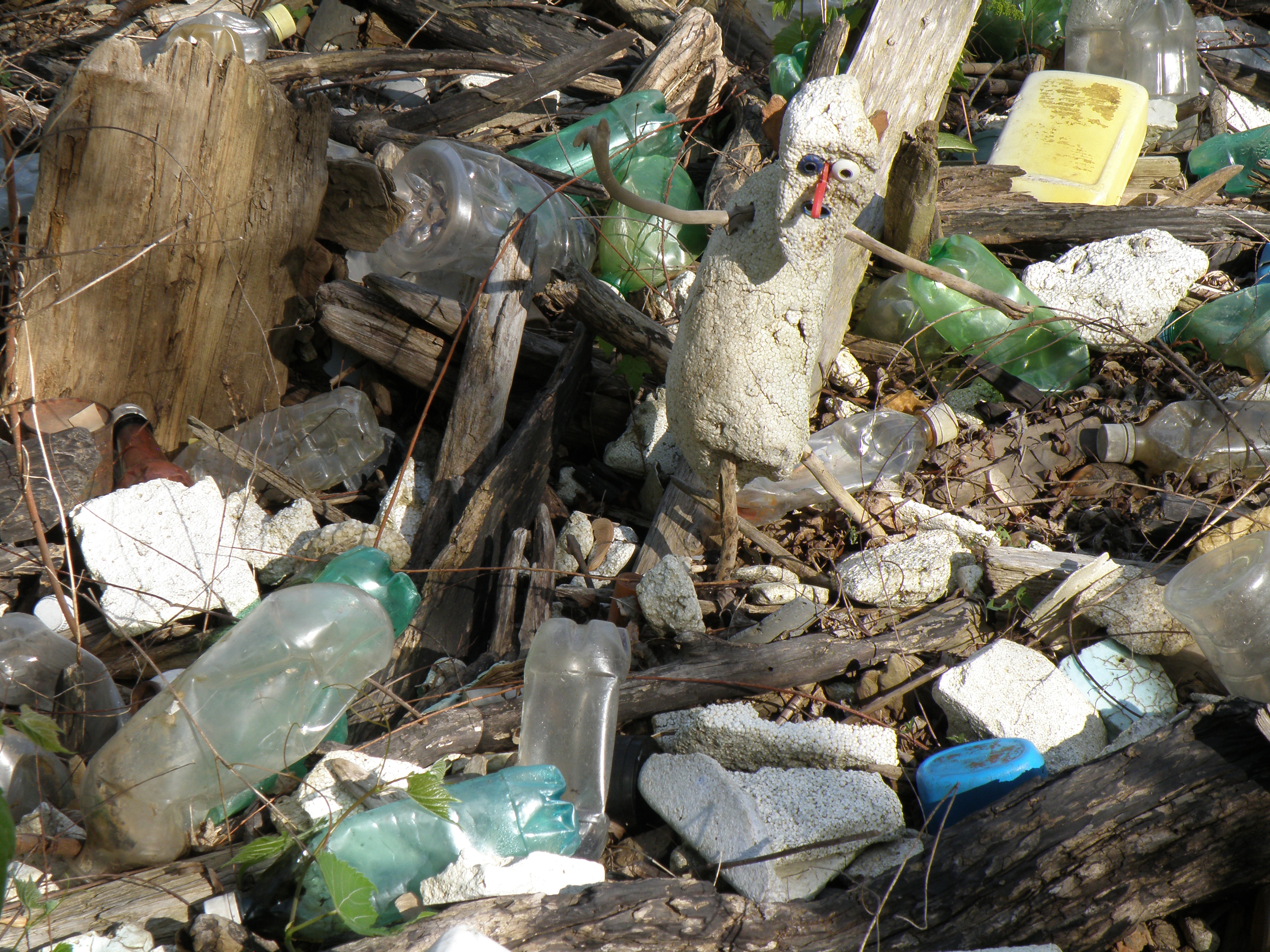
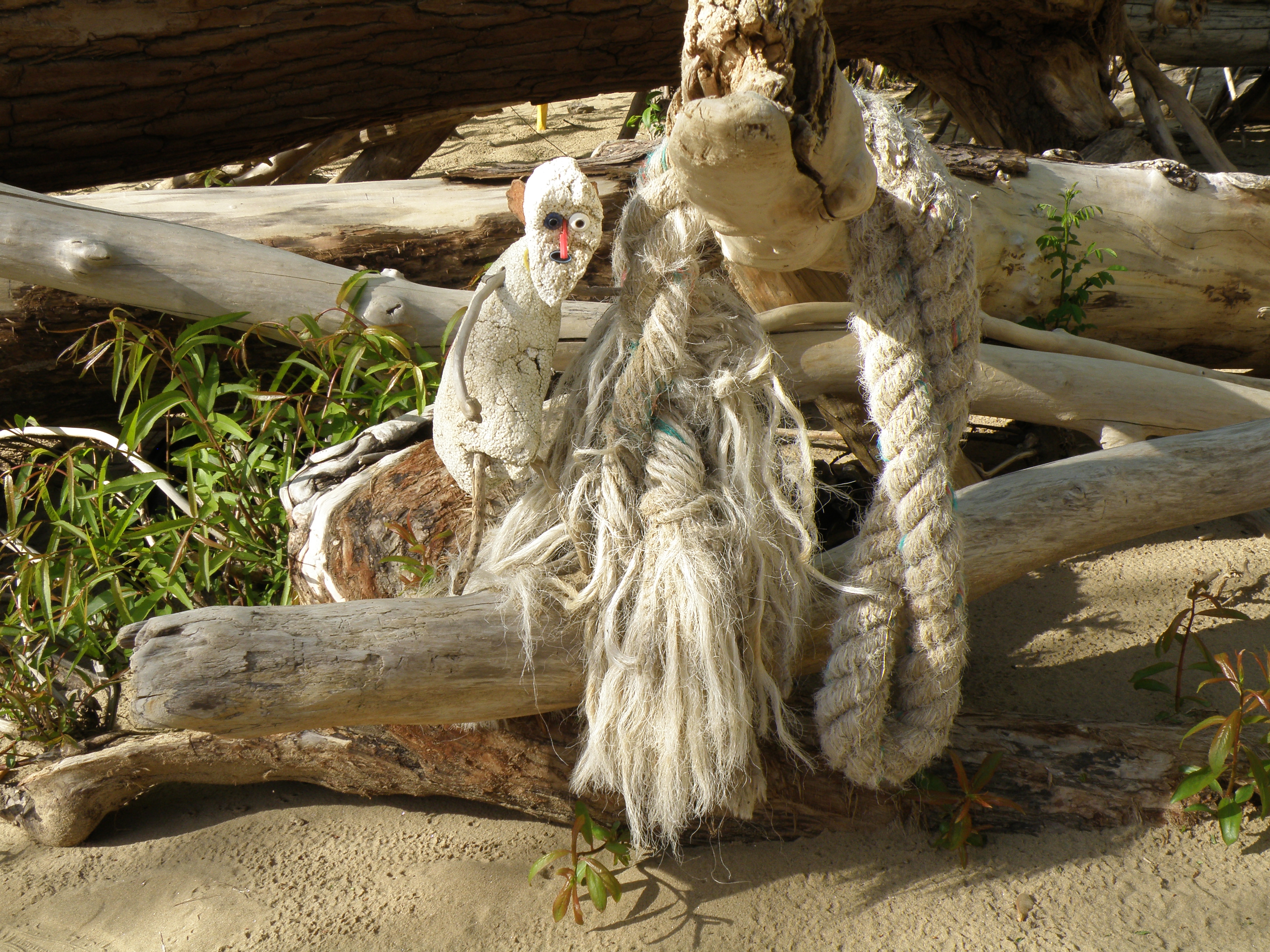
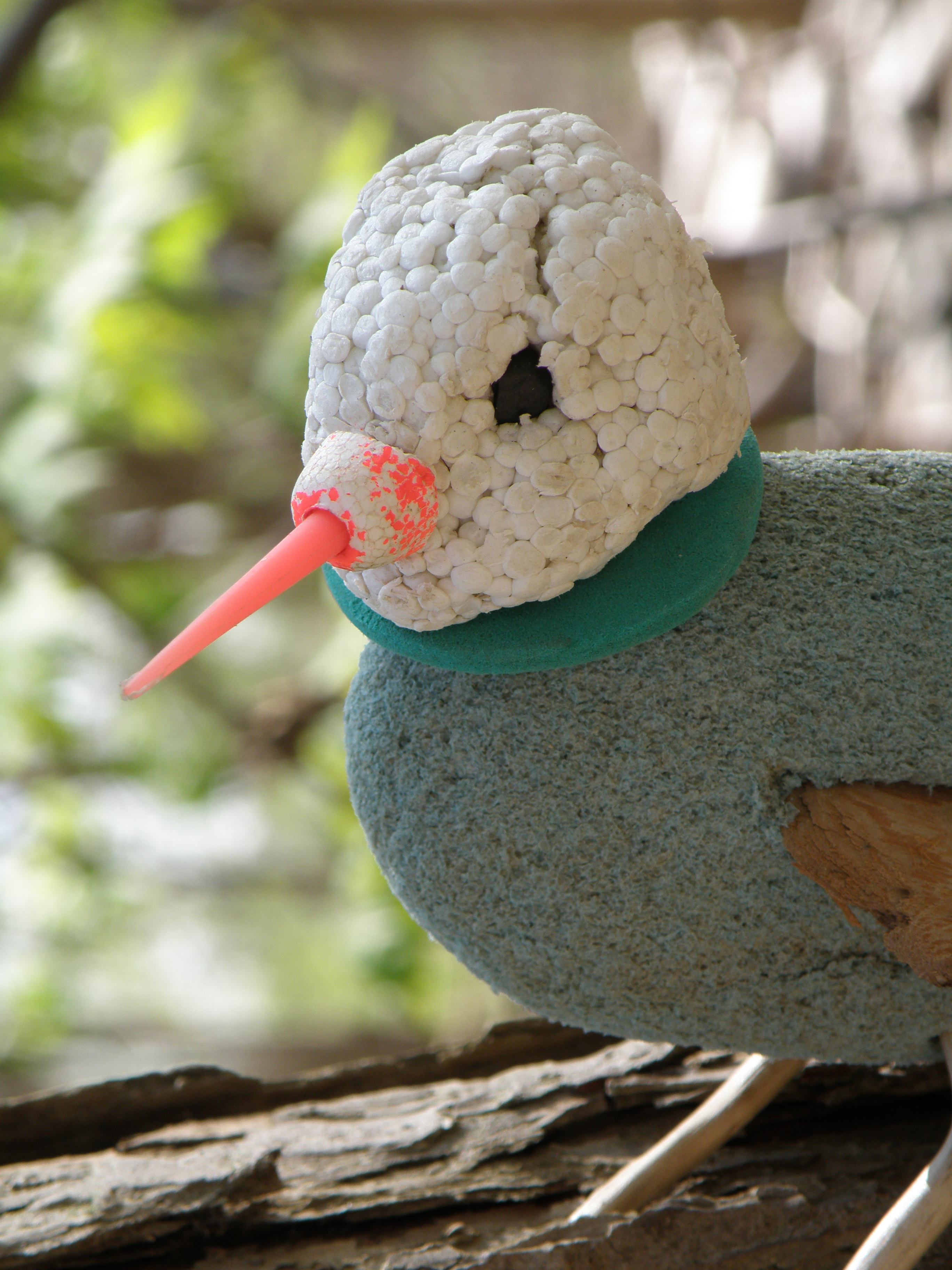
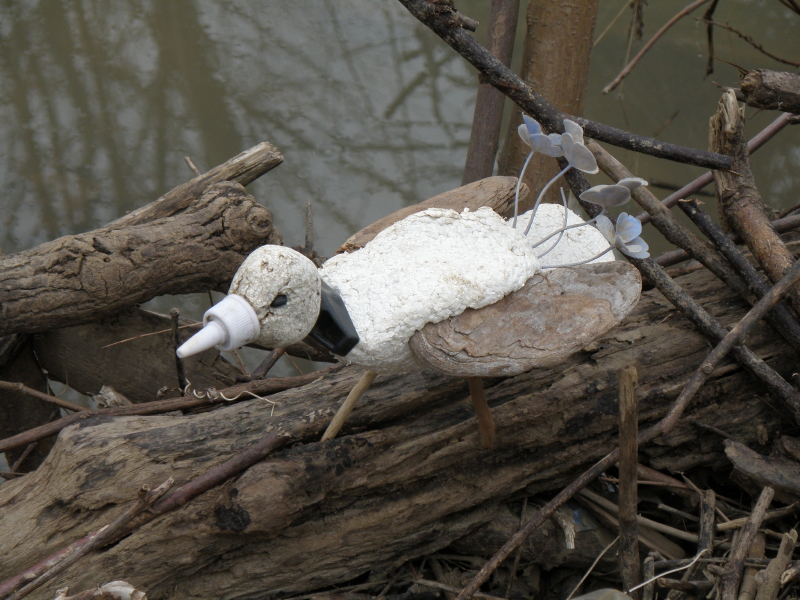
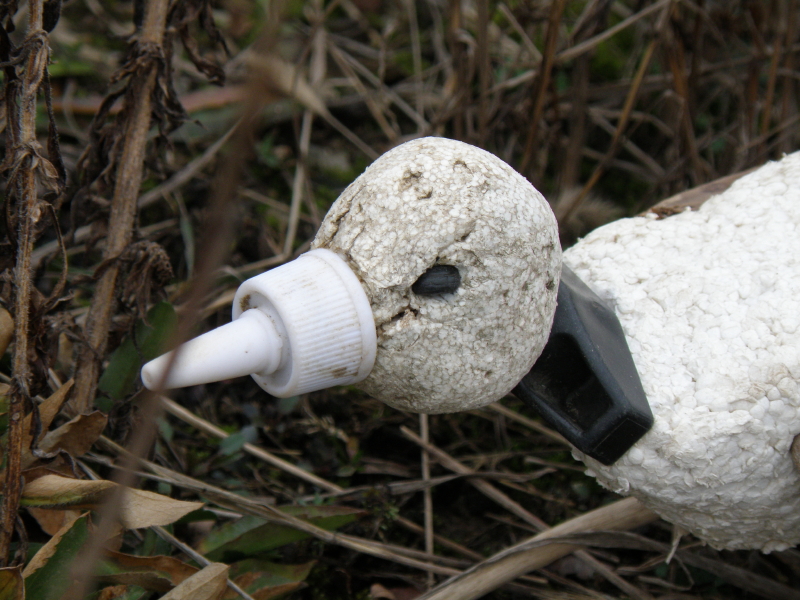
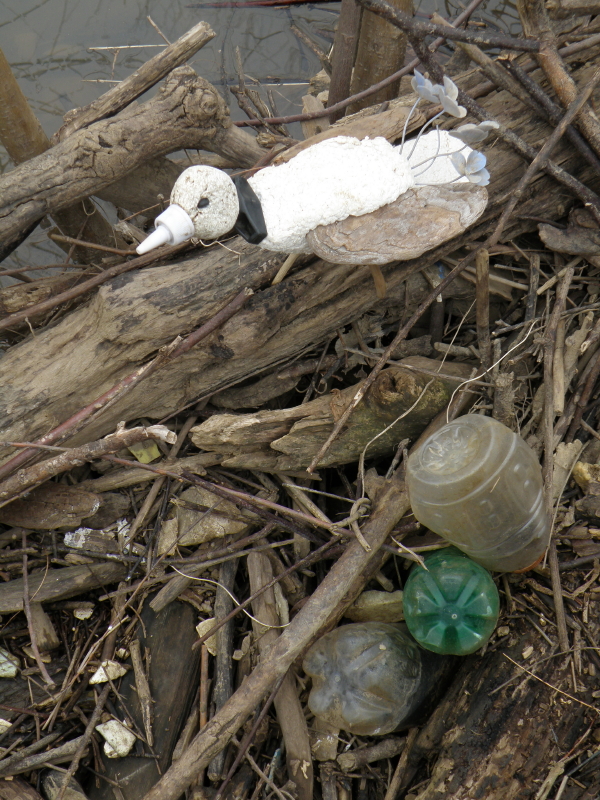
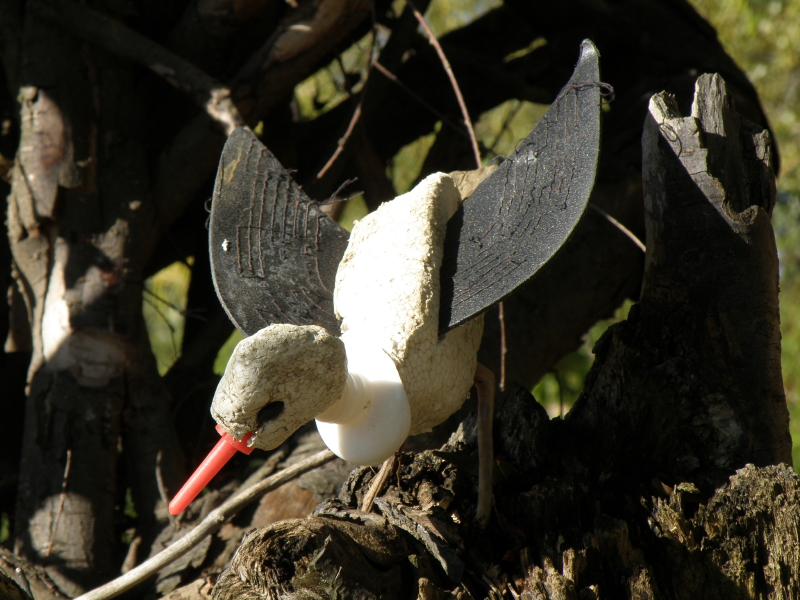
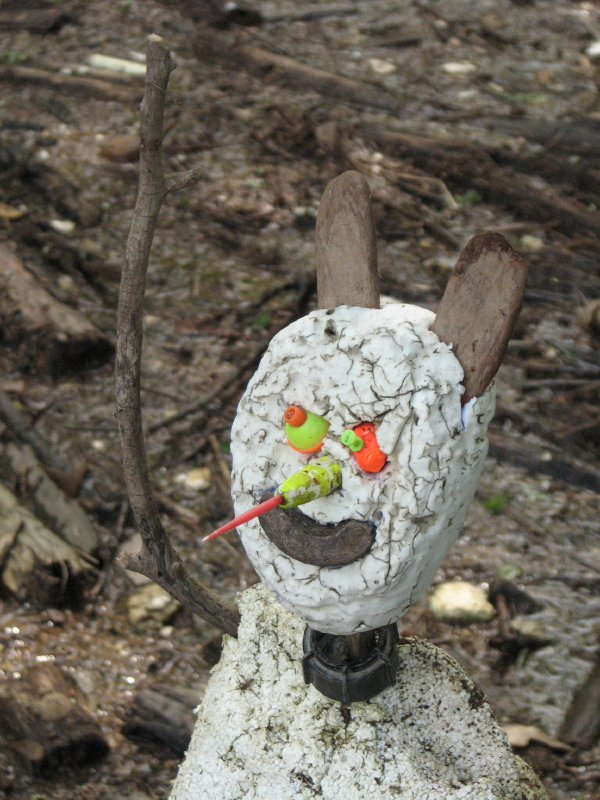
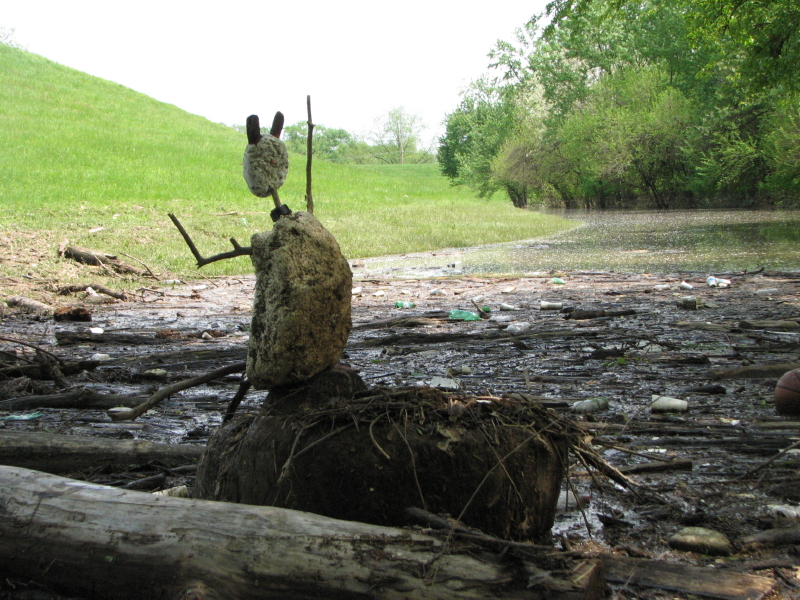
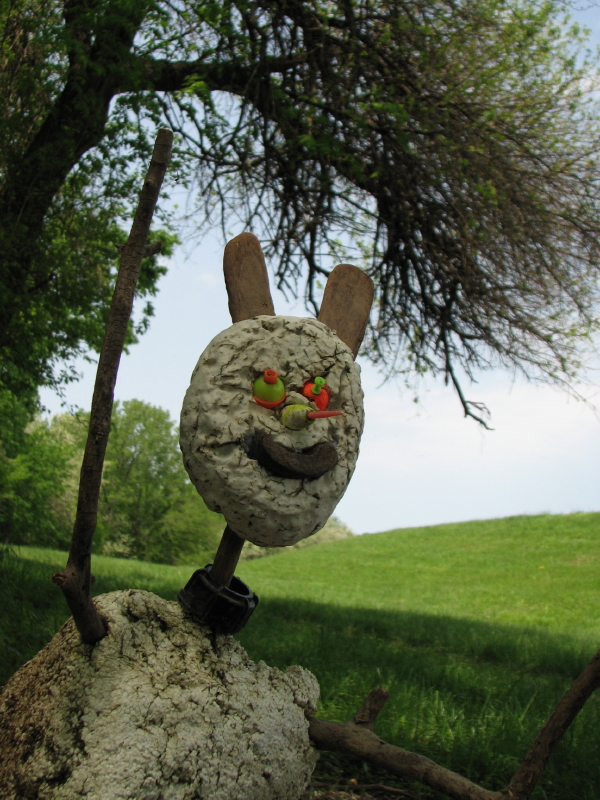
I enjoy processes and since I had additional images relating to my last post…I thought I would throw them in for fun.  I also harbor this very idealistic idea that everyone is born creative…it’s just that most people don’t view themselves in this way which I believe is at the heart of our environmental dysfunction and a great shame.  Somehow we have replaced creating with consuming. The following images hopefully show that you can create magic out of nothing.  There isn’t anything technical happening here.  If you can do Mr. Potato Head than you have the basic idea behind creating this bird.  The materials are not manipulated greatly.  I like nature to form the shapes I use. The only carving involved is in cutting slots into the body to hold the wings.  I did shave away one wing to make it thinner. I did poke holes in the head for the eyes.  I shortened the willow roots for the legs and the beak is held in place with a wooden peg just as the head attaches with its own little stick which also helps the head to swivel. Now I know this sounds a bit flip, but the hard part is seeing the possibility behind something that’s intrinsically worthless and imagining what else this could be?  Looking at the following series of images at home, I’m struck by the altar quality of the log I have spread out my materials on at my temporary outdoor studio.  I do feel that being an artist is a reverential activity.  I like to think my “art” is somehow in the service of life.  I believe you will recognize most of the components of this bird, but they include Styrofoam, wood bark, dried willow rootlets, the plastic nose cone of a small bottle rocket, plastic and foam “gaskets”, and charcoal for the eyes.  All materials were found on site at the river.  I found the little bowl that morning and it’s great to hold the little pieces I use.  I’m not a great photographer in the classic sense in that I don’t concern myself greatly with exposures and settings.  My camera is set on automatic.  I do, however, try to create an interesting image or composition that “says” something to me about that day and this place.  Give it a try…it’s fun to do!

Read Full Post »

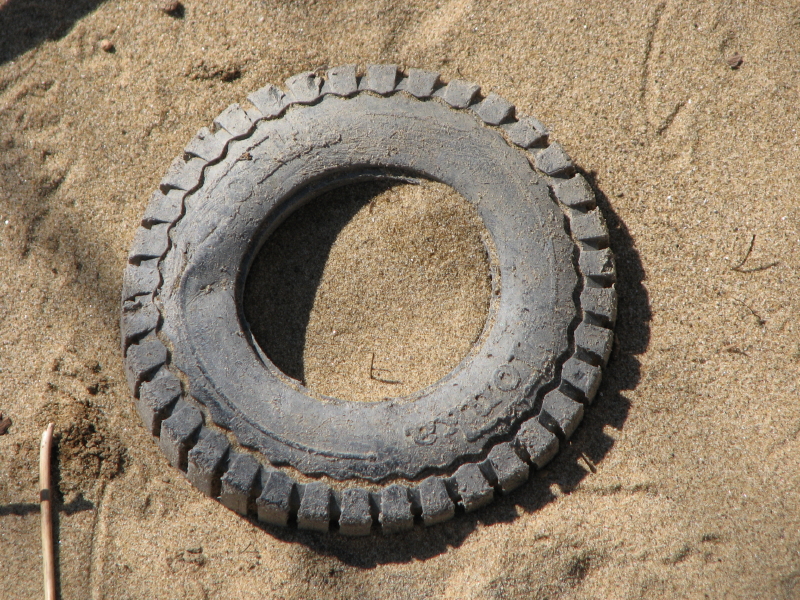
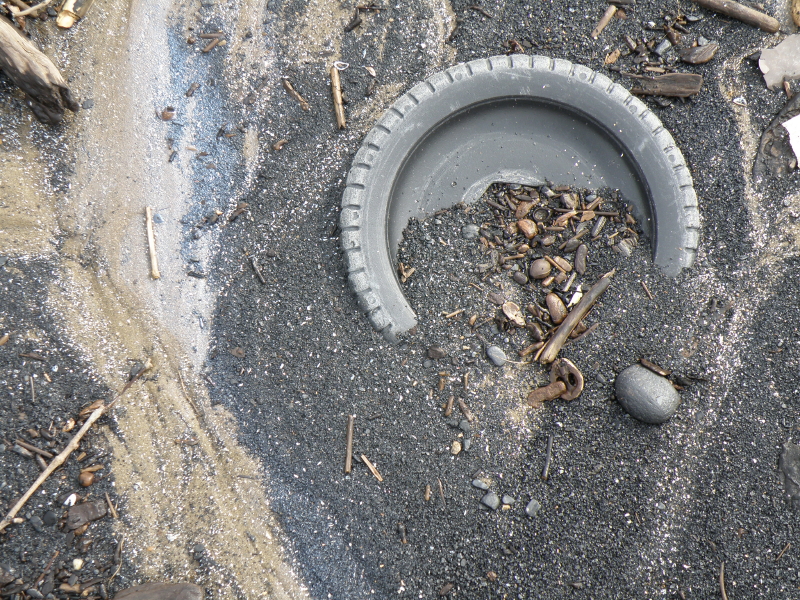
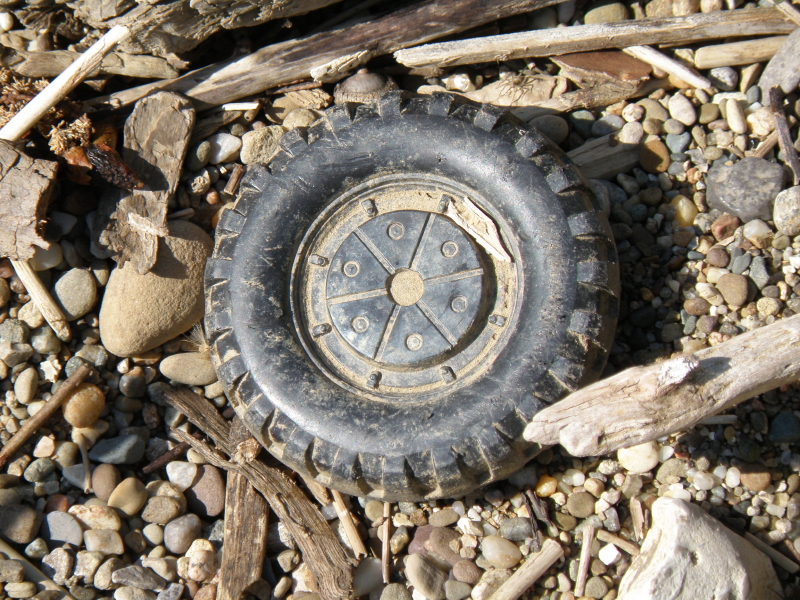
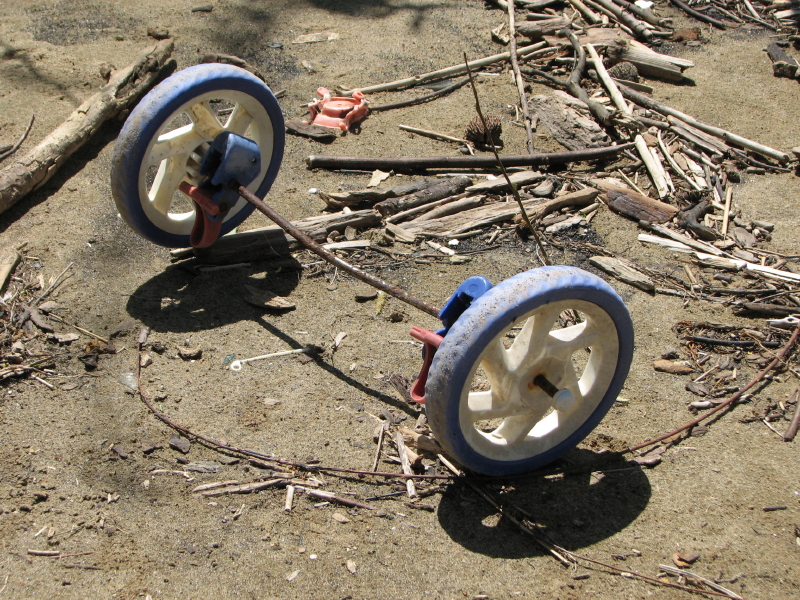
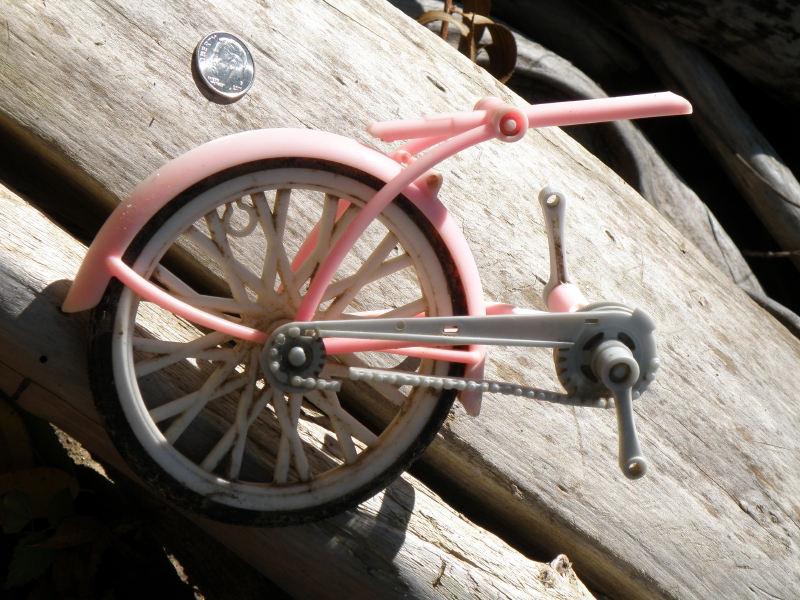
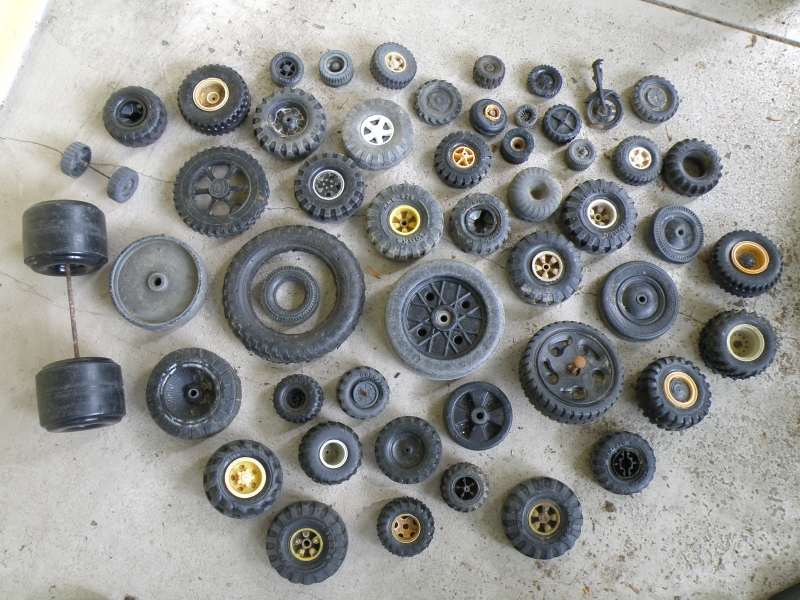
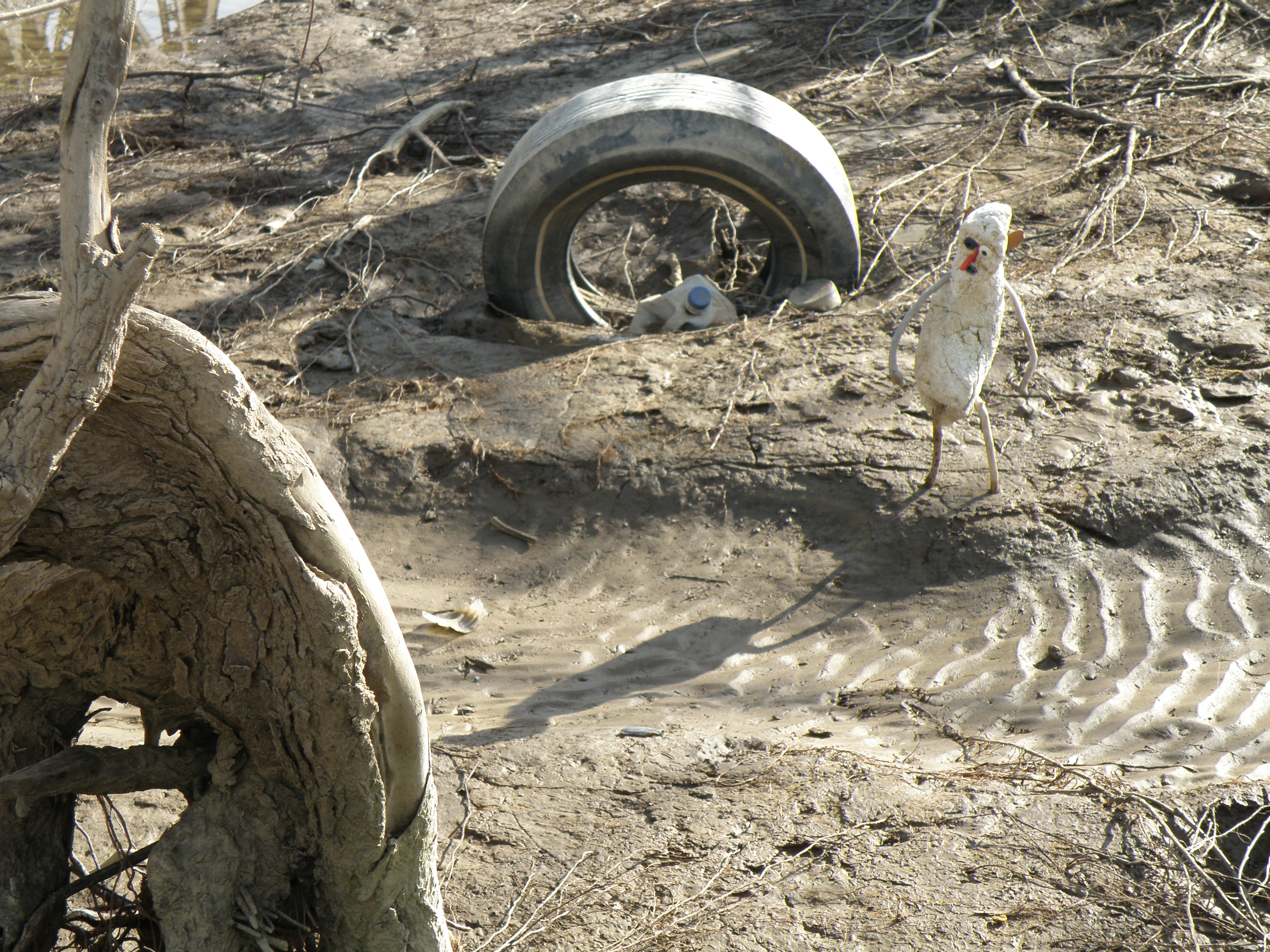
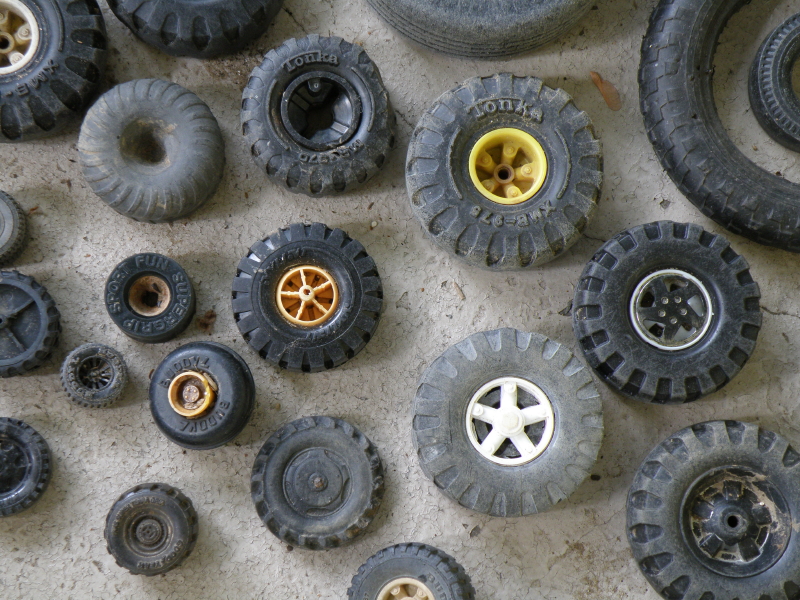
Frequent visitors to the old Riverblog may have noticed my penchant for posting images of wheels and tires that I find at the Falls of the Ohio.  Far too many automotive tires find their way into the river and many of them wash up here where they comprise omnipresent elements on the shoreline.  In addition to being more physical junk…they have also insinuated themselves into my imagination much as Styrofoam has.

When I see a wheel…I see an abstract portrait of our kind.  Through the cleverness of our minds we have invented such a simple device for first harnessing the power of nature to eventually “mastering” it.  It doesn’t surprise me to read that many experts consider the wheel to be our most important mechanical invention.  If you dispute this think beyond the ox cart and potter’s wheels…try imagining our world without gears, cogs, time pieces, jet engines, and the hard drive of your computer and more.

From what I’ve been able to find out, the wheel has been around for about five thousand years.  The oldest depictions come from Mesopotamia, but other cultures seem to have “simultaneously” invented the wheel too.  A lot depended upon domesticating draft animals to provide the power necessary to move a load.  In the New World…the ancient Olmecs knew of the wheel and used it on pull toys, but since they lacked draft animals their use of this invention was limited.  In more recent times, Industrialization and the harnessing of other energy sources has greatly and forever expanded the role that wheels play in our lives.  We have come a long way since the Neolithic.

Apart from objects, wheels also have other rich associations.  In many cultural contexts…wheels are also potent spiritual metaphors.  The Yin and Yang symbol can be thought of as a wheel.  The flag of India features a wheel which represents Dharma or the law.

The cyclical nature of things has me thinking about the changing of the seasons.  Spring is giving way to summer and it looks like our Memorial Day weekend is shaping up to be a beastly hot one.  Time is flying by.  Although I’m not a fan of auto racing, the annual tradition of the Indianapolis 500 is also set for this weekend.  I couldn’t help noticing that one of the symbols associated with this race track is a tire with wings!

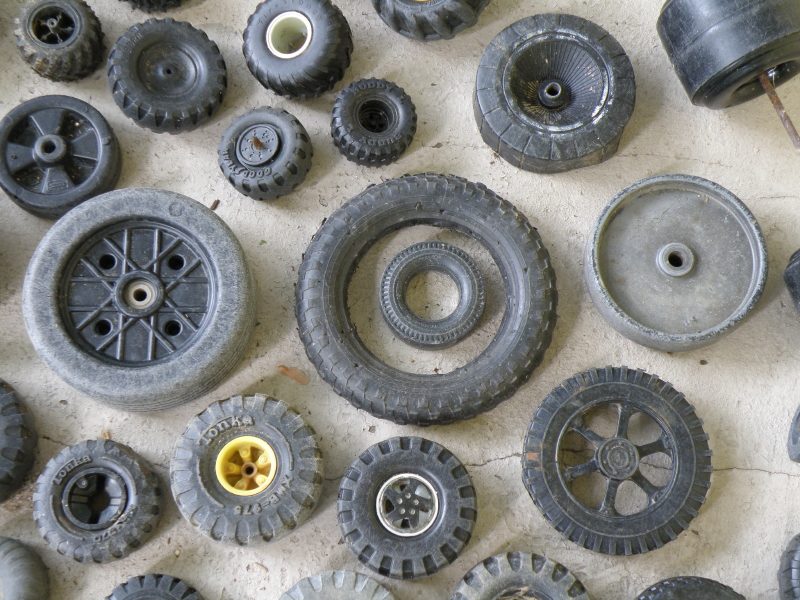
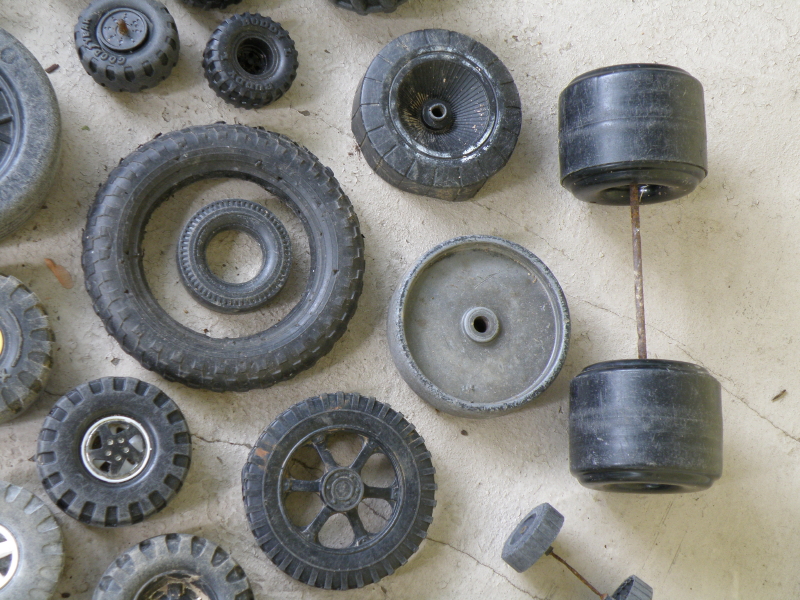
When I go to the river, I bring a canvas collecting bag to store my finds.  I have more than one bag which I usually store on the front porch of my house to await later sorting.  As I have mentioned before…I have a very patient wife who with usual good humor, puts up with my obsessions!  It is this cycle of sorting through the junk that is the inspiration for this post and I had three full bags that had among other objects, toy wheels that have caught my eye.  I knew I had been picking them up of late, but hadn’t realized the collection I had formed until I laid them out.  With the exception of the odd skateboard wheel…my collection comes from toy trucks and vehicles where the heaviest load they have borne has come from the imaginations of children.  I like how they look visually and apart from that…I’m not sure what I will eventually do with them all!  Perhaps I will make some other metaphorical vehicle some day?


Read Full Post »

In the beginning he was so unclear about what had happened.  There was this vague image in his mind of some kind of presence he felt that may have created him?  Even that “fact”  was up for debate.  All he remembers with any kind of certainty was that he couldn’t remember anything at all until the breath of life was blown into him.

What he remembers next is feeling the warmth of the sun on his face.  He tried looking at the sun, but his eyes couldn’t stand the gaze.  Averting his face, he saw a shape on the ground and was surprised when it echoed his own movements like a dance partner.  It was in this moment that he felt his body and became fully aware that he was physical and could move around in space.   He took a minute or two, three, four…to survey his birthplace.

What he saw astonished him!  Positioned in the sand were lots of pieces that looked like the same material he was made from.  It was a bit creepy and confusing for him and his next impulse was to escape.  This decision set him upon the path that would be his life’s adventure.  He walked and walked and everything he saw was new, confusing, and miraculous to him.  There were trees and plants and other life forms that occupied the same space and were delightful to behold. It took a while to absorb and understand some of the things he was encountering.  After a half day’s journey or so, the traveler came to a place different from where he began and after surveying this field…he had an epiphany.

It was a debris field full of all kinds of materials…some of which resembled the pieces he saw before and which constituted his very physical being.  He realized that he was made of the stuff of the world and felt the kinship.  He further intuited that these materials were themselves extracted from what had lived and came before.  Life is built upon life…dust to dust…ashes to ashes…plastic to plastic.  The Traveler moved on.

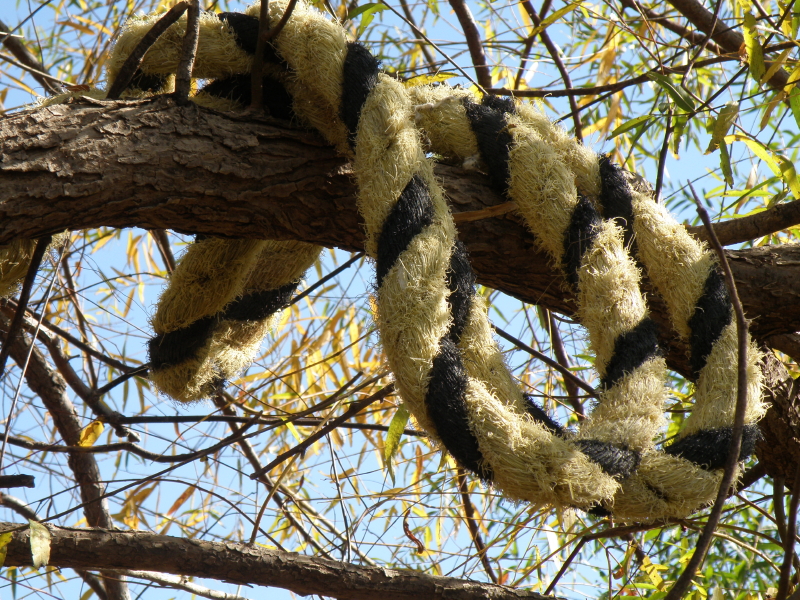
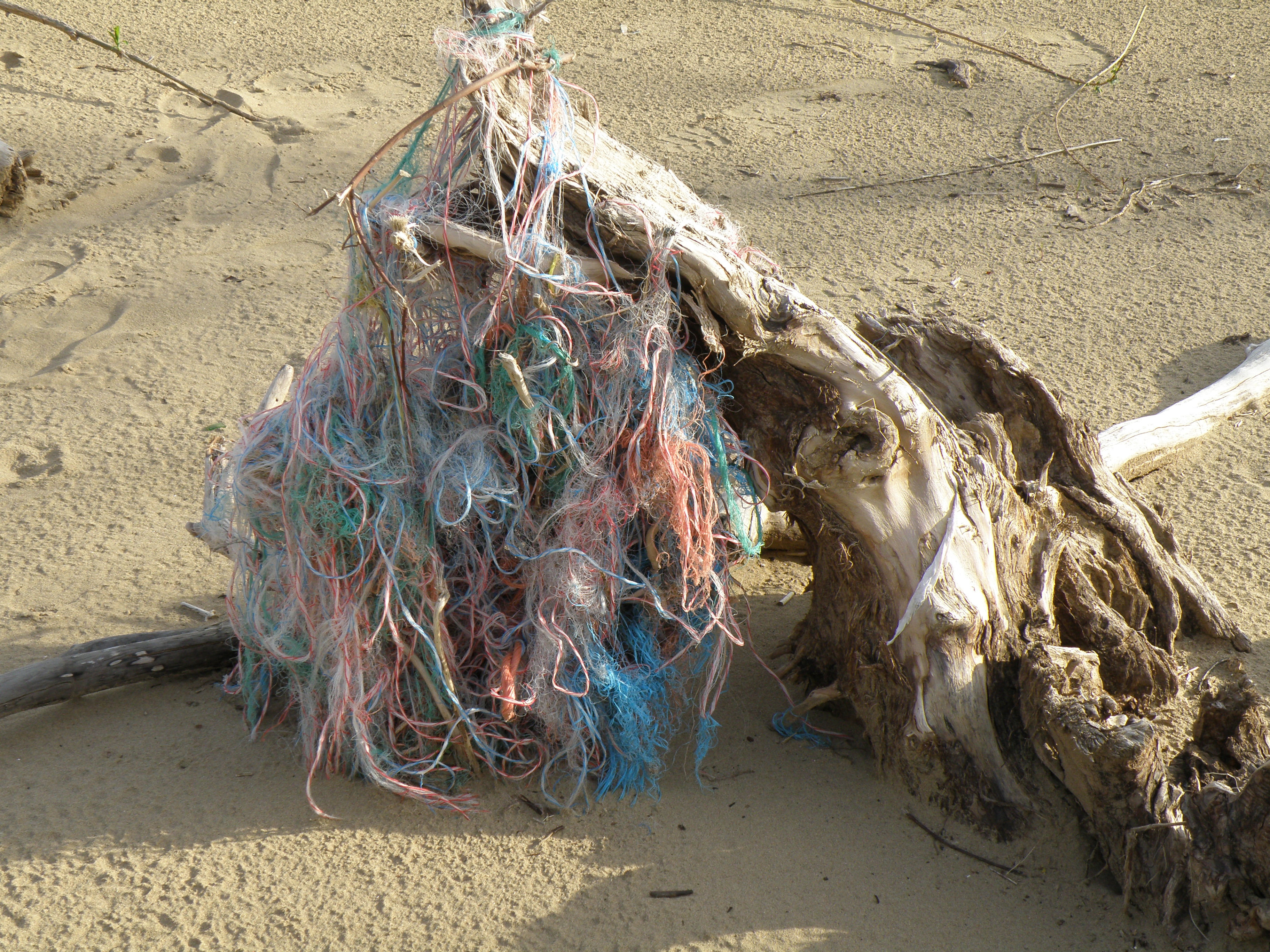
The Traveler was gaining experience of the world which then led to knowledge of it.  He encountered many other objects and filed them away in his being for future reference.  One such object was this immense cable or rope and our hero recognized that all the individual strands of this rope gave it great strength and unity when they were woven and twisted together.  The sun was at its high point and the day was getting hot.  The Traveler decided to move into the shade of the trees to cool off and discover what he could learn there.  After an hour’s walk or two or three…he came to a large black tunnel leading into the ground and it beckoned to him.

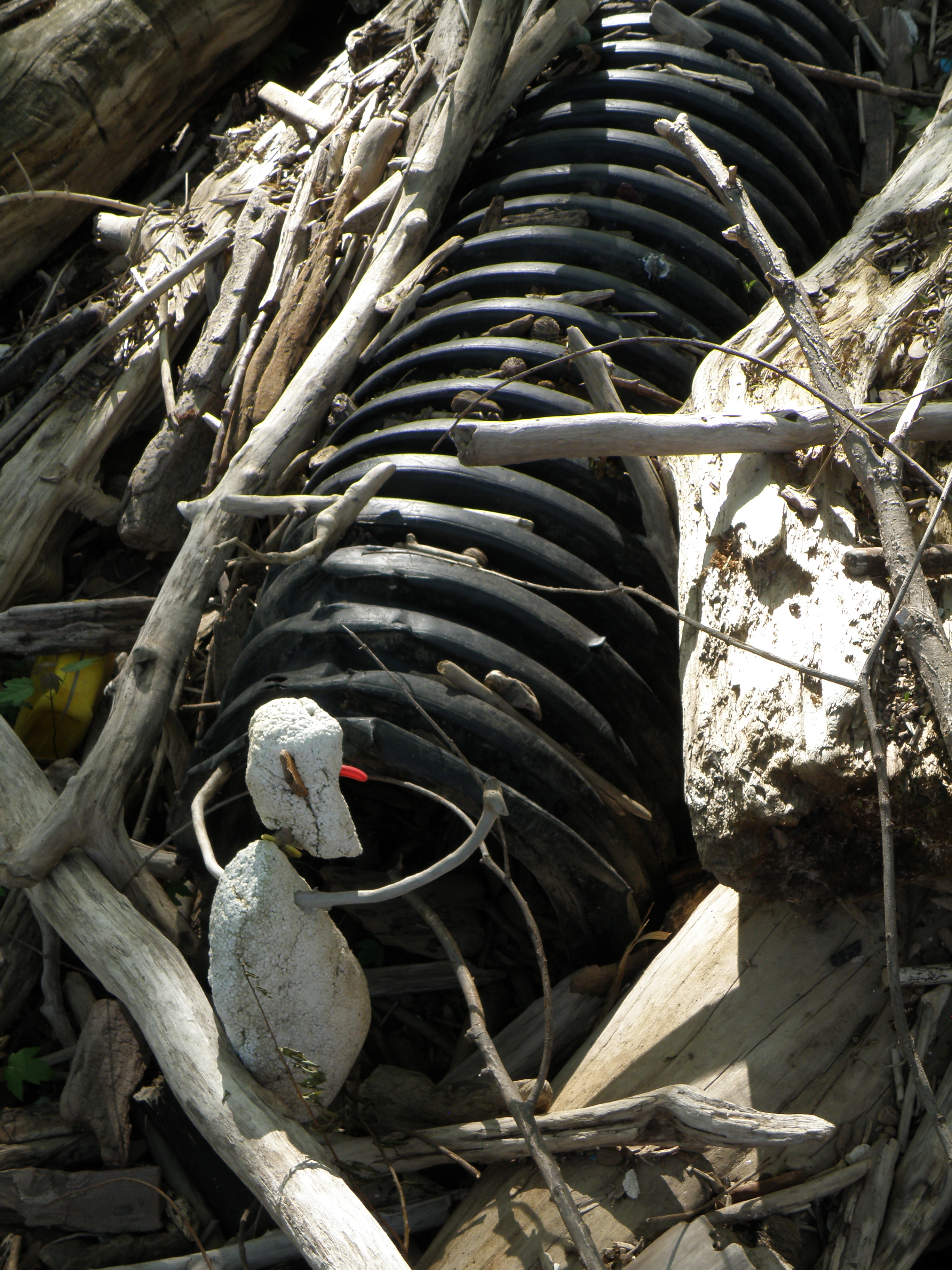
Reflexively, the Traveler overcame any misgivings and entered the tunnel.  It felt cool which he liked and there was blackness which he feared. In the next heartbeat there was an incredible burst of light and he found himself on the other side of the tunnel.  What he saw next was the most perplexing sight of this new and memorable day!

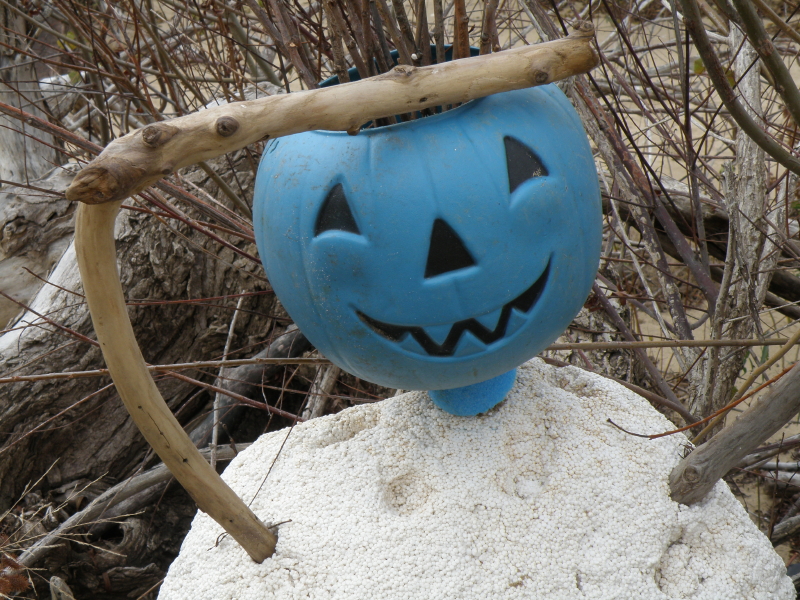
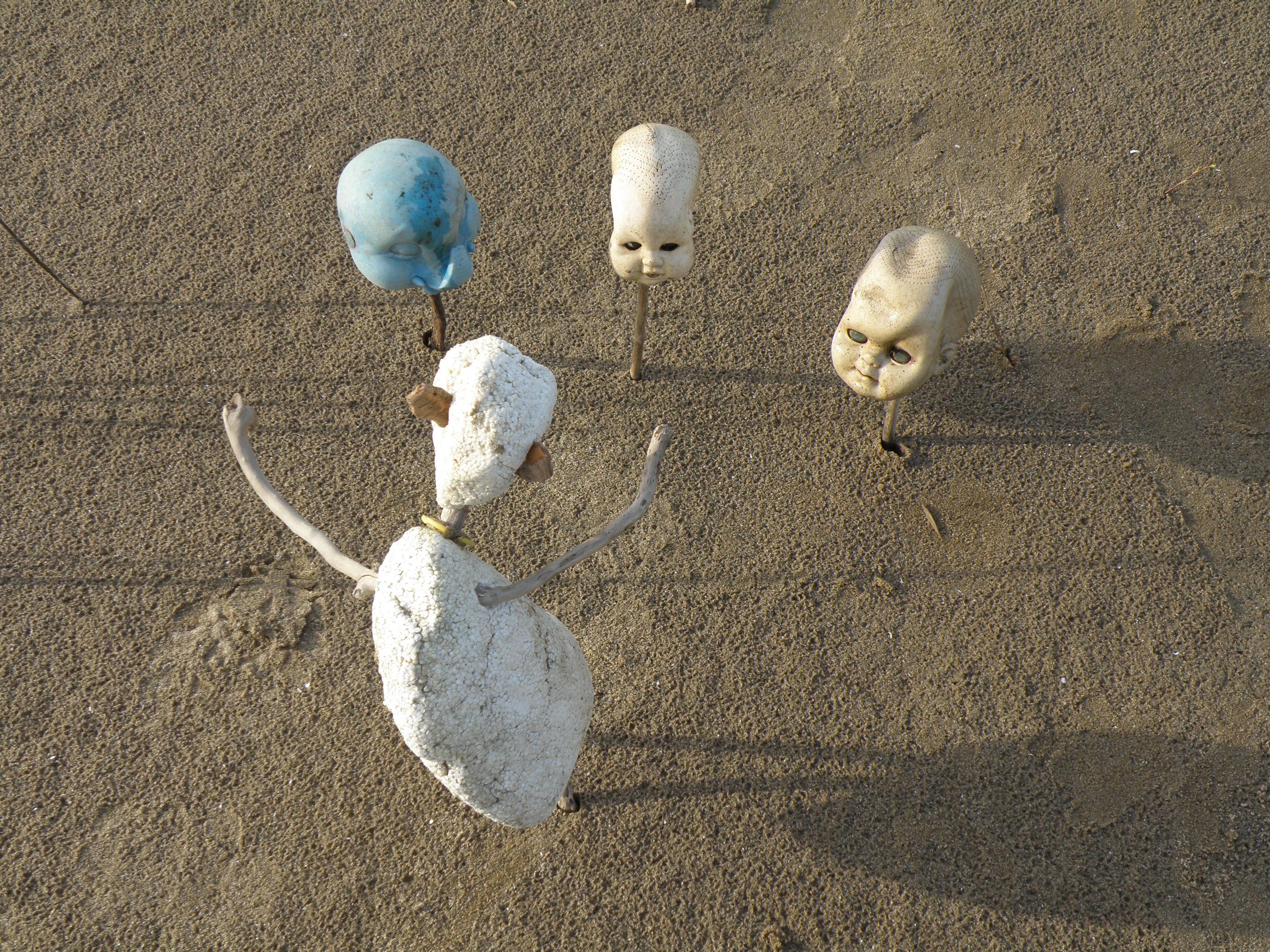
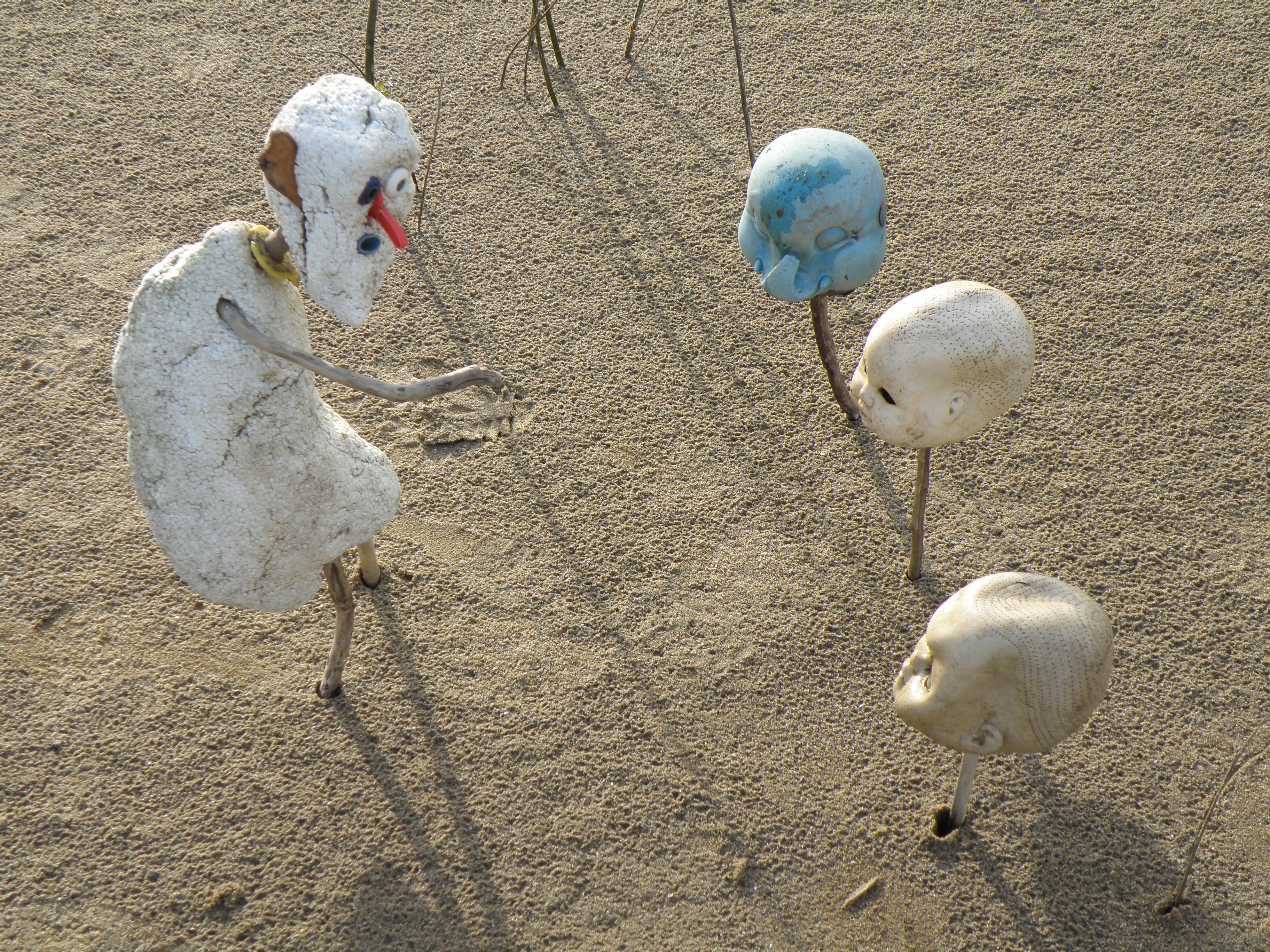
Impaled upon three sticks were three heads that were regarding him with interest.  The Traveler was a confusion of feelings that ranged from horror to outright fascination!  One head was blue and looked like an elephant minus its  ears.   The other two heads were childlike and misshapen.  Within his own mind, the Traveler heard the largest childlike head speak to him and it said, ” Welcome Traveler…we are the Oracle of the Sands of Time.  Together we are the past, present, and future.  All that you were before…you will be again…and more.

The Oracle then spoke in unison and told the Traveler that the Past, Present, and Future simultaneously coexist.  They were appearing to him now to act as a guide to the life that had been given to him.  Naturally, the Traveler was a bit  confused since he was new to paradoxes!  Then the larger head placed an image into the Traveler’s mind and said, “Do you remember that rope you saw today?…imagine a slightly different one more colorful and expanded. Now imagine it’s a model of the universe and everything in it.”

The Traveler then tried to grasp the idea that the universe is made of vibrating strings that phase in and out of time.   Because there are differences in spacetime and your point of view changes depending on how you focus on a moment…the possibility of multiple “you’s” can exist in different dimensions in space and time.  What you were before…you can be again…or not.  Yes, it’s all rather confusing and the Traveler moved away from the Oracle and tried contemplating what he was just told.

What was he supposed to do with this knowledge?  He then remembered the last thing the Oracle told him and it somewhat made sense.  As long as he was fully present and open in each moment of his life…he would be fine.  If he was having a bad day…somewhere in the universe those other “you’s” could be having better or worse days.  In the big scheme of things…it just doesn’t matter.  As the sun was setting in the west, the Traveler was able to face the sun with his shadow confidently following behind him.  He decided that he would keep walking towards the light and treat each day like it was brand new.

Read Full Post »

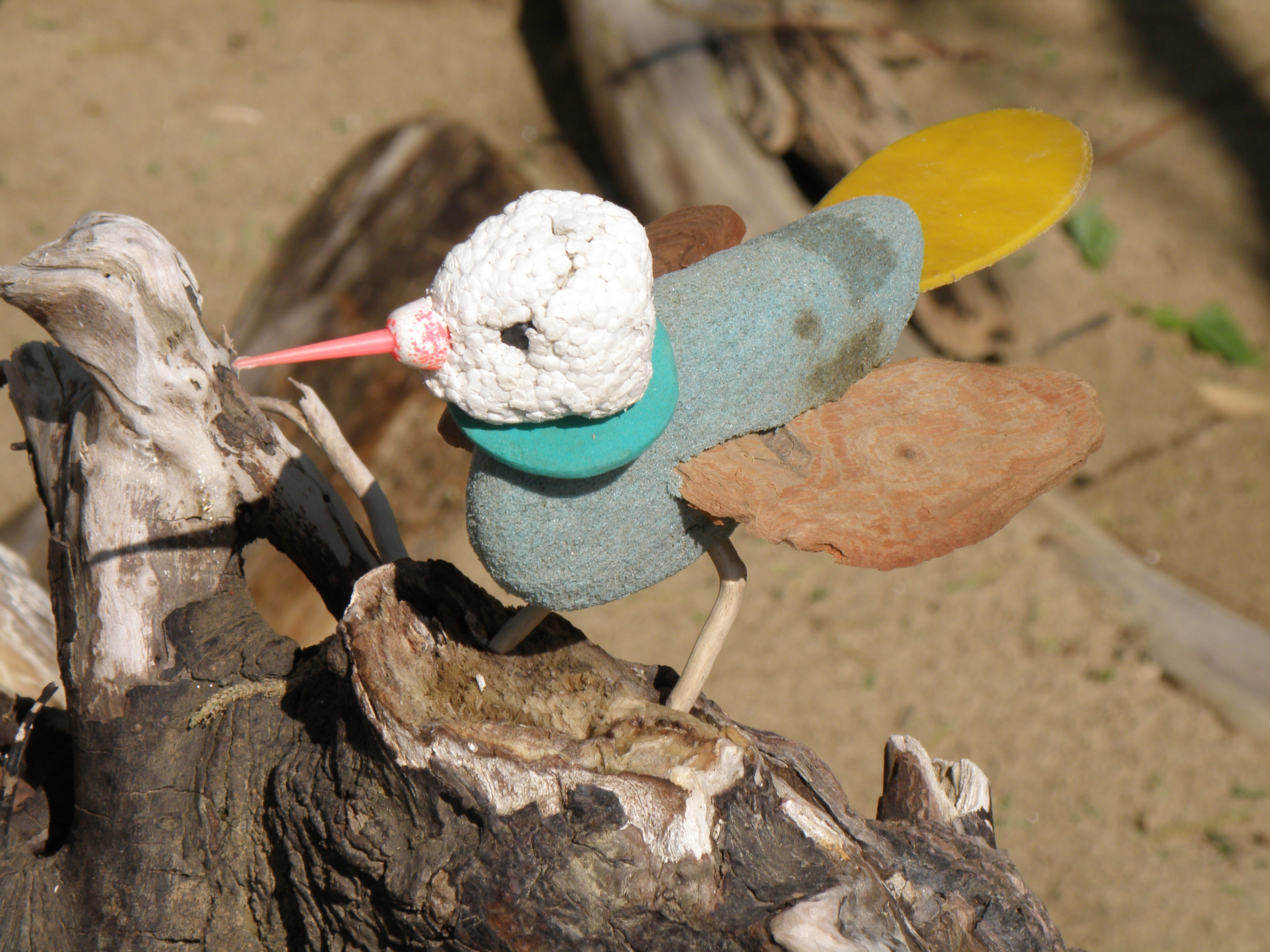
It’s Spring and I’m walking the eastern section of the Falls of the Ohio State Park looking for birds.  I have done this religiously for years and have seen most of the species that have been recorded in this park.  I love birds because they are such beautiful expressions of life.  I envy their extreme mobility with so many species able to call greater parts of the globe home than I will ever experience.  This is the time of year when many different types of birds that have been wintering in South and Central America undergo remarkable journeys.  Some will pass through this area on their way to locations as far north as the Arctic Circle. This is my chance to see them… if I’m lucky. The Falls of the Ohio also has another significant bird connection through the life and work of John James Audubon.  He essentially started his life’s work that would eventually become The Birds of America, one of the great achievements in publishing and the most expensive book in the world, by first drawing many of the birds he encountered at the Falls of the Ohio.  Audubon’s example and his journal descriptions of the world he inhabited are frequent touchstones for me and this project.  Two hundred years later…very little remains of the original landscape he was familiar with.  That process and transformation of the landscape is continuing and unfortunately not always in a positive direction.  Birds are such great indicators of the quality of the environment because they are sensitive to changes…the canary in the coal mine was a real thing.  To enjoy birds and birding is an activity that takes you out of yourself for a little while and causes you to engage life on its own terms.  On this day (which also happened to be April Fool’s Day)  I did experience many of the usual year round resident bird species, but did not see any of the neotropical migrants that make the Spring migration so special.  So, when this happens, I’m not above creating my own bird species.  This post is devoted to a new bird I discovered out here and I’ve named it the Variegated Oriole.

The Variegated Oriole receives its name for being multicolored. I first encountered this bird as various bits of detritus that I came across walking the shoreline of the Ohio River.  For the head, I used a small piece of river-polished Styrofoam.  Its brightly colored beak is part of a plastic and polystyrene fishing float that I cut with my pocket knife.  The eyes are small bits of coal.  I used a green foam gasket or washer to act as a transitional element between the head and the body.  It’s a trademark of mine that I seem to do with almost every piece I make out here. For the body, I found a blue piece of river-polished high density foam? that I cut a few slits into the sides to hold the wings which are made from pine bark.  I took one piece of bark that the river peeled off of a tree and I split that in half to form matching wings.  The tail is a piece of yellow plastic I found that reminded me of a bird tail!  I cut another groove into the blue body to insert and hold the tail in place.  The feet, are just rootlets that I sharpened and pegged into the body.  That’s it in terms of materials which I tried to alter as little as possible as not to trump what nature and the river had already shaped.  It’s important to me that this be a true collaboration.  If “we” are successful, then something of the spirit of a bird will take hold and inhabit this small sculpture.

After finishing the bird…I seek out environments that will help put this avian creation into some kind of context.  Everything matters and I hope my pictures convey something of the time of day, the season, the quality of light, the condition of the environment, etc…all those elements help create a sense of place.  I move through the willow trees posing the bird on various stumps and branches.  I usually take a lot of pictures.

Sometimes, I will imagine what kind of habits my new birds might possess.  In the case of the Variegated Oriole…it is not too different from the Northern or Baltimore Orioles that live and nest in the park.  They are among the migrants I look for. I heard one the other day calling, but didn’t see it.  The real orioles that live here are adapting to local conditions by using artificial materials (fishing line and barge cable fibers) in the construction of their hanging basket nests.  I’ve posted on this before in this blog a few years a go.  I think Audubon would have been interested in this.  Anyway, I left my bird sitting on a branch for anyone to discover.  It might still be there and I will find out today when I once again venture out to the Falls of the Ohio State Park.  Perhaps new birds will present themselves to me? I will let you know what I find…next time.

One week later…I returned to the spot where I left my faux-feathered friend and he was no longer perched upon the branch where I left him.  I was able to locate most of him scattered on the sand except for one wing.  My guess was that he was felled by a well-aimed and thrown rock.  The head was shattered and will need to be replaced provided  I recyle these pieces back into a bird again.

Read Full Post »

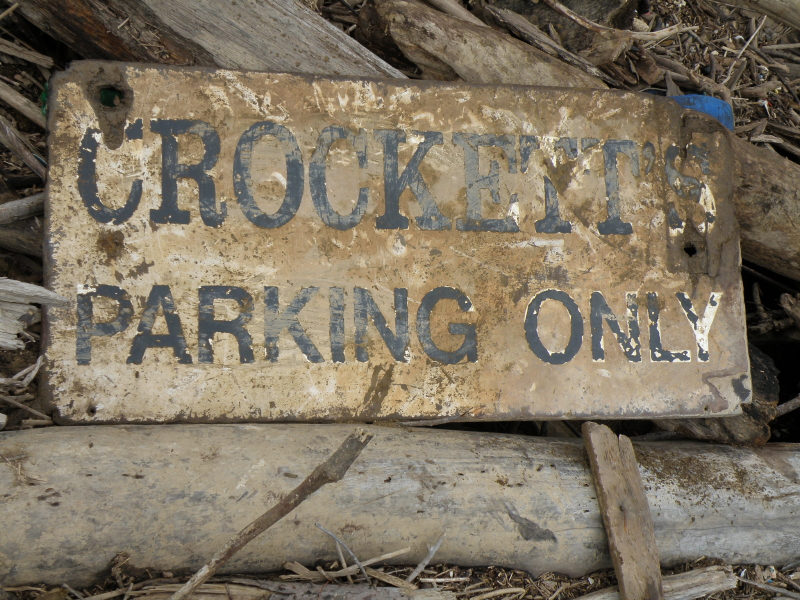
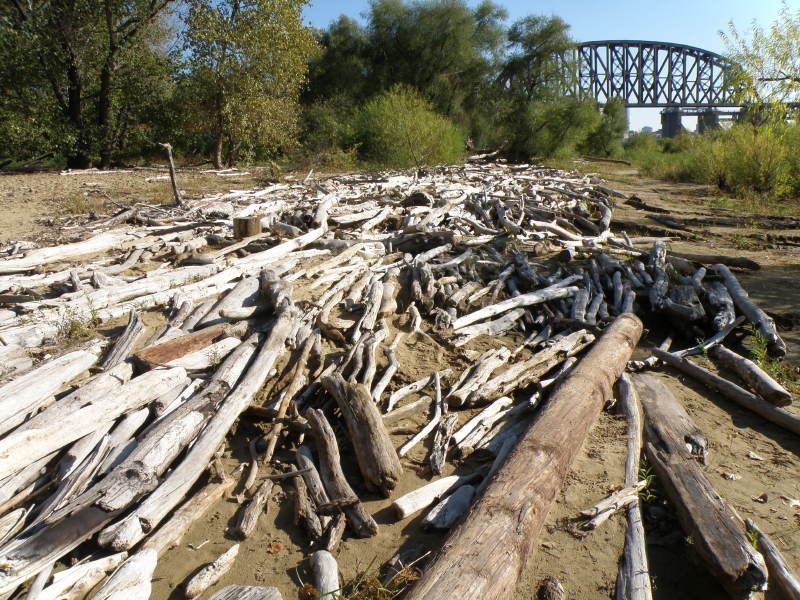
A gray day with the Ohio River rising and I’m exploring this huge driftwood mound created by last spring’s flooding.  Over the last few months this section has seen other minor floods and even a fire.  It’s interesting to me to see how the river has a leveling effect as it flows under and moves the driftwood pile. The shifting reveals new “treasures” that were formerly buried.  I’m out here to see what I can find and possibly reuse.  Soon I uncover a sign that tempts me.

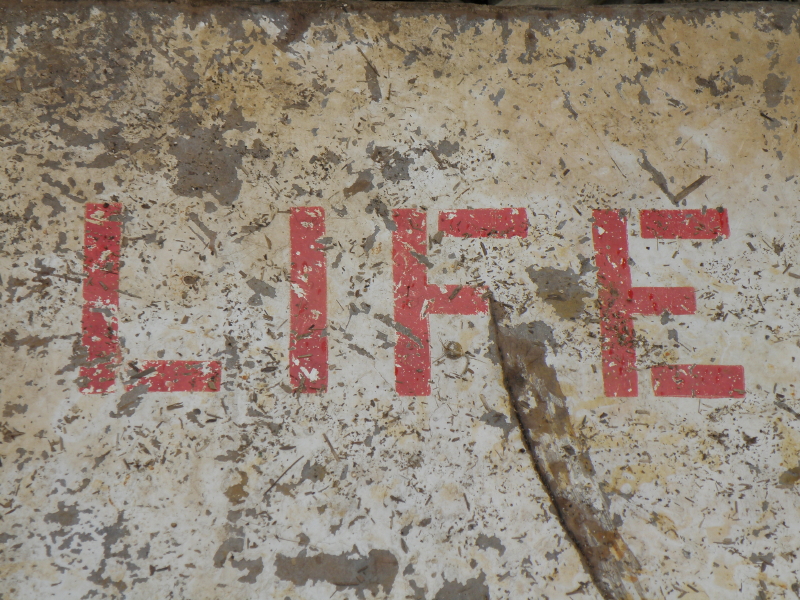
Yes, I have a found sign collection as well and you can see it on my Pages section where I keep other collections of stuff I have stumbled across.  First, let me tell you why this particular sign caught my eye.  In this neck of the woods, we still remember the now mythic frontiersmen who explored and settled this great land.  Daniel Boone, Audubon, Lewis and Clark, and one Davy Crockett are among these pioneers.  Seeing this sign caused me to “flash forward” and I speculated what Crockett’s descendants were now doing after taming our great wilderness.  Did they as Joni Mitchell once sang “…paved paradise and put up a parking lot” and here was the sign to prove it?  As signs go, this one was interesting because it’s double-sided and the reverse message is different and says “Life Vest Required” in red stenciled letters.  Here is a detail that I like.

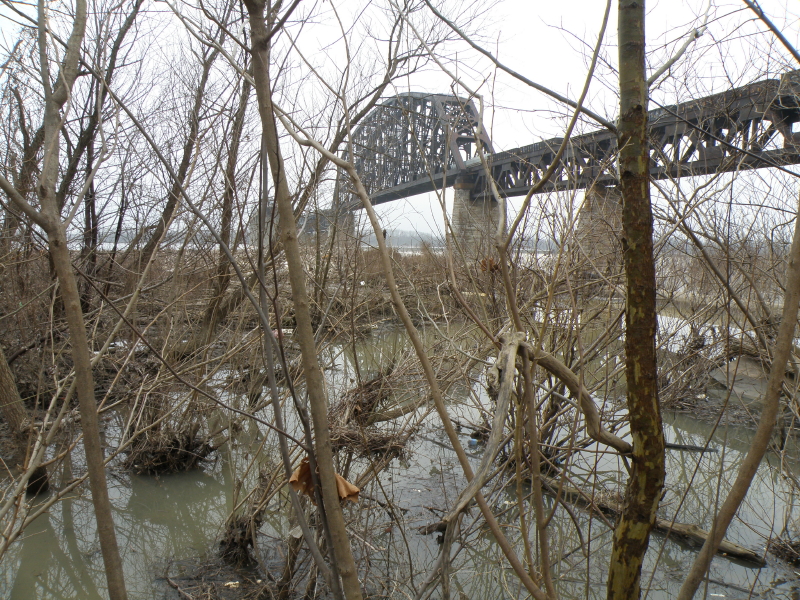
I was contemplating whether I wanted to drag this heavy and muddy sign with me when an unexpected thing occurred. Life happened! My activity flushed out a bird I didn’t recognize and it flew right over my head and landed in an area of bottom land just east of the railroad bridge.  I kept my eyes on it the whole time and I saw where it landed.  I forgot about the sign and grabbed my camera gingerly stepping over the driftwood.  I would hate to twist my ankle again as I anticipated my rendezvous with this rare bird.  After quietly searching the underbrush, I located it and excitedly snapped the following images.

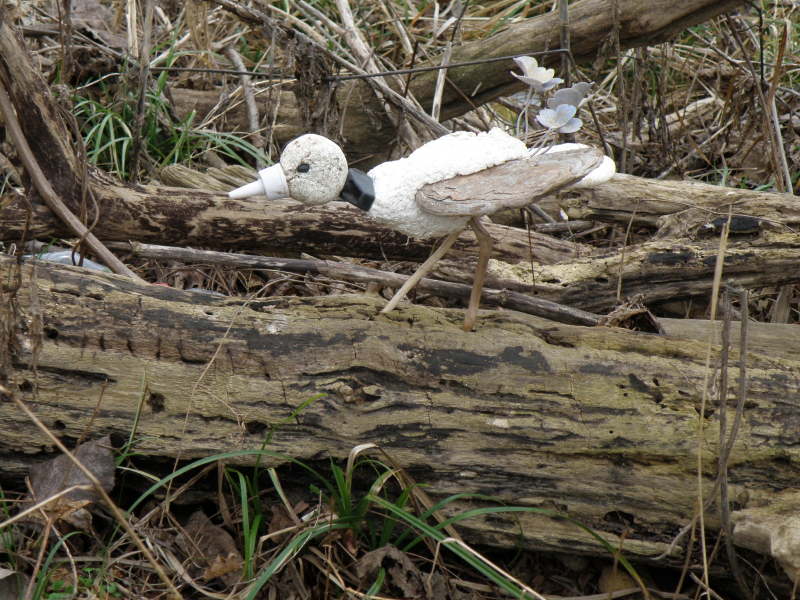
I have the honor of announcing the first documented sighting of the Temperate Bird of Paradise ever seen at the Falls of the Ohio!  I found it at the water’s edge skulking among the litter and downed logs.  FYI, this is the only bird of paradise found in North America (hence temperate) from a family of birds that are almost exclusively tropical.  You are more likely to encounter a bird of paradise in New Guinea or the Aru Islands than here.  Interestingly, the first tropical examples to reach Europe were ethnographic specimens and the prepared bird skins were missing their feet and sometimes their wings.   This resulted in the early European naturalists assuming that the birds of paradise were forever on the wing kept aloft by their magnificent feathers.  (That’s a true story!)  Here are a few more pictures of this magical bird.

What this bird has in common with the other birds of paradise are very unusual feathers that the males use in courtship displays.  You can see the wiry, blue, flower-like feathers near the base of the tail.  In the wild, the males compete against each other for the affections of the females by wildly dancing and showing off their unusual plumage.  Once mating has occurred, the female builds a nest near the ground and the male takes off and plays no part in raising the young.  The particular bird I was observing was a juvenile male and lacked the small tuft of feathers found on the heads of the adults.

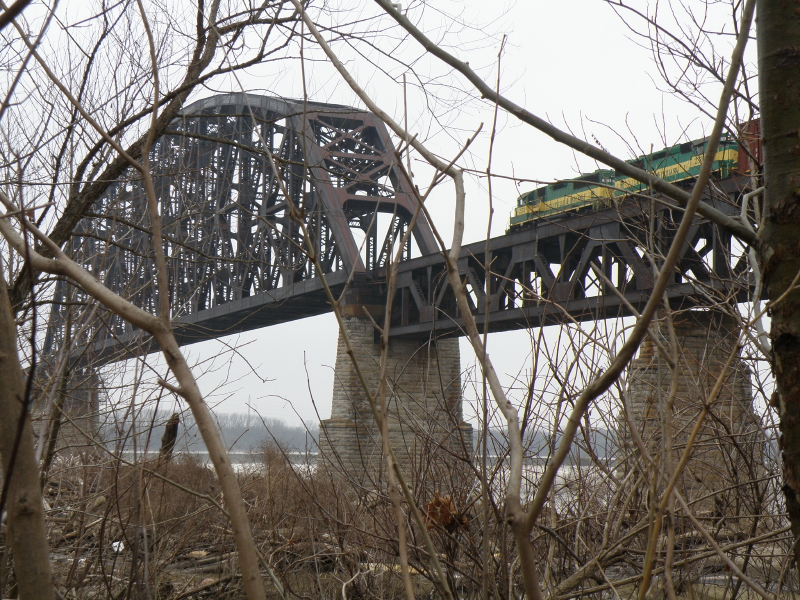
While I was taking these pictures and recording my observations, a train was passing overhead on the bridge.  I could tell it was making my visitor uneasy.

The diesel locomotives were noisy as they hauled their great loads over the span.  My bird of paradise began walking nervously back and forth and then flew away.  I was, however, able to snap one more image of it before it disappeared for good.  I returned to the area over several days, but it definitely left the area.  This is my final picture of the bird of paradise at the Falls.

Because this was a juvenile male, I’m hoping that this signals that the Temperate Bird of Paradise is on the increase and this young bird is seeking out new territories.  The bird initially became rare during the hey day when exotic bird plumes worn on fancy hats were all the rage.  Since then, habitat loss and the fact it is a ground nesting species makes it more vulnerable.  Excitedly, I rushed home to view my pictures on the computer!  I forgot all about the sign and I’m not sure it is still there anymore?  The rising Ohio River may have reclaimed it.  The next time I’m out there, I will look for it and the rare Temperate Bird of Paradise in case it returns.

Read Full Post »

After a brief cold and wet spell I made it out to the Falls of the Ohio last Saturday.  The Ohio River was rising as were the temperatures which had dipped into the 30 degree mark  for a few days.  One look around here and there is no doubt that it is autumn in Kentuckiana.  The willow leaves were noticeably yellower and many of the trees were in the process of losing their foliage.  I was scouting around for what else was different in this environment and spotted this tiny butterfly moving about.

This small whitish butterfly was sipping on something on the sand.  I was practically nose to nose with it and recognized that it was a member of the skipper family.  Last year was such a banner year for butterflies at the Falls and to my eye…this year was a noticeable drop off.  After following this skipper for a few yards I was able to take this image of it.  At home I identified it as the Common Checkered Skipper (Pyrgus communis) which is considered a very common species.  It seemed rather late in the season for a butterfly, but I was able to observe a few rag-tag Buckeye butterflies and a few tattered Viceroys too.  Funny how I had never noticed this skipper before.  Nevertheless, I felt a sense of personal discovery as though I was the first person ever to see this tiny revelation. It was about this time I heard a distinctive tapping coming from a stand of willow trees.  Somewhere a woodpecker was plying its trade.

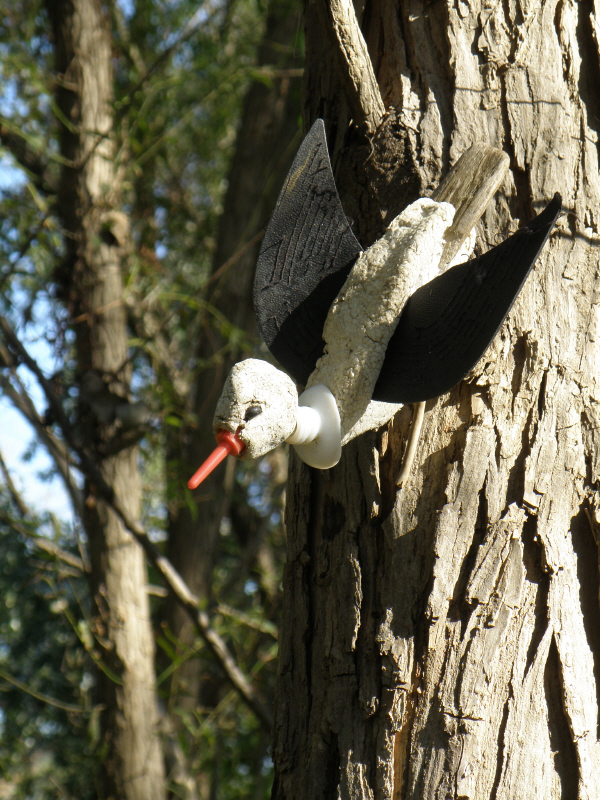
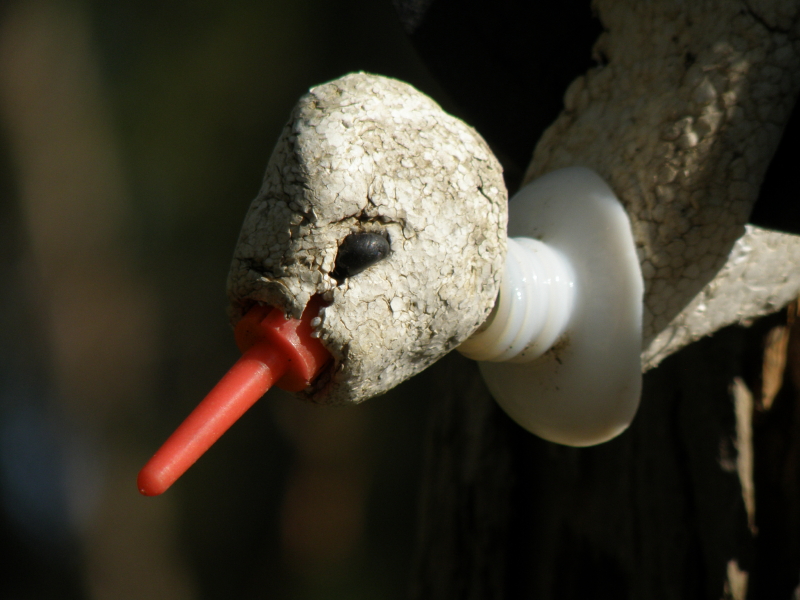
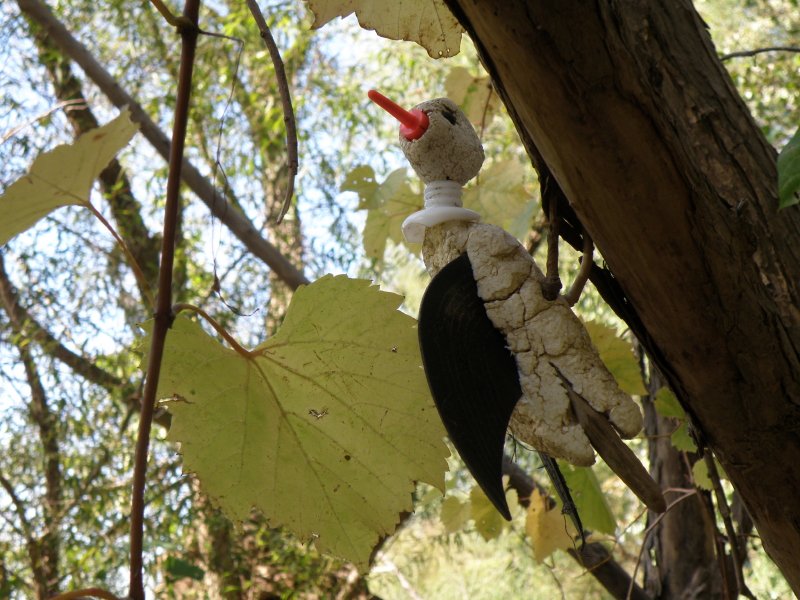
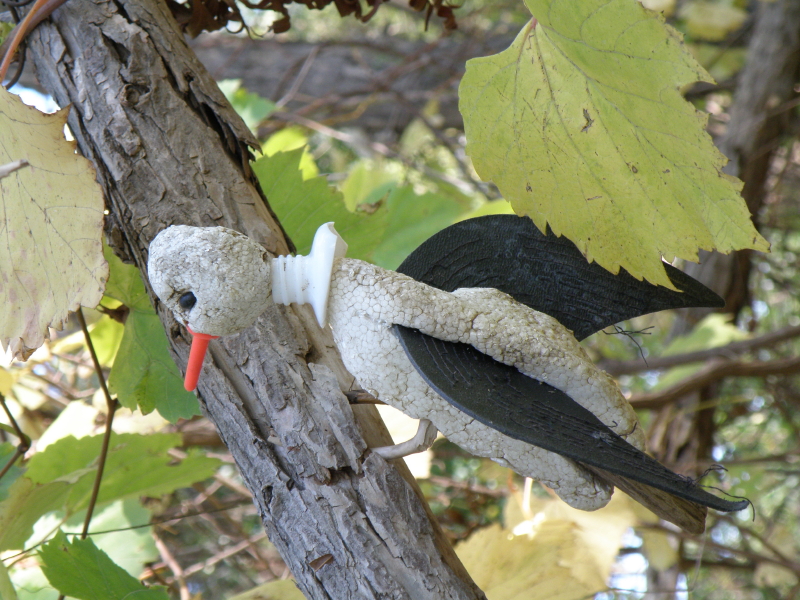
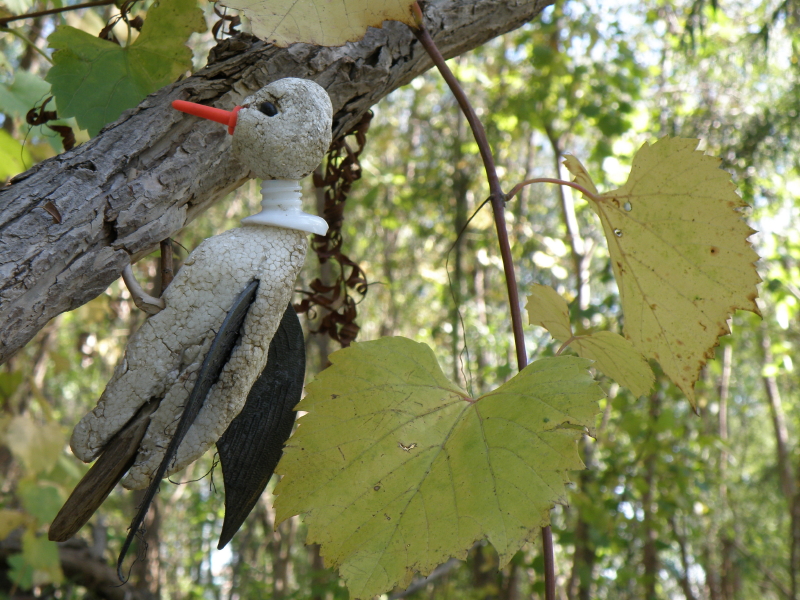
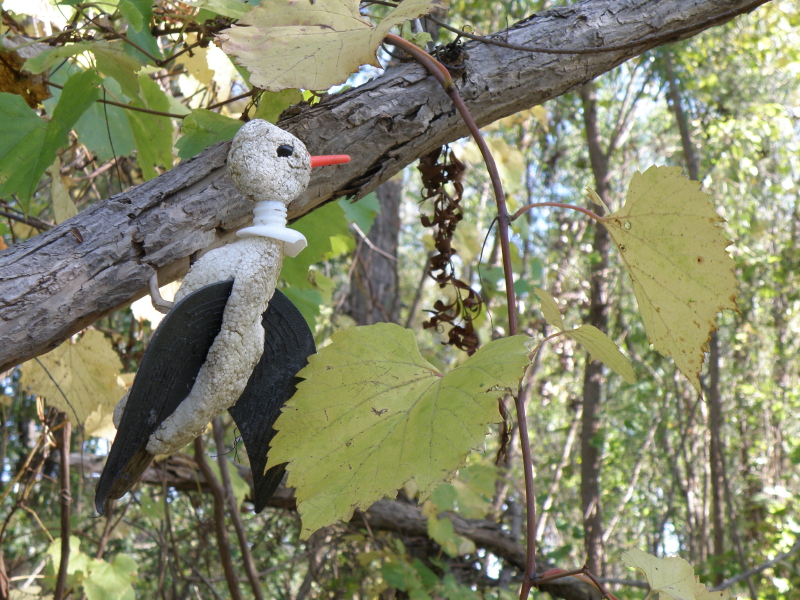
With its jet-black wings, white body, and bright red bill this bird is easy to identify…it’s the Pied Woodpecker.  About this time of year the northern population of this interesting woodpecker begins its southerly migration to the warmer climes of Central America.  Although I had added this bird to my “Life List” while on a family trip to Wisconsin…this was the first Pied Woodpecker I have seen at the Falls of the Ohio.  I observed it moving up and down the trunks of the willow trees exploring the crevasses in the bark for small insects.  It likes to move head down in its search for food like nuthatches are known to do.  Every now and then it would use its bill to chip away the wood to uncover the bugs it sought and it seemed quite unconcerned about me taking pictures of it.  I snapped as many as I could as I followed it on its path through the woods.

Soon it came to a grove of trees that were covered in wild grape vines.  The Pied Woodpecker explored the bark here too, but I saw it augmenting its diet with the tiny fruits this vine was producing.  Every once in a while it would make this nasally sound that I tried imitating.  Fortunately, this bird didn’t take offense and fly away.  Perhaps it “cut me some slack” for at least trying to talk to it in its own language…or at least that was my thought at that moment.

From the vine-covered trees, the woodpecker next flew to a large log with a large exposed root mass.  When this tree was living it must have been huge. The Pied Woodpecker didn’t linger here long and I watched its rising and dipping flight pattern as it crossed over the Ohio River into Kentucky.  I wonder if I will ever see another of its kind here again?  That’s the funny thing. There are birds that are considered common and regularly recorded here that I have yet to see.  I’ve seen them elsewhere, but not here at the Falls of the Ohio.  That’s the thing about birds…their extreme mobility can make them unpredictable!

Read Full Post »

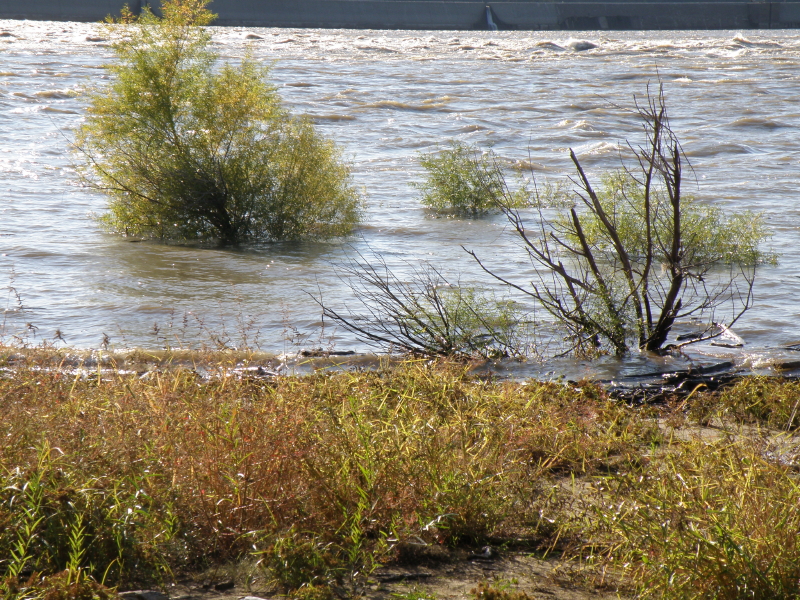
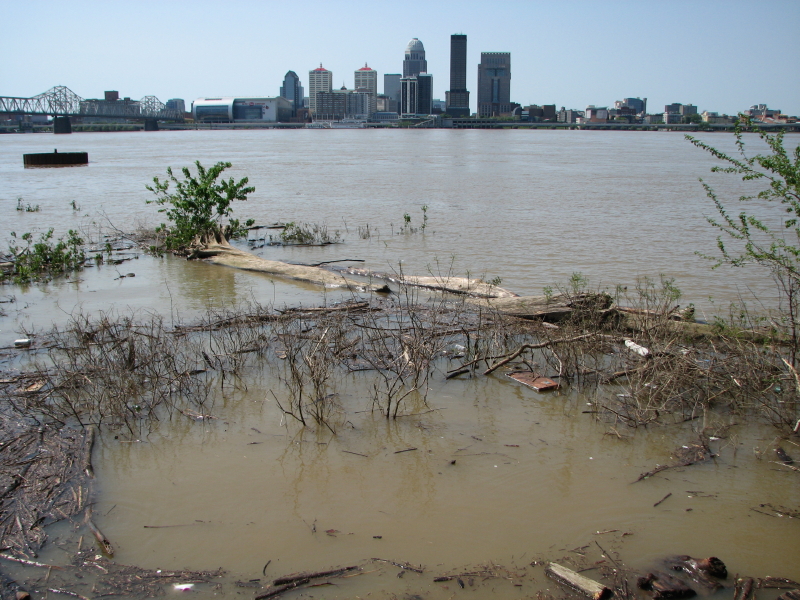
As usual I’m a bit behind in my river reports.  I calculate I could write at least several more posts about the flooding we have experienced with the Ohio River at the Falls of the Ohio.  As I write, the river is still high, but all the attention has shifted to the Mississippi River which is experiencing an epic flood.  I’m sure some of the same water molecules that flowed past our location are contributing to the woes down along the Mississippi.  For those unfamiliar with our geography, the Ohio River flows directly into the Mississippi River in far western Kentucky.  The confluence of these two great rivers is an awesome sight.

Here at Louisville, the water has been receding and the amount of water-borne junk this flood has brought hasn’t fully hit home yet.  There are signs, however, everywhere I look that this will be a great challenge for any river loving clean-up crew.  I will try to do my part, but even if I were to try to be out here every waking hour…I wouldn’t  begin to scratch the surface.

Gas is over $4.15 cents a gallon for regular unleaded here.  I listened to the great oil company executives trying to explain to Congress today why they need a sweetheart deal from the American taxpayers when they already receive every tax break in the books and are suffering with their record, obscene profits.  When discussion turns to what can be done to reduce the amount of crude oil used the usual answer has something to do with increased engine efficiency resulting in more miles to the gallon.  Looking at the high water line I see another solution that doesn’t get as much play.  Why don’t we try to cut as much plastic out of our way of life as possible?  There would be more oil available for fuel and you wouldn’t have all these various compounds despoiling our water ways from the smallest streams to the largest ocean.  You can throw Styrofoam in this mix too since it is has petroleum pedigree as well.  We could just change the packaging we use and I bet that would make a huge difference.

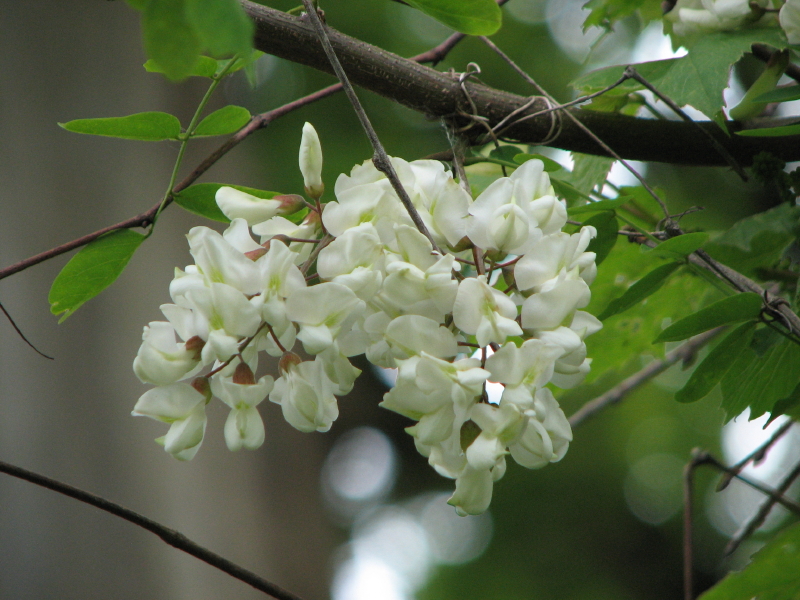
You can look at the whole Riverblog as one long rant against pollution, but there is also more out here that is sweet and worth noting and enjoying.  I decided to walk along the Woodland Loop Trail and the air was fragrant with the perfume from what we call Honey Locust trees.  Some of these trees also sport large spines growing on the bark.  Their pea-like white flowers have the most wonderful scent.  Here is what a flower cluster looks like.

Along the trail, you can hear a variety of bird species singing.  Vireos, woodland warblers, orioles, chickadees, indigo buntings, various thrushes fill the air with their acoustic signatures.  The birds are here to feast on the many cutworms that plague the forest canopy.  There are also other larvae present…here is a small nest of tent caterpillars that will soon become moths.  Very few birds like these hairy caterpillars, but two that do ( the Yellow-billed cuckoo and the Blue and gray gnatcatcher) can be found in the forest now.

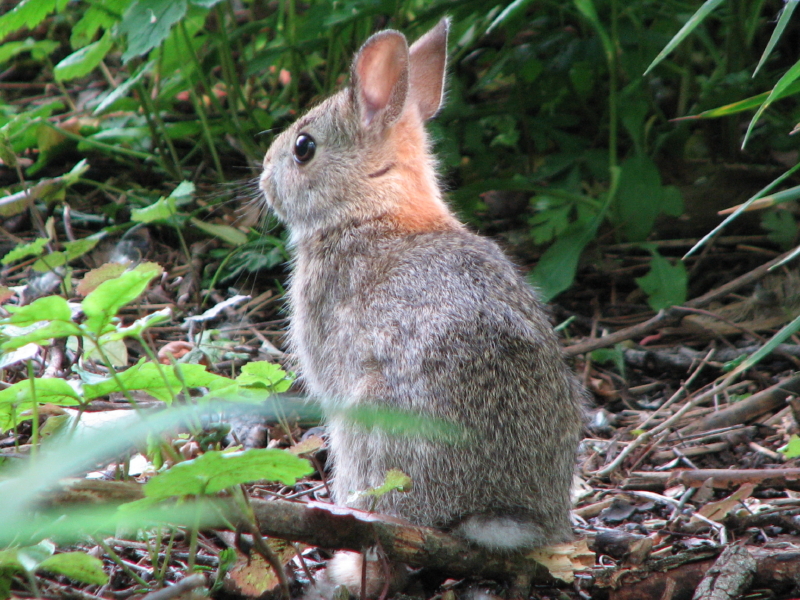
Ah, I also spot my namesake hopping along the trail!  This is a young Cottontail and he better be careful out here because there are so many predators both native and domesticated that would love to catch him!

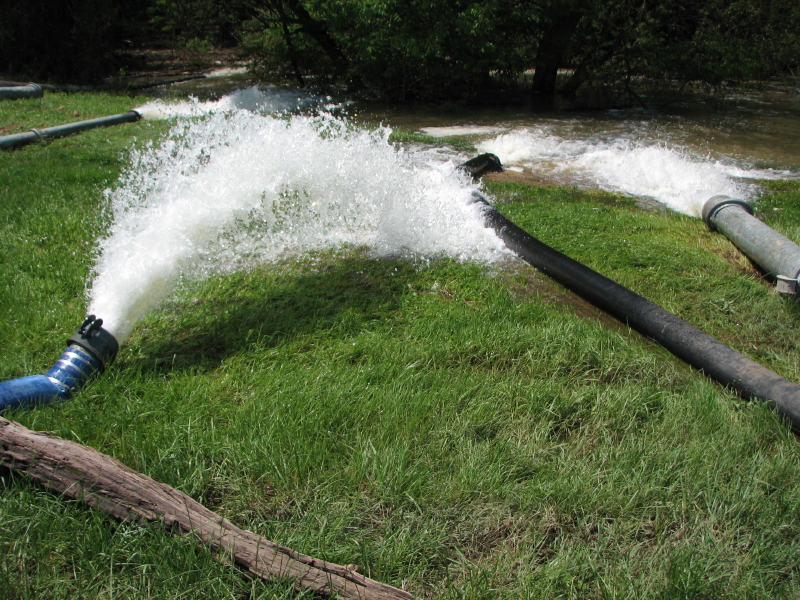
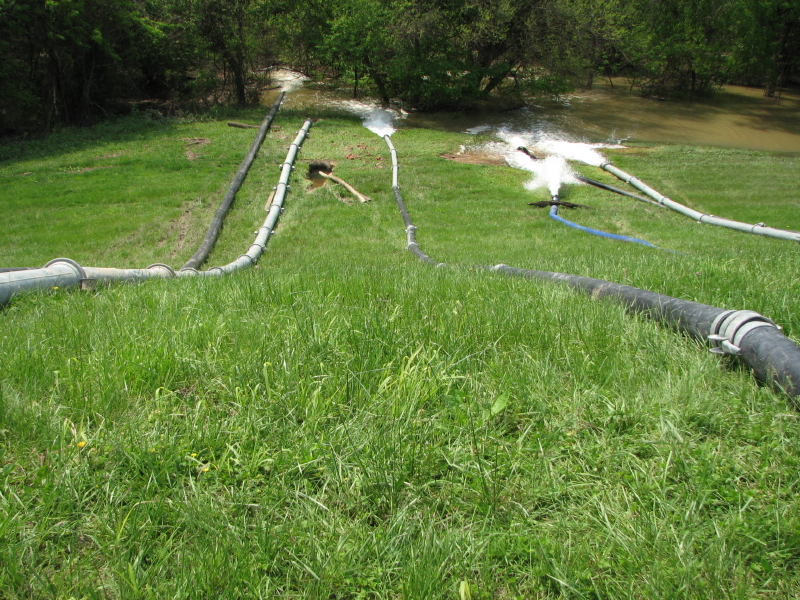
Walking westward along the trail, you can’t help but notice the large grassy berm that flanks your right side.  It is additional flood control put in place after the disastrous 1937 flood which was our high water event on the Ohio River.  Up a head, I can see a network of large hoses with water gushing out and I decided to investigate.

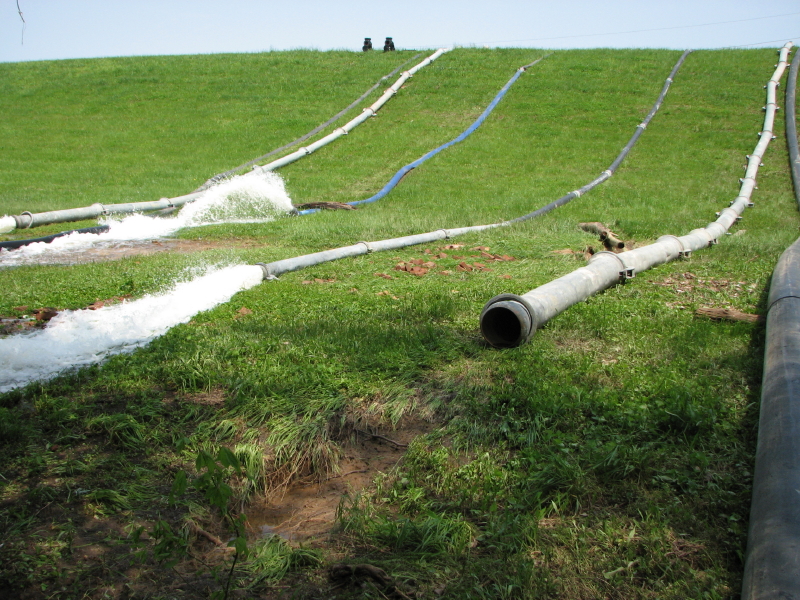
I can see these large hoses coming down the berm and I wanted to see what’s on the other side of this earthen flood wall.  Here are a series of pictures of what I saw.  First looking up hill…

…now the view looking down towards the river.  What are these hoses for?

I came across a sign at the crest of this large hill that explains it.

On the other side of the berm is the small town of Clarksville, Indiana.  Rain water has pooled up in the lower lying sections of the city and are being pumped out and over the top where the water then flows into the park eventually finding release into the river.

It’s strange how I rarely think about the town that occupies the other side of this large grass and earthen mound.  The Ohio River is really at its front door all the time.  The little bit of woods I like spending time in is just a narrow sliver of ecosystem that exists between Clarksville and the river.

Well, that’s the story for now.  I have much more to present about the dominant environmental event of our Spring.  Already the temperatures are rising and I can feel the transition to Summer won’t be long in coming.  Thanks for hanging with me…until next time…the Rabbit Man.

Read Full Post »

« Newer Posts - Older Posts »