Feeds:
Posts
Comments

Archive for the ‘nature’ Category

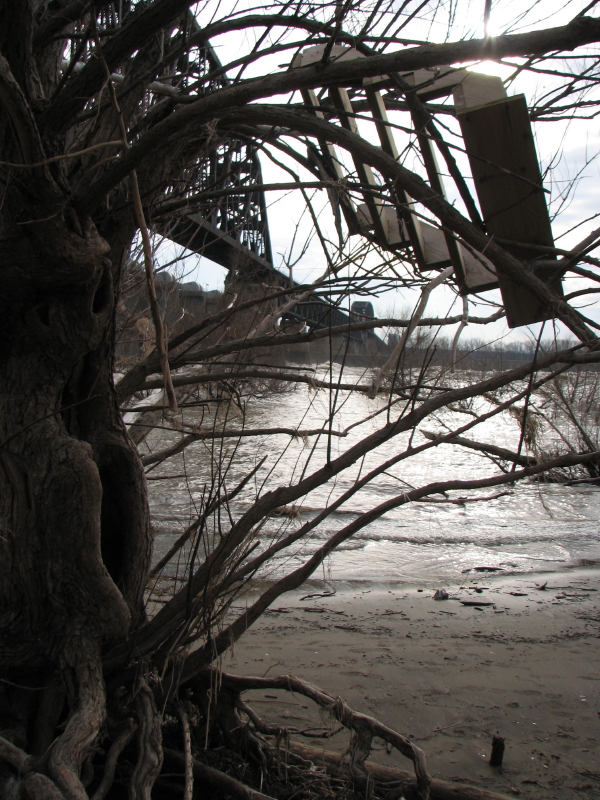
Just left or east of the railroad bridge at the Falls of the Ohio is where this adventure occurred.  The river was still high but dropping.  I was enjoying working in a section of the park that I don’t normally hang out at, but have discovered is both full of wildlife and potential art materials.  Evidence of our recent flooding was everywhere and I was exploring what there was to see and find.
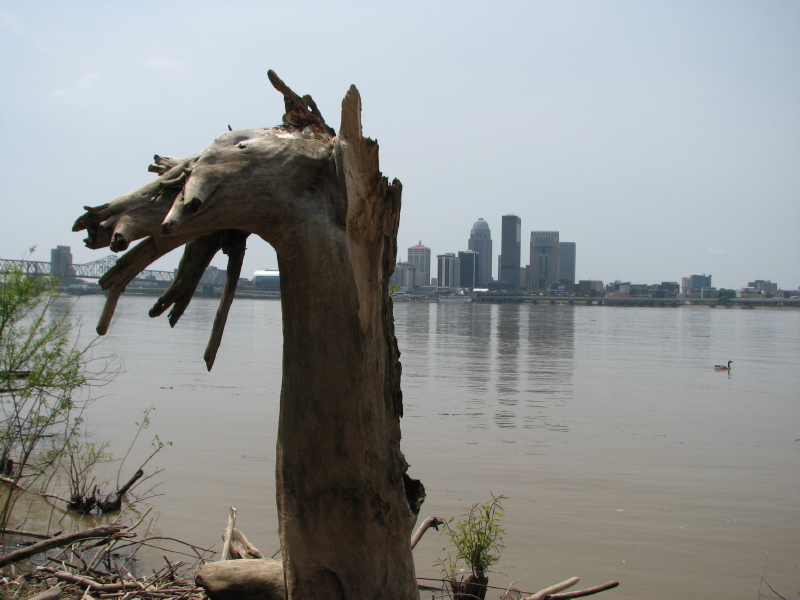
While I was exploring this area I could hear Beatles’ music quite clearly drifting over the water.  It was the annual Abbey Road on the River Festival at the Waterfront Park in Louisville.  I guess the goal of each tribute band is to sound as closely to the original Fab Four as possible because I couldn’t detect much variation from one group’s rendition of a familiar song to another’s.  I did, however, notice that the Belle of Louisville’s steamboat calliope was in direct competition with the bands.  Like last year’s festival…snatches of 19th century tunes intermingled with pop hits from the 1960’s.  Baby, baby…Do dah day.
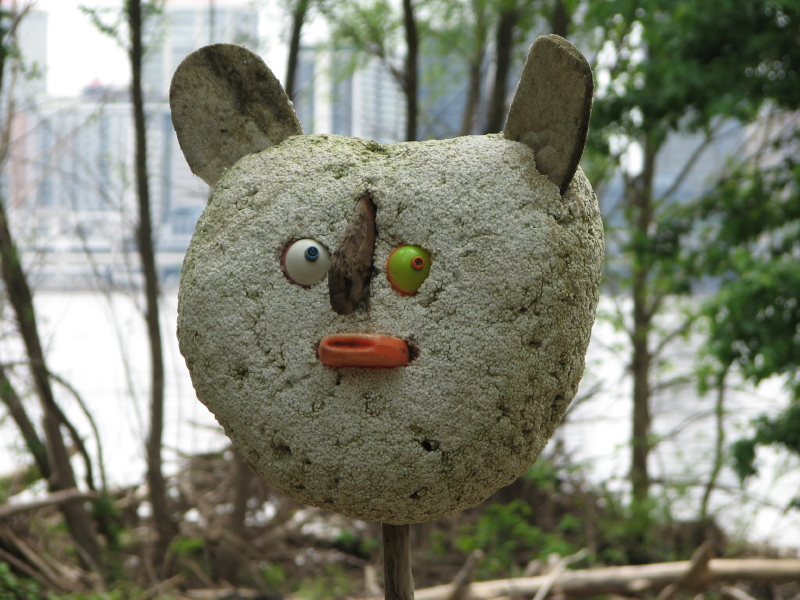
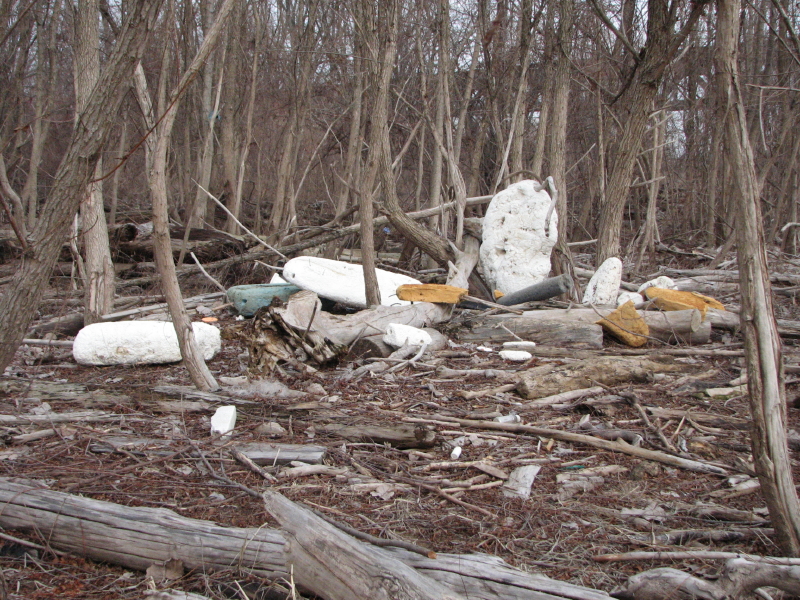
I was in this section of the park because I was searching for larger sections of Styrofoam.  This last bout of flooding pretty well wiped the slate clean as far as the materials that I had collected last year.  There is no shortage of smaller chunks throughout the park, but the larger pieces that are remnants of floating docks were in shorter supply.  I did find this piece that still had wood attached to both sides and set it upright, stelae-style.  Here’s what it looked like right after I assembled it.
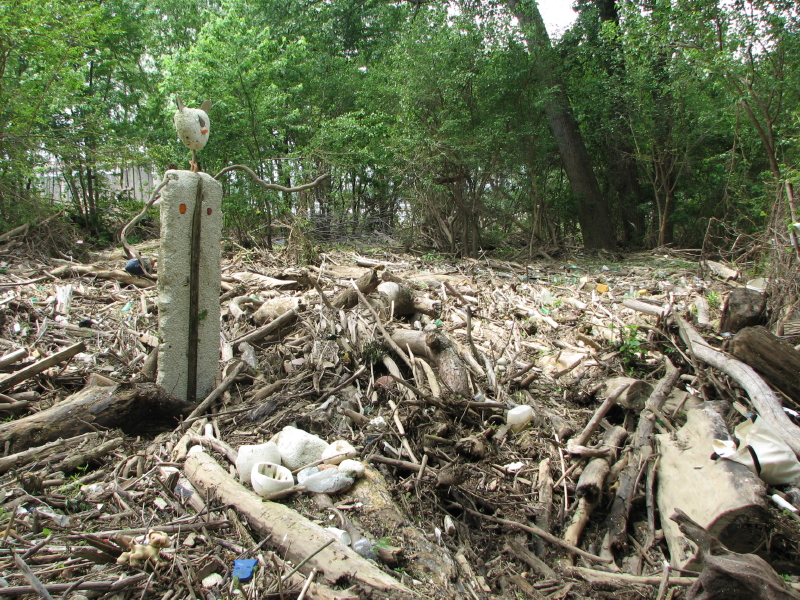
I had the turtle piece going too while this six-foot figure was under construction.  I also happily observed Northern Orioles chasing one another through the Cottonwood Trees.  I taught myself how to imitate the oriole’s song and on occasion can lure a curious bird closer by whistling to it.  I’m still trying to get a primo photograph of one of these birds, but they do tend to stay in the tops of the trees.  Out on the river, I observed a boat going back and forth along my side of the river and I’m speculating that they are looking for some poor lost soul that the river may have claimed?
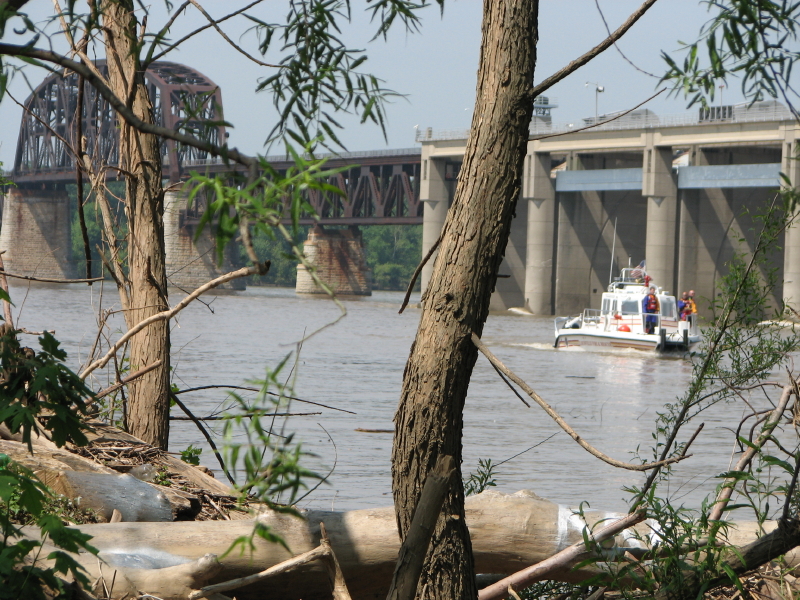
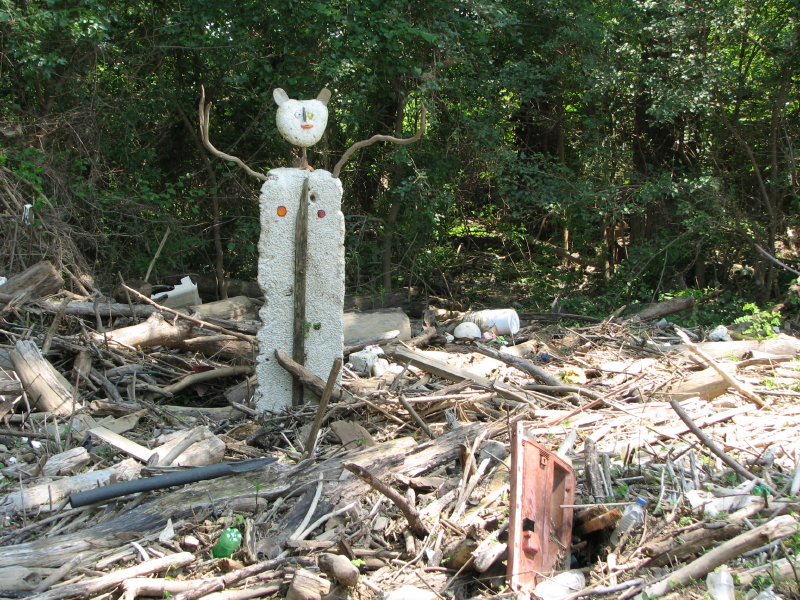
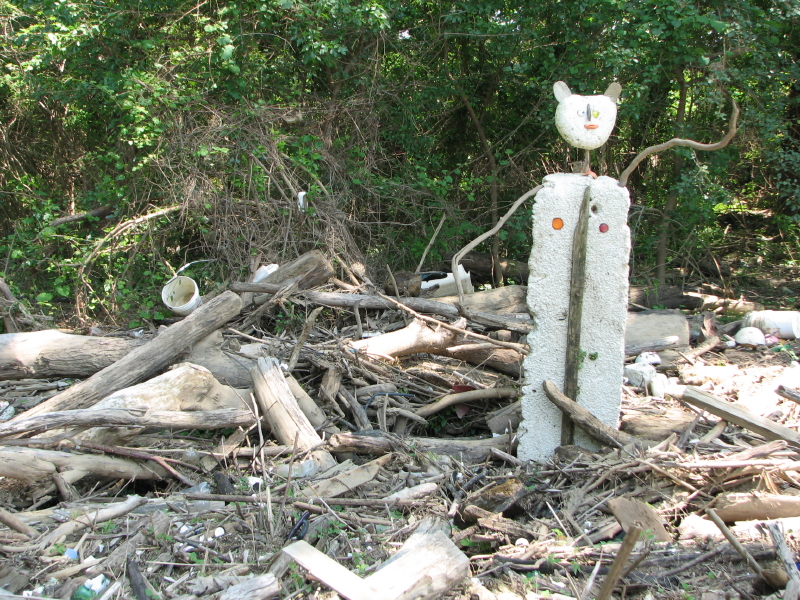
I left my Styro-sentinal in place, but returned a couple of days later to discover it had fallen over.  This time I moved him to a different place facing the river and changed its arm positions a bit.  Originally, he held one of those soft nerf-type footballs.  I haven’t been back since and he may or may not be still guarding this section of the river bank.
Among the items I “found” out here include this ruined Jet-ski.  Which…
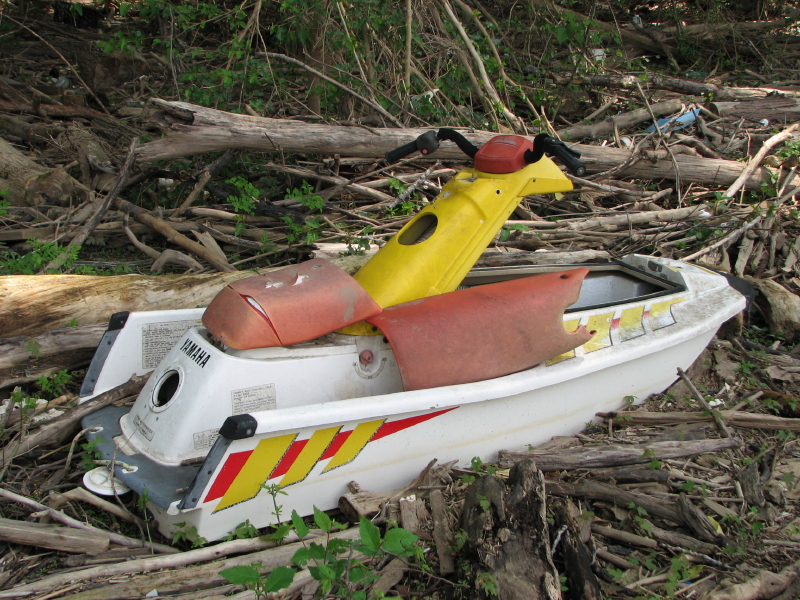
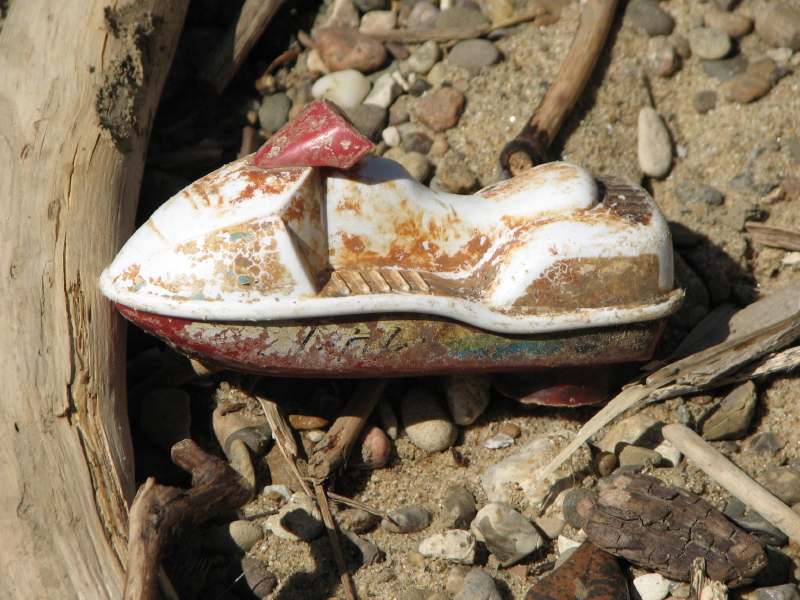
…bookends nicely with the miniature version of it I found in the western section of the park also courtesy of the Ohio River and its recent flooding.
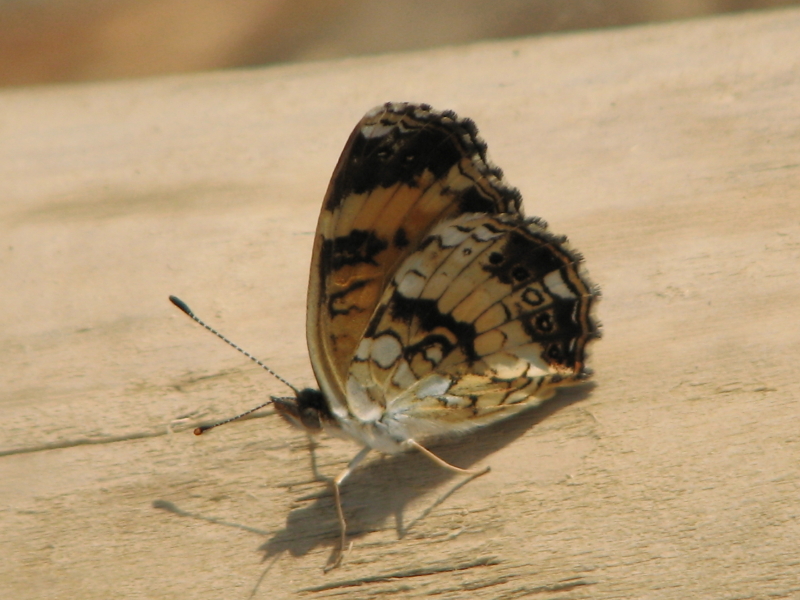
Butterflies and other insects are becoming more prevalent as the season progresses.  I saw what I thought was a familiar butterfly, but wasn’t totally convinced it was the species I thought I knew…so I photographed it and researched it a bit in the comfort of my home.  Here is my first image which shows two of these “different” butterflies.

Here’s a single, resting individual with its wings spread open.  This butterfly shows more black than the Pearly Crecents that are common out here. 

I cross referenced my butterfly guides at home and was glad that I was able to take a picture of this butterfly’s ventral surface because it helps to identify it.  I was leaning towards the Eastern or Harris Checkerspot but decided that this is the Streamside or Silvery Checkerspot (Chlosyne nycteis ). Here is the view that was most helpful.
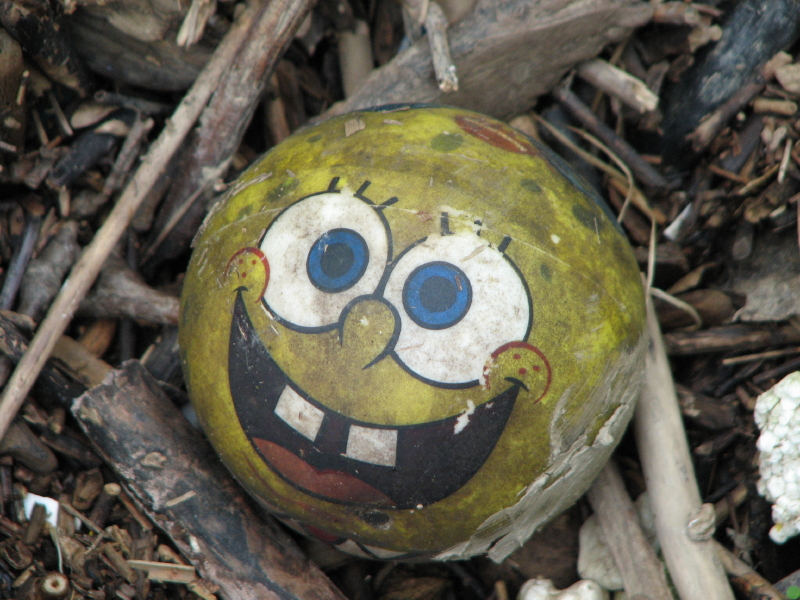
I’m looking forward to seeing many other butterfly species out here this year.  I will try to keep a checklist of what I see just as I do for the many bird species that visit or call the Falls of the Ohio State Park home.  On my way out of the woods, I “felt” something looking at me and after checking around…discoverd these eyes following me which is as good a way to end this post as any!


Read Full Post »

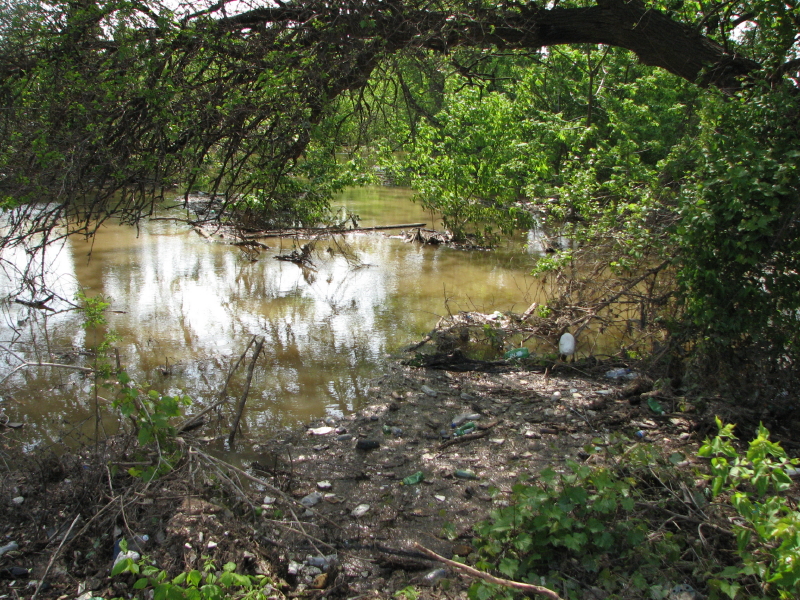
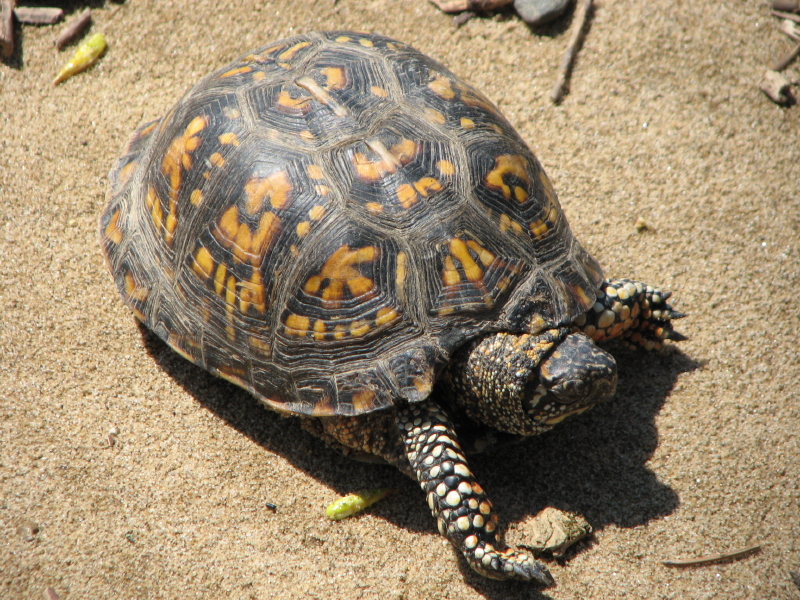
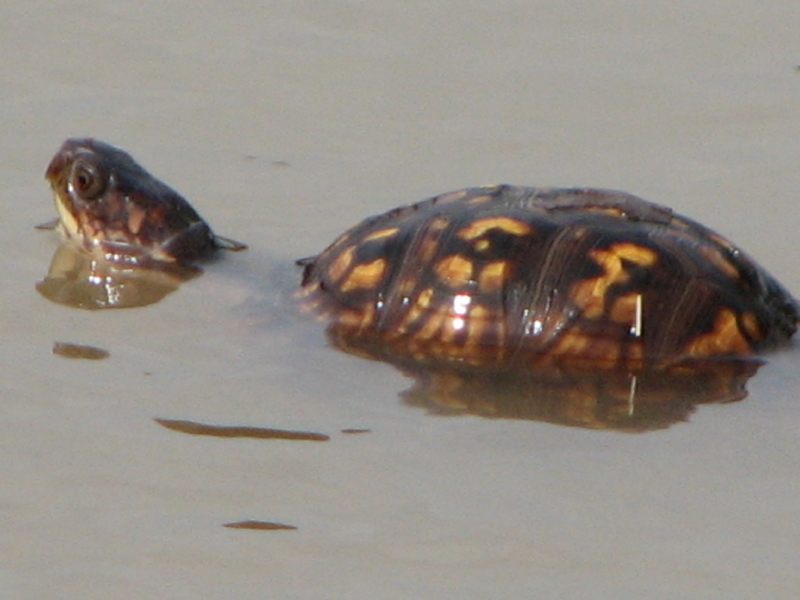
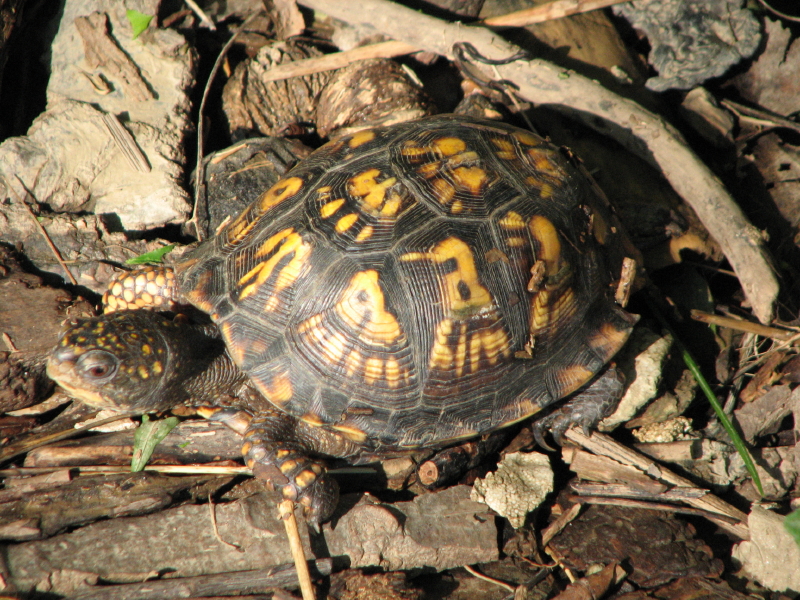
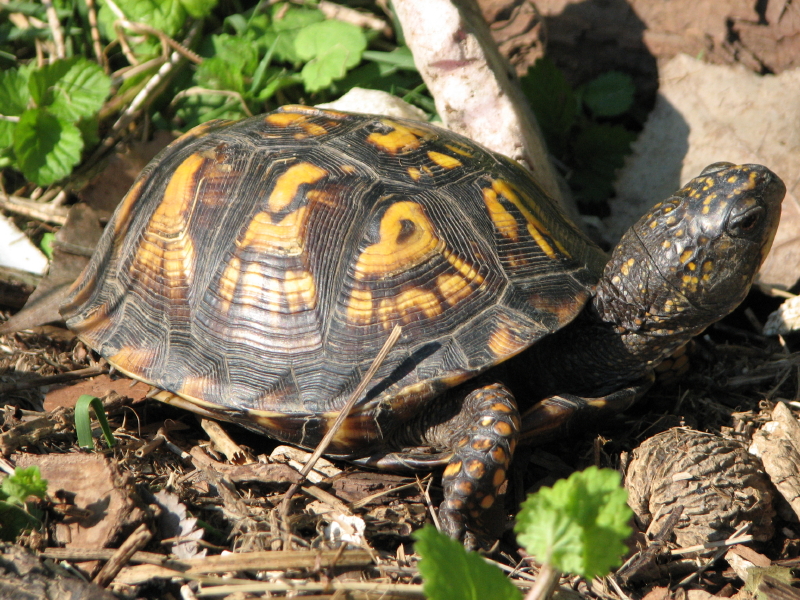
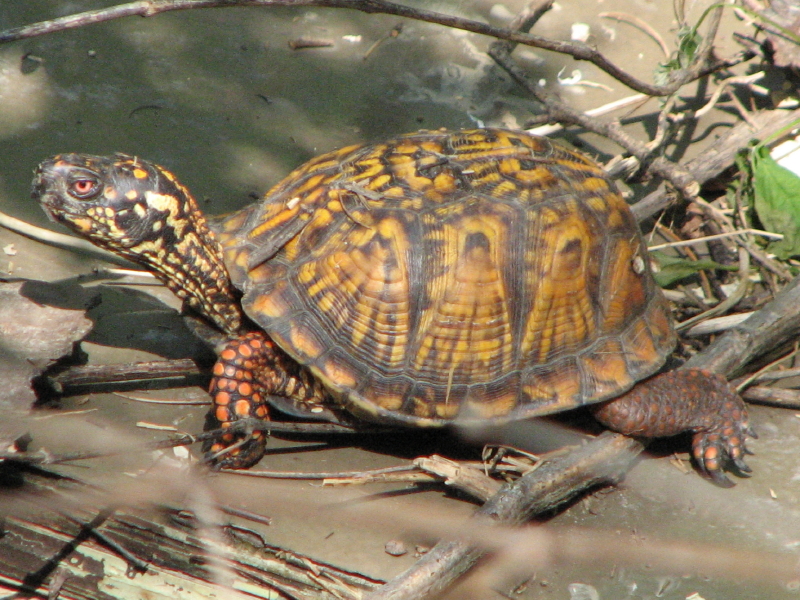
With the record rains and high water at the Falls of the Ohio State Park, 2011 has already become a memorable year.  Of all the wildlife I have observed this Spring, the sightings of so many Eastern Box Turtles (Terrapene carolina carolina) has added to the mystique of this year.  My history with this engaging turtle in this park is slim.  During the eight previous years I’ve come across live specimens only twice.  On two other occasions I’ve found the intact carapaces of deceased turtles, one of which had a pellet-sized hole in its shell.  Their relative scarcity reinforced the idea that although this is a widespread turtle in our country, it was becoming less common for many reasons including habitat loss, road kills, and wild animals collected for the pet trade.  What I’m about to present is a portfolio of eight individual box turtles that I have seen and photographed over the last two months.  No doubt the flooding helped concentrate them in ever shrinking territories and this is why I came to find them.  I tried to be careful in handling and left them where they were found.  The first turtle I came across was in the western section of the park and here are two images of it.

This one was found after the first flood.  It has really interesting and colorful beading on its neck.

The Box Turtle #2 was found swimming to higher ground during the height of the second flood in May and in the eastern section of the park.

Box Turtle #3, I found twice in the same day in the eastern section of the park.  Here is what it looked like. Note that the second scute bears what looks like a lower case letter “a” on its shell.

And now for the opposite side of turtle #3…

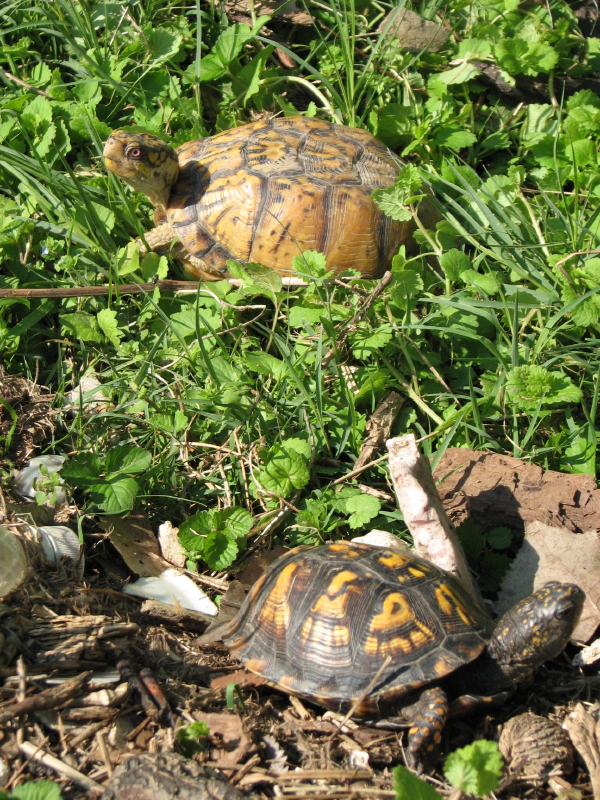
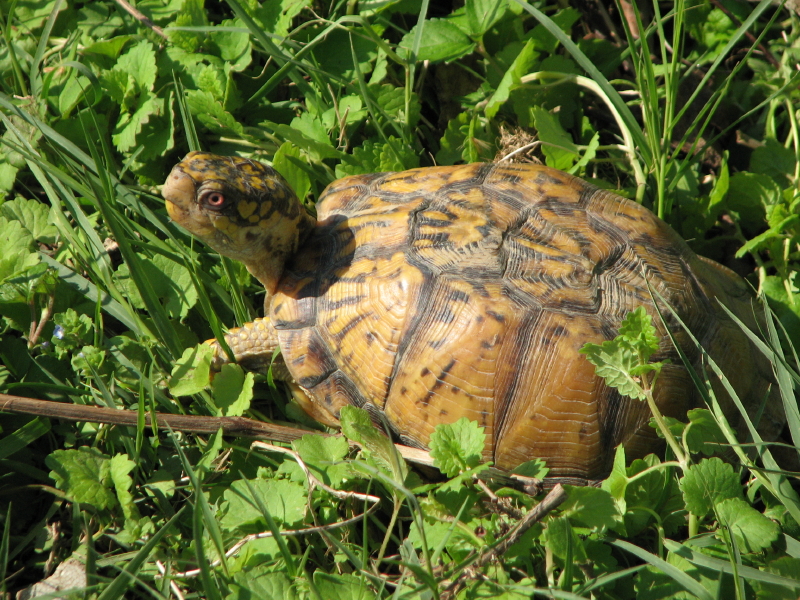
Here’s the same turtle the second time around and this time he has found a friend!

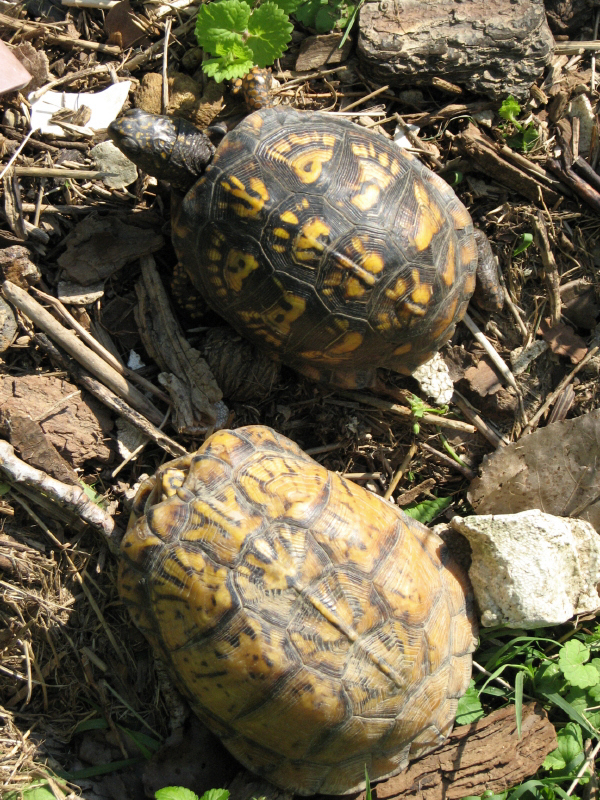
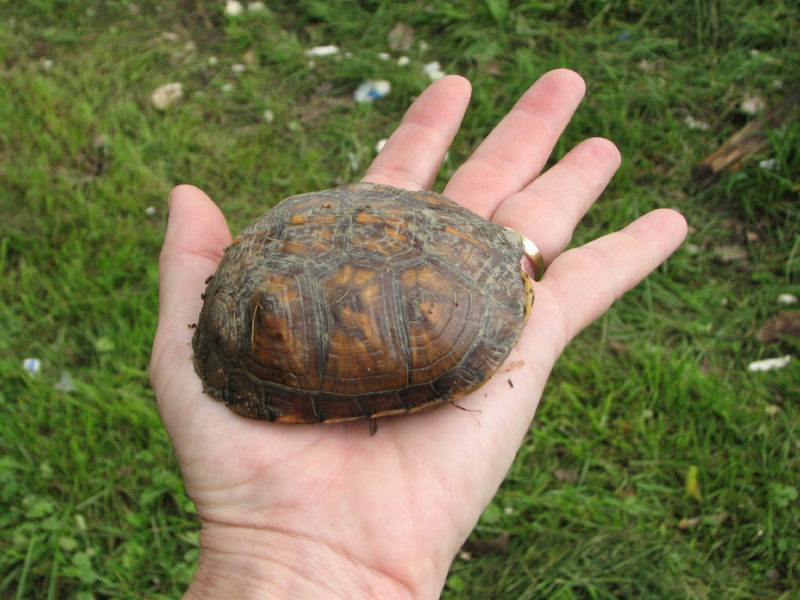
At first I thought this was a male and female turtle, but I didn’t check anything but eye color which in this case was on the red side indicating the chance they were both male.  When I came across them, they were certainly aware of each other.  The larger of the two box turtles may have been the older specimen based on how worn its shell was.  I’ve heard that counting the growth rings on these turtles is not a reliable way to determine their ages.  My field guides indicated that this is a long-lived turtle with individuals easily living to 40 to 50 years and in rare cases possibly a 100 years old.  Here are three images with Box Turtle #4.

Box Turtle #5 …I only have one image of it mostly retracted in its shell.  This one is also from the eastern section of the park. 

Box Turtle #6 is very colorful and was found near the Interpretive Center during the height of the flood.  Although it’s hard to tell…it’s standing on the remains of a refrigerator that floated in with the Ohio River.

The next two turtles are the smallest ones I’ve found thus far and each was found in the eastern section of the Falls of the Ohio State Park.  This is Box Turtle #7.

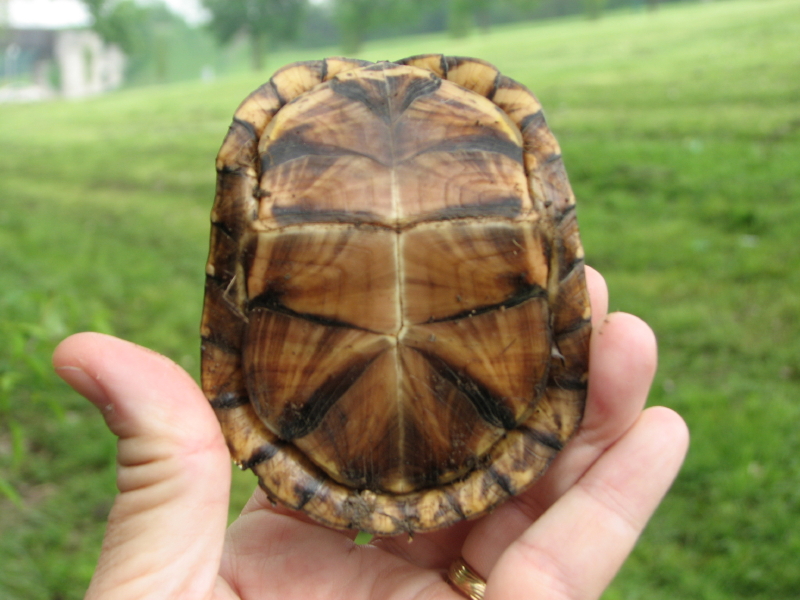
Here’s the underside of the same turtle showing the plastron and the hinge that allows the box turtle to completely hide inside its shell.

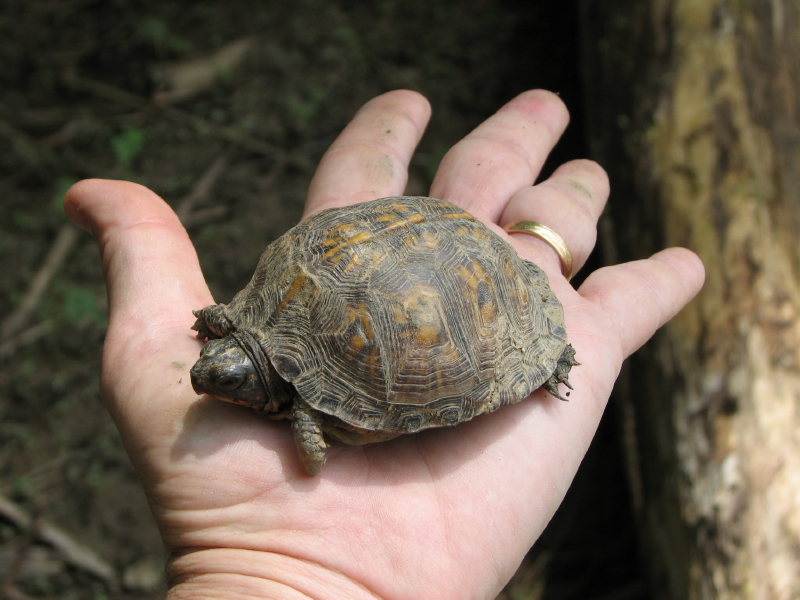
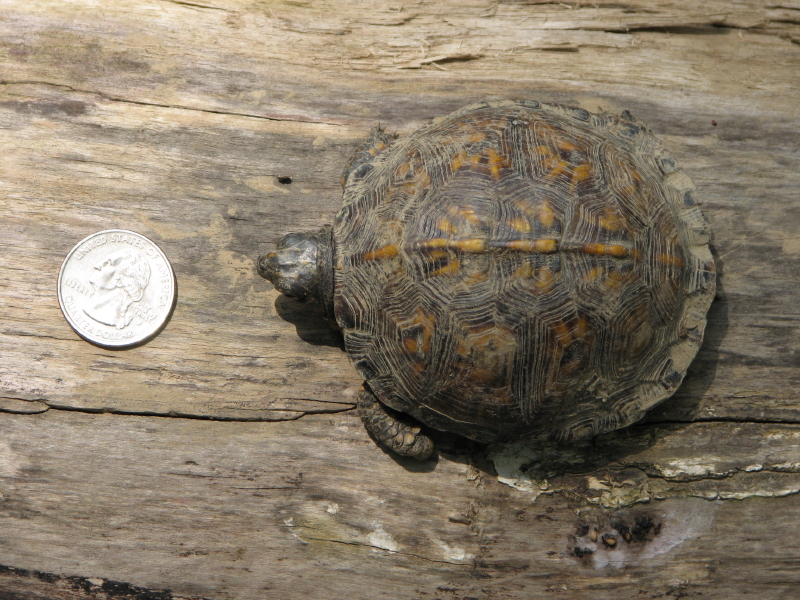
To close, I have three images of Box Turtle #8 and its the smallest yet.  One other thing I noticed about this little guy was that it was missing part of its left front foot which had healed from whatever injured it.

Another image to help provide scale using a quarter for a guide.

Of all the info I learned about box turtles, the fact that most surprised me is that if left alone they can live their entire lives in a relatively restricted area the size of a football field. They become so habituated to this territory that if they are moved from their familiar surroundings they can become dislocated and fail to thrive.  This is a good reason not to take these turtles out of the wild. I placed #8 on the ground wishing it well.  It pleased me knowing that there were at least this many box turtles in this small park.  I wonder how many others I will come across before year’s end?

Read Full Post »

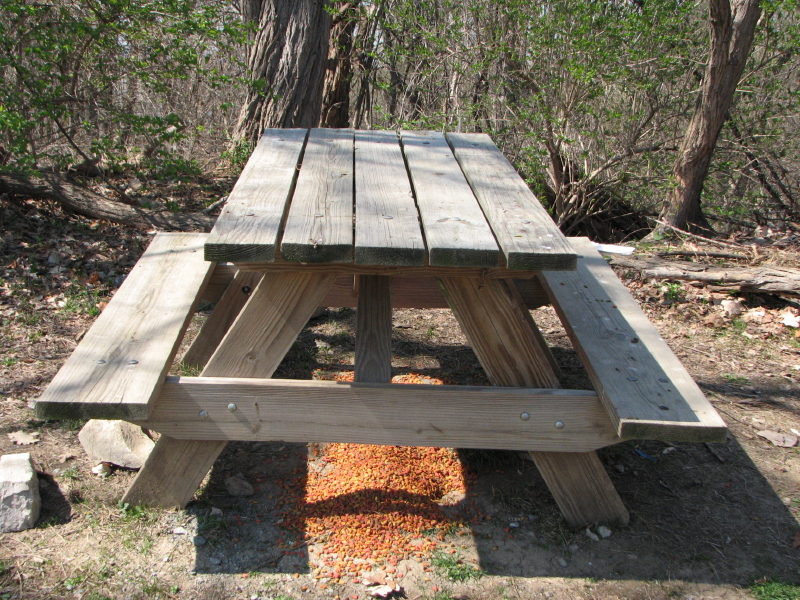
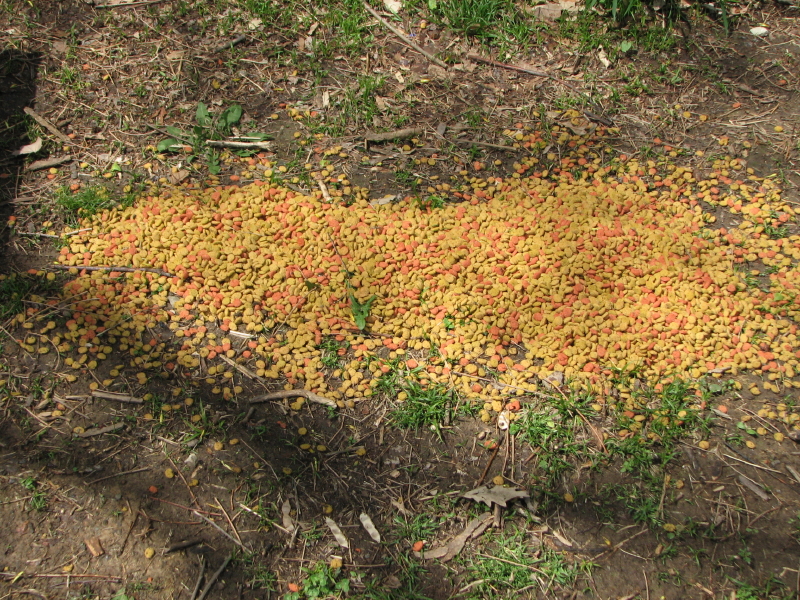
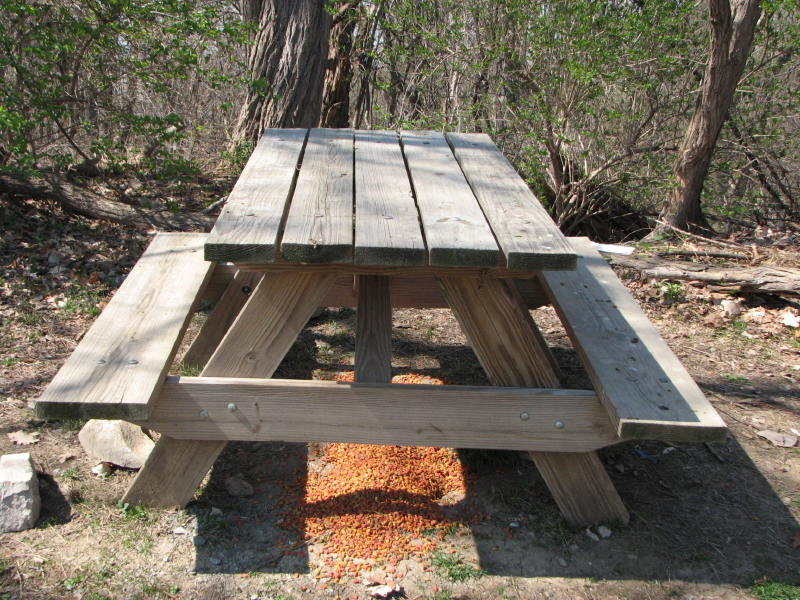
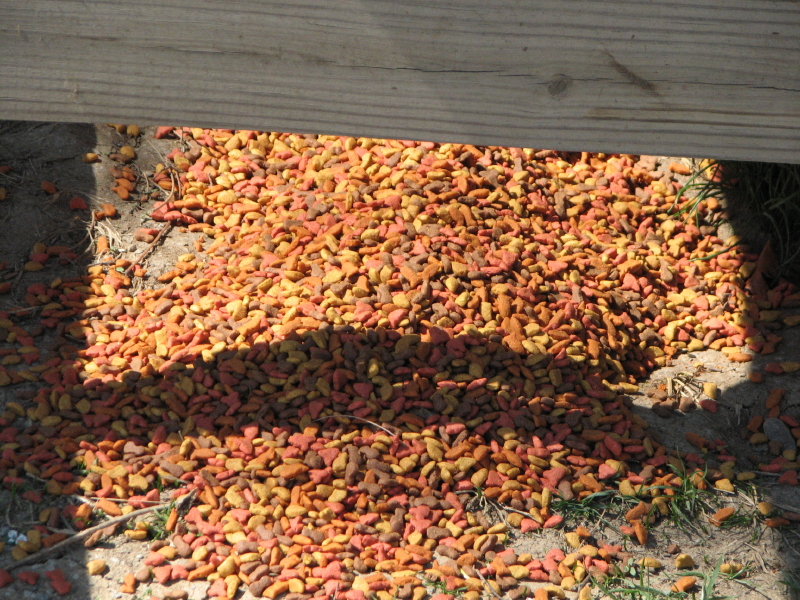
Regular visitors to the riverblog know that I comment on everything that doesn’t belong in this environment which takes in more than man-made debris.  Invasive species, non-native species, and domesticated animals turned loose are changing the ecosystem too.  Recently, I posted about the growing feral cat problem I’ve been observing in the park.  Kind hearted people have been trying to take care of them by dumping dry cat food around the picnic tables near the Interpretive Center.  As a reminder, here is another photograph illustrating this.

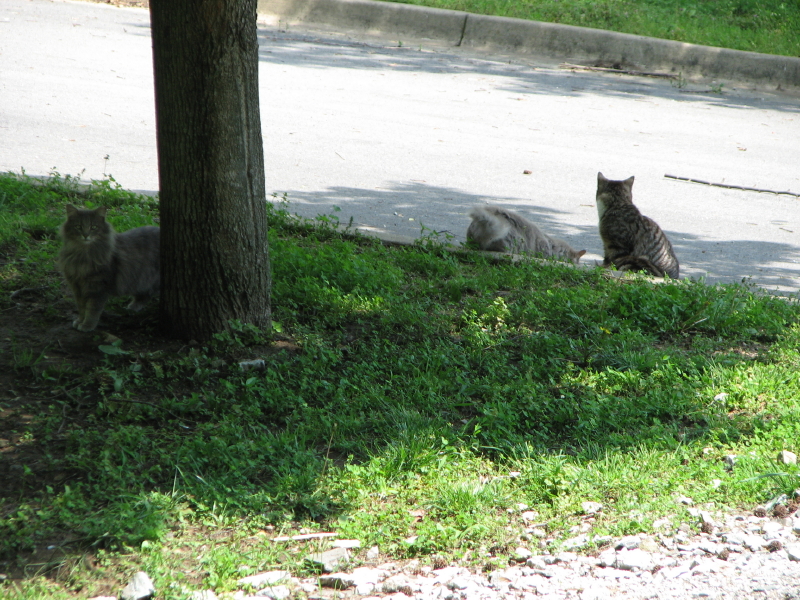
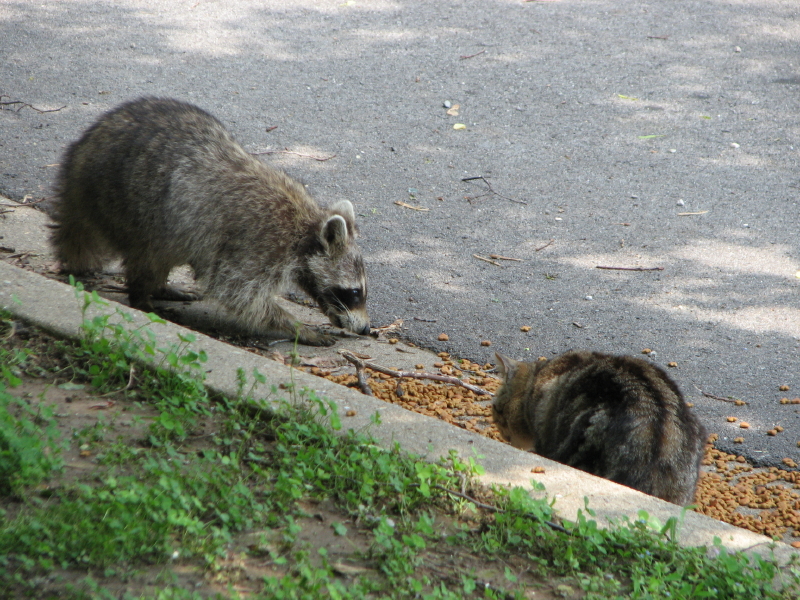
Sometimes I see what seems to me to be a ridiculous amounts of food spread out in this area.  Returning from a hike in the park’s western section, I stopped to watch three cats that were eating dry cat food that had been spread along the curb of the parking lot. 

From the corner of my eye I saw something moving in the brush and thought it might be a fourth cat joining in the feast…but it wasn’t.

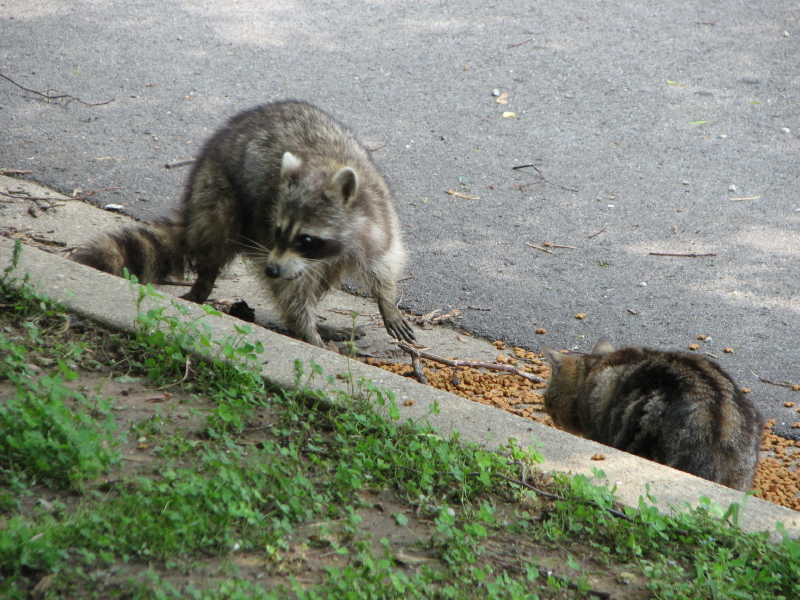
It was a raccoon and only the second one I’ve seen in broad daylight out here.  Usually, these animals are more reclusive than this and prefer to operate under the cover of darkness, but here was this adult raccoon making a bee-line for the cat food.

I don’t view this as a good thing for all species concerned here.  Granted, the high river was probably cutting off some of the territory that the raccoon would forage over and this animal was hungry.  Wild animals that become habituated to man usually don’t fare well.  And in this case, there is a real danger that if this raccoon had rabies…it could transmit it to the cats who regularly come in contact with people.  By being out in broad daylight near an area populated by people, this raccoon was already displaying atypical behavior.

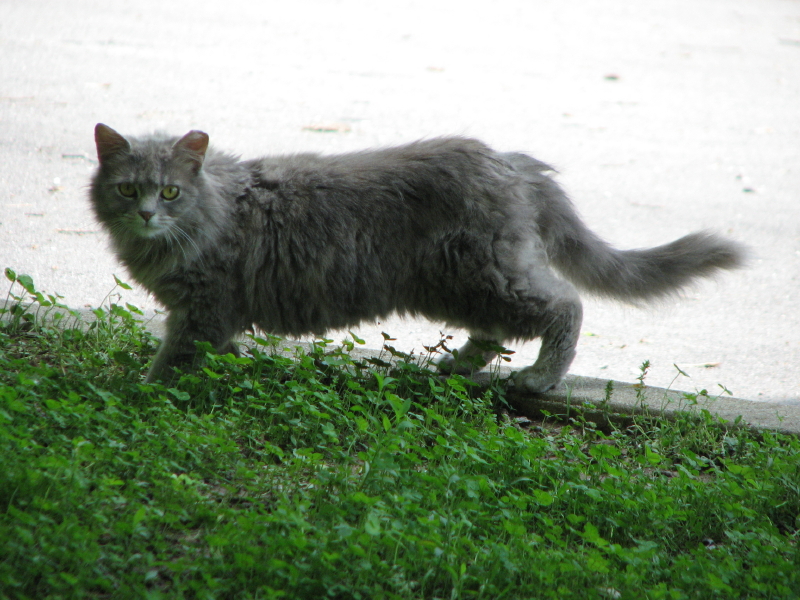
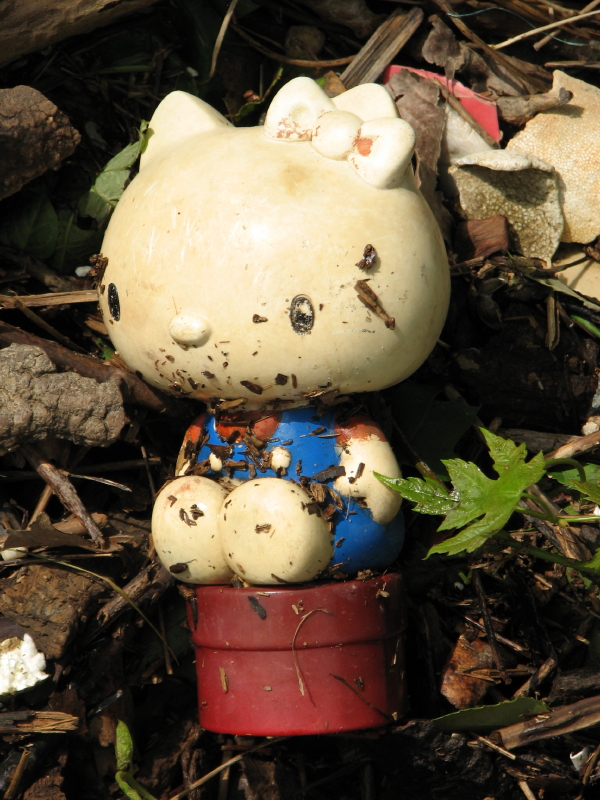
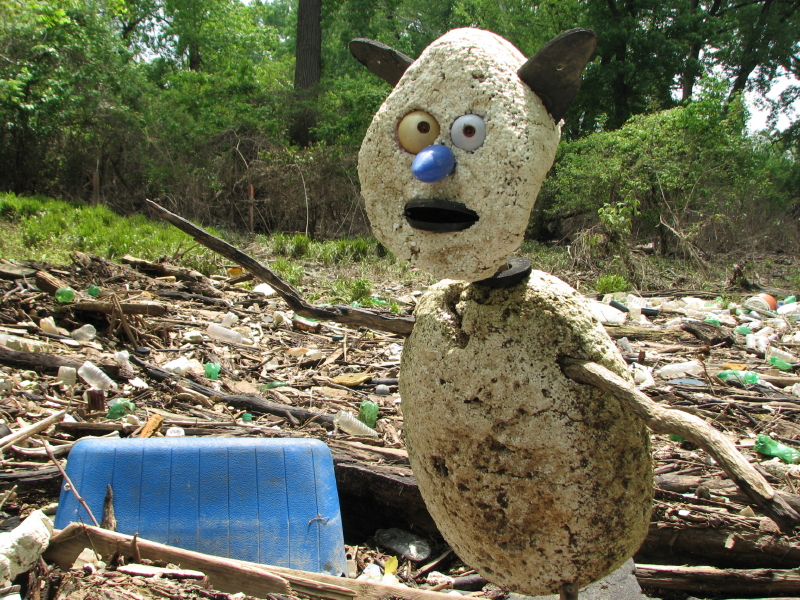
To my eye, the cats seemed less wary than the raccoon who is supposed to be a wild animal.  This scene was broken up when visitors with a dog on a leash came too close and the cats and coon ran into the woods.  I’m confidant that whomever is dumping cat food out here is not thinking about unintended consequences…but they should.  I’m not against cats, but I don’t think we should encourage them to live near wild life.  Recently, I found two objects left behind by the flooding that illustrate our affection for felines and I’ll end this post with them.  Until next time.


Read Full Post »

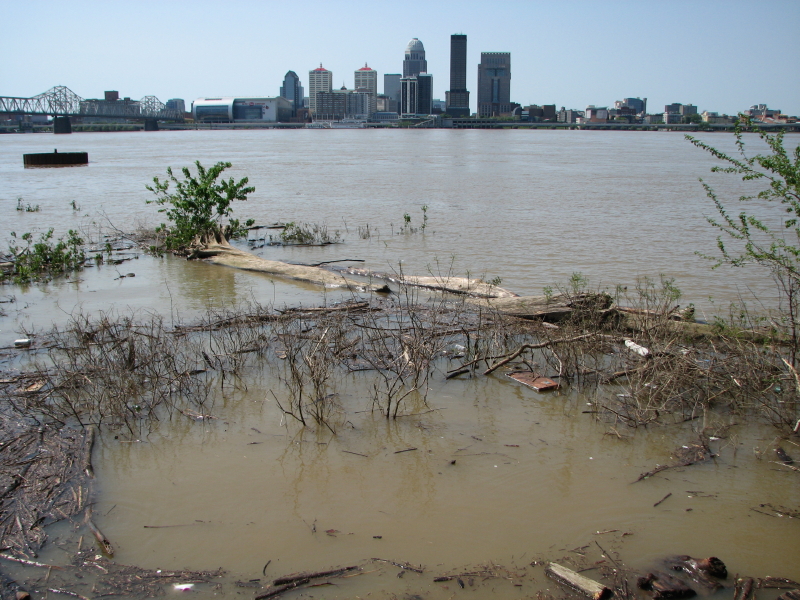
The Ohio River has receded by the Falls of the Ohio.  For many weeks the river was loath to relinquish the territory it had recently flooded.  I ventured down the river bank and explored the more eastern section of the park.  The following post is some thoughts and images made during this expedition into a very moist and muddy area filled with debris and wildlife.

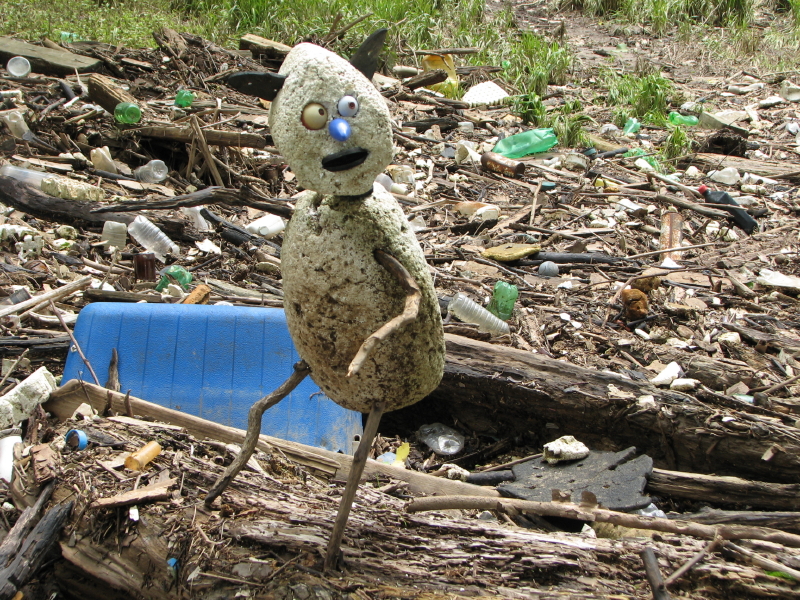
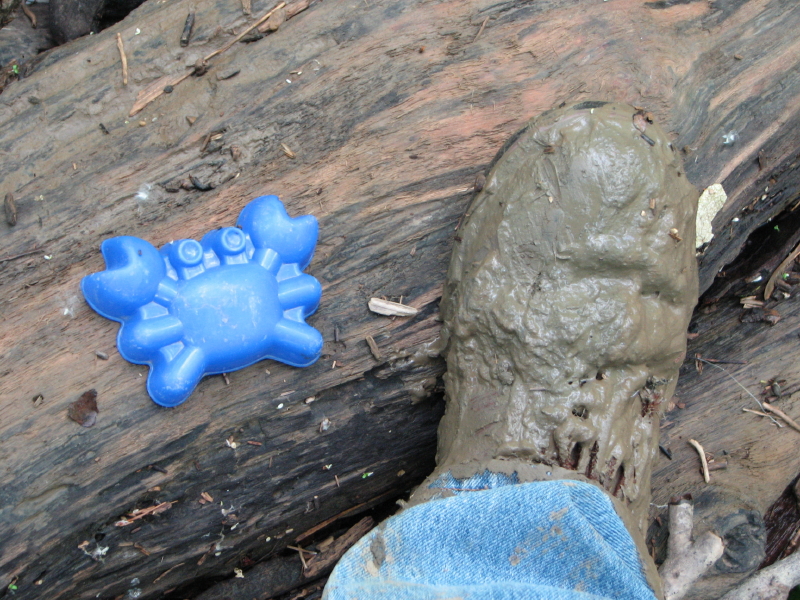
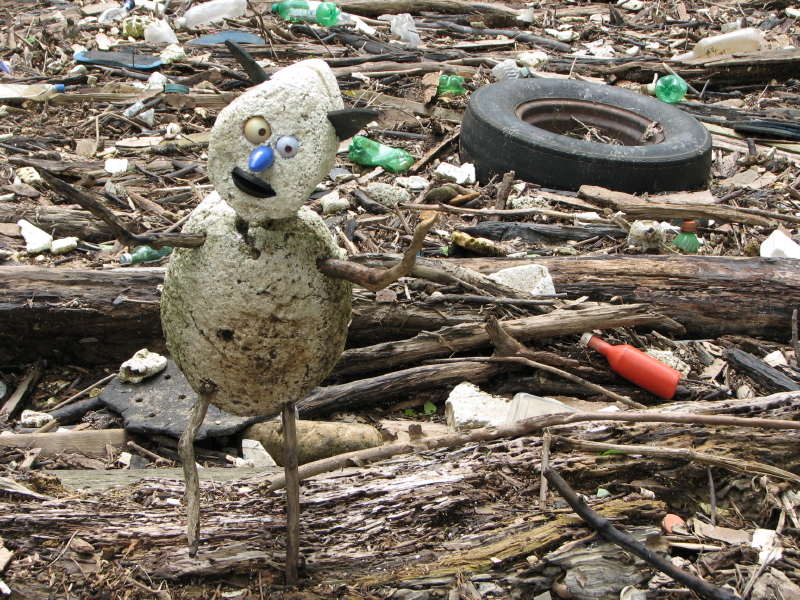
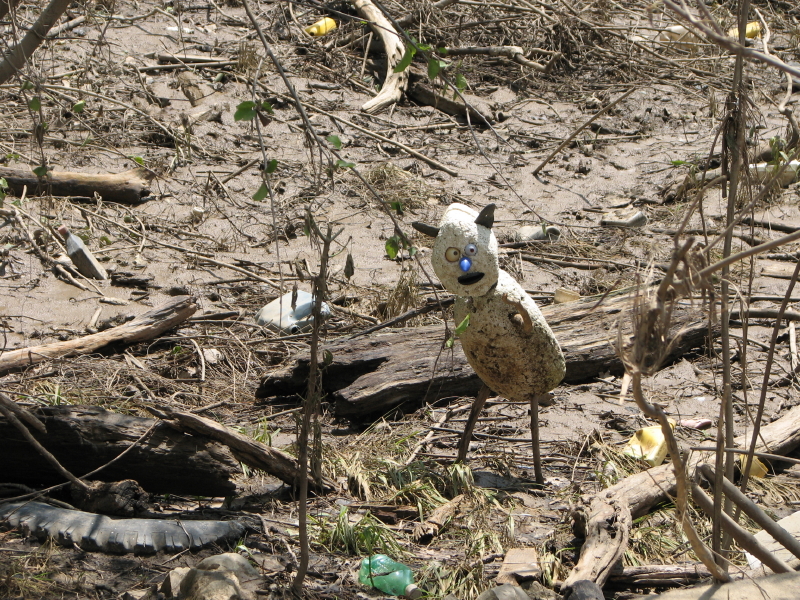
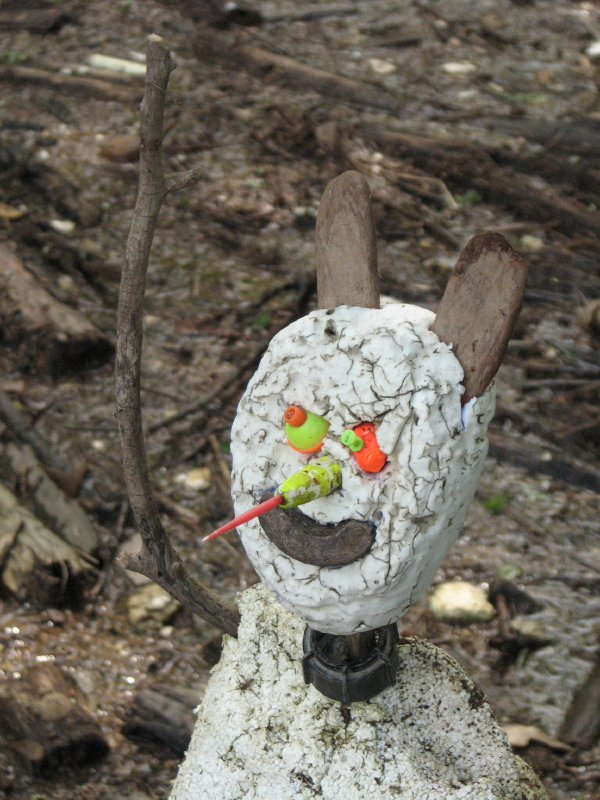
While exploring the park it is not unusual to run into others who are curious to see what the river has left behind.  Sometimes just a nod of recognition and some small gesture to reassure that one poses no threat is made and each party then attends to their own business.  And then sometimes a more sustained conversation occurs where information of mutual interest is exchanged.  Such was the case on this trip where I ran into this fellow of short stature with a bulbous blue nose who had been investigating the same stretch of river as me.  We tagged along with one another for a short time before family duties called me home.  I believe our initial conversation had something to do with the muddiness of the area.  In places, things looked safe and dry enough to stand on…and then the mud below would reach up and grab you by the ankles.  Sometimes small, blue crabs would pop out of their holes to check out whether the trapped parties would be good to eat.

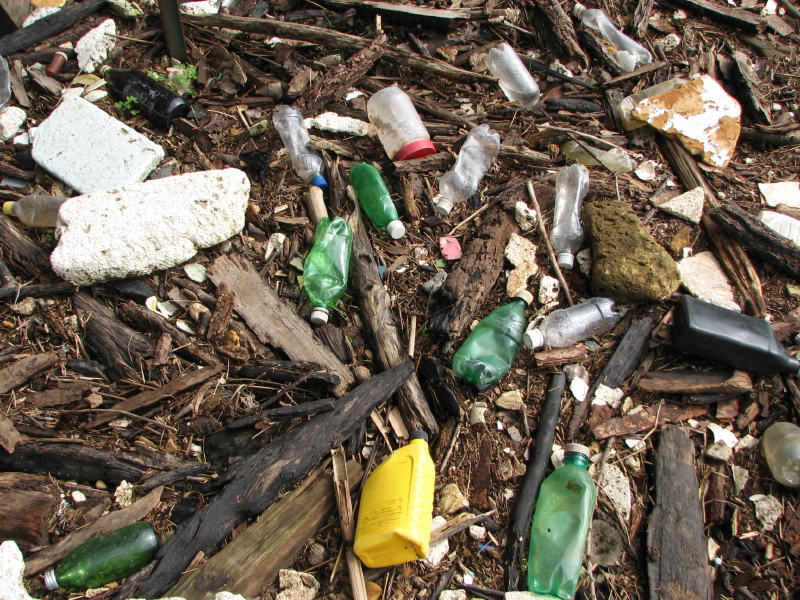
In my case, I am simply too big for them and once the crabs realized this they scuttled away.  Getting back to “Mr. Blue Nose”,  (funny how we didn’t think to ask each other’s name?), we were both astonished by the debris left behind by the retreating river.  After witnessing several other high water incidents over time…this is fairly representative of the stuff we found.

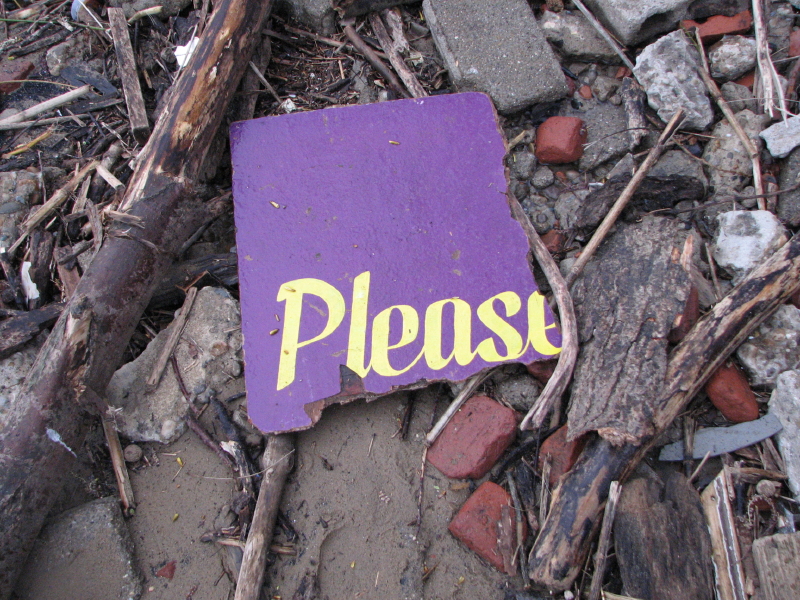
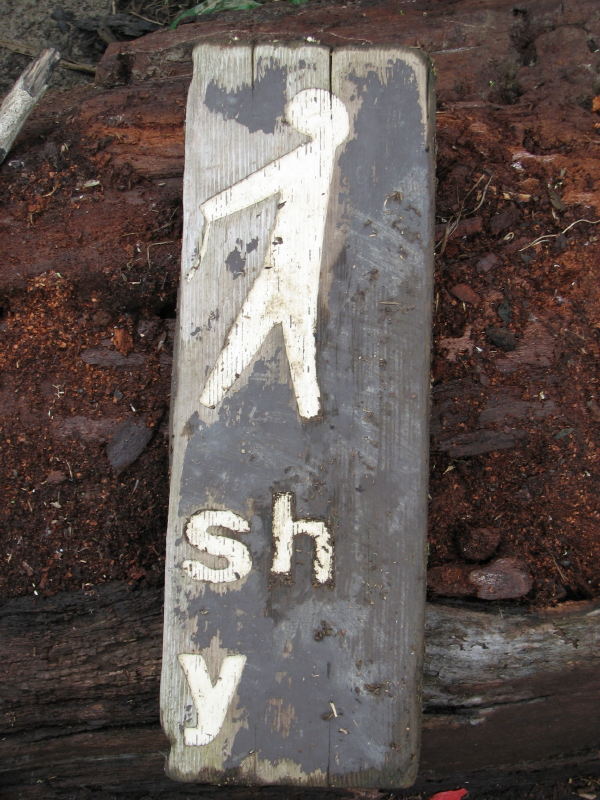
As you can see it’s mostly plastic containers, polystyrene (aka Styrofoam), and lots of shredded bark and wood chips.  Every once in a while, something more interesting would turn up.  While exploring, Mr. Blue Nose and I found two sign fragments and I kept these for my Found Painting and Sign Collection.  Here are the two precious finds.  The first one is kind of self-explanatory.  I like to muse that this is one way the universe communicates to me by leaving these things in my path for me to ponder.

I’m not sure what it is asking…Please don’t litter or Please, only you can prevent forest fires, whatever its actual message, this is at least a polite sign.  The other one is more reclusive, in fact it is “shy”.  Here’s a picture of this enigmatic sign.

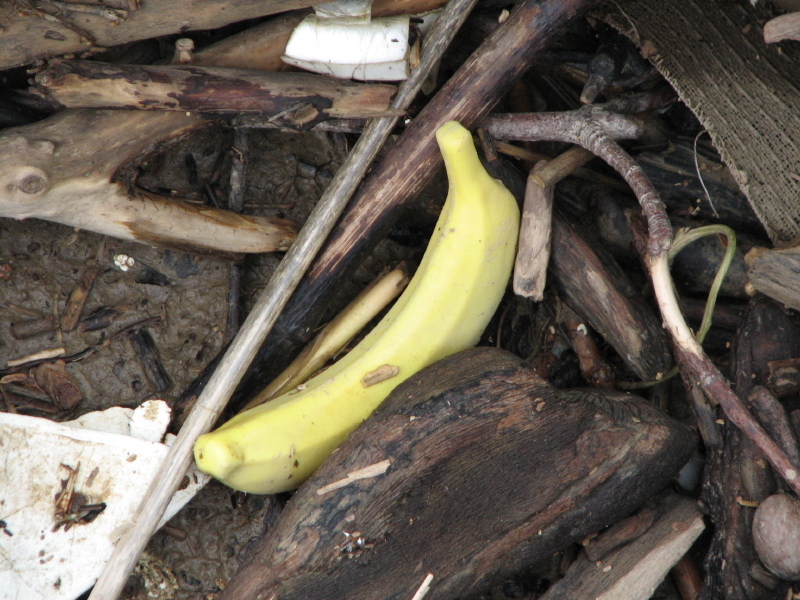
I like the hand-routed and painted “sign” for a person.  I think this fragment may originally have asked dog owners to leash their pets…but its shy and won’t tell me for certain.  Other found treasures included my second banana of the season…naturally it went into the old collecting bag to later join the other artificial produce I have found out here over time.

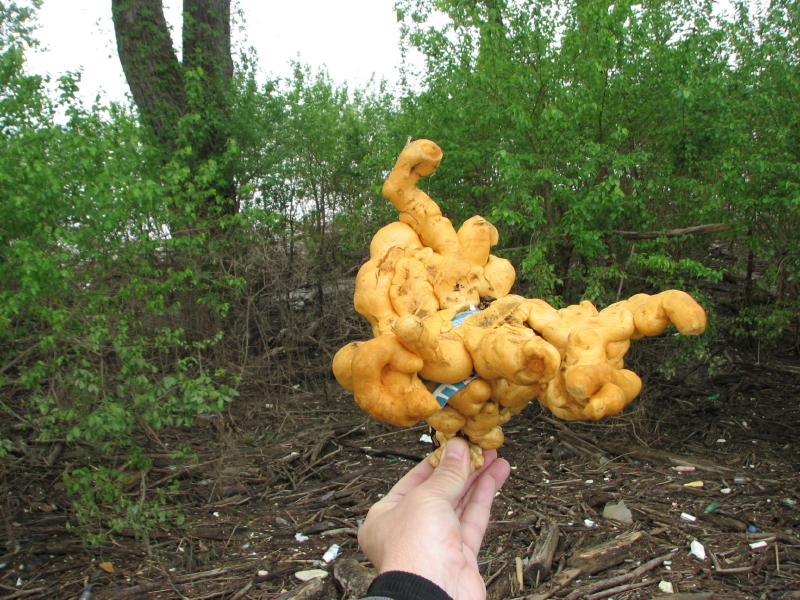
I also find other kinds of foam out here.  Here’s an interesting found sculpture made from polyurethane.  I have come across busted aerosol cans of this stuff where the foam has expanded out resembling entrails.

Mr. Blue Nose called my attention to a log that something had torn into and he wondered what could do this kind of damage.  Chunks of bark and soft decayed wood were scattered all around. 

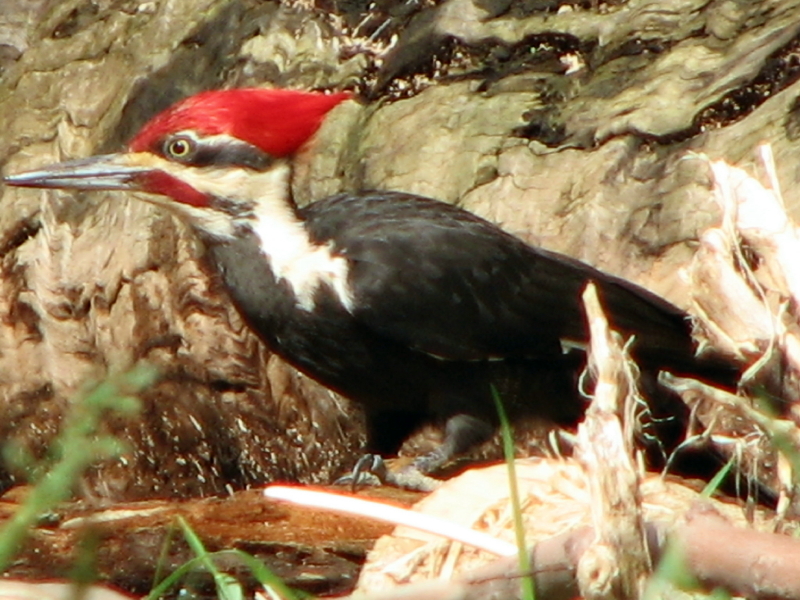
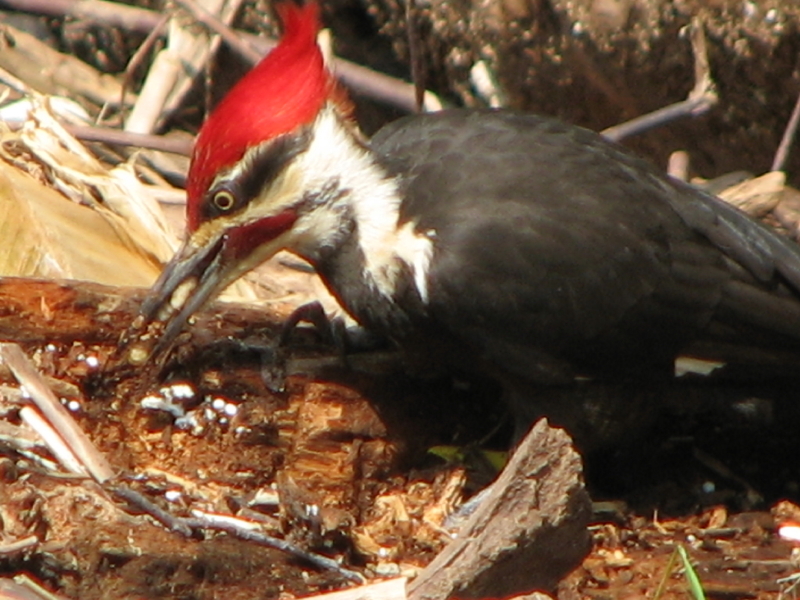
I was happy to inform my new friend that this looked like the work made by a Pileated Woodpecker and I showed him images of this great bird I had taken just a few hours earlier.

Since no one can verify that the Ivory-billed Woodpecker is still alive along some wild river in Arkansas…the Pileated Woodpecker has the distinction of being our biggest living woodpecker.  For years, I have observed a pair of these crow-sized birds in the park.  This one is the male and can be identified by his red mustache.  The female lacks this and has more black on its head.

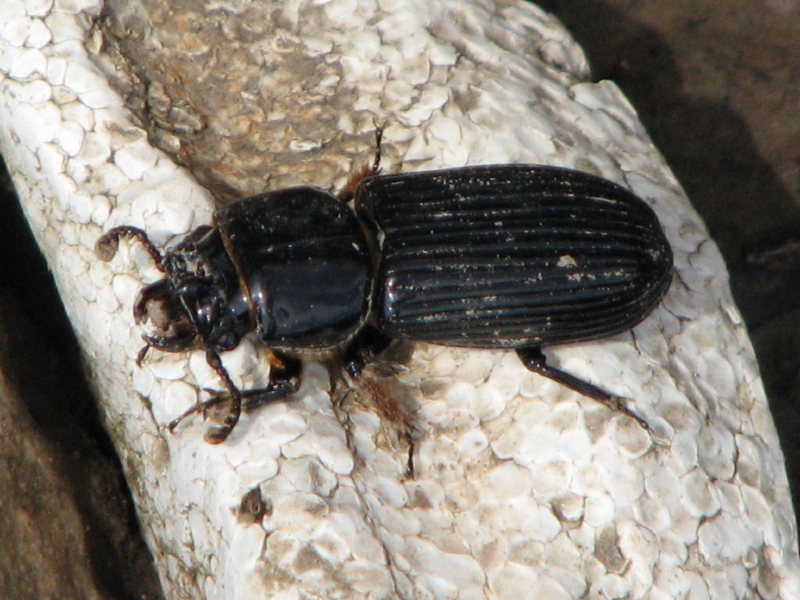
The Pileated Woodpecker has a large bill that goes through wood in a hurry.  Carpenter ants and beetle larvae can be found in these decaying logs and make up the main diet of this magnificent bird.  If you look closely at the photo above you can see a nice grub about to be swallowed.  This bird was so intent on looking for food that I was able to get closer than usual to it.  A couple of weeks a go, I found a Bessbug beetle which is a nice sized insect that uses decaying wood in its life-cycle.  This beetle is also known as the Patent-leather Beetle.  Here’s an adult I found sunning itself on a piece of Styrofoam.  These beetles can get nearly two inches long or about  five centimeters.  I wonder if our country will ever adopt the metric system?  Anyway, these beetle grubs make nice woodpecker snacks.

Thanks to my new companion we were able to make one other nice bird sighting on this day.  Mr. Blue Nose alerted me to some commotion happening in a nearby stand of trees. 

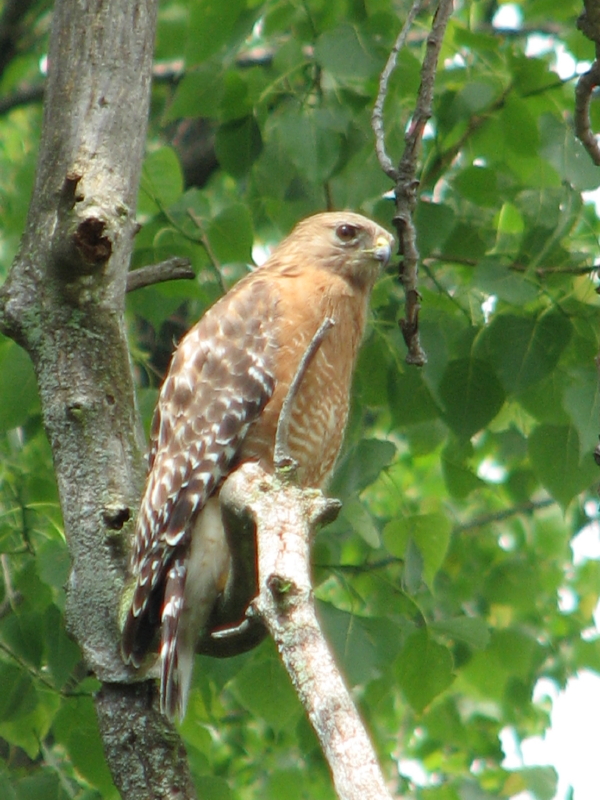
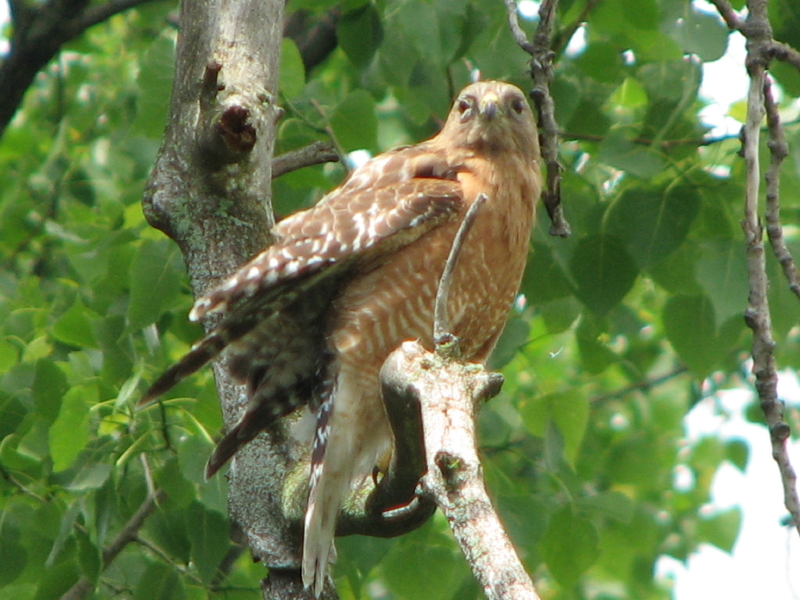
My friend said that he saw several blackbirds (grackles) chasing a larger bird from tree to tree.  I have observed this behavior before when birds of prey are present.  I gathered my camera up and went to see if I could find out what was the object of all this attention.  It turned out to be this beautiful Red-shouldered Hawk.  Here are a couple of pictures of it before the smaller birds drove it out of the area.

I always feel lucky when I see such beautiful birds in the park.  Before flying away, I saw this bird’s mate arriving and the two flew away together.  Soon it was time for me to fly away too and I left my companion on the river bank.

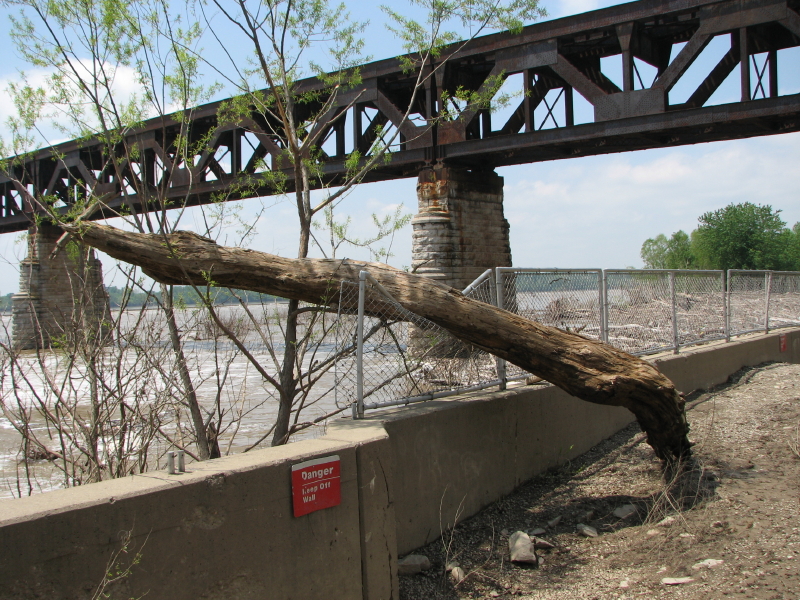
We parted near the railroad bridge and perhaps we will see one another again?  My last image is from an overlook area popular with visitors who want a better view of the tainter gates.  I have taken many pictures here over the years, but this one is different.  To give you an idea of how high the river was…this log was deposited on the fence by the retreating river!  Or, I hope so…I would hate to think it jumped up here!  So long for now!!

Read Full Post »

As usual I’m a bit behind in my river reports.  I calculate I could write at least several more posts about the flooding we have experienced with the Ohio River at the Falls of the Ohio.  As I write, the river is still high, but all the attention has shifted to the Mississippi River which is experiencing an epic flood.  I’m sure some of the same water molecules that flowed past our location are contributing to the woes down along the Mississippi.  For those unfamiliar with our geography, the Ohio River flows directly into the Mississippi River in far western Kentucky.  The confluence of these two great rivers is an awesome sight.

Here at Louisville, the water has been receding and the amount of water-borne junk this flood has brought hasn’t fully hit home yet.  There are signs, however, everywhere I look that this will be a great challenge for any river loving clean-up crew.  I will try to do my part, but even if I were to try to be out here every waking hour…I wouldn’t  begin to scratch the surface.

Gas is over $4.15 cents a gallon for regular unleaded here.  I listened to the great oil company executives trying to explain to Congress today why they need a sweetheart deal from the American taxpayers when they already receive every tax break in the books and are suffering with their record, obscene profits.  When discussion turns to what can be done to reduce the amount of crude oil used the usual answer has something to do with increased engine efficiency resulting in more miles to the gallon.  Looking at the high water line I see another solution that doesn’t get as much play.  Why don’t we try to cut as much plastic out of our way of life as possible?  There would be more oil available for fuel and you wouldn’t have all these various compounds despoiling our water ways from the smallest streams to the largest ocean.  You can throw Styrofoam in this mix too since it is has petroleum pedigree as well.  We could just change the packaging we use and I bet that would make a huge difference.

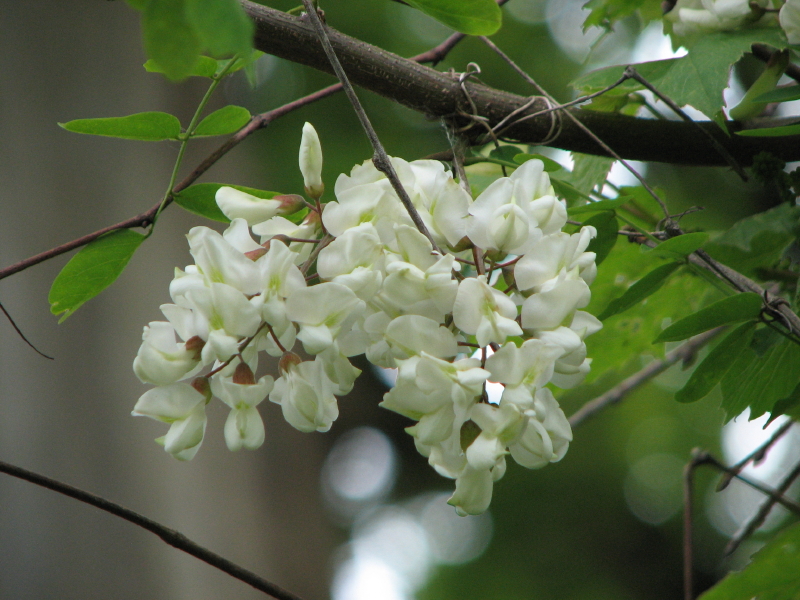
You can look at the whole Riverblog as one long rant against pollution, but there is also more out here that is sweet and worth noting and enjoying.  I decided to walk along the Woodland Loop Trail and the air was fragrant with the perfume from what we call Honey Locust trees.  Some of these trees also sport large spines growing on the bark.  Their pea-like white flowers have the most wonderful scent.  Here is what a flower cluster looks like.

Along the trail, you can hear a variety of bird species singing.  Vireos, woodland warblers, orioles, chickadees, indigo buntings, various thrushes fill the air with their acoustic signatures.  The birds are here to feast on the many cutworms that plague the forest canopy.  There are also other larvae present…here is a small nest of tent caterpillars that will soon become moths.  Very few birds like these hairy caterpillars, but two that do ( the Yellow-billed cuckoo and the Blue and gray gnatcatcher) can be found in the forest now.

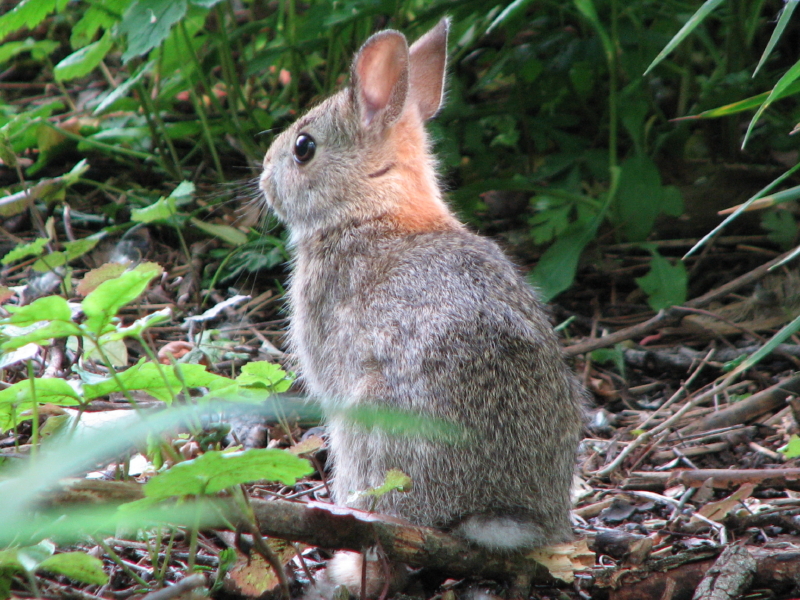
Ah, I also spot my namesake hopping along the trail!  This is a young Cottontail and he better be careful out here because there are so many predators both native and domesticated that would love to catch him!

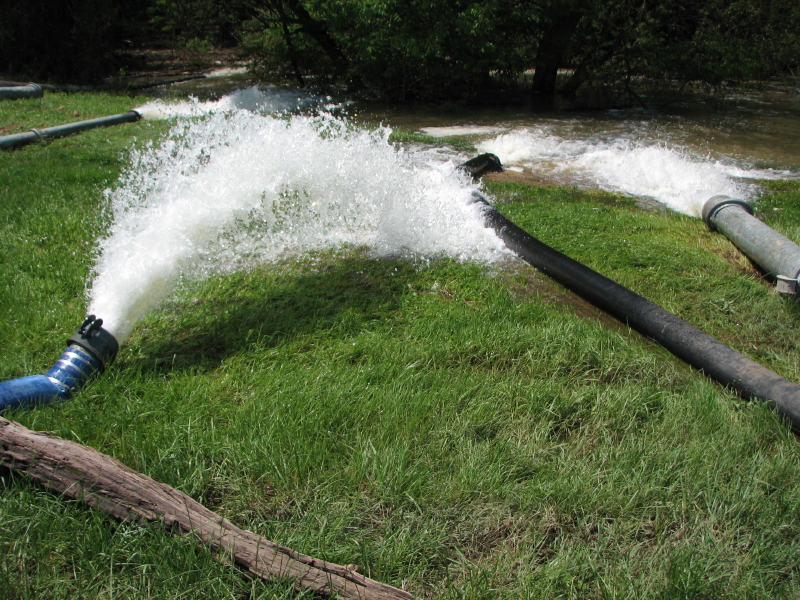
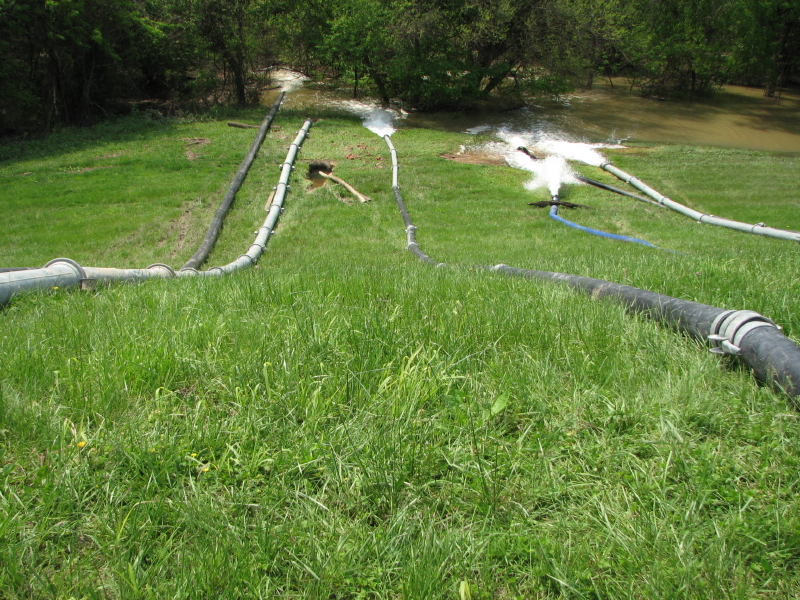
Walking westward along the trail, you can’t help but notice the large grassy berm that flanks your right side.  It is additional flood control put in place after the disastrous 1937 flood which was our high water event on the Ohio River.  Up a head, I can see a network of large hoses with water gushing out and I decided to investigate.

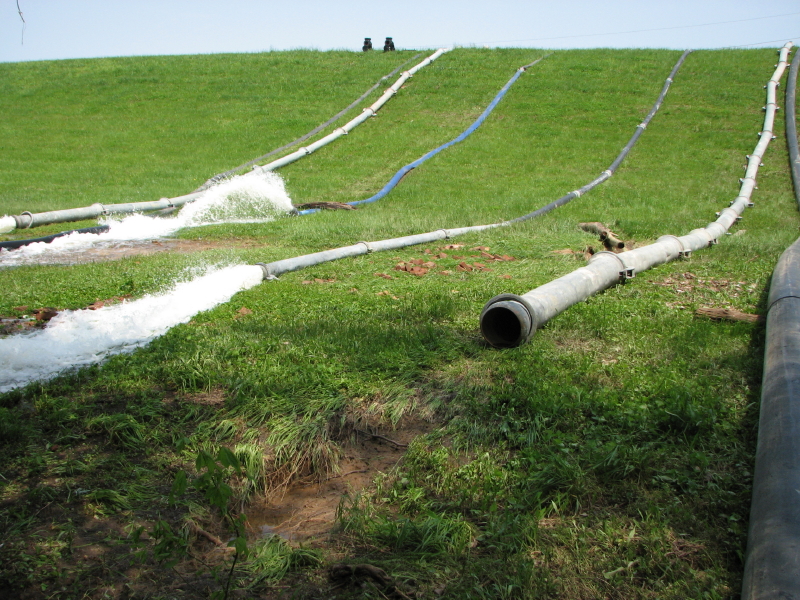
I can see these large hoses coming down the berm and I wanted to see what’s on the other side of this earthen flood wall.  Here are a series of pictures of what I saw.  First looking up hill…

…now the view looking down towards the river.  What are these hoses for?

I came across a sign at the crest of this large hill that explains it.

On the other side of the berm is the small town of Clarksville, Indiana.  Rain water has pooled up in the lower lying sections of the city and are being pumped out and over the top where the water then flows into the park eventually finding release into the river.

It’s strange how I rarely think about the town that occupies the other side of this large grass and earthen mound.  The Ohio River is really at its front door all the time.  The little bit of woods I like spending time in is just a narrow sliver of ecosystem that exists between Clarksville and the river.

Well, that’s the story for now.  I have much more to present about the dominant environmental event of our Spring.  Already the temperatures are rising and I can feel the transition to Summer won’t be long in coming.  Thanks for hanging with me…until next time…the Rabbit Man.

Read Full Post »

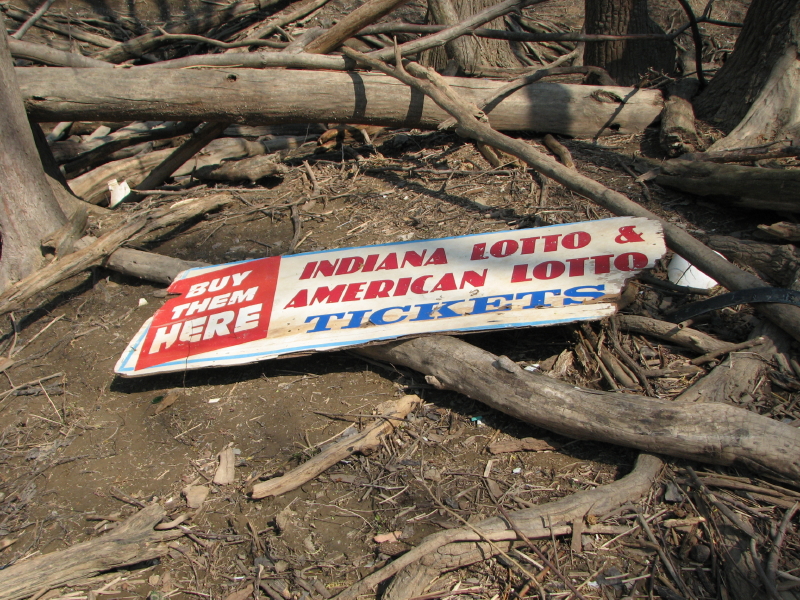
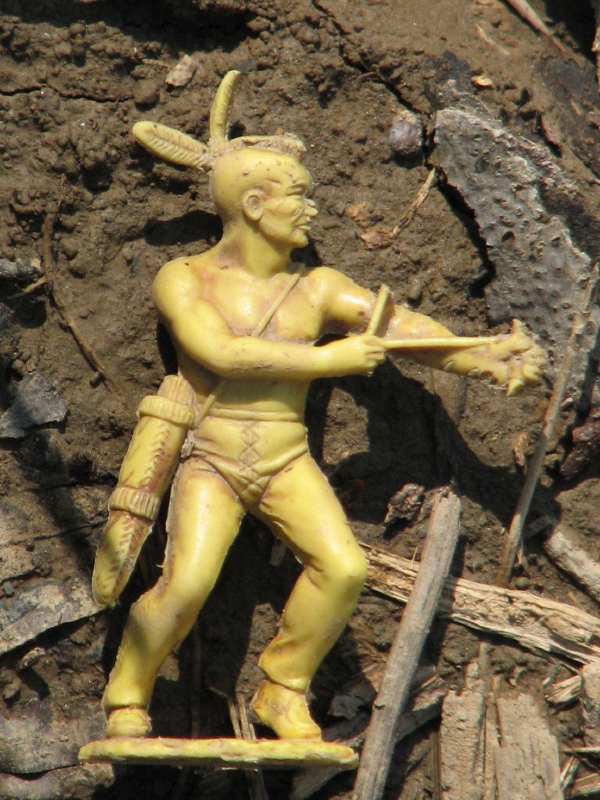
It’s raining as I write this post.  It has seemingly rained the entire month of April in my area resulting in a swollen Ohio River.  I think we are on another collision course with the record books for most precipitation during April.  Only once this month have I been able to access what passes for our normal river shore line and it was very muddy!  We have had tornado warnings and flooding this Spring.  The following adventure occurred between the two episodes of high water we have experienced.  I was walking along the Woodland Loop Trail at the Falls of the Ohio State Park when I was stopped in my tracks by this hand painted sign the river deposited during the first flood.  Is it another way that the universe is trying to communicate to us?  Is nature saying we are taking a big chance with our treatment of the environment?  I wonder who will win and what the prizes are?  Care to buy a ticket?  I decided to pass, but there were plenty of consolation prizes all along my walk courtesy of man and a too high river.  Since this is Indiana, I thought it was fitting to find one of these.
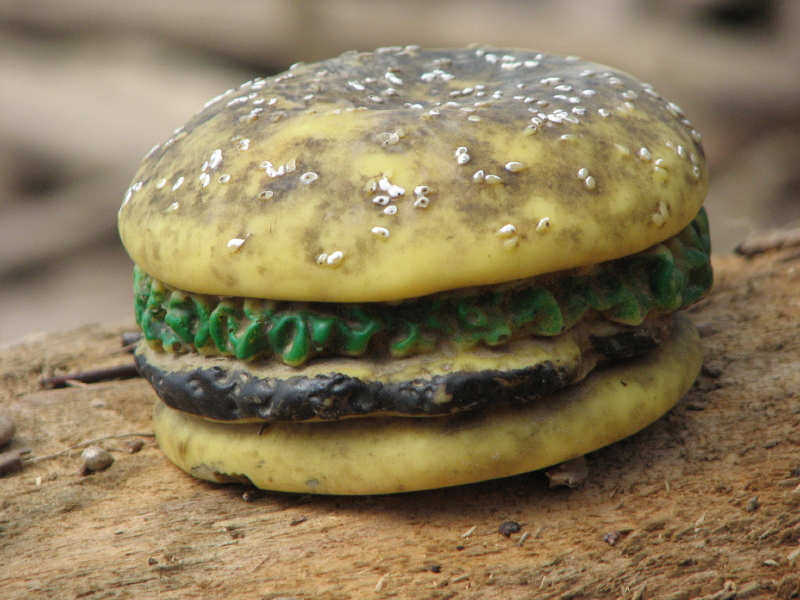
For thousands of years the Falls was home to a sizeable population of native people.  Now, you are more likely to find one of these.  Another piece of Americana I came across I added to my fake food collection.

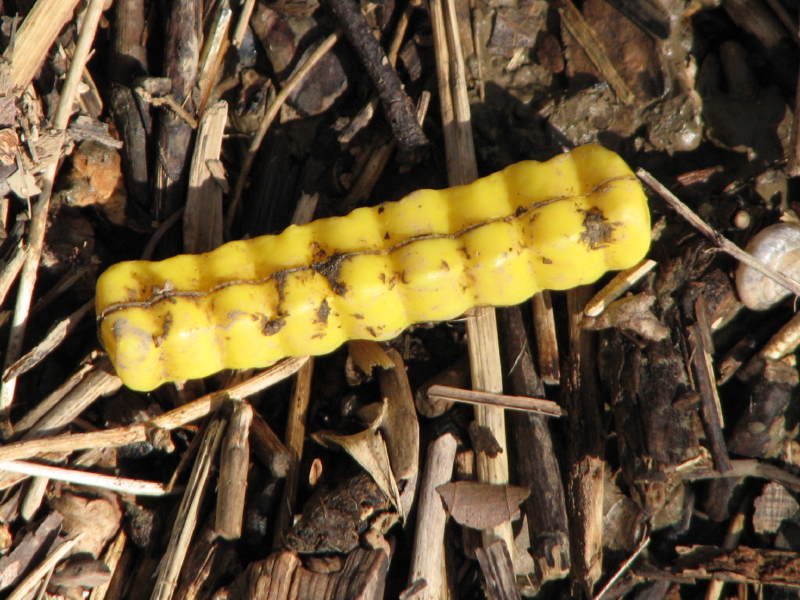
What can be more iconic than a fake cheeseburger?  What’s sad is that this isn’t the only one I’ve ever found out here.  I even have found a couple of plastic crinkle-cut french fries too.  Let me see if I can find a picture of one…hold on…yes, I also found this recently.

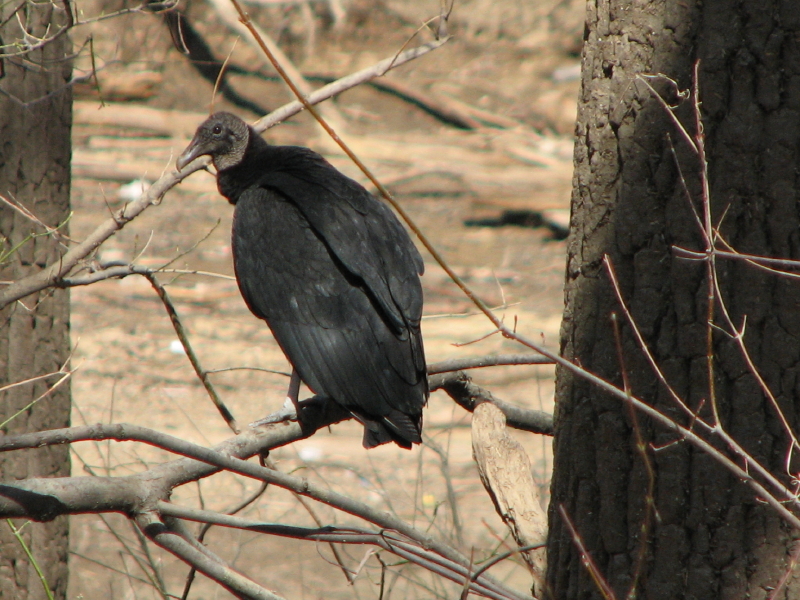
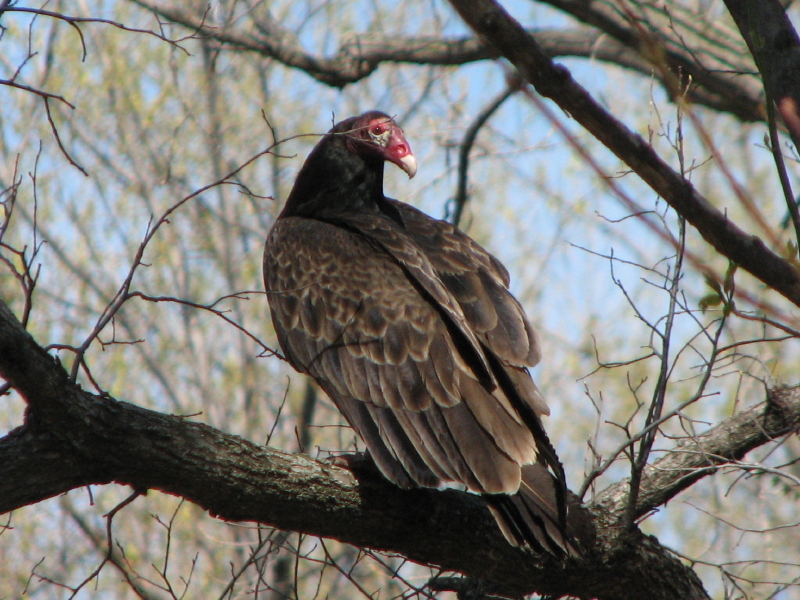
Moving along the trail, the unmistakable smell of skunk kept getting stronger and stronger in the humid air.  It’s possible that one of these animals drowned in the flood and its carcass was deposited here.  Or, one of the many birds of prey could have taken it.  At the odor’s epicenter, I discovered two species of vultures polishing off what’s left of the unfortunate skunk.  There were three black vultures and one large turkey vulture taking turns at the miserable remains.  Here’s one of the black vultures keeping an eye out while his friends gnosh.  I could see them around the tree trunks.

The dominant bird here was a big turkey vulture which is unusual from what I have observed at the Falls of the Ohio.  I normally see them retiring when the black vultures arrive.  This bird was the last to leave the skunk and the first to return.  Here he is giving me the “eye” from a low hanging branch.  As I approached, he joined the other vultures in a tall tree with a vantage point of me and the skunk. 

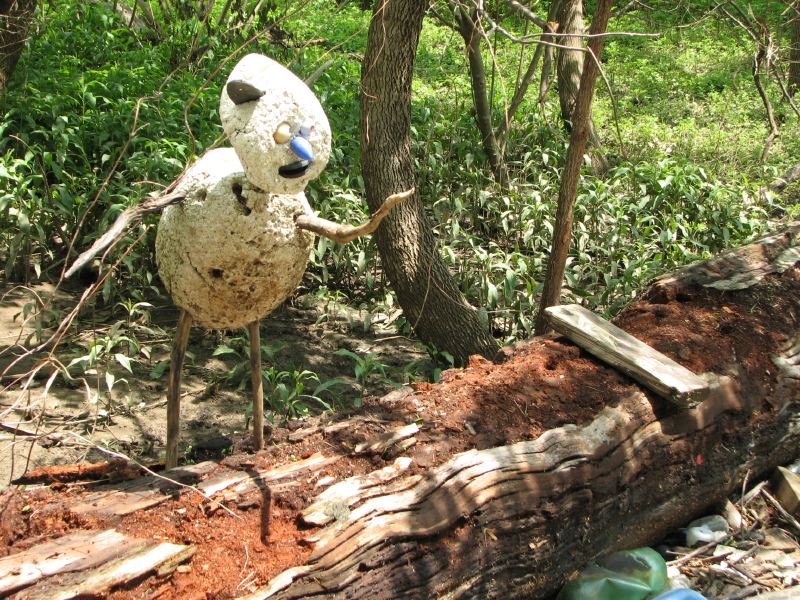
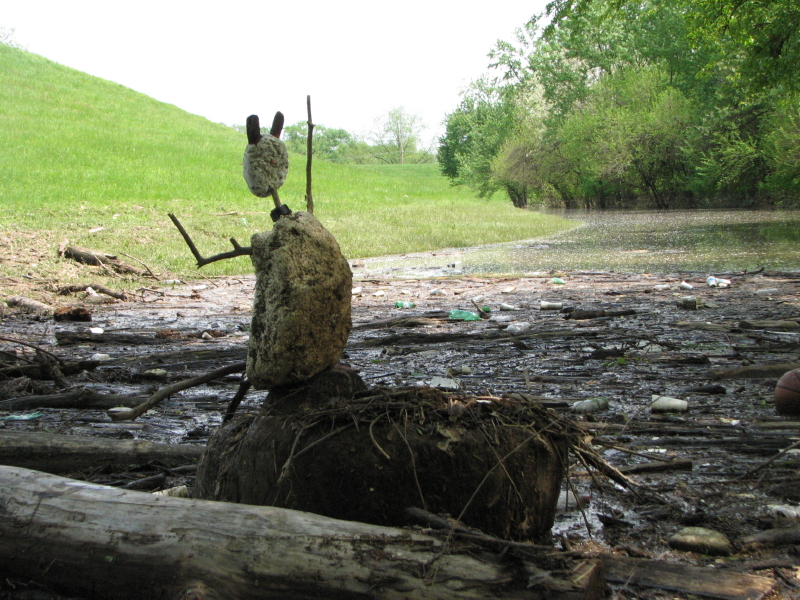
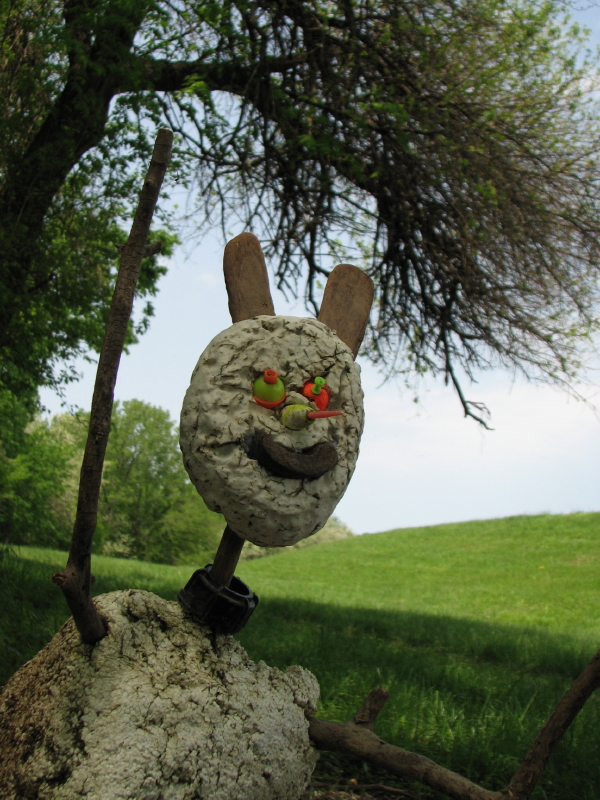
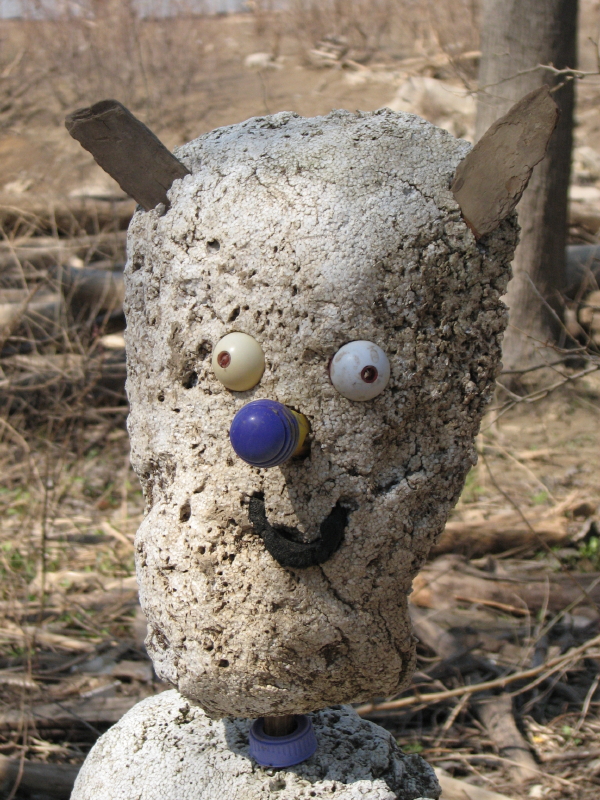
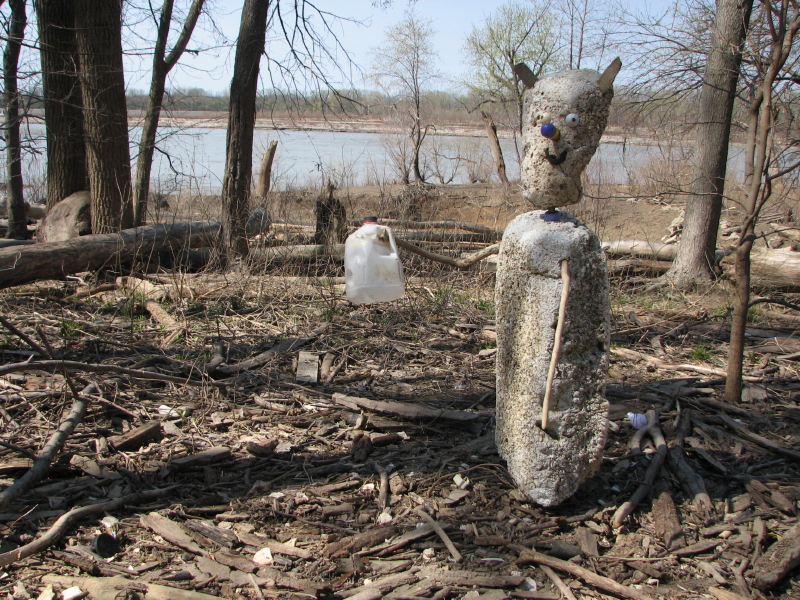
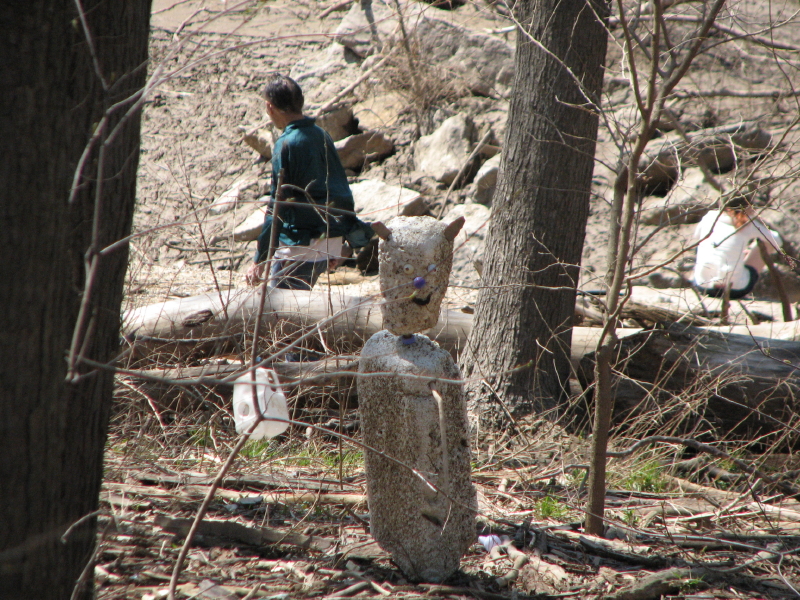
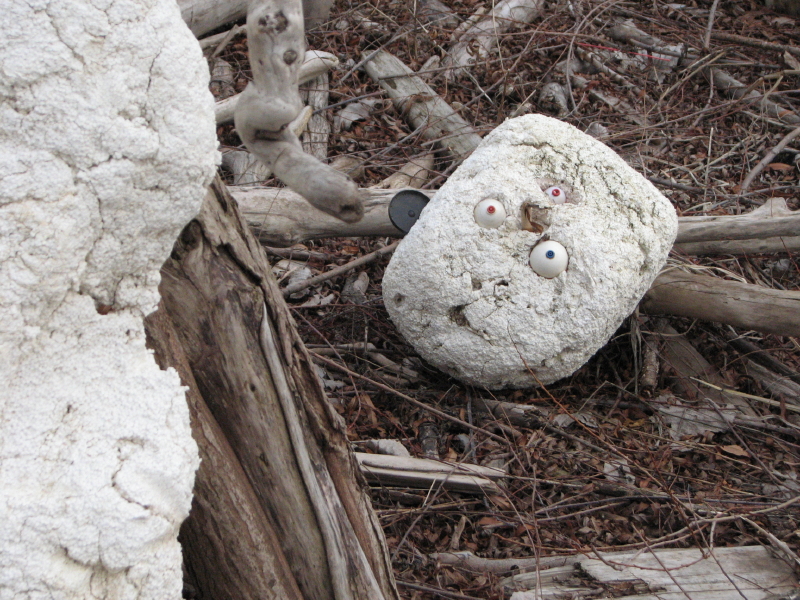
All that was left of the skunk were a few innards and its skull.  Perhaps the vultures will eat this too?  That skunk odor was so pervasive and offensive, I’m amazed that these vultures could stomach this, but then again, they have probably had worse meals.  Not to far from the birds, I did find a big piece of Styrofoam that was washed into a bottomland area.  Using what I could find nearby, I constructed this unnamed figure, photographed it, and kept moving down the trail.  Where I left this figure was in the center of a trail loop that curled back towards the Interpretive Center.  Here are images of this improvised piece.  It was an especially pitted and worn hunk of polystyrene.

I circled around and could see the sculpture from another angle.  Funny thing is that while I write this…I know it is no longer standing and was probably swept away again by the Ohio River for parts unknown.  It occurred to me recently that this month is the riverblog’s second anniversary.  As long as the river keeps things interesting, I will try to do the same through these posts.  I have many other images of recently found junk and once this more recent flooding subsides…no doubt will be able to fill this virtual collecting bag.  My parting image is the last picture I took of this short-lived artwork.

Read Full Post »

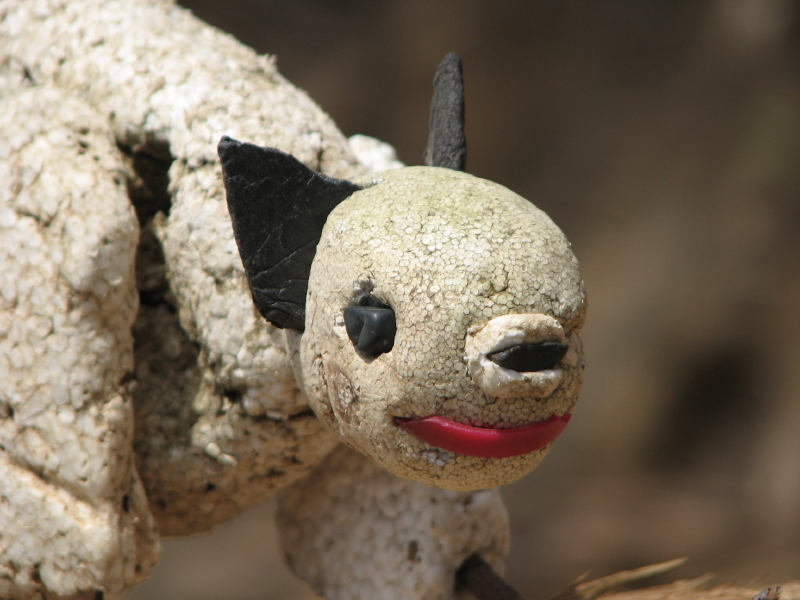
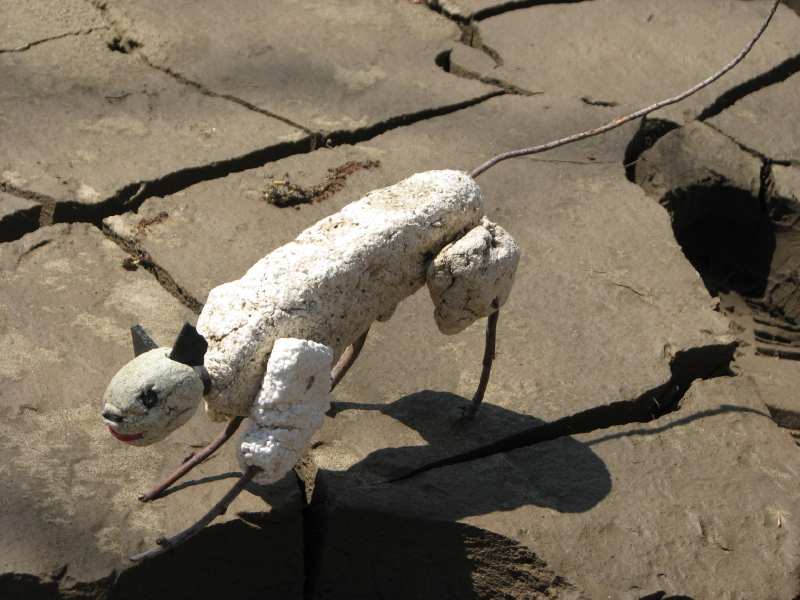
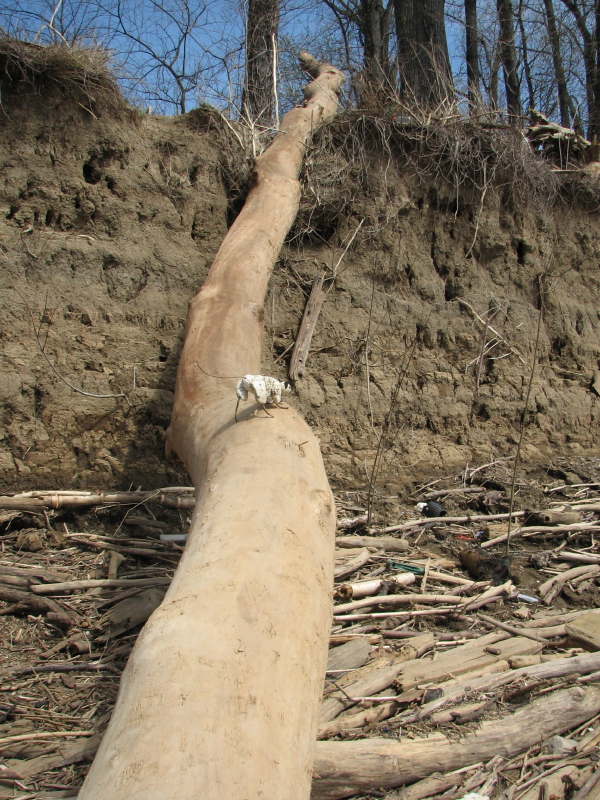
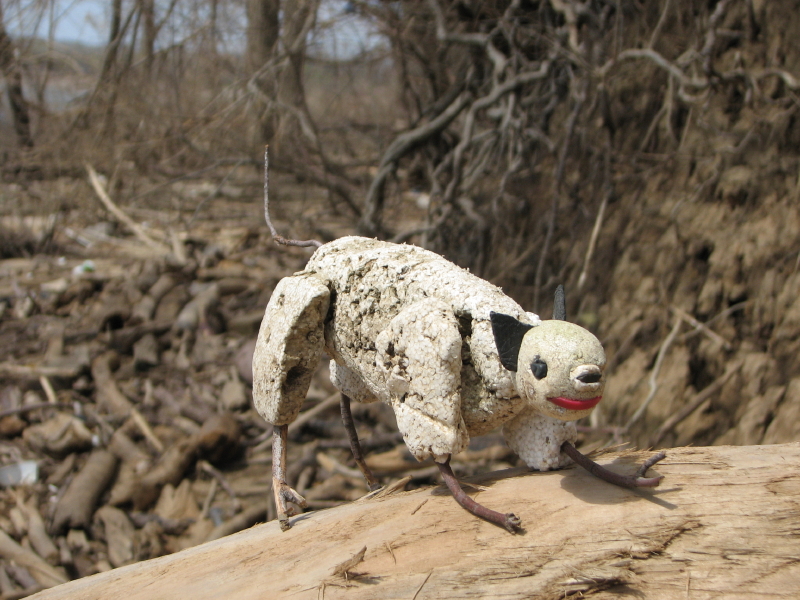
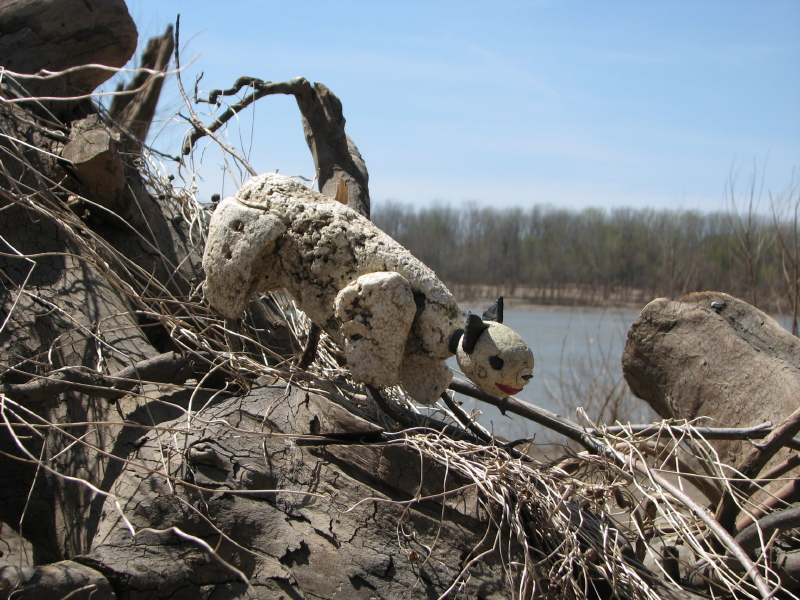
Seldom seen and thus aptly named, the River Ghost is an unusual small mammal living at the Falls of the Ohio.  Over the course of several days I was able to photograph a young adult as it was surveying potential territory.

Don’t let the cute face fool you.  The River Ghost is a relentless pursuer of anything it can catch and eat.  It’s diet includes birds, fish, other mammals no larger than twice its size, eggs, reptiles, and if necessary, insects and carrion.

The River Ghost has a long and flexible body that allows it to pursue its prey through underground burrows.  It also utilizes abandoned burrows to raise its own young.  Two kits are usually born, but only the strongest will see the light of day.

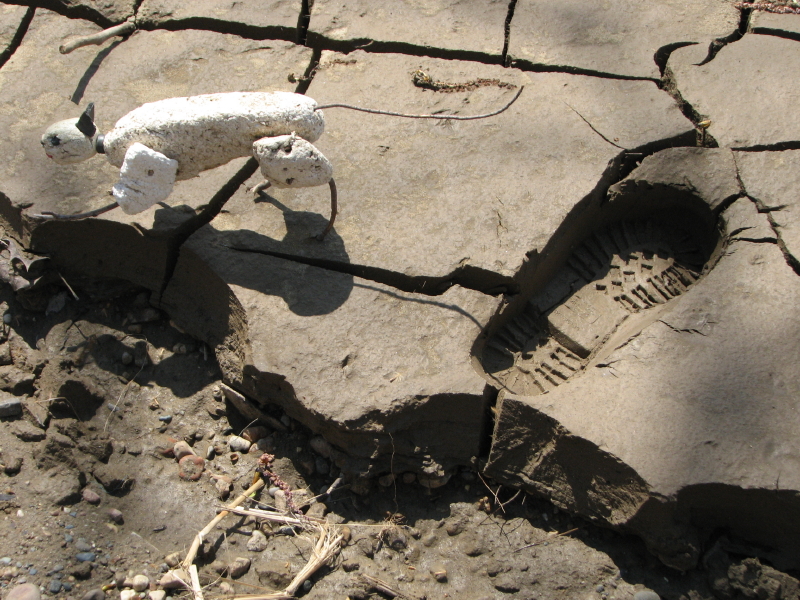
I photographed this specimen walking along the mud line that was deposited by the recent flood.  The mud is a five-inch thick layer of “fudge” and very soft and moist.  That’s my boot print in the picture.

This mud is also perfect for recording the foot prints of other animals that cross over its surface.  Scientists are uncertain which senses are most important to the River Ghost, but it seems to have a keen sense of sight and hearing.  This odd animal has kinship to both rodents and weasels and may be a throw back to an older evolutionary line.

Despite having formidable survival skills…the River Ghost is not thriving for a variety of reasons and primary among them is habitat loss.  More and more the riverine bottomlands it prefers are being divided and developed.  It’s prey species are also experiencing a decline in populations.  Many species are dependent on large areas of intact ecosystems in order to remain viable.

It would be a shame to allow this curiosity among the local fauna to disappear before its time.  Humans have coexisted with this intrepid predator for thousands of years.  The native people have legends and myths about the River Ghost’s ferocity and toughness and its way of getting out of trouble that it starts.

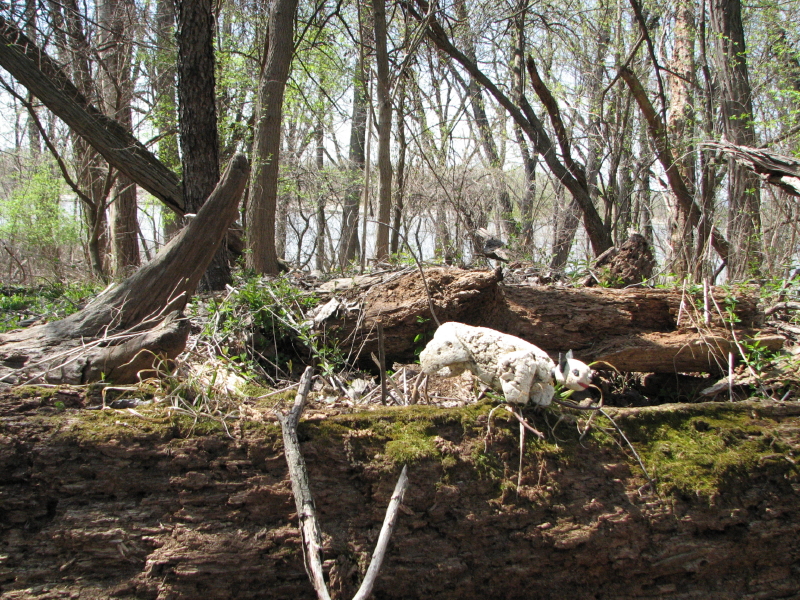
The last time I saw our River Ghost it had moved onto higher ground around the Interpretive Center and Woodland Trail.  It seemingly followed every lead and poked its head into every hole looking for food to satisfy its insatiable hunger.  It occurred to me, that it was heading for the picnic tables where people have been spreading dry cat food on the ground.  I wondered if the River Ghost “knew” that other animals would be attracted to the feeding station…or was it here for a bite of cat food too?  Perhaps I will see it again?

Read Full Post »

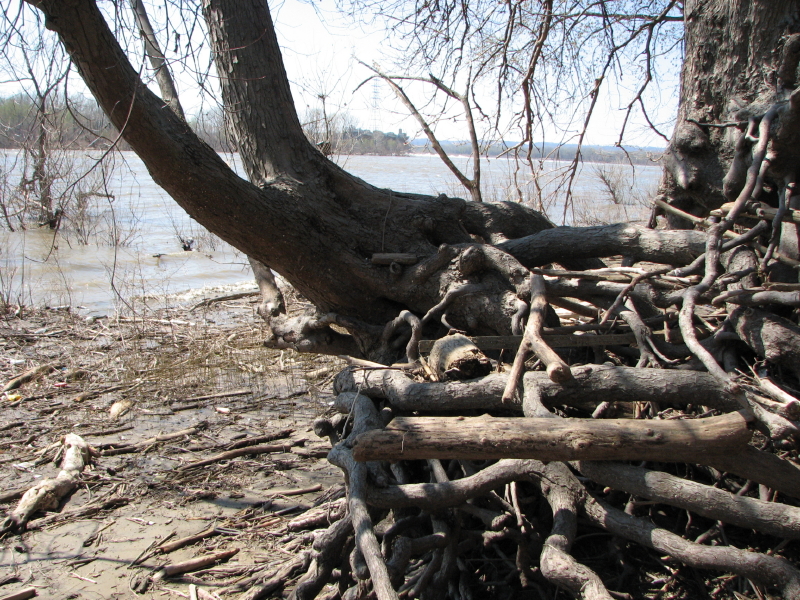
This is a post from the western section of the Falls of the Ohio State Park.  The high waters from the recent flood have taken their sweet time abating.  I slogged through a lot of mud, but have to admit I had a good time exploring.  Along the way, I could see odd items that had been snagged by the trees and here they will stay until they decay or another flood carries them away.  Here’s a wooden stand of some kind that found refuge in the branches of this tree.

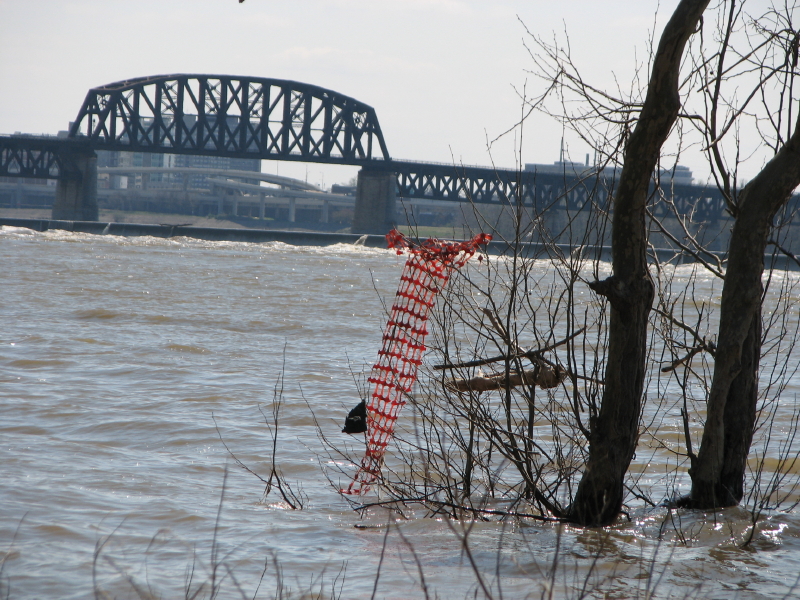
And here is part of a hurricane fence that the river deposited high and dry onto another tree.  Nearly every where I go I can find (mostly plastic bags of all sizes) stuff caught by the tree branches.  Sometimes this items “decorate” their new homes for years to come.

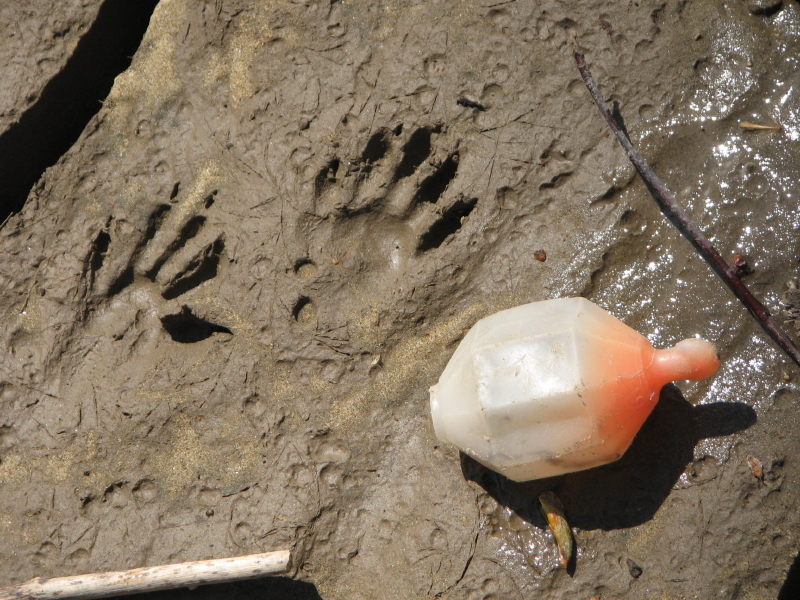
I’m always on the look out for signs of life.  On this trip I came across a flock of American Coots, but they swam away before I could take one decent image of them.  In the soft mud all around me, were the tracks of the various small animals that call this place home.  I believe these are tracks made by raccoons next to this plastic baby toy that floated in with the river.

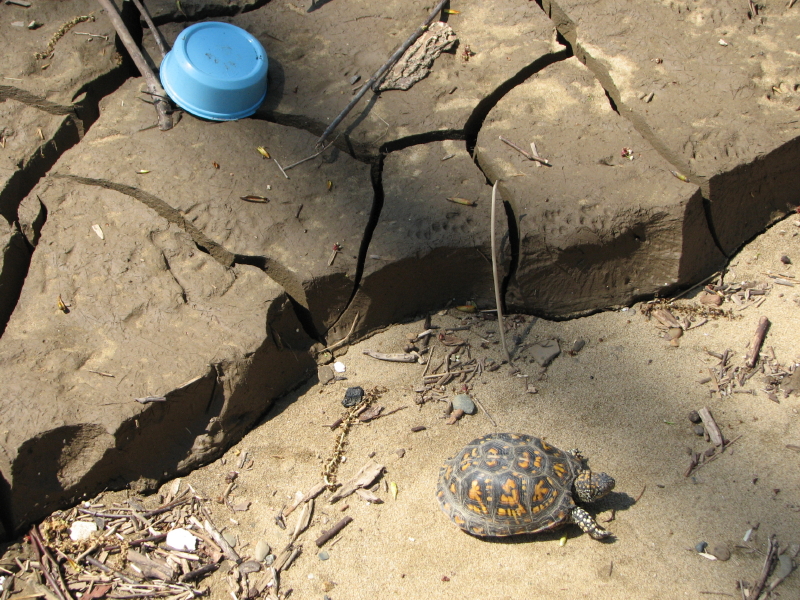
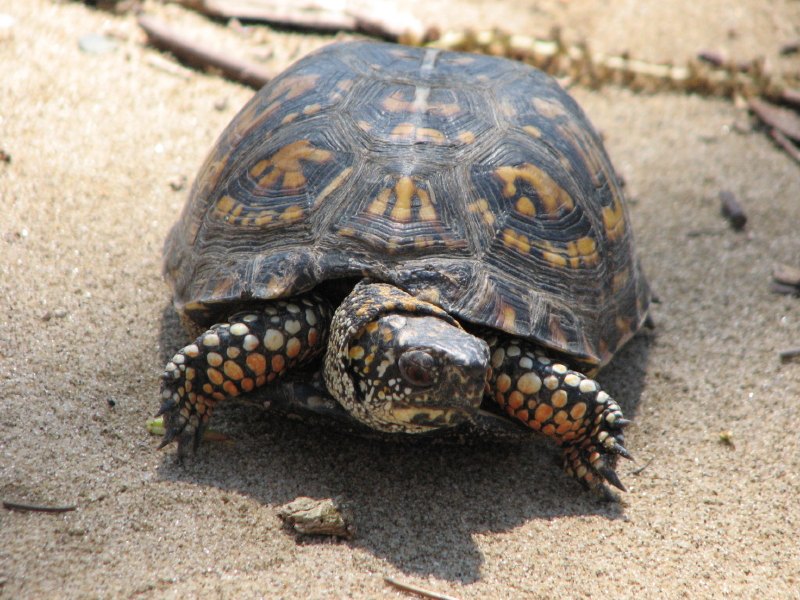
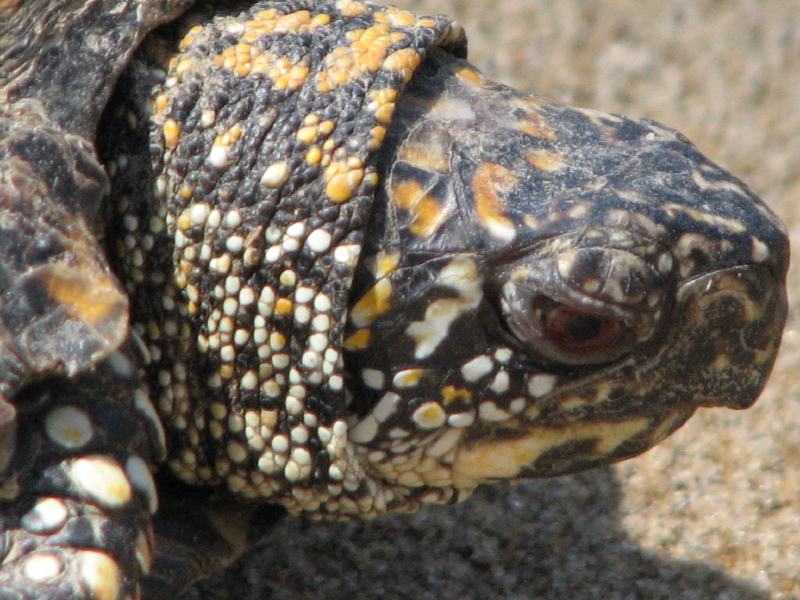
Investigating the other debris, I nearly missed seeing this Eastern box turtle.  He looked like an old-timer and because it was still a cool day…he was moving slowly.  This allowed me to take several pictures and I had a great opportunity to check him out.  Here is a series of images of it.

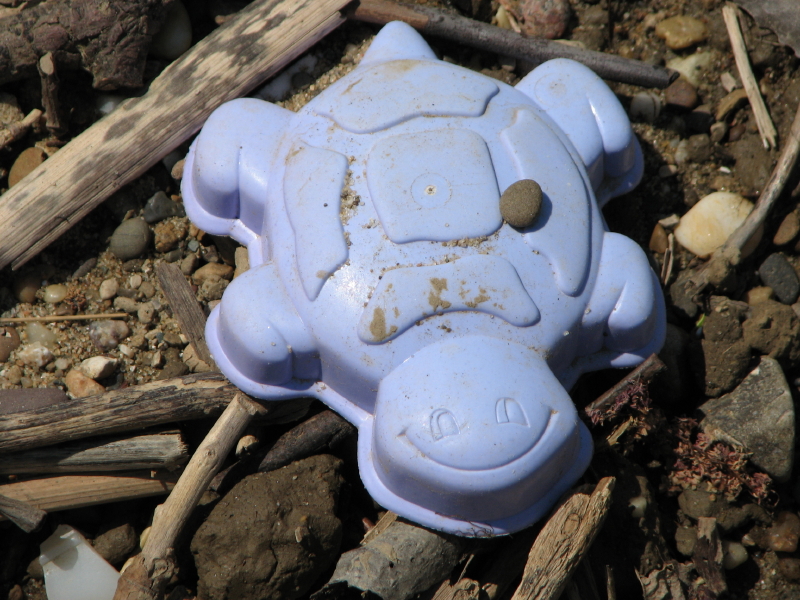
The weird part is that earlier in the day, I came across a completely different kind of turtle.  This one is usually found in close proximity to sand and has a penchant for children’s company.  While the previous turtle embodied substance and image…this one is all image.

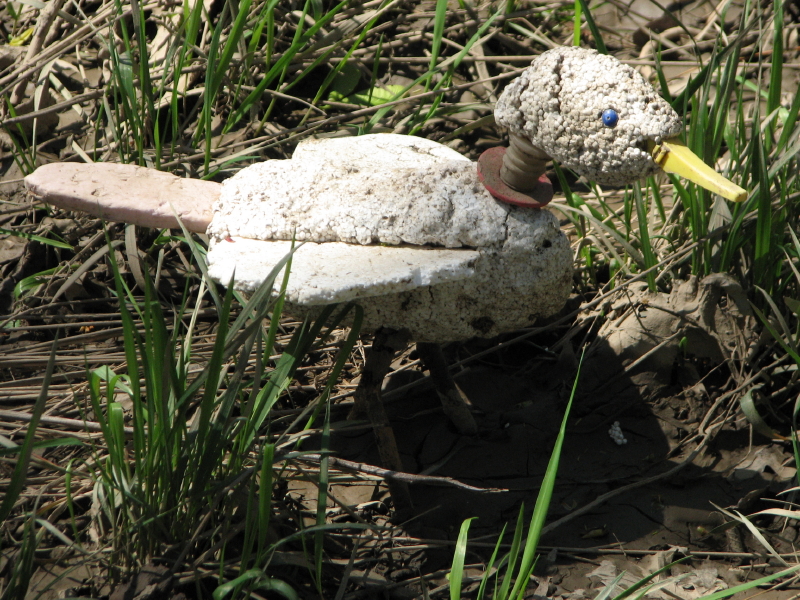
I also came across my “Mud Duck” which was hanging out in an area that was much drier than before.

This duck and all the genuine birds and small animals better look out this spring and summer because the feral cat population keeps increasing.  On my way back to my vehicle, I came by this site near the Interpretive Center.  Frankly, this “blew me away”.  There were two picnic tables and each one had the equivalent of a large bag of dry cat food spread under each table.  I’m sure this person has a kind heart and means well, but I don’t see how this helps the other wildlife in the park.  Well fed cats still catch birds and hopefully they will also catch the rats that I’m sure this scene also attracts.  I’ll end with these two images, but will be posting more post-flood pictures very soon.  Until then…

Read Full Post »

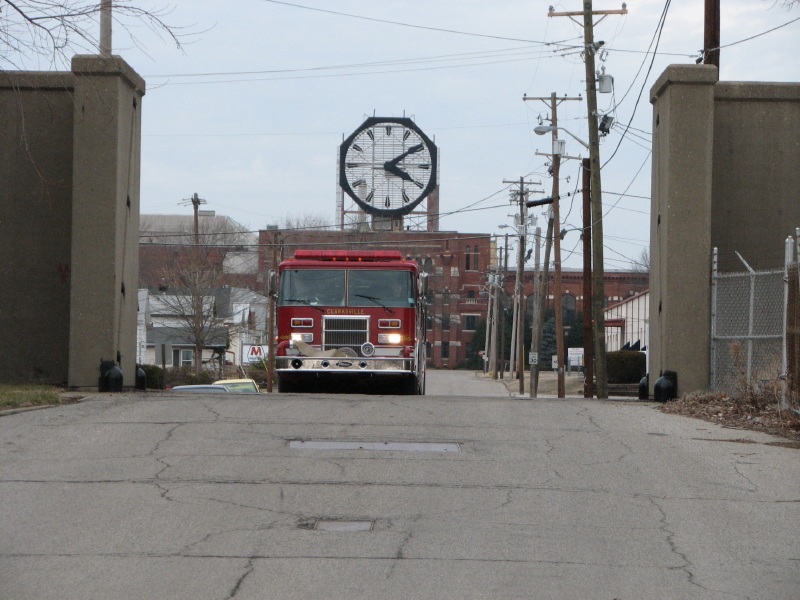
The clock read ten minutes after four, otherwise, I wouldn’t have remembered what time it was when I began my last exploration of the river.  This is one of the world’s largest clocks and once was the pride of the Colgate toothpaste factory in Clarksville, Indiana which is just a quarter-mile at most from the entrance to the Falls of the Ohio State Park.  The company moved to Mexico and now the building is for sale.  The clock’s fate is uncertain as are all the jobs that were lost when the company relocated to another country.  The fire truck happened to be going by at the moment I took this image.

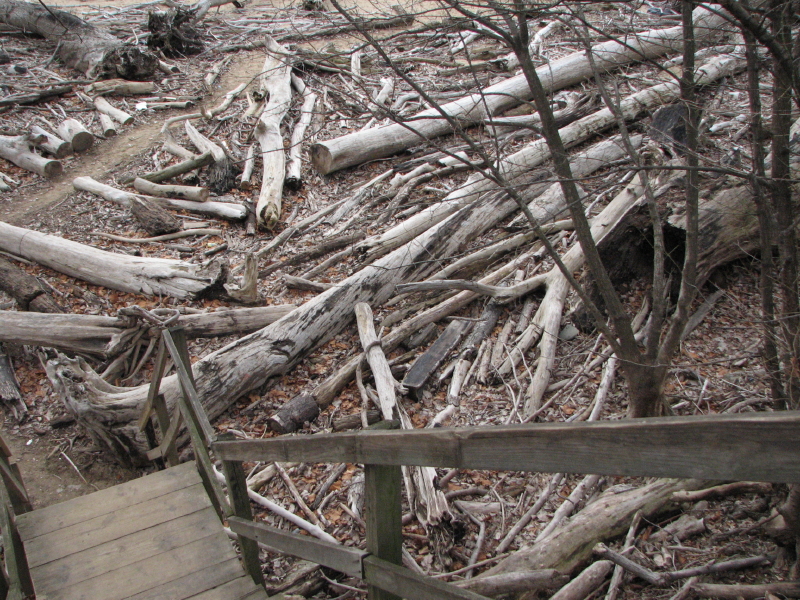
After parking my vehicle, I descended down the wooden staircase and into the driftwood field that was deposited last summer.  It has been a gray and melancholic winter.  I noticed that the river was higher now than during my last foray and my heart lifted a bit knowing that there would be fresh river booty to find!  I was correct and this post has a few of the objects and sights I came across during the hour and half I spent here.
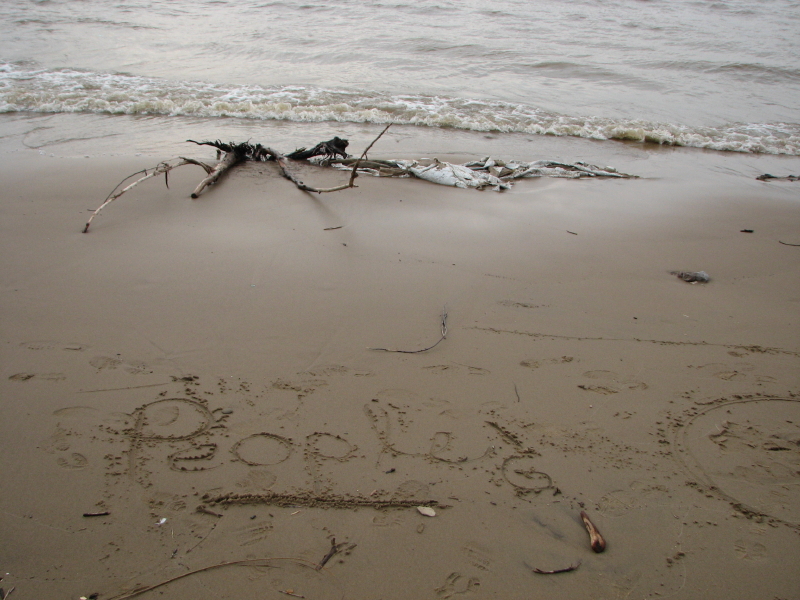
I have observed that many people who visit here never venture far from these stairs.  They may go down to the water’s edge to take a look, skip a stone, or write their names in the shifting sands.  I came across the word “people” written in the sand and recorded the image before the advancing waves erased it. 

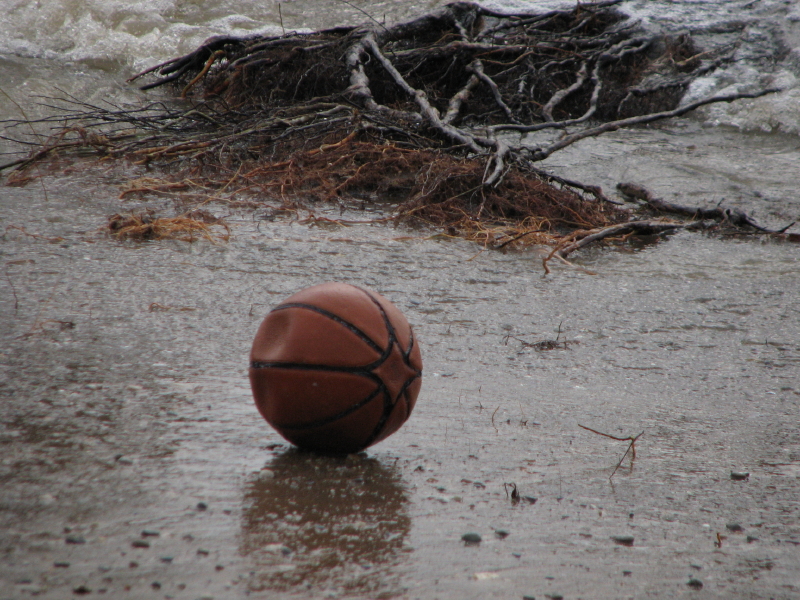
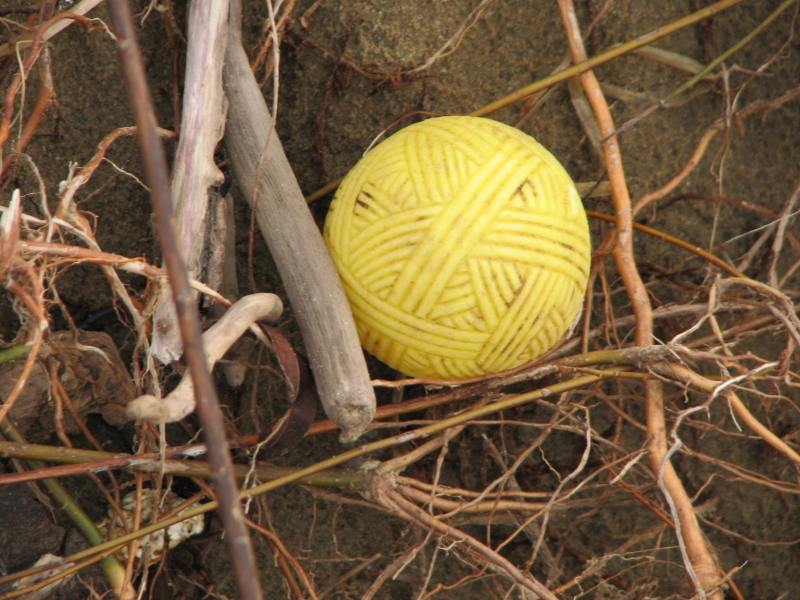
After so many years of walking this beach, I’m amazed at how much of the same kinds of stuff I find out here.  This was one of five basketballs I came across.  I wish I had a dollar for every one I’ve seen at the Falls.  The river was playing with this one and its waters would float it to a different location and then cast it back upon the shore before licking it back into the water again.  Here’s another ball I found.  It’s small and looks similar to a plastic representation of a ball of yarn?  I like the contrast between the ball and the willow rootlets that captured it.

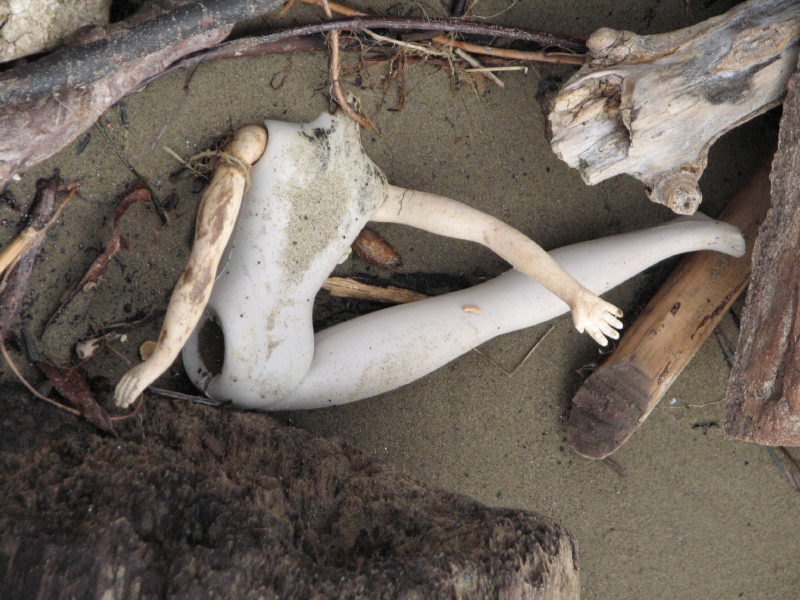
I’m always finding dolls and doll parts.  On this expedition I found three dolls.  Here’s a picture of one of them as I found it.  I’m not certain if this is a Barbie doll or a knock off of one?  Doesn’t matter, what catches my eye here is the arrangement of doll and driftwood.  Because there isn’t a lot of color involved…it would be easy to overlook this while walking.

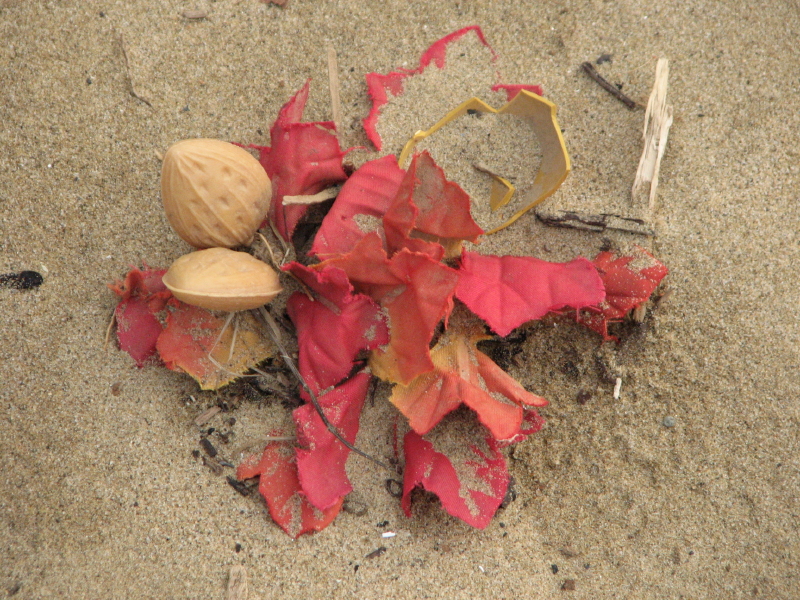
More flamboyant is this cloth and plastic artificial “plant” embedded in the sand.  Now this was easy to find because it’s winter and the eyes are starved for color.  I wonder what these plastic “nuts” are supposed to be?

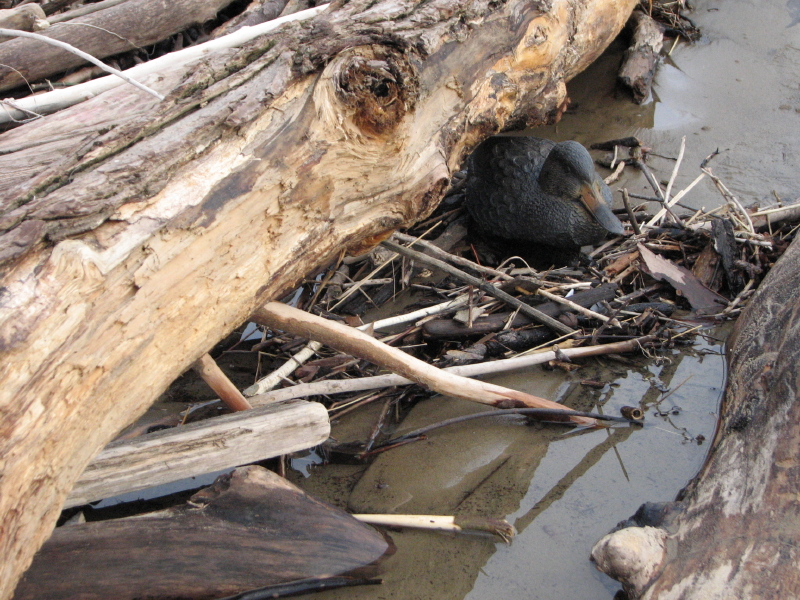
Now comes the part where this post’s title originates.  For the last couple of weeks the Falls has been home to many Mallard ducks.  I was walking along the shoreline when from a distance I spotted this next to a large log.

My first reaction is why is this duck  just sitting there and not trying to get away?  Is it hurt or sick?  Did it narrowly escape the talons of one of the local Peregrine falcons?  It took me a moment before I realized that it wasn’t real!
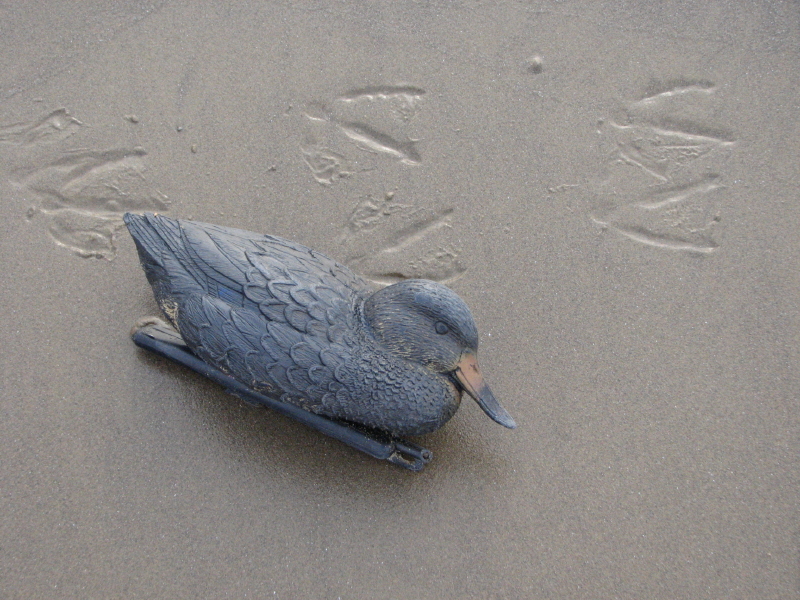
This is the first decoy that I have come across out here and thought photographing it next to tracks left by webbed feet was appropriate.  The indigenous people of this country were the first (as far as we know) to make decoys to lure prey species closer to the hunter.  There is an aspect to some of my Styrofoam sculptures that takes a page from them.  I want people to come closer and check out what I’m doing and come away with a greater awareness of what’s happening to the environment around them.

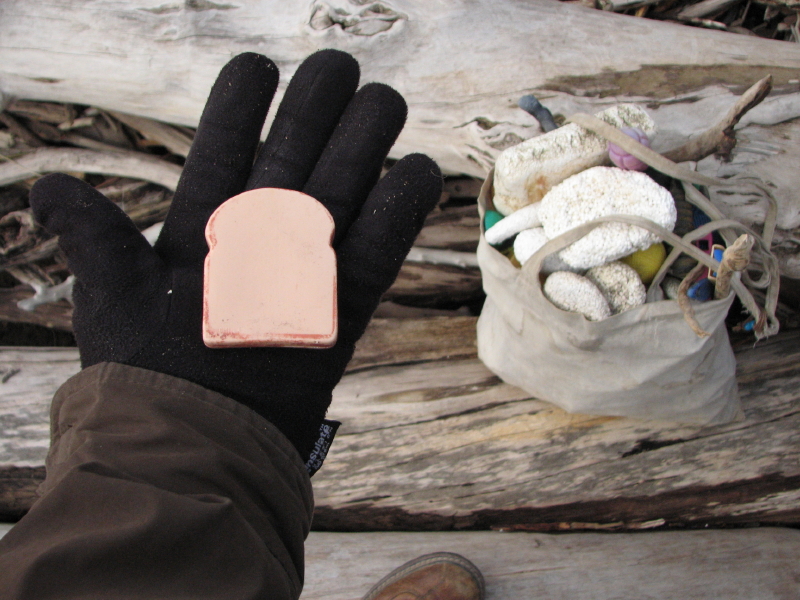
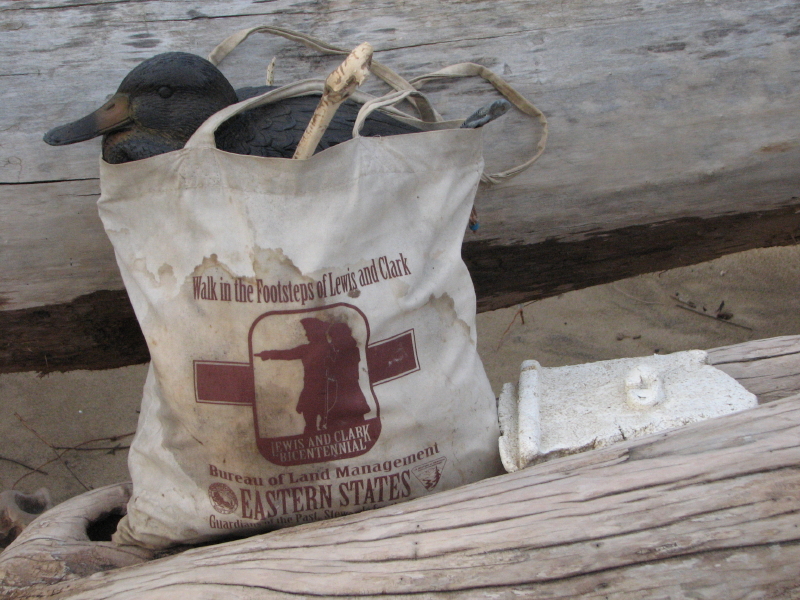
My subconscious must be scanning this stuff as I move along, because I don’t know how I found this!  It’s a plastic slice of bread or toast and not much different in shape or color to the other forms that were around it.  Naturally, it went into the collecting bag and joins the other artificial food items I have found out here over the many years.

After hanging out at the water’s edge, I cut up the beach to my open air studio in the willows.  The so-called “Choir” grouping had been smashed to bits since my last visit.  All the figures have been beheaded, but things weren’t a total loss.  I did find this to cheer me up!

Some other creative soul left me this next to the plank I sit on when I make my Styrofoam sculptures.  This small figure looks surprised like it’s caught in mid slip.  Perhaps there was ice and one foot flew out from under it?  All the materials were on site and I’m glad that someone else took advantage of them to make something no matter how silly.  Whenever I’m out here it’s easy for me to lose track of time, but I knew it was time to go because I was cold and getting hungry.  On the walk back to my car I took this photograph.

I call it the “Staircase to Heaven” and yes it’s a wooden set of stairs that was snagged by this willow during a flood two years a go.  I once found a refrigerator stuck in the top of a tall tree and the river put it there during another bout of high water.  The river level can surprise you and with all the snow that has fallen this winter north of here.  It’s very possible we may see high water again and soon.  This weekend, (can it be true!) it’s supposed to be sunny and warmer.  I definitely will plan another trip and maybe make something of my own from all this river junk.  Until then…

Read Full Post »

It’s the Falls of the Ohio and it’s nearly midwinter.  The quality of the light feels like it’s coming from banks and banks of incandescent tubes in the sky.  It doesn’t even feel like light, but more like a heavy presence more  akin to fog than photons.

There are fewer people out today.  The last of the last snow lingers on in the cool places and tomorrow it will probably be gone.  I’m trudging along the river and getting muddy.  I use the stick I brought along to test its sticky depth and tap the thickness of what ice I encounter.

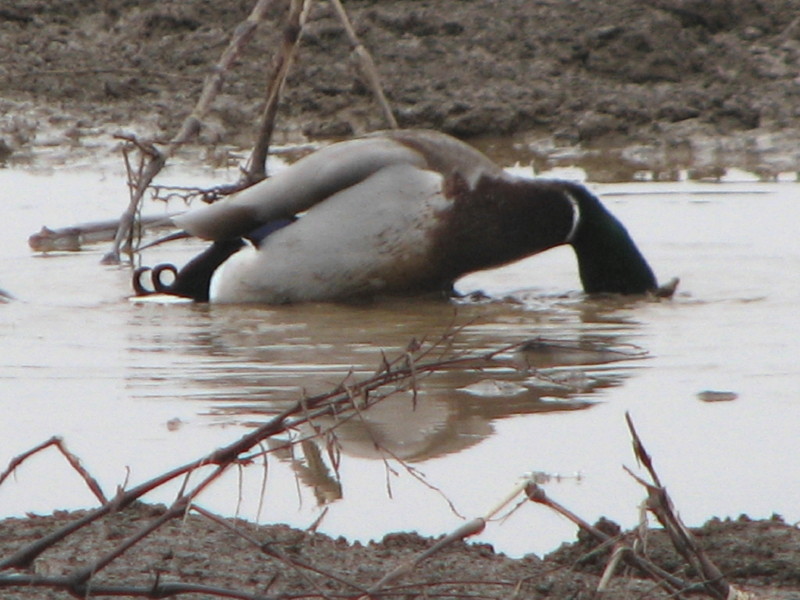
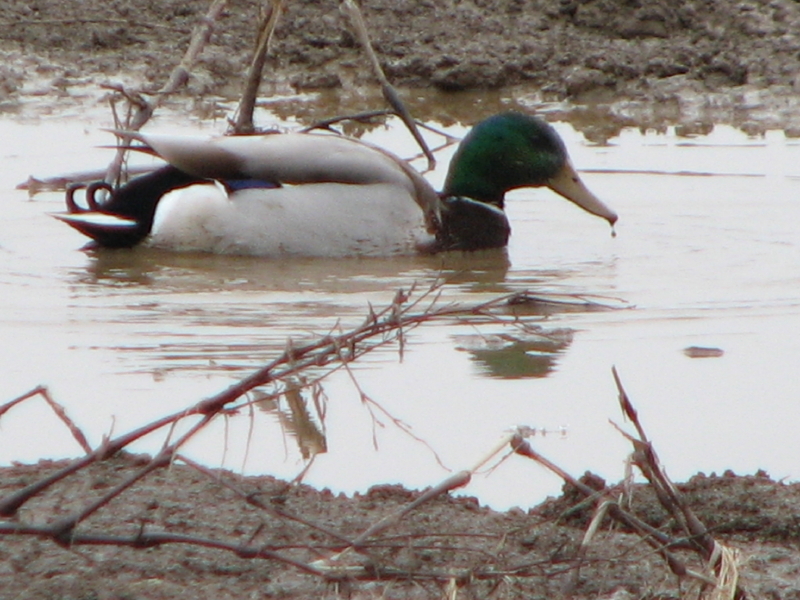
Close to shore dozens of mallard ducks are dabbling in the muck.  I wonder what they are finding to eat?  Whatever it is it seems to be worth the energy expense to go after it.  The normally iridescent colors on the drakes are now subdued and await the splendor of the sunlight to reveal their gaudiness.  Watching the ducks I slip and slide in the less secure places along the riverbank.  My wife is not going to like seeing these shoes!  Once in a while, I find a good spot to rest and scrape mud off the bottoms with the edges of a stick.

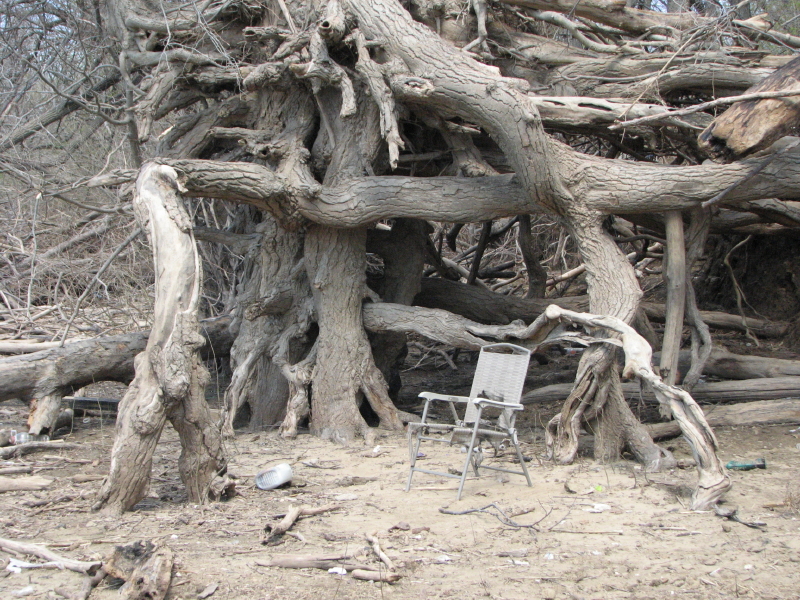
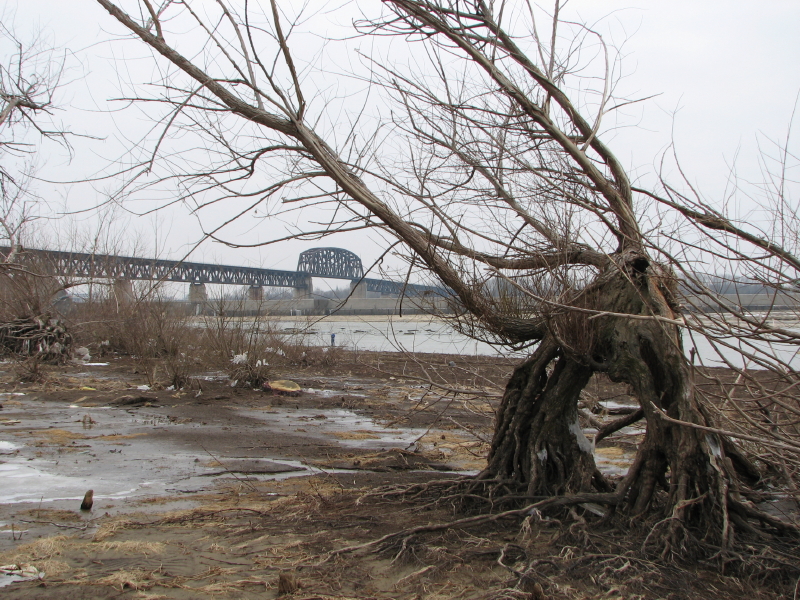
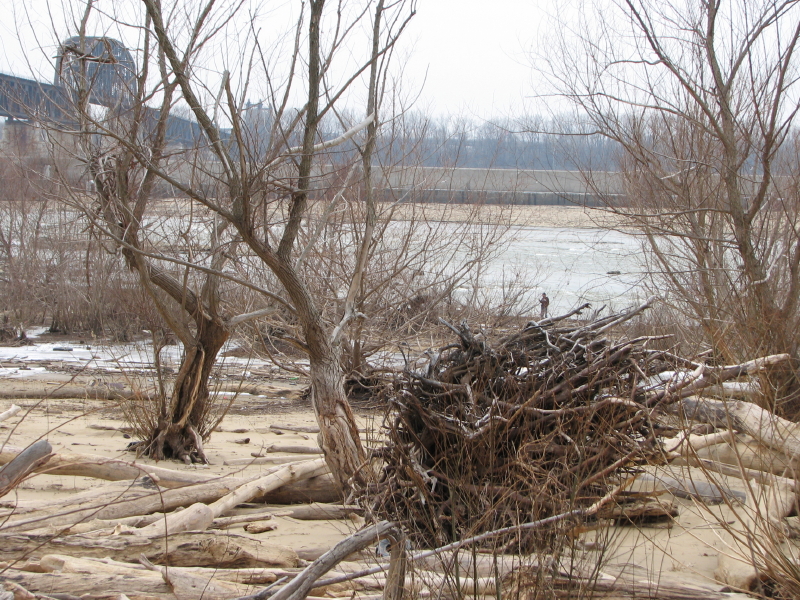
I walk by familiar spots along the way to my open air studio.  I like checking out the uprooted trees and appreciate their exposed root masses like the fine subterranean sculpture they seem to me.  Seeing a tree like this is an odd sensation because you know the roots that supported and nourished this tree claimed a space in the earth that was hidden from view.  I often think of these conceptualized spaces.  There is a complete lack of greenery that lays the structural aspects of the park open for inspection.  Sometimes the driftwood feels like the bones of the river.

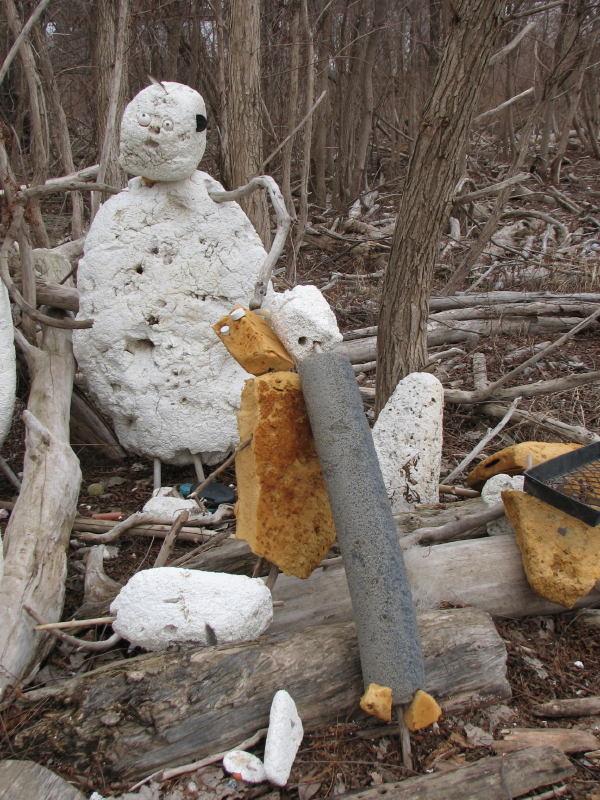
The sculpture group I’ve come to call the “The Choir” is still standing.  I’ve enjoyed seeing what happens to these guys.  Visitors are still playing with them and I notice small changes here and there.  As the eyes, ears, noses, and mouths fall off, the character of each personage changes.  The starkness and artificiality of my material choices contrasts with all the wood that surrounds them.  When I work in my spot, “The Choir” watches my back.  I like this recent photo of my studio spot.

The wood tells its own story.  All the sticks that wiggle, twist, and reveal character are grouped together and await their potential to be realized in just the right sculpture.  This site looks like it could be ancient.  I remember photos seen in a book about Andeevo in Russia where entire winter structures were made from the remains of mammoth skeletons covered in prepared hides.  That was life 15,000 years a go.  I can picture my site covered by a tarp and maybe I’ll try that this year if the river allows it and the opportunity presents itself.

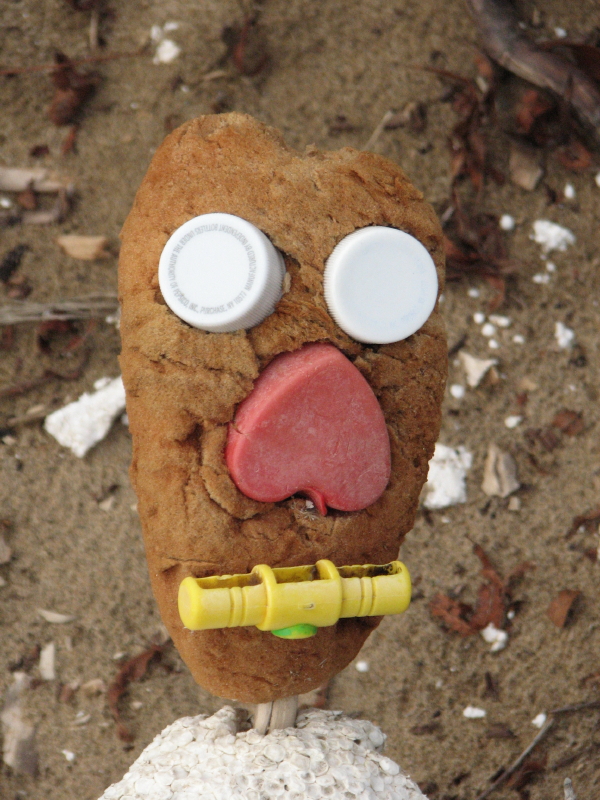
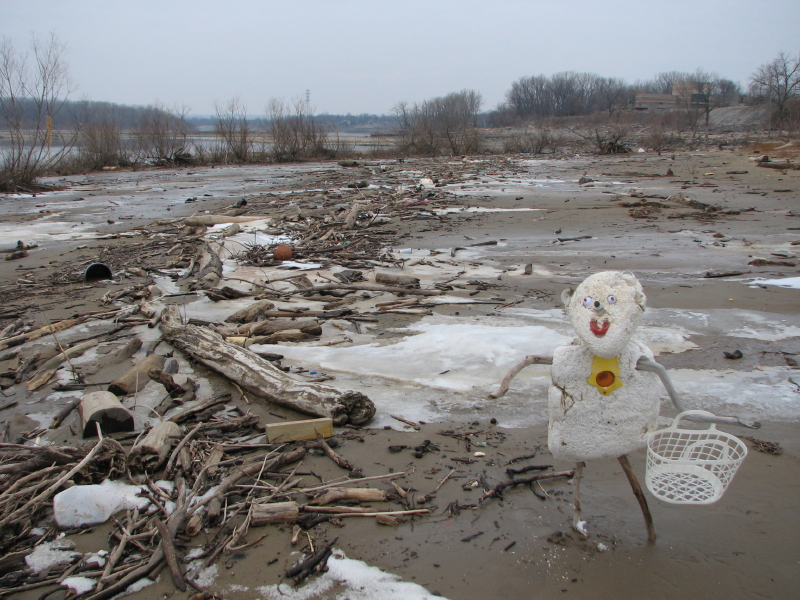
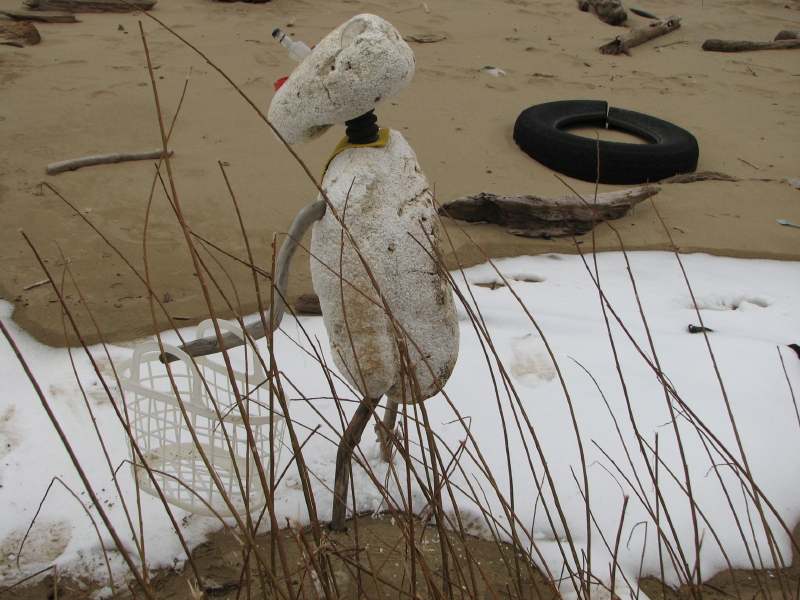
Meet “Skippy” who is named after the glass I used for one of his ears which came from the bottom of a peanut butter jar.  I found it in the sand. The raised letters told me the brand name.  “Skippy” is also made from Styrofoam found along the way, plastic fishing bobbers, rubber, a plastic mouth guard, and various woods.  The “Choir” is visible behind the studio site.

I don’t have a good story to go along with this figure.  I did kind of imagine that Skippy was checking out the river line and looking for fresh and unusual flotsam and jetsam.

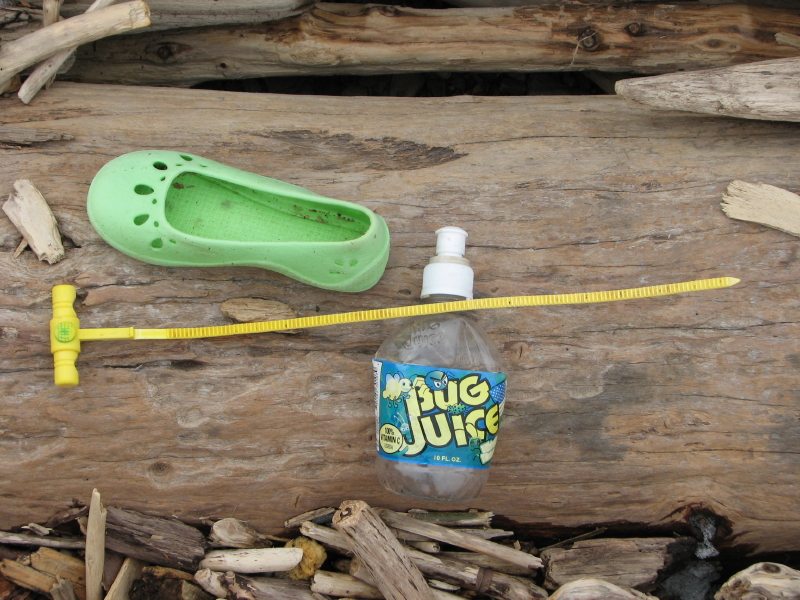
Cold, wet, and muddy Skippy entertains himself by looking for colorful or unusual artifacts such as these found on this trip.  The joy in finding is its own reward.

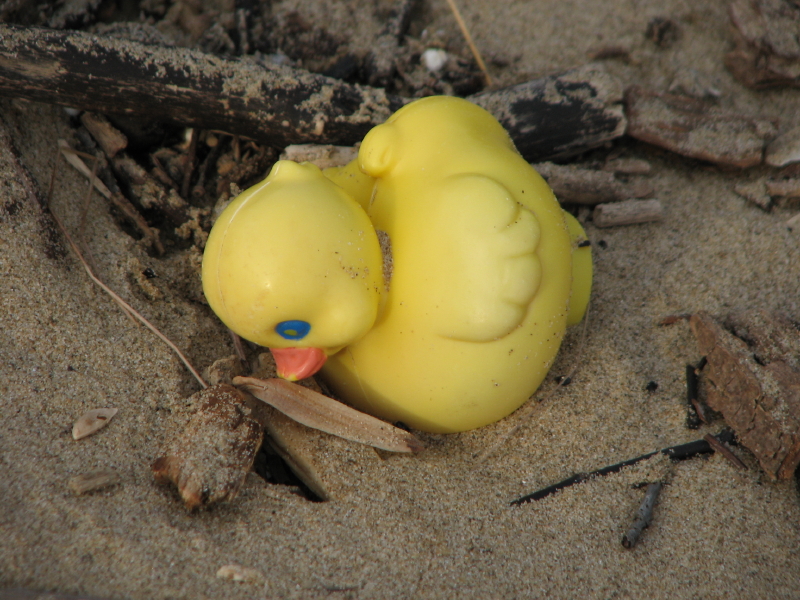
So many lost toys almost all of the time.  Each time I come out here I find some plastic representation of life.  I usually take a picture of the object as found and then it goes into my collecting bag.  I like that relationship between images and objects…although the years worth of objects is starting to take up serious space.

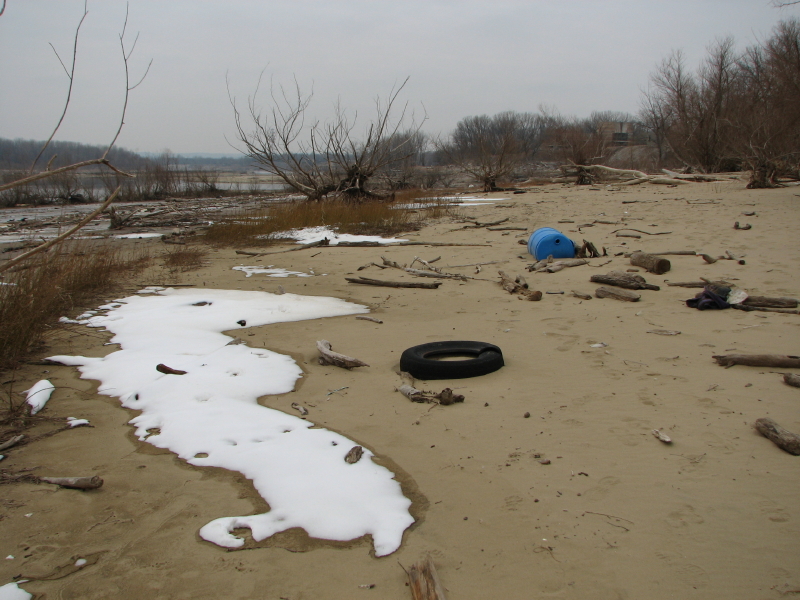
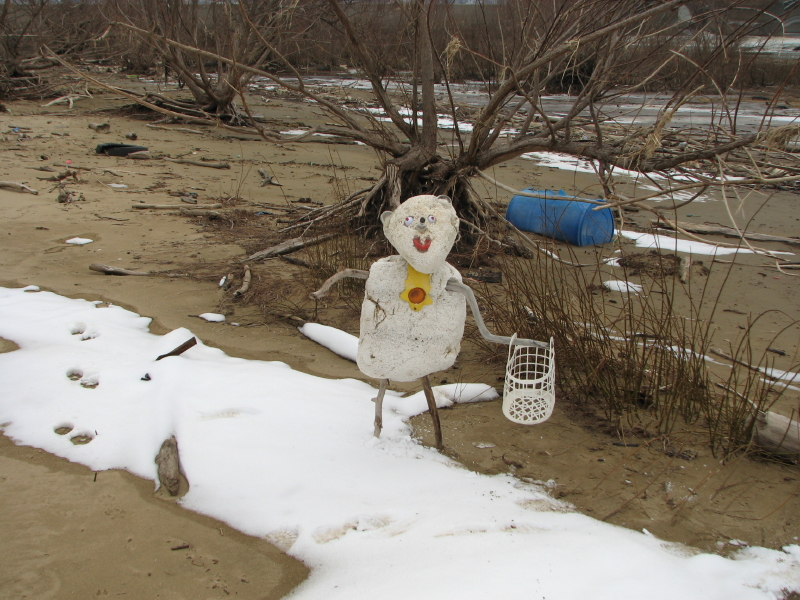
This is where I last saw Skippy.  He was standing by the snow with a willow tree framing the view behind his head.  The bright blue of a plastic drum adding a note of wondrous color in an otherwise drab riverscape.  We have a way to go before Spring and everyone I know is already sick of winter.  I’m going to try to stay positive and look for the beauty in the common place.  I wonder what the groundhog’s shadow will say?

Read Full Post »

« Newer Posts - Older Posts »