Feeds:
Posts
Comments

Archive for the ‘nature’ Category

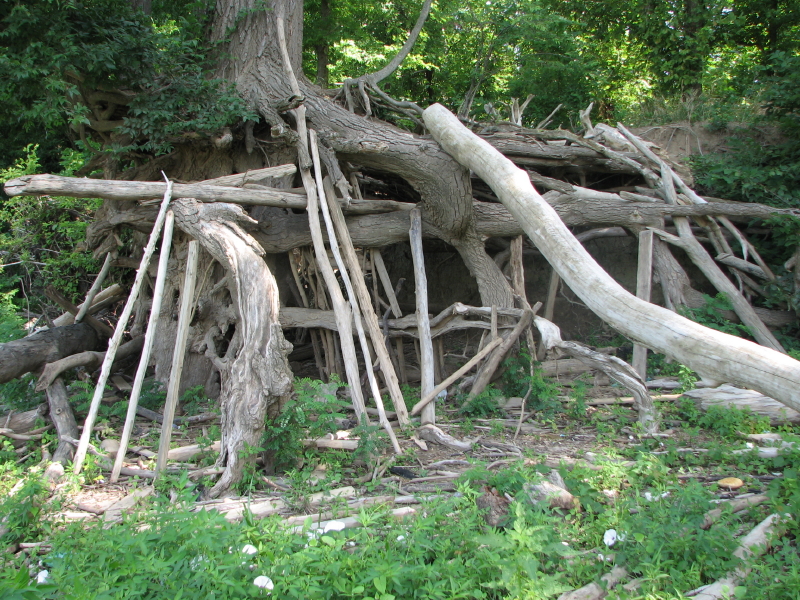
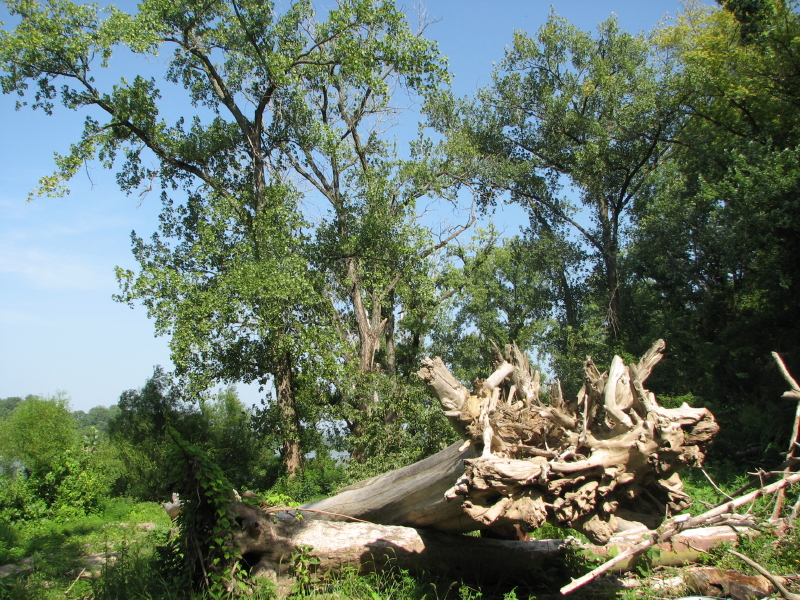
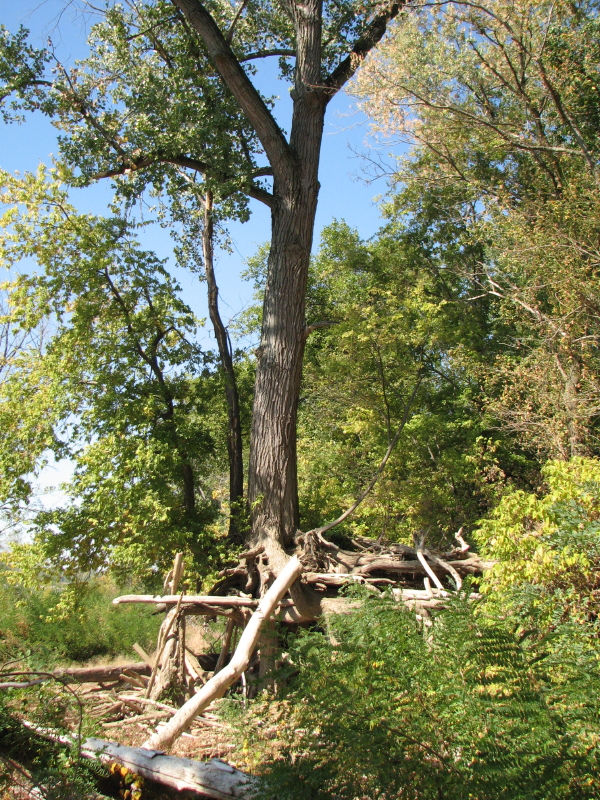
Along the western section of the Falls of the Ohio State Park is one of my favorite trees.  It’s a large cottonwood tree that you can sit under its roots!  Many years a go the river must have eroded the bank surrounding this tree and enough of its root system was left and continued to grow that a nice sized space was formed.  It’s a favorite place for young lovers and people taking shelter from thunderstorms.  I’ve taking advantage of this “room” while waiting out rain showers and it’s also a handy place to escape the summer heat.
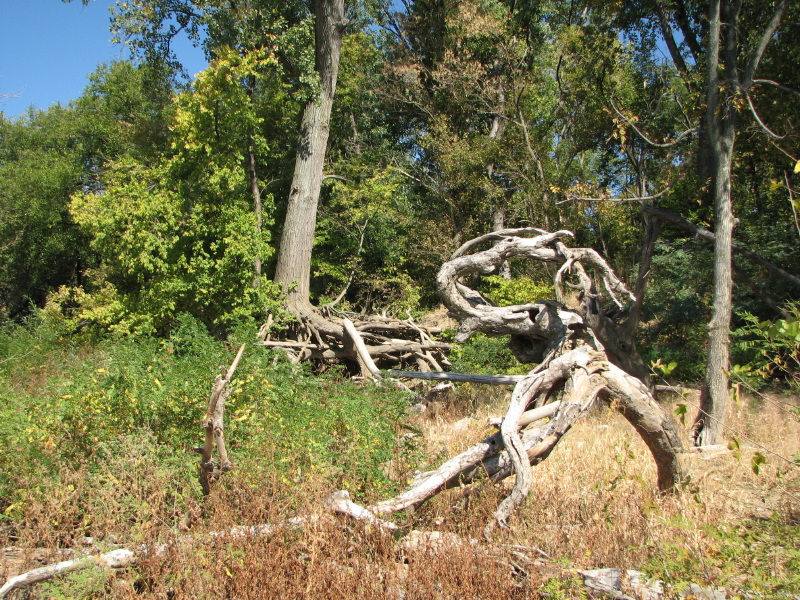
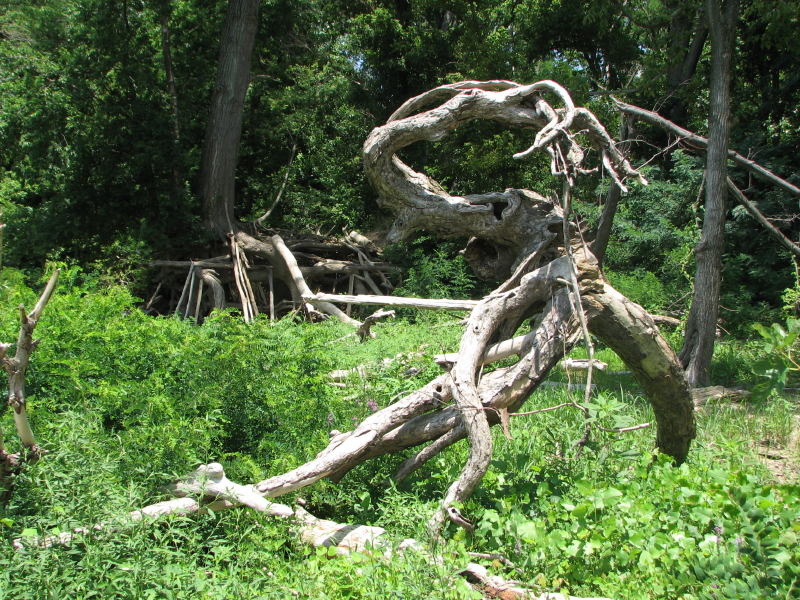
There are other tree formations in the area and many of them are quite sculptural and picturesque.  I find myself taking many pictures in this area.  One day while I was engaged in this activity, I accepted an invitation to hang out and take a break with a new friend of mine.  Although he is shy and doesn’t like cameras, he did allow me to take his portrait and a few images of him in his home.
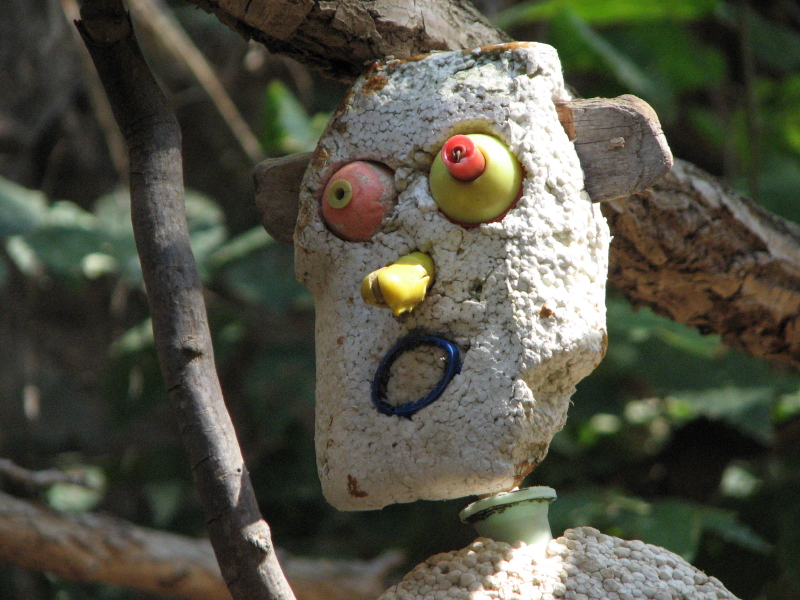
He doesn’t have a name in the conventional way we have names.  He simply describes himself as the Spirit of the Tree and he has adopted this special cottonwood tree as his charge.  As far as I can tell…what he does for the tree to look after it is “pray”  for its continued good health. 
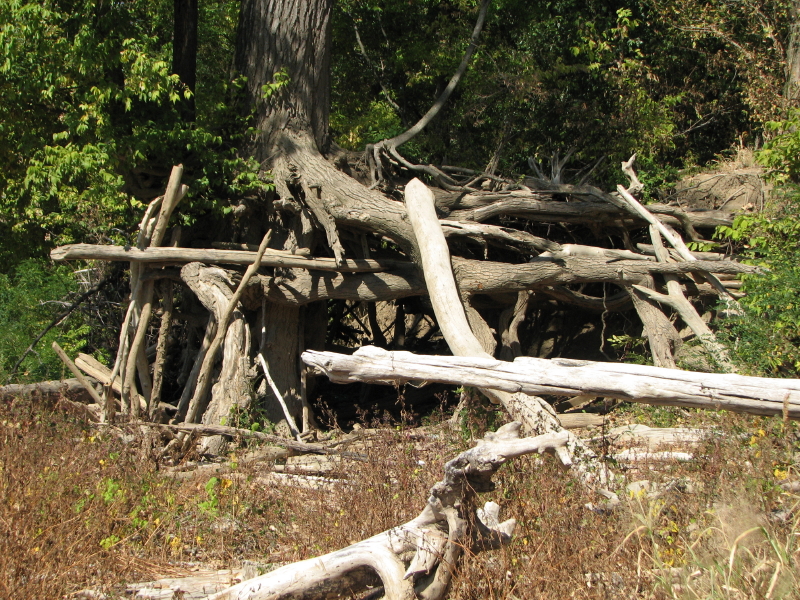
This is a picture of the “front door” of this tree house.  It does break with traditional idea of a tree house by being ground level instead of elevated.  The “back door” is covered by river scavenged planks .
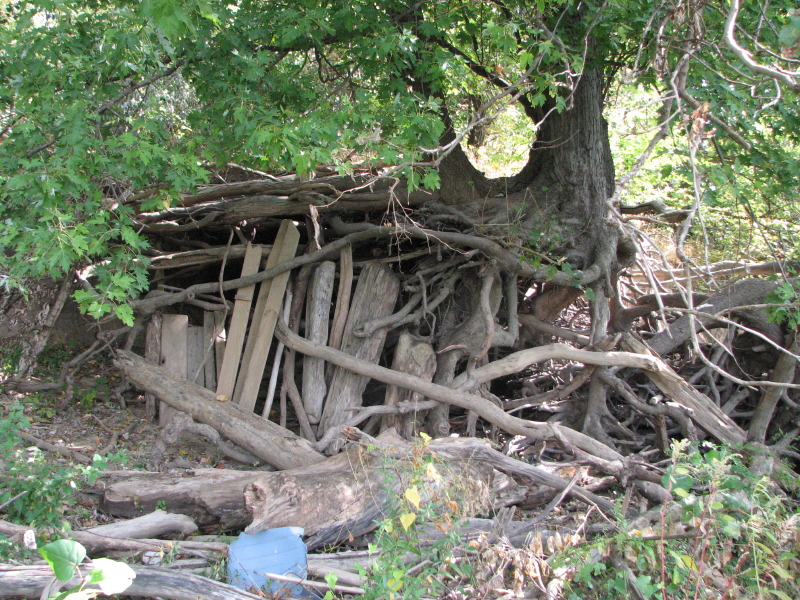
The Spirit of the Tree invited me in and I took a look around.  Yes, there were beer cans and the remnants of fire pits.  I imagined that this tree was used by homeless people on more than one occasion.  There was even graffiti that some careless person thought was needed in this already special place.  All this causes the Spirit of the Tree much concern and he tells me that it takes a lot of incense and sweet grass to purify the tree.
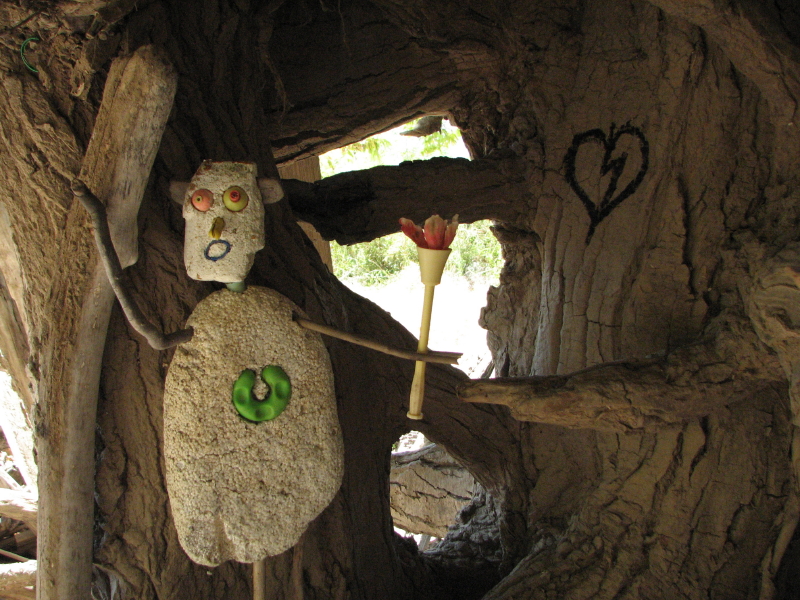
This is not the Spirit’s first tree, but he did say it was his favorite one so far.  Because it is so accessible by man and the river…it’s just a matter of time before nature reclaims it.  You can see the evidence of this process all around the cottonwood tree.  Once upon a time, there were several other trees keeping this special tree company, but wind and water have taken their toll.  Unfortunately, there aren’t enough “Spirits” around for every tree and so they must be choosy by necessity.
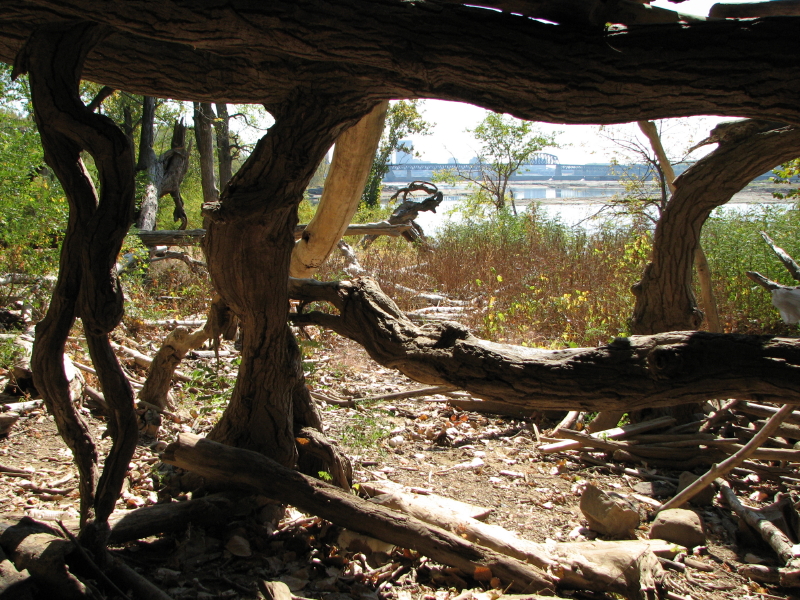
I have included several images of the views out from under this cottonwood tree.  You can just make out the skyline of the Louisville and the fossil beds in the background.  Sitting under this tree…you might think is potentially scary, but I have always found it comforting.
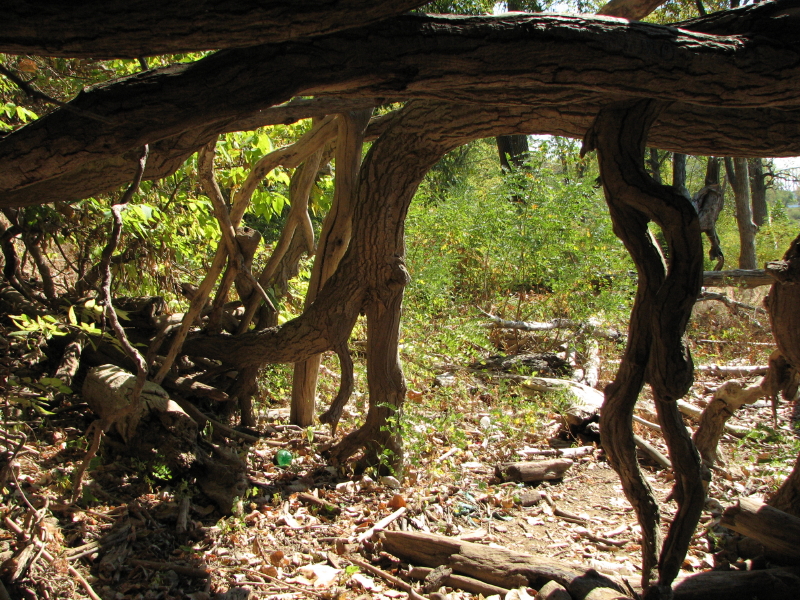
You can see how the roots just drop down into the ground.  They are large and numerous enough to buttress this tree.  There is even a window providing a view of the western side of the park and here it is.
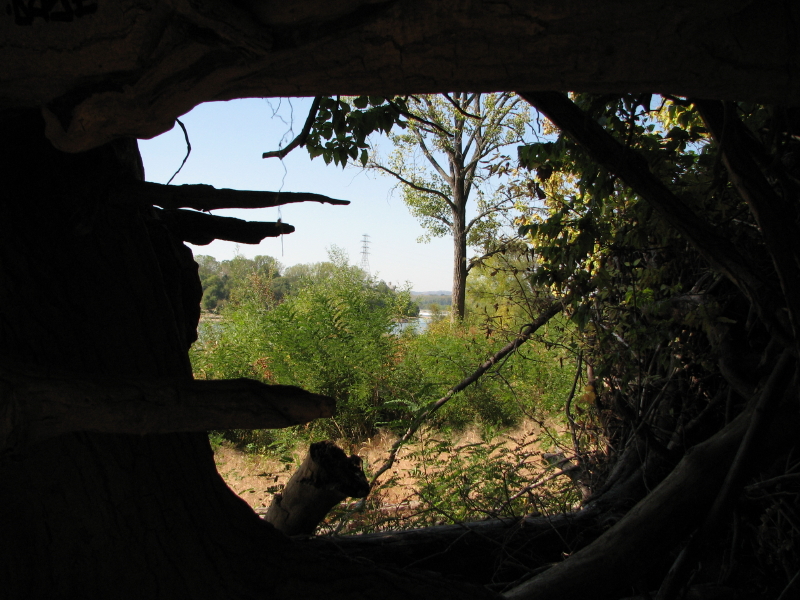
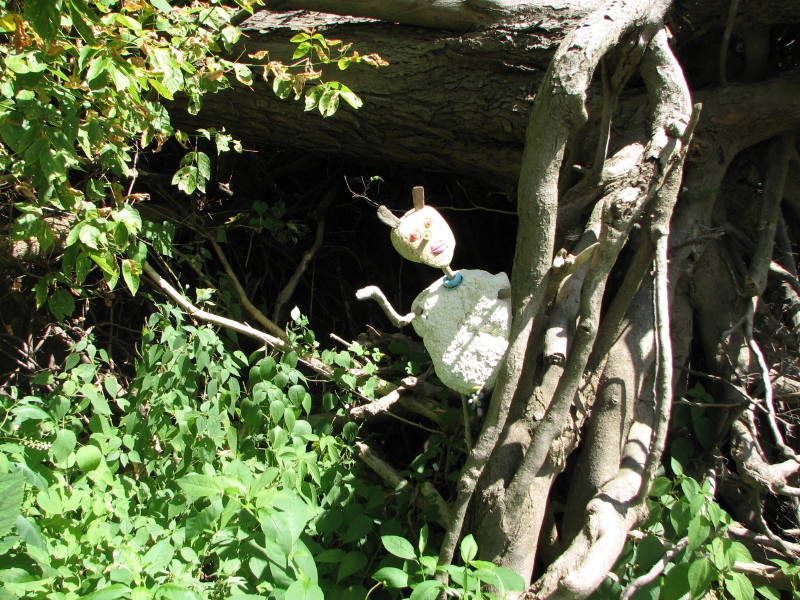
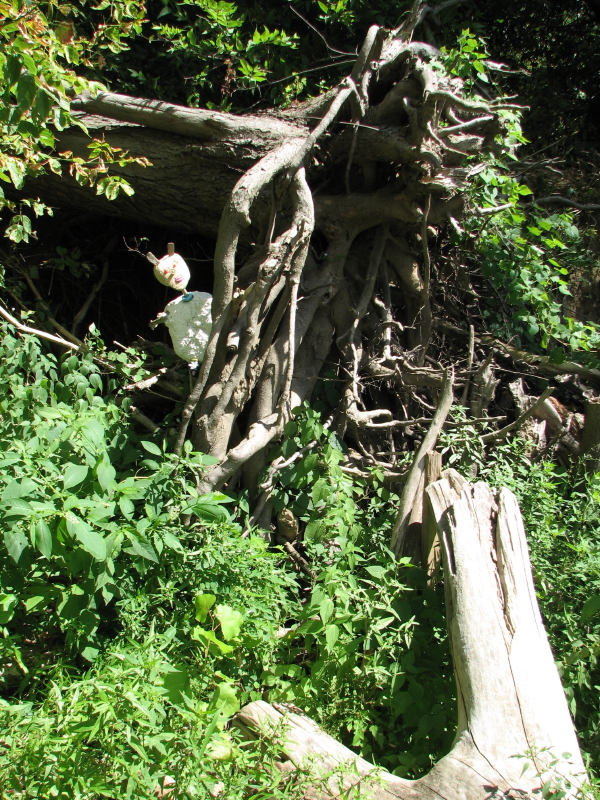
I talked with the Spirit of the Tree for about an hour before heading home.  He told me he chose to reveal himself to me because he had seen me before and felt I was respectful in my dealings with his tree house.  In those instances when indifferent people show up…he climbs the trees roots and branches and hangs out in the woods until they leave and then he purifies the tree again to keep it going strong for a little while longer.  My parting image of the Spirit of the Tree is of him standing on this tree’s amazing roots and looking up at the riverbank.

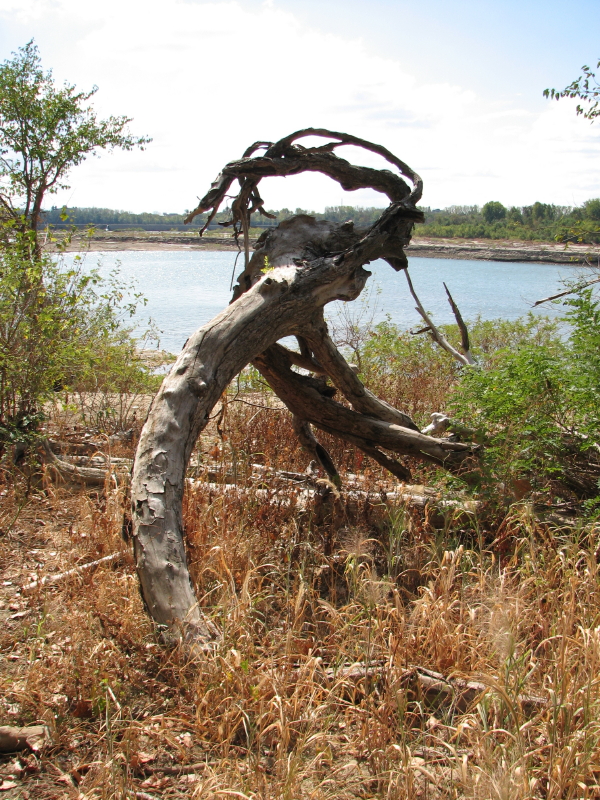
Because there aren’t enough Spirits to go around to take care of all the trees we need in this world…I think it would be a good idea of everybody who cared about such things would adopt a tree or two for themselves.  Doing so would be good for our spirits too!  To end this post, here is another angle on that really sculptural tree that fell down years a go.
Read Full Post »

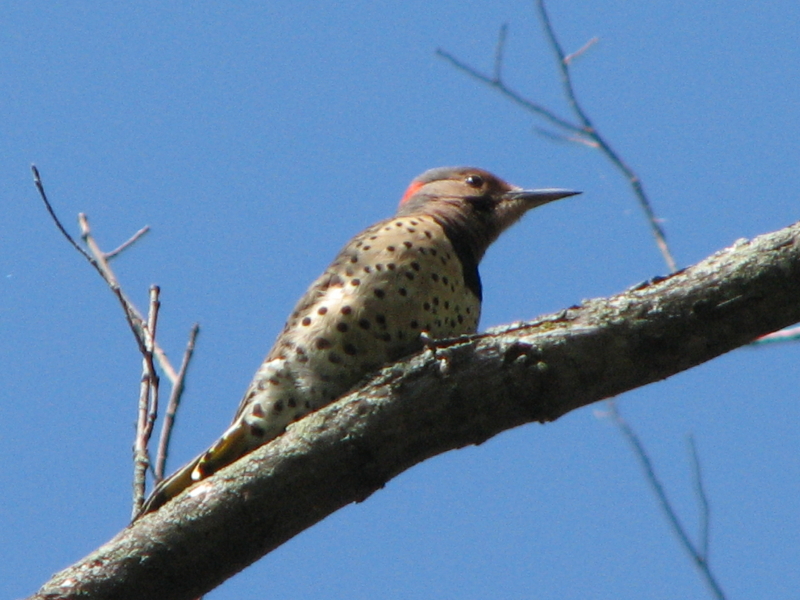
After finding all my sculptures smashed, I decided to give that section of the park a rest.  I will eventually return there and make new pieces from the remains.  Today’s walk is along the western section of the park.  It is an area I have come to appreciate more.  In part, because fewer people venture this way and there are different points of interest.  It’s fall migration time and I’m always on the look out for birds.  The birds that are just passing through are of particular interest, but I also like the species that can be found here year around.  I came across this really noisy Northern Flicker on a branch and snapped its picture.

This is a fairly large woodpecker.  In the old guides, this would have been identified as the “Yellow-shafted” form.  The feathers under the wings and tail are a bright yellow which can be seen as the bird flies.  The black “mustache” extending away from its bill identifies this as being a male.

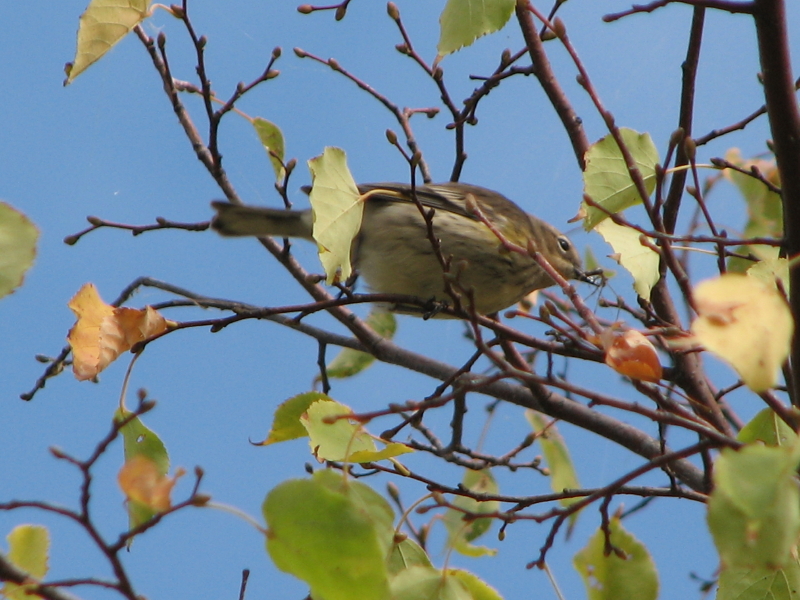
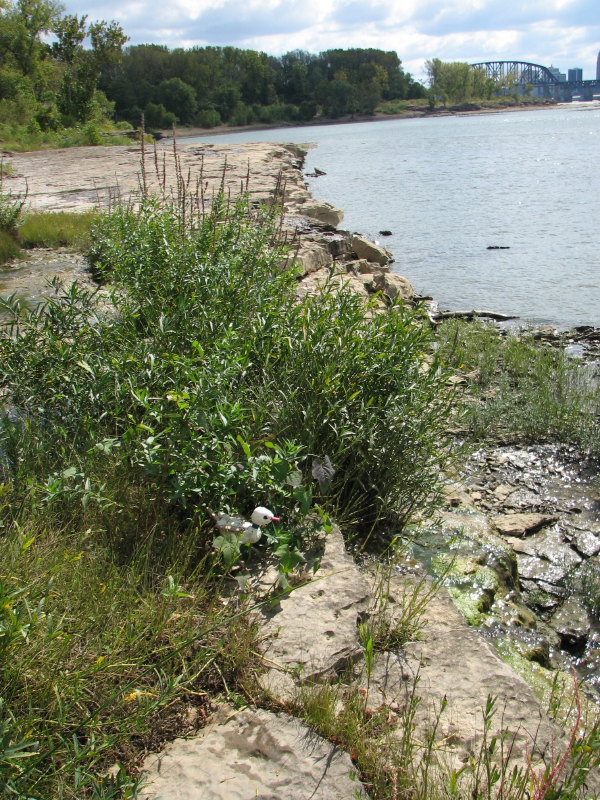
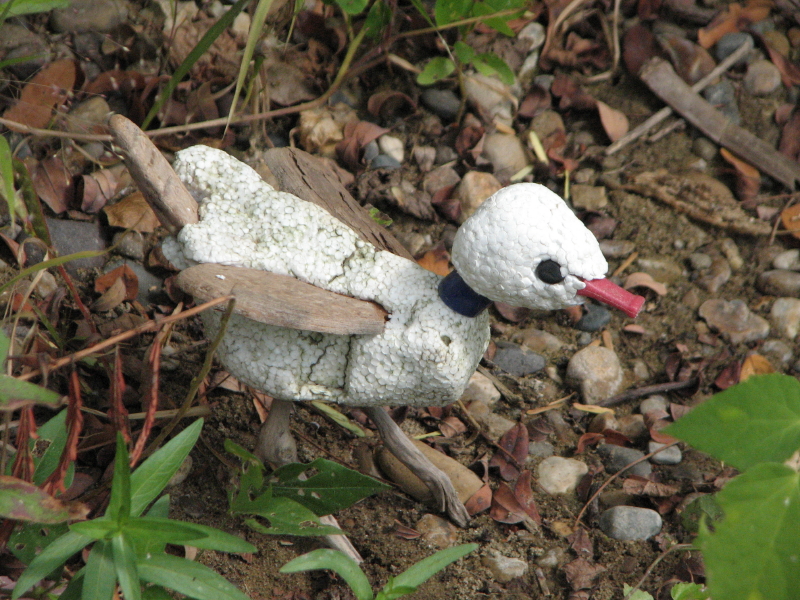
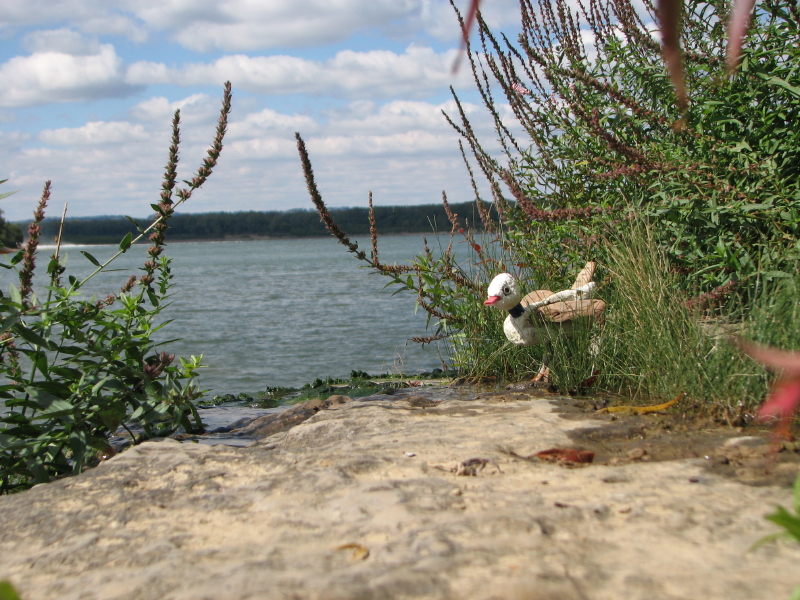
Chasing small insects among the fall leaves is this Yellow-rumped Warbler.  This is the park’s most common warbler and one that hangs around longer than any other of the park’s 35 sighted warbler species.  I have seen most of them, but they are easier to identify in the spring when their plumage is more colorful.  Fall warblers can be a challenge and I’m still learning all their nuances.  I have seen more different warbler species this year because I have tried a little harder to look for them.  Still, when you are out on the land, you just never know what you will cross paths with and that is the subject of this post.  I saw my first Water Chick on this expedition and managed a few decent images that I can share with you.  First, can you spot the Water Chick in this photo?

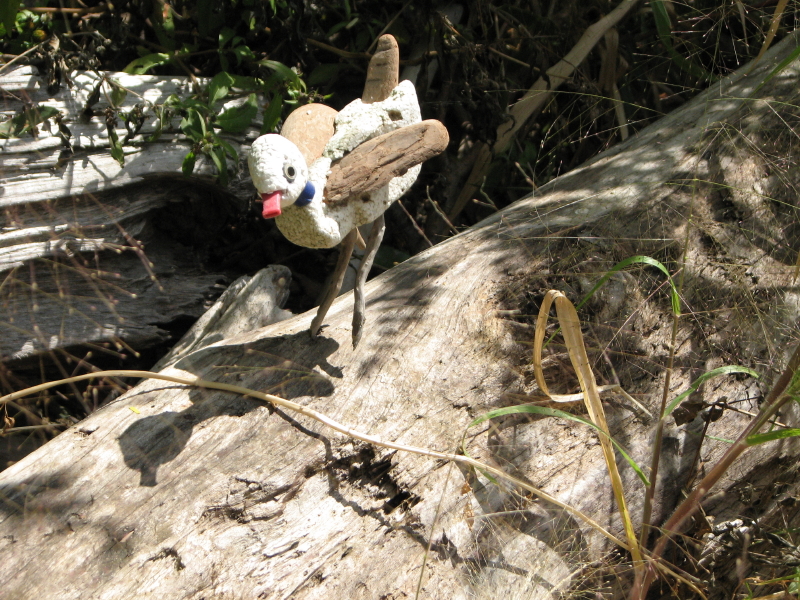
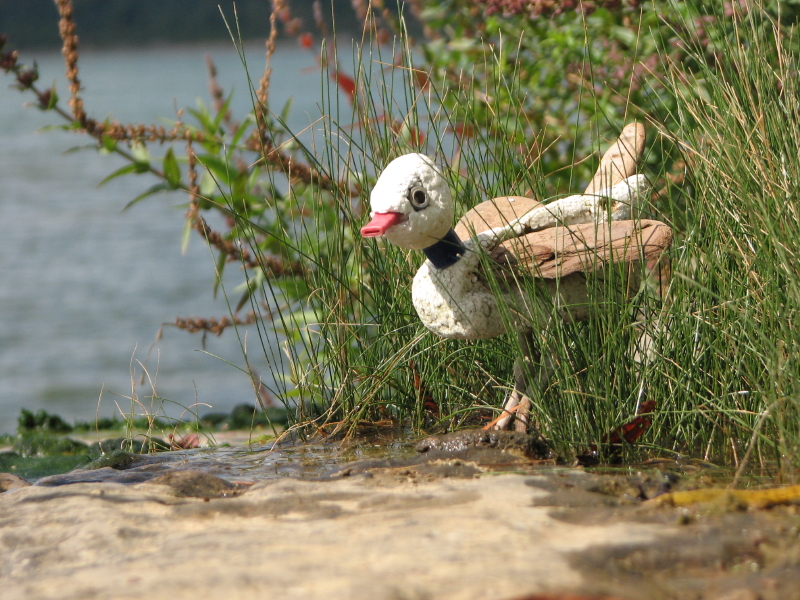
I bet you found this interesting bird?  It’s snow-white in color and has a bright red bill.  It’s only occasionally found in this park and the habitat it prefers matches exactly the kind of landscape you see here.  The Water Chick is usually found near water and also needs dense vegetation to hide and raise its young.  Over the course of a couple of hours I ran into this bird several times and here are a few “portraits” I was able to manage.

The Water Chick is usually found on the ground, but reportedly, is a decent swimmer as well.  Although it can fly it is reluctant to do so.  It much prefers hiding and taking advantage of the local cover where it seeks out small insects and spiders that make up its diet.  I surprised this one investigating a decaying log.  Here’s another image of this bird.

As you might be able to discern…the Water Chick is a small bird and relies on its diminuitive size and secretive habits to go unnoticed.  I believe I heard (not entirely sure though) a low piping sound when this bird noticed me and became alarmed.  It high-tailed it into the loosestrife clumps as quick as can be.  This is precisely the type of ground bird that I worry about being preyed upon by feral cats and in fact, ornithologists report that this species is on the decline for multiple reasons.  While I was birdwatching, I did come across another bird predator.  However, this one is so large that I doubt that it would bother taking a Water Chick.

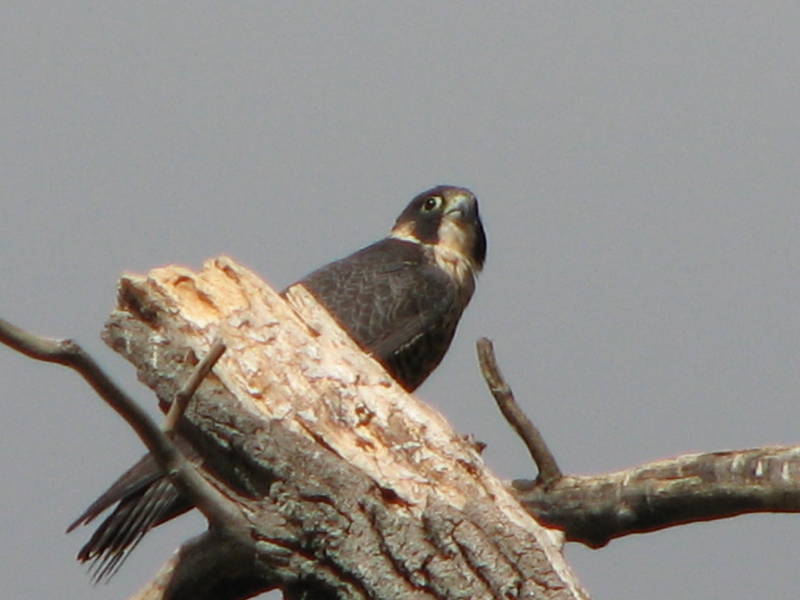
I see Peregrine Falcons on occasion out at the Falls, but this is the first one I could get a picture of…unfortunately part of the tree obscures the bird, but it’s still distinctive enough to identify this large bird of prey.  I have actually seen these falcons more in the city where they nest on the taller buildings in Louisville.  Like other parts of the country, we nearly lost this magnificent bird to DDT poisoning.  Since banning this pesticide they have made a comeback, but we could use more to help keep the pigeon population in check.  I located the Water Chick one more time before heading home.  It was along the fossil beds that rise above the river level which is still down from an acute lack of rain.

I was on my belly laying on the limestone rocks when these photos were taken.  I think it helps give an idea of what it must be like from this bird’s perspective?  After taking these images, I decided that I disturbed this bird enough and backed off.  I hope it forgives my intrusion, but I had never seen one of its kind before…and maybe never will again?  This bird is bound for our Gulf Coast where it spends the winter in the swamps.  Turning for home, I also came across small stands of this rather large flower and thought this a nice way to end this post.

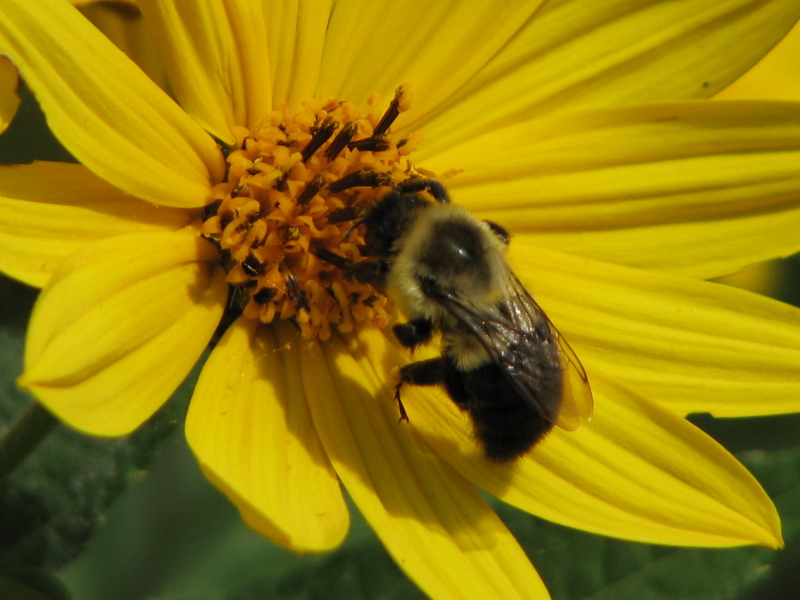
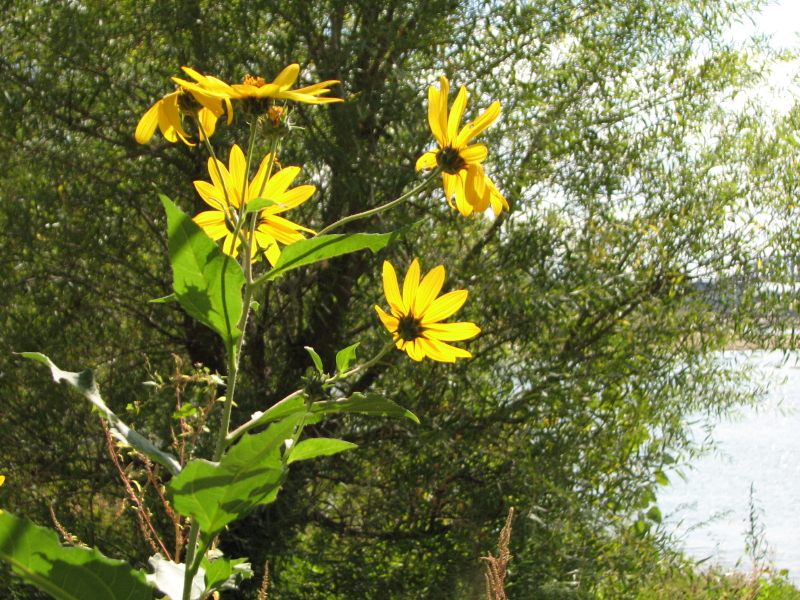
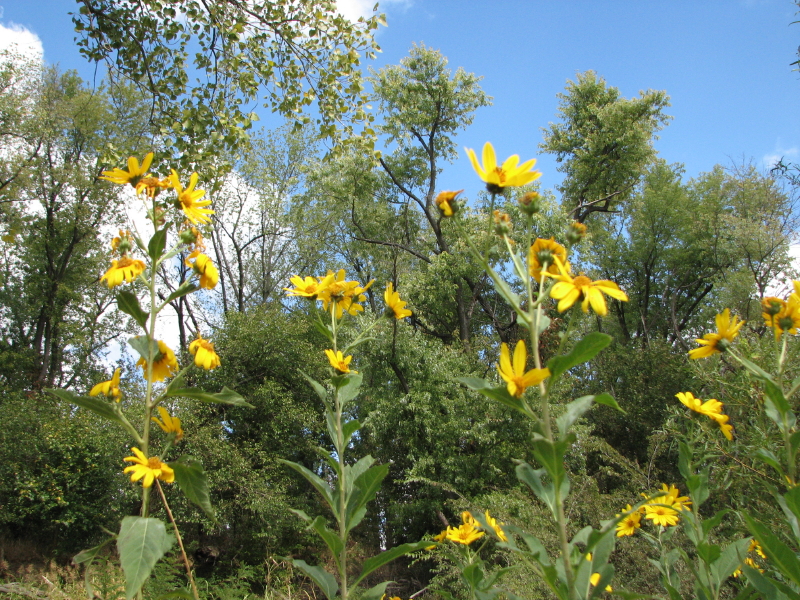
I’m not sure on the identification of this plant? Many in this stand were over six feet tall.  I need to bring a guide with me into the field to help with this.  In the moment, I’m happy for the color this large flower brings which contributes to the beauty of the season.  Thanks for tagging along on another of my walks at the Falls of the Ohio.  See you later!

Read Full Post »

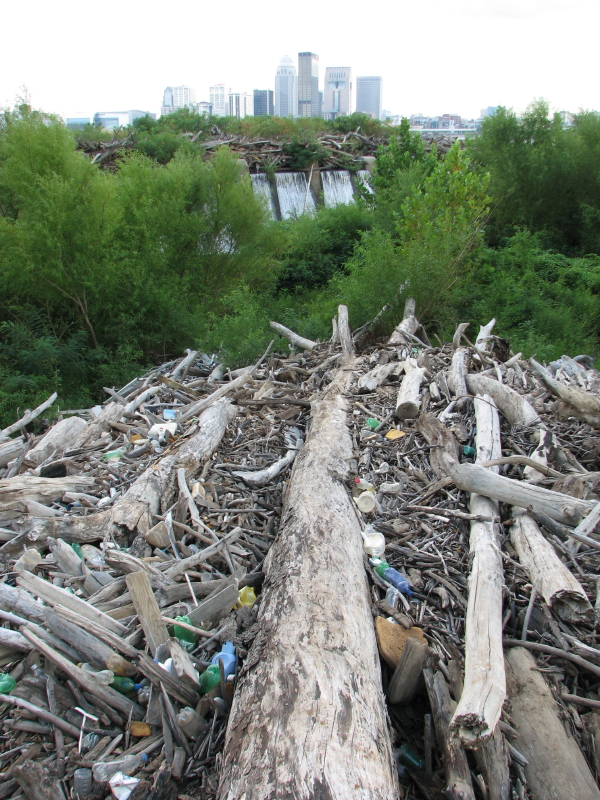
At the eastern end of the Falls of the Ohio State Park is where I see the most bird species.  It is also the area that seems to trap the most driftwood after we have had a bout of high water.  Material of all kinds collects between the high walls of the dam and the steep riverbank itself.  There is another sizeable collection of driftwood on the other side of the dam’s wall that is just waiting for the river to rise before depositing another layer of wood and debris in the park.  The bowl-like depression created in this space cuts across a few distinct habitats and is also protected from the wind which is why I think the birds like this spot.

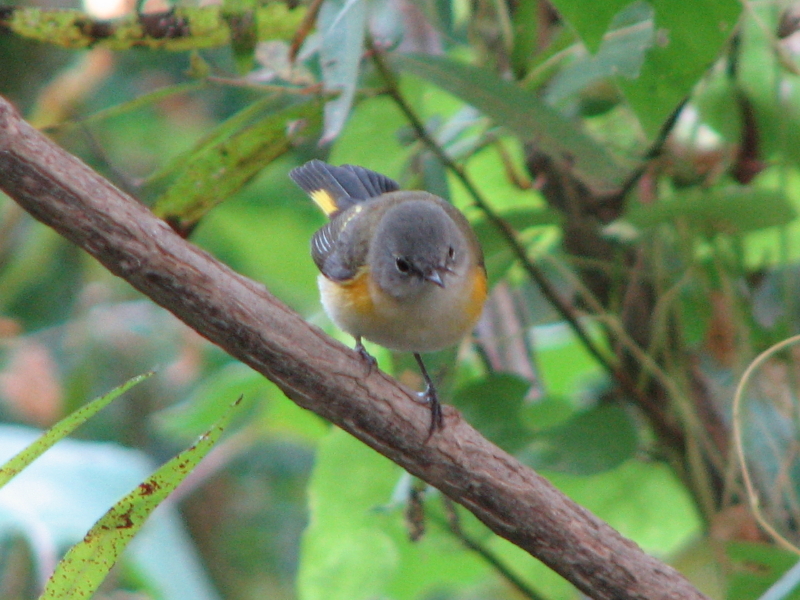
On this day I was doing my birdwatching thing and trying to photograph some of the warbler species that migrate through here in the fall.  It’s a real challenge for many reasons.  First, there is still enough foliage around that it is hard to get an unobstructed view of a bird.  Second, the migrating warblers are now much duller in color having lost their breeding plumage, can be hard to identify.  In some cases, the differences can be dramatic between how a species appears in the spring and how they look on their autumnal migration south.  Added challenges also include that these birds are very small and extremely active.  They don’t sit still for long.  On those occasions when I get a picture that I like…I feel more like a fortunate opportunist than as a photographer with any skills.  I know I’m rambling, but I need to set the scene first before getting to the point of this post!  It took a bit of luck and patience just to obtain the above photo of this first year American Redstart and it looked like this bird was going to hang out a bit and I was well concealed and anticipating more images when something very interesting happened.  There was movement in the brush below the bird which flew off and I was left with this quickly snapped photograph!

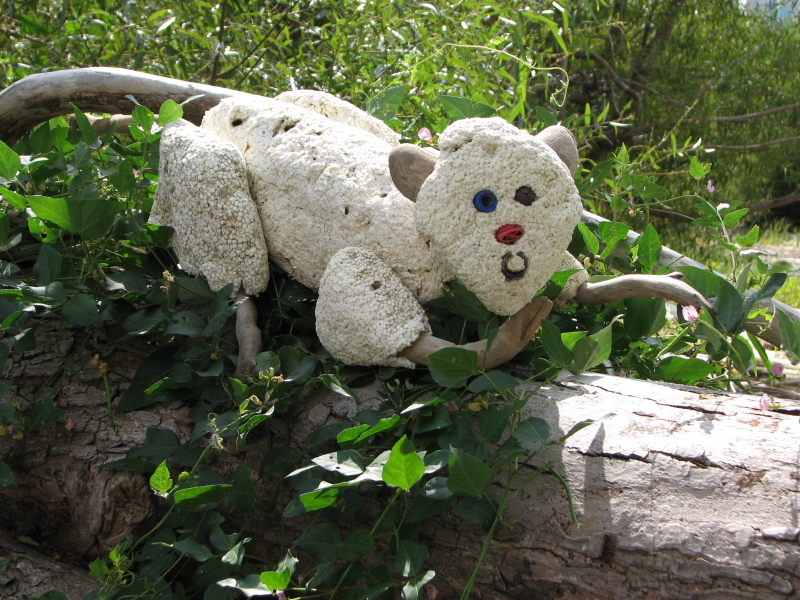
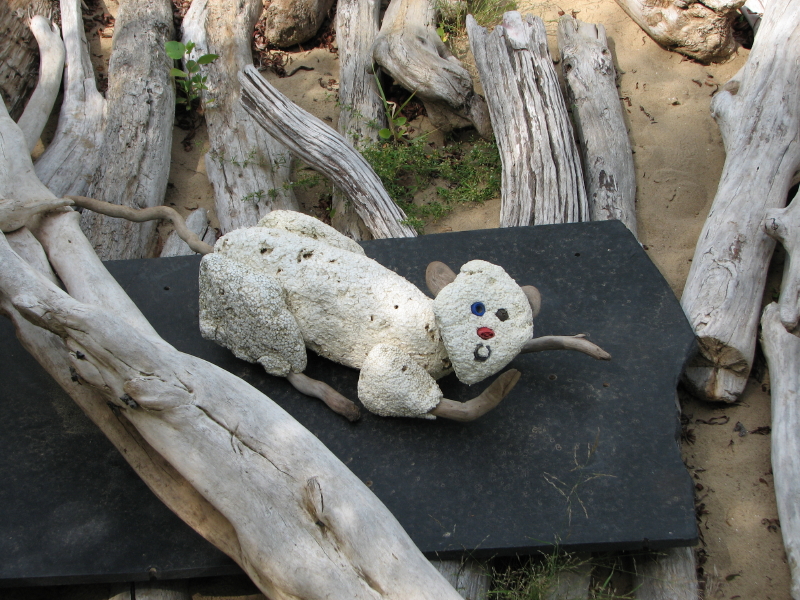
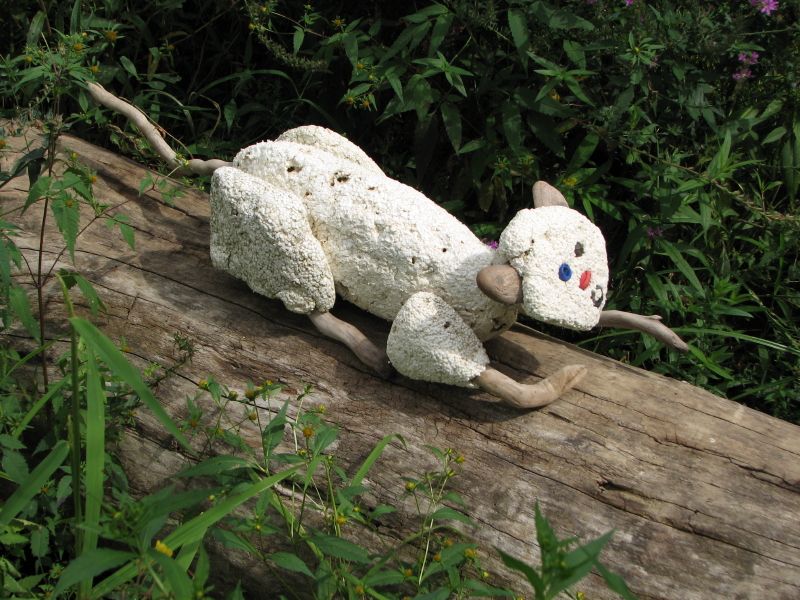
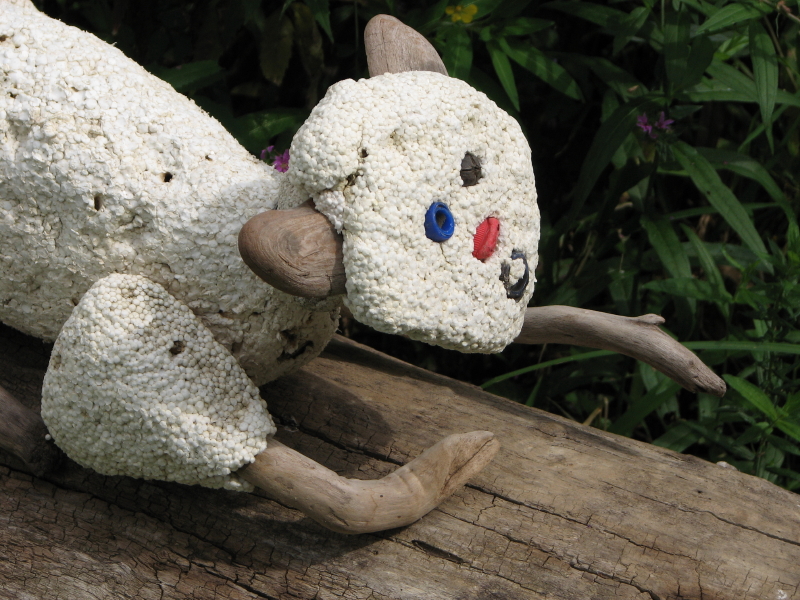
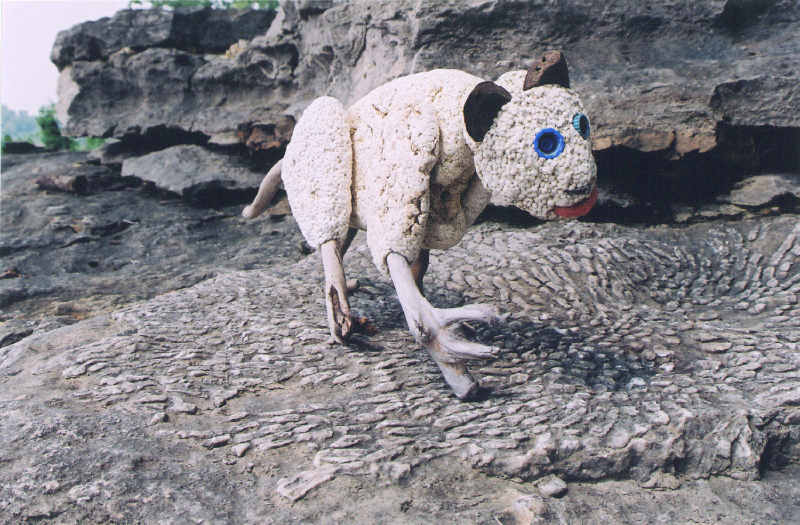
I just witnessed a failed hunting attempt by the Flat-faced Cat.  It’s an unusual mutation that has occurred among the resident feral cats which seem to be gaining in population in this park.  To me, this is a big point of concern because in addition to the garbage left behind from picnics…they are also preying upon and eating the small wildlife found in the park.

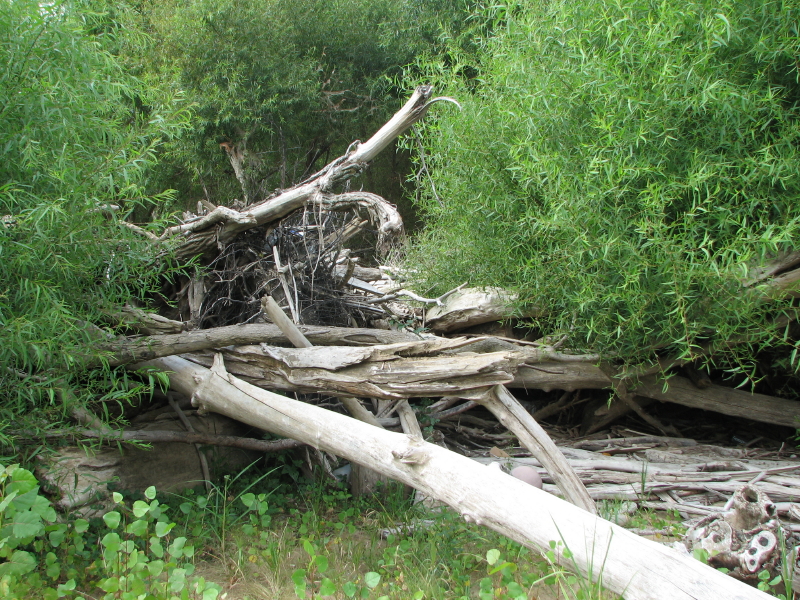
So, where are these cats living?  I have literally found them throughout the park where they can find shelter.  I tracked the Flat-faced Cat back to a den under the driftwood.  The interlocking logs have created a structure that has many natural tunnels and rooms.  It can also be dangerous because the wood is always shifting under its own weight as it breaks down from environmental exposure.  I’m sure that it can’t be an easy life for these cats.

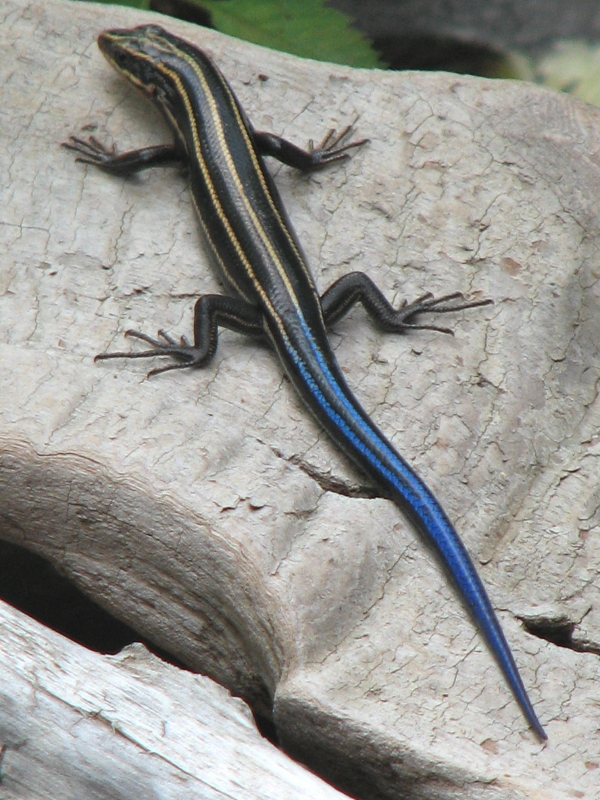
Since our first encounter, I have taken an interest in this particular animal.  It always runs away once it spots me and is now completely wild.  I see it the most when I’m in the Willow Habitat and I think we are after the same thing!  We are both hungry for wildlife, but in very different ways.  I recently observed and photographed this cat hunting lizards basking on the sun-drenched logs.  First an image of its intended prey.

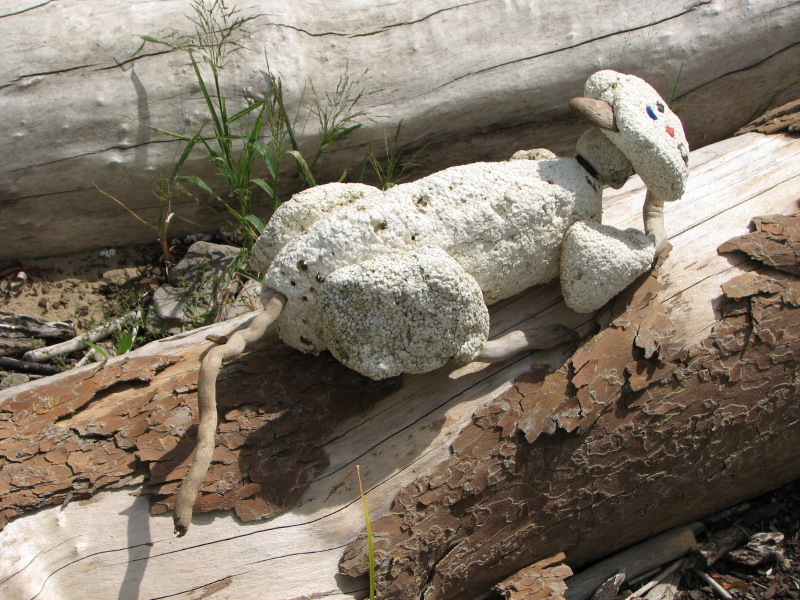
The blue tail marks this as the young of the Five-line Skink.  This is a fairly common lizard in this park and the one most people are likely to encounter.  While I was hiding behind a sizeable willow tree, I saw the Flat-faced Cat attempt another unsuccessful hunt and took these images.

Now, don’t let its cute face fool you.  Out in the woods, this animal is all business when it comes to hunting.  I’ve looked at a few articles on the web about the cat predation problem and interestingly there is some controversy.  There are studies from Great Britain and California that suggest that feral and domestic cats take millions of songbirds and small animals a year.  Societies devoted to cats, however, dispute the evidence and say that there aren’t good studies to back this assertion up.  When all else fails…turn to anecdotal evidence!  How many of you out there who own cats that are allowed to roam outdoors have been “gifted” with dead birds and other little animals on your door steps?  I have a hunch that many cat owners have had this experience.  Now multiply these “gifts” with the millions of cats that are out in the world and the studies probably aren’t too far off.  The studies also suggest that the hunting instinct is so well engrained…that even very well fed cats can’t resist that little chipmunk running around the backyard.

Of course, feral cats are not the only cause for the decline in the numbers of songbirds.  There are pressures of all kinds and habitat loss and environmental degradation play their huge parts.  Still, the domestic cat is not something that occurs “naturally” in our wild environments.  Responsible pet owners should never set unwanted pets loose where they don’t belong.  Responsible owners also have their pets spayed or neutered to further limit the population of unwanted pets.  It’s kinder to all living things to do this. Looking through my archives, I remembered that I had seen another feral cat that looked a lot like the cat which is the subject of this post and here is its image.

I photographed this big tom cat on the fossil beds near the Interpretive Center.  It had only one eye and sported this murderous looking paw!  Who knows it may be a direct ancestor of the Flat-faced Cat?

Read Full Post »

I was walking through the woods on a sun-dappled day looking for migratory birds when I came across a new friend.  We talked for a little while before introducing ourselves.  Both of us remarked on the dry weather we have been having and I said that it’s official now.  September was the driest ever in the commonwealth of Kentucky since records have been kept dating back to 1871.  We have had a spits-worth of rain… that’s it.  Overall, this has been our third driest month ever, beaten only by two Octobers over the course of the past century.  We both wondered if this was an omen for this October?  We certainly hope not.  Having created some common ground, I introduced myself and she said to call her Minnie, Minnie Buckethead.

As it turned out, Minnie is an interesting old lady with a fascination for everything in the woods.  I asked if she had seen any migrating warblers and she had.  American Redstarts, Black and White Warblers, were moving with small groups of other birds including Carolina Chickadees and Tufted Titmice.  I had seen nothing.  I definitely need to get up earlier in the day to catch the bird show.  Perhaps Minnie was taking pity on me and she said that there were a few other things happening in the woods and would I like to see them?  How could I turn down such a nice offer from an old lady?

We walked over to a large willow tree and I saw Minnie crane her neck and squint her eyes from the sun and she scanned the willow bark.  “Here” she said and I checked out what she was pointing at.

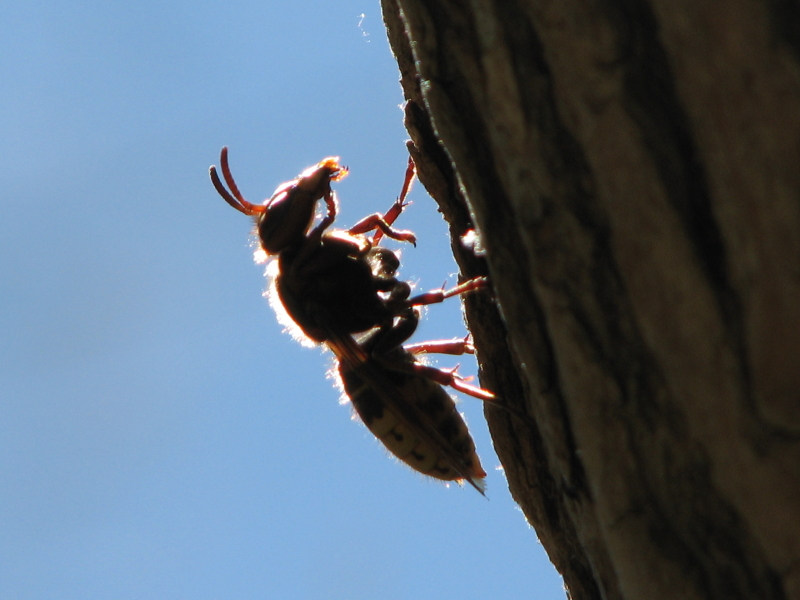
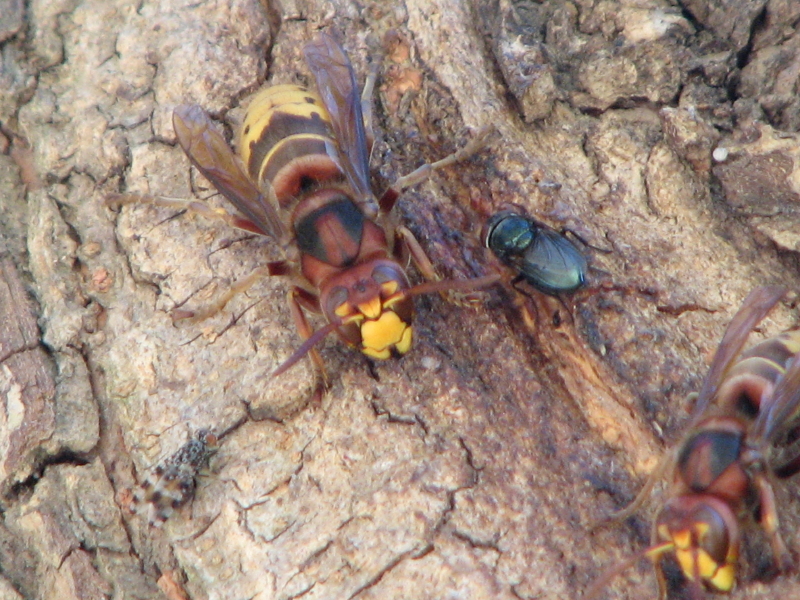
At first I thought it was a bee, but it was larger and more robust and not as big as a bumble bee.  There were others.  Walking around to the shady side I could determine that they are hornets of some kind.  The hornets and other insects were licking whatever was exuding from the willow tree.

“Don’t worry, they won’t get you”, she said.  The hornets were so preoccupied with the sap that they were quite tame.  Walking around the tree gave us this sight.  Three different species of butterflies also taking advantage of the willow bark.  The one in the foreground is the Red Admiral.  Although I hadn’t seen the hornets doing this before, I did say to Minnie that I had observed many butterflies on these willows and wasn’t it nice that so many living creatures could set aside their differences to take advantage of this common resource.  She just smiled.

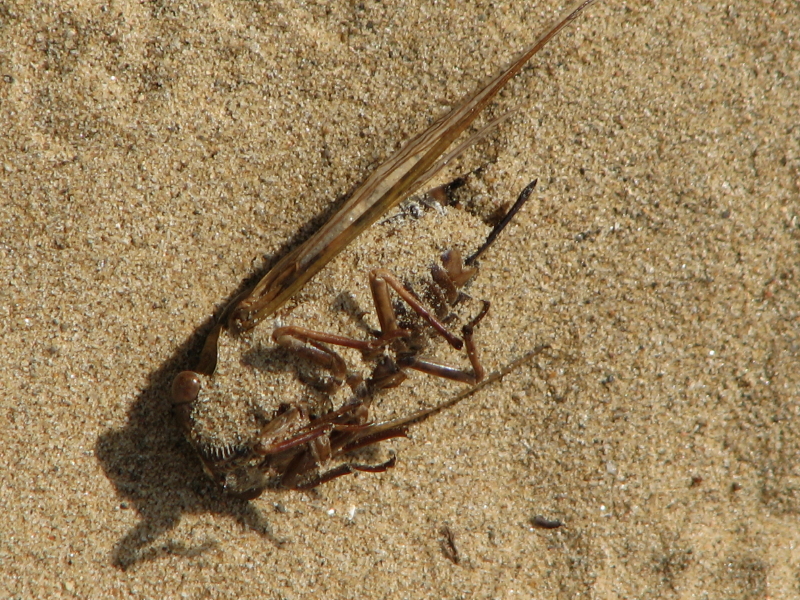
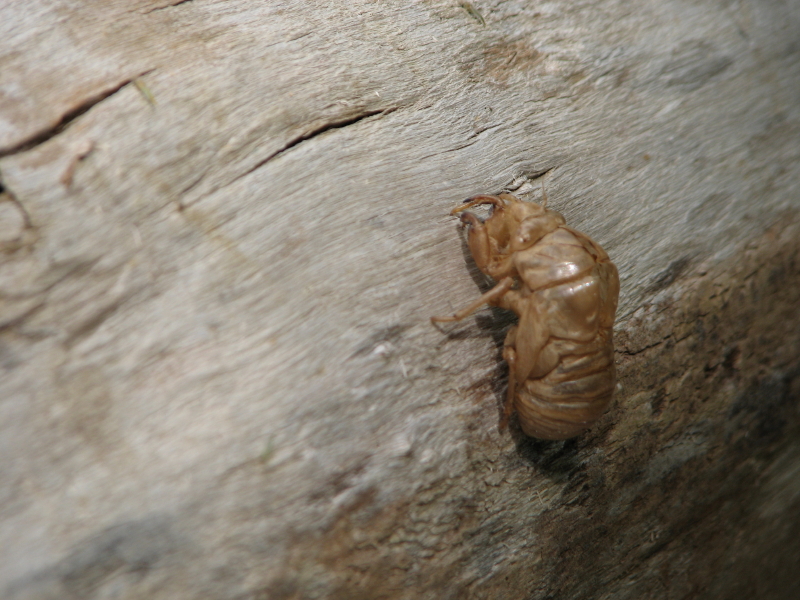
I was appreciative of Minnie showing me the tree and so I tried to impart a little knowledge to her about the local cicadas.  I had come across a dead female in the sand,(identified by the hypodermic needle of an ovipositor she uses to lay her eggs under the thin bark of a tree).  I asked Minnie if she knew anything else about their life cycle and she said she didn’t and so I went on.  I told her that after the egg hatches under the bark, the nymphs drop down and burrow under the ground and attach themselves to the tree’s roots.  With this species, after a couple of years of sucking tree juices, they emerge from the ground and become adults which for cicadas, is a brief moment in time.  They mate, lay eggs, and then die after a glorious two weeks or so.  You find their split skins where they transform as juveniles into adults near where they emerged from the ground.  Here’s a pictures of the dead cicada, the split cicada skin, and a fresh adult.

With any life cycle it’s hard to know exactly where to begin and I suppose that’s the classic which came first question… the egg or the cicada? I’ll leave that to brighter minds than my own for now. 

Minnie listened attentively and then asked me to follow her.  She had something else to show me before we parted company.  We walked away from the willow tree to an area where several large logs were decomposing.  She pointed a thin finger at a yellow patch on one log’s side and I could see it was some type of fungus.  It seemed to be spreading outward as it broke down the tissues inside the tree. 

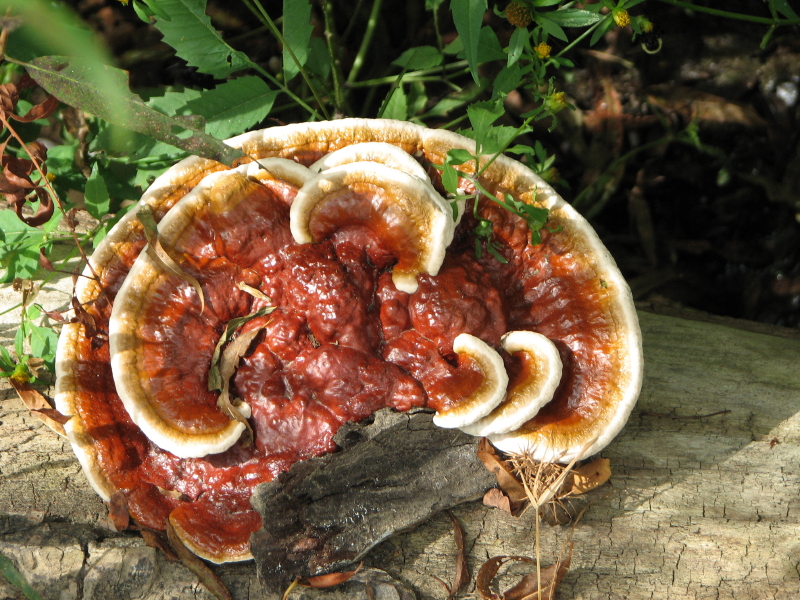
It was both fascinating and oddly repellent. On another nearby log was yet another fungi which I could identify as a fresh bracket or shelf  fungus.  The bright colors also seemed on the lurid side to me.

Minnie talked to me about what a wonderful system that nature has created to break things down after death.  Like these fungi were doing to what were once living trees.  She talked about how life depended on materials being able to decompose in order to release the nutrients that are needed for life to move forward.  This is what it means to live naturally and that we should look at the systems that the planet has in place and to learn from them.  With that, I took my leave and waved good-by to the old lady in the woods.

Read Full Post »

When we last left the Adventurer he was marooned on the riverbank waiting for the Ohio River to return.  Until the water reappears his crudely constructed log raft is stuck.  Taking advantage of the downtime, our hero is exploring and seeing what there is to see.  At this place called the Falls of the Ohio there appears to be a good variety of butterflies present.  Following are a few images that were relayed to me by the Adventurer along with a small lesson he gave me about Lepidoptera.  Here’s a sequence of images that our friend wanted me to share with you not only because he found this to be beautiful but interesting too!

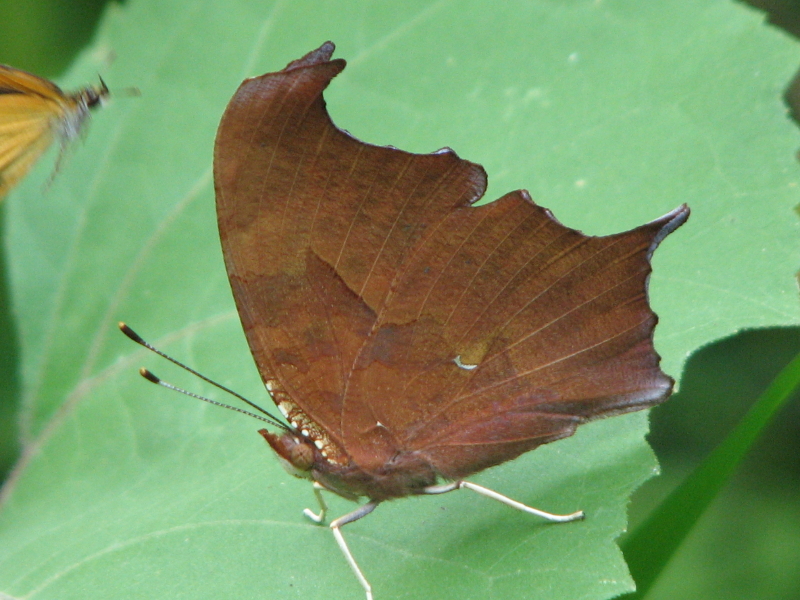
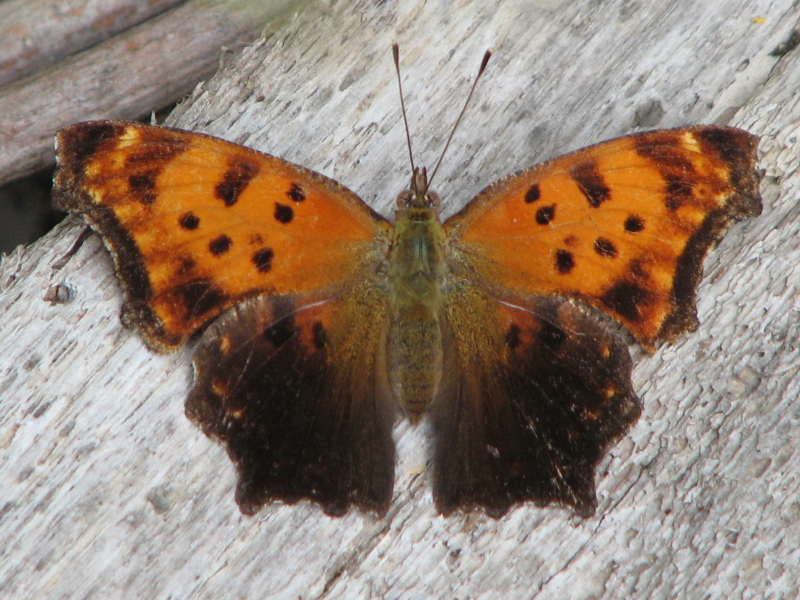
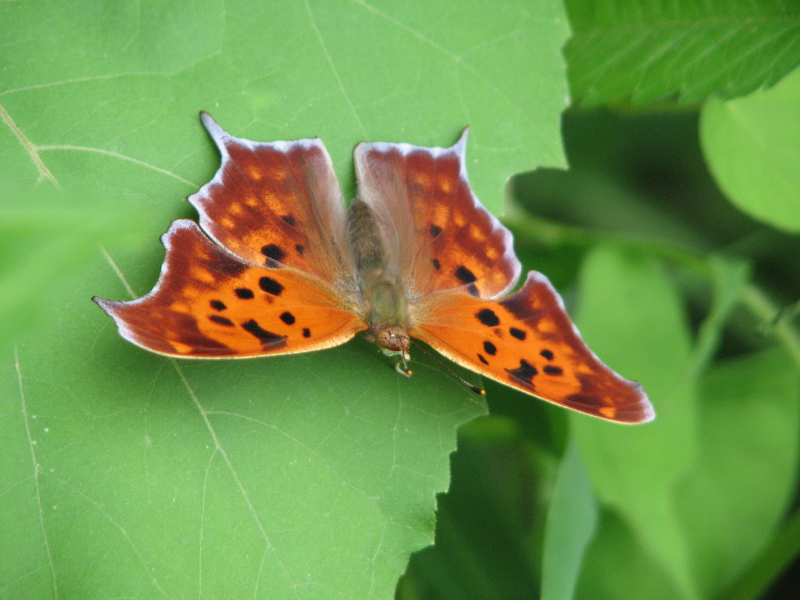
How lovely!  This is the first of our “Question Marks”.  In fact, this is the common name of this butterfly that is known in the scientific community as Polygonia interrogationis.  This is a fresh specimen in its fall form with its powder-blue wing edges.  The spring and summer forms sport much darker hindwings on their topsides.  The wingspan is about 3 inches across.

Here is the same butterfly with its wings folded and as you can see it looks very much like a dried leaf.  The Question Mark derives its name from the small, silvery “?” question mark-like design on the ventral side of its hindwing.  This specimen in this image doesn’t show this to its best advantage, however, what the Adventurer wanted to share is that other smaller butterfly entering the picture on the top left corner.  This is something not noticed until the pictures were downloaded from the camera.

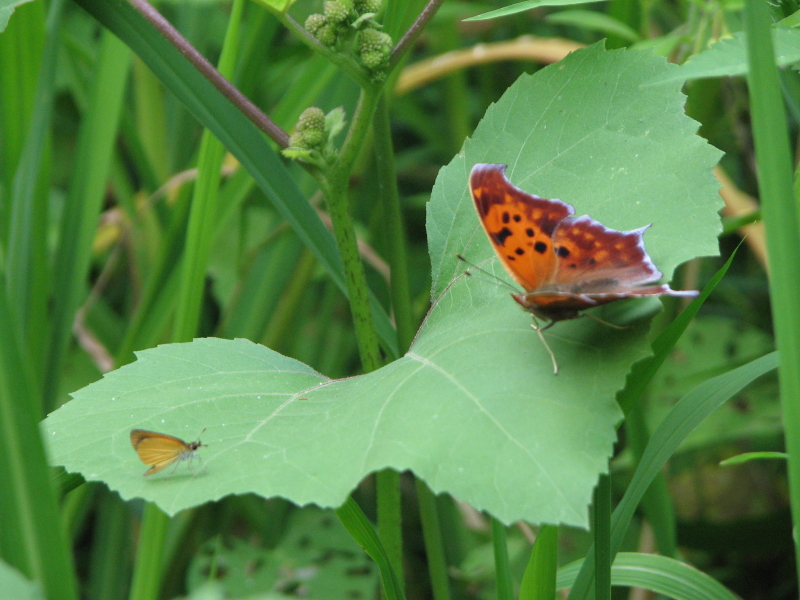
Here are the two butterflies sharing a leaf.  The plant is a cocklebur and you can see its ripening seeds in the background.  Soon these burrs will develop their Velcro-like hooks and attach to the clothing of autumn hikers.  I have had dozens attach themselves to my shoe laces!  Now for a close-up of that little butterfly.

This is the second “Question Mark” because neither the Adventurer nor I know what to formally call this one!  I enjoy collecting field guides of all kinds and I like to cross reference material as a way of learning more about the subject on hand.  I know this is a member of the skipper family which are primitive butterflies that share characteristics with moths.  In fact, some scientists don’t consider skippers to be true butterflies at all!  In my guides there seems to be many of these small, golden-colored skippers and identifying them is tricky and best done by experts.  This butterfly was so tiny and perfect and almost…unnoticeable.  In the enlargement it appears to have a forked proboscis for feeding.  I wonder how this design will help it eat and does it go for the usual butterfly fare?  Okay, moving on… let’s look at the Commas.

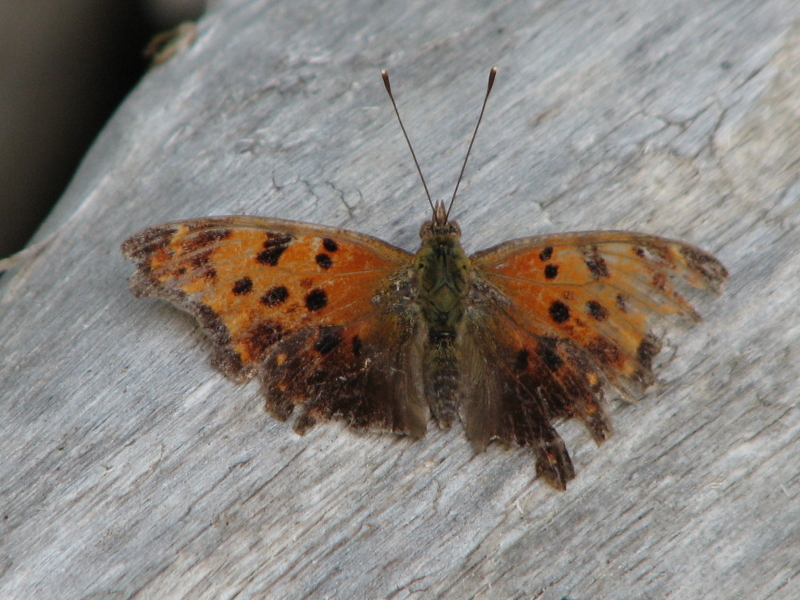
The Eastern Comma or Polygonia comma is a common butterfly in this environment.  As you can tell it is closely related to the Question Mark butterfly.  It derives its name from the small comma (,) like mark on the underside of its hindwing.  Both of these species are angle-winged butterflies and when their wings are folded up, appear like dried leaves.  These guys can be fairly aggressive as butterflies go and as proof…the Adventurer wanted you to see this specimen photographed against the silvery driftwood of the Falls.

He said this was the most ragged specimen he ever saw that was still alive!  This butterfly seemed to have no issues with flying despite its hindwings being mostly gone.  You can see how alert this one is by the attitude of its antennae.  This Comma is near the end of its seasonal run and its wing condition may be due to aerial combats with other butterflies and insects.  I imagine as Comma butterflies go, this one may have revelled in being a Comma!  This one may have been among the fittest of its kind?  The Adventurer hope you enjoyed this little side track and in closing offers another view of that nice Question Mark butterfly.  Thanks for visiting!

Read Full Post »

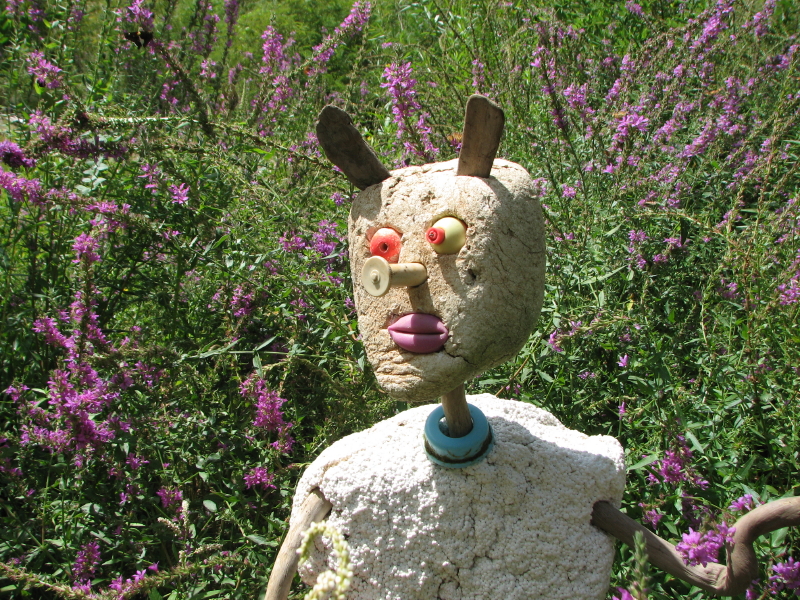
At last we have some respite from the dreaded heat of this summer.  Today is gorgeous!  The air feels fresh, and there is a nice quality to the light.  I decide to spend my time in the western section of the park on the Indiana side.  I heard that the butterflies were plentiful on the loosestrife flowers and that this could be a good time to take pictures.  First, I needed to find an officially sanctioned butterfly guide to show me the way.  He’s supposed to be somewhere over here…yes, there he is right on time.

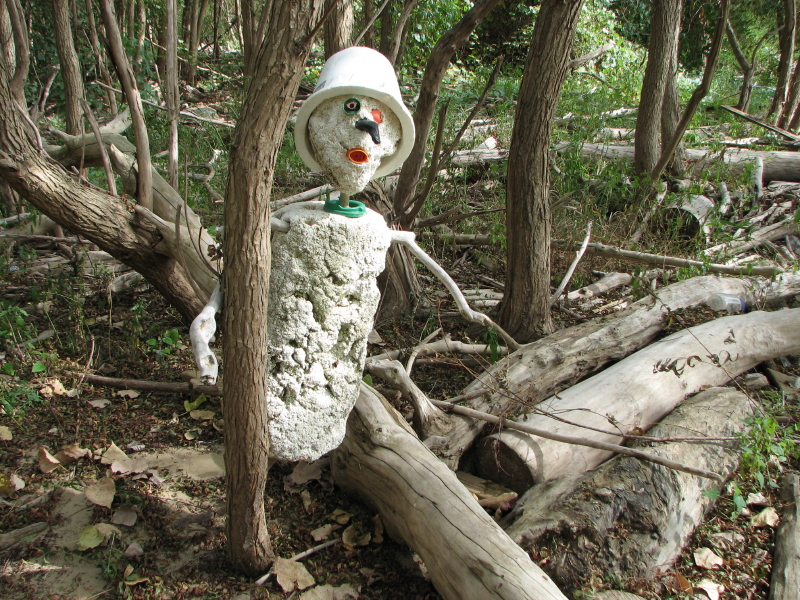
The strange-looking character said “Hello, are you the one who wants to see the butterflies?”  I replied that I was and we met face to face.

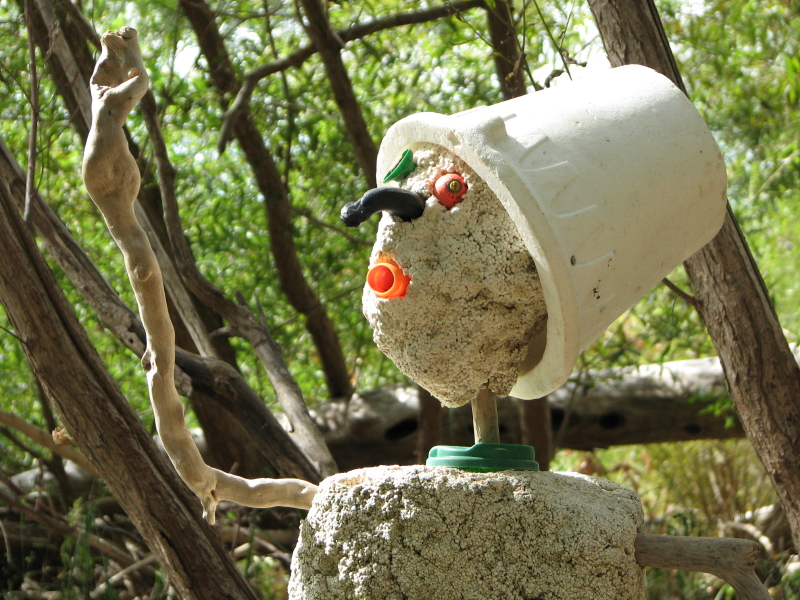
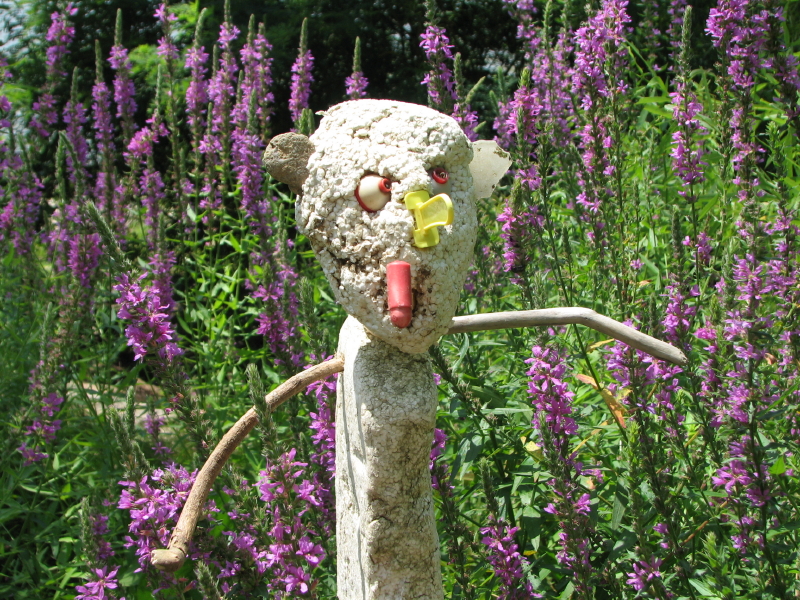
And what a memorable face he has with his mismatched eyes and lavender lips!  He told me to call him the Butterfly Man and that I had picked a good time to come to the river because it was now agreed that 2010 was a good year for butterflies in our area.  He also said that the place we wanted to go was a short walk ahead to where the purple flowers were growing.  Many different kinds of butterflies would be there.

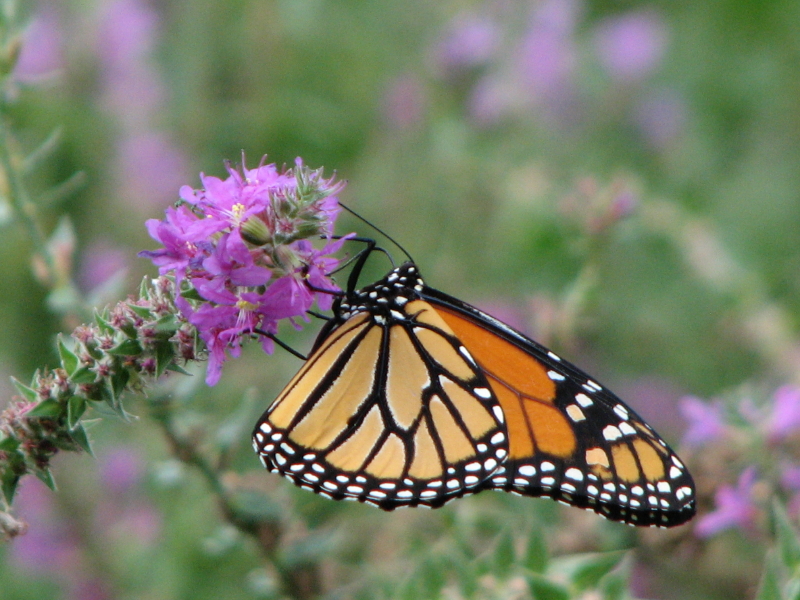
Along the way, the Butterfly Man told me tidbits about the environment we were experiencing and what we might expect to see.  He explained that the loosestrife flowers are an invasive species and quickly take over these shallow wetlands.  Around here small springs trickle water down the bank towards the river and keep this area moist. These are perfect conditions for the loosestrife which has spread from last year.  Butterflies and other insects love the nectar from these flowers and if we encountered bees and wasps…not to be afraid because if you left them alone, they would do likewise.  Soon we were among the flowers and it didn’t take the Butterfly Man long to spot a terrific butterfly!

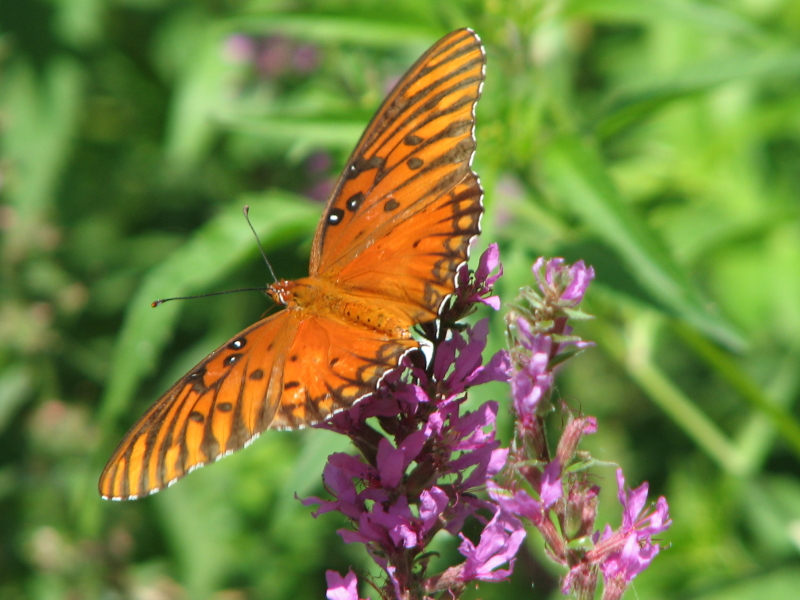
With its slightly elongated forewings and intense orange color the Gulf Fritillary ( Dione vanillae ) stands out among the loosestrife.  As the name suggests, this is a mostly southern species, but does venture north.  The ventral coloring sports mother of pearl and orange spots.  Not to far away on a different flower, Butterfly Man spotted a nice swallowtail.

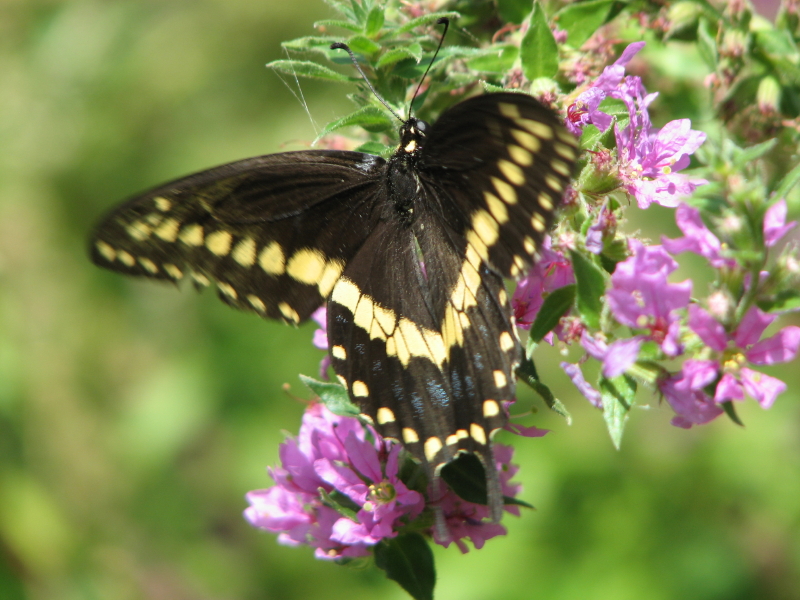
This is the Eastern Black Swallowtail, ( Papilio polyxenes ) and I have come across a few of these and other swallowtails as well.  I have seen, but unable to get a photo of some of them because they never slowed down!  I saw a Giant Swallowtail, our largest butterfly, fly over my head and towards the river.  The Zebra Swallowtail, same thing, it was flying too fast and never alighted.  The Pipevine Swallowtail I saw was so ragged that I decided not to take a picture of it.  I’m sure over time I will get other chances.  Here’s an image I like of a very common butterfly.

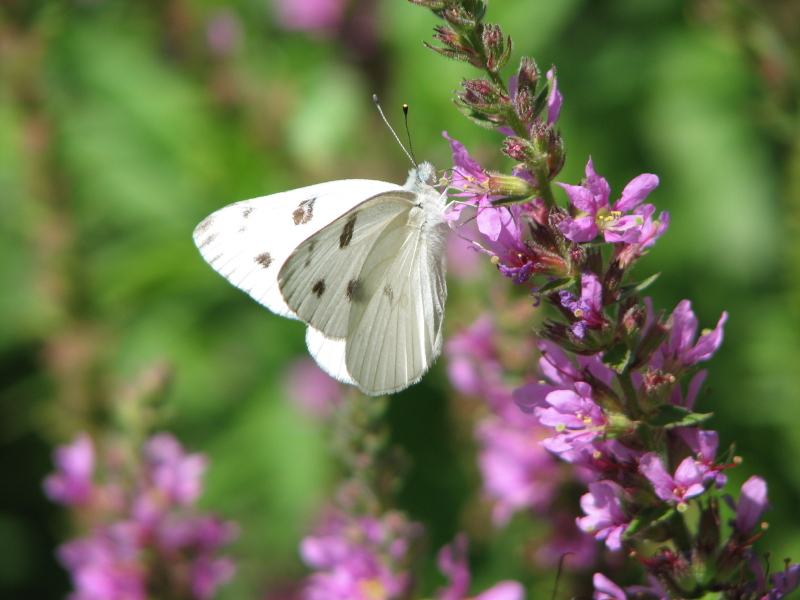
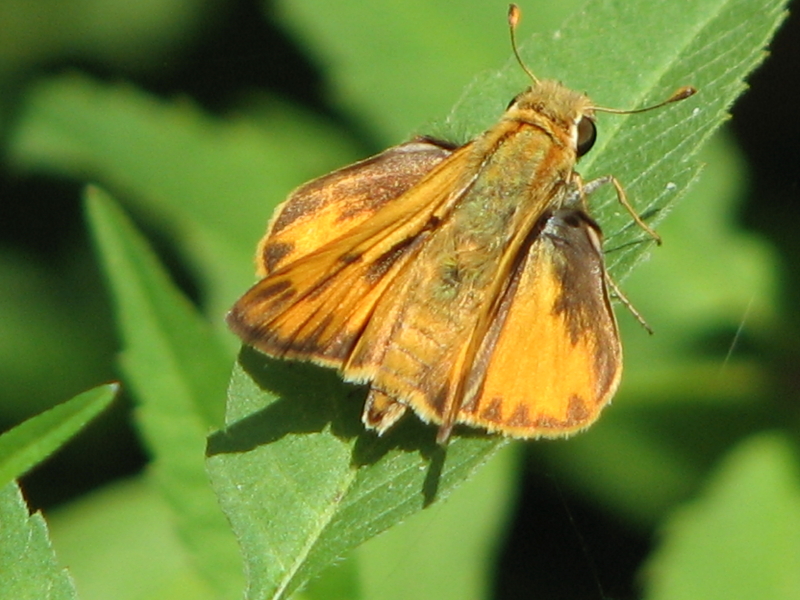
This butterfly was introduced into North America in the 1860’s and has now spread over the continent.  The Cabbage White, ( Pieris rapae ) is the most common white butterfly that most people are likely to encounter.  At the Falls, we also find another immigrant, the European Skipper, ( Thymelicus lineola ) which was accidentally introduced in Ontario about 1910 and has since spread across the country.  These tiny gold skippers can be very hard to identify and probably depends on having one in hand.  I like the idea of capturing a photographic image because no harm is intended.  With their folded wings, many skippers don’t look like butterflies at all. 

After a while, the Butterfly Man said we should take a break.

He said he found something special earlier in the morning and it was somewhere in this vicinity.  There is another creature here taking advantage of the butterflies.  Sure enough a couple of bushes away we found her enjoying a snack.

We found such a beautiful and large spider sitting on her web!  The proof she selected the right location was entombed in silk.  I have seen other Black-and-yellow Argiope ( Argiope aurantia ) spiders at the Falls before.  This is the first for this year.  She’s a big spider and soon she will produce her egg case and die.  The baby spiders will overwinter in the case and emerge in the spring.  These orb weavers have a characteristic zig-zag silk pattern on the interior of their webs.  This spider has had luck catching Orange Sulphur and Viceroy butterflies.  I noticed many loose wings below the web.  There is an element of risk out here among the flowers after all.

 The Butterfly Man spotted a nice pair of Viceroys ( Limenitis archippus ) basking side by side on the same leaf.  There are many of these species currently out among the willow trees.  With their smaller size and black line crossing the veins of the dorsal hind wing they can be told apart from the Monarch butterflies ( Danaus plexippus ) which are also in the area flying down on their long migration to Mexico.

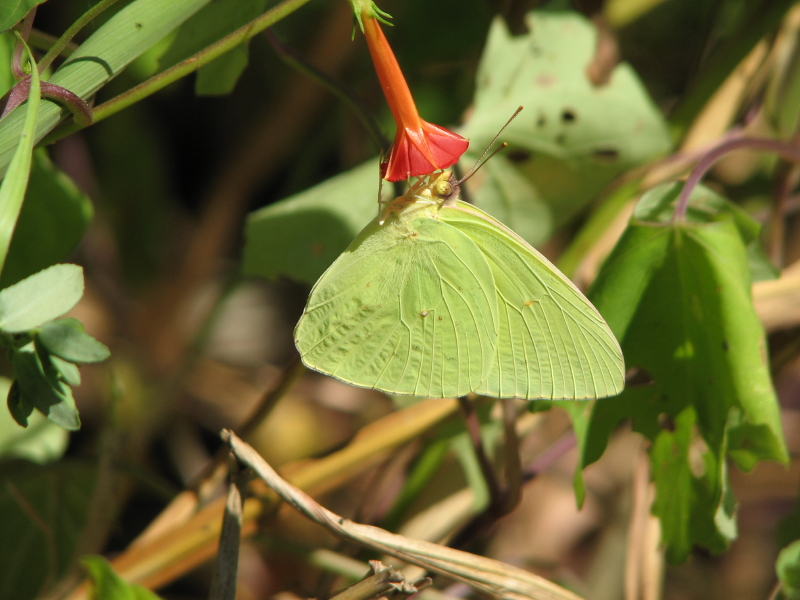
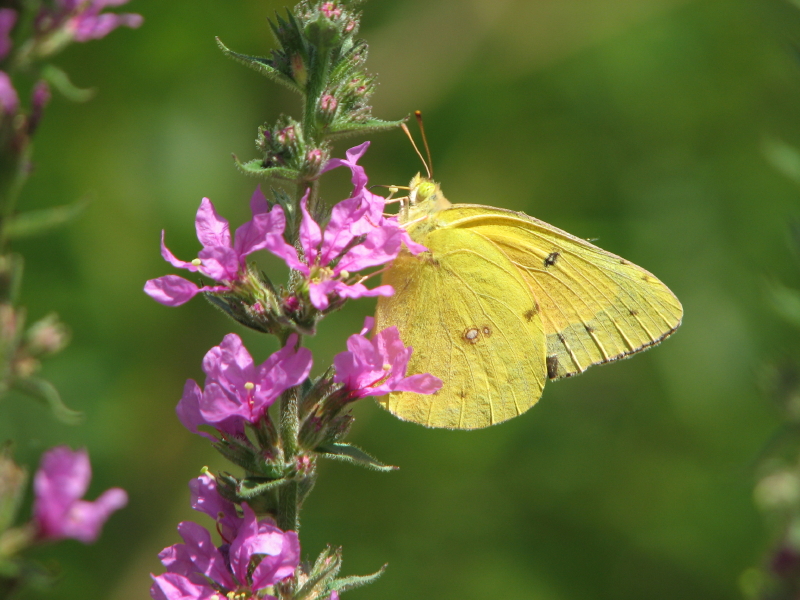
There was time for one last butterfly before turning for home.  Earlier I had spotted a few large yellow butterflies nectaring on the small Jewelweed vines .  I came across this Cloudless Giant Sulphur in a characteristic position with its wings folded together like a yellow leaf and created this composition.

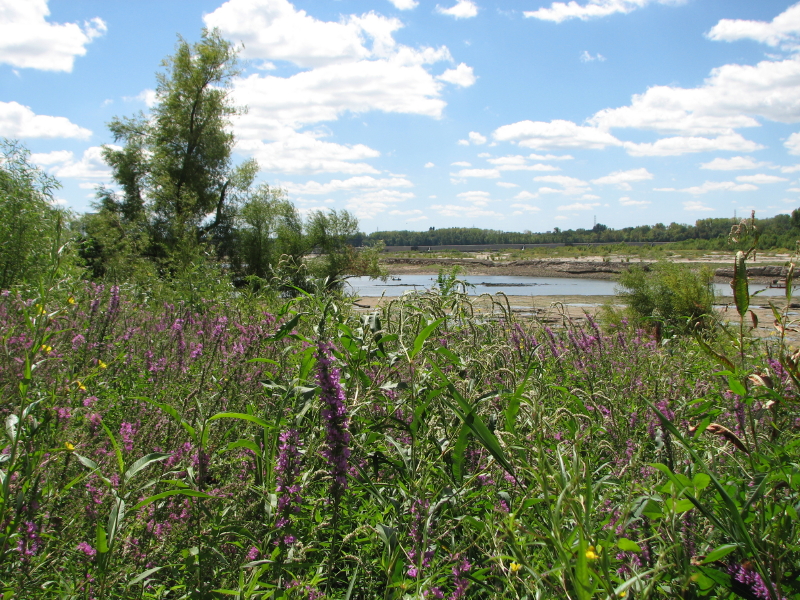
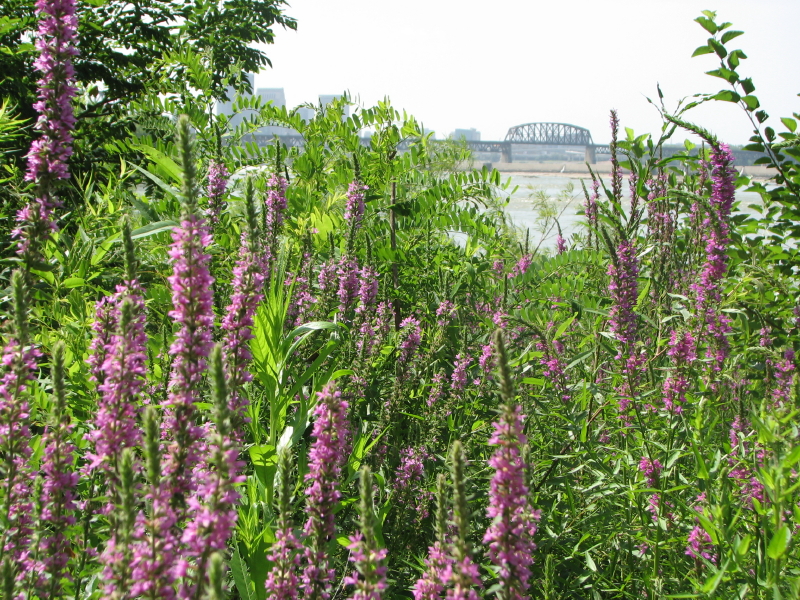
After one final look at the loosestrife fields, I was reminded of French Impressionistic painting and thought this landscape worthy of a canvas or two for the purple colors and nice cloud formations.  You can also glimpse the fossil beds beyond the trees.

I left the Butterfly Man standing where I first met him by his home next to a downed tree.  I thanked him for taking the time to show me around and hoped to run into him again in another adventure at the Falls of the Ohio.

Read Full Post »

I hustled out to Bernheim Arboretum and Research Forest after supper.  The evening promised a twin bill of fun and I wanted to reach Clermont while the sun was still out.  I was able to take in the “Model Homes and Habitats” exhibition of bird houses and bird inspired art.  The show had a strong Murray State University flavor to it with many past alumni and one current professor showing work.  Murray grad, Brad White assembled the exhibition for Bernheim.  I even saw my old drawing professor Dale Leys there as well which was a nice surprise.  Twenty five years goes by fast!

The designs of the bird houses ranged from the traditional to the conceptual.  Because the light level was getting low, I’m surprised I had images to work with.  Unfortunately, I can’t credit many of the artists because I didn’t see an exhibit guide and some labels were hide to find.  This house with the scary back has a more traditional hole in front.  I liked this picture once I downloaded it from my camera…the house seems to be suspended in mid air.

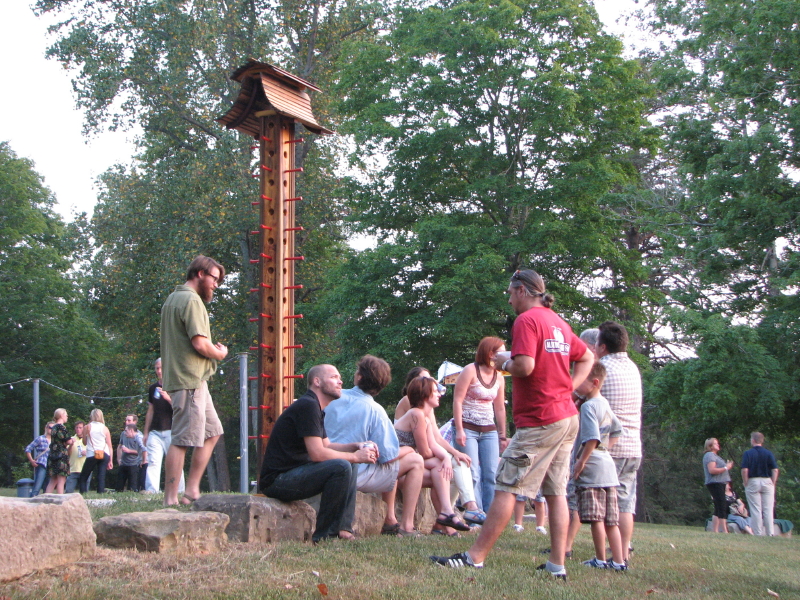
My friend Raymond Graf had a nice piece in this show.  Inspired by dovecotes and Japanese architecture, this piece looked like a bird skyscraper.  The piece is primarily made of wood and incorporates many Louisville Slugger souvenir baseball bats in its construction. 

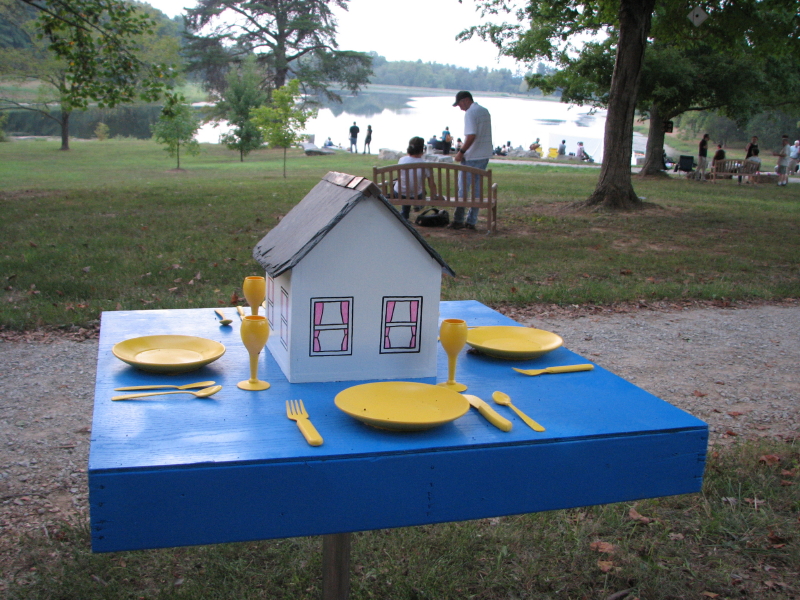
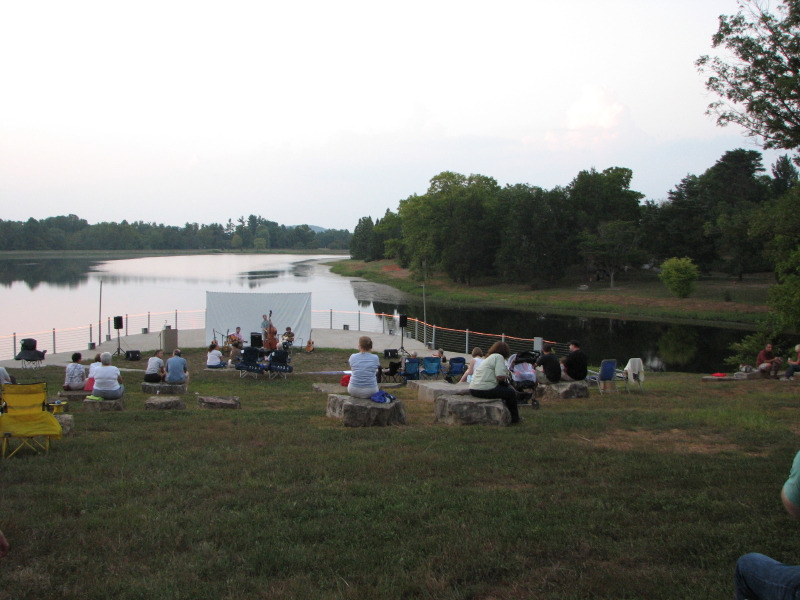
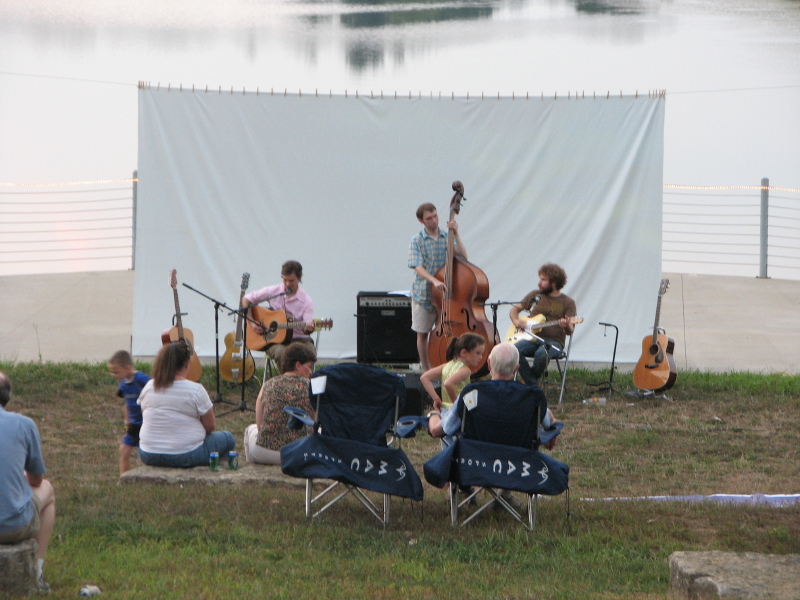
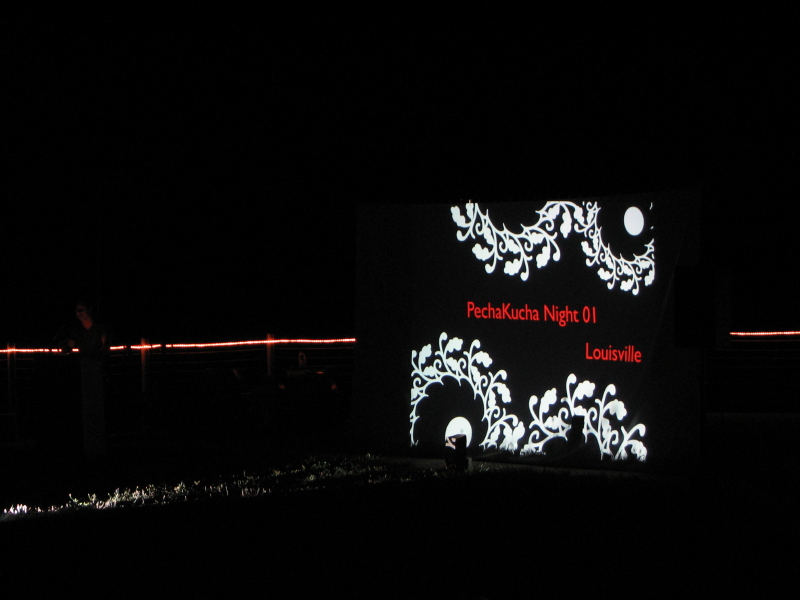
At Bernheim it can be hard to tell how many people are attending an event because the park can accommodate them all.  I know I saw several hundred people enjoying the music, food, and art. The bird houses were scattered along a walking trail.  Once the darkness fell, the white screen behind the band would become center stage.  Folks would concentrate in the informal amphitheater sitting on old limestone blocks from the renovation and expansion of Louisville’s McAlpin Locks and Dam.  Kentucky’s first sanctioned “Pecha Kucha” event was about to start.

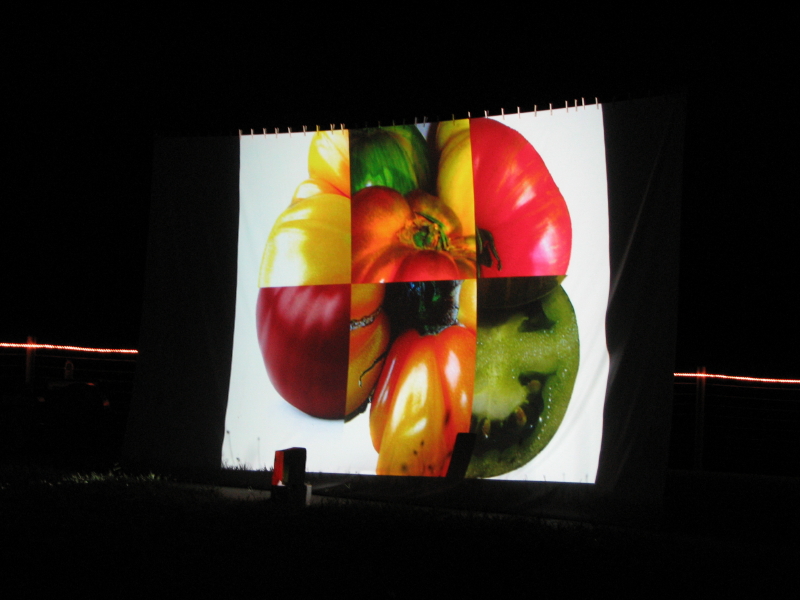
Now I will confess that I have never heard of Pecha Kuchas before in fact I kept calling it Machu Picchu all week-long!  Apparently, two American architects decided that the traditional slide show was too boring and could be shortened and made livelier.  The idea is the presenter is limited to 20 projected images and 20 seconds a piece for a total talk of 400 seconds.  That’s it.  Pecha Kucha  is said to be Japanese slang for “chit-chat”.  To me, it sounded like it could have some pace to it like a poetry slam.

Fourteen presenters interpreted the idea that “Mother Nature wants me to tell you something…” in very personal ways.  Many of the speakers were artists who are aligning what they make and do with the needs of the planet.  A concern for where society is going and what should we place value in were common threads in many of the talks.  Not all the presenters were smooth during their 400 seconds and you could tell a few less experienced speakers were nervous, but the crowd supported everyone with applause regardless of the performance!

This evening and the one before it were successful because of the collaboration and partnership between Bernheim and the Carnegie Center for Art and History in New Albany, Indiana.  The weekend began with the opening of Julia Oldham’s “Possumhaw Plant Electrics” exhibit at the Carnegie Center which consisted of four videos and a gallery of wonderful line drawings.  Julia is the 2010 Artist in Residence for Bernheim Forest and the videos were created during her ten week stay.  For those who have followed this blog, Julia is a new friend that I shared a couple of outings with that we posted on our respective blogs.  It was great seeing her in Kentucky again!  Sometimes it’s a big world and sometimes it’s not…perhaps we will meet again?  I hope so.  The next Pecha Kucha will be held in December at the 21C Hotel in Louisville.  That’s another fine venue to take in an event.

Read Full Post »

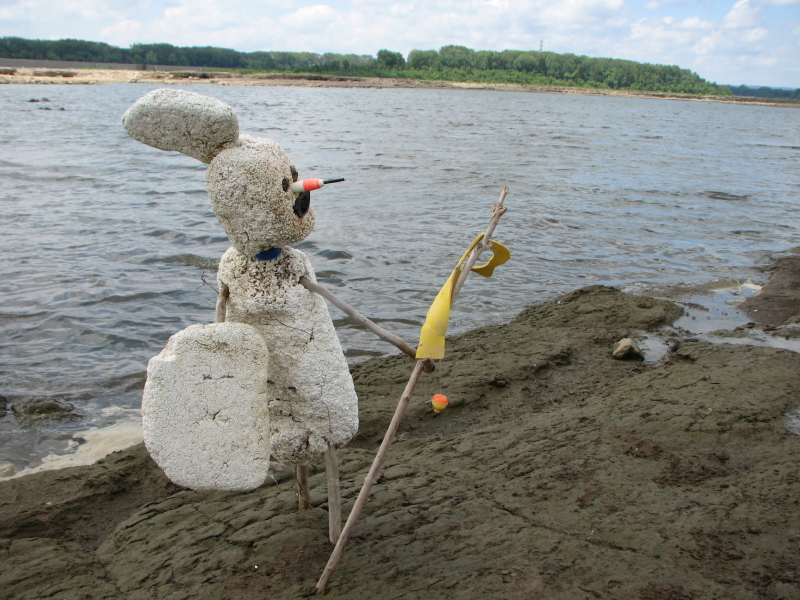
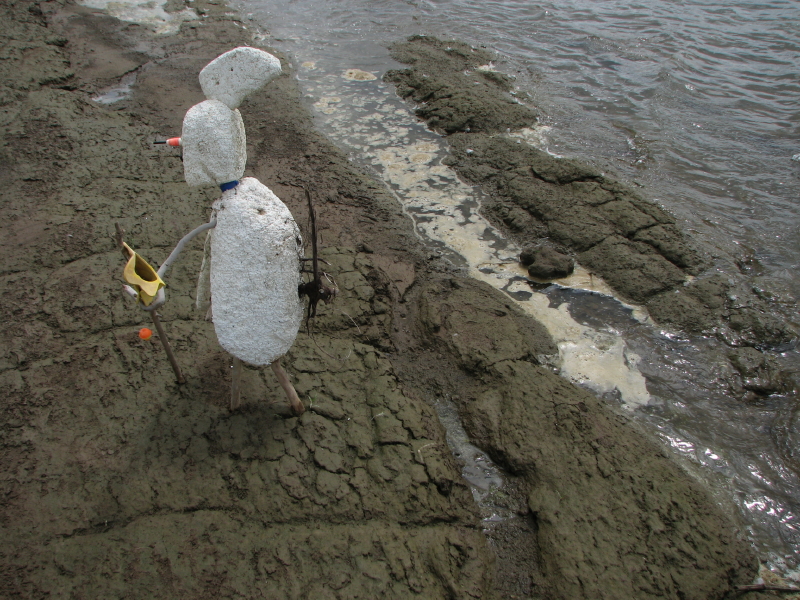
Battered and tired the old soldier looked wistfully to the west.  They said it would be an easy war as wars go.  And sure enough the enemy that wore a uniform was quickly overwhelmed.  Much, however, had changed since Styro-Odysseus began his career as a common soldier. 
Victories were no longer clear-cut and the peace was hard to recognize. Nobody could remember what they were fighting for?  After many years of trying to win the hearts and minds of the occupied people it was time for Styro-Odysseus to return to the muddy shores of his origin.

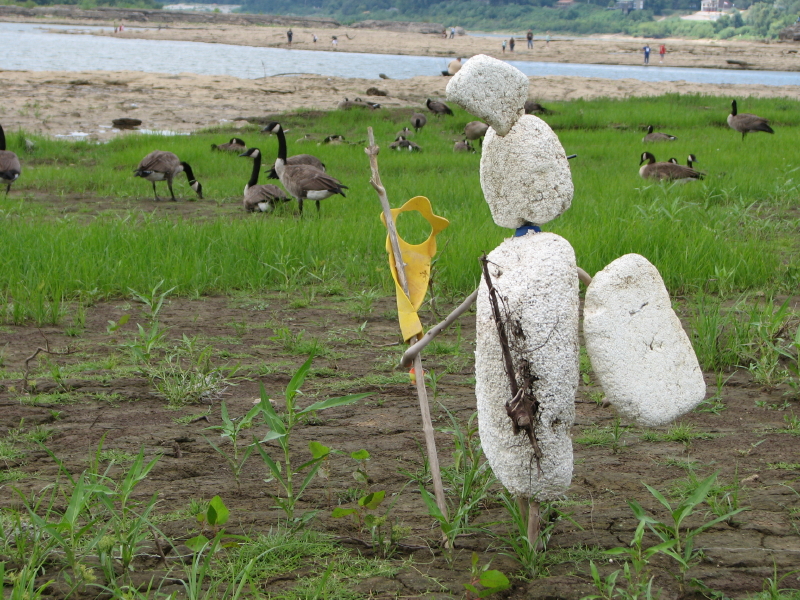
He had his country’s thanks, but all the old soldier wanted now was the comfort of his family and familiar surroundings.  His valor was now a thing of the past.  It would take all of Styro-Odysseus’ remaining energy to walk the distance towards the life he most desired.  His armor, shield, and standard that he once wore with pride grew heavier with each passing step.  He thought often of the innocence of childhood and green fields.

Along the way, Styro-Odysseus could not help noticing that the country he had risked his life for had fallen into neglect and ruin.  In places it looked as though the war had happened here.  He could not understand his countrymen’s apathy?  He wondered if people still cared?

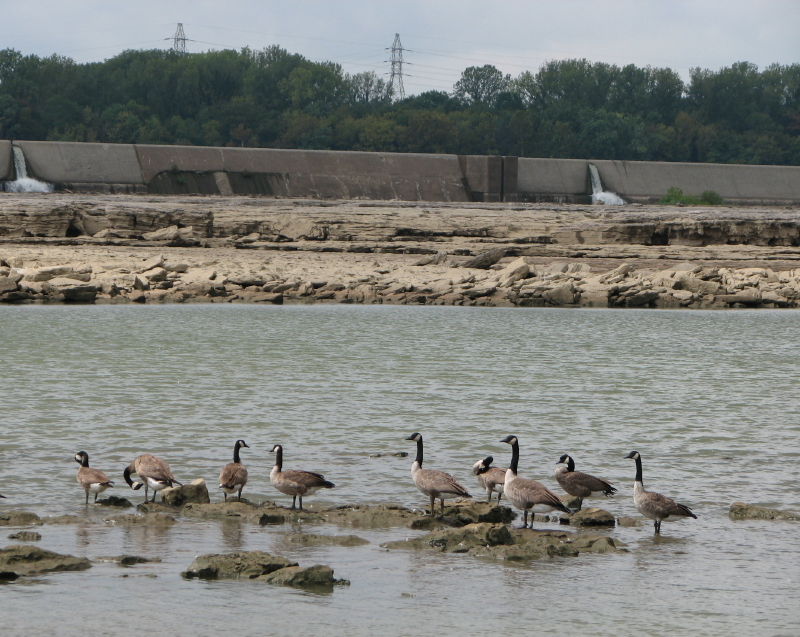
Rounding a bend by a river, the returning veteran had the oddest sensation that the people had in fact been bewitched and turned into geese.  That would explain the poor condition of so much he observed around him.

Meeting fellow travelers along the way Styro-Odysseus learned that much of his beloved land was in a similar condition.  The ordinary man had become disillusioned by evil pundits who were masters of instilling fear and preyed upon the best intentions of the good.

Styro-Odysseus had much to think about.  It seemed to him that righting the course of his own country might prove to be a greater challenge than fighting a foreign enemy.  What force of arms could be used to fight the new enemy that resides within? What could inspire the people and renew the idea of a shared common purpose?  While Styro-Odysseus’ mind grew cloudy…his feet kept on walking and soon he reached a familiar path.

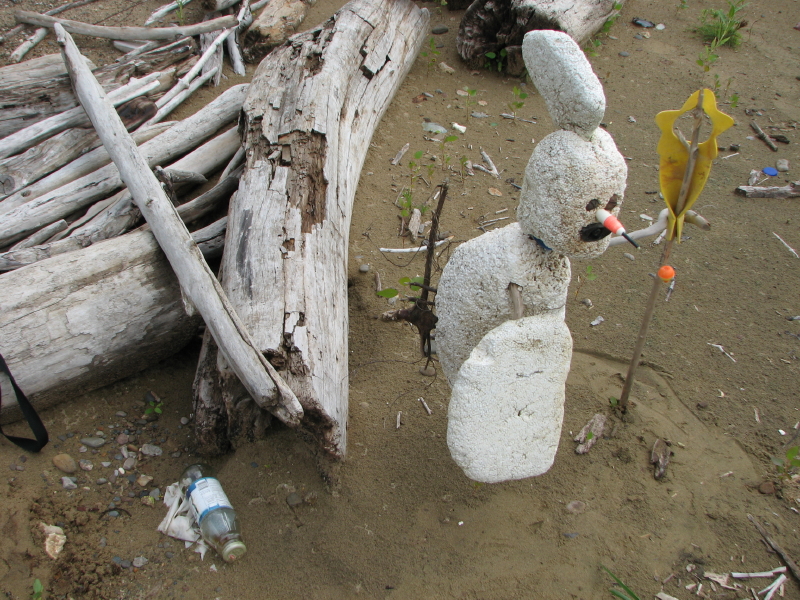
Styro-Odysseus was home and he forgot the great weight he carried upon seeing his family.  For now, he would set aside his armor and forget the duties of being a soldier for at least a little while.  He would try to allow what sweetness that remained in the world to begin the healing process.  The old soldier would rest and renew his energy for the next task at hand.

Read Full Post »

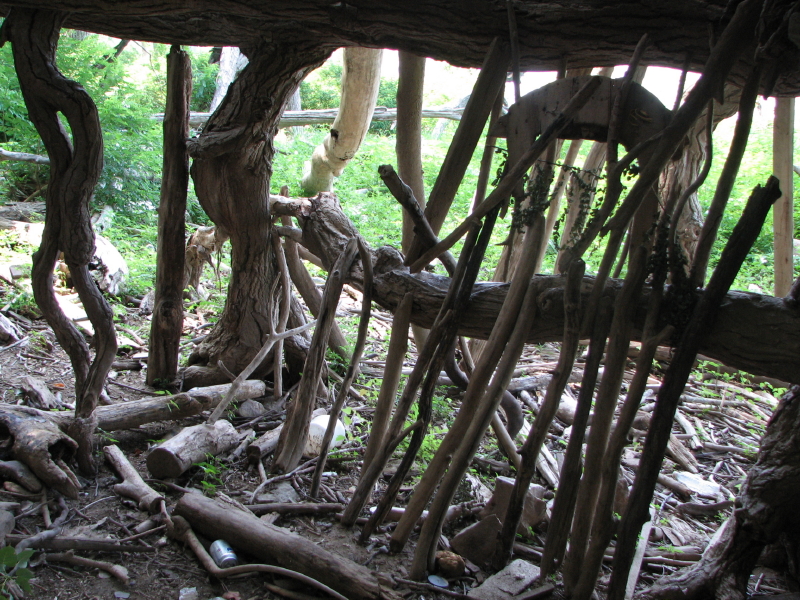
Continuing my last walk…I came to the area that would be my base for the day.  There is a favorite tree with exposed roots that you can sit under and remain cool and out of the sun.  Previous visitors decorated this spot with many vertical sticks that give a fence-like impression.  Here’s two views, first the base of this tree as seen from the outside:

…and a view from the inside.  Over the years, I have left many small sculptures in this area.  They never seem to last very long in here.

Last week was my birthday, and so on this outing I have new tools.  Earlier in the year, I lost my handy two-bladed Swiss Army knife which was a previous gift from a friend.  It had a nice, easy to sharpen blade and a toothy saw that could cut wood.  Replacing that knife are these two objects.  My family gave me the updated Swiss Army knife complete with tweezers and toothpick.  My friend Jeff gave me the bigger saw.  Its blade folds out and has the advantage of locking.  I definitely can chew through a nicely sized limb with this baby! 

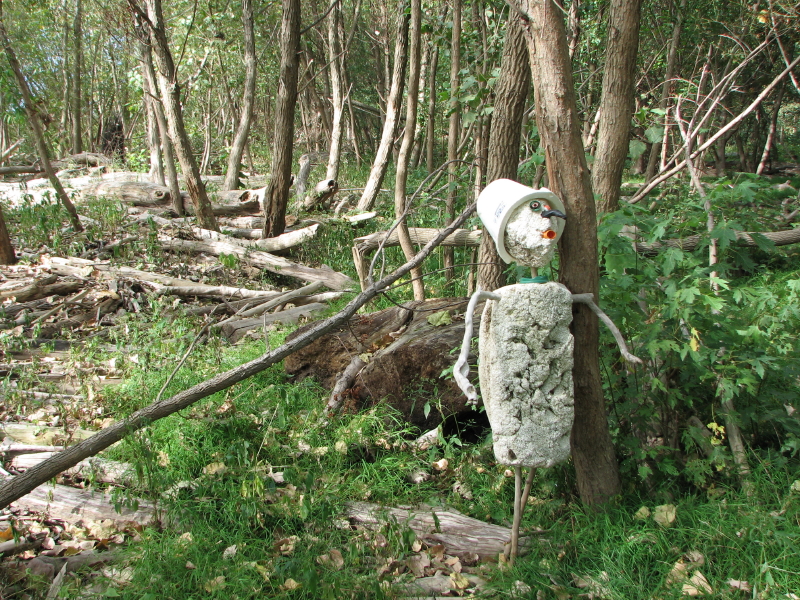
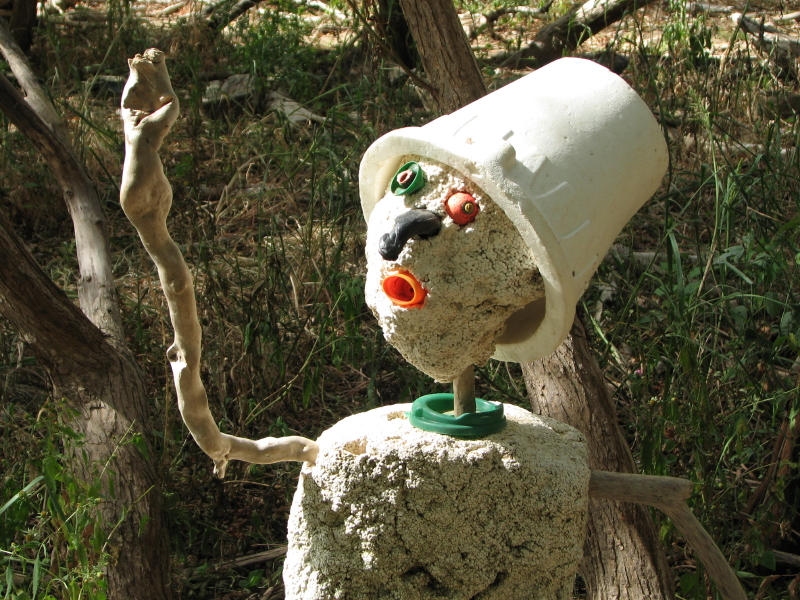
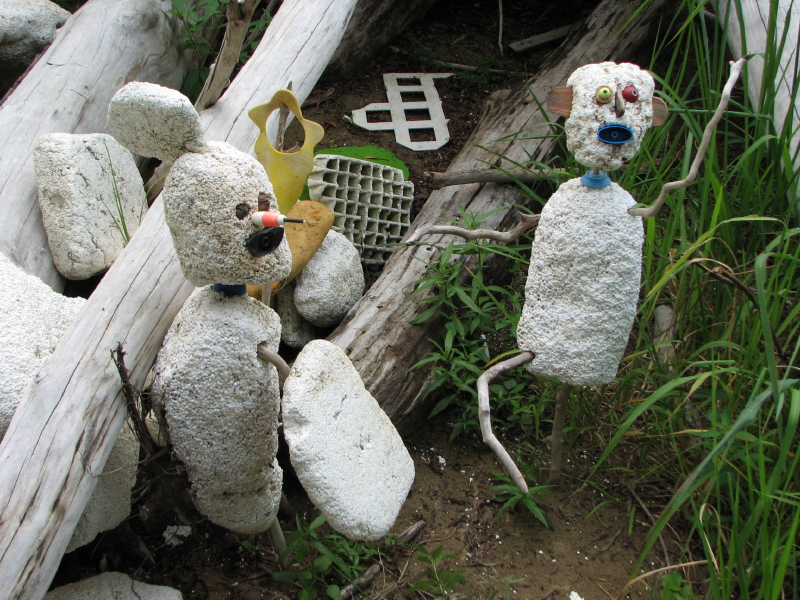
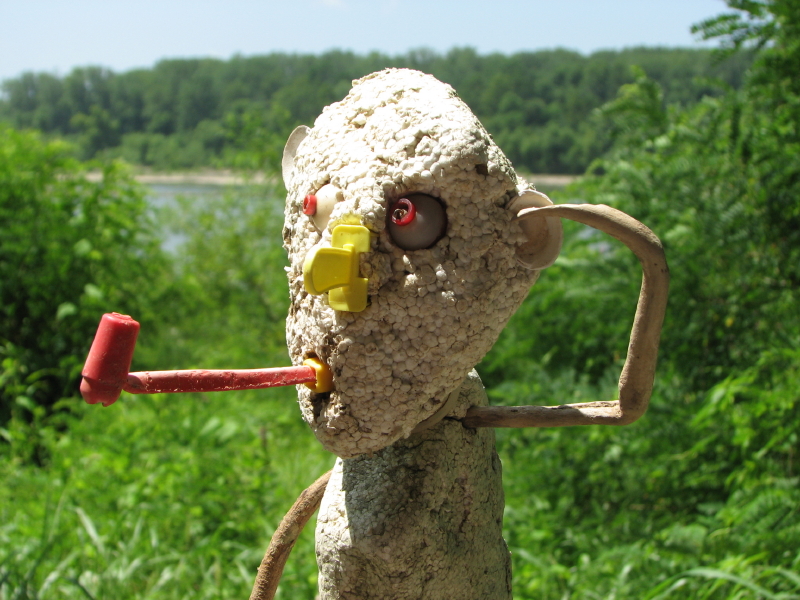
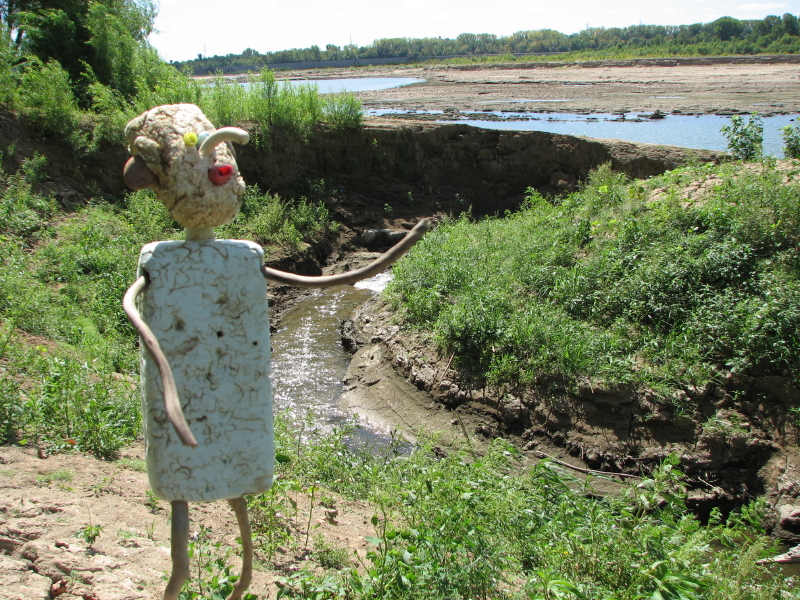
On this particular trip, the heat and humidity put a damper on doing anything ambitious.  I hung around this area for a couple of hours and made this guy who was checking out the butterflies in the purple loosestrife.

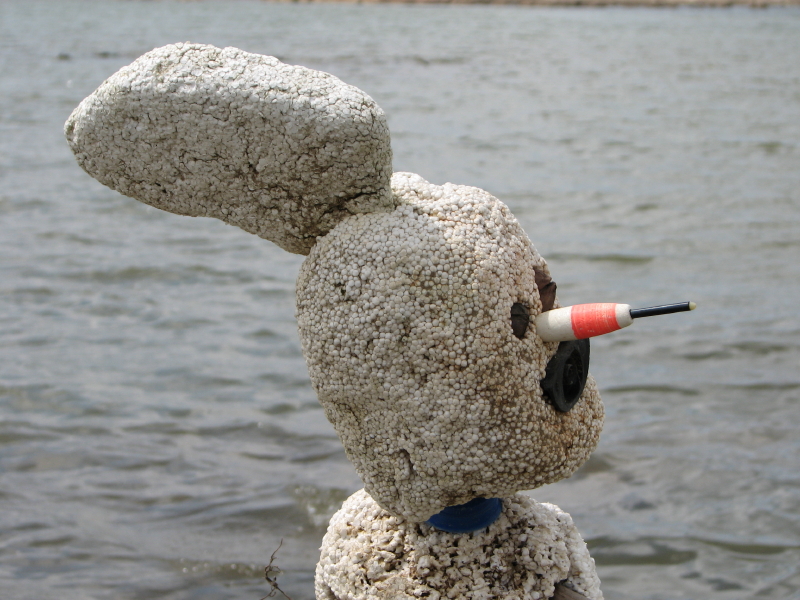
I found a little bit of Styrofoam to work with and this red plastic object that looks like a pipe.  I used tiny plastic fishing bobbers for eyes and the ears are clam shells.  Later because the shells kept falling off, I substituted a flat rock and sand-polished glass for the ears.  It’s subtle and you might not notice this change at first.  As for the place I was working at…last year the Purple Loosestrife was getting a foothold and now it is firmly entrenched.  This is a hard to get rid of invasive plant that plays havoc in small wetlands like this one.  The butterflies, however, love this weed. 

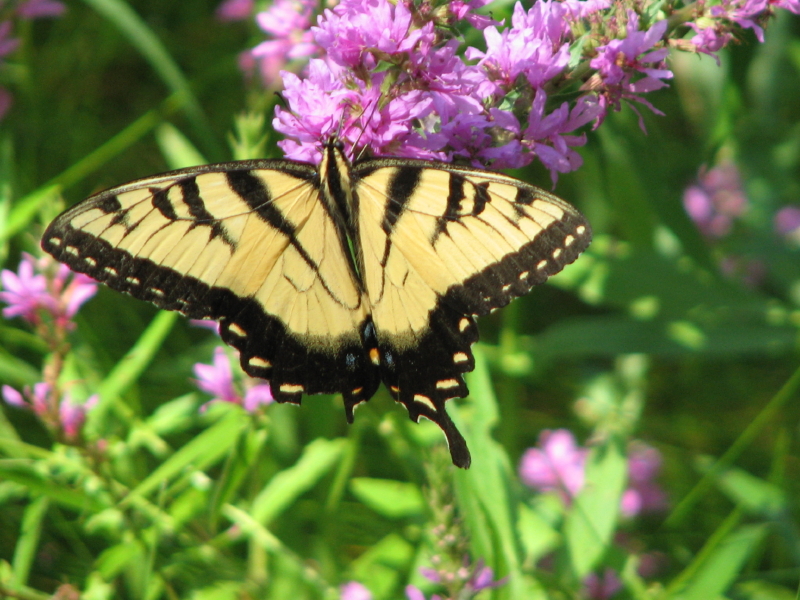
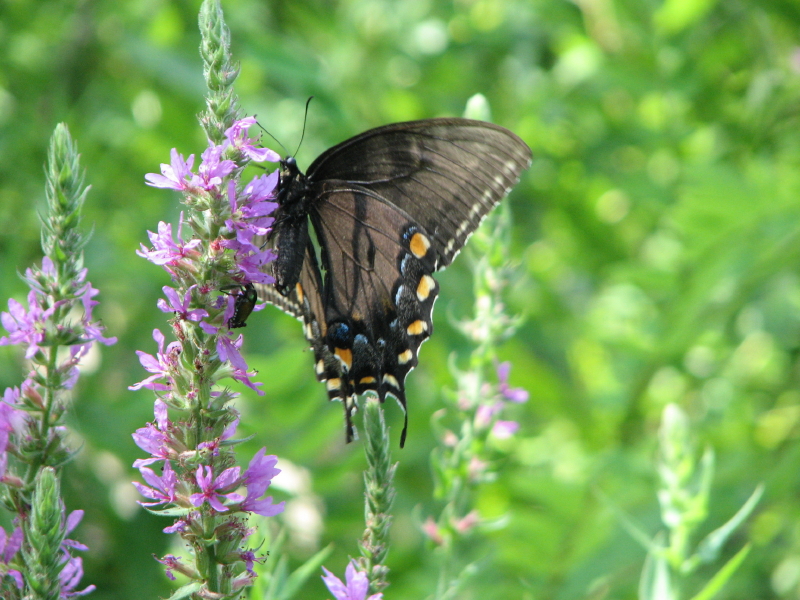
Among the many species feeding from the purple flowers is this Tiger Swallowtail, Pterourus glaucus.  This is a boldly patterned and large butterfly of summer.  I have seen some beat up looking butterflies of different species and am assuming they are from an earlier brood that perhaps over-wintered here?  The tiger swallowtail also has a common melanistic form and I also saw one of those out here today.

You can see the “tiger stripes” showing on his hind wing.  Also working these flowers were the large bumble bees we saw earlier on the morning glories.  I also observed several large, blue-black wasps that I associate with being spider hunters.  They are so intent on gathering nectar that they pay no attention to me.  All through the loosestrife insects were working the flowers.  Clearly, this plant has no shortage of pollinators.

Mr. Red Pipe was enjoying himself in all this purple haze and humidity.  There was something reassuring about watching all this insect life packed into a relatively small area.  Another favorite butterfly is hanging on a loosestrife blossom not too far away and if we move deliberately…we might not spook it away.

It’s an Orange Sulphur, Colias eurytheme.  We have several other members of the Sulphur family out here along with Viceroys, Red Admirals, and a couple different Skipper species.  I love the yellow-green eyes on this butterfly which seem to have a glow to them.

All my water is gone and so the idea of returning to my car sets in.  I have another bottle waiting for me there.  Tomorrow is supposed to be another high temperature day in the 90’s.  After our June being a record setter, it seems July is out for bragging rights too.  Before leaving, I snap one more picture of the Purple Loosestrife in its prime with the railroad bridge visible in the far distance. 
Read Full Post »

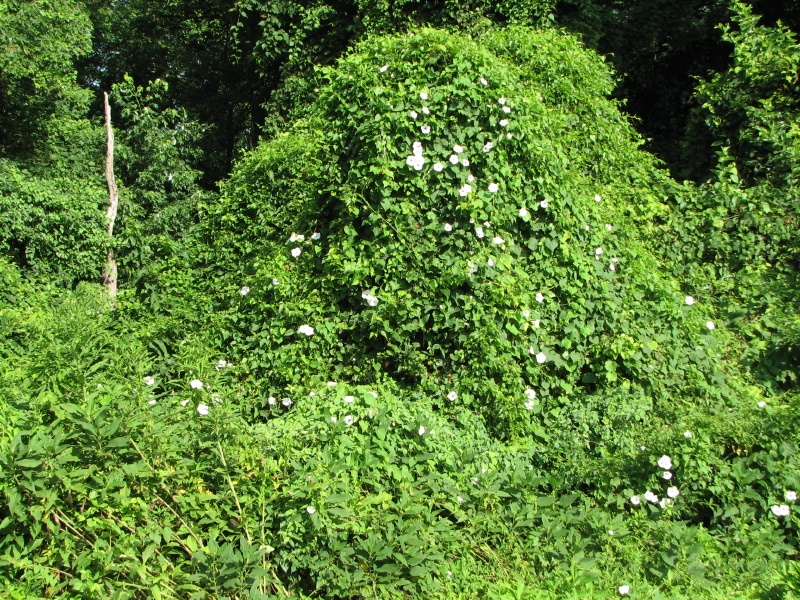
Today is supposed to be the hottest day of the year.  Walking out my front door this morning I’m surprised by how warm and humid it is already.  When I reached the Falls, I decided to take cover from the direct sun by walking along the Woodland Trail.  All the combined vegetation produces a spicy fragrance.  Vines are in their glory and in areas of good sunlight they have grown over some of the trees.  Birds are hunting for insects among the leaves.  They listen for the locations of singing cicadas.

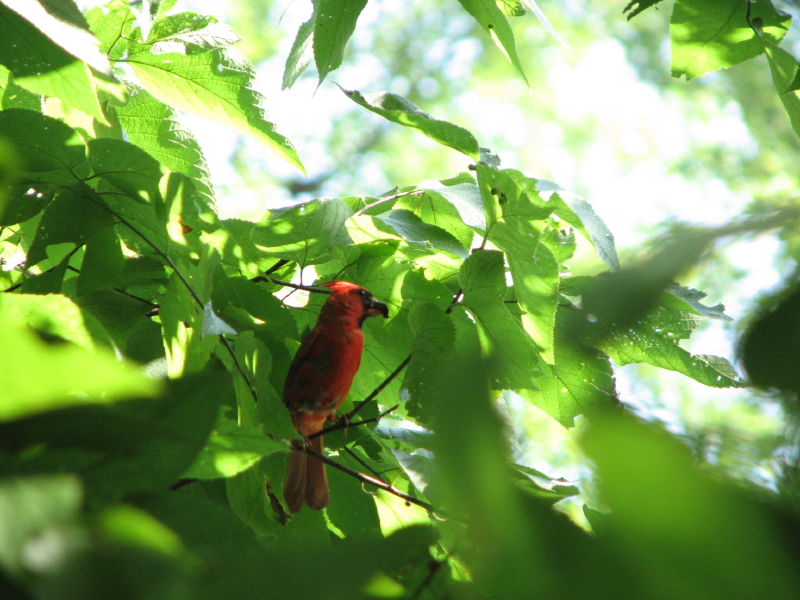
And, once in a while they catch a cicada as this male Northern cardinal has done.  He’s not the only bird moving through the canopy. 

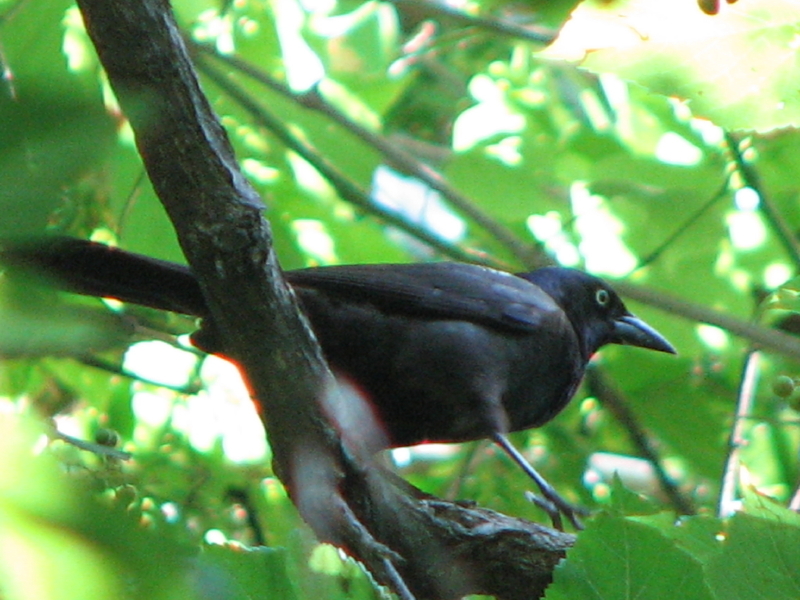
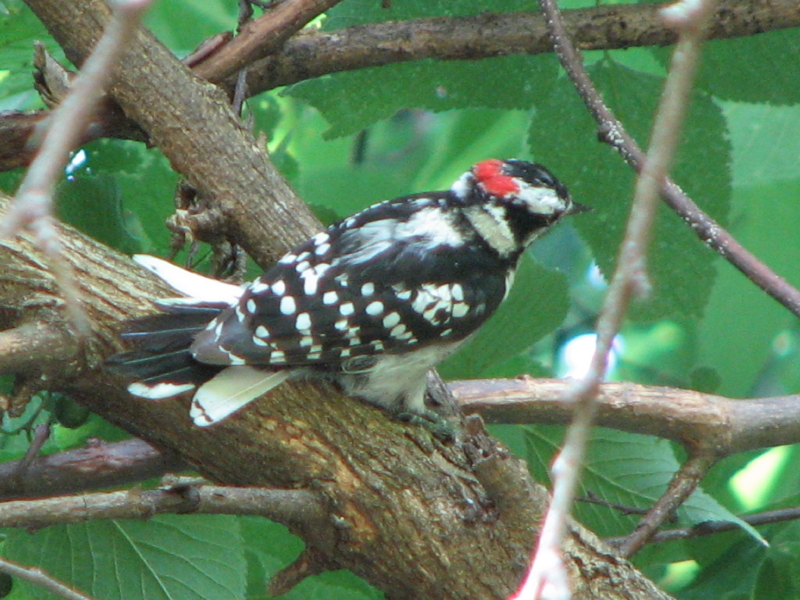
Grackles are stalking along the tree limbs.  They always seem to be just out of reach of my camera.  I had a bit of better luck coming across two Downy Woodpeckers chasing each other in the interest of courtship. So, they didn’t focus on me.  The male held still long enough for me to capture this image.  He’s waiting for the female to make a counter move and then it will be his turn again.  They flew between tree trunks for several minutes.

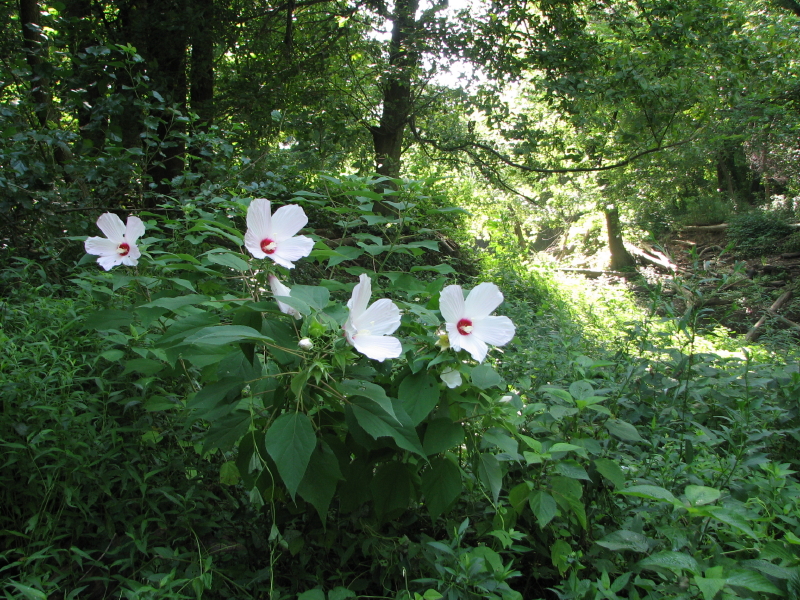
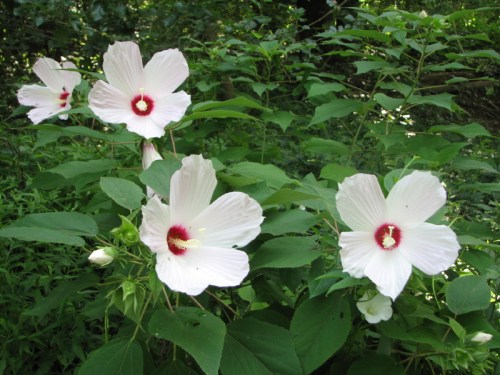
I’m heading out to the western section of the park.  As suspected there are fewer people in this area.  After crossing the creek, I was looking for the trail leading to the river when I came across this unexpected floral surprise.  I do remember seeing escaped hibiscus blooming among the driftwood collected along the eastern dam.  Perhaps these are the same plants that were transplanted here during the last flooding incident?

I will admit to not knowing my plants as well as I do the animals.  And so, if I’m wrong on the identification of this plant, please let me know.  In the interim, I will keep looking at my guides for other possibilities.  What made this encounter even more interesting…another blossum was less than ten feet away.  I wonder if this plant came from the same source up river?

These large blooms along with the heat and sticky humidity added an extra jungle-like quality to the walk thus far.  Although it’s hot, I’m grateful I have my long pants on instead the cooler shorts.  There are stinging nettles, poison ivy, and sharp-edge grasses around to irritate your skin.  It’s a big relief today to walk out from under the trees and into the light.

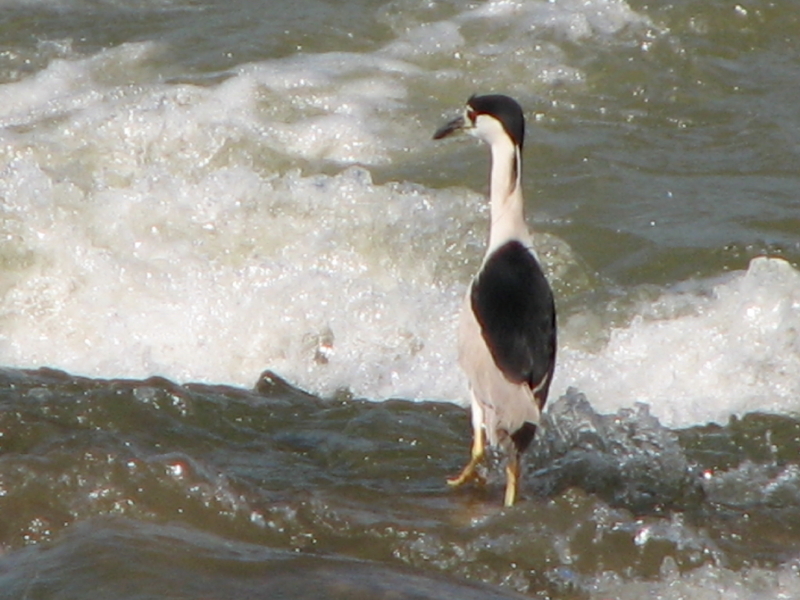
I haven’t yet reached today’s destination, but I’m back at the water’s edge.  I accidently frightened away a pair of Great Blue Herons from the rocks they were hunting from.  I’m going to continue this adventure in my next post.  I have many more nice pictures and I eventually made a piece.  On this day, however, it was mostly about the walk.  Before closing, here’s another bird picture.  It’s a Black-crowned Night -Heron fishing in the shallow, but swift moving river.  He would hold his left foot off to the side while in the water.  I wondered if he did this so that fish bumping into the leg would alert him?  Maybe this helps in water with poor visibility?  That’s it for now…I look forward to sharing this outing the next time around.

Postscript:  My friend Don Lawler turned me in the right direction by suggesting the hibiscus I saw and photographed are in the mallow family.  The white flowers have been identified as being examples of the Crimson-Eyed Rose-Mallow.  The pink flower is from the Swamp Rose-Mallow.  Interestingly, both flowers are considered to be conspecific, meaning they are the same species!  That would explain their proximity to one another at this location.  Their scientific name is Hibiscus palustris.  You learn something everyday!

Read Full Post »

« Newer Posts - Older Posts »