Feeds:
Posts
Comments

Archive for the ‘nature photography’ Category

Head in Hand, Aug. 2014

Each trip I take to the Falls of the Ohio results in lots of other images recorded on site.  Although I may think all of my photographs are interesting in some way, for brevity’s sake…they can’t all make it into a post.  If a storyline develops while I’m at the river, I will try to prioritize that and hope that at some other time in the future some of these other photographs will fit in somewhere?  This post is an attempt to include some of the other pictures that were taken during my last excursion to the river.  Although that visit resulted in my last published post about this tiny artist persona with a penchant for creating micro installations with plastic cup lids and straws…there were a few other sights at the river that caught my eye on this day.
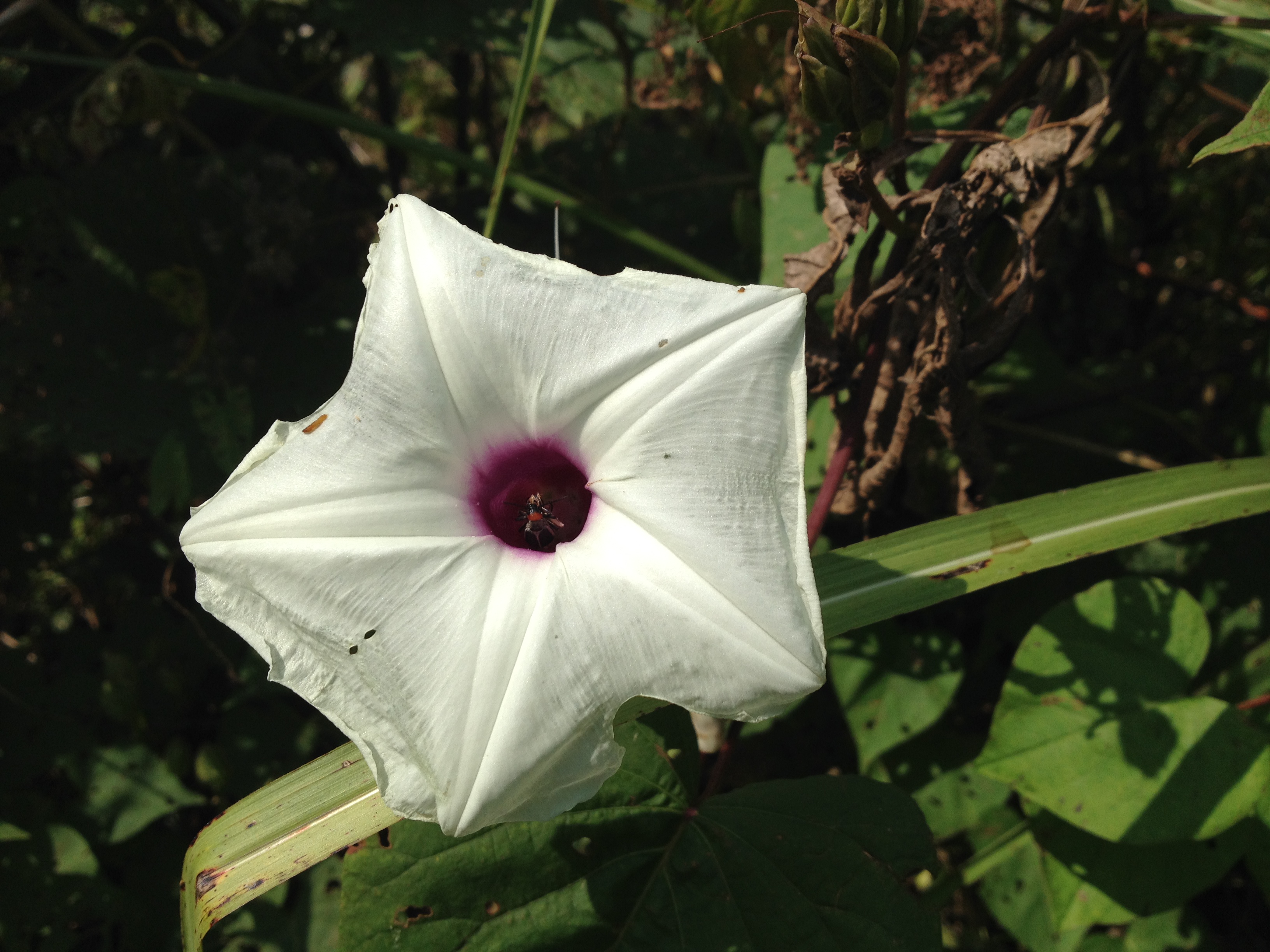
Wild Potato Vine bloom, Falls of the Ohio, Aug. 2014

The Wild Potato Vine is a common flowering summer plant at the Falls.  The flowers are large and its leaves are heart-shaped and grow on very long vines.  This plant is named for the large tuber it produces.  I’ve noticed that out here, these large blooms attract large bumble bees.  This is a genuine and indigenous wild flower which contrasts with my next discovery.
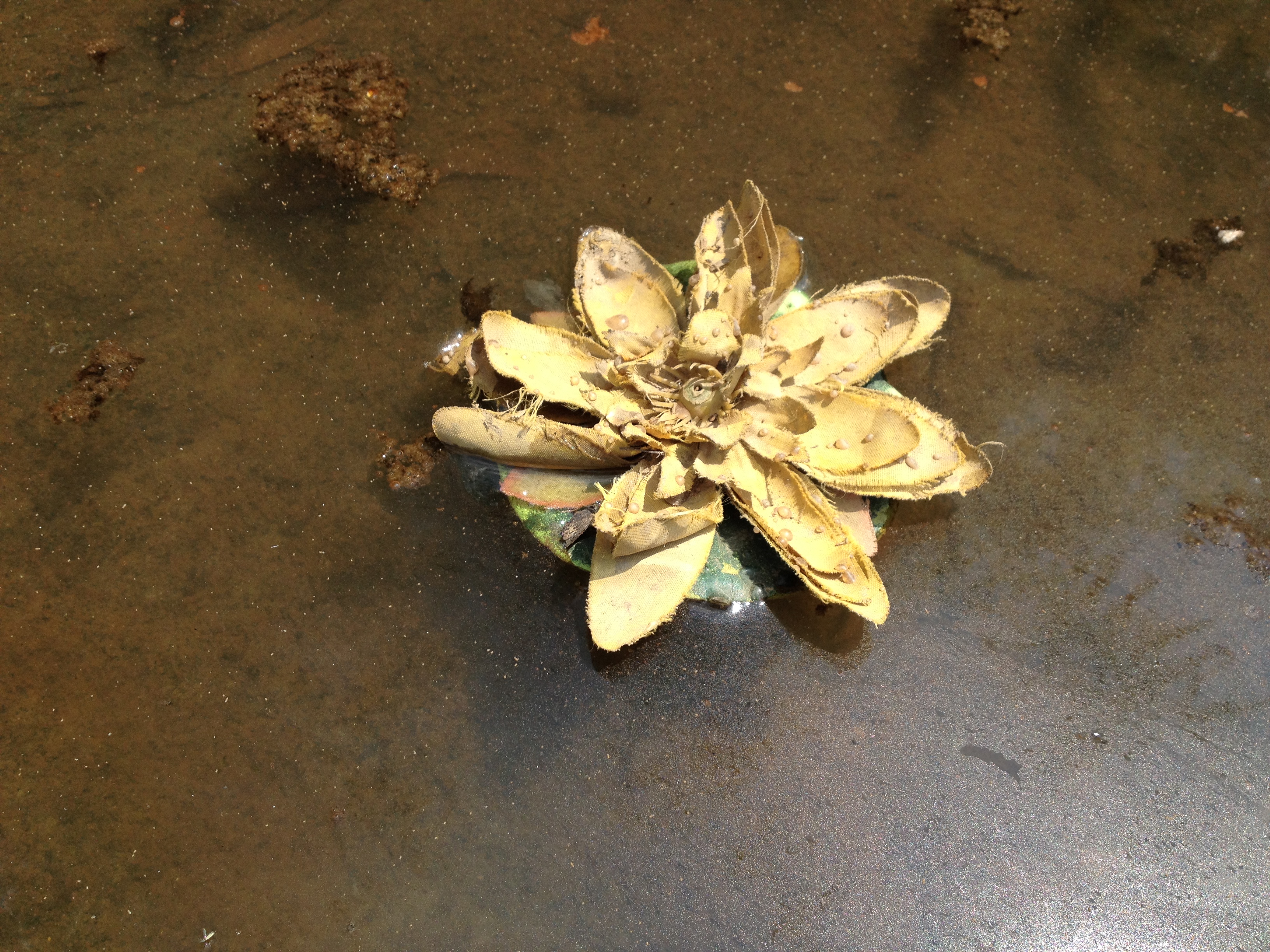
Yellow-flowering Mud Nymphea, Falls of the Ohio, Aug. 2014

In a pool of stagnant water I came across this other interesting bloom.  Don’t bother looking it up in a field guide to flowers because you won’ find it.  I discovered it and so I take credit for naming it.  I call this the “Yellow-flowering Mud Nymphea” and it “mimics” members of the lotus family.  This plant has a single leaf that floats on the surface of still water or upon particularly juicy mud.  Rising from that leaf is a large blossom (about the size of a child’s hand) that is a dingy yellow color and the petals have a cloth-like texture.  Most fascinating of all…there are fake droplets of water that “bead up” on the individual petals.  Imagine if you took hot glue and applied small drops to the petals…well, it would look a lot like what is happening on this plant.  Knowing how this plant functions out here will require additional study.  The Falls of the Ohio is a highly disturbed place and oddities are springing up all over.  This just happens to be the latest mutant plant to add to a growing list.
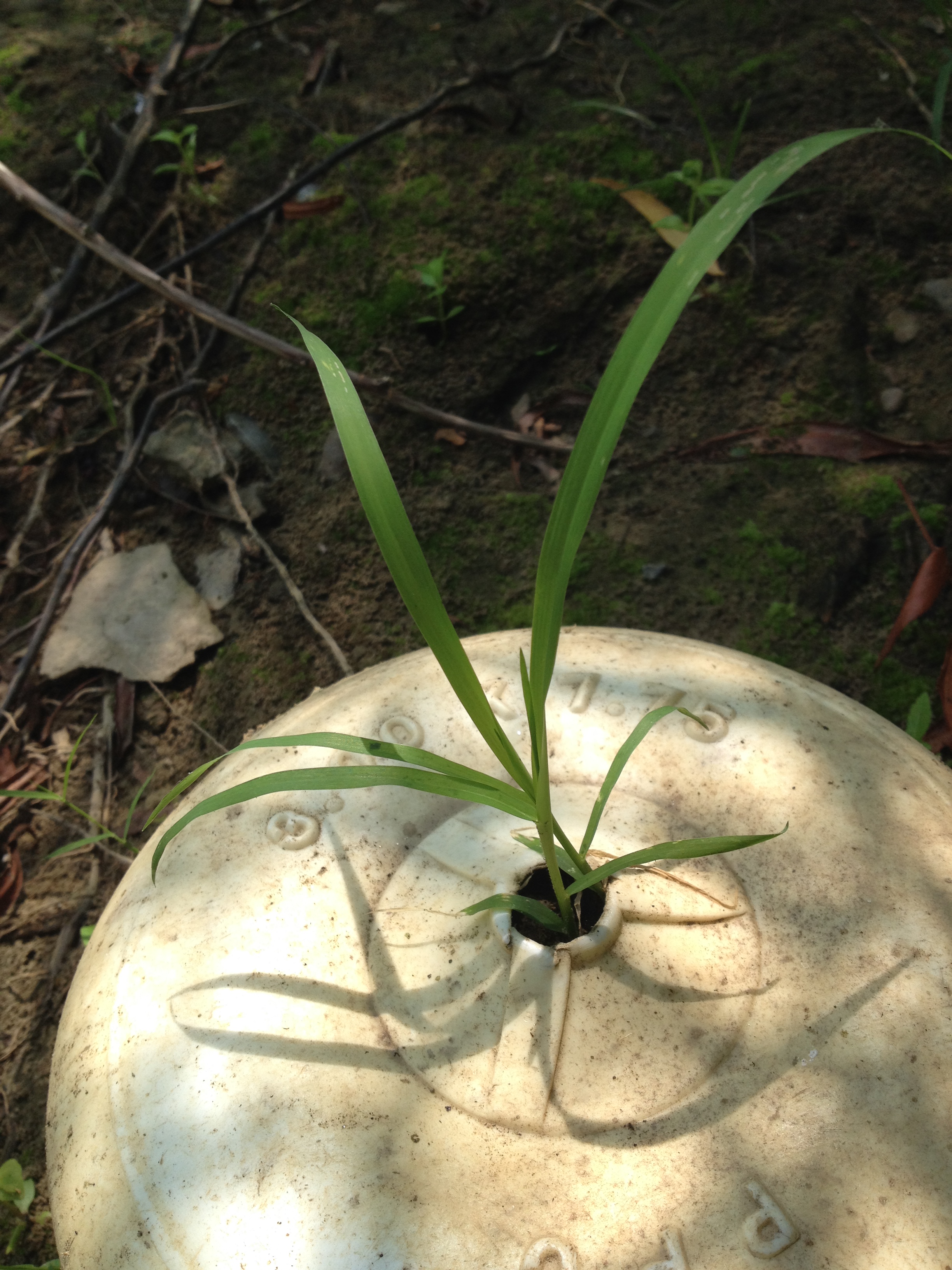
Grass growing from small hole in a plastic, toy wheel, Falls of the Ohio, Aug. 2014

Another topic I have explored in a past post see “Life in a Bucket” are real plants that grow in less than promising circumstances.  Like many people, I have marveled at how plants can grow in narrow cracks in the sidewalks. The next trio of images are related to that phenomena.  On my last adventure, I found three examples to share with you that demonstrate how opportunistic life can be.  The image above shows a couple of sprigs of grass that are growing out of a small hole in a plastic, toy wheel.  The wheel was probably originally part of a child’s tricycle.  Over time, the detached hollow wheel filled with dirt and silt and retained enough moisture to allow grass seeds to germinate.  Next is another wheel/plant combination that I see more commonly in the park.
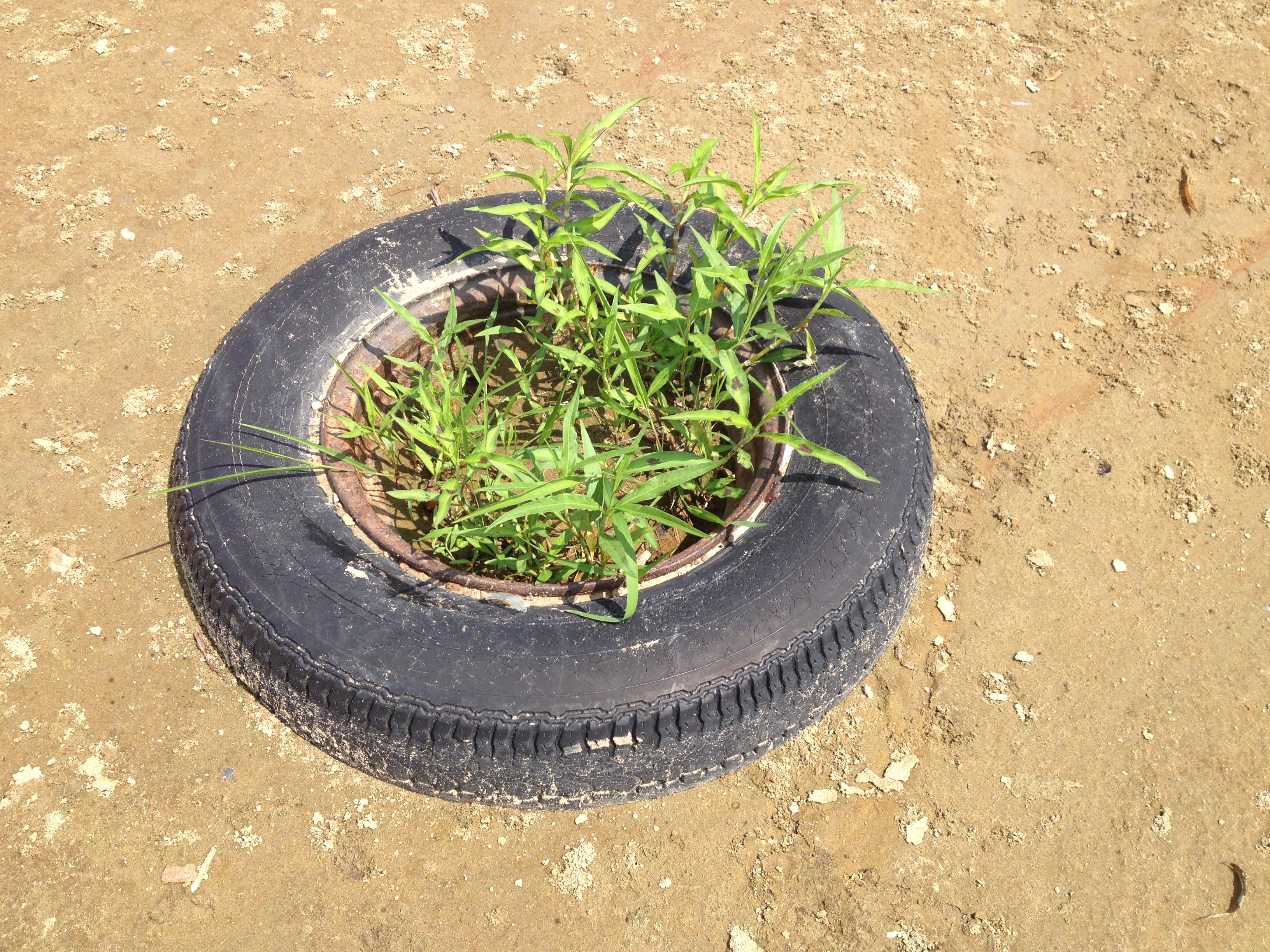
Tire garden, Falls of the Ohio, Aug. 2014

This is a tire garden.  Because old, ruined automotive tires are frequently thrown in the river (out of sight, out of mind) they frequently wash up here.  Over time, they sink into the sand and mud and are very difficult to move.  Opportunistic seeds colonize the central space where wood, silt, and other nutrients collect and before long you have a mini ecosystem growing out of a circular island in the sand.  My next image is an amazing willow tree that I have posted images of before.  Let’s look at how it is doing this year?
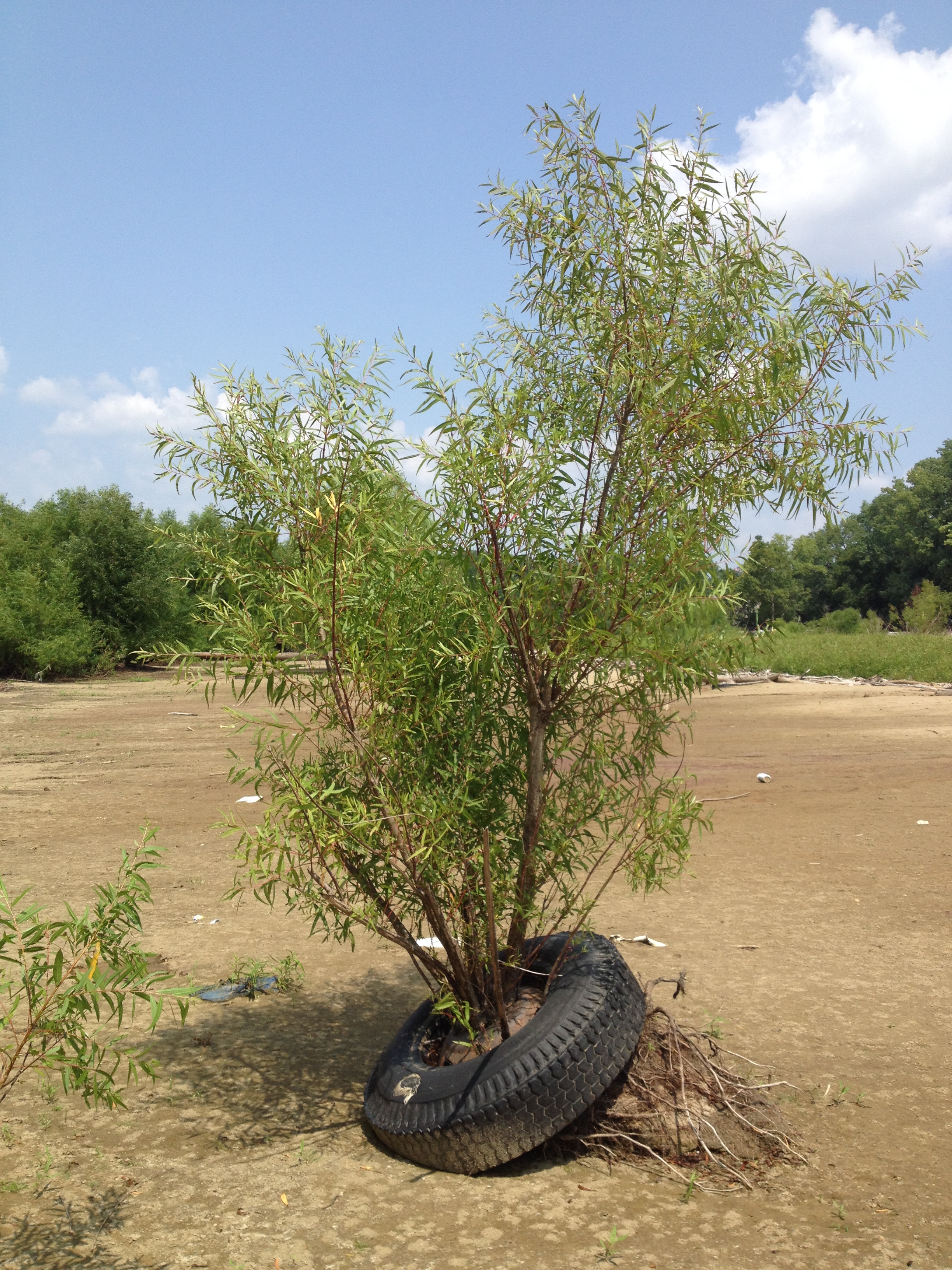
Willow tree growing out of a tire, Falls of the Ohio, Aug. 2014

Amazingly, this willow is growing through the metal holes of the wheel.  Previously, I had speculated on whether or not this tree would lift the tire into the air as it grew or be choked to death as the holes became too small?  This year’s seasonal flooding has tipped the wheel up on one edge and exposed the roots of the tree.  So far, it appears to be okay.  I will be keeping tabs on this tree to see how it fares in the future.  How the natural and artificial come together in the wider environment is an area of great interest for me.  Our next example is a good illustration of this.
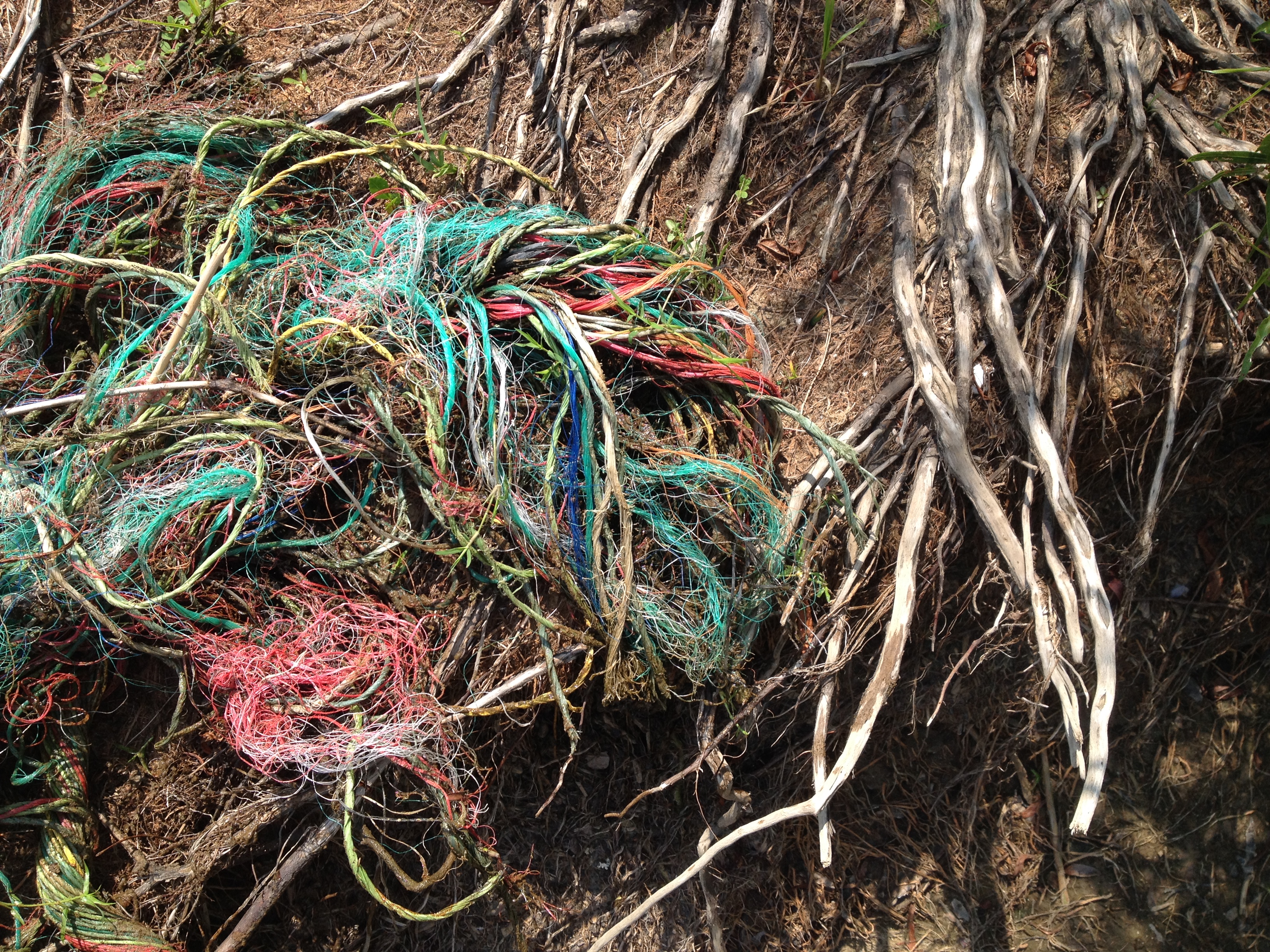
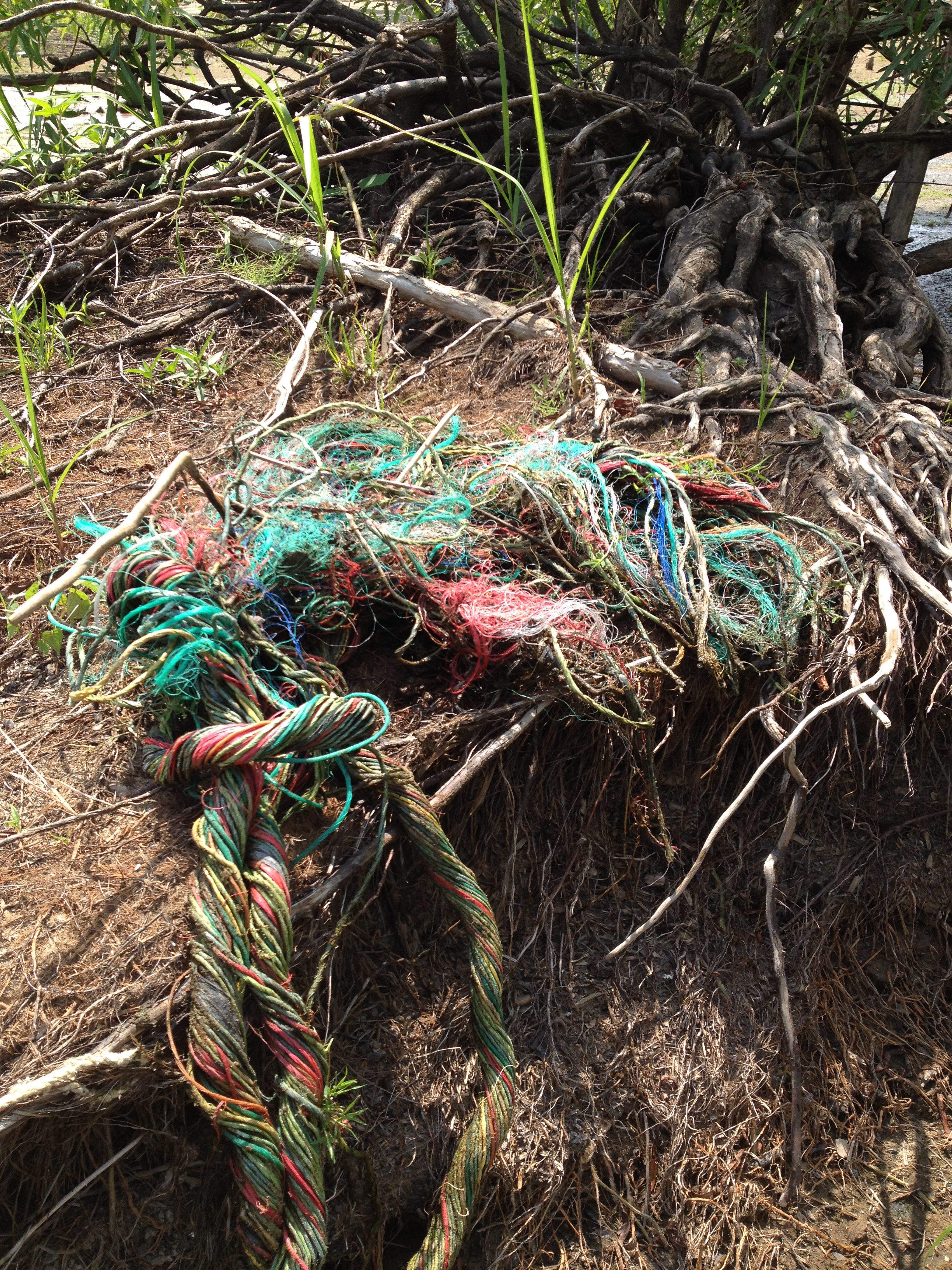
Willow roots and strands of frayed barge cable, Falls of the Ohio, Aug. 2014

willow roots and barge cable merge, Falls of the Ohio, 2014

I walked passed this willow tree and noticed that a frayed, root-like, barge cable was intertwined with the living tree’s root system.  Perhaps it’s the cable’s bright colors contrasting against the natural tones of the willow roots and earth that give it an aggressive appearance to me?  The actions of the river help unravel these large nylon ropes used to moor and secure very large barges.  Interestingly, I have seen various bird species hasten this process by picking apart the fibers for use as nesting material.  The Baltimore Oriole is especially good at this and uses the colorful fibers in the construction of their hanging basket nests.  The Ohio River, per tonnage moved, is one of the busiest waterways in the world for commercial navigation.  I find the remnants of old barge cables frequently washed up upon the shore and buried in the sand and on occasion have integrated them into different projects.
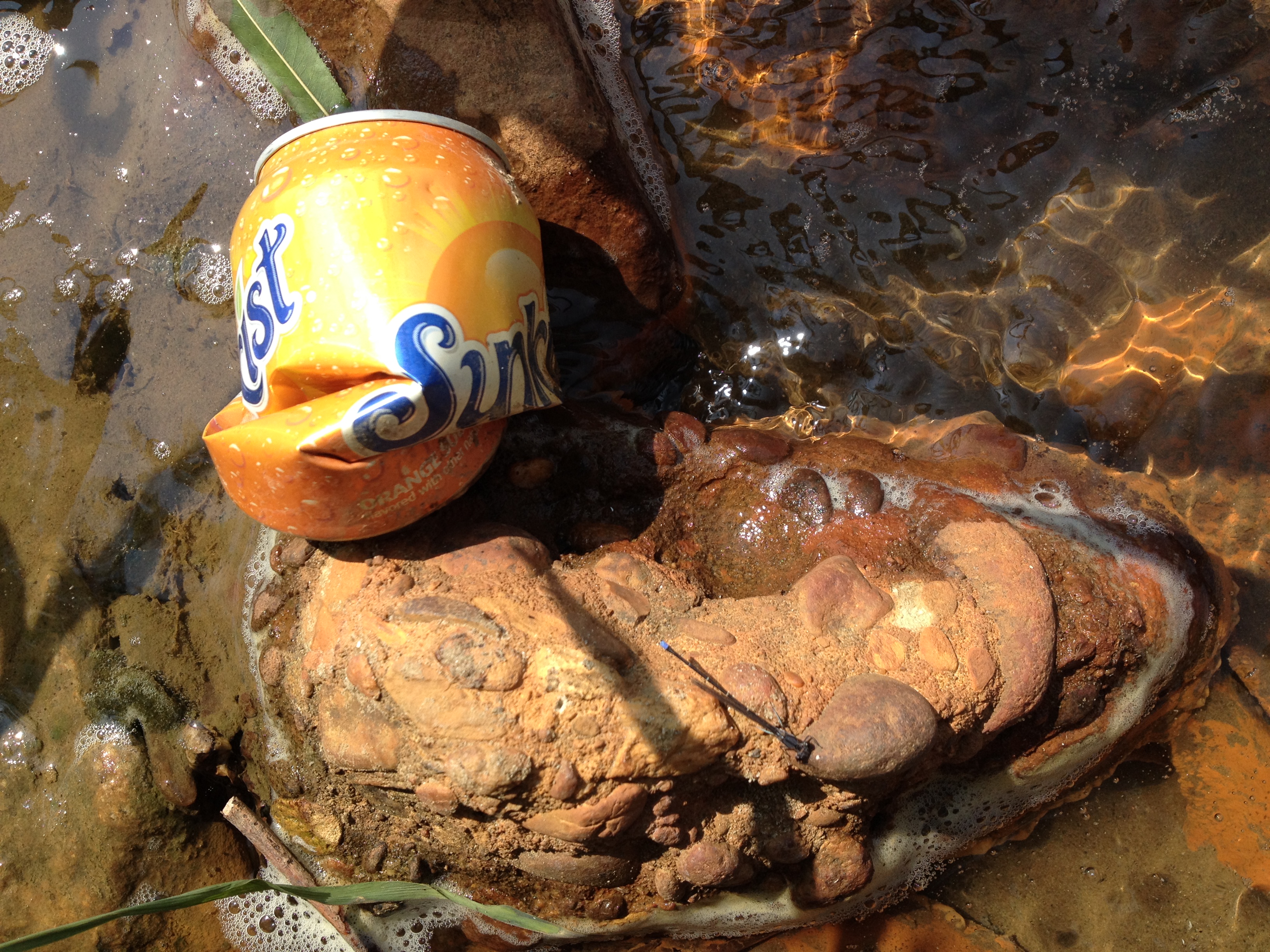
Soft drink can in the water, Aug. 2014

Sometimes it’s just the incongruity or coincidence that I feel just finding the trash in this context.  The photo above finds a partially crushed “Sunkist” brand soft drink resting upon a piece of rusty-colored concrete in the water on a sun-kissed day.  I later noticed at home, the small damselfly that is also resting on the concrete.  Do you see it?  Or, how about the next one?

squished plastic "Real" lemon juice container, Aug. 2014

Washed ashore upon the fossil rocks was this smashed plastic lemon.  It once contained “real” lemon juice.  Over the years, I have found many of these lemon-shaped bottles.  What I find interesting here is the presented combination of image and substance…a plastic lemon that once held genuine lemon juice.  It doesn’t take much to pique my interest!  I never know what I will find on any given day at the Falls of the Ohio.  The river washes in “fresh” material on a regular basis.  The river is like our subconscious and who knows what lies below its depths or floats upon the surface to be discovered by someone walking its shoreline?
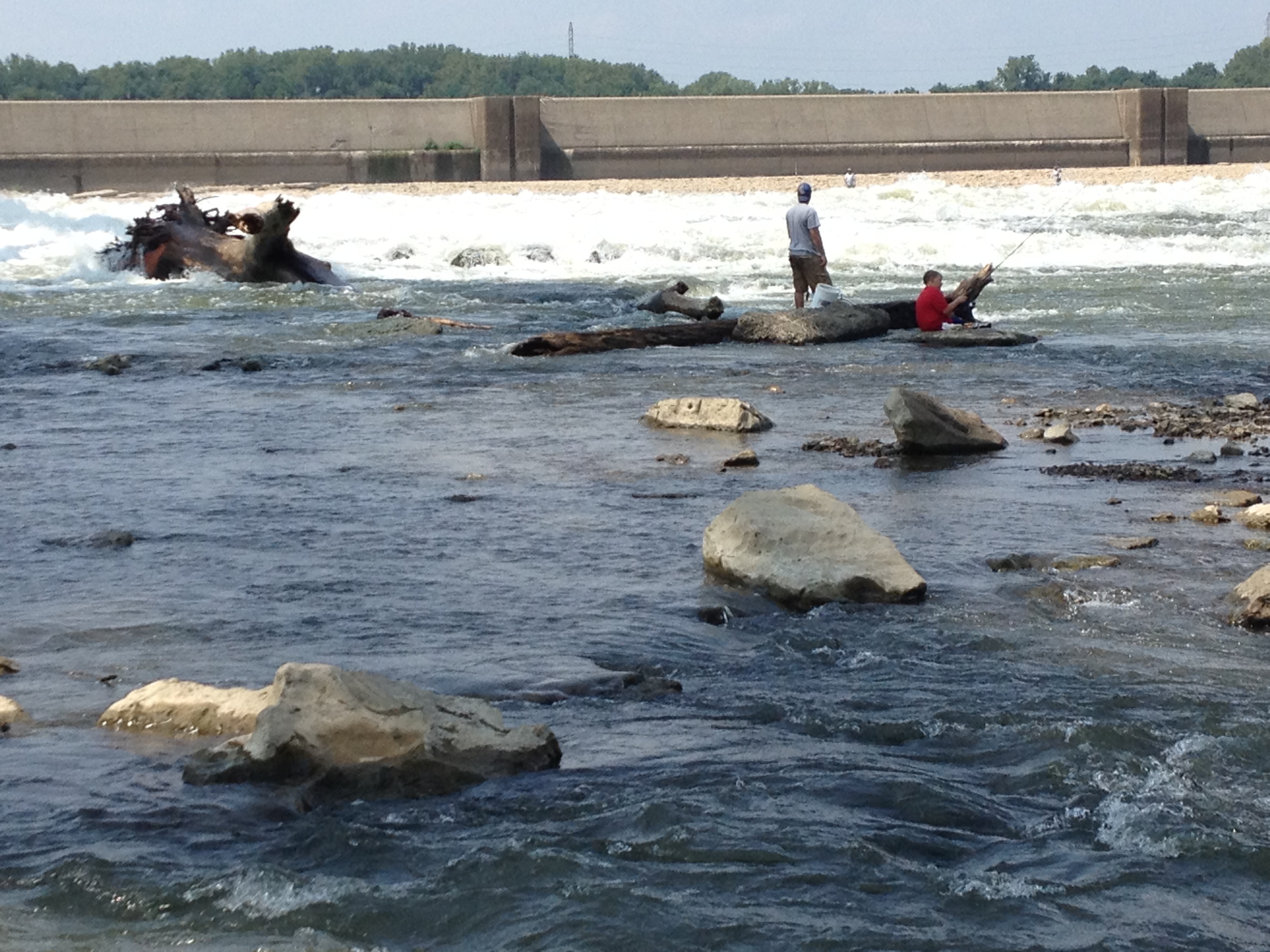
people fishing at the Falls of the Ohio, Aug. 2014

Read Full Post »

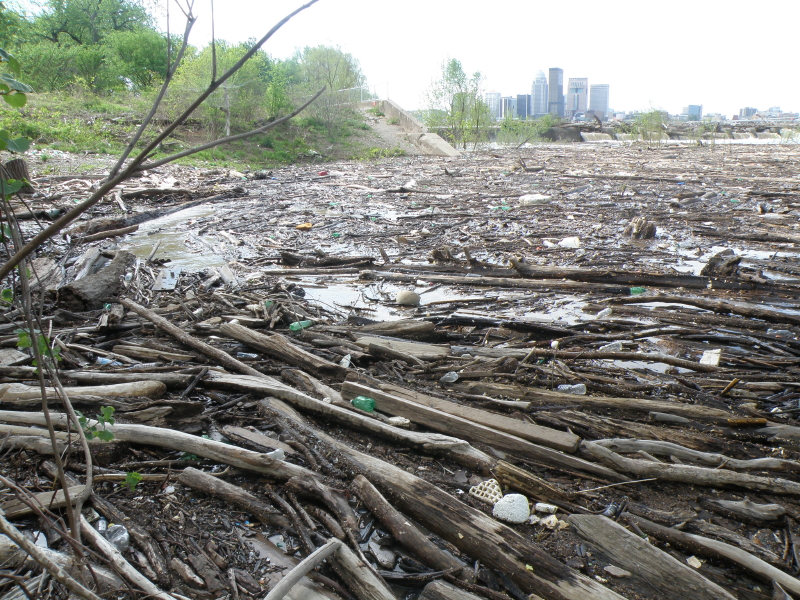
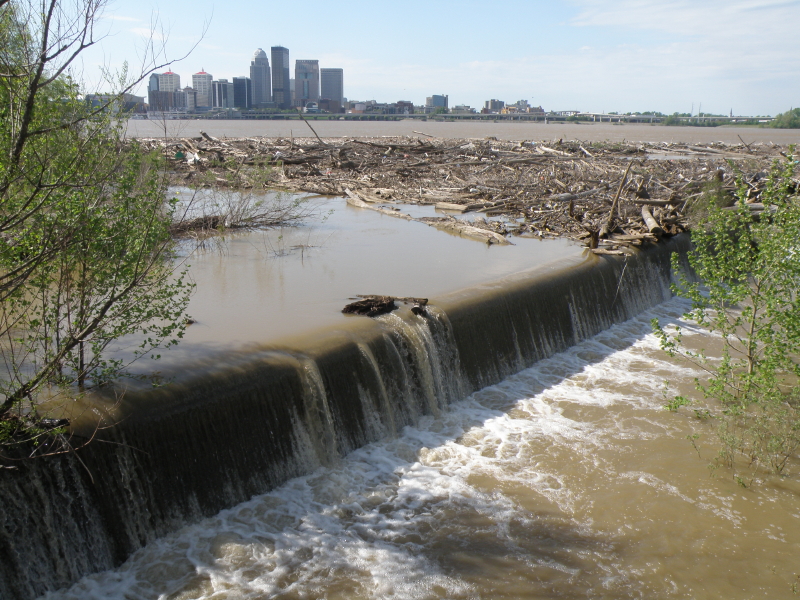
Louisville seen from the Falls of the Ohio, early May 2014

We have seen a lot of water flowing over the dam at the Falls of the Ohio this season.  The month of May has been punctuated by intense storms and ample sunshine.  Rainfall across the Ohio River Valley has been plentiful.  On this particular excursion, the river was high and many of the places that I like to sit and work were inaccessible.

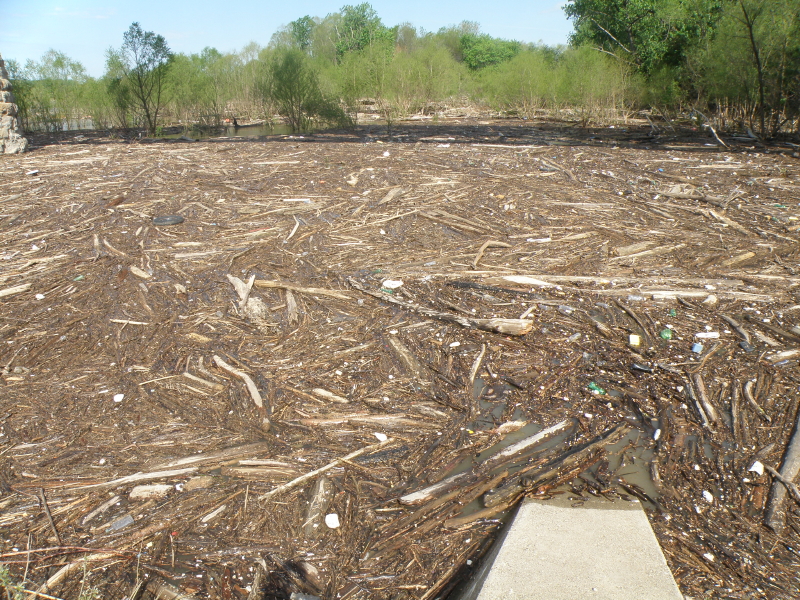
wood and debris in the Ohio River, May 3, 2014


There was plenty of wood and trash in the soupy brown water and despite the beautiful sunshine, I was thinking that I might need to go home early today.  Instead, I decided to do a little exploring along the margins of the high water and see how far I might be able to go.

high water at the Falls of the Ohio, May 3, 2014

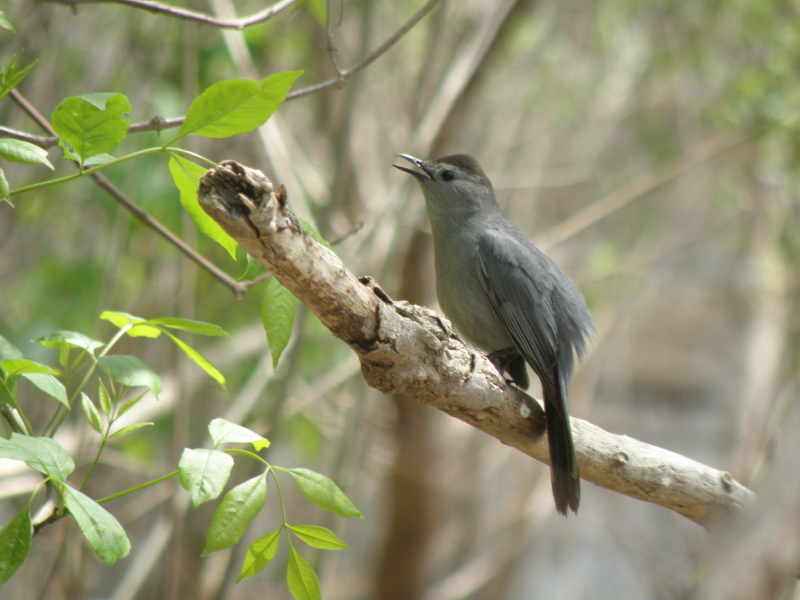
Skirting the margins of the high water, I was able to walk over logs and driftwood and reach small pockets of higher land that remained dry.  After initially feeling that my day in the park would be a loss…I started to feel excited again!  In part, this was due to the abundant bird life I was seeing and hearing.  This particular area has always been good for me and finding birds.  There is enough shelter here under the cottonwood trees and willows that provide relief from the wind and is close enough to the water.  Among the species I was encountering included this colorful grouping of birds: Baltimore Orioles, Northern Cardinals, Indigo Buntings, Palm Warblers, Gray Catbirds, American Goldfinches, and a tiny Blue-gray Gnatcatcher.  Here’s an image I captured of a Gray Catbird singing.

Gray Catbird singing, Falls of the Ohio, May 3, 2014

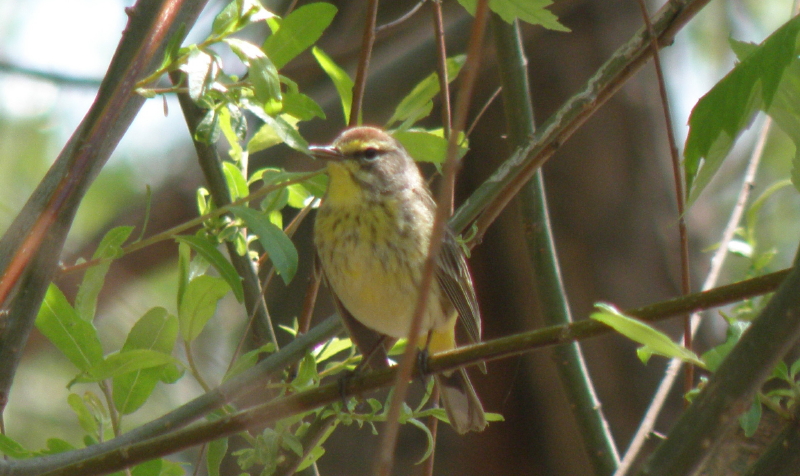
These birds are very territorial and the males chase one another out of their areas when interlopers trespass.  Catbirds have a wide variety of sounds they make including a “mewing” call that reminds people of cats.  Usually, I hear catbirds before I see them.  Thus far, this has also been a good year to observe some warbler species.  Warblers are my favorite group of birds to see because they are diverse, beautiful, transient (they are famous for their long migrations) and challenging to photograph.  Here’s a picture of a Palm Warbler that I recorded on this day.

Palm Warbler, Falls of the Ohio, May 3, 2014

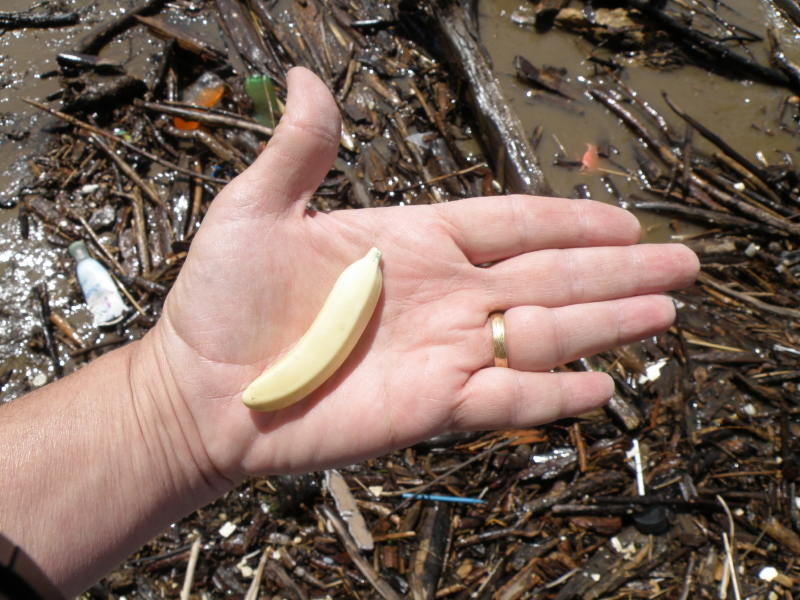
This guy hung around for a while.  The guidebooks say that this warbler species summers in the northern bog lands and really has nothing to do with palm trees. That was an unfortunate bit of naming.   The Falls of the Ohio are just one stop among many that this bird will make and I was glad to see him.  In addition to birds, I was also finding plastic junk and other bits and pieces including a miniature plastic banana…I’m sure you want to see that?

miniature plastic banana, Falls of the Ohio, May 3, 2014

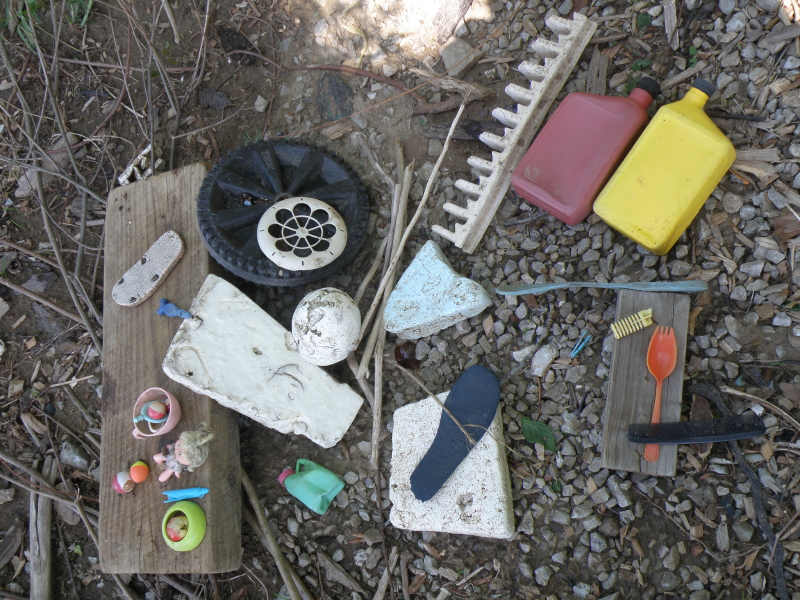
This banana (my second of the year) will enter my Fake Fruits and Vegetables Collection which now numbers hundreds of pieces found in this park.  Here are other found objects, some of which I will use to create a new figure.

Found objects, Falls of the Ohio, May 3, 2014

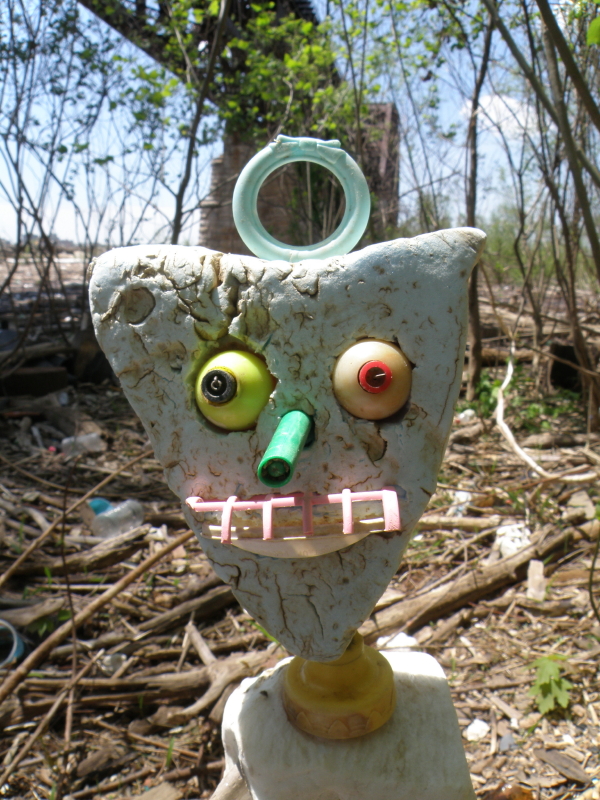
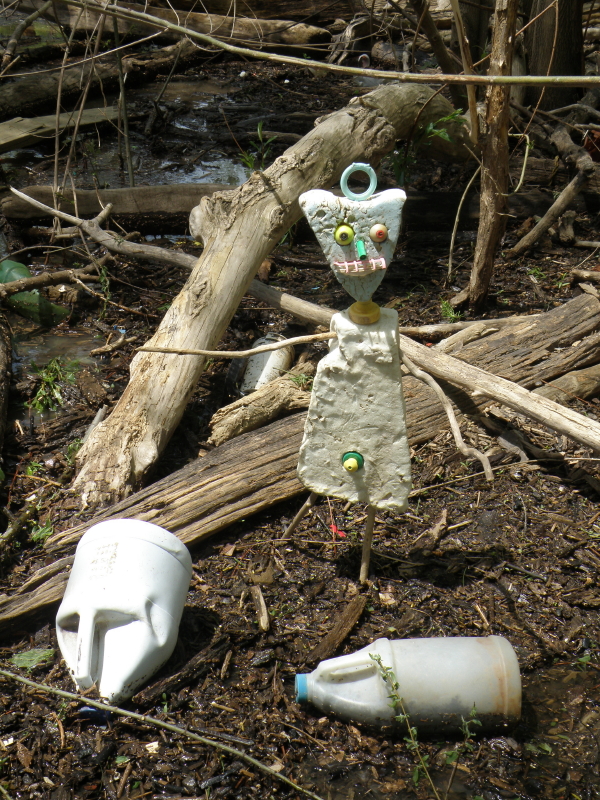
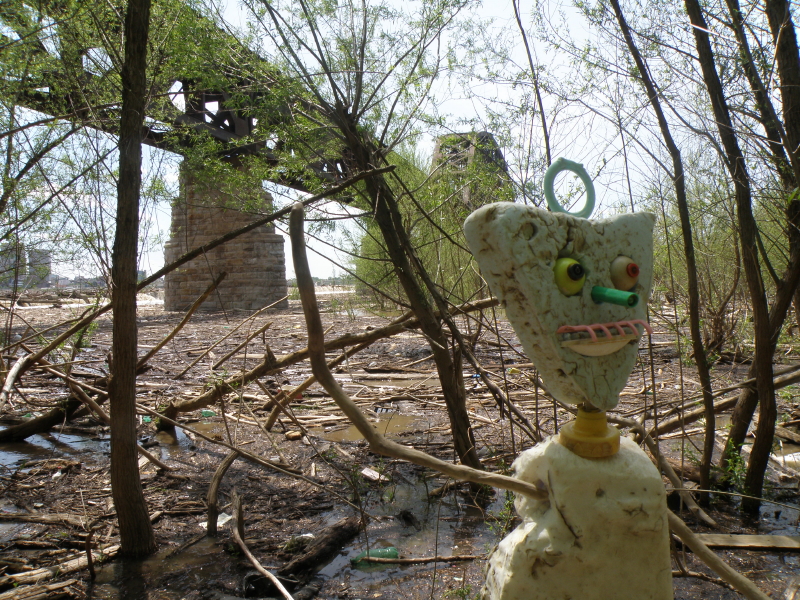
And…here is the figure I constructed on this day.  He’s pretty outlandish looking and another in a long line of pieces that reflect how I feel about our species’ absurd handling of the environment.  For the moment, he remains unnamed, but if one comes to you…please share!

Unnamed figure, found objects from the Falls of the Ohio, May 3, 2014

Styro-figure with white plastic bleach bottles, Falls of the Ohio, May 3, 2014

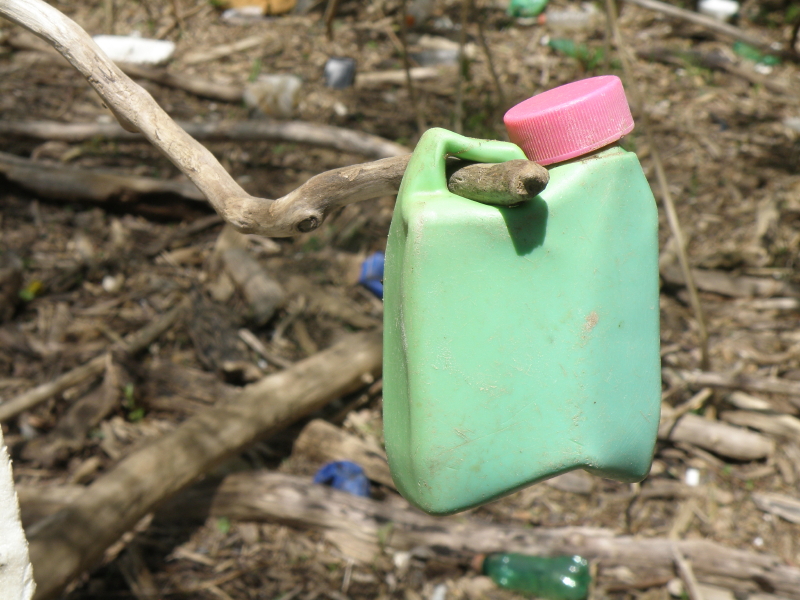
He’s made mostly from insulating foam, plastic, and driftwood and sports one jaundiced eye and what appears to be a unique, pink moustache.  The area I was working in had so many plastic bottles lying around that my latest Styro-figure decided to put some of the colorful ones to use.  Every year, the park does its best to keep this special place clean and orderly.  Unfortunately, most of the trash I use and show originates elsewhere…mostly along the Ohio River flowing north of here and is carried to this down river location during flooding and high water.

small, plastic container, Falls of the Ohio, May 3, 2014

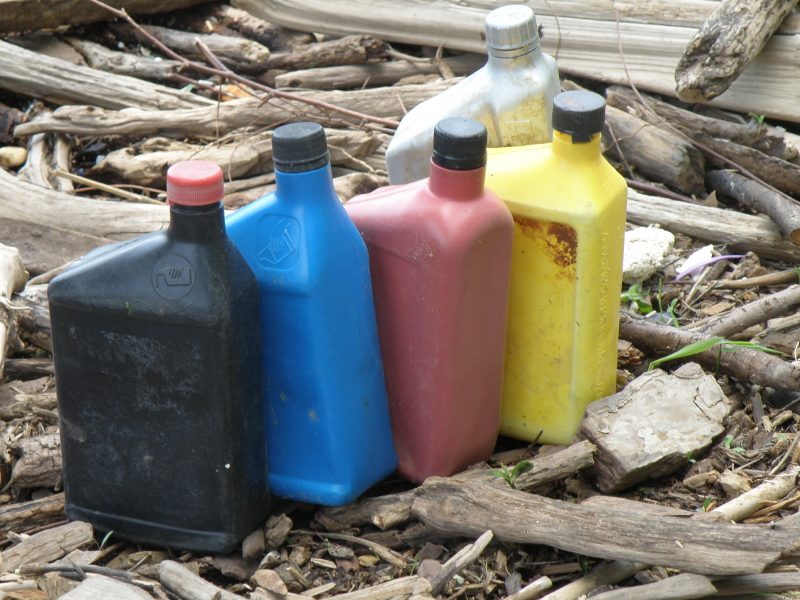
various colorful plastic oil containers, Falls of the Ohio, May 2014

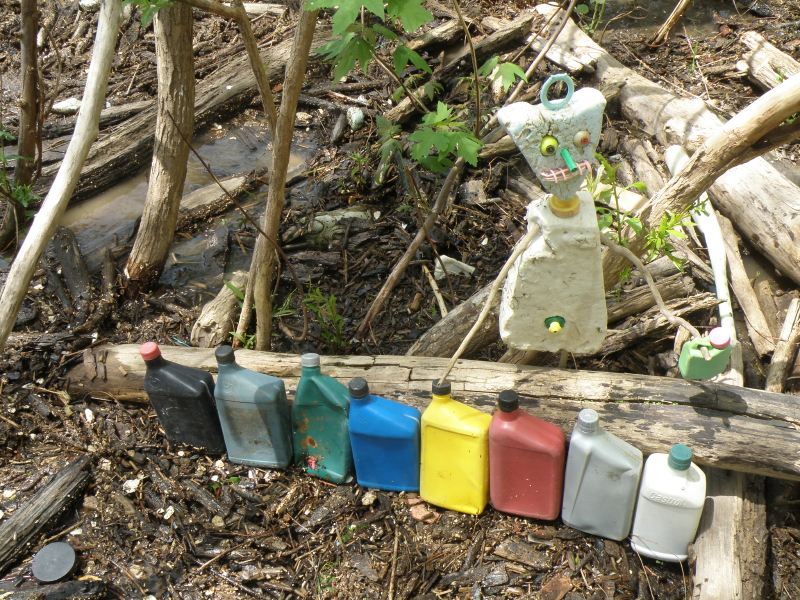
Looking around the immediate area I was able to locate various colorful plastic oil containers and my Styro-figure decided to line them up for a photo opportunity.  Here’s the results.

Styro-figure with plastic oil container color spectrum, Falls of the Ohio, May 3, 2014


It’s an oily color spectrum of sorts.  The Styro-figure seemed happy with it and for this day…left it at that.  I have used this similar idea for other plastic found objects discovered in the park.

Styro-figure under the railroad bridge, Falls of the Ohio, May 3, 2014

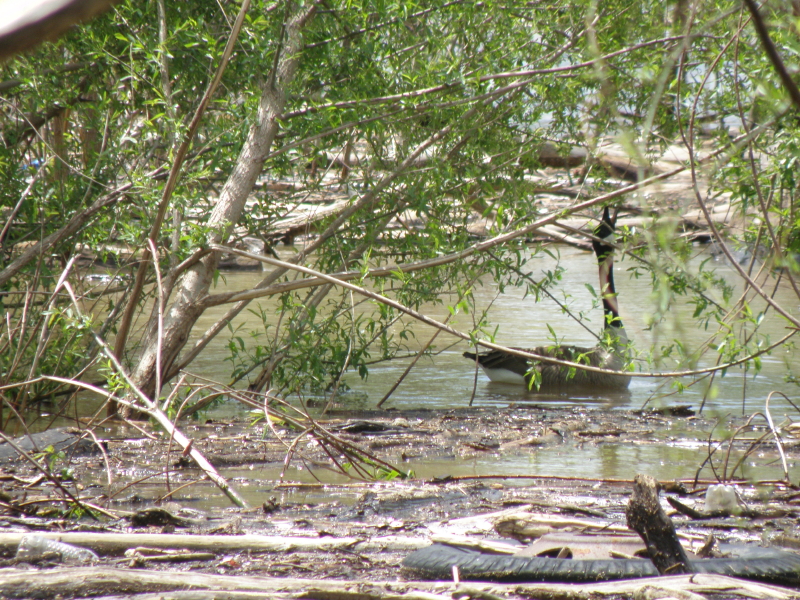
Soon it was time to go home.  The day turned out to be a more creative and productive day than I originally thought it would be.  I gathered up my collecting bag, camera, and walking stick and made the very short walk up to the parking lot.  Looking back, I spied a Canada Goose taking advantage of the high water to feed from bushes it normally could not reach.  This seemed as good an image as any to end this post with.  Thanks as always for tagging along on another day at the Falls of the Ohio State Park.

Feeding Canada Goose, Falls of the Ohio, May 3, 2014


Read Full Post »

Canada Geese, Falls of the Ohio, April 2014

It’s springtime at the Falls of the Ohio and life is less shy about revealing itself.  Wasn’t too long ago that finding even the most common bird could be a challenge due to the harshness and length of our winter.  Now the spring migrants are winging their way northward and even the indigenous species are easier to locate.  This is the time of year when the pair bonds are strongest.  The resident Canada Goose population appears to have overwintered in fine fashion and it won’t be too long before the first goslings are in the water.  As you may have ascertained, this post will be about one of my favorite Falls subjects…birds.

osprey, Falls of the Ohio, April 2014osprey, Falls of the Ohio, April 2014osprey, Falls of the Ohio, April 2014osprey, Falls of the Ohio, 2014

This is a composite image of three different Osprey that were simultaneously circling my position at the river recently.  The trio were flying in ever-widening circles and taking advantage of the wind currents and thermals.  It’s a thrilling site to observe these fish hawks diving into the water and being rewarded for their efforts with a freshly caught fish in their talons.  I’ve heard about, but not yet seen, the Bald Eagle nest that is just west of the Falls area.  On occasion, I have seen eagles, but considering how near they are to this area I would have thought that sightings would be more common.  I’ve recently seen other birds of prey including Peregrine Falcons, Cooper’s Hawks, and our next featured bird, the Black Vulture is beginning to return to the Falls of the Ohio in numbers.

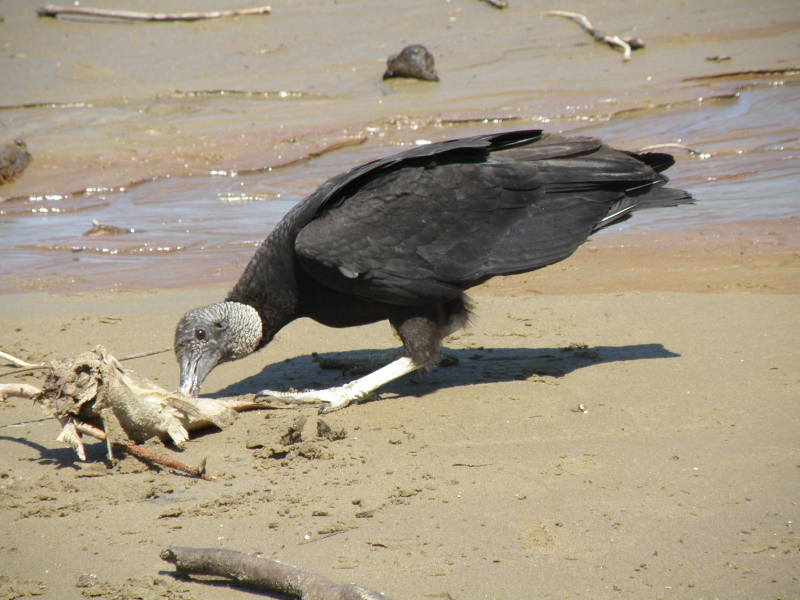
Black Vulture and dead fish, Falls of the Ohio, April 2014

Black Vulture, Falls of the Ohio, April 2014

Black Vulture feeding on a dead fish, Falls of the Ohio, April 2014

To my eye, it appears that the Black Vulture population has been increasing while our other vulture…the Turkey Vulture presents itself less frequently.  The Black Vultures are more gregarious and aggressive which probably keeps the Turkey Vulture from showing its featherless, naked, red-head more?  Recently, I came across this individual Black Vulture feeding upon a dead fish.  It let me get quite close, but there was also a minimum distance that it would tolerate me.  Whenever I would get closer to its comfort zone, the vulture would grab the fish with its sharp beak and drag it to where that minimum distance was re-established before it resumed feeding.  We did this dance for a few minutes before the vulture decided it had enough and flew away.  My next bird is one that I have never observed in the park before.  Some of my most memorable sightings have come from species seen just once and maybe for a few seconds at that.  Hardcore birders (they wear black leather jackets with chains hanging off them) are familiar with this phenomenon.  Friends have asked me why I don’t indulge my avian passion in a more organized fashion, but frankly I don’t like the sense of competition that can exist in some of these groups and clubs.  I appreciate that birds are fellow life forms that are inhabiting the same time and space with me and are more than feathered abstractions to cross off on some list.  If you pay attention, birds can tell you much about the state of nature and this planet.

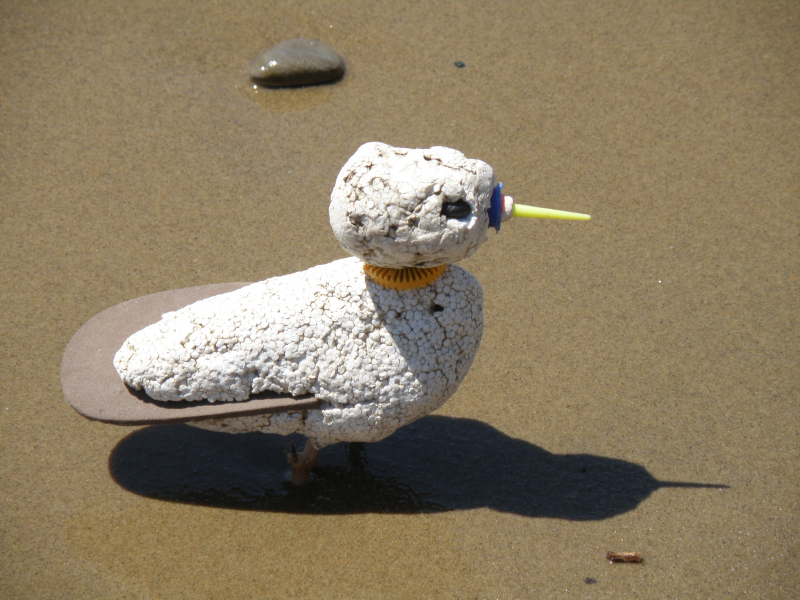
Orange-collared Piper, Falls of the Ohio, April 2014

Orange-collared Piper, Falls of the Ohio, April 2014


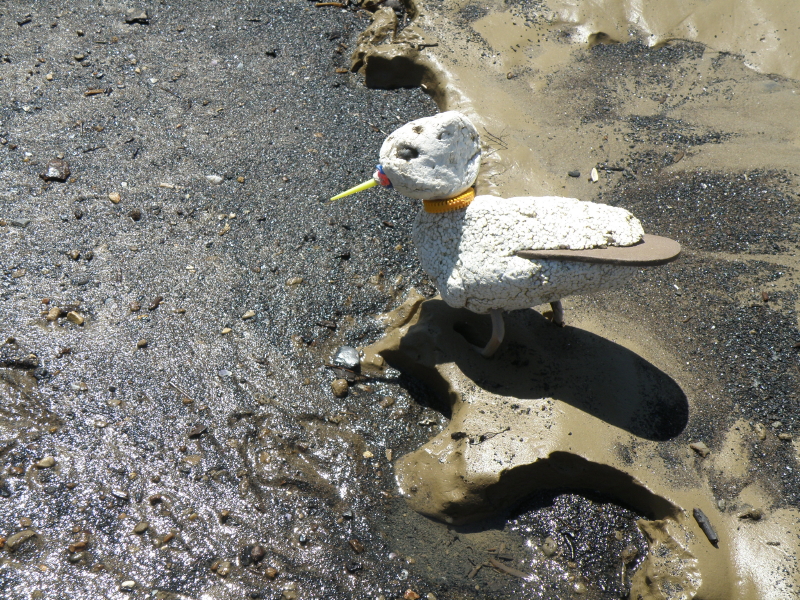
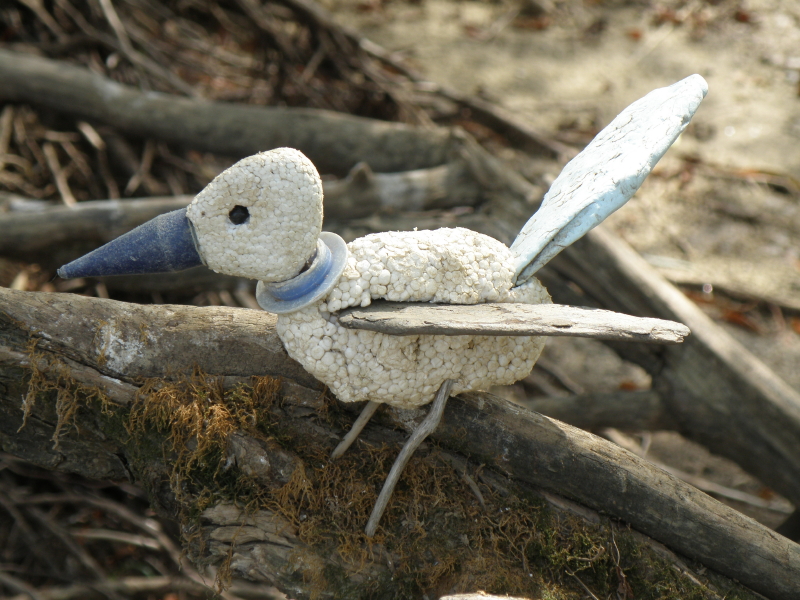
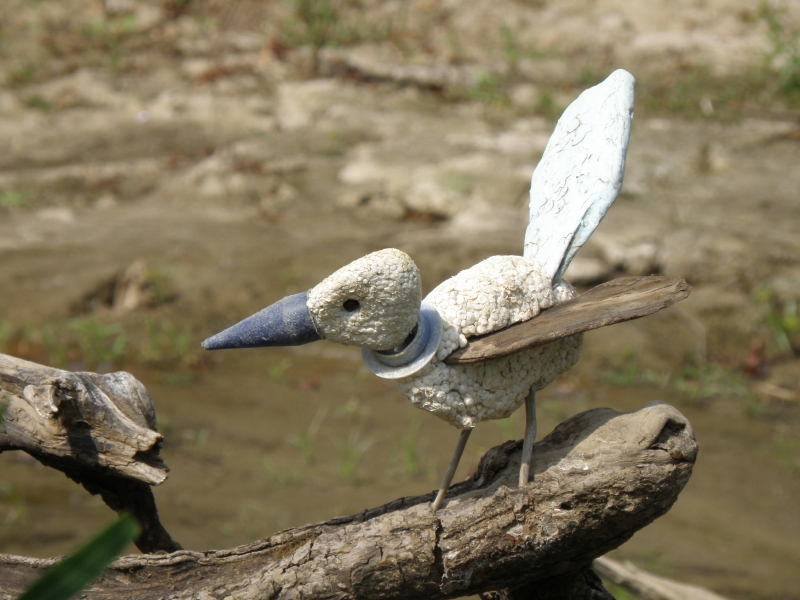
The new bird I recently came across is the Orange-collared Piper.  It’s a shorebird that undertakes  a tremendous journey starting at the tip of South America and it won’t stop moving northwards until it reaches its breeding grounds in the Arctic Circle.  Landing at the Falls, it is a little more than half way to where it needs to be.  This piper is a rather small bird and easily overlooked in this particular environment.  Its white body and head look remarkably like the polystyrene that litters these shores.

Orange-collared Piper at the Falls of the Ohio, April 2014

Orange-collared Piper, April 2014

The bird is so named because it sports an orange ring around its neck.  Other field marks include diminutive size, brown wings, and a sharp yellow bill it uses to probe sand and mud for the tiny invertebrates it eats.  Also true to its name, this bird makes a high-pitched “piping” call it uses while it feeds.  To he honest, I did not hear this call with this particular individual.

Orange-collared Piper at the Falls of the Ohio, April 2014

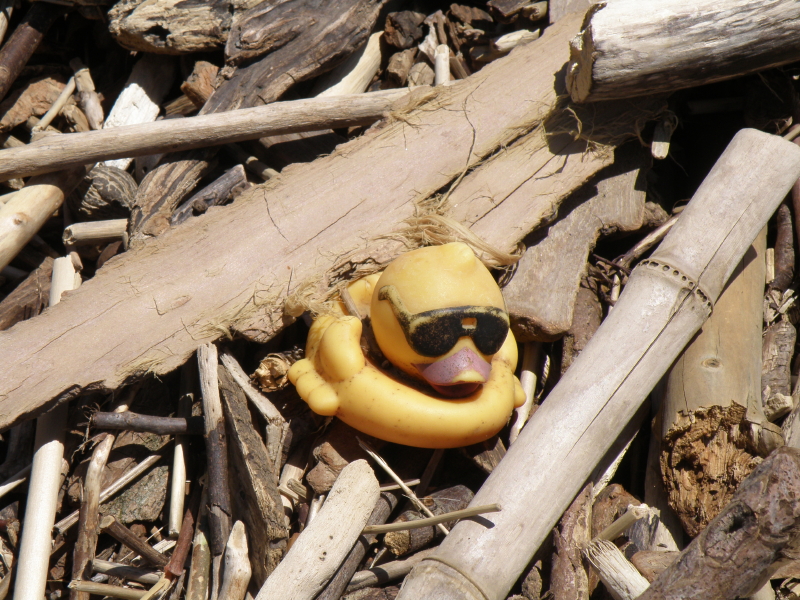
Both the male and female Orange-collared Piper look about the same.  At its breeding grounds, the pair incubates about five or six tiny, black speckled eggs in a rather shallow gravel depression.  No fancy nest for this bird…it lays its eggs directly on the ground where  cryptic coloration helps protect them from the numerous Arctic predators.  This bird is considered threatened due in large measure to habitat loss and other environmental degradation.  Its amazingly long migration probably also puts this bird at risk since so many things can go wrong on such a long trip.  I watched this particular individual for about forty minutes or so.  It moved among the driftwood in very careful fashion stopping here and there to probe the sand with its sharp yellow bill.  When the bird decided to move on…there was a flash of wings too quick to see and it was gone.  I hope that it reaches its destination and resurfaces at this park again.  I have one final “bird” that I recorded the same day I saw the Orange-collared Piper.  Perhaps you will recognize this one?  It’s most distinctive field mark is the sunglasses it wears while floating on the river.  Happy birding!!rubber duck with sunglasses, April 2014
Read Full Post »

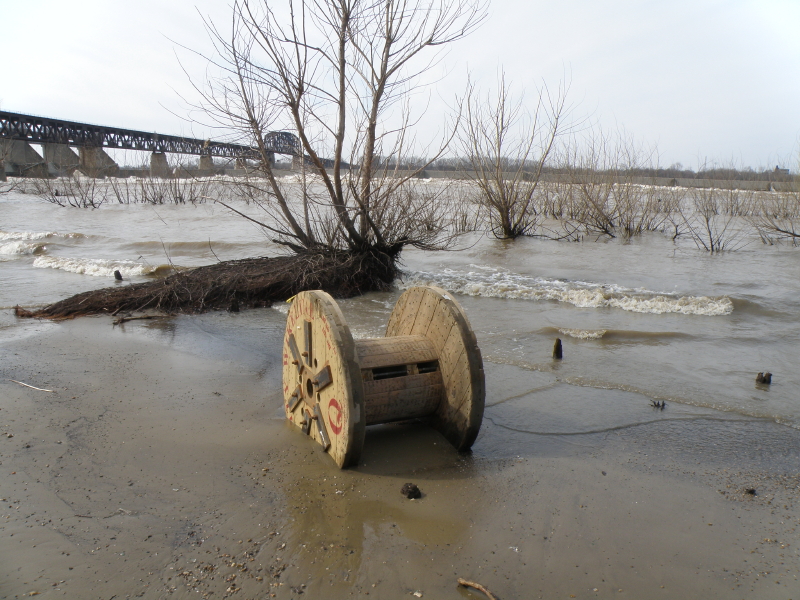
wooden cable spool and willow tree, Falls of the Ohio, March 22, 2014

It’s a sunny Saturday and warm for this time of year.  One of those days I can’t wait to get to the river.  Spring is still slow in developing, but it can’t be much longer now.  I spent a good part of the day just filling up my canvas collecting bag with all types of odds and ends both man-made and natural that have washed up on these fabled shores.  I’m finding so much stuff that for practical reasons I decide to see if I can find a spot up the bank and under the willows that might make a good location for a temporary outdoor art studio.  I can offload some of my larder for future use while continuing to walk the edge of the river.  I’m enjoying the sunshine and taking deep breaths of the fresh air.

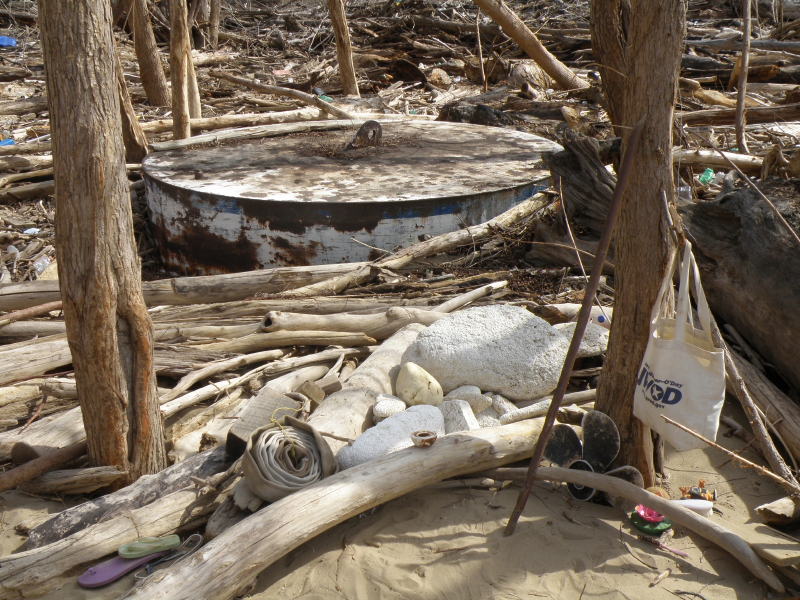
U.F.O. studio...Unidentified Floating Object studio, March 2014

U.F.O. studio, Falls of the Ohio, March 2014

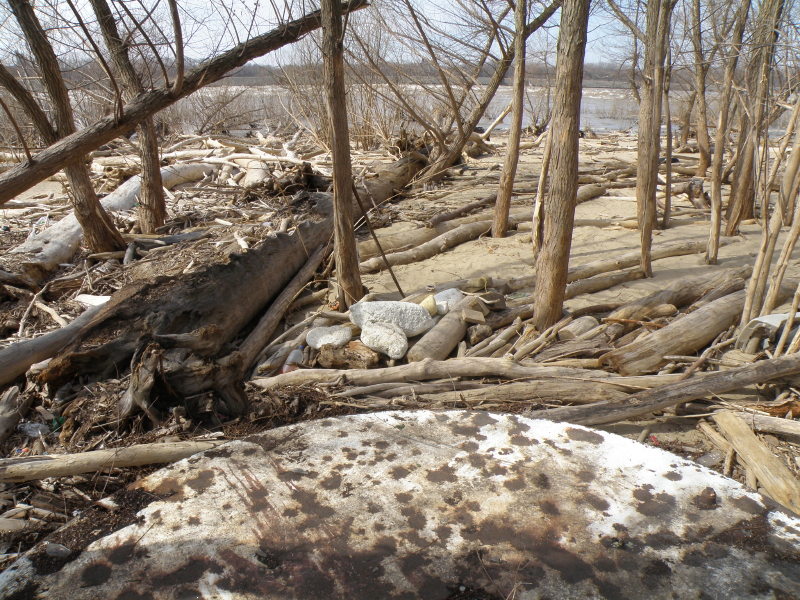
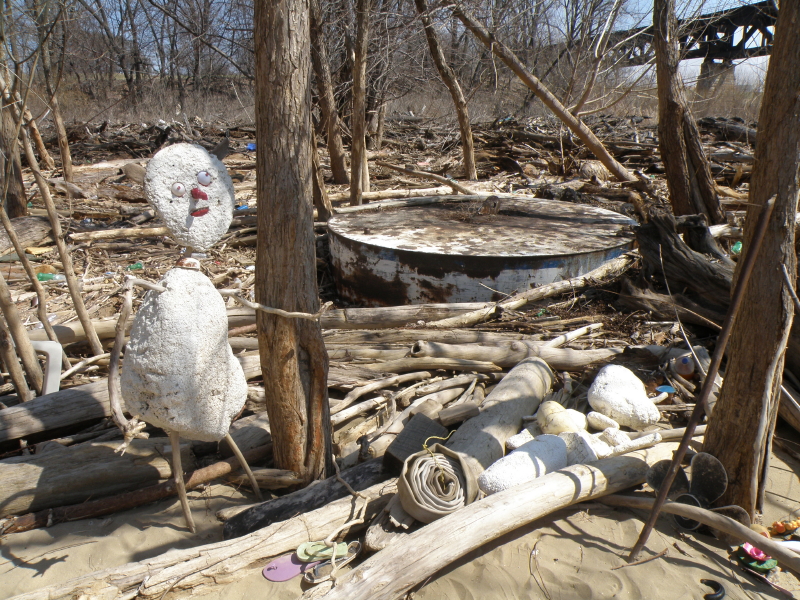
I chose a spot bordered by a large log that keeps most of the driftwood at bay and what I call the U.F.O. or Unidentified Floating Object which is circular metal platform that was once painted white with blue trim.  It’s starting to show some rust now.  This large object washed over the dam during a high water moment three or four years a go.  Since then it’s changed positions with the rising and falling river levels and was once completely buried under driftwood.  The U.F.O. is a platform that normally would be anchored out on  the river.  Barges and other water craft can tie on to it if necessary.  Some how this one got loose and relocated to the park.  When I first discovered it here I also imagined that it was a giant bathtub plug that helped keep the water in the river.   I was lucky that I had the same outdoor studio for many years before this winter’s high water rearranged the landscape again and floated all my collected materials away.  I spent a few hours walking the river collecting Styrofoam and sticks and can’t wait to make something new.

Mega Spool figure in progress, March 2014

Completed figure at the U.F.O. studio, March 2014

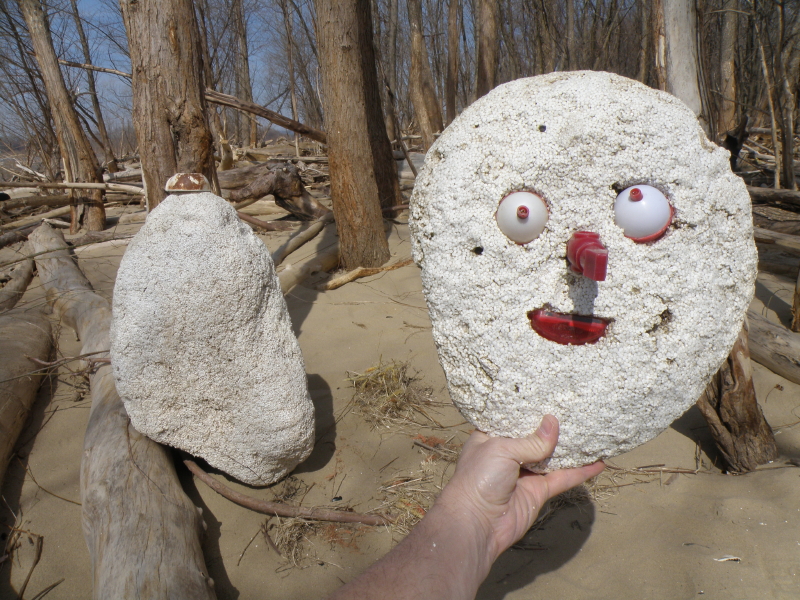
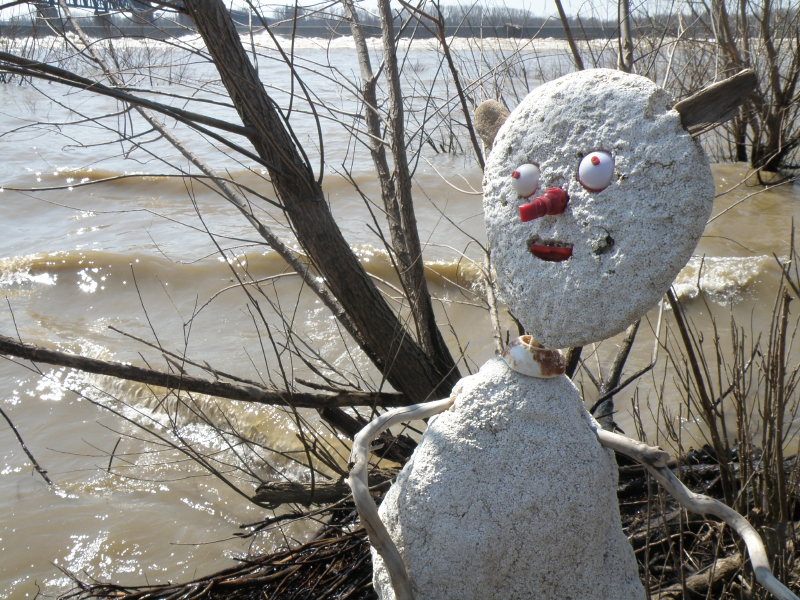
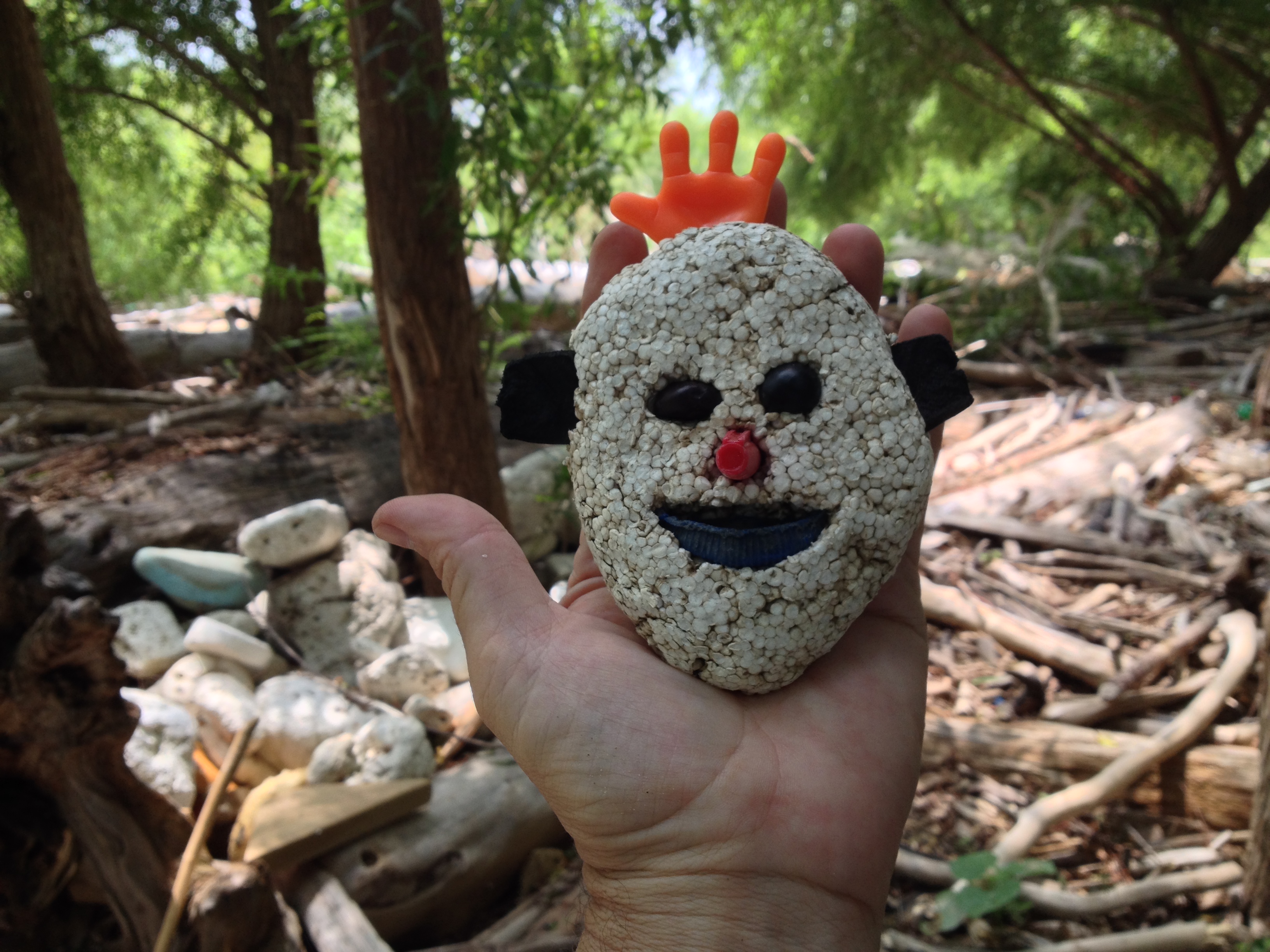
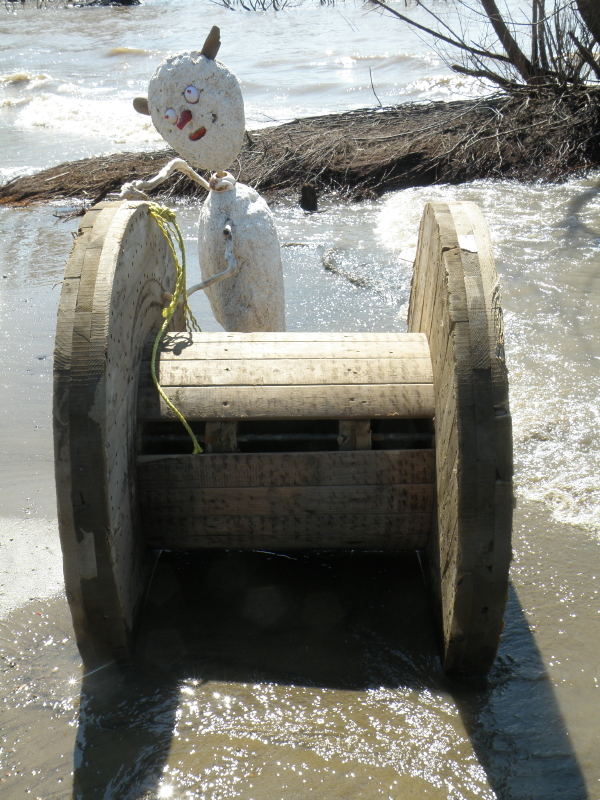
The first figure I make here is from the largest chunks of polystyrene I had found on this excursion.  I used two fishing floats (one larger than the other for expressive effect) for the eyes.  The nose is a plastic piece from a fooseball table.  The mouth is a red reflector.  My figure has ears, arms, and legs that are pieces of driftwood.  The figure has a benevolent feeling to it and I can’t wait to photograph it by the river.  I did run into a young sculptor attending the Kentucky School of Art who was collecting driftwood for her own project.  Her name is Jenn and she approached me asking if I was the person with the show at the Carnegie Center for Art and History?  She and her classmates had seen the exhibition.  Jenn is building an installation at the school and promised to let me know when she completed it.  It will be fun to see art made by someone else from materials collected within the park.

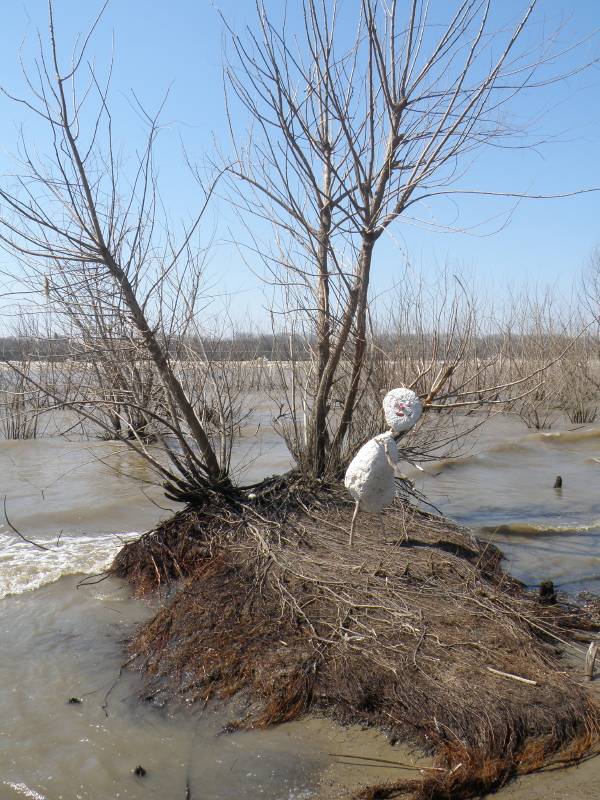
Large Styro-figure on a tiny willow island, March 2014

Styro-figure on tiny willow island, Falls of the Ohio, March 2014

When I first meet the river, I spend a little time looking around and scouting out potential locations to create the photographs that will represent this day in my project.  I decide that I like this tiny “willow island” which consists of clay and sand bound together by the living roots of this tree.  Waves and water wash all around it and at times it does look like an island.  As the river recedes to its normal pool, this tree will be high and dry at last.  It’s amazing what it takes to keep this tree in place with such a dynamic river always testing its resolve to survive.  During the highest river levels, this tree would be completely submerged underwater.  Many of the willows along this stretch of the river bear scars and wounds from large logs battering them, breaking branches, and grinding bark away.  I pose the figure on the root mass and move to the next shot which isn’t too far away.

Styro-figure and large, wooden cable spool, March 2014

Styro-figure and wireline spool, Falls of the Ohio, March 2014

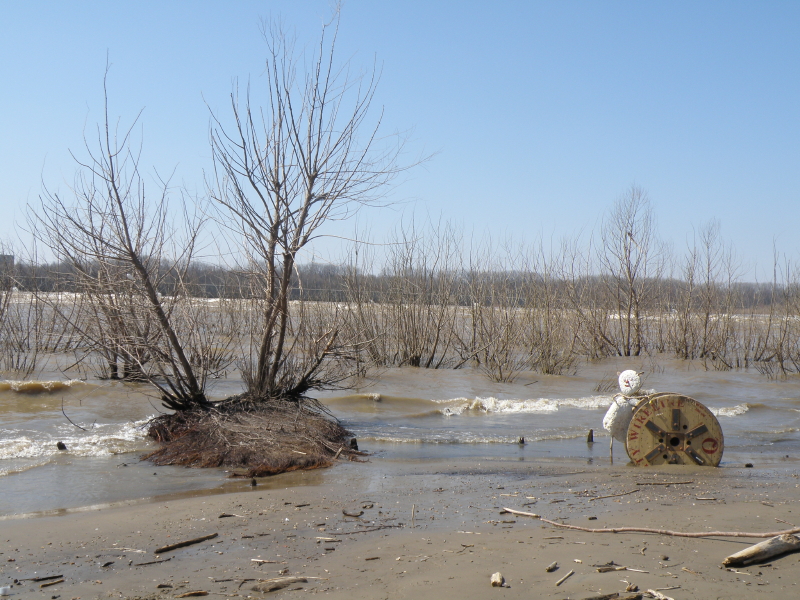
Near tiny willow island is a large wooden “spool” for wire line or cable.  I’m amazed by this object’s heavy-duty construction.  This spool floated into here and is now partially sunk into the sand.  Small waves lap the shoreline and you can also see black coal dust swirling around the water’s edge.  Later when I see my pictures I’m struck by how similar this spool is to the circular platform that now forms part of my latest outdoor studio.  This new area to cache my materials is very visible and hence ultra public, however, if we have heavy spring rains…it’s very possible that all this will be washed away and rearranged again.  I often wonder what might go through people’s minds when they stumble upon my outdoor atelier?  It’s an odd archeological site of Styrofoam boulders, small piles of plastic toys, and a tangle of found roots and driftwood.  All the stuff you need to make an absurd figure!  I left my latest Styro-creation next to the spool.  I will go a head and tell you…I returned a week later and all I could find of him was his body and legs.  There must be headhunters out here?  I searched the area, but found no further trace of my figure.  As with most of my Falls projects, they continue to “exist” as images.  The exhibition that Michael Wimmer and I are participating in at the Carnegie Center of Art and History is entering its last week.  I’m so appreciative of the positive response I’ve received for my work.  The show will end with a tea and cookies closing.  If you are in the area, please stop by.

Final shot from the big spool and tiny willow island, March 2014, Falls of the Ohio

Read Full Post »

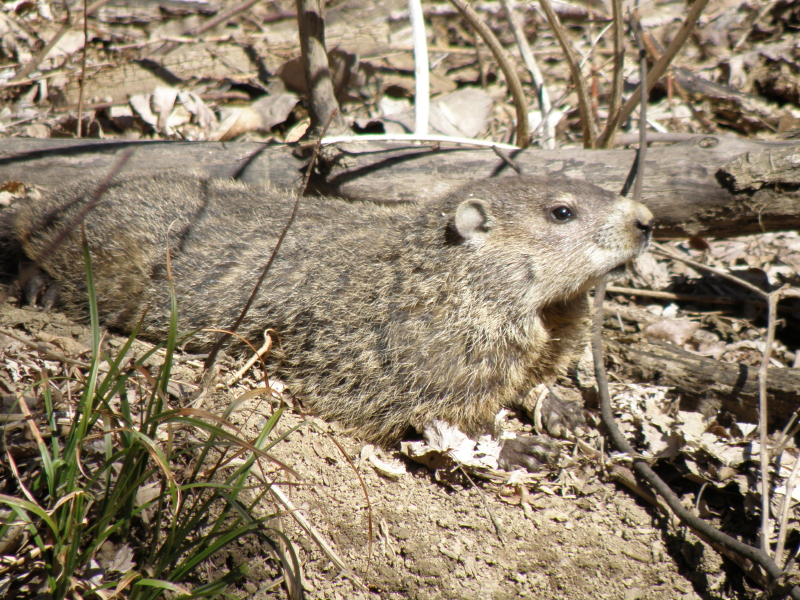
Young groundhog, March 15, 2014

Here’s an adventure from March 15 which was a beautiful Saturday in the Kentuckiana area with temperatures in the low 70’s!  I spent so much time at the Falls of the Ohio on this day that I even managed a very slight sunburn.  Like much of the country (particularly east of the Mississippi River) we are so ready for winter to be over.  This particular day turned out to be a tease, because less than 24 hours later, temperatures plummeted and we had an accumulation of snow!  Most of the people I know are tired of their winter wardrobes, which also means triple the laundry load.  We are ready for the greening and warming of the earth.  On this particular foray to the river, I was on the look out for any signs of spring.  I came across this young groundhog basking in the sun near his hole.  He turned out not to be very social.

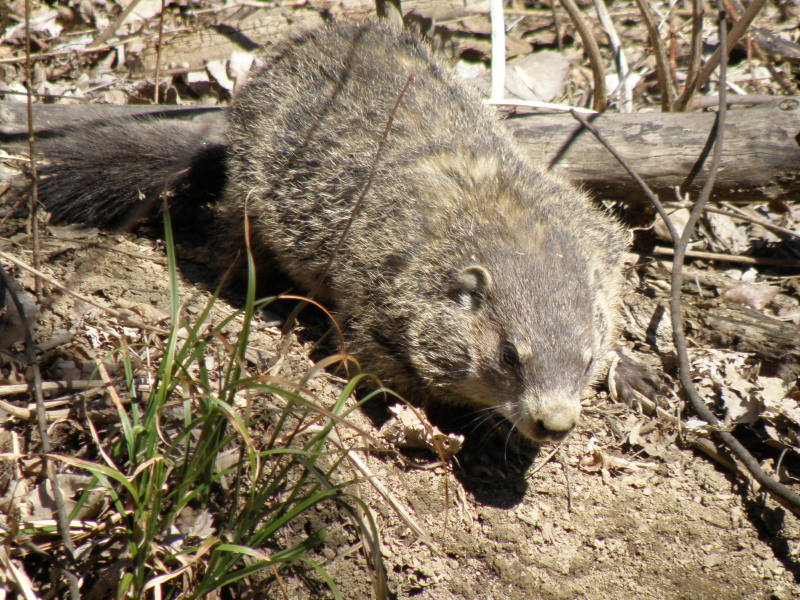
young groundhog at the Falls of the Ohio, March 15, 2014

He need not worry about me.  I wasn’t going to blame him for the extra long winter.  Here’s the back story.  February 2 is Groundhog’s Day and the myth goes if the “official” groundhog that resides in the small town of Punxsutawney,  Pennsylvania sees his shadow on this particular day…winter will be extended another six weeks.  Well this year, that captive groundhog which was yanked from his burrow by human hands did see his shadow and surprise…spring was predicted to be late in coming.  I did a little back checking on the Groundhog’s Day tradition and here’s what I found from the official website.  The idea is based on the Candlemas Day observance that Pennsylvania’s early German settlers brought with them in the 19th century.  This passage was quoted as the rationale for Groundhog’s Day…”For as the sun shines on Candlemas day, so far will the snow swirl in May.”  I’m not sure what the source for this quote is…but snow in May?  What is this some kind of ice age legacy handed over through deep time and what’s with the groundhog? The official Groundhog’s Day observance was established in 1887 and groundhogs and woodchucks the country over have been stigmatized by it.  This particular groundhog was having nothing to do with people and retreated down his burrow.
Cottonwood tree at the Falls of the Ohio, March 2014

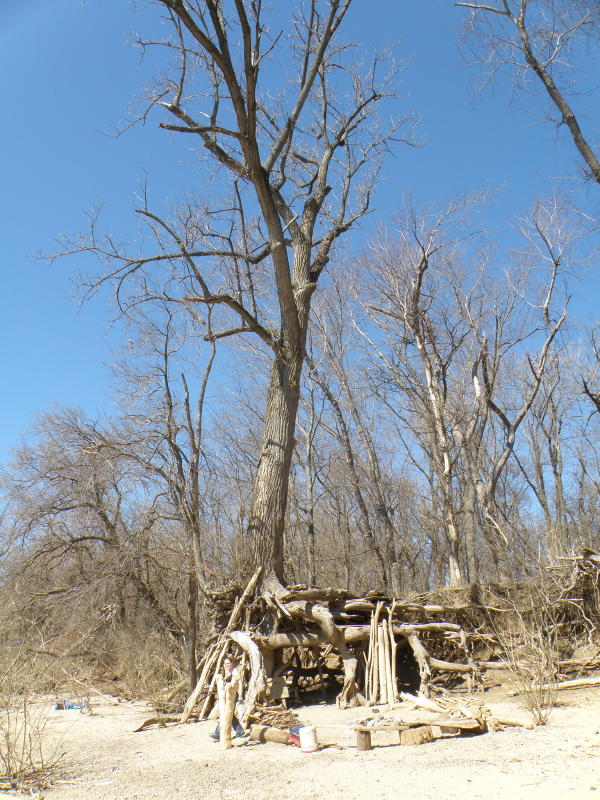
The "Hobo Hut", March 2014

On this trip to the Falls…I visited the far western section of the park and wanted to see if I could find any signs of spring there.  I did find lots of river-carried junk, but will save some of that for another time.  I did stop by my favorite cottonwood tree that has been for many years, a popular place to hang out.  I saw a sign saying that it is now being called the “Hobo Hut”.  I came across a nice group of young people with theater and writing backgrounds who were going to party there.  This seemed to me to be as good a sign of spring as anything that can be learned from a large rodent.  After exchanging pleasantries for a few minutes I moved on.  Before long, I ran into this character and he educated me about spring.

The Harbinger, Falls of the Ohio, March 22, 2014

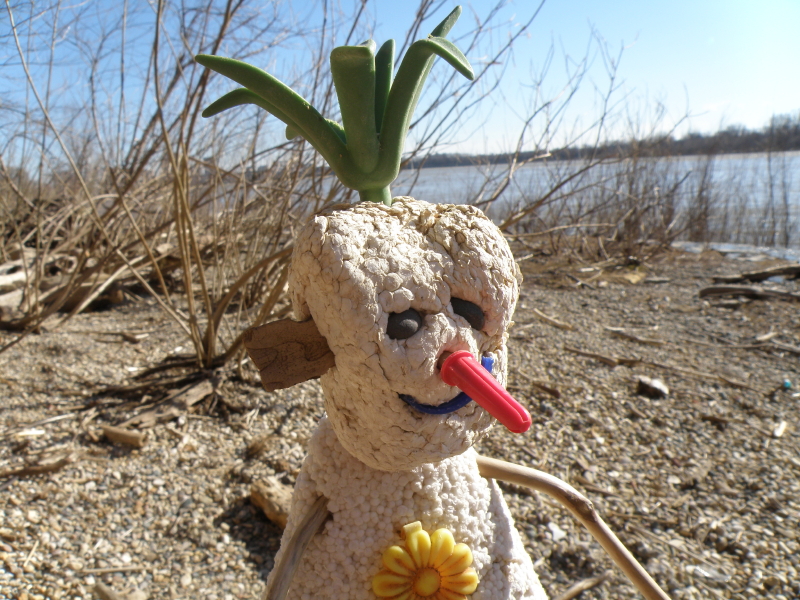
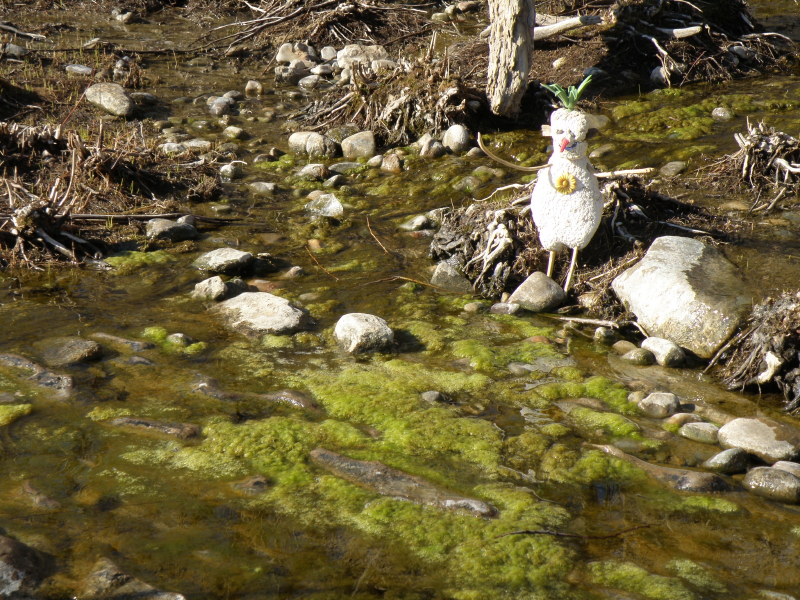
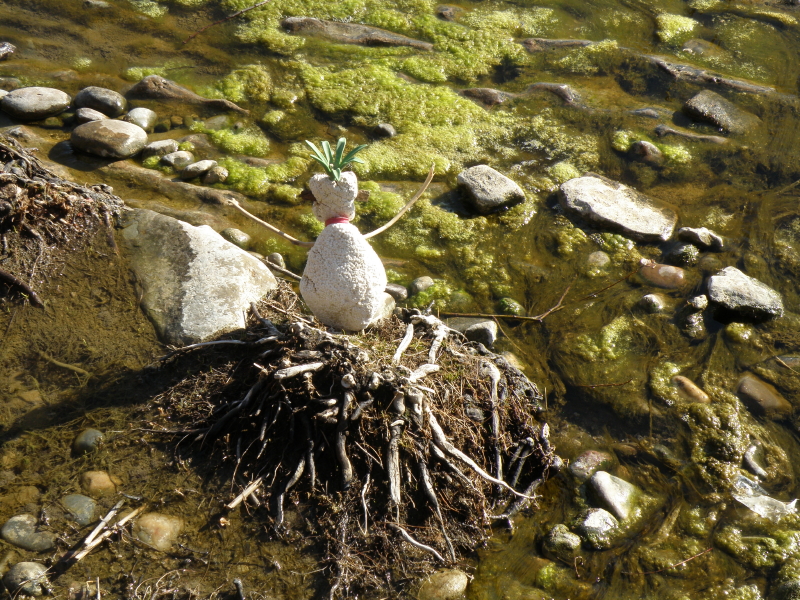
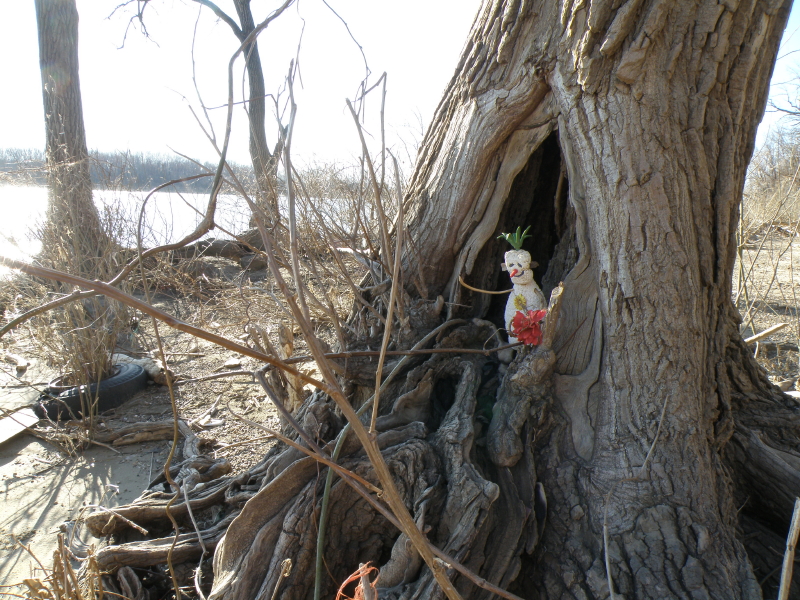
This is the Harbinger of Spring and I chanced to come across him on my walk.  He told me he had “heard” my thoughts and musing about spring and decided to introduce himself to me.  It was a warm day and once again I was out here without drinking water and if this were indeed a hallucination…at least it was a friendly and pleasant one.  He had a reassuring smile on his face to go along with the glowing yellow flower on his chest and shock of leaves sprouting from his head.  I decided to just go with whatever would happen next and here is that story.

The Harbinger of Spring arrives at the Falls, March 22, 2014

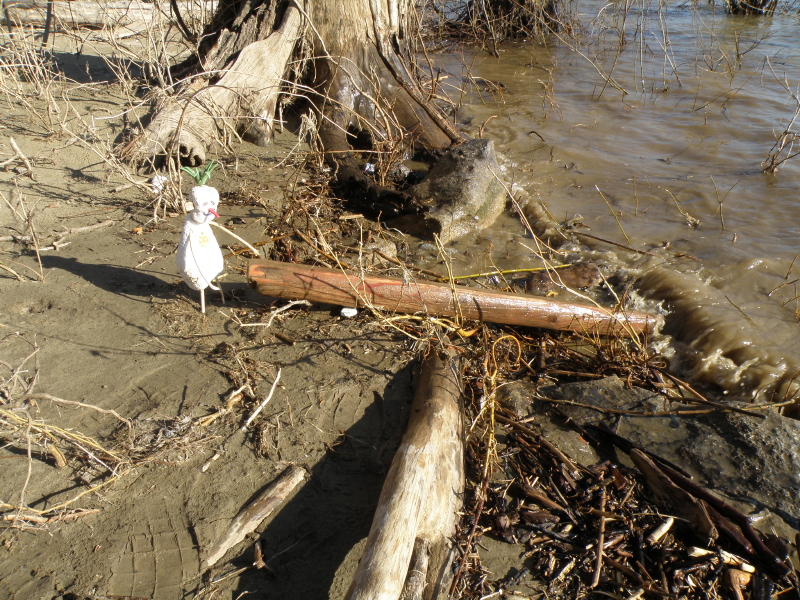
Contrary to popular belief, the official arrival of spring has nothing to do with groundhogs or even the vernal equinox.  Spring arrived by boat to the Falls of the Ohio and I just happened to stumble across him as he prepared to do his work.  The Harbinger allowed me to tag along to see the preparations and ground work needed for winter to transition to spring.

The Harbinger's shadow, March 2014

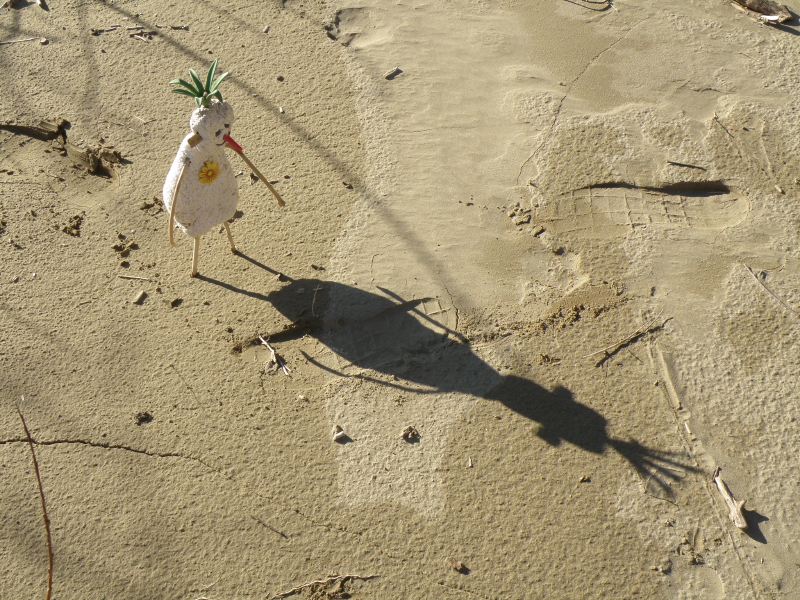
According to the Harbinger, the first thing that needs to happen is an increase in the intensity and duration of sun light.  While I stood quietly nearby, the Harbinger willed the sun into the correct position in the sky.  This was manifested by my magic friend’s ever lengthening shadow and the warmth I felt on the back of my neck.  Not much can occur if the sun doesn’t cooperate.

The Harbinger wills algae to life, March 2014

The Harbinger wills algae to life, March 2014

The next step is to awaken the plants and begin the “greening” process.  I watched the Harbinger sit on a dormant clump of loosestrife and open his arms.  I heard a barely audible melody that I could not identify and heard it more through my mind than my ears.  According to the Harbinger, the “greening” begins by warming up the simplest plants that are connected to the water.  In this case, mats of algae were turning bright green before my eyes.

The Harbinger with a clump of grass, March 2014

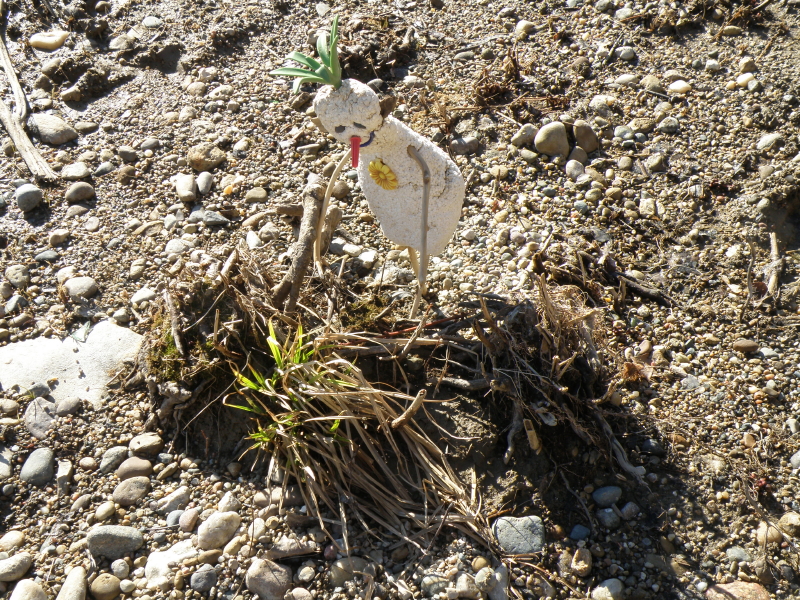
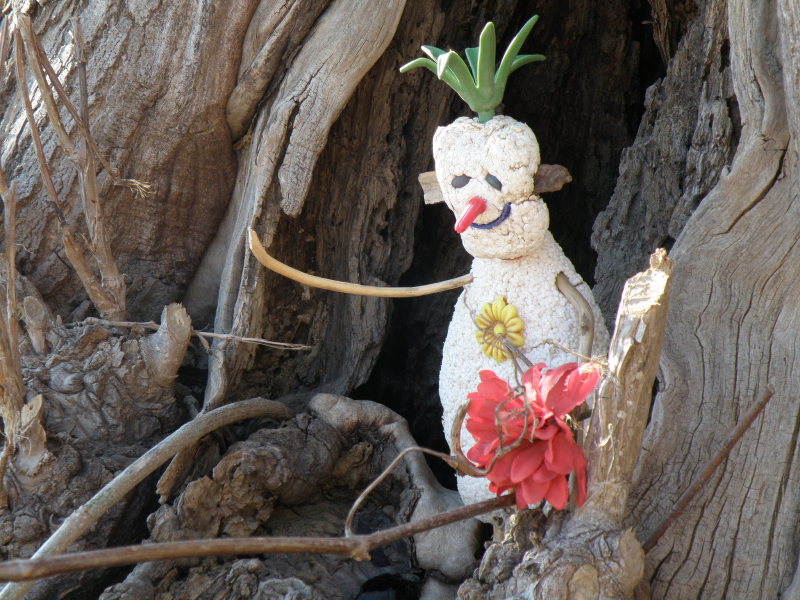
The land plants came next.  I observed the Harbinger walking over to a clump of grass and green blades began to grow out of the gravel.  This process would continue through all the flowers, shrubs, bushes, and would culminate with the appearance of the first tree leaves.  The familiar animals would then return.  My friend told me that this process took great effort and patience and could not be accomplished in a single day.  For now…he was through, but over the next week or so he promised dramatic results.  I parted with the Harbinger as he settled into a cavity formed in a living tree.  For now, the sun tiring of its efforts was setting and evening was fast approaching. The Harbinger would spend the night here and resume his work when he felt the conditions were right to do so.  I had one more surprise coming.  As I turned and walked away…a red flower appeared at the Harbinger’s hole and the sun began to sink in the west.  See you next time from a greening Falls of the Ohio.

The Harbinger waves good by, March 2014

The Harbinger by his tree, March 2014

Read Full Post »

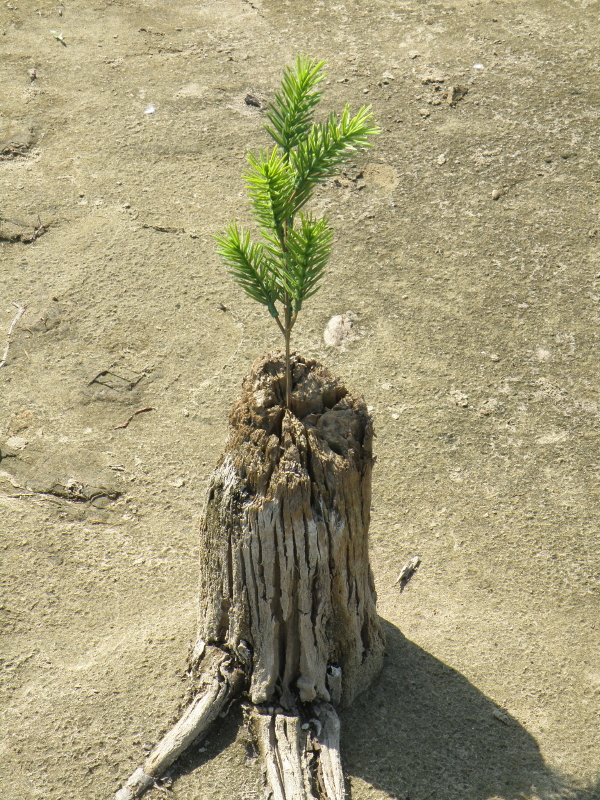
plastic pine growing out of a stump, Sept. 2013I consider this a great honor that fellow blogger Isaac Yuen focused one of his posts around my art projects from the past year and the tales I’ve created around them. For several years now, I have enjoyed Isaac’s award winning blog Ecostories. He has made me a believer in the power of the spoken and written word to convey universal truths particularly when they speak about our evolving relationship with nature. Stories are important and everyone has a story to tell. Isaac has a great way of taking on complex narratives and making them understandable. I encourage you to check out his thoughtful, positive, and beautifully written blog.

Read Full Post »

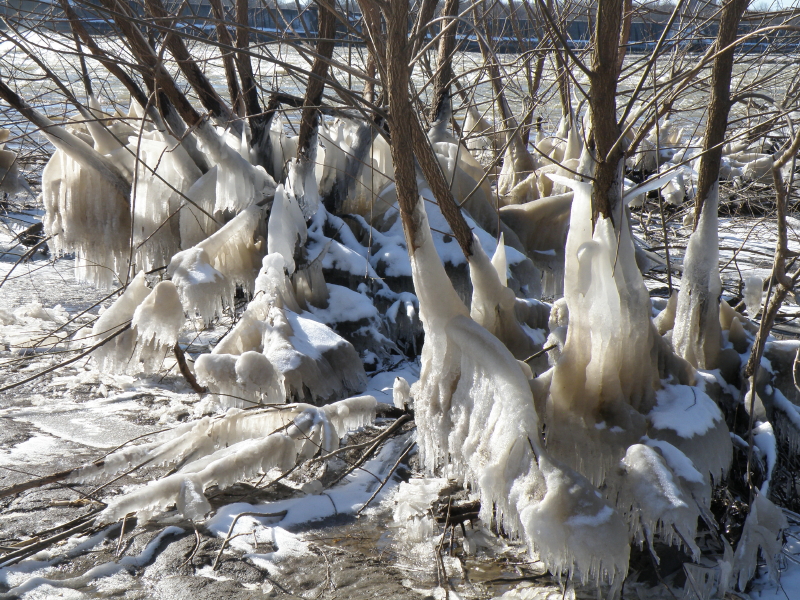
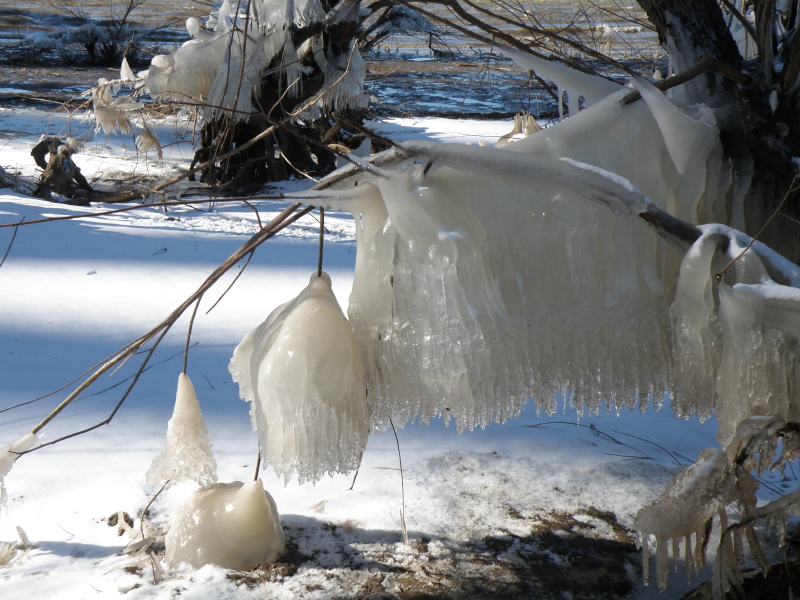
willow trees and ice, Jan. 2014

Polar vortex…that’s the new buzz words for us this winter.  The Kentuckiana area has tasted this Arctic gift twice so far and we haven’t had a winter this cold in many years.  It manifests with the temperature bottoming out around 0 degrees Fahrenheit…colder still with the wind chill.  Snow and ice also accompany this blast of icy weather.  Once under the spell of the polar vortex…all one can do is ride it out.  It’s going to be bone-chilling cold for several days in a row.  Even if you know it’s going to happen, you really don’t feel prepared for it.  People tape plastic over their windows to trap heat and foil wind.  Shoppers rush out to purchase bread and milk.  Folks let the faucets drip throughout the day and night to prevent freezing and bursting water pipes.  Still, the plumbers are busy.  Extra layers of clothes are needed however,  you still feel cold around the edges.  If there is a weakness in a machine…the extreme cold will find it and this happened to my trusty rivermobile.  School may be out, but otherwise it’s pretty much business as usual.

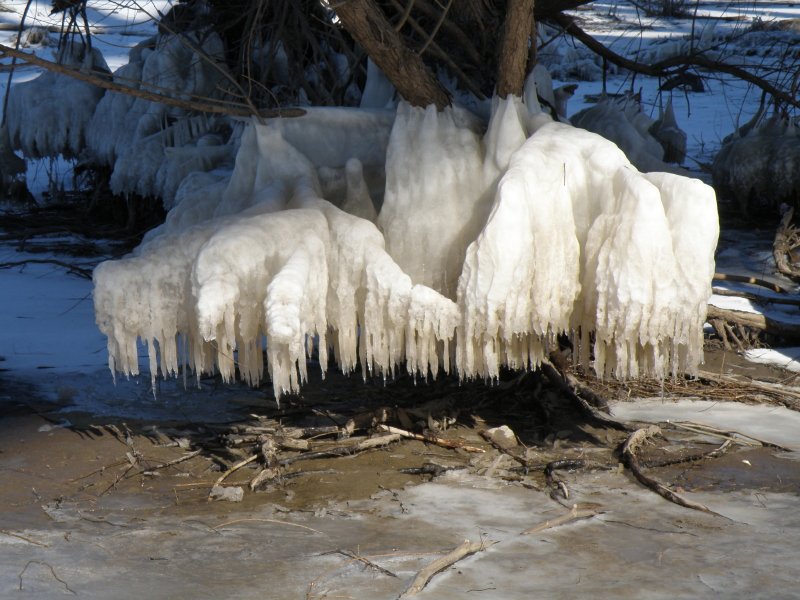
ice formations, Falls of the Ohio State Park, Jan. 2014

The part about “business as usual” also strikes me as being a bit sad.  I am of the opinion that the reason the Earth has winter is to slow everything down and that’s vitally necessary.  It’s meant to be reflective and allows a moment for a deep breath before moving on again.  We all have more than enough pushing us to accomplish tasks at increasing breakneck speed.  The polar vortex challenges us to slow down if we can.

Ice formations, Falls of the Ohio, Jan. 2014

Ice formations on willow trees, Falls of the Ohio, Jan. 2014

In an effort to foster personal wonder for the world, I made it out to the Falls of the Ohio on a day that wouldn’t risk frost bite.  Over the years, I have prized coming out here on cold winter days especially if it meant seeing different ice formations.   There are ice ribbons, sausage-shaped icicles, frozen homemade candles, and just plain ice blobs on display.  I love the variety of forms and the play of light through the magic of solid water.  The most interesting ice formations are near the water’s edge where the willow trees catch the rising steam off of the river.  The water is warmer than the surrounding air temperatures and this “fog” helps coat the roots and branches with glassy layers of ice.  I thought I had the place all to myself when I was joined in this frigid landscape by a new friend.

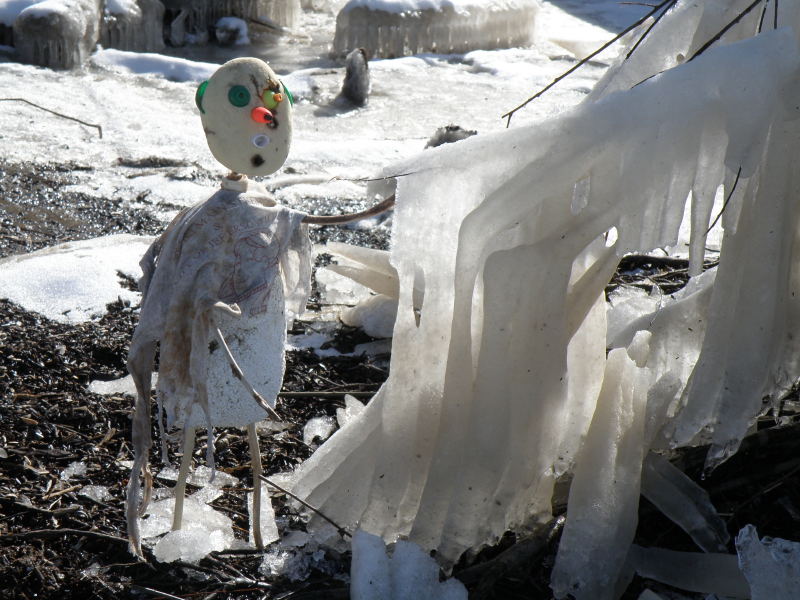
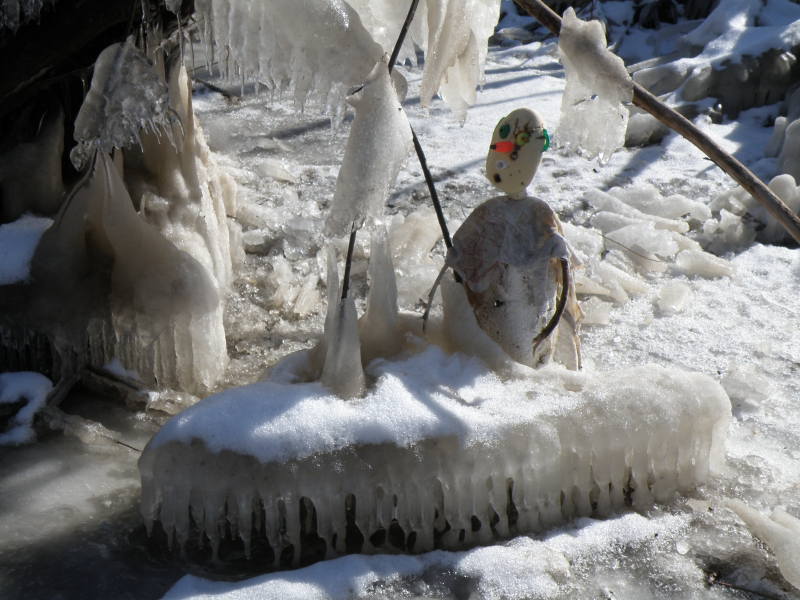
The Ice Tourist, Falls, Jan. 2014

The Ice Tourist following my tracks, Jan. 2014

He described himself as being a fellow “ice tourist” and so that’s how I remember him.  He said he was curious about the ice, but also wary of stepping through thin ice and feeling the burn of extremely cold water.  I’ve had this experience before and so I could relate.  The Ice Tourist told me he had followed my tracks into the ice field and so far I had kept him out of danger.  We spent about an hour together before parting.  Here are some more pictures of him posed next to the ice formations we encountered.

The Ice Tourist, Falls, Jan. 2014

The Ice Tourist among icy willow, Jan. 2014

Ice Tourist and ice formation, Jan. 2014

The Ice Tourist had to check out everything as closely as possible.  He would climb upon the willow branches and roots to get the best view.  As it turns out, he was a local guy who like me, likes to hang out near the river whenever he can.  He was wearing a very thin and worn out t-shirt that said something about the town of Jeffersonville on it.  That’s the next town over from the Falls of the Ohio State Park.  I mentioned something about the poor condition of his garment and how it didn’t look substantial enough to keep him warm.  His response was that feeling warm was as much a mental state of mind and he was far too engaged by this novel environment to feel the cold.

The Ice Tourist, Falls of the Ohio, Jan. 2014

The sun was rising.  The day was warming and the ice was beginning to drip and lose its strength.  Today’s show was at an end.  The image of a hot cup of coffee or cocoa was starting to have great appeal to me and so I said my farewell to the Ice Tourist.  Perhaps we will run into one another again at the river…we shall see?  Leaving my new friend behind, I walked the riverbank  and could see that the Ring-billed gulls that had been absent during the polar vortex were once again in residence in the park.  I wonder if the groundhogs will see their shadows tomorrow?
Ring-bill gulls and mallard ducks, Jan. 2014

Read Full Post »

Stacked wood, Falls of the Ohio State Park, Nov. 2013

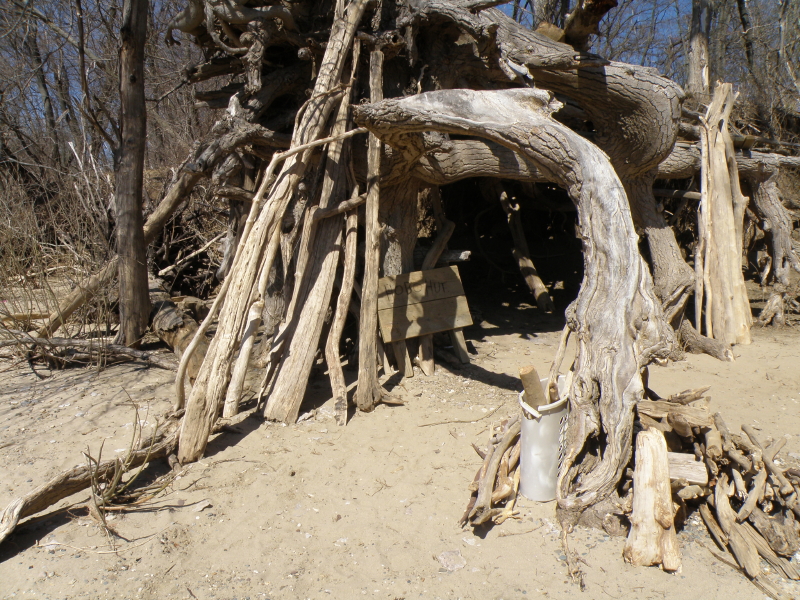
Moving past the Woodland Trail Loop, I’m in the western section of the Falls of the Ohio State Park.  It’s been more than a month since I last visited this area.  One of my favorite trees is here and although I’ve already missed the prime leaf color moment…I’m hoping some autumn splendor remains.  Along my walk I come across a driftwood structure that has been stacked teepee-style by other park visitors.  I see this kind of expression regularly and there must be a kinship between this activity and piling and stacking rock upon rock.  It’s satisfying to do and when you step back from your work…it’s obvious you left an impermanent mark in the landscape that says you were there.  The tree I seek is just a short walk away and in no time at all I arrive on the scene.

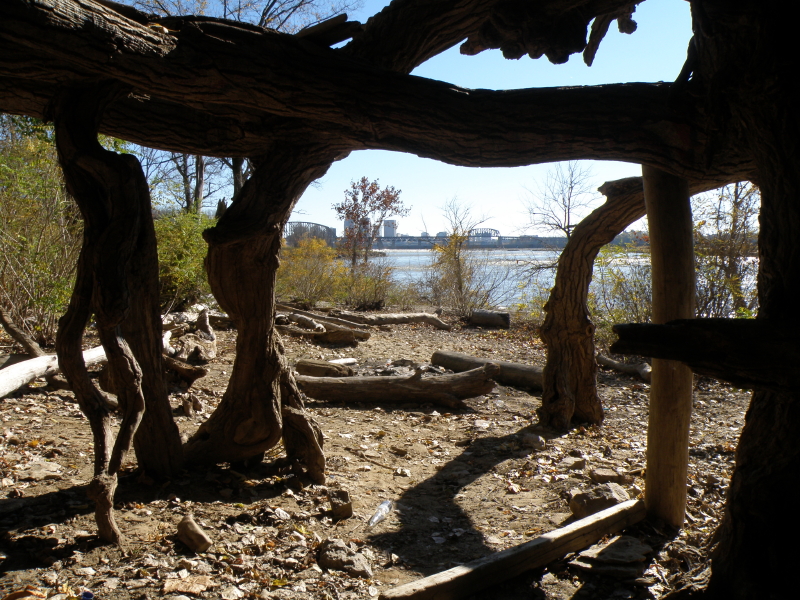
Cottonwood tree, late autumn, Nov. 2013

Under the Cottonwood tree, Nov. 2013

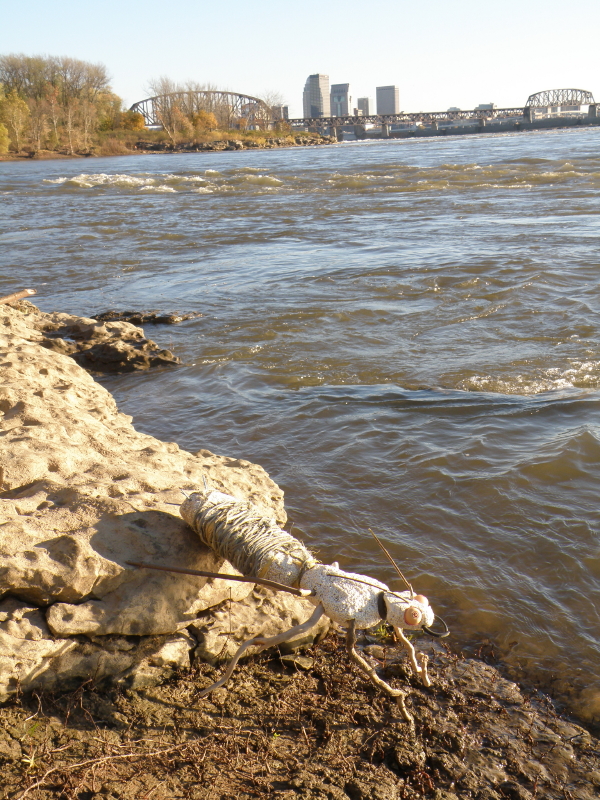
This old Cottonwood tree with its raised roots looms large in my imagination and is my personal favorite tree out here.  I’m sure I’m not the only one who feels this way because there is usually plenty of evidence laying around in the form of empty beer bottles, spent camp fires, and yes…the odd bits of furniture people drag to furnish the room that exists underneath the tree.  I’ll wager for some…this is known as the party tree.  I was elated to see that most of the junk (old tarps and a red couch) have been removed by some other purists.  The Cottonwood tree had already dropped most of its leaves, but there were still a few hanging on.  After resting a moment under the tree and admiring the distant view of Louisville across the Ohio River…I decide to turn for home.  I was in the process of walking away when I noticed something moving along the fossil rocks.  I froze to see if I could get a better look at the creature that was walking towards me.  Naturally, my camera is at the ready!

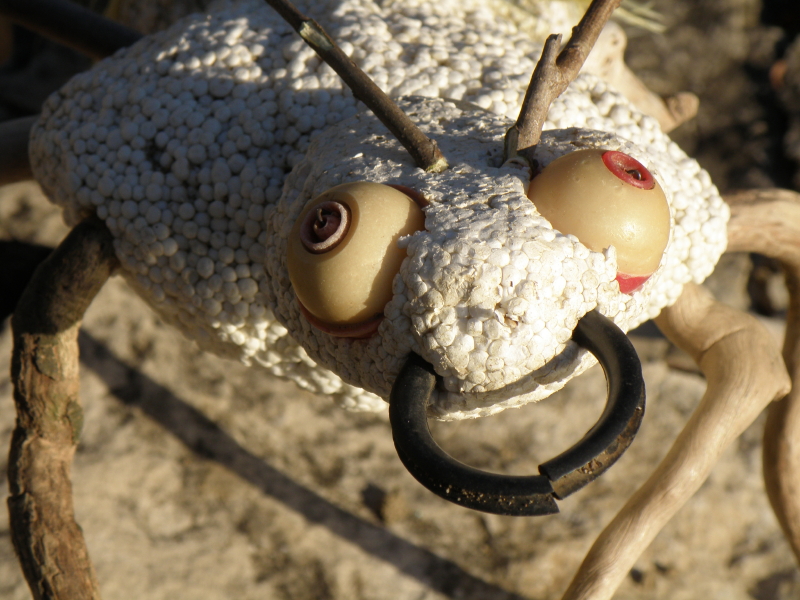
Golden Hour Ground Beetle, detail of head, Nov. 2013

detail of head from Golden Hour Ground Beetle, Falls of the Ohio, Nov. 2013

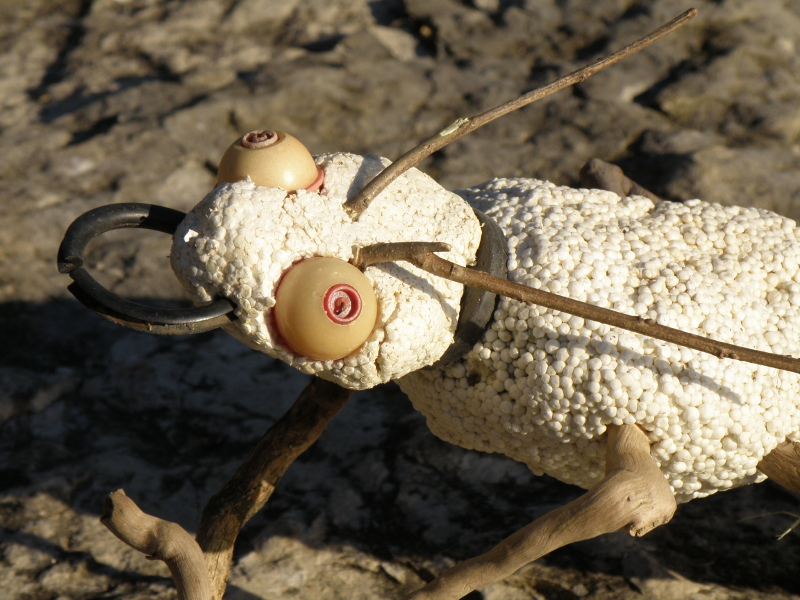
Regular visitors to the Riverblog know that the Falls of the Ohio State Park is home to several out-sized insect species that have uniquely evolved here.  All the different species are critically endangered and not to be harmed in any way.  I was quick to identify this as the Golden Hour Ground Beetle.  It was so named because it usually makes it first appearance of the day when the sun is about to set.  Otherwise, it is nocturnal in its habits.

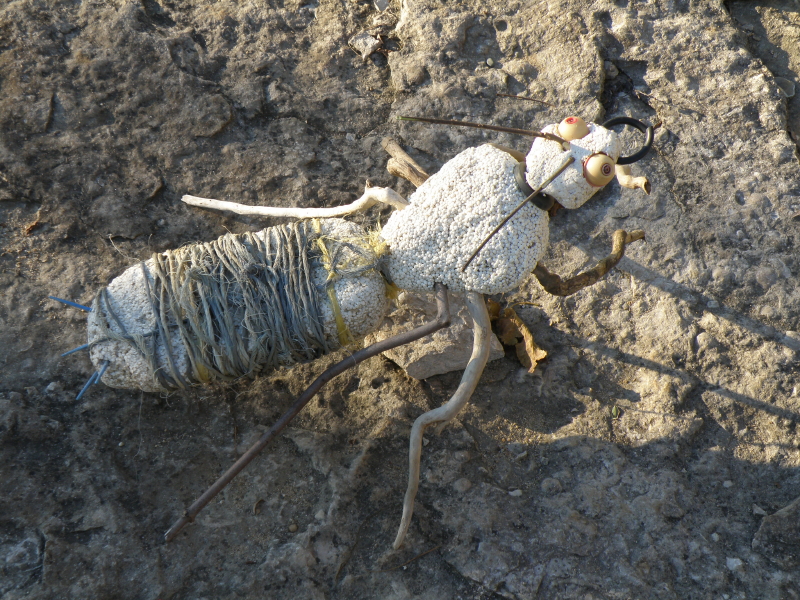
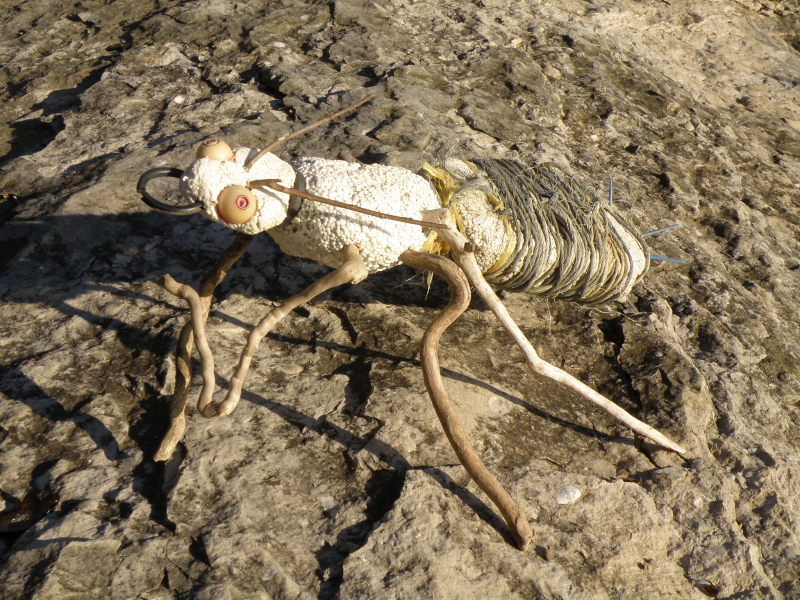
Golden Hour Ground Beetle, Falls of the Ohio, Nov. 2013

Golden Hour Ground Beetle, Falls of the Ohio, Nov. 2013

The Golden Hour Ground Beetle does not fly.  It relies upon stealth and six strong legs to scramble across any surface.  In form, it is not unlike the much smaller tiger beetles that also make the park their home.  Unlike the smaller beetles, the Golden Hour Ground Beetle is a scavenger and not a hunter.  I suspect this specimen was at the Cottonwood tree because it has learned to find scraps of discarded camping food here.  This beetle has fairly large eyes that can gather the most meager light in the darkest of settings.  It’s abdomen is banded with a coarse hair that insulates this insect during cold nights.  As long as I didn’t make any rash movements, this giant bug was tolerating my presence.

Golden Hour Ground Beetle drinking water?, Nov. 2013

I observed my new “friend” moving to the water’s edge to obtain a drink.  I wondered if it had the ability to swim in its survival tool kit?  I watched the insect as it searched all around the fossil rock shelves that were created by the river dissolving the old limestone away.

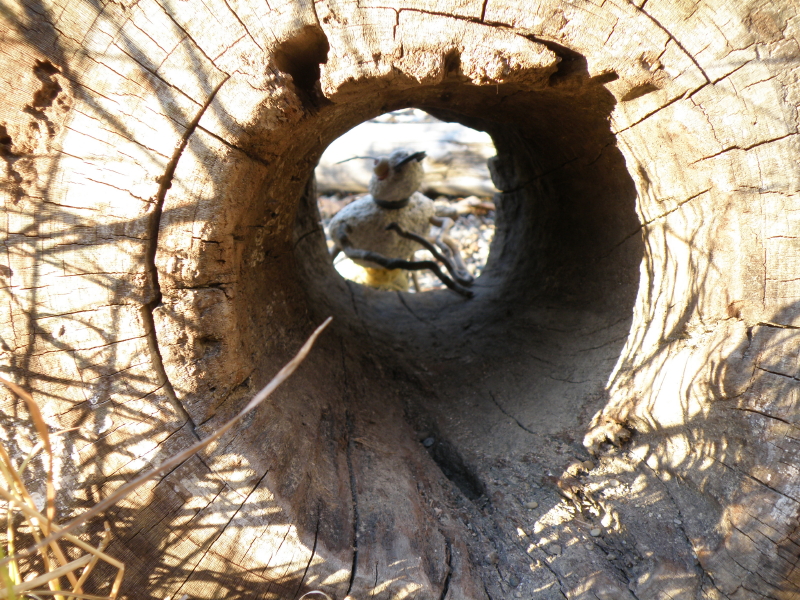
Golden Hour Ground Beetle exploring a hollow log, Nov. 2013

View of the beetle through the hollow log, Nov. 2013

I came across a second giant beetle almost immediately after crossing the small creek that separates the western and eastern sections of the park.  Male and females are virtually identical.  There are gaps in our knowledge about their life cycle.  This specimen was in the process of checking out a short, hollow log.  I’m presuming that it was either seeking food or shelter?  I think poking my camera through the end of the log spooked this one a little.  It ran away, but didn’t go far.  I kept my movements to a minimum and after a while it seemed to relax again.

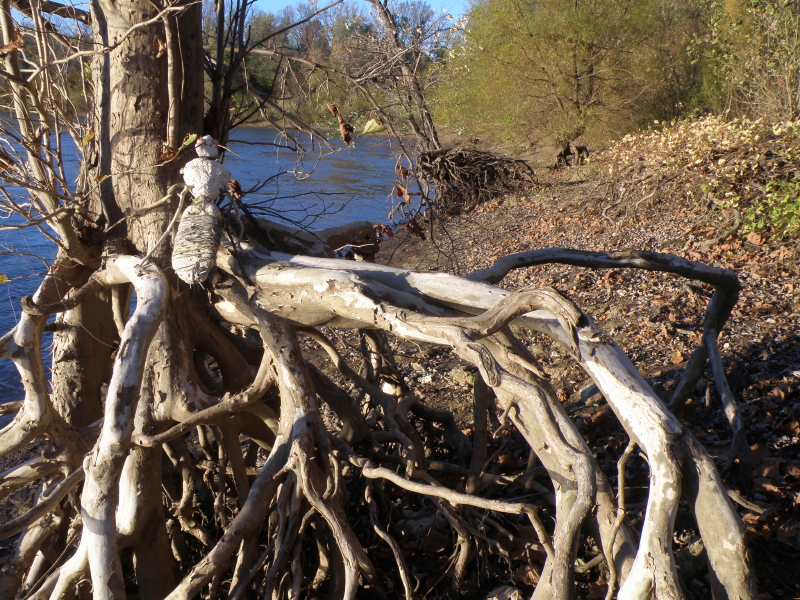
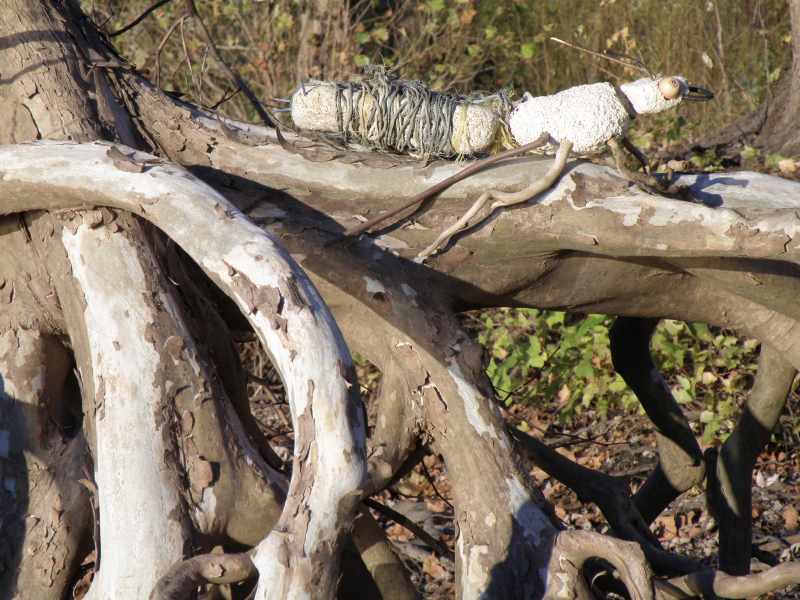
Golden Hour Ground Beetle relaxing on Sycamore tree roots, Nov. 2013

Beetle laying flat on a sycamore root, Nov. 2013

I observed this 14 inch or 35.5 centimeter beetle relaxing on the exposed roots of a Sycamore tree.  As the golden hour approached, the beetle stopped seemingly acknowledging this magic moment when everything is bathed in a warm golden light.  I did the same watching the sun set before finding my vehicle in the parking lot of the Interpretive Center.  To everybody in the wider world…have a great week.

The Golden Hour at the Falls of the Ohio State Park, Nov. 2013

Read Full Post »

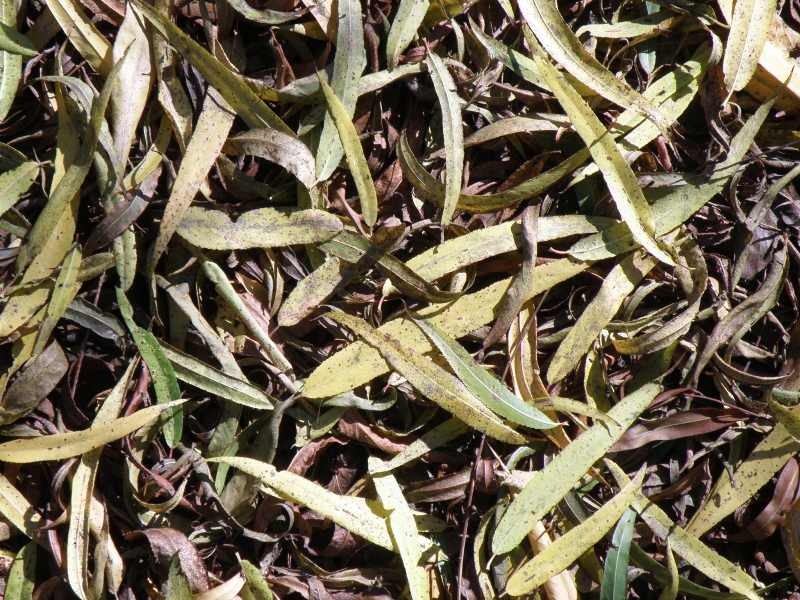
fallen willow leaves, Nov. 2013

A gorgeous fall day with light that was almost impossibly bright.  It’s autumn at the Falls of the Ohio State Park.  Small groups of migrating birds including various warblers, titmice, and kinglets are moving through the willow tops.  Around each stand of willow trees, the ground is covered by yellowing leaves that have been recently dropped.  There is a fresh, spicy, vegetative fragrance in the air as the more recently shed leaves give up their essence before curling up and turning brown.  Although I have been to the Falls numerous times lately… it’s been a few months since I last visited my old outdoor atelier in the woods.  Today seems as good a time to check out how my site has fared in my absence.

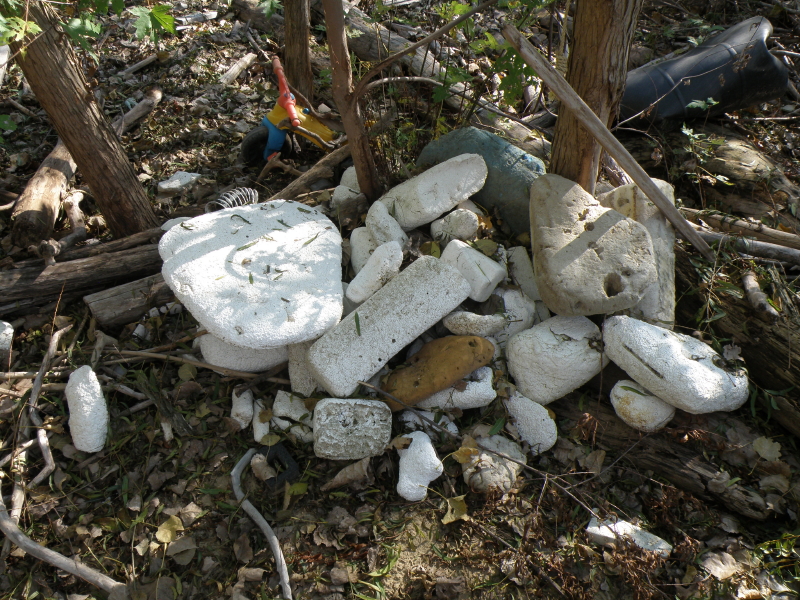
Styrofoam on site, Falls, Nov. 2013

The wooden structure that once surrounded my cached materials remains collapsed.  Some of the larger pieces of Styrofoam I had gathered from the river have been moved nearby.  Stuff has been scattered around, but that is also part of the ongoing history and fate of this material.  I may refer to this junk as “mine”, but I don’t feel a true sense of ownership.  While this material remains out here…it belongs to all of us.  We created, used, and then disposed of it, often carelessly.  I don’t have a lot of time to spend out here on this particular day and so I got busy making “something” from this largess.  I select a few chunks of polystyrene that will become my latest figure and before long I attract an audience of one.

Gray squirrel watching me, Nov. 2013

Gray squirrel watching, Nov. 2013

This Gray Squirrel seemed very intent upon my activities.  Perhaps he thought there might be food involved?  I have to say that I was really amused by this little animal checking me out.  He watched me for a minute or two and then headed deeper into the trees.

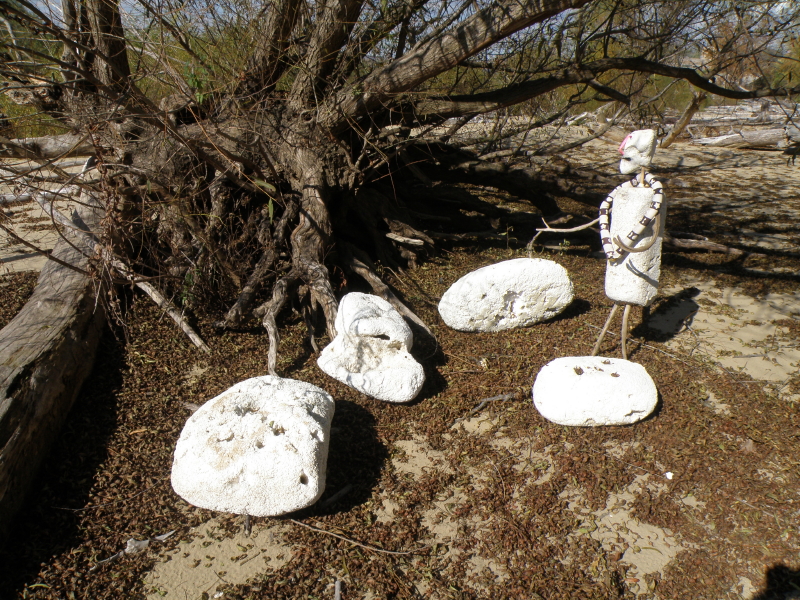
Styro-figure with large foam sections, Nov. 2013

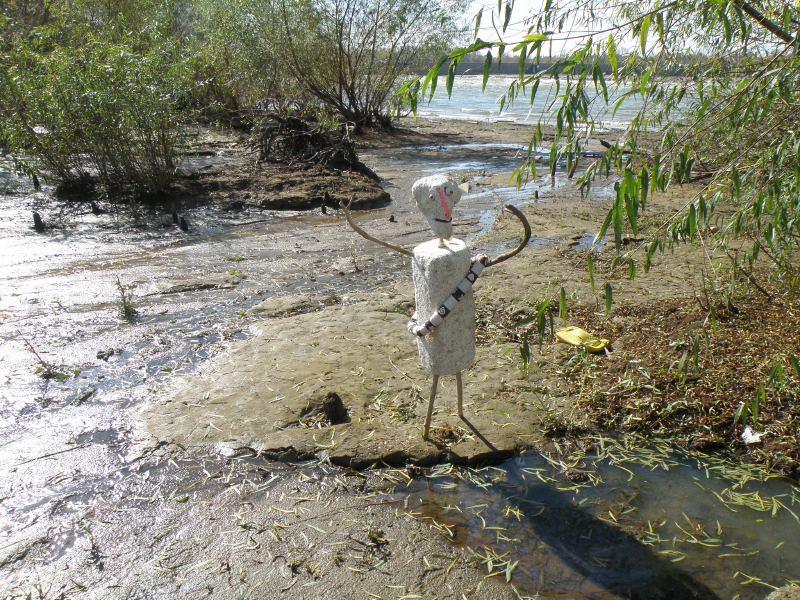
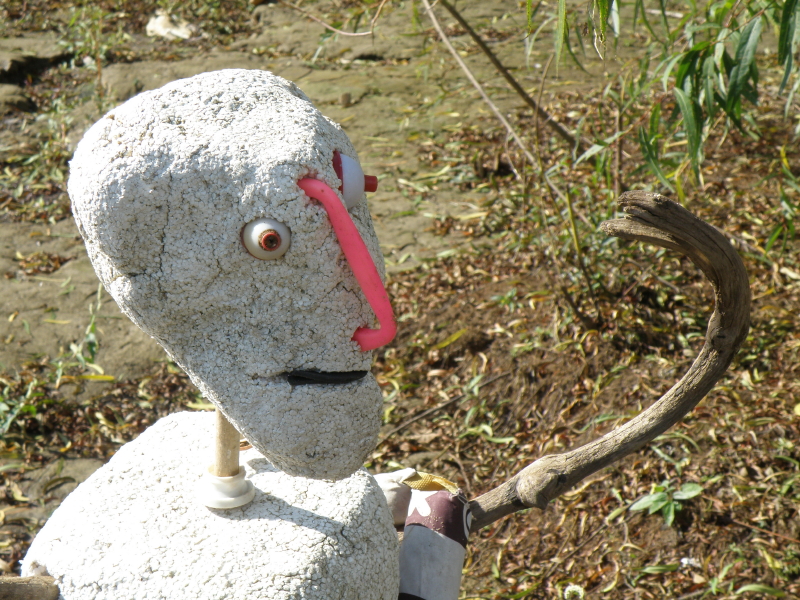
The figure I created was not very complex.  It’s head was rather skull-like and so I added a found black and white swimming noodle and a pink nose that was the plastic handle to something to give it more “levity”.  One of the first places I posed my latest was by the larger remains of former projects that were moved away from the other Styrofoam pieces I had assembled.  It doesn’t appear that whomever moved this stuff…did anything else with it.

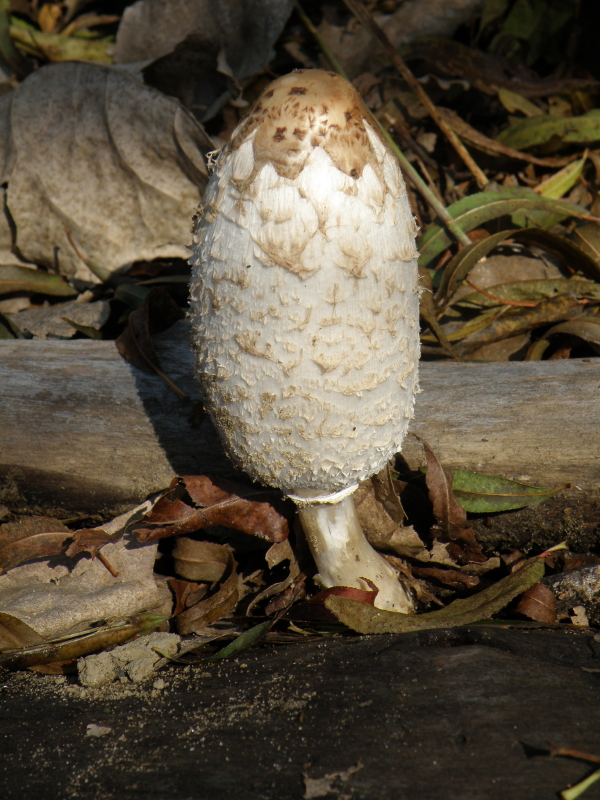
Fall mushroom, Falls of the Ohio, early November 2013

Coming across a late season mushroom, its whiteness and material consistency reminds me of the polystyrene I salvage to make art with.  Both the mushroom and Styrofoam are made from extracted, spent life.  The difference is the mushroom is alive and one day will also return to the earth to nourish other life.  The Styrofoam on the other hand, is a dead material and probably won’t decompose easily for quite a long period of time.  To move away from thoughts about decay and such…I move into the light and to be near the water.

Styro-figure with black and white swim noodle, early Nov. 2013

Head of Styro-figure, Nov. 2013

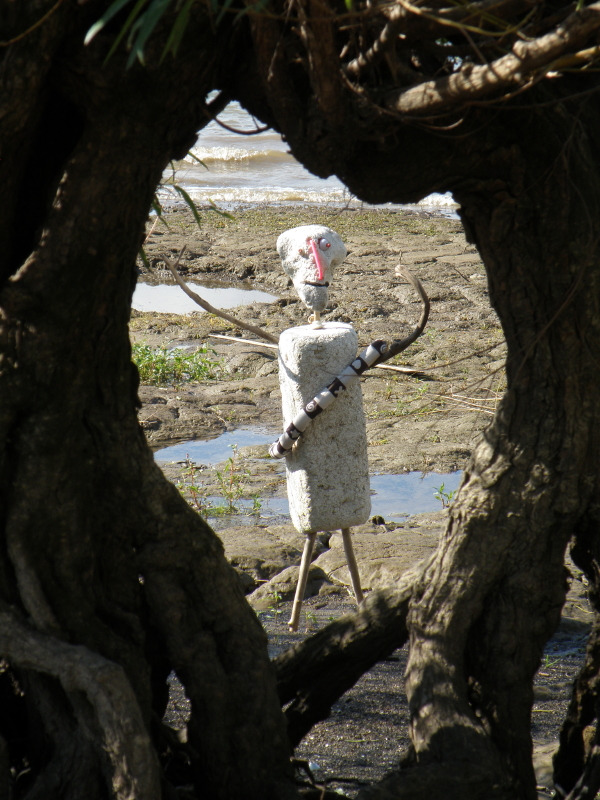
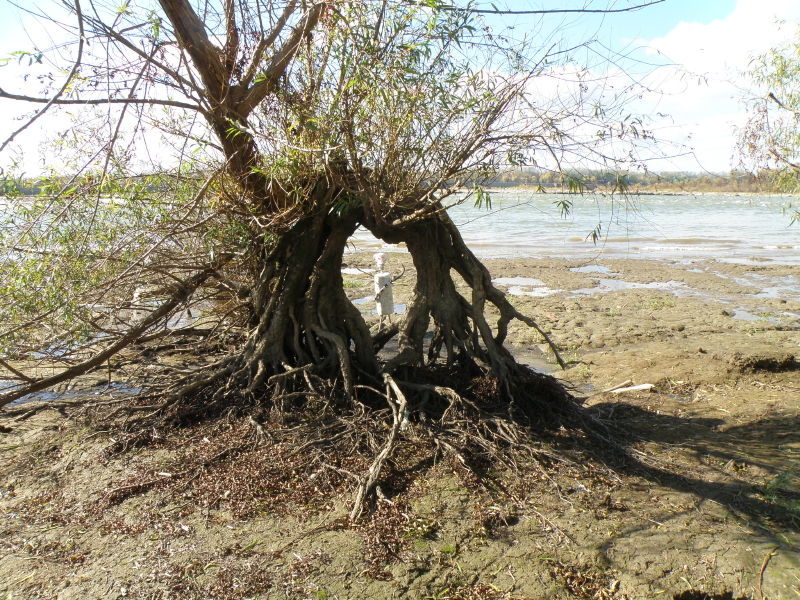
It doesn’t take long before I find just the right location that will represent this figure and day to me in photographs.  I rediscover an especially picturesque willow tree whose trunk and roots have been sculpted by time and the river to form a portal or window.  This is where I decided to photograph and leave this figure.

Figure seen through the willow portal, Nov. 2013

Through the willow portal, Falls of the Ohio, Nov. 2013

Because the ground was muddy and soft…it was also easy to stand my figure upright.  My attention wandered back and forth between the possibilities this novel view afforded.  I imagined the figure looking back at me through the portal and other shifting points of view.  Here’s how the figure looked set up on the other side where I once originally stood.

On the other side of the willow portal, Nov. 2013

On the opposite side of the willow portal, Falls of the Ohio, Nov. 2013

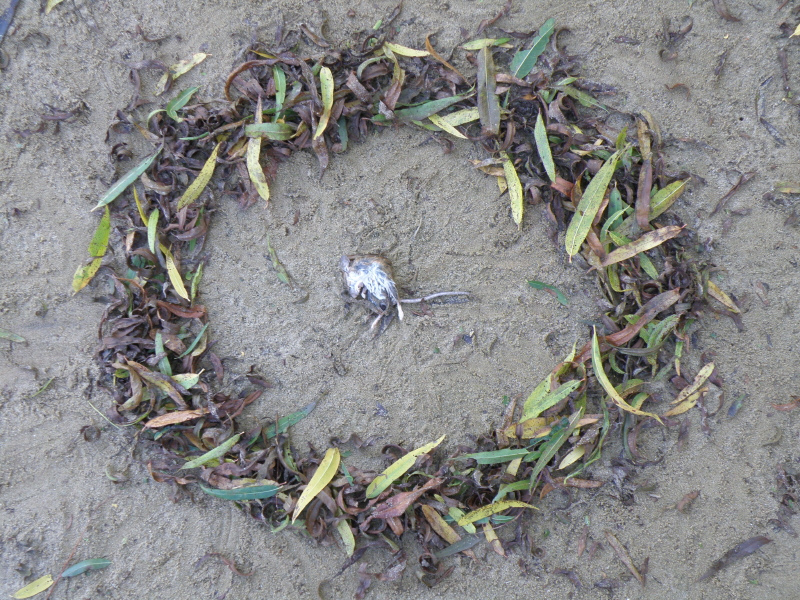
The day was getting late and it was time for me to move on.  On the walk back I came across a recently deceased mouse in the willow leaves.  Something about this season brings out the melancholy in me.  All life, no matter how small, strikes me as being worthy of note.  Using my fingers, I raked the willow leaves away from the mouse’s body and created this parting image.  See you next time from the Falls of the Ohio.

Mouse/willow wreath, 2013

Read Full Post »

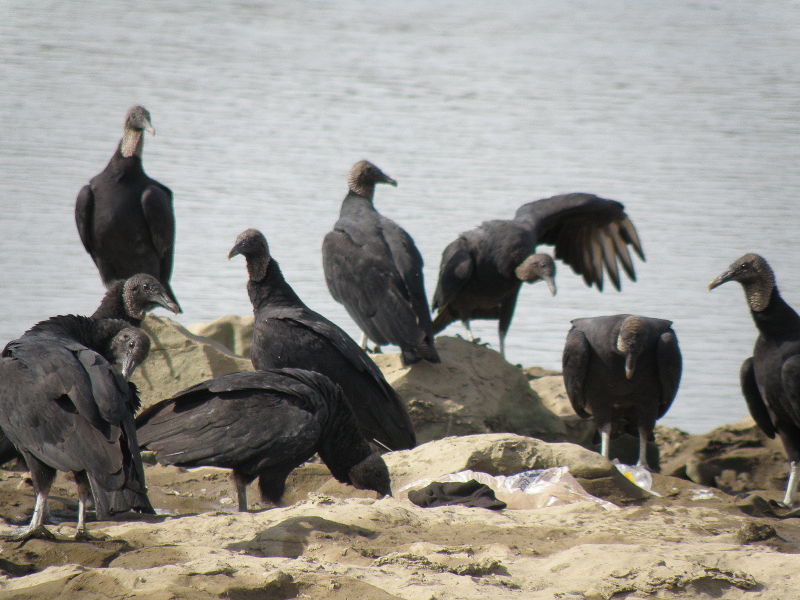
Black Vultures on the Fossil Beds, Falls of the Ohio, Sept. 2013

The resident flock of Black Vultures were taking advantage of the fossil beds now exposed on the Kentucky side  of the Falls of the Ohio.  The wier dams were temporarily closed and with it the flow of water.  With the river level reduced much of the sculpted limestone normally underwater is briefly seen again.  Fishermen have been accessing new fishing spots along the freshly revealed fossil beds which turns out to be a boon for the vultures.  Not only do they get to feast on fish left by the anglers, but they also enjoy any other trash including left over fishing bait.  Early autumn is a transitional season among the park’s bird life as residents gear up for over-wintering or prepare for the southerly migration.  Birds from the northern latitudes particularly Canada and the Arctic Circle pass through our area on their epic journeys to Central and South America.

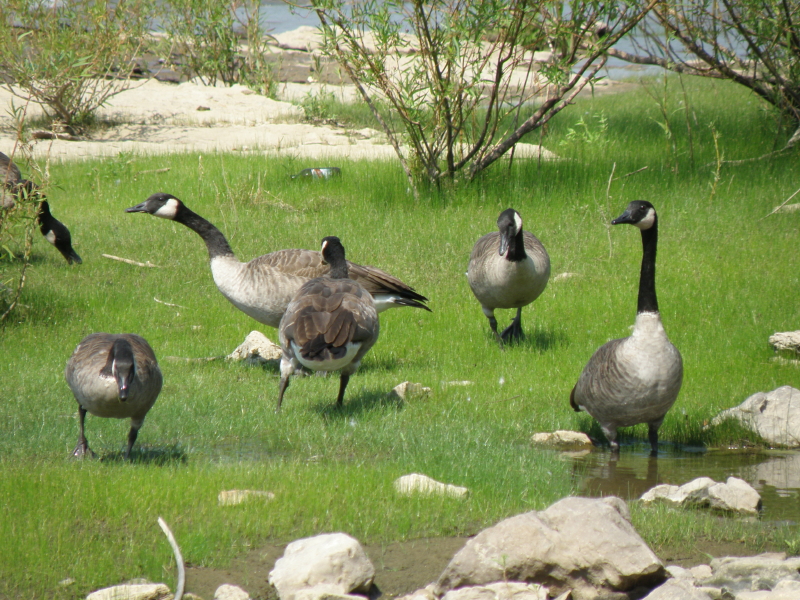
Canada Geese feeding on grass, Falls of the Ohio, Sept. 2013

The vultures will fly away, but many of our Canada Geese will brave it out.  We seem to have at least two distinct flocks of Canada Geese sharing the area around the fossil beds.  It’s amazing how intolerant each group is of the other.  There is competition for the best food sites and each group frequently bump into one another with much squabbling.  That’s what makes the next image interesting to me.

Domestic goose mixed with the Canada Geese, Falls, Sept. 2013

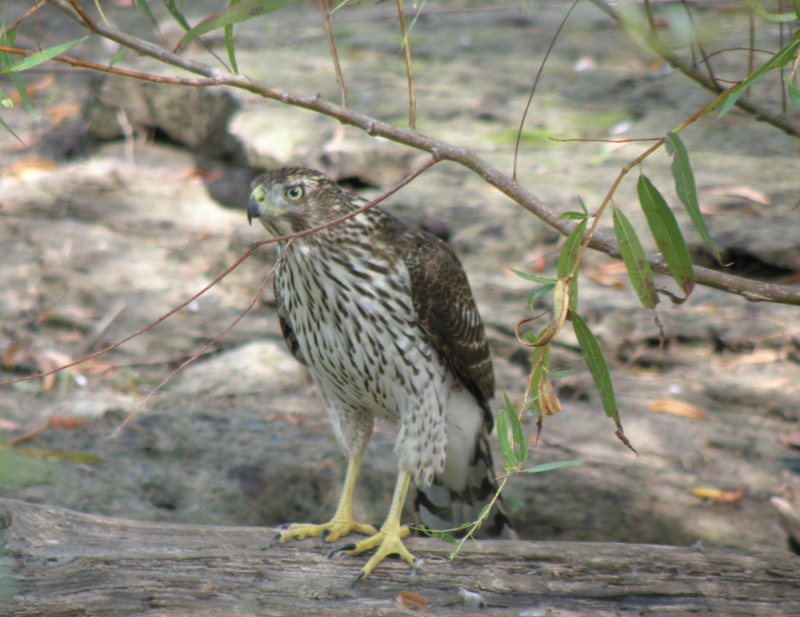
Canada Geese can have limits on how much mingling occurs between their own species, but in this case, are willing to accept a true outsider.  This domestic goose seemed integrated into its adoptive flock.  It swam with its wild cousins and accompanied them to a favorite feeding location and was never bothered by the other geese.  Recently, I came across a young Cooper’s Hawk and I was surprised when it did not immediately fly away after I bumbled across it.  There was a good reason why it didn’t leave.

Young Cooper's Hawk, Falls of the Ohio, Sept. 2013

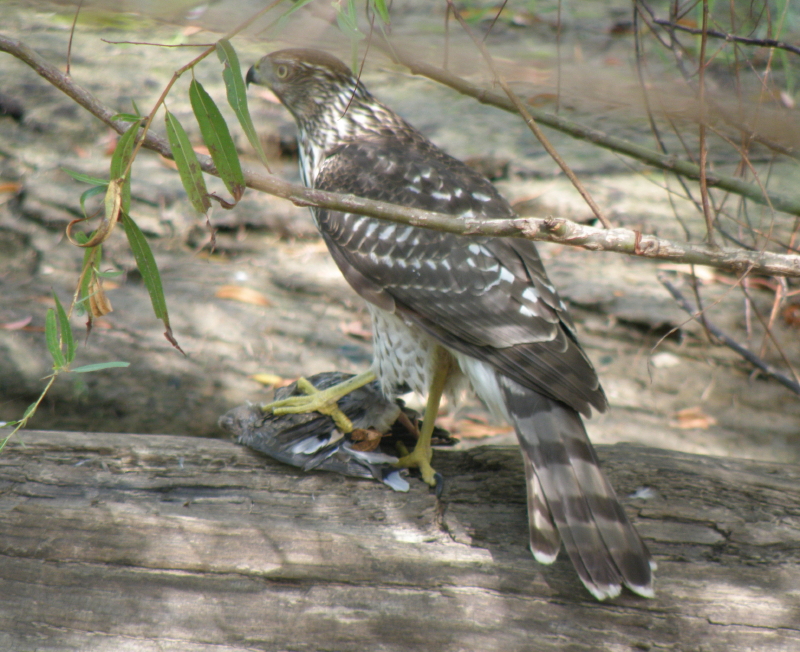
The hawk sized me up and then jumped down off the log it was standing on to retrieve something it had dropped.

Young Cooper's Hawk with prey, Falls of the Ohio, Sept. 2013

The hawk had what appeared to be a freshly killed Mourning Dove.  After securing its prey with its talons, the hawk seemingly jumped into the sky and  vanished within moments.  I thought I saw it disappearing into the tree tops of a stand of willow trees within walking distance.  I did investigate the area, but never saw the bird again.  I love it when I get to observe behaviors.  Life has a job to do and can’t wait around posing for pictures.  Here’s a different kind of behavior being demonstrated by an American Robin.

American Robin bathing at the Falls of the Ohio, Summer 2013

I love this image which I captured earlier in the summer.  This American Robin is focused on taking a bath.  Its head is under the shallow water and droplets and beads of water are splashed over its body.  Our resident American Robin population is doing well and seem to be increasing at the Falls of the Ohio.  Some of the robins will hang out over our gray winter, while others will seek warmer climes.  My last adventure to the Falls resulted in images of a bird that I had never recorded previously in the park.

Gross Blue Bill at the Falls of the Ohio, Falls of the Ohio, Sept. 2013

Gross Blue Beak and flowering plants, Falls of the Ohio, Sept. 2013

The Gross Blue Beak is strictly passing through and in fact, this is the first recorded instance of this bird appearing in the park.  Good thing I have all this photographic proof that the bird was here because the resident birders are a skeptical lot.  Reputations and lifetime bird lists are at stake and there is a great burden of proof to produce irrefutable documentation.  This bird has traveled thousands of miles from the edge of the Arctic Circle in Canada and is bound for the Argentine coast.

Gross Blue Beak with corroded aerosol can, Falls of the Ohio, Sept. 2013

portrait of a Gross Blue Beak at the Falls of the Ohio, Sept. 2013

The Gross Blue Beak receives its name not because it has disgusting habits that require an out-sized bill.  Rather the “Gross” idea comes from the German word for “large” .  The Ohio River Valley was settled by many immigrant groups and the Germans were among the most prominent.  This bird’s beak is a heavy-duty tool it uses to crack open nuts, crush mollusks (particularly snails), and jack hammer soft decaying logs in pursuit of beetle grubs.  All three of these food sources are found at the Falls of the Ohio.

Gross Blue Beak at the Falls of the Ohio, Sept. 2013

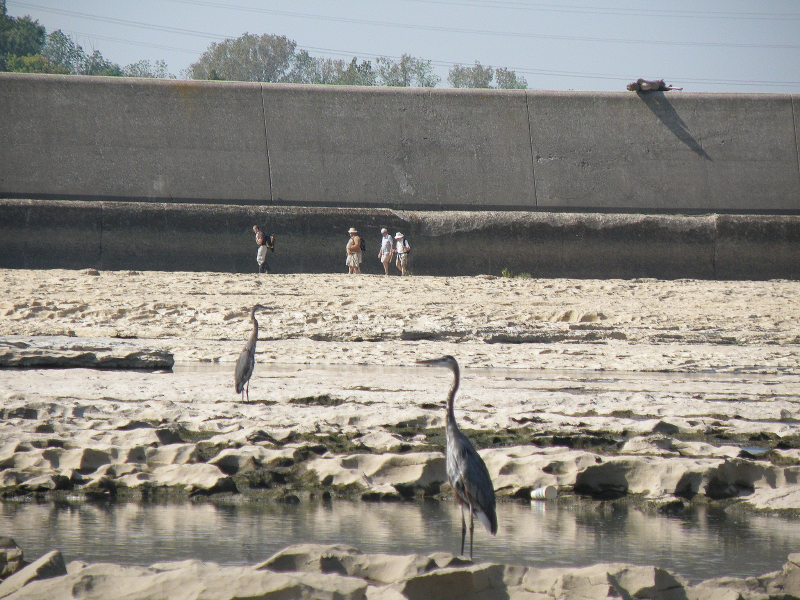
I was able to get quite close to the Gross Blue Beak to snap off these images.  I’ve noticed before that many northern migrants of various species will allow me to approach more closely than the local birds that are around people more.  Perhaps that’s the key?  For the moment, the region around the Arctic Circle has seen less of our influence than other places in North America.  To close, I have one other bird image, but it is noteworthy because of the people in the far distance.  Recently, I received a question about the back wall that is a part of the system in place to produce a stable pool of river water for commercial barge traffic.  I’ve heard that the Ohio River carries more tonnage of goods along it’s 800 plus miles than the Rhine River does in Europe.  The back wall of this dam is quite high up and the actual river level is perhaps a meter or so below the top of the wall.  Beyond the Great Blue Herons, the small band of hikers provides some sense of scale on how the river would be over their heads!  When you are walking the now exposed fossil beds…it’s a sobering thought!

Great Blue Herons and hikers on the fossil beds, Falls of the Ohio, Sept. 2013

Read Full Post »

« Newer Posts - Older Posts »