Feeds:
Posts
Comments

Archive for the ‘nature photography’ Category

Christmas Bird at the Falls of the Ohio, Dec. 2014

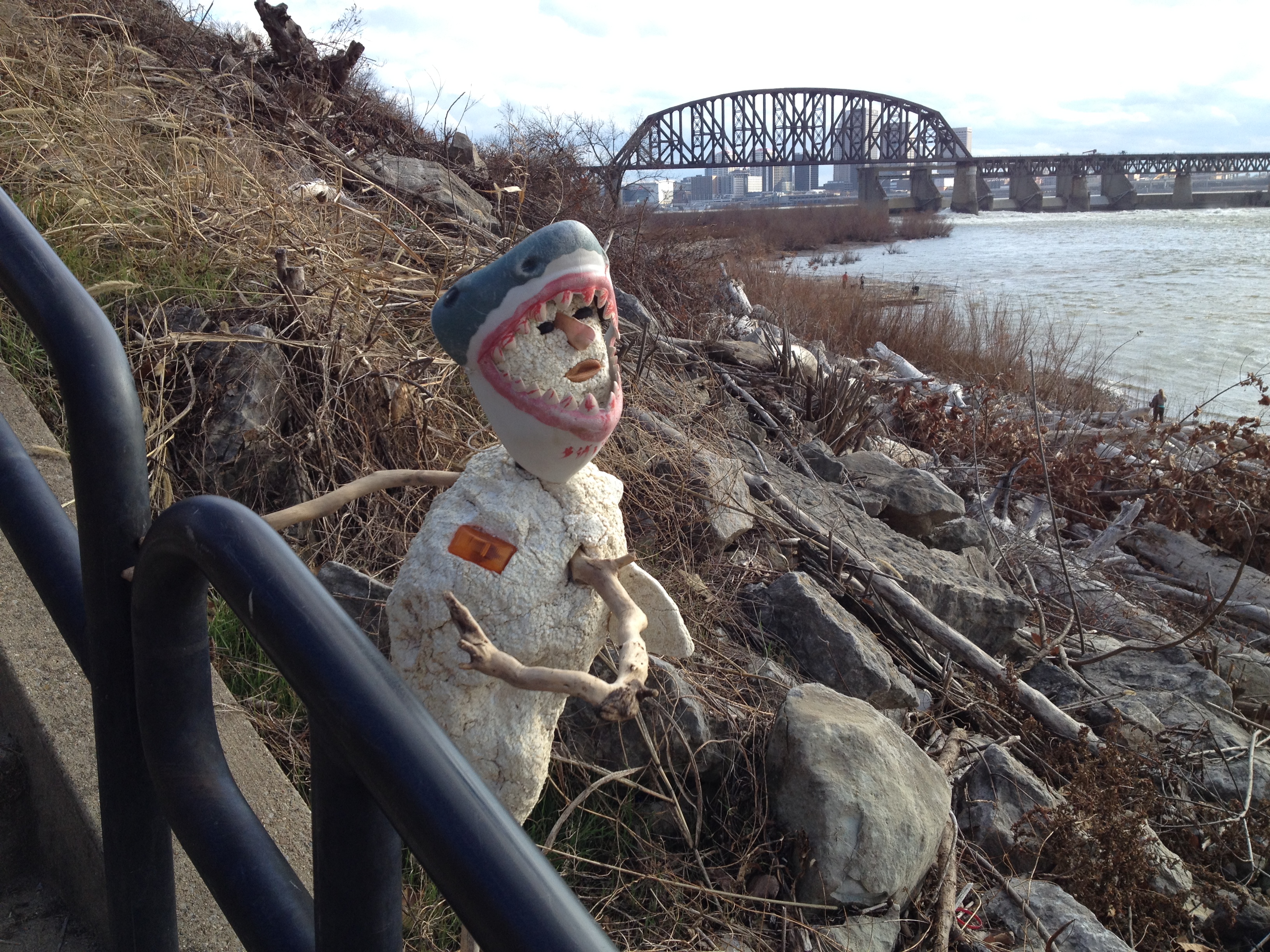
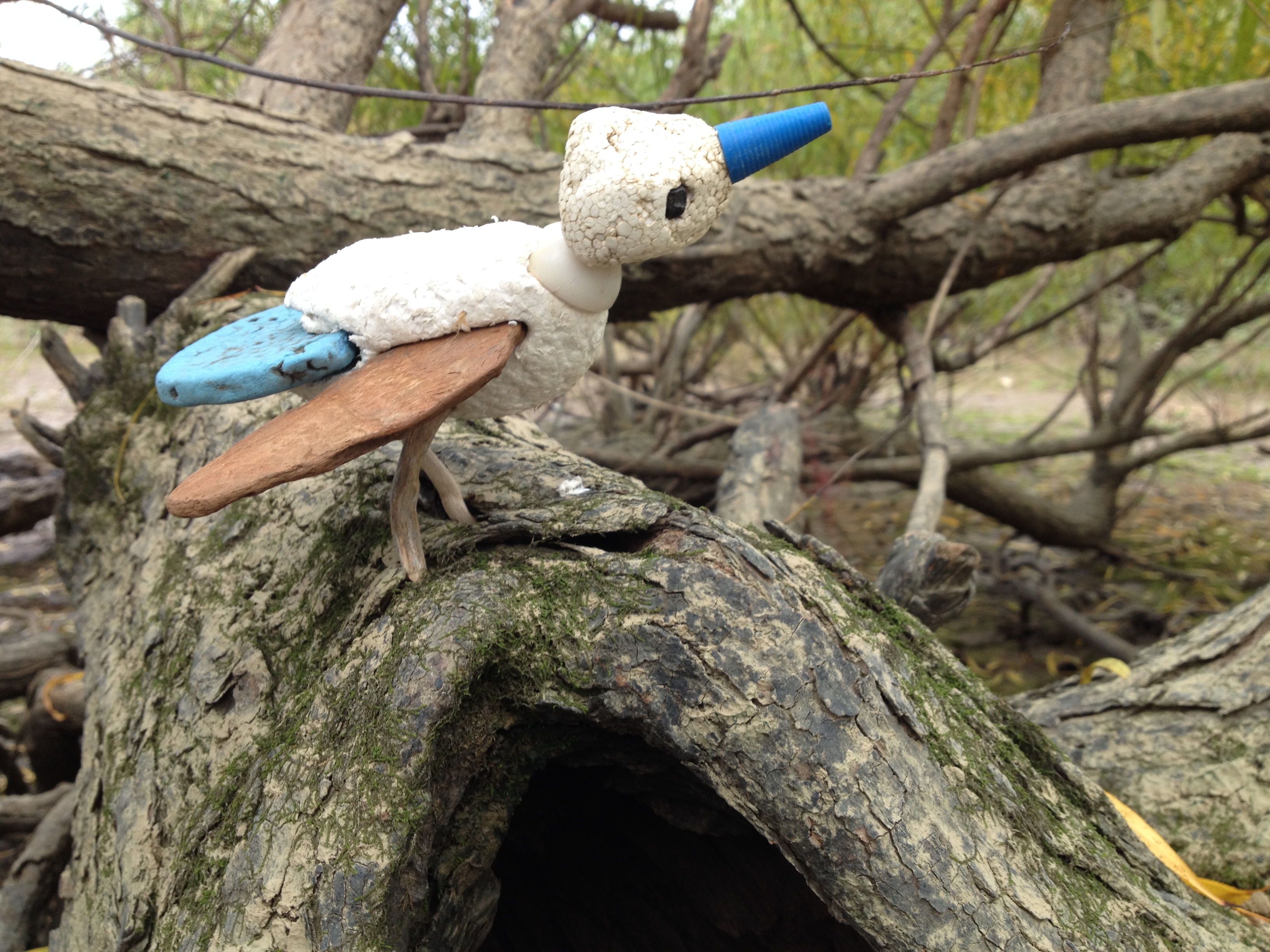
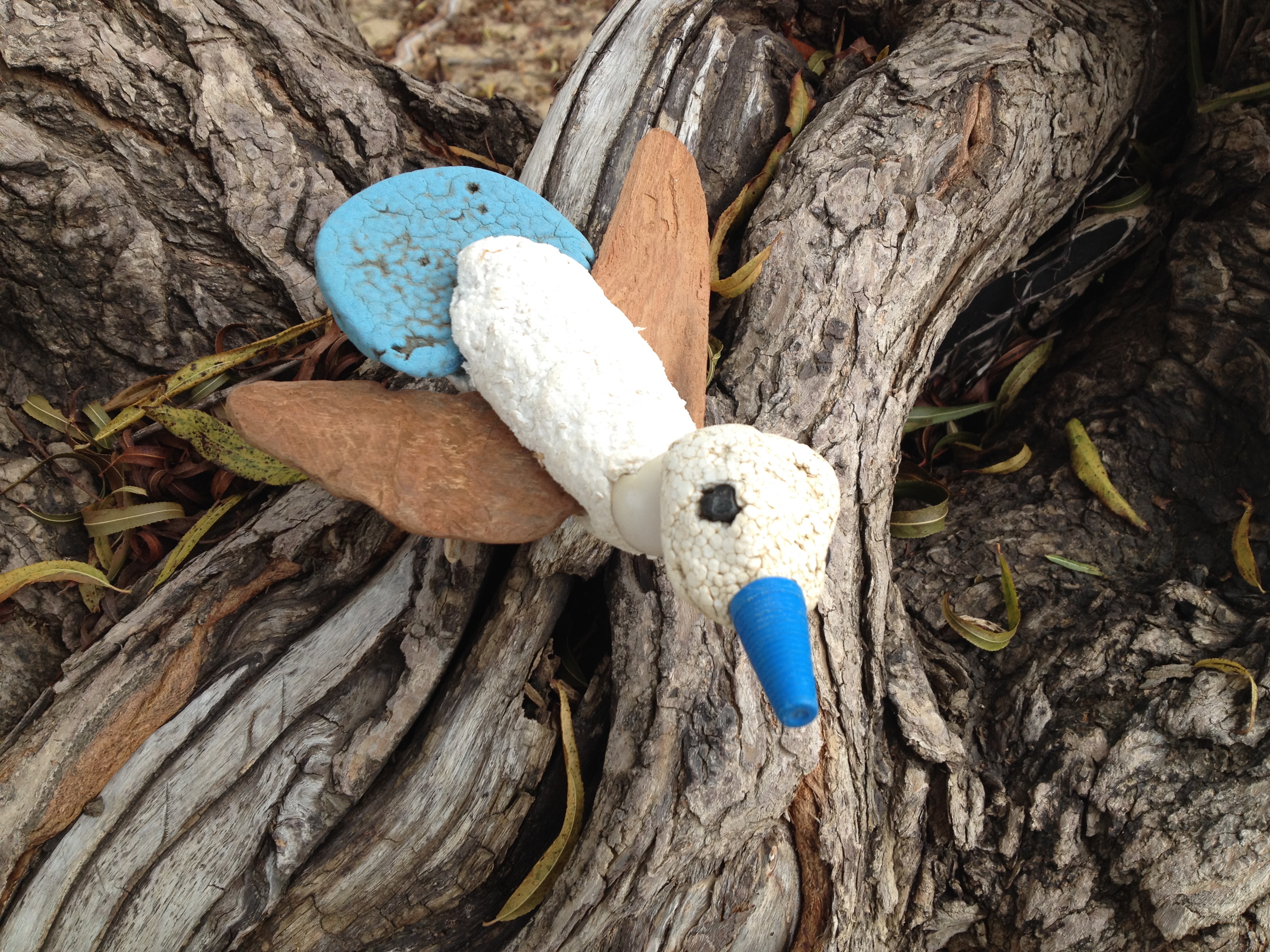
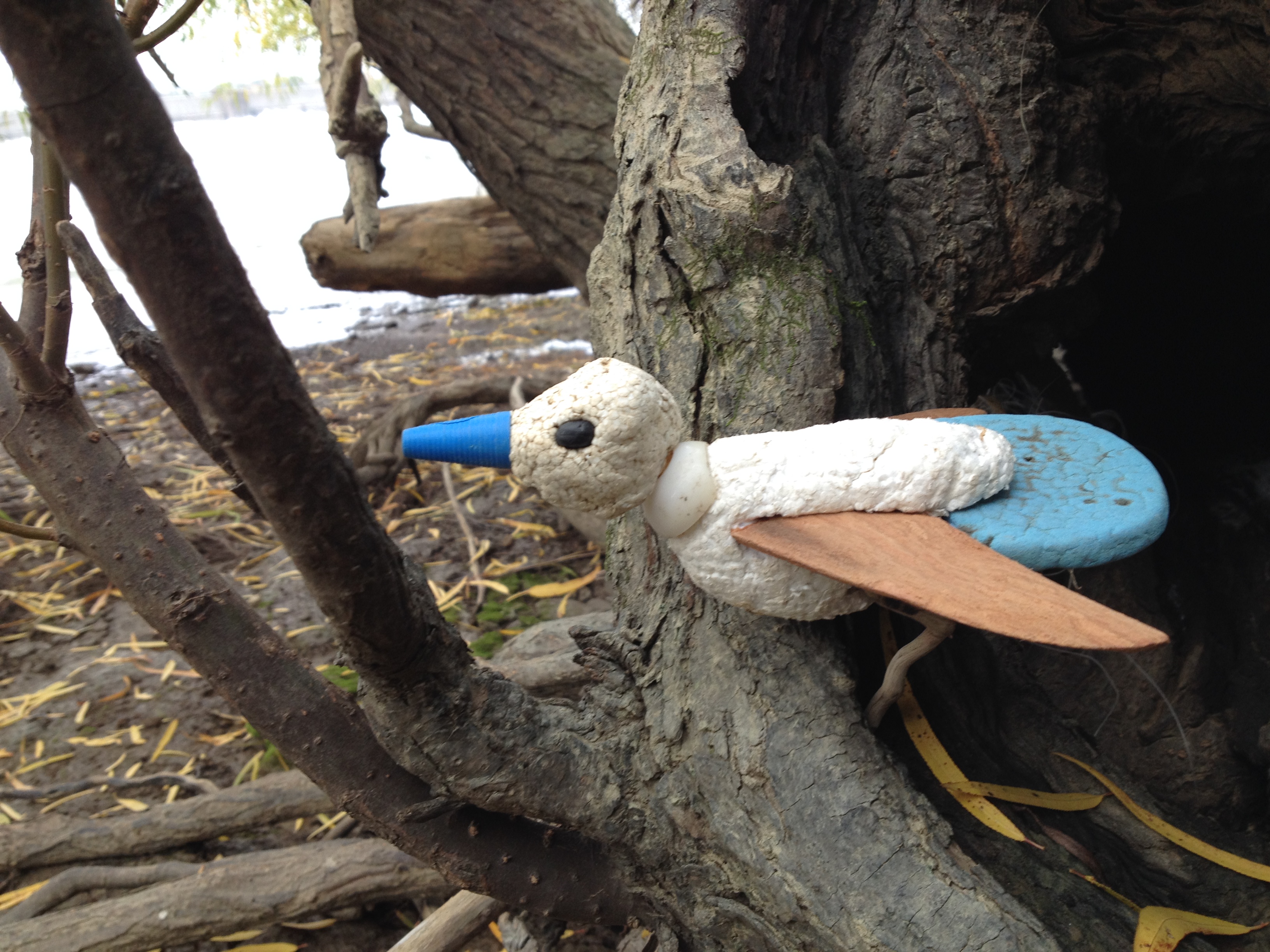
In the eastern section of the Falls of the Ohio State Park I came across a remarkable bird.  As far as I know, this is the first documented sighting of the so-called Christmas Bird (Xmasii noelensis) in our area.  The bird’s red crest, green collar, and azure-colored wings are diagnostic as is the bicolor beak.  I was down at the river on a rather foggy morning when I noticed the bird flashing its wings in mockingbird fashion which is a distant relative of this species.

The Christmas Bird, Louisville in the background, Dec. 2014

I was looking for interesting pieces of driftwood and odd items washed up by the Ohio River when I came across this bird.  This is a long distance migrant and one that hails from as far north as the Arctic Circle.  The Christmas Bird earns its name in a couple of ways.  Of course, its complimentary plumage is rather seasonably inspired and it does seem to migrate to the lower 48 states around the time of the holidays.  Where the bird will appear is rather unpredictable, however, it is a welcome sight in most any location.  Here I have photographed the bird “flashing” its wings against its body while perched upon a driftwood log.  The park is in Southern Indiana and the skyline of Louisville, Kentucky can be seen across the Ohio River.  After taking this shot, the bird flew off.

Display of the Christmas Bird, Falls of the Ohio, Dec. 2014

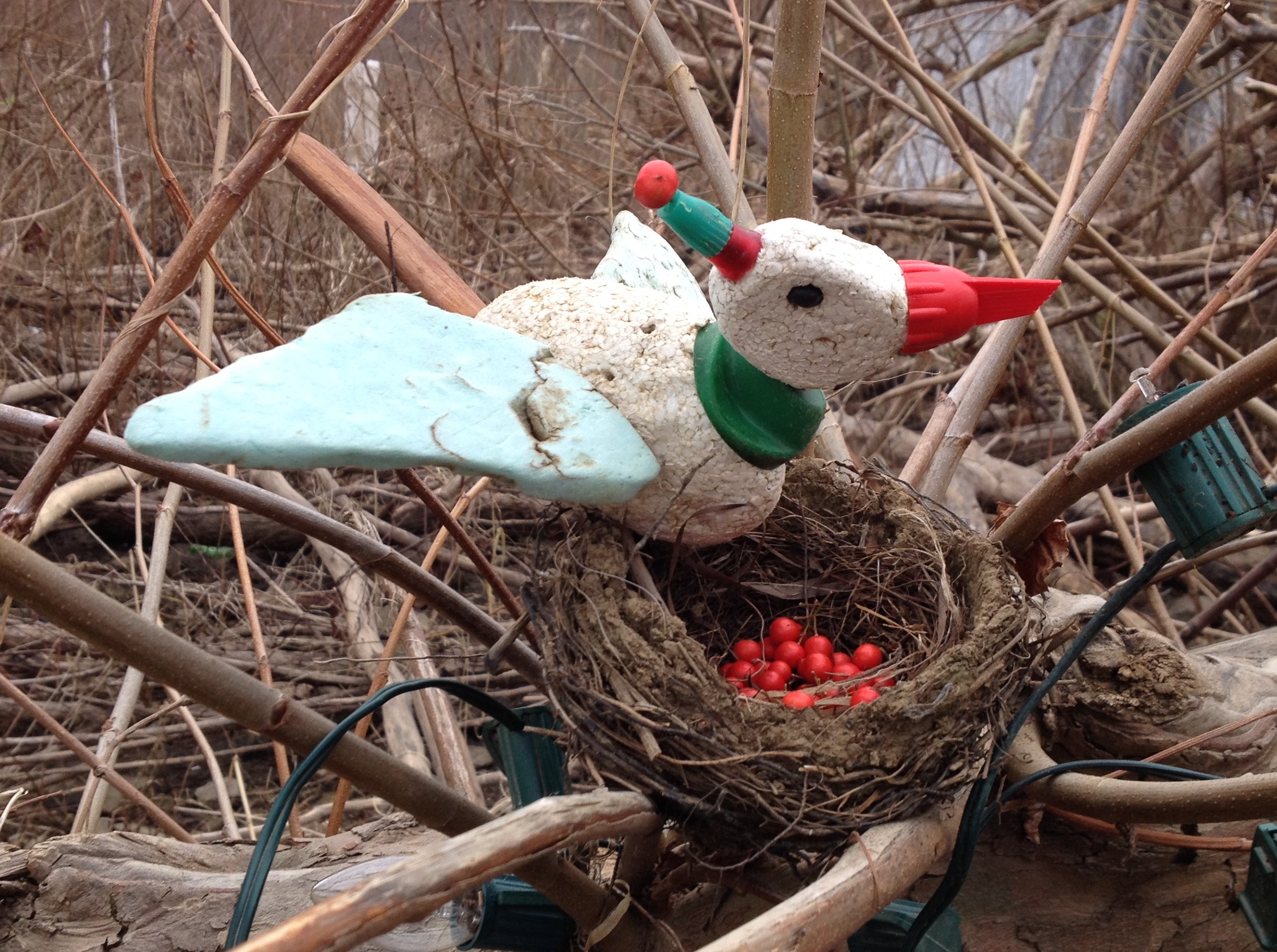
I said to myself…”Well, that’s that”.  I fully did not expect to see this rare bird again, but I received a “gift” of a rather unexpected nature.  Underneath the old iron railroad bridge, not too far away from my initial sighting, I came across this “decorated” nest and recognized its significance.  This is a display from the Christmas Bird.  Using an abandoned mud-lined nest of an American Robin, (Turdus migratorius), the Christmas Bird has created an assemblage involving red berries and the remains of a string of old Christmas lights that washed into the park with the other river-bourn detritus.  From this evidence, I suspected the bird had “claimed” this area.  If I in turn displayed patience…I might get another opportunity to photograph this unusual species.

Christmas Bird with its display, Falls of the Ohio, Dec. 2014

I waited about an hour and the Christmas Bird did appear to my great joy!  It arrived at the nest with a red berry in its beak which it added to its growing collection.  It is believed that this bird is attracted to the color red.  Usually, berries from the holly tree are used, but in this instance I recognized them as the fruit of the Nandina plant.  The bird probably discovered them growing in a private garden in nearby Jeffersonville, Indiana.  It is suspected by ornithologists that the southerly migration of the Christmas Bird, which brings it to warmer climates, may trigger this unusual nest-like and courting behavior.  The Christmas Bird is known for its ability to tolerate extreme cold and it takes a great drop in temperature to stimulate it to migrate.

Close up of the Christmas Bird with red berry, Falls of the Ohio, Dec. 2014

Christmas Bird with display, Falls of the Ohio, Dec. 2014

I was able to observe this bird making about ten trips back and forth between the nest and its berry source.  If the bird was aware of my presence…it did not appear to be overly alarmed.  Once in a while, the bird with crest erected, would cock its head back and forth trying to differentiate my form among the willow branches.  I held my breath and tried to remain still and as unthreatening as possible.

The Christmas Bird with its seanonable display, Falls of the Ohio, Dec. 2014

The weather grew damp and cold and the sun looked like it was not going to appear from beneath its blanket of clouds.  I made the decision that I had enough images and it was time to leave this bird in peace and go home.  On the ride home, I felt I had been given this great gift, the gift of nature which remains priceless and timeless!  For me, nothing packaged in a box and wrapped with a bow can equal this living blessing.  To all who have followed my adventures by the river this year…I offer my sincerest good wishes during this season of holidays!  I hope that at least once in your lifetimes, you will be visited by the Christmas Bird bringing red berries for your nest.

Christmas Bird with red berry, Falls of the Ohio, Dec. 2014

Read Full Post »

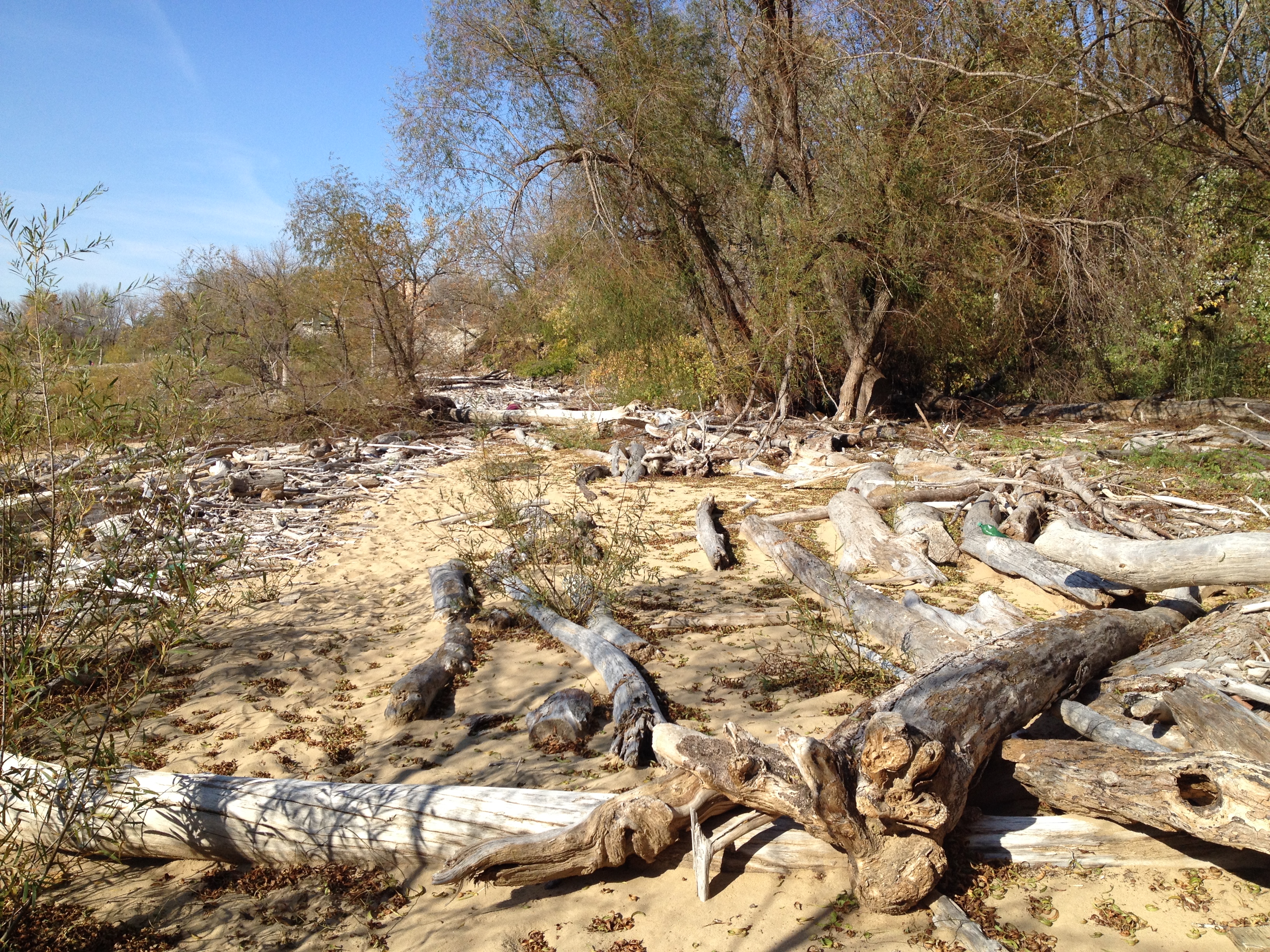
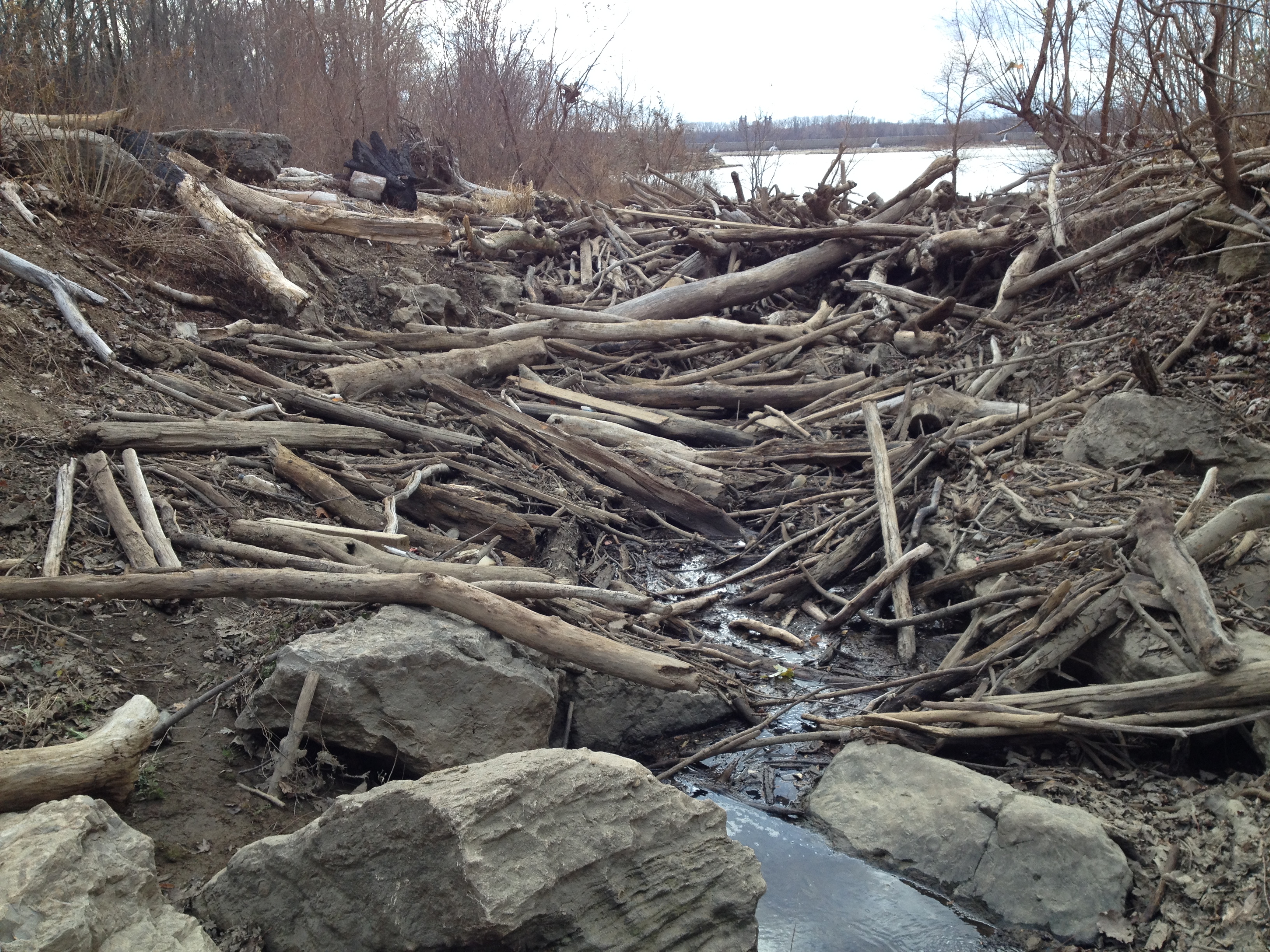
piled up driftwood, Falls of the Ohio, Dec. 2014

The following is my latest adventure from the Falls of the Ohio State Park.  It’s official now, the month of November was among our top ten coldest Novembers ever recorded.  This continues a see-saw trend where one month might set a record for heat (like October did) only to bounce back down to the other extreme.  It’s too early to tell about December, but on this recent visit it was cool and overcast.  We have since had several days of rain causing the river to swell.  Today’s story begins at the westernmost point on the Woodland Loop Trail.  This path is bordered by what folks around here refer to as a “creek”, but in actuality is a channel cut into the riverbank by storm water overflow released from the town of Clarksville.  I wish it were a creek and perhaps long ago, may have been one.  During periods of flooding and high water, driftwood and logs back up into this area and are stranded once the water level recedes.  The picture above is a recent illustration of this.

beaver tracks, Falls of the Ohio, Dec. 2014

I was exploring this water-cut channel and noticed that there were lots of beaver signs present.  In addition to their tracks left in the mud, I found plenty of chewed willow branches.  I added some of the nicer sticks to my collecting bag.  It made me think about how much the appearance of the black willow trees around here are shaped by the beaver’s “pruning” methods.  I don’t know why this didn’t occur to me before…perhaps it was just too obvious.  Actually, I think it has something to do with the beaver population rebounding over the last few years.  In certain local places, they have become “pests”.  Their damning of local drainage canals has necessitated their capture and removal to other more remote areas.

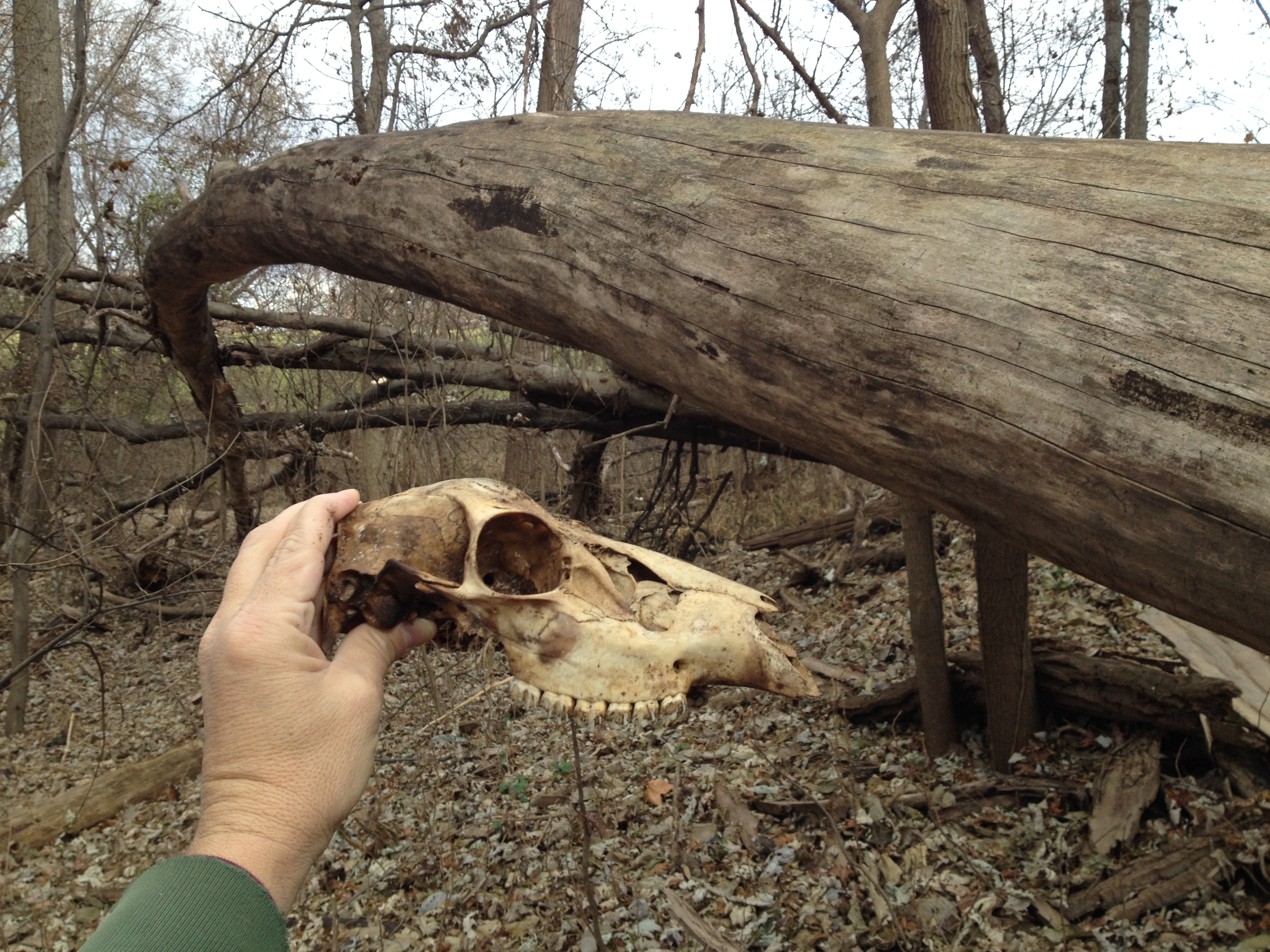
found deer skull, Falls of the Ohio, Dec. 2014

Exploring a bend on the Woodland Loop Trail, I found this deer skull laying upside down on the fallen leaves.  It was kind of hard to see, but something in the old brain said to look more closely and I did.  After taking a few photographs, I laid it upon the trunk of a large fallen tree for others to discover.  Like the beaver, it appears the deer are becoming more numerous as well.  After years of finding just their tracks and the occasional bone, this season I was able to spot a doe and her fawn in the park during broad daylight.

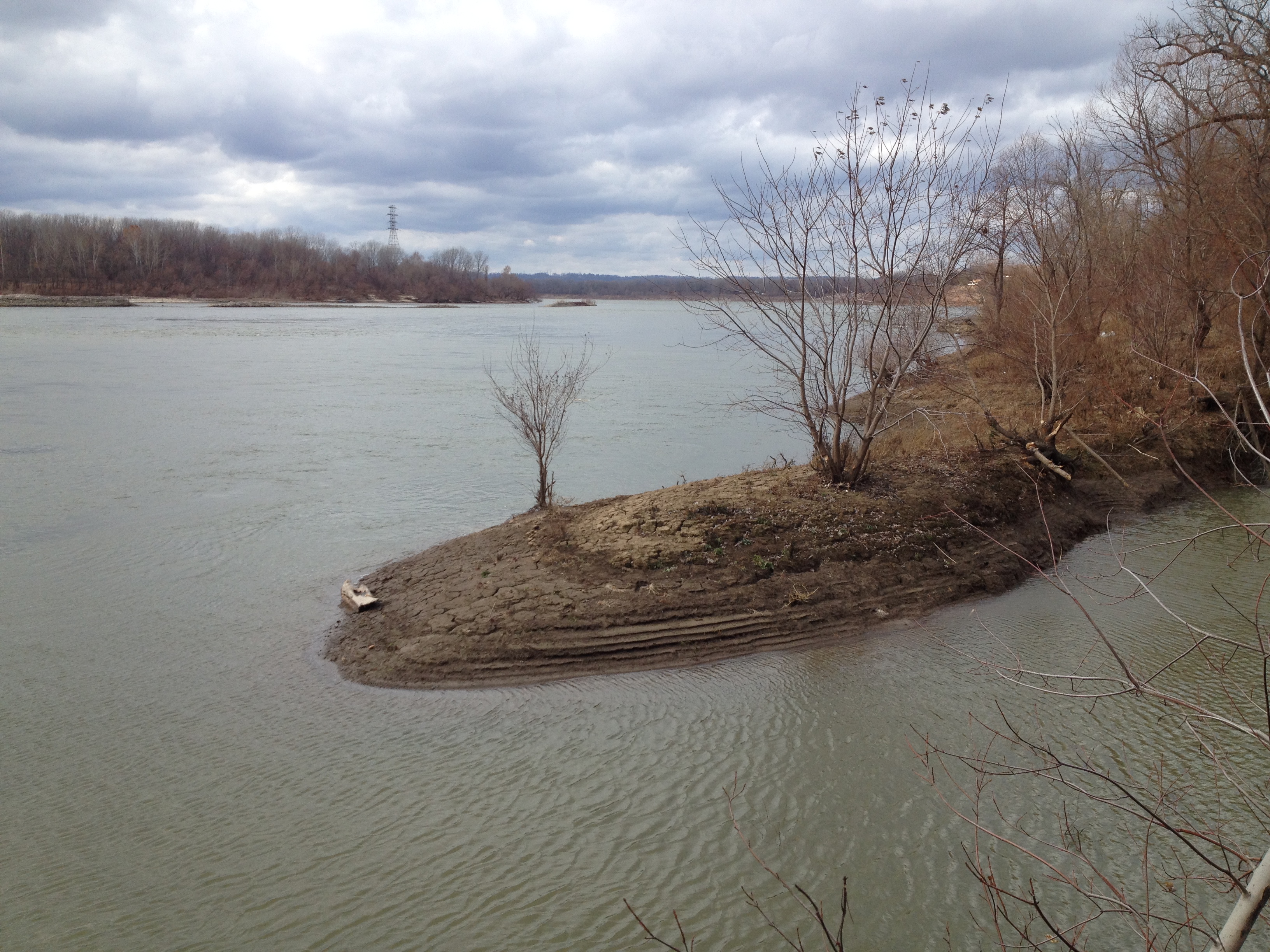
storm sewer overflow peninsula, Falls of the Ohio, Dec. 2014

I walked to the top of the riverbank to get a better look at the peninsula that has been created at the mouth of the “creek” from the storm sewer’s overflow.  Over the years, I have witnessed stringers of sauger and catfish being caught here by the local fishermen.  I like how the rising and falling of the river has terraced the mud into a series of graduated steps.  I was relaxed and zoning out on the view when I noticed something white that had surfaced and was entering the “creek”.  I quickly took a photo and here it is.

white dorsal fin in the Ohio River, Falls of the Ohio, Dec. 2014

I scrambled down the riverbank to get a better view and got my clothes severely muddy in the process.  In my head I’m telling myself that for all the world this looks like a shark’s dorsal fin…but is this possible?  I remember hearing that there are a few shark species (notably bull sharks) that are capable of swimming up rivers and able to tolerate being in fresh water for extended periods of time.  Still, we are a long way from the ocean which also includes navigating a large section of the Mississippi River before entering into the Ohio River… just to reach this spot.  I observed the fin submerging as it disappeared from view.  Hustling, I reached the general location where I thought the fin was heading and was “blown away” by this sight!

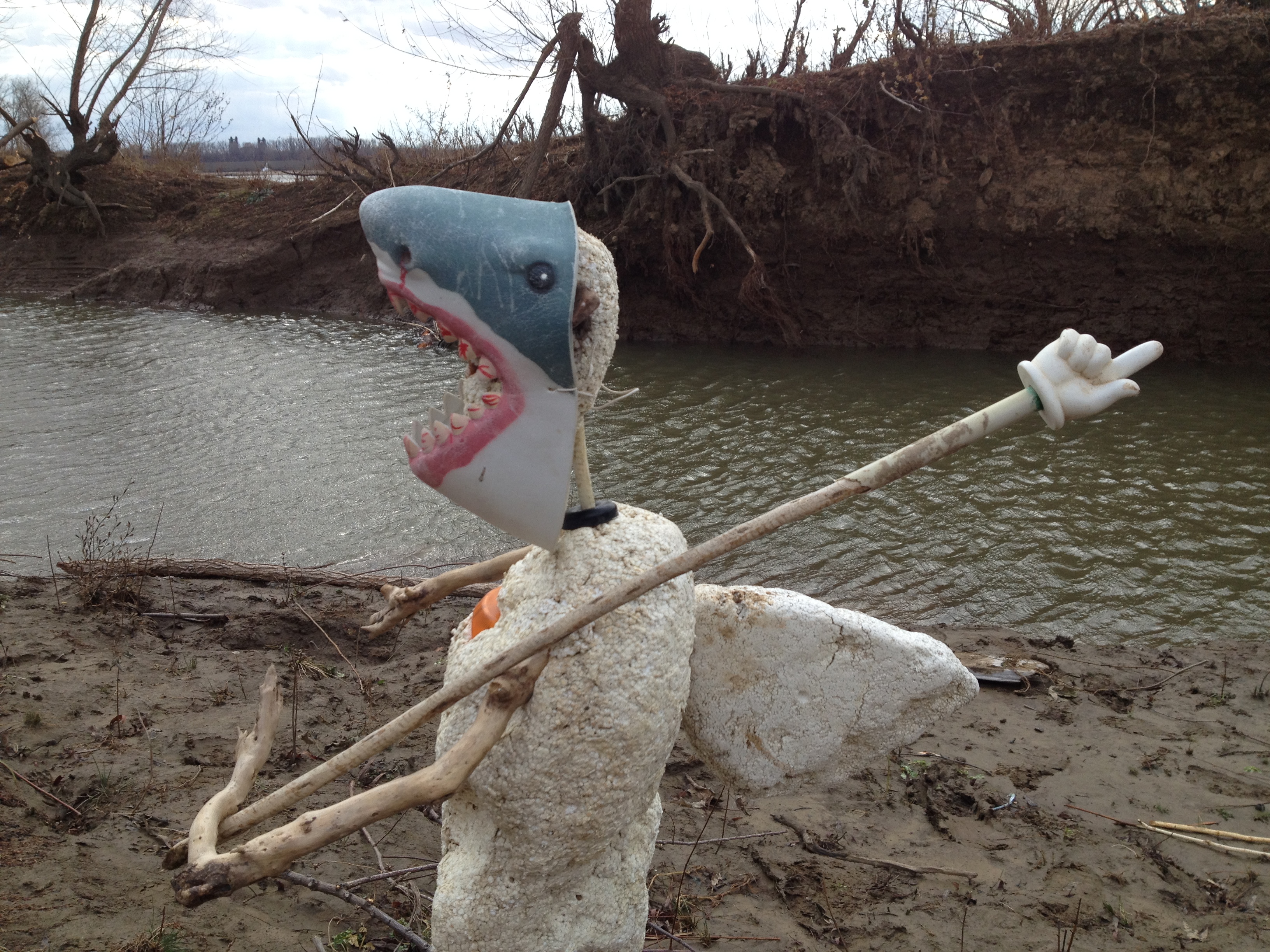
The Shark Shepard emerges from the river, Falls of the Ohio, Dec. 2014

Emerging from the muddy water was this white figure sporting an improbable headdress or mask?  The figure was carrying a staff and appeared to have fins on its body similar to a shark.  I let this fellow come fully out of the water before my curiosity overwhelmed me and I went in for a closer look.

Shark Shepard, side view, Falls of the Ohio, Dec. 2014

This strange being did not seem to be afraid of me and regarded me through his dark eyes.  His face was framed by what looked like the jaws, teeth, and the head of a shark.  My attention kept returning to the fearsome mask it was wearing which I surmised might be a part of some breathing apparatus?  A yellow light on its chest would occasionally blink signaling some other unfamiliar technology was present.  The staff the figure was holding was terminated by a hand pointing a finger which reinforced the stranger’s mysterious presence.

The Shark Shepard on the riverbank, Falls of the Ohio, Dec. 2014

Using its staff, I watched as the figure drew the outlines of several sharks in the soft mud and then pointed to one of his eyes.  He followed this by making a sweeping movement with his arm that seemed to encompass the river and its surrounding landscape.  It took me a moment, but I think it asked me if I had seen any sharks in the area?  Reflexively, I replied by shaking my head “no” which the figure seemed to understand by dropping his head and shoulders in a disconsolate manner?  That’s when I had this mental flash that this guy was a shepherd, a shark shepherd and he was looking for his lost flock?  From here on out, I will refer to him as the Shark Shepherd.  He next stuck his staff into the mud and walked away from it.  I decided to tag along to see if I could learn anything else about my new silent friend.

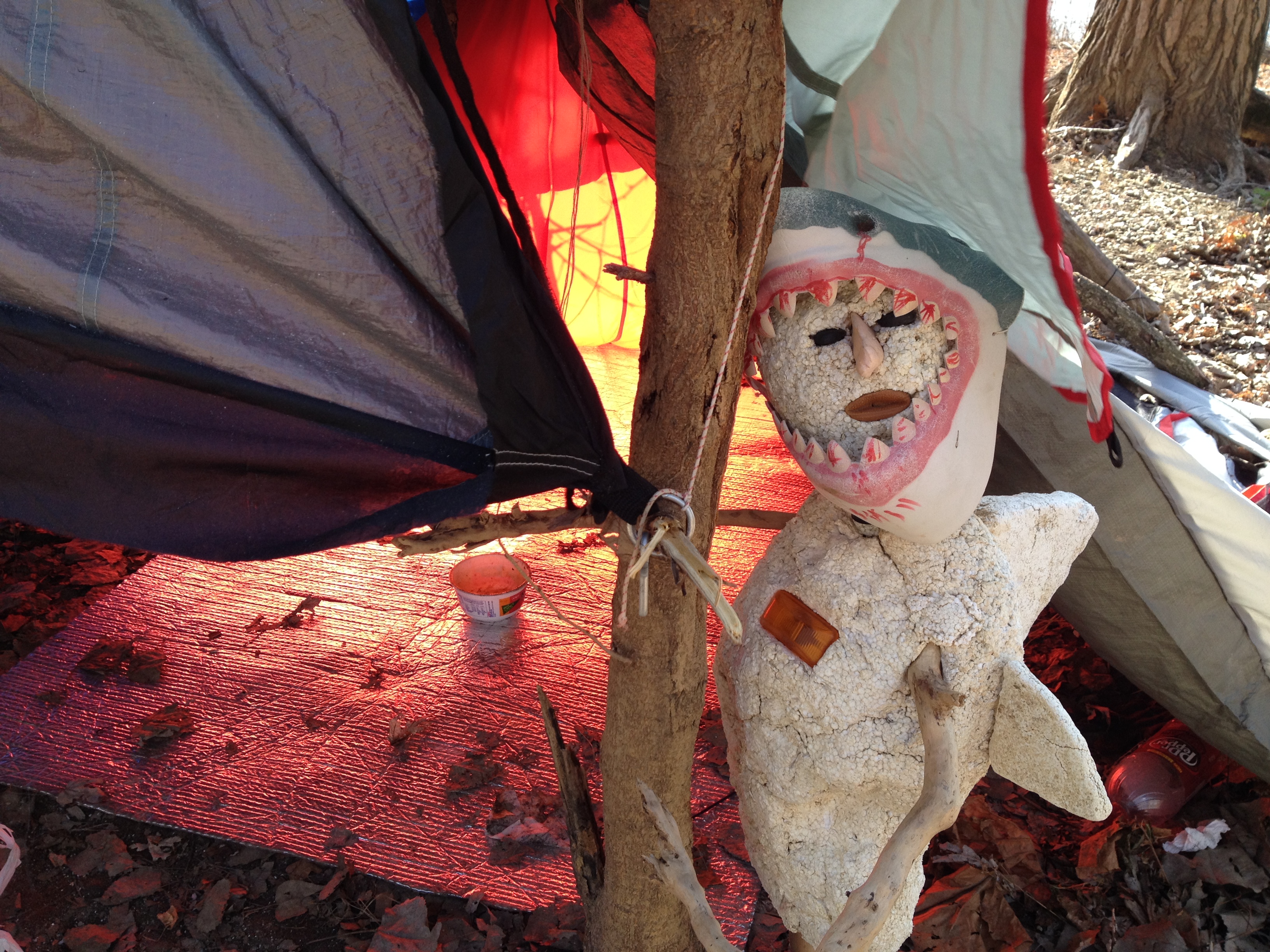
Shark Shepard by improvised tent, Falls of the Ohio, Dec. 2014

The Shark Shepherd seemed to have a curiosity about our world.  I observed as he approached an improvised tent that someone had set up among the trees.  It’s owner(s), however, were not around, but it didn’t seem abandoned in my eyes.  Probably made by fishermen and there seemed to be several trying their luck along the riverbank on this windy day.  I too have a curiosity about the world and after my encounter with the Shark Shepherd ended…I rushed home to try to figure out what he was doing here so far from the sea?  Using the miracle of the internet, I learned a few alarming facts about shark disappearances worldwide.

The Shark Shepherd by fossil rocks, Falls of the Ohio, Dec. 2014

On average, between 20 million to 73 million sharks a year are taken out of marine ecosystems across the planet.  Most of the statistics mentioned the higher number…regardless, that’s too many sharks.  Sharks are “harvested” for their fins, cartilage, and teeth.  The boom in popularity for shark fin soup has led to an insidious practice where millions of sharks are harvested and often indiscriminately by using thousands of hooks set on miles of trailing “longlines”.  Sharks are a valuable bycatch.  The captured sharks (which are often caught alive) have their fins cut off and are frequently thrown back into the seas to die in agony.  It’s a lucrative business because this was once a delicacy and status symbol reserved for the wealthy back in the day when sharks were harder and more challenging to catch. Now it is within the reach of more people.  Through industrialized commercial fishing, millions of mostly Asian consumers can have a bowl of shark fin soup on special occasions.  Interestingly, the soup itself needs to be flavored with beef or chicken stock because the fins themselves are a textural element and contribute no flavor of their own.  Of course, a bowl of soup is not the only challenge sharks face.  Commercial sports fishing, pollution, reef destruction, and overfishing of the shark’s prey base play their part as well.

The Shark Shepherd at the Falls of the Ohio State Park, Dec. 2014

In the United States, large sharks have disappeared from the Gulf of Mexico.  I think this is the reason the Shark Shepherd was this far inland.  Along our Atlantic Coast, it has been reported that eleven of the largest shark species have essentially vanished.  This has important repercussions for the overall marine environment.  You can’t remove this many apex predators from an ecosystem and expect it to function normally.  There are cascading effects.  A recent study attributes the decline in our East Coast scallop industry is due to the loss of sharks that normally would keep cownosed rays and sting rays who eat scallops in check.

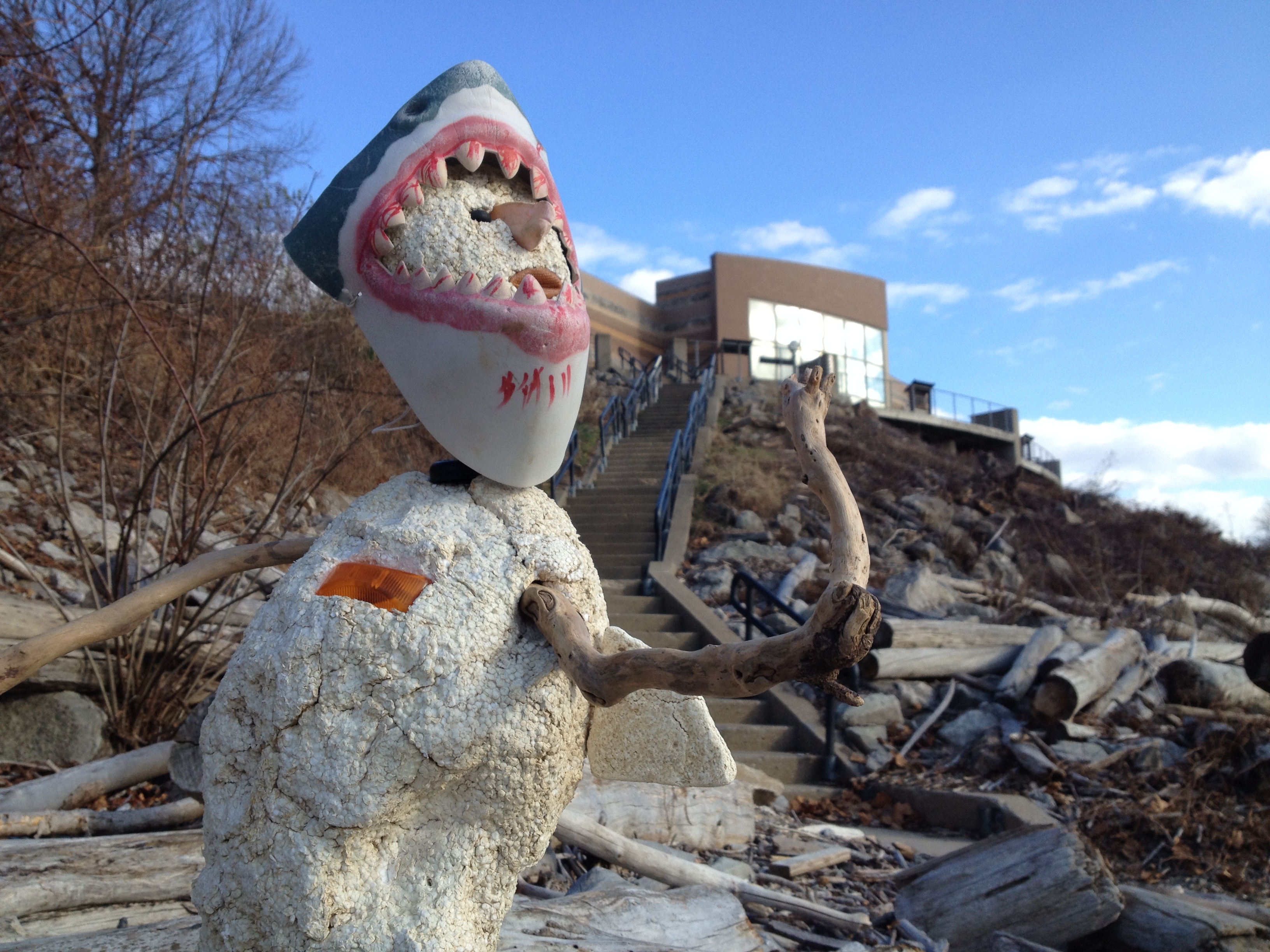
Shark Shepherd by the Falls of the Ohio Interpretive Center, Dec. 2014

I followed the Shark Shepherd as he explored the area around the newly closed Interpretive Center.  There were people around and they did exhibit interest in my friend, but were generally respectful for what was going on.  A few folks asked if they could take pictures of the Shark Shepherd and he obliged them.  During my internet research, I did find it fascinating that there are places like American Samoa, Hawaii, Guam, and the island nation of Palau where sharks are protected.  Interestingly, these are all places in the Pacific Ocean where people regard the shark as a culturally and spiritually significant animal.  These Polynesian cultures understand that their very identities are connected with sharks.  The same, however, can’t be said for the rest of the world who regard sharks as nuisances and or threats.  Better to view something with reverence than through fear.

The Shark Shepherd surveys the Falls of the Ohio State Park, Dec. 2014

The Shark Shepherd climbed the staircase to gain a better vantage point overlooking the river.  I watched him scan the waters, but only an occasional fishing boat presented itself.  If he was looking for sharks, well, there probably hasn’t been any here for about 400 million years when this area was a Devonian Age coral reef.  I could feel the poignancy of the Shark Shepherd’s search as it failed to bear fruit.  After a short while, we reversed our course and retraced our steps.  The Shark Shepherd gathered his staff and walked back into the creek where after acknowledging me with one last look back…disappeared into the Ohio River.  Although I realized that I would not see him again, I couldn’t help but hope that he and his sharks wouldn’t disappear forever from the oceans of the world.

The Shark Shepherd, Falls of the Ohio, Dec. 2014

Read Full Post »

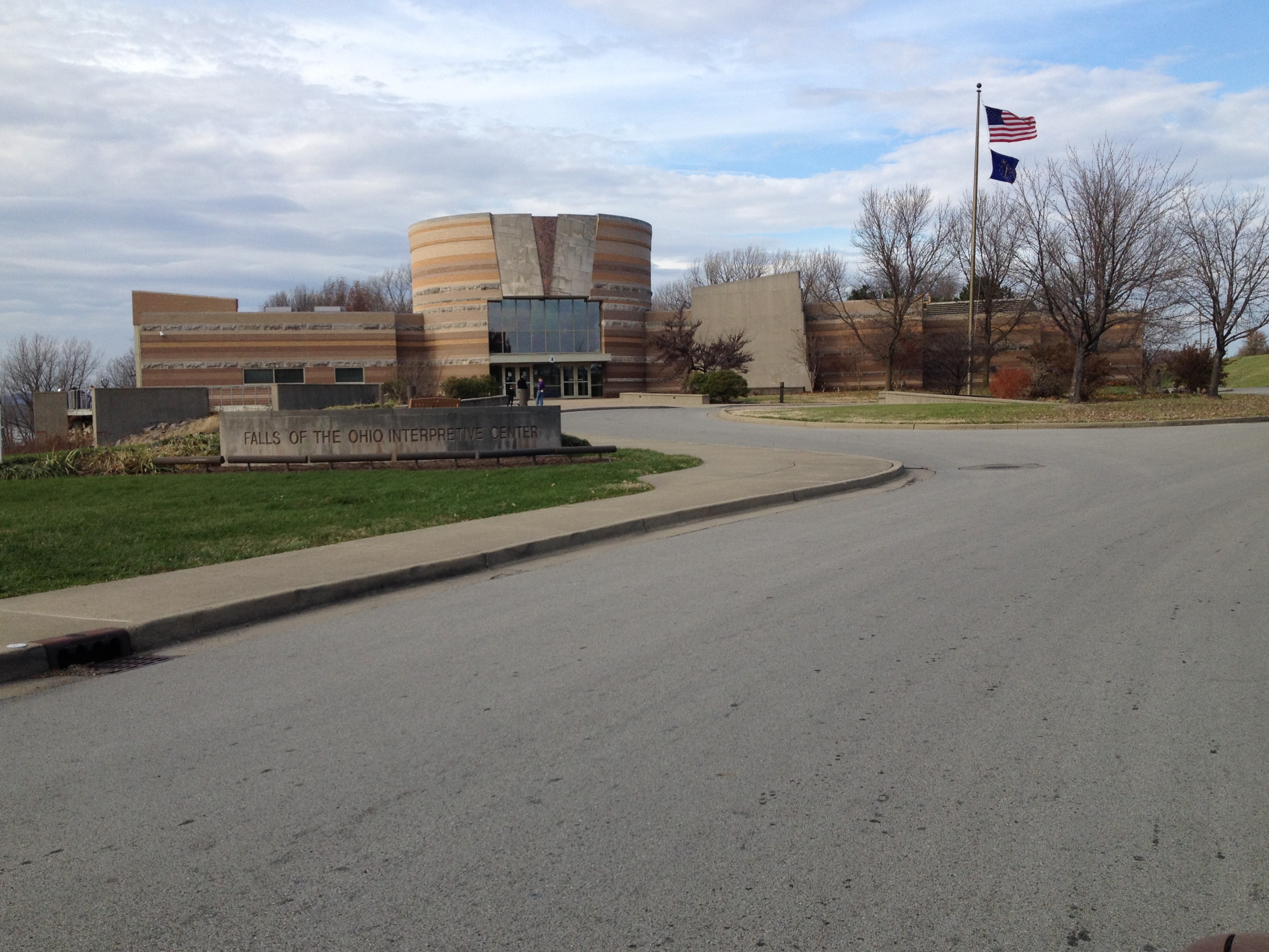
Falls of the Ohio State Park Interpretive Center

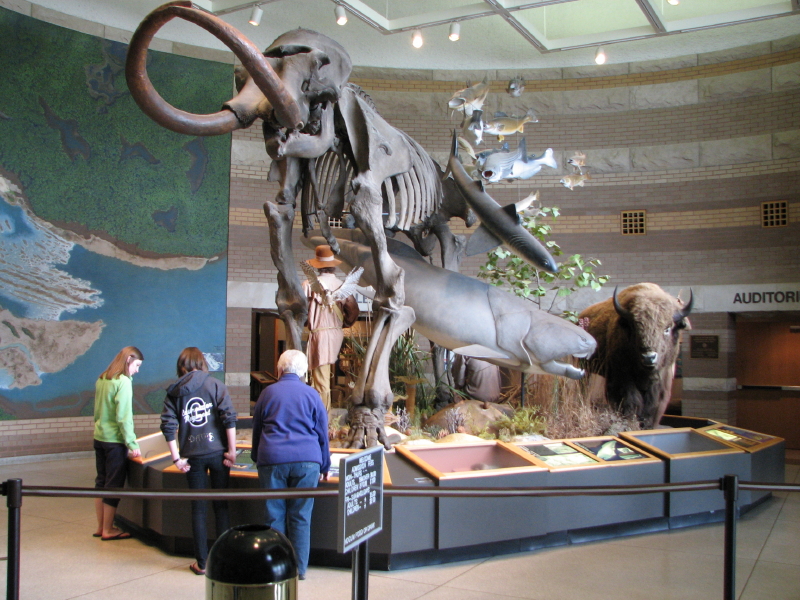
On November 24 the Falls of the Ohio’s Interpretive Center closed for renovations.  This is the first large-scale overhaul of the permanent exhibits since the center opened in 1994.  Since that time, the state of the art in terms of exhibit display has progressed by leaps and bounds.  According to an article appearing in the Courier-Journal, the Falls of the Ohio Foundation has raised six million dollars to pay for the new updates which are expected to be completed sometime in the fall of 2015.  Louisville’s respected museum design company, Solid Light Inc. will handle the redesign and installation.  The Interpretive Center will be employing the latest interactive technologies and refining its focus to better educate visitors about the significance of the Falls of the Ohio area.  Four new themed exhibits will take the place of the old static displays and are named “The Devonian Sea”, “A Changing Land”, “Converging Cultures” and “The Falls Today”.

Grand Hall of the Interpretive Center, 3/2010

I am looking forward to checking out the new exhibits once they open.  But if I may for a moment, pause and reflect upon the demise of the original beloved centerpiece that was once on display in the Interpretive Center’s main hall.  In style, it does harken back to a tradition when collections of natural history specimens and objects that provoked wonder were kept in Wunderkammers and cabinets of curiosity.  This eclectic display has never failed to fire up my imagination.  Yes, it is a mishmash of objects (both real and artificial) and it jumps all over the timeline.  This is actually one of the reasons I find this display so appealing.  My experience of the Falls is one where all this history and information exits simultaneously in the present and I felt that from this art-like installation.

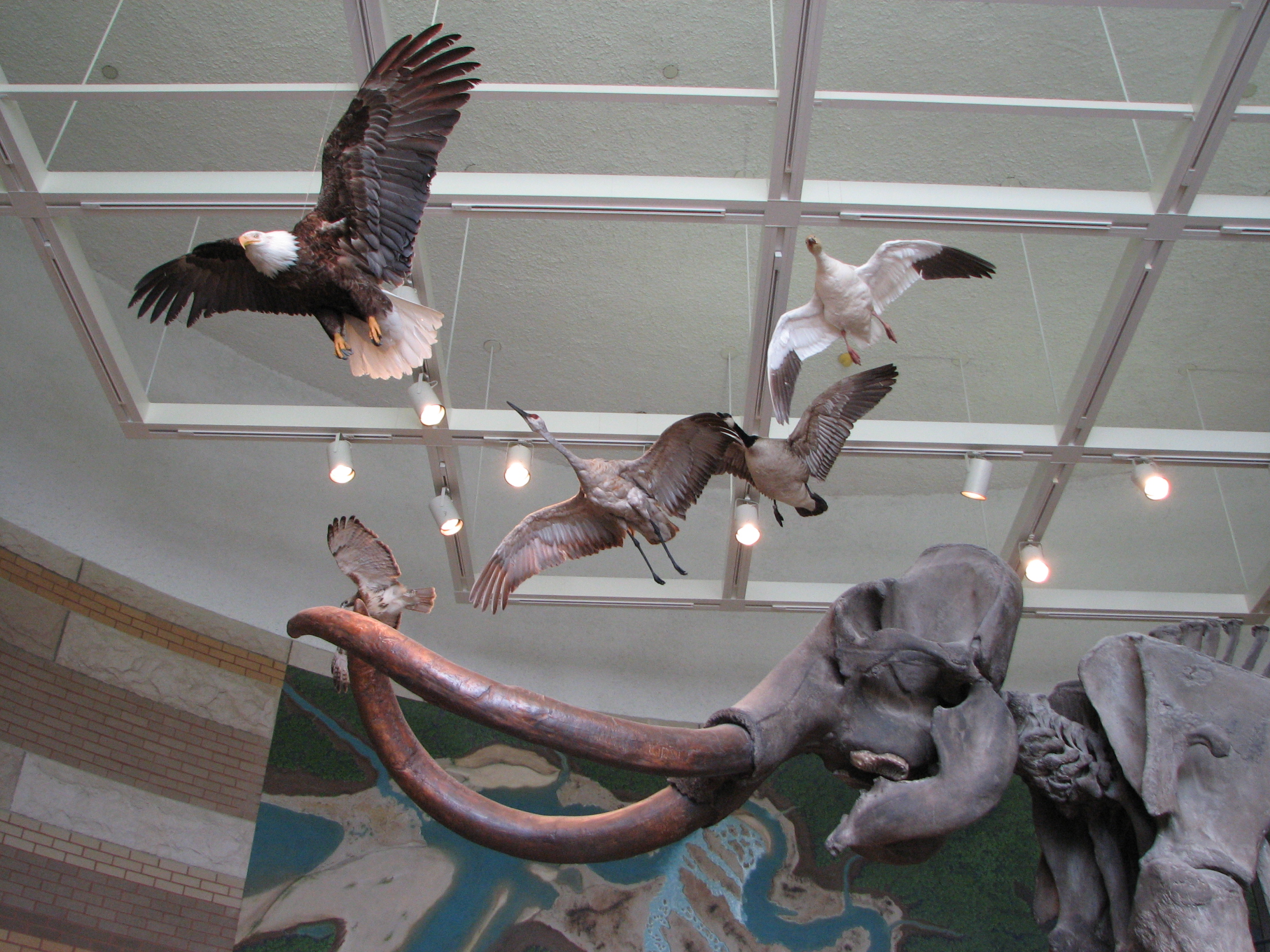
old display at the Falls of the Ohio, birds above the mammoth skeleton

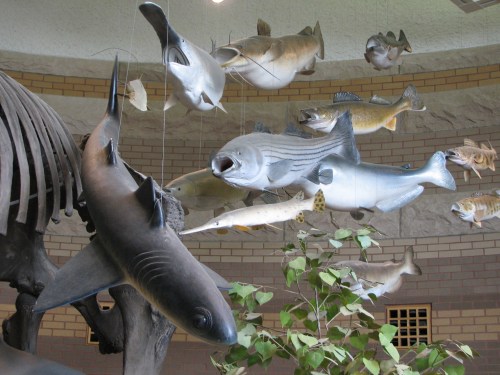
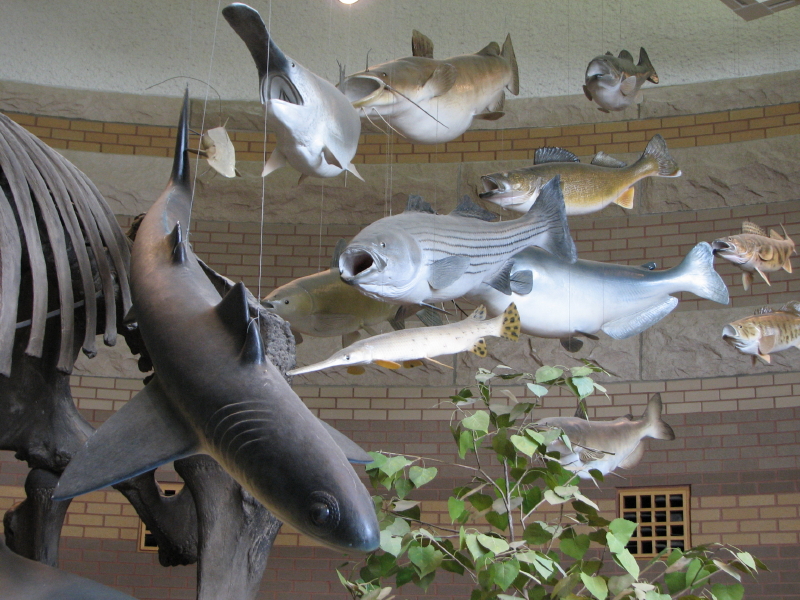
old fish display at the Falls of the Ohio Interpretive Center


I love the scale of the mammoth skeleton and the taxidermed fish and birds lifting to and flowing from the ceiling.  With this display it was easy to adjust for scale and you received a truer sense for just how big the Devonian sharks were and how truly huge an Ice Age elephant was.  I’m not sure that a projection or video could convey this as much as something you could make a true physical comparison with that is sharing the same space with you?  A walk around the centerpiece revealed beautifully fabricated and delicate Devonian Age sea creatures inhabiting a coral reef.  The displays under glass contained specimens and relics that were a tip of the hat to many of the great 19th century naturalists that helped put the Falls of the Ohio on the map.  In essence, a lot of the information you needed to know about the Falls was contained in this single display.

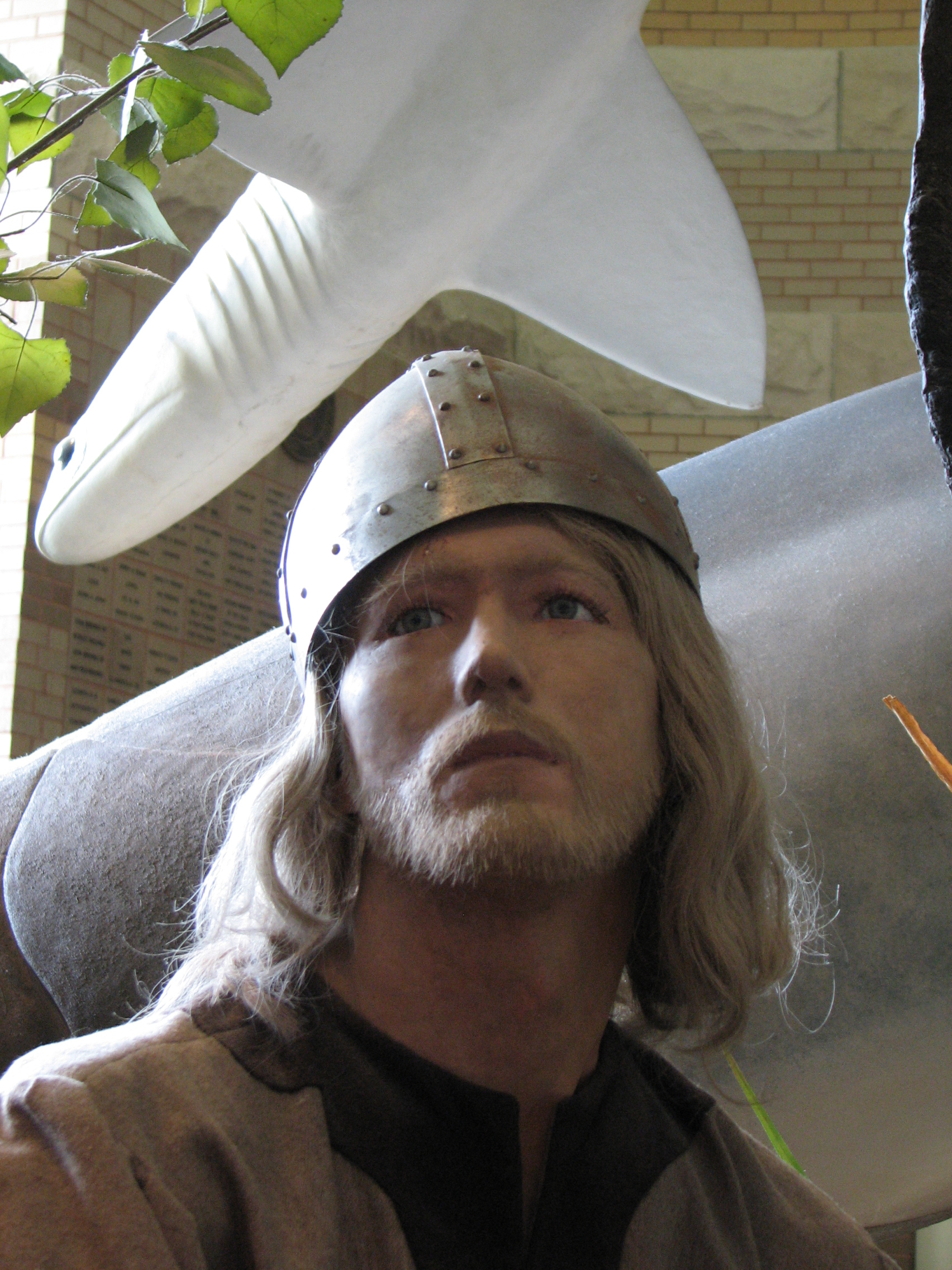
Prince Madoc figure in the old display at the Falls of the Ohio Interpretive Center

Of all the elements in this centerpiece, perhaps the most controversial was the inclusion of a life-size figure of Prince Madoc.  He was one of three figures presented which also included a representation of a Native American and a pioneer figure that might have also been a portrait of John James Audubon?  In case you have never heard of Prince Madoc…he potentially was a 12th century Welsh explorer and he and a band of his people may have been early European visitors to North America.  There is a persistent legend about a group of blonde hair blue-eyed Indians that may be descendants of Prince Madoc.  An old Native American story has this band being routed in battle near the Falls of the Ohio and is the connection to our area.  When President Thomas Jefferson sent Lewis and Clark west to explore the continent…he asked that they keep an eye out for evidence of this story.  I have a good friend who couldn’t bear to look at the Prince Madoc figure and not because it wasn’t done well.  To him, it was a travesty to include this in a tableau that included factual elements.  To date, there is no convincing evidence, no archeological proof that Prince Madoc ever came to this continent.  I guess the veracity of the story never bothered me and I just liked the tale because of its association with the Falls.  To me, this is what history is about…some parts fact and some parts myth.  The Prince Madoc figure was there to add an extra dimension of imagination I could appreciate.

underneath the mammoth's ribcage

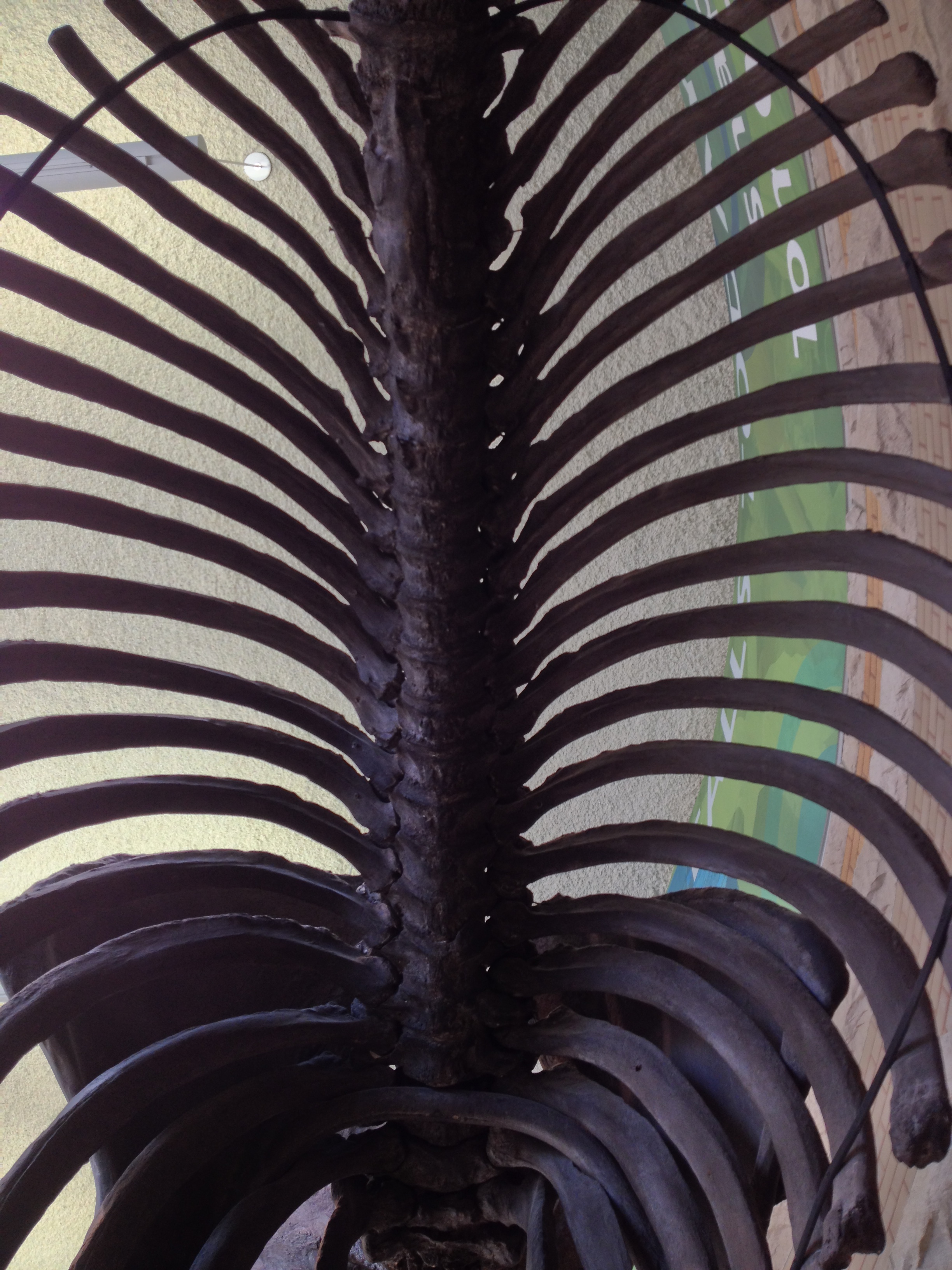
Prince Madoc may have been banished from future displays, but the mammoth skeleton was kept.  It was taken down and repositioned so that you have to pass between its legs and under its ribcage to enter into an auditorium.  I’m sure the new displays will be incredible, but I do hope they will also inspire visitors to use their own imaginations to some degree.

My collection of found Styrofoam, Falls of the Ohio, Nov. 2014

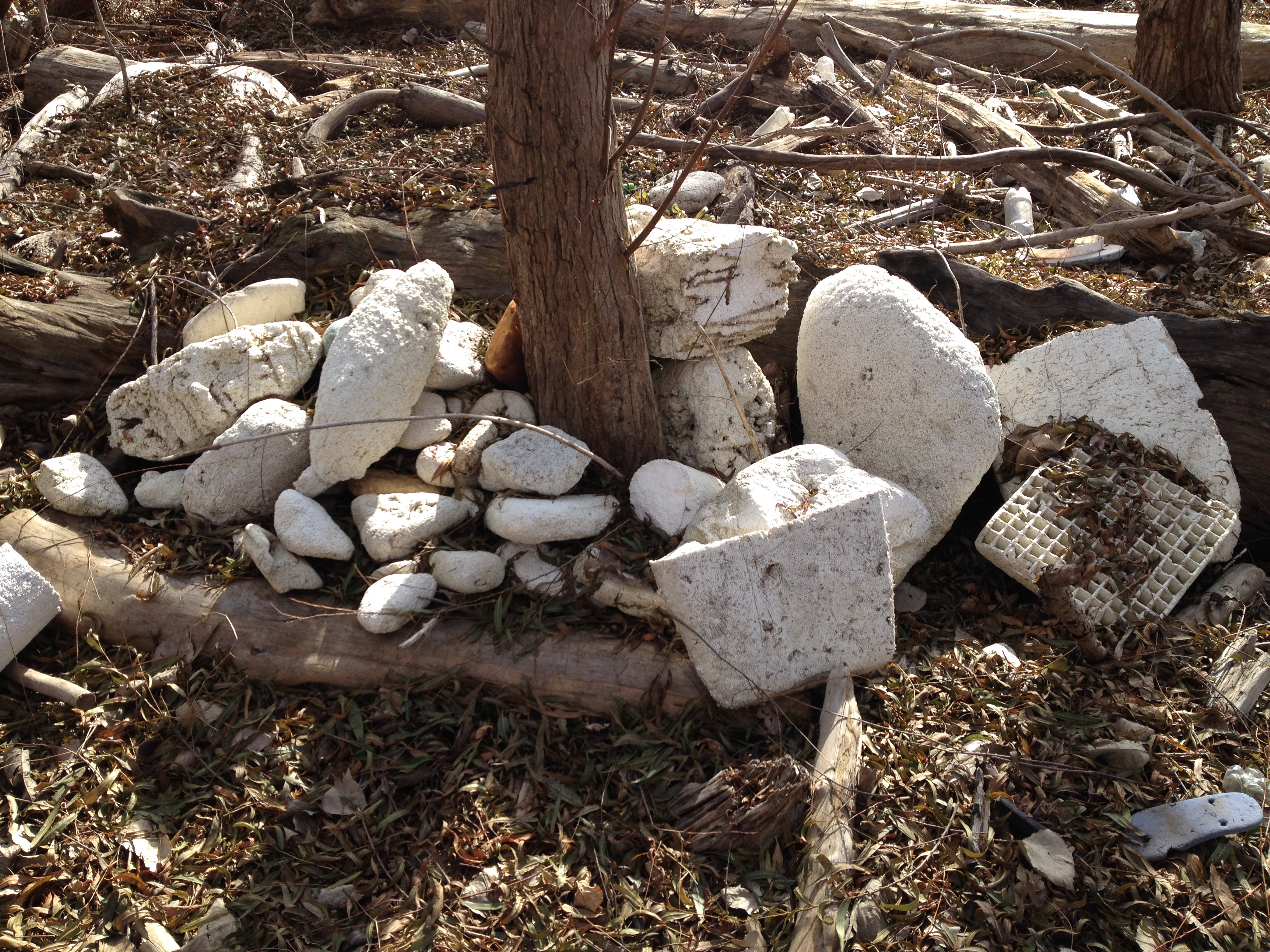
Having touched base with the Interpretive Center, I decided to connect with my own peculiar low-tech universe.  On this day it was sunny and windy and I made my way under the willow trees which provided some shelter from the breezes.  My larder of river-polished polystyrene chunks as white as the recent snowfall was there waiting for me.  I got an idea to make a particular figure from other items I found that day, but the piece I started crumbled to pieces.  A rare but not unheard of temporary setback.  I will return to it when I find the right form for this figure’s body.  On to improvised plan #2.  I looked around my pile and selected two new pieces and joined them together as head and body.  The addition of beaver-chewed willow stick limbs and some stones for eyes and plastic for the mouth and you have the basics of a figure.

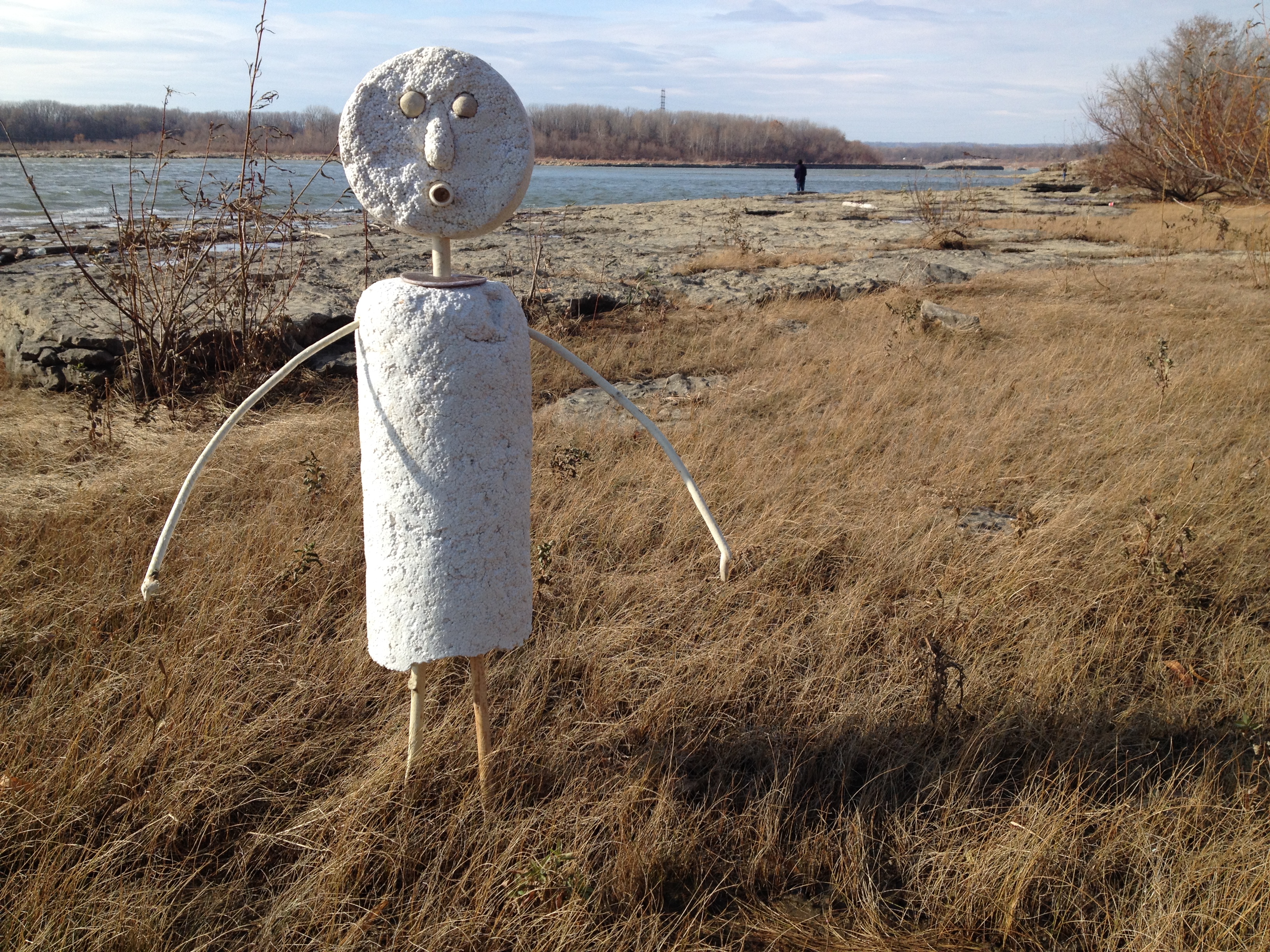
Benchmark figure in the Falls landscape, Nov. 2014

This is the second piece I made and he is decidedly less complex than the sculpture that fell apart.  I kind of like this guy as an abstracted representation of a figure out in the landscape.  I walked him through the land and stopping here and there for different photo opportunities.  Here are a few more pics from this day.

Benchmark figure posed near river trash, Falls of the Ohio, Nov. 2014

To me, this figure has a sort of benchmark quality to it.  Here it’s posed next to some typical river trash.  There are places out here that “bleed” red from some oxides that originate beneath the sand.  I did keep the plastic wheel I found and added it to my ever-growing collection of toy wheels.  I have several hundred of them now and hope to create a grand piece with them.

Figure in a hole on the fossil cliffs, Falls of the Ohio, Nov. 2014

Up on the fossil cliffs that overlook the river, I found a nice hole for my figure to stand in.  I tried to set the figure up by positioning the legs in a naturally occurring crack in the stone, but the wind was just too strong to allow this to happen.  A single fisherman shares the scene with my latest creation.

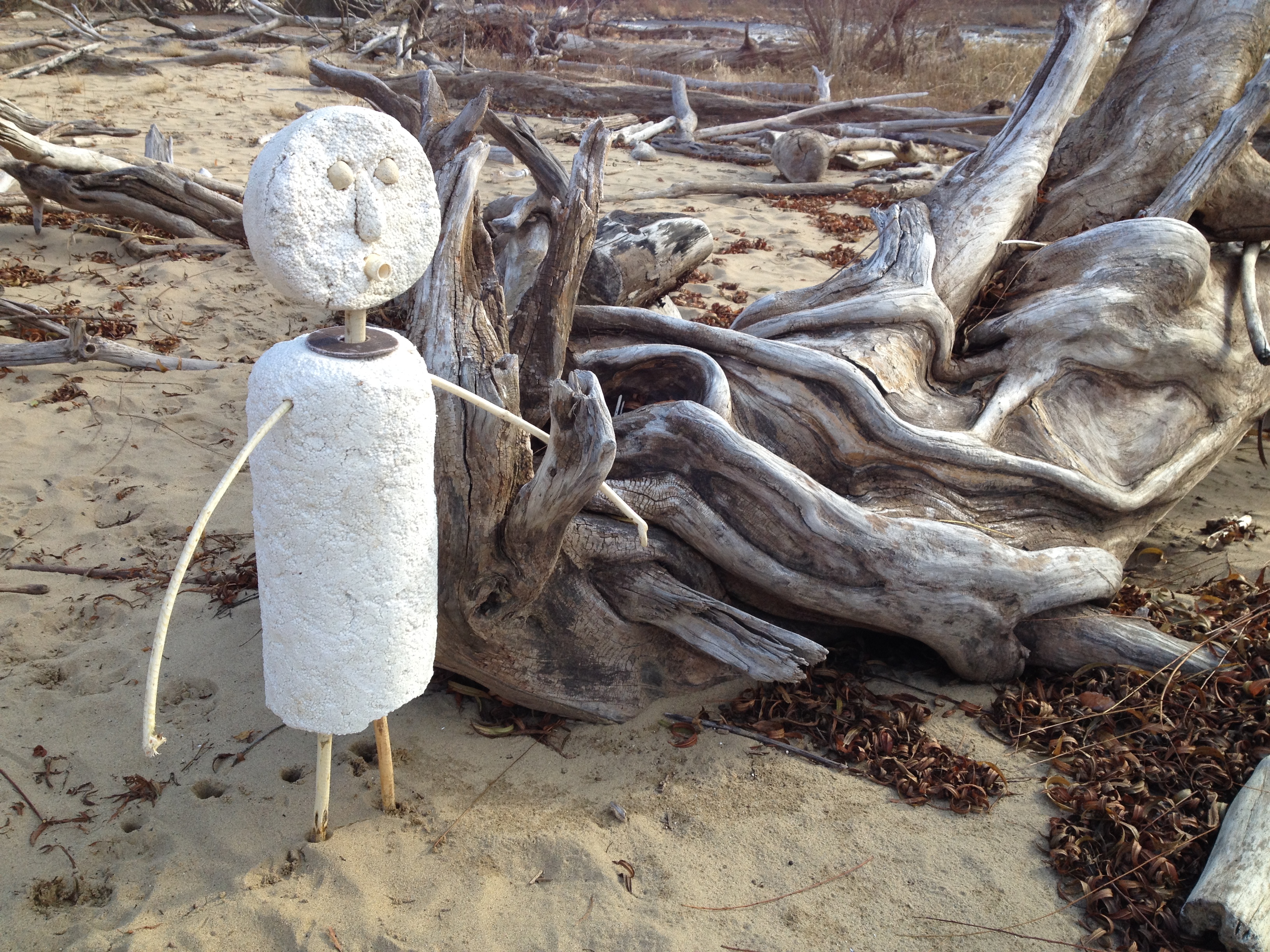
Styro-figure posed next to a nice piece of driftwood, Falls of the Ohio, Nov. 2014

For this image, I simply liked the piece of driftwood my Styro-figure is posed next to because of its worn and polished sculptural qualities.

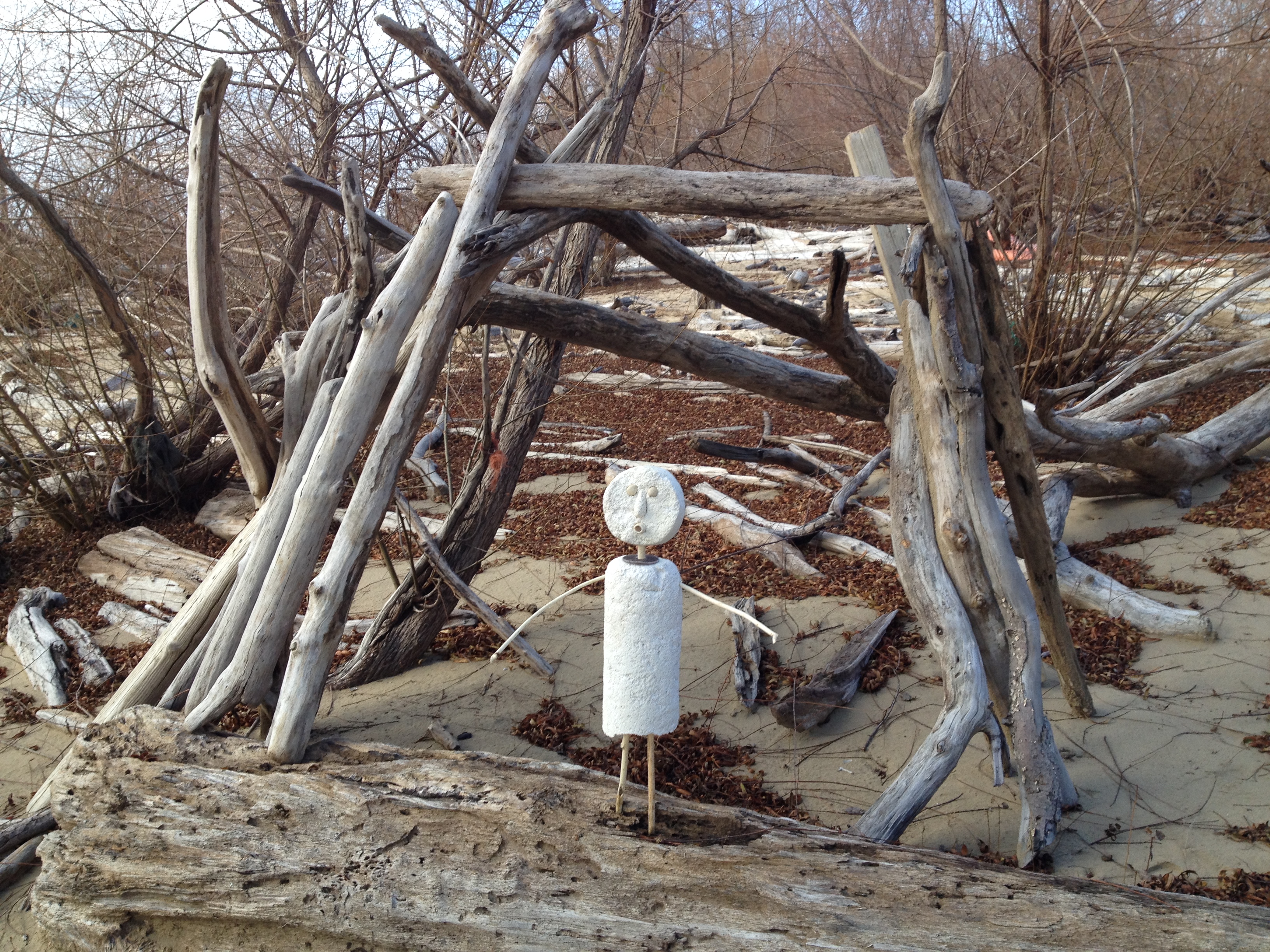
Styro-figure posed next to anonymous improvised driftwood shelter, Falls of the Ohio, Nov. 2014

Here, I’ve set up the figure under an anonymous driftwood construction.  I liked the way the propped up driftwood defined and framed a space for my figure to exist in.  On this particular day, there wasn’t a made up story that came to mind.  For most of my Falls forays…this is the typical way the day goes.  It’s about being outside and reacting to the elements and conditions I come into contact with on the river’s edge.  This is how I interpret what is happening at the Falls of the Ohio.  I am already looking forward to my next visit and sharing it with you.

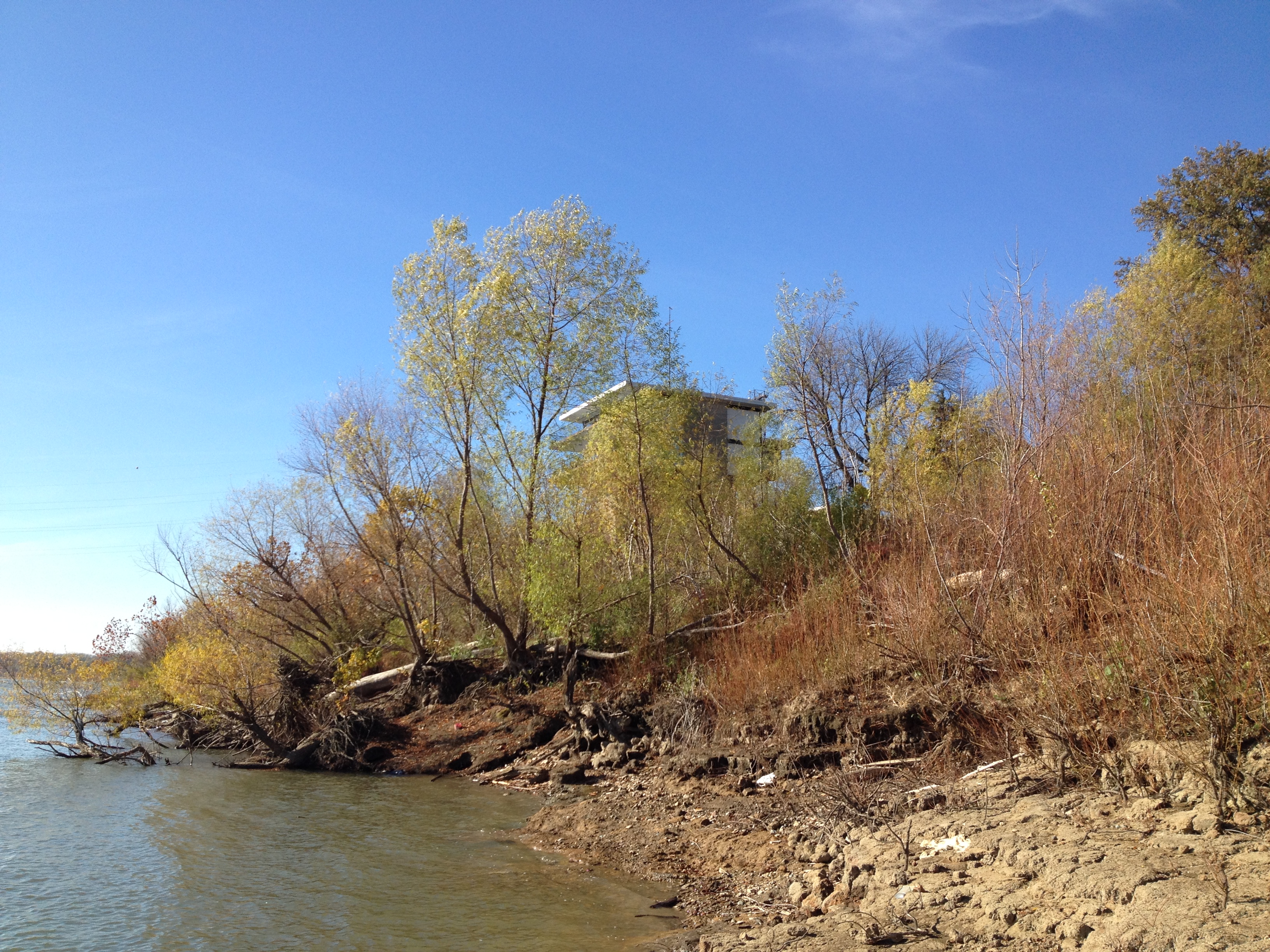
The Interpretive Center as seen from the riverbank, Falls of the Ohio, Nov. 2014


Read Full Post »

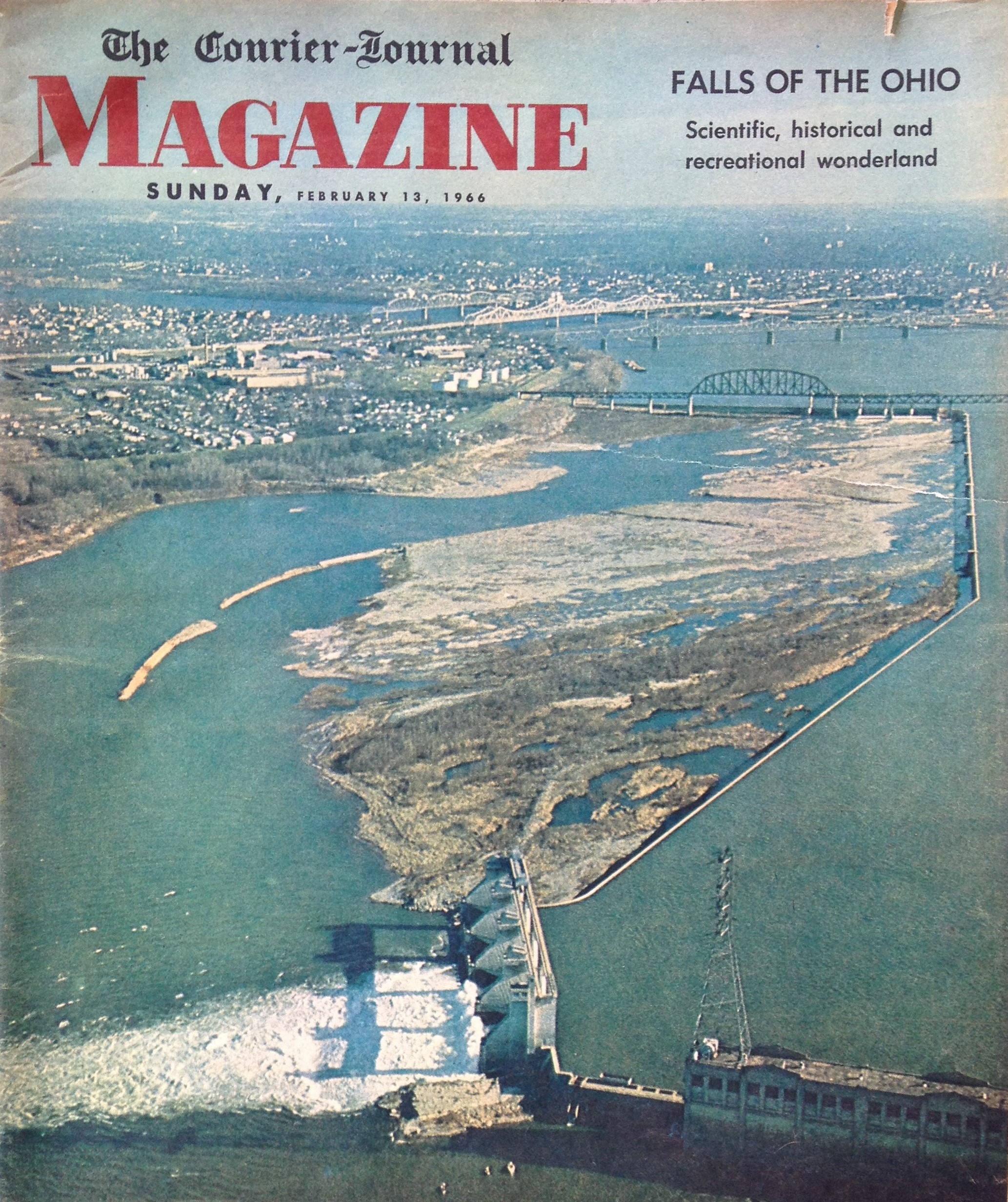
Falls of the Ohio article, Courier-Journal Magazine cover, Feb. 13, 1966

On the occasion of my 400th riverblog post I thought I would try something a little different.  I’m thinking that reaching a personal blogging milestone is worthy of some observance .  It took me a little more than five years, 399 posts of original content, over 4000 published images, nearly 2500 comments, and deleting more than 30,000 blocked spam requests, etc… before I filled all the free space on my original WordPress blog.  I finally had to lay down some coin in order to purchase additional storage space to continue.  For me, this has been more than a great bargain.  When I originally began posting about my trips to the Falls of the Ohio, I had no idea of how much it would shape me as an artist, but without a doubt, it has.  I now view this blog as being more than just a vehicle for publishing the things I’ve made and experienced and has become a medium in its own right.  To everybody who has participated either at the river or by visiting and commenting…the Artist at Exit 0 thanks you!!  And now, from the intersection of nature and culture…on with the show.

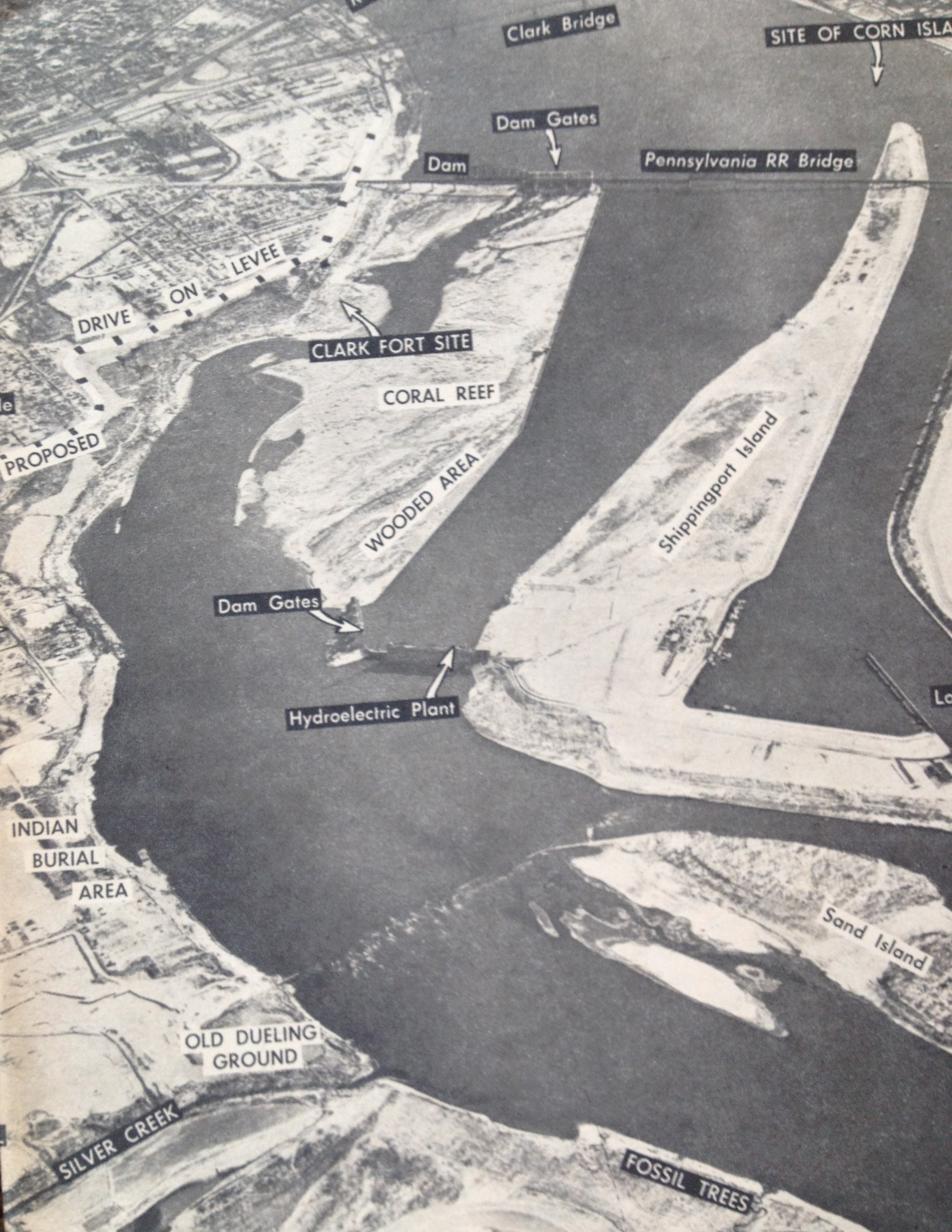
Aerial view of the Falls of the Ohio, Courier-Journal magazine article 1966

One of my best friends gifted me this extensive article about the Falls of the Ohio dating back to 1966 that originally appeared in The Courier-Journal’s Sunday Magazine.  The C-J is published in Louisville and for a time was one of the best newspapers in the country winning many Pulitzer Prizes for its original reporting.  Like many fine newspapers across the land it is no longer locally owned and is a shadow of its former self.  Still, it survives and dutifully arrives at the doorstep of its subscribers seven days a week minus the Sunday magazine feature.  I was really fascinated by this article because it predates the Falls of the Ohio as an Indiana state park by many years.  I was surprised to see an area on the lower right of the aerial view labeled “Fossil Trees”.  This was the first reference to this I had come across.  Supposedly, this area is composed of slate containing the fossilized remains of Carboniferous trees.  It occurred to me that there was a lot about the northern bank I did not know about and decided to go exploring outside my usual confines.

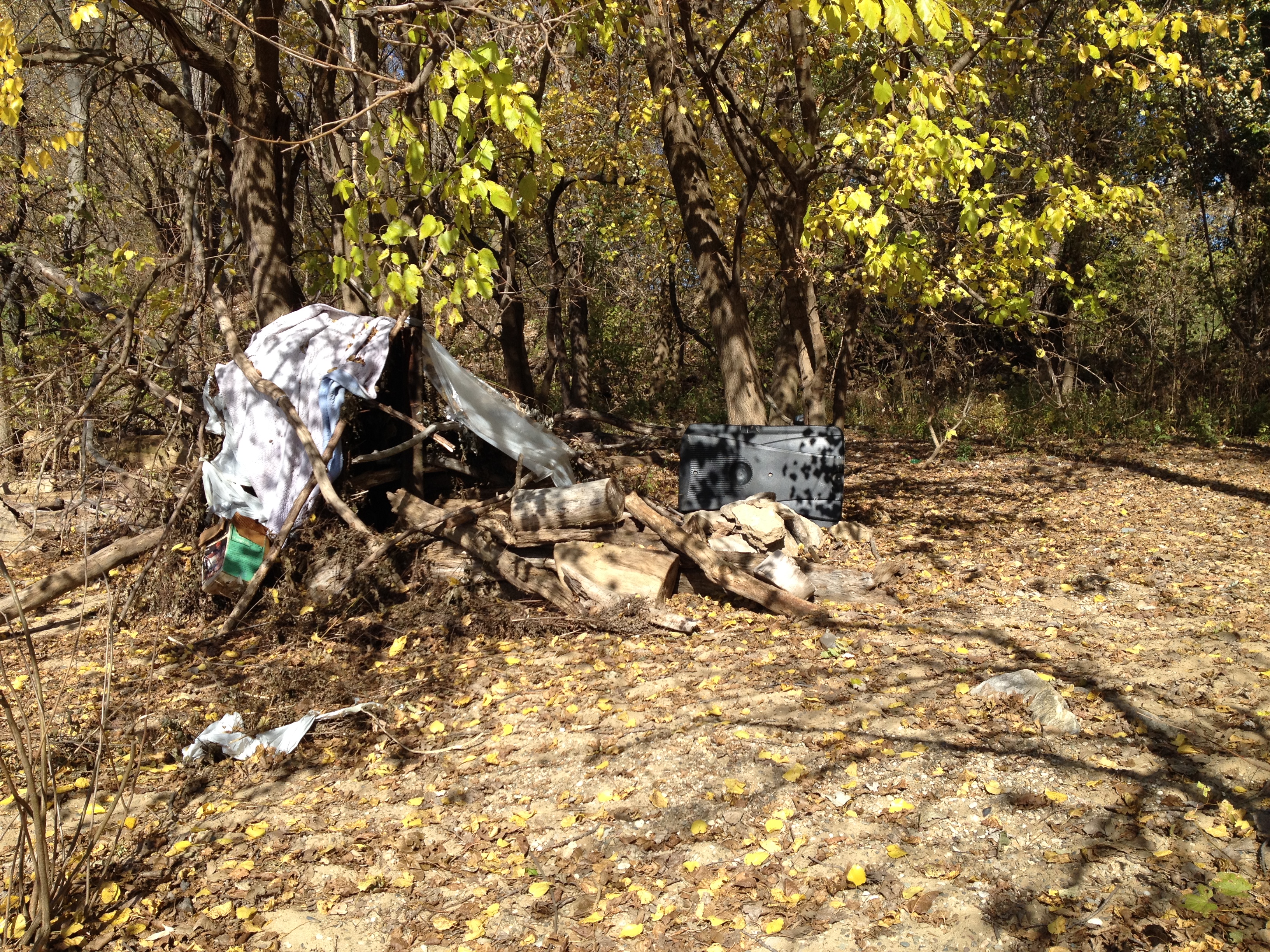
Improvised shelter at the Falls of the Ohio, Nov. 2014

I walked past the Woodland Loop Trail and heading west by hugging the riverbank.  Along the way, I came across this  makeshift and abandoned shelter created from found plastic and a quilted mover’s blanket.  The remains of a small campfire marked where someone sought temporary refuge here.  On more than one occasion I have come across folks in the park that are down on their luck and camp out here during the better weather months.

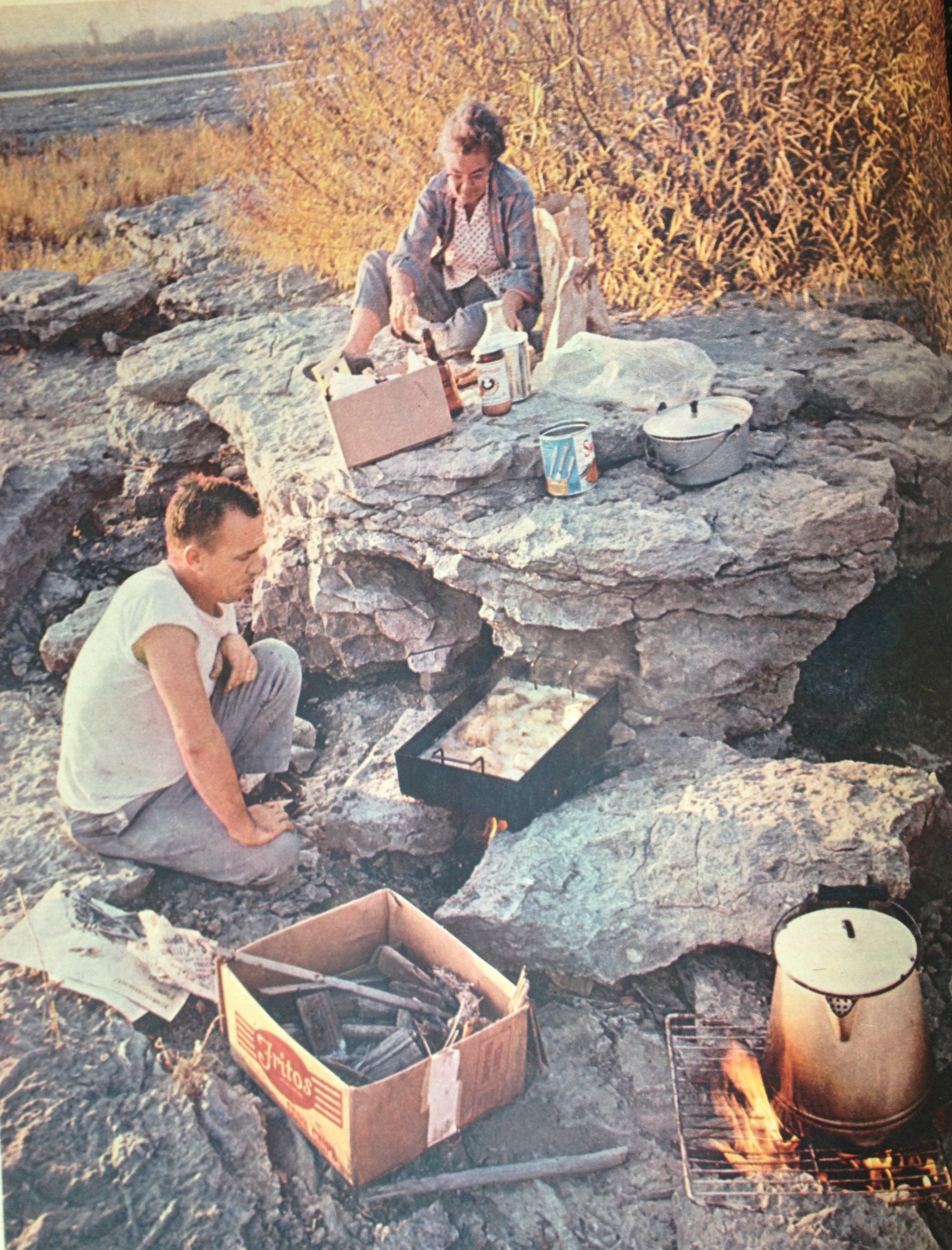
Photo from 1966 Courier-Journal article

As the magazine article from 1966 shows…people have been camping out and utilizing the abundant driftwood resources for a long time.  I have to admit, in all my years of coming out here, I haven’t seen anyone enjoying a fish fry like this.  That was 48 years a go, but seems more remote to me than that.  Among the many changes here, it is recommended that you limit your consumption of the local fish.

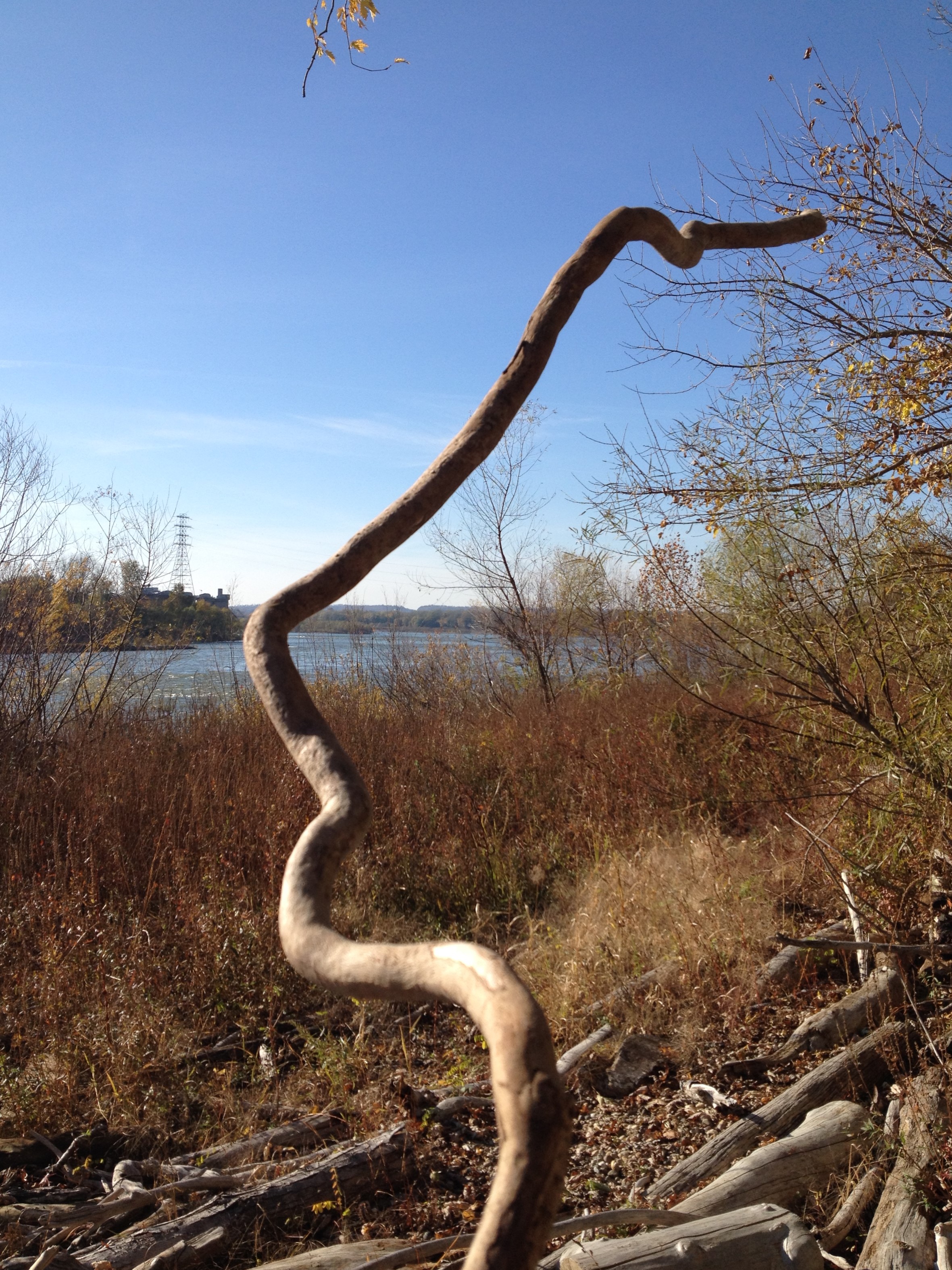
meandering length of driftwood, Nov. 2014Such a beautiful sun-shiny day and unseasonably warm too.  As I write this our first snowfall of the year lies on the ground.  Another article in last week’s paper caught my attention.  Apparently, this past October was the warmest October in the last fifty years and the fourth warmest ever recorded.  As I meander back and forth along the riverbank, it’s odd bits of trivia that come to mind.  I remember that I was living in Ft. Knox in 1966 and having a great time in Mrs. Songster’s third grade class at Van Vorris Elementary School.  Back then, my nature experiences were shaped by stalking the woods and creeks on this extensive military reservation.

Falls of the Ohio, Louisville in the distance, Nov 2014

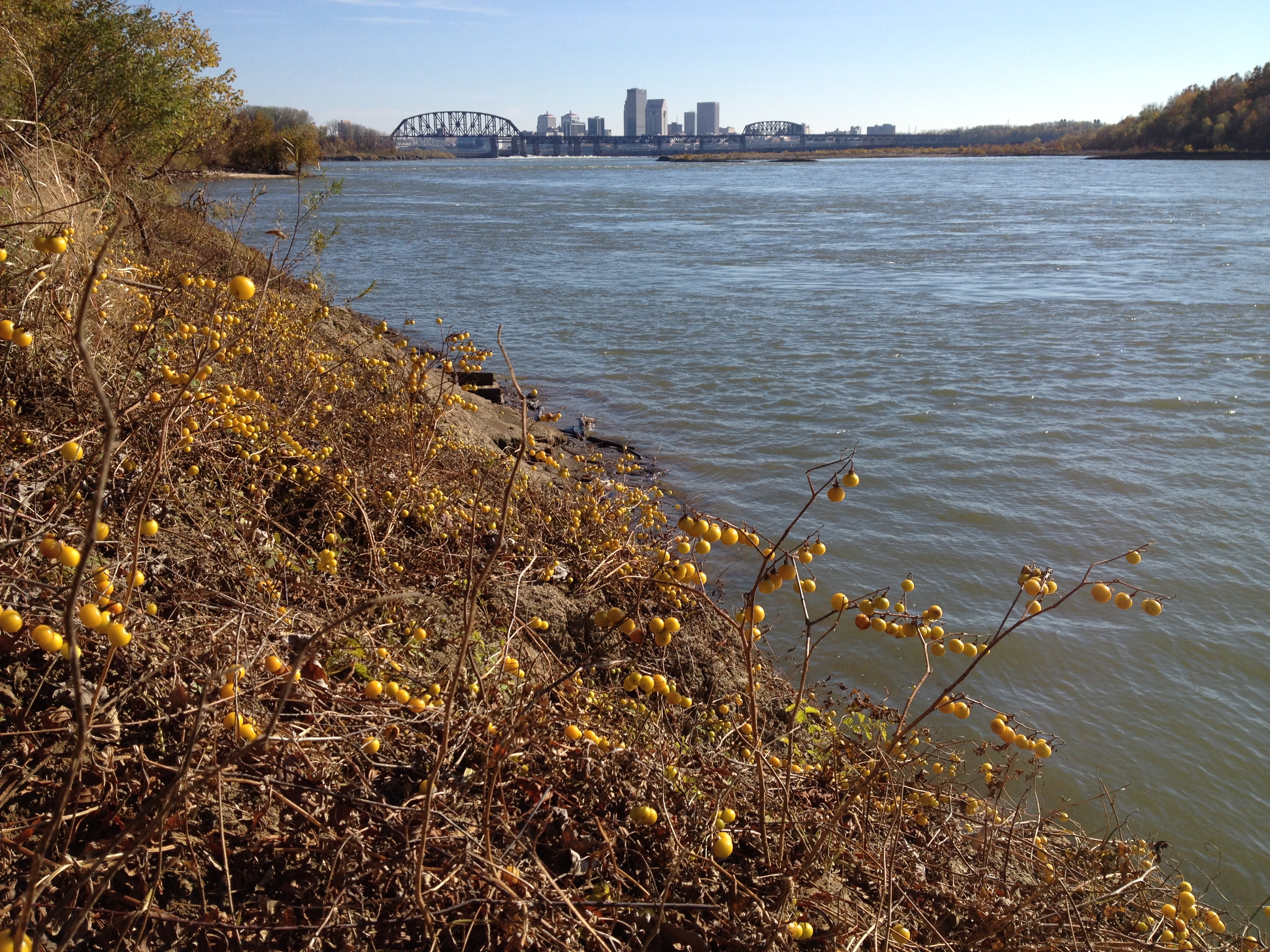
As I kept walking westward, I would come across sections of the riverbank enlivened by the bright yellow fruit from the horse nettle plant.  These cherry tomato sized marbles look tempting, but they are highly poisonous.  I came across places on my hike where there were thousands of these fruits ripening.  I have always liked this view with the skyline of Louisville hanging on the horizon.  The city with its tall buildings looks diminutive and fragile balancing on the edge between the sky and water.

Falls of the Ohio, Tainter Gates in the background, Nov. 2014

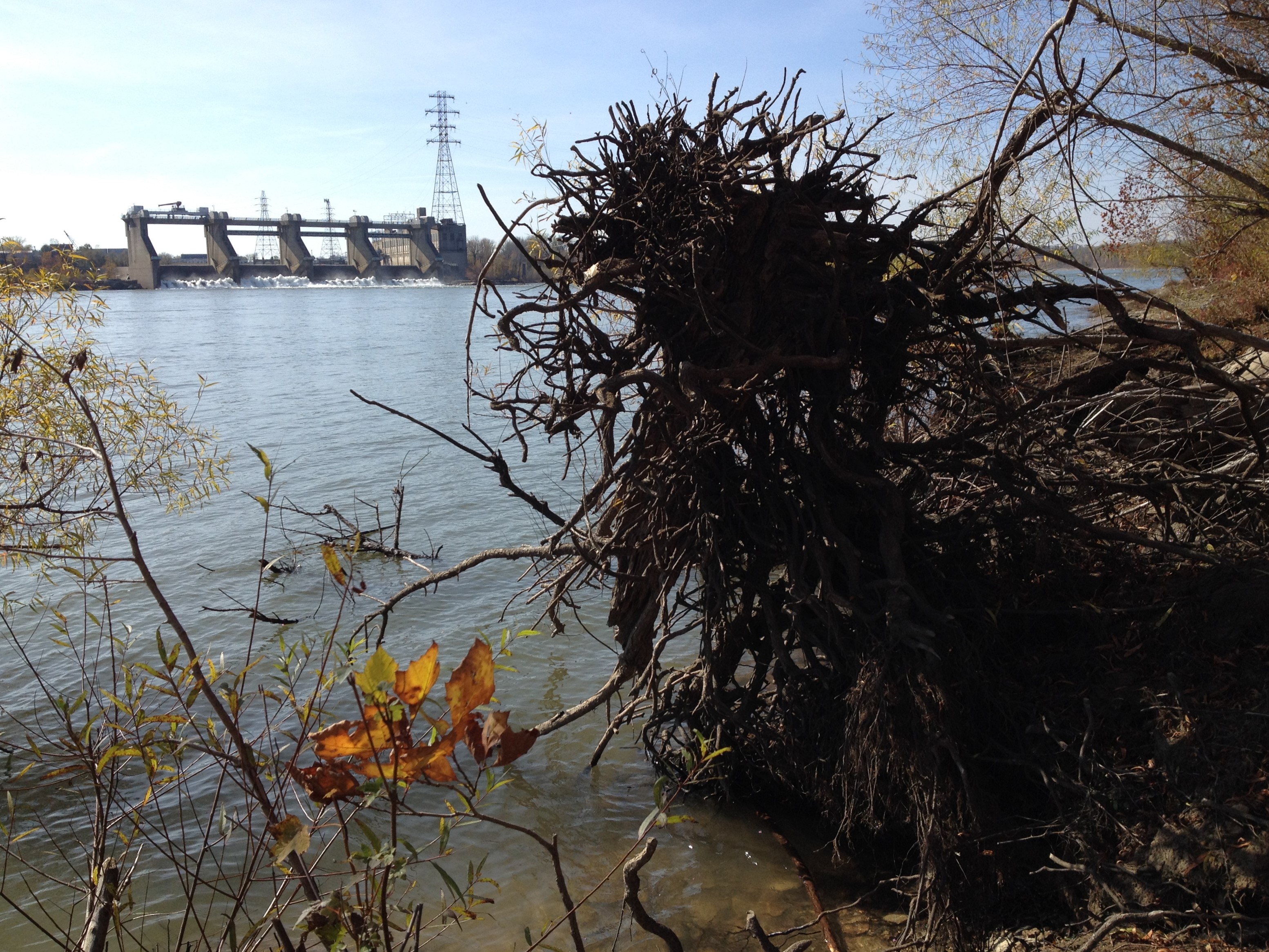
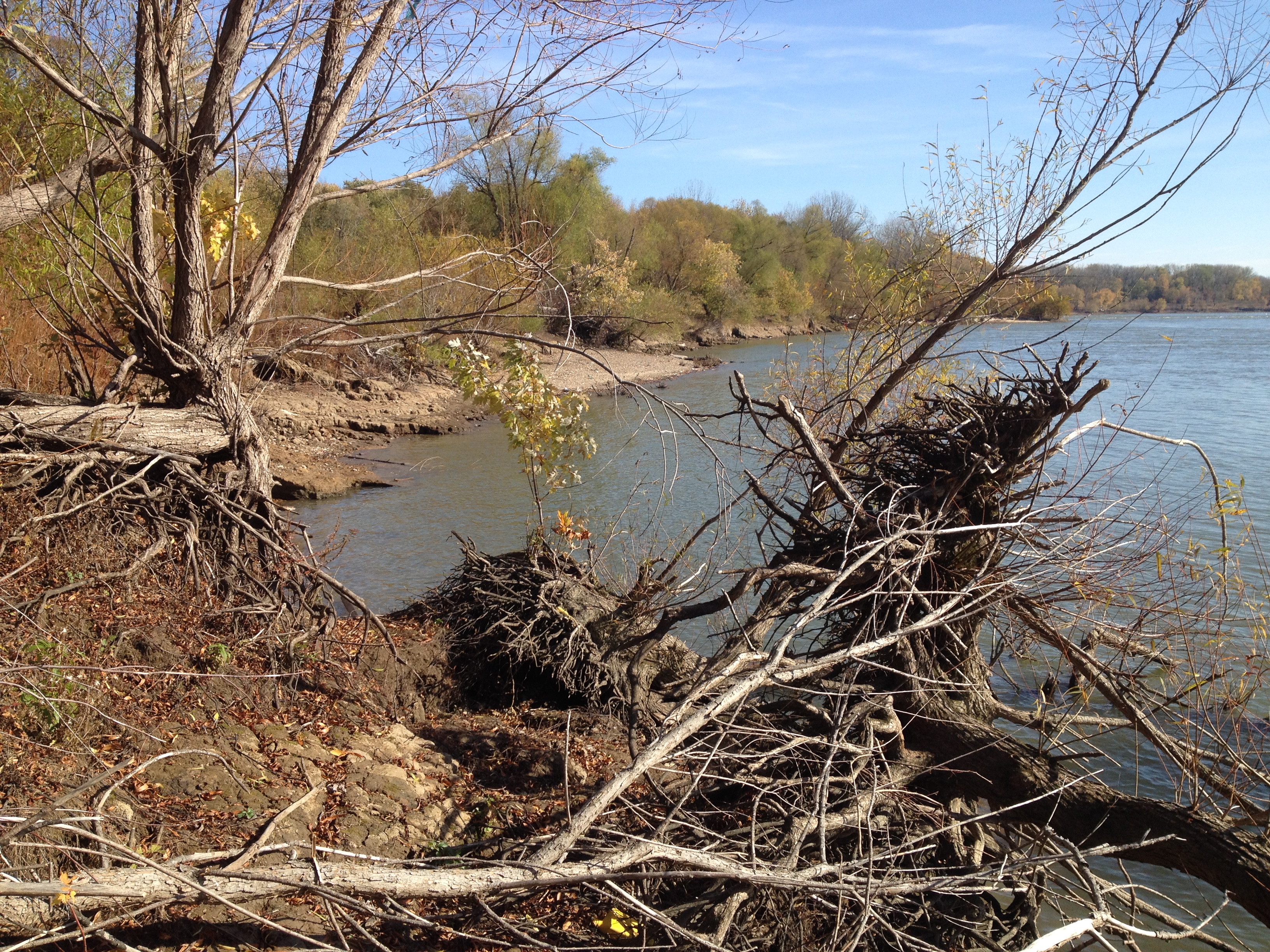
The blackened root mass from a downed willow tree has an almost menacing presence on the riverbank.  A few turtles slide off logs into the water.  Goose Island and the Lower Tainter Gates are across the way.  I realize that this is the furthest west I have ever walked on this side of the river.  Previously, I have always limited my activities to the park proper.  Although I don’t see any signage demarcating boundaries, I am assuming that I’m now on private property?

Large house on the Indiana side of the Ohio River, Nov. 2014

I come across some wonderful homes that must command spectacular views of the river.   A couple of these dwellings sport their own boat ramps.  I stay nearest to the water and respectively move my way through.  Nobody challenges me and I keep moving forward.  I know there is an area up ahead that is administered by the Falls of the Ohio State Park.  After all these many years, it feels good to have other places associated with this special place to explore.

boat ramp near George Rogers Clark cabin site, Nov. 2014

After a leisurely walk lasting several hours I reach the boat launch area by the George Rogers Clark home site.  The famous hero of the Revolutionary War and founder of Louisville and Clarksville, retired to a small cabin that overlooked the river.  This boat ramp is right across the river from the Lower Tainter Gates and Hydroelectric Plant and gets lots of traffic from fishermen.  I decide that the areas I want to explore are still a long walk away and I modify my plans.  If I want to reach the spot where the fossilized tree remains are found, I probably should park my car near the ramp and walk westward from here.  For the time being I feel satisfied and retrace my steps back to the Falls of the Ohio State Park.

riverbank view by the Falls of the Ohio State Park, Nov. 2014

The walk back is gorgeous.  On the return trip I collect lots of beaver-chewed willow sticks and a nice length of barge cable.  I will use these materials to make something.  Happily, I can report that I did not find nearly as much trash along this walk.  I did, however, make one small project from found materials and here it is.

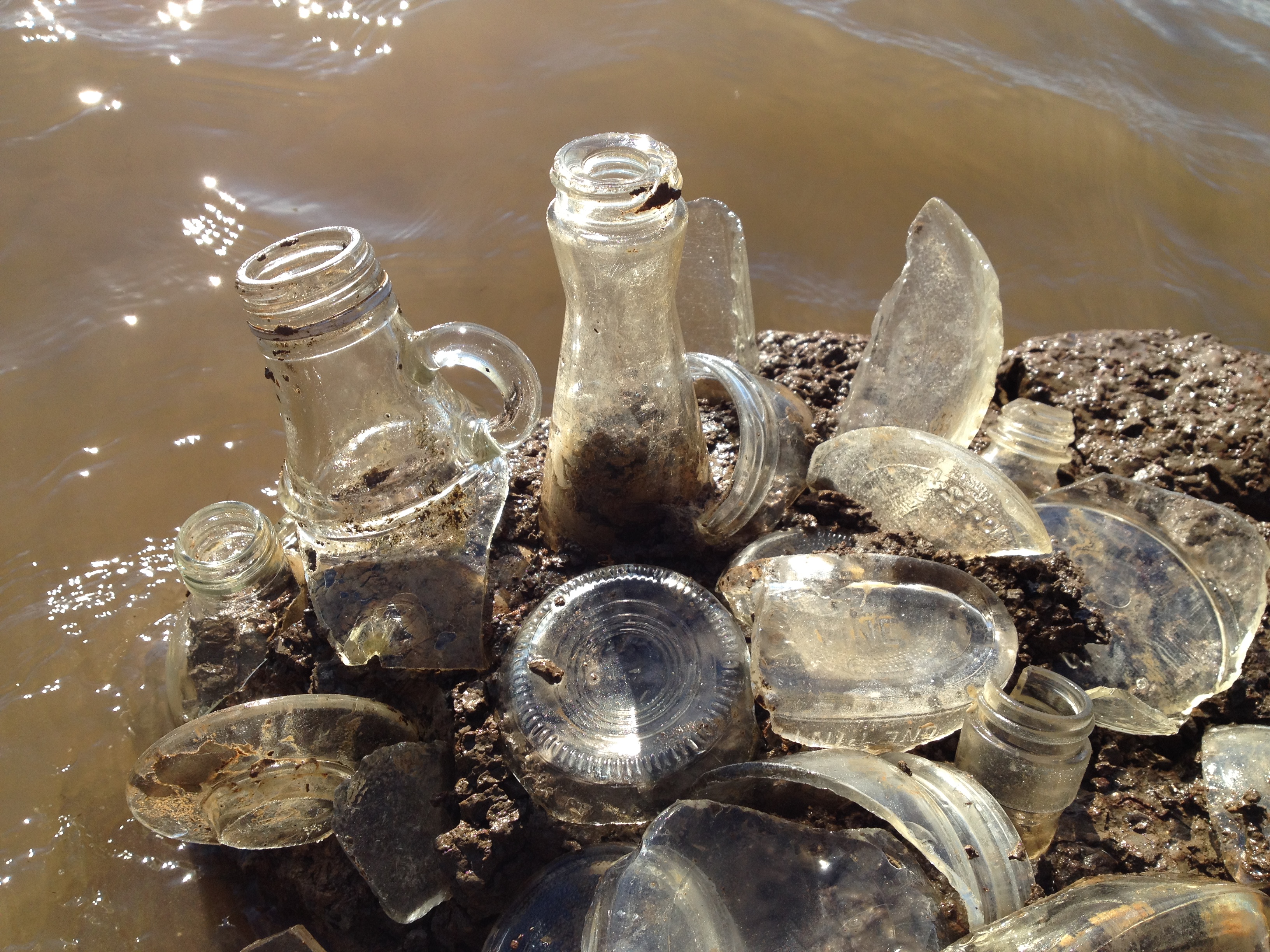
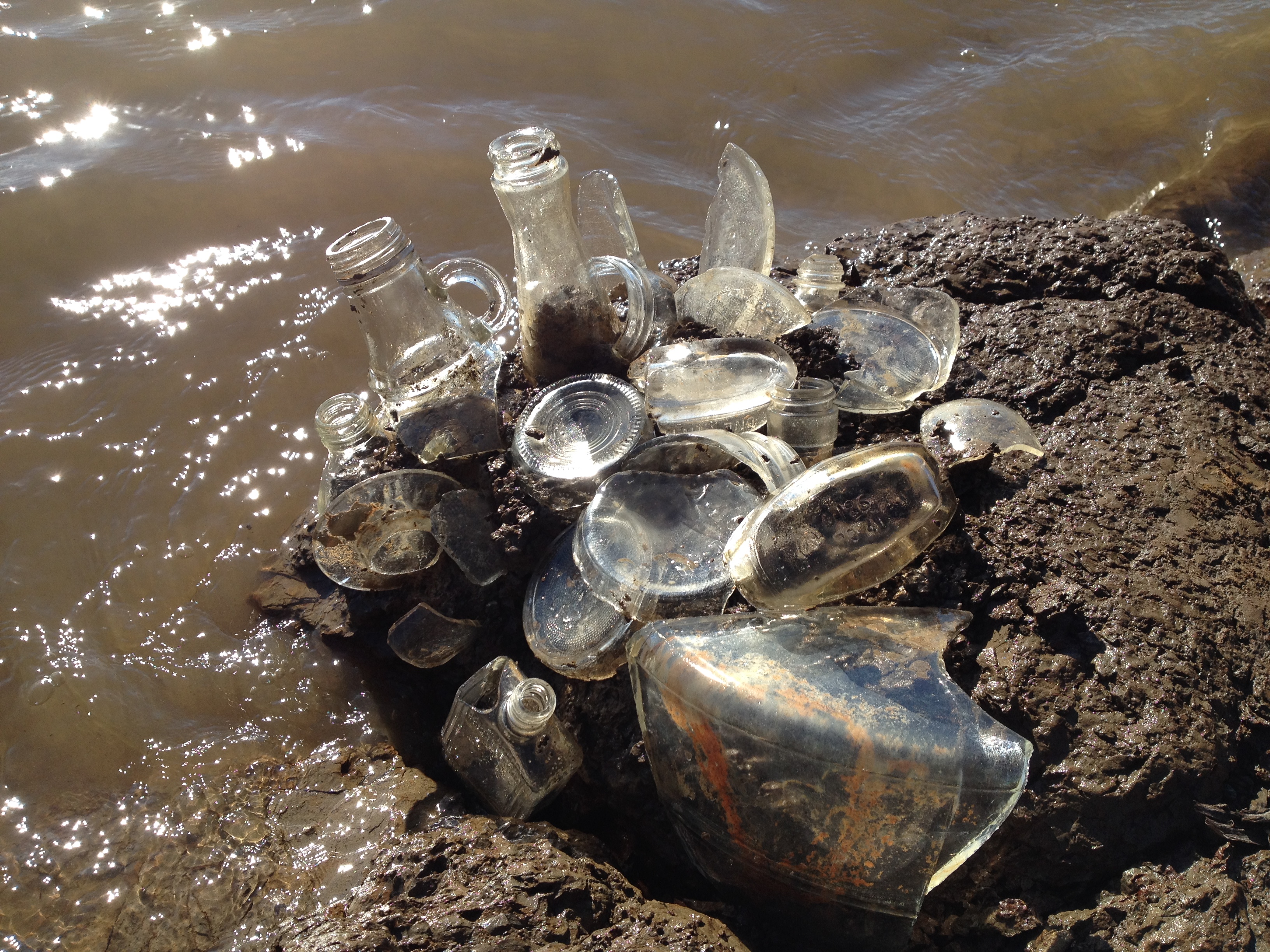
clear bottle glass assemblage, Falls of the Ohio, Nov. 2014

detail, clear bottle glass assemblage, Falls of the Ohio, Nov. 2014

I found all this clear bottle glass lying in close proximity and created this small assemblage on the mud.  I made this to enjoy the play of light through the glass as well as appreciate the highlights on the water.  This piece consisted mostly of bottlenecks and bottle bottoms which are the strongest parts of a glass bottle.  I wondered what if some archeologist in the future found this assemblage…would they think it had any aesthetic reason for being or could this be part of some unknown ritual?  This area along the Ohio River has been in constant habitation for thousands of years and the bottle pieces are now a part of that record.  My concept of art has greatly expanded since my student days.  On the back page of this 1966 magazine I find an amusing advertisement that reminds me of how far I’ve traveled from the traditional practice!  I guess being your own art teacher involves nude women?  If only my art education had cost a mere $6.00 dollars a month.  For better or for worse, who knows where I would be now?

Back page ad, Courier-Journal Magazine, Feb. 13, 1966


Read Full Post »

In the Willow Habitat, Falls of the Ohio, Nov. 2014

The Falls of the Ohio State Park has experienced its first light frost.  With the colder temperatures arriving, a maturing autumn anticipates the winter to come.  Although there are still some leaves left on the black willows and cottonwood trees…they won’t last much longer.  Already the curled up, shed leaves of the willows are gathering and forming brown islands around the parent trees and defining the spaces the willows occupy in this sandy area near the river.  As I walk through this habitat, cocklebur and various other seeds attach themselves to my jeans and shoe laces.  Picking and rubbing off the various prickly and sticky hitchhikers, it’s amuses me to think of myself as an agent of seed dispersal!

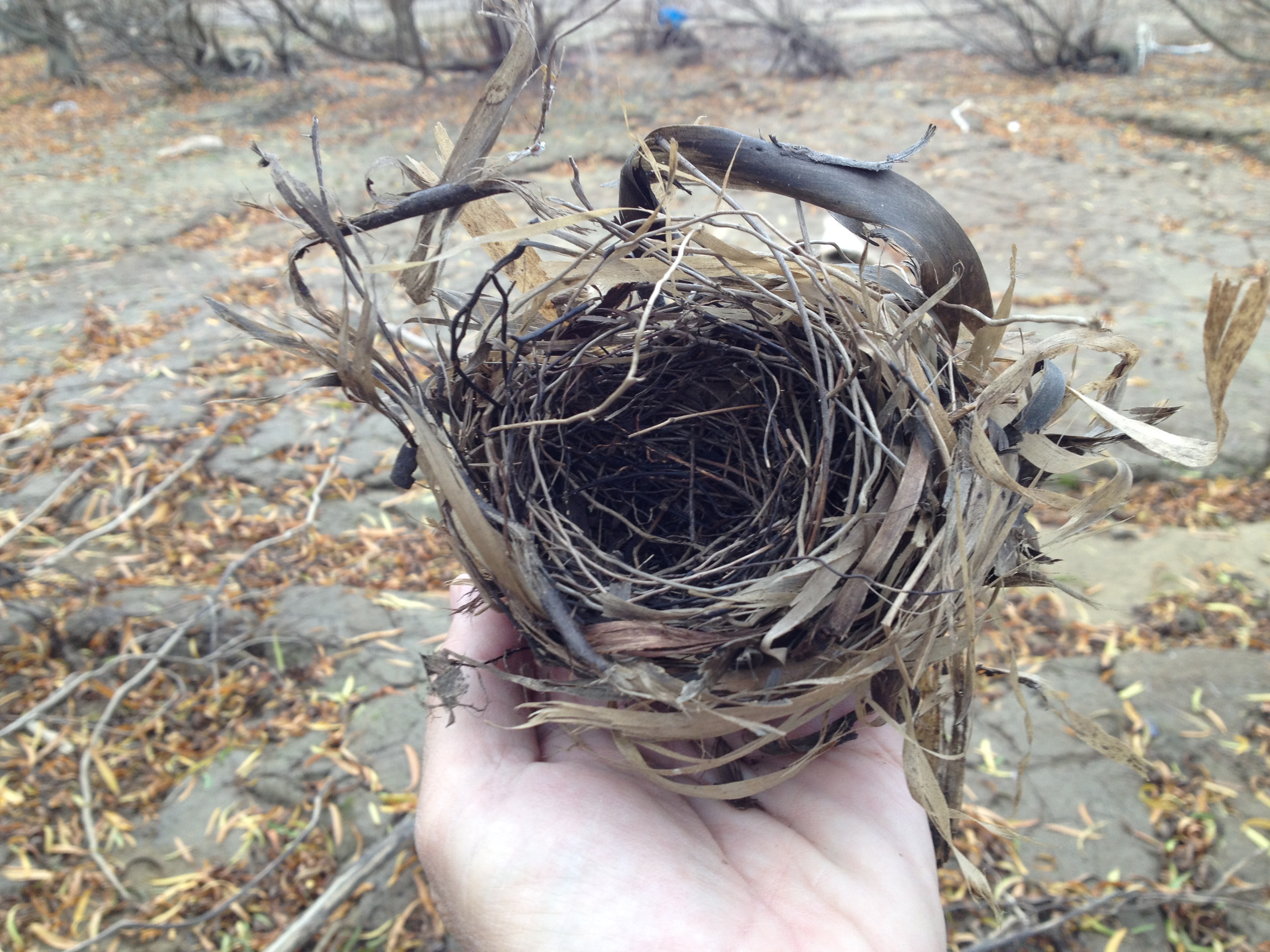
Found bird nest, Falls of the Ohio, Nov. 2014

A circular grass ball lying on the ground catches my eye.  Picking up the object I discover an intact bird nest.  Did it dislodge from some fork of a tree branch or is this from a ground nesting species?  I marvel at its construction and note its exterior is made from dried, interwoven grasses which contrasts with the well-defined interior composed of tiny twigs and rootlets that give structural strength to the bowl.  I wonder which species created it and were they successful in raising offspring?  The nest is now spent like the willow leaves and I place it on the ground to be reclaimed by nature.
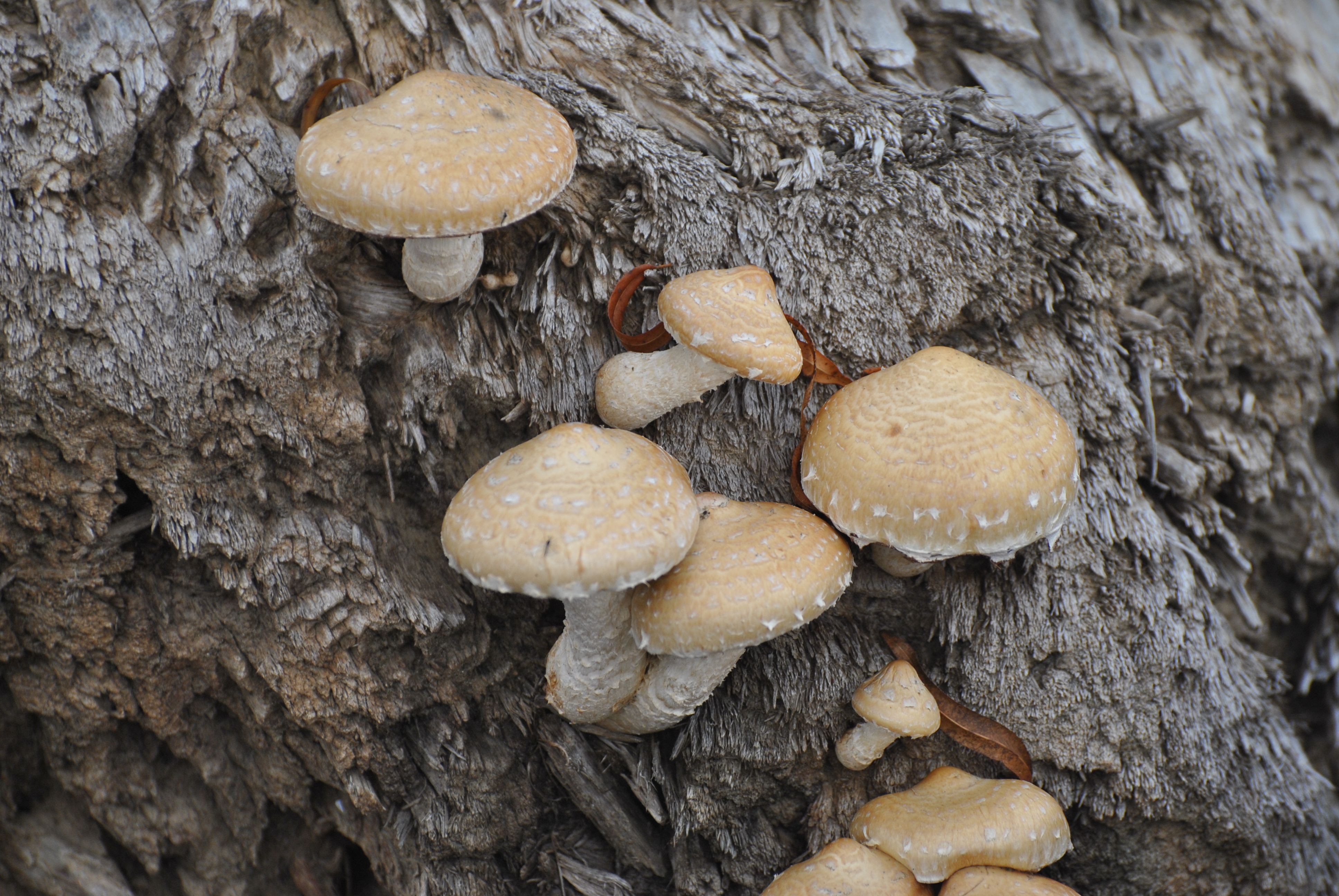
mushrooms growing on driftwood, Falls of the Ohio, Nov. 2014

Along my walk, I find various mushrooms and fungi growing on the decomposing driftwood.  I admire the variety of forms present.  Although the notion of decay hardly sounds optimistic…in this instance it is.  The fungi are great recyclers and return needed nutrients back into the environment.  These mushrooms are not lesser than, but rather co-equal to the many other interesting life forms that make this place their home.  I come across other signs of life along my hike.

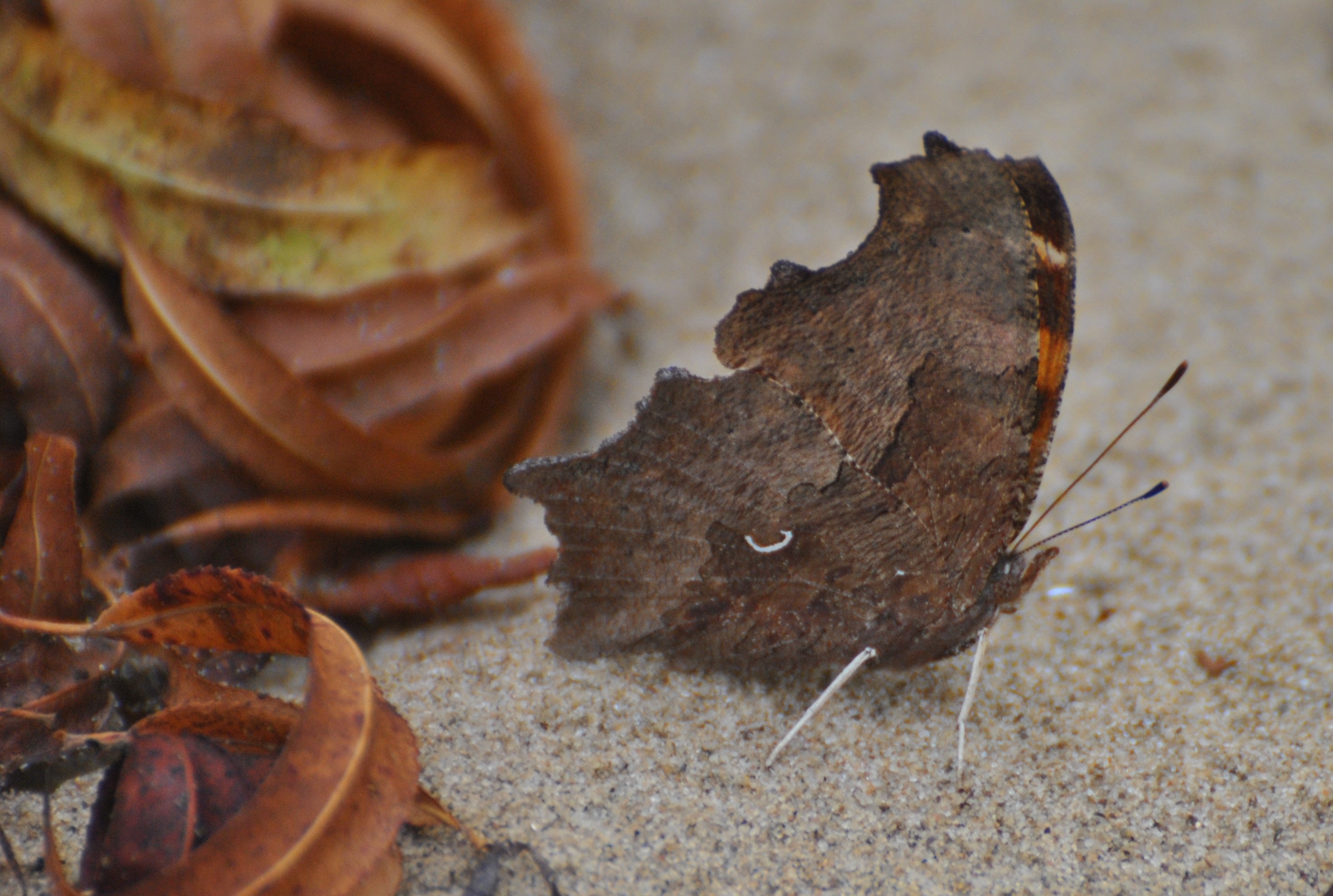
Comma butterfly with wings folded, Falls of the Ohio, Nov. 2014

There are still a few butterflies around like this Comma.  Although nectar from flowers is absent, there are still what I call “butterfly licks” on a few of the willow trees.  These licks are sweet spots along the trunk or branches where the tree exudes a sticky sap that attracts insects.  With its wings folded upright, this Comma looks much like a dried leaf itself.  There is a good chance this butterfly will hibernate and overwinter here before “passing the torch” to the next generation of Comma butterflies in the spring.

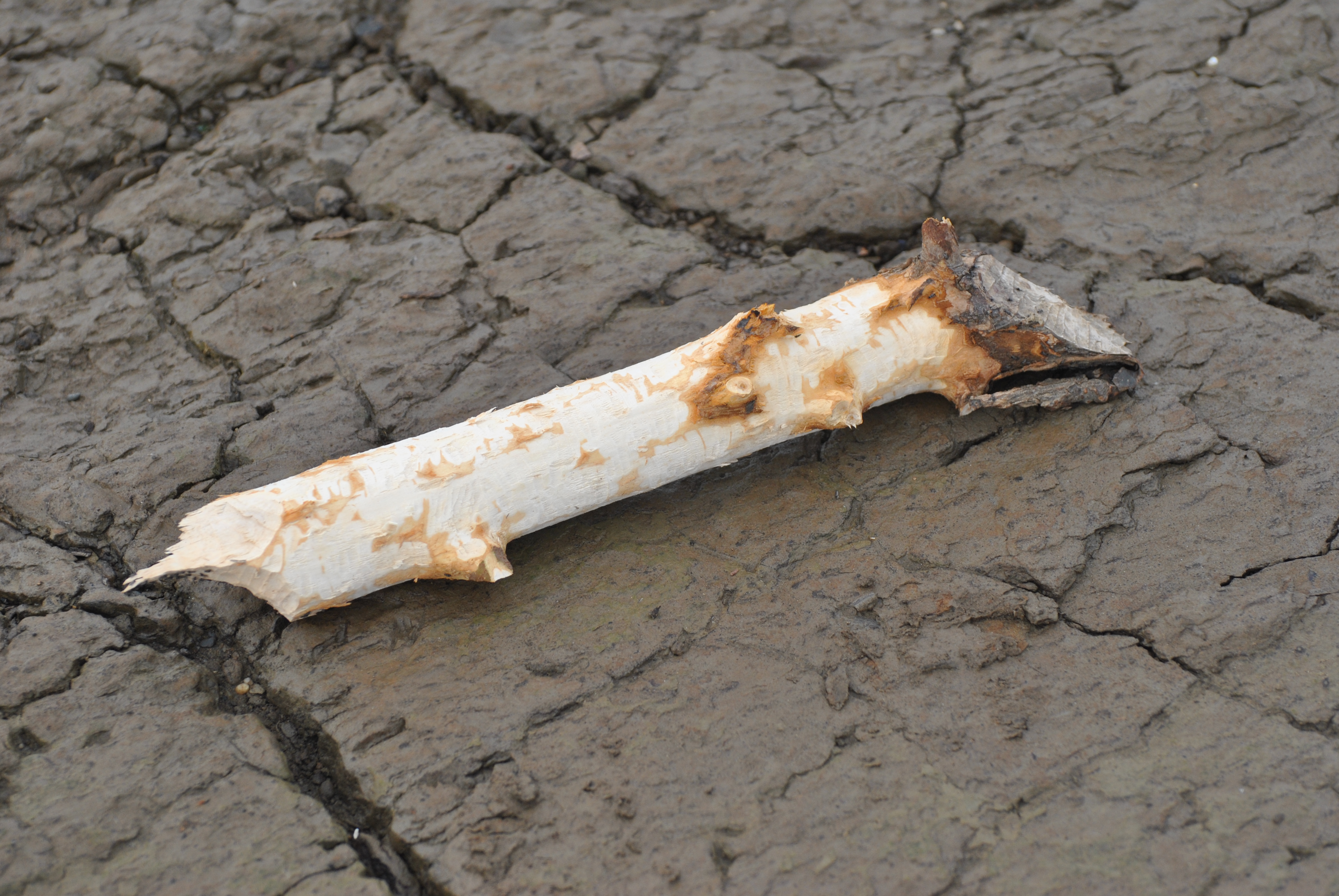
beaver chewed willow wood, Falls of the Ohio, Nov. 2014

Along the riverbank, I find lots of evidence that beaver have been in the area.  They have been feeding off the willow trees growing nearest to the water.  Beaver are very wary and are probably active at night or very early in the morning.  In all my years walking throughout the park, I have only seen them on a couple of occasions.  The photo above shows a willow branch that has been gnawed away from the tree and its bark has been nibbled off for food.  Their teeth leave “tool marks” on the creamy, ivory-colored wood.  By the end of today’s hike, I have collected a nice bundle of beaver chewed sticks to use in my art.  And speaking of art…I walked by a couple of projects I worked on in my previous post.  The rock ring in the water is still holding up, however, the “Silver Star” made from overlaying driftwood lengths in the sand is a shadow of its former self.  Here are a few before and after images.

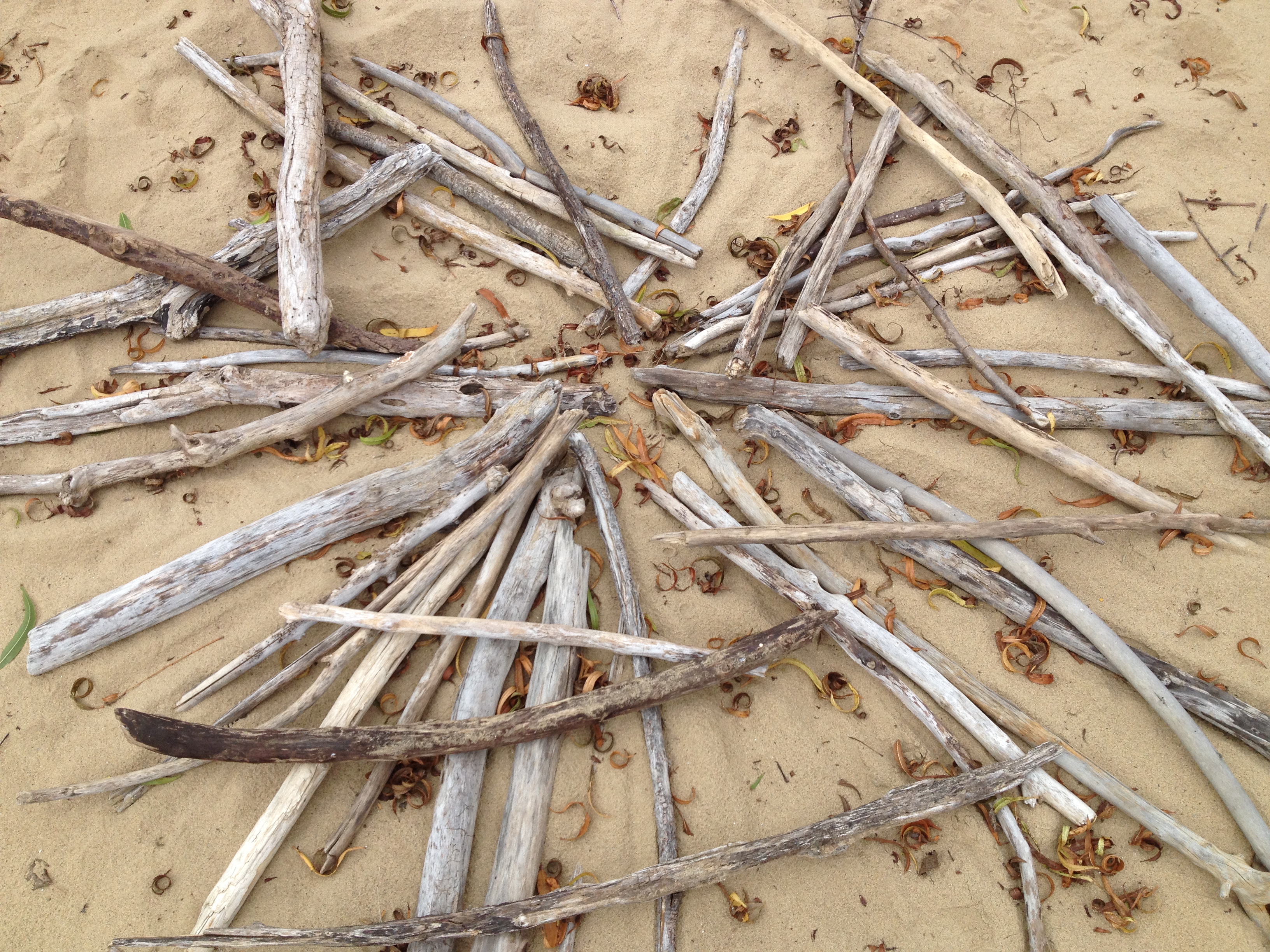
Detail of silver driftwood star, Falls of the Ohio, Oct. 2014

remains of the "Silver Star" driftwood piece, Falls of the Ohio, Oct. 2014

It’s a big difference and doesn’t appear to be the result of natural wear and tear…unless we accept that there is a naturally destructive side to man’s nature?  Of course, this is just a pile of sticks arranged in the sand, but on a much larger, planetary level can we say that the wholesale changes we are making to the environment are natural and inevitable?  I’m in the “no” camp because another aspect of our complex natures is the ability to discern right from wrong.  Still I wonder when our instincts for self-preservation will start kicking in?  I was beginning to mull this over more when I heard what sounded like someone playing strange music from an unfamiliar instrument.  I was pretty sure my ears weren’t hearing things and so I walked around until I found its source.  You can imagine my deep surprise when I came upon this interesting character in the willow habitat.

The Giggle Master, Falls of the Ohio, Nov. 2014

He introduced himself as the “Giggle Master” and he said he heard me talking to myself about serious things and grew concerned.  His method of revealing himself was to play a tune of his own composition from this combination oboe/recorder that grew from the middle of his face!  By breathing in and out and working the finger holes on his instrument he could produce a variety of sounds some of which were quite unique and appealing.  When I had adjusted to the idea that a strange being about a foot or 20 or so centimeters tall was talking to me…I relaxed my guard and decided to see what would happen next?  The Giggle Master told me to follow him and that he had something to show me that he believed would lighten my mood up considerably.

The Giggle Master and his collection, Falls of the Ohio, Nov. 2014

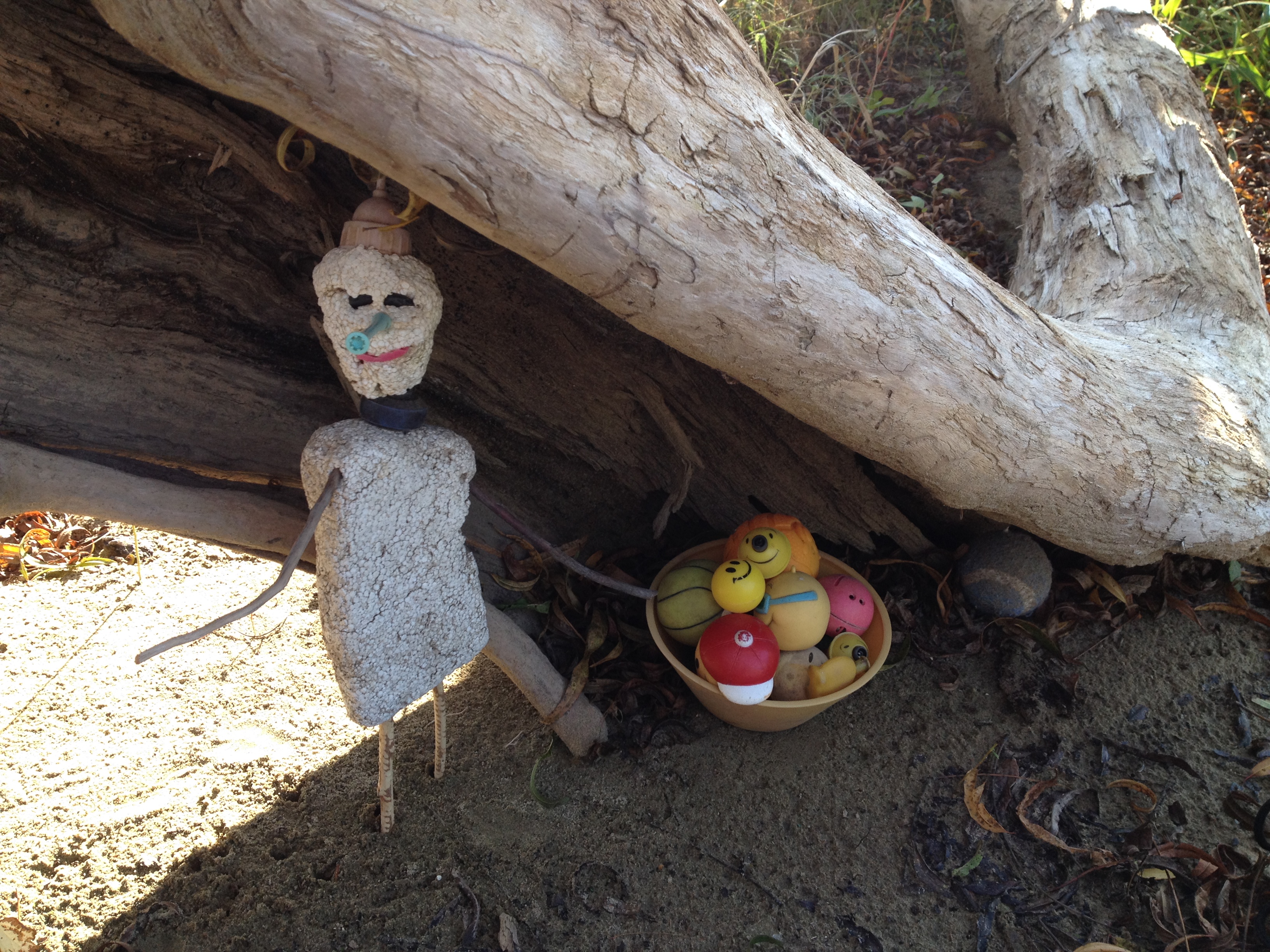
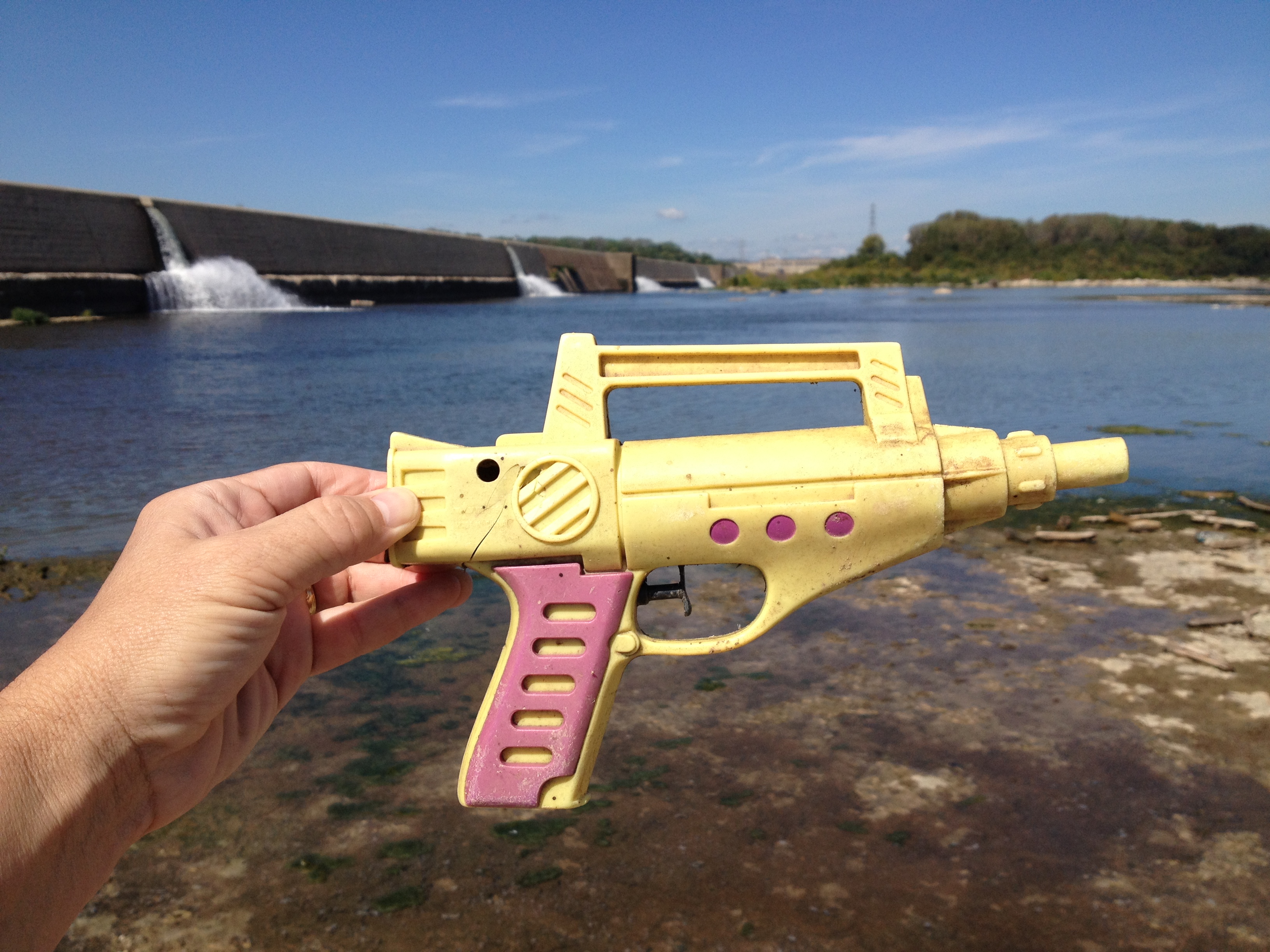
I followed my new friend to his shelter under a willow tree and he introduced me to his “collection”.  Like me, the Giggle Master is a finder and collector of odd river-deposited items.  He said it gave him great joy to assemble various odd collections where the sum of the collection is greater and more interesting than the parts.  I understood this perfectly because I have many unusual collections of my own river junk.  Some of which have been presented in this blog like my Squirt Gun Collection or Collection of Fake Foods.  You can see other collections I’ve formed and appear in my Pages section..  I have to say that the collection my friend was presenting to me was indeed unusual.  I asked what he called it and would it be possible to photograph it and present it to the wider world?  He said that he had no objections and so without further ado…here is what my friend called “The Giggle Bowl”.

The Giggle Bowl, Falls of the Ohio, Nov. 2014

We moved to the fossil beds for our impromptu photo shoot.  The Giggle Master told me that he had been collecting these “smiley faces” for a few years and now had enough to fill a found plastic bowl.  He went on to say that although he recognized that this was mostly waste plastic with all the accompanying bad baggage…it was also important to be able to step back and just appreciate the absurdity of it all.  The Giggle Master told me that taking oneself too seriously has potential consequences of its own.  He also told me that maintaining a healthy sense of humor would balance out the dark moods and I began to see the wisdom in this.  The Giggle Master said that he was appearing to me now because through some sixth sense all his own he could tell my own thoughts and feelings were beginning to sink below the horizon line.  He believed every person’s well-being would benefit from having a good laugh.  I have to admit it worked on me!  Okay, let’s spill the bowl and take a closer look at this goofy collection.

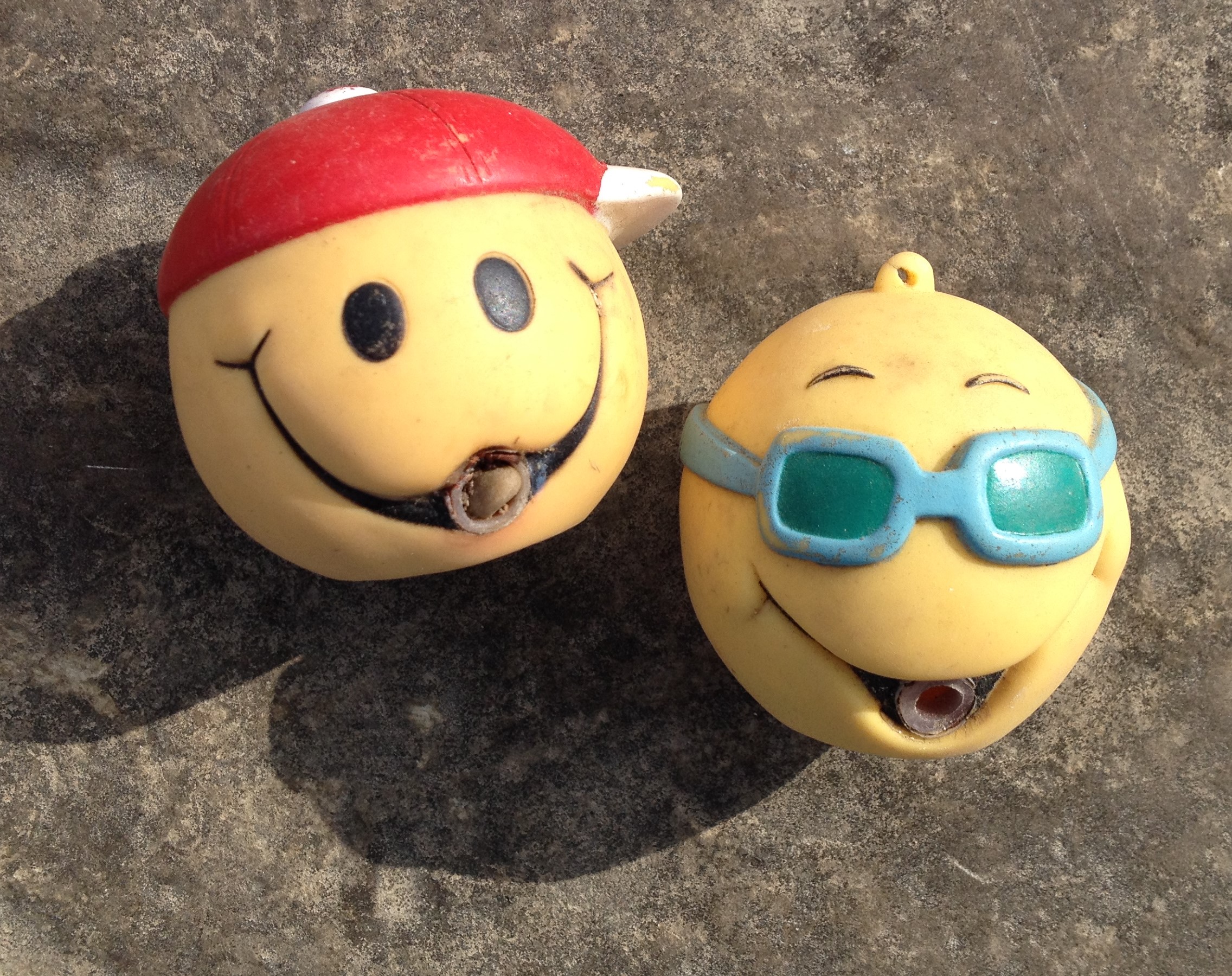
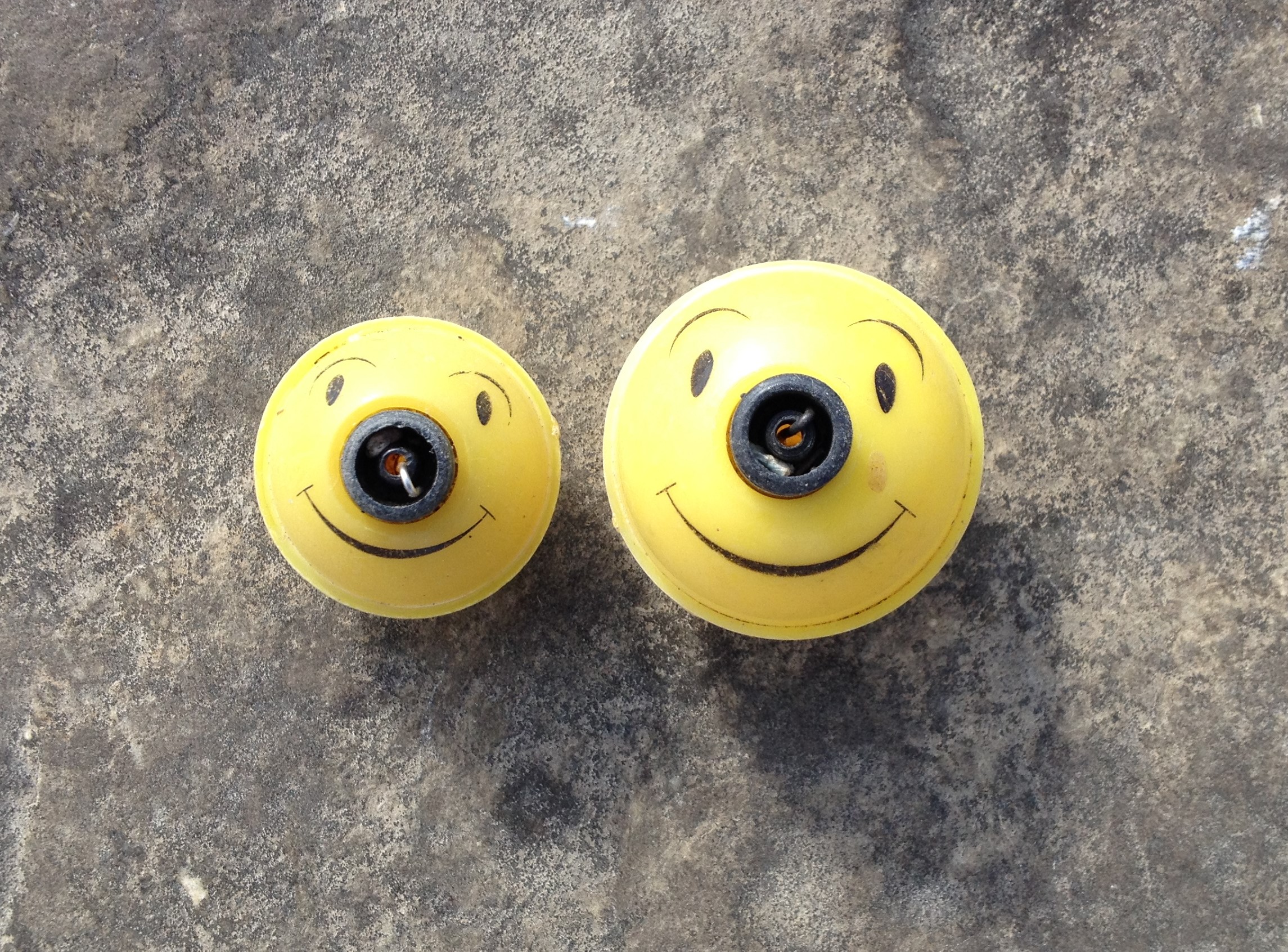
Two Smiley Face balls, purpose unknown, found at the Falls of the Ohio State Park

Okay, I confess that I have no idea what or how these smiley faces were used?  In their mouths, they have what look to be squeakers, however, these balls are too hard to squeeze.  The one with the red cap has a small stone lodged in its mouth and was made in China.

Three smiley face antenna balls, found at the Falls of the Ohio State Park

I frequently am grateful when something I come across says what it is.  In this case, these are three lightweight foam “antenna balls”.  Yes, for a while, there was a fad where people decorated the ends of their cars’ radio antennas with these novelties.  I like the one sporting a jester’s cap.

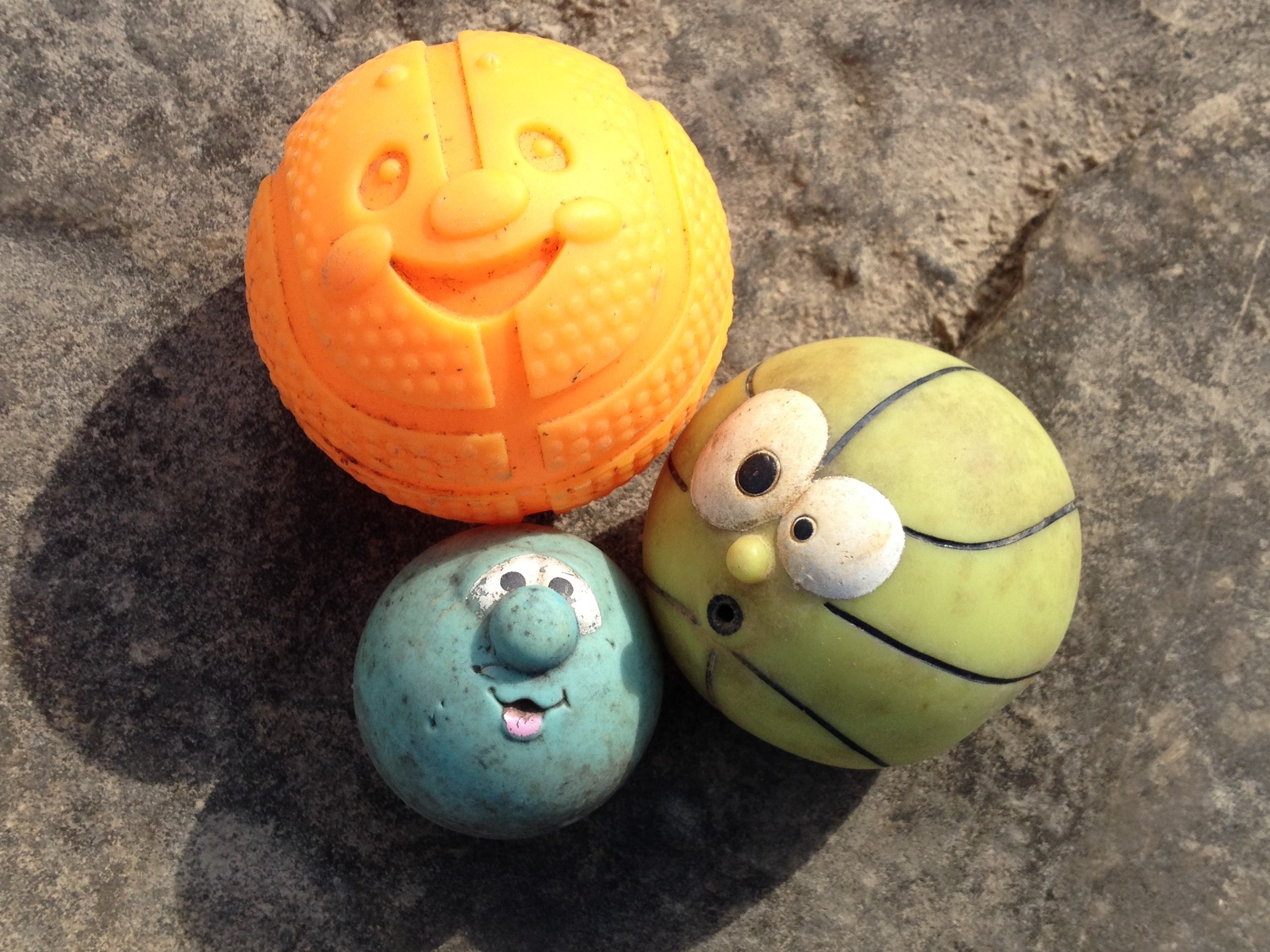
Three hard plastic face balls found at the Falls of the Ohio.

I’m calling these simply “face balls” because they are obviously not the more traditional “smiley faces”.  They floated into the park via the Ohio River from parts unknown.

Two smiling face fishing floats from the Falls of the Ohio

The Giggle Master was slightly alarmed because he realized he is missing the third smiling face from this series of objects.  I recognized that these are fishing floats and the missing float is larger still.  It will turn up somewhere.

A trio of plastic smiley faces found at the Falls of the Ohio

Here’s a trio of smiling faces.  The yellow one in the center is a simple ball, but the top and bottom pieces belong to something else I don’t recognize…do you?  The top piece looks to be a tiny container and maybe once held candy or soap-bubble solution, but there is no other information about it including its country of origin.

The Giggle Master with his Giggle Bowl collection, Falls of the Ohio, Nov. 2014

After the photo session was over, we returned to the willow tree where I first met the Giggle Master.  He stored his collection in a hollow formed in the tree’s trunk.  Before departing from my new friend, I thanked him for the much-needed laugh and wished him happy hunting as he expanded his silly collection.  No doubt the river will continue to supply new items.  He replied with a few notes from his…”nose instrument’.  As I turned for home, I looked back one last time and could discern a slight smile on his tiny face.  Until next time from the Falls of the Ohio.

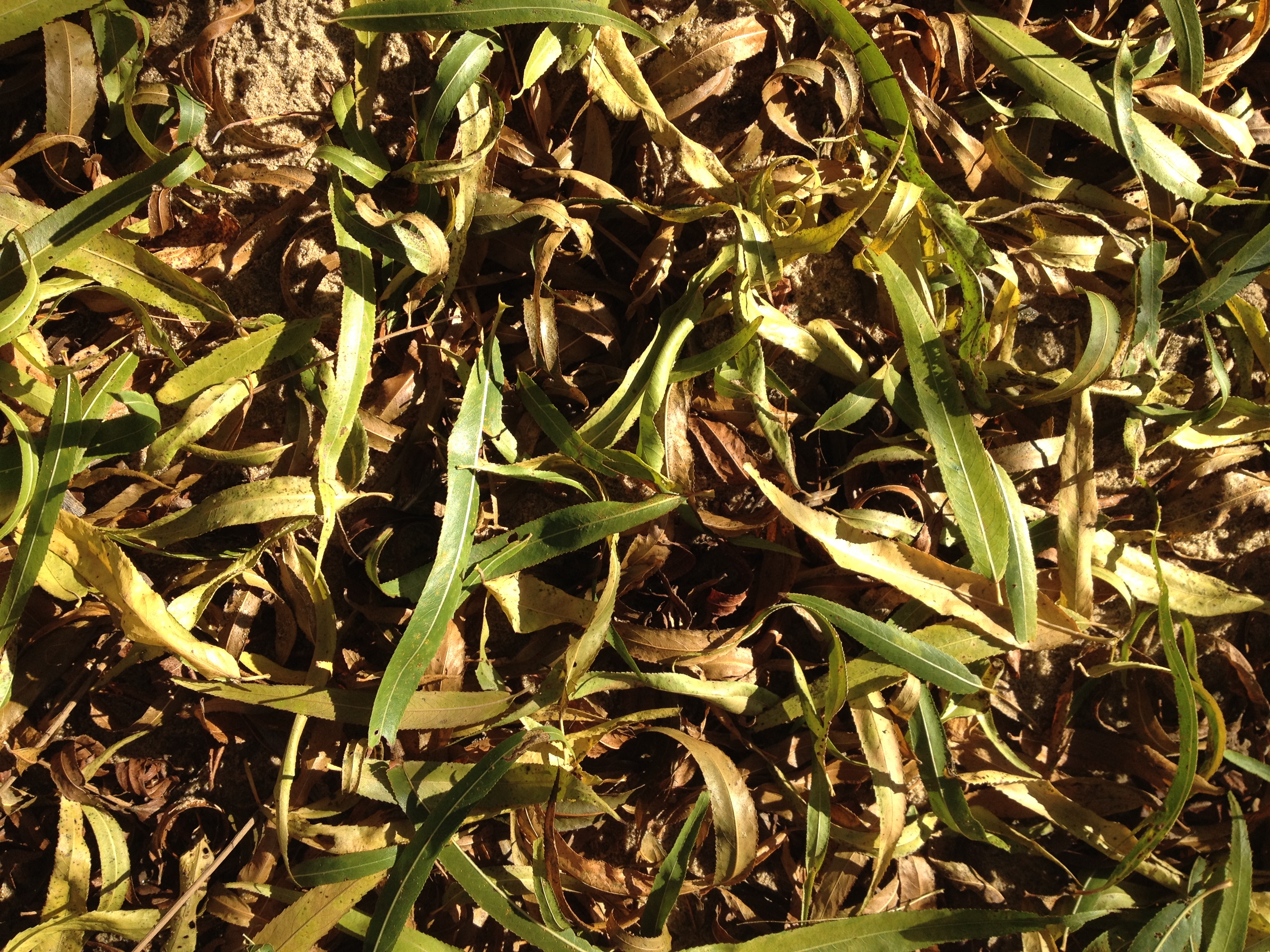
fallen black willow leaves, Falls of the Ohio, Nov. 2014

Read Full Post »

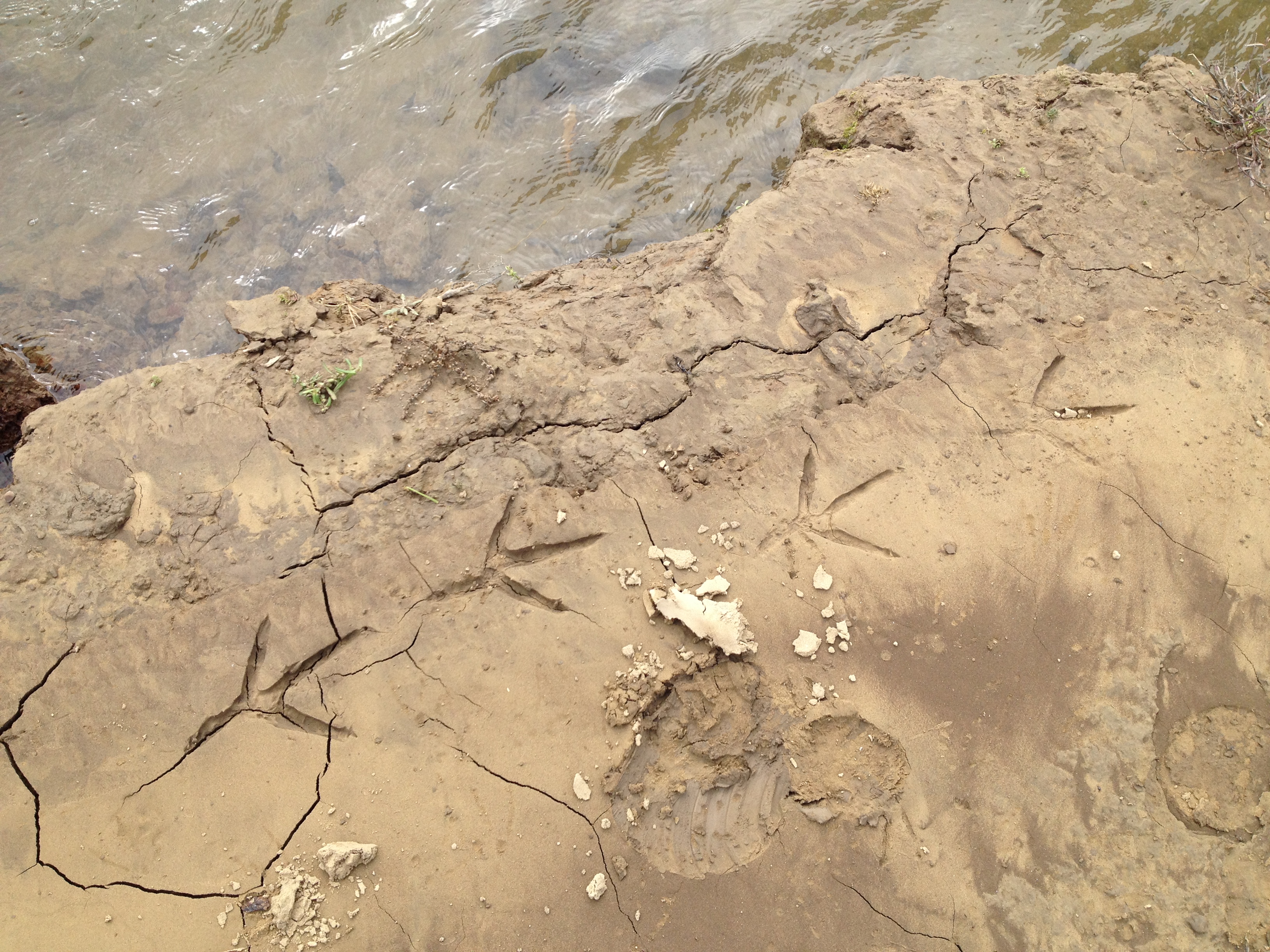
Great Blue Heron tracks in the mud, Falls of the Ohio, Oct. 2014

What began overcast and dreary blossomed into a gorgeous, sun-filled autumn day.  The exposed fossil beds by the Upper Tainter Gates are now covered by water rushing at break neck speed.  The Ohio River has once again reclaimed its ancient limestone bed with man’s help.  The Falls of the Ohio are like Niagara Falls which can also be regulated with the flip of a switch.  There’s a good chance that I won’t be visiting that side of the park again until next summer’s heat returns.  Today I concentrated my attention and energy along the riverbank under the Conrail Railroad Bridge.  This is an area where I have had good luck finding materials to work with and many of my best bird sightings have also occurred here.  The autumnal migration is under way.  Many of the birds that had passed this way going north in the spring are now moving south towards wintering grounds in exotic locations in Central and South America.  I ducked under the Black willow trees whose leaves are turning bright yellow and was soon rewarded by a bird species new to me.

Fan-tailed Gnatcatcher, Falls of the Ohio, Oct. 2014

This is the Fan-tailed Gnatcatcher and this is the first time this species has been recorded in the park.  I had the greatest luck hiding behind the trunk of this willow and was able to observe this bird at extremely close range.  If it spotted me…it demonstrated no concern at all and continued its search for small insects and spiders hiding among the furrows in the tree’s bark.

Fan-tailed Gnatcatcher, Falls of the Ohio, Oct. 2014

The Fan-tailed Gnatcatcher is a diminutive bird.  I watched as it dutifully searched the tree for food.  It had no problems going down the tree head-first in nuthatch fashion.  In this species, both the male and the females are similarly marked.  This young bird (identified by its lack of a feathered crest on it head) was just an egg a couple of months a go and has flown here from northern Canada.

Fan-tailed Gnatcatcher, Falls of the Ohio, Oct. 2014

I was literally at arm’s length to this bird and it was a such a treat to observe something new and at close range.  I loved the coloration on this bird.  The tail feather’s blue fan is balanced by the bird’s bright blue beak.  Rusty-colored wings are set off by the arctic-white hues along the head and body.  Like many bird encounters, I was only able to observe this bird for a minute or two at the most, but it was an experience that will last a lifetime.  As it flew off…I wished the bird well on its long journey and I hoped I could count its kind again among the park’s willow trees.

fallen willow leave on mud, Falls of the Ohio, Oct. 2014

I lingered in the moment for a while.  No sense in rushing things.  When I was confident that no other birds were in the area, I moved back to a spot where the Fixed Wier Dam joins the Lower Tainter Gates.  This would be the site for my next project.

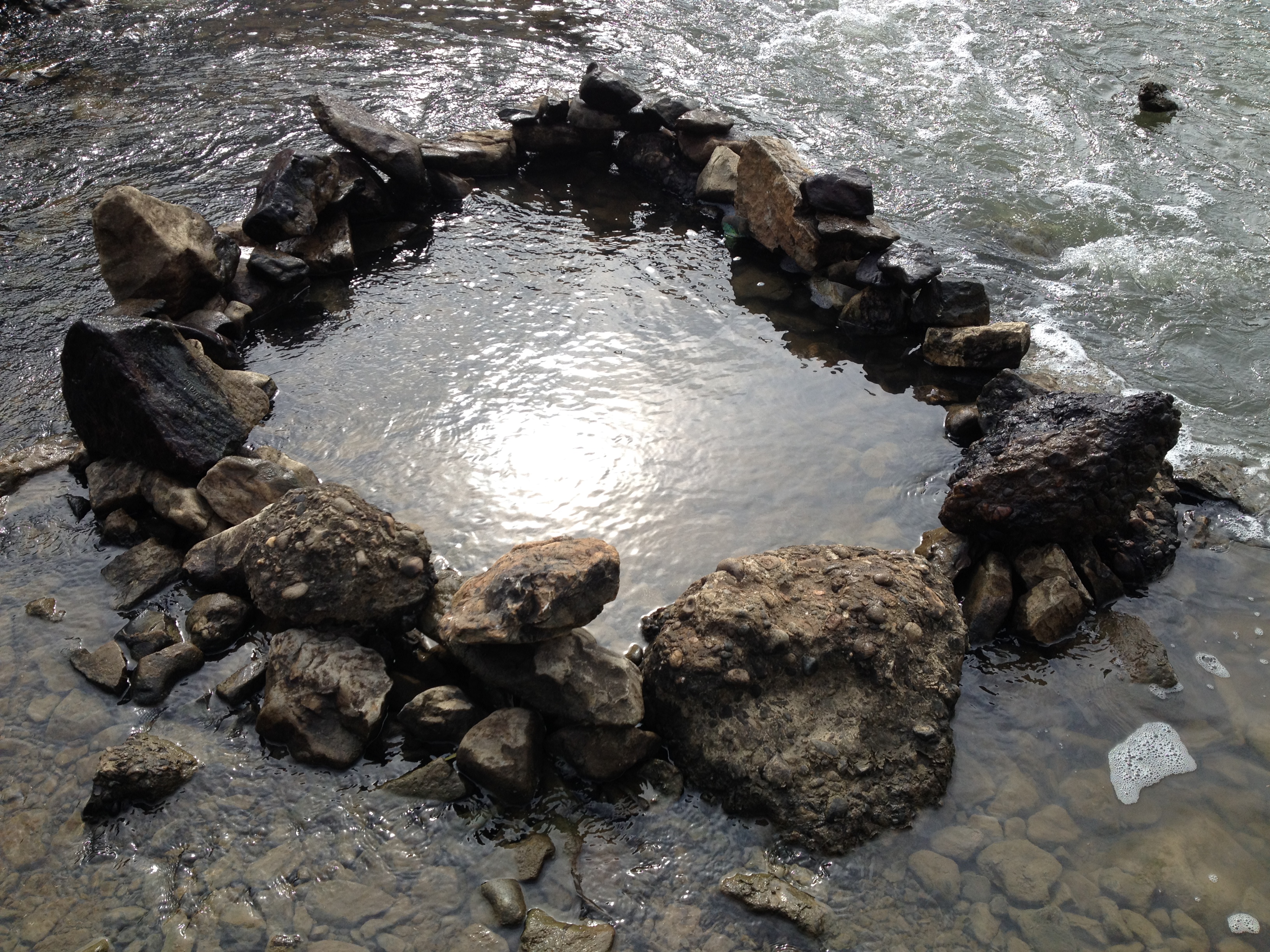
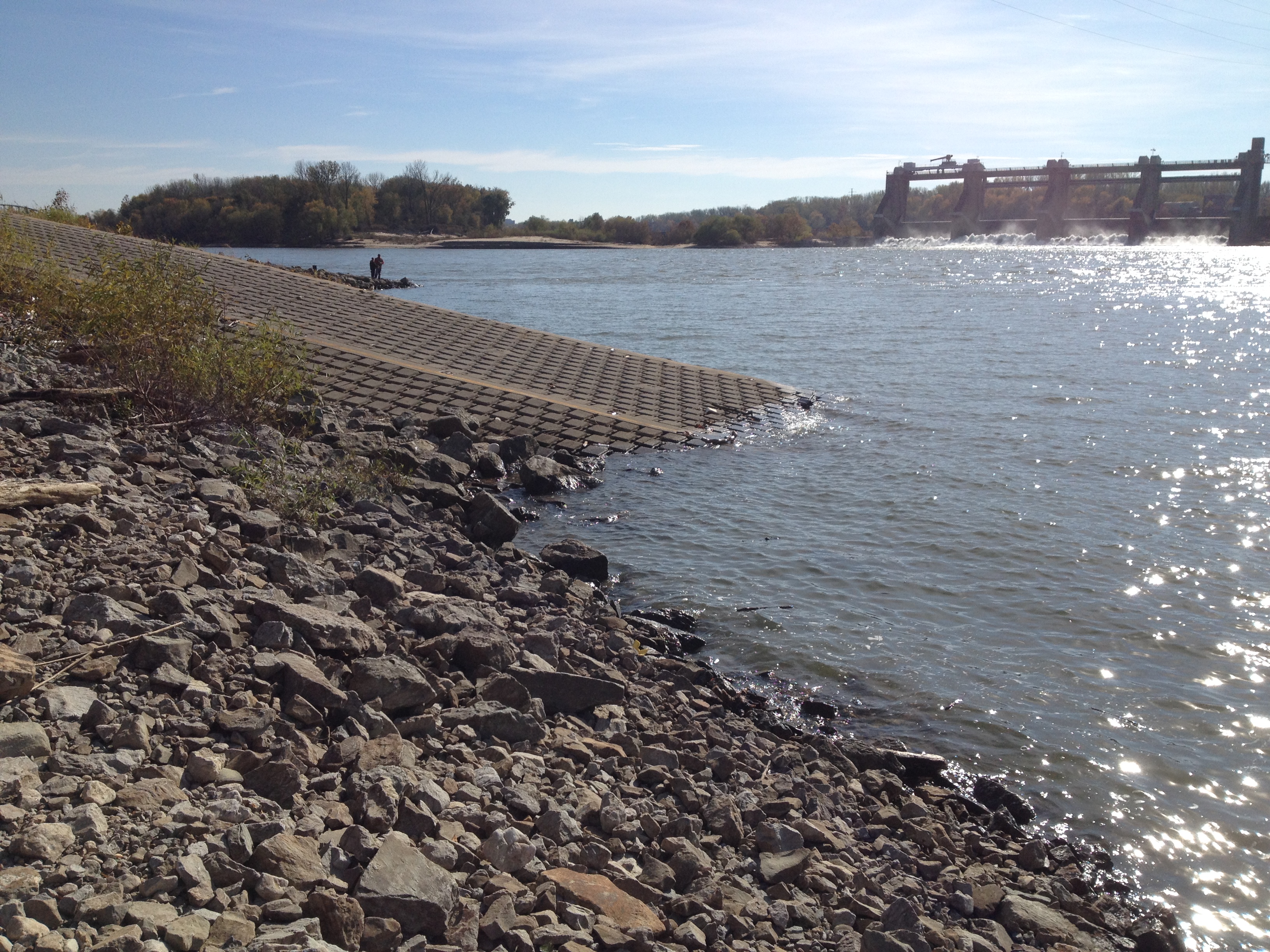
stone and concrete ring by the dam, Falls of the Ohio, Oct. 2014

The dam at this location has curtains of water flowing through openings that are lower than the top of the wall and represents the true water level of the river.  This flow feeds a small channel that leads back to the river and is a favorite place for fishermen.  I had earlier noticed among the large broken sections of concrete and loose rock that some other creative soul(s) had started what looked like a stacked stone ring in the water.  There was the remnants of a foundation and I decided to build it back up for a look-see and to elaborate on it if possible.  I guess this in effect is a collaboration with an anonymous individual.  The image above was taken after I began reconstructing the ring.

Sun light reflecting with the stone ring, Falls of the Ohio, Oct. 2014

As I kept building up the ring, I would document my progress.  This is one of my favorite shots from the series.  Here I was able to center the sun’s reflection within the ring’s interior.  In my mind it became a portal to some other place far beyond the river.  The image of a passage way or tunnel is one that recurs in my Falls projects.

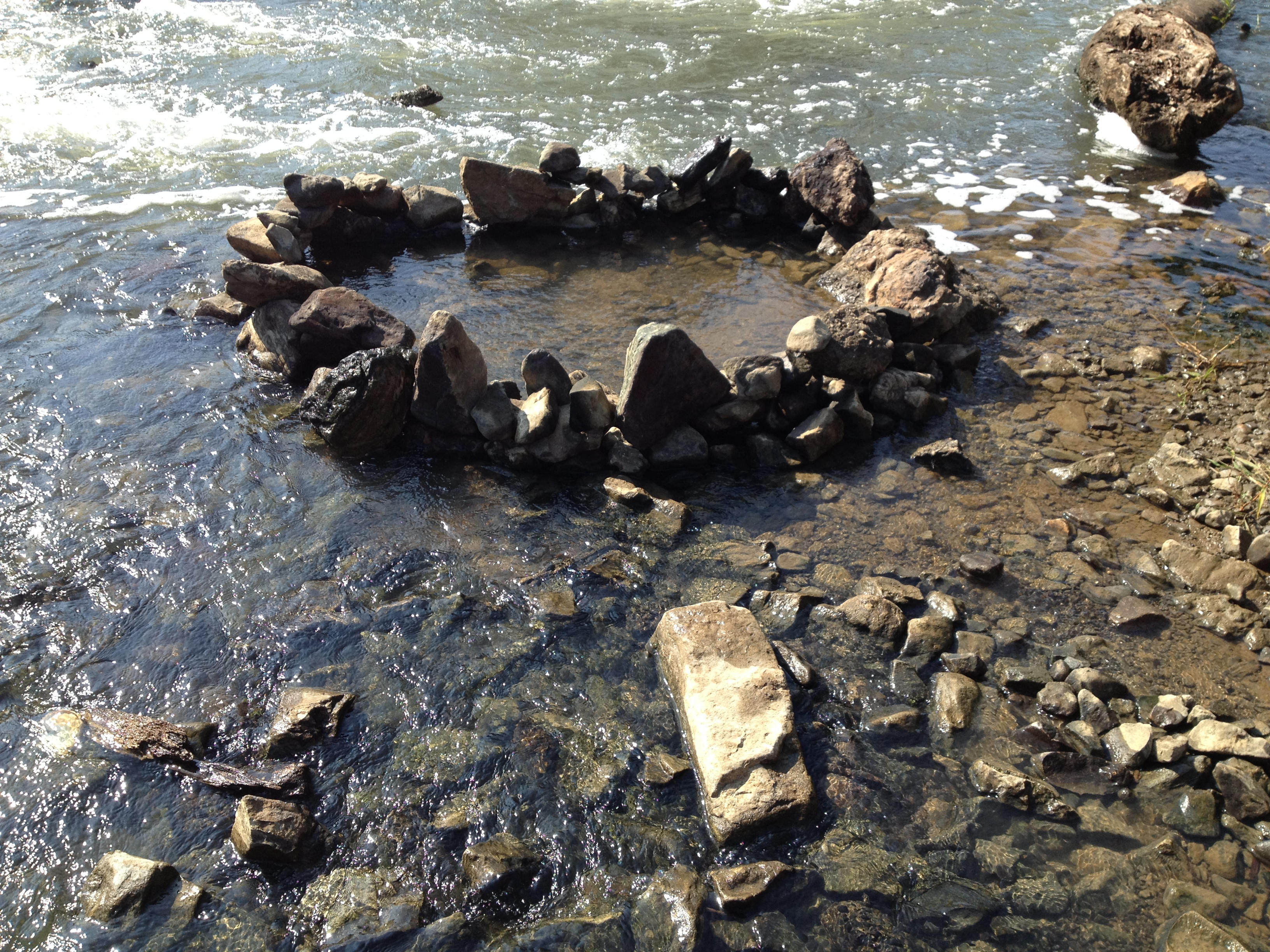
rock and concrete ring, Falls of the Ohio, Oct. 2014

I would have added the rectangular rock in the foreground, but it proved heavy and sunk into the mud.  Interestingly, the water within the ring was much calmer and created a safe harbor which contrasted with the swiftly flowing water around it.

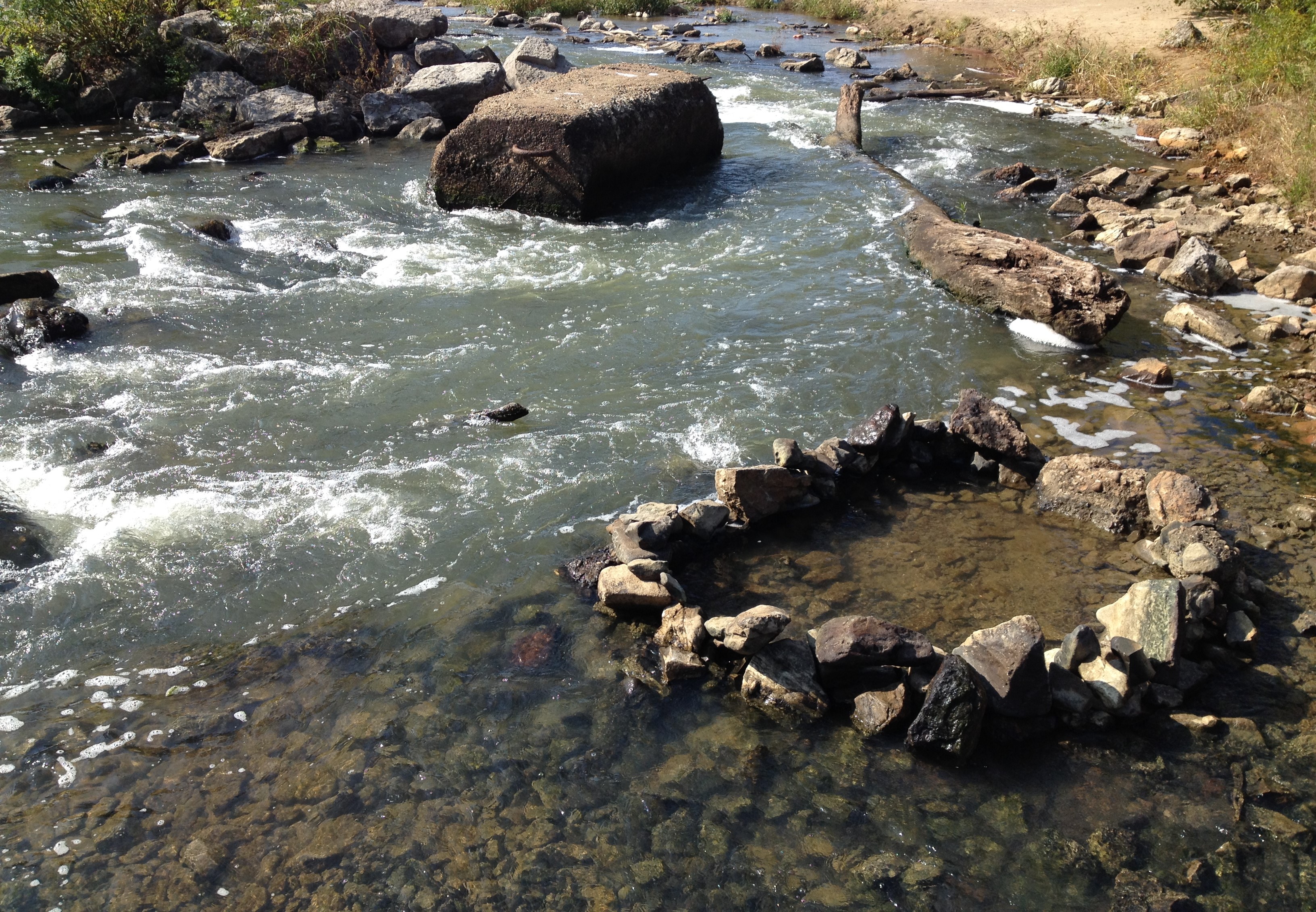
rock and concrete ring, Falls of the Ohio, Oct. 2014

The ring’s slightly irregular shape was determined by its placement.  The ring is situated on the edge of where the water cascading off the dam’s wall has worn a deeper channel in the shallow bottom.  Since it was such a beautiful day I decided to spend more time at the Falls.  I made one other site-specific work where the center is a point of focus.

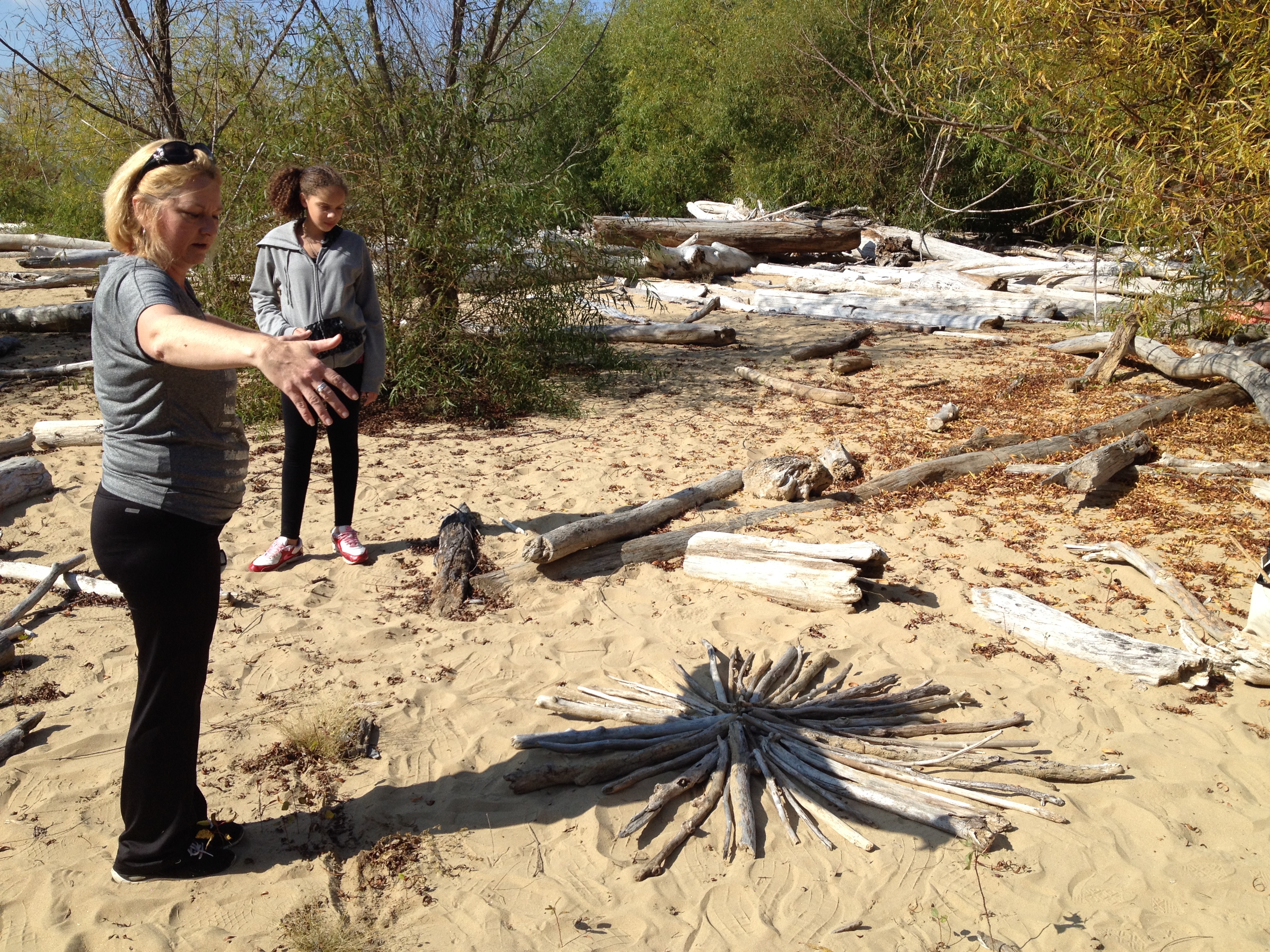
silver driftwood star, Falls of the Ohio, Oct. 2014

Detail of silver driftwood star, Falls of the Ohio, Oct. 2014


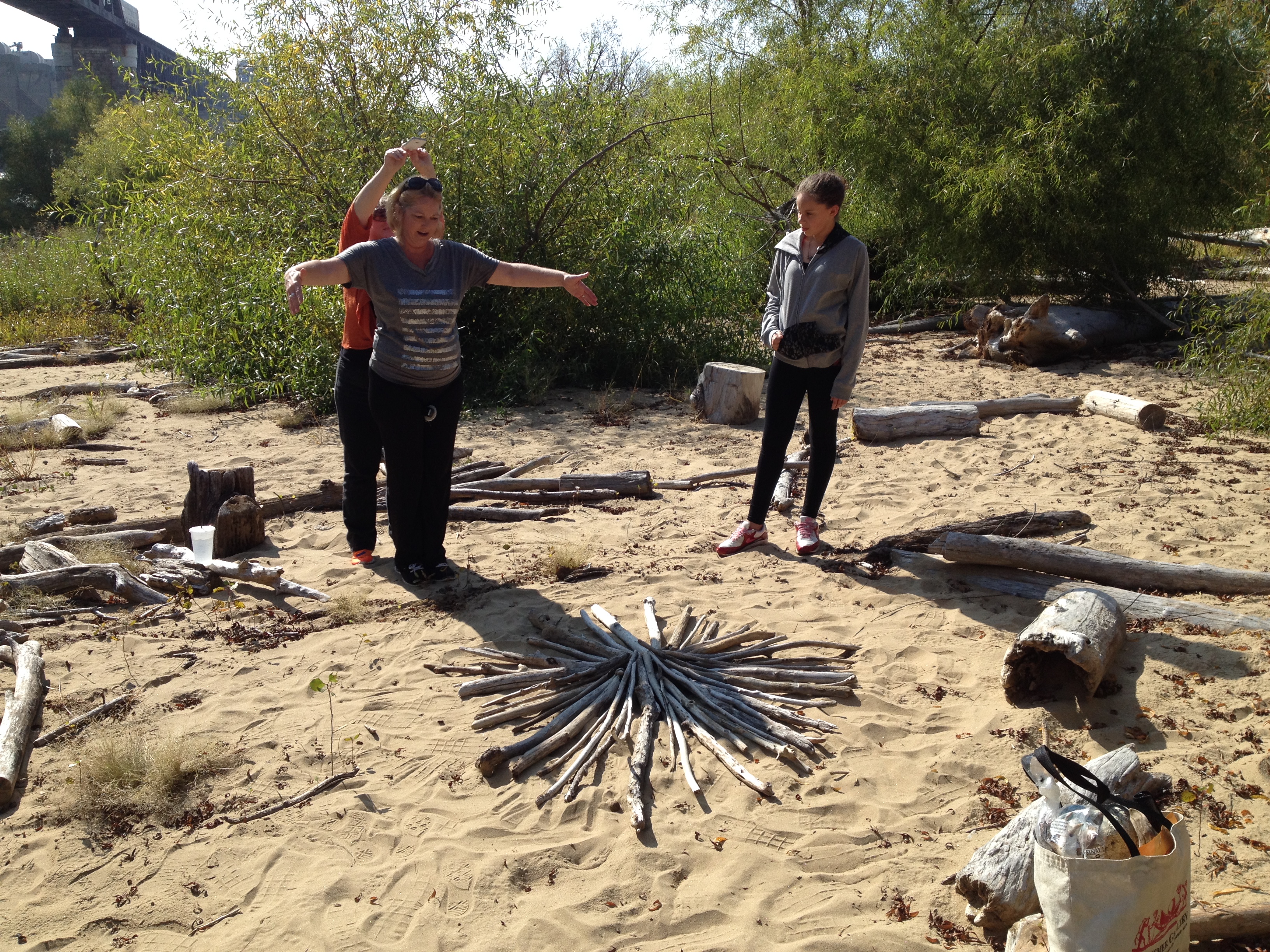
What I love about the driftwood at the Falls of the Ohio is the way it changes color as it ages.  After a summer’s worth of sunlight, the wood here takes on a silvery-gray color.  I collected lengths of wood from the immediate area and laid them in the sand.  The silver driftwood radiates away from a central point.  While I was engaged with my “Silver Star” four very nice people stopped by and asked directions to the fossil beds.  These park visitors became interested in what I was doing.  I appreciated that they wanted to participate and play along in their own way.  Here are a few additional images.  I’m assuming they are two mothers with their daughters enjoying an outing to the river?  Here one person is photographing the cast shadow on my wood piece.

Visitors interacting with my art, Falls of the Ohio, Oct. 2014

Park visitors interacting with my driftwood star, Falls of the Ohio, Oct. 2014

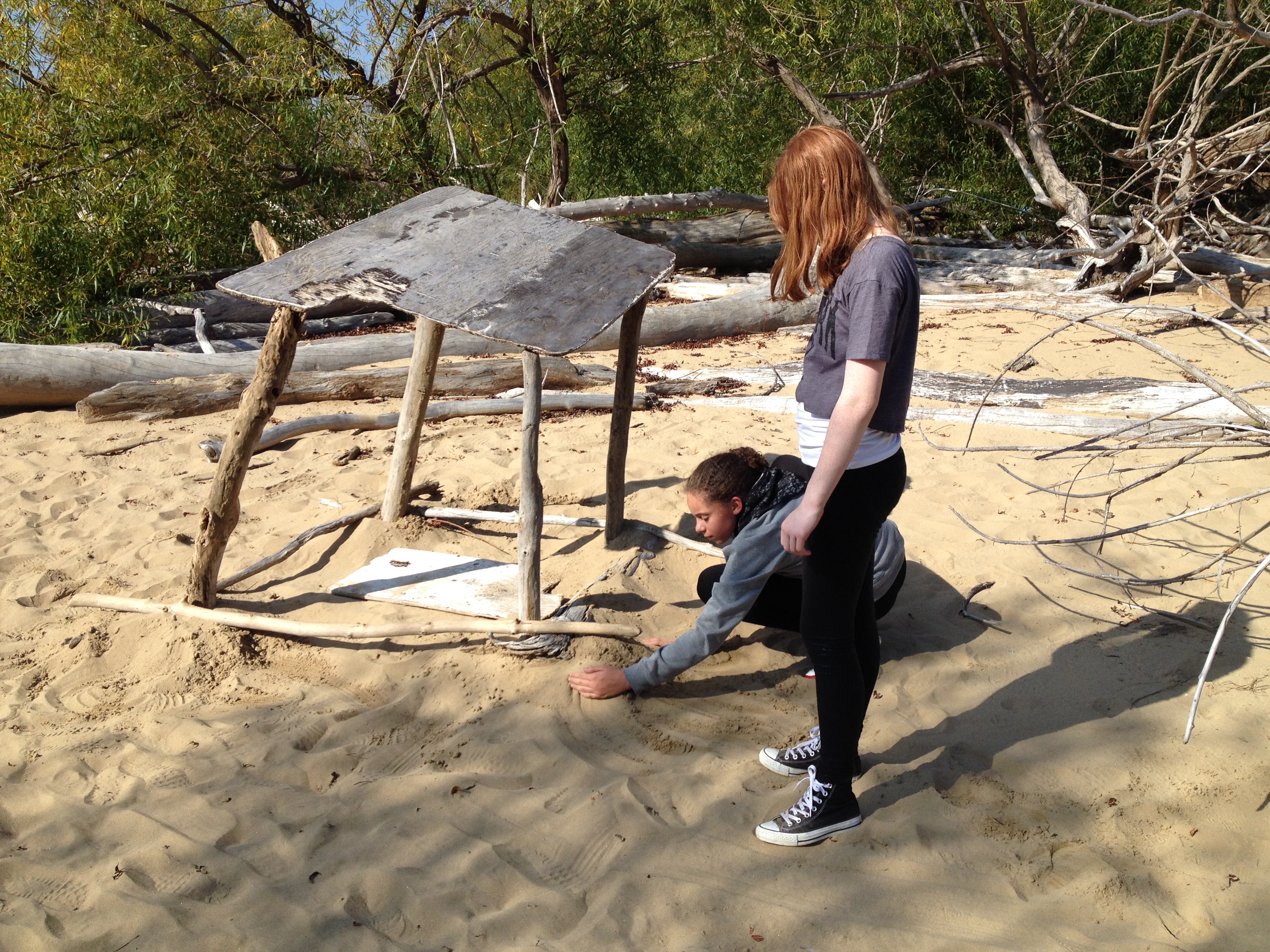
I think I may have inspired the daughters to attempt their own project?  Before too long they were picking up pieces of driftwood and making a make-shift shelter of their own design.

Girls making a driftwood shelter, Falls of the Ohio, Oct. 2014

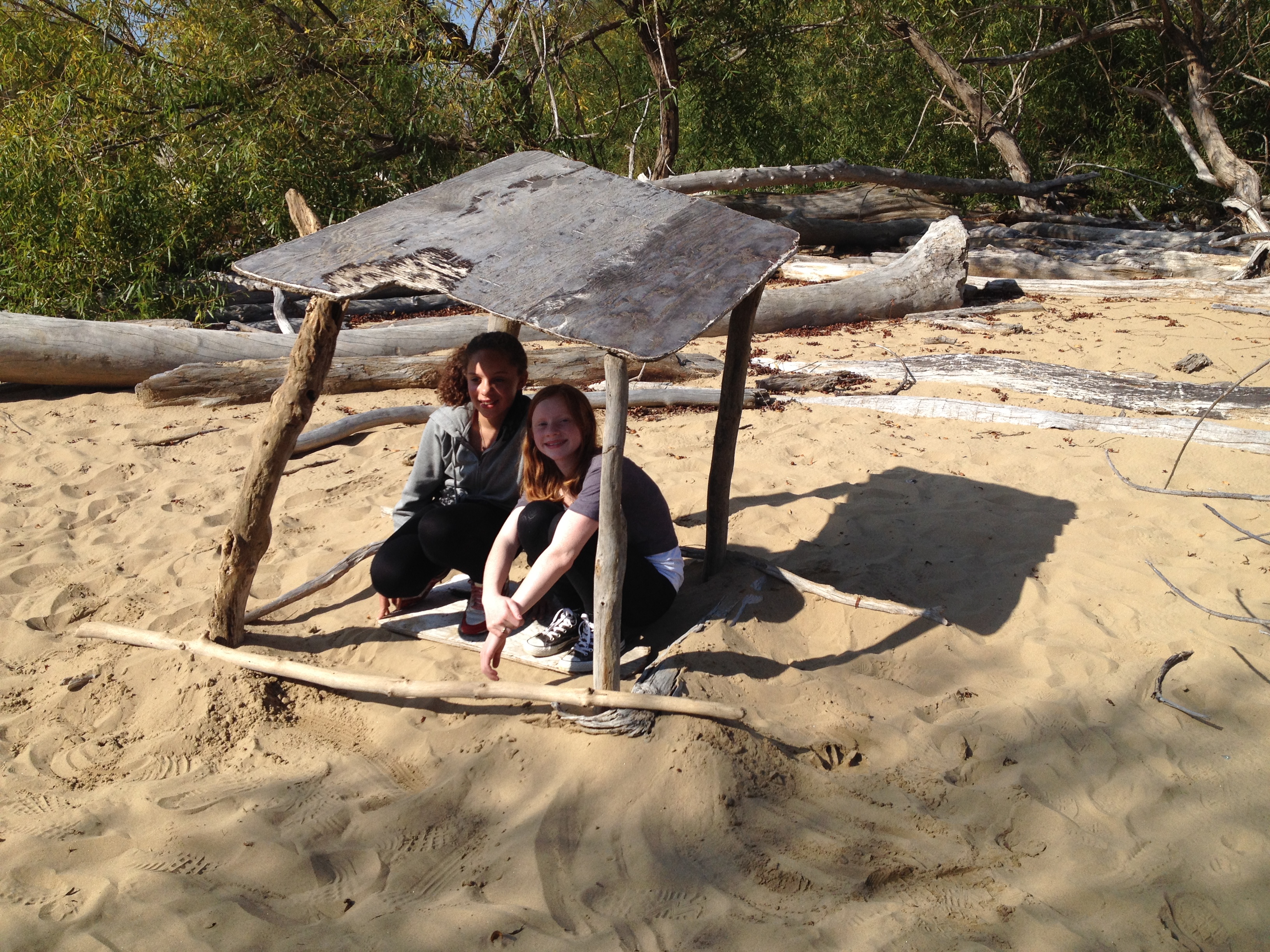
Girls posed under their improvised shelter, Falls of the Ohio, Oct. 2014

The girls looked very happy under their driftwood shelter!  When my sons were younger, this was a favorite activity of theirs and this day brought back those good memories.  This park is such a great playground and allows one to exercise both your body and imagination.  I wonder if these ladies ever found the fossil beds?  It probably doesn’t matter since it looked like a good time was had by all.  Soon enough it was time to go home and I gathered up my collecting bag and walking stick and admired the late season flowers as I walked back to my vehicle.  Thanks for tagging along and I hope to see you next time from the Falls of the Ohio State Park.

tiny composite flowers with bee, Falls of the Ohio, Oct. 2014

Read Full Post »

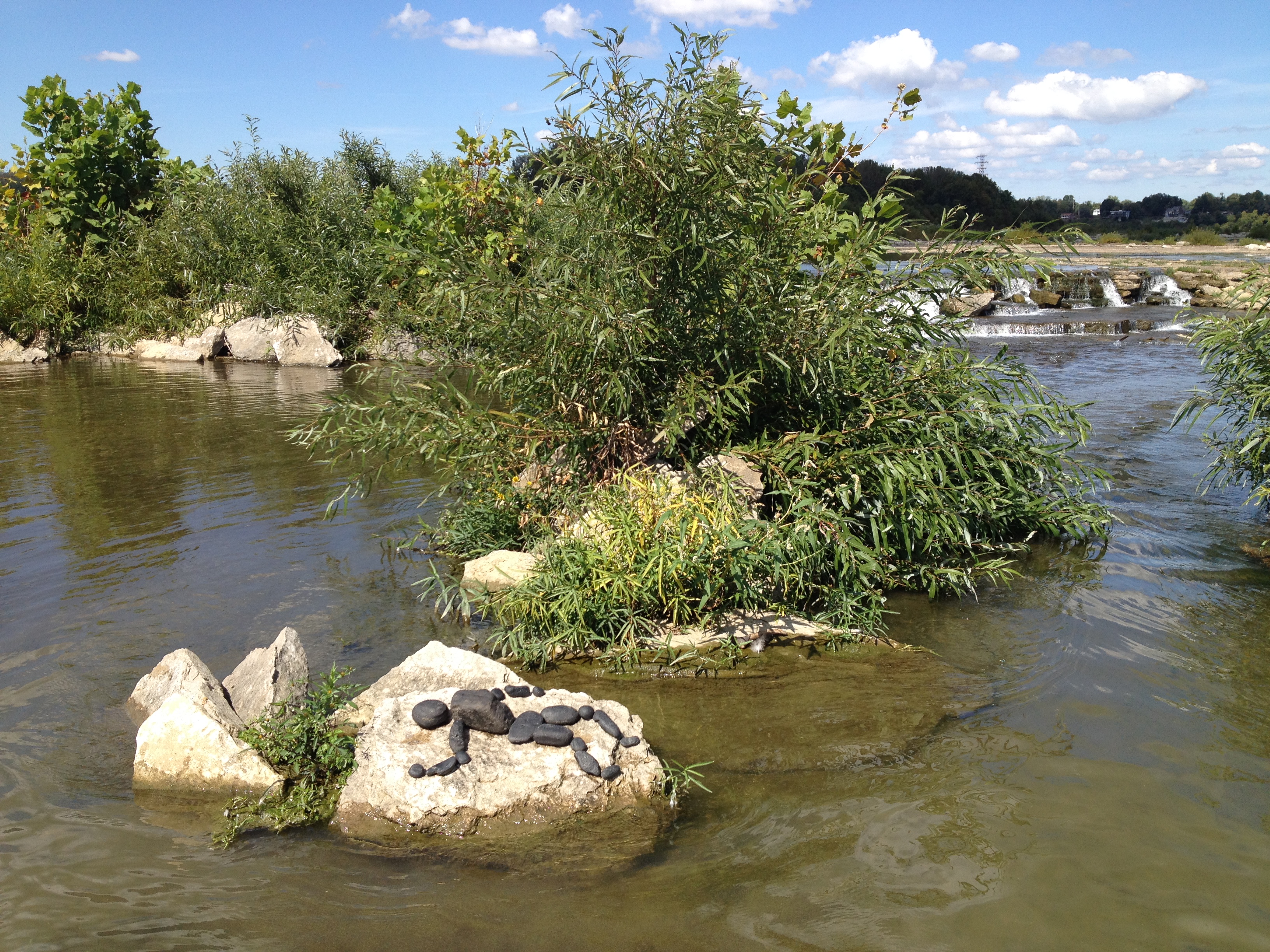
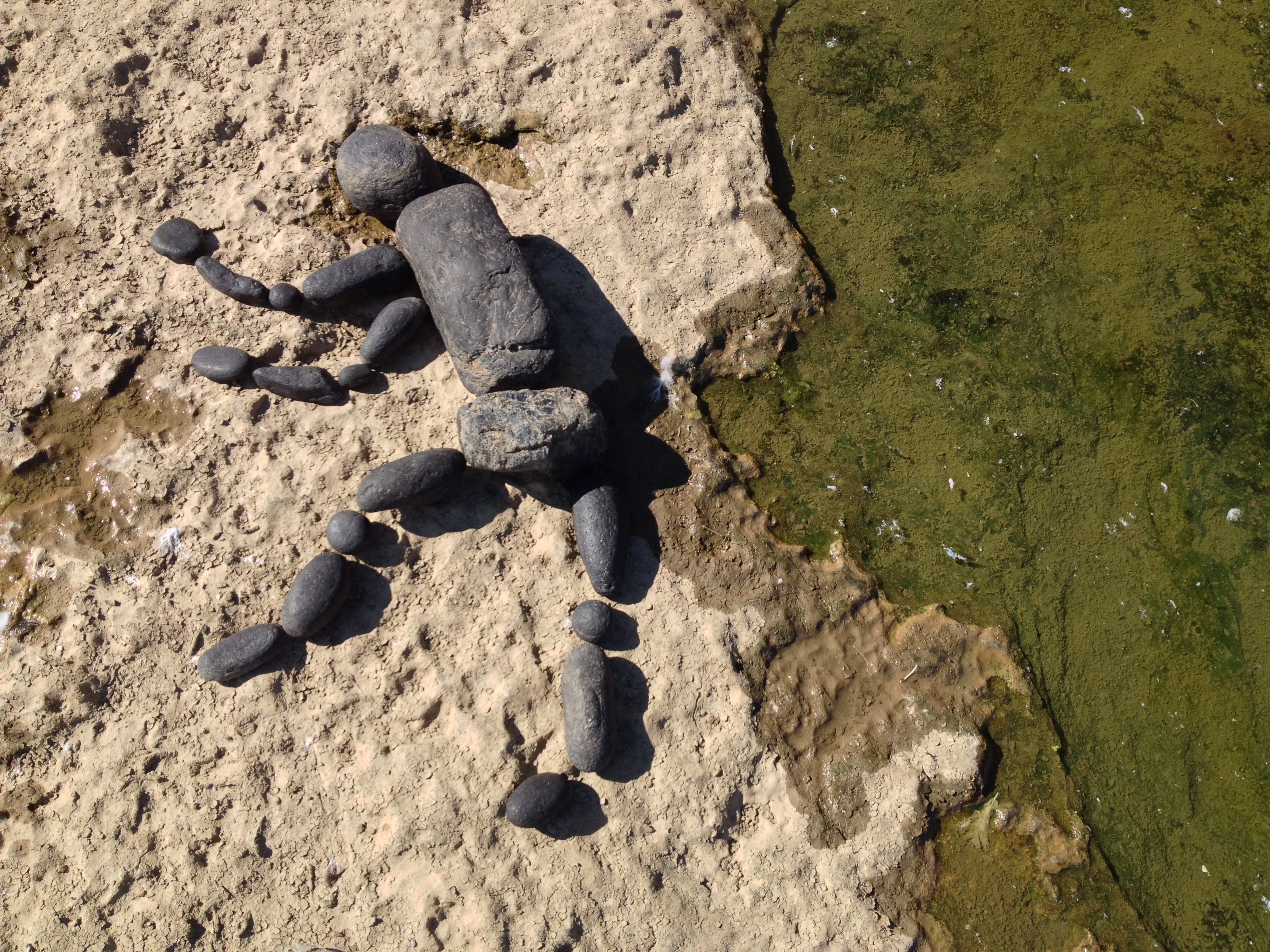
Coal figure near the waterfalls, Falls of the Ohio, Oct. 2014

I waited a few days to return to the exposed fossil beds on the Kentucky side of the Falls of the Ohio State Park.  My earlier trek went so well that I was determined to walk a little farther dragging my collecting bag full of water worn coal with me.  I had the same idea as before, namely creating figurative images using the coal in site specific areas.  Today I was determined to walk around Goose Island which is accessible by foot in the summer and early fall when the river level is diverted towards the locks and thus exposing the many layers of this ancient Devonian reef.  It won’t be too much longer until the autumn rains replenishes the water along the Ohio River Valley and submerges this part of the park again until next summer.

Dancing Coal figure, Falls of the Ohio, Oct. 2014

As before, I crossed over at the Lower Tainter Gates in the eastern section of the park.  I walked along the Fixed Wier Dam reaching the area where some waterfalls that flow into Whiskey Chute remain.  This is where I created my first coal figure of the day.  From above, the figure appears to be dancing and this is one of my favorite images from this new series.

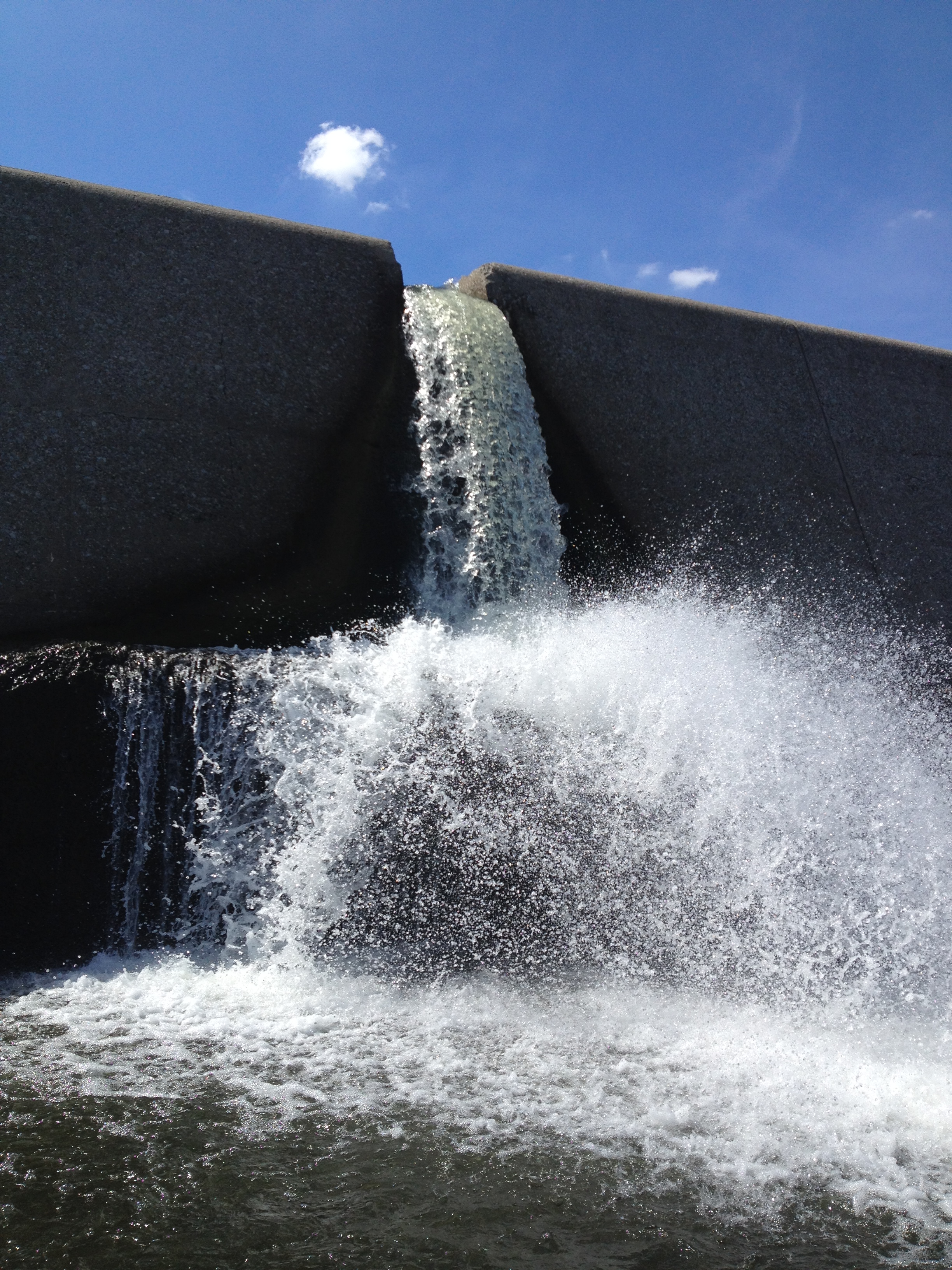
Water flowing thru notch in fixed wier dam, Falls of the Ohio, Oct. 2014

Going around the waterfalls, I walk through ankle to knee-deep water and continue following the dam’s wall westward.  Strategically placed notches at the top of this concrete wall provides a flow of water to a small wetlands area that harbors a variety of life.  In this place natural waterfalls and cascades have been replaced by artificial ones.  As I wade through it is a bit humbling knowing that the level of the Ohio River is at the top of this wall.  I saw many water-loving birds including Belted Kingfishers, Blue-winged Teal, Caspian Terns, Double-crested Cormorants, and Great Blue Herons that favor this part of the park.

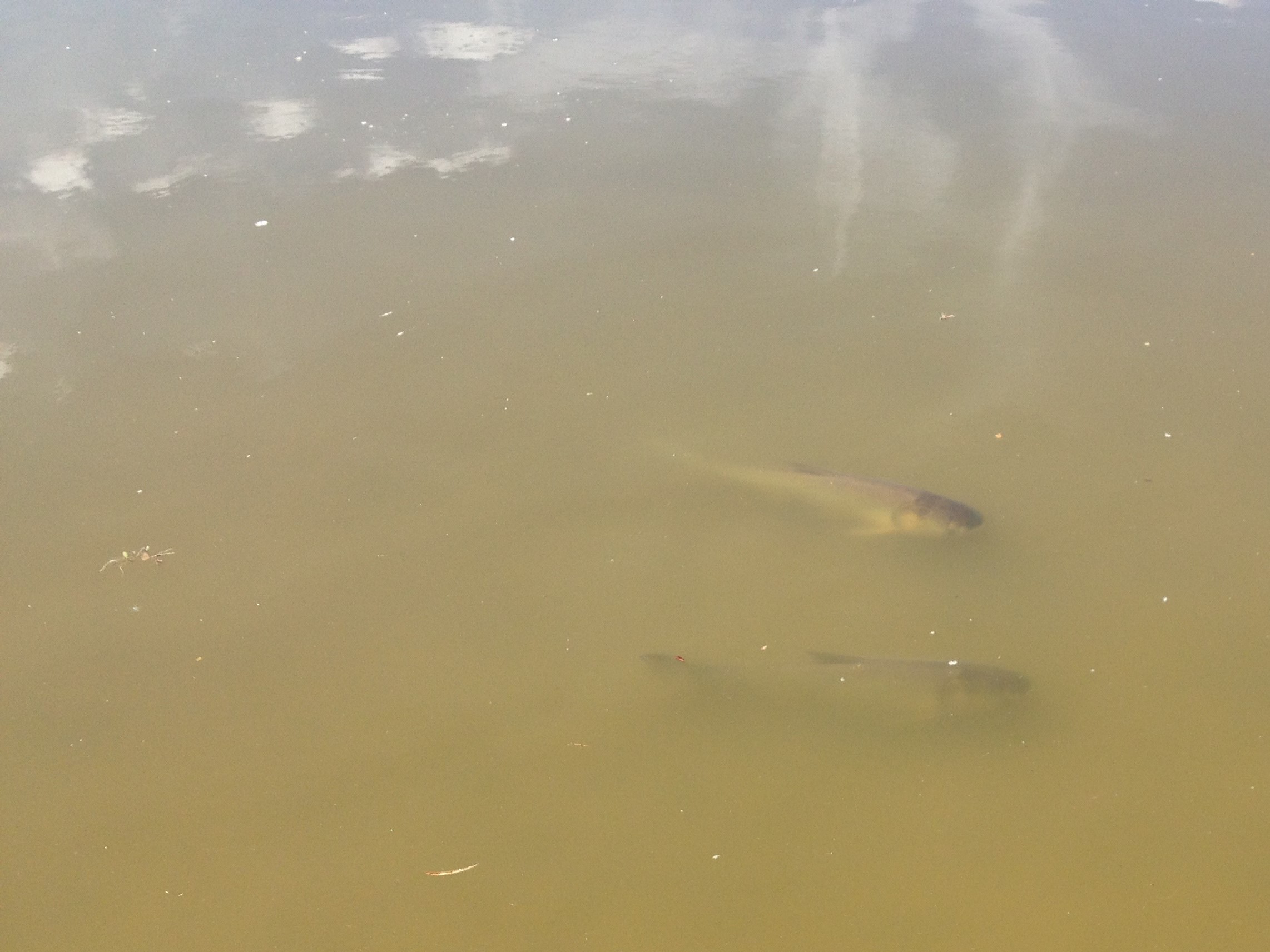
A pair of Grass Carp, Falls of the Ohio, Oct. 2014

Many of these birds were here because this area also attracts fish.  Numerous grass carp were eating algae in the shallows and small schools of juvenile fish were startled by the sudden appearance of my all too white legs as I walked through their space.  If I stood motionless for a while, the carp would return and I could observe them more closely.

Scene along the northwest tip of Goose Island, Falls of the Ohio, Oct. 2014

Goose Island Coal Figure, Falls of the Ohio, Oct. 2014

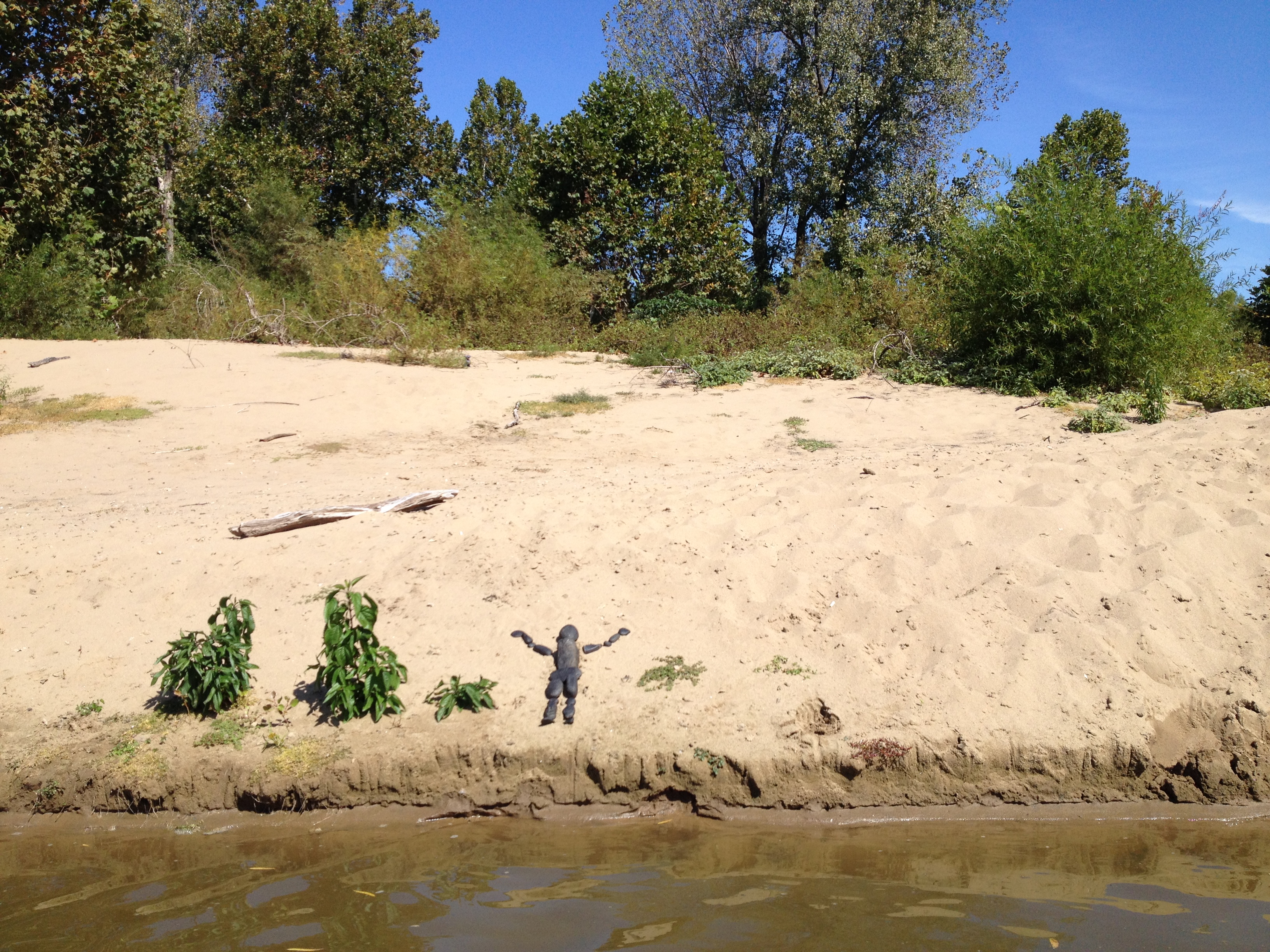
Goose Island has sandy banks.  As I was wading along the southeast side of the island, I set up this figure with up raised arms in an open spot among plants that were growing in a row parallel to the water’s edge.

Bleaching Goose Island Cottonwood tree, Falls of the Ohio, Oct. 2014

Evaporating pond on Goose Island, Falls of the Ohio, Oct. 2014

I left the water and walked along the edge of the island walking westward.  This section has a cottonwood habitat.  I came across a large cottonwood tree that had fallen off the high bank and was now bleaching in the sun.  Driftwood snagged around this tree’s root mass marks how high the water can get when the river is flowing.  There was a strong smell of urine around this shrinking pond and the many deer tracks proved these animals frequented this place.  Hundreds of tiny toads were hopping through the grass near this waterhole!  I had never seen anything like this out here before.  I wished I had taken at least one image of these toads in my hand for scale.  Although they were tiny, they also looked like perfectly formed adults that had been miniaturized.

Goose Island with distant view of the hydroelectric dam, Falls of the Ohio, Oct. 2014

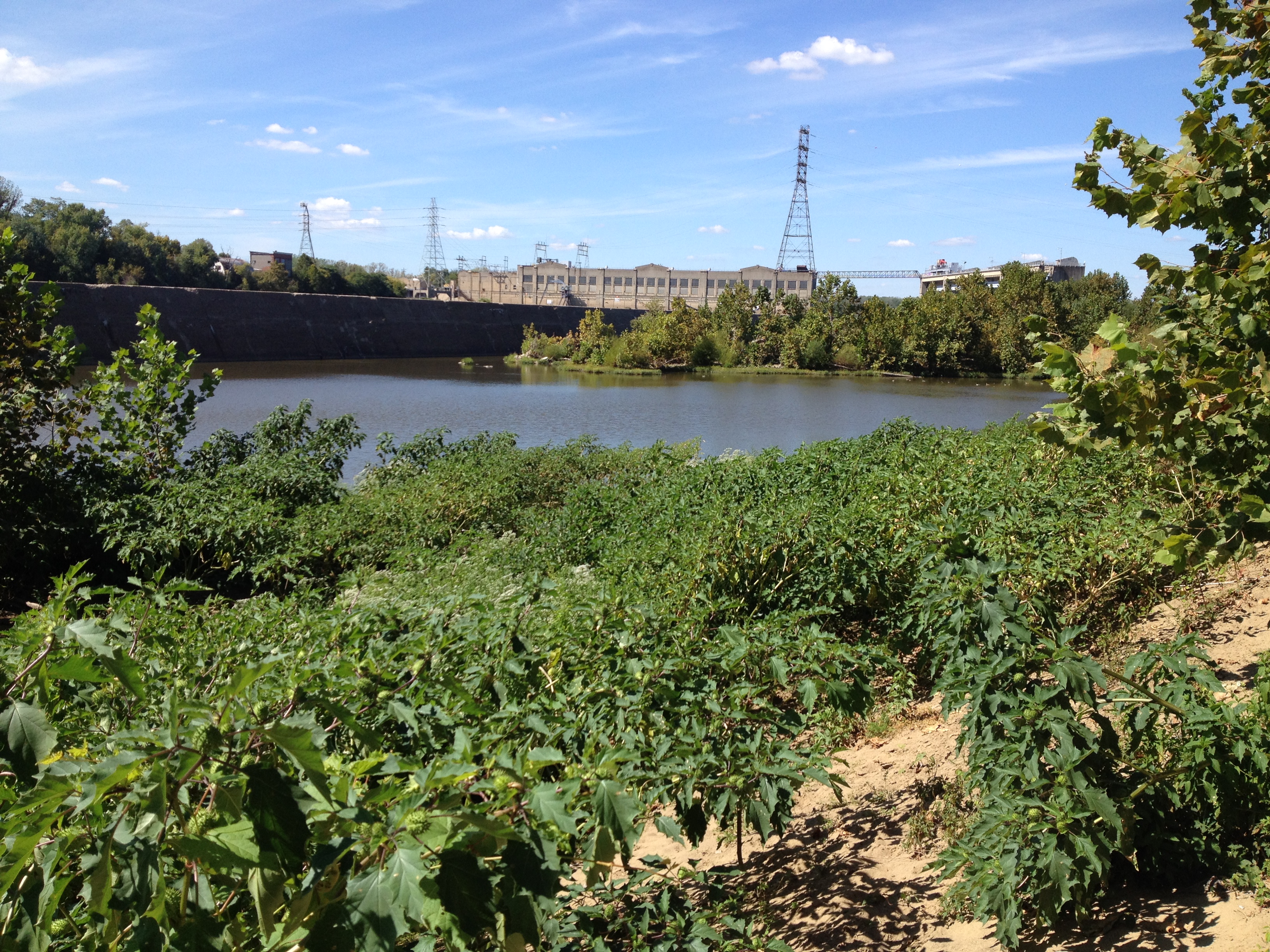
Continuing my walk on Goose Island, I can see the wall of the Fixed Wier Dam and the hydroelectric plant in the distance which is situated on Shippingport Island.  The plants in the foreground with their prickly, ripening seed pods are Jimsonweed.  Along the sandy bank,  I could see slides where beaver have dragged their tree cuttings from the nearby woods into the water.  There is probably evidence of a dam nearby, but I did not see it on this trip.

Goose Island sand dunes, Lower Tainter Gates in the background, Falls of the Ohio, Oct. 2014

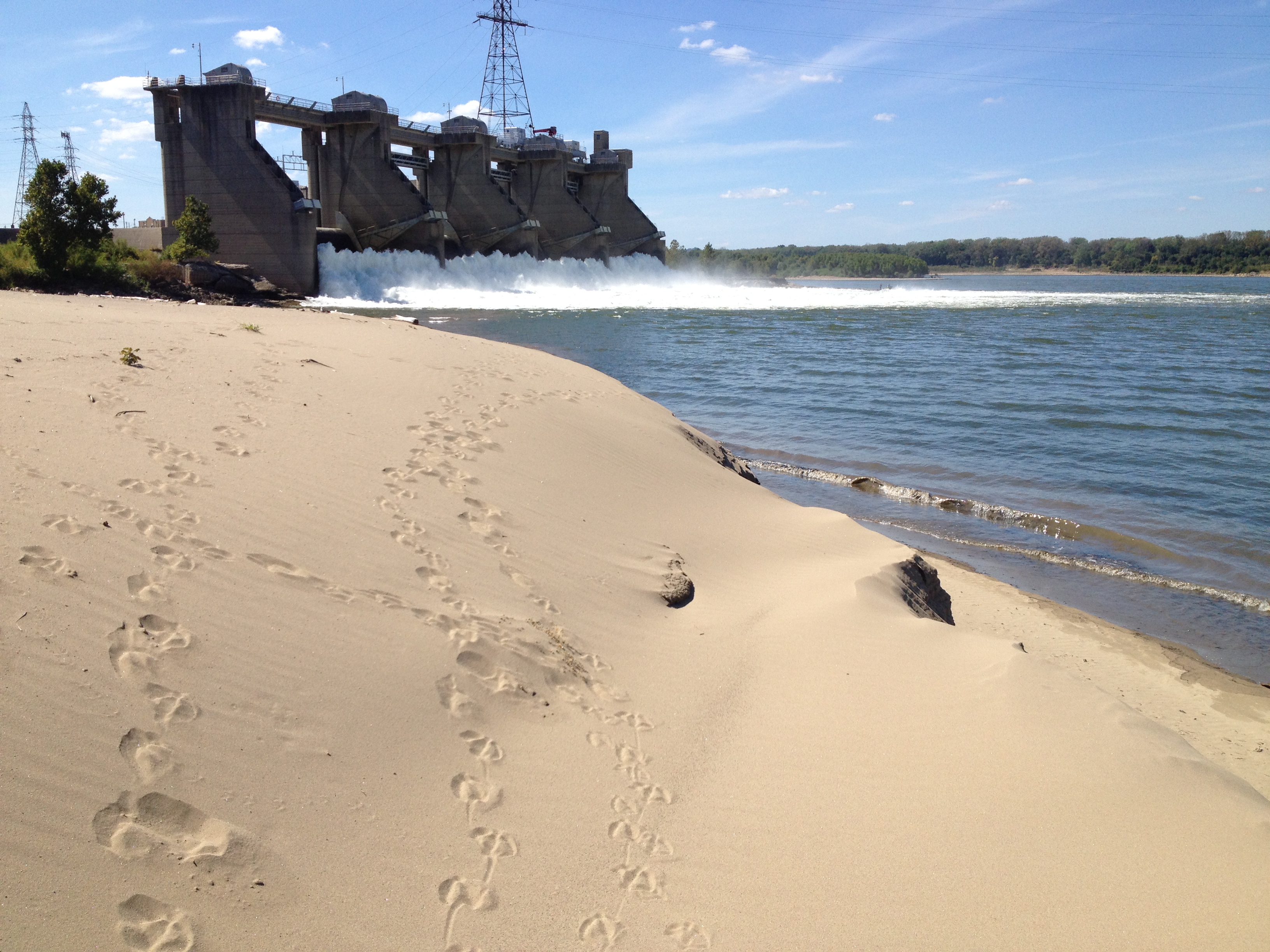
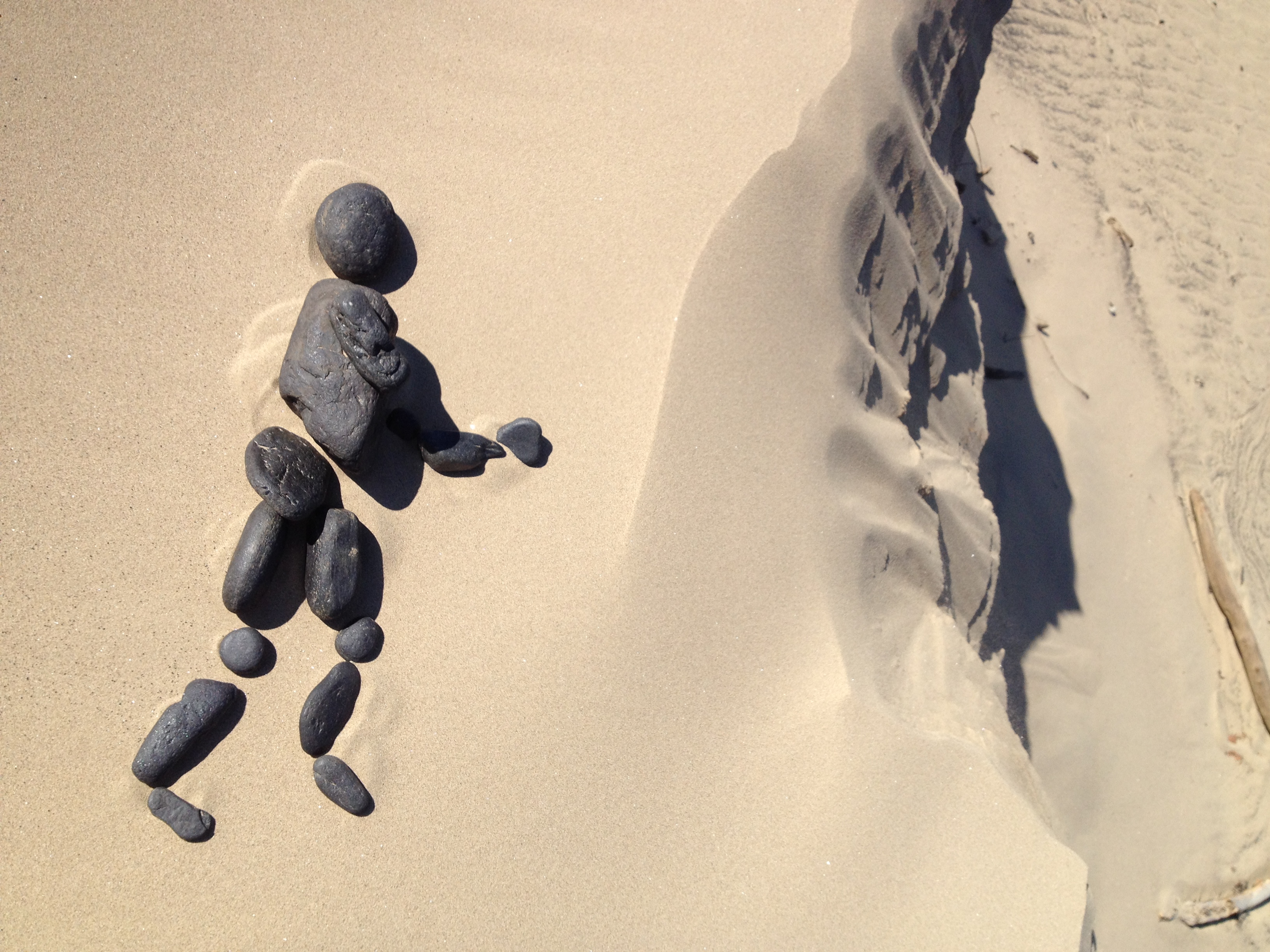
This is as far as you can walk in this part of the park.  Goose Island’s western edge ends at the Upper Tainter Gates.  This is a popular area for fishermen who reach this spot by boat.  I did see several Osprey circling the sky here.  There is a small section of sand dunes on Goose Island that are shaped by wind and wave.  In the above image, bird tracks crisscross the sand.  I placed my final coal figure of the day here at the edge of a dune.  This time the figure has been turned on its side. Plumes of sand were blowing up and away at the dune’s edge by wind.  In the image below, the distance from the top of the dune to the riverbank on the right is deceiving.  I estimate that this is a seven or eight foot drop and a short roll to the river.

Coal figure on Goose Island sand dune, Falls of the Ohio, Oct. 2014

From this area I start my hike home on the north side of Goose Island and start heading east.  It has been a great day interacting with this environment.  I have several other images to show before closing that were shot on this walk.  Fortunately, there isn’t as much plastic junk to find on this side of the park, but of course there were a few things that caught my eye.

plastic squirt gun, Falls of the Ohio, Oct. 2014

Here’s another squirt gun to add to the collection.

blue plastic hand on fossil rocks, Falls of the Ohio, Oct. 2014

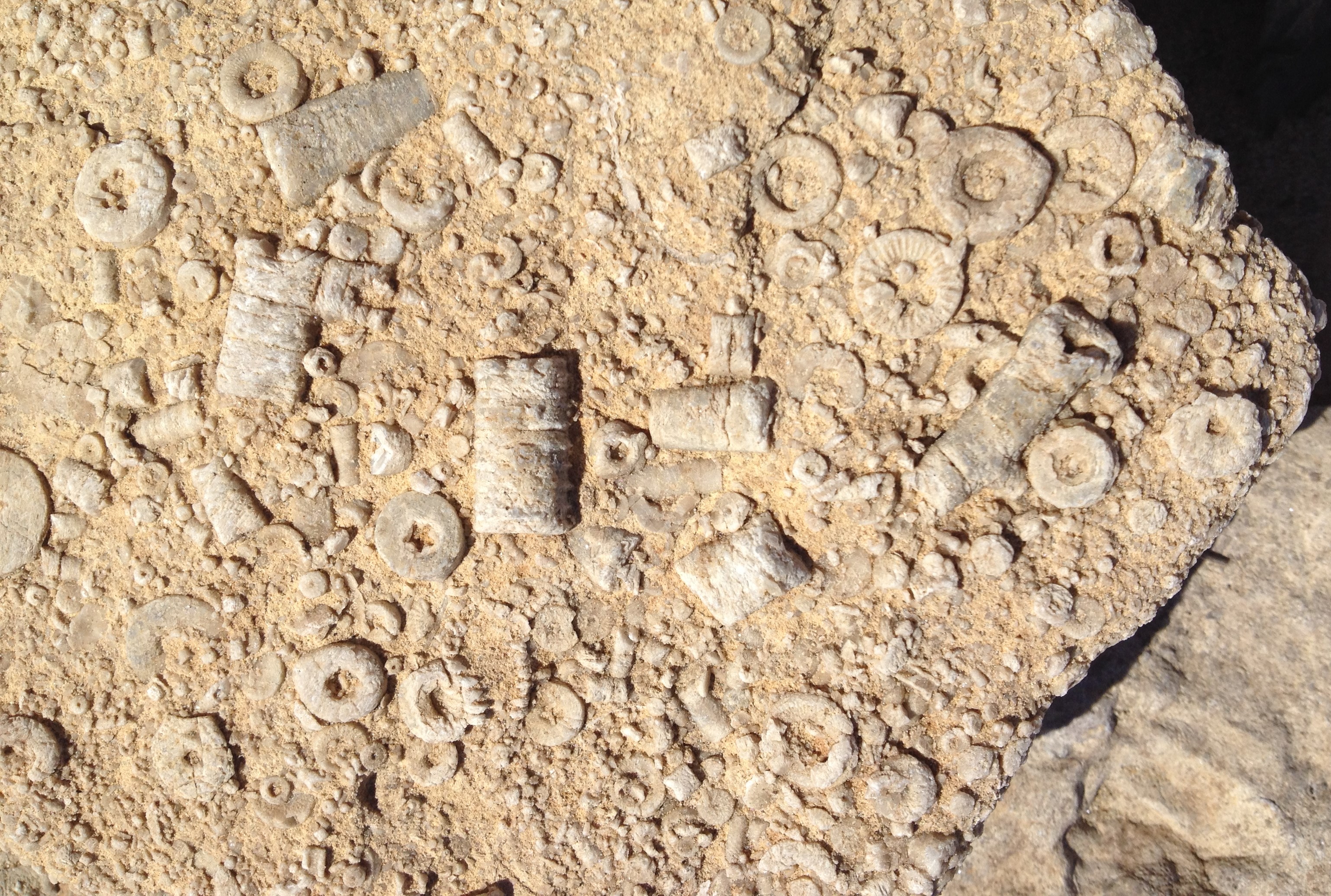
A goofy blue plastic hand rests on a fossil bearing rock .  If you look closely, you can see bits of a crinoid stem by the  thumb.  I did take other images of fossils along my walk.  Here are more crinoid pieces found near the Upper Tainter Gates.  Crinoids are often described as sea lilies and were sessile marine animals that filtered and captured small animals from a flower-like calyx.

Fossil crinoid pieces, Falls of the Ohio, Oct. 2014

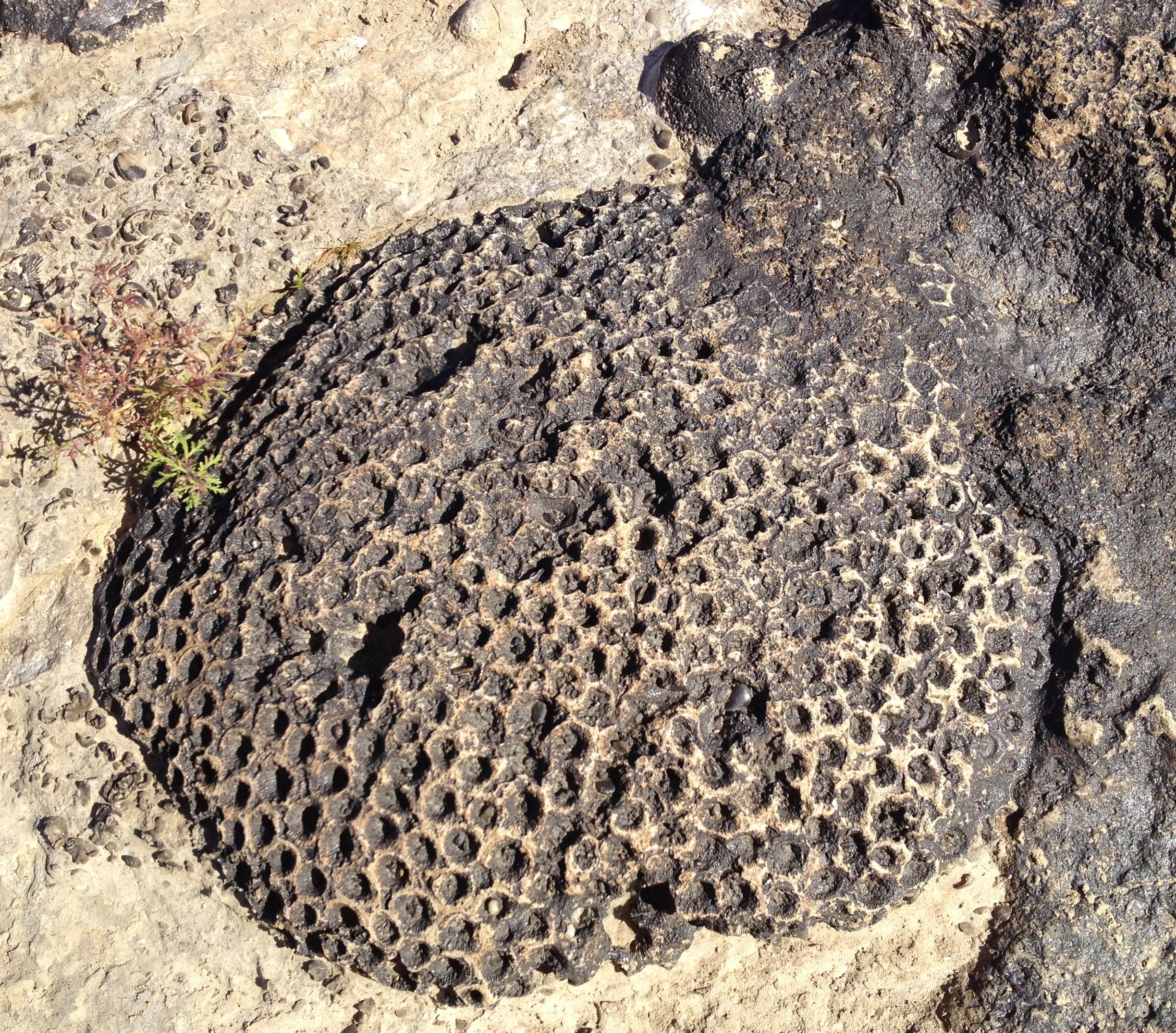
On the walk home, I kept walking by different fossil corals exposed in this ancient limestone.  Corals are colonial animals and you get a sense for this in my next image.

Exposed fossil coral, Falls of the Ohio, Oct. 2014

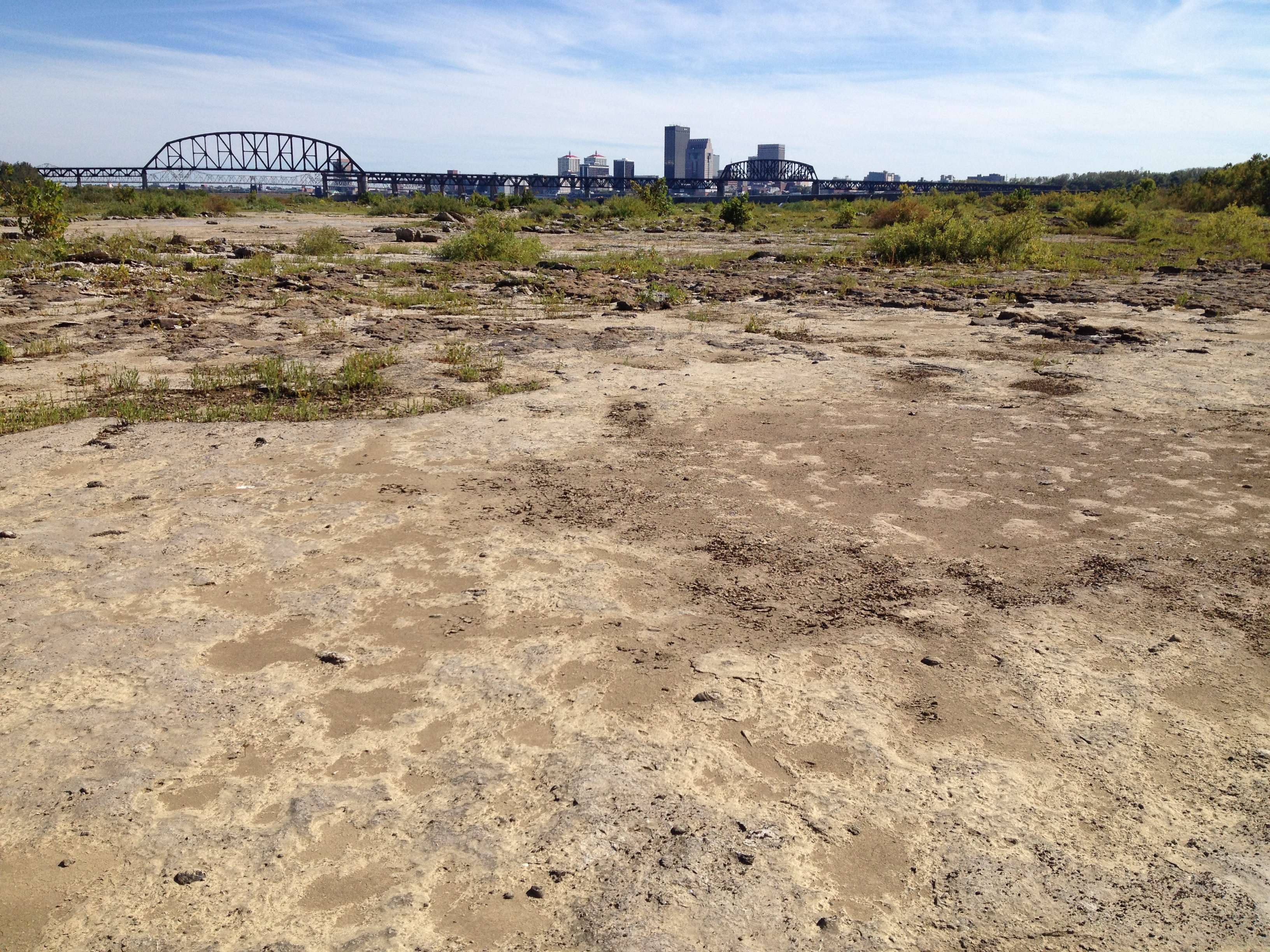
The park prohibits collecting fossils and I begin to wonder if this heavy bag of coal that I have lugged around the island would count?  Technically speaking coal is a fossil material.  Although I found all my coal within the park, it did not originate here.  I retrace my steps crossing the exposed fossil beds and by the time I reach my vehicle…I am one tired guy.  If my luck holds, I might be able to take one more walk out here before this area becomes the bottom of the river again.  If it doesn’t happen…there is always next year!

Fossil beds with the skyline of Louisville in the distance, Falls of the Ohio, Oct. 2014

Read Full Post »

On the dry Indiana bank, Falls of the Ohio, Oct 2014

After my all day excursion to the Kentucky side of the fossil beds…my next visit to the park was a relatively short one.  I had a few hours to work with and decided to check out the riverbank on the Indiana side.  It has been very dry of late and I heard on the radio that farmers have begun revising their optimism about this year’s corn crop.  Once again, we have had a season that seems atypical in a few respects.  Most notably, our summer has been a cool one.  No temperatures in the high 90 or 100 degree range…that would be about 35 to 38 degrees on the Celsius scale.  Climatologists point to the cold Arctic air that came sweeping down from Canada during July as the reason our summer was not as hot.  People around here aren’t complaining about that, but after last year’s polar vortex winter… folks are wondering if that bodes well for this year’s fall and winter?

Cracked, drying mud, Falls of the Ohio, Oct. 2014

In addition to the coolness, it’s also been dry of late.  Seems that we haven’t had a significant rain storm to speak of in weeks and the river continues to recede.  New pools are formed stranding fish in them and many creatures take advantage of this bounty.  Walking along the cracked riverbank I find evidence of this.

Dead Longnose gar and decaying Bull gill, Falls of the Ohio, Oct. 2014

I soon came across dead fish left behind in the wake of weekend fishermen.  In this picture, an armored and toothy Longnose Gar (Lepisosteus osseus) lies side by side with an equally interesting fish that is rarely found here.  With its thick body, white caudil fins, and unique pectoral fins…I identify this smaller fish.  It’s more commonly called a Bull Gill, but science also recognizes it as (Taurus opercula).  I wonder if there are any other specimens hiding in the deeper pools around here?  To find out, I gather waste monofilament line found all along the riverbank along with a found lead-headed jig and before too long I have improvised a hand line for fishing.

Bull Gill on a hand line, Falls of the Ohio, Oct. 2014

Bull Gill on the line, Falls of the Ohio, Oct. 2014

After some trial and error, I succeeded in catching a Bull Gill by bumping my jig along the bottom of a wide, but shallow pool.  The fish was well hooked and after a short struggle I was able to bring him up for a better look.

Bull Gill in hand, Falls of the Ohio, October 2014

Captured Bull Gill facing left, Falls of the Ohio, Oct. 2014

I hurriedly take as many photographs as I can.  My intention is to release this fish back into the water after I document its presence here at the Falls of the Ohio.  As you can see, this fish contrasts greatly with the dead gar we saw earlier.  The gar is in fact a more ancient and primitive fish that relies on its hard armor for protection.  The gar is mostly a surface fish mimicking a floating piece of wood while it stealthily seeks out smaller fish to ambush.  The gar’s strategy has been so successful that it has changed little after millions of years.  The Bull Gill evolved much later and lacks prominent scales on its more compact body.  It too, however has evolved a unique method of feeding.

Bull Gill seen head on, Falls of the Ohio, Oct. 2014

Bull Gill supporting itself on its pectoral fins, Falls of the Ohio, Oct. 2014

The Bull Gill gets its name from its powerfully muscled head.  Just below and behind its gill covers, the unique pectoral fins have evolved so that this fish can support itself on the bottom of a swiftly moving stream or river.  I was able to demonstrate this with my specimen.  I placed my fish upon the rocks by the riverbank and it was able to support its body off the rocky surface using its strong and rigid fins.  In the water, the Bull Gill secures itself on the rocky bottom with its stiff pectoral fins and with its head facing upriver.  The Bull Gill is a predatory bottom feeder.  As prey fish swim by, the Bull Gill with a quick burst is able to capture its food and swallows them head first before returning to its spot on the river bottom.  I had this fish out of water for just a couple of minutes before releasing it safely back into the Ohio River.  I had to say that I enjoyed encountering a creature you don’t see every day.  It’s presence here is a good sign since the Bull Gill needs good quality water to thrive.   I gathered up my collecting bag and walking stick and decided to check out my stash of Styrofoam under the willows.

Up the riverbank and under the willows, Falls of the Ohio, Oct. 2014

The willow trees are up the riverbank and the leaves are beginning to yellow more noticeably.  Along the way you pass by a couple of courses of deposited driftwood.  I love the silvery color of this wood which is due to exposure to the sun and elements.  I had a great surprise in store for me once I ducked under the cover of the trees.  For many years I have known that White-tail Deer are present in the park because their tracks are all over the place.  These ghost deer are fairly close to a populated area and extremely wary of people.  They must move around the park in the middle of the night or really early in the morning to avoid detection.

The deers' resting place, Falls of the Ohio, Oct. 2014

deer tracks in the sand, Falls of the Ohio, Oct. 2014

As I moved near my spot, I spooked a doe and her late season fawn.  I could still make out the spotted pattern on the fawn.  They were bedded down near a large log that floated into the park last year.  I first saw the doe which rose and ran off upon sighting me.  The fawn then stood up and followed after its mom.  I was unable to take a photograph because this sequence happened in just seconds.  I then followed to see if a second glimpse was possible and I even doubled back to this spot should the deer attempt the same maneuver.  Unfortunately, I didn’t get another look at them, but since they are near my outdoor studio, I will be sure to check for them next time.

My stash of Styrofoam, Falls of the Ohio, Oct. 2014

It had been many weeks since I last visited my larder of river-gleaned materials.  I could tell that people had been through here, but there is obviously nothing of value.  I mean what could one do with water-tumbled polystyrene and sticks?  If the river doesn’t rise anytime soon, I will come back and make something from this odd deposit.  My next post, however, will come from the Kentucky side of the fossil beds.  After this adventure, I returned with my river-polished coal and explored a few more areas around Goose Island and the hydroelectric plant.  I think I made some compelling images that speak of a sense for place and I look forward to sharing them with you.

Fall color at the Falls of the Ohio, Oct. 2014


Read Full Post »

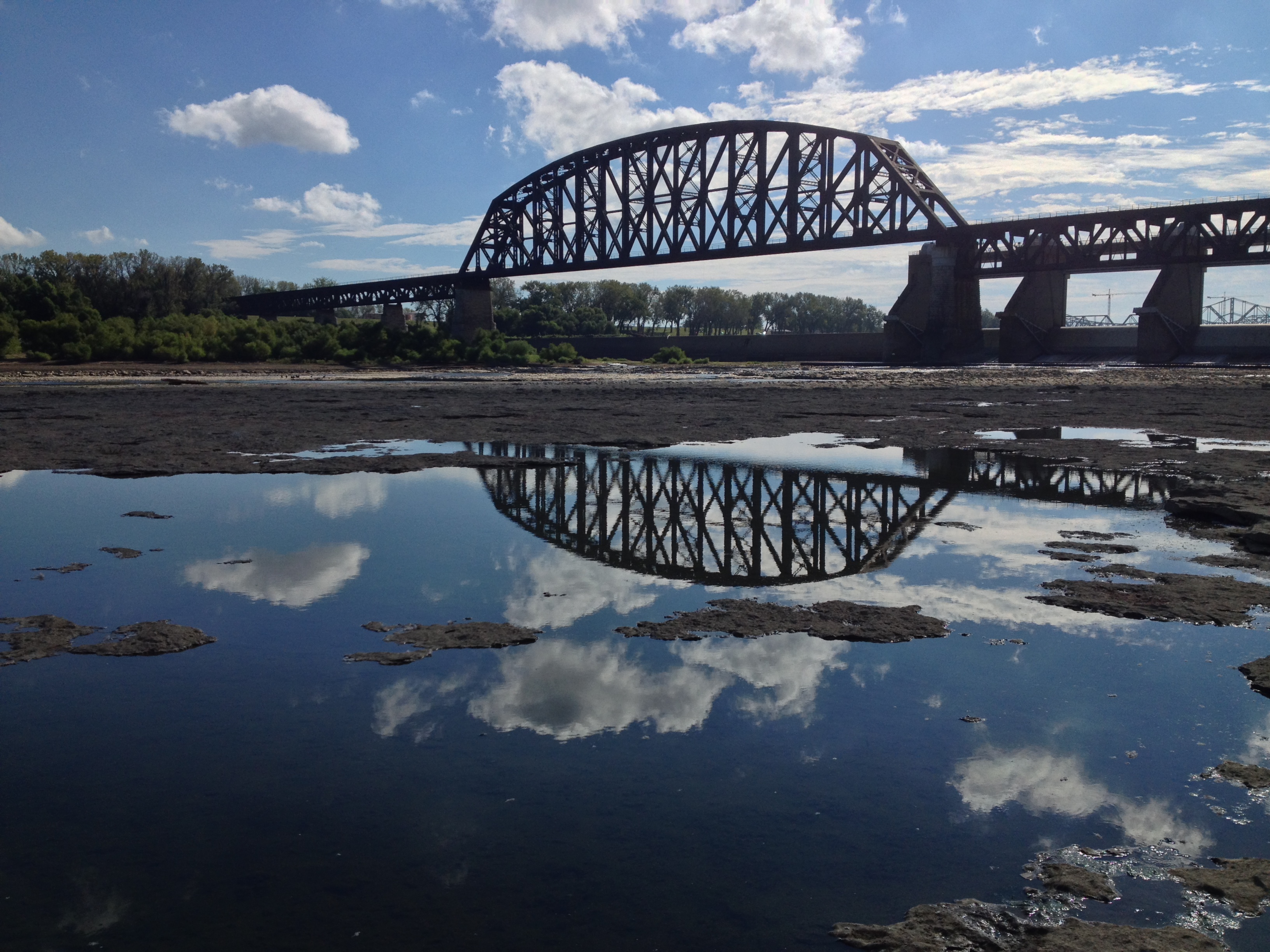
Under the railroad bridge, Tainter Gates, Sept. 2014

Two years have passed since I last set foot on the fossil beds on the Kentucky side of the river.  I had to wait until I fully trusted a bum knee to be well enough to walk upon the hard, irregular limestone surface that for most of the year is underwater.

This is after all, the bottom of the Ohio River and accessible most summers when water is diverted to fill water levels at the McAlpin Locks and Dams.  The Ohio River is a managed river for much of its length.  Closing the snow plow shaped tainter gates helps regulate water levels for commercial navigation and flood control, but it also exposes the majority of the fossil beds to inspection at the Falls of the Ohio State Park.

I have rolled my ragged jeans up and I’m wearing a pair of shoes for sloshing through knee-high deep water at best.  As I move under the old iron railroad bridge, I walk past the gigantic concrete and metal gates holding the river back.  Something in their hieratic designs reminds me of ancient Egyptian art.  Here on a massive, civic-project scale, abstracted silhouettes of seated pharaohs serve the gods of engineering.  My goal today is to reacquaint myself with this unique environment and mark the day in some way.
The railroad bridge looking back to the Indiana side.  Sept. 2014

From experience, I know that there are far fewer materials to access on this side of the fossil beds.  Most of the Styrofoam, plastic, and driftwood I frequently use is driven by wind and river currents to the Indiana bank where I’ve preformed  most of my projects.

Being out in this environment with its varied materials often inspires me to want to make something, but what will I do today?  I take advantage of the river polished coal I found around the railroad bridge and envision an image I can work with site specifically.

I have come to like working with coal as a material because it is timely and is also invested with so much meaning.  In Kentucky, coal is currently a big political issue and many good people truly believe there is a war on coal and climate change is a not supported by the facts.

Anthracite is a deeply, shiny-black crystalline material out of the mine… but the river can tumble it into dull, but smooth feeling, egg-like forms.  I prefer the more river polished pieces of coal.

I’m guessing I’ve picked up about 10 or 12 pounds of coal which I carry in a canvas collecting bag.  Okay, I have my material and my feet are already wet.  With walking stick in hand, I walk along side the high walls that separate the Ohio River from the now exposed Devonian Age fossil beds.

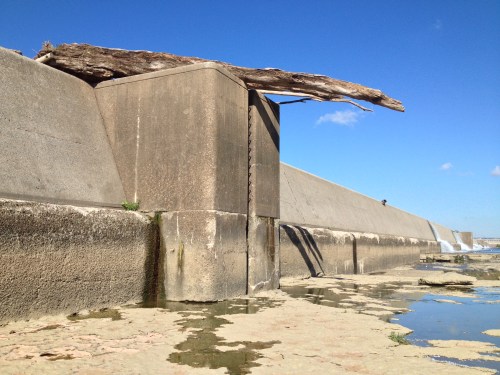
Wall seperating Ohio River from fossil beds, Falls of the Ohio, Sept. 2014


The dam’s concrete wall that separates the river from where you are standing on the fossil beds is maybe 18 to 20 feet tall?  It’s up there and sobering as well because the Ohio River’s waterline is just below the top of the wall which is just on the other side!  A series of pre-formed notches along the top of the wall allows water to flow over a section of the fossil beds.

A small wetlands area has been encouraged here that draws many water-loving birds.  Among the species I observed on this day included:  the Belted Kingfisher, Caspian Terns, Great Egrets, Osprey, Great Blue Heron, Double-crested Cormorants, Canada Geese, Killdeer plovers, Blue-winged Teal, Mallard Ducks, Black Vultures, and an American Coot.

Although it’s not hot today, there is little to shade you from the intense light out on the open fossil beds.  Most of these beds are high and dry, but the surface is pockmarked in places with potholes that hold water.  Most of the shallow pools that caught fish when the river level dropped have been cleaned out by the water birds.

In the above photo, a large log has become stranded on the top of the wall placed there when the Ohio River was receding from flood stage.  It was in this area that I set down my heavy collecting bag and laid out my first Coal Man design on the fossil surface.

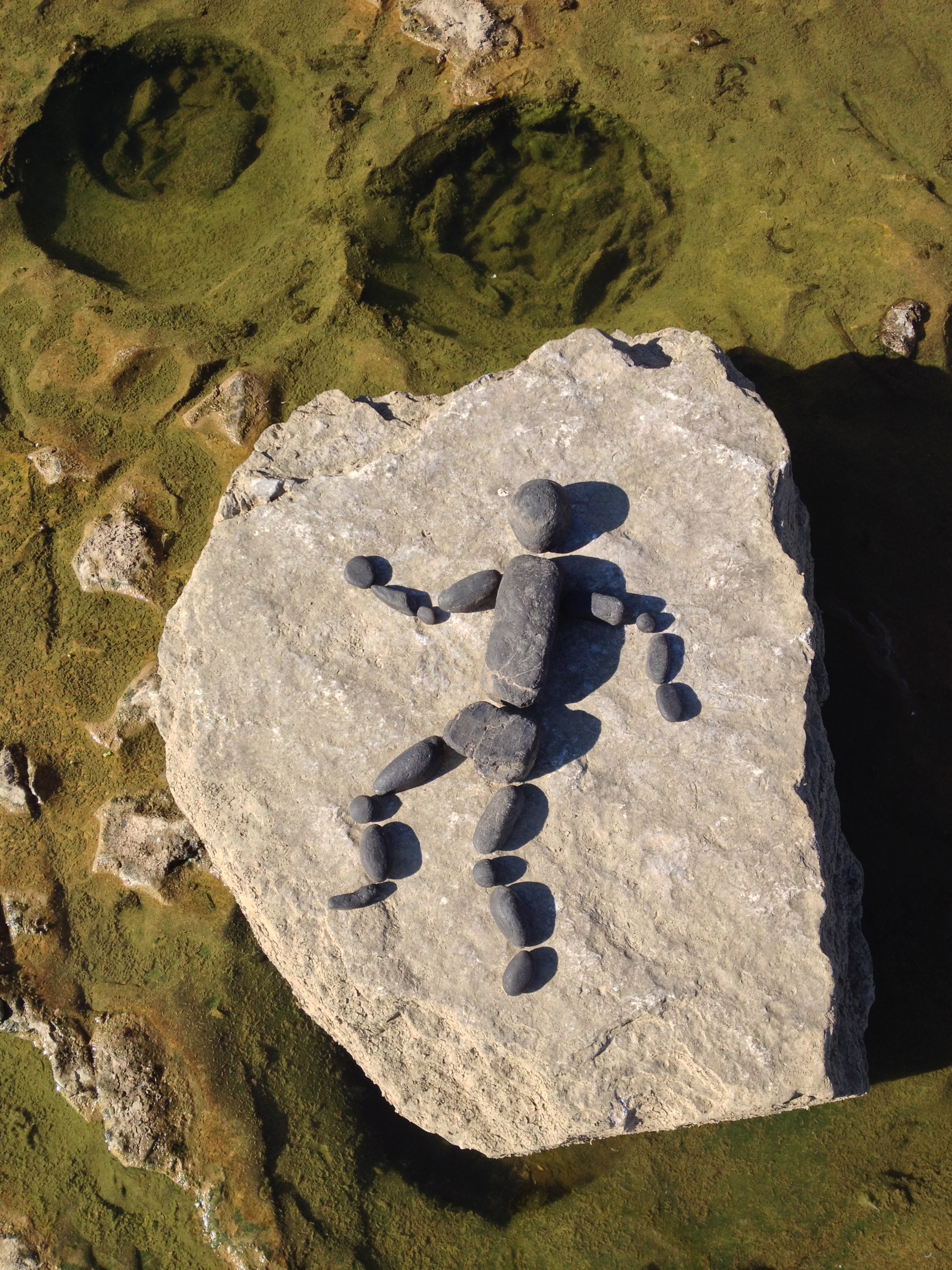
Coal Man variation, Falls of the Ohio, Sept. 2014

The figure has a marionette-like presence, but I relate more to it as a simple sign for figure.  In my head I’m seeing an ancient landscape marked here and there with this contemporary pictographic/petroglyph.  The Falls of the Ohio have been occupied by man for thousands of years and I like relating to this history.  The water is shallow and green from algae.  Molted bird feathers define the circumferences of many of these water holes.  Annoying small flies and gnats fly around the potholes and around your head seeking salt or other moisture.

Coal Man Series, Falls of the Ohio, Sept. 2014

This figure has been laid out on a table-like boulder surrounded by very shallow water.  It’s a very temporary site-specific expression on a very tiny island.  I have heard people describe the exposed fossil beds as being a “moonscape” and it does feel like this landscape could be from another planet.

Seated Coal Man on Fossil Beds, Falls of the Ohio, Sept. 2014

Many of the fossil beds are in layers or courses and here I am trying out some of the pictorial possibilities using my now seated Coal Man.  The Interpretive Center is the structure in the far distance.  After a while,  it’s time to cool off a little and have a good sit.  There’s a series of small cascades up ahead that are the nearest to imagining what the Falls may have originally looked like and I head that way.

Coal Man by the Cascades, Falls of the Ohio, Sept. 2014

I see in my mind’s eye, each different Coal Man design introducing a different feature on this side of the park.  I have been wading in shin-high to knee-high water to reach this place.  It’s like an oasis on the exposed and fossilized ancient coral reef.  I like resting here and having a water and snack break.  If you remain inconspicuous you can often spot many different bird species here.  The shallow but swiftly flowing water has small schools of baby fish seeking places of safe harbor.  I’ll bet the oxygen levels in this water is very high?

Cascades, Falls of the Ohio, Sept. 2014

Cascades, Falls of the Ohio, Sept. 2014

I cool off wading and exploring this area before moving on.  This space has a bit of the amphitheater feeling about it.  The cascades take on a larger horseshoe formation connected by many small waterfalls.  In the recent past, much larger cascades existed and put on a water show that I wish I could have seen.

Cascade at the Falls of the Ohio, Sept. 2014

Time to move on and dry off.  Today, I’m only planning on walking to the beginnings of Goose Island where I will make my final images with this Coal Man.  I definitely see returning out here again soon while the river level remains low.  It won’t be too much longer before autumn rains and winter snows replenish the Ohio River and re-submerges these fossil beds until next year.

Skyline of Louisville as seen from the Falls of the Ohio, Sept. 2014

So far, I had kept the Coal Man dry.  At this location which was the extent of today’s visit…I took advantage of clear, shallow water to create these pictures.

Coal Man Series, Falls of the Ohio, Sept. 2014

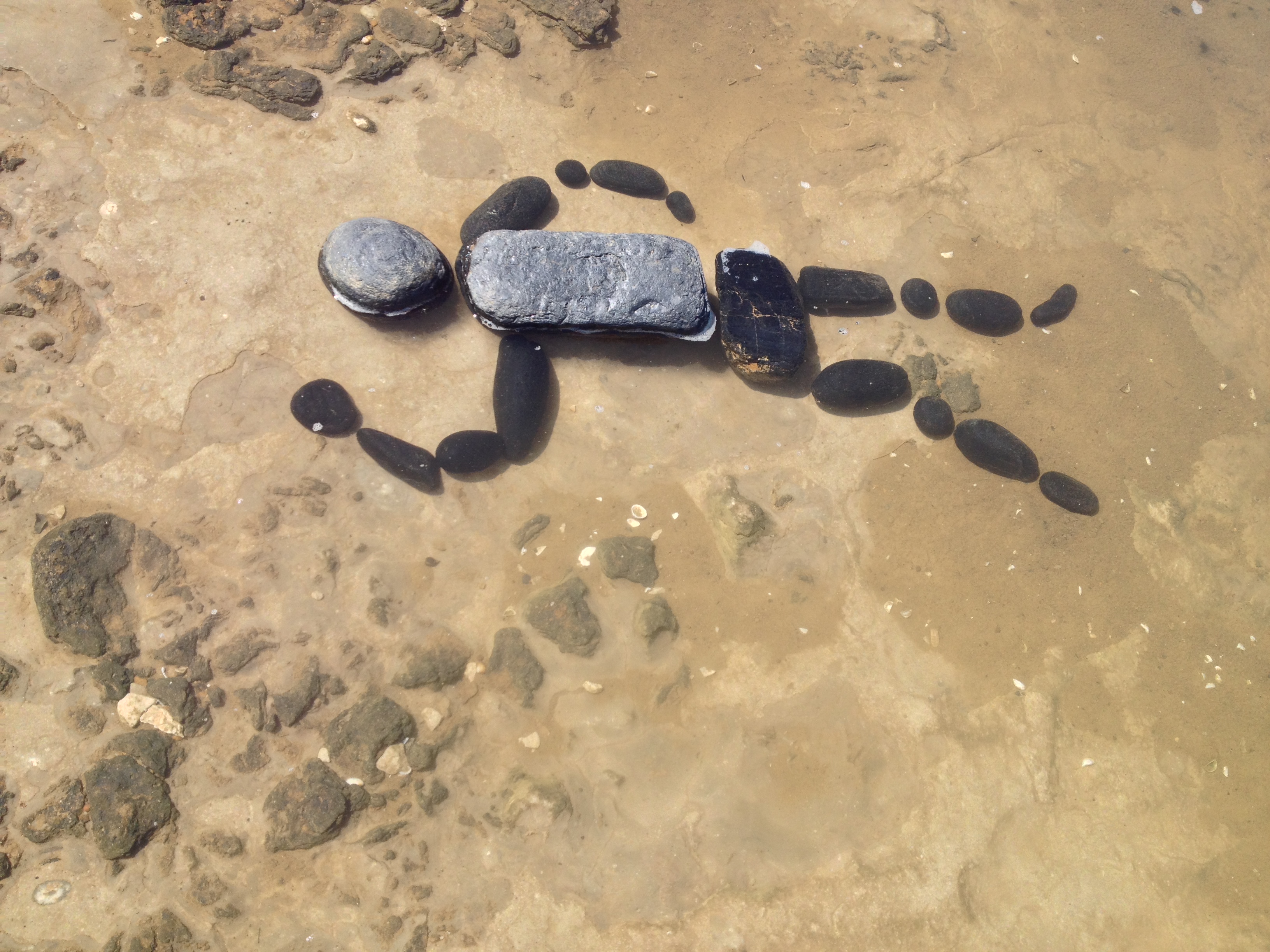
Coal Man Swimming, Falls of the Ohio, Sept. 2014

The wet coal turned deep black and I liked how many of the images graphically benefited from that.  I guess this is Carboniferous Man swimming above the Devonian Age?  From here I bagged the coal and started the walk home over the fossil beds.

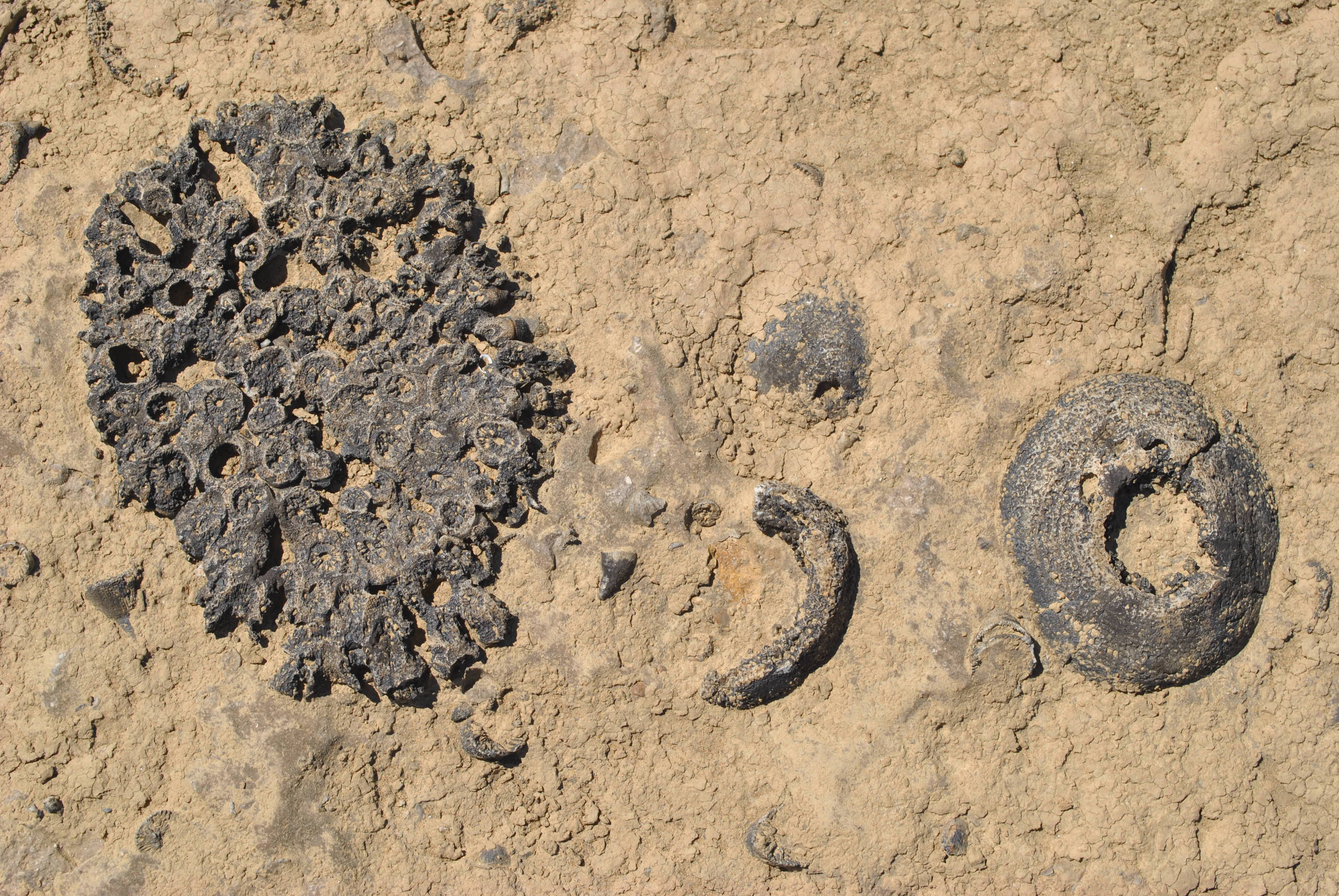
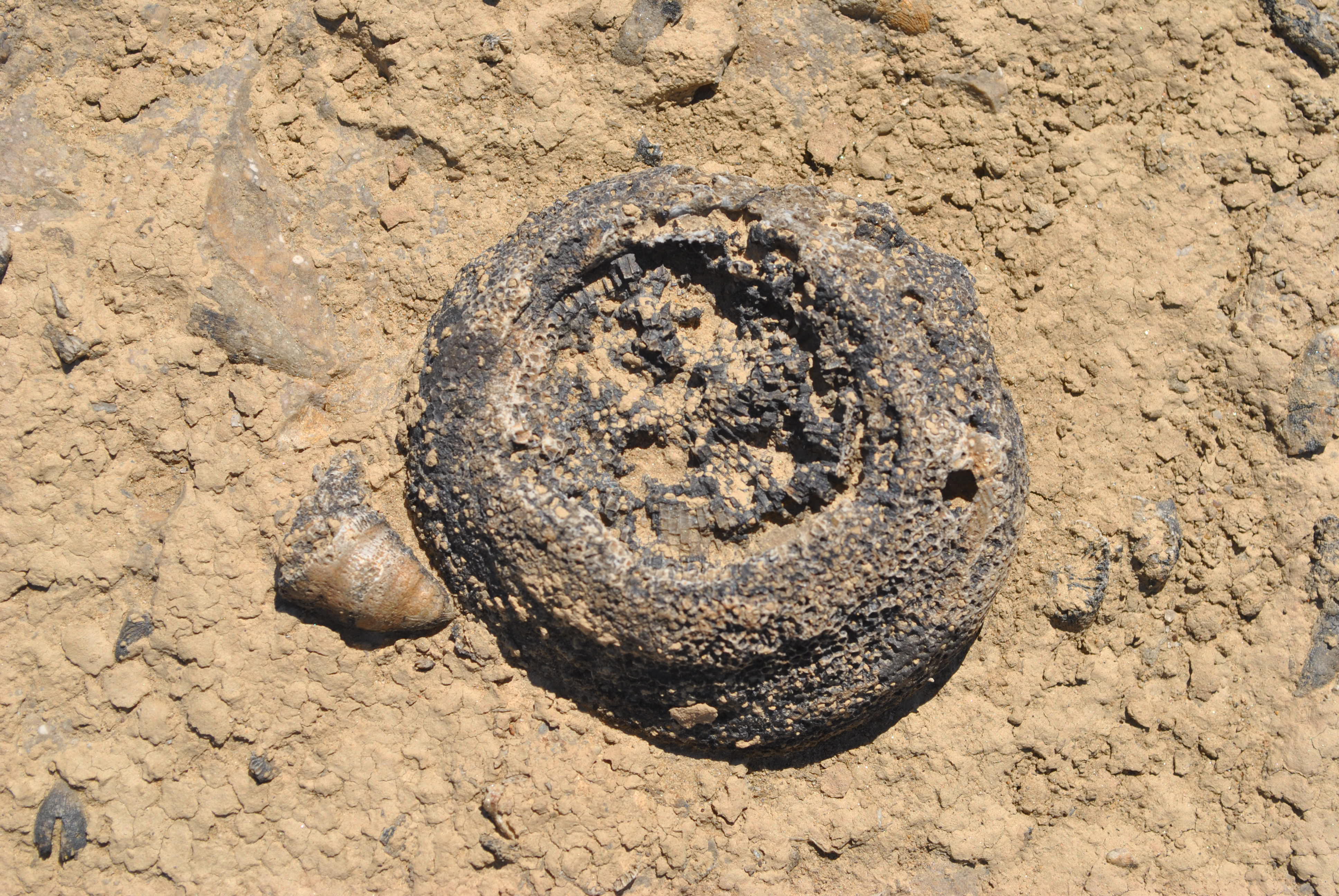
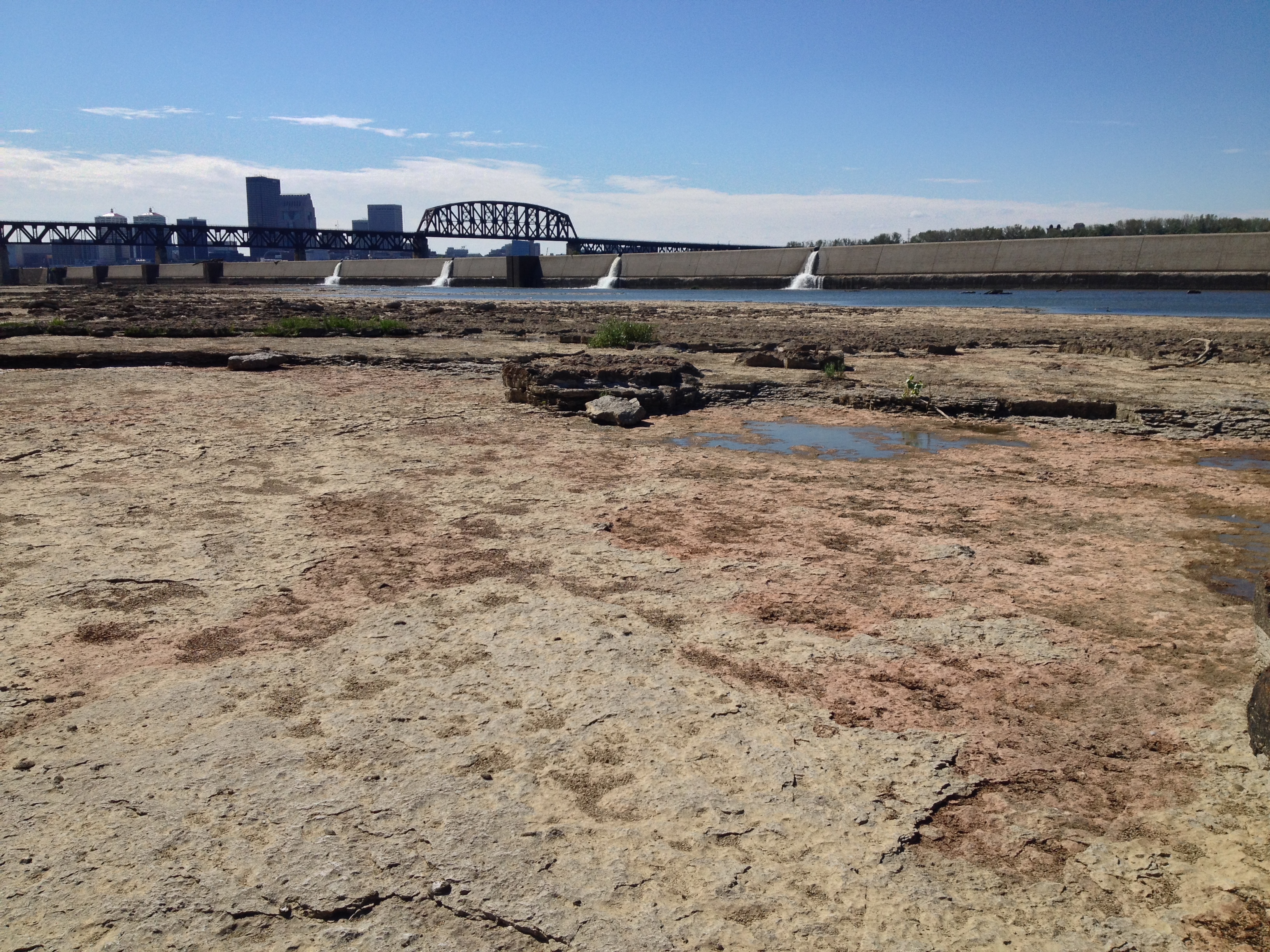
Before closing, here are a few actual fossils I photographed along the way.  This was once an active coral reef over 300 million years a go.  Life was in the oceans.  The species first discovered here have greatly expanded our knowledge of life at this time.  This was the high point for corals and sponges and also gave rise to the first fishes.

Fossils from the Falls of the Ohio State Park, Sept. 2014

Fossils from the Falls of the Ohio State Park, Sept. 2014

This was my last river excursion of the summer.  It is amazing how quickly this year is flying by!  I was really happy that my left knee did not give me any problems.  I am feeling encouraged and I still have this bag of coal I can keep playing with on a future visit.  Thanks again for coming along…from the fossil beds at the Falls of the Ohio State Park…so long for now.

Fossil Beds at the Falls of the Ohio State Park, Sept. 2014

Read Full Post »

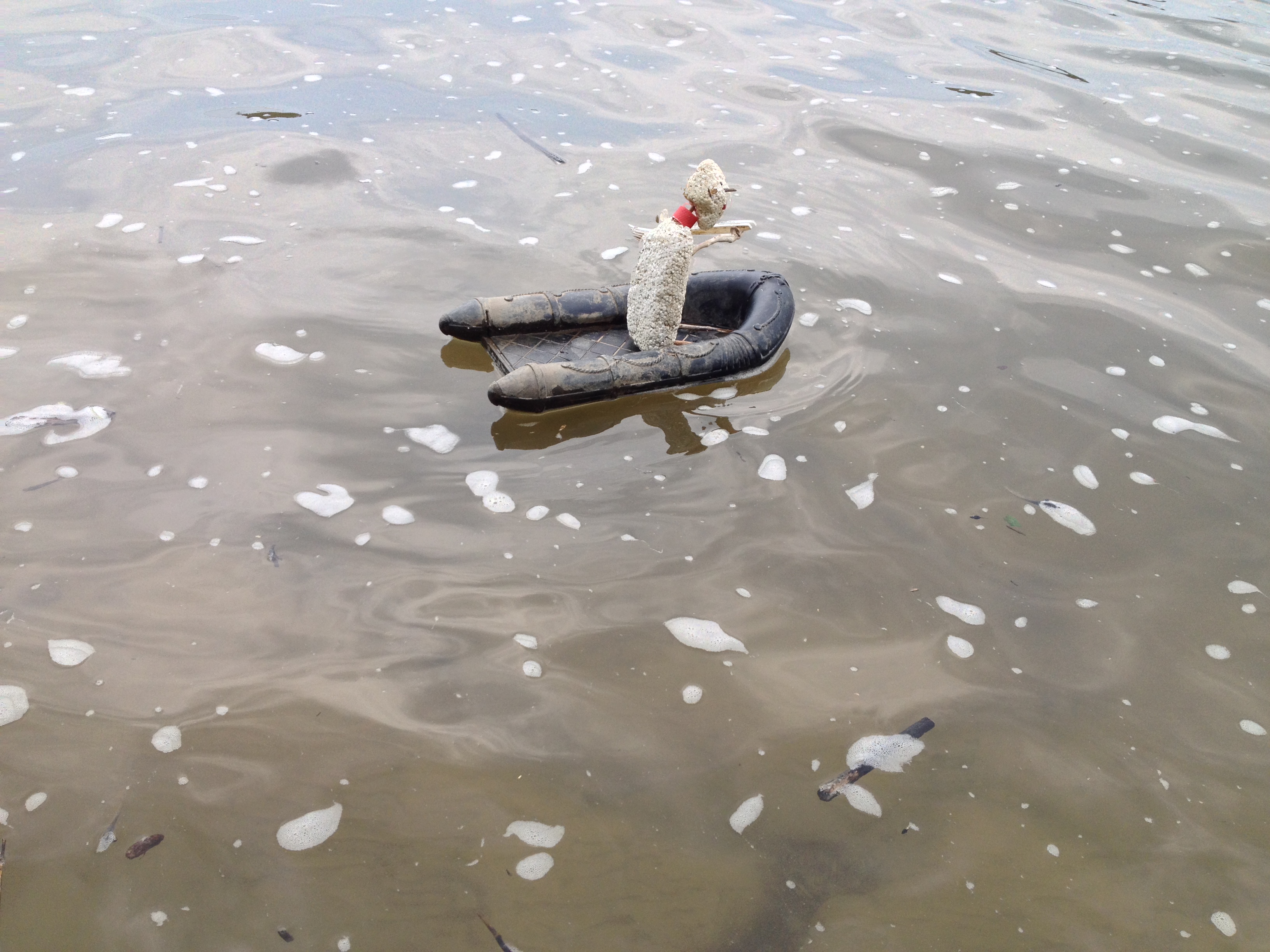
Micro Polo alone on the ocean, Aug. 2014, Falls of the Ohio

Of all the names from the distant past, few shine as brightly or are as well remembered as that of the legendary explorer, Micro Polo.  Rest assured, he must have been an actual person because too many stories and discoveries have been connected with his legacy.  A few rare, hand-copied journals have been preserved in some of the world’s most obscure libraries documenting his remarkable life.  An intrepid traveler and explorer, it is said his ambition was to take the measure of the world even if he fell off its flat edge in the process!  Few individuals in recorded history have had the thirst for knowledge or have traveled so far in the name of adventure.  By far, the most unusual story that has come down to us comes from Micro Polo’s last adventure.  Widely believed to be a fantasy, a recent manuscript discovered in an ancient clay pot and buried for a millennia in the desert ruins of a forgotten city has resurrected the tale and its supposed veracity.  This previously unknown manuscript offers the most detailed version of Micro Polo’s last voyage and is augmented by fantastical drawings scribbled onto the margins.  We offer this contemporary retelling of this ancient tale for your amusement.

Micro Polo alone on the wide ocean, Aug. 2014

On a moonless and cloudy night upon the open sea…tragedy struck!  Micro Polo’s sailing ship caught fire and sank on what would be his final voyage away from home.  There was barely time to escape and a life raft was quickly thrown overboard.  Only three scared and injured sailors including its captain, Micro Polo, climbed into this bobbing cork before the last of the fiery masts disappeared beneath the waves .  During the next week, one sailor perished from his burns and another went mad from thirst and flung himself into the waters never to be seen again.  This left Micro Polo alone in the raft as he drifted with the currents to points unknown.  He resolved to survive and thoughts of his family back home kept him alive.

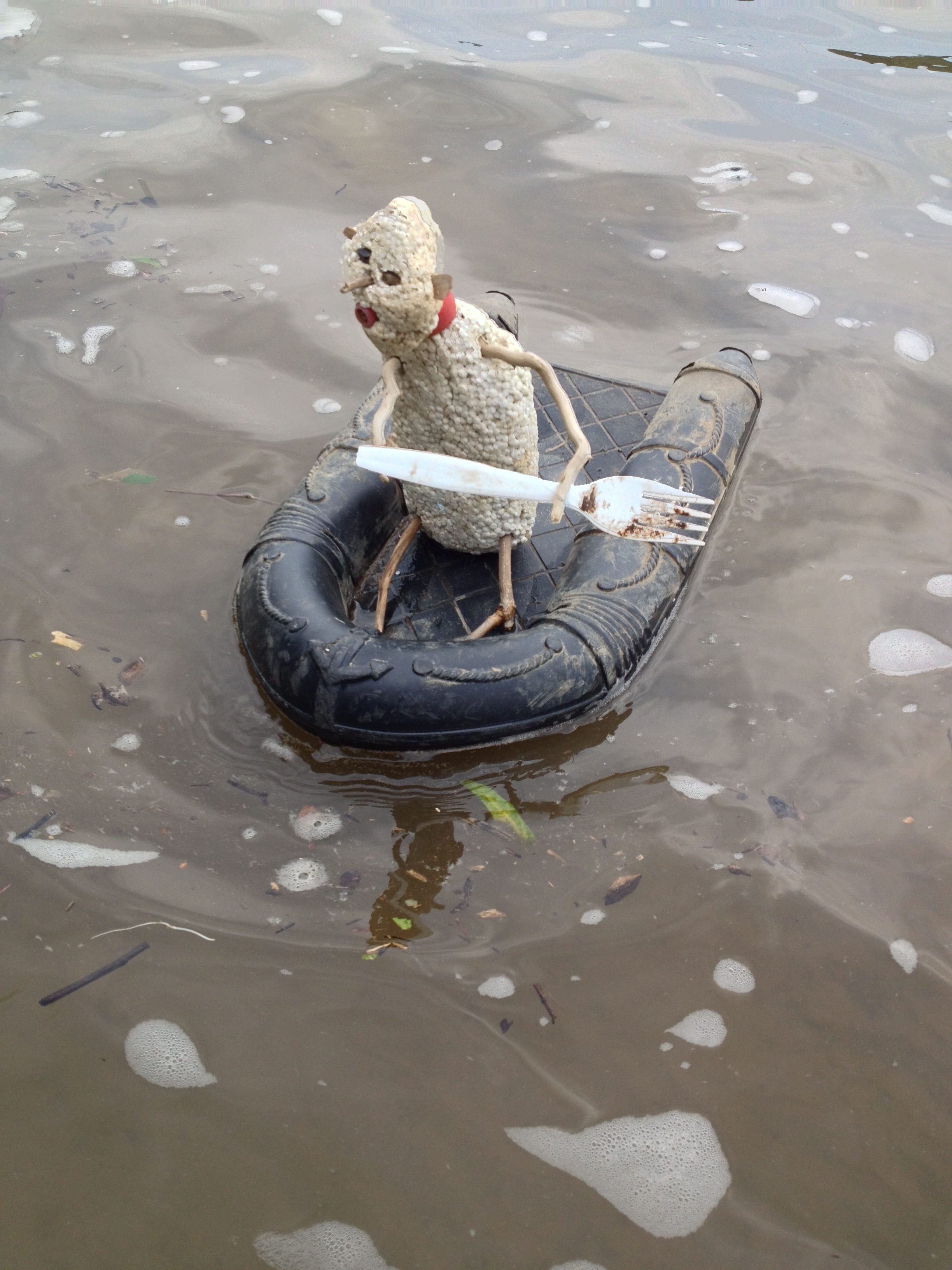
Micro Polo and his raft, Aug. 2014

Micro Polo survived by catching unwary seabirds that landed on his craft and by collecting rainwater from passing showers.  It was during the second week of his ordeal that our hero noticed a fresh change in the surrounding air.  Around him floating in the water were bits and pieces of vegetation and he knew he was near land.  Spying terra firm and the entrance to a large river that flowed into the sea, Micro Polo furiously paddled and reached the shore of a completely unknown world.

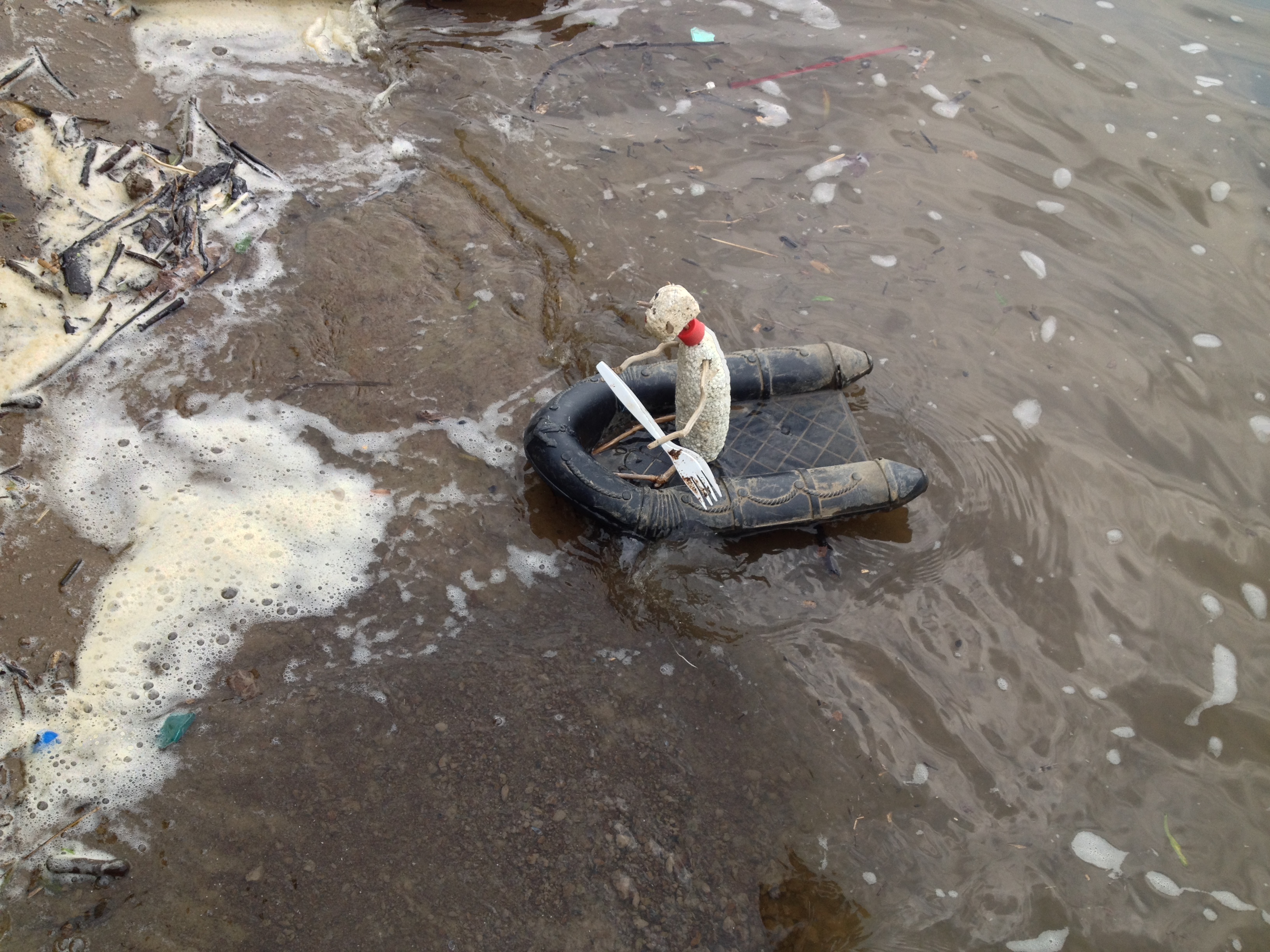
Micro Polo finds land, Aug. 2014

Micro Polo's beached raft with paddle, Falls of the Ohio, Aug. 2014

Upon setting his feet upon the solid ground and through parched lips, Micro Polo gave thanks to his gods and drank deeply from the fresh water of the river.  His spirits were uplifted!  He still had no idea whether or not he was standing on some previously uncharted island or land mass?  At this joyous moment, it did not matter where he was and Micro Polo was eager to leave the confines of the tiny raft and look for help and food.

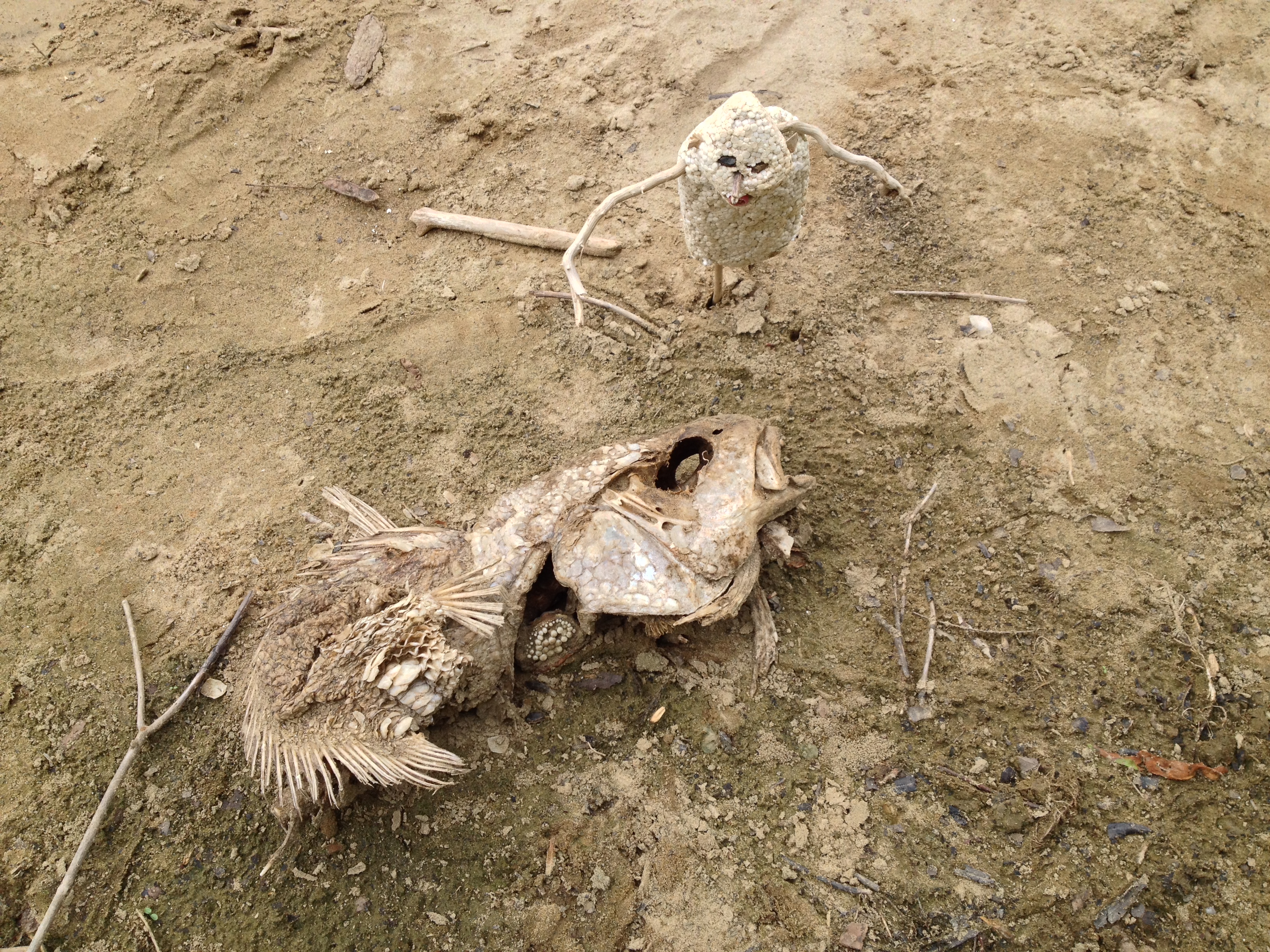
Micro Polo and skeleton of a giant fish, Aug. 2014

Micro Polo had not travelled very far down the sandy beach before he realized that he had arrived at someplace extraordinary.  Before him laying on the coarse sand was the largest fish skeleton he had ever seen!  It was a monster and Micro Polo felt lucky not to have encountered him in the water.  The size of the creature’s mouth was large enough to have easily swallowed the explorer!  Judging from the scales and boney plates, Micro Polo thought this behemoth resembled the common carp of his home country.  Soon our hero would come upon many other large and unusual sights.

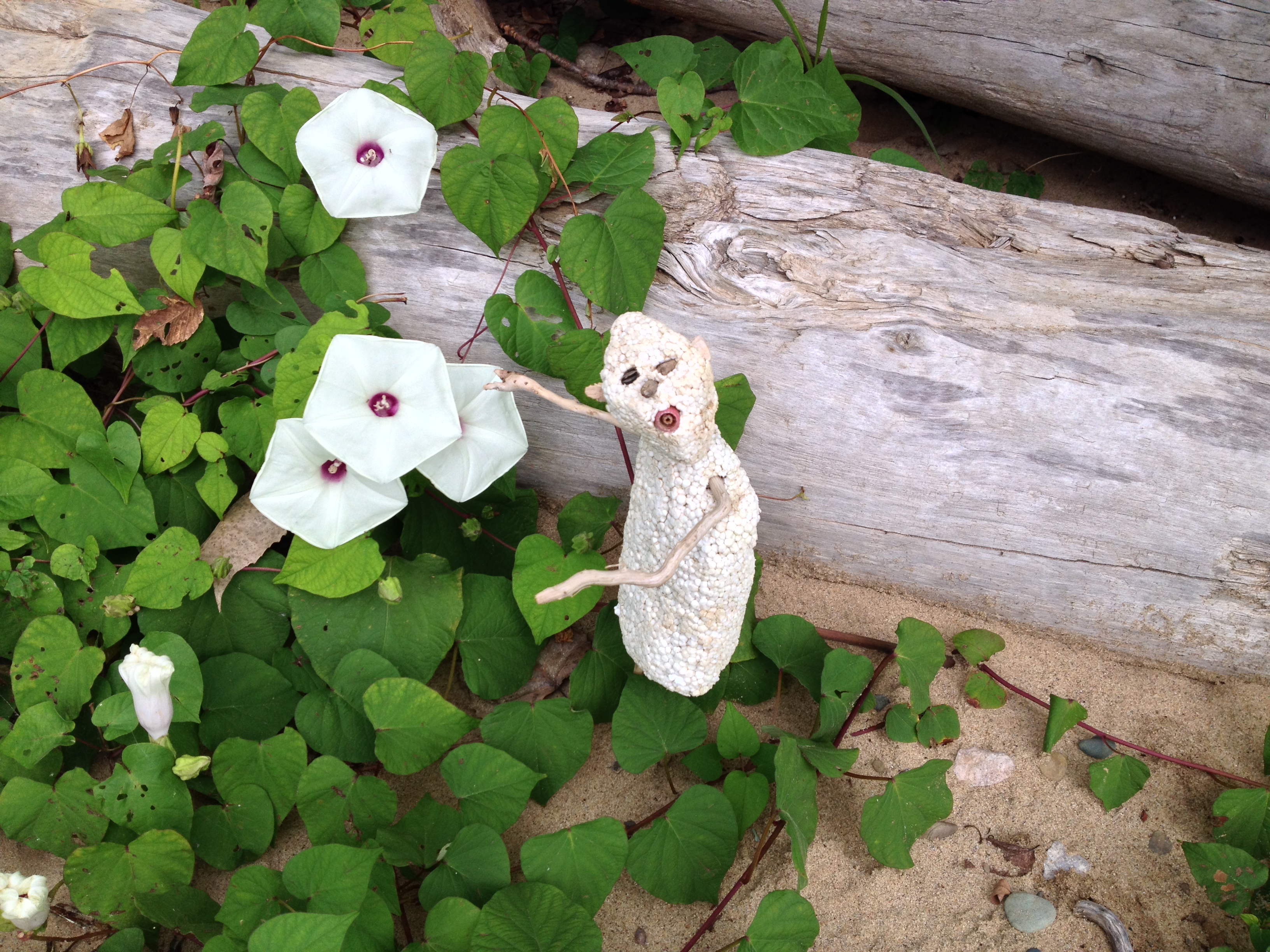
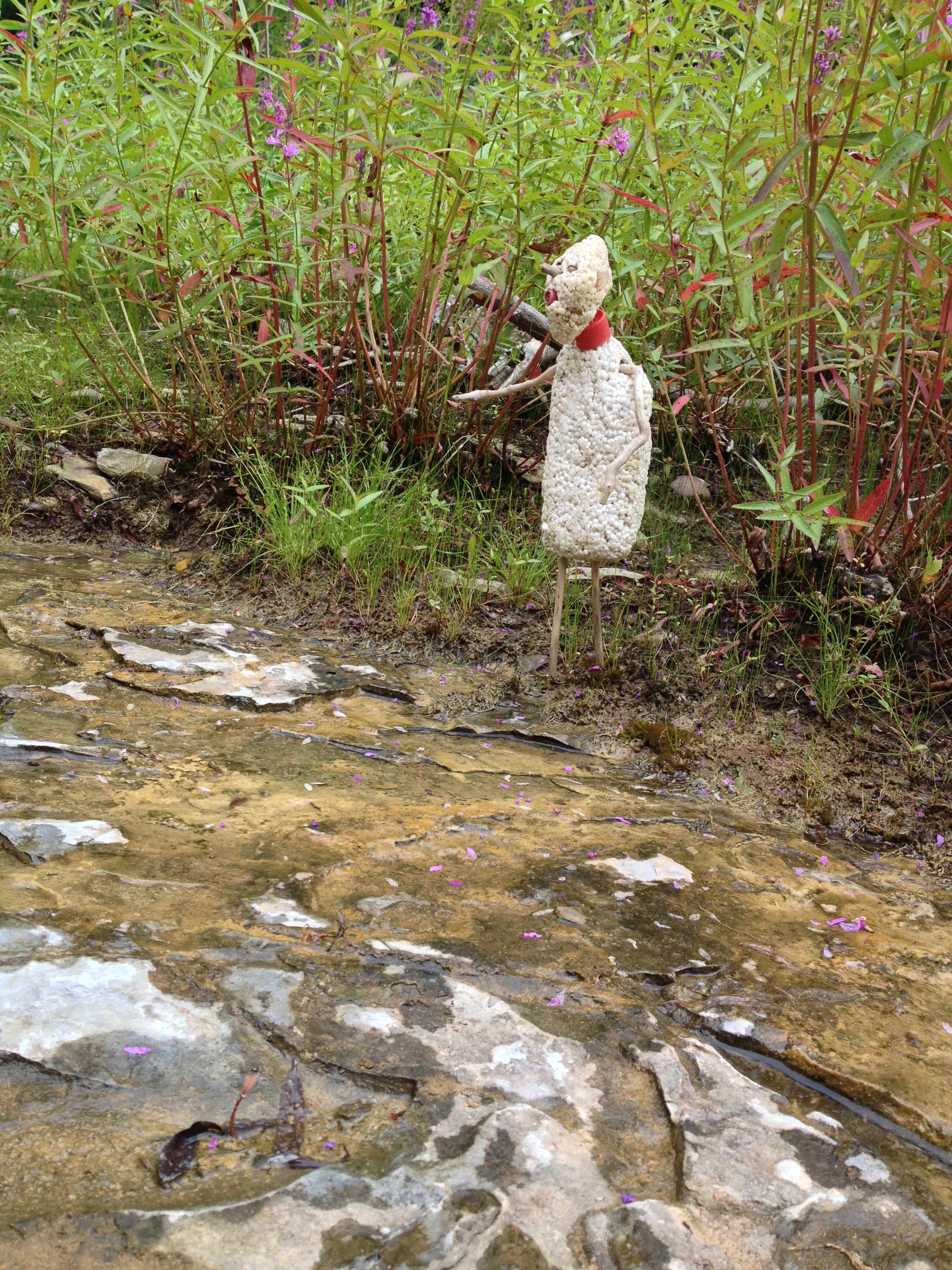
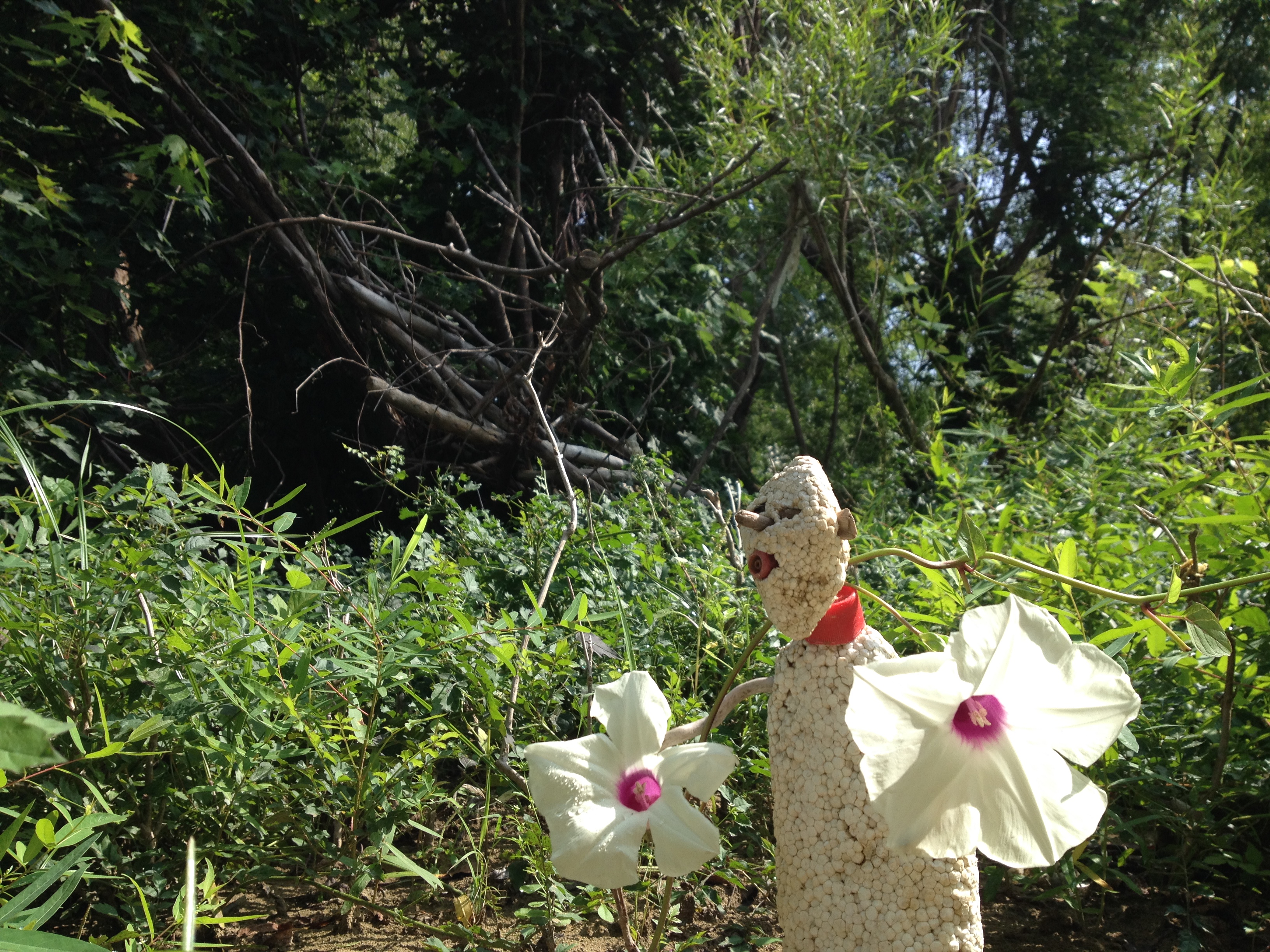
Micro Polo with large white flowers, Aug. 2014

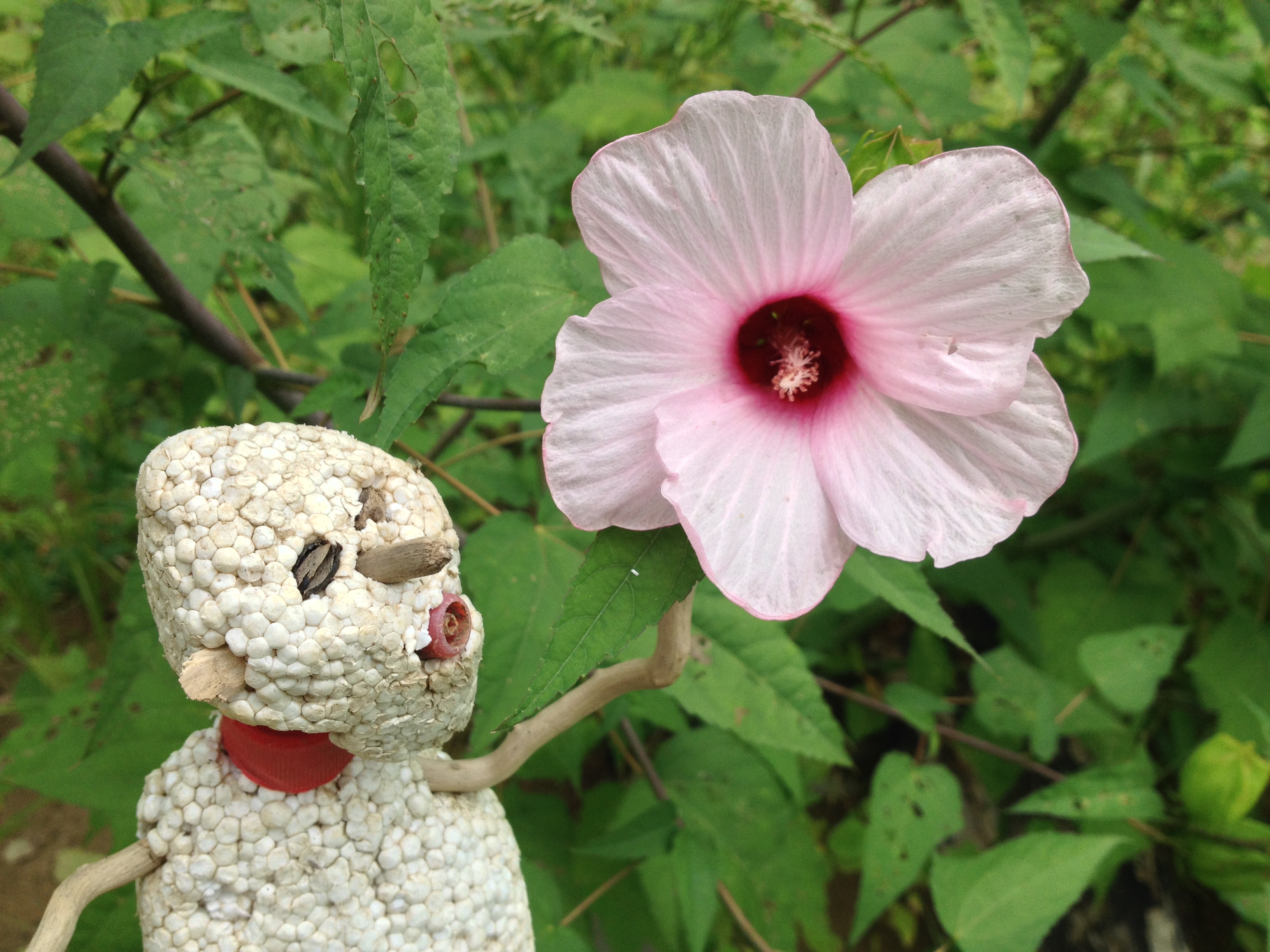
Micro Polo next to giant Rose Mallow, Falls of the Ohio, Aug. 2014

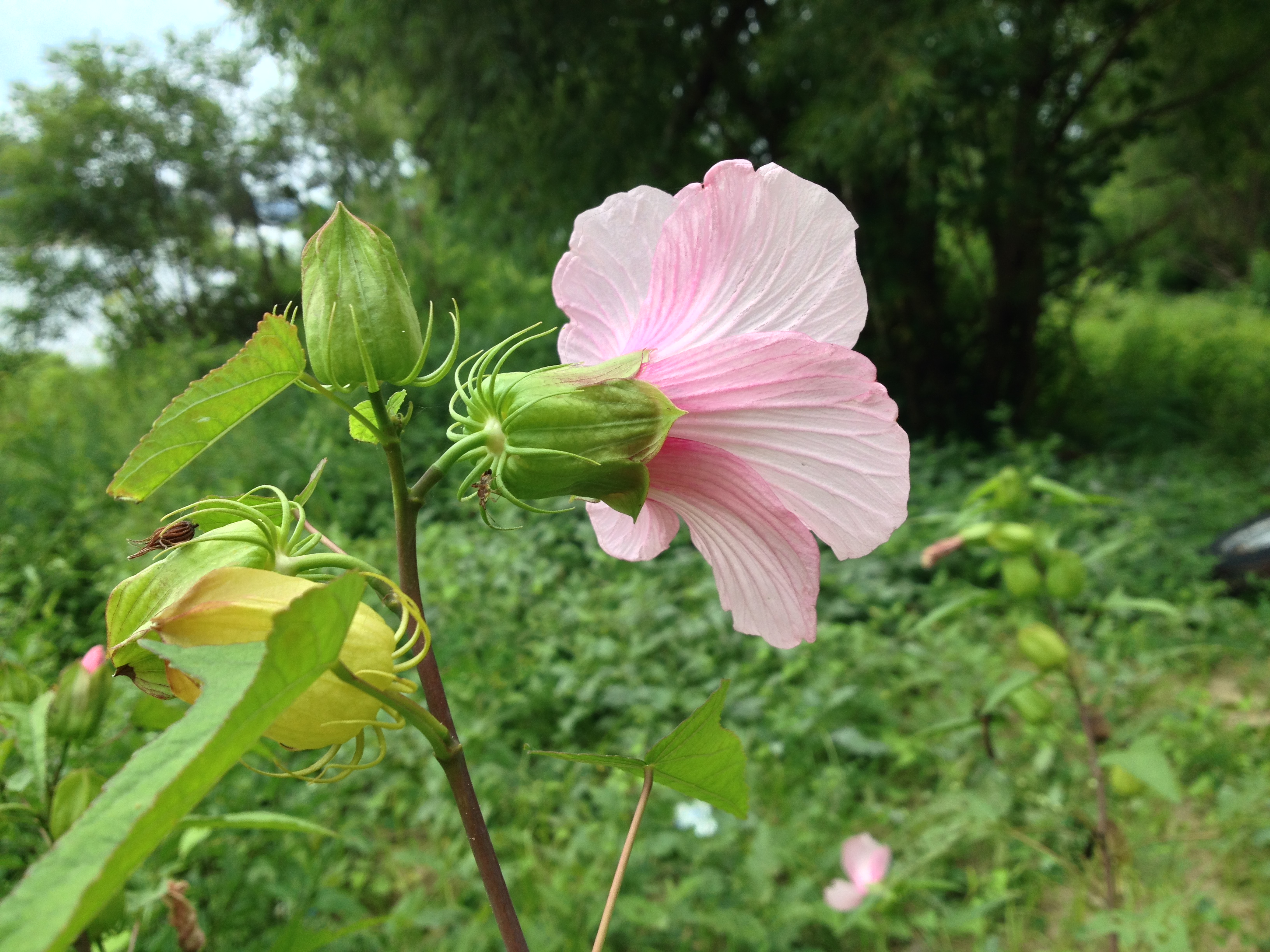
The vegetation of this new land was outstanding!  It was verdant and outrageously populated with the largest blooms imaginable.  There were immensely long vines and grasses as tall as trees!  As he walked and explored this oversized garden, Micro Polo noticed that like the fish he found…many of the flowers of this new land resembled varieties that he was somewhat familiar with and had grown at home.  Over here were giant morning glories and could this be some new type of gigantic rose mallow?

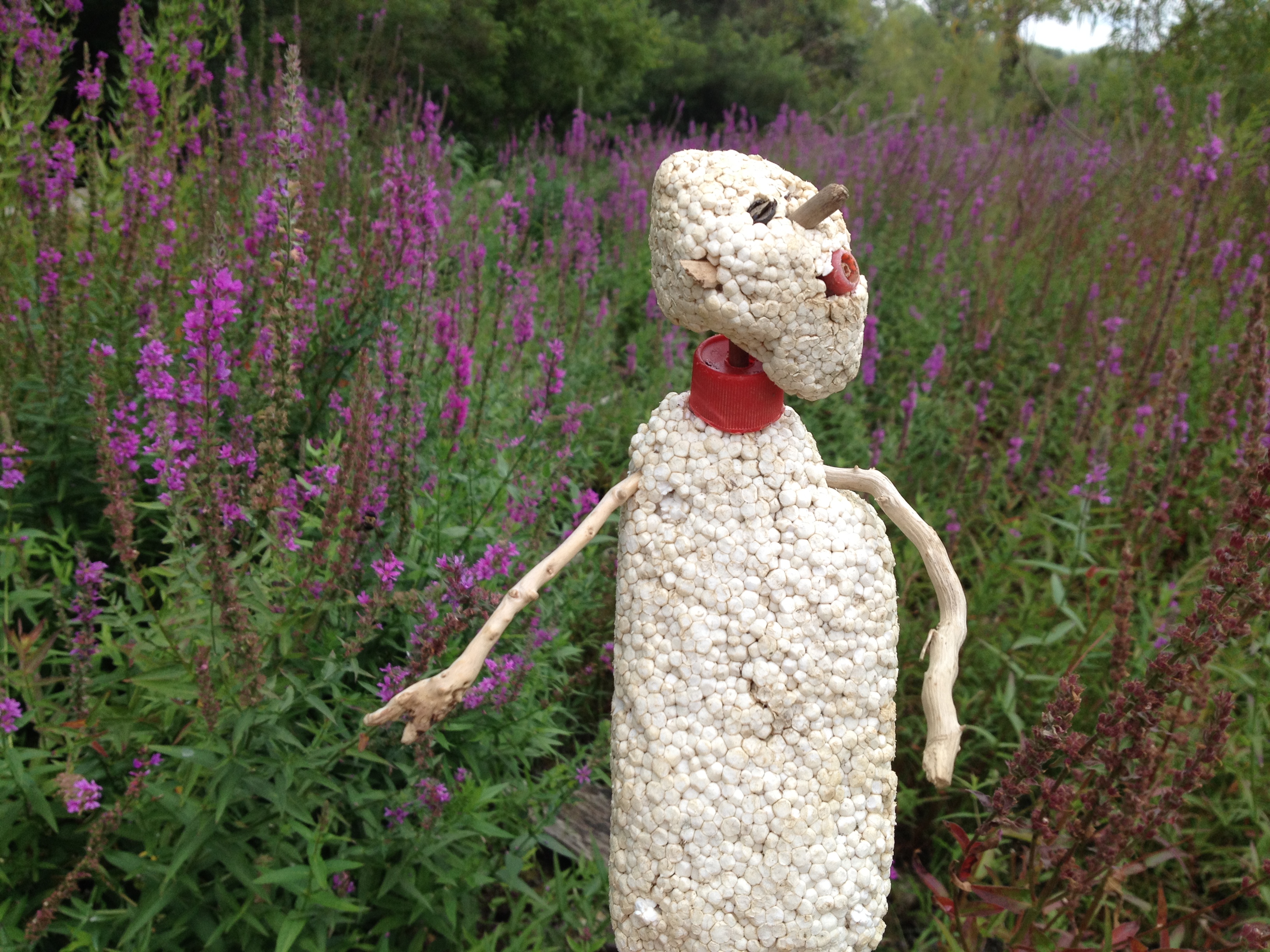
Micro Polo and field of giant loosestrife flowers, Falls of the Ohio, Aug. 2014

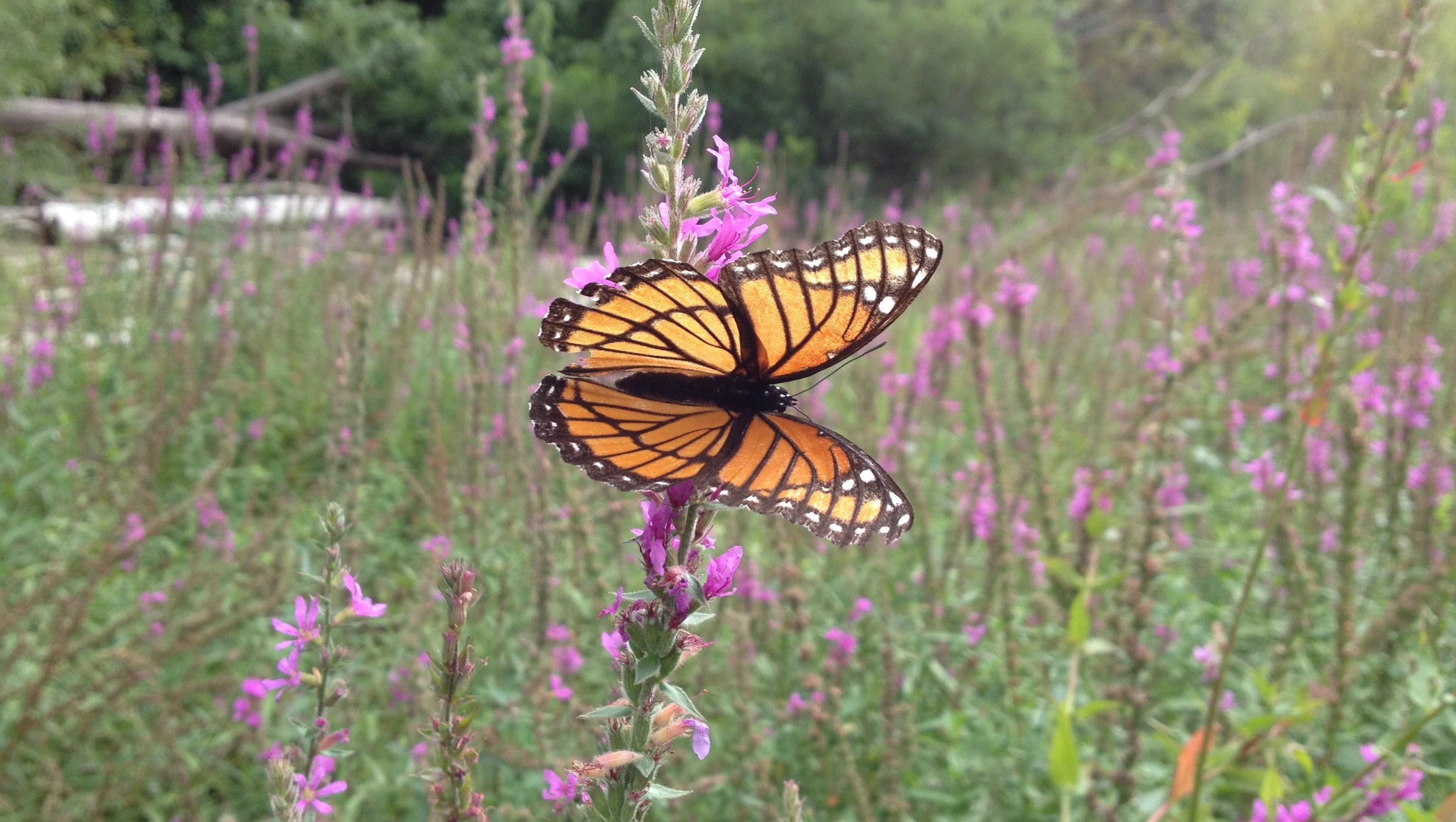
Wandering further afield, Micro Polo came upon a clearing populated by a large stand of loosestrife flowers. The purple color of the flowers was intoxicating and the explorer could not take his eyes off of the huge butterflies as large as eagles sipping nectar from the blossoms.  In addition to being a riot of color, the loosestrife flowers were alive with the buzzing sounds of hundreds of insects flying around.  Here Nature was undisturbed and at peace going about its business.

Viceroy butterfly on loosestrife flowers, Falls of the Ohio, Aug. 2014

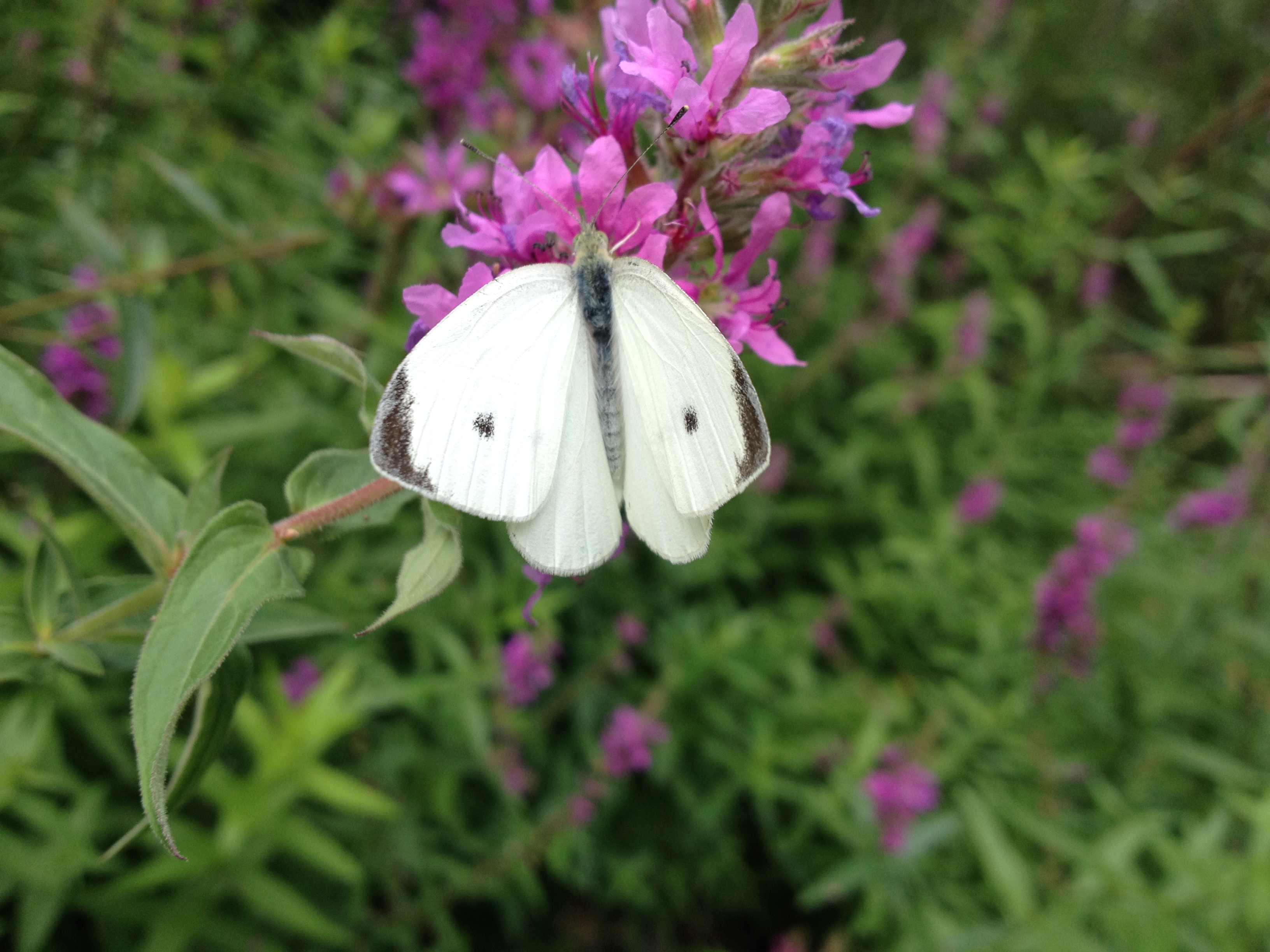
Cabbage white butterfly on loosestrife, Aug. 2014

Micro Polo recognized the Cabbage White butterfly from his homeland, but there were many new species here and all the more remarkable for their immense scale and beauty.  The insects (including some very large bumblebees) all left the traveler alone as they were preoccupied gathering nectar and pollen from the flowers.  As the sun was setting, Micro Polo began to get very weary and he sought out a place to spend the night.

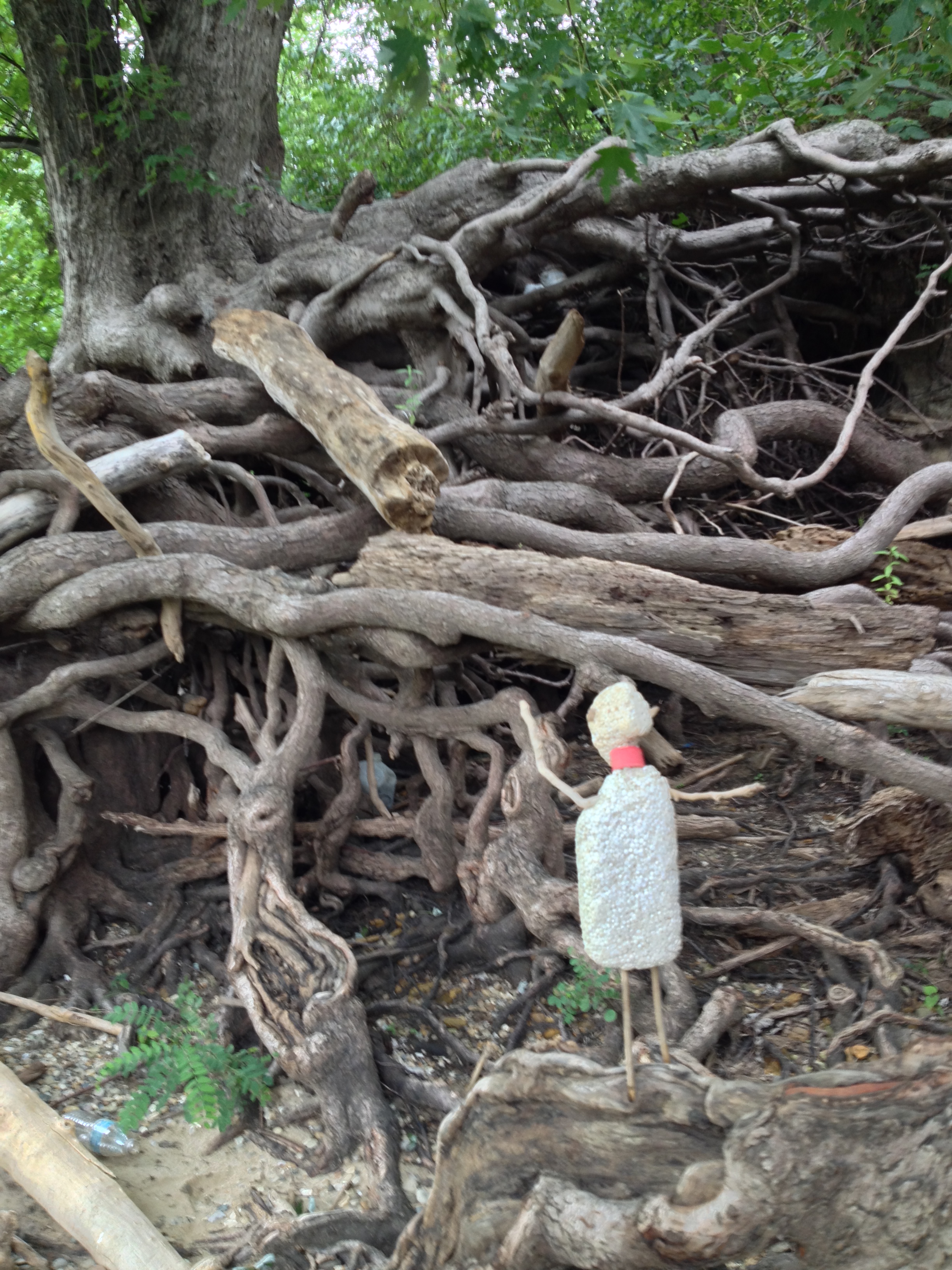
Micro Polo among the roots of a giant tree, Aug. 2014

Of all the immense delights of that first day, nothing struck Micro Polo with more awe than the size of these trees.  The roots alone were thicker around than a man’s body.  The captain in him noted that a single one of these gigantic trees would provide enough lumber to build a single new ship.  For now, he would be happy to take shelter for the night under its huge and leafy canopy.  He found a nice safe space protected by interlocking roots and decided to settle down for the evening.

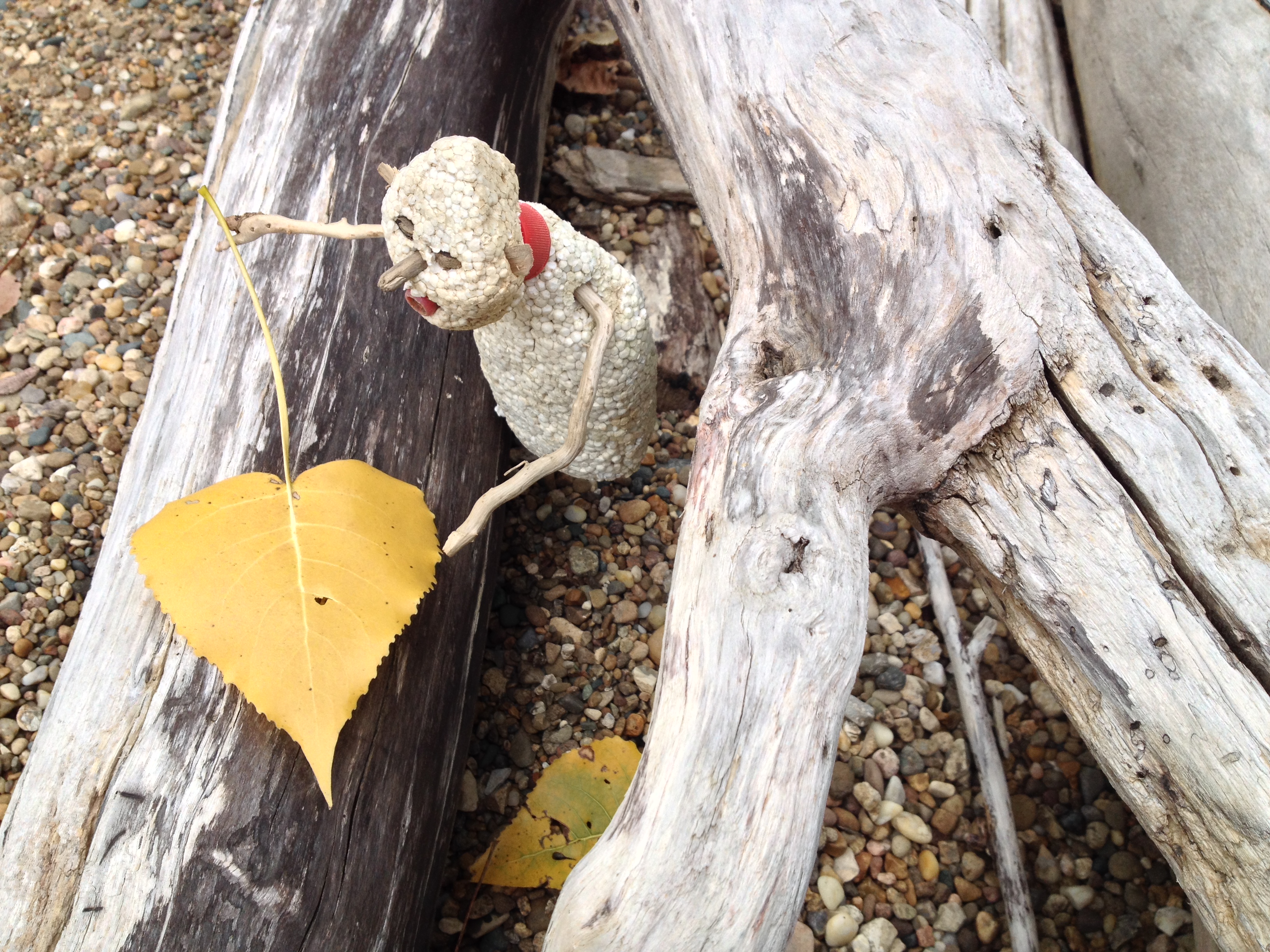
Micro Polo with a large yellow leaf, Aug. 2014

To pad the ground for sleeping purposes, Micro Polo gathered the immense yellow leaves that were lying around the tree.  There was an intoxicating spicy smell from sleeping upon a bed of leaves and our intrepid explorer barely registered the distant thunder storm that was approaching before falling asleep.  Micro Polo was so fatigued by the excitement of the day that the brief but intense rain showers were not acknowledged at that time.  The explorer later recalled that this was the most restful night of sleep he had ever had.

Micro Polo the following morning., Aug. 2014

The following morning was wet from dew and the previous night’s rain.  Micro Polo decided to get up at first light and further explore this unbelievable landscape.  He found some greens that were palatable and had breakfast.  Later he crossed over an area that was rocky and had large deposits of driftwood bleaching in the sun.  Thus far, he had seen nothing that made him think that he wasn’t the only person walking this land…but that was about to change.
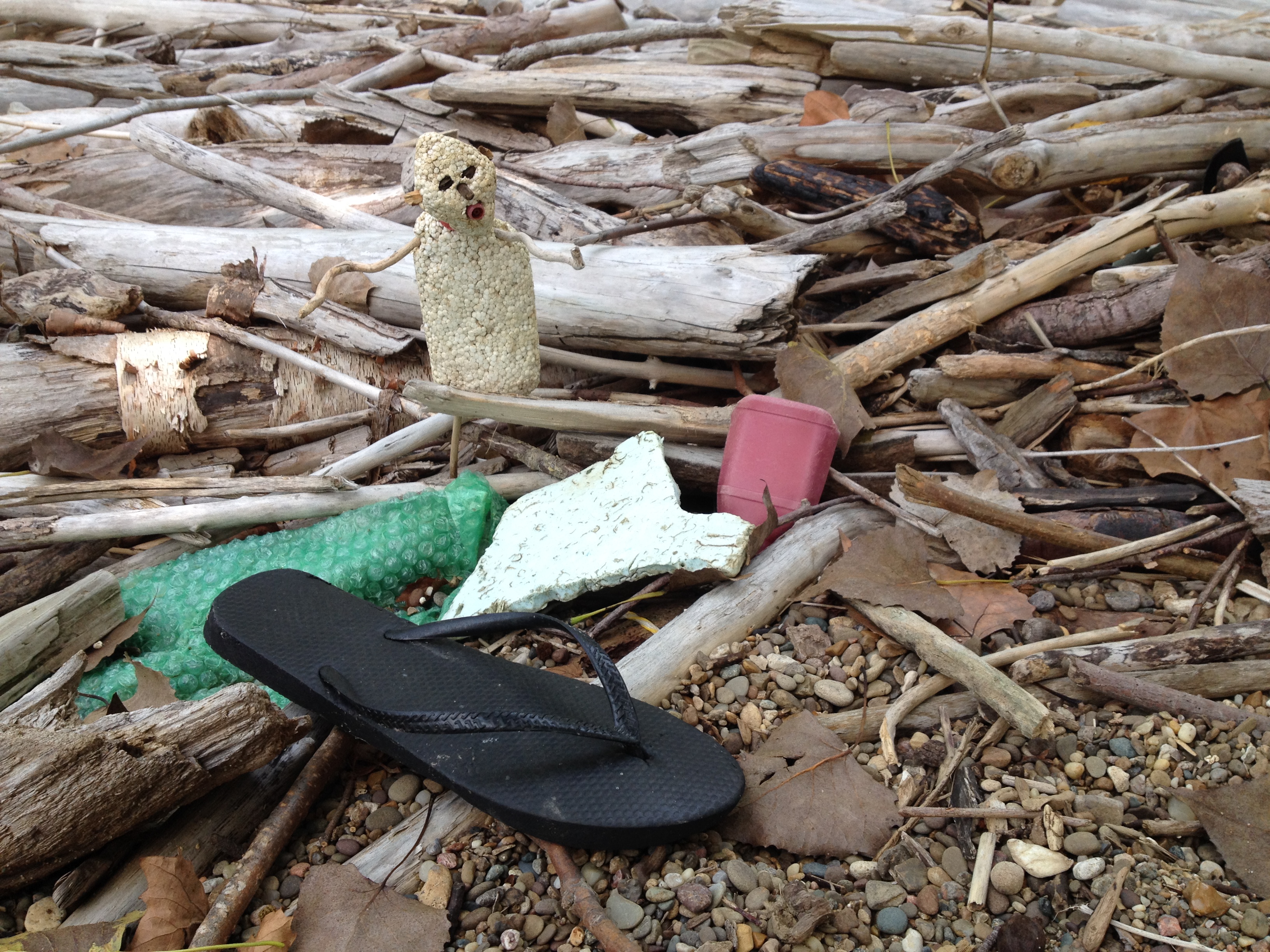
Micro Polo and the giant sandal, Aug. 2014

Tangled up in the driftwood were certain outsized objects that looked like common household items that had been carelessly thrown aside.  Micro Polo came upon a large black sandal that was as long as his body!  There were other fragments whose purposes and materials he did not recognize.  Not far from this discovery, he came upon this find.

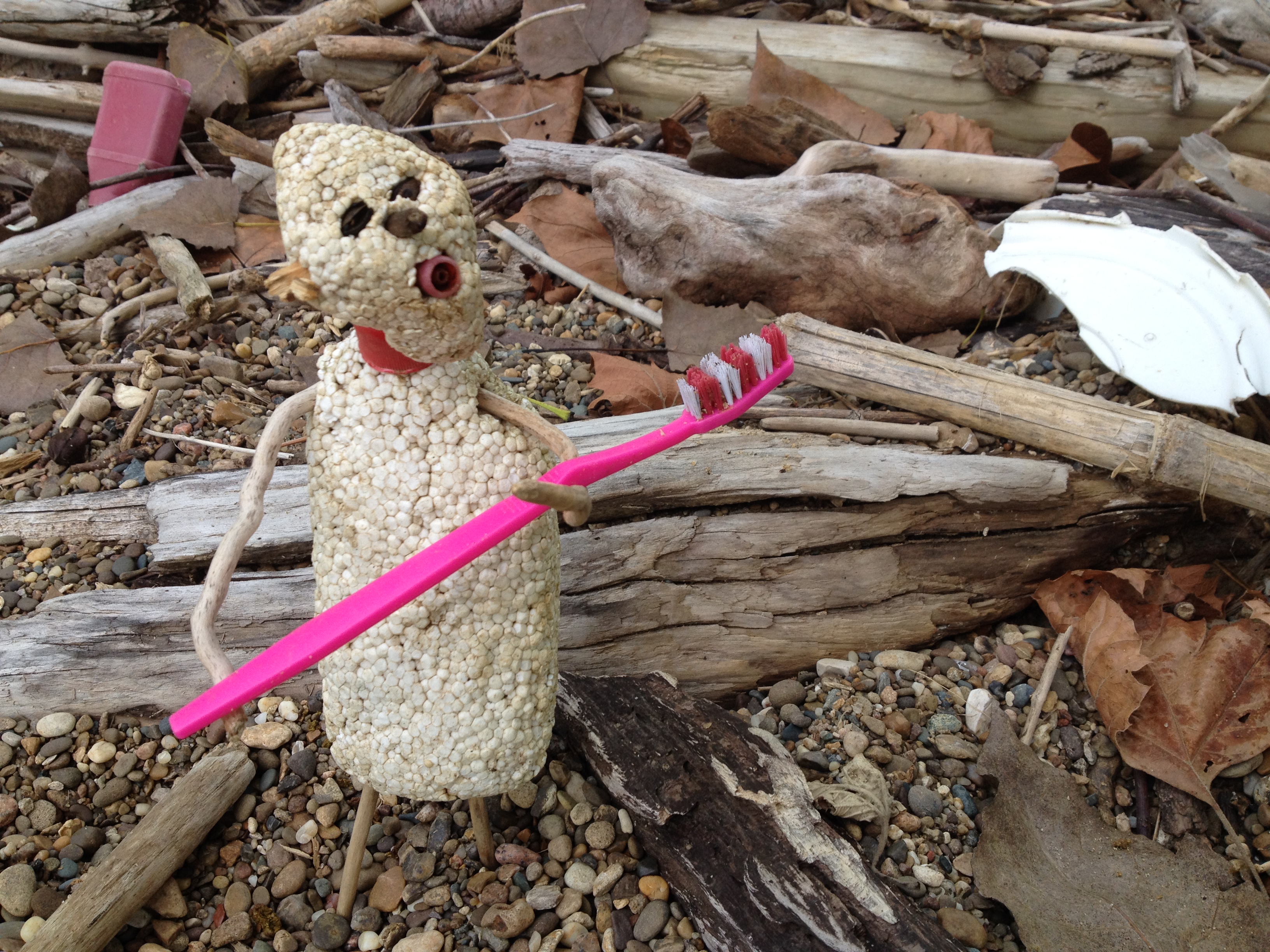
Micro Polo with large toothbrush. Falls of the Ohio, Aug. 2014

Micro Polo recognized this an implement for cleaning one’s teeth, but on a gargantuan scale!  For the first time since arriving on these shores, the explorer began to fear and have doubts.  It was now clear that a race of giants also inhabited this land!

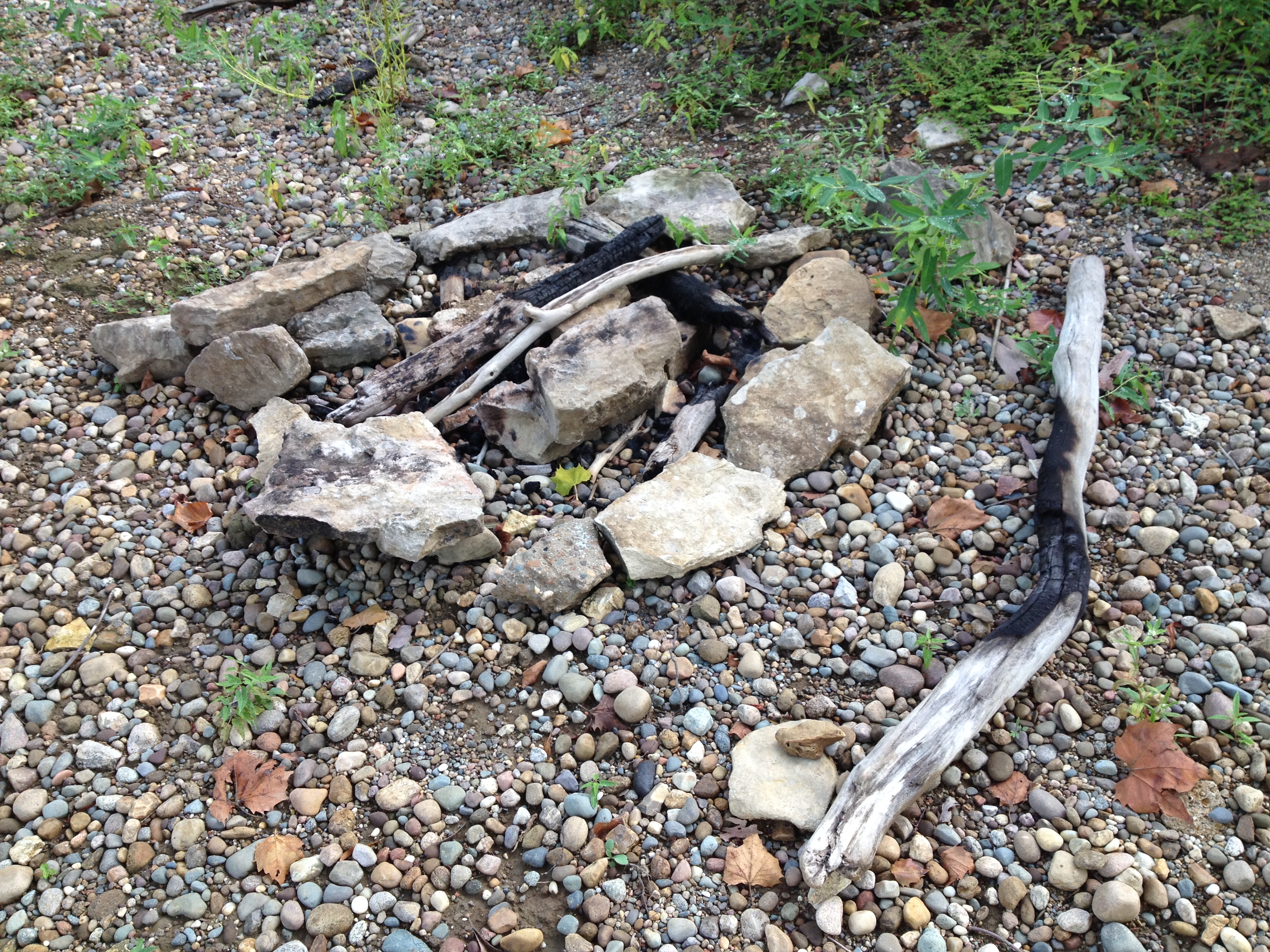
old firepit, Aug. 2014

Micro Polo decided to return back to the area where he first landed.  Along the way, he passed by what he previously thought were the possible ruins of some kind of stone fortification only to learn upon closer inspection that it was the remains of someone’s old camp fire.  There were immense charred logs within the stone ring.  Our explorer decided to hasten his step back to the raft.  He had no desire to see what type or kind of “man” could work on this scale!  Micro Polo was also determined not to become either this race of giants next pet or worse yet…a meal.  He had seen enough and was ready to take his chances upon the sea again.
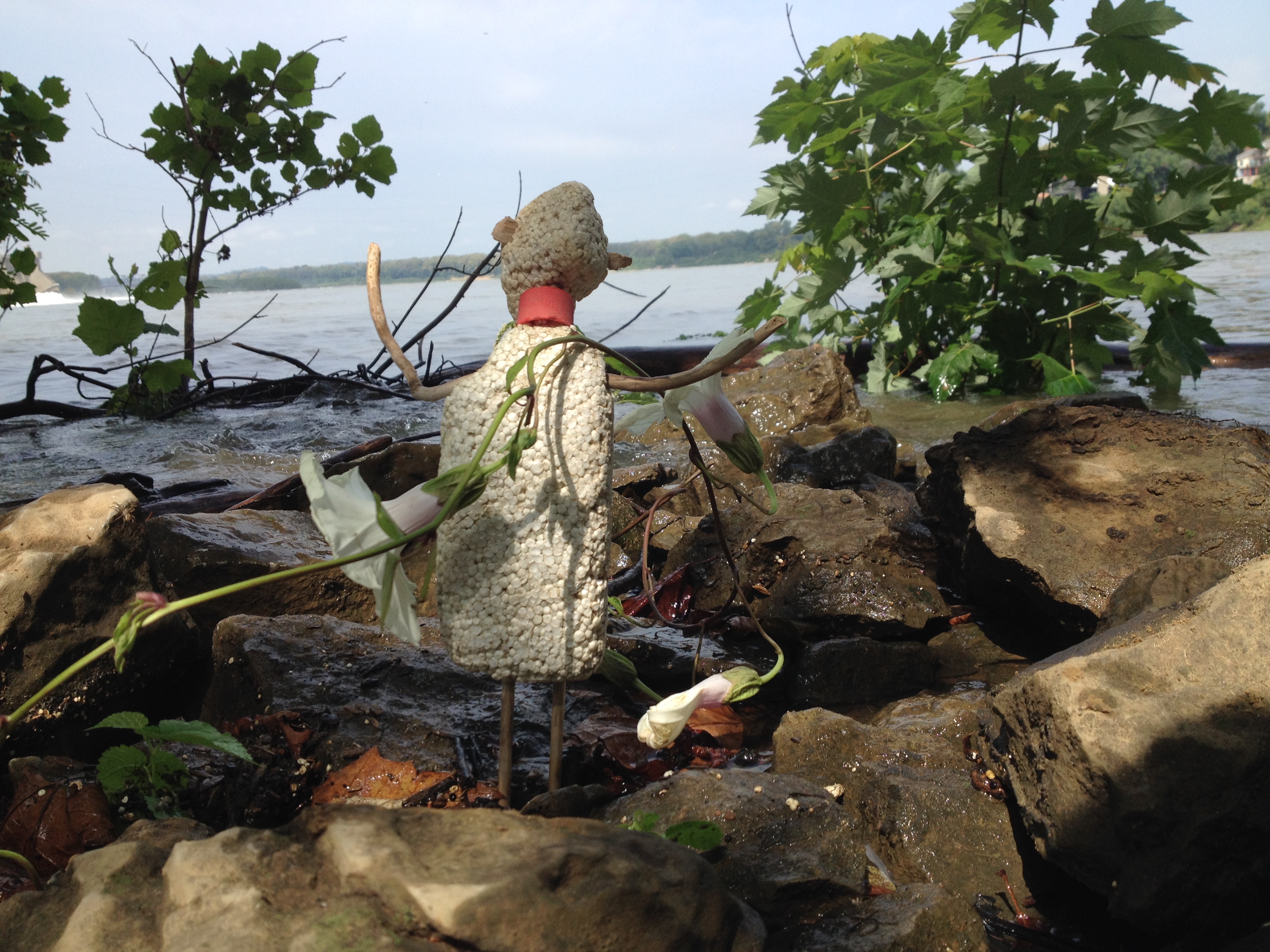
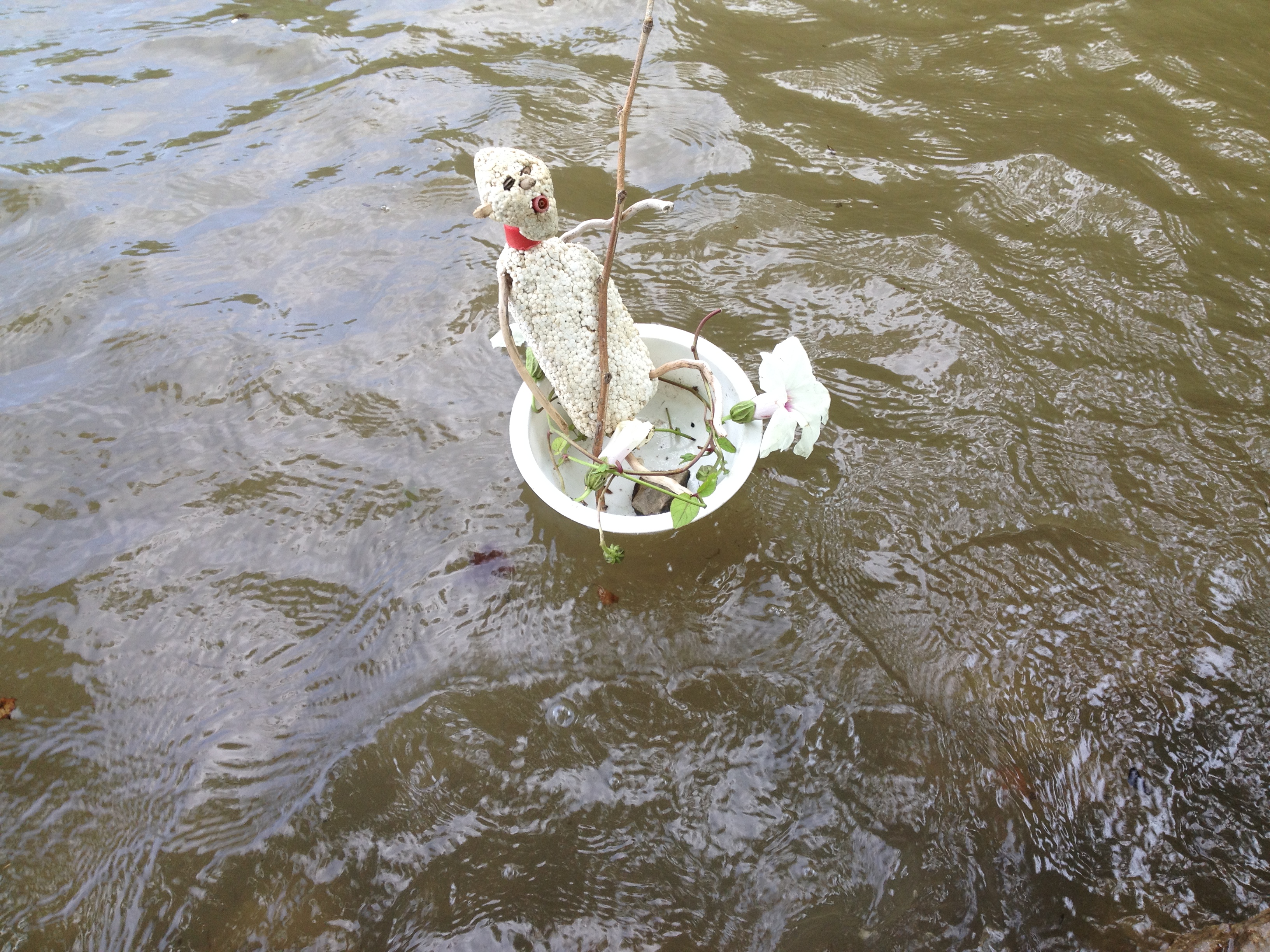
Micro Polo with plucked morning glories, Aug. 2014

All manner of bizarre thoughts crossed over Micro Polo’s mind.  Had he in fact landed on some fantastic island or continent of giants?  Or, was it possible that by some unknown method or means that his very being had been shrunk down in size rendering him diminutive?  Could prolonged exposure to the elements while on the raft have this effect upon him?  Regardless, if he were to return home he would need proof of his latest and perhaps greatest discovery.  Thinking quickly, Micro Polo tore off a length of morning glory vine with blossoms and threw it across his shoulders.  He would take this plant specimen home with him or perish in the process.

Micro Polo looks for his raft, Falls of the Ohio, Aug. 2014

When the great explorer reached the spot where he thought he left his raft…it was nowhere to be seen!  The rain storm from last night had swelled the volume of the river and the raft, left unsecured, simply drifted off.  Micro Polo was in a panic and searched up and down the riverbank, but the black craft that bore him to safety once before had simply vanished.

Micro Polo and large white bowl, Aug. 2014

Micro Polo and his new "boat", Falls of the Ohio, Aug. 2014

As the story continues, many hours and several miles or kilometers later…Micro Polo came upon an artifact partially buried in the sand that would save him.  It had been shaped by the giants and had probably served as a bowl or at least it looked like one.  Being a resourceful individual, Micro Polo had the great idea to use this bowl as his getaway vessel.  He gathered up some provisions for the journey, wrapped the now wilting morning glory vine around his body and launched himself back upon the waters.  He would trust that whatever mysterious forces brought him here would also return him home again.

Micro Polo homeward bound, Aug. 2014

Micro Polo was discovered adrift after several weeks by a passing merchant ship and he was taken back to his homeland.  The sailors that found him reported that he was speaking gibberish and hallucinating badly.  All his provisions were gone along with the morning glory vine which he had eaten when nothing else edible presented itself.  He kept telling anybody who would listen about this fantastic land of giants he had discovered, but nobody believed him.  Those with a kind heart and ear just let him go on with his crazy story.  Eventually, Micro Polo’s health returned to him with his family’s care, however, his days of great discoveries were over.  The famed explorer spent the rest of his life chronicling his adventures in his notebooks and navigating the known world through hand drawn maps and charts spread out upon his library’s wooden table.  In the many years that passed, nobody else came across Micro Polo’s land of giants…however, people had a devil of a time explaining where that odd bowl-like boat came from?

Rose Mallow, side view, Falls of the Ohio, Aug. 2014


Read Full Post »

« Newer Posts - Older Posts »