Feeds:
Posts
Comments

Archive for the ‘fresh water’ Category

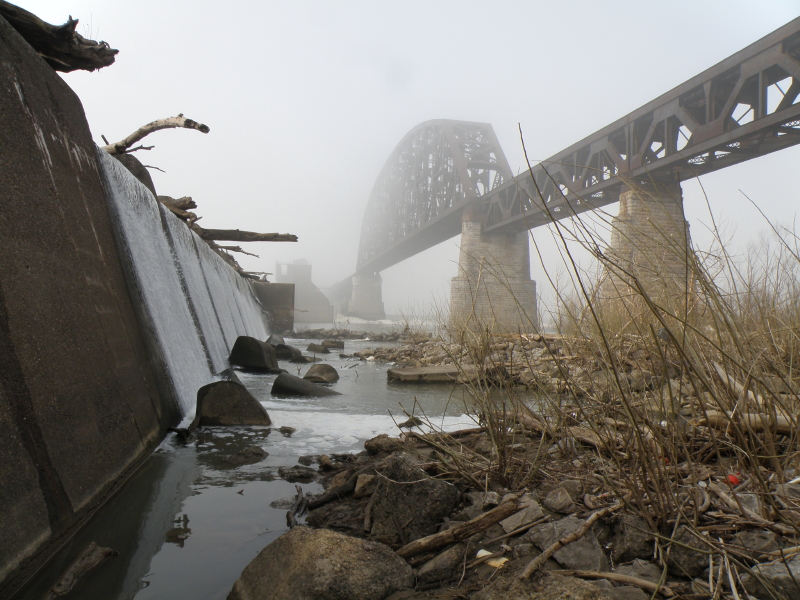
Fog at the Falls of the Ohio, April 2013

Fog is actually common on the Ohio River, but looking through my images, I’m surprised by how few fog pictures I have taken here.  On my last foray to the Falls, the day began extremely foggy like moving within a cloud.  Visibility was limited.  The railroad bridge was completely obscured, but as the sun rose and the temperature became warmer the fog dissipated quickly.  It was another magical moment of transformation as the receding water-cloud revealed the driftwood bones of the park.
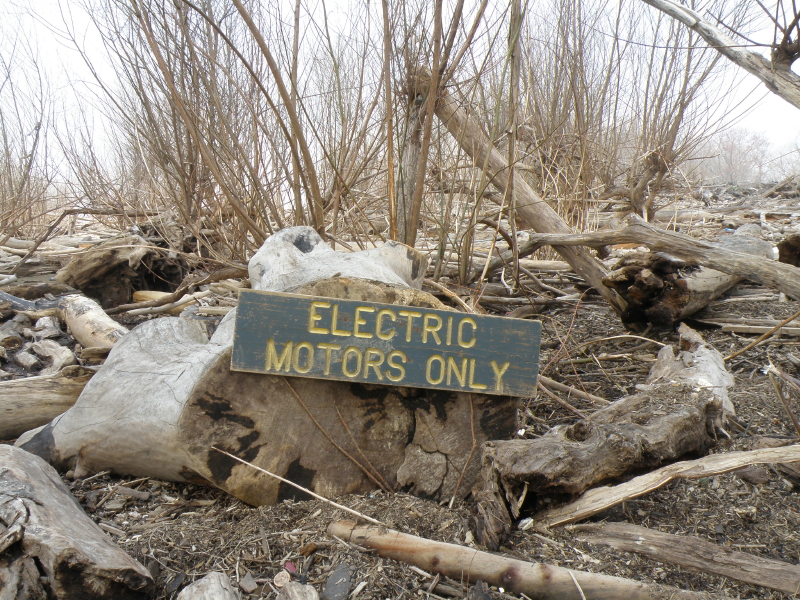
Electric Motors Only sign at the Falls, April 2013

Walking to my outdoor atelier, I passed by this unusual sight.  At first, I thought the large tree stump was a part of this sign, but upon inspection, saw that a single rusty nail attached this sign to the wood.  There is no way this sign could survive the river secured so loosely.  Someone before me found this sign and stuck it on the stump up for grabs in true river junk fashion.  Since I collect signs from the river…this was perfect and I welcomed the new addition to my collection!  After removing the sign from the stump I understood why its original discoverer left it behind.  The sign was on a heavy, thick board that had been routed and painted green with yellow letters.  I stashed the sign under some debris and picked it back up on my way home.  As you can imagine, my wife was thrilled to see it like she is with all the other junk I haul out of here.  I liked the sign’s message which is ecological in its own way.  I wonder where it came from and what kind of electric motors is it referring to…perhaps electric golf carts?  Navigating through the dense driftwood, I made my way to the river’s edge.  Waves were lapping the shoreline and there were other surprises to come.
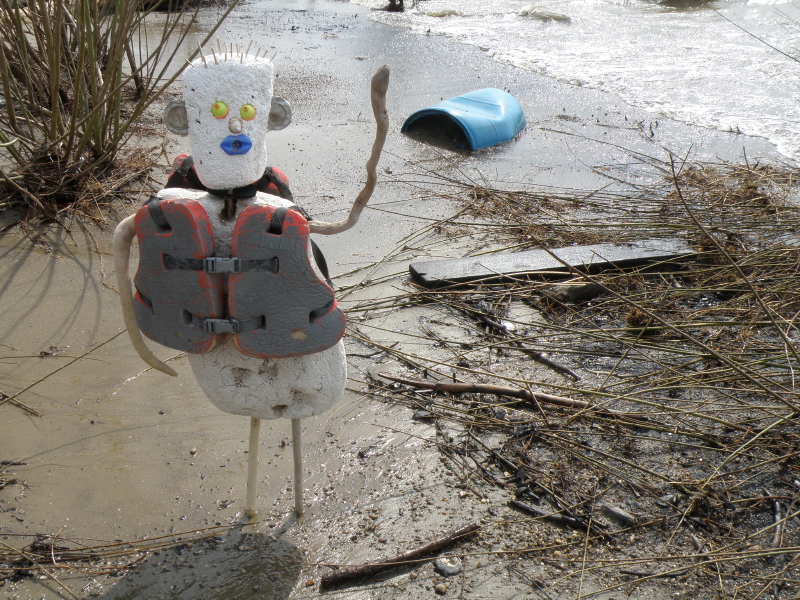
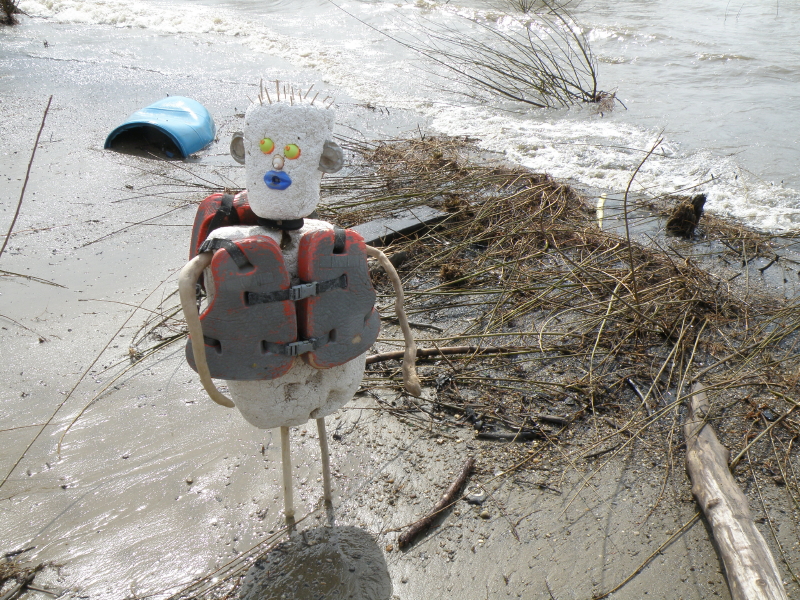
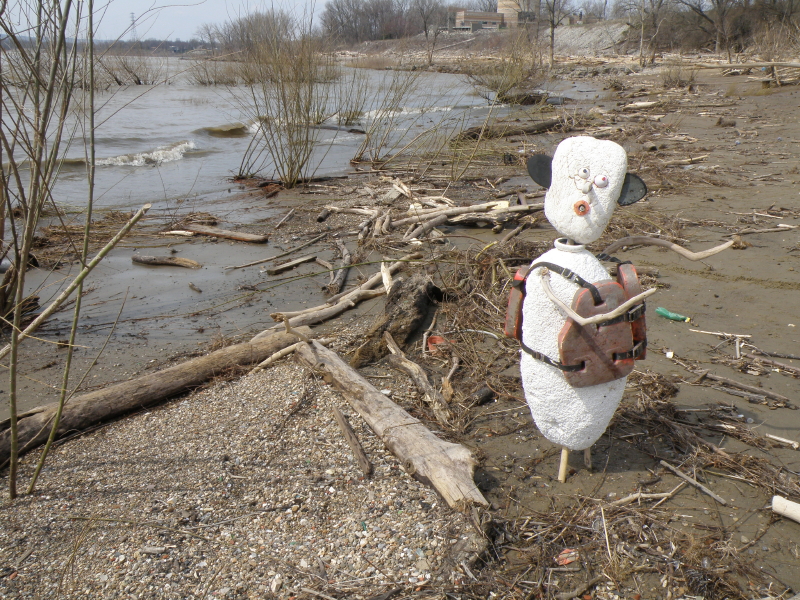
Blue-lipped figure with life preserver on, April 2013

Blue-lipped figure with flotation device, April 2013

This is the moment I met the first of the Flood Brothers.  I had heard of them before and I was pleased to finally get to meet one.  They are called the Flood Brothers because in their own “Chicken Little” way instead of the sky falling…they are rumored to believe the world is in imminent danger of being inundated.  For this reason they wear life jackets and flotation devices everywhere they venture particularly along the river.  They are living legends in this part of the world.

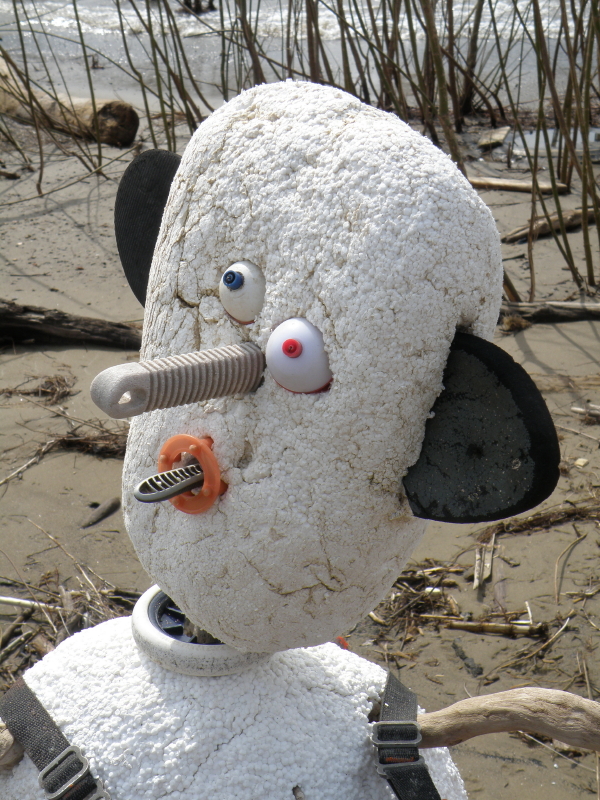
Portrait of F.B. 1, April 2013

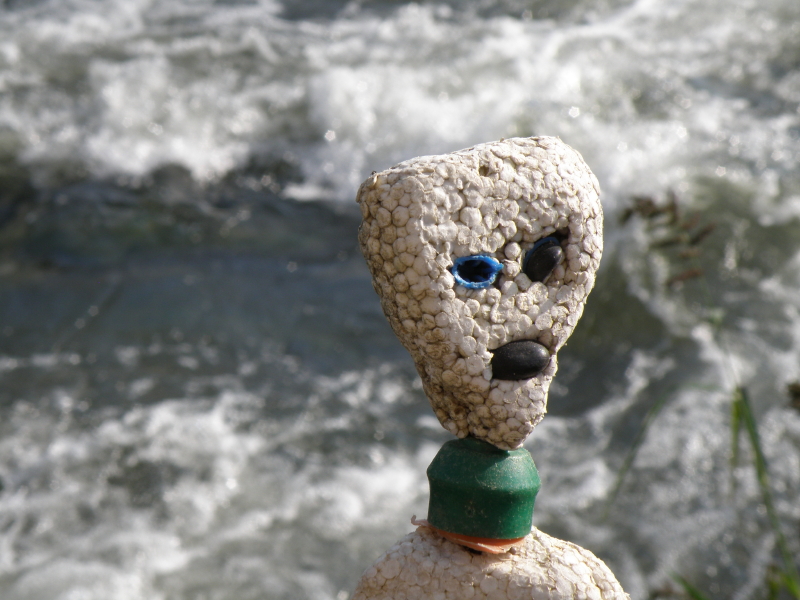
This is a close-up portrait of Flood Brother #1…henceforth identified as F.B.1.  He has blue lips like he has been out in the cold too long.  His eyes have this jaundiced quality to them and they are slightly asymmetrical as well.  The ears stick out some and he has spiked hair.  Aside from looking goofy…he is a friendly enough guy and hailed me upon sighting me.  I told him it was a pleasure to meet him and was his brother around too?  As it turns out…Flood Brother #2 was not far away and after walking a short distance along the shoreline, we ran into him as well.
Flood Brother # 2, April 2013

Portrait of Flood Brother #2, April 2013

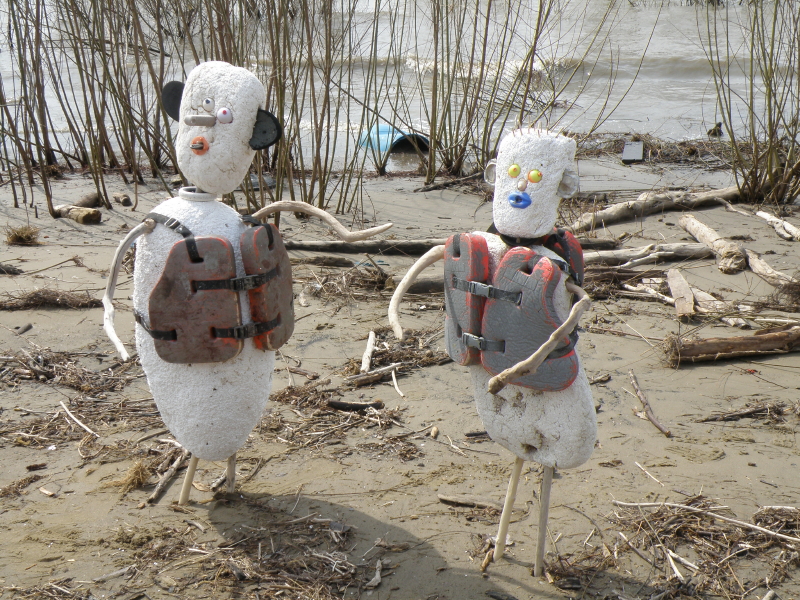
Flood Brother #2 or F.B.2 is the larger and older of the two.  Like his smaller brother he wears a flotation device every where he travels along the river.  You can tell they are brothers because they share some physical characteristics such as large ears and mismatched eyes which are more pronounced in the older brother.  As it turns out, he is also the more nervous of the pair.
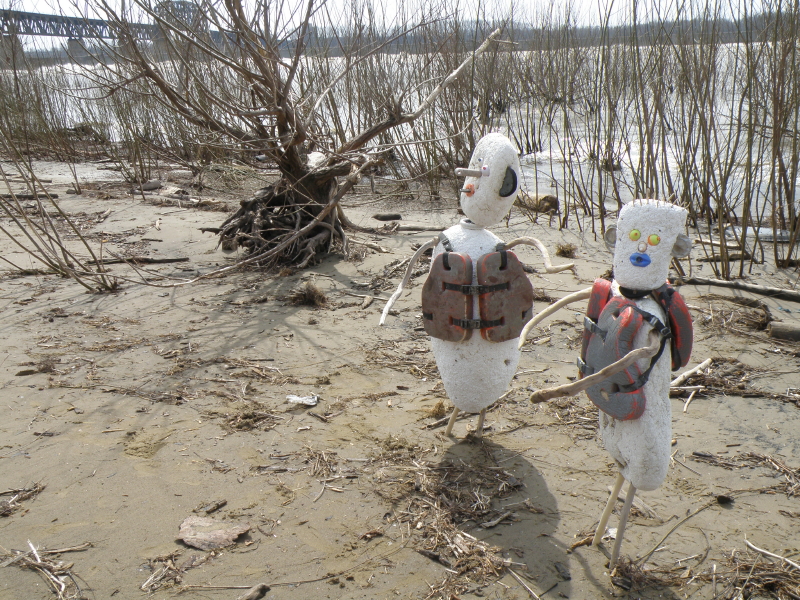
The Flood Brothers at the Falls of the Ohio, April 2013

The Flood Brothers, April 2013

I asked them if it was true that they believe the world would be destroyed in a great cataclysmic flood?  For argument’s sake F.B.2 qualified things by saying that more unusual events had happened during the Earth’s long history.  As it turned out, they were more concerned about the quality and quantity of fresh water.  Climate change is rewriting things and there is just so much more “free” water in the system that formerly was locked up as ice.  That energy is changing the weather patterns and redistributing water across the globe.  Some places were now getting too much and other places not enough.  And yes the potential to redraw the world’s coastlines also existed.  Whether all this would happen overnight or over the course of many years seemed irrelevant to the pair.  The life jackets were just a necessary precaution to them because they were conducting their research along the river in all its many moods and it just seemed a logical safety thing to do.  The pair was visiting the Falls of the Ohio and inspecting the park for water-born plastic of which there was plenty to see. As the brothers told me…this plastic has a very good chance of making it into the oceans where it has effects of its own.  I didn’t have the heart to tell them that they were already preaching to the converted.  Instead, I invited them to my studio under the willow trees to rest and talk further and they accepted my invitation.  My site was just a short distance away.
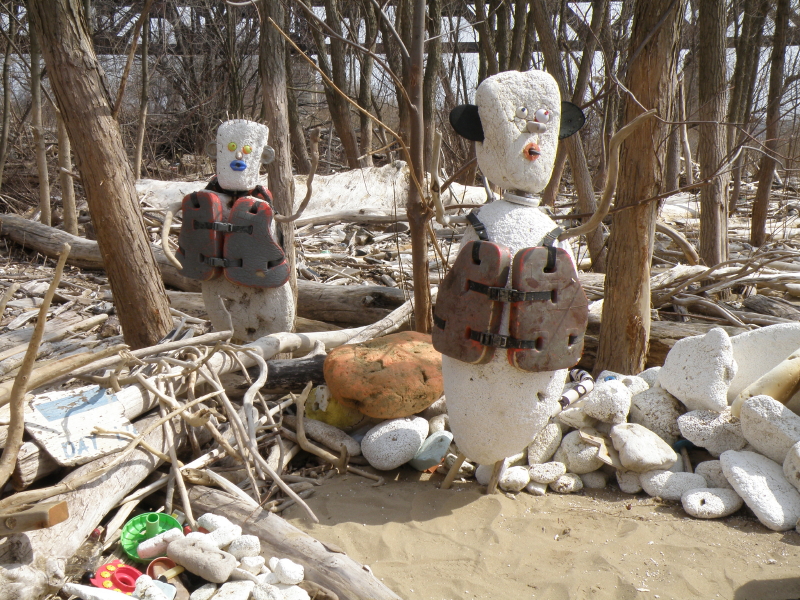
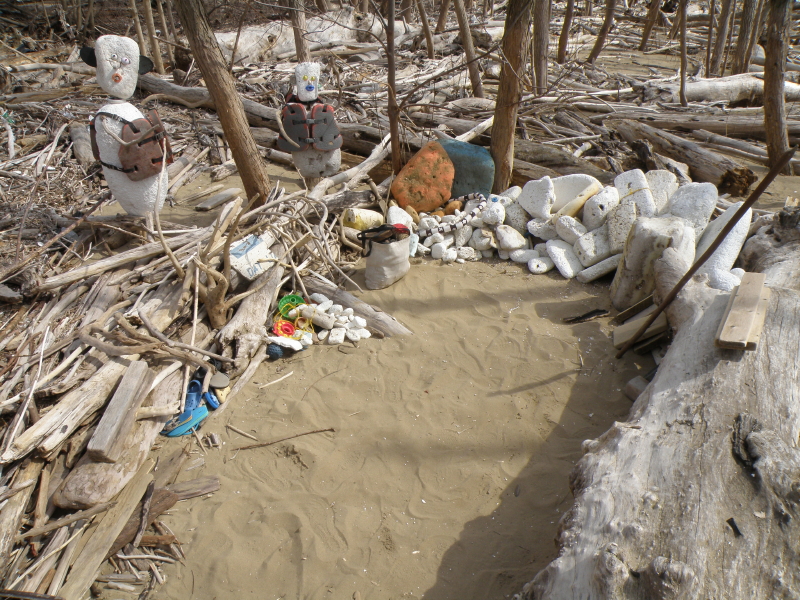
The Flood Brothers at my outdoor studio, April 2013

The Flood Brothers at my outdoor studio, April 2013

Looking around the Flood Brothers could see that I was interested in many of the same concerns that they had and wasn’t it all so absurd after all?  I told them my story and that all the stuff they saw in my little area came from the immediate river.  I mentioned that I try to find creative ways to use this junk and to tell the story about a place I find to be very special.  They asked me if I happened to see along the way a nice sign they had attached to a stump?  I confessed that I had and wanted to repurpose it as part of my sign collection.  The Flood Brothers just smiled and said I could have it.  After visiting for a while, it was time for me to go home.  I told the brothers they were welcome to hang out in my site and perhaps I will see them here again?  I liked them as characters.  With one last look back I saw F.B. 1 waving good-bye to me.  I always have an interesting day at the Falls of the Ohio.
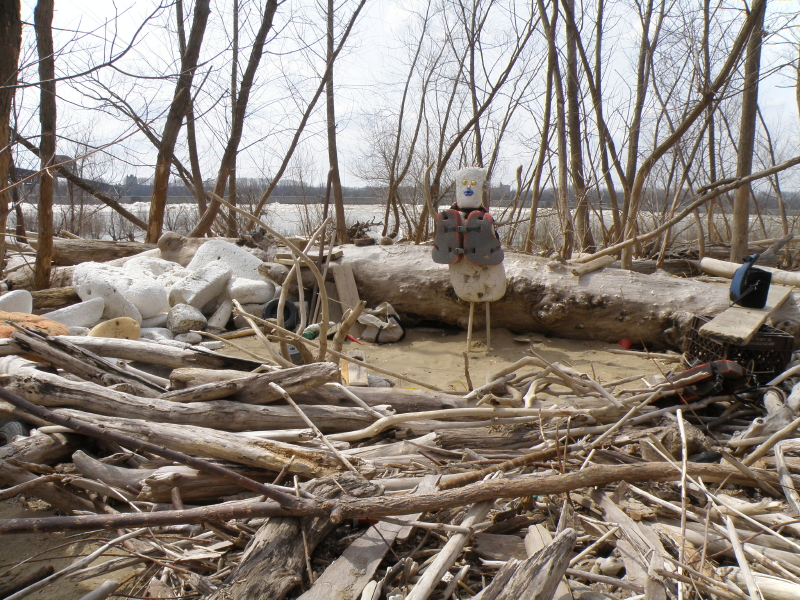
F.B.1 at my studio, April 2013

This story marks my four-year anniversary on WordPress .  Hard to believe the time has flown by so quickly.  Thanks for tagging along!!
Read Full Post »

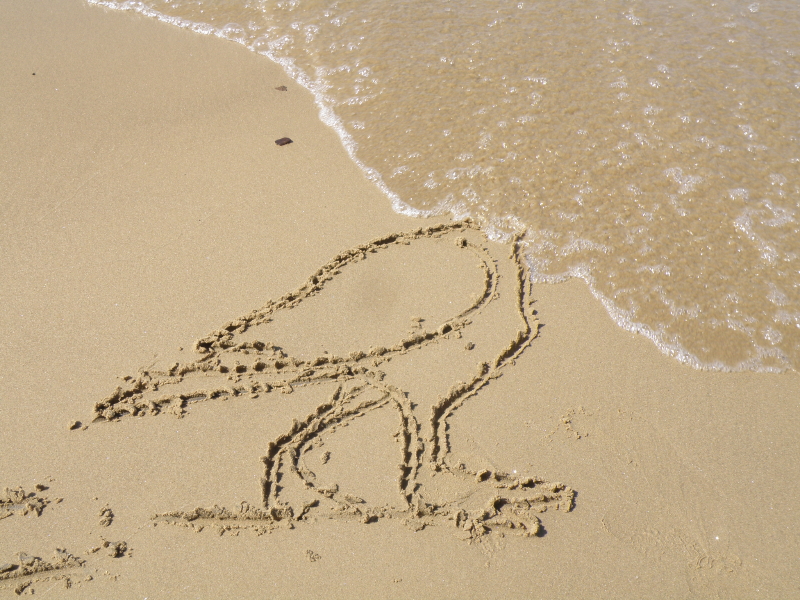
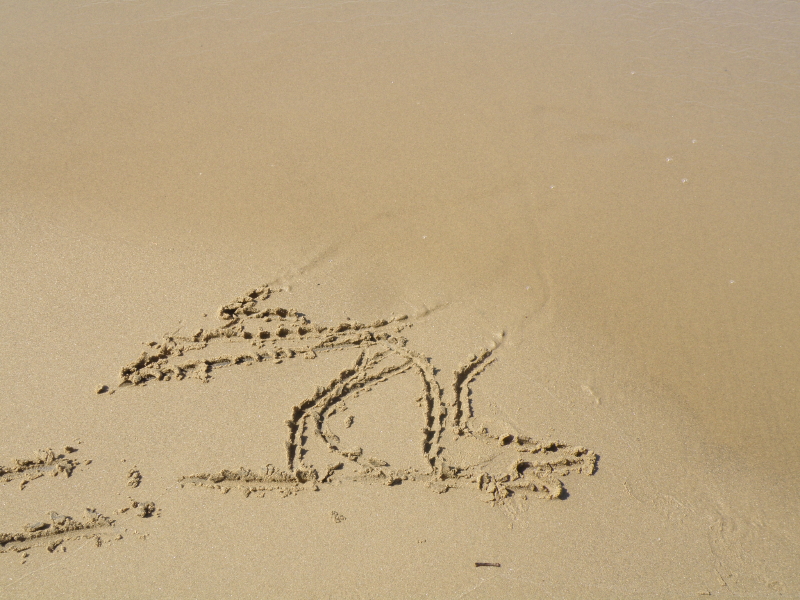
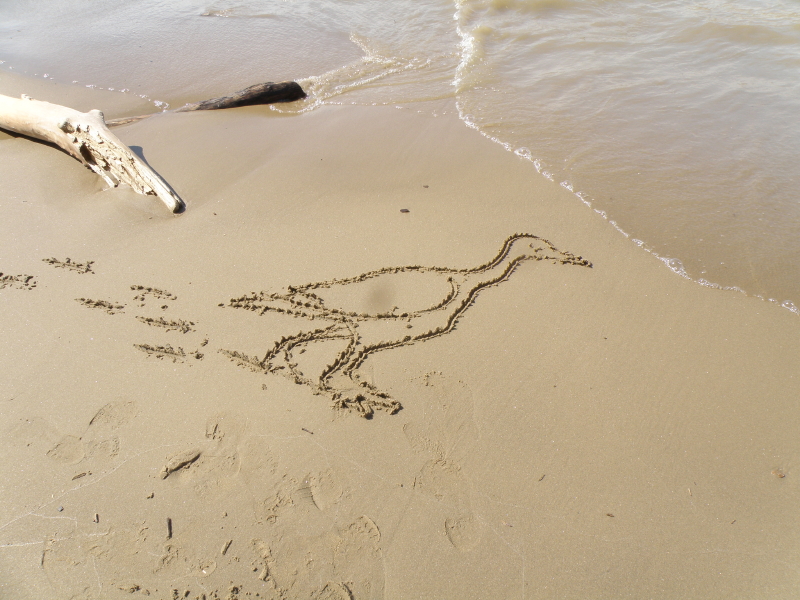
walking goose drawing in sand, March 2013

I come to the river because I like the sound of the water.  It does more than act upon the sand and driftwood here.  After hanging out at the Falls of the Ohio I feel relaxed because the rhythm of the water is also the rhythm of nature.  The waves that move back and forth slow my own internal sense of timing and puts me in sync with the universe.  The work-a-day life begins to lift away and a calm seeps in.  I don’t even need to be aware of the sound.  I know it is there and I trust it.  This restorative quality of water is not to be underestimated in this fast-paced, multitasking world and it is free if you are open to accepting its magic.

river erasing sand drawing, March 2013

partly erased sand drawing, March 2013

Spring is late in arriving this year.  It’s been an up and down cycle of mostly cool to cold temperatures.  Also, it seems that the river has been a little higher for a bit longer than I remember over the past several years.  2012 was positively balmy compared to this one.  It’s amazing how much difference a year can make .  Today is nice and the sun is shining and I get an early start on the day.

detail of driftwood, March 2013

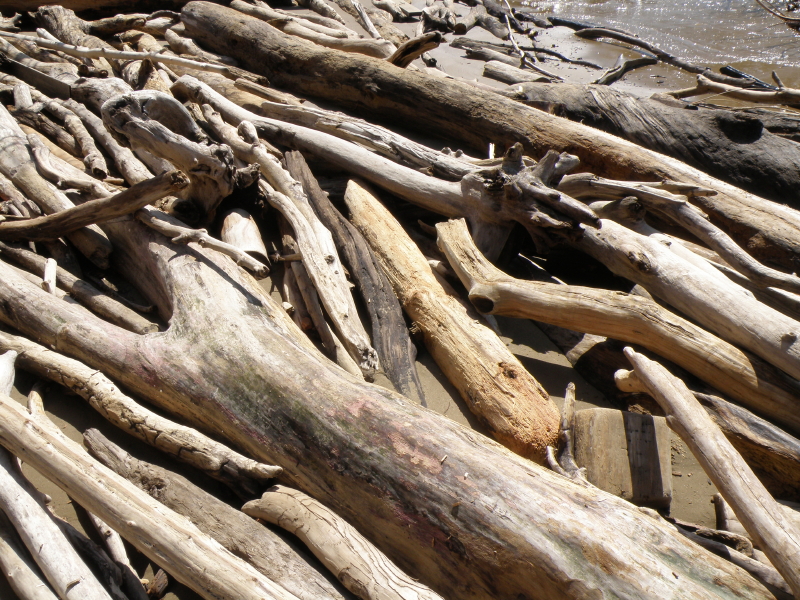
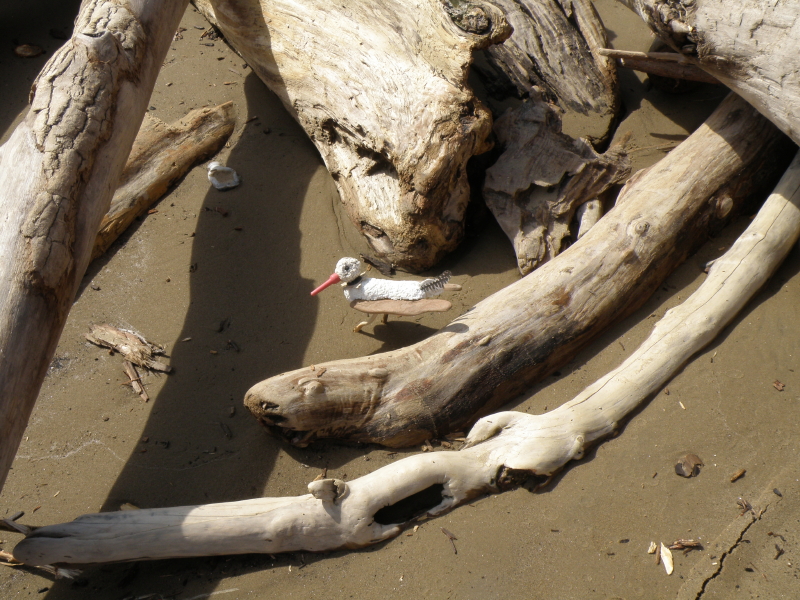
Currently, there is plenty of driftwood lining the riverbank.  By studying how the driftwood was deposited, I get a sense for the water and how high it rose over the land.  Since this is Spring…I’m also on the lookout for seldom seen birds that are traveling through our area.  On my last outing, I was walking over the lines of driftwood when I spotted an unusual shorebird.  I managed a few images of it and I would like to share those with you now.  It was right in the middle of the driftwood and if it hadn’t moved…I might have gone in a different direction and missed it.  I live for these moments.

Great Lakes Oystercatcher, March 2013

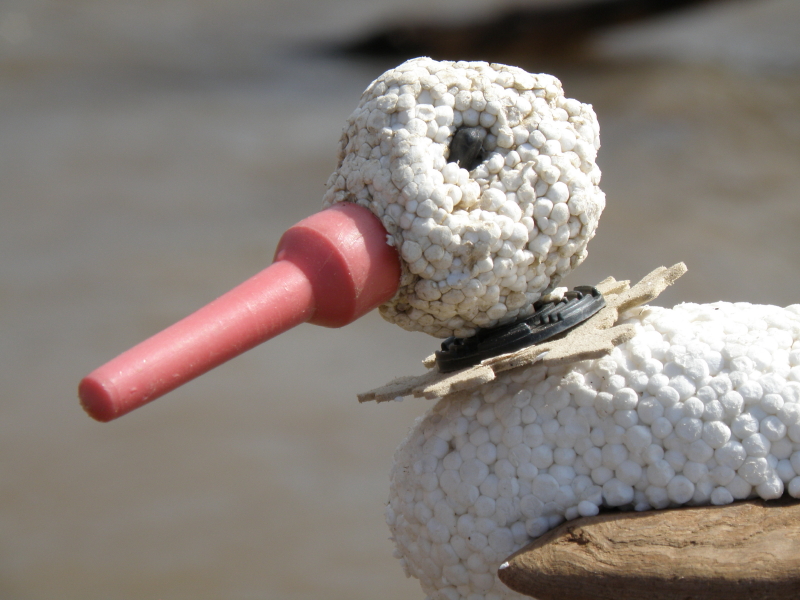
head of Great Lakes Oystercatcher, March 2013

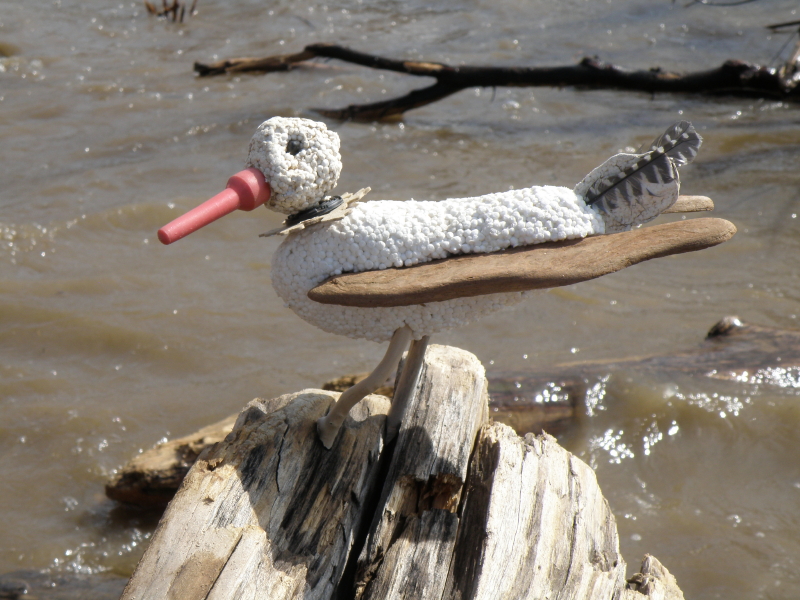
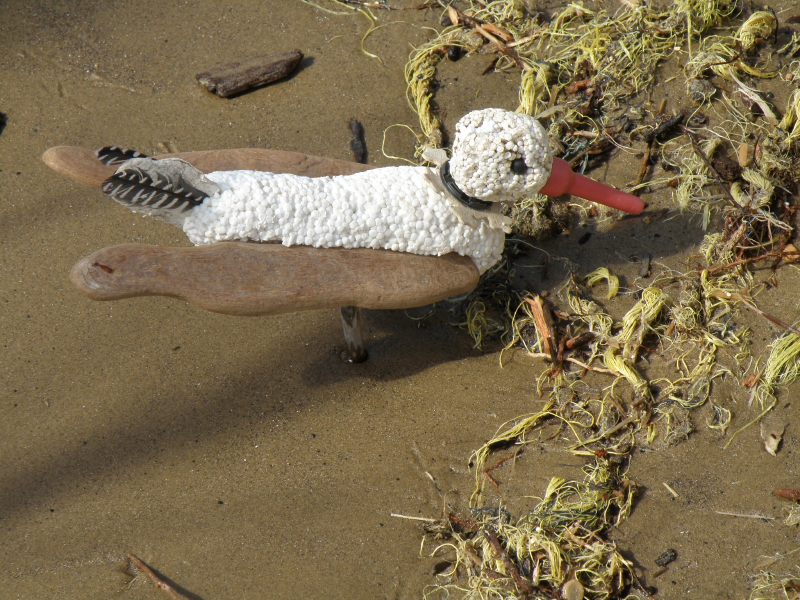
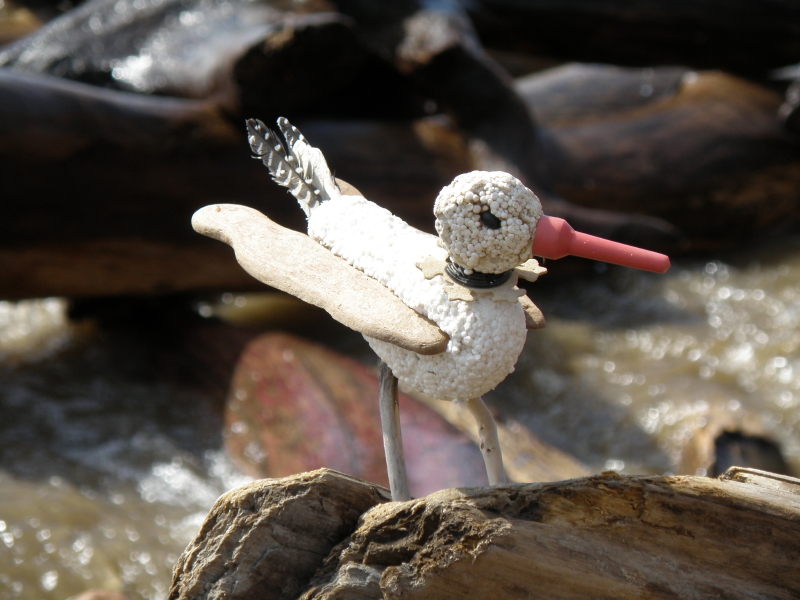
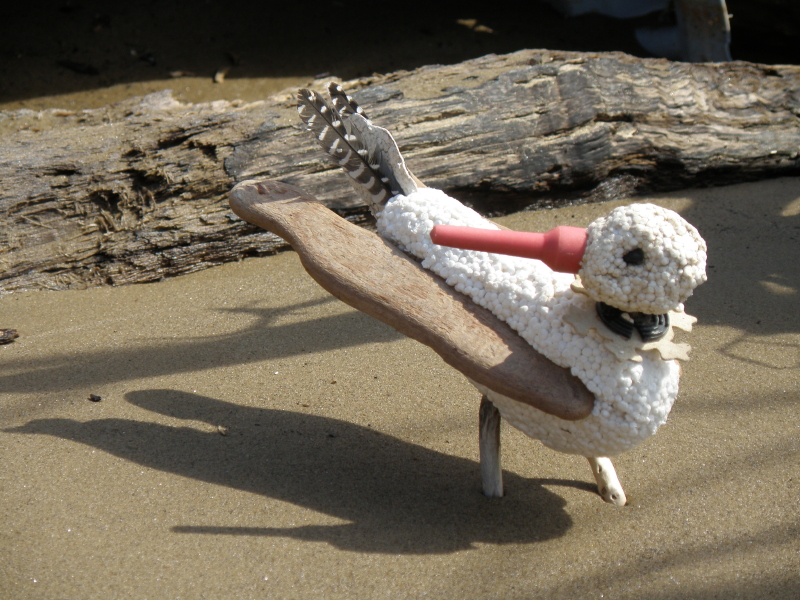
This is the increasingly rare Great Lakes Oystercatcher, (Haematopus polystyrenus) as seen at the Falls of the Ohio State Park.  It has a large red bill like the two other oystercatcher species that live along our country’s marine coastlines.  Unlike them, this bird is strictly Midwestern and prefers fresh water wetlands, creeks, streams, and rivers.  The large bill is used to pry open the shells of fresh water clams and mollusks…although it is known to take crustaceans and other invertebrates upon opportunity.

Great Lakes Oystercatcher, March 2013

Great Lakes Oystercatcher, March 2013

The reason this bird is becoming scarce has everything to do with it losing its main food source.  The Tennessee and Ohio River Valleys are the world’s epicenter for fresh water mollusk diversity which is a little known fact.  Unfortunately, because of the many changes that have occurred with our rivers, these clams have become our most endangered animals with many species having become extinct already.  These clams are fascinating in their own right and have complex life cycles.  Wherever you find them is usually a good indicator of the quality of the water.  The Great Lakes Oystercatcher won’t find much in the way of its preferred food at the Falls.  The original clam diversity is missing and these days you are more likely to encounter Zebra Mussels or Asiatic Clams and both are well-established, invasive, nonnative species.

Great Lakes Oystercatcher, March 2013

Great Lakes Oystercatcher looking over its shoulder, March 2013

I was delighted by this almost comical bird which is rarely observed in this park.  It went about its business examining the driftwood and probing the sand for morsels of food.  I also watched it fly to the water’s edge and it was intent on checking out what the river was washing ashore.  The whole encounter lasted about 20 minutes before the bird flew off for parts unknown.  Satisfied with the day, I gathered my collecting bag and headed home.

The city of Louisville as seen from the Falls of the Ohio, March 2013

Read Full Post »

Under the Big Tree, Nov. 2012

I have heard stories about this land and river that are supposed to be very old and have been handed down for generations.  Folks back then told each other stories and that’s how things became remembered.  Back then, it also wasn’t unusual to find a young one that knew their family’s history by heart and able to recite the names of all the known ancestors going back as far as people could  remember.  People in the old days must have been very smart and had better senses of memory than we do today.  Before writing and such, I wonder if people back in the old days held jobs as living books and sources of information? But I digress… which brings me to yesterday when I encountered the most unexpected sight at the Falls of the Ohio!  I first learned about this mystery as a little guy while listening to stories over a camp fire with my recent ancestors.  It’s about these special trees that are rumored to live around here that have the ability to uproot themselves and move around.  I didn’t believe it either and chalked it up as being another fun story like the Prince Madoc legend, but then I saw these rare trees with my own eyes!  And, because these days we have cameras…I took a few snapshots of them so that you can see them too.  Check this out.

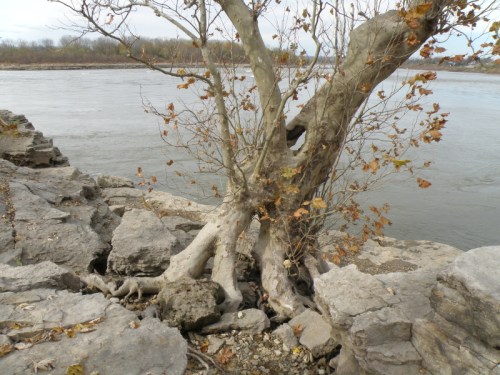
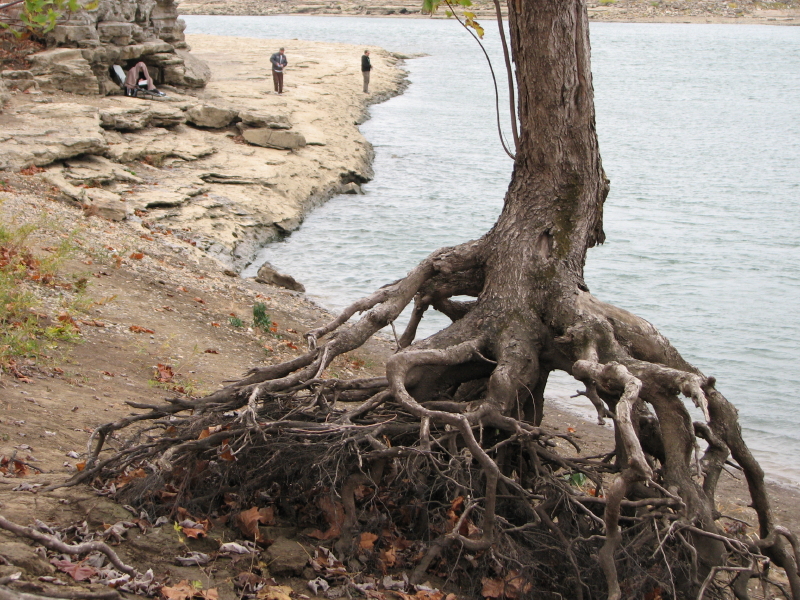
Sycamore tree, roots and rocks, Nov. 2012

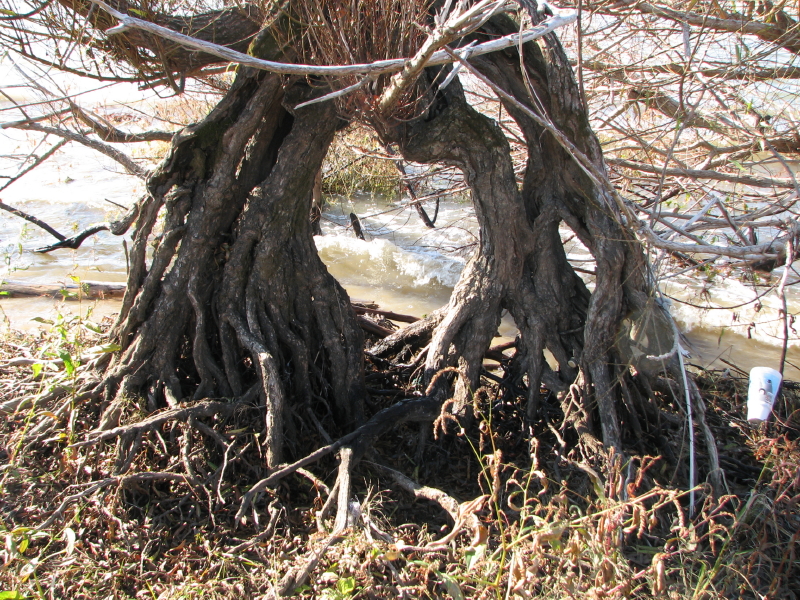
The old stories mention that the boundary between the earth and the water has always been a difficult place to live.  It’s an extreme back and forth existence living at the margins of too much or too little.  There’s not much nutrition coming out of these fabled rocks, but then again the limestone at least gives you something to hold on to.  Water has a way of insinuating itself around every nook and cranny and is always testing allegiances.  Around here, some of the trees have learned that they can improve their lot in life by pulling up roots and going elsewhere.  You see, some trees have long memories and they know when it’s time for that great once in a thousand years flood or some other cyclical disaster to come back around.  Or epic memories are shocked and encoded into the rock and soil and trees are just better at reading and interpreting what it could mean?I’m guessing that some of the trees around the Falls of the Ohio like to be prepared or are skittish or both and have begun the very gradual process of being somewhere else.

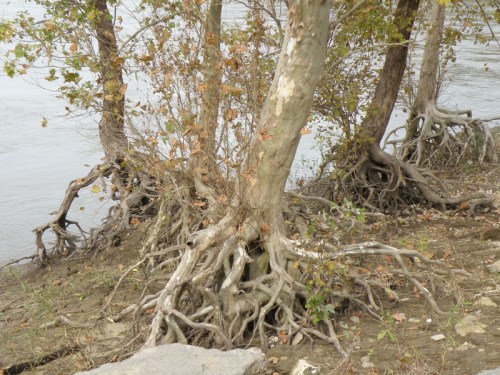
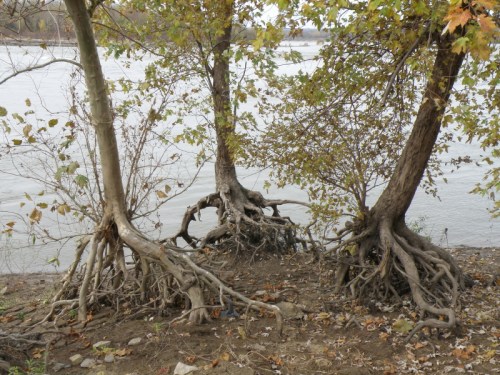
uprooting trees at the Falls of the Ohio, Nov. 2012

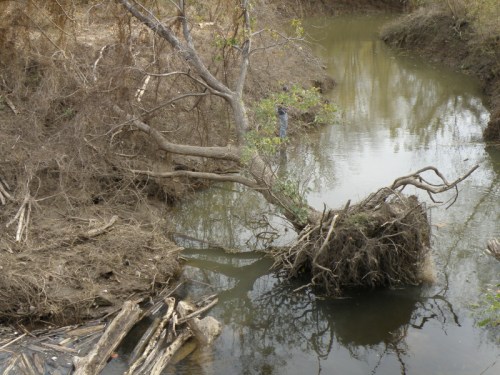
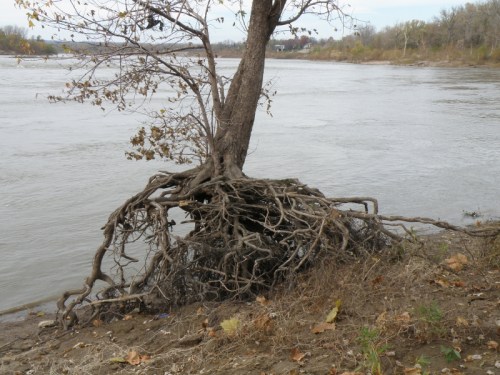
I came across this small mobile grove not far away from the first tree I showed you.  This is an incredible response by these trees to the rise and fall of the river.    The river dissolves  the silt, sand, and mud away from the riverbank and exposes the tree’s rootlet toes which are always growing. Water currents and the rocking back and forth of the wind further helps loosen roots from soil.  These trees are vibrating and creeping along with most of their roots on the surface with just enough tendrils into the earth to hold on to dear life.  Good thing too or else one day you could find yourself swept away.  I have seen it happen before as in this recent example by the creek.  This tree fell into the water and will never right itself or hold the riverbank up as it formerly did and one day it will be swept away by the river to somewhere unintended.

Tree that recently fell off of the riverbank, Falls of the Ohio, Nov. 2012

So much water is a mixed blessing.  Just enough and the trees can move a little more than usual.  Too much water and they run the risk of losing control. This mixed lot of trees seems to be moving westward.  Park officials have reported that there seems to be more of a sense of urgency on the trees’ part and they have picked up the pace over the last few years.  I wonder how they know when and where to stop and should I be worried?  Do the walking trees signify a bad omen for the future and is some environmental disaster looming ahead of us?

uprooted tree trio at the Falls of the Ohio, Nov. 2012

Of course life travels at its own speed.  Our tree friends here cannot out run this year’s spent leaves gathering around their feet, but they have patience.  They don’t have the same concept of time as we do. An inch or centimeter or two here and there and progress will be made even if it takes many seasons.  Moving in ultra slow motion, they will either get to their intended destinations or not.  Come to think about it…trees don’t have the same concept of speed either!

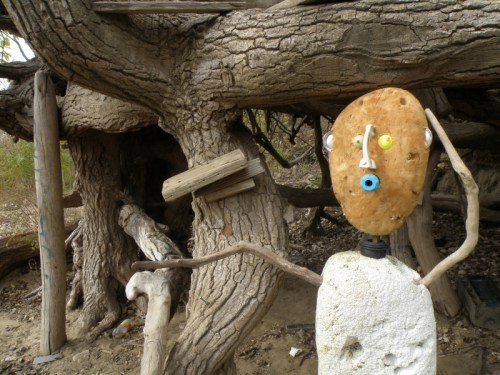
Tall figure under the Great Tree, Nov. 2012

Trees have their own internal logic and physics that they respond to.  My tall friend here is a case in point.  He’s an old cottonwood tree and long a go he too was a walking tree.  You can tell from looking at these fantastic roots that buttress the tree from the river and elements.  For some reason known only to the tree…he decided to stay here and put down his roots.

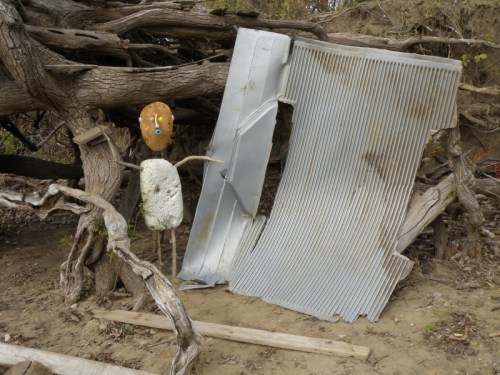
Figure with big sheet of plastic, Nov. 2012

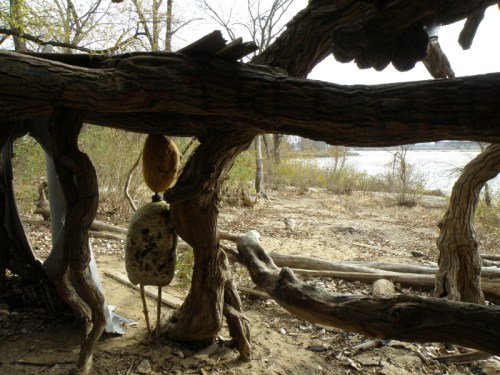
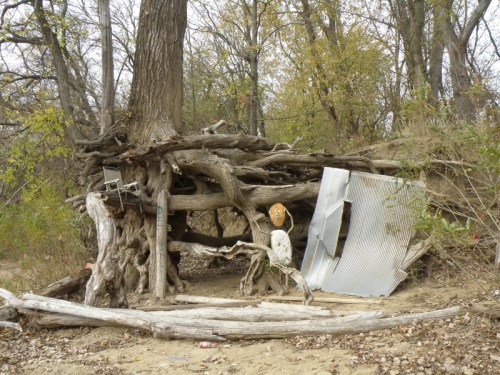
Over time the cottonwood thrived.  Its roots held the riverbank in place and kept it from sliding into the river.  With this particular tree, a small, sheltering space grew directly under the tree’s tall trunk.  Visitors would bring discarded boards and other river finds ( like this large sheet of corrugated and molded plastic) to make forts and tree houses.  This one site has seen plenty of play and fantasy over the many years and has always been recognized as a special tree.

Figure by large cottonwood tree, Nov. 2012

This just occurred to me.  What if the moving trees are just a matter of perception and they really are trying to stay in one place?  What if it’s the rest of the world that is moving so quickly and constantly like one big blur and the trees are holding life in place?  The walking trees have remained where they have germinated and everything else around them has quickly shifted. Because we are so near to it we don’t recognize the movement.  Could time also be as fluid as water seeking out the nooks and crannies and testing allegiances too?  All this head-scratching stuff is making me dizzy on such a fine day by the river.

Great Cottonwood tree at the Falls of the Ohio, Nov. 2012

Unbeknownst to the brown-headed philosopher under the cottonwood, but changes to our area are forthcoming.  This year was the warmest year ever recorded.  The environmental chess board has been set and the game is on.  Pieces are moving and strategies are evolving and somewhere on the Ohio River another pawn is moving into place a little nearer to the cottonwood tree.

Tree with exposed roots, Falls of the Ohio, Nov. 2012

Read Full Post »

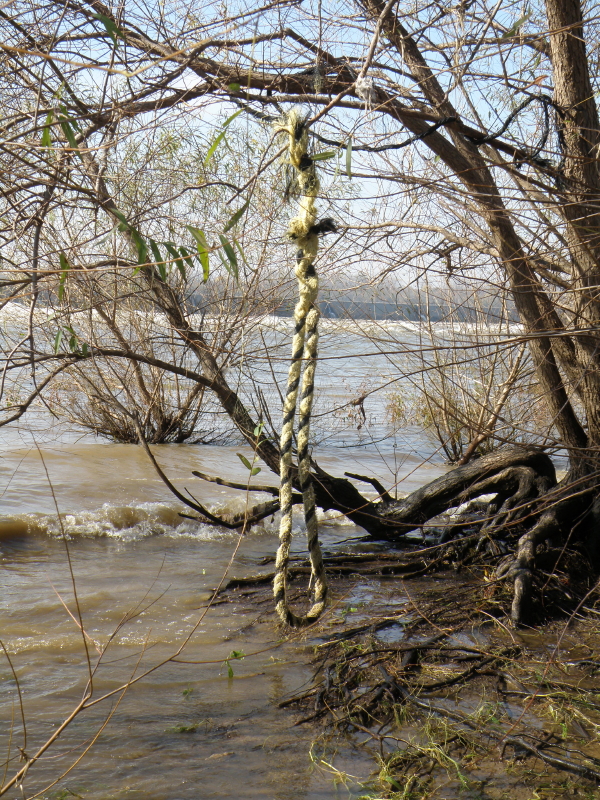
Hello all and welcome to another adventure set at the Falls of the Ohio.  Since my last visit, the Ohio River has risen in response to all the rain that fell in the northern portion of the Ohio Valley and has flowed down river in a southwestern direction.  The fossil beds normally exposed during the summer and early autumn months are now submerged by swiftly flowing water.  Walking this ever shifting shoreline I’m open for whatever presents itself as novel and different.  Turning the corner around a  stand of willow trees I was caught by this unusual sight.

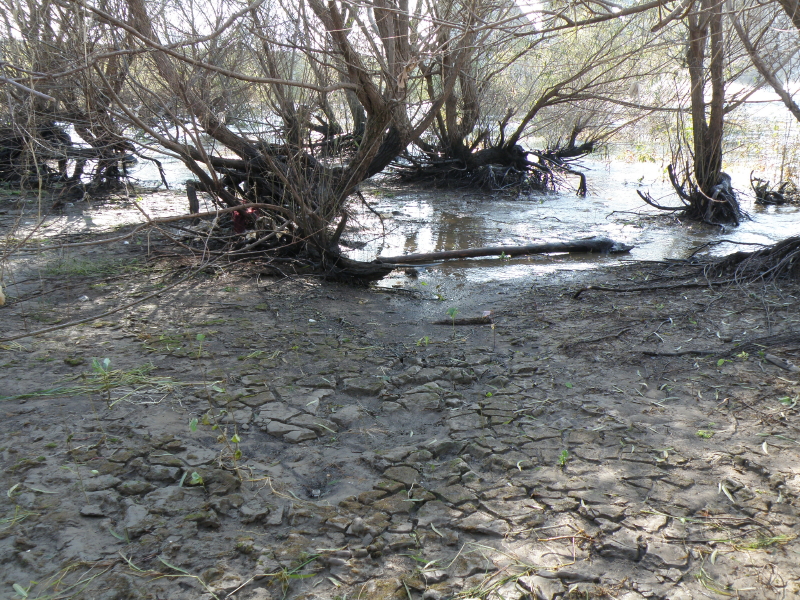
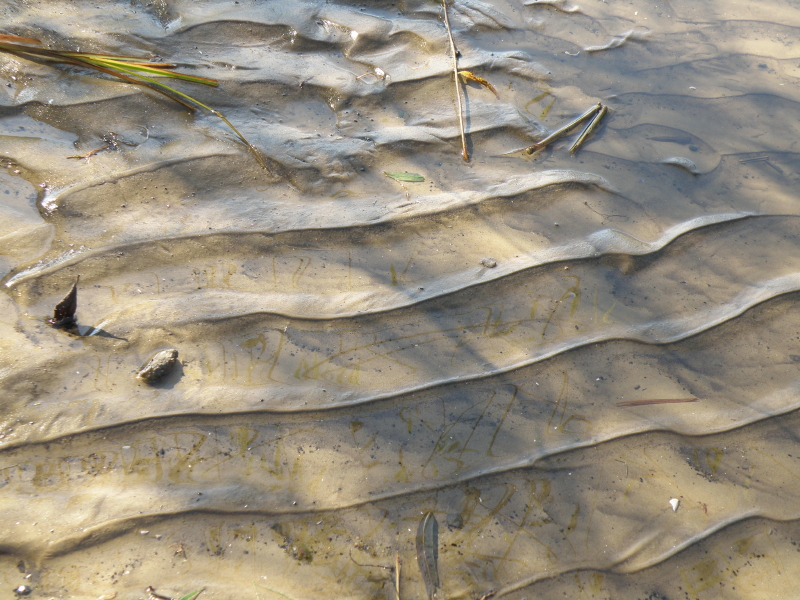
A tree captured barge cable or rope was in a different position from the last time I had noticed it (see this year’s Halloween post).  It is possible that the river rose high enough to dislodge it from its previous resting spot.  I was struck by the way it seemingly is suspended in mid-air with its regular yellow and black intervals contrasting with the unruly roots and branches around it.  Around here, water can both rise and fall quickly.  In the fine silt and mud you can often find interesting patterns that were created by the movement of wind and water.  Here is such an example.

The back and forth rhythm of the river caressing the land are recorded as peaks and valleys in this very fine mud.  I can be “hypnotized” at times by concentrating on this movement which I find soothing.  I’m always interested in the various subtle patterns that water can create on the mud of the riverbank.  It’s akin to trying to “track” water and recognize its footprint as it moves onto the land. I also noticed about a two foot tall, low “wall” of material (mostly wood and dried grasses) along the shoreline that marks this latest high water moment.  And of course, there is always the ever-present mostly plastic junk that also gets swept away and mixes with the natural debris.  I found lots of plastic detergent bottles, bits and pieces from toys including another doll’s head.  Here are images of other finds including an interesting toy ball.

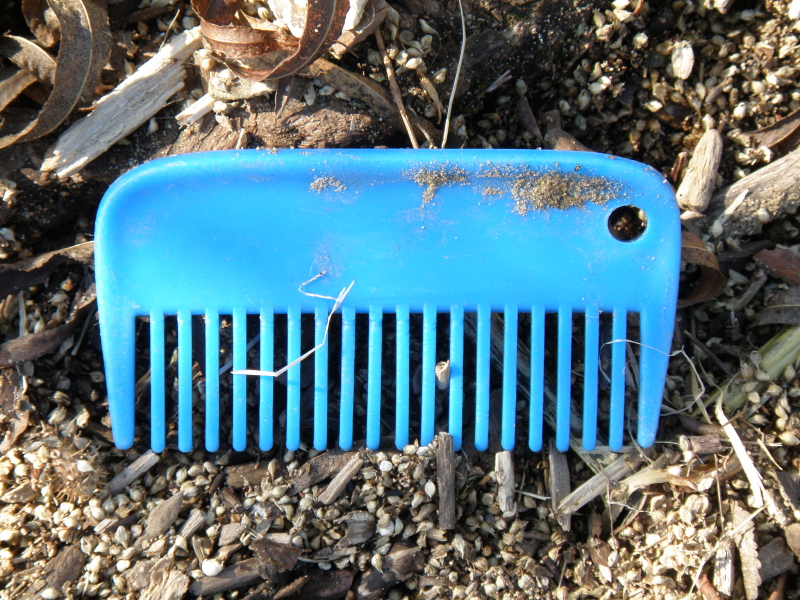
I’m assuming this is a dog toy based on the image of the dog on the ball?  The small knobs are different from the usual balls I find out here.  Now, for a bright blue comb in a design that’s also new to me.  The tiny grains around the comb are seeds from various river grasses.

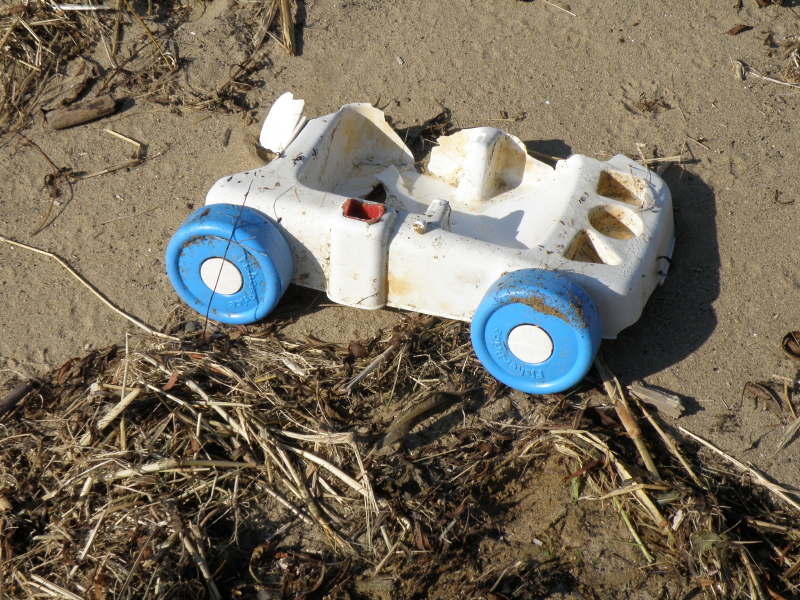
More ” blueness”  in the form of plastic wheels on a wrecked pull toy.

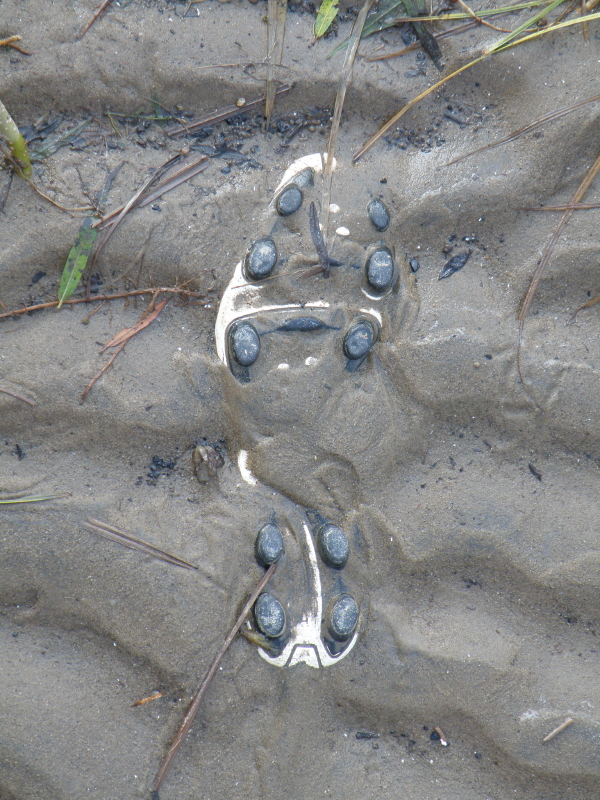
In the mud, I came across this other type of footprint that I thought was a bit unusual from the norm.  Of course, it’s a sports shoe with cleats on the bottom sticking up from the mud.

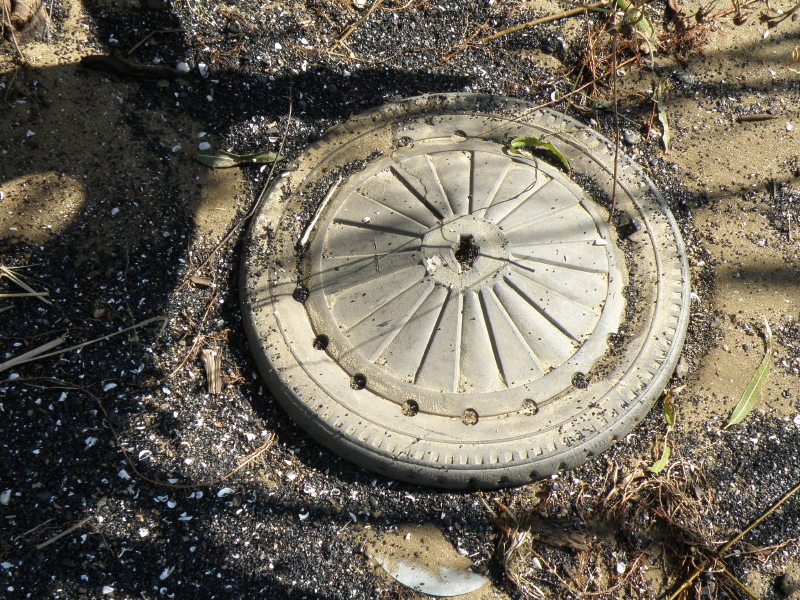
And one last found wheel whose radial pattern inspired another image in my ever-growing “Coal Flake” series.

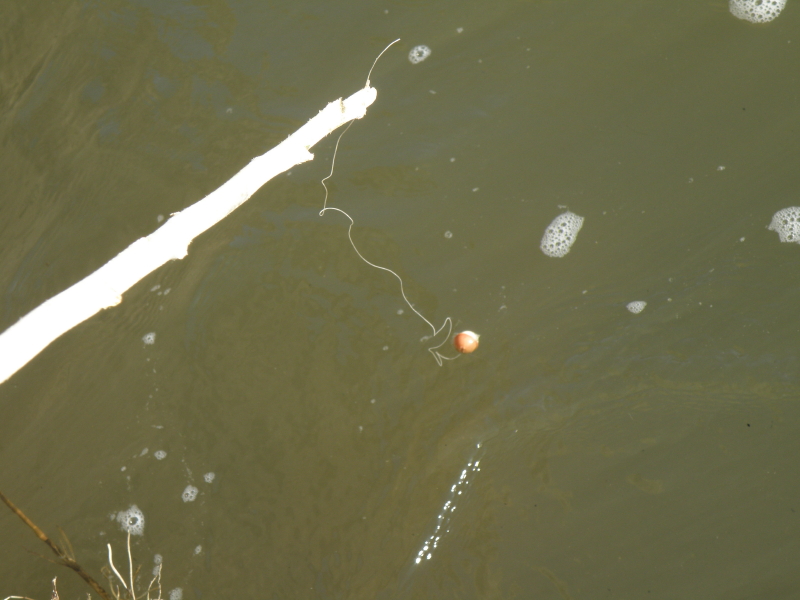
I’ve come to really like making these designs from river-altered coal that I find at the Falls.  I’m under the impression that this coal has fallen or been swept off the immense barges that transport this fuel up and down the river.  I suppose it’s possible that somewhere along the river’s journey the water has cut down through the rock to expose a coal seam somewhere, but I haven’t ever heard of this happening.  The barges seem the likeliest answer.  This particular example has more Asiatic Clam shells used in the design.  These clams are the most common of their kind that I find at the Falls.  Once upon a very recent time a go, the Ohio and Tennessee Valleys were the world’s epicenter for fresh water clams.  By altering the rivers and the water quality in them, many of these amazing creatures have either gone extinct or have become so very rare.  The Asiatic Clam is a non-native animal imported here in the 19th century as a good luck charm and has thrived as has the Zebra Mussel that you may have heard about?  The day was moving on and except for a few Mallard ducks and Canada geese I hadn’t seen much in the way of wildlife.  I decided to end my day by doing a little fishing.  I found a short, recently beaver-chewed willow branch and attached some waste fishing line I found.  I attached a hook and found bobber and into the water it went.

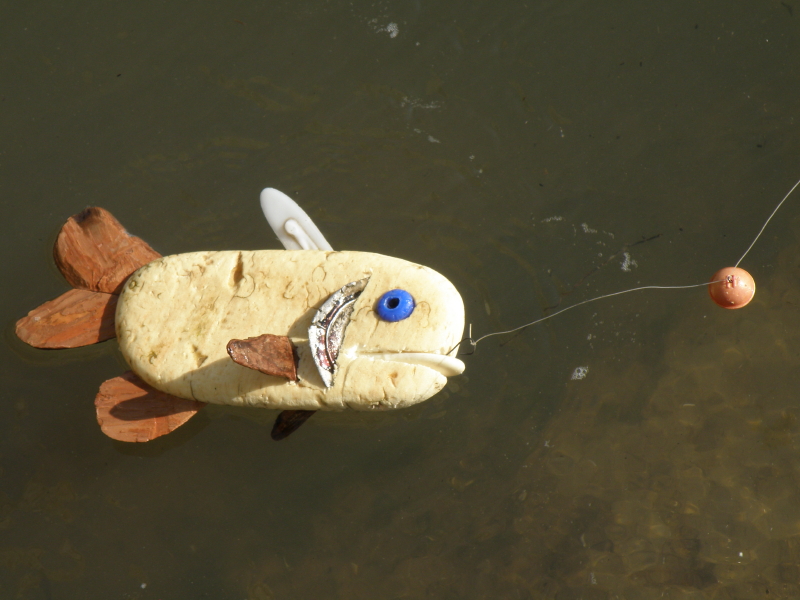
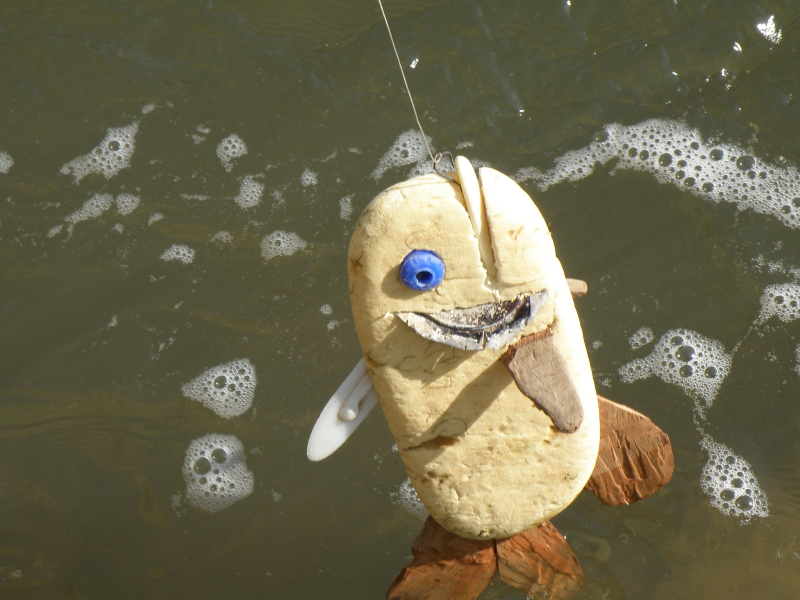
Oh, for bait I caught a small grasshopper and attached it to the hook.  A small found lead weight kept the bait below the water.  Every once in a while I would raise my short pole up and down in a “jigging” motion.  To my immense surprise I caught this very unusual fish!

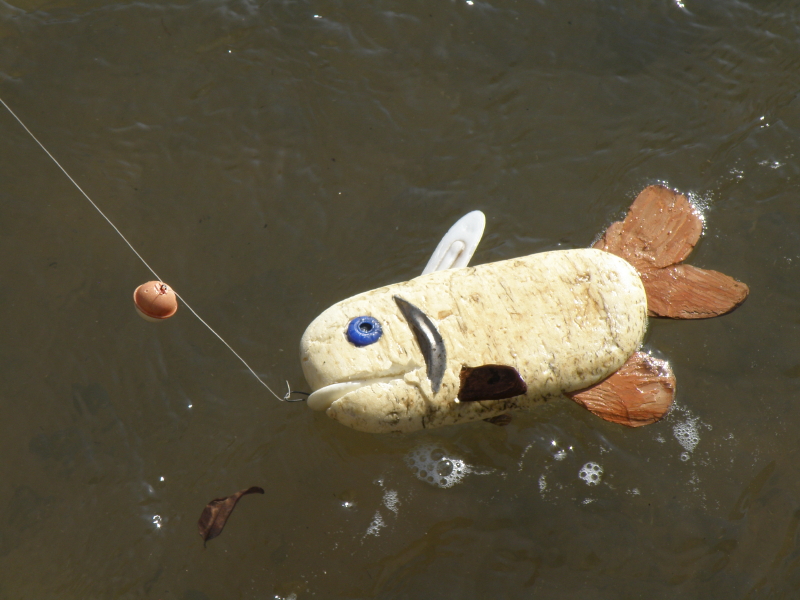
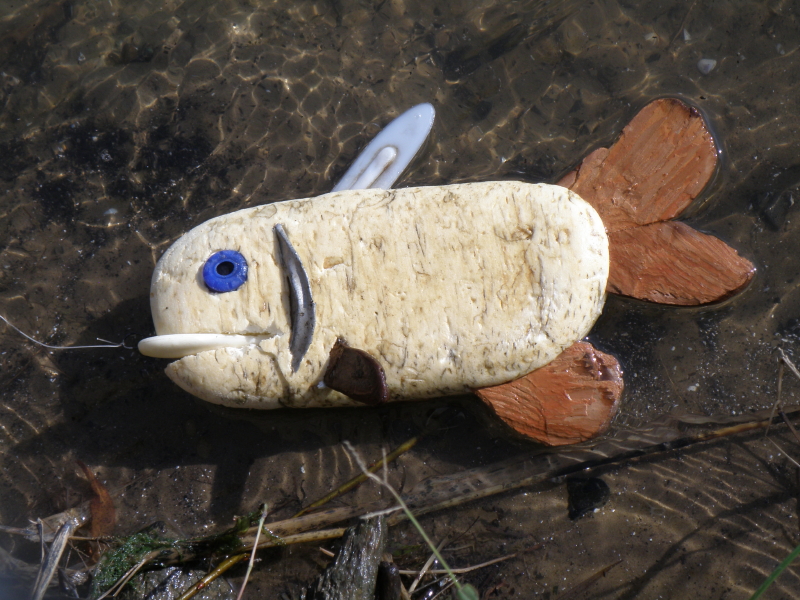
This fish is called the Iron Gill based on the metallic covers it sports around its gills.  Other distinctive features include bright blue eyes and a small white dorsal fin.  It’s body shape is unique and lends itself to easy filleting…although I wouldn’t normally recommend eating the fish from this part of the river.  Catching this fish here was a surprise because normally this is a deep water fish found in large flowing rivers.

This species was first described to science by Constantine Rafinesque back in 1811.  Rafinesque was a controversial figure and brilliant naturalist.  He had a gift for collecting and recognizing new species, however, in his zest to publish and receive credit for his discoveries he was very sloppy in his methods.  As a result, many of the animals and plants he introduced to science are poorly described and classified which led to much confusion and consternation among the other “scientifics” of the time.  In the end, Rafinesque usually won out because science gives priority to the person who first (no matter how poorly) brings the new creature to the world’s attention.

After this last image, I released the Iron Gill back into the water and rebaited my hook.  Alas, this was the only fish I caught on this day, but it reassured me that my skills in this area were still intact.  For my next post, I want to show you images of a coal-themed exhibition I’m participating in the nearby town of  New Albany, Indiana.  It’s a good show and worth a post.  For now, I would like to close with another image of a found toy I came across on this day.  Have a great weekend out there in the wider world!


Read Full Post »

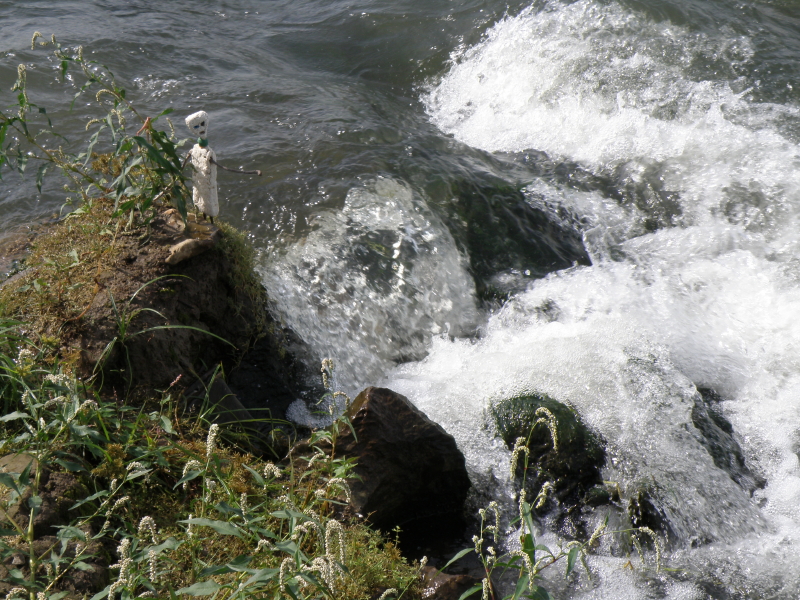
My beloved…I still live!  I hope my repair to my communication transmitter has been successful and that you and our fellow Styrosians so far away across the universe will receive this message and know that I still exist.  While exploring a little known solar system my ship was damaged in a collision with undetected fragments of space debris in orbit surrounding a smallish, blue-green planet.  This planet is the third nearest to its star. This solar system is comprised of eight other planets of varying dimensions and densities.  Damage to my guidance system made controlling my craft difficult and I entered the atmosphere of this planet like a meteor across the sky.  Fortunately, I arrived without attracting attention and I was able to affect a safe landing.  My craft, however, will need much maintenance. Hopefully, the coordinates of my position reached you before I entered this planet’s dense gaseous atmosphere? Here is an image of my vehicle which I call home and its contents are a dear reminder of the world from which I originated.  So often I have thought of you and wondered if we will ever see each other again?

I have so much to tell my fellow Styrosians that I hardly know where to begin.  Duty compels me to start with a report concerning my original mission.  I have crashed on a beautiful planet where the majority of its surface is covered by that most precious combination of hydrogen and oxygen.  I am so excited to have found water in abundance!  I have detected water in all three of its known states including gas, liquid, and yes…I have even seen ice!  It was the chemical signature for water that compelled me to take a closer look when the accident occurred.

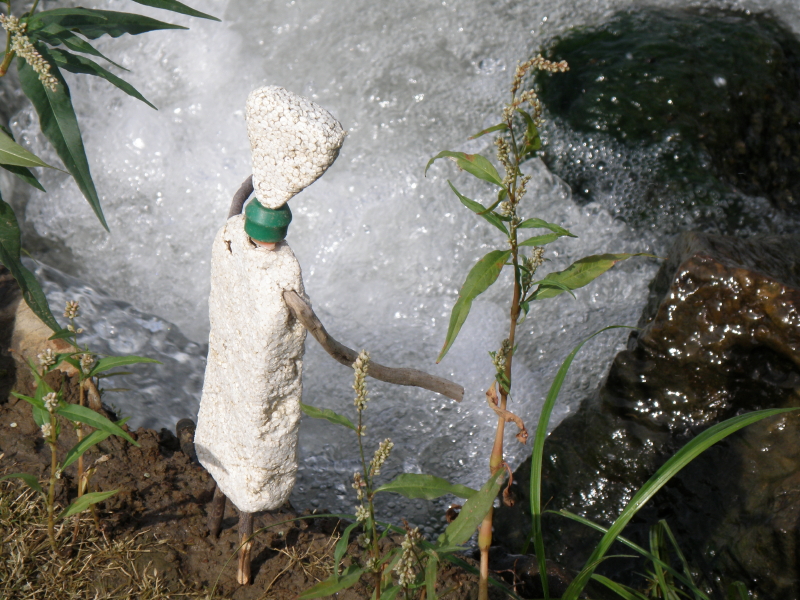
Most of the water I have been able to analyze locally is of the fresh variety which contains many other chemical additions some of which are naturally occurring.  I have, however, been able to learn that the vast majority of the water on this planet is heavily influenced by the compounded interactions of sodium and chlorine.  I have not only discovered water…but water in different flavors!  After surviving the shock of my sudden and unexpected arrival, I couldn’t wait to explore this new environment which offers such a stark contrast to our own dry home world.  There is so much water here that it actually falls from the sky!  Please excuse me while I transmit additional self images made while engaging in water joy!  They at least offer further visual evidence of the importance of my unexpected discovery.

How I wish you were here so we could experience this together.  I have been able to further confirm that our hypothesis about the connection between water and life is correct!  The abundance of water is equaled by the sheer amount and variety of life forms that inhabit this world.  Where there is water I have found life even in the precious fluid itself! There are sessile, terrestrial life forms that process sunlight through green, cellular solar panels.  They anchor themselves and obtain moisture through a system of filaments interwoven into its supporting substrate. And there are also many animate life forms that move through space and have evolved into hierarchies where every environmental niche is occupied by a specialized life form.  Interestingly, there are even species that dominate and consume other life forms. Our scientists will have much to study in this new world! I would like to expand on one of those species which seems to occupy a very prominent position on this planet.  It is an interesting life form and is bilaterally symmetrical like us and appears to be sentient to a degree.  Monitoring their communication patterns I have been able to translate and understand something of its language and culture.  I have heard self references to being a” bipedal humanoid”, but I’m not certain if I fully understand what is meant by that.  This animal while claiming intelligence and rationality is actually characterized by numerous contradictions.  The most observable of these traits is a predisposition towards delusion and self-deception.  It does much harm under the guise of doing good. This animal (which I believe as some members of its own kind acknowledge have evolved from what are known as “primates”) is constantly engaging in selfish behaviors that are having a deleterious effect on this planet.  Ironically, they are harming not only the other life forms here, but ultimately themselves as well.

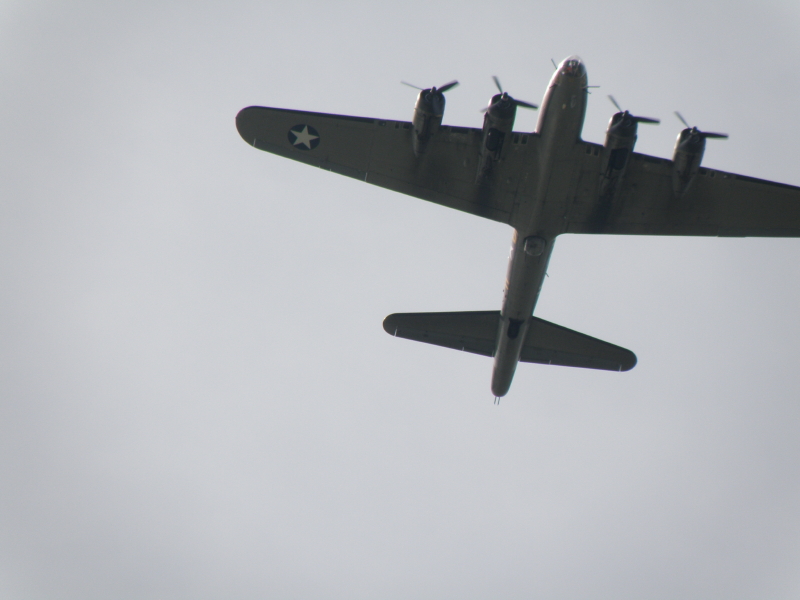
Recently, I was exploring a water channel when I saw a shape flying towards me from some distance away.  It appears to be an antique flying craft bristling with armaments.  The dominant species here is addicted to using hydrocarbons extracted from the ground which are then  further refined to produce fuel and energy.  I quickly captured this image over my head and placed it in the catalog I am compiling for future reference.  I have observed other technologically superior war-like aircraft in the vicinity before, but this one was unusual.  These so-called “bipedal humanoids” are constantly engaged in warfare somewhere on their planet.  This is one of their most primitive characteristics.  Monitoring their telecommunications I have ascertained that violence is an integral part of their conflict resolution process.  The “bipedal humanoids” are capable of rationalizing and justifying any act they commit. When they are not fighting among themselves…they are consuming or damaging resources often with other primitive machines that require hydrocarbons to function.  For instance, observe this case that I recently experienced and documented.

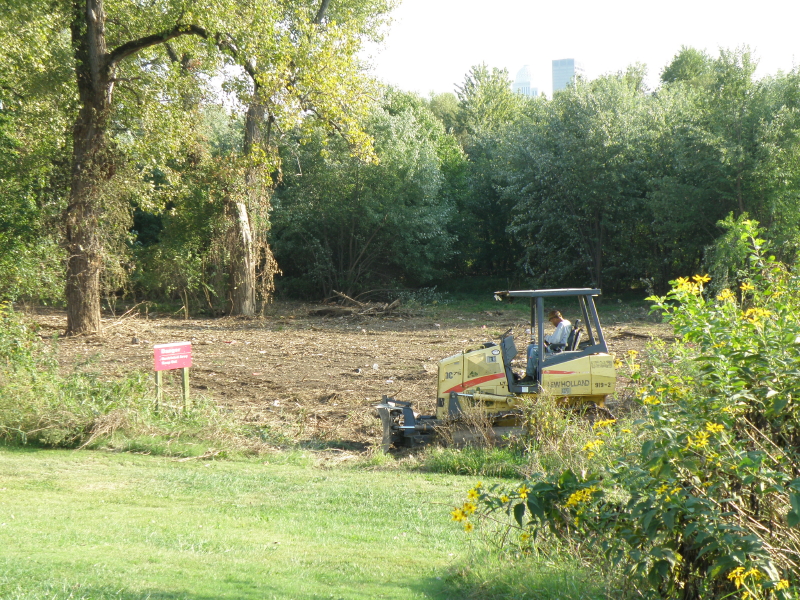
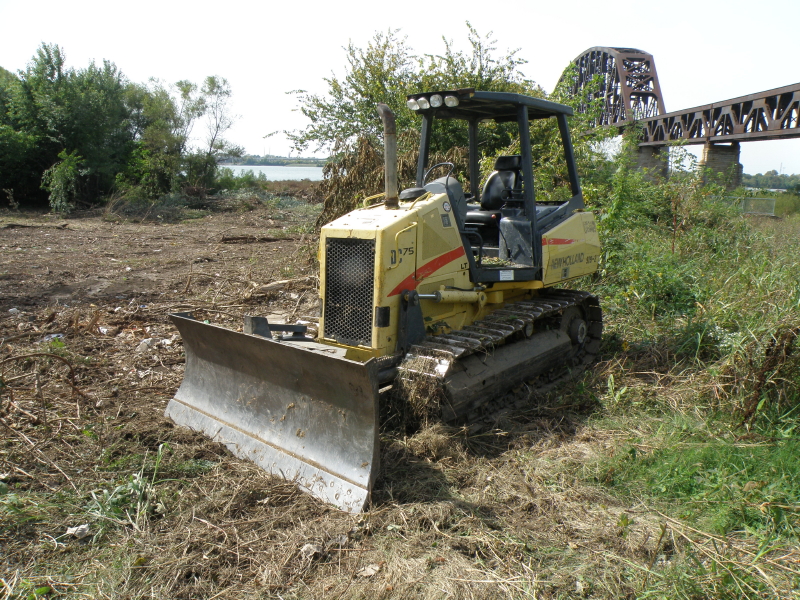
In a nearby field that was once occupied by photosensitive sessile life forms, I observed a humanoid operating a large machine.  This machine did violence to all that was alive in this area.  The remains of many different kinds of sessile life forms were stacked into random piles, but what is the purpose of this activity?

This area was once home to a large variety of life forms and now they have been displaced.  I have observed this before and very recently.  The “bipedal humanoids” created an area that they call the Ohio River Greenway and ironically they removed many of the larger photosensitive life forms to accommodate easy access to the river for their other hydrocarbon burning vehicles.  This seemed strange for many reasons, but perhaps our biopsychologists can figure that one out!  I was able to get a closer picture of the large machine that was utilized to sterilize this particular area and it is frightening to stand next to.  I waited for its operator to leave the area before doing my reconnaissance.

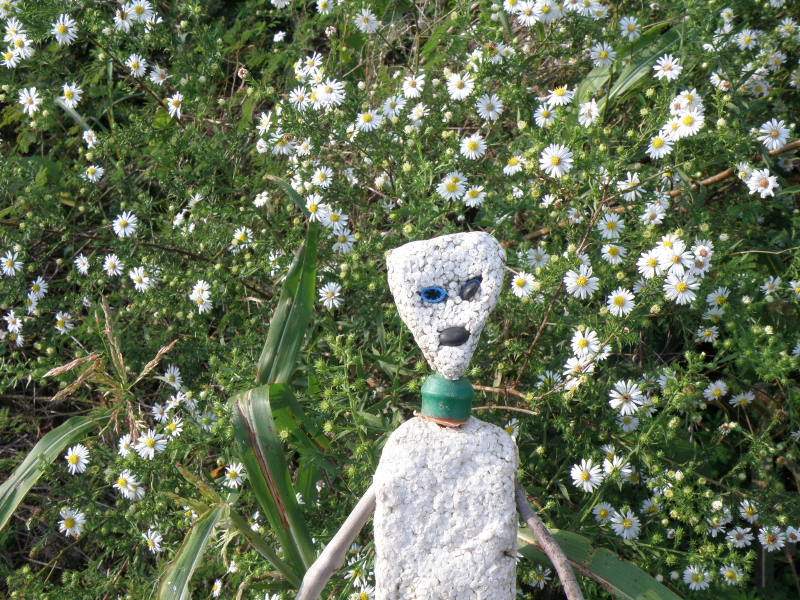
Alas my beloved, it is time for me to regenerate back at my space craft.  I will leave you for now, but I promise more from this fascinating planet.  In my next transmission I will show you more images of the life forms I have observed and maybe something of the history of life on this planet.  For now, accept this self-image made next to the many sessile life forms that lend this land beauty and interest.

Read Full Post »

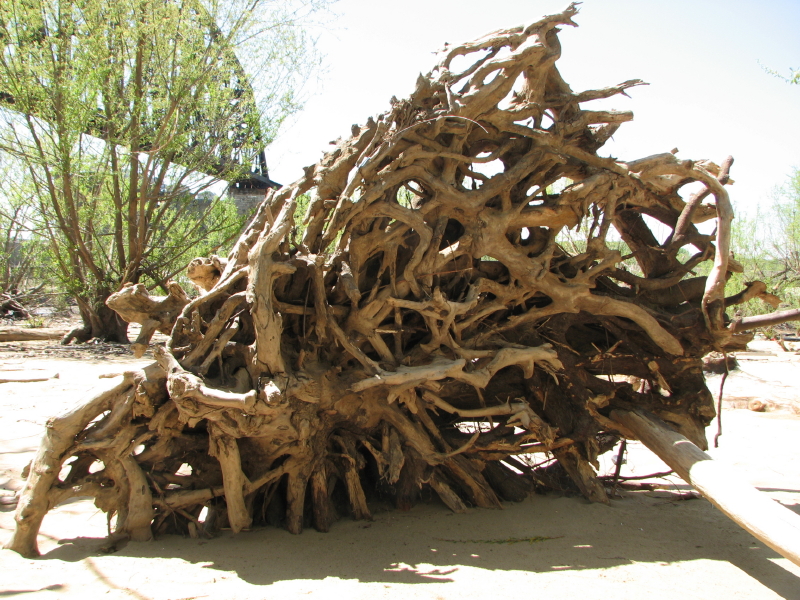
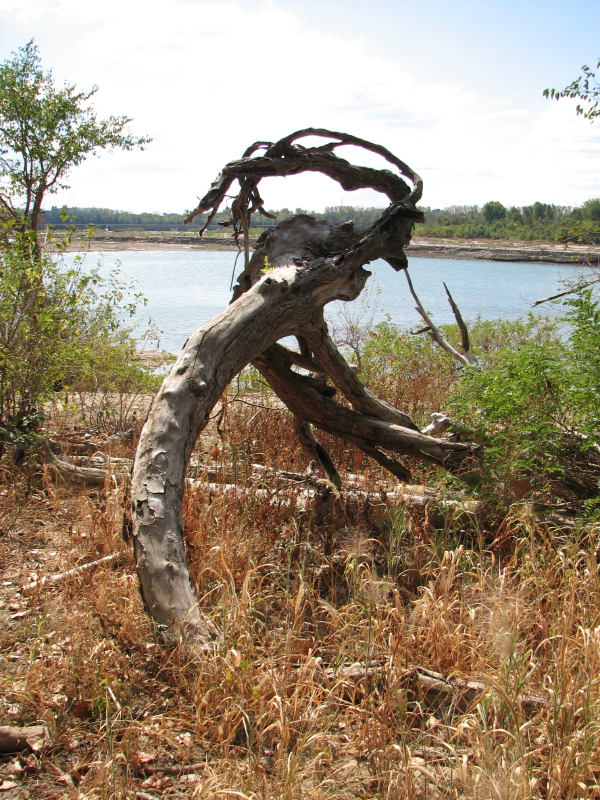
One last driftwood post before hopefully moving on to the current conditions at the Falls of the Ohio.  As my knee heals, I have been sifting through my own digital photographs.  Sitting at home, I have been spared the relentless heat that has defined our summer.  Artist at Exit 0, however, does miss bearing witness to life along the river and can’t wait to get back!  I thought I would end this driftwood series by looking at wood that is more organically expressive.  As mentioned in a previous post, the river processes a tree by removing its branches into increasingly smaller segments.  With all the broken down wood present at the Falls of the Ohio State Park, it can be a challenge to find a piece that implies movement.  Here are a few larger examples that I find to be especially sculptural.

I come across many unique pieces of wood in the park that feel as satisfying to me as many abstract sculptures made by man.  Walking around a  particularly nice piece of driftwood, I am rewarded with different viewpoints that remind me that the object I am regarding share a common space.  Here’s a different image of the same dramatic driftwood log and the experience in perception changes as you move around the wood.  I notice not only the arc of branches and roots, but the spaces between forms as well.

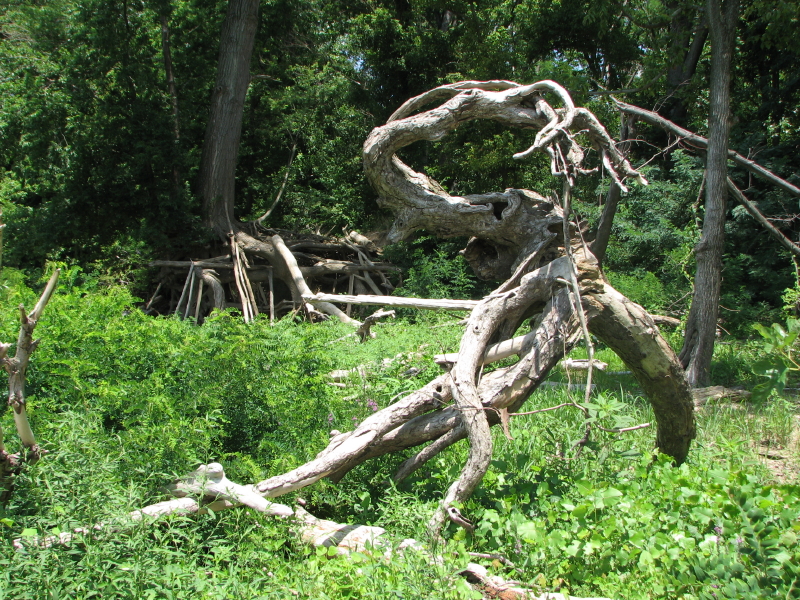
Here’s another nice piece that I came across this year and it also has many nice sculptural qualities.  I love the “S” curve snake-like motion implied in this driftwood.

When I see a piece of wood this twisted and convoluted I’m reminded that nature is the true sculptor here.  Doing the shaping are water, wind, and the life force of the tree itself whose innate “intention” is to live.

It’s hard for me to imagine that works of art were considered ” superior” to the “corruptness” of nature.  Fortunately, the philosophy of aesthetics is ever-changing, but still could use additional tweaking from what strictly enhances the experiences of our lives to embracing a better appreciation of life in all its forms.  Even when we use ourselves as the egotistical measure of all things we should be starting to understand by now that the quality of our very lives and that of our descendants depends upon the overall quality of the natural environment.

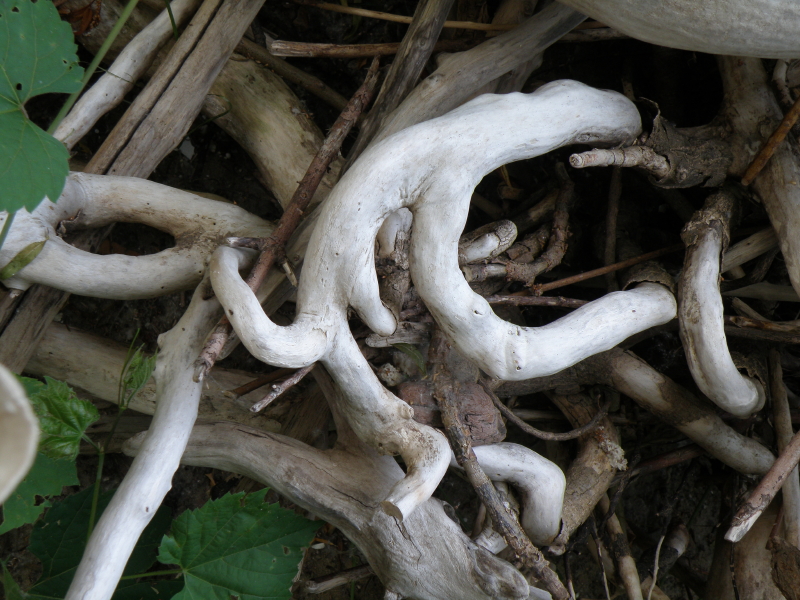
When I’m at the river I try to be as present in the moment as much as I can, however, my mind does day-dream a lot about the relationships between art, man, and nature.  I believe as my friend Ellen Dissanayake has eloquently expressed through her well-researched books that art has survival value otherwise our species would not have spent thousands of years involved in this activity.  My reaction is to try to use my creativity in this special place using the materials I find on hand to try to further this conversation along.  The sculptures I make to tell my little stories are combinations of natural and artificial materials.  The river-eroded Styrofoam I use for my figurative work is usually so static in form that to enliven it requires finding rootlets and branches that the river hasn’t fully removed all sense of gesture and movement.  These pieces become the arms and legs of my characters that help imply animation.  The picture above shows roots I collected while walking over the driftwood that the river did not completely break apart.

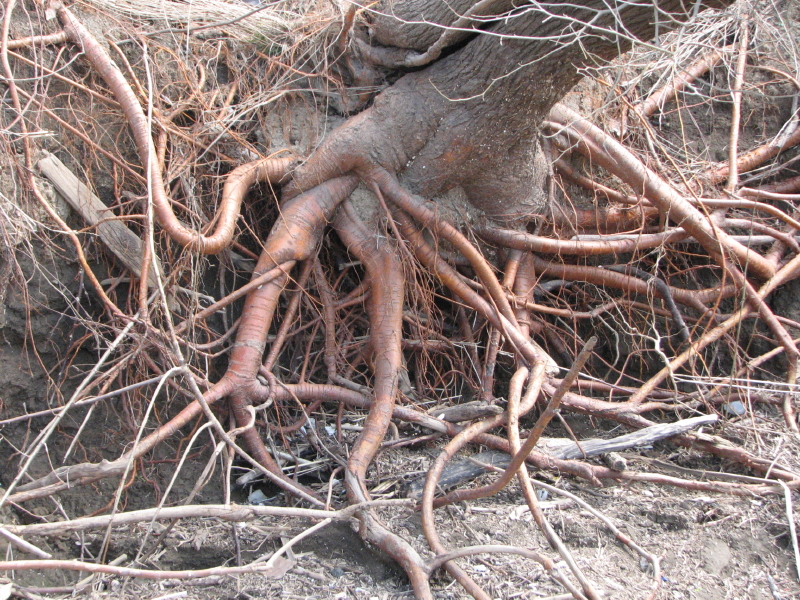
It’s interesting how often trees enter the picture.  One nice touch in the opening ceremony of the recently completed London Olympics was the large tree image that brought nature into the festivities.  Key to the life of a tree are the roots that help bring water and nutrients to its tissues.  By growing and burrowing through the soil the root system helps buttress the tree and holds the soil together.  This is especially important on a riverbank.  Since driftwood is essentially deadwood…I didn’t want to wrap up this post on such a dismal note.  At the Falls of the Ohio live many tenacious trees and here are images of a few of them that have weathered many a storm, flood, and the activities of man.

Before the idea of climate change and global warming there was already enough change occurring through the busyness of our species.  I remember looking at satellite imagery of the Amazon region a few years a go and being able to see the tell-tale grid system of logging roads and farms supplanting the jungle.  Deforestation is continuing at an even greater rate now.  Our trees need our love and we need the free services they provide.  Now for one last look at another resilient tree at the Falls of the Ohio.

Read Full Post »

Welcome to my second look at wood as expressed at the Falls of the Ohio.  The first post concentrated more on the river and water as an agent of change moving material through the landscape.  This post looks more closely at the driftwood that gets stranded in this southern Indiana park.  I once curated an exhibition at the Louisville Visual Art Association entitled “River Sticks” where all the artworks were made from locally procured driftwood.  The majority of these works of art utilized raw, natural sources, but there is also wood in the mix of a slightly different character.

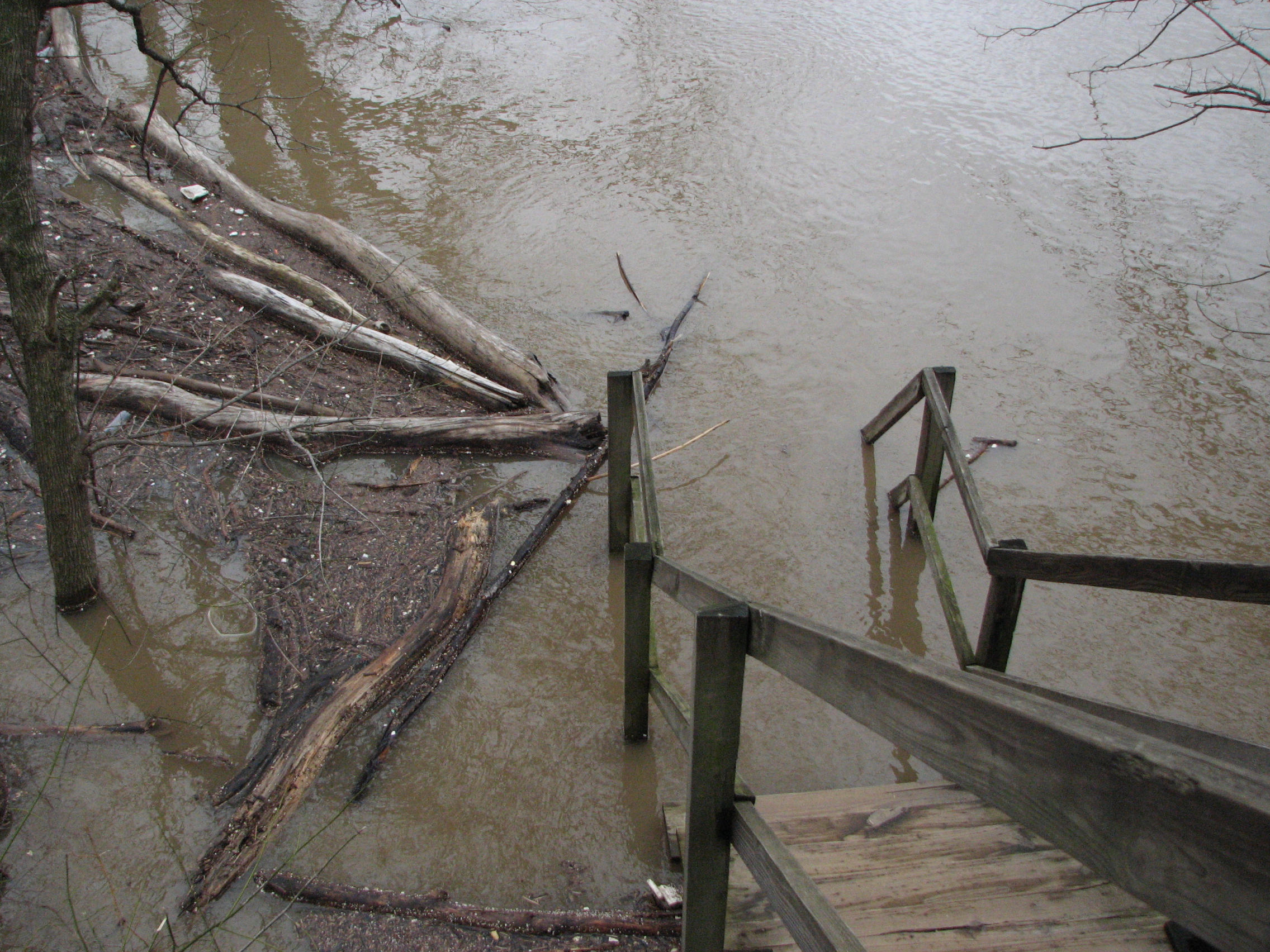
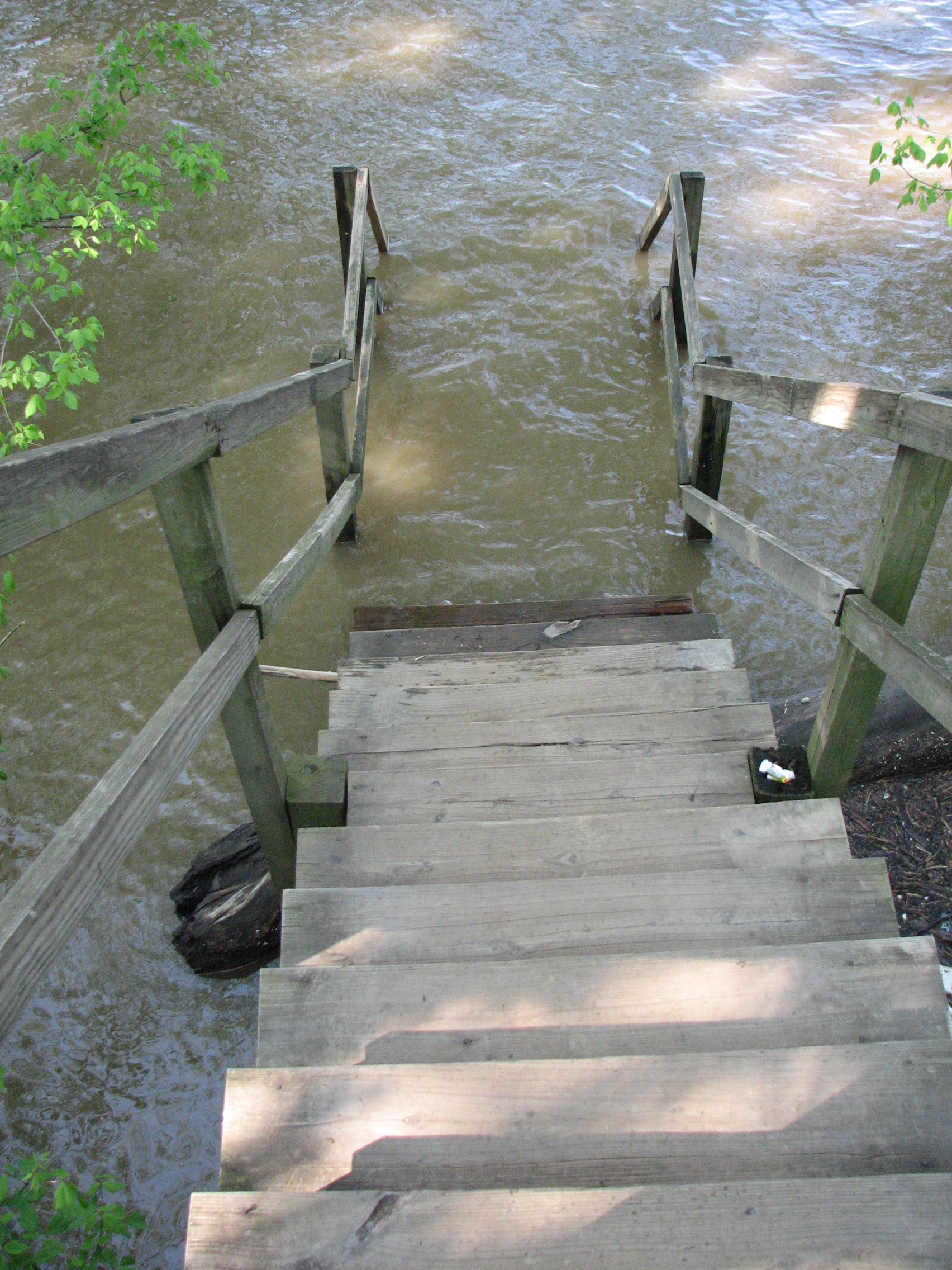
There is a wooden staircase placed here by the Department of Natural Resources (which maintains this state park) that is a popular access way onto the riverbank and fossil rocks.  It is not unusual during bouts of flooding to see part of this staircase submerged by the Ohio River.  During those moments, all you can do is look from a distance or visit the Interpretive Center.

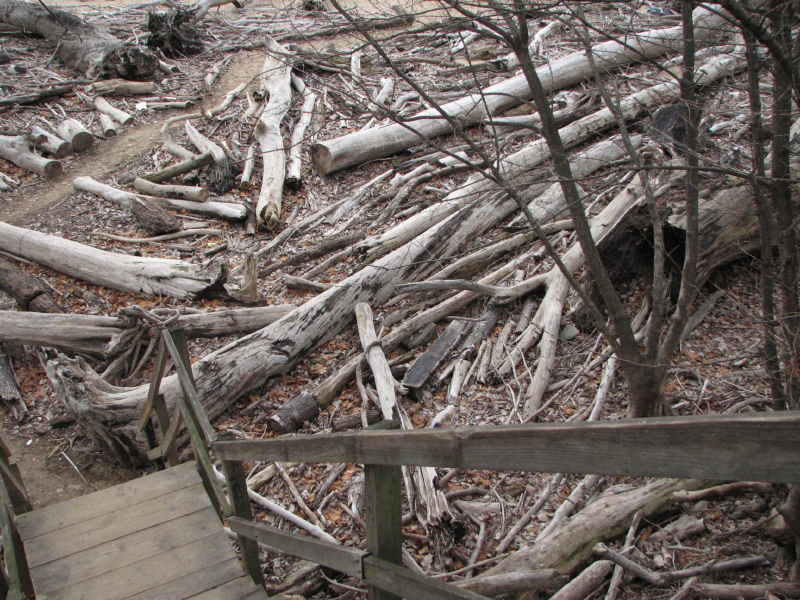
Over time this staircase has needed frequent repairs as it gets battered by floating logs and tree trunks.  Only after the water has drained away can you walk among the driftwood and see what else made from wood has been left high and dry.

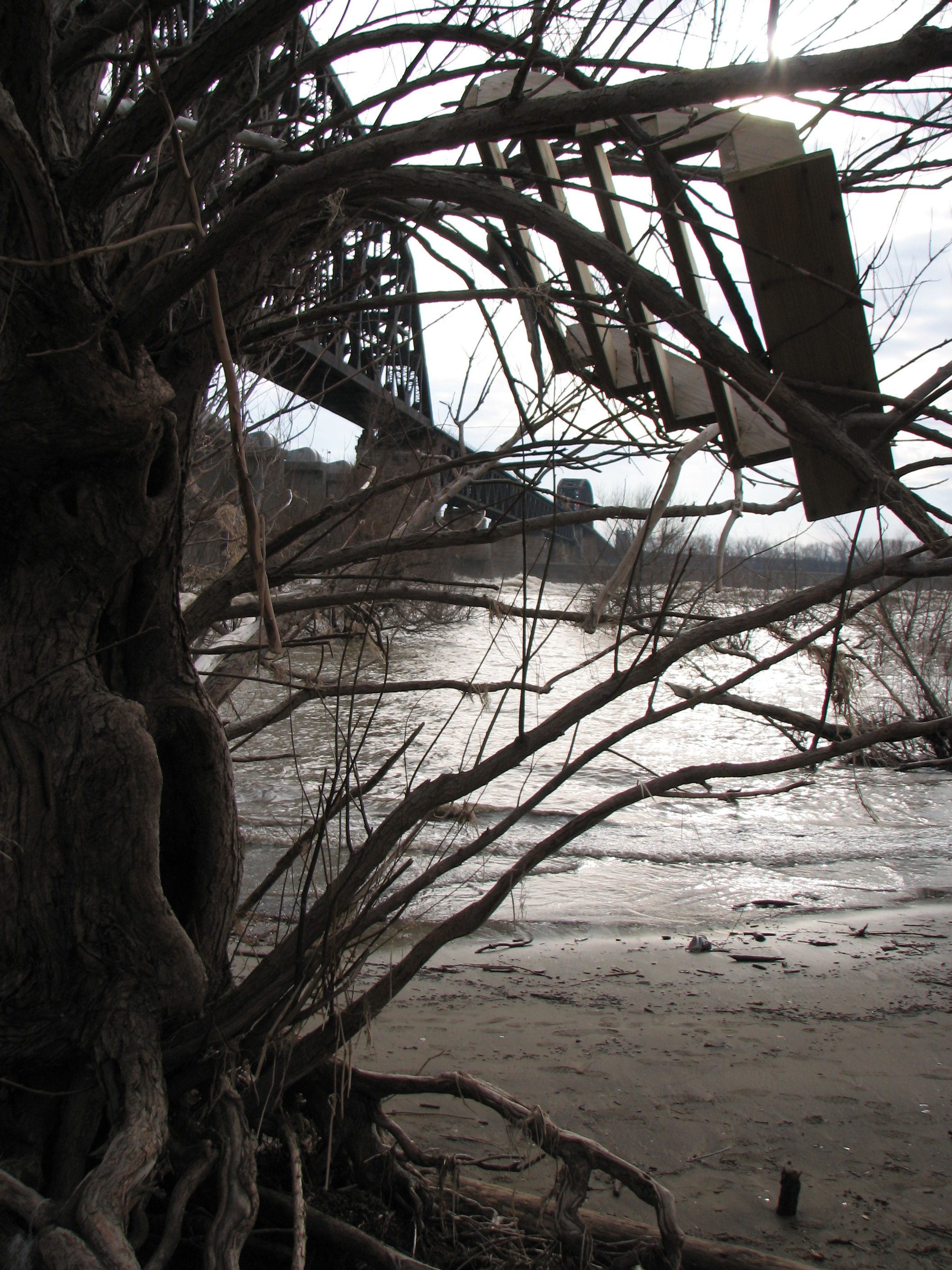
Here’s a dramatic shot of a different staircase that has floated down the river and has been snagged by a willow tree.  Objects stranded in trees bear witness to how high the river rose.

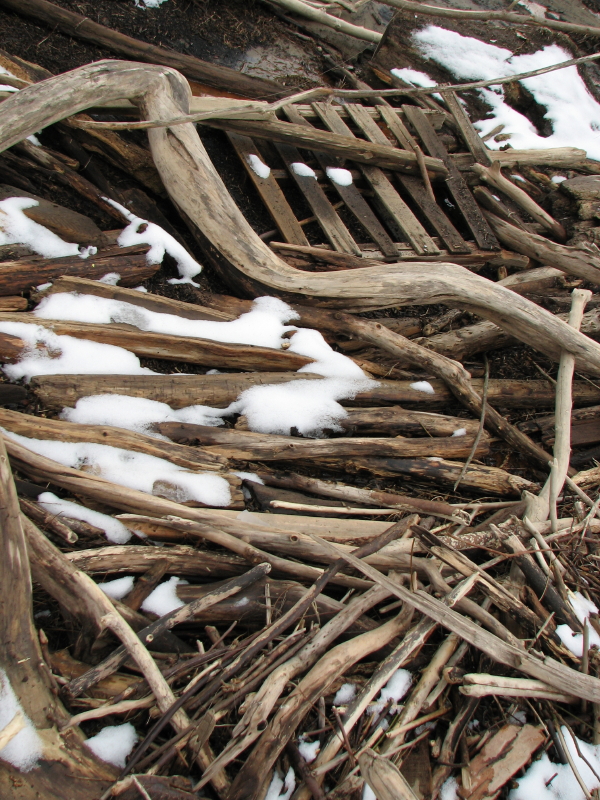
I frequently find wooden pallets and they get snagged in the trees too.  This one is a little different in that it appears the tree is growing through and around this artificial form. Over time, the pallet will fall apart. Perhaps wood is wood, but one can’t help noticing how much milled and processed wood is a part of the mix.  Here are a few other images showing this contrast between natural and man-shaped wood.

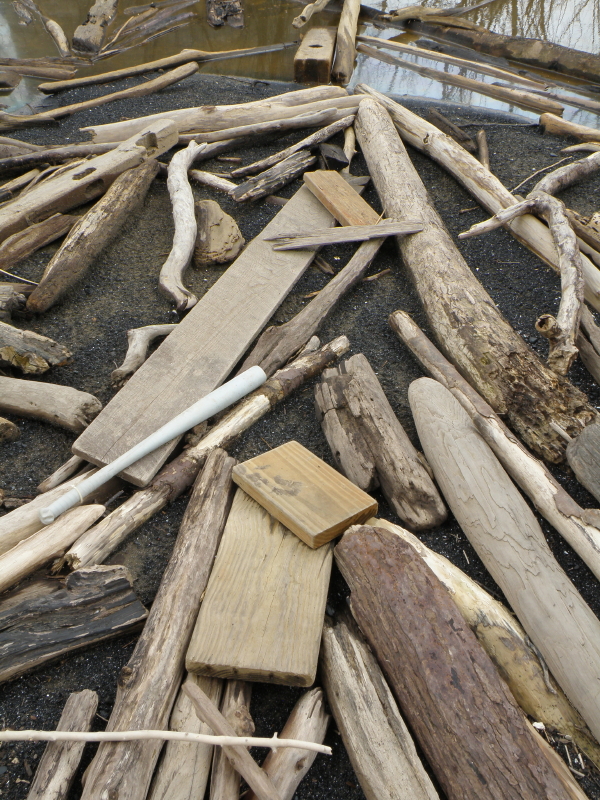
Sometimes it seems like there are enough planed boards at the Falls to build a small house. Fishermen and visitors use these planks to span muddy areas and puddles to keep their shoes clean and dry.  All this wood is a disposable resource?  I’ve seen visitors taking lumber out and I’ve done the same.  I like using river-worn cut boards as bases for the Styrofoam sculptures I choose to keep.  To me, even the smallest board tells a story of our relationship to trees and nature.  I tell myself that someday I’ll make some rustic piece of furniture from this wood.  The same processes that break a tree down in the river…do a similar “service” to disposed of wooden furniture.

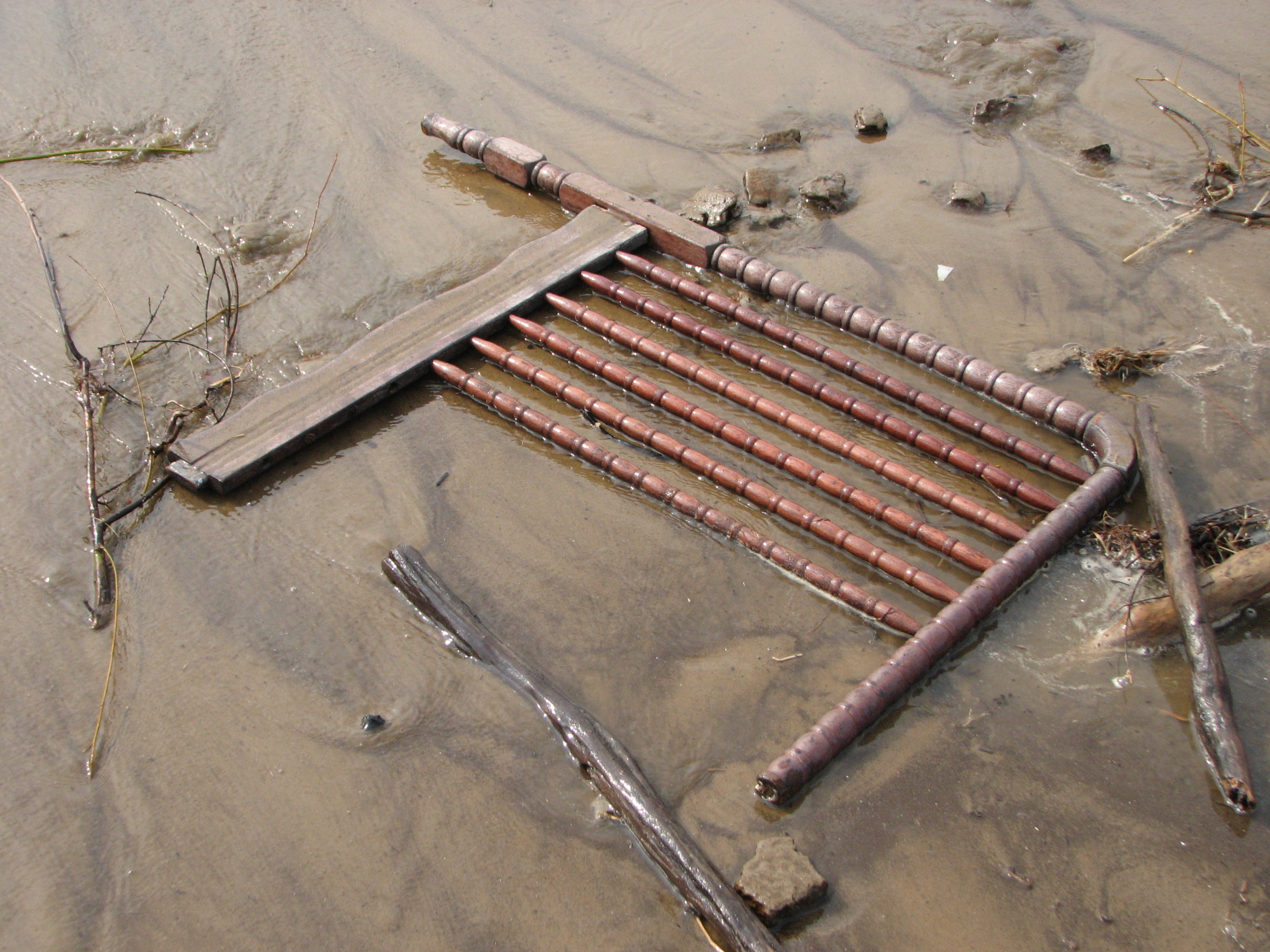
Here’s a piece of a child’s crib or bed that I found at the river’s edge.

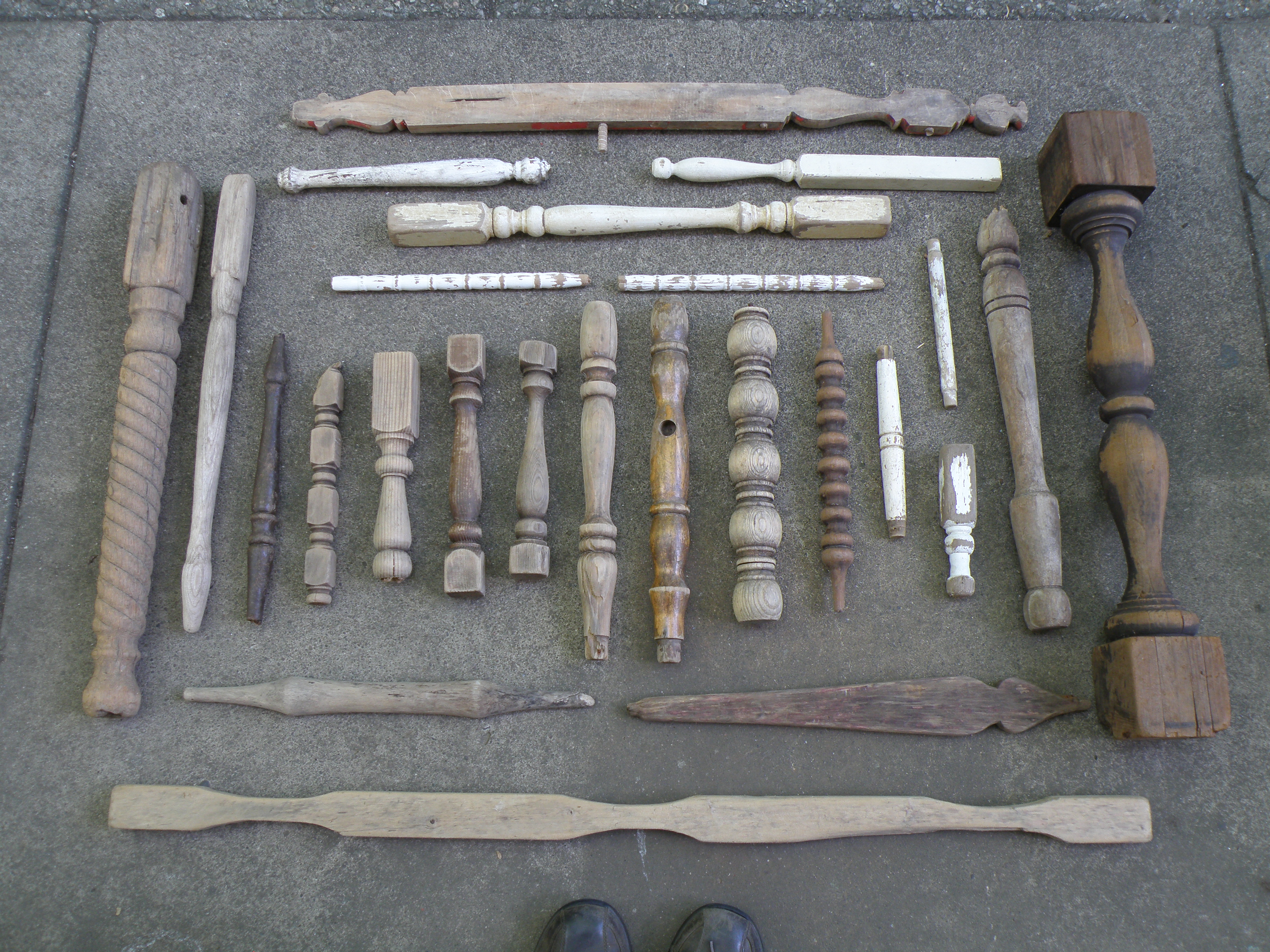
This is one of many table legs and turned pieces I’ve come across.  Sometimes I pick them up and take them home.  I’ve used them on rare occasions in my art, but I have also given many pieces to artist friends to see what they could make of them.  I suppose I could make an homage to  Louise Nevelson’s sculptures, but would prefer to create something more personal.  Nevertheless, I have picked up a few wooden artifacts from the river and here’s how they look collectively.

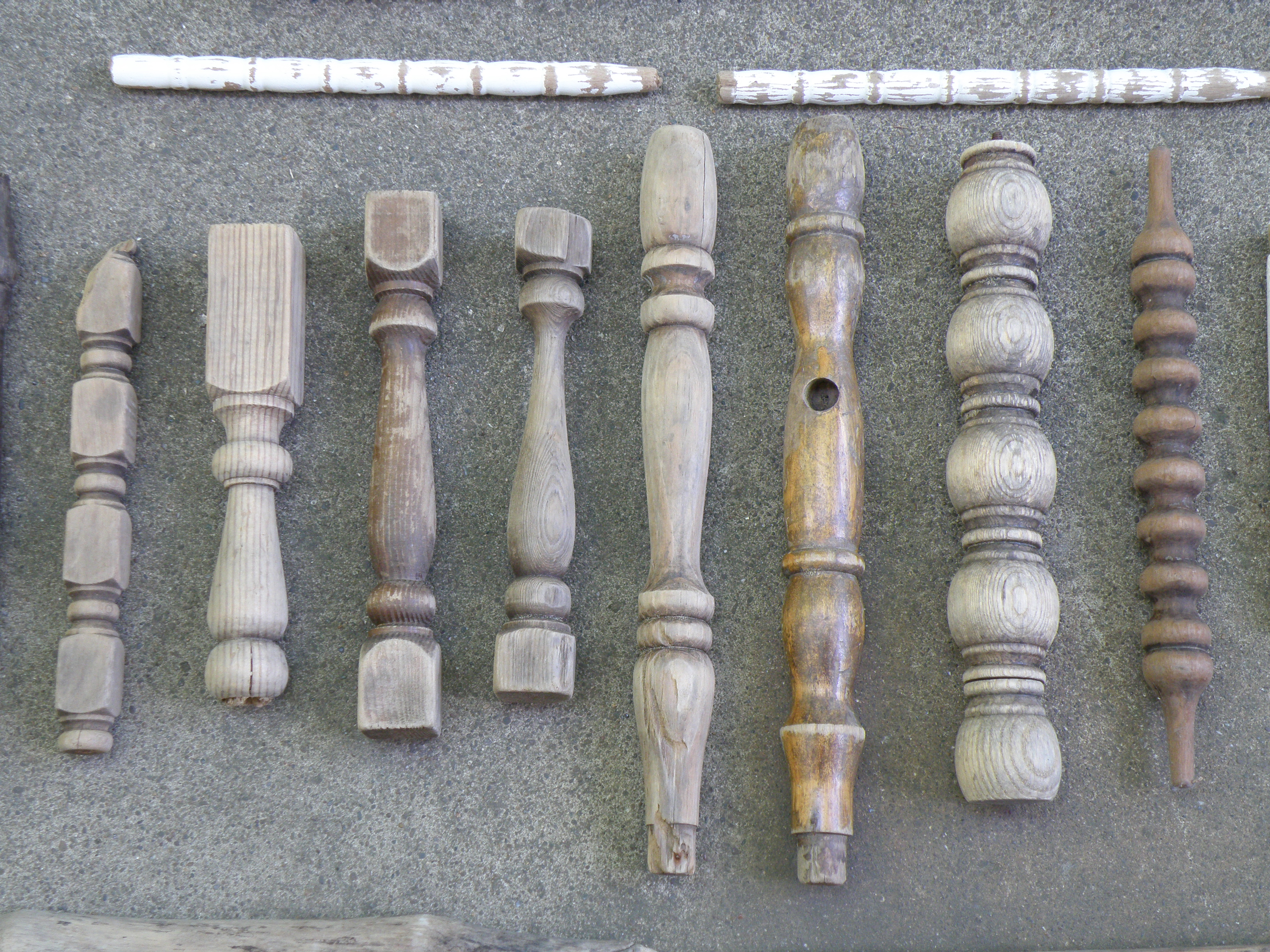
I left the toes of my shoes sneaking a peak for scale!  Here’s some of the hand-turned and machine-made table legs, chair staves, and spindles I’ve saved.  These artifacts do break down over time and eventually revert back to nature.  Now for a detail.

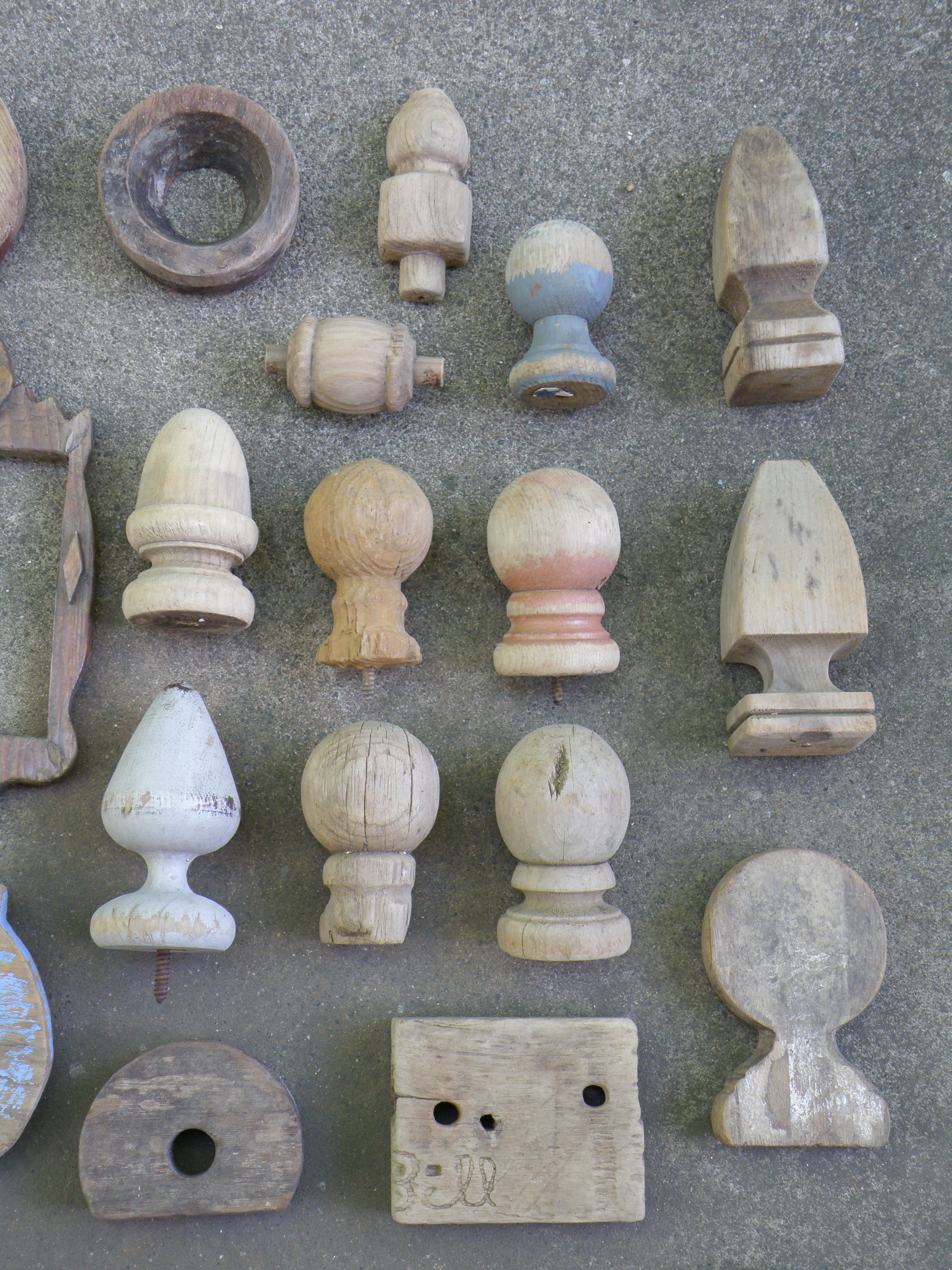
Here’s a slightly different collection of wooden artifacts I’ve saved over the years.  Some things I recognize and others require pondering to figure them out.

The objects on the right are mostly finials from fence posts.  The circular objects with the holes in them…I’m not sure how those were originally used?  Could they be part of a float system for barge ropes or are they wooden wheels for toys…could they be lids for some kinds of containers?  In this grouping I have also included a small rustic picture frame I found as well as a whittled stick I could tell someone cut and scored and is perhaps the most minimal artifact in my altered wood collection.  I find many board fragments, but I kept one small piece because someone named “Bill” tried routing his name in the wood and drilled a few holes that became bigger as the wood softened and aged from exposure to water.  This piece of wood exhibits several ways we leave our mark on nature.

I also have a sign collection that can be seen in my Pages section.  Most all of them are also made from wood and were once part of this unusual driftwood mix that came from the Ohio River.  I’m thinking of putting my found “Bill” board in that collection because it too is a sign of the times as we lose our ability and desire to write in cursive.  Very few schools in my area even bother to teach this skill anymore.

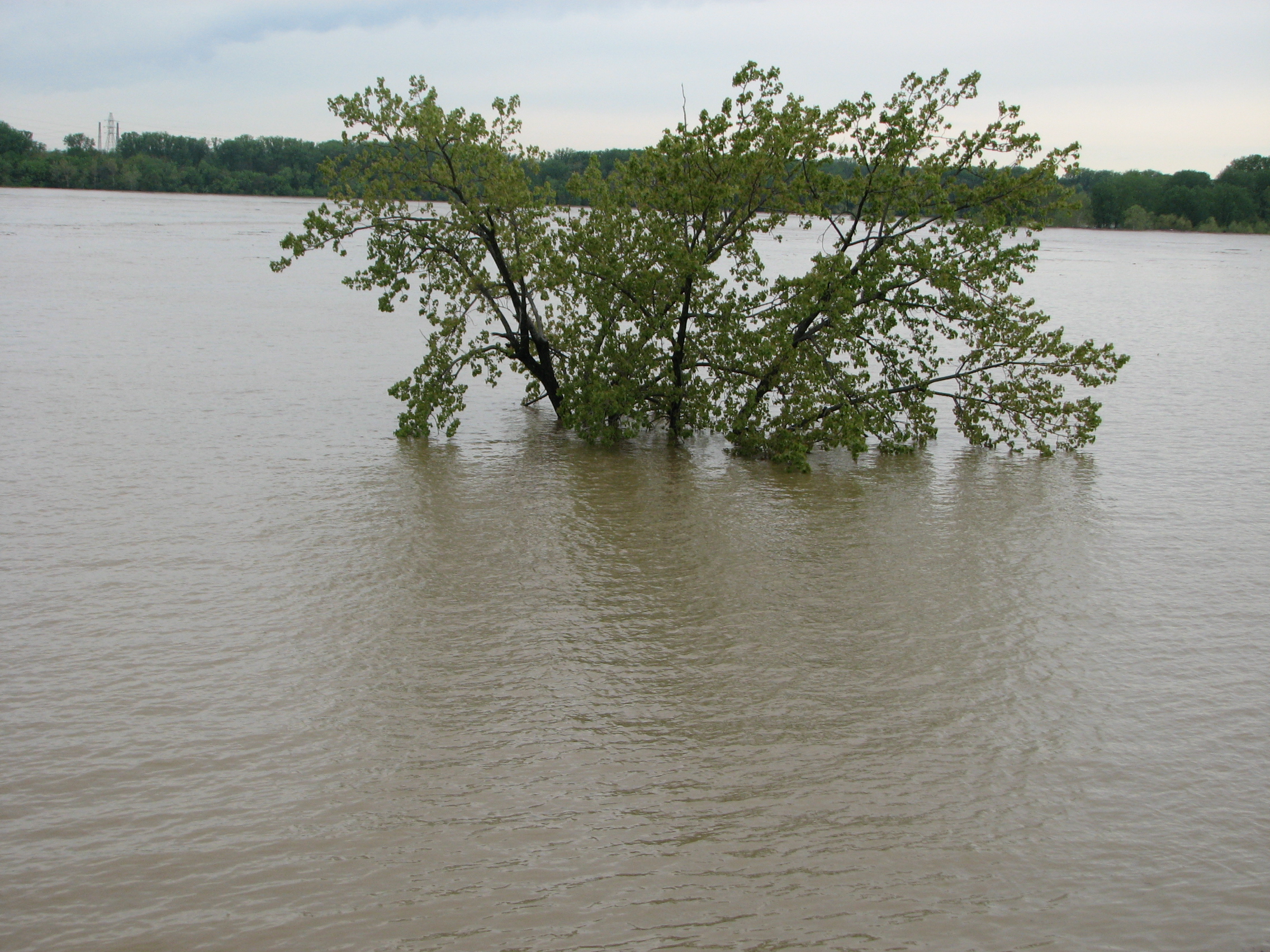
Not all the driftwood in the river consists of logs, branches, and roots.  Much of my riverblog bears witness to the extent our handiwork pervades the larger environment.  What I see happening in my part of the world I assume is transitioning  simultaneously across the surface of the planet.  We have added our own distinctiveness to the overall material aggregate which challenges our now quaint notions of what is “purely natural”.  I was right when I mentioned in an earlier post that the month of July would find a way to be memorable.  It’s official now, July was our hottest month ever in what is shaping up to be our hottest year ever.  Much of our country is experiencing an intense drought and so I end with a picture of what it looks like when there is too much water.

Read Full Post »

I have been doing some armchair beach combing while my knee recovers and I have selected images to help tell the story of wood at the Falls of the Ohio.  Since this wood was also once alive, it is also the story of trees along the Ohio Valley. When I went through my last three year’s worth of images…I found enough material for a few “wooden posts”.  Hence, this is Part I of what may prove to be a couple of stories.  The Falls of the Ohio is well-known for its driftwood deposits and many people (and some animals when I come to think about it) like to take advantage of this resource.  I have met many a person in pursuit of a select piece of wood.  What folks do with this wood is as variable as the person.  Some people like to use driftwood to enhance garden displays, some are inspired to make art from the found wood, and others may choose to burn this wood during cold winter nights.  I’ve seen Pileated Woodpeckers make short work of decayed tree trunks in their pursuit of carpenter ants and beetle larvae.   And once I found a Mallard duck’s nest inside a hollow log.  I’ve seen many beautiful fungi helping to convert this wood to humus. Driftwood is plentiful in the park and what usually happens is the Ohio River during its high water moods moves the old wood out and lays down a fresh layer that originates up-stream from us.  Sometimes I wonder if the wood I’m seeing is also part of the riverbank eroding in the northeast? These days, riverine ecosystems are under so many pressures. Since the Falls environment is continually being rearranged by nature, no two years are exactly the same and the riverbank is ever-changing.  It is interesting to me to think about these very images as digital driftwood that flows from the rivulet of data coming from my computer and tumbled into the ocean of info that is the internet.

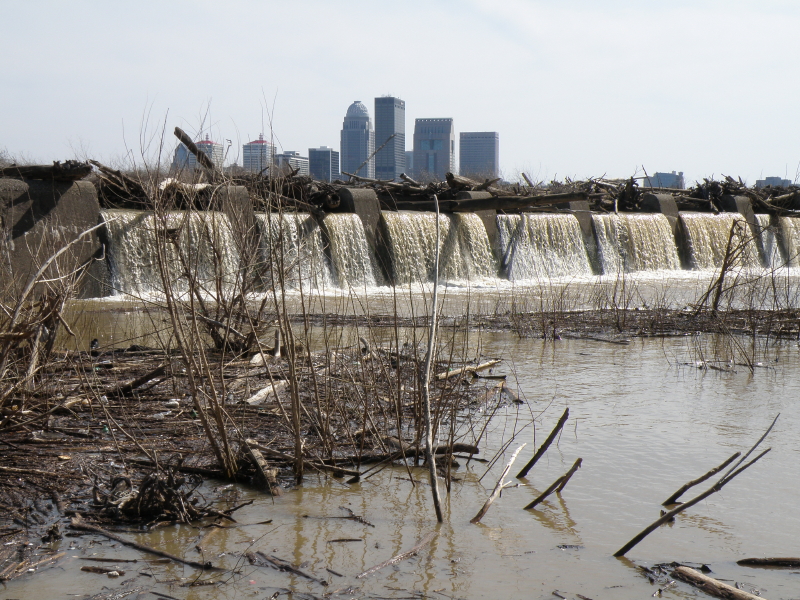
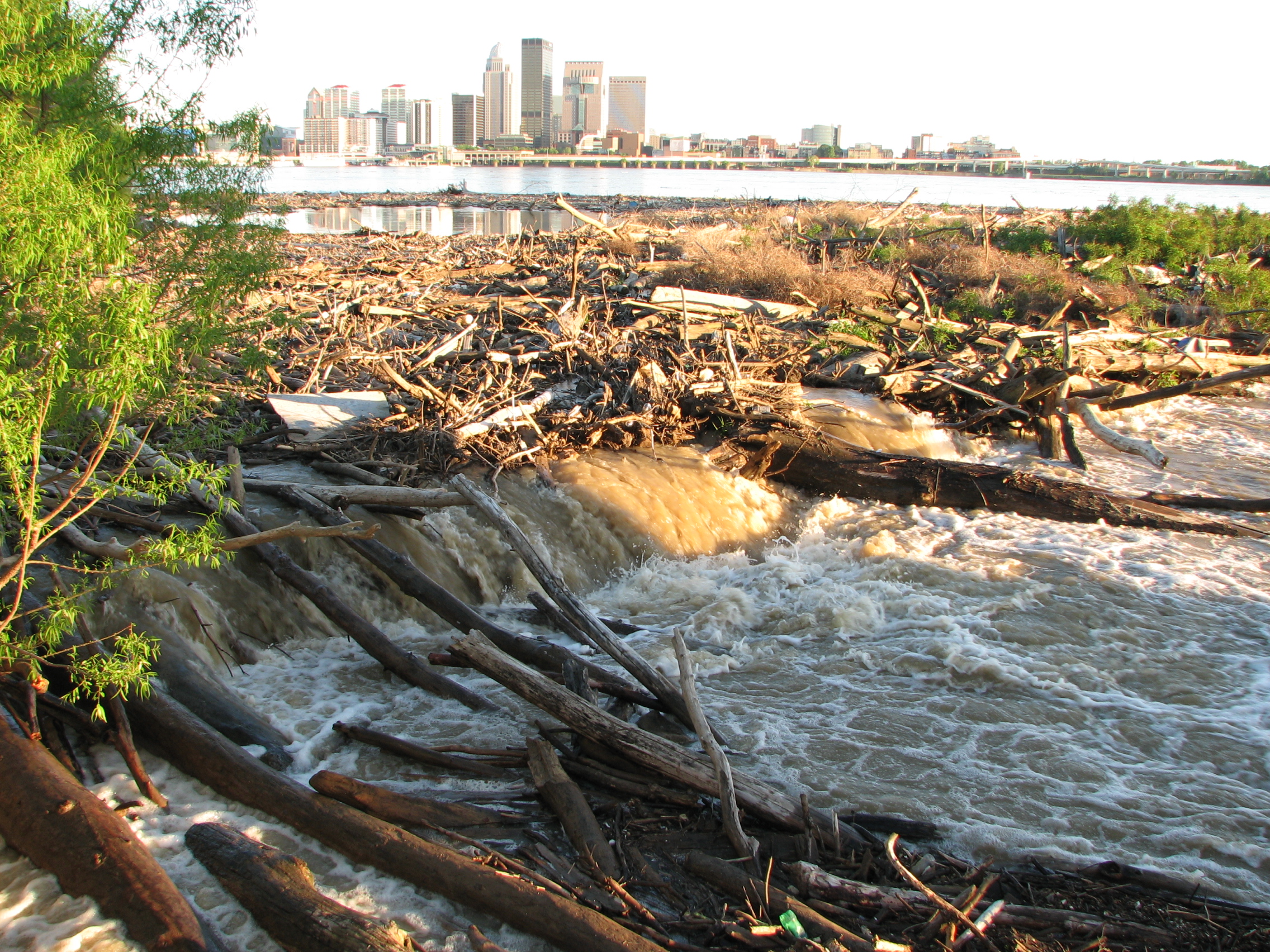
A prolonged rainy system upriver from us or a sudden flash flood caused by short, but intense rain storms causes the Ohio River to rise quickly.  “New” wood flows over the top of the dam and soon mixes with wood already in the park.

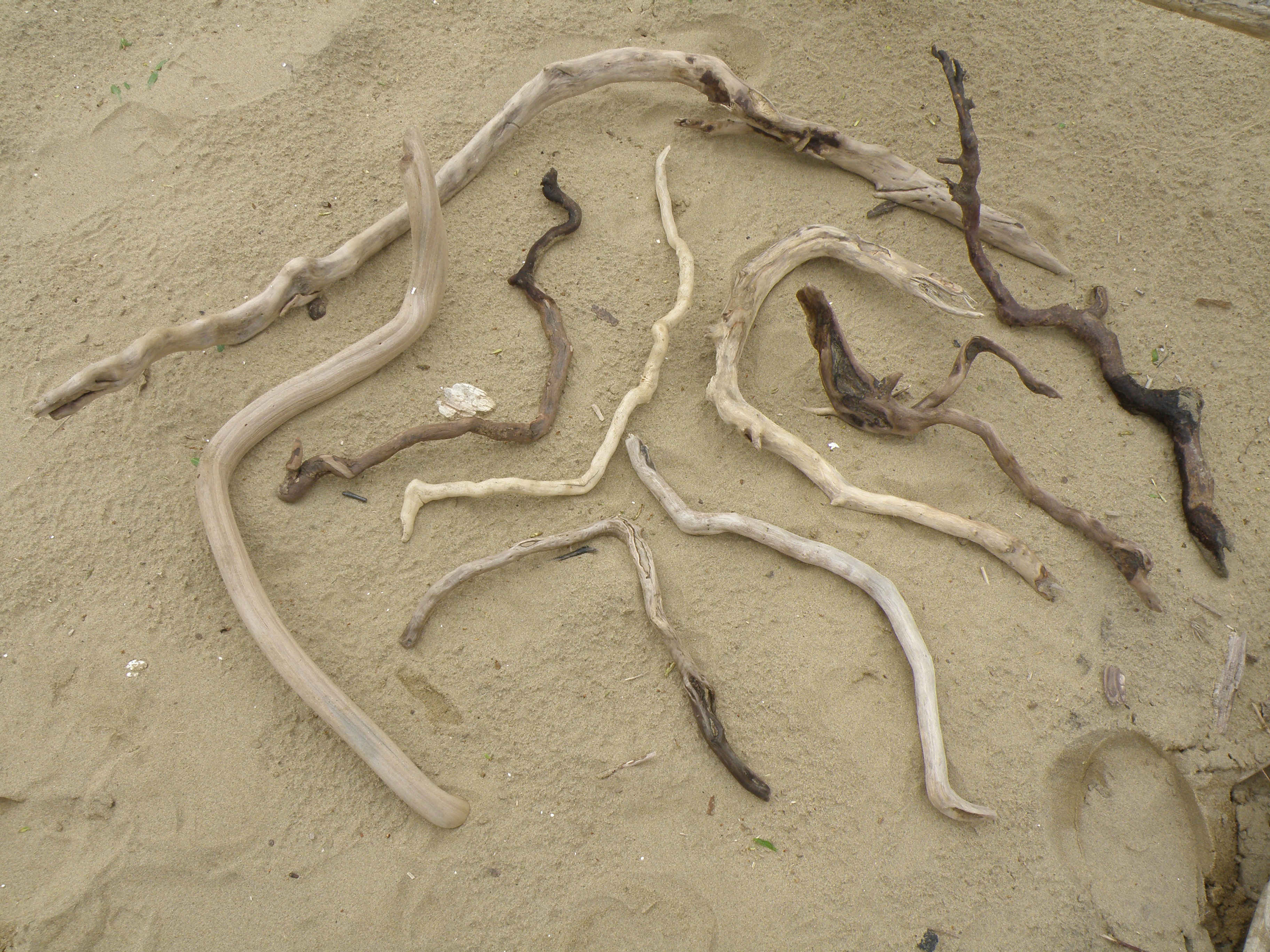
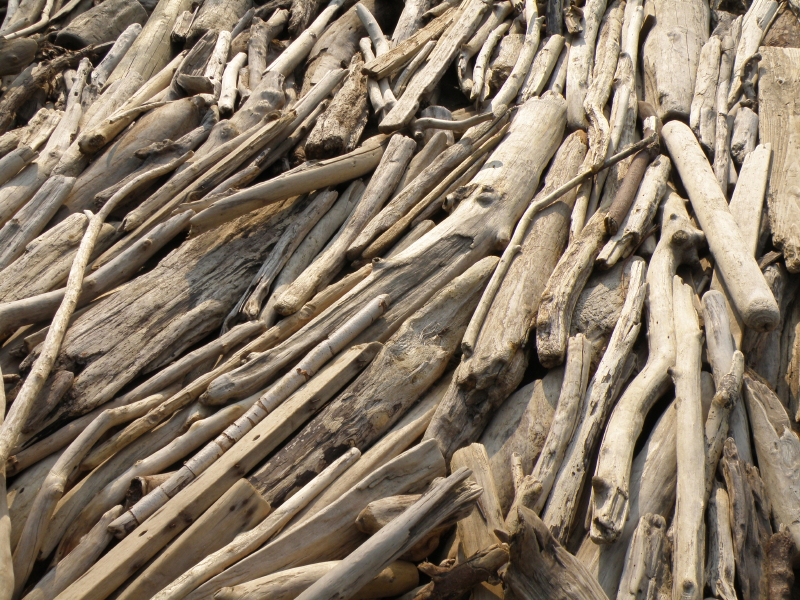
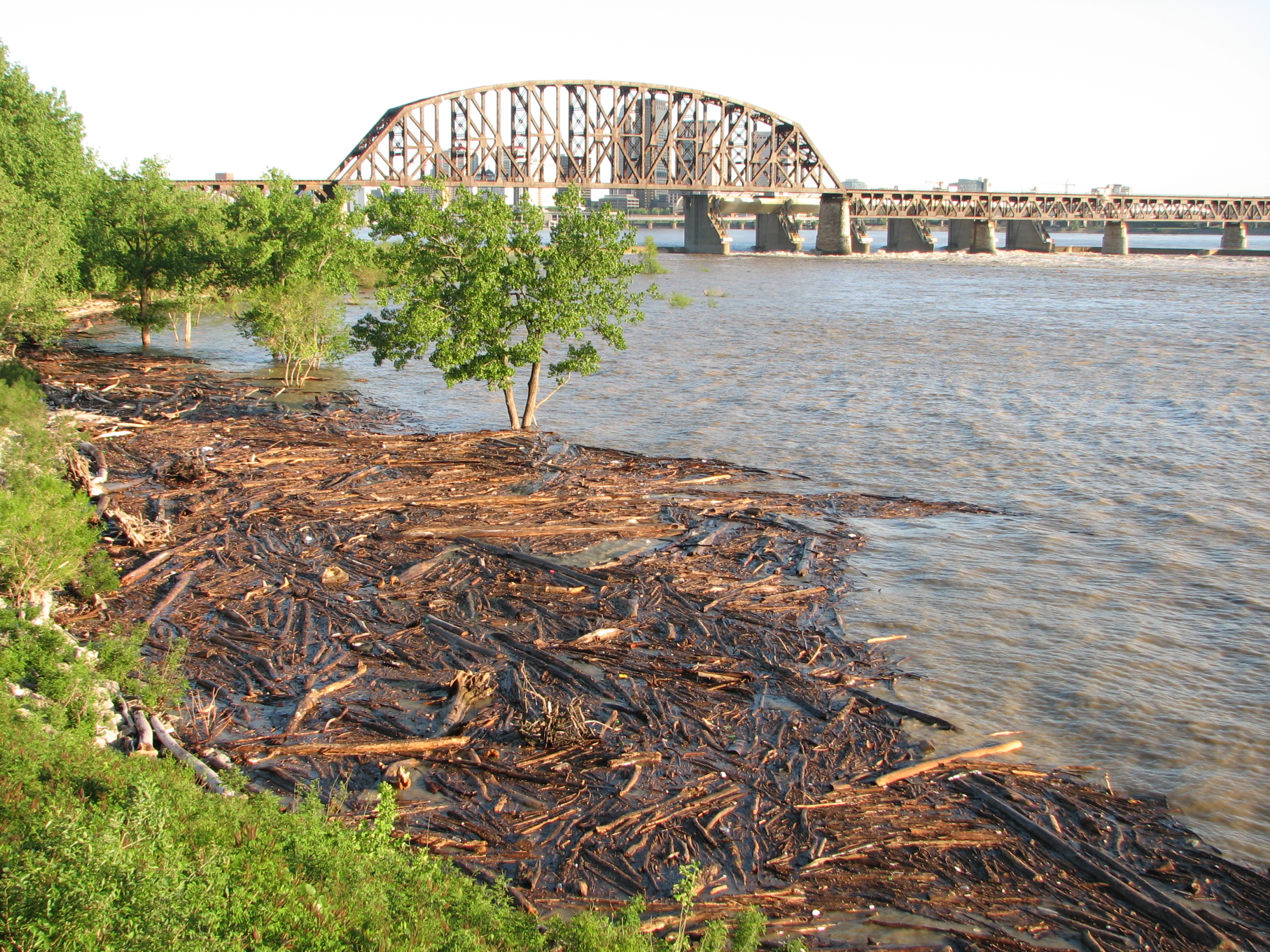
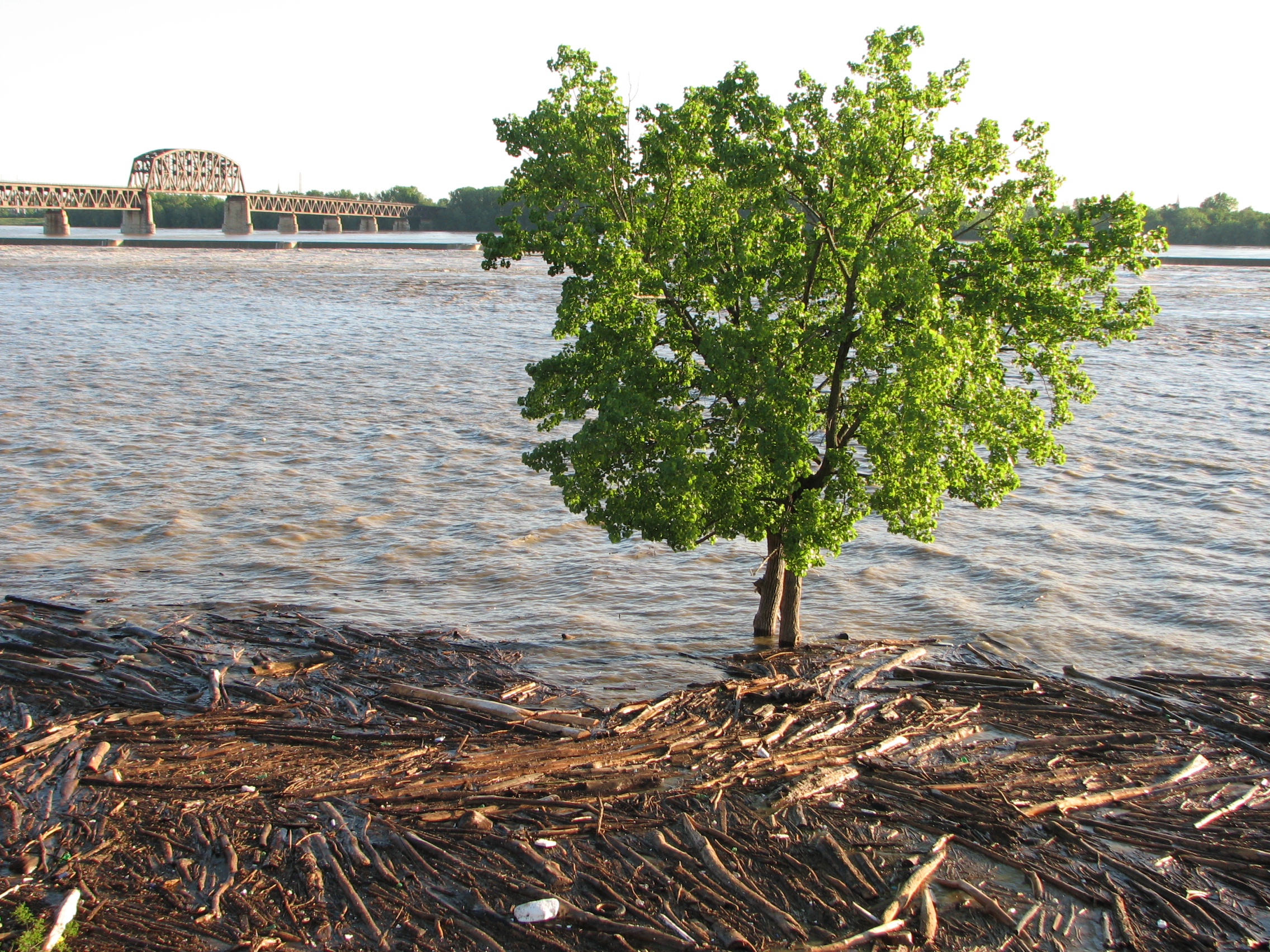
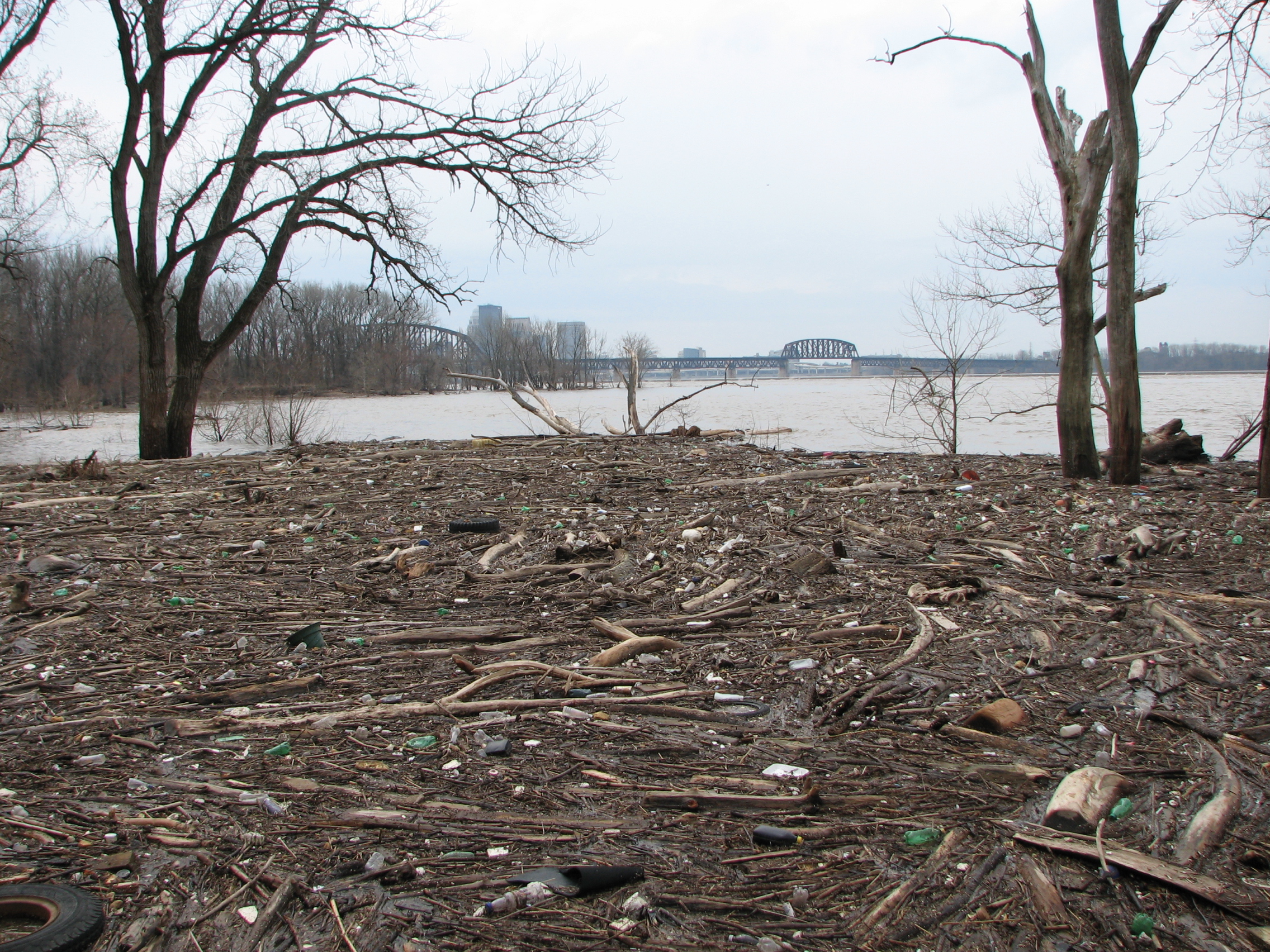
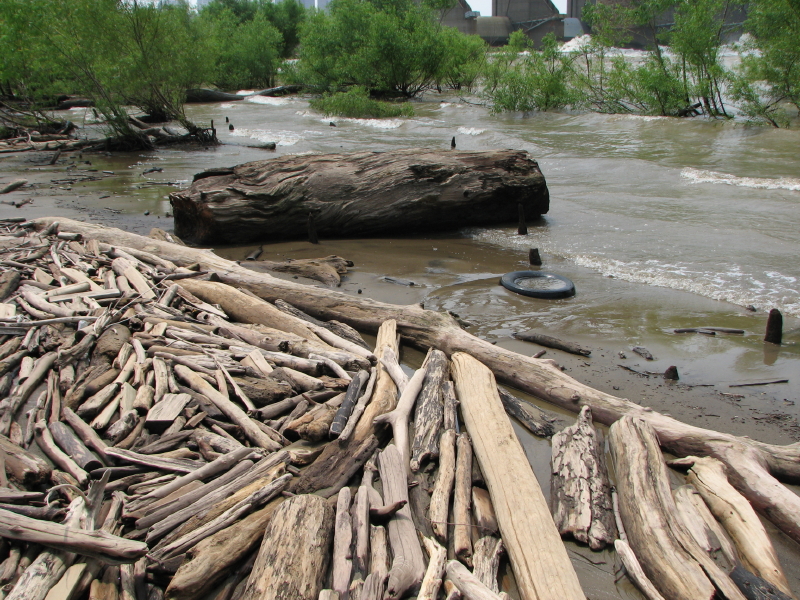
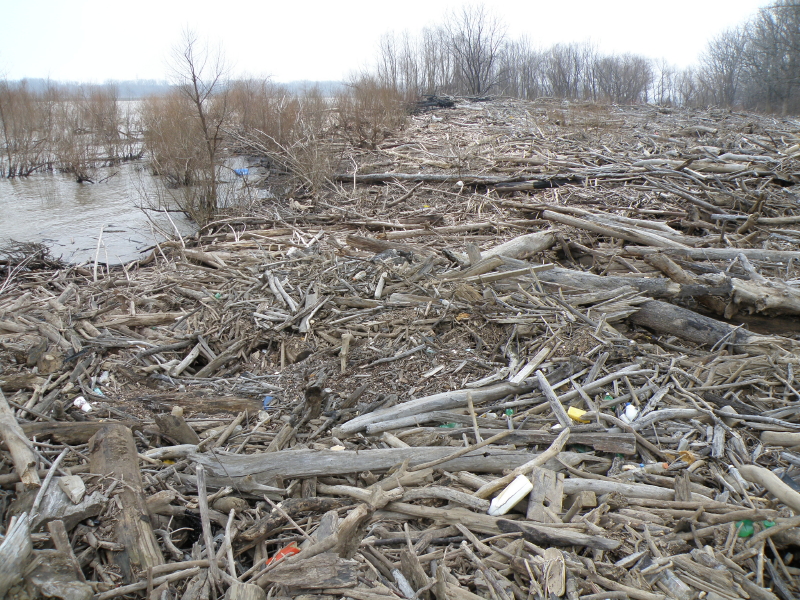
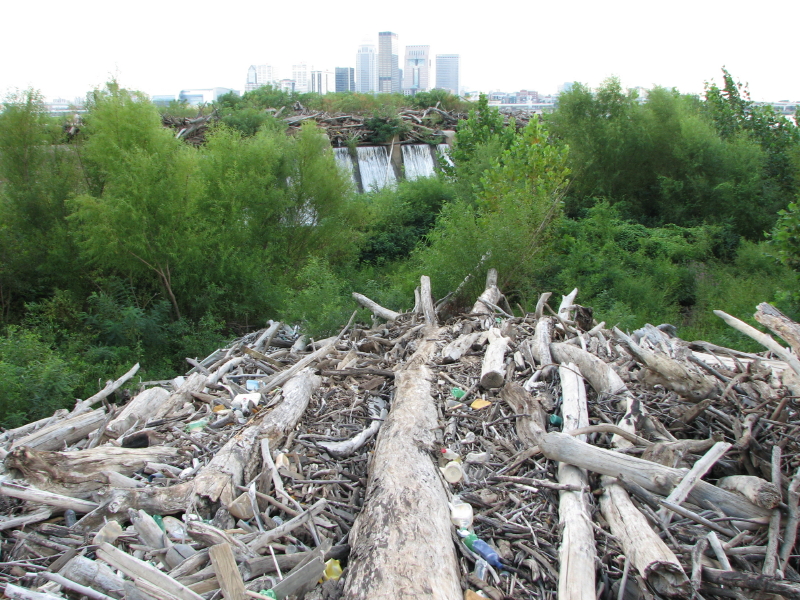
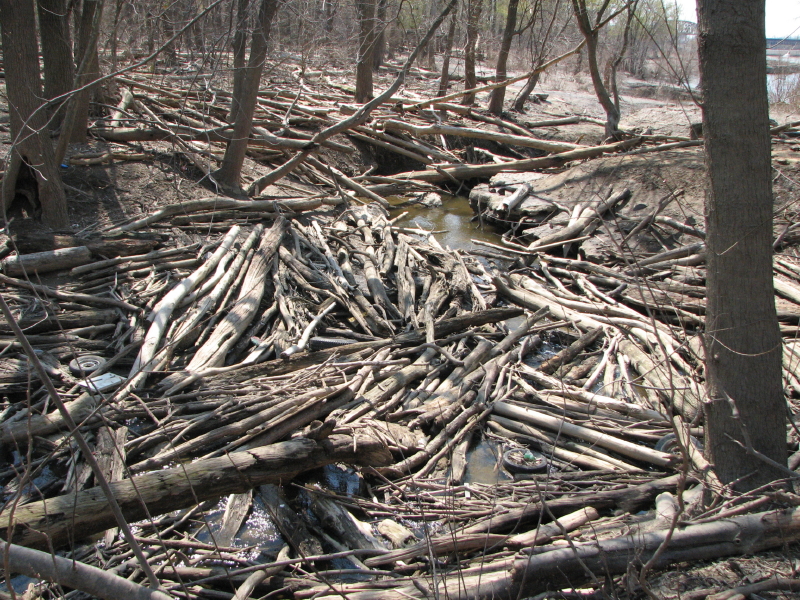
Prevailing winds and river currents push the driftwood which can form large rafts and mats against the Indiana side of the Ohio River.  If you notice, there aren’t many trees here with intact branches.  The river breaks each tree down and keeps subdividing it into ever smaller and straighter pieces.  The wood chips in the water are the remains of tree bark that have been ground off by continually rolling against the other tree trunks in the waves.  Of course, there is other detritus much of it man-made also in the water. Eventually the water recedes and strands the wood in interesting formations that are a part of a new and rearranged environment.  Here are a few images made while the river retreats.

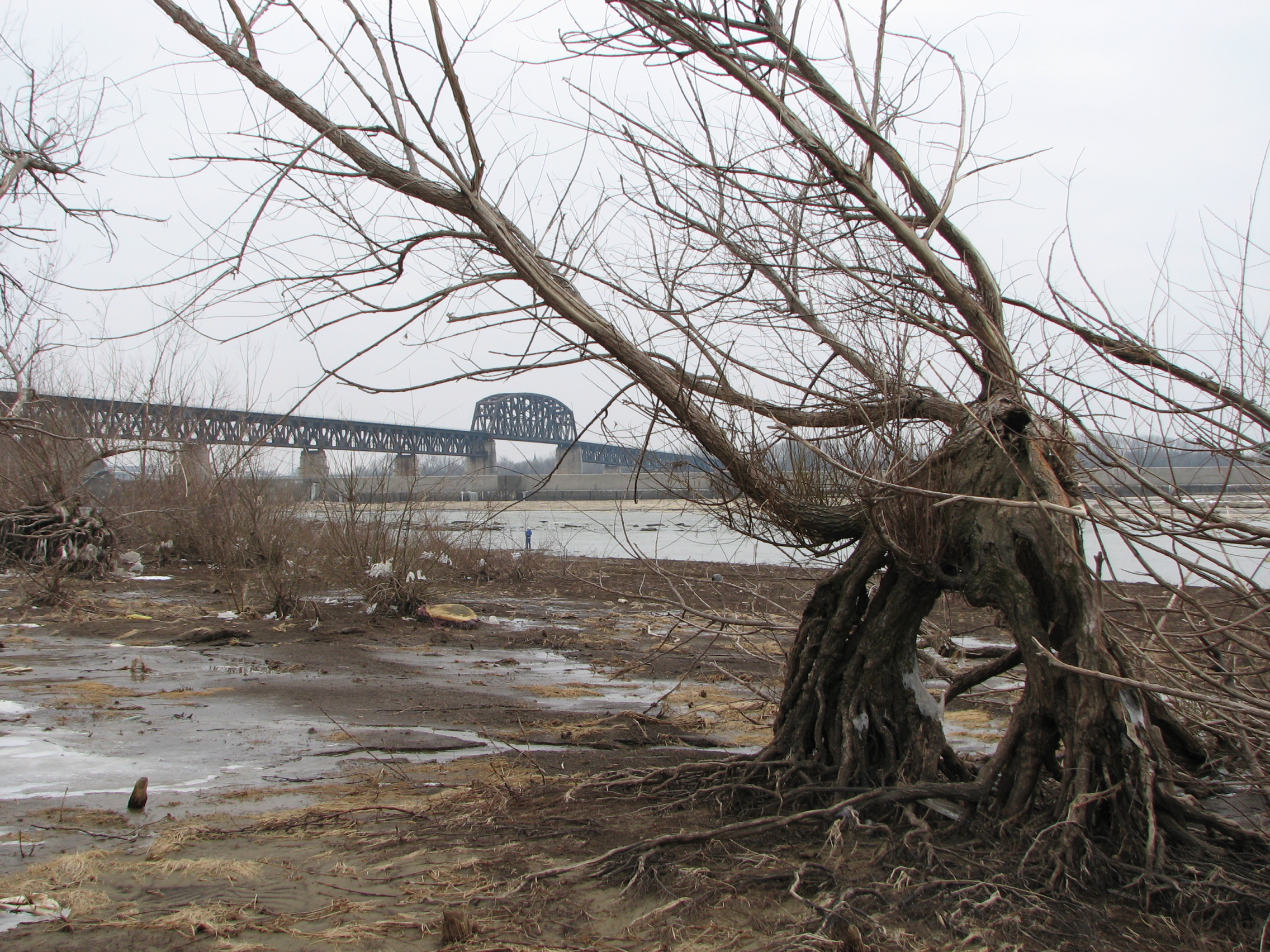
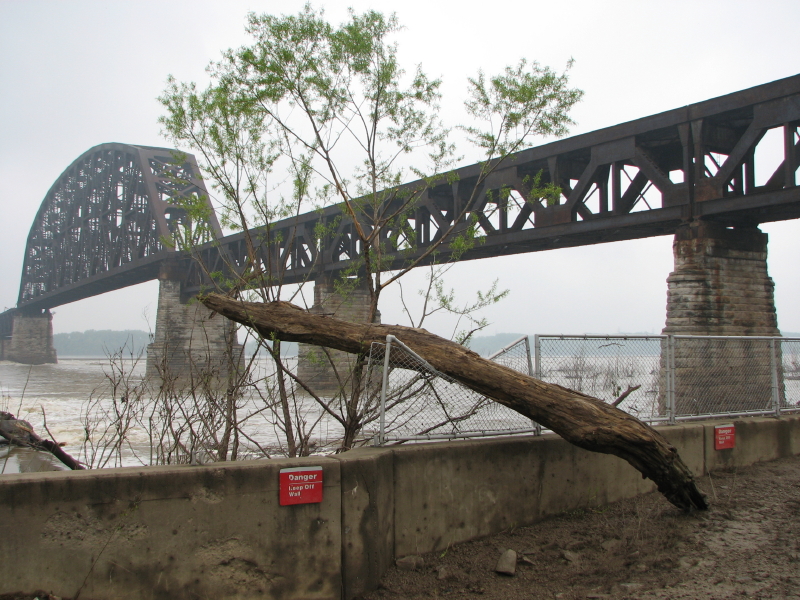
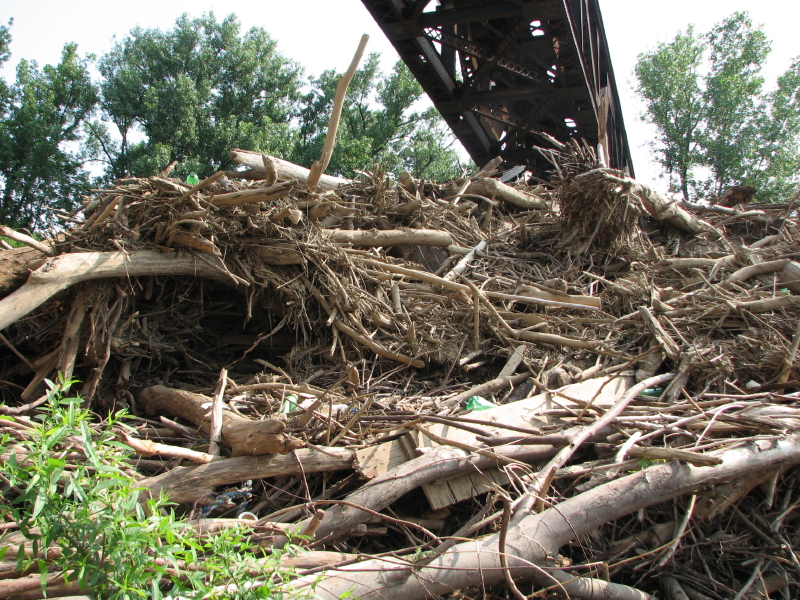
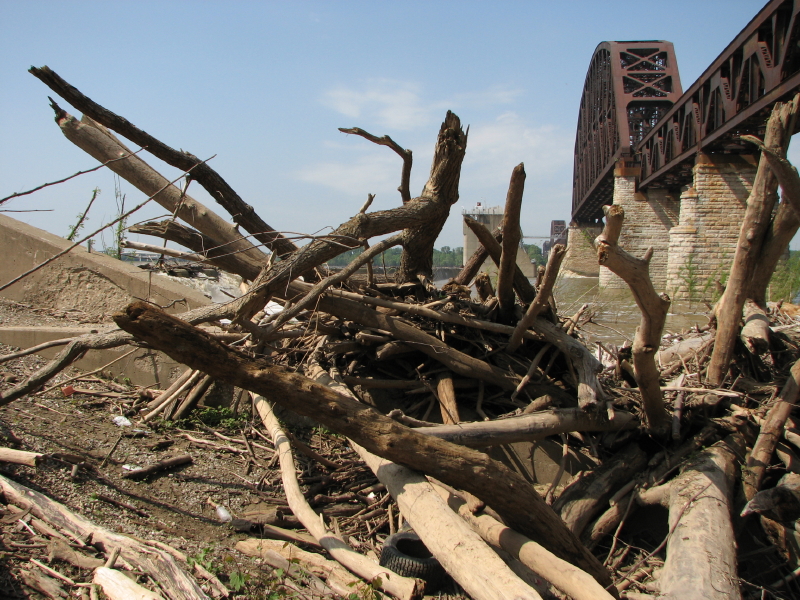
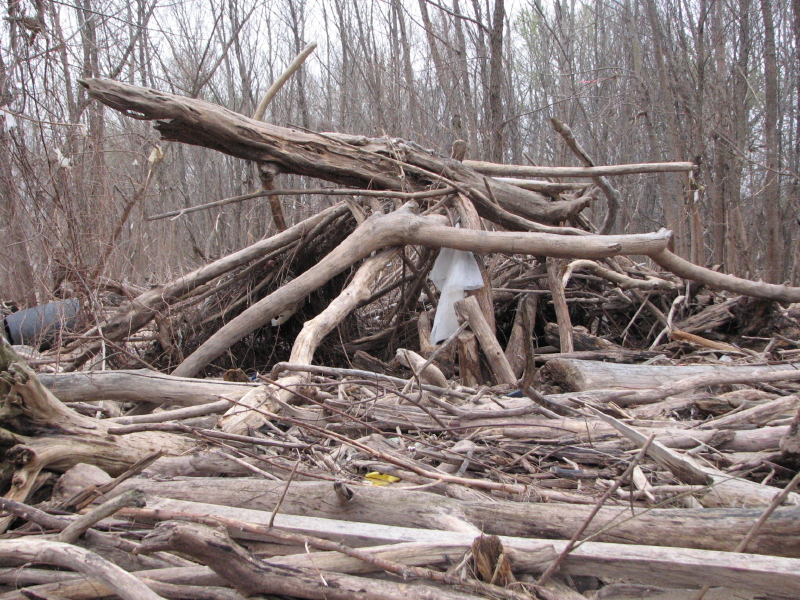
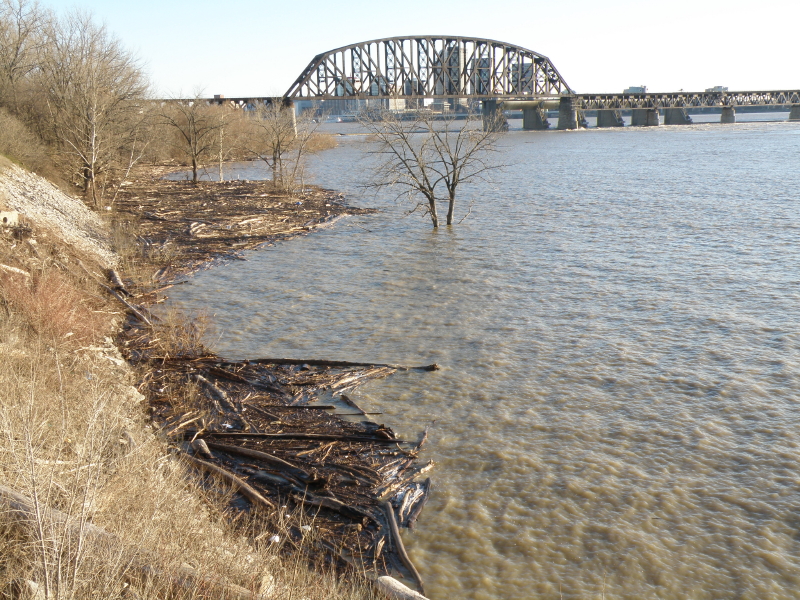
Not all the driftwood gets corralled by long logs that organize the smaller ones into neat parallel rows that fill in beach space like pieces to a puzzle.  It’s fascinating to get a sense of the water by how the wood was laid down.  Sometimes there is just so much material that immense mounds are formed by the interlocking wood.  Exploring these mounds can be tricky because the wood is still settling and caution is recommended.  At the moment, there is a sizable amount of driftwood under the railroad bridge which is also closest to the dam.  Here are a few images of all these logs after the water has drained away.

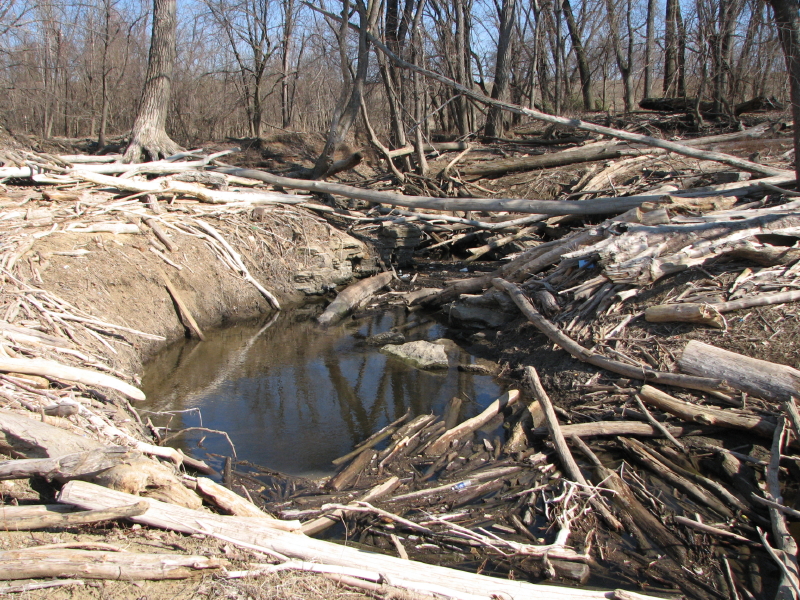
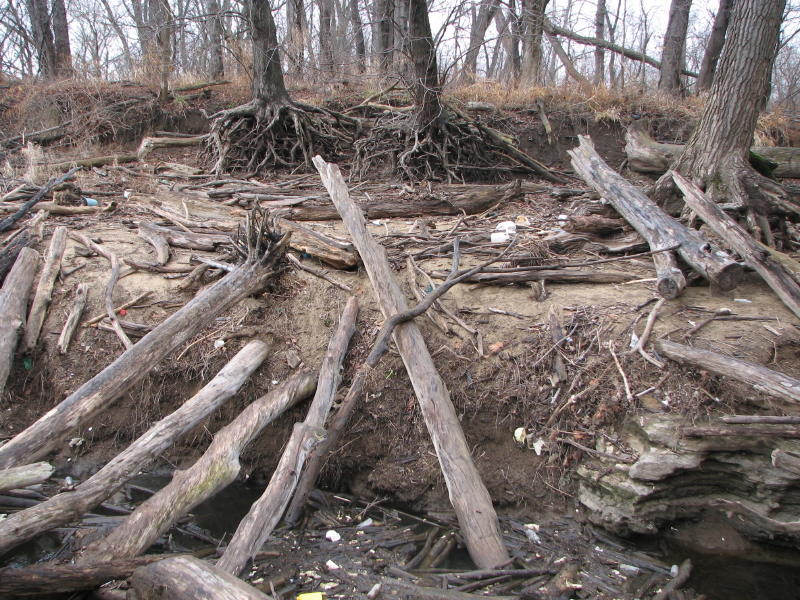
The small creek that flows into the Ohio River gets backed up with logs during high water.  When the water recedes and deposits the wood, it covers the contours of the creek’s banks.  Here are a few more recent images.

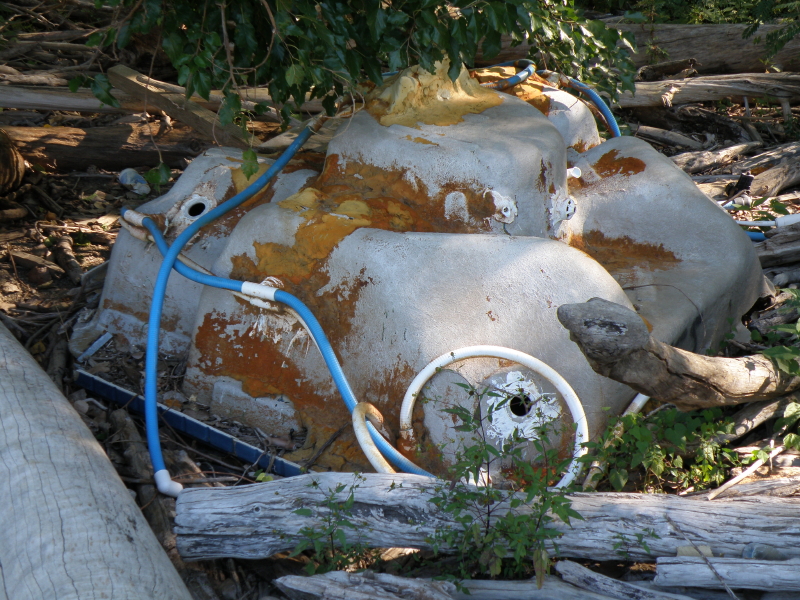
In the above image you can see how the trees that line this bank are beginning to be exposed by the river.  I believe there is just so much additional water and energy in play now because of climate change that the days of gentle rains will be fewer and farther between one another.  In our area, many residents have noticed that our storms seem to be fiercer and becoming more event worthy.  The main beneficiary of this are the television weather forecasters who love to hype the weather anyway.  I believe I will end here for now, but will continue later because there is more to say about this driftwood.  To close, I will end with another large and sculptural mound of driftwood.  Have a great week and month everybody!!
Read Full Post »

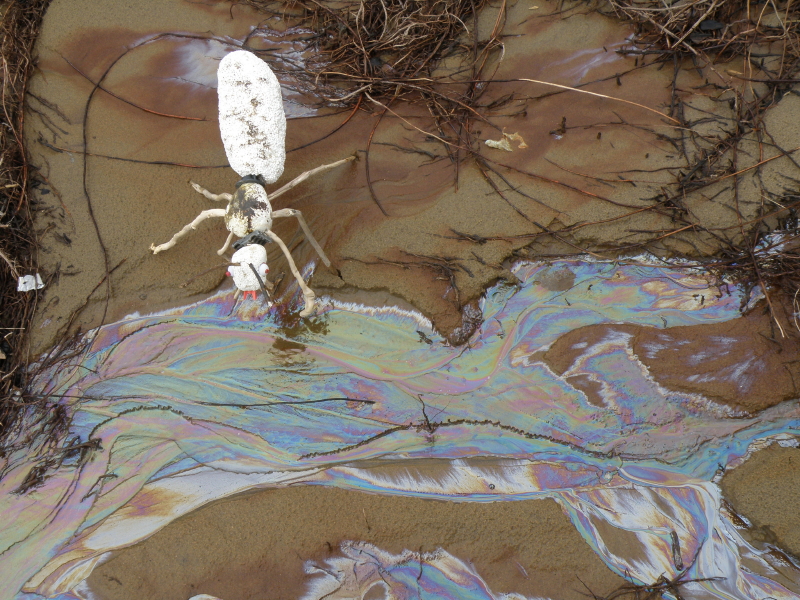
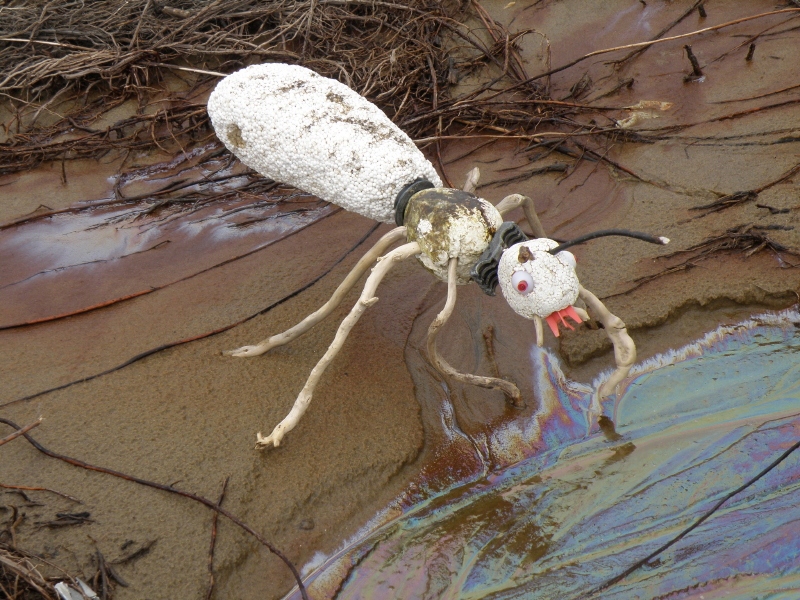
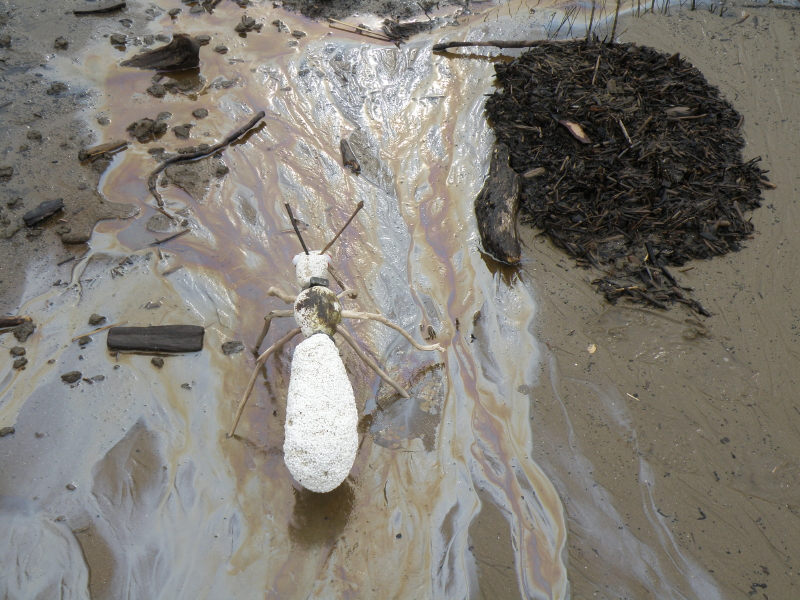
Okay so I’m bowing to a little peer pressure and presenting additional images from a project I did the last month.  The day I made my Styrofoam ant project I also kept crossing areas on the riverbank where iridescent flows from something oily was percolating up through the sand and mixing with slow flowing water.  In my original story…imbibing this stuff is what mutates the ant into a giant!
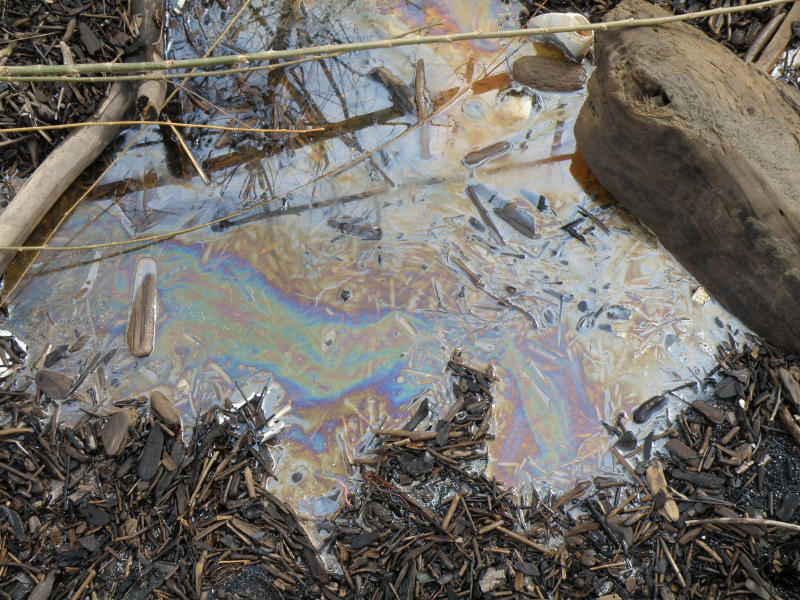
I still don’t know what this prismatic film is that is seeping to the surface?  It could be old long-buried petroleum or some oily residue from decaying vegetation?

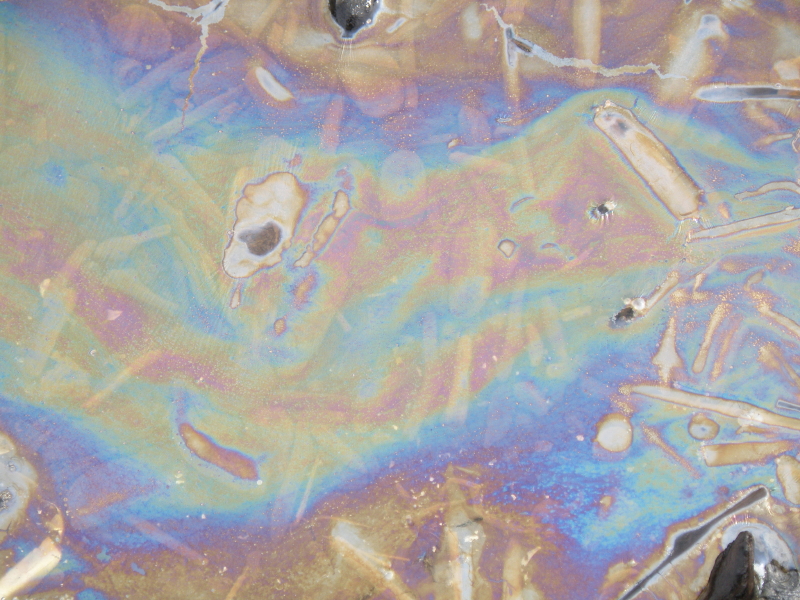
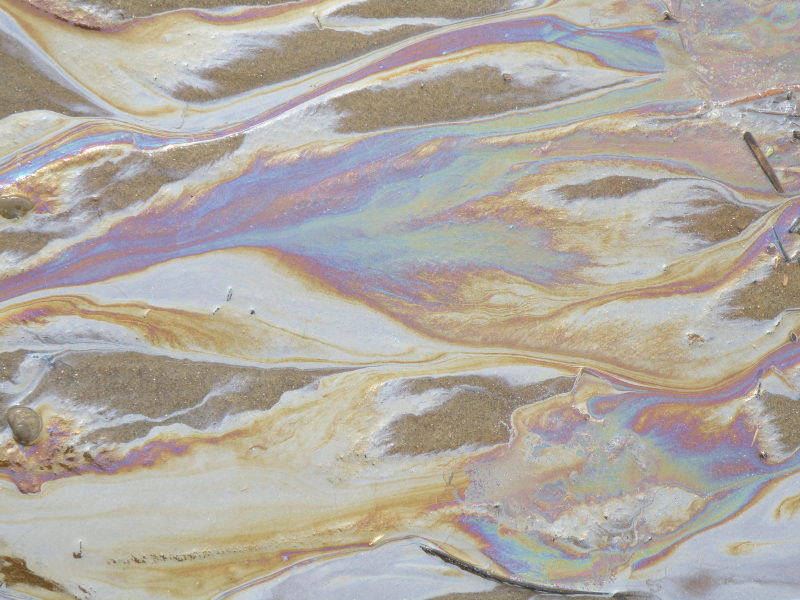
These rainbow flows are a fact of life at the Falls and gives me another setting my sculptures can help interpret.  The colors and patterns on the water and sand can be very striking.  Here in quick succession are several more abstract images created the same day as the ant project, but minus the Styro-insect.

In the above image, you can see a few recognizable objects including nuts, sand, and coal.  I’ll close with a final image of why the ants are so large here…they are drinking the sheen and it’s the Godzilla effect all over again!

Read Full Post »

I think today’s post will be shorter than usual, but will need to type it out to be sure.  On this visit to the Ohio River I found it rising which surprised me because we haven’t had much in the way of either rain or snow this year.  When I arrived on the scene, many of the familiar places I visit to make my art were already underwater.  I had to keep moving west in the park to access the shrinking riverbank.

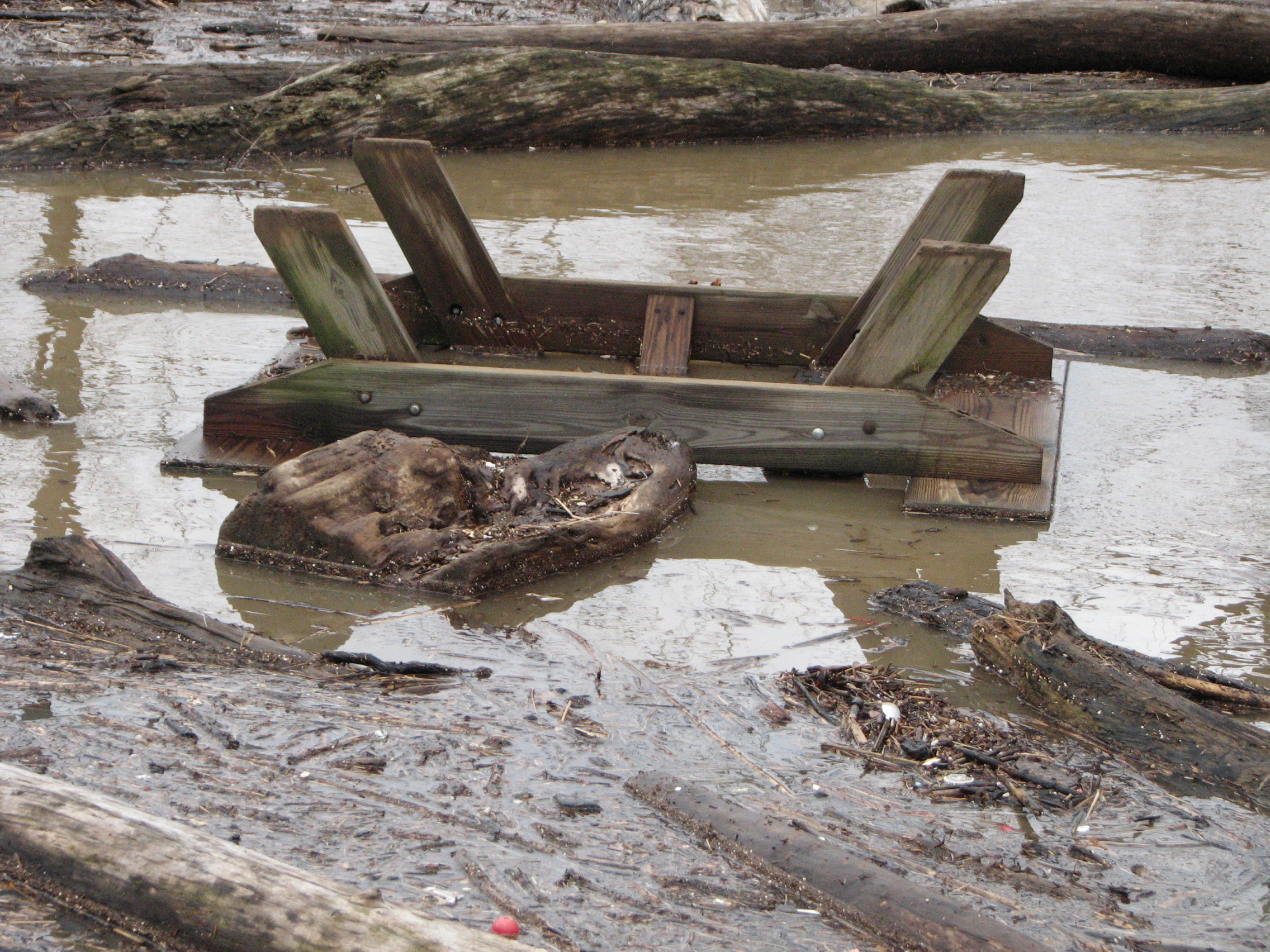
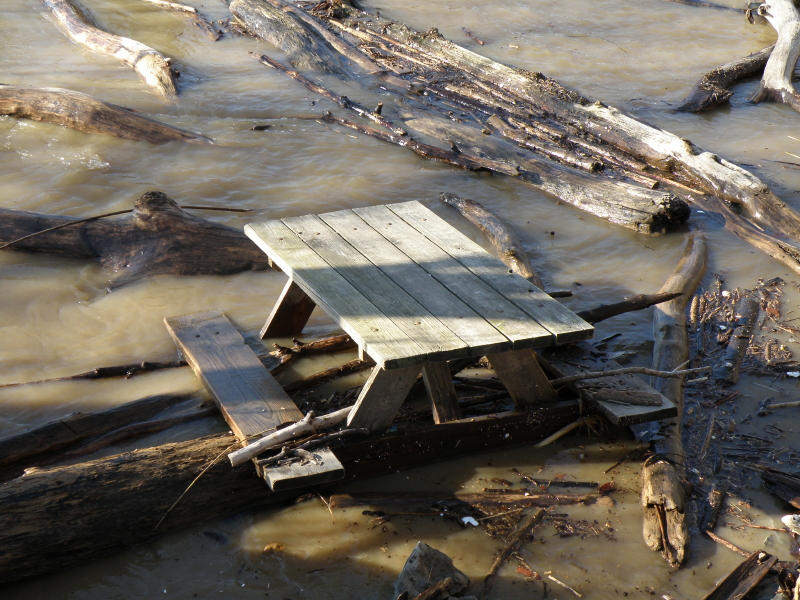
I came across this picnic table near the Interpretive Center.  The river is now enjoying what is normally a cozy place to share a few sandwiches.  I wonder if this table eventually floated off?  I kept walking along the retreating shoreline being mindful not to step into the ever creeping waters.

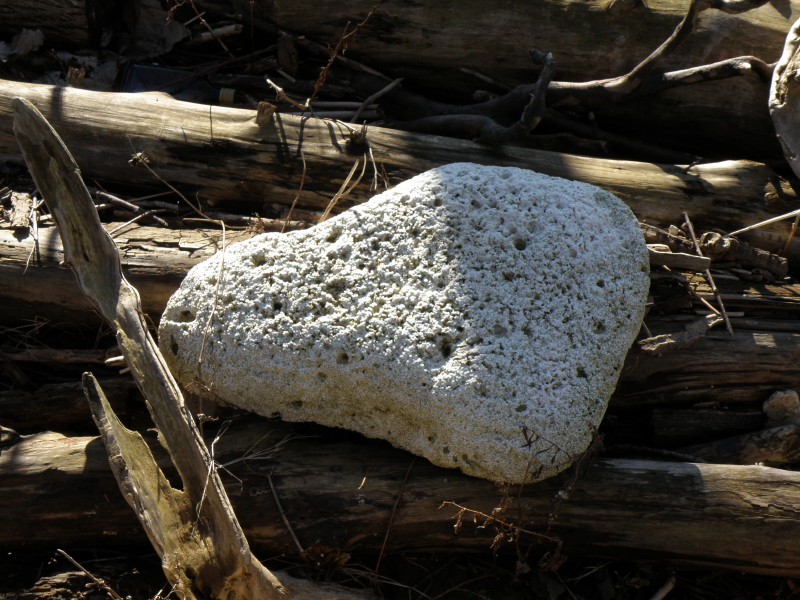
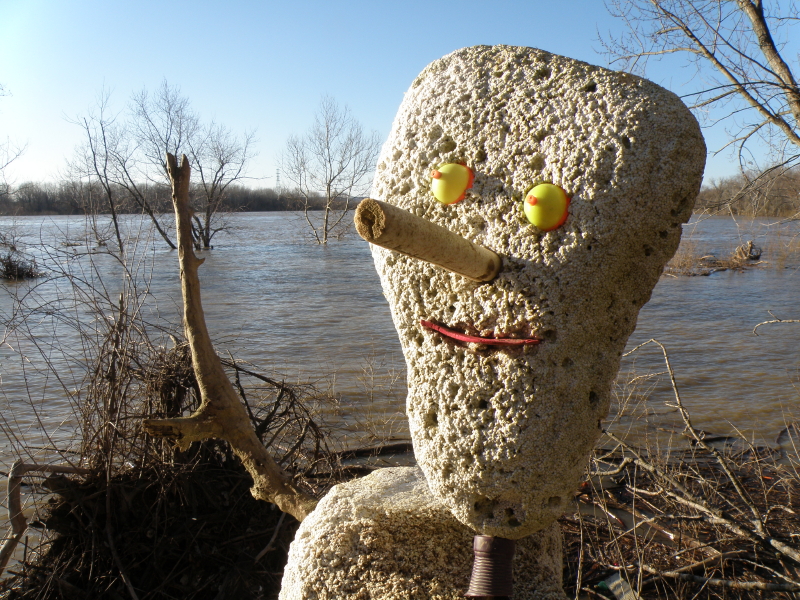
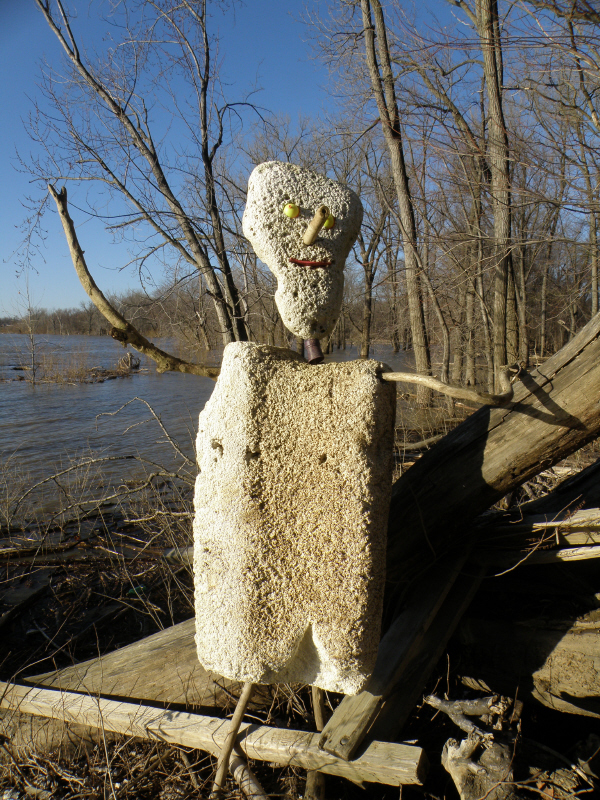
I have my collecting bag with me, but there’s not much to find today.  It will probably be different after the river retreats. The trash left behind will mark how far the waves pushed the debris onto the land. I came across this nice-sized chunk of eroded polystyrene and decided to use it in today’s project.  A short distance from this find was an even larger hunk of Styrofoam and I was in business for the day.

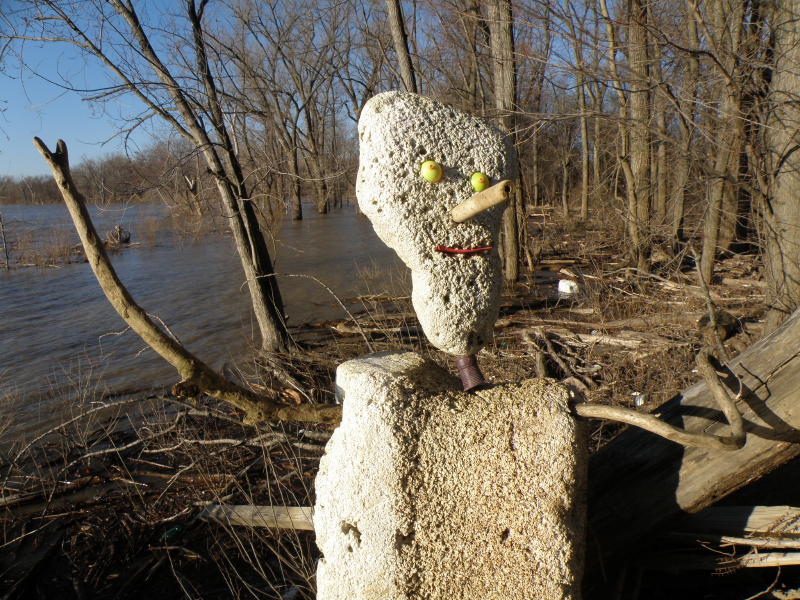
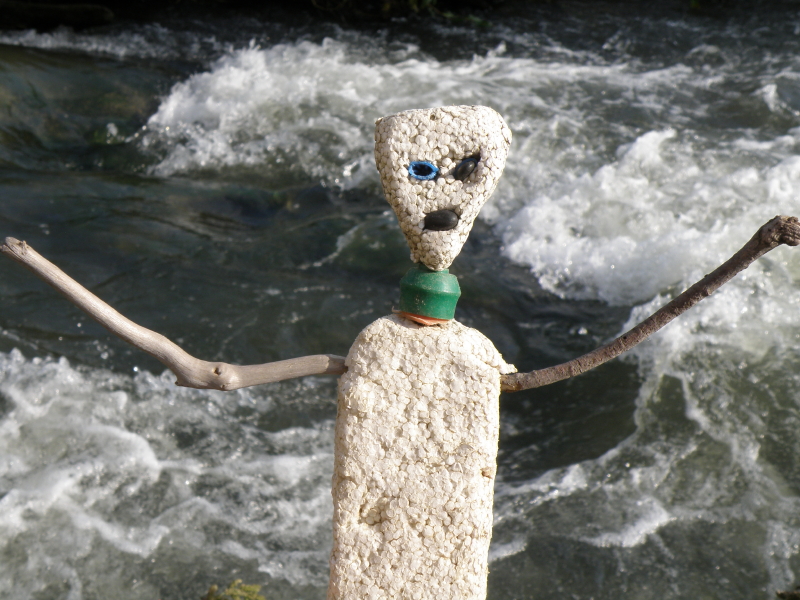
This second piece of foam was nearly as large as me.  It took a bit of struggling to get it positioned where I wanted it near the rising river.  In this section of the park much of the driftwood I was finding seemed dried out and brittle.  I never did come across the right sticks, but had to make do with what today presented.  I did like the happy-go-lucky expression on this figure’s face.

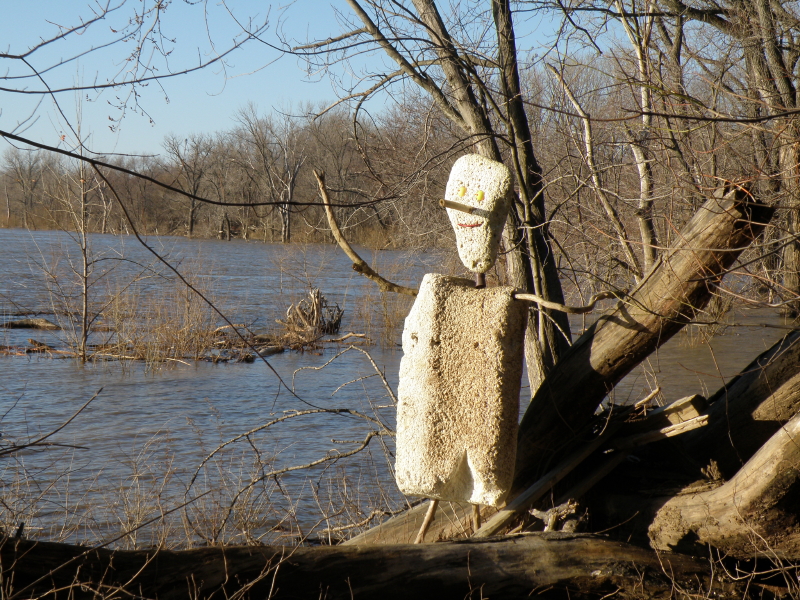
Here’s a full shot of the figure at the place where I left it.  It’s gone now and the few ducks who were around were probably the only witnesses?

A slightly different view this time.  This figure’s eyes are large fishing bobbers I already had in my bag, however, the nose is some rolled piece of foam that I found out here.  I’m glad the sun came out and made the day a bit more cheerful.  That white object in the distance is another hunk of Styrofoam riding the waves…perhaps my next sculpture?

The river was rising and the light was beginning to fade and once the wind started to pick up…I decided to call it an early day.  One last look back at my saluting figure and this final image of it.  I’ll return once the river recedes and let you know what I found.

Read Full Post »

« Newer Posts - Older Posts »