Feeds:
Posts
Comments

Archive for the ‘environmental art’ Category

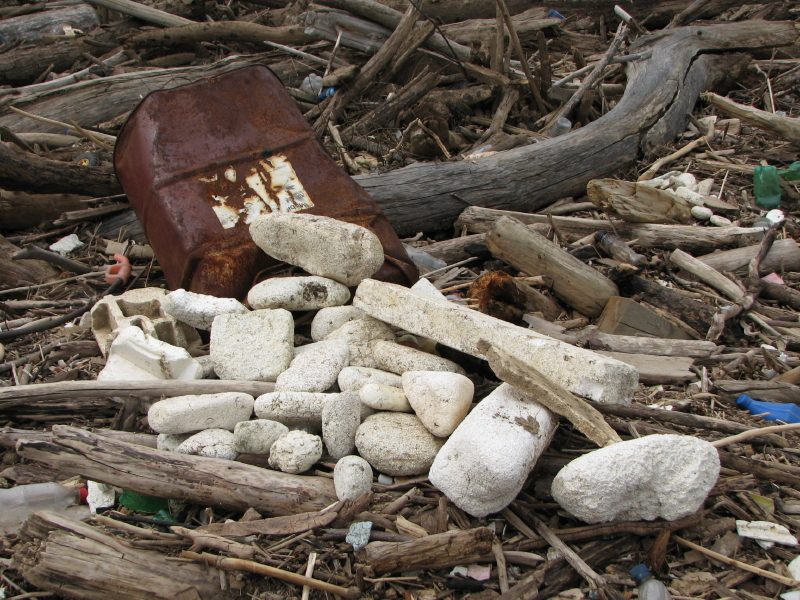
First, I would like to thank all the people who checked out my last post on the box turtles.  The response has been pretty overwhelming and I’ve enjoyed everybody’s comments.  The Eastern Box Turtle isn’t the only turtle to be found at the Falls of the Ohio State Park and this post is about that other mysterious and rare reptile. It’s called the Cottonwood Turtle (Terrapene populus) and its habitat overlaps that of the box turtle.  On a warm and humid morning I was exploring the eastern section of the park around the debris line formed by a retreating Ohio River.  Plastic bottles and containers and the ever-present polystyrene chunks helped define the high-water mark.  We have had so much rain here and it’s officially Kentuckiana’s wettest spring on record!  I was mesmerized watching and listening to the Cedar Waxwings pursuing each other from mulberry tree to mulberry tree and whose fruits are just now beginning to ripen to a glossy black.  The air was filled with the fine downy fluff produced by the catkins of our giant cottonwood trees and seemed like so much snow falling in ultra slow motion.  The chances of inhaling this fluff are real and white airy drifts were forming on the ground where the air currents pushed this gossamer material with its tiny secret of seeds within.  With so much going on, I was surprised to catch a slight bit of movement inside a nearby hollow log.  I remained still and this is what I saw.
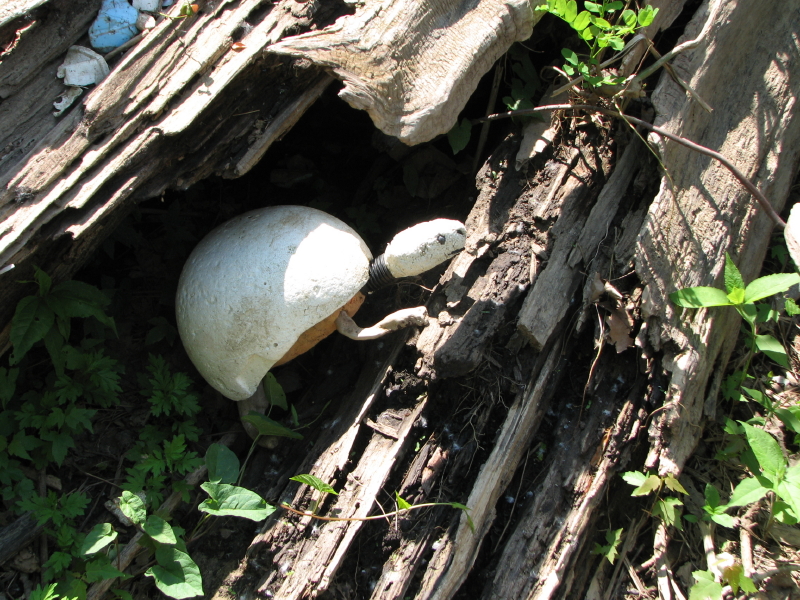
Emerging into the light of a new day was this very ancient looking turtle.  Of course I recognized what it is and determined to follow it and make a record of my observations.  I kept a discreet distance away and tried not to make any sudden movements or loud noises so the turtle would act as naturally as possible.  I kept up with it for a several hours and then I had to pull myself away for home.
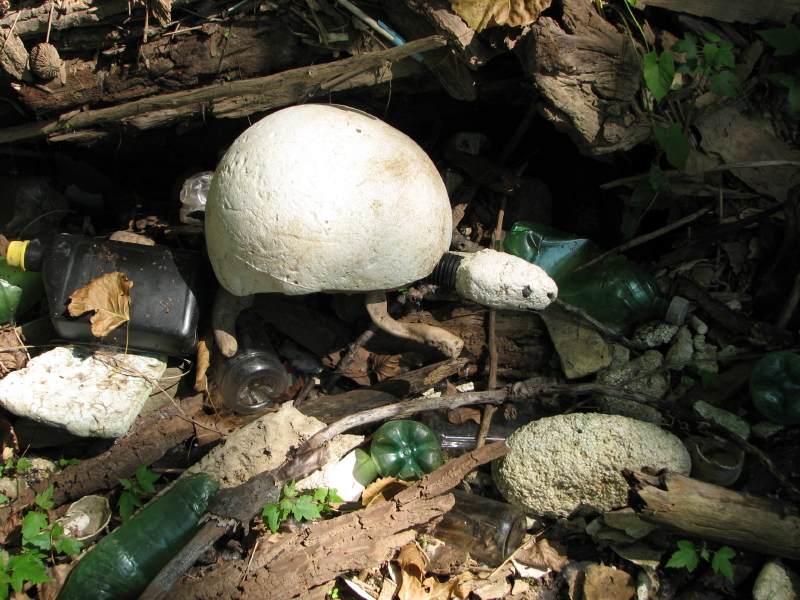
The Cottonwood Turtle is characterized by a high-domed carapace that the original inhabitants of the Ohio Valley used for war and ceremonial helmets.  Unlike the box turtles which it shares some affinities with…the Cottonwood Turtle cannot retract its head and limbs fully into its shell.  This makes it vulnerable to predators.  I watched my turtle crawling over the plastic and Styrofoam debris left by the last flood.  It seemed to be going somewhere with a purpose and I followed discreetly behind it.
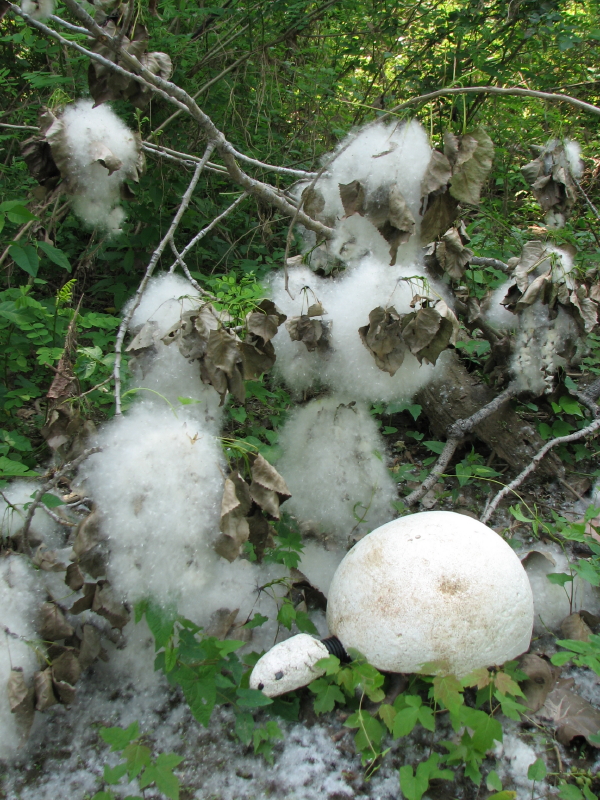
The previous night we had another tremendous rain storm with high winds.  Mud, broken branches and leaf litter evidence can be found everywhere.  I followed my turtle to a large cottonwood branch and saw it engaging in the activity that gives this remarkable reptile its name.

Over the course of about an hour, I watched the turtle carrying mouthfuls of the Cottonwood fluff to a hole that it had previously prepared.  It made about a half a dozen trips back and forth from the downed branch to what looked to my eye to be an abandoned groundhog hole that the turtle retrofitted for its own purpose.  The fluff was carried  into the hole where a special chamber was being prepared for this turtle’s eggs!

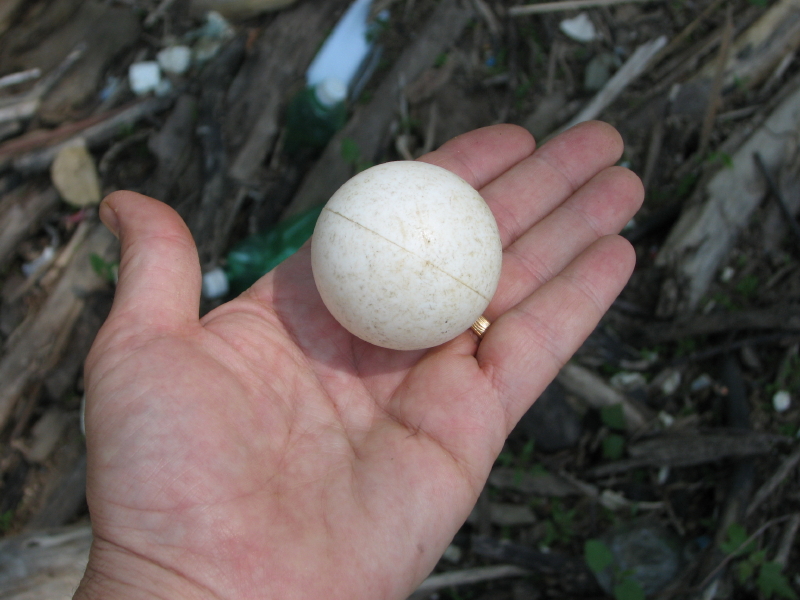
Here is the Cottonwood Turtle about to finish laying her eggs.  I observed about five ping pong ball-sized eggs being deposited upon their bed of cottonwood fiber.  I suppose the fluff cushions the eggs and perhaps as this material decays provides some modicum of warmth to assist in the incubation?  From what I have read, new turtles should be emerging from their subterranean nursery after sixty days.  After the turtle covered her nest with her back legs she moved on.  From this moment, the eggs and baby turtles to be are on their own.  I gently uncovered some of the soil and photographed this single egg.  Afterwards, I placed the egg back into the nest, re-covered it and went on my way happy to have witnessed this ancient rite of life.
It occurred to me on my walk back through the tangle of bottomland, that this turtle might be benefitting the tree as well?  I haven’t heard or read anything concerning a link, but what if?  The fluff contains minute seeds and the act of burying them might aid in propagating this tree.  The turtle places these seeds a little deeper than usual which might encourage stronger and deeper root growth.  Since this area is frequently altered by the river, it would make sense for the tree to have a deeper hold on the soil?  I came across another downed cottonwood branch and admired all the fluff it was producing.  It all looked so beautiful and magical in broad daylight.

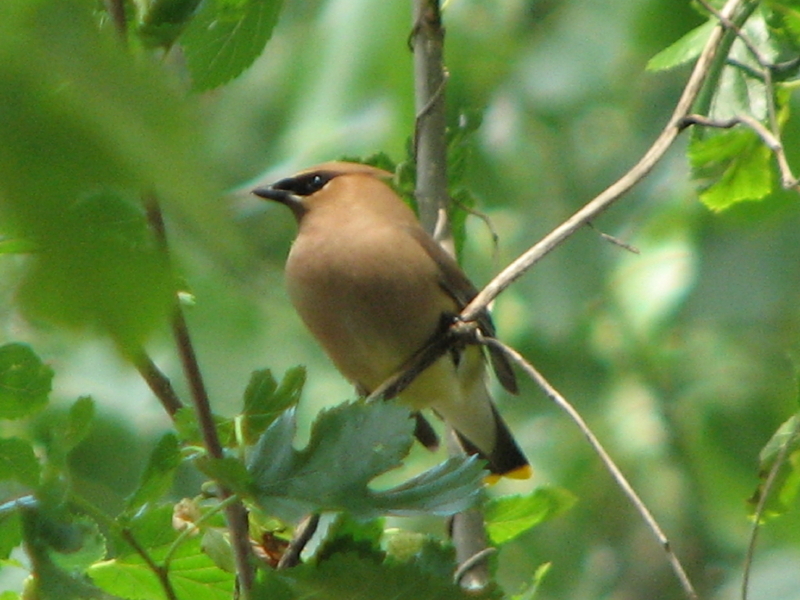
Overhead the orioles were collecting their own materials to build their amazing hanging basket nests.  And the Cedar Waxwings were fueling up on the mulberries in preparation for their long migration up into the north country.  One last image of one of these waxwings.  Such an interesting and beautiful bird so uniquely marked.
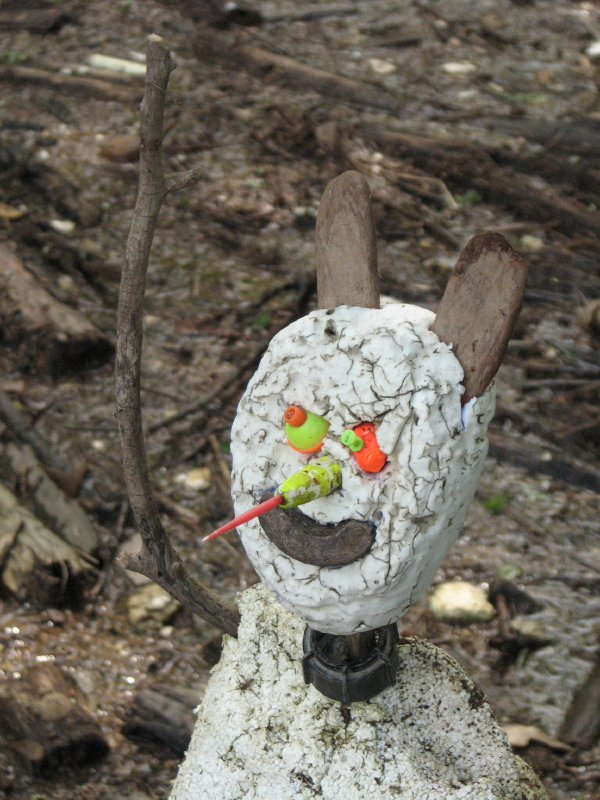
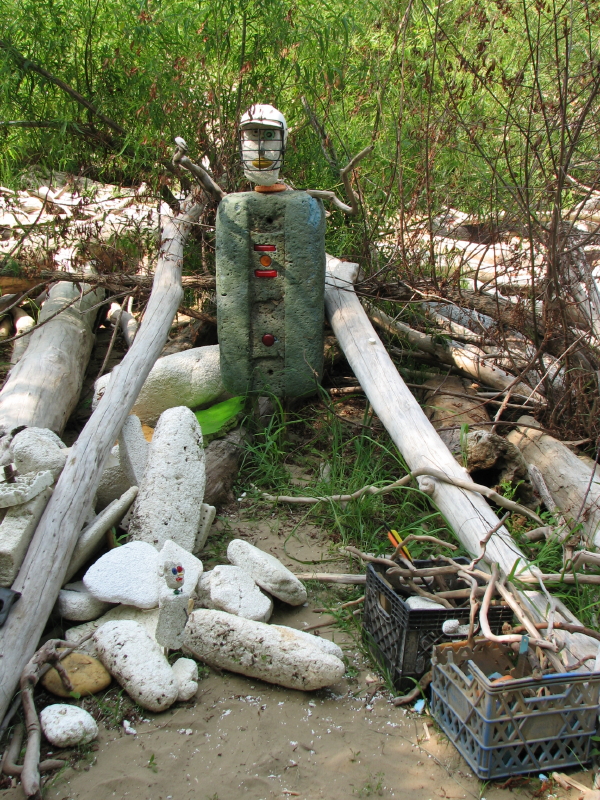
Although I may have fooled some people out there (wink, wink)…the Cottonwood Turtle doesn’t actually exist!  I made it from junk I found here in this very real environment at the Falls of the Ohio.  The shell or carapace is the cushioning from inside an old bicycle or motorcycle helmet and I have found several of these helmets after the last flood.
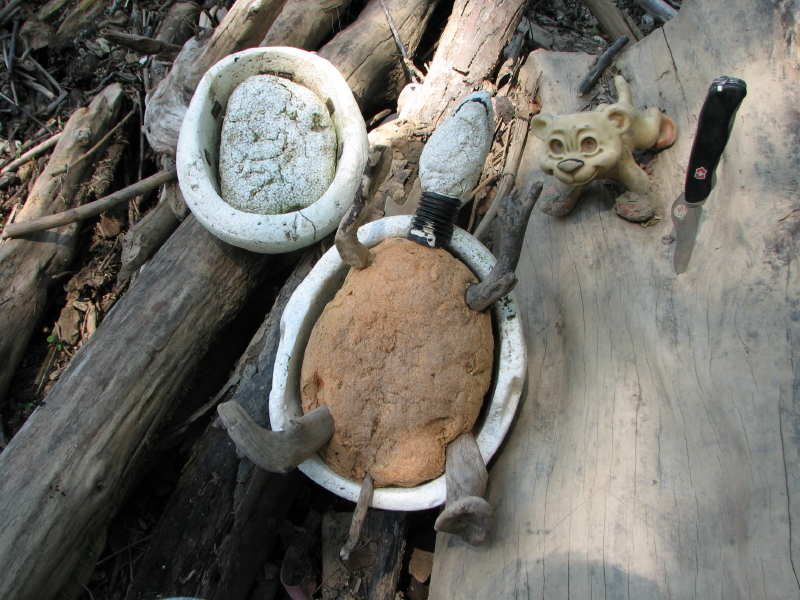
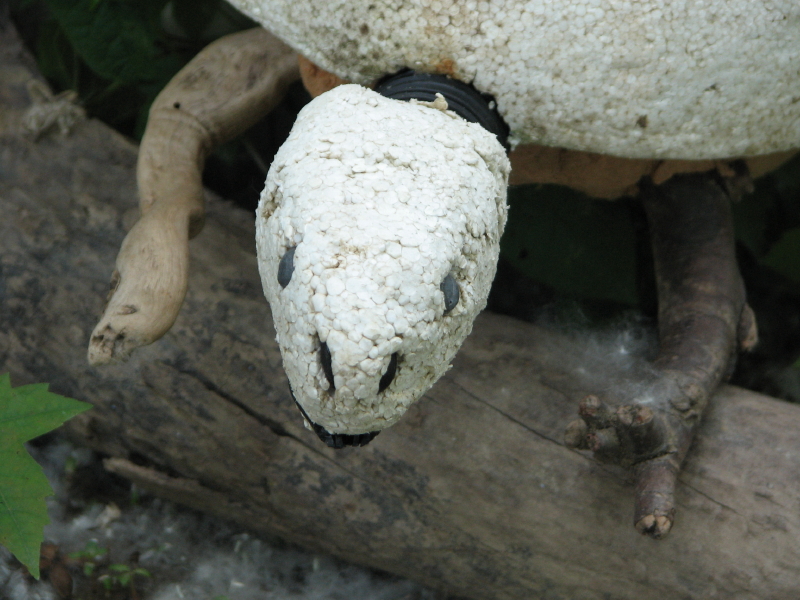
I used three pieces of Styrofoam…the shell, head, and one piece under a chunk of fiberglass-like material to fill the space inside the helmet.  Limbs are pieces of found wood attached to the lightweight fiberglass.  Everything is joined and pegged together with wood skewers.  I did use some found plastic for the actual neck and mouth of the turtle.  The eyes are round lead fishing weights and the nostrils are pieces of coal.  Thanks for tagging along!
Read Full Post »

As usual I’m a bit behind in my river reports.  I calculate I could write at least several more posts about the flooding we have experienced with the Ohio River at the Falls of the Ohio.  As I write, the river is still high, but all the attention has shifted to the Mississippi River which is experiencing an epic flood.  I’m sure some of the same water molecules that flowed past our location are contributing to the woes down along the Mississippi.  For those unfamiliar with our geography, the Ohio River flows directly into the Mississippi River in far western Kentucky.  The confluence of these two great rivers is an awesome sight.

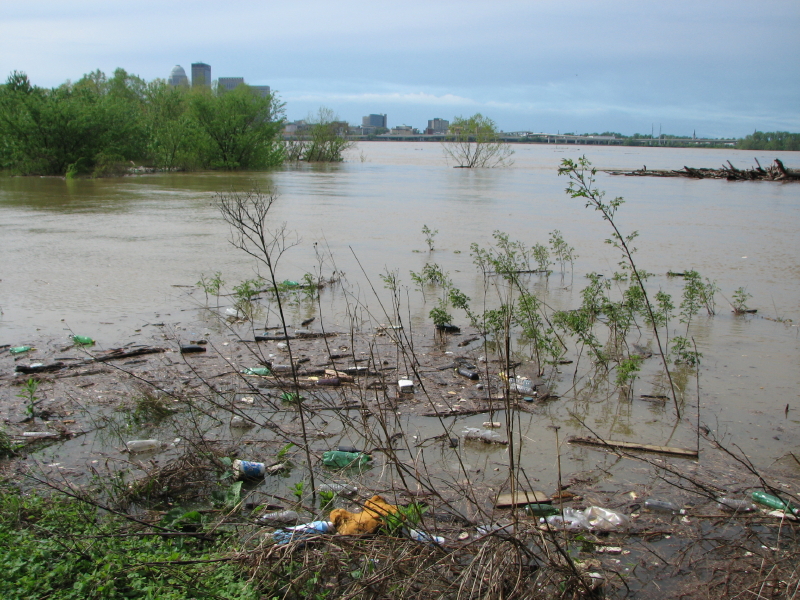
Here at Louisville, the water has been receding and the amount of water-borne junk this flood has brought hasn’t fully hit home yet.  There are signs, however, everywhere I look that this will be a great challenge for any river loving clean-up crew.  I will try to do my part, but even if I were to try to be out here every waking hour…I wouldn’t  begin to scratch the surface.

Gas is over $4.15 cents a gallon for regular unleaded here.  I listened to the great oil company executives trying to explain to Congress today why they need a sweetheart deal from the American taxpayers when they already receive every tax break in the books and are suffering with their record, obscene profits.  When discussion turns to what can be done to reduce the amount of crude oil used the usual answer has something to do with increased engine efficiency resulting in more miles to the gallon.  Looking at the high water line I see another solution that doesn’t get as much play.  Why don’t we try to cut as much plastic out of our way of life as possible?  There would be more oil available for fuel and you wouldn’t have all these various compounds despoiling our water ways from the smallest streams to the largest ocean.  You can throw Styrofoam in this mix too since it is has petroleum pedigree as well.  We could just change the packaging we use and I bet that would make a huge difference.

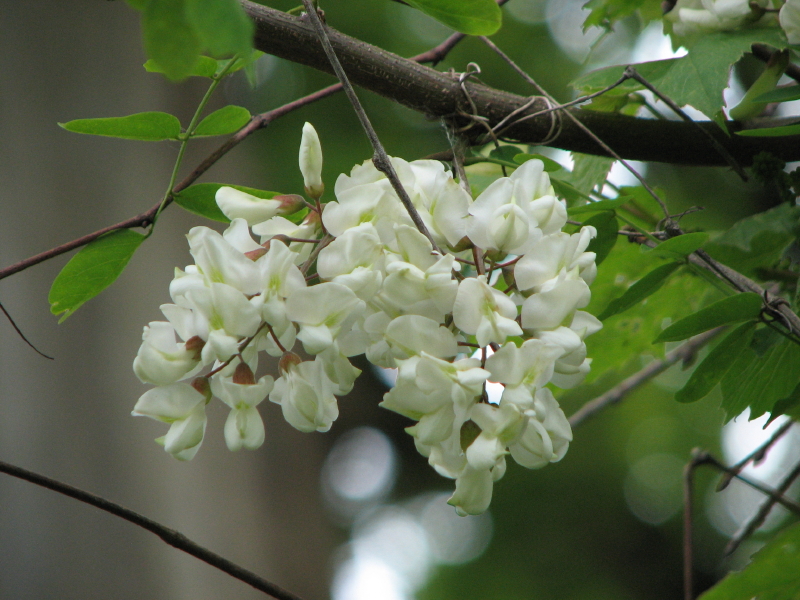
You can look at the whole Riverblog as one long rant against pollution, but there is also more out here that is sweet and worth noting and enjoying.  I decided to walk along the Woodland Loop Trail and the air was fragrant with the perfume from what we call Honey Locust trees.  Some of these trees also sport large spines growing on the bark.  Their pea-like white flowers have the most wonderful scent.  Here is what a flower cluster looks like.

Along the trail, you can hear a variety of bird species singing.  Vireos, woodland warblers, orioles, chickadees, indigo buntings, various thrushes fill the air with their acoustic signatures.  The birds are here to feast on the many cutworms that plague the forest canopy.  There are also other larvae present…here is a small nest of tent caterpillars that will soon become moths.  Very few birds like these hairy caterpillars, but two that do ( the Yellow-billed cuckoo and the Blue and gray gnatcatcher) can be found in the forest now.

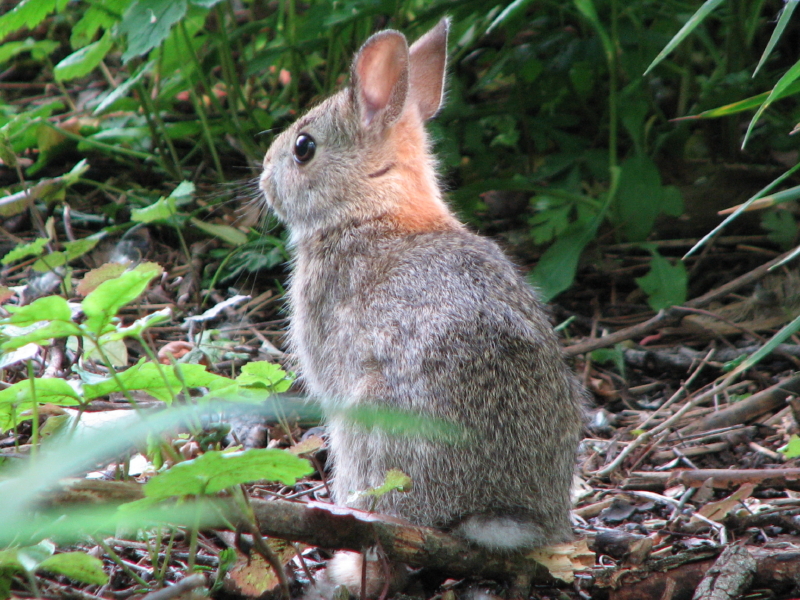
Ah, I also spot my namesake hopping along the trail!  This is a young Cottontail and he better be careful out here because there are so many predators both native and domesticated that would love to catch him!
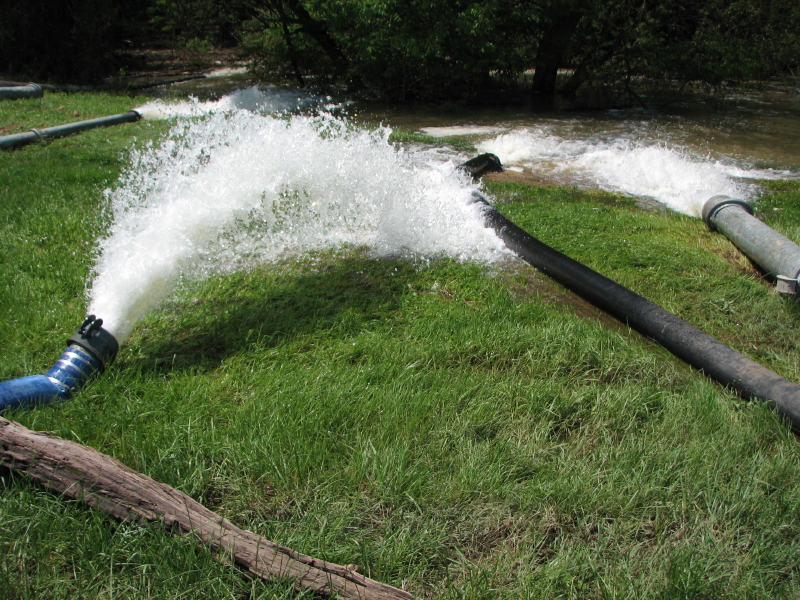
Walking westward along the trail, you can’t help but notice the large grassy berm that flanks your right side.  It is additional flood control put in place after the disastrous 1937 flood which was our high water event on the Ohio River.  Up a head, I can see a network of large hoses with water gushing out and I decided to investigate.

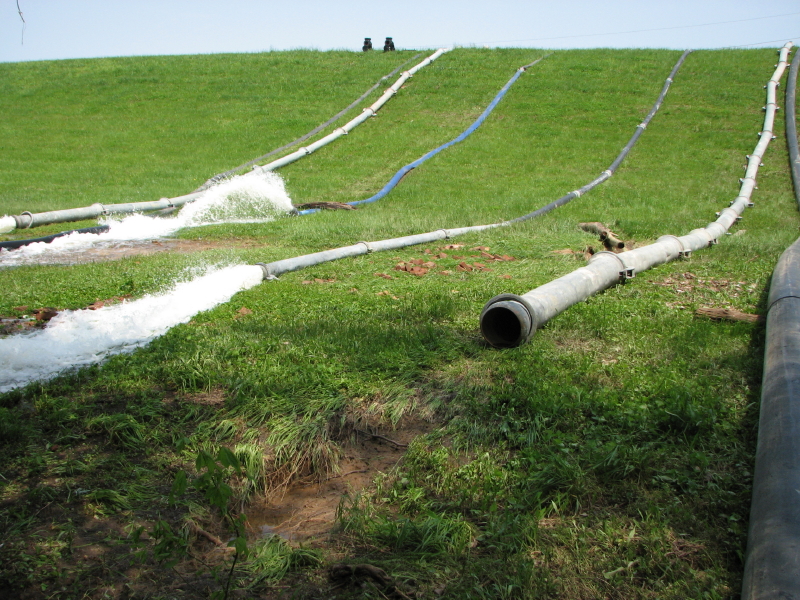
I can see these large hoses coming down the berm and I wanted to see what’s on the other side of this earthen flood wall.  Here are a series of pictures of what I saw.  First looking up hill…

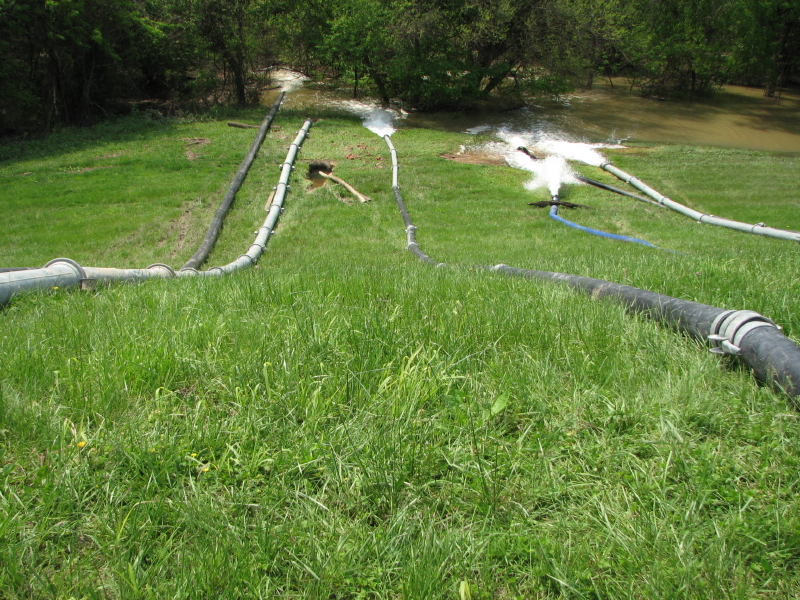
…now the view looking down towards the river.  What are these hoses for?

I came across a sign at the crest of this large hill that explains it.

On the other side of the berm is the small town of Clarksville, Indiana.  Rain water has pooled up in the lower lying sections of the city and are being pumped out and over the top where the water then flows into the park eventually finding release into the river.

It’s strange how I rarely think about the town that occupies the other side of this large grass and earthen mound.  The Ohio River is really at its front door all the time.  The little bit of woods I like spending time in is just a narrow sliver of ecosystem that exists between Clarksville and the river.

Well, that’s the story for now.  I have much more to present about the dominant environmental event of our Spring.  Already the temperatures are rising and I can feel the transition to Summer won’t be long in coming.  Thanks for hanging with me…until next time…the Rabbit Man.

Read Full Post »

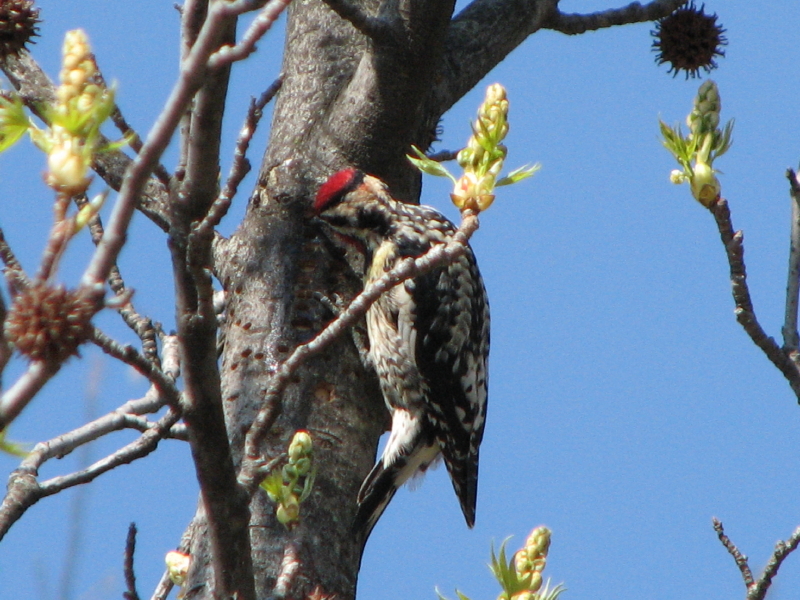
For me, the Yellow-bellied Sapsucker is a signal that Spring is underway.  I believe I have seen this very same bird in the same Sweet Gum tree for several years now.  Before the tree fully leafs out, he drills neat rows of holes in the tree bark which fill with the tree’s sap.  Visiting often, he then licks up the sugary mixture.  I have seen other bird species utilizing the work of this woodpecker including other woodpecker species, warblers and chickadees.  Before the insects and new seeds appear, the Yellow-bellied Sapsucker has accessed another food supply which he defends from all the other birds. 

Throwing his head back, this male Song Sparrow is expressing the feeling of the season.  Song Sparrows are year-round residents and have fully taken advantage of all the niches available at the Falls of the Ohio.  This year White-throated Sparrows have been more abundant than I recall from past years.  Every year is different from the previous ones and you never know what to expect next.  This year is off to a very wet start.

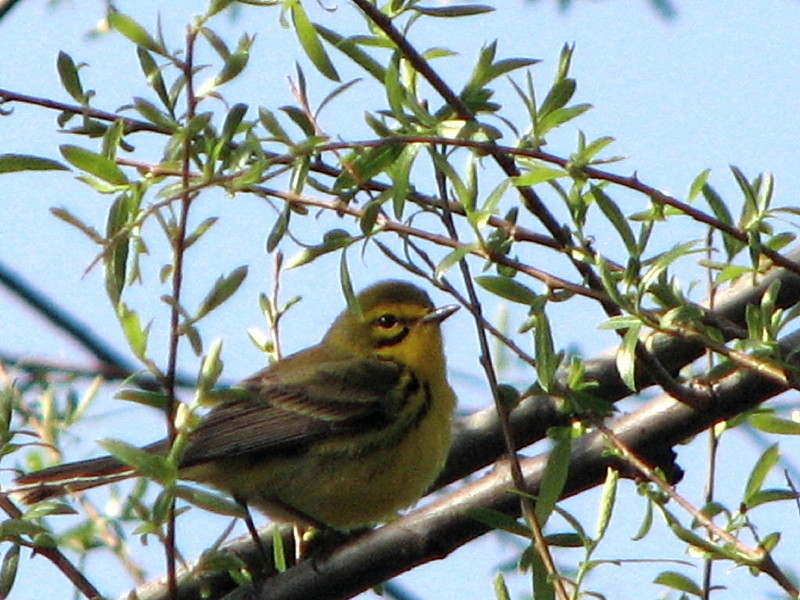
This is a male Prairie Warbler I came across recently.  I have “pished” this species closer to my camera’s lens by making little squeaky sounds that the bird found curious enough to follow.  I am hopeful of seeing other warblers before the Spring migration ends.  So far, I have seen Yellow-rumped Warblers, Common Yellowthroats, and a brilliant male Prothonotary Warbler attracted by the flooded bottomland trees.  There are thirty-five different warbler species on the Falls checklist and I have had the privilege of seeing most of them over the years.

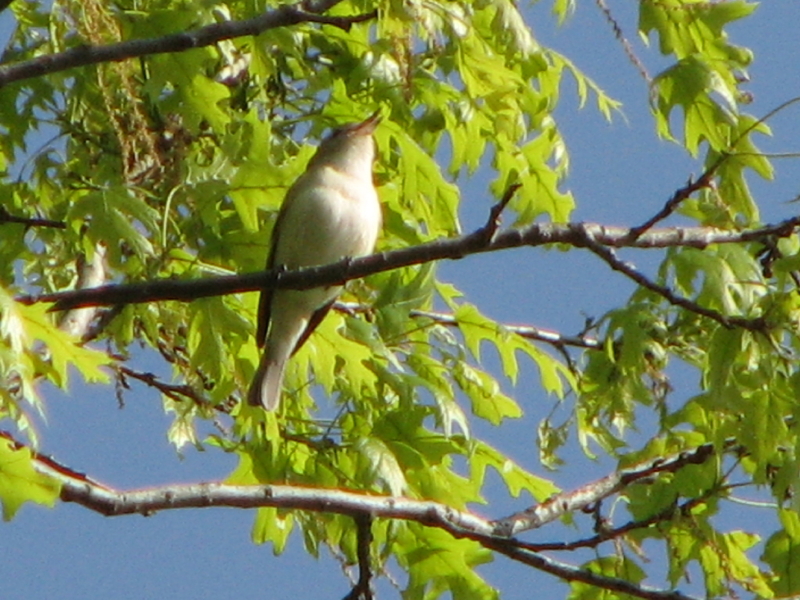
The Warbling Vireo is another bird that is more often heard than seen.  It’s such a tiny bird and it has the habit of staying in the tops of tall trees.  I found this one on the exposed section of an oak branch.  If it weren’t distracted by trying to attract a mate it would be in almost constant movement in search of the small caterpillars and insects that it eats.

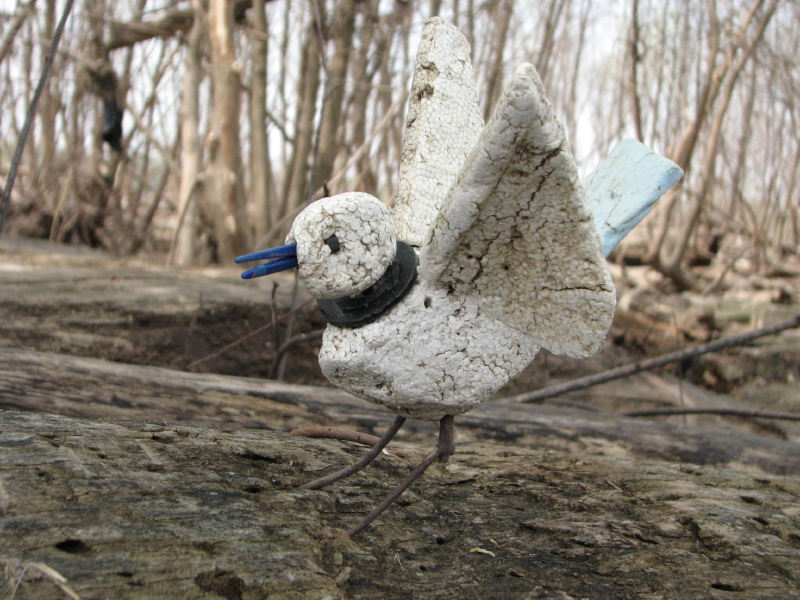
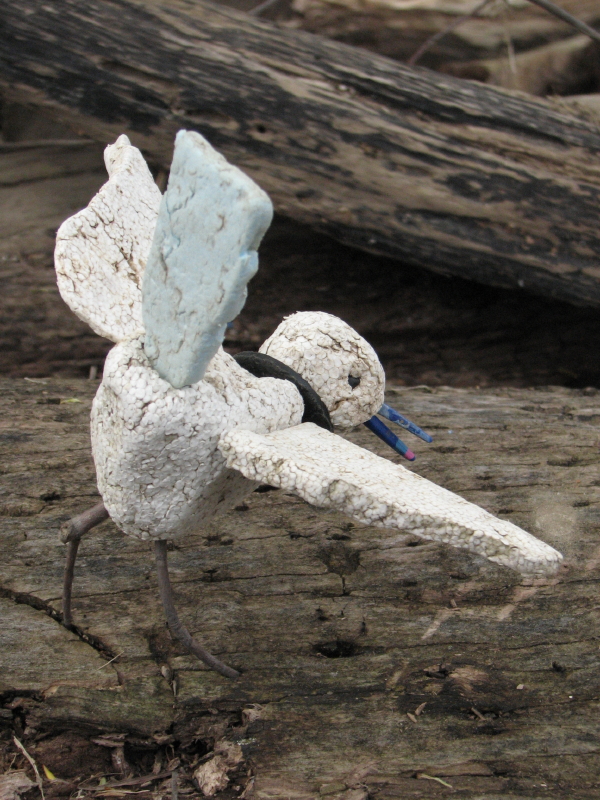
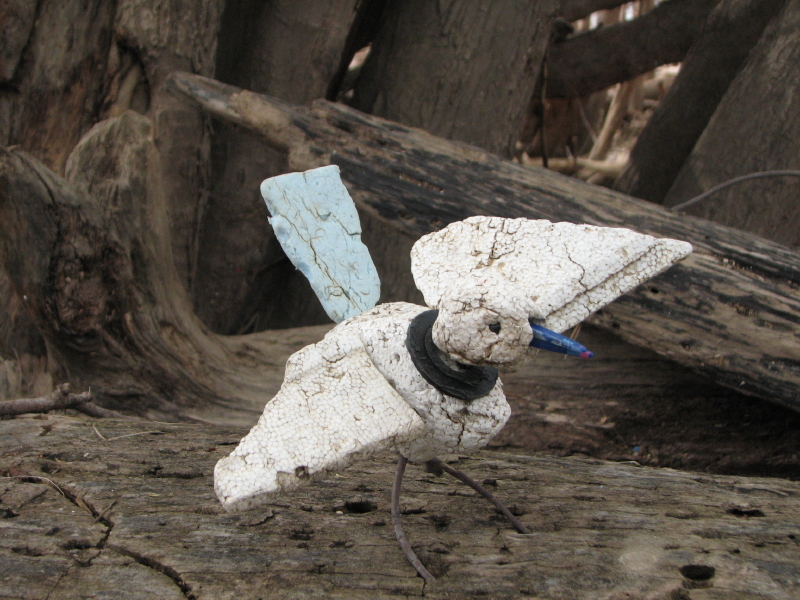
A new bird to add to the old life list is the Blue-tailed Robin.  It’s an infrequent visitor to these parts and so when one is sighted it becomes an event.  You can’t see this in the photo, but there are ten other birdwatchers with cameras and binoculars trained on this fellow as it dances and practices its courtship dance.  Everybody was extra quiet so that this bird wouldn’t spook and fly away.  Here are more images.

The Blue-tailed Robin male does an elaborate dance on a fallen log where it sings and flaps its wings in different positions all the while it struts its stuff.  The real test will happen further north in central Canada where its ability to display and attract a mate will mean the difference between passing on its genetic distinctiveness or not.  No wonder this bird can’t afford the opportunity not to practice!

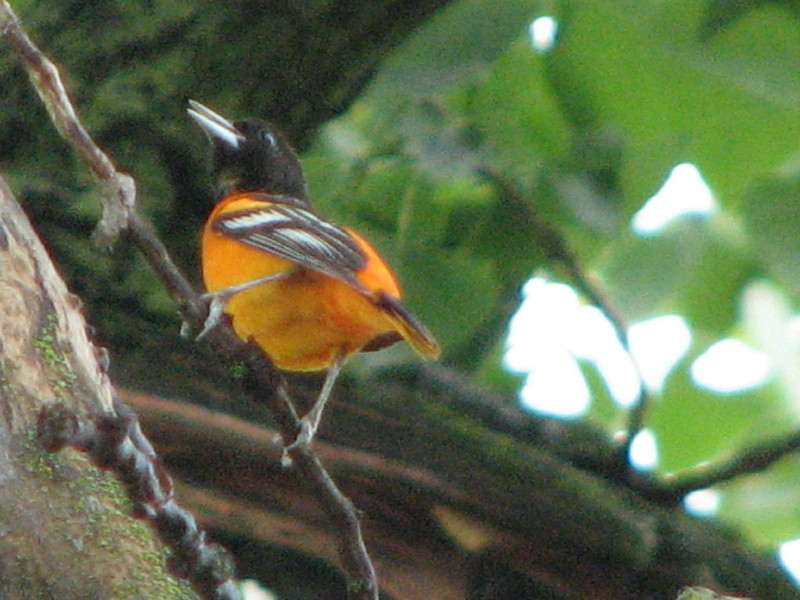
Singing very high up in a Cottonwood tree, this male Northern Oriole is also singing loudly in its territory.  So far, it’s looking and sounding like a good year for this species!  Nearly everywhere I hiked in the park I either sighted or heard Northern Orioles.  The orange color is so distinctive and it contrasts so well against the green of the surrounding leaves.  There is so much moisture in the air that my camera records this as a slightly foggy picture.  I hope for better images of orioles and the other great birds here.

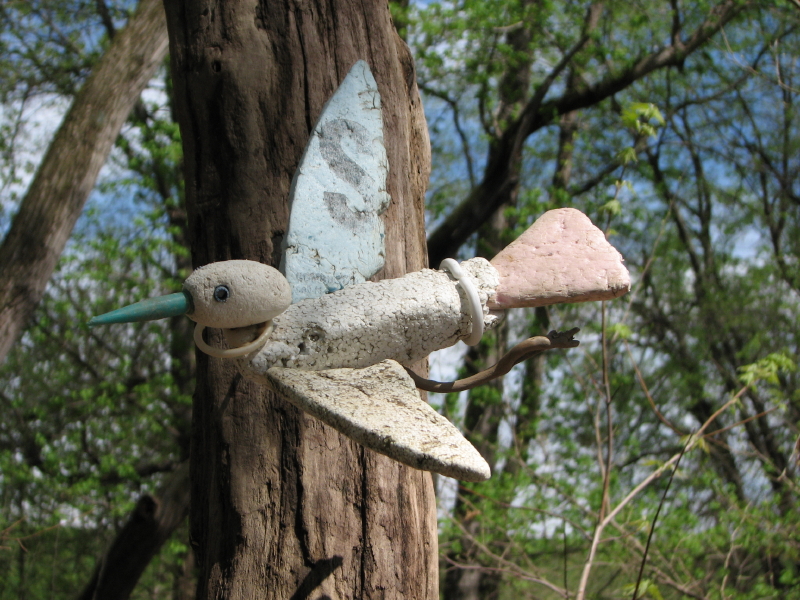
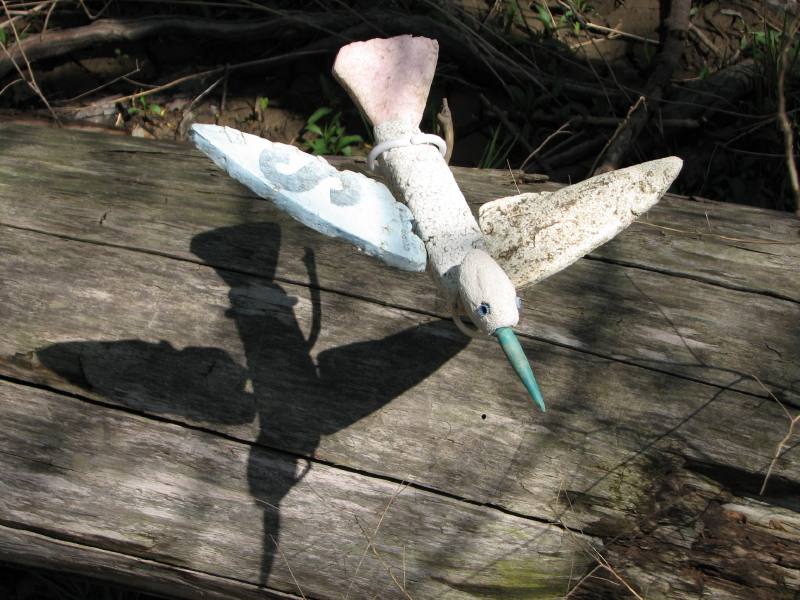
Another rarely recorded migrant is the Dragonfly Tern.  I found one coursing along the river bank and was able to squeeze off a couple decent pictures.  Like the name implies, it specializes in capturing dragonflies which requires the ability to maneuver at high-speed.  It has swept back wings that give it the acceleration it needs in tight corners.  Here’s another picture of it buzzing over a fallen log near my position.

This bird soon will be off to the Great Lakes region where it also breeds.  It barely scratches together a depression in the sand and gravel that it considers a nest.  There are usually two eggs laid that are heavily speckled like the small pebbles that surround it.  It winters in South America and travels thousands of miles each year.

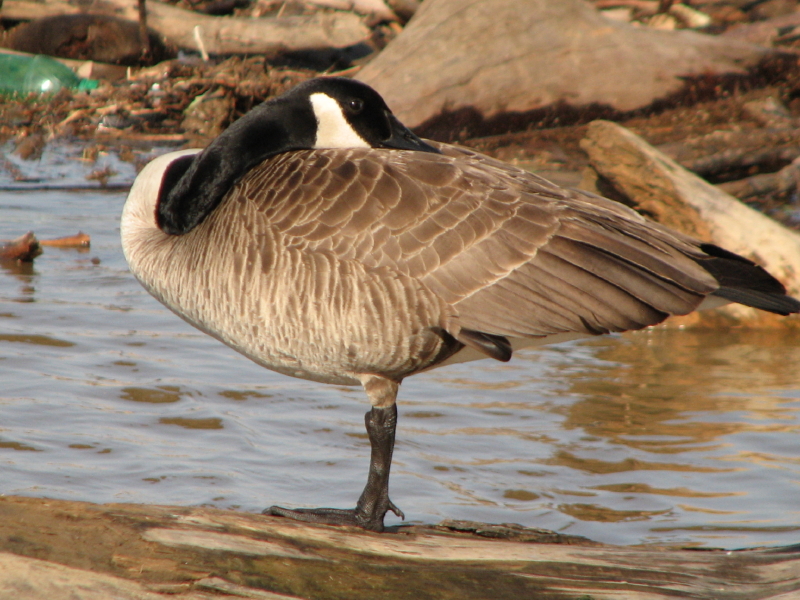
On my way home from the park, I chanced to see this Red-tailed Hawk on top of a utility pole and recorded its image.  It is one of our more common hawks, but since I haven’t featured it in the Riverblog before, I thought I would include it in this post.  As the year progresses, I hope to feature other birds that stop at the Falls of the Ohio. For me, the difference between a successful trip and a really successful adventure sometimes hinges on seeing one nice bird!  In closing here are two Canada Geese.  One is real…

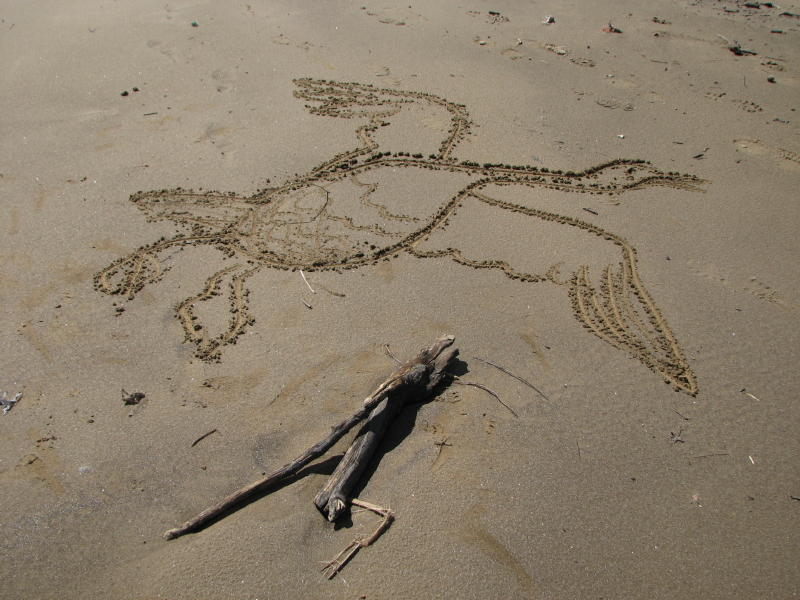
…the other is just a tracing in the sand I made.  Happy birding !!

Read Full Post »

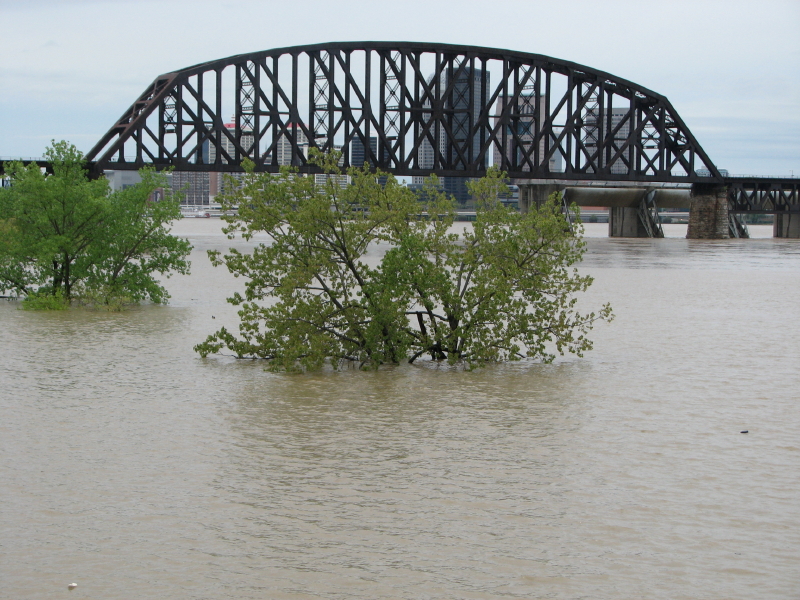
The Ohio River continues to rise because the sky continues to rain.  This flood will be one for the record books…perhaps in the top ten when it’s all said and done.  But who knows when that will be?  The weatherman hasn’t been very encouraging of late.  The timing of this flood is especially bad because it overlaps with the Kentucky Derby Festival and its two weeks of partying and activities which culminates with the most famous horse race in the world.  The additional water will keep the tourists away.

These images were taken just a couple of days a go and now the river is even higher.  In the City of Louisville, some of the most powerful pumps outside Holland are working around the clock pumping water from the low-lying areas.  Streets have been closed and the flood gates are up.  For the people who live nearest to the river…they have packed up and left a few days a go.  By now, the water has reached the roofs of their homes.  There’s nothing more that can be done.  It’s sit tight and see how much more rain will come and how high the river will rise.

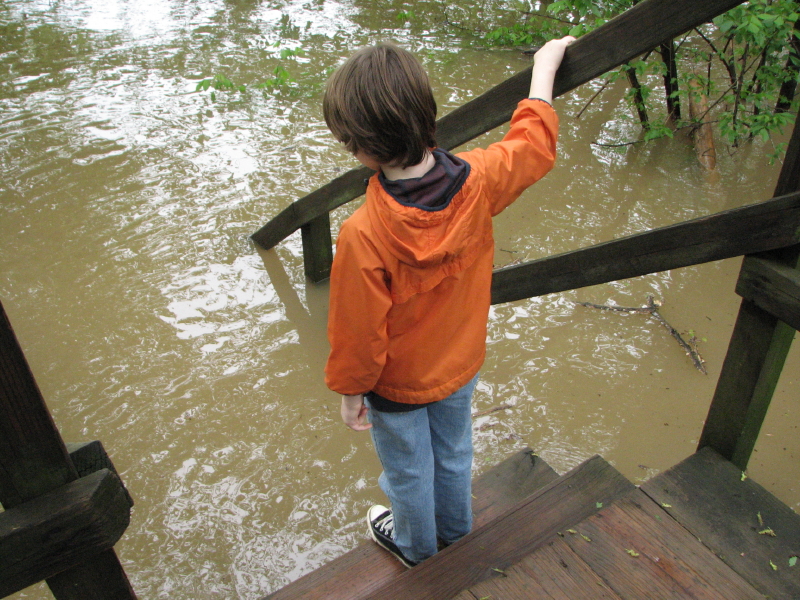
My son Adam was curious to see the extent of the flooding and so we visited the Falls of the Ohio.  The familiar wooden steps that lead to the river bank were now half way underwater.

We watched a box turtle flushed from its home in the underbrush swimming to higher ground.  Fortunately, it received an assist in the form of currents pushing it to land where it was able to escape drowning.  Watching this greatly affected my son who has a tender heart when it comes to all animals.  He really gets upset when the nature shows on television become too graphic. He doesn’t understand that life feeds on other life and that this has been the way of the world for a very long time.  This flood has also affected my creative routine at least by the water.  I’m forced to hopscotch back and forth between events in time which I think is a healthy thing in my life.  I was beginning to feel a little too linear anyway.  So, here’s another Styrofoam project I made sandwiched between the last flood of a couple of weeks a go and now.  This project is also now a memory remembered by these images.

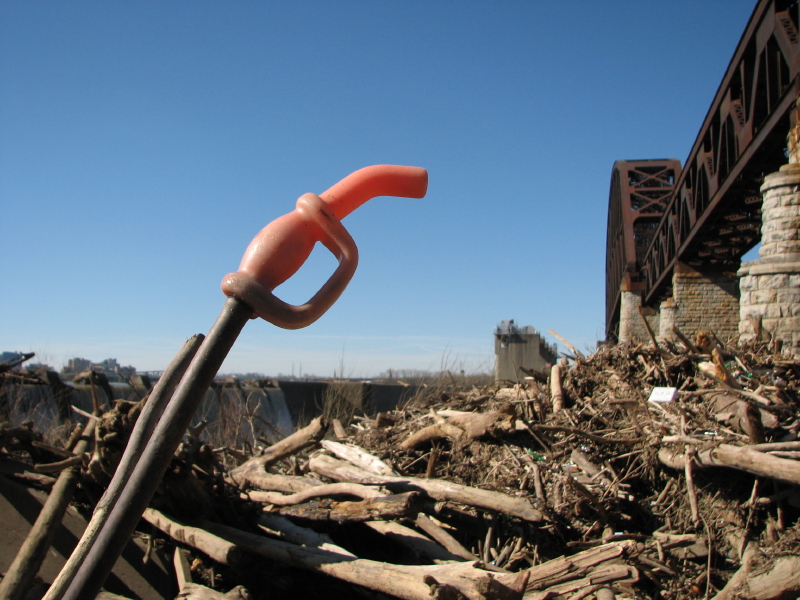
I really thought the previous inundation would be it for the year.  And so I set up shop atop this immense pile of wood and explored what was mixed in with all the natural debris.  Among the “treasures” was this toy gas hose…but that’s not all that I found!  Here’s something unusual too.

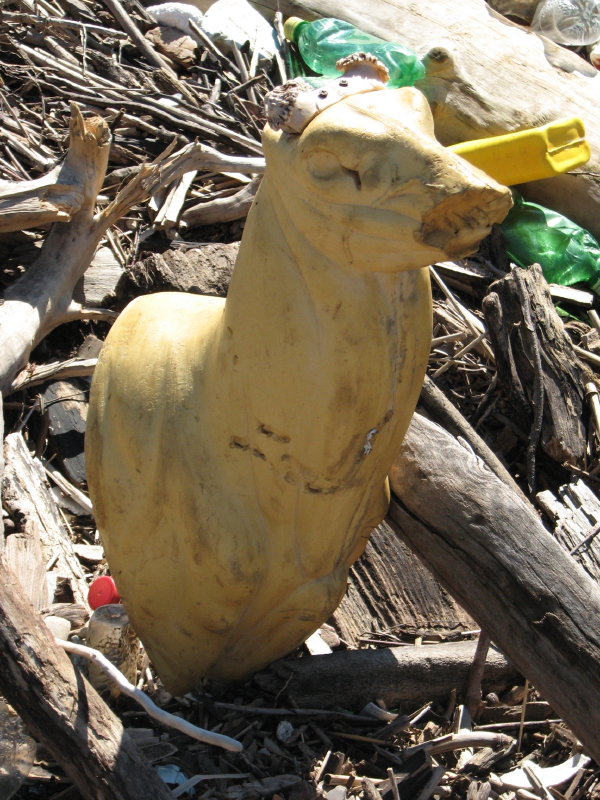
I set it up to help orient it for the photograph.  It’s what’s left of a taxidermed deer head.  The tanned skin that would have been stretched around it is now gone, but the remnants of the deer’s actual skull and broken antlers are screwed into the molded foam form.  This is another object that exists at the intersection of the natural and the artificial which I find curiously to be another sign of the times we live in.  When this trophy was intact, it probably was praised for its life-likeness.

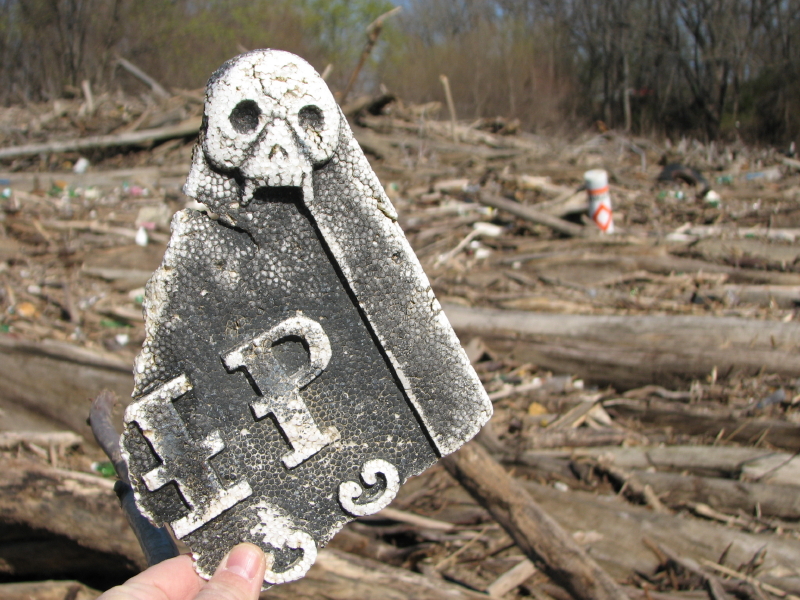
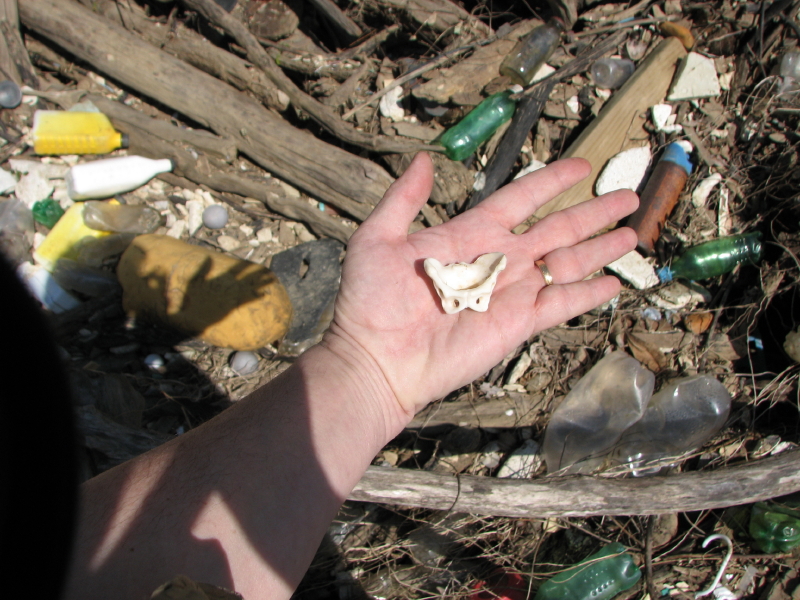
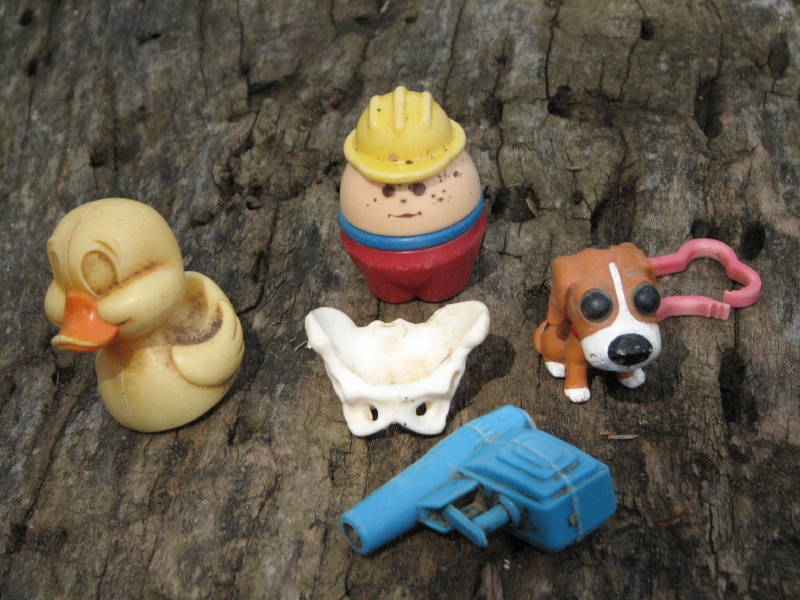
I also picked up this Styrofoam fragment of what I’m guessing was perhaps a Halloween novelty?  Amazingly, the little skull image survived.  I found another human bone reference out here on the wood pile.  It’s a miniature pelvis made out of plastic.  Luckily, I have never found the real deal and probably would freak out if I did.  Here’s that hip bone and a second image with some other fun stuff I picked up including one of the smallest and cutest squirt guns I’ve seen.

Sitting on a huge log, I started getting comfortable on my new spot.  I thought I could last here until the summer heat drove me under the willows.  I began to gather materials to make sculptures with like I had done with my previous plein air “studios”.  Mother Nature was providing all the material I needed to keep me and this project going for a long time.  Here’s my Styro-cache with its river-polished foam.

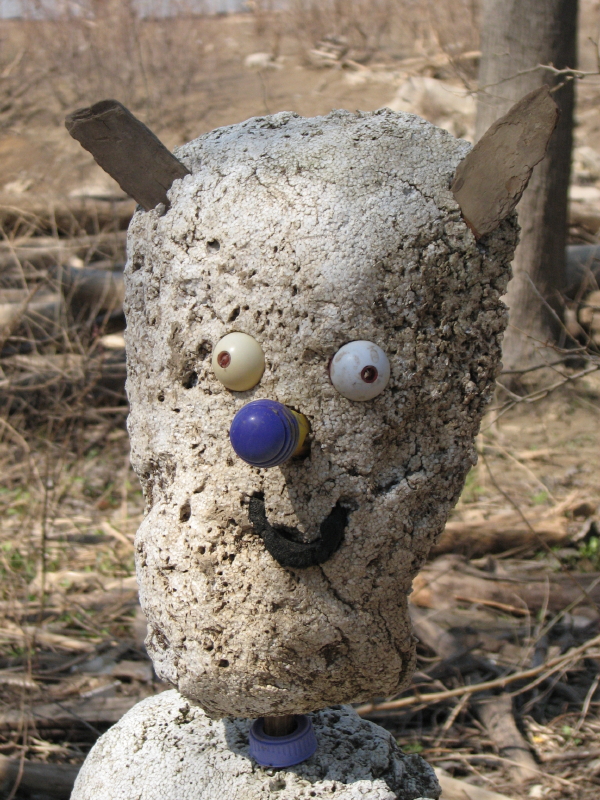
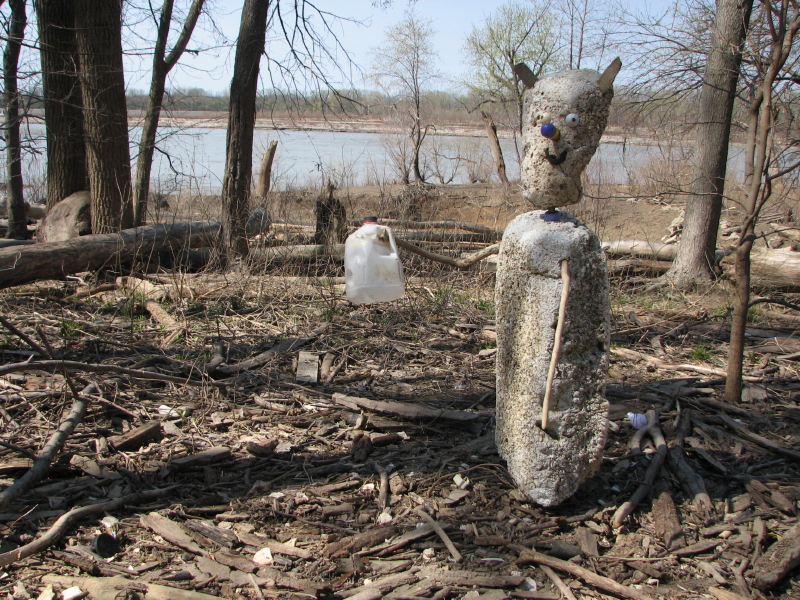
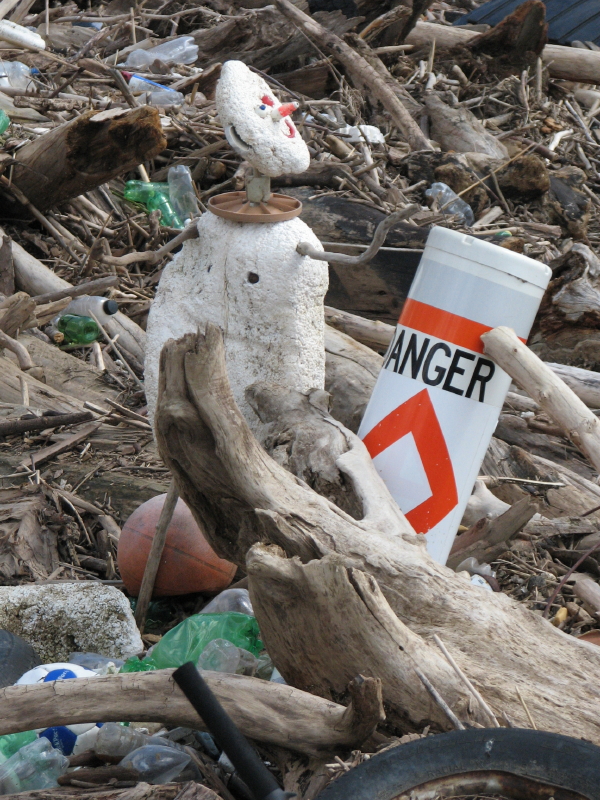
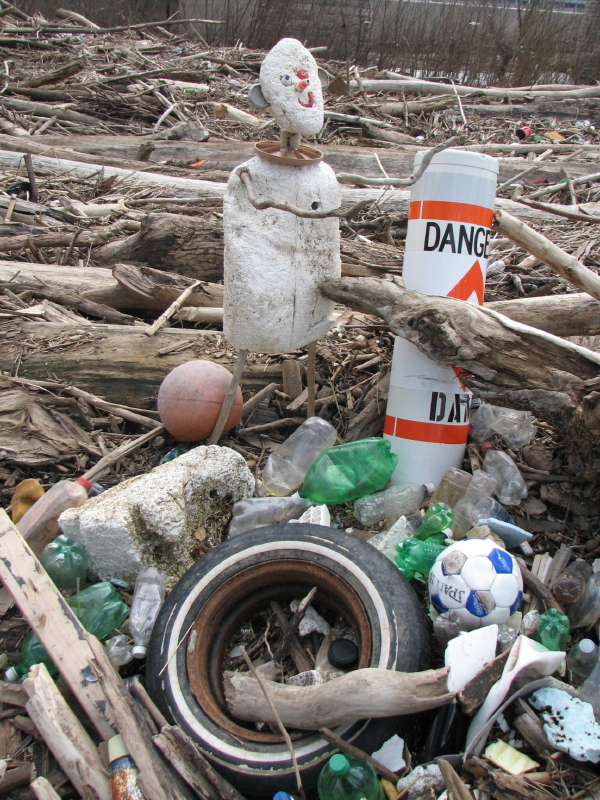
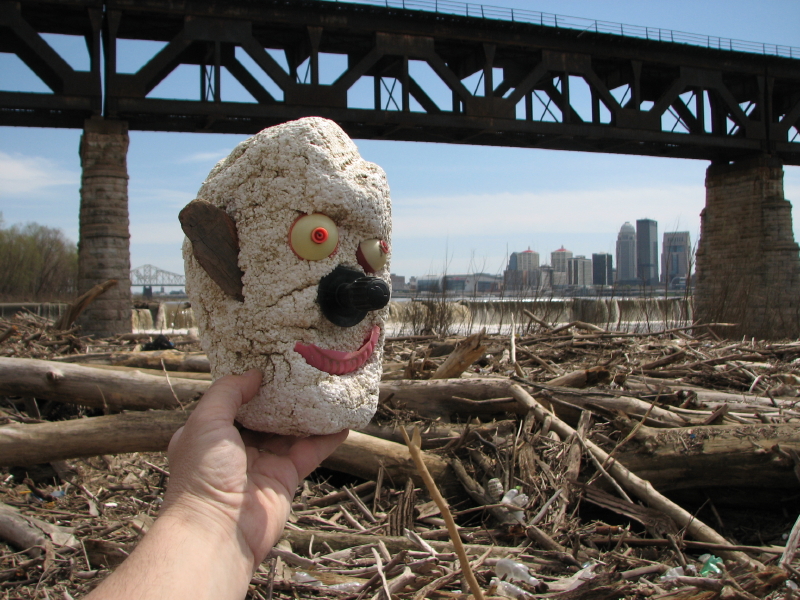
It’s all gone down river now, but before that happened I made one other figure out here.  I called him “Hoser” and set him up next to the “Danger” figure.  First, I started with making a head.  The eyes are old fishing floats.

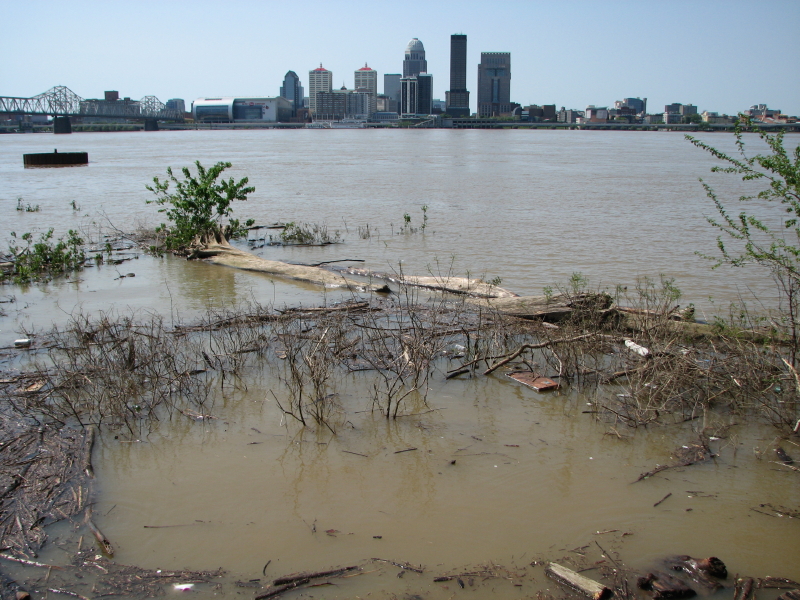
I felt very meditative in this setting.  I could see the skyline of a city with its proximity to nature and it made me speculate on how it all was going to turn out?  Would we eventually strike some kind of working balance with the planet or was this a taste of what was coming or even worse?  I would walk around my wood pile looking for a stick or branch I could use for a limb to help blow life into this Styro-man.  This is how he eventually turned out.

With gasoline approaching four dollars a gallon I decided to put the fake gas pump nozzle and hose to good use.  I strategically placed this object into the figure’s polystyrene body more as a reference to the fact that here was another resource that we pissed away.

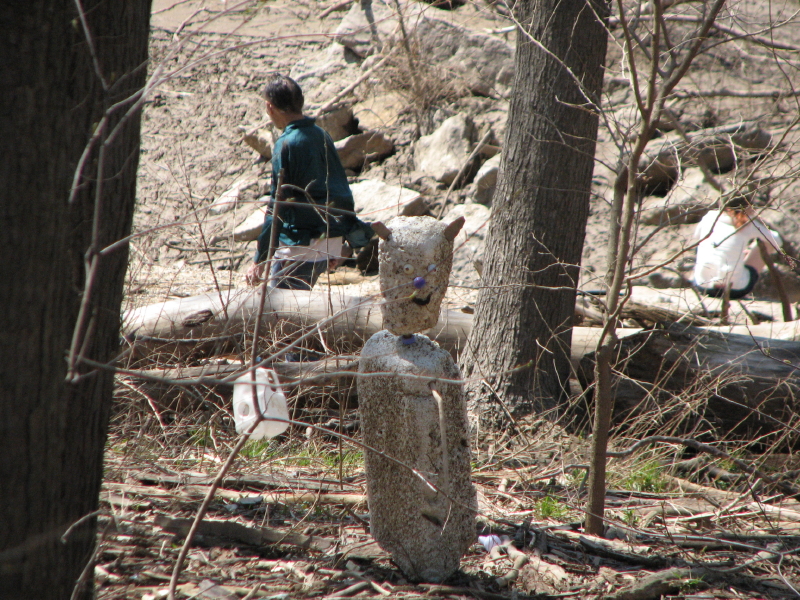
I located “Hoser” near the “Danger is My Middle Name” figure, took my photographs, and walked away.  That was the last I was to see of them.  Within days, the river started to rise more from rain that fell north of here and then it started to rain in earnest in the Ohio River Valley.  That was two weeks plus…it’s still raining and the river keeps on rising and the adventure continues.

Read Full Post »

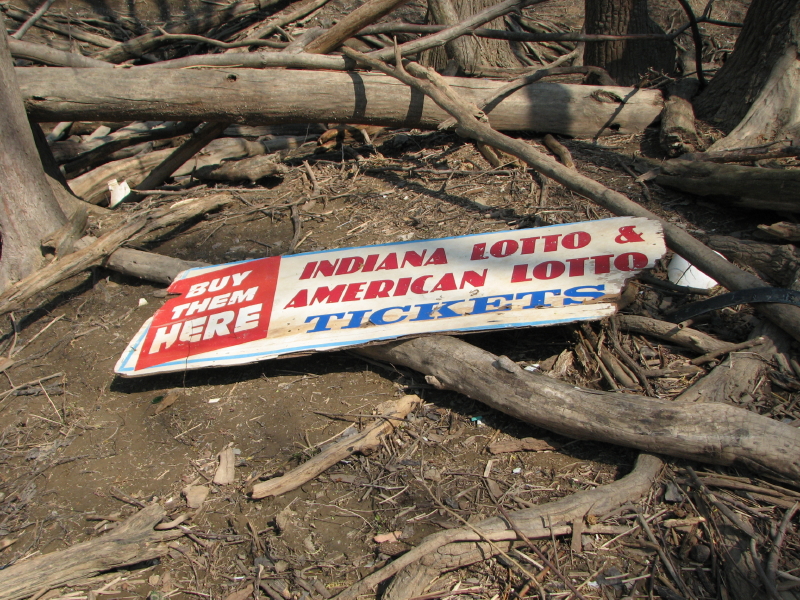
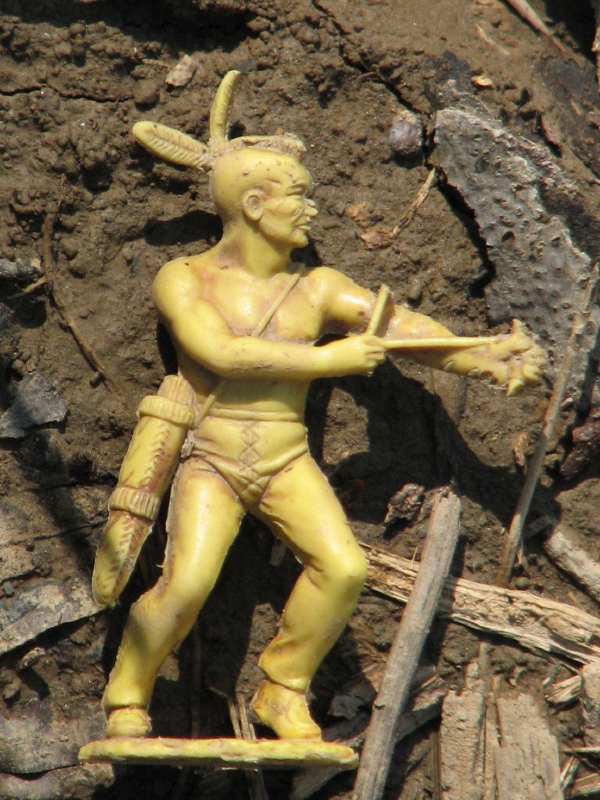
It’s raining as I write this post.  It has seemingly rained the entire month of April in my area resulting in a swollen Ohio River.  I think we are on another collision course with the record books for most precipitation during April.  Only once this month have I been able to access what passes for our normal river shore line and it was very muddy!  We have had tornado warnings and flooding this Spring.  The following adventure occurred between the two episodes of high water we have experienced.  I was walking along the Woodland Loop Trail at the Falls of the Ohio State Park when I was stopped in my tracks by this hand painted sign the river deposited during the first flood.  Is it another way that the universe is trying to communicate to us?  Is nature saying we are taking a big chance with our treatment of the environment?  I wonder who will win and what the prizes are?  Care to buy a ticket?  I decided to pass, but there were plenty of consolation prizes all along my walk courtesy of man and a too high river.  Since this is Indiana, I thought it was fitting to find one of these.

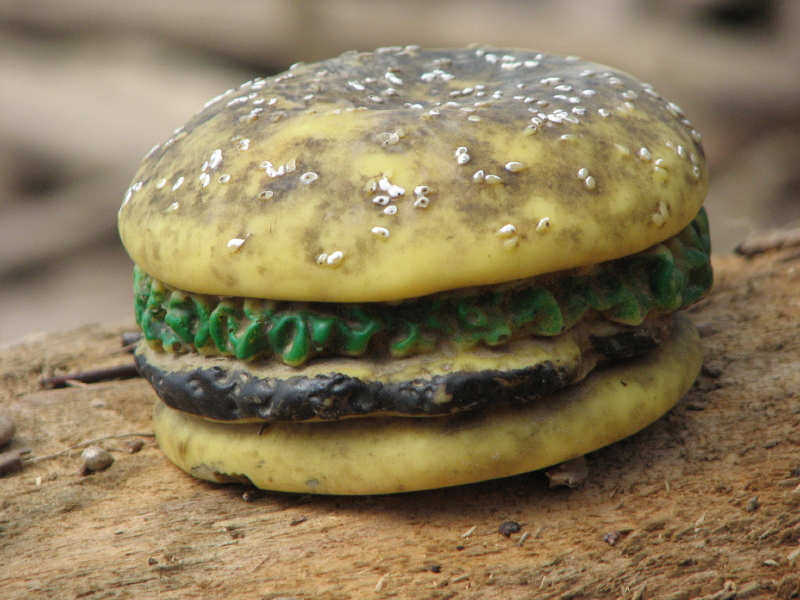
For thousands of years the Falls was home to a sizeable population of native people.  Now, you are more likely to find one of these.  Another piece of Americana I came across I added to my fake food collection.

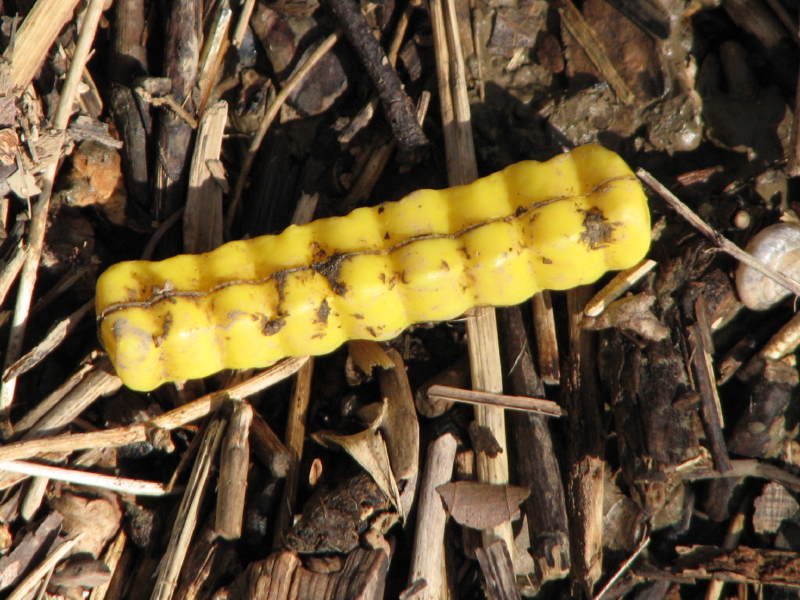
What can be more iconic than a fake cheeseburger?  What’s sad is that this isn’t the only one I’ve ever found out here.  I even have found a couple of plastic crinkle-cut french fries too.  Let me see if I can find a picture of one…hold on…yes, I also found this recently.

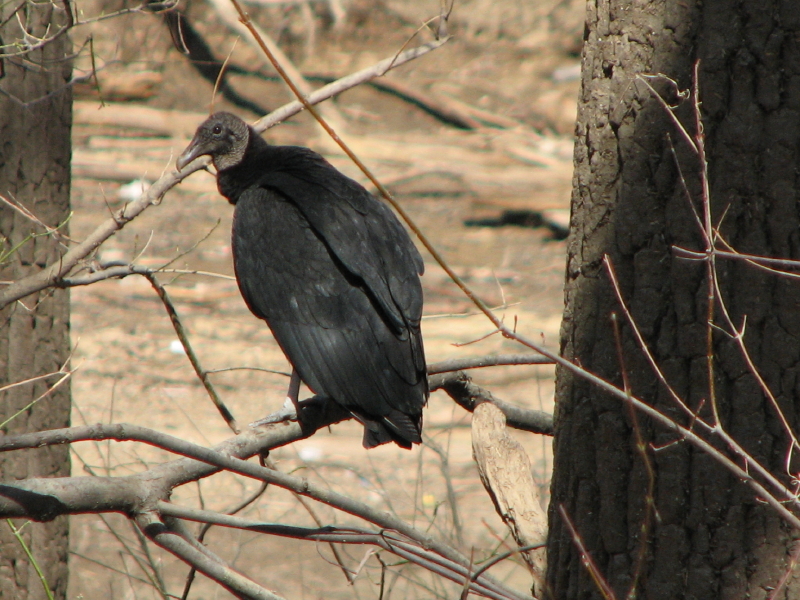
Moving along the trail, the unmistakable smell of skunk kept getting stronger and stronger in the humid air.  It’s possible that one of these animals drowned in the flood and its carcass was deposited here.  Or, one of the many birds of prey could have taken it.  At the odor’s epicenter, I discovered two species of vultures polishing off what’s left of the unfortunate skunk.  There were three black vultures and one large turkey vulture taking turns at the miserable remains.  Here’s one of the black vultures keeping an eye out while his friends gnosh.  I could see them around the tree trunks.

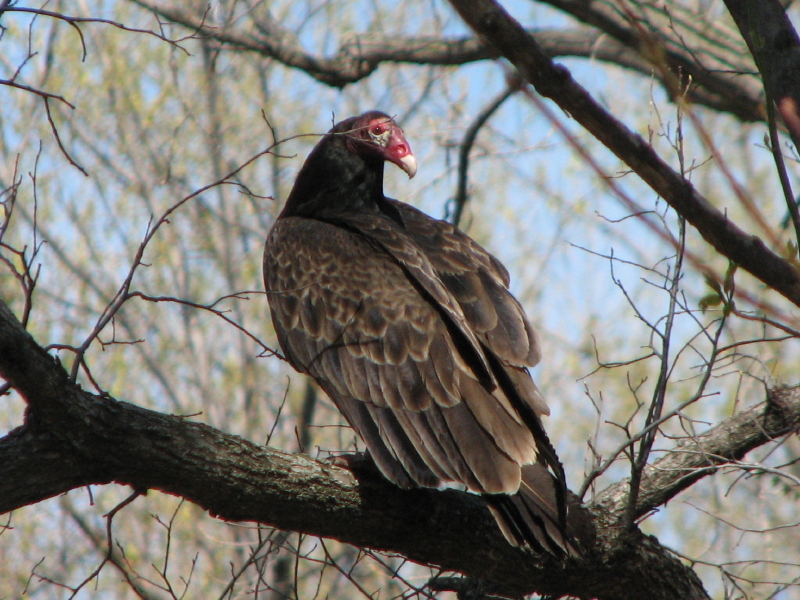
The dominant bird here was a big turkey vulture which is unusual from what I have observed at the Falls of the Ohio.  I normally see them retiring when the black vultures arrive.  This bird was the last to leave the skunk and the first to return.  Here he is giving me the “eye” from a low hanging branch.  As I approached, he joined the other vultures in a tall tree with a vantage point of me and the skunk. 

All that was left of the skunk were a few innards and its skull.  Perhaps the vultures will eat this too?  That skunk odor was so pervasive and offensive, I’m amazed that these vultures could stomach this, but then again, they have probably had worse meals.  Not to far from the birds, I did find a big piece of Styrofoam that was washed into a bottomland area.  Using what I could find nearby, I constructed this unnamed figure, photographed it, and kept moving down the trail.  Where I left this figure was in the center of a trail loop that curled back towards the Interpretive Center.  Here are images of this improvised piece.  It was an especially pitted and worn hunk of polystyrene.

I circled around and could see the sculpture from another angle.  Funny thing is that while I write this…I know it is no longer standing and was probably swept away again by the Ohio River for parts unknown.  It occurred to me recently that this month is the riverblog’s second anniversary.  As long as the river keeps things interesting, I will try to do the same through these posts.  I have many other images of recently found junk and once this more recent flooding subsides…no doubt will be able to fill this virtual collecting bag.  My parting image is the last picture I took of this short-lived artwork.

Read Full Post »

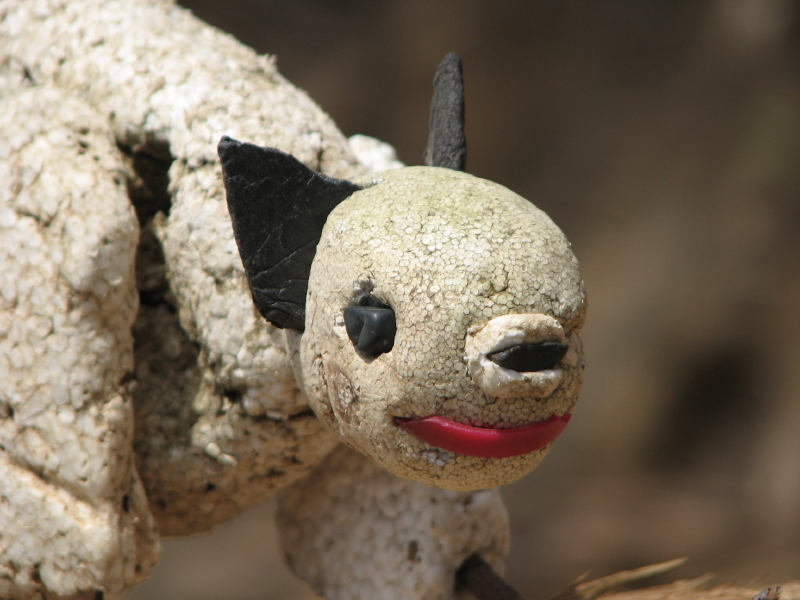
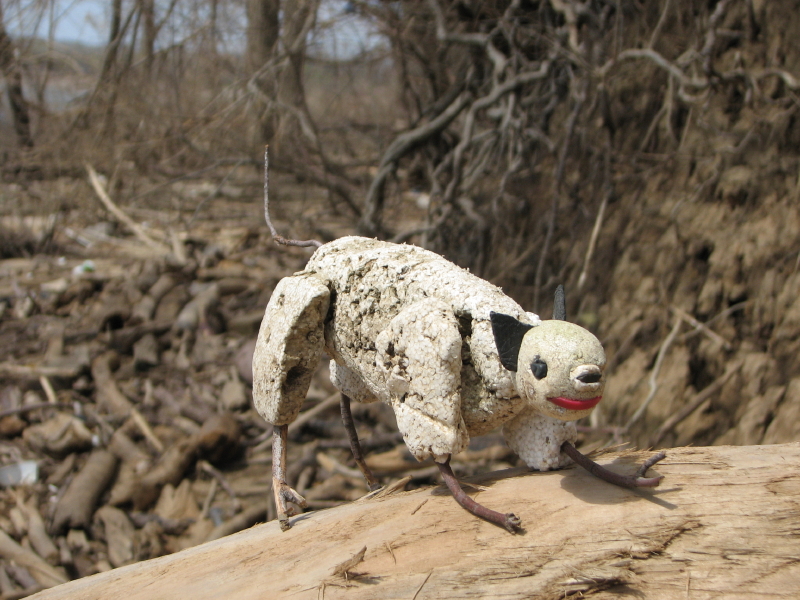
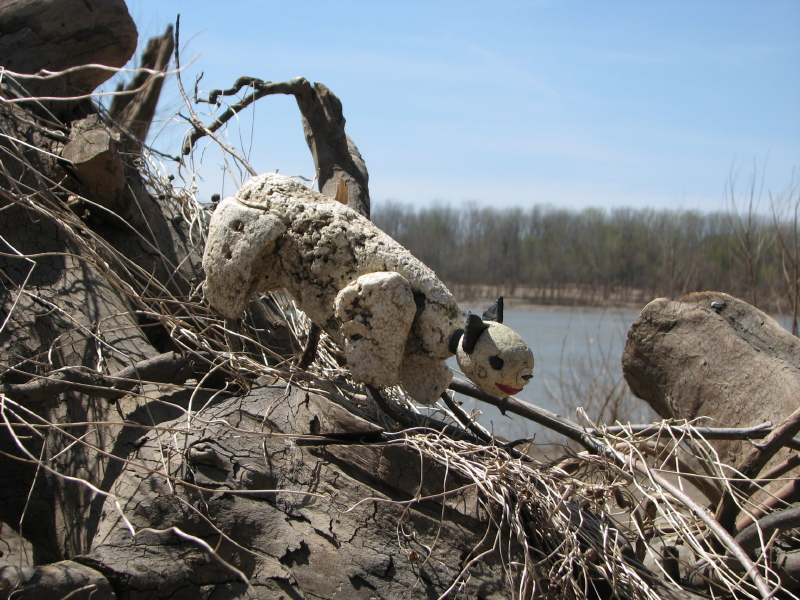
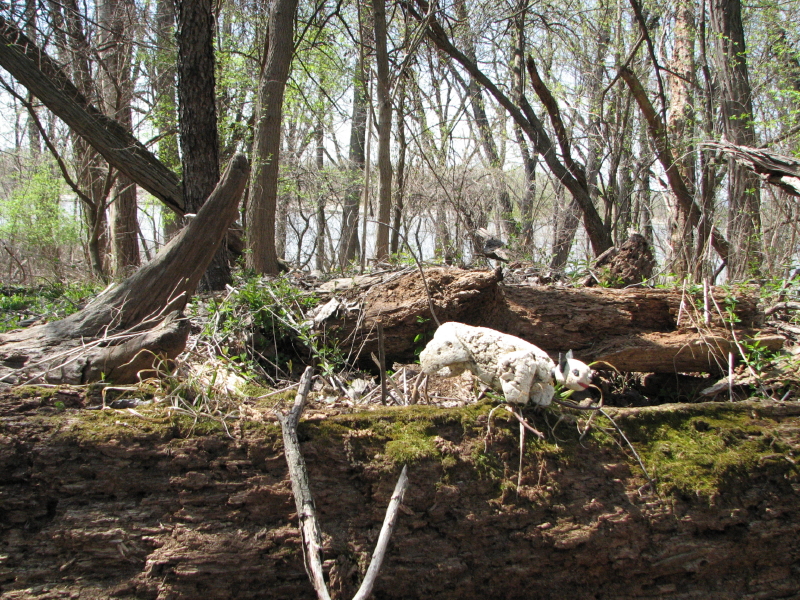
Seldom seen and thus aptly named, the River Ghost is an unusual small mammal living at the Falls of the Ohio.  Over the course of several days I was able to photograph a young adult as it was surveying potential territory.

Don’t let the cute face fool you.  The River Ghost is a relentless pursuer of anything it can catch and eat.  It’s diet includes birds, fish, other mammals no larger than twice its size, eggs, reptiles, and if necessary, insects and carrion.

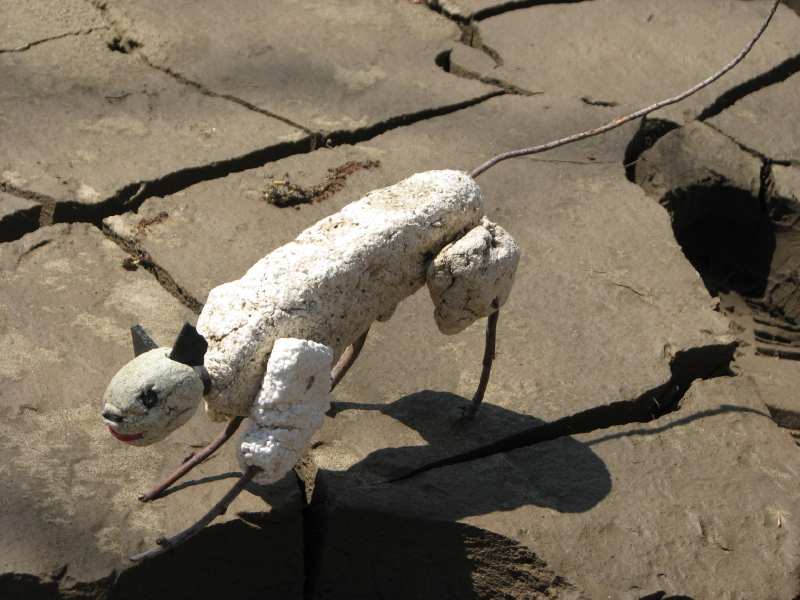
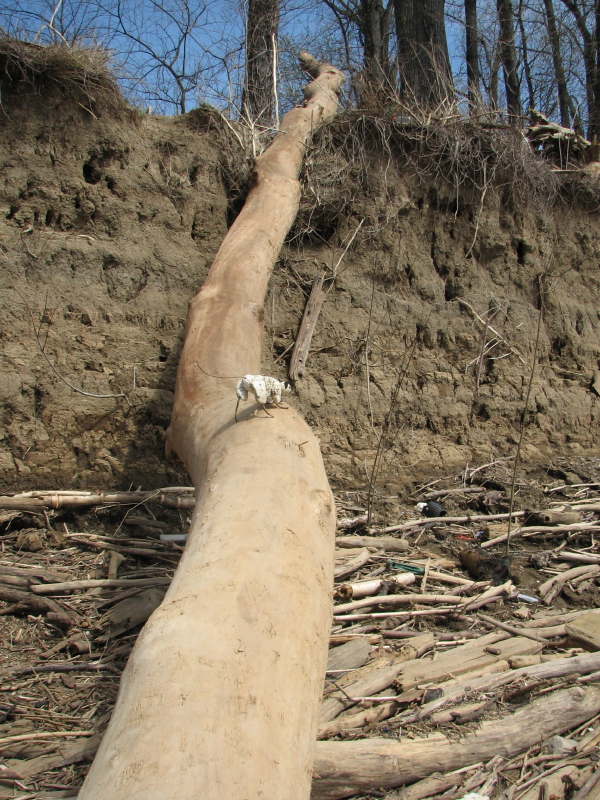
The River Ghost has a long and flexible body that allows it to pursue its prey through underground burrows.  It also utilizes abandoned burrows to raise its own young.  Two kits are usually born, but only the strongest will see the light of day.

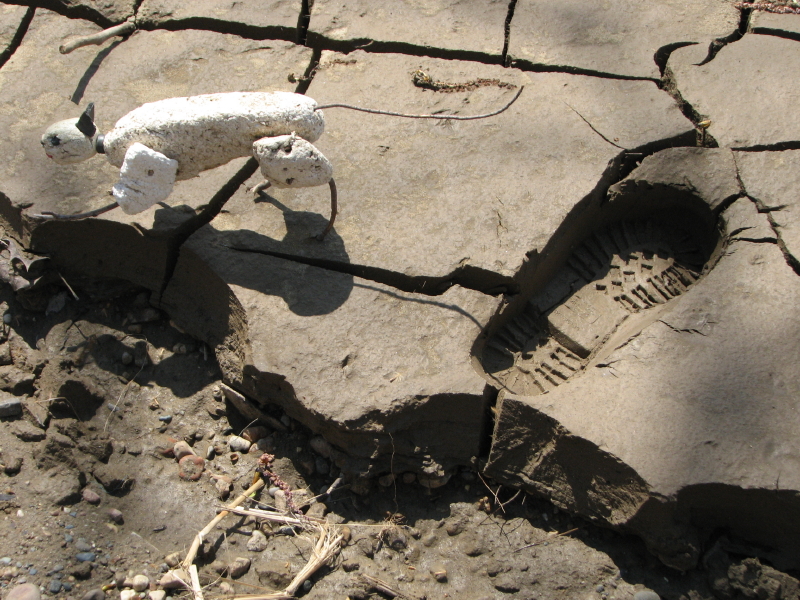
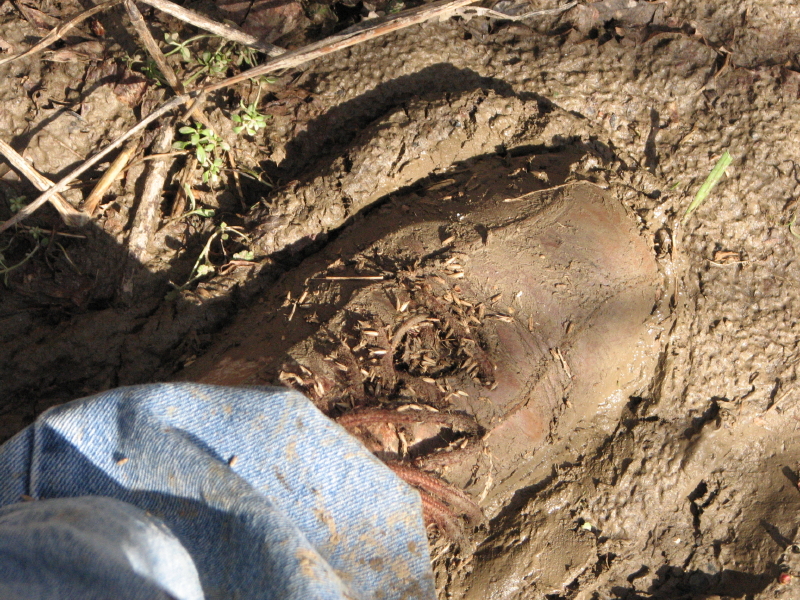
I photographed this specimen walking along the mud line that was deposited by the recent flood.  The mud is a five-inch thick layer of “fudge” and very soft and moist.  That’s my boot print in the picture.

This mud is also perfect for recording the foot prints of other animals that cross over its surface.  Scientists are uncertain which senses are most important to the River Ghost, but it seems to have a keen sense of sight and hearing.  This odd animal has kinship to both rodents and weasels and may be a throw back to an older evolutionary line.

Despite having formidable survival skills…the River Ghost is not thriving for a variety of reasons and primary among them is habitat loss.  More and more the riverine bottomlands it prefers are being divided and developed.  It’s prey species are also experiencing a decline in populations.  Many species are dependent on large areas of intact ecosystems in order to remain viable.

It would be a shame to allow this curiosity among the local fauna to disappear before its time.  Humans have coexisted with this intrepid predator for thousands of years.  The native people have legends and myths about the River Ghost’s ferocity and toughness and its way of getting out of trouble that it starts.

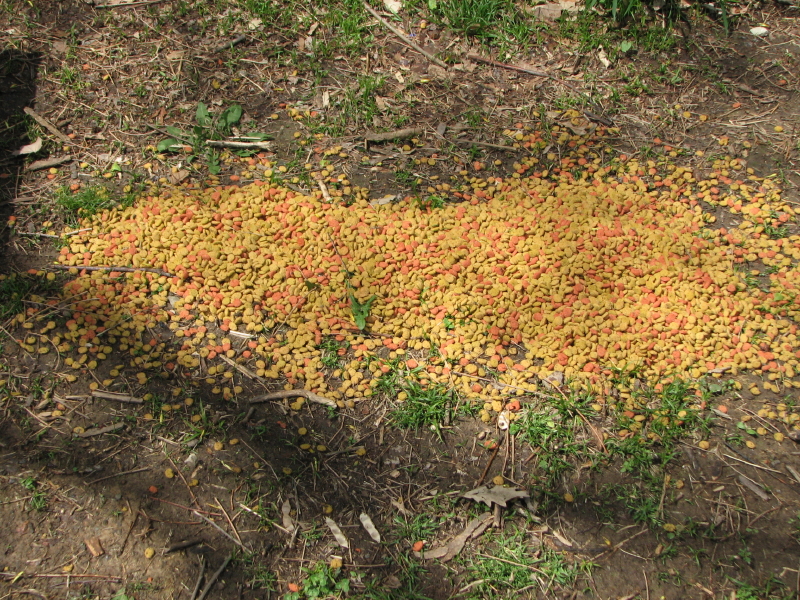
The last time I saw our River Ghost it had moved onto higher ground around the Interpretive Center and Woodland Trail.  It seemingly followed every lead and poked its head into every hole looking for food to satisfy its insatiable hunger.  It occurred to me, that it was heading for the picnic tables where people have been spreading dry cat food on the ground.  I wondered if the River Ghost “knew” that other animals would be attracted to the feeding station…or was it here for a bite of cat food too?  Perhaps I will see it again?

Read Full Post »

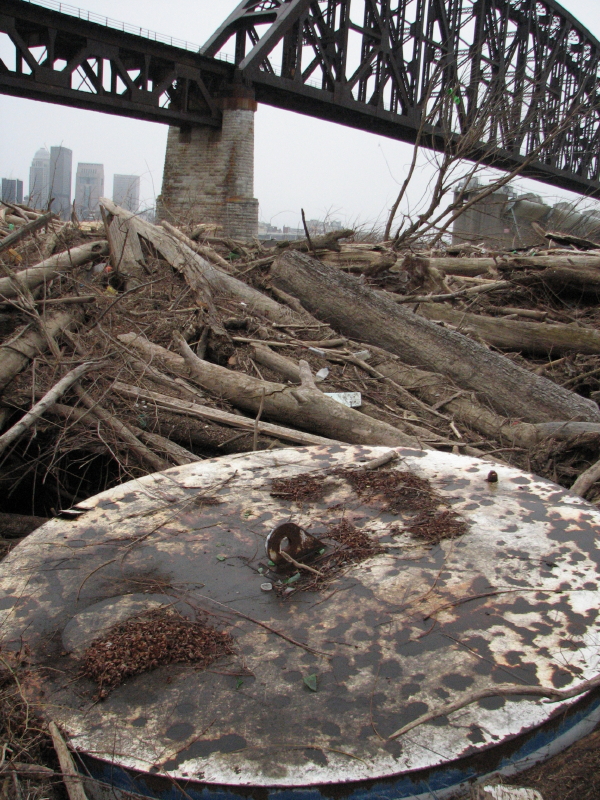
It’s a wonderful spring day on the debris heap.  On the old bridge several diesel trains have been carrying their vital shipments back and forth across the Ohio River.  These trains are also a noisy element here when they are crossing.  Among the other sounds you can count on hearing are the aircraft about to land at the local airport and the sound of the river flowing under the gates.

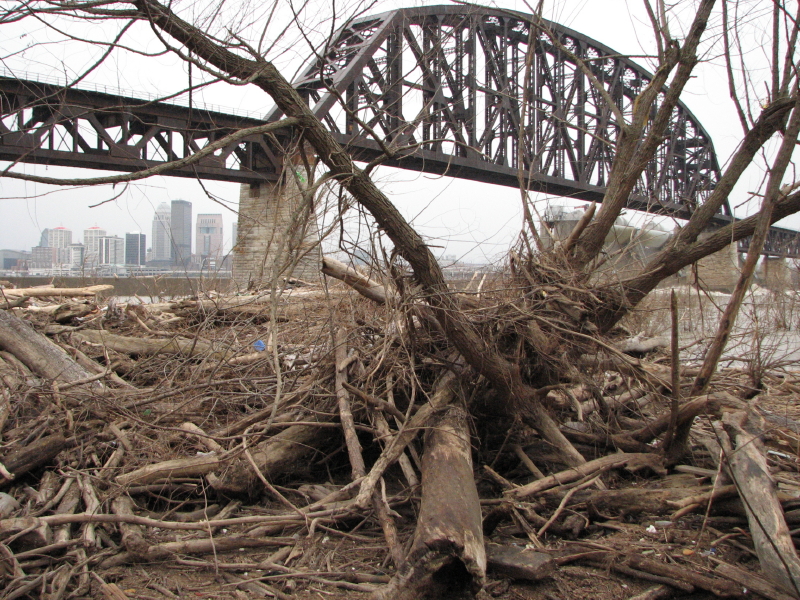
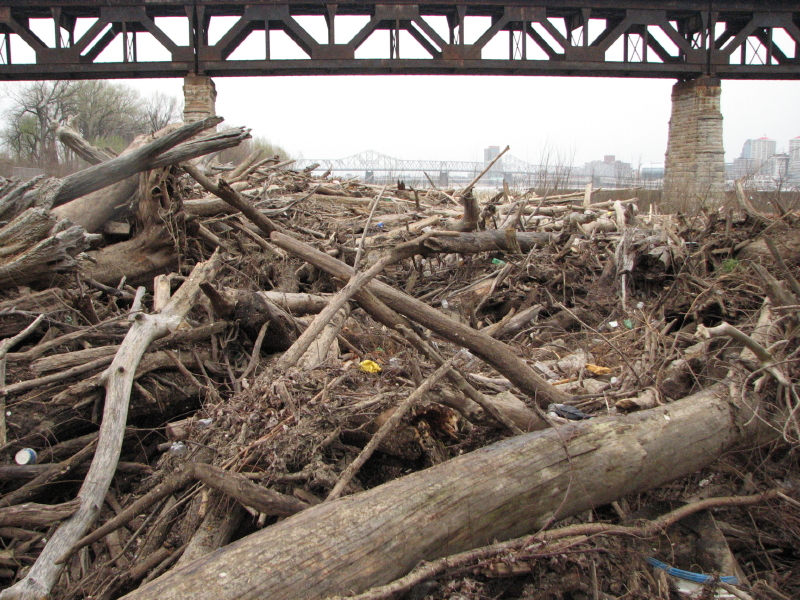
The flooding we experienced a few short weeks a go has left a lot of debris deposited at the Falls.  During the height of the water, the area I’m exploring today was a watery gyre of spinning driftwood, junk, and plastic jugs and bottles.  It’s dry now and in the eastern section of the park under the railroad bridge.  You can’t miss it because in places it must be 12 to 15 feet tall.  It’s all interwoven logs and debris and it can be very treacherous walking here.  You always must be careful where you place your foot and weight because it might just be an air pocket covered in paper and leaves that can cause you to fall into a hole.  It would be no fun walking out of here with an injury.  I usually have a long walking stick with me to help me maintain my balance walking over the backs of logs.

If you are careful, you can explore this wooden mound safely.  It presents several interesting vantage points for photography.

Naturally, I’m also on the look out for interesting objects that have come to rest here.  My collecting sack soon fills with mostly plastic artifacts.

This wooden mound has waves of its own.  It has peaks and valleys and you can sense how the water moved from the artifacts that were swept along and how and where they came to rest.  The lightest stuff like plastic bottles are good indicators of how far the margins extend and where drainage occurred.

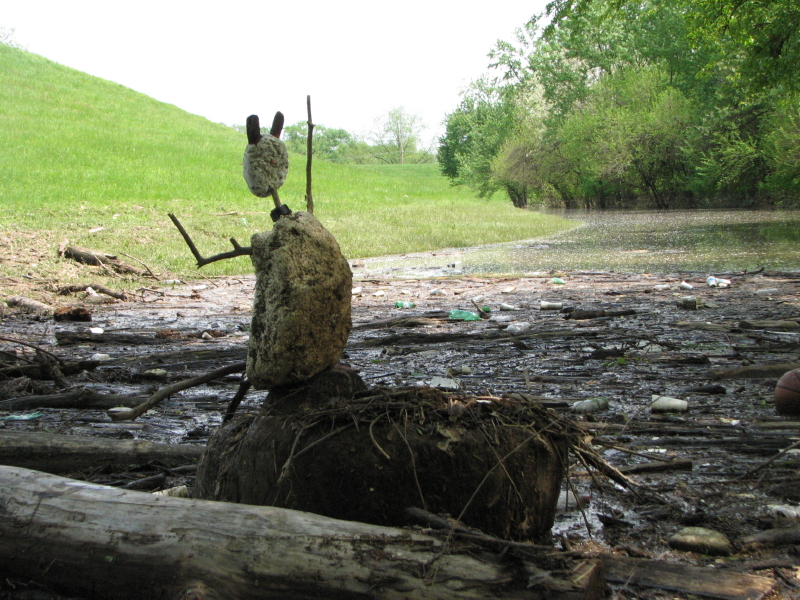
After exploring the area and collecting materials, I soon had another temporary studio going.  This time I’m not finding any huge sections and chunks of Styrofoam around.  There are, however, lots of smaller pieces absolutely everywhere.  I gathered these pieces up and soon I was making a figure to take advantage of this riverscape configuration at the Falls of the Ohio.

I found a spot with a good view of the city and made this guy.  His name comes from the spot where I left him.  I can feel that my face has received more sun than unusual and since I didn’t bring any sun block…decide that it’s time to go back home.

The place is marked by a “Danger” buoy that drifted in with all the other debris.

Around “Danger” are all kinds of other junk mixed among the driftwood.  Tires are ubiquitous as are all the plastic containers and playground balls.  Among the natural materials are wood (limb and lumber), nuts, dried reeds, and lots of shredded tree bark.

I’ve been busy cataloguing with photographs all the small items I found and collected from the Falls over the years.  I have posts to come of that material. I also have several other figures and adventures to relate to you.  With this project you have no choice, but to work with the river and I have been trying to play catch up where and when I can.  The next expedition takes place in the western section of the park.  There I will attempt to capture images of an unusual animal rumored to have been seen there recently.  Wish me luck!

Read Full Post »

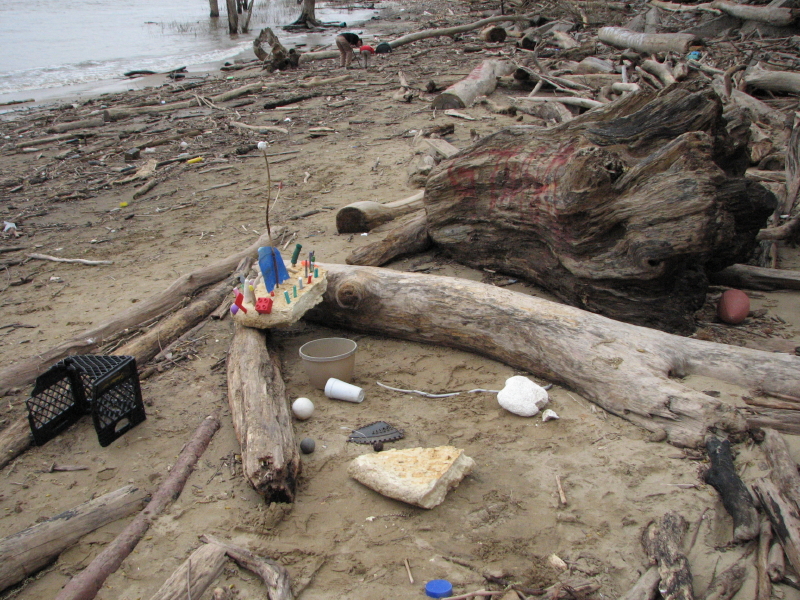
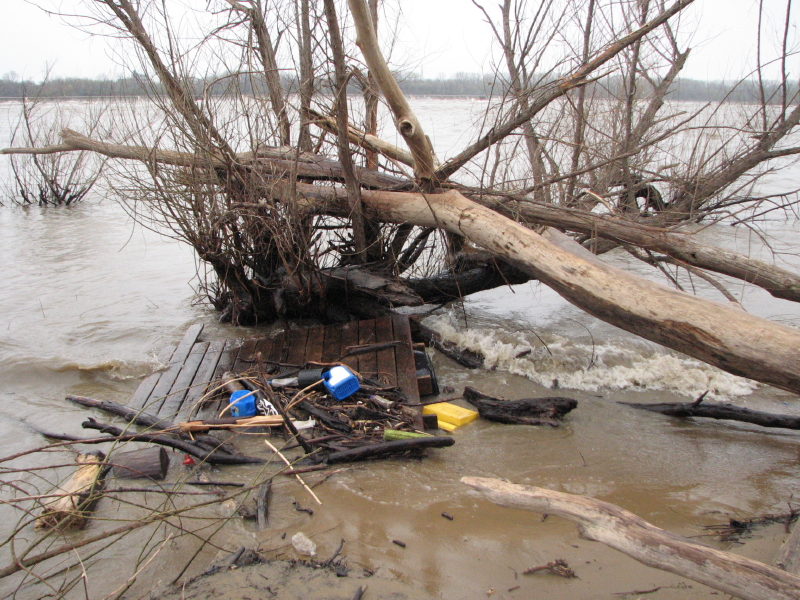
The river has given ground, but just a sliver of it.  Although the waters have retreated, the Ohio River is still higher than usual.  On the immediate riverbank is a new wooden obstacle course of washed away trees and huge logs.  I find myself a walking stick and go exploring.  I cover ground I have visited hundreds of times before and yet  is made different with each episode of high water.  I began this trip descending the frail cut lumber staircase whose bottom steps were recently covered by the river.  I see a man and his children playing in the sand and pebbles and it looks like they are also building something.  I wait for them to wander off to gather fresh materials before sneaking a closer peak.

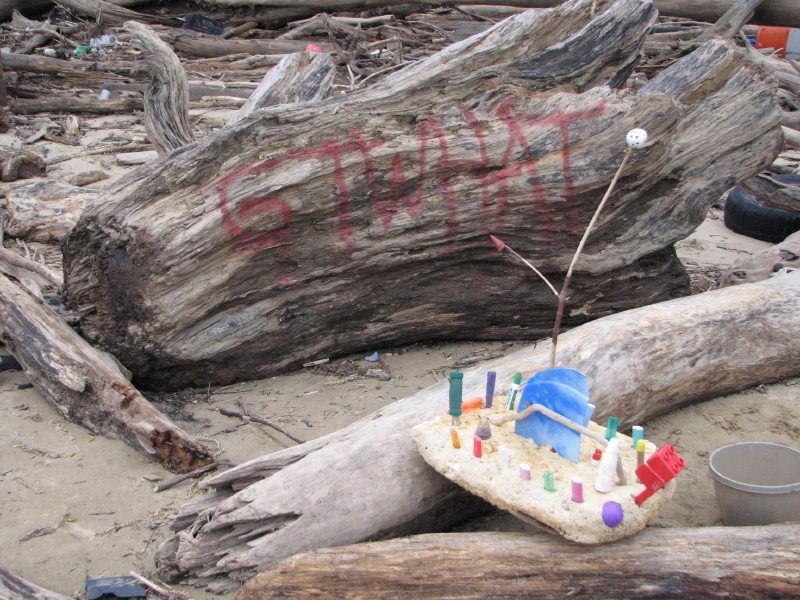
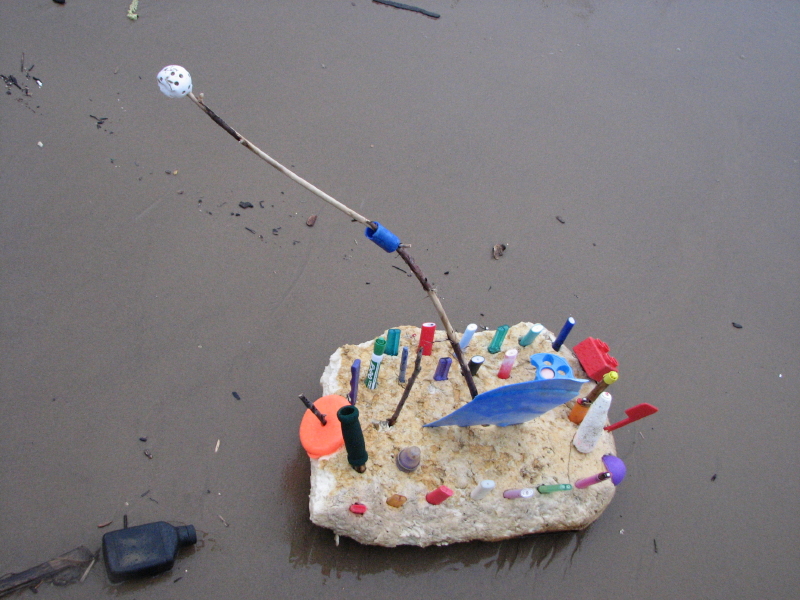
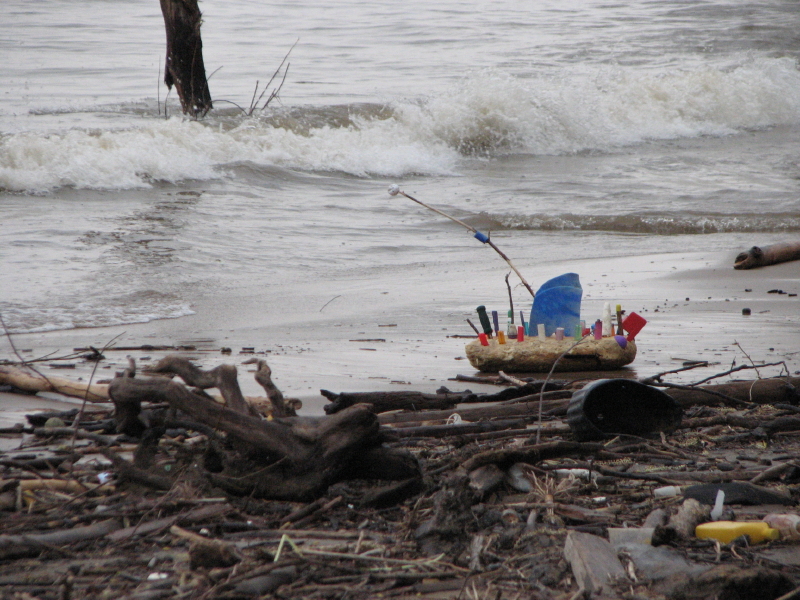
They have taken a recently washed up piece of Styrofoam and added some other found elements to improvise a toy raft.  Jutting from the foam are many spent cigarette lighters ( you can always find these).  There is also the red plastic flag from a mailbox…the kind you stand up to alert the postal carrier that you have outgoing mail.  I can also see a larger piece of blue plastic, perhaps a sail?  To me, it also resembles a shark fin.  As much as I like this family’s creativity, I am however, dismayed by the graffiti on the side of the log. This is something I’m starting to see more of on the bridge and through out the park.  It makes me wistful for the days when scrawling bad words and so and so loves so and so in the sand were sufficient means of expression.

The walking stick comes in handy when you are not sure how deep the mud is in a certain area.  You need to pick your path through by stepping on branches and broken planks.  You can see brightly colored plastic just about everywhere you go.  There are moderate to heavy waves along the river’s edge.  Today I have a paper sack with me to collect the small river treasures carried by the water.  This proves to be a mistake because the sack soon becomes water-logged and the bottom falls out.

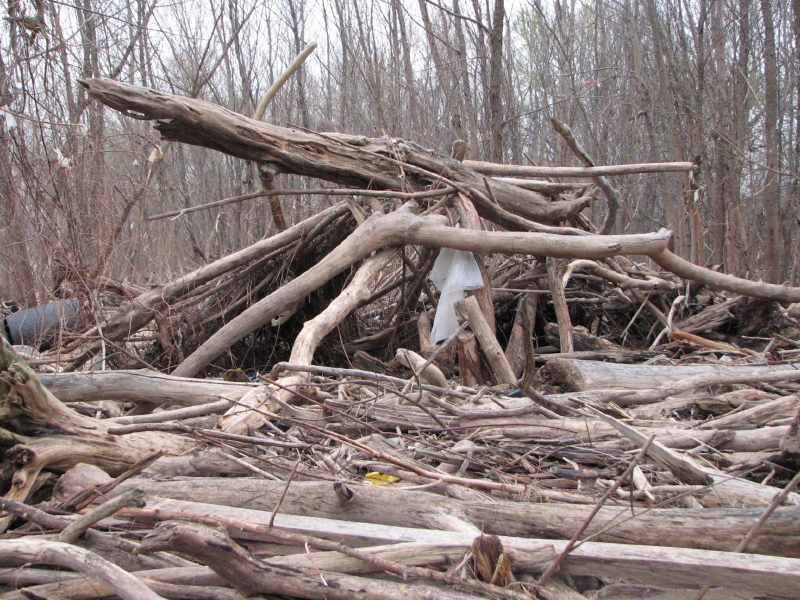
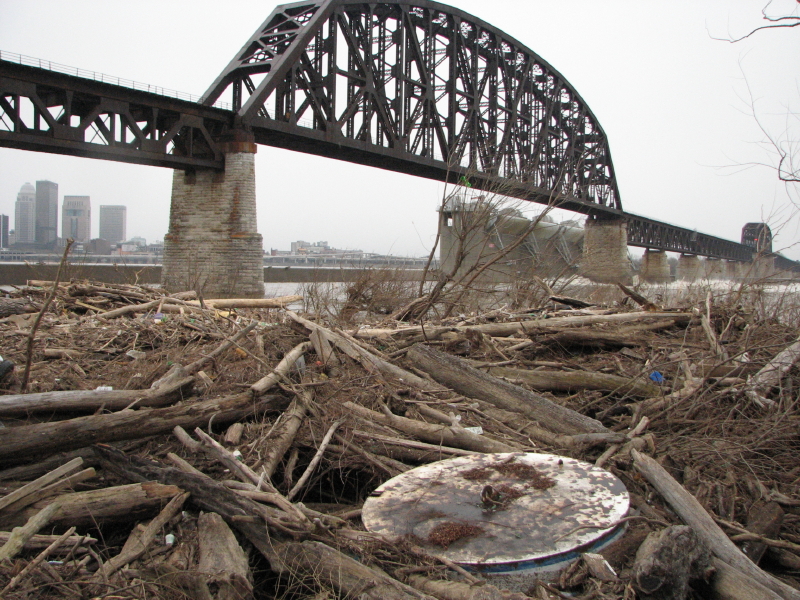
I pick my way towards the railroad bridge because when the river was at its crest…this spot had the most incredible amount of wood and debris floating in the water.  I wanted to see the aftermath.  I came across this formation created when the water level left these logs high and dry.  A very fine coating of mud and dampness unifies the scene in neutral tones of brown and gray because the greening of spring is only just beginning.  I had hoped to see a bird or two, but they weren’t in this area.

It’s a cool and very overcast day and got progressively colder as the day wore on.  In fact, it would blow snow on this night.  Because the light was subdued, there were fewer harsh shadows and I felt that I could read the forms better.  Everywhere you looked there was the jumble of logs and branches twisted and interconnected together.  I recognized little from just a couple of weeks a go, with the exception of the UFO or Unidentified Floating Object which was miraculously still there.

This big circular platform first appeared here a couple of years a go.  It came with another flood that swept it loose from wherever it came from, washed it over the dam, and deposited it here.  My sons first thought it looked like a flying saucer, but I said it was an unidentified floating object instead.  We also speculated that this could be the plug found at the bottom of the river…and when it was pulled, the river drained like a bath tub.  It’s about a dozen feet across and we used to dance on it.  I’m really surprised that it’s still here and didn’t move along with the river on its way to the ocean.  Apparently, nobody has missed this thing since it’s been here for years.  When it began spitting rain I decided to turn back the way I came and headed for the staircase.

The people who made the “Styro-raft” were gone and now was a better time to sneak a peek at their creation.  I snapped a few photographs for my collection.  Before leaving I could see that they had attempted to launch their colorful craft into the river…but the Ohio was not in the mood.  I have had this experience before where the wind and waves on the river push back whatever you hope to have float away.  It probably disappointed the kids, but in their imaginations I’m sure they can see a little of themselves riding their unidentified floating object on its journey westward towards adventure and new lands.

Read Full Post »

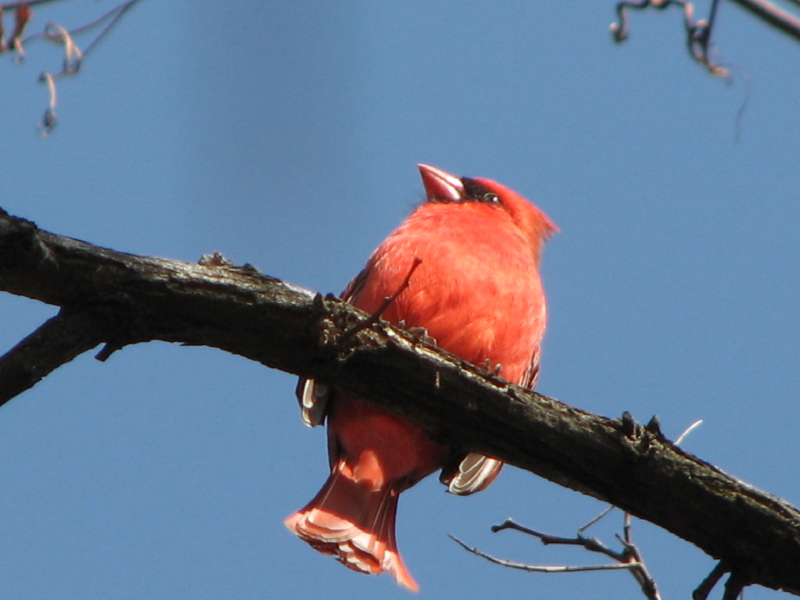
I ventured out over the weekend to see what I could see.  The Ohio River is still very high, but receding.  All along the riverbank you can see how far the water rose because large logs and plastic trash reveal the high water marks.  Once all this water reaches its “normal” level…there will be a huge amount of trash left behind to challenge any clean-up attempts.  Today I wasn’t out looking for garbage, but other signs of life.  Perhaps it is a bit early to look for migrating birds although I can feel that is just a short time away and getting closer.  Already species like the Red-winged Blackbird are staking out nesting territories.  Species we see all the year round like the Northern Cardinal were singing at the tops of their lungs and I enjoyed standing under one bright red bird that was doing just that!

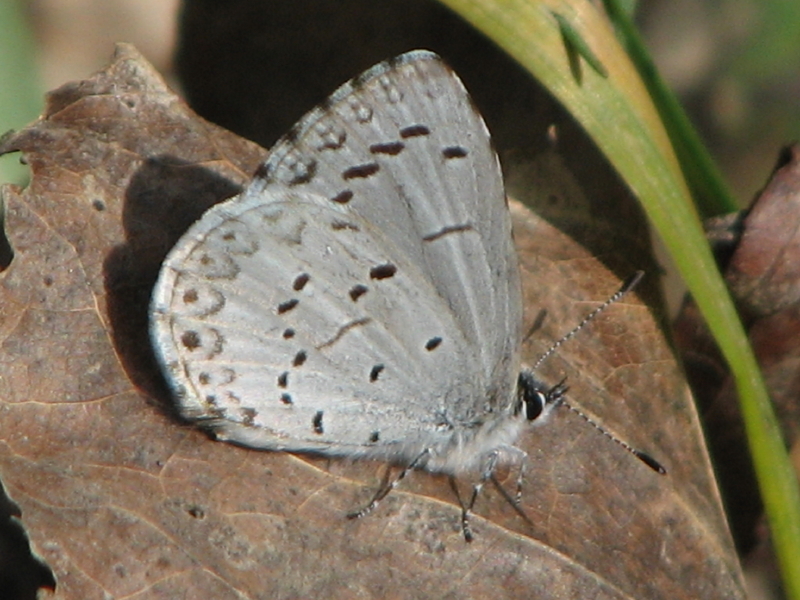
This particular bird has many rivals.  I could hear many other cardinals singing across the landscape.  I could almost imagine the spaces they were occupying by the volume of their singing…every hundred meters or so it seemed a different bird was calling out.  I wondered how the poor females went about the task of choosing which one to form a pair with?  I did see a few Yellow-rumped Warblers which are usually the first warblers to arrive and among the last to leave.  The other warblers will be winging their way here shortly…or at least I hope they stop here ever so briefly on their way northward.  Over the last two or three years it seems there are more changes to the environs around the Falls of the Ohio State Park.  I know that there are many other better choices all along the Ohio River than here. It seems we have decided to put people’s needs first over what birds might need.  During my wanderings, I did see my first butterfly and here it is…

…this is the Spring Azure butterfly.  Here it is mid March and this tiny ( no wider across than my thumb nail) bright blue-violet butterfly was visiting plants.  Unfortunately, I couldn’t obtain an image of that beautiful blue coloring, but with this species, the underside or ventral wings are more helpful in identifying it.  Since there were no dark marks on the dorsal wing tips, this helped me determine that this butterfly was the male of the species.  I was really excited to see this little wonder and thought that this could be a really uncommon species…but it wasn’t.  It’s fairly common, widespread, and has many morphs.  Formerly, this species was scientifically named Celastrina argiolus, but is now called Celastrina landon. With this species, there is still much taxonomic hair-splitting to do.  It’s just that variable over a large area of North America.

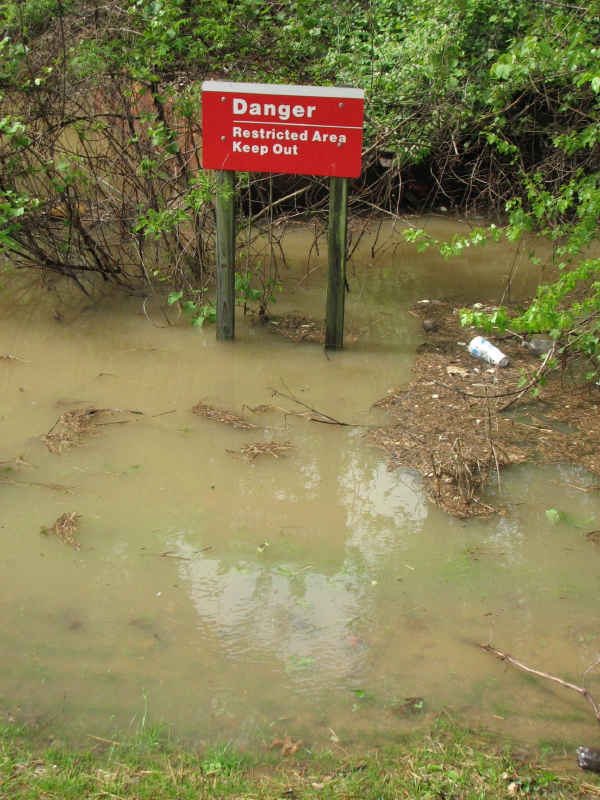
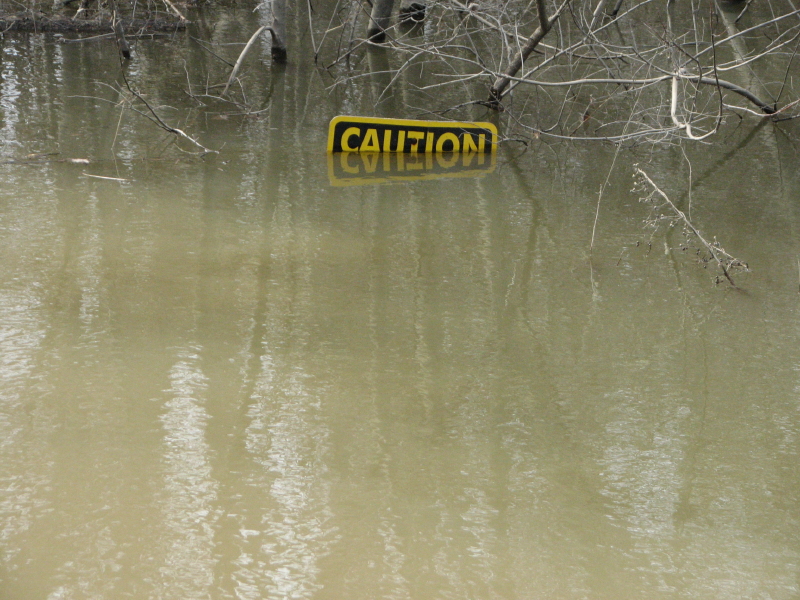
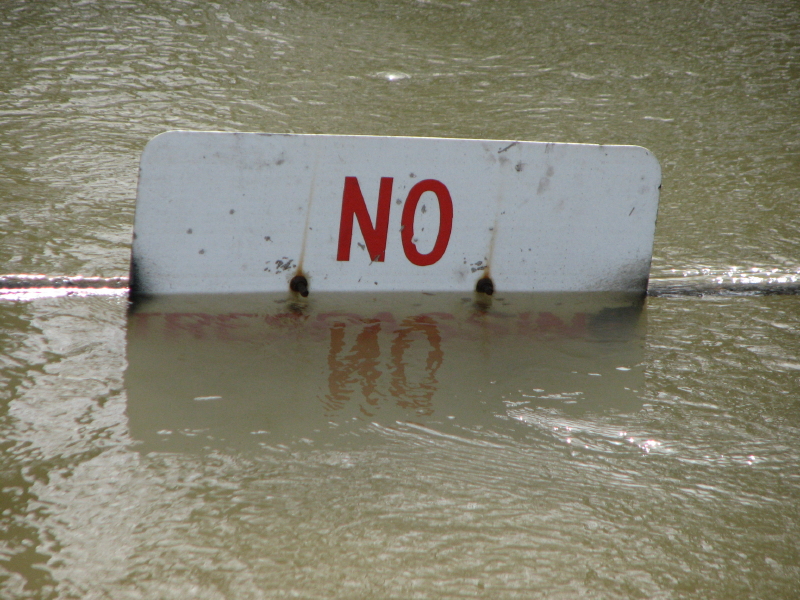
As I walked along the riverbank, I came across a few familiar signs now mostly underwater.  Here’s what happens when you throw “Caution” to the water…you get this view.  And here’s one that partly hides a “No Trespassing” sign near a storm sewer that feeds into the river.

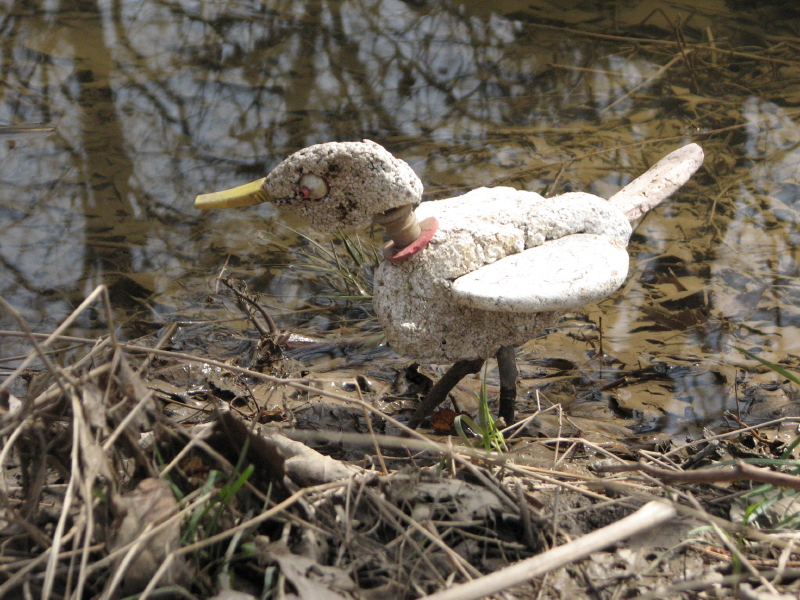
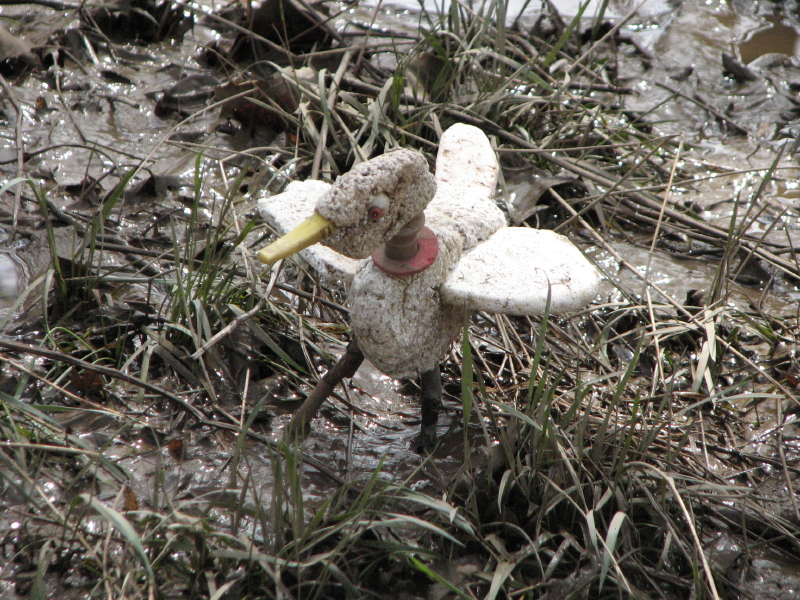
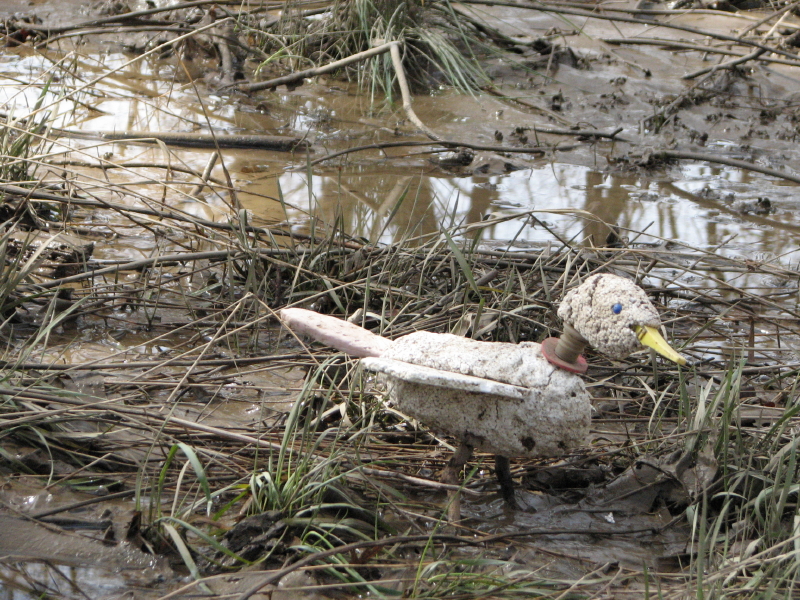
As I moved along where the faint hearted fear to tread, I was hoping that my slogging through the mud and muck would be rewarded.  Earlier I had seen a few Blue-winged teal which is a small species of duck and so I was hoping to see another small, but rare duck that sometimes mixes in with these teal as they migrate.  Today was my lucky day and here are three images of the very unusual  Mud Duck.  This bird likes to really get into the underbrush particularly during floods to take advantage of feeding areas usually restricted to other ducks during normal river levels.  It is a very oily duck and highly buoyant on the water and as a consequence…it almost never dives beneath the surface of the river.

The price of observing this unusual fowl was foul boots.  I became so coated with mud from my knees down that I didn’t worry about my foot gear until I was ready to go home.  This mud is particularly sticky and each rise of the foot is accompanied by a sucking sound.  You definitely need to tie your laces tight, otherwise you risk stepping right out of your shoe or boot.  I stopped every so often to clean the bottoms of my boots because the weight of the mud made each step an additional burden.

So far, I haven’t seen any of the large pieces of Styrofoam that found temporary refuge in my plein air studio.  They are probably half way to the Mississippi River by now.  It may take another week for the water to fully retreat and then it will be even more time before the riverbank dries out some.  I’ll close for now with another flood view.  Over the years, these sycamore trees have been a good marker for high water.

Read Full Post »

The Ohio River is even higher now than my last post.  I hope to venture out today and snap a few pictures to share later.  It’s sobering watching nature do what it can do.  I began the morning looking online at the damage the earthquake and tsunami have wreaked upon northern Japan.  Those folks need our help…please contribute however you can. 

Back in Kentuckiana, we are safe.  The flood gates are up and we are not expecting any heavy rain showers that would further swell the river.  Low-lying areas such as the aptly named River Road are under water.  Residents who live directly by the water have either evacuated or moved their possessions to higher ground which in some cases is the roof of their homes.  For these people, their love of the river is worth the periodic inconveniences it can pose.  The Ohio River is expected to crest today and begin falling back to normal pool which will take several days.

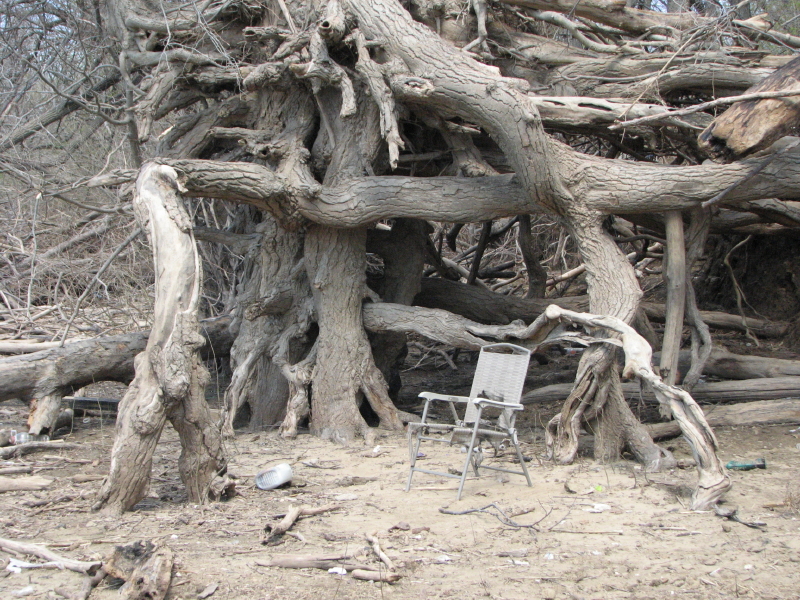
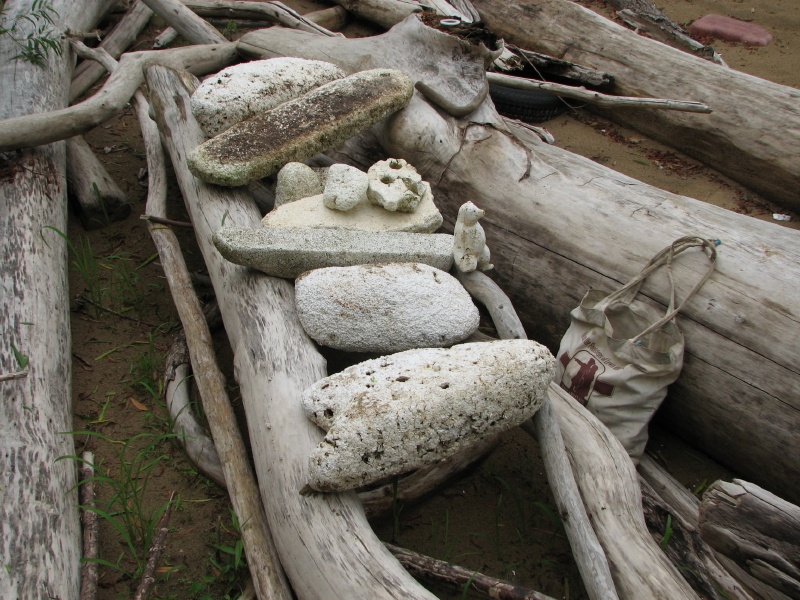
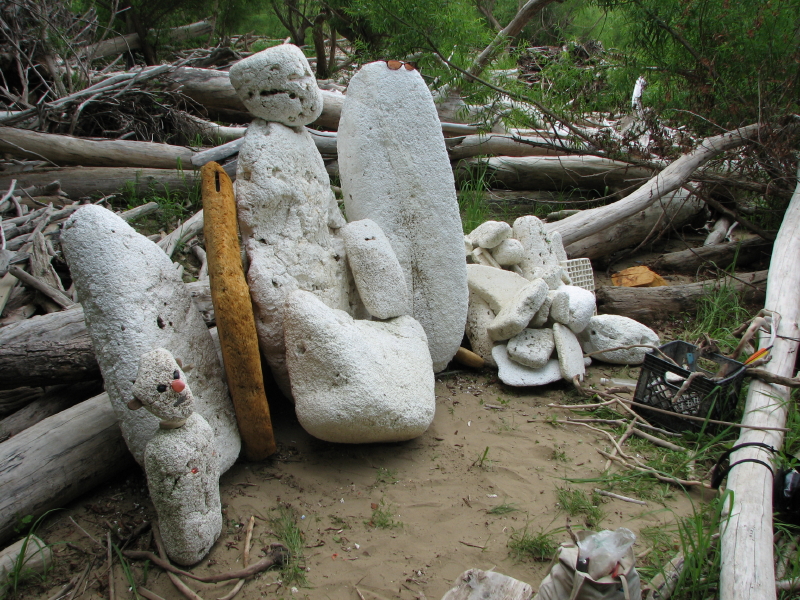
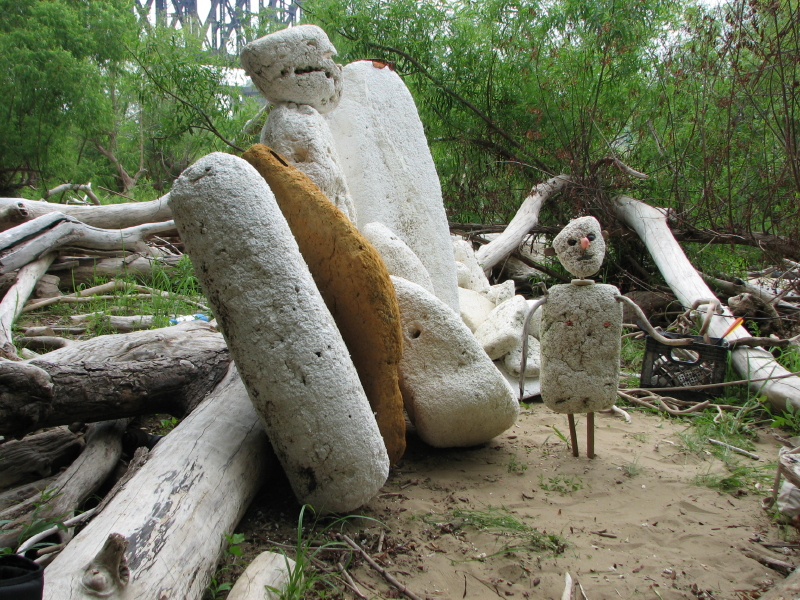
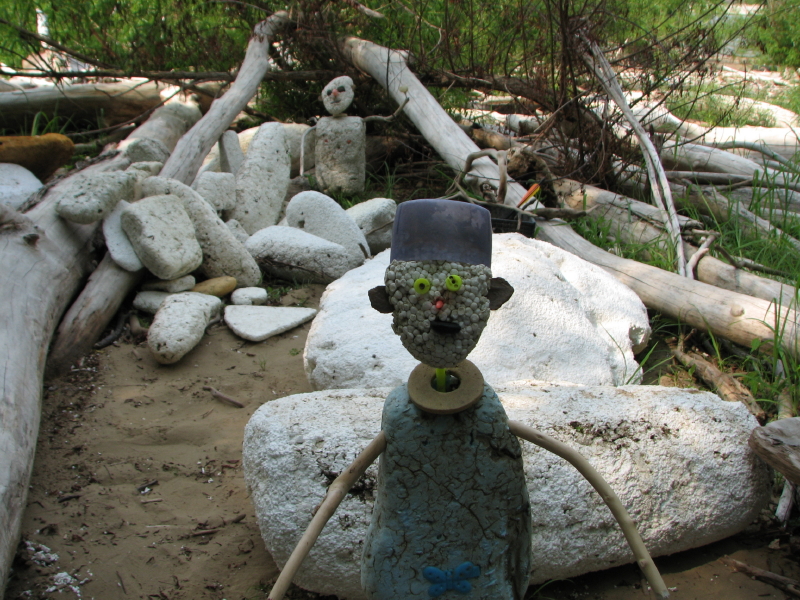
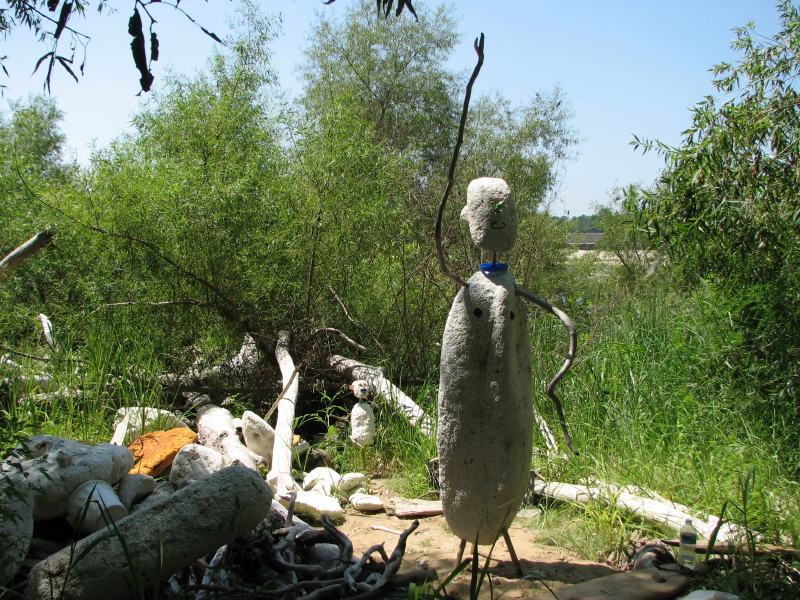
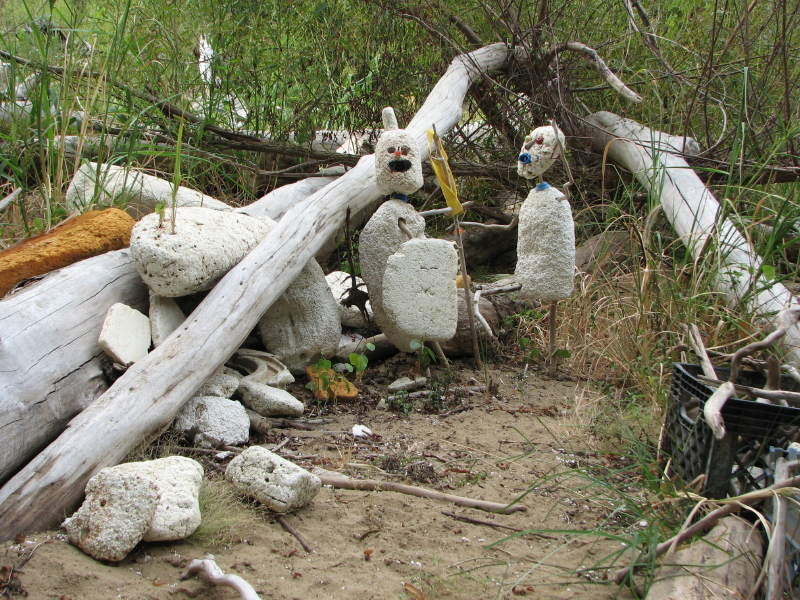
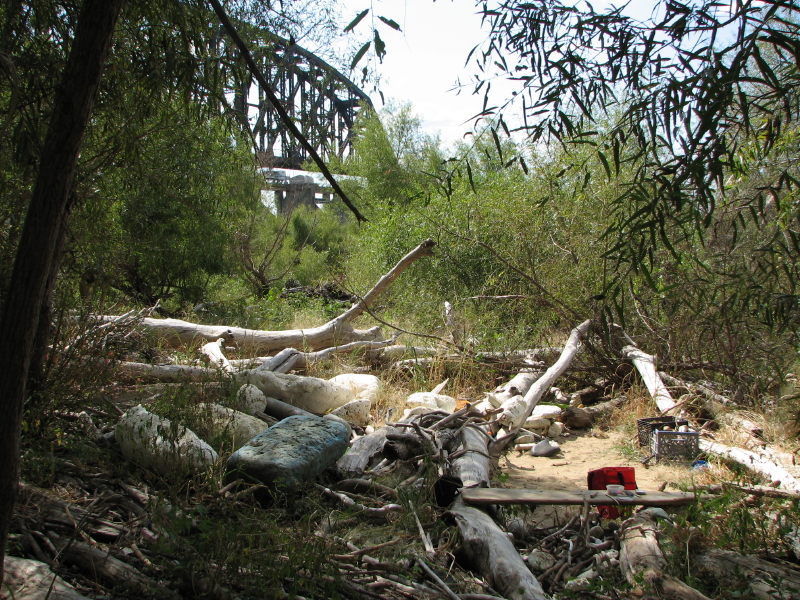
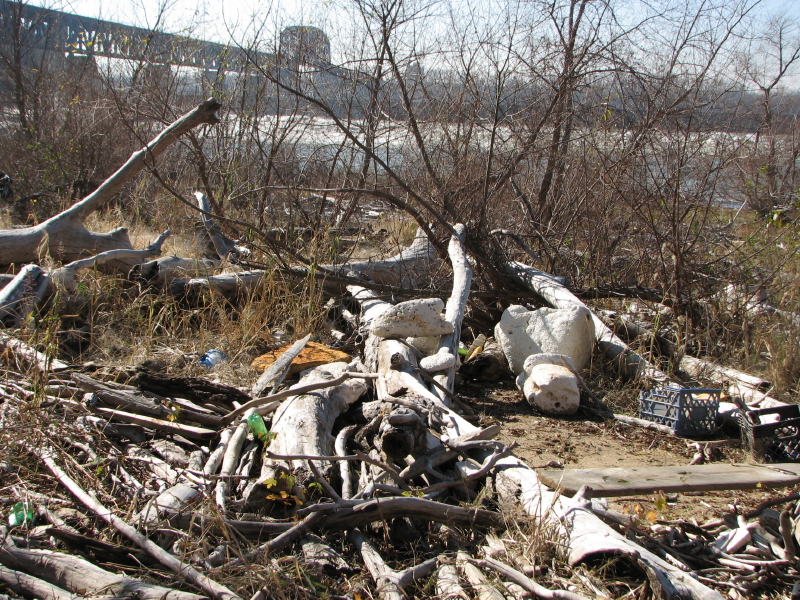
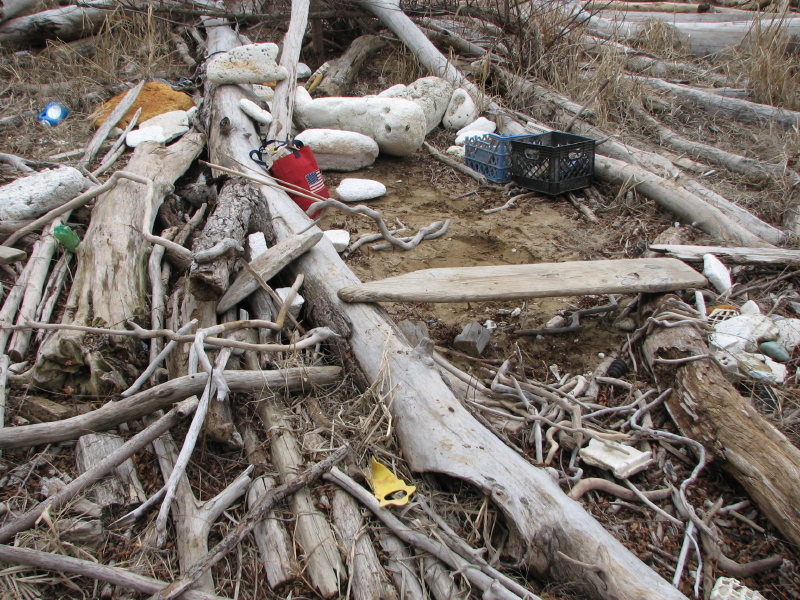
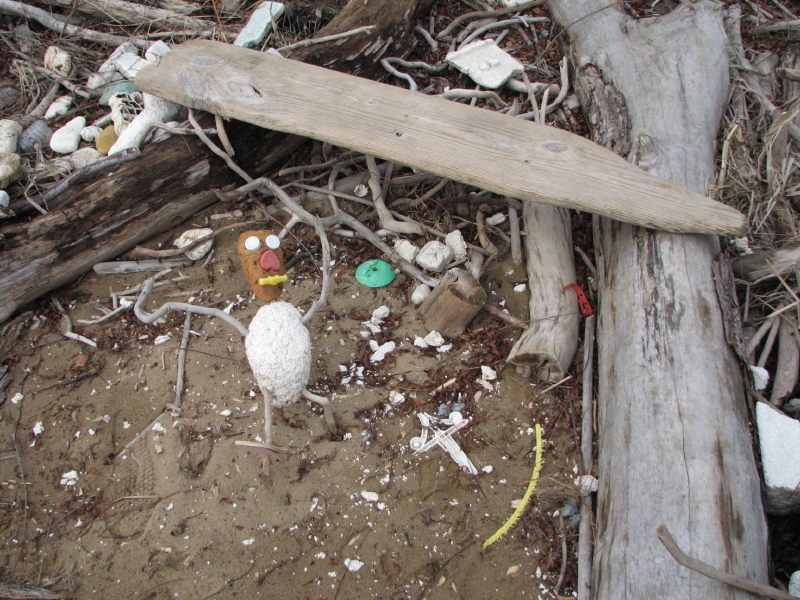
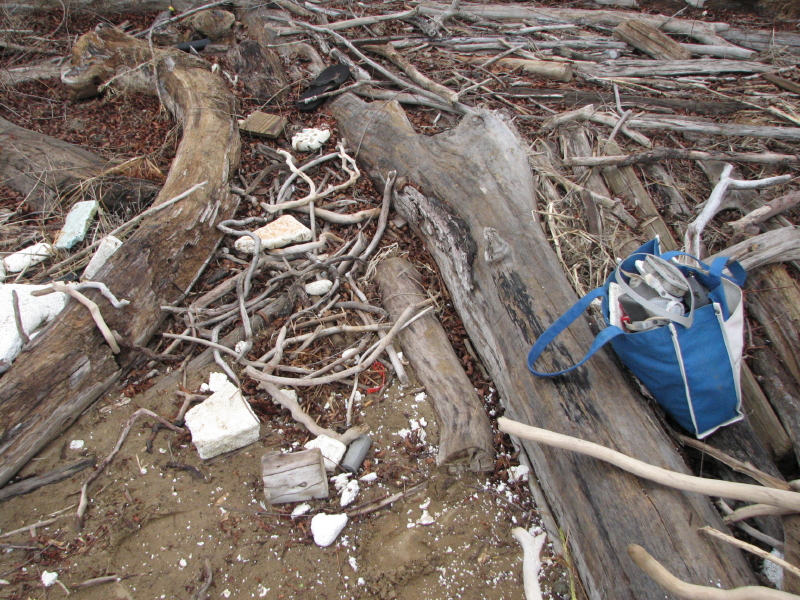
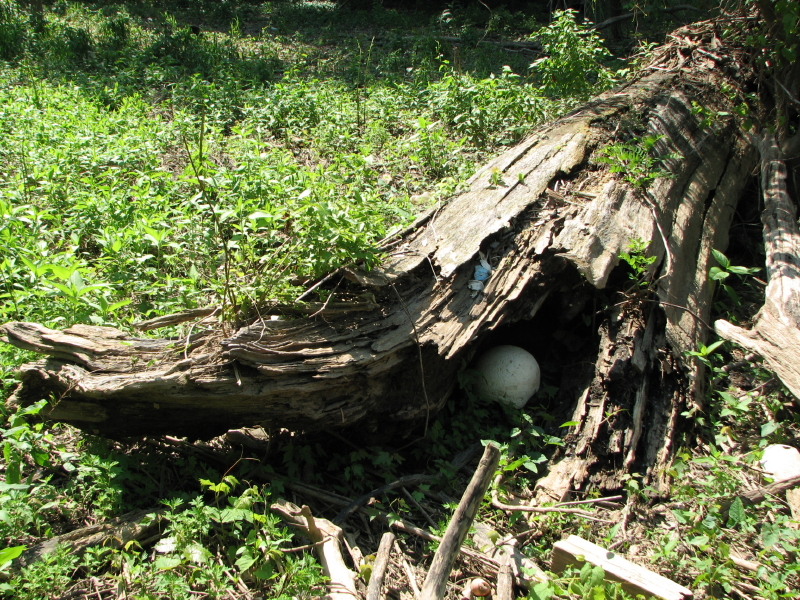
Until then, I have had the opportunity to look through images from the past year and put together a few “scrapbooks”  This one is of my plein air studio that I extensively used for ten months beginning in June 2010.  It’s now gone.  I’ll know more when I get the chance to visit.  I originally selected this site because it was relatively out of view, but close to where I was finding my materials.  Having a somewhat “fixed” location also gave the public who stumbled upon this spot, a chance to interact with the materials I was finding and provided more choices than finding the single figures I made throughout the park.  People could make their own sculptures…happily some were made.  So, here are a few pictures taken over the course of several seasons or about nine months worth.

Read Full Post »

« Newer Posts - Older Posts »