Feeds:
Posts
Comments

Archive for the ‘ecosytem’ Category

Stacked wood, Falls of the Ohio State Park, Nov. 2013

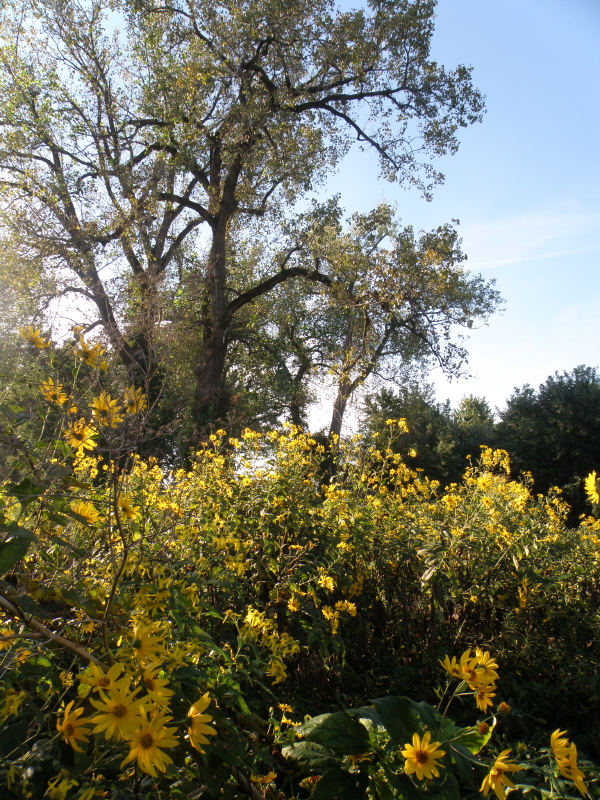
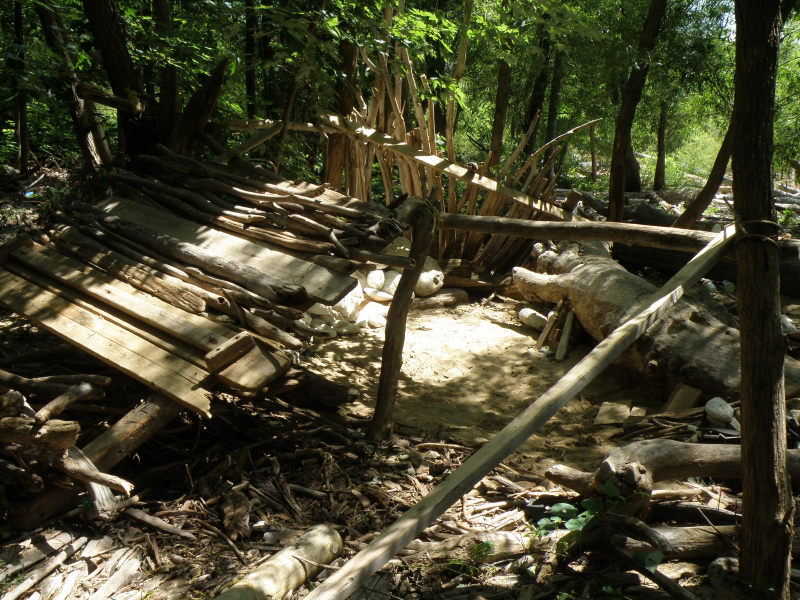
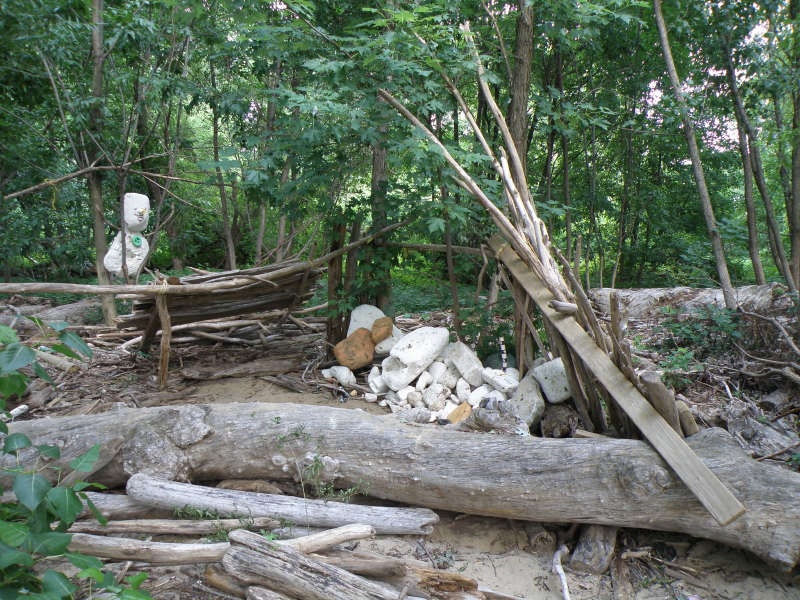
Moving past the Woodland Trail Loop, I’m in the western section of the Falls of the Ohio State Park.  It’s been more than a month since I last visited this area.  One of my favorite trees is here and although I’ve already missed the prime leaf color moment…I’m hoping some autumn splendor remains.  Along my walk I come across a driftwood structure that has been stacked teepee-style by other park visitors.  I see this kind of expression regularly and there must be a kinship between this activity and piling and stacking rock upon rock.  It’s satisfying to do and when you step back from your work…it’s obvious you left an impermanent mark in the landscape that says you were there.  The tree I seek is just a short walk away and in no time at all I arrive on the scene.

Cottonwood tree, late autumn, Nov. 2013

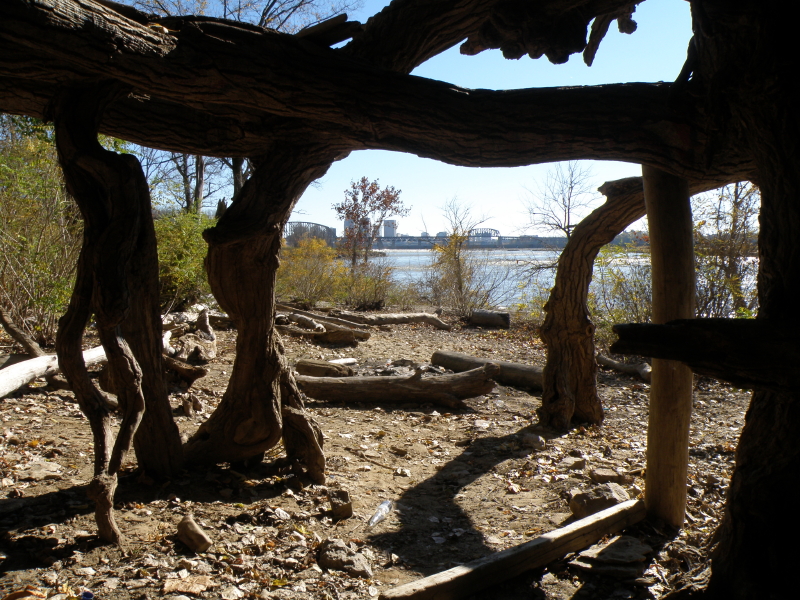
Under the Cottonwood tree, Nov. 2013

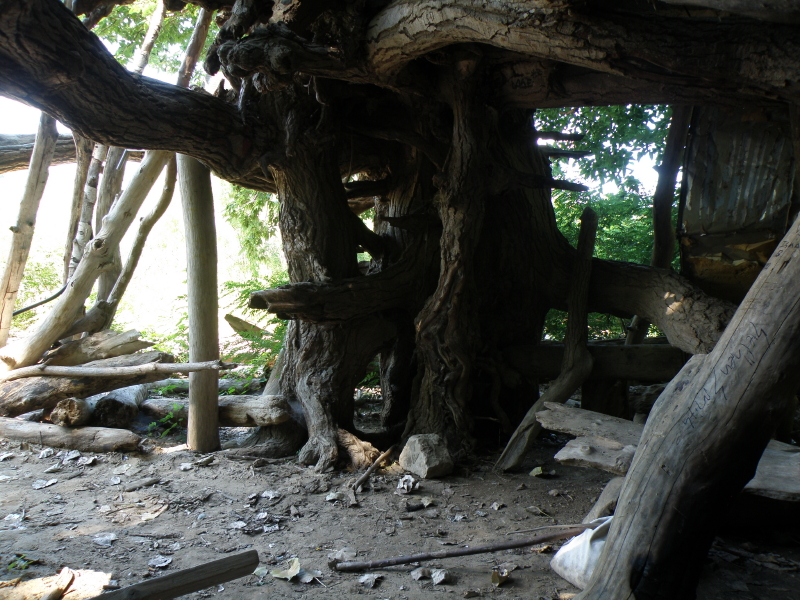
This old Cottonwood tree with its raised roots looms large in my imagination and is my personal favorite tree out here.  I’m sure I’m not the only one who feels this way because there is usually plenty of evidence laying around in the form of empty beer bottles, spent camp fires, and yes…the odd bits of furniture people drag to furnish the room that exists underneath the tree.  I’ll wager for some…this is known as the party tree.  I was elated to see that most of the junk (old tarps and a red couch) have been removed by some other purists.  The Cottonwood tree had already dropped most of its leaves, but there were still a few hanging on.  After resting a moment under the tree and admiring the distant view of Louisville across the Ohio River…I decide to turn for home.  I was in the process of walking away when I noticed something moving along the fossil rocks.  I froze to see if I could get a better look at the creature that was walking towards me.  Naturally, my camera is at the ready!
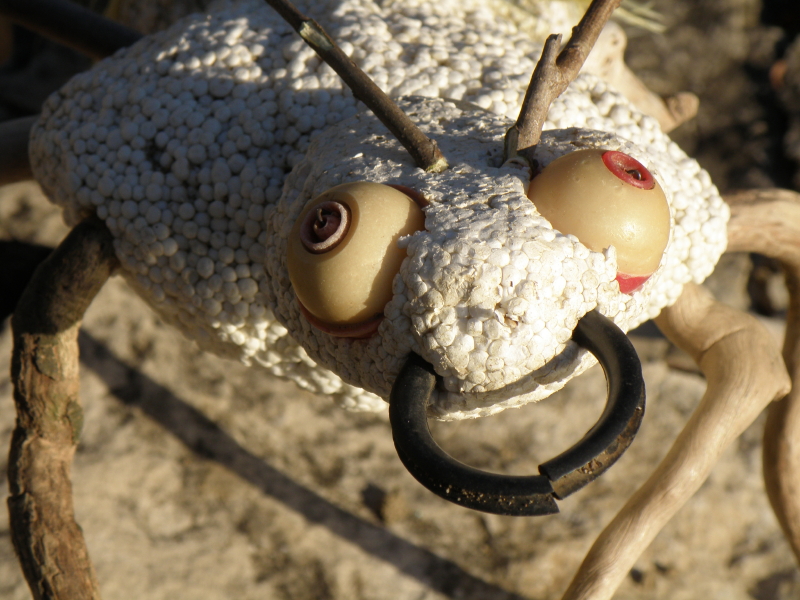
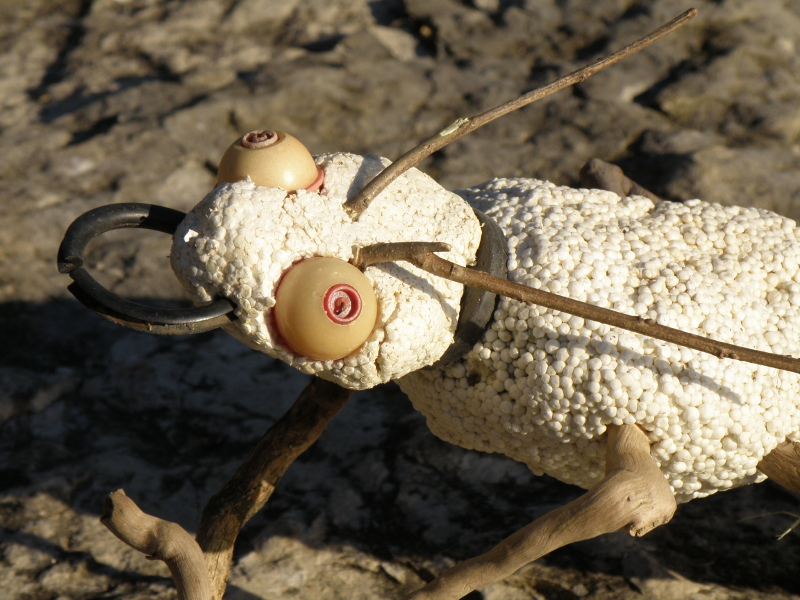
Golden Hour Ground Beetle, detail of head, Nov. 2013

detail of head from Golden Hour Ground Beetle, Falls of the Ohio, Nov. 2013

Regular visitors to the Riverblog know that the Falls of the Ohio State Park is home to several out-sized insect species that have uniquely evolved here.  All the different species are critically endangered and not to be harmed in any way.  I was quick to identify this as the Golden Hour Ground Beetle.  It was so named because it usually makes it first appearance of the day when the sun is about to set.  Otherwise, it is nocturnal in its habits.
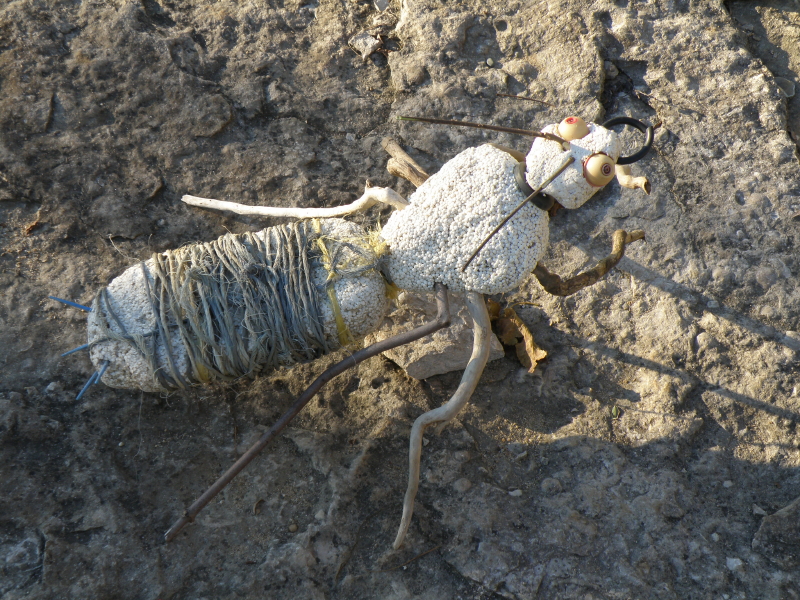
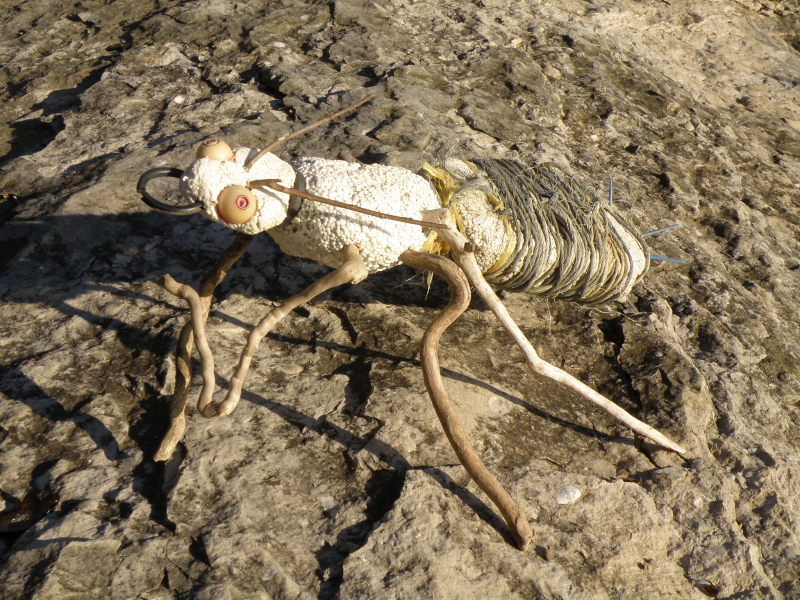
Golden Hour Ground Beetle, Falls of the Ohio, Nov. 2013

Golden Hour Ground Beetle, Falls of the Ohio, Nov. 2013

The Golden Hour Ground Beetle does not fly.  It relies upon stealth and six strong legs to scramble across any surface.  In form, it is not unlike the much smaller tiger beetles that also make the park their home.  Unlike the smaller beetles, the Golden Hour Ground Beetle is a scavenger and not a hunter.  I suspect this specimen was at the Cottonwood tree because it has learned to find scraps of discarded camping food here.  This beetle has fairly large eyes that can gather the most meager light in the darkest of settings.  It’s abdomen is banded with a coarse hair that insulates this insect during cold nights.  As long as I didn’t make any rash movements, this giant bug was tolerating my presence.
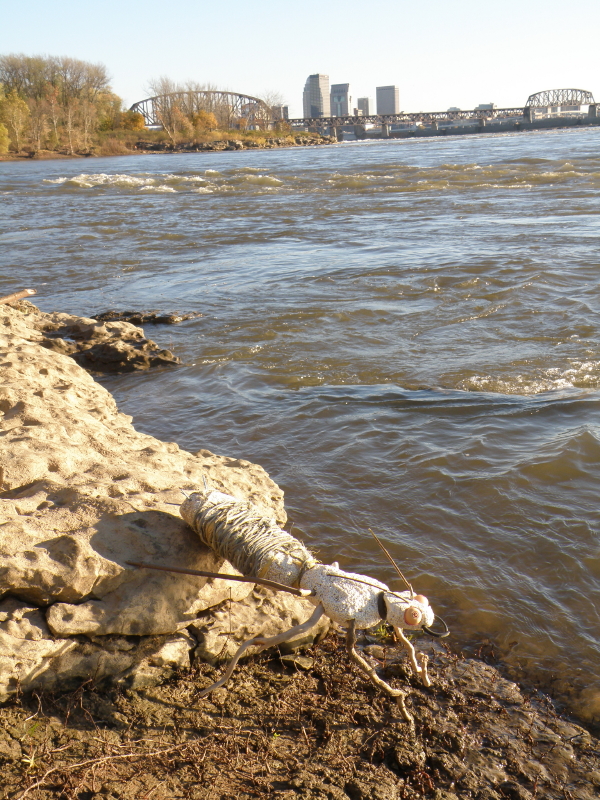
Golden Hour Ground Beetle drinking water?, Nov. 2013

I observed my new “friend” moving to the water’s edge to obtain a drink.  I wondered if it had the ability to swim in its survival tool kit?  I watched the insect as it searched all around the fossil rock shelves that were created by the river dissolving the old limestone away.

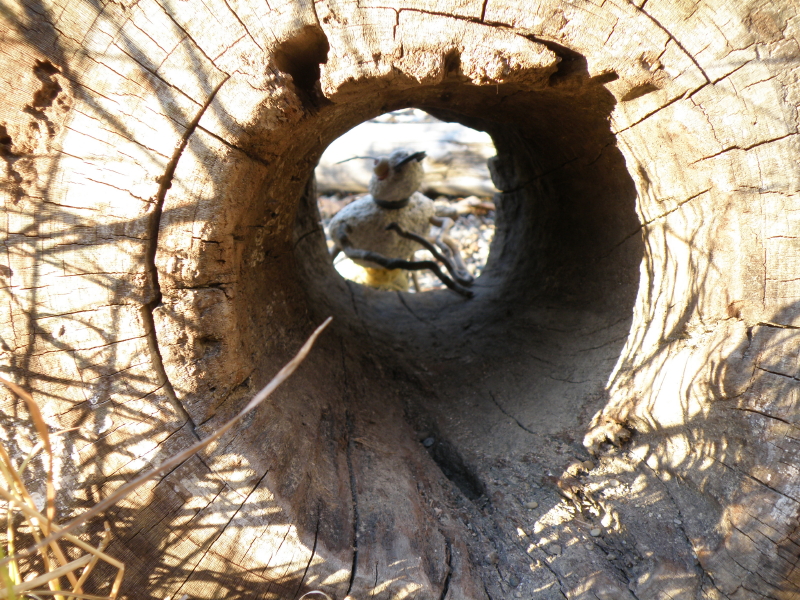
Golden Hour Ground Beetle exploring a hollow log, Nov. 2013

View of the beetle through the hollow log, Nov. 2013

I came across a second giant beetle almost immediately after crossing the small creek that separates the western and eastern sections of the park.  Male and females are virtually identical.  There are gaps in our knowledge about their life cycle.  This specimen was in the process of checking out a short, hollow log.  I’m presuming that it was either seeking food or shelter?  I think poking my camera through the end of the log spooked this one a little.  It ran away, but didn’t go far.  I kept my movements to a minimum and after a while it seemed to relax again.
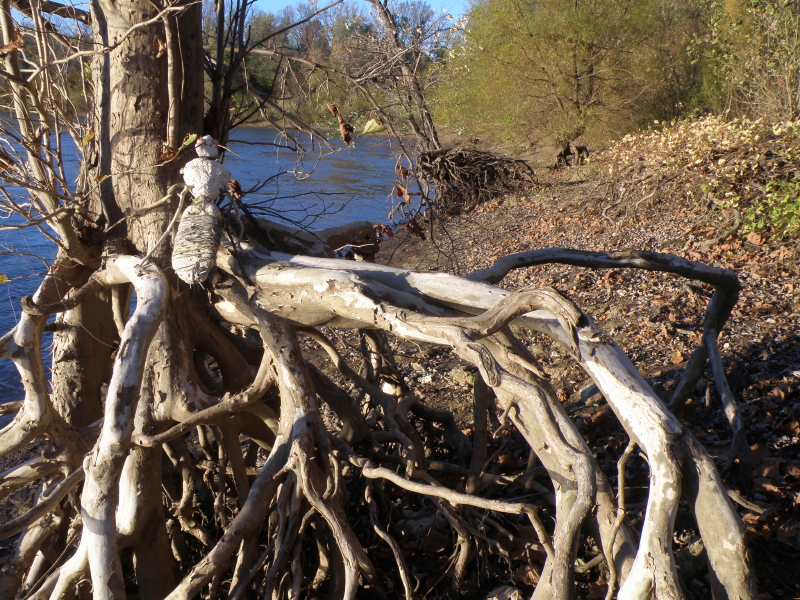
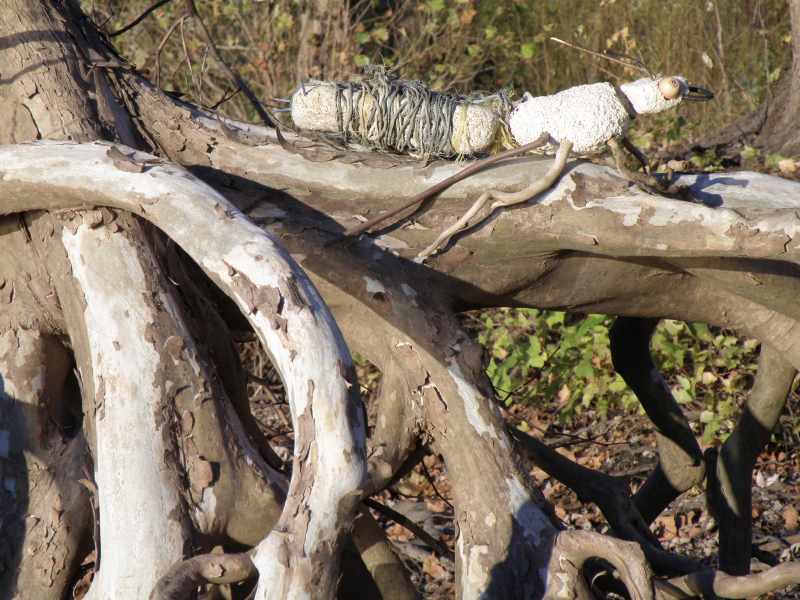
Golden Hour Ground Beetle relaxing on Sycamore tree roots, Nov. 2013

Beetle laying flat on a sycamore root, Nov. 2013

I observed this 14 inch or 35.5 centimeter beetle relaxing on the exposed roots of a Sycamore tree.  As the golden hour approached, the beetle stopped seemingly acknowledging this magic moment when everything is bathed in a warm golden light.  I did the same watching the sun set before finding my vehicle in the parking lot of the Interpretive Center.  To everybody in the wider world…have a great week.

The Golden Hour at the Falls of the Ohio State Park, Nov. 2013

Read Full Post »

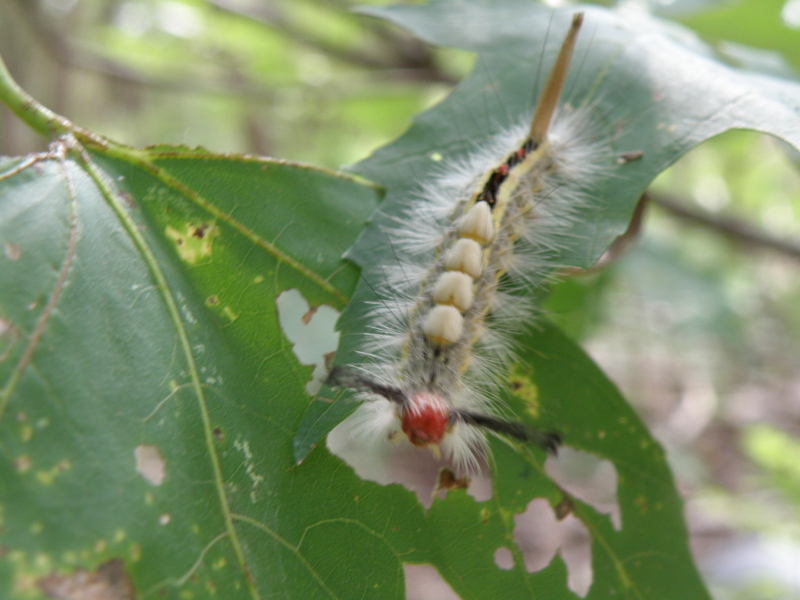
Tussock moth caterpillar, Oct. 2013   Red-faced and bizarrely hairy, the unique caterpillar of the Tussock moth was munching its way through a maple leaf.  Everything about its appearance says I’m not tasty and leave me alone.  It’s now October and it won’t be much longer before the first frost and freezes arrive and with it the colder temperatures which will quiet insect life at the Falls of the Ohio until next year.  The caterpillar inspired me to post a few other entomological images taken in the park.  I confess that I have always liked insects as examples of how diverse life can be.  I’m amazed at the incredible variety and forms that our six-legged friends can assume. Here’s another really weird caterpillar that I found at the Falls that I just haven’t been able to identify through any of my field guides.  Does anybody out there in blog land recognize this?

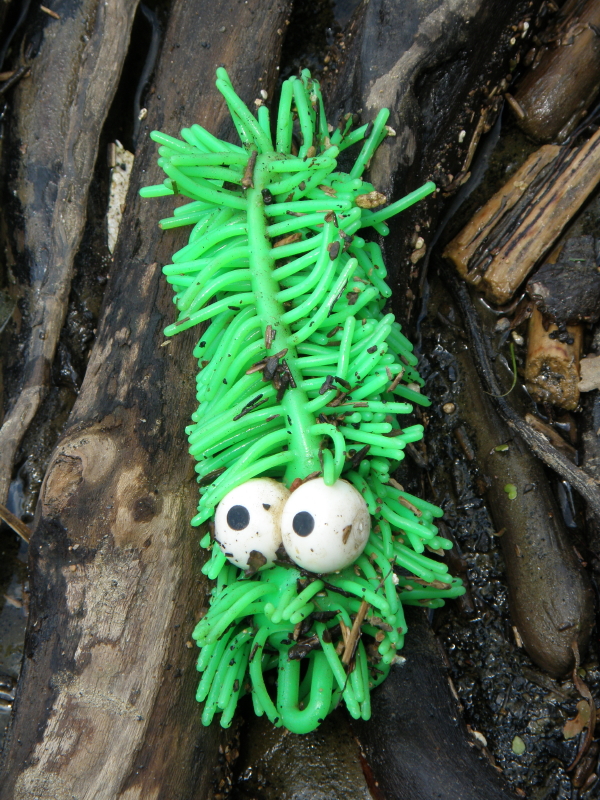
strange caterpillar from the Falls, late June 2013

This fluorescent green caterpillar has dramatic eye spots on its posterior that would incite a predator to strike there first.  Its anterior is located on the opposite end and I would have fallen for this trick too, but noticed that it was walking backwards.  I wondered once it completed its metamorphosis…would the adult be a moth or butterfly?  Maybe some day I will stumble upon and collect a large cocoon I don’t recognize and I’ll take it home and watch a miracle as it emerges from its silken home.

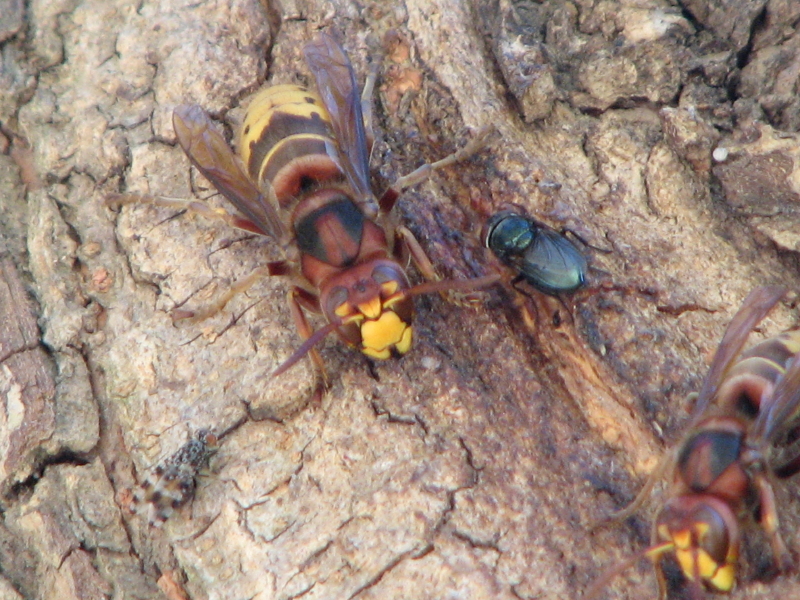
hornets and flies on willow bark, 9/2010

During this time of year, certain willow trees at the Falls are exuding sap which draws a variety of insect life including various flies, hornets, and butterflies to these sweet “licks”.  Whether the flowing sap is due to disease or injury is unknown to me? The large bullet-like hornets are so preoccupied with sipping the sap that they ignore me.  To test this, I’ve carefully touched them with my finger while they were feeding and they remained docile.  I was walking through the tall grass when I noticed a large flying insect land on the bush next to me.  Despite its wonderful camouflage I was able to locate our next insect after a short search.

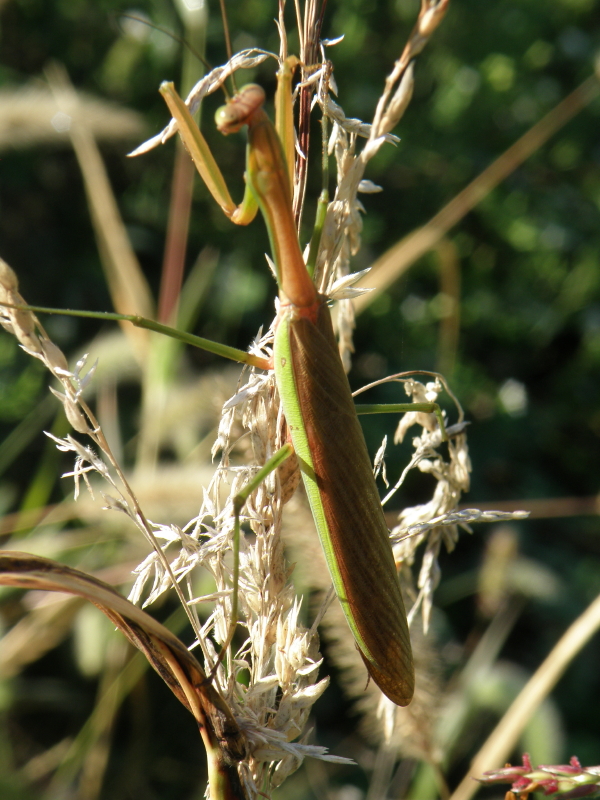
Chinese Mantid, Falls of the Ohio, late Sept. 2013

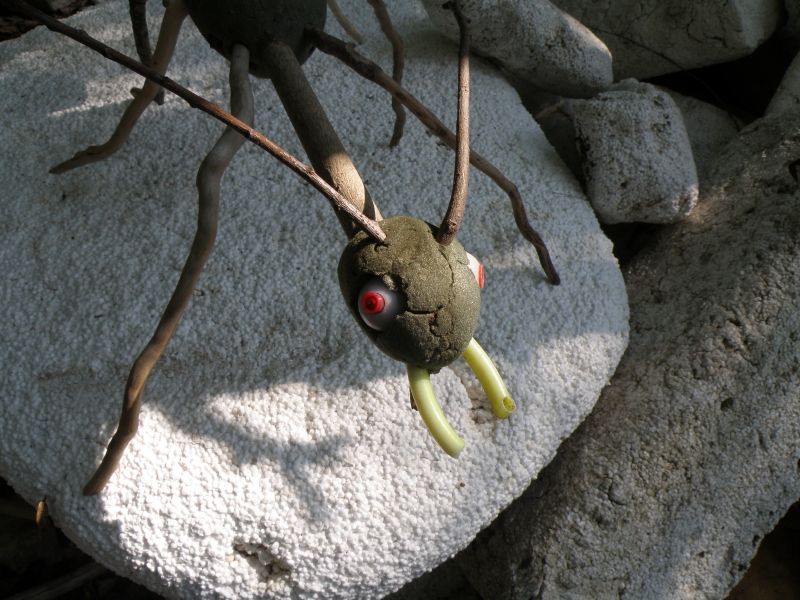
This is the Chinese Mantid which I read was introduced into this country in 1896.  It is the largest praying mantis you are likely to come across in the United States and this specimen was about four inches or ten centimeters long.  I’ve seen them grow larger, but not in this park.  In fact, this is only the second mantid I’ve seen out here.  There are several native species, but they are smaller and more obscure.   And now, it’s time to reveal my most spectacular discovery which is a near but harmless relative of the praying mantis.  Here is a picture of its head.

detail, head of the Falls Phasmid Stick Insect, October 2013

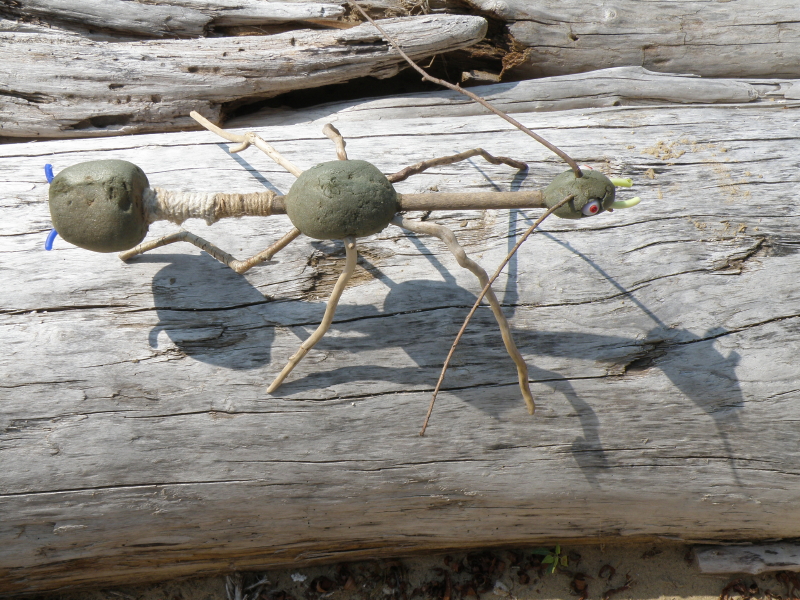
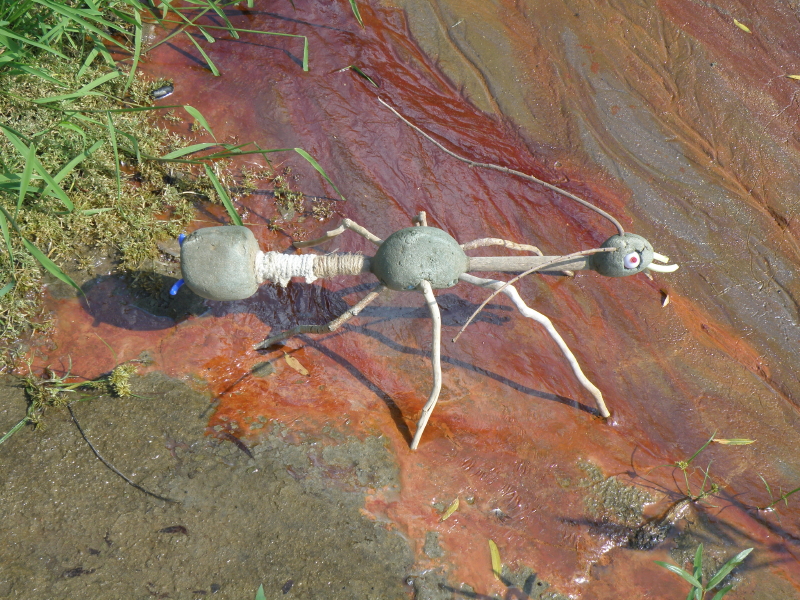
And now, for the rest of its body which is about two feet long or roughly sixty centimeters.  I came upon this unique life form casually walking across the driftwood on its way to somewhere else.

full view of Falls Phasmid, Falls of the Ohio, Oct. 2013

Although as insects go this is a giant…it is also an extremely fragile creature.  It is a member of the walking stick family.  It relies on slow movements and its cryptic forms to merge with its surroundings.  The Falls Phasmid is strictly a vegetarian and eats the foliage from a variety of different trees.

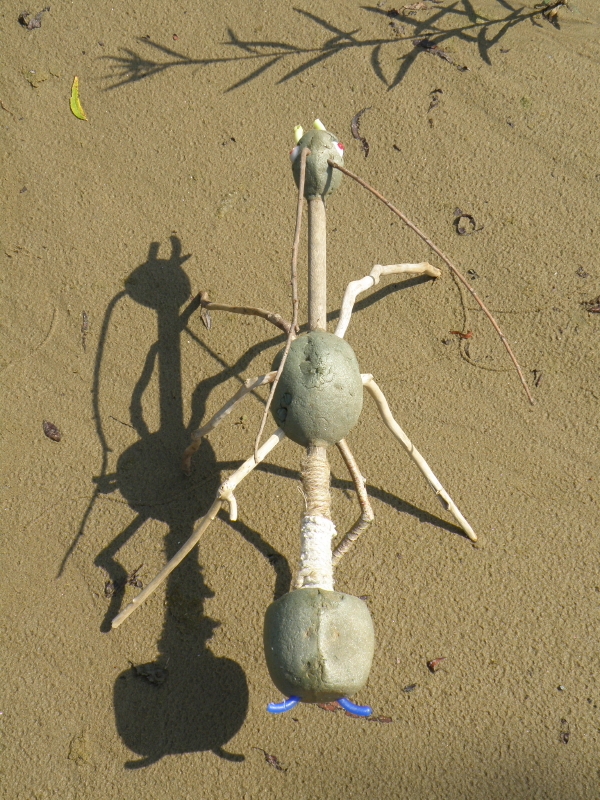
aerial view of Falls Phasmid, Oct. 2013

I came across this specimen in broad daylight.  I had always heard that they were nocturnal and chose to restrict their movements during the day to avoid detection.  Walking stick insects are among the largest insects we have.  This species is additionally strange in that its head, thorax, and abdomen are so clearly differentiated.  Some scientists have gone so far as to suggest a bit of mimicry at work here.  On the surface it does seem to possess a superficial resemblance to a giant ant which might be enough to dissuade predators from attacking it.

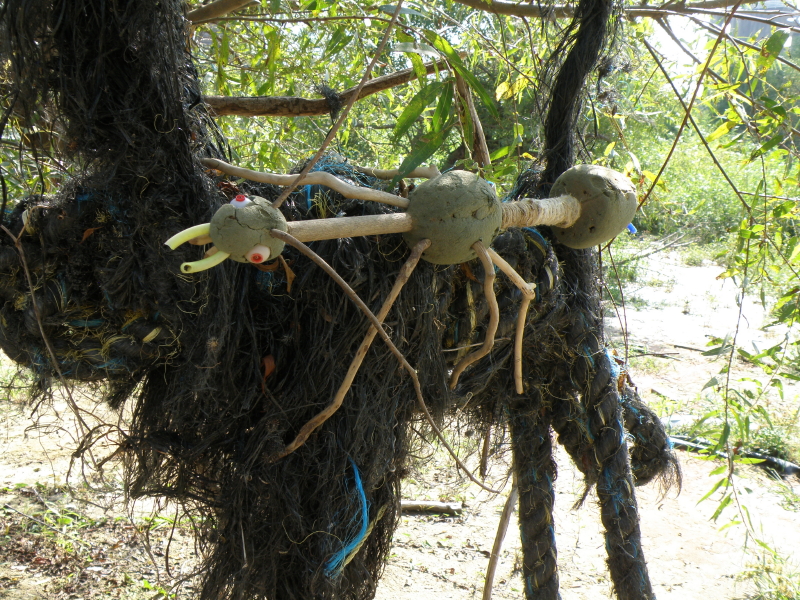
Falls Phasmid hanging in a tree, Oct. 2013

I did observe this particular Phasmid making return trips to a particular willow tree where it clung to a nest-like structure that was hanging down from a branch.  The meaning of this structure was not immediately apparent.  Perhaps the Falls Phasmid uses this form to help it overwinter?  Keeping a respectful distance away, I did see the stick insect walking slowly over the riverbank, but I couldn’t tell if it was searching for something in particular and I did not witness it feeding.

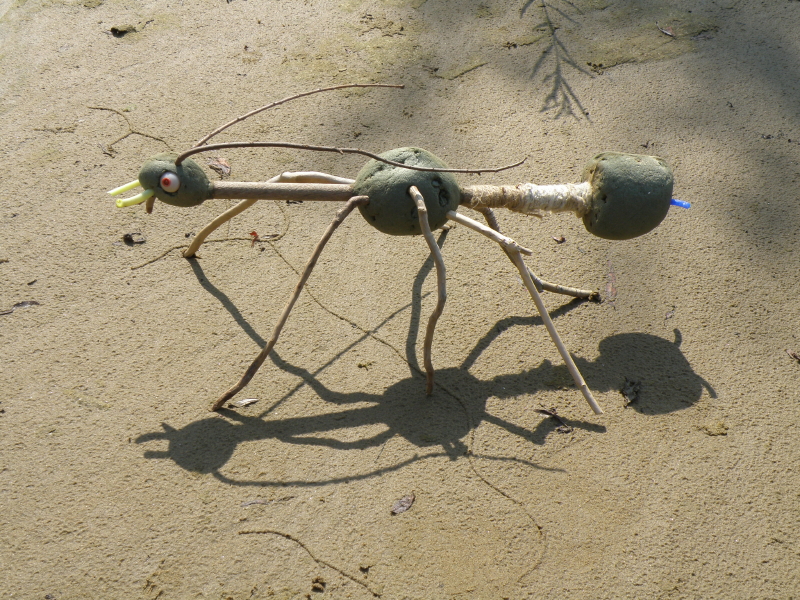
Falls Phasmid Stick Insect, Oct. 2013, facing left

Falls Phasmid in the wetlands area, Oct. 2013

Originally, the Falls Phasmid may have had the ability to fly.  Other walking stick insects from around the world have vestigial wings that suggest a different past.  Our specimen lacks even the most superficial suggestion of wings which hints at an ancient lineage.  Perhaps all stick insects evolved here first and spread around the world much later?

Falls of the Ohio Phasmid Stick Insect, October 2013

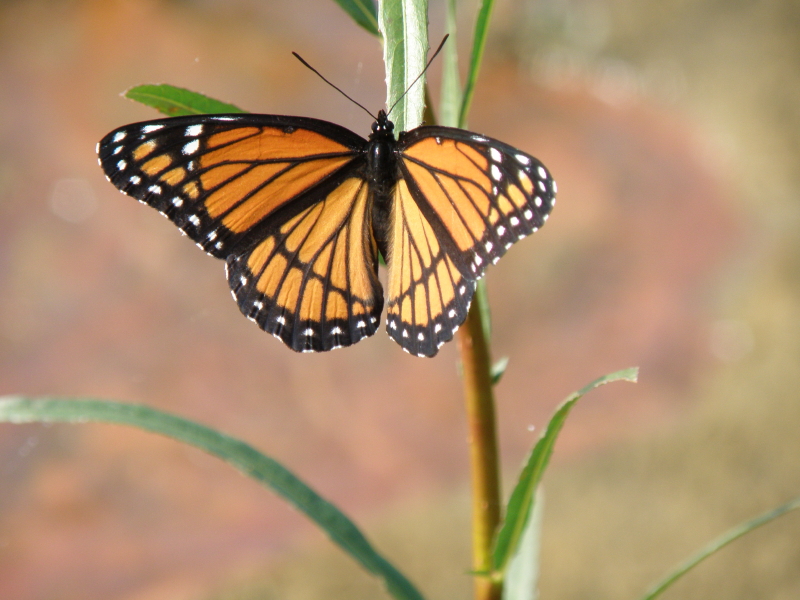
I watched the Falls Phasmid for a while and took a bunch of photographs of it before leaving the park.  I’m curious about that tree that it likes to hang out on and so will check it the next time I’m here.  On my way out of the park, I also came around this wonderful Viceroy butterfly and thought that this would make a fitting image to end this post.  When I think of the butterflies that inhabit the park…this is the species that comes to mind first for me.

Viceroy butterfly, Falls of the Ohio, October 2013

Read Full Post »

Landscape at the Falls of the Ohio, Sept. 2013

This post is the last of this year’s summer posts and documents a walk I made at the Falls of the Ohio State Park one week before autumn officially began.  As you can see by the pictures…it was a very beautiful day filled with all kinds of discoveries.  There was a profusion of yellow-flowering plants of various species including goldenrod and sunflowers.  Here is a detail, I think from the Woodland Sunflower?  I wish I was as confident about plants as I am in identifying animals.  When I break out my flower books, I realize it would aid identification greatly to have an example on hand.  Collecting plants is not allowed within the park limits…so I try to take photos that might be of use in discerning the various closely related species.  Besides, I don’t think pressing these plants flat would even work?  I ask myself, what leaf shape does it have?  Are the leaves serrated, smooth, or hairy and how many rays do the flower heads have and other such questions of concern to the botanist.

Sunflowers at the Falls, Sept. 2013

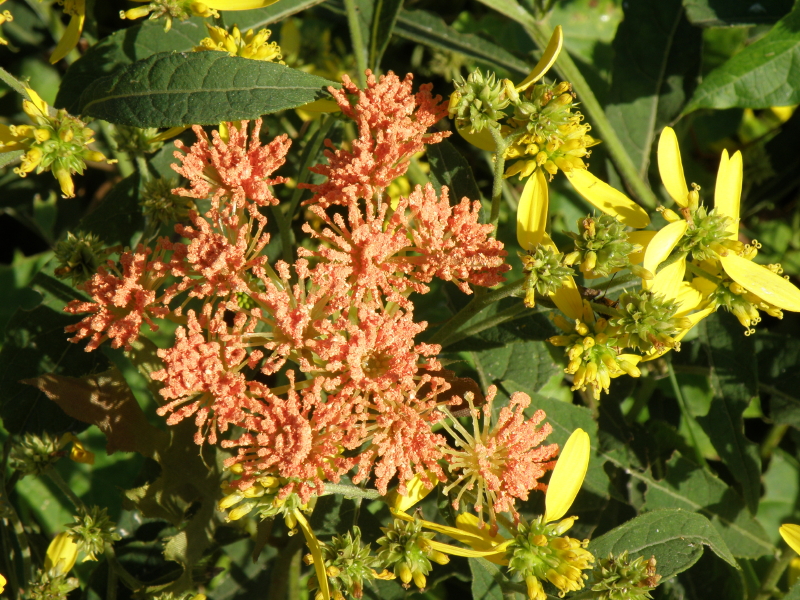
I suppose I’m more of an imaginative botanist at heart who also appreciates the beauty and variety the many flowers add to the temporal landscape.  I do, however, stumble upon plants that I wonder if anyone else is noticing?  I’ve posted about these anomalies before and as the seasons change, the parade of these “unnatural plants” and “faux flowers” continues.  Consider these fresh blooms.

The Surprising Poinsettia, Falls of the Ohio, Sept. 2013

I call this one the “Surprising Poinsettia” because it comes shockingly red and completely unexpected.  Its sepals are rather fabric-like and its stem is grafted upon this sunflower by some unknown means.  The next plant is more subtle.

Orangey-tickseed, Sept. 2013

This is “Orangey-tickseed” and at first blush, one might be tempted to pass over it.  I had to do a double-take on this one, however, my instincts told me something was not quite right here.  Indeed the orange-colored flowers are not at all like the yellow plant it is cohabiting with.  Again, the texture is very much like plastic.  One final plant before moving on to other interesting discoveries.

Pink Sand Lily, Falls of the Ohio, Sept. 2013

I found this beautiful flower growing near the river in the sand and I have designated it the “Pink Sand Lily” because I’m not sure what else to call it?  It is for the most part, a low growing plant and the “flower” appears at the terminal end of a wiry green stalk about four inches tall or so.  The flower petals are composed of a string-like fiber while the stamens are hard and have pseudo-pollen on them.  These unusual plants were not my only discoveries on this fine day.  I nearly always find some doll or doll part that the river has washed into here and today was no exception.  I spotted a form in the wood chips and bark bits and went in for a closer look.  Dusting off the form revealed this doll body.

"rubberized" foam doll body, Sept. 2013

This was quite unlike any other doll “body” I’ve found before at the river.  The material was obviously made from a foam-like material, but it had the flexibility of rubber.  Nearby, I also discovered  an unusual serpent.

red, plush toy snake, Sept. 2013

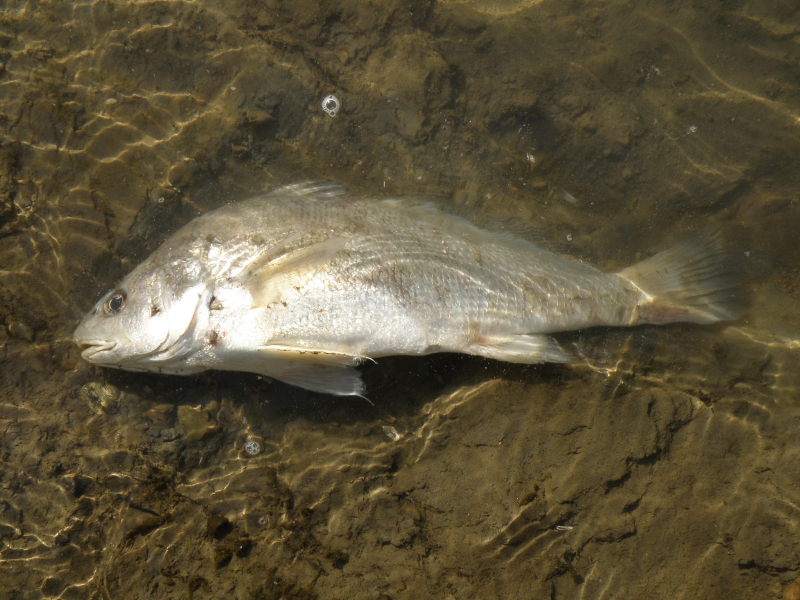
Approximately a foot long, this red plush snake had large black eyes and had just a bit of its tongue sticking out.  This is the first of one of these objects that I have come across .  The river was flowing nearby and I walked over to the edge of the riverbank.  The water level has finally leveled off to more of its seasonal pool and the fossil banks on the Kentucky side were exposed for the first time this year.  Looking along the water’s edge, I came across this Freshwater Drum that an angler caught and released.  Unfortunately, for the fish…it did not survive being captured.  Here is its final portrait.

Freshwater Drum, Falls of the Ohio, Sept. 2013

The Freshwater Drum (Aplodinotus grunniens) is a widespread fish and common in the Ohio River.  It has several molar-like teeth in its mouth that it uses to crush and eat snails and small clams.  The drum is not considered a desirable food species around here.  Here’s another fish I found on this walk that is also inedible.

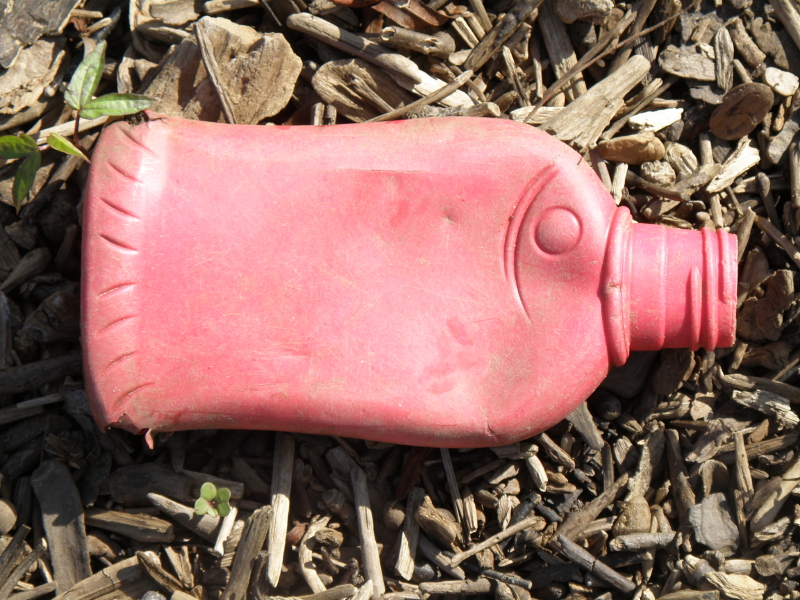
red plastic fish bottle, Falls of the Ohio, Sept. 2013

The second “fish” I came across was this plastic bottle.  I’m guessing that the bottle may have contained shampoo for children?  Regardless, I was struck by the level of abstraction occurring here.  The tail is minimally represented and the gills are indicated by two lines near the eyes, but there is enough here to suggest a fish.  My next find is mid way between the drum and the plastic bottle being closer to the latter than the former.  Here are two views of it.

The Silvergill, Falls of the Ohio, Sept. 2013

Silvergill, Sept. 2013, Falls of the Ohio

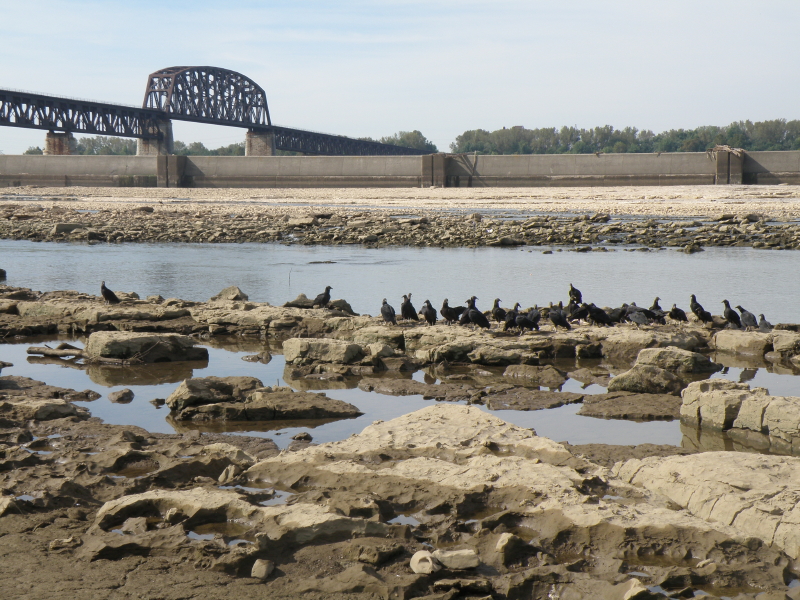
This is a Silvergill which is closely related to the Iron Gill (which I have posted about previously).  Differences between the two species include size (this fish is smaller) and some of the fins are not the same shape or in the same position.  The Silvergill is much more rarely encountered than its larger cousin.  It is found in water of average to poor quality and often associated with coal and coal dust. It is omnivorous and eats aquatic insect larvae and algae which it grazes off of rocks.  I’m assuming that it washed up here a victim (like the Freshwater Drum) of an angler looking to catch something more worthwhile.  I took a few photos and then moved on.  The fossil beds were beckoning and I could see the resident flock of Black Vultures congregating on the rocks.  No doubt they had discovered a fish or two on their own.  Until next time from the Falls of the Ohio.

Fossil beds and Black Vultures at the Falls of the Ohio, Sept. 2013

Read Full Post »

Orangeman, Falls of the Ohio, Sept. 2013

The Orangeman was really excited to see me and asked me breathlessly, “Where have you been lately?”  I filled him in about my busy life and work and then turned the table by asking my friend what all the hubbub was about?  He knows that if I could I would spend most of my time down by the river and probably go completely native and become a river rat in the process.  He also knows that if there is something not to be missed down by the Falls of the Ohio…that I would do my best not to miss it!  The Orangeman explained that he had several things he wanted to show me beginning with a monumental discovery he came across in a discarded plastic five gallon bucket.  This would be Exhibit A.

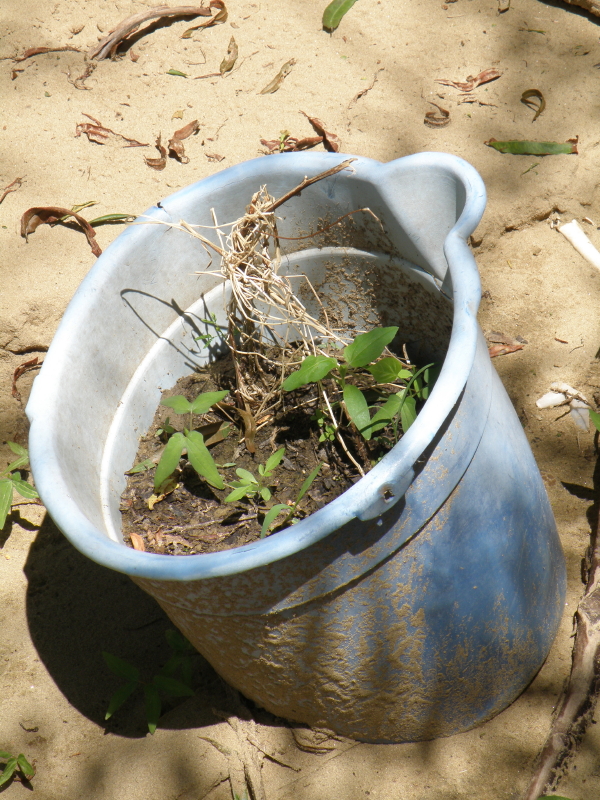
plants growing in a found bucket, Falls of the Ohio, Sept. 2013

The slightly sun-faded blue bucket or pail was sitting on an angle in the sand…just as the river had left it.  River mud and dirt more than filled the bucket up passed the midway point.  Orangeman walked me over to the bucket and said “Peek inside and tell me what you see.”  I did as he asked and more than a little perplexed I replied…”Well, I see a few small plants and vines growing in the dirt.”  Orangeman groaned…”That part is obvious, however, the deeper meaning lies in how resilient life is and even within the confines of a plastic bucket…life wants to grow and express itself.”  I had to admit that the Orangeman was making an interesting point here.  At home, I keep flowers and plants in flower pots and other containers made for the purpose and get pleasure from seeing them thrive and be beautiful.  What I hadn’t considered was the idea that any container also acts as a barrier.  Life wants to join with life and be a part of the interconnected whole.  The roots of these bucket plants were only going to be able to spread so far.  Still, as the Orangeman explained…”The will to live and grow is strong even if there are limitations present.  There was more to see and the Orangeman walked me over to Exhibit B.

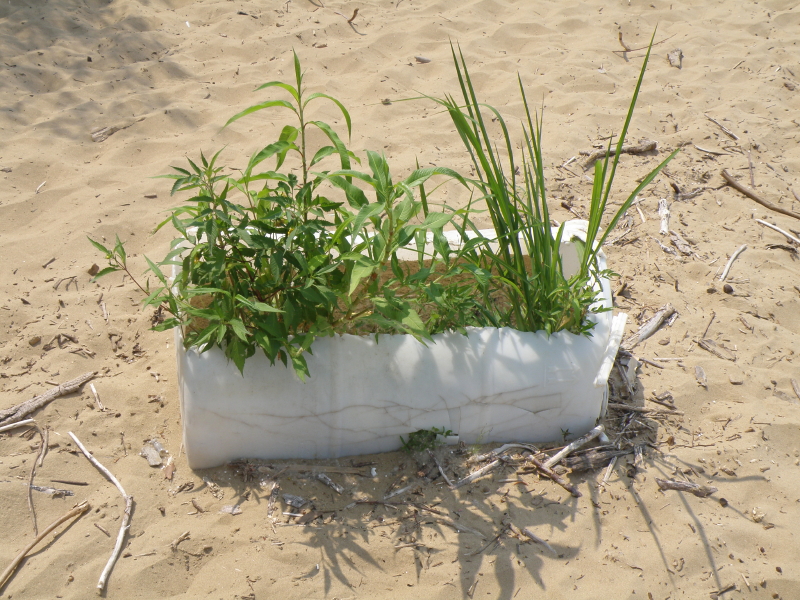
plant life growing in a shattered plastic drum, Falls of the Ohio, Sept. 2013

I must admit that I was impressed by the second example that my friend the Orangeman showed me.  In a shattered plastic drum, various grasses and so-called weeds were sprouting through a large hole in the top of the container.  Years ago, dirt and sand filled the barrel through the actions of river water and wind rendering it too heavy to pick up and move.  Different plant seeds found their way into the barrel and discovering this small niche…set out to colonize and thrive as best they could.  Perhaps these grasses will find enough of what they need to move through their life cycle and produce seed for another generation?  Or perhaps they won’t due to all kinds of other variables, but the point remains that life will take that chance.

Orangeman speaks, Sept. 2013

I hadn’t seen the Orangeman in such a didactic mood before and I was impressed with his earnestness.  Previously, he had struck me as a happy-go-lucky guy and not especially bothered by all the serious stuff in the world.  I certainly was seeing a different side of my friend that I hadn’t seen before.  We walked and talked together and before long reached the last sight he wanted me to see.  We might as well designate this as Exhibit C of the day.

Orangeman and willow/tire tree, late Aug. 2013, Falls of the Ohio

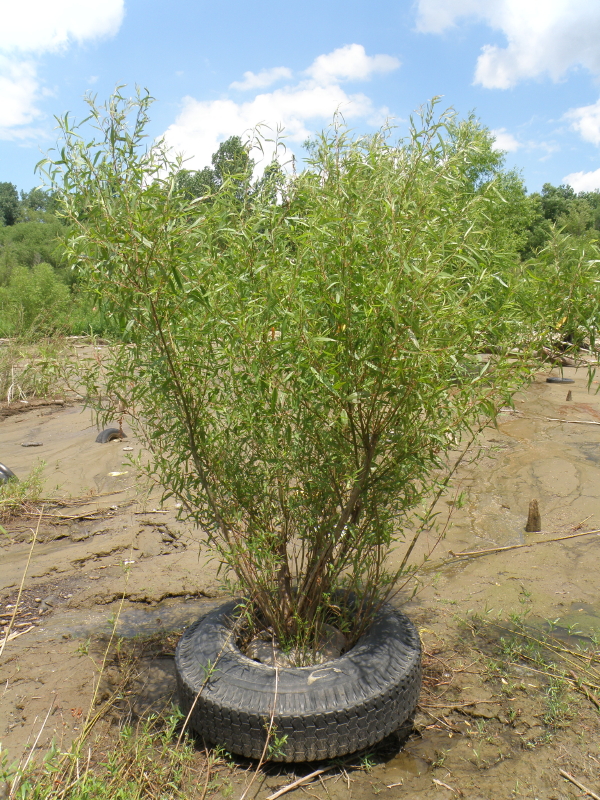
The Orangeman stopped next to an old discarded tire and with a flourish of his arms and hands and said, “Here it is!”  The “it” part was a small willow tree that was growing through the center of the tire.  I didn’t tell my friend this but, I already knew about this particular tree and another one I had discovered very similar to it in the western section of the Falls of the Ohio State Park.  I had even photographed this very tree on several occasions.  This is how it looked in late spring.

willow tree growing through a tire

We had a relatively cool spring and it seemed to my eye that the plants at the Falls got off to a slow start.  The willow-in-the-tire took its time ‘leafing out”, but eventually it did.  Now I must say that a tree growing through the middle of a tire is a remarkable thing, however, there is more to admire about this particular tree.  The Orangeman invited me to make a closer inspection.

willow growing through holes in a metal wheel, Sept. 2013

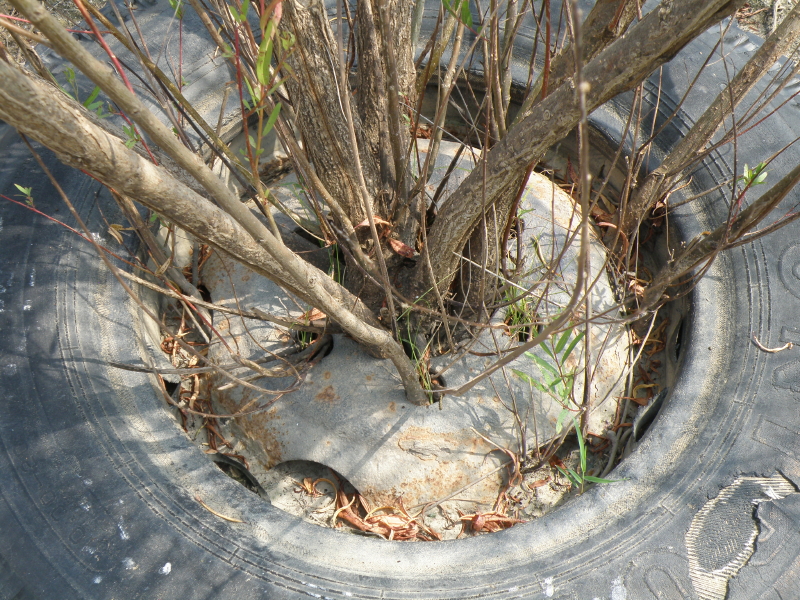
Amazingly, this willow tree was growing through the holes in the metal wheel that were still in the tire!  The tiny, wispy seeds from a willow tree must have passed through one of the holes and taken root in the mud and soil beneath the tire.  Hungry and thirsty for light, the various branches moved through the holes.  I told the Orangeman that this was indeed an amazing example of life making do in very unpromising circumstances.

willow/tire tree, June 2013

I’m going to monitor this tree with the Orangeman’s help because I’m curious to see if it can continue to thrive and grow.  Will it eventually lift the tire into the air like some perverse hula-hoop as the trunk thickens and becomes more pronounced?  Or, will the holes in the metal prove too restrictive and choke the life out these branches?  Or, will something else out of the blue change the situation?  The river usually gets the last word and flooding could easily send a flotilla of battering logs the willow tree’s way.  The Orangeman and I parted company, but not before I thanked him for his time.  Indeed, he had given me much to mull over.  The idea that life is very resilient and will find a way to endure was comforting to me…especially as the physical world continues to change around us.

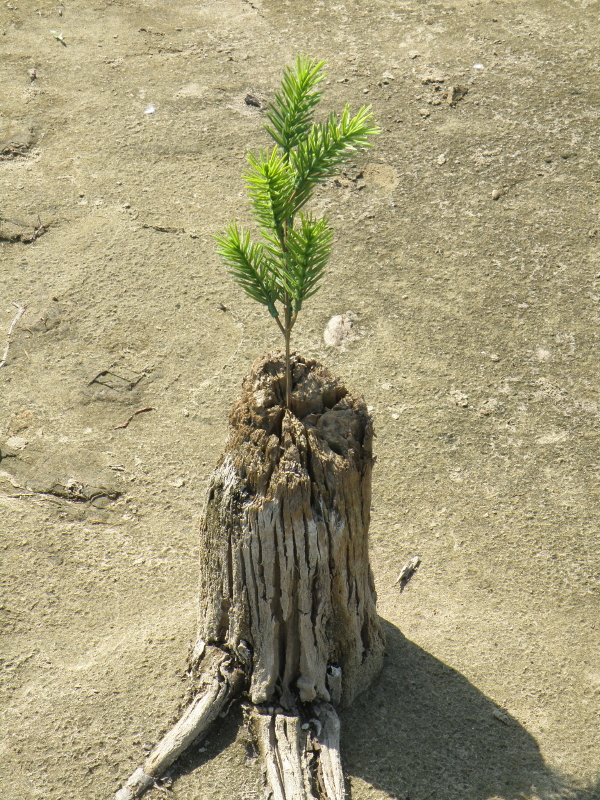
plastic pine growing out of a stump, Sept. 2013

Read Full Post »

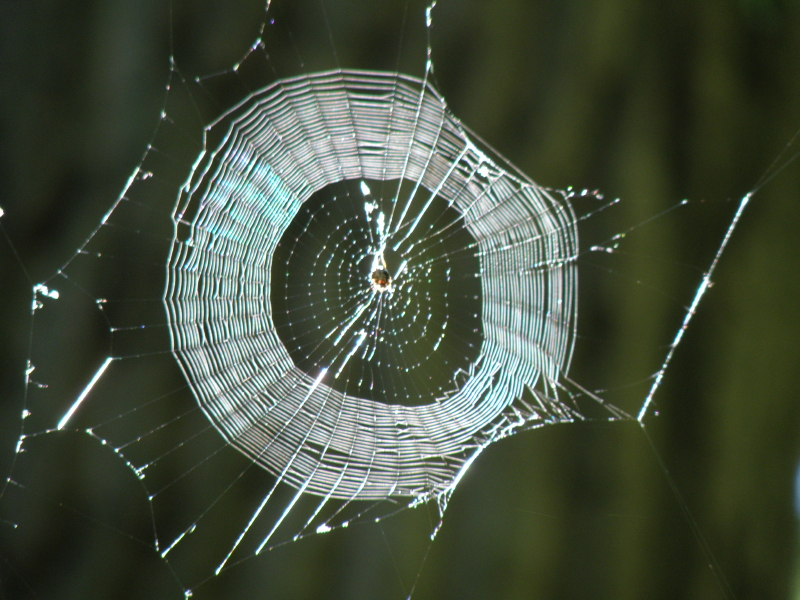
spider's web in the morning light, Falls of the Ohio, Aug. 2013The Falls of the Ohio is a special place in the history of life.  From the ancient marine creatures whose remains are preserved in limestone dating back more than 370 million years a go to the contemporary creatures that inhabit the park today…it is my goal to celebrate life here in all its diversity.  I’m going to use this post to present images of recent finds.  I was exploring the western side of this state park recently and saw this spider’s web high off the ground catching the early morning light.  I’m sure its architect would prefer a buggy meal over the photons it has snared instead!  Looking at this web image, I’m struck by how similar this  looks to the cross-section of a tree.  Can you see that too with the outermost silk rings resembling a tree’s growth rings?  In the Purple Loosestrife stands, butterflies were having a nectar feast and I presented many images of them in a previous post.  Here’s one more to add to that portfolio.  I have seen this butterfly species wind up on the spider’s menu before.

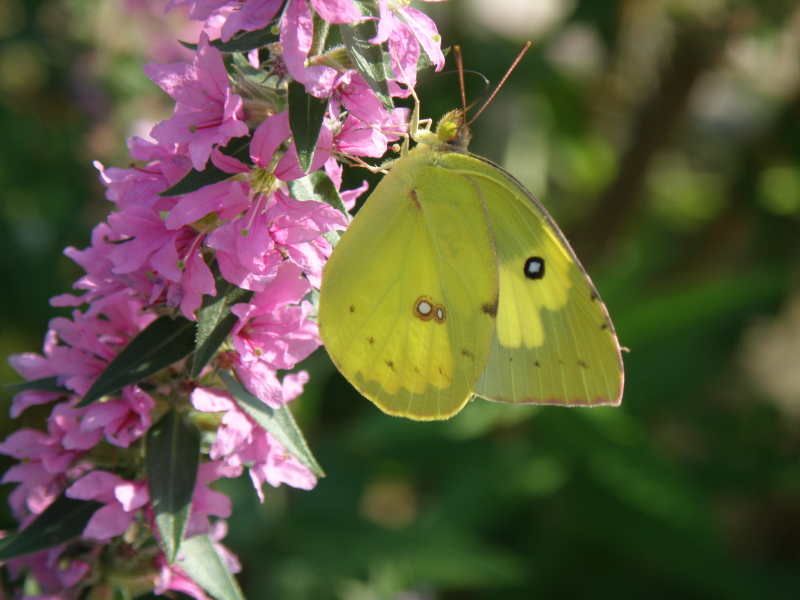
Dog Face Butterfly on Purple Loosestrife, Falls of the Ohio, late Aug. 2013

This is the Dog Face Butterfly (Colias cestonia ).  It is often difficult to photograph this butterfly in the wild with its wings open because this species prefers to feed with its wings held together.  Through the strong light passing through the forewings, you can get the suggestion of a dog’s head in profile.  Imagine the black rimmed spot as the “dog’s eye” with its muzzle pointing down.  When open, the dark interior margins of the wings are a warm black color.  I was exploring the interstitial sandy zone between the river and the willow woods…when I came across this interesting amphibian.

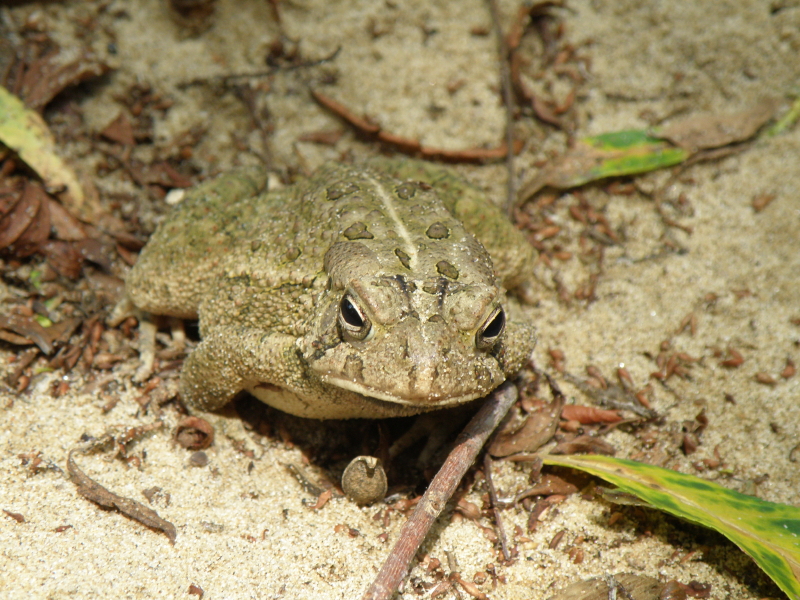
The American Toad at the Falls of the Ohio, August 2013

American Toad, dorsal view, Falls of the Ohio, Aug. 2013

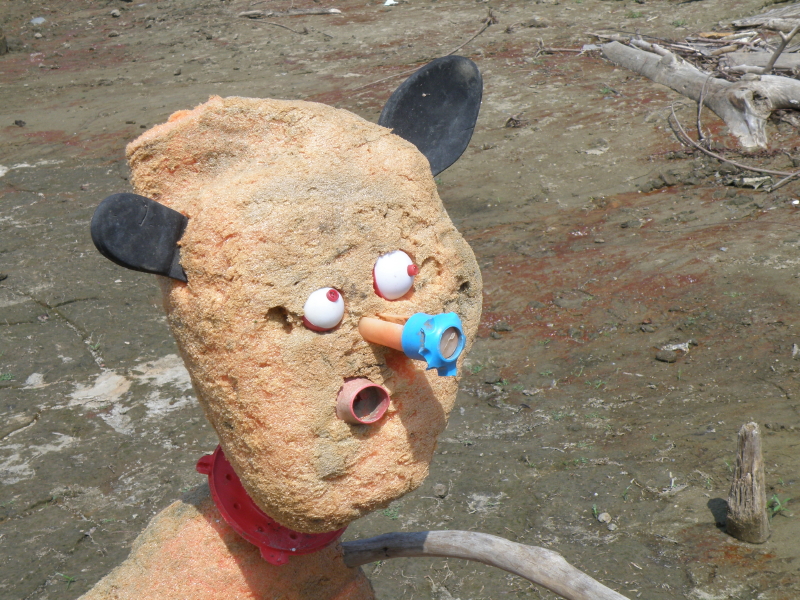
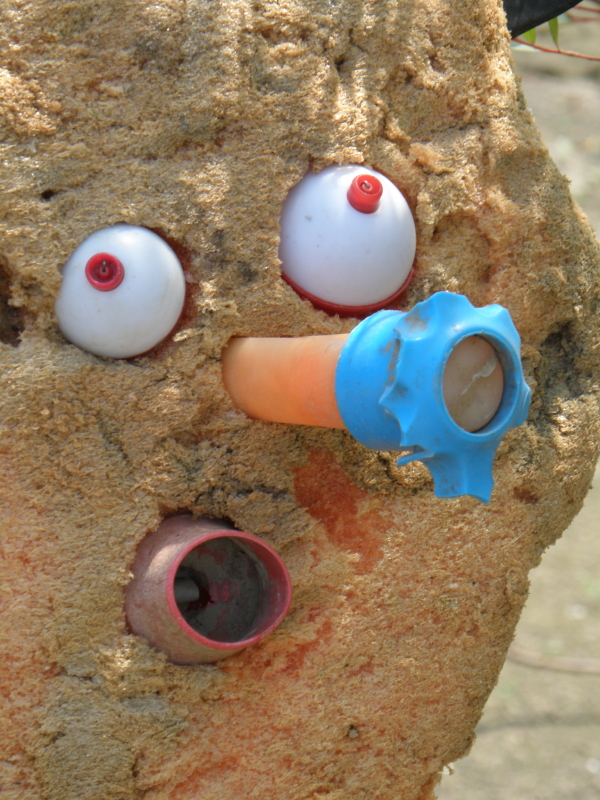
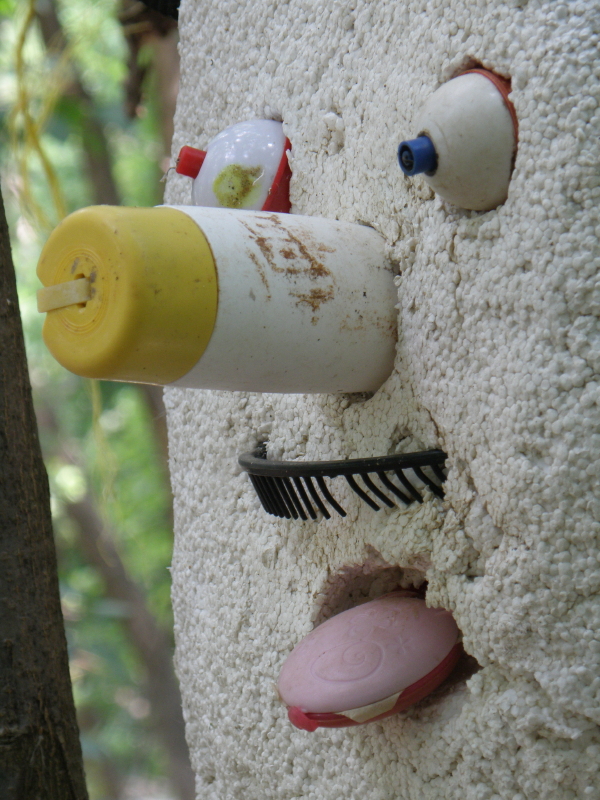
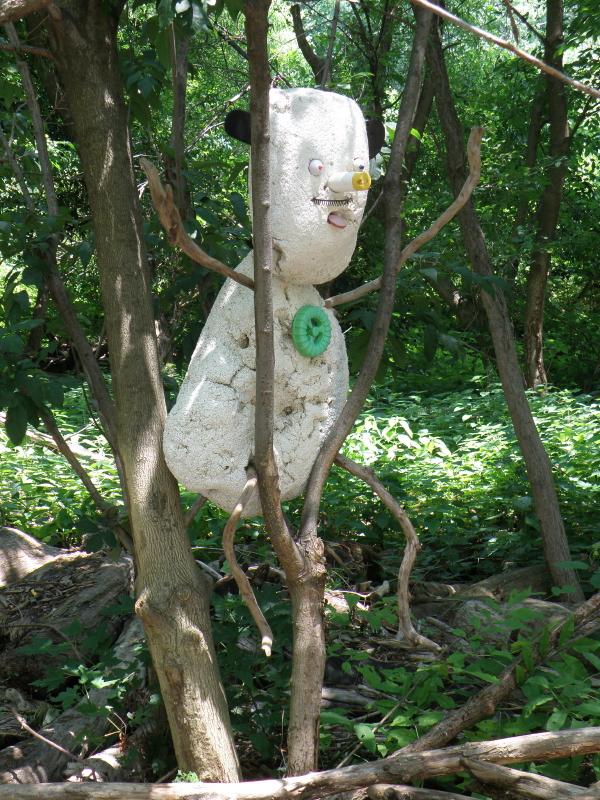
If this American Toad ( Bufo americanus ) had not moved…I doubt I would have seen it.  It’s coloration is wonderfully cryptic easily blending into the sand.  The toad was busy hunting among the debris and driftwood for any insects and invertebrates it could find.  I don’t encounter many amphibians out here…so finding a common toad is a noteworthy event.  Let’s move up the evolutionary ladder a bit.  I was busy working on one of my Styrofoam sculptures at my outdoor studio when I felt I was being watched.  When I lifted my eyes up from my artwork…I found myself looking eye to eye with this critter.

Woodchuck or groundhog at the Falls of the Ohio, Aug. 2013

This is the common Groundhog or Woodchuck ( Marmota monax ).  As its scientific name suggests, this large rodent is a member of the marmot family.  Woodchucks are successfully established at the Falls and I encounter them often.  They are fast diggers and live in an extensive system of burrows.  Woodchucks usually don’t stray too far away from the entrances to their burrows.  Succulent greens are the preferred foods.  This particular woodchuck regarding me is a young individual and may be seeking territory of its own?  Usually, I don’t see them this close to the river.  I did have an interesting recent encounter with a very different animal in the western section of the Falls of the Ohio State Park.  Have you ever heard of an animal called the Camelope, (Antilocapra fallsei )?  It is very rarely seen.  The flora and fauna at the Falls can be roughly divided between forms that are “natural” and “unnatural”.  The spider, butterfly, toad, and woodchuck fit in the natural fauna category, while the Camelope is definitely on the unnatural fauna side of life and may represent evolution at an accelerated pace?  The many stresses to the environment and its myriad ecosystems have required a dramatic response and creatures like the Camelope may be nature’s way of responding to these changes?  I’m not a trained scientist, but that is my educated guess.  Discovering and documenting these recent life forms has become a passion of mine.  Anyway, let’s look at a Camelope.  Let’s start with an image of its head.

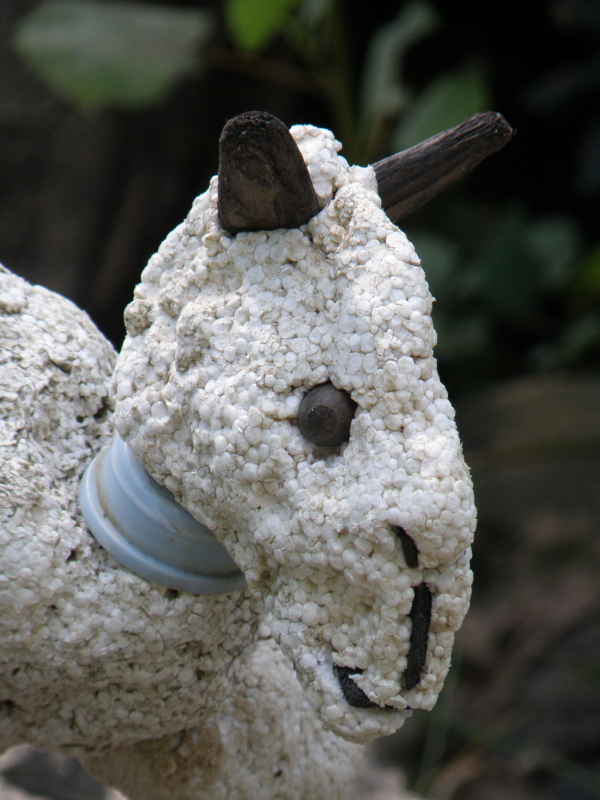
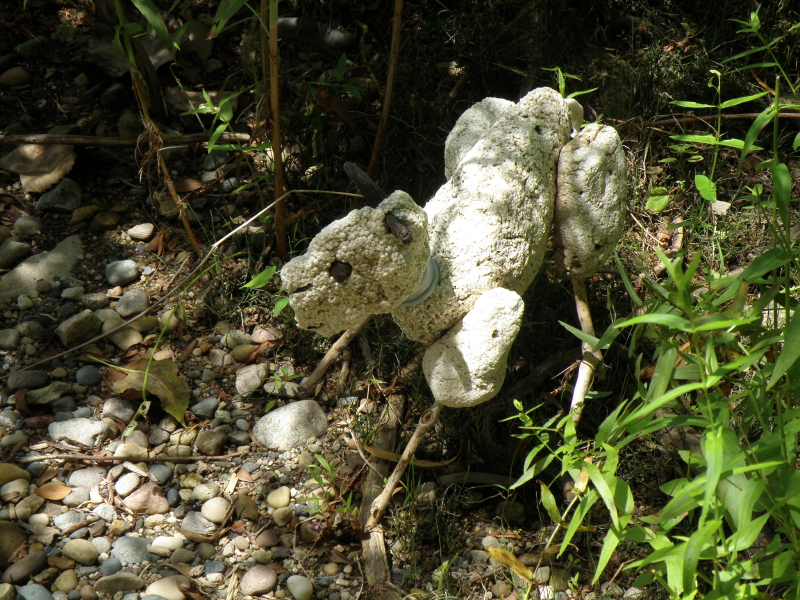
Camelope, detail of head, August 2013

It’s called a Camelope because its head generally resembles that of a camel’s.  This is a browsing animal and accepts a wide range of vegetation growing along the river.  It has dark eyes that are always nervously looking around for potential predators.  This park is also home to Feralocitors that prey upon Camelopes.  This particular species also has an acute sense of smell.

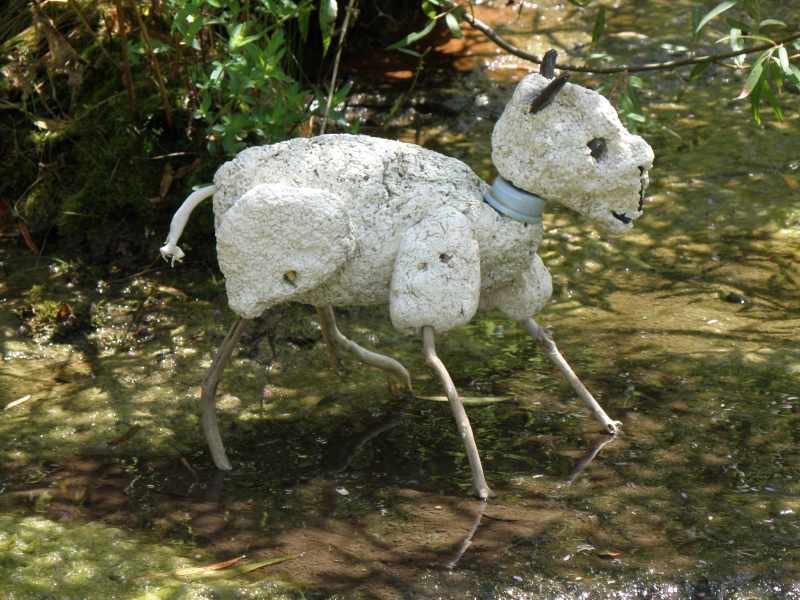
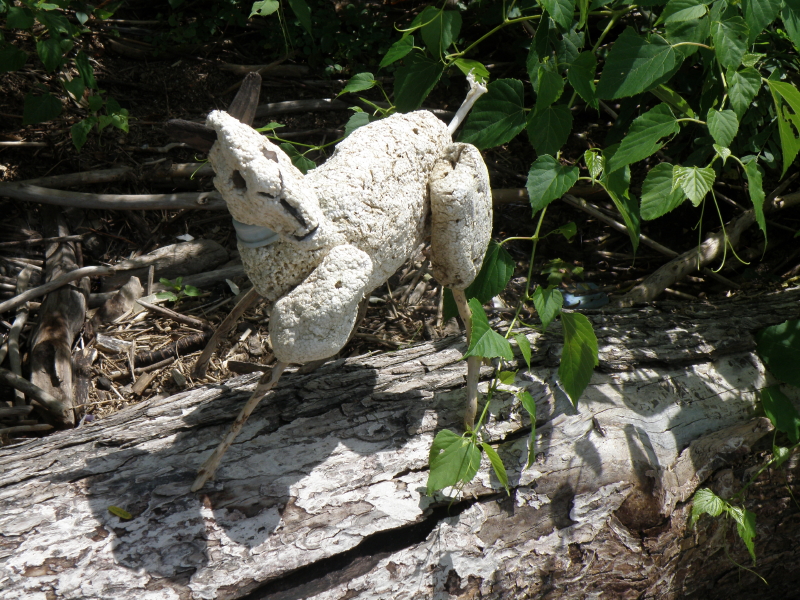
Camelope at the Falls of the Ohio, Aug. 2013

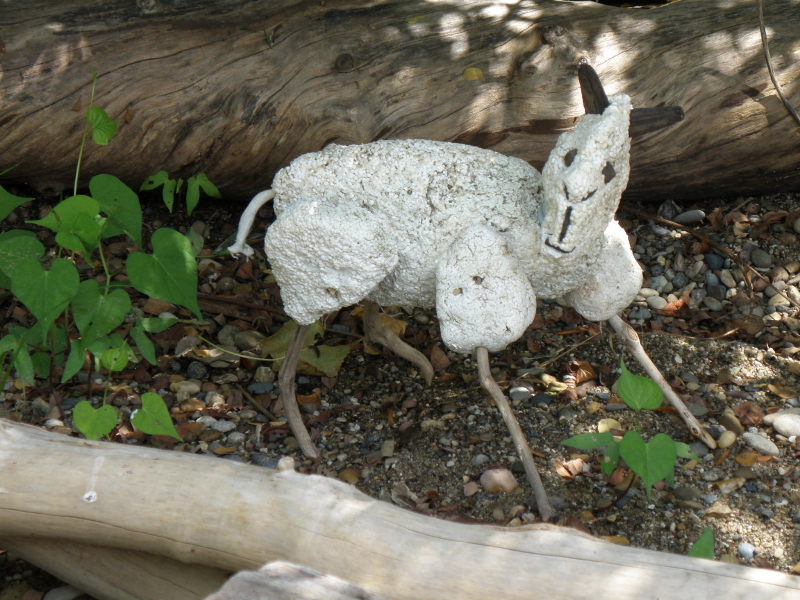
Camelope at the Falls of the Ohio, Aug. 2013

I came across this Camelope in a more isolated section of the park.  It was hiding among the stands of loosestrife and drinking water from the springs that flow downhill and into the river.  It is ever alert and very nimble with quick feet and seemingly at home climbing on rocks or navigating through dense vegetation.  Their bodies resemble that of deer or antelopes…hence Camelope.

Camelope reacting to an unfamiliar sound, Aug. 2013

Camelope at the Falls of the Ohio, Aug. 2013

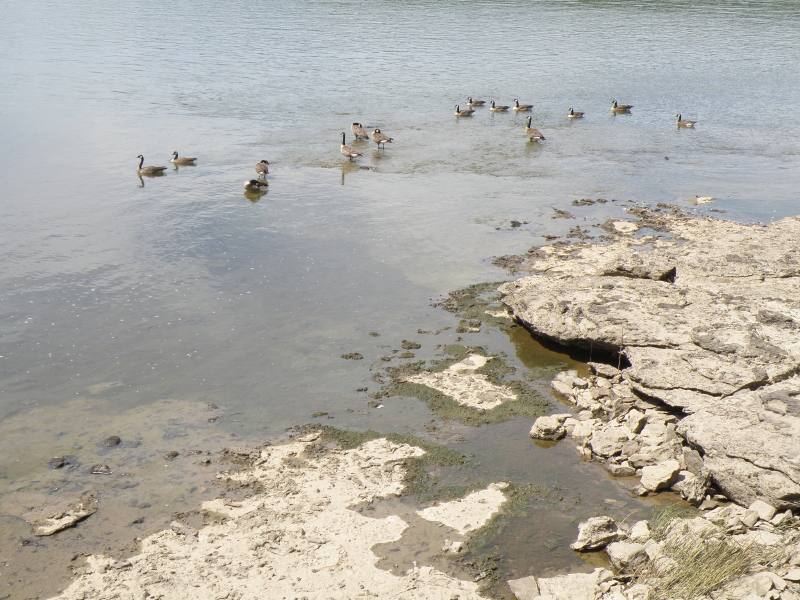
Since it is a relatively new animal…not very much is known about it.  I was able to conceal my presence long enough to manage these images.  I either moved or the wind shifted, but anyway my presence was detected and with a quick bound, the Camelope disappeared into the brush.  I hope I may come across it again and learn more about its secretive life.  Regardless, I will keep my eyes open and my camera at the ready for any new “unnatural” life forms I discover.  It occurred to me on my way home that my Falls of the Ohio Project is now officially ten years old!  I started exploring this fascinating park as the Artist at Exit 0 in August 2003 when the bicentennial of the Lewis and Clark Expedition was being celebrated.  Reading early 19th century accounts of the natural abundance of our country and this place in particular made me wistful for a world that no longer exists.  Two hundred years later…that process continues and no doubt will two hundred years from now.  I have often thought of this riverblog as a historical document as relevant today as Lewis and Clark’s notebooks and journals were back when this country was first being described.  I hope this park and its remarkable history will continue to inspire people for a very long time.  In closing, I would like to present an image of Canada Geese on the water near the fossil beds.  Their coloration gives them in my mind’s eye a formal quality and lends dignity to the landscape.  Until next time…from the Falls of the Ohio.

Canada Geese and fossil rock at the Falls of the Ohio, Aug. 2013

Read Full Post »

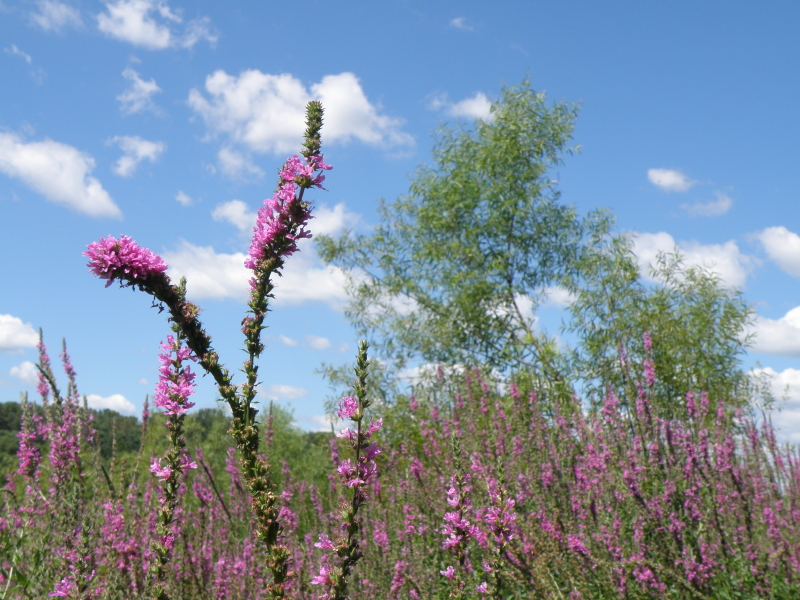
purple loosestrife at the Falls of the Ohio, Aug. 2013

This post includes two recent trips to the Purple Loosestrife (Lythrum salicaria) flowers in the western section of the Falls of the Ohio State Park.  I have made my peace with the fact that the Purple Loosestrife plant is an invasive species at this location. It is really successful at crowding out the other plants that gather in this wetlands area. Originally introduced from Europe, the Purple Loosestrife has spread across the United States.  Eradicating it is very difficult because millions of seeds are produced annually and the loosestrife can grow with just a fragment of root in the ground.  The loosestrife probably doesn’t realize that it has this poor reputation for it provides beauty to the landscape and food for a myriad of insects, particularly butterflies.  Surely, the loosestrife can be forgiven for being itself?  Can the same be said of our kind who after all perpetuated the Purple Loosestrife by planting it to begin with and then allowing it to escape into the larger environment?  The loosestrife arrived here floating down the river.  I can recall when there wasn’t any to be found in the park.

The Butterfly Man, 9/2010

Here’s a flashback from three years a go.  I remember it was my lavender-lipped friend, the Butterfly Guide, who introduced me to this loosestrife stand back in September of 2010.  We had a great time together and I managed a few nice butterfly images on that day.  Ever since the Butterfly Guide showed me the way, I’ve been returning on my own and observing and documenting what happens here.  I heard through the grapevine that my old friend has since passed on and is conducting tours in the great beyond.  He had a knack for revealing beauty to all who wanted to experience it.  Seeing his image again makes me feel nostalgic.

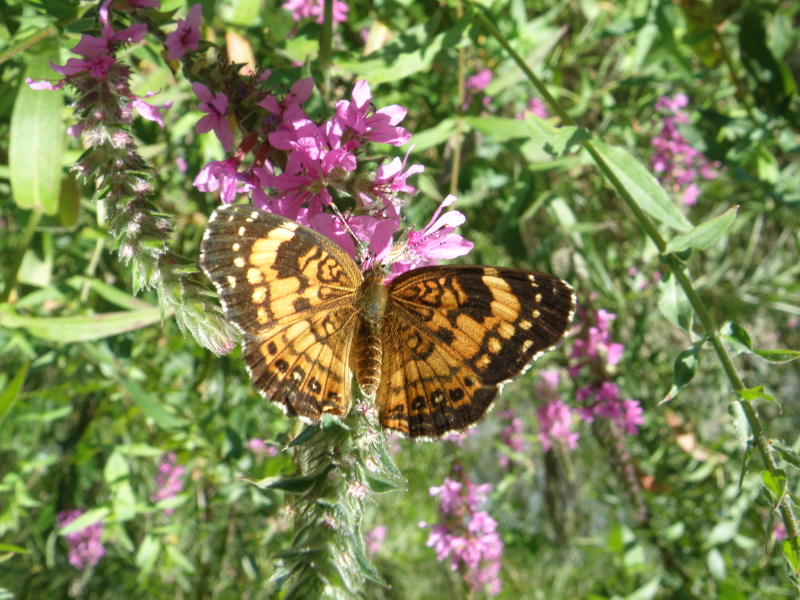
Eastern Checkerspot

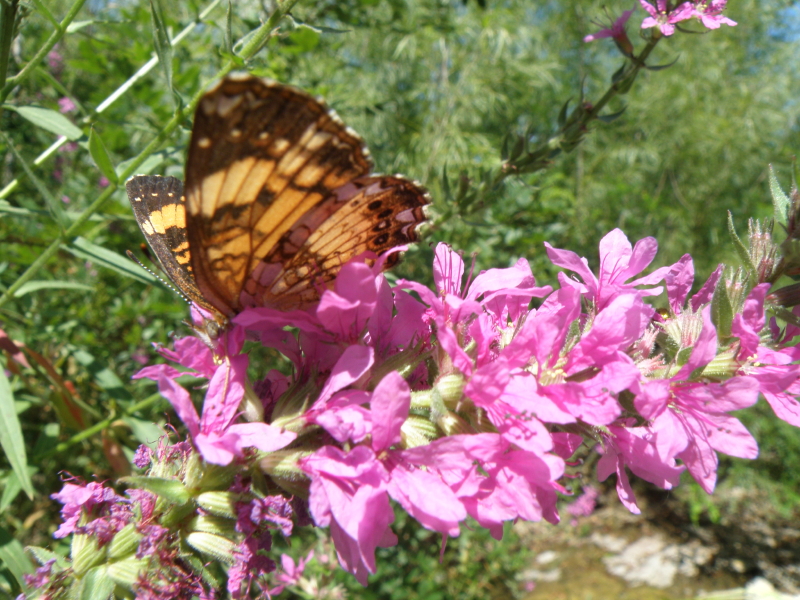
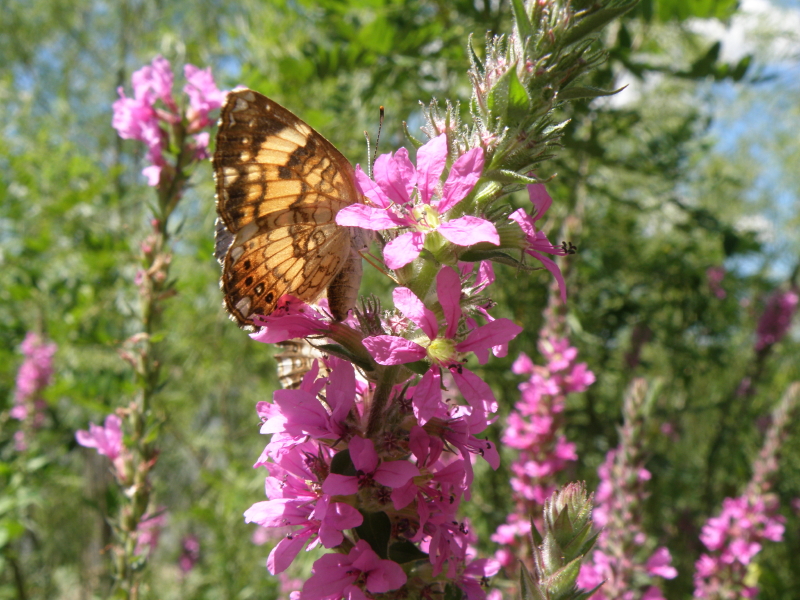
This is an Eastern or Harris’ Checkerspot (Chlosyne harrisii) and was the most numerous butterfly I saw visiting the loosestrife flowers.  They were so intent on sipping nectar that it was easy to approach them as they fed.  Now for a few more checkerspot images.

Eastern Checkerspot feeding, Aug. 2013

Eastern Checkerspot, Falls of the Ohio, Aug. 2013

Eastern Checkerspot, Aug. 2013, Falls of the Ohio

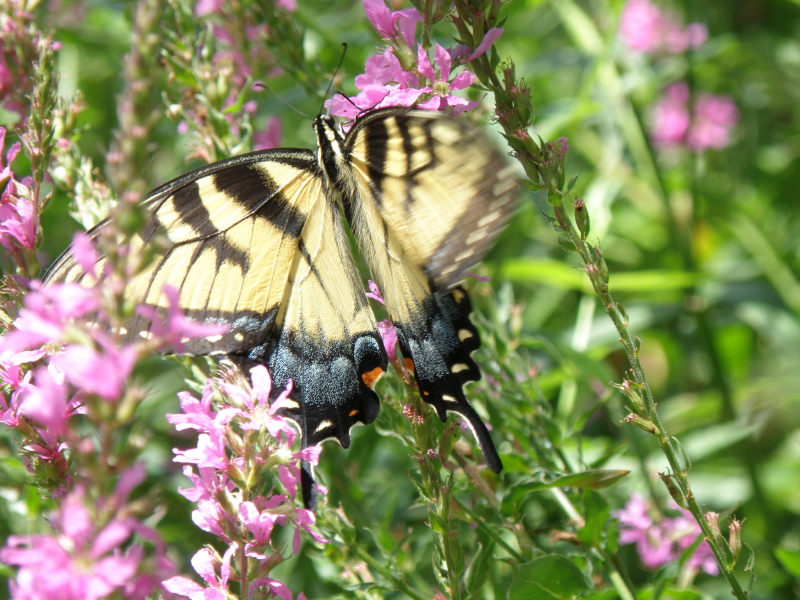
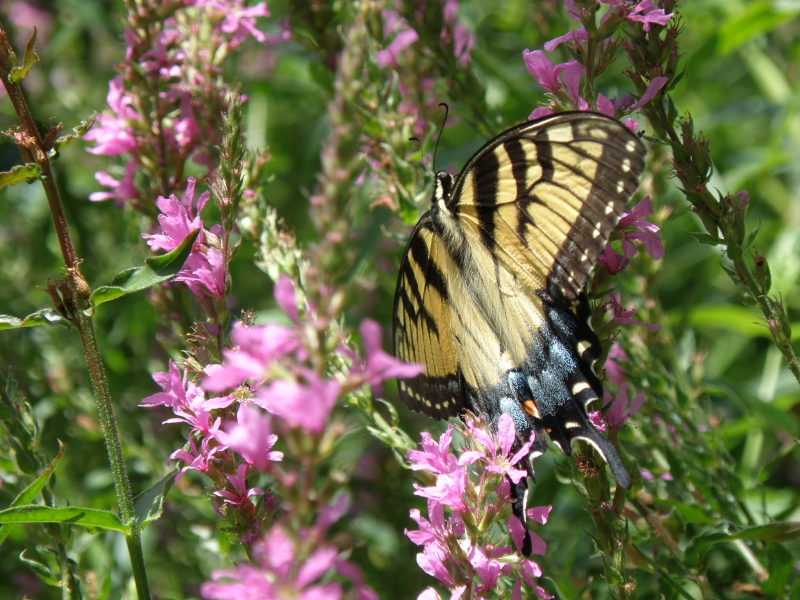
I found myself carefully wading into the flowers to get as close as possible.  Many of the flower bunches were in the six to seven feet tall range and it was humid walking among the plants.  We have been having a mild streak lately with lower than normal temperatures and regular precipitation.  Residents in our locality have had few reasons to complain about the heat.  The checkerspots are not the only butterflies out here.  Various swallowtail butterflies also enjoy these flowers.  Here are images of an Eastern Tiger Swallowtail, (Papilio glaucus).

Tiger Swallowtail on purple loosestrife, Falls of the Ohio, Aug. 2013

Tiger Swallowtail on Purple Loosestrife, Falls of the Ohio, Aug. 2013

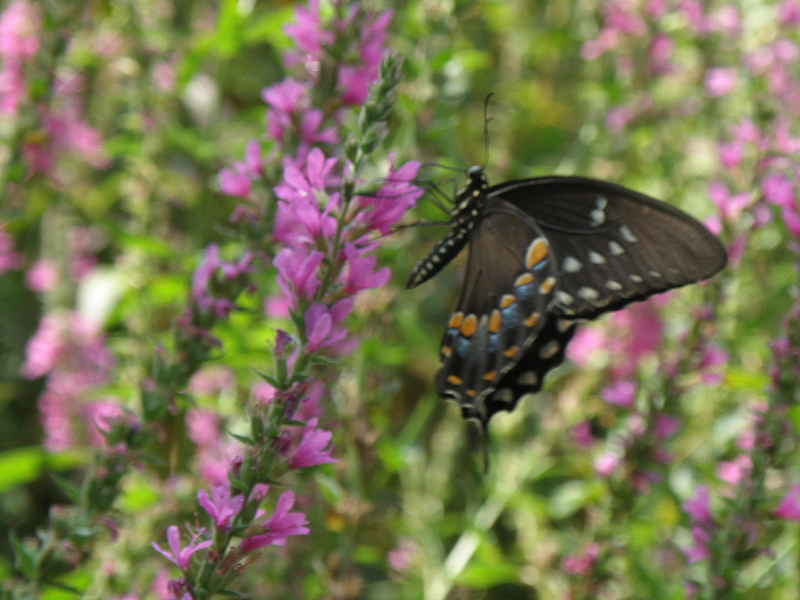
We are fortunate to have many other species of swallowtails in our area.  Among the others I have associated with the loosestrife flowers include the Pipevine Swallowtail (Battus philenor), the American or Eastern Black Swallowtail (Papilio polyxenes), and the Spicebush Swallowtail (Papilio troilus).  Here’s an image of a Spicebush Swallowtail feeding.

Spicebush Swallowtail on Purple Loosestrife, Aug. 2013

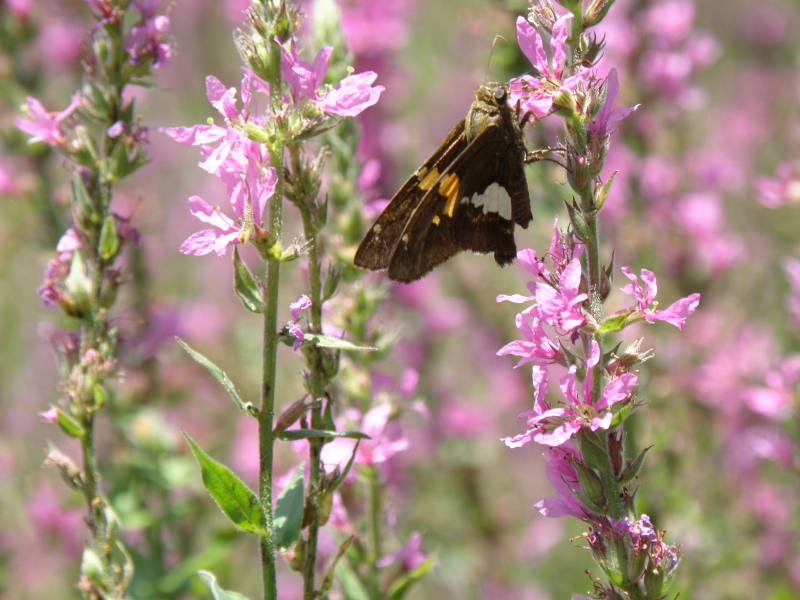
We have several different Skipper species present.  This is the Silver-spotted Skipper (Epargyreus clarus).  The white spot on its hind wing shines like mother-of-pearl when the light hits it just right.

Silver-spotted Skipper on Purple Loosestrife, Falls of the Ohio, Aug. 2013

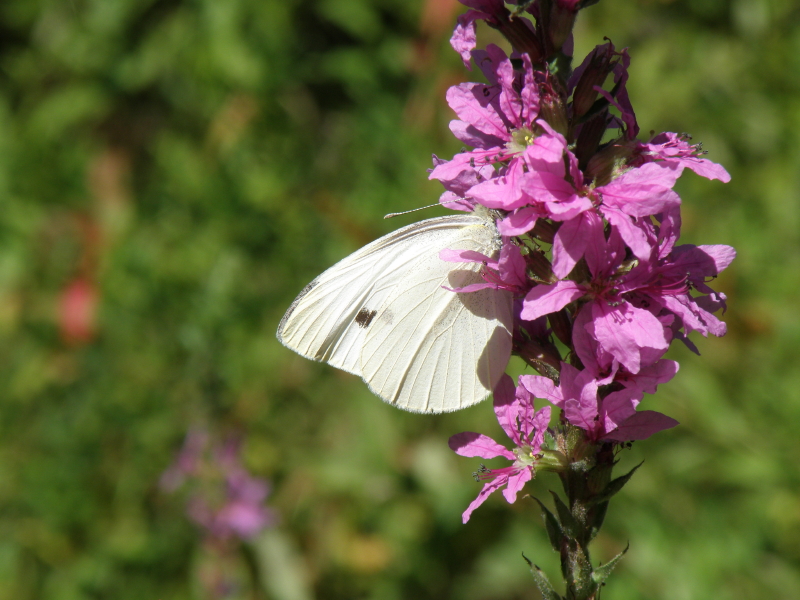
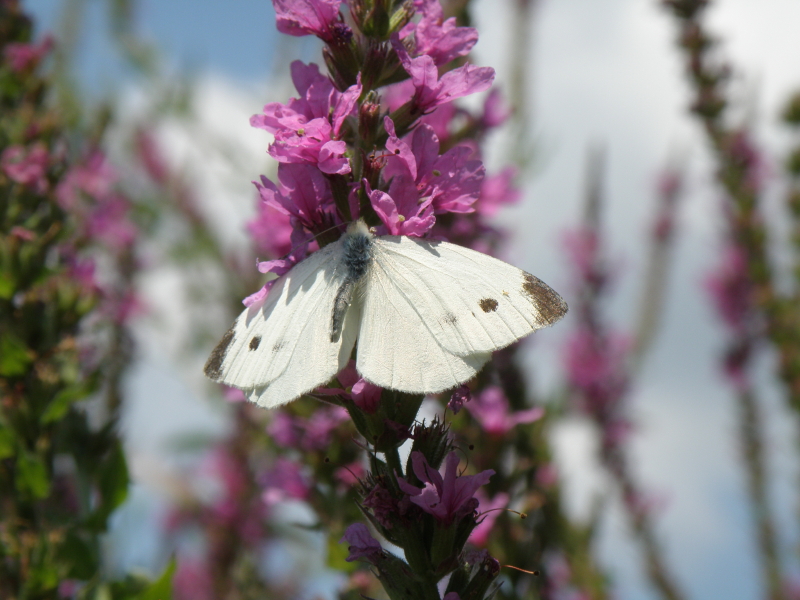
Another regular visitor is the Cabbage Butterfly (Pieris rapae).

Cabbage Butterfly, Aug. 2013

Cabbage Butterfly caught by a spider, Falls of the Ohio, Aug. 2013

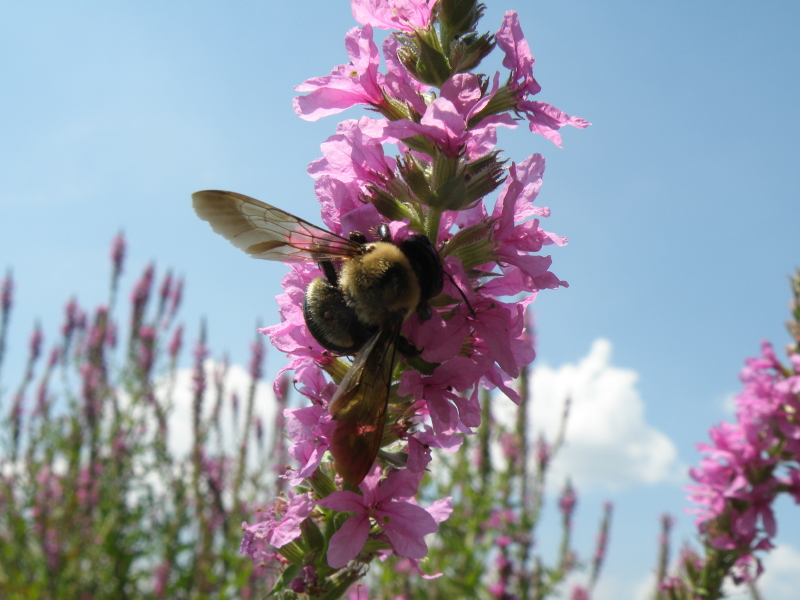
I was struck by the unusual pose this Cabbage Butterfly was in and decided to get closer to check it out.  When it didn’t fly away…I knew something else was going on.  Although you can’t see it in this picture, a small spider has caught this butterfly by its head.  With so many insects feeding on the loosestrife, predators were sure to follow.  Large bumble bees also enjoy these flowers.  They are so heavy that they cause the loosestrife stems to bend upon landing on them.

Bumble Bee on loosestrife flowers, Aug. 2013

Over the years, I have watched the Purple Loosestrife become more common in the western section of the park.  The plant is now well established.  Typically, the loosestrife blooms continuously from July to September, but to my eye, it is looking like the blooms are starting to play out a bit?  Every year is different and some butterflies are more common in one year than another.  Missing from the loosestrife blooms this year are the Buckeyes, Monarchs, and their mimics…the Viceroy Butterflies.  Perhaps they will still make an appearance later on if the loosestrife flowers continue blooming.  I hope you have enjoyed wading through the loosestrife with me?  Next time, I will post something about the exhibition at the Kentucky Museum of Art and Craft that is featuring this blog in their show.  Now time for one final image before closing.Purple Loosestrife at the Falls of the Ohio, Aug. 2013

Read Full Post »

Tree in the western section of the Falls of the Ohio State Park, Aug. 2013

Resolved to stay away from my old atelier under the willow trees for a while, I decided to explore the western section of the Falls of the Ohio State Park.  It was just the most beautiful day and residents of our area have remarked on how unusually nice it’s been of late.  The air today has wonderful clarity and although it’s summer and the sun is shining…we are many degrees below our usual temps.  I feel the western part of the Falls of the Ohio begins once you cross the creek at the end of the Woodland Loop Trail.  This is an area that receives fewer visitors and I’m happy just to wander with nothing on my mind.  As I walk the narrow strip of land that is the riverbank, on my left are sounds from the river and on my right are various bird songs originating under the tree canopy.  I see the formerly high river has deposited driftwood here in new configurations along with the usual plastic junk.  My eyes are open and ready for anything.  I doesn’t take very long before I make the first of several discoveries new to me in and around a patch of Wild Potato-Vines.

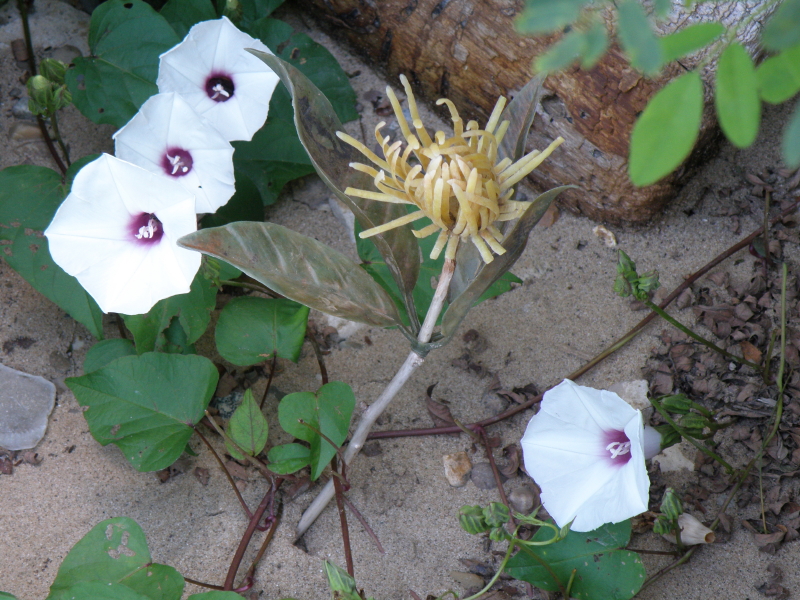
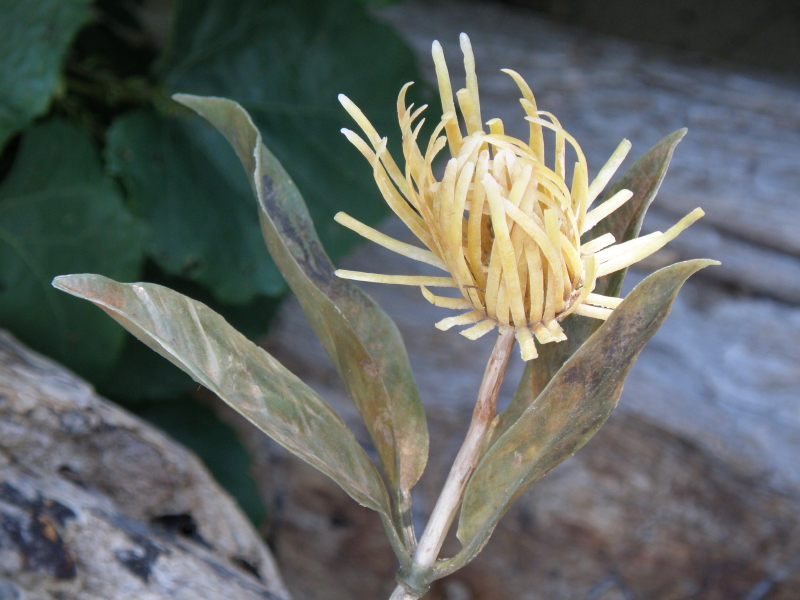
Goldstein's False Mum among Wild Potato Vine flowers, Falls of the Ohio, Aug. 2013

Close up of Goldstein's False Mum, Aug. 2013

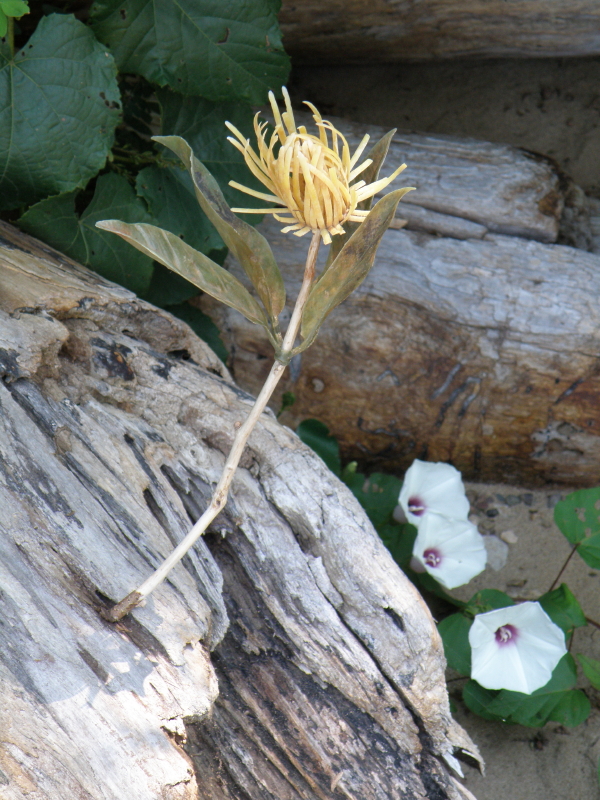
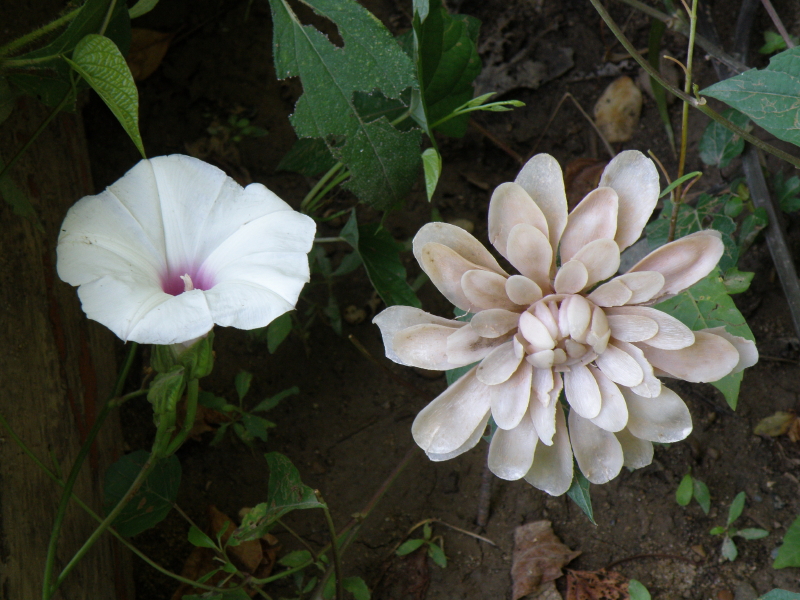
This is Goldstein’s False Mum which is named after the resident naturalist at the Falls of the Ohio State Park.  This is another in a series of very odd flowers while being organic by definition  have little in common with the other plants that grow along side of them.  In general, plastic-like blooms and foliage characterize these botanical rarities.  None of these plants (which form a new order of their own called Artificialia ) are capable of photosynthesis despite the appearance of green leaves.  Goldstein’s False Mum is a summer plant that produces a hard, yellow, frilly blossom that appears on the terminal end of a woody stem.  It prefers sandy, disturbed soils or decaying wood and is usually seen in the company of traditional flowering plants.  It produces no scent and no insects were observed being attentive to the false mum.  Now the Wild Potato-Vine is also an interesting plant.  It is a member of the Morning Glory family and its bloom is primarily white with a purplish maroon throat.  I have seen large bumble bees pollinating this flower.  What sets this plant apart is under the ground.  The Wild Potato-Vine produces a large tuber that had food value for the indigenous people.  Here is a another specimen of Goldstein’s False Mum growing out of a soft, decaying log also in the presence of Wild Potato-Vines.

Goldstein's False Mum and Wild Potato-Vine flowers, Falls of the Ohio, Aug. 2013

Not too far away and also in association with the Wild Potato-Vines is another type of plastic-like plant and here is its portrait.

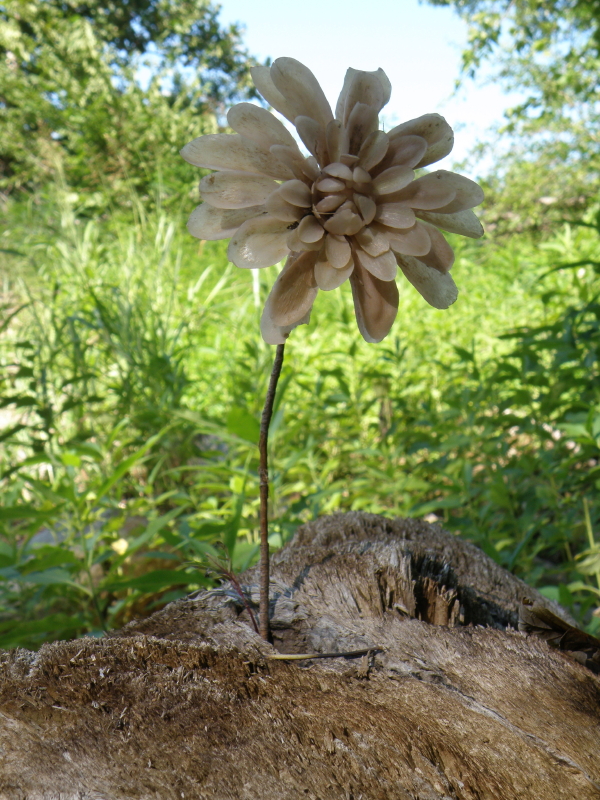
Wild Potato-Vine blossom with Saprophytic Zinnia, Falls of the Ohio, Aug. 2013

The Saprophytic Zinnia, Falls of the Ohio, Aug. 2013

The Log Weed is a saprophytic plant.  Lacking chlorophyll it relies on decaying matter for its sustenance.  The Log Weed is characterized by a corolla of hard plastic-like petals and never has what we would describe as leaves coming off its woody stem.  No one is quite sure how it propagates? Its blossoms appear in mid summer and seem to hang around forever.

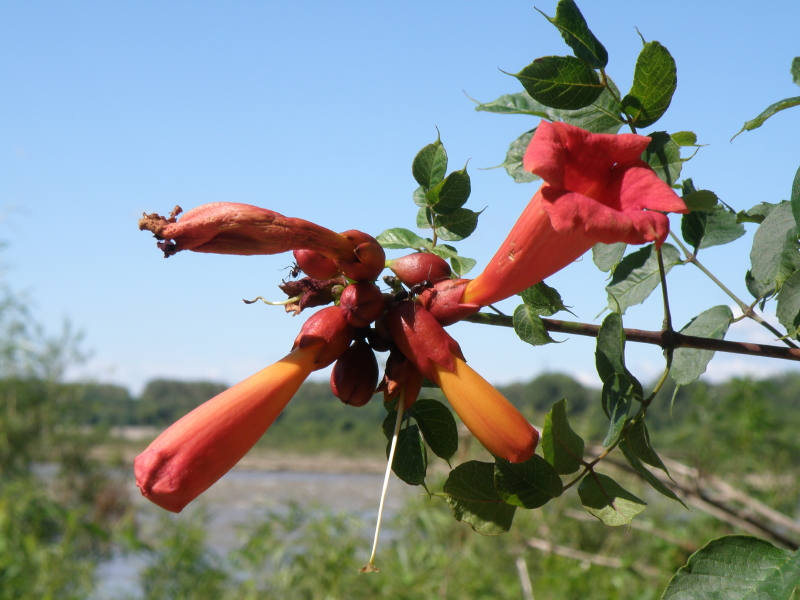
Trumpet Creeper, Falls of the Ohio, Aug. 2013

These are tubular flowers from the Trumpet Creeper vine which is a native and natural sight at the Falls of the Ohio.  This is a climbing, spreading vine and wood ants seem to love them.  If you look closely at the above photo…you can see several ants crawling on the Trumpet Creeper’s attractive blooms.  I was admiring this vine when I noticed that there was something not quite right about it and this is what I discovered.

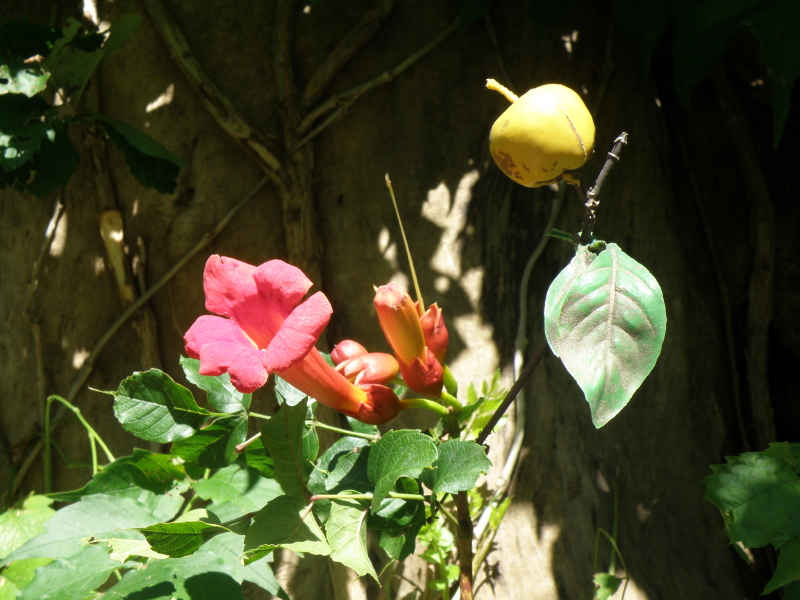
Unknown fruit on Trumpet Creeper, Aug. 2013

Notice the yellow orb to the upper right of the Trumpet Creeper blossoms? Thus far, the yellow fruit with its accompanying leaf remain unclassified.  It is, however, grafted to the woody stem of the vine.  Amazingly, it even has a false stem to deceive.  Could it be parasitic?  One hypothesis why this plant with the odd fruit appears with Trumpet Creeper might be the protection it receives from the vine’s wood ants?  The fruit and leaf are also very polymer-like and may indeed be plastic.  More and more we are learning how ubiquitous plastic is in the environment.  I heard a report about the Great Lakes the other day saying that there is a considerable amount of micro plastic in these large bodies of fresh water.  Upon examination, much of this plastic takes the form of tiny balls that are blended into deodorants and toothpaste to make the product flow more evenly.  These beads are so small that they pass through the finest screens at the waste water treatment plants and into the lakes.  I think Nature is metabolizing this plastic and recombining the hydrocarbons in novel ways, but that is just my theory.

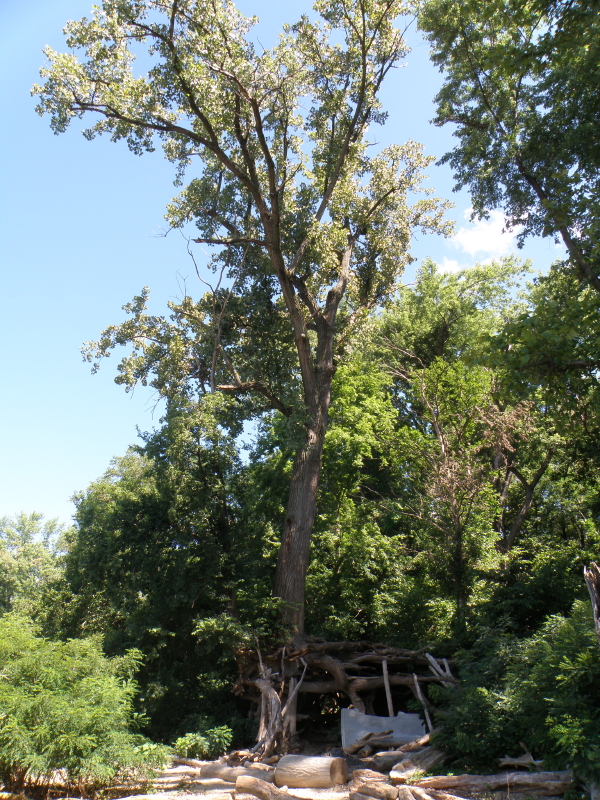
Cottonwood tree fort, Falls of the Ohio, Aug. 2013

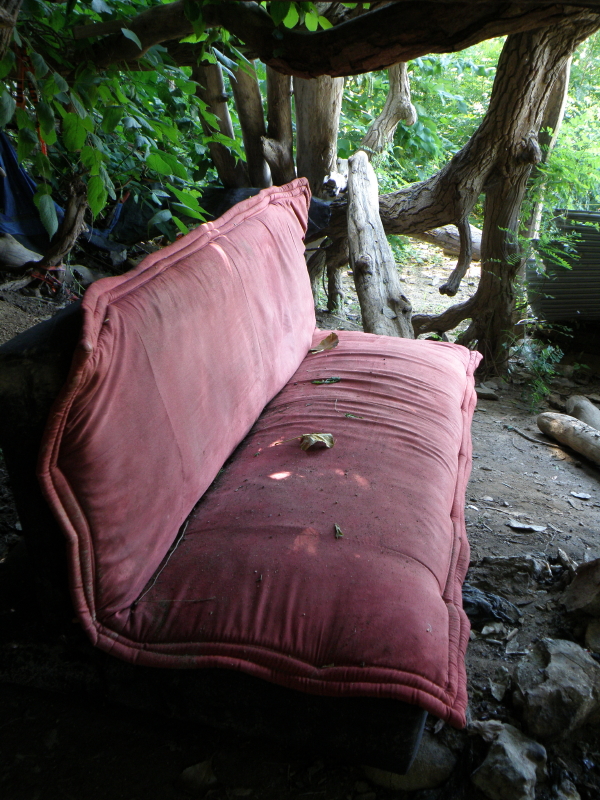
I paid my favorite cottonwood tree a visit and it’s been a while since I took shelter under its large, exposed roots.  People, especially the locals, like hanging out here and I witnessed much less trash since my last visit which is a good thing.  One big “improvement” has been made with the addition of a red, upholstered couch and I took a moment to rest here before moving on.

red couch under the cottonwood tree, Aug. 2013

The couch is very comfortable and I’m amazed that people actually dragged this piece of furniture down here.  Eventually, it will be reclaimed by the river.  Here’s another view from under the tree.

space under the cottonwood tree, Aug. 2013

For those who prefer their comforts a bit more on the rustic side…there is another bench for seating and it’s made from a slab of wood balanced on short logs.

under the cottonwood tree, Aug. 2013

I rested, had a snack and drank some water before moving on.  I’ve designated my intended destination as “Loosestrife Land” for the abundance of these non-native flowers that have taken over moist areas in the western section of the park.  I’m going there seeking something else which will be the subject of my next post.  I’ll catch up with you soon but for now…so long and happy trails to you.

Purple Loosestrife flowers in bloom, Falls of the Ohio, Aug. 2013

Read Full Post »

Muddy Ohio River at the Falls of the Ohio

The Ohio River has remained high and muddy the last couple of weeks.  It’s summer, past mid July when we usually find the river retreated to its summer pool.  This approaches the time when the fossil beds on the Kentucky side of the river would be exposed.  The little bit of flooding that occurred has displaced more than random logs and debris.  I was investigating the riverbank under the railroad bridge and came across an interesting mix of ducks.

domestic and wild ducks at the Falls of the Ohio, July 2013

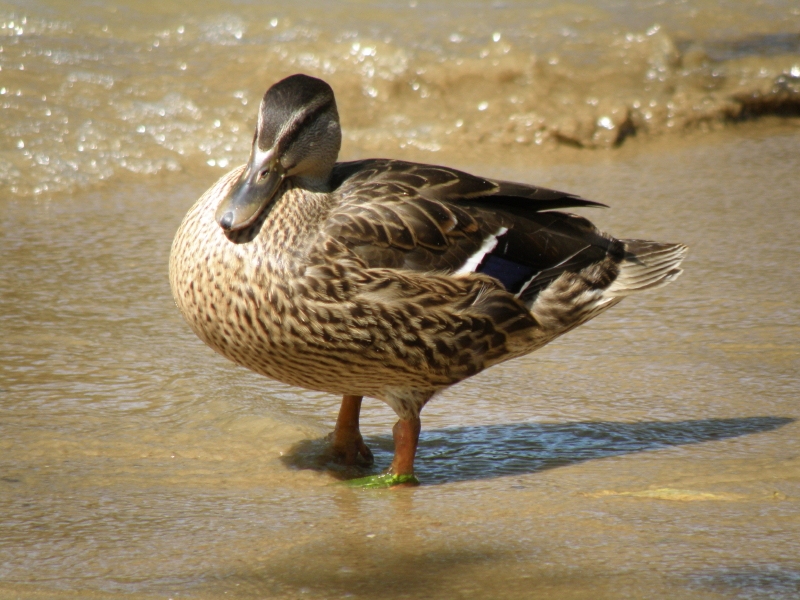
Joining the wild, female Mallards with their iridescent blue-violet speculum on their wings was a small group of domesticated ducks.  More than likely the river overwhelmed a farm pond somewhere which was the opportunity the domesticated ducks needed to swim away and explore the larger world.

Domestic ducks, July 2013

They landed at the Falls of the Ohio and are sharing a vacation together.  White and piebald (a mix of black and white) are the colors of domestication.  These farm ducks are also much larger than their wilder cousins.

two resting female Mallard ducks, July 2013

female Mallard duck, July 2013

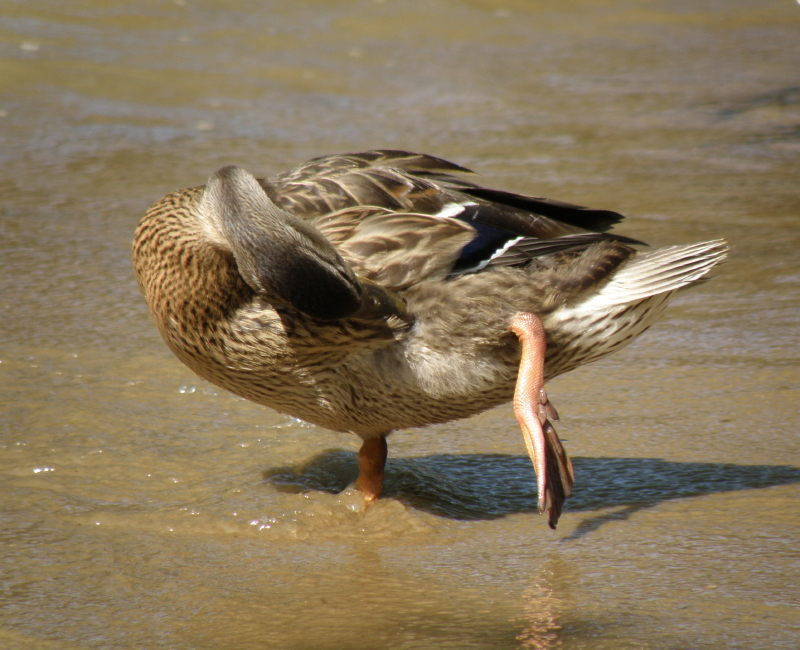
female Mallard duck grooming, July 2013, Falls of the Ohio

The Mallard duck (Anas platyrhynchos) is our most common species of duck and can be found at the Falls throughout the year.  I once stumbled upon a Mallard nest that was built inside a hollow log.  When the mother-to-be flushed out of the log, the surprise took a few years off my lifespan!   They are members of the duck family known as “dabblers”.  Mallards hang out near the zone where water and land meet.  They have specialized bills for feeding in shallow water.  Mallards prefer small grass and sedge seeds for food, but will also strain the water and mud for small organisms.  I have come across other ducks at the Falls of the Ohio that are hybrids of Mallards and domesticated ducks.  Many duck species must be closely related to one another because other inter-species hybrids have been documented.

Blue-ringed dabbler, Falls of the Ohio, July 2013

Head of Blue-ringed dabbler, July 2013

I have also recently photographed an unusual duck for the Falls of the Ohio.  On a recent foray to the river I came across this Blue-ringed Dabbler ( Anas azurcephalos) plying its trade at the water’s edge.  This diminutive duck is native to the western part of North America and rarely strays east of the Mississippi River.  Perhaps it found its way here because of the recent storms that have tracked west to east across the country?  Domesticated ducks are not the only birds affected by severe weather.

Blue-ringed Dabbler at the Falls of the Ohio, July 2013

The Blue-ringed Dabbler is an unusual duck in that it nests in trees or more specifically, in the holes created and abandoned by larger woodpeckers.  This formerly rare duck is now on the increase because conservationists have taken advantage of this breeding preference by setting out nest boxes which the Blue-ringed Dabbler will accept.  A similar program helped the colorful Wood Duck to recoup its former population numbers.

Blue-ringed Dabbler, Falls of the Ohio, July 2013

This is a female Blue-ringed Dabbler identified by its browner coloration and lack of iridescent color on the wings.  The dabbler regarded me for a while before swimming off to a deeper part of the river where I lost track of it.  I returned the next day to see if I could find this duck again, but it was gone.  I get a big kick out of recording bird species that are not a part of the official bird checklist distributed by the Falls of the Ohio State Park.  I love bringing these rarities to the attention of hard-core birders who will only accept as evidence good photographic proof or multiple sightings recorded by multiple birders.  They can be a suspicious lot and highly competitive.  Often bird watchers present themselves as being more interested in what number a particular bird represents on a life list than in the bird itself which seems to me to miss the whole point of watching birds.

domestic ducks with dead catfish, July 2013

Although I never saw the Blue-ringed Dabbler again, I did however, locate a couple of the domesticated ducks I had seen the previous week.  They were investigating the waterline in a particularly muddy area.  I was shocked to discover the dead fish in the foreground upon downloading my images.  I certainly don’t remember seeing this when I snapped this picture.   I doubt these ducks will ever find their way to the farm again, but for now…they seem content.  I’ll end today’s post with one other image of the Blue-ringed Dabbler that I came across on the internet.  It shows a bird in the hand of a conservationist.  So long for now!
Blue-ringed Dabbler in hand, Falls of the Ohio, July 2013

Read Full Post »

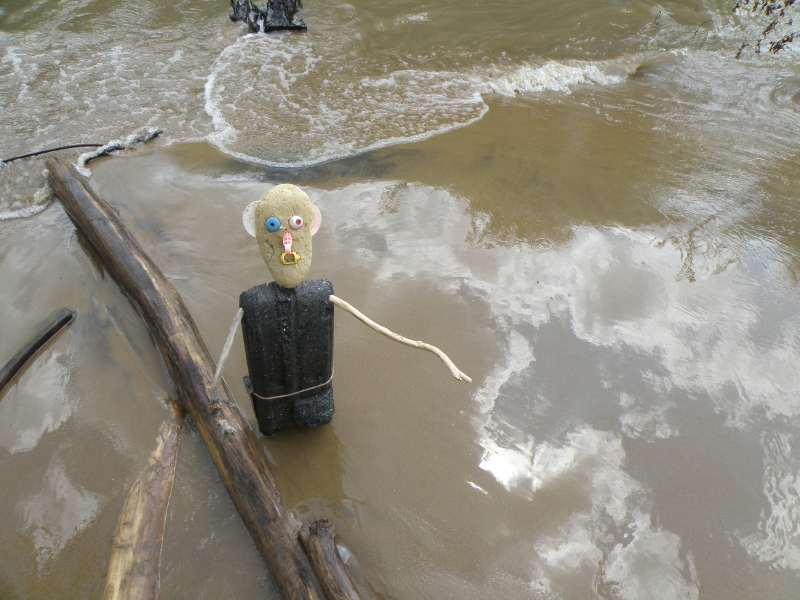
Falls black styrofigure, July 2013

With the sun spotlighting this little patch of sand…my newest Styro-figure proudly stood upright.  He’s the first persona created in the reconfigured studio.  I found a rare piece of “black Styrofoam” on today’s walk.  It’s part of what passes for car bumpers these days.  This material has a rubberized compound mixed throughout the foam which makes it harder to cut or pierce.

Leaving home, July 2013

After making new friends it’s time to venture out into the world.  The leafy green complete with bird song is complimented by the creaky willows that sway with the occasional breeze.  There is another sound, however, that your feet are hearing and you walk in the direction of its source.

Black Styro-figure by the river, July 2013

The mighty Ohio River has been running muddy for more that a week now.  Although it’s hot and humid today, thus far, this summer has been wetter and cooler than average.  As a result of all the rain, the river has been higher than usual.  What I like about the Falls of the Ohio is that in such a relatively intimate space the park can take on all kinds of different looks depending on the weather and season.  Small waves break upon the heightened shoreline and there is a family nearby fishing and playing by the river.

Family fishing for catfish, Falls of the Ohio, July 2013

Seeing that they were having some luck catching fish, I gestured if it was all right to take their pictures.  The family didn’t speak English and I’m guessing that they are recent immigrants from Southeast Asia?  Regardless, both adults and children were having a ball in the river.  I wondered if they came from someplace like this since they seemed so comfortable and natural by the water? After receiving the okay signal I recorded these images of people interacting with the river.

little boy, Falls of the Ohio, July 2013

This little guy was cute and really determined that I should take his picture in what I’m assuming is a martial arts pose?  I obliged him several times and this was my personal favorite snapshot of the group.  Looking through my riverblog…I’m struck by how often children appear and interact with my artistic process.  First, my own two sons would accompany me and now it’s the kids in the park on any given day.

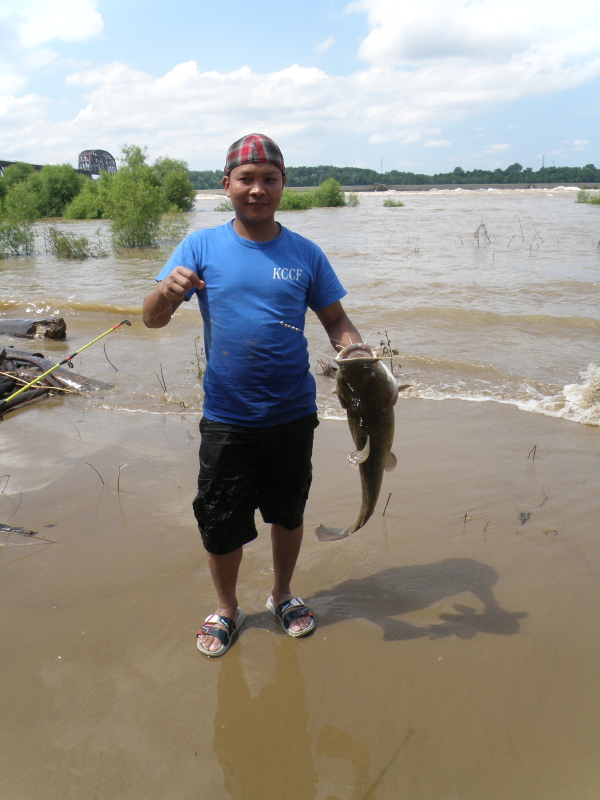
Man with Flathead Catfish, Falls of the Ohio, July 2013

Flathead catfish, Falls of the Ohio, July 2013

I watched this fish being landed and it’s a decent sized Flathead catfish, (Pylodictus olivaris).  This fish probably weighed in the ten to twelve pound range, but this catfish can get as large as a hundred pounds.  It is a fish of big rivers.  A very simple rig was used to catch this fish.  Four slipshot lead weights were clamped onto the line about eight inches away from the hook.  A single nightcrawler worm was used for bait which was cast about 25 yards from the riverbank.  The fishermen would wade in about knee-high to waist deep to increase casting length.  I was amazed that with the current and all the potential underwater obstructions that their lines didn’t get snagged more often than they did.
Catfish stringer, Falls of the Ohio, July 2013

This was the stringer of catfish they were working on.  In addition to the Flatheads…another big river fish the Blue catfish (Ictalurus furcatus) was also being caught.

catfish stringer, Falls of the Ohio, July 2013

The Blue catfish is a slatey-gray color and has a forked tail.  The two fish on the lower right in the above image are blues.  The flatheads are more of a mottled olive color and have very different fins.  Both are omnivorous and will eat most anything that they can catch.

Man and catfish, Falls of the Ohio, July 2013

All the fish on the stringer will be used to feed this family.  It is still not recommended that people eat the larger fish (especially bottom dwelling species) from the Ohio River. The river is much cleaner than it used to be, however, toxins do build up in the fat tissues of the fish that live the longest and grow to be big.  Every once in a while, making a meal of some of the smaller fish should be okay.  Because I was needed elsewhere today…I let my day at the river draw to an end.  Good thing too…because if you stand too long in the same spot at the water’s edge…you chance sinking down too far!  See you soon.

Styro-figure in black, waist deep in wet sand, July 2013

Read Full Post »

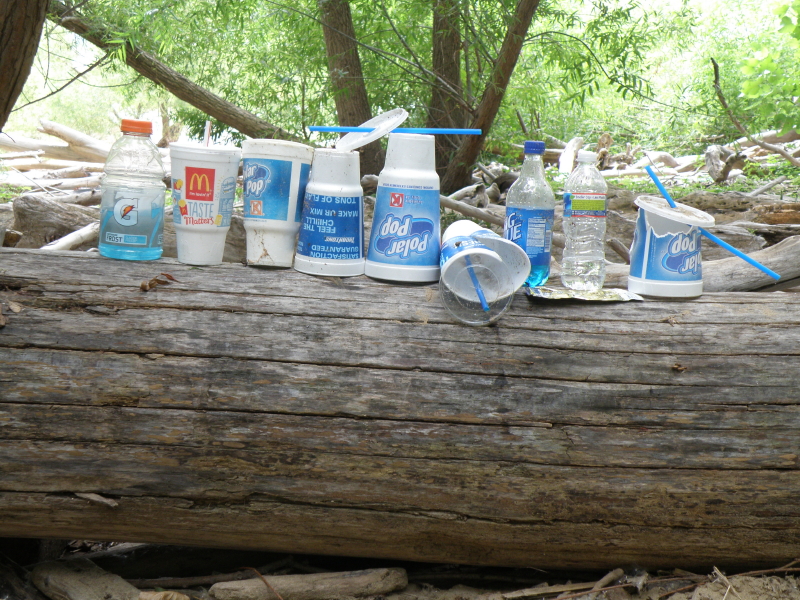
soft drink waste, Falls of the Ohio, July 2013

When last we visited the Falls of the Ohio the river was rising.  Several days of intense rainfall throughout the Ohio Valley are now flowing by and coloring the water a muddy ocher. My outdoor site where I make my polystyrene figures and store materials is being usurped by twin forces.  It’s difficult gauging the intentions of this visitor or visitors, however, I also continue finding their waste soft drink cups and bottles.  What’s with the blue drinks?  I guess the color blue is also your symbol for cool refreshment.  If I am to continuing working here, I will need to change the driftwood structure erected over my site.  I was  secretly hoping that the river would solve this dilemma for me.  If the water rose high enough, it would move the largest beached logs which would effect everything near them.  That didn’t happen.  The river fell short of my spot and a visible line demarcating brown wet wood from bleached, silver-gray wood marks the high waterline.

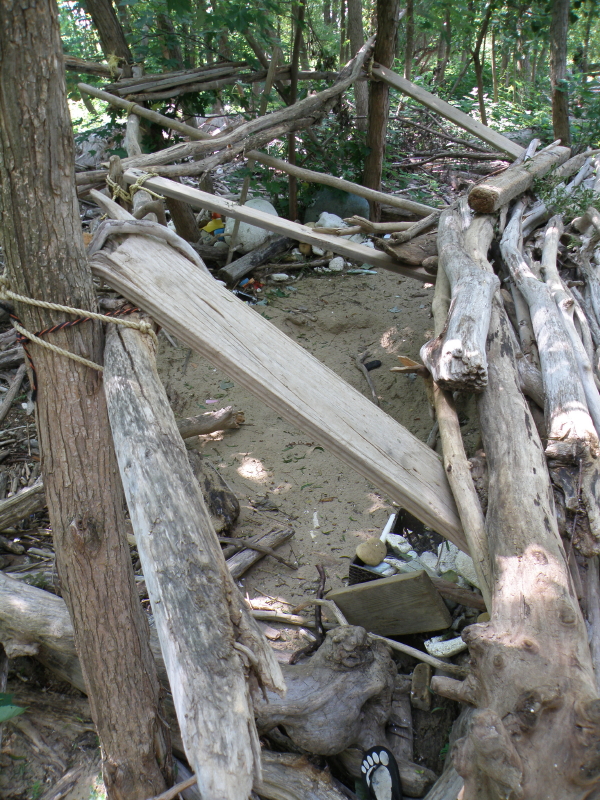
My site with evolving structure, Falls of the Ohio, July 2013

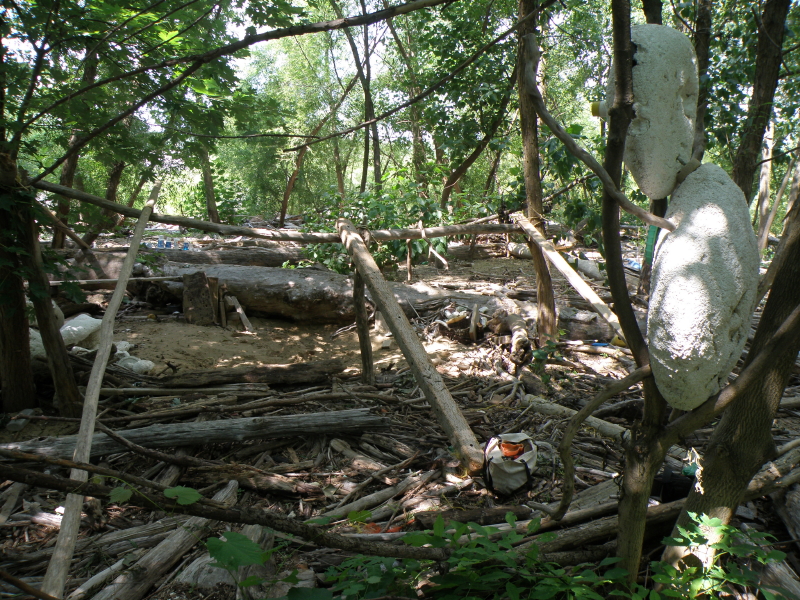
The structure the visitors are building is enclosing the space.  As it is, it’s difficult now to stand on the center sand, especially since a growing pit is developing.  My collected river materials continue to be strewn about.  I initially liked that someone else was seeing the potential of this site and adding their distinctiveness to the mix.  Now I’m seeing less intent here and and I’m going to make the next move and see what happens?  First, I will need to find and repair the large Styro-figure I left here sitting on the roof.  He’s a participant/witness to all the proceeding events.

My mustachioed Styro-friend, Falls of the Ohio, July 2013

Again he looks like he was cast aside.  I find everything except his mouth and replace it with some other river plastic I picked up.  I reattach his arms and legs and he’s as good as new again.  Well almost, the excitement with the visitors and the unpredictable nature of the river have dinged his persona.  He never said much before and he says even less now.  How unfortunate.  I park him in a nearby try to keep him safe.

Figure in a tree, July 2013

I’ve seen this before and call it “Styro-shock” or “polystyrene demensia”.  Imagine willing your body into a stasis where you have no awareness at all and you will begin to know what it means to be Styrofoam.  He might come out of it on his own…who knows?  I turned my attention back to the wooden structure to see what I could do to affect the space in a positive way.  I’m not interested in getting into some escalating contest of wills with someone.  While I figured out what to do…my silent friend continued to sit tight.

Changing the wooden structure, July 2013

I stripped off the wood to expose the frame.  Next, I flipped a few of the cross braces over which opened the center of the space back up.  I created a small doorway by cutting away some excess wood with my saw on my Swiss Army knife.  That has come in handy more than once.

remodeled driftwood structure on site, July 2013

Using the wood already collected, I made a small lean-to for a shelter and a wall of upright sticks to enclose the space on one end and create more visual interest.  The maple tree on site separates one area from another.  There’s plenty more that can be done, but I decide to stop here and see if anything happens while I’m away.  The site now does a better job of corralling any wayward Styrofoam and has further called attention to the studio site as a performance space.  As the day progressed which was sunny and cooler than usual…the sun shone just right to highlight the interior of my studio under the willows and filled it with energy.

remodeled studio with sun shining in. July 2013

It was a long and busy day by the muddy river.  I have lots of other interesting pictures to show you, but they are worthy of separate posts which will happen soon.  For now, I’ll end with a backward glance of my studio under the willows as I walked towards home.

View departing the willow studio, July 2013

Read Full Post »

« Newer Posts - Older Posts »