Feeds:
Posts
Comments

Archive for the ‘creativity’ Category

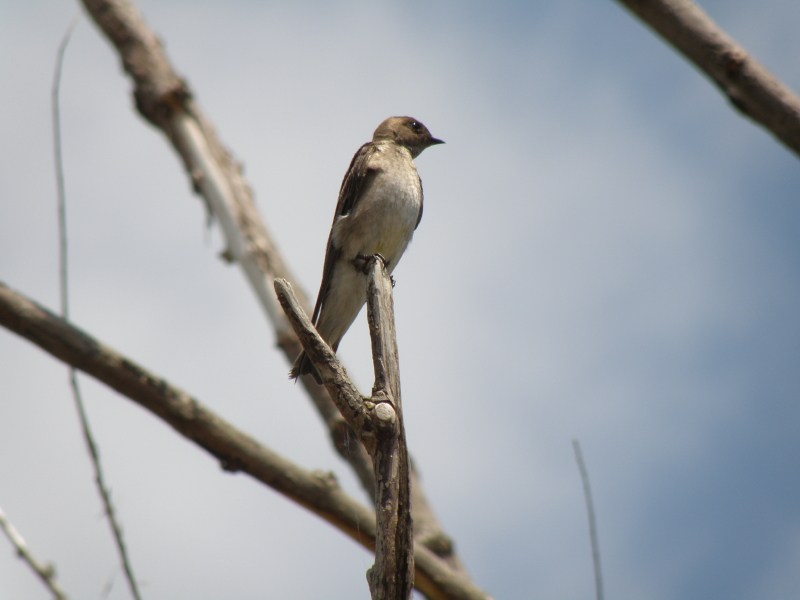
Northern Rough-winged Swallow, Falls of the Ohio, 2013

I’ve had some interesting birding encounters of late at the Falls of the Ohio and so I thought now is an opportune time to post them.  I took this image of the Northern Rough-winged Swallow recently.  To my eye, this species seems to be on the increase as is its cousin, the more familiar Barn Swallow.  This is especially good since they eat big quantities of flying insects.  Herons (especially Great Blue Herons and Black-crowned Night-Herons) are abundant and since the fishing has been good of late…I’ve seen plenty of both species.  Here are two more recent images.  The first is of a pair of Great Blue Herons that were taking advantage of the recent Skipjack Herring run.
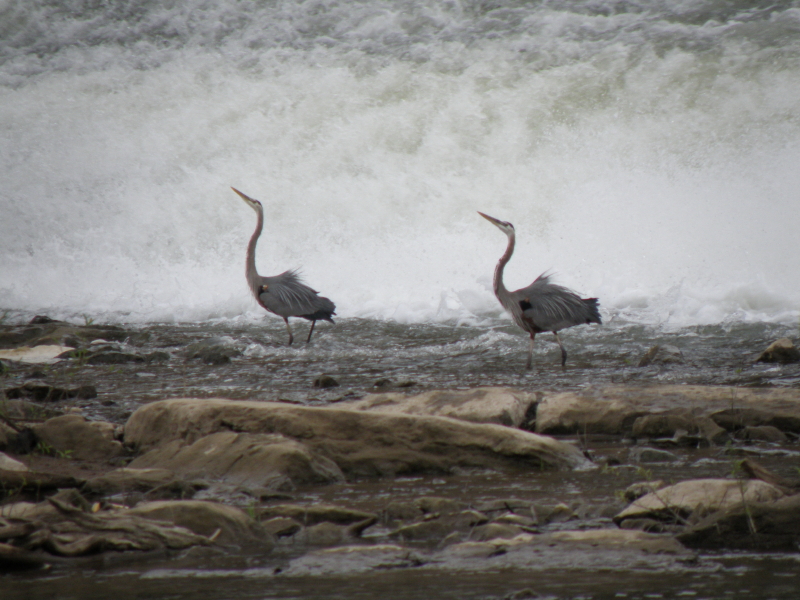
Great Blue Heron pair, June 2013

The most common heron here is the Black-crowned Night-Heron.  They are considerably smaller than the Great Blues and have striking red eyes.  You can find them wading in the shallower waters looking for fish, crayfish, or small frogs.  This image was taken in the eastern section of the park and this bird was perched on a log stranded on top of the dam’s wall.
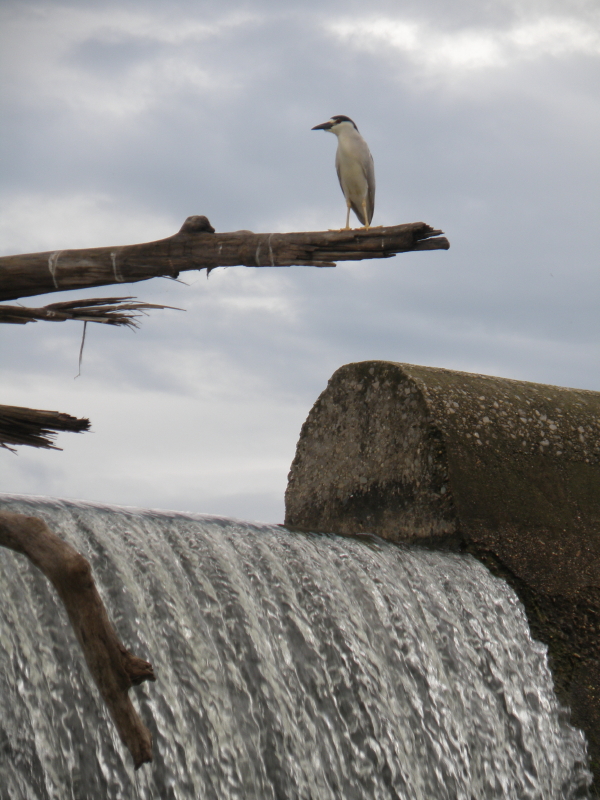
Black-crowned Night Heron at the Falls of the Ohio, June 2013

I’ve saved the two most interesting avian encounters for last.  A couple of weeks a go, I was sitting at my outdoor studio under the willow trees when I heard the sound of a young bird pleading for food.  Looking around, I was able to find the hungry bird and I snapped this picture of it.

young Brown-headed Cowbird, June 2013

I recognize that this is the young of the Brown-headed Cowbird.  What is fascinating about this species (and the two other species of cowbirds in North America) is that the adults do not raise their own young.  Cowbirds parasitize the nests of other bird species.  In the case of the Brown-headed Cowbird they have been known to lay their eggs in the nests of about 200 different species of birds.  Usually, the young Brown-headed Cowbird out competes the host specie’s nestlings.  I was curious to see who this bird’s “parents” were and it didn’t take long to find out.

Brown-headed Cowbird chick and Carolina Wren, Falls of the Ohio, June 2013

In the case of this cowbird chick it is being raised by a hardworking pair of Carolina Wrens.  The baby is nearly double the wren’s size and vibrates its wings along with calling out to stimulate the wrens to feed it.  Here are a couple more pictures of the wren feeding the cowbird.
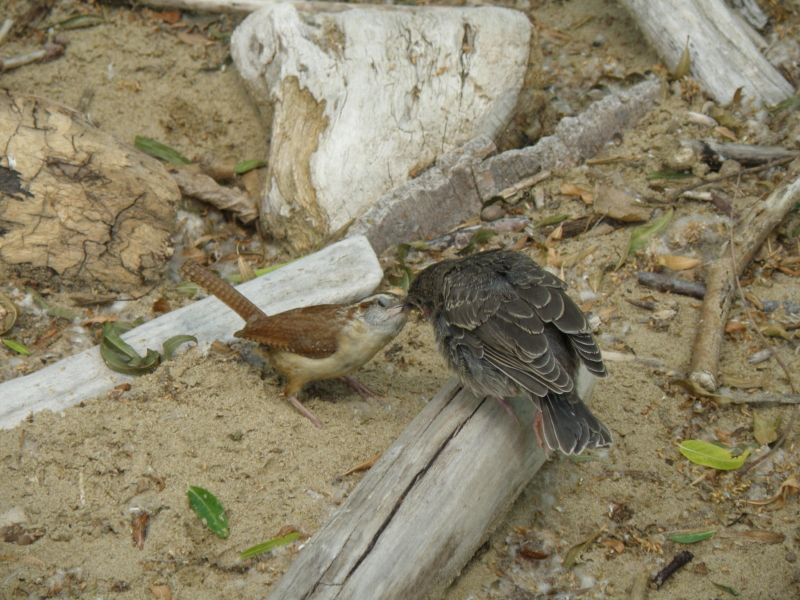
Carolina Wren feeding a Brown-headed Cowbird chick, Falls of the Ohio, June 2013

Carolina Wren and Brown-headed Cowbird chick, June 2013

In case you were wondering, cowbirds are not the only species to lay their eggs in other bird’s nests.  In Europe, the cuckoo also does this, but parasitizes fewer species.  I often wonder how does the cowbird know it’s a cowbird especially if it is raised by a completely different species?  Obviously, some behaviors are “hard-wired” and innate .  In the early Spring, Brown-headed Cowbirds are early arrivals and always on the look out for other breeding species of birds and their nest sites.  Their courtship is not a thing of beauty with each drab Brown-headed Cowbird female usually being pursued by multiple males.  Moving on, here is a recent picture of an adult male and you can see why they are called Brown-headed Cowbirds.

male Brown-headed Cowbird, Falls of the Ohio, June 2013

Recently, I was in the far western section of the Falls of the Ohio State Park where I saw my very first Indiana Rail.  Rails are much smaller relatives of the heron family and other wading shorebirds.  The Indiana Rail is a little smaller than a chicken and rarely seen since it favors dense underbrush and is usually more active at night.

Indian Rail at the Falls of the Ohio, June 2013

I was taking a break sitting on the fossil rocks when this bird with a long, bright red bill appeared from among the ever-growing vines.  I held still and was able to record this species with a small series of photographic images.  This bird seemed very interested in the holes situated among the rocks.
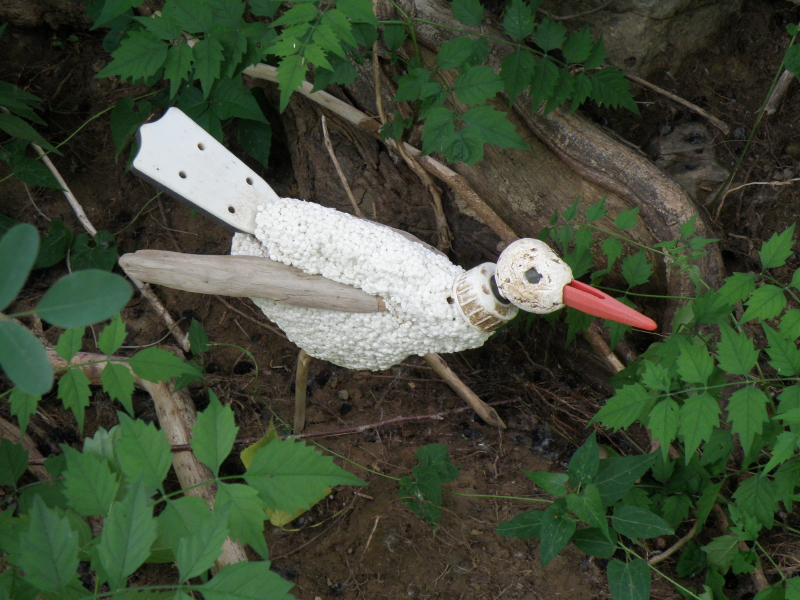
Indiana Rail, Falls of the Ohio, June 2013

Indiana Rail, Falls of the Ohio, June 2013

Unlike the cowbirds…both the Indiana Rail male and female participate in raising their own young.  Typically, four or five green mottled eggs are deposited in a loose bowl constructed of decaying river vegetation.  It is believed that the heat generated from this decomposing matter helps to incubate the eggs , but this is still speculative.  There is a lot left to learn about this enigmatic creature.
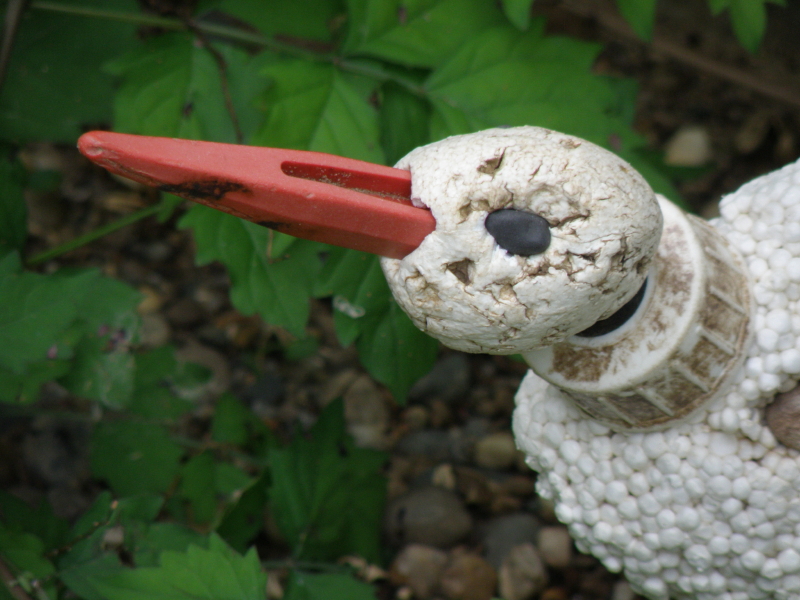
Head of the Indiana Rail, June 2013

Indiana Rail, Falls of the Ohio, June 2013

I watched the rail for about twenty minutes as it poked around the vines that were beginning to cover the fossil rocks.  Every now and then it would use its strong-looking bill to probe the cracks around the drying mud.  Just as mysteriously as it appeared…it disappeared leaving me with this wonderful memory and a hand full of pictures to prove it was here.  See you later!

Indiana Rail, Falls of the Ohio, June 2013

Read Full Post »

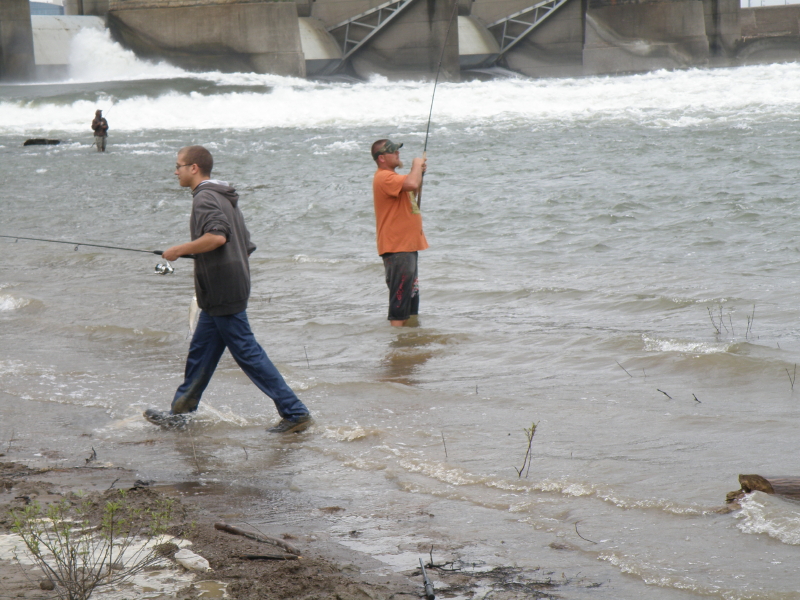
Fishermen, Falls of the Ohio, June 1, 2013

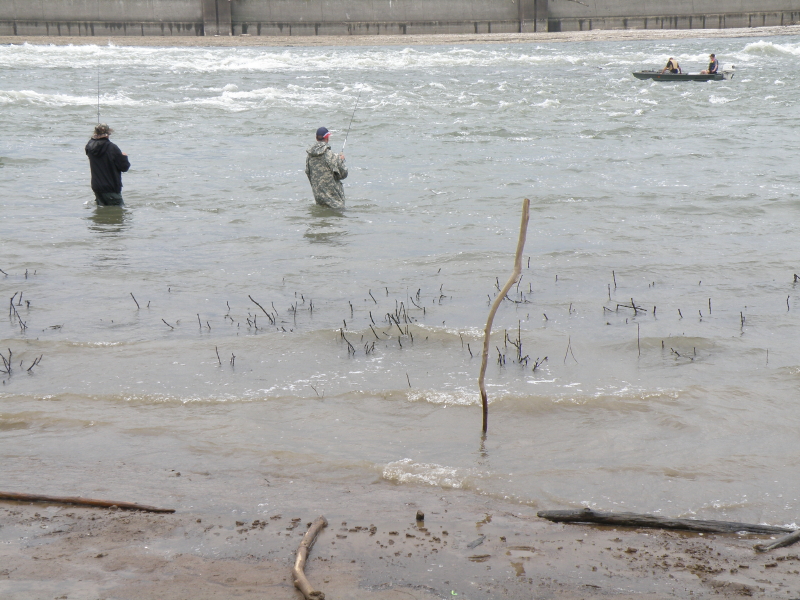
It’s the beginning of June at the Falls of the Ohio.  I arrived at the river to find a dozen or so fishermen that were up on this cool, grey morning before me.  There are both people and boats in and on the water.  Many fishermen are knee to thigh high in the river balancing themselves on the shallow, but rocky bottom.

Fishermen at the Falls, June 2013

The river attracts all kinds of fishermen.  I see people who have lots of fancy, expensive tackle and for the most part they are using light gear for smaller, sporty, quarry.  And then there are the guys that seem more local and blue-collar.  No fancy gear here that the anglers might prefer.  Rather this is a big pole, five gallon bucket, come as you are affair.  Word has probably been passed down the line that the “shad” are running and it’s a good time to catch a mess of fish.

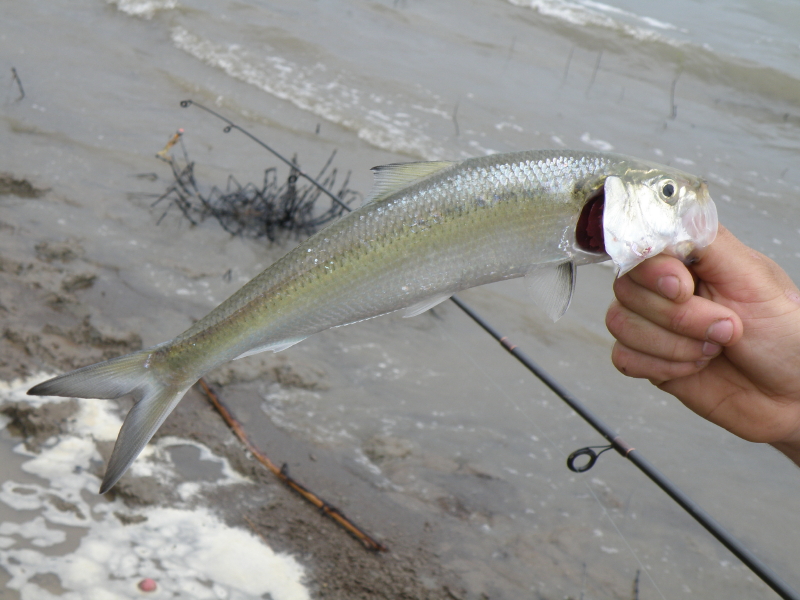
Skipjack herring at the Falls of the Ohio, June 2013

This is the fish of the day…the Skipjack Herring, (Alosa chrysochloris).  This fish was first described by the naturalist Rafinesque in the early part of the 19th century.  It’s an abundant and beautiful fish found in all of Kentucky’s major rivers and up into the Mississippi River too.  The Skipjack is anadromous which means it migrates up rivers from the sea to breed.  During the right time of year large schools of Skipjacks are congregating under the dams and waiting for the chance to move forward.  The Skipjack gets its name from jumping out of the water like a skimming stone in pursuit of the smaller fishes it eats.  At the Falls, the fishermen are catching Skipjacks to use as bait.  The fish is cut into quarters and set upon large treble hooks in the hopes of catching big catfish.  One fisherman told me he witnessed a 30 pound catfish being caught with this method the previous night.  I recently read that these waters were also once home to the Ohio Shad (Alosa ohiensis) which were first described from specimens caught in the Ohio River at Louisville in the late 19th century.  This fish is so rare now that it is on occasion listed as being extinct.  The Ohio Shad was probably not common to begin with.

dead fish, June 2013

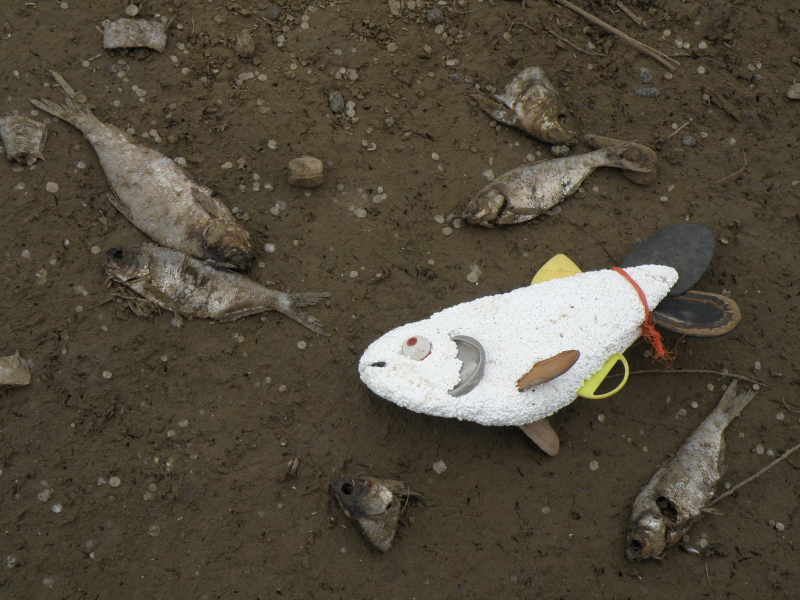
Along the water’s edge the smell of dead fish demarcates the air where water and land meet.  The riverbank is littered with the unlucky who through lost scales and exposed bone are returning to the world from which they came.  There was one unfamiliar fish that I came across and I did a series of photos of it.  Here are several views I made of this new fish.

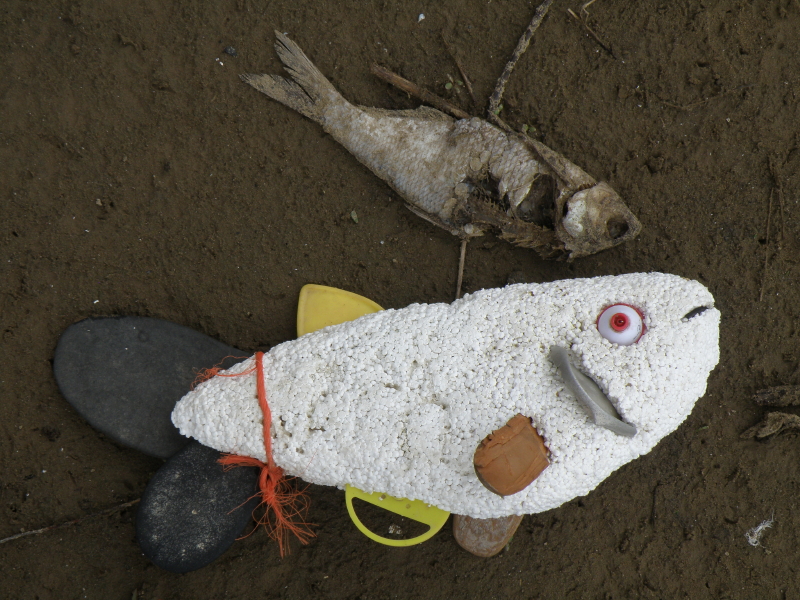
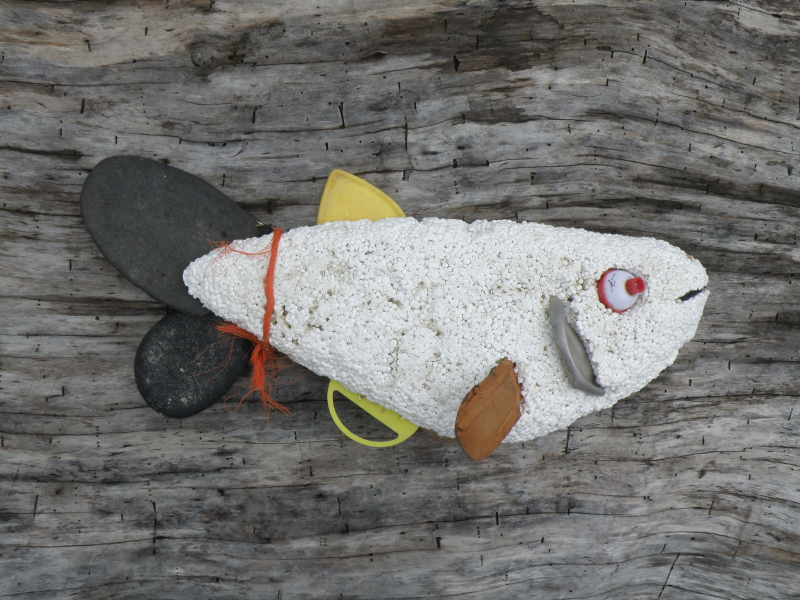
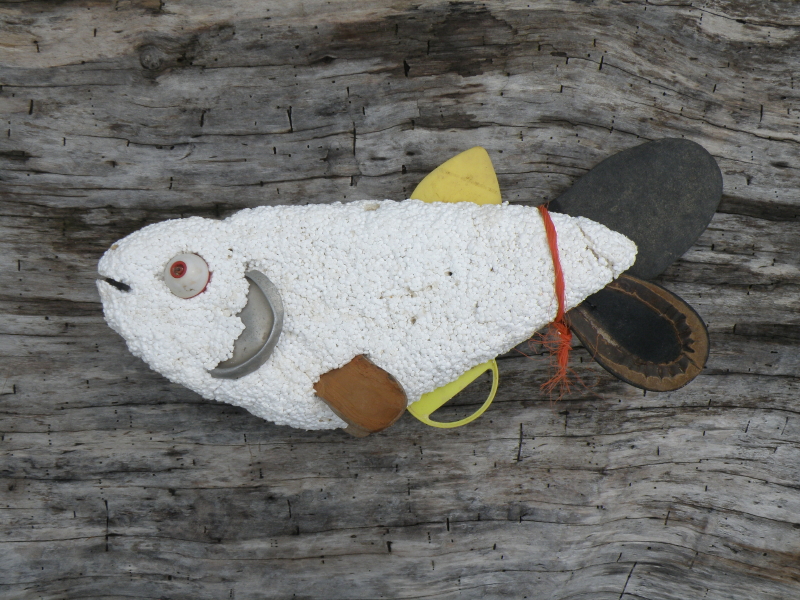
Yellow-fin Carp with skipjack, June 2013

Fish studies, June 2013

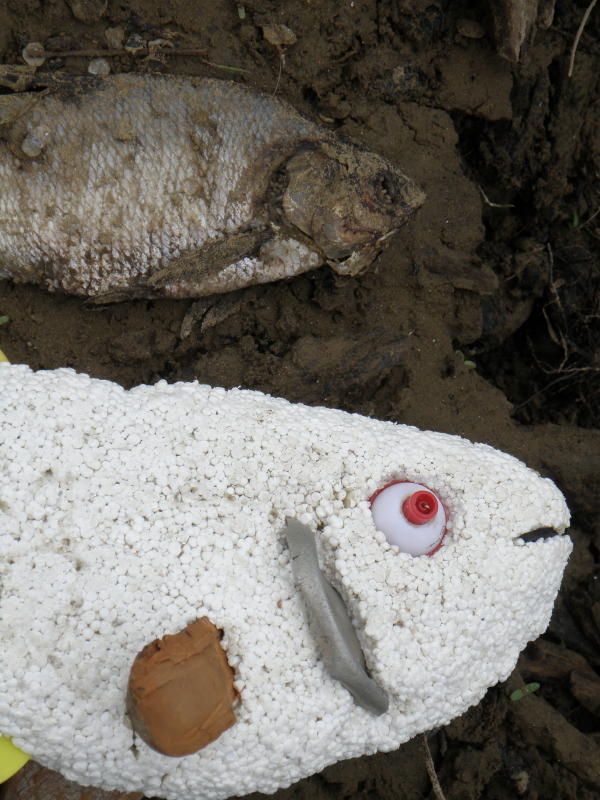
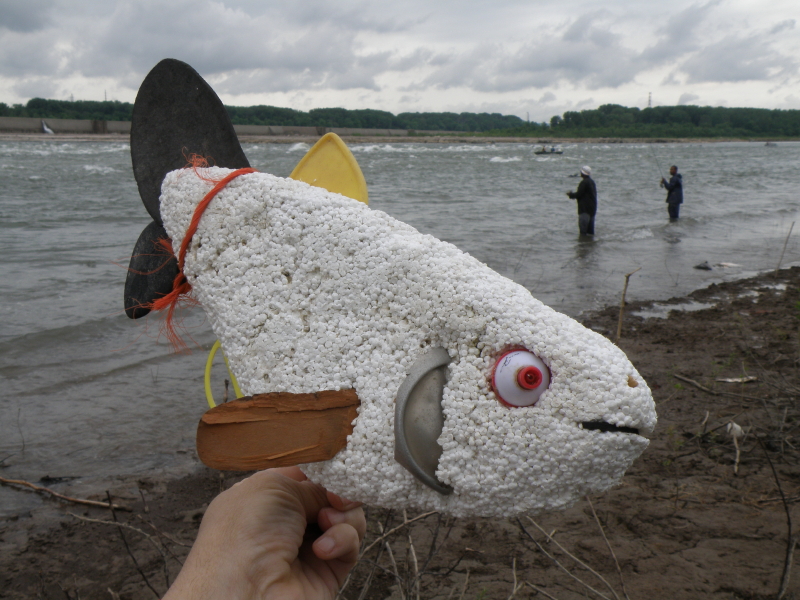
There isn’t anything in the literature about this fish and so I’m going to designate it the Yellow-fin Carp for obvious reasons.  In life, it probably was in the 3 to 5 pound range and I’m surprised it didn’t get cut up for bait as well? It has the tell-tale large eyes that suggest it is a deeper water fish.  It was probably caught by mistake, released, died, and washed up here with the other unfortunates.  Here’s a couple of images made along the riverbank.

Yellow-fin Carp in hand, June 2013

Yellow-fin Carp in hand 2, June 2013

Since this is something you don’t run across out here very often, I thought I would post a few more images that provide a more formal portrait.

Yellow-fin Carp, facing right, June 2013

Yellow-fin Carp, facing left, June 2013

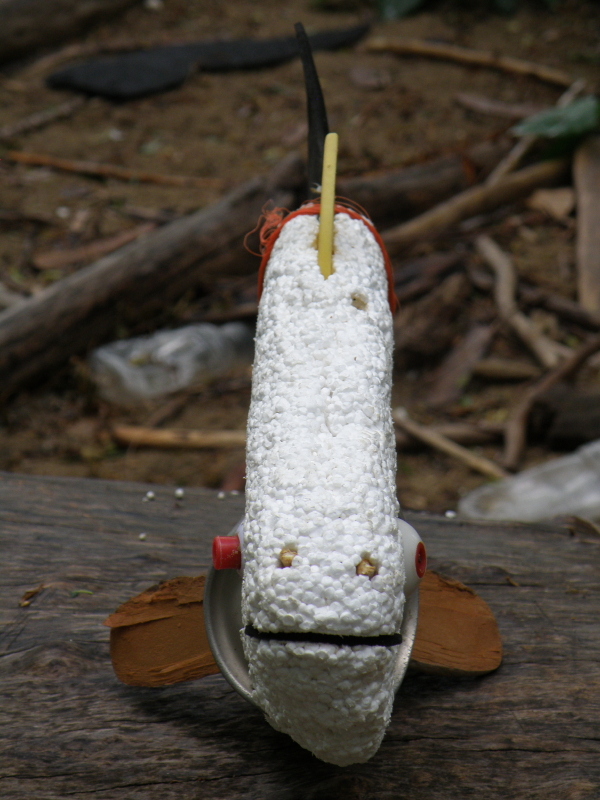
And now for a head-on view of this interesting fish.

head-on view of Yellow-fin Carp, June 2013

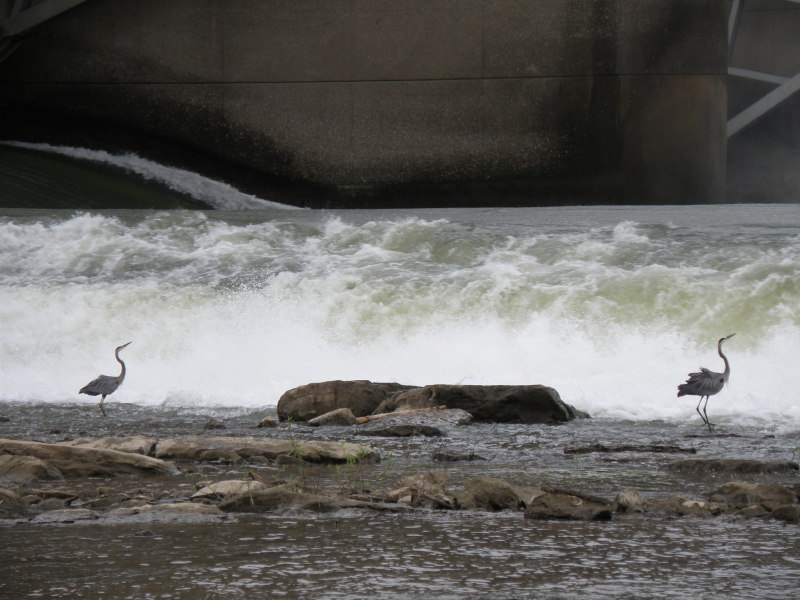
People were not the only animals out here after the Skipjacks.  Several bird species including Ospreys, Double-crested Cormorants, Black-crowned Night Herons, and Great Blue Herons were taking their share.  Here is a heron couple that are set up by the tainter gates in the eastern section of the park.   Between catching fish they mirrored each other in a few courtship moves.

Great Blue Herons by the tainter gates at the Falls of the Ohio, June 2013


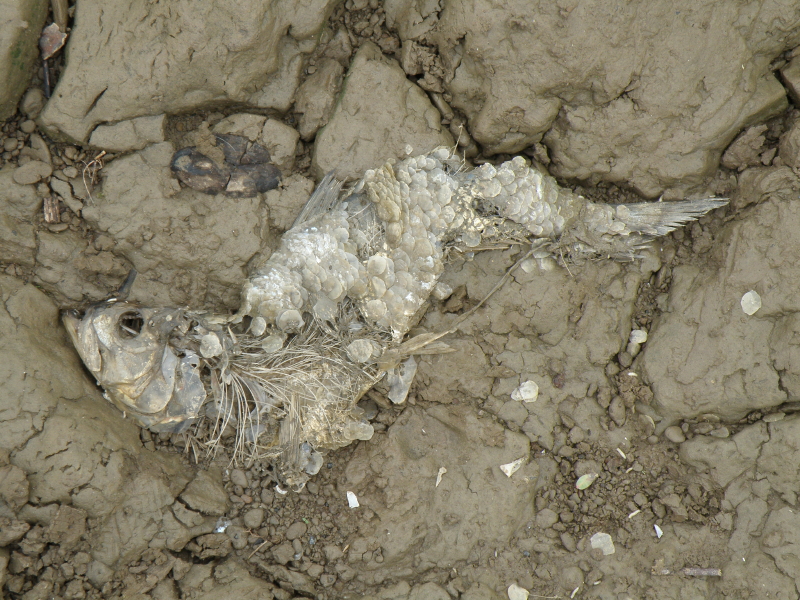
The fossil limestones at the Falls of the Ohio are famous for the diversity of Devonian Age life forms that are preserved within the rocks.  Ironically, the Devonian Age is also known as the age of fishes because they first appear in the fossil record over 350 million years a go.  At the Falls, however, fish are poorly represented in this rock record.  I imagined that if they had preserved as well as other creatures…their remains might look something like this.

dead fish at the Falls, June 2013

Read Full Post »

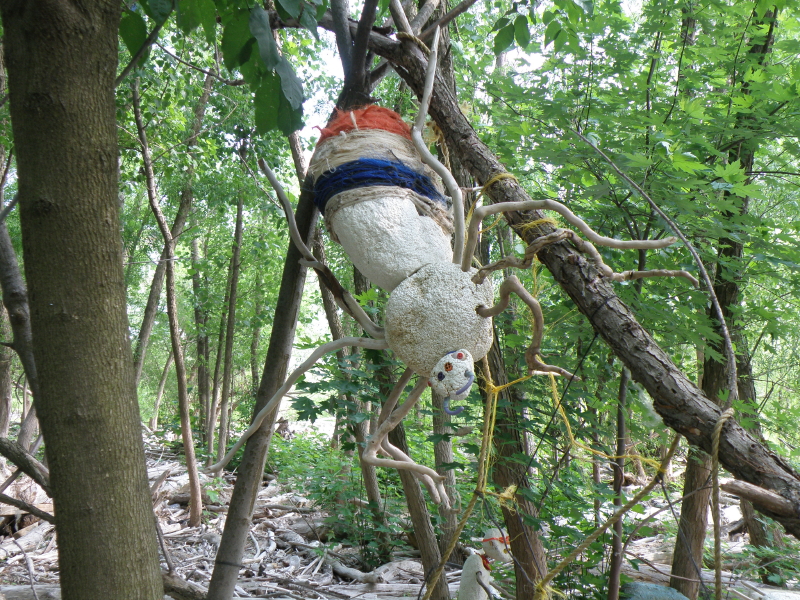
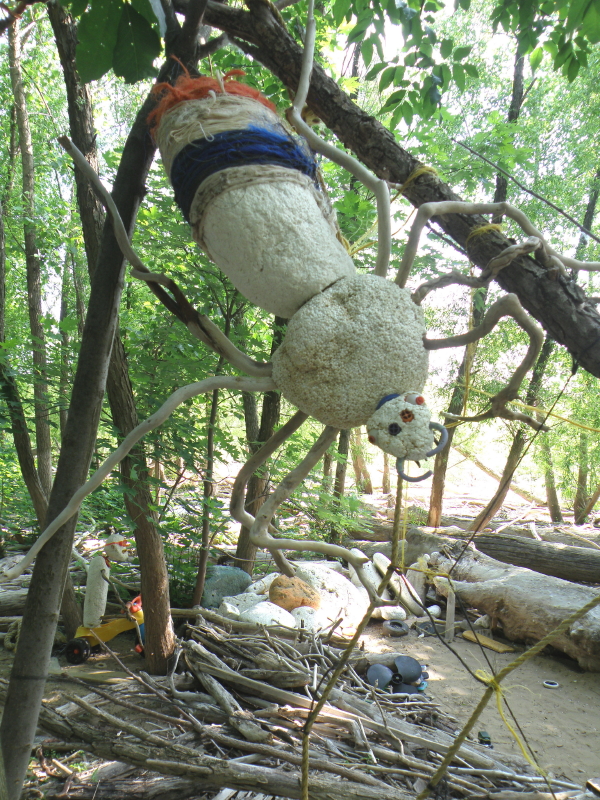
Giant Driftwood Spider on web, June 2013

I couldn’t get my mind off of the Giant Driftwood Spider and so I paid an extra visit to see if it was still around…unfortunately it wasn’t.  I was hoping to get better images, but my original ones will have to do.  Its web near my studio spot, however, was still intact and being effective too!  I also noticed that the cocoons were missing and either they hatched, were taken by some other predator, or were moved by spider mom since their location had been discovered by me?  Although the spider pics in this post are a couple of weeks old by now…these latest web images are more recent.
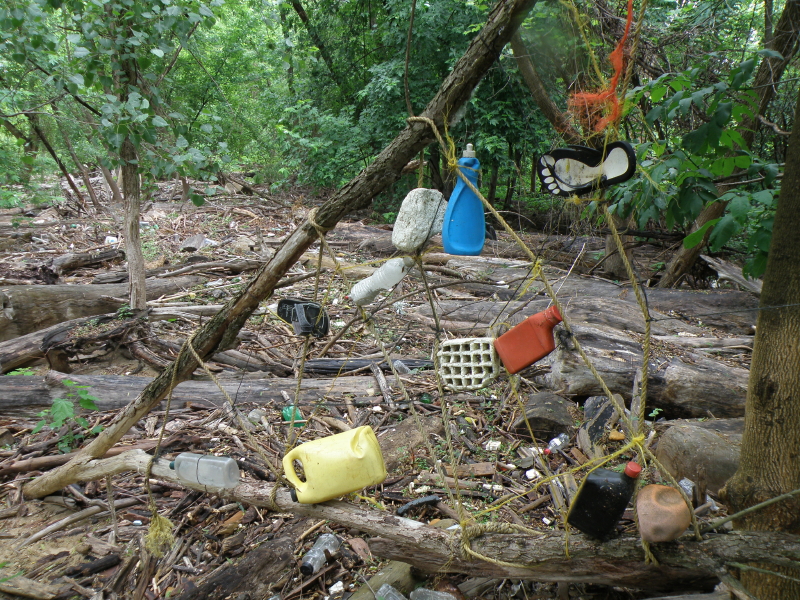
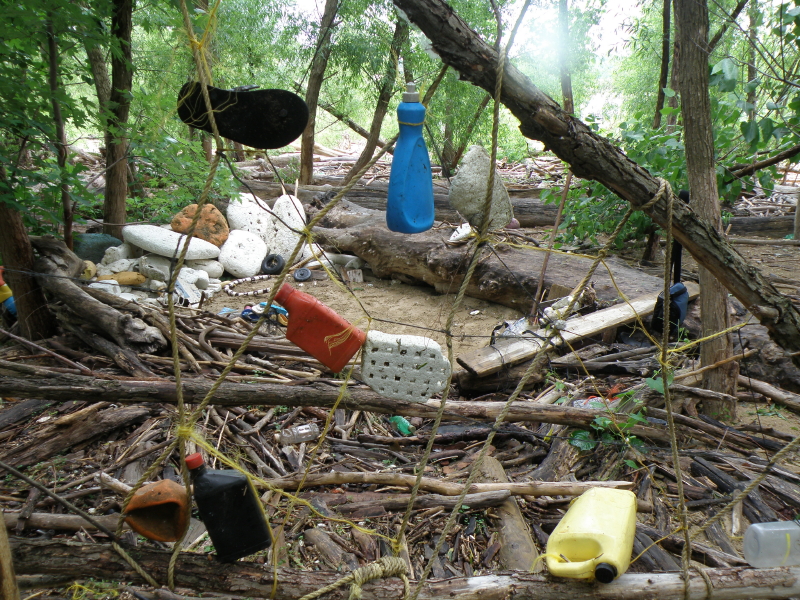
Giant Driftwood Spider web with junk, June 2013

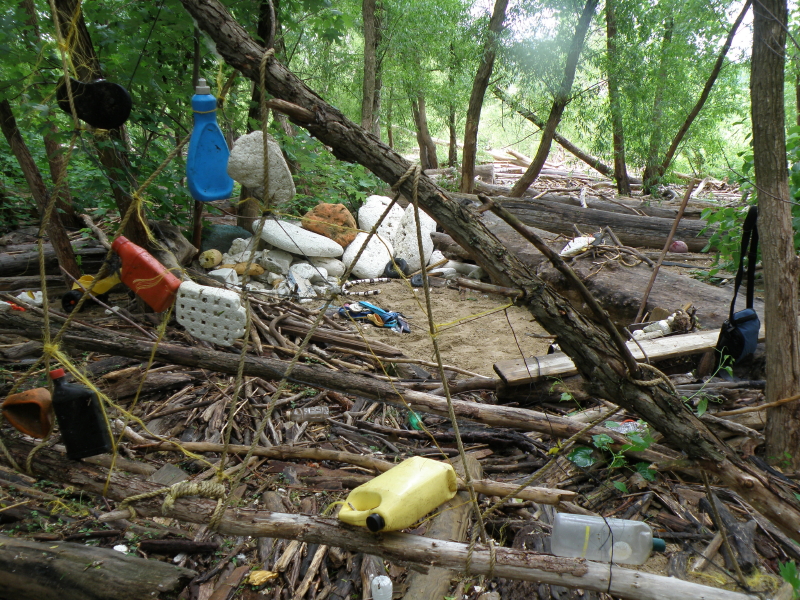
Giant Driftwood Spider web with more junk, June 2013

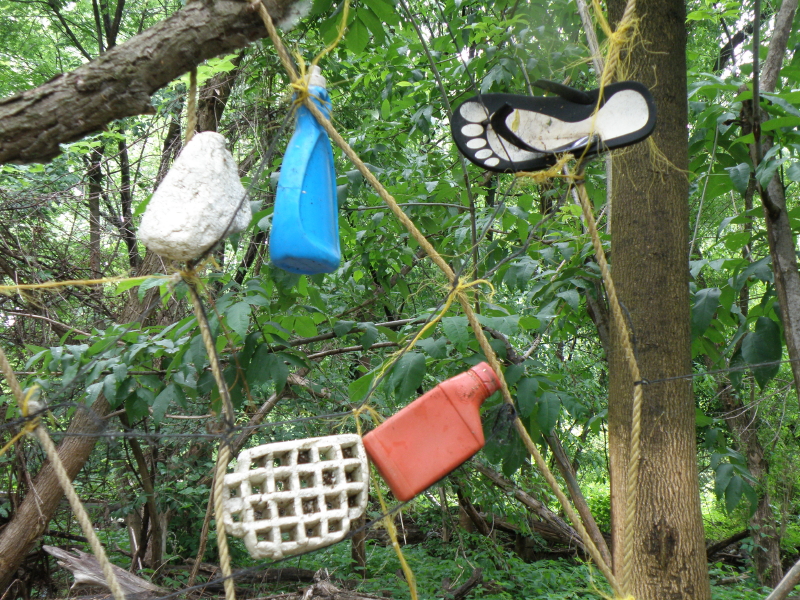
The web can’t have been abandoned for very long.  I was, however, amazed at all the plastic bycatch that had drifted in and been ensnared in the silk.  We have had some strong winds and storms blow through the area and that is my explanation for how all this plastic wound up being suspended off of the ground.  Most interestingly, much of what the web caught has a petrochemical pedigree.  There were a couple smaller pieces of  Styrofoam, but the majority of the bycatch included plastic oil or antifreeze containers.

plastic bycatch, June 2013

bycatch composition, June 2013

I must also admit to becoming fascinated by the pictorial possibilities that this web with its bycatch presented.  I liked the idea that I could see these shapes seemingly floating on a screen in front of an image of a greater spatial depth.  I was struck by the “art-like” sensations I was feeling studying this web.    I could see a certain play occurring with shapes and colors and even in the relationships between objects.  Is this not an installation piece?  It made me wonder if it was possible for any other animal to make something we could recognize as being art?  I have always felt that for humans, art was an important survival mechanism.  Could it be for other animals as well?  Wasn’t too long a go , we didn’t think animals could even feel pain!  Surely, we are short-changing them in other ways too?

Giant Driftwood Spider, June 2013

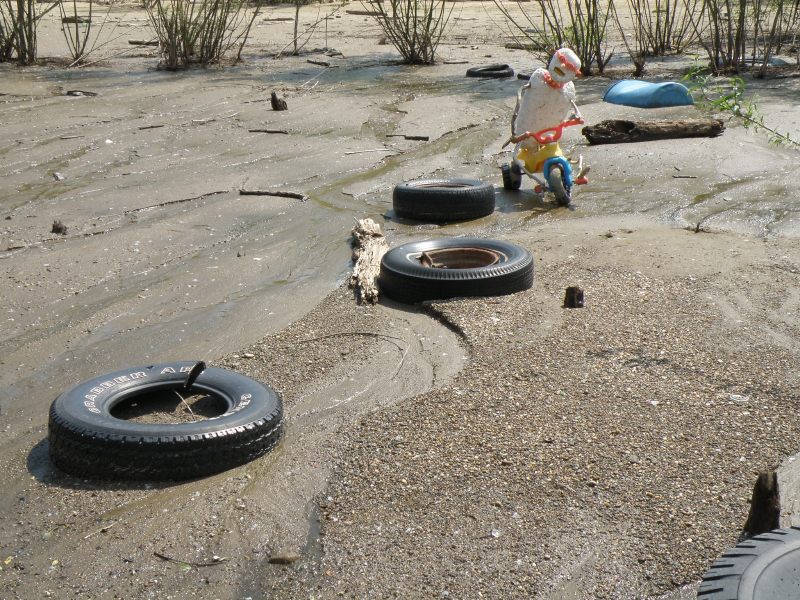
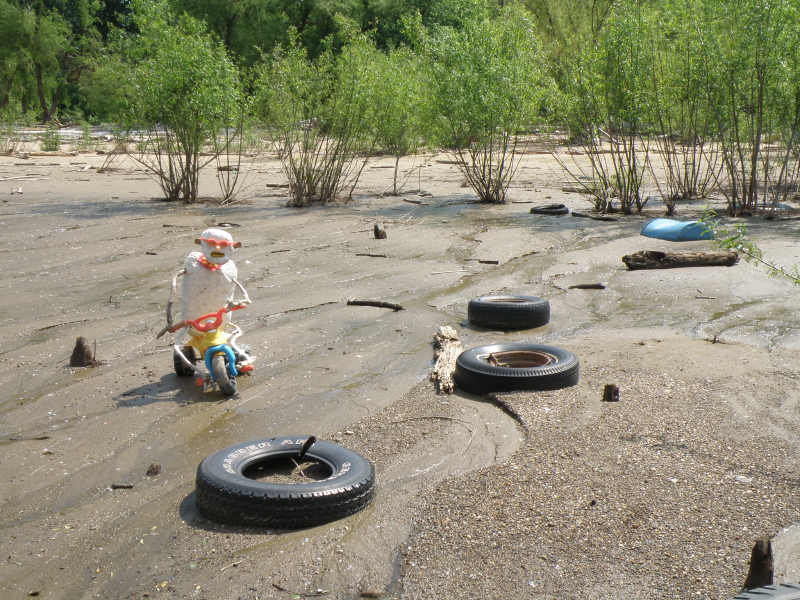
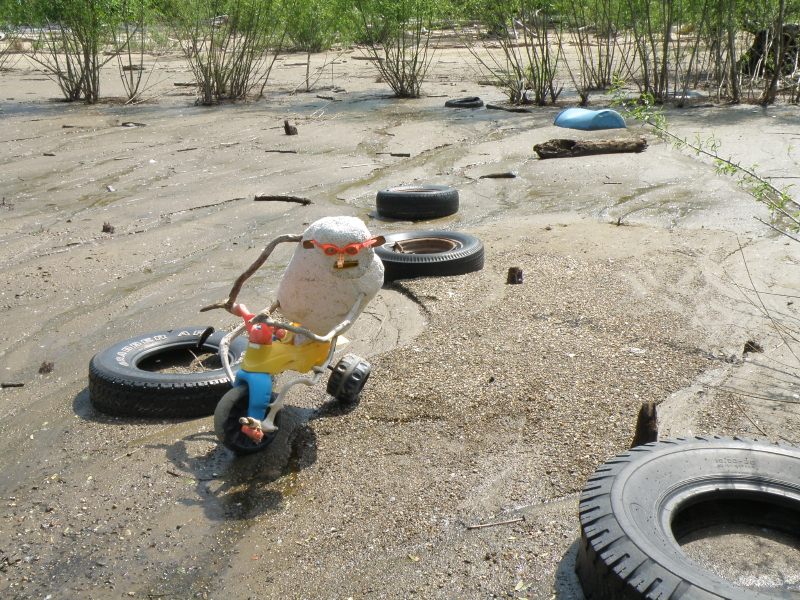
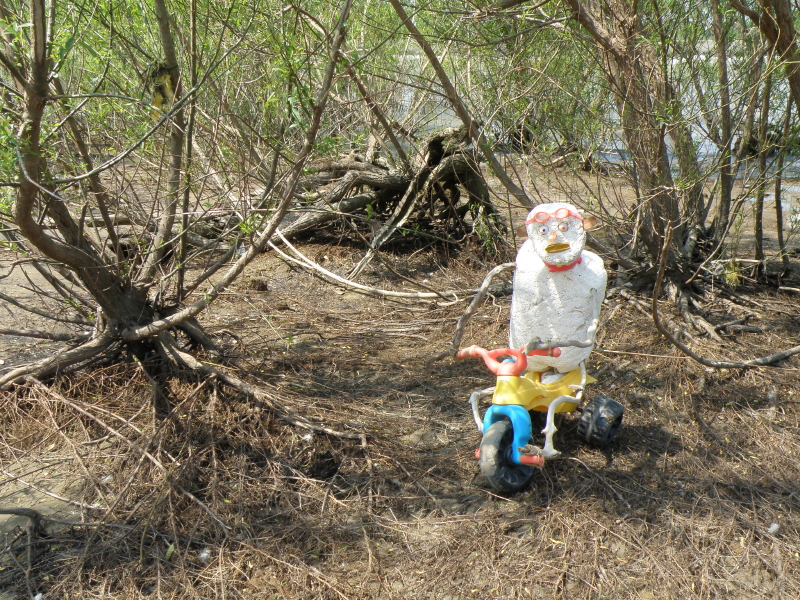
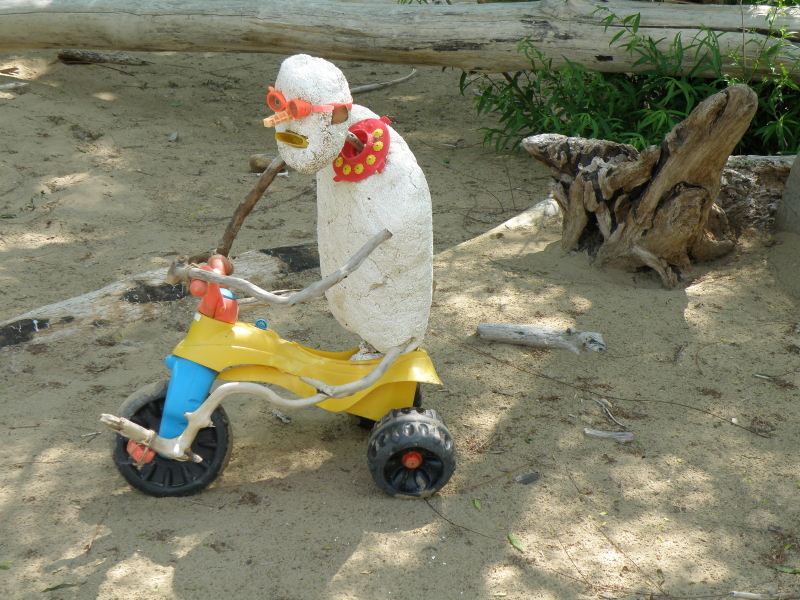
If I should happen across this amazing arachnid again…I will see if I can test it in some aesthetic fashion.  Perhaps it could draw me a picture in the sand with each one of its eight legs?  That’s meant as a joke…I’m not sure what I would do to tell you the truth.  Here’s one last image and if you look in the upper left hand corner you can see the Off Road Triker sitting on his ride.  Unfortunately, he didn’t make it and was in the world in this configuration a little less than two weeks total before being thoroughly smashed in the sand.  That’s just the way things go some times at the Falls of the Ohio.

Giant Driftwood Spider in the context of my outdoor studio site, Falls of the Ohio, June 2013

Read Full Post »

Falls of the Ohio, late May 2013

Another great day at the Falls of the Ohio.  Although it’s late May, we haven’t immediately jumped from a cool spring into a sweltering summer heat.  We still have time for that.  I’m following the deposited driftwood which forms these nice clearings punctuated here and there by small stands of willow trees.  There’s a method to my walks.  I carefully and as quietly as I can listen and look for any bird life in each new area I move into.  If I don’t find any birds than I move around the driftwood looking for interesting pieces and any other water born junk of note.  If an object captures my eye, I usually take a photograph of it in the context of the environment surrounding it.  If it is something really unusual, portable,  and potentially useful…then I may drop it into my collecting bag.  I also try to pay attention to any new flowers or insects that are out since my last visit. I don’t collect anything living since with the exception of fish…it’s against the park’s rules.

Falls of the Ohio, late May 2013

I will also walk the river bank doing much the same thing before heading back into the trees and my studio under the willows.  It’s here at my outdoor “atelier” that I check out my latest finds and with the materials I’ve previously collected…attempt to make art from them.  I was taking a break sitting on a bench I made and letting my mind “go blank” and just listening.  In the trees I could hear Northern orioles, Blue jays, and Catbirds all making their distinctive sounds.  With birds, you don’t need to see them to know they are present.  Small, noisy flocks of Cedar waxwings were flying from mulberry tree to mulberry tree seeking out ripe fruit.  I also kept hearing a “clicking or clacking”  sound originating behind where I was sitting which I mistakenly took for a squirrel moving among the branches.  I would look over my shoulder every now and then, but I didn’t see anything at first.  I didn’t see anything at all…until it moved!

Giant spider on web, late May 2013

Between its cryptic coloration and the dappled light effects of sunlight filtering through the tree tops…I had completely missed seeing the biggest spider in the world!  I know I had to walk by this marvel, but it didn’t register at all until this moment.  The spider wasn’t making any threatening gestures yet…perhaps it was remaining still “thinking” that I hadn’t located it.  The spider on its web was perhaps a dozen feet away from where I was sitting.  Meanwhile the hairs on the back of my neck were on end and I had an acute case of goosebumps all over my body!  Instinctively, I reached for my camera and started taking pictures.

Giant spider, May 2013

Carefully walking around the spider and its web, I snapped off as many images as my nerves would dare.  I still had no idea what it was capable of doing especially in protection of its nest?  I had my stout walking stick at the ready.  Nestled in a depression in the wood at the web’s base was a silk-lined “pocket” that held three white cocoons.  I wasn’t sure if these were egg cases or the wrapped up remains of former meals?

giant spider egg cases?, Falls of the Ohio, May 2013

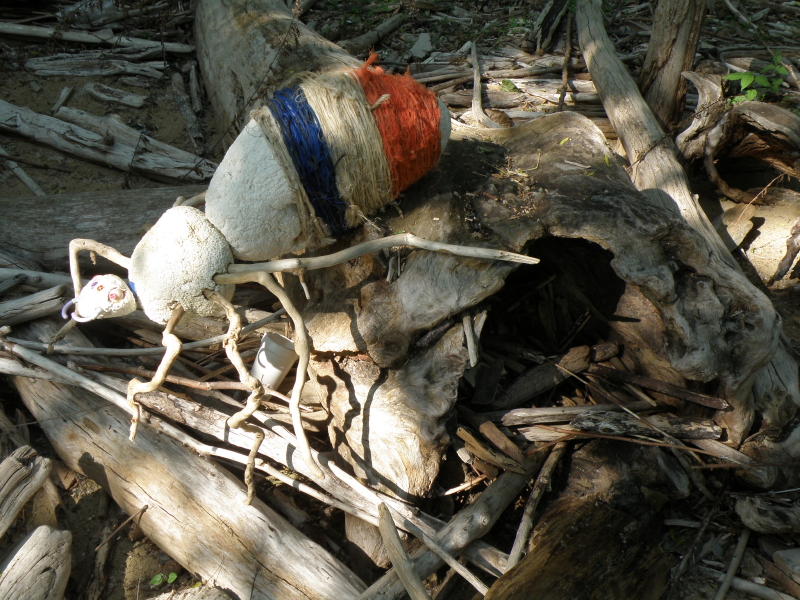
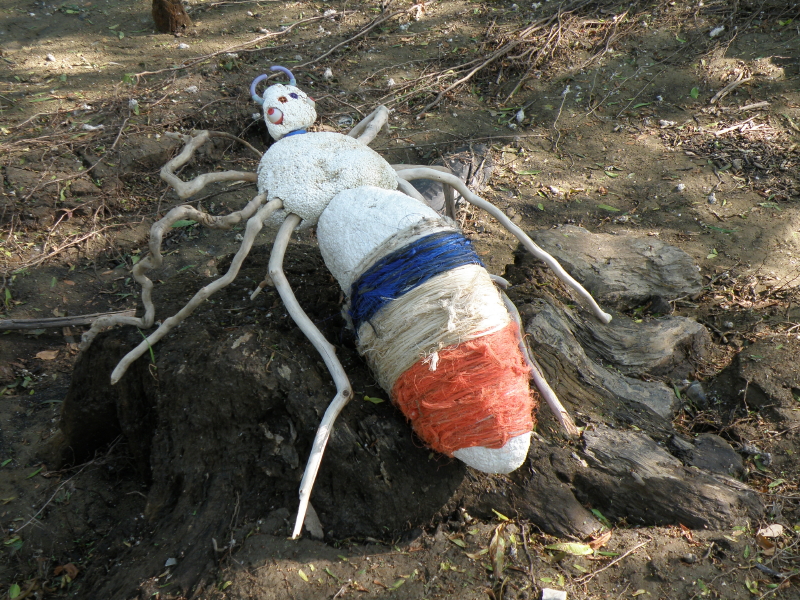
In trying to describe this spider to you…I utilized my walking stick not only for protection, but to gauge its size as well.  Later in the comfort of my home, I estimated that the length of its body from the head to the tip of its abdomen to be approximately 30 inches or 76 centimeters long.  It’s moving legs made the spider seem much larger, but they were harder to measure.  The legs were perfectly camouflaged resembling the driftwood all around us.  The spider’s abdomen is covered with coarse hair arranged in bands of orange, white, and a bluish-black colors.  Otherwise, the spider is as white as the large river-polished chunks of Styrofoam that wash up on these fabled shores all the time.

Head of Giant Driftwood Spider, May 2013

lower jaws of Giant Driftwood Spider, May 2013

The head of what I’m now going to call the “Giant Driftwood Spider” is very unusual for a spider.  The fact it is nearly distinct (as in insects) and not simply continuous with the thorax makes it different.  The head was not, however, capable of movement.  This spider features four eyes.  It has two, larger dominant eyes and a vestigial pair located between them.  The fangs were purple in color and supported by black jaws used for gripping prey.  The clicking sound I had heard earlier were its fangs rubbing together.  Like all spiders…I assumed that this species is carnivorous as well.? Consistent with true spiders, this giant species also has eight legs, although the Giant Driftwood Spider’s are not uniform.  After watching this great arachnid for several minutes, it surprised me by leaving its web and walking towards the river.  I naturally, followed behind it at a discreet distance.

Giant Driftwood Spider, May 2013

Giant Driftwood Spider on a stump. May 2013

Giant Driftwood Spider on tree roots, May 2013

The giant spider moved deliberately through the driftwood field pausing once in a while for whatever reason.  Thoughts about what this spider did for food crossed my mind.  Was it an ambush predator secretly lying next to a log waiting for a meal to walk by?  Did it rush and overwhelm its prey with a lethal bite to the body?  I thought this likely since its web by my outdoor studio didn’t seem big enough to capture anything larger than birds or rodents.  I got the sense that this spider was able to go a long time between feedings.  I continued to follow the spider when it stopped at another silk construction it had previously created.

Great Driftwood Spider in yellow silk lair, May 2013

The spider stopped by what I’m guessing to be another silk trap?  The spider may have been trying to hide its form with the silk?  Perhaps it uses a method similar to trapdoor spiders in catching its food?  I will confess that I do get “creeped out” by having spider webs go across my face.  I have always had an aversion to this feeling, although generally speaking…I’m okay with the spiders themselves.  In this particular area, it felt like I was constantly wiping my face which made me very ill at ease.

Giant Driftwood Spider in its lair, May 2013

Giant Driftwood Spider attack!, May 2013

I circled back around to get a better look and when I did the spider lunged for me! With fangs clacking together and its legs gesturing wildly, the spider held its ground, but did not advance towards me.  With stick at the ready and in deep fear, I was prepared to swing down as hard as I could on the spider if I had to.  That’s when it occurred to me how wrong that would be?  Who was doing most of the provoking anyway?  Perhaps the spider was reacting in self-defense?  As with most living things, this spider had as much if not more reason to fear humans.  Even though this was the biggest spider I had ever seen…I was still bigger than it.  With that realization I backed off and took my leave of the Giant Driftwood Spider.  Reaching my home, I couldn’t wait to see the pictures and to tell the story of this remarkable animal encounter.  The world is full of natural marvels and the Falls of the Ohio…has many of them.

willow tree and roots at the Falls of the Ohio, May 2013

Read Full Post »

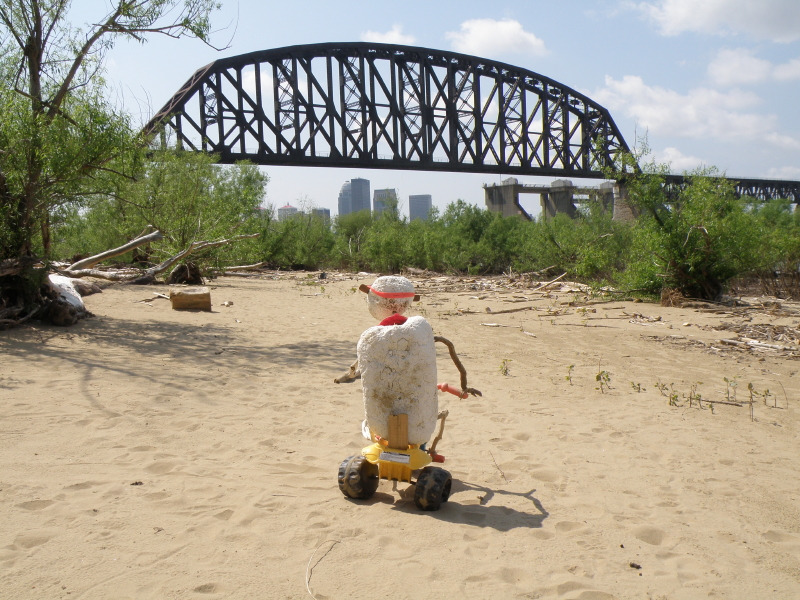
washed up plastic tricycle, Falls of the Ohio, May 2013

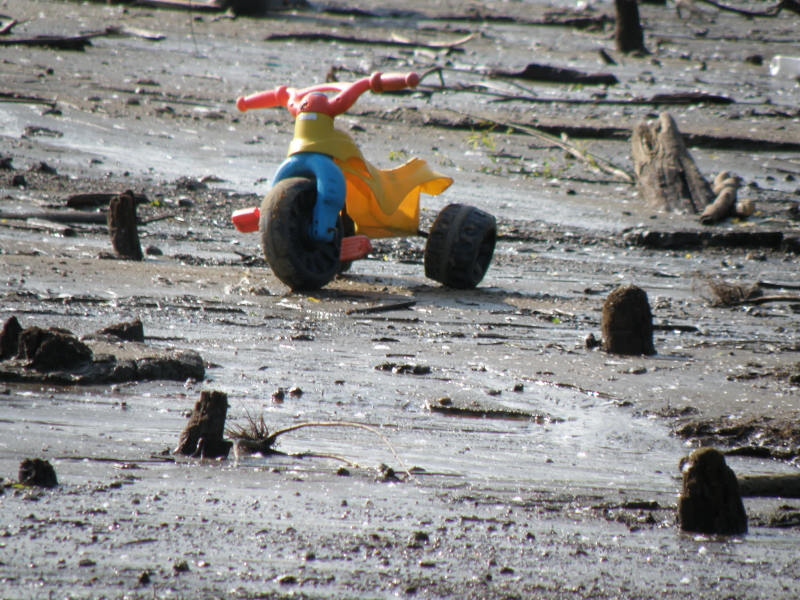
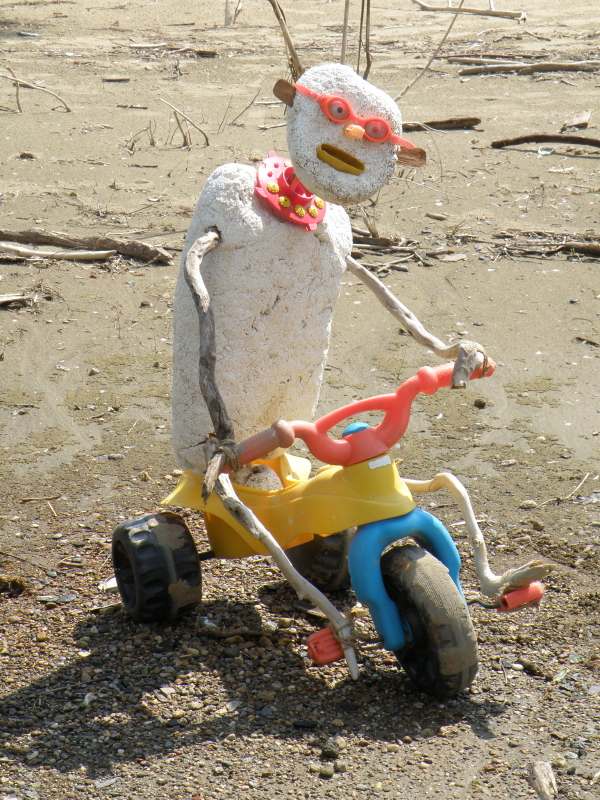
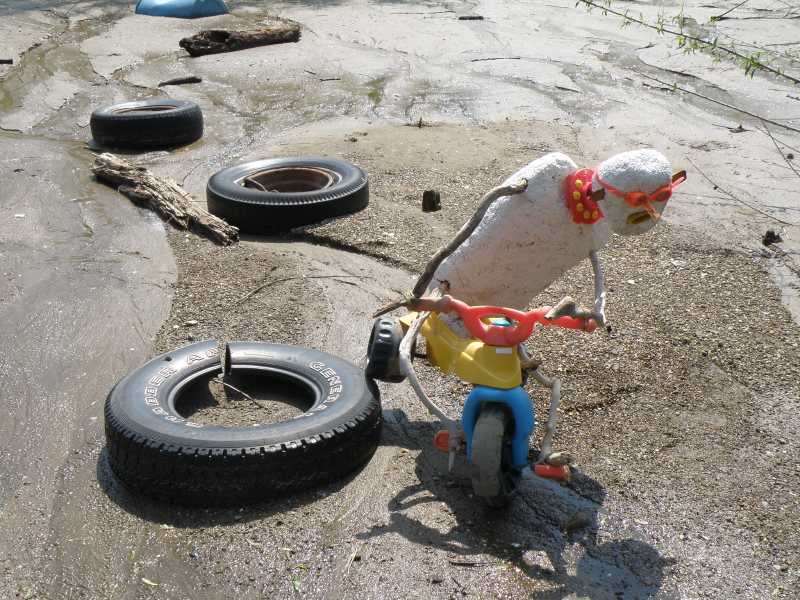
I was at the Falls of the Ohio last week when I spotted this plastic toy tricycle just sitting by itself near the river’s edge.  Although I didn’t see anyone around, I just assumed its owner must be nearby.  I took this picture and walked away.  After a time spent looking for driftwood and anything else, I was heading back to my studio under the trees when I was approached by this character I’ve come to know as the ” Off Road Triker”.  He was quickly peddling that tricycle I had seen earlier.

Off Road Triker, May 2013

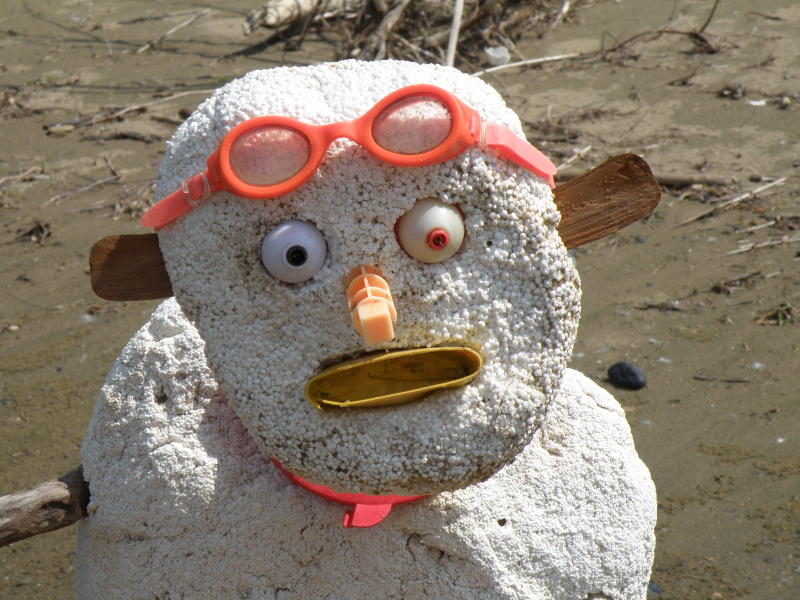
With his trademark orange goggles, the Triker likes to explore the world from the seat of his three-wheeler.  I recognized him as the  subject of a few human interest stories in the newspaper, but this was a first spotting him on the shores of the Ohio River.  I have heard that he used to own a car, but now he just peddles everywhere he wants to go.  As a side benefit, he’s in the best shape of his life.  His legs alone must be as hard as wood.  The Triker’s ride came to a smooth stop in the sand in front of where I was standing.

the head of the Triker, goggles off, May 2013

Removing his goggles from his eyes the Triker greeted me pleasantly on a picture perfect day.  We introduced ourselves and talked about our observations and connections to this landscape.  The Triker remarked that he had seen a lot of rubbish along the water’s edge and I nodded in agreement.  He wondered why nobody did anything about this, but I had to tell him that the Falls does see several clean-up attempts a year, but with each new flood or high water the new “largess” in the river just washes up again.  It’s like rolling that proverbial rock up the hill only to have it roll back again and again.

Off Road Triker in motion, May 2013

The Triker said that there was a place where several old automotive tires were laying half buried in the sand and that I should check it out.  He put his goggles back on and I walked beside him as he peddled to the spot.  I didn’t tell him this, but I was already familiar with these tires and have photographed this feature many times.  I found the Triker to be amusing and so I just played along to get a sense of who he is and what he might do next.  The reason all these tires are in this particular location is that once upon a time a river clean-up had occurred and these loose tires were gathered here for future disposal.  Ironically, the future never came which left these tires mired in the present.  Now these tires are so full of mud, sand, and water that it would take a herculean effort to dig some of them out of the riverbank.

The Triker begins his run, May 2013

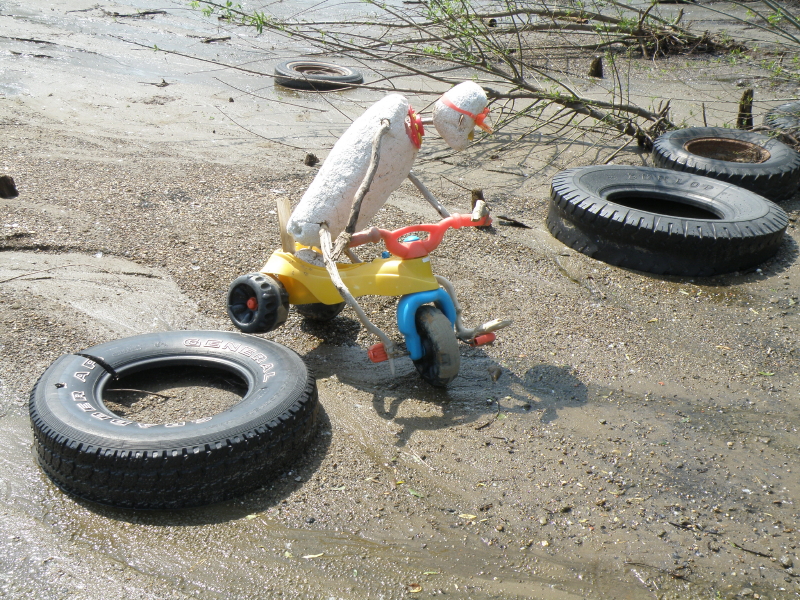
The Triker thought these tires would make an appropriate obstacle course to maneuver through and he asked me to photograph him while he made his run.    Everything started off well enough, but that was not to last.

The Triker runs the obstacle course, May 2013

The Triker swings wide, May 2013

The Trike over corrects, May 2013

The Triker clips the tire, May 2013

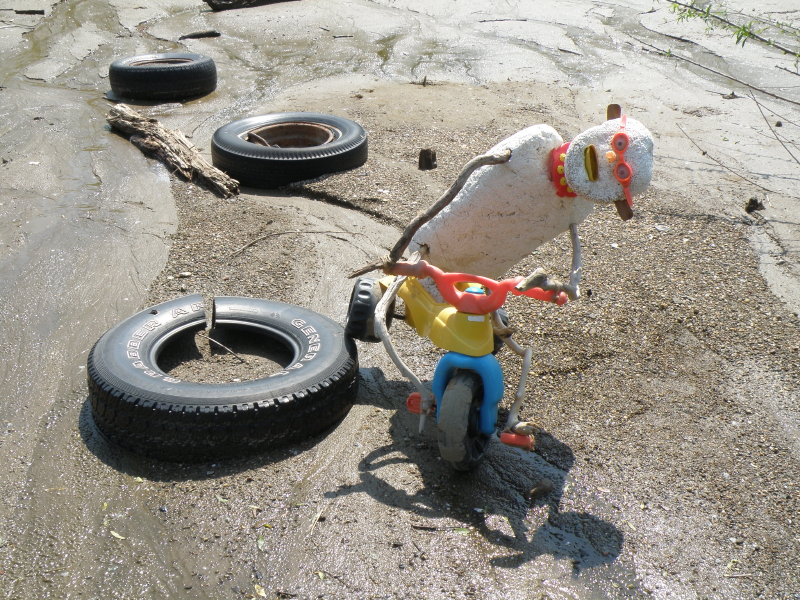
It’s at this point that the Triker hits a snag or rather a tire.  The slalom at the course’s start went fine, but midway through the Triker swung wide and he had to over correct to get around the next obstacle.  Here are some different close up views of the action.

View of Triker hitting the tire, May 2013

The Triker up on two wheels, May 2013

The Triker nearly falls off, May 2013

As you can see…hitting the tire caused the tricycle to go up on two wheels.  The speed and forward momentum nearly caused the Triker to completely lose his balance!

The Triker recovers his balance, May 2013

Fortunately as an experienced rider…the Triker held it together and was able to regain his composure and balance to complete this impromptu course.  He pulled off to the side near some willow trees and exhaled deeply.

The Triker recovers his breath, May 2013

“That was a close one my friend.  I thought for a micro second I was going to eat sand and rubber in a hard way!”  I praised him for his skill on the tricycle and told him I would post the images on the internet which seemed to please the Triker.  Recovering his breath, the Triker said he enjoyed his visit to the Falls of the Ohio, but it was now time to return to the city.  With his goggles back on, my last view of the Triker was of his back as he peddled his wobbly ride with a newly bent axle towards the skyline of the nearby city.

The Off Road Triker departs, May 2013

Read Full Post »

Falls of the Ohio, mid May 2013

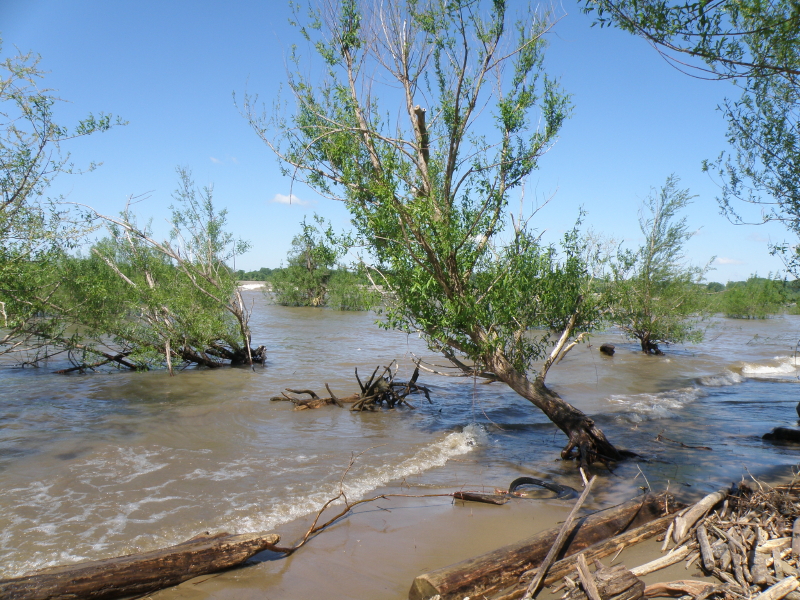
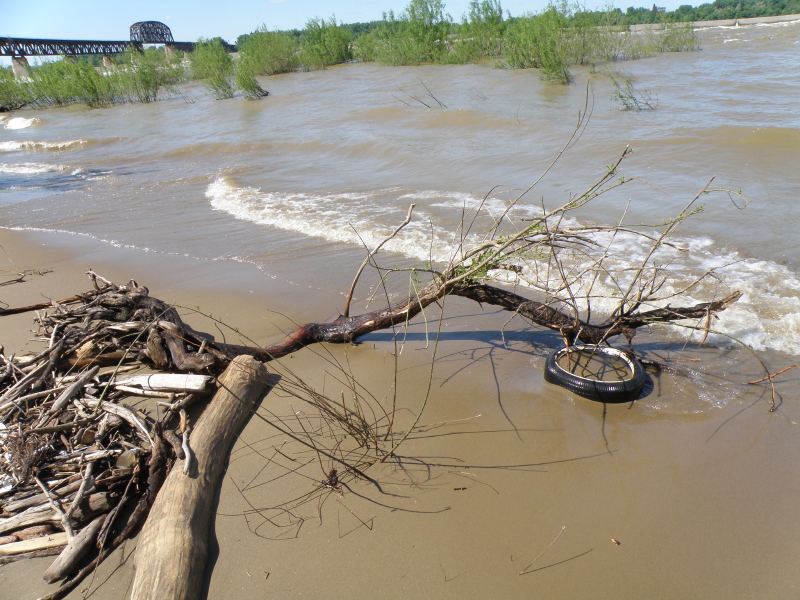
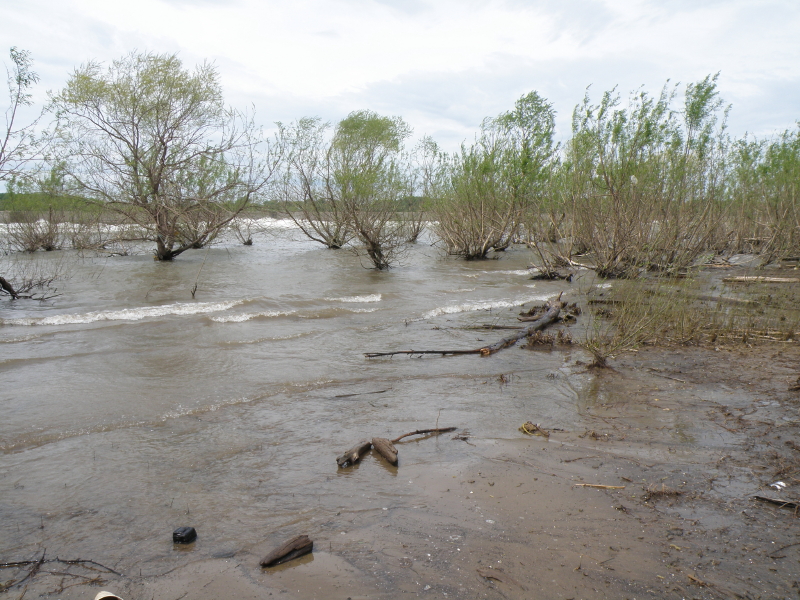
It’s mid May and the Ohio River is high at the Falls of the Ohio.  A now warm wind (it was cold yesterday) is driving muddy waves against the shoreline and the willow trees are in their element.  Except for me…there is no one else around.  Bird life, however, is ever-present and I count many newly arrived species that spent the winter south of the equator.  Eastern Kingbirds are establishing their territories and many different birds already have active nests going.  A bright blue Indigo Bunting flies into my sight line long enough to be identified before once again hiding from view in the tops of the trees. Because the river is taking up most of the bank, I’m walking on top of the driftwood on the parameter of the willow environment.  As I slowly walk along, I move as quietly as possible between the trees.  I’m always hopeful of seeing wildlife and although it is mid morning…I get lucky.  Something has caught my eye down the beach at the water’s edge and I reach for my camera.

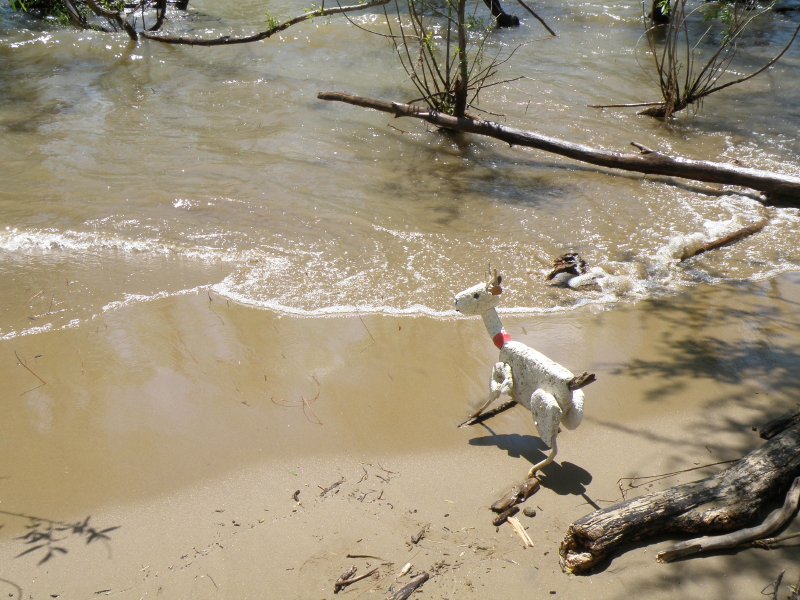
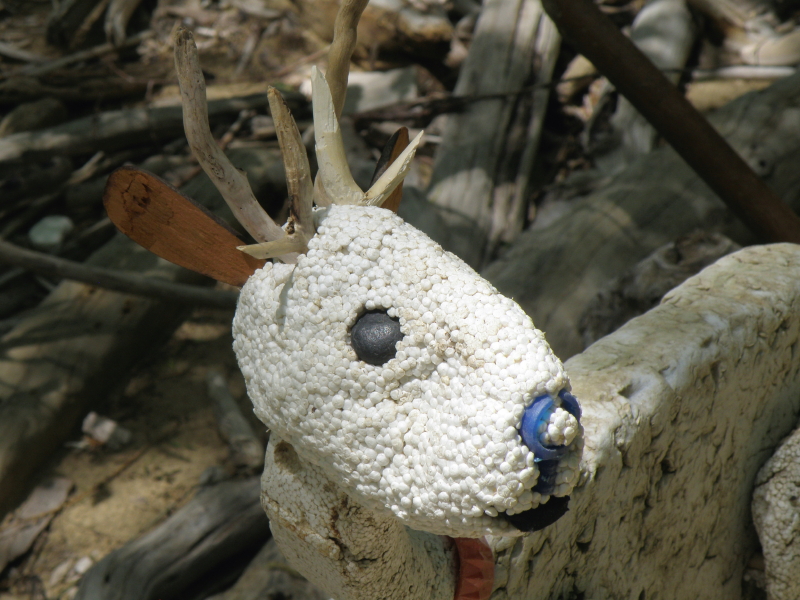
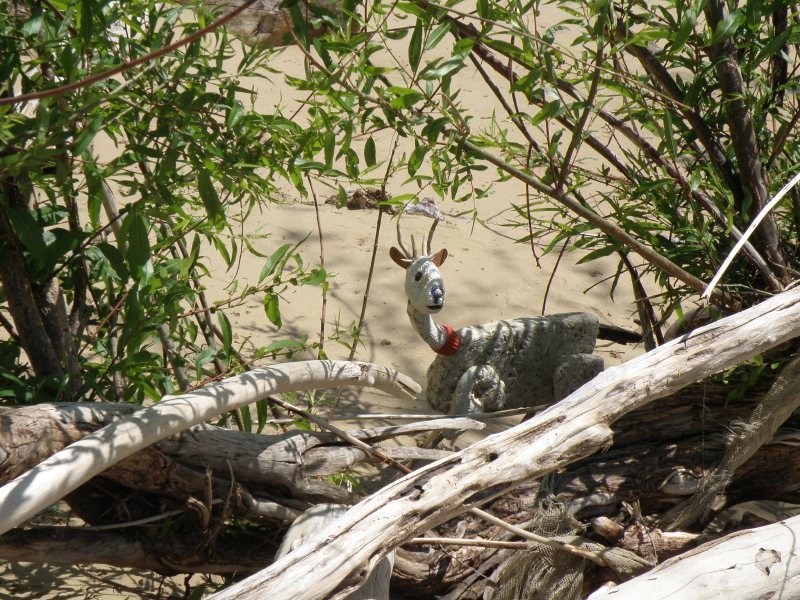
young Styrobuck at the water's edge, Mid May 2013

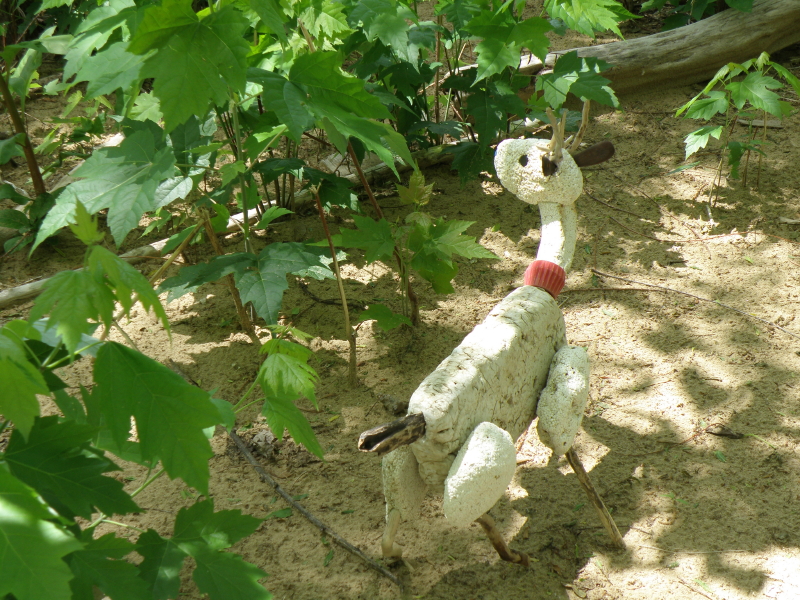
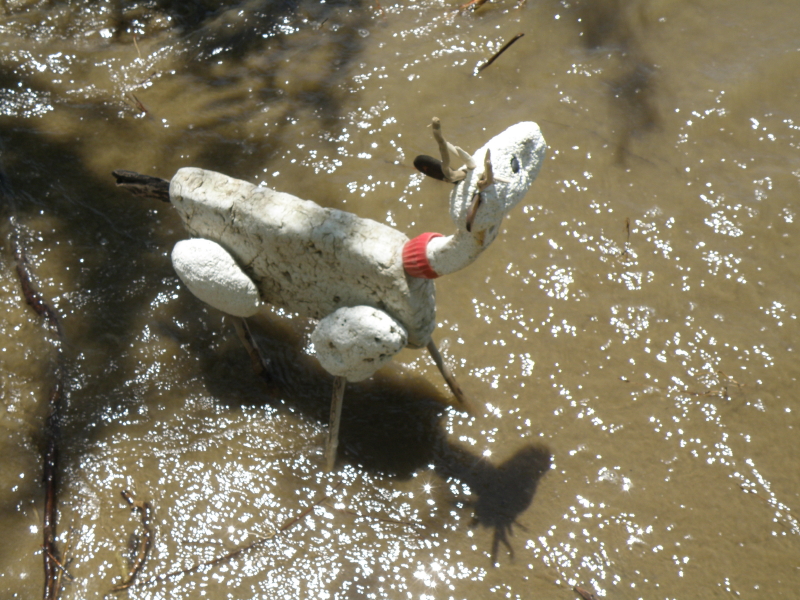
It’s a young Styrobuck and it is nervously checking out the river.  The wind is blowing my scent in the opposite direction. This is indeed great luck because this unusual animal is also one of the rarest mammals in this area.  Years can go by between sightings and there is always conjecture on whether they still exist here at all.  Occasionally, tracks are found which renews hope that they still occupy their original range. I decided that this was too great a photo opportunity to pass up and so I changed my plans for the day.  I would follow and record this beautiful and odd animal for as long as I could.

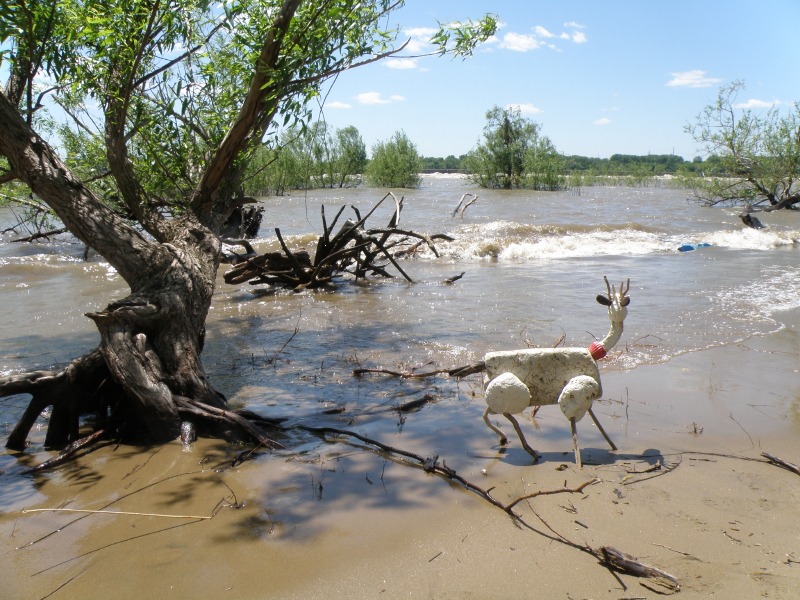
Styrobuck at the river, May 2013

The Styrobuck is one of those hard to classify mammals.  Although genetically a deer…it also shares traits with goats and antelopes.  I recall getting caught up in the discovery in 1992 of a new large mammal discovered in the Annamite Range bordering Vietnam and Laos.  Science calls it a Saola, (Pseudoryx nghetinhensis) but it is also more colorfully known as the Asian unicorn.  Anyway, its resemblance to an antelope is striking, but technically it is a member of the cow family.  Just when it was looking like all the big animals on the planet had been discovered…out trotted the Saola.  The mystery of it was amazing!  Of course, the indigenous people had known about it for a long time.  Once in a while, they would catch one in their snares meant for the other forest animals.  Still, it was a great rarity for them as well…a near mythic animal.  It was probably tasty too.

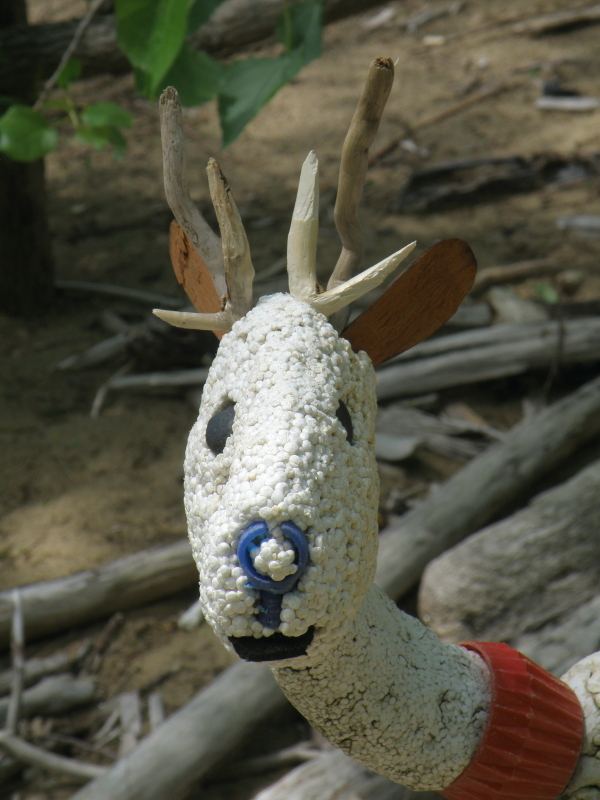
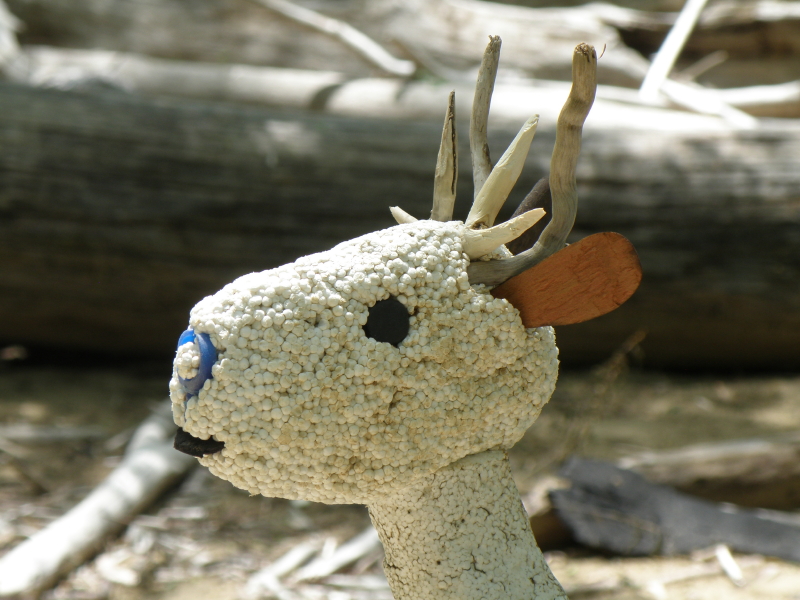
head of a young Styrobuck, May 2013

Styrobuck, detail of head facing forward, May 2013

Styrobuck ,detail, head facing left, May 2013

The Styrobuck is by necessity a very nervous and wary animal.  It is about the size of a small dog and the perfect prey size for many of our predators.  It has large eyes and a keenly developed sense of smell.  There are also old first hand accounts that also suggest the Styrobuck has a sense of curiosity which can lead to its downfall.  Smallish antlers are grown and shed each year after the breeding season in the late autumn.  In the spring one to two fawns are born that remain with their mother until the following  summer.

Styrobuck in the willow woods, May 2013

The animal I was watching was more than likely born last year and probably newly separated from its mother.  To my eye, it did appear that the young Styrobuck was searching for something in the vicinity.

young Styrobuck, mid May 2013

The Styrobuck certainly was concentrating in an area between the river and the margins of the woods.  If there were any other members of its species around here…they remained well hidden.  Every now and then the young buck would browse on young tree leaves and tender grasses.

Styrobuck in the water, may 2013

My last image of the Styrobuck in the water was taken from a vantage point in the top of a willow tree that I quietly shinnied up.  I could feel the wind shifting and sure enough the young buck caught my all too human odor and bolted for parts unknown.  I shared my images with the Interpretive Center who were glad to receive them.  I hope exposing this one animal won’t lead to a stampede by the public that drives this vulnerable species from our area for good.  The Falls of the Ohio is a richer for having this interesting animal call this place home.

Falls of the Ohio, looking east, May 2013

Read Full Post »

Into the light, May 2013

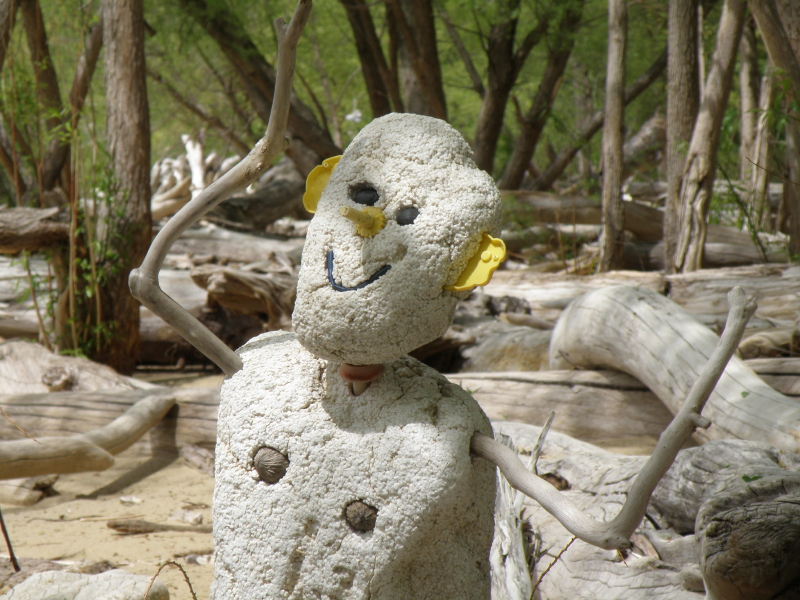
Styrofigure in early May, 2013

Stepping away from the place where it was constructed revealed a whole new world for the Polystyrene Person to explore.  The sun was shining and birds were singing and the Falls of the Ohio were once again turning green with emerging tree leaves.  Driftwood was everywhere along the river and there were plenty of micro-environments to experience.

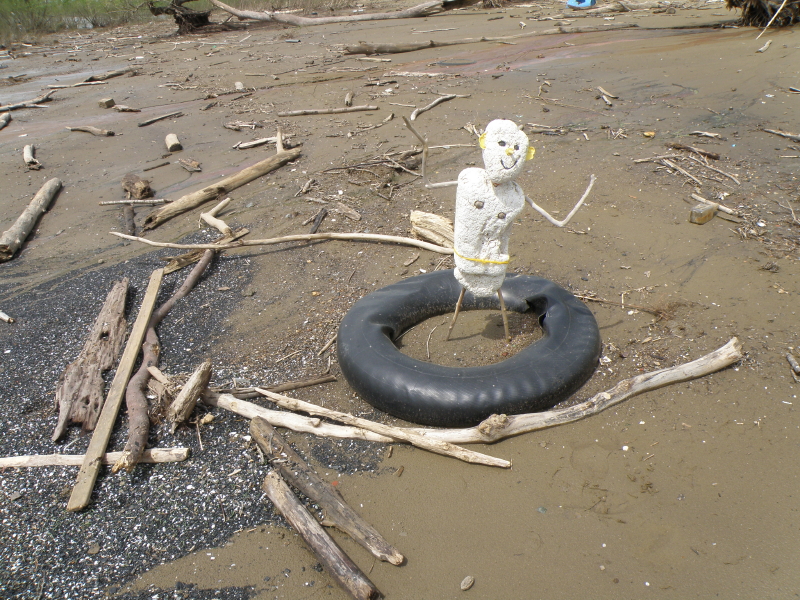
Polystyrene Person dancing in inner tube, May 2013

Being made of trash caused the Polystyrene Person to be less judgmental of the discarded man-made items it came across.  An old inner tube became a tiny arena perfect for dancing.

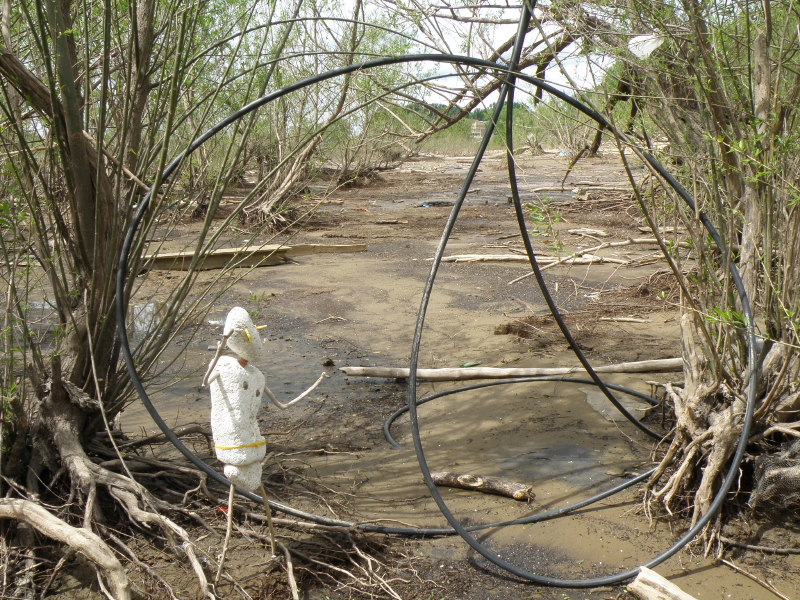
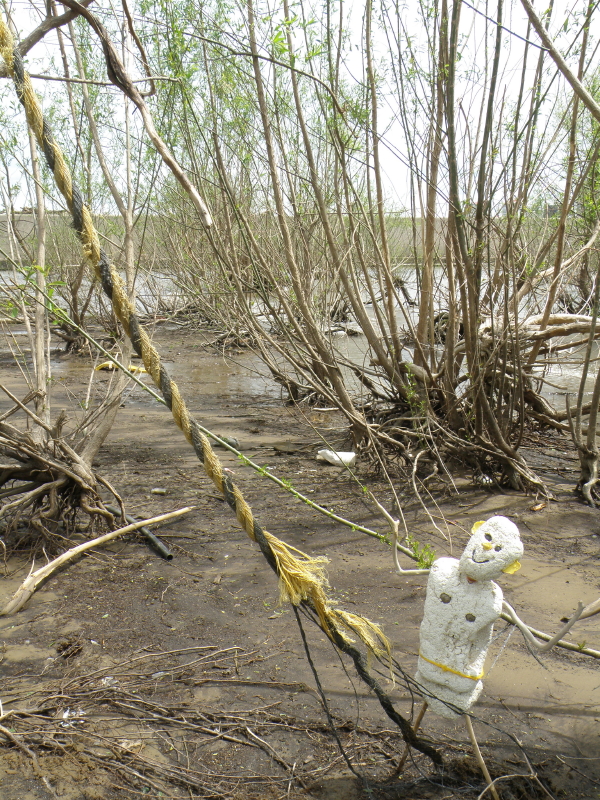
figure with plastic cable in the trees, May 2013

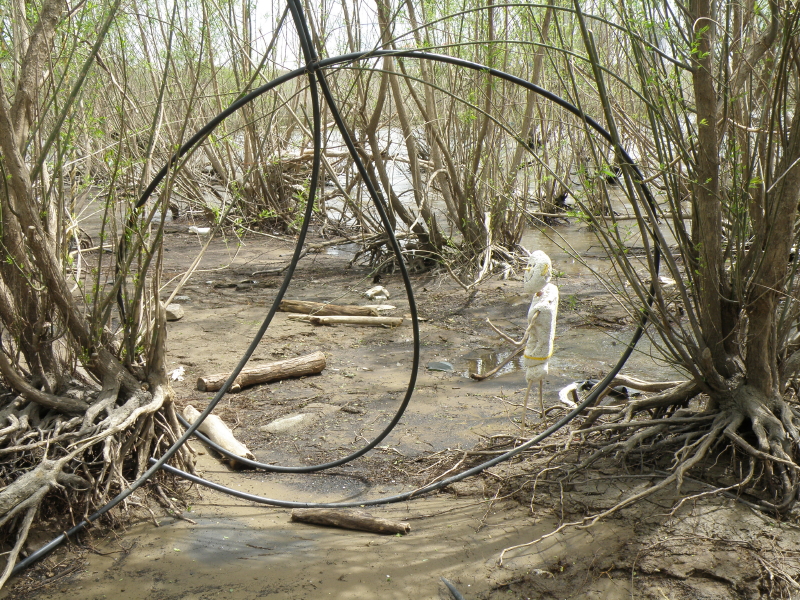
alternate view of figure with plastic cable in the trees, May 2013

A tough plastic cable captured by the willow branches during the last bit of flooding became another object of interest.  The Polystyrene Person admired the graceful  arcs and how the cable defined this bit of space.  The white figure played with the cable by walking around and stepping through the loops.  There was still more stuff snagged in other trees.

barge cable and figure, May 2013

Discovering a fraying barge cable tangled in the willow branches and dragging on the ground gave the new figure an odd mental image.  What if this was how the sky was tethered to the earth?  What would happen if this cable broke?  Would the blue sky with its flimsy clouds just drift off into space?  Remembering that this was simply a rope caught in a tree brought the smile back to the figure’s face.

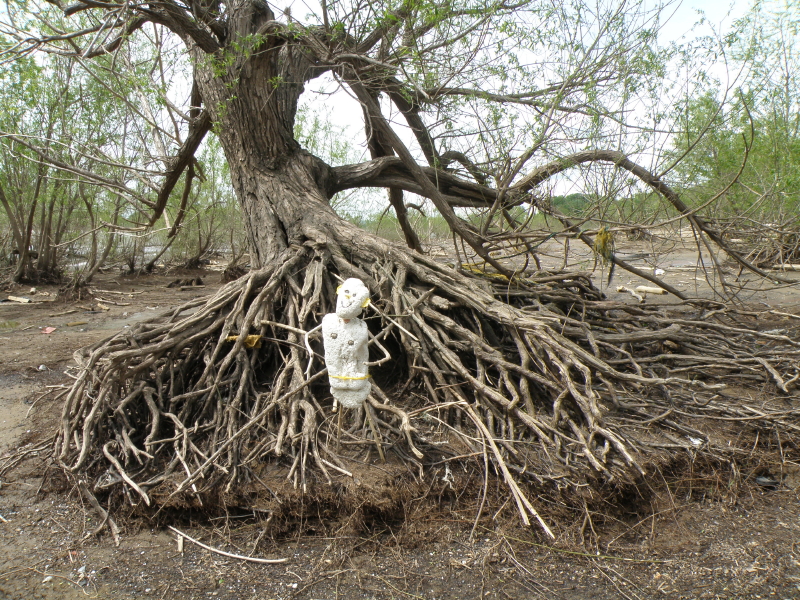
Polystyrene Person among willow roots, May 2013

Standing among the roots of a fantastic willow tree, the Polystyrene Person marveled at how the tree maintained its grip on the earth.  Beneath the larger roots was a dense mat of very fine rootlets that held the soil together.

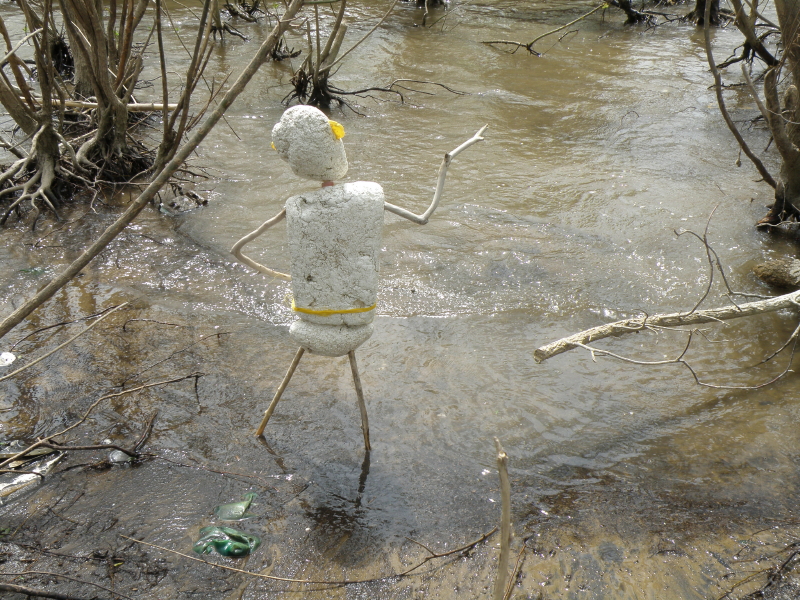
Polystyrene figure standing in water, May 2013

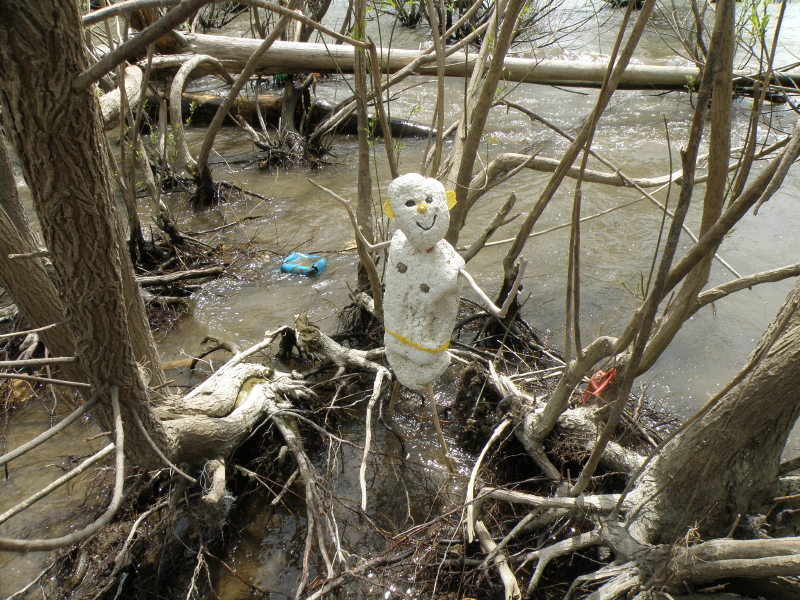
figure among water and willow roots, May 2013

The figure moved to the river’s edge and couldn’t wait to experience water.  It was such an entirely different sensation than standing on solid ground.  Cold water splashed up onto the Polystyrene Person’s face and being wet wasn’t the most pleasant feeling.  The literal tug of the river caused the figure to scramble up on the roots of a nearby willow to keep from being drawn further into the liquid.  Instinctively, the figure realized that it would be lost if the river was allowed to have too tight a grip.  Pulling the Polystyrene Person  back upon the shore, I explained it was time for me to go home.  I offered two choices to my creation.  It could stay at the river and face an uncertain but potentially exciting future where it more than likely would be destroyed by either nature or the hand of man.  Or, it could go home with me and see a different part of the world.  Perhaps because the river was a little scary, the Polystyrene Person opted to go home with me.

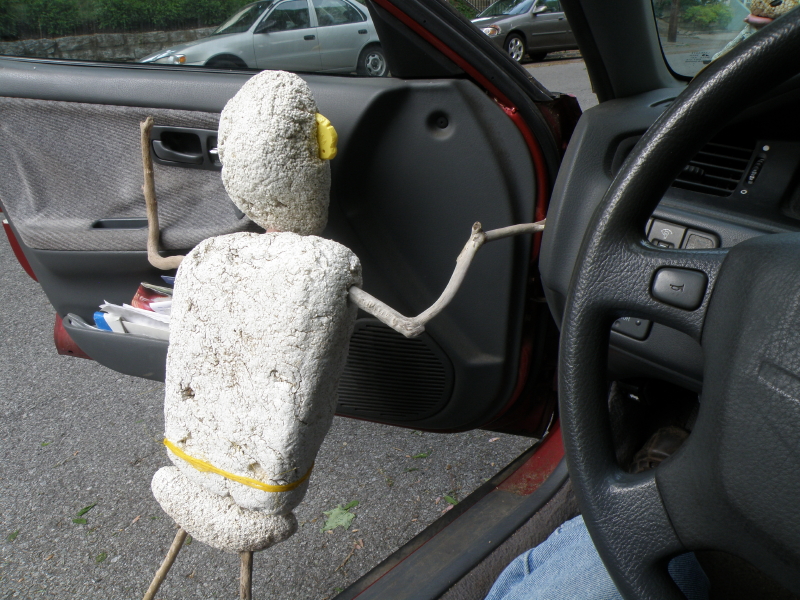
The Polystyrene Person opening my car door, May 2013

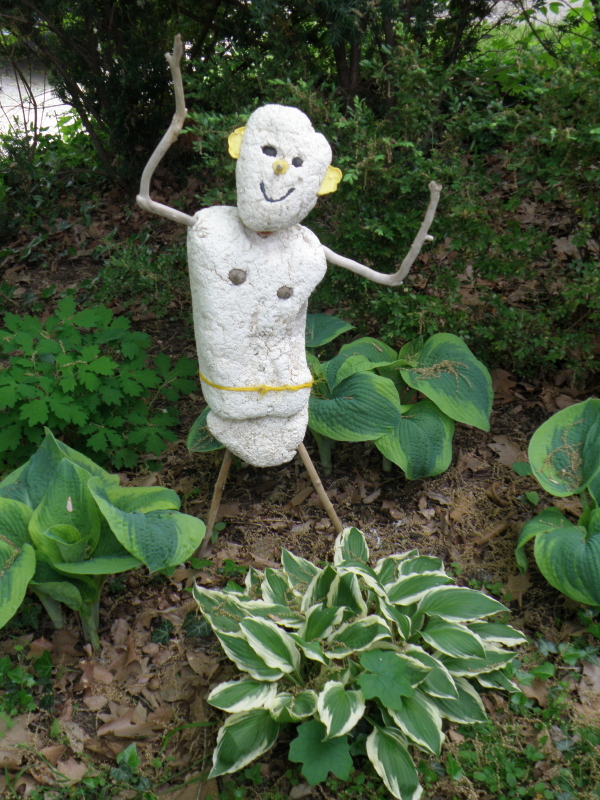
Because my hands were full…the figure opened my car door for me.  It’s really a very polite and innocent being.  During the short ride from the river to my house…I asked the Polystyrene Person what it would like to do?  The figure replied that it would like to continue to be out in nature and so I found the perfect place in my yard for it.  Happily, my latest creation takes pride in watching over my spring plants as they reveal themselves during the new season.

Polystyrene Person among the Hostas, May 2013

Read Full Post »

My outdoor studio at the Falls, May 2013

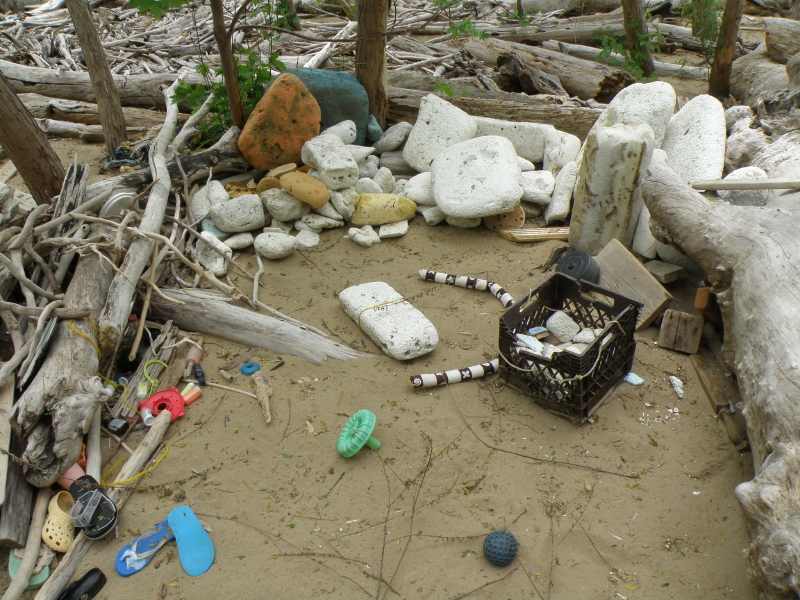
After watching the goldfinches in the willows and collecting the latest the river had to offer…I headed to my outdoor studio.  I have the day off from my day job and it is also Kentucky Derby weekend.  The weatherman is telling me that today will be the day to be outdoors because a cold, wet front is coming through the Ohio Valley.  It has been a few weeks since I last visited as life has taken me in other directions.  When I was last at this spot,  I stashed the surviving and repaired “Flood Brother” next to a tree.  In the interim, other people have come across my spot and looked through the junk I’ve assembled here.  As for my Styro-figure…I found what was left of him nearby.  Here’s a look at the remains.

Styro-body of destroyed Flood Brother, May 2013

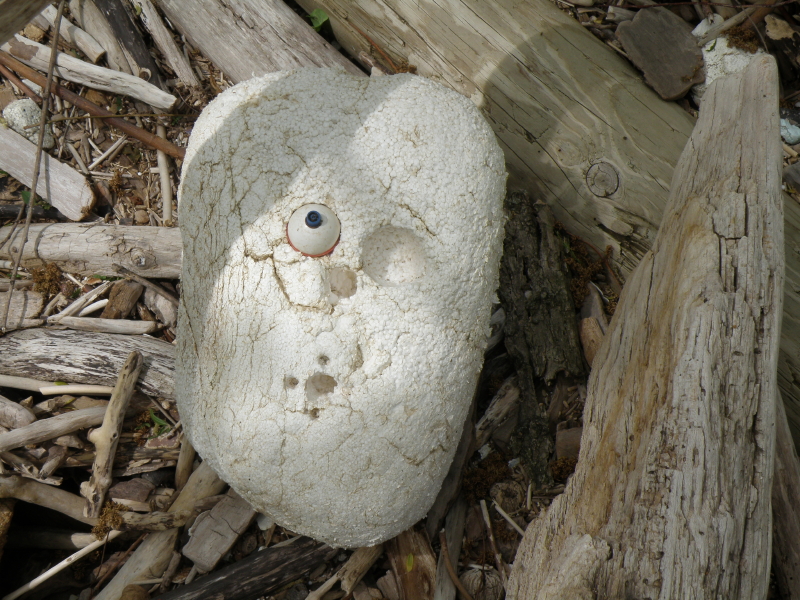
I found his body first resting upon the older driftwood.  He was missing his head and arms.  Scouting around, I was able to find bits and pieces including his head staring at the world through his remaining cyclops eye.

Flood Brother head, May 2013

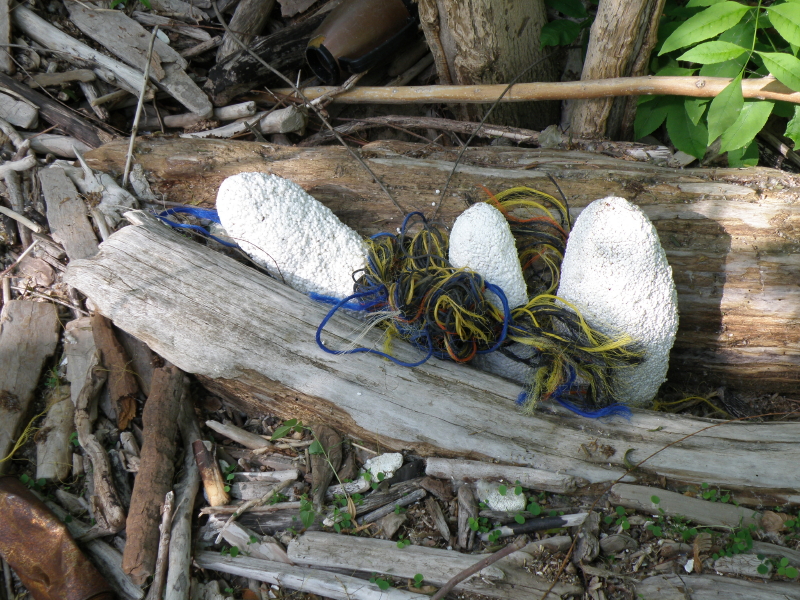
Rather than reconstruct him for a third time, I decided to recycle him.  I gathered the pieces and parts and hauled it back to my studio.  For now, I will let these chunks of polystyrene rest.

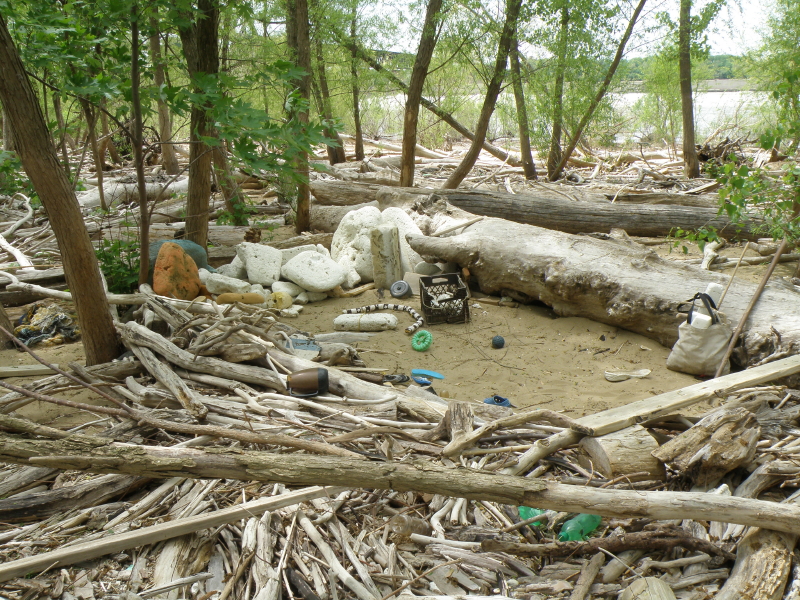
Outdoor studio in disarray, May 2013

found art materials, May 2013

The first step in creating some sense of order is to straighten out the mess my previous visitors have left me.  I sort through my sticks that I will use for potential arms and legs.  I gather up the smaller pieces of Styrofoam and put them in the river-chewed milk crate.  I rummage through my collecting bag and select the elements that will make up the face of a new character.  I take a few moments to watch robins chasing a young Cooper’s Hawk through the willow trees.  Near me, I hear the first notes from a Northern or Baltimore Oriole.  It’s reassuring to know that they have returned.  Also, there is a noticeable increase in insect life and I’ve observed bumble bees, hornets, and small butterflies going about their business.  The sound of running water is always in the background.  Picking up a head-shaped piece of Styrofoam I begin to form a new figure.

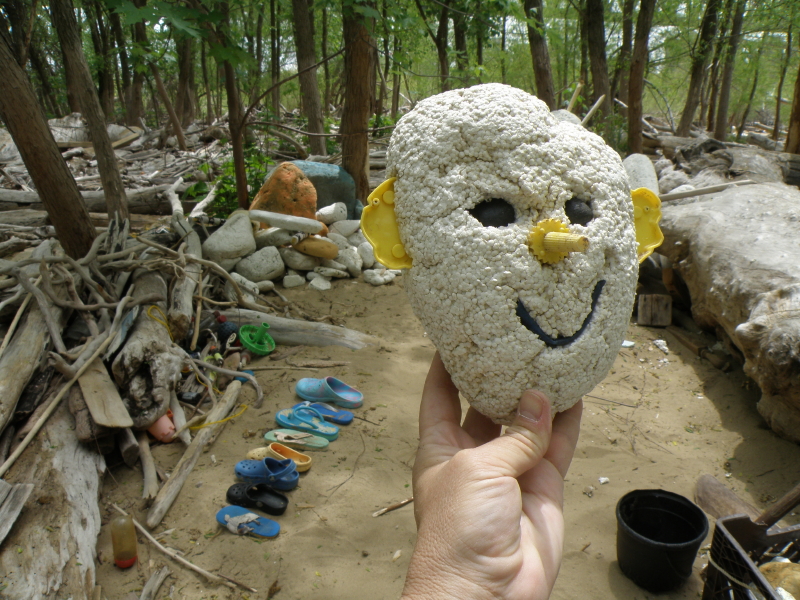
Head of a new figure in my hands, May 2013

So far, it’s a smiling figure with a segment of pliable found plastic for a mouth.  The ears and nose are also plastic toy pieces.  The eyes are river-tumbled pebbles of coal.  I use my pocket knife to do this work. The next step is to add a body.

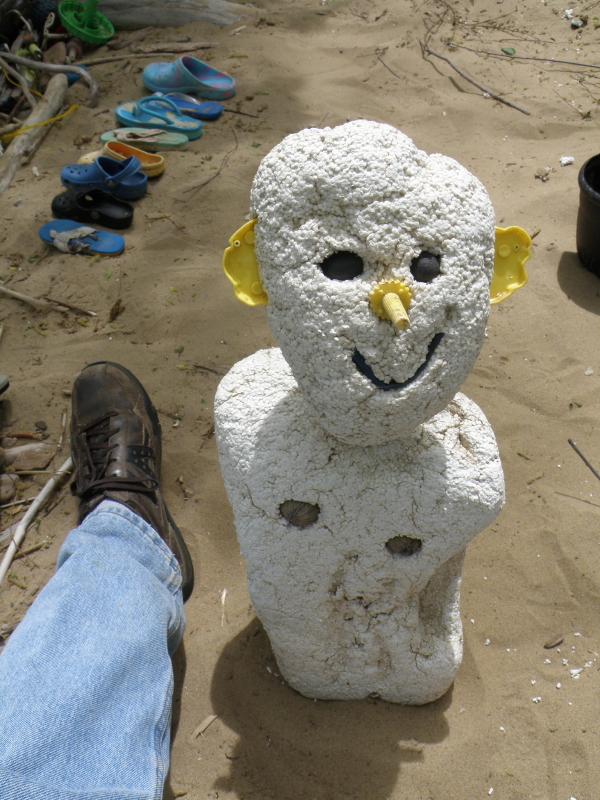
In process Styro-figure, May 2013

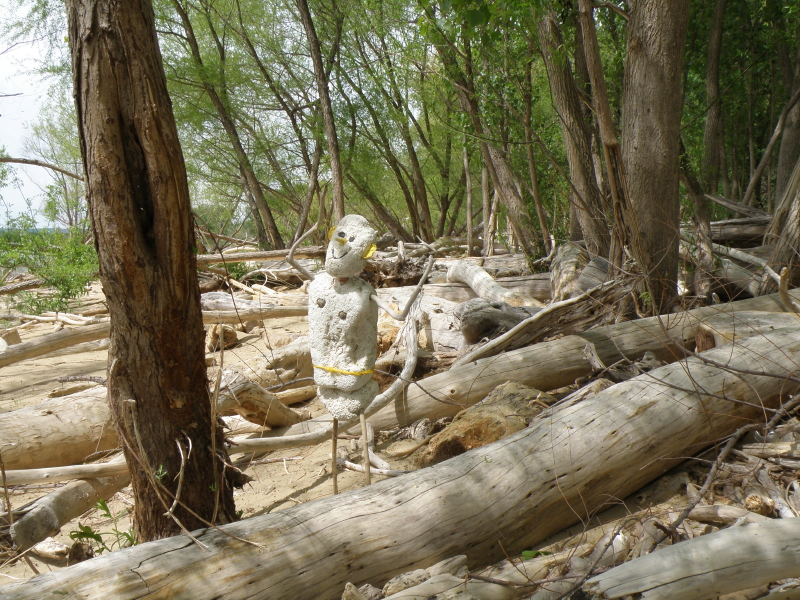
I chose a hunk of Styrofoam from my larder that seemed torso-like.  Feeling that it required additional detail, I added two walnuts to reinforce the chest idea.  I further added a third piece of Styrofoam that simulates a pelvis and gives the figure added length.  Some internal sense for proportion told me I needed to do this even though the entire idea and the resulting figure strikes me as being absurd and who else would notice or even care about this?  Beaver-gnawed willow rods connect the head and hips to the torso. Over the years, my working methods have evolved and I definitely have material and form preferences where none existed at the start of this project in 2003.  Through trial and error I selected wooden driftwood arms and legs to give my static figure some life, energy, and a suggestion of movement.  Here is the first photograph of this spring figure made in the place it was created.  Later, the two of us would go out to explore the landscape around the Falls of the Ohio State Park.

Spring Styro-figure with yellow ears, Falls of the Ohio, May 2013

Read Full Post »

willow, early May, Falls, 2013

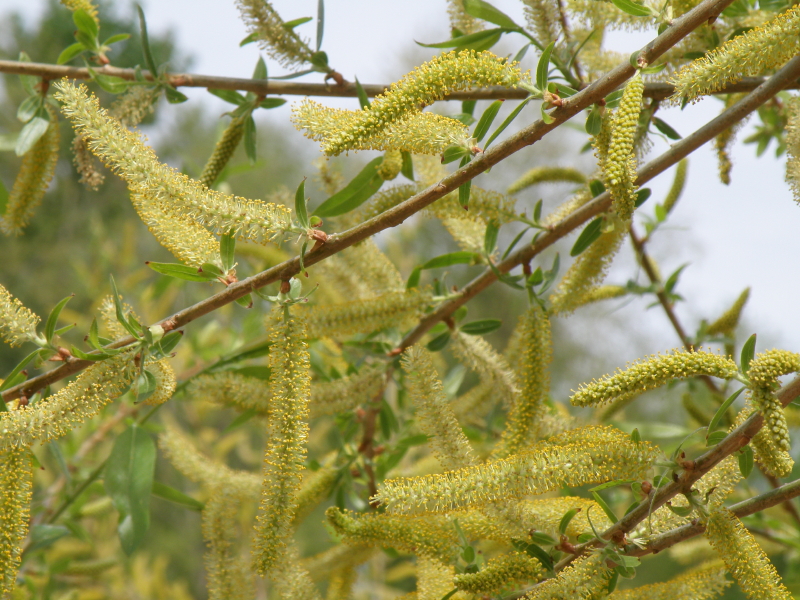
Falls of the Ohio State Park…early May.  Many of the willows along the river whose fibrous roots are holding fast are also in bloom.

black willow catkins, Falls of the Ohio, May 2013

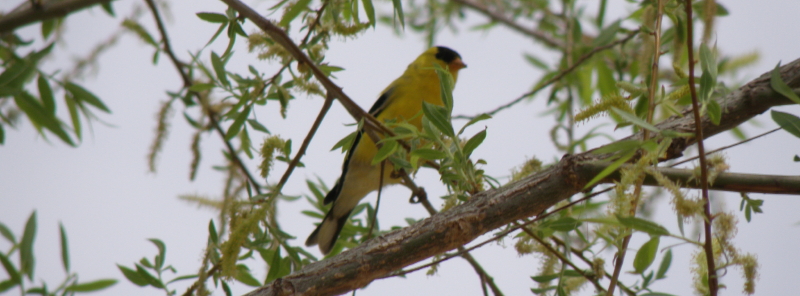
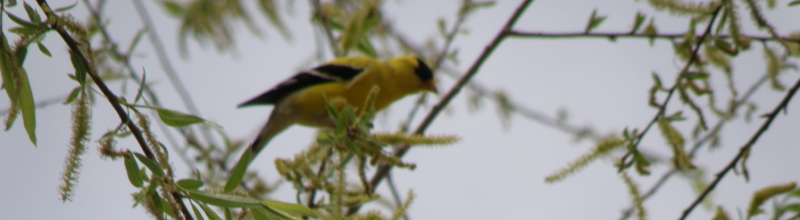
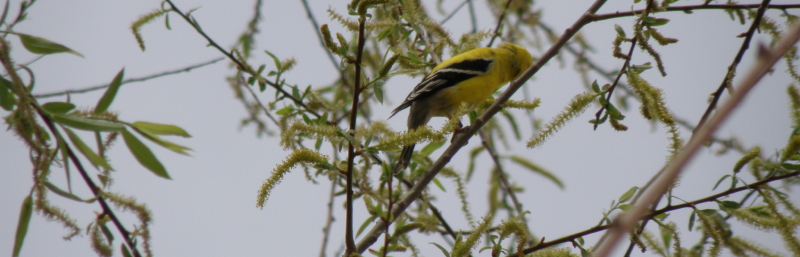
The yellow flowers are  catkins and open before the long, thin leaves appear.  It’s warm and windy along the river.  Tomorrow it will be different.  American goldfinches are feeding on the willow blooms.

male American goldfinch and willow, May 2013

American goldfinch, male, May 2013

goldfinch on willow, May 2013

goldfinch willow 4.5_1_1

American goldfinch on willow, May 2013

The sound of rolling river waves against Indiana are interrupted every now and then with goldfinch song.  The males are becoming more and more yellow.  Does the pollen of the black willow also help this bird?

black willow catkins, May 2013

For me, it’s blooming willow on Oak’s Day.  The derby is tomorrow.  I’ve a lot of river to explore for a few hours more.  Who knows what else I might find?

wet willows at the Falls of the Ohio, May 2, 2013

Read Full Post »

vertical and horizontal wood at the Falls, April 2013

When words fail me, my pictures often bail me out.  I’m certainly not much of a  philosopher or poet who can consistently turn just the right phrase.  I suppose this is one reason I gravitated towards the visual arts.  I do, however, try through words and images to create some kind of synthesis that touches upon how human nature intersects with nature at large.  The Falls of the Ohio State Park continues to provide that stage for me and the river offers up many examples where the natural and artificial routinely bump into or meld with one another.  This happens most commonly when we carelessly set free our man-made detritus into the environment.  Following are a few examples I encountered on this outing.

foam deer head archery target, April 2013

Looks like a rock or a piece of wood, but on closer inspection, it’s what’s left of a synthetic deer head used for archery practice.  This head probably once attached to a life-size foam body.  The river has eroded the neck and muzzle away but you can still see an eye spot, ear stub, and a location where artificial antlers could attach.  Once upon a time, this archery target was convincingly realistic.  It’s what’s left of a fake deer where real deer exist.  In the mud very close to this find were actual deer tracks.  Deer have moved into Louisville and it is becoming more common to encounter roadkill within the city’s limits.

toy fantasy horse, April 2013

It’s Kentucky Derby time in the Bluegrass so it is fitting that I find a horse image by the river and what a horse it is!  Shockingly pink with a long flowing mane that cockle burrs and other wayward seeds have become entangled.  How long will it be before our Wizard of Oz science creates real horses of different colors?  I’ve seen that we can already do this with some fresh water aquarium fishes.  Although this toy’s inspiration is the horse…this isn’t a very naturalistic example and was designed to appeal to children.  I bet I could take this horse and plant it in the ground and have some of the attached seeds germinate.

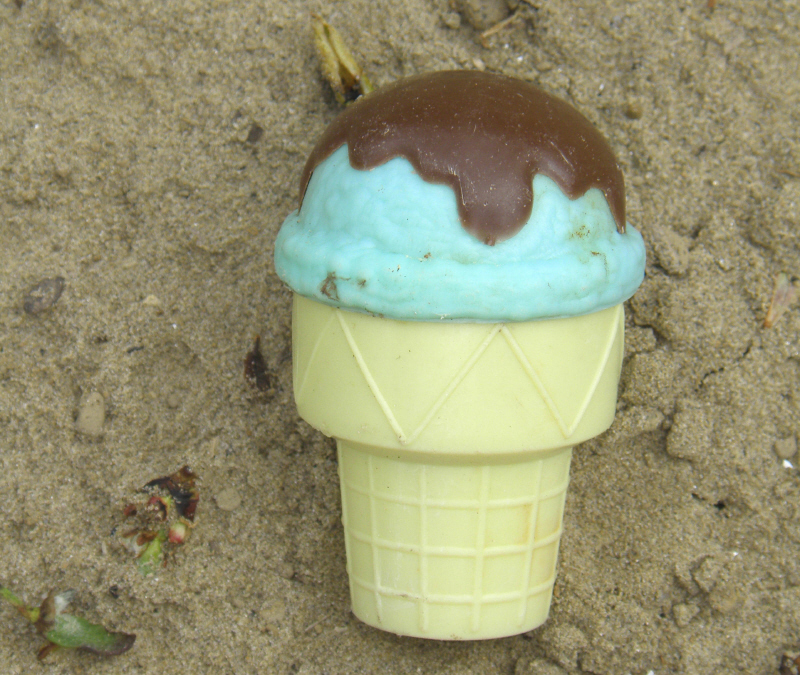
found plastic ice cream cone, April 2013

Because this is tiny, it would be easy to walk over this “prize”. This plastic ice cream cone compliments the small plastic toaster pastry I came across a couple of weeks a go.  I think this might emulate chocolate covered mint ice cream in a wafer cone? I’m still finding plastic fruits and veggies, but I’m also encountering more plastic fake “processed” items including fast food standards like cheese burgers and the occasional petrochemical french fry.

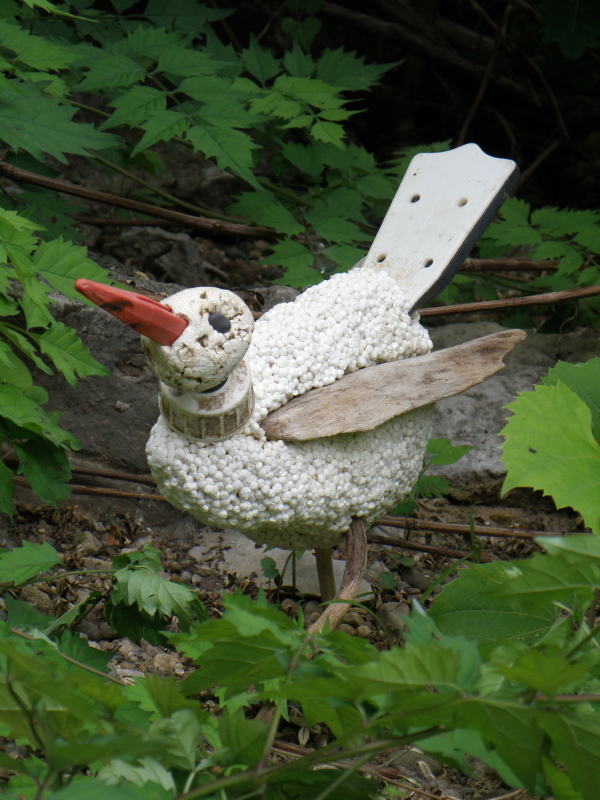
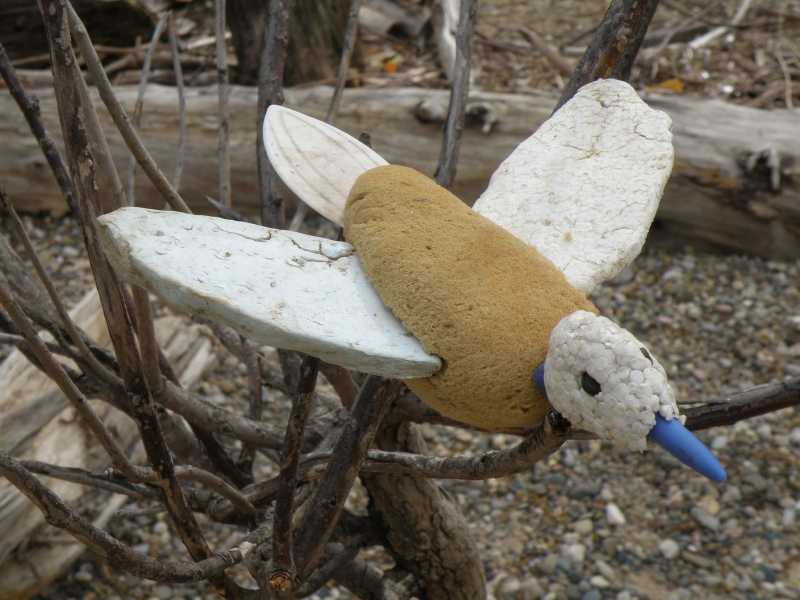
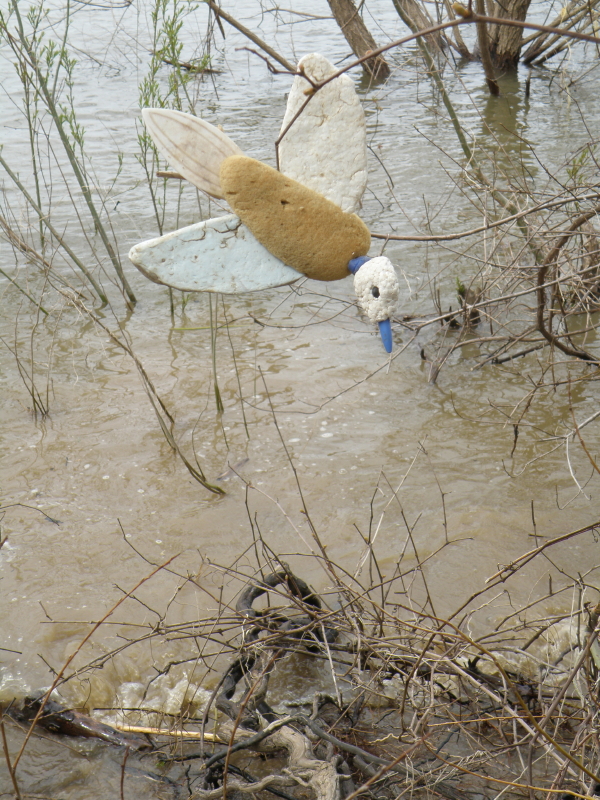
Swept-wing Dove, April 2013

Flying by at great speed and requiring a camera with an extremely fast exposure is the Swept-wing Dove.  This is my latest avian creation.  It’s another fake bird that came together in the context of where Audubon left his footprints.  I casually put this together using found materials which includes plastic, Styrofoam, insulating foam, and I’m not sure what the brown body is made of but it’s some kind of foam as well.  The bill is a pen cap found along the trail.  The forms were shaped by the Ohio River and I used them as is.

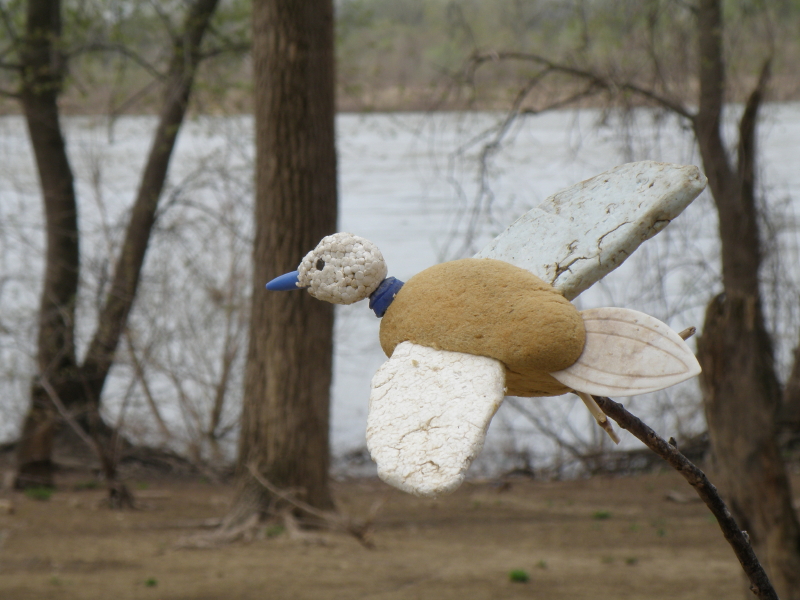
Swept-wing dove flying over bottom land, April 2013

Coursing over the bottom land near the river’s edge is my fake bird which is also the habitat of many real birds as well.  The spring migration of neotropical birds heading northward is one of my favorite times of year.  It’s a chance to see species passing through that normally don’t hang out for very long.

Swept-wing dove in flight, April 2013

The insulating foam that forms the right-wing is practically the same value as the river in the distance and causes it to nearly disappear.

April 14, 2013 077_1_1

For thousands of years the river has been a baseline supporting life in the way nature intended.  Now I see a more complicated scene where dislocated images, objects, and substances blur along the shoreline of the conventional. It’s also an odd feeling realizing that much of this trash can also possess a natural beauty of its own.

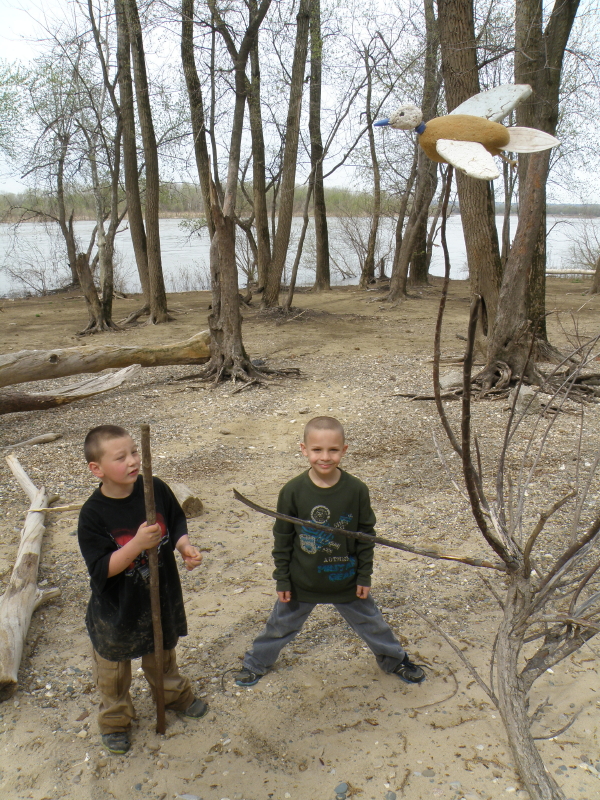
Two local boys with Swept-winged dove, April 2013

Along this stretch of the river I had these two guys tagging along and asking me questions such as “What are you doing?” and “Mr. did you make the bird and what are you going to do with it?  I asked them if they were artists too and one said yes and the other didn’t believe he was.  I later observed them swinging from a stout vine growing along a sycamore tree and playing in their fantasy world.  Their fathers were nearby fishing at the water’s edge.  I will leave now with a fuller look at the tree I often use to gauge how high the river is.

tree with snagged wooden palette, April 2013

Read Full Post »

« Newer Posts - Older Posts »