Feeds:
Posts
Comments

Archive for the ‘creativity’ Category

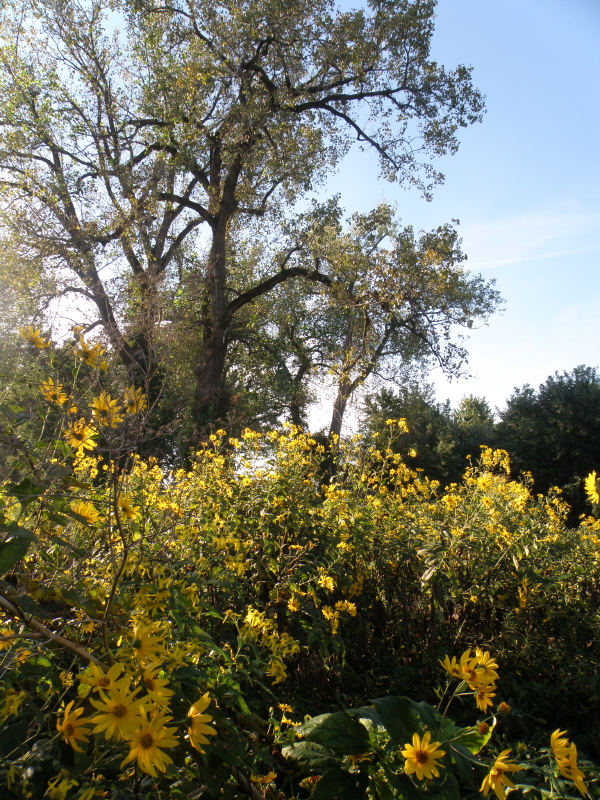
Landscape at the Falls of the Ohio, Sept. 2013

This post is the last of this year’s summer posts and documents a walk I made at the Falls of the Ohio State Park one week before autumn officially began.  As you can see by the pictures…it was a very beautiful day filled with all kinds of discoveries.  There was a profusion of yellow-flowering plants of various species including goldenrod and sunflowers.  Here is a detail, I think from the Woodland Sunflower?  I wish I was as confident about plants as I am in identifying animals.  When I break out my flower books, I realize it would aid identification greatly to have an example on hand.  Collecting plants is not allowed within the park limits…so I try to take photos that might be of use in discerning the various closely related species.  Besides, I don’t think pressing these plants flat would even work?  I ask myself, what leaf shape does it have?  Are the leaves serrated, smooth, or hairy and how many rays do the flower heads have and other such questions of concern to the botanist.

Sunflowers at the Falls, Sept. 2013

I suppose I’m more of an imaginative botanist at heart who also appreciates the beauty and variety the many flowers add to the temporal landscape.  I do, however, stumble upon plants that I wonder if anyone else is noticing?  I’ve posted about these anomalies before and as the seasons change, the parade of these “unnatural plants” and “faux flowers” continues.  Consider these fresh blooms.

The Surprising Poinsettia, Falls of the Ohio, Sept. 2013

I call this one the “Surprising Poinsettia” because it comes shockingly red and completely unexpected.  Its sepals are rather fabric-like and its stem is grafted upon this sunflower by some unknown means.  The next plant is more subtle.
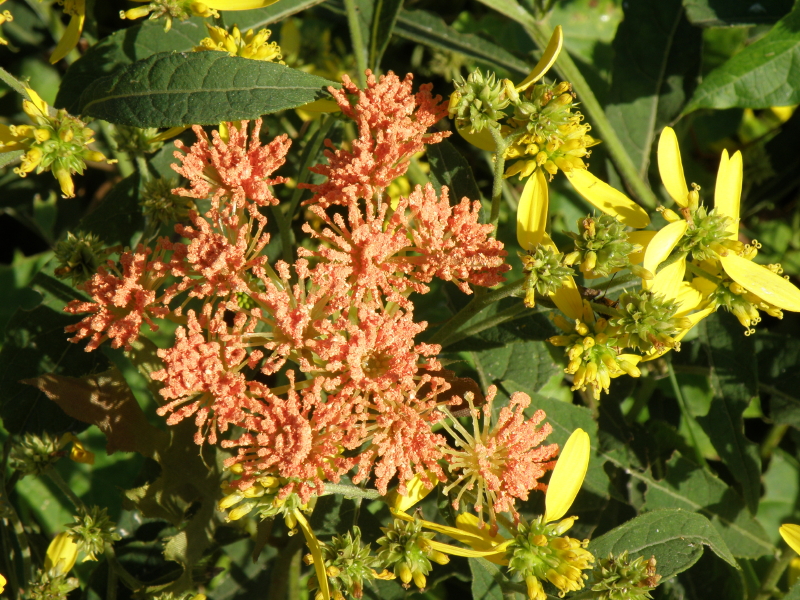
Orangey-tickseed, Sept. 2013

This is “Orangey-tickseed” and at first blush, one might be tempted to pass over it.  I had to do a double-take on this one, however, my instincts told me something was not quite right here.  Indeed the orange-colored flowers are not at all like the yellow plant it is cohabiting with.  Again, the texture is very much like plastic.  One final plant before moving on to other interesting discoveries.

Pink Sand Lily, Falls of the Ohio, Sept. 2013

I found this beautiful flower growing near the river in the sand and I have designated it the “Pink Sand Lily” because I’m not sure what else to call it?  It is for the most part, a low growing plant and the “flower” appears at the terminal end of a wiry green stalk about four inches tall or so.  The flower petals are composed of a string-like fiber while the stamens are hard and have pseudo-pollen on them.  These unusual plants were not my only discoveries on this fine day.  I nearly always find some doll or doll part that the river has washed into here and today was no exception.  I spotted a form in the wood chips and bark bits and went in for a closer look.  Dusting off the form revealed this doll body.

"rubberized" foam doll body, Sept. 2013

This was quite unlike any other doll “body” I’ve found before at the river.  The material was obviously made from a foam-like material, but it had the flexibility of rubber.  Nearby, I also discovered  an unusual serpent.

red, plush toy snake, Sept. 2013

Approximately a foot long, this red plush snake had large black eyes and had just a bit of its tongue sticking out.  This is the first of one of these objects that I have come across .  The river was flowing nearby and I walked over to the edge of the riverbank.  The water level has finally leveled off to more of its seasonal pool and the fossil banks on the Kentucky side were exposed for the first time this year.  Looking along the water’s edge, I came across this Freshwater Drum that an angler caught and released.  Unfortunately, for the fish…it did not survive being captured.  Here is its final portrait.
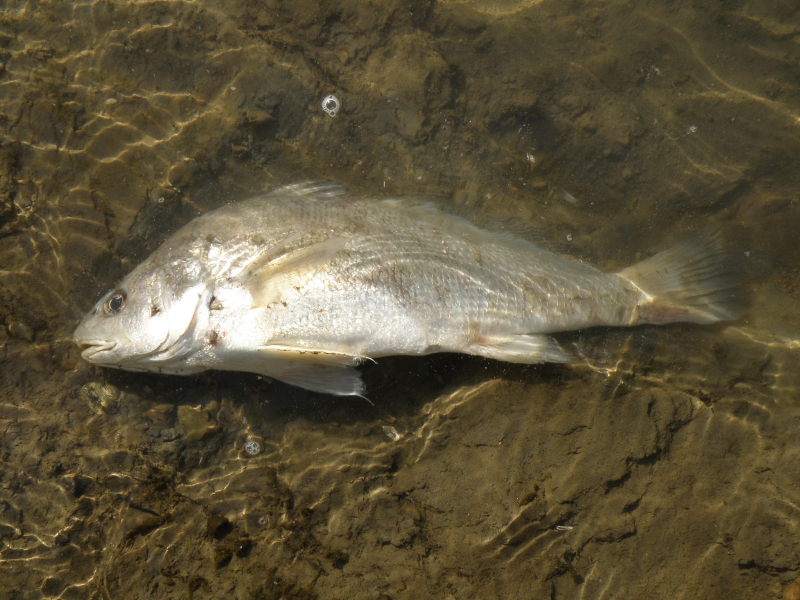
Freshwater Drum, Falls of the Ohio, Sept. 2013

The Freshwater Drum (Aplodinotus grunniens) is a widespread fish and common in the Ohio River.  It has several molar-like teeth in its mouth that it uses to crush and eat snails and small clams.  The drum is not considered a desirable food species around here.  Here’s another fish I found on this walk that is also inedible.
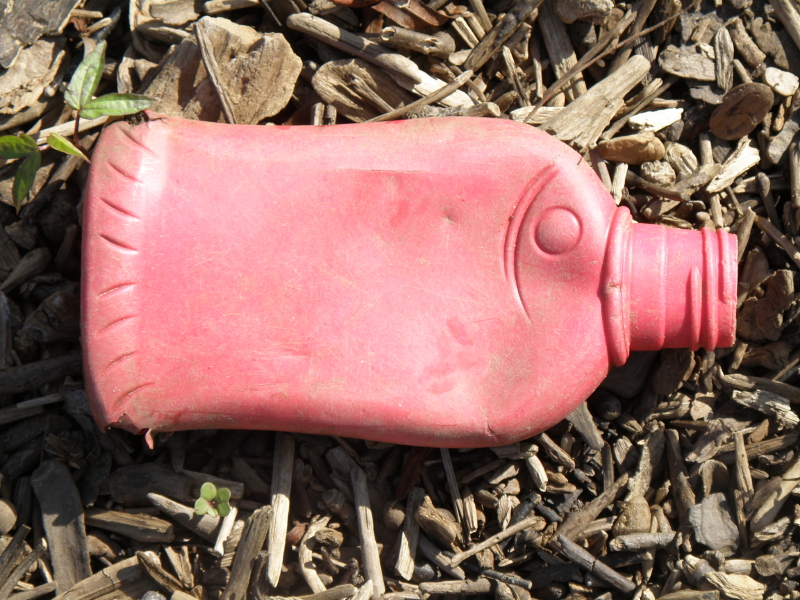
red plastic fish bottle, Falls of the Ohio, Sept. 2013

The second “fish” I came across was this plastic bottle.  I’m guessing that the bottle may have contained shampoo for children?  Regardless, I was struck by the level of abstraction occurring here.  The tail is minimally represented and the gills are indicated by two lines near the eyes, but there is enough here to suggest a fish.  My next find is mid way between the drum and the plastic bottle being closer to the latter than the former.  Here are two views of it.

The Silvergill, Falls of the Ohio, Sept. 2013

Silvergill, Sept. 2013, Falls of the Ohio

This is a Silvergill which is closely related to the Iron Gill (which I have posted about previously).  Differences between the two species include size (this fish is smaller) and some of the fins are not the same shape or in the same position.  The Silvergill is much more rarely encountered than its larger cousin.  It is found in water of average to poor quality and often associated with coal and coal dust. It is omnivorous and eats aquatic insect larvae and algae which it grazes off of rocks.  I’m assuming that it washed up here a victim (like the Freshwater Drum) of an angler looking to catch something more worthwhile.  I took a few photos and then moved on.  The fossil beds were beckoning and I could see the resident flock of Black Vultures congregating on the rocks.  No doubt they had discovered a fish or two on their own.  Until next time from the Falls of the Ohio.
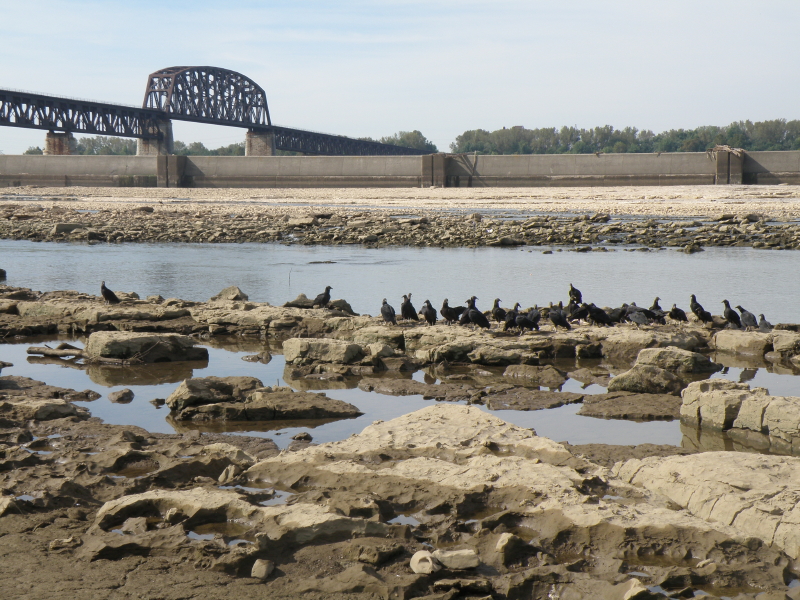
Fossil beds and Black Vultures at the Falls of the Ohio, Sept. 2013

Read Full Post »

Soap Bubble Wand Collection, Falls of the Ohio, Sept. 2013

Consolidating some of my river finds revealed this fun collection of soap-bubble wands all found within the Falls of the Ohio State Park.  This is many years worth of walking the riverbank and sampling choice bits of plastic and other displaced objects.  All the bubble wands I’ve found thus far are made of plastic.  Most of these wands were sold inside plastic bottles filled with prepared soap-bubble solution.

Detail, Soap Bubble Wand Collection, Sept. 2013

Simply dip the wand into the soap bottle. Remove the wand allowing a film to form over the loop.  Then gently blow air through the soap film and bubbles should result. With this found wand lot however, the bubbles probably wouldn’t be very big or long-lasting.  The soap-bubble wands you can fashion at home with common materials (along with creating your own bubble mix) can produce spectacular results.  These wands were more than likely lost by kids playing near the river.  I’m frequently amazed by the variety of design solutions intended for such a throw away item.  I mean who holds on to these wands to reuse once the bottle is empty?  I did find some novelty items in the mix.  Check these examples out.

Mini Wedding Novelty Soap Bubble wands , Sept. 2013

Here are two mini soap-bubble nuptial wands.  These are usually in tiny plastic bottles left on the guests’ tables.  Blowing bubbles on the newlyweds frequently substitutes for the traditional rice throwing send off.

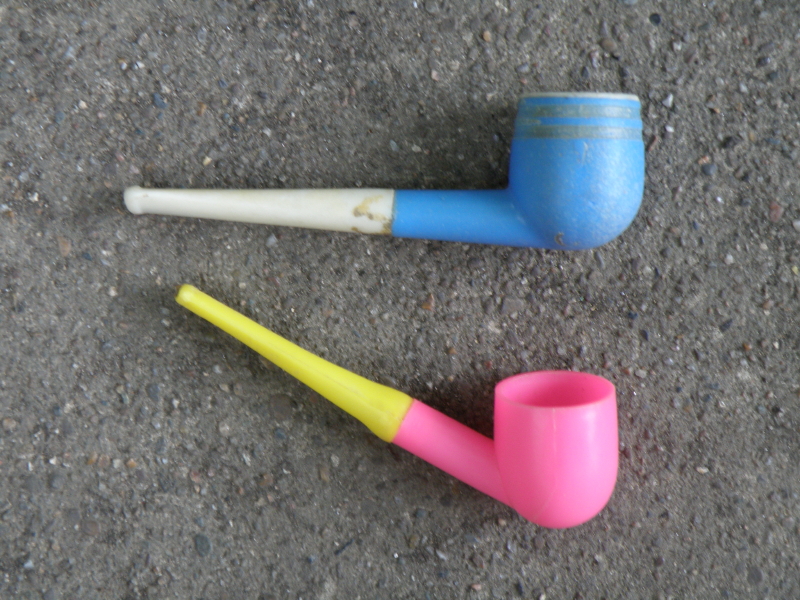
soap bubble plastic pipes, Falls of the Ohio, Sept. 2013

I also found these two soap-bubble pipes.  Personally, I’ve never had much luck making bubbles with pipes.

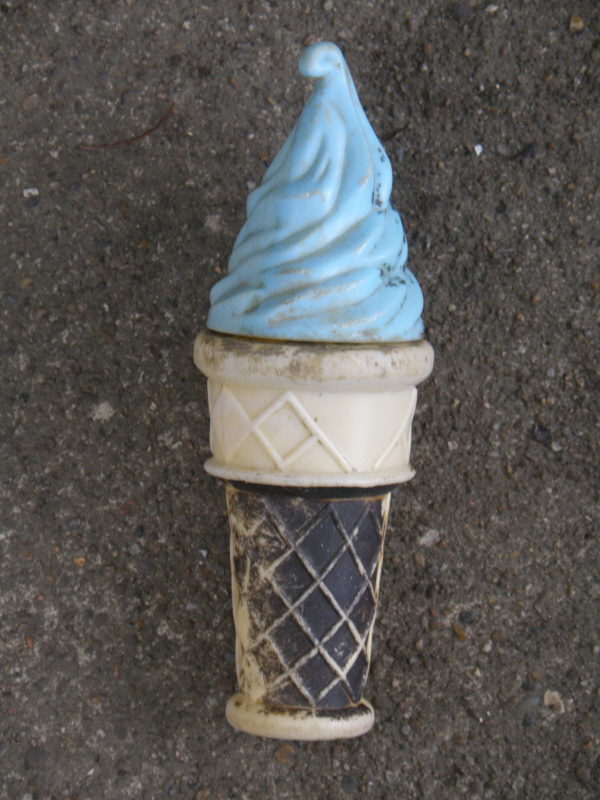
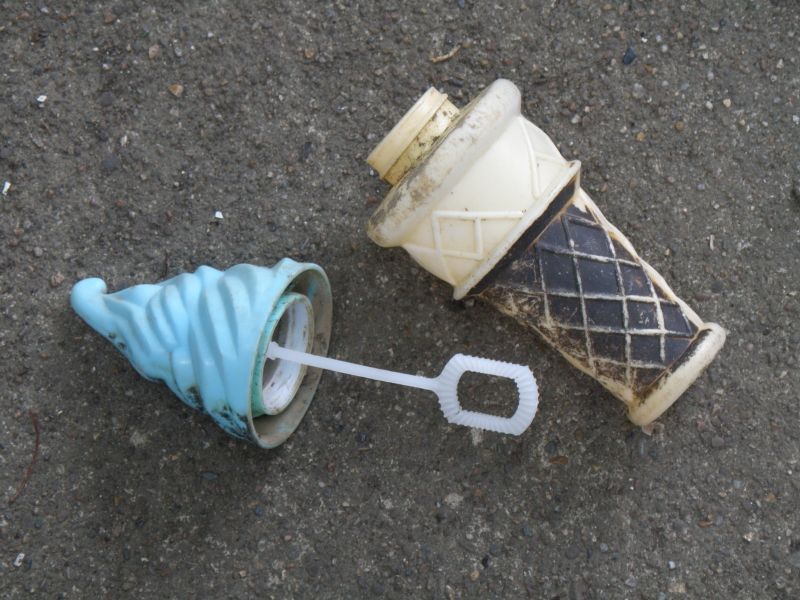
Plastic Ice Cream Cone bubble wand and bottle, Falls of the Ohio, Sept. 2013

Plastic Ice Cream Cone Soap Bubble wand and bottle, Falls of the Ohio, Sept. 2013

This novelty didn’t look good in the frame, but it is one of the nicer soap bottle with wand items I’ve found.  This fake ice cream cone also has that black river patina suggesting it was out floating around for years before I came across it on these fable Falls shores.

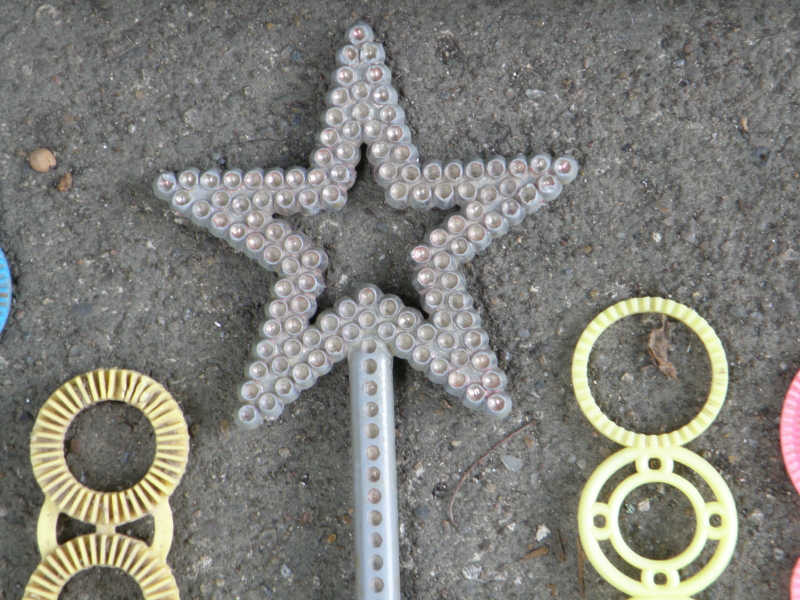
Detail, Star Wand, Sept. 2013

I have a couple of wands that aren’t soap-bubble wands, but since they are wands nevertheless…I keep them in the collection.  The Star Wand is more than likely from a princess costume or magician’s outfit.  The other wand is perhaps more of a plastic scepter.  Originally, the handle lit up with a colored light.  Again, more disposable plastic items.  I’ll keep walking the riverbank a little while longer and I’ll bet I find a few more of these objects to add to the river collection.

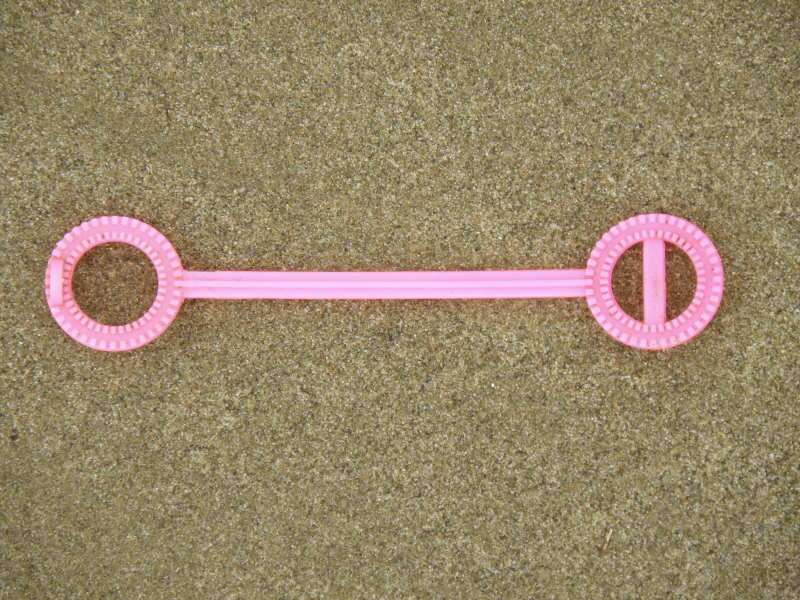
found pink plastic bubble wand, Falls of the Ohio, Sept. 2013

Read Full Post »

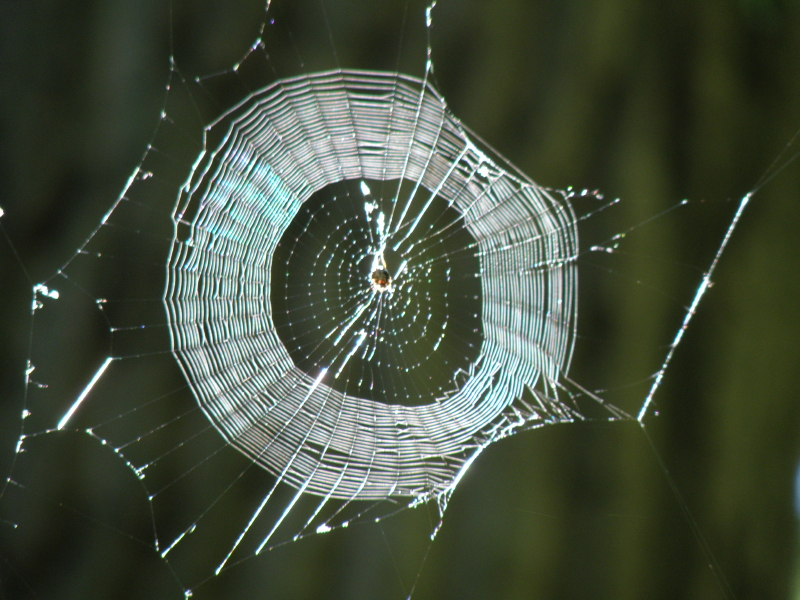
spider's web in the morning light, Falls of the Ohio, Aug. 2013The Falls of the Ohio is a special place in the history of life.  From the ancient marine creatures whose remains are preserved in limestone dating back more than 370 million years a go to the contemporary creatures that inhabit the park today…it is my goal to celebrate life here in all its diversity.  I’m going to use this post to present images of recent finds.  I was exploring the western side of this state park recently and saw this spider’s web high off the ground catching the early morning light.  I’m sure its architect would prefer a buggy meal over the photons it has snared instead!  Looking at this web image, I’m struck by how similar this  looks to the cross-section of a tree.  Can you see that too with the outermost silk rings resembling a tree’s growth rings?  In the Purple Loosestrife stands, butterflies were having a nectar feast and I presented many images of them in a previous post.  Here’s one more to add to that portfolio.  I have seen this butterfly species wind up on the spider’s menu before.

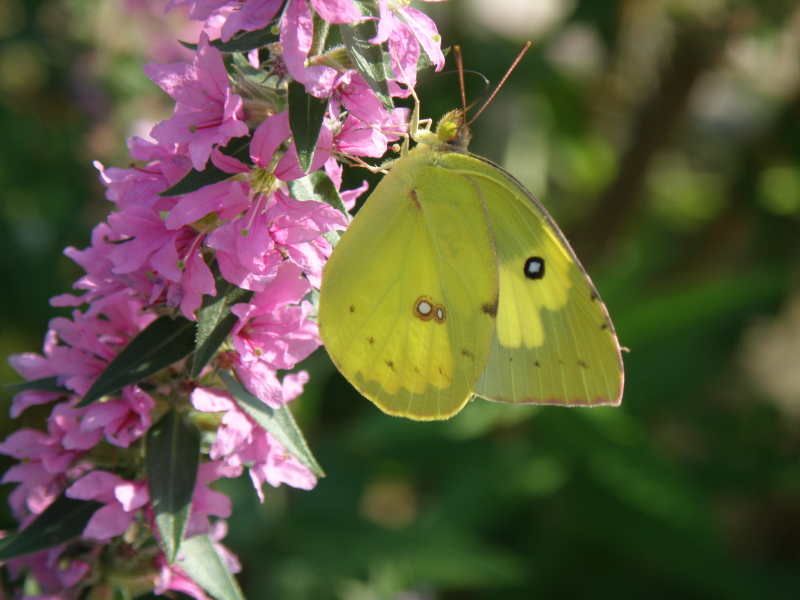
Dog Face Butterfly on Purple Loosestrife, Falls of the Ohio, late Aug. 2013

This is the Dog Face Butterfly (Colias cestonia ).  It is often difficult to photograph this butterfly in the wild with its wings open because this species prefers to feed with its wings held together.  Through the strong light passing through the forewings, you can get the suggestion of a dog’s head in profile.  Imagine the black rimmed spot as the “dog’s eye” with its muzzle pointing down.  When open, the dark interior margins of the wings are a warm black color.  I was exploring the interstitial sandy zone between the river and the willow woods…when I came across this interesting amphibian.

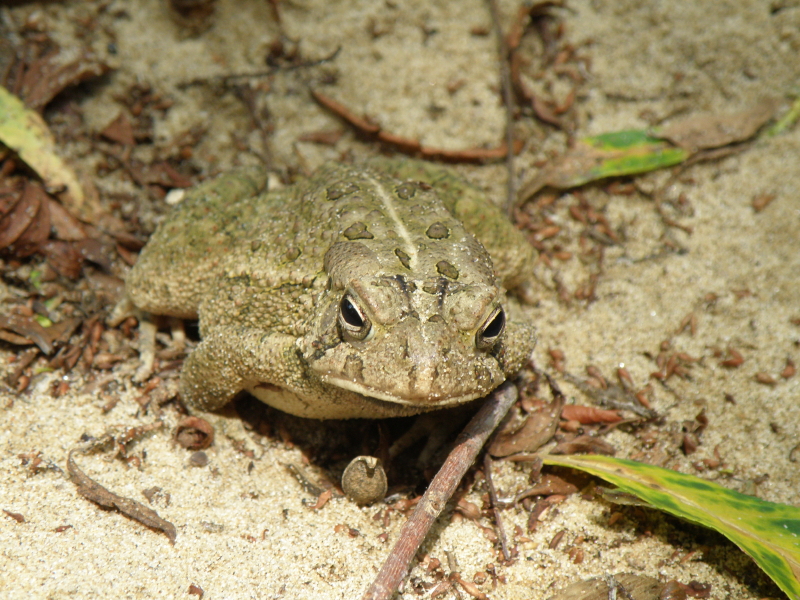
The American Toad at the Falls of the Ohio, August 2013

American Toad, dorsal view, Falls of the Ohio, Aug. 2013

If this American Toad ( Bufo americanus ) had not moved…I doubt I would have seen it.  It’s coloration is wonderfully cryptic easily blending into the sand.  The toad was busy hunting among the debris and driftwood for any insects and invertebrates it could find.  I don’t encounter many amphibians out here…so finding a common toad is a noteworthy event.  Let’s move up the evolutionary ladder a bit.  I was busy working on one of my Styrofoam sculptures at my outdoor studio when I felt I was being watched.  When I lifted my eyes up from my artwork…I found myself looking eye to eye with this critter.

Woodchuck or groundhog at the Falls of the Ohio, Aug. 2013

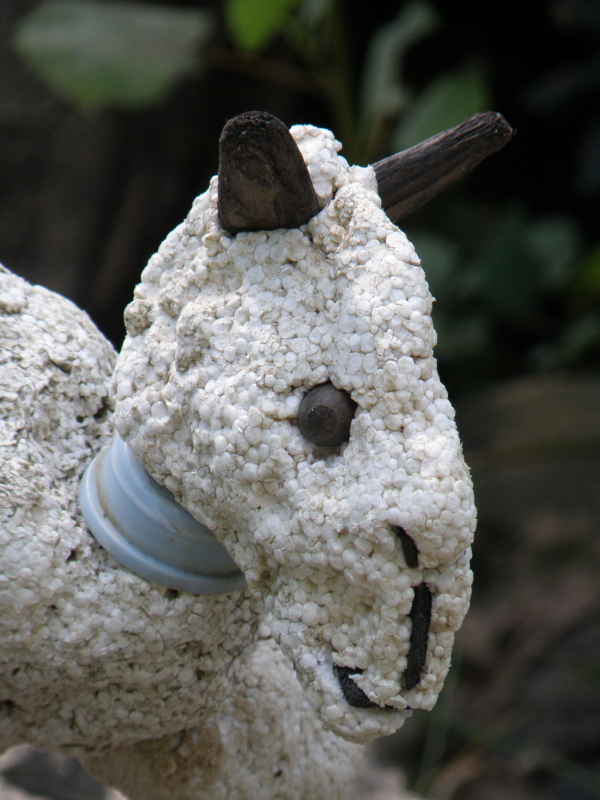
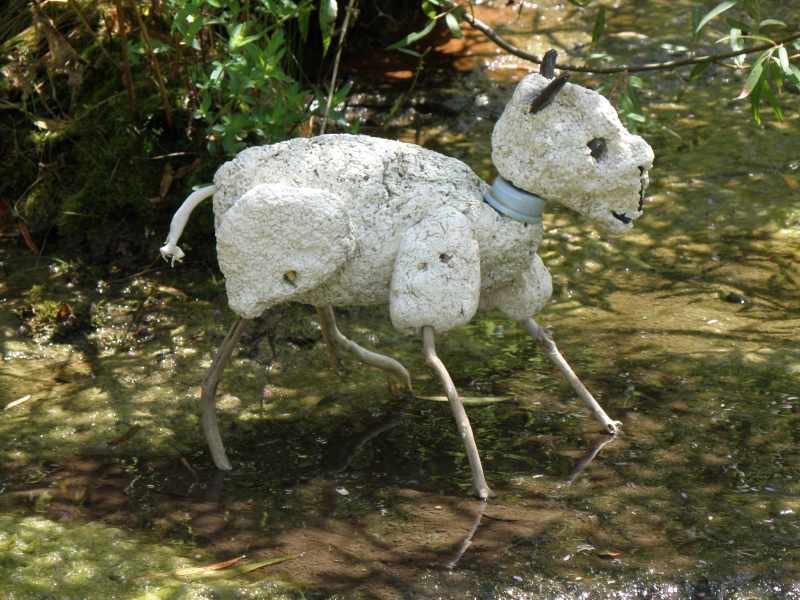
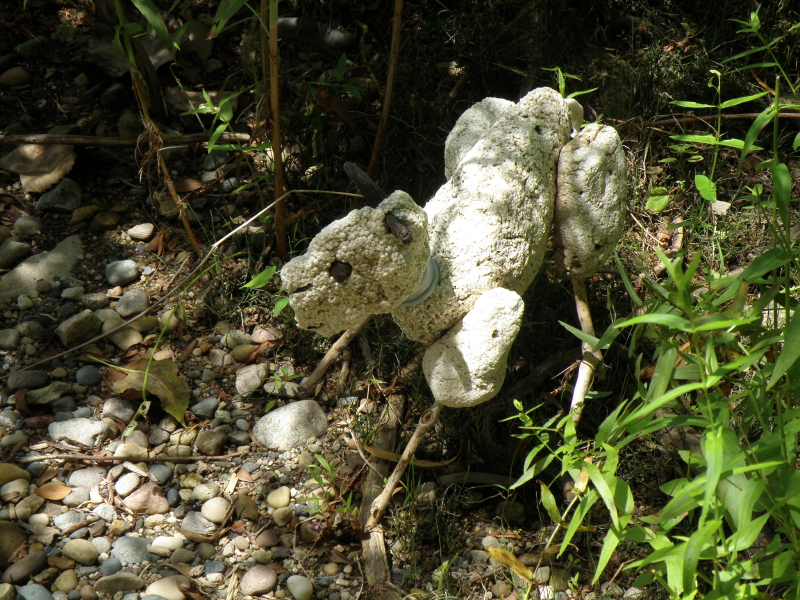
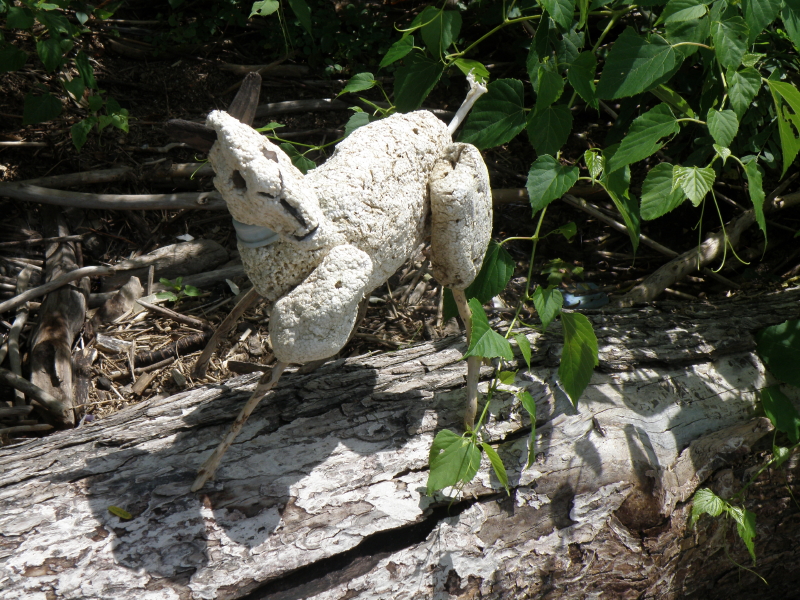
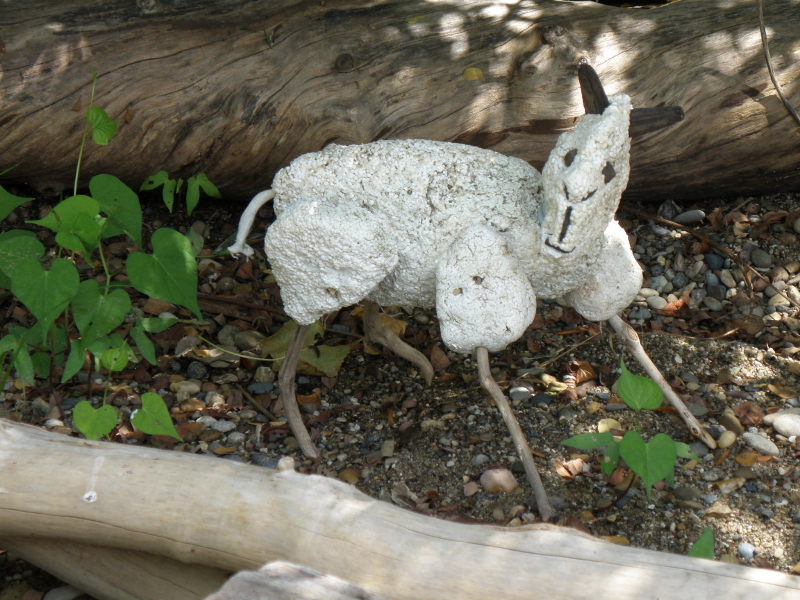
This is the common Groundhog or Woodchuck ( Marmota monax ).  As its scientific name suggests, this large rodent is a member of the marmot family.  Woodchucks are successfully established at the Falls and I encounter them often.  They are fast diggers and live in an extensive system of burrows.  Woodchucks usually don’t stray too far away from the entrances to their burrows.  Succulent greens are the preferred foods.  This particular woodchuck regarding me is a young individual and may be seeking territory of its own?  Usually, I don’t see them this close to the river.  I did have an interesting recent encounter with a very different animal in the western section of the Falls of the Ohio State Park.  Have you ever heard of an animal called the Camelope, (Antilocapra fallsei )?  It is very rarely seen.  The flora and fauna at the Falls can be roughly divided between forms that are “natural” and “unnatural”.  The spider, butterfly, toad, and woodchuck fit in the natural fauna category, while the Camelope is definitely on the unnatural fauna side of life and may represent evolution at an accelerated pace?  The many stresses to the environment and its myriad ecosystems have required a dramatic response and creatures like the Camelope may be nature’s way of responding to these changes?  I’m not a trained scientist, but that is my educated guess.  Discovering and documenting these recent life forms has become a passion of mine.  Anyway, let’s look at a Camelope.  Let’s start with an image of its head.

Camelope, detail of head, August 2013

It’s called a Camelope because its head generally resembles that of a camel’s.  This is a browsing animal and accepts a wide range of vegetation growing along the river.  It has dark eyes that are always nervously looking around for potential predators.  This park is also home to Feralocitors that prey upon Camelopes.  This particular species also has an acute sense of smell.

Camelope at the Falls of the Ohio, Aug. 2013

Camelope at the Falls of the Ohio, Aug. 2013

I came across this Camelope in a more isolated section of the park.  It was hiding among the stands of loosestrife and drinking water from the springs that flow downhill and into the river.  It is ever alert and very nimble with quick feet and seemingly at home climbing on rocks or navigating through dense vegetation.  Their bodies resemble that of deer or antelopes…hence Camelope.

Camelope reacting to an unfamiliar sound, Aug. 2013

Camelope at the Falls of the Ohio, Aug. 2013

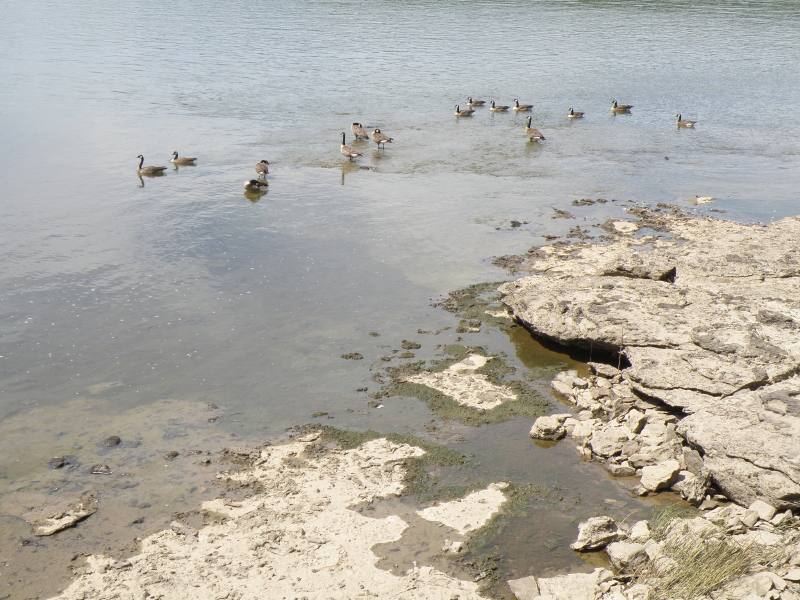
Since it is a relatively new animal…not very much is known about it.  I was able to conceal my presence long enough to manage these images.  I either moved or the wind shifted, but anyway my presence was detected and with a quick bound, the Camelope disappeared into the brush.  I hope I may come across it again and learn more about its secretive life.  Regardless, I will keep my eyes open and my camera at the ready for any new “unnatural” life forms I discover.  It occurred to me on my way home that my Falls of the Ohio Project is now officially ten years old!  I started exploring this fascinating park as the Artist at Exit 0 in August 2003 when the bicentennial of the Lewis and Clark Expedition was being celebrated.  Reading early 19th century accounts of the natural abundance of our country and this place in particular made me wistful for a world that no longer exists.  Two hundred years later…that process continues and no doubt will two hundred years from now.  I have often thought of this riverblog as a historical document as relevant today as Lewis and Clark’s notebooks and journals were back when this country was first being described.  I hope this park and its remarkable history will continue to inspire people for a very long time.  In closing, I would like to present an image of Canada Geese on the water near the fossil beds.  Their coloration gives them in my mind’s eye a formal quality and lends dignity to the landscape.  Until next time…from the Falls of the Ohio.

Canada Geese and fossil rock at the Falls of the Ohio, Aug. 2013

Read Full Post »

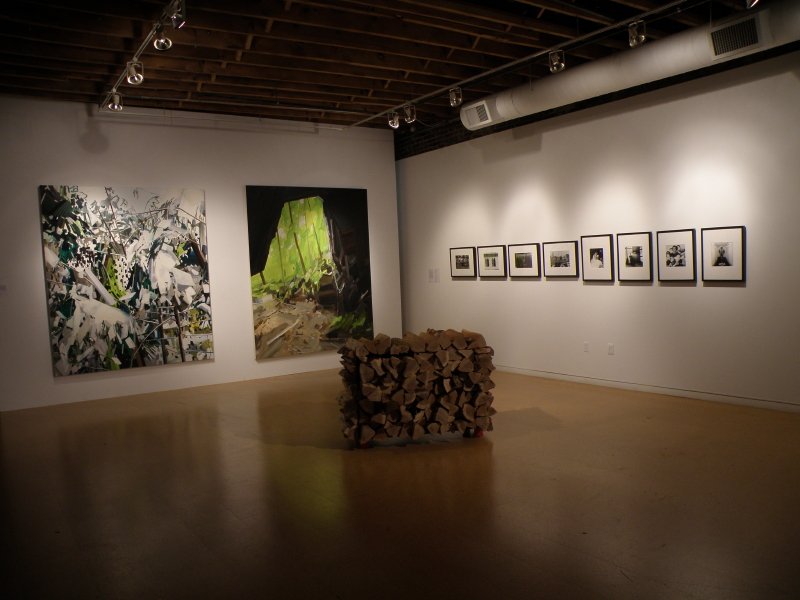
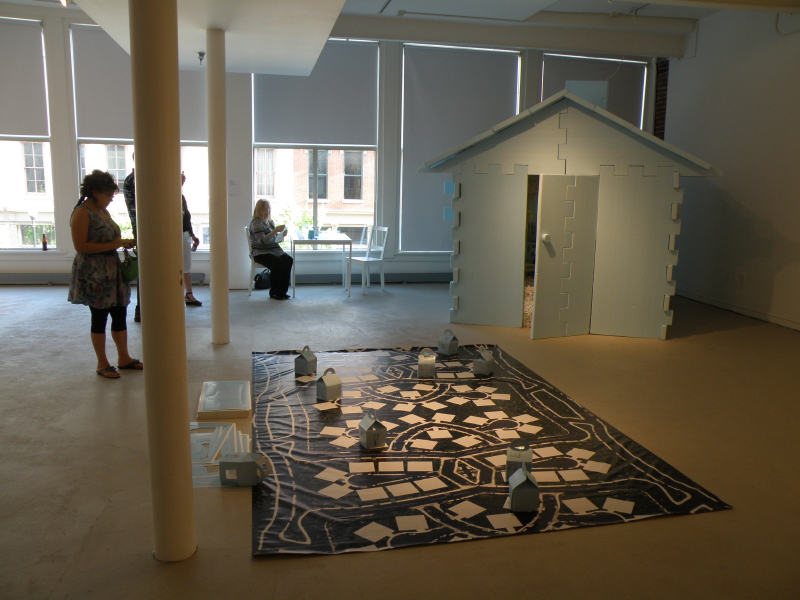
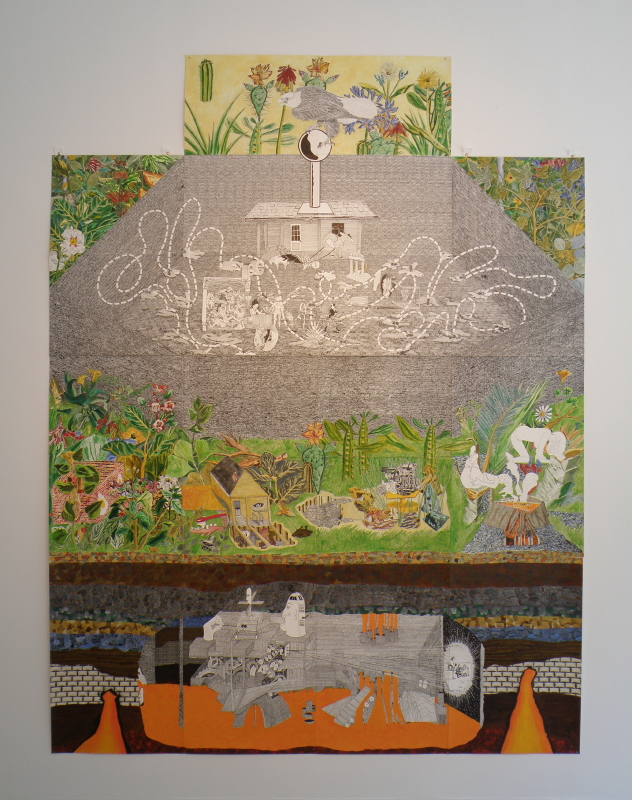
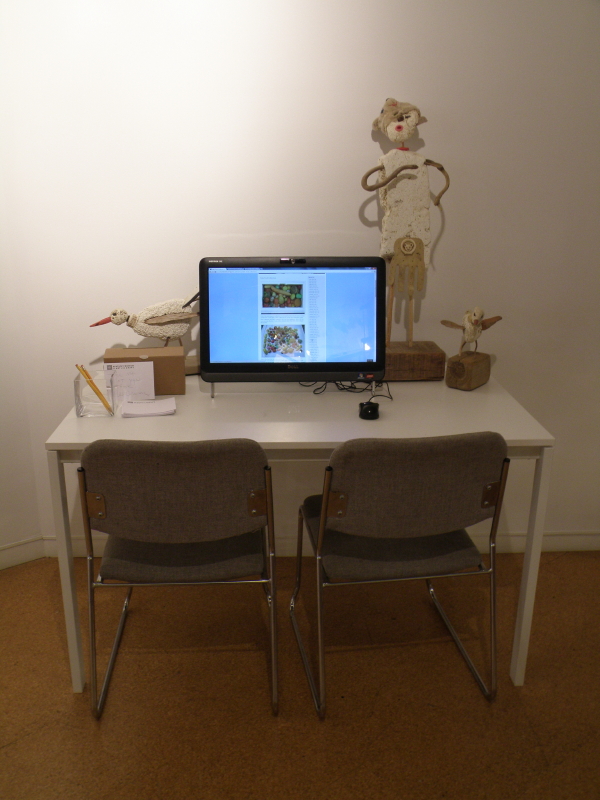
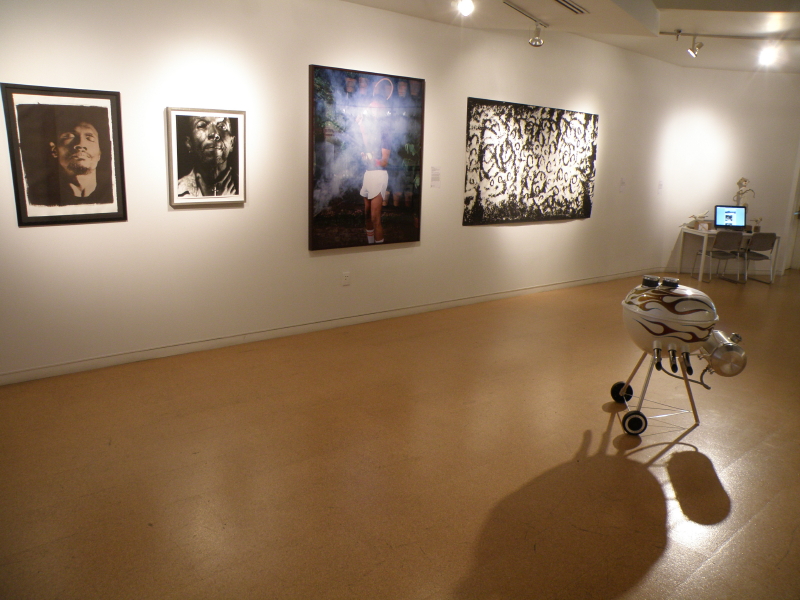
riverblog on computer monitor, The Seven Borders, KMAC, Aug. 2013 As promised, here is a post about the “The 7 Borders, Mapping Kentucky’s Regional Identity” exhibition at the Kentucky Museum of Art and Craft in Louisville.  My “Artist at Exit 0 Riverblog” has been a part of this show which opened on June 29 and runs through September 1.  I’m honored to have been asked by KMAC and curator Joey Yates to participate especially since this is the first time my blogging activities have appeared in an art context.  My display in the museum included a few small Styrofoam artifacts, a computer monitor on a table with chairs, a box for handwritten comments, and a label on the wall.  Not quite your typical art offering.  If, however, you think of the computer as a keyhole that you can peer through to a different reality…then you get transported to the world of the Artist at Exit 0 at the Falls of the Ohio State Park.  At your fingertips are over 360 posts and more than 3500 images and my own peculiar blend of fact and fiction.  Many of you who follow this blog have been nice enough to leave recent comments and I wonder if you realized that you were participating in this exhibition too?  At the end of this post, I will add the comments that visitors left for me in the little box so that they can be a part of this exhibition record as well.  For now, I would like to share some other images of the works that are (were) a part of this exhibition. The 7 Borders, installation view, Aug. 2013 Eighteen artists are participating in this exhibition.  A few of the artists either currently live in Kentucky or are originally from here.  The majority of the artists, however, live in the seven contiguous states that border the commonwealth, hence “The 7 Borders”.  In the above image, works by Rashid Johnson are on the wall, while Brian McCutcheon’s whimsically modified cooking grill entitled “Trailer Queen II” rests on the floor. The 7 Borders, gallery view, Aug. 2013 The exhibition is a survey of contemporary works produced in a geographical area that is often hard to define.  At various times, Kentucky has been considered by Americans to be the frontier west, the Midwest, or the most northern of the southern states.  The fact this region has been historically hard to place is attractive to me.  For a professional artist, one downside is that the nearest art market of any size is in Chicago.  Many of the artworks in “The 7 Borders” reference issues born of local conditions and landscapes and gain a certain power by not being made for strictly commercial reasons.  The exhibit’s curator wrote: “Each of the artists represented is witness to varying views of the region focusing on personal history and collective experience.”  In the gallery shot above are paintings by Claire Sherman, a photo series by Guy Mendes, and a unique chest of drawers that looks like a stacked firewood entitled “Facecord” by Mark Moskovitz. "The River" by Andrew Douglas Underwood, The 7 Borders, KMAC, Aug. 2013 This mixed media work is entitled “The River” and the artist is Andrew Douglas Underwood who originally is from Louisville.  Personally, I relate to Underwood’s piece because it weaves together metaphors and history relating to people’s long association with the Ohio River.  This work effectively combines photography, embroidery, and found objects. "Pre-Fab(ulous) Environments", Leticia Bajuyo, at KMAC Leticia Bajuyo’s “Pre-Fab(ulous) Environments” is an installation piece located on the museum’s second floor.  Her multimedia piece with its blue Styrofoam installation house and suburban floor map complete with Happy Meal-styled folding cardboard houses reference contemporary suburban neighborhoods. "Roan Mountain Matrix", Denise Burge, The 7 Borders, KMAC This is an image of “Roan Mountain Matrix” by Denise Burge who lives in Cincinnati, Ohio.  Her large fabric and thread works quote traditional Appalachian quilting while alluding to changes occurring to the land and its people through contemporary processes like mountain top coal removal. "Bog Taan", Joel McDonald, at KMAC, Aug. 2013 Joel McDonald’s “Bog Taan” is a tour-de-force mixed media drawing on 26 sheets of watercolor paper.  This is a large, obsessively detailed work that touches upon the artist’s social views as told through the context of his Germantown neighborhood in Louisville, Kentucky.  McDonald has a deep understanding and appreciation for 20th Century illustration.  You could look at this artwork for a long time and keep finding images within it.

To conclude this post, I would like to include the comments left by gallery visitors upon engaging my blog in the gallery.  Some of the comments are by children who participated in summer camp programs organized by the museum.

BLOG COMMENTS

“Love this – so fun!

I once saw a duck taking a nap on a submerged & upside down shopping cart on the L-ville side of the OR (Ohio River)”

“The Joe Arbor set was sweet. Poignant. – you should do stop action animation.”

“Love the triker! and the deer-Styrobuck! and the spider-and Pip and the fish-”

“It’s beautiful, I love it! – famous artist”

“Looks like garbage to me!”

“Be cooler if it was metal”

“Some really remarkable & moving works!  Really enjoyed 7 borders.”                       Lou Knowles…Forest Hills, New York

“I like it!  Keep up the good work!”

“So Playful!  What a blast.  Thank you.”

“I like it!”

“Very interesting, one man’s trash is another man’s treasure.  Love the blue nose man”

“dirty + whimsical like crawling through a broken greenhouse in the backyard + making toys as a child”  Lilly Ettinger

“Love it!” “???” “Fabulous: fun, imaginative & thought provoking…Thank you”                                     Mary from Wisconsin

“Quirky & original.  Brought a smile to my face”  K. Woodard (art teacher UK)

“I like the very last peice.  I think personally it looks like here is a passage in between the trunk and the roots”

” I agree we did not make enough “to do” about the beginning of manned flight.  I wouldn’t be here enjoying our work without a flight by plane.  Also like your reminder to “follow your dreams”  Kay Gorman (Maryland)

“Love them!  Priddy Cool!”

“This is very suspicious and cool to see what people throw in the river”

“Ummmm!”

“Love the birds…they are alive.”  Adrian (New Zealand)

“It looks like two snowman”

“I think this was awsome”

“Love the recycling, cute and clever.  Loved to take the time to see the whole-plus the blog.- Just a passer-by, Aug. ’13”

“Fab Al – Love where you went with this – Always happy too see your dementia”  Paul and Sandy Sasso………..these folks are old college friends of mine

“They look like Big, Dirty, Marshmallows”

“You are awesome”

THIS WAS THE LAST OF THE COMMENTS LEFT AT THE EXHIBITION.  NEXT TIME…SEE YOU FROM THE RIVER!


Read Full Post »

Tree in the western section of the Falls of the Ohio State Park, Aug. 2013

Resolved to stay away from my old atelier under the willow trees for a while, I decided to explore the western section of the Falls of the Ohio State Park.  It was just the most beautiful day and residents of our area have remarked on how unusually nice it’s been of late.  The air today has wonderful clarity and although it’s summer and the sun is shining…we are many degrees below our usual temps.  I feel the western part of the Falls of the Ohio begins once you cross the creek at the end of the Woodland Loop Trail.  This is an area that receives fewer visitors and I’m happy just to wander with nothing on my mind.  As I walk the narrow strip of land that is the riverbank, on my left are sounds from the river and on my right are various bird songs originating under the tree canopy.  I see the formerly high river has deposited driftwood here in new configurations along with the usual plastic junk.  My eyes are open and ready for anything.  I doesn’t take very long before I make the first of several discoveries new to me in and around a patch of Wild Potato-Vines.

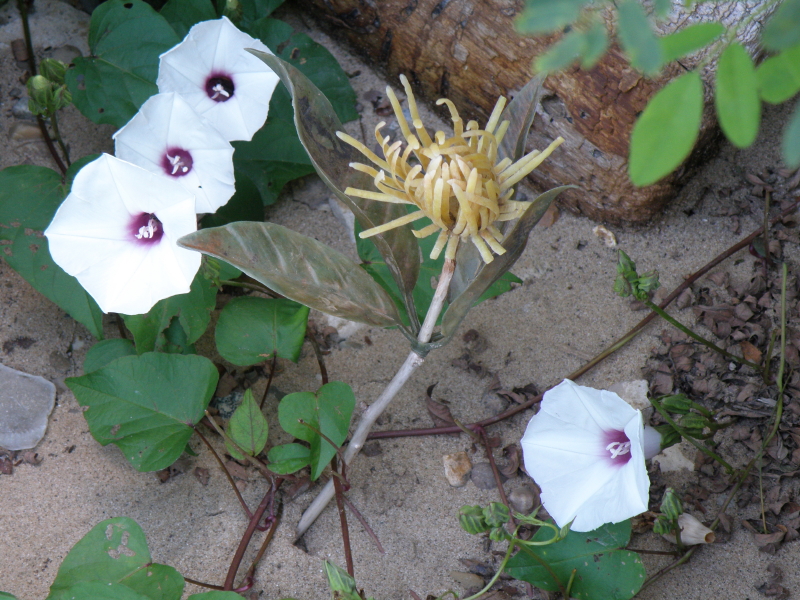
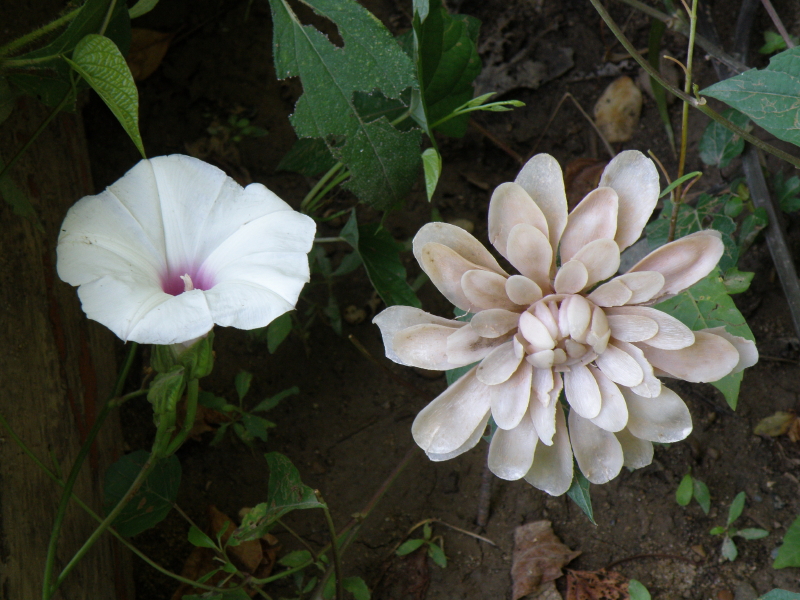
Goldstein's False Mum among Wild Potato Vine flowers, Falls of the Ohio, Aug. 2013

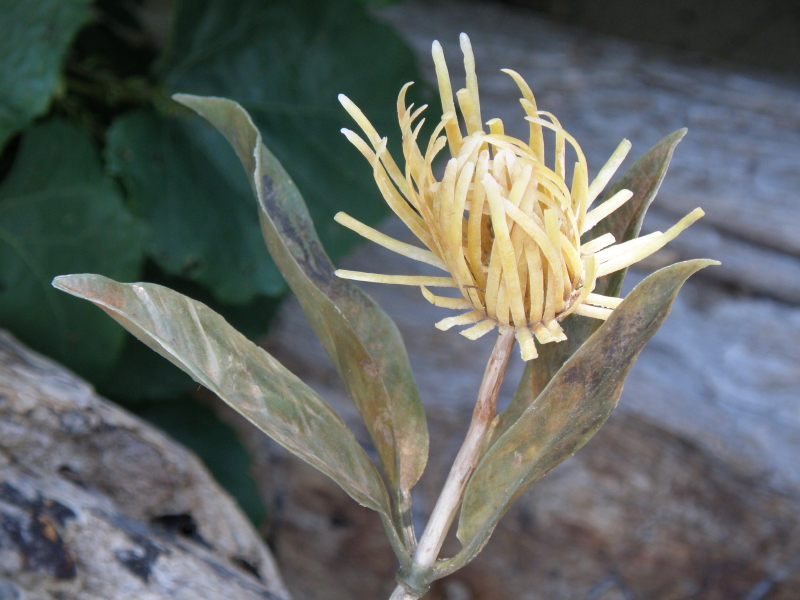
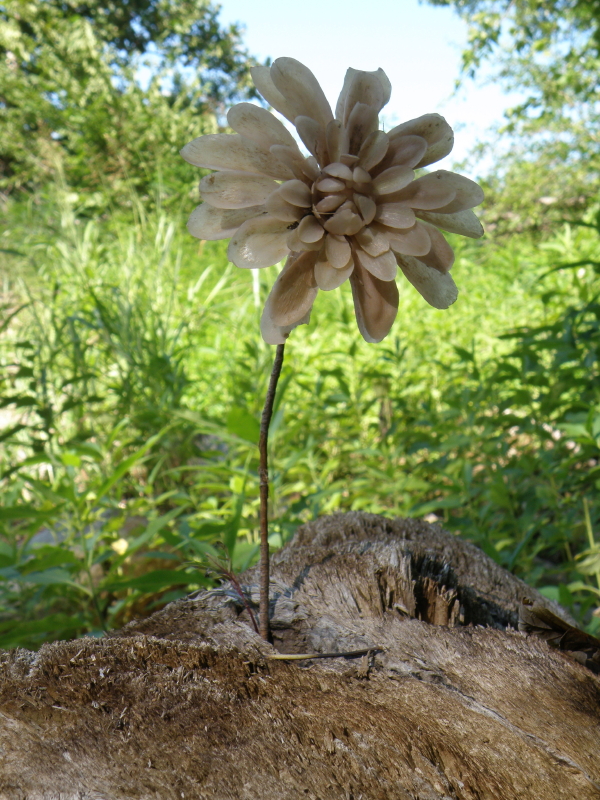
Close up of Goldstein's False Mum, Aug. 2013

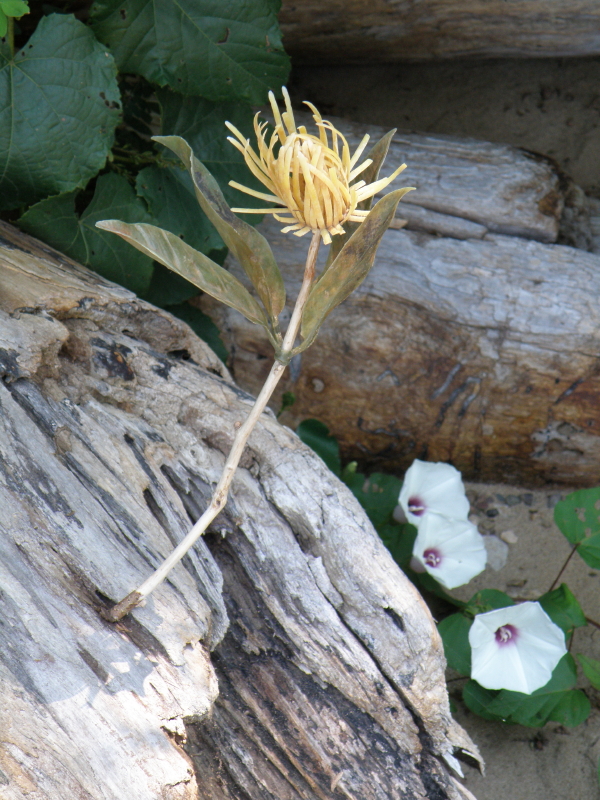
This is Goldstein’s False Mum which is named after the resident naturalist at the Falls of the Ohio State Park.  This is another in a series of very odd flowers while being organic by definition  have little in common with the other plants that grow along side of them.  In general, plastic-like blooms and foliage characterize these botanical rarities.  None of these plants (which form a new order of their own called Artificialia ) are capable of photosynthesis despite the appearance of green leaves.  Goldstein’s False Mum is a summer plant that produces a hard, yellow, frilly blossom that appears on the terminal end of a woody stem.  It prefers sandy, disturbed soils or decaying wood and is usually seen in the company of traditional flowering plants.  It produces no scent and no insects were observed being attentive to the false mum.  Now the Wild Potato-Vine is also an interesting plant.  It is a member of the Morning Glory family and its bloom is primarily white with a purplish maroon throat.  I have seen large bumble bees pollinating this flower.  What sets this plant apart is under the ground.  The Wild Potato-Vine produces a large tuber that had food value for the indigenous people.  Here is a another specimen of Goldstein’s False Mum growing out of a soft, decaying log also in the presence of Wild Potato-Vines.

Goldstein's False Mum and Wild Potato-Vine flowers, Falls of the Ohio, Aug. 2013

Not too far away and also in association with the Wild Potato-Vines is another type of plastic-like plant and here is its portrait.

Wild Potato-Vine blossom with Saprophytic Zinnia, Falls of the Ohio, Aug. 2013

The Saprophytic Zinnia, Falls of the Ohio, Aug. 2013

The Log Weed is a saprophytic plant.  Lacking chlorophyll it relies on decaying matter for its sustenance.  The Log Weed is characterized by a corolla of hard plastic-like petals and never has what we would describe as leaves coming off its woody stem.  No one is quite sure how it propagates? Its blossoms appear in mid summer and seem to hang around forever.

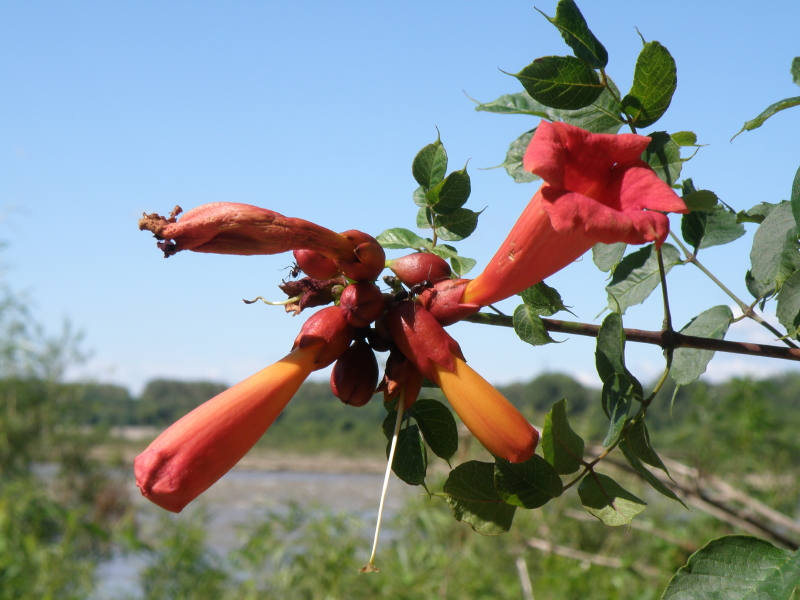
Trumpet Creeper, Falls of the Ohio, Aug. 2013

These are tubular flowers from the Trumpet Creeper vine which is a native and natural sight at the Falls of the Ohio.  This is a climbing, spreading vine and wood ants seem to love them.  If you look closely at the above photo…you can see several ants crawling on the Trumpet Creeper’s attractive blooms.  I was admiring this vine when I noticed that there was something not quite right about it and this is what I discovered.
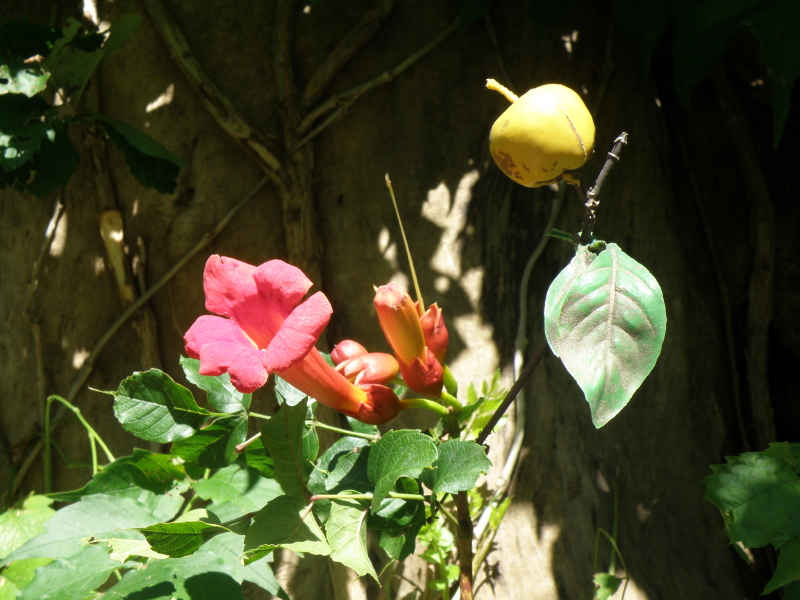
Unknown fruit on Trumpet Creeper, Aug. 2013

Notice the yellow orb to the upper right of the Trumpet Creeper blossoms? Thus far, the yellow fruit with its accompanying leaf remain unclassified.  It is, however, grafted to the woody stem of the vine.  Amazingly, it even has a false stem to deceive.  Could it be parasitic?  One hypothesis why this plant with the odd fruit appears with Trumpet Creeper might be the protection it receives from the vine’s wood ants?  The fruit and leaf are also very polymer-like and may indeed be plastic.  More and more we are learning how ubiquitous plastic is in the environment.  I heard a report about the Great Lakes the other day saying that there is a considerable amount of micro plastic in these large bodies of fresh water.  Upon examination, much of this plastic takes the form of tiny balls that are blended into deodorants and toothpaste to make the product flow more evenly.  These beads are so small that they pass through the finest screens at the waste water treatment plants and into the lakes.  I think Nature is metabolizing this plastic and recombining the hydrocarbons in novel ways, but that is just my theory.

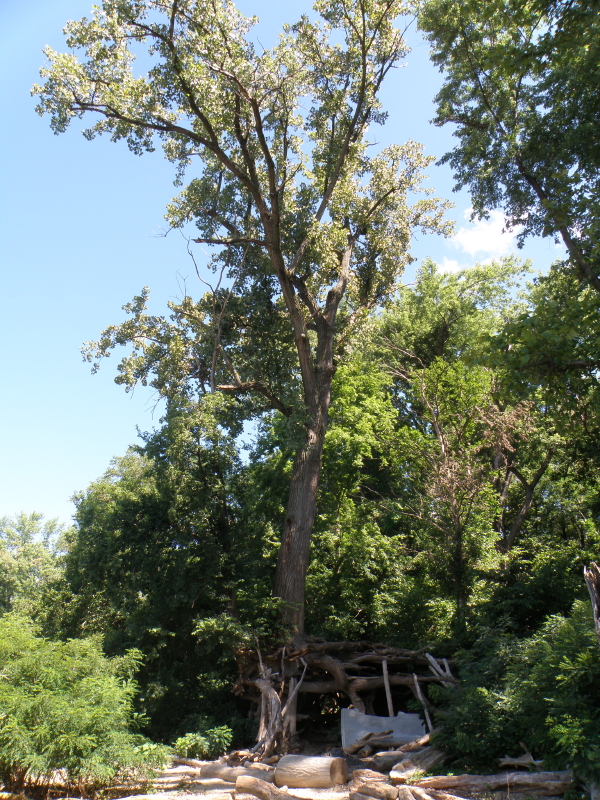
Cottonwood tree fort, Falls of the Ohio, Aug. 2013

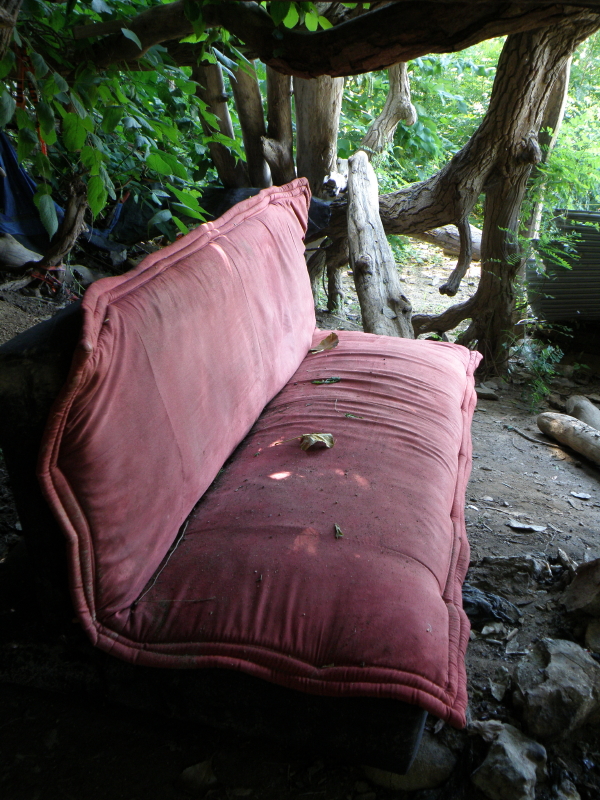
I paid my favorite cottonwood tree a visit and it’s been a while since I took shelter under its large, exposed roots.  People, especially the locals, like hanging out here and I witnessed much less trash since my last visit which is a good thing.  One big “improvement” has been made with the addition of a red, upholstered couch and I took a moment to rest here before moving on.

red couch under the cottonwood tree, Aug. 2013

The couch is very comfortable and I’m amazed that people actually dragged this piece of furniture down here.  Eventually, it will be reclaimed by the river.  Here’s another view from under the tree.

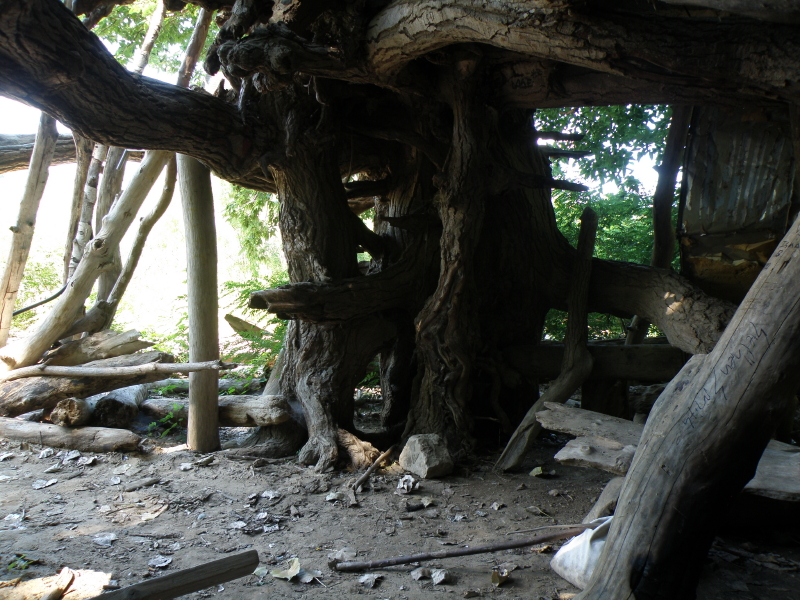
space under the cottonwood tree, Aug. 2013

For those who prefer their comforts a bit more on the rustic side…there is another bench for seating and it’s made from a slab of wood balanced on short logs.

under the cottonwood tree, Aug. 2013

I rested, had a snack and drank some water before moving on.  I’ve designated my intended destination as “Loosestrife Land” for the abundance of these non-native flowers that have taken over moist areas in the western section of the park.  I’m going there seeking something else which will be the subject of my next post.  I’ll catch up with you soon but for now…so long and happy trails to you.

Purple Loosestrife flowers in bloom, Falls of the Ohio, Aug. 2013

Read Full Post »

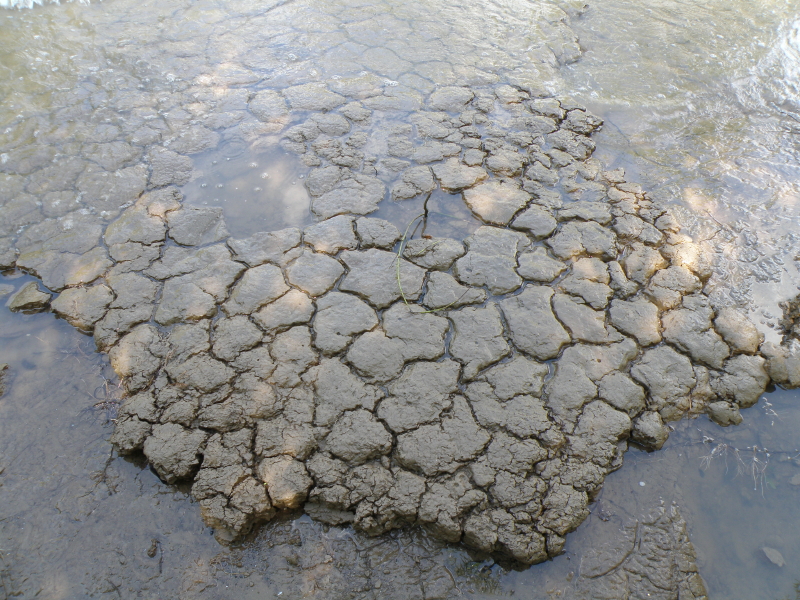
the riverbank, cracks in clay, July 2013

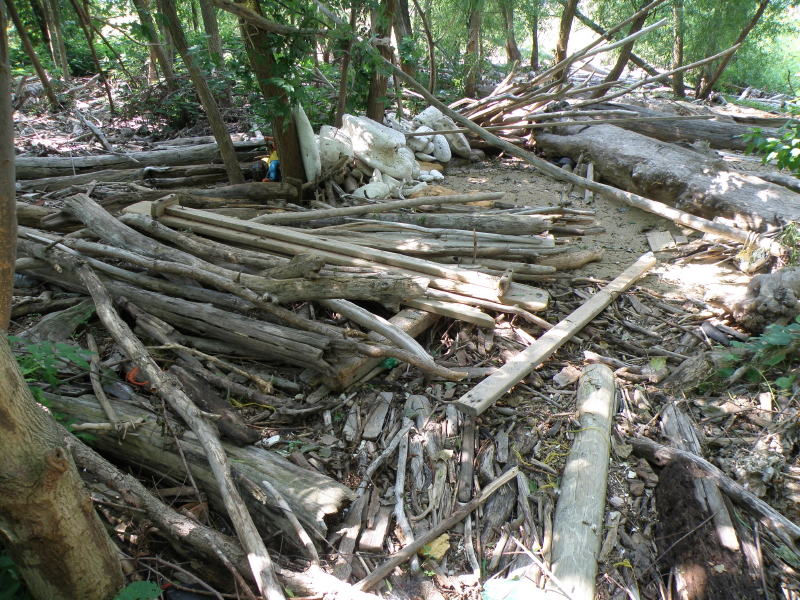
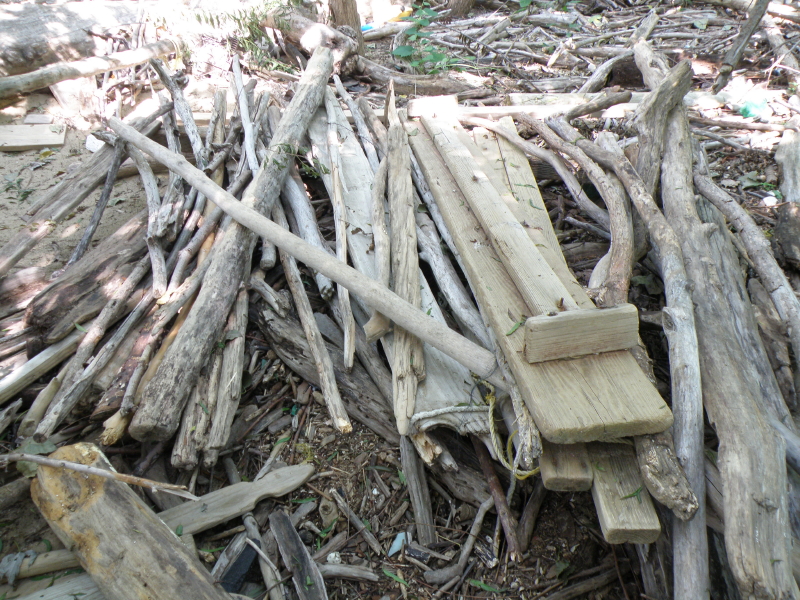
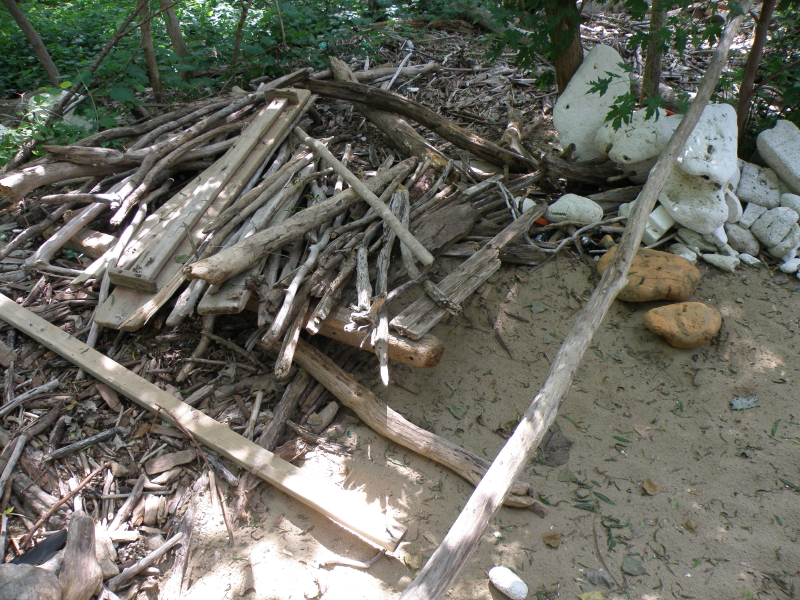
I never told you how this story played out and so now is as good a time as any.  A few weeks back, I had posted on how some unknown visitor(s?) had been altering my outdoor studio at the Falls of the Ohio State Park.  For a least two years previously, I had been storing my river found art materials at this site.  People who stumbled upon this spot often mark their presence by changing how I left it in some way.  Folks might rifle through the junk or take or destroy the Styrofoam figures I might leave behind.  I don’t mind this…in fact, I encourage the interaction.  On site, it’s easy to make the connection that all these poor materials I use came from the river.  I still think of my outdoor studio as a shared laboratory for this exercise in creativity.  It’s an acknowledgement that all this junk is out there and that something else positive might come from it.  For several weekends, my latest visitor has been building a wooden driftwood structure over my spot to the point where it usurps my ability to continue working there.  So, I made a few changes that I thought would benefit both of us.  I modified the structure so that I could stand within my site.  I also opened up the space more which I thought also encouraged additions.  I was curious to see how my visitor would react and here are the pictures.

destroyed driftwood structure, July 2013

destroyed driftwood structure, July 2013

destroyed driftwood structure, July 2013

It appears that my “improvements” weren’t appreciated because I arrived one day to find it all laying on the ground.  All the nylon line and strong knots that were holding things together were cut with a knife.  Stuff was scattered and the big polystyrene figure I had left there was destroyed again.  Here’s how I discovered my Styrofoam man.

fallen figure, July 2013

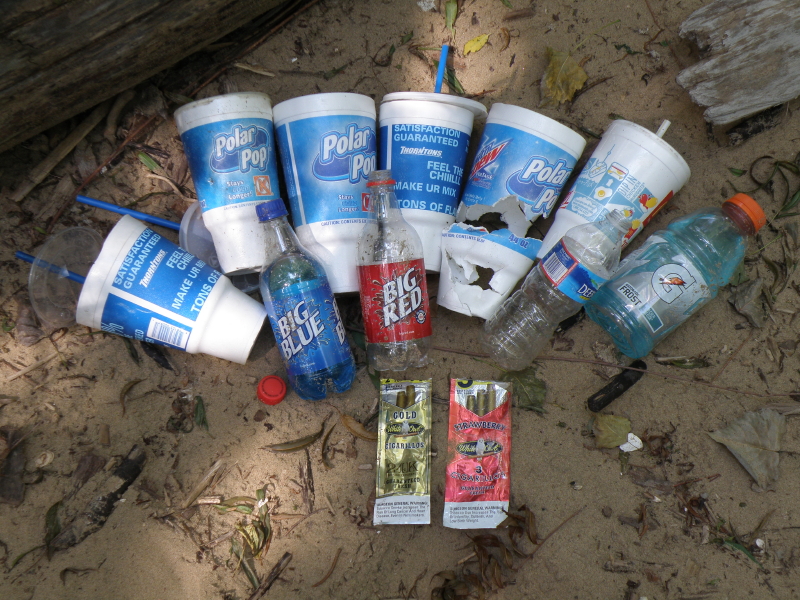
He had been sitting in a fork of a nearby tree.  I think my visitor picked him up and threw him across the site…again!  At this point, I’m feeling pretty bummed out.  I left this figure as I found it.  My visitor also left me some additional trash behind as is his custom and I gathered it together again to create this “portrait”.

trash at my site, July 2013

I thought the “Big Red” with the “Big Blue” was an interesting touch.  In our area, those are the home colors of rival universities.  Another giant Styrofoam cup joined the group and I have my suspicions that the cigar packaging is from the same individual as well?  I think this is what saddens me the most that all this convenient store trash would be walked to this site and simply thrown on the ground.  As much trash that appears here from upriver, I’m shocked by how much park garbage originates from the nearby towns.  And yes, there are trash cans available everywhere.  I sat by my site for a while and pondered the situation.  I wondered why with all the space and driftwood available in the park that this spot became so important to my visitor?  Feeling like this individual more than likely doesn’t play well with others…I decided to walk away from this site for a few weeks or months before returning.  So far, I haven’t been back to my old spot under the willows.

two fishermen, July 2013

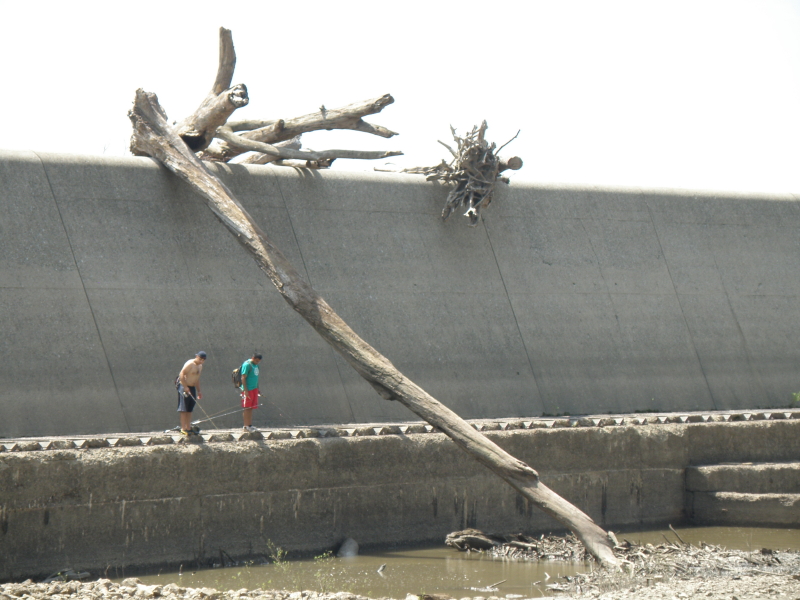
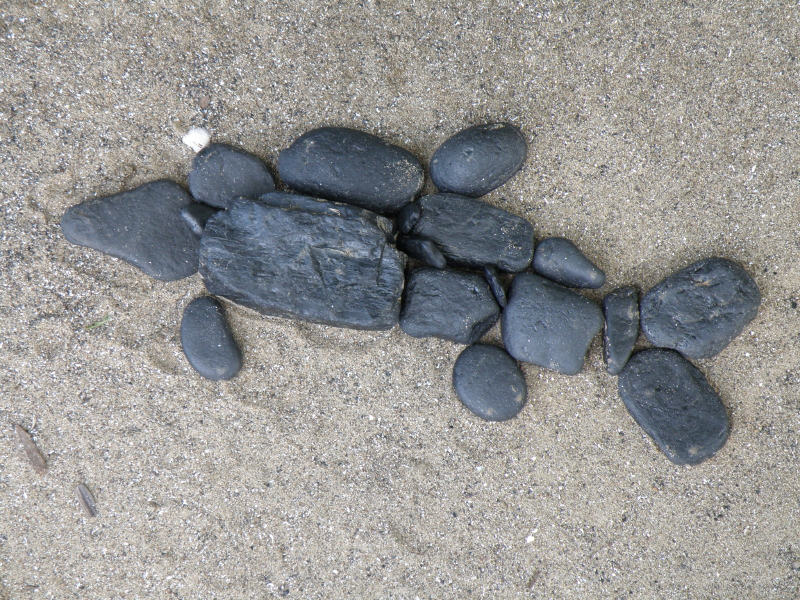
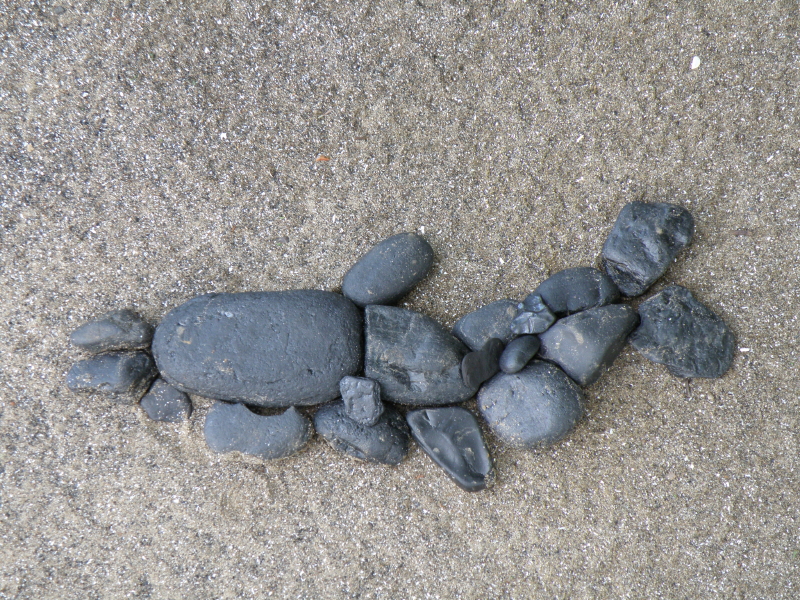
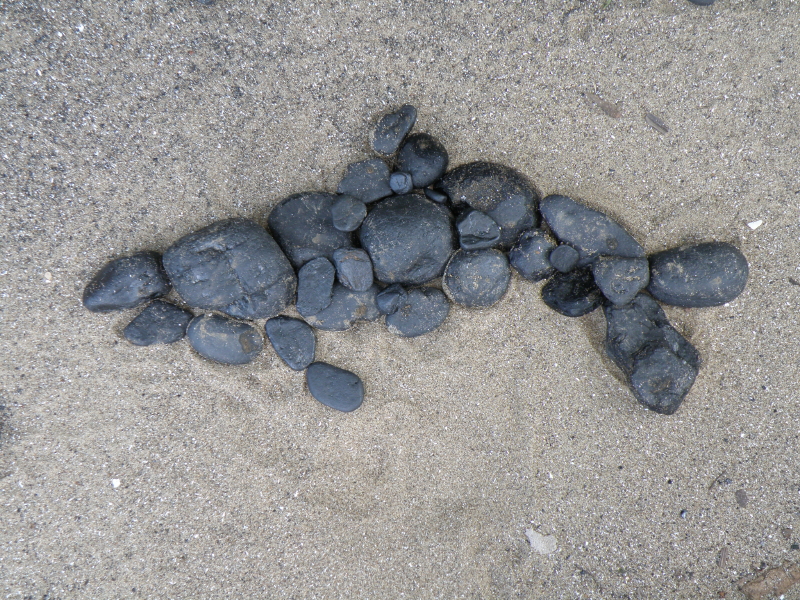
The day felt shot, but I didn’t want to leave things that way and so I went for an extra long walk.  After all, I have the rest of the park to potentially explore.! Along the way, I spotted these two guys attempting to fish by the wall of the dam.  They didn’t appear to be having any luck and so I left them with these fishy images by the side of a trail they would pass by.

coal fish, July 2013

coal fish, July 2013

coal fish, July 2013

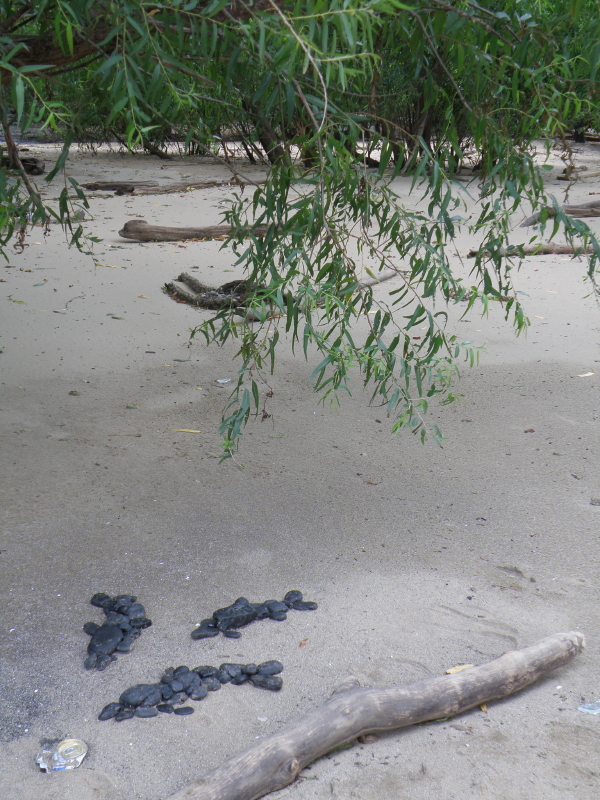
I used river smoothed coal I gathered on site and improvised these three fish on the sand.  Peppering the silica granules black is coal dust.  The white dots are pulverized mussel shells.

three coal fish on the sand, Falls of the Ohio, July 2013

Thus far, it has been an atypical and sometimes unsettling summer at the Falls of the Ohio.  All the early season rains and subsequent high water have disrupted the usually hot, humid, and lazy routine found here during this time of year.  In an odd way, it doesn’t feel like summer has truly arrived for us yet.  We have a few more months for this to happen before the leaves start turning colors.  To close, here is one more coal-fish image in a slightly larger context.  Have a great weekend!
coal fish in context at the Falls of the Ohio, July 2013

Read Full Post »

Rising Ohio River at the Falls of the Ohio, July 2013

High water at the Falls of the Ohio, July 2013

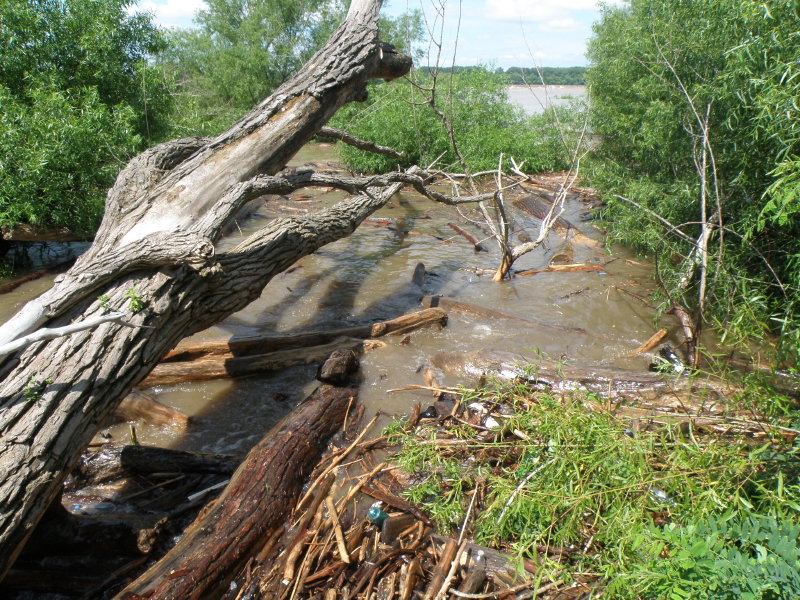
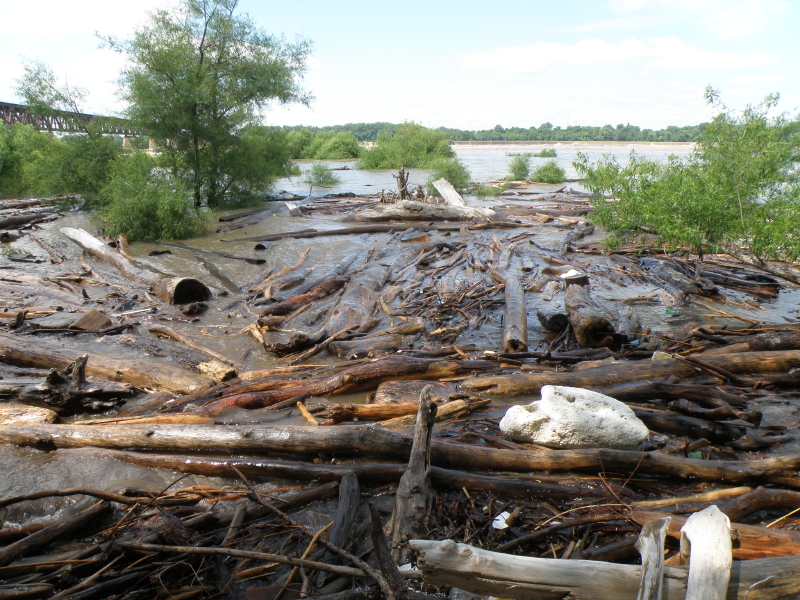
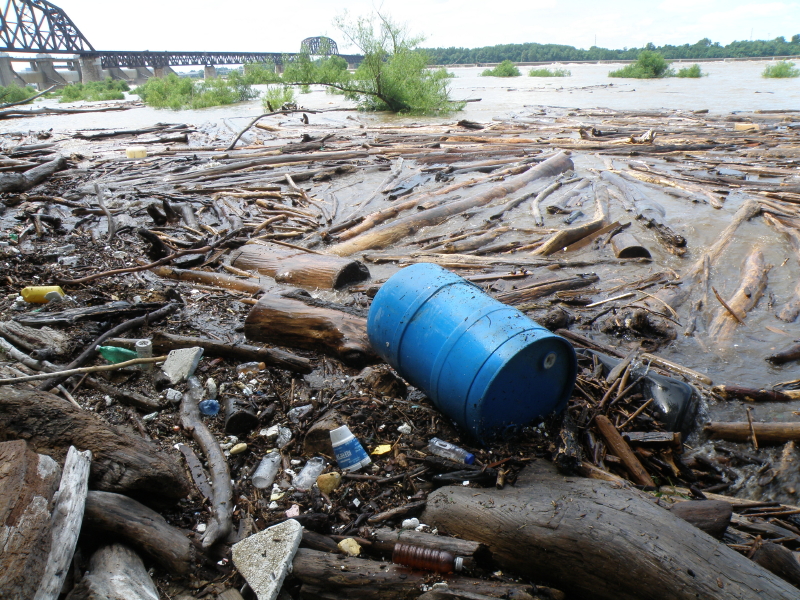
We have had (along with the eastern half of the country) a lot of rain recently.  When it has precipitated, it hasn’t been gentle rains, but rather torrential, monsoon-like downpours.  Consequently, everything is saturated and the Ohio River has quickly risen to engulf the riverbanks that are normally wide and clear this time of year.  I took a chance between rain showers to see if I could access my site for a few hours.  Maneuvering through the underbrush I was able to investigate the river’s edge that was slowly but surely creeping inland.  As a gauge to how high the river has risen, in the above photos…you should be able to walk out to those willow trees that are now in the middle of the river.  I watched columns of ants marching for higher ground.  The river’s edge attracts animals, particularly birds, that are hunting insects being driven by the advancing water.  I’m here doing a similar thing…except I’m looking for interesting junk that has floated in with the driftwood.  I always find something and here are a few recent images of this river treasure.

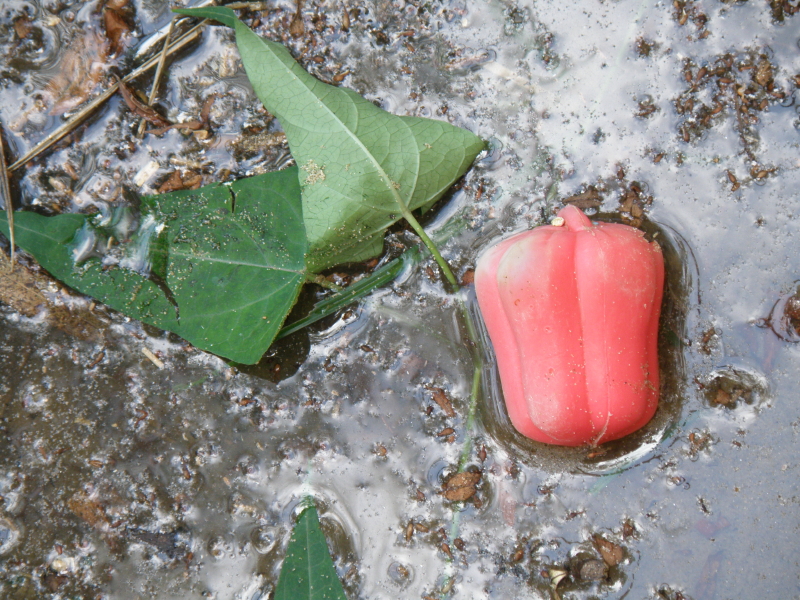
small, red plastic, bell pepper, July 2013

This is a plastic bell pepper to add to my ever growing collection of faux food.  This collection has grown considerably since I last photographed it in its entirety.  I’ve added several fast food items and I now can boast owning  several plastic hamburgers and hotdogs to accompany the fruits and vegetables.

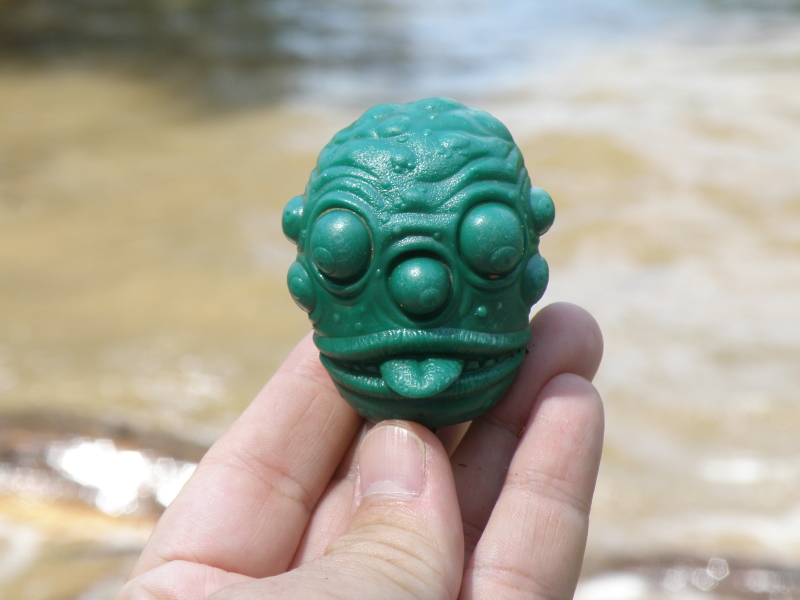
green toy character head sticking out its tongue, July 2013

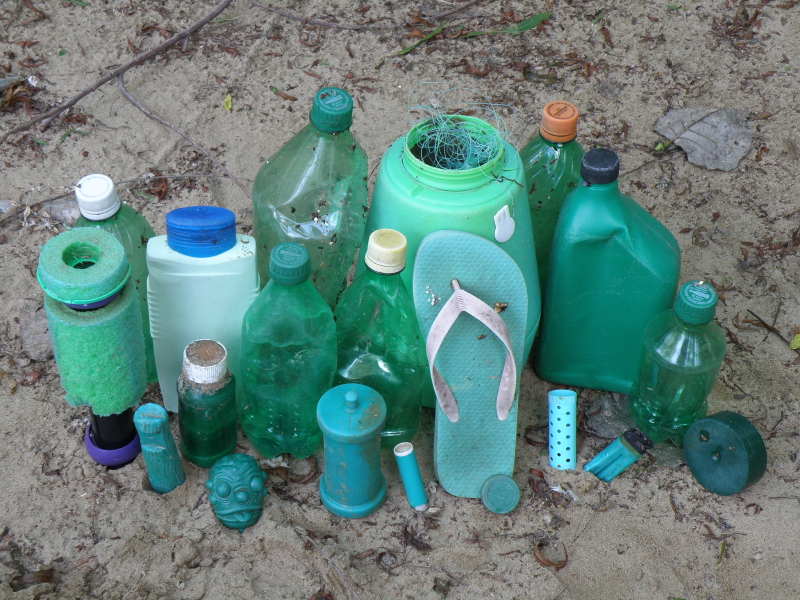
I don’t recognize this character’s head, but I responded to the tongue sticking out!  It was this discovery that caused me to go on a tangent.  I decided that in the relatively restricted area I was investigating that I was going to collect all the different green plastic items the river was delivering to me.  This is what I came up with.

green plastic junk, July 2013

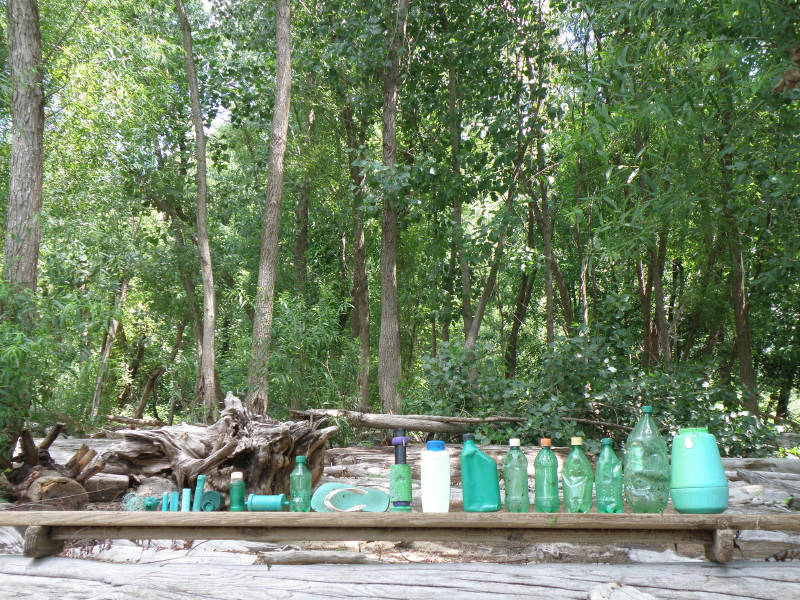
I was amazed at the collection I was able to put together in less than an hour’s time.  Each item is unique…even the green plastic bottles which are different sizes, designs, and have different colored bottle caps.  Among my other finds include green discarded fishing line, a green “Lincoln log”, a lost lip balm cylinder, a hair curler, a circular green plastic “smokeless” tobacco “tin”, a flip flop, etc…

"Homage to Green", July 2013

I then took my 21 green artificial objects and arranged them in a line on an interesting wooden object I found that looked very alter-like.  This is a very different expression of what it is to be “green” and the plants behind these objects concur.  It was now time to visit my site and see if anything had happened there and perhaps to make something new.

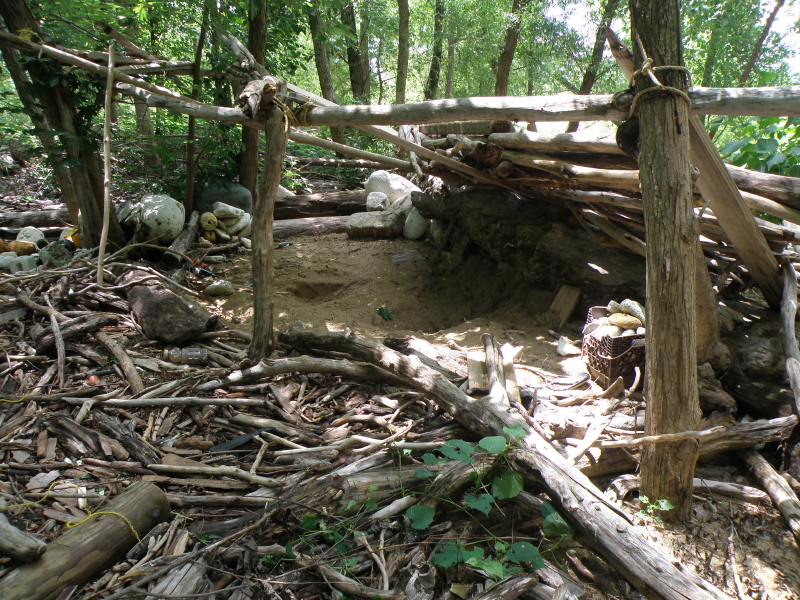
expanded structure at my site, July 2013

I had that “oh no” feeling upon arriving.  There were several changes since my last visit.  Whomever is building this structure appears to be trying to construct a roof over my spot.  Most of the materials that I have gathered over the months were just thrown out and around the site.  There is no way for me to work here now in its present configuration.  I wonder if the rain prevented the “work” from being completed?  And then it dawned on me…where is the figure I left here?  I found him a short distance away.

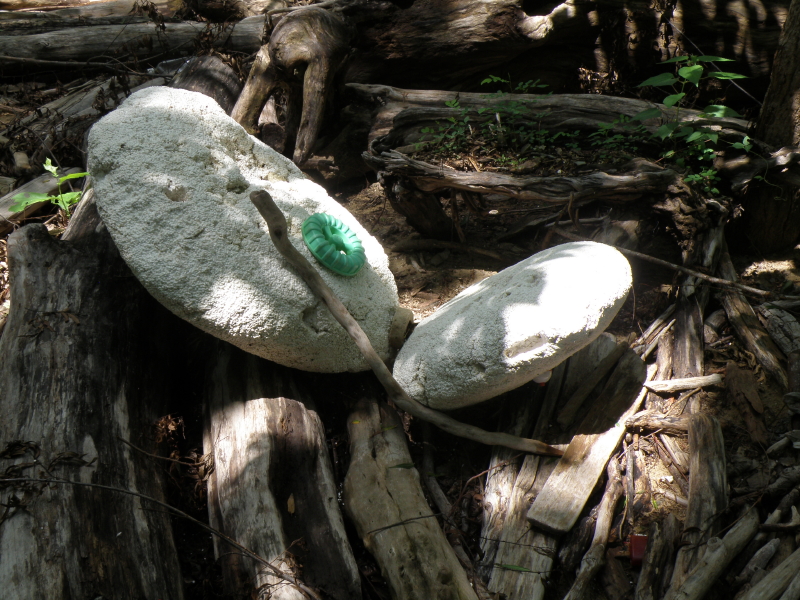
big Styrofoam figure face down, July 2013

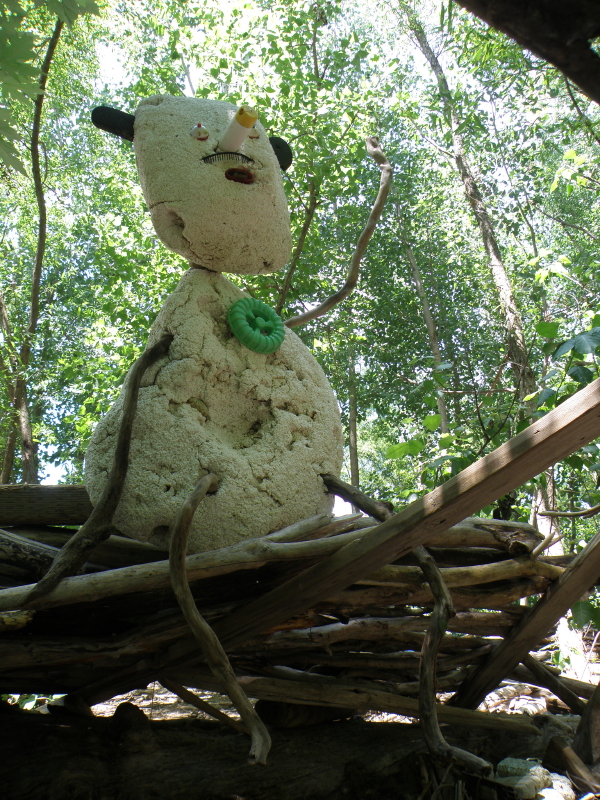
This is how I found him disarticulated and face down.  It appears that he was just lifted up and thrown aside.  I knew if I was to learn what had happened that I would need to reconstruct him.  It took me a bit of time to find his various parts, but I ultimately was successful and set him up on the “roof” in a sitting position.

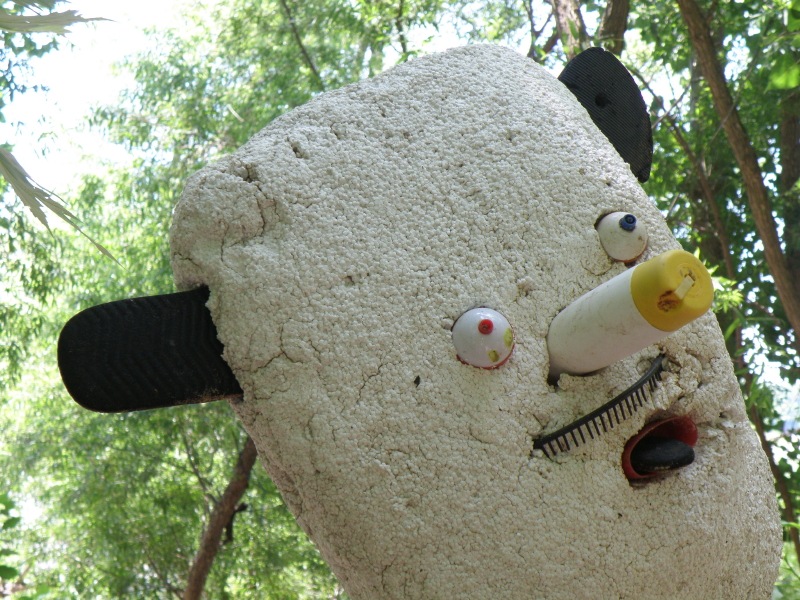
Large Styro-figure head, July 2013

Large seated Styro-figure, July 2013

I said…”Dude, what happened here and to you?”  My friend was quite excitable in retelling the tale.  He said a couple of people came by a day or so after I was last here and just started ransacking the place.  The last thing he remembers was flying through the air and then blackness.  He at least confirmed my suspicions that more than one person was involved.  Here is the evidence I used to draw that conclusion.

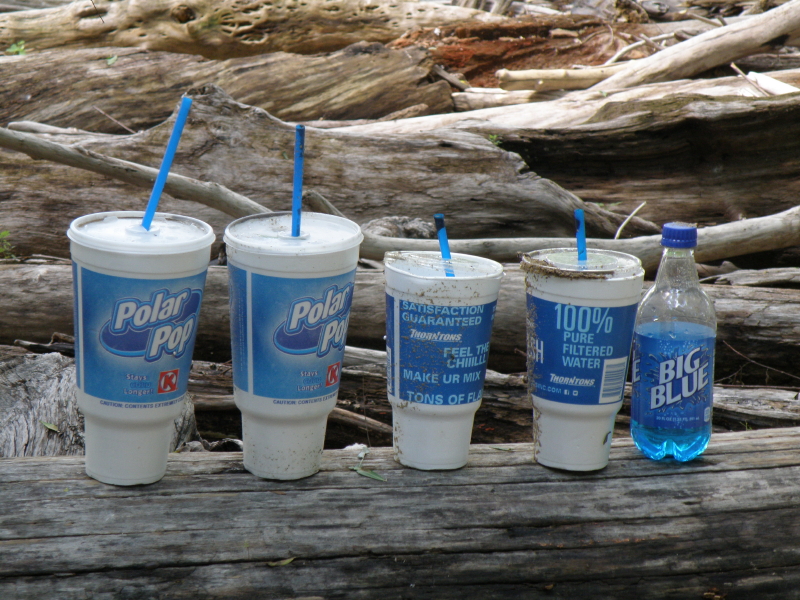
giant polystyrene drink cups and bottle, July 2013

The last time I was here I noted a giant polystyrene cup lying in the sand just outside my space.  Upon returning, I picked up these additional cups and the blue bottle that were casually thrown on the ground and photographed them on a nearby log.   I’m deducing that these people live in the area since they sell these mega drinks at a nearby gas station.  Now as much as I’m torqued about being evicted from my spot…finding these added cups here makes me mad!  There is already enough junk in the river without bringing more and leaving it here!  It seems the height of disrespect and irresponsibility and my remade figure concurred.

Excited Styro-figure with arms spread wide, July 2013

My friend was growing excited with the thought of his recent tormentors returning to the scene of the crime.  He asked me what I was going to do about this and I have to admit it’s a dilemma for me.  Generally, I appreciate it when people interact with my art, however, there is little evidence that there are respectful spirits at play here.  I decided that if the river kept rising (and at this point it was about twenty meters away) that matters would become moot.  The water would rearrange the context here and I would simply begin again.  If, however, the river doesn’t reclaim this spot…I promised my figure that I would reassert my will.  I might do a little engineering of my own and see how I might modify the structure to suit my needs.  If you were me…what would you do?  I told my mustachioed figure to sit tight and that I would return the following weekend if the river would allow it.  To be continued…?

My figure at my site, July 2013

The rising Ohio River, July 2013

Read Full Post »

Joe Arbor at the river's edge, Falls of the Ohio, July 2013

Everybody has a different tipping point where enough is finally enough and action is called for.  This was the case with Joe Arbor.  For many years, Joe Arbor walked the river’s edge paying attention to what the Earth was telling him from the signals that washed ashore.  Yes, this is a nonverbal language, but the Earth is eloquent in this way.  On this particular day, Joe Arbor noticed that there was a lot of wood everywhere and while it was picturesque…it was also disturbing.  Joe Arbor realized that all the wood he was seeing represented trees in the past tense.

driftwood at the Falls, June 2013

Joe Arbor knew of other places where the Earth via the river had left a record of lost trees particularly at the Falls of the Ohio.  In the hot bleaching sun the various logs and limbs piled on top of one another reminded him of bones.  Joe Arbor would walk among these elephant’s graveyards of trees and felt ill at ease.  These trees represented a huge loss in terms of the free services they provided.  Here was food and shelter for a multitude of other life forms.  Here was the air we breathe and the cooling shade of summer and potential warmth in winter.  Here was lost inspiration!  Since Joe Arbor also made his home next to the river, he also knew that tree roots also held the riverbank in place.  Over the past several years it had not escaped Joe Arbor’s notice that at this location,  it rained more and harder and trees were being swept away.  Joe Arbor was no scientist or genius, but could recognize that life seemed out of balance and it worried him.  What could be done?  Joe Arbor went home and decided to sleep on the question.
Joe Arbor and Pip hatch up a plan, Falls of the Ohio, July 2013

Joe Arbor makes his home at the base of an old willow tree.  It took several nights of sleeping on the question before the beginnings of an answer started to form in his mind.  When the solution came to him, Joe Arbor decided that he needed some help or company and he called his good friend Pip.  Pip is short for Pipistrel which is a name given to several species of bats.  One fine morning, the pair got up early and gathered some tools and provisions together and ventured forth to the river’s edge.  If the Earth was losing her balance due to tree loss…it made sense to Joe Arbor that getting involved with planting and saving more trees could be a good thing to do.

eastern cottonwood tree leaves and capsules, June 2013

eastern cottonwood leaves and seeds, July 2013

Joe Arbor decided he wanted to try to do something to help the Eastern Cottonwoods that grew along the Falls of the Ohio.  These cottonwoods are magnificent, fast growing trees and reach great heights.  They produce unusual capsule-shaped fruits and when conditions are right, these capsules burst open releasing tiny, fluffy seeds that drift through the air like dry snow and move with the slightest breeze.  Joe Arbor also knew from experience that many more of these seeds germinate than reach maturity.  At the Falls, those seeds that sprout nearest the river eventually are destroyed by the river during flooding.  They simply get washed away or crushed by logs rolling in the waves.  Joe Arbor decided to perform an experiment to see if he could successfully transplant a cottonwood tree to a safer location?
selecting a cottonwood seedling, July 2013

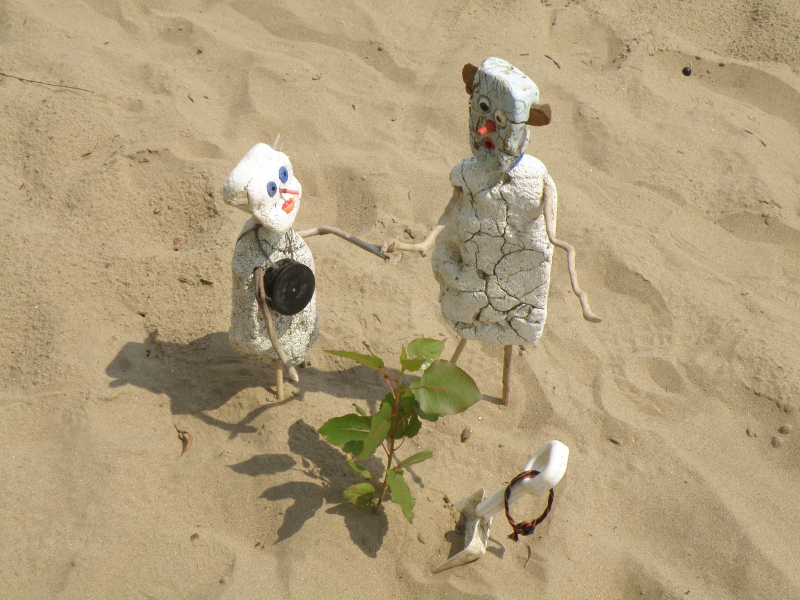
First Joe Arbor and Pip selected a little cottonwood growing in the sand.  They next held hands and said a few kind words and explained to the tree what they were about to do and why.  In this way, they hoped to obtain the tree’s blessing.  Together, they carefully dug around the sand to uncover as much of the tree’s roots as they could.  Bagging up the little tree roots and all the paired moved on to a different location.

Canada geese at the Falls, July 2013

All the while Joe Arbor and Pip were working, a small flock of Canada Geese were standing nearby and acted as guards and witnesses.  Because the geese also live near the river they are also privy to the Earth’s nonverbal language and understood what was at stake here.  Their presence added a bit of solemnity to the event.

Joe Arbor and Pip with cottonwood tree, July 2013

Joe Arbor and Pip with cottonwood tree and tools, July 2013

With their valuable charge in a bag, the pair moved on to a pre-selected location they hoped would be favorable to the cottonwood tree.  Cottonwood trees do best when they are close (but not too close) to the water.  As they walked, Joe Arbor whistled an improvised melody partly out of nervousness and the excitement of the moment.  As is his norm…Pip remained quiet.

Young cottonwood in the ground, July 2013

A large enough hole was dug in the new location to accommodate all the young cottonwood’s roots.  Sand and soil were shoveled lovingly around the tree.

Joe Arbor and Pip plant the tree, July 2013

After the tree was safely in the hole, Joe Arbor said a few words while Pip watered the transplant.  It was hoped that the chosen location was the right distance from the river and that the young tree would grab a toe-hold here and prosper.  Time will tell.  The day still had one more nice surprise and it came from Pip.  Joe Arbor didn’t know why he didn’t pay attention to this before, but Pip was wearing a circular, black, plastic box on a cord hung around his neck.  This circular box was the container that smokeless tobacco is sold in.  Many of these boxes routinely wash up at the Falls of the Ohio.  Anyway, Pip opened up the container revealing its contents and this is what Joe Arbor saw.
snuff box with mulberries, July 2013

Wrapped in mulberry leaves were four ripening mulberries.  This is another tree that grows at the Falls of the Ohio and provides food for many birds and animals.  The berries are sweet and juicy when ripe and some people find them tasty too.  The leaves are interesting and come in different shapes with serrated edges.

Pip holding a mulberry, July 2013

Pip (who says very little) had his own tree planting experiment in mind and Joe Arbor got the idea.  Moving to a different location, a new hole was dug in the rich soil and a berry was placed in that hole.

Pip and Joe Arbor plant mulberries, Falls of the Ohio, July 2013

The process was repeated until all the berries were planted.  Pip was curious to see if he could start a mulberry tree in this way or whether the seeds needed to travel through the gut of a bird or some other animal first?  Again, time will tell.  Satisfied that at least for today, the duo had done some good for the Earth, the pair picked up their gear and headed home together.

Pip and Joe Arbor go home, July 2013

This little story is dedicated to an artist friend of mine I have never met.  She has a vision of creating a tree art project around the world and if you are interested in learning more about it and perhaps participating…here is a link  to a post she wrote about it:  http://rooszwart.wordpress.com/2013/05/29/the-bridge-land-art-forest/

Pip and Joe Arbor after planting trees together, July 2013

Read Full Post »

Wet studio under the willows, Falls of the Ohio, early June 2013

If you are reading this post between June 28 through September 1, 2013 then you are also participating in an art exhibition.  You may ask…how is that possible?  Well, sitting on a white table within a gallery of the Kentucky Museum of Art and Craft in Louisville is a desktop computer.  On that computer, my “Artist at Exit o Riverblog” is on display in a group show entitled “The Seven Borders” which is curated by Joey Yates.  The exhibition features contemporary artists who either live in Kentucky or in the seven contiguous states that border the commonwealth. I will try to post more about this exhibit over the show’s run.  I’m delighted by this invitation because this is the first time my blog has been featured as art in an art context.  I’ve always thought this was a possibility for this blog because my art comes together here in terms of the objects I make, the pictures I take, and the words I string together to tell stories or just describe the beauty of nature.

 Of course, the dialogue created by people’s comments is a part of that too.  With hope, people will additionally feel they can participate by leaving a comment, however, online you will need to be a WordPress member or a blogger with an Open ID credential.  This is easy and free to do.  If, however, you would prefer to write a note on paper while in the museum and give it to the front desk attendant…I would be glad to include those comments in this project as well. 

 It’s been a busy and engaging June with projects at the river, a family trip to Washington D.C. etc… I had planned a different post for today, but after yesterday’s experiences at the river…I thought I would go out of sequence.   Besides, with art, it is quite often the case that progress or forward movement is not linear, but jumps all over the place.  Let’s begin again with the first image of this post…this was my outdoor studio under the willow trees at the Falls of the  Ohio in early June.  

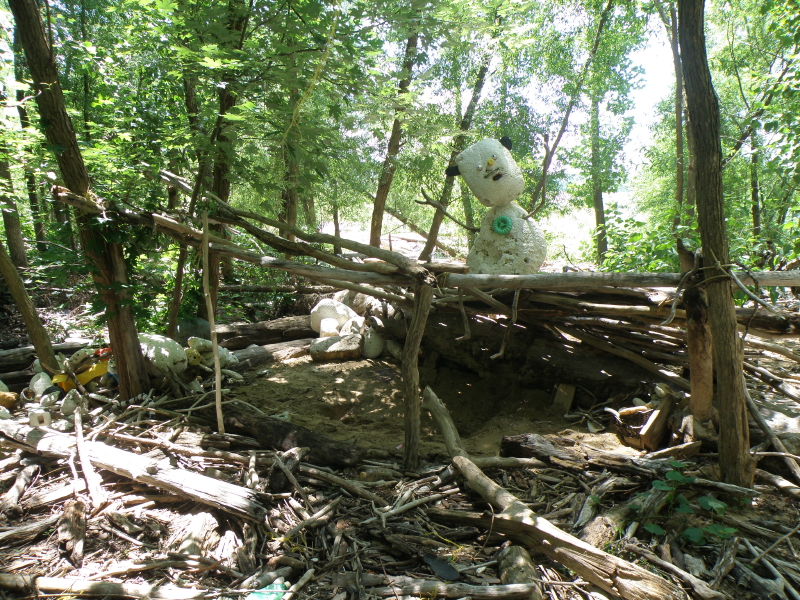
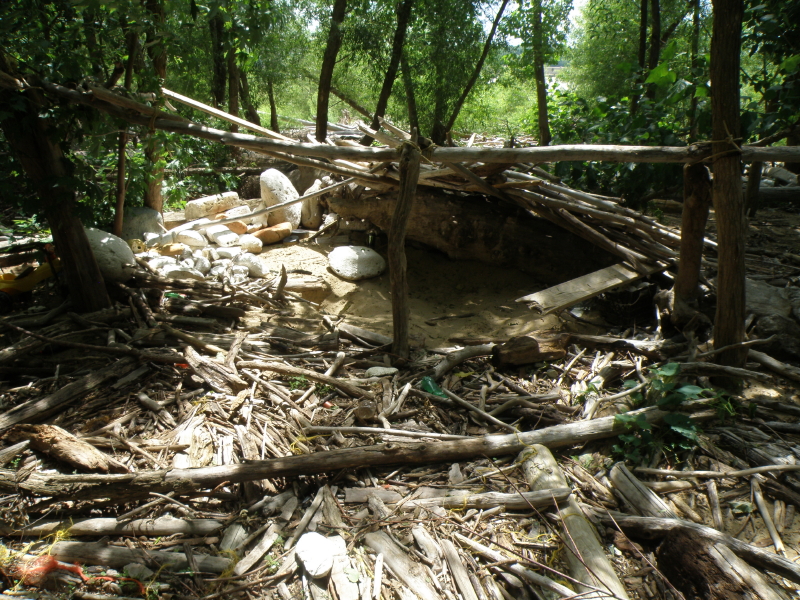
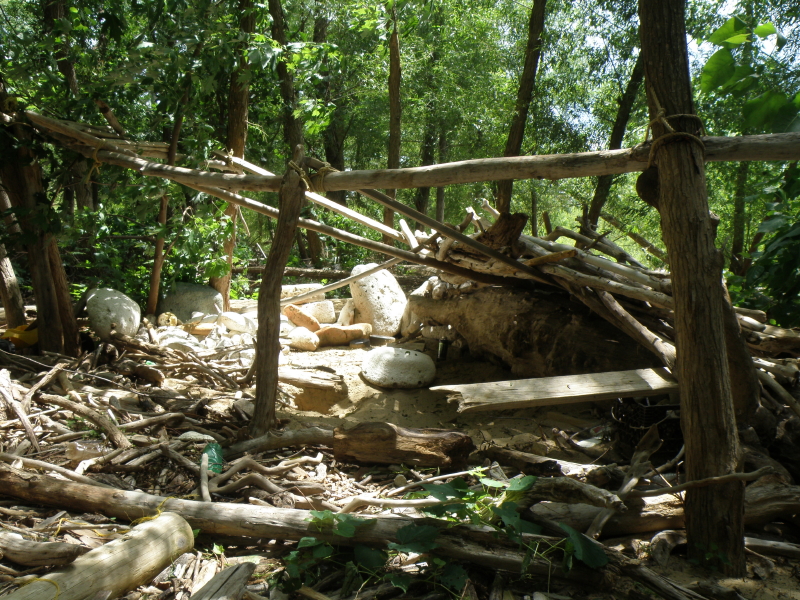
I have used this spot to cache river found materials and to make my sculptures and this has been a handy base of operations for a couple of years now.  This spot has weathered a few near miss floods that could have washed everything away again, but has stayed remarkably intact.  Well…there were a few recent changes which form the true subject of this post and here are the pictures.

Improved outdoor studio space, June 2013

Improved outdoor studio space, Falls, June 2013

Improved studio area, Falls, June 2013

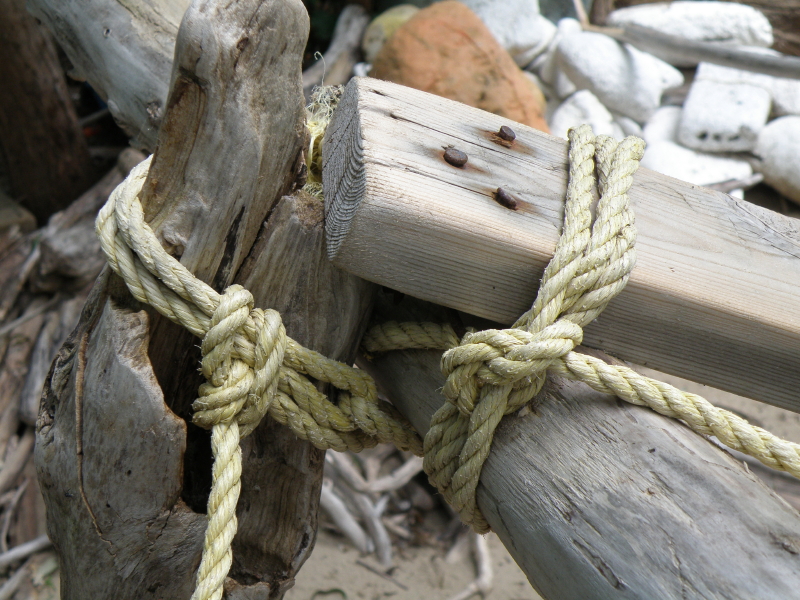
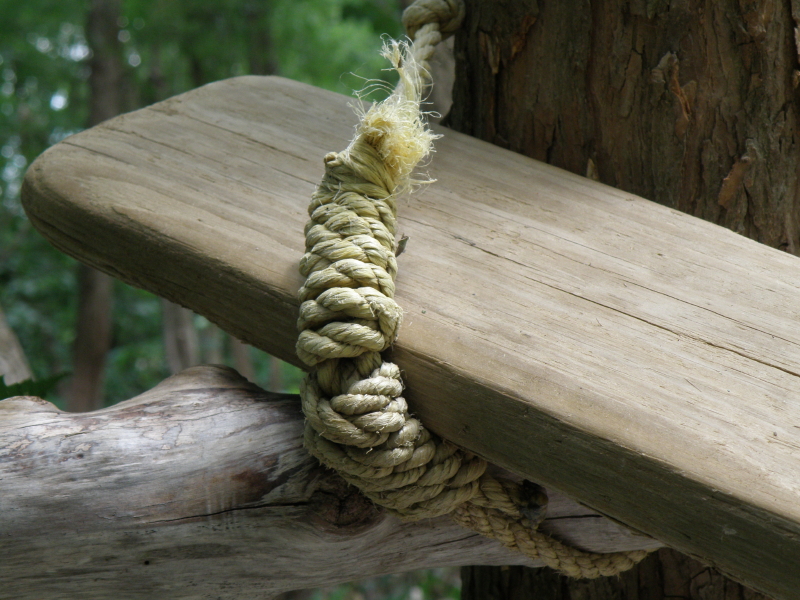
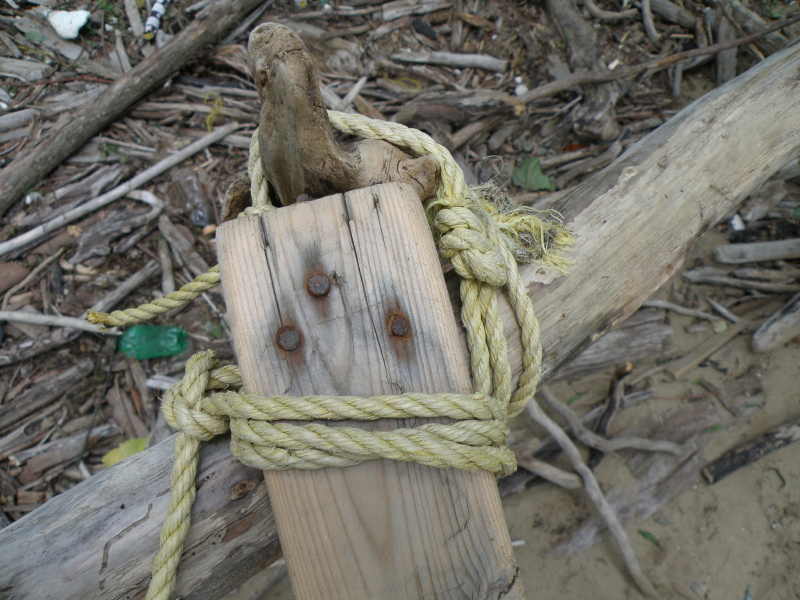
It was an already dramatic day in terms of the weather.  Bright sunshine alternated between heavy, dark clouds dumping rain showers along the way.  The clarity of the air and the mosquitoes were noteworthy.  I did get soaked on this adventure, but as long as the camera stays dry…I’m alright with it all.  Imagine my surprise upon arriving at my site to find that someone anonymously had built a structure around it!  I’m used to folks going through the junk I’ve scavenged and taking or destroying whatever creations I may have left behind, but this is a first!  A great deal of care was used in working with the existing site by utilizing the surrounding trees and logs as posts and beams.  I wonder if this is also the work of more than one person?  This is more than a flimsy lean-to where the wood is simply stacked.  Some craftsmanship is evident from the knots used to hold the structure together.  It might take more than one person to steady things as another does the tying?  Again, more pictures to illustrate the story.

knots used to hold structure together, June 2013

knots used on wood structure, June 2013

knots and wood, June 2013

The yellow nylon line is something I had found previously and used to create the giant spider’s web featured in an earlier post.  This structure has a chance to stay up for awhile…at least until someone else messes with it or the river rises again.  I was absorbed with the changes and reflecting on how often I have looked at this site from an archeological perspective.  It might even be fun to draw all this stuff in a scientific sort of way.  Because it had rained while I was looking around, the damp ground muffled the approaching sounds of my second big surprise of the day!

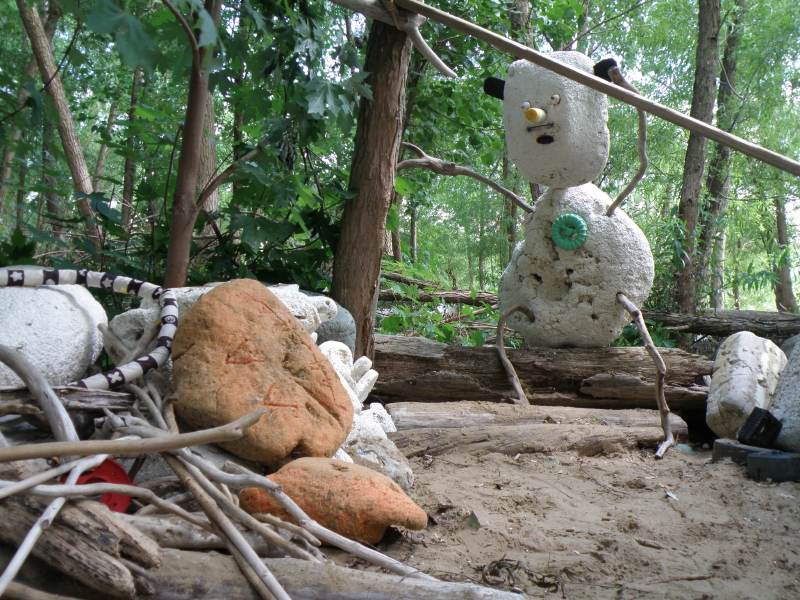
Figure with large head, June 2013

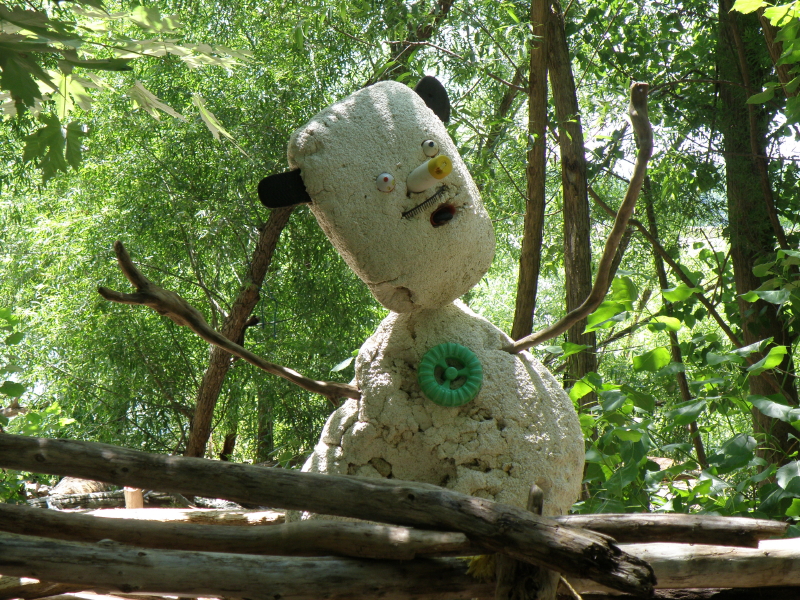
I turned and looked over my shoulder as this large presence stepped over the logs and entered the studio area.  He sat right down and asked, “Are you the guy that makes the Styrofoam sculptures?”

Big Figure with Pencil-thin mustache, Falls, June 2013

Big figure with pencil-thin mustache, June 2013

Whoa!…(I said to myself),…check out this dude with the huge head, miss-matched eyes, and pencil-thin mustache.  No doubt about it…I was a bit taken aback!  Regaining my composure, I replied that indeed I was that person and added that many of those creations were made in this very spot.  Without every telling me his name, he replied “I thought so…I’ve been an admirer of your work for a long time now.”  Knowing he was a fan set me at ease and we had a nice visit together.

Big Figure with pencil thin mustache, Falls, June 2013

Portrait of the Figure with the Big Head and Pencil-thin Mustache, Falls, June 2013

“So, how do you like it?”  Spreading his spindly arms around my studio,  I gathered that he was the architect of these recent improvements.  I told my mustachioed friend that I just love it when people play along and contribute to my Falls of the Ohio project!  I could see this clearly delighted him.  He asked if there were any suggestions for improvements and I replied that I had a few ideas.  To begin with, it is now much more difficult to move within the space.  I whacked my head a few times on wooden supports.  If the structure were higher…that wouldn’t be an issue and I also wouldn’t turn into a hunchback any sooner than I have to.  I also added that I missed having the big log to use as an impromptu work surface.  When I stood, it was just the right height.  Now, it is covered up with stacked wood.  I could see from his expression that this was probably enough in suggestions for this time.  I didn’t tell him that I needed to create new seating because the plank I liked using had been damaged.  That’s no big deal.  With the clouds ahead promising more rain, I gathered my camera, collecting bag, and walking stick and bid my new friend so long…for now.  Perhaps we’ll meet again?  Looking back, I saw the big guy sitting in my customary spot.  As I walked over the driftwood and sand, I wondered if my next visit to this site would harbor any more surprises?

The Big Guy with Pencil-thin Mustache at the studio, Falls of the Ohio, June 2013


Read Full Post »

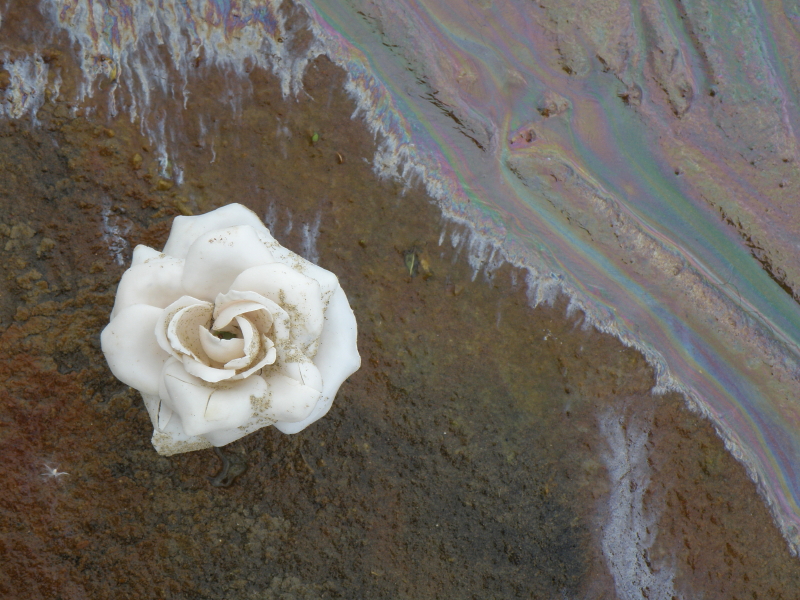
Chemical Rose, Falls of the Ohio, 2013

Following is a unique portfolio of never before published images of the latest Unnatural Flowers that have bloomed at the Falls of the Ohio.  This follows a previous article on this riverblog (see…”Unusual Flora at the Falls of the Ohio”, Jan. 13, 2013) that first exposed the bizarre flora that have adapted to this highly disturbed site on the Ohio River.  It is speculated that these new organisms are able to metabolize  decaying plastic in novel and sometimes disturbing ways.  Characteristic of these faux flowers is a lack of photosynthetic leaves.  It is believed that the energy utilized by these plants is created from breaking plastic polymer bonds and forming new compounds or by elaborate parasitism.  Examples of both will be highlighted.  Key also are the various petrochemical connections which rhyme historically to a more ancient world illustrated beautifully by the site’s Devonian Era fossils and our culture’s reliance upon oil and coal to power and pollute everything.  It is my belief that these unique forms appearing here are no coincidence.  Let us first acquaint ourselves with various members of the “Chemical Rose” family.  An example of which leads off this post.  Here are more recently found roses.
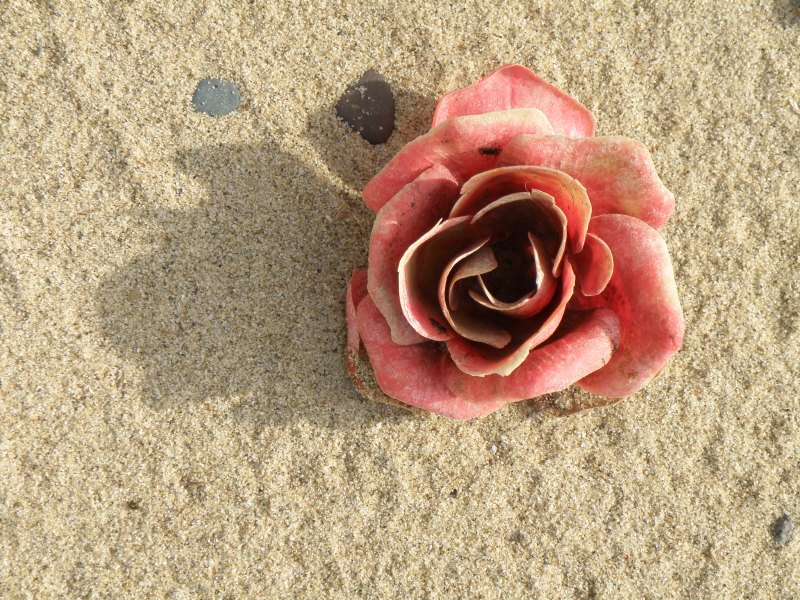
Chemical Rose variety with rootlets, 2013

This variety appears to have rootlets growing between the plastic-hard rose petals.  As with all “Chemical Roses”…there is no sweet perfume to inhale.

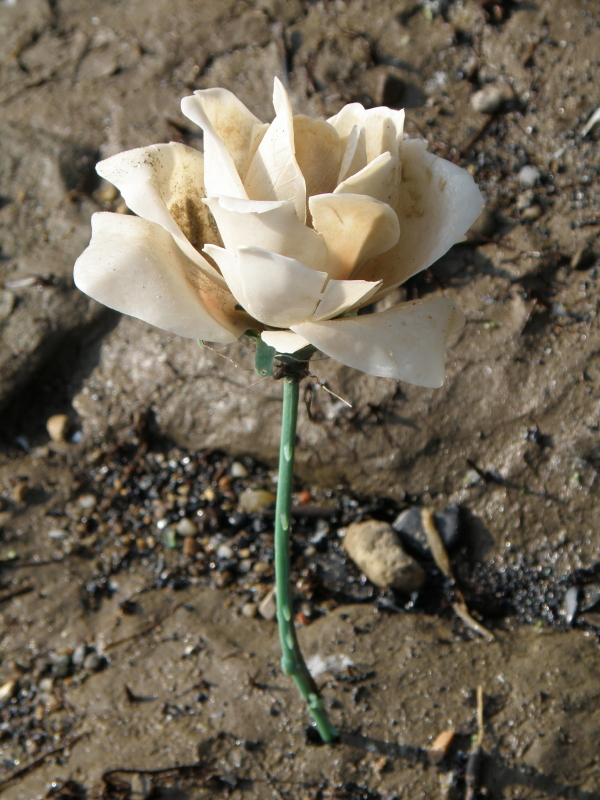
Chemical Rose on thorny stem, Falls of the Ohio, 2013

This “Chemical Rose” example is growing out of the mud on a leafless, thorny stem.  No telling what chemical compositions are co-mingling in this ooze?

Red Chemical Rose of the sand variety, 2013

This ” Red Chemical Rose” has adapted to growing on sand.  While the next example has synthetic, fabric-like petals.  It does add a beautiful yet bittersweet presence to the landscape.

Petrochemical Petunia, Falls of the Ohio, 2013

This “Petrochemical Petunia” is a late Spring oddity and prefers moist, iridescent sand and full sunlight.  It presents as a completely synthetic, hybrid blossom.  It is not clear at this time if some pollinating agent is necessary for its propagation.

Little White Polymer Phlox, Falls of the Ohio, 2013

Imagine my surprise upon discovering this “Little White Polymer Phlox” growing from the ruined wood on this stump.  This specimen was found very close to the water and in an area that  floods frequently.  The phlox needs just the right temperature and water content to break down this former tree’s cellulose matrix to make the nutrients it needs to grow.

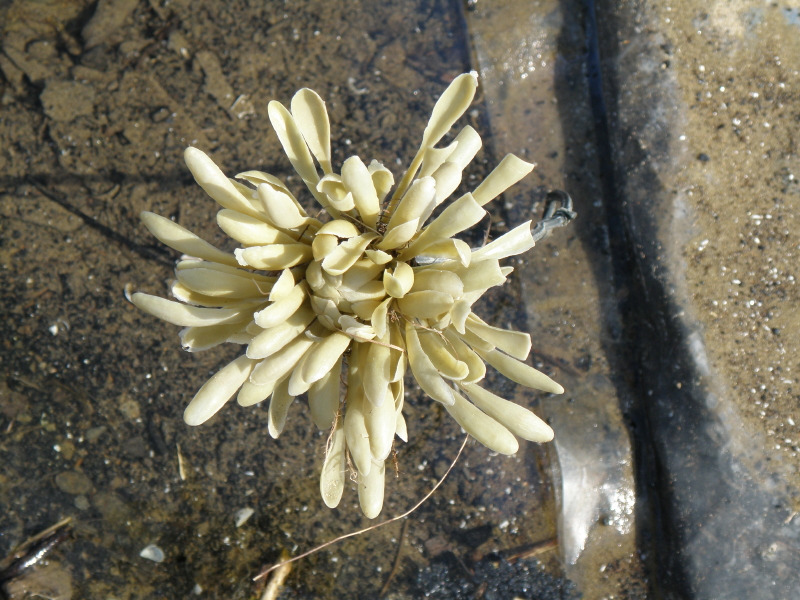
Chemical Chrysanthemum, Falls of the Ohio, 2013

Also growing in poor wet soil is this florid “Chemical Chrysanthemum”.  Among its requirements are a warm, CO2 rich atmosphere and coal which washes up within the Falls of the Ohio State Park from the frequent barge traffic that moves up and down the Ohio River.

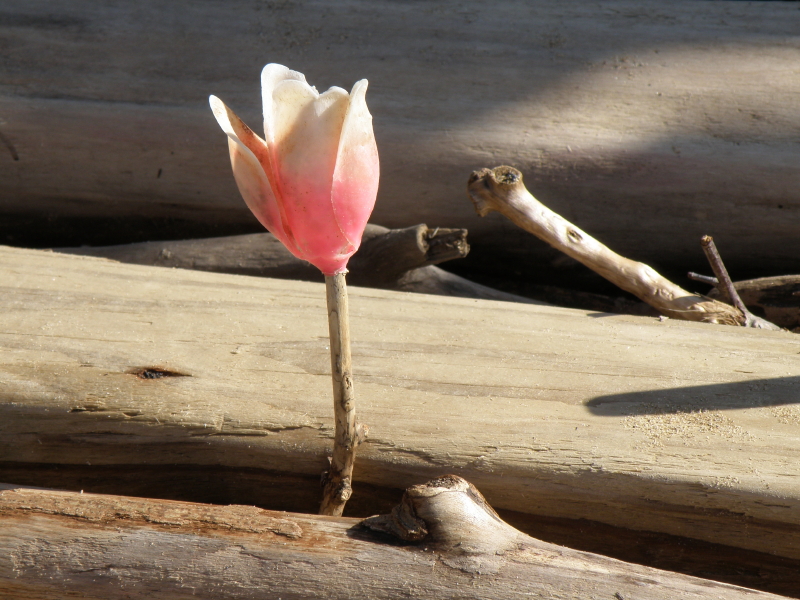
The Driftwood Tulip, Falls of the Ohio, 2013

Growing between the beached and bleaching logs is this aptly named “Driftwood Tulip”.  It can appear at any time and shows itself briefly upon its woody stem before sinking back into the riverbank from whence it came.

Epiphytic Mimic, Falls of the Ohio, 2013

For a lack of a better description…this plant had temporarily been named the “Epiphytic Mimic” because it presents like some of our true orchids.  This specimen may have flowered recently.   Its green leaves do not perform photosynthesis.  It hangs out and receives moisture and nutrients through a complex system of fine polymer rootlets.  And now…for something a little different.  The following unnatural flowers appear to be parasitic, but patient study may find them to be more complex and perhaps even symbiotic by nature?

Yellow Fabric Pansy on Primrose, Falls of the Ohio, 2013

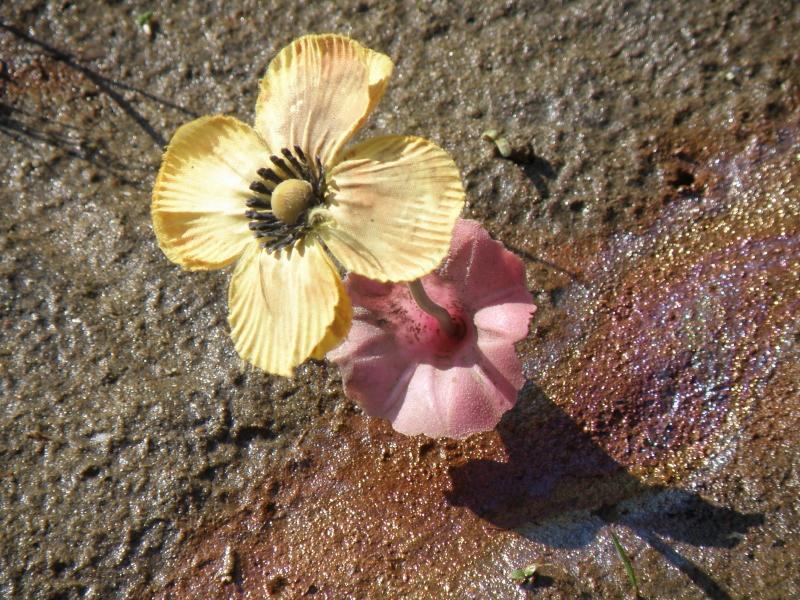
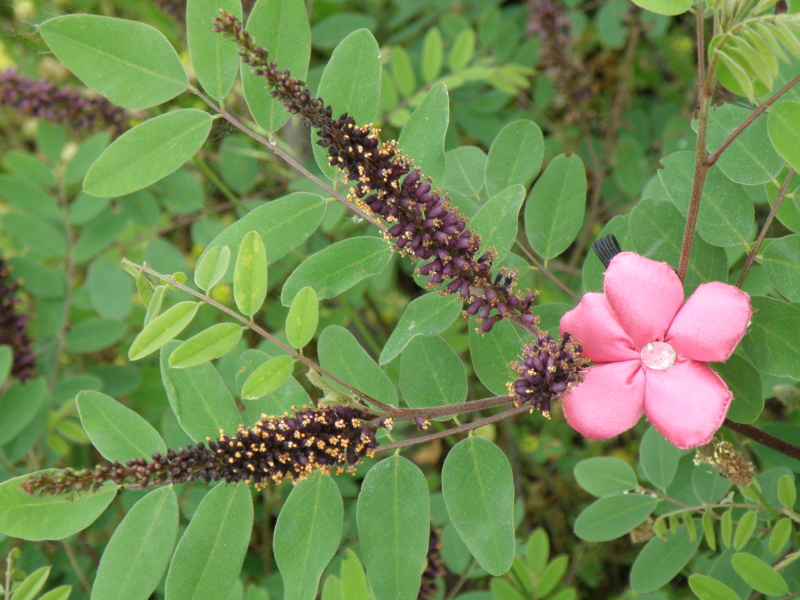
The “Yellow Fabric Pansy” in this photo appears to be hitching a free ride on a primrose flower.  The same relationship can be found on this “Pink Blossoming Indigo Bush”.

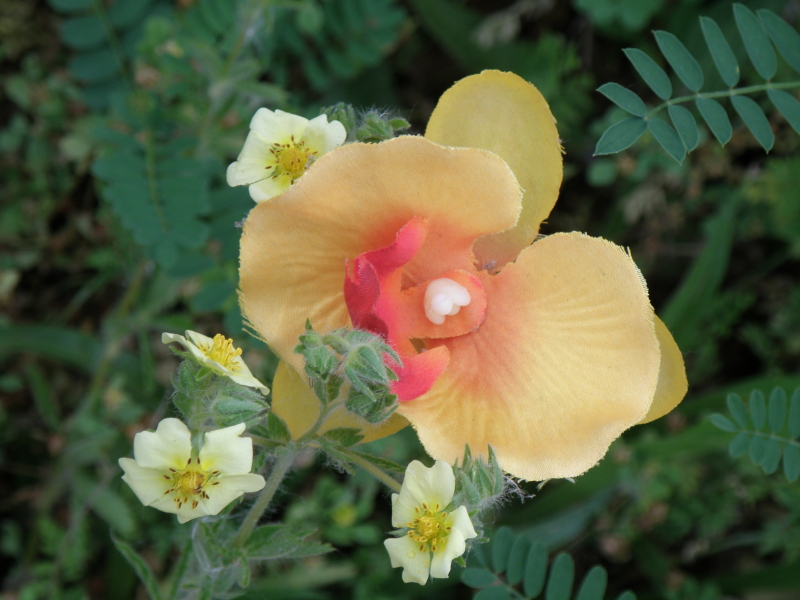
Bling's Indigo Bush in flower, Falls of the Ohio, 2013

The pink flower with the rhinestone-like center is unlike the rest of this flowering and indigenous shrub.  Next we come to the “Augmented Moth Mullein”.

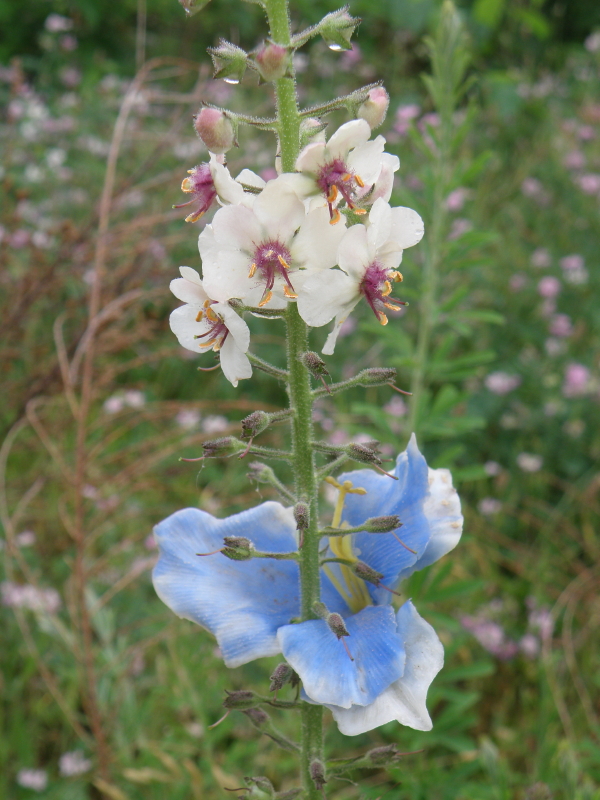
Augmented Moth Mullein, Falls of the Ohio, 2013

The prevailing thinking about how some these strange flowers acquire their petrochemicals is through ultraviolet decomposition of man-made plastics. On the microscopic if not molecular level…these tiny compounds recombine with the existing plants’ DNA.  Here’s another fine example.

Yellow-flowering Pokeweed, Falls of the Ohio, 2013

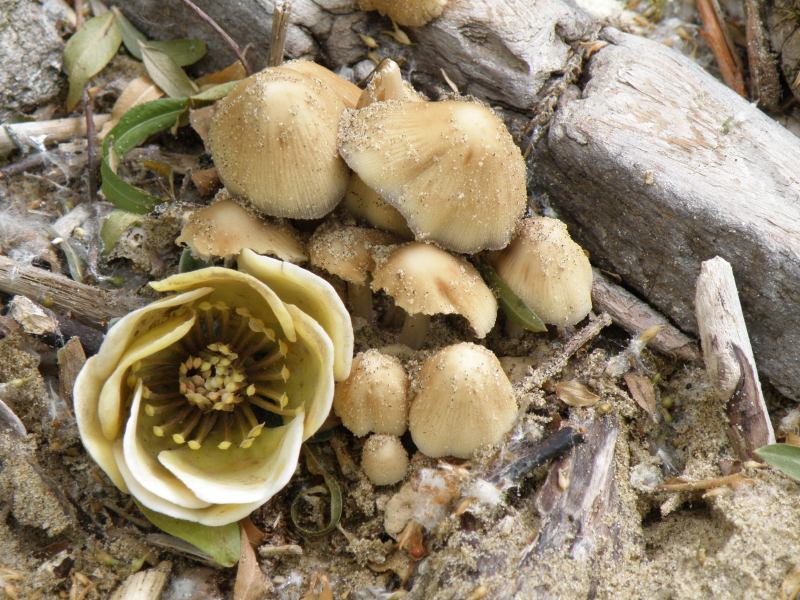
Like the previous plant, the “Yellow-flowering Pokeweed” is a recombined hybrid and favors appearing in the early summer.  Traditional pokeweed plants produce weak looking white flowers that will transform into dark, pigment intense berries in the Fall.  It is not certain how this plant will respond, but I have my eyes on it.  In closing, I would like to present one more image that illustrates the tremendous crossover potential of plastic polymers and living tissue.  Thus far, this is the only example of a “Mushroom Flower” that I have come across and the only unnatural fungus that I have discovered at the Falls of the Ohio State Park.  No doubt other species are out there just waiting for a trained botanist to reveal to all.  As the environment warms and the normal weather patterns change, the natural rhythm of life will be altered, however, life may prove to be the most plastic and resilient of all.

The Mushroom Flower, Falls of the Ohio, 2013

Read Full Post »

« Newer Posts - Older Posts »