Feeds:
Posts
Comments

Archive for the ‘birds and birding’ Category

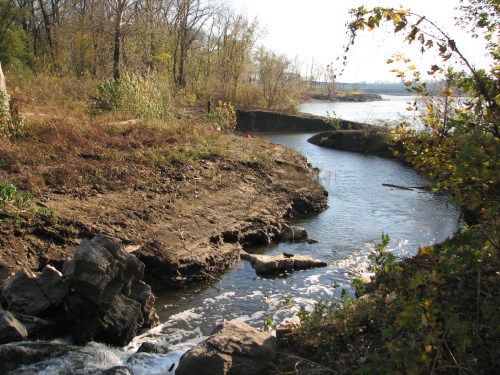
west section of the Falls, 11/09

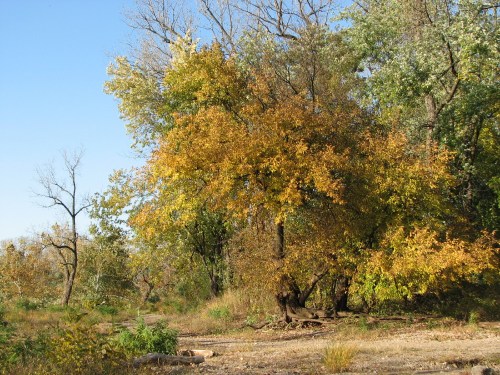
Because the climate has been so spectacular of late, it’s been possible and desireable to hang out in the park to make and see what one can.  This is another bird post, but one that specializes in what’s possible here in the fall.  Some of these species are found no where else…and for good reason.  I start with a shot of the typical terrain one encounters at this time of year.  What is a bird without some context?  Naturally, the river predominates as the distinct landscape feature with mixed hardwoods flanking the shoreline.  I’ll start first with an American Coot.  Not a particularly rare bird, but one I always enjoy seeing at the river.  I came across this lone individual and snapped this quick image for luck.  The true rarities are ahead.
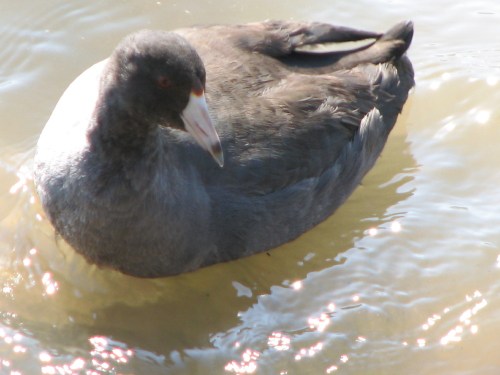
American Coot, 11/09

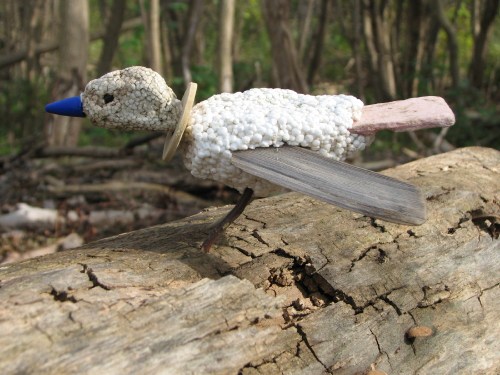
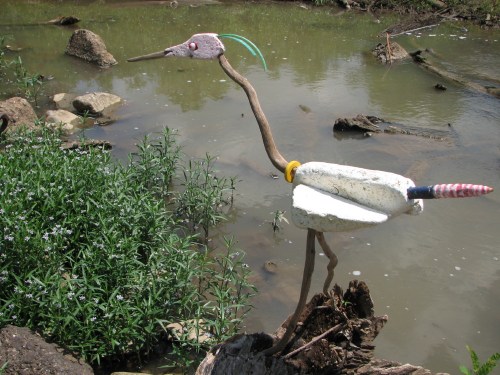
In the western section of the park a couple of late nesting birds can be found among the exposed roots of the great trees.  This is the home of the Styro-Grackle and the Fleur-de-lis Dovelette.  The next two images are of the grackle.  I stumbled upon a male with its great yellow bill displaying with the remains of a baby’s pacifier.  In this species, males vie for the attention of females by choosing objects they believe the females will like.  The Styro-Grackle is a large, and noisey bird, but wary to the extreme.
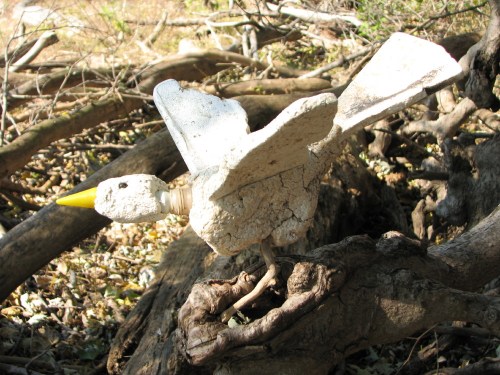
Styro-Grackle display, 11/09

Here’s a close-up image of its head, bill, and pacifier it found by the river.
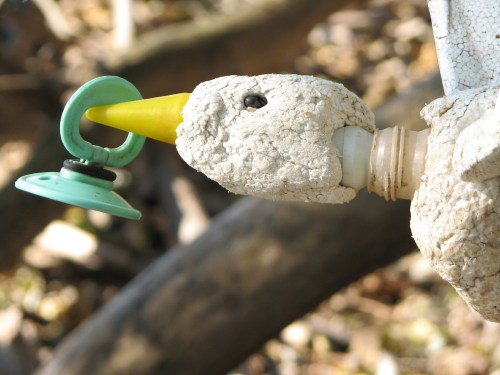
Styro-Grackle head with pacifier, 11/09

Often found in association with the grackles are the gentle Fleur-de-Lis Dovelettes.  The female specimen I came across was sitting on a fresh nest.  No eggs were observed within it.  The dovelette is not particularly fussy about what materials it uses to construct its bowl-like nest.  This one was made from shredded plastic with hardly a trace of natural fibers interwoven into its structure.  First, a picture of the bird itself in its woody habitat.

Fleur-di-lis Dovelette, 11/09

The bird derives its common name from the unusual crest upon its head.  It is rumored that this was the inspiration for the symbol used by the City of Louisville on its flag, official letterhead, etc…  More than likely though, it’s just a coincidence.  Like many dove species, this one has tiny feet.  Here’s a good look at the unusual nest constructed in the fork of a tree root.
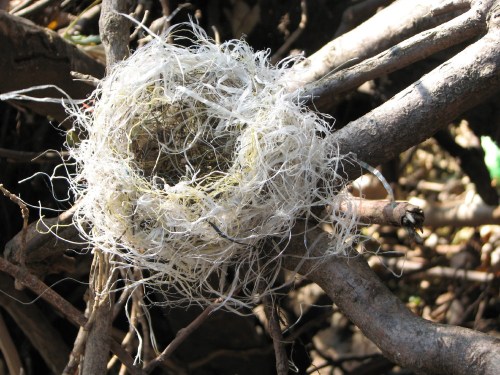
Plastic fiber nest, 11/09

And here is the bird and nest joined together.  I didn’t linger because I didn’t want to disturb the dovelette anymore than I had to.  If the conditions are right, she will lay three to four light green eggs.  The dovelette will have to stand guard against raccoons, but otherwise her young have a good chance of reaching maturity.  Wild prairie grass seeds make up much of its diet.
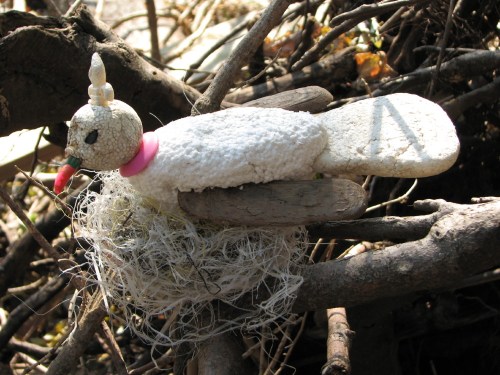
Fleur-di-lis Dovelette on nest, 11/09

Cane Run Creek, 11/09

Near the middle of the park, Cane Run Creek flows into the Ohio River.  It’s a spot that’s favored by fisherman and birds alike.  Large rocks and trees deposited by flooding line its banks.  Because of the vagaries of the larger river, the creek’s appearance is highly variable.  It was in this area that I came across a rare and unusual shorebird that I would like to share with you.  Here are two images of the Jet Piper.  It is so named because it evolved a distinct crest that is believed to stabilize it during its speedy flight.  One sees a similar structure on the tail of modern aircraft.  The Jet Piper never stays in one place for long.  It probes the mud along the creek bank in search of worms and other invertebrates.  Recent studies have shown that this piper will on rare occasions, take nectar from hummingbird feeders.  Here are two views.
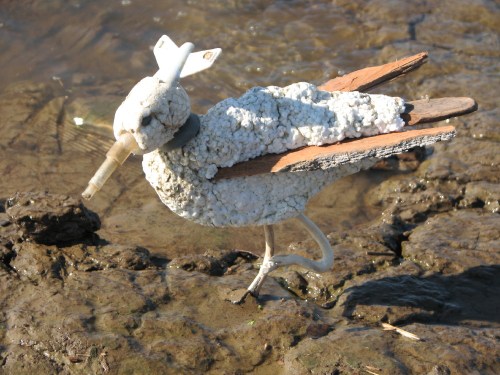
the Jet Piper, 11/09

Jet Piper, 11/09

The last specialty I came across is one of the sweetest singers in the park.  In fact, that’s how I located the Styro-wood Wren first…by its optimistic, cheery song.  I was sitting in my usual spot under the willows when I heard it nearby.  I took a position along a path I thought it might take and with success, recorded these images of this rare endemic bird.
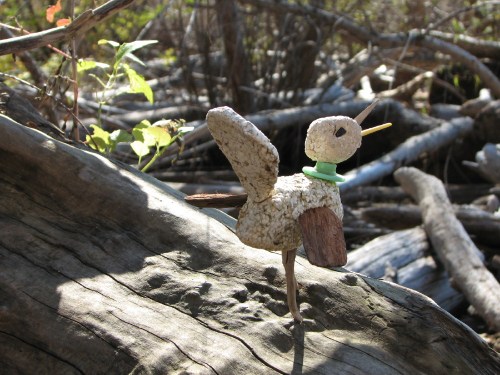
Styro-wood Wren, 11/09

On a sunny morning, the Styro-wood Wren was making its rounds in the underbrush.  Its singing has more to do with staking its feeding territory than it does with finding a mate.  That will change once Spring arrives at the Falls once again.  Among the interlopers that the wood wren is trying to discourage are other members of the family Troglodytidae.  Sharing its range at various times are Carolina Wrens, House Wrens, and the tiny Winter Wrens.  That’s a lot of competition to try and discourage.  This particular bird was in rare form and seemed to pose for my camera.
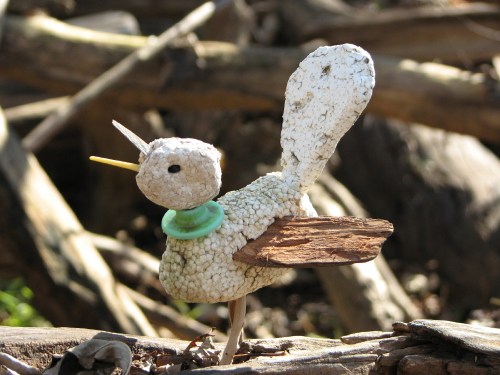
Styro-wood Wren singing, 11/09

It spread its fan-tail and with a shudder of its brown- wings burst into song.  The small feathers along its neck make an attractive collar.
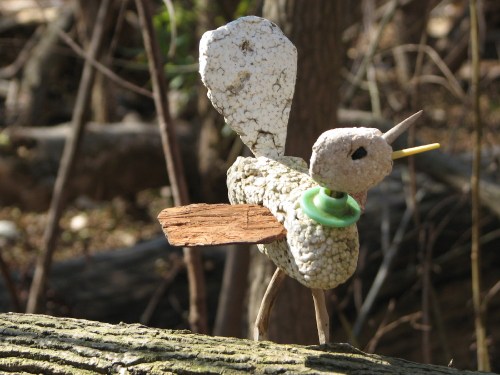
Styro-wood Wren, 11/09

CODA:

I made these birds from materials I found in the park.  All the plastic and Styrofoam elements were once in the Ohio River where they interact with the natural ecosystem.  Among the other materials used include:  tree bark (for wings), coal (for eyes), and rootlets and twigs (for the legs).  I make these artworks to call attention to the condition of the land and water, to draw attention to the unique qualities of this place, to celebrate creativity, and because I love birds!  All the photos are mine and shot on location at the Falls of the Ohio State Park.

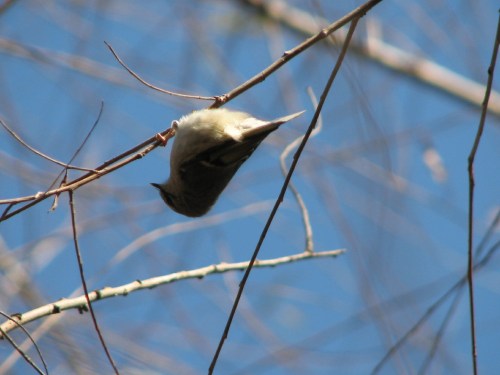
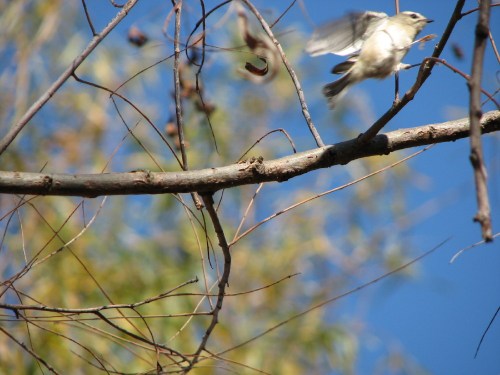
While I was making my faux birds, the real articles were busy in the tree tops above my studio.  Among my favorites to watch are the Golden-crowned Kinglets.  These tiny birds are ever in motion and hard to photograph!  Here are a few more real bird pictures.
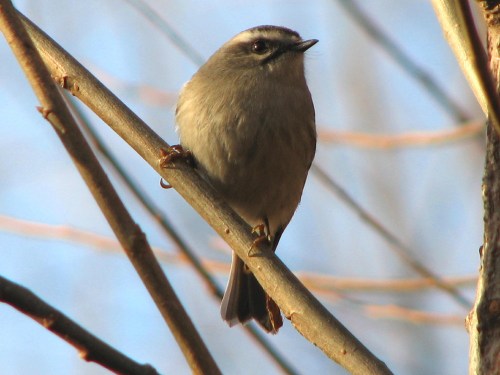
Golden-crowned Kinglet

upside down Golden-crowned Kinglet, 11/09

Golden-crowned Kinglet in action, 11/09

Lastly, the nest featured with the Fleur-de-lis Dovelette is in fact a genuine bird nest.  I found it in the branches of a downed tree.  I have no idea which species created it.  I have seen within the park, the nest of a Northern Oriole that used cast-off fishing monofilament in its construction.  I do, however, think I located a source for the plastic fibers.  Near the discovered nest, a large barge rope was slowly unraveling and its threads look identical to the ones in the nest I came across.
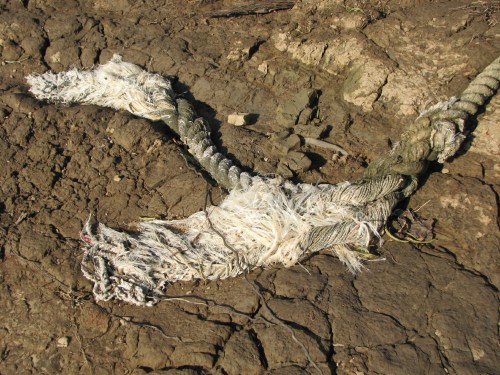
frayed barge rope or cable, 11/09

Read Full Post »

Late October color, 10/09

When the trees at the Falls of the Ohio reach peak color, birders keep an eye open for avian rarities.  The Uncommon Bluebill may or more likely may not appear in the park.  Usually birders have to settle for glossy pictures of this bird in fancy magazines devoted to all things…birds.  Those images are usually taken in the bluebill’s northern haunts during the breeding season when the birds are a bit more distracted as they go through their courtship gyrations.  This post is about a personal stroke of luck as I had a once in a lifetime opportunity to record the Uncommon Bluebill at the Falls of the Ohio.
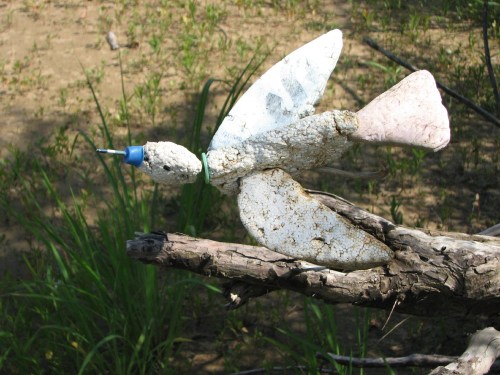
the Uncommon Bluebill, 10/09

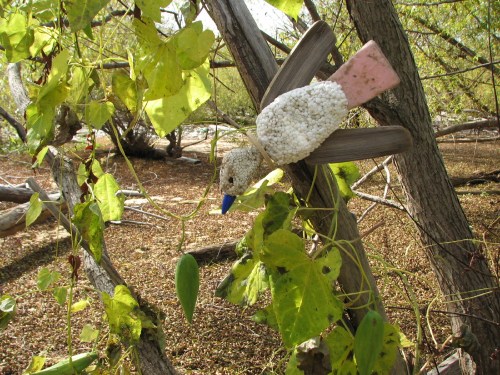
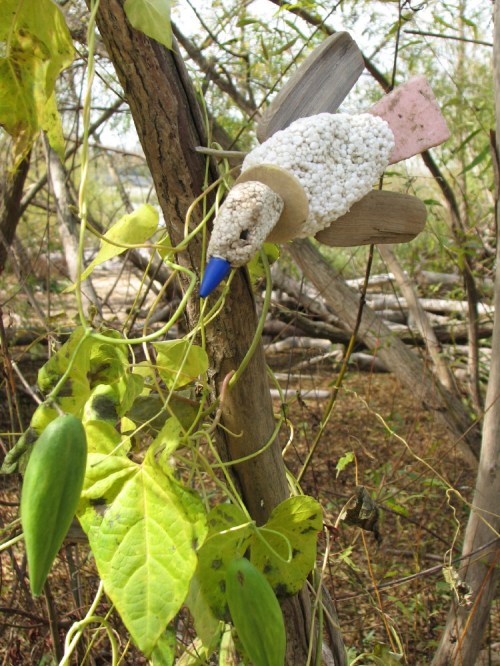
And here it is!  As advertised, this bird does possess a distinctly blue beak.  It’s a little larger than the average wood warbler and has some of the same foraging behaviors.  Other distinct features for identification purposes include a white body and pink tail.  This bird is equally at home on the ground or in the top most branches of a tree.  I do confess that I wasn’t looking for this bird for that would be an excercise in frustration.  In a way, it has to find you and you have to be prepared to receive it when it appears.  That is why I bring my camera with me whenever I’m here.

Uncommon Bluebill with Milkweed, 10/09

I recall that a few Golden-crowned Kinglets proceeded the bluebill.  I was watching the kinglets and their hovering, mid-air investigations of the undersides of leaves when from the corner of my eye I noticed a bird that was distinctly not a kinglet.  The Uncommon Bluebill moved easily from a branch to the trunk of a tree ready to pounce on the insects it discovered.  Some of my best shots of this single bird were in association with a Milkweed vine that held its attention for a while.  It was so intent in its pursuit that it did not notice me observing it from behind a large willow.

Uncommon Bluebill and Milkweed, 10/09

I held my breath and hoped the digitally- produced mechanical camera noise would not frighten it away.  The bird hung around for a minute and no longer.  After that, it was gone.  I walked silently over the dropped willow leaves and back to my car.  I had just seen a creature so rare that it was essentially a ghost.  What could possibly top that as an experience today?

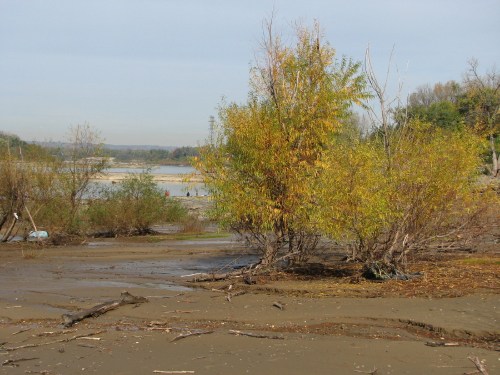
Autumn willows by the river, 10/09

Read Full Post »

blue-headed vireo

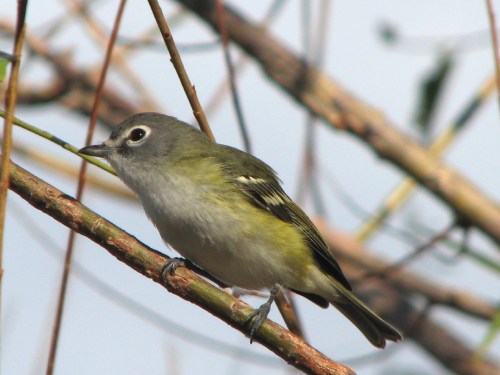
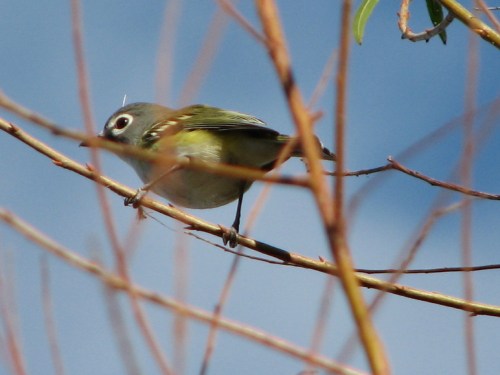
October and the Fall migration is underway.  One bird I look forward to seeing is the Blue-headed Vireo.  I have spotted them the same week in October for two consecutive years now.  I watched a pair working their way around the willow trees and observed one eating a fat, dark moth it caught.  These vireos are less wary and found lower in the trees than the other vireo species recorded here.  The official Falls of the Ohio checklist counts six vireo species.  I’m still looking for the Yellow-throated Vireo, which like the Blue-headed is considered uncommon for the park.  I like the bright white spectacles around this bird’s eyes.  Here’s a different view of this bird.

Blue-headed Vireo, 10/09

A couple weeks back I made another bird from Styrofoam and just didn’t get the chance to post it till now.  I think it turned out well and I call it a “White Jay”.  It’s about the same size as a Blue Jay.  Materials used to create this sculpture include:  polystyrene foam, sticks, lead (one eye), bark (for the wings) and plastic.  I later attached it to a branch, as in early ornithological prints, and is in the present Galerie Hertz exhibit.  Again, here are a  couple different views of this piece.

White Jay, 10/09

White Jay, 10/09

Read Full Post »

Great Egret, 5/07

Where did our Great Egrets go?  I’m asking that question this year because they are a familiar summer time bird at the Falls of the Ohio.  Visitors are usually treated to their presence from May to October or for however the warm weather lasts.  Usually, you can see them along the water’s edge fishing along with Great Blue Herons, Black-crowned Night-Herons, and the occasional Green Heron and Snowy Egrets.  As I have mentioned in previous posts, this hasn’t been the  most typical of years.

Great Egret, 10/08

Although 2009 still has a few months left to go, this year has been among our wettest and our summer was the coolest I can ever recall.  I have lived most of my life in Kentucky and we hit the 90 degree mark only a few times early in the season.  Usually, summers here are hot, humid, and long.  Just about everybody I know has acknowledged that this has been another climatically unusual year, but nobody has been complaining about the cooler than average summer. 

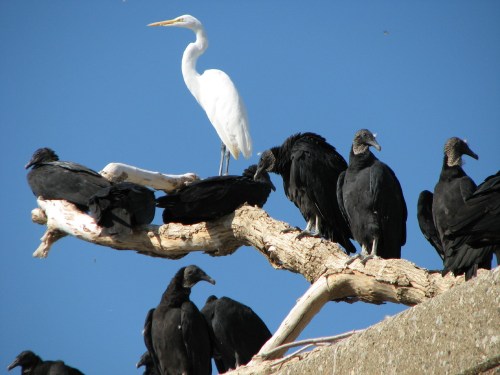
Great Egret with Black Vultures, 10/08

A possible exception could be our Great Egrets.  I have been out at the Falls most of this year and have been trying to pay attention to when birds  arrive and leave our area.  As far as I can tell, the Great Egrets were only around for a week in July.  I recorded seeing them on July 19 and then they were gone.  More rain and cool weather followed their appearance and obviously they went somewhere else, but where? 

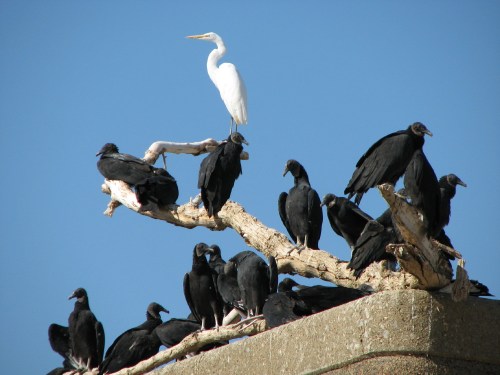
Great Egret with roosting Black Vultures, 10/08

The images of the Great Egret and roosting Black Vultures were made at the Falls during October of 2008.  They are among my personal favorite bird pictures that I have taken in the park.  I was walking  near the dam that separates the Ohio River from the fossil beds and came across this scene.  A previous flood had stranded a dead tree on the wall and made a nice resting spot.  I liked the contrast between the stately white egret rising above the fidgety and squabbling vultures.  I had to be extra stealthy in my approach since my camera isn’t equipped with the best telephoto lens.  The Black Vultures seem to be getting more ubiquitous and this year I counted one flock of over fifty birds.  Soon, they too will be migrating to warmer parts down south, perhaps they will be catching up with our Great Egrets?

Read Full Post »

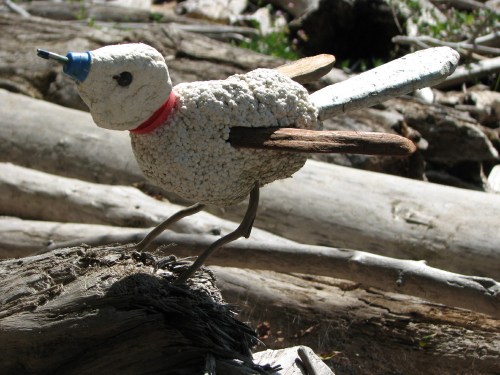
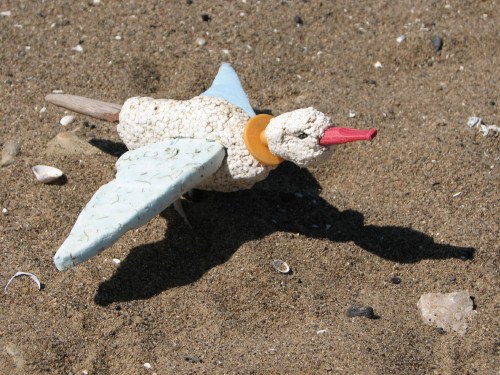
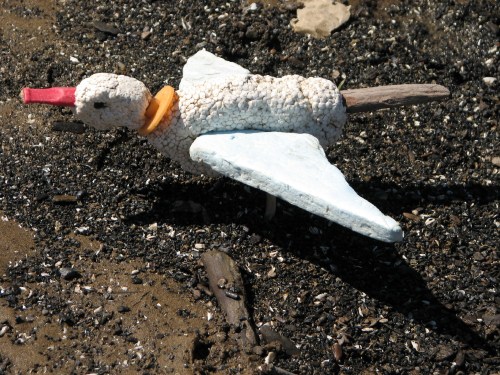
Styro-sandpiper, 9/09

September is the month that the smaller shorebirds begin their migrations through our area towards warmer southern climates.  We see a variety of different species at the Falls of the Ohio.  Here is one impromptu tribute to them made from polystyrene foam.  This one is a Styro-Sandpiper dragging its wing in mock injury.  Among the materials I used to fashion him include:  Styrofoam, blue- insulating foam, river wood, plastic (around the collar and the bill is the tip from a cheap little cigar).  Oh, the eyes are tiny bits of coal.  You are not allowed to collect fossils in the park and I sometimes wonder if this applies to the coal as well?  Anyway, here are some images of genuine shorebirds photographed in the park.

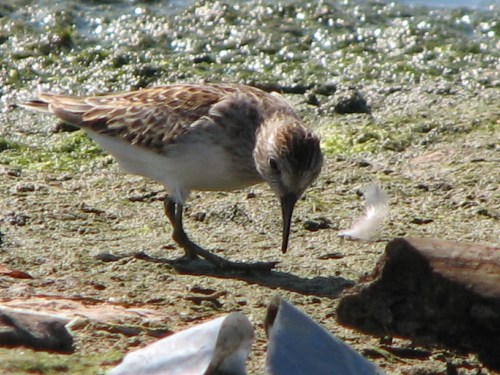
Least Sandpiper, 9/07

Small bands of Least Sandpipers explore the margins along shallow pools of water covering the fossil beds during this time of year.  Their bills probe the algae for the small invertebrates that live in the green mats.  These are our most common sandpipers followed in number by Spotted Sandpipers.  This time of year the Spotted Sandpipers actually have barred flanks and bright white bellies. We will have to wait for spring to see them with their characteristic spots and dots.

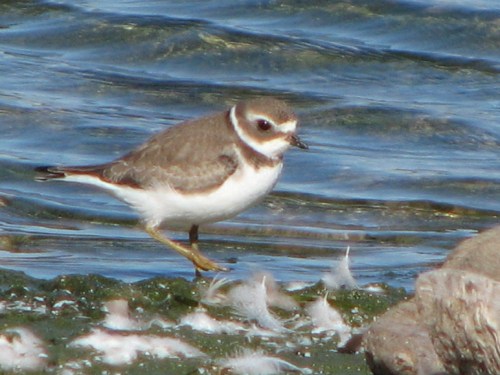
Semipalmated Plover, juvenile, 9/09

Tiny Semipalmated Plovers have traveled from the Arctic tundra and some make a stopover at the Falls.  The autumn birds seem to be mostly juveniles.  Piping Plovers, an endangered species, have been recorded in the park, but I haven’t had the pleasure of seeing one here.  By far, our most common plover is the Killdeer.  It’s hard to walk across the fossil beds this time of year without setting off their alarm calls.

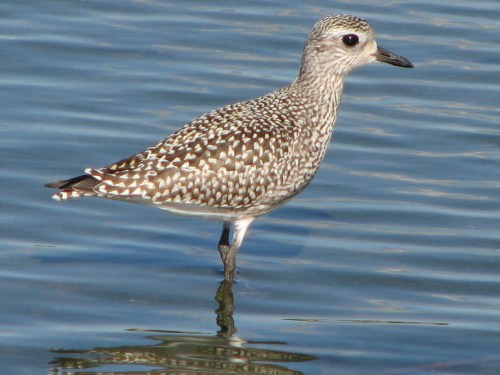
American Golden Plover, juvenile, 9/07

For two years in a row I have come across American Golden-Plover juveniles.  Although they are a bit larger than the smaller “peeps”,  I decided to throw them in too because I like them and they show up this time of year!  I’m amazed that this bird started life on the Arctic tundra and is now traveling to South America. 

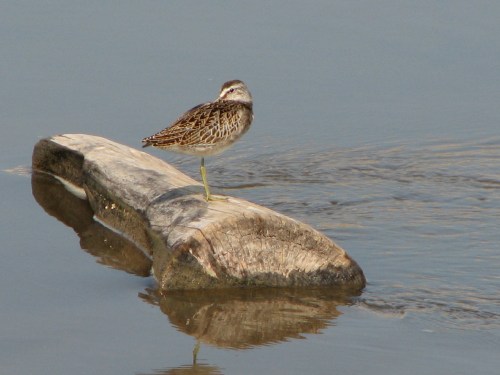
Short-billed Dowitcher, 9/08

Last year I came across this bird dozing on a well placed log and wondered what it was?  Its bill was tucked under the feathers on its back.  As I got closer, you can imagine my surprise when the bill was exposed!  I believe this is a juvenile Short-billed Dowitcher.  Here is another image of this bird.

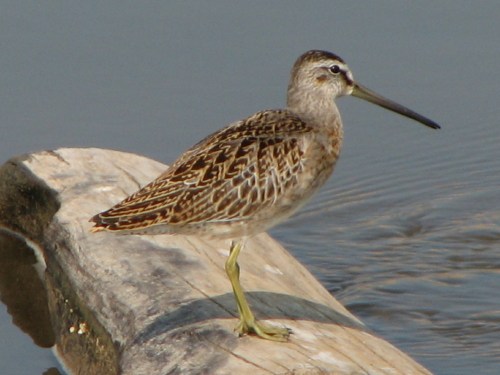
Short-billed Dowitcher, juvenile?, 9/08

I watched this bird for a while and never heard it utter a sound.  Referencing my bird guides, the literature says that the best way to differentiate it from the Long-billed Dowitcher is by its call. The length of its bill is of little help.  Both bird species have been recorded in the park.  The Short-billed is listed as rare and more than likely encountered in the summer.  This bird was photographed last year on the first of September.  The Long-billed is seen occasionally in the fall.  After checking out several bird guides, there was something in its coloration and markings that said Short-billed Dowitcher for me.  Perhaps some one out there with more experience can hazard a guess?  Either way, it was a tremendous treat to come across it!  I’ll end this post with another view of my Styro-Sandpiper posed in the sand and coal.

Styro-sandpiper, 9/09

Read Full Post »

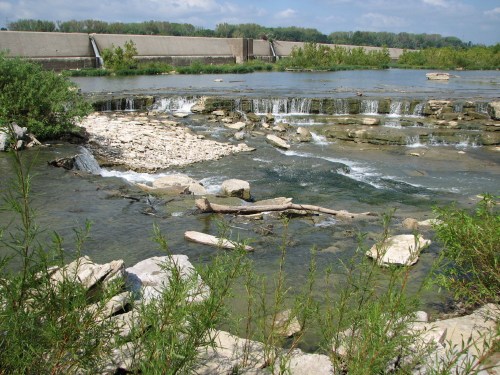
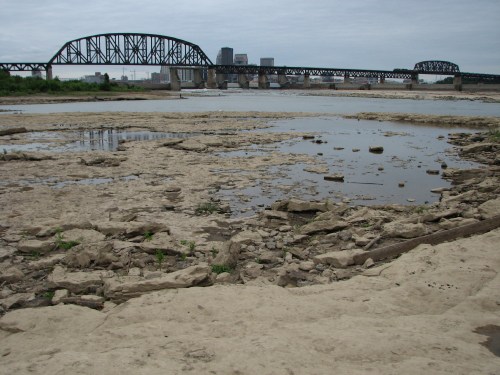
View facing east, fossil beds, Falls of the Ohio, 8/09

At last I made it over to the fossil beds on the Kentucky side of the park.  As previously mentioned, this hasn’t been an easy year to forecast storms or the amount of water to be found locally at any given time.  We have experienced the extremes.  For now, I can get off the Indiana bank and explore a very special landscape.  This side of the park is so interesting that it’s difficult to pack it into one post.  I’m going to attempt it in three.  I did make several Styrofoam sculptures and a few sand drawings.  I took about eight hours to walk the park from east to west and back to the lot again.  If you like to hike vicariously you may enjoy this trip over the fossil beds.  The rocks date to 375 million years ago and the fossils preserved here help form a picture of life as it existed during the Devonian Age.

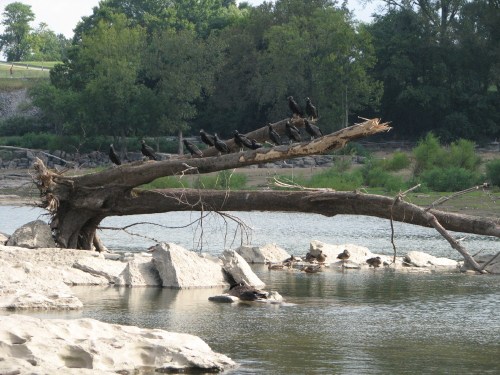
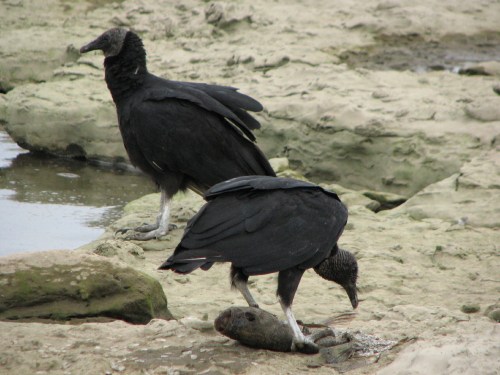
Vulture tree, 8/09

I began my trip in the cool morning.  I rolled my pants legs up just below the knee and walked into the flowing water.  The wet rocks are as slippery as ice and it’s tricky to keep my balance.  The worn out sneakers I’m wearing are fine for walking in mud, but the lack of any tread turns this phase of the walk into a skating event.  The dry rocks pose obstacles as well.  The fossil beds are an undulating surface of river worn rock and it’s easy to twist an ankle or knee here.  You need to find or bring a good walking stick for additional stability.  I’m carrying my collecting bag and my camera and going to see what there is to see today.

vultures chasing possum, 8/09

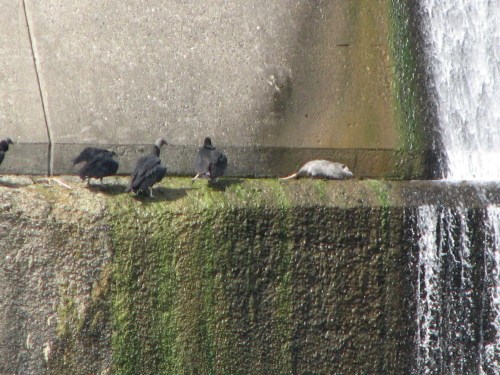
The first feature I walk towards is this stranded tree that has become a bird magnet.  Black vultures are using it as a roost and ducks and herons circulate around this new hub.  The Black vultures are having a good year and seem to be increasing in numbers.  Last week I counted a flock of sixty birds flying along the dam’s wall.  The vultures have been dining on dead fish either caught by fisherman or marooned in small ever-drying pools. There are fish bones, scales, and skeletons all over the fossil beds.  I did witness something  I hadn’t seen before.  Off in the distance I could see the vultures pursuing something alive!  I did capture this one image of vultures chasing an opossum. You can’t play possum with vultures!   There were a few birds that managed to get a few pecks in, but the possum never stopped running and was able to get off the wall into some cover.  It’s a regular Mutual of Omaha’s Wild Kingdom moment at the Falls of the Ohio.

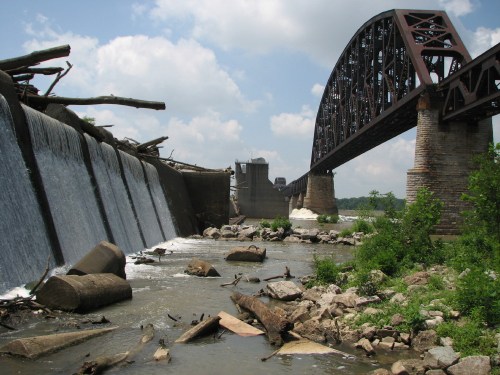
Fixed Wier Dam, 8/09

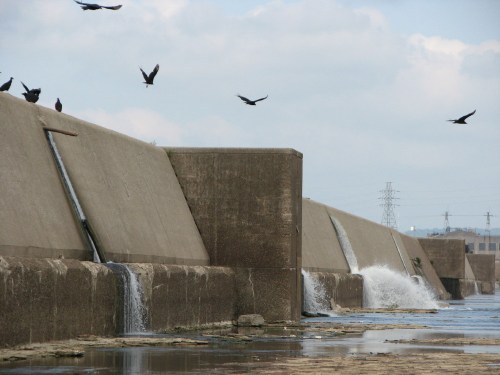
Here’s a view of the Fixed Wier Dam with the vultures flying along.  This wall was built in the 1920’s to create a stable pool of water for Ohio River commerce and to generate electricity at the Lower Tainter Gates.  I’m guessing that it’s about fifteen feet to the top of the dam.  When you are walking on the fossil beds below it’s an odd feeling knowing that the surface of the river is way over your head.  Slots formed on the top of the dam create pathways that feed water to the Little Slough and  Whiskey Chute channels.  A small marsh near Goose Island receives this water too.

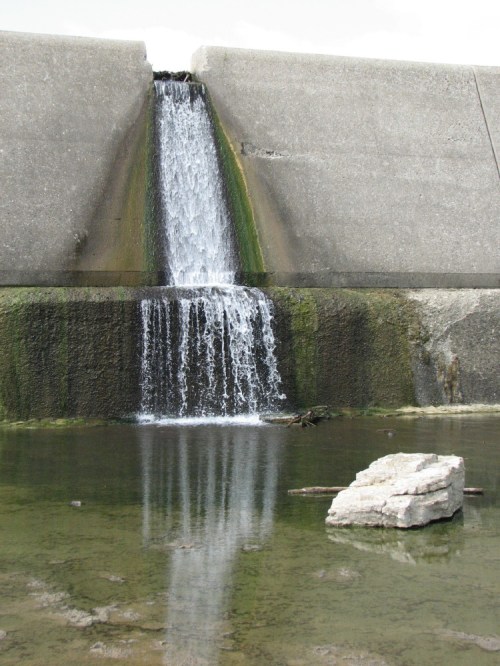
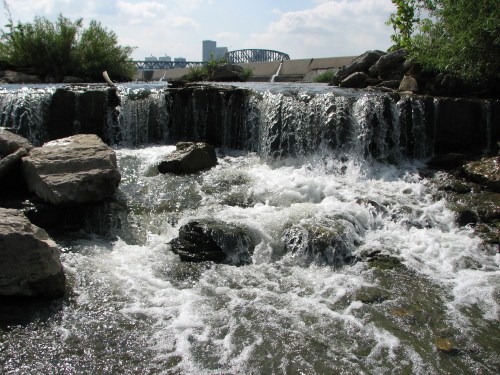
artificial waterfall, 8/09

Our stopping point in today’s post is just up ahead.  A small amphitheater of terraced limestone provides a glimpse of the cascades that originally flowed here.  It’s also a good place to sit and relax or watch birds.

The "Falls" at the Falls of the Ohio, 8/09

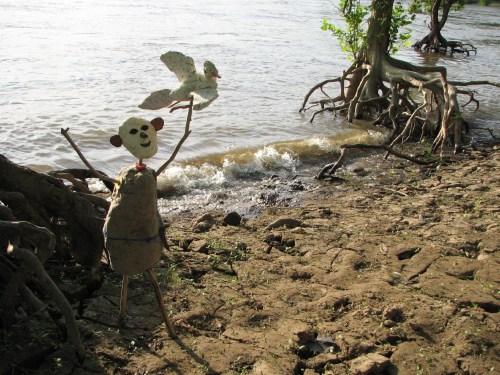
I made a figure from found materials and photographed it at this location.  From here the scene shifts towards the western limits of the park.  Some of the best views of the city’s skyline are also up ahead.  Until then, here is another water feature to enjoy!

At the "Falls", facing east, 8/09

Read Full Post »

Styro-swift, 7/09Styro-swift, closer view, 7/09

When I’m out by the river I’m also thinking about what birds I might see.  That’s especially true during the Spring Migration when there’s a good chance I will run across a species I’ve never seen before.  In the advent that nothing new comes along…I’m not adverse to making a bird myself!  Above is a quickie that I made recently.  I call it a “Styro-swift”.  The materials are essentially the same as before, polystyrene, wood, plastic, and coal for the eyes.  The bill is made with the broken teeth of an old comb.  With more time, I think I could have photographed this better.

Indigo Bunting, male, 7/09

Here are three recent and very real birds.  The first is a male Indigo Bunting and he’s puffing his feathers out displaying to the unseen female in the bush above him.  Perhaps it is a trick of memory, but the Indigo Buntings I remember in western Kentucky were darker and more iridescently blue.  The Falls birds seem much lighter in color.

Bathing male American Goldfinch, 7/09

I can always count on seeing American Goldfinches.  This male is obviously taking a bath, but this area on the beach seems special to them. Perhaps there is something in the water and grit here that benefits them?  It’s a kind of goldfinch lick.  I love watching their singing, rolling courtship flights.

young Bluejay, 7/09

This young Blue jay was so focused on the beetle he was trying to eat that he almost got run over by a truck.  I had to shoo him away from the danger on the road.  When I’m walking through the woods, I try to avoid jays and the alarm they can ring out to every other living thing in the area.  I have other bird images, but will wait to post them at a later date.

Read Full Post »

Falls of the Ohio, 7/09

The river is low and the fossil beds are exposed.  I still can’t get over how this is the bedrock of the river.  Bowls of water pockmark the scalloped surface as the retreating liquid pools where it can.  It will take a good rain to wash the dirt away revealing details from Devonian times.  Still, some people are disappointed because you can’t find dinosaurs here.  The terrible lizards are still millions and millions of years into the future.

Black vultures, 7/09

Today the fishing was good if you are a Black vulture.  For us it’s a different story.  Although there were lots of people trying, I didn’t see anyone catching anything.  The weather has been odd for July.  It’s so cool outside you would think you were in Michigan instead of Kentuckiana.  The television says it has something to do with high pressure coming down from the north.

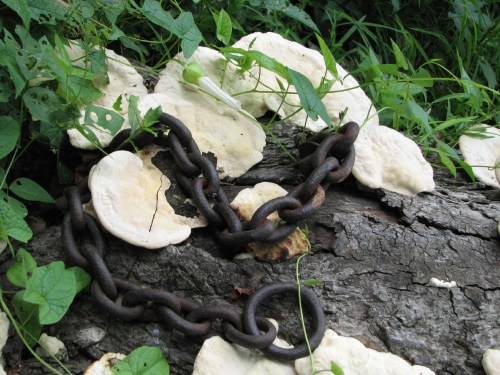
shelf fungus with chains, 7/09

I took a longer walk today than usual before making something.  Along the way I came across a decaying log with an old chain embedded in it.  Wood and bark grew over this wound when the tree was alive.   Now it’s at the Falls turning into humus as the fungi break down the wood.  I’m keeping an eye out for how long it will take to free this chain from it’s matrix of cellulose. 

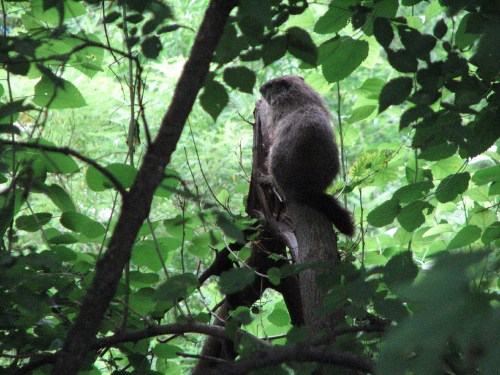
"treehog", 7/09

Ever see a “treehog” before?  Today I came across this guy sitting on top of a tree that snapped in two during a thunder storm.  I’m looking downhill and the woodchuck is about eight or nine feet above the ground.  On a number of occasions I’ve watched them climb trees to obtain tender leaves to eat.  This one appeared to be just hanging out, watching life go by.  Once it spotted me, it ran down the tree and into the brush.

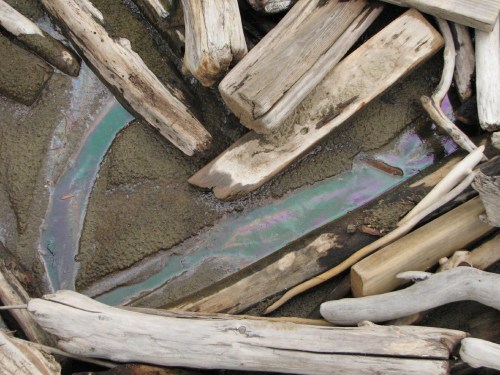
driftwood and inridescent water, 7/09

In the driftwood zone are small rivulets where the water trickles over the sand and under the silvery wood.  An iridescent sheen from minerals leached underground creates an oily rainbow slick.  I’ve begun to pay attention to this prismatic effect by photographing it several times.  The colors move with the water and contrast with the solidity of the driftwood.

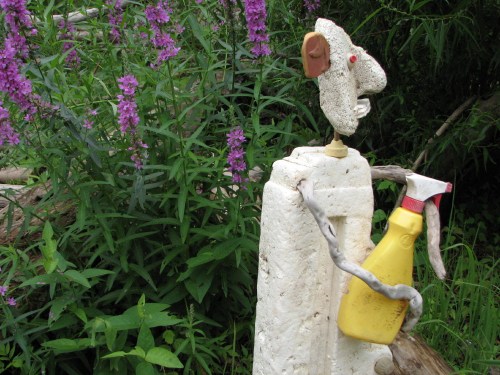
Abstract man w/yellow sprayer, 7/09

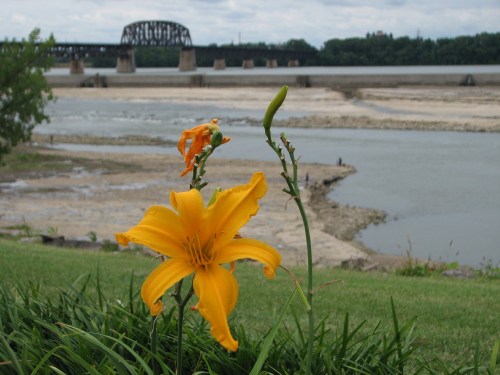
I made this figure today.  I call him “Abstract Man with Spray Bottle” which is not an imaginative title, but a descriptive one.  Because of the profile view, this was the most different of the lot.  This piece seemed to work in multiple environments.  In my next post, I will show you images of this figure shot at various locations around the park.  I waited for the sunshine to burn off the cloud cover before I went home, but that didn’t happen while I was there.  I stopped by the lilies again and shot this view with the fossil beds in the distance.  There is a lot of compressed time here.

Day lilies and fossil beds, 7/09

Read Full Post »

Fixed wier dam, 6/09

After several days that featured heavy thunder showers, Saturday morning opened clear and bright.  I had a feeling that this would be a special day and it didn’t take very long to be proven right.  In less than five minutes I had my first memorable encounter of the day below the fixed wier dam.

Mink, 6/09

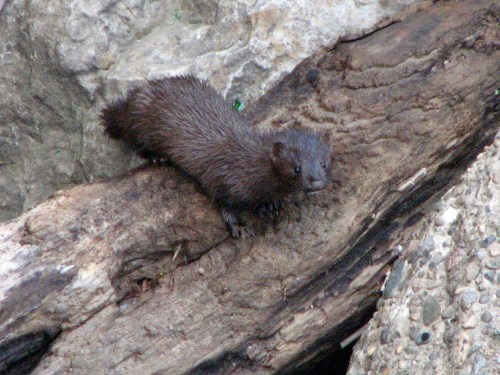
Running along the shoreline,  investigating every nook and cranny was this mink!  Please excuse the exclamation mark, but this was the first one I had ever seen at the Falls. It’s been over twenty years since I first visited this place.  There have been times I thought I came across their tracks, but I’m no expert in this area.  This mink kept moving which made it difficult to photograph.  It ran right up the sloping concrete wall of the dam and I lost it in the underbrush! 

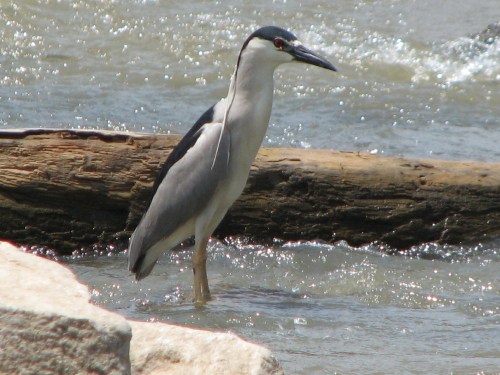
Black-crowned Night Heron, 6/09

Bird life was plentiful today.  I was scolded by wrens and laughed at by chickadees as I sat in my outdoor studio surrounded by the materials I have gathered to make my sculptures.  I watched orioles and blue jays, catbirds and grackles, and a pair of eastern kingbirds courting and chasing away every other bird to enter their territory.  I also watched the herons and decided to try to make one from my poor materials.  The bird above is the Black-crowned Night Heron and there were many out fishing today.

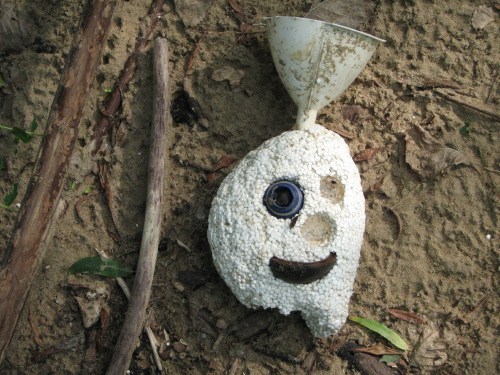
Foaming Brain's head, 6/09

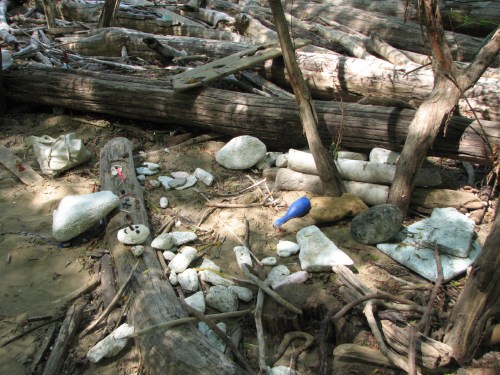
When I reached my “studio’, I could see that the site had been visited.  Most of the sculptures that I had made over the previous weeks had been damaged or destroyed.  As I have mentioned before, this is an experiment in human nature…albeit one without a hypothesis.  For the most part, I want to believe that people are good…until I’m proven wrong beyond a shadow of a doubt.  One of the many services my art seems to perform is as an outlet for unfocused aggression.  Naturally, I would have liked it better if instead of destroying these figures, new ones were created by other hands than mine.  I leave all the materials I’ve gathered on site for others to use if they feel so inclined. I’m also alright with the idea that if someone liked a piece…they can take it home with them.  Whatever is left behind nature eventually claims anyway.  I remind myself that it’s also okay to let this stuff go…it’s liberating and besides, I’ll just make more.

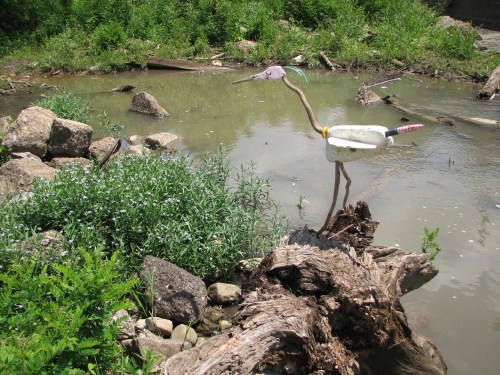
Styro-heron, 6/09

Styro-heron, 6/09

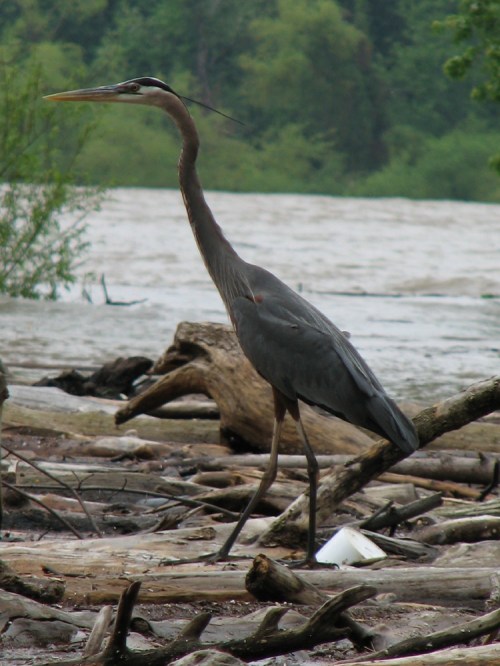
Since today’s action was happening near the wier dam, I photographed the Styro-heron I made near this area.  This bird is primarily polystyrene foam, driftwood, plastic and that’s it.  I have no idea what the object serving as tail feathers is, but it’s made from Styrofoam too.  The eyes on my bird are tiny, plastic fishing bobbers.  The blue herons around the Falls are very difficult to approach, but they do love it here.  Through spotting scopes, I’ve seen as many as fifteen birds fishing together from the fossil rocks on the Kentucky side.  World wide, this is a very successful species.

Styro-heron, 6/09

An alternate shot and one that shows the other side of the sculpture.  I’ll end with an image of a real Great Blue Heron taken at the Falls a few weeks ago during a time of high water.

Great Blue Heron, 5/09

Read Full Post »

Audubon's Apotheosis, 6/09

John James Audubon is one luminary that the Commonwealth of Kentucky claims as one of it’s own.  Like Daniel Boone before him and Abraham Lincoln after…Audubon did live in the state before moving on to other locations.  At least the wandering Audubon considered himself a lifelong Kentuckian.  Currently, we are “celebrating” the bicentennial of Audubon in Louisville.  The connection that the famous naturalist has to this area and to the Falls of the Ohio in particular is a linkage I enjoy.  I have created several “Audubons” since I began this project…here’s the latest.

Audubon, bird detail, 6/09

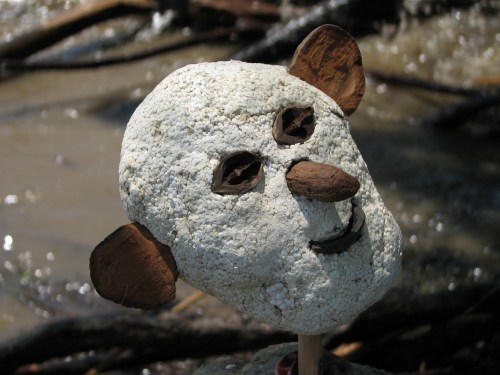
When Audubon lived here, Louisville was a frontier town.  The landscape then is completely different than it is now.  The trees have changed, many of the animals are gone including the famous passenger pigeon that Audubon first drew at the Falls.  Much of my project stands in contrast to what Audubon knew…and is one reason I use the materials I do to construct these little figures.  Reading Audubon’s journals makes me hungry for a world that doesn’t exist anymore.  The challenge is to keep it from degrading further.  Materials I used for this piece include:  various polystyrene foams, wood, plastic, coal, and nuts.  I made this sculpture early in the day, but the light was so bright and harsh, I re-photographed it before sundown.  I still think I can work on this image more.

Audubon's head, detail, 6/09

I found this little hickory nut and split it in half to form the eyes.  The mouth is part of a walnut husk.  Over the years I have portrayed Audubon in various guises.  This one is by far the most “romantic” of the lot, but that’s okay.  My friend Raymond Graf created an official life-size bronze Audubon for the City of Henderson in western Kentucky.  In Audubon’s time the town was known as Red Banks.  Today, there is a state park there that has one of Kentucky’s crown jewels…a museum preserving the largest collection of Audubon art and family heirlooms and worth a visit if you are in the neighborhood.  Audubon now lends his name for conservation purposes…hence the apotheosis.  So, let’s look at a few birds I saw today worth protecting…

Rough-winged Swallow, 6/09

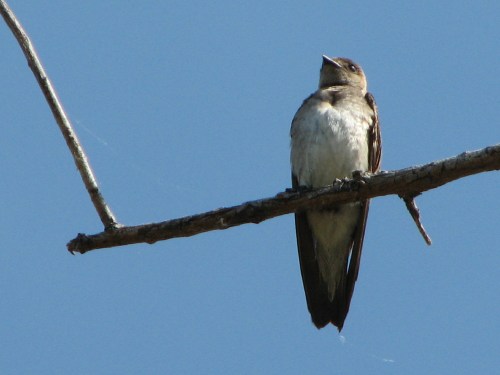
This Rough-winged Swallow is far from the most colorful bird, however, it is still interesting.  At the Falls, small groups of these birds build their nests in holes dug into the sides of the riverbank.  Even the most ordinary animals are worthy of consideration and not just the spectacular ones.

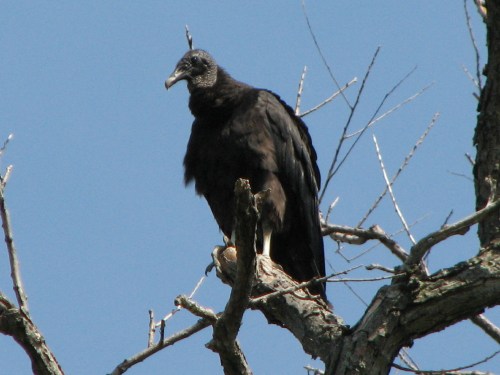
Black Vulture, 6/09

We have two vulture species at the Falls.  This one is the Black Vulture…we also have Turkey Vultures.  I have photographed both species many times over the years.  The Black Vultures in particular like to hang out in bigger flocks.  I have seen both species feeding side by side on dead fish.  It is intriguing for me to think that some of the birds I have seen here may be descendents from the species that Audubon saw, recorded, and drew.  I’ll end with two last images.  One is the makeshift studio where I’ve been working and made today’s sculpture.  The other is one of many variations I tried today of placing the figure in some kind of context.

outdoor studio, 6/09

Audubon's Apotheosis, variation, 6/09

Read Full Post »

« Newer Posts - Older Posts »