Feeds:
Posts
Comments

Archive for the ‘birds and birding’ Category

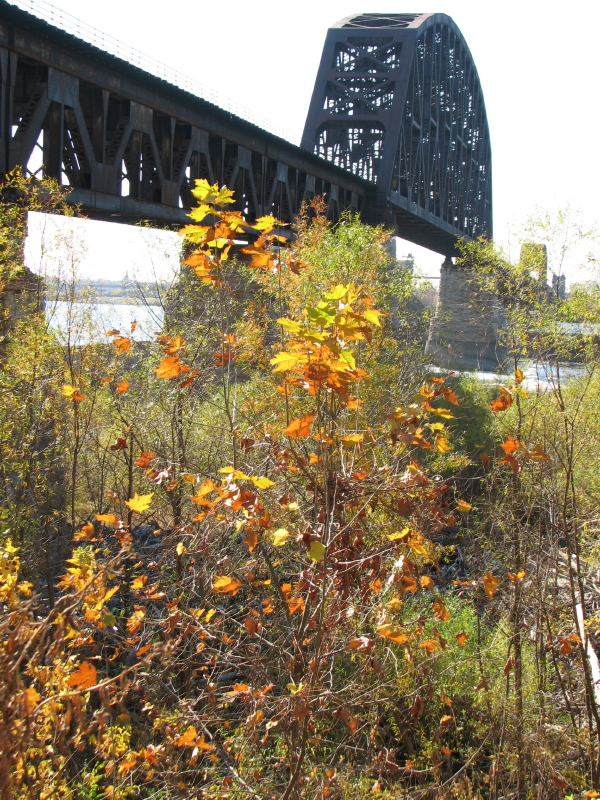
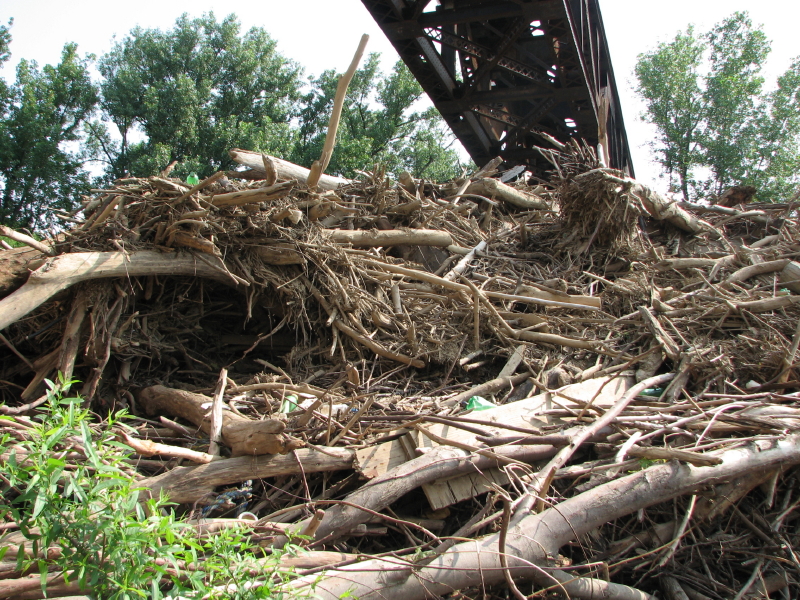
The huge mound of recently deposited driftwood under the railroad bridge is both an obstacle and a magnet.  It’s not easy to walk over and it helps to have a good walking stick to help maintain your balance.  The rewards for persevering are a nice elevated view of the Louisville skyline and the potential for finding interesting junk intermingled with the wood.
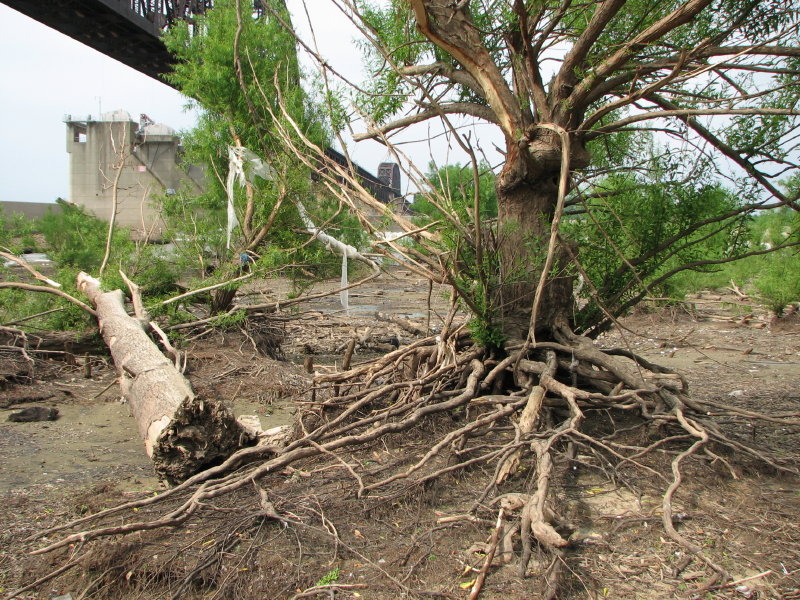
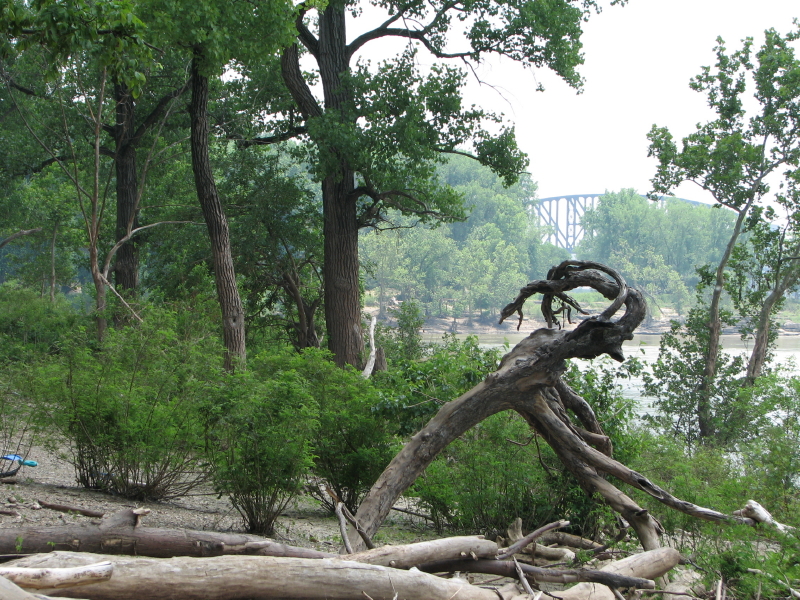
Once you move over or around this mound you enter the margins of the willow forest and you can see what the full force of the river can do to a landscape.  These black willows are tenacious and their roots hold on.  Here’s another image of a remarkable willow tree and its root mass.  This one wears a trophy from the flood like a victory pennant.

From all the cars in the parking lot, I’m guessing the fishing must be pretty good today.  I stepped by some earlier evidence in the form of this longnose gar skull.  I think this one was caught by rod and reel.  But, I have seen the remains of hundreds of these fish before stranded and killed by a retreating river.  Longnose gars are routinely in the 3 to 4 feet range in length.  The jaws are lined with small needle-like teeth for catching and holding on to smaller fish.  The gar is a surface fish and floats in on its quarry like a piece of driftwood very stealthily before surprising it with a quick flash of the jaws.

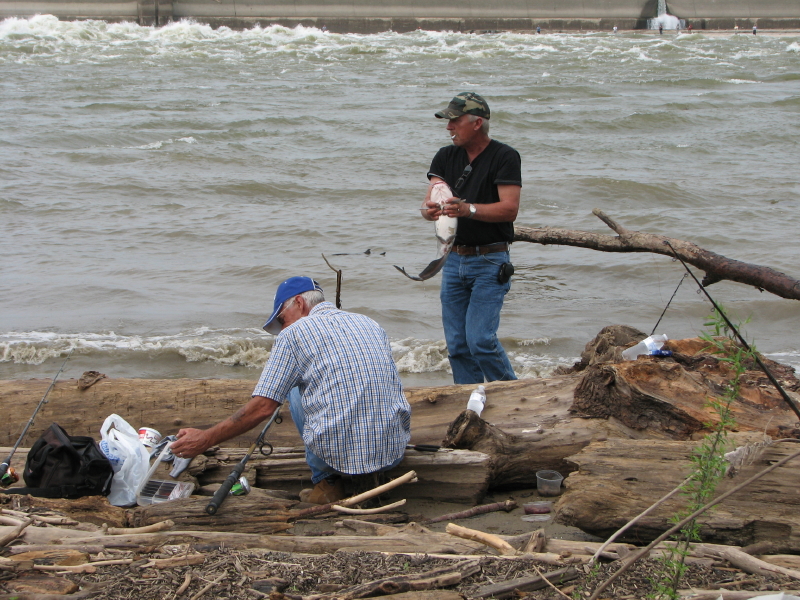
Moving to the river, I decided to watch what the fishermen were doing and catching.  In about twenty minutes, I watched two large catfish being landed.  Here are two guys that have this down.  Using multiple poles, they cast both worms and cut shad into the swiftly moving waters.  Snags and lost tackle are common since this part of the river is also full of rocks and boulders.
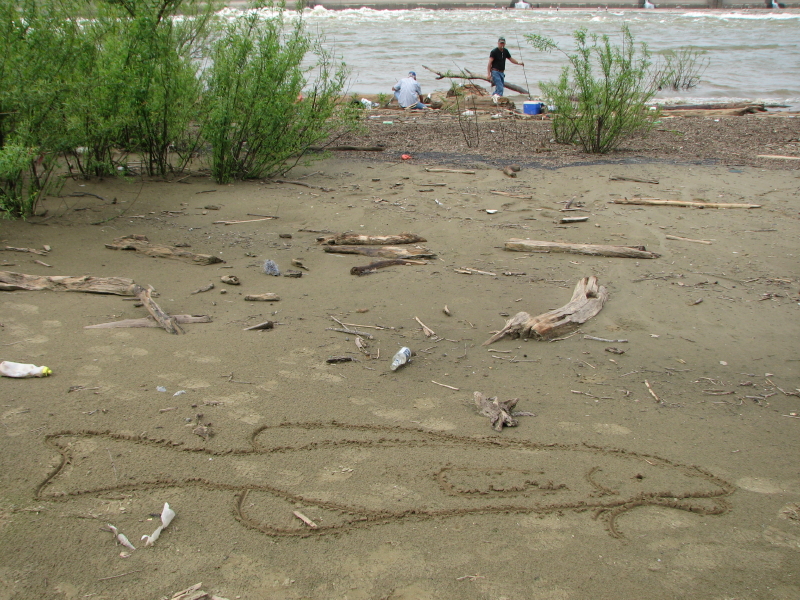
I was inspired by the scene and left them this contour drawing in the sand before moving on.
Earlier I had seen a flock of grackles by the water flowing under the bridge.  They were catching some food item here that I wasn’t able to figure out what it was…perhaps dead minnows?
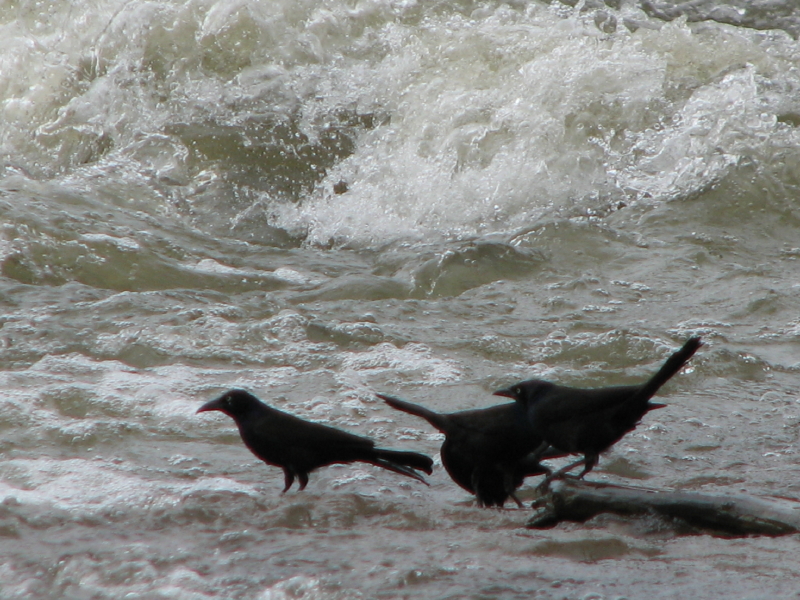
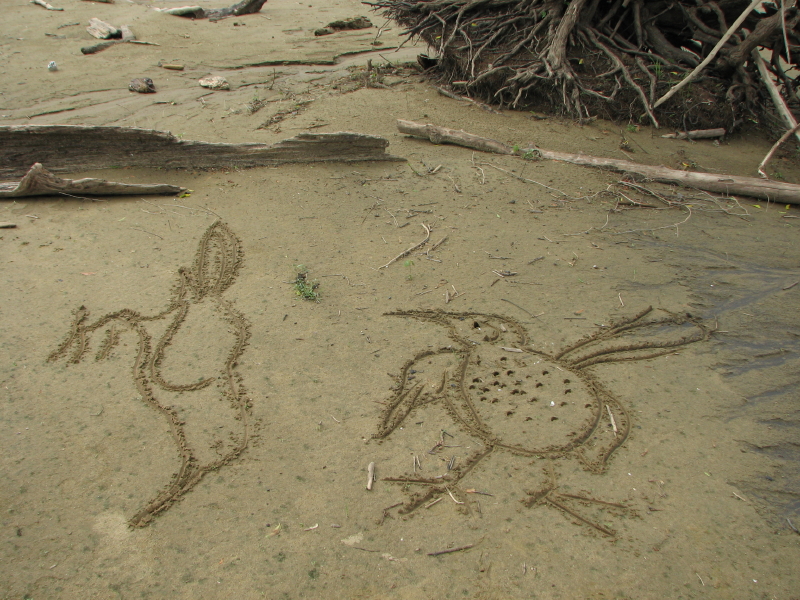
The grackles were working the river just like the fishermen were.  I left them a drawing in the sand as well made with the tip of my walking stick.  The sand today is moist and firm which holds a fine line better than usual.
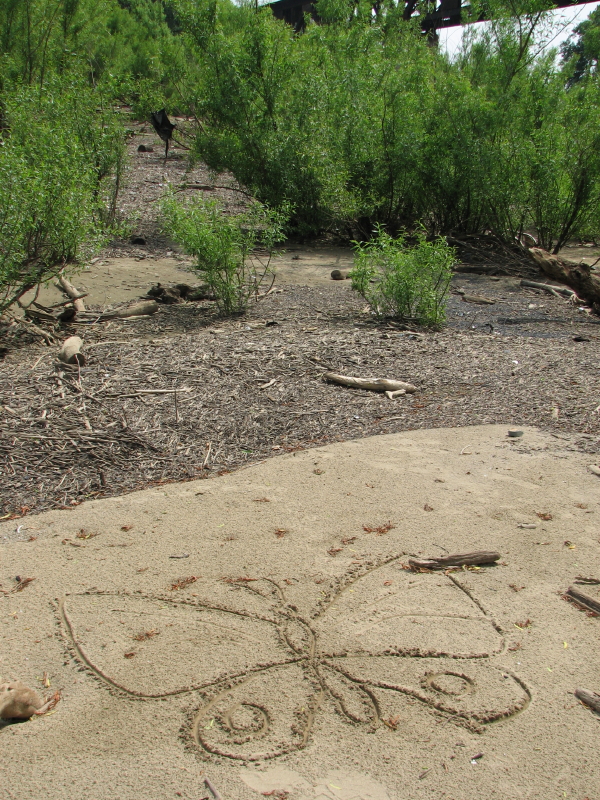
Of course, while I’m walking along I’m filling my collecting bag with the odds and ends that make up the rest of this riverblog.  Some of it is just stuff that I will attempt to make art with and the rest are souvenirs of our material culture.  Once the bag was full, I turned and headed up the bank to get under some trees and out of the sun.  I then made this sand butterfly to mark the spot where I turned for the willows.
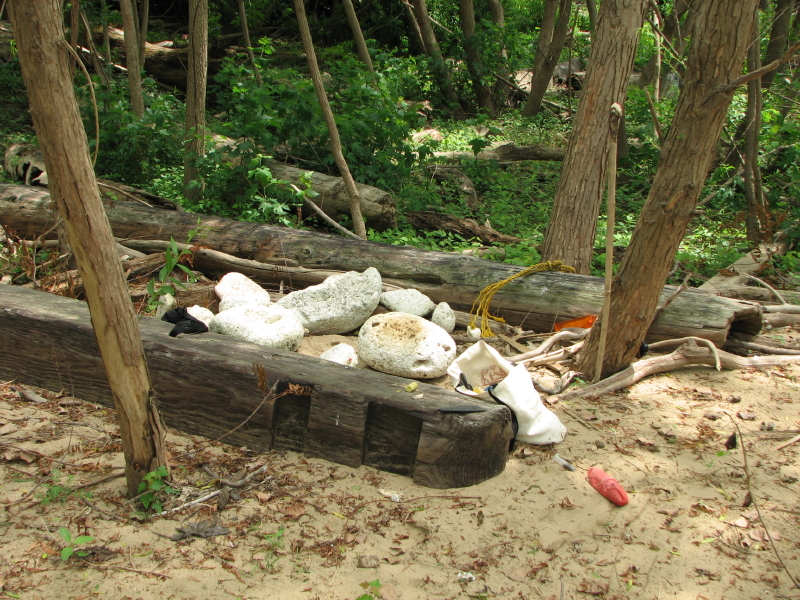
I have set up a new outdoor studio near the margins of the driftwood mound.  Instead of a plank to sit on, I’m using this large wooden bridge or railroad tie.  I haven’t found the large sections of Styrofoam that mark last season, but what I can find I’ve gathered at this spot.  I did make a figure on this day which extended this adventure, but I will wait until next time before unveiling it to you.  Thanks for tagging along…you have been good company!
Read Full Post »

The Ohio River has receded by the Falls of the Ohio.  For many weeks the river was loath to relinquish the territory it had recently flooded.  I ventured down the river bank and explored the more eastern section of the park.  The following post is some thoughts and images made during this expedition into a very moist and muddy area filled with debris and wildlife.

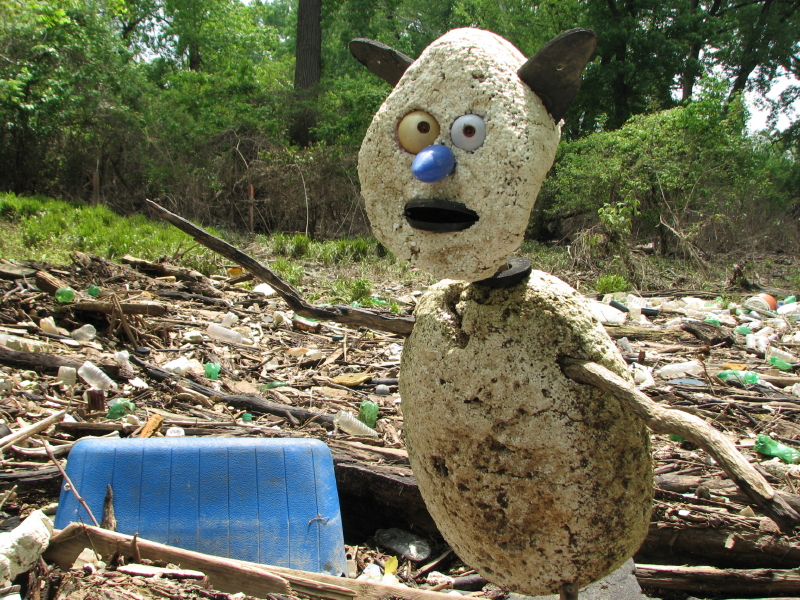
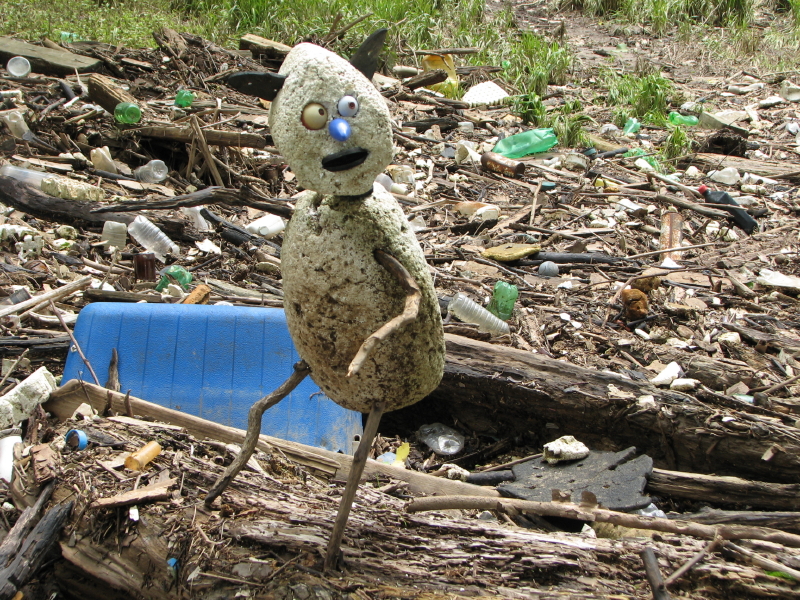
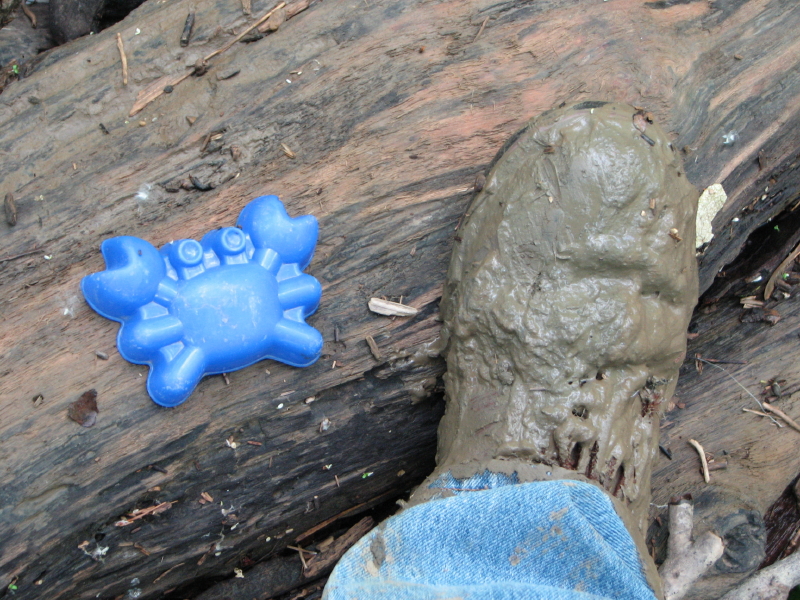
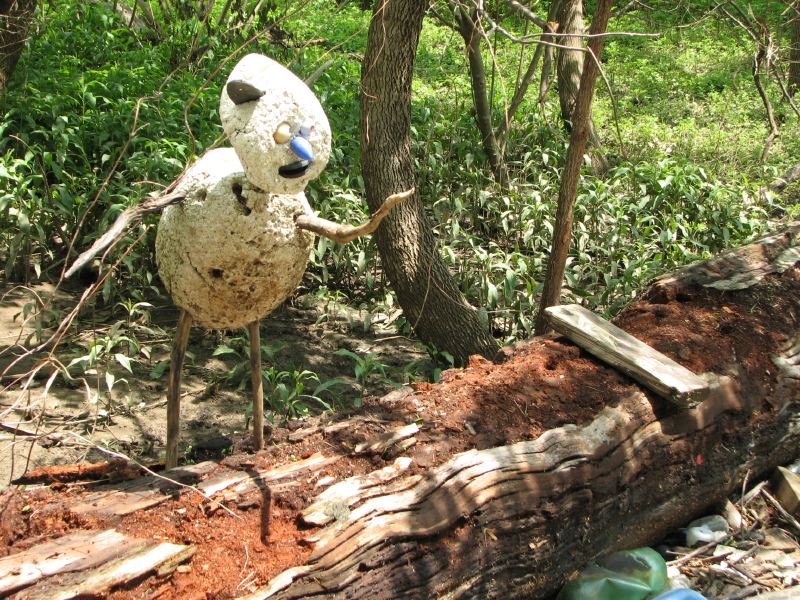
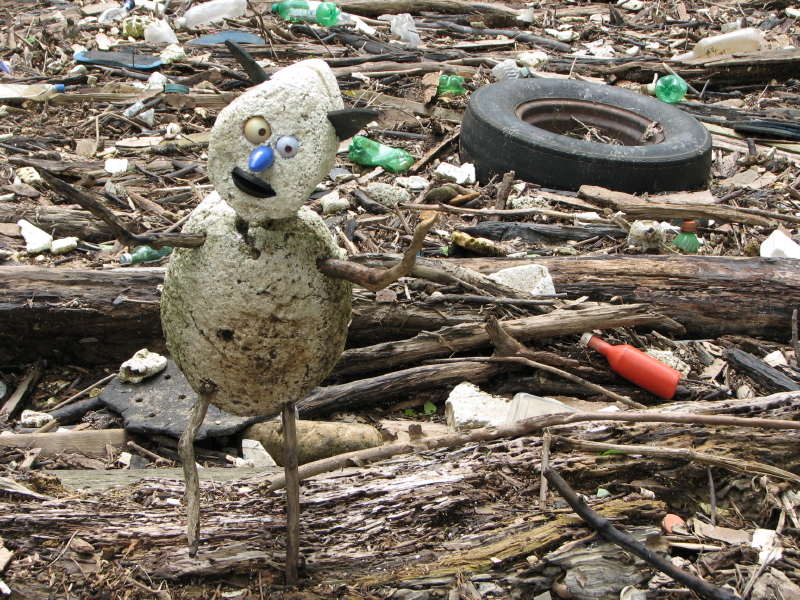
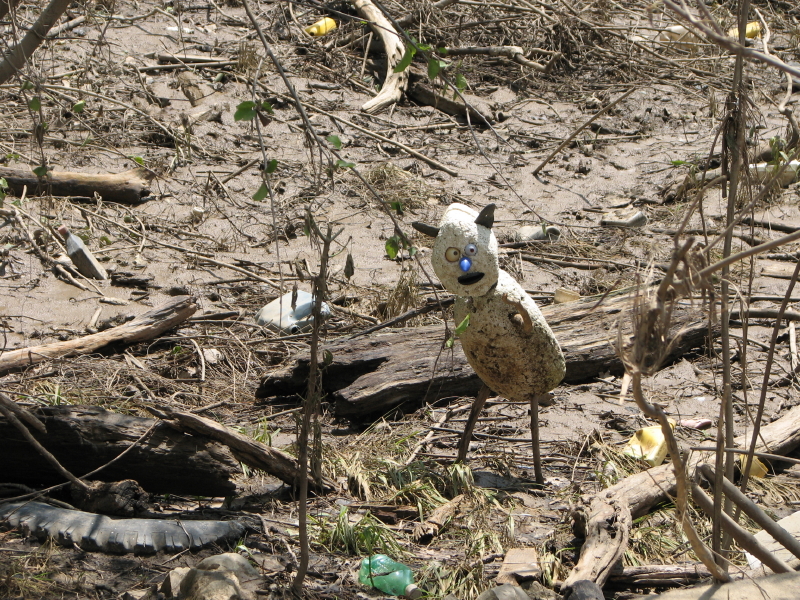
While exploring the park it is not unusual to run into others who are curious to see what the river has left behind.  Sometimes just a nod of recognition and some small gesture to reassure that one poses no threat is made and each party then attends to their own business.  And then sometimes a more sustained conversation occurs where information of mutual interest is exchanged.  Such was the case on this trip where I ran into this fellow of short stature with a bulbous blue nose who had been investigating the same stretch of river as me.  We tagged along with one another for a short time before family duties called me home.  I believe our initial conversation had something to do with the muddiness of the area.  In places, things looked safe and dry enough to stand on…and then the mud below would reach up and grab you by the ankles.  Sometimes small, blue crabs would pop out of their holes to check out whether the trapped parties would be good to eat.

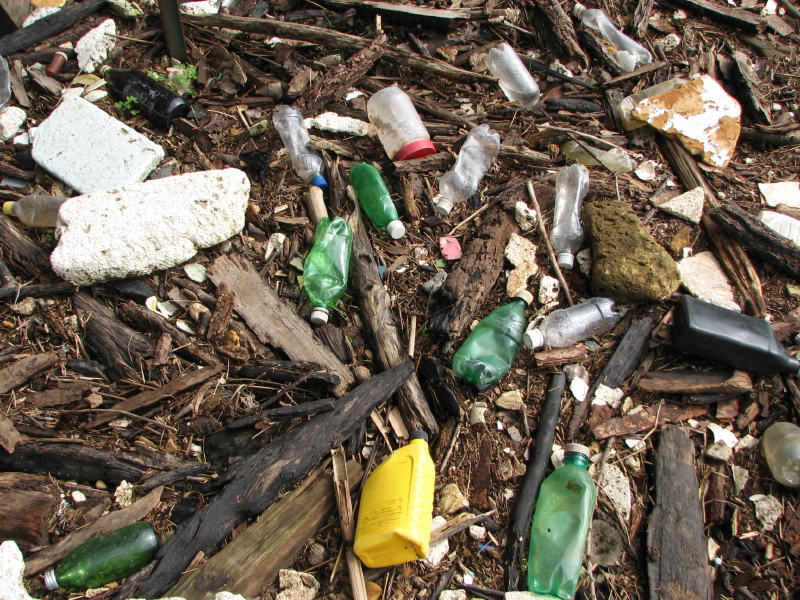
In my case, I am simply too big for them and once the crabs realized this they scuttled away.  Getting back to “Mr. Blue Nose”,  (funny how we didn’t think to ask each other’s name?), we were both astonished by the debris left behind by the retreating river.  After witnessing several other high water incidents over time…this is fairly representative of the stuff we found.

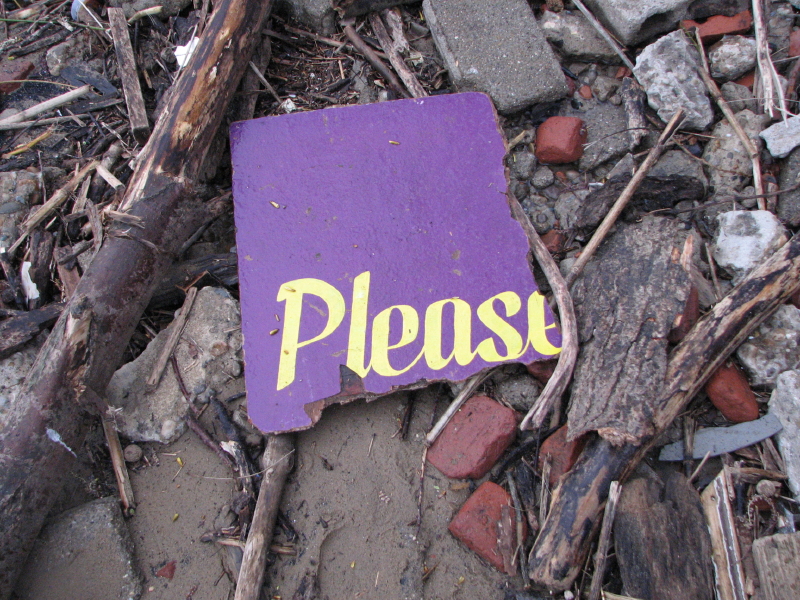
As you can see it’s mostly plastic containers, polystyrene (aka Styrofoam), and lots of shredded bark and wood chips.  Every once in a while, something more interesting would turn up.  While exploring, Mr. Blue Nose and I found two sign fragments and I kept these for my Found Painting and Sign Collection.  Here are the two precious finds.  The first one is kind of self-explanatory.  I like to muse that this is one way the universe communicates to me by leaving these things in my path for me to ponder.

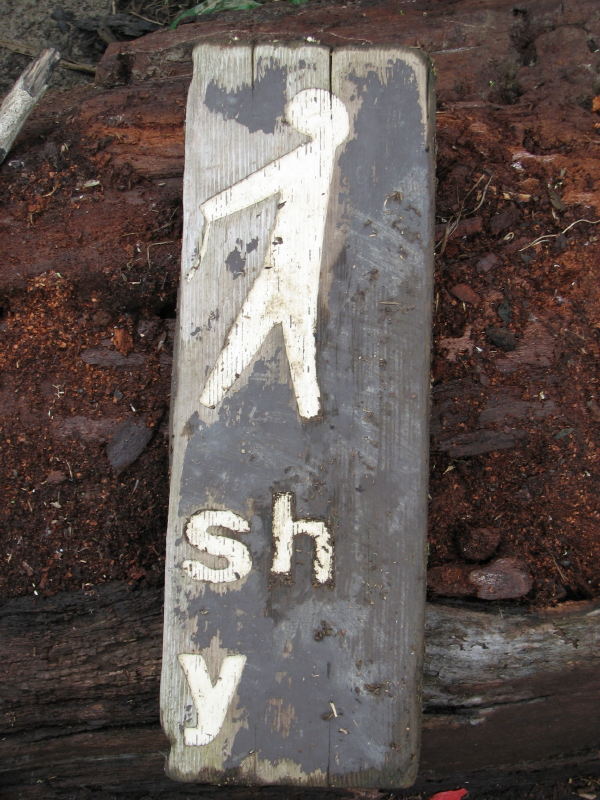
I’m not sure what it is asking…Please don’t litter or Please, only you can prevent forest fires, whatever its actual message, this is at least a polite sign.  The other one is more reclusive, in fact it is “shy”.  Here’s a picture of this enigmatic sign.

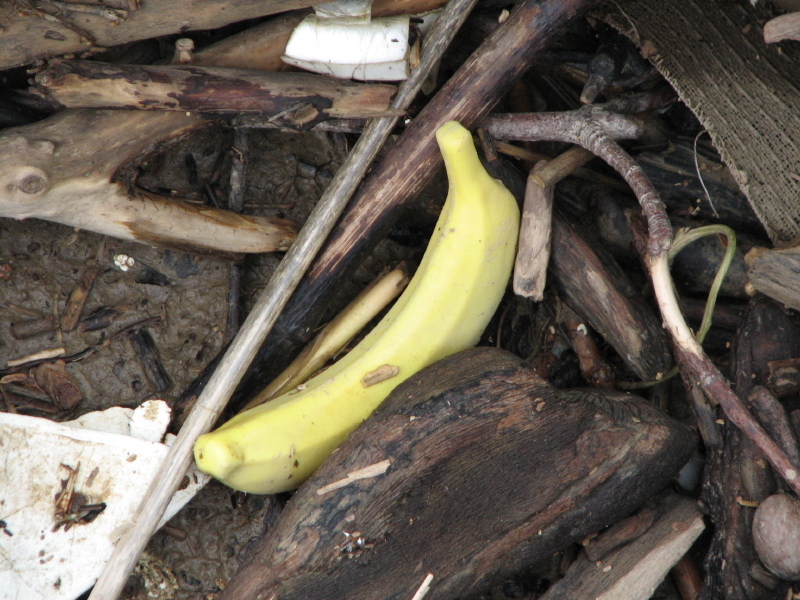
I like the hand-routed and painted “sign” for a person.  I think this fragment may originally have asked dog owners to leash their pets…but its shy and won’t tell me for certain.  Other found treasures included my second banana of the season…naturally it went into the old collecting bag to later join the other artificial produce I have found out here over time.

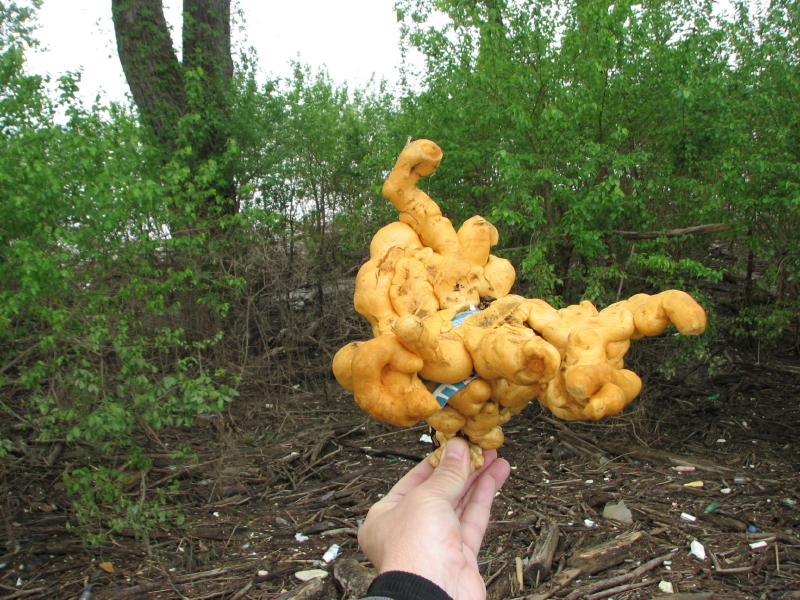
I also find other kinds of foam out here.  Here’s an interesting found sculpture made from polyurethane.  I have come across busted aerosol cans of this stuff where the foam has expanded out resembling entrails.

Mr. Blue Nose called my attention to a log that something had torn into and he wondered what could do this kind of damage.  Chunks of bark and soft decayed wood were scattered all around. 

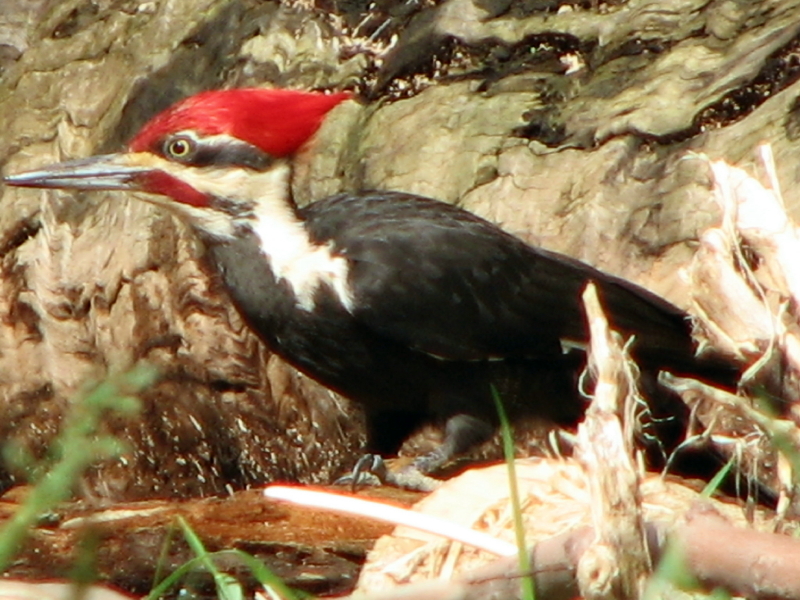
I was happy to inform my new friend that this looked like the work made by a Pileated Woodpecker and I showed him images of this great bird I had taken just a few hours earlier.

Since no one can verify that the Ivory-billed Woodpecker is still alive along some wild river in Arkansas…the Pileated Woodpecker has the distinction of being our biggest living woodpecker.  For years, I have observed a pair of these crow-sized birds in the park.  This one is the male and can be identified by his red mustache.  The female lacks this and has more black on its head.

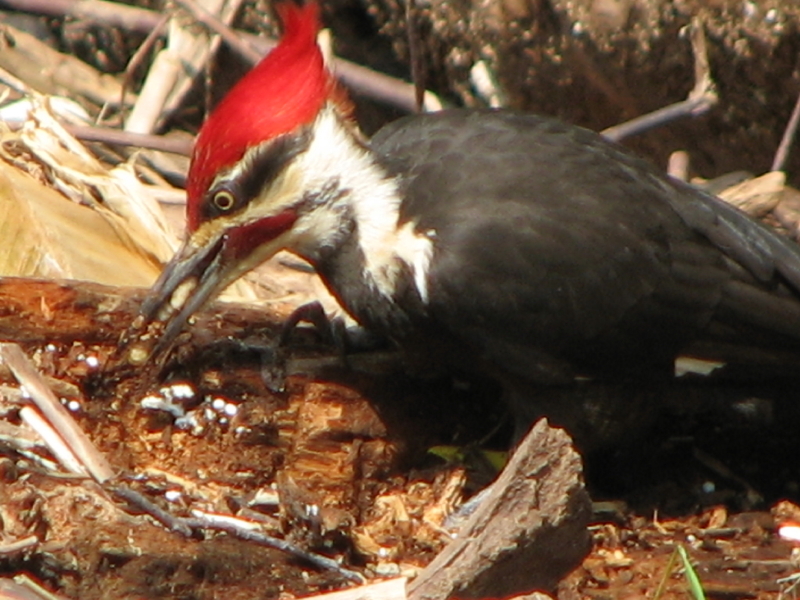
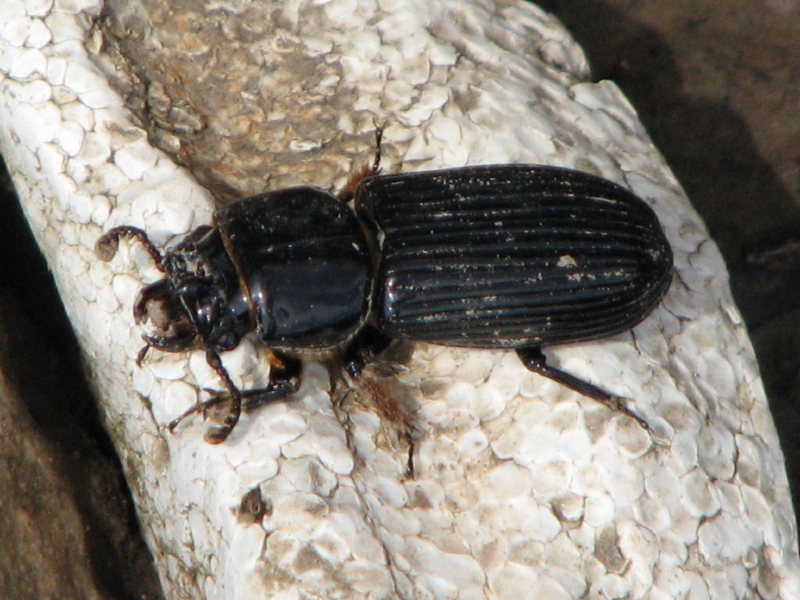
The Pileated Woodpecker has a large bill that goes through wood in a hurry.  Carpenter ants and beetle larvae can be found in these decaying logs and make up the main diet of this magnificent bird.  If you look closely at the photo above you can see a nice grub about to be swallowed.  This bird was so intent on looking for food that I was able to get closer than usual to it.  A couple of weeks a go, I found a Bessbug beetle which is a nice sized insect that uses decaying wood in its life-cycle.  This beetle is also known as the Patent-leather Beetle.  Here’s an adult I found sunning itself on a piece of Styrofoam.  These beetles can get nearly two inches long or about  five centimeters.  I wonder if our country will ever adopt the metric system?  Anyway, these beetle grubs make nice woodpecker snacks.

Thanks to my new companion we were able to make one other nice bird sighting on this day.  Mr. Blue Nose alerted me to some commotion happening in a nearby stand of trees. 

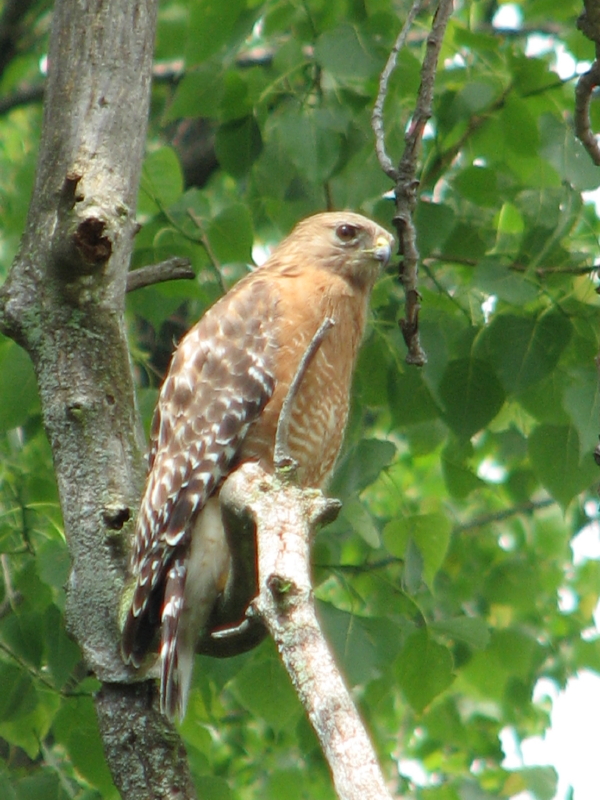
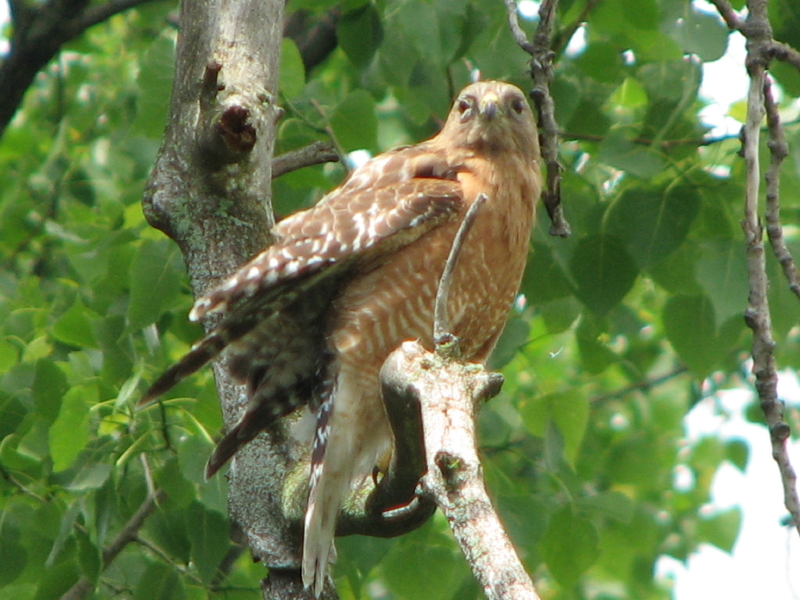
My friend said that he saw several blackbirds (grackles) chasing a larger bird from tree to tree.  I have observed this behavior before when birds of prey are present.  I gathered my camera up and went to see if I could find out what was the object of all this attention.  It turned out to be this beautiful Red-shouldered Hawk.  Here are a couple of pictures of it before the smaller birds drove it out of the area.

I always feel lucky when I see such beautiful birds in the park.  Before flying away, I saw this bird’s mate arriving and the two flew away together.  Soon it was time for me to fly away too and I left my companion on the river bank.

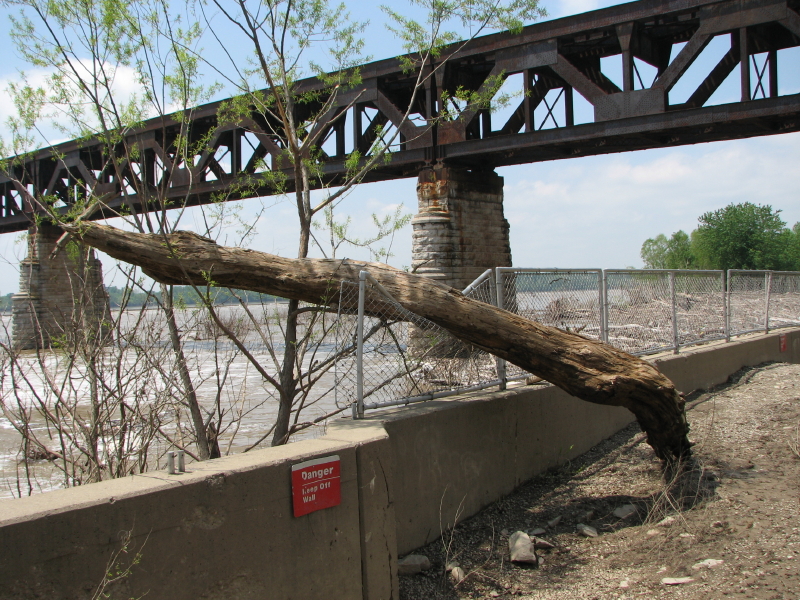
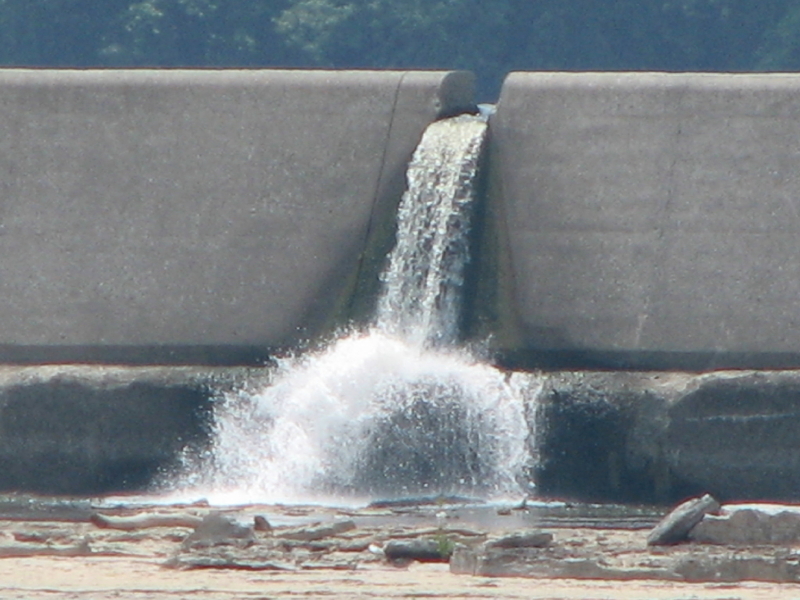
We parted near the railroad bridge and perhaps we will see one another again?  My last image is from an overlook area popular with visitors who want a better view of the tainter gates.  I have taken many pictures here over the years, but this one is different.  To give you an idea of how high the river was…this log was deposited on the fence by the retreating river!  Or, I hope so…I would hate to think it jumped up here!  So long for now!!
Read Full Post »

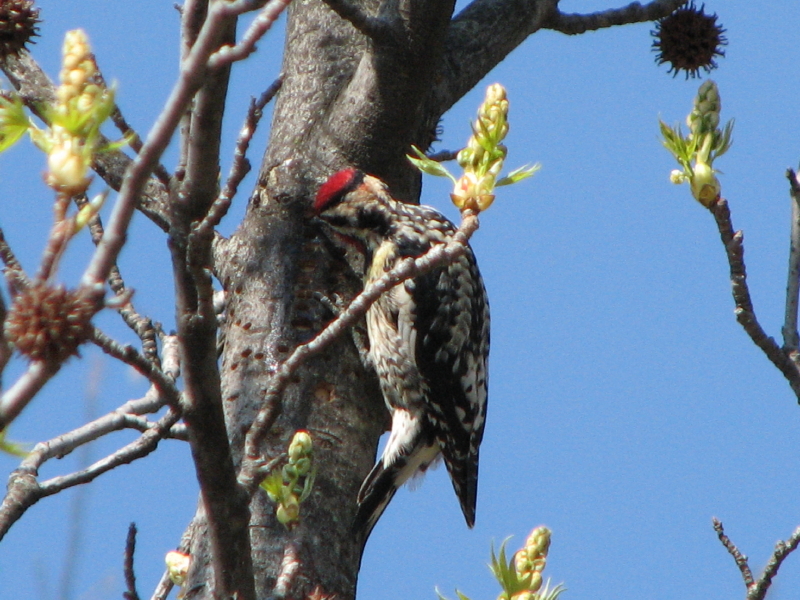
For me, the Yellow-bellied Sapsucker is a signal that Spring is underway.  I believe I have seen this very same bird in the same Sweet Gum tree for several years now.  Before the tree fully leafs out, he drills neat rows of holes in the tree bark which fill with the tree’s sap.  Visiting often, he then licks up the sugary mixture.  I have seen other bird species utilizing the work of this woodpecker including other woodpecker species, warblers and chickadees.  Before the insects and new seeds appear, the Yellow-bellied Sapsucker has accessed another food supply which he defends from all the other birds. 

Throwing his head back, this male Song Sparrow is expressing the feeling of the season.  Song Sparrows are year-round residents and have fully taken advantage of all the niches available at the Falls of the Ohio.  This year White-throated Sparrows have been more abundant than I recall from past years.  Every year is different from the previous ones and you never know what to expect next.  This year is off to a very wet start.

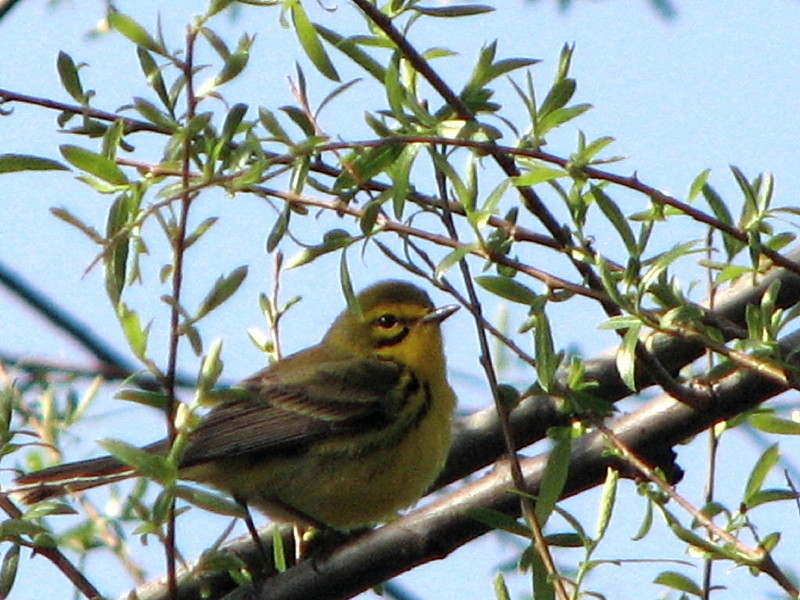
This is a male Prairie Warbler I came across recently.  I have “pished” this species closer to my camera’s lens by making little squeaky sounds that the bird found curious enough to follow.  I am hopeful of seeing other warblers before the Spring migration ends.  So far, I have seen Yellow-rumped Warblers, Common Yellowthroats, and a brilliant male Prothonotary Warbler attracted by the flooded bottomland trees.  There are thirty-five different warbler species on the Falls checklist and I have had the privilege of seeing most of them over the years.

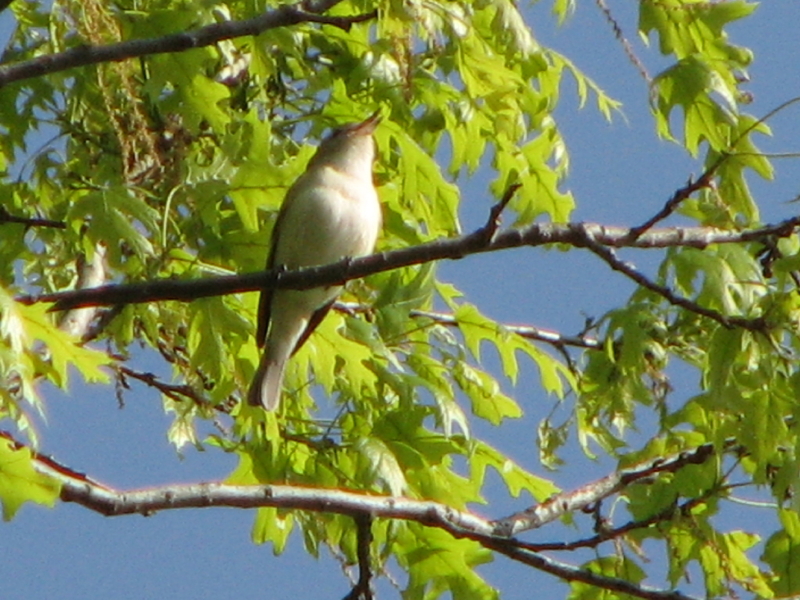
The Warbling Vireo is another bird that is more often heard than seen.  It’s such a tiny bird and it has the habit of staying in the tops of tall trees.  I found this one on the exposed section of an oak branch.  If it weren’t distracted by trying to attract a mate it would be in almost constant movement in search of the small caterpillars and insects that it eats.

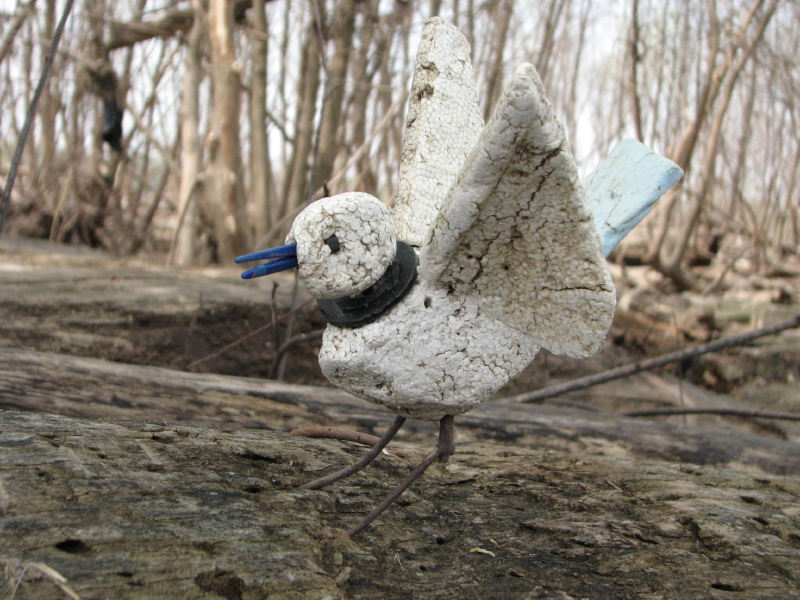
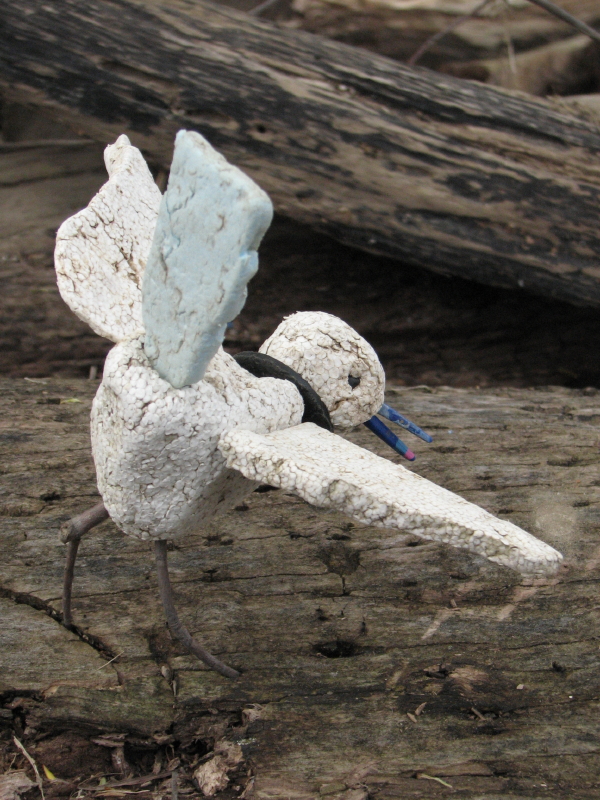
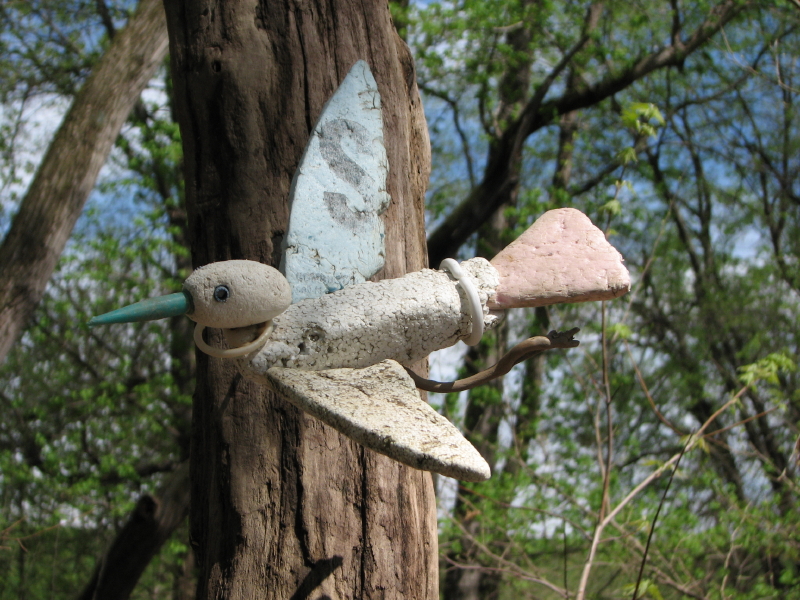
A new bird to add to the old life list is the Blue-tailed Robin.  It’s an infrequent visitor to these parts and so when one is sighted it becomes an event.  You can’t see this in the photo, but there are ten other birdwatchers with cameras and binoculars trained on this fellow as it dances and practices its courtship dance.  Everybody was extra quiet so that this bird wouldn’t spook and fly away.  Here are more images.

The Blue-tailed Robin male does an elaborate dance on a fallen log where it sings and flaps its wings in different positions all the while it struts its stuff.  The real test will happen further north in central Canada where its ability to display and attract a mate will mean the difference between passing on its genetic distinctiveness or not.  No wonder this bird can’t afford the opportunity not to practice!

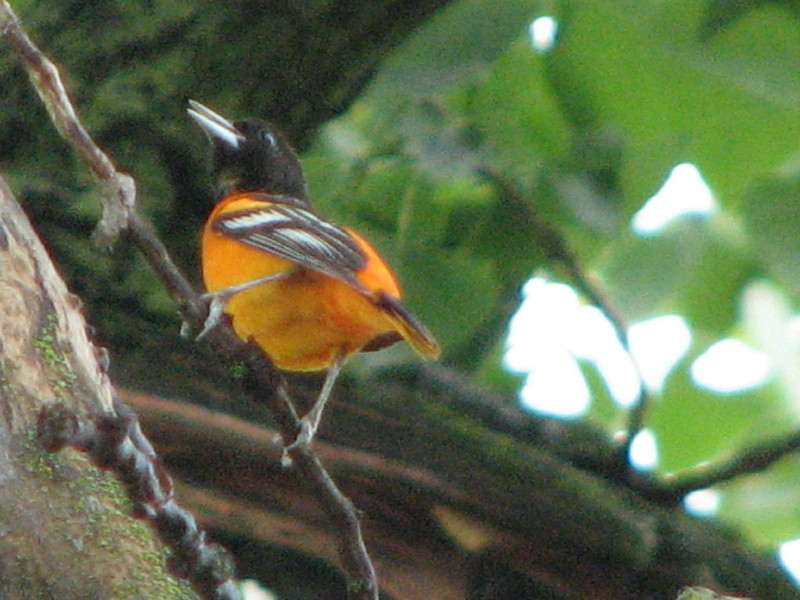
Singing very high up in a Cottonwood tree, this male Northern Oriole is also singing loudly in its territory.  So far, it’s looking and sounding like a good year for this species!  Nearly everywhere I hiked in the park I either sighted or heard Northern Orioles.  The orange color is so distinctive and it contrasts so well against the green of the surrounding leaves.  There is so much moisture in the air that my camera records this as a slightly foggy picture.  I hope for better images of orioles and the other great birds here.

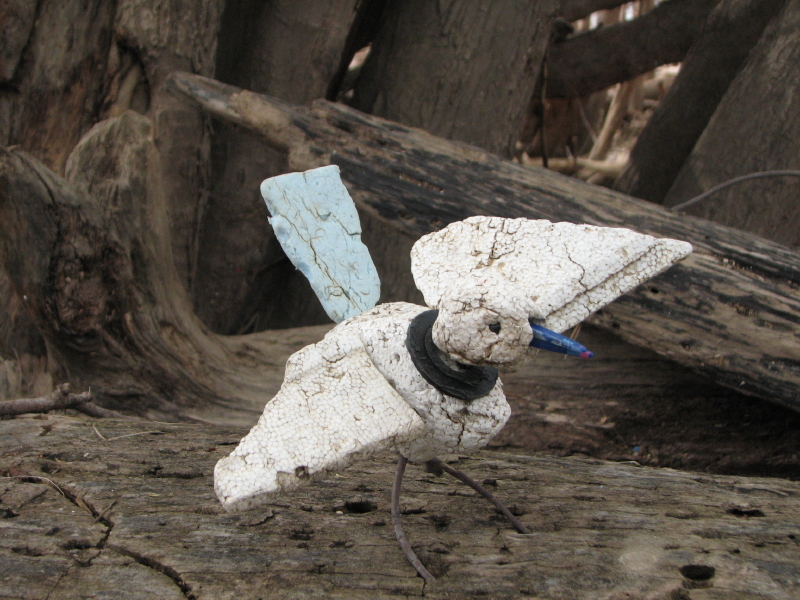
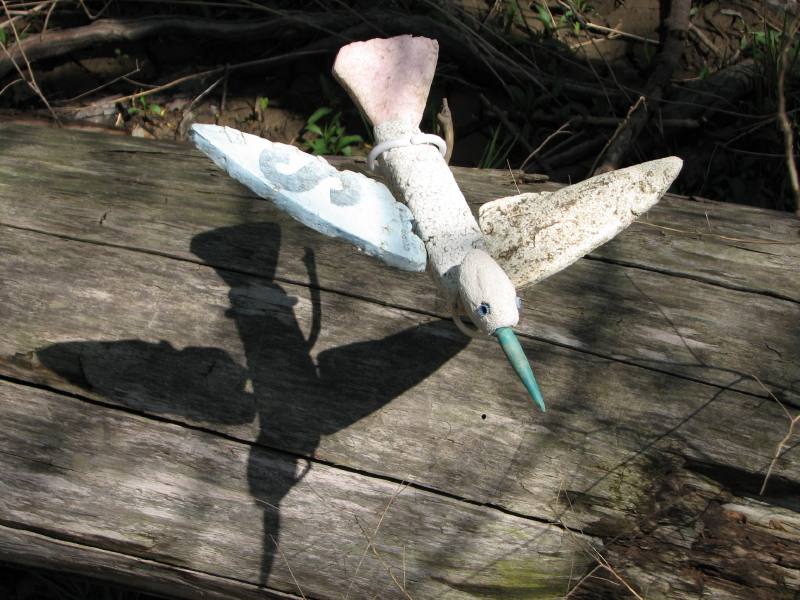
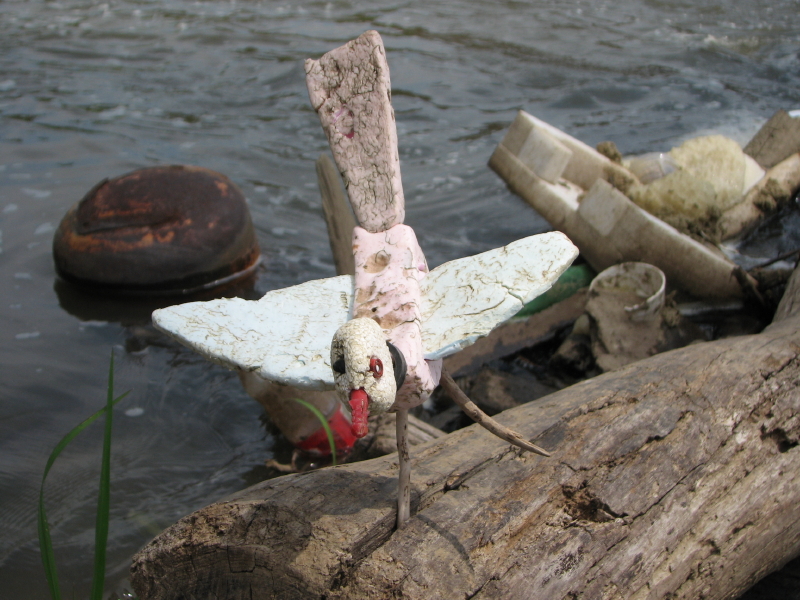
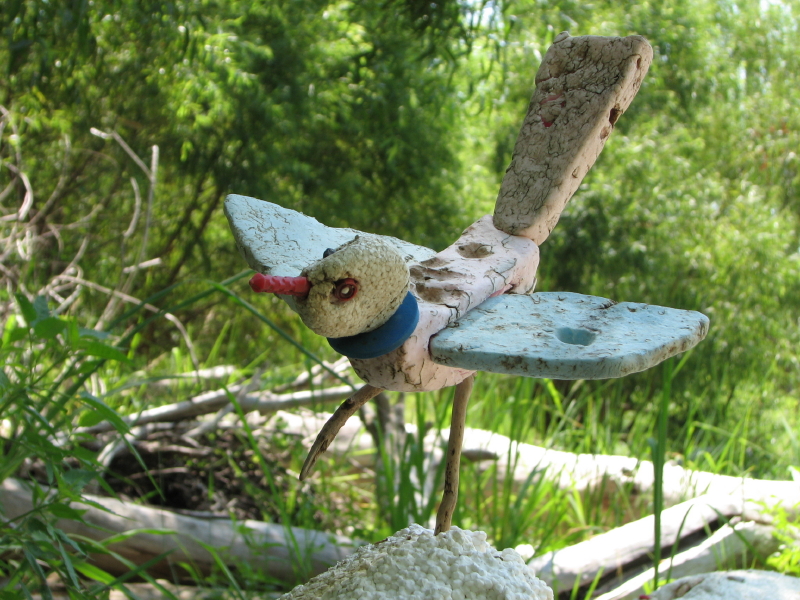
Another rarely recorded migrant is the Dragonfly Tern.  I found one coursing along the river bank and was able to squeeze off a couple decent pictures.  Like the name implies, it specializes in capturing dragonflies which requires the ability to maneuver at high-speed.  It has swept back wings that give it the acceleration it needs in tight corners.  Here’s another picture of it buzzing over a fallen log near my position.

This bird soon will be off to the Great Lakes region where it also breeds.  It barely scratches together a depression in the sand and gravel that it considers a nest.  There are usually two eggs laid that are heavily speckled like the small pebbles that surround it.  It winters in South America and travels thousands of miles each year.

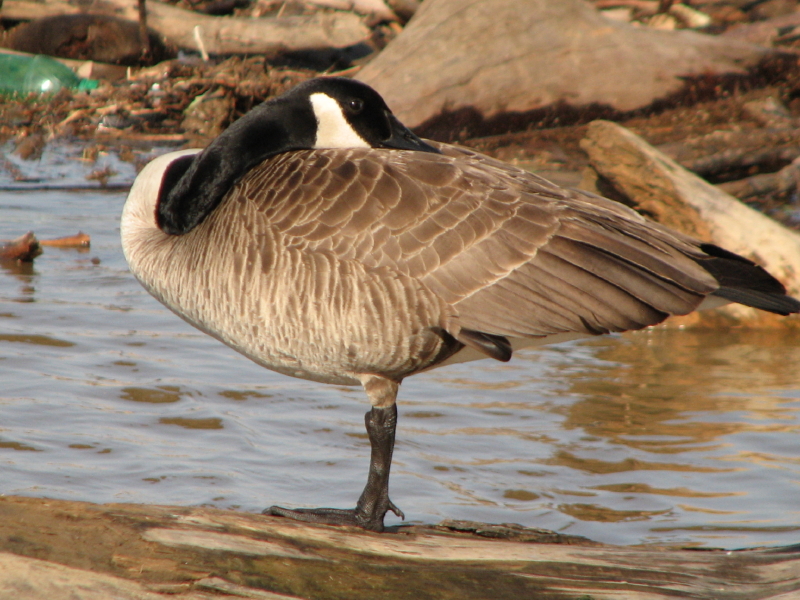
On my way home from the park, I chanced to see this Red-tailed Hawk on top of a utility pole and recorded its image.  It is one of our more common hawks, but since I haven’t featured it in the Riverblog before, I thought I would include it in this post.  As the year progresses, I hope to feature other birds that stop at the Falls of the Ohio. For me, the difference between a successful trip and a really successful adventure sometimes hinges on seeing one nice bird!  In closing here are two Canada Geese.  One is real…

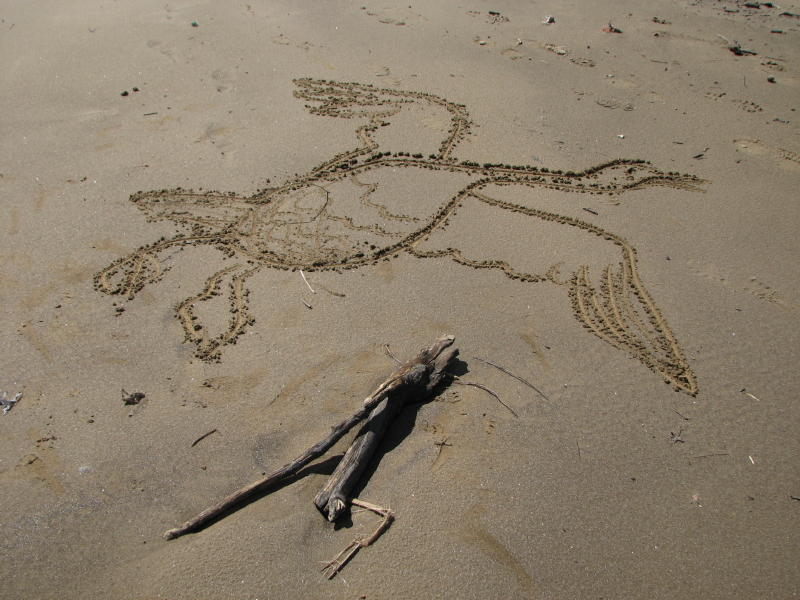
…the other is just a tracing in the sand I made.  Happy birding !!

Read Full Post »

Today there is a leafy smell in the air at the Falls of the Ohio.  Already, most of the leaves are on the ground and every gust of wind takes a few more away from the branches.  I often think about John James Audubon walking these grounds two hundred years a go looking for birds to draw.  Many of his earliest avian subjects were captured on paper here.  Audubon’s time at the Falls gave him training as both an artist and naturalist that would serve him well later in his career.  In my own eccentric way, I’m creating an alternative ornithology that parallels the genuine one.  Here is the day’s birding adventure.

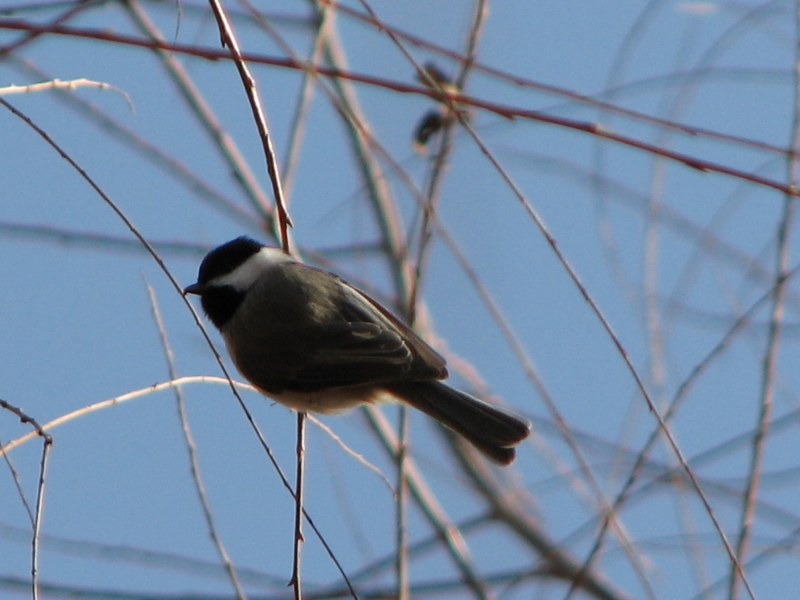
I usually hear the Carolina Chickadees before I see them.  They are to my mind comical birds because they seem to get into every position possible in their quest for food.  They will examine from every angle whatever it is that is the object of their attention.  Most of the time I see this bird in pairs which makes me wonder if the males and females stay together year round?  I will have to read up on that.  As far as I can tell, there isn’t a good way to tell the sexes apart in this species.  You can walk in the woods and not see or hear anything …and then suddenly it seems the birds find you!  I’ve noticed that different species will flock together as they travel through the woods.  Here’s a sampling of what I saw along with the Chickadees today.

Migrating southward from their boreal homes in the north, Golden-crowned Kinglets mix freely with other species.  They are tiny, ever on the go birds, and it is difficult to photograph them.  The kinglet in the above picture is a male identified by his orangey crest.  The female’s crest is pale yellow.  This is another bird I hear before seeing with their “dee, dee, deee” call notes.  It’s common to see woodpeckers and their allies joining into this group.  Here’s a female Downy Woodpecker plying its trade among the tree bark.  The male has a red dash on the back of his head.

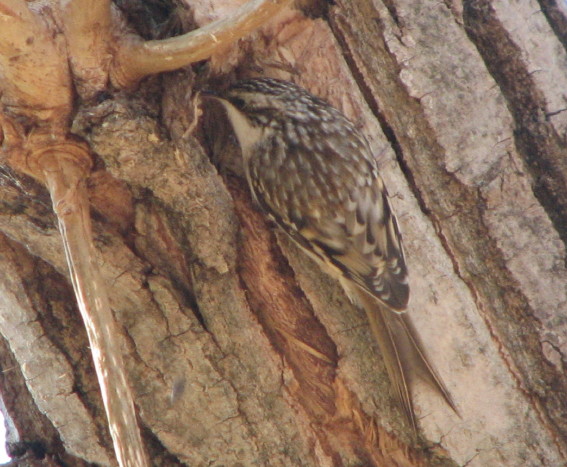
 Woodpeckers have adapted very stiff tail feathers that they use to brace themselves as they hammer away on the wood.  You can see the same thing on a bird that is so cryptically colored that it is easy to miss.  I saw several Brown Creepers flying with the Chickadees and Tufted Titmice today.  This was the better of the Brown Creeper images and you can see how easily it would be to overlook this bird.  Notice its stiff, v-shaped tail feathers that it uses to brace itself as it probes the wood.

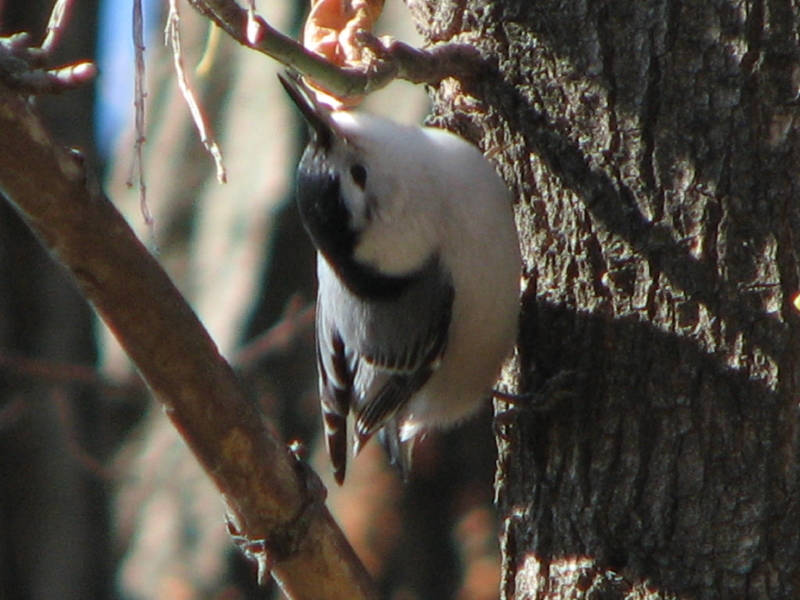
Looking just like wood bark, the Brown Creeper will fly to the base of a tree and work its way up.  It is looking for small insects that are hiding in the crevices of the bark.  These bird are also very small.  It’s also common to see this bird also traveling in the company of migrating nuthatches.  Such was the case on this day, here is a White-breasted Nuthatch that was on an adjacent tree to the creeper.

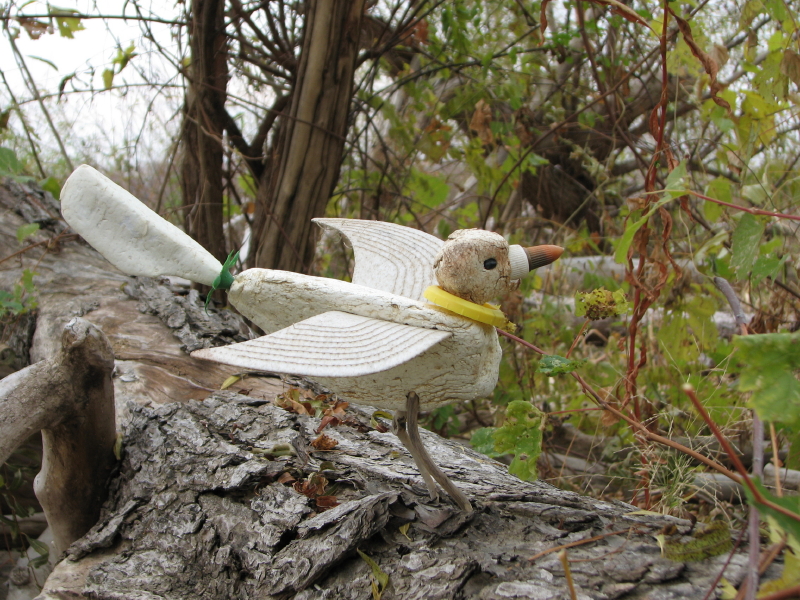
Aptly named, this nuthatch has a snowy-white breast feathers.  It likes to explore the tree’s surface in a head down position and has this nasal sounding call note that it frequently gives as it hunts for food.  Of course, I have saved one specialty for you that is very rarely glimpsed at any time of the year.  Patient birding rewarded me with this sighting of the Thick-billed Thrasher that was also traveling with these other birds.

From this detail, it is easy to see why this bird is called the Thick-billed Thrasher.  It is a seed eater and specializes in pine nuts.

Males and females of this species are also difficult to tell apart.  I spotted this bird resting among the willow branches in the eastern section of the park.  I noticed others of its kind exploring the leaf litter for whatever food supplements its main diet.

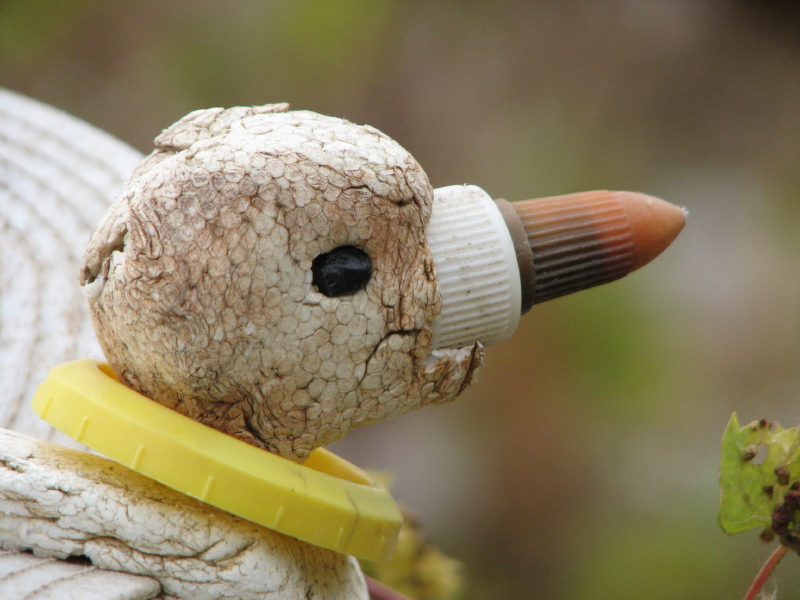
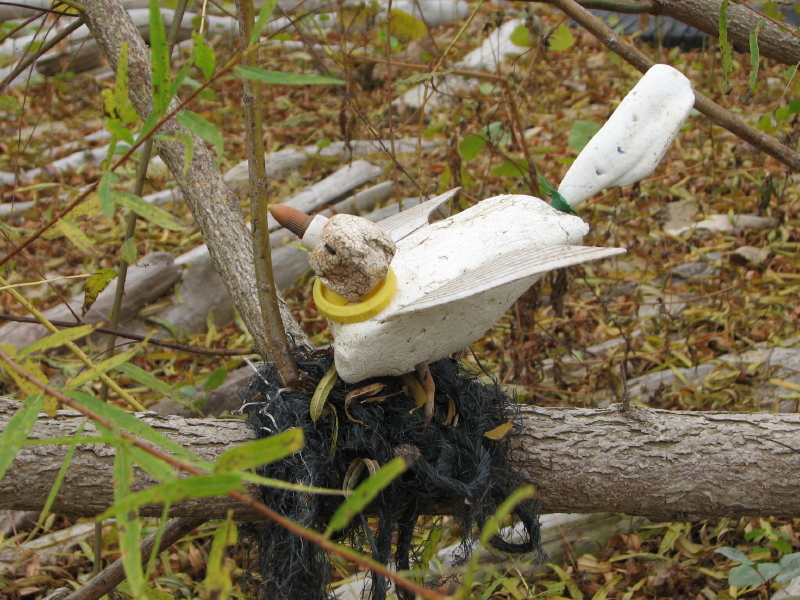
A final look at the this thrasher doing something a bit unusual.  This bird has discovered some barge cable wound around a branch and it seems to have stimulated a nesting response.  It sat on this rope for a few minutes before moving off with the rest of the traveling birds.  The Thick-billed Thrasher’s ultimate destination are the pine forests of the southern United States.

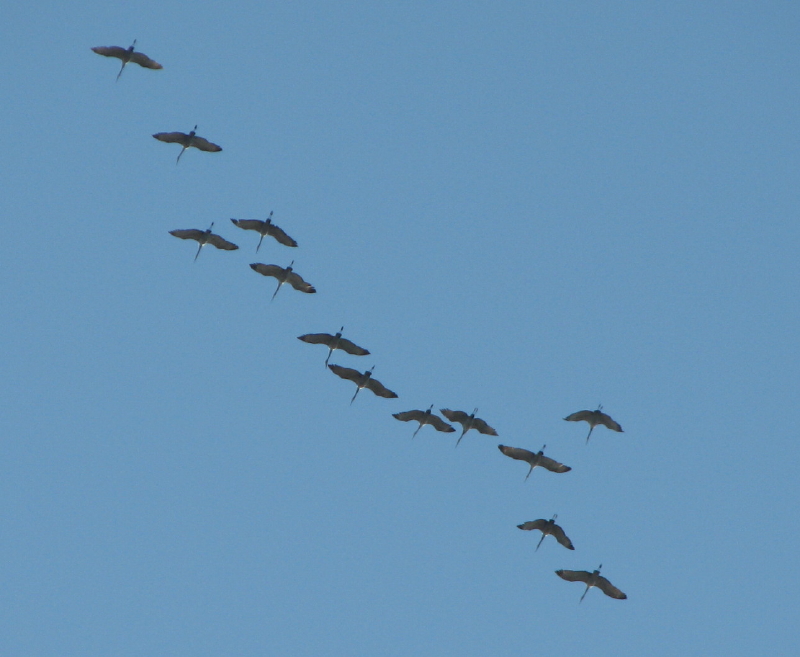
On my way back to my car, I made one other special bird sighting.  I also heard these birds before I saw them and immediately looked up into the sky.  Flying high above me in wavy, v-shaped formations, flocks of Sandhill Cranes were winging their way south.  For me, this is another sign of the season and I always associate the coming of very cold weather with seeing these cranes.  I wonder if Audubon felt similarly?

Read Full Post »

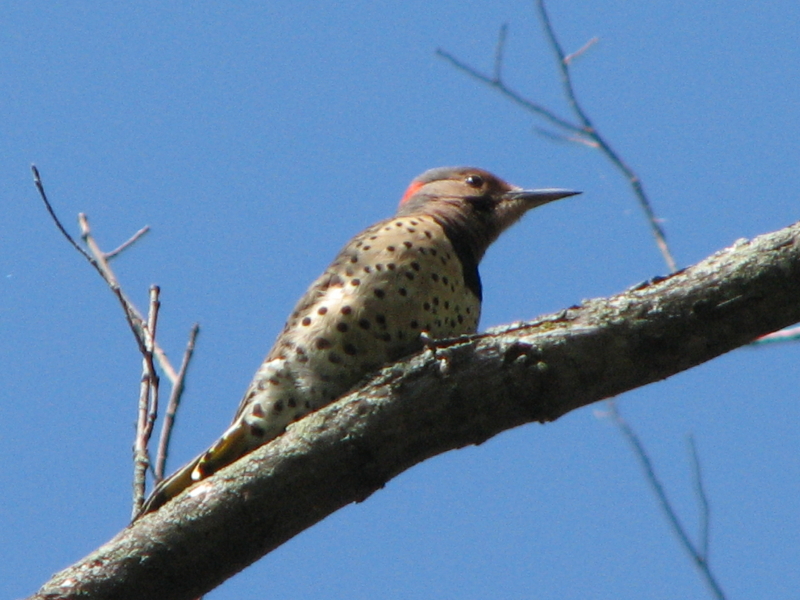
After finding all my sculptures smashed, I decided to give that section of the park a rest.  I will eventually return there and make new pieces from the remains.  Today’s walk is along the western section of the park.  It is an area I have come to appreciate more.  In part, because fewer people venture this way and there are different points of interest.  It’s fall migration time and I’m always on the look out for birds.  The birds that are just passing through are of particular interest, but I also like the species that can be found here year around.  I came across this really noisy Northern Flicker on a branch and snapped its picture.

This is a fairly large woodpecker.  In the old guides, this would have been identified as the “Yellow-shafted” form.  The feathers under the wings and tail are a bright yellow which can be seen as the bird flies.  The black “mustache” extending away from its bill identifies this as being a male.

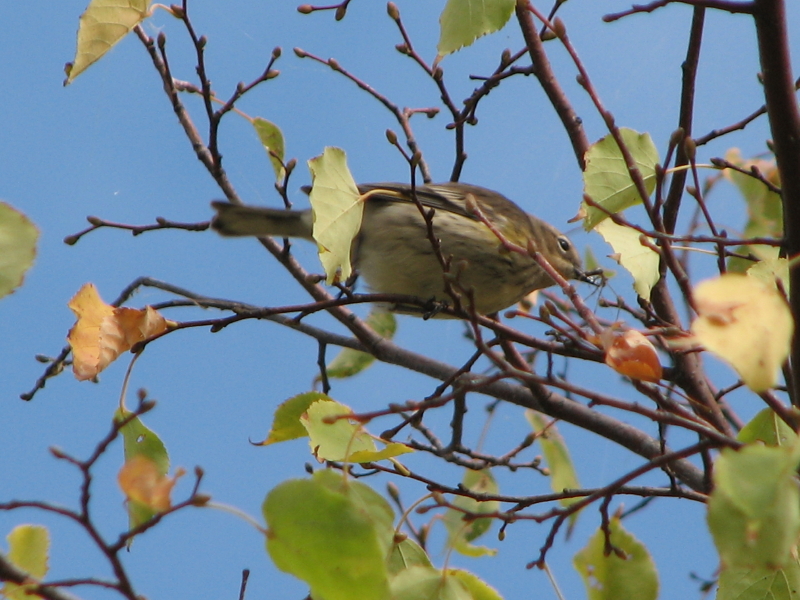
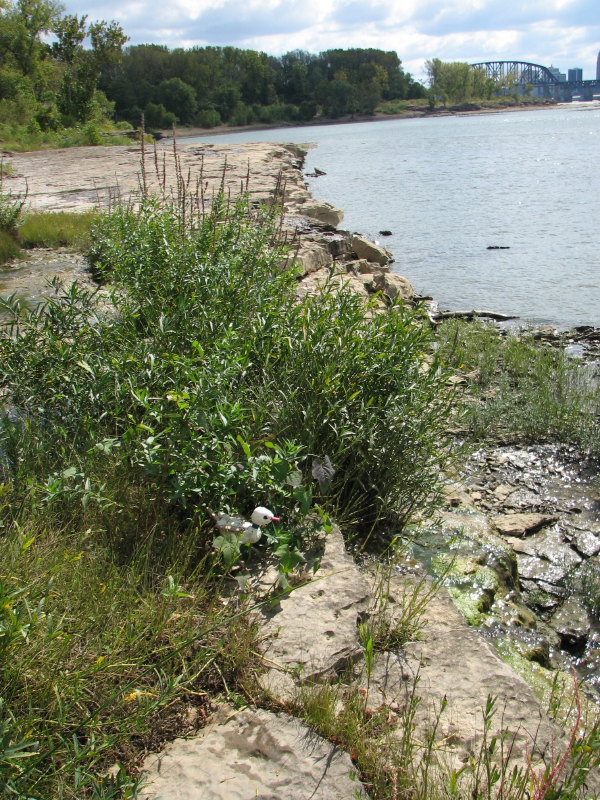
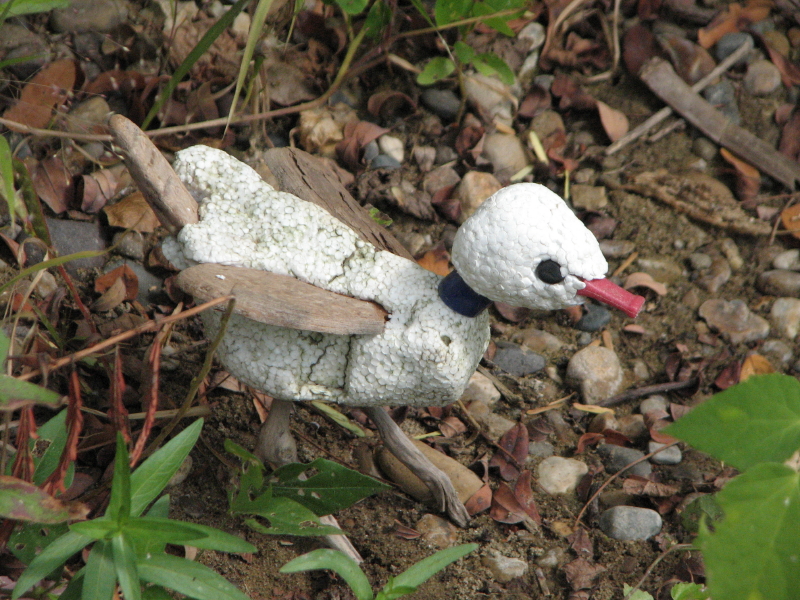
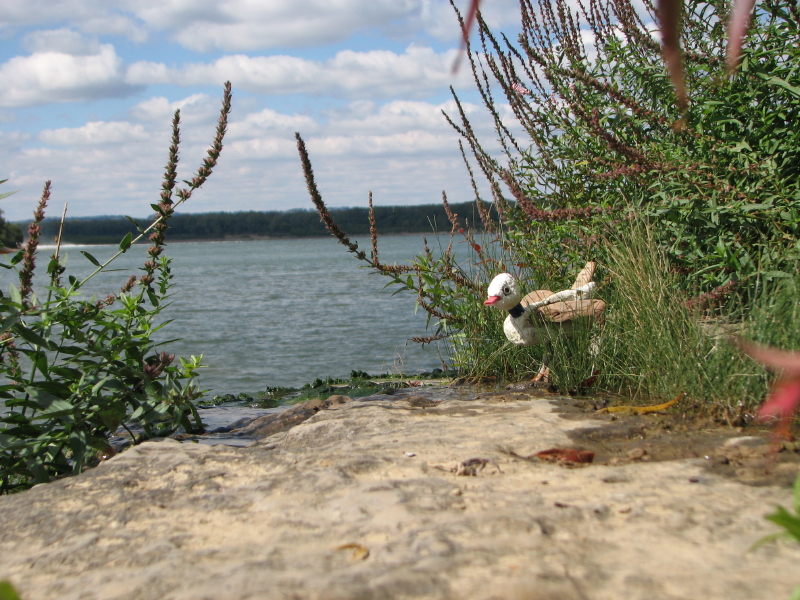
Chasing small insects among the fall leaves is this Yellow-rumped Warbler.  This is the park’s most common warbler and one that hangs around longer than any other of the park’s 35 sighted warbler species.  I have seen most of them, but they are easier to identify in the spring when their plumage is more colorful.  Fall warblers can be a challenge and I’m still learning all their nuances.  I have seen more different warbler species this year because I have tried a little harder to look for them.  Still, when you are out on the land, you just never know what you will cross paths with and that is the subject of this post.  I saw my first Water Chick on this expedition and managed a few decent images that I can share with you.  First, can you spot the Water Chick in this photo?

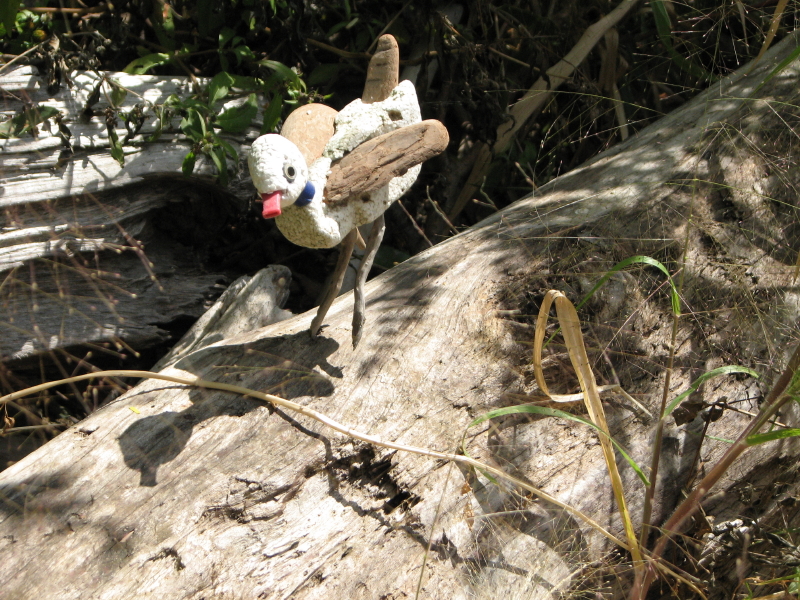
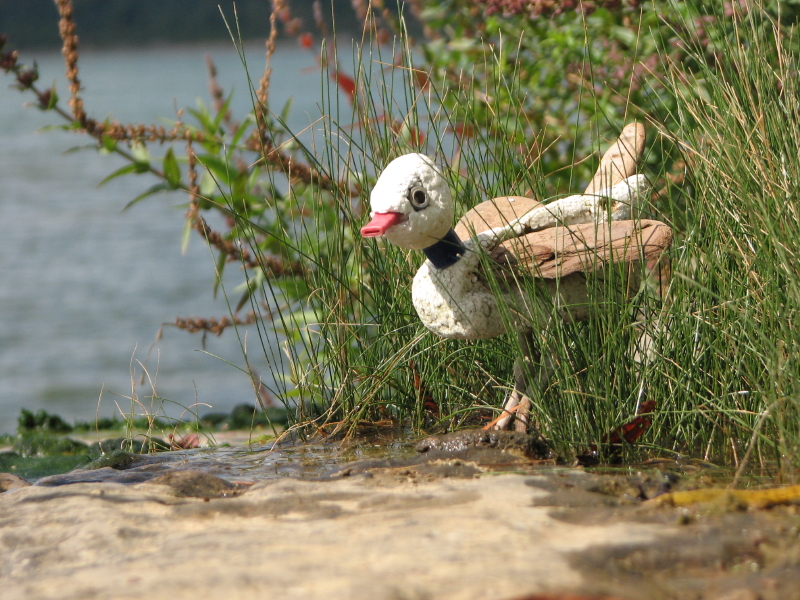
I bet you found this interesting bird?  It’s snow-white in color and has a bright red bill.  It’s only occasionally found in this park and the habitat it prefers matches exactly the kind of landscape you see here.  The Water Chick is usually found near water and also needs dense vegetation to hide and raise its young.  Over the course of a couple of hours I ran into this bird several times and here are a few “portraits” I was able to manage.

The Water Chick is usually found on the ground, but reportedly, is a decent swimmer as well.  Although it can fly it is reluctant to do so.  It much prefers hiding and taking advantage of the local cover where it seeks out small insects and spiders that make up its diet.  I surprised this one investigating a decaying log.  Here’s another image of this bird.

As you might be able to discern…the Water Chick is a small bird and relies on its diminuitive size and secretive habits to go unnoticed.  I believe I heard (not entirely sure though) a low piping sound when this bird noticed me and became alarmed.  It high-tailed it into the loosestrife clumps as quick as can be.  This is precisely the type of ground bird that I worry about being preyed upon by feral cats and in fact, ornithologists report that this species is on the decline for multiple reasons.  While I was birdwatching, I did come across another bird predator.  However, this one is so large that I doubt that it would bother taking a Water Chick.

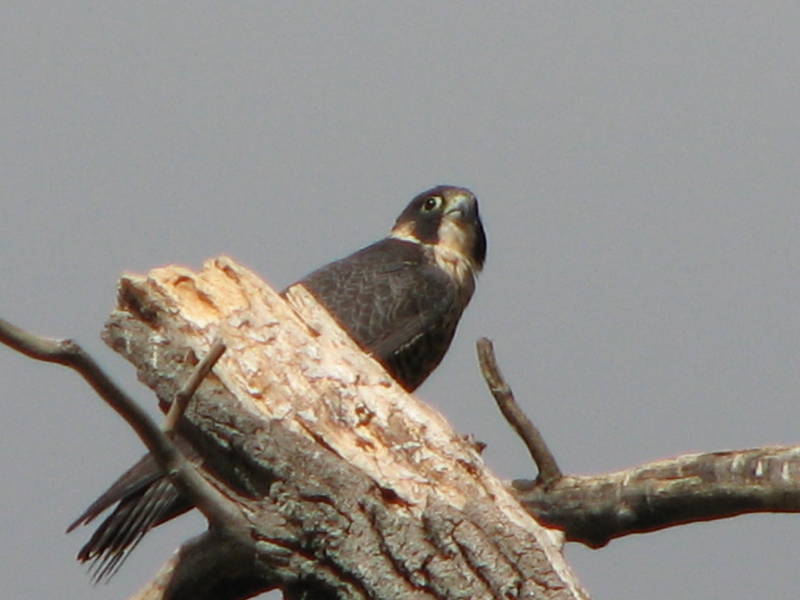
I see Peregrine Falcons on occasion out at the Falls, but this is the first one I could get a picture of…unfortunately part of the tree obscures the bird, but it’s still distinctive enough to identify this large bird of prey.  I have actually seen these falcons more in the city where they nest on the taller buildings in Louisville.  Like other parts of the country, we nearly lost this magnificent bird to DDT poisoning.  Since banning this pesticide they have made a comeback, but we could use more to help keep the pigeon population in check.  I located the Water Chick one more time before heading home.  It was along the fossil beds that rise above the river level which is still down from an acute lack of rain.

I was on my belly laying on the limestone rocks when these photos were taken.  I think it helps give an idea of what it must be like from this bird’s perspective?  After taking these images, I decided that I disturbed this bird enough and backed off.  I hope it forgives my intrusion, but I had never seen one of its kind before…and maybe never will again?  This bird is bound for our Gulf Coast where it spends the winter in the swamps.  Turning for home, I also came across small stands of this rather large flower and thought this a nice way to end this post.

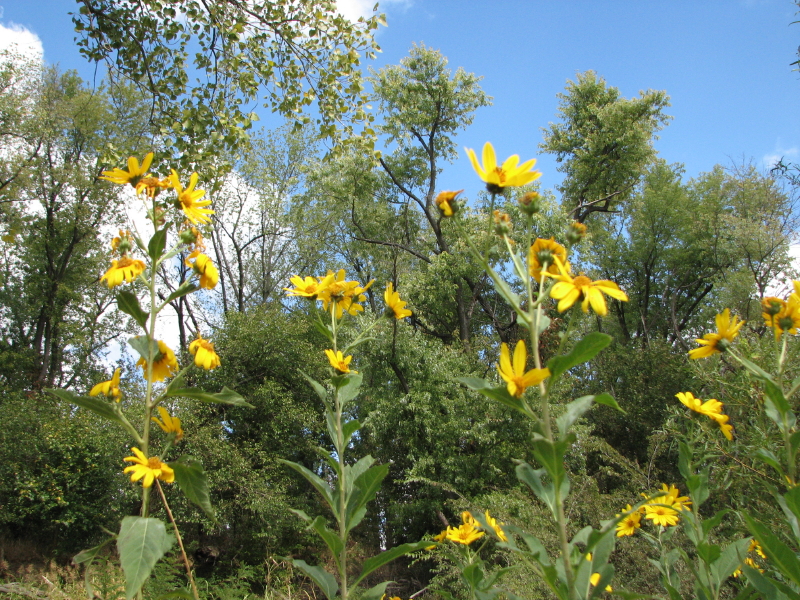
I’m not sure on the identification of this plant? Many in this stand were over six feet tall.  I need to bring a guide with me into the field to help with this.  In the moment, I’m happy for the color this large flower brings which contributes to the beauty of the season.  Thanks for tagging along on another of my walks at the Falls of the Ohio.  See you later!

Read Full Post »

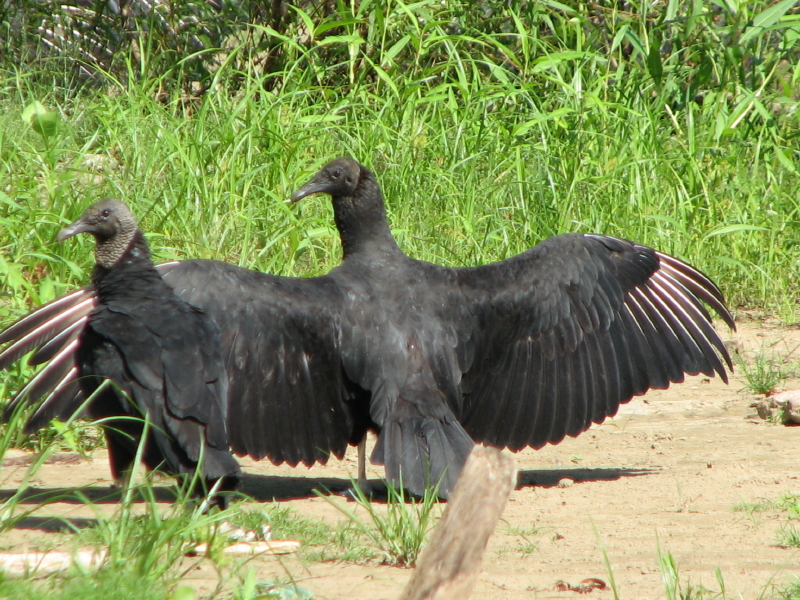
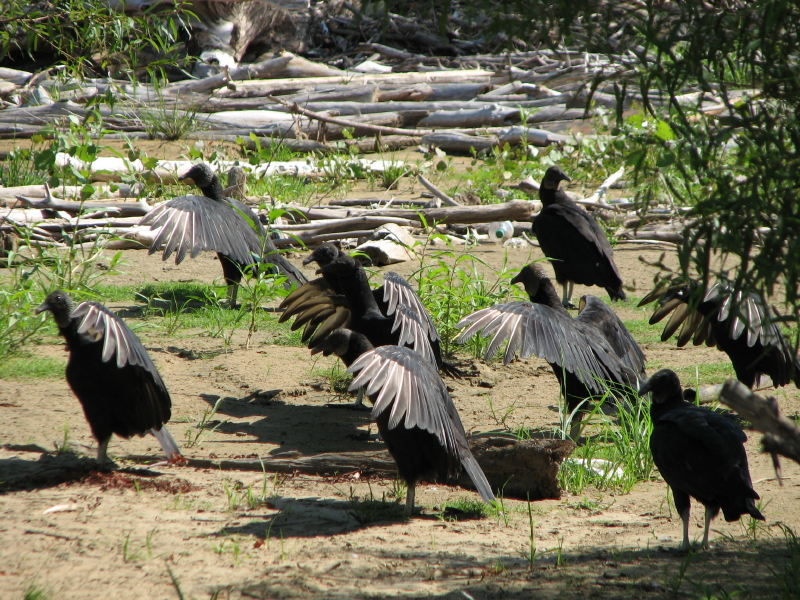
It’s official, this summer was our toastiest.  I looked at the lead article in the local newspaper and words like historic and unprecedented are being used.  We beat the old record that stood since 1936 by a degree and a half!  In meteorological terms that’s a lot.  This was determined by factoring the daily highs and lows and taking the average temp for the day. Louisville had more than 80 above average temperature days this summer which was more than any other city in the country.  No wonder working at the Falls felt so harsh.  We had a number of high pressure systems that just hung around the Ohio Valley making life difficult for everything including these vultures.  Of late, every year has had something climatically anomalous about it.  Too dry, too hot, too wet, too cool…missing are words like usual, normal, ordinary, and uneventful.

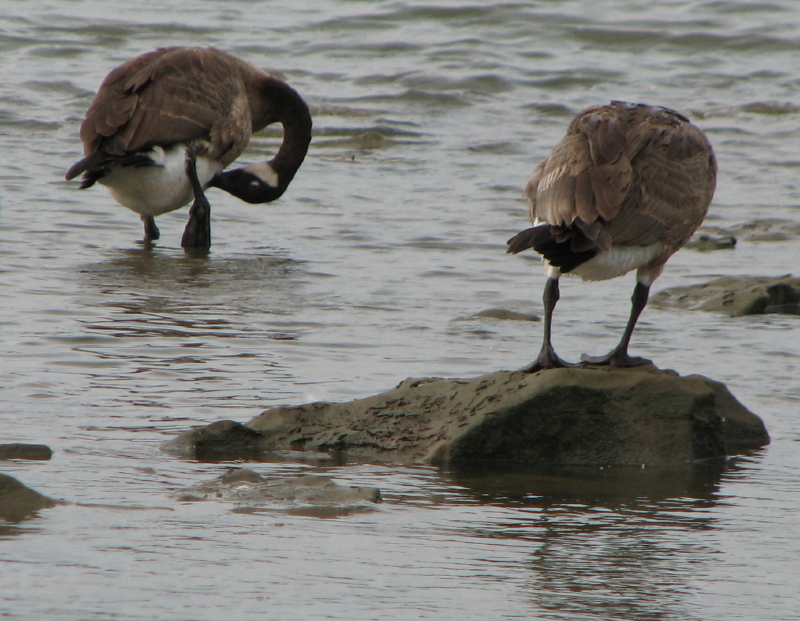
The variety of bird life at the Falls has been down this year too.  When you are a creature that is sensitive to the environment and have the advantage of great mobility…your instincts can tell you to go elsewhere.  I think this is what happened this year.  I will be really curious to see what comes by on the Fall leg of migration.  This year the Black vultures did well as did the Canada geese.  I could count on seeing those two species in good numbers most anytime I came out to the river.

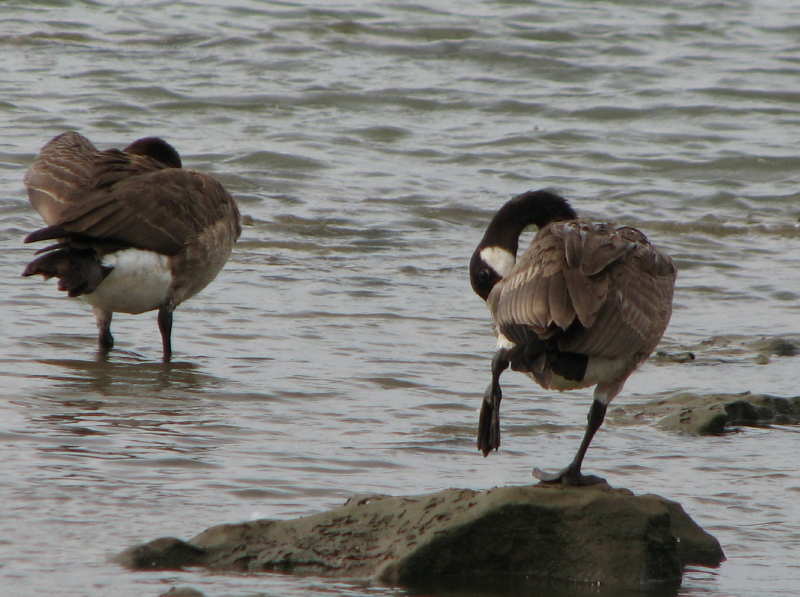
From what I can see “anecdotally” the Canada Geese are on the rise here.  We have few predators to challenge them.  I have seen some very large flocks out on the water and they are keeping the grass clipped short along the riverbank too.  Friends told me that in the “old days”, you could find large stands of native river cane on the margins.  That’s something I don’t ever recall seeing out here.  One of the values I place upon this blog is to act as a record of the environment as I find it.  We have journals and first hand accounts of what this place looked like two hundred years a go and I believe that two hundred years from now…people will still be interested in the Falls of the Ohio and how it has been changed by civilization.

One of my favorite summer birds are American Goldfinches.  There is something cheerful and friendly about them.  The male with his bright yellow and black plumage is an unmistakable bird.  Many times I have watched the dipping and rolling courtship flight and listened for their call notes.  In the past, I have seen this species in mass, but not this year.

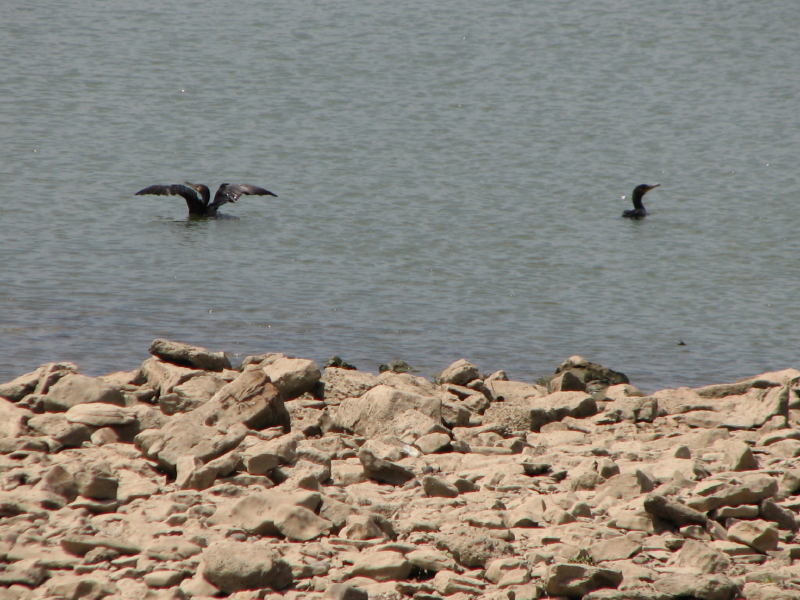
I’ve had conversations with people bragging about their fishing luck or skill, but none of them can hold a candle to a cormorant.  The Double-crested Cormorants in this picture are able to find and catch fish when nothing else can.  Of course, it helps to be able to swim and pursue prey underwater!  These birds are wary and very hard to approach.  In other places of the country, fishermen have persecuted this species because they compete very successfully against the rod and reel.

One of the few interesting and new birds to write about is the Azure-winged Mockingbird.  I have encountered them by my studio under the willow trees.  They are fearless and will drive away larger birds.  Among their notable features is the way they flash their wings against their bodies which makes them look more aggressive.  I have wondered as I make my Styrofoam sculptures, if these birds are drawn to the mosquitos and gnats that find me!  This is not a common bird and has been rarely recorded here.  I expect that in a few weeks, it will be winging its way to Central America.  I wonder if this year’s events in the Gulf of Mexico will compromise it and other birds in some way?  The forecast for this holiday weekend looks great and I’m anxious to spend a bit more time out here on my projects.  I’ll close with one more image of my mockingbird friend and a sculpture still around from several weeks past.

Read Full Post »

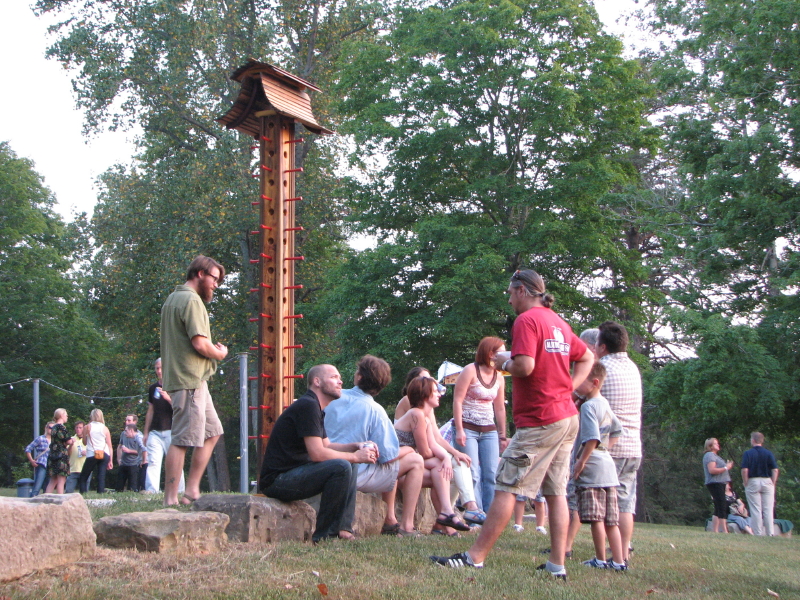
I hustled out to Bernheim Arboretum and Research Forest after supper.  The evening promised a twin bill of fun and I wanted to reach Clermont while the sun was still out.  I was able to take in the “Model Homes and Habitats” exhibition of bird houses and bird inspired art.  The show had a strong Murray State University flavor to it with many past alumni and one current professor showing work.  Murray grad, Brad White assembled the exhibition for Bernheim.  I even saw my old drawing professor Dale Leys there as well which was a nice surprise.  Twenty five years goes by fast!

The designs of the bird houses ranged from the traditional to the conceptual.  Because the light level was getting low, I’m surprised I had images to work with.  Unfortunately, I can’t credit many of the artists because I didn’t see an exhibit guide and some labels were hide to find.  This house with the scary back has a more traditional hole in front.  I liked this picture once I downloaded it from my camera…the house seems to be suspended in mid air.

My friend Raymond Graf had a nice piece in this show.  Inspired by dovecotes and Japanese architecture, this piece looked like a bird skyscraper.  The piece is primarily made of wood and incorporates many Louisville Slugger souvenir baseball bats in its construction. 

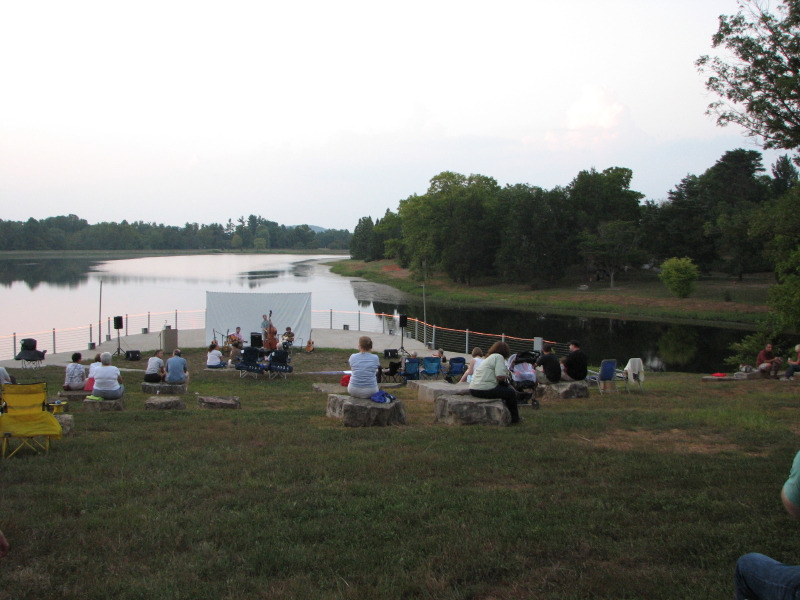
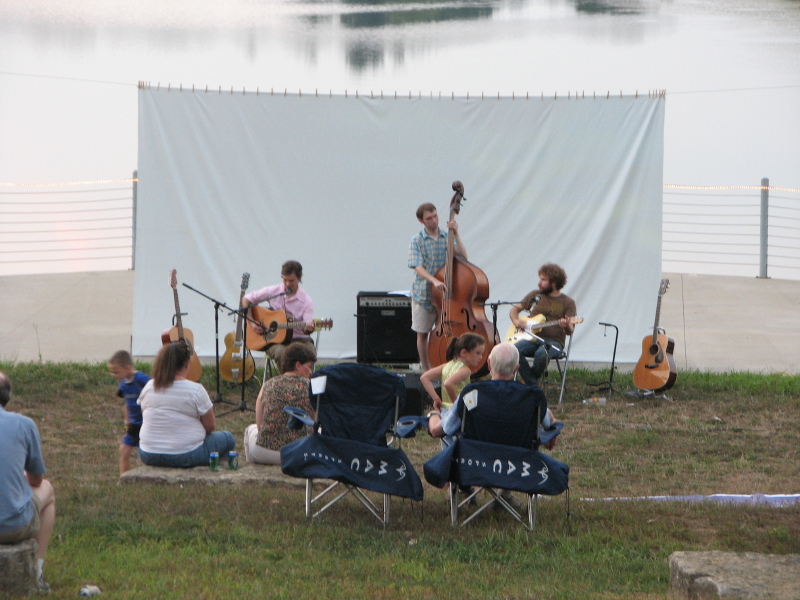
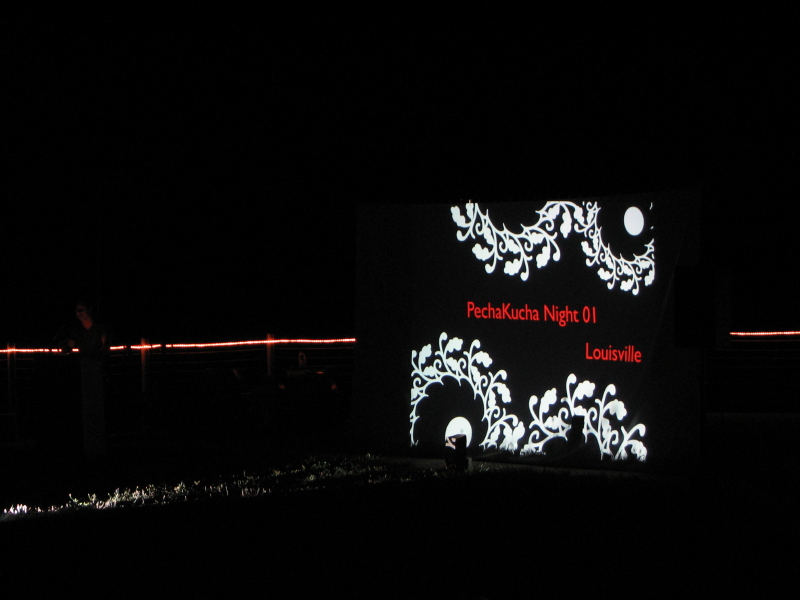
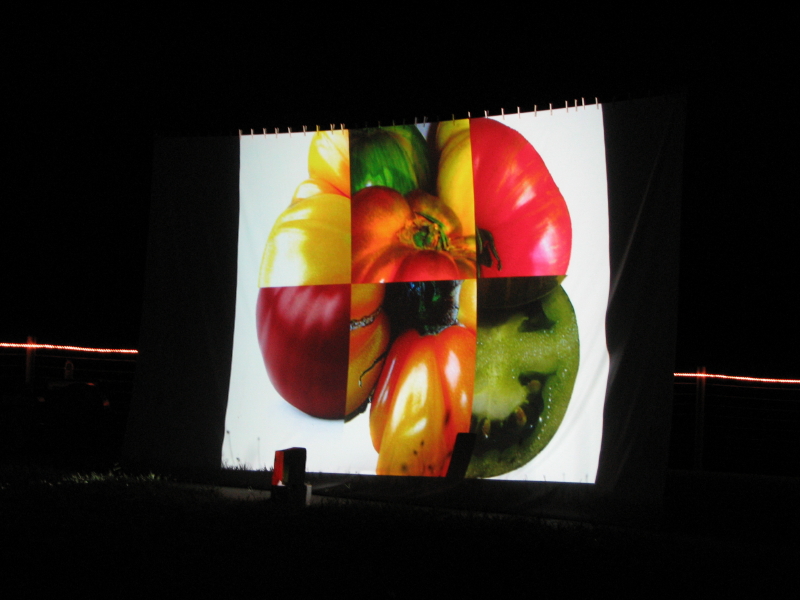
At Bernheim it can be hard to tell how many people are attending an event because the park can accommodate them all.  I know I saw several hundred people enjoying the music, food, and art. The bird houses were scattered along a walking trail.  Once the darkness fell, the white screen behind the band would become center stage.  Folks would concentrate in the informal amphitheater sitting on old limestone blocks from the renovation and expansion of Louisville’s McAlpin Locks and Dam.  Kentucky’s first sanctioned “Pecha Kucha” event was about to start.

Now I will confess that I have never heard of Pecha Kuchas before in fact I kept calling it Machu Picchu all week-long!  Apparently, two American architects decided that the traditional slide show was too boring and could be shortened and made livelier.  The idea is the presenter is limited to 20 projected images and 20 seconds a piece for a total talk of 400 seconds.  That’s it.  Pecha Kucha  is said to be Japanese slang for “chit-chat”.  To me, it sounded like it could have some pace to it like a poetry slam.

Fourteen presenters interpreted the idea that “Mother Nature wants me to tell you something…” in very personal ways.  Many of the speakers were artists who are aligning what they make and do with the needs of the planet.  A concern for where society is going and what should we place value in were common threads in many of the talks.  Not all the presenters were smooth during their 400 seconds and you could tell a few less experienced speakers were nervous, but the crowd supported everyone with applause regardless of the performance!

This evening and the one before it were successful because of the collaboration and partnership between Bernheim and the Carnegie Center for Art and History in New Albany, Indiana.  The weekend began with the opening of Julia Oldham’s “Possumhaw Plant Electrics” exhibit at the Carnegie Center which consisted of four videos and a gallery of wonderful line drawings.  Julia is the 2010 Artist in Residence for Bernheim Forest and the videos were created during her ten week stay.  For those who have followed this blog, Julia is a new friend that I shared a couple of outings with that we posted on our respective blogs.  It was great seeing her in Kentucky again!  Sometimes it’s a big world and sometimes it’s not…perhaps we will meet again?  I hope so.  The next Pecha Kucha will be held in December at the 21C Hotel in Louisville.  That’s another fine venue to take in an event.

Read Full Post »

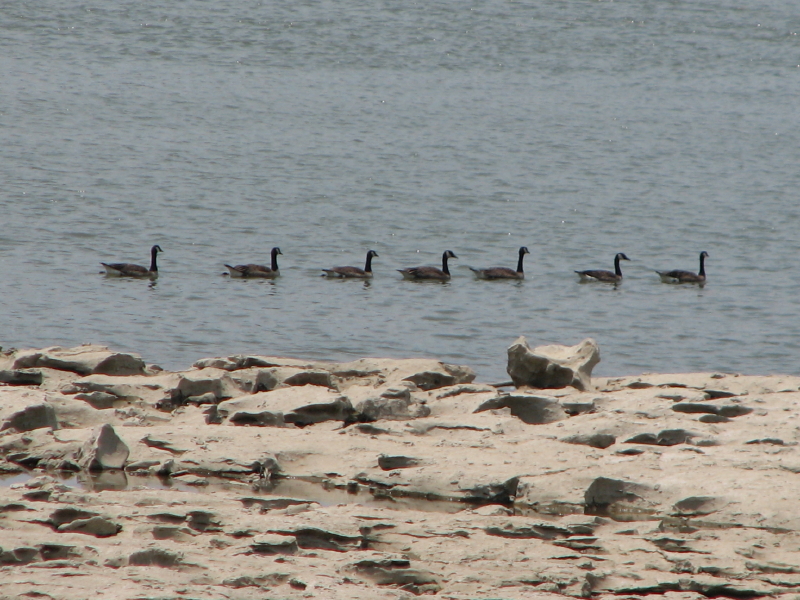
The river is falling, but is not yet in summer pool.  Day by day the extensive Devonian fossil beds are revealed a little at a time.  The limestone surface is scalloped by the actions of the Ohio River and appears to be the landscape from another world…because in fact it is!  Throughout the rocky matrix are the fossilized remains of ancient marine creatures that populated this reef over 375 million years a go.  While my thoughts are lost in deep time, a procession of stately Canada geese glides by which brings me back to the present and my own animal existence.  It is really hot out here today and I brought extra water to drink.  Slowly the first eight geese becomes a large flock as more and more birds reveal themselves that were hiding behind the huge rocks that mark the Kentucky side of the fossil beds.  From my vantage point I count 83 geese which are the most Canada geese I have ever seen here at one time!  In the warmer weather months, the number of bird species here is less than in the spring, but the indigenous birds are entertaining and I enjoy noting aspects of their respective behaviors.  Here are two new birds I haven’t previously featured and I hope you will like them as I do.

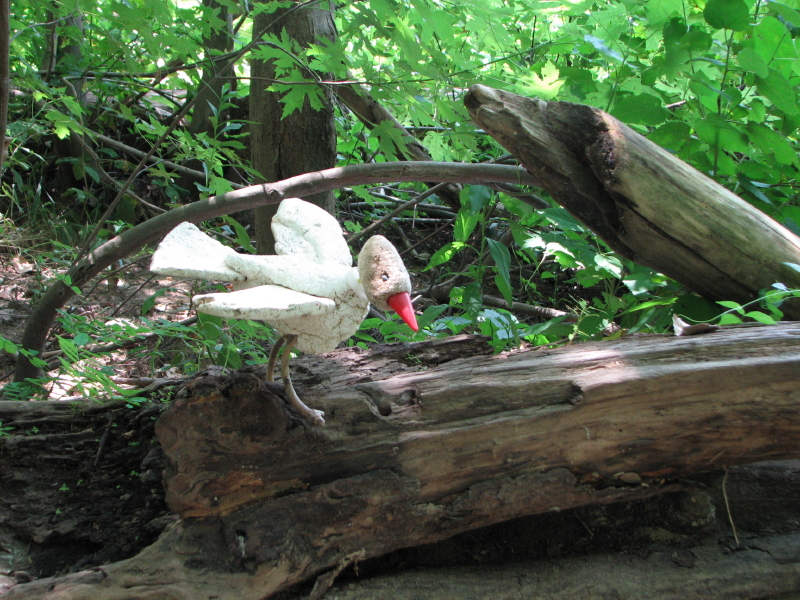
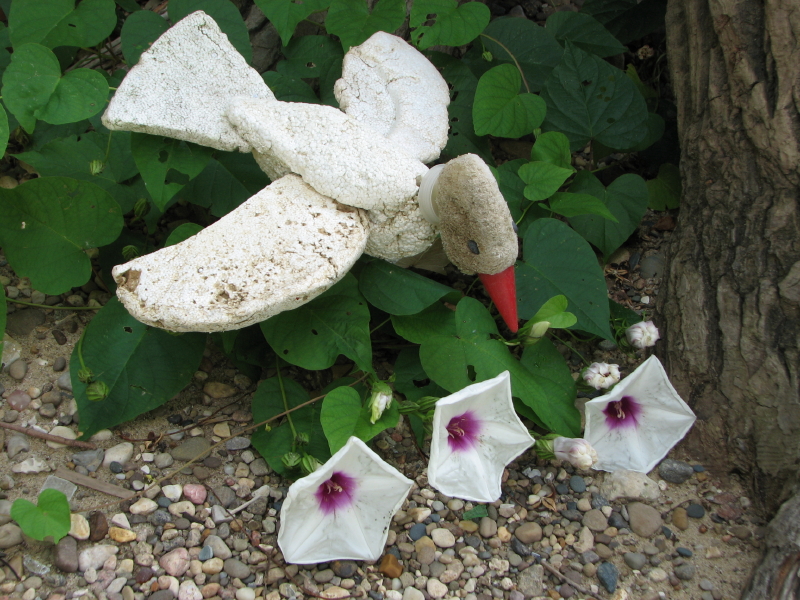
It’s definitely cooler in the deep shade of the woods, but the mosquitoes are more numerous.  I can’t get myself to put poison on my skin to keep them away and so I try not to let them get inside my head.  I suppose that they don’t bother me as much as they do other people.  Maybe I don’t taste as good!  While cooling off by the big trees I came across this unusual species and it’s called more commonly the Bumble Bee Bird.  I think its scientific name is something like “Turdus bombus”, but I could be wrong.  “Turdus” is the genus of thrushes and” bombus” refers to bumble bees.  Seems to make sense.  So, you are probably wondering why this clumsy looking bird is named what it is named and I will show you why.

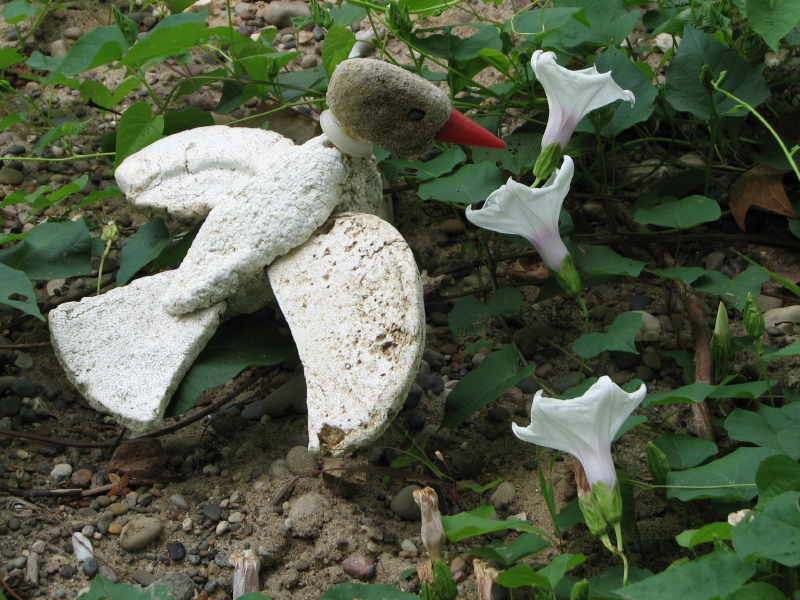
I came across this specimen hanging out at the forest’s edge where many morning glories were present.  These flowers grow close to the soil and sand and in places form thick blooming carpets.  Kind of pretty in an understated way.  Here’s the same bird hopping around some other morning glories, but is he just admiring the flowers or is there some other purpose afoot?

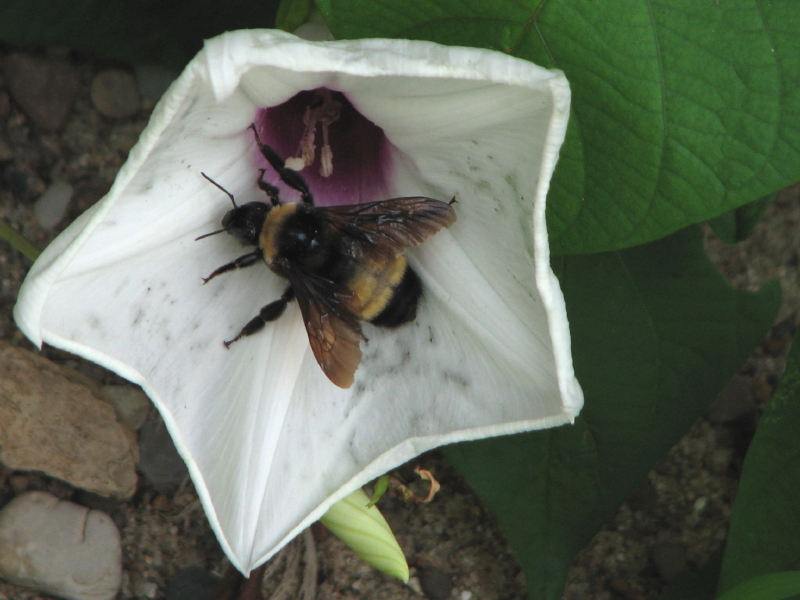
He’s in the deadly serious pursuit of something to eat, but not just any unfortunate creature or seed will do.  This species is aptly named because it has evolved to eat the large bumble bees that pollinate these flowers.

The bird waits for the bee to enter the bloom.  The bee has to get deep into the blossom to reach the sweet nectar it needs.  This is the moment when the bird comes from behind the bee and with its large red bill, seizes the bee crushing it and its nectar-filled abdomen.  The bee had no ability at this point to defend itself.  Stealing the nectar, the bird then tosses the dead bee into the air, catches it, and then swallows it head first.  It’s a doubly good meal and worth the expenditure of energy.

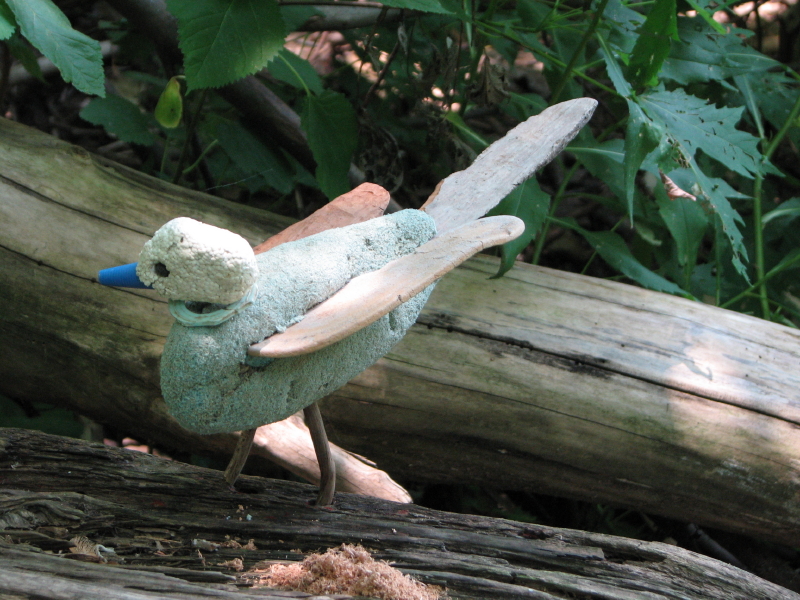
Also found in the cool of the forest is this little bird which is aptly named the Melancholy Dove, scientific name “Columbina melancholia”.  Smallest member of the dove family likely to be found this far north.  It is usually by itself or with a few of its kind and represents the antithesis of a former Falls of the Ohio resident…the now extinct Passenger Pigeon which congregated in immense flocks.  The Melancholy Dove is also recognized by its blue bill and sad expression on its face.  It is not an especially rare bird and I spot this species across the park during the summer season.

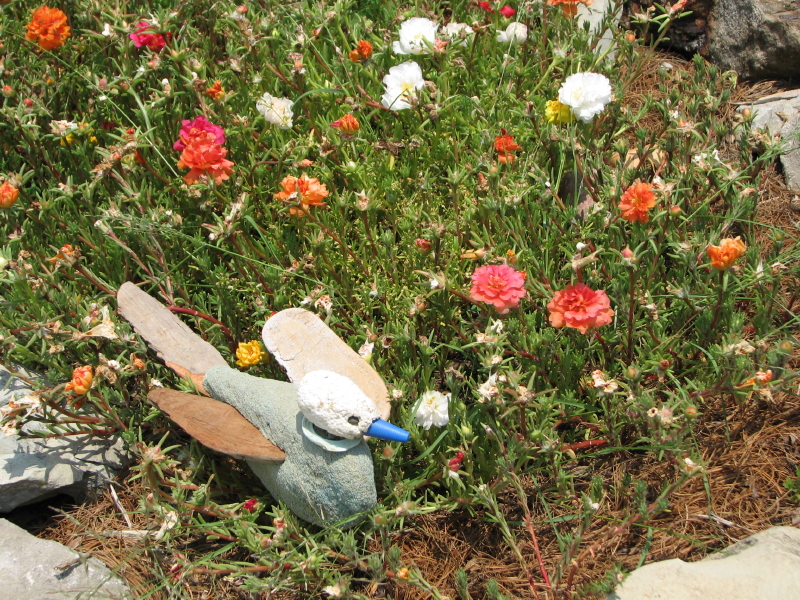
I found this bird sitting in a small garden near the Interpretive Center where it seemed unconcerned about the park visitors.  A nearby bird feeder has made this bird especially trusting and I fear that one of the many feral cats in the area will find an easily ambushed snack waiting on the wing.  Contributing to their melancholy name is the soft, plaintive coo…coo-coowee sound it makes during the breeding season.

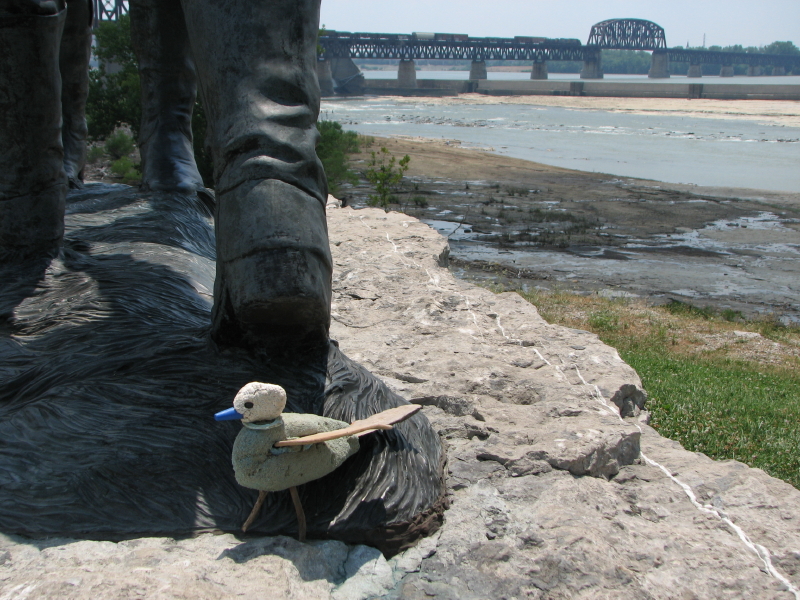
On my way to my vehicle at the end of the day I came across this dove sitting by the Lewis and Clark statue.  It brought back to mind a mental image of a nice pen and ink drawing of this bird that was in one of the personal journals carried by one of the enlisted men that formed the crew of the Corps of Discovery.  I don’t remember the name of the soldier, but he had a fine eye and a sharp quill.  There were a few notes scribbled in the margins commenting that it was too small and not worth the effort to eat!

As summer settles into its now familiar sweltering pattern, I’m looking eagerly to the time when I can cross over the shallow water and explore the Kentucky side of the fossil beds.  There isn’t as much junk to find to make “art” from, but it’s a contemplative landscape for me that has also become something of a seasonal right of passage.  It takes all day to walk across the rocks and I’ll need plenty of water to keep me hydrated, but it is such an interesting place and I look forward to sharing it with you.  Stay cool everybody…the weatherman is calling for some hot ones this week.

Read Full Post »

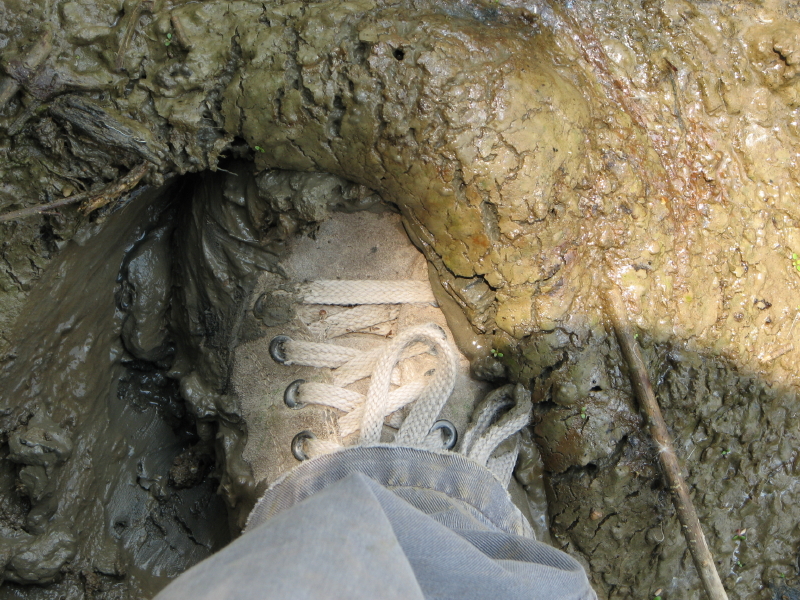
Before the month of May slid into history, I did a little sliding of my own.  The day after Julia and I visited Nerinx, I did a solo expedition to the western section of the Falls of the Ohio State Park.  Now the sliding part has to do with mud!  In places the earth was high and dry, but in key areas  the mud remained slippery and sticky.  Here’s a picture of what I mean.

It’s creamy and in places you could sink in over your ankles.  To get things over with so I don’t have to obsess about this, well I just find some mud and step into it.  After that there are no worries about remaining clean!  The deed is done.  I have a similar philosophy about the rain.  Once I’m as wet as I can get…I can relax and do my thing as long as I don’t get too cold.  The mud is more treacherous closer to the river’s edge and I decide not to flirt with it too much.  There is afterall, much to see around here.

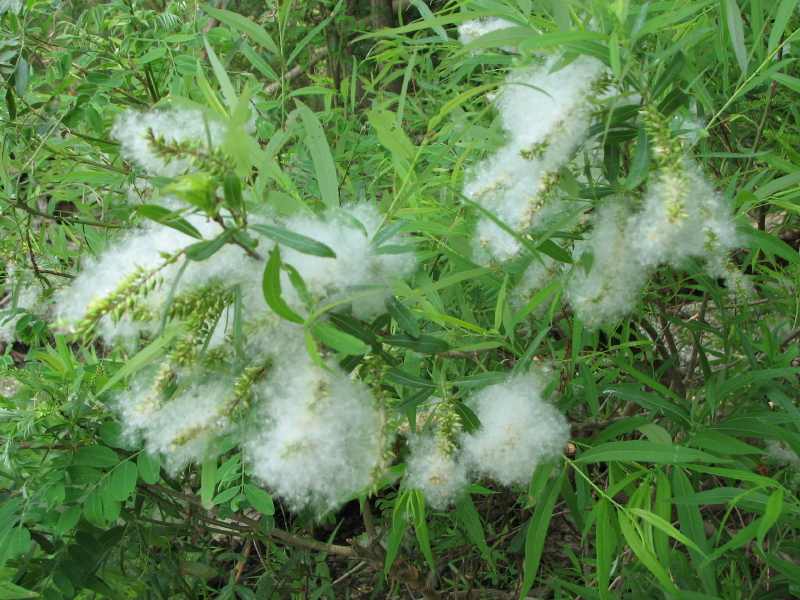
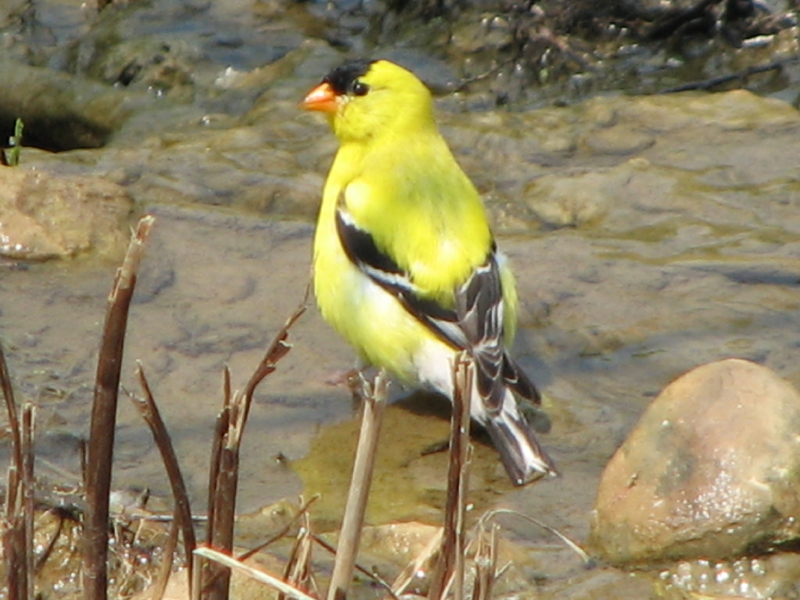
The willows are in maximum fluff production and there are drifts of the stuff on the ground.  When the wind stirs then the willow seeds become air born and are carried away.  With so much fluff, you would think willows would be even more common than they are.  I have to say that so far, I haven’t seen any birds that have made my year.  Last year’s signature bird was the Summer Tanager.  This year hasn’t been the warbler fest that I experienced just two years a go.  Still, I take what I can get and I always love American Goldfinches.  Here’s a male taking a dip in some water.  Small flocks cruise along the trees nearest the river.

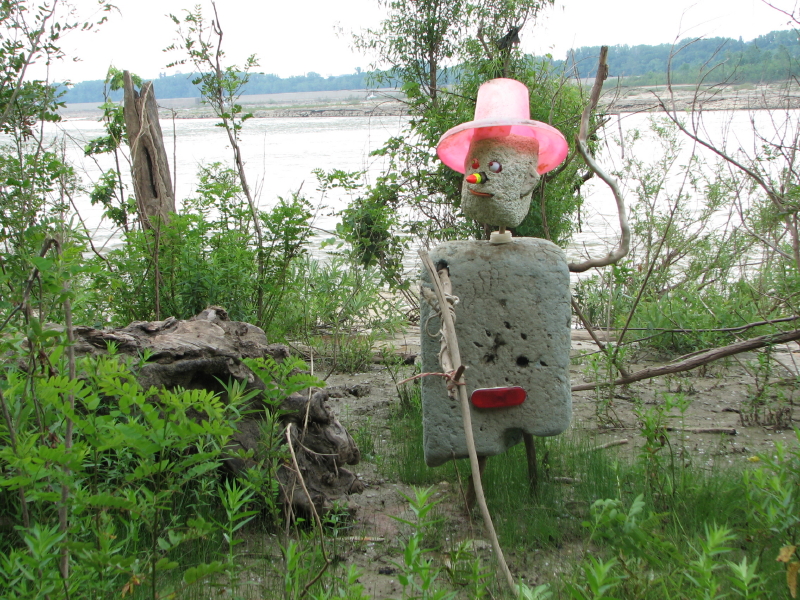
I’m walking west along the river and I came across the only persona that I saw all day.  We eye-balled each other, decided that neither was a threat and so we had a short conversation.  Mostly, it was an opportunity to compare nature notes.  I guess the feature that most stood out about my acquaintance is the bright pink hat she? is wearing.  I said I was looking for birds and junk and “she” said that she was a Lepidopterist.  Oddly, we didn’t introduce ourselves, but she let me take her picture for my blog.  I guess she’s about five feet tall or so and walked with a cane.

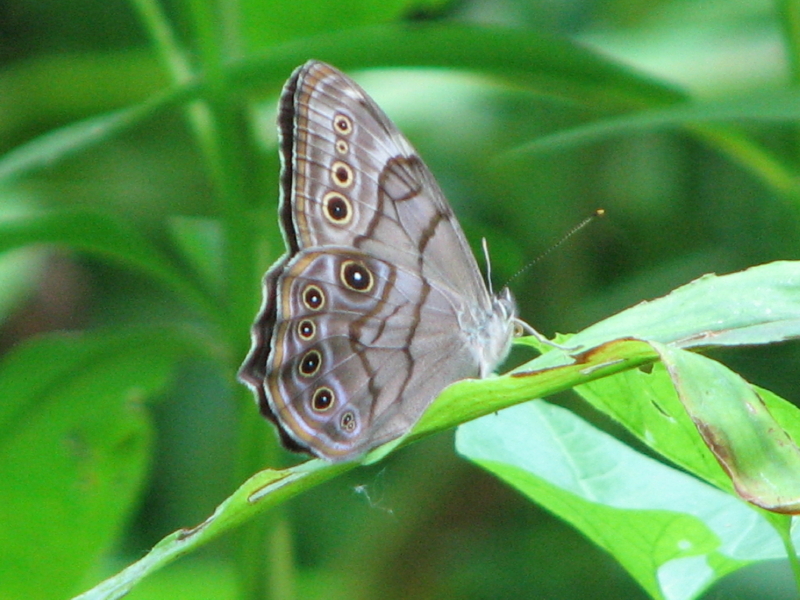
After I asked if she had seen any interesting birds…she hadn’t.  I was asked about what butterflies I had come across.  Fortunately, I also like butterflies and try to take their pictures when both insect and camera cooperate.  I really don’t like these autofocus cameras.  Anyway, I noticed many species out on this day including Commas, Mourning Cloaks, Cabbage Whites and then I showed her images of the two butterflies that I did get decent pictures of and she seemed happy to identify them for me.  Here is the more unusual of the two that I came across at the forest’s edge.

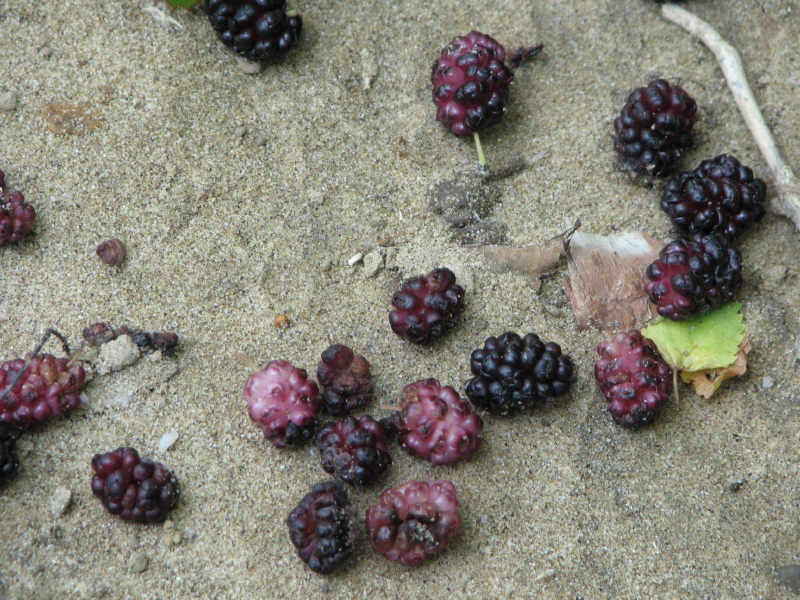
Quickly my new friend identified this as being Enodia anthedon or more commonly, the Northern Pearly Eye.  It is a forest butterfly that does not come to flowers preferring instead the fermenting juices of fruits and tree saps.  I reply that I had noticed that there were many butterflies around the fallen mulberries and on the sides of the willow trees. 

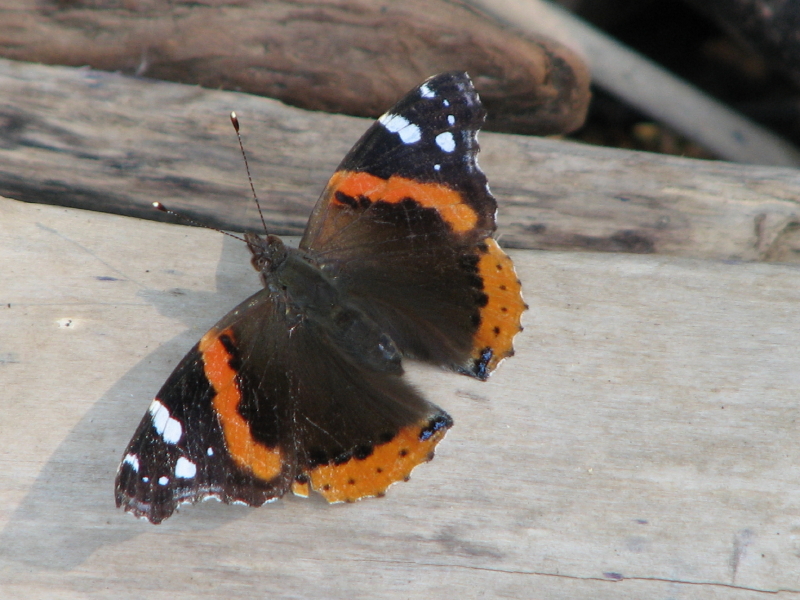
I wonder if science has determined if a butterfly can get drunk off the fermented juice and if this is possible…do they experience hangovers?  I know this does happen with birds like Cedar Waxwings that literally get tipsy.  The second butterfly is one that many people know and it’s the pretty Red Admiral or Vanessa atalanta . Even its scientific name is charming.  This is a people friendly butterfly and will often alight upon a person.  I came across dozens of these today.

With the rising heat the promised threat of a late afternoon thunderstorm began to materialize.  First there was the distant sound of thunder and since I had a hike to still make to reach my car…I said farewell to my butterfly friend whom I hope to see again.  I asked before parting if she collected butterflies and she answered that once she had, but was now over that part of her interest in them.  She no longer needed to possess them and instead grew flowers and plants to attract them.

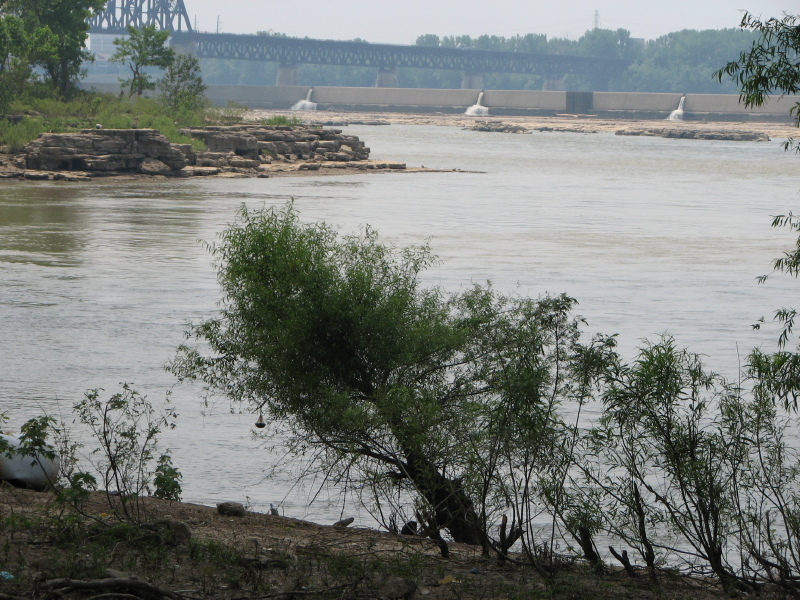
I hope I run into the lady with the pink hat again.  She seemed to share a reverence for the life that is out here in the park.  I would welcome learning more about the butterflies that call this place their home.  One last shot showing willows, the riverbank, fossil cliffs, and the dam in the far distance that keeps the river at bay…most of the time.

Read Full Post »

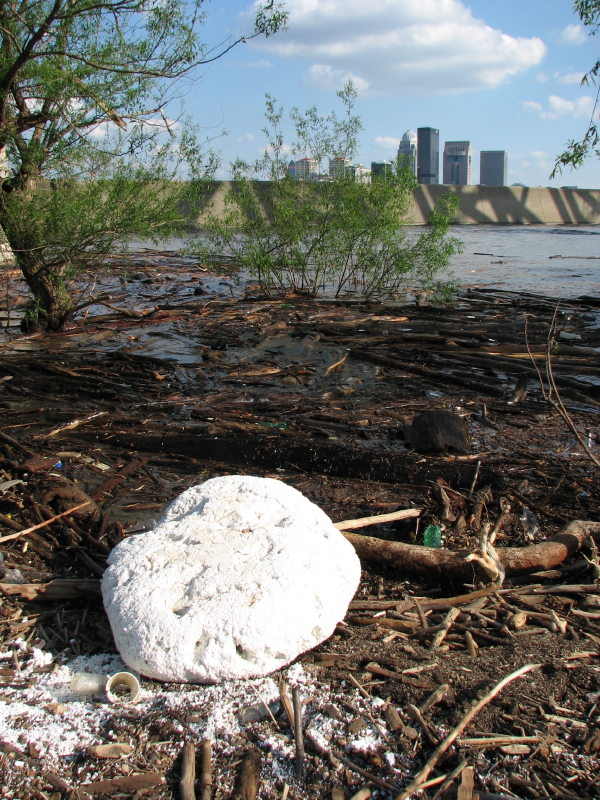
I never have a dull visit to the Falls of the Ohio.  Each time I come out here I can expect an adventure of one type or another.  On this day the river had noticeably receded and this large boulder of Styrofoam that I had been watching for days as it floated out here was finally on the shore.  I tried to move it, but it was so waterlogged and heavy that I gave up…for now.  All around it were Styro-bits that were ground off by abrading against logs and the sandy bottom.

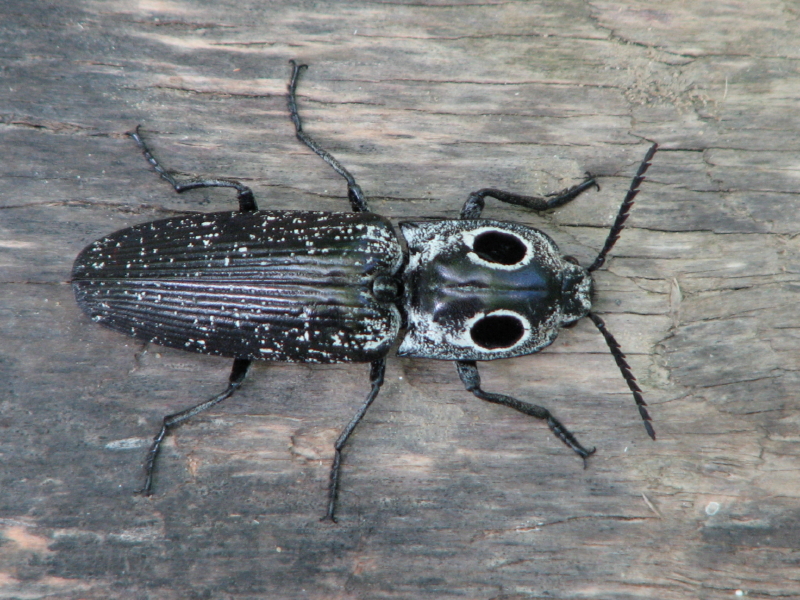
Near my polystyrene giant was this section of the riverbank.  It’s the aftermath of a tug of war we are engaging in with the planet.  In this type of struggle there are no winners.  Recent images from the oil spill in the Gulf of Mexico come to mind which incredibly still flows unabated weeks later.  Since much of the garbage in this photo is derived from petrochemicals, I wonder if this also could qualify as an oil spill?  If I scooped up a handful of sand around here…I would see tiny bits of plastic and the ever-present polystyrene bead.  This stuff is likely to never go away.  But life does try to keep carrying on as it always has.  I also came across this interesting beetle and a smile returned to my face.

I have seen these out here before.  It’s an Eastern Eyed Click Beetle and I think I read somewhere that this is our largest click beetle.  If you placed this beetle on its back, it would flip right side up with an audible “click”.  Hence click beetle.  There are other species, but they are all smaller.  This one is just under two inches (about five centimeters).  It’s coloration is similar to a bird dropping, but it also has these dramatic eyes on its pronotum.  These guys do fly, but most of their lives are spent as larvae living in decayed wood.  I passed by the mulberry tree with its ripening berries and there are birds who just can’t resist this plentiful food source.

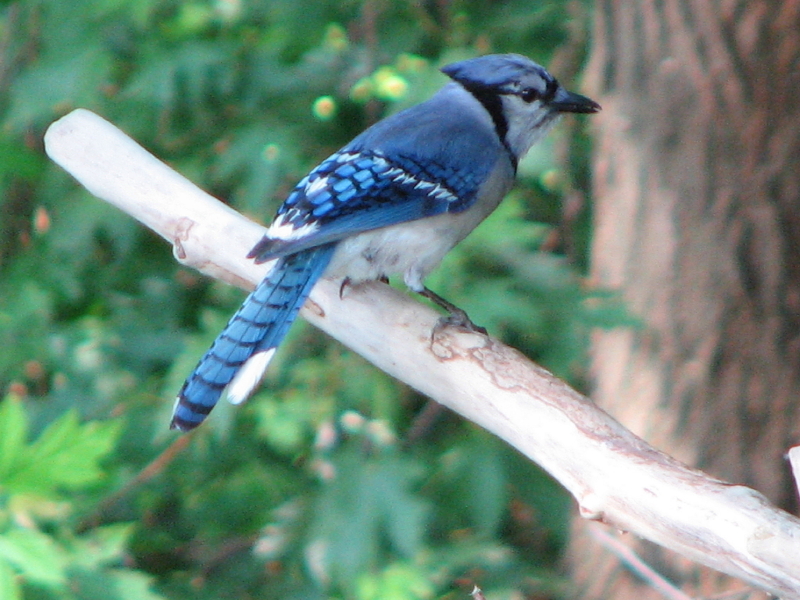
Among the bird species eating fruit from this tree included this Blue Jay…

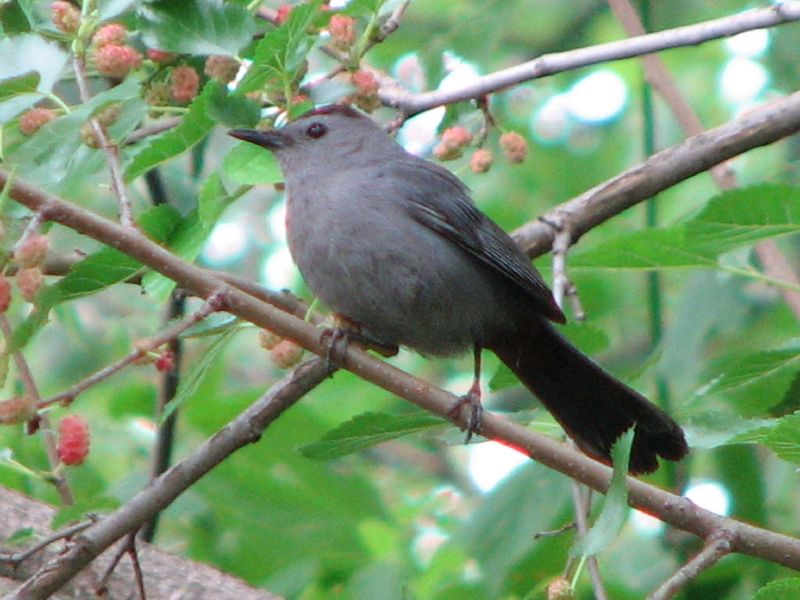
…and this Catbird which does make odd sounds which sometimes sound like the mewing of a cat (hence catbird!).  They can be quite territorial to their own and other species too.

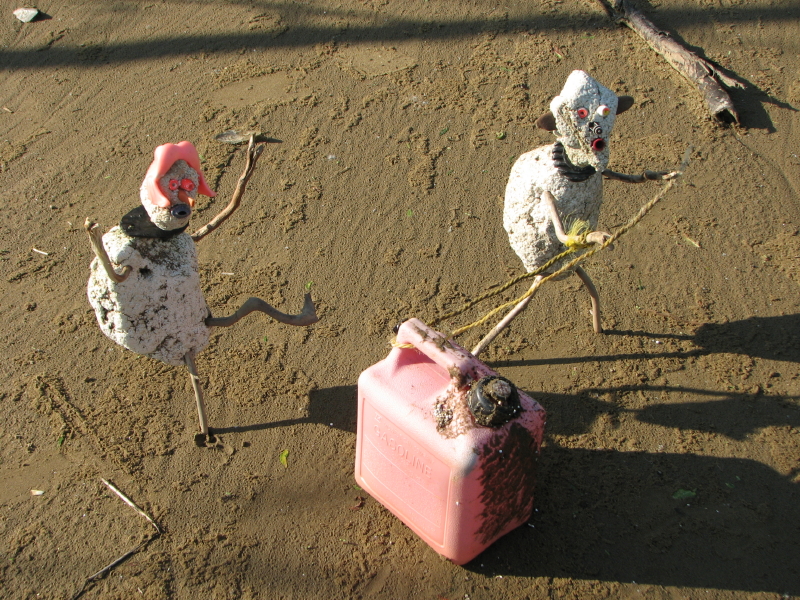
Not too far from this tree, I could hear some squabbling going on and I moved towards the sound.  You can imagine my surprise when I came upon this scene!  I stayed hidden behind a large willow and just observed.

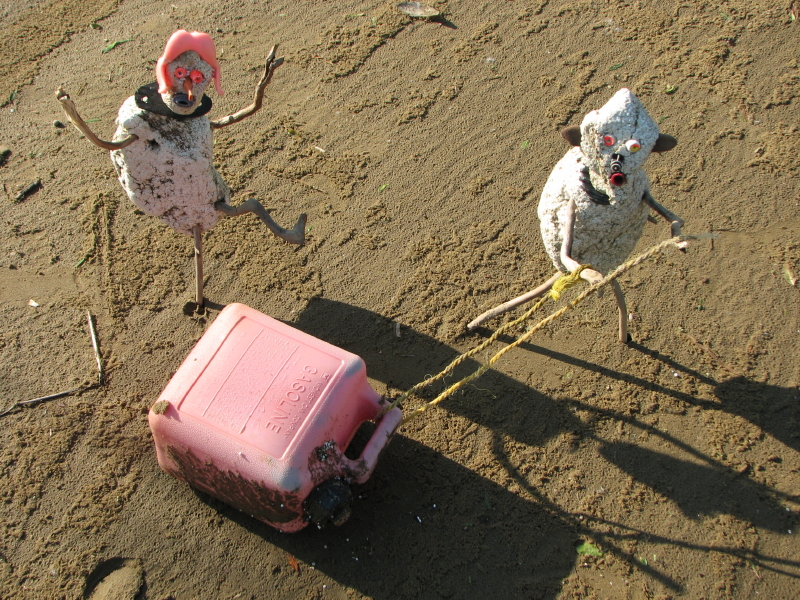
There were these two little figures and one of them was tugging on a rope attached to a plastic gasoline container and his “friend” with the wierd hairdo was jumping up and down on one leg trying to get him to stop!

The figure with the rope eventually succeeded in knocking the container over while his friend continued hopping!  What he thought he was going to do with this gas can is a mystery?  He soon grew frustrated with his efforts and a shouting match between the two began.  That deteriorated into another contest where each tried to take the rope from the other.

All this effort must have been exhausting because after a little while they gave up and abandoned the rope and the gas can leaving them lying on the sand.  They reconciled and walked away from here hand in hand. 

Perhaps they realized the futility of their struggle and came to their senses?  Perhaps they recognized that it was better to conserve their energies for more constructive pursuits?  Who knows, but while I pondered these questions I came across another image of futility and I will leave you with that until next time.

Read Full Post »

« Newer Posts - Older Posts »