Feeds:
Posts
Comments

Archive for the ‘birds and birding’ Category

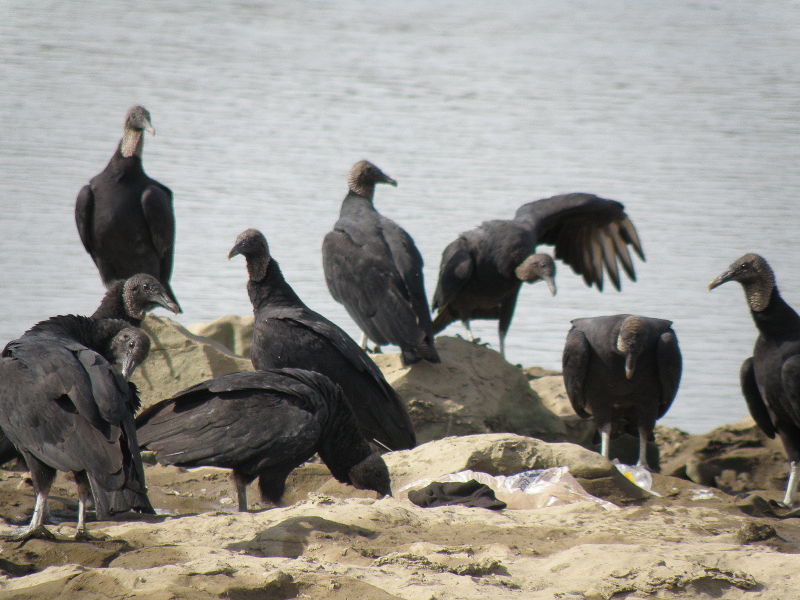
Black Vultures on the Fossil Beds, Falls of the Ohio, Sept. 2013

The resident flock of Black Vultures were taking advantage of the fossil beds now exposed on the Kentucky side  of the Falls of the Ohio.  The wier dams were temporarily closed and with it the flow of water.  With the river level reduced much of the sculpted limestone normally underwater is briefly seen again.  Fishermen have been accessing new fishing spots along the freshly revealed fossil beds which turns out to be a boon for the vultures.  Not only do they get to feast on fish left by the anglers, but they also enjoy any other trash including left over fishing bait.  Early autumn is a transitional season among the park’s bird life as residents gear up for over-wintering or prepare for the southerly migration.  Birds from the northern latitudes particularly Canada and the Arctic Circle pass through our area on their epic journeys to Central and South America.
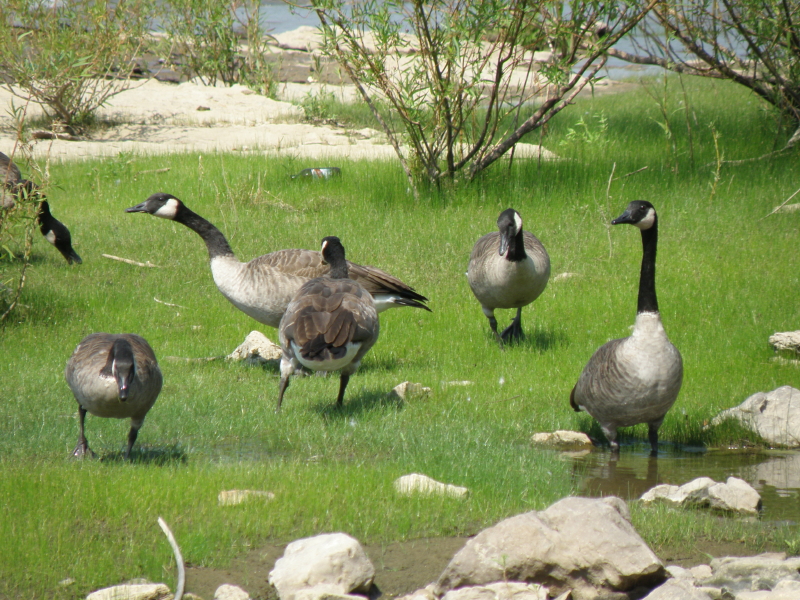
Canada Geese feeding on grass, Falls of the Ohio, Sept. 2013

The vultures will fly away, but many of our Canada Geese will brave it out.  We seem to have at least two distinct flocks of Canada Geese sharing the area around the fossil beds.  It’s amazing how intolerant each group is of the other.  There is competition for the best food sites and each group frequently bump into one another with much squabbling.  That’s what makes the next image interesting to me.

Domestic goose mixed with the Canada Geese, Falls, Sept. 2013

Canada Geese can have limits on how much mingling occurs between their own species, but in this case, are willing to accept a true outsider.  This domestic goose seemed integrated into its adoptive flock.  It swam with its wild cousins and accompanied them to a favorite feeding location and was never bothered by the other geese.  Recently, I came across a young Cooper’s Hawk and I was surprised when it did not immediately fly away after I bumbled across it.  There was a good reason why it didn’t leave.
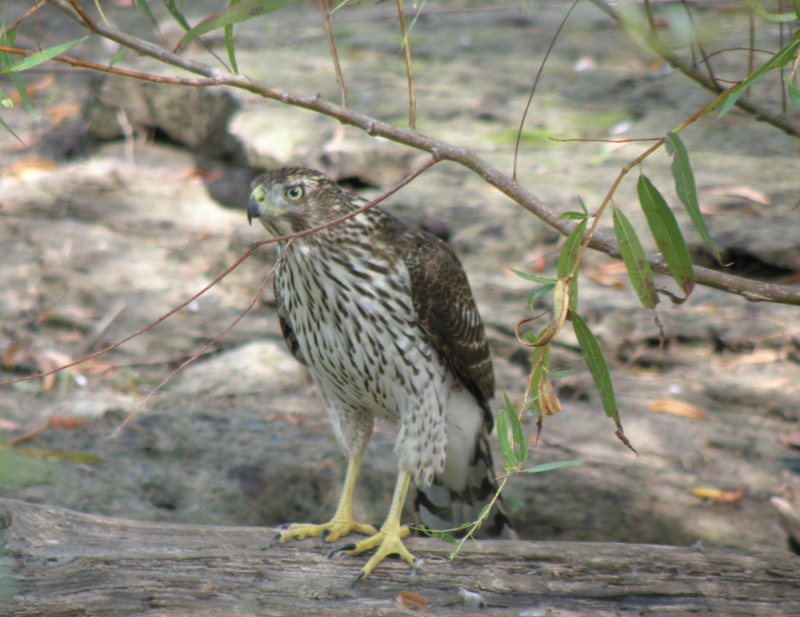
Young Cooper's Hawk, Falls of the Ohio, Sept. 2013

The hawk sized me up and then jumped down off the log it was standing on to retrieve something it had dropped.
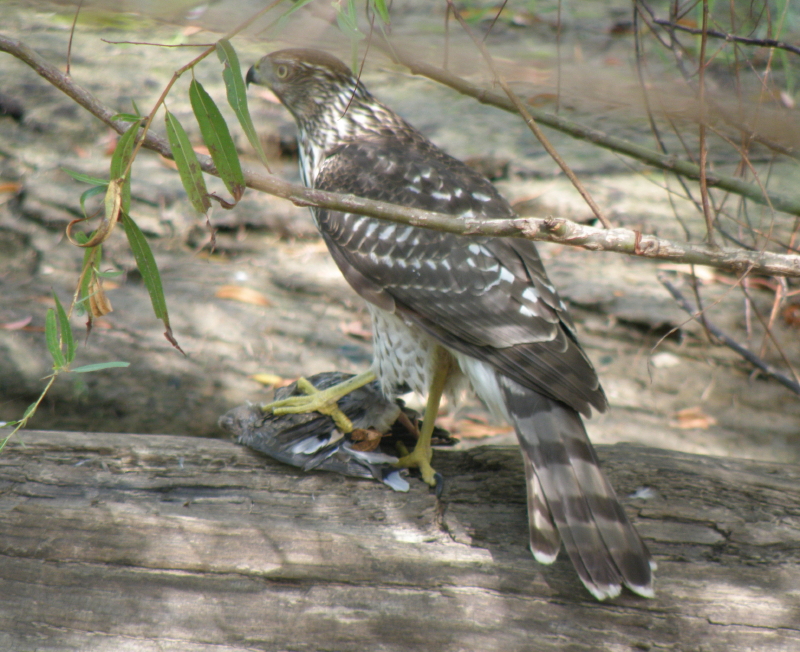
Young Cooper's Hawk with prey, Falls of the Ohio, Sept. 2013

The hawk had what appeared to be a freshly killed Mourning Dove.  After securing its prey with its talons, the hawk seemingly jumped into the sky and  vanished within moments.  I thought I saw it disappearing into the tree tops of a stand of willow trees within walking distance.  I did investigate the area, but never saw the bird again.  I love it when I get to observe behaviors.  Life has a job to do and can’t wait around posing for pictures.  Here’s a different kind of behavior being demonstrated by an American Robin.

American Robin bathing at the Falls of the Ohio, Summer 2013

I love this image which I captured earlier in the summer.  This American Robin is focused on taking a bath.  Its head is under the shallow water and droplets and beads of water are splashed over its body.  Our resident American Robin population is doing well and seem to be increasing at the Falls of the Ohio.  Some of the robins will hang out over our gray winter, while others will seek warmer climes.  My last adventure to the Falls resulted in images of a bird that I had never recorded previously in the park.

Gross Blue Bill at the Falls of the Ohio, Falls of the Ohio, Sept. 2013

Gross Blue Beak and flowering plants, Falls of the Ohio, Sept. 2013

The Gross Blue Beak is strictly passing through and in fact, this is the first recorded instance of this bird appearing in the park.  Good thing I have all this photographic proof that the bird was here because the resident birders are a skeptical lot.  Reputations and lifetime bird lists are at stake and there is a great burden of proof to produce irrefutable documentation.  This bird has traveled thousands of miles from the edge of the Arctic Circle in Canada and is bound for the Argentine coast.

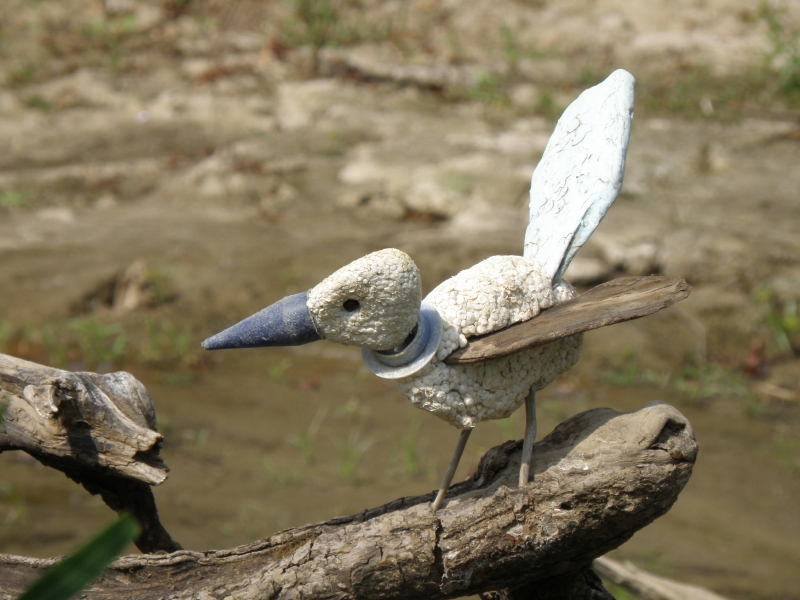
Gross Blue Beak with corroded aerosol can, Falls of the Ohio, Sept. 2013

portrait of a Gross Blue Beak at the Falls of the Ohio, Sept. 2013

The Gross Blue Beak receives its name not because it has disgusting habits that require an out-sized bill.  Rather the “Gross” idea comes from the German word for “large” .  The Ohio River Valley was settled by many immigrant groups and the Germans were among the most prominent.  This bird’s beak is a heavy-duty tool it uses to crack open nuts, crush mollusks (particularly snails), and jack hammer soft decaying logs in pursuit of beetle grubs.  All three of these food sources are found at the Falls of the Ohio.
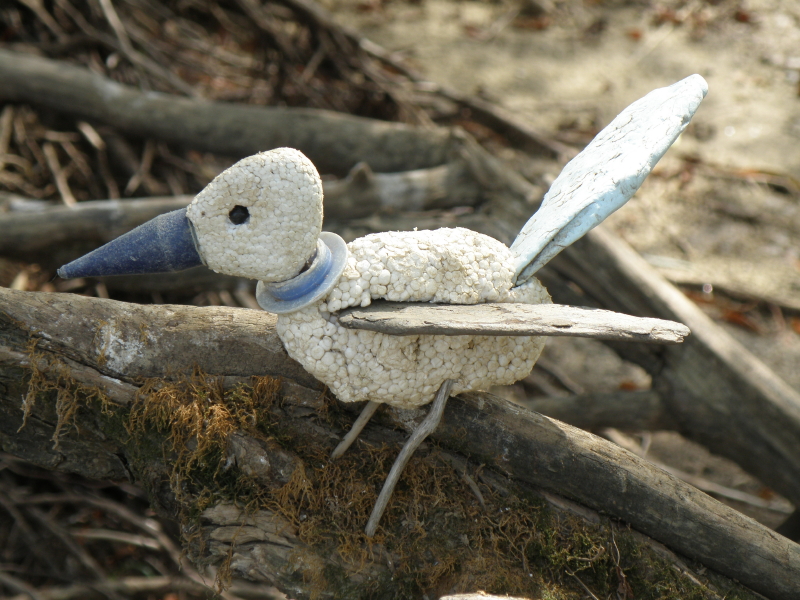
Gross Blue Beak at the Falls of the Ohio, Sept. 2013

I was able to get quite close to the Gross Blue Beak to snap off these images.  I’ve noticed before that many northern migrants of various species will allow me to approach more closely than the local birds that are around people more.  Perhaps that’s the key?  For the moment, the region around the Arctic Circle has seen less of our influence than other places in North America.  To close, I have one other bird image, but it is noteworthy because of the people in the far distance.  Recently, I received a question about the back wall that is a part of the system in place to produce a stable pool of river water for commercial barge traffic.  I’ve heard that the Ohio River carries more tonnage of goods along it’s 800 plus miles than the Rhine River does in Europe.  The back wall of this dam is quite high up and the actual river level is perhaps a meter or so below the top of the wall.  Beyond the Great Blue Herons, the small band of hikers provides some sense of scale on how the river would be over their heads!  When you are walking the now exposed fossil beds…it’s a sobering thought!
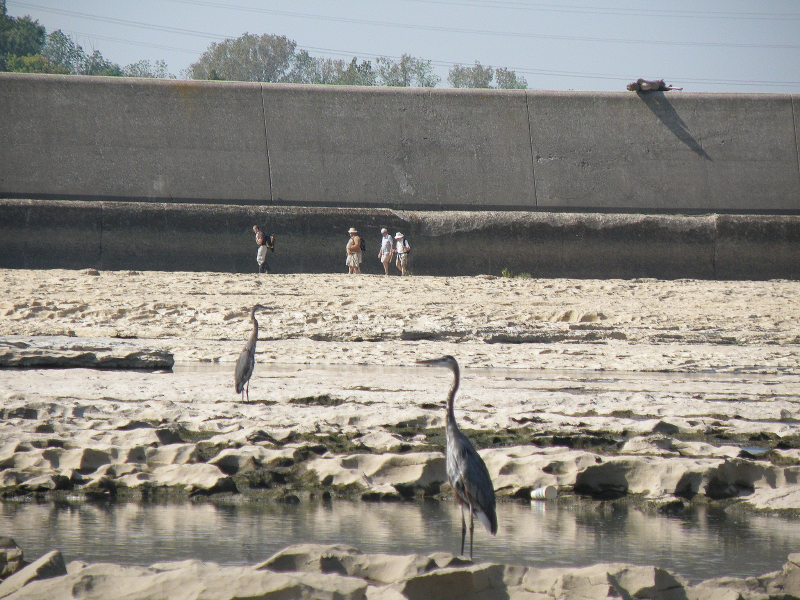
Great Blue Herons and hikers on the fossil beds, Falls of the Ohio, Sept. 2013

Read Full Post »

Muddy Ohio River at the Falls of the Ohio

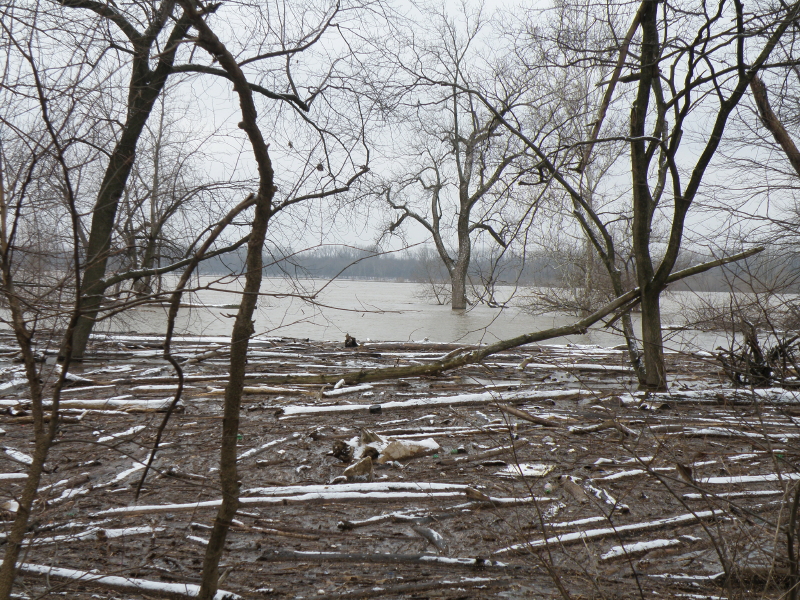
The Ohio River has remained high and muddy the last couple of weeks.  It’s summer, past mid July when we usually find the river retreated to its summer pool.  This approaches the time when the fossil beds on the Kentucky side of the river would be exposed.  The little bit of flooding that occurred has displaced more than random logs and debris.  I was investigating the riverbank under the railroad bridge and came across an interesting mix of ducks.

domestic and wild ducks at the Falls of the Ohio, July 2013

Joining the wild, female Mallards with their iridescent blue-violet speculum on their wings was a small group of domesticated ducks.  More than likely the river overwhelmed a farm pond somewhere which was the opportunity the domesticated ducks needed to swim away and explore the larger world.

Domestic ducks, July 2013

They landed at the Falls of the Ohio and are sharing a vacation together.  White and piebald (a mix of black and white) are the colors of domestication.  These farm ducks are also much larger than their wilder cousins.

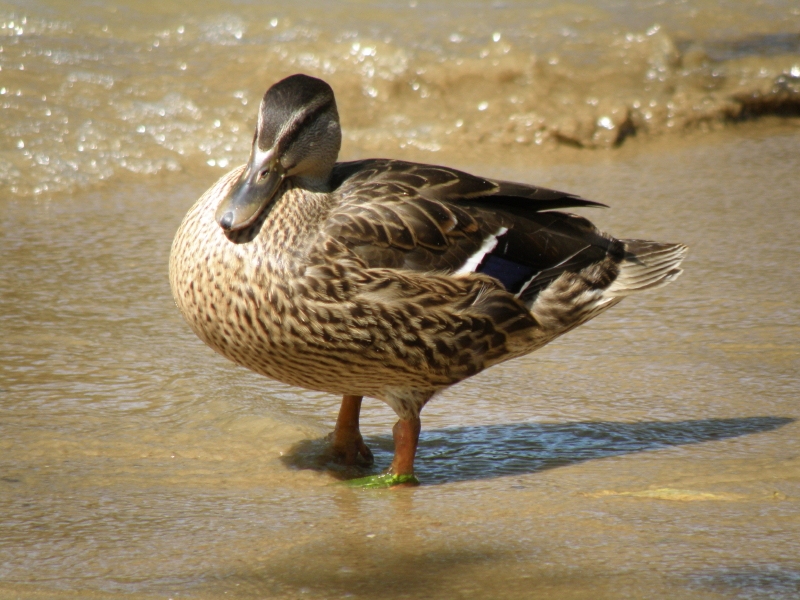
two resting female Mallard ducks, July 2013

female Mallard duck, July 2013

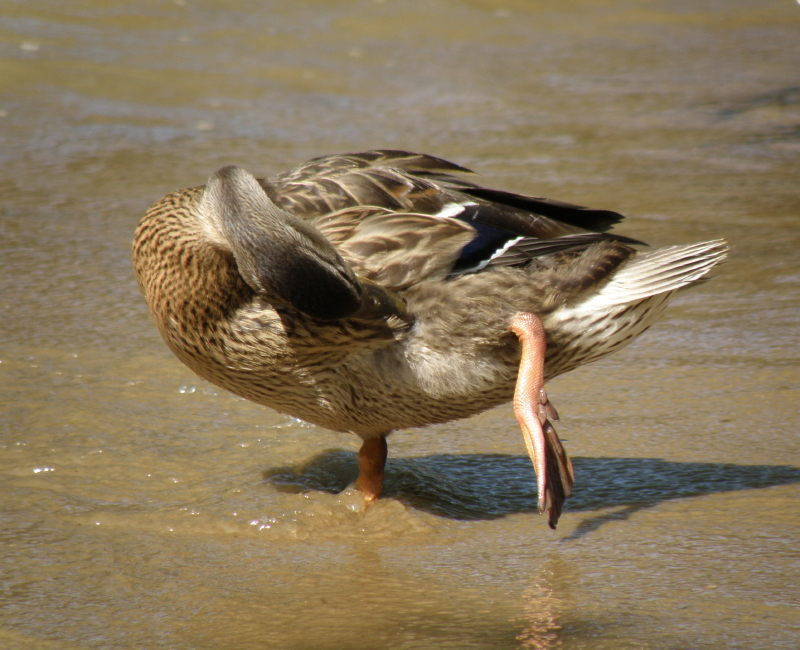
female Mallard duck grooming, July 2013, Falls of the Ohio

The Mallard duck (Anas platyrhynchos) is our most common species of duck and can be found at the Falls throughout the year.  I once stumbled upon a Mallard nest that was built inside a hollow log.  When the mother-to-be flushed out of the log, the surprise took a few years off my lifespan!   They are members of the duck family known as “dabblers”.  Mallards hang out near the zone where water and land meet.  They have specialized bills for feeding in shallow water.  Mallards prefer small grass and sedge seeds for food, but will also strain the water and mud for small organisms.  I have come across other ducks at the Falls of the Ohio that are hybrids of Mallards and domesticated ducks.  Many duck species must be closely related to one another because other inter-species hybrids have been documented.
Blue-ringed dabbler, Falls of the Ohio, July 2013

Head of Blue-ringed dabbler, July 2013

I have also recently photographed an unusual duck for the Falls of the Ohio.  On a recent foray to the river I came across this Blue-ringed Dabbler ( Anas azurcephalos) plying its trade at the water’s edge.  This diminutive duck is native to the western part of North America and rarely strays east of the Mississippi River.  Perhaps it found its way here because of the recent storms that have tracked west to east across the country?  Domesticated ducks are not the only birds affected by severe weather.

Blue-ringed Dabbler at the Falls of the Ohio, July 2013

The Blue-ringed Dabbler is an unusual duck in that it nests in trees or more specifically, in the holes created and abandoned by larger woodpeckers.  This formerly rare duck is now on the increase because conservationists have taken advantage of this breeding preference by setting out nest boxes which the Blue-ringed Dabbler will accept.  A similar program helped the colorful Wood Duck to recoup its former population numbers.

Blue-ringed Dabbler, Falls of the Ohio, July 2013

This is a female Blue-ringed Dabbler identified by its browner coloration and lack of iridescent color on the wings.  The dabbler regarded me for a while before swimming off to a deeper part of the river where I lost track of it.  I returned the next day to see if I could find this duck again, but it was gone.  I get a big kick out of recording bird species that are not a part of the official bird checklist distributed by the Falls of the Ohio State Park.  I love bringing these rarities to the attention of hard-core birders who will only accept as evidence good photographic proof or multiple sightings recorded by multiple birders.  They can be a suspicious lot and highly competitive.  Often bird watchers present themselves as being more interested in what number a particular bird represents on a life list than in the bird itself which seems to me to miss the whole point of watching birds.

domestic ducks with dead catfish, July 2013

Although I never saw the Blue-ringed Dabbler again, I did however, locate a couple of the domesticated ducks I had seen the previous week.  They were investigating the waterline in a particularly muddy area.  I was shocked to discover the dead fish in the foreground upon downloading my images.  I certainly don’t remember seeing this when I snapped this picture.   I doubt these ducks will ever find their way to the farm again, but for now…they seem content.  I’ll end today’s post with one other image of the Blue-ringed Dabbler that I came across on the internet.  It shows a bird in the hand of a conservationist.  So long for now!
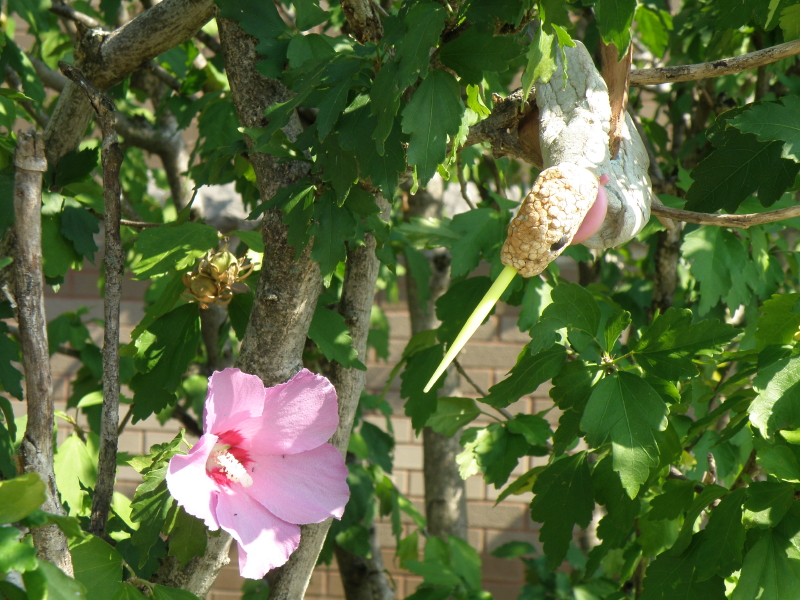
Blue-ringed Dabbler in hand, Falls of the Ohio, July 2013

Read Full Post »

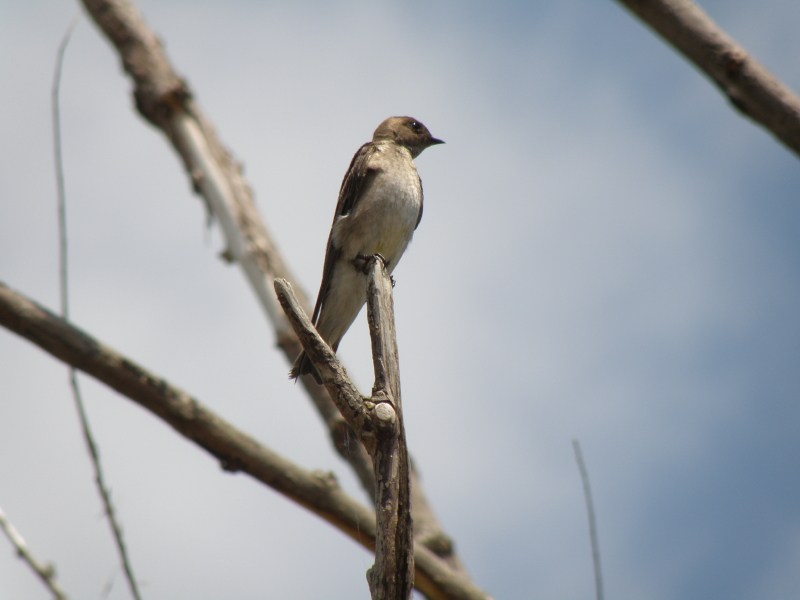
Northern Rough-winged Swallow, Falls of the Ohio, 2013

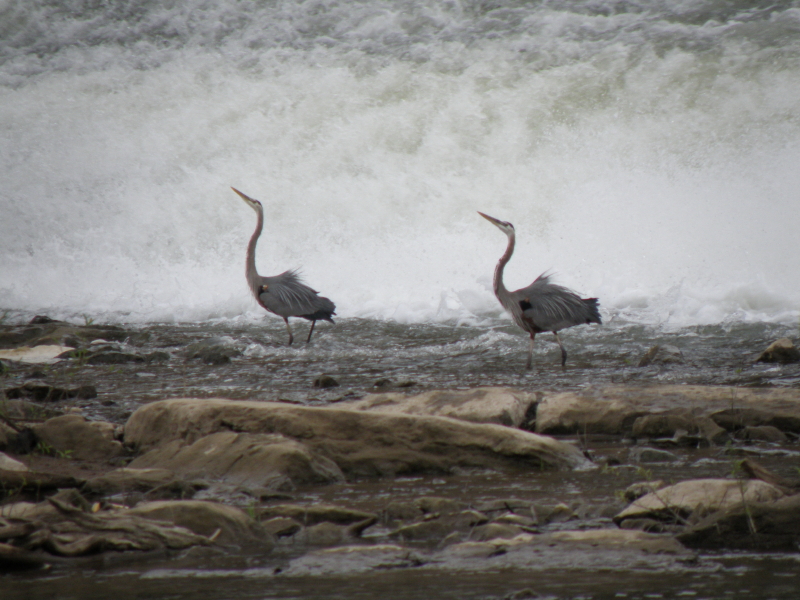
I’ve had some interesting birding encounters of late at the Falls of the Ohio and so I thought now is an opportune time to post them.  I took this image of the Northern Rough-winged Swallow recently.  To my eye, this species seems to be on the increase as is its cousin, the more familiar Barn Swallow.  This is especially good since they eat big quantities of flying insects.  Herons (especially Great Blue Herons and Black-crowned Night-Herons) are abundant and since the fishing has been good of late…I’ve seen plenty of both species.  Here are two more recent images.  The first is of a pair of Great Blue Herons that were taking advantage of the recent Skipjack Herring run.

Great Blue Heron pair, June 2013

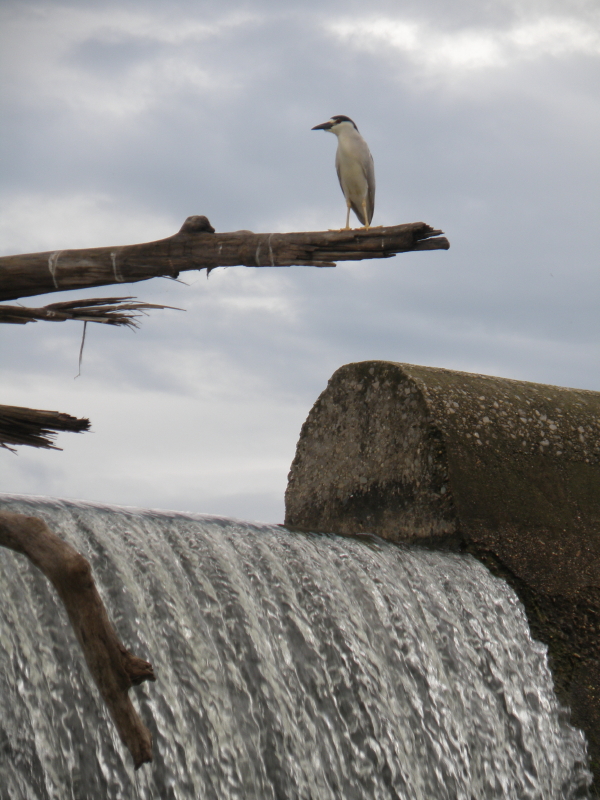
The most common heron here is the Black-crowned Night-Heron.  They are considerably smaller than the Great Blues and have striking red eyes.  You can find them wading in the shallower waters looking for fish, crayfish, or small frogs.  This image was taken in the eastern section of the park and this bird was perched on a log stranded on top of the dam’s wall.

Black-crowned Night Heron at the Falls of the Ohio, June 2013

I’ve saved the two most interesting avian encounters for last.  A couple of weeks a go, I was sitting at my outdoor studio under the willow trees when I heard the sound of a young bird pleading for food.  Looking around, I was able to find the hungry bird and I snapped this picture of it.

young Brown-headed Cowbird, June 2013

I recognize that this is the young of the Brown-headed Cowbird.  What is fascinating about this species (and the two other species of cowbirds in North America) is that the adults do not raise their own young.  Cowbirds parasitize the nests of other bird species.  In the case of the Brown-headed Cowbird they have been known to lay their eggs in the nests of about 200 different species of birds.  Usually, the young Brown-headed Cowbird out competes the host specie’s nestlings.  I was curious to see who this bird’s “parents” were and it didn’t take long to find out.

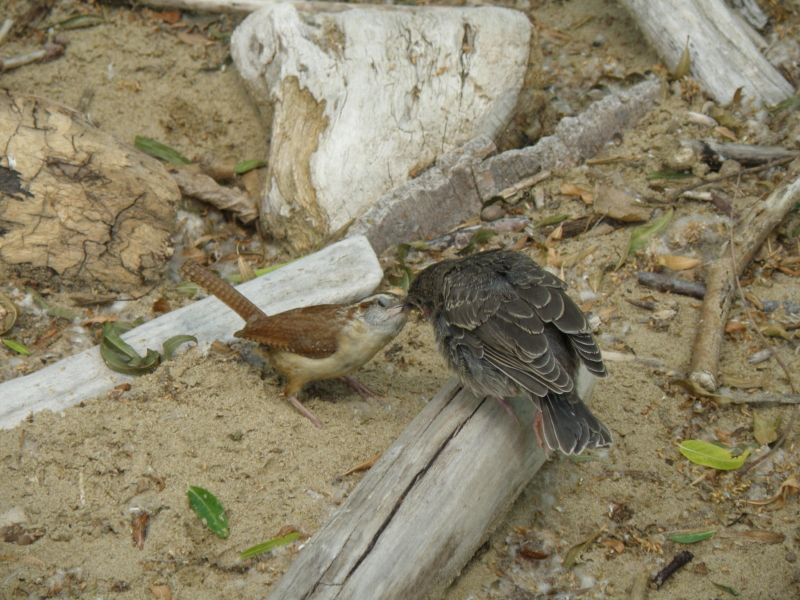
Brown-headed Cowbird chick and Carolina Wren, Falls of the Ohio, June 2013

In the case of this cowbird chick it is being raised by a hardworking pair of Carolina Wrens.  The baby is nearly double the wren’s size and vibrates its wings along with calling out to stimulate the wrens to feed it.  Here are a couple more pictures of the wren feeding the cowbird.

Carolina Wren feeding a Brown-headed Cowbird chick, Falls of the Ohio, June 2013

Carolina Wren and Brown-headed Cowbird chick, June 2013

In case you were wondering, cowbirds are not the only species to lay their eggs in other bird’s nests.  In Europe, the cuckoo also does this, but parasitizes fewer species.  I often wonder how does the cowbird know it’s a cowbird especially if it is raised by a completely different species?  Obviously, some behaviors are “hard-wired” and innate .  In the early Spring, Brown-headed Cowbirds are early arrivals and always on the look out for other breeding species of birds and their nest sites.  Their courtship is not a thing of beauty with each drab Brown-headed Cowbird female usually being pursued by multiple males.  Moving on, here is a recent picture of an adult male and you can see why they are called Brown-headed Cowbirds.

male Brown-headed Cowbird, Falls of the Ohio, June 2013

Recently, I was in the far western section of the Falls of the Ohio State Park where I saw my very first Indiana Rail.  Rails are much smaller relatives of the heron family and other wading shorebirds.  The Indiana Rail is a little smaller than a chicken and rarely seen since it favors dense underbrush and is usually more active at night.

Indian Rail at the Falls of the Ohio, June 2013

I was taking a break sitting on the fossil rocks when this bird with a long, bright red bill appeared from among the ever-growing vines.  I held still and was able to record this species with a small series of photographic images.  This bird seemed very interested in the holes situated among the rocks.

Indiana Rail, Falls of the Ohio, June 2013

Indiana Rail, Falls of the Ohio, June 2013

Unlike the cowbirds…both the Indiana Rail male and female participate in raising their own young.  Typically, four or five green mottled eggs are deposited in a loose bowl constructed of decaying river vegetation.  It is believed that the heat generated from this decomposing matter helps to incubate the eggs , but this is still speculative.  There is a lot left to learn about this enigmatic creature.

Head of the Indiana Rail, June 2013

Indiana Rail, Falls of the Ohio, June 2013

I watched the rail for about twenty minutes as it poked around the vines that were beginning to cover the fossil rocks.  Every now and then it would use its strong-looking bill to probe the cracks around the drying mud.  Just as mysteriously as it appeared…it disappeared leaving me with this wonderful memory and a hand full of pictures to prove it was here.  See you later!

Indiana Rail, Falls of the Ohio, June 2013

Read Full Post »

willow, early May, Falls, 2013

Falls of the Ohio State Park…early May.  Many of the willows along the river whose fibrous roots are holding fast are also in bloom.

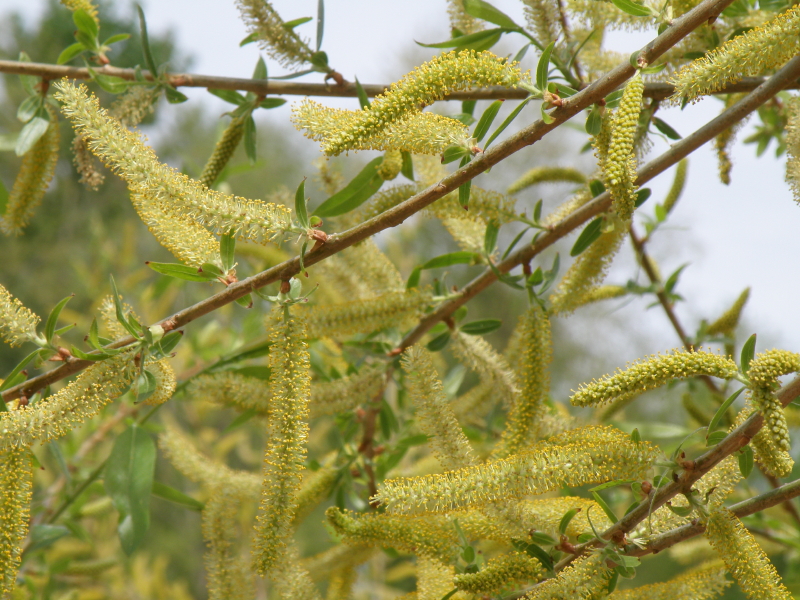
black willow catkins, Falls of the Ohio, May 2013

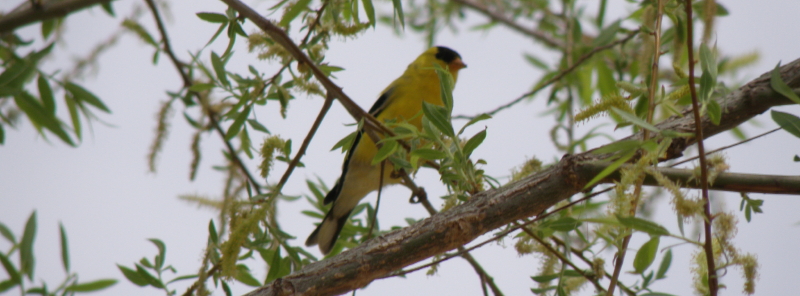
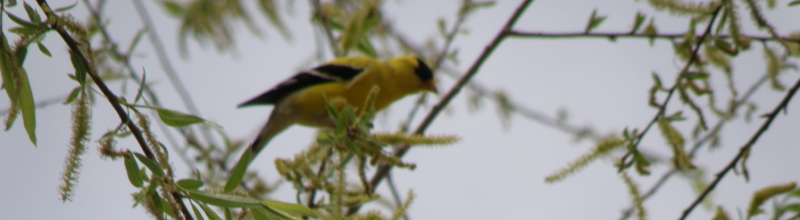
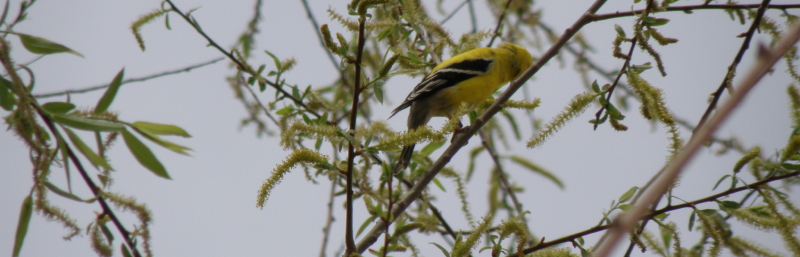
The yellow flowers are  catkins and open before the long, thin leaves appear.  It’s warm and windy along the river.  Tomorrow it will be different.  American goldfinches are feeding on the willow blooms.

male American goldfinch and willow, May 2013

American goldfinch, male, May 2013

goldfinch on willow, May 2013

goldfinch willow 4.5_1_1

American goldfinch on willow, May 2013

The sound of rolling river waves against Indiana are interrupted every now and then with goldfinch song.  The males are becoming more and more yellow.  Does the pollen of the black willow also help this bird?

black willow catkins, May 2013

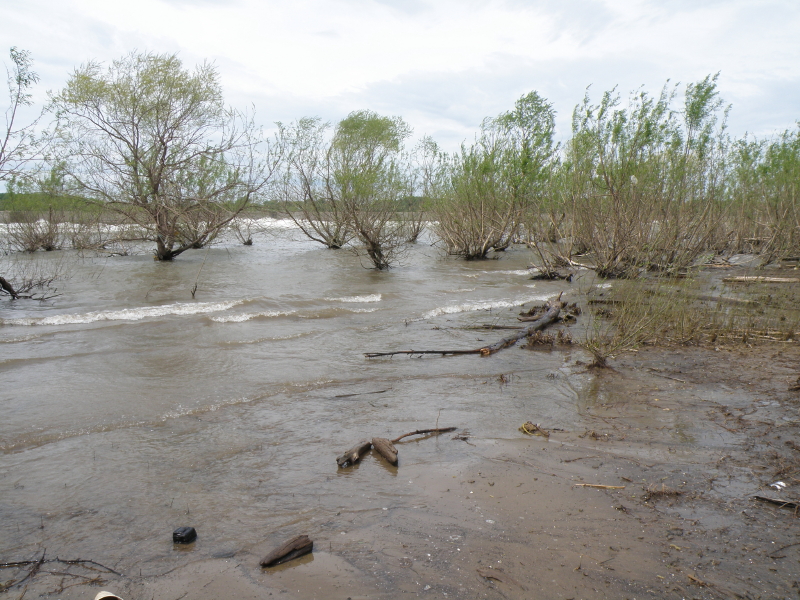
For me, it’s blooming willow on Oak’s Day.  The derby is tomorrow.  I’ve a lot of river to explore for a few hours more.  Who knows what else I might find?

wet willows at the Falls of the Ohio, May 2, 2013

Read Full Post »

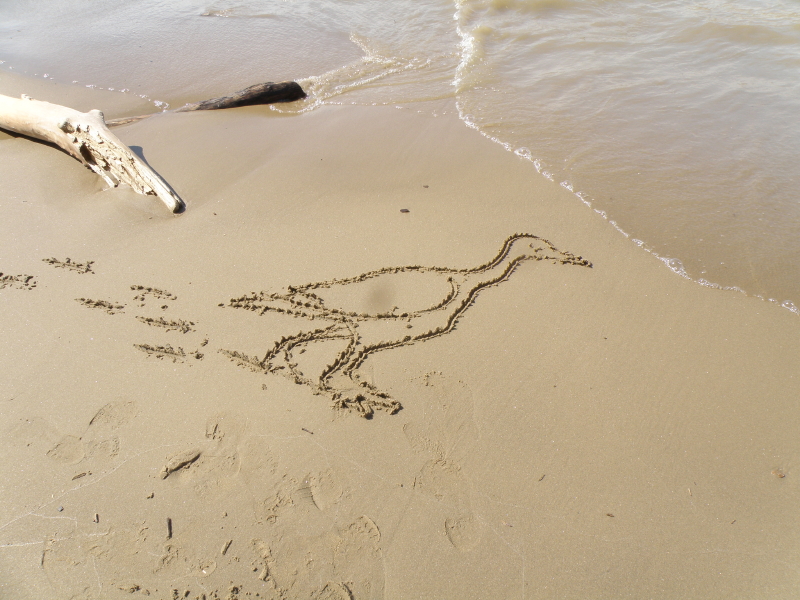
walking goose drawing in sand, March 2013

I come to the river because I like the sound of the water.  It does more than act upon the sand and driftwood here.  After hanging out at the Falls of the Ohio I feel relaxed because the rhythm of the water is also the rhythm of nature.  The waves that move back and forth slow my own internal sense of timing and puts me in sync with the universe.  The work-a-day life begins to lift away and a calm seeps in.  I don’t even need to be aware of the sound.  I know it is there and I trust it.  This restorative quality of water is not to be underestimated in this fast-paced, multitasking world and it is free if you are open to accepting its magic.

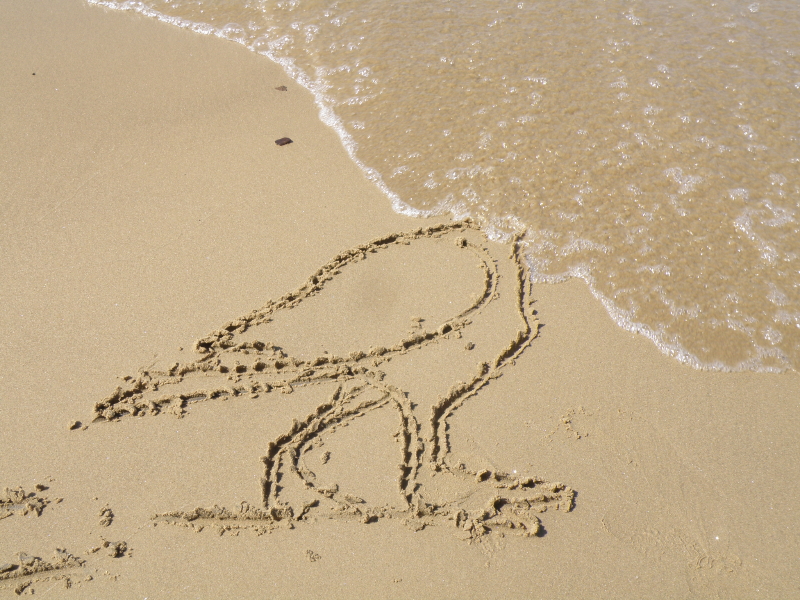
river erasing sand drawing, March 2013

partly erased sand drawing, March 2013

Spring is late in arriving this year.  It’s been an up and down cycle of mostly cool to cold temperatures.  Also, it seems that the river has been a little higher for a bit longer than I remember over the past several years.  2012 was positively balmy compared to this one.  It’s amazing how much difference a year can make .  Today is nice and the sun is shining and I get an early start on the day.

detail of driftwood, March 2013

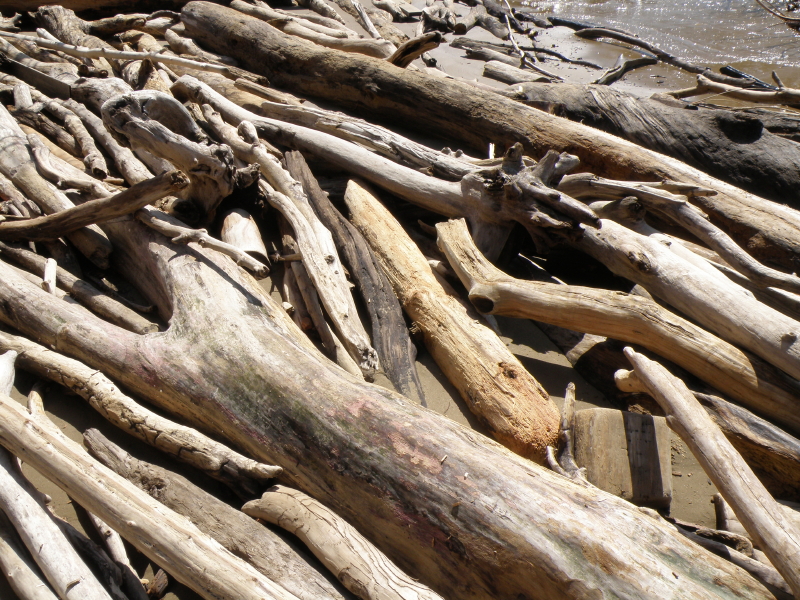
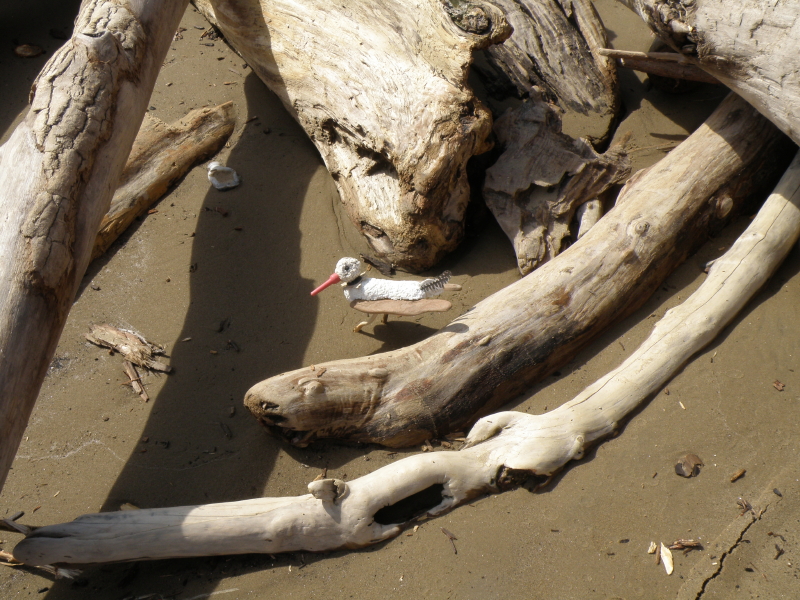
Currently, there is plenty of driftwood lining the riverbank.  By studying how the driftwood was deposited, I get a sense for the water and how high it rose over the land.  Since this is Spring…I’m also on the lookout for seldom seen birds that are traveling through our area.  On my last outing, I was walking over the lines of driftwood when I spotted an unusual shorebird.  I managed a few images of it and I would like to share those with you now.  It was right in the middle of the driftwood and if it hadn’t moved…I might have gone in a different direction and missed it.  I live for these moments.

Great Lakes Oystercatcher, March 2013

head of Great Lakes Oystercatcher, March 2013

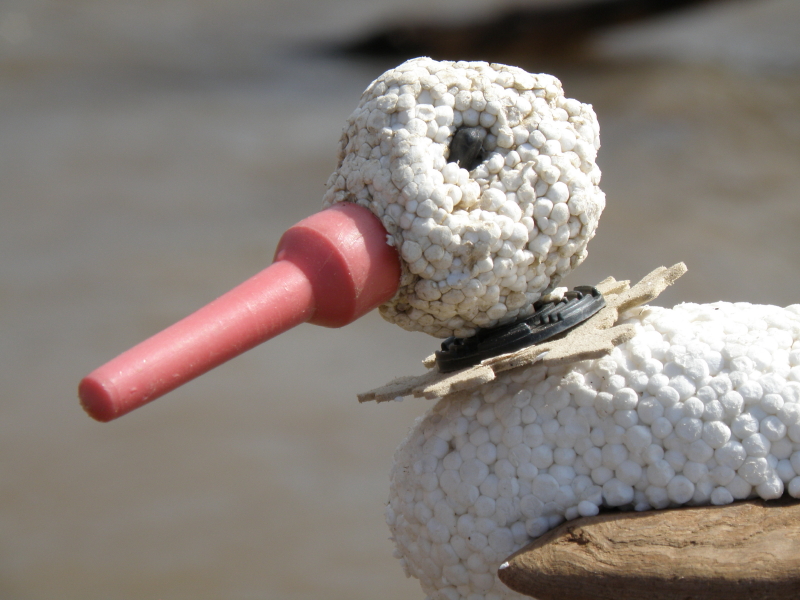
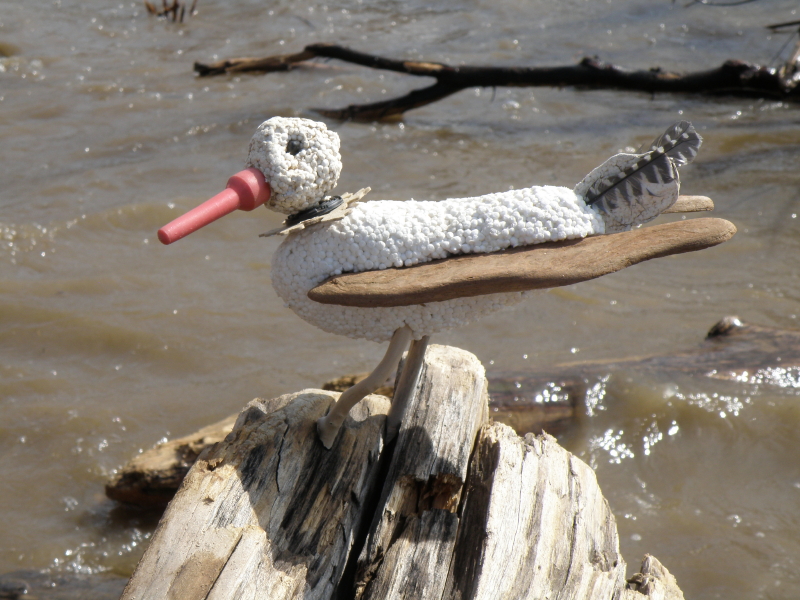
This is the increasingly rare Great Lakes Oystercatcher, (Haematopus polystyrenus) as seen at the Falls of the Ohio State Park.  It has a large red bill like the two other oystercatcher species that live along our country’s marine coastlines.  Unlike them, this bird is strictly Midwestern and prefers fresh water wetlands, creeks, streams, and rivers.  The large bill is used to pry open the shells of fresh water clams and mollusks…although it is known to take crustaceans and other invertebrates upon opportunity.

Great Lakes Oystercatcher, March 2013

Great Lakes Oystercatcher, March 2013

The reason this bird is becoming scarce has everything to do with it losing its main food source.  The Tennessee and Ohio River Valleys are the world’s epicenter for fresh water mollusk diversity which is a little known fact.  Unfortunately, because of the many changes that have occurred with our rivers, these clams have become our most endangered animals with many species having become extinct already.  These clams are fascinating in their own right and have complex life cycles.  Wherever you find them is usually a good indicator of the quality of the water.  The Great Lakes Oystercatcher won’t find much in the way of its preferred food at the Falls.  The original clam diversity is missing and these days you are more likely to encounter Zebra Mussels or Asiatic Clams and both are well-established, invasive, nonnative species.

Great Lakes Oystercatcher, March 2013

Great Lakes Oystercatcher looking over its shoulder, March 2013

I was delighted by this almost comical bird which is rarely observed in this park.  It went about its business examining the driftwood and probing the sand for morsels of food.  I also watched it fly to the water’s edge and it was intent on checking out what the river was washing ashore.  The whole encounter lasted about 20 minutes before the bird flew off for parts unknown.  Satisfied with the day, I gathered my collecting bag and headed home.

The city of Louisville as seen from the Falls of the Ohio, March 2013

Read Full Post »

high Ohio River at the Falls of the Ohio, Feb., 3, 2013

The Ohio River at the Falls of the Ohio is even higher now since my last visit with the fishermen.  We have had some wild weather in the interim.  First it gets unseasonably warm and then a cold front collides with a wet weather system originating in the Gulf of Mexico.  The results of this can be very dangerous as this is the perfect recipe for a tornado outbreak which did occur south of here.  My family was awakened to the sound of tornado warning sirens at 4:30ish in the morning.  We began that day in the basement of our house which was a rude awakening even for the family dog.  Luckily, we didn’t experience any damage although it rained hard and was very windy.  And after the cold front blasted through it became extremely cold and was followed by snow.  I think we have seen the gamut of winter weather and I was glad to hear the “groundhog” did not see its shadow in Pennsylvania meaning that winter would come to a normal end this year.  That is if you believe animals can predict the weather?

floating trash in the river, Feb. 2013

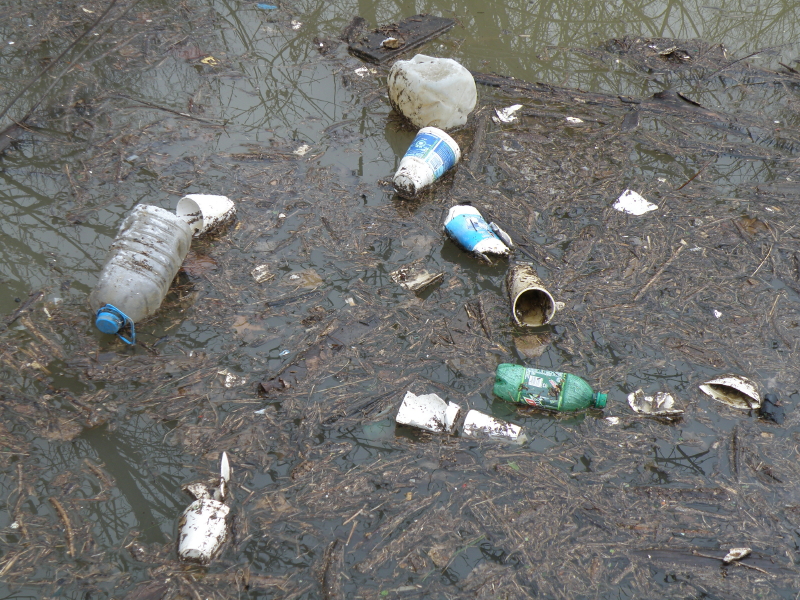
I am certain this time that my outdoor studio under the willows is history by now.  The Ohio River has claimed the spot and my cache of art materials.  Unfortunately, there is a ready re-supply floating in the water.  It seems I begin many a post with what amounts to a weather report, but please bear with me.  My blog concerns itself with the local conditions which are the context that my adventures and stories are set in.  I’m also amazed and concerned that I can detect variations in our weather patterns having lived in this area for so long.  Much of the time I feel I’m bearing witness to events of importance to us all.  What is happening here is also occurring in other places in the world.  As I was walking through the woods on this day, I was surprised by the bird life I was encountering when I expected to see nearly nothing.  My Eastern Bluebird friends were still hanging around and they had company.  I saw White-breasted Nuthatches, Carolina Chickadees, Tufted Titmice, Brown Tree Creepers and many more especially near the river’s expanding edge.  I also saw and photographed another amazing bird which makes up the bulk of this post.

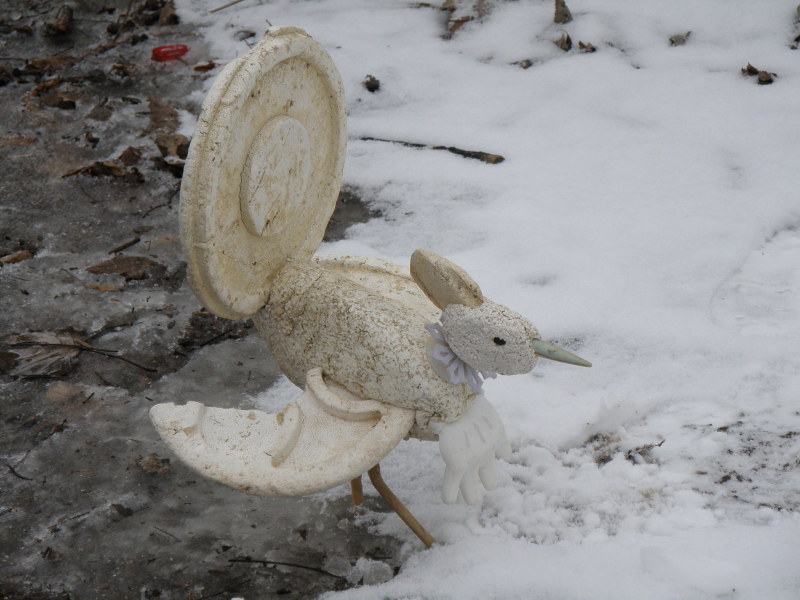
Snow Cock at the Falls of the Ohio, Feb. 2013

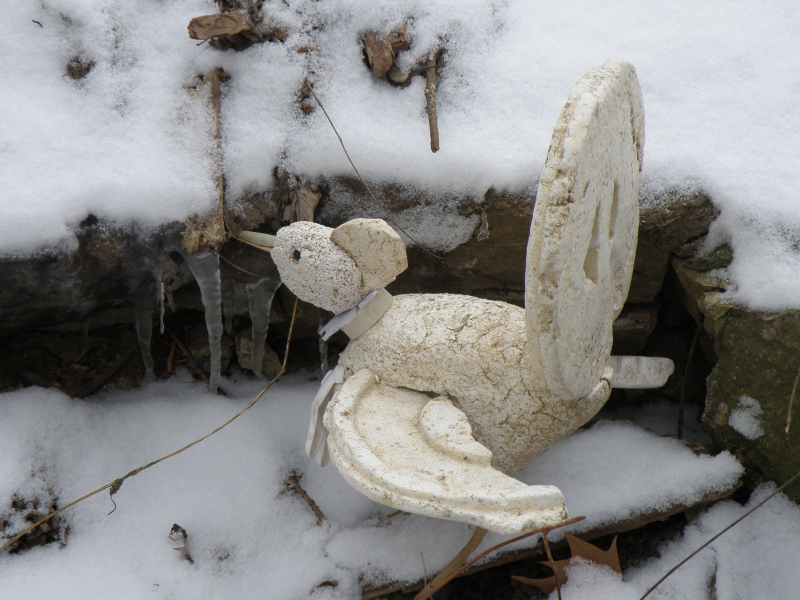
Snow Cock, Falls of the Ohio, Feb. 2013

Fellow bird watchers had put the alert out that an unusual visitor was seen hanging out at the Falls.  A young, male Snow Cock was seen near the Woodland Loop Trail which is a bird not seen in these parts since the late 19th century.  As you can imagine this is a northern bird used to the cold and snow…in fact it depends upon these conditions for its survival.  The Snow Cock (like some ptarmigan species) turns nearly white in winter.  The rest of the year it sports plumage that is more like leaf camouflage.  Regardless of the season, the Snow Cock is a cryptic animal and is shy and retiring.  Except of course when it’s time to choose a mate when the males make it a point to be as noticeable to their own kind as possible.  I was hoping the bad weather would cause this wayward Snow Cock to linger and I was rewarded by its presence.  I took as many photographs as possible.  I have a feeling that I won’t ever see this exact species out here again.

detail of Snow Cock head, Feb. 2013

Snow Cock in natural habitat, Feb. 2013

Snow Cock, back view showing tail fan, Feb. 2013

The Snow Cock is also called the “Snow Turkey” and “Styro-grouse” because of the large fan of tail feathers it uses for courtship displays.  That’s how I found this particular bird which wasn’t all that wary.  The young male was rehearsing his dance and song and establishing a lek or territory where he would fight other males for the attention of the females.  Although this bird wasn’t going to hang out at the Falls forever, it was nevertheless, practicing this important survival skill.  Other interesting field marks included a head crest, an unusual beard growing from his chest, and a long bill for seeds and insects.

Snow Cock at the water's edge, Feb. 2013

falls 030_1_2

I watched the Snow Cock look for just the right spot to strut its stuff.  It was frequently hopping from one vantage point (usually a tall stump) to the ground and back.  The call of the Snow Cock as you might guess is very chicken-like and not particularly beautiful in its own right.  To my eye, it seemed very interested in the water which was noticeably spreading over the land.  This might be the first flood it has ever experienced?

Snow Cock sipping water, Feb. 2013

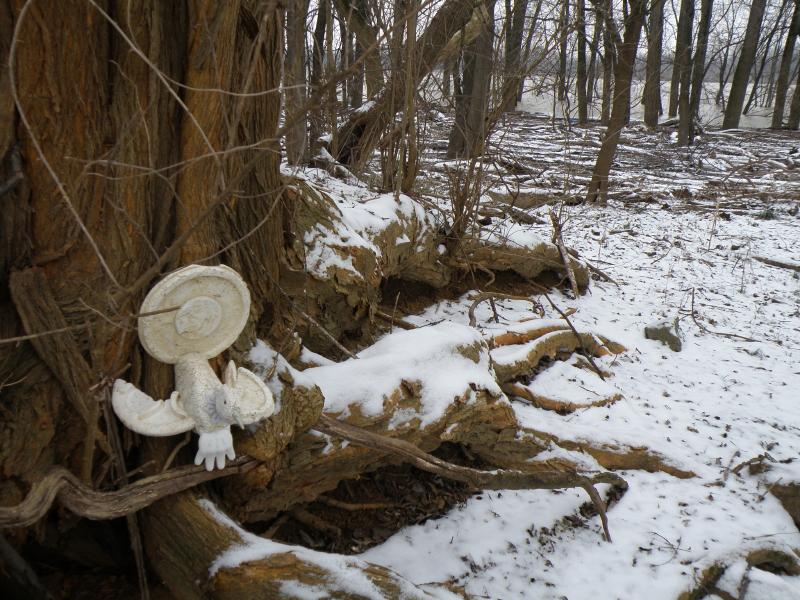
Snow Cock by large Osage Orange tree, Feb. 2013

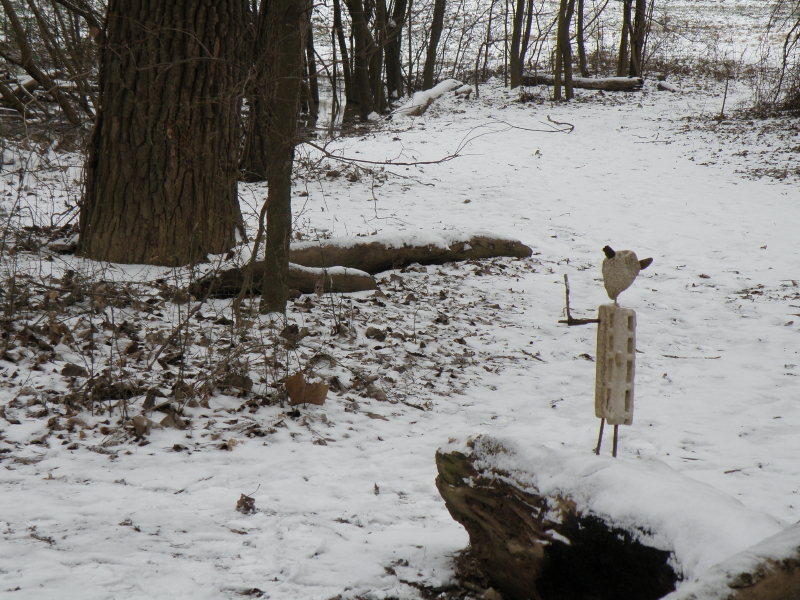
I kept my distance from the bird and quietly followed it through the woods.  I observed it drinking from melting ice and I left it be hanging out near a large Osage Orange tree along the trail’s path.  The wind was beginning to pick up again and more flakes were in the air.  Despite wearing good gloves, my finger tips were cold and painful.  I decided that now was a good time to go home and I did.  I hope the next time I’m out here that the conditions will be more favorable for an extended visit.  I had one other small surprise waiting for me along the Woodland Loop Trail.  I passed the spot by the creek where I watched the fishermen catch sauger and was amazed and amused that the figure I had made from river junk that day was still there!  He was missing his nose, but otherwise he was intact.  I guess the fishermen appreciated him as I do you for tagging along on another adventure at the Falls of the Ohio.

Styro-figure along the loop trail, Feb. 2013

Read Full Post »

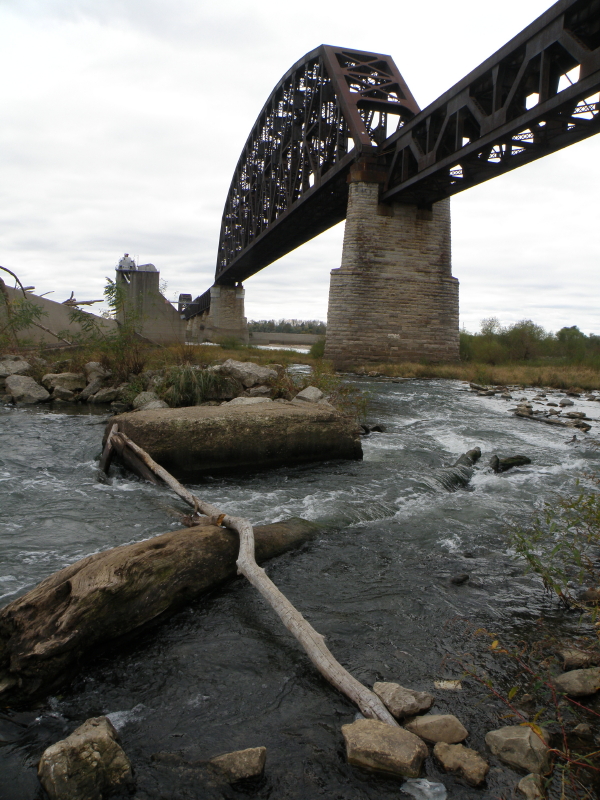
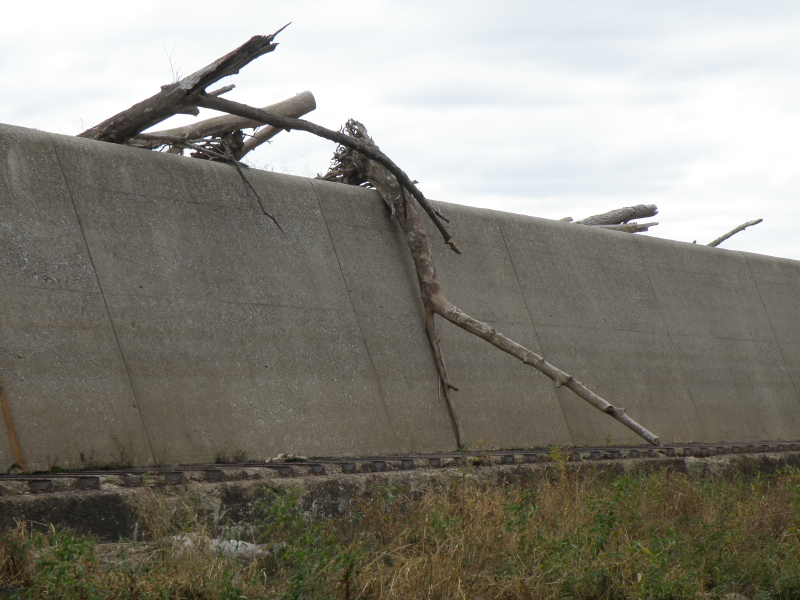
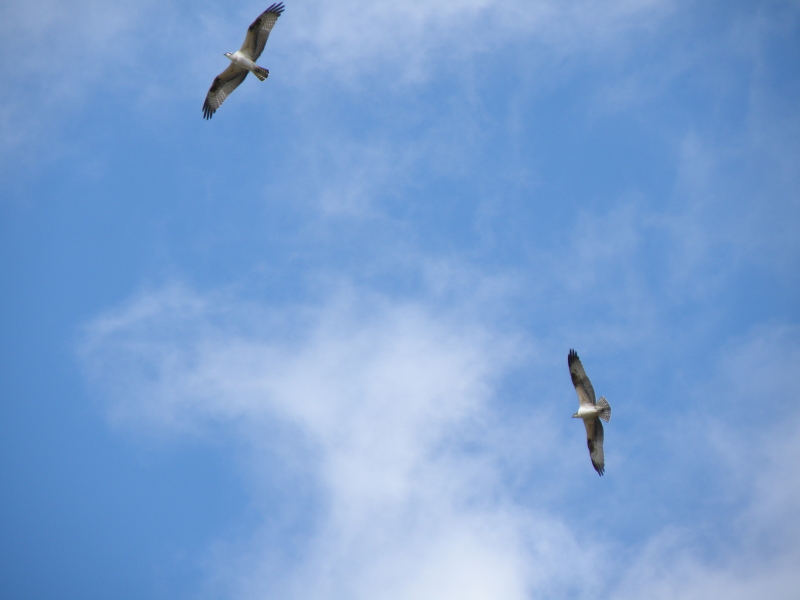
It’s hard for me to believe that October has come and gone.  There isn’t much sand left in 2012’s hourglass.  I’m virtually alone (if you are only counting people) at the Falls of the Ohio today and it’s understandable.  The weather is cool, gray, and an occasional spit of rain falls against my face.  I like it out here when it feels a bit lonelier because my chances of seeing wildlife increases.  Such was the case today when I explored the area next to the tainter gates and under the old railroad bridge.  This area is sheltered a bit from the wind and many times I have found birds in the high grass and low trees near the sloping riverbank.  Today I observed Song Sparrows, White-crowned Sparrows, Mourning Doves, and Hairy Woodpeckers in immediate proximity to each other.  In the sky, the first of the Ring-billed Gulls has arrived and a pair of Osprey with their broad wings searches for unwary fish too close to the surface of the water.  Many of the tree leaves have dropped and it looks like we will have a bumper crop of cockle burrs as I pull dozens of them off my shoe laces and socks.  Their prickly hooks irritate my skin as they work through the fabric of my clothing.  On days like this I’m just trying to attune myself to the subtleties of this landscape and I’m amazed at how often my patience gets rewarded here.  As I was walking to photograph uprooted trees against the flood wall…

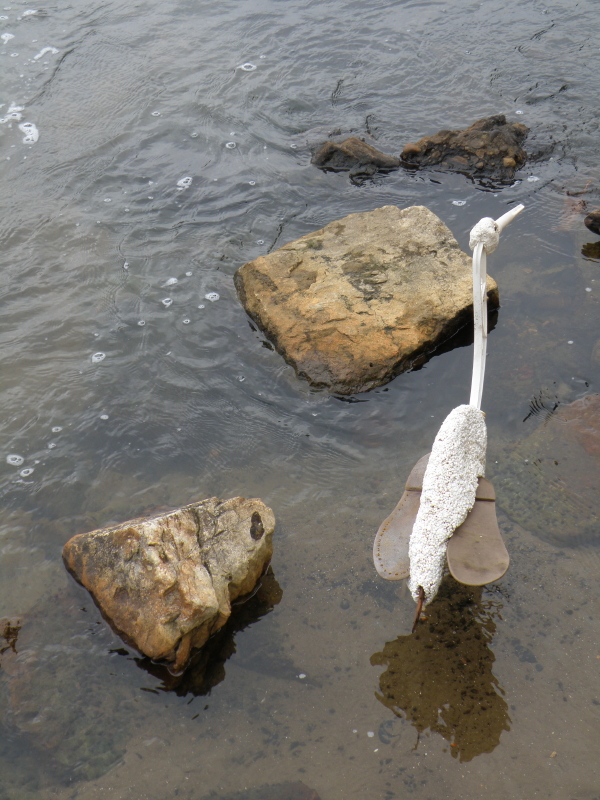
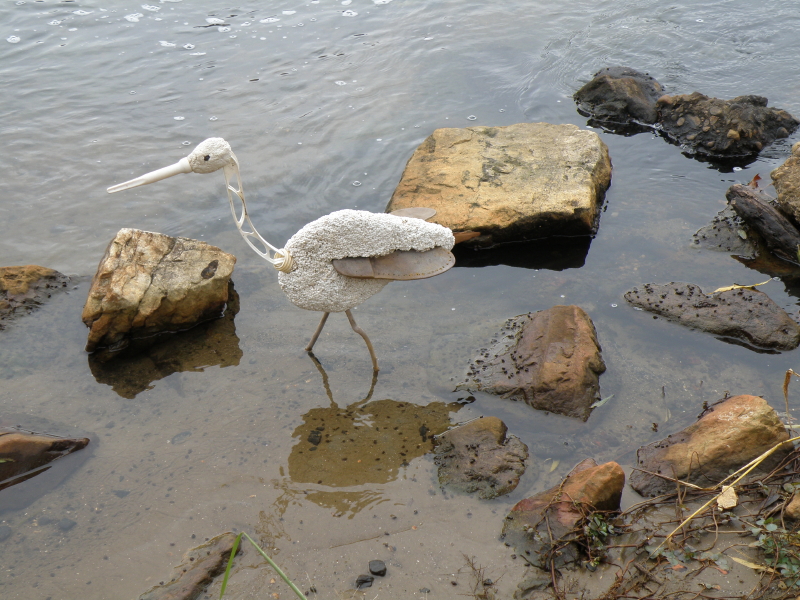
…I spotted something shockingly white moving near the water’s edge.  Carefully moving as close as I could…I recorded this image of another rare bird seldom seen at the Falls of the Ohio.

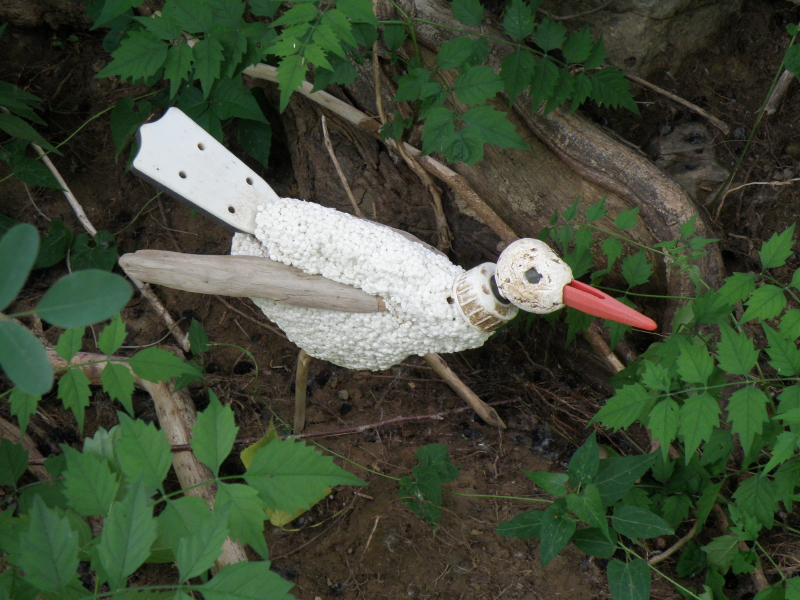
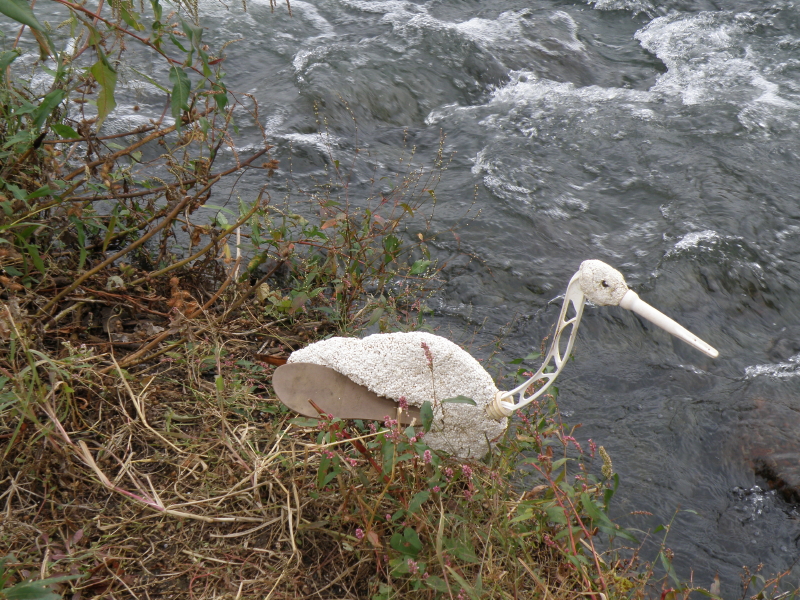
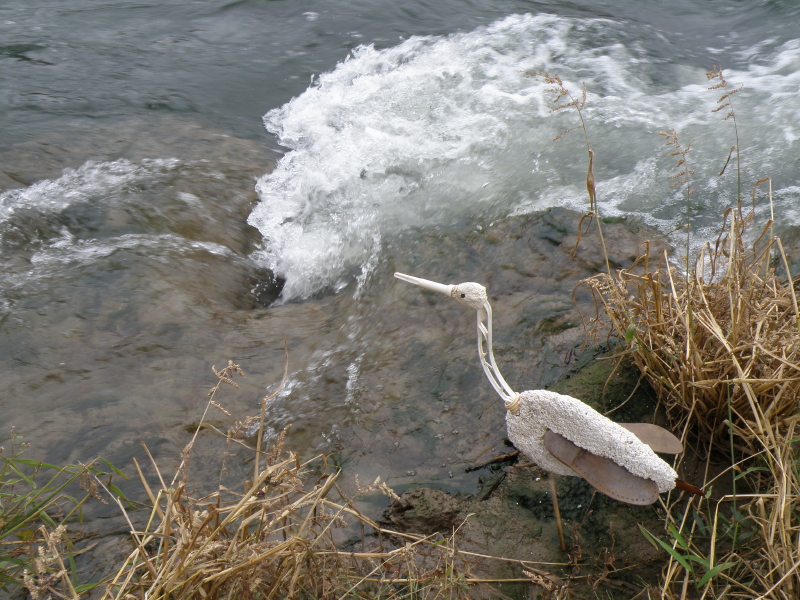
A few more pictures in relatively close succession and I was able to identify this beauty as the Lattice-necked or Brown-winged Ibis.  I prefer using the Lattice-necked moniker because the long neck with its unusual patterning is distinctive to this bird alone.  I happened across an individual that was hunting for food and stalking the margins of the water.  I did observe it feeding on black snails that were common on the rocks. I recall from my old art history days that the ibis was a sacred bird to the ancient Egyptians and often was mummified to accompany dignitaries on their journeys to the afterlife.  In my mind I made the association that this ibis species in front of me was sacred to the life of this river.  Enough gabbing, here are a few more pictures.

This ibis species is more commonly seen around the Gulf coast and points south of here.  Every once in a while, a storm or hurricane will blow a few individuals into the heartland where they are a welcome treat to the hardcore birders.  The Lattice-necked Ibis has always been less common than the other larger shorebirds.  It is less aggressive than the herons and egrets which out-compete the ibis for prime nesting and feeding sites.  This bird did spy me and flew away, but only a short distance away.  I was able to catch back up with it and captured these final images of this graceful and dignified bird.

Here is the same ibis that found a nice fishing spot next to a small whirlpool. Every now and then a little fish would get caught by the rotating water only to find itself food for the lightning quick ibis.

I felt refreshed and energized by my encounter with the ibis.  I left the river  with a song in my heart which I whistled all the way back home.  Above me, two osprey I had seen earlier were circling in the clear, cool blue sky…another blessing of this day.

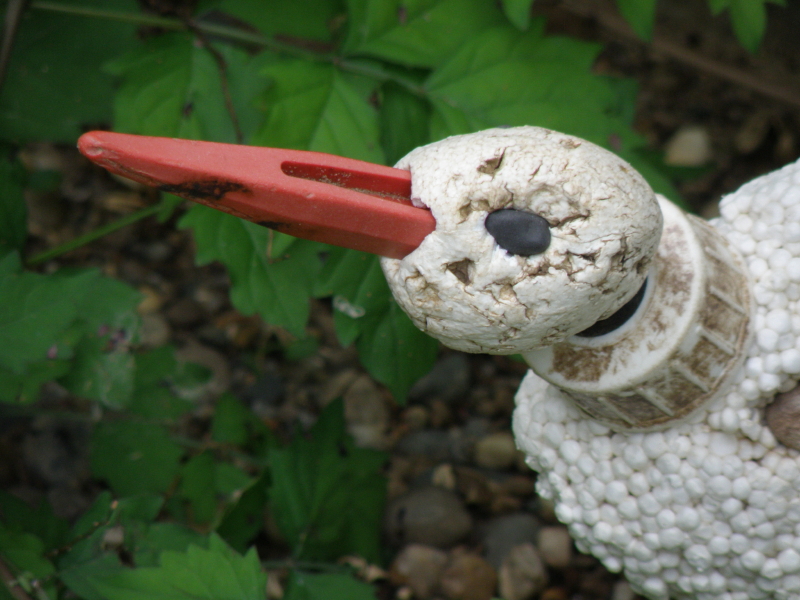
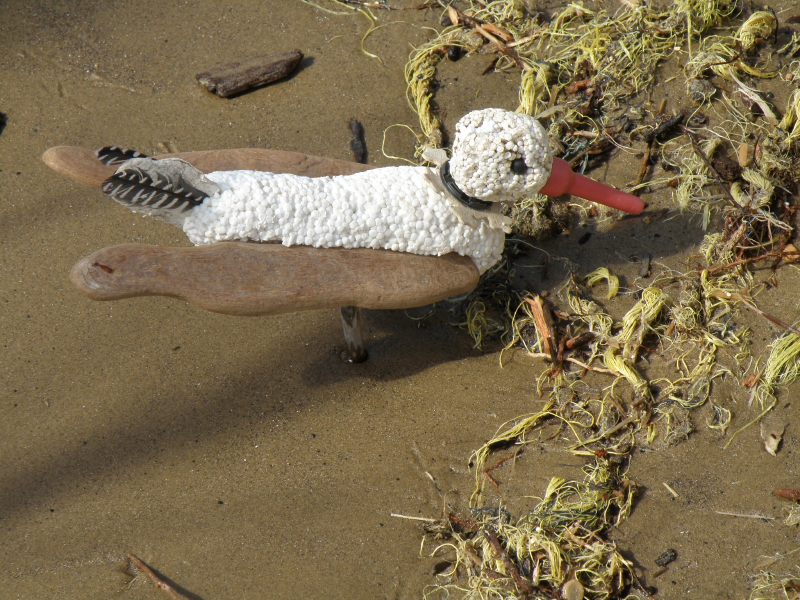
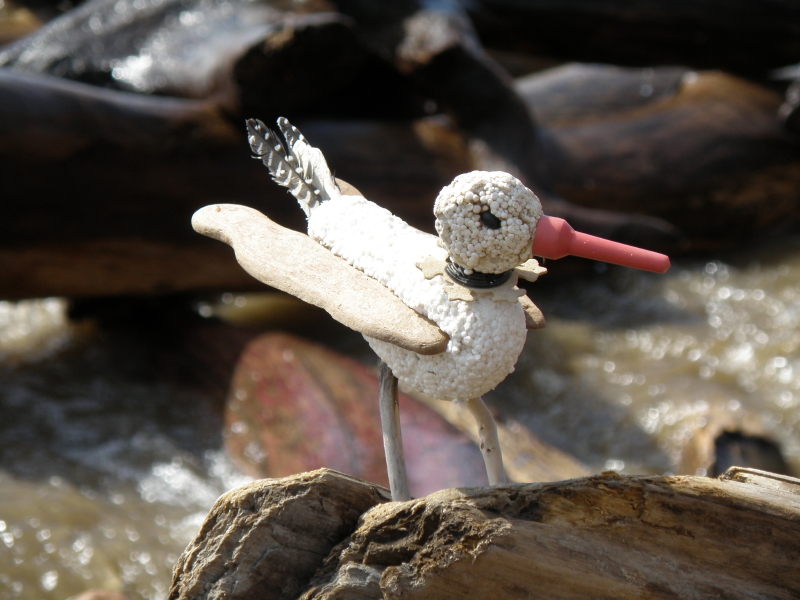
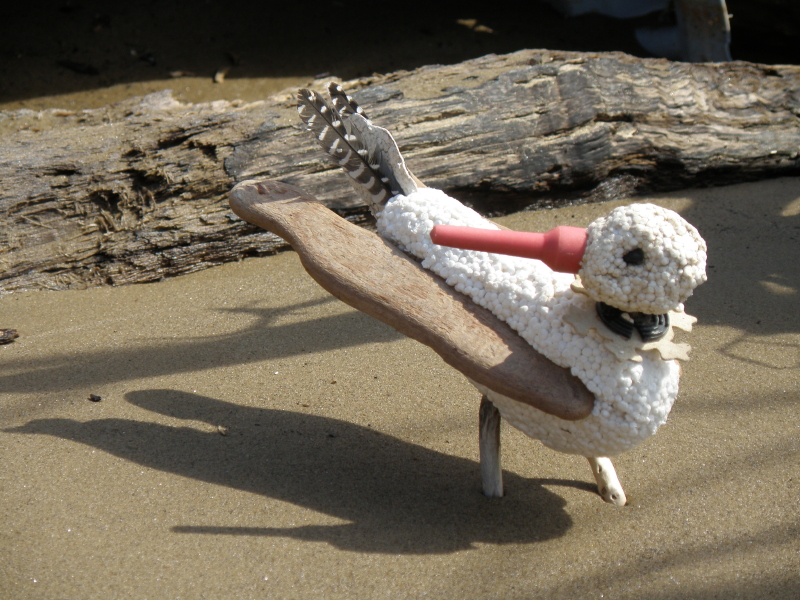
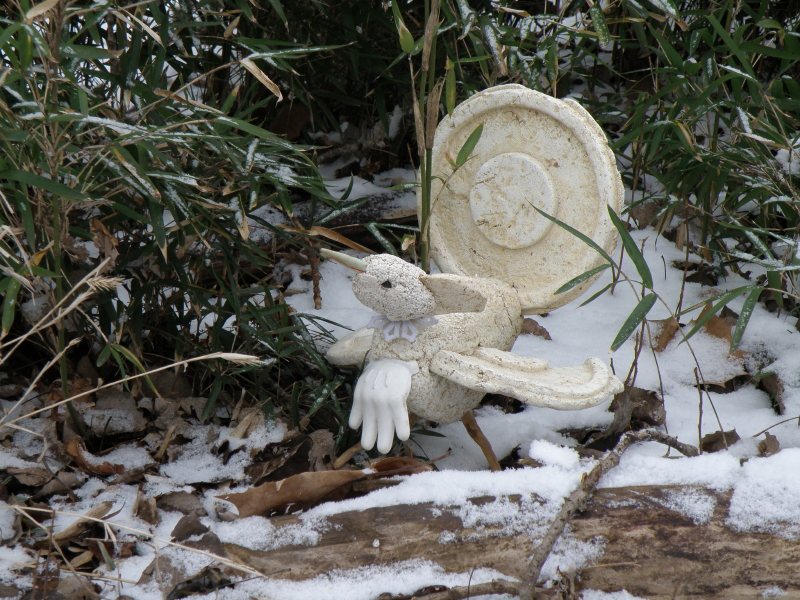
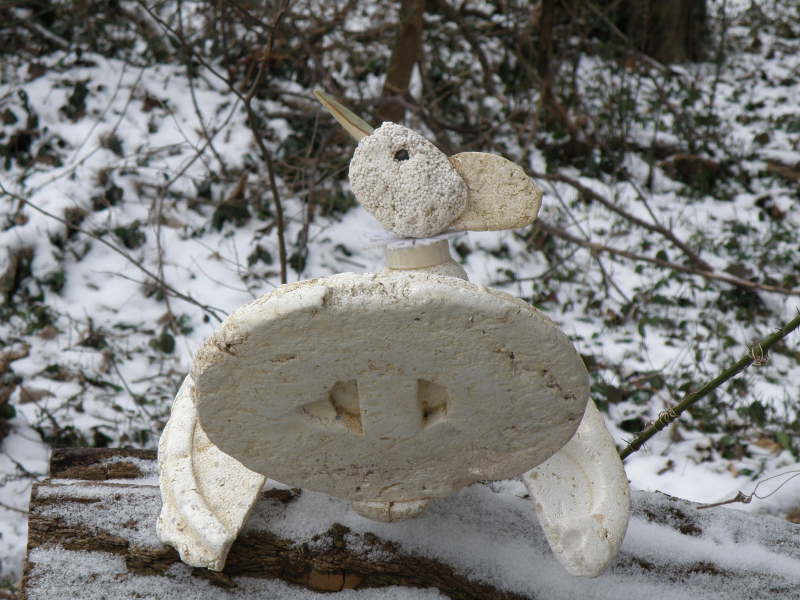
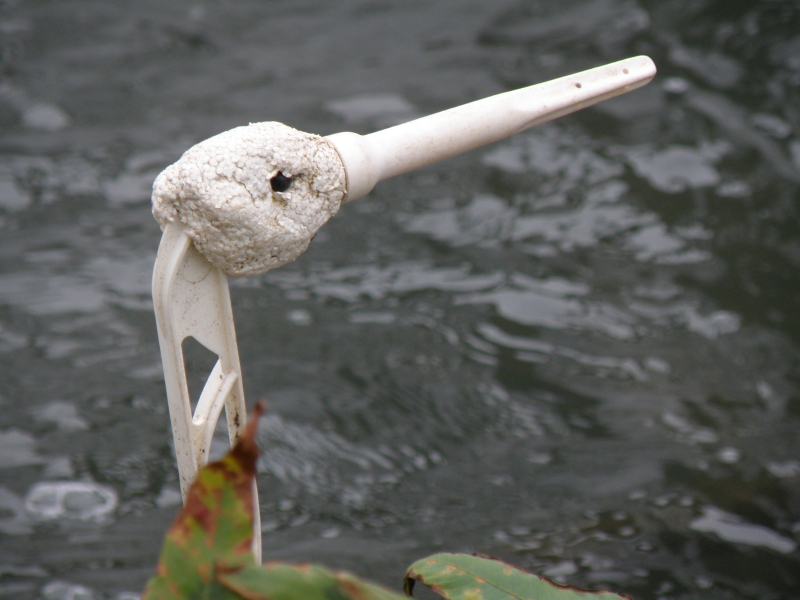
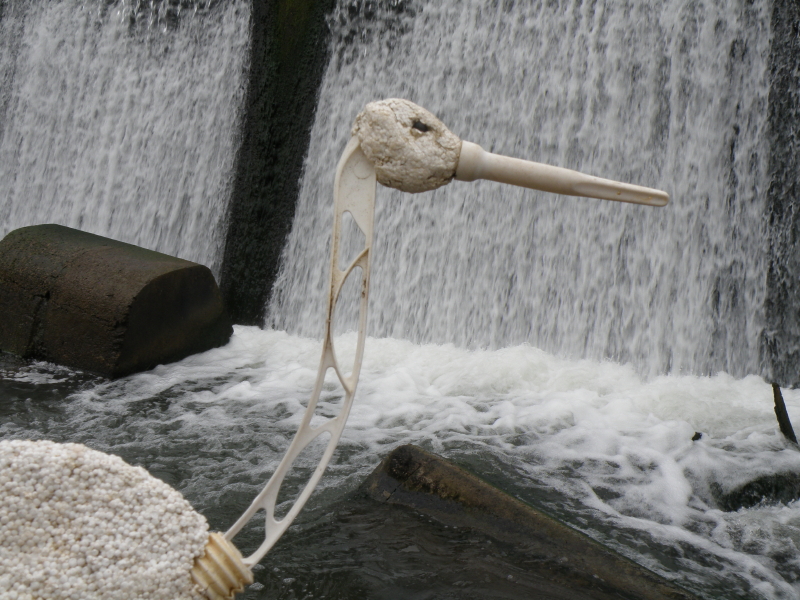
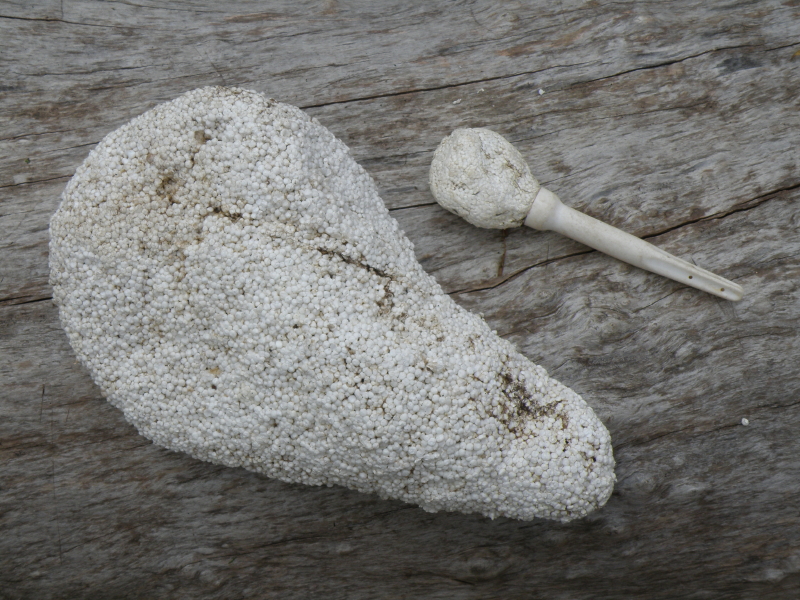
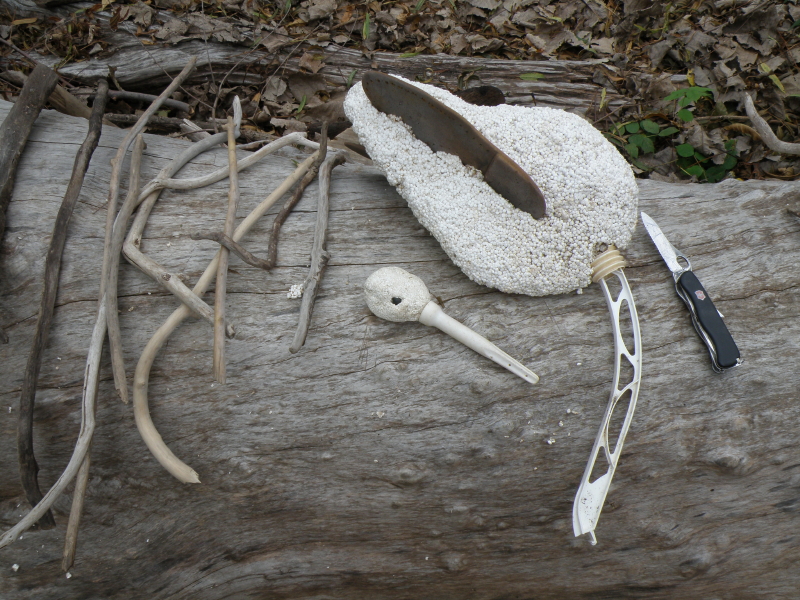
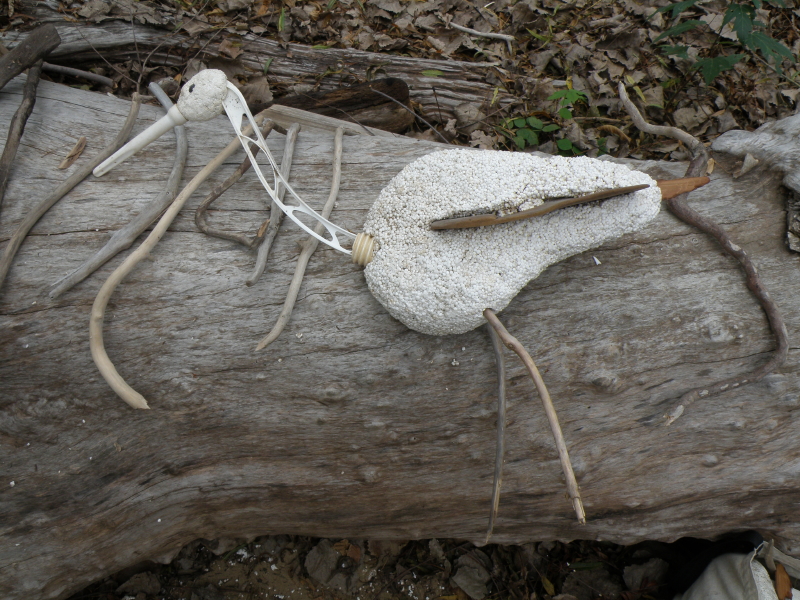
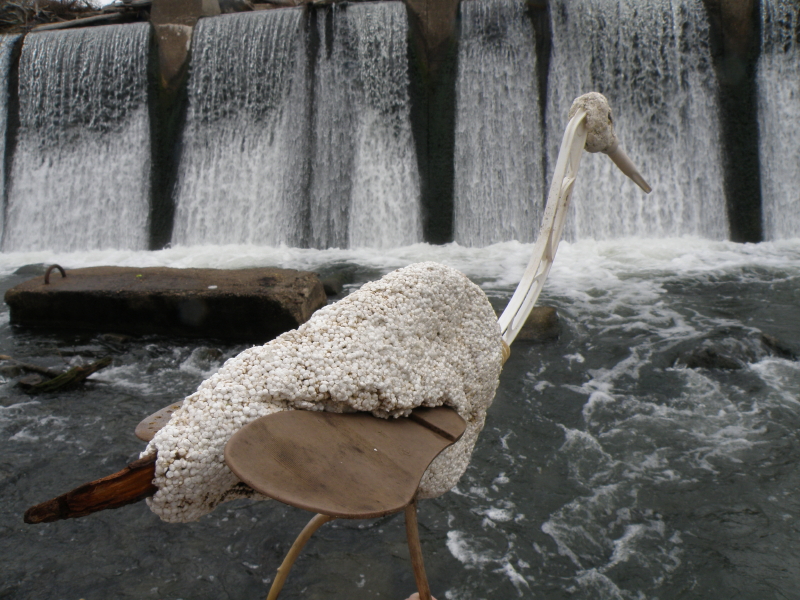
BONUS FEATURE…in process shots of how the ibis was made.  The head and body are pieces of Styrofoam I found out at the Falls of the Ohio.  The bill of the bird is a plastic handle from something…perhaps a feather duster?  The bird’s eyes are two small pieces of coal.  The neck I’m guessing is the plastic arm of a hanging flower planter?  At the base of the neck, I attached a small bit of white plastic hose I came across. The brown wings are the soles of two mismatched shoes I found.  The tiny tail and legs are found wood.  These are all the materials that make up this sculpture which owes something to the tradition of decoy making.  Thanks for tagging along with me on another adventure by the Ohio River.

Read Full Post »

Beloved, once again I evoke you from this beautiful water world I have discovered.  Repairs to my ship go slowly, but progress is being made.  Because of the uniqueness of this world and its potential importance to Styrosia, I continue to venture forth from my hiding places to discover what other life forms call this planet their home.  I continue to monitor the “bipedal humanoids” learning what I can from translating aspects of their culture using our technology.  The humanoids are unpredictable and possess enough data to be dangerous.  They are best seen and experienced from a distance. What I have also observed is that the humanoids have a great curiosity about their own world.  They are constantly engaging in explorations of discovery and seem to exhibit a need to know how the universe functions.  The irony here is that while they express concern for life at large, they are also systematically working to undermine the very conditions necessary to preserve and promote as much diversity of life as possible.  Every day life forms become extinct before they are even formally acknowledged as existing by their sciences.  This is a great topic, perhaps one for a future communication?  Today, however, I want to transmit a few images of interest to amuse and delight you from this alien world.  I would like to begin with an unusual characteristic that is exhibited in the local rocks and has been revealed through water’s ability to dissolve and shape the chemistry around it.

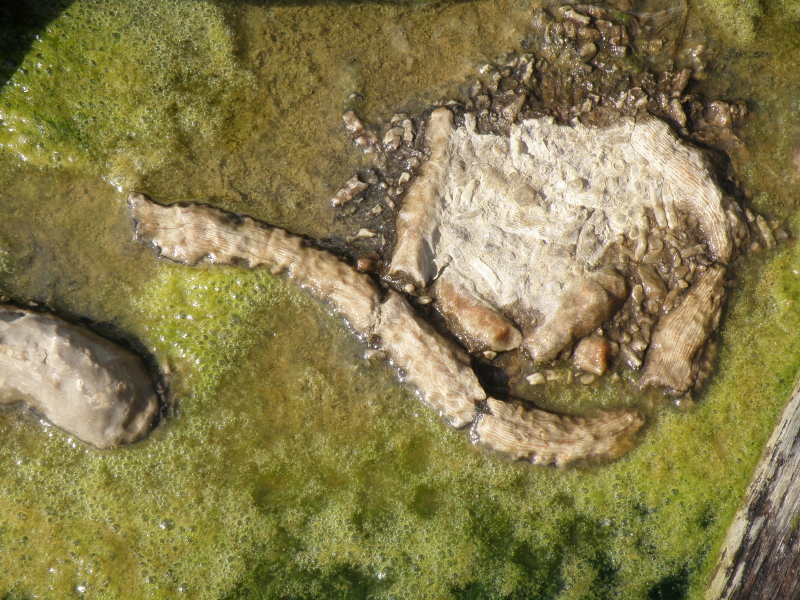
The appearance and proliferation of life on this planet is its most outstanding feature.  No where else in the explored universe can rival this world for the sheer variety and numbers of life forms that have uniquely evolved here.  At my current location are the preserved remains of life forms in calcium carbonate rocks of marine organisms that originated more than 350 million years a go.  Ancient as this is, the history of life is traceable to more than 2 billion years a go.  The humanoid scientists measure one year as being the amount of time it takes their planet to make one complete revolution around its star.  I believe it is correct to assume that life began in the ancient waters or “primordial soup” as the humanoids envision it.  Life and this planet have grown up together and each has influenced the other.  This planet is far from static and its oceans and land masses have shifted across the globe over deep time.  Today, humanoids travel great distances to peer at these local rocks.  What are they ultimately looking for in this ancient coral reef?  My hypothesis is that the humanoids are drawn to seeking a feeling of connection to the history of life on their own home world.  There is something in their behaviors that also suggests that they are mystified by the phenomena of their own existence.

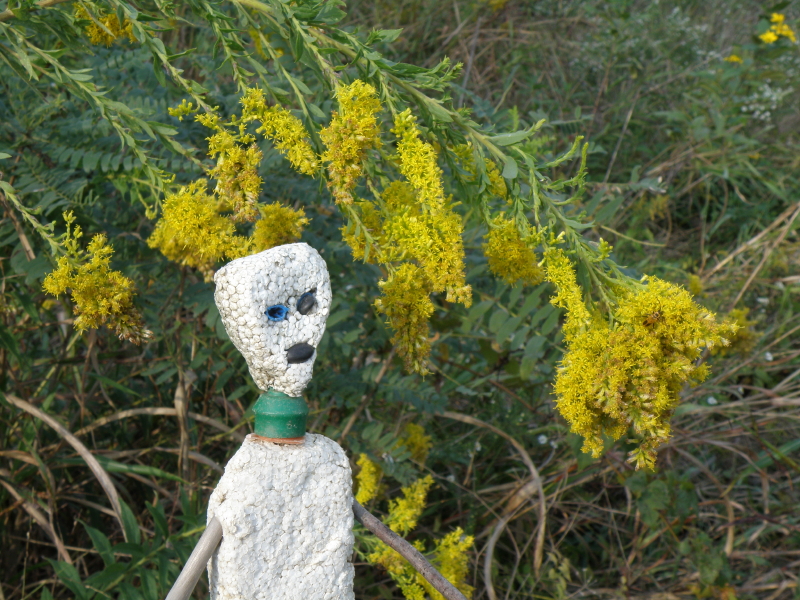
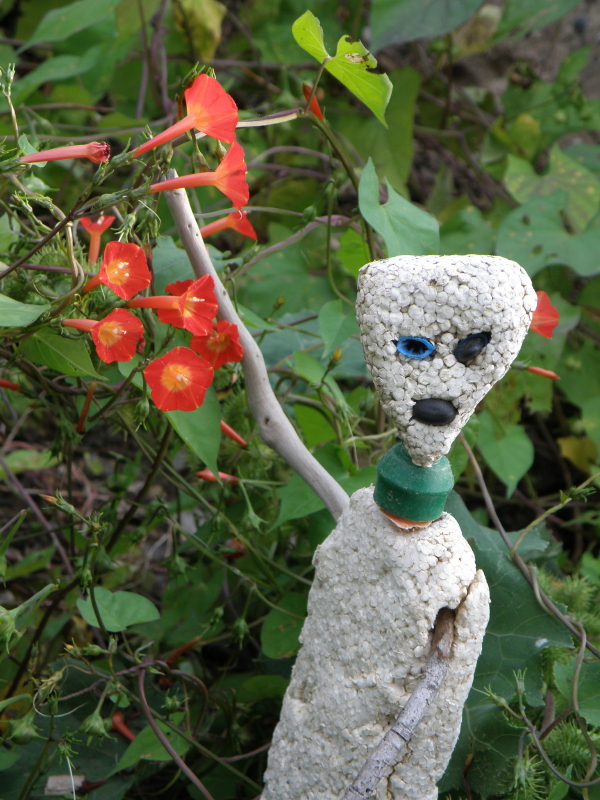
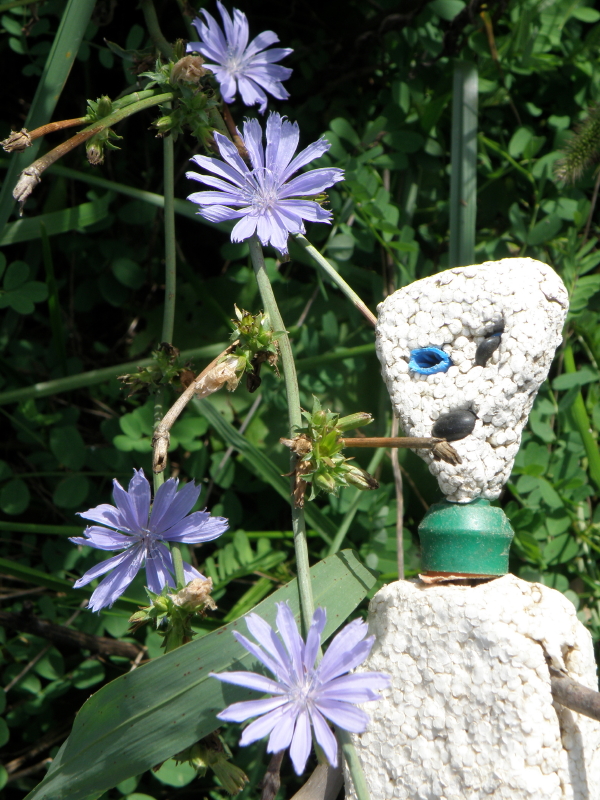
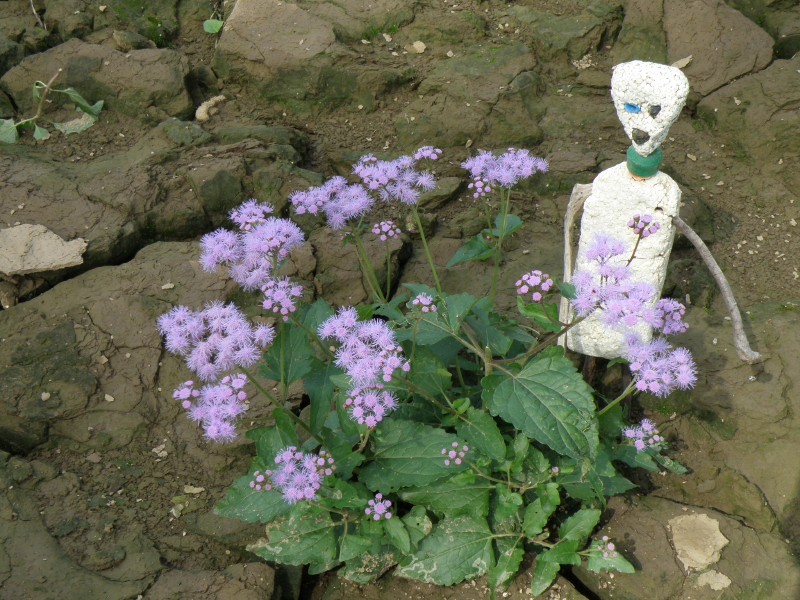
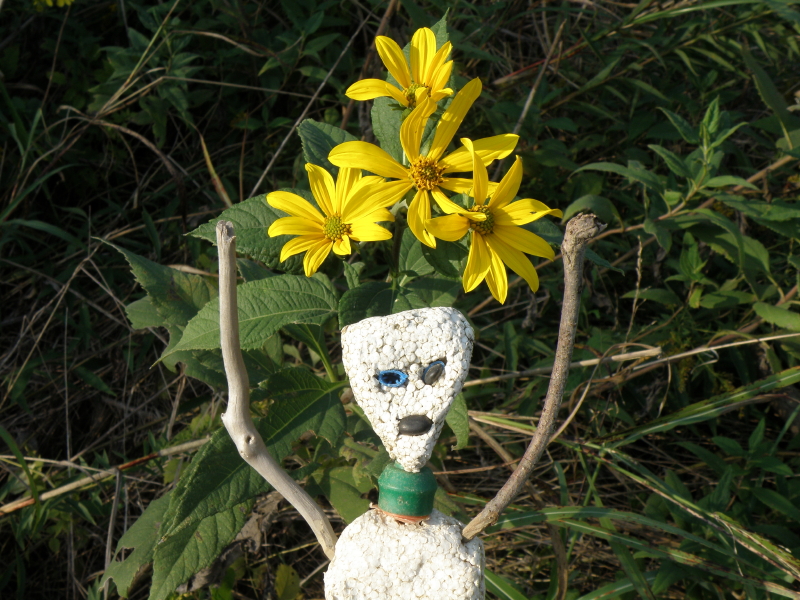
While the humanoids look for the proof of their connectivity to the history of life on their planet, many other interesting forms don’t question this and simply “be”. I have especially grown fond of the sessile life forms that have decided to flourish in the spots most favorable to them.  Once a year, these stationary forms decide to  climax in an electromagnetic spectrum display that is pleasing to the eye.  I have decided to take as many self images in the company of these “flowers and plants” during this “flowering” using my self as a measure of scale.

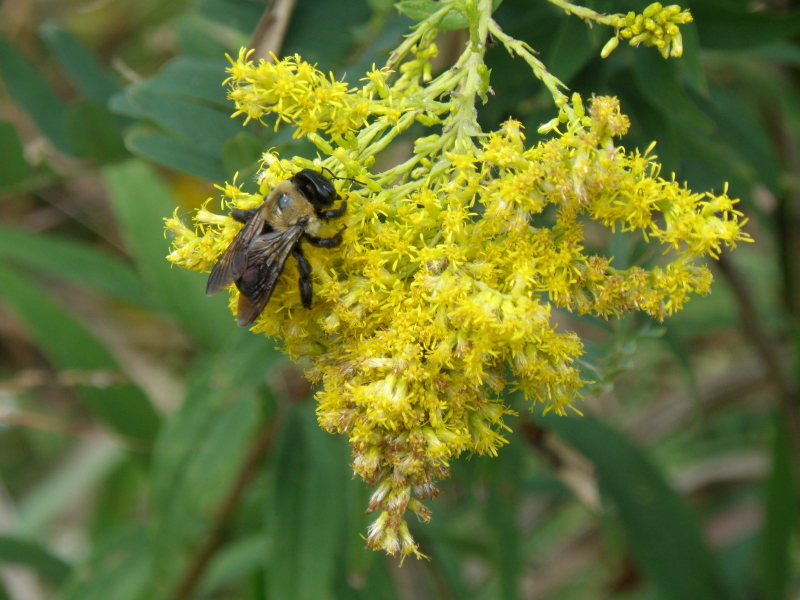
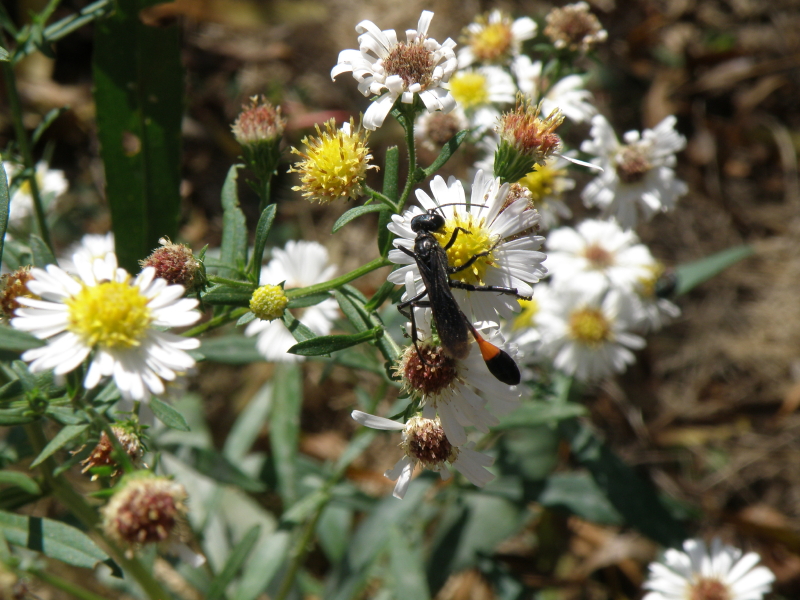
Many of these “flowers” participate in symbiotic relationships often with very diverse and contrasting species.  This particular sessile life form attracts flying animals that feature exoskeletons.  The flowers provide nourishment for these animals and the plant finds an agent to move its genetic material from itself to others of its own kind.  I have observed more of these smaller, exoskeleton-bearing creatures than all the other animals combined and they would make a rich field of enquiry that could occupy the careers of many Styrosian scientists.  Here is a different example of such an animal.

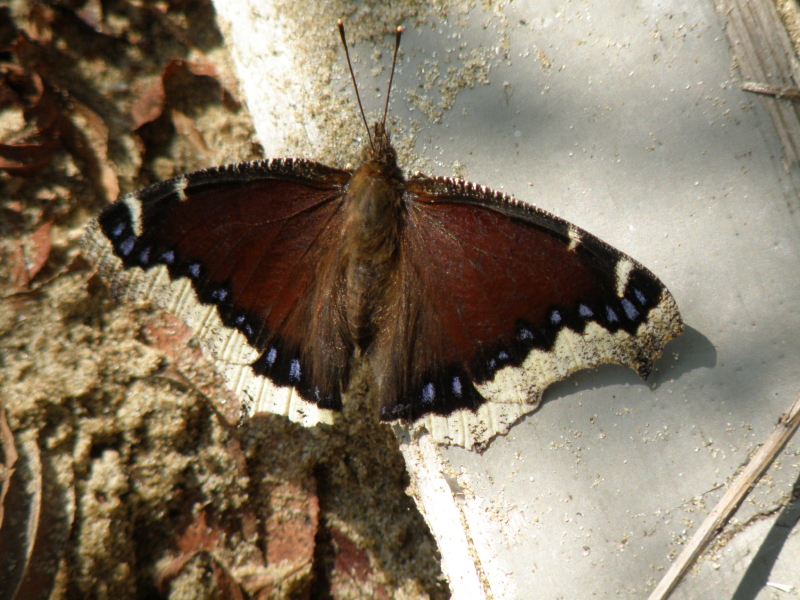
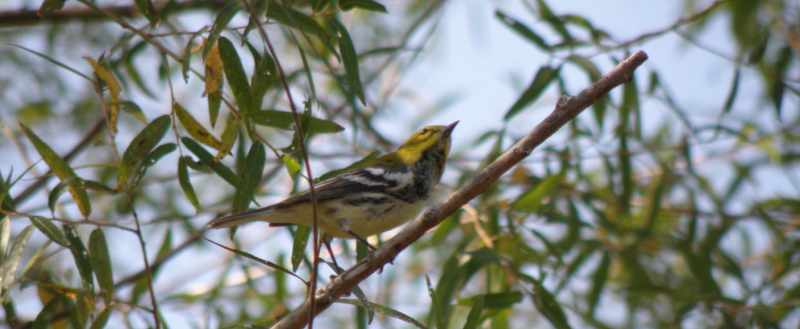
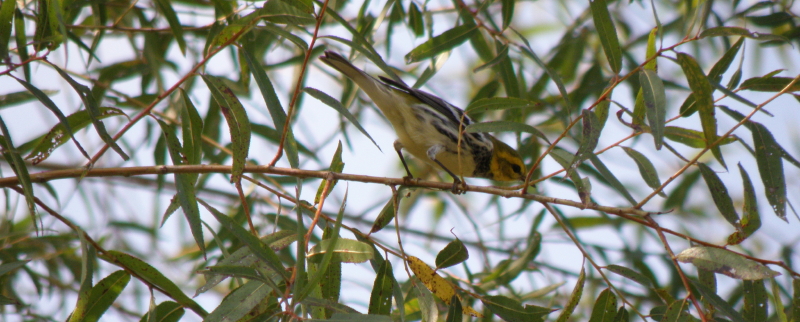
This is what the humanoids call a Mourning Cloak butterfly and I observed it warming itself in the star light.  It’s reverse coloring is cryptic and resembles a dried plant bio-solar panel.  Its mouth parts have been adapted over time to make a tube that can easily extract sugary liquids produced by the plants that these butterflies favor.  There is an exchange of services that benefits both life forms involved in this process.  Other flying animals with a very different morphology also inhabit this space.  Here is a sequence of images from what the humanoid data base refers to as a Black-throated Green Warbler looking for “insects” among the “willow trees”.  Their movements are quick and this species is just traveling through on its way to a warmer environment in the southern latitudes of this world.

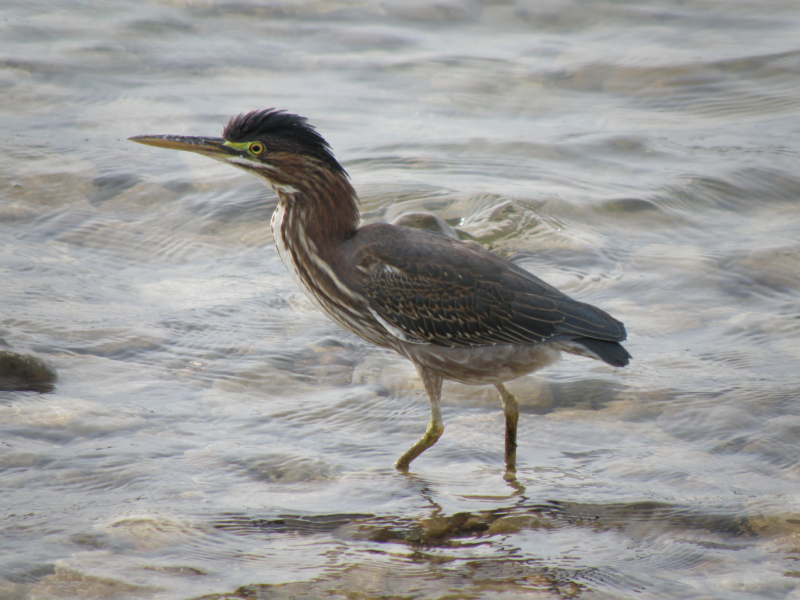
These animate life forms are called “birds” and have internal skeletons made of a lightweight material.  They also have an unusual outer covering that gets shed once a year and helps these animals to fly.  Here is a different and much larger bird I came across feeding at the water’s edge.

From the streaked markings and lighter coloring I identified that this is a juvenile Green-backed Heron.  I disturbed its hunting and feeding along the water’s edge.  Observe that it has a crest on its head which it uses to register increased alarm.  In the next moment, the heron jumped into the sky and with a few quick wing beats was gone from view.  My love, I think you will enjoy the sessile life forms as much as I do!  The humanoids refer to them as either “flowers” or “weeds” and they don’t try to escape if you express interest in examining one like the animate life forms do.  Following is a small portfolio of self-images and some of the variety in these self-sufficient life forms I have experienced on a single solar day.

I have noticed that the humanoids have reserved some animosity towards the sessile life forms that they refer to as “weeds”.  To my sense organs, I can not tell the difference between preferred species and the ones considered to be undesirable?  If one quality of a “weed” is its ability to thrive in a variety of conditions…one would think that the humanoids would admire this since this is a quality they share with “weeds”!  This is certainly a planet of mysteries and contradictions and how I wish you were here to experience it with me.  I have observed that the photons emitting from the local star are traveling farther to reach me with each day.  The temperatures have also been getting cooler and the sessile life forms are undergoing changes to the cellular solar panels which are turning color themselves and in some cases falling off the main body of the life form.  There is a frenzy among the smaller exoskeleton animals to gather as much  energy from each plant as possible.  I’m predicting that this world will go into a dormant period before re-emerging in the warmth of a new solar year.  It is also now time for me to end transmissions for the moment.  How I hope you and my fellow Styrosians are receiving them? Finally, I will conclude with two images.  One is a self-image of me in front of small white and yellow “weeds”.  The last image features some of the flying exoskeleton animals attracted to this plant.  Until its time for my next communication…good by from the water world.

Read Full Post »

At long last I’ve made it back out to the river!  It’s been about eight weeks now since my last visit.  Today I have a double purpose…the first is to drop off one of my Styrofoam and recycled material sculptures for an annual fund-raiser that the Falls of the Ohio State Park Foundation hosts every year.  I’m glad to do this and hope my donation does well in their auction.  Despite the years I’ve been making stuff out here it still strikes me that most of my materials are literally trash.  I suppose I will never get over that. It seems to me that it takes a certain kind of person who would want to own one of these creations!  The other more fun purpose is to check out what’s different along the river and maybe make something new.  Immediately, I can see that the hot summer continues to take its toll.  At first, it was the relentless heat, but now that is coupled with a serious lack of rain.  The river is low and everything looks dry.

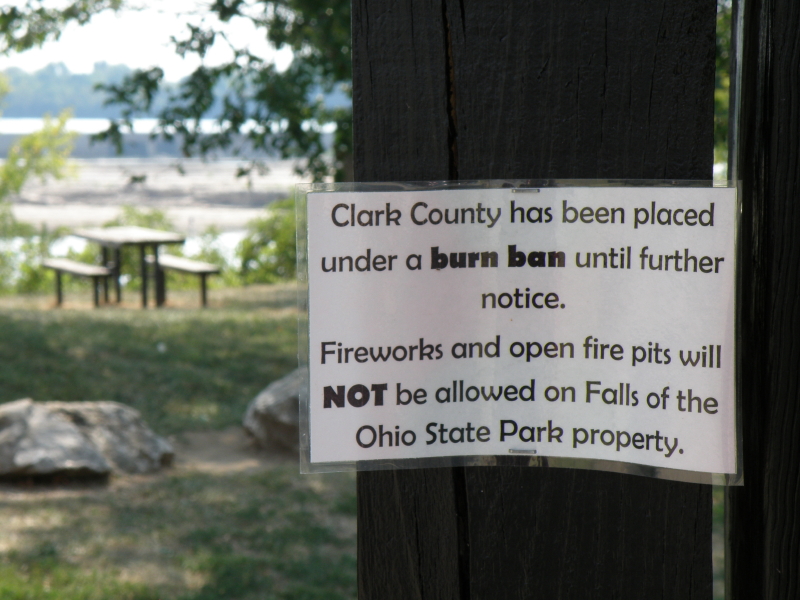
Over the course of this summer we have had just enough rain not to be considered a disaster area.  This is hardly a ringing endorsement and I find a small laminated notice tacked on to a bulletin board that reinforces how dry it is.  I think to myself that some of the people I’ve encountered out here over the years who do shoot off fireworks or build fire pits are not likely to read or heed this warning.  When I’m in the park, my preference is to move away from the most public areas and so with my walking stick in hand I head down the Woodland Loop Trail.  I’m still not confident enough to want to test my repaired knee too vigorously, but this trail is fairly easy.

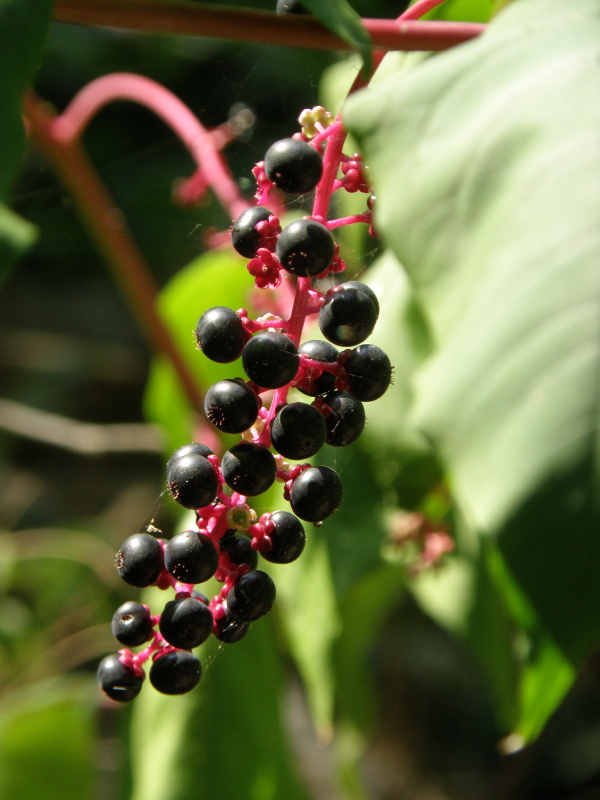
The trail is shaded which I welcome since it’s still over 90 degrees out here.  I pass many what I would consider late summer blooming plants that have flowered earlier than usual.  I did see several stands of tall Pokeweed plants with their black berries, but even these weeds have wilted leaves.  I guess what moisture these plants could muster up went into the production of their fruit?  These berries are a favorite food of several bird species.  In the past, I have used the intensely dark purple juice from Pokeweed berries as a pigment in some drawings I have made.  This color, however, is fugitive and ultimately fades in the light.  As I walk, one distinctive sound I keep hearing is the tell-tale sound of gray squirrels gnawing on the rock-hard walnuts that are  clustered around the few walnut trees along the trail.  There’s not much meat inside one of these nuts and it seems like a lot of work for little reward.

Out on the exposed fossil beds the sun is baking, but under the shade of the trees it is still fairly green.  Since my last visit,  however, I noticed a lot of dropped tree limbs and a few whole trees that have keeled over and appear to be the result of wind damage.  I have seen a few birds including two Hairy Woodpeckers and as I walk along the trail I keep getting scolded by Carolina Wrens who resent my intrusion.  In the distance I recognize the calls from the Killdeer plovers that are looking for food along the water’s edge.  The rarest and most unusual bird, however, is  just up ahead.

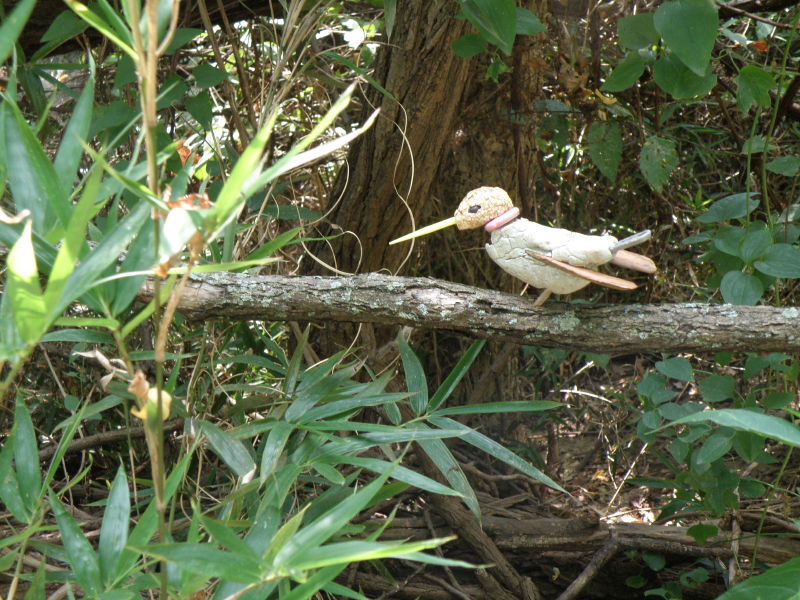
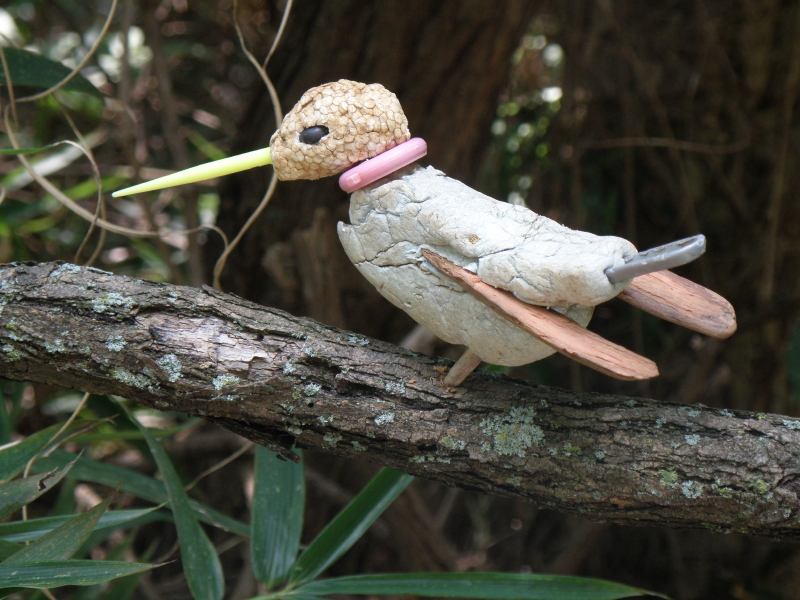
I’ve only seen a couple of the more common and native Ruby-Throated Hummingbirds this year…and so I was taken aback and delighted to come across what I later identified as Isaac’s Hummingbird (Archilochus isaaci ).  To my knowledge, this is the only recorded instance of this Cuban species reaching this park.  I’m guessing that Tropical Storm Isaac (purely coincidental, but also appropriate) which is threatening the GOP conference in Tampa Bay at this moment may have blown this rarity our way?  Hummingbirds of which there are over 300 hundred recorded species have been known to wander thousands of miles away from their more familiar haunts.

I came across this hummingbird dozing on a fallen branch.  It would open its eyes every once in a while and regard me.  I kept my movements to a minimum and completely forgot about my aching knee in the process of creating a few images of it.  I was able to snap off six pictures before it took off.  As you can see, this bird (also known as the Yellow Saberbill) has a bright yellow bill it uses to extract nectar from flowers.  Its light blue body, brown wings, silver tail, and whitish-head are diagnostic of this species.  I don’t know what it is about the Falls of the Ohio, but I have seen other unique hummers out here before.  Digging through the archives…I present two of them again.

This is the ultra rare Arctic Hummingbird appearing at the Falls of the Ohio to sip nectar from the equally scarce Ice Blossoms.

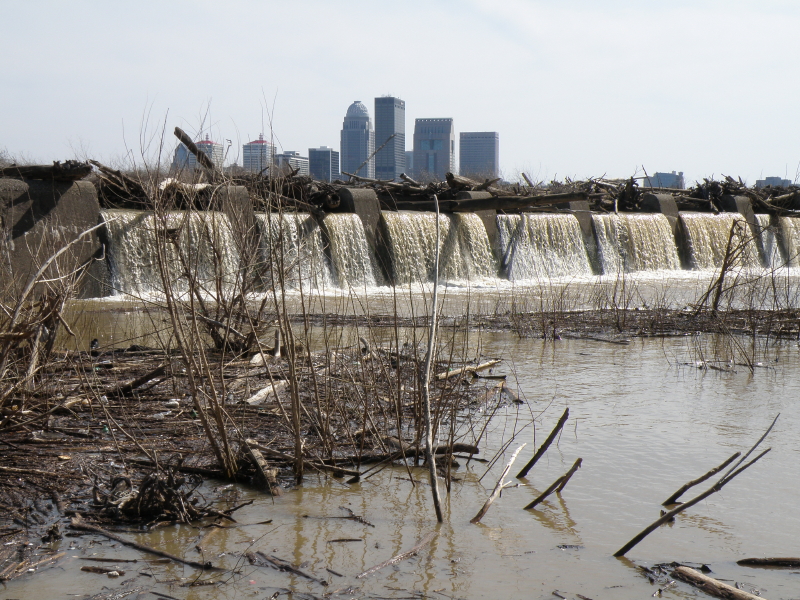
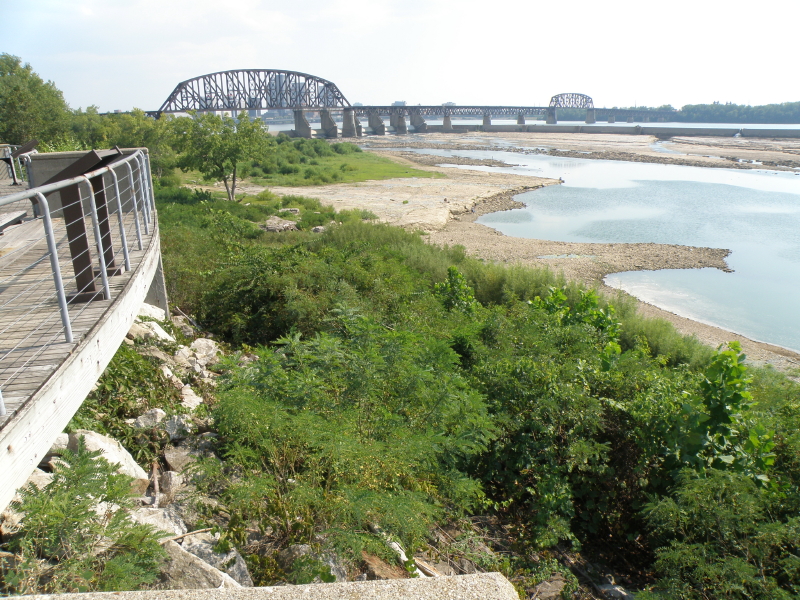
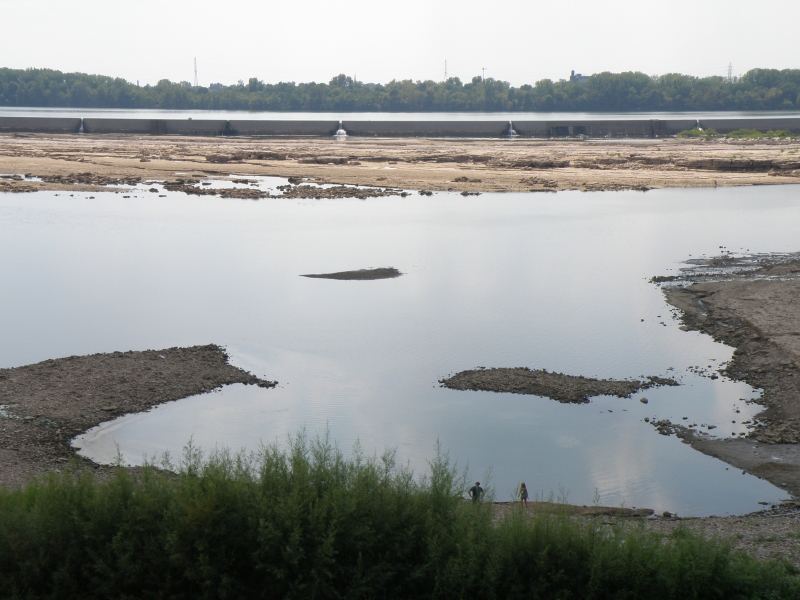
I encountered this Cumberland Greencrest back in 2010 not far from the place that I saw the Isaac’s Hummingbird.  Both of these rare hummingbirds stayed in our area for a couple of days before moving on.  This is what keeps me coming out here…I just never know what I’ll find or discover! This was a short, but eventful trip and I thank you for tagging along.  Here’s another view of the river with the exposed Devonian fossil beds.

POSTSCRIPT:  The inspiration for this particular post comes from another WordPress blog I enjoy entitled “Ekostories”.  Isaac Yuen is its creator and he’s an aspiring environmental writer.  Issac has a talent for weaving stories and making connections about responsible stewardship of our planet.  At the time of this writing, Isaac has a wonderful post about a book entitled the “Flight of the Hummingbird” that I think you may enjoy…so please check it out.  Here is his link:  http://ekostories.com/ Finally, one last peek at this elusive hummingbird checking out a flower blossom.

Read Full Post »

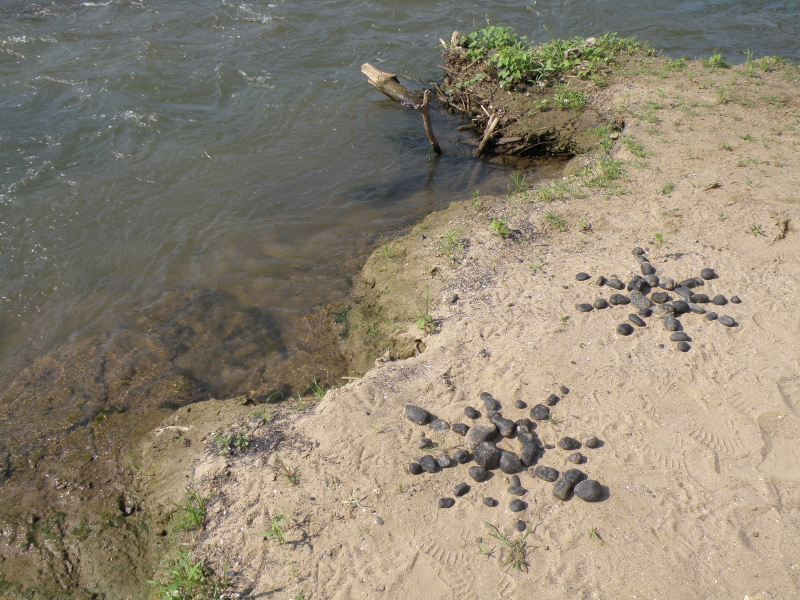
The record warm spring we experienced in the Kentuckiana area is being followed by the extreme record heat of this summer.  Twice I have ventured out to the Falls when the thermometer had passed 100 degrees Fahrenheit or 40 on the Celsius scale.  My youngest son told me (without prompting) that he  thought this heat was evidence of global warming.  The idea that we could alter the climate in some way has reached our children’s consciousness and changed their awareness of what kind of world they will inherit.  Kids get it…why don’t politicians and business leaders do the same?  This should be a global priority because the quality of our environment makes everything else possible.  I’m at the river today to continue this role I’ve created for myself as witness/participant in this historic place.  Here’s a brief record of what I found and made on a particularly brutal day.  I’ll start with more coal flakes that I made at the water’s edge.

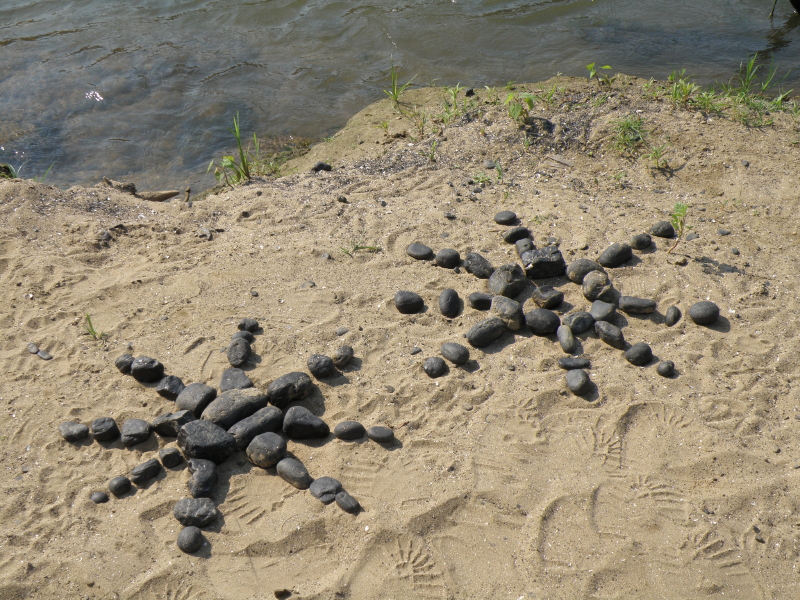
Walking around the park at its eastern edge, I collected the river-polished coal I came across and with these black rocks created two designs.  Because of the heat, it doesn’t take long for my clothes to start sticking to my skin.  For relief, I splash water over my face and arms. At first, I left the interior of one of the flakes open, but later decided to change it.  I did scout around for the other coal projects I had left here previously, but they were either missing or deliberately destroyed.

Here is the second design with the interior filled on the first coal flake. Why some people find my “art” to be more offensive than the trash that is ordinarily found here is puzzling to me?  Why more people don’t find all the random trash to be an eyesore and do something about that is another mystery.  My best answer is that “art” has a way of focusing and concentrating energy that stands above the ordinary.  To be noticed is not always a good survival strategy.  My work gets hammered because it sticks out and there is something in the human condition that would rather break things than fix them.

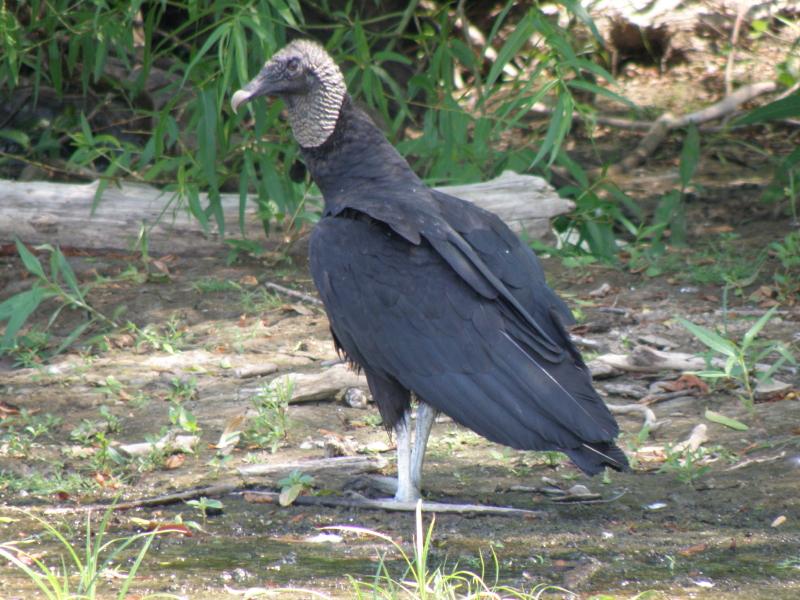
It’s still morning and I see the resident Black vulture colony is also at the river’s edge looking for dead fish or fishing bait.  There’s nothing like coming across a partially opened pack of chicken livers that some fisherman brought for catfish bait.  The flies and the vultures say thank you.  I’ve come to think of these vultures as familiars and part of me likes to believe that they even recognize me and allow me to approach a little closer than usual.

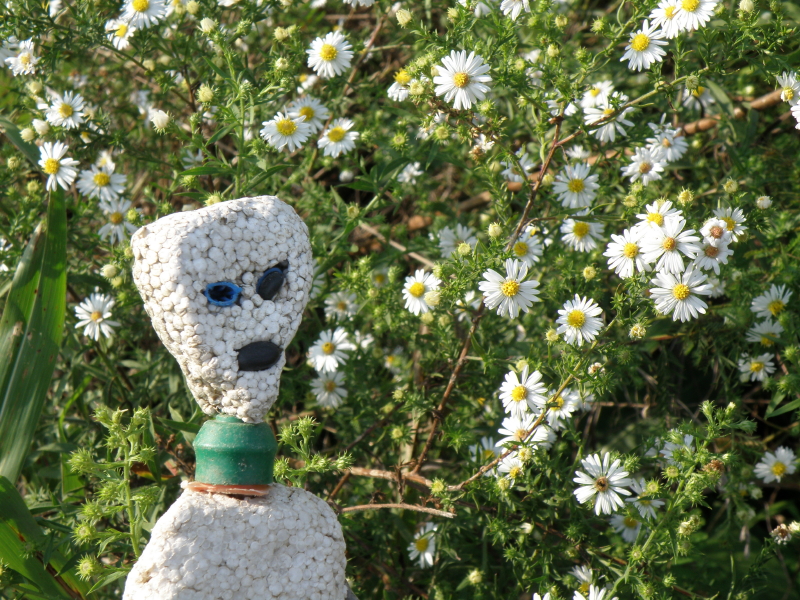
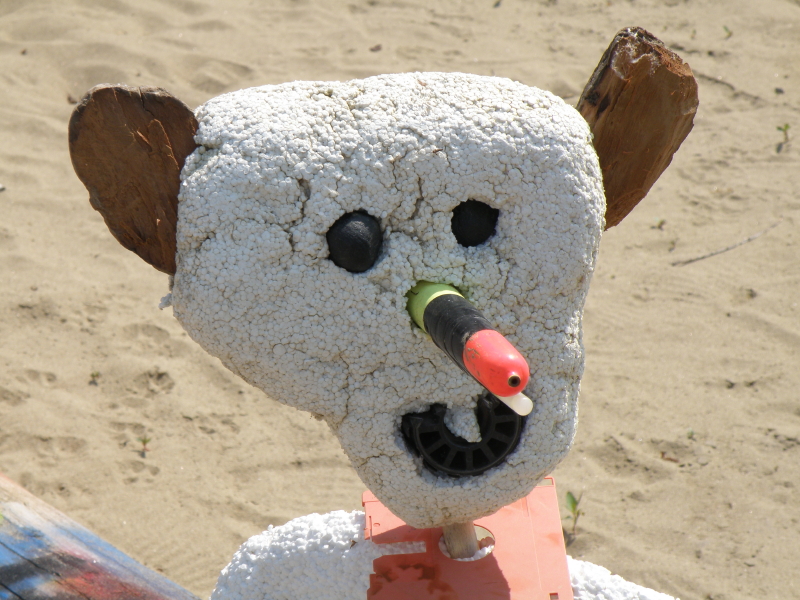
A couple of hours later and the vultures have done what I’m about to do…namely seeking shade and relief under the willow trees.  I find a few vultures standing on the ground with their wings outspread trying to catch the slimmest of breezes, but there is none today.  Reaching my stash of Styrofoam I look around and everything appears as I left it.  It’s just been too hot for most folks to want to be out here.  Rummaging around the polystyrene, I chose a few pieces and construct a new figure.  This piece has remained nameless, but if you out there in the wide world want to name it…that’s fine with me.  It’s also been too hot to think of titles and names.  He is another in a long line of absurd figures I’ve created with the collaboration of nature.  Here’s the head made from Styrofoam, coal eyes, fishing float nose, some kind of plastic piece for the mouth, and wooden ears.

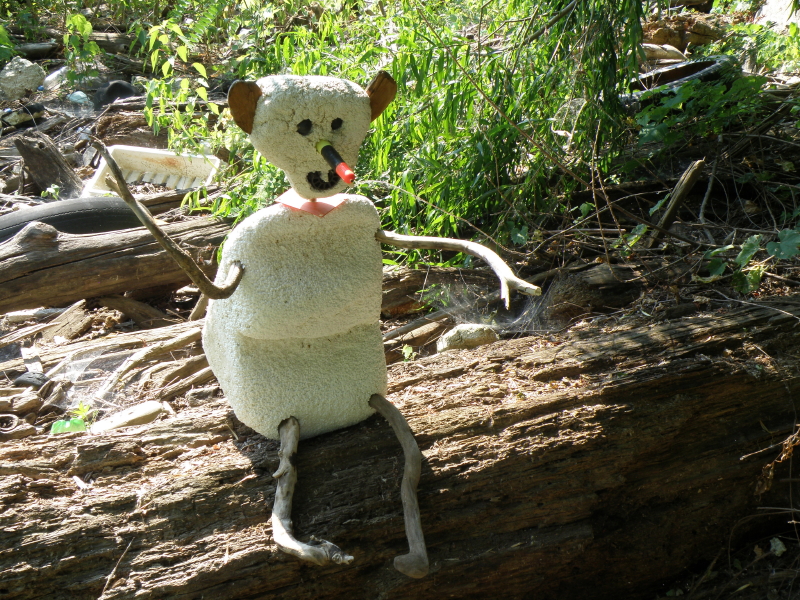
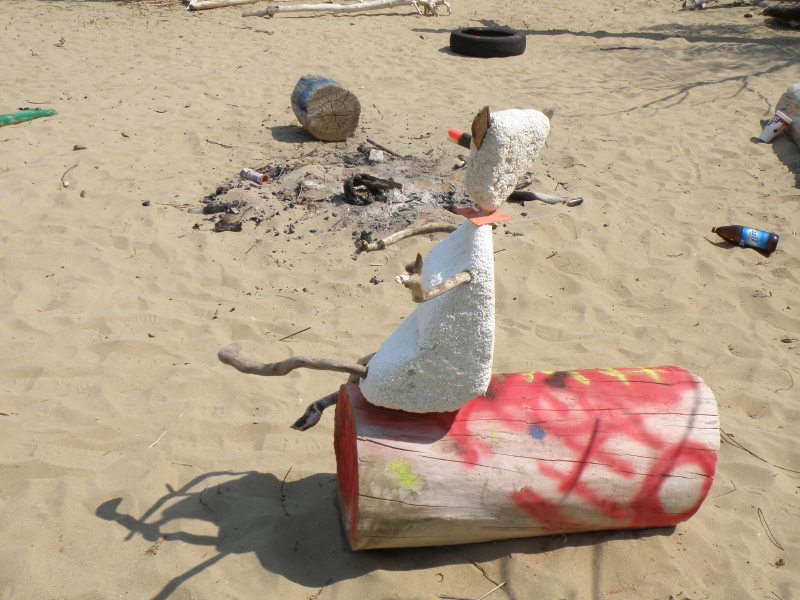
As you can see from the last image…I have lots more Styrofoam to use up before our next big flood.  I began my latest figure with the body.  I came across a piece that suggested a sitting pose and so that is what I made.  Upon completion, I moved my new “friend” to various locations and tried him out in various contexts.

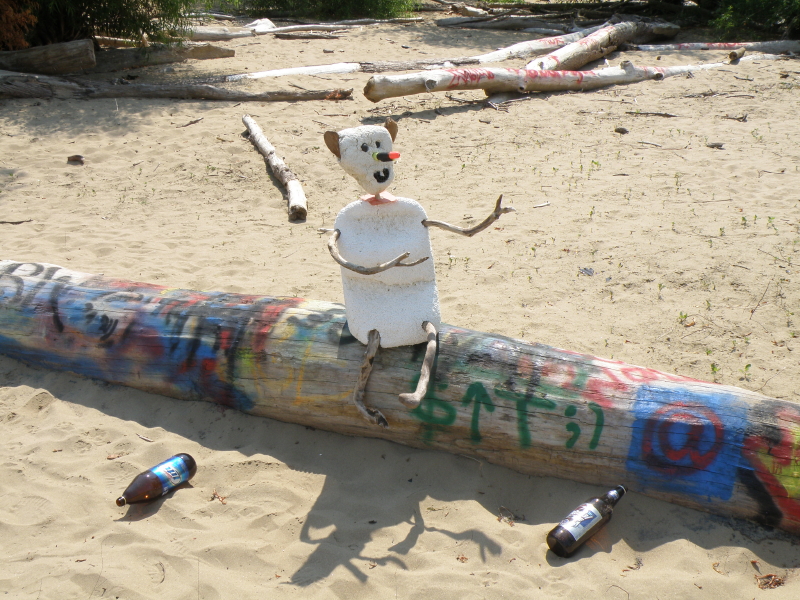
In the end, I decided to pose my figure in the remains of a private  outdoor party that was held out here since my last visit.  This must have been no ordinary “celebration” based on all the spray painted graffiti now on the logs and stumps surrounding their camp fire.  Take a look.

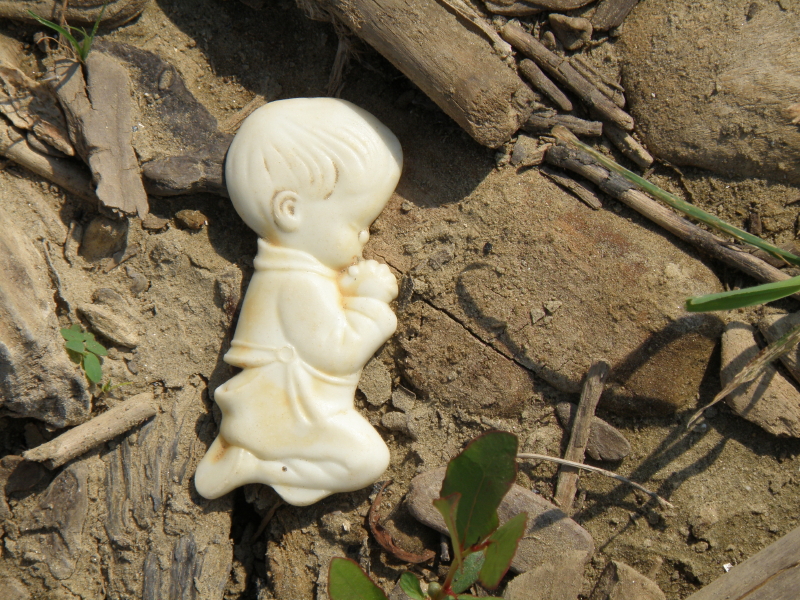
I’m more accustomed to seeing graffiti in an urban setting where tagging trash dumpsters and buildings is common place.  I’m still sorting out how I feel about coming across a scene like this?  Has anything actually been harmed…it doesn’t appear so.  When lovers cut their initials into the bark of a living tree, those cuts are there for the life of the tree.  All this spray painted wood is dead.  Still, this hardly seems like a nature loving act especially since the “artists” left their large beer bottles behind.  I think they did it because they could.  Their handiwork to my eye also lacks an aesthetic dimension, but now I’m sounding like an old-fashioned art critic.  I guess here is as good a place to say that I’m taking a hiatus from visiting the park to recover from my impending knee surgery.  I’ve been stomping about out here with a bad left knee for over a year and it hasn’t gotten better on its own.  An MRI showed two tears in my lateral and medial meniscus.  With hope, I won’t be down long and I will continue the riverblog with other stuff probably from my various collections. I’ll end this post with a small piece of plastic I found on this hot, hot day.  Since I started this post with some perceptions from a child about the environment…perhaps it is even appropriate?  It may take something akin to divine intervention to improve the condition of the world.

Read Full Post »

« Newer Posts - Older Posts »