Feeds:
Posts
Comments

Archive for the ‘animals’ Category

Before the month of May slid into history, I did a little sliding of my own.  The day after Julia and I visited Nerinx, I did a solo expedition to the western section of the Falls of the Ohio State Park.  Now the sliding part has to do with mud!  In places the earth was high and dry, but in key areas  the mud remained slippery and sticky.  Here’s a picture of what I mean.
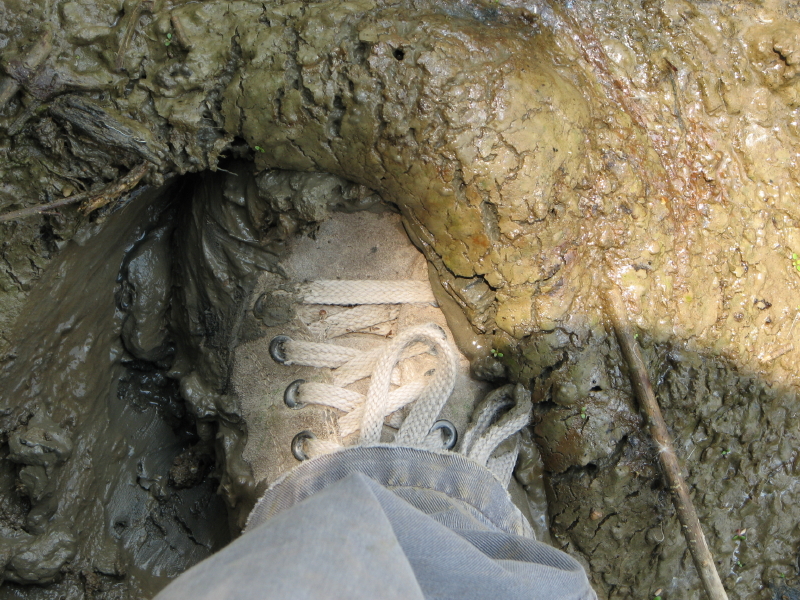
It’s creamy and in places you could sink in over your ankles.  To get things over with so I don’t have to obsess about this, well I just find some mud and step into it.  After that there are no worries about remaining clean!  The deed is done.  I have a similar philosophy about the rain.  Once I’m as wet as I can get…I can relax and do my thing as long as I don’t get too cold.  The mud is more treacherous closer to the river’s edge and I decide not to flirt with it too much.  There is afterall, much to see around here.
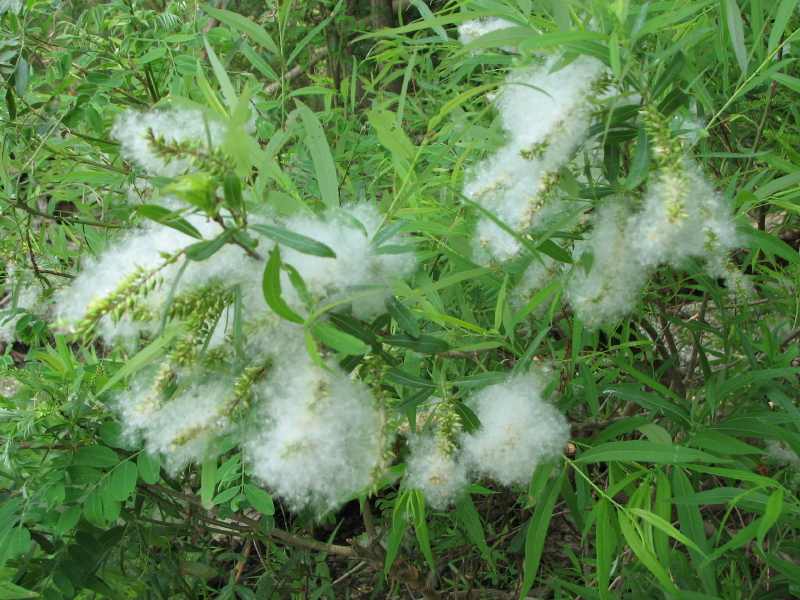
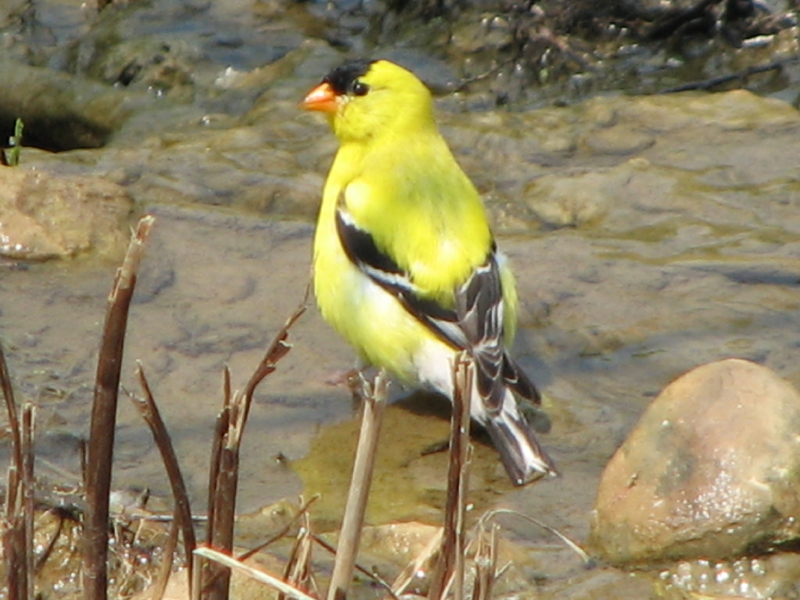
The willows are in maximum fluff production and there are drifts of the stuff on the ground.  When the wind stirs then the willow seeds become air born and are carried away.  With so much fluff, you would think willows would be even more common than they are.  I have to say that so far, I haven’t seen any birds that have made my year.  Last year’s signature bird was the Summer Tanager.  This year hasn’t been the warbler fest that I experienced just two years a go.  Still, I take what I can get and I always love American Goldfinches.  Here’s a male taking a dip in some water.  Small flocks cruise along the trees nearest the river.
I’m walking west along the river and I came across the only persona that I saw all day.  We eye-balled each other, decided that neither was a threat and so we had a short conversation.  Mostly, it was an opportunity to compare nature notes.  I guess the feature that most stood out about my acquaintance is the bright pink hat she? is wearing.  I said I was looking for birds and junk and “she” said that she was a Lepidopterist.  Oddly, we didn’t introduce ourselves, but she let me take her picture for my blog.  I guess she’s about five feet tall or so and walked with a cane.
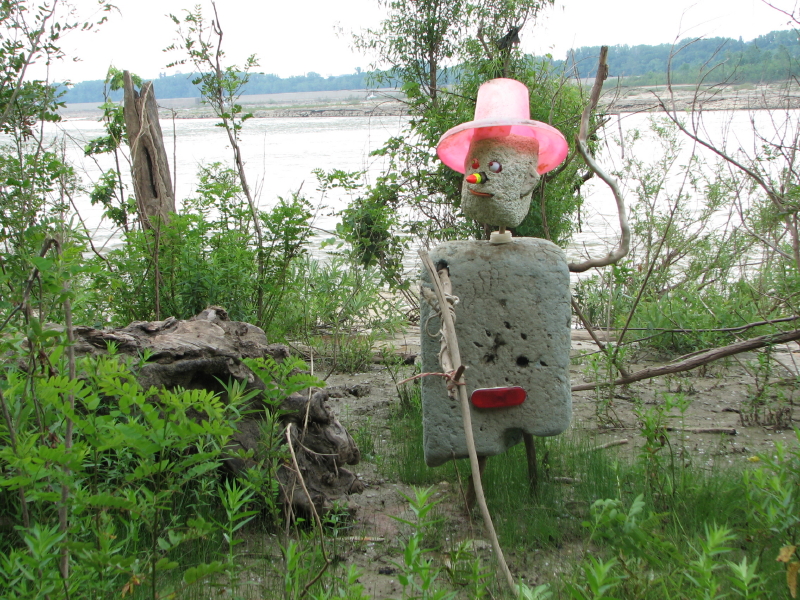
After I asked if she had seen any interesting birds…she hadn’t.  I was asked about what butterflies I had come across.  Fortunately, I also like butterflies and try to take their pictures when both insect and camera cooperate.  I really don’t like these autofocus cameras.  Anyway, I noticed many species out on this day including Commas, Mourning Cloaks, Cabbage Whites and then I showed her images of the two butterflies that I did get decent pictures of and she seemed happy to identify them for me.  Here is the more unusual of the two that I came across at the forest’s edge.
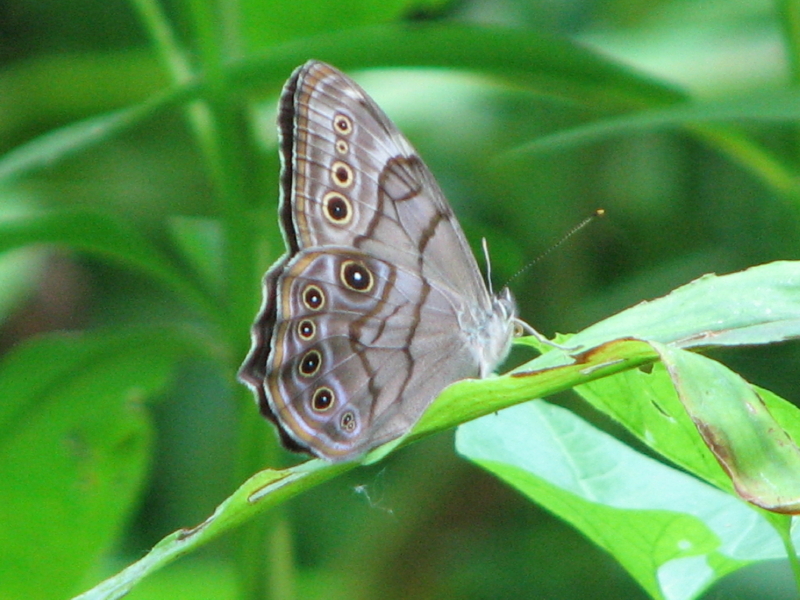
Quickly my new friend identified this as being Enodia anthedon or more commonly, the Northern Pearly Eye.  It is a forest butterfly that does not come to flowers preferring instead the fermenting juices of fruits and tree saps.  I reply that I had noticed that there were many butterflies around the fallen mulberries and on the sides of the willow trees. 
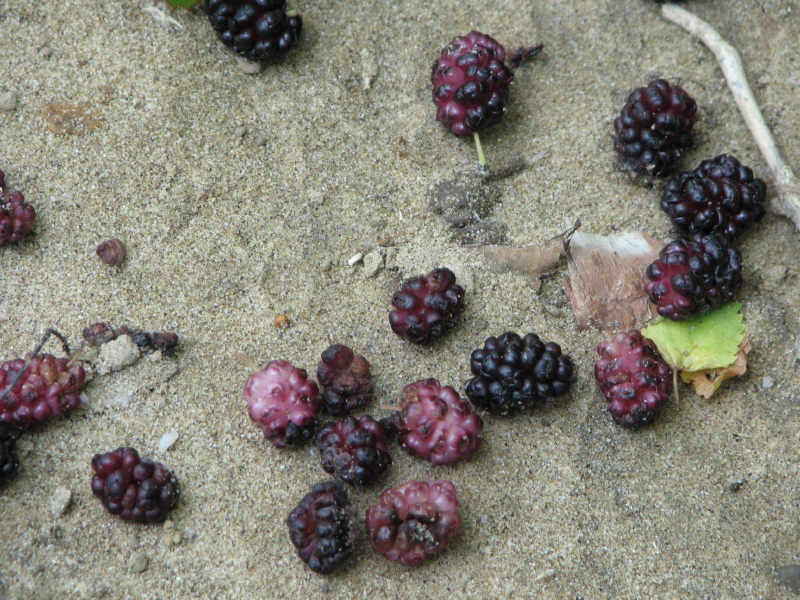
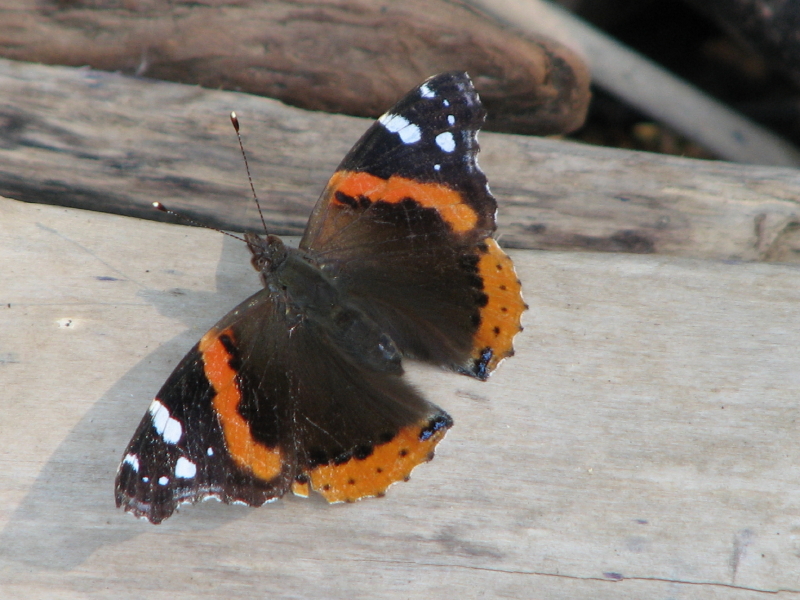
I wonder if science has determined if a butterfly can get drunk off the fermented juice and if this is possible…do they experience hangovers?  I know this does happen with birds like Cedar Waxwings that literally get tipsy.  The second butterfly is one that many people know and it’s the pretty Red Admiral or Vanessa atalanta . Even its scientific name is charming.  This is a people friendly butterfly and will often alight upon a person.  I came across dozens of these today.
With the rising heat the promised threat of a late afternoon thunderstorm began to materialize.  First there was the distant sound of thunder and since I had a hike to still make to reach my car…I said farewell to my butterfly friend whom I hope to see again.  I asked before parting if she collected butterflies and she answered that once she had, but was now over that part of her interest in them.  She no longer needed to possess them and instead grew flowers and plants to attract them.

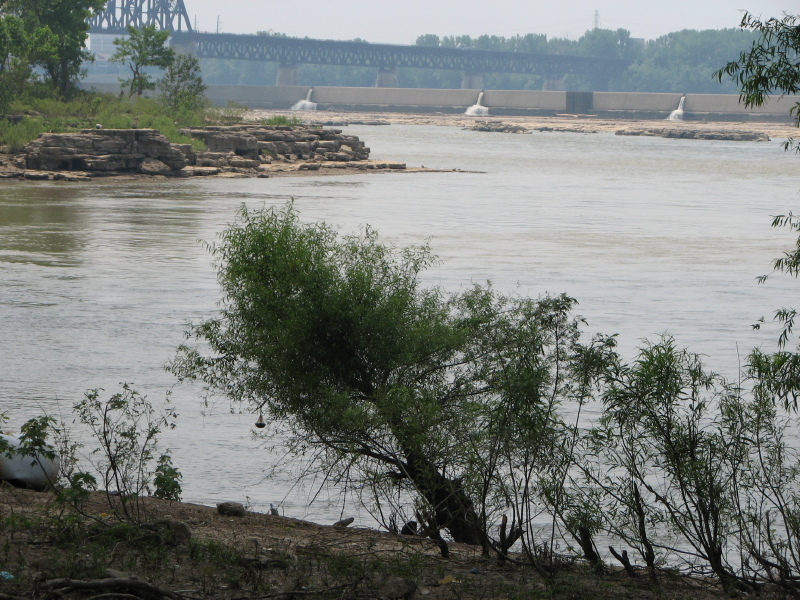
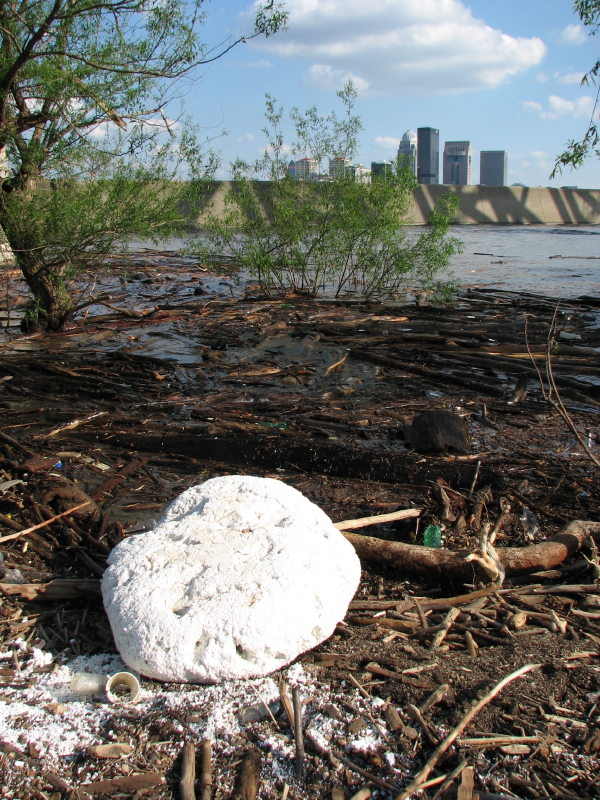
I hope I run into the lady with the pink hat again.  She seemed to share a reverence for the life that is out here in the park.  I would welcome learning more about the butterflies that call this place their home.  One last shot showing willows, the riverbank, fossil cliffs, and the dam in the far distance that keeps the river at bay…most of the time.
Read Full Post »

I never have a dull visit to the Falls of the Ohio.  Each time I come out here I can expect an adventure of one type or another.  On this day the river had noticeably receded and this large boulder of Styrofoam that I had been watching for days as it floated out here was finally on the shore.  I tried to move it, but it was so waterlogged and heavy that I gave up…for now.  All around it were Styro-bits that were ground off by abrading against logs and the sandy bottom.

Near my polystyrene giant was this section of the riverbank.  It’s the aftermath of a tug of war we are engaging in with the planet.  In this type of struggle there are no winners.  Recent images from the oil spill in the Gulf of Mexico come to mind which incredibly still flows unabated weeks later.  Since much of the garbage in this photo is derived from petrochemicals, I wonder if this also could qualify as an oil spill?  If I scooped up a handful of sand around here…I would see tiny bits of plastic and the ever-present polystyrene bead.  This stuff is likely to never go away.  But life does try to keep carrying on as it always has.  I also came across this interesting beetle and a smile returned to my face.

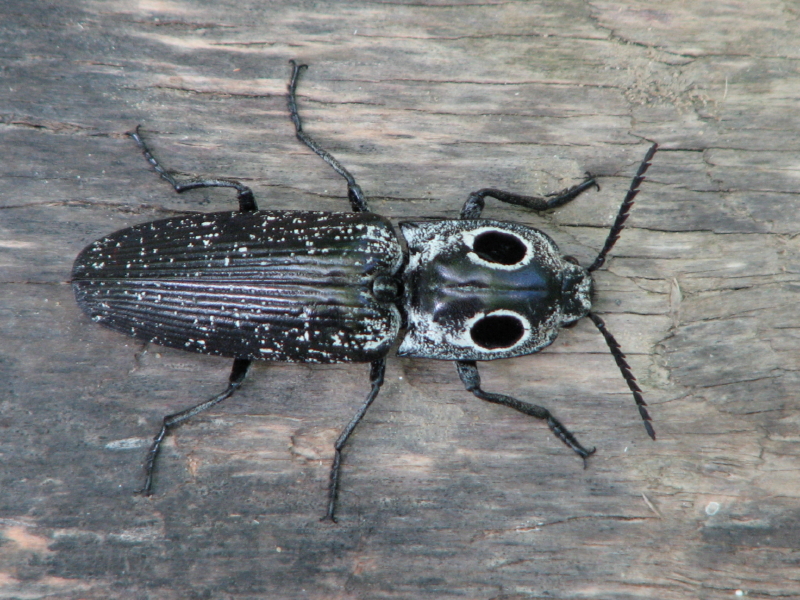
I have seen these out here before.  It’s an Eastern Eyed Click Beetle and I think I read somewhere that this is our largest click beetle.  If you placed this beetle on its back, it would flip right side up with an audible “click”.  Hence click beetle.  There are other species, but they are all smaller.  This one is just under two inches (about five centimeters).  It’s coloration is similar to a bird dropping, but it also has these dramatic eyes on its pronotum.  These guys do fly, but most of their lives are spent as larvae living in decayed wood.  I passed by the mulberry tree with its ripening berries and there are birds who just can’t resist this plentiful food source.

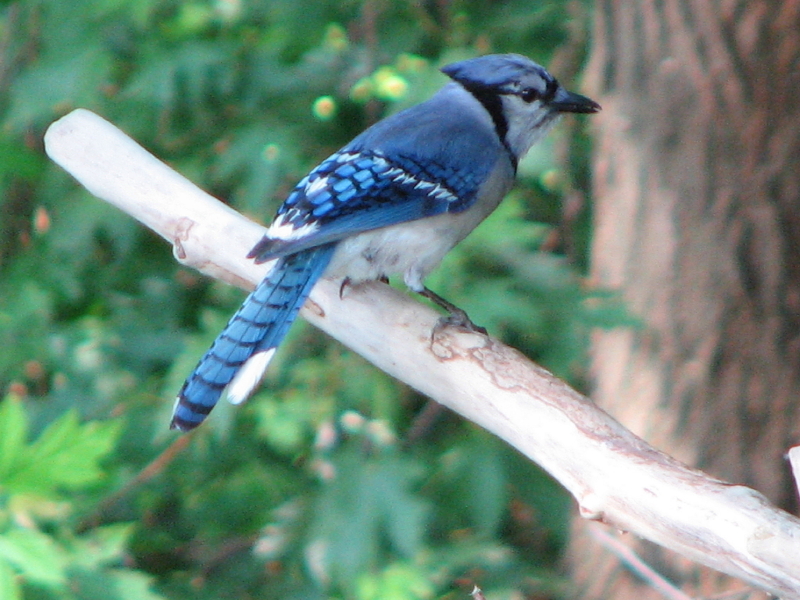
Among the bird species eating fruit from this tree included this Blue Jay…

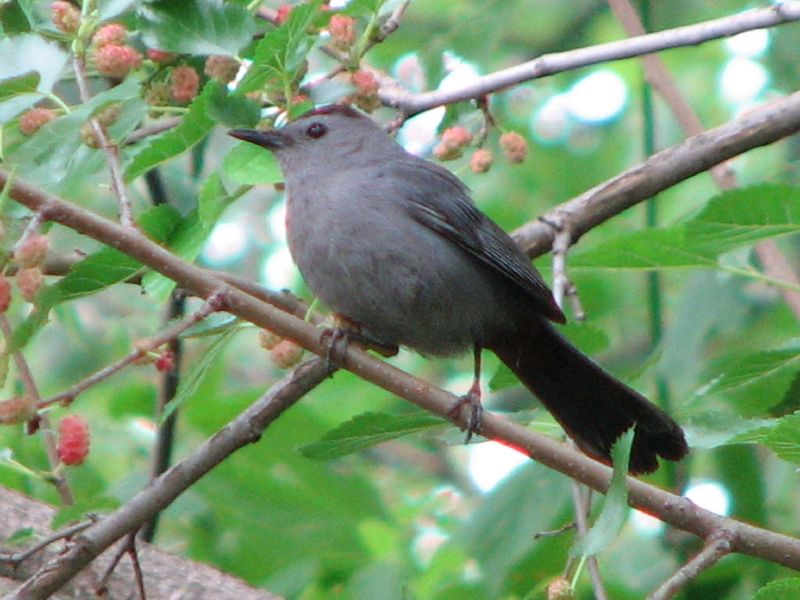
…and this Catbird which does make odd sounds which sometimes sound like the mewing of a cat (hence catbird!).  They can be quite territorial to their own and other species too.

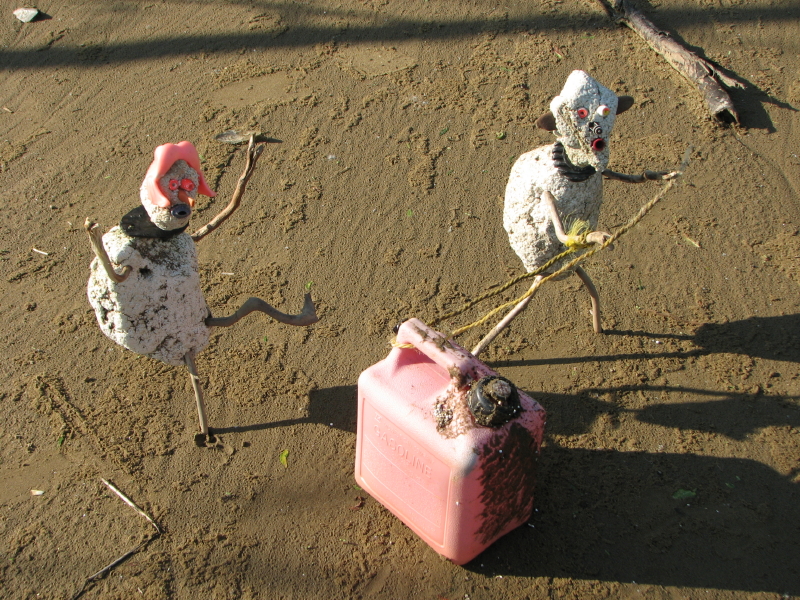
Not too far from this tree, I could hear some squabbling going on and I moved towards the sound.  You can imagine my surprise when I came upon this scene!  I stayed hidden behind a large willow and just observed.

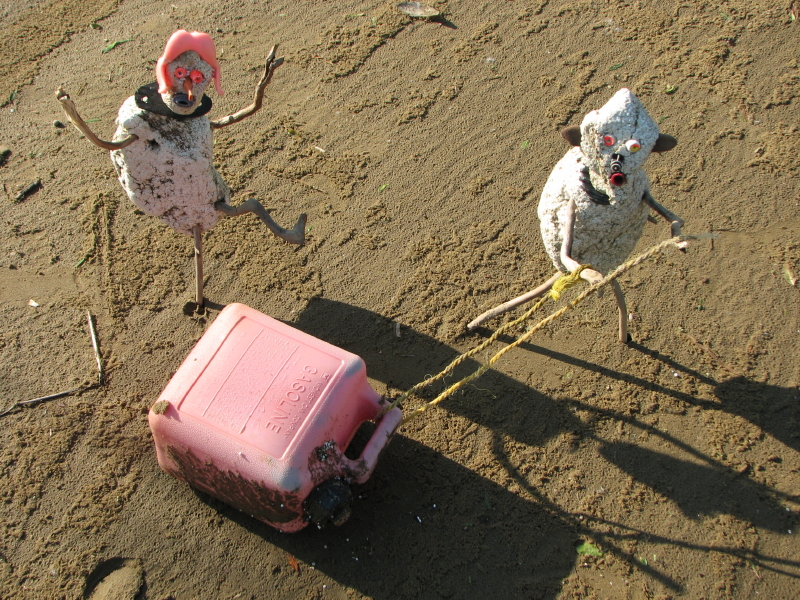
There were these two little figures and one of them was tugging on a rope attached to a plastic gasoline container and his “friend” with the wierd hairdo was jumping up and down on one leg trying to get him to stop!

The figure with the rope eventually succeeded in knocking the container over while his friend continued hopping!  What he thought he was going to do with this gas can is a mystery?  He soon grew frustrated with his efforts and a shouting match between the two began.  That deteriorated into another contest where each tried to take the rope from the other.

All this effort must have been exhausting because after a little while they gave up and abandoned the rope and the gas can leaving them lying on the sand.  They reconciled and walked away from here hand in hand. 

Perhaps they realized the futility of their struggle and came to their senses?  Perhaps they recognized that it was better to conserve their energies for more constructive pursuits?  Who knows, but while I pondered these questions I came across another image of futility and I will leave you with that until next time.
Read Full Post »

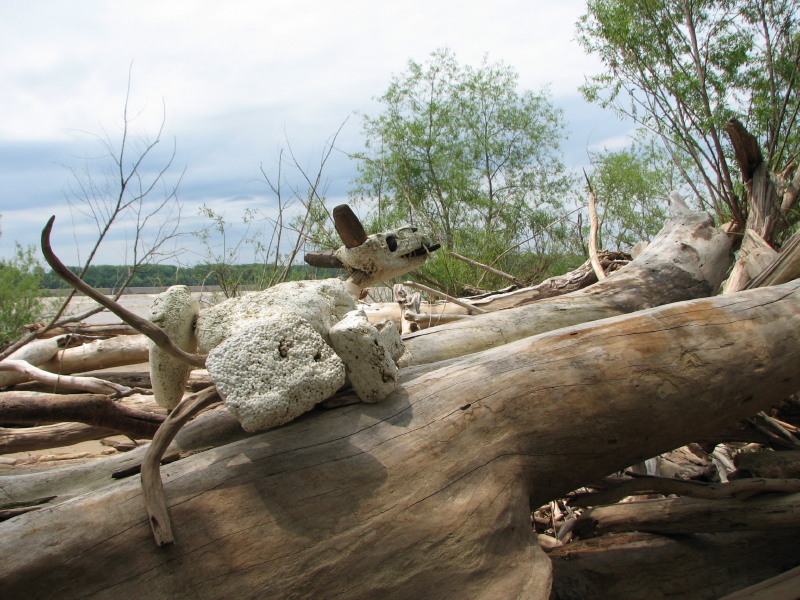
Extraordinary images from a remotely placed camera-trap yield glimpses of a rare mammal.  Long thought to be gone from the Falls of the Ohio, it appears the Feralocitor is recovering parts of its former range.  The Feralocitor is a carnivorous animal about the size of a very large house cat.  Genetically, a Feralocitor’s closest living relative is the Fossa from Madagascar which is that island’s largest and rarest native predator.  Both share a relentless drive to pursue prey and are especially adept at catching birds and small mammals in trees.  Like the Fossa, the Feralocitor has a long tail which it uses to balance itself as it runs and jumps from branch to branch in its arboreal home.  Pictures of the Feralocitor at the Falls of the Ohio came as a shock to the park’s naturalists who remain mute about its existence here although there have been long-standing rumors.
The image above shows what the Feralocitor is especially good at which is stalking its prey.  Noiselessly, this predator can get low to the ground (or log in this case) and approach within striking distance of its formidable claws and teeth.  Once a Feralocitor has a hold of its intended victim, there is no escape.  In addition to stalking, some Feralocitors (especially older or injured individuals) are excellent at hunting by ambush.  The original inhabitants of this land have an almost supernatural reverence for this animal and their name for it roughly translates to “…ghost-spirit of the trees”.  This reverence, however, wasn’t shared by the farmers who settled this area and saw the Feralocitor as another predator who killed and ate their smaller livestock.  It was shot on sight, poisoned, and trapped until it became so scarce that it was rarely seen and believed gone from these parts.  Today, the role of random predator is played by domestic dogs that have gone feral and occasionally run in packs causing fear and damage.  Such dogs exist at the Falls of the Ohio and here are a few images of them.
The feral dogs in this area are a motley crew of mixed breed dogs.  I recently came across two of them while bird watching and I was so intent on looking up, that I didn’t notice that these dogs had walked quite close to me.  In far western Kentucky, I recall an experience of being out in the woods and being surrounded by five wild dogs!  It was a tense moment because dogs in this situation can be dangerous.  I remember yelling at them and throwing rocks in their direction to chase them away.  Once there was a thriving sheep industry in the western part of the state that was decimated by feral dogs.  An old biology professor at Murray State University told me that one.  The dog in this second picture doesn’t seem particularly glad to have run into me and I’m probably interrupting his attempt at a meal from a nearby dumpster.  They seem always hungry and will take nearly anything that crosses their path.  There is a shortage of ground nesting birds in the park because there are just too many predators on the prowl and not enough cover.  World-wide, feral dogs are a resilient and growing problem and rabies is also on the rise.

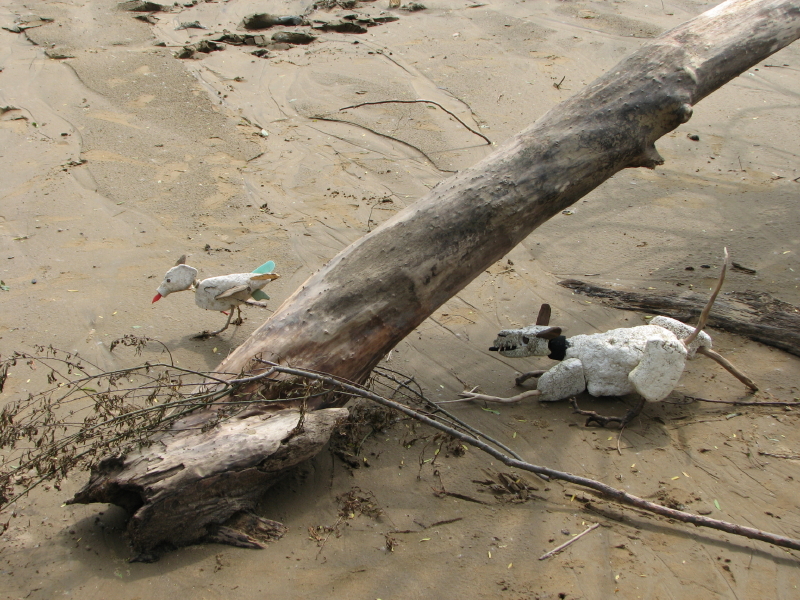
I decided to camp out in an area where a Feralocitor was last seen.  After several days of nothing, I was rewarded with two separate  images of a hunting Feralocitor.  In this case, the prey animal (the Ohio Valley Rail) is also rare and endangered.  The first hunt I observed was successful, however, the Feralocitor was so efficient and quick at the kill that it was over and gone before I could get obtain another picture.  It waited until the bird’s head was down before launching its fatal attack.

In this second photo, the Feralocitor was unsuccessful when the bird sensed something was wrong and flew away.  By listening to its instincts, this rail lived to experience another day.  It is great seeing an animal that once existed in this area recovering some of its former range.  Similar stories exist from the recent past.  Once black bears were rumored in the eastern section of  Kentucky.  This was proven, they became studied, protected,  and  now there is a limited hunting season on them.  The same could be true of the mountain lion.  Persistent claims that they too are re-entering  their former territories will probably pan out as young lions move eastward pursuing the ever burgeoning deer population.  As for the Feralocitor, time will tell.  It isn’t an animal likely to be prized by hunters.

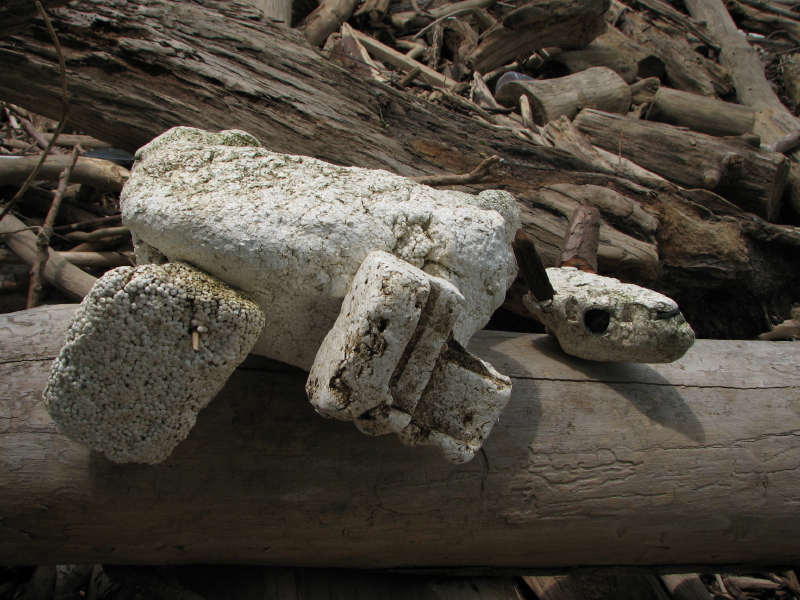
The last image is of the Feralocitor in progress.  It’s made of found Styrofoam, wood, nuts (for eyes), rubber, and plastic and was constructed on location during a light rain.  The sculpture was held together with sharpened wooden stakes and pins.  With the exception of the Feralocitor and the Ohio Valley Rail, other mentions in this post are factual.

Read Full Post »

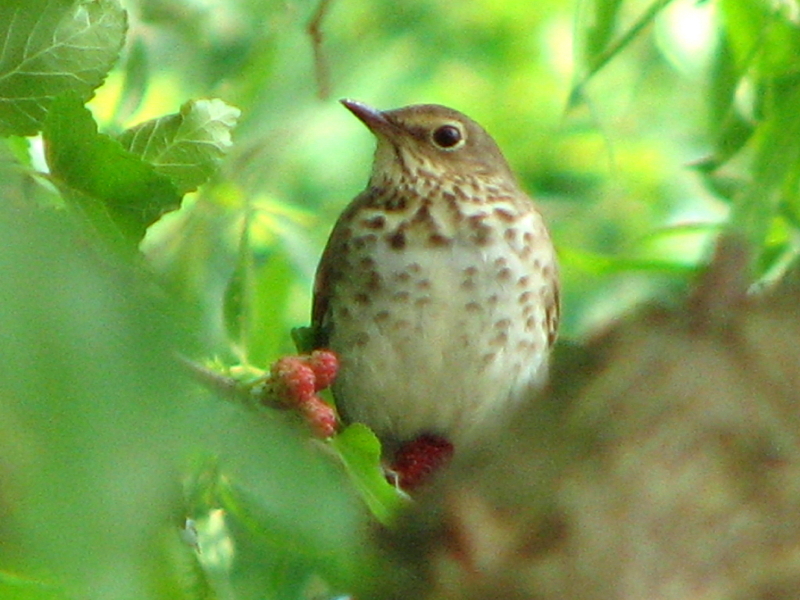
I love this photo!  This Swainson’s Thrush seems so happy sitting on its berries.  At the Falls the migrant birds are around and our trees are flowering or fruiting.  I have been doing my best to come up with some nice bird photos in between other river activities like making art.  Most of the warblers are proving to be tough subjects.  The difference between getting a nice image and nothing is a thousandth of a second.  Warblers are very small and constantly moving.  There is a lot of thrush and catbird activity around the sweet mulberries and squabbles are frequent.

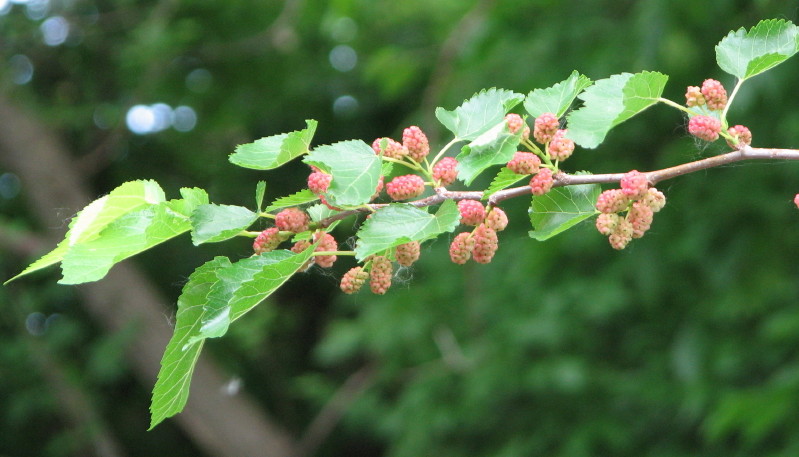
These pink and red mulberries will be ripe when they turn dark and black.  That’s when the wildlife particularly go for them.  This is a prolific tree and seems to be on the rise.

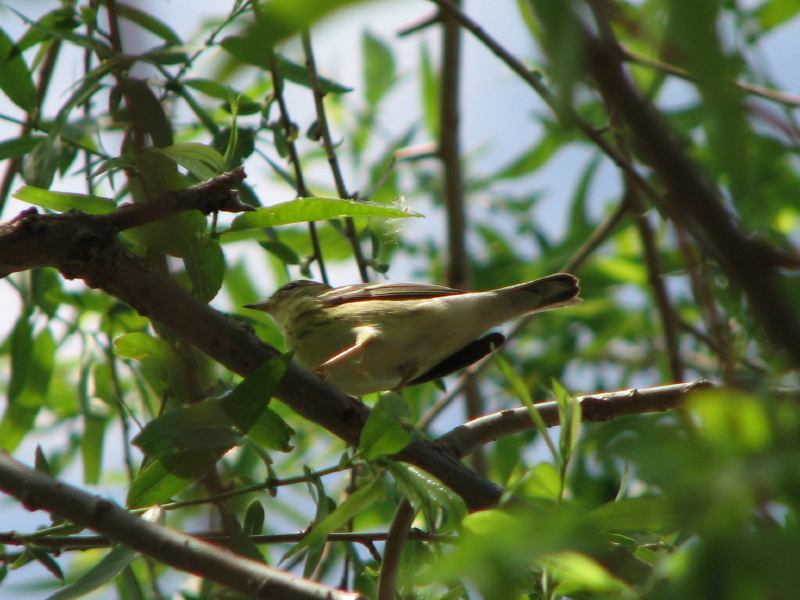
This bird atop a willow tree is a bit of a head scratcher for me.  I like that I was able to get such a relatively clear shot among the foliage, but what species of bird is this?  When I first took the photo, I thought I was photographing one of the seasonal vireos.  However, there is a suggestion of light-colored wing bars and perhaps a slightly streaked breast too which is an unusual combination.  That’s what I like about bird watching…it can be challenging even when you think you have a good image.

Wafting through the air were the tiny, cottony seeds of these black willow trees.  Many of these will land upon the sand and germinate.  Only the fittest can thrive in this tortured soil and manage the periodic flooding that helps define this place.

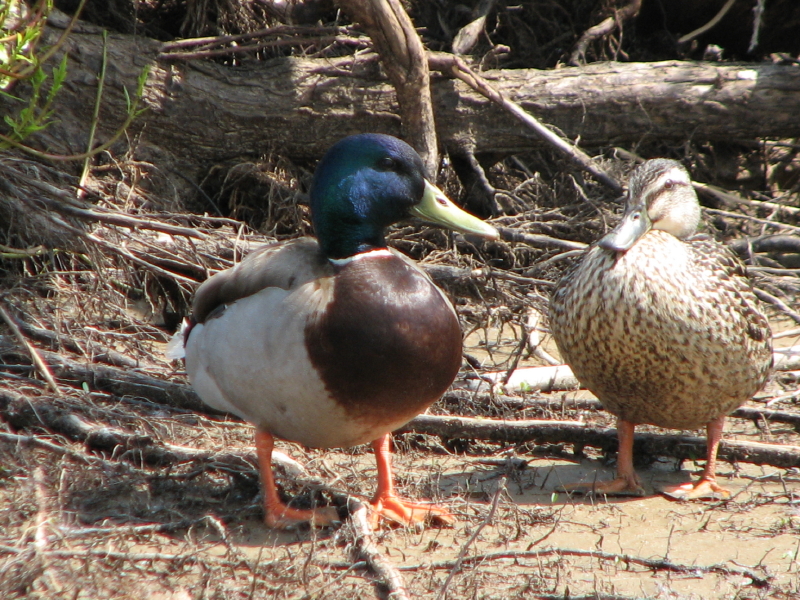
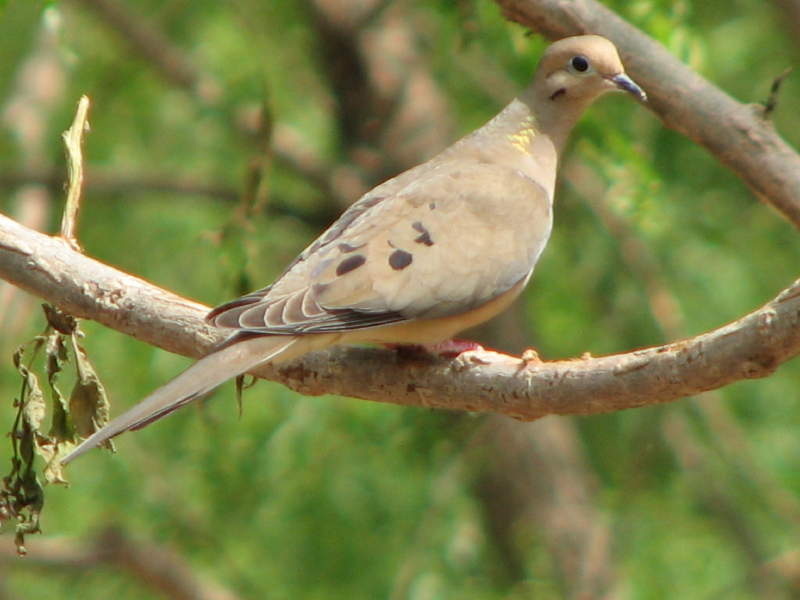
There were birds that I was able to photograph and identify like this pair of Mallard Ducks.  They were away from the river and more than likely have a nest nearby.  This Mourning Dove is showing a little of the iridescence on its neck that comes with the breeding season.  It’s hard to believe now that Audubon’s first drawing of the extinct Passenger Pigeon was made at the Falls of the Ohio.  That is certainly a bird I would have loved to add to my list of living species in the park.

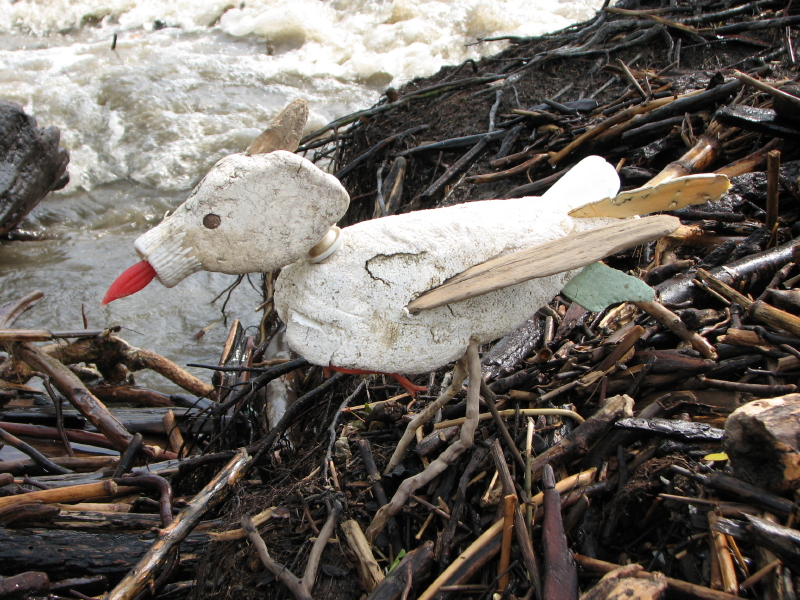
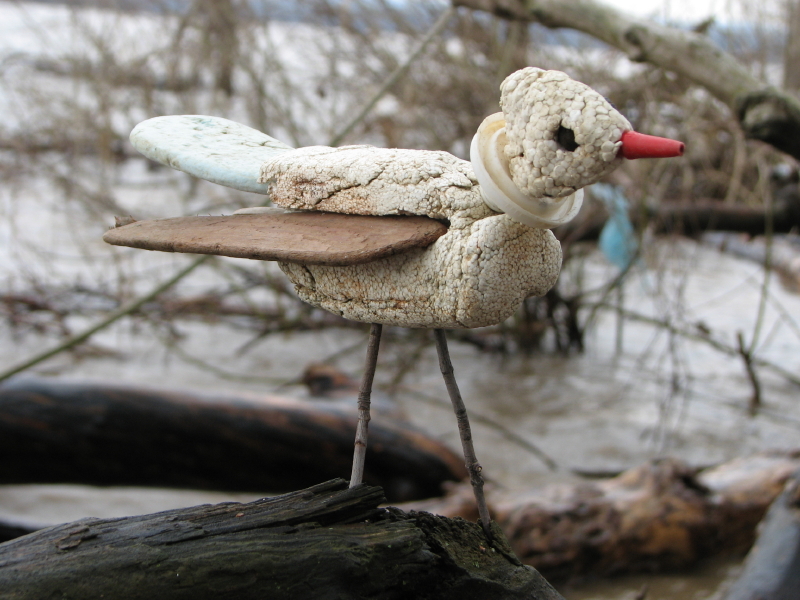
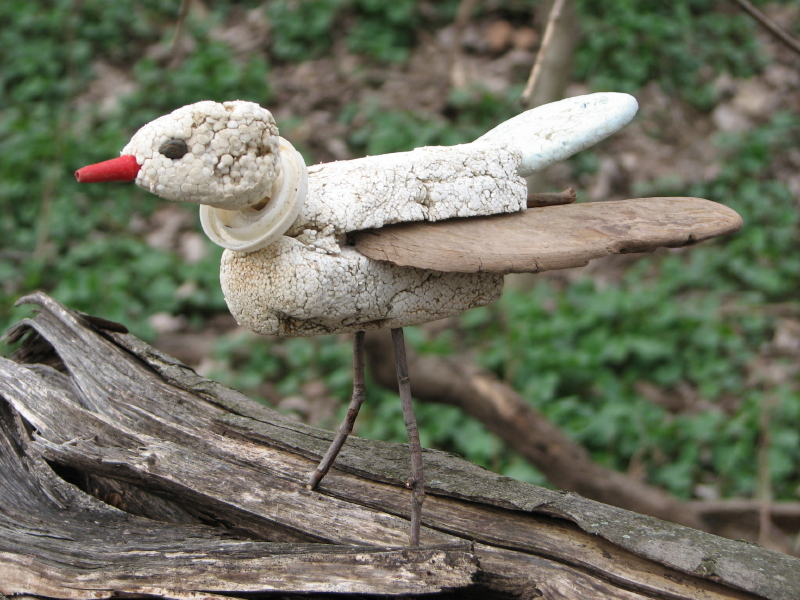
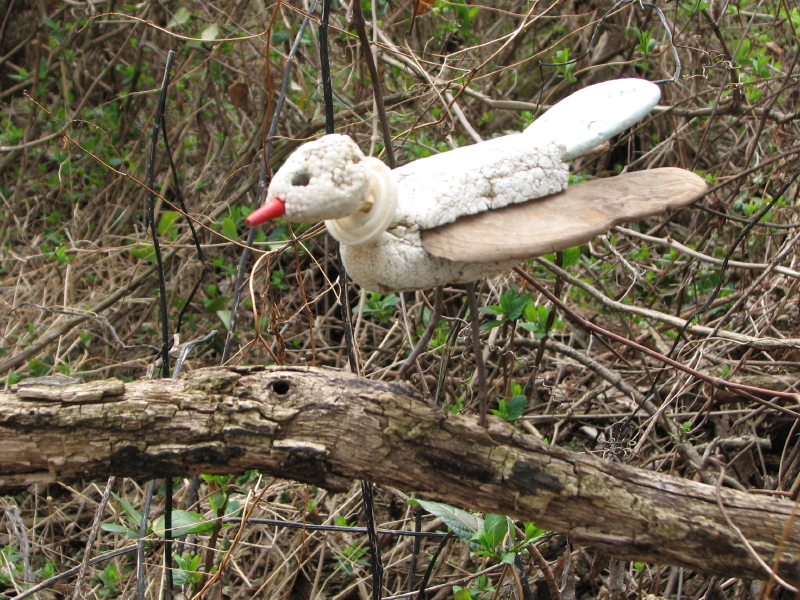
I was able to add a new bird to my list on this trip and it’s an unusual one!  It’s called the Ohio Valley Rail and is usually heard more than it is seen.  It is not typical to run into one during the daylight hours.  So, when I came across this female near the river…I got real excited!

This bird is in transit to the marsh habitats that exist around the lakes in the Upper Peninsula of Michigan.  Since the Ohio Valley Rail is believed to travel at night…it is a mystery why this one isn’t sleeping in a secluded spot.  Originally discovered and named within the river valley by early 19th Century naturalists, it would be many years before it’s true northern haunts would be known to science.  The males are slightly smaller but have more developed plumage which they use to their fullest glory when they leap and dance into the air trying to win the favors of a female.  Successful dancers will pair up producing a clutch of two eggs usually in a nest located on the ground and made from cane leaves.  One last image of this rarely seen oddity with the big head and bright red bill.  Bon voyage!

Read Full Post »

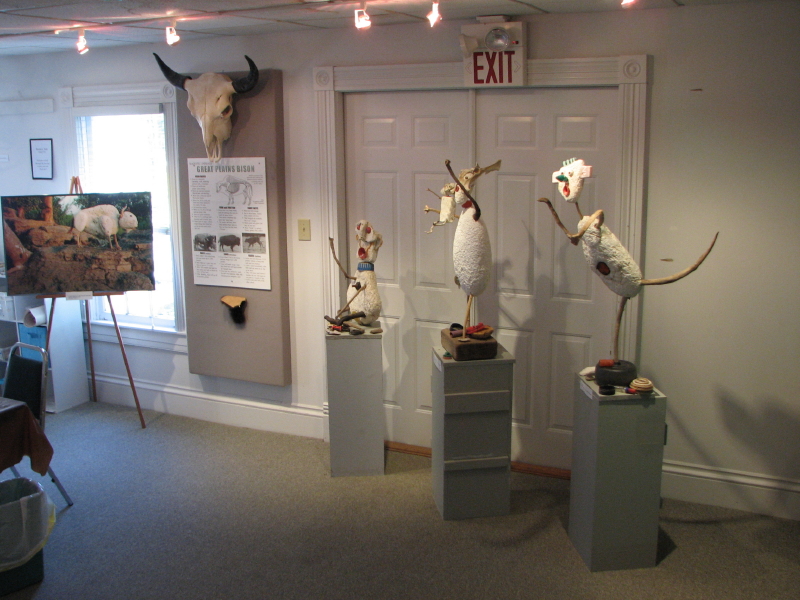
On May 6, the Oldham County History Center had a members’ opening for their Oldham County:  Life at the River’s Edge exhibit…which was actually several exhibits in one.  My sculptures played a part in the overall display and were integrated among the other exhibits.  I really liked the idea that my work (which included objects and images) would find a home among other examples of our material heritage.  Here are a few images from the event.  Once I got home and looked at the pictures, I realized I didn’t have any with people in them!  Yes, there were indeed people present and I enjoyed meeting and talking to them all!  Thanks for the beer and bar-be-que too!

Nancy Stearns Theiss, the center’s director, lives on by the Ohio River and so she recognizes the materials I use and where they come from.  She gathered up her own debris and put it in context with my work.  Nancy has a strong background in environmental education and recognizes what my project is attempting to do in a way that I must say gets overlooked in the usual art gallery context.

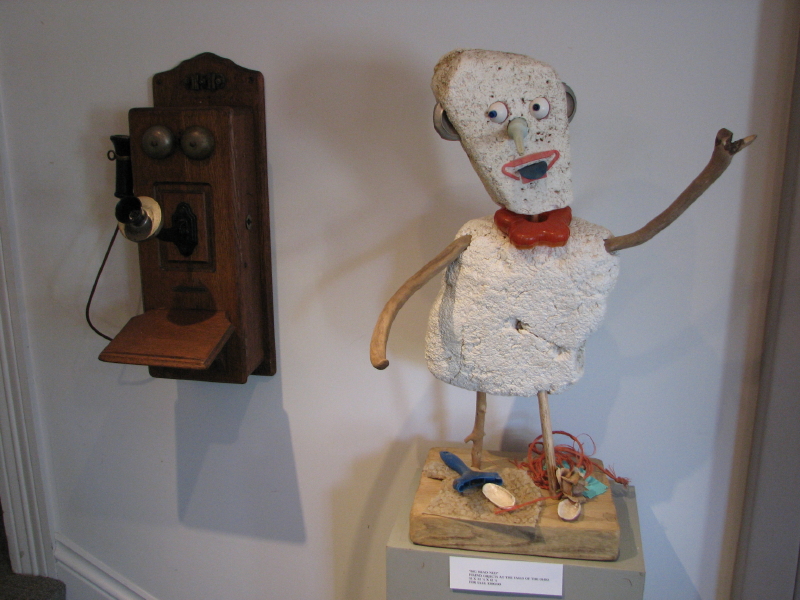
This was also the first time I have been able to show my Falls images, sculptures, and collected objects in the same exhibit.  I have always imagined that this would create the most interesting display.  The photo above is an example of this and includes my “Fake Food Collection” that I have gathered on the riverbank over the years.

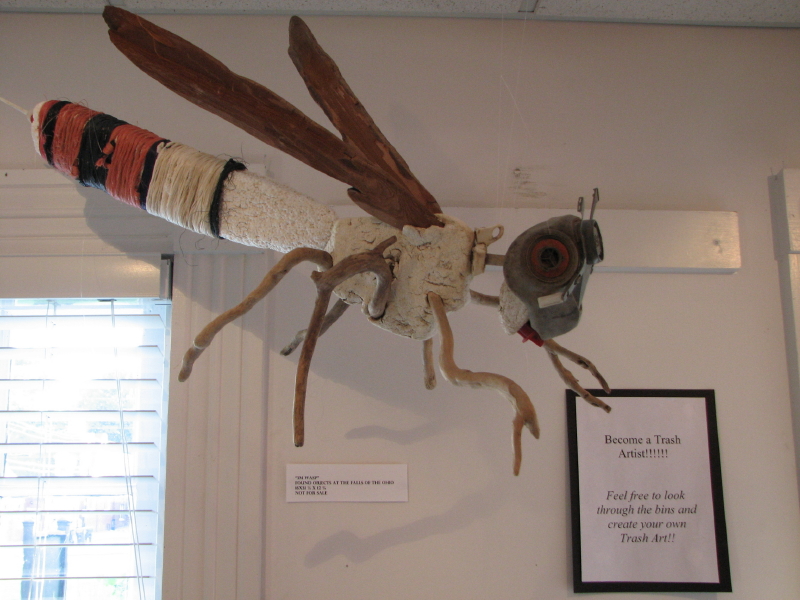
Become a Trash Artist!  I guess there’s no denying that I’m one.  As an activity, materials were on hand if anyone felt the urge to make something that was encouraged.  My “3M Wasp” is hanging from the ceiling with fishing line.  This piece gets its name from the protective mask I found that looks to me just like an insect’s face.  Later during the summer, I will participate in a workshop making art from found materials.

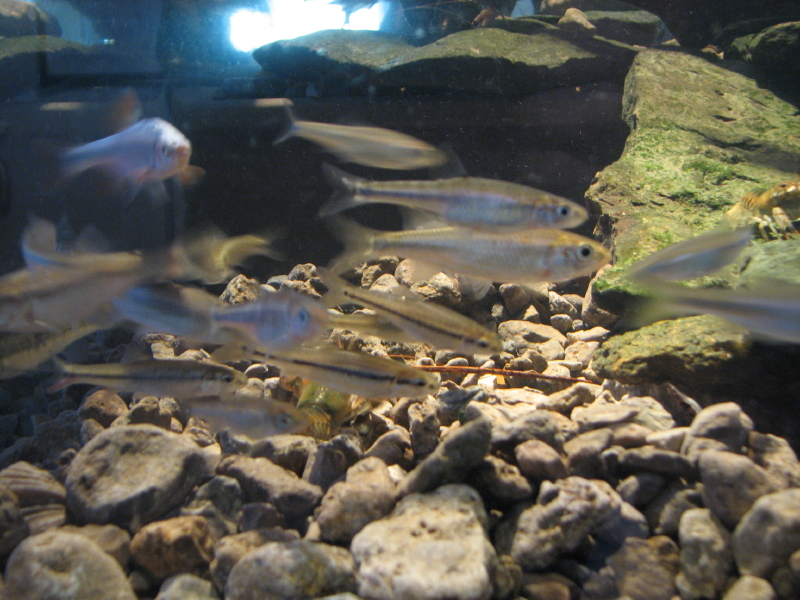
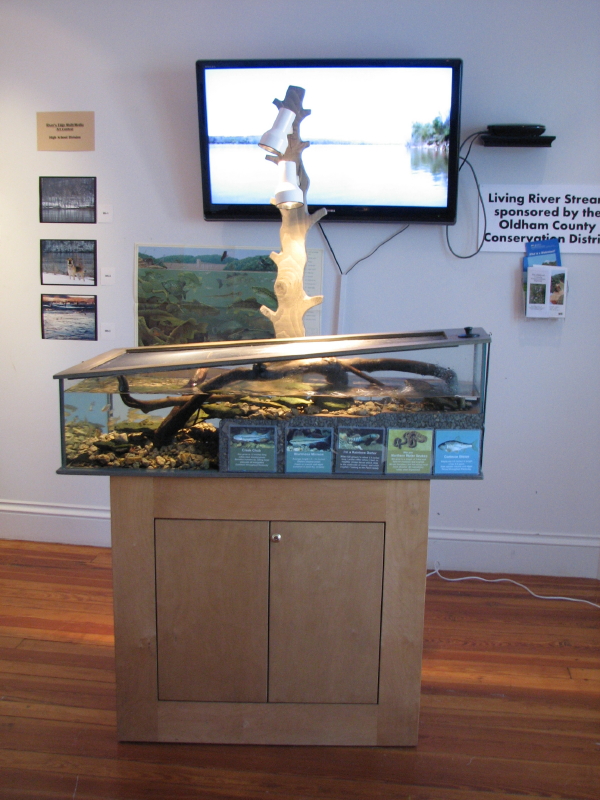
Also on display was a Living Stream Touch Table, essentially an aquarium with native creatures that one might encounter in the local fresh water environment.  Among the animals in the tank include several species of native fishes, crayfish, frogs, and a small water snake.

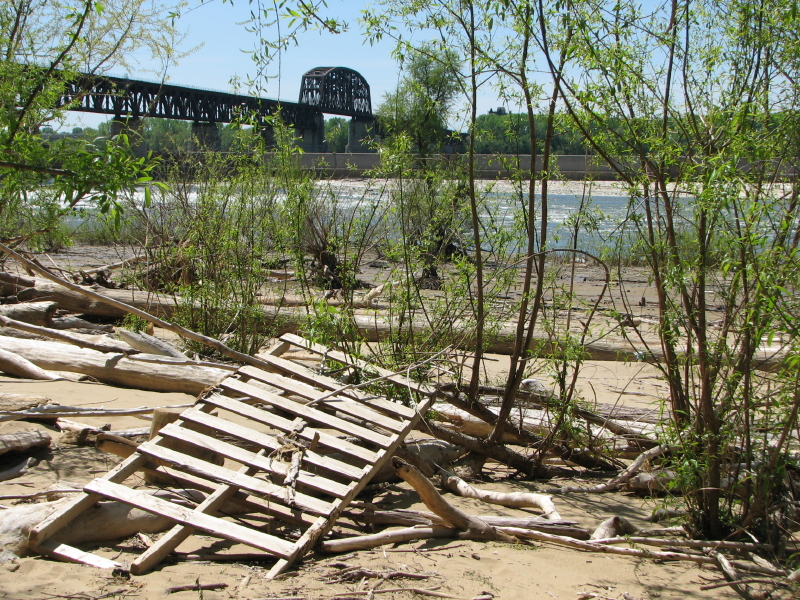
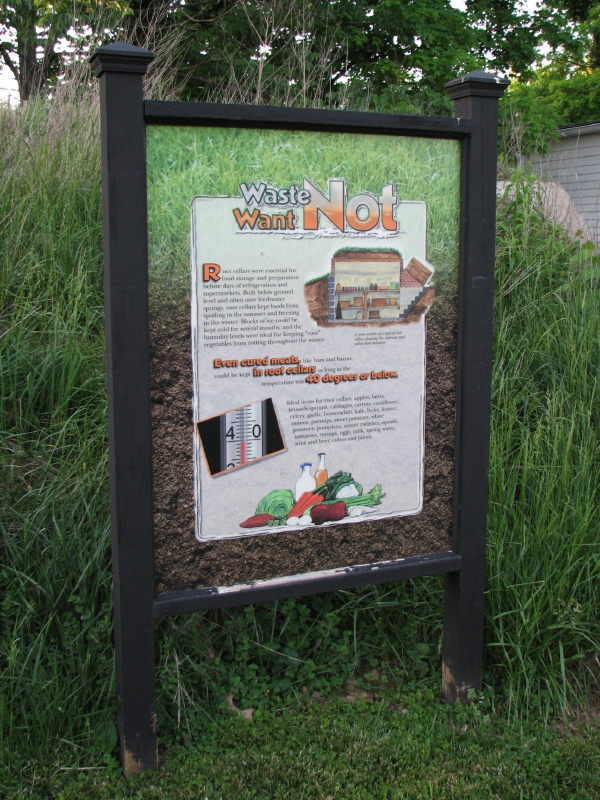
The exhibit will be up until August and I look forward to returning and participating with the center again.  This final image is located on the center’s grounds and right next to an example of a root cellar.

Read Full Post »

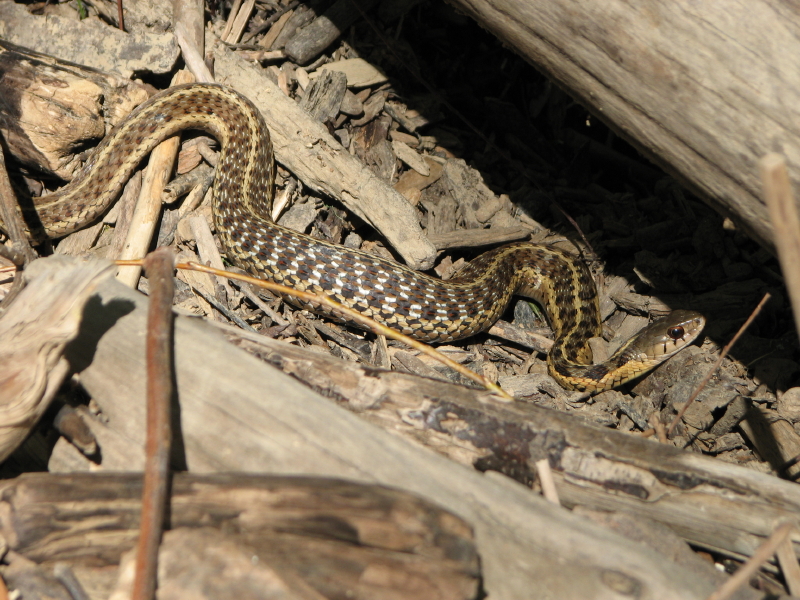
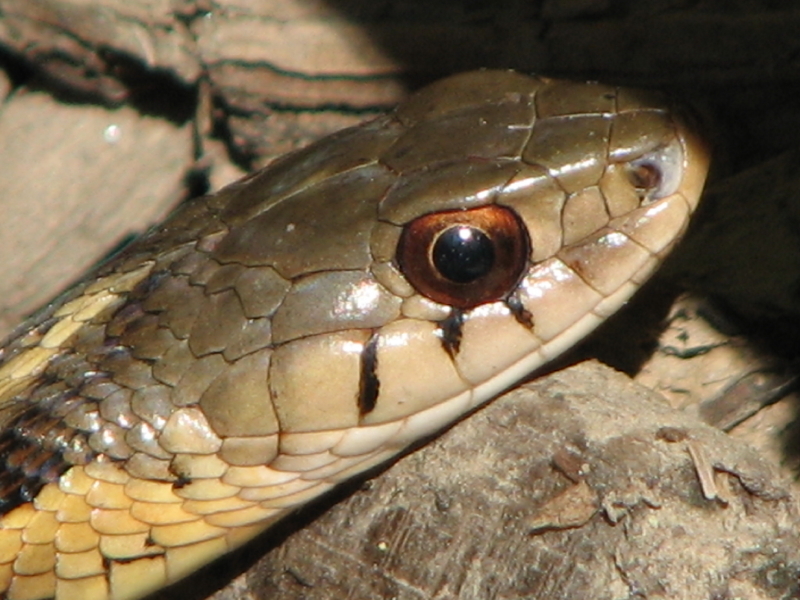
With Thunder over, my good friend Jeff accompanied me to the Falls the very next day.  He was on a mission to find wood for a home improvement project and the Falls has plenty of that.  On our way down to the river we passed a fisherman who warned us that there was a belligerent snake ahead of us that had tried to strike him!  Okay, we are forewarned, but not overly concerned.  Amazingly, we came across this snake.  It had not moved much since the morning was still cool and it was lying in the sun trying to get its metabolism going.  It’s a harmless Eastern Garter Snake and here are pictures of it.  This snake will try to bite, but it’s really very harmless.

This snake is often found near water, but can’t be classified as a water snake.  I did get a little closer and the snake did nothing.  Here’s a detail of its head.  This guy is about fifteen inches long.  I like its coppery-eyes.

Jeff and I had a good laugh over the fisherman’s over reaction!  At least to his credit, he didn’t try to kill this snake which happens far too much in this world.  Snakes do carry with them that element of surprise, but most of them are really beneficial.  Even if I had come across a poisonous species, I would just respect it and leave it alone.  I made another discovery and I guess I would have to classify this as a signed artwork?

It would have been easy to overlook this, but I turned my head in this direction and there it was.  Someone named “Hollie” took the time to sign and date this piece of wood near this old tire.  I felt this person was calling attention to the poetry in this space in a way similar to the work of Anne and Patrick Poirier.  It’s probably just me reading too much into the situation, but I did find this simple act compelling.

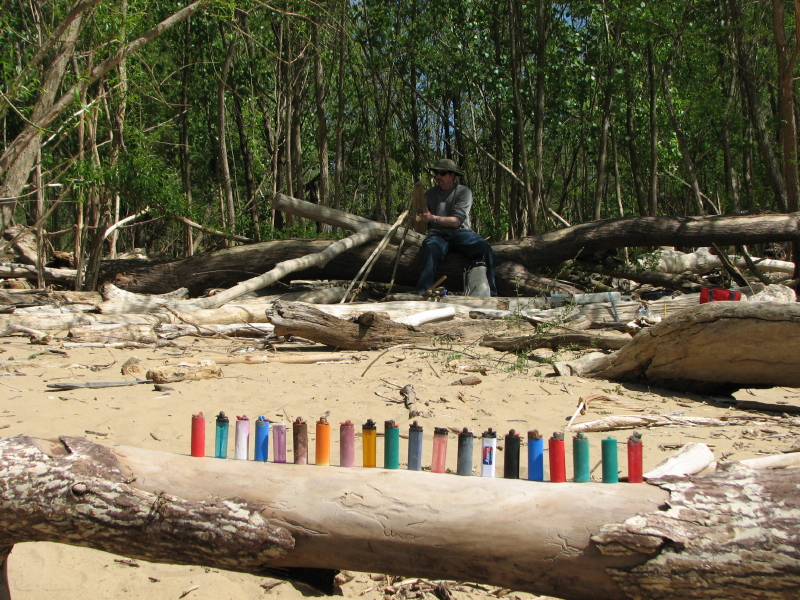
Jeff found the wood he was looking for and several potentially nice walking sticks too.  I found Styrofoam which I also used to make something, but will wait until next time to show you.  Jeff and I have been good friends since our undergraduate art school days at Murray State University.  Jeff is a talented artist in his own right and does drawing and ceramics.  He teaches art to middle school children.  During our hike at the Falls, Jeff was amazed by the number of cast off cigarette lighters he kept finding and started picking them up.  Here’s what he eventually did with them.

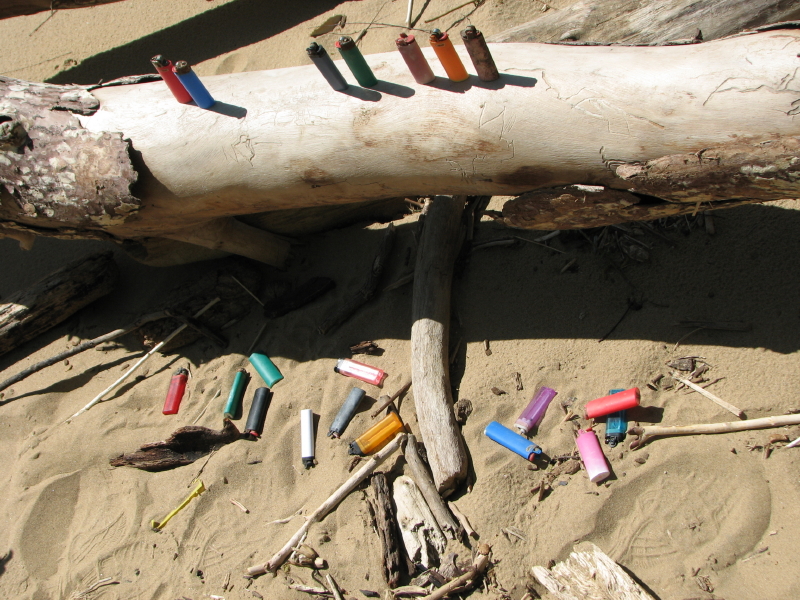
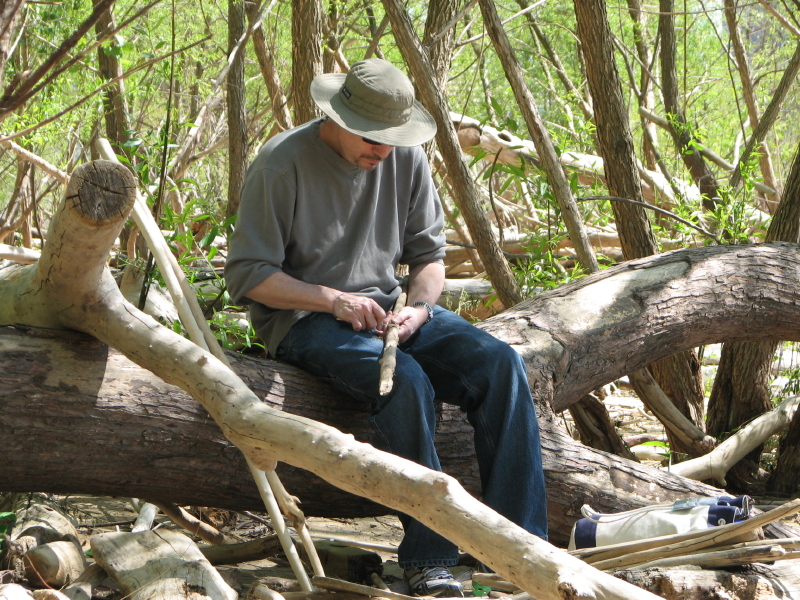
Jeff collected 23 lighters, but only lined up 20 for this photo.  He could have collected a sack full of these lighters if he wanted to.  Here’s the view from the other side showing my friend working on a walking stick.

After the pyrotechnics of the previous evening, this was as laid back and relaxing a day as could be.  We each left the Falls with as much river treasure as we wanted to carry.  I also had a camera full of images that I could use to post on this blog.  Eventually, the wind started to pick up and with the lighter piece in shambles, took that as our cue to go home.

On our way back to the parking lot, we passed by the wall that separates the Ohio River from this stretch of the Falls area.  With the City of Louisville in the background, I photographed these up rooted trees that were deposited here during the last high water incident.  They will stay there until the Ohio River decides to carry them away.

Read Full Post »

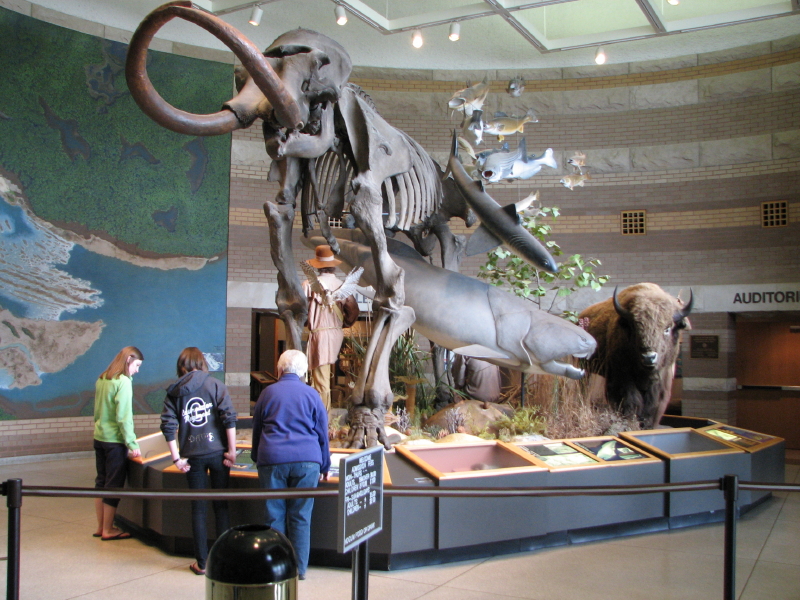
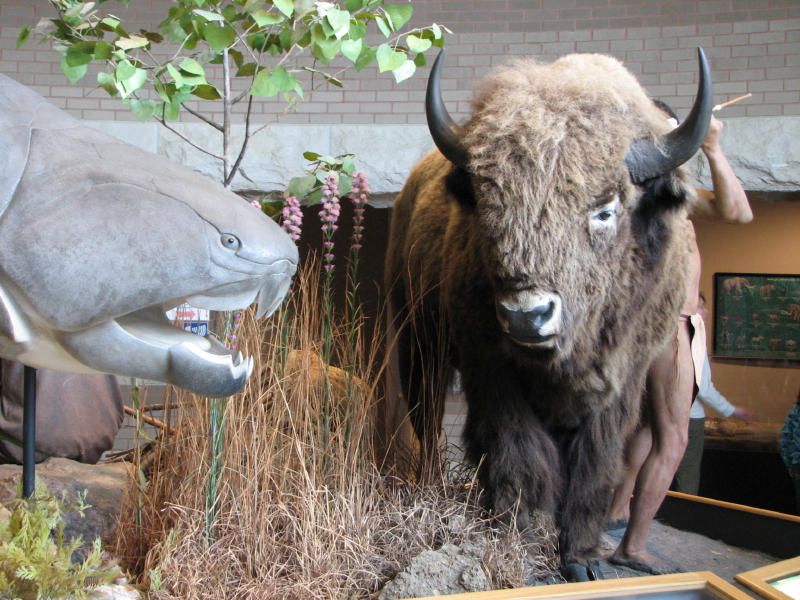
Since I will be away from my computer for a short while, I wanted to squeeze in one more post.  Recently, I went inside the Falls of the Ohio Interpretive Center and recorded these images of the display in their main hall.  The center is in the process of upgrading their exhibits, but I hope they choose to keep this centerpiece.  It is a three-dimensional collage of the history of life as it has presented itself at this location.  Here the ancient meets the contemporary, fact confronts legend, the terrestrial meets the aquatic, and fresh water mingles with the marine.

I have picked out a few details to present to you.  This display incorporates both traditional taxidermy and state of the art model making.  I love it because it retains this cabinet of curiosities feel to it and it has these unusual juxtapositions.  In the image above, a bison comes face to face with an ancient Devonian carnivorous fish!

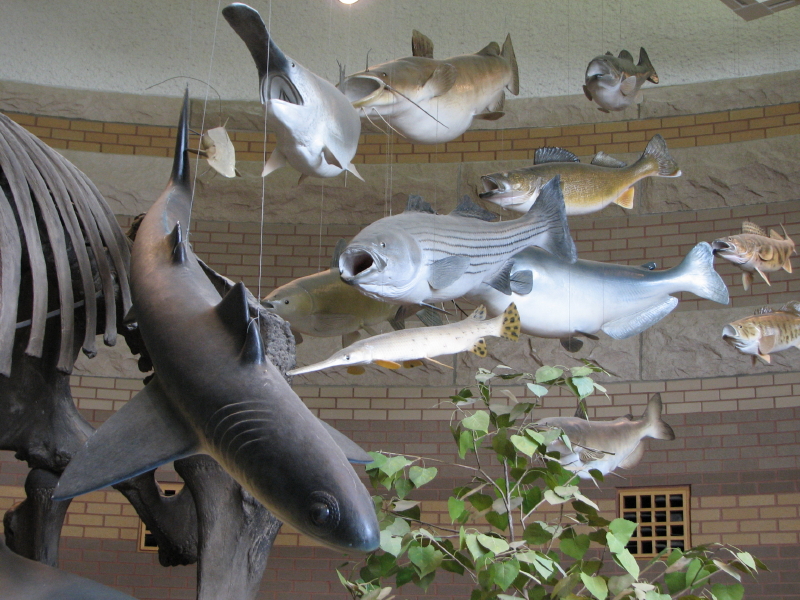
And speaking of fish…here are a few representations of  fish that currently can be found in the Ohio River swimming along side this interpretation of an ancient shark.  Among the living species found here include the Paddlefish, Striped Bass, Walleye, and several large species of catfish.  The rocks in the park are loaded with marine fossils from the Devonian period (roughly 375 million years ago) which saw the first fish appear on life’s stage.  Interestingly, fish fossils are very rarely found here, but we have lots of evidence of different corals and brachiopods.

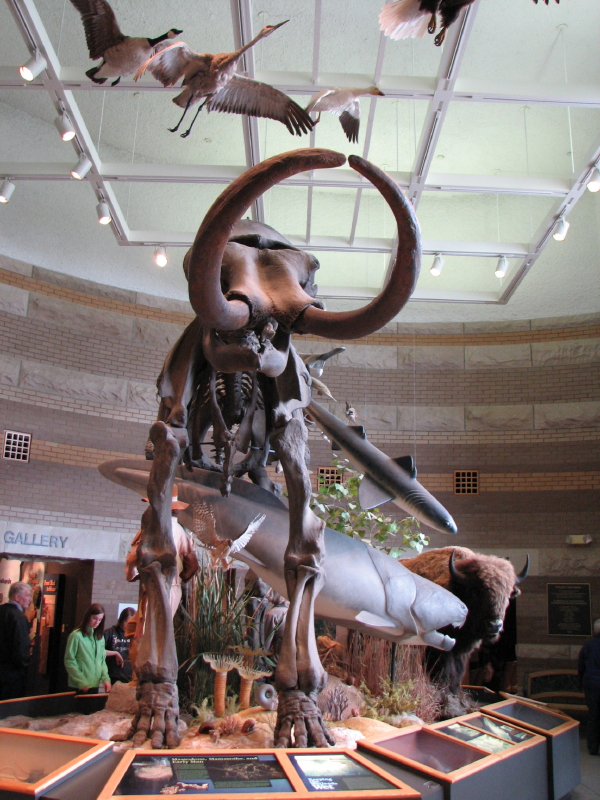
It’s the large view which includes this Mammoth skeleton replica that makes the biggest impression on visitors.  The center has done a good job of telling the story of the importance of the Falls of the Ohio and I look forward to seeing how their refreshed exhibits carry this mission forward. I’ll show you other display images later, but for now… see you next week.

Read Full Post »

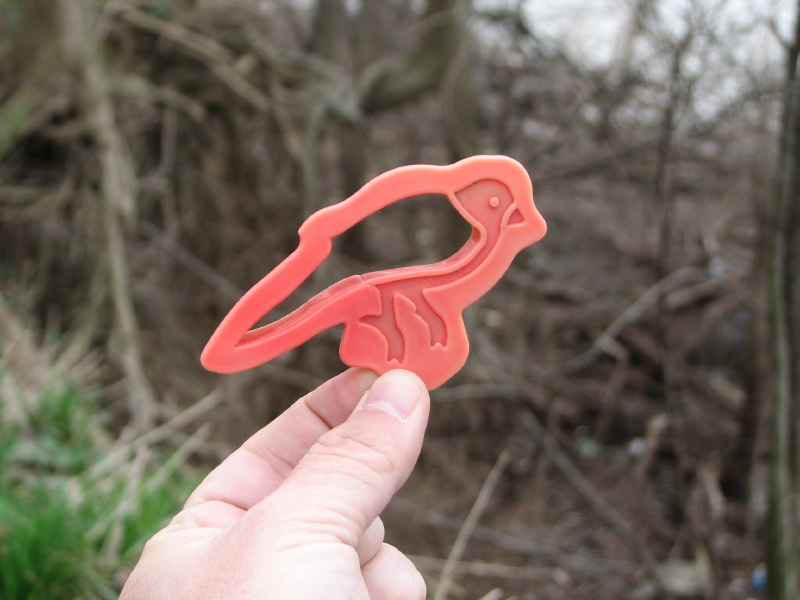
The little red bird perched easily between my forefinger and thumb.  I was walking along the river bank and spotted it among the recently deposited debris…another small gift.  If I had to guess, I would say that the red bird was intended to be child’s clay tool.  It’s like a cookie cutter stencil only smaller.  I was on the look out for birds and my subconscious was on alert.  I think this is partially why the plastic bird appeared to me when it did.  The axiom about chance favoring the prepared mind touches upon this phenomenon.

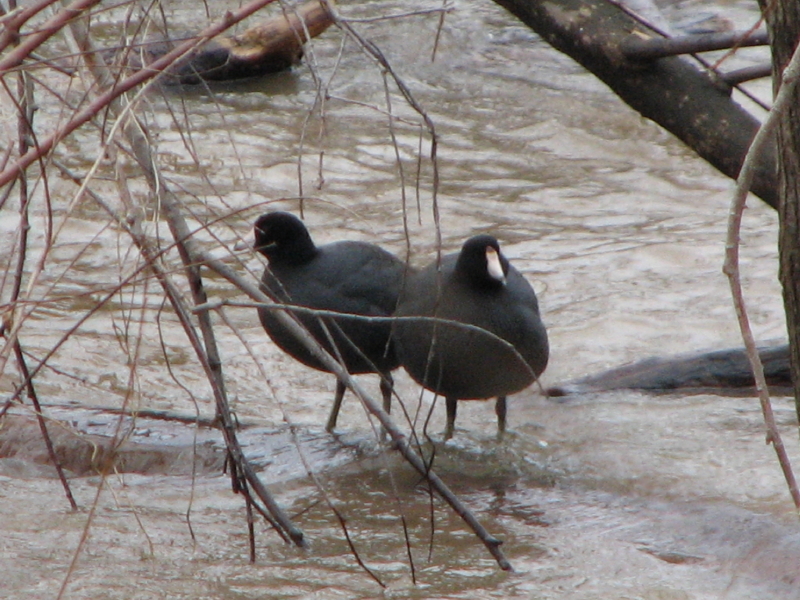
While the river level was still high, I came across this pair of American Coots near the shore.  Logs and chunks of wood were bobbing in the water.  Their dark feathers took on the look of wet wood.  The odd appearance of these coots had to do with them standing on a log that is mostly submerged.  Among the other birds I found near the water were Canada Geese, Mallard Ducks, and high overhead…kingfishers.

Like little twittering machines, a male and two female Belted Kingfishers were chasing each other across the sky.  I watched them for over half an hour and hoped that one of them would perch in a tree near me.  Alas, this was the best image from that moment.  With its low profile, out-sized bill, and crested head, the Belted Kingfisher’s silhouette is distinctive.  Someday, I hope to stumble upon their nest built into the side of the riverbank.  I’ll prepare my mind for that moment and let’s see if chance intervenes!  I did spot an Eastern Phoebe which is an early migrant.  As the warmth and light speeds up the production of tree leaves, we can expect the arrival of the birds we share with Central and South America.  Their timing is exquisite and seems to coincide with the many small cut-worm caterpillars that will chew their way through the foliage of the canopy.

During migration, the Falls becomes home for several different thrush species.  Some of them can be notoriously hard to identify, but not the bird above.  It’s the White Thrush and it utilizes all the available habitats here to put on a little weight before moving northward.  I have seen them patrolling the water line and investigating the densest vegetation in search of food which can include insects, seeds, and berries.

This bird was investigating decaying logs in search of a meal.  Every once in a while, the thrush would “scratch” the rotten wood with a backwards jump that would reveal small grubs and insects just below the wood’s surface.  These morsels were quickly seized by this agile bird.

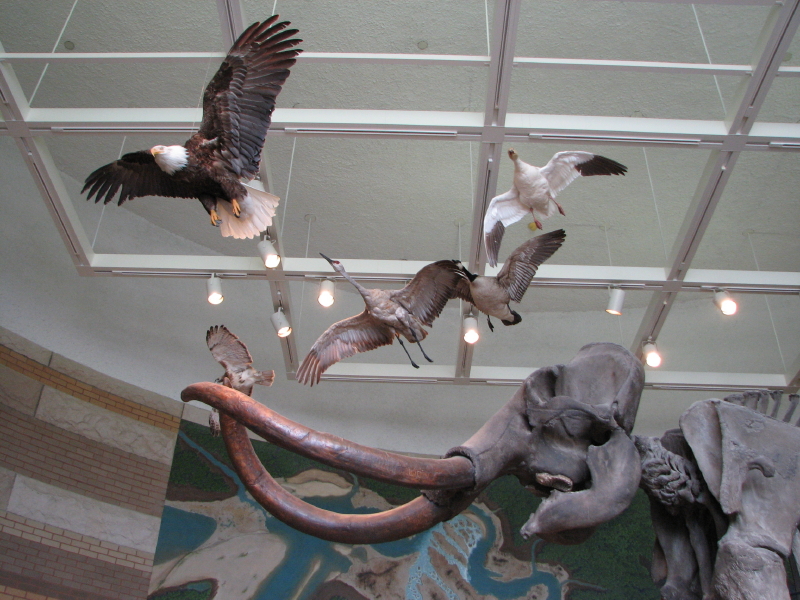
Here’s a third thrush perched upon a vine near the Woodland Trail.  I observed this bird picking off very small midge-like flies and returning to this position.  On my way back home, I stopped at the Interpretive Center to pick up another bird list for the park.  My list is getting a bit tattered from use and I still have about half of the 268 bird species recorded here left to go!  I did spot one bird last year in the park that I’m surprised is omitted from the checklist and it’s the American Turkey.  It would fit easily in the Game and Marsh Birds category.  There are also birds “flying” inside the Interpretive Center and above the mammoth’s head and I’ll end this post with that image.

Read Full Post »

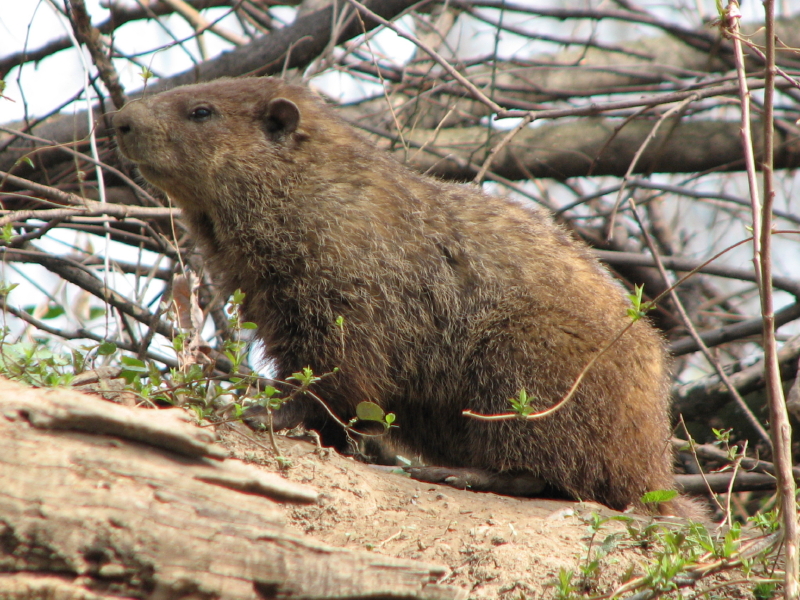
With the river being high, I explored a few wooded trails in the park.  There is still just the barest hint of green coming back to life.  It’s a good time to walk here because the vines haven’t started to kick in yet and turn this place into an obstacle course.  I was following the park’s resident Pilliated Woodpeckers and trying to photograph them when I came across this groundhog.  He was the Buddha of the Groundhogs basking in a shaft of spring light.  His eyes were partially closed, almost blissful appearing.  Then I bumbled into view and we eyed each other for a minute or so and I took these pictures and he took off running for his nearest burrow.

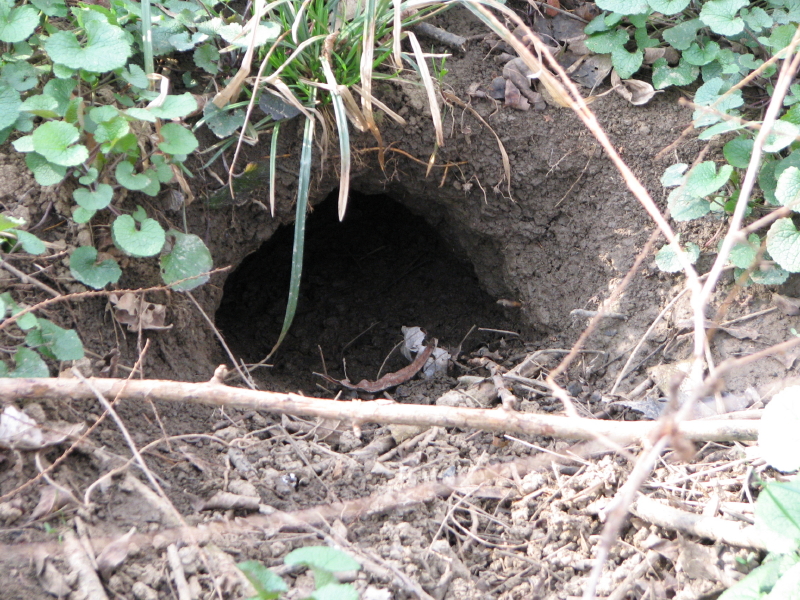
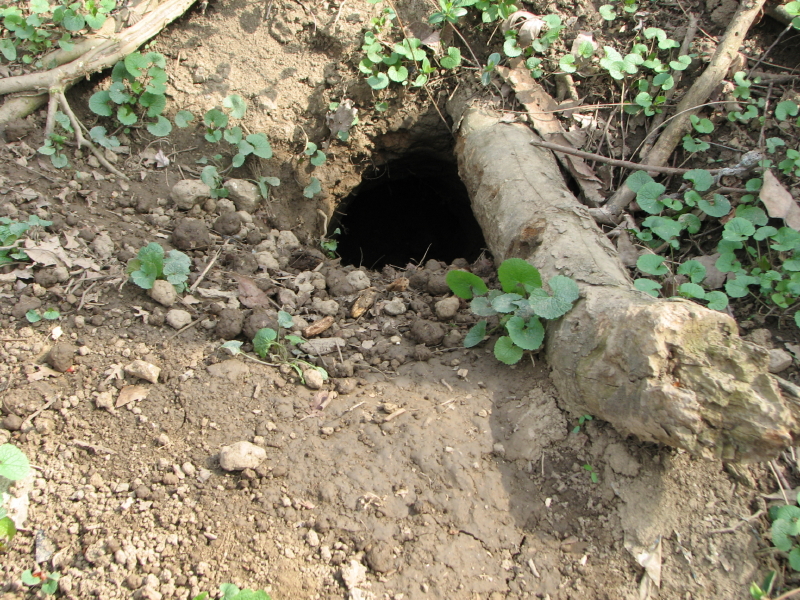
I have accidently stepped into their holes before.  Luckily, I haven’t twisted an ankle or worse because it can be a quick and rude drop down.  It’s become one of the hazards, like nails sticking up from a driftwood board that you avoid stepping on.  It appears to me that the park’s groundhogs are on the increase and so there are that many potential holes to look out for!  Watch out!  There’s another hole!!

Read Full Post »

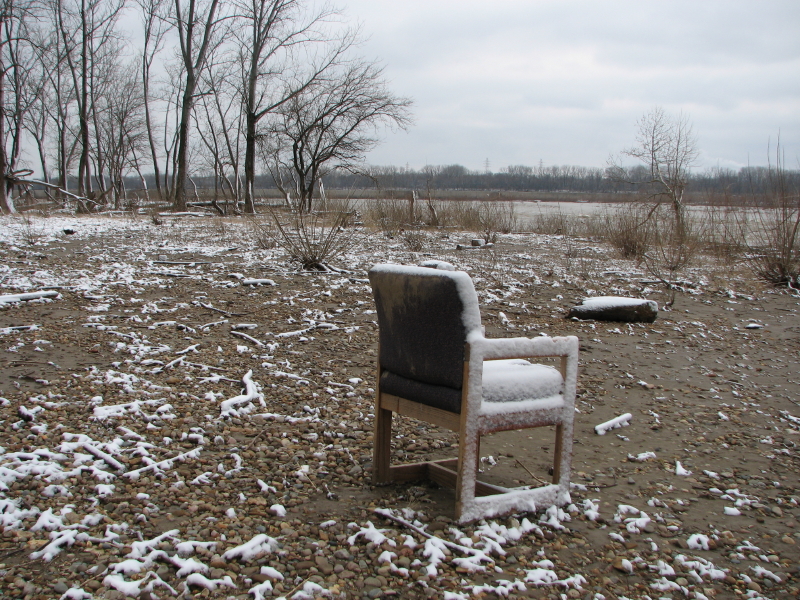
On a very chilly day and after a snow storm, I was able to visit the Falls and take stock of the happenings.  The snow came quickly and from an eastern direction.  You can see that from the trees where snow built up on one side leaving the opposite side clean.  As I had suspected, the rising river from the previous week had played havoc on my trusty studio site.  It took me awhile to recognize where that spot had been.  I will have to wait until after the snow leaves to determine if any of the materials I had stored there are still in the area.  As for the sculptures I had left to weather in place…

… they are still there, but disarticulated.  The rising water level with its floating logs and driftwood, knocked everything down, and carried parts of my work, back out into the river.  The image above is what remains of Pot Belly, a large work from several posts ago.  I found his head, but he was missing all of his features.  His partner, Lorraine, was near him, but had suffered the same fate.  Further down the park, I came across Penguin Boy (sans life-jacket and head) and what was left of the uncle figure.  By now, I am over any sense of loss.  I will miss coming to that particular spot under the willows, but I know I will make other make-shift studios and they too will wash away.  As for the large pieces of Styrofoam that are still around, I probably will recycle those into other sculptures provided they stay.  This time of year and early spring are usually when we get the high waters.  With all the snow that has fallen (even more is scheduled in a couple of days) the resulting melt water will overwhelm this part of the park again.  Perhaps it will flood several more times, who knows?  This is all just a part of the process.

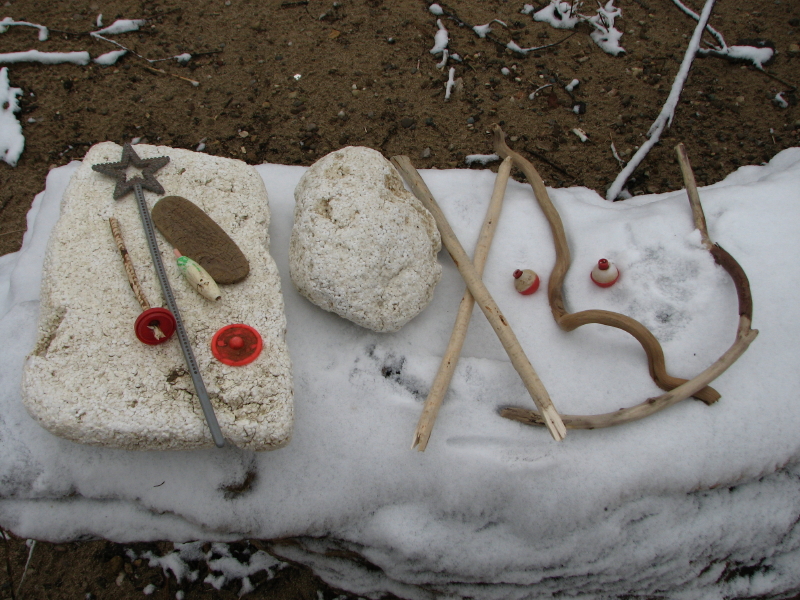
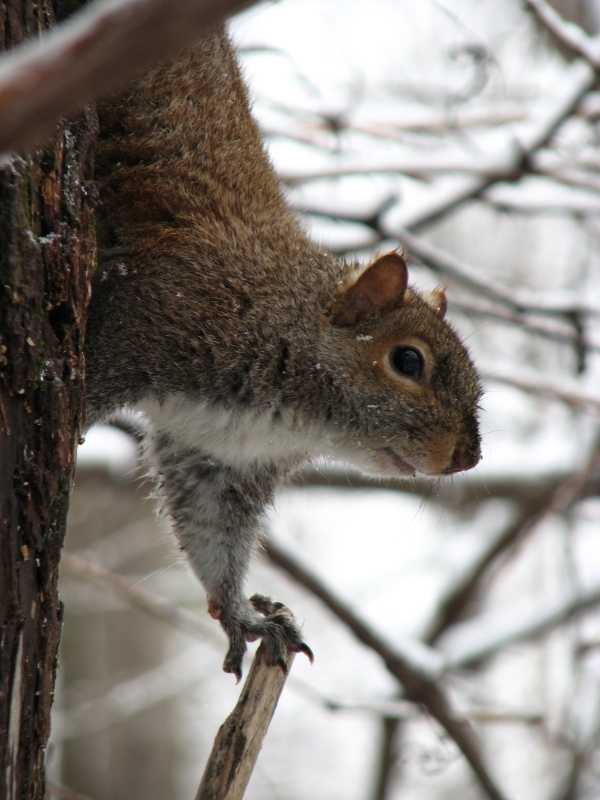
Making things is the best antidote in a situation like this.  I might be temporarily rootless, but my need to make images from objects remains strong.  I tell myself that coming out here, especially on such an inhospitable day is a sure sign of dedication and commitment to my art.  Perhaps it is, but who really cares except me?  When you strip it down, it has more to do with my own needs than anything else.  I muse about this blog being a vicarious way for me to recall some of my work.  Anyway, laid out on a snowy log are the materials I found to make that day’s figure.  By this time, my finger tips are numb which makes handling small objects more difficult.  While I am fumbling away, this squirrel is watching me as I work and I’m having a regular conversation with it.  I ask how the winter is going and apologize for not bringing any food with me among other topics of mutual interest.

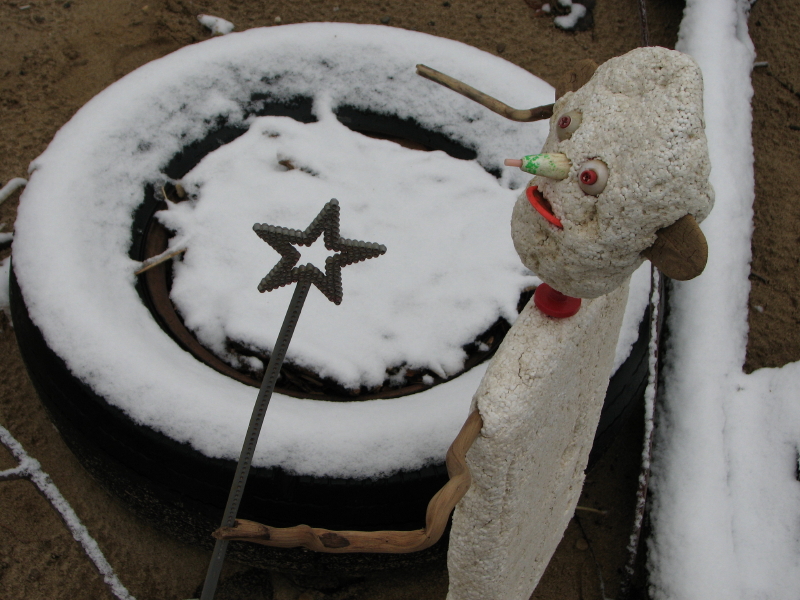
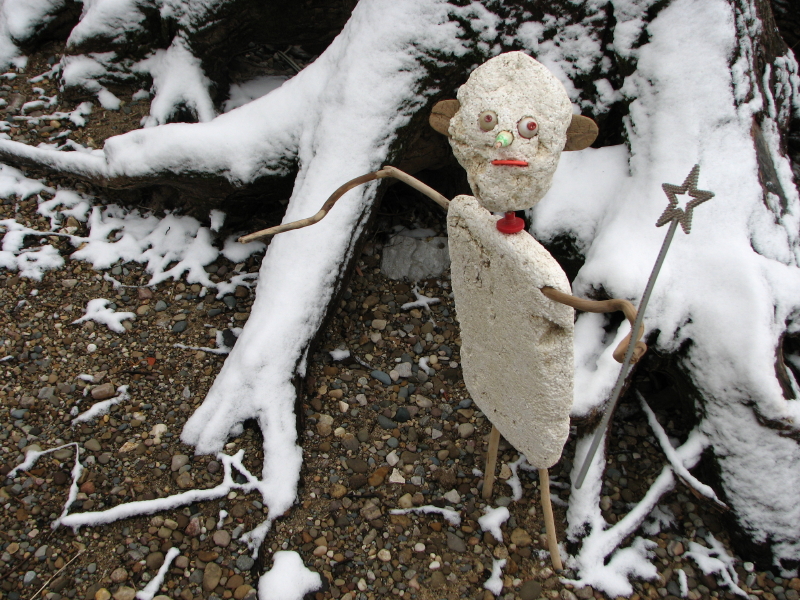
With the added distraction from the squirrel, here’s what I came up with on this day.  Finding the star wand was my big find along the riverbank and I incorporated it with the figure.  I’ll let that object add to any sense of a narrative that an observer might care to construct.  I was too cold to care about matters like that!

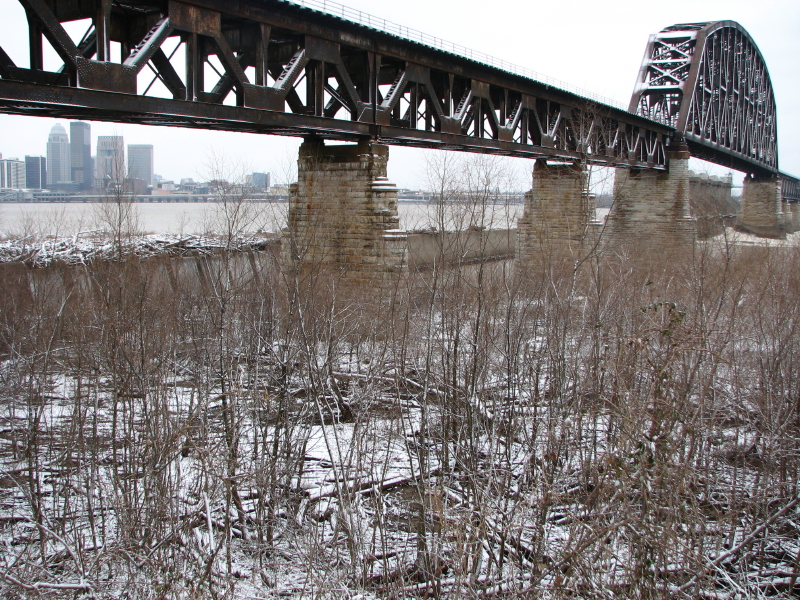
I left the figure near the Interpretive Center, but kept the wand.  Believe it or not, I have a collection going of found and mostly bubble wands and this adds some depth to that collection!  I should assemble that for a photograph and post it.  As I left the park, I did take one more image from the Indiana side of the Ohio River.  Past the railroad bridge, a portion of Louisville’s modest skyline can be seen.   Stay warm and dry everybody!

Read Full Post »

« Newer Posts - Older Posts »