Feeds:
Posts
Comments

Archive for the ‘animal art works’ Category

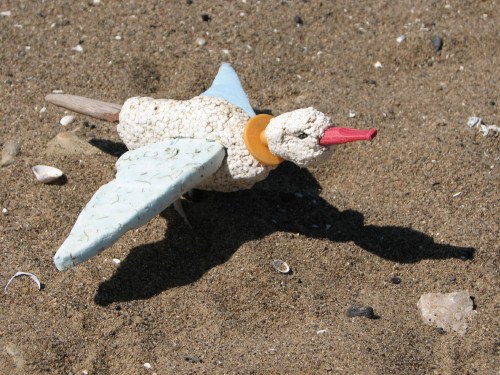
Styro-sandpiper, 9/09

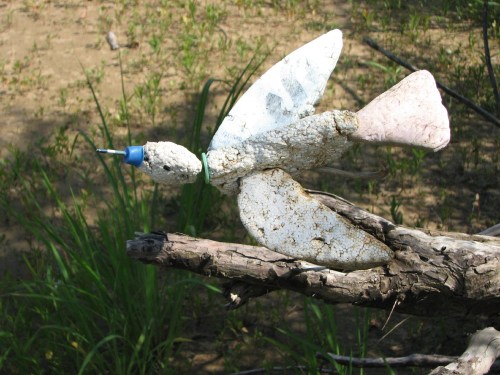
September is the month that the smaller shorebirds begin their migrations through our area towards warmer southern climates.  We see a variety of different species at the Falls of the Ohio.  Here is one impromptu tribute to them made from polystyrene foam.  This one is a Styro-Sandpiper dragging its wing in mock injury.  Among the materials I used to fashion him include:  Styrofoam, blue- insulating foam, river wood, plastic (around the collar and the bill is the tip from a cheap little cigar).  Oh, the eyes are tiny bits of coal.  You are not allowed to collect fossils in the park and I sometimes wonder if this applies to the coal as well?  Anyway, here are some images of genuine shorebirds photographed in the park.
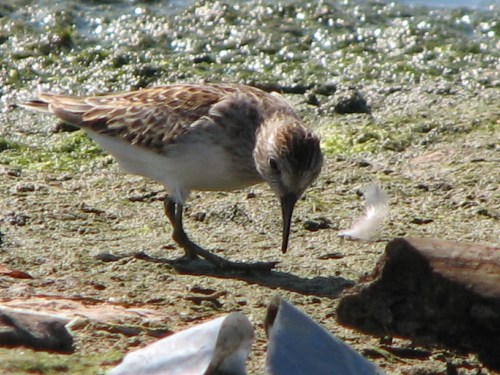
Least Sandpiper, 9/07

Small bands of Least Sandpipers explore the margins along shallow pools of water covering the fossil beds during this time of year.  Their bills probe the algae for the small invertebrates that live in the green mats.  These are our most common sandpipers followed in number by Spotted Sandpipers.  This time of year the Spotted Sandpipers actually have barred flanks and bright white bellies. We will have to wait for spring to see them with their characteristic spots and dots.
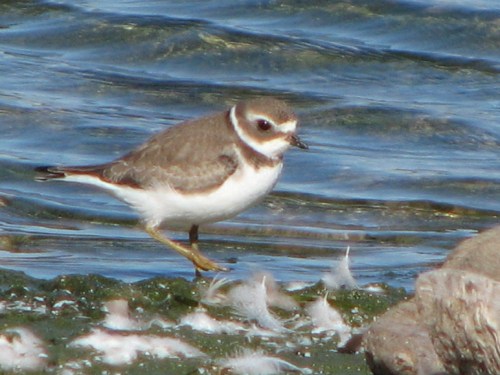
Semipalmated Plover, juvenile, 9/09

Tiny Semipalmated Plovers have traveled from the Arctic tundra and some make a stopover at the Falls.  The autumn birds seem to be mostly juveniles.  Piping Plovers, an endangered species, have been recorded in the park, but I haven’t had the pleasure of seeing one here.  By far, our most common plover is the Killdeer.  It’s hard to walk across the fossil beds this time of year without setting off their alarm calls.
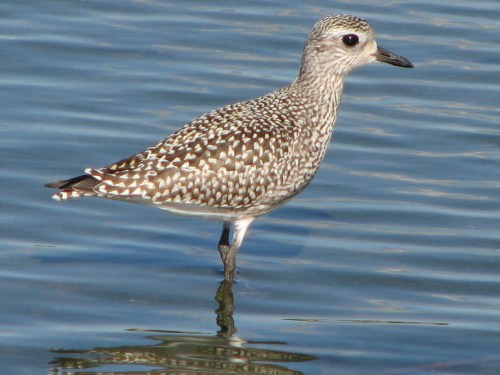
American Golden Plover, juvenile, 9/07

For two years in a row I have come across American Golden-Plover juveniles.  Although they are a bit larger than the smaller “peeps”,  I decided to throw them in too because I like them and they show up this time of year!  I’m amazed that this bird started life on the Arctic tundra and is now traveling to South America. 
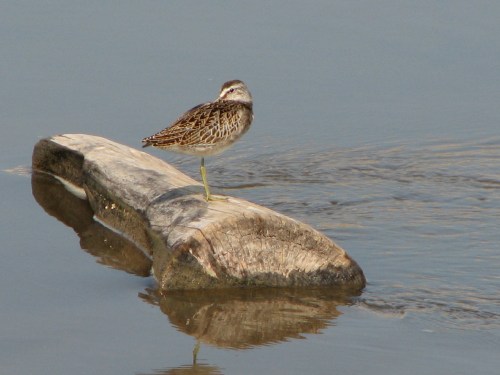
Short-billed Dowitcher, 9/08

Last year I came across this bird dozing on a well placed log and wondered what it was?  Its bill was tucked under the feathers on its back.  As I got closer, you can imagine my surprise when the bill was exposed!  I believe this is a juvenile Short-billed Dowitcher.  Here is another image of this bird.
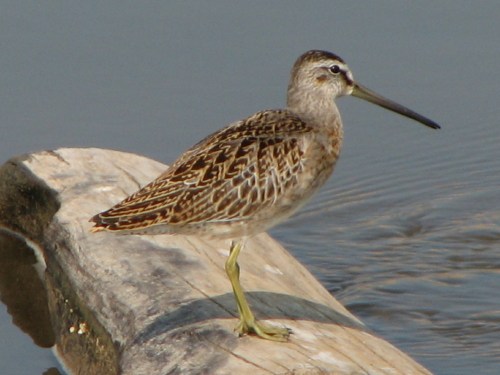
Short-billed Dowitcher, juvenile?, 9/08

I watched this bird for a while and never heard it utter a sound.  Referencing my bird guides, the literature says that the best way to differentiate it from the Long-billed Dowitcher is by its call. The length of its bill is of little help.  Both bird species have been recorded in the park.  The Short-billed is listed as rare and more than likely encountered in the summer.  This bird was photographed last year on the first of September.  The Long-billed is seen occasionally in the fall.  After checking out several bird guides, there was something in its coloration and markings that said Short-billed Dowitcher for me.  Perhaps some one out there with more experience can hazard a guess?  Either way, it was a tremendous treat to come across it!  I’ll end this post with another view of my Styro-Sandpiper posed in the sand and coal.
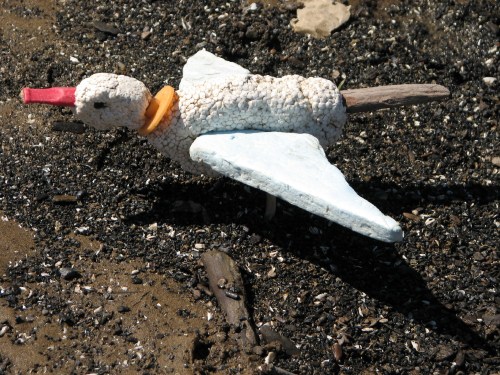
Styro-sandpiper, 9/09

Read Full Post »

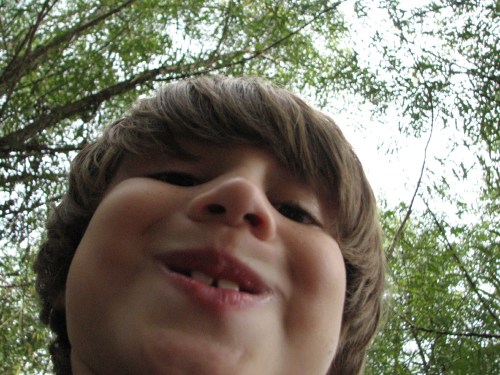
Adam's self-portrait, 9/09

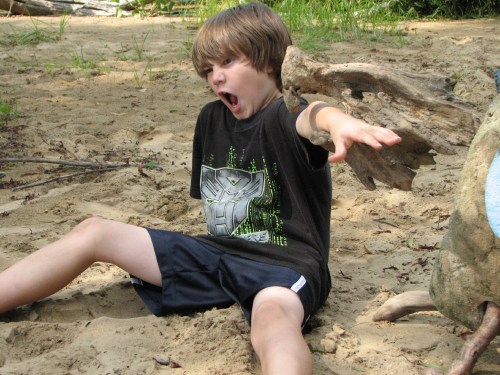
You can tell by looking at this photo that Adam is the life of the party!  I hand my son the camera and the first picture he takes is of himself!  The two of us went to the Falls the other day.  We hiked around and then made some art together.  Here are a few words and images recording our adventure.

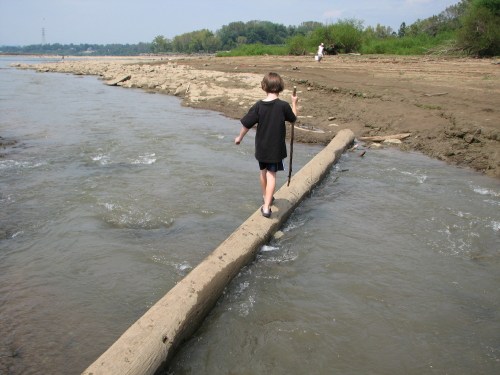
Adam crossing over, 9/09

The river is in its summer pool meaning that it’s low this time of year.  The water in this photo is barely ankle to knee deep (and that’s if you step into a hole).  I usually wade over to get to the fossil beds on the Kentucky side.  Adam decided that he prefered the challenge of walking across this old telephone pole someone else had laid across the water and it was a good test of balance.  That’s what I like about walking over driftwood.  You need to pay attention to where you are going.  As we were exploring, Adam came across a piece of wood that reminded him of a dragon’s head and he decided to see if he could make the rest of it from other found materials.  I wonder where he got that idea?

Adam's Dragon head, 9/09

As you can see, Adam has a pretty good eye.  This old beat up piece of wood does resemble a dragon’s head or snapping turtle skull (that was my vote).  The eye socket is in about the right place and it does have a complete mouth with maxilla and mandible.  The other side looks just as good too!  Adam carried his driftwood from the river’s edge to the site that has served as my outdoor studio for months now.  Recently, I did a little “house” cleaning by rearranging  all my found materials.  While I worked on my piece, Adam was busy working on his.  Little Styrofoam people watched from a safe distance and from behind a tree.

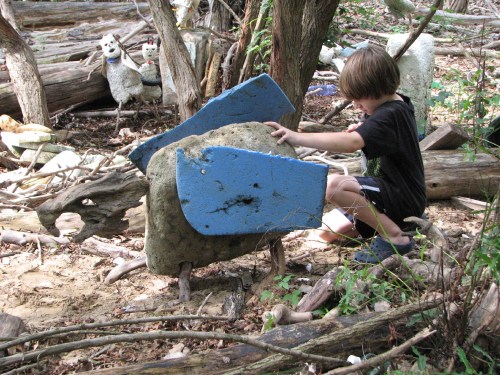
Adam working on his dragon, 9/09

Finding material for the body and limbs was on hand, but there was the challenge of what to use for the wings.  Adam did a little scouting around and found this blue, foam-like mat that he cut in half with my knife.  The wings are pegged to the body to hold them in place.  I did help him when he asked for it…which was when we hammered the legs into the body with another piece of wood.  As we worked, I asked him how third grade was going and other topics of conversation, but there were also periods of silence as we focused on our projects.  I heard that’s how you can tell when men are comfortable with one another….when time goes by and neither utters a word to each other.  They don’t need to.

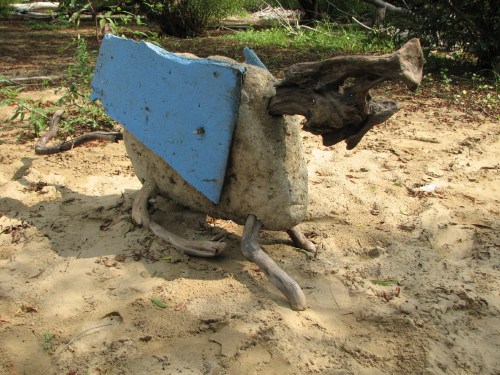
Adam's Dragon, facing right, 9/09

At last the dragon is finished and the beast seems to be roaring its approval.   Adam seemed happy with his efforts.  I’m pleased that for now, he still thinks its fun to come out with Dad to explore, make things, and use our imaginations.  I can’t conceive of  how a person can develop a love for nature unless you have some experience in it?  The outdoors can help nourish the body and spirit in ways that are hard to replicate in school.  We had some fun playing with the dragon which is a dangerous thing to do because they are proud and fickle beasts and one can never completely relax around them.  If you do… than this can happen!

Adam bitten by the dragon, 9/09

Read Full Post »

Styro-turtle head with fossils

I just read that the most primitive reptiles still around are the turtles.  The oldest turtle fossils extend back nearly 230 million years.  It wouldn’t come as a shock to see that pushed further back in time as new discoveries are made.  The fossils at the Falls of the Ohio predate the turtles and represent life during the Devonian Period about 370 million years ago.

Styro-turtle in shallow pool

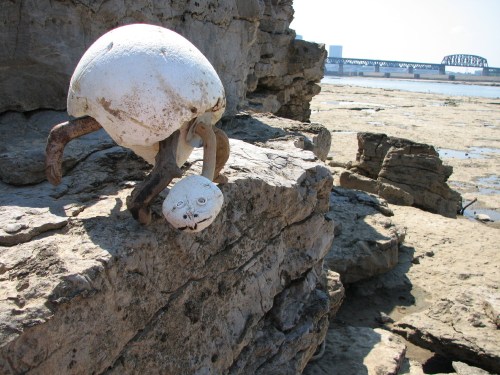
Normally during this time of year the fossil beds would be exposed and you can walk very far out upon them.  This, however, hasn’t been a normal year!  I’ve dipped into the archives to show you a turtle sculpture I made a couple years ago that remains a favorite creation.  In this image, the Styro-turtle is crawling out of a shallow pool of water that it was using to stay cool.  It can get very hot out on these rocks during the summer.  The remains of ancient corals can be clearly seen in the limestone.

Styro-turtle on fossil rocks

When I make this work I’m really more interested in the images that result.  For me, it’s about seeing the trash I rearrange and reconfigure in the context where these objects were found.  This turtle needs to be seen in this particular environment which has played a large role in shaping the materials I use.  This is meant to be “a collaboration with nature”.  Andy Goldsworthy has used this phrase to describe his work and friends have  compared my work to his.  There are similarities in that we both like working out in the elements, using what is on hand, and taking a photographic image that is the visual record of that day and place in time.  There are also differences.  My work here is figurative while Goldsworthy’s is more abstract.  He prefers working strictly with natural materials while I use artificial ones too.  The state of moving from the natural to the artificial I feel describes our current condition well.  Goldsworthy travels to some of the beautiful places on the planet to make his art, while I decided to interpret this one place near where I live.  I feel we are collectively like the turtle in the above image…on the brink.  Will we turn back or go over the edge?  By using the garbage I find here I believe I’m not only illustrating part of the problem, but also suggesting an alternative.  It’s by encouraging and using our universal creativity that we have the best chance to reconnect with the environment that sustains us.

Styro-turtle, out of context

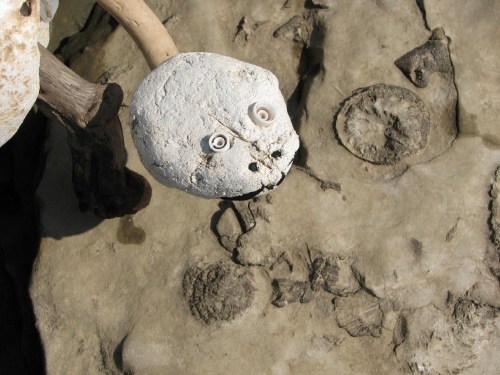
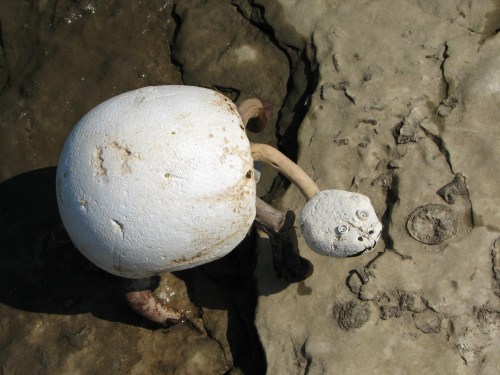
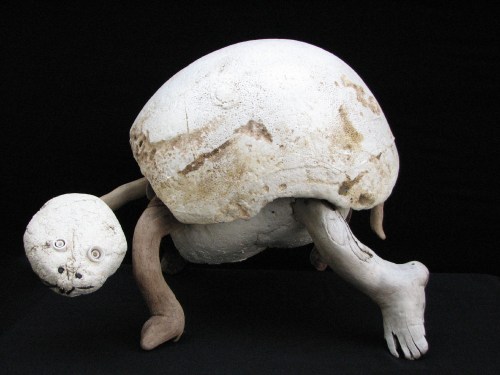
This piece turned out nicely and so I kept it.  Later it found a good home with my gallery representative…who prefers the sculptural models over the images!  To each his own.  With real turtles, one of the distinctions that shows up even in the earliest animals is the presence of the shell or carapace.  In my polystyrene version, the shell is special too.  It is the remains of an old bicycle helmet.  Other materials used include:  coal for the nostrils and mouth, plastic aerosol nozzle tips for the eyes, a plastic bleach bottle mouth forms the collar where the turtle’s neck joins the body, driftwood legs, tail, and neck, the rest is Styrofoam.  All found on site.Underside of Styro-turtle


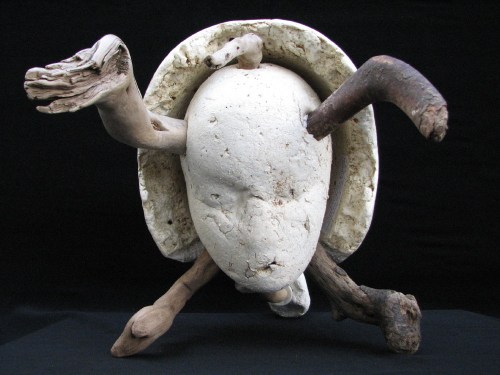
The head pivots around where it meets the body and there is one other special feature of this piece.  It can only be seen by turning the turtle over.  The body is a Styrofoam human head used by wig stylists!  For me, it adds another layer of meaning.  This is one of two such Styrofoam heads I have found at the Falls of the years and worked well with the foam helmet.  A pocket knife was the only tool I used to make this found object sculpture.

Read Full Post »

Styro-swift, 7/09Styro-swift, closer view, 7/09

When I’m out by the river I’m also thinking about what birds I might see.  That’s especially true during the Spring Migration when there’s a good chance I will run across a species I’ve never seen before.  In the advent that nothing new comes along…I’m not adverse to making a bird myself!  Above is a quickie that I made recently.  I call it a “Styro-swift”.  The materials are essentially the same as before, polystyrene, wood, plastic, and coal for the eyes.  The bill is made with the broken teeth of an old comb.  With more time, I think I could have photographed this better.

Indigo Bunting, male, 7/09

Here are three recent and very real birds.  The first is a male Indigo Bunting and he’s puffing his feathers out displaying to the unseen female in the bush above him.  Perhaps it is a trick of memory, but the Indigo Buntings I remember in western Kentucky were darker and more iridescently blue.  The Falls birds seem much lighter in color.

Bathing male American Goldfinch, 7/09

I can always count on seeing American Goldfinches.  This male is obviously taking a bath, but this area on the beach seems special to them. Perhaps there is something in the water and grit here that benefits them?  It’s a kind of goldfinch lick.  I love watching their singing, rolling courtship flights.

young Bluejay, 7/09

This young Blue jay was so focused on the beetle he was trying to eat that he almost got run over by a truck.  I had to shoo him away from the danger on the road.  When I’m walking through the woods, I try to avoid jays and the alarm they can ring out to every other living thing in the area.  I have other bird images, but will wait to post them at a later date.

Read Full Post »

deer materials, 7/09

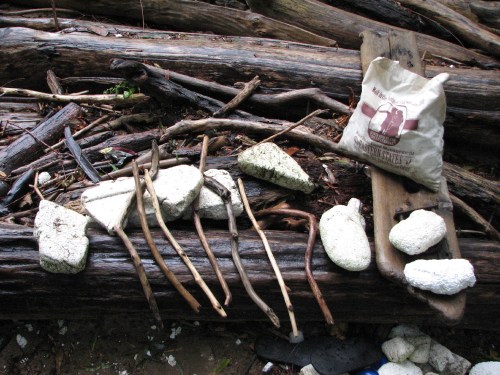
I got soaked to the bone on this day.  A realization I had in the middle of the downpour was that I couldn’t get any wetter than this and so I just relaxed.  I had the whole place to myself, since people smart enough to get out of the rain had done so!  The above image are the materials I laid out for the piece I wanted to make…although I did change this in mid process.

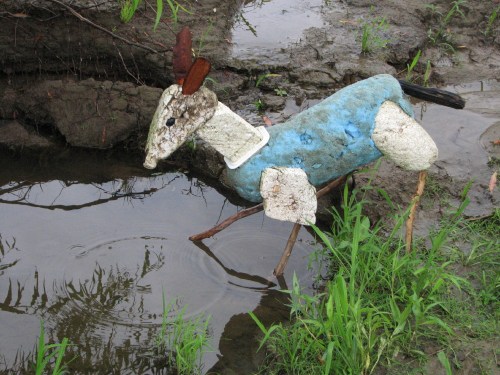
Rain Deer, 7/09

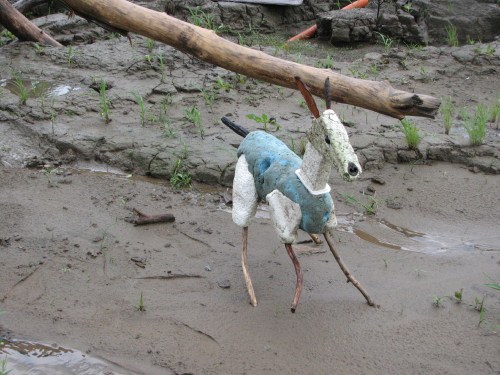
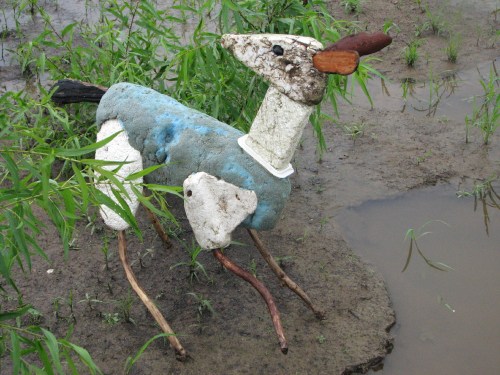
I put the finishing touches on this “Rain Deer” right as the wind picked up and the rain came down in earnest.  All day long I had been dodging small showers and the willow leaves and branches were a good enough umbrella…until then.  Once I located what would become the head, I realized that the Styrofoam “body” I had picked out for it was too small.  I instead used this larger piece of “blue foam”…I’m not sure what exactly it is, but I find enough of it.  It doesn’t seem like polystyrene and has a stiffer texture.  I think I have seen this material used for bow-hunting targets before.  It’s dense enough to stop an arrow.  While I was making this sculpture, a Cooper’s Hawk glided through the trees doing some silent hunting of its own.  I saw the barred-tail fan out as it took a left turn out of view.

Running Rain Deer, 7/09

I guess I have been thinking of deer lately.  More and more, I come across their tracks in the sand and mud.  I haven’t seen a live one within the park’s limits, but over the years, I have found plenty of dead ones.  The most memorable experience occurred early on…really years before I started this project in earnest.  A friend and I were hiking around the willow habitat and we could smell something dead nearby.  Searching around we couldn’t locate the source.  For whatever reason, I remember looking up and seeing a dead deer about 10 or 12 feet up lodged in the tree branches.  A  recent flood had deposited the deer there and receded.  At the time, it was a good ground eyes’ view of how high the river could get.

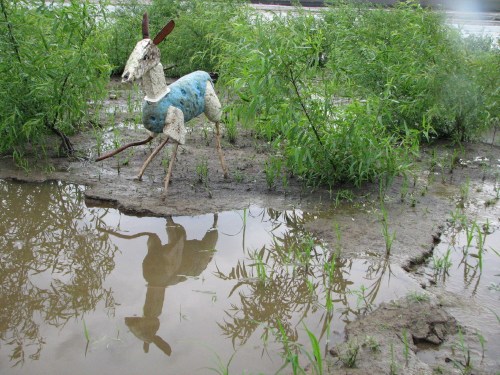
Rain Deer at water hole, 7/09

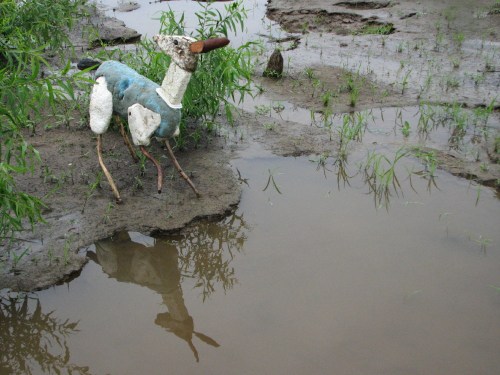
The passing shower left lots of opportunities to play with reflections and the idea of wildlife coming down to waterholes…which is a staple shot in nature films.  The way this piece is standing, it appears like it has three front legs or is in motion!  I made the head so that the Rain Deer can either look  forward or over its shoulder.  The nose is a split butternut and the eyes are old buckeyes.

Rain Deer at waterhole, 7/09

Rain Deer looking back, 7/09

Our white-tailed deer population is exploding with dramatic consequences.  The number of human injuries from deer collisions with  motorists is up.  More and more deer are appearing in the outlying neighborhoods were they feast on the various gardens and make nuisances of themselves.  Deer are literally eating themselves out of their habitat and damaging the ecosystems other animals rely upon.  For the first time, I’m coming across ticks and I’m attributing their appearance here with the deer they parasitize.

Rain Deer at Waterhole, 7/09

Deer are a good indicator species for the health of the ecosystem.  As we open up the forests we create the kind of habitat deer thrive in.  Deer have taken advantage of this…deer population is much higher now than when the Pilgrims first arrived here.  Although I couldn’t do it, I can see why hunting  them is necessary to control their populations.  Too many deer in one place degrades the habitat also needed by other ground dwelling animals.  But then again, why should we hold the deer accountable for the conditions we created and promoted? The deer is just being true to its nature…can the same be said of us?

Rain Deer head, 7/09

Read Full Post »

« Newer Posts