Feeds:
Posts
Comments

Archive for the ‘animal art works’ Category

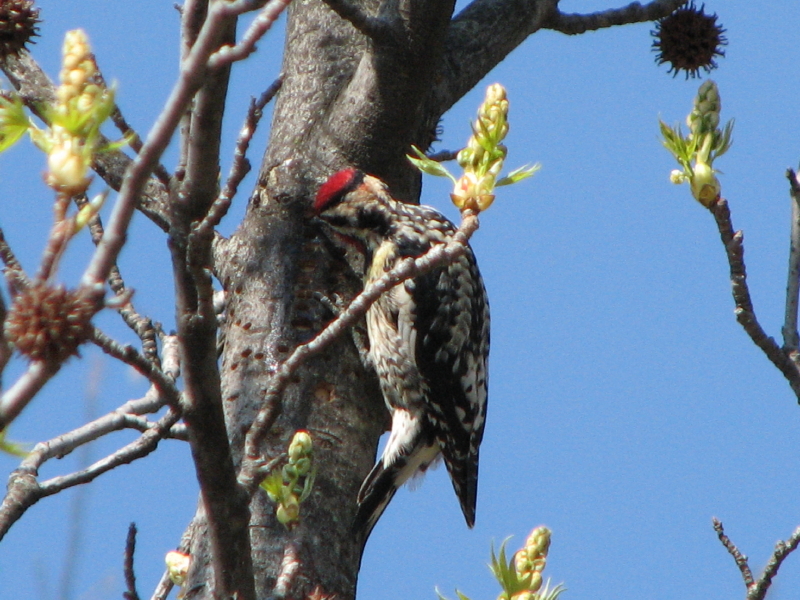
For me, the Yellow-bellied Sapsucker is a signal that Spring is underway.  I believe I have seen this very same bird in the same Sweet Gum tree for several years now.  Before the tree fully leafs out, he drills neat rows of holes in the tree bark which fill with the tree’s sap.  Visiting often, he then licks up the sugary mixture.  I have seen other bird species utilizing the work of this woodpecker including other woodpecker species, warblers and chickadees.  Before the insects and new seeds appear, the Yellow-bellied Sapsucker has accessed another food supply which he defends from all the other birds. 

Throwing his head back, this male Song Sparrow is expressing the feeling of the season.  Song Sparrows are year-round residents and have fully taken advantage of all the niches available at the Falls of the Ohio.  This year White-throated Sparrows have been more abundant than I recall from past years.  Every year is different from the previous ones and you never know what to expect next.  This year is off to a very wet start.
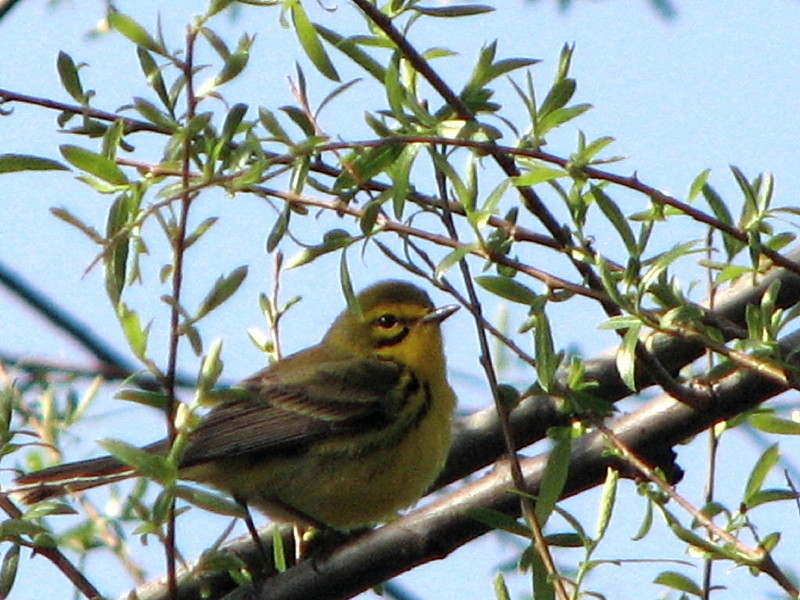
This is a male Prairie Warbler I came across recently.  I have “pished” this species closer to my camera’s lens by making little squeaky sounds that the bird found curious enough to follow.  I am hopeful of seeing other warblers before the Spring migration ends.  So far, I have seen Yellow-rumped Warblers, Common Yellowthroats, and a brilliant male Prothonotary Warbler attracted by the flooded bottomland trees.  There are thirty-five different warbler species on the Falls checklist and I have had the privilege of seeing most of them over the years.
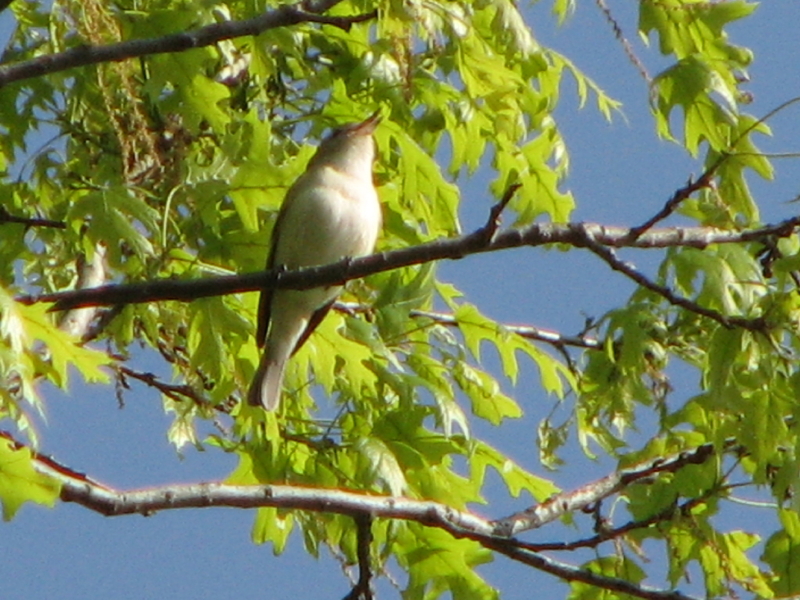
The Warbling Vireo is another bird that is more often heard than seen.  It’s such a tiny bird and it has the habit of staying in the tops of tall trees.  I found this one on the exposed section of an oak branch.  If it weren’t distracted by trying to attract a mate it would be in almost constant movement in search of the small caterpillars and insects that it eats.
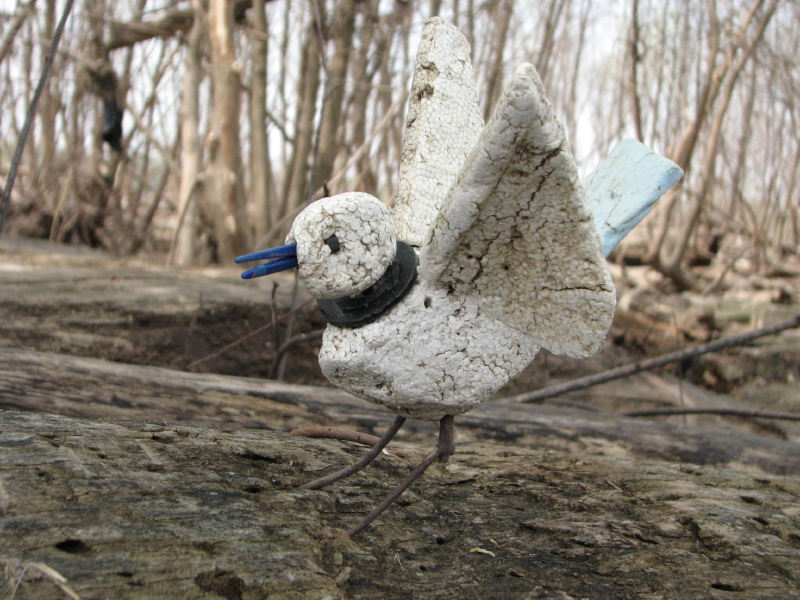
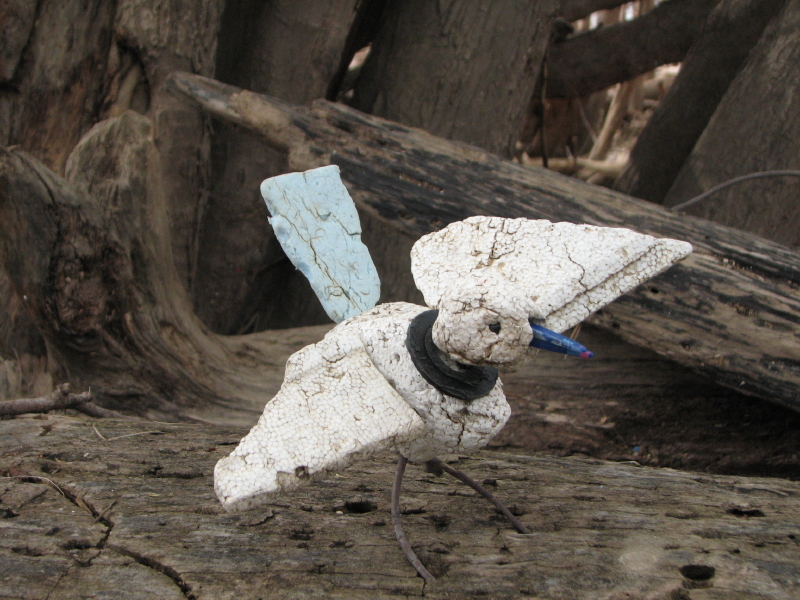
A new bird to add to the old life list is the Blue-tailed Robin.  It’s an infrequent visitor to these parts and so when one is sighted it becomes an event.  You can’t see this in the photo, but there are ten other birdwatchers with cameras and binoculars trained on this fellow as it dances and practices its courtship dance.  Everybody was extra quiet so that this bird wouldn’t spook and fly away.  Here are more images.
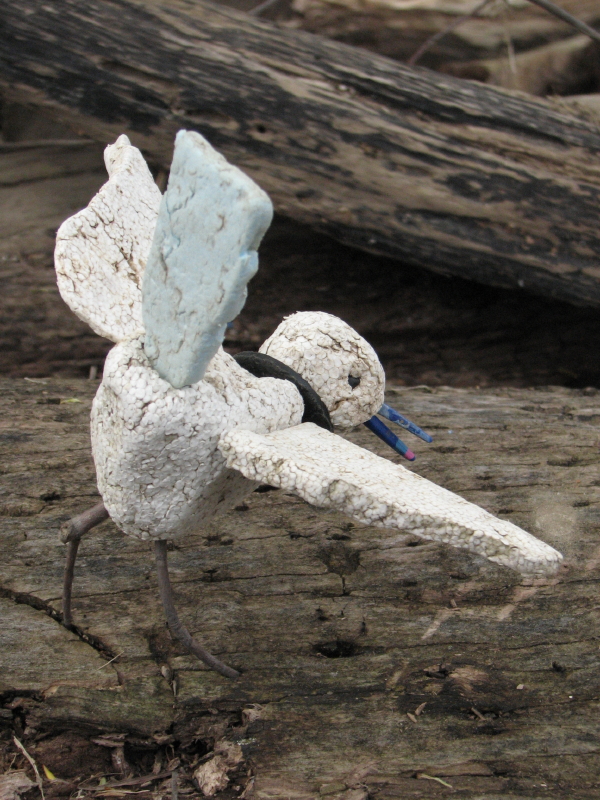
The Blue-tailed Robin male does an elaborate dance on a fallen log where it sings and flaps its wings in different positions all the while it struts its stuff.  The real test will happen further north in central Canada where its ability to display and attract a mate will mean the difference between passing on its genetic distinctiveness or not.  No wonder this bird can’t afford the opportunity not to practice!
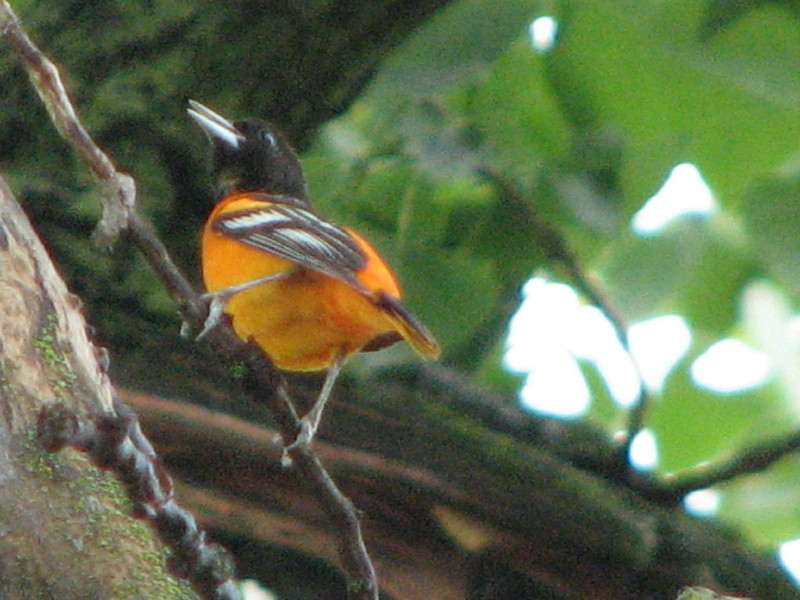
Singing very high up in a Cottonwood tree, this male Northern Oriole is also singing loudly in its territory.  So far, it’s looking and sounding like a good year for this species!  Nearly everywhere I hiked in the park I either sighted or heard Northern Orioles.  The orange color is so distinctive and it contrasts so well against the green of the surrounding leaves.  There is so much moisture in the air that my camera records this as a slightly foggy picture.  I hope for better images of orioles and the other great birds here.
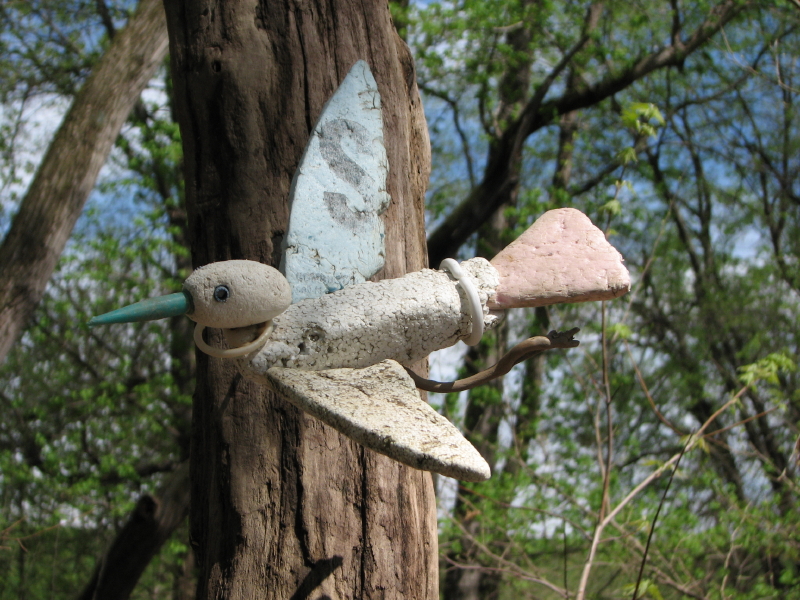
Another rarely recorded migrant is the Dragonfly Tern.  I found one coursing along the river bank and was able to squeeze off a couple decent pictures.  Like the name implies, it specializes in capturing dragonflies which requires the ability to maneuver at high-speed.  It has swept back wings that give it the acceleration it needs in tight corners.  Here’s another picture of it buzzing over a fallen log near my position.
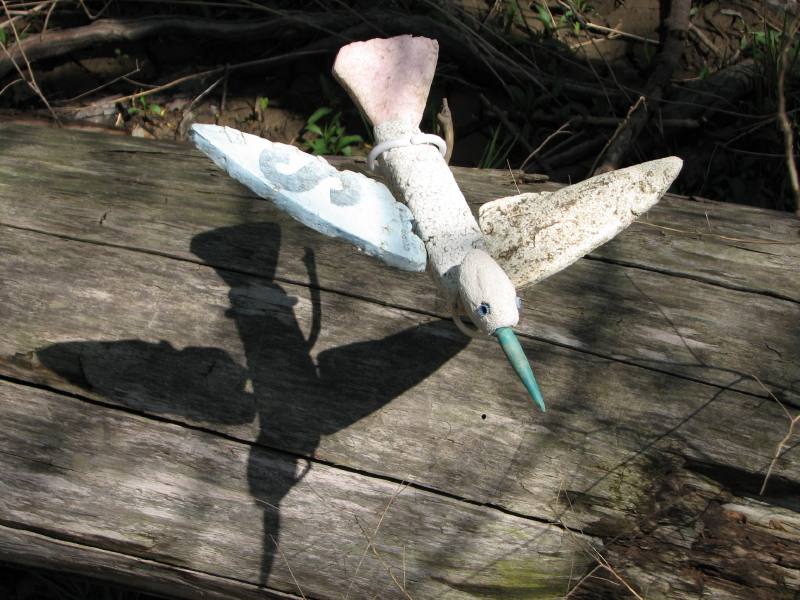
This bird soon will be off to the Great Lakes region where it also breeds.  It barely scratches together a depression in the sand and gravel that it considers a nest.  There are usually two eggs laid that are heavily speckled like the small pebbles that surround it.  It winters in South America and travels thousands of miles each year.

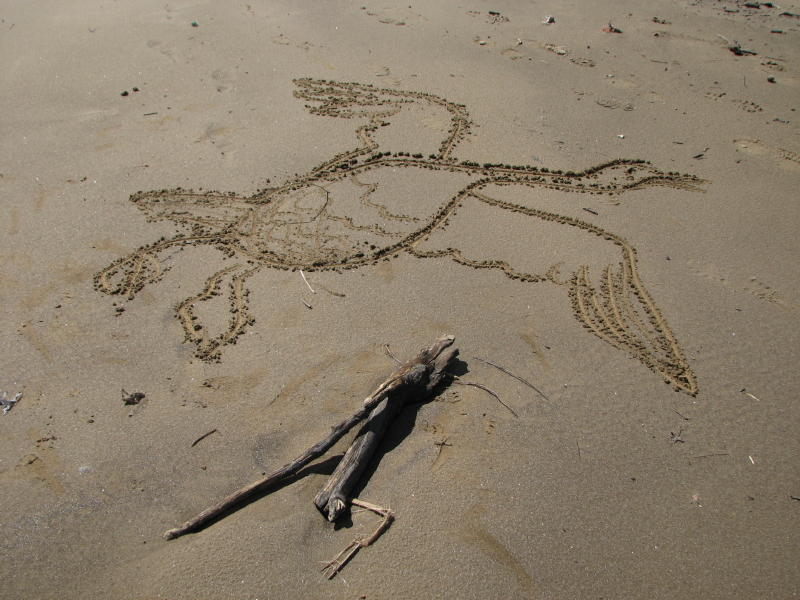
On my way home from the park, I chanced to see this Red-tailed Hawk on top of a utility pole and recorded its image.  It is one of our more common hawks, but since I haven’t featured it in the Riverblog before, I thought I would include it in this post.  As the year progresses, I hope to feature other birds that stop at the Falls of the Ohio. For me, the difference between a successful trip and a really successful adventure sometimes hinges on seeing one nice bird!  In closing here are two Canada Geese.  One is real…
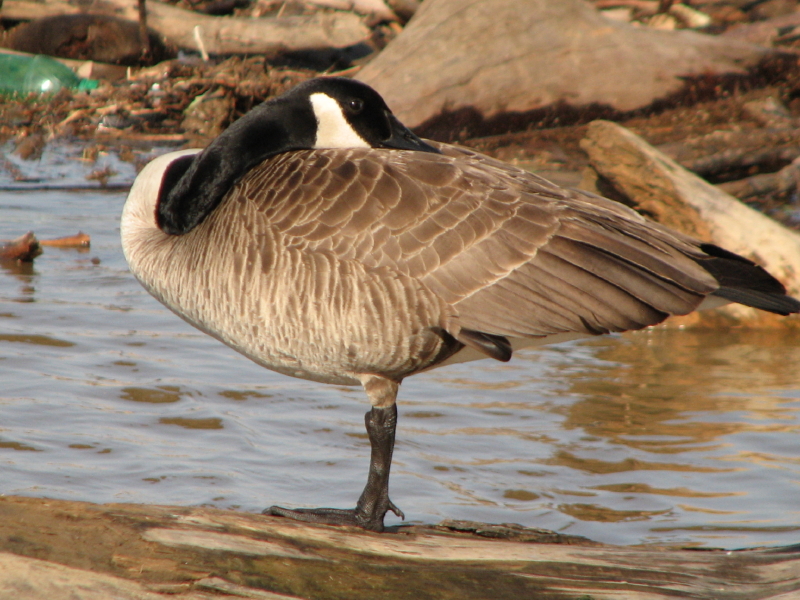
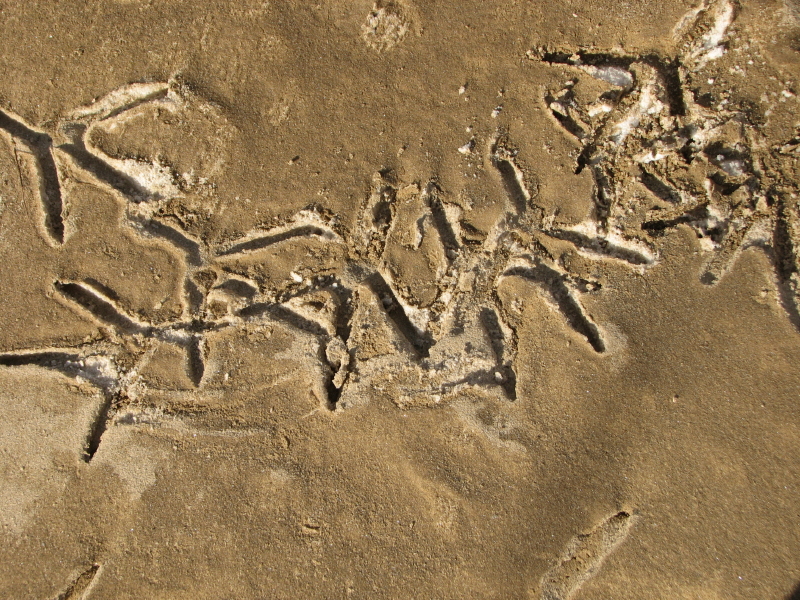
…the other is just a tracing in the sand I made.  Happy birding !!
Read Full Post »

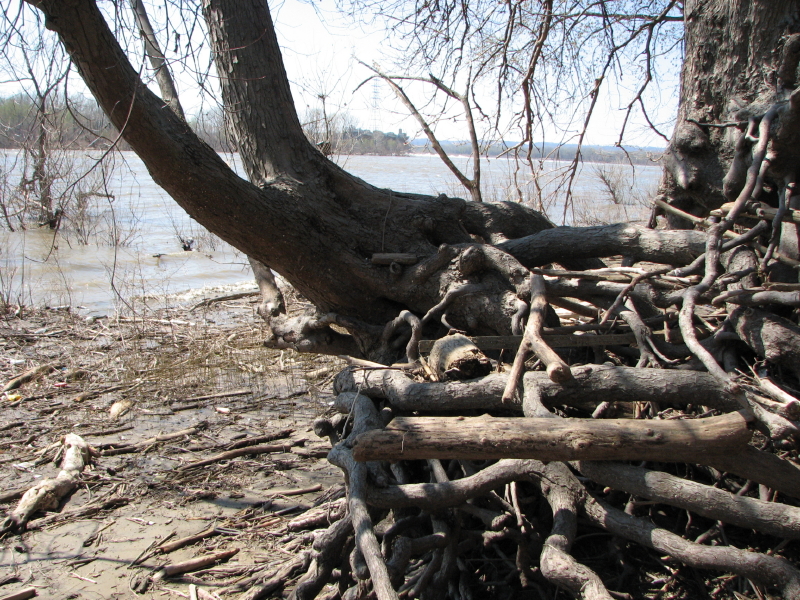
This is a post from the western section of the Falls of the Ohio State Park.  The high waters from the recent flood have taken their sweet time abating.  I slogged through a lot of mud, but have to admit I had a good time exploring.  Along the way, I could see odd items that had been snagged by the trees and here they will stay until they decay or another flood carries them away.  Here’s a wooden stand of some kind that found refuge in the branches of this tree.

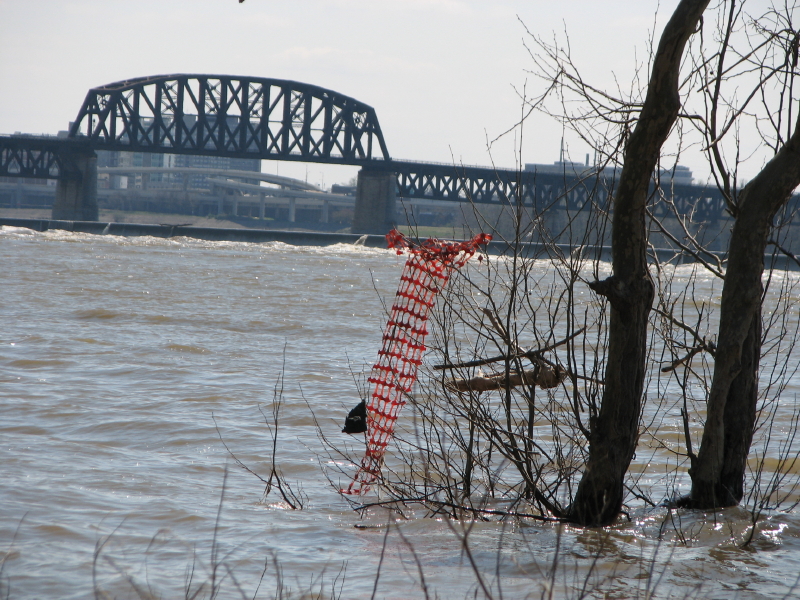
And here is part of a hurricane fence that the river deposited high and dry onto another tree.  Nearly every where I go I can find (mostly plastic bags of all sizes) stuff caught by the tree branches.  Sometimes this items “decorate” their new homes for years to come.

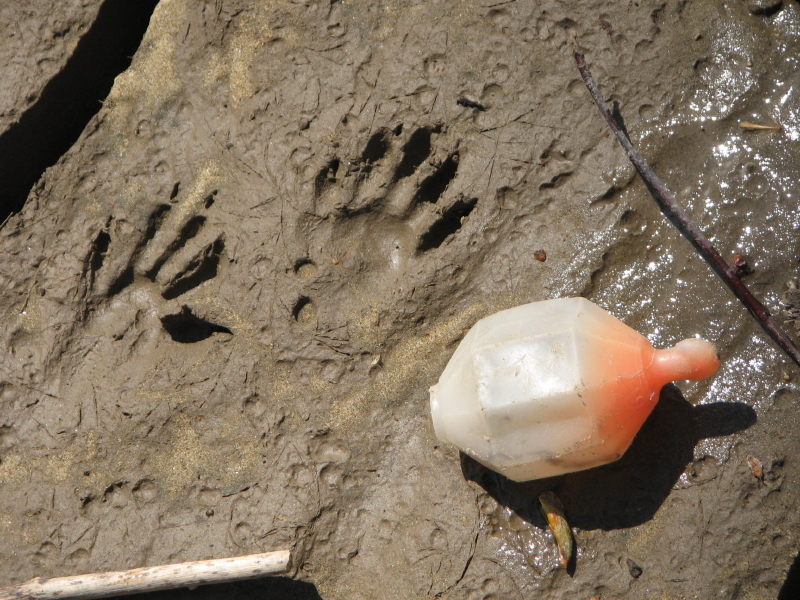
I’m always on the look out for signs of life.  On this trip I came across a flock of American Coots, but they swam away before I could take one decent image of them.  In the soft mud all around me, were the tracks of the various small animals that call this place home.  I believe these are tracks made by raccoons next to this plastic baby toy that floated in with the river.

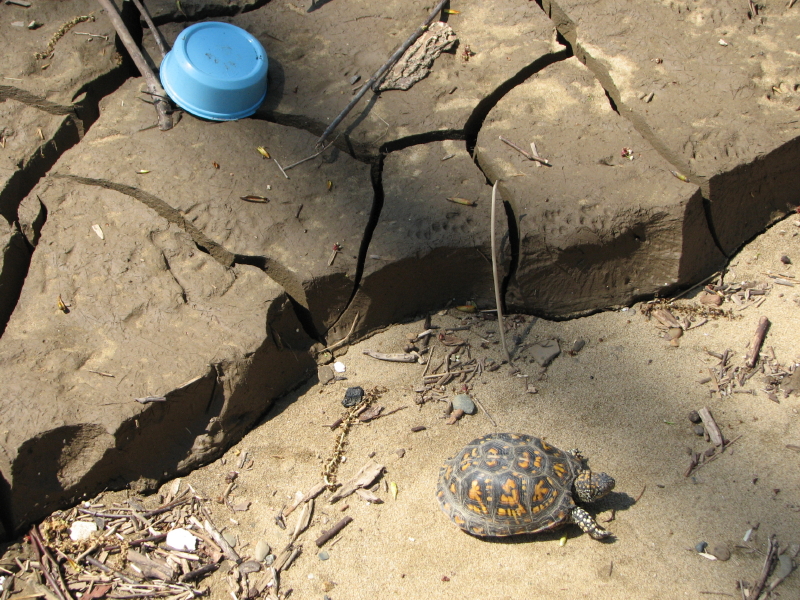
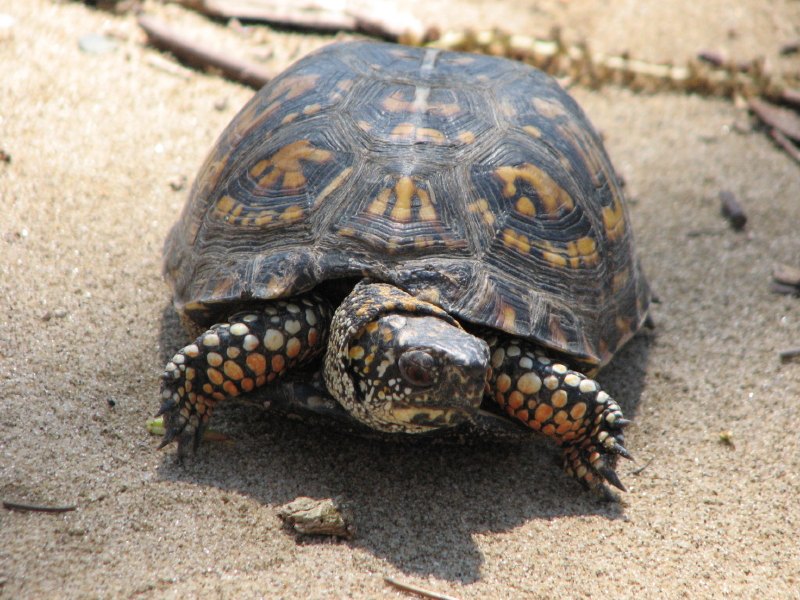
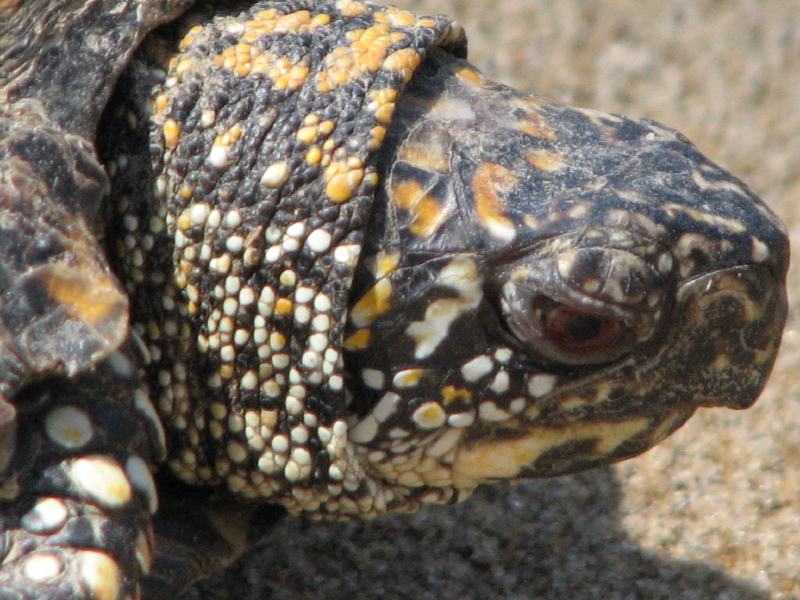
Investigating the other debris, I nearly missed seeing this Eastern box turtle.  He looked like an old-timer and because it was still a cool day…he was moving slowly.  This allowed me to take several pictures and I had a great opportunity to check him out.  Here is a series of images of it.

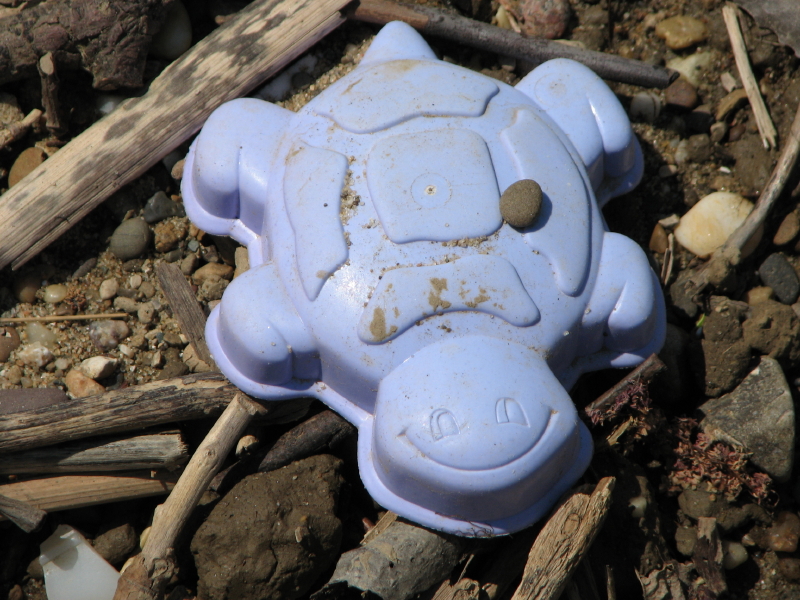
The weird part is that earlier in the day, I came across a completely different kind of turtle.  This one is usually found in close proximity to sand and has a penchant for children’s company.  While the previous turtle embodied substance and image…this one is all image.

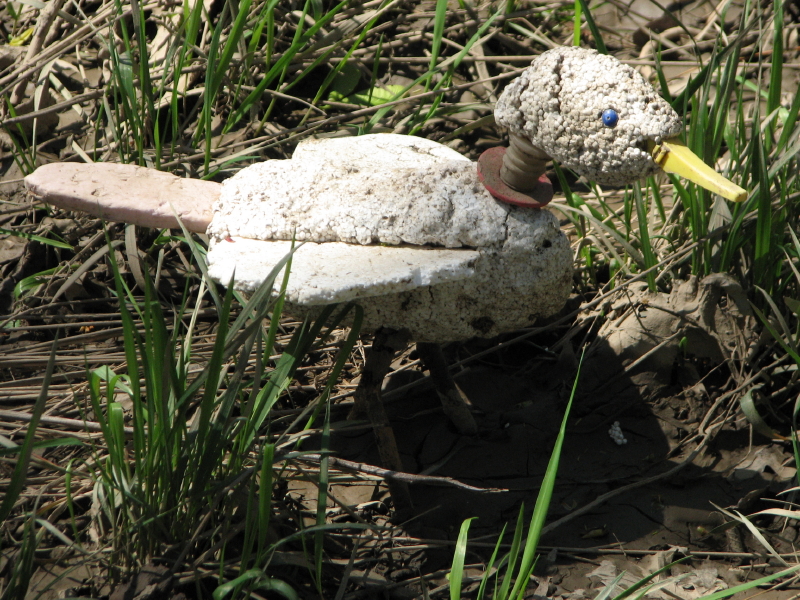
I also came across my “Mud Duck” which was hanging out in an area that was much drier than before.

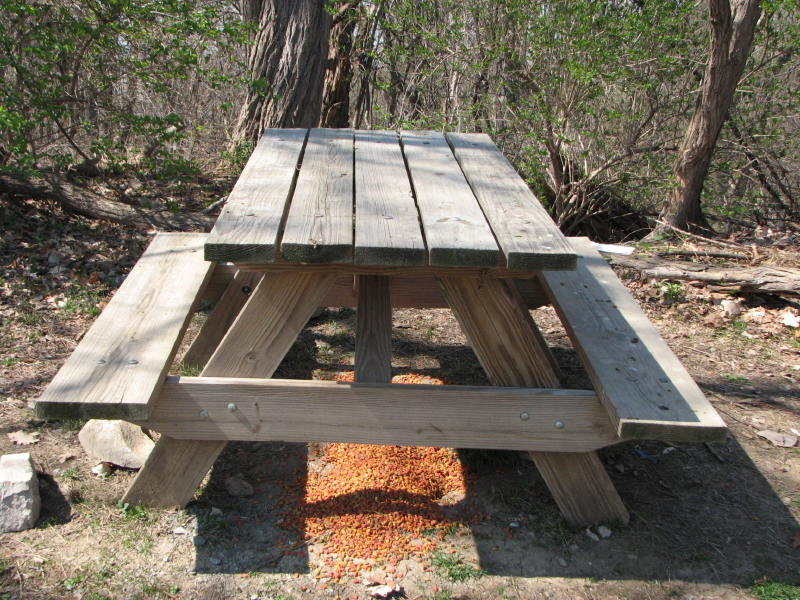
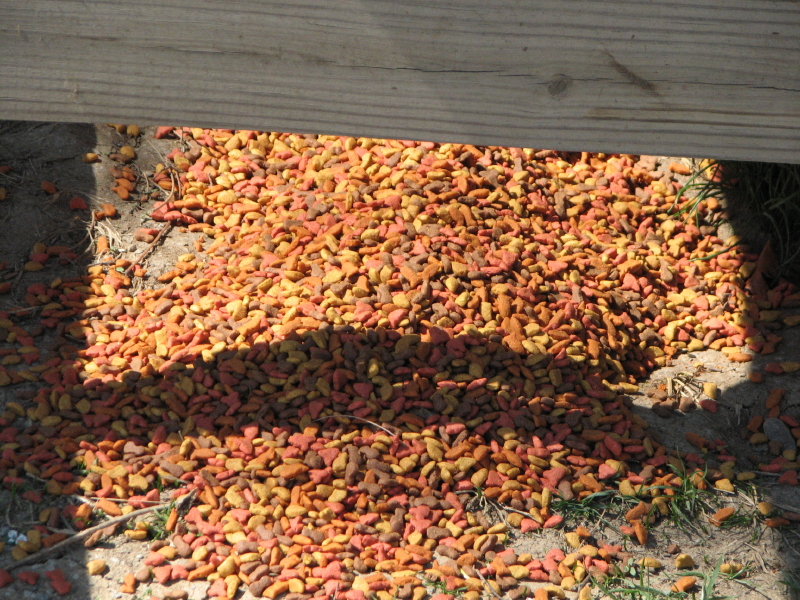
This duck and all the genuine birds and small animals better look out this spring and summer because the feral cat population keeps increasing.  On my way back to my vehicle, I came by this site near the Interpretive Center.  Frankly, this “blew me away”.  There were two picnic tables and each one had the equivalent of a large bag of dry cat food spread under each table.  I’m sure this person has a kind heart and means well, but I don’t see how this helps the other wildlife in the park.  Well fed cats still catch birds and hopefully they will also catch the rats that I’m sure this scene also attracts.  I’ll end with these two images, but will be posting more post-flood pictures very soon.  Until then…

Read Full Post »

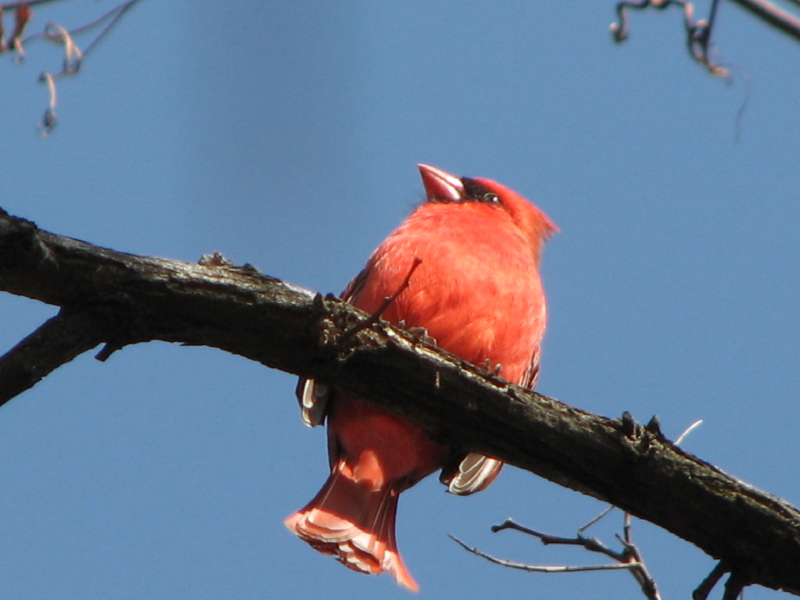
I ventured out over the weekend to see what I could see.  The Ohio River is still very high, but receding.  All along the riverbank you can see how far the water rose because large logs and plastic trash reveal the high water marks.  Once all this water reaches its “normal” level…there will be a huge amount of trash left behind to challenge any clean-up attempts.  Today I wasn’t out looking for garbage, but other signs of life.  Perhaps it is a bit early to look for migrating birds although I can feel that is just a short time away and getting closer.  Already species like the Red-winged Blackbird are staking out nesting territories.  Species we see all the year round like the Northern Cardinal were singing at the tops of their lungs and I enjoyed standing under one bright red bird that was doing just that!
This particular bird has many rivals.  I could hear many other cardinals singing across the landscape.  I could almost imagine the spaces they were occupying by the volume of their singing…every hundred meters or so it seemed a different bird was calling out.  I wondered how the poor females went about the task of choosing which one to form a pair with?  I did see a few Yellow-rumped Warblers which are usually the first warblers to arrive and among the last to leave.  The other warblers will be winging their way here shortly…or at least I hope they stop here ever so briefly on their way northward.  Over the last two or three years it seems there are more changes to the environs around the Falls of the Ohio State Park.  I know that there are many other better choices all along the Ohio River than here. It seems we have decided to put people’s needs first over what birds might need.  During my wanderings, I did see my first butterfly and here it is…

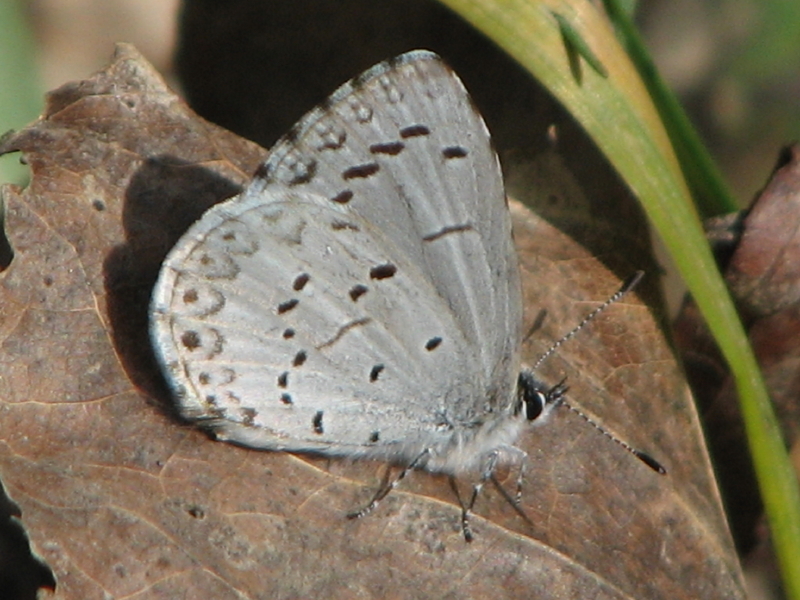
…this is the Spring Azure butterfly.  Here it is mid March and this tiny ( no wider across than my thumb nail) bright blue-violet butterfly was visiting plants.  Unfortunately, I couldn’t obtain an image of that beautiful blue coloring, but with this species, the underside or ventral wings are more helpful in identifying it.  Since there were no dark marks on the dorsal wing tips, this helped me determine that this butterfly was the male of the species.  I was really excited to see this little wonder and thought that this could be a really uncommon species…but it wasn’t.  It’s fairly common, widespread, and has many morphs.  Formerly, this species was scientifically named Celastrina argiolus, but is now called Celastrina landon. With this species, there is still much taxonomic hair-splitting to do.  It’s just that variable over a large area of North America.

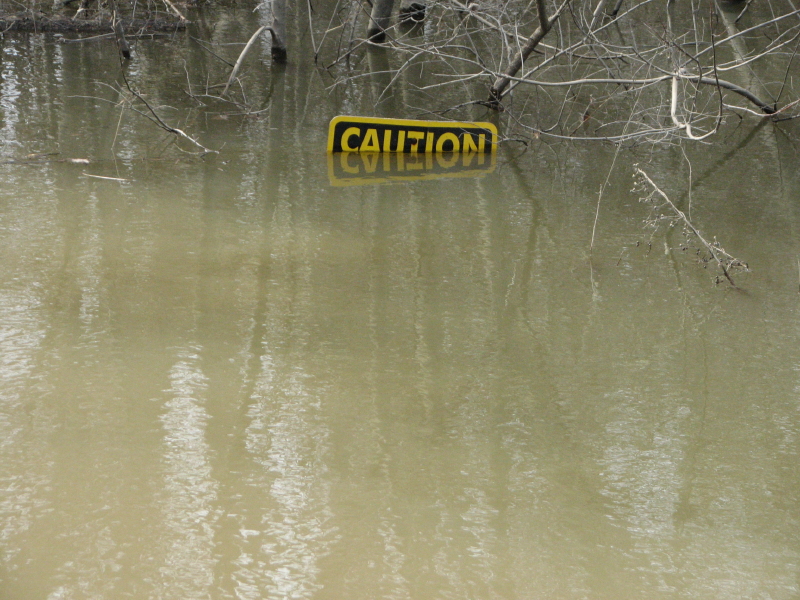
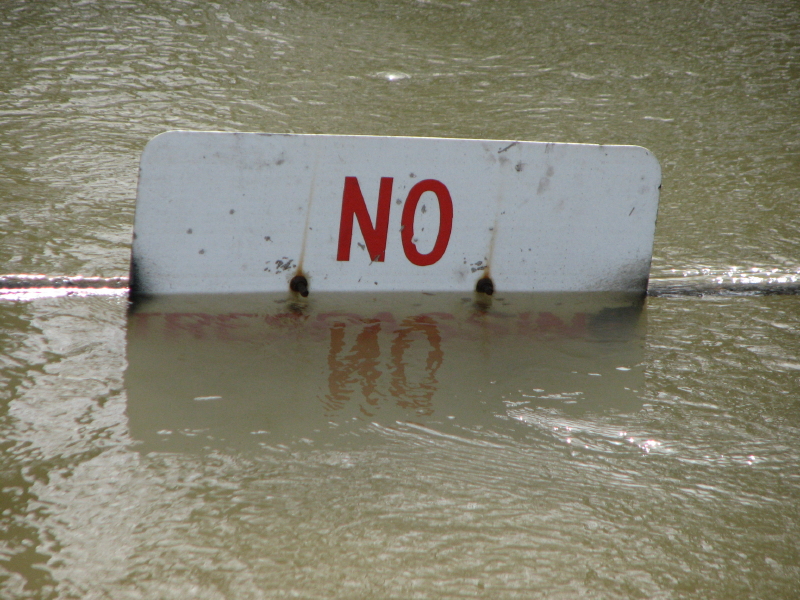
As I walked along the riverbank, I came across a few familiar signs now mostly underwater.  Here’s what happens when you throw “Caution” to the water…you get this view.  And here’s one that partly hides a “No Trespassing” sign near a storm sewer that feeds into the river.

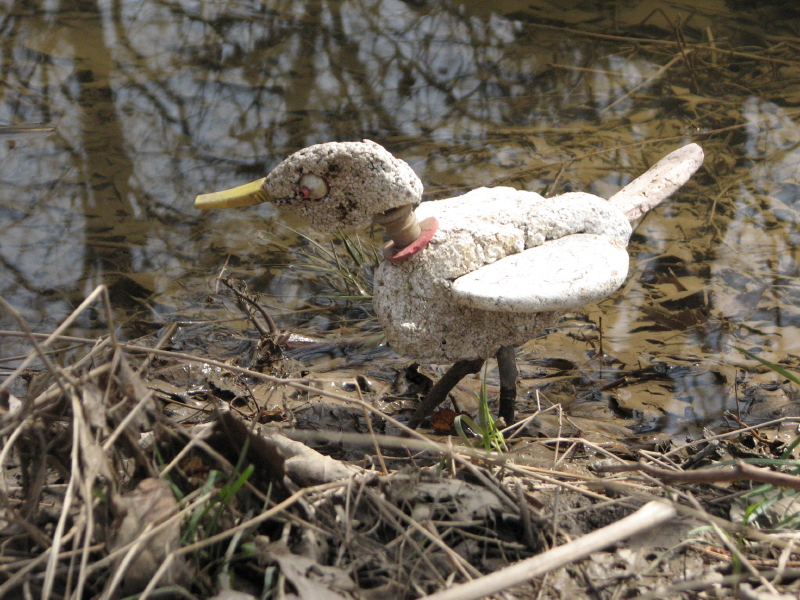
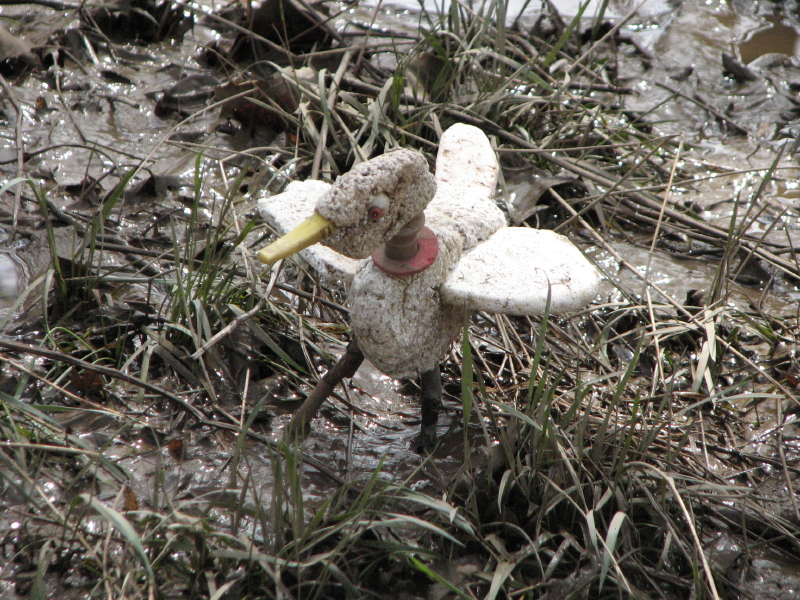
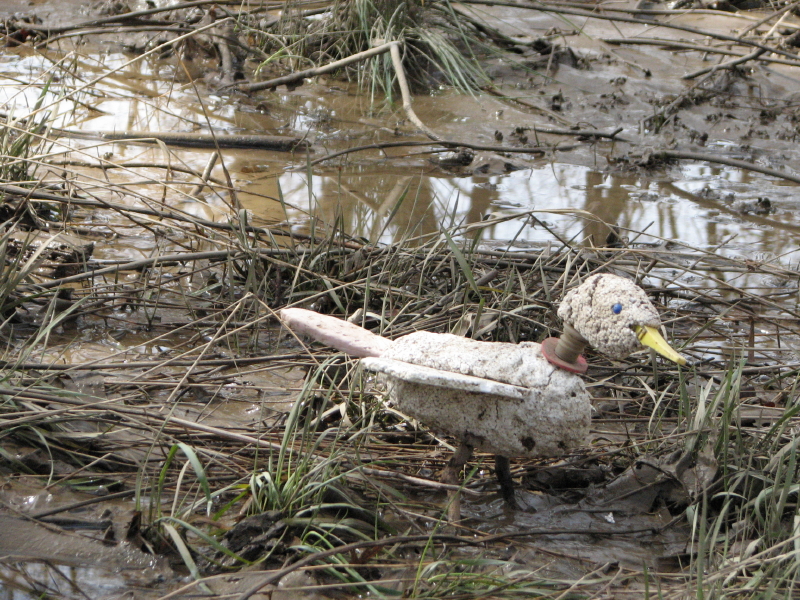
As I moved along where the faint hearted fear to tread, I was hoping that my slogging through the mud and muck would be rewarded.  Earlier I had seen a few Blue-winged teal which is a small species of duck and so I was hoping to see another small, but rare duck that sometimes mixes in with these teal as they migrate.  Today was my lucky day and here are three images of the very unusual  Mud Duck.  This bird likes to really get into the underbrush particularly during floods to take advantage of feeding areas usually restricted to other ducks during normal river levels.  It is a very oily duck and highly buoyant on the water and as a consequence…it almost never dives beneath the surface of the river.

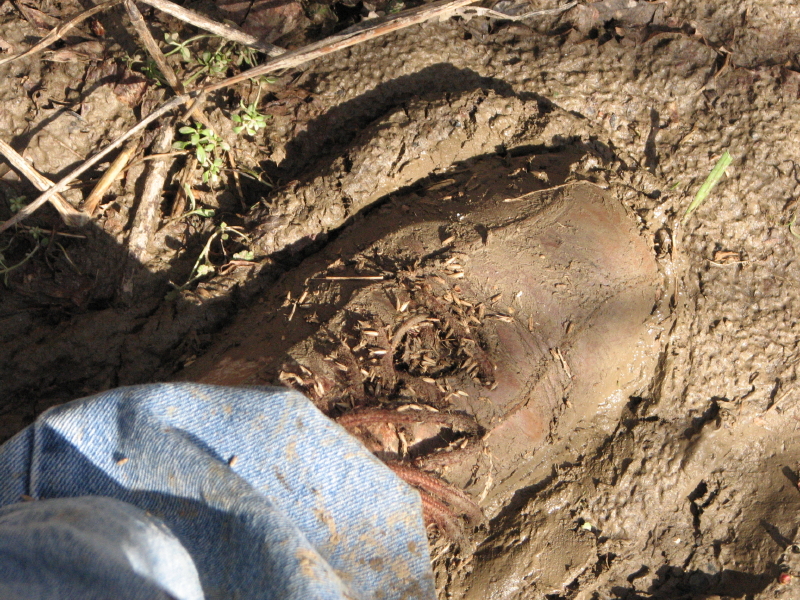
The price of observing this unusual fowl was foul boots.  I became so coated with mud from my knees down that I didn’t worry about my foot gear until I was ready to go home.  This mud is particularly sticky and each rise of the foot is accompanied by a sucking sound.  You definitely need to tie your laces tight, otherwise you risk stepping right out of your shoe or boot.  I stopped every so often to clean the bottoms of my boots because the weight of the mud made each step an additional burden.

So far, I haven’t seen any of the large pieces of Styrofoam that found temporary refuge in my plein air studio.  They are probably half way to the Mississippi River by now.  It may take another week for the water to fully retreat and then it will be even more time before the riverbank dries out some.  I’ll close for now with another flood view.  Over the years, these sycamore trees have been a good marker for high water.

Read Full Post »


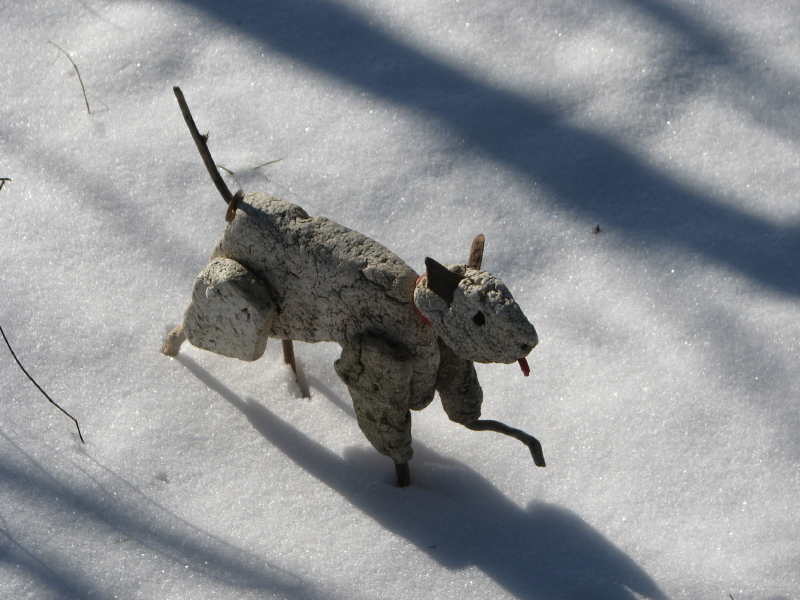
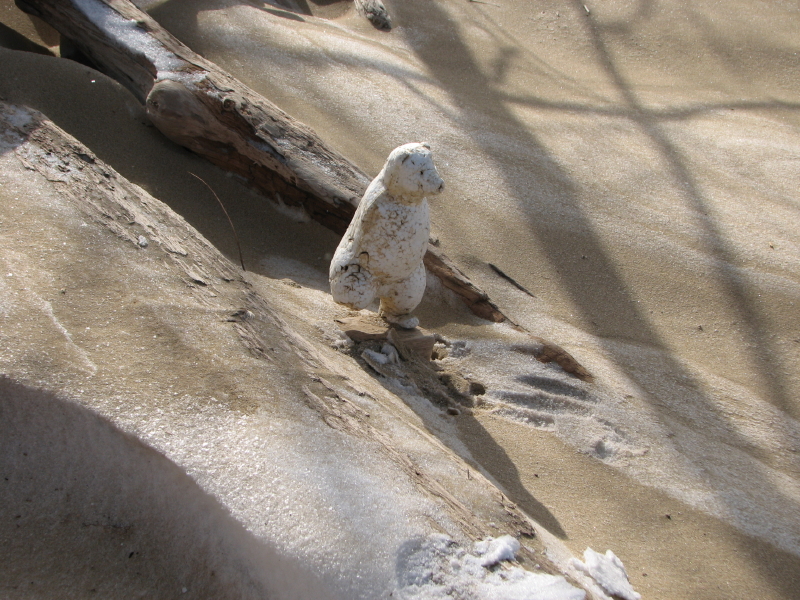
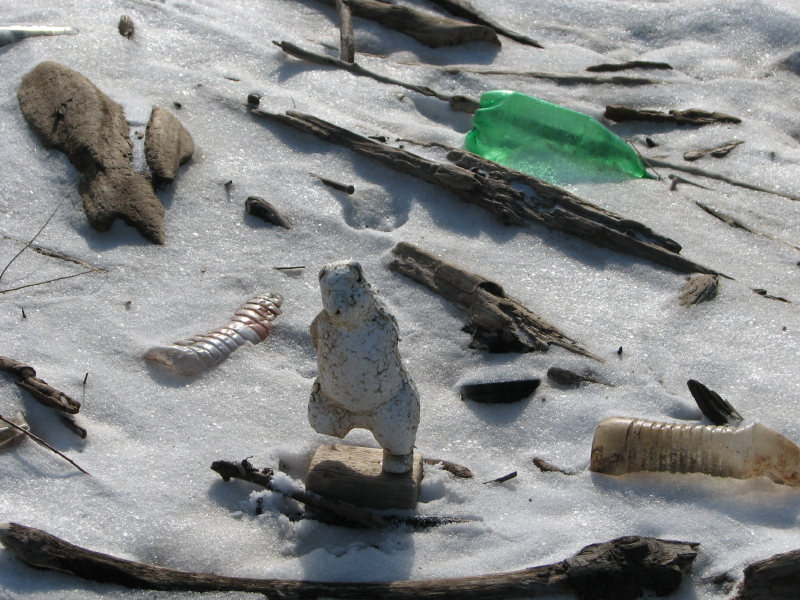
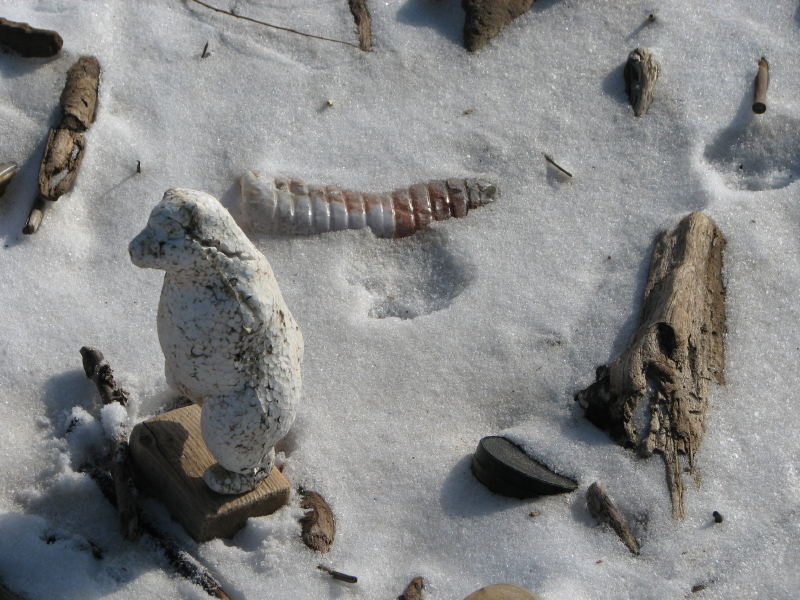
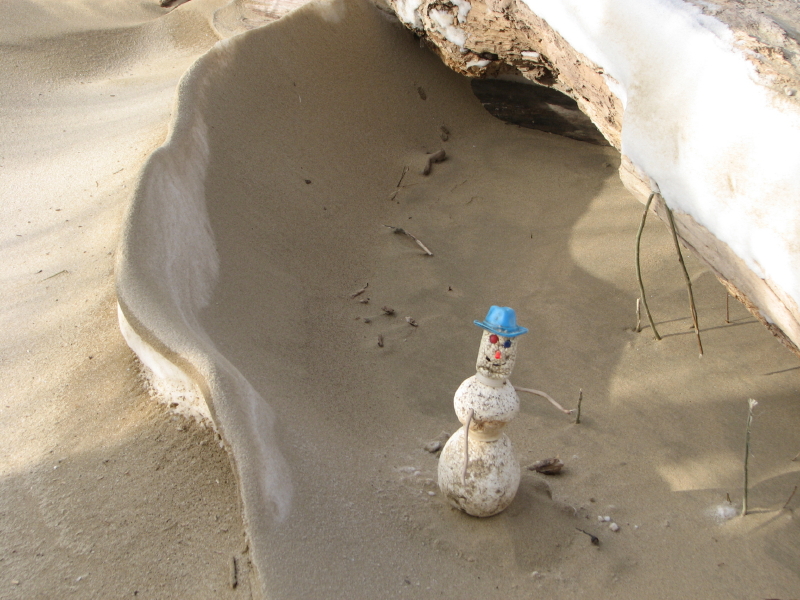
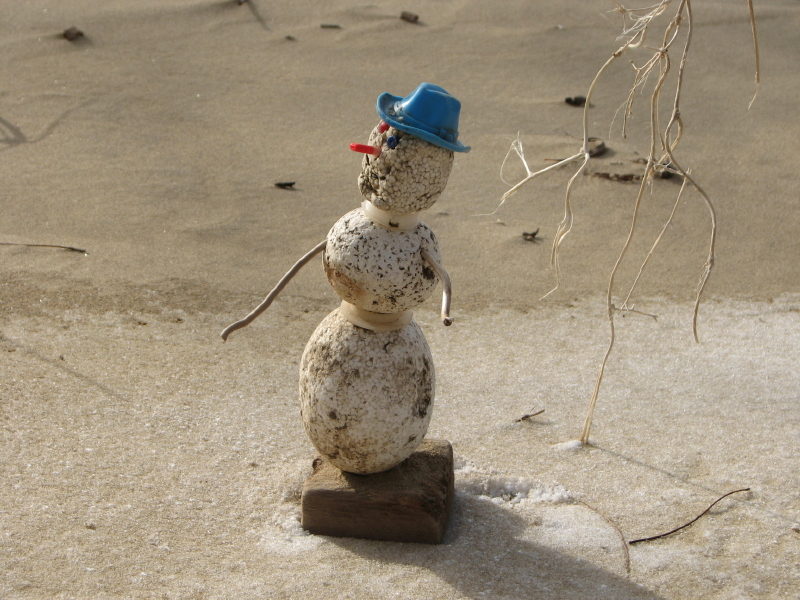
We awoke to a white Christmas in Louisville.  Just enough snow to cover the lawns and trees.  By now all my Falls of the Ohio holiday cards have been sent out.  Usually, I have several designs going at once.  This year, I made cards featuring snowmen, a dog I made from river delivered Styrofoam, as well as one featuring a Styrofoam polar bear with one leg I found out here amazingly enough!  Sometimes the cards are funny and sometimes they riff on some aspect of the holidays we could live without.

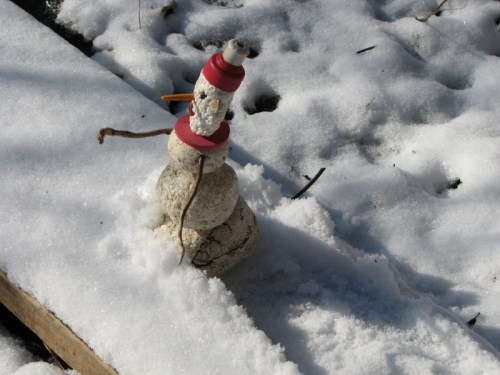
Both of the snowmen I made were created using parts of old Christmas ornaments I have found out here.  Usually, the perfectly round Styrofoam balls I find were originally fabric covered baubles meant for the tree.  This first snowman also features a bottle cap hat which gives you some sense for its scale.  The nose on this one is actually a miniature carrot I also discovered in the sand and kept for just such a purpose as this!  I waited for the snow to arrive which it did this year just in time.

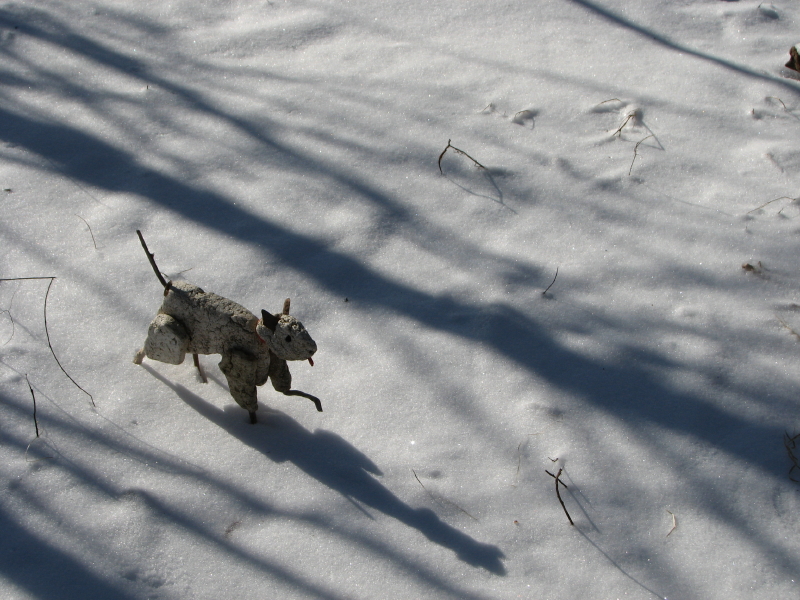
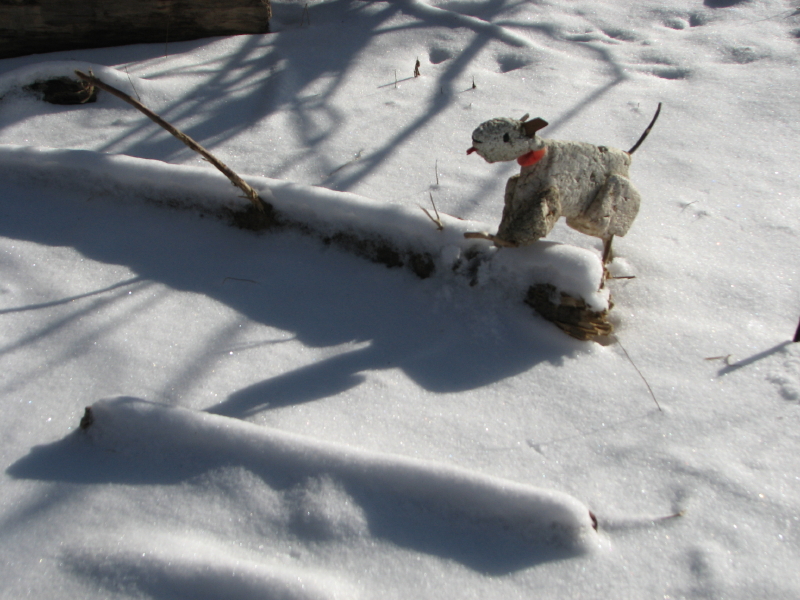
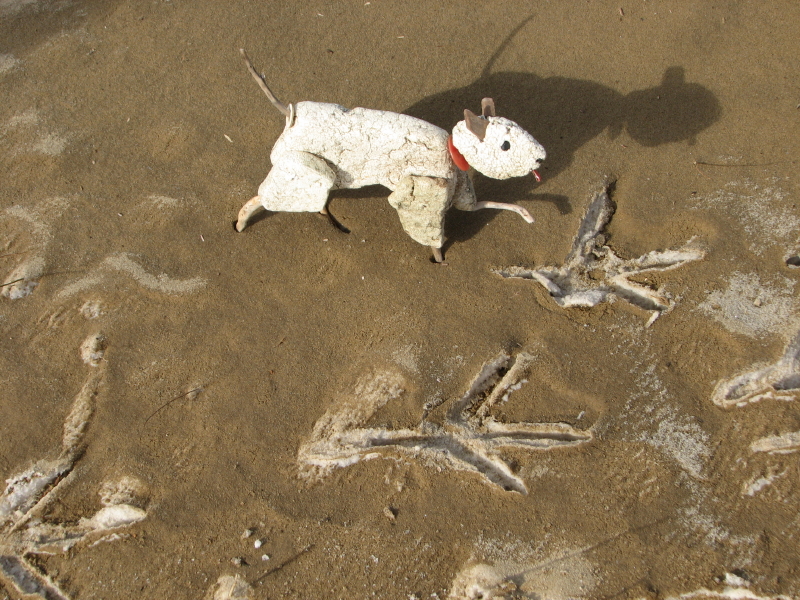
The little dog came from a previous post that most everybody missed and so I don’t feel as badly about recycling one of my former projects.  In this case, I thought the dog came out particularly well and deserved another chance to shine.  It’s made from Styrofoam and sticks, plastic, and tiny bits of coal thrown in to create eyes and a nose!  He’s so light that he doesn’t leave tracks in the snow!

I featured another image of this dog in my last post on the spoor of a particularly large bird which was a fun juxtaposition to work with.  In this overall group of photos, the object’s shadow plays a role as a design element.  As I recall, this was a very cold day with wind which caused some issues with the camera’s batteries.  I had little time to snap these before the camera turned itself off.  Among the other bits of polystyrene I was carrying on me was a “bear effigy” that I found out here this year.  I posed it in a few places along the way and here are some of the images.

Emerging from its hibernation, the one-legged Styro-Polar Bear encounters a rapidly changing landscape.  What was historically all ice and snow is now a melting landfill.

I mounted the Styro-bear on a small piece of wood I found out here so it could stand up.  I found it in damaged condition missing one of its legs.  I have no idea what this was originally intended to represent, but it reads bear-like to me.  The bear is such a resonant image going back to the beginnings of art and ironically I find one that says something about the here and now and our relationship with nature.  Much has changed.

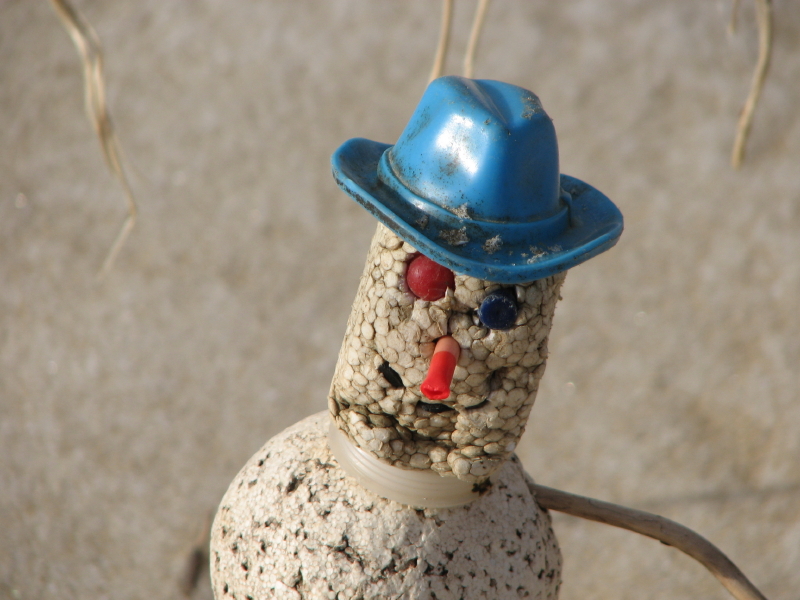
 One final snowman before closing and this one wears a blue hat!  I made this guy as a window decoration for a display at work, but couldn’t resist adding his portrait to the winter series.  Although he was made with Falls materials…he’s strictly a visitor.

Happy Holidays, Winter Solstice, etc… to everyone out there.  My best to all in the coming year!

Read Full Post »

I’m the only one out here and for good reason too.  It is just so cold and the wind isn’t helping matters at all.  My eyes peer through a narrow exposed  slit formed by the bottom of my hat and the top of my scarf which covers most of my face.  On a day like today it is good to have a purpose and I do.  Each year I make my own set of holiday cards and mail them off to family and friends and I use the Falls of the Ohio to provide materials and context.

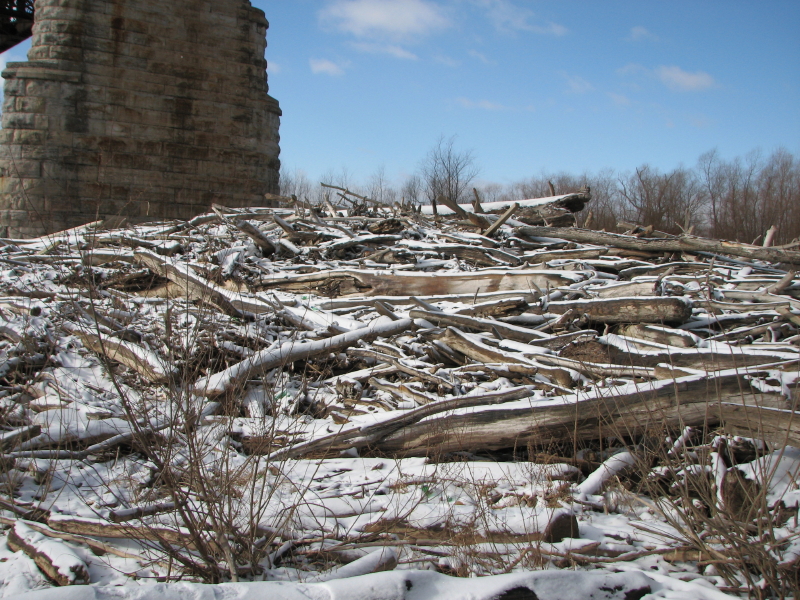
The snow changes things by generalizing the landscape.  You need to be careful where you step out here since the snow gives you a false sense of security.  All the old dangers are still out here…they are just harder to see.  A misstep can cause you to fall or twist an ankle and it is slippery walking on top of this wood. 

For me, however, all these miserable conditions are worth the moments of enchantment that occur.  Every day objects take on a renewed visual interest and new compositions are created.

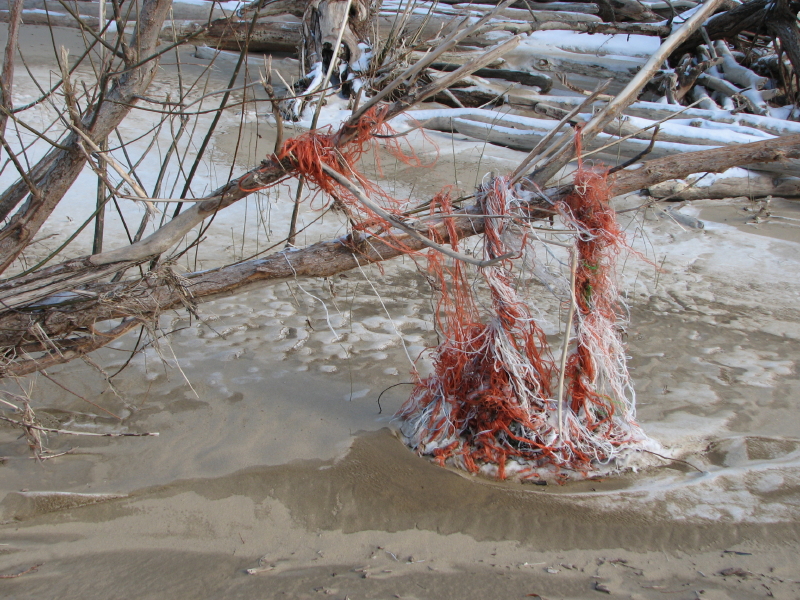
With the vegetation gone, this frayed barge cable shows up easily on the willow branches that have snagged it.  The river deposited it long a go and it is finally falling apart.  Next spring, strands of this rope will form parts of next year’s oriole nests.  What I also find interesting here is how the wind, sand, and snow blow together to form a light drifting mixture.

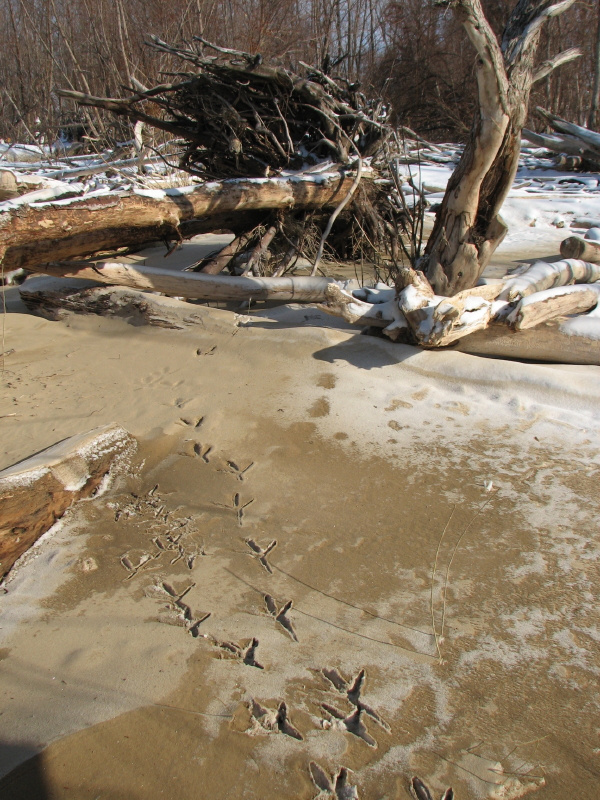
Walking towards my outdoor studio site, I unexpectantly came across these tracks in the sand and snow.  These were made by a very large bird and I thought Great Blue Heron or even Sandhill Crane?  It’s unusual to see these bird tracks here since the herons in particular stay closer to the water’s edge.

The little dog traveling with me couldn’t resist seeing where the tracks led to.  The sand and snow mixture may have exaggerated the true size of this bird.  After a short walk the tracks end here.

I wonder if what is recorded here is a brief moment of indecision?  First, the bird turns one way then another and then the tracks are gone.  It may have jumped into the air from this spot since there are no other tracks in the immediate area.

I come across another nice snow/sand drift and start taking a few shots for my holiday cards.  I had made this little Styro-snowman with a Blue Hat at home with Falls’ materials and brought him along.  Here he is admiring the drift as he walks on one side of it.  Each time I take a picture I need to take my glove off and before long my finger tips start to burn.  The longer I’m out here…the more purposeful I become.

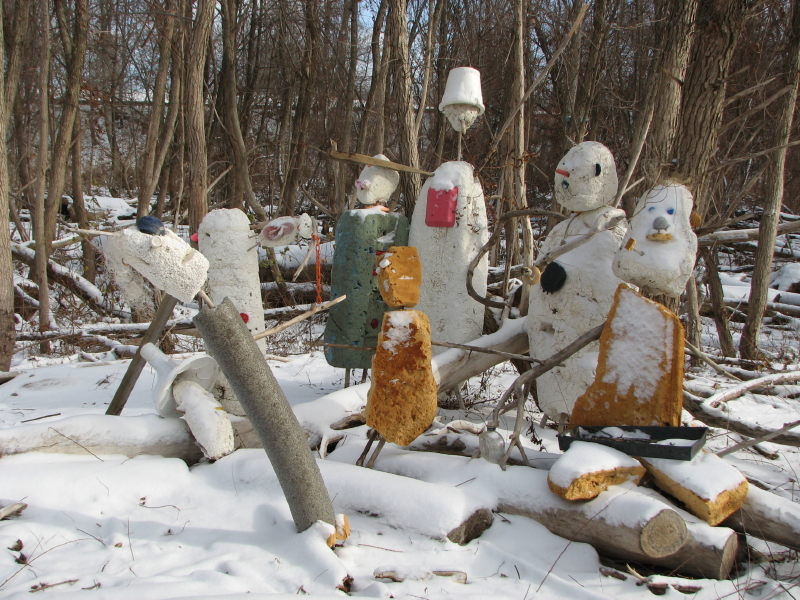
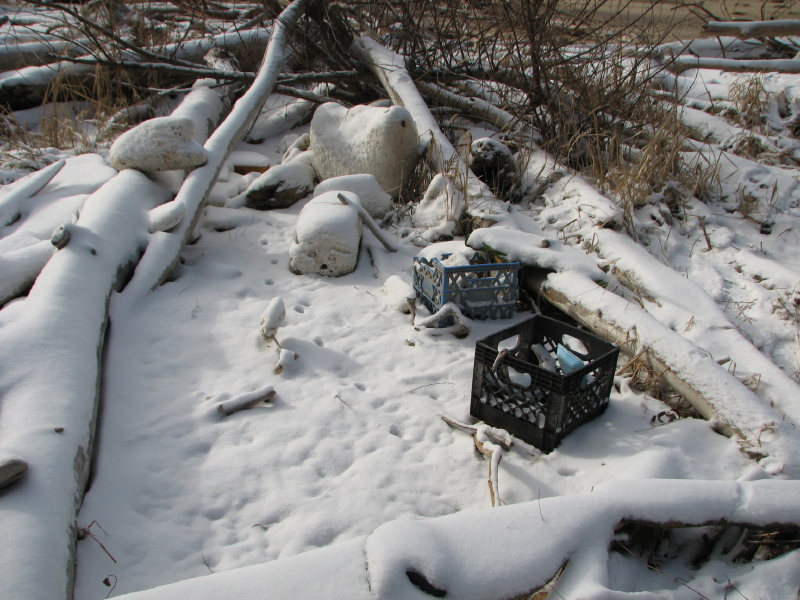
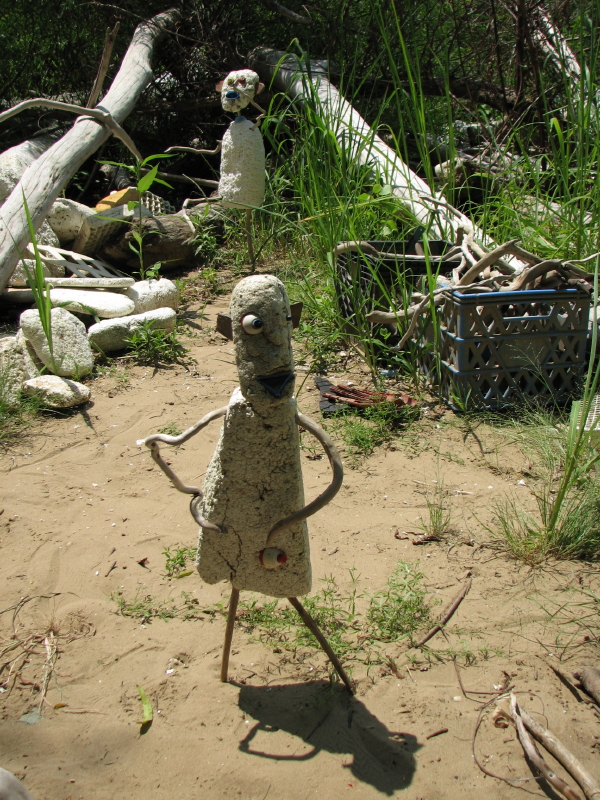
Reaching my familiar site, I find the large figures that watch my back.  Other than the snow, more has changed here since my last visit.  There’s a new figure leading the group like a skinny choir master.  It’s getting harder to take a simple picture and I think the day is getting colder still.  The camera is freezing and the batteries are getting zapped.  Soon, I won’t be able to take pictures and I decide to turn around after about a half an hour’s walk.  I did take one other picture for this post from my snow filled studio.  It shows that indeed, milk crates can hold water…as long as it’s frozen.  See previous posts a go.  Time for some hot chocolate and heat!

Read Full Post »

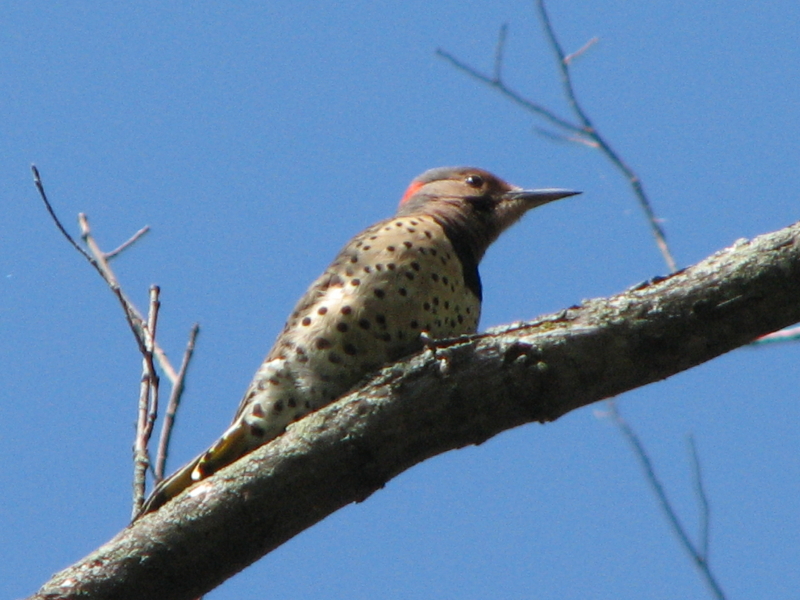
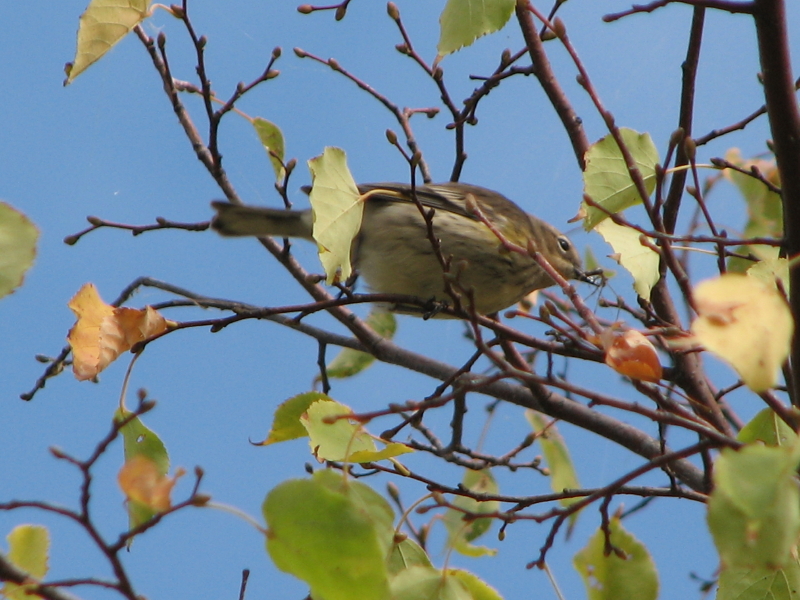
After finding all my sculptures smashed, I decided to give that section of the park a rest.  I will eventually return there and make new pieces from the remains.  Today’s walk is along the western section of the park.  It is an area I have come to appreciate more.  In part, because fewer people venture this way and there are different points of interest.  It’s fall migration time and I’m always on the look out for birds.  The birds that are just passing through are of particular interest, but I also like the species that can be found here year around.  I came across this really noisy Northern Flicker on a branch and snapped its picture.

This is a fairly large woodpecker.  In the old guides, this would have been identified as the “Yellow-shafted” form.  The feathers under the wings and tail are a bright yellow which can be seen as the bird flies.  The black “mustache” extending away from its bill identifies this as being a male.

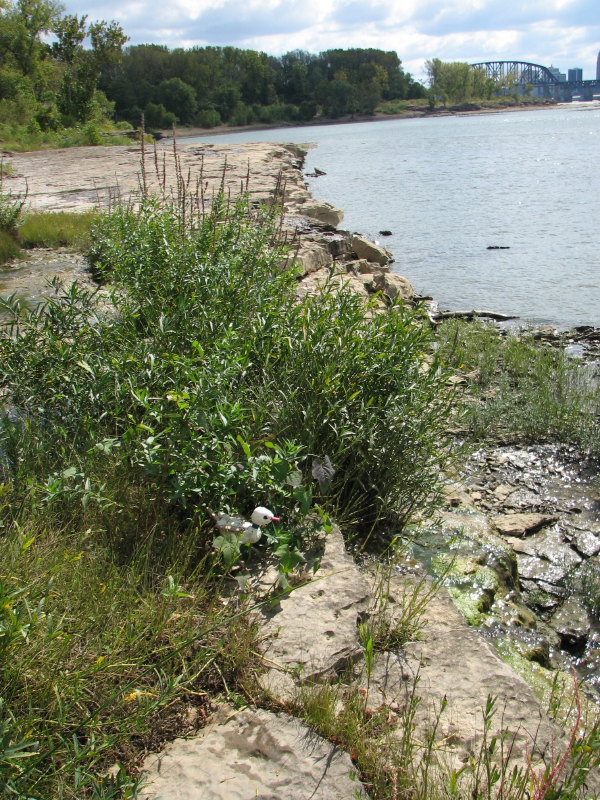
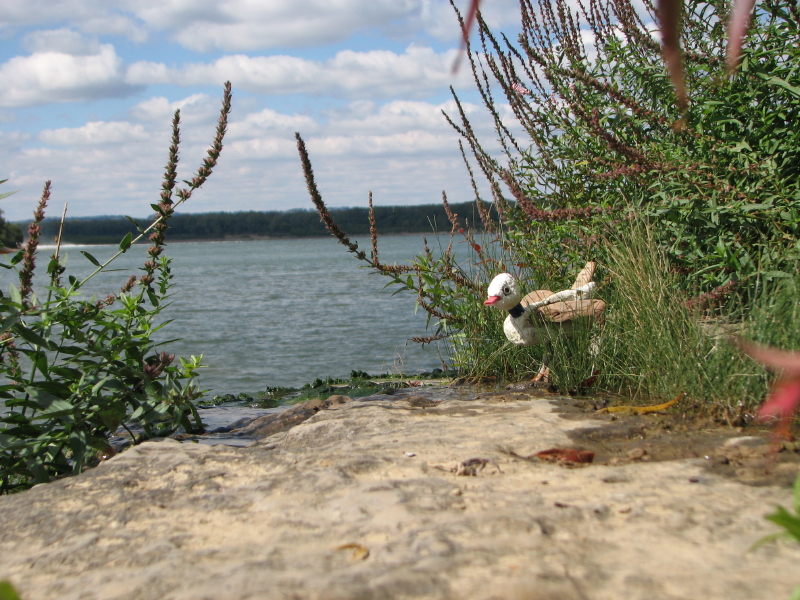
Chasing small insects among the fall leaves is this Yellow-rumped Warbler.  This is the park’s most common warbler and one that hangs around longer than any other of the park’s 35 sighted warbler species.  I have seen most of them, but they are easier to identify in the spring when their plumage is more colorful.  Fall warblers can be a challenge and I’m still learning all their nuances.  I have seen more different warbler species this year because I have tried a little harder to look for them.  Still, when you are out on the land, you just never know what you will cross paths with and that is the subject of this post.  I saw my first Water Chick on this expedition and managed a few decent images that I can share with you.  First, can you spot the Water Chick in this photo?

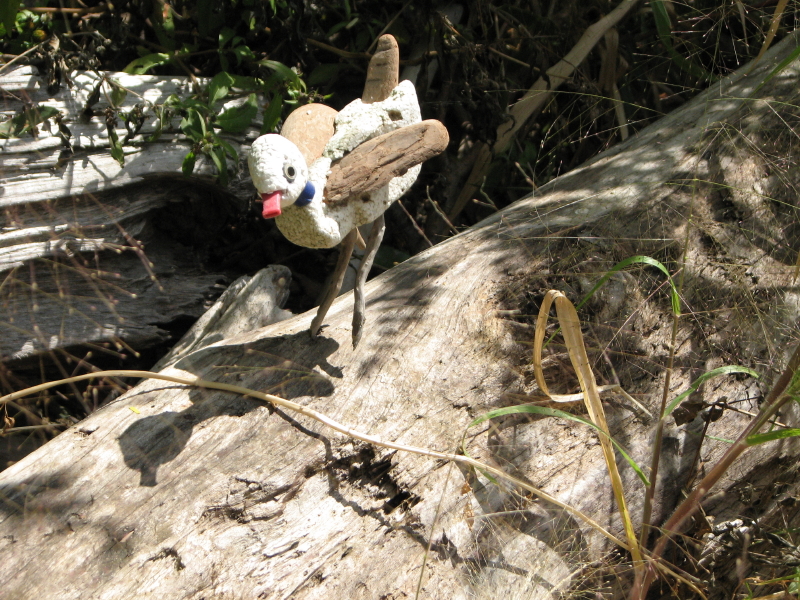
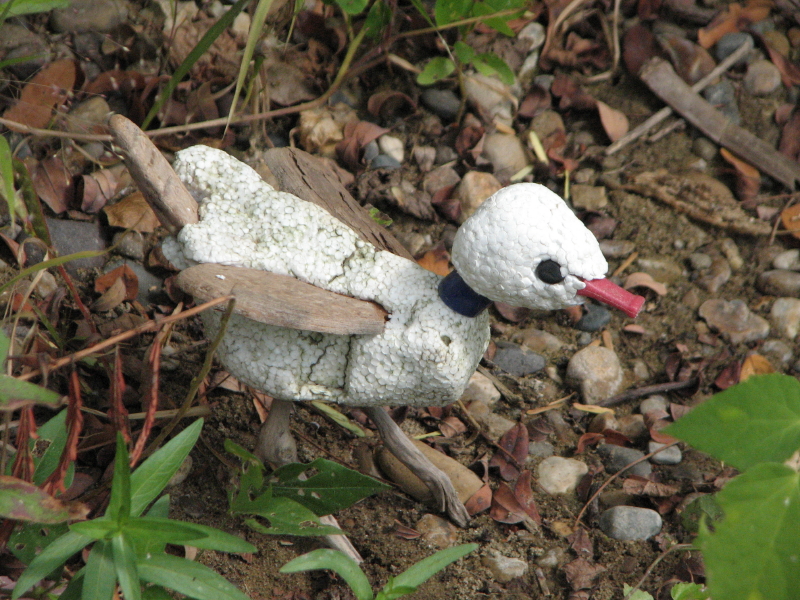
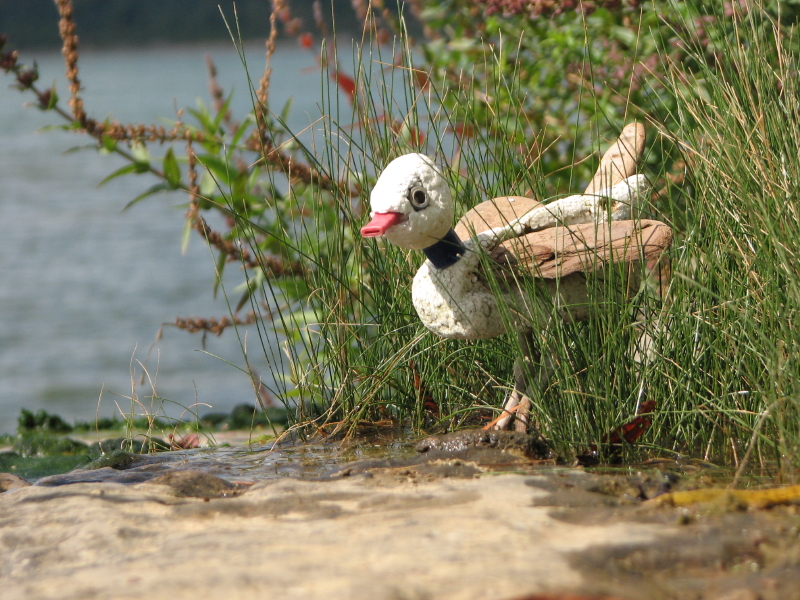
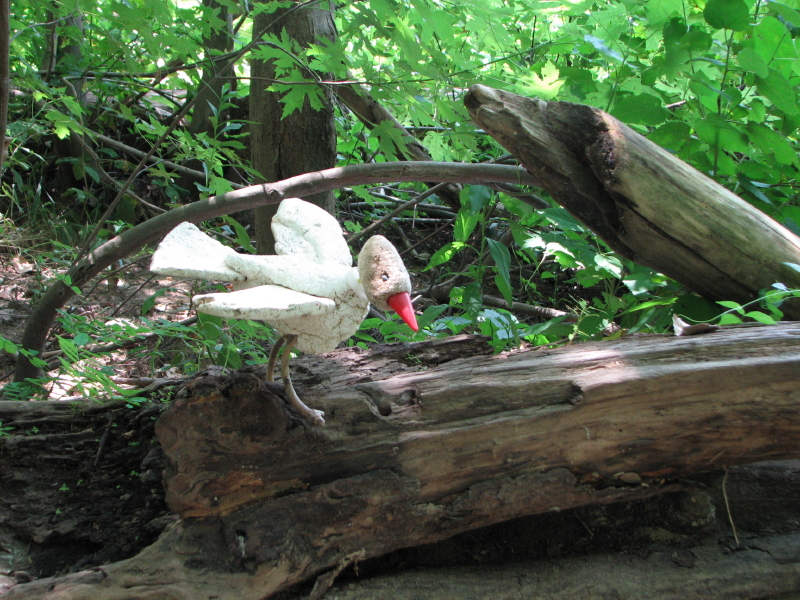
I bet you found this interesting bird?  It’s snow-white in color and has a bright red bill.  It’s only occasionally found in this park and the habitat it prefers matches exactly the kind of landscape you see here.  The Water Chick is usually found near water and also needs dense vegetation to hide and raise its young.  Over the course of a couple of hours I ran into this bird several times and here are a few “portraits” I was able to manage.

The Water Chick is usually found on the ground, but reportedly, is a decent swimmer as well.  Although it can fly it is reluctant to do so.  It much prefers hiding and taking advantage of the local cover where it seeks out small insects and spiders that make up its diet.  I surprised this one investigating a decaying log.  Here’s another image of this bird.

As you might be able to discern…the Water Chick is a small bird and relies on its diminuitive size and secretive habits to go unnoticed.  I believe I heard (not entirely sure though) a low piping sound when this bird noticed me and became alarmed.  It high-tailed it into the loosestrife clumps as quick as can be.  This is precisely the type of ground bird that I worry about being preyed upon by feral cats and in fact, ornithologists report that this species is on the decline for multiple reasons.  While I was birdwatching, I did come across another bird predator.  However, this one is so large that I doubt that it would bother taking a Water Chick.

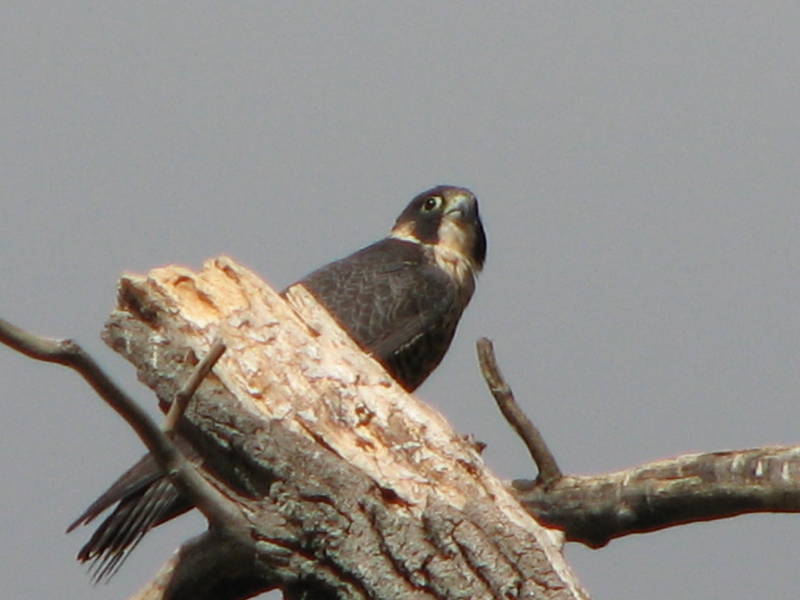
I see Peregrine Falcons on occasion out at the Falls, but this is the first one I could get a picture of…unfortunately part of the tree obscures the bird, but it’s still distinctive enough to identify this large bird of prey.  I have actually seen these falcons more in the city where they nest on the taller buildings in Louisville.  Like other parts of the country, we nearly lost this magnificent bird to DDT poisoning.  Since banning this pesticide they have made a comeback, but we could use more to help keep the pigeon population in check.  I located the Water Chick one more time before heading home.  It was along the fossil beds that rise above the river level which is still down from an acute lack of rain.

I was on my belly laying on the limestone rocks when these photos were taken.  I think it helps give an idea of what it must be like from this bird’s perspective?  After taking these images, I decided that I disturbed this bird enough and backed off.  I hope it forgives my intrusion, but I had never seen one of its kind before…and maybe never will again?  This bird is bound for our Gulf Coast where it spends the winter in the swamps.  Turning for home, I also came across small stands of this rather large flower and thought this a nice way to end this post.

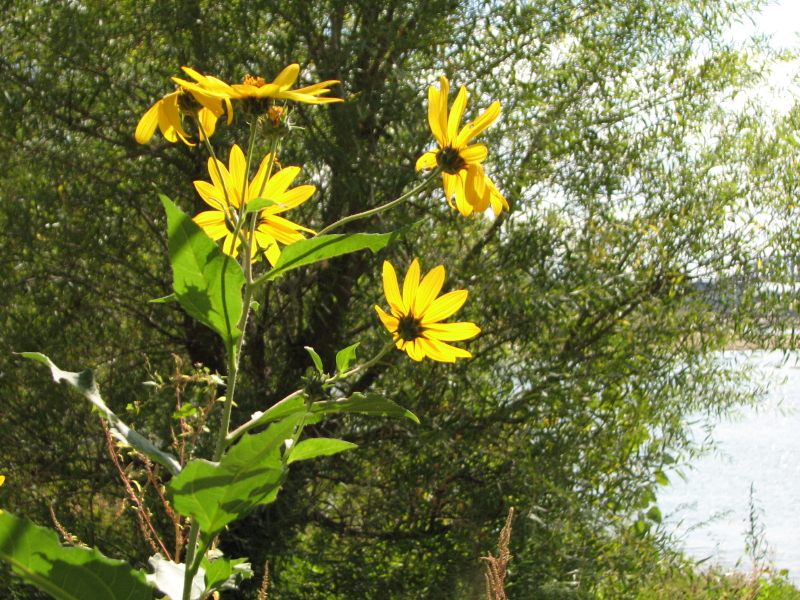
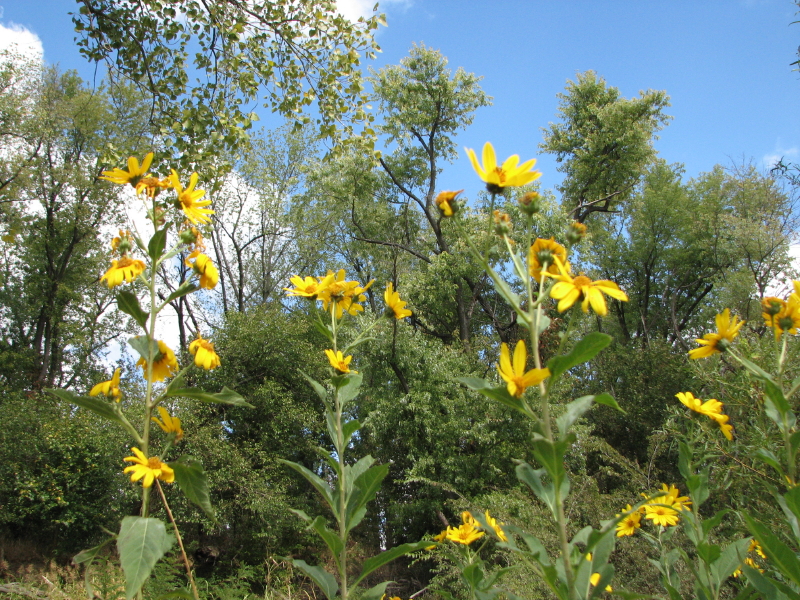
I’m not sure on the identification of this plant? Many in this stand were over six feet tall.  I need to bring a guide with me into the field to help with this.  In the moment, I’m happy for the color this large flower brings which contributes to the beauty of the season.  Thanks for tagging along on another of my walks at the Falls of the Ohio.  See you later!

Read Full Post »

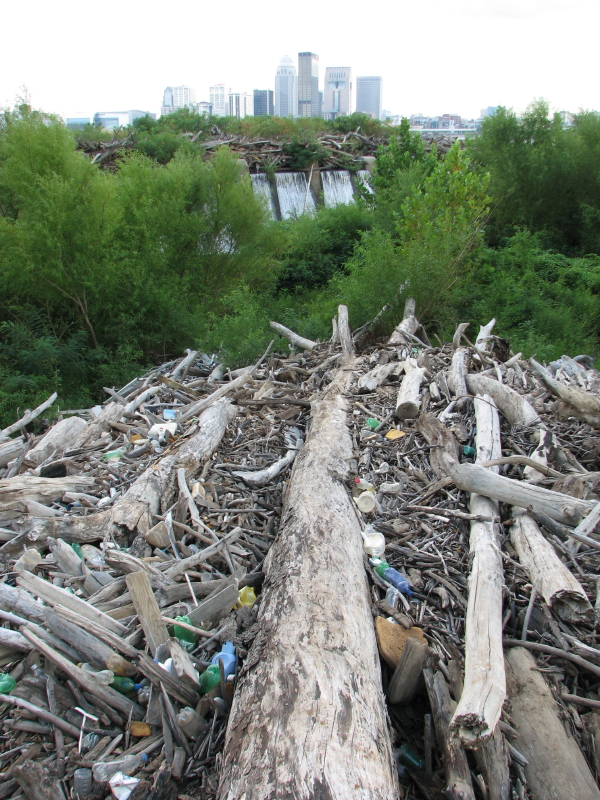
At the eastern end of the Falls of the Ohio State Park is where I see the most bird species.  It is also the area that seems to trap the most driftwood after we have had a bout of high water.  Material of all kinds collects between the high walls of the dam and the steep riverbank itself.  There is another sizeable collection of driftwood on the other side of the dam’s wall that is just waiting for the river to rise before depositing another layer of wood and debris in the park.  The bowl-like depression created in this space cuts across a few distinct habitats and is also protected from the wind which is why I think the birds like this spot.

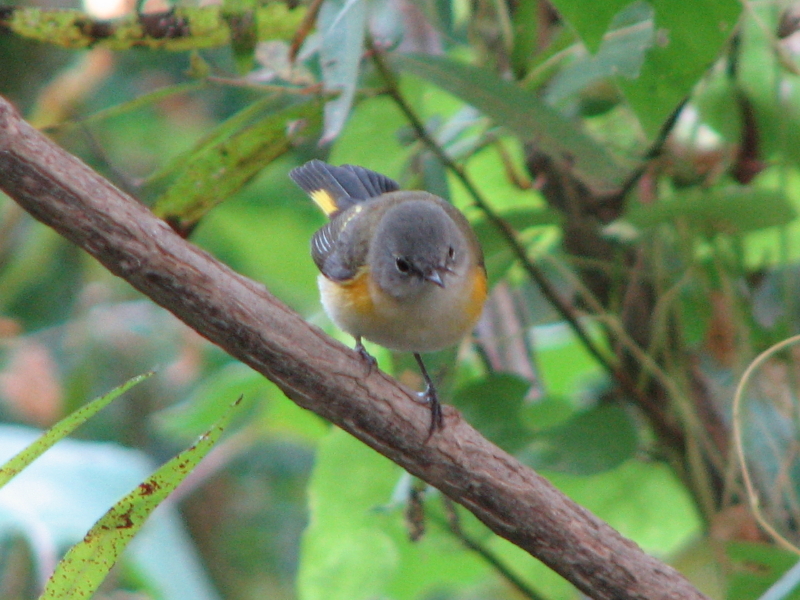
On this day I was doing my birdwatching thing and trying to photograph some of the warbler species that migrate through here in the fall.  It’s a real challenge for many reasons.  First, there is still enough foliage around that it is hard to get an unobstructed view of a bird.  Second, the migrating warblers are now much duller in color having lost their breeding plumage, can be hard to identify.  In some cases, the differences can be dramatic between how a species appears in the spring and how they look on their autumnal migration south.  Added challenges also include that these birds are very small and extremely active.  They don’t sit still for long.  On those occasions when I get a picture that I like…I feel more like a fortunate opportunist than as a photographer with any skills.  I know I’m rambling, but I need to set the scene first before getting to the point of this post!  It took a bit of luck and patience just to obtain the above photo of this first year American Redstart and it looked like this bird was going to hang out a bit and I was well concealed and anticipating more images when something very interesting happened.  There was movement in the brush below the bird which flew off and I was left with this quickly snapped photograph!

I just witnessed a failed hunting attempt by the Flat-faced Cat.  It’s an unusual mutation that has occurred among the resident feral cats which seem to be gaining in population in this park.  To me, this is a big point of concern because in addition to the garbage left behind from picnics…they are also preying upon and eating the small wildlife found in the park.

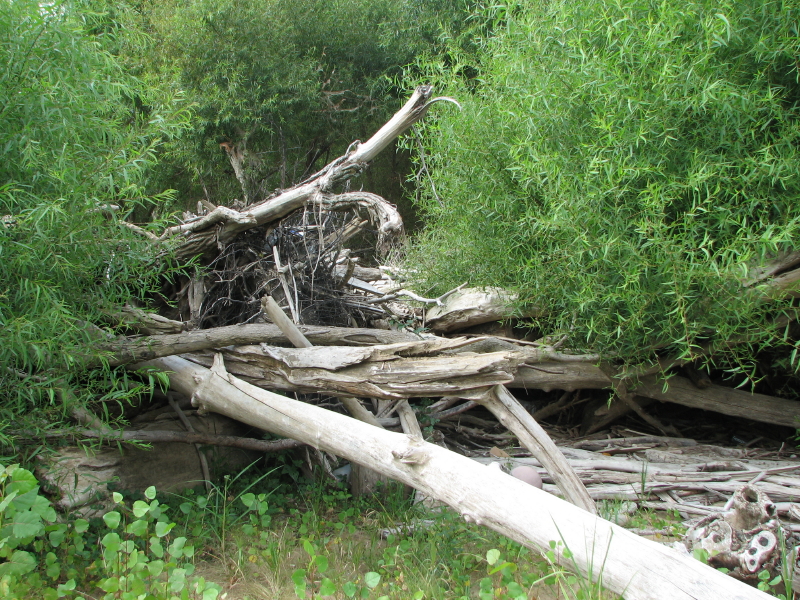
So, where are these cats living?  I have literally found them throughout the park where they can find shelter.  I tracked the Flat-faced Cat back to a den under the driftwood.  The interlocking logs have created a structure that has many natural tunnels and rooms.  It can also be dangerous because the wood is always shifting under its own weight as it breaks down from environmental exposure.  I’m sure that it can’t be an easy life for these cats.

Since our first encounter, I have taken an interest in this particular animal.  It always runs away once it spots me and is now completely wild.  I see it the most when I’m in the Willow Habitat and I think we are after the same thing!  We are both hungry for wildlife, but in very different ways.  I recently observed and photographed this cat hunting lizards basking on the sun-drenched logs.  First an image of its intended prey.

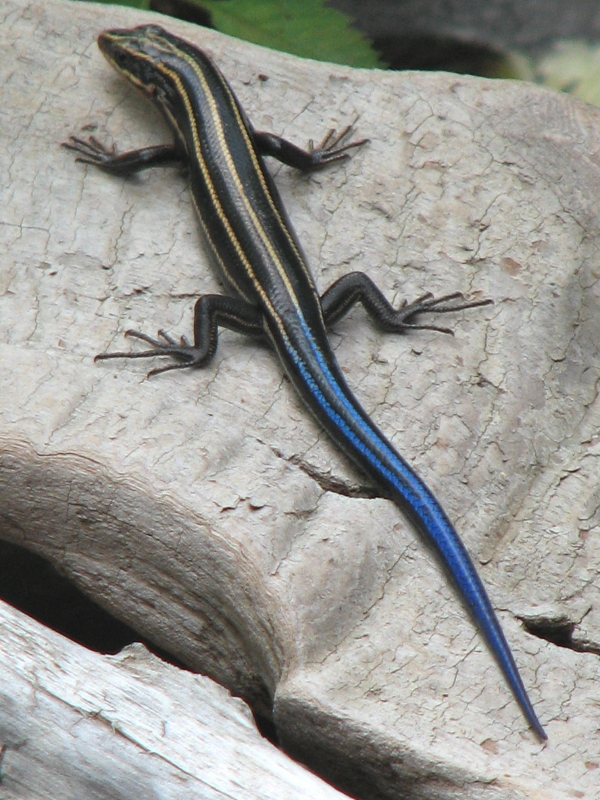
The blue tail marks this as the young of the Five-line Skink.  This is a fairly common lizard in this park and the one most people are likely to encounter.  While I was hiding behind a sizeable willow tree, I saw the Flat-faced Cat attempt another unsuccessful hunt and took these images.

Now, don’t let its cute face fool you.  Out in the woods, this animal is all business when it comes to hunting.  I’ve looked at a few articles on the web about the cat predation problem and interestingly there is some controversy.  There are studies from Great Britain and California that suggest that feral and domestic cats take millions of songbirds and small animals a year.  Societies devoted to cats, however, dispute the evidence and say that there aren’t good studies to back this assertion up.  When all else fails…turn to anecdotal evidence!  How many of you out there who own cats that are allowed to roam outdoors have been “gifted” with dead birds and other little animals on your door steps?  I have a hunch that many cat owners have had this experience.  Now multiply these “gifts” with the millions of cats that are out in the world and the studies probably aren’t too far off.  The studies also suggest that the hunting instinct is so well engrained…that even very well fed cats can’t resist that little chipmunk running around the backyard.

Of course, feral cats are not the only cause for the decline in the numbers of songbirds.  There are pressures of all kinds and habitat loss and environmental degradation play their huge parts.  Still, the domestic cat is not something that occurs “naturally” in our wild environments.  Responsible pet owners should never set unwanted pets loose where they don’t belong.  Responsible owners also have their pets spayed or neutered to further limit the population of unwanted pets.  It’s kinder to all living things to do this. Looking through my archives, I remembered that I had seen another feral cat that looked a lot like the cat which is the subject of this post and here is its image.

I photographed this big tom cat on the fossil beds near the Interpretive Center.  It had only one eye and sported this murderous looking paw!  Who knows it may be a direct ancestor of the Flat-faced Cat?

Read Full Post »

The autumnal equinox has come and gone and with it the this long, hot summer has given way to temperatures twenty degrees cooler.  We are thankful for this and without trying to sound ungrateful…could use a little rain as well.  Artist at Exit 0, the unofficial artist at the Falls of the Ohio, was looking through some older images of his and was reminded of a former project that was offered as a physical prayer and remembrance of times gone by. 

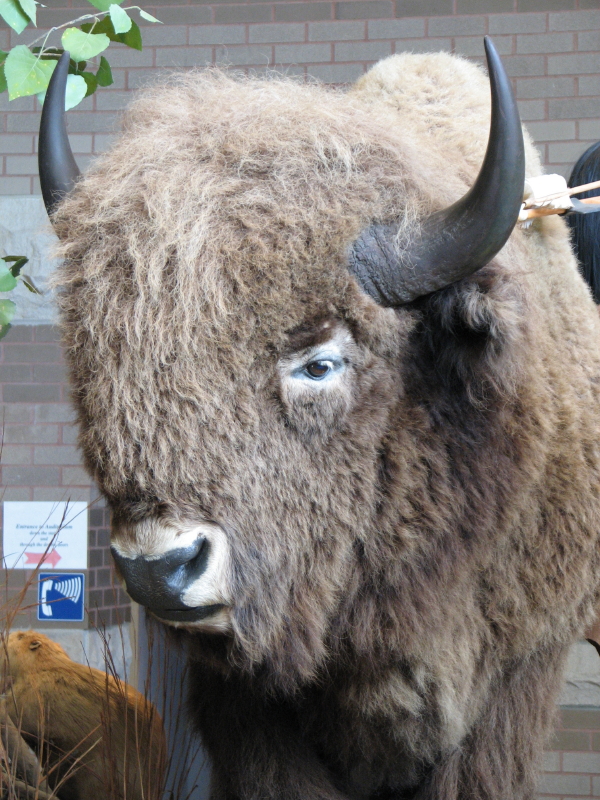
On occasion, references have been made in the riverblog that one of the historic features about the Falls of the Ohio is that it once was an active bison trace.  Animals forded the river at this location and in fact many of the major roads in Kentucky are old buffalo trails that have been paved over.  For millennia, bison were a resource that people could count on until they were slaughtered on an industrial scale in the 19th century for a variety of reasons…none of them good.  To the indigenous people, bison were more than their supermarkets and great spiritual significance was associated with them.  It’s probably a miracle of some kind that these animals continue to exist to the present day.  Artist at Exit 0 has made several bison pieces over the years…but this was his favorite one.

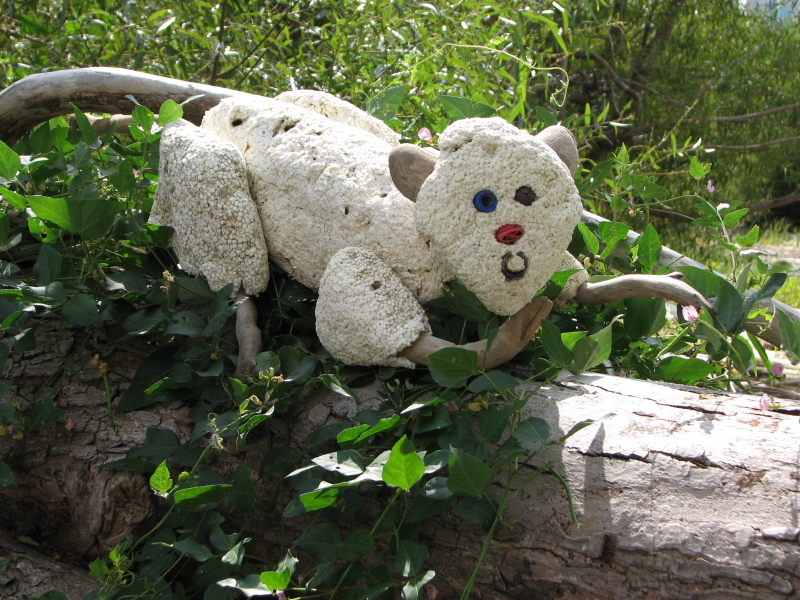
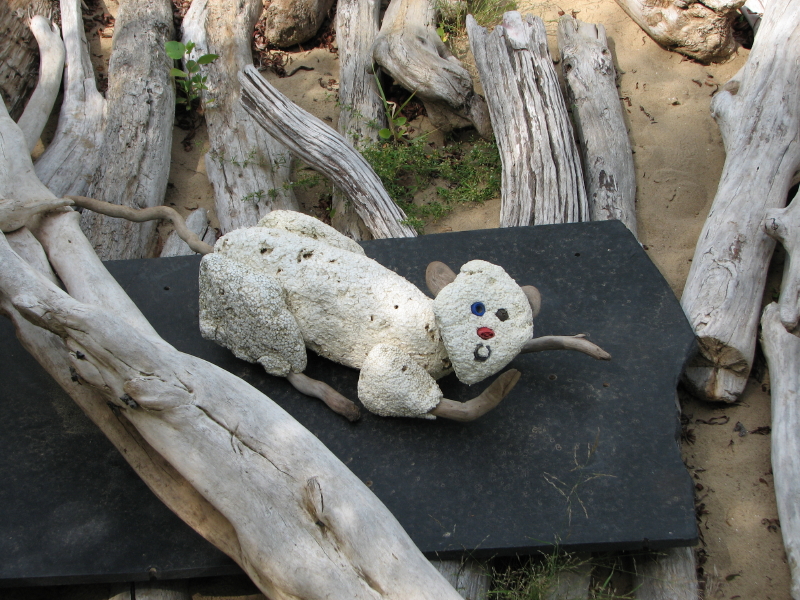
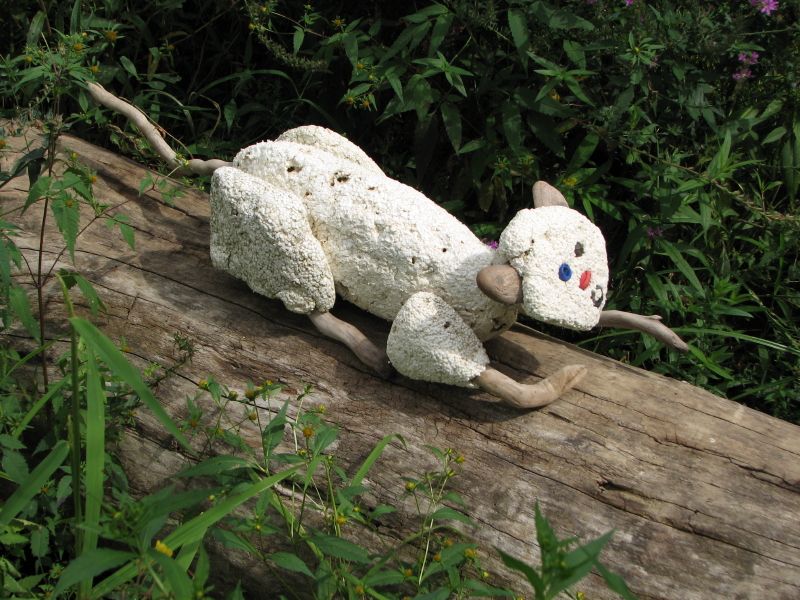
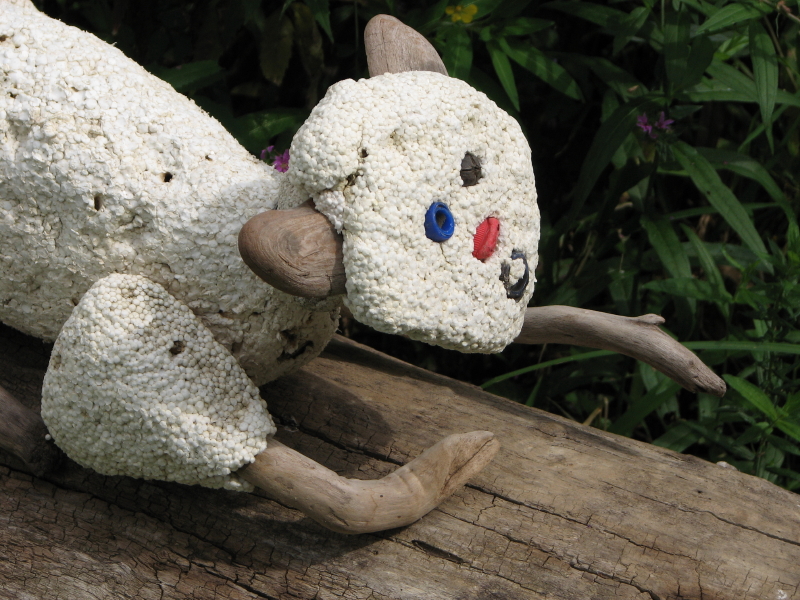
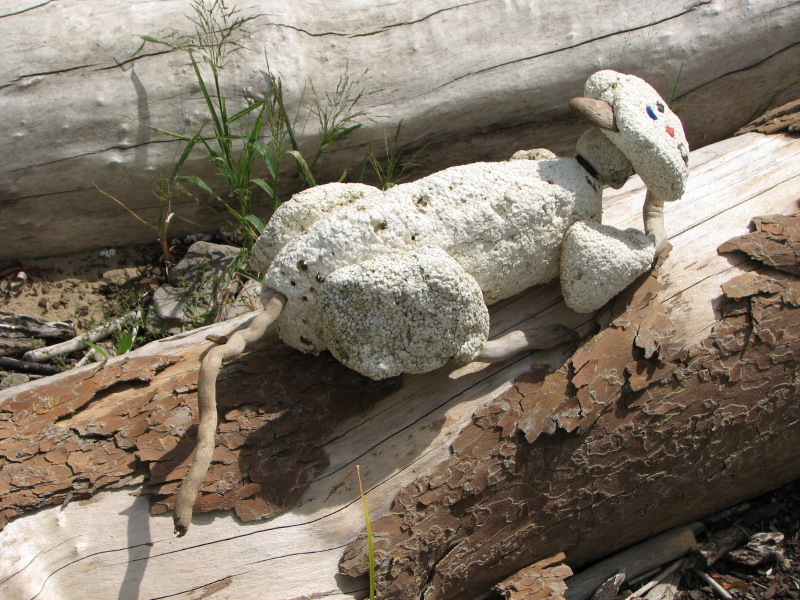
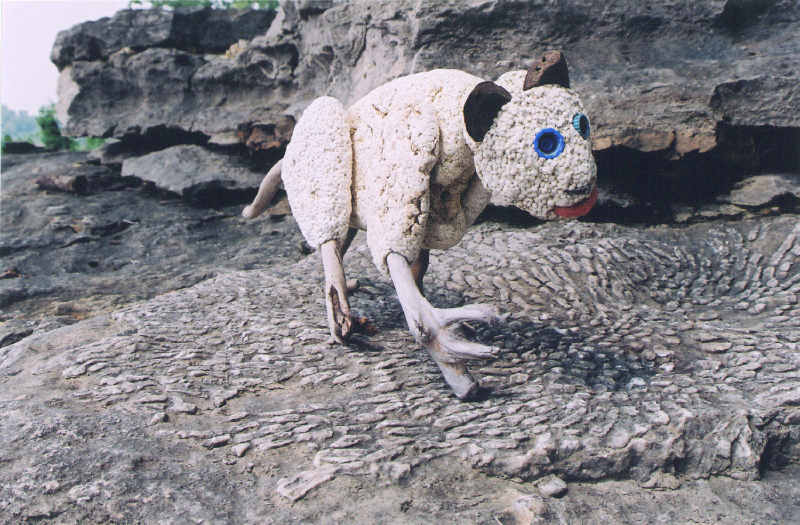
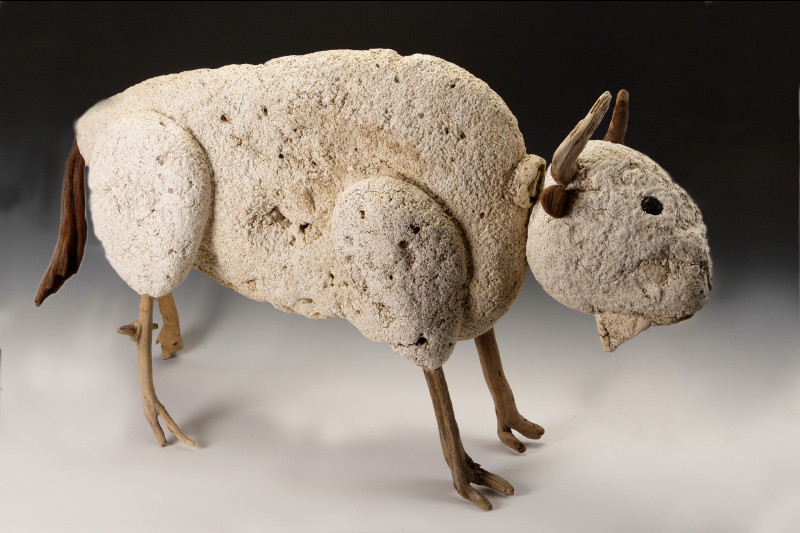
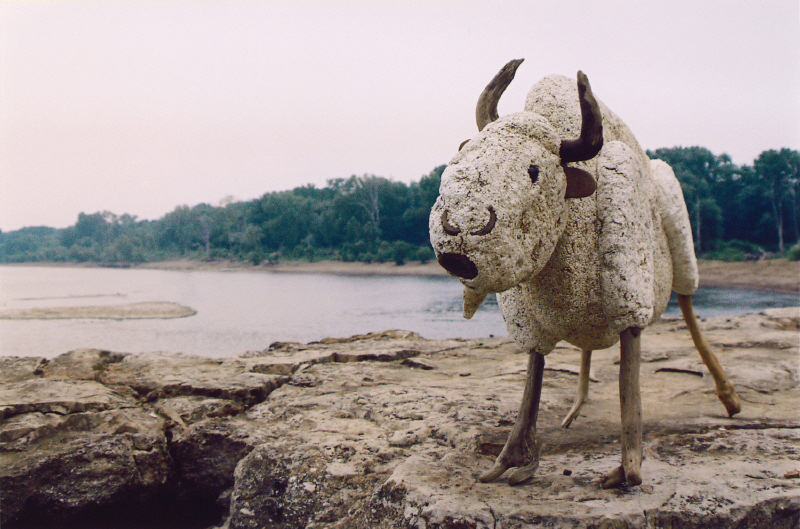
Here it is presented as a simple art object.  Constructed from river-polished polystyrene, driftwood branches, and nuts this piece was about as large as a good-sized dog.  What the artist especially likes, however, are some of the images showing the Styro-Buffalo in the context of the Falls.

The Styro-Buffalo was photographed on the fossil cliffs near the western section of the park.  The images were recorded with a 35mm camera and conventional print film that was developed at the local drugstore.  I recently read in a Wikipedia search, that the white buffalo is an extremely rare animal and their births occur in approximately one out of every ten million births.  Whether this takes into account leucistic (white fur, blue eyes), albinos (white fur, pink eyes) or other genetic anomalies is not certain.  We had a female, white bison calf born in Shelbyville, KY in 2005 at a buffalo ranch and tourist attraction called Buffalo Crossing.  The animal was named “Cantje Pejute” from the Lakota language which translates to “Medicine Heart”.  A recent search on Buffalo Crossing was inconclusive as to whether the ranch is still open to the public and with it the fate of this particular animal?

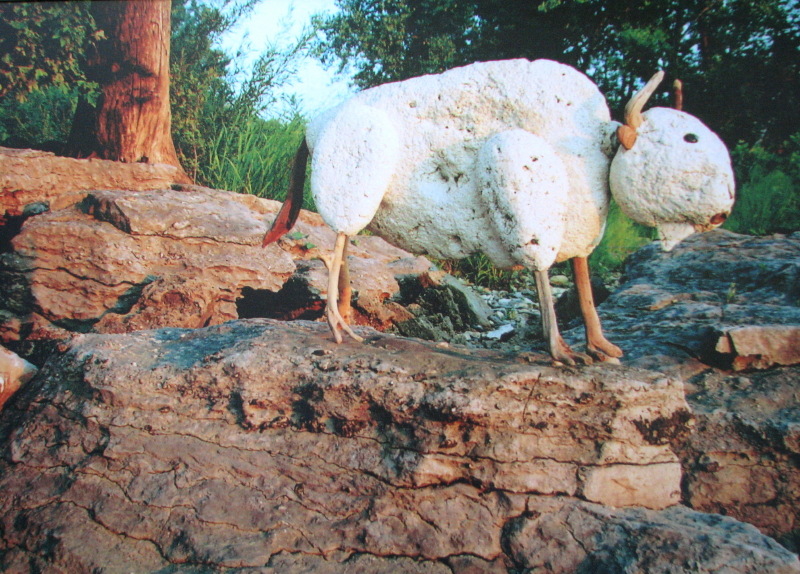
Here is the Styro-Buffalo photographed at sunset on the fossil rocks.  One critic who commented on this image considered it overly romantic.  It was meant to be a pejorative statement since apparently there is little room in contemporary art for work that includes nature as part of the work’s context.  The quest for the sublime and awe for nature are not generally in fashion in the high contemporary art world.  Artist at Exit 0 was okay with that comment only because it underscored and confirmed personal observations about the contemporary art world that Artist at Exit 0 feels mirrors the general disconnect he perceives from our kind for the environment.  If we persist in this attitude…we too may go the way of the buffalo and again it will be our choice. 

 This post is offered in friendship to 47 Whitebuffalo who’s fine blog is full of social conconciousness and art.  Her link is included in my blogroll on my home page.

Read Full Post »

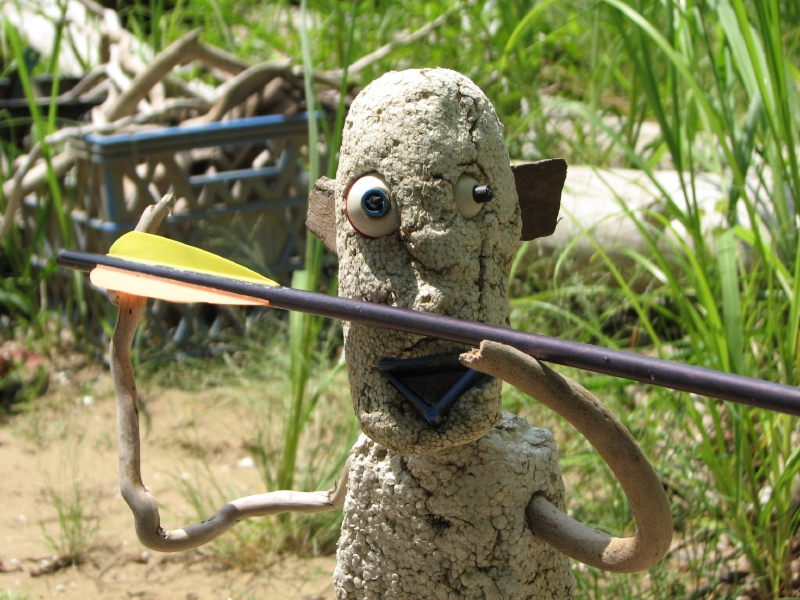
Vulture Boy hung out with me today at the Falls of the Ohio.  He’s a bit of an odd character and I don’t see him often.  He spends most of the summer observing the resident vultures of both species that live here.  He’s studying them. Vulture Boy also thinks of himself as being a bit of a survivalist and when civilization collapses…he will be able to fend for himself by mastering primitive weapons. 

He’s still a boy after all and seems to gravitate towards sticks and stones.  There must be some primeval aesthetic operating here that’s hard-wired?  Regardless, what I enjoy are Vulture Boy’s stories and encounters with the wildlife he sees in the park.  He tells me that he saw some Black Vultures feeding nearby and would I like to watch them?  I pick up my camera and follow him to the river.

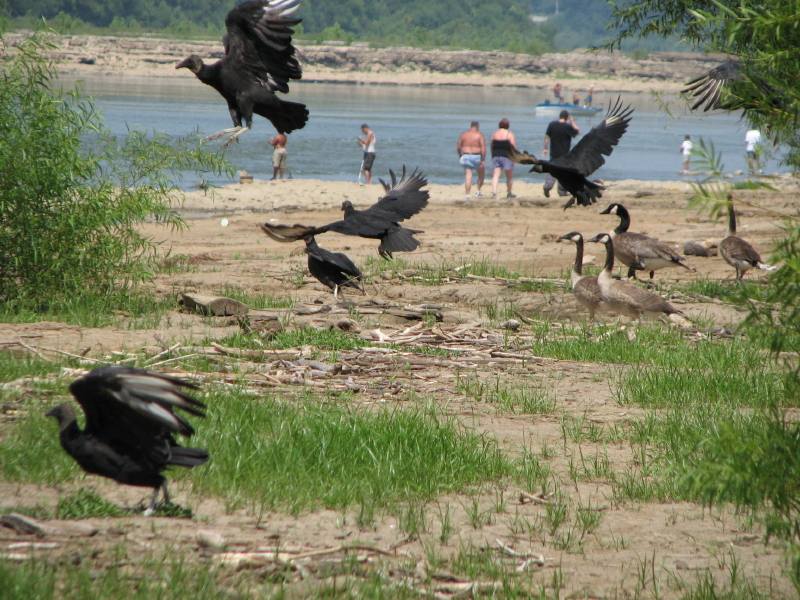
Along the way we surprise two flocks of large birds!  It’s another very hot day and both the vultures and Canada geese are taking advantage of the shade under the biggest trees.  It’s cooler, but they are also vulnerable standing on the ground.  Some passing fisherman got too close and both flocks spooked and went airborne.  I could practically feel the whoosh of air pass my face as the vultures struggled to lift skyward.

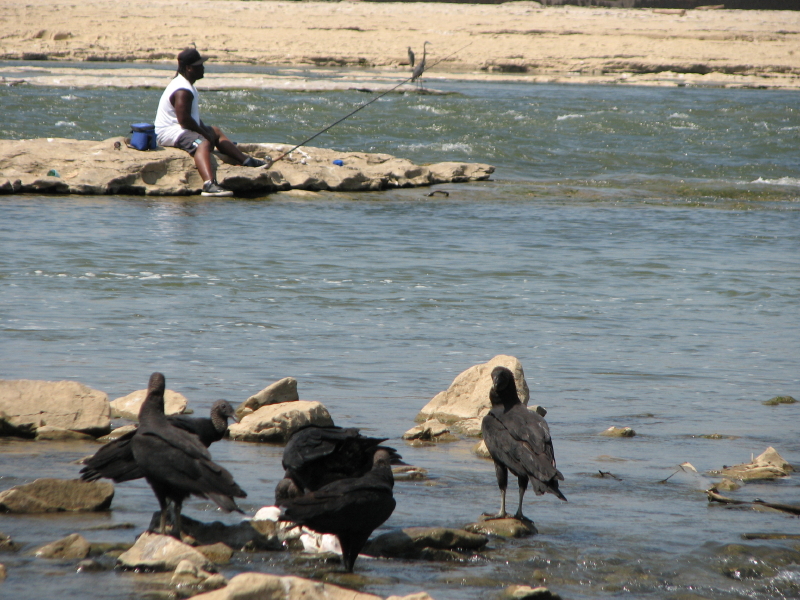
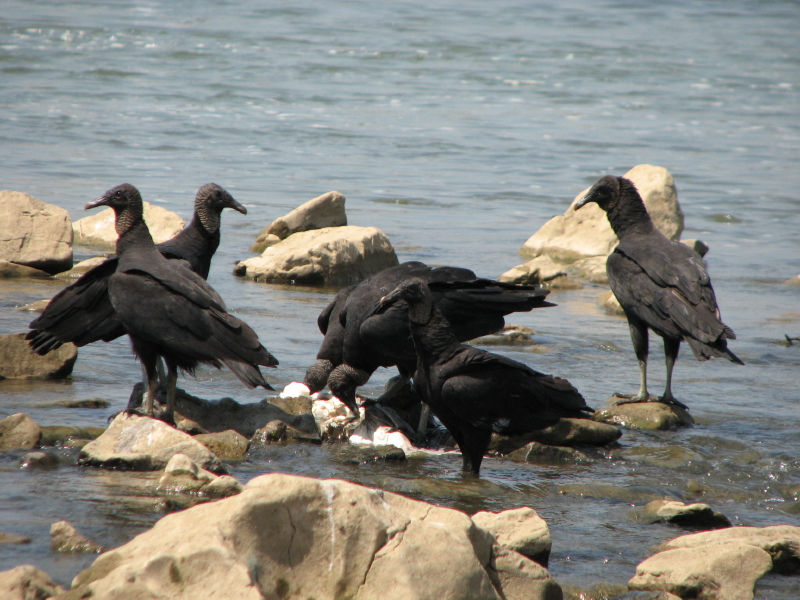
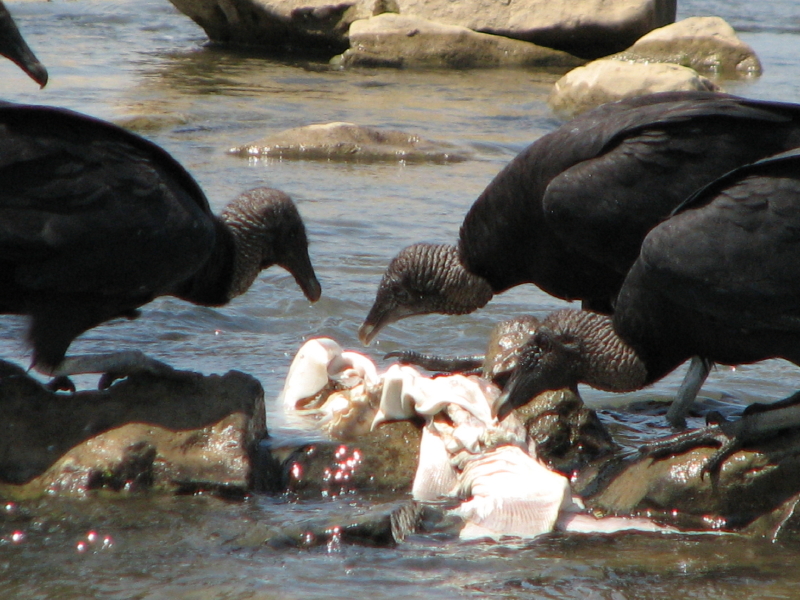
Reaching the river, we find a few Black Vultures feeding on a fish carcass.  They were completely unconcerned about the people around them.  I wonder in some way if the vultures recognize the relationship between the people and the availability of fish?  Vulture Boy says that they are smarter than you think and adapt to situations that benefit them.

Slowly I move a little closer doing my best not to scare the birds away.  It’s tricky though because the rocks are very uneven and slippery in places.  With their all black bodies, I wonder if they feel hotter on a day like today?  That’s when Vulture Boy lays this factoid on me!  He says that Black Vultures (and other vultures as well) can excrete their waste onto their legs to cool them.  The process is called “urohydrosis”.  Charming! 

I asked Vulture Boy what else he liked or thought interesting about these birds and this is what I remember.  He said that they form strong pair bonds that are usually only broken upon the death of one of the partners.  Additionally, they do not build nests preferring shallow caves or protected rock ledges to raise their young.  Although Black Vultures may roost together, they do not like being near each other’s nurseries.  There is still that competition for food and a pecking order exists not only within the Black Vulture group, but with other species as well.  The shy Turkey Vulture usually surrenders his find to the more aggressive Black Vulture.

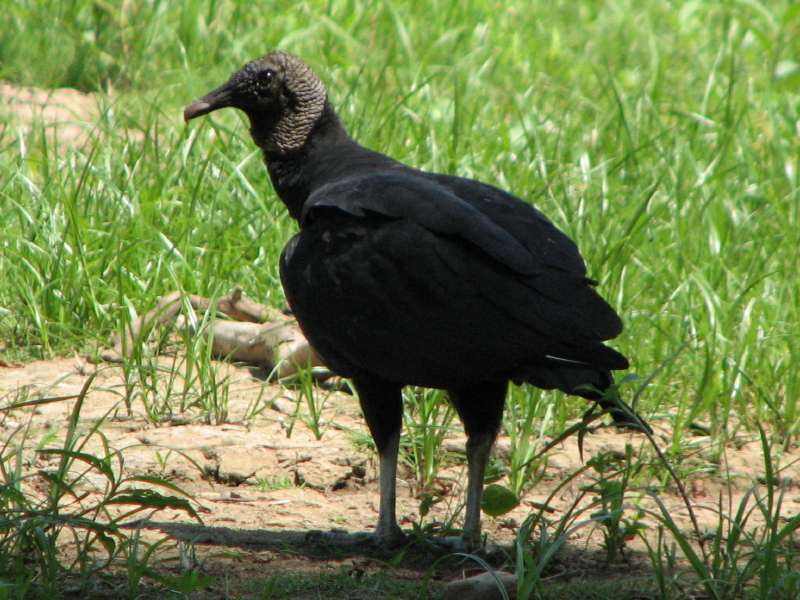
With their naked heads and necks…these vultures look more like the dinosaurs they are descended from.  The lack of feathers around the head helps keep things a little cleaner.  Still, I’m amazed that these birds are able to stomach most anything!  I’ve seen Black Vultures using their feet to help leverage a food morsel from the toughest meal.

After watching the river vultures for a few minutes, it was time to go home.  Walking back the way we came Vulture Boy and I could see that some of the vultures had returned to the shade under the trees.  A few individuals were nervously posted along the outskirts acting as look outs.  We walked around them and left them be.  Nearby, we came across roosting vultures  high in a tree.  Occasionally, one of these birds would sun itself by spreading its wings and it seemed almost a reverential act.  Or, at least…that’s what I like to think! 

Read Full Post »

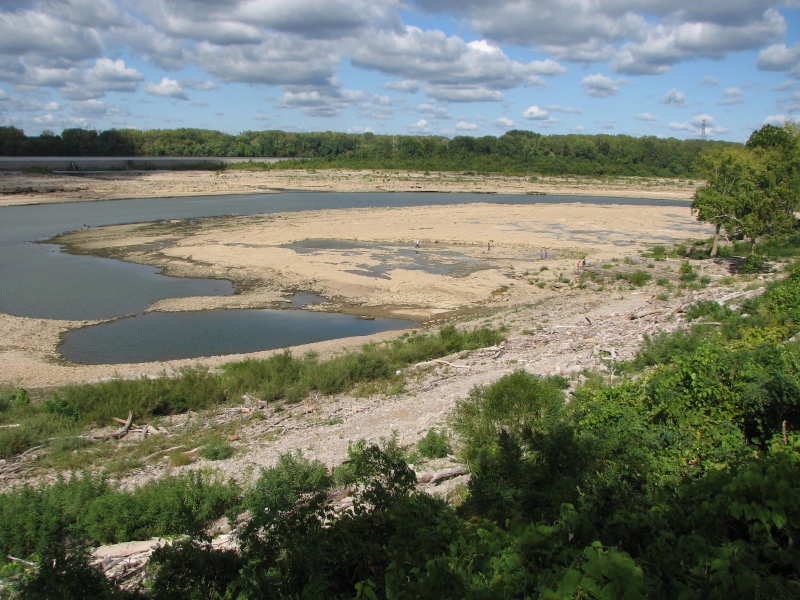
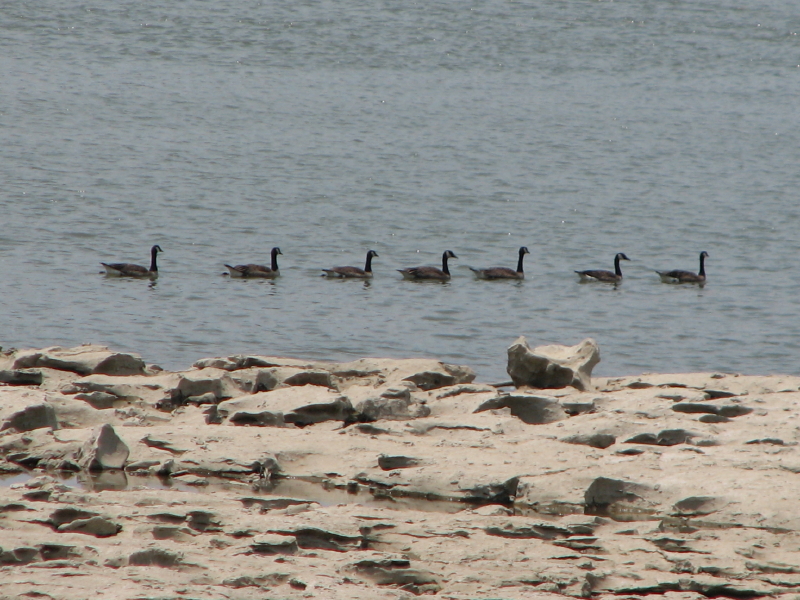
The river is falling, but is not yet in summer pool.  Day by day the extensive Devonian fossil beds are revealed a little at a time.  The limestone surface is scalloped by the actions of the Ohio River and appears to be the landscape from another world…because in fact it is!  Throughout the rocky matrix are the fossilized remains of ancient marine creatures that populated this reef over 375 million years a go.  While my thoughts are lost in deep time, a procession of stately Canada geese glides by which brings me back to the present and my own animal existence.  It is really hot out here today and I brought extra water to drink.  Slowly the first eight geese becomes a large flock as more and more birds reveal themselves that were hiding behind the huge rocks that mark the Kentucky side of the fossil beds.  From my vantage point I count 83 geese which are the most Canada geese I have ever seen here at one time!  In the warmer weather months, the number of bird species here is less than in the spring, but the indigenous birds are entertaining and I enjoy noting aspects of their respective behaviors.  Here are two new birds I haven’t previously featured and I hope you will like them as I do.

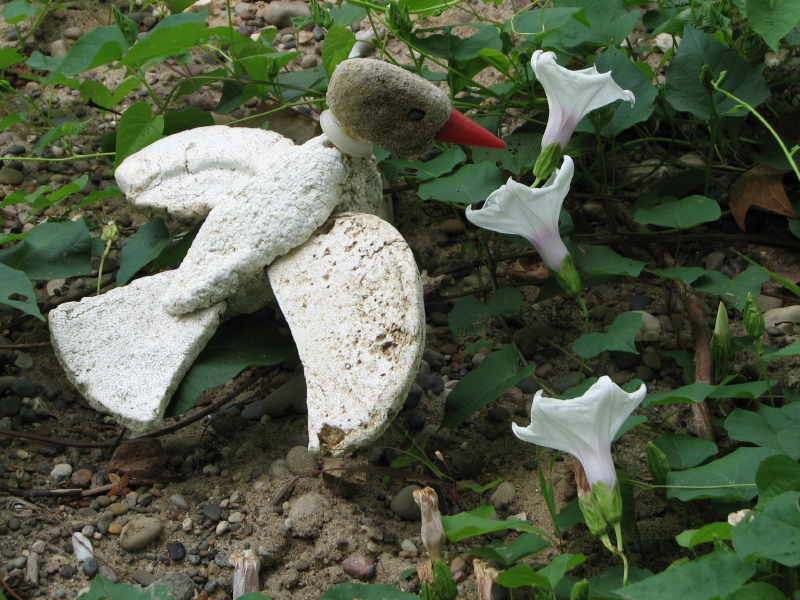
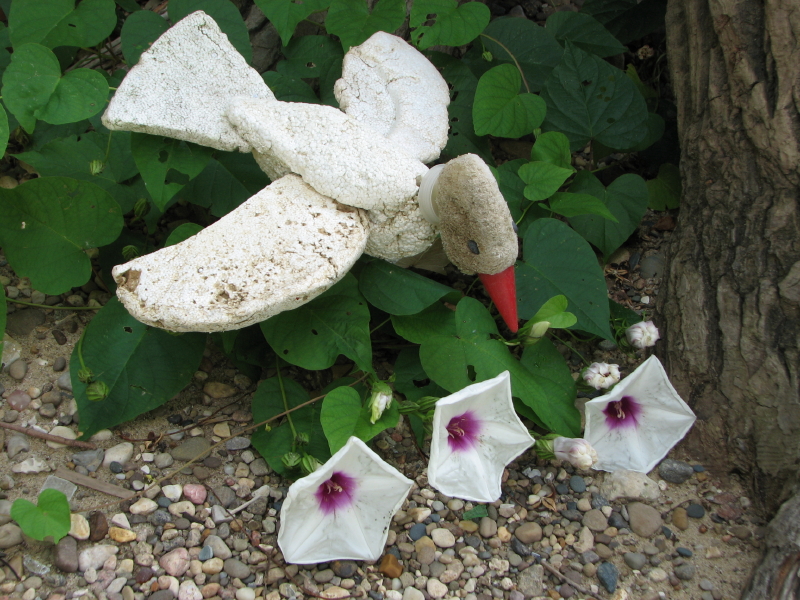
It’s definitely cooler in the deep shade of the woods, but the mosquitoes are more numerous.  I can’t get myself to put poison on my skin to keep them away and so I try not to let them get inside my head.  I suppose that they don’t bother me as much as they do other people.  Maybe I don’t taste as good!  While cooling off by the big trees I came across this unusual species and it’s called more commonly the Bumble Bee Bird.  I think its scientific name is something like “Turdus bombus”, but I could be wrong.  “Turdus” is the genus of thrushes and” bombus” refers to bumble bees.  Seems to make sense.  So, you are probably wondering why this clumsy looking bird is named what it is named and I will show you why.

I came across this specimen hanging out at the forest’s edge where many morning glories were present.  These flowers grow close to the soil and sand and in places form thick blooming carpets.  Kind of pretty in an understated way.  Here’s the same bird hopping around some other morning glories, but is he just admiring the flowers or is there some other purpose afoot?

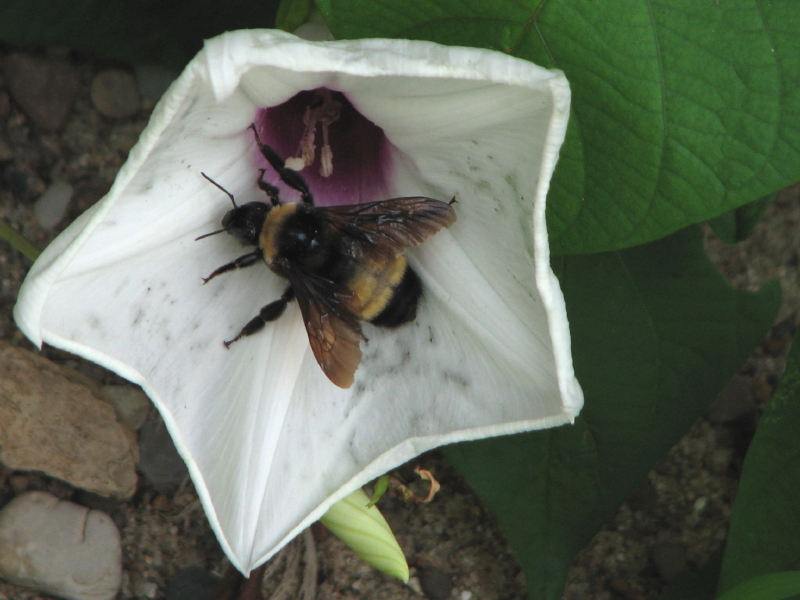
He’s in the deadly serious pursuit of something to eat, but not just any unfortunate creature or seed will do.  This species is aptly named because it has evolved to eat the large bumble bees that pollinate these flowers.

The bird waits for the bee to enter the bloom.  The bee has to get deep into the blossom to reach the sweet nectar it needs.  This is the moment when the bird comes from behind the bee and with its large red bill, seizes the bee crushing it and its nectar-filled abdomen.  The bee had no ability at this point to defend itself.  Stealing the nectar, the bird then tosses the dead bee into the air, catches it, and then swallows it head first.  It’s a doubly good meal and worth the expenditure of energy.

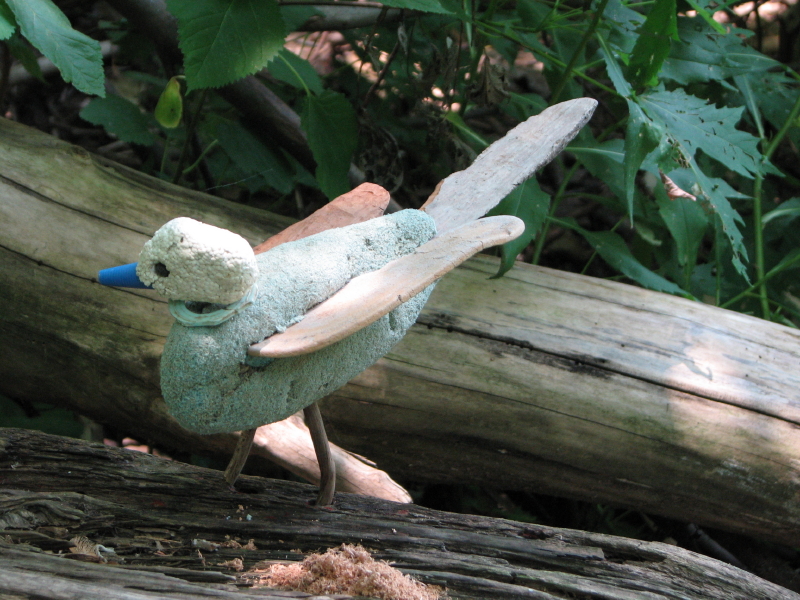
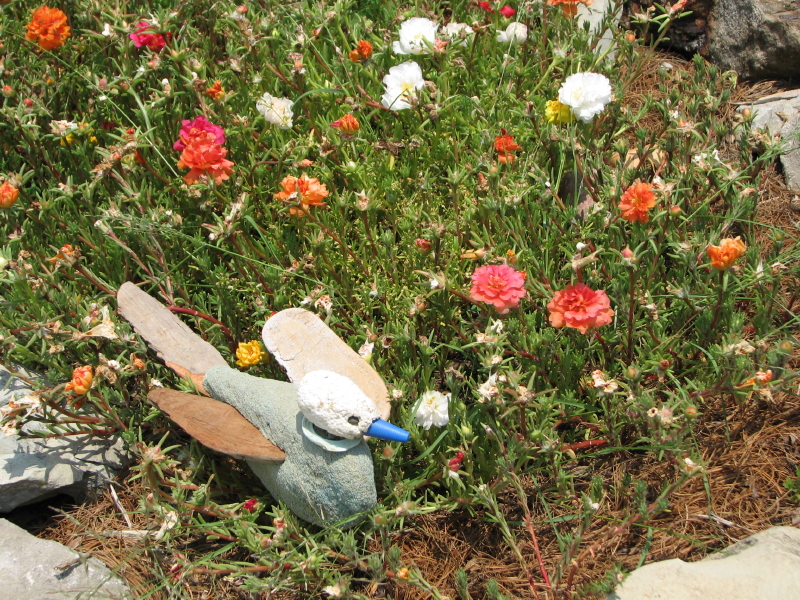
Also found in the cool of the forest is this little bird which is aptly named the Melancholy Dove, scientific name “Columbina melancholia”.  Smallest member of the dove family likely to be found this far north.  It is usually by itself or with a few of its kind and represents the antithesis of a former Falls of the Ohio resident…the now extinct Passenger Pigeon which congregated in immense flocks.  The Melancholy Dove is also recognized by its blue bill and sad expression on its face.  It is not an especially rare bird and I spot this species across the park during the summer season.

I found this bird sitting in a small garden near the Interpretive Center where it seemed unconcerned about the park visitors.  A nearby bird feeder has made this bird especially trusting and I fear that one of the many feral cats in the area will find an easily ambushed snack waiting on the wing.  Contributing to their melancholy name is the soft, plaintive coo…coo-coowee sound it makes during the breeding season.

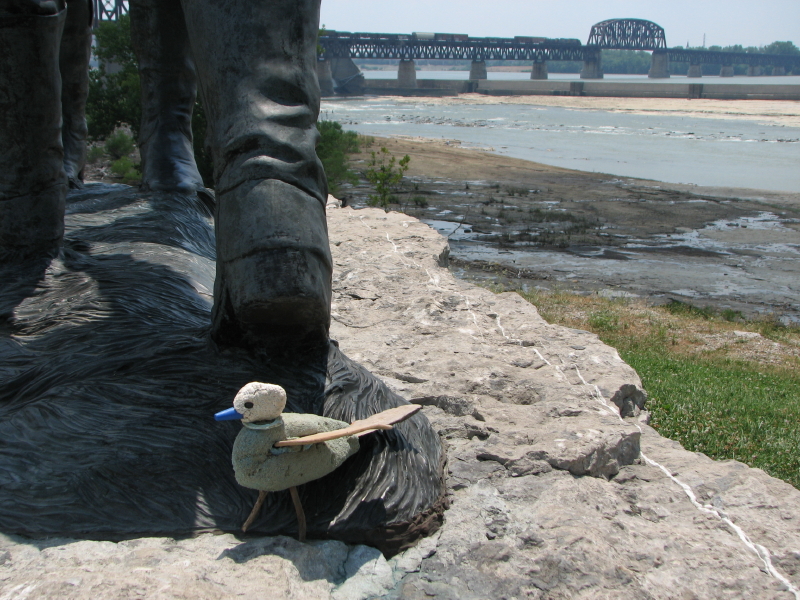
On my way to my vehicle at the end of the day I came across this dove sitting by the Lewis and Clark statue.  It brought back to mind a mental image of a nice pen and ink drawing of this bird that was in one of the personal journals carried by one of the enlisted men that formed the crew of the Corps of Discovery.  I don’t remember the name of the soldier, but he had a fine eye and a sharp quill.  There were a few notes scribbled in the margins commenting that it was too small and not worth the effort to eat!

As summer settles into its now familiar sweltering pattern, I’m looking eagerly to the time when I can cross over the shallow water and explore the Kentucky side of the fossil beds.  There isn’t as much junk to find to make “art” from, but it’s a contemplative landscape for me that has also become something of a seasonal right of passage.  It takes all day to walk across the rocks and I’ll need plenty of water to keep me hydrated, but it is such an interesting place and I look forward to sharing it with you.  Stay cool everybody…the weatherman is calling for some hot ones this week.

Read Full Post »

« Newer Posts - Older Posts »