Feeds:
Posts
Comments

Archive for the ‘animal art works’ Category

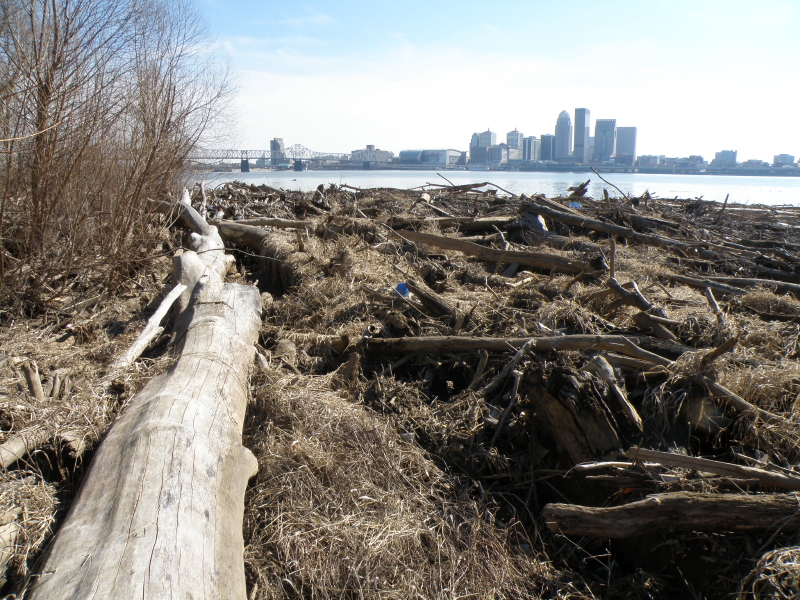
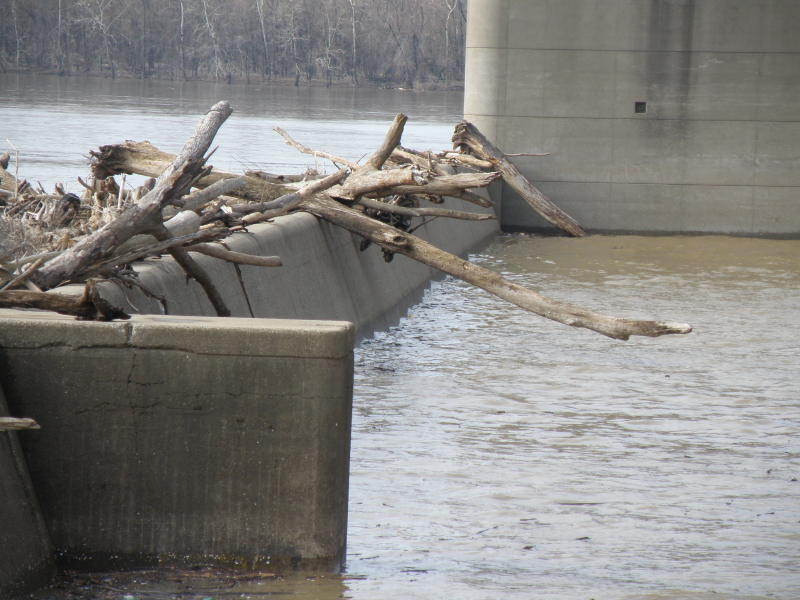
logs on the dam, March 2013

It’s an unbelievably gorgeous morning at the Falls of the Ohio and I have the park to myself.  The Ohio River has been running high although we haven’t had a lot of rain pass through our area.  Most of this water is probably coming from snow melt and precipitation in the northern section of the Ohio River Valley.  The river is receding and one of the first sights I see are logs that have been stranded on the dam as the water level drops.  These logs will remain balanced here until the river shifts them around again.  As I begin my walk, I see driftwood and trash everywhere I look.
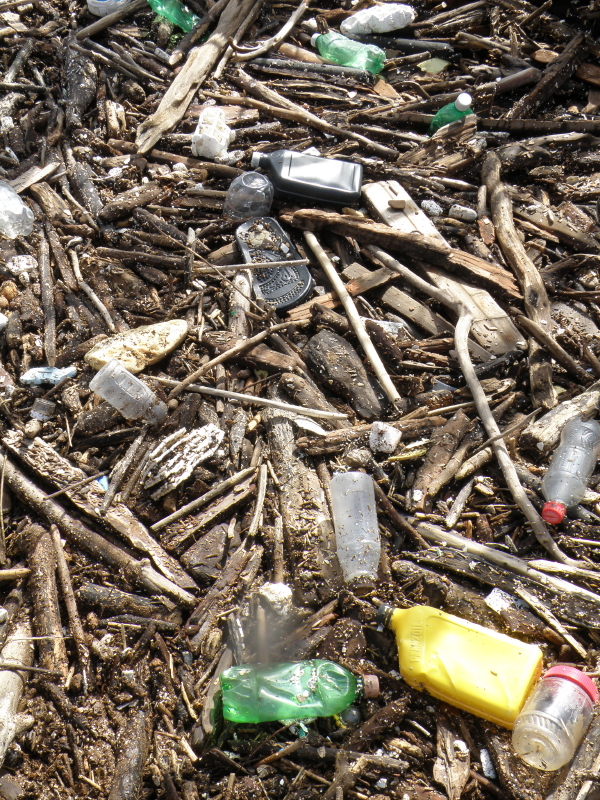
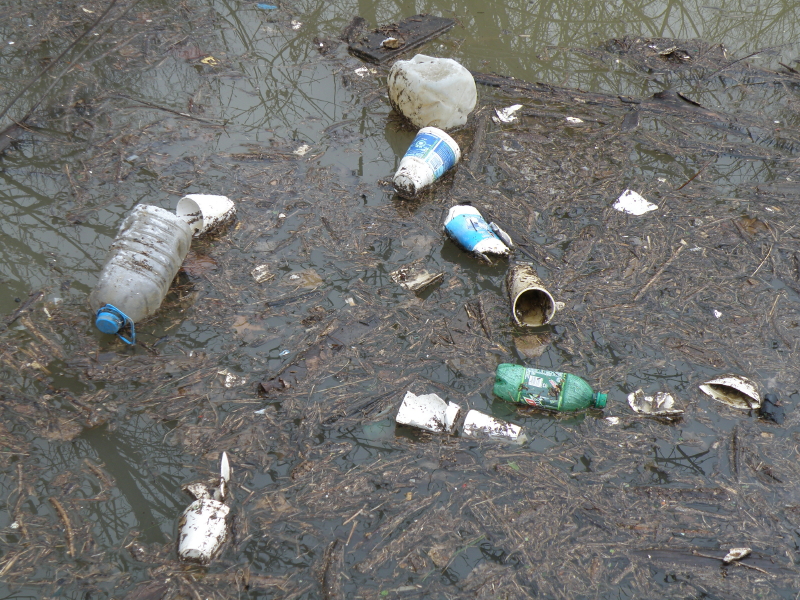
plastic trash and driftwood, March 2013

Accessing the bank is tricky and muddy.  I maneuver by walking on the backs of logs and balancing myself with my walking stick.  In areas where the river has dropped back… plastic trash, Styrofoam, and driftwood remain where this detritus floated in.  I like studying the patterns I see in the deposited wood and imagine the swirl of the river in these areas.  Of course, I find other treasures and oddities too.  Here are just a few objects that made it into the collecting bag.
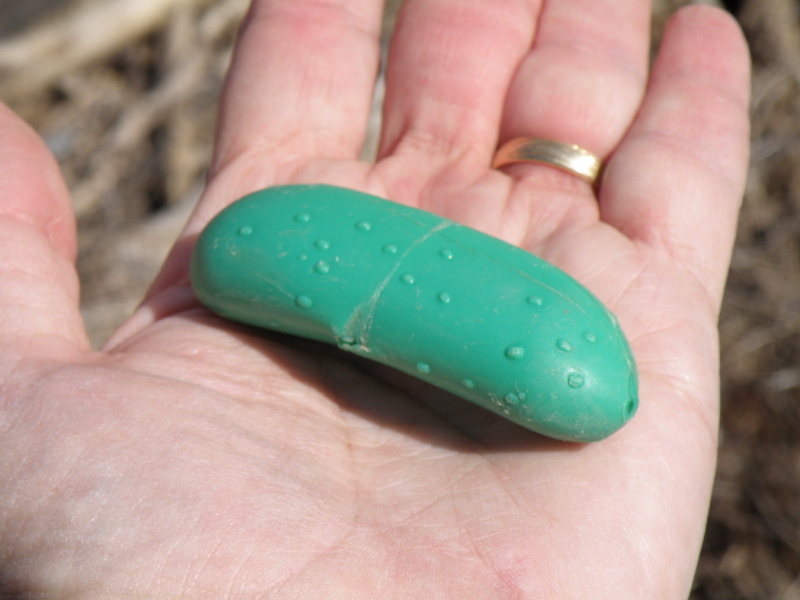
plastic pickle, March 2013

My fake food collection keeps getting bigger and bigger.  Here’s a plastic pickle  I found.  On this day, I also picked up a plastic chicken drumstick, a plastic plum and in the bag already from my last visit are a plastic onion and a plastic cheeseburger!  I find all this plastic food to be an interesting indicator of the times we live in.

plastic pirate skull with eye-patch, March 2013

This is kind of cool.  It’s a pirate skull with movable eye-patch.  The river has really colored this object.  Here’s something more humorous.
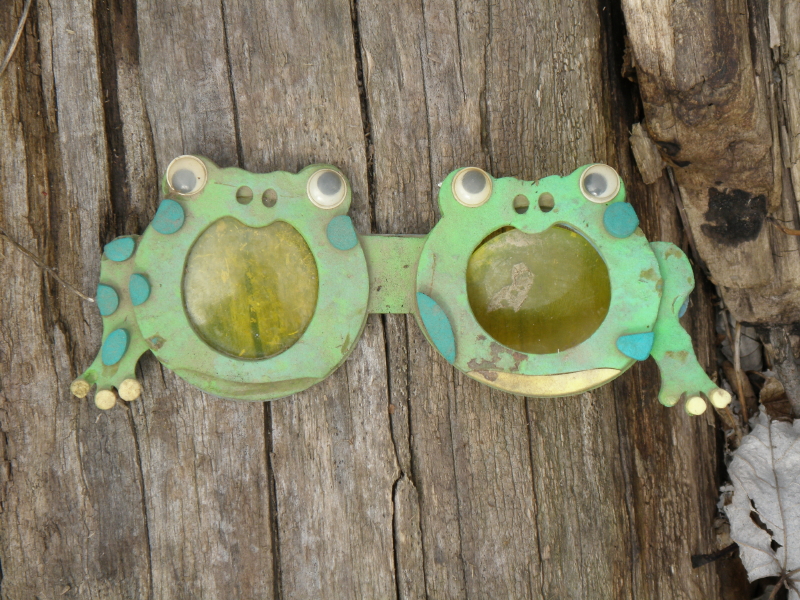
goofy frog sunglasses, March 2013

These silly frog sunglasses may be the only amphibian inspiration I receive all year.  In all the years I’ve worked this project, I have come across one actual common toad and two small leopard frogs.  Perhaps the river is just too big and wild here for the frogs?
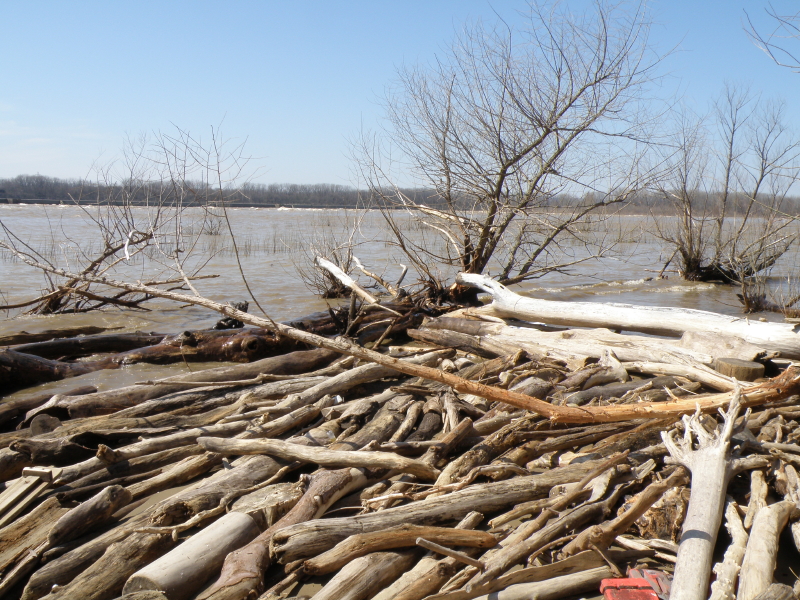
driftwood on the bank, March 2013

I decide to walk west along the riverbank and reach areas that are more driftwood than trash.  I always marvel at how the river lays the wood in fairly parallel rows.  That bright reddish-orange object in the foreground is the remains of a life preserver…it is one of two that I find on this day.
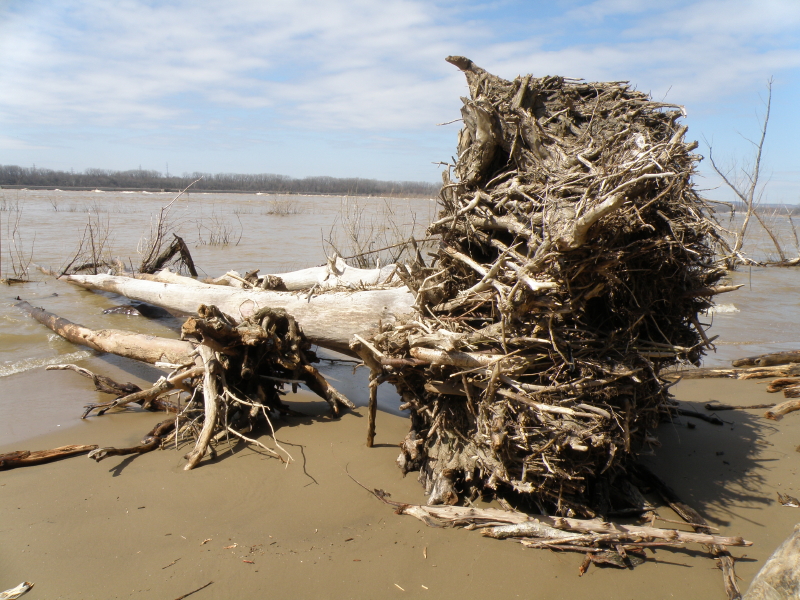
large washed up log, March 2013

Another tree with an intact root mass has been beached by the river.  Notice how all the branches have been knocked off.  This is fairly typical.  The river keeps subdividing these trees into smaller and smaller parts.  Up ahead I notice something that a muddy wave has just returned to the land.  I walk over and check it out and see something I’ve never seen here before.

beached Styro-fish, March 2013

It’s a big fish, but I don’t recognize the species.  It’s not too bloated and so I examine it more closely.  I think it may be one of those Asiatic carp species that have become so invasive to our bigger rivers?  Recently, in western Kentucky in the Land Between the Lakes area, there was the first ever commercial fishing tournament to try to harvest as many of these large carp as possible.  Strong nets are needed to catch them since they grow big and rarely if ever take a baited hook.  The idea behind the tournament was to  educate people that these fish are good to eat and to try to help create a commercial demand for them.

large Styro-carp in the hand, March 2013

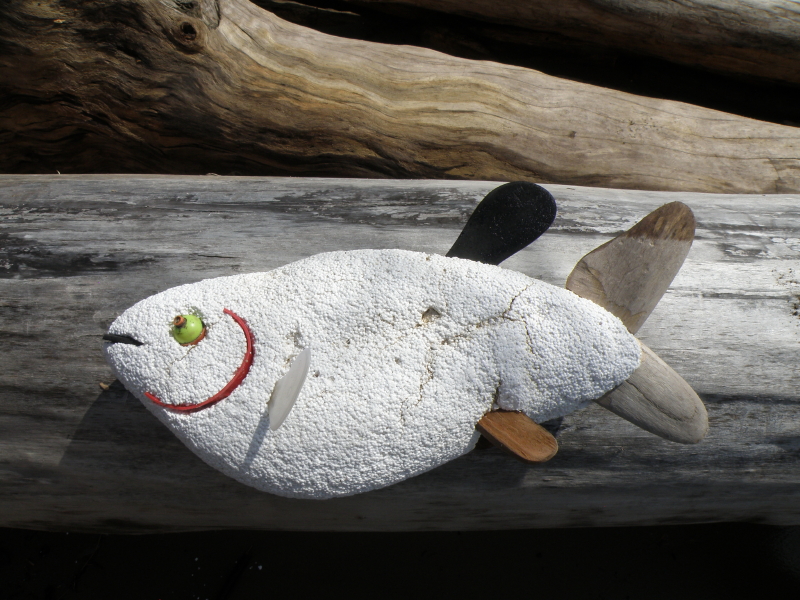
Here I am holding the fish at arm’s length.  Notice that it has a relatively small mouth.  This fish feeds on microscopic plankton and other tiny food items which is why they are hard to hook by traditional means.  This is a thick-bodied fish with a large head and powerful tail.  I have known that these fish are in the Ohio River, but I haven’t had the chance to inspect one this closely before.  I’ve attached a couple more views of this fish.
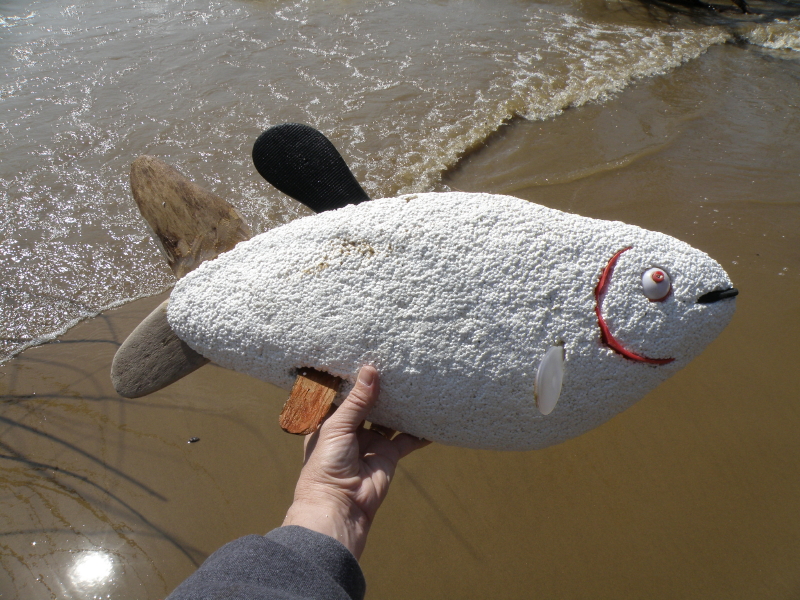
Styro-carp facing right, March 2013

Styro-carp facing left, March 2013

By now, you are probably used to my game!  I made this fish from a hunk of Styrofoam I picked up on this day.  The Styrofoam reminded me of a fish and so that’s the direction I took this sculpture. The other found elements include:  fishing bobber eyes, red plastic gills, fins made from wood, shoe soles, and plastic junk.  This is how it looked before I started.
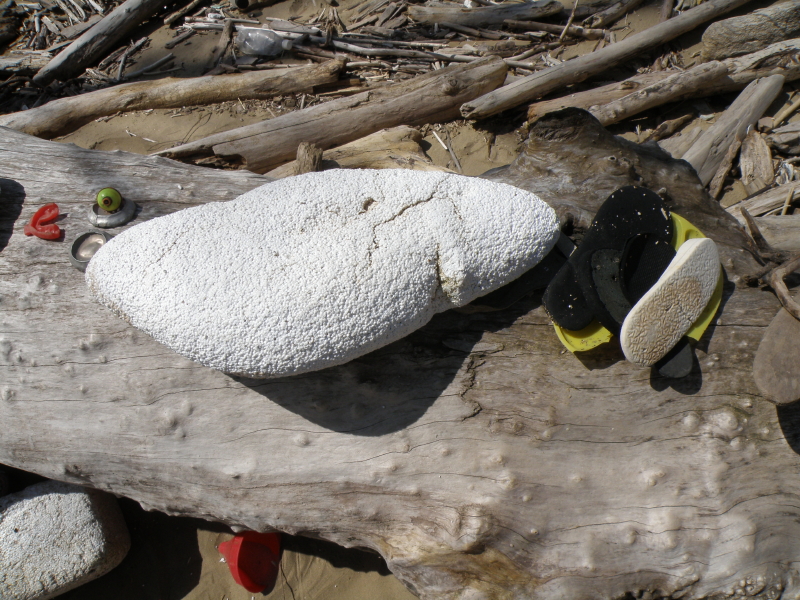
found piece of polystyrene before it became a fish, March 2013

I try to respect the basic shape the river gives me and feel that whatever results… is a collaboration between me and the river.  I don’t cut too much into the polystyrene because I also try not to release many of those tiny white beads back into the environment.  I try to work minimally and to clean up after myself.  It’s not a perfect system, but is what has evolved after so many years of coming out here.  I did find even more Styrofoam on my latest adventure and now just need the time to create something from it all.  My parting shot is the latest image of my outdoor studio.  See you next time from the banks of the Ohio River.

Outdoor studio at the Falls of the Ohio, March 2013

Read Full Post »

figure in light by willow roots, Feb. 2013

What a beautiful day and I stayed out for many hours by the river.  It’s been a bit of roller coaster with the weather the past few weeks.  We have fluctuated between below freezing temperatures you can feel in your bones and highs in the 50 to 60 degree range.  Folks around here have been blaming our worse than usual cold and flu season with the variability of the weather.  I don’t know if this is true, but for me…going outside to breathe fresh air is restorative to my physical and spiritual health.  Since I last set foot here the river has again risen and receded.  The large raft of driftwood under the railroad bridge has been dispersed by the high water and actually made it a little less of an obstacle course to maneuver around.  The air over the river is also once again alive with Ring-billed Gulls searching for food.  I’m also hearing both the Northern Cardinal and Song Sparrow practicing their songs in anticipation of Spring.  Their songs make me want to sing one of my own.

sunken tires, Feb. 2013

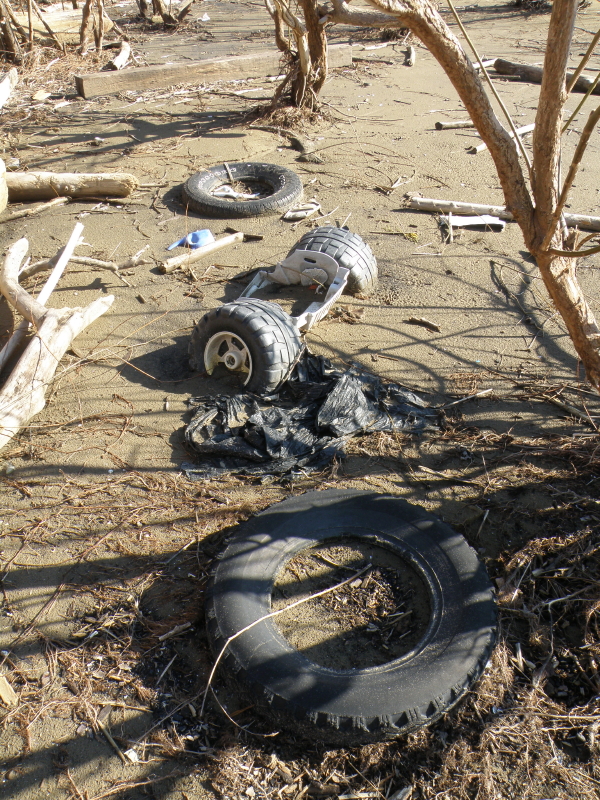
More evidence of a high river comes in the form of man-made junk that has floated into the park.  I have found tires in all their forms to be good indicators of the entropy in this system.  What once took great amounts of energy and heat to form and use is literally sinking into the sand.  The wheel is one of mankind’s great inventions and here it is just another piece of garbage we have discarded.  I’m out here today not because I’m looking for things to get me down, but rather the opposite!  I’m looking for signs and symbols of the renewal to come.

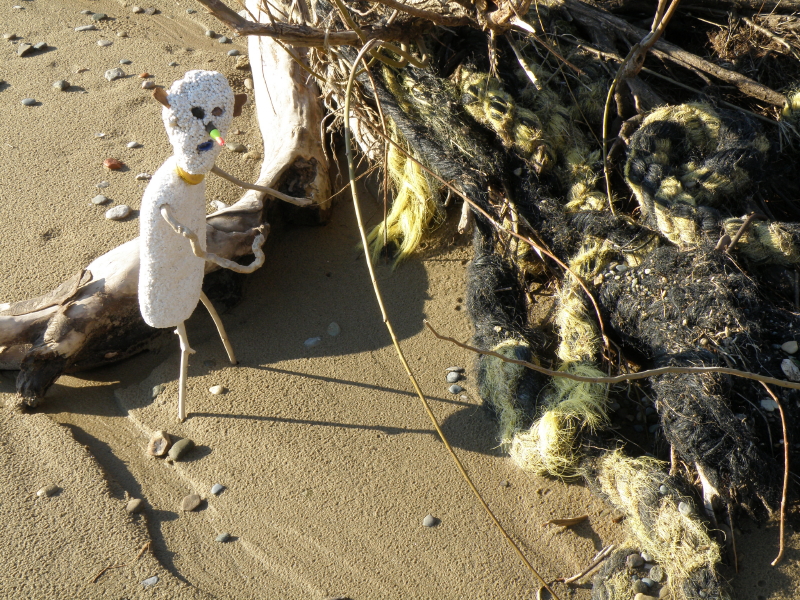
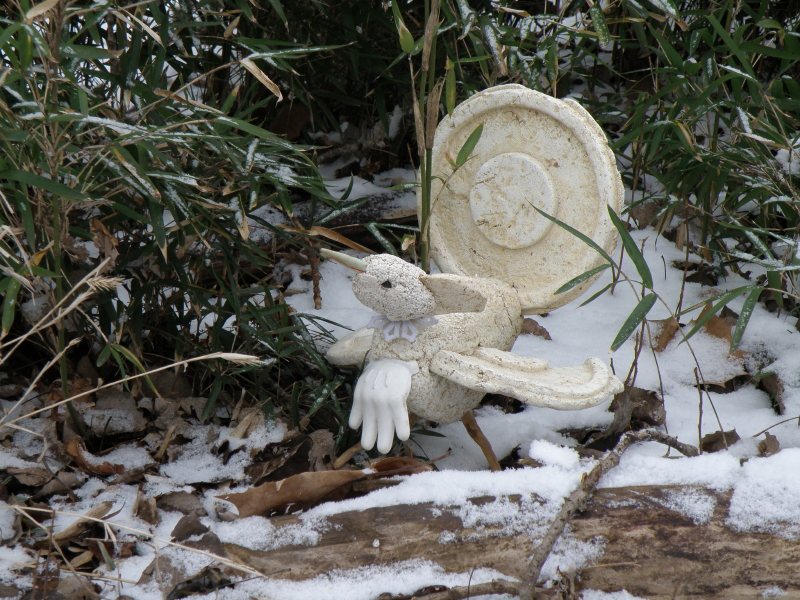
Styro-figure with foot print, Feb. 2013

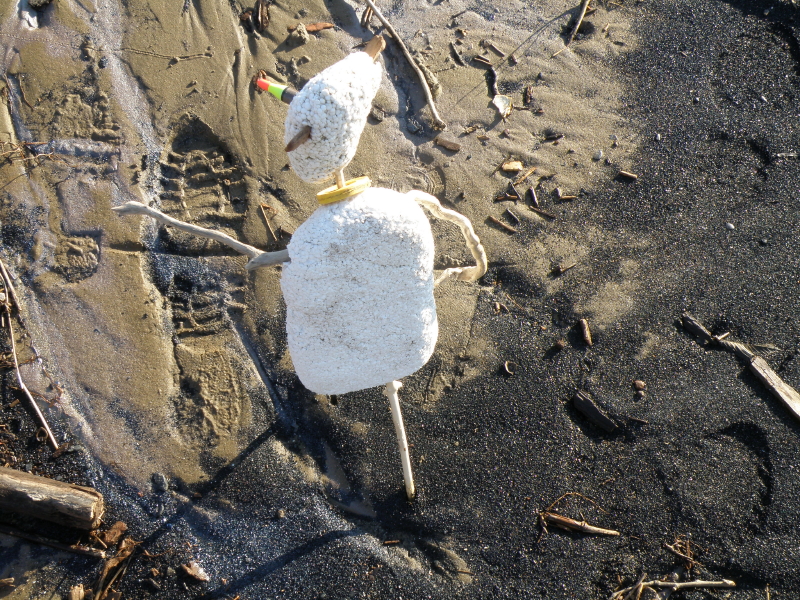
Today, I’m looking for a member of the genus Lepus which includes hares and rabbits.  For some reason…intuition I think, has brought me here on this particular quest.  I have heard that members of the rabbit family start behaving oddly during Spring in anticipation of the breeding season.  The expression “mad as a March hare” is an old English expression used to describe this moment.  Of course, rabbits and hares have older associations as well.  The ancient Greeks equated rabbits with the goddess Aphrodite and rabbits have long been symbols of fertility. Logic tells me that if I can locate a hare that Spring will be here in no time at all. I guess I’m putting more trust in the hare than I am the groundhog! The month of February is nearly over and I’m hoping to find signs that hares are in the area.  So far, I’m not having much luck…just the tracks of people who came before me.  I’m not giving up yet though and the day is young.

Styro-figure and frayed cable, Feb. 2013

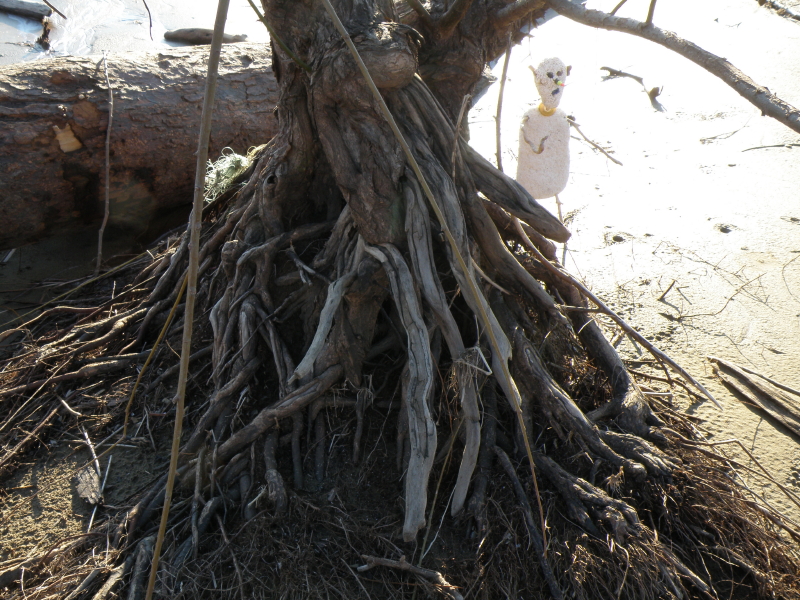
I’m operating with my “hare brain” switched in the “on” position as I walk around my familiar haunts.  I look in areas that seem likely to me to hide rabbits and hares like this willow tree with an old barge cable wrapped around it.  I’m not sure why this tree is “talking” to me, but I’m going with my intuition.  There are no hares here, and maybe this spot is too close to the river anyway?

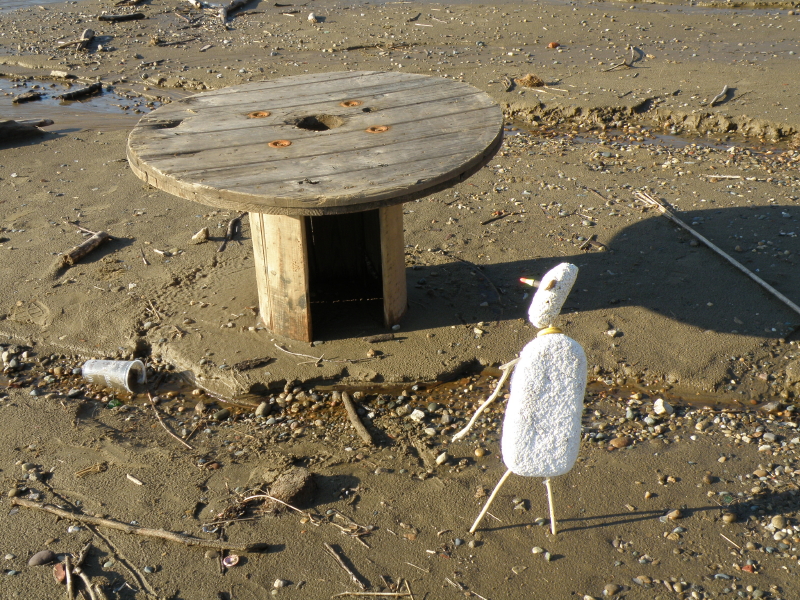
Styro-figure by wooden cable spool, Feb. 2013

I walk by a wooden spool for holding large cables.  This is also new and wasn’t here the last time I passed by.  I see there is an opening large enough for a small mammal to hide in and so I go to investigate.  Carefully I approach the spool, but there is nothing here either.  I’m beginning to feel that there aren’t many other places I can look, when I remember there is a section of the park I almost never visit and so letting intuition be my guide…I go there.

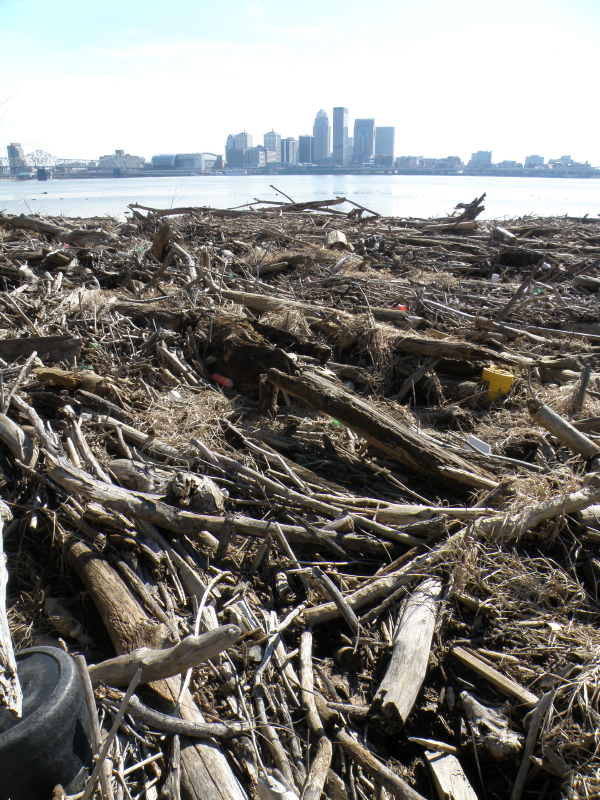
East of the railroad bridge, Louisville across the Ohio River, Feb. 2013

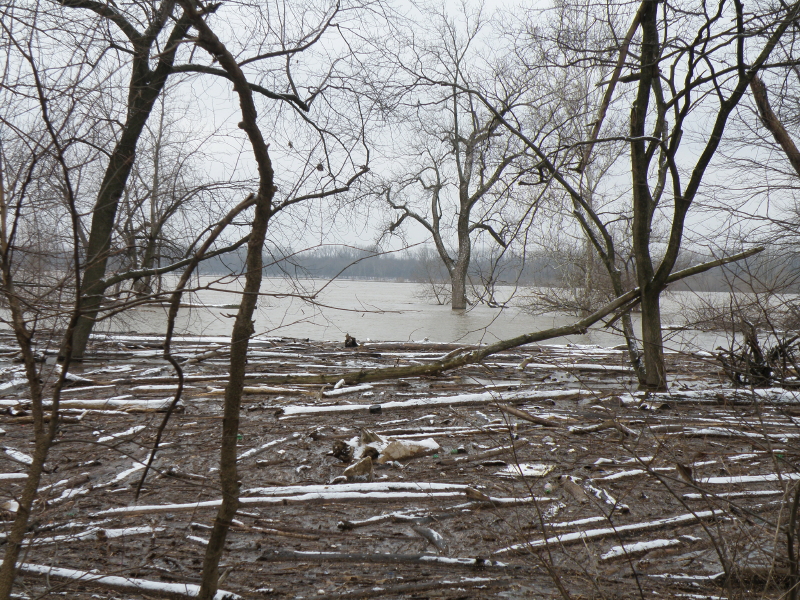
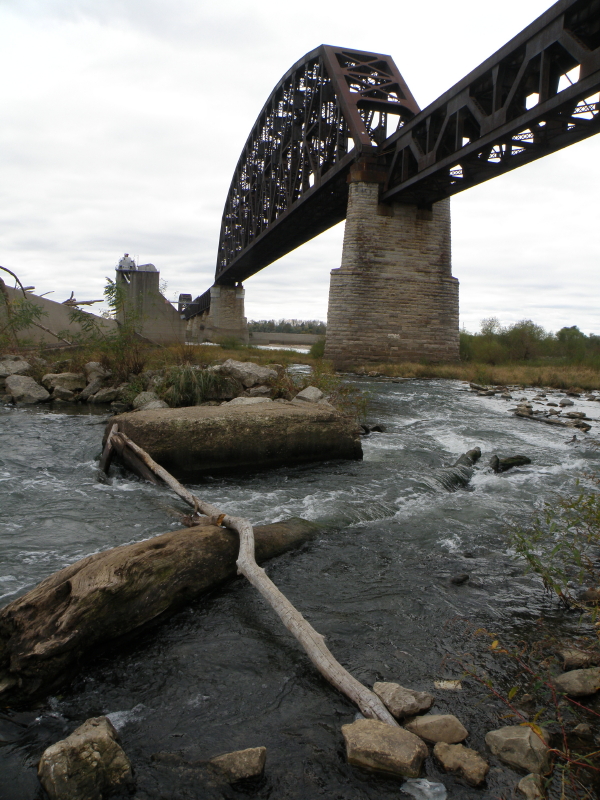
The area I trek to is just east of the railroad bridge and dam that catches most of the driftwood that has been pushed from upriver.  This barrier is no obstacle at all when the river is at flood stage.  It is all this driftwood and pent-up junk that flows into the park when the Ohio River gets high.  It’s a tricky, shifty area and frequently muddy too.  All these conditions were present on this day.  It’s not an area the public is encouraged to visit and most people have enough sense to stay away.

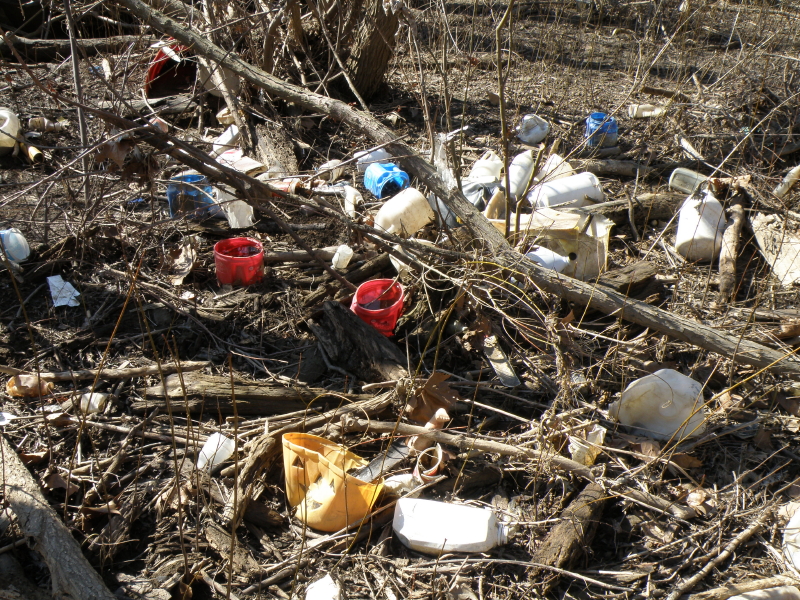
colorful plastic garbage, Feb. 2013

As you can see…this area also gets lots of trash too.  This is what I eventually can look forward to receiving, perhaps in the next flood?  This plastic separates so completely with the rest of the environment that I’m surprised it doesn’t compel people to pick it up like it does at the grocery and department stores?

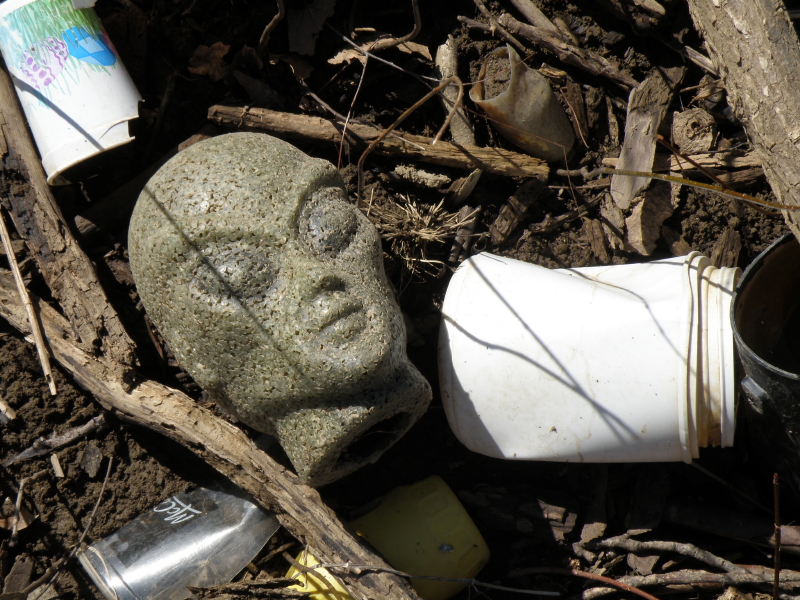
Alien head and plastic trash, Feb. 2013

Naturally, I find weird things here.  It’s not everyday that you come across an alien’s head, but here it is next to other junk.  I find three dolls in various poses tangled in mud and driftwood and other toy bits that floated down with the currents.  I find a little bit of this and that, but no March hares or rabbits.

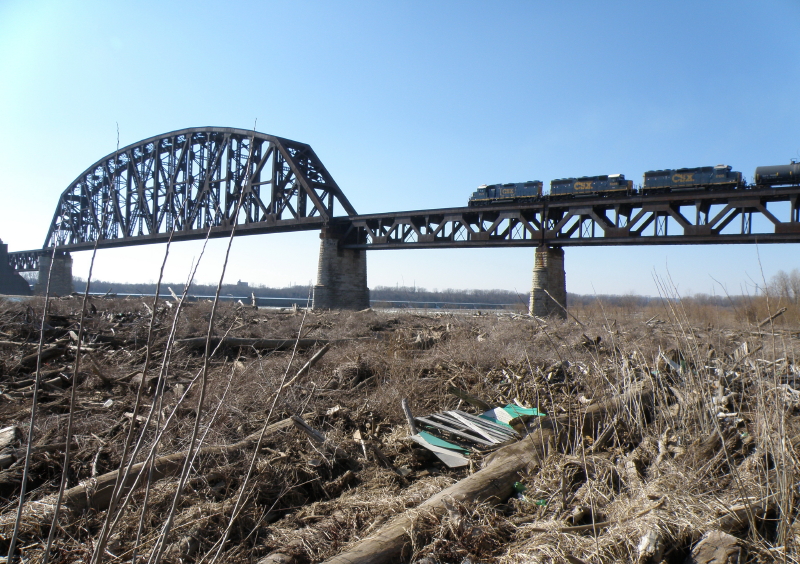
train on bridge, Falls, Feb.2013_1_1

The soles of my shoes are caked with mud and so I find a suitable stick to scrape away the sticky earth.  I sit on a broad log to do this and take a rest at the same time.  While I work away at my shoes, a train crosses the bridge and I watch it as it crosses.  My mind wanders freely and I remember the unusual art of Joseph Beuys which became a favorite of mine during graduate school.  His work is frequently perplexing and takes getting used to.  I like his art, but found I was more attracted by his ideas and writings.  The value he placed on art as a potential agent to further our own evolution away from the strictly materialistic way we treat ourselves and the planet we depend on inspired me.  His ideas about an expanded notion of art seemed to give art more of a sense of purpose which I also found to be smart and optimistic.

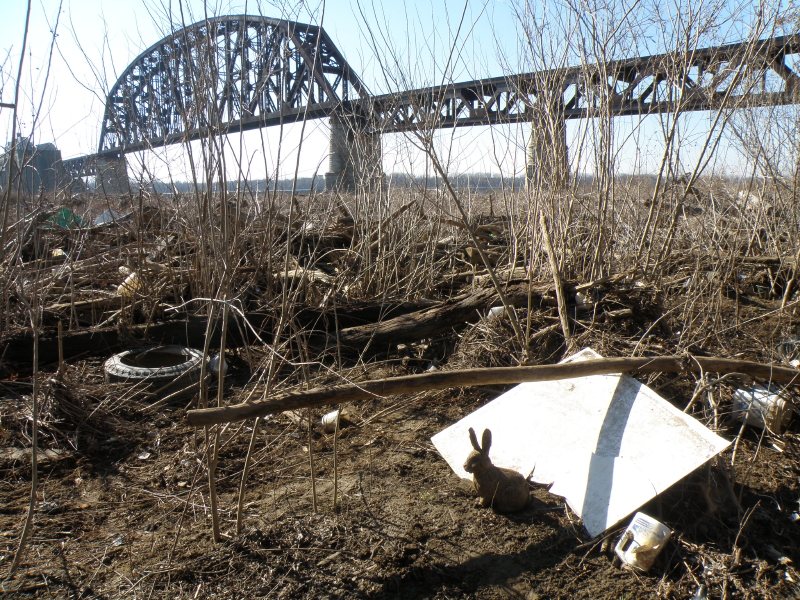
Railroad bridge with bunny, Feb. 2013

Bueys often referenced animals in his art and believed that they were more aware and in tune with the world than we are.  The hare in particular was an important symbol to Bueys because it mediates between the earthly and spiritual realms.  Hares are burrowing animals and line their nests with their wool.  The insulating properties of felt became another material that Bueys incorporated in his art.  While I was sitting still and reflecting on the work of a favorite artist…the hare appeared!

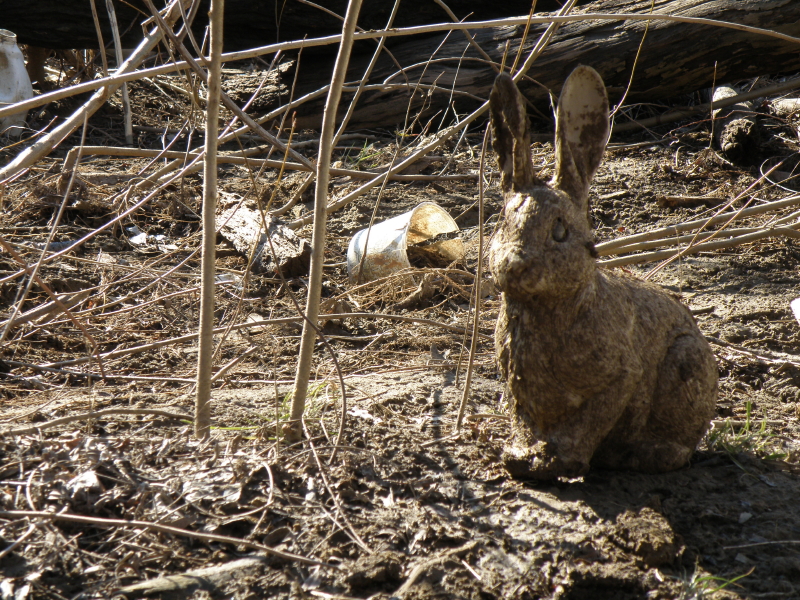
The March Hare in late February 2013

It must have just emerged from its burrow under the logs and debris and was still covered with mud.  It looked in my direction with ears pricked up and our gaze locked upon one another.  Holding still for just a split second, I was able to capture this image before it disappeared back into the earth.  I exhaled in the knowledge that Spring was one day closer to arriving.  I savored the moment, gathered my things, took one last look across the river and headed for the skyline of Louisville over the Second Street Bridge.

The City of Louisville across the Ohio River. Feb. 2013

Read Full Post »

high Ohio River at the Falls of the Ohio, Feb., 3, 2013

The Ohio River at the Falls of the Ohio is even higher now since my last visit with the fishermen.  We have had some wild weather in the interim.  First it gets unseasonably warm and then a cold front collides with a wet weather system originating in the Gulf of Mexico.  The results of this can be very dangerous as this is the perfect recipe for a tornado outbreak which did occur south of here.  My family was awakened to the sound of tornado warning sirens at 4:30ish in the morning.  We began that day in the basement of our house which was a rude awakening even for the family dog.  Luckily, we didn’t experience any damage although it rained hard and was very windy.  And after the cold front blasted through it became extremely cold and was followed by snow.  I think we have seen the gamut of winter weather and I was glad to hear the “groundhog” did not see its shadow in Pennsylvania meaning that winter would come to a normal end this year.  That is if you believe animals can predict the weather?

floating trash in the river, Feb. 2013

I am certain this time that my outdoor studio under the willows is history by now.  The Ohio River has claimed the spot and my cache of art materials.  Unfortunately, there is a ready re-supply floating in the water.  It seems I begin many a post with what amounts to a weather report, but please bear with me.  My blog concerns itself with the local conditions which are the context that my adventures and stories are set in.  I’m also amazed and concerned that I can detect variations in our weather patterns having lived in this area for so long.  Much of the time I feel I’m bearing witness to events of importance to us all.  What is happening here is also occurring in other places in the world.  As I was walking through the woods on this day, I was surprised by the bird life I was encountering when I expected to see nearly nothing.  My Eastern Bluebird friends were still hanging around and they had company.  I saw White-breasted Nuthatches, Carolina Chickadees, Tufted Titmice, Brown Tree Creepers and many more especially near the river’s expanding edge.  I also saw and photographed another amazing bird which makes up the bulk of this post.

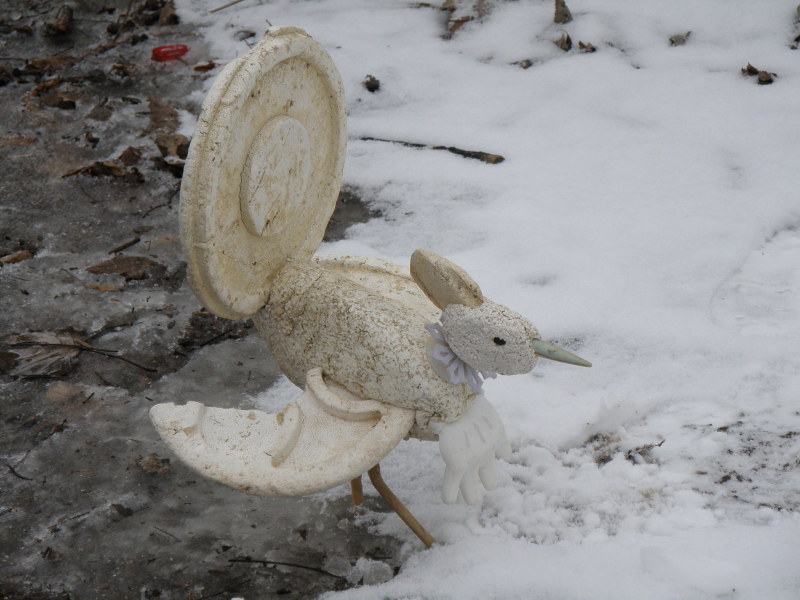
Snow Cock at the Falls of the Ohio, Feb. 2013

Snow Cock, Falls of the Ohio, Feb. 2013

Fellow bird watchers had put the alert out that an unusual visitor was seen hanging out at the Falls.  A young, male Snow Cock was seen near the Woodland Loop Trail which is a bird not seen in these parts since the late 19th century.  As you can imagine this is a northern bird used to the cold and snow…in fact it depends upon these conditions for its survival.  The Snow Cock (like some ptarmigan species) turns nearly white in winter.  The rest of the year it sports plumage that is more like leaf camouflage.  Regardless of the season, the Snow Cock is a cryptic animal and is shy and retiring.  Except of course when it’s time to choose a mate when the males make it a point to be as noticeable to their own kind as possible.  I was hoping the bad weather would cause this wayward Snow Cock to linger and I was rewarded by its presence.  I took as many photographs as possible.  I have a feeling that I won’t ever see this exact species out here again.

detail of Snow Cock head, Feb. 2013

Snow Cock in natural habitat, Feb. 2013

Snow Cock, back view showing tail fan, Feb. 2013

The Snow Cock is also called the “Snow Turkey” and “Styro-grouse” because of the large fan of tail feathers it uses for courtship displays.  That’s how I found this particular bird which wasn’t all that wary.  The young male was rehearsing his dance and song and establishing a lek or territory where he would fight other males for the attention of the females.  Although this bird wasn’t going to hang out at the Falls forever, it was nevertheless, practicing this important survival skill.  Other interesting field marks included a head crest, an unusual beard growing from his chest, and a long bill for seeds and insects.

Snow Cock at the water's edge, Feb. 2013

falls 030_1_2

I watched the Snow Cock look for just the right spot to strut its stuff.  It was frequently hopping from one vantage point (usually a tall stump) to the ground and back.  The call of the Snow Cock as you might guess is very chicken-like and not particularly beautiful in its own right.  To my eye, it seemed very interested in the water which was noticeably spreading over the land.  This might be the first flood it has ever experienced?

Snow Cock sipping water, Feb. 2013

Snow Cock by large Osage Orange tree, Feb. 2013

I kept my distance from the bird and quietly followed it through the woods.  I observed it drinking from melting ice and I left it be hanging out near a large Osage Orange tree along the trail’s path.  The wind was beginning to pick up again and more flakes were in the air.  Despite wearing good gloves, my finger tips were cold and painful.  I decided that now was a good time to go home and I did.  I hope the next time I’m out here that the conditions will be more favorable for an extended visit.  I had one other small surprise waiting for me along the Woodland Loop Trail.  I passed the spot by the creek where I watched the fishermen catch sauger and was amazed and amused that the figure I had made from river junk that day was still there!  He was missing his nose, but otherwise he was intact.  I guess the fishermen appreciated him as I do you for tagging along on another adventure at the Falls of the Ohio.

Styro-figure along the loop trail, Feb. 2013

Read Full Post »

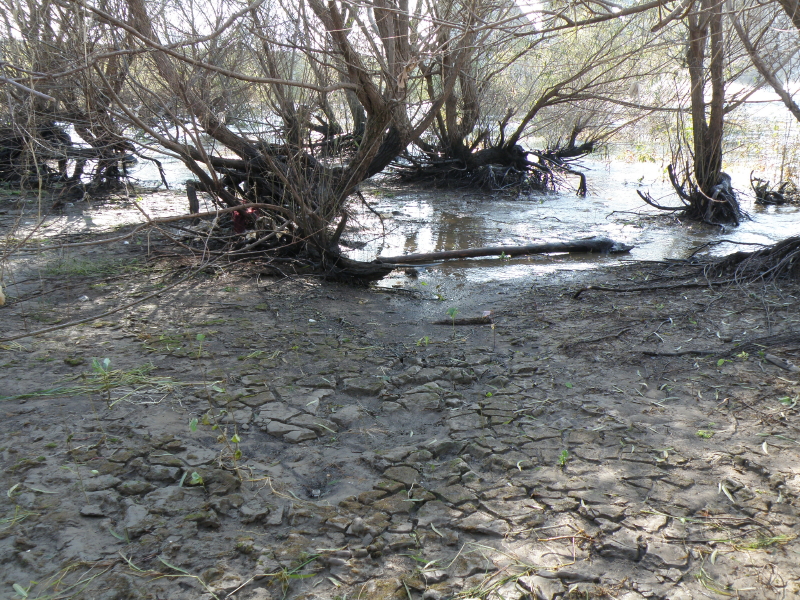
Hello all and welcome to another adventure set at the Falls of the Ohio.  Since my last visit, the Ohio River has risen in response to all the rain that fell in the northern portion of the Ohio Valley and has flowed down river in a southwestern direction.  The fossil beds normally exposed during the summer and early autumn months are now submerged by swiftly flowing water.  Walking this ever shifting shoreline I’m open for whatever presents itself as novel and different.  Turning the corner around a  stand of willow trees I was caught by this unusual sight.

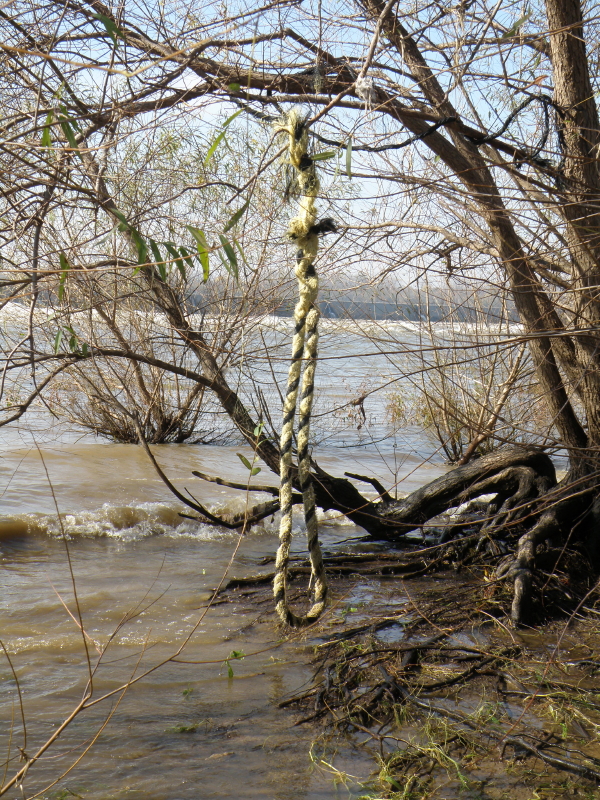
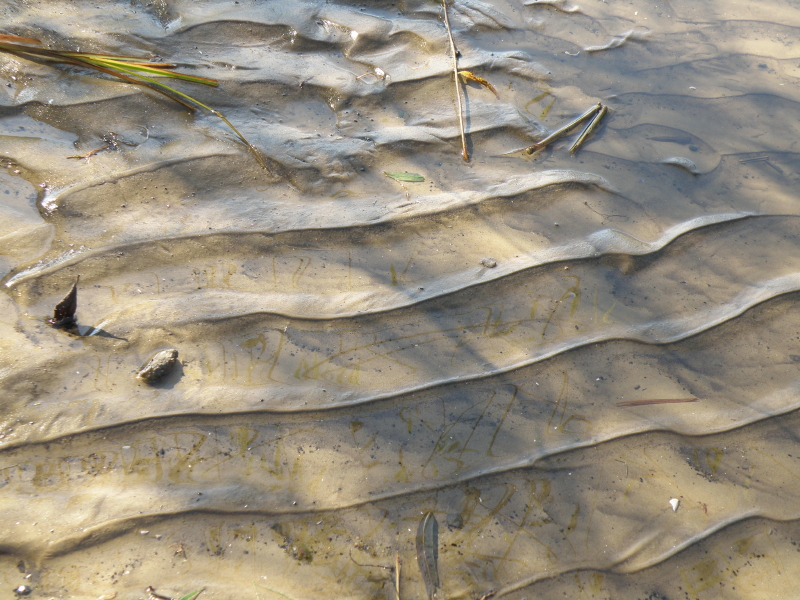
A tree captured barge cable or rope was in a different position from the last time I had noticed it (see this year’s Halloween post).  It is possible that the river rose high enough to dislodge it from its previous resting spot.  I was struck by the way it seemingly is suspended in mid-air with its regular yellow and black intervals contrasting with the unruly roots and branches around it.  Around here, water can both rise and fall quickly.  In the fine silt and mud you can often find interesting patterns that were created by the movement of wind and water.  Here is such an example.

The back and forth rhythm of the river caressing the land are recorded as peaks and valleys in this very fine mud.  I can be “hypnotized” at times by concentrating on this movement which I find soothing.  I’m always interested in the various subtle patterns that water can create on the mud of the riverbank.  It’s akin to trying to “track” water and recognize its footprint as it moves onto the land. I also noticed about a two foot tall, low “wall” of material (mostly wood and dried grasses) along the shoreline that marks this latest high water moment.  And of course, there is always the ever-present mostly plastic junk that also gets swept away and mixes with the natural debris.  I found lots of plastic detergent bottles, bits and pieces from toys including another doll’s head.  Here are images of other finds including an interesting toy ball.

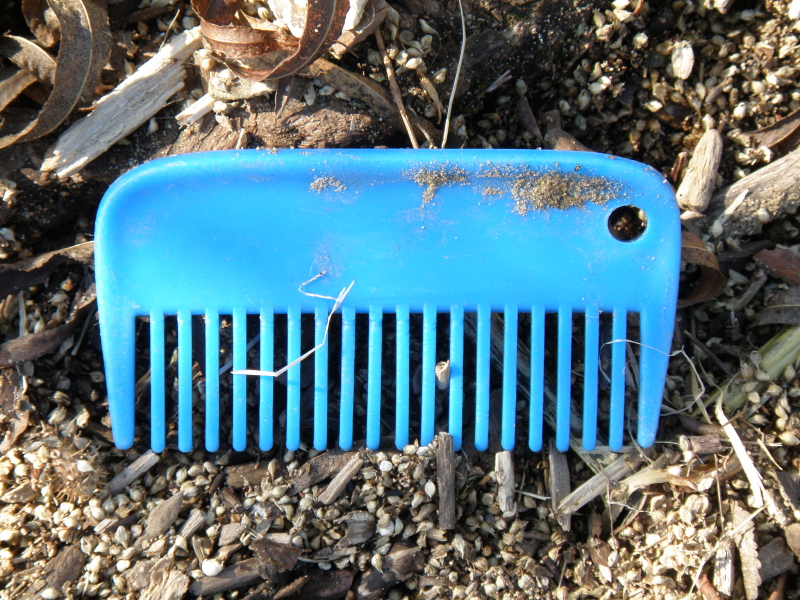
I’m assuming this is a dog toy based on the image of the dog on the ball?  The small knobs are different from the usual balls I find out here.  Now, for a bright blue comb in a design that’s also new to me.  The tiny grains around the comb are seeds from various river grasses.

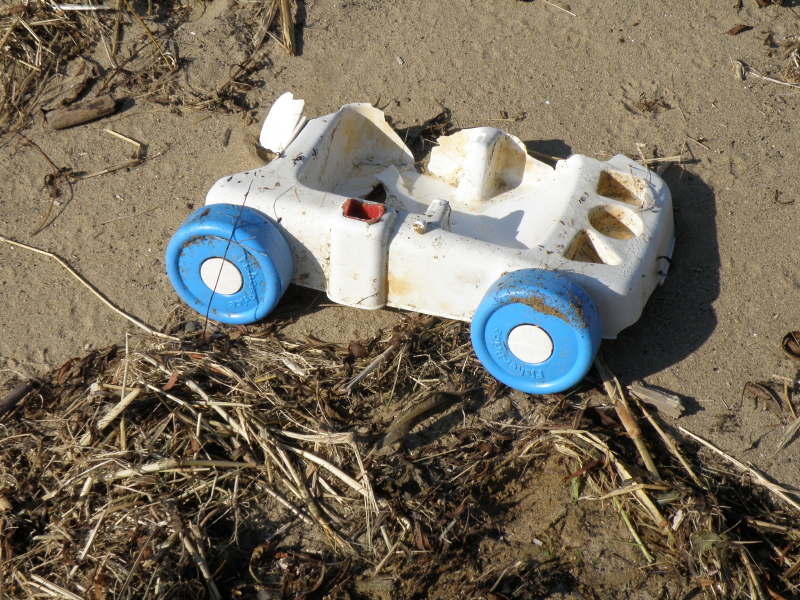
More ” blueness”  in the form of plastic wheels on a wrecked pull toy.

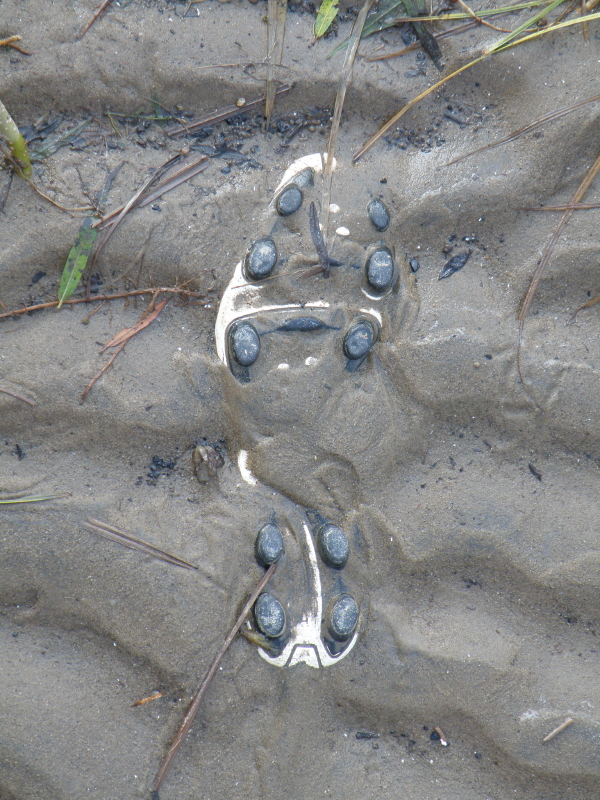
In the mud, I came across this other type of footprint that I thought was a bit unusual from the norm.  Of course, it’s a sports shoe with cleats on the bottom sticking up from the mud.

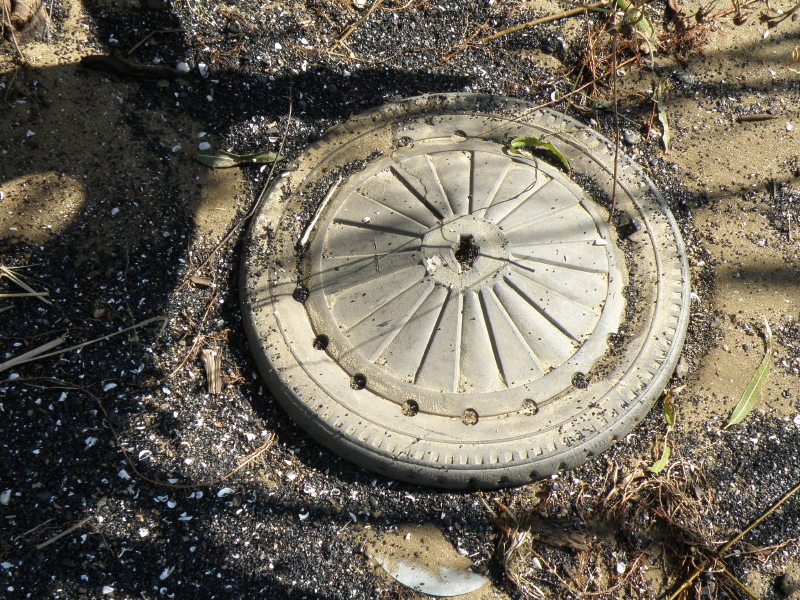
And one last found wheel whose radial pattern inspired another image in my ever-growing “Coal Flake” series.

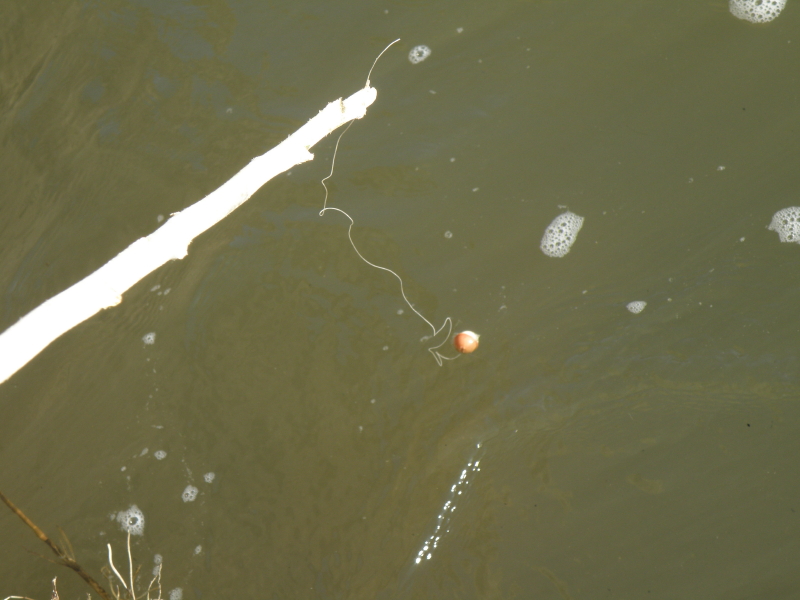
I’ve come to really like making these designs from river-altered coal that I find at the Falls.  I’m under the impression that this coal has fallen or been swept off the immense barges that transport this fuel up and down the river.  I suppose it’s possible that somewhere along the river’s journey the water has cut down through the rock to expose a coal seam somewhere, but I haven’t ever heard of this happening.  The barges seem the likeliest answer.  This particular example has more Asiatic Clam shells used in the design.  These clams are the most common of their kind that I find at the Falls.  Once upon a very recent time a go, the Ohio and Tennessee Valleys were the world’s epicenter for fresh water clams.  By altering the rivers and the water quality in them, many of these amazing creatures have either gone extinct or have become so very rare.  The Asiatic Clam is a non-native animal imported here in the 19th century as a good luck charm and has thrived as has the Zebra Mussel that you may have heard about?  The day was moving on and except for a few Mallard ducks and Canada geese I hadn’t seen much in the way of wildlife.  I decided to end my day by doing a little fishing.  I found a short, recently beaver-chewed willow branch and attached some waste fishing line I found.  I attached a hook and found bobber and into the water it went.

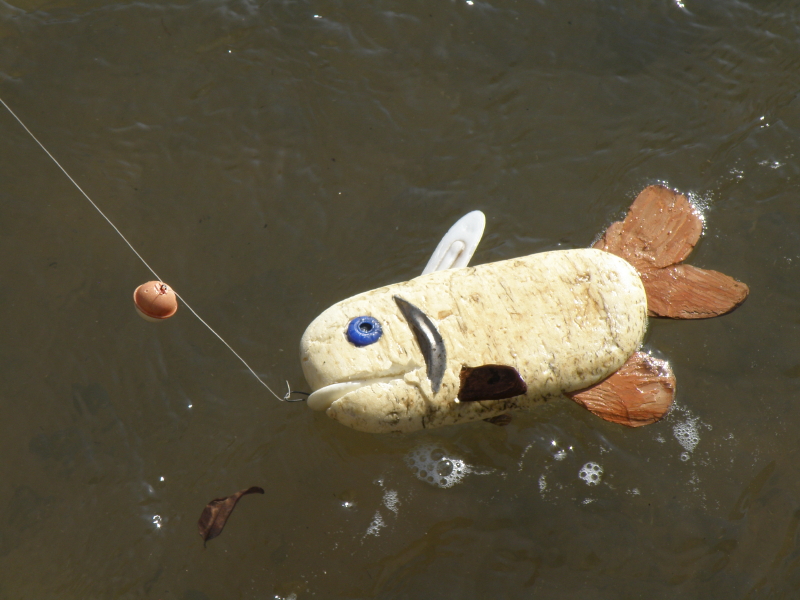
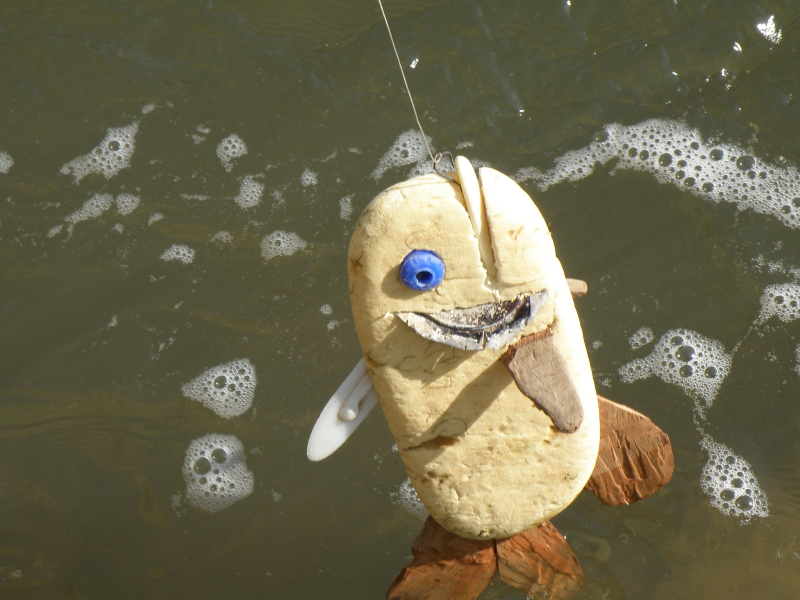
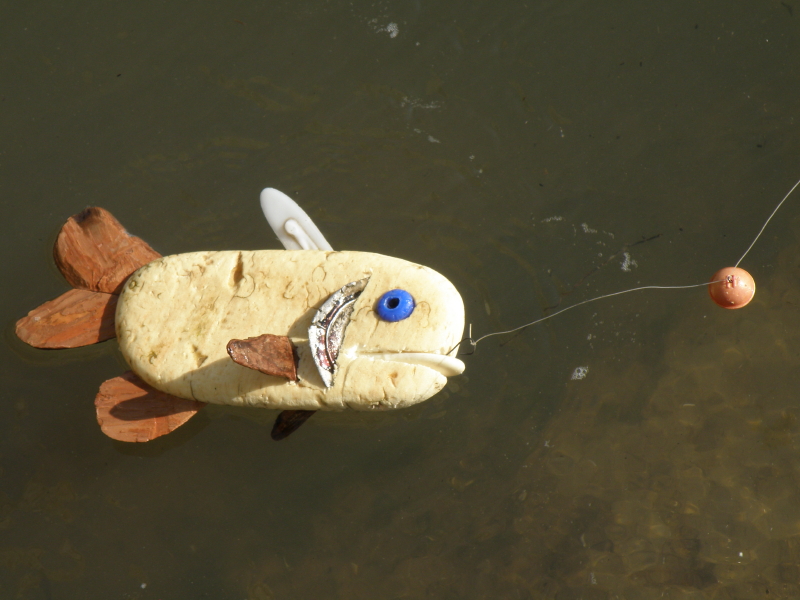
Oh, for bait I caught a small grasshopper and attached it to the hook.  A small found lead weight kept the bait below the water.  Every once in a while I would raise my short pole up and down in a “jigging” motion.  To my immense surprise I caught this very unusual fish!

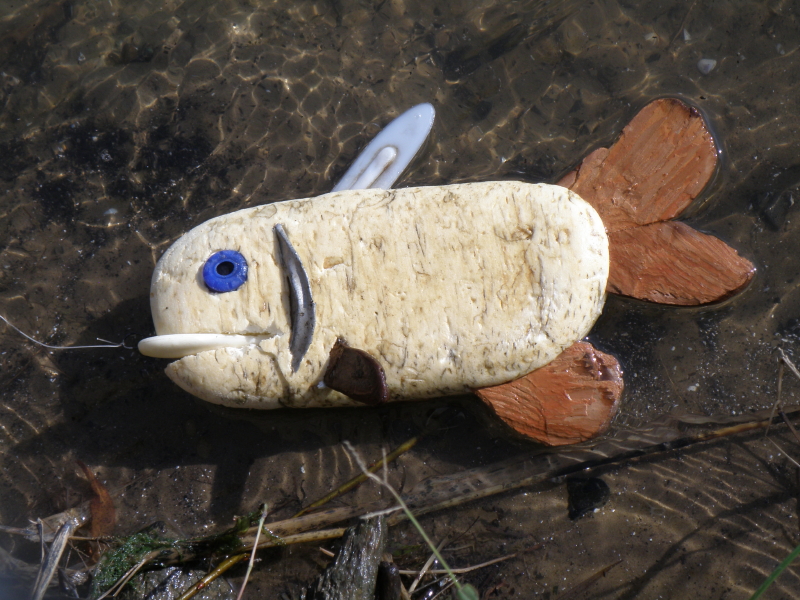
This fish is called the Iron Gill based on the metallic covers it sports around its gills.  Other distinctive features include bright blue eyes and a small white dorsal fin.  It’s body shape is unique and lends itself to easy filleting…although I wouldn’t normally recommend eating the fish from this part of the river.  Catching this fish here was a surprise because normally this is a deep water fish found in large flowing rivers.

This species was first described to science by Constantine Rafinesque back in 1811.  Rafinesque was a controversial figure and brilliant naturalist.  He had a gift for collecting and recognizing new species, however, in his zest to publish and receive credit for his discoveries he was very sloppy in his methods.  As a result, many of the animals and plants he introduced to science are poorly described and classified which led to much confusion and consternation among the other “scientifics” of the time.  In the end, Rafinesque usually won out because science gives priority to the person who first (no matter how poorly) brings the new creature to the world’s attention.

After this last image, I released the Iron Gill back into the water and rebaited my hook.  Alas, this was the only fish I caught on this day, but it reassured me that my skills in this area were still intact.  For my next post, I want to show you images of a coal-themed exhibition I’m participating in the nearby town of  New Albany, Indiana.  It’s a good show and worth a post.  For now, I would like to close with another image of a found toy I came across on this day.  Have a great weekend out there in the wider world!


Read Full Post »

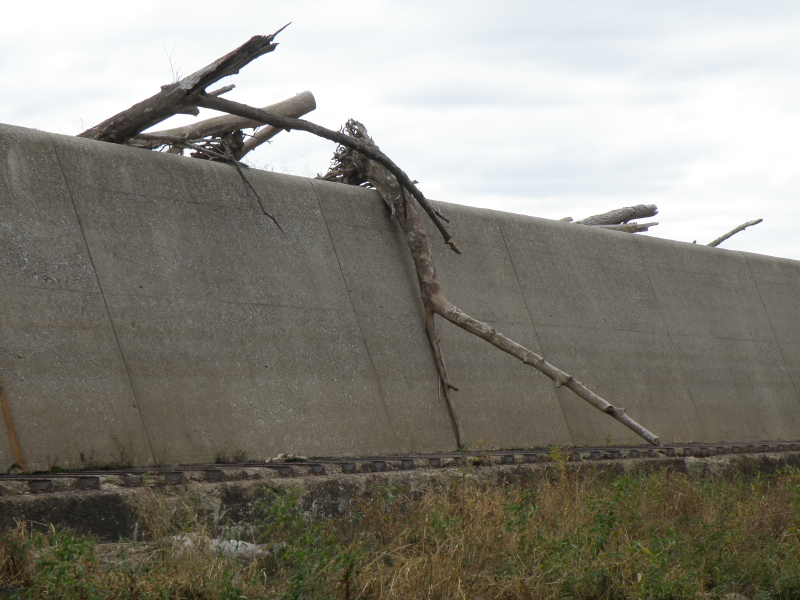
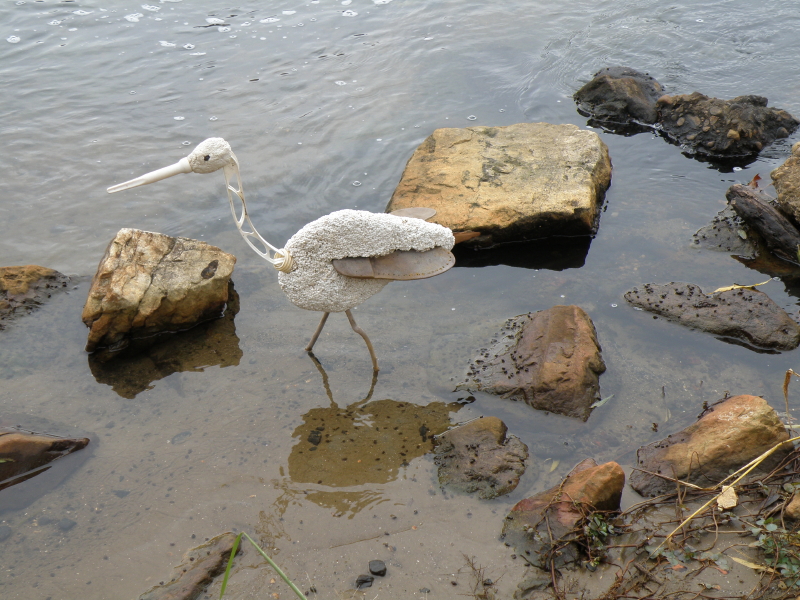
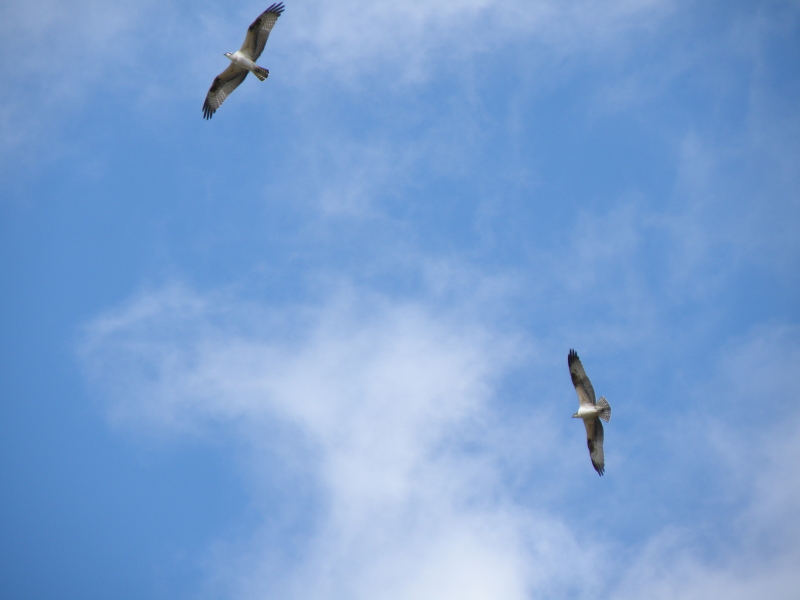
It’s hard for me to believe that October has come and gone.  There isn’t much sand left in 2012’s hourglass.  I’m virtually alone (if you are only counting people) at the Falls of the Ohio today and it’s understandable.  The weather is cool, gray, and an occasional spit of rain falls against my face.  I like it out here when it feels a bit lonelier because my chances of seeing wildlife increases.  Such was the case today when I explored the area next to the tainter gates and under the old railroad bridge.  This area is sheltered a bit from the wind and many times I have found birds in the high grass and low trees near the sloping riverbank.  Today I observed Song Sparrows, White-crowned Sparrows, Mourning Doves, and Hairy Woodpeckers in immediate proximity to each other.  In the sky, the first of the Ring-billed Gulls has arrived and a pair of Osprey with their broad wings searches for unwary fish too close to the surface of the water.  Many of the tree leaves have dropped and it looks like we will have a bumper crop of cockle burrs as I pull dozens of them off my shoe laces and socks.  Their prickly hooks irritate my skin as they work through the fabric of my clothing.  On days like this I’m just trying to attune myself to the subtleties of this landscape and I’m amazed at how often my patience gets rewarded here.  As I was walking to photograph uprooted trees against the flood wall…

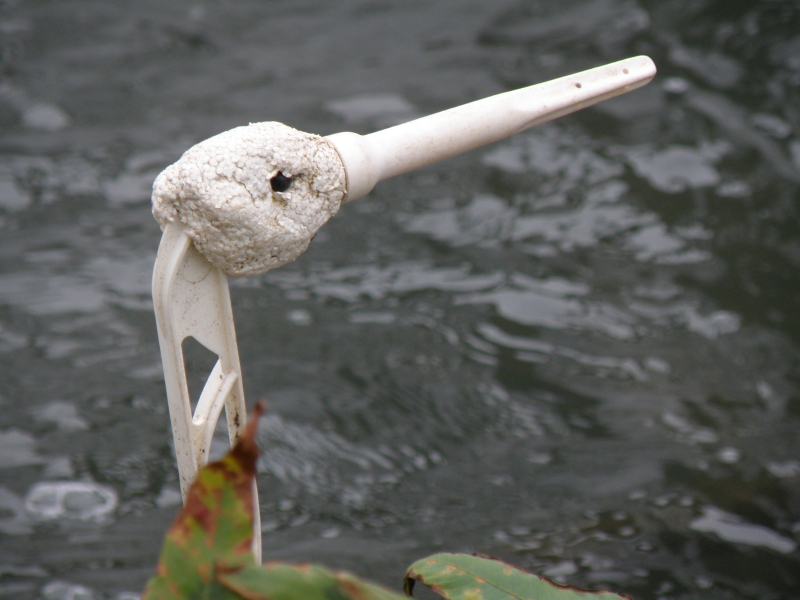
…I spotted something shockingly white moving near the water’s edge.  Carefully moving as close as I could…I recorded this image of another rare bird seldom seen at the Falls of the Ohio.

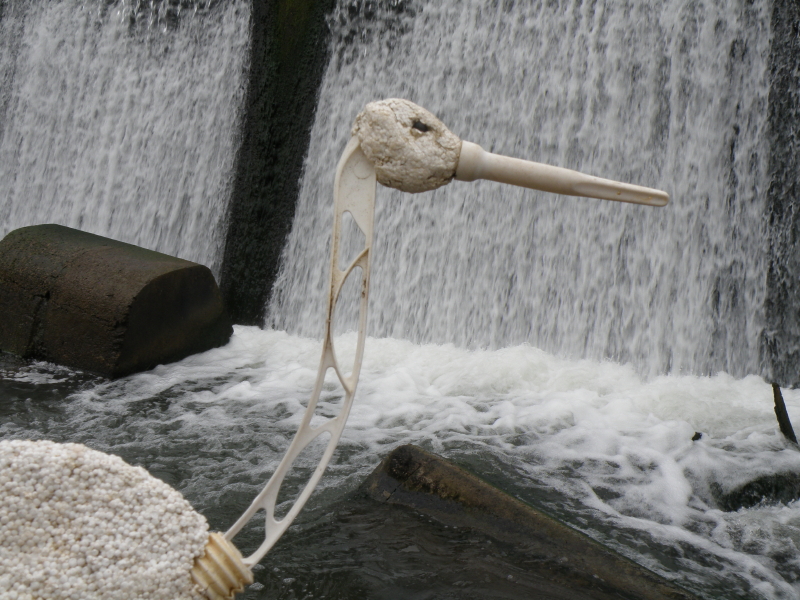
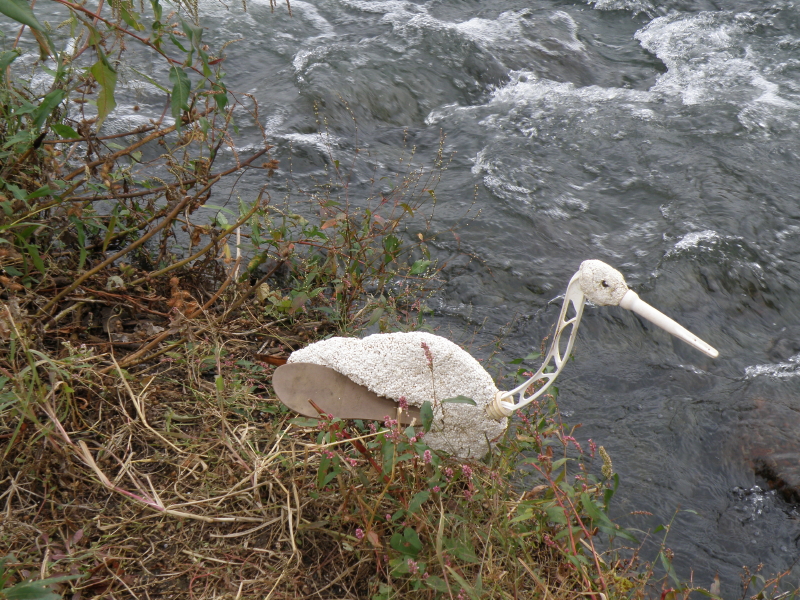
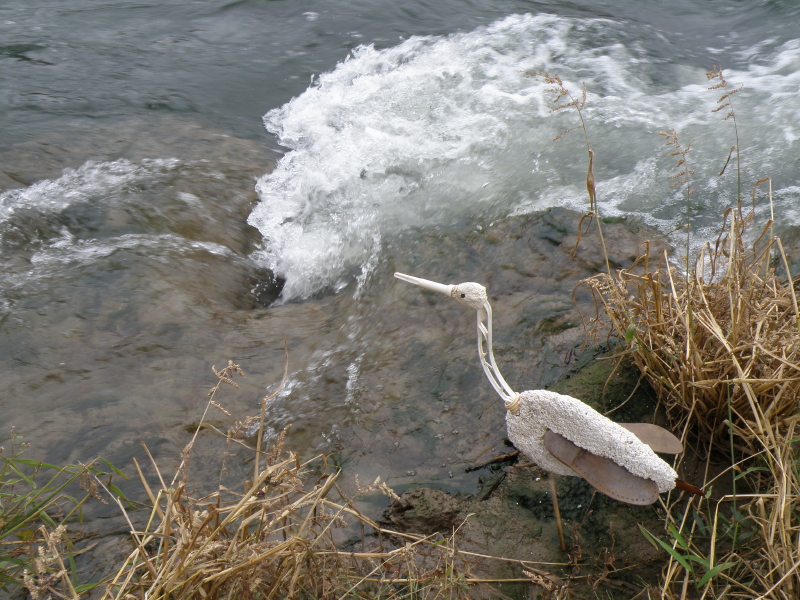
A few more pictures in relatively close succession and I was able to identify this beauty as the Lattice-necked or Brown-winged Ibis.  I prefer using the Lattice-necked moniker because the long neck with its unusual patterning is distinctive to this bird alone.  I happened across an individual that was hunting for food and stalking the margins of the water.  I did observe it feeding on black snails that were common on the rocks. I recall from my old art history days that the ibis was a sacred bird to the ancient Egyptians and often was mummified to accompany dignitaries on their journeys to the afterlife.  In my mind I made the association that this ibis species in front of me was sacred to the life of this river.  Enough gabbing, here are a few more pictures.

This ibis species is more commonly seen around the Gulf coast and points south of here.  Every once in a while, a storm or hurricane will blow a few individuals into the heartland where they are a welcome treat to the hardcore birders.  The Lattice-necked Ibis has always been less common than the other larger shorebirds.  It is less aggressive than the herons and egrets which out-compete the ibis for prime nesting and feeding sites.  This bird did spy me and flew away, but only a short distance away.  I was able to catch back up with it and captured these final images of this graceful and dignified bird.

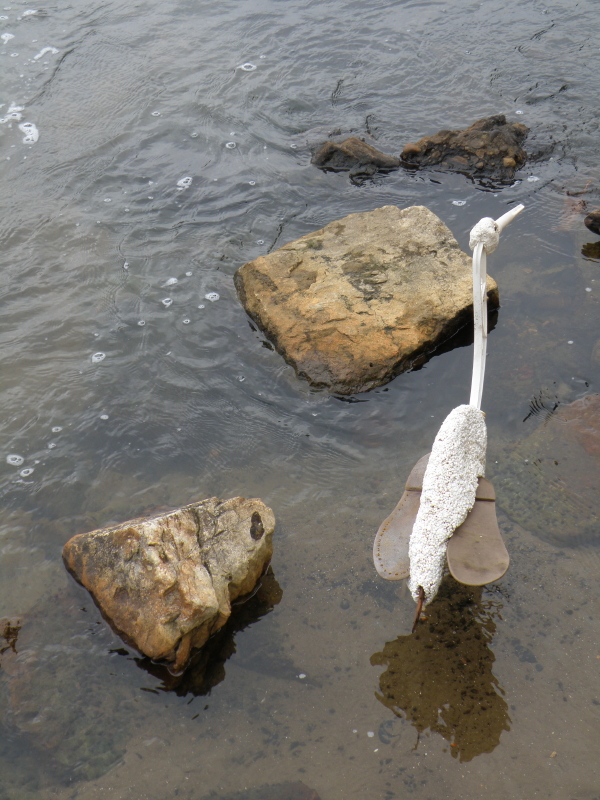
Here is the same ibis that found a nice fishing spot next to a small whirlpool. Every now and then a little fish would get caught by the rotating water only to find itself food for the lightning quick ibis.

I felt refreshed and energized by my encounter with the ibis.  I left the river  with a song in my heart which I whistled all the way back home.  Above me, two osprey I had seen earlier were circling in the clear, cool blue sky…another blessing of this day.

BONUS FEATURE…in process shots of how the ibis was made.  The head and body are pieces of Styrofoam I found out at the Falls of the Ohio.  The bill of the bird is a plastic handle from something…perhaps a feather duster?  The bird’s eyes are two small pieces of coal.  The neck I’m guessing is the plastic arm of a hanging flower planter?  At the base of the neck, I attached a small bit of white plastic hose I came across. The brown wings are the soles of two mismatched shoes I found.  The tiny tail and legs are found wood.  These are all the materials that make up this sculpture which owes something to the tradition of decoy making.  Thanks for tagging along with me on another adventure by the Ohio River.

Read Full Post »

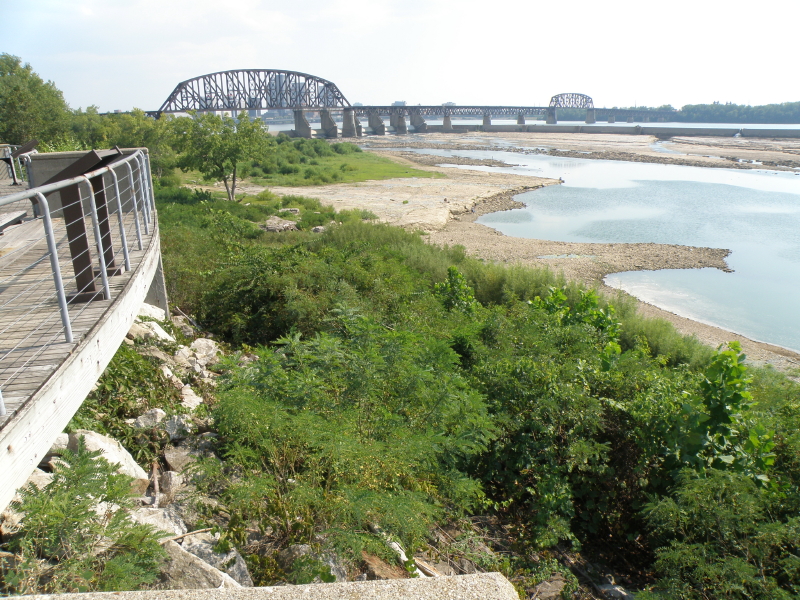
At long last I’ve made it back out to the river!  It’s been about eight weeks now since my last visit.  Today I have a double purpose…the first is to drop off one of my Styrofoam and recycled material sculptures for an annual fund-raiser that the Falls of the Ohio State Park Foundation hosts every year.  I’m glad to do this and hope my donation does well in their auction.  Despite the years I’ve been making stuff out here it still strikes me that most of my materials are literally trash.  I suppose I will never get over that. It seems to me that it takes a certain kind of person who would want to own one of these creations!  The other more fun purpose is to check out what’s different along the river and maybe make something new.  Immediately, I can see that the hot summer continues to take its toll.  At first, it was the relentless heat, but now that is coupled with a serious lack of rain.  The river is low and everything looks dry.

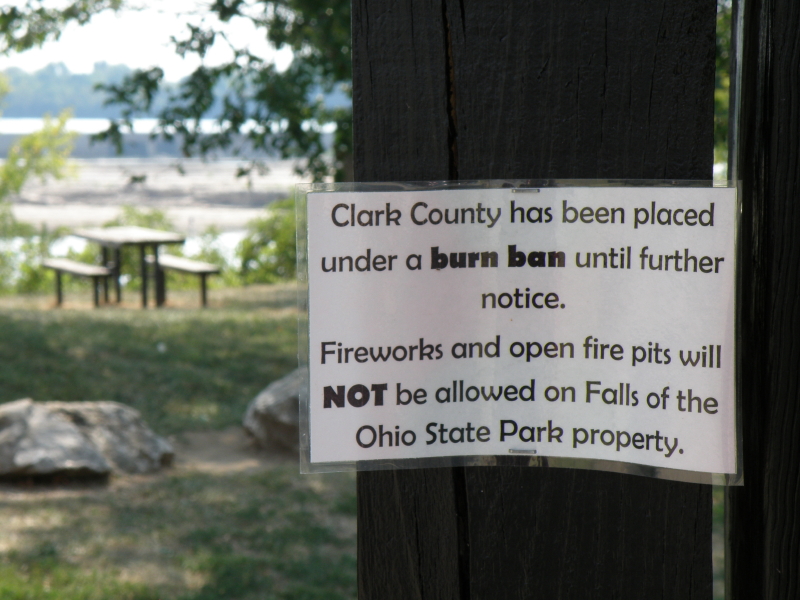
Over the course of this summer we have had just enough rain not to be considered a disaster area.  This is hardly a ringing endorsement and I find a small laminated notice tacked on to a bulletin board that reinforces how dry it is.  I think to myself that some of the people I’ve encountered out here over the years who do shoot off fireworks or build fire pits are not likely to read or heed this warning.  When I’m in the park, my preference is to move away from the most public areas and so with my walking stick in hand I head down the Woodland Loop Trail.  I’m still not confident enough to want to test my repaired knee too vigorously, but this trail is fairly easy.

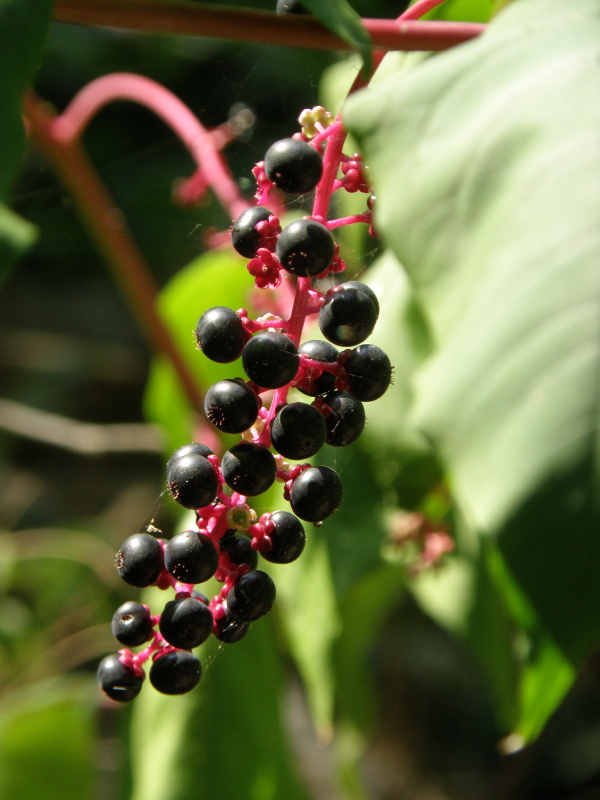
The trail is shaded which I welcome since it’s still over 90 degrees out here.  I pass many what I would consider late summer blooming plants that have flowered earlier than usual.  I did see several stands of tall Pokeweed plants with their black berries, but even these weeds have wilted leaves.  I guess what moisture these plants could muster up went into the production of their fruit?  These berries are a favorite food of several bird species.  In the past, I have used the intensely dark purple juice from Pokeweed berries as a pigment in some drawings I have made.  This color, however, is fugitive and ultimately fades in the light.  As I walk, one distinctive sound I keep hearing is the tell-tale sound of gray squirrels gnawing on the rock-hard walnuts that are  clustered around the few walnut trees along the trail.  There’s not much meat inside one of these nuts and it seems like a lot of work for little reward.

Out on the exposed fossil beds the sun is baking, but under the shade of the trees it is still fairly green.  Since my last visit,  however, I noticed a lot of dropped tree limbs and a few whole trees that have keeled over and appear to be the result of wind damage.  I have seen a few birds including two Hairy Woodpeckers and as I walk along the trail I keep getting scolded by Carolina Wrens who resent my intrusion.  In the distance I recognize the calls from the Killdeer plovers that are looking for food along the water’s edge.  The rarest and most unusual bird, however, is  just up ahead.

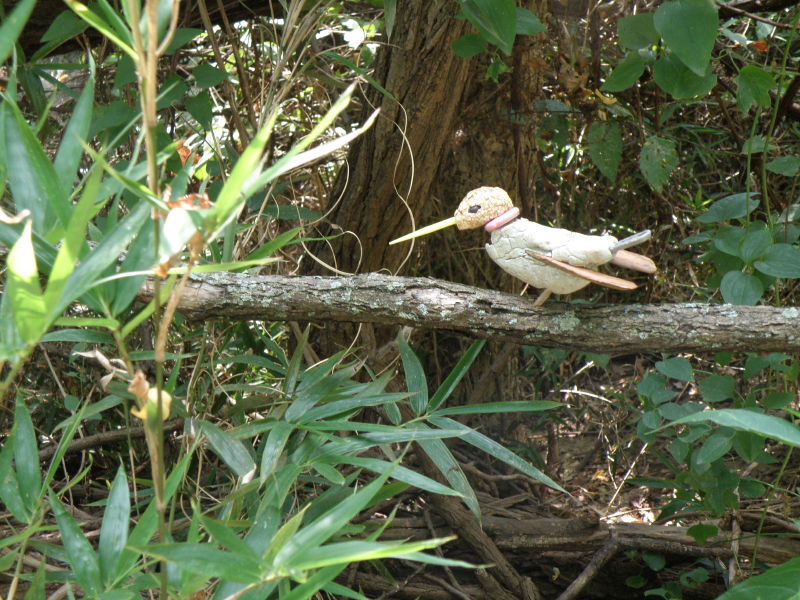
I’ve only seen a couple of the more common and native Ruby-Throated Hummingbirds this year…and so I was taken aback and delighted to come across what I later identified as Isaac’s Hummingbird (Archilochus isaaci ).  To my knowledge, this is the only recorded instance of this Cuban species reaching this park.  I’m guessing that Tropical Storm Isaac (purely coincidental, but also appropriate) which is threatening the GOP conference in Tampa Bay at this moment may have blown this rarity our way?  Hummingbirds of which there are over 300 hundred recorded species have been known to wander thousands of miles away from their more familiar haunts.

I came across this hummingbird dozing on a fallen branch.  It would open its eyes every once in a while and regard me.  I kept my movements to a minimum and completely forgot about my aching knee in the process of creating a few images of it.  I was able to snap off six pictures before it took off.  As you can see, this bird (also known as the Yellow Saberbill) has a bright yellow bill it uses to extract nectar from flowers.  Its light blue body, brown wings, silver tail, and whitish-head are diagnostic of this species.  I don’t know what it is about the Falls of the Ohio, but I have seen other unique hummers out here before.  Digging through the archives…I present two of them again.

This is the ultra rare Arctic Hummingbird appearing at the Falls of the Ohio to sip nectar from the equally scarce Ice Blossoms.

I encountered this Cumberland Greencrest back in 2010 not far from the place that I saw the Isaac’s Hummingbird.  Both of these rare hummingbirds stayed in our area for a couple of days before moving on.  This is what keeps me coming out here…I just never know what I’ll find or discover! This was a short, but eventful trip and I thank you for tagging along.  Here’s another view of the river with the exposed Devonian fossil beds.

POSTSCRIPT:  The inspiration for this particular post comes from another WordPress blog I enjoy entitled “Ekostories”.  Isaac Yuen is its creator and he’s an aspiring environmental writer.  Issac has a talent for weaving stories and making connections about responsible stewardship of our planet.  At the time of this writing, Isaac has a wonderful post about a book entitled the “Flight of the Hummingbird” that I think you may enjoy…so please check it out.  Here is his link:  http://ekostories.com/ Finally, one last peek at this elusive hummingbird checking out a flower blossom.

Read Full Post »

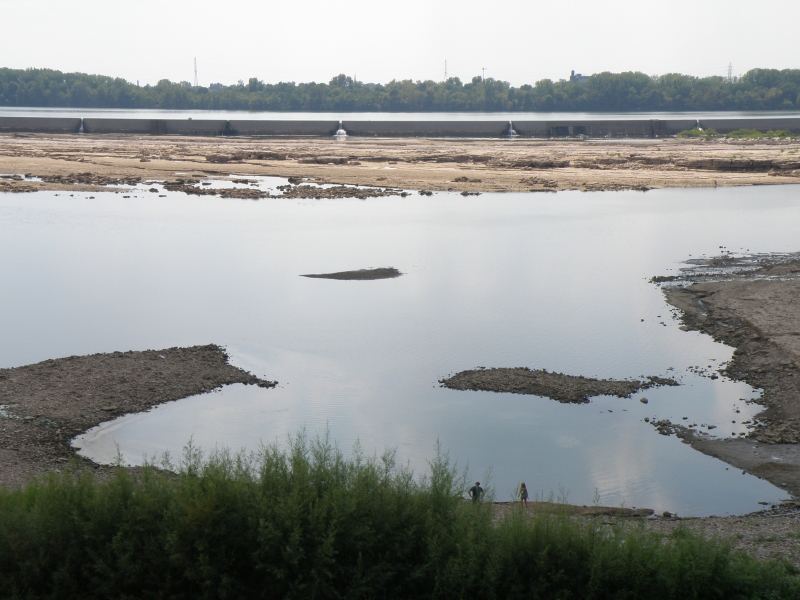
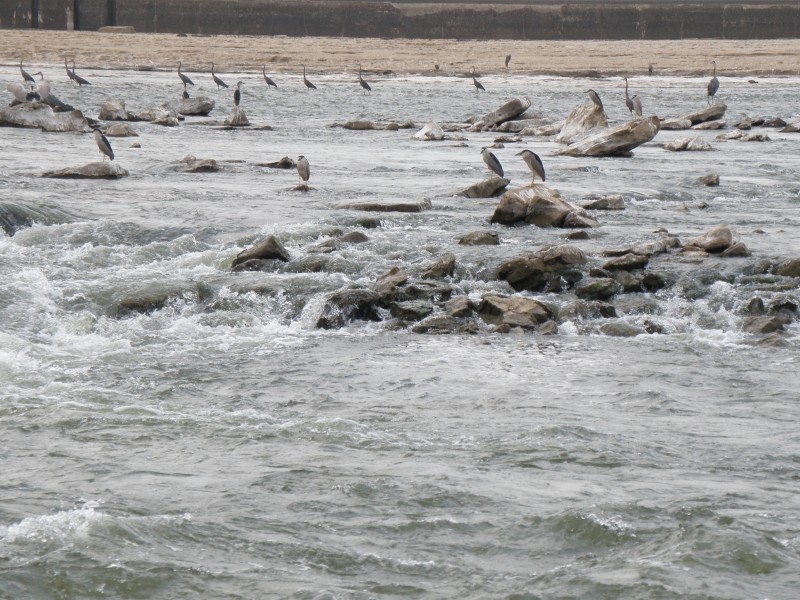
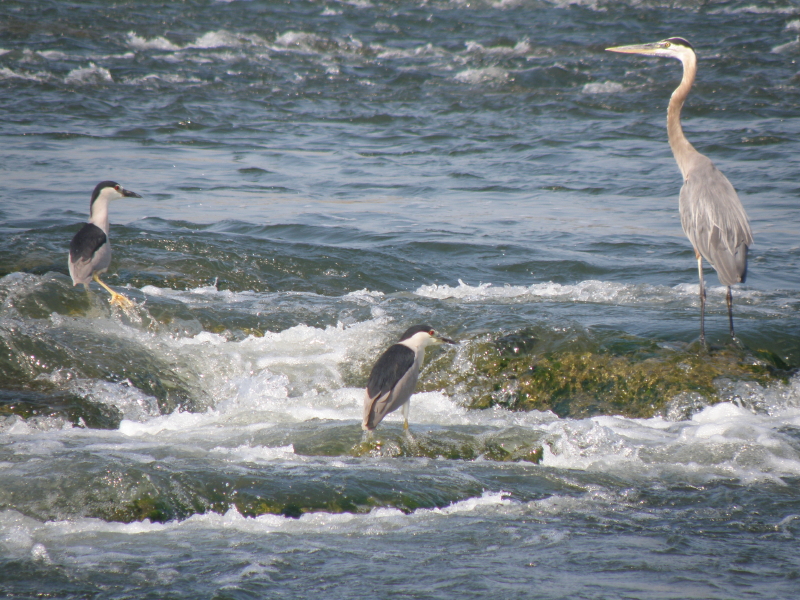
The heat is on at the Falls of the Ohio.  It is looking like this will be a summer to remember.  In the Louisville area, we have already set all time record highs for the month of June.  Yesterday, it was 105 degrees here or around 40 degrees Celsius in the rest of the world.  Coupled with the heat is a lack of rain.  So, when it’s this miserable outside…who in their right mind would be walking around under this crazy sun?  That would be me!  I’m here at the river’s edge and imagining that I’m one of the dozens of herons I can see fishing from their spots by the fossil rocks.  I take my shoes off and cool my feet in the river.  This provides some respite.  It occurs to me that perhaps these herons aren’t fishing after all, but have discovered that they can beat the heat by wading in the water?

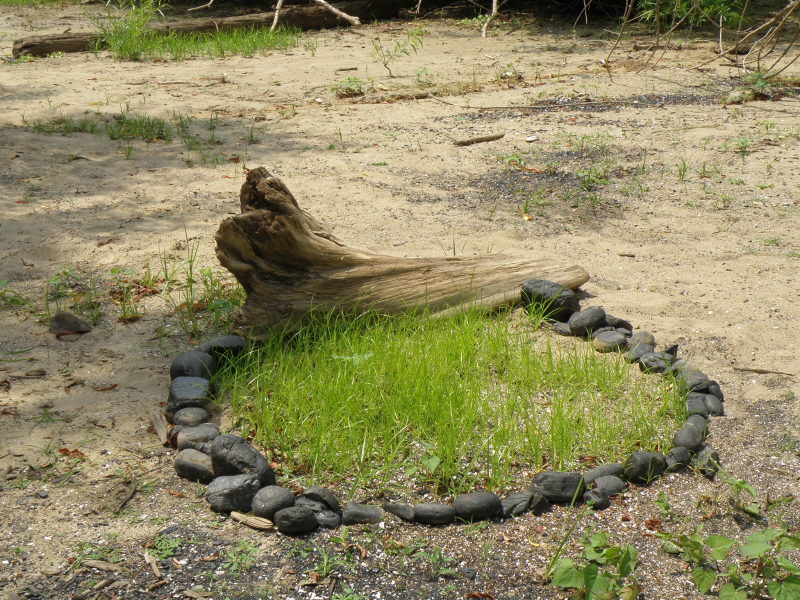
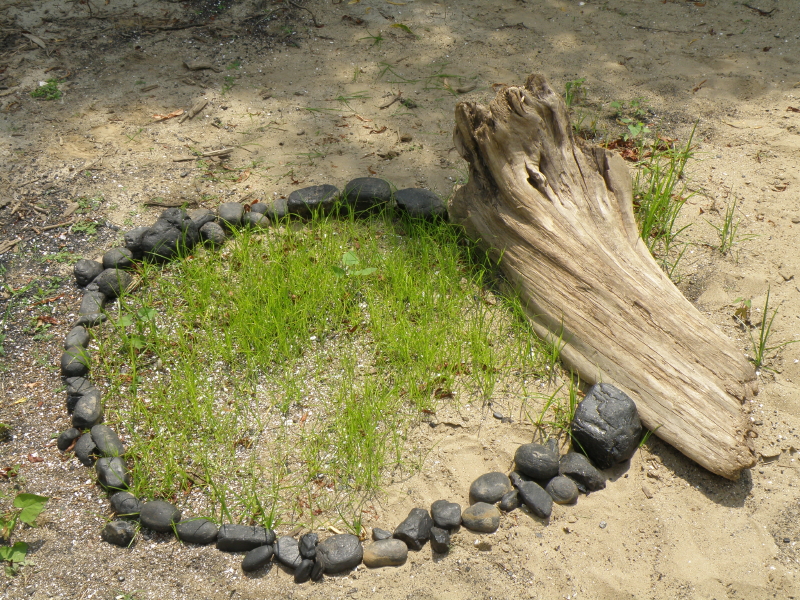
All the coal flake designs from the last post are gone.  In places, I can see how someone has dragged their foot deliberately across the patterns to erase them.  Why a person would feel compelled to do this is beyond me?  I’m nearly numb to the idea by now.  I am actually more surprised when any of my projects manages to survive for any time at all.  I have the images and that will have to do.  I do have this other coal project going out here.  It really isn’t any thing special.  Just coal defining the perimeter around a patch of grass I noticed growing next to a piece of driftwood.  I imagine that the wood provides some measure of protection from the wind or catches more dew and that is why this very small area of grass is growing.  The coal ring is meant to call attention to this.  So far, it has managed to survive being stepped upon, but if it doesn’t rain soon…I’m afraid my small patch of grass is a goner.

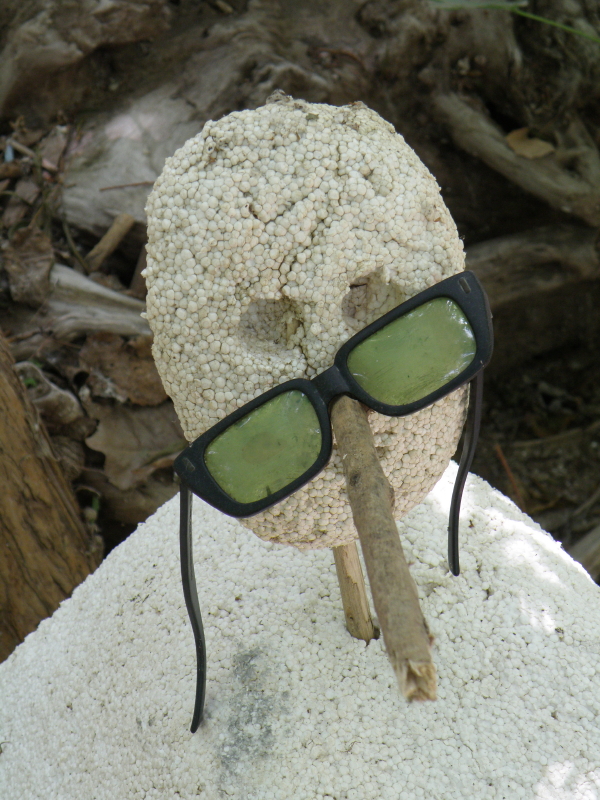
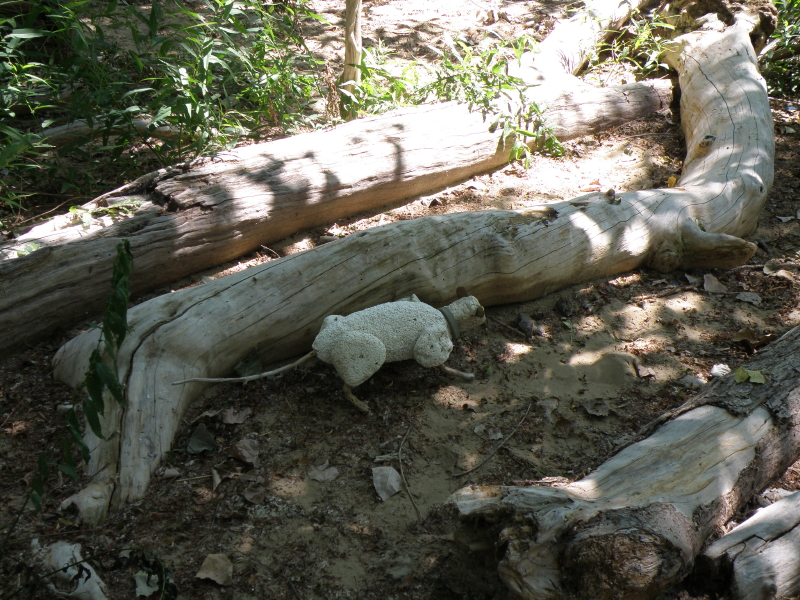
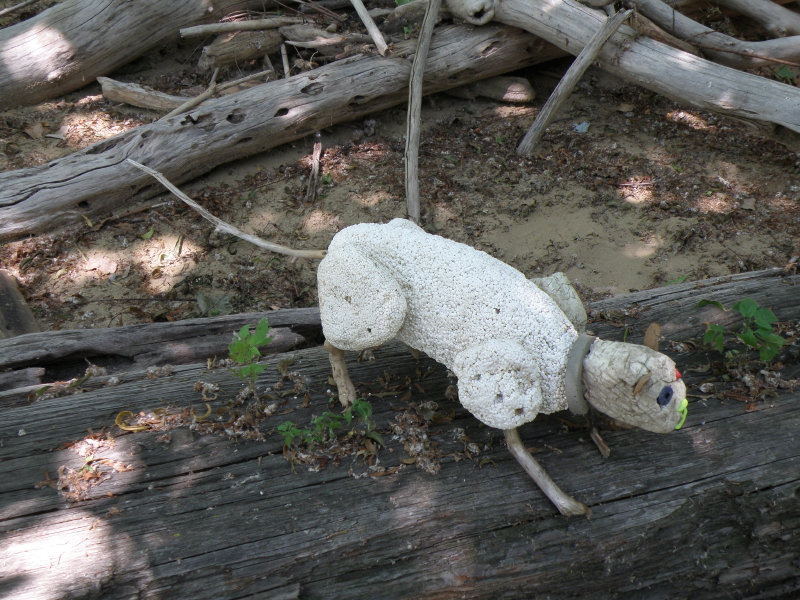
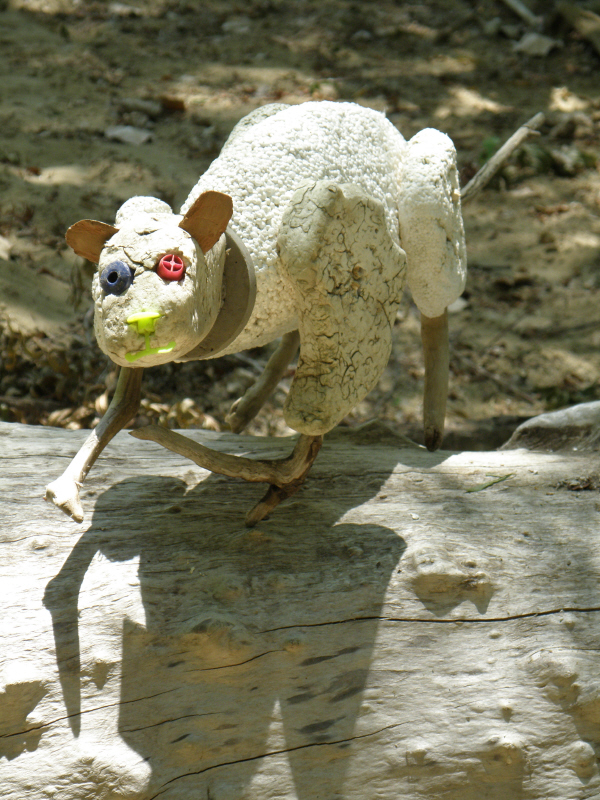
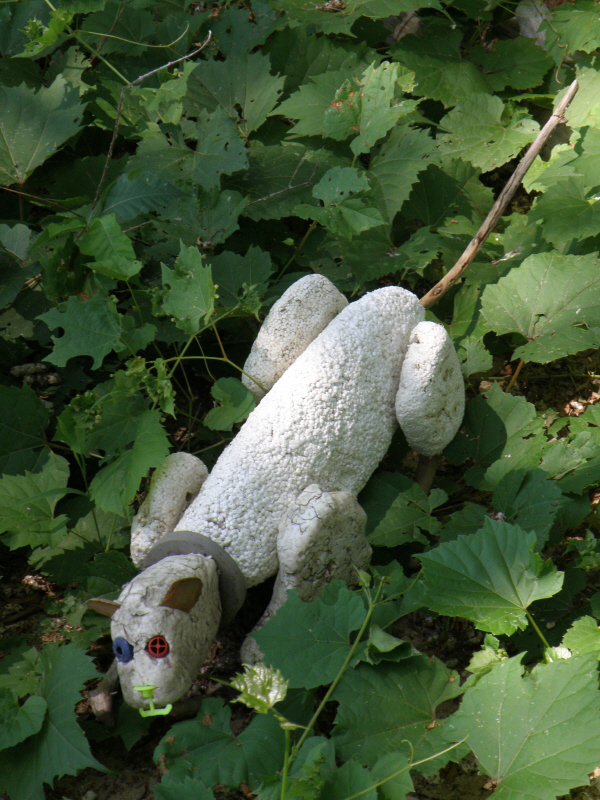
After cooking in the sun for a bit, I returned to my Styro-studio under the shade of the willow trees.  There is a trade-off.  Although I’m not under the direct scrutiny of the sun, I do however, become a tempting meal for mosquitoes and biting flies.  Looking around, I can see that I have had visitors because the Styro-figure I had stashed here has been destroyed and someone has attempted to create another figure from its remains.  An old pair of sun glasses I had previously found was just barely hanging on to the new figure’s eye-less head.  I do like it when people play along and imagine other possibilities.  I was looking through  my  larder of polystyrene chunks and wondering what to make next when I spotted some movement in the near distance.  Grabbing my camera I carefully stalked behind the trees and caught another member of the Falls’ distinctive fauna unawares.  Here is my informal portfolio of the River Cat.

Hiding behind a log I saw the River Cat hunting.  Among its habits…it is an ambush predator that conceals itself along the trails used by its prey which includes other small mammals and birds.

Once it was a common small predator found throughout the Midwest of the continent, but was persecuted and destroyed because it unfortunately developed a taste for chickens and other small livestock.  It was poisoned and trapped and extirpated from the majority of its former range.  Small remnant populations have clung on enjoying the protection they have found in state and national parks.

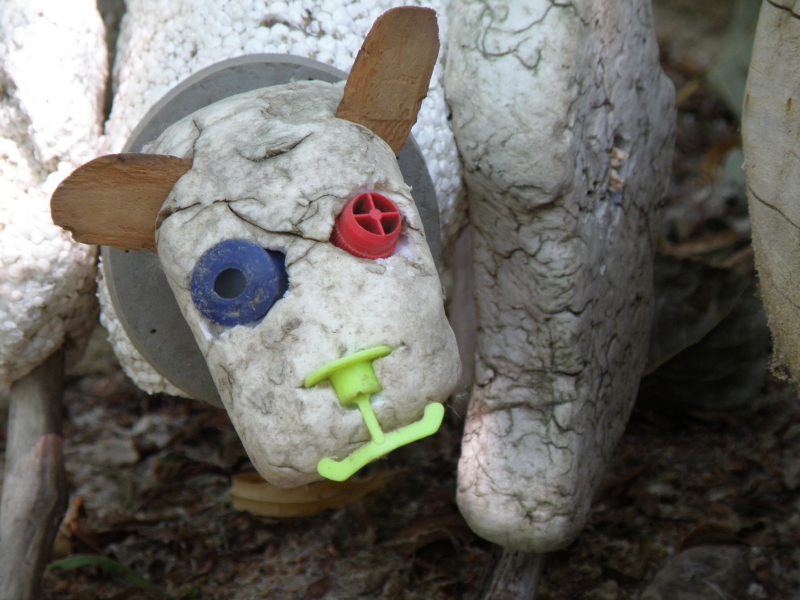
I watched this River Cat for several minutes before it discovered me!  It wasn’t  sure what I was and it jumped up onto a large log for a better look.  At this point, I wasn’t sure what it was going to do…but I kept on taking pictures.  Here is a close up of its head which illustrates one peculiarity about this beast.

River Cats have mismatched eyes.  There is an old pioneer wives’ tale that the secret to this cat’s hunting success lies in locking its gaze with that of its prey’s.  In effect, it momentarily hypnotizes its quarry before coming in to make the kill.  Whether or not there is any paralyzing effect at all has never been formally proven.

Once this unusual cat discovered that I was neither food nor threat it moved on.  I tagged behind at a respectful distance.  I followed it near the river before it gave me the slip.  Knowing that it was probably hungry, the thought crossed my mind that it might try to ambush one of the wading birds I saw earlier.  Picking up my collecting bag and walking stick I headed back down to the river.  Unfortunately, my luck didn’t hold out and I wasn’t treated to a real life moment where hunter meets prey.  I never saw the River Cat again, but I do have a few photos to prove it was here.

Read Full Post »

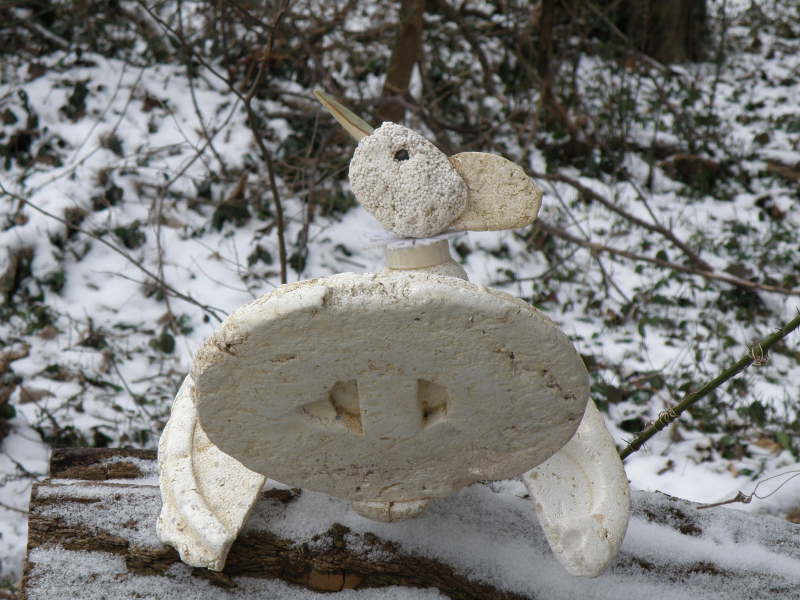
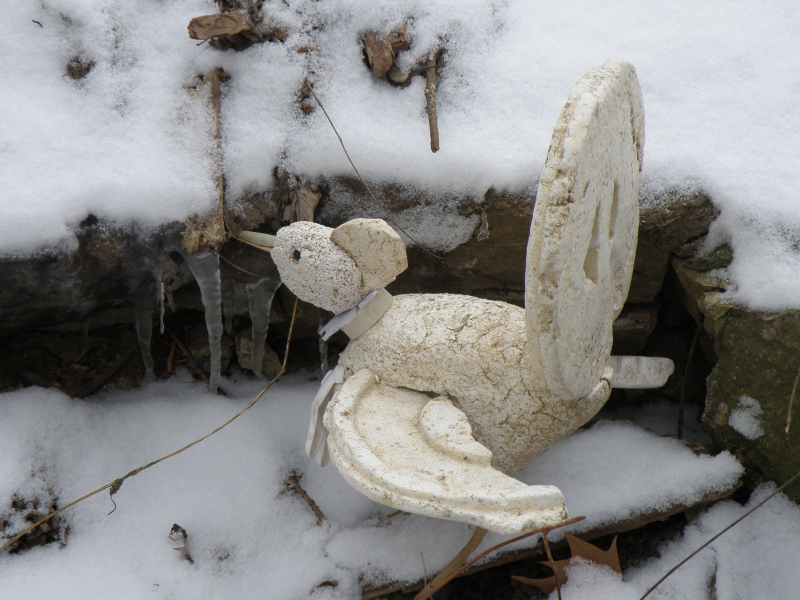
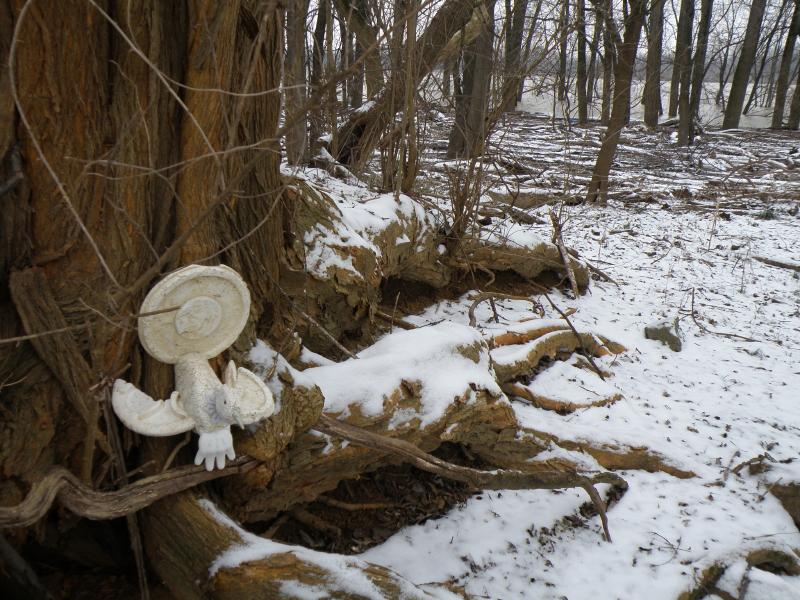
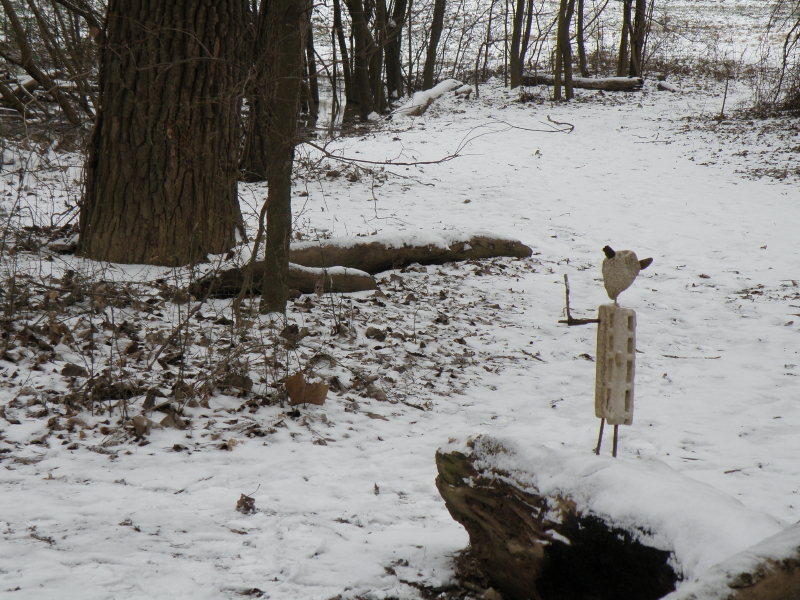
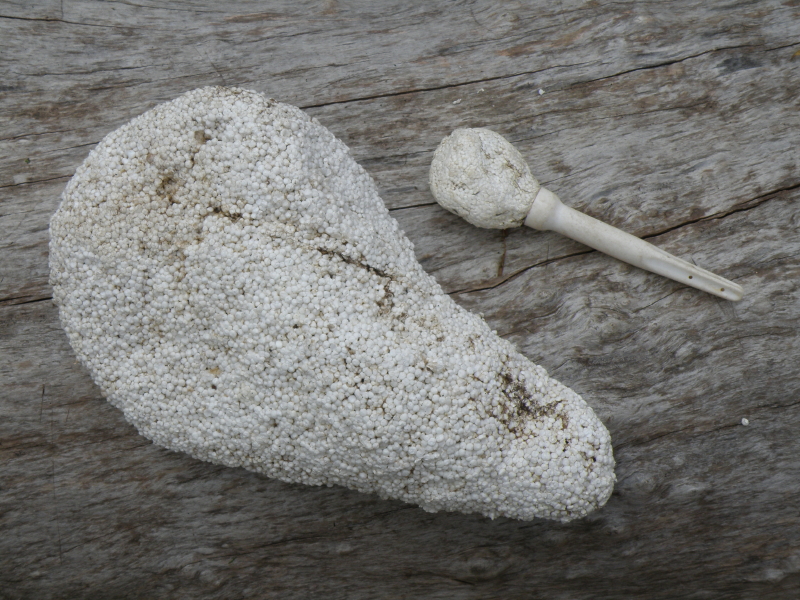
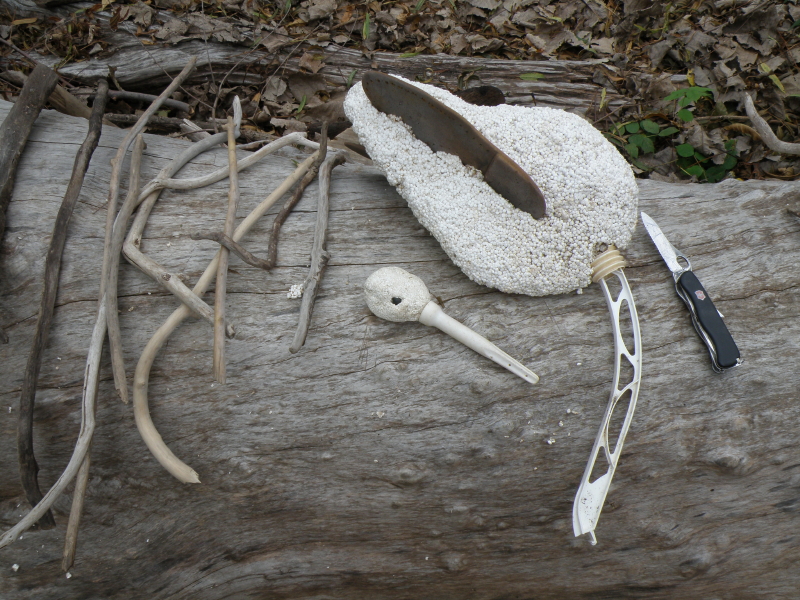
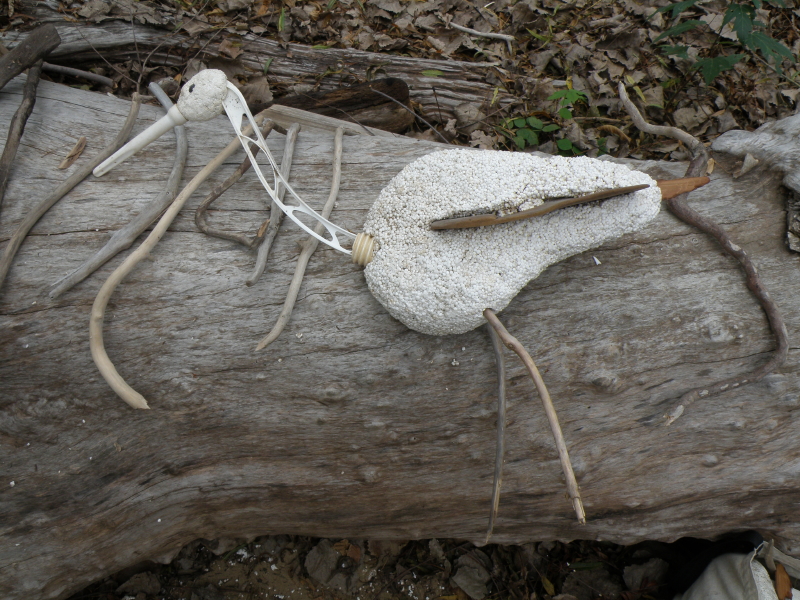
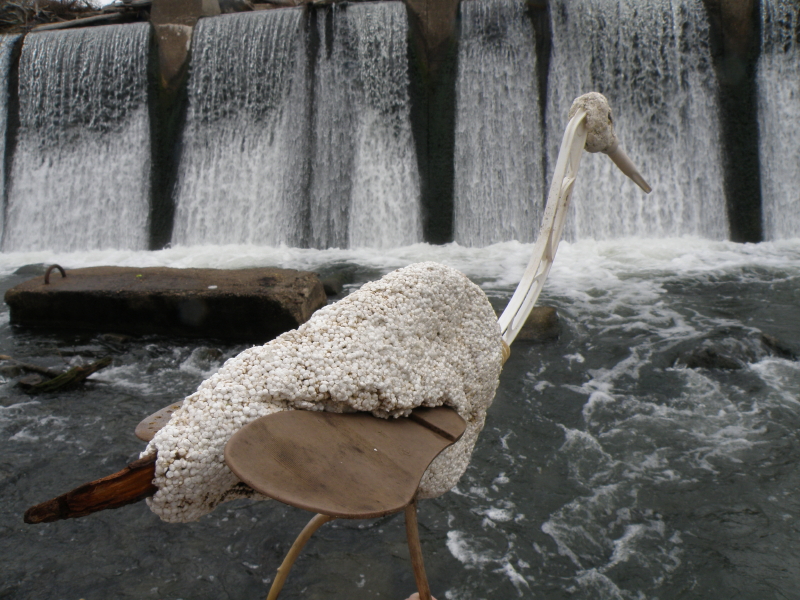
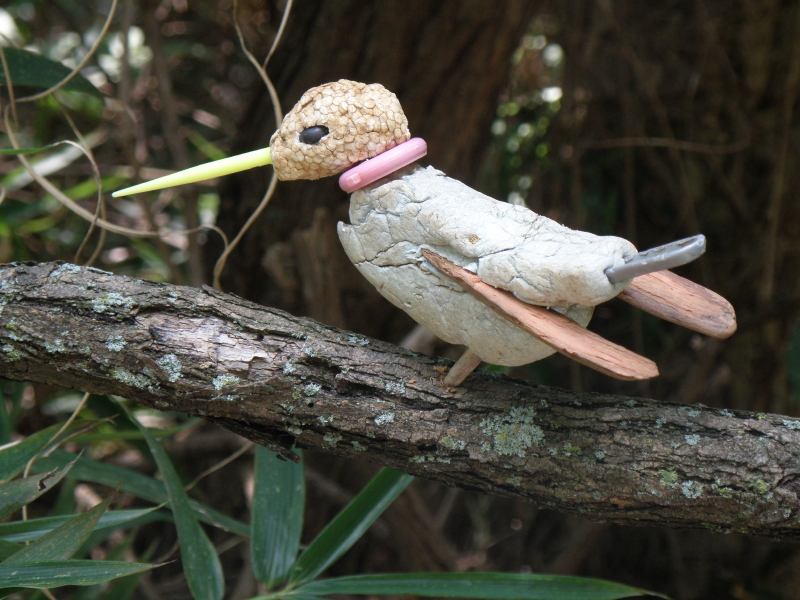
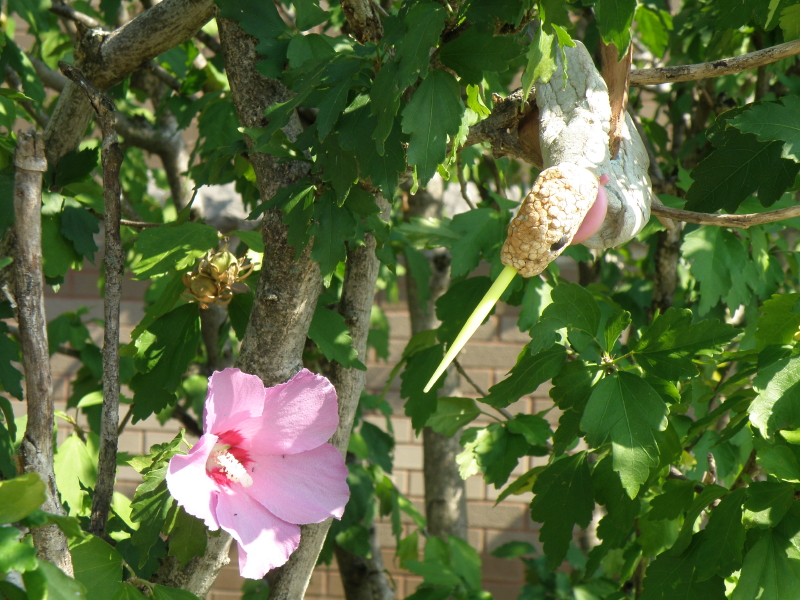
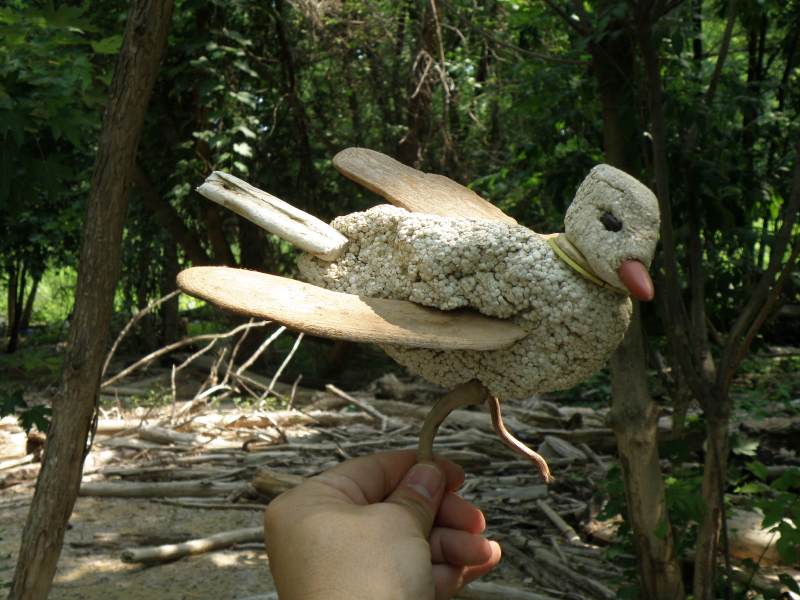
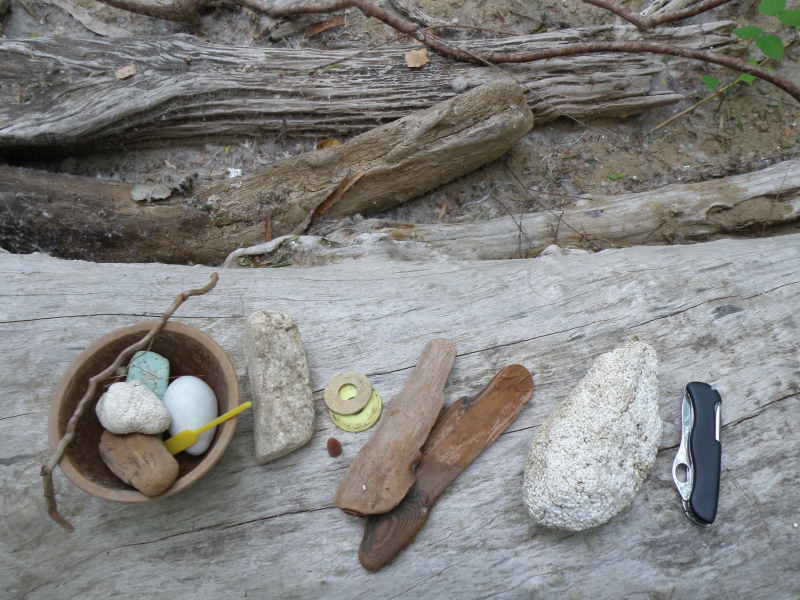
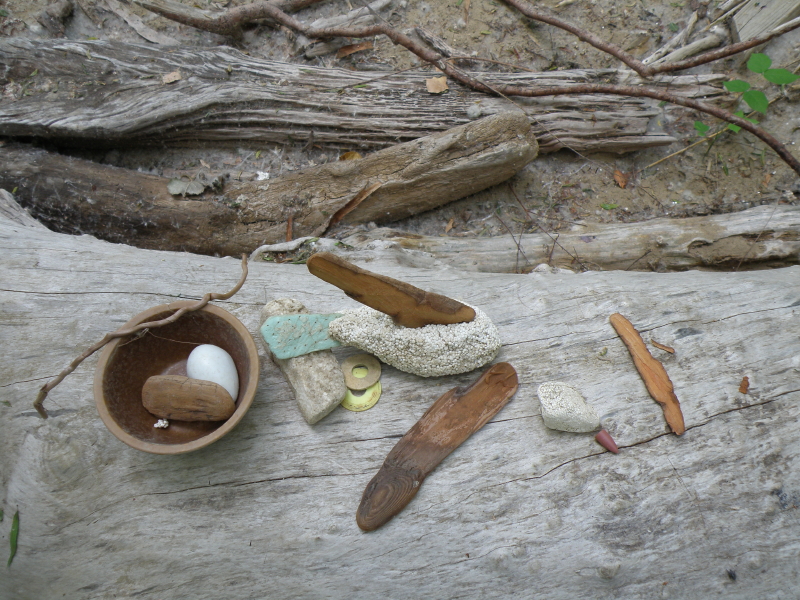
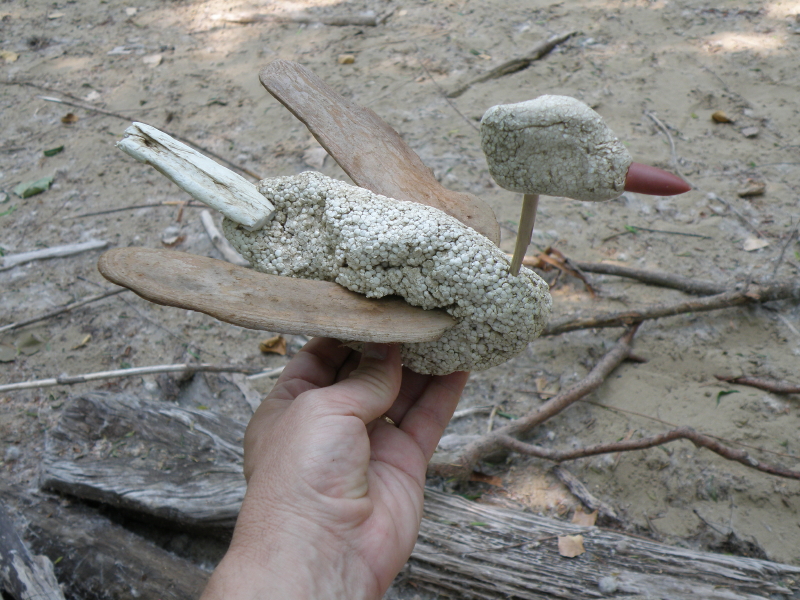
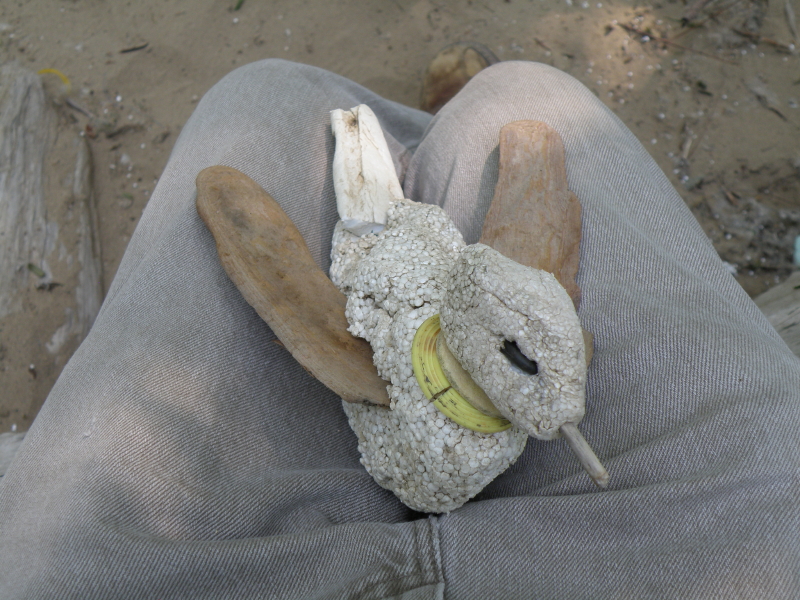
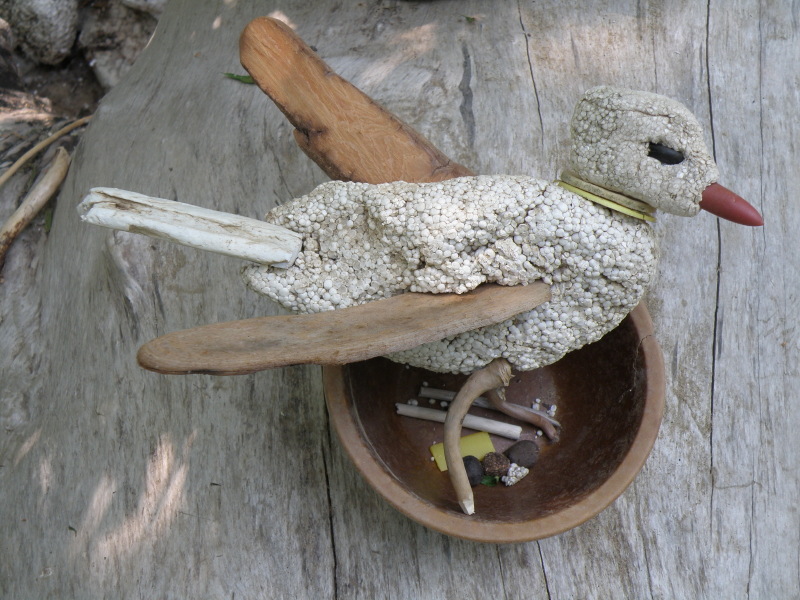
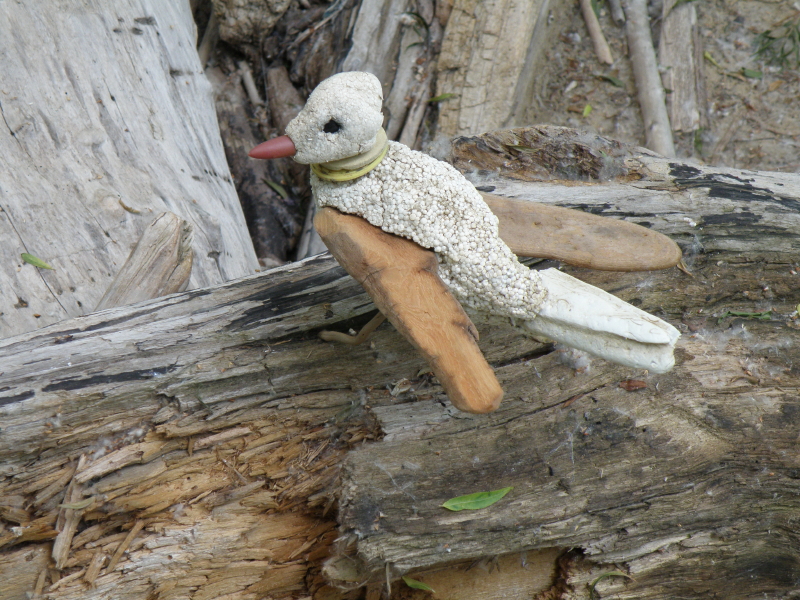
I enjoy processes and since I had additional images relating to my last post…I thought I would throw them in for fun.  I also harbor this very idealistic idea that everyone is born creative…it’s just that most people don’t view themselves in this way which I believe is at the heart of our environmental dysfunction and a great shame.  Somehow we have replaced creating with consuming. The following images hopefully show that you can create magic out of nothing.  There isn’t anything technical happening here.  If you can do Mr. Potato Head than you have the basic idea behind creating this bird.  The materials are not manipulated greatly.  I like nature to form the shapes I use. The only carving involved is in cutting slots into the body to hold the wings.  I did shave away one wing to make it thinner. I did poke holes in the head for the eyes.  I shortened the willow roots for the legs and the beak is held in place with a wooden peg just as the head attaches with its own little stick which also helps the head to swivel. Now I know this sounds a bit flip, but the hard part is seeing the possibility behind something that’s intrinsically worthless and imagining what else this could be?  Looking at the following series of images at home, I’m struck by the altar quality of the log I have spread out my materials on at my temporary outdoor studio.  I do feel that being an artist is a reverential activity.  I like to think my “art” is somehow in the service of life.  I believe you will recognize most of the components of this bird, but they include Styrofoam, wood bark, dried willow rootlets, the plastic nose cone of a small bottle rocket, plastic and foam “gaskets”, and charcoal for the eyes.  All materials were found on site at the river.  I found the little bowl that morning and it’s great to hold the little pieces I use.  I’m not a great photographer in the classic sense in that I don’t concern myself greatly with exposures and settings.  My camera is set on automatic.  I do, however, try to create an interesting image or composition that “says” something to me about that day and this place.  Give it a try…it’s fun to do!

Read Full Post »

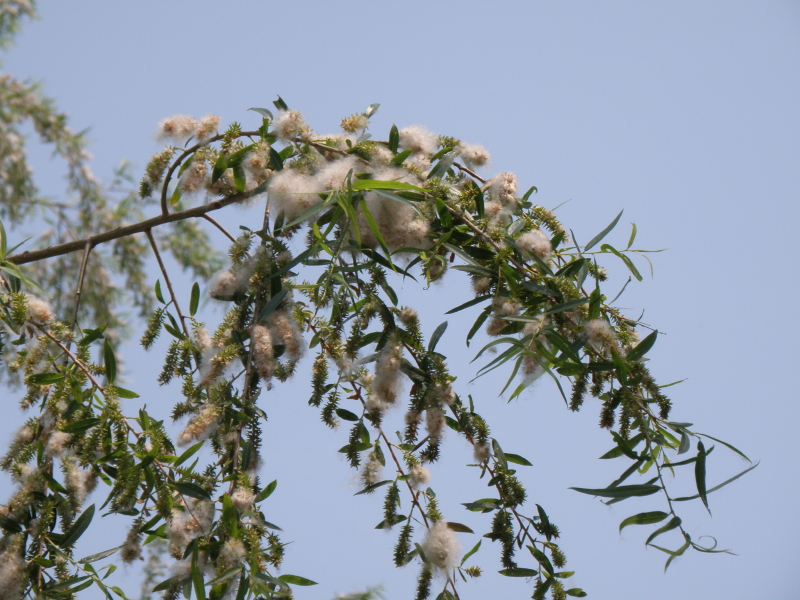
Since my last visit to the Falls of the Ohio State Park the willow fuzz has peaked.  Cottony drifts have gathered in places that offer some protection from even the slightest breeze.  The way the light shines on this gossamer surface is magical!  Before venturing into today’s avian adventure…a personal blogging milestone announcement as this is officially post number 300!  I hear the champagne corks popping already.  I had little in the way of expectations when I started this Riverblog, but I have been happy with this medium for describing my project.  In the beginning, I wasn’t sure if blogging would hold my interest, but it has.  I have also enjoyed the wide community that is out there and I thank everyone that has stopped by or left a comment.  As regular visitors know…I’m a big bird watching fan and I enjoy the many challenges that this hobby presents me.  A once in a lifetime experience can begin with a quick flash of the wings that may last just seconds.  It causes me to be acutely present in the moment.  Venturing down to the river I see the resident flock of Black Vultures has returned for another season.  I photographed this wary pair looking for dead fish or anything else edible.

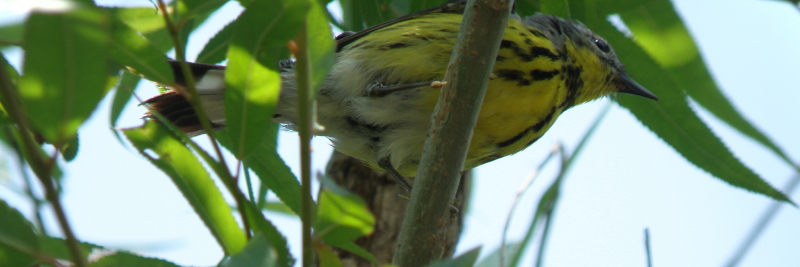
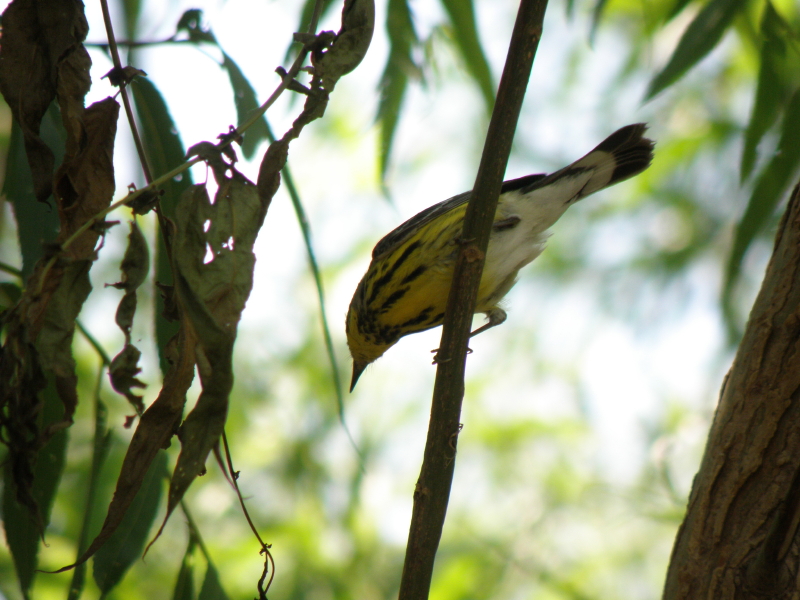
The foreground in this image is willow fluff covering the sand.  I find the two vulture species that hang out at the Falls to be really interesting birds and I have posted on them many times before.  There are more furtive species out here as well and I had the good luck to stumble upon a small mixed flock of warbler species.  Among this group were several Magnolia Warblers and I have a few images of them.  I love their coloring with their black streaks on their bright yellow breasts.  Magnolia Warbler is a misnomer since they don’t seem to favor that tree in my experience.  I found these warblers to be very tolerant of my presence and I was able to follow them as they moved from one willow tree to another in their search for small insects.

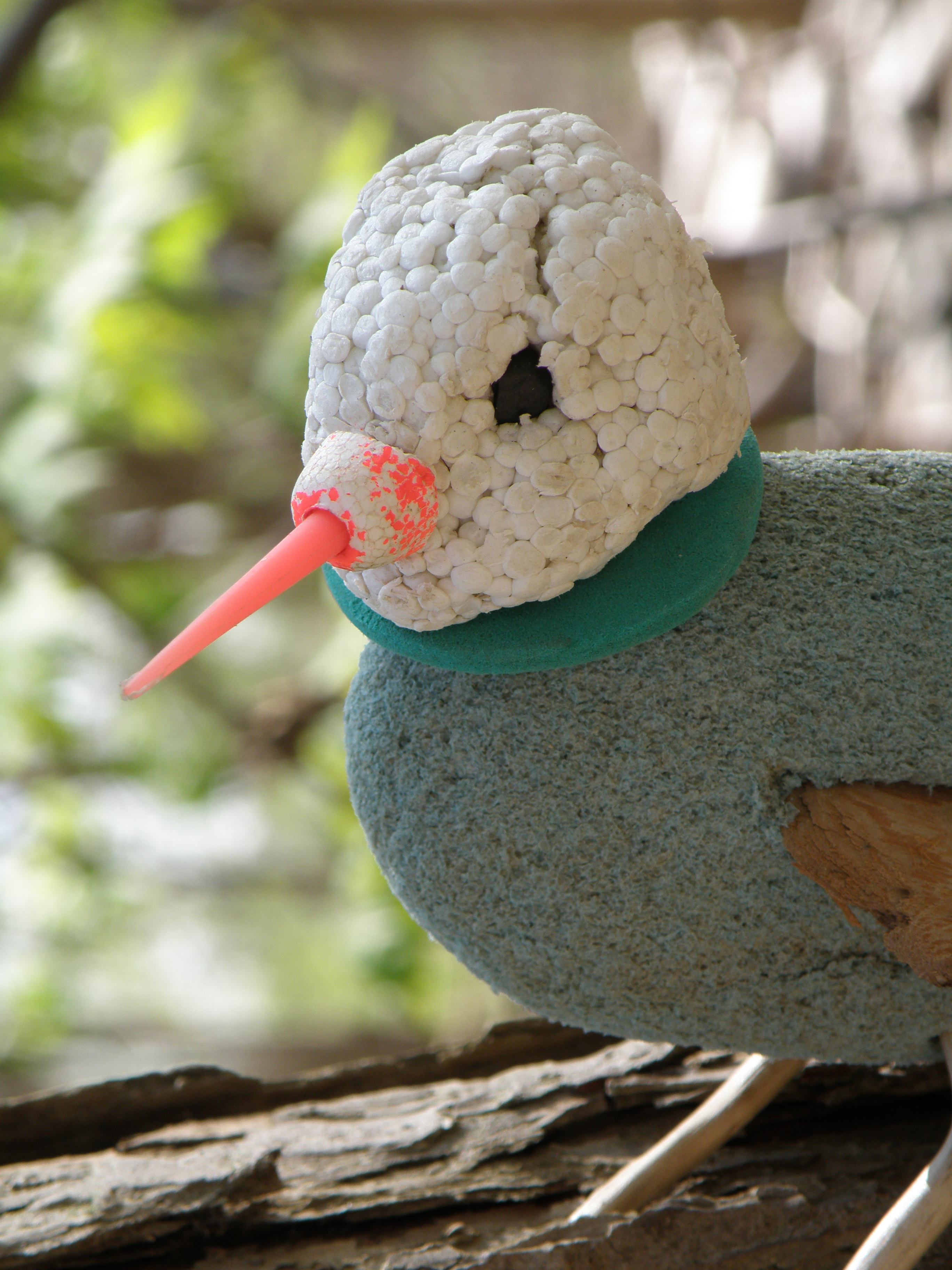
Warblers are tiny always on the go creatures and their many species are a highlight of the spring migration.  Many of the warbler species I see are passing through our area to points mostly north of here.  I came across another seldom seen bird that I hope you will enjoy.  It’s called the Brown-winged Robin and it too is traveling through the heartland.  I have a series of this bird too beginning with a specimen I found wading through the willow fuzz.  Is this pre-nesting behavior?

Here are a few more shots of this rare bird in the environment at the Falls of the Ohio.  The brown wings are diagnostic as is the bright red beak.

There are many more bird species both real and imagined that I look forward to presenting in future posts!  I hope to continue to share with you the great variety of life that I find in this relatively small place as it reveals itself to me.  One other announcement for folks in my immediate area.  I will be presenting my project at the Pecha Kucha event at the Bernheim Arboretum and Research Forest in Clermont, Kentucky the evening of June 5.  This will be an outdoor event and coincides with the transit of Venus occurring on that night.  Essentially, this slide show presentation form I believe began in architectural circles and speakers have 20 slides at 20 seconds a piece to present a topic.  It goes by fast so you need to be pithy which can be a challenge! If you are interested in more information just click on my Bernheim Arboretum and Research Forest link in my blogroll.  I hope to see some of you out there and thanks again to all who have checked out the Artist at Exit 0 Riverblog over the years!  Now for more willow fuzz!

Read Full Post »

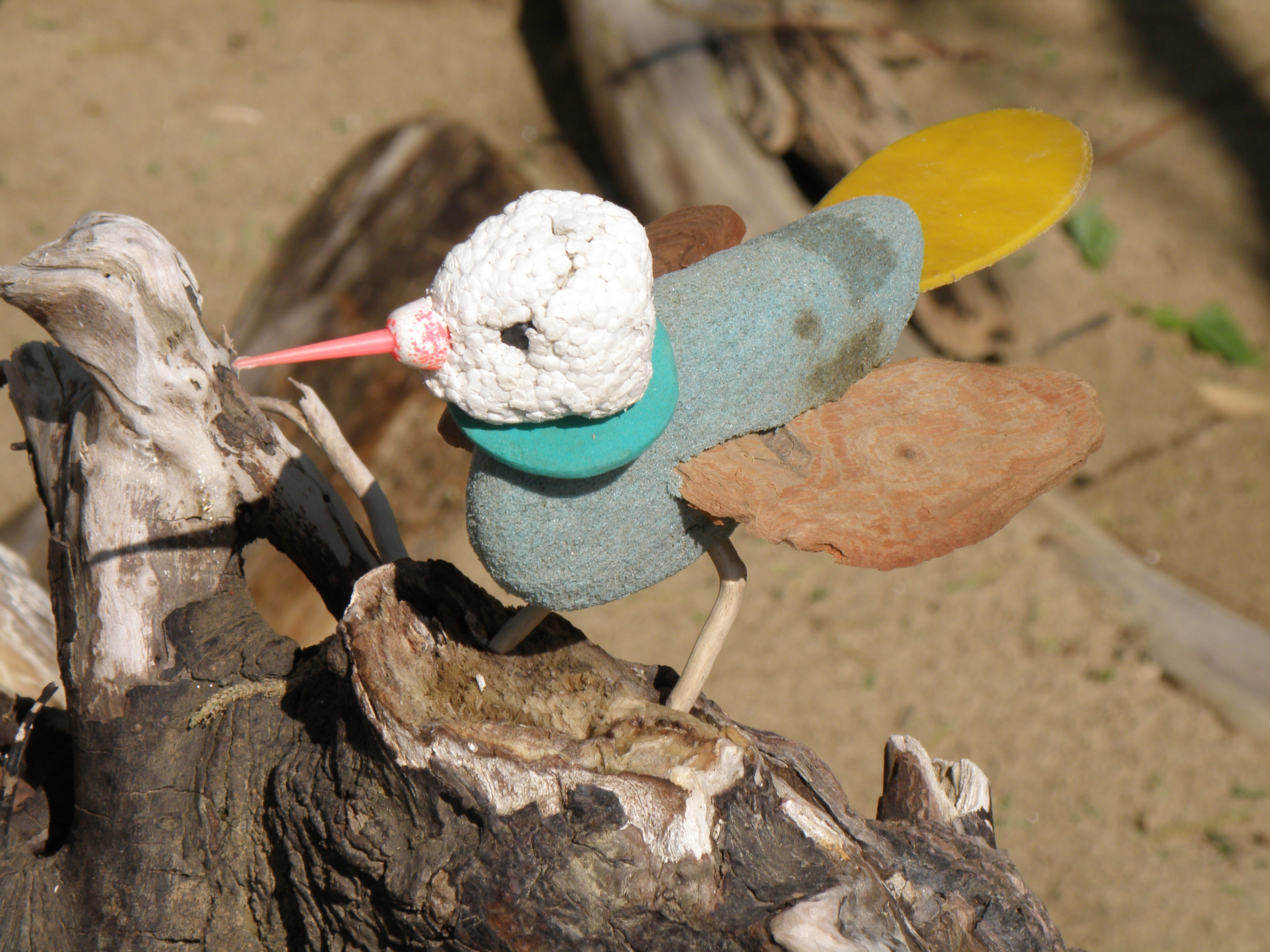
It’s Spring and I’m walking the eastern section of the Falls of the Ohio State Park looking for birds.  I have done this religiously for years and have seen most of the species that have been recorded in this park.  I love birds because they are such beautiful expressions of life.  I envy their extreme mobility with so many species able to call greater parts of the globe home than I will ever experience.  This is the time of year when many different types of birds that have been wintering in South and Central America undergo remarkable journeys.  Some will pass through this area on their way to locations as far north as the Arctic Circle. This is my chance to see them… if I’m lucky. The Falls of the Ohio also has another significant bird connection through the life and work of John James Audubon.  He essentially started his life’s work that would eventually become The Birds of America, one of the great achievements in publishing and the most expensive book in the world, by first drawing many of the birds he encountered at the Falls of the Ohio.  Audubon’s example and his journal descriptions of the world he inhabited are frequent touchstones for me and this project.  Two hundred years later…very little remains of the original landscape he was familiar with.  That process and transformation of the landscape is continuing and unfortunately not always in a positive direction.  Birds are such great indicators of the quality of the environment because they are sensitive to changes…the canary in the coal mine was a real thing.  To enjoy birds and birding is an activity that takes you out of yourself for a little while and causes you to engage life on its own terms.  On this day (which also happened to be April Fool’s Day)  I did experience many of the usual year round resident bird species, but did not see any of the neotropical migrants that make the Spring migration so special.  So, when this happens, I’m not above creating my own bird species.  This post is devoted to a new bird I discovered out here and I’ve named it the Variegated Oriole.

The Variegated Oriole receives its name for being multicolored. I first encountered this bird as various bits of detritus that I came across walking the shoreline of the Ohio River.  For the head, I used a small piece of river-polished Styrofoam.  Its brightly colored beak is part of a plastic and polystyrene fishing float that I cut with my pocket knife.  The eyes are small bits of coal.  I used a green foam gasket or washer to act as a transitional element between the head and the body.  It’s a trademark of mine that I seem to do with almost every piece I make out here. For the body, I found a blue piece of river-polished high density foam? that I cut a few slits into the sides to hold the wings which are made from pine bark.  I took one piece of bark that the river peeled off of a tree and I split that in half to form matching wings.  The tail is a piece of yellow plastic I found that reminded me of a bird tail!  I cut another groove into the blue body to insert and hold the tail in place.  The feet, are just rootlets that I sharpened and pegged into the body.  That’s it in terms of materials which I tried to alter as little as possible as not to trump what nature and the river had already shaped.  It’s important to me that this be a true collaboration.  If “we” are successful, then something of the spirit of a bird will take hold and inhabit this small sculpture.
After finishing the bird…I seek out environments that will help put this avian creation into some kind of context.  Everything matters and I hope my pictures convey something of the time of day, the season, the quality of light, the condition of the environment, etc…all those elements help create a sense of place.  I move through the willow trees posing the bird on various stumps and branches.  I usually take a lot of pictures.

Sometimes, I will imagine what kind of habits my new birds might possess.  In the case of the Variegated Oriole…it is not too different from the Northern or Baltimore Orioles that live and nest in the park.  They are among the migrants I look for. I heard one the other day calling, but didn’t see it.  The real orioles that live here are adapting to local conditions by using artificial materials (fishing line and barge cable fibers) in the construction of their hanging basket nests.  I’ve posted on this before in this blog a few years a go.  I think Audubon would have been interested in this.  Anyway, I left my bird sitting on a branch for anyone to discover.  It might still be there and I will find out today when I once again venture out to the Falls of the Ohio State Park.  Perhaps new birds will present themselves to me? I will let you know what I find…next time.
One week later…I returned to the spot where I left my faux-feathered friend and he was no longer perched upon the branch where I left him.  I was able to locate most of him scattered on the sand except for one wing.  My guess was that he was felled by a well-aimed and thrown rock.  The head was shattered and will need to be replaced provided  I recyle these pieces back into a bird again.

Read Full Post »

« Newer Posts - Older Posts »