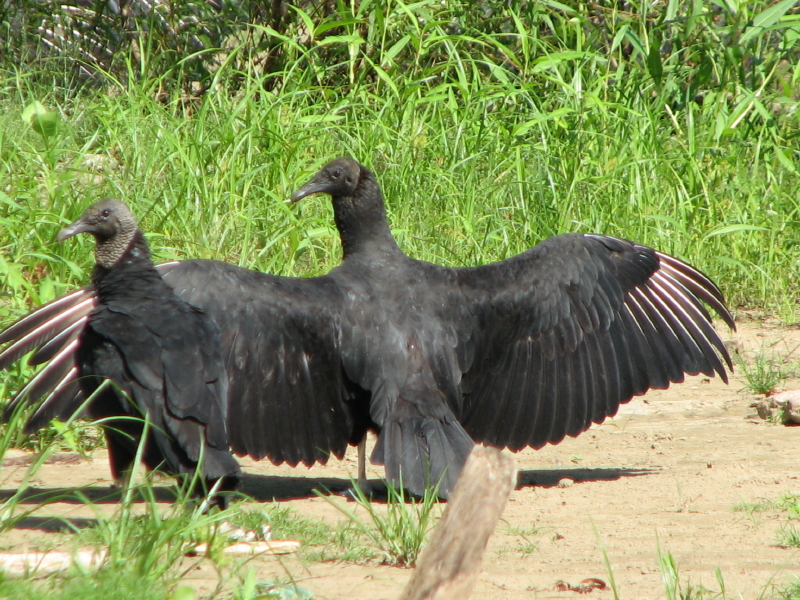
It’s official, this summer was our toastiest. I looked at the lead article in the local newspaper and words like historic and unprecedented are being used. We beat the old record that stood since 1936 by a degree and a half! In meteorological terms that’s a lot. This was determined by factoring the daily highs and lows and taking the average temp for the day. Louisville had more than 80 above average temperature days this summer which was more than any other city in the country. No wonder working at the Falls felt so harsh. We had a number of high pressure systems that just hung around the Ohio Valley making life difficult for everything including these vultures. Of late, every year has had something climatically anomalous about it. Too dry, too hot, too wet, too cool…missing are words like usual, normal, ordinary, and uneventful.
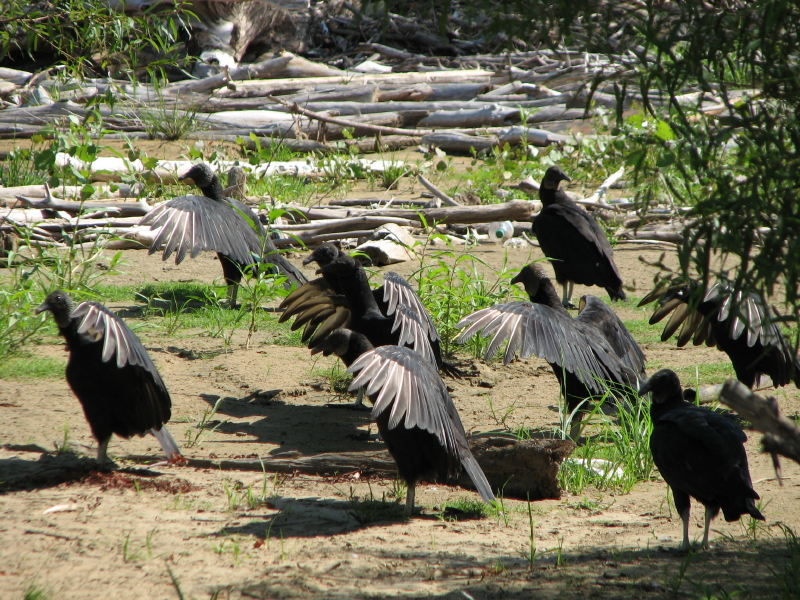
The variety of bird life at the Falls has been down this year too. When you are a creature that is sensitive to the environment and have the advantage of great mobility…your instincts can tell you to go elsewhere. I think this is what happened this year. I will be really curious to see what comes by on the Fall leg of migration. This year the Black vultures did well as did the Canada geese. I could count on seeing those two species in good numbers most anytime I came out to the river.
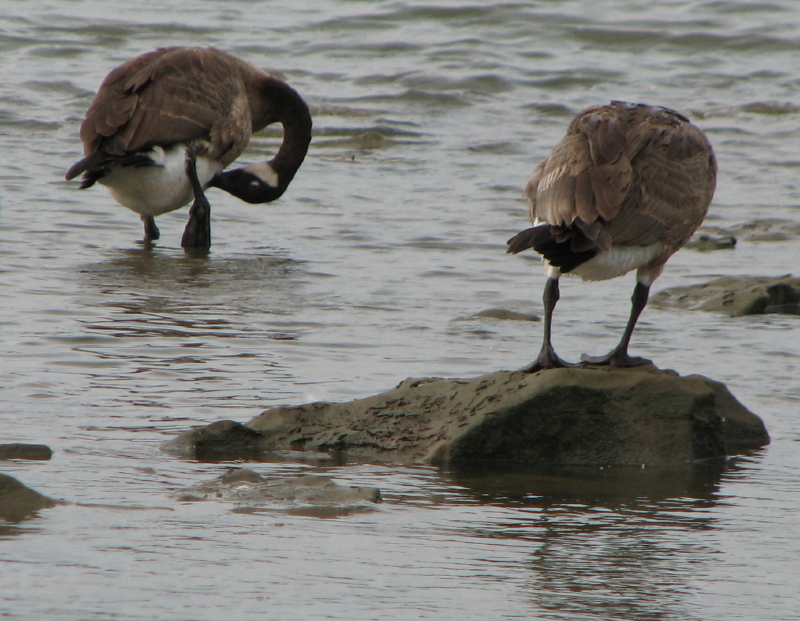
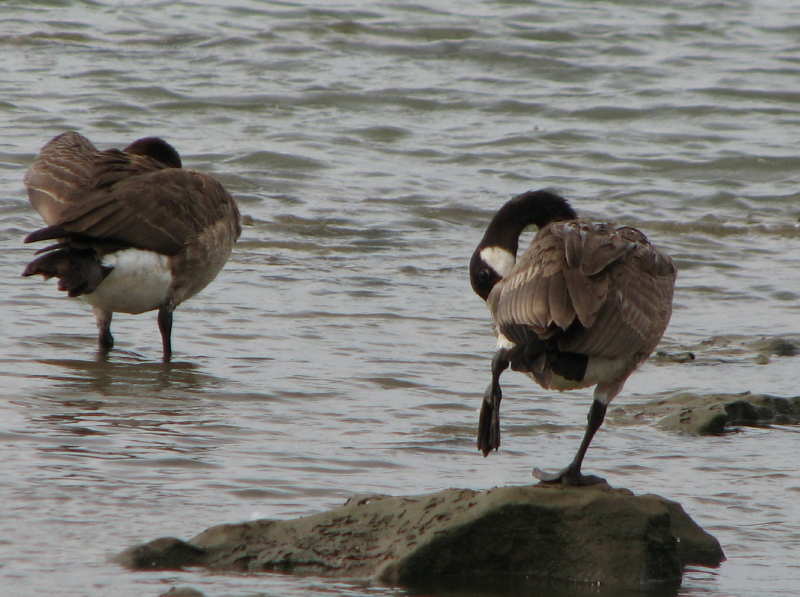
From what I can see “anecdotally” the Canada Geese are on the rise here. We have few predators to challenge them. I have seen some very large flocks out on the water and they are keeping the grass clipped short along the riverbank too. Friends told me that in the “old days”, you could find large stands of native river cane on the margins. That’s something I don’t ever recall seeing out here. One of the values I place upon this blog is to act as a record of the environment as I find it. We have journals and first hand accounts of what this place looked like two hundred years a go and I believe that two hundred years from now…people will still be interested in the Falls of the Ohio and how it has been changed by civilization.

One of my favorite summer birds are American Goldfinches. There is something cheerful and friendly about them. The male with his bright yellow and black plumage is an unmistakable bird. Many times I have watched the dipping and rolling courtship flight and listened for their call notes. In the past, I have seen this species in mass, but not this year.
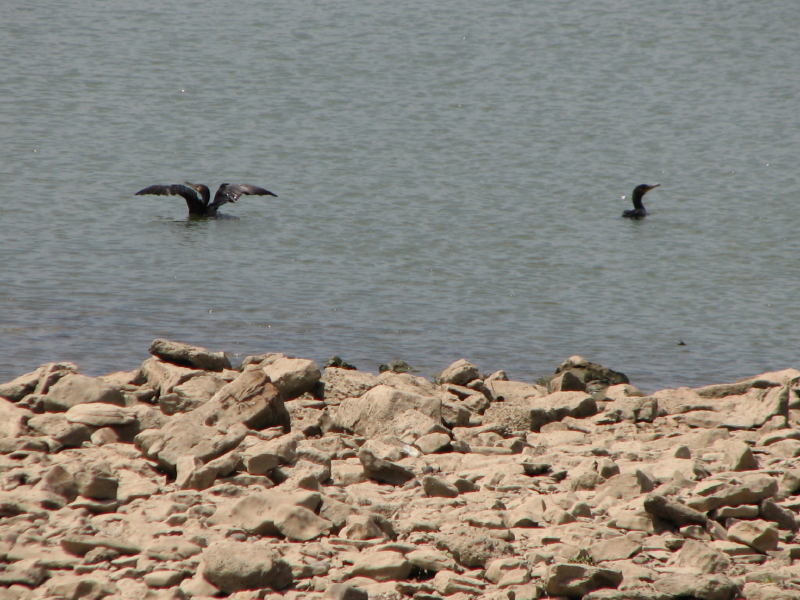
I’ve had conversations with people bragging about their fishing luck or skill, but none of them can hold a candle to a cormorant. The Double-crested Cormorants in this picture are able to find and catch fish when nothing else can. Of course, it helps to be able to swim and pursue prey underwater! These birds are wary and very hard to approach. In other places of the country, fishermen have persecuted this species because they compete very successfully against the rod and reel.
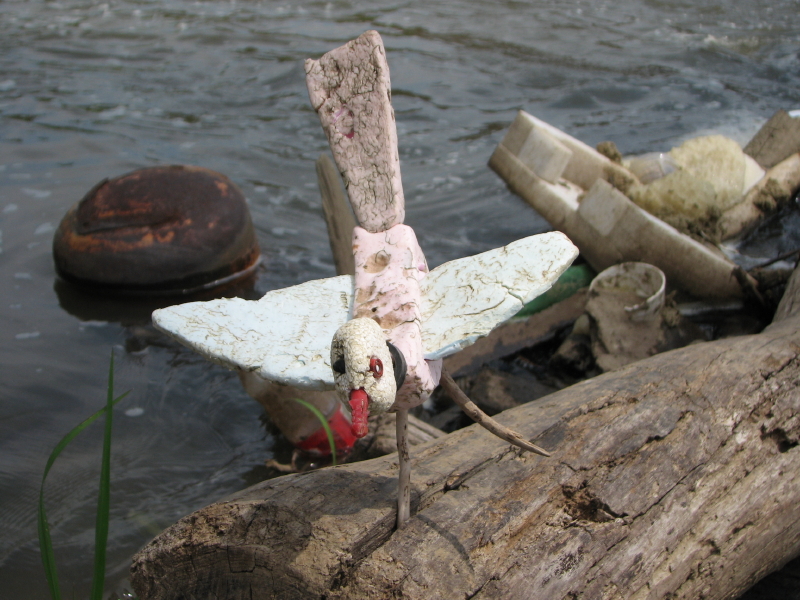
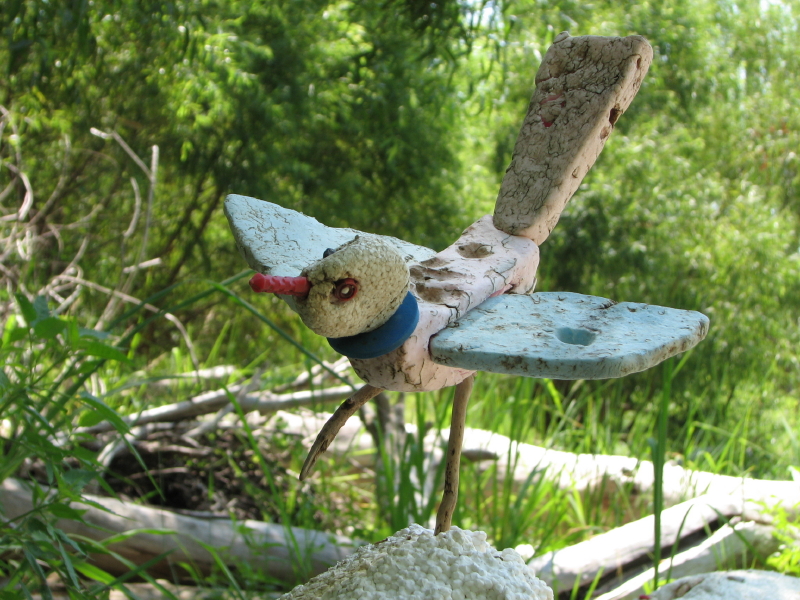
One of the few interesting and new birds to write about is the Azure-winged Mockingbird. I have encountered them by my studio under the willow trees. They are fearless and will drive away larger birds. Among their notable features is the way they flash their wings against their bodies which makes them look more aggressive. I have wondered as I make my Styrofoam sculptures, if these birds are drawn to the mosquitos and gnats that find me! This is not a common bird and has been rarely recorded here. I expect that in a few weeks, it will be winging its way to Central America. I wonder if this year’s events in the Gulf of Mexico will compromise it and other birds in some way? The forecast for this holiday weekend looks great and I’m anxious to spend a bit more time out here on my projects. I’ll close with one more image of my mockingbird friend and a sculpture still around from several weeks past.
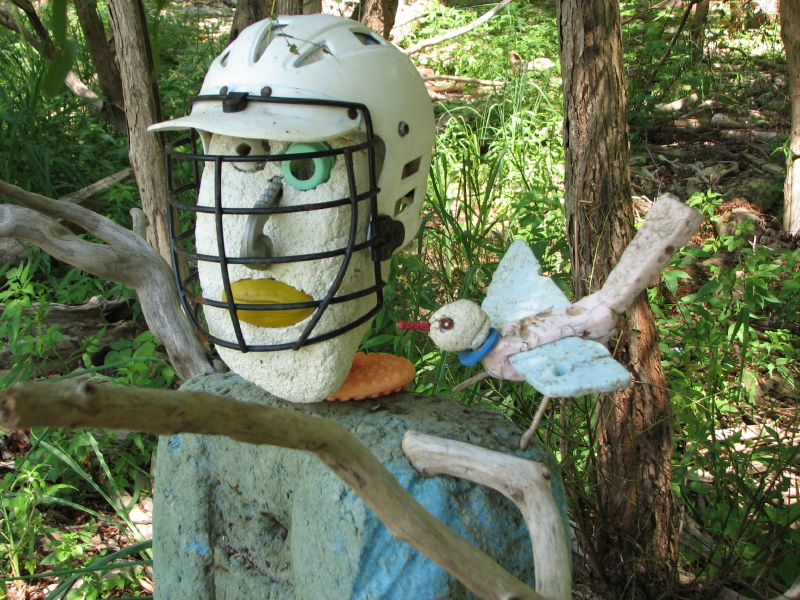
 Artist at Exit 0 Riverblog
bird on my shoulder
what are you after
an insect on my neck?
get it with your beak
🙂
Well done! Thank you for the poem!!
Stunning pics as usual Al! Over here we are always moaning about the weather (not hot enough) but I doubt many would like to be in that heat you mention – they’d soon be moaning:) love the azure winged mockingbird and hope it survives (it’s unlucky to kill a mocking bird:))
Those cormorants look like quite big birds – are they? Fancy fishermen being jealous of the poor creatures though – terrible!
It would be interesting to compare say a page in one of those 200 years old journals with whats happening now wouldn’t it?
Good post:)
Ps Hows about entering my Van Gogh poem challenge bendedspoon:) and you of course Al
Thank you my friend. Yes, I would say that these cormorants are on the medium to large size as most birds go. Cormorants are actually a diverse family of birds with a world wide distribution. In some Asian cultures they have semi-domesticated them to fish for people. The bird is on a long line and there’s a ring around the neck to prevent swallowing. After the day’s fishing, the birds are rewarded then.
huh me?
honestly i am not a poet
my blog is my first attempt
in writing like this
whatever is this.
but let’s see
what i can come up
after all i am just
having fun with words
and that too is only secondary
to sincerely appreciating somebody.
i am aware that real poets
may be laughing at me
but honestly it’s more
than enough that
i make someone happy.
there i have talk too much
when all i need to say is
thank you very much.
🙂
[…] invited me to a poetry challenge […]
[…] invited me to a poetry challenge […]
Go for it Bended Spoons…there’s nothing to lose!
I didn’t know we had mockingbirds around here, so thank-you. I will look this one up, Al. Maybe I’ve seen one. I have seen an all black bird with a shiny blue wing, here, and am wondering if that was one. Larger than a robin. Your posts are always informative. I like the bird sculpture. It is a nice twist!
The Azure-winged Mockingbird is only found in one location in southern Indiana across the river from my home! The other birds posted do range farther north. Thanks for your comment!
You have me studying birds, now! I spent time looking up your mockingbird and that is a beautiful bird. I have never seen one. I found the bird I have seen and it is a Brewers Blackbird. They look shiny blue when the sun’s rays hit them and I found out that our area is nesting grounds for them. Way cool! Now if I can retain all this information!
You have to be pretty good with watercolors to master their iridescence. I think bird watching can be habit forming because it asks you to pay attention to life.
Noted that you use your blog as a record of what you observe at the falls. I consider this a very cool notion akin to how bigsurkate uses her blog for reporting fires and other things going on in Big Sur.
The geese here are fewer than in previous years. A few small flocks are holding steady but I note that there are NO youngsters with them. The goldfinches I only see at the nature perserves. I have also noticed much smaller flocks of other birds–which I think is due to land development–ie, urban sprawling and hence loss of habitat. “We” seem to be a plague upon other species.
Hi.
I think using this blog as an electronic journal has some value. Of course, paper ones will probably outlast it. For the moment…it’s important to show up and bear witness. The wildlife I feature is what I see out at the Falls. I do feel a need to educate because we don’t miss what we don’t know exists in the first place. Yes, I agree about loss of habitat and habitat destruction being factors in the disappearance of species. Geese grow up pretty quickly. Perhaps the lack of goslings may be attached to when you are seeing them?